To the people of a seafaring nation the story of the growth
of the warship, from the primitive craft of our savage ancestors
to the marvellous fighting machines of the present day, should
prove of endless fascination. In this book I have sought to
indicate somewhat of the lines upon which the development
of the world’s warships has taken place. The amount of
information available concerning warships is virtually inexhaustible,
whether the ships are regarded structurally and
comparisons are made of the forms of the hulls, the strains
they may withstand, the speed of which they may permit,
and their modes of propulsion; or whether, sociologically,
as evidences of the stages of the progress of civilisation of the
different peoples; or simply as aids to an appreciation of
naval combat, of deeds afloat of individual and national
heroism, of the rise and decline of maritime powers, and
finally as implements in that tremendous struggle, which
has made England what she is, for maritime supremacy. I
have not written this book from any one of these aspects,
but to describe in popular, not technical, language the more
important types of warships favoured at different times in
different parts of the world, to show, where possible, where
type has succeeded type, and the main lines of divergence and
development.
Reversing the usual practice of treating the warships as
incidental to the naval battles, I have preferred to treat the
naval battles as incidental to the warships. For that reason
I have attempted no word pictures of the onset of contending
fleets, no more or less imaginary accounts of famous engagements,
no descriptions of weird manœuvres and impossible
strategy. Even under the restrictions I have been compelled
to observe, the abundance of material to be dealt with is so
vast that I feel I have done no more than skim the surface,
as it were, and have by no means collected all the cream. The
task of deciding what to insert and what to omit has been no
light one. Much that my readers and critics may think ought
to have been included has, perforce, had to be left out, and
the necessity of keeping the book within the limits of its present
dimensions must be my excuse for the sins of omission of which
I shall no doubt be found guilty.
So uneven, or erratic, has been the progress of warship
construction, that in some of the world’s harbours, riding the
waters almost side by side, one may see dug-outs and “Dreadnoughts,”
sampans and submarines, canoes and cruisers, barges
and battleships, the vessels of peace—though in times past
they were not always vessels of peace—resting securely under
the protection of the grim and terrible modern warships.
Every care has been taken to obtain accuracy, but I do
not guarantee the absolute correctness of every detail given,
for the simple reason that the authorities consulted are not
themselves always in agreement, and this applies equally to
the warships of the past as to those of the present time.
Every care, also, has been observed to give credit to other
writers for the assistance derived from their books, and in
this connection I would specially mention the “Encyclopædia
Britannica,” Mr. Cecil Torr’s “Ancient Ships,” Sir W. Laird
Clowes’ “History of the British Navy,” Mr. H. W. Wilson’s
“Ironclads in Action,” “The Warships of Europe” by Chief
Engineer J. W. King, U.S.A., “The New American Navy”
by John D. Long, ex-Secretary of the Navy, U.S.A., “Maori
Art” by A. Hamilton, “The New Zealanders” by George F.
Angas, “History of Steam Navigation” by John Kennedy,
“The Story of the Submarine” by Colonel C. Field, “Ancient
and Modern Ships” by Sir George C. V. Holmes, “Submarines
and Submersibles” by E. C. Given, M.Inst.C.E., “Canoes of
the Solomon Islands” by C. M. Woodford, F.R.G.S., “Naval
Architecture” by J. Fincham, “Rise and Progress of the
Royal Navy” by Chas. Derrick, “Transactions of the Institution
of Naval Architects,” Appleton’s Cyclopædia of American
Biography, “History of the Marine Architecture of All Nations”
by J. Charnock, “Our Ironclad Ships” by Sir E. J. Reed,
“Cyclopedia of Antiquities” by Rev. F. D. Fosbroke, M.A.,
and the “Naval,” “Navy League,” and “Fleet” Annuals.
A great deal of information has also been derived from the
columns of Engineering, the Engineer, the Times, Illustrated
London News, Marine Engineer, Scientific American, and other
papers, to all of which I express my deep indebtedness. If
it should be found that I have not acknowledged every item
derived from these sources, I trust that this general admission
will cover my shortcomings in this respect.
I have also to thank personally the Chief Librarian of
the Colonial Office for assistance in dealing with some of the
canoes; various officials of the British Museum for valuable
suggestions they were kind enough to offer; Mr. A. J.
Dudgeon, M.Inst.N.A. and M.I.M.E., for his kindness in
again lending me his scrap-books; Mr. James A. Smith,
M.Inst.N.A., for revising a portion of the proofs; the
Secretaries of the Institution of Naval Architects and of the
Institute of Marine Engineers for again placing the libraries
of those organisations at my disposal; the Secretary of the
Navy at Washington for illustrations of vessels which achieved
fame at the time of the American Civil War; the Commissioners
in this country of the Imperial Japanese Navy for
pictures of the early Japanese warships; the Hon. J. G.
Jenkins, formerly Agent-General in London for South Australia,
for New Guinea illustrations; Mr. Harry J. Palmer, of
Paterson, N.J., for information and assistance in regard to
American ships; and many shipbuilders, both in this country
and abroad, for supplying details and illustrations of the
vessels they have constructed. I have also to thank Lord
Dundonald for his courtesy in lending me a picture of the
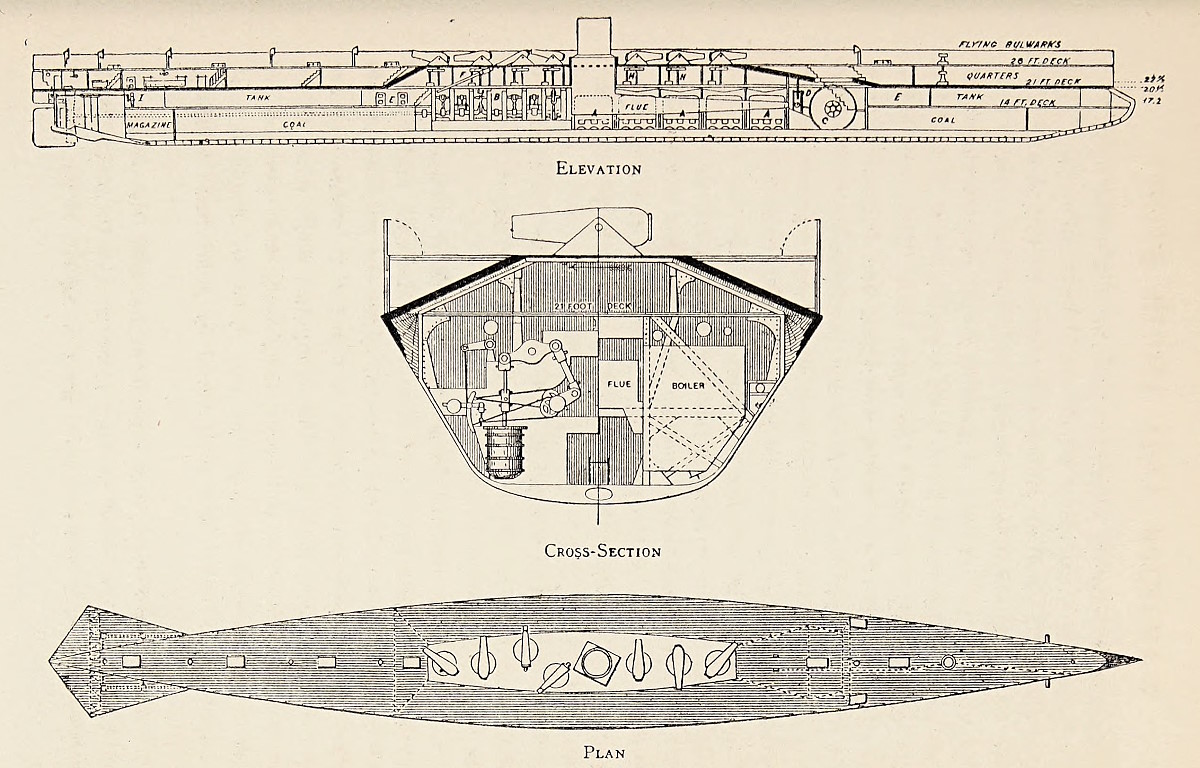
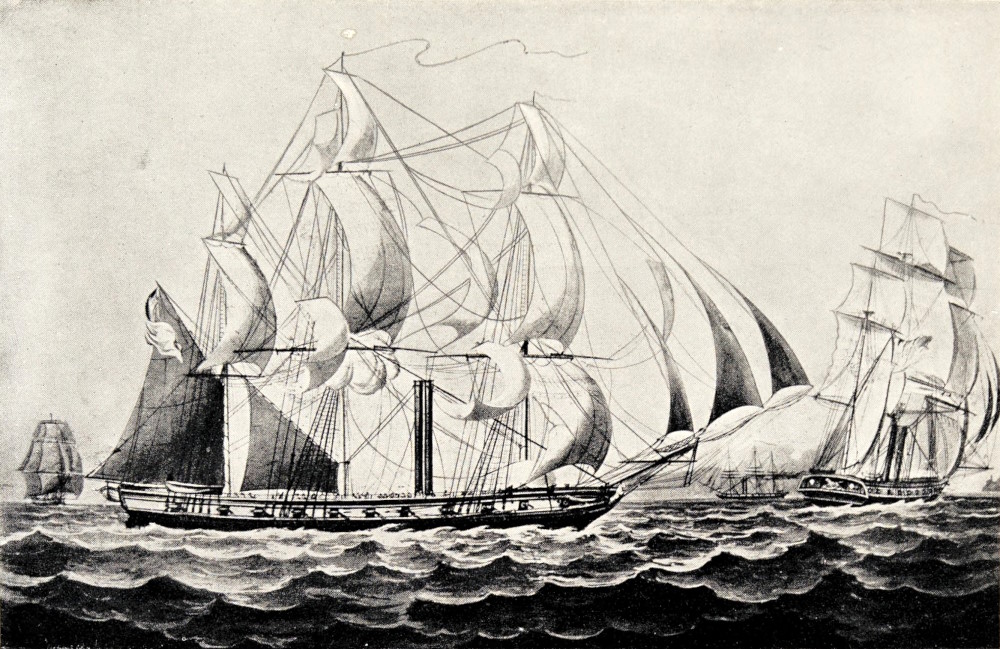
Rising Star, probably the first steam war vessel to be built
in this country, which his ancestor, the famous Admiral
Cochrane, commanded in the service of Chili.
On other pages will be found a list of the illustrations and
the sources whence they have been derived or the names of
the gentlemen who have been kind enough to supply them.
R. A. Fletcher.
INTRODUCTION
When or where the first warship was built is unknown, so also
is the campaign in which it was employed. A war with naval
usages of any sort cannot have been fought until the aggressor
had some means of transporting the spoil across the water.
From the raft to the fire-hollowed canoe was but a step, and
having accomplished so much, the ingenuity of the naval
architects of the period found scope in making improvements,
gropingly, slowly, but none the less surely. The development
of ships used for warlike purposes, as well as of ships designed
as implements for fighting, forms a most attractive branch
of study in its relation to the evolution of empires, no less
than that of civilisation. Nor is the interest any the less if
the attention be confined simply to the consideration of the
development of the ships as ships of war.
In this book I am endeavouring to describe, clearly and
briefly, the main features of the progress in warship building
among the different peoples of the world, from the earliest
recorded times onward. The greater attention is paid to
modern warships, and the story of their development is narrated
with an avoidance of abstruse technicalities, so that any reader
of average intelligence and education may be able to obtain
a clear understanding of the steps by which that wonderful
creation, the modern navy, and especially the British Navy,
has come into being.
Whether my readers belong to the bluest of the “blue
water” school; whether they advocate two British keels to
one possessed by any possible combination of foreign powers
as the irreducible minimum below which the British fleet shall
not go; whether they take a more moderate view, founded,
as they believe, on the power of the nation to pay for its fleet,
and the ability of other nations to pay for their fleets, in which
case the ability of some other nations to borrow money to
have their best vessels built in British yards must not be lost
sight of; or whether my readers belong to the other extreme
and believe that any and every British fleet is too powerful
and that the time is coming when the Imperial cheek shall
be turned to the envious smiter: whatever be their political
and social faiths, the fact remains that the fleet in being is
the sole guarantee of this nation’s safety, and that the payments
for the several warships and the personnel of the Navy are
but so many premiums for insuring the defence of the country
and the maintenance of the inviolate integrity of these islands.
Whether the money has always been spent to the best advantage
is a point upon which experts differ, and is outside my intention
to consider. But I hope to show something of the types of
vessels provided, and, incidentally, to indicate how engineering
skill and profound science have been devoted to the evolution
of the modern ship of war.
******
The earliest known employment of a warship dates back,
according to the present computations of Egyptologists, some
six thousand years B.C.; but discoveries yet to be made may
cause that estimate to be revised, for the more the scientific
investigation of ancient Egypt is pursued, the greater is the
tendency to date events more remotely still. All that is known
of this ship is that it existed, and that it saw service as escort
to a trading expedition on the Nile.
The first naval engagement of which we have any definite
knowledge was fought near the mouth of the Nile about 1000 B.C.
The ships held only a few men each and were propelled by
rowers, and so little dependence was placed on their sails that
the latter were furled to be out of the way during the actual
fighting.
For hundreds of years oars were the chief means of propulsion,
the sails only being availed of when the wind was
very favourable. To increase the speed of the vessels, bank
after bank of oars was added until ships carrying as many
as eighteen banks are averred to have been constructed—though
the evidence of the correctness of the statement is a
long way from being conclusive—and one historian even goes
to the length of asserting that a ship having forty banks of
oars was built, but this may be disbelieved. For the most
part, ships having two, three, or four banks were preferred
for war purposes, because of their handiness.
Greater ships were afterwards built and improvements
made in the shape and size of the sails and spars used, and
the number of masts was increased.
******
Meanwhile in the Far North a seafaring nation was proving
its worth. The wild men of the wilder North, the Danes, the
Scandinavian Vikings—turbulent, adventurous and fierce, to
whom fear was a word unknown—animated by the virile yet
mystic mythology of the North, and inspired by the love of
conquest and travel, now began to play their part in the world’s
naval history. The Vikings produced the “long ship,” the
“serpent,” daring in conception, marvellous in construction,
possessing wonderful qualities as a sea-boat, fast under sail
or oar, and of a beauty of outline and shape hardly to be
excelled even now. Such were the vessels in which the Danes
invaded England, and by building vessels as good as those
of the Danes, and some rather better, King Alfred repulsed
the invaders and implanted in the English that “habit of
the sea” they have never lost. But the lesson of the Norsemen
was destined to lie dormant for many a long year. Although
the Romans had introduced the “long ship” for war purposes—so-called
because it was longer in proportion to its beam
than the merchant ships—the Mediterranean shipbuilders
preferred as a whole to retain the heavy hull, and the form
they believed best suited to their needs upon the tideless sea.
Slave power was cheap, and was to be had for the trouble of
capturing, and for many centuries oar-driven galleys were
preferred over any vessel dependent upon sails only, and were
to be found in the Mediterranean as late as the beginning of
the nineteenth century.
As ships of greater size were provided in the Middle Ages,
huge erections in the shape of castles were added at the bow
and stern: great, unwieldy craft which contemporary historians
likened to floating islands. The Venetian and Genoese republics
elevated the art of constructing oared galleasses to its highest,
and ere long Spain took the lead in producing warships with
dimensions and power of armament which made her the chief
maritime power of the world.
******
In England, owing to alternate periods of stimulation and
neglect by the authorities, the progress of shipbuilding was
spasmodic. The roughness of the waters round our coasts,
and along the Atlantic coasts of France, the Low Countries
and North Western Europe, caused greater dependence to be
placed in small vessels having good sea-going qualities and
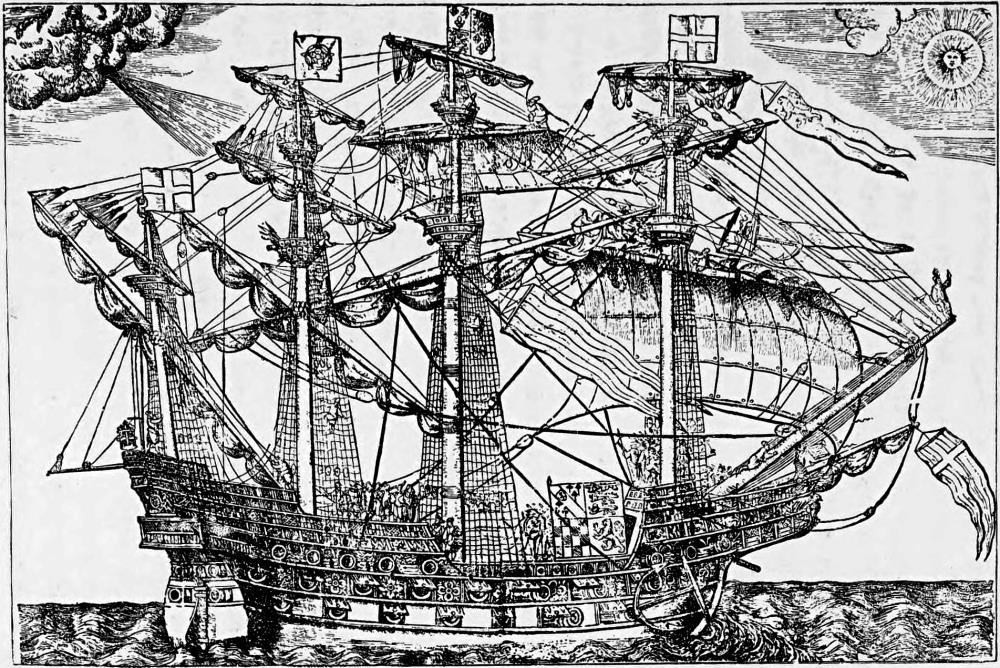
using sail whenever possible. The Great Harry was begun in
the reign of Henry VII. and finished in the reign of his uxorious
successor, and is interesting as indicating that shipbuilders
in England were even then able to turn out a sea-going vessel
superior to anything afloat. Henry VIII. established royal
shipbuilding yards at Woolwich and Deptford, and thus
founded the modern navy, but few warships for the King’s
service were built there in his time, and during his reign and
for many a long year after it was the custom to hire merchant
vessels and arm them—if they were not already armed to
protect themselves against pirates—to augment the national
fleet. Religious, no less than national, rivalry contributed,
albeit unconsciously, to the development of the efficacy of the
warship as a fighting unit. The enmity between Britain and
Spain culminated, in Elizabeth’s reign, after a series of daring
attacks by reckless Englishmen upon the Spanish fleet in
preparation for the great attack upon England, in the dispatch
of the Armada. Hawkins and one or two others foresaw that
the advantage would lie with the fleet which could be most
effectively manœuvred. The disparity between the Armada
and the British fleet was not so great as many writers have
represented, either in the size or number of the vessels; but
the British vessels on the average were smaller, faster, and
better handled; in other words, efficiency told against sheer
weight of numbers. This was the last great sea-fight on the
ocean in which oared ships took part; they were no match
for their smaller and more speedy sailing antagonists.
Structurally, most of the vessels of this time, the larger
especially, were disfigured by high sterncastles, but early in
the seventeenth century this encumbrance and many others
had disappeared. Thence to the nineteenth century the
development of warships was marked mainly by continual
increases in their size, improving their form of hull and, consequently,
their speed and buoyancy; augmenting their sail
area and perfecting the square-rigged system; and adding to
the number of gun decks and the number of guns carried;
until the grand wooden three-deckers swept the seas in all
their ponderous pride and majesty. Ships of the line of various
ratings played their part, and were ably seconded by frigates,
brigs, cutters, sloops and bomb-ketches. All these were in
vogue less than a century ago, and though not forgotten, are
looked upon as historical and romantic and interesting
curiosities.
******
In the weapons, no less than in the ships, the changes have
been marvellous. For many centuries after ships were adopted
for war, the fighting was done by soldiers carried aboard them.
The human machines, the rowers, had to attend exclusively
to their oars, for on them the safety or success of the fighting
men depended. The main idea was to get to close quarters
and fight hand to hand with javelin or sword, spear or battleaxe;
bows and arrows were used when possible, and missiles hurled
by hand were not despised. The ram, in various forms, affixed
to the bows in such a manner as to strike the enemy’s ship
below or above the water-line, or both, was used with fearful
effect in many a stubbornly fought engagement.
The introduction of artillery in the fourteenth century
marked the beginning of the first great revolution in naval
warfare, and the changes in the projectiles have been no less
extraordinary than those in the guns.
******
The next great revolution was the introduction of the
steam-engine. Its adoption in the British Navy in 1832
marked the beginning of the end of the sailing warship. Her
last grim battle against inexorable fate was fought with the
same doggedness which had distinguished her in many an
encounter with her nation’s enemies; but the superiority of
steam over sail was recognised. Temporising measures, a
patched-up peace, as it were, lasted for a few years while the
steam engine was employed as an auxiliary. Sail power,
however, had reached its apotheosis so far as warships were
concerned. Engineers, animated by practical common sense
and ignoring romantic associations, improved their engines,
so that the steam power was no longer the assistant of sail,
but its associate, and was quick in attaining the position of
chief partner and showing that sails could be dispensed with
altogether. The Crimean War sounded the knell of the wooden
battleship as well as of the paddle-wheel war steamer. The
former gave place to the iron-clad vessel, and the latter was
supplanted by the screw-propelled ship. The power of artillery
had shared in the application of scientific knowledge and
benefited accordingly. The great battle between the maker
of armour plates and the maker of guns and projectiles had
begun. Iron, the conqueror of wood, had but a short reign.
Where iron was used a few years ago, steel is now invariably
employed. The thoroughness of the victory is shown by the
fact that in the whole of the British Isles not one iron vessel,
large or small, was built in 1909 for war or commerce.
******
The years 1905 and 1906 saw two of the most important
steps forward in the history of warships, for they included the
adoption of the turbine principle of warship propulsion and
the “Dreadnought” principle of armament. The progress of
the last fifty years, culminating in the Dreadnoughts, has been
wonderful; already designs of vessels intended to relegate
them to second place are under consideration.
Type after type of battleship, cruiser, scout, gunboat,
destroyer and torpedo-boat has followed in rapid succession
of late years, and submarines have become an accomplished
fact. He would be a foolish man who would prophesy that
the end is in sight.
There is nothing more marvellous in the world’s history
than the tremendous development in marine engineering, in
warship construction, in explosives, in armament, and in
projectiles that has taken place in the latter half of the nineteenth
century, and especially in the last twenty-five years.
CHAPTER I
FROM ANCIENT EGYPT TO THE INTRODUCTION OF ARTILLERY
When did man first entrust himself afloat for purposes of
war? and what was the type of vessel he employed? are
questions which take us back almost to the earliest stages of
historical human progress, concerning which all the knowledge
of the antiquaries is but conjectural, a stage so remote that
scientists have not yet determined how many thousands of
years ago it existed. The earliest vessels thus employed must
have been transports, and nothing else; but if employed as
aids to aggression when the kings of the earth took counsel
together and, impelled by avarice or a desire to assist in one
another’s turbulent love affairs, or, for their own safety, convinced
of the necessity of finding an outlet for the energies
of their restless subjects, invaded the territories of their neighbours,
the ships, whatever their nature, will have been of a
size sufficient to receive any spoil or any prisoners worth the
trouble of carrying back again.
So far, however, as research has disclosed in those parts
of the Near East where civilisation was cradled, there is no
indication that man fought afloat—boat against boat, or fleet
against fleet—until after a comparatively high stage of civilisation
had been attained and shipbuilding had made enormous
advances.
Evelyn remarks: “Concerning men of war, fleets, and
armadas for battel, that Minos was reported to be the author,
which shows that manner of desperate combat on the waters
to be neer as antient as men themselves, since the deluge.”
Minos, he adds, disputed the empire of the seas with Neptune,
but “these particulars may be uncertain.”[1]
Among the legendary expeditions, those of Ulysses and
Jason are the best known. Possibly they took place, but
the adventurers never did or saw half the wonders narrated
of them. Herodotus, describing the type of ship attributed
to Ulysses by Homer, states that such ships were made of
acacia, of “planks about two cubits in length,” joined together
like bricks, and built in the following manner: “They fasten
the planks round stout and long ties: when they have thus built
the hulls they lay benches across them. They make no use
of ribs, but caulk the seams inside with byblus. They make
only one rudder, and that is driven through the keel. They
use a mast of acacia and sails of byblus. These vessels
are unable to sail up the stream, but are towed from
the shore.”[2] Book II. of the Iliad mentions, in the famous
catalogue, hollow ships, well-benched ships, swift ships, and
dark ships, and that Ulysses had twelve red ships, but
Homer, being a poet and a landsman, did not describe their
differences.
Recent excavations and discoveries in Egypt have revealed
the existence of boats of considerable size, so remote in history
that their period is only guessed at, though they are estimated
to date from about 5000 to 6000 years B.C. If the interpretation
of the designs on the pottery recording these old
ships be correct, they were propelled by over a hundred oars
or paddles, were steered by three paddles at the stern, and
had two cabins amidships. They were, moreover, very high
out of the water at the ends, having very long, overhanging
bows and counters, and were shallow and flat-bottomed.
Even at this period the art of shipbuilding was in a comparatively
advanced stage; vessels such as those depicted
would be quite as capable of use in war for carrying warriors
or stores, or both, as in commerce for conveying merchandise.
Egypt has many historical secrets yet to reveal, and, judging
by the constant reassignment of dates in all matters connected
with Ancient Egypt which exploration has entailed, it is not
too much to expect that the dates quoted, assigned approximately
by Egyptologists, may be revised and events placed
more remotely still.
Another hieroglyph, discovered in a tomb, ascribed to the
year 4800 B.C., shows enormous progress in shipbuilding and
also in the art of representing a ship pictorially.
During the Sixth Dynasty, a certain Un’e, who was a person
of note under three kings, sent, while the second, Pepi I., was
on the throne, an expedition to the quarries of Syene or
Assouan, to fetch stone for his master’s pyramid.
Another expedition, on behalf of Pepi’s successor, merits
attention, as the fact is emphasised on the inscription on the
tomb as most remarkable, and as never having occurred before
“under any king whatever,” that Un’e had to employ twelve
ships for freight and but one warship.[3] The flotilla consisted
of “six broad vessels, three tow boats, three rafts, and one
ship manned with warriors.”[4]
The Egyptians evidently had experience of some sort of
fighting afloat, for there has been discovered at Gebel Abu
Faida a tomb with a painting showing a boat with a triangular
mast, and a stem extending forward below the surface of the
water and presumably intended to be used to damage an
enemy’s boat by ramming it.[5]
The first sea-fight of which a pictorial representation is
known to exist was fought off Migdol, at the mouth of the
Nile, in the time of Rameses III., first king of the Twentieth
Dynasty, which began about 1180 B.C., and lasted to about
1050 B.C. Egypt was invaded from the East by “warships
and foot soldiers,” and the Egyptian monarch mustered a
fleet and attacked them.
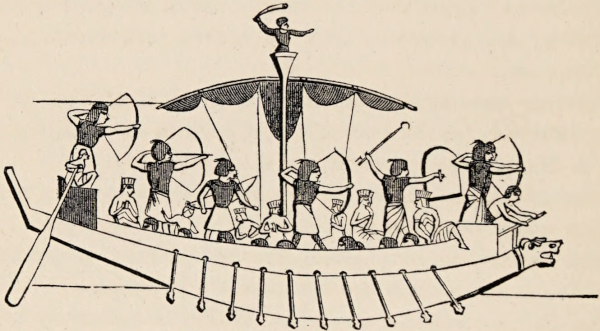
ANCIENT EGYPTIAN WARSHIP.
“The ships on both sides,” says the historian[6]—“we can
recognise the Egyptian by the lion heads in the bows—have
reefed their sails in order not to interfere with the men who
are fighting; the bracket at the mast head has been removed
to make room for the slinger. The Egyptians understood
how to pull round the ships of the enemy with their grappling
irons, so as to bring them to close quarters; in fighting also
they have the better of their opponents, for they all carry bows,
whilst the barbarians with their short swords can only fight
in a hand-to-hand medley. This battle is almost the only
naval engagement in Egyptian history, for though in the wars
with the Hyksos we certainly hear of fighting on the water,
yet in the latter case the Nile was the scene of action....
The ships had their individual names, such as Battle Animal,
or Glorious in Memphis. The Ship of Pharaoh was also called
Beloved of Amon.”
A remarkable difference between the ships of the Egyptians
and those of the Asiatics is that the latter had no rowers, if
the bas-relief is accurate. Possibly the Asiatics, Phoenicians
probably, had discovered how to manage the sails of their
warships and dispense with rowers.
The example set by the Asiatic fleet does not seem to have
been followed, for as the need of greater ships became manifest
the problem of their propulsion was met by placing one bank
or tier of oarsmen above another. Then, as now, the propelling
power was vital to the efficiency of the ship, and means
had to be devised for the preservation, or at least protection,
of the oarsmen. The single-banked ships had planks placed
round the gunwales, forming a parodus, or gangway, which
served also to guard the rowers from missiles. Later, the
upper tier was in an open superstructure, and still later, planks
were carried which could be adjusted for the protection of
the oarsmen when necessary.
The ram, employed by the Egyptians—who seem to have
retained for their sea-going craft the long, overhanging stem
and stern so suitable to their river vessels—was a metal head,
which added a finishing touch to the projecting bows, and was
high above the sea level. At the time of the battle of Migdol,
and possibly also of the sea-fights in the reign of the preceding
Rameses, who is known to have conducted a naval war, though
of this campaign no illustrations have yet been discovered,
the captain of the warship was placed in a sort of crow’s nest
on top of the double or ⋀-shaped mast.
Then comes a long gap in the history of Egyptian shipping.
The Phœnicians became the leading maritime people of the
world, but the little that is known of them is derived, not
from discoveries in their own cities of Tyre and Sidon, but
from the records preserved at Nineveh. Sennacherib’s conquest
of Phœnicia was commemorated by mural tablets, on which
are the only known records of Phœnician war galleys. The
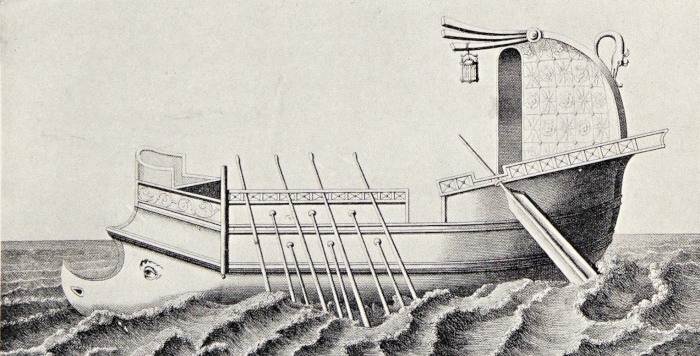
Phœnicians are stated to have invented biremes, or vessels
carrying two banks of oars on each side. Perhaps for lightness,
and in order to reduce the top weight as much as possible,
these galleys had the upper bank of oarsmen unprotected.
The prow, differing from that of the earlier Egyptian ships,
curved forward at a point slightly above the water line, and
continued to do so under the water, thus forming a formidable
snout or ram which could inflict considerable damage to the
most vulnerable parts. The beaks were generally carved
to represent the head of some animal. The vessels also had
a parodus placed outside the vessel and extending the whole
length of the sides above the oars. The contrivance was
probably copied from the Egyptians, who introduced it to
enable the warriors to fight at close quarters when drawing
alongside an enemy, or to run to either end of the ship as
occasion might require without impeding, or being impeded
by, the rowers.
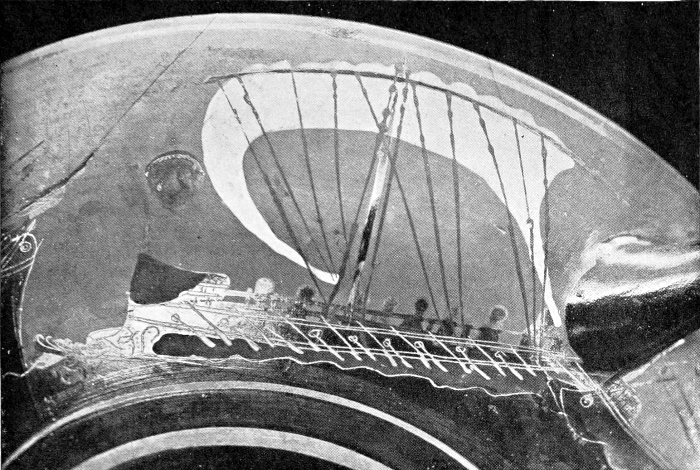
GREEK BIREME.
From a Vase in the British Museum, found at Vulci.
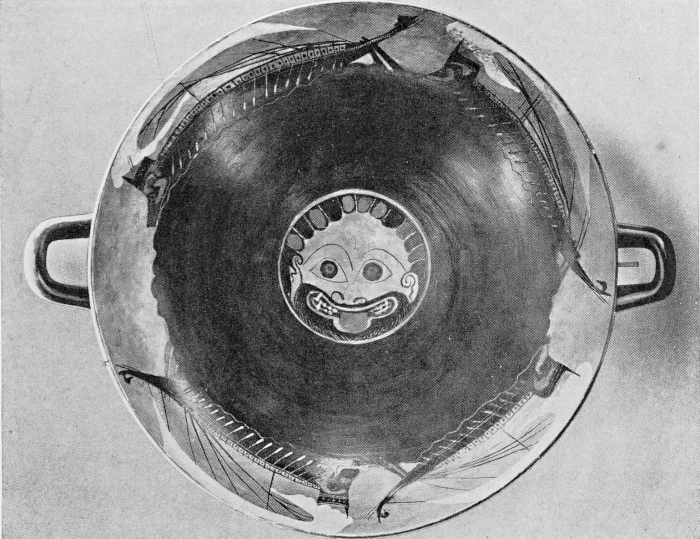
GREEK WAR GALLEYS.
From a Vase in the British Museum found at Vulci.
Cancelli, or shields of basket work, were placed along the
sides of the ships at such a height that the heads of those on
board are just visible. The cancelli bore a striking resemblance
to the circular basket-work boats still to be found on the upper
Euphrates; this supports the supposition that the cancelli
may have been used for other purposes, particularly if they
were made comparatively watertight, as the function of a
shield was not only to protect a warrior in battle, but to help
to keep him dry when on shipboard by being disposed along
the sides to prevent the spray from entering the ships. A
forecastle was constructed upon these ships, and upon each
forecastle a look-out man was stationed; and when these
structures came to be built of larger dimensions they served
to accommodate a number of fighting men who, from their
superior position, could throw their missiles with greater effect.
The forecastle had the further advantage of serving as a
stronghold in the event of an attempt being made to capture
the ship by boarding it.
Following the Phœnicians, the Greeks are thought to have
begun to build their own warships about 700 B.C., perhaps
earlier, but it was about that time that the first three-banked
warship was launched at Corinth. The three-banked ships
were for many years the largest in existence. During the
fourth century B.C. shipbuilding was practised extensively,
four-banked ships being built at Chalcedon, five-banked at
Salamis, and six-banked ships at Syracuse. Ships of ten banks,
according to Pliny, were ordered by Alexander the Great,
and about 300 B.C. ships having twelve banks are said to have
been built for Ptolemy, and fifteen-banked ships for Demetrios,
for a battle near Cyprus.
Ptolemy Philopater, who ruled in Egypt from 222 to
204 B.C., is alleged to have had a forty-banked ship of a length
of 280 cubits or, reckoning the cubit at 18 inches, of 420 feet,
and a beam of 57 feet.
While increasing the size and number of oars, it would,
nevertheless, be impossible to augment to any appreciable
extent the speed at which these ships could be rowed, and the
more unwieldy would they become, and the more difficult
would it be to keep steering way upon them. Again, the
assertions of the historians are so contradictory that it is a
thankless task to attempt to reconcile all their stories, especially
as they depended much upon hearsay for their information.
For that reason, therefore, a great deal that has been recorded
as to the early ships and their numerous banks of oars is not
to be accepted without careful inquiry and verification.
It has never been established beyond question what is
meant by banks of oars, or whether the Greek text has been
interpreted correctly when it is taken to express forty superimposed
banks of oars. From constructional reasons it may be
assumed that a ship having forty superimposed banks of oars
never existed, and it is very doubtful whether ships having
more than a fourth of that number of banks passed beyond
the imaginations of their inventors. In any case they were
soon dispensed with, and in course of time it was found that
the best results were obtained with galleys having two or
three banks of oars.
It is not definitely known how the rowers were disposed in
the ships of anything over seven or eight banks. If any
vessels had forty banks of oars, the upper rows must have
been of an absolutely unwieldy length. Assuming the oars
to have been weighted with lead so that the inborne and
outborne portions were equally balanced, they must nevertheless
have been exceedingly difficult to row even by a
number of men, and it was impossible for any rowers to have
moved these great oars at the same speed as the men at the
lower banks moved their lighter and shorter ones. That
some such difficulty was experienced, even in biremes and
triremes, is shown by the arrangement of the oars, whereby
all in a bank were not of equal length, but were graded so
that those nearer the ends of the banks were longer in order
that all the blades might enter the water in a straight line.
Each row above must have had its own line in the water a
little farther away from the side of the ship than the row
beneath it, or the blades would have interfered with each
other and the rowers thrown into hopeless confusion. The
tremendous amount of lead that would have to be carried
to counterbalance the outborne portions of several hundred
oars would add materially to the dead weight to be propelled,
and, much of it being placed high above the water, the stability
of the vessel would be lessened.
The Athenians used leather or skin aprons or covers over
the oar holes to prevent the water entering, the oar passing
through a hole in the leather, and the apron was bound to the
oar in such a way as to be watertight. This contrivance was
widely adopted later. The oar ports were constructed between
the ribs, but the oars instead of being rowed against the ribs
were pulled against thongs fastened to the next rib, thus
minimising the strain upon the ship’s structure and preventing
the oars being lost overboard. One man one oar was
apparently the general rule at that time.
In his most painstaking study of “Ancient Ships” Mr.
Cecil Torr has gone very closely into the subject of the oar
equipment of the galleys. An Athenian three-banked ship
would carry two hundred oars, of which thirty were worked
from the upper decking, sixty-two on the upper bank, and fifty-four
to each of the lower. The earliest two-banked ships had
eighteen rowers. An Athenian four-banked ship might carry
two hundred and sixty-six oars. The Roman and Carthaginian
five-banked ships in use about 256 B.C. had three hundred
rowers besides the combatants. The statement is made by
an early historian that in 280 B.C. the Heraclean fleet on the
Black Sea included an eight-banked ship with a hundred rowers
on each file, or one thousand six hundred rowers in all. As
usually the fighting men carried exceeded the rowers in number,
the ship must have had close upon three thousand five hundred
men aboard.
Warships of all the early Eastern nations were strengthened
by cables passed longitudinally round them in order to keep
the timbers in place and prevent them from being started
under the strain occasioned by the shock of ramming.
Egyptian ships of about 1200 B.C. had cables stretched from
stem to stern and passing over the top of the mast and other
posts, but this contrivance was to prevent the vessel from
drooping at the ends, a weakness known as “hogging.” The
shock to the ramming vessel was scarcely less severe than
that to the vessel receiving the blow. To take up the strain
and add to the power of the blow the bows were strengthened
by means of waling pieces which supported the ram proper.
The Greek ships were built with the keel, the stempost, and
the lower pair of waling pieces converging to hold the ram,
while higher up the stem was a smaller ram which in its turn
was buttressed by another pair of waling planks. The catheads,
or beams projecting from the bows on either side by which
the anchors were raised, were so placed on a level with the
gangway and gunwale that they would sweep the upper works
of an enemy’s ship and smash its gangway and hurl into the
sea or the hold all the fighting men upon it. Ships of more
than three banks are believed to have carried another ram
level with the catheads, and to have had a ram for every pair
of additional waling beams. The ram heads were generally
of bronze and weighed 170 lb. or more.
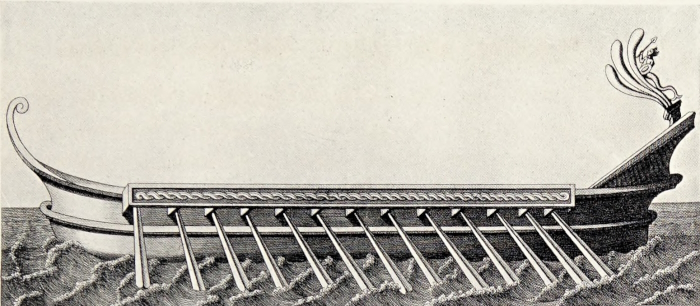
“AN ANCIENT BIREME, FROM BASIUS, HAVING ONE TIER OF OARS ONLY.”
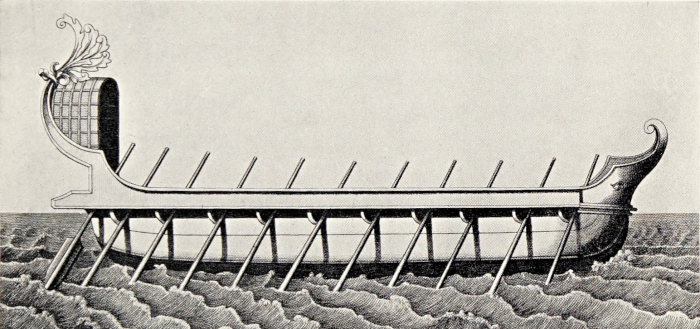
“ONE OF THE ANCIENT LIBURNI, OR GALLEYS, HAVING A SINGLE TIER
OF OARS, ACCORDING TO BASIUS.”
AN ANCIENT TRIREME, ACCORDING TO BASIUS.
From Charnock’s “History of the Marine Architecture of all Nations.”
The later rams varied considerably in shape. The triple
ram was sometimes made with the teeth pointing slightly
downward, while others had an upward tilt. The lowest ram
often extended farther forward than those above, the idea
being that it would inflict severe injury about or below the
water line, and that the upper rams, besides causing damage,
would push the stricken vessel off the lower ram and let her
sink without the assailant being dragged down by the head
with her.
The build of the ships rendered it necessary that an engagement
should be fought on a calm sea, and daylight was
preferred in order that the combatants could see what they
were doing. As the fleets approached one another the commanders
of the different vessels decided upon their individual
opponents. Much skilful manœuvring ensued to ram the
enemy or avoid a blow. The slaves strained at the oars while
their taskmasters ran between the files of rowers and, with
unmerciful blows from heavy sticks and whips, stimulated
them to still greater exertions if possible.
Poor slaves, mostly prisoners of war, their prospects were
gloomy in the extreme! If their ship were rammed some of
them were sure to be injured, and if she sank they went down
with her, fastened to their places and having no chance of
escape. If the oars were disabled in the collision between
the ships the rowers were bound to receive violent blows from
the inboard end of the oars, or to be cruelly pierced by
splinters of wreckage. Showers of missiles from the opposing
ship fell upon the helpless wretches. In later years, when the
terrible Greek fire was added to the means of attack and
defence, it contributed the prospect of being burnt alive to
the other horrors of their situation. Victory meant no
rejoicings for them. The wounded were of little account
and could be dispensed with when slaves were to be had for
the capturing, and it was easy to put them overboard to die
the more quickly. Those who survived the battle unhurt
or not too severely injured to recover rapidly, were retained.
If their ship were vanquished they might look forward to
greater cruelties as a punishment for their share of the
defeat. If they belonged to the victors, they had only more
battles, the torturing whips of their drivers, and insufficient
food as their portion in life. Death came as a welcome relief
to the slaves of victor and vanquished; in it lay their only
hope of peace.
When the Roman navy was at its best the ships were
painted a colour which matched the waves, and the hulls were
made as watertight as possible with tar. Occasionally in the
later Roman ships layers of tarred cloth were placed outside
the outer planking, and the hull was then lead-sheathed.
Bronze nails and wooden pegs were used in fastening the
timbers together, and some ships were so built that they could
be taken to pieces and transported overland if necessary.
Ships of three, four and five banks were even conveyed from
the Mediterranean to the Euphrates.
The facility with which the Liburnians handled the two-banked
ships in their Adriatic campaign induced the Romans
to adopt these vessels as models for their own two-banked
ships, and in course of time they adopted the name of liburna
for all war-vessels of from one to five banks.
If some of the historians may be believed, anything that
could be piled upon the ancient ship and did not capsize it
was permissible. One is said to have had a tower at the stern
and another at the prow. Another bore “a large tower of
masonry with a great gate. Here appear some vases, probably
filled with combustibles.” Another libernus has a mast or
yard, suspended perpendicularly by the side of the forward
tower, and having at each end a crossbeam. Yet another
libernus, besides carrying a protector for the helm at the stern,
is said to have had six round towers; the largest, of embattled
masonry, was at the prow, two others, also of masonry, surmounted
by domes, and connected by a bridge, were near the
stern, and the other three were nearer the fore part of the
ship, were roofed, and two of them had windows.
Shipping in the Mediterranean extended with extraordinary
rapidity in the recovery after the stagnation caused by the
fall of the Roman Empire and the relapse into semi-barbarism
which followed the successful invasion of Italy by the wild
tribesmen of the North. The advent and rise of the Moslem
power caused a series of struggles in which every state was
in a more or less constant condition of warfare against its
neighbour, and the Crusades served but to add fuel to the
fire of internecine and religious conflict. Some immense ships
are stated to have been employed up to and at the fall of
Constantinople. The early centuries of the Christian era
saw the evolution of a flat, shallow vessel, fitted with one or
two masts carrying sails, from which the lateen rig developed,
equipped with a long ram above the water line, with two or
at most three banks of oars. It appears from illustrations
that some of these boats carried a superstructure extending
beyond the beam on either side. War vessels of this type
became common throughout the length and breadth of the
Mediterranean, and remained in use long after the introduction
of firearms.
Before the discovery of Greek fire, flaring missiles of some
kind had been devised. Frontinus mentions fire-ships, or
hulls carrying combustibles and allowed to drift with wind
and tide upon the enemy’s ships: stinkpots, to nauseate the
enemy, though how the others escaped the smells except by
keeping to windward does not appear; and Evelyn adds,
“Nay, snake pots, and false colours.” The Greek fire, however,
was the most terrible of the weapons employed at that
time. By some means by which a fair amount of power was
exerted, the liquid was squirted—or vomited, to use one
historian’s phrase—through copper pipes upon an enemy’s
ship, and as the liquid had the peculiar property of igniting
upon exposure to the air and was inextinguishable by water,
it was a most formidable engine of destruction. Small vases
filled with the liquid and sealed airtight were used as hand
grenades and flung at opposing ships and, breaking, set them
on fire. Heavy arrows carrying balls of flax soaked in the
liquid were used both in land and sea warfare, as also were
hand-flung javelins similarly equipped, and the flights of these
masses of inextinguishable flames must have been equally
demoralising to the combatants against whom they were
directed and destructive to the ships and inflammable buildings
upon which they fell. This composition is thought to have
been invented in the seventh century; the first occasion on
which it was employed on an extensive scale was in the great
battle between the fleets of Constantine and the Saracens, when
the latter, through its agency, lost practically their whole
fleet and thirty thousand men killed. After that both sides
used Greek fire whenever possible.
Up to the introduction of gunpowder and artillery the
methods of fighting varied but little. The sea-fights of the
Crusades were conducted on the lines which had been
recognised as the best for a couple of thousand years or
more, viz., ram the enemy and board him. Greek fire added
this rule: Burn him also if you can.
The countries along the northern and southern shores of
the Mediterranean had attained a high degree of civilisation
when the inhabitants of Western Europe and the British
Islands were still more or less savage. What may be regarded
as circumstantial evidence in support of the contention that
the Phœnicians voyaged to Cornwall and Ireland is the
similarity which exists in shape between the wicker shields,
such as the Phœnicians are known to have used, and the wicker
coracles which the Britons employed at the time of the invasion
by Julius Cæsar. There must have been considerable intercourse
between the Phœnicians and the dwellers in the valley
of the Euphrates before the latter conquered the former; but
whether the dwellers in Nineveh, or those by the sea, invented
wicker boats, or whether both derived their knowledge of
wicker boats from other sources, are points of no immediate
importance. But what is of interest is that the British wicker
coracles were covered with hides to make them watertight,
that they had keels and gunwales, and that they were small
enough to be used as shields if necessary, their dimensions
being rather over 4 feet in length, with a breadth of about
3 feet, and a depth of a trifle over 12 inches. They were big
enough to carry one man of average size. There are on the
Euphrates to this day boats or rafts of proportionate dimensions,
up to a maximum length of 40 or 50 feet over all, which
are constructed with a light framework of wicker and timber,
over which skins are stretched to keep them watertight. These
boats, when laden, drift down the river with the current, and,
on reaching their destination, their cargo and skins are sold
and the framework is made up into a package and returned
upon the back of an ass to the port of departure. These
cargo boats have been humorously referred to at a meeting
of the Institute of Marine Engineers as of “one ass-power.”
So far as Britain is concerned, the shipping of each coast
seems to have developed under the influence of the foreign
shipping with which it mostly came in contact. The east
coast was largely concerned with the Danes, and the south
coast with its neighbours across the Channel. The Danes
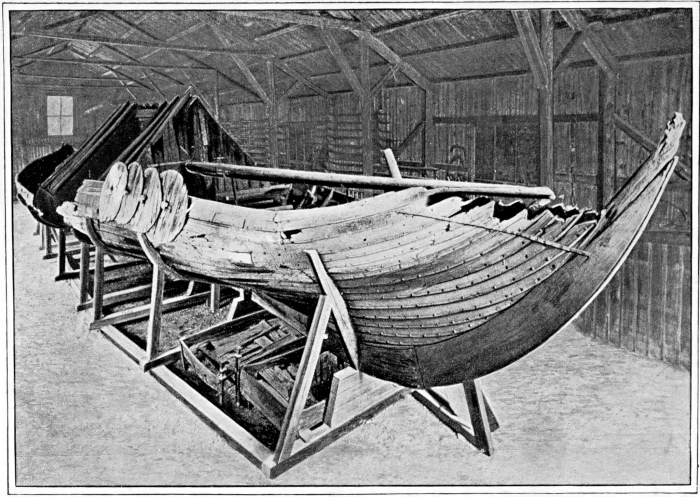
and Vikings developed a type of vessel peculiarly their own.
The best specimen yet brought to light is that known as the
Gokstad ship.
AN ANGLO-SAXON SHIP OF ABOUT THE
NINTH CENTURY.
(From Strutt.)
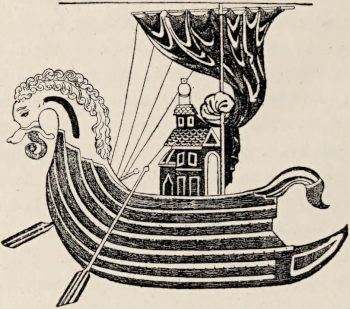
The Viking ships must have walked the waters almost
with the grace of motion of a modern yacht, and when the
great square sail was hoisted, bearing the escutcheon of some
dread sea-rover, they must have been fascinating emblems
of human skill and power no less than of the noblest and the
basest passions of mankind.
The large rowing and sailing galleys of the Mediterranean
were fine-weather ships, it being the custom to suspend merchant
voyages, naval expeditions, and piracy in that sea during
the winter months. Obviously, such vessels were wholly
unsuited to the Atlantic coasts of Western Europe. The
western coasts of Spain, France and Portugal produced a
ship, short and broad, and strong enough to be beached even
when a moderate sea was running. This model was seemingly
copied by the English of the south coast, and vessels of this
type, built in the eighth century, were planked and carried
high, erect stemposts and sternposts. The vessels were
single-masted and fitted with a yard and square sail, and the
steering was effected by a large oar at the stern. They were
not unlike the Viking ships in some respects, but they were
of less average length and broader in proportion, having
bluffer bows, a less fine entry, and a long flat floor extending
farther aft than did that of the northern ships. Some also
had a ram.
VIKING SHIP FOUND AT GOKSTAD, SOUTH NORWAY.
Photograph: O. Vaering, Christiania.
What may be regarded as the first great national step in
British shipbuilding was inaugurated in the latter part of the
ninth century, when King Alfred saw that in order to beat
the Danes he must meet them with ships superior in size and
strength to their own. His war galleys were virtually double
the size of those of the invaders, and in some instances almost
double their length. The Gokstad ship, by no means one
of the largest of its type, had sixteen oars a side. If Alfred’s
boats had thirty oars or more a side, as is stated, and were
double-banked—that is, two men to each oar—like those of
his foes, the fighting strength of the individual ships of his
navy must have been very great.
By the eleventh century the Norsemen had taken to painting
their vessels externally, besides making them larger and giving
them decks. The stempost and sternpost were more ornately
decorated, gilded copper being the material used for this
purpose. Svend Forkbeard’s own ship, the Great Dragon, is
said to have been in the form of this legendary beast, but what
the historian most likely meant is that the stern decoration or
the design on the sail may have shown a fantastic representation
of the fearsome animal; the Vikings were too good
seamen to have built the ship in any form likely to be inferior
to the shape they had learned to appreciate so highly. The
Long Serpent, which appeared in that century, is said to have
been 117 feet in length, and decked, and to have carried six
hundred men. This is the first war vessel in the Western seas
known to have been decked throughout,[7] and in which cabin
accommodation was provided for the principal fighting men.
Beneath the deck the hull was divided into five cabins or
compartments; the foremost was the lokit, in which, in a royal
vessel, the king’s standard bearers were quartered; next, the
sax or storeroom; then the kraproom, where sails and tackle
were kept; the foreroom, containing the arms chest, and
forming the living room of the warriors; and astern of all
was the lofting, or great cabin, devoted to the commander.
For the comfort of the rank and file of the fighting men at night
in port an awning was spread, supported by a ridge pole on
pillars. At other times they would seem to have had to put
up with sleeping on deck and making the best of it; they
would certainly be no worse off than in the old days of the
open ships, and being somewhat higher above the water
would be less exposed to the spray. At the end of the
twelfth century King Sverre Sigurdsson had some merchant
ships cut across amidships and lengthened, and then used
them as war ships.
FLEET ATTACKING A FORTIFIED TOWN.
MS. Harl. 326.
William the Conqueror’s fleet in the eleventh century is
estimated at anything between six hundred and ninety-six
vessels and three thousand; a manuscript in the Bodleian
Library gives the number as one thousand. Most of the vessels
were small, if the illustrations on the Bayeux tapestry are
to be accepted. The type of ship is no doubt represented
with a fair amount of accuracy, but in certain other respects
the efforts of the weavers of the tapestry are only less grotesque
than the so-called ships which appear on some of the medals
of the ports, but which nevertheless have been accepted as
correct representations of the ships of the times, whereas they
should be regarded as indicating approximately the type of
vessel then in vogue. With the exception that a few ships
were built of rather greater dimensions—the largest in the
invading fleet can hardly have been more than 80 tons burthen—shipbuilding
shows but little development on the Atlantic
coast until after the introduction of artillery.
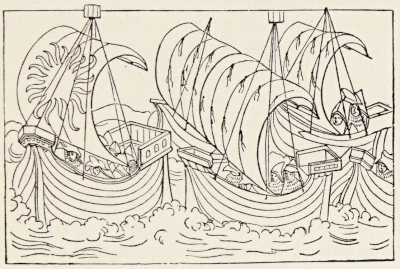
WARSHIPS OF THE FOURTEENTH CENTURY.
(After Harleian MS.—1319. fol. 18.)
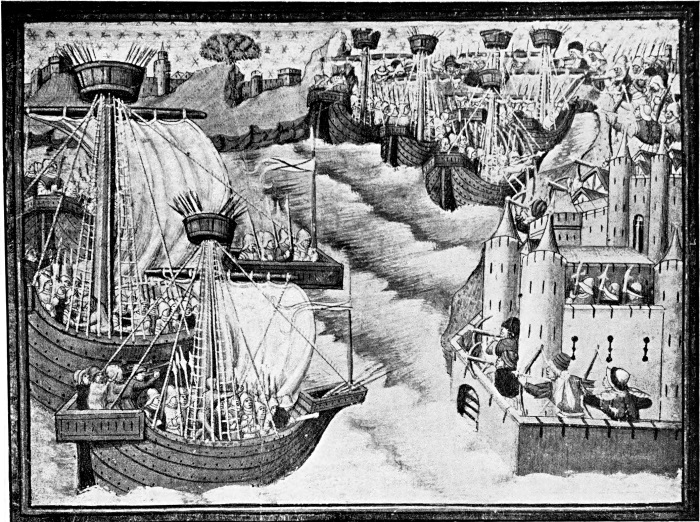
A battle between a Cinque Ports fleet under Hubert de
Burgh and a French fleet under Eustace is chiefly remarkable
by reason of the English manœuvring to secure the windward
position, this being the first occasion on which this manœuvre
is recorded, and the attack on the French rear ended in a signal
English victory. The fame of the English archers was great,
and they added to their laurels by playing no small part in
the battle. From their positions in the tops and on the forecastles
they kept up a steady flight of arrows upon the French.
The arrows carried flasks of unslaked lime which broke on
striking the French ships, and the lime dust, borne on the
wind, entered the eyes of the enemy and blinded them, the
defeat of the French following. The ships of that period were
provided with platforms, elevated on wooden pillars, at the
bow and stern. The erections were the forerunners of the
immense structures which were added in later years and did
so much to render ships unstable.
A Venetian ship constructed for Louis IX. of France in
1298, and named the Roccafortis, was 70 feet long on the keel
and 110 feet over all, with a width at prow and poop of 40 feet.
She is stated to have had two decks and a fighting castle at
each end. Possibly the weight of the bellatorium, as the castle
was called, may have necessitated such an extraordinary beam
near the bows and stern, but she could never have been built
with such dimensions to be other than a floating fortress.
In the Mediterranean, however, great activity prevailed.
The Crusades gave a tremendous impetus to the shipping of the
Middle Sea. Christians and Saracens vied with each other in
the production of ships of war. The larger “busses” sent to
the Levant in the fleet of Richard Cœur de Lion carried,
according to Richard of Devizes, a captain and fifteen seamen,
and forty knights with their horses, forty footmen, fourteen
servants, and twelve months’ provision for all. Some vessels
are said to have carried double this complement and cargo.
A Saracen ship, of which little is known, was encountered off
the Syrian coast, of so great a size that it could not be subdued
until the Christian galleys charged in line abreast and smashed
in her side so that she went down with nearly all of her one
thousand five hundred men.
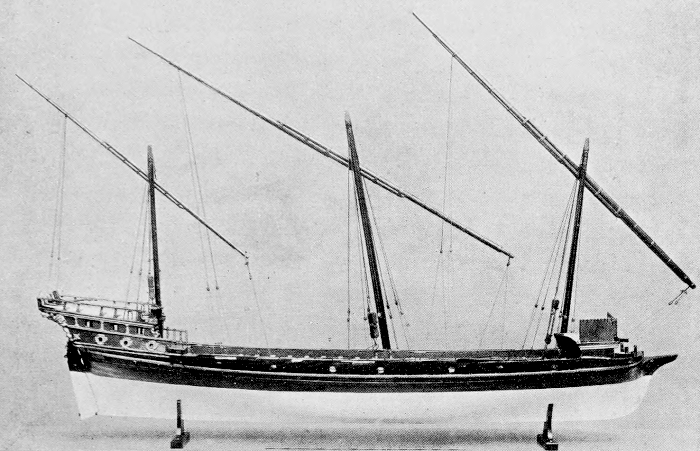
A GALLEY OF THE KNIGHTS OF MALTA.
From the Model in the Victoria and Albert Museum.
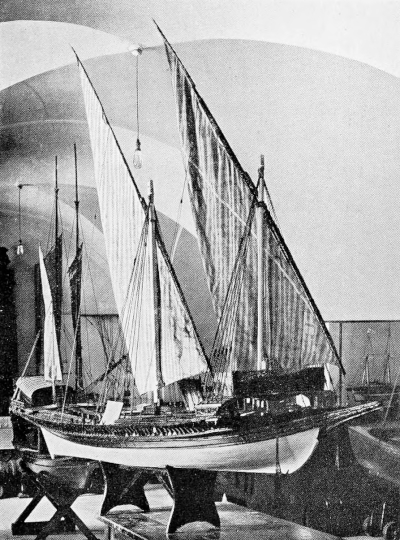
MEDITERRANEAN GALLEY.
From a Model in the Museum of the Royal United Service Institution.
CHAPTER II
WAR CRAFT OF THE FAR WEST, CENTRAL AFRICA, THE FAR SOUTH,
THE PACIFIC, AND THE FAR EAST
Notwithstanding the enormous strides made in ship construction,
it is still possible to find in active use vessels but
little removed from the earliest types known. It is, of course,
in the “Mysterious East,” where anything that served its
purpose very well centuries ago seems to have been expected
to retain its efficiency for ever, that one finds those survivals
from bygone ages. The earliest vessels known were hollowed
logs, or dug-outs; such are in use still. Planks were stitched
or lashed on above the bulwarks to raise the freeboard and
keep out the sea; the same contrivance is applied to this
day. A few strips of bamboo or other light material tied
together formed rafts; their exact counterparts are in existence
in many parts of the world. It was found possible to sail
them by means of a sail of matting attached to a yard which
was supported by a stout mast destitute of stays or standing
rigging; a centre-board or drop keel which could be lowered
through the middle of the raft into the water prevented leeway,
and steering was effected by means of a pole with a blade
attached, usually tied on, this long paddle being sometimes
used near the middle of the after end of the raft and sometimes
at either of the after corners, the necessary leverage being
obtained by the provision of a stump for the purpose. The
origin of such rafts is lost in antiquity, yet they continue to
be found in active service.
The bark canoes which the Indians of North America
employed on the great rivers and lakes when white men first
went there are unchanged in their method of construction,
and though in places where civilisation and the mechanical
arts have assumed sway the old canoes have given way to
the products of the modern boat-builders’ skill, yet in the
farther North-West the Indian canoe ripples the summer surface
of the lakes and streams as it did centuries ago. The real
Indian canoes were made by building the frame, and then
placing upon it a carefully prepared strip of birch bark
sufficiently large to cover the entire frame in one piece; it
was lashed to the frame and then stitched at the ends to
form the bow and stern. The larger canoes were sometimes
stiffened by having two or three pieces of wood lashed thwartwise.
The canoes were propelled by means of paddles, and
the Indians sat or knelt on the bottom of the boat. Many
of these canoes weighed as little as 60 lb. and some even less.
Their chief use was in the migrations of the tribes between
their summer and winter quarters, and very picturesque they
must have appeared to the early settlers as a flotilla glided
past; that is, if an Indian could ever be regarded by an early
settler as anything but “pizen.” But these canoes served
equally well to convey the painted and feathered braves to
battle; and anyone who has seen the Indians in their canoes
can well imagine how in days now happily past, it is hoped
for ever, a fleet of these boats, filled with cruel and relentless
men, passed swiftly and silently over the waters at night,
their paddles so skilfully wielded that the blades entered and
left the water with never a splash to break the solemn stillness.
Then the Indian canoe was no longer an emblem of joyous
happiness, made only for the sparkling waters and clear nights
and days of that foretaste of Paradise, the Indian summer,
fit craft for the romantic passing of Hiawatha to “the kingdom
of Ponemah”; but an evil thing, as swift and silent
and terrible as the bloodthirsty men it bore to victory or
destruction.
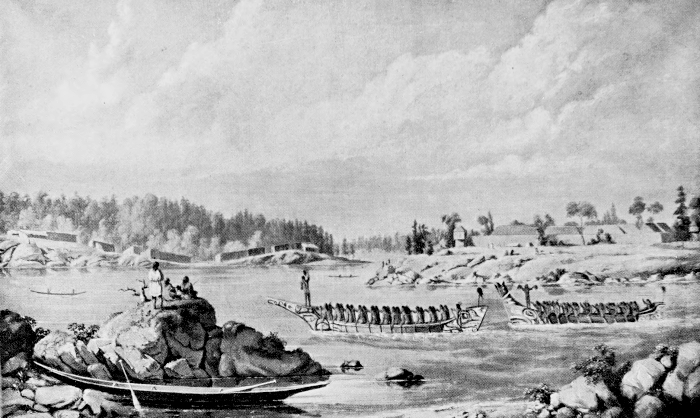
WAR CANOES OF INDIANS OF THE NORTH-WEST.
From a Photograph of a Painting, supplied by the Curator of the Chicago Museum.
The skin canoe or kayak of the Eskimo holds only one
person, though its length may be anything from 7 or 8 feet
to 25 feet. It is simply a light frame, running to a fine point
at either end, never more than a few inches in depth, and with
a breadth determined by the breadth of the man who is to use
it. It is entirely skin-covered, except for a small hole in the
deck, just abaft of amidships, in which the solitary occupant
sits. The Eskimo are very clever in the management of their
light craft—it weighs but a few pounds, and for its size is
probably the lightest sea-going vessel in the world—and employ
it chiefly in hunting, even at some distance from land.
The bark canoes of the Australian blacks were very
primitive affairs; they have almost disappeared, sharing the
fate of the rapidly dwindling aborigines. It may be doubted
if a trace of one of these canoes could now be found from one
end of the Murray River to the other. Since the blacks saw
how easily the white man knocked together a few planks and
made a flat-bottomed, straight-sided boat, they ceased to
labour at bark canoes, but instead obtained a few boards,
usually by pilfering, “borrowed” or begged a few nails, and
with a stone for a hammer have done likewise, patching the
very leaky seams with anything that came handy, were it
scrap of tin, leather, raw hide, or well-greased fragment of a
dirty, torn, old blanket, and making up for deficiencies by
incessant bailing. Never again on the southern Australian
rivers will the bark canoe convey the braves to the scene of
the tribal conflict, or ferry in the dying glow of the setting
sun the skeleton-painted men to the edge of the grim, dark
forest on the other shore to attend a great corroboree, whether
of war, rejoicing, or grief.
Nor have the African negroes made much progress beyond
the dug-out stage of war canoe construction. The Moors and
Arabs long since proved themselves excellent seamen and
shipbuilders, designing boats suitable to their needs, and are
in quite another category. The negroes of the Cross River
district in Southern Nigeria may be taken as typical of the
African canoe makers. They usually chose a mahogany or
awosa tree, and, having felled it, burnt it hollow where it fell.
It was then dragged on rollers to the waterside and finished
with whatever tools were available, matchets, knives and
axes being used since the white man’s introduction of those
implements. Occasionally a canoe is “smoked” or hardened
by being exposed to the hot smoke of a fire built round it.
Some of the war canoes are as much as 60 feet in length, and
are wide enough to allow the men to sit two abreast. The
larger ones have a steering platform on a level with the gunwale
or raised a foot or two above it, and a smaller platform is placed
at the bow, where a flagstaff may also be fixed. When there
are no thwarts or seats the crew sit on the bottom of the canoe
or on the gunwale, according to the size of the vessel. Both
bow and stern overhang. The paddles are made of hardwood
in one piece, 3 to 4 feet in length, and are pointed.
It is to the East Indies and the Pacific that we must turn
to find the most wonderful examples of the war canoe. They
may be divided into two classes: those with outriggers—this
section including double canoes—and those without.
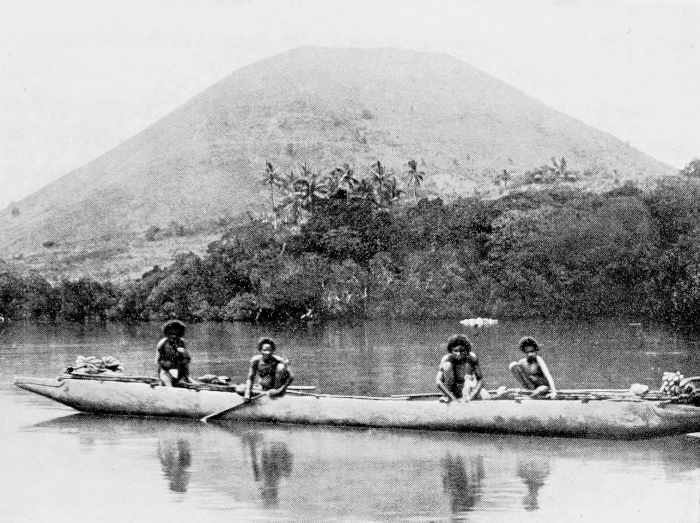
A “DUG-OUT” CANOE OF NEW GUINEA.
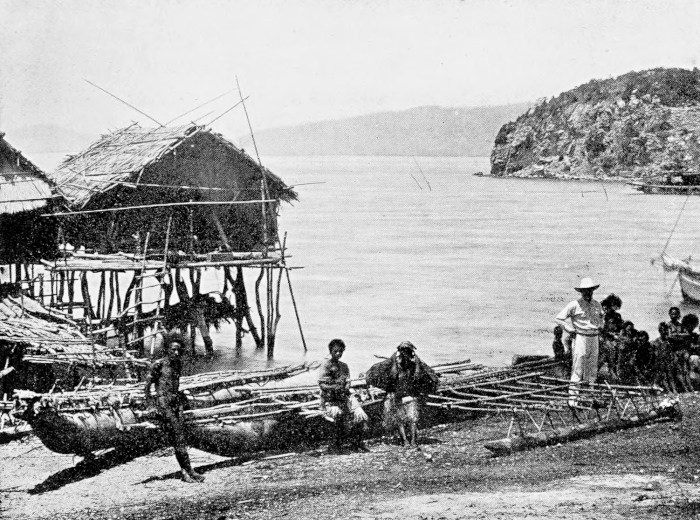
NEW GUINEA CANOES WITH OUTRIGGERS.
From Photographs supplied by the Hon. J. E. Jenkins.
Many of the canoes lacked stability, even in calm waters,
and the risk of capsizing was greater in waters liable to sudden
storms or exposed to the ocean swell. To meet this difficulty
and at the same time permit of the continued use of the shallow
harbours of their coasts, the Malays are supposed to have
invented the outrigger, and this conjecture is based on the
fact that wherever the Malay influence is traceable there some
form of the outrigger or double canoe is to be found also.
The primitive hollowed log generally constitutes the hull
of the canoes of the Pacific Islanders. The rest is mainly a
matter of ornamentation. With but few exceptions, the
islanders seem to have believed that the higher and more
imposing and ornamental they could make the stems or sterns
of their vessels, the more dreadful in war were they likely to
be. Many of these elevations are beautifully carved; other
canoes are merely grotesque, and not a few have no artistic
feature whatever to redeem them from absolute hideousness.
As a means of terrifying an enemy by presenting such things
to his astonished gaze they would doubtless be effective, had
it not been that the enemy would retaliate by presenting
something equally ugly, with the result that the moral effect
which each party sought to exercise upon the other would be
neutralised. Some of the islanders are said to have decorated
the prows of their vessels with the skulls of opponents killed
in previous expeditions; while others contented themselves
with locks of human hair, similarly derived, as naval adornments.
With the exception of bows, arrows and spears, all
their weapons were designed for fighting at close quarters.
It must have been a labour of love, as well as a feeling of pride
in the appearance of the fearfully shaped and murderous clubs,
which led them to carve their weapons as carefully as they did,
to render them so deadly, and to adorn them with mother-of-pearl
and sharks’ teeth. Not a few of the paddles were given
serrated edges in order that they could be the more effectively
employed as war clubs if necessary.
There are not many native war canoes now left in the
South Seas. None of the islanders, except the head-hunters,
habitually kept canoes for war purposes, though at times
one would be designed and built for some special expedition.
The last of the great Samoan war canoes has almost rotted to
pieces on the shore. It is doubtful if it has ever been used
in a warlike expedition. It was between 60 and 70 feet in
length, and 18 to 20 feet beam over all. It consisted of two
large single canoes, placed parallel a few feet apart, and joined
by a plank deck which ran across the greater part of the vessels.
Amidships was a house-like erection, used as a shelter.
It was propelled by oars, but also carried a mast and sails.
It could easily carry a hundred men.
The great canoe to hold three hundred men is but a memory;
all that is left of it is its steering paddle, 40 feet in length,
which adorns the wall in the Ethnographical section of the
British Museum.
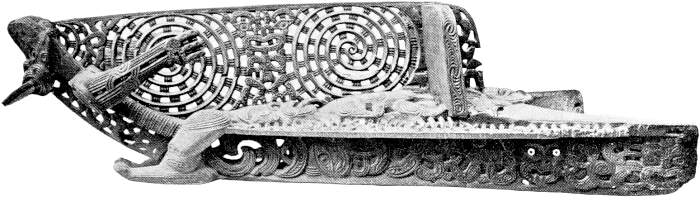
STEM-PIECE, MAORI WAR CANOE.
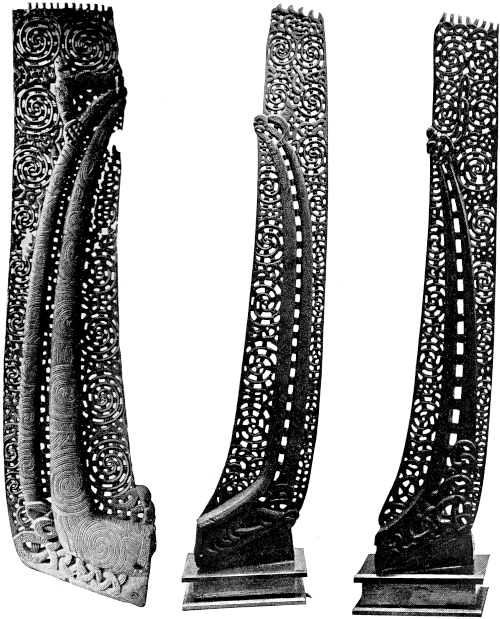
STERN-POSTS OF MAORI WAR CANOES.
From Examples in the Dominion Museum, Wellington, New Zealand.
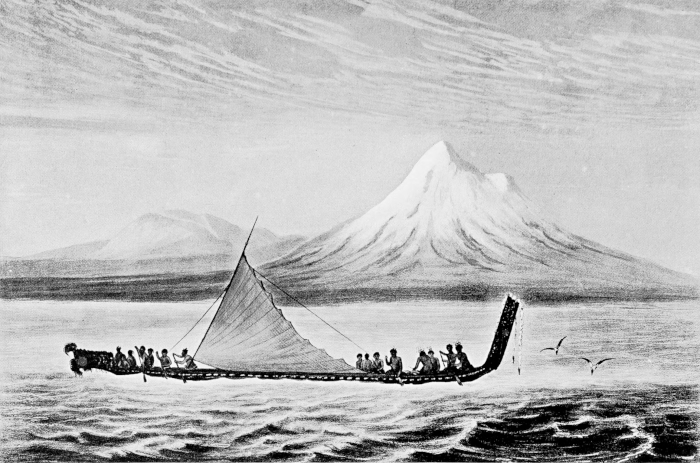
A MAORI WAR CANOE.
From Angas’s “New Zealand.”
The canoes of that mysterious people, the Maori of New
Zealand, well repay attention in greater detail than is possible
in this book. The origin of the people themselves is unknown,
though, if their traditions are to be accepted, they migrated
a few hundred years ago from certain of the islands in the
Central Pacific, partly conquered and partly absorbed the
people whom they found there already, and have remained
ever since. There has been more than one such expedition.
There are affinities between the Maori and the Hawaians.
Did the Maori come originally from Hawaii, or is there some
connection between them and the ancient Egyptians, as is
held to be indicated by certain points of resemblance in their
carvings and mural decorations? In what sort of canoes
did they cross the ocean, and how did they find their way?
Unfortunately, the old chiefs who held the traditions have
all died, and it is only owing to the painstaking researches
of a few scholars who recognised the need and value of preserving
what could still be learnt, that anything at all is known
of the history of this strange people. Their legends tell us
that some of their canoes were of great size; some could carry
fires or places for cooking the food, and others were double
canoes. One of the latter is said to have had a platform connecting
the two hulls, and bearing a house; it was a three-masted
vessel. All the New Zealand canoes had names of
symbolical or historical interest. One of them was called
Marutuahi, which, translated literally, means a slaying or
devouring fire.[8] The dimensions of the historical or legendary
canoes are not known. The straight, tall kauri pines of the
North Island enabled large canoes to be built; one is said to
have been 110 feet in length, and many of the later canoes
were 60 to 80 feet long, and held a hundred to a hundred and
fifty men. These boats had long, overhanging bows ornamented
with a figurehead and two carved boards extending
some little distance along either bow. Between these boards
and resting on the stem the carved figurehead was placed
and was often adorned with tufts of feathers. A mast set
rather far forward and raking aft supported a triangular mat
sail, the foot of which extended along the boom one and a
half times to twice the length of its height, and enabled the
canoe to sail very near the wind. The stays of the mast and
the sheets of the sail were of plaited flax. The drawbacks
to these canoes were that having no keels they made great
leeway, and that their length made them awkward to manage
whenever they were caught in anything like a rough sea;
they could not meet the seas end on, but lay in the trough
of the waves, and were so well handled that disasters were
few. In rough weather they were covered with flax mats
over a portion of their length to prevent the seas breaking
inboard.
The long pine hull was of great strength, but to render
it more seaworthy topsides were lashed along the sides of
the hull from end to end of the vessel with braids of flax fibres,[9]
and the seams and holes were caulked with a species of down.
As a precaution against leakage and to strengthen the joint,
a long, thin batten was lashed over the outside of the joint.
The decorations of the Maori canoes are wonderful. The
spiral pattern often seen in their carvings is taken from the
unfolding of the frond of a fern, and has been supposed to
symbolise the unfolding of life or the attainment of a planned
enterprise. The greatest care and the most artistic efforts
were lavished upon the carvings of the prow and stern boards.
These boards were very large and always removable. The
log from which the stern-board was fashioned was generally
about 15 inches in diameter and 6 to 15 feet in length, and
in its complete state was covered with conventional and
elaborate patterns. The figurehead log was about 6 feet
in length and 4 feet wide, and 2 to 4 feet in thickness. Both
were of hardwood and coloured red with kokowai or ochre.
If the figureheads represented the dead chiefs who had joined
the immortals in the Maori heaven, they must have lost in
the other world what little beauty was left to them in this
world after being tattooed. Not a few of the figures are extraordinarily
grotesque, and the weird effect of the red ochre
is heightened by the introduction of bright shiny eyes made
of the inner shell of the haliotis. Many also show the tattoo
marks which were supposed to add to Maori beauty, and most
bore bunches of feathers of the kaka and albatross, and on
gala days were further adorned with an elaborate and gaudy
feather wig. The thin batten, already alluded to, covering
the join of the topside and hull, was always stained black.
Gannet feathers were inserted to cover the lashings and contrasted
vividly with the black batten and the reddened canoe.
The sides of many canoes also were painted in wavy lines of
red, white and black, as though in imitation of the wave
motion. Streamers of pigeon tail feathers hung from the
top of the stern-board to the water; even the sail point on
the boom bore its tuft and streamers of feathers.
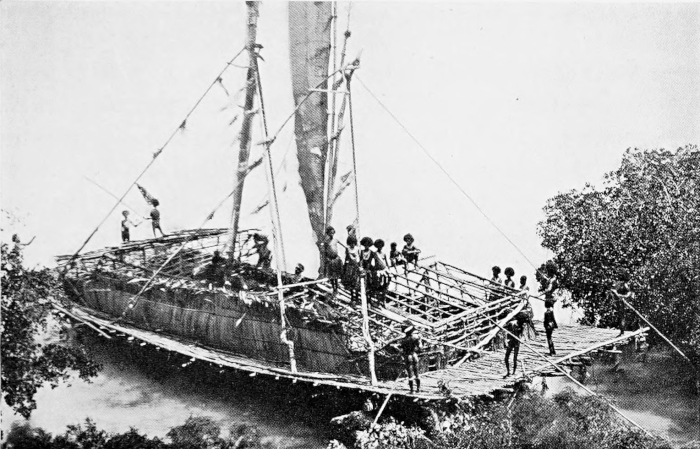
A LAKATOI NEARLY COMPLETED.
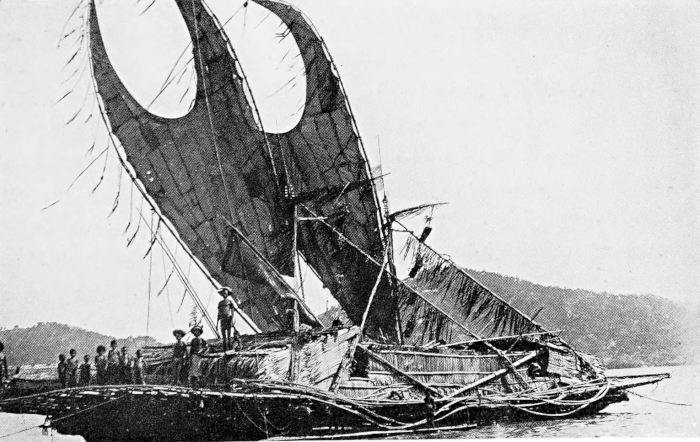
A LAKATOI UNDER SAIL.
From Photographs supplied by the Hon. J. E. Jenkins.
The dug-out, as the type common to all the Pacific islands,
usually has the outrigger attached; it can only be used in
still waters. Very frequently it is duplicated to form a
double canoe, or even three may be used abreast and covered,
together with the intervening spaces, with a deck upon which
a deck house is erected. As the deck extends a considerable
distance beyond the sides the amount of deck space thus
obtained is very great, as can well be imagined if the hull be
formed of three canoes each 50 or 60 feet long, and the deck
extends 3 or 4 feet on either side and is nearly square. If
canoes with outriggers were employed as double canoes they
were placed with the outriggers lashed together.
The accompanying illustrations of a New Guinea boat or
“lakatoi” show how these vessels are arranged. They each
carry two short pole masts which support immense spars of
bamboo or other light material to which sails of palm leaves
are attached. These sails are so constructed that they can
be hauled up or down their spars as required. They have
been described as suggesting when under full sail gigantic
lobsters holding up their claws in distress. The houses upon
them are formed of rattan and palm leaves. An idea of their
dimensions may be formed by comparing in the illustrations
the vessels themselves and the men and women upon them.
Not the least amazing features of these boats are that
long sea voyages were undertaken in them, and that in spite
of their size not a nail was used in their construction, the whole
thing being tied firmly together with coco-nut or other fibre.
The Fijian canoe was very similar to that just described.
The Tahitian “pahi” is frequently 80 feet in length, of the
raft-boat type, and bears a distinct likeness to the “balsa”
of Ancient Peru, and has some of the features of the catamarans
of the Chatham Islands, and “has a closer likeness still to a
Chinese junk, with its high latticed stern work.”[10] These pahi
were broad in the beam, neatly planked over inside, and were
fitted with a bulkhead or inner casing, and had the usual
elevated carved stern, sometimes consisting of one post and
sometimes of two. These vessels were capable of covering
120 miles a day without much difficulty if the wind suited.
The Pacific Islanders, says the same authority, “in the early
days of Polynesian enterprise (about 1400 A.D. and earlier)
would make voyages of over a thousand miles at a time, taking
the sun as their compass by day and the moon and stars by
night, adapting the time of their sailings to the shifting of the
Trade wind ... veering from north-east to south-west in
its appointed season.”
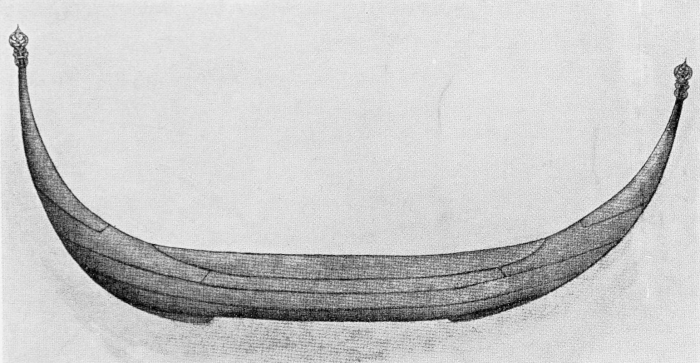
CANOE FROM SHORTLAND ISLAND.
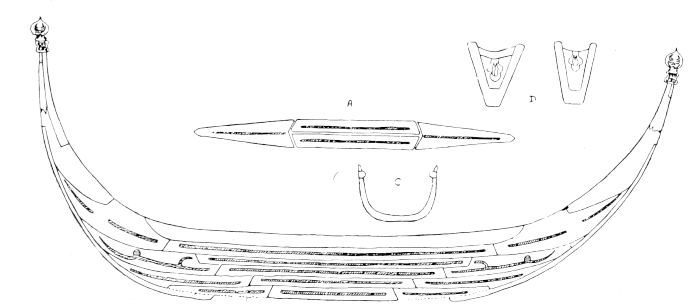
DIAGRAM OF SHORTLAND ISLAND CANOE.
a, The keel. c, The timbers. d, The small, solid, wedge-shaped timber in bow, with ornament.
By permission of C. M. Woodford, Esq.. F.R.G.S., and the Royal Anthropological Institute of
Great Britain
and Ireland.
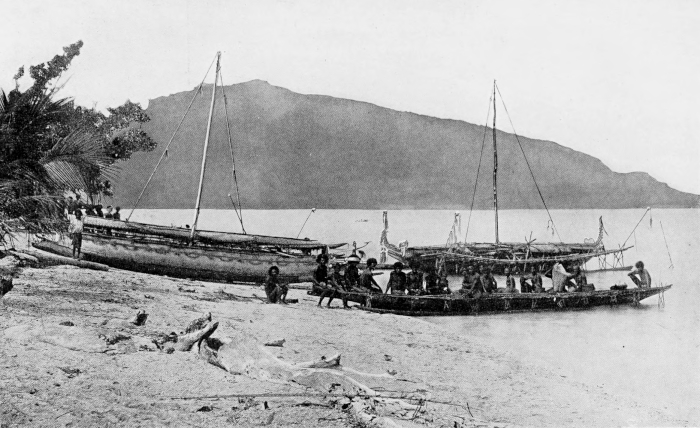
WAR CANOE, TESTE ISLAND, NEW GUINEA.
From Photograph supplied by the Hon. J. E. Jenkins.
Unquestionably the most remarkable canoes to be found
in the Pacific were those made in the Solomon Islands. Though
destitute of metal tools, the islanders yet managed to design
them with mathematical accuracy, to construct them to scale
and in accordance with the designs, and to put them together
with skill and precision. Such canoes were made by the
Solomon Islanders as long ago as the sixteenth century, for
de Mendaña, who visited the islands in 1568, has left a description
of them. The canoes, he says, were constructed of
planks, well made and light, and were crescent-shaped and
capable of holding about thirty persons. Later explorers have
recorded that the hull was formed of a dug-out, and that topsides
were added. This type of canoe appears to be peculiar
to the Melanesian inhabitants of the British Solomons.[11] For
neatness and accuracy the Shortland Island canoes come first,
but “for beauty of line and exterior decorations the large
tomako or head-hunting canoe of the New Georgia group
unquestionably excels.” The built canoes were cut with the
aid only of stone implements, but now the natives use the
plane iron, fitting it into the handle formerly used for the
stone implement. In many canoes a central ridge is left along
each plank to strengthen it, and a projecting boss is left at the
places where the planks and timbers join. The timbers, or
ribs, etc., are either naturally grown or shaped from the solid.
The planks are properly seasoned in the building sheds, and
when the canoe is being put together the various parts are
accurately fitted and tied with strips of fibre through the holes
in the bosses. The seams are caulked with a vegetable putty
made from scraped nut kernel, which hardens in a few days.
The canoes consist of garboard strakes, second, third, fourth,
fifth, and gunwale strakes, stem and stern pieces, and the
timbers or ribs. The last fine specimen of the head-hunting
canoe of the New Georgia group was 44 feet over all, 4 feet
8 inches beam, and 2 feet 4 inches deep. The height of the
bow, in addition, was 9 feet 7 inches, and that of the stern
10 feet 9 inches. All the Solomon Islands canoes are ornamented
with shells. A white-painted arm on the side of the
vessel has a sinister interpretation. It indicates that heads
have been taken; if the arm points to the bows the victims
were males; and if to the stern the collection taken up was
of female heads. Both stem and stern-boards had human
faces carved upon them, the idea being that the faces kept a
good look-out in every direction. This was, no doubt, a pleasing
fiction or a superstition; the natives placed more reliance
upon their keenness of hearing and vision than upon the
vigilance of the wooden faces to detect the approach of an
enemy.
The Malay influence has been shown not only in the building
of outrigger canoes, but in the popularity of piracy among the
natives of the East Indies. Probably the Malays have been
pirates ever since there has been commerce in those waters
upon which to prey. It is certain that the earliest European
vessels to wander into the distant Orient found the industry
established, active, and prosperous. Steam navigation, improved
firearms, and the electric telegraph have done much to curb
the propensities of these merciless marauders, and the influence
of noble men like Rajah Brooke of Sarawak has been of equal
value. But they found it a hard lesson to learn that commerce
must be respected and commercial vessels let alone; it was
gradually accepted as inevitable that piratical exploits would
be followed by the visit of a European gunboat which would
blow every Malay proa and pirate to pieces at the first opportunity.
This idiosyncrasy of the Western world had to be
observed, but the pirate does not take kindly to the uninterrupted
ways of peace, and whenever he can he indulges in his
hereditary calling, though his victims may be only small
native trading boats and junks.
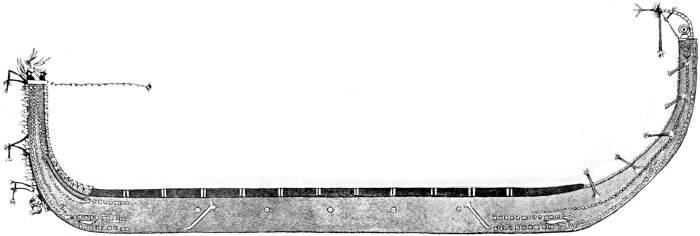
HEAD-HUNTING CANOE FROM YSABEL.
By permission of C. M. Woodford, Esq., F.R.G.S., and the Royal Anthropological Institute of Great Britain and Ireland.
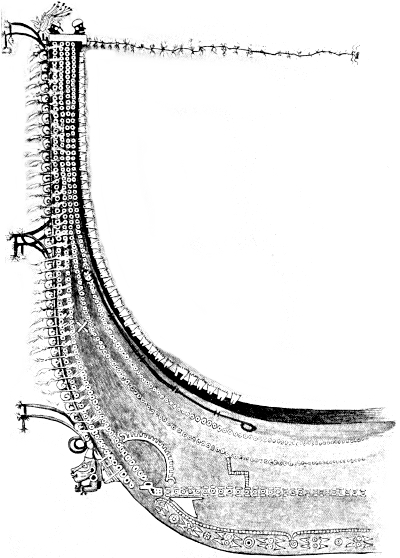
HEAD-HUNTING CANOE FROM YSABEL (DETAIL OF BOW).
By permission of C. M. Woodford, Esq., F.R.G.S., and the Royal Anthropological Institute of Great Britain and
Ireland.
The Malay dug-outs intended for piracy or war were broader
than those intended for other purposes. A writer in 1848[12]
described them as built of timber in the lower part, with the
upper part of rattan, bamboo, and dried palm leaves, this
lighter part being added to prevent the sea washing in over
the low sides. “Outside the bends,” he continues, “about a
foot from the water line, runs a strong gallery in which the
rowers sit cross-legged.” Apparently the gallery was on or
outside the gunwale, an arrangement which would help to
steady the long, narrow hull. Then, as now, a cabin was
placed in the after part for the accommodation of the chief
in command of the boat, but an interesting feature of the
proa he describes was an unrailed flat roof extending from
the cabin roof almost the length of the ship and serving a
double purpose of providing a fighting deck for the warriors
and affording shelter for the crew. The weapons were the kris
and spear, which “to be used with effect require elbow room.”
As the Malays were energetic fighters, they were seldom long
in obtaining all the elbow room necessary. A brass gun in
the prow, under the flying deck, was the only firearm.
The modern Malay proa is a more ambitious affair. It is
built to be light, fast under sail or oar, and very shallow in
hull. The last was very necessary in vessels which usually
sought safety by fleeing into waters too shallow to permit of
serious pursuit. A convenient length was 64 feet, or 72 feet
over all; the breadth would be 14 feet and the depth only
4 feet 6 inches. Some were longer and broader, but the Malays
were usually careful to increase the draft as little as possible.
The accompanying photograph is of a model of a proa having
these dimensions, and recently added to the South Kensington
Museum. The boat is a combination of Chinese and Malayan
design. It will be noticed that the vessel has very fine lines
forward, almost identical with those of the Arab dhows of the
Red Sea and the Persian Gulf, a sharp run aft and shallow
floors, and should be very fast. Instead of the fighting deck
overhead, already described, she has a deck extending the
whole length and breadth of the vessel and slightly below the
level of the gunwale, an arrangement which would enable a
large number of men to lie concealed behind the bulwarks and
ready for instant attack. The deck has two covered hatchways.
The roof of the cabin at the stern provides a platform for
working the rudder and the guns, there being one brass muzzle-loader
on each quarter. The projecting platforms or galleries
at the bow and stern provide additional deck space and would
facilitate the boarding of a prize. The boat has two pole
masts, one set very far forward and the other rather forward
of amidships, neither having stays. The sails of all vessels
of this class were made of strips of palm leaves, except when
the pirates appropriated the sails of captured ships, as they
are said to have done at times, and altered them to suit their
own vessels. The Chinese type of dropping rudder, which
could be raised or lowered by means of a windlass, was a
common feature in these Malay proas, the use of the steering
paddle being chiefly confined to the smaller craft. The vessel
represented is armed with one smoothbore gun carried on
the bow platform, and two similar weapons carried aft; she
also had six gingals or heavy muskets mounted on swivels,
and there was a plentiful supply of arms for hand-to-hand
fighting.
A very similar boat to the proa, but more heavily and
substantially constructed, was that specially favoured by the
Dyaks in their head-hunting expeditions. It was long and
narrow, and could carry sixty to eighty men. The Borneo
Dyaks adopted the flying deck as a fighting platform,[13] but
carried the fantastically decorated stern-board to an extravagant
height, which must have interfered seriously with the
stability of the vessel. These stern-boards are said to have
been intended as shields for the occupants of the boats, who
turned them end-on to the enemy and were protected by the
boards from the hostile arrows and spears.
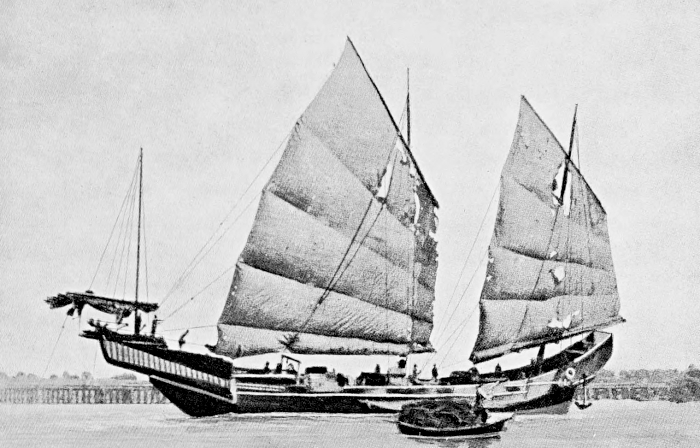
THE FAMOUS OLD CHINESE JUNK, “WHANG HO.”
Photograph supplied by “Shipping Illustrated.”
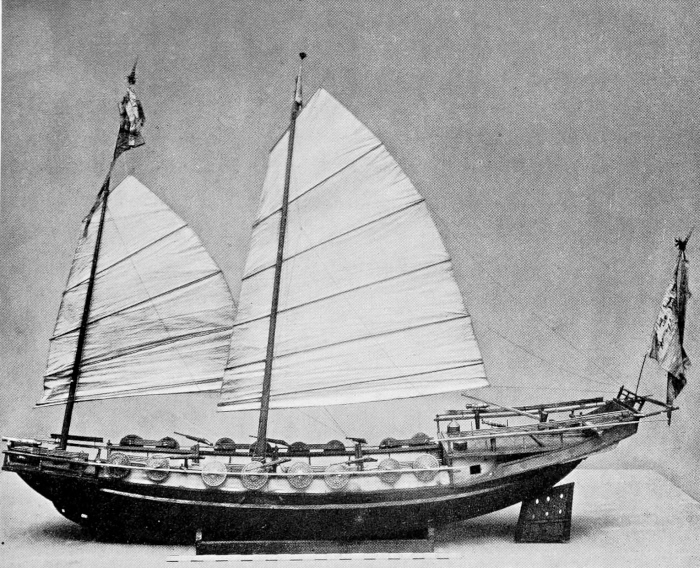
MALAY PIRATE PROA.
From the Model in the Victoria and Albert Museum. By permission of R. Walters, Esq., Ware Priory, Herts.
The Chinese seem to have attained to a certain degree of
civilisation many centuries ago, and then to have gone to sleep.
The dwellers along her coasts were traders and, when opportunity
offered, pirates, but as China maintained a policy of
splendid isolation both under her old dynasties and after her
Manchu conquerors assumed control of her destinies, she had
little need of a navy and no interest to serve in encouraging
a fighting marine. China used guns in land warfare as early
as the eighth century A.D., yet in the eighteenth century she
had war junks carrying, not artillery, but soldiers armed with
bows and arrows, while the sides of the vessels bore leather
shields painted to look like tiger heads, to scare the enemy.
Some of her junks were propelled by means of a couple of paddle
wheels on each side worked by manual power. The Chinese
war junks differed from the trading junks in the greater strength
of their construction and in the number of guns carried. Some
had guns approximating to 68-pounders, and it was not unusual
to find a junk with twenty-one guns of varying dimensions.
Each was the same cumbersome, slow-moving craft. These
vessels were sometimes over 1,000 tons burthen. One
of these junks, the Key-ing, which visited London in 1848,
sailed across the Atlantic from Boston to St. Aubin’s Bay in
the remarkably good time of twenty-one days, a performance
comparing favourably with that of many of the western sailing
ships; generally she sailed “like the wind,” that is to say,
“where it listeth,” and was as likely to arrive at one port
as another. Another famous junk in her time was the Whang-Ho,
but whether the junk of that name which started on an
exhibition tour of the world two or three years ago was the
original or was a copy, as is alleged, is a point which is in
dispute. She left San Francisco for New York and London,
intending to make the voyage by way of Cape Horn, and soon
showed that her intended port was about the last place where
she might be expected. Instead of New York, she fetched up
at Tahiti, where the crew went ashore and stayed. She sailed
with a new crew for the stormy waters of Cape Horn, and was
thought to have gone to the bottom until she turned up in
Torres Straits, and nearly got into trouble through being suspected
of smuggling, or carrying contraband. After being
nearly wrecked off Java, she entered Batavia River, and sailed
again some weeks later, but her condition became so bad that
she had to be abandoned. Her captain wrote in his log-book,
in October, 1909: “She will not hold together much longer....
The beams are not fastened to the hull of the vessel,
but lie loose in her.... It is certain she has never been a
man-of-war, but has been specially built for exhibition purposes
in the most careless fashion.” A few days later she was left
to her fate.
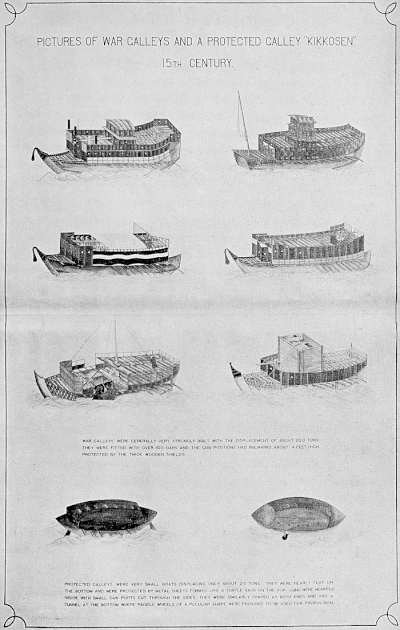
JAPANESE WAR GALLEYS AND A PROTECTED GALLEY ‘KIKKOSEN,’
15th CENTURY.
Photograph by special permission of the Japanese Imperial Naval Commissioners.
(click image to enlarge)
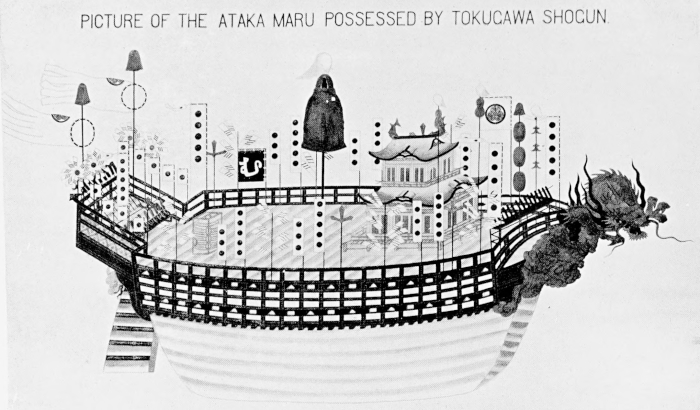
THE “ATAKA MARU.”
Photograph by special permission of the Japanese Imperial Naval Commissioners.
The Japanese, who pursued a policy of isolation until they
were forced to admit Western influences, were as conservative
in their shipping as in everything else. Their trading junks
were all built to pattern, externally and internally, decreed
by the authorities, and no deviation from it was permitted.
In their warships, however, a greater variety of design was
allowed. As early as the fifteenth century they had sea-going
ships carrying cannon, a weapon derived at some time, perhaps,
in the unrevealed past, from the Chinese after the latter conferred
upon the Japanese the Chinese system of writing, a
religious system, and other evidences of Celestial superiority.
There were several types of these war galleys, some of which
are here illustrated. The vessels shown were generally very
strongly built with a displacement of about 200 tons. They
were propelled by over one hundred and fifty oars, and their
gun positions had bulwarks about 4 feet high, protected by
thick wooden shields. A smaller type of vessel, also in use at
that time, may be called a protected galley. They were very
small vessels, displacing only about 25 tons each. They were
nearly flat-bottomed, but had a top covering, or hood, made
of metal sheets, which extended from side to side and almost
from end to end, like a turtle back. Their guns were mounted
inside the cover and fired through small ports cut through the
sides of the vessel itself. These boats were two-ended; that
is, of similar shape at either end, so that they could travel
either end foremost, and they had a curious tunnel constructed
along their bottoms in which a peculiarly shaped paddle-wheel
was revolved by manual power for the propulsion of each
vessel. The Japanese warships increased in size and ornamentation
until the Ataka Maru was built. She is of more
than ordinary interest, as she was the last and the largest of
the old native warships built for the Japanese Government
before the adoption of Western methods. She was 180 feet
long by 63 feet beam and 22 feet depth, and was propelled
by one hundred and thirty oars. Her armament consisted of
five heavy guns and a number of smaller weapons, and her
vital parts were protected by copper sheathing. The Japanese,
as already stated, probably obtained their knowledge of explosives
and firearms from the Chinese, and a few years ago
repaid the obligation by giving the Chinese most instructive
lessons in the superiority of modern methods and weapons.
One of the oldest vessels, and at the same time one possessing
characteristics supposed to be essentially modern, is the Arab
dhow. It is as old as the days of Alexander the Great in its
chief features, and in the fineness of the lines of its hull, its
seaworthiness, and its general handiness is not unlike the
Viking ships, and is equal to anything of similar size that the
average modern builder could produce with the same materials.
They are employed in gun-running, smuggling, and the slave
trade, when, more legitimate cargoes are lacking or not sufficiently
remunerative.
The Siamese were among the Eastern nations who took
kindly to the sea, and were able to use their warships to some
effect. Thus, about two hundred and fifty years ago, when a
European power, depending upon its superior strength, took
forcible possession of the island of Junk Seylon, the King of
Siam of that day ordered the “immediate building of six
warships, each carrying ten guns with pattaroes, and well
manned and fitted with small arms.” These vessels were
built in one month, and this emergency mobilisation and the
fighting orders were all to be obeyed under penalty of death
and forfeiting of estates, the latter penalty being added no
doubt to prevent the expectant heirs of a warrior depriving
his majesty of the latter’s services.
CHAPTER III
THE INTRODUCTION OF ARTILLERY, AND THE DEVELOPMENT OF
WARSHIPS TO THE APPLICATION OF STEAM FOR NAVIGATION
Sails having proved their superiority over oars as a means
of propulsion, and sailing ships with seaworthy qualities being
fairly numerous, the world was ready for a great revolution
in naval warfare. The warriors also were about equally
divided in the matter of attack and defence in hand-to-hand
encounter. When man first became dissatisfied with his own
strength for hurling weapons at his foes he set to work to
devise a means of overcoming this difficulty. His earliest
weapon for this purpose was most likely the sling. Bows and
arrows held their own in land and sea warfare for many
centuries. Various forms of catapults were introduced by
the Romans and others, and remained in use for some hundreds
of years for hurling heavy stones into the partly decked ships
of their opponents to sink them. The mysterious liquid known
as Greek fire, the use of which has already been explained,
was, in the method of its employment, a form of artillery.
It was to the naval warfare of those days what the explosive
shell is to modern warfare.
The Moors are credited with having introduced firearms
into Western Europe at the siege of Saragossa in 1118 A.D.,
when they had artillery of some sort; and they are stated to
have used the agency of fire to throw stones and darts in their
defence of Niebla at a later date. The nature and origin of the
firearms and fire machine have not been ascertained definitely.
Did the Moors derive their knowledge from the East? They
had Eastern connections. Mortars were used in China in the
eighth century, which fired large stone balls, and by the twelfth
century the Chinese had “wall pieces” or siege guns. They
employed explosives in war before the Christian era. These
events were certainly long before Western Europe discovered
how to make gunpowder.
Cannon, as the term is now understood, was introduced
about 1330. Edward III. is credited with having possessed
cannon in 1338, but historians differ as to whether he employed
cannon of any kind at the battle of Sluys, in 1340, or in any of
his later naval engagements. Arrows and stones were the
chief missiles; the English relied on their famous cross-bows,
and the French upon machines for hurling stones. The latter
sent several English ships to the bottom.
The battle of La Rochelle, in 1372, when a combined Spanish
and French force defeated the English, is probably the first
naval battle in which cannon were used, as some of the Spanish
vessels are said to have carried a few. Artillery was certainly
used at sea shortly after the middle of the fourteenth century
by the Mediterranean countries. The Venetians found it
effective against the Genoese in 1377, and its use became very
rapidly general from the Levant to Spain.
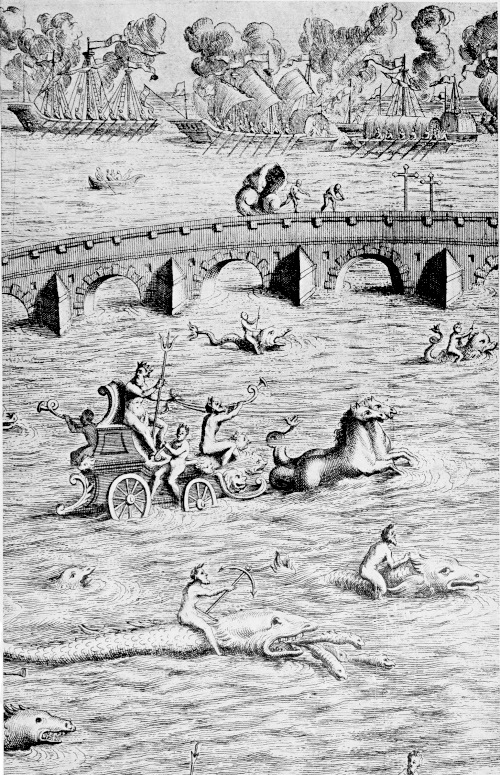
SIXTEENTH-CENTURY FRENCH SHIPS.
From an Old Print.
The earliest guns were simply tubes, not cast, but built
of strips of iron or wood held together by rings. They were
breech-loaders, the charge being placed in a loosely-fitting
chamber. How the chamber was secured and the gun fired
are still undecided. The guns were usually innocent of trunnions
and were fastened lengthwise upon wooden beams which could
be propped up to give them the desired elevation. It has been
recorded that in one of the earliest siege operations at which
this primitive artillery was employed, both sides were so
interested in the operation of firing that they ceased exchanging
missiles and defiance, and even stopped their personal combats,
until after the discharge, when, being much relieved that the
stone bullet had inflicted no damage on the assailed castle
wall and had wounded no one, they resumed hostilities in the
old-fashioned way. In those days one discharge per gun per
diem was regarded as sufficient. It was customary to load
the piece overnight and fire it in the morning, from which
it may be surmised that its moral effects were greater than
the material destruction caused. Artillery would have to be
in a more advanced stage to justify its use at sea, for no vessels
could afford to carry guns which could only be used so infrequently.
Nevertheless, the moral effects of gunfire were so
evident, especially when weapons were made more powerful
and able to inflict serious material damage, that the adoption
of the new arm for naval war could not be long delayed, and
the time soon arrived when both national and private vessels
of any size carried one gun or more. By the middle of the
fifteenth century guns on board ship had become common.
The illustration of the model[14] of a ship of the period
1486-1520 gives a very good idea of what the warships of that
time were like. Although the vessel carried guns, the bow and
arrow were still relied upon. The archer’s panier on the mast
had given place to the deep circular top. Castles, however, were
provided fore and aft for the archers, and were useful alike
for affording them protection and accommodation and a place
of vantage whence to discharge their arrows. The vessel is
of the same type as the Spanish caravel of the early sixteenth
century. From this it may be inferred that the Spaniards
went to the north for the designs of their hulls, but preferred
to retain the rig with which they were most familiar, the
Spaniards depending largely on lateen yards and sails, whereas
the model is square-rigged but without the top-sails she ought
to carry.
A feature of the sea-going Atlantic vessels of this time
was their great beam in proportion to their length. They also
had an extraordinary amount of “tumble home,” or sloping
of the sides above the water line towards each other. Ships
of the type represented by the model were much in advance of
those upon which artillery was first carried.
Galleys were the first to be equipped with guns, the weapons
being upon the upper deck and fired above the bulwarks.
Some galleys, particularly in the Mediterranean, carried only
one gun forward, a bow chaser. The desire to carry more
guns and to fire them over the sides led to the raising of the
sides of the vessel; and in order to avoid the strain to the
ship’s structure when the guns were fired, the weak point
apparently being the connection between the sides and beams,
the sides were given an inclination inboard, or tumble home,
the connecting beams being thus shortened. The practice
was carried to such an absurd extent that the beam of a
Venetian galleon—as such vessels now began to be called—at
the deck might be only half that of the vessel at the water
line. The narrower deck space left less room on which to
place the stern castle, which instead of being an addition
became a structural part of the ship, provided with three and
sometimes four decks, all carrying cannon.
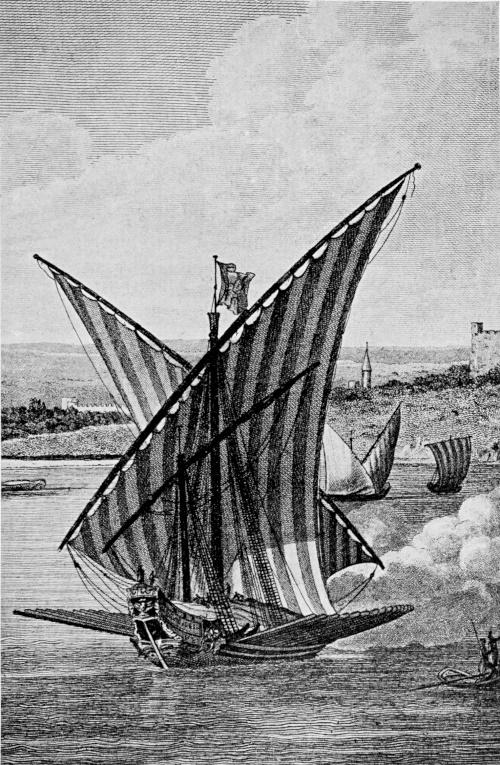
A MEDITERRANEAN WAR GALLEY.
From an Old Print.
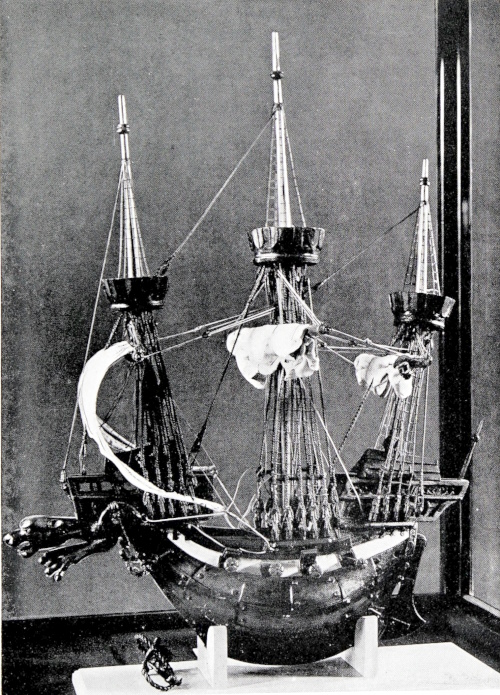
SHIP OF WAR, 1486-1520.
From a Model in the Museum of the Royal United Service Institution.
On the Atlantic coasts the problem of cannon was solved
in its own way. Guns were placed broadside and fired over
the bulwark. But the disadvantages of this method were so
obvious, especially when an enemy returned the fire, that
portholes in the bulwarks were devised through which the
guns could be discharged. A French shipbuilder at Brest,
named Decharges, is said to have been the inventor of portholes,
and also to have designed some other improvements.
His portholes, however, were so small that the muzzles of the
guns could only just protrude. It was impossible to give
them any traverse, that is, to train or aim them.
The general adoption of artillery led to numerous modifications
in the shape of the ships; they were built of greater
dimensions, were more fully masted and rigged, and could
show a considerable press of sail. It was also considered
advisable that ships should be built especially for war purposes,
the French taking the lead after the battle of La Rochelle.
If Henry V.’s warlike enterprises proved harmful to the
development of English commerce, there is no denying that
shipbuilding made some progress in his reign, though very
little is known of the details of the construction of the vessels.
From lists of the ships employed in his expeditions, it appears
that his fleets included “Great Ships,” the largest of which
was the Jesus of 1,000 tons, the others being the Holigost,
760 tons; Trinity Royal, 540 tons, and Christopher Spayne,
600 tons; there were also “cogs,” which were rather
smaller; carracks, which were probably foreign built and
were prizes of war, the construction of these vessels not having
been then begun in England; ships, barges, and ballingers,
the last being barges. The last three classes were no doubt
impressed merchant vessels, ranging from 500 tons in the case
of the ships to 80 tons in the ballingers. In regard to the
“Great Ships,” it is reported[15] that Henry, observing the
superiority of the Castilian and Genoese ships, caused some
very large vessels, called “dromons,” to be built at Southampton,
“such as were never seen in the world before,” says an old
writer erroneously, “three of which had the names of the
Trinity, Grace de Dieu, and Holy Ghost.” Although called
dromons it does not follow that they were similar to the dromons
in earlier or contemporary use in the eastern Mediterranean.
The name was given to the latter because of their size and
speed, and it is very likely that Henry V.’s vessels were so named
for similar reasons. Long galleys, called ramberges, were also
used about this time, and the English are said to have become
very expert in their management.
Most of the large English armed ships of the middle of the
fifteenth century were Spanish or Genoese built. A ship was
then in existence carrying four guns on the broadside, fired
apparently through ports in the bulwarks. She was fitted with
four masts and a bowsprit, and had a high forecastle similar
to that provided in Italian ships of that period, but seemingly
more a part of the structure of the ship than was that of the
latter. The mainsail bears the arms of the Earl of Warwick.[16]
A remarkable ship in the history of naval building was the
Great Harry, sometimes confounded with the Henry Grace de
Dieu. The Great Harry was commenced for Henry VII., and
is regarded by many as the first ship of the British Royal Navy.
No doubt the fact that Henry lived for many years in Brittany,
which was then remarkable for its maritime activity, gave him
a greater interest in shipping than most of his predecessors on
the throne professed.
It was a proud day for England, had he but known it, when,
in the year 1488, he ordered the Great Harry, for she marked the
first serious attempt of an English sovereign to render the state
not wholly dependent upon the merchants and the ports whenever
he decided upon an expedition abroad, by providing a
vessel which should be at the disposal of the state whenever
required. For the first time in the history of England, for the
building of a national ship, the axes swung as the trees were
felled, and the blows resounded through the forests; the forges
roared for the formation of the iron bolts and nails, and the
hammers on the anvils rang as they beat them into shape; the
tools of the carpenters hissed as they fashioned the knees and ribs
and beams and planks; the looms whereon the sailcloth was
woven hummed in the industrial chorus; for this was the first
ship of England a nation, the first sign that Britannia was really
awaking at last to the fulfilment of her maritime destiny. He
did not live to see this vessel completed, and she was finished
in Henry VIII.’s reign. Henry VII. also ordered the Regent and
the Sovereign. The Great Harry is said to have been the first
two-decked vessel built in England, and the only ship with three
masts in the whole squadron. She was accidentally burnt at
Woolwich in 1553.[17]
The Regent was about 1,000 tons, and carried two hundred
and twenty-five small guns, called serpentines. She had four
masts and a bowsprit, and was launched at Rotherhithe. She
was not of English design, but, like a few before her and many
since, was modelled after a French vessel. The Sovereign, a
somewhat smaller ship, carried one hundred and forty-one
serpentines. The year 1512 saw the end of the Regent. She
was the flagship of the English in a notable battle, and was
opposed by the great French ship, Marie de la Cordeliere, which
was provided at the expense of Anne of Brittany, then Queen
of France. This ship is stated to have carried one thousand
two hundred fighting men, exclusive of mariners; at this
time there were nine hundred on board, according to Derrick,
who probably bases his statement on the report that she
foundered with all hands numbering nine hundred.
An English description of the engagement states that,
“All things being ... in order, the Englishmen approached
towards the Frenchmen, which came fiercely forward ...
and when they were in sight they shot ordnance so terribly
that all the sea coast sounded of it.” One of the English
ships “bowged,” or rammed, the Cordeliere, and when at last
the Cordeliere was boarded, “a varlet gunner, being desperate,
put fire in the gunpowder.”[18] The French writer, Guerin, also
quoted by the same authority, in his version, says: “In the
midst of this general French attack there was to be noted above
all others a large and beautiful carrack, decorated superbly
and as daintily as a queen. She of herself had already sunk
almost as many hostile vessels as all the rest of the fleet, and
now found herself surrounded by twelve of the principal English
ships.... From the top of a hostile vessel there was flung
into her a mass of fireworks. Then, sighting the Regent, she,
like a floating volcano, bore down, a huge incendiary torch,
upon her, pitilessly grappled her, and wound her in her own
flaming robe. The powder magazine of the Regent blew up,
and with it the hostile ship ... while the Cordeliere, satisfied,
and still proud amid the disaster, and a whirl of fire and smoke,
vanished beneath the waves.” The English version, if less
vivid, is also less imaginative.
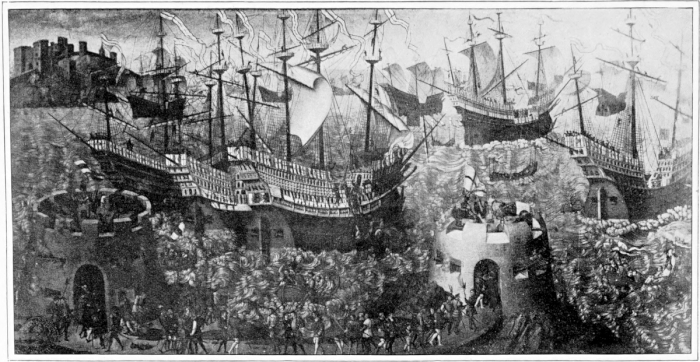
EMBARKATION OF HENRY VIII. ON THE “GREAT HARRY.”
From the Painting by Volpe at Hampton Court Palace. Photograph by W. M. Spooner & Co.
(click image to enlarge)
To replace the Regent, and to emulate Francis I. of France,
who had built a ship called the Caracon (afterwards burnt at
Havre), carrying one hundred guns, Henry ordered the Henry
Grace de Dieu, of the same tonnage, 1,000 tons, but carrying
one hundred and twenty-two guns. It is disputed whether she
was built at Erith, as usually stated, or whether she was
launched at Deptford and completed at Erith. Her launch
took place in 1515. Historians differ as to what became of
this vessel. One version is that she rolled incessantly and
steered badly, and, having been built rather for magnificence
than use, only made one voyage and was disarmed at Bristol
and suffered to decay. If this be so, it affords an explanation
of the discrepancies in the illustrations of the Henry Grace de
Dieu, as it is permissible to suppose that another vessel bearing
that name was constructed to take its place and that the newcomer
afterwards became known as the Edward. The Henry
Grace de Dieu was sometimes called the Great Harry, but must
not be confused with Henry VII.’s ship bearing that name.
The Henry Grace de Dieu was renamed the Edward after the
accession of the next monarch. She had four pole masts;
the foremast was placed almost over the stem, an arrangement
which must have made her pitch deeply and recover slowly;
the mainmast was at the break of the after deckhouse or sterncastle;
the mizen or third mast was midway between the
mainmast and the stern, and the fourth, or second mizen,
was at the extreme stern, as far aft as it was possible to place
it. Her forecastle overhung her bows by 12 feet or so, an
arrangement which must have made her very uncomfortable
in anything like a sea. She is asserted to have been the first
four-masted vessel. There was also a fifth mast, if it may so
be called, which slanted forward like an immense bowsprit.
The first, second, and third masts had two round tops each,
and the fourth mast one top, these being for the archers. Her
sails and pennants were of damasked cloth of gold. Her
armament comprised twenty-one heavy brass guns, and
numerous smaller pieces of various types; but when she passed
into the possession of Edward VI. she had nineteen brass guns
and one hundred and one of iron.
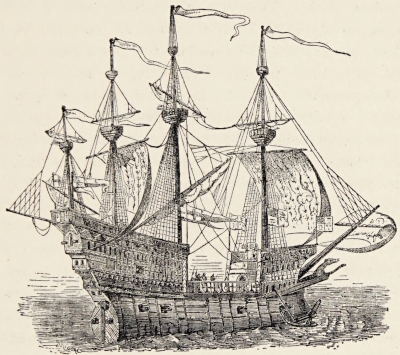
GREAT SHIP OF HENRY VIII.
(From a drawing by Holbein.)
As already stated, the great majority of the ships built for
mercantile purposes were intended to be able to give a good
account of themselves if they should be assailed by a hostile
vessel, a contingency which was not at all unlikely in the days
when ships roved the seas under the protection of letters of
marque and made “mistakes” as to the nationality of the
prize when the prospective booty might be held to justify the
error. Before the nations took to building vessels especially
for war every merchant was liable to have his traders requisitioned
for war purposes, and even up to the end of the nineteenth
century the inclusion of armed merchantmen in national forces
was not uncommon. Letters of marque were permits granted
to ship owners whose vessels had been despoiled by the subjects
of another nation to recoup themselves at the cost of any vessels
belonging to that nation which they could capture, and to
continue to do so until the losses were made good. Naturally
they found this profitable, much more so indeed than ordinary
trading, and did not hesitate to set a low value upon all captures
when casting about to find an excuse for another expedition.
Piracy, too, was rife, and as at sea every shipmaster was a
law unto himself unless there was someone at hand to enforce
a change of views, the shipmaster or merchant turned pirate
usually nourished exceedingly until captured red-handed, when
his shrift was like to be a short one.
As an instance of the license to which this liberty was
extended, may be mentioned the Barton family who, in the
fifteenth century, had granted to them letters of marque to
prey upon the Portuguese in retaliation for the murder of
John Barton, who was captured and beheaded by Portuguese.
His sons conducted the enterprise with such thoroughness
that they were able to pay their Scottish Royal master so well
that they were never interfered with by him, and when he
entrusted them with the task of reducing the Flemish pirates
who levied toll on Scottish commerce, they sent him a few
barrels filled with pickled human heads to show that they
were not idle. The fame of this Scottish family became world
wide, for they had now a powerful fleet and traded and fought
and captured where they would, so that the reputation of the
Scottish navy was great. One of the ships of the Barton
family, the Lion, was second in size and armament only to
the Great Harry itself. The death of Sir Andrew Barton is
commemorated in a well-known ballad.
When vessels with two and more decks were constructed,
the lower ports were cut so near the water that when the vessel
heeled, or even a moderate sea was running, the guns could
not be worked. The ports of the Mary Rose, which was the
next largest ship to the Regent, at one time, and had a tonnage
variously stated at 500 and 660 tons, though afterwards surpassed
by the Sovereign, 800 tons, Gabriel Royal, 650 tons,
and Katherine Forteless, or Fortileza, were but 16 inches above
the water. She was lost, in 1545, through the water entering
her lower ports when going about off Spithead, and her commander
and six hundred men went down with her; the Great
Harry had a narrow escape from a similar disaster at the same
time.
A report on the Royal Navy in 1552 makes interesting
reading. The fleet was overhauled, and twenty-four “ships
and pinnaces are in good case to serve, so that they may be
grounded and caulked once a year to keep them tight.” This
is endorsed, “To be so ordered, By the King’s Command.”
Other seven ships were ordered to be “docked and new dubbed,
to search their treenails and iron work.” The Mrs. Grand,
a name which no longer adorns the “Navy List,” a vessel
carrying a crew of two hundred and fifty men, and having one
brass gun and twenty-two iron guns, lying at Deptford, was
recommended to be “dry-docked—not thought worthy of new
making”; so she was ordered “To lie still, or to take that
which is profitable of her for other Ships.” Six others were
stated in the report—a document seemingly the work of
a naval reform party—to be “not worth keeping,” but they
were ordered “To be preserved, as they may with little
charge.”
Queen Elizabeth, whose patriotism and naval enthusiasm
were about equally in evidence, was careful of her men and
ships, raised the pay of her officers and seamen, and took steps
generally to have the navy and the naval resources strengthened
and conserved. She seems to have had twenty-nine vessels
in 1565. She also encouraged merchants to build large vessels,
which could be converted into warships as occasion required.
The exigencies of trading over sea, however, were such that
many of the vessels required little to be done to them in the
way of conversion. Vessels were also rated at from 50 to
100 tons more than they measured.
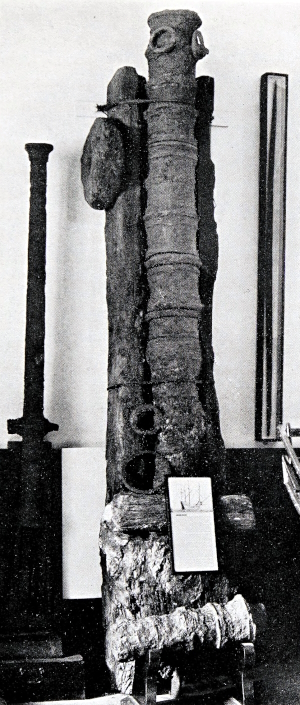
BREECH-LOADING GUN RECOVERED FROM THE
WRECK OF THE “MARY ROSE.”
In the Museum of the Royal United Service Institution. A spare chamber
is shown in the front.
“The Queen’s Highness,” a contemporary historian writes,[19]
“hath at this present already made and furnished, to the
number of One Hundred and Twenty Great Ships, which lie
for the most part in Gillingham Road. Beside these, her
Grace hath other in hand also; she hath likewise three notable
Galleys, the Speedwell, the Tryeright, and the Black Galley,
with the sight whereof, and the rest of the Navy-Royal, it is
incredible to say how marvellously her Grace is delighted.
I add, to the end that all men should understand somewhat
of the great masses of treasure daily employed upon our
Navy, how there are few merchant ships of the first and
second sort, that being apparelled and made ready to sail,
are not worth one thousand pounds, or three thousand
ducats at the least, if they should presently be sold. What
then shall we think of the Navy-Royal, of which some one
vessel is worth two of the other, as the shipwright has often
told me.”
Queen Elizabeth had, in 1578, twenty-four ships ranging
from the Triumph, of 1,000 tons, built in 1561, to the George,
of under 60 tons.
When the Spanish Armada arrived in the Channel in 1588,
the British fleet, which numbered one hundred and ninety-seven
vessels, included thirty-four belonging to the state.
The remainder were ships of various kinds and sizes,
mostly small, hired by the state or provided by private
owners, and fitted out hastily for war purposes by their
owners or the ports. The Cinque Ports, it should be remembered,
which furnished a considerable number, were obliged
by Henry VIII., in return for certain privileges, to supply
him with fifty-seven ships, each containing twenty-one men
and a boy, for fifteen days once a year at the ports’ expense,
and it often happened that the ports had to find a greater
number of vessels. After the fifteen days they received state
pay. A similar arrangement held good at the time of the
Armada. The largest ships in the English force are sometimes
stated to have carried fifty-five or sixty guns, and one may
have carried sixty-eight guns. The armament of the
Triumph, which was the heaviest armed English vessel,
comprised four cannon, three demi-cannon, seventeen culverins,
eight demi-culverins, six sakers, and four small pieces.
The Elizabeth Jones, of 900 tons, built in 1559, carried fifty-six
guns, and the Ark Royal, Lord Howard’s flagship,
launched in 1587, had fifty-eight guns and a crew of four
hundred and thirty men, her tonnage being 800. The
principal royal ships and the number of guns they carried
were, as far as can be ascertained accurately: Ark Royal,
fifty-five guns; Lion, thirty-eight; Triumph, forty-two;
Victory, forty-two; Bonaventure, thirty-four; Dreadnought,
thirty-two; Nonpareil, thirty-eight; Rainbow, forty; Vanguard,
forty; Mary Rose, thirty-six; Antelope, thirty; and
Swiftsure, forty-two. The Spanish ships were rather floating
fortresses packed with soldiers, and desiring to come to close
quarters so that the fight should be of the hand-to-hand
description to which they were accustomed. The English
ships were smaller, and though more numerous, of little more
than half the total tonnage of the Armada, and were, on the
whole, more lightly armed. Still, a large number of the English
vessels carried what were long, heavy guns for those days,
and they used them at short range when they assumed a windward
position and attacked the Spanish rear, inflicting great
damage and throwing the enemy into confusion. This defeat
definitely established the cannon as the principal weapon for
warfare afloat, and inaugurated a new era in the history of the
world’s fighting navies.
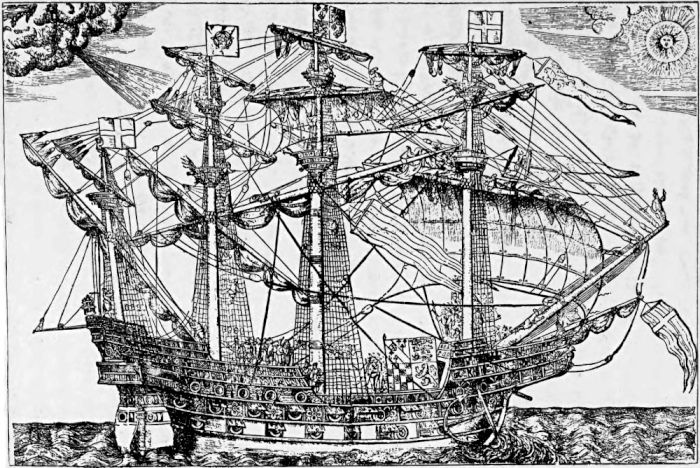
THE “ARK ROYAL,” THE ENGLISH ADMIRAL’S FLAGSHIP.
From a Contemporary Print.
(click image to enlarge)
Of the merchant ships engaged, the largest were the
Leicester, sometimes called the Galleon Leicester, and the
Merchant Royal, each of 400 tons. The great galleys and
galleasses of the Armada were not the largest ships afloat by
a great deal, for they were far exceeded in size by many contemporary
merchantmen in the Mediterranean.
The Queen’s ships were sometimes employed upon peaceful
and ambassadorial errands. The voyage of the Ascension to
Constantinople shows a definite attempt to spread English
prestige in distant seas by means of English trade openings,
instead of by the diplomacy of the day, a prominent feature
of which was the discovery of means and opportunities of
raiding a state having much portable riches and not sufficient
power to protect them.
The Ascension, in which Queen Elizabeth sent her second
present to the Sultan of Turkey, left London in March, 1593,
and arrived in August, 1594. She was “a good shippe very
well appointed, of two hundred and three score tunnes (whereof
was master one William Broadbanke, a provident and skilfull
man in his faculties).” Some days after the arrival when the
wind suited, “our shippe set out in their best manner with
flagges, streamers, and pendants of divers coloured silke, with
all the mariners, together with most of the Ambassador’s men,
having the winde faire, and came within two cables’ length
of this his moskyta,[20] where (hee to his great content beholding
the shippe in such bravery) they discharged first volies of
small shot, and then all the great ordinance twise over, there
being seven and twentie or eight and twentie pieces in the
shippe.”[21]
The early part of the seventeenth century, when James I.
was king, saw a remarkable advance in shipbuilding, thanks
to Phineas Pett, who dropped the somewhat haphazard rule-of-thumb
methods of ship construction and introduced a more
or less scientific system of measurement and estimate of
weights. In 1610, the Prince, or Prince Royal, of 1,400 tons, and
mounting sixty-four guns, was launched. She is described as
“Double-built,” which has been supposed to mean that she had
an outer and inner skin and an additional number of beams, etc.
This may afford a partial explanation of the fact that though
seven hundred and seventy-five loads of timber were estimated
to be necessary for her construction, one thousand six hundred
and twenty-seven loads were used. Also, as the ship only
lasted fifteen years, a possible further explanation of the
discrepancy may be found in the suggestion that much of
the timber supplied and included in the larger amount was
unfit for use. The Prince Royal was “most sumptuously
adorned, within and without, with all manner of curious carving,
painting and rich gilding, being in all respects the greatest
and goodliest ship that was ever built in England.” In 1624
this ship had two cannon-petro, six demi-cannon, twelve
culverins, eighteen demi-culverins, thirteen sakers, and four
port-pieces.
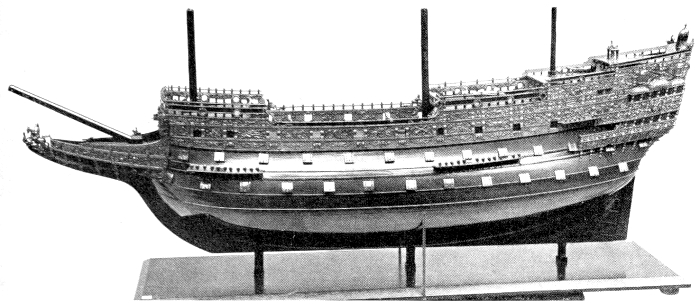
THE “SOVEREIGN OF THE SEAS.”
From the Model in the Royal Naval College Museum, Greenwich.
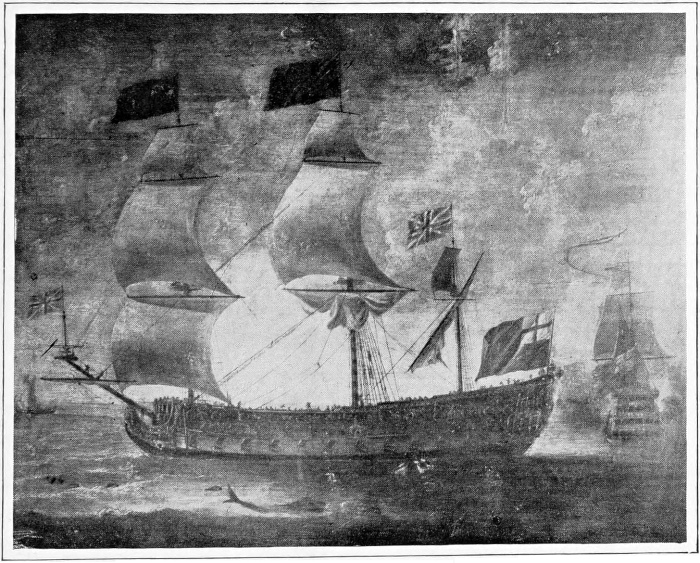
THE “PRINCE ROYAL.”
Designed by Phineas Pett.
By permission of the Elder Brethren of Trinity House.
Good sea fighters as the English had proved themselves to
be, they yet were behind the Dutch and French as naval
architects. Sir Walter Raleigh, an outspoken critic of the
King’s ships and of English merchant vessels, comparing the
latter with those of the Dutch, nevertheless admitted that
some progress had been made in English shipping. “In my
own time,” he writes, “the shape of our English ships hath
been greatly bettered. It is not long since the striking of the
topmast hath been devised. Together with the chain pump,
we have lately added the Bonnet and Drabler.... To the
courses we have devised studding sails, top-gallant sails, spritsails
and topsails. The weighing of anchors by the capstan
is also new. We have fallen into consideration of the length
of cables, and by it we resist the malice of the greatest winds
that can blow. We have also raised our second decks.” The
last improvement was one of the most important, for the space
between the decks was cramped, and the lower deck was not
much above the water level. The raising of the decks gave the
ships more freeboard and increased their seaworthiness, rendered
the lower tier of guns more effective by enabling them to be
used with less danger from water entering the ports, and
gave the men working the guns on the lower tier more
head room.
A list of the ships of King Charles, dated 1633, is of more
than usual interest, says Derrick, “this being the earliest list
of the Navy I have met with, wherein any part of the ships’
principal dimensions are inserted.... This is the first list
in which any nice regard seems to have been paid to the tonnage
of the Ships. Previous to 1663, the tonnage of almost every
Ship seems to have been rather estimated than calculated,
being inserted in even numbers.”
A natural development of the Prince Royal was the Sovereign
of the Seas. These two vessels may be regarded as marking
the first and second stages in the final period of transition
from the old style of warship to the wooden walls. She was a
remarkable vessel in national as well as naval history, for she
played not a small part in the agitation over the question of
ship-money, which had such a tremendous influence on the
nation’s development.
“This famous vessel,” Heywood states in his publication
addressed to the King, “was built at Woolwich in 1637. She
was in length by the keel 128 feet or thereabout, within some
few inches; her main breadth 48 feet; in length, from the
fore end of the beak-head to the after end of the stern, a prora
ad puppim, 232 feet; and in height, from the bottom of her keel
to the top of her lanthorn, 76 feet; bore five lanthorns, the
biggest of which would hold ten persons upright; had three
flush decks, a forecastle, half-deck, quarter deck, and round
house. Her lower tier had thirty ports for cannon and demi-cannon,
middle tier thirty for culverines and demi-culverines,
third tier twenty-six for other ordnance, forecastle twelve,
and two half-decks have thirteen or fourteen ports more within
board, for murdering pieces, besides ten pieces of chace-ordnance
forward and ten right aft, and many loop-holes in the cabin
for musquet-shot. She had eleven anchors, one of 4,400 pounds
weight. She was of the burthen of 1,637 tons.... She
hath two galleries besides, and all of most curious carved work,
and all the sides of the ship carved with trophies of artillery
and types of honour, as well belonging to sea as land, with
symbols appertaining to navigation; also their two sacred
majesties’ badges of honour; arms with several angels holding
their letters in compartments, all which works are gilded over
and no other colour but gold or black. One tree, or oak, made
four of the principal beams, which was 44 feet, of strong serviceable
timber, in length, 3 feet diameter at the top and
10 feet at the stub or bottom.
“Upon the stem head a Cupid, or Child bridling a Lion;
upon the bulkhead, right forward, stand six statues, in sundry
postures; these figures represent Concilium, Cura, Conamen,
Vis, Virtus, Victoria. Upon the hamers of the water are four
figures, Jupiter, Mars, Neptune, Eolus; on the stern, Victory,
in the midst of a frontispiece; upon the beak-head sitteth
King Edgar on horseback, trampling on seven kings.”
The Sovereign of the Seas was the largest vessel yet built in
England, and though she was intended as much for show as
use, she became, when she was reduced a deck and a lot of this
ornamental flummery was removed, one of the best fighting
ships in the navy, and was in nearly all the chief engagements
in the war with Holland, and proved herself a very serious
opponent, as the navy records show.
It was about this time that ships were first rated or classified
according to their size and efficiency as fighting units. About
this time also, a new type of vessel, the frigate, was introduced
into the navy. The frigate is not a British invention, but, so
far as this country is concerned, was copied from the French by
Peter Pett, son of Phineas Pett, who saw one in the Thames. He
built, in 1649, the Constant Warwick to the order of the Earl
of Warwick, who intended her for a privateer, but sold her.
According to Pepys, the Dutch and French, in 1663 and 1664,
built two-decked ships with sixty to seventy guns, and lower
decks four feet above the water. The English frigates were
narrower and sharper, and their lower gun ports were little
more than three feet above the sea. It was therefore decided
that the English ships should have their gun ports about four
and a half feet from the water. The French and Dutch three-deckers
were usually about 44 feet in the beam, as compared
with the 41 feet of some of the English third rates, and the
Henry, built in 1656, and the Katherine, in 1674, to mention
only two of many, were useless until they were girdled, and
after 1673 the three-decked second raters were ordered to be
45 feet in the beam.
In the seventeenth century the Royal Louis was built at
Toulon, carrying 48-pounders on its lower deck, 24-pounders
on the middle deck, and 12-pounders on the upper deck. The
French, indeed, were taking the lead in naval construction at
this period, and their superiority was recognised by the English
who captured and imitated them whenever possible. Thus
the Leviathan, built at Chatham, was a copy of the Courageux
of seventy-four guns, and the Invincible, captured by Lord Anson
during the Seven Years War, served as model for many more.
During a French visit to Spithead in 1673, the Superbe,
seventy-four guns, attracted special attention. She was 40 feet
broad and had her lowest tier of guns higher from the water
than the English frigates. Accordingly the Harwich was built by
Sir Henry Deane as a copy, and gave such satisfaction that
she was adopted as a pattern for second and third rates. Besides
the six rates of fighting ships, other classes were included in
the navy list, these being, in Charles II.’s reign, thirteen sloops,
one dogger, three fireships, one galley, two ketches, five smacks,
fourteen yachts, four hoys, and eight hulks.
The dimensions determined upon in 1677 for ships of one
hundred, ninety and seventy guns were sometimes exceeded;
and in 1691 another set of dimensions, for ships of sixty
and eighty guns, was established. In the following year an
appropriation for “bomb vessels” was sanctioned; and
about 1694, a revival of the fireships was tried. These
vessels were called internals, possibly on account of their
contents, which included “loaded pistols, carcasses (filled
with grenadoes), chain shot, etc., and all manner of combustibles.”
Their revival, or invention in this form, is
attributed to an engineer named Meesters, who directed the
operations against Dunkirk, without achieving any success
with them.
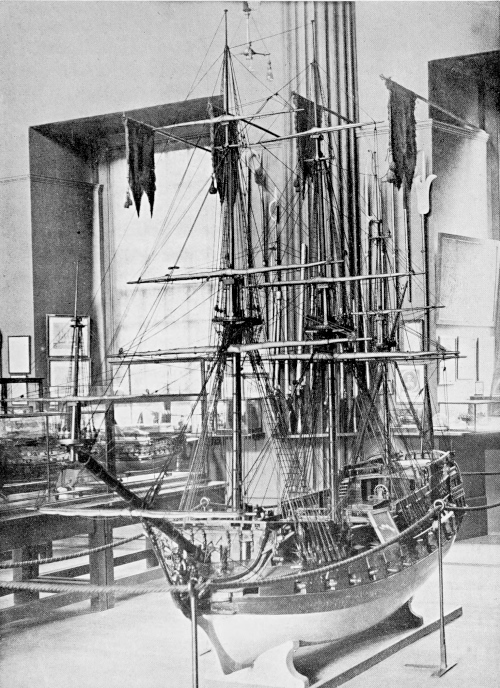
LINE OF BATTLESHIP, 1650.
From a Model in the Museum of the Royal United Service Institution.
Prior to the battle of La Hogue, in 1692, five advice boats
appear in the navy list for the first time; they carried from
forty to fifty men each and were deputed to acquire information
of the enemy’s movements at Brest.
Complaints were made in 1744-5 that the British vessels
compared unfavourably with those of other nations in scantlings,
seaworthiness, and armament. This induced the adoption of
another set of rules, and the ships built according to them
proved to be good sea boats, carrying their guns well, and
standing up stiffly under sail, but they had the objection of
being too full in the after part of their under body, which
retarded their speed somewhat. After ten years’ trial this
establishment was modified, the faults complained of were
remedied, and the ships were increased in size, and from this
time onward fifty-gun ships were seldom classed as ships of
the line of battle. There has been some misconception in
regard to the frigates of the period, as many small vessels
carrying eighteen guns, or less, were so called, but were
afterwards included among the sloops.
The real frigate was a vessel constructed to cruise in all
weathers, and able to show a good turn of speed; she had an
armament which was fairly heavy for her size, and it was
carried on one deck, with the exception of a few guns which
might be disposed about the poop or forecastle. For over
two hundred years vessels of this type were held in the highest
esteem, until, indeed, they were superseded, in common with
all other sailing warships, when steam was adopted. The
career of the steam frigate was brought to an early close by
the adoption of the ironclad.
The frigate itself underwent considerable development
during its two centuries’ career. The earlier frigates carried
twenty-four or twenty-eight 9-pounders, and a crew of about
one hundred and sixty men; these vessels were about 500 tons
burthen, or a little more, with a gundeck length of 113 feet and a
length of 93 feet on the keel. Their rig marked a curious transition
stage from the Mediterranean influence to that of the modern
square rig, as, although they carried square sails on the fore
and main masts, lateens were still carried on the mizen. The
frigate of thirty-two 12-pounders appeared shortly afterwards,
the first of this size being the Adventure, launched in 1741; and
six years later the Pallas and Brilliant, thirty-six-gun frigates,
were added to the navy; but, while admittedly excellent
fighting cruisers, they were inferior to the French thirty-six-gun
frigates built about that time.[22] The frigates played a
most important part in the world’s naval history of the latter
part of the eighteenth century and the early years of the
nineteenth century.
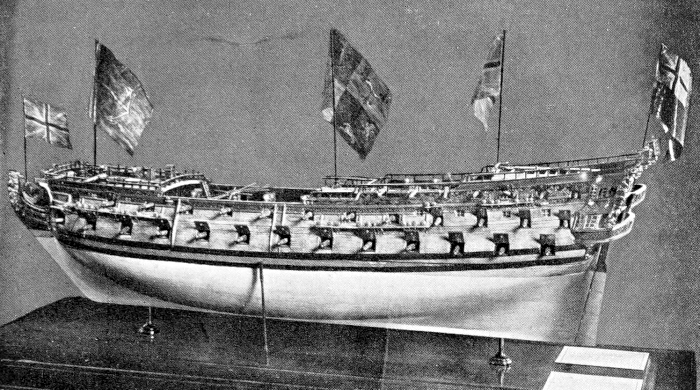
THE “DREADNOUGHT,” 1748.
From a Model in the Museum of the Royal United Service Institution.
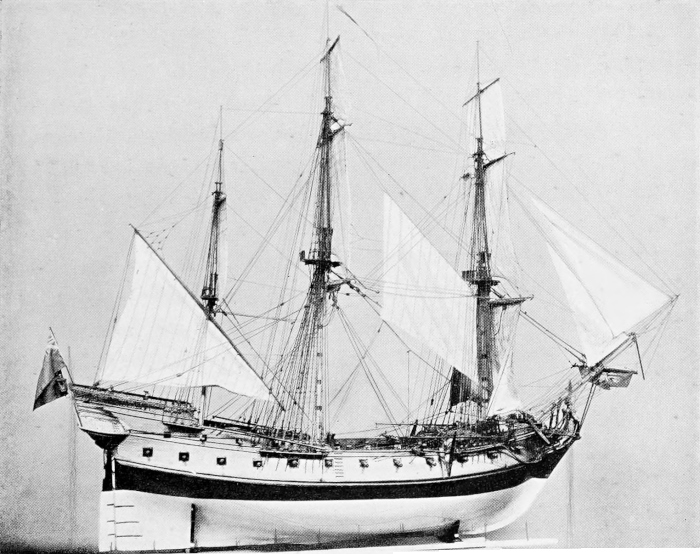
THE “JUNO,” 1757.
From the Model in the Victoria and Albert Museum.
Tougher antagonists than the French frigates, however,
were the seven frigates the Americans built when matters
became strained between the United States and this country;
they were the United States, Constitution, President, Constellation,
Congress, Chesapeake, and Essex. The first-named was the
largest, with a tonnage of 1,576, and the smallest the Essex,
860 tons. The American navy consisted only of about a dozen
vessels altogether on which reliance could be placed, but these
were among the best of their kind afloat; there were a few
others of little or no fighting value. The frigates carried
batteries of carronades supplemented by long guns, 12-pounders.
It was the custom to give the American ships more guns than
they rated. Thus the forty-four-gun frigate had thirty long
24-pounders on the main deck, two long bow chasers on the
forecastle, and twenty or twenty-two 32-pounder carronades,
as in the Constitution, while the carronades of the President
and United States were 42-pounders. The armament of the
Constellation, Congress, and Chesapeake was twenty-eight long
18-pounders on the main deck, two similar guns on the forecastle,
and eighteen 32-pounder carronades. The “ship-sloops,” of
which the greater part of the rest of the American naval force
consisted, carried 32-pounder carronades, and long 12-pounders
for bow chasers. The “brig-sloops” were equipped with
carronades. The Americans claim to have been the first to
employ the heavy frigate effectively, notwithstanding that the
cannon balls their guns fired were of less weight in some instances
than the projectiles discharged from the corresponding weapons
in the British or French navies, and the shot would also appear
to have been really lighter than they were supposed to be by
as much as two to ten per cent. These frigates were remarkable
for the series of duels they fought with British warships,
winning six in succession, by superior seamanship and better
sailing qualities, to some extent, but mostly by superior
gunnery, until the final duel was won by the Shannon in
her memorable encounter with the Chesapeake. The series
of American victories was inaugurated by the Constitution,
otherwise “Old Ironsides,” the British victim being the
Guerrière.
In considering the development of the warships of other
types, it is necessary to go back a few years. The British
dockyards were unequal to the demands upon them for the
wars of the latter part of the eighteenth century, and a greater
number of warships than ever before was built by contract
at privately owned yards.
It is interesting to note that one firm of shipbuilders which
built ships for the navy in those days and even a century
earlier, on Thames side, is still in existence, and in spite of
limited liability company laws and the introduction of new
partners, is still known as Green’s yard, at Blackwall, and is
still managed by bearers of the name.
Twenty-six sail of the line and eighty-two smaller vessels
were launched from private yards during the war ending in
1762, and twenty-four sail of the line and twelve smaller ships
were launched at the King’s yards between the declaration of
war in 1756 and the proclamation of peace seven years later.
This is of importance as showing the resources of the country
even at that time in warship building, and the assistance the
government was glad to receive from the private builders at
times of emergency.
During this war it was decided that no more eighty-gun
three-deckers or seventy-gun or sixty-gun ships should be
built. In place of the first-named, ships of seventy-four and
sixty-four guns were ordained, and fifty-gun ships with a
roundhouse were ordered to replace the latter. The first
seventy-fours and sixty-fours were too small for the weight of
the guns they had to carry, and their successors of that class
were larger. No eighty-gun ship with three decks was built
after 1757, and no seventy-gun ship after 1759. The Cæsar
was the first English eighty-gun ship with two decks; she was
built in 1793.
Towards the end of 1778 many of the second rates were
given eight additional guns on the quarter deck, which
virtually raised them to ninety-eight-gun ships. An important
constructional improvement in 1783 was the adoption of copper
fastenings in all classes of ships below the water-line; iron
bolts had been found to corrode under the influence of the
salt water.
Ships continued to increase in size and power of armament.
The Ville de Paris, of one hundred and ten guns and 2,332 tons,
and her sister ship, the Hibernia, ordered in 1790, were the
first of their class. Before the latter was finished she was
lengthened and her tonnage raised to 2,508 tons. Another
new class, introduced about that time, comprised three ships
of 776 tons each, carrying thirty-two guns, the main deck
armament consisting of 18-pounders; they did so well that
several others were added.
About 1783 a greater length in proportion to beam was
adopted, which made the ships faster sailers and better sea-boats,
and several vessels of the higher classes were altered,
and many others had their bottoms specially thickened to
withstand stranding. The 42-pounder guns of the largest
ships were found difficult to handle and of less rapidity of fire
than the 32-pounders, and were removed from the main deck
battery of the Royal Sovereign and other ships in favour of
the 32-pounders.
The Commerce de Marseilles, of 120 guns, was one of the
French vessels which accompanied under compulsion the
combined English and Spanish squadron from Toulon in 1793.
She was considered to be the largest ship in the world. Her gun-deck
was 208 feet 4 inches in length, and her keel for tonnage
172 feet 0⅛ inch. Her depth of hold was 25 feet 0½ inch, and
her extreme breadth 54 feet 9½ inches, her tonnage being
2,747 tons. She was not a very valuable acquisition, however,
for her timbers were in such a state that she was not worth
repairing; she was accordingly taken to pieces in 1802. Probably,
like many more vessels built in those strenuous times,
she was constructed of unseasoned timber, or had a quantity of
immature or soft wood put into her in order that she might
be got ready for war as quickly as possible, for warships were
wanted in such a hurry that it was more necessary that they
should be available for use at the earliest opportunity than
that they should be expected to last for very long. Both the
British and French fleets had a number of these “green”
ships.
If the French could have a vessel of such gun power and
dimensions there was no reason why the English should not,
so the Caledonia, of 2,602 tons, was ordered in 1794, and was
to be the largest and most powerful yet built in England. Her
main deck guns were to be 32-pounders, because of the greater
ease with which they could be handled. On her lower deck
she had thirty-two of these guns, on the middle deck thirty-four
24-pounders, on the main deck thirty-four 18-pounders,
on the quarter deck sixteen 12-pounders, and on the forecastle
four 12-pounders. Her officers and crew numbered eight hundred
and seventy-five. Her length was 205 feet, breadth 54 feet 6 inches,
and depth of hold 23 feet 1 inch. She was the favourite ship of
Lord Exmouth. At first she had a square stern, but when the
rounded sterns were shown to be better in every way she was
altered to the new mode, and her armament was revised. She
afterwards became the hospital ship at Greenwich under the
name of the Dreadnought. The model of her at South Kensington
shows that her rigging was probably unique. Her
royal masts were fidded, that is, built above the topgallant
masts instead of forming one long pole with them, as is the
custom, and there were also peculiarities in the arrangement
of some of her running rigging. This ship was launched at
Devonport in 1808.
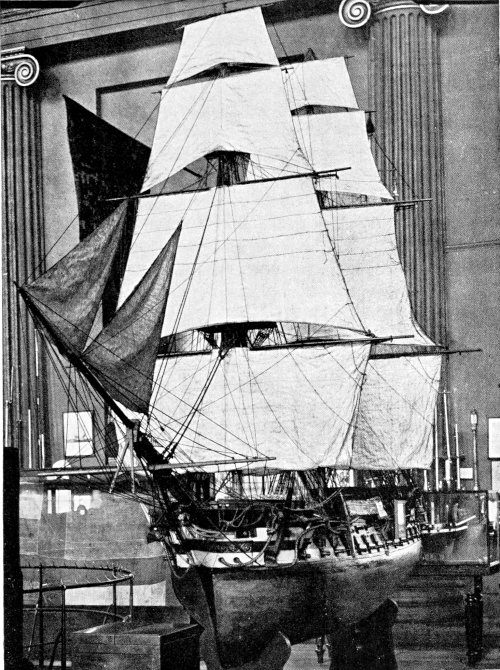
THE “CORNWALLIS,” 1812.
From a Model in the Museum of the Royal United Service Institution.
The defeat of the Danes at Copenhagen, the battle of the
Nile, the “glorious first of June,” the battle of Trafalgar, the
duels of the American War, and the battle of Navarino, united
to give a splendid termination to the career of the wooden
warship as a fighting unit. That of Trafalgar was the last in
which great fleets of the best “wooden walls” that human
skill could devise opposed each other in manœuvre and counter-manœuvre.
That of Navarino, fought in a bay, almost in a
dead calm, with the ships hardly moving and some even at
anchor, was the last conflict in the world’s history in which
the wooden battleships of the East and the West lay alongside
each other and blazed away with every available
weapon at a range so close at times that they could not
possibly miss.
Constructionally, wooden battleships had about attained
the limit of size. Already they revealed unmistakable signs
of longitudinal weakness, and it had been a problem, which
the builders up to that time had been unable to solve, how to
stiffen the hulls so that they would withstand the hogging
and sagging strains. It was not until Sir Robert Seppings
introduced his system of ship construction that the difficulty
was overcome, but the increase in the deadweight of the ship
was great. Still, had it not been for his system it would have
been impossible to construct some of the later vessels which
left the ways before steam was introduced and iron was adopted
for ship construction. Very few vessels were built larger than
those which fought in Trafalgar Bay, though several were
designed. The improvements made were rather in the form of
the underbody in order to increase the speed and sea-going
qualities of the ships. One of the largest old-style battleships
ever proposed was the Duke of Kent, which was to have been a
four-decker carrying one hundred and seventy guns, and having
a tonnage of 3,700. She was to have been given a length of
221 feet 6 inches on the gun-deck, an extreme breadth of
64 feet, and a depth of hold of 26 feet. On the lower deck
she was to have had thirty-six 32-pounders, and a similar
complement on the lower middle deck; thirty-six 24-pounders
on the middle deck; thirty-eight 18-pounders on the upper
deck; ten 12-pounders and six 32-pounder carronades on the
quarter-deck; and four 12-pounders and four 32-pounder
carronades on the forecastle. Though she never progressed
beyond the paper stage, these particulars are interesting as
showing what the naval architects of a hundred years ago
were prepared to design.
The Queen of one hundred and ten guns, the first three-decker
launched after Queen Victoria’s accession, the Vernon
of fifty guns, and Pique of forty guns, and others of various
classes were designed by Sir W. Symonds, who, during his
fifteen years’ surveyorship to the Admiralty, was responsible
for no fewer than one hundred and eighty vessels. The finer
lines he gave them increased their speed, and they were broader,
loftier, and roomier between decks than their predecessors,
and were better ships all round. They may be regarded as
embodying the highest degree of excellence to which the sailing
wooden warship attained.
Reference has been made to the guns used on shipboard
at various times, and to the establishment of dimensions or
rates to be observed in building the ships employed in the
British Navy. The guns about to be described were used in
all navies; the establishments referred to are peculiar to the
British Navy, though the vessels themselves differed but little
from those belonging to other nations. It must also be remembered
that though the names of the guns were retained through
century after century, very little is known of the earliest
weapons, and that their names came to be applied to guns
which had little in common.
The establishments, as they were called, were adopted to
secure uniformity in types, and it is well to bear these details
in mind, or at least to refer to them, in studying the history of
the achievements of the British Navy in order that an approximately
correct idea may be obtained of the ships and weapons
used by and against Great Britain which have had so great
an influence on the world’s history.
The principal establishments were ordered in 1677, 1691,
1706, 1719, and 1745, and certain proposals were also made in
1733 and 1741, which were not of quite so far-reaching a
character as the others. The establishment of 1745 was not
adhered to for many years, and there has been no cut-and-dried
establishment since, the requirements of modern warfare
and the inventiveness of all nations having militated against
adherence to a rigid standard. Ships of one hundred guns were
in length on the gun-deck in 1677, 165 feet; in 1719, 174 feet;
in 1745, 178 feet; their extreme breadth was 46 feet in 1677,
and 51 feet in 1745, and the burthen increased from 1,550 tons
in the first-named year, to 2,000 in the last. The ships of
ninety guns had lengths on the gun-deck of 158 feet, 164 feet,
and 170 feet in the three years respectively; their extreme
breadth was 44 feet, 47 feet 2 inches, and 48 feet 6 inches, and
their tonnage 1,307, 1,569, and 1,730 tons. The three-deckers of
eighty guns first appear in the 1691 establishment; they were
156 feet on the gun-deck, 158 feet in 1719, and 165 feet in
1745; their extreme breadths at the three dates were 41 feet,
44 feet 6 inches, and 47 feet, and their burthens 1,100, 1,350,
and 1,585 tons. Seventy-gun ships increased from 150 feet
in length in 1677, to 160 feet in 1745, their breadth from
39 feet 8 inches to 45 feet, and their burthens from 1,013 tons
to 1,414 tons. Ships of sixty guns were 144 feet in length in
1691, and 150 feet in 1745, with respective breadths of 37 feet
6 inches, and 42 feet 8 inches, and tonnages of 900 and 1,191 tons.
Fifty-gun ships appear in the ratings of 1706 with a length
of 130 feet, and in 1745 of 144 feet; then-respective breadths
being 38 feet and 41 feet, and tonnages 704 and 1,052 tons.
In the same year also, 40-gun ships are recorded with a length
of 118 feet, an extreme breadth of 32 feet, and a tonnage of
531 tons; these dimensions had risen in 1745 to 133 feet,
37 feet 6 inches, and 814 tons. Ships of twenty guns were rated
in 1719 with a length of 106 feet, breadth 28 feet 4 inches, and
tonnage 374; increased by 1745 to 113 feet, 32 feet, and
508 tons.
In regard to their complements, a 100-gun ship in 1677
carried seven hundred and eighty men; in 1733, eight hundred
and fifty; and in 1805, eight hundred and thirty-seven men.
Ships of ninety and ninety-eight guns had, in 1677, six hundred
and sixty men; in 1706, six hundred and eighty men; in
1733, seven hundred and fifty men; and in 1805, seven hundred
and thirty-eight men. An 80-gun ship carried in 1692, four
hundred and ninety men; in 1706, five hundred and twenty;
in 1733, six hundred; in 1745, six hundred and fifty; and in
1805, seven hundred and nineteen men. A 74-gun large class
ship had in 1762, six hundred and fifty men; and in 1805,
ten less; a 74-gun common class ship had, in 1745, six hundred
men; in 1762, six hundred and fifty men; in 1783, six hundred;
and in 1805, five hundred and ninety men. A 70-gun ship
had in 1677, four hundred and sixty men; in 1706, four hundred
and forty; in 1733, four hundred and eighty; and in 1745,
five hundred and twenty men. A 64-gun ship in 1745 had
four hundred and seventy men; in 1762, five hundred; and in
1805, four hundred and ninety-one men. A 60-gun ship had
in 1692, three hundred and fifty-five men; in 1706, three
hundred and sixty-five men; in 1733, four hundred; and in
1745, four hundred and twenty. A 50-gun ship had in 1706,
two hundred and eighty men; in 1733, three hundred; in
1745, three hundred and fifty; and in 1805, three hundred
and forty-three. A 44-gun ship carried in 1733, two hundred
and fifty men; in 1745, two hundred and eighty; in 1783,
three hundred men; and in 1805, two hundred and ninety-four
men.
Very little indeed is known of the earliest types of firearms
carried afloat. The crudeness of the methods of manufacture,
and the absence of any standard for pattern or size, left the
makers free to produce whatever weapons they fancied. The
Christopher of the Tower, in June, 1338, is said to have had
three iron cannon with five iron chambers. The guns were
breechloaders, and the chambers contained the charge and
perhaps the projectile. She also had a hand-gun, which,
though fired from the shoulder, had the barrel supported by
a rest standing on the deck, after the manner of the hand-guns
in use ashore. The Mary of the Tower was equipped with an
iron cannon provided with two chambers, and a brass gun
with one chamber. None of the weapons yet discovered show
how the chambers were fastened in the guns of this period.
It is known that they fitted loosely and that the chambers
could be fired, if necessary, without the guns.
The early naval guns were called “crakys of war.”[23] They included
cannon-paviors, or guns which threw round stone shot, and
appropriately named murtherers, which were smaller weapons
and were loaded with anything that could be fired out again.
An inventory of the Great Barke as “vyeuwyd” in the
twenty-third year of King Henry VIII., is preserved in the
Cotton Library at the British Museum. The following are
extracts:—
“Hereafter followeth the ordinances pertayning to the
sayde shype, item, in primis, two brazyn pecys called kannon
pecys on stockyes which wayith The one 9 c. 3 q. 11 lb., the
other 10 c. 1 q. 17 lb., whole weight 20 c. 28 lb.: Item 2 payer
of shod wheeles nyeu: item two ladyng ladells.
“Starboard side. Item oon port pece of yeron cast with
2 chambers: item a port pece of yeron, with one chamber.
Item a spruyche slyng with one chamber.
“Larboard side. Item oon port pece with 2 chambers:
Item another port pece, with oon chamber, whyche chamber
was not made for the sayd pece.
“In the forecastell. Item a small slyng with 2 chambers.
Item another pece of yeron with two chambers, the oon broken.”
Even in Queen Elizabeth’s day much of the artillery had
to be imported from Germany. It was not until about 1531
that iron guns were first cast in England, and brass guns were
cast three or four years later. Guns were made of greater weight
and bore when it was discovered how to cast them instead of
building them, and muzzle-loaders gradually superseded the
old breechloaders. The change, however, was slow, and
was probably retarded by the reluctance of those ship owners
who had breechloaders to discard them while they could yet
be fired, a reluctance which no doubt extended, owing to the
paucity of weapons, to the rulers of the various states.
The guns of the sixteenth century were extraordinarily
varied. The largest was the cannon-royal of rather more than
8½ inches diameter,[24] 8 feet 6 inches in length, and weighing
about 8,000 lb.; its charge of powder was about 30 lb., and
its shot weighed 74 lb. The cannon was 8 inches diameter,
weighed about 6,000 lb., and with a charge of 27 lb. threw a
shot of 60 to 63 lb. The cannon-serpentine was of 7 inches
diameter, weighed 5,500 lb., and with a charge of 25 lb.
threw a shot of 42 lb. The bastard-cannon was of about the
same length as the cannon-serpentine, but a lighter weapon,
and though the charge of powder was 5 lb. less, the weight of
the shot was the same. The demi-cannon varied from a little
under 6½ inches diameter to 6¾ inches, and was about 11 feet
in length and weighed about 4,000 lb., and with a charge of
18 lb., threw a projectile weighing from 31 to 33½ lb. The
bore of the cannon-pedro, or petro, was 6 inches, its weight
about 3,800 lb., its shot, usually of stone, whence its name,
from 24 to 26 lb. The diameter of the culverin was from
5¼ inches to 5½ inches, its length was close upon 11 feet, its
weight 4,840 lb., it received a 12 lb. charge, and fired an
18 lb. shot. The basilisk was slightly shorter and lighter, and
its 14 lb. shot required 9 lb. of powder. The diameter of the
demi-culverin was 4 inches, its weight 3,400 lb., its charge
was 6 lb., and its shot 8 to 9½ lb. The culverin-bastard
seems to have been of half an inch larger bore, about 8½ feet
long, but to have been 400 lb. lighter than the demi-culverin,
and to have fired an 11 lb. shot with a charge of 5¾ lb. The
saker, or sacar, was a far smaller weapon, being less than
3¾ inches diameter, under 7 feet in length, and weighing about
1,400 lb.; its charge was 4 lb., and its shot 4 to 6 lb. The
minion, slightly smaller in all respects, threw a 3 lb. to 4 lb.
shot. The falcon was of 2½ inches diameter, 6 feet long,
weighed 680 lb., and fired a 2 lb. shot with a charge of a little
over 1 lb. of powder. The falconet was a smaller edition of
the falcon. The serpentine was of 1½ inches diameter, weighed
400 lb., and fired a ½-lb. shot; and the rabinet, or robinet,
was an even lighter weapon.
For loading, canvas or paper cartridges were used, but an
iron ladle for the powder was preferred. The following list
of commands in the gun-drill contrasts oddly with what would
pass in the turret of, say, a modern super-Dreadnought:—
“Search your piece; sponge your piece; fill your ladle;
put in your powder; empty your ladle; put up your powder;
thrust home your wad; regard your shot; put home your
shot gently; thrust home your last wad with three strokes;
gauge your piece.”
Some curious guns were invented when the ordnance
industry was in its infancy. The Scots in a southern raid in
1640 used guns of leather at their passage of the Tyne—which
says more for the strength of the leather than of the powder.
A composite affair called the “kalter” gun, introduced in the
time of Gustavus Adolphus, of Sweden, is described:—
“A thin cylinder of beaten copper screwed into a brass
breech, whose chamber was strengthened by four bands of
iron, the tube itself being covered with layers of mastic, over
which cords were laid firmly round its whole length and
equalised by a layer of plaster, a coating of leather, boiled
and varnished completing the piece.”[25]
Another peculiar weapon was a twin gun, in shape something
like a stumpy tuning-fork, with parallel barrels and one
touch-hole; another was a gun which could be fired at either
end, the cavity in which the chambers were placed being in
the middle. It must have been an awkward piece to handle.
Hand grenades, used sometimes preparatory to boarding,
were introduced in 1689 during William III.’s reorganisation of
the artillery.
Even when the ships were provided with guns, opinion was
by no means unanimous as to the extent to which the weapons
should be employed, or the range at which they would be
most effective. The method in vogue on the Atlantic was
to shoot as soon as it was thought the enemy could be seriously
damaged. A gentleman named Gibson, who reported on the
condition of the British Navy in 1585-1603, is quoted by
Charnock as saying:—
“Be sure it is your enemy before you shoot, and that you
are in halfe gunnshott of your ennemy before you shoot. It
is direct cowardice to shoot at greater distance, unless he is
running away. British gunns being for the most part shorter,
are made to carry a bigger shot than a French gun of like
weight, therefore the French gunns reach further, and those of
Britain make a bigger hole. By this the French have the
advantage to fight at a distance, and we yard-arm to yard-arm.
The like advantage we have of them in shipping (although they
are broader and carry a better saile) our sides are thicker and
the better able to resist their shott. By this they are more
subject to bee sunk by gunnshott than wee are.”
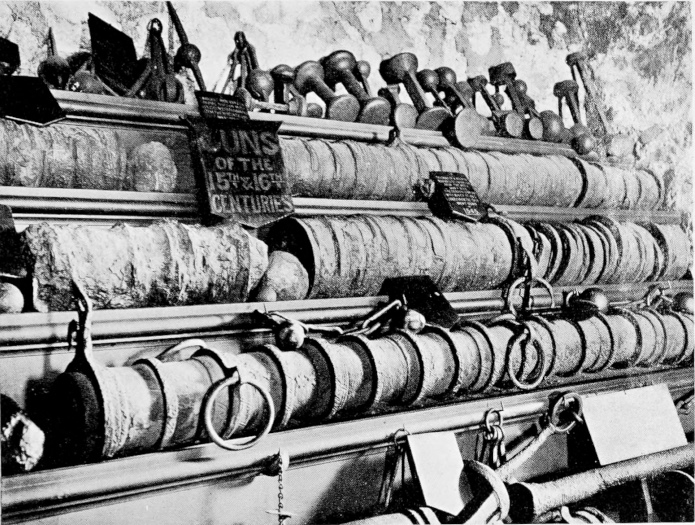
GUNS OF THE FIFTEENTH AND SIXTEENTH CENTURIES.
In the Tower of London.
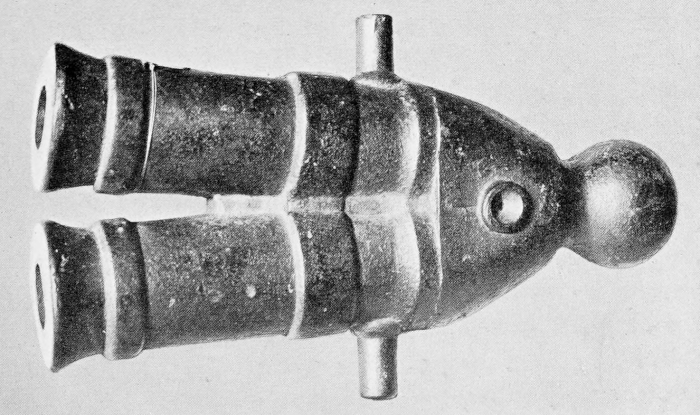
ANCIENT DOUBLE GUN.
In the Museum of the Royal United Service Institution.
The Mediterranean custom was different. The Marquis of
Villafranca, whose advice was sought by Don John of Austria,
thought there should not be more than two discharges before
the galleys close, that the arquebussiers should not fire the
second time until the blood of the man hit should splash back
in their faces, and that the noise of the discharge should
coincide with the ramming of the hostile vessel. But all the
guns employed in the Mediterranean sea-fights were not of
this order. In the tremendous struggle between the Cross
and the Crescent much heavier artillery was used. One siege
gun is said to have thrown a shot of 160 lb. During this
struggle the Knights of Malta, after the capture of St. Elmo
by the Turks, when the latter dishonoured the bodies of the
slain knights, retaliated by beheading their Turkish prisoners
and firing the heads back into the camp of the besieging Turks.
The Knights combined unswerving fidelity to their principles
and their masters, when they acknowledged any, with the
utmost bravery, ferocity, and cruelty. There was little to
choose between the leaders on either side, but the palm must
be given to the Mohammedan leaders for their fertility of
resource in extricating themselves from apparently hopeless
situations. The chief of these were the brothers Barbaroussa,
one of whom made himself King of Algiers, and they and others
of the band were the greatest of the Barbary pirates, dreaded
from one end of the Mediterranean to the other. The elder
Barbaroussa and his worthy successor, Dragut Reis, became
the chief admirals of the Turkish forces, the latter being killed
in that terrible struggle at Malta in which St. Elmo fell, a
fate which was only averted from the whole fortress by the
remarkable genius of the greatest commander the knights
ever possessed. By way of commemorating the services of
the brothers Barbaroussa, the present Turkish government
has named after them the two second-hand German warships
it recently bought.
In the latter part of the seventeenth century the cannon
were probably 42-pounders, the demi-cannon 32-pounders,
and the culverins 18-pounders. Before an effort was made to
systematise the armament of ships, hardly any two vessels
carried the same number of guns. It was proposed in 1677
that a first-rate should carry twenty-six cannon with eight
men to each; twenty-eight culverins, with five men to each;
twenty-eight sakers on the upper deck, four on the forecastle,
and twelve on the quarter deck, with three men to each saker;
and two 3-pounders with two men each. A second-rate should
carry twenty-six demi-cannon, with six men to each; twenty-six
culverins; twenty-six sakers on the upper deck and ten
on the quarter deck; and two 3-pounders, with the same
number of men to the guns as a first-rate. A third-rater should
carry twenty-six demi-cannon, twenty-six 12-pounders with four
men to each; four forecastle and ten quarter deck sakers, and
four 3-pounders. The remainder of the complements was to
consist of two hundred and ninety-six men, two hundred and
sixty-two men, and one hundred and sixty-two men for the
three rates respectively, giving grand totals of seven hundred
and eighty men, six hundred and sixty men, and four hundred
and seventy men.
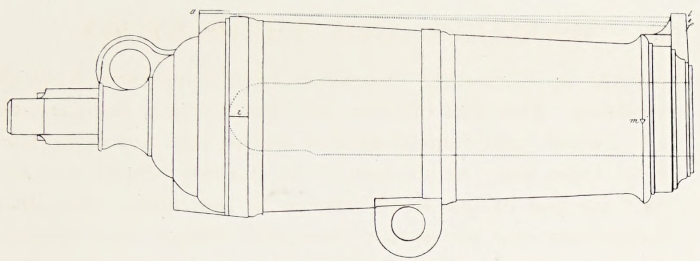
CARRONADE OF SIX DIAMETERS.
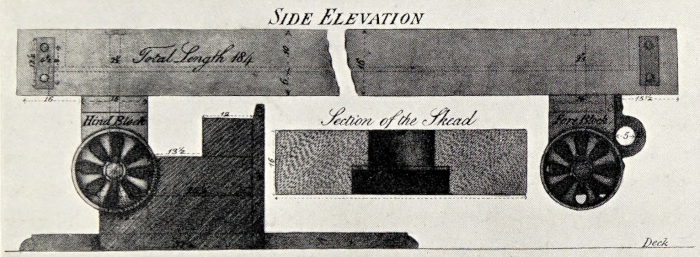
CARRONADE
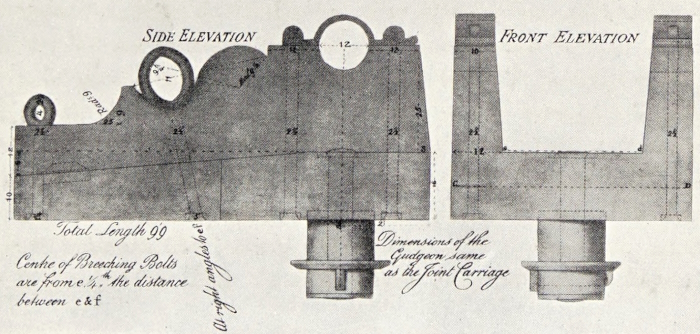
THE CARRONADE AND ITS CARRIAGE.
From Drawings supplied by the Carron Co.
About the beginning of the seventeenth century the practice
was introduced and has been retained ever since—with the
exception of the later guns, which are indicated by their weight
or the diameter of their calibre—of describing the guns by
the weight of their shot.
A remarkable advance in the science of gun-making was
shown when the carronade was introduced by the Carron
Company. Briefly, this weapon may be described as a short
heavy gun, carrying a heavy shot, and using a moderate charge
of powder. It was a wonderfully destructive weapon at short
range, and as a broadside gun held its own well into the middle
of the nineteenth century. A favourite carronade was that
of six diameters, one of which is here illustrated; that is, the
length of the bore was six times the diameter of the calibre
at the gun’s mouth.
These guns were made in two or three patterns. One was
the familiar swivel, another had the trunnions below the gun
centre so that the gun rested upon them, and the third and
most common was that with the trunnions at the sides. The
carriages, too, were exceedingly ingenious, being devised to
permit of meeting the recoil as well as adding to the facility
of handling the weapon, and the sighting arrangements did
not leave the gunner much opportunity of going wrong provided
he obeyed the instructions.
It was customary to fire a round, solid iron shot from these
guns. On one occasion a very different missile was employed.
An armed merchantman was overtaken by a privateer, and
being short of cannon balls, the cargo was broached. The
first missile hit the side of the privateer and smashed. The
second hit a mast, dented it, and flew to pieces. Another
missile smashed itself and a privateersman’s head at the same
time, and the enemy then hauled off, wondering what new
projectile had now been discovered. The merchant ship had
defended itself with round Dutch cheeses—a testimony alike
to the ingenuity of her commander and the strength of the
missiles.
The East India Company had several vessels built in the
Far East, and great was the outcry at the proposal that Indian-built
ships should be included in the British Navy. However,
the success which attended the armed ships of the Company,
such, for instance as the Grappler, launched at Bombay, in
1804, was responsible for the launch of a “beautiful frigate”
at Bombay, called The Pitt, the first ever built in India for
His Majesty’s service.[26] A picture of her is in the Guildhall
Museum, London.
The merchant vessels of the East in the seventeenth century
were usually built of teak and well armed, and if they were
not particularly fast sailers—some were particularly slow—they
were usually able to withstand the shot of all but the
heaviest guns which the pirates and privateers carried who
infested those seas. Some of the greatest French naval heroes
were men who were dreaded from one side of the Indian ocean
to the other.
One of the vessels constructed in those days and still afloat
is the sailing ship Success, which, after an eventful career,
was one of the “floating hells” in which convicts were
imprisoned near Melbourne for some years, then became a
coal hulk, was somehow saved from destruction when her
equally evil companion ships were ordered to be broken up,
was turned into an exhibition ship showing her as a prison
ship, was scuttled in Sydney harbour, raised again, and has
since toured the world. She saw active service about a hundred
years ago, and still bears on her tough sides the marks of the
enemy’s cannon balls. She is probably the last of her type
afloat. The East Indiamen and the West Indiamen of the
seventeenth and eighteenth centuries invariably carried guns,
and needed them.
It is strange to think how recently the policing or safety
of the seas has been secured, for the Liverpool newspapers
contained, even in times of peace, advertisements that vessels
would sail with the convoy, and that such and such a warship
would act as escort.
Even along the British coasts the Carron Company armed
its schooners, and offered special inducements to those passengers
who were willing and able to assist the crew to repel a possible
attack.
CHAPTER IV
STEAM AND WARSHIPS
The use of the steam engine as a propellant had been established
in the mercantile marine long before the British
Admiralty led the way in the adoption of the steamship as
an engine of war. There were several reasons why the decision
to take the important step was not reached earlier. In the
first place there was a repugnance, amounting with many
persons to an unconquerable aversion, against the use of the
steamship for any purposes whatever. Steamships were
regarded as unsightly with their splashing paddle-wheels and
their high funnels belching forth smoke, and as the steam
mercantile marine had been by no means free from boiler
explosions and had lost many vessels through fires caused by
sparks or cinders from the furnaces, or the overheating of wood
work near the flues, it was argued that the introduction of
so many fresh dangers into the country’s fighting ships would
only add to the perils of the sea, which were already serious
and numerous enough.
The navy possessed many fine wooden ships which could
be handled extremely smartly under sail and presented a
magnificent contrast and beautiful picture compared with the
smoky steamer. The latter, it was graciously admitted, might
have its uses in towing the sailing warships, but that anything
further should be advocated was too subversive of all that
had gone before; too revolutionary, indeed, to merit a moment’s
consideration.
It was in vain that the advocates of the adoption of steam
propulsion urged that the steamship could carry guns, that
she would be independent of wind and tide, and that she could
choose her own position. These strategical advantages were
simply derided. What, it was asked in reply, could a small
steamship armed with such guns as she could carry, do against
a battleship; or, for that matter, what could any number
of armed steamships do? When it was pointed out that an
armed steamship could engage with every advantage an enemy’s
ship of the same size, the retort was that a battleship would
never be far off. Strange though these objections seem to us
in the light of subsequent events, it must be recollected that
marine steam engines in those days were bulky for their power
and weak for their weight, and consumed an enormous amount
of coal for the energy developed, and that there was no room
to spare in the fighting ships of the period; also, that the
steam engine was not far removed from the experimental stage.
For the first twenty-five years of the nineteenth century the
Admiralty had every excuse for the maintenance of its conservative
attitude.
In America, also, the objections to steam war vessels were
as acute as in this country. One United States secretary of
the navy declared that he would never consent to see the
beautiful sailing warships displaced by hideous and smoky
steamers, but the advocates of the new method of ship propulsion
were not of his opinion, and so worried the worthy
man that in despair he wrote to a sympathetic friend, “I am
steamed to death.” Another and earlier American administrator
was so opposed to warships of any kind, or at least
to spending much money on their construction, that he
conceived the brilliant idea of having some small gunboats
built which could be taken overland from port to port and
launched afresh, when necessary, to oppose the British warships.
It is a pity he could not have derived some inspiration from
the invention of Oliver Evans, an American, who in 1804-5
designed a dredger which bore the terrible name of Orakier
Amphibolos; it had a steam engine of some sort, and propelled
itself on wheels from the shed where it was built, to the
Schuylkill, a distance of a mile and a half, and being fitted
with a paddle wheel in the stern, navigated the river to its
junction with the Delaware.[27]
France, like England, was disposed at first to look upon
the steam engine as useless for naval purposes, and until well
towards the middle of the nineteenth century she was a long
way behind England in the application of steam power to the
navy. Many of the smaller nations, however, having but a
few insignificant sailing ships for war, were not trammelled,
as were England and France, by the possession of a large fleet
of wooden sailing vessels of types which had helped to build
up the national renown, nor had they to contend against the
energy of a powerful section of the community which, conscious
of what had been accomplished with the sailing warships,
despised anything else and hated innovations. The smaller
nations were the better able, therefore, to experiment with
warships of the new type than were the great maritime powers,
and one or two of them ordered small steamers carrying a
few small guns. These were mostly converted merchant
steamers, it not being until after England and France had
definitely adopted steamers that the other nations ventured to
possess steamships specially built for purposes of war.
But when steam navigation had become an accomplished
fact and steam-propelled vessels were able to undertake ocean
voyages, there was the less excuse for the absolute rejection
of steam-driven ships for war purposes. The objections raised,
and they were certainly serious, were that the paddle-boxes
were large and increased the size of the target at which the
enemy could aim, that one or other of the paddle-wheels could
easily be disabled by a hostile shot, in which case the steamer
would be almost helpless, and would be entirely so if both
wheels were disabled; that the engines and boilers, being
partly above the water-line, were peculiarly vulnerable, and
that the only vessels of a size capable of being propelled by
paddle engines were too small to be of much fighting value.
Long before steam engines were adopted in any form in
the navy, numerous experiments had been made in the
mechanical propulsion of warships, and some extraordinary
methods were brought forward. The remarkable feature of
nearly all these experiments is that they would propel a vessel;
but the inventors could not be taught, except by the bitter
lesson of experimental failure, that an appliance which might
attain a certain measure of success with a small boat or a model
might be incapable of developing sufficient power to propel
a larger vessel. Several inventors, both in this country and
America, tried what they could do with oscillating paddles
at the stern. Manual power was tried on the frigate Doncaster
at Gibraltar, in 1802, to drive a “perpetual sculling machine,”
invented by a man named Shorter, and a speed of something
under two miles an hour in still water was obtained.
Certain of the early experiments in America had an
important influence upon the development of the steam
warship, though the proof of that influence did not become
evident for many years.
Colonel John Stevens, who had a small, screw-propelled
steamboat on the Hudson, in 1804, and a twin-screw steamer
in the following year, designed, in 1813, an iron-clad ship
which fully embodied the Monitor type, and was the first
ironclad ever worked out for construction. It was Stevens
who sent the first steamer on a sea voyage; his vessel, the
Phœnix, being shut out of the waters of New York by the
monopoly which Fulton and his friends had secured, went
round to the Delaware by sea in June, 1809, experiencing a
gale on the way, which compelled her to seek shelter in Barnegat
Inlet.
Of Fulton’s early experiments and failures in the matter
of submarines and torpedoes it is unnecessary to speak. In
1814, some years after his return to the United States from
Europe, where he had been impartially offering his services to
the French and then the British, he submitted to the American
coast and harbour defence committee plans for a steam warship
which was to carry a large number of guns.
The boat was launched in October of that year and given
the pedantic name of Demologos, which was simplified to
Fulton the First. The war ended before the vessel could be
tested, and she became a receiving ship. Her machinery was
arranged to drive a large paddle-wheel, placed amidships and
working in a tunnel in the hull. She was to carry twenty
guns, not forty-four as sometimes stated, and furnaces for
red-hot shot, and was to travel at a rate of four miles an hour.
Besides her deck armament it was proposed that she should
have two submarine guns suspended from each bow, which
were to send a hundred-pound ball into an enemy’s hull ten or
twelve feet below the water-line. Her machinery was intended
to pump a tremendous column of water upon the enemy’s
decks and through the latter’s portholes. Her gun-deck was
completely covered over so that no hostile shot could reach it
from above. Her wooden walls were five feet in thickness, and
capable of withstanding the heaviest shot of the day. The
dimensions of this remarkable craft were: length, 156 feet;
beam, 56 feet; and depth, 20 feet; but her draught, loaded,
was only 10 feet. The water-wheel, the position of which
is indicated in the centre of the accompanying plan of the
gun-deck, was 16 feet in diameter, and had blades or buckets
measuring 14 feet with a dip of 4 feet. The cylinder of the
engine measured 48 inches, and the stroke was of 5 feet. The
boiler was 22 feet long by 12 feet beam, and 8 feet deep. The
gross tonnage of the vessel is set down at 2,475 tons. The ship
was two-masted, and could steam either end foremost. She
was built at Brown’s yard at New York, in four months after
her keel was laid, and given her machinery and guns at Fulton’s
works on the North River.
Another vessel, destined like the Demologos never to see
active service, but which, nevertheless, was the first iron-clad
steamer actually built, was the ship designed, in 1841, by
Edwin A. Stevens, a son of John Stevens, at the time that
hostilities were feared between England and the United States.
Mr. J. Elfreth Watkins, in an address before the Philosophical
Society of Washington, in 1892, said:—“As thick
armour plate could not be made at that date, he devised the
method of armour plating in laminæ, or plates laid over each
other and riveted. He then made a series of experiments
to determine the thickness of plating required to resist the
different sizes of balls then in use. From these experiments,
which were made at Bordentown, N.J., in the summer of 1841,
he made the deduction that a target of iron 4½ inches thick
would resist a 64 lb. shot, at that time the heaviest ball used
in our navy.”
This standard of thickness was afterwards adopted by
European naval architects for warship iron armour.
A committee of naval and military officers was appointed
which made numerous tests, and as a result Congress entered
into a contract with Stevens for the construction of “a war
steamer, shot and shell proof, to be built principally of iron,”
and making an appropriation for the purpose.
Up to this time there had been but little change in the
power of guns since the time of Nelson, but Commodore R. F.
Stockton’s successful construction in England of a wrought-iron
gun throwing a round shot able to pierce a target 4½ inches
thick, induced Robert Stevens, who was associated with Edwin
A. Stevens, to alter the plans and increase the thickness of the
armour so as to fulfil his contract to build a ship that should
be “shot and shell proof.”
The production of still more powerful guns, both in America
and Europe, caused more alterations and delay. It is of
interest to note the dimensions of this vessel in order to see
to what an extent Stevens anticipated the designs of some
later engineers. When Robert Stevens died, in 1856, the ship
was then 410 feet long, 45 feet inside the armour shell, with
two feet of freeboard, and with a square, immovable turret
enclosing depressible guns. She had her engines and boilers,
and it would not have taken long to complete her; but for
some reason, which need not be gone into here, except that
the vessel was too far in advance of the officials at Washington,
who were wedded to wood and sail, she was never launched,
and was ultimately sold in 1881 for old material. Besides
being armoured and turreted, she had a powerful ram of the
“axe-head” pattern.
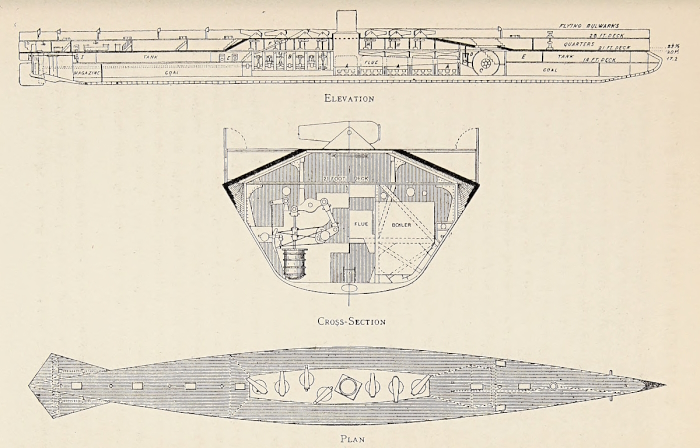
THE STEVENS BATTERY.
(click image to enlarge)
A writer in the Cosmopolitan Magazine for May, 1898, says:—“That
the Stevens battery would have been irresistible as a
ram and invulnerable as a fort is easy to be seen; but the
Stevenses were condemned in this case by official obstruction
to undeserved failure.... During these years, though
constantly undergoing alteration and reconstruction, she was
at all times in a condition which would have admitted of her
rapid completion had an emergency arisen, on the plans which
were for the moment being carried out, and these plans were
always so far in advance of general naval construction that
if so finished she would have been a match for a fleet of the
best vessels of the world at the same time. Thus, while the
naval armament of the world was light, her original armour
of 4½ inches would have rendered her invulnerable to the shot
of an enemy, while her shell guns would have meant certain
destruction to any vessel not provided, like herself, with an
armour capable of keeping out such shells. As the size and
penetrating power of cannon shot were increased, so was the
provision for heavier armour made in the Stevens battery, and
her own guns were at the same time enlarged in the successive
designs.” This refers to the period immediately prior to the
American Civil War.
Another Stevens invention was that of the air-tight fire
room, by Edwin A. Stevens, in 1842, whereby forced draught
was rendered effective.
Colonel John Stevens, in 1812, designed a steam-rotated
circular fort for the defence of New York Harbour, and a year
or two later, his son, Edwin Stevens, under the guidance of his
father, was experimenting with a 6-pounder bronze cannon
against some iron plating. The elongated shell, with which
the name of Stevens is always associated, was invented by
Robert L. Stevens during the war between England and
America in 1813-4. The shell could be fired from ordinary
cannon.
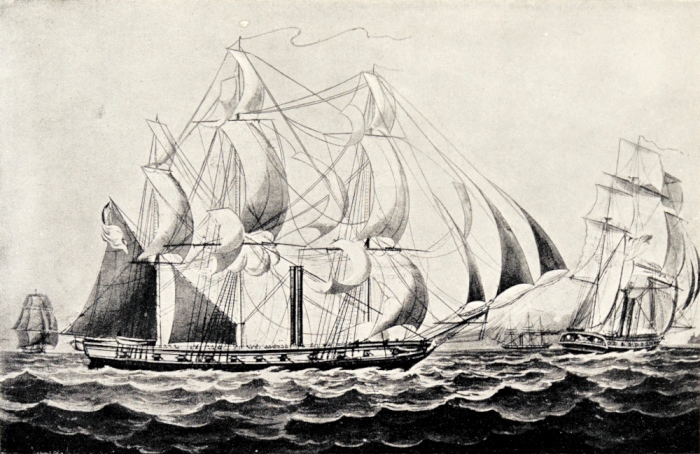
THE “RISING STAR.”
From a Painting in the possession of the Earl of Dundonald.
(click image to enlarge)
“Having perfected this invention, he sold the secret to
the United States after making experiments to prove their
destructiveness, so decisive as to leave no doubt of the efficacy
of such projectiles. One of these experiments was made at
Governor’s Island in the presence of officers of the army, when
a target of white oak, four feet thick and bolted through and
through with numerous iron fastenings, was completely destroyed
by a shell weighing 200 lb., and containing 13 lb. of
best Battle powder. This solid mass of wood and iron was
torn asunder; the opening made being large enough, as the
certificate of the officer commanding, Col. House, stated, for
a man and horse to enter. These shells are free from the
danger accompanying ordinary shells, for they are hermetically
sealed and suffer no deterioration from time.”[28] Some of them,
indeed, were fired experimentally twenty-five years after they
had been made and were found to be as effective as similar
shells fired soon after they were loaded.
It cannot be said that the British Admiralty was not forewarned.
Even at the time of Fulton’s experiments, Lord
Stanhope, who was interested in the subject, wrote to Wilberforce
that “when ships of any size may be navigated so as to
go without wind and even directly against both wind and
waves ... it will shortly render all the navies of the world
(I mean military navies) no better than lumber.” He pointed
out that ships independent of wind and weather were superior
to sailing ships, and that “the boasted superiority of the
British navy is no more.” A new navy was necessary, and
the French and other nations for the same reason would have
one. His lordship proved himself a true prophet so far as
the other nations were concerned, for the British Admiralty was
about the last to adopt steam-driven battleships; but as to
the rest of his prophecy, Trafalgar had not then been fought.
When steam navigation came, it came to stay.
But though the Admiralty hesitated, others did not. Probably
the first steam-driven ship of war which ever went to
sea, though not the first mechanically propelled war vessel—the
Far East, as we have seen, ante-dating us in this matter by
a couple of centuries—was the Rising Star. She was certainly
the first to traverse the waters of the Atlantic from north to
south, and the first steam warship to round Cape Horn and
pass into the Pacific.
The Rising Star was a remarkable ship in many ways. She
was built at Rotherhithe for the tenth Earl of Dundonald when,
as Lord Cochrane, he was engaged by the Chilian Government
to create and take command of the Chilian navy, and stipulated
that a steamship should be built as the best means of neutralising
the difference between the Chilian and Spanish naval forces.
The Rising Star was really taken out by Major the Hon. William
Cochrane. Owing to various vexatious delays in construction,
she did not reach completion in time to permit of her arrival
in time to participate in the war, the energetic Admiral Cochrane
having, in the meantime, disposed of the Spanish fleet with
his customary thoroughness. The ship was begun at Kier’s
yard in 1820, and arrived at Valparaiso in April, 1822. How
she was propelled is a matter of conjecture. At one stage of
her career she had paddles of some sort, and also paddle-wheels,
but when she finally left England a different system altogether
appears to have been adopted, which seems to have been an
application of the jet method, by which the ship is propelled
by forcing out of streams of water through apertures in the
hull below the water level.
The Rising Star is shown in a contemporary engraving of
her to have been a full-rigged ship, without royals, and carrying,
besides the ordinary square sails of her rig, peculiarly shaped
square-headed staysails between the masts.
This vessel has been referred to in several books as the
Rising Sun; it is as well that the error be corrected and her
right name given. The statement that the Rising Sun went
to Chili for Lord Cochrane in 1818 is erroneous, though often
made both in this country and in America.
The Admiralty thought so little of steam engines at first
that it did not trouble to record the names of its early steamers
in the navy list. Owing to the representations of Marc
Isambard Brunel, the Admiralty consented to try steam, and
experimented with two small paddle-boats, the Monkey, built
at Rotherhithe in 1821, and the Comet, built at Deptford in
1822, which were acquired to be used as tugs or despatch
boats. The former was a vessel of 210 tons, and had engines
of 80 nominal h.p.[29] by Messrs. Boulton and Watt. The
two cylinders were each about 35½ inches diameter, with a
stroke of 3 feet 6 inches, and, working at 26½ revolutions per
minute, gave a mean piston speed of 185 feet per minute. It
will be interesting and instructive to contrast these figures
with those of the latest engines in warships, which will be
found in another chapter. The Active and Lightning followed
in 1822 and 1823 respectively, their names appearing together
with a few others for the first time in the official navy list for
March, 1828.[30] None of these steamers, however, could be
classed as war vessels. From this year to 1840 seventy other
steam vessels were added to the navy. All the early steamers
were built in private yards, and the contractors had even to
provide the engine-room staffs, which were taken over together
with the steamers. By 1832, the Admiralty bestirred itself
and built its first steamer, the Salamander, but until 1840 none
was over 1,000 tons, and all were of wood, propelled by paddle
engines, and such guns as some of them carried were small
and ineffective. With the increase of the size of the vessels
came a more than corresponding increase in the power of the
engines. The Rhadamanthus, for instance, built in 1832, had
engines capable of being worked up to 400 indicated h.p.,
though they were of 200 h.p. nominal. The safety valves
carried a load of 4 lb. to the square inch, and the total weight
of the machinery was 275 tons. In 1839, five wooden steamers
were built for the Admiralty, and two of them, the Hecla and
Hecate, of 817 tons, and 250 h.p. each, were sent to Scott’s,
at Greenock, to be engined, and were the first naval vessels
to have their machinery fitted on board in Scotland.
But when men like Brunel, Scott Russell, and Laird of
Birkenhead, were loudly advocating the adoption of steam-propelled
war vessels, and the steamers were proving their
superiority over the sailing ships in every respect, the Admiralty
was compelled to pay attention. These men also urged the
adoption of iron in place of wood for shipbuilding. The idea
was ridiculed. It was in vain that it was pointed out that,
though a piece of iron would sink and a piece of wood of the
same size would float, the true test of buoyancy lay in the
total weight of the material used in the construction of a hull,
and that a hull of given external dimensions and built of iron
would be more buoyant than a hull of the same dimensions
and built of wood, and that the difference in favour of iron
amounted to as much as 20 to 35 per cent.
The mere fact that iron steamers were already in existence
had little influence with the Admiralty. The first of these
was the Aaron Manby, built at Horsely in 1821, for Captain
(afterwards Sir) Charles Napier and the gentleman after whom
she was named. Others were doing service in Ireland. In
1832, Messrs. McGregor, Laird and Co. had the Elburkah constructed
for employment on the Niger; she was 70 feet long,
by 18 feet beam, and 6 feet 6 inches depth. Two years later
Mr. Laird built at Birkenhead the Garry Owen, a little vessel
only 125 feet long and fitted with two engines of a total of
90 nominal h.p. She went ashore during a gale on her
maiden voyage, having as companions in misfortune several
wooden vessels, and was the only one to be refloated, being
little the worse for her misadventure. This proved the strength
of an iron-built ship beyond doubt, and iron coasting steamers
after this became comparatively numerous.
The first iron warship, a frigate, was proposed by Laird
in 1836, and built at his yard at Birkenhead in 1842; it was
offered during construction to the Admiralty, which would
have none of it, so it was sold to the Mexican Government,
which christened it the Guadeloupe. This vessel was 175 feet
in length, by 30 feet 1 inch beam, and had a depth of hold
of 16 feet.
The East India Company appreciated the value of iron
steamers suitable for war purposes, and placed an order with
Laird in 1839. One of those, the Nemesis, built under this order,
went to India via the Cape, and took part in the China operations
in 1840-2. She was struck several times by cannon balls and
holed. Her commander, Captain Hull, reported in his evidence
before the Royal Commission, in 1848, on the naval estimates,
that the holes were made clean and without splinters, thus
disposing of the theory that iron when struck by a shot would
splinter worse than wood. Her armament consisted of two
32-pounder pivot guns so mounted as to give her a wide range
of fire, and as she drew but five feet of water she may be
regarded as the first of the shallow river-gunboats which have
done such excellent service in so many parts of the world.
Meanwhile Francis Pettit Smith in this country had adapted
the screw propeller to steam navigation, and after one or two
experimental boats had been successful, the Archimedes, fitted
with a screw propeller of his design, made her memorable
journey from port to port of the British Islands in 1838. The
Novelty, a slightly larger vessel, of 117 feet in length, was
launched the next year, both coming from the yard of Mr.
Wimshurst, at Blackwall.
About this time Ericsson brought out his screw propeller,
and having equipped a small steamer with it, towed the
Admiralty barge a considerable distance upon the Thames
with the Lords of the Admiralty on board, besides making
other experiments, all of which were not without a fair measure
of success. The navy officials were not convinced, however,
that the application of the power at the stern was of practicable
value for warships. So Ericsson went to America, and devoted
his remarkable inventive genius to the welfare of his adopted
country. Had he remained in England, and had his inventions
been taken up by the Government, the history of the ’sixties
might have been very different, for it was he who designed
the Monitor, the small turret ship which prevented the Confederates
from obtaining the command of the sea in the
American Civil War.
In 1841, he accepted an order from the United States
Government to furnish the designs for a screw warship, the
Princeton, this being the first vessel which had the machinery
wholly below the water-line and out of reach of an enemy’s
shot. This vessel is claimed by Americans to have “dictated
the reconstruction of the navies of the world.”[31] Several
mechanical novelties and contrivances strange to warships,
and for the most part owing the form in which they were introduced
into this vessel to the fertile brain of the inventor, made
their appearance in the Princeton. She had a direct-acting,
semi-cylindrical steam engine of great compactness and
simplicity, independent centrifugal blowers for ventilating
the machinery compartment and assisting the combustion in
the furnaces, so as to avoid the exposure during an engagement
of the smoke stack which, as a greater measure of safety,
was made on the telescopic principle. The 12-inch wrought-iron
gun, with which the vessel was armed, was the first of its
kind, and was at that time the largest and most powerful
weapon afloat. He designed the wrought-iron gun carriages,
and provided them with contrivances for dispensing with
breeching and taking up the recoil. There were also an optical
instrument to enable the commanding officer by mere inspection
accurately to ascertain the distance of the object to be aimed
at.
The Admiralty relented towards iron for shipbuilding in
1840, when it had the paddle-steamer Dover built at Birkenhead,
and three small iron gunboats followed from the same establishment
before the end of the year. The demonstration afforded
by the Garry Owen has been alluded to. The Great Britain,
that magnificent pioneer of the iron screw steamship, launched
at Bristol, in December, 1844, ran on the rocks at Dundrum
Bay on the coast of Ireland, in 1846, and was successfully
refloated after being ashore for nearly eleven months, during
which she withstood several severe gales. After this it was no
longer possible either to ignore the superiority of iron over
wood for constructional purposes, or to doubt the immense
strength with which an iron ship could be built.
The enterprise and daring of Brunel in designing this ship
without any data to go upon stamp this vessel as an evidence
of his extraordinary genius. She was in a sense the forerunner
of the Great Eastern, for she demonstrated what could
be done with iron; and the Great Eastern, constructed on the
longitudinal system, though a commercial failure, proved the
advantages of that system for vessels of such remarkable
length, as to a large extent her design solved the problem of
overcoming the sagging and hogging strains and showed the
Admiralty what could be achieved in contending with this
difficulty. This success helped in no slight degree to the
introduction of the iron-clad citadel system some years later.
The success of the Archimedes and the Great Britain demonstrated
the power of the screw, and in the latter that iron must
be the material for future ship construction, whether in the
navy or the mercantile marine. The Government clung to
wood for all its fighting ships as long as it could, but it decided
to try the screw propeller, without, however, abandoning the
paddle-wheel, and many fine vessels were launched.
Before this, Messrs. Ditchburn and Mare built at Blackwall,
in 1842, and Messrs. J. and G. Rennie engined, a small iron
steamer of 164 tons builders’ measurement, and 98 tons displacement,
called the Mermaid. She was a screw steamer, and
was fitted with George Rennie’s conoidal propeller; this was
a three-bladed screw propeller with the blades arranged to
resemble a cone with its widest part at the boss of the propeller
shaft and tapering towards the tips of the blades. The
engine, having two vertical cylinders of 40 inches diameter each,
and 32 inches stroke, and with a pressure of 8 lb. in the
boiler, indicated 216 h.p. A spur gearing transmitted the
power to the screw shaft, giving it 153 revolutions per minute
and driving the vessel at its trial, in May, 1843, at a little
above 10½ knots, or over 12 miles; as the Admiralty had
promised to take over the vessel if she attained a speed of
12 miles, she was accordingly purchased and under the name
of H.M.S. Dwarf has the honour of being the first iron screw
steamer the British Government possessed. The Dwarf was
largely used afterwards for experimenting with various kinds
of screw propellers.
With the exception of the bombardment of Acre, in 1840,
there was a long interval during which the world’s navies were
not called upon for any serious engagements, and the development
of warship building which took place during that period
was the result rather of scientific research than of actual
fighting experience, and there was consequently no need, while
the nations were recovering from the wars of the eighteenth
and early nineteenth centuries, for any remarkable advances
to be made. For the first fifty years of the nineteenth century
the warships were much as they were in Nelson’s time, except
that some of them were fitted with mechanical means of
propulsion.
The battle at Acre was the first in which war steamers took
part, four paddle-wheel boats, the Gorgon, Vesuvius, Stromboli
and Phœnix, being included in the British force. They were
not of a size to do much fighting, the bulk of which devolved
upon the big sailing warships, the duty of the steamers being
rather to wait upon the three-deckers in the capacity of armed
tugs. The engagement had little, if any, influence upon the
admiralties of Europe in deciding them as to the position steam
navigation should take in the fighting marine. These steamers
were not the first to fire a shot in war. That honour, if honour
it be, is attributed to the Canadian-built Royal William, which
crossed the Atlantic partly under sail and partly under steam
in 1833, and it is on this performance that the Canadians claim
to have sent the first steamer eastward across the Atlantic.
While she was lying at London she attracted the attention of
the Spanish authorities by reason of her speed, and after satisfying
themselves that they could depend upon her to steam
in a calm and even against the wind, they purchased her, with
the consent of the Portuguese, to whom she was chartered,
renamed her the Ysabel Segunda, gave her six guns, and used
her against the Carlist revolutionaries. She was wrecked not
long afterwards.
In order to test the advantages of the paddle-engine in a
fighting ship, the wooden 46-gun frigate Penelope, which was
built for a sailer, was cut in two in 1843, and lengthened to
enable her to accommodate the engines and 600 tons of coal.
She and about thirty or forty sister ships had been constructed
on the model of the French Hebe class of frigates, but as they
were now hopelessly outclassed by the heavier frigates introduced
by other nations, this experiment was about the best
use to which she could have been put. The sudden transformation
of this out of date and none too powerful frigate
into a vessel capable of holding her own against any vessel
afloat created a tremendous sensation both in British and
Continental nautical circles, and paddle-driven frigates of
various sorts and sizes were introduced in the course of a few
years in most of the European navies. When lengthened she
was faster under sail than before, and her steam power made
her independent of the wind and would have enabled her to
choose her own position had she been called upon to participate
in a naval engagement. Her new armament consisted of two
large 10-inch pivot guns of 84 cwt. each, eight 68-pounders
able to fire both shot and shell, and fourteen 32-pounders,
“making a total of twenty-four guns of this immense calibre.”[32]
Her steam engines, of 625 h.p. nominal and 700 indicated,
were described as of greater power than any previously placed
afloat in the navy or the mercantile marine. The cylinders
were of 92 inches with a length of stroke of nearly 7 feet;
the engines were of the direct acting type, such as were supplied
to many other vessels of the time, and the paddles could be
disconnected. Hall’s patent tubular condensers were fitted,
and her four tubular boilers each had five fireplaces. One
peculiar feature was that the main mast was stepped between
two of the boilers. The Penelope carried a crew of three
hundred officers and men, and could accommodate a thousand
soldiers with provisions and water for a voyage to the Cape.
Inasmuch as her tonnage was only 1,780 tons, she must have
been uncomfortably crowded, especially if the soldiers’ wives
and families accompanied them.
Some frigates were built to be paddle-propelled, one being
the Terrible, twenty-one guns, which had engines of 800 h.p.
The Valorous, the last of the type, was withdrawn in 1883.
Probably the most luxurious paddle-propelled steam frigate
ever launched was the Faid Gihaad, whose sumptuous fittings
were intended to gratify the taste for comfort, no less than
the extravagant whims, of the then Pasha of Egypt. She
carried on the upper deck two 84-pounder pivot guns and
twelve 32-pounder broadside guns, and on the main deck
fourteen guns of the latter type. Yet she was described as a
yacht—of 2,200 tons. She was built by Mare and Co., of
Blackwall, in 1852.
One drawback urged against all paddle-wheeled war vessels
was that the deck space was seriously encroached upon, and
that the paddle-boxes restricted the range of the guns. To
get over this difficulty the sponsons were carried further forward
and aft, before and abaft the paddle-boxes respectively, the
deck-houses, which usually encumbered the sponsons, were
removed, and the bulwarks were carried along the outer edge
of the sponsons, thereby giving greater deck space; and as
each sponson under this arrangement carried a gun, a vessel
thus fitted had four more guns than was previously possible.
Two of the guns had a range extending from abeam to right
ahead, and two from abeam to right astern.
One vessel thus equipped in accordance with Scott Russell’s
patent was the Dantzig, built by Robinson and Russell, at
Millwall, for the Prussian navy. She was of 1,280 tons, with
a deck length of 230 feet, and a draught of 15 feet; her paddle-wheels
were of 24 feet 4 inches diameter. Her dimensions,
no less than the arrangement of her armament, attracted
widespread attention. She distinguished herself against the
Riffs in 1856.
The Admiralty ordered, in 1843, its first screw steamer,
the Rattler, a sloop of war of 1,078 tons displacement. She
had engines of 437 indicated h.p., and of the type known
as Maudslay’s Siamese, spur gearing increasing the revolutions
of the screw to four times those of the crank. These
engines derived their curious name because of their double
cylinders, the arrangement having been patented some years
before by Messrs. Maudslay and Field, to enable a long cylinder
to be fitted in a paddle ship where the height is limited.
When there was so much difference of opinion among those
passing as experts as to the respective merits of the paddle-wheel
steamer and the steamer driven by a screw propeller,
the Admiralty decided to settle the controversy by pitting
representative vessels against each other and noting the result.
Accordingly the Rattler was selected to champion the screw,
and the Alecto the paddle-wheel.
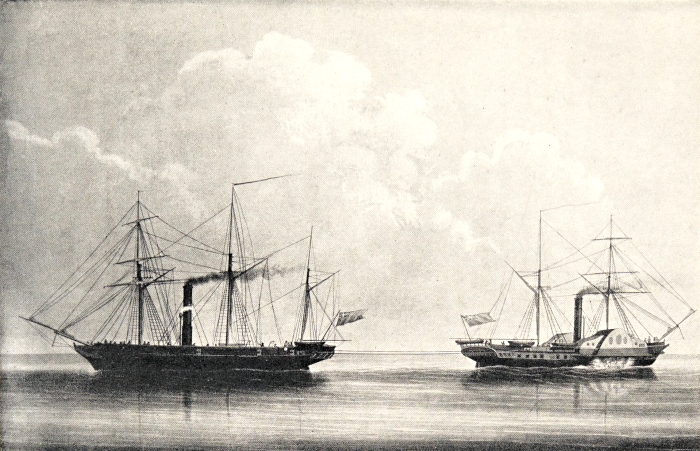
THE TRIAL OF SCREW v. PADDLE—H.M. SLOOPS “RATTLER” AND “ALECTO” TOWING STERN AND STERN.
The Alecto was a paddle sloop, driven by direct acting
engines, but otherwise was a very similar vessel to her screw
rival. The two vessels were fastened stern to stern, and ordered
to steam ahead. The screw steamer won the novel tug of war,
the Alecto being towed stern foremost. This remarkable
encounter took place in the North Sea, on April 3rd, 1845, in
calm weather. A more important tug of war was that on
June 20th, 1849, when the screw corvette Niger was pitted
against the paddle sloop Basilisk in the Channel, and again
the screw boat was victorious.
The Trident was the first iron steamship of war ordered by
the Admiralty, and the first ever built. She was launched
from Messrs. Ditchburn and Mare’s yard, at Blackwall, in
December, 1845, and in the shape of her hull followed the lines
of a sailing ship of the same size. Her length over all was
200 feet, and between the perpendiculars 180 feet; her beam
was 31 feet 6 inches, and over the paddle-boxes 52 feet
6 inches, and her burthen was 900 tons. She had engines of
330 h.p., with oscillating cylinders and tubular boilers, so that
altogether she was an important vessel in the constructional
development of the British navy. She was very strongly put
together, as her ribs were double, each rib being composed of
two angle irons, 4 inches by 3½ inches by ½ inch thick, riveted
together, and in one entire length from the gunwale to the keel
she having a total of two hundred and seventy pairs of these
double ribs. The iron skin was ¾ inch thick at the keel, and
diminished to ½ inch at the gunwale. She was to carry two
long swivel guns of 10-inch bore, one fore and one aft, to fire
in line of keel, and four 32-pounder guns to fire on the broadside.
In 1846 the Birkenhead was built at Laird’s yard to the
order of the Admiralty as the first of a series of steam frigates,
and was one of the largest iron steamers belonging to the
Government. Her length between perpendiculars was 210 feet,
breadth of hull 37½ feet, breadth over paddle-boxes 60½ feet,
depth of hold 23 feet, and her tonnage 1,400 tons (carpenter’s
measurement). She was followed, in 1849, by the Simoom,
launched by Napier, at Glasgow, and by the Megæra, by
Fairbairn, at Millwall, all being classed and armed as steam
frigates. The Birkenhead was to carry a 96-pounder pivot
gun aft, and a similar weapon forward, and four 68-pounders
on the broadside, and it was pointed out that her round stern
would add to the range of fire of the “Long Tom” aft. However,
the Admiralty had serious doubts of the efficacy of these
vessels, and having made some experiments with an iron ship
called the Ruby, found that the 32-pounder gun at short range
could perforate the side of the iron ship, and that the projectile
carried its “cloud of langrage” with great velocity into the
interior of the ship, so that men could not stand against it.
These experiments resulted in the Simoom, Birkenhead, and
ten smaller vessels being condemned as warships. Some of
them were transformed into transports, and the Admiralty
returned to its beloved wooden walls once more. The loss
of the transport Birkenhead shortly afterwards is one of the
most tragic and heroic episodes in the whole history of the
British army. The Admiralty caused other tests to be made
with sixteen wrought iron plates superposed, having a total
thickness of 6 inches, but these also were perforated by the
projectiles of the 32-pounder at 400 yards range.[33] The result
was that the adoption of iron for the main structure of a ship
was delayed until the discovery was made of the rolling of
armour plates, in the time of the Crimean War, but it was not
until 1859 that the Admiralty may be said to have definitely
adopted rolled armour plates.
In the year 1849 Scott, Sinclair and Co. launched, at
Greenock, the first steam frigate built on the Clyde for the
British navy, and thus inaugurated that association between
the Admiralty and the Clyde iron-ship builders which has
been maintained uninterruptedly from that day to this, to
the marked advantage of both. The Greenock, for the vessel
was named after the port, was 213 feet in length of keel and
fore-rake, by 37 feet 4 inches beam, and was of 1,413 tons
Admiralty measurement, and had engines of 565 h.p. Her
machinery compartment measured 72 feet in length and contained
the whole of the machinery, consisting of four rectangular
boilers, fitted with brass tubes, and two steam engines,
lying flat on the bottom, the whole being so arranged that
all parts were several feet lower than the surface of the water.
The screw, which weighed 7 tons, and was 14 feet in diameter,
could be detached and lifted from the water.
“The funnel also,” says the Illustrated London News of
May 12, 1849, in describing the vessel, “is to have some peculiar
mode by which its hideous and crater-like physiognomy can be
made at once to disappear, and leave the ship devoid at once
of this unsightly feature, and of those cumbrous excrescences,
paddle-boxes, giving her all the appearance and symmetry of
a perfect sailing-ship.”
She carried ten 32-pounder muzzle-loading guns. Her
machinery is of special interest as it embodied one of the earliest
attempts to drive a screw propeller by gearing. For this
purpose it had four sets of massive spur wheels and pinions,
in the ratio of 2.35 to 1, so that 42 revolutions of the engines
per minute gave 98.7 revolutions per minute to the propeller
shaft.
The engines installed in steamers, whether for war or commerce,
were of the side-lever type, until they were superseded
by the direct-acting type. The former was peculiarly suitable
to the paddle-wheel, and in one form or another is in use
to the present day. In America, the practice has been
to place the beam or lever above the crank, but on this side
of the Atlantic the beam was placed below the crank. So
far as warships were concerned, this method had the advantage
that a great part of the machinery could be placed
low down in the vessel. But the very fact that a vessel was
propelled by paddle-wheels made it impossible to place the
whole of the engine below the water level; it is evident
that the greater the diameter of the side-wheels the greater
must be the distance between the surface and the crank or
shaft upon which the wheels are fastened for rotation. As
increased power was required, it became necessary to add to
the size and weight of the engines, which in this respect soon
reached the profitable limit of their employment. Engineers
were not long in foreseeing the extent of the difficulty, and,
in seeking means to provide a smaller engine without loss of
power, discovered a method of eliminating the lever and causing
the engines to act direct upon the crank shaft. One very
ingenious method by which the desired result was accomplished
was that associated with the name of Mr. Penn, who
introduced the oscillating cylinder in 1836. In these engines
the connecting rod is done away with altogether, the piston
rod works directly on the crank pin, and the cylinder is carried
on trunnions which permit of the necessary oscillation, and
are themselves made hollow in order that the steam may be
admitted to and exhausted from the cylinders through them.
The first Admiralty vessel in which they were fitted was the
yacht Black Eagle. Another method by which great economy
in space was effected was the double cylinder engine invented
by Messrs. Maudslay. It consisted of two cylinders of equal
size placed side by side, but with a space between them into
which the foot of a T-shaped cross-head passed, the foot of
the T head being connected by a connecting rod with the
crank pin.
With the side-lever engines the difficulty of driving the
paddle-wheels at the required speed was overcome by the introduction
of the gearing wheel, and this contrivance was applied
also to the engines for driving the screw propeller. As the
piston speed was increased it became possible to connect the
crank shaft direct to the screw shafting. The engines used for
driving paddle-wheels were either inclined or vertical, but after
the introduction of the screw propeller for warships, the engines
were built of the horizontal type and this method remained
in vogue for about thirty years. The difficulty of working in
the confined space was met by Mr. Penn with the trunk engine,
with which he achieved a still greater success. His equipment
of the warships Arrogant and Encounter with trunk engines in
1847 so satisfied the Admiralty that engine power for driving
screws could be placed so far below the water-line as practically
to be safe from an enemy’s shot, that altogether he applied them
to no fewer than two hundred and thirty vessels, from a gunboat
requiring 20 h.p. to such ships as the Sultan, 8,629 h.p.,
and the Neptune, 8,800 h.p. This invention, curiously enough,
helped in the retention of the sailing power, by leaving the
decks unencumbered by engine houses and paddle-boxes, so
that when the engines were not in use the vessels could be kept
under sail only, to gladden the hearts of the adherents of the
old school. It also hastened the abolition of sail, for it showed
that the machinery could be placed below the water-line, and
when armoured sides and protecting decks were introduced
sails were dispensed with altogether.
The trunk engine remained a favourite model until it became
impossible to keep the trunks in a steam-tight condition owing
to the adoption of high-pressure steam. The use of a geared
wheel for multiplying the number of the revolutions of the
screw shaft was continued until the crank shaft could be connected
direct to the screw shafting. Up to about 1860 horizontal
engines were the rule in warships, and though not particularly
economical in the matter of fuel, they were a great improvement
on the type which had been so useful for paddle engines. Surface
condensation became general about 1860, and made possible
the introduction of compound engines and cylindrical boilers.
The old flat-sided boilers were retained when surface condensation
was first introduced, but additional stays were
added to enable them to stand the increased steam pressure
which had by now advanced from 4 lb. to the square inch,
at which it was deemed effective in the early days of the steamship,
to 30 to 35 lb. to the square inch.
The warship of the “perfect sailing ship type,” with the
engines as little conspicuous as possible, remained in favour
until the experiences of the British and French fleets in the
Crimea and the Baltic compelled the abandonment of all the
theories and practices which had been nursed for years; while
the innovations which were made at the time of the American
Civil War brought about the introduction of types of vessels
which were about as unlike the historical wooden walls, the
growth of centuries, as anything could well be.
Some years ago, when visiting the Brooklyn Navy Yard,
the writer was discussing with the officers in charge there the
effects of the war between the Northern and Southern States,
and the expedients tried by the two sides, upon warship construction,
irrespective of generally accepted theories and the
opinions of the experts.
“Happy is the nation that has no precedents,” was the
sententious comment of an American officer.
CHAPTER V
IRON SHIPS OF WAR; FROM THE INTRODUCTION OF IRON ARMOUR
TO BROADSIDE AND TURRET SHIPS
When the Crimean War broke out, Great Britain and France
shared the naval leadership of the world. Nearly all the other
nations had warships of one kind or another, but the finest
specimens were to be found in the fleets of those two powers.
They included the Duke of Wellington, fitted with screw engines
of 700 h.p. and carrying one hundred and thirty-one guns; the
Agamemnon, of 600 h.p. and ninety-one guns; and the frigate
Shannon, of 600 h.p. and fifty-one guns, to mention three of
the best examples of their classes.
Russia had some powerful vessels, including a few steam
warships, but her naval resources were not equal to those of
either of the allies. The French and English naval reviews
in 1853 and 1854 were instructive as showing the improvements
which had been effected in the preceding fifteen or twenty
years. The screw propeller was so advantageous a method of
propulsion that the conversion of sailing vessels into steamers
went on apace in all the navies of Europe, and the United
States, which usually did not at that time trouble about
European naval developments, caught the infection and not
only built steam frigates, but transformed some of its smaller
vessels also to augment the steam warships it had already
found necessary for its operations in the Mexican Gulf, the
West Indies, and elsewhere. The frigate was a favourite type
of ship with the Americans, and whether in the sailing days
or after the adoption of steam for warships, the American
frigates were equal to those to be found anywhere.
The naval force which went to the Crimea was largely
steam-driven. The Battle of Sinope, in November, 1853, in
which the Russians annihilated a Turkish fleet, proved alike
the superiority of a steam war fleet over a sailing fleet, and,
incidentally, the range and power of the Russian guns. The
Russian squadron was more powerful in every way, but its
great superiority lay in its heavy artillery; all the Russian
ships of the line carried smooth-bore guns which could fire
shells, and the shells, exploding, set fire to and demolished the
Turks in a few minutes. This demonstration of the effectiveness
of the Muscovite weapons showed the allies for what they ought
to be prepared when the expected war broke out; but the
Russians knew that in fighting capacity their fleets were no
match for the British and French fleets, so their vessels were
kept under the protection of the Russian forts, and for the
most part destroyed a few at a time as the war went on. The
Russians are not to be blamed for shirking a naval battle,
for the British and French were the greatest naval forces in
the world, splendidly equipped and ready for the fray; whereas
the Russians do not take kindly to naval warfare—as events
half a century later showed. Many of the Russian ships were
hastily equipped; it was currently reported in this country
that some of them were engined with converted railway
locomotives. All the Russian ships, however, were not of
this type. Some were built on the Thames, among the number
being the paddle frigate Vladimir, which gave a good account
of herself in more than one engagement. She was a wooden
vessel, and at the time of her construction in 1848, was considered
to display a remarkable amount of symmetry of form,
and to be of very considerable magnitude. Her length between
perpendiculars was 200 feet, and her burthen 1,200 tons. She
carried two 10-inch pivot guns, and four 8-inch guns mounted
on sliding carriages.
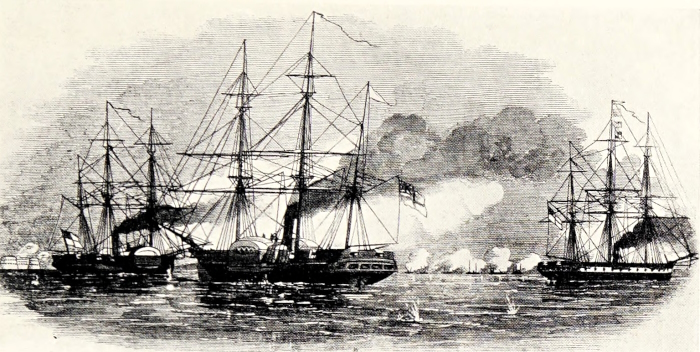
H.M.S. “CENTAUR,” “BULLDOG” AND “IMPERIEUSE” ENGAGED WITH SIX
RUSSIAN GUNBOATS OFF CRONSTADT, 1855.
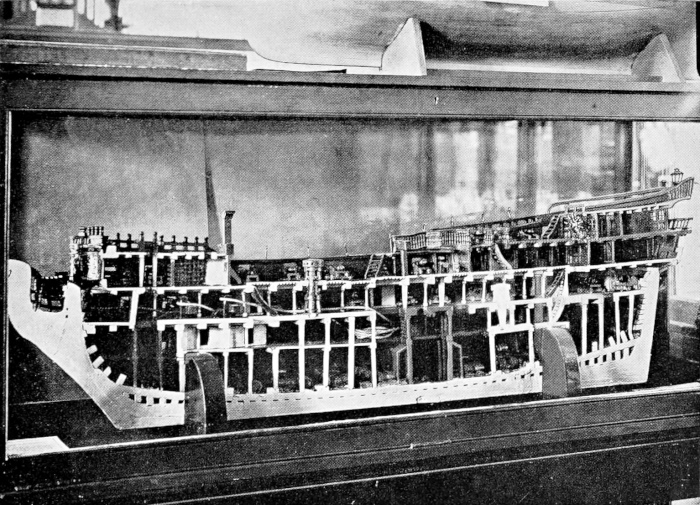
SECTIONAL MODEL OF RUSSIAN MAN-OF-WAR, 1854, IN THE MUSEUM OF
THE ROYAL UNITED SERVICE INSTITUTION.
The paddle frigate Retribution, a typical specimen of her
class, launched at Chatham in 1844, was selected to proceed
to Sebastopol in 1854 to demand the release of the engineers
taken prisoners at the Battle of Sinope, who were in the service
of the Porte. She was of about 1,641 tons and had engines
on Maudslay’s Siamese pattern of 400 h.p., and carried a crew
of three hundred men. Her armament consisted of twenty-eight
guns of a “very persuasive size”—their persuasiveness
was fully demonstrated in the subsequent proceedings in the
Crimea.
The naval operations before Sebastopol and Cronstadt
proved by no means satisfactory to the attacking vessels. The
latter were not weak as fighting ships, for they constituted the
most powerful line-of-battle ships ever constructed up to that
period, and nearly all of them were screw-propelled. The
principal guns in the Russian forts were heavier than any
carried afloat by the allies, and not only fired a heavier and
more penetrating shot, but shell also—this being the first
war in which modern explosive shells were used—and had an
effective range far in excess of that of the ships’ guns.
The great three-deckers which assailed the fortifications
of Sebastopol and Cronstadt were prevented by the shallowness
of the water from getting near enough to inflict serious damage
irrespective of what they might themselves sustain, a course
which was certainly urged, if channels could be found, especially
by some strategists who, being at home, would not be exposed
to the danger, and ignored the fact that the ships, if stranded,
could be shelled at leisure. In the fleets’ attack upon Sebastopol
the sailing warships were provided with attendant steamers
lashed alongside to render them assistance when their positions
had to be changed. But the range at which, for the most
part, the allies’ warships had to operate rendered them comparatively
ineffective, and when Kinburn, like Cronstadt,
proved a tougher nut to crack—a characteristic it shared
with many of the Russian defences—than the allies expected,
the English and French could do nothing but blockade the
places and adopt other means of reducing the fortresses than
by bombarding them from their big wooden battleships.
Two fresh problems had thus been created for solution.
The first and most pressing was to provide the type of ship
best fitted to cope with the Russian batteries. Hitherto,
engagements between fortresses and battleships had been
fairly equal because the guns employed by one side would be
much the same as those of the other, while the ships had the
further advantages of being able to shift their positions as
suited them best, and to concentrate the fire of their broadsides
wherever necessary. The majority of shore and battery
engagements ended in victories for the ships.
The second problem was how to carry more powerful guns
afloat, and how to strengthen the sides of the hulls supporting
them so as to offer adequate resistance to the projectiles of
equally heavy guns carried by hostile ships or discharged from
the enemy’s forts. The first problem was found to be comparatively
easy, notwithstanding that the solution when proposed
was declared by many to be impossible. It had, moreover,
an important influence upon the attempted solution of the
second problem. The latter was even thought to be no more
difficult than the other, but the effort to grapple with it marked
the beginning of the great struggle between guns and armour,
and the introduction of the question of long range as against
short range fighting, the end whereof is not yet.
Some little time before the war, the Emperor of the French
expressed the opinion that armoured vessels of the types the
Americans had devised, notably Stevens’s and Ericsson’s ships,
were more suitable for purposes of war than the large two-deckers
and three-deckers. He was confirmed in this opinion
by the experiences of the big ships in the attack upon Fort
Constantine, and though the opposition to his views was great,
and it was pointed out that the forts must ultimately be
starved into surrendering, he maintained that this would take
too long and that the forts must be attacked by other means.
His Majesty himself, who had devoted considerable attention
to the subject, was largely responsible for the design of the
five armoured French gunboats which were destined to bring
about the abandonment of the great three-deckers and initiate
as remarkable a revolution in warship construction as the
introduction of steam was causing in naval tactics. These
floating batteries—a term borrowed from the Americans—were
the Lave, Tonnante, Congreve, Foudroyant and Dévastation.
Their dimensions were similar: 1,400 tons displacement,
164 feet in length, 42 feet 6 inches beam, and drawing only
8 feet of water. They were built with massive wooden frames,
to which were attached oaken sides 8 inches in thickness, and
outside this was iron plating 4⅜ inches thick. The Tonnante,
launched at Brest in March, 1855, was the first afloat—the
first iron-clad citadel ship built in Europe. After the Emperor
had decided on the plans and the vessels were in course of
construction, Ericsson communicated with his Majesty on
the subject. He was not aware that the Emperor had already
determined on the plans of the ironclads, or he would scarcely
have gone to the trouble of writing, for his experience of
European governments was not such as to lead him to think
that they would admit he was able to teach them anything.
He is variously said to have offered to design a turret ship
for the Emperor, and to have presented to the Emperor plans
of a partially submerged armoured vessel with guns in a revolving
shot-proof cupola placed centrally on the deck. In either
case, however, he was too late. Whether he would have been
called upon, had the Emperor’s gunboats been unsuccessful,
is a point upon which there has been much conjecture.
In designing these vessels, the Emperor had in mind that
they should be cheaper and more easily and rapidly built than
ships of the line, that they should draw little water, that they
should be capable of being served by a small crew, and that
they should be covered with an armour against which hollow
shot fired from Paixhan guns “should be broken like glass,”
according to the Moniteur. Experiments made at Vincennes
revealed the required strength and thickness of the defensive
iron plates. The external protection was to be able to defy
alike shell, solid or hollow shot, cold or red-hot shot. The
Imperial designer even chose the name of the type to indicate
that these vessels were not to be considered as built to pursue
an enemy, but were siege batteries, capable of attacking with
energy and persistence fortifications heretofore regarded as
unassailable by sea.
The results of the preliminary artillery trials were communicated
to the British, and trials made in England confirmed
those of the French.
The British authorities, being convinced that iron-clad
vessels were necessary for the reduction of the Russian forts,
followed the example of the French and ordered several. These
vessels were required both in the Baltic and before Sebastopol.
One of these floating batteries, intended for the attack on the
Cronstadt forts, was the Terror. Beauty was one characteristic
she did not possess. She was equally bluff at the bows and
stern, and could move either end foremost to facilitate her
manœuvring in an engagement. She was built, armour-plated,
and launched in about three months; this rapidity of construction,
as it was then considered, was due to Palmer’s
invention, whereby plates were rolled instead of being forged.
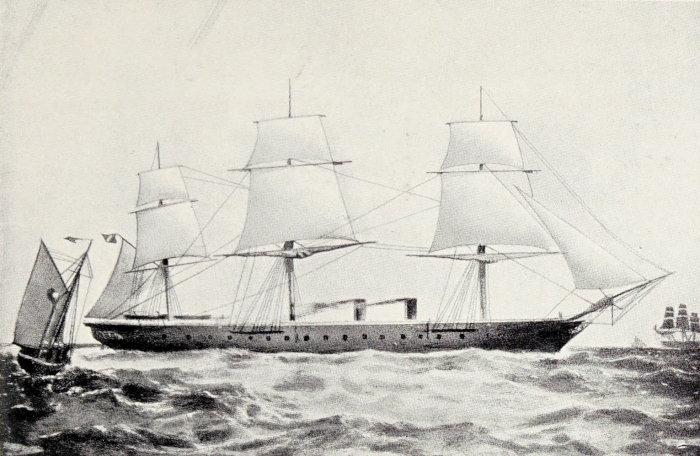
H.M.S. “WARRIOR.”
Photograph by permission of the Thames Ironworks, Shipbuilding and Engineering Co., Ltd.
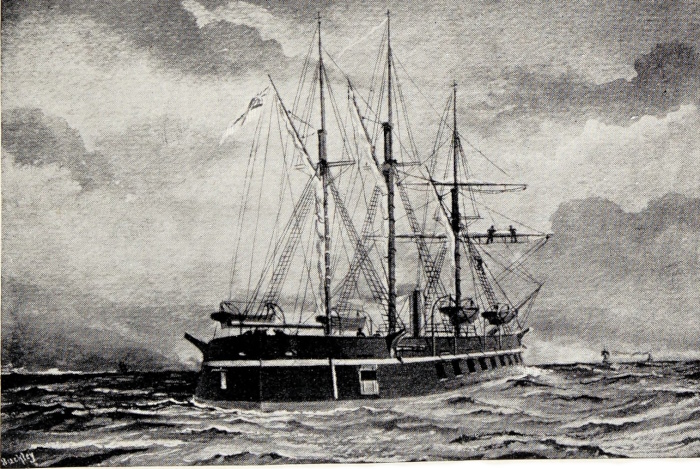
THE “TERROR.”
By permission of Palmer’s Shipbuilding and Ironworks, Ltd.
The English-built Glatton and Trusty differed from the other
floating batteries constructed at this time, as they were pierced
for sixteen guns, as against twelve for the others. As innovations
they were unmercifully criticised. Their portholes,
measuring 3 feet 4 inches by 4 feet 10 inches, were considered
much too large. They were rigged as three-masted schooners,
of all rigs in the world, with two square sails on the foremast.
“Why such things as these should be completely equipped
and rigged, we cannot, for the life of us, divine. The Admiralty
is decidedly masting mad.”[34]
They were 172 feet 9 inches between perpendiculars, 43 feet
8 inches extreme breadth, with 14 feet 7 inches depth of hold,
and 7 feet 9 inches draught, and they were of 1,469 tons. The
two decks were of oak 9 inches thick, resting on beams 10½ inches
square, which were placed 21 inches apart from centre to centre,
the beams being supported amidships by stanchions hinged so
that they could be hung up out of the way in action. The
frames, iron plates, and planking were altogether 2 feet thick
on the sides. The engines were of 150 h.p., of the non-condensing
type, and with four tubular, cylindrical, flat-ended boilers with
two furnaces each, the pressure being 60 lb. to the inch above
that of the atmosphere. Owing to their slow speed, for they
could only make three knots, it was decided to give them two
additional or wing screws. These batteries, according to those
who had to handle them, would “neither sail, steam, stay, nor
steer,” and might be depended upon to affect the men’s health
injuriously. Jury rudders had to be rigged up to get them
along. All these floating batteries, whether French or English,
were equally slow, and equally bad sea-boats.
The gunboats of the Trusty class were wooden-built and
armoured; the Erebus class, launched in 1854-56, were iron-built.
The floating batteries were regarded with hope by those
who were prepared to believe that the ironclad system would
prove effective, and with undisguised contempt by the majority.
What, it was asked, could these little unwieldy vessels do when
the great line-of-battle ships were not equal to the task of reducing
the fortifications? Still, as the Emperor had ordered them,
it was but right that the experiment should be made. So when,
in October, 1855, the great attack was begun, the three floating
batteries which had arrived, steamed slowly into position, and
came to anchor between 700 and 800 yards of the Kinburn
forts. A correspondent who visited the Dévastation after the
bombardment, “left her with the conviction that, in the attack
of maritime fortresses, a new era had commenced.... The
bulwarks had been removed from the deck, to lessen the mark,
and the funnels of the steam engine alone projected. The
captain conned the ship standing on the companion, and giving
directions to the helmsman below; and when the vessel came
to an anchor he remained below. Twelve embrasures were
opened, and the effect as witnessed from the village was terrific,
whilst that of the enemy’s guns upon her was very slight indeed.
She had three men killed and six or seven wounded through
shots entering the portholes, one shell bursting inside. Not
a shot from the enemy damaged the Dévastation in the slightest
degree. She was hulled sixty or seventy times, the balls each
time bounding from her sides harmless into the water, leaving
their marks, it is true, in the shape of dents, in some cases an inch
and a half deep, but inflicting no real damage on plates of iron
four inches in thickness. This, the first experiment, proved that
at a distance of 800 yards, 32- and 18-pounders are harmless
against the sides of a floating battery, and the trial has been
made first by the French, the arrival of the Meteor and Glatton
being delayed.” When they did arrive the work for which
they were intended had been accomplished. The Dévastation
and her two sisters had platforms on stanchions near the water’s
edge; upon each platform were fifty French riflemen who
made excellent practice upon the Russian gunners.
The Prussian Government ordered from Messrs. Robinson
and Russell, in 1851, two paddle-wheel gunboats called Nix
and Salamander. They were double-ended and could go either
end foremost, and though they could take enough coal to carry
them two thousand miles, they only drew 7 feet. Their load
displacement was 468 tons, and their oscillating cylinder condensing
engines gave them, together with their sails, a speed of
a little over 11½ knots. The British Government exchanged
the 36-gun frigate Thetis for them, and having renamed them
Recruit and Weser, sent them to the war.
They were the only vessels of their class in the British
navy. The former was employed in the operations in the Sea
of Azoff, and both were held to combine the three essential
features of light draught, ability to carry heavy armament, and
to possess the highest known rate of speed, so as to give them
the power of choosing their own time and place of attack. The
Recruit mounted four 68-pounders on her stanchions and bombarded
the Russian positions at Taganrog at 1,400 yards, in
company with a French steamer, the Mouette.
Among the numerous types of boats, recognised as belonging
to the navy or improvised for some special circumstance, few
acquired during the campaign in the Baltic greater renown
than the mortar-boats, the gunboats, and the ships’ boats
with their rocket apparatus. In the Baltic, as in the Black
Sea, the need was felt of small, shallow, powerful ships which
could engage the enemy’s batteries at short range, and similar
batteries to those sent to the Crimea were forwarded to the
Baltic also. The same difficulty of shallow water was
experienced by the forces in the Sea of Azoff. So there was
improvised by the officers and crew of the Stromboli a remarkable
raft of twenty-nine casks placed in six rows and cradled in
a framework of heavy spars, a portion of the upper part being
planked over. The gun tackles were fastened to a spar lashed
over the front of the planking, and the train tackle was similarly
fixed aft. She was named the Lady Nancy. Her construction
took twelve hours, and she carried a long 32-pounder, weighing
over 2 tons, 100 rounds of ammunition, a heavy hawser, and a
crew of eighteen. She gave a good account of herself at the
Battle of Taganrog.
A fleet of screw gunboats, numbering nearly a hundred,
and having engines of 60 h.p. each, was added to Britain’s
naval strength during the war. These vessels were armed
with 68- and 32-pounder pivot guns and 24-pounder brass
howitzers. “The possession of this force,” according to a contemporary
writer, “cannot be too highly estimated. No line-of-battle
ship could be safe at 1,000 yards range, and, owing to
their light draught of water (four and six feet), they could force
their passage through the most shallow of the enemy’s creeks;
besides which their 68-pound shells would tell at 4,000 yards
upon a ship or arsenal.” Another hundred of these were all
but completed, and the whole force was to take part in the
great review at Spithead in 1856. “There will also,” said the
chronicler, “be a new description of screw-gun despatch vessels,
equally elegant and powerful. These beautiful specimens
of British naval architecture have been built in the Government
and private yards; they will average a speed of 16 knots an
hour, and will mount five of the heaviest pivot guns. In
addition to these there will be one hundred iron and wood
mortar-vessels of the most powerful build, each armed with
a 18-inch mortar, weighing five tons, besides half a dozen mortar-frigates
(old 42’s converted). To sum up, then, England is
prepared with:—Line-of-battle ships, 42; heavy frigates, 56;
corvettes, 123; gunboats, 220; mortar-vessels, 100; troop
frigates, 10; transports, 340. And nearly the whole of this
gigantic force is composed of screw or paddle-box ships, besides
an immense reserve. Well may Russia be desirous of coming
to terms.”
After the feverish activity of the war came a period of
comparative inaction. The whole political atmosphere of the
world, however, was too heavily charged—too electric, as it were,
to permit of hopes of lasting peace. In the United States of
America the tension between the northern and southern states
was already becoming acute, while in Europe the prevailing
attitude of the powers towards one another was that of frigid
politeness, which at any moment might thaw into hostilities.
So there was no lack of incentive to continue the development
of the fighting marine. The principal reasons why more was
not done at this time were that naval architects and administrators
were at the parting of the ways. Some urged that the
types with which they were familiar should be adhered to,
and that though armoured vessels were useful in the war against
Russia, where peculiar conditions had to be met, it did not
follow that such vessels would be of use in another war; and
it was pointed out that they would be of no value whatever
in a naval engagement on account of their unseaworthiness,
or rather clumsiness, and the difficulty of handling them.
Others, more far-seeing, urged that iron-clad vessels were bound
to come sooner or later, and sooner rather than later, since it
had been demonstrated that such were not only possible but,
so far as they had been used in the war, effective, and that
they showed that vessels of less size, armour-plated and carrying
a few heavy guns, would be more than a match for any wooden
line-of-battle ship afloat. It was contended that the gunboats
which silenced the Kinburn forts would be able to give a good
account of themselves against the best three-deckers in the
allied fleets. But the Admiralty, still convinced of the excellence
of the type which had done so well in the past, retained that
type and went on building wooden ships, as for that matter
did all the admiralties of the world.
In 1858, there was designed the last and the finest line-of-battle
ship constructed of wood for the British navy. She
was launched at Portsmouth in 1859, and commissioned in
1864, and under the name of the Victoria served as flagship in
the Mediterranean, and was removed from active service three
years later. She was a screw steamer, with horizontal return-connecting-rod
engines by Maudslay, indicating 4,000 h.p., and
with the boilers giving 22 lb. pressure she could steam at
12 miles an hour. She carried, on her upper deck, twenty-two
32-pounders and one 68-pounder; on her main deck thirty-four
32-pounders, on her middle deck thirty-two guns of the
same size, and on her lower deck thirty-two 8-inch guns. A
comparison of her armament and that of the next Victoria
shows the remarkable change made in the course of a few
years in naval artillery, no less than in the arrangement of
the weapons on ship board.
But whatever may have been the conservative official view,
the lessons of the armour-clads in the Crimean War were not
thrown away, and many naval designers were attempting to
solve the problem of the best means of applying those lessons
to the altered conditions of modern naval warfare. Guns were
invented, more powerful than any wooden ship could hope to
withstand, and it was admitted to be impossible to place as
many of them on a ship as of the ordinary weapons. The
turret and the broadside systems had already been suggested,
and both had their enthusiastic advocates.
The report presented by a Royal Commission appointed in
1858 to consider the relative strength of the British and French
navies, first compared the state of the navies of the two powers
before the Crimean War with that prevailing afterwards. In
1850 the line-of-battle ships of both countries were sailers, as
were nearly all the frigates. The steam fleet of England at
the time of the Crimean War was superior to that of France,
which at one time had only one screw line-of-battle ship, the
Austerlitz, available for the Baltic; but after the war the
French lost little time in converting several of their sailing
ships into steamships.
A return accompanying this report shows that although the
British had five steam line-of-battle ships for every four possessed
by France, including those completed or still under construction,
the French had forty-six steam frigates to thirty-four possessed
by this country. The report contained one significant item,
viz., that four iron-plated ships were being built by France,
and these, “appearing so ominously, had completely changed
the situation.”[35]
The French naval architect, Dupuy de Lôme, was responsible
for this innovation, and the four vessels were a testimony to
his genius. The first of the quartette to be launched was the
Gloire. Originally designed as a 90-gun battleship, she took
the water as a 60-gun armoured frigate. She was of 5,650 tons
displacement, and her three sisters were slightly smaller. Her
armour was of iron, 4½ to 4¾ inches thick. She was not, as is
sometimes asserted, armoured all over, but was plated her
whole length along the water-line and for some little distance
above it, and her central battery was also protected by a belt
extending above the water-line belt. The engines worked up
to about 4,200 h.p. indicated.
Iron armour over a wooden frame suggested a compromise
in the matter of construction with which the Admiralty did
not at all agree. It, therefore, decided on building an iron
ship in reply to the Gloire, and the Warrior was the first seagoing
ironclad. In her external appearance there was nothing
to distinguish her from the average wooden steam frigate of
the time, except her extraordinary length. She was a three-masted
square-rigged ship, with a graceful overhanging cutwater,
her dimensions being as follows: length, 380 feet, and 420 feet
over all; draught, 25½ feet; depth from spar deck to keel,
41 feet 6 inches. Her engines of 1,250 h.p. nominal gave her
a speed of nearly 14½ knots. She carried twenty-eight 7-inch
muzzle-loading rifle guns, two other rifle guns, and two
20-pounder breech-loading rifle guns. She was built at what
is now the Thames Ironworks, then the no less celebrated yard
of Messrs. Ditchburn and Mare.
In describing the vessel, the builders say: “It may be of
interest to note here that the Warrior’s armour plates were all
fitted at edges and butts with tongues and grooves, the tongues
being formed solid out of the plate 1¼ inch wide and ½ inch
deep, the grooves being formed slightly larger to facilitate
entering. This plan, which was very costly, and was suggested
by the curving out of the plates tested at Shoeburyness after
being struck by the shot, was not repeated in later vessels, in
view of the great difficulty in replacing damaged plates. It is
not generally known that the Warrior, though a sea-going
warship, had a ram bow, the greatest projection being at
about the water-line, the head knee or cutwater being
brought on independently after the ram was completed, to
maintain the then usual appearance of the frigates of the
English navy.”[36]
Besides the side armour, the fore and after ends of the
main deck carrying the battery were protected by armoured
bulkheads. The great length of the vessel rendered it impossible
to armour her entirely, as had she been armoured from end to
end the protection afforded to the vital parts of the ship would
have been insufficient to withstand the heaviest artillery of
the time. Therefore, some 85 feet at either end were left
unprotected, and the weight of armour thus saved was added
to that covering the central portions of the ship, so that she
would be enabled to withstand the worst fire an enemy could
bring to bear upon her. It was contended that were her
unarmoured ends to be shot away or riddled and rendered
useless, her armoured portion would remain afloat, an invulnerable
citadel. The belt of armour on the broadside was 22 feet
deep, and was backed by 18 inches of teak.
In every respect, save, perhaps, that of manœuvring, she
was an improvement upon her French rival. Her ports were
about 8 feet 6 inches from the water as compared with 5 feet
8 inches in the Gloire, those of the latter, though comparing
favourably with the distance which prevailed in the earlier
ships of the line, both sail and steam, being considered much
too near the water to permit of her main deck guns being
fought except in fine weather. Her gun carriages, too, were a
great improvement upon anything of the kind that had been
fitted in an English ship. A system of pivoting the carriages
under the trunnions of the guns was applied, so that the guns
could be trained through portholes only 2 feet wide, or half
the size of those fitted in other ships, and as the sides of the
ports were plated with 7-inch iron, an additional measure of
protection was afforded the crew. Her tonnage was 6,177 tons,
builder’s measurement, but her total weight with stores and
guns was about 9,000 tons.
The Warrior was a combination of the longitudinal system
of ship construction designed by Scott Russell, and the ordinary
method of transverse framing, the plans being prepared by the
Admiralty. The sixth longitudinal was used to rest the backing
and armour upon. The unprotected ends of the vessel were
built on the transverse system, and were given a number of
watertight compartments. An important feature in the construction
was that the transverse plates between the longitudinals
were solid but had three holes cut in them to lighten
them, and it was in dealing with these plates that some of the
earliest improvements were made in following ships. As a
further means of giving strength, a vertical watertight longitudinal
bulkhead extended from the third longitudinal on each
side up to the main deck, to which it was rigidly secured, thus
forming an exceedingly strong wing passage and box girder,
which was further strengthened by transverse bulkheads. She
had not a complete double bottom. Externally, she was fitted
with two bilge keels to prevent rolling.
The Black Prince, which followed the Warrior, was 380 feet
in length, and exceeded the length of the Gloire by 130 feet;
her beam was 58 feet 4 inches, and her displacement 9,210 tons.
She also was a full-rigged ship, and had an overhanging or
schooner bow, the ram being thought unnecessary, as ramming
was no longer looked upon as an important feature of naval
tactics.
“These were the last, however, in which the essentials of
pictorial beauty were held of paramount importance.”[37]
The attitude of the Admiralty in regard to steam had
hitherto been that in many respects it must be auxiliary to
sail. The Black Prince’s armour, though only 4½ inches thick,
was considered to offer an adequate resistance to the 68-pounder
gun’s projectile, and this, too, after the experience gained in
the Crimean War; besides which no allowance whatever was
made for the probability that more powerful guns, firing
heavier projectiles than any yet known, would shortly be in
existence, especially as they were already being designed.
Although called an ironclad, the Black Prince would be better
described as “armour-patched,” for only 213 feet on each
side was armour-protected. The rest of the hull, including
even the steering gear, was as unarmoured and unprotected
as that of any sailer of a century before. The ends of the
armoured belts, however, were united by iron plated bulkheads,
so that the armoured portion of the ship formed a central or
box battery. In order to add to the safety of the ship, in
case of its penetration by a hostile shot, a number of watertight
compartments was built into her, thereby ensuring a
certain amount of buoyancy. This vessel, like the Warrior,
was “unhandy,” to use a sailor’s phrase, as were all her class,
their length making them difficult to steer, on account of the
amount of room required in which to turn. Indeed, they were
so awkward that in manœuvres it was necessary to keep them
four cables’ lengths apart instead of the two cables’ lengths
customary with other vessels. The Black Prince carried four
9-ton guns and twenty 6½-ton guns, all muzzle-loaders. These
ships were unquestionably most impressive from the spectacular
point of view, and, compared with the wooden ships they
superseded, their fighting value was great. They were practically
the forerunners of the class represented by the three
iron sisters, Agincourt, Minotaur, and Northumberland. The
last named, a ship-rigged, armoured, first-class cruiser, was
begun in 1865, by the Millwall Ironworks and Shipbuilding
Company, and completed in 1868, the designs being prepared
by the Admiralty. At first it was proposed that she should
have only three masts, and as many as fifty-eight guns, but
during the process of construction, it was decided to increase
the number of masts to five and to reduce the number of guns
to twenty-eight more powerful than those originally intended.
Her design, and that of her sisters, represented a curious
adherence to a belief in the necessity of sail, tempered by a
desire to a compromise in the matter of more modern artillery.
When launched, she had four 12-ton muzzle-loading rifle guns
and twenty-two 9-ton 8-inch muzzle-loading rifles on the main
deck, while on her upper deck were two 6.5-ton 7-inch breech-loading
rifle guns. Her armour was 5½ inches thick, with
9 inches of teak backing, and was extended throughout her
entire length with the double purpose of protecting the ends
and steering gear, and of allowing her fore and after guns to
be fired from behind armour. This, of course, meant a greater
weight to be carried, and it could only be done, if speed were
not to be sacrificed, by increasing the length of the vessel. So
far as manœuvring was concerned, these ships were much
worse than their predecessors.
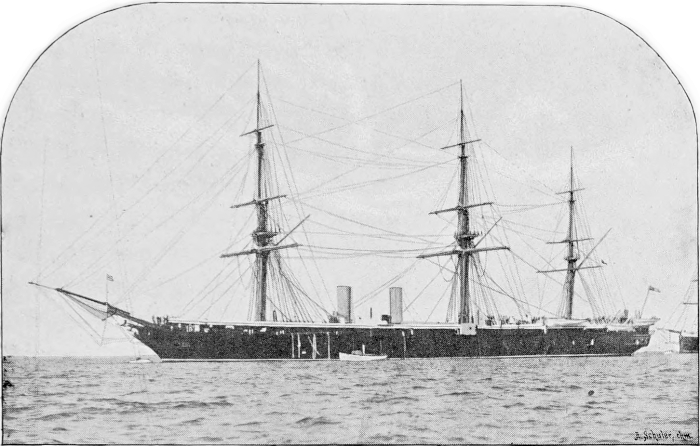
H.M.S. “BLACK PRINCE.”
Photograph by Symonds & Co., Portsmouth.
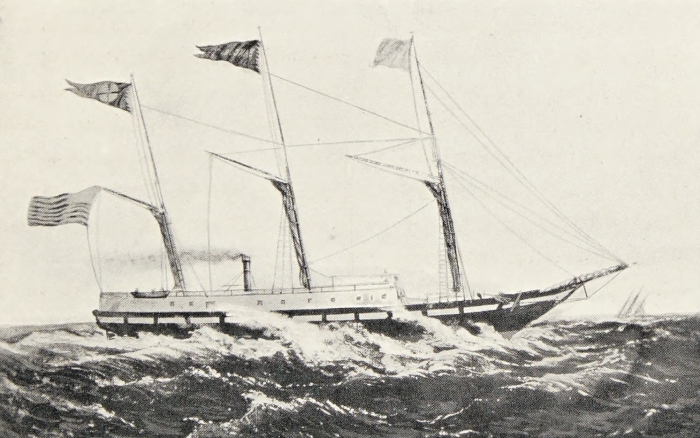
THE “BANGOR,” FIRST IRON SEA-GOING PROPELLER STEAMER IN
THE UNITED STATES.
From a Print in the possession of, and reproduced by permission of, the Harlan & Hollingsworth
Corporation, U.S.A.
Their engines were on Penn’s trunk system, with two
cylinders of 112 inches diameter, and a stroke of 52 inches.
Each had ten boilers with four furnaces per boiler, the total
grate area being 956 square feet, and the steam was supplied
up to a pressure of 25 lb. per square inch. These ships each
carried a four-bladed Mangin propeller of 24 feet diameter,
which was adjustable so that the pitch could be altered from
22½ feet to 28½ feet. The Northumberland was the first war
vessel on which Macfarlane Gray’s steam steering gear, originally
invented for the Great Eastern, was installed. These three
vessels were 400 feet 3 inches in length, and had a beam of a
fraction over 59 feet, and drew 27 feet 3 inches, with a displacement
of about 10,786 tons.
Before referring to the historic American ships of the third
quarter of the last century, some attention may be given to
a remarkable vessel which passed into the possession of the
United States Government.
The steamer Bangor was built by the firm of Betts, Harlan
and Hollingsworth (now the Harlan and Hollingsworth Corporation),
in 1843-4, for the Bangor Steam Navigation Company,
of Maine, and was the first iron sea-going propeller
steamer constructed in the United States. The hull was
formed of bar iron ribs or frames secured by numerous wrought-iron
clamps, and her plating was put on in the lapped or
“clinker” style, instead of the modern inside and outside
method of arranging the sheets.
The Bangor measured 231 tons burthen; her length over all
was about 131 feet; length between perpendiculars, 120 feet;
beam moulded, 23 feet; and depth of hold from base line amidships,
9 feet. She had three wooden masts, with bowsprit and
jib-boom, and was schooner-rigged, carrying a suit of eight sails.
Passengers were carried aft in a commodious deck-house fitted
up in a style of elegance unusual in those days, and considered
particularly handsome by her owners and builders. There
were but two deck-houses upon the vessel at the time she was
built, the third or forward house, as shown in the illustration,
having been added afterwards.
Her machinery consisted of independent twin-screw propeller
engines, having cylinders 22 inches in diameter by 24 inches
stroke of piston. The propeller wheels were of the Loper type
and 8½ feet in diameter. Her boiler was placed in the hold and
was of iron, 20 feet in length, of the type known as the “drop
flue” boiler. On her trial trip she averaged 10.61 miles per
hour at one time. The first five miles were run with low steam,
making forty-four revolutions. The pressure of steam was
under 46 lb. to the square inch during the whole trip. Afterwards
with full steam the speed per hour was 14.07 miles.
From this, however, there should be deducted 2½ miles for tide,
giving an actual speed of 11.57 miles per hour. On the second
trip of the Bangor from Boston, she caught fire, and was beached
upon the New England coast, near Nantucket, in order to save
the crew and freight. She was afterward adjudged a wreck,
the insurance settlement was effected, and she was towed to
a New England shipyard (probably at Bath, Me.), where she
was repaired and rebuilt. She afterwards continued to run
on the same line until she was, in 1846, purchased by the United
States Government, and re-named the Scourge at the time of
the outbreak of the Mexican War. During her employ as a
war vessel she was equipped with three guns. After two years
of war service, she was, on October 7th, 1848, finally sold by
the Government to John F. Jeter, of Lafayette, Louisiana.
From the date of this transfer no trace of her can be found.
It is possible that she may have been either lost by fire or
storm, or have been dismantled and altered for other than her
natural purposes.
A visit was paid to England in October, 1856, on her trial
cruise, by a ship which was destined to have considerable
influence in the not distant future upon warship construction,
and to help to revolutionise completely all the hitherto accepted
theories. This was the famous Merrimac—the first of six
steam frigates the United States had constructed. She was
considered by her designers to be a match for any vessel afloat
on the European side of the Atlantic, and as a specimen of the
American fondness for fast and heavily armed frigates, a type
of vessel in which they excelled, she left nothing to be desired.
Naturally, she attracted a great deal of attention.
The Merrimac—she came to England under that name, and
not as the Virginia, as sometimes stated—was 300 feet over
all, and 250 feet on the keel, and 260 feet on the load water-line,
and was 51 feet 4 inches beam, and drew 28 feet of water.
She was of 3,987 tons measurement, and 4,500 tons displacement.
Her engines were of 600 h.p. and presented several
peculiarities. The cylinders were of 72 inches diameter, with
a stroke of three feet, and there were two rods to each piston.
Her screw propeller was on Griffith’s system, and had means of
varying the pitch. Normally the screw had a pitch of 26 feet
2 inches; its diameter was 17 feet 4 inches. She had four
of Martin’s vertical tubular boilers. The frame of the ship
was of live oak, crossed internally with two sets of diagonal
iron plates, inclined in opposite directions, and similar plates
on the outside strengthened her bow and stern. Her model,
or shape, is said to have been of considerable beauty, while
her internal arrangements for the comfort and accommodation
of the officers and crew were of a high order. She could spread
56,629 feet of canvas, and nautical men here were of opinion
that she could easily have borne heavier masts and spars and
so have spread more canvas still. However, the weight of
her armament had to be considered, and this may have been
one reason why she was not more heavily equipped aloft.
She was pierced for sixty guns, but on account of the weight
and size and effectiveness of those she had, the number on
board was only forty. Nevertheless, she was claimed to be,
and with good reason, as powerful as anything Europe could
show. Two large pivot guns, of 10 inches calibre, and each
weighing nearly 5½ tons, were on the upper deck, together
with fourteen 8-inch guns, weighing more than three tons each;
while on the gun-deck were twenty-four 9-inch guns, each
weighing close upon 4½ tons. All these guns were strong
enough to fire solid shot, but they were intended to take
hollow shot or shell, a custom to which the Americans attached
considerable importance. The guns were built on the Dahlgren
system, which gave them throughout their length a thickness
proportionate to the pressure caused by the explosion of an
ordinary service charge of powder. The adaptation of these
guns to the Paixhan system of shell-firing was another novelty
she presented. As solid shot were more destructive against
fortifications and heavy works than the shells or hollow shot—uncharged
shells that is—the naval experts of Europe did
not look favourably upon explosive shells, preferring to consider
them more suitable for large swivel guns, such as were sometimes
mounted on the sponsons of paddle boats. The Merrimac
had not a solid shot on board. Her guns were of unusual
thickness at the breech and thinner than the European guns
in that part called the chase, which lies between the trunnions
and the muzzle. Their mounting, also, presented some
peculiarities. There was no hinder truck, the force of the
recoil being taken up by the friction of the carriage against
the deck, but the gun recoiled sufficiently on discharge to permit
of reloading; while, instead of the hinder truck, a contrivance
attached to the end of a handspike was thrust under the gun
carriage. There were, in addition, a number of smaller guns.
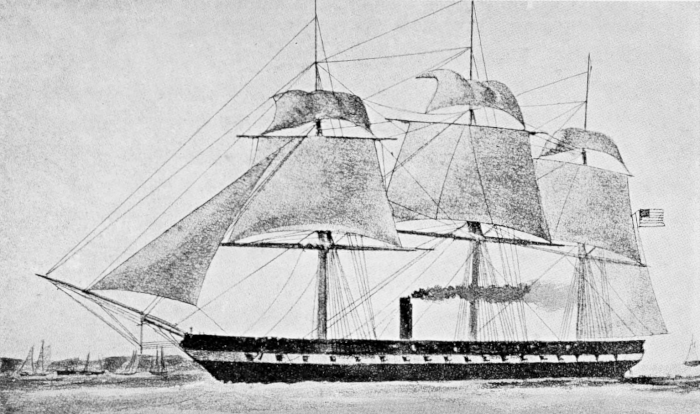
THE “MERRIMAC” BEFORE CONVERSION.
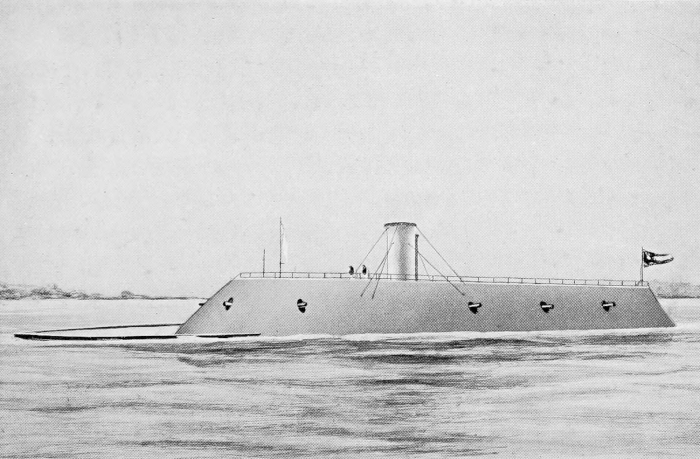
THE “MERRIMAC” AS CONVERTED INTO AN IRONCLAD.
From Photographs supplied by the U.S. Navy Department.
The next that was heard of the Merrimac was that when
the Federals found it necessary to burn certain stores and
ships which could not be removed beyond reach of the Confederates
after the American War began, she was one of those
set on fire and then sunk. The Confederates, being short of
ships—indeed, they seem to have been short of everything
except enthusiasm and a belief in their cause—raised her to
see what could be done with her. All her upper works had
been destroyed, and her hull somewhat damaged, but she was
held to be sound enough to be worth fitting out afresh. Accordingly,
to meet Commander Brooke’s design, she was cut down
to the water-line, and given a superstructure in the shape of
an ugly, squat rectangular deck-house with sloping sides, and
was referred to afterwards by her northern opponents as a
floating barn. The over-all deck length of this casemate was
about 170 feet. Its sloping walls were framed of pine twenty
inches thick, upon which oak planking four inches thick was laid,
and outside this two sets of iron plates, formed by rolling out
railway rails, were laid, the first horizontally and the outermost
vertically. Both sets of plates were fastened on by bolts
1⅜ inches thick, passing through to the back of the timber.
The sides sloped considerably, according to some writers
35 degrees, while others put the inclination at 45 degrees. The
intention was that any shot striking her should only inflict a
glancing blow and ricochet harmlessly. For the same reason
the ends of the casemate were given a similar angle, but instead
of being straight like the sides, were semi-circular, or almost
so. The top of the structure was covered by an iron grating,
which served the double purpose of permitting the ventilation
of the interior and keeping out missiles. This grating measured
about 20 feet by 120 feet. Her armament consisted of two
7-inch rifle guns mounted on pivots so that they could be fired
through any of the ports in the sides of the casemate, a 6-inch
rifled gun on either broadside, and three 9-inch smooth-bore
Dahlgren guns. Altogether she had fourteen gunports. To
add to her effectiveness, an iron ram was affixed to the bow.
Her stern lay very little above the water, but the highest point
of the bow was about two feet above the sea. Her conning
tower, a cone three feet high and protected by four inches of
armour, was placed beyond the forward end of the casemate.
Her funnel was unprotected. Though supposed to be renamed
the Virginia, she never lost her old name of Merrimac.
Against the wooden ships in Hampton Roads she was
invulnerable. Even at point-blank range their broadsides did
not suffice to stop her. This was her trial trip, and her engines,
patched up after their experiences in the fire and at the bottom
of the harbour, could only get her along at about four miles an
hour, and her crew had never been afloat in her before. Nevertheless
her commander, Franklin Buchanan, combined the trial
trip with active service, and attacked the northern ships with a
determination which carried consternation to the North. The
wooden Cumberland was blown up and the Congress sunk, the
latter as the result of an application of the ram, which, however,
injured the ramming vessel so much that the future effectiveness
of her ram was greatly reduced. Buchanan was so badly
wounded in this engagement that he was unable to command
the Merrimac in her duel the next day with the Monitor.
The Monitor, designed by Ericsson, was built under very
arbitrary conditions. When it became known that the Merrimac
was under construction, President Lincoln advertised for something
to meet her on equal terms, and Ericsson tendered. He
pointed out that the armour plates of the Gloire or Warrior
would be useless against the heavy 12-inch wrought-iron gun
he had brought out in 1840, in connection with Colonel Robert
Stockton, and as he pledged himself that he could complete
in a hundred days a steam vessel carrying two of such guns
placed in a turret which should be armour-plated and proof
against the heaviest guns the Confederates could place in the
Merrimac, his tender was accepted. Ericsson was hampered
in his work by the interference of the government officials,
hardly any of whom understood his plans, but all of whom
thought themselves competent to improve upon them. Considering
the limitations under which his undertaking had to be
accomplished, the Monitor was a remarkable vessel in every
respect. He had to draw out his plans to scale, have all the
parts designed, see that everything was made as he designed
it, and supervise the construction of the ship and engines, and
the whole of this work had to be done within a stated time.
The adventure, for such it unquestionably was, was hailed
throughout the length and breadth of America as the work
of a madman. Like all innovations destined to play an
important part in the world’s history, it was greeted with
derision and abuse. There were a few people on both sides
of the Atlantic who recognised the importance of the change
in naval construction which Ericsson’s ship inaugurated.
These were they who had profited by the lessons of the armoured
gunboats or floating batteries employed by the French and
English in the Crimean War. They saw that if small but
powerfully armed ships could effectively attack powerful shore
batteries, and by reason of their shape could never receive a
direct blow but only glancing shots, a vessel carrying a circular
fort which also could not receive a direct blow must be superior
to any vessel afloat, especially if its fort or turret were so
heavily armoured as to be proof against the heaviest ordnance
to whose fire it should be subjected. Moreover, if the hull
were made to offer the least possible mark to an enemy, the
difficulty of striking the vessel to sink it would be greatly
increased. The form of the vessel was such that if it were
used as a ram the weight behind the ram would be in a horizontal
plane with the ram at the point of contact, and greater injury
would thereby be inflicted upon the side of an opposing vessel
than were there a greater amount of weight above the horizontal
plane.
These considerations were ably supported by Admiral
Porter, of the United States Navy, who was well aware of the
value of such a means of attack even if the propelling engines
could not give the ship a speed of more than four or five miles
an hour. The gallant admiral himself was the butt of no
slight amount of ridicule by his emphatic declaration that
the Monitor “is the strongest floating vessel in the world and
can whip anything afloat.” The vessel was built of iron, and
can best be described as a shallow, oblong box, with sloping
sides, having upon it a pointed, flat, shallow box or raft with
a stumpy, circular tower or turret amidships. This box or
upper part projected a considerable distance all round above
the lower part, and especially so at the stern; and had not
the whole vessel been very strongly constructed, the fearful
blows which the under-part of the projection received from
the sea as it rose and fell on the waves on its passage from
New York to Hampton Roads would have driven the two
parts asunder.
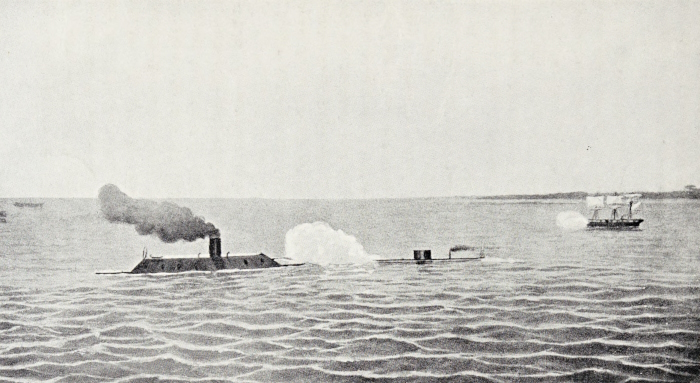
THE “MONITOR”-“MERRIMAC” DUEL.
From a Photograph of a Contemporary Drawing supplied by the U.S. Navy Department.
Up to the last Ericsson was bothered by the government
officials. Had he been left to himself the ship would not have
had such a narrow escape from going to the bottom. They
interfered with the turret-bearings, with the result that when
the sea washed over the low deck, the water poured into the
hold from all round the turret and put out the fires in the
engine room, when the fumes drove the engineers out of their
quarters and nearly poisoned everybody in the turret through
which all the outgoing ventilation had to be made. However,
the tugs got the vessel safely into smoother water, the furnace
was set going again, and the pumps were restarted, and by the
time Hampton Roads was reached the vessel was labouring
along as best it could under its own steam and with the aid
of a couple of tugs. The narrow escape the Monitor had from
foundering on this voyage served to stimulate the chorus of
disapproval, and there were not wanting many on the northern
side as well as on that of the south to predict the failure of
“Ericsson’s folly.”
Ericsson had confidence in his ship. He had never forgiven
the British Admiralty for its rejection of the screw propeller,
nor for ignoring his suggestions in regard to the Princeton,
and one reason why he chose the name of the Monitor, as he
told the writer and others more than once, was that it should
be a perpetual reminder to the British Admiralty of the chance
it had lost.
In the turret were two 11-inch Dahlgren smooth-bores
which fired solid iron shots weighing 135 to 136 lb. each with
charges of 15 lb. of powder, and were even more powerful than
his own gun. Solid iron stoppers closed the ports when the
guns were run in. The deck had five projections besides the
turret. Right forward was a small square pilot-house measuring
four feet, and constructed of bars of iron nine inches thick,
and provided with a flat iron roof two inches thick. In the
sides of the pilot-house were narrow slits as sight holes. The
other projections were two small chimneys six feet high,
removable before an engagement, and two intake ventilators.
Neither side on the morrow shirked the coming duel. From
the outset the Monitor was the better prepared. Her guns
fired solid shot; the Merrimac had only shell and grape, neither
of which was calculated to do much harm to the Monitor’s
turret, whereas the blow of the Monitor’s shot upon the sloping
sides of the Merrimac’s battery was bound to be delivered with
terrific force, even though the blows were slanting. For another
thing, the southern vessel was built of wood and had already
suffered severely in the hard contest at short range with the
battleships the previous afternoon; her engines were shaky,
and her steering gear worked worse than before; and the
experiences of some of her crew, coupled with the wounding
of her commander, had not been such as to leave their confidence
unshaken. The Merrimac was now commanded by Commodore
Tatnall, the hero of the episode in the Anglo-American attack
some years before upon the Chinese forts at Peiho, when he
justified the participation of the Americans by the famous
remark that “blood is thicker than water.” Tatnall proved
himself a worthy successor to Buchanan.
When the Merrimac sallied forth the next morning intending
to complete the destruction of the northern warships, she
found the Monitor waiting for her. Notwithstanding the
inferiority of his ammunition, Tatnall never hesitated for a
moment. The firing between the two ships was mostly at
short range, and by the time the battle was over both vessels
had had enough of it. Neither side admitted defeat, but
neither side had succeeded in destroying the other. The
Monitor was struck twenty-two times, and in return she fired
forty-one shots. Precisely how many of these were effective
on the southern ship is not known, but including the fight of
the previous day, she was found afterwards to have no fewer
than ninety-seven indentations on her armour. Her layers
of plating were shattered, and the heavy wooden backing was
splintered, but not one of the heavy shots of the Monitor
succeeded in penetrating the Merrimac. The backing only
splintered where the heavy shot had struck direct blows. Nine
of the Confederate shells struck the turret, and the pilot-house
was struck twice, and the other projections and the deck also
showed marks of the enemy’s fire. The result of the battle
was that the Monitor was able to resume hostilities and the
Merrimac was so badly crippled that she could not do so.
The steering gear and anchor of the Monitor were protected
by the overhanging deck, and were out of reach of the Merrimac’s
fire. This arrangement was repeated with modifications in
most of the northern monitors afterwards built, and greatly
puzzled the Confederates until they discovered the method
by which the vessels could be anchored or lift anchor without
anyone appearing on deck.
It should be remembered that the Merrimac had to contend
not only against the Monitor, but also against the gunboats
of the northern fleet, which fired upon her whenever they had
a chance.
The subsequent fate of these two typical ironclads is
interesting. The Monitor was sent to sea in weather she could
never hope to contend against, and went to the bottom. When
the fortunes of war drove the Confederates away from the
positions they had occupied at Hampton Roads, the Merrimac
was scuttled by her commander to prevent her falling into the
hands of the Federals. Both sides went on building ironclads
of the types they had introduced. The Federals rapidly
acquired a fleet of monitors, because they were convinced of
the superiority of that type of vessel, and had almost unlimited
resources. The South built a few more broadside ironclads
because it had no option in the matter. It was a case of taking
wooden steamers and plating them as best it could with rolled-out
railway metals, boiler plates, and, in fact, anything metallic
that could be bolted on.
The Atlanta, formerly the English steamer Fingal, was cut
down much as the Merrimac had been, and given a heavy
wooden casemate plated with iron. The two monitors, Nahant
and Weehawken, were waiting for her, and when she set out
from Savannah to look for them, they followed. So also did
some steamers carrying a large number of Southerners who
went to see their ship defeat the monitors. The Atlanta fired
one shot at the Weehawken and missed, and the monitor returned
the compliment by steaming to within 800 yards and firing her
heavy 15-inch gun. The projectile smashed the Atlanta’s
armour and wooden backing, and the flying splinters wounded
sixteen of the crew. She returned the fire two or three times
without hitting once, but the Weehawken’s second shot smashed
the pilot-house and the third started the casemate from the
deck. The Atlanta surrendered in fifteen minutes after the
firing of the first shot. Her subsequent employment was as
a guardship in the northern fleet. The Nahant did not fire.
The Albemarle, another Confederate ram of the Merrimac
type, had a short but exciting career. She carried only two
100-pounder rifled guns, pivoted to fire end-on or on the broadside.
Her first exploit was to ram the northern gunboat
Southfield, in the Albemarle Sound; her ram entered about
10 feet, and the Southfield began to sink so rapidly that, before
she rolled off the Albemarle’s ram, she nearly took the latter down
with her. The Albemarle afterwards fought a pitched battle
with four northern paddle-wheel gunboats, and although she
was rammed and damaged, she held her own. Her destruction
may be said to have heralded the introduction of the torpedo
boat, and for this reason is referred to in a subsequent chapter.
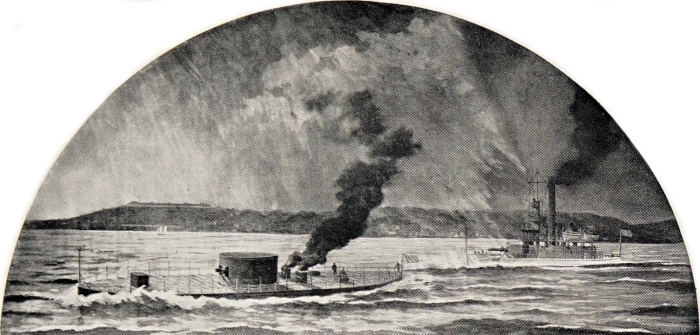
THE “MONITOR” AND “ALBEMARLE”
From a Painting by Müller.
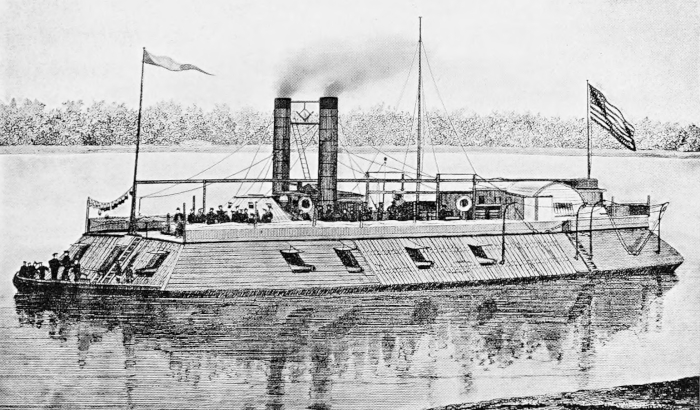
FEDERAL GUNBOAT “ST. LOUIS.”
From Photographs supplied by the U.S. Navy Department.
Another most notable example in these improvised ironclads
was the ram Tennessee, which was designed and commanded
by Commodore Tatnall. This vessel played a conspicuous
part in the defence of Mobile against the Federal
fleet under Admiral Farragut, in August, 1864. The Tennessee
was admirably designed for the purpose intended, which was
that of an ironclad, heavily armed, and able to ram; but
unfortunately for her, she could not be got completely ready
in time, nor was it possible to give her the armoured protection
or the weighty artillery which had been contemplated at first;
nevertheless, her commander fought her well, and that she
came absolutely to grief was due to hasty construction
and lack of material to put into her, rather than to any fault
in the design of the ship itself. Her battle with the Union
fleet shows with what grim determination the ship was fought.
“There was a brush with the ironclad ram,” says an
American writer, “but it was not serious, and the fleet came
to anchor three miles up the bay. Farragut was planning to
attack the ram as soon as it should be dark enough to prevent
the garrison seeing which was friend and which foe; but the
ram anticipated him and steamed direct for the flagship (the
Hartford) in the midst of the fleet. The Admiral at once gave
orders for every ship to attack her, not only with shot but
by ramming, and a desperate contest ensued. The ram had
the advantage in that she was sure of striking an enemy with
every blow, while the fleet had to avoid running and firing
into one another. Their shot had no effect on the sloping
iron sides of the monster, and when the wooden vessels rammed
her they only splintered their own bows and only heeled her
over. But the monitors, with their enormous guns, shot away
her smoke-stack and steering apparatus, and jammed her shutters,
while one 15-inch shell actually penetrated her armour.”[38]
This heavy cannonade proved too much for her. With
her armour battered, her machinery damaged, her commander
badly wounded, her steering gear disabled, she lay helpless at
the mercy of her foes and surrendered.
Another type of ironclad which the Confederates employed
was known as the David, because though small it was hoped
it would deal as effectively with the big northern warships
as its Hebrew namesake had dealt with Goliath of old. The
parallel, however, ceases with the name. The first American
David was tried at Charleston, in October, 1863. She was
cigar-shaped, 54 feet long, and 6 feet in diameter, and carried
a small steam engine to drive a small screw propeller. Her
one weapon was a spar torpedo, and when she had exploded
it she was expected to go to the bottom with such of her crew
as did not happen to be able to save themselves.
Many brave deeds have been done in war by combatants
and non-combatants alike, but the cool courage of the pilot or
steersman of the first David will take some beating. Her
initial attack was directed against the ironclad ship Ironsides,
named in commemoration of the “Old Ironsides,” and whether
failure or success attended the attempted destruction of the
ship, those on the David knew they were engaged in a forlorn
hope. Only the funnel and pilot-house of the little vessel
were discernible above the sea level, and even they were not
very conspicuous. The David was hailed, and replied with a
volley of musketry, and an instant later a torpedo exploded
against the sides of the warship. It lifted her and shook her,
but inflicted no material damage worth speaking of, but the
moral effect was considerable, as the Federals knew the Confederates
had now devised a new means of attacking them.
At the moment of the explosion the four or five men composing
the crew of the David jumped overboard, as it was thought
she would be swamped by the backwash of the explosion.
She did not sink, however, and the pilot held on to her for his
life, for he was the only man on board who could not swim.
The engineer swam to her, and together they took her back to
Charleston.
On the Mississippi and the other American rivers both sides
improvised as gunboats anything that had an engine in it and
a platform upon which a gun could be carried. Small tug-boats
were given turtle-back armour, too thin to be of use, whence
some of them got the name of tin-clads in contradistinction
to the ironclads; big side-wheel steamers were protected with
anything that could be utilised for the purpose, from logs to
bags of ashes, and ordinary river cargo steamers and barges
were also found very adaptable. It may, indeed, be doubted
if in any war there has been such an assemblage of opposing
warships improvised from the most unpromising materials as
in the American Civil War. The majority of them were not of
great use as combatants, notwithstanding that their crews
usually handled them with reckless bravery, and after the
passage of the Mississippi mouth had been forced and the
northern warships were able to ascend the river, the fighting
value of these makeshifts became almost a negative quantity.
In the absence of superior force, however, there was no telling
what they might attempt, for their crews were as reckless as
they were daring.
When the Civil War began, Edwin Stevens offered the
Federal Government, at his own expense, a small vessel called
the Naugatuck. This was a twin-screw vessel, which could be
immersed two feet below her load-line and raised again in eight
minutes by pumping out the water admitted into the tanks.
The solitary gun was mounted on a revolving carriage, and the
recoil taken by rubber disc springs. It was loaded, directed
and fired from below the deck, the loading being accomplished
by bringing the depressed gun opposite a hole in the deck, provided
for the purpose.[39] She carried a Parrott gun, a
100-pounder, and was one of the fleet that attacked the Merrimac.
Her twin screws enabled her to turn from end to end in seventy-five
seconds. She did good service on the James River, until
her gun burst; her crew, thanks to her protecting deck, escaping
injury. This vessel is chiefly of interest because of the method
of placing and loading the gun.
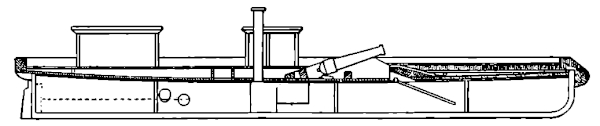
THE NAUGATUCK.
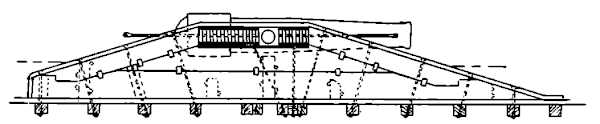
THE GUN-CARRIAGE OF THE NAUGATUCK.
Ericsson’s inventive genius was responsible in 1861, before
the war broke out, for a vessel of 3,033 tons, which he named
the Dictator, but she was not launched until 1863, the builders
being the Delamater Iron Works. She was an iron-framed
vessel, and had a wooden skin 3½ feet thick. The iron protecting
her sides was 11 inches thick, 5 inches of which were
solid bars measuring 3 inches by 5 inches, and the other portion
was built up in single 1-inch plates. Her ram, a heavy structure
of oak and iron, projected 22 feet beyond the bow. On deck
she carried a single turret with an inside diameter of 24 feet.
The walls of the turret were protected by 15 inches of
iron plates, each 1 inch in thickness, and weighed 500 tons.
Her engine was of Ericsson’s vibrating lever type with
two cylinders 100 inches in diameter, and indicating
5,000 h.p. The screw was 21 feet 6 inches in diameter, with a
pitch of 34 feet, and was cast in one piece, its weight being
17⅖ tons. The Dictator’s armament was two smooth-bore
15-inch guns, known as Ericsson guns, which were of the same
type as he introduced into America on behalf of Col. Stockton,
and with a charge of 80 lb. of powder, threw a round shot
weighing 460 lb. The ship was 320 feet long, 50 feet broad,
and drew 22 feet of water.
In the subsequent monitors the conning tower was placed
above the turret as in the case of the Passaic. Monitors were
built later with two turrets, and a flying deck connected them.
They were of much greater dimensions than the single turret
ships, and carried twice the number of guns, and being considerably
heavier and faster and more extensively armoured,
were exceedingly capable fighting machines.
But the wooden warships were not destined to pass away
without making a gallant struggle well worthy of the traditions
of centuries. The last great battles in which they engaged
were at New Orleans and Mobile, and well they acquitted themselves.
Stranded, rammed, and almost set on fire, as they
were time after time, they yet carried on an unequal contest
until they achieved splendid victories at these places. Not
even torpedoes, as mines were then called, daunted Admiral
Farragut, who, at Mobile, when a ship that was leading hesitated
and nearly threw the whole line into disorder, inquired, “What
is the matter?”
“Torpedoes,” was the answer.
“Damn the torpedoes,” roared Farragut from his usual
place in the rigging, to which he was accustomed to mount
in order to see over the smoke. Whereupon his ship, the
Hartford, assumed the lead.
On the Atlantic coast the South endeavoured to maintain
its unequal contest by means of blockade runners and privateers.
Foremost among these were the Shenandoah, which has the
distinction of being the only ship to carry the Confederate
flag round the world; the Sumter, a small commerce destroyer,
commanded by Captain Raphael Semmes, who afterwards had
the Alabama; and the last-named herself. The Sumter was
described by Captain Semmes as a “stone which had been
rejected of the builders,” and he says that he endeavoured to
work it into the building which the Confederates were then
rearing. “The vessel was reported to him as a small propeller
steamer of 500 tons burden, sea-going, with a low-pressure
engine, sound, and capable of being so strengthened as to be
enabled to carry an ordinary battery of four or five guns. Her
speed was reported to be between nine and ten knots, but
unfortunately, said the Board, she carried but five days’ fuel,
and has no accommodation for the crew of a ship of war. She
was, accordingly, condemned. When I finished reading the
report, I turned to the Secretary and said, ‘Give me that ship;
I think I can make her answer the purpose.’ My request was
at once acceded to; the Secretary telegraphed to the Board to
receive the ship, and the clerks of the Department were set at
work to hunt up the necessary officers to accompany me, and
make out the proper orders. And this is the way in which the
Confederate States’ steamer Sumter, which was to have the
honour of being the first ship of war to throw the new Confederate
flag to the breeze, was commissioned.”
He got her into shape somehow, and she began her
adventurous career by running the blockade in a most daring
fashion at Pass a l’Outre, in spite of the presence of the Brooklyn,
which was faster and more heavily armed. She beat the
northern ship simply because she could sail nearer to the wind.
After six months’ experience of this ship, he says that “in
her best days the Sumter had been very inefficient, being always
anchored, as it were, in the deep sea, by her propeller whenever
she was out of coal. A fast ship propelled entirely by sail
power would have been better.” She captured seventeen
ships, consistently dodged five or six northern ships, and at
last had to be laid up at Gibraltar. She afterwards sailed as
the Gibraltar under the English flag as a merchant vessel, and
made one successful voyage as a blockade runner to Charleston,
South Carolina, and went to the bottom of the North Sea soon
afterwards.
The Sumter’s battery consisted of an 8-inch shell gun
pivoted amidships and four 32-pounders of 13 cwt. each for
broadside firing. The slide and circle for the pivot gun were
constructed of railway iron. She captured seven prizes in
two days, and escorted six of them into the harbour of Cienfuegos
at once.
The Alabama was built at Birkenhead under a contract
with the Confederate States, and was paid for out of the Confederate
treasury. “The Alabama had been built in perfect
good faith by the Lairds. When she was contracted for, no
question had been raised as to the right of a neutral to build
and sell to a belligerent such a ship.”[40] Be that as it may, the
settlement of the Alabama claims proved an expensive item
for Great Britain. She was responsible for the destruction of no
fewer than sixty-seven American ships, and such was the terror
she inspired that the armed frigate Kearsarge was sent to hunt
her down and exterminate her. Soon after embarking on her
privateering, the Alabama fought and sank the Hatteras in the
only engagement she was concerned in until she met her fate
at the guns of the Kearsarge. There was not much to choose
between the ships in size, but in all other respects the advantage
lay with the northern ship, which had further strengthened
her sides with a concealed belt of chain cables.
“As for the ships,” writes Captain Semmes in “Service
Afloat,” “though the enemy was superior to me, both in size,
staunchness of construction, and armament, they were of force so
nearly equal, that I cannot be charged with rashness in having
offered battle. The Kearsarge mounted seven guns—two
11-inch Dahlgrens, four 32-pounders, and a rifled 28-pounder.
The Alabama mounted eight—one 8-inch, one rifled 100-pounder,
and six 32-pounders. Though the Alabama carried one gun
more than her antagonist, it is seen that the battery of the
latter enabled her to throw more metal at a broadside, there
being a difference of three inches in the bore of the shell-guns of
the two ships. Still the disparity was not so great but that
I might hope to beat my enemy in a fair fight. But he did
not show me a fair fight, for, as it afterwards turned out, his
ship was iron-clad. It was the same thing as if two men were
to go out to fight a duel and one of them, unknown to the
other, were to put a shirt of mail under his outer garment....
By Captain Winslow’s own account, the Kearsarge was struck
twenty-eight times; but his ship being armoured, of course,
my shot and shell, except in so far as fragments of the latter
may have damaged his spars and rigging, fell harmless into the
sea. The Alabama was not mortally wounded until after the
Kearsarge had been firing at her an hour and ten minutes.
In the meantime, in spite of the armour of the Kearsarge, I
had mortally wounded that ship in the first thirty minutes
of the engagement. I say ‘mortally wounded her,’ because the
wound would have proved fatal but for the defect of my
ammunition. I lodged a rifled percussion shell near her sternpost—where
there were no chains—which failed to explode
because of the defect of the cap. If the cap had performed
its duty and exploded the shell, I should have been called upon
to save Captain Winslow’s crew from drowning, instead of him
being called upon to save mine. On so slight an incident—the
defect of a percussion cap—did the battle hinge. The
enemy was proud of this shell. It was the only trophy they
had ever got from the Alabama. We fought her until she would
no longer swim, and then we gave her to the waves.”
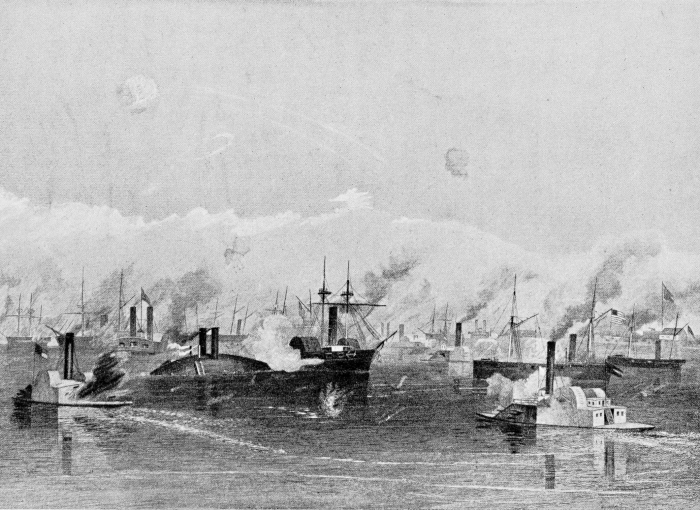
CAPTURE OF NEW ORLEANS—ATTACK ON FORT PHILIP.
From a Contemporary Steel Engraving, showing improvised warships employed.
The Shenandoah was the name given by the Confederates
to the Glasgow-built auxiliary steamer Sea-Horse, which was
the only ship to carry the southern flag from Dixie’s Land to
the Cape, thence to Australia, and up to the North Pacific.
She found her chief prey among the American whalers.
CHAPTER VI
IRON SHIPS OF WAR—continued
The Admiralties, naval architects, and a great many other
people throughout the world were troubled for several years
through trying to reconcile all the divergent and often contradictory
claims put forward as to what should constitute a
fighting ship. Those who troubled most were those who knew
least of the subject. The naval architects, having to make
the necessary calculations, were not without some knowledge
of the limitations of the materials at their disposal; and the
Admiralties left matters to the experts, whether employed by
Governments or in private shipbuilding establishments, confident
that those who were best acquainted with such a technical
subject would be most likely to set forth something possible
of attainment and destined to show certain definite results.
And this has been the attitude of all Governments towards
all inventors, whether their inventions were of practical utility
or were merely the outcome of seeing visions and dreaming
dreams. This does not imply, however, acceptance of the
official theory that Government experts know everything.
Many people, after the American war, went turret-mad,
and became possessed of the idea that this country should
own a numerous fleet of monitors, so numerous, indeed, that
every port all round the British coasts should have two or
three of such vessels in order that an enemy’s fleet, usually
conjectured by the turret enthusiasts to consist of large two
or three-decked battleships, should be met by a succession
of monitors each manned by a fresh crew and full of ammunition,
and reduced to submission if possible, or sunk, or scattered as
was the Spanish Armada, an historical allusion which these
good people found very useful as adding a picturesque touch.
Nor were the enthusiasts of other countries behind those of
Great Britain in their advocacy of their pet theories. Naval
economists, who yet wished to swim with the current of naval
enthusiasm, did not hesitate to point out the economy of
construction to be effected by a fleet of monitors or of small
vessels carrying turrets. Some contended that no guns were
too heavy to be sent afloat, so that they should smash any
armour by the weight of their projectiles; and ingenious were
the calculations to demonstrate how easy it would be for a
heavy gun, such as was used for land fortifications, to be sent
to demolish a hostile vessel whatever her dimensions and
armament. Others clamoured for the heaviest possible armour,
even if only moderately powerful artillery should be installed,
coupled with great ramming power. That every part of the
ship should be so heavily armoured as to be invulnerable was
another contention which found much favour, its adherents
forgetting that too much armour would sink the vessel; but
its opponents rejected it in favour of the concentration of the
armour over the vital parts of the ships, and leaving the ends
unprotected or nearly so. Other claims were for high speed,
great coal capacity, large sail power, lofty freeboards, seaworthiness,
steadiness of gun platform, small size, shallow
draught, and comparative invisibility to an enemy’s gunners.[41]
As it was manifestly impossible to build ships which should
meet the requirements of all the nation’s advisers and be
suitable to be sent to perform all kinds of duties anywhere,
armoured ships began to be constructed of special types according
to the work expected of them. The first division was into
battleships, armoured cruisers, and coast defence ships.
As the result of Captain Coles’s advocacy of the turret
system, which he began in 1861, the Admiralty, when converting
a number of old and new wooden ships into ironclads,
had one of them, the Royal Sovereign, cut down, covered with
armour, and given four armoured revolving turrets placed on
the upper deck in the middle line of the ship. She marked
the conversion of the Admiralty to the new order of things
which steam power and iron armour in combination had
rendered possible. One step in the process of conversion was
that sail power was no longer considered necessary in fighting
vessels, another was that the combatant part of every ship
intended for heavy fighting should be afforded as much protection
as possible, and a third step was that the guns should be few in
number, of considerable power, and so disposed as to have the
widest possible range. This ship could fire all her guns on
either broadside, and also had a direct fire ahead and astern.
She started her career as a 131-gun line-of-battle ship, but after
her alterations she carried five 12-ton muzzle-loading guns,
of which two were in the foremost turret and one each in the
others. She was also the first of the converted vessels to be
given a steel protective deck, in her case two inches thick, but it
was not curved so as to place the edges below the water-line,
and it consequently would not have afforded any protection
to the vessel had a shot penetrated the armour at the water-line.
Her low freeboard would have rendered her difficult to
hit, and she would have been able to approach an enemy and
deliver a telling fire at comparatively short range without
running undue risk of receiving much damage in return.
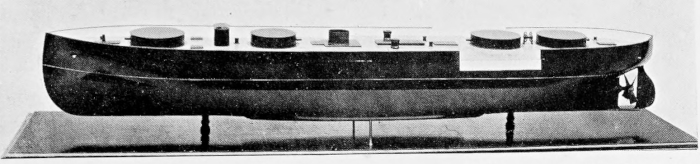
THE “PRINCE ALBERT” (SISTER SHIP TO THE “ROYAL SOVEREIGN”) AS
CONVERTED TO A TURRET SHIP.
From the Model in the Royal Naval College, Greenwich.
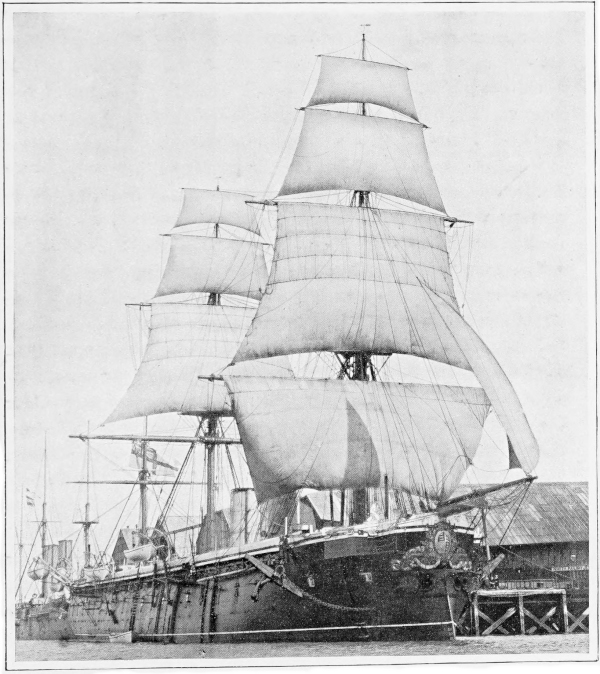
H.M.S. “MINOTAUR.”
Photograph by Symonds & Co., Portsmouth.
The dimensions of the first British turret ship compare
curiously with those turret ships which followed her in rapid
succession, both in the British and other navies. She was
240 feet 7 inches in length, with an extreme beam of 62 feet
and a draught aft of 24 feet 11 inches.
Even after the launch of the Warrior the Admiralty ordered
a few wooden ships, but in 1866 decided upon the adoption of
iron warships. One of the last and certainly one of the best
to look at of the wooden armour-plated ships was the steam
frigate Lord Clyde, but as a sailer she had many defects, of
which slowness was not the least. In her case the armour
extended to the ends of the ship, and nowhere was it less
than 4½ inches in thickness, while at the water-line the armour
plates were 5½ inches thick. The sides of the entire battery
deck from stem to stern, and from 3 feet below to 3 feet above
the ports, were plated with 6-inch armour, of which one thickness
of 1½ inches was bolted to the ship’s frame, and the other, of
4½ inches, was placed upon the outside of the planking. The
armour went 6 feet below the water-line amidships, and for
the sake of lightness was only 4½ feet deep at the ends. The
gun ports were 8 feet 9 inches above the water-line, or 2 feet
6 inches higher than those of La Gloire. She was the first
vessel in the British Navy to carry an armour-plated bow
battery on the main deck. This armour plating also was
carried upwards to protect an upper-deck bow battery mounted
under the ship’s forecastle. This arrangement enabled her to
fire four guns ahead, while exposing to the enemy’s fire only
the curved surface of her bow armour. She also had a distance
of 15 feet between each gun port on her main deck. Her
engines of 1,000 h.p. nominal, and 6,000 indicated, drove a
two-bladed Griffith’s adjustable propeller 28 feet in diameter.
From 1860 to 1866 ten broadside ironclads were added
to the navy, the last and the largest being the Northumberland
of 10,780 tons. All these vessels, except the Hector and Minotaur,
carried muzzle-loaders, but these two had breechloaders of
the early Armstrong screw type, which were soon superseded
by more powerful weapons. The Minotaur carried fifty guns,
the Northumberland twenty-six.
Then followed the abandonment of the broadside and the
confinement of the heavy armament of an ironclad to a central
battery protected by thick iron side armour and armoured
bulkheads, the only other portion of the ship to be thus protected
being that near the water-line. The first of these in
the British Navy was the Bellerophon, launched in 1865; she was
of 7,550 tons displacement, and her engines, of 6,520 h.p.
indicated, drove one screw and gave her a speed of fourteen knots.
Her thickest armour was 6 inches, and her heaviest gun a
12-ton muzzle-loader. Altogether she carried fourteen guns,
including one in a small armoured citadel in the bows.
Great though the advantages were of the screw propeller,
it was admitted that it was not without many drawbacks.
The single screw took up a lot of room, weakened to some
extent the structure of the stern, and if anything happened
to the engines or propeller the ship was helpless and had to
depend entirely upon whatever sail power she might possess.
To overcome this difficulty Messrs. J. and W. Dudgeon were
the first to build, from the designs of Mr. John Dudgeon, a twin-screw
ocean-going steamship. Twin and triple screws had been
used before, but were driven by the one engine.
Before this, however, Messrs. Dudgeon experimented with
a small iron vessel, of 400 tons, called the Flora, which was
given two independent engines and screws. The propellers
were placed under the counter, and proved the advantage of
this position over that of the practice, where two screws were
used, of placing one before, and the other behind the rudder.
The advantage of placing the screw either in a space cut in
the deadwood, or, in the case of twin propellers, under the
counter, was much greater than the method at one time adopted
of placing the screw behind the rudder. Under the newer
method the steering power of the rudder was not impaired;
but under the older method, when the screw shaft was carried
beyond the rudder, a slit known as a “shark’s mouth” had to
be made in the rudder so that the upper and lower portions
would be able to pass the screw shaft. The practice of equipping
the vessels with wells or recesses into which the screw could
be lifted was found to possess but slight advantages for warships,
and was ere long abandoned. The best that could be said
for it was that when a ship was travelling under sail only,
the screw could be lifted from the water and the strain upon
the wooden stern caused by dragging the screw, whether of
the fixed or folded patterns, through the water, or running loose,
was avoided altogether.
The Hebe was the third vessel on this principle built and
engined by Messrs. Dudgeon, and the advantages of the twin-screw
system over the single screw were again strikingly manifested
during a series of manœuvres. The Hebe was an iron
vessel of 470 tons, and 165 feet long. The screws were three-bladed,
7 feet 6 inches in diameter, and had a pitch of 15 feet,
and were worked by two separate and independent engines
each having two cylinders 26 inches in diameter, with a
21-inch stroke of piston, and being collectively of 120 nominal
h.p. The tests showed that the vessel with both screws working
ahead could made a complete circle in four minutes or less,
and in still shorter time with only one screw working and the
helm thrown over, or with the two screws working in opposite
directions.
The tests were severe, but they proved more effectively
than any tests before had done the great superiority of the
independent acting twin screw over the single screw; and the
results in far greater manœuvring power, speed, and reliability
were so satisfactory that the Admiralty was most favourably
impressed. The Messrs. Dudgeon, in 1863, built the steamship
Far East, and her launch and trial trip took place in the presence
of the representatives of the Admiralty. She was fitted with
twin screws which had a diameter of 8 feet 2 inches, and a pitch
of 16 feet. The shafts of the screws were carried through a
wrought-iron tube bolted to a false iron bulkhead clear of the
ship’s frame. The Admiralty not long afterwards adopted
twin-screw propellers. The advantages of the twin screw
were that were one to be disabled, the other could propel the
ship without trouble, and that as an aid to steering, one screw
could be sent astern and the other worked ahead, so as to turn
the vessel in little more than her own length.
The Penelope, launched in 1867, was the first twin-screw
ocean-going ironclad belonging to the Navy, and she was, moreover,
the first government owned warship in which each screw
had its own engine, as compared to the two screws geared to
one engine in the floating batteries of the Crimean days. She
was of 4,470 tons displacement, and her engines of 4,700 indicated
h.p. gave her a speed of between twelve and thirteen
knots. Each of her twin screws was fitted to a distinct stern
with separate deadwood and rudder, an arrangement which
neither added to the steering capabilities of the ship nor increased
its structural strength at the stern. The Penelope had recessed
ports to allow of increased training of the guns.
Captain Coles, to whom, notwithstanding the sad fate
which overtook the Captain, this country is somewhat indebted
for his consistent advocacy of the adoption of the turret on
sea-going ships, urged upon the Admiralty the superiority of
the turret over the broadside system. His contrivance differed
from that of Ericsson in the important particular that Ericsson’s
turret was supported on a pivot which rested upon bearings
at the bottom of the ship, whereas Captain Coles’s turret rested
upon bearings supported in a specially constructed room resting
upon the beams of the deck, which, in turn, were strongly
supported from below. In regard to the thickness of armour
there was little to choose between the two. Captain Coles
brought his design before the notice of the United Service
Institution in 1860, and although it attracted a great deal of
attention among naval constructors and manufacturers of
naval artillery, only one nation was then of sufficient courage
to order an experimental ship. That nation was Denmark,
and it is to that country that the honour must be given of
having the first ship in which the broadside system of gun-fire
was entirely abandoned and the turret system installed instead.
This vessel was the Rolf Krake, an iron double-turreted monitor
with lowering bulwarks. She was engaged in the war against
Prussia, in 1864, when she took part in a fierce duel with
the Prussian batteries at Eckernsünde. The batteries fired
24-pounder rifled Krupp guns, and though the ironclad was
struck about one hundred and fifty times, her armour was
sufficient to withstand the shot, and she certainly inflicted
a great deal more damage than she received.
Numerous experiments were made in France and in this
country with the object of determining the special characteristics
of a vessel which should meet the rapidly altering condition
of affairs caused by the increase of the power of the guns and
the development of the torpedo from the stationary mine,
which was so terrifying in the American War, to the torpedo
which could attack a vessel at anchor, or even be directed
at one moving slowly. The requirements were a moderate
displacement, increased protection, and ability to carry heavier
guns capable of fore and aft fire as well as over the broadside.
The problem was not an easy one by any means. The cellular
double bottom system was extended as a precaution against
torpedoes; the number of guns and the extent of the armour
were lessened, but the thickness of the armour was increased
in order to protect the vital parts and the guns from the fire
of the newer and more powerful ordnance, while to compensate
for the increased weight in the middle third of the ship, the beam
was made greater in proportion to the length.
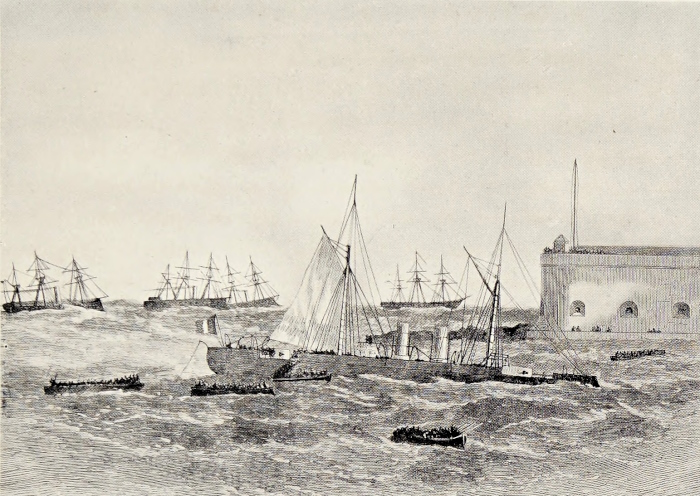
FOUNDERING OF THE “AFFONDATORE” IN THE HARBOUR OF ANCONA.
Reproduced by permission of the “Illustrated London News.”
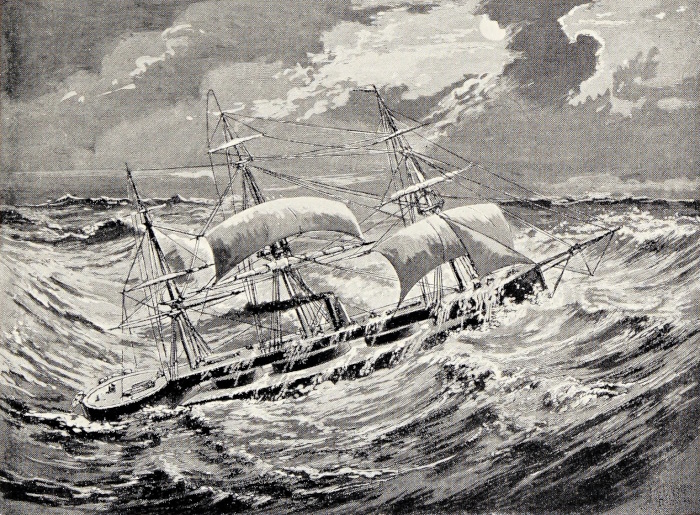
WRECK OF THE “CAPTAIN.”
From a Contemporary Wood Engraving.
Matters were in this experimental stage when the first
engagement was fought between European fleets, each of
which included sea-going ironclads. The battle of Lissa, in
1866, was no less remarkable for the crushing defeat which the
Austrians inflicted on the Italians than for the fact that that
defeat was against all that the naval experts had considered
to be the natural order of things. The Italian fleet was more
numerous than the Austrian; it had more ironclads, its armament
was greater, it had a greater number of wooden warships
of various sorts and sizes; but as a powerful offset to all these
advantages it had an amount of muddle and disorganisation
truly appalling. The Italian fondness for big ships and big
guns was as much in evidence in the fleet of 1866 as in the
immense armoured ships Duilio and Dandolo, which that country
built a few years later, and to which a more extended reference
is made on another page. Its principal ships in the attack
on Lissa and the subsequent engagement with the Austrian
fleet were the Re d’Italia and the Re di Portogallo—two
American-built vessels of 5,700 tons, old measurement. They
were plated with armour 7 inches thick. They were designed
to carry, the former two 150-pounders, and thirty 6-inch guns
and four smooth-bore guns; and the latter two 300-pounders,
and twenty-six 6-inch guns. These ships were poorly constructed,
and the design was so faulty that the rudders were
left without protection and open to destruction by ramming
or gun-fire—a weakness of which the Austrians took full
advantage. There was also a turret ram called the Affondatore,
4,070 tons, built at Millwall, and armed with two 300-pounder
Armstrong guns in two turrets, which was supposed to
epitomise all the lessons of the American War. Her ram projected
26 feet, and what with this and her big guns and her
thick armour, the Italians expected her to do wonders. As
sea-boats the three were about equally bad. There were also
two French-built small rams, Terribile and Formidabile, of
2,700 tons. The French at that time favoured comparatively
small ships with large rams for coast and harbour defence,
giving them iron plating 4½ inches thick, and 6-inch rifled guns
as their principal weapons. Of the broadside ironclads there
were four, of about 4,700 tons each, and belted from stem to
stern at the water-line. There were, besides, two armoured
gunboats which carried two 150-pounder Armstrongs and some
smaller guns. The Italian fleet also had a number of steam-engined
wooden vessels. The Austrian fleet had six very
indifferent ironclads, slow, none too well armed, smooth-bores
of no great size predominating, and a few other vessels, mostly
of wood, of little fighting value, but capable of holding in check
the Italian wooden ships for a time at all events. The Austrian
ships were the Drache, Kaiser Maximilian, Prinz Eugen, and
Salamander, whose tonnage ranged from 3,400 to 3,800, each
carrying 4½-inch armour of home manufacture; the steam
line-of-battle ship Kaiser, four steam frigates, and some smaller
boats. These were practically ready for sea when hostilities
were commenced. The two unfinished ironclads Habsburg and
Ferdinand Maximilian were got ready in an improvised fashion
and given smooth-bore guns; and the Don Juan, another
vessel in a state of even greater unpreparedness, had the
deficiencies in her armour made good with heavy wooden
beams. The Italians had two hundred and seventy-six rifled
cannon to one hundred and twenty-one on the Austrian ships.
The Austrian Admiral, Tegethoff, was a man who left nothing
to chance. He knew what he had to do, and he had that
genius for command which enables a man to do his best with
the materials at his disposal. Great though he knew the
discrepancy to be between his own fleet and that of the Italians,
it is a remarkable testimony to his organising power that he
was able at the first glimpse he had of the Italian fleet to
understand the extraordinary lack of cohesion that characterised
it from first to last, and to prepare to meet it with every
expectation of victory. He placed his fleet in wedge formation
with the intention of breaking the enemy’s line of ironclads
with his own ironclads, so as to avoid subjecting his weaker
vessels to the fire of the heavier Italian vessels, as might have
been done had he attacked the Italian line near or beyond its
centre. He also intended to ram the Italian ships whenever
he had a chance, but though the chances later were numerous,
the ram proved a less effective weapon than had been expected.
The duty of the Austrian smaller vessels was to rake with
their guns the Italian ships after the heavier Austrian ships
should have thrown them into confusion, for owing to the
longer range of the Italian guns and the heavier weight of their
projectiles, the Italians had a superiority at long-range fighting
which the Austrian commander was by no means disposed to
allow them to turn to their advantage.
The ships on both sides were slow, those of the Austrians
being worse even than those of the Italians. This may to
some extent explain the comparative ineffectiveness of the
ram, the blow being of not sufficient force to inflict much harm.
The Austrian ships were to “ram everything grey,” the Italian
fleet having been painted a conspicuous light grey which made
them easily distinguishable; whereas the Austrian ships were
black, but their funnels were differently painted, so that any
one of them could be identified in a moment. The shock when
the Ferdinand Maximilian rammed the Re d’Italia was not
very violent, but, possibly on account of the weakness of construction
of the hull, the ram did its work. A gaping wound
was formed in its side through which the water rushed, and
the great ship, after giving a couple of rolls, like some ocean
leviathan in agony, heeled heavily over and went down, the
first sea-going ironclad to be lost in this manner. The Austrians
were appalled for the moment at the result of the experiment,
for such, indeed, it was. Disablement had been expected,
but that such a powerful ship should be sent under the waves
in a few moments by a single blow was a result that had not
been anticipated. The Austrian ship rammed three Italian
vessels, but this was the only one of her victims to succumb.
The Re di Portogallo received a similar attention from the
Kaiser, but the blow, though delivered with all the force of
which the ship was capable, did herself as much harm as the
other, for she lost her bowsprit and foremast, and left her figurehead
in the gap formed in the side where it was wrenched off
by the blow. The Kaiser had previously passed three of the
Italian ships, but thanks to her armour the few shots which
struck her caused no damage. The Re di Portogallo was little the
worse for the ramming, and when it had the Austrian ship at
its mercy a moment later, lost, by delay and incompetence,
the opportunity to pour in a broadside.
The Kaiser was not built to be used to ram heavy vessels,
or else her designers had underestimated the resistance she
would have to encounter in striking another ship, the iron
plates forming her bows being carried rather forward so that
she had really a blunt projecting nose under water. Curiously
enough, the only damage she sustained was a few plates started
from the bows under the water-line.
As to the results of the fighting, the armour fully justified
its use. The Austrian ships were struck several times by the
heavy Italian shot and shells, but not once did the Italian
projectiles penetrate both the armour and the backing, while
for the most part the injuries caused by them were insignificant.
The Italians lost two ironclads, and a third, the Affondatore,
went down a few days afterwards as the result of the knocking
about the Austrians gave her. But the injuries which caused
the loss of these three Italian vessels were received below the
water-line. Their armour was badly battered, but the ships
themselves were little the worse. The 4-inch armour of one
of the Italian ships was penetrated, but the backing prevented
the shot going farther. The Austrians did not lose one ship,
and on their armoured ships they had only three men killed,
while on the wooden ships they lost thirty-eight killed and
one hundred and thirty-eight wounded. The Italian losses are
unknown, as a number of men were drowned when the two
ironclads went under.
Even after the Italians were defeated they were still as
strong as their opponents, but dared not attack them; while
the Austrian commander deemed discretion the better part of
rashness, and, contenting himself with having compelled the
Italians to retire from Lissa, was confident that they would
not attempt to attack him after the losses they had sustained,
which had rendered them even more hopelessly disorganised
than before the battle, if that were possible. The Italians, in
spite of the vainglorious boasting in which they were pleased
to indulge, were in no mood for another sea-fight. They were
short now of ammunition, and their sailors were completely
disheartened. Some of the commanders and all the crews
showed extraordinary bravery in maintaining the fight when
the circumstances, though not the odds, were against them,
but the other commanders were remarkable for incompetence
and some of them for cowardice, for they had no plan of action,
one at least fled as soon as the shooting began, and one or two
others were careful to keep out of harm’s way. The main
lessons drawn from this engagement were that armour was
indispensable in protecting a ship from the effects of hostile
shot, and that the gun must remain the chief weapon of naval
warfare. The advantage given to a numerically weaker side
by superiority in organisation and efficiency had been too often
demonstrated in previous engagements in the world’s history
to render attractive a repetition of the lesson, but it is to be
feared that the need of such lessons at frequent intervals has
not yet passed. It also showed that big ships and gigantic
guns are not of much account if the men who are to use them
are untrained, and that no matter how heavy the guns and
far-reaching their range they are of little use if the gunners
miss nearly every time. The Austrian concentration of fire upon
a given spot, even though the firing were only maintained by
comparatively small guns, told its own tale. Ramming only
sent one ship down as the immediate result of the blow, but
the moral effect of the fear of being rammed was very great,
as no crew, seeing an enemy making straight for their ship,
could foresee the result. In any case, the damage was sure
to be considerable. Yet the Italian Admiral, when he had
two splendid opportunities of ramming his opponents with
his most powerful vessel, the Affondatore, deliberately turned
his ship aside and shrank from delivering the blows. The
battle was noteworthy for its demonstration of the importance
of accurate gunnery; nearly all the Italian projectiles passed
over the Austrian ships, and the Italian gunners were heedless
whether they fired when their vessels were on the upward or
the downward roll. The trained Austrian gunners fired to
hit.
Such lessons as the battle of Lissa was regarded as having
presented were accepted, more or less, in the ironclads constructed
in the five years immediately subsequent to that
engagement.
The Hercules, begun in 1866, launched in 1868, and
completed in 1869, was intended to combine the best features
of the Black Prince and Minotaur. She was built entirely of
iron, was 325 feet long between perpendiculars, 55 feet beam,
and drew 34 feet 6 inches. The ram, a solid forging, weighed
5 tons, the armour plate was 8 to 9 inches thick, and weighed
1,145 tons; the weight of the bolts, nuts, and washers used in
securing the armour plates was 73 tons, and there were also
91 tons of armour plates for the bulkheads, and 4 tons of bolts
to secure them. The bulwarks were of wood, but below them
were two iron strakes 6 inches thick, next a strake of 8-inch
armour covering the lower portion of the main deck or central
box battery, then two strakes of 6-inch plates, and then a belt
of armour with a maximum thickness of 9 inches extending
the length of the ship and amply protecting her some distance
above and below the water-line; under this was another strake
of 6-inch plates resting on the double skin of the hull itself.
The 9-inch plates were backed by 10 inches of teak, inside
which was an iron skin 1½ inches thick supported by vertical
frames 10 inches deep and 2 feet apart, further stiffened by
other beams. From the lower deck downwards the wing
passages were strengthened with 18 to 20 inches of teak, and
backed by a ¾-inch iron skin, which was also most substantially
supported. The rest of the armour was backed by 10 or
12 inches of teak fastened to an iron skin 1½ inches thick, with
a similar strengthening of vertical and longitudinal frames.
She carried eight 10-inch 18-ton guns, four on either broadside,
the two foremost and the two hindmost training through
embrasures at the ends of the thwartship bulkheads and through
recesses in the iron-clad sides. These four guns were established
on what was known as Captain Scott’s turn-table and
racers. Two 12½-ton guns were in protected batteries on the
same deck, one at the bow and the other at the stern; three portholes
were provided for each of these guns, so that it could be
fired either in line of keel or on either side as necessary. Their
weight made her pitch deeply and recover slowly, thereby
impeding her speed and lessening the value of her gun-fire.
She also carried some 6½-ton guns on her upper deck. Special
attention was paid to the protection of the rudder head and
steering apparatus, events at the battle of Lissa having showed
the imperative necessity of doing so. It was contended on behalf
of the Hercules that her armour could not be penetrated by the
guns of any ship afloat. The 18-ton guns were the heaviest ever
worked in an ocean-going vessel up to that time, and were
only 1½ tons lighter than the famous 15-inch Rodman guns,
which were the heaviest that the American monitors had
managed to work with success. Although the immense guns
of the Hercules were muzzle-loaders, and discharged 400 lb.
shots, it was found possible to fire the gun a second time in
1 minute 15 seconds after it had been fired once, but naturally
this rate of firing could not be kept up for long owing to the
overheating of the gun.
In the same year the Monarch, a full-rigged, double-turreted,
ocean-going ship, was launched, with a displacement of 8,320 tons.
Her turrets had 10-inch armour, while that of her belt and
bulkheads was 7 inches. Her engines were of 7,840 indicated
h.p., and she had a speed of about fourteen knots. The
Monarch was intended to have all the advantages of a turreted
vessel combined with the freeboard of a sea-going ship. Her
armament included four 25-ton 10-inch muzzle-loading guns,
and some lighter weapons under her raised poop and forecastle,
she being the first of the turreted vessels to have a secondary
armament. The raised poop and forecastle were added to
increase her seaworthiness, but though they accomplished
this they only did so at the expense of her direct fire ahead
and astern from her turret guns.
The adherents of the low freeboard sea-going turreted
ship, as advocated by Captain Coles, pinned their faith to the
Captain, which was launched at Birkenhead in 1869, and was
of 6,950 tons register. Probably no warship’s designs were
ever more bitterly criticised and condemned by one party and
upheld by another than those of the Captain. This ship had
several features to recommend her, and several others which
more than counterbalanced the conditions she was supposed
to embody. The believers in the Captain argued that she
represented what a sea-going turret ship should be, being
powerfully armed, of good speed, well armoured, powerfully
engined, and able to use extensive sail power if necessary.
That she possessed all these qualities is unquestionable. Her
engines of 900 h.p. nominal gave her a speed of thirteen knots.
Her heaviest gun was the 25-ton 12-inch muzzle-loader. Her
freeboard as designed was 8 feet 6 inches, but when she was in
sea-going trim it was found that her actual freeboard was
6 feet 8 inches, through some error in the calculations, and
this, added to the fact that she carried a large spread of canvas,
caused many misgivings as to her stability. In two cruises
in the Channel she gave every satisfaction, and it was contended
that she really had solved the problem of a low freeboard ship
carrying canvas and turrets, and able to go to sea. Her third
cruise, in company with the Channel fleet, marked the end of
her career and of all the theories she was supposed to represent
with such conspicuous success, for during a squall at night
she rolled over and went to the bottom, taking nearly all on
board with her, among the lost being Captain Coles. The
exact circumstances of the disaster were never established;
all that is known is that with her low freeboard and small
margin of stability she rolled beyond the point at which
recovery was possible.
As a reply to the Monarch the Captain was a failure, and the
high freeboard turret ship was a success. Whether the Captain
would have done better under steam alone it is impossible
to say; perhaps she would, though she was under shortened
sail at the time of the disaster. Some professed to believe
that the hull would have been stable had it carried only one
mast for signalling purposes, and suggested that another
vessel should be constructed to take her place, but the experiment
was never made. The Captain was too heavy for her
size, and therefore lacked buoyancy; her weight was too much
distributed, and she had not the power to throw off quickly
the water she took on board, but “lay down under it,” to use
a seaman’s expression.
Some six months before the Captain was lost a ship was
launched which introduced another and most successful type,
yet she was rather an improvement on certain earlier vessels
than an entirely modern conception. This was the Devastation,
and she was at once recognised as the most powerful ship of
war in the world. The Glatton, a single turret ship, launched
in 1869, may in some respects be regarded as the forerunner
of the Devastation. The Glatton was a low freeboard coast-defence
monitor, modified to suit the conditions prevailing
on the English side of the Channel; but the Devastation, while
still being of comparatively low freeboard, was a sea-going
ship, mastless, so far as sails were concerned, and double turreted.
The Devastation was the historical reply of the British naval
constructors to the much-vaunted American monitors, and
also the Admiralty’s reply to the Captain. She was so unlike
anything else afloat, that the writers of those days had difficulty
in finding anything to which they could compare her. One
describes her as like an “impregnable piece of Vauban fortification
with bastions mounted upon a fighting coal mine.”
As a mastless turret ship or fighting machine, she possessed
powers of offence, defence, and manœuvring greater than those
of any other ship in the world. This ship, which was built
at Portsmouth, and the Thunderer, built at Pembroke, were
the pioneers of this class of vessel, and were the first to embody
in their construction the most perfect examples of the turret
principle as at that time understood, applied to a sea-going
ship.[42] They were superior to any others built or building as
fighting machines, and in their coal-carrying capacity. They
were of 4,406 tons burden under the old system of measurement.
They were given 12 inches of rolled armour plating on a teak
backing built into an immensely strong framing, 18 inches in
thickness, which was further backed with an iron skin 1½ inches
thick. There was not only the increased thickness of the
armour, but also its quality to be taken into consideration in
comparing these vessels with the Warrior and Minotaur, for
the resistance offered by the rolled armour of the new ships
increased very nearly as the square of the thickness, so that
the sides of the Devastation and the Thunderer were, all things
considered, about seven times as strong as those of the Warrior.
The thickest armour carried in the French navy was that of the
peculiar rams of the “Taureau” or “Bélier” type, mentioned
on another page, viz. 8¼ inches, while that of the American
monitors was 6 inches of plating on a system of armour
stringers. The two English ships by reason of their higher
freeboard were better sea-boats than any monitors built on
the American principle could ever hope to be. The American
turrets leaked badly whenever it was necessary to place their
weight on the spindles to enable them to revolve, and their
low sides allowed almost every other wave to wash over their
decks. The turrets of the Devastation and Thunderer were
worked on Captain Coles’s system of rollers fixed at the circumference
of the base of the turret and centring at the central
cylindrical spindle, but their base rested upon the upper deck
within the breastwork.
In measurements these vessels were considerably smaller
than the Warrior or Minotaur classes. The Warrior’s 4½-inch
hammered plates would have offered little more resistance
than so much glass to the heavy blows which the Devastation’s
guns could inflict, nor would the Minotaur’s rolled plates have
had much more defensive effect. Even when the Devastation
was built, it was contended that the Hercules armour was
practically impenetrable to the heaviest of British guns afloat
yet, and that of the Devastation was three inches thicker still.
One reason why this vessel was so strongly constructed was that
she was built on an improvement of the bracketed frame system
first introduced by the Admiralty in the Bellerophon. These
improvements enabled a lighter framework to be constructed
without reducing the strength, and the weight thus saved
was put into the defensive armour. The Devastation’s upper
deck when the ship was in sea-going order was about 4½ feet
above water, except at the bows, where a sunk forecastle raised
the height to 9 feet, and increased her capacities for going head
to sea. The turret ports were 13 feet above the water, so that
the guns were carried higher than those of any broadside-armed
ironclad afloat. Those of the Hercules, for instance, were
11 feet above the water.
As at first designed, the Devastation would have had a less
freeboard than the Captain, but after that disaster the plans
of the Devastation were altered considerably, and the Admiralty
committee decided that it would be safer and wiser to increase
the freeboard amidships. This was done with iron plates
raised to a level with the walls of the armoured breastwork,
the freeboard for about half the ship’s length being as much
as 12 feet.
The turrets were placed one at each end of this breastwork,
with the funnels, ventilators, and so on, between them.
The breastwork deck, as it was called, was strongly plated
as compared with the main-deck plating of all existing ironclads,
and the protective plating of the upper deck was from two to
three inches thick. Above the turrets was the usual hurricane
deck. She carried two 30-ton guns in each turret, the guns
being of an Armstrong type improved upon at Woolwich,
and throwing projectiles weighing 600 lb., and of the Palliser
pointed type. Her two turrets gave her an absolutely all-round
fire, a consummation which was impossible with any
vessel depending at all upon sails. Her engines, which constituted
her sole motive power, were the largest which had
yet been applied to working twin screws and were each of
800 h.p. nominal, and gave her a speed of twelve and a half
knots.
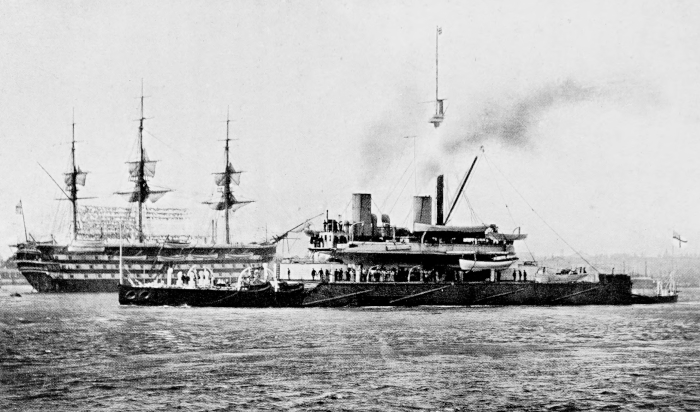
H.M.S. “DEVASTATION.”
Photograph by Symonds & Co. Portsmouth.
She was 285 feet in length between perpendiculars, with
an inside beam amidships of 58 feet, and an extreme beam of
62 feet 3 inches, with an average draught of 26 feet. The
depth from the midship portion of the covering-in deck to the
top of the keel was 18 feet. The double bottom contained
the water-tanks, and above these were a series of watertight
compartments containing the engines and so on, and above
these again were another series of watertight compartments
used as coal bunkers and lockers, and another series, formed
of watertight bulkheads, enclosed the officers’ accommodation.
They were said to be as strongly constructed as the strong
room of a bank.
The Devastation was probably the first ship in which a
built-up keel of steel was introduced. The plates of steel
were ⅝-inch in thickness, and the depth of the keel was 4 feet
6 inches, and it was strengthened by an angle-iron 1 inch thick.
The stem was a solid forging, the upper deck part being 9 inches
thick, and the lower part which formed the ram was 36 inches
thick. This immense prow was strengthened by longitudinal
iron frames. The stern-post was also forged solid, and was
26 feet in length and weighed 15 tons, and measured 12 inches
deep by 8 inches thick. Steel plates riveted vertically over
the transverse frames and running longitudinally and crossed
by vertical fixed iron plating formed the double bottom. The
interior of the hull was divided both longitudinally and transversely
into a great number of watertight compartments. The
two magazines, one near each end of the ship, were protected
from a dropping fire by a bulkhead covered with 5-inch armour
plating, and above the magazines again was a strongly constructed
deck 4 feet 6 inches below the load water-line. The
armoured belt was 9 feet 6 inches broad amidships, but tapered
off gradually towards the ends. The armour-plating was
18 inches thick amidships, and gradually reduced to 9 inches
towards the extremities. The breastworks or armoured walls
built up from the upper deck near the forecastle, and extending
to a wall behind the after turret, were 7 feet high, 74 feet long,
and had an interior breadth of 50 feet. Their armour-plating
varied from 10 to 12 inches, with the usual backing of wood
and iron frames, and an inner iron skin. The deck was 2 inches
of iron covered with 4 inches of oak. The turrets, which stood
at either end of the breastwork, were 31 feet 3 inches in exterior
diameter, and 24 feet 1 inch interior diameter; they were
built up as follows: Outside, 9 inches of iron plating, then
9 inches of Italian oak set in iron frames, then 6 inches of iron
plating, then 6 inches of Italian oak set in iron frames, then two
thicknesses of iron plating each ¾-inch thick, to form the inner
skin, then iron frames 10 inches in depth, and finally a series
of rope mantlets, or nets, to protect the men working the guns
from injury through fragments of rivets or bolts being driven
in by a shot striking the outside of the turret in battle.
The military mast was introduced in the sea-going turret
ships like the Devastation, and a few years later all such masts
were given fighting-tops or platforms upon which machine
guns or small quick-firing guns were mounted, or were equipped
with search-lights. These masts were of steel and hollow,
and in some ships the tops could be reached by ratlines and
shrouds in the old-fashioned way, and in others by means of
internal or external ladders affixed to the masts themselves.
Conning-towers were introduced later, but to meet the wishes
of naval officers alternative places of control are also provided
in all large ships, for use in case the conning-tower should be
made the target for the concentration of the fire of a hostile
ship.
The experiments with the Glatton’s turret proved the unsuitability
of turret armour being made with horizontal joints,
as there is always the chance that a projectile may strike the
actual line of joining, where the resistance would be less than
at any other part. The plates for the Devastation turrets were,
therefore, rolled sufficiently broad to cover the faces of the
turrets from the breastwork deck to the upper edge, and only
vertical joints were exposed to fire. The forward end of the
ship was raised to form what was called a sunk forecastle.
This considerably added to the freeboard forward and to the
buoyancy at that end of the ship, and this was further
augmented by the armour belt being reduced as much as
possible so as to avoid unnecessary weight. Some critics
of this design maintained that the end was too weak, and
that the advantage it was sought to gain in sea-going qualities
would not materialise; but when the vessel afterwards went
to sea and was tested in all sorts of weather, and against heavy
seas, in broadside seas, and in following seas, and in seas running
a few points off the bow, or on the quarter, she proved herself
an admirable sea-boat. An account of the sea trials in which
she was accompanied by the Agincourt and Sultan includes a
description written by a “scientific observer,” who was on
board the Devastation. Her sea trials took place during the
summer of 1873. The Sultan was one of the more modern
ironclads carrying a two-deck battery on a protected water-line,
and the Agincourt was a five-masted ship reminiscent of
the steam frigate days.
The scientific observer states:—
“For purposes of comparison in pitching and lifting, etc., the
Sultan had the height of the Devastation’s upper deck at side painted
on her in a broad white stripe, so that the behaviour of the two ships
might be quickly appreciated apart from the records of instruments.
The lowness of the extremities of the Devastation gives a great deal
of interest to the pitching and lifting (really the longitudinal rolling)
of the vessel. Two trials were made, one on the 9th and the other
on the 15th of September. On the first of these occasions, she was
accompanied by the Sultan only, and on the second she was accompanied
by the Agincourt only. The seas met with on the 9th of
September were lumpy and irregular, the wind having shifted somewhat
suddenly during the previous night. Having got well out to sea,
about forty miles off land, the wind was found to be blowing rather
north of west with a force of a moderate gale, its speed varying from
forty to forty-five miles per hour; and the largest of the waves were
found to vary from 300 to 350 feet in length from crest to crest,
occasionally reaching 400 feet—the greatest heights from hollow
to crest being 15 and 16 feet. Going head to sea, at from six to seven
knots, both vessels pitched considerably; the Devastation, however,
had the best of it, pitching through smaller angles than the Sultan.
The latter vessel was remarkably lively; at one moment she was
to be seen with her fore-foot completely out of water, and the next
with her bow dipped down to so great an extent that it was difficult
to see from the flying deck of the Devastation—although the ships
were pretty close together—whether the sea did not really break
inboard; and this notwithstanding that the bow of the Sultan rises
forward some 30 feet above the surface of the water. On the other
hand, the forecastle deck of the Devastation was repeatedly swept
by the seas, to each of which she rose with surprising readiness;
indeed, it invariably happened that the seas broke upon her during
the upward journey of the bow, and there is no doubt it is to this
fact that her moderate pitching was mainly due, as the weight of
the water on the forecastle-deck during the short period it remained
there acted as a retarding force, preventing the bow from lifting as
high as it otherwise would, and this, of course, limited the succeeding
pitch, and so on. The maximum angle pitched through on this
occasion, i.e. the angle between the extreme elevation and depression
of the bow, was 7½ degrees. Each vessel behaved extremely well
when placed broadside on to the sea, rolling very little. The trial
of the ship on the 15th of September, in company with the Agincourt,
was by far the most severe of any. Early in the morning the vessel
got under weigh and steamed out to sea, accompanied by the Agincourt.
The wind was blowing with considerable force from the north-west,
while the sea was at times very regular, long, and undulating; just
the sort to test the rolling propensities of a ship, but scarcely long
enough to be most effective in doing so, either in the case of the
Devastation or Agincourt. The largest waves ranged from 400 to
650 feet long, and from 20 to 26 feet high. The ships were tried in
almost every position with regard to the direction of the sea, and at
various speeds, the result in point of comparison being extremely
interesting, and, so far as the Devastation was concerned, very satisfactory.
With the sea dead ahead, and proceeding at about seven
knots, the Devastation pitched rather more than the Agincourt,
although the great length of the latter compared with that of the
former caused her bow to rise and fall through a much greater height,
giving her the appearance of pitching through a greater angle. The
usual angles pitched through by the Devastation, measuring the whole
arc from out to out, were from 5 degrees to 8 degrees; the maximum
angle pitched through was, however, 11¾ degrees. The scene from
the fore end of the frying deck when the vessel was thus going head
to sea was very imposing. There was repeatedly a rush of water
over the forecastle, the various fittings, riding-bitts, capstan, anchors,
etc., churning it up into a beautiful cataract of foam; while occasionally
a wall of water would appear to rise up in front of the vessel
and, dashing on board in the most threatening style, as though it
would carry all before it, rushed aft against the fore turret with great
violence, and, after throwing a cloud of heavy spray off the turret
into the air, dividing into two, pass overboard on either side. All
the hatchways leading below from the upper deck were closed;
it was not, however, thought necessary to close the doors in the sides
of the trunks leading from the main hatchways to the flying deck,
most of the men on deck preferring to remain here under the overhang
of the flying deck. It was quite the exception for the water
coming over the bow to get much abaft the fore turret; but this,
however, occurred occasionally. The foremost turret makes a most
perfect breakwater; it receives with impunity the force of the water,
which, after spending itself against it, glances off overboard, leaving
two-thirds of the deck seldom wetted. There was one sea which
came on board, while thus proceeding head to sea, which was much
heavier than any other; it rose in front of the vessel some 10 or
12 feet above the forecastle, and broke on the deck with great force,
for the moment completely swamping the fore end of the vessel.
A mass of broken water swept up over the top of the fore turret,
and heavy volumes of spray extended the whole length of the flying
deck, some small portion of it even finding its way down the funnel-hatchway—which
had been left uncovered—into the fore stokehole.
It should be borne in mind that the angles pitched through, given
above, do not measure the inclination of the ship to the surface of
the water, but only her inclination to the true vertical. Pitching
and lifting are produced by the vessel endeavouring to follow the
slope of the waves, or, roughly speaking, to keep her displacement
the same as in still water, both as to volume and to longitudinal
distribution.
“As to the depressing effect of the water on the bow, a layer of
water one foot deep over the entire forecastle exerts a pressure of
65 tons; this will produce a change of trim of 11 inches, together
with an increase in the mean draught of 1¾ inches; i.e. the draught
of water forward will be increased by 7¼ inches, while that aft will
be diminished by 3¾ inches. A layer 2 feet deep will have double
this effect; one 3 feet thick will have treble this effect; and so on
up to a considerable angle. This follows from the fact that the front
slope of the longitudinal curve of stability, up to a considerable angle,
is very nearly straight. Hence the effect, even of a large body of water
passing over the forecastle, tending to make the vessel dive down
head foremost, is small, and of no importance. It modifies, however,
the transverse stability. When proceeding head to sea there was
no appreciable rolling motion. With the wind and sea on the bow
she pitched considerably less than when going head to sea, but rolled
through 5 degrees or 6 degrees. With the wind and sea abeam,
lying passively in the trough of the waves, the maximum angle
rolled through was 14 degrees from port to starboard, 6½ degrees to
windward, and 7½ degrees to leeward, and this without perceptible
pitching. When, however, proceeding at about seven and a half
knots, with the wind and sea on her quarter, she rolled through
27½ degrees from port to starboard, 13 degrees off the perpendicular
to windward, and 14½ degrees off the perpendicular to leeward, besides
also pitching through some 4 or 5 degrees. This is by far the greatest
angle she has ever rolled through. It is the apparent period of the
waves, i.e. their period relatively to the ship, which operates in
making a vessel roll. The motions of the vessel, both as to pitching
and lifting and to rolling, were extremely easy. She, indeed, claims
to have behaved better than her companion, the Agincourt. Certainly,
her rolling motion was somewhat slower, and she rolled less
deeply; when the Agincourt was rolling 17 degrees from port to
starboard, the Devastation was only rolling 14 degrees. As to pitching,
the Devastation may fairly claim to have had the advantage, for, as
we have seen, although the Agincourt pitched rather less, her bow
moved vertically through a greater distance, so much so that while
going head to sea at seven knots she shipped a sea over her high
forecastle, showing that she could not be driven under the circumstances
at a much higher speed with at least anything like comfort.”[43]
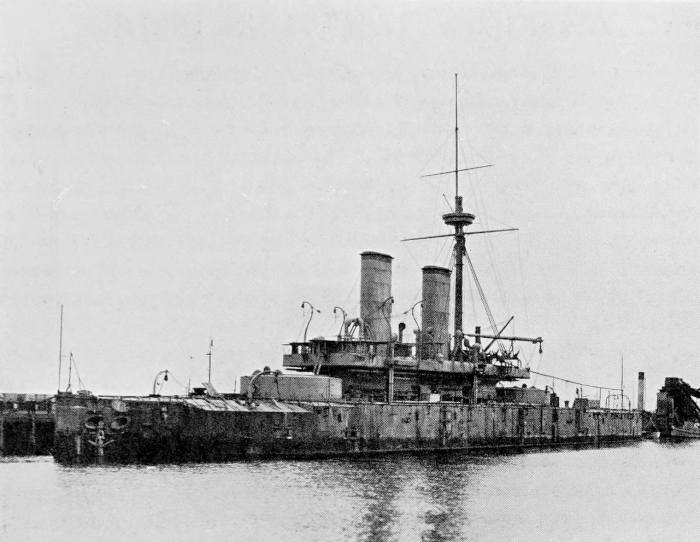
THE OLD “DREADNOUGHT.”
Photograph by E. Sankey, Barrow.
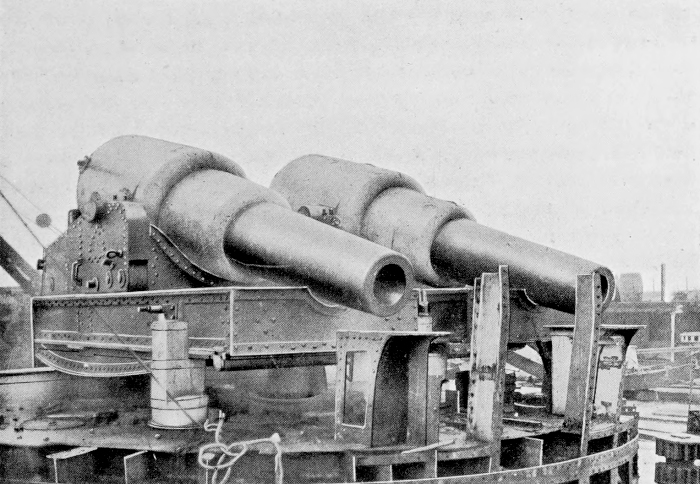
THE BIG GUNS OF THE OLD “DREADNOUGHT.”
Photograph by E. Sankey, Barrow.
The Thunderer, a sister ship in some respects to the
Devastation, and the Fury, afterwards called the Dreadnought,
followed, but each one included improvements and modifications
suggested by the experience gained with the Devastation.
Hydraulic machinery was installed for working the 38-ton
guns of the Woolwich rifle pattern, but in the Thunderer the
two 35-tons were worked by hand. Their guns were by no
means generally approved, many artillerists being of opinion
that Whitworth hexagonal guns would have been better.
The important feature in the Thunderer, and one which
contributed very materially to her safety, was the introduction
of a longitudinal watertight bulkhead between the two sets
of engines and boilers, so that if one set should be disabled
from any cause, the vessel would still have the other set to
depend upon. The Dreadnought was engined on the compound
system, which gave her a better speed on a proportionately
less coal consumption.
It is an old saying that the speed of a fleet is that of its
slowest ship. When the situation was further complicated
by the varying sailing powers of the ships the difficulty of
the admiral in command to keep his fleet together must sometimes
have been very great. Admiral Yelverton, for instance,
when in command of a Channel squadron, in 1866, consisting
of the Caledonian, Lord Clyde, Bellerophon, Achilles, Hector,
Pallas, Ocean, Wyvern, Research, and Helicon, reported that he
“took every opportunity of trying them to their utmost,
always placing them in positions as to wind and sea most
likely to test their capabilities as sea-boats, without much
regard to the safety of their spars or the risk of shipping far
more water than under ordinary circumstances ships of war
would be exposed to....
“The Pallas and Research were the only two ships that
could not keep company with the squadron. The Pallas
appeared to plunge heavily, and carried away her jib-boom,
but took her place in the squadron on the following morning.
The Research, from her very small steam power, was out of
sight at sunset, and put into Plymouth to fill up with coal.
On the 23rd we reached the prescribed rendezvous ...
when steaming ceased for a while, and the trials of sailing
began.” The ships varied as much under sail as they did
under steam.
The Wyvern, which was not a good sea-boat, and her sister
ship, the Scorpion, were built for the Confederate States, in
1864, at Birkenhead, and were bought by the British Admiralty.
They were 220 feet by 42 feet, and of 1,827 tons, and had
engines of 350 nominal h.p. Each had two turrets containing
two 300-pounders. They had ram bows, and, except on the
poop and forecastle, the bulwarks could be let down when the
ships were cleared for action.
The Pallas, an armour-plated six-gun ship, and the Research
were given recessed ports, in order to increase their firing range,
but the ports were constructed angularly and did not allow
the guns to be sufficiently depressed to hit a small boat close
at hand; thus the weapons would have been no defence
against a torpedo-boat attack, if the latter got to close quarters.
This fault was remedied in the Venezuelan transport and
cruiser Bolivar, in which the recessed ports were fitted under
the personal superintendence of their inventor, Captain Symonds,
and were slanted outside the gun ports so that they would
allow of a gun being depressed to strike a small boat lying
nearly alongside, while their wall was curved instead of flat
as in the British ships mentioned. Her sister ship, so far
as dimensions were concerned, the Mary, was devoted to the
more peaceful requirements of the cattle-trade between London
and Gothenburg. The Bolivar was a twin-screw vessel, and it is
curious to note that even then, when this method of propulsion
had proved its superiority, it was gravely stated concerning
her trials that “To keep time in all weathers and in all seasons
nothing is superior to the paddle, but in long voyages, especially
where sails are occasionally used, the screw may be employed
with advantage.”[44]
Several vessels followed in rapid succession after the turret
ships, and an upper deck battery was added in the Sultan, a
vessel which otherwise much resembled the Hercules, and then
followed a class to which the Iron Duke and Vanguard belonged.
The conditions imposed in the construction of this class were
that they should draw 22 feet 6 inches of water, that they
should carry armour not less than 8 inches thick at the water-line
and 6 inches elsewhere except at the bow and stern, that
they should have a speed of thirteen and a half knots, and that
their guns should be capable of firing in any direction. This
class was named after the Audacious, and proved fairly successful.
The principal event which distinguished the class was the
accidental ramming of the Vanguard by the Iron Duke, in
September, 1875, off the coast of Ireland. They were all
broadside ships, and the type was brought much nearer to
perfection in the Alexandra, which was then the largest masted
ironclad that had ever been designed; and though she was a
central battery ship, four of her twelve guns could fire right
ahead, and two right astern, and four to six guns could fire
one either broadside. She carried two Woolwich rifled muzzle-loading
guns of 25 tons each, and ten 18-ton guns. The two
big guns were placed in the upper deck battery forward. As
a further protection, besides her armour, the main deck battery
between decks was divided in two by an armoured bulkhead.
She was the first cruising armoured broadside ship in the
British Navy to have engines on the compound system, and
her twin screws were each driven by an independent set of
engines with an aggregate indicated h.p. of 8,000. Her speed
at her official trials was about fifteen knots.
Yet another type of turret ship was the Temeraire, launched
in 1876, which marked a noteworthy combination of the central
battery and barbettes or turrets. Her upper-deck armament
was in two fixed turrets open at the top and pear-shaped instead
of circular, and placed, one near the stern and the other near
the bow. These stood about 6 feet above the deck, and
measured about 33 feet by 21½ feet. They were placed with
their length in the direction of the ship, and the rounded end
of each pear, if it may so be called, was towards the nearer
extremity of the vessel. Inside each of these batteries was a
turn-table, hydraulically worked, on which was mounted a
25-ton gun borne on a carriage after the Moncrieff principle.
This permitted of the gun being loaded in the turret and raised
above it to be fired. The recoil caused it to sink into the
turret to be reloaded. An armoured tube or hoist communicated
with the ammunition chambers below, and the
gun always had to be brought back into the same position
for reloading. It will thus be seen that the guns were fired
as barbette guns and loaded as turret guns, and many were
the discussions as to the category in which they ought to be
placed. The armour of the fore turret was 10 inches thick,
and that of the rear turret 8 inches. On the main deck was a
divided battery. The front portion had two 25-ton guns
firing through ports at the corners, which were provided with
oblique armoured bulkheads, and the guns were pivoted at
the muzzle to allow of a fire from right ahead to abeam. The
other portion of the battery was given four 18-ton guns to be
fired on the broadside. She was preferred as a fighting ship
by many to the Alexandra, which preceded her, in which the
main armament was carried in a central battery. The Temeraire
was heavily armoured down to below the ram, to protect her
from an attempt to rake her bows when pitching, for it will
be evident to anyone that when the fore part of a vessel is on
the crest of a wave the bows are greatly exposed, sometimes
nearly to the foot of the stem, and would be peculiarly vulnerable
to hostile shot. The last central battery ship for the British
Navy was the Superb. She was built to the order of the
Turkish Government, but was acquired by this country. She
carried sixteen 10-inch muzzle-loading rifle guns and six 4-inch
breechloaders. She was a sister ship to the Turkish armour-clad
Mesoudiye.
Though not launched until 1876 and completed in 1881,
the Inflexible was described by her designer, in 1874, at a
meeting of the Institution of Naval Architects as follows:—
“Imagine a floating castle, 110 feet long and 75 feet wide, rising
10 feet out of water, and having above that again two round turrets,
planted diagonally at its opposite corners. Imagine this castle and
its turrets to be heavily plated with armour, and that each turret
has two guns of about 80 tons each. Conceive these guns to be
capable of firing, all four together, at an enemy ahead, astern, or on
either beam, and in pairs towards every point of the compass.
Attached to this rectangular armoured castle, but completely submerged,
every part being 6 to 7 feet under water, there is a hull of
ordinary form with a powerful ram bow, with twin screws and a
submerged rudder and helm. This compound structure is the
fighting part of the ship. Seaworthiness, speed, and shapeliness
would be wanting in such a structure if it had no addition to it;
there is, therefore, an unarmoured structure lying above the submerged
ship and connected with it both before and abaft the armoured
castle, and as this structure rises 20 feet out of water from stem to
stern without depriving the guns of that command of the horizon
already described, and as it moreover renders a flying deck unnecessary,
it gets over the objections which have been raised against the low
freeboard and other features in the Devastation, Thunderer, and
Dreadnought. These structures furnish also most luxurious accommodation
for officers and seamen. The step in advance has, therefore,
been from 14 inches of armour to 24 inches; from 35-ton guns to
80 tons; from two guns ahead to four guns ahead; and from a
height of 10 feet for working the anchors to 20 feet. And this is
done without an increase in cost, and with a reduction of nearly 3 feet
in draught of water. My belief is that in the Inflexible we have reached
the extreme limit in thickness of armour for sea-going vessels.”
Seeing that the Inflexible had armour two feet thick, the
belief of her designer that the limit had been reached was
justifiable. She was the only one of her class built for this
country, though Italy, as will be seen, tried to copy and even to
improve upon her. Her displacement was 11,800 tons, and
her engines of 6,500 indicated h.p. were designed to give her
a speed of twelve and a half knots, though on occasion she
attained nearly fifteen knots. Her length was 320 feet, beam
75 feet, and draught 26 feet 4 inches. Her armament consisted of
four 16-inch muzzle-loading rifled guns in her turrets and eight
4-inch breechloaders, besides twenty-one anti-torpedo boat guns
and four torpedo tubes. The weight of a single discharge was
6,800 lb., which was not exceeded until 1906, though the energy
in foot tons in that interval was increased several times over.
She was, moreover, the first vessel in which the turrets were
placed en echelon, i.e. diagonally, instead of one behind the
other on the centre line.
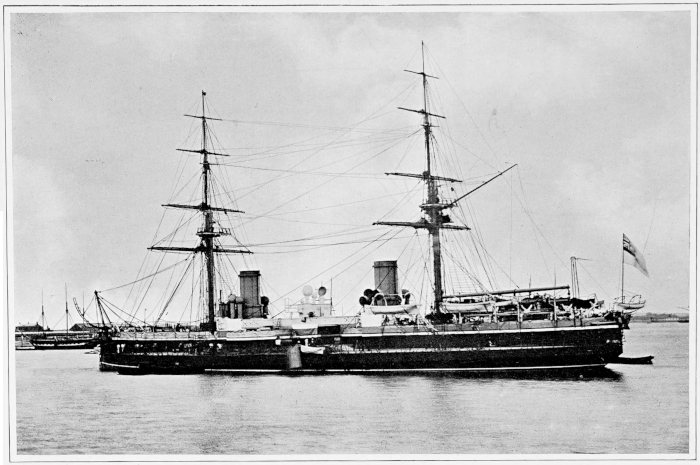
H.M.S. “INFLEXIBLE,” 1880.
Photograph by Symonds & Co., Portsmouth.
The affection of the Italians for immense ships and guns
to match was demonstrated even more remarkably by those
which were built after the battle of Lissa than by those which
took part in that memorable and disastrous engagement.
Probably the two finest specimens were of the mastless turret
type, the sister ships Duilio and Dandolo, which were designed
to surpass any other fighting ship in existence, no matter what
her nationality, and especially to show that Italian naval
architects and constructors could surpass the Inflexible, on
which Britain so justly prided herself. The Duilio was built
at Castellamare, and the Dandolo at Spezzia. Their turrets
were on much the same plan as those of the Inflexible, and quite
a dispute arose between Italian and British naval architects
as to whom the credit should be given of having first designed
this type of ship.
The Duilio was of 10,650 tons displacement; her length
between perpendiculars was 339 feet 7 inches, her extreme
breadth 64 feet 7 inches, and her mean draught was 25 feet
11 inches. The height of her main deck above water was
11 feet, and that of her battery 15 feet 9 inches. The hulls
of both these ships were built of iron and steel. Each had a
double bottom extending for 230 feet of her length, and the
numerous watertight compartments into which the double
bottoms were subdivided were so arranged that any one or
more of them could be filled with water or emptied as might
be found necessary.
The central armoured citadel protecting the machinery
and boilers and the magazines, besides part of the machinery
for working the turrets and the guns, was no less than 58 feet
in breadth, and extended to within a fraction of 6 feet below
the load water-line, and was 107 feet in length. Above the
citadel was a second central armoured compartment protecting
the turret bases and a part of the machinery for loading
and working the guns; and above this compartment were the
turrets themselves. The turrets of the Duilio were not placed
amidships, but the experiment was tried for the first time
on an Italian ship of setting them at opposite corners of the
central citadel, so that one should command the stern and the
other the bows, and that each should be able to fire ahead or
astern, or on the broadside, without interfering in any way
with the other. The decks before and abaft the citadel were
4 feet 9 inches below the water-level, and were protected by
horizontal armour. Extensive experiments were conducted
at Spezzia with a 100-ton gun, and guns of 10- and 11-inch
calibre, on different types of targets. As first designed these
ships were to carry two 60-ton guns in each turret, but when
the British Admiralty announced that the Inflexible would have
guns of 81 tons, the Italians equipped these two warships
with 100-ton guns manufactured at the Elswick works. The
armour at the water-line was 22 inches thick on the central
portion, and that of the turrets was 18 inches, further
strengthened by heavy teak backing. Each ship had a heavy
projecting ram, and also had an apparatus for discharging
Whitehead torpedoes. Although these ships were described
as Italian-built and were certainly put together in Italy, it is
interesting to note that the Duilio had trunk engines by
Messrs. John Penn and Sons, that practically all the iron and
steel put into the vessel’s frames, etc., were made in France,
that the armour-plates came from Cammell’s establishment
at Sheffield, and that the guns were made at Elswick. Only
the heavy forgings for the ship were made in Italy. The
Dandolo, although described as a sister ship, differed in many
particulars from the Duilio. The Dandolo had engines of
Maudslay’s inverted vertical compound type, a pair of which
was given to each of her screw propellers, and she had eight
boilers, heated with thirty-four furnaces, and working at a
pressure of 60 lb. per square inch. These great ships were
out of date soon after being completed, as the discovery of the
means of making steel cheaply, and the much greater strength
and lightness of the homogeneous metal, as it was called,
rendered it possible for ships and guns to be built of much
greater power than ever before. Indeed, so great was the
progress in these two departments that in a very few years
these vessels would no longer have been invulnerable, but
would have been relegated, as being slow and unwieldy, to
harbour or coast defence work, and thence to the scrap-heap.
One remarkable ship on the turret system was the Peter the
Great, belonging to Russia, which was very like the British
turret ship Devastation, and carried four 12-inch guns in her
two turrets. She had no ram. Russia also possessed the
Minin, which carried turrets on Captain Coles’s system and
had a very low freeboard, but after the loss of the Captain,
the Minin’s turrets were removed, and she was given a central
battery, 98 feet in length and rising 10 feet above the water-line.
The guns were mounted en barbette and were placed on turntables.
Russia also had two three-turret ships carrying six
25-ton rifled guns, and two double-turret ships each carrying
four 35-ton guns, besides a considerable number of single
turret ships and some smaller two-turreted vessels. These
were mostly monitors copied from Ericsson’s plan, and were
similar to those which he designed for the war in America.
Most of these turrets were on Captain Coles’s system.
The turret system was developed to such an extent by
Admiral Popoff that he gave his name to the type of ships he
designed. They were immense circular floating fortresses
intended only to operate in shallow and comparatively smooth
water. Their sea-going qualities were conspicuous by their
absence, which is not to be wondered at when their shape is
taken into consideration. Although described as circular
it would be more correct to say that they were circular only
at the water-line, for on one side to form a stern a projection
was constructed to facilitate steering, and at the opposite
side a bow was built on. These ships carried on the central
part of the upper deck a circular breastwork 7 feet high, in
which were two 12-inch 40-ton guns, two quick-firers on each
side of the superstructure, and six smaller guns, mounted en
barbette 13 feet 3 inches above the water-line, on fixed slides.
When it was necessary to train or change the direction of the
guns, the whole ship had to be turned. In the citadel was
the accommodation for the officers and crew. The extreme
diameter of the vessel was 121 feet, the length over all, including
the stern and bow, was about 150 feet, and her total displacement
was 3,553 tons. She drew only 13 feet. The ship was
built of iron, and had a double bottom sheathed with wood
and copper. She was, of course, flat-bottomed. A peculiar
feature of her construction was that she had a dozen external
box girders or keels, each about 12 inches square, carried
parallel to the intended axis of the vessel. There were eight
radial frames and two rings of web frames, the vessel being
divided into twenty-four compartments. These two vessels,
the Admiral Popoff and Novgorod, were alike in most particulars,
except that the latter was the smaller of the two. The height of
the armour on each vessel was 1 foot 6 inches above the water-line,
while below the water-line it was 4 feet 6 inches; they
each had six screw propellers driven by three sets of engines.
Their average speed was about six and a half knots. Although
Admiral Popoff is usually given the credit of the invention
of this type of vessel, Mr. John Elder, the Glasgow shipbuilder,
designed and patented a circular floating battery in 1867. He
proposed that the circular ship should carry twenty-six guns
in a lower battery and ten in a central one, and that the sharp
edge of the circumference should be used as a ram. According
to his design his vessel would have had a diameter of 144 feet,
a freeboard of 6 feet, and a draught of 9 feet.
The great ironclads described and their armament represent
what may be regarded as the apotheosis of the iron turret ship
and the heavy iron gun. Before passing on to the great change
introduced by the adoption of steel in shipbuilding and gun
manufacture it may be as well to note something of what has
been accomplished in the production of warships of other
types and modifications of types, and how some of them
acquitted themselves in actual conflict.
One drawback to all the heavy British ironclads of this
period was that so much weight and space were taken up by
the armour and its backing, that comparatively little space
was left for bunker accommodation. Obviously the very
heavily armoured ships could not travel for long at high speed
under steam without exhausting their coal supply. In order
to obtain speed and allow space for the engines of the necessary
dimensions, together with adequate coal supplies, the amount
of armour carried had to be reduced, and in July in the summer
of 1869 the first of a new class of armoured frigates, the
Inconstant, was launched for the Navy. She was constructed of
iron sheathed with three thicknesses of wood and coppered.
She was the first vessel which had a stern post and rudder
frame made of brass. She carried sixteen guns, viz. ten 9-inch
muzzle-loading guns on the main deck, and six 7-inch muzzle-loading
rifles on the upper deck; her engines, of 1,000 h.p.
nominal, gave her a speed of about sixteen knots, at which she
was faster than any other warship in the world. She was
unusually narrow for her length, in order to add to her speed,
her length being 337 feet 4 inches, and her beam 50 feet 3½ inches.
At one time on her trials she made nearly eighteen and a half
knots.
A series of coast-defence monitors was decided upon in
deference to public clamour, and the first of these, the Glatton,
was begun in 1868, and finished in the latter part of 1870.
She was intended to be for coast-defence purposes only, and
not an ocean-going ship in any sense of the term. Consequently
her coal capacity was small, and she was very heavily armoured.
She had but one turret, and this was so disposed that as the
vessel had no masts the turret could be turned to give the
guns a range of fire all round except for a small section astern,
only about 20 degrees being thus uncovered. Although her
design was admittedly founded upon the American monitor
type, several important improvements were introduced. The
American monitors had shown on several occasions that a
heavy shot striking near the base of the turret was liable to
cause the turret to jam or become unworkable. To render
this impossible in the case of the Glatton she was equipped
with a heavy breastwork built outside the base of the turret,
in such a position that the lower part of the turret was absolutely
protected and consequently could not be disabled, while if a
shot were to strike the upper part of the turret it would do
little damage. The Glatton had a freeboard of only 3 feet;
the hull was plated with iron 12 inches thick above the water-line,
and 10 inches thick below it, and behind this was a teak
backing 20 inches thick, and behind this again two thicknesses
each of 1 inch of iron forming an inner skin, while the frames
to which this was attached were no less than 10 inches deep,
and were only 2 feet apart. Altogether the sides of this vessel
were 3 feet 8 inches in thickness. The turret contained two
25-ton guns; its armour was 14 inches thick in the most
exposed parts, and 12 inches thick elsewhere. And besides
this it had a wood backing of 15 inches, and an iron inner
skin ⅝-inch thick. It was 30 feet in diameter, and similar to
the turrets of the Captain and Monarch. The breastwork
rose 6½ feet on each side of the vessel from the upper deck,
and was plated with 12 inches of iron, with a 15-inch backing
of teak. The upper deck had a sheathing of 3 inches of iron.
The total length of the vessel was 245 feet, its breadth 54 feet,
and it drew 19 feet of water. It was of 2,700 tons burden,
and the engines were of 500 h.p. nominal. Its bunkers were
designed to carry 250 tons of coal, but its ballast tanks were so
designed that if necessary they could take another 250 tons
of coal. With such dimensions and such a weight of armour
to carry, she was, of course, a slow vessel, but in regard to her
fighting power it was estimated that she would give a good
account of herself against even such a vessel as the Monarch.
Powerful though the Glatton’s turret appeared, the experimental
turret on the same pattern fired upon at Portland by
the 21-ton gun of the Hotspur suffered somewhat badly. The
shot struck the turret at the horizontal joint of the upper
and lower plates, forcing the upper plate and the lower plate
apart and damaging the turret generally.
A series of breastwork monitors was added to the Navy
in the late ’sixties. Besides the Magdala, Cerberus and Abyssinia
for colonial coast and harbour defence, the Admiralty ordered
four similar but larger vessels for home defence, much to the
general surprise. For some unfathomable reason the Cerberus
and Magdala were barque-rigged. False bows and sterns
were added to them to enable them to make the voyages to
their respective destinations. They carried two 18-ton guns
in each of their turrets. On her outward voyage the Cerberus
earned a reputation for rolling which she never lost. The
first reports of her voyage as far as Gibraltar described it as
being successful and prosperous, but when her commander’s
report was received it showed that the voyage was successful in
the sense that the ship succeeded in getting that far, but
prosperous it never was. She had dirty weather in crossing
the Bay of Biscay, and for twelve hours rolled so heavily that
it was thought she would not get through it. It is said she
rolled 40 degrees each way, which is far more than the Captain
rolled, and she pitched so heavily that sometimes the whole
fore part of the ship as far as the foremast would be lost sight
of, and the decks be quite under water. She was very slow
under steam, the utmost speed that could be got out of her
being six knots. The crew detested her so thoroughly that they
deserted whenever they found the opportunity, three of them
had to be punished and sent to prison by way of example by
the time Malta was reached, and six volunteered to go to
prison rather than continue the voyage. However, she arrived
at Melbourne at last, and lay year in and year out at her moorings
in Hobson’s Bay except for such short intervals when she went
down the bay for firing practice. One of the war scares which
arise from time to time came near to conferring on the Cerberus
a celebrity of a unique character. Irresponsible and irrepressible
politicians of a sort find colonial life offers them more
scope for the display of their exuberance, and as the scare
revived the question whether the defences of Melbourne at
Queenscliffe were sufficiently strong, a politician of this variety
proposed that the Cerberus should be sent out to sea and then
endeavour to steam back past the batteries, which should
fire upon her, in order to test both her armour and the strength
of the defences. Strange to say, this suggestion actually met
with some support, notwithstanding the chorus of ridicule
and protests with which it was received, but the common-sense
of the community vetoed the proposition. At the time of
their construction these three vessels were the most powerful
warships of their size to be found anywhere, and were among
the ugliest.
In the early ’seventies there were added to the British
Navy, and less numerously to other navies, several vessels
of composite construction. That is to say, that all her framing
was of iron and the outside and deck planking was of wood.
Most of these vessels were sloops or light cruisers, and though
they were useless for defensive purposes against armoured
ships, their offensive powers were very great for vessels of their
size, as they were generally given four of the heaviest guns
it was possible for them to carry. Under steam they were
fast, but as their bunker capacity was not large they had to
depend on their sails when possible. One of these vessels,
which may be regarded as a specimen of her class, the Albatross,
was 160 feet in length between perpendiculars, of 894 tons
displacement, and carried two 4½-ton 7-inch muzzle-loading
rifled guns, two 64-pounder guns, and the usual number of
smaller weapons for boat and land service.
One small corvette, the Druid, had an innovation which
must have brought tears to the eyes of sailors of the old school
who loved the ship’s figure-head, and were never tired of
keeping it clean and brightly painted. The necessity of end-on
fire and bow chasers was admitted, and some unsentimental
reformer actually had her figure-head constructed so as to open
in two parts like a folding door to permit of the space being
used as a porthole for a heavy bow gun.
The steam engine as a means of propulsion was not to be
allowed to remain unchallenged, but the only attempt at
rivalry to merit serious consideration was that associated
with the Waterwitch, in 1866, and Mr. Ruthven’s system of
hydraulic propulsion. Although the first patent was taken
out in 1839 and another followed in 1849, and a small boat
fitted with the Ruthven machinery was placed on the Thames
and a working model was shown at the Exhibition of 1851,
engineers did not take kindly to it. The objections, apparently
insuperable, were that the water had to overcome the resistance
of a very large rubbing surface, and that the perforated bottom
of the ship was liable to be choked in shallow water, and it
was also contended that the cost of increasing the power beyond
a certain rate was prohibitive. The advantages of the system,
and they were undeniable, were that the ship could be propelled
either end foremost, or turned, or brought to a stop and
restarted without stopping or reversing the engines. A vessel
was built, partly at the expense of the Prussian Government,
and fitted with engines of this type, and was said some years
afterwards to be still running on the Oder. In 1863, Mr.
Murray, Chief Engineer of Portsmouth Dockyard, reported,
on the application by Mr. Ruthven, of Greenock, for an extension
of his father’s patent, that he saw no reason why the speed
attained with the Ruthven propeller should not equal that
obtained with the paddle or screw, and that he had been on
official duty for the Admiralty to Belgium to inspect and report
upon a vessel built by the Cockerill firm and called the Seraing,
which was equipped with the Ruthven propeller. He recommended
the Admiralty to give the principle serious attention.
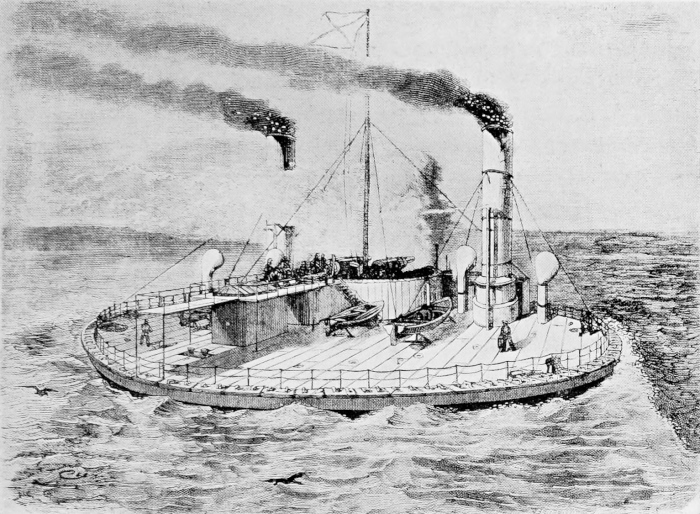
RUSSIAN CIRCULAR MONITOR “NOVGOROD.”
From a Contemporary Wood Engraving.
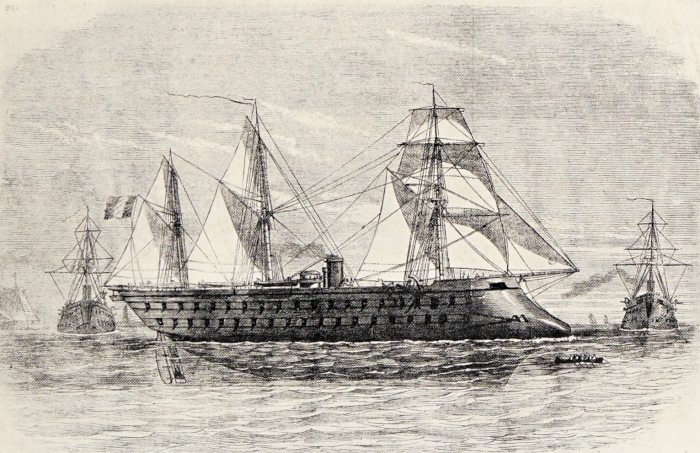
THE FRENCH IRON-PLATED SHIP “MAGENTA.”
From “The Illustrated Times.”
In consequence of this report the Admiralty ordered the
Waterwitch to be built for the trial of the Ruthven propeller.
In order to check the vessel by a comparison with one fitted
with the ordinary screw, the trials of the armour-plated twin-screw
gun-vessel Viper were selected. The Waterwitch was of
iron, 778 tons measurement, 162 feet in length by 32 feet
beam, and 13 feet 9 inches depth; she was rather broad in
proportion to her length, and had a rudder at both ends. Her
armour plating was of the usual 4½ inches in thickness at the
water-line and on her broadside, and she had athwartship
armoured bulkheads across her upper deck with gunports in
them, through which it was proposed to fight guns on the
line of keel. The main interest of the vessel centred in her
machinery. Her first trials on the Thames were so satisfactory
that a more extended series at Stokes Bay was determined
upon, the two sets of trials lasting about a year. A portion of
her bottom was made flat and without external keel. From
what may be regarded as a semi-official and certainly expert
report of the ship and the Stokes Bay trials, the following
description of the vessel may be quoted:—
“In the fore part of this flat surface, in a space about 12 feet
square, are one hundred and forty-four perforations 12 inches each
in length, and cut laterally through the bottom plates of the vessel,
the plate being bent inwards on each side of the cuts to a central depth
of about 3 inches. Through these perforations the water on which
the vessel is floating finds admission to an oblong iron box, fixed
longitudinally and parallel with the vessel’s keelson, closed when
the vessel is not under steam by four sluice valves, each having an
opening of 2 feet 10½ inches by 1 foot 11½ inches. With the vessel
under steam these valves are open, and give further admission to the
water to the watertight cast-iron casing, in which is fixed, on a vertical
axis, the turbine. This wheel is 14 feet 4 inches in diameter at the
bottom plate, and 14 feet at the top. It has twelve blades, and
these, with the top and bottom plates, are made of boiler plate about
⅜-inch thick, vertical at the periphery and with the lower edge
gradually twisted from near the circumference towards the centre
in the direction of its motion. From the cast-iron casing which
encloses the wheel, branch off laterally copper pipes, which convey
the water from the wheel, or centrifugal pump as it might not inaptly
be called, to the discharge pipes and ejection nozzles on the outside
of the ship. By this arrangement, therefore, the water which enters
through the perforated bottom of the ship passes by way of the sluice
valves into the wheel casing, and thence, by the action of the wheel,
through the copper conducting pipes and out into the sea again from
the nozzles at the end of the discharge pipes on the outside of the
ship. The wheel is driven by three cylinders fixed round it at equidistance,
each of the connecting rods being coupled on the one crank;
one eccentric gives motion to each of the slide valves for the three
cylinders. The cylinders are each 38½ inches in diameter, with a
stroke of 3 feet 6 inches.”
There was little to choose between the performances of the
Waterwitch and her screw rivals, the Vixen and Viper, tried at
the same time, and it was admitted that with certain modifications
in the existing machinery of the first-named and
the ejection nozzles, a much greater speed would no doubt
be possible. It was also stated that with a suitably designed
screw propeller a greater speed could have been obtained with
the same power. Be that as it may, the experiment does not
seem to have been repeated on so large a scale, and the improvements
made in the steam engine soon outclassed completely
the hydraulic propeller.
In Europe there was a disposition to disregard the power
of the American ships, but when public opinion in this country
and in Europe turned in their favour it went to the other
extreme, and turreted ships with low freeboards were advocated
irrespective of the totally different conditions prevailing on
this side of the Atlantic. It was claimed that no turreted ship
with a low freeboard could possibly be a good sea-boat, or
undertake an ocean voyage. The double-turreted monitor
Miantonomoh, built at New York, in 1865, proved the contrary
in the latter detail, when in 1866 she crossed the Atlantic
under her own steam, in company with two other monitors,
and visited some English and European ports. She was never
tried in any engagement, but was considered by her designers
to be superior to any vessel of the kind constructed for
war both as a sea-going ship and for fighting purposes. Her
armament made up in weight what it lacked in number. Each
of her turrets contained two Dahlgren guns throwing projectiles
weighing 480 lb., and she also had a 12 lb. howitzer. The
turrets were 18 feet in diameter, and were protected by armour
11 inches thick. She did not, however, prove a good sea-boat,
which is not to be wondered at when her low freeboard is
remembered, and though she made the voyage in the summer
months when the Atlantic is usually fairly calm, she proved
very wet. However, her advent was quite sufficient to
demonstrate to the European powers that she could make the
voyage, and her novel appearance gave the impression that her
fighting value was tremendous. When the American War
was over the United States Government had no further need
of a number of its vessels, and disposed of some of them, France
buying two of the most powerful, and one or two other European
powers were also purchasers.
Among the vessels France acquired was the Dunderberg,
which was renamed Rochambeau by her new owners. It consisted
of a long iron fortress mounted with guns to fire on the
broadside and also ahead and astern. The hull, also of iron,
was but little above the water, and the decks were iron-plated.
The central portion had armour 7 inches thick with a heavy
wooden backing, and the decks fore and aft of the fortress
were plated 8½ inches thick. Her two engines, developing
5,000 h.p., gave her at a pinch a speed of between eleven and
twelve knots, but when she crossed the ocean she made the
voyage under her own steam at between eight and nine knots.
The after part, containing the screw propeller and steering
gear, was also shot-proof. She had an immense beak or ram.
Her total length was 378 feet, her breadth 73 feet, and her
depth 81 feet, and she drew 22 feet of water.
As purchased by the French she had an armament of five
15-inch Rodman guns, and twelve 11-inch Dahlgrens. Another
vessel, the Onondaga, was also purchased from America by
the French, and both were altered at Cherbourg to meet French
views.
When the French decided to adopt ironclad ships carrying
a very few guns of great power, they did not hesitate to make
some extraordinary experiments. One of their vessels, built
in 1866, was the Taureau. It was like nothing that had been
afloat before or has been launched since. Viewed from the
stern, it resembled a sphere with a deck-house, a couple of
masts, and a chimney. Much the same aspect was presented
by a front view, except that before the deck-house was a small
turret in which was one large gun. The turret was carried
very far forward and could be revolved so that the gun had
almost an all-round fire, the only limitation being the funnel
and deck erections. The bow was extended enormously from
the deck level to some distance below the water, and projected
no less than 40 feet under the surface. The turret was not
built on the deck, but descended to the bottom of the hold,
and was protected by nearly 5 inches of armour, and a similar
thickness was placed over the bows. The sides were plated
3 feet above the water-line, this belt extending to the stern.
The engines were of 250 h.p. The Taureau was about 48 feet
maximum width, and 197 feet in length without the ram.
The idea underlying the construction of this unwieldy ship
was that she should be able to deliver a heavy shot at close
range to an enemy’s ship, and follow this up by ramming it,
thereby completing its destruction; while her convex bows
and circular turret would present no plane surface to the enemy,
so that any shot which might strike it could only give a glancing
blow and bound away harmlessly.
In 1862 another remarkable vessel called the Magenta was
added to the French fleet. She was iron-plated and carried
eighty guns on two decks, and in addition had a raised forecastle
with ports on either bow, through which guns could be fired.
She also had an immense blunt ram which projected like a
cone upon the bows of the vessel and extended from the forecastle
almost to the fore-foot. She presented an attempt to
combine some of the features of the Monitor with the broadside
ironclad, one American invention copied being the provision
of a shot-proof tower just abaft the funnel for the accommodation
and shelter of the officers during an engagement. She
was barquentine rigged, and under sail and steam could get
up a speed of about eight or nine knots.
The Marengo, another wooden ship which was plated with
8-inch iron armour, was designed to carry twelve guns. She
had a central battery extending to the upper deck, and above
this at each corner of the battery was an open armour-plated
turret. The turrets each carried a large pivot gun, mounted
en barbette, this being one of the first vessels France possessed
in which it was sought to combine the advantages of the turret
system with those of the barbette. These guns could fire
in line of keel, and there were also four heavy guns on each
broadside. She was 280 feet long by 57 feet 6 inches beam,
and 28 feet draught, and was intended to have a speed of twelve
knots. Her rudder was on the balanced principle. The
rigging was brought down inside the bulwarks, something
after the fashion of some modern sailing ships, so as to present
a clean side outside. All the French ships were broad for their
length.
The first large armour-plated ship to enter the Pacific was
the Spanish screw steam frigate Numancia, constructed at
La Seyne by the Société des Forges et Chantiers de la
Méditerranée. She was 317 feet in length by 57 feet 2 inches
beam, and depth 37 feet, and her draught of water was 27 feet
6 inches, with a displacement of 7,303 tons, according to
English measurement. She was built of iron throughout,
and had 5 inches of armour-plate backed with 16 inches of teak
from end to end of the ship, and from no less than 7 feet 9 inches
below the water-line up to the level of the upper deck. Her
armament was forty 68-pounders. She was built in less than
two years, a piece of unusually quick work for a French yard,
and was launched in 1864.
In 1868 the Dutch Government received from English
builders two single turret ironclad monitors, intended for
harbour defence, which were stated to be the first of the low
freeboard type completed in this country, and carrying turrets
on Captain Coles’s system. These vessels, the Krokodil and
Heiligerlee, were about 180 feet in length, with a beam of
44 feet, and a depth of 11 feet 6 inches. From the gunwale
to 8 feet below the water-line they had iron armour-plates of
a total thickness of 5½ inches, tapering off to 4½ inches at the
extreme ends. This armour rested against a teak backing
10 inches in thickness, behind which was an inner skin of 1-inch
iron, and inside this again was a series of longitudinal iron
girders. For their size they were exceedingly strongly constructed,
but as they were designed to be able to meet any
hostile vessel which might approach any of the harbours of
the shallow Dutch coast where they might be stationed, the
reason for such substantial construction is apparent. The
turret armour was 11 inches thick at the gunports, and
8 inches thick elsewhere. The armament consisted of two
12½-ton rifled guns firing a 300 lb. projectile, which could be
discharged from within four degrees of aft on either side to
direct ahead. The turrets could be revolved by steam or hand
power as desired. The twin-screw engines were of 140 h.p.
nominal.
Another vessel of considerable interest, designed and built
for the Dutch Government by Napier, was the turret gunboat
De Tygre, which inaugurated a type which found much favour
in Holland. This vessel, of 187 feet in length, 44 feet breadth,
and moulded depth 11 feet 6 inches, and of 1,613 tons, builder’s
measurement, was built in compartments and with watertight
doors, and was like most of the turret ships of the monitor
variety, as she had a double bottom which could be filled with
water to sink her to her fighting level. Thus only about 2 feet
of her topsides would be exposed to the enemy. As an improvement
upon her came another vessel from the same builders,
which was described as “of a build which has long seemed
to us as one of those most likely to become employed for the
‘ship of the future,’ not because she is a ram, but because she
is essentially a sea-going turret ship.” She was “the De Tygre
over again, with the following exceptions: She has about
3 feet less beam, a rather greater draught of water, and light
topsides are raised over the armour-plating and the deck,
with which it terminates to the level of another deck; the vessel
is thus in appearance an ordinary sea-going ship of war, for she
is pierced for a few light guns on the lower deck; but her
fighting strength consists in her turret, which is similar to that
of the De Tygre, except that the ports are at a higher elevation.
This vessel is, therefore, a cruiser, unarmoured, higher than
a level of 2 feet from the water; but practically for a fight at
close quarters she is a monitor exposing only a turret and a
low topside as parts vulnerable to shot.”[45]
The Greek armour-clad King George, of 1,774 tons, built
at Blackwall by the Thames Ironworks, was remarkable for
the smallness of her dimensions in proportion to the strength
and extent of her armour-plating. This was 6 inches thick,
and had a 10-inch backing, and extended from the gunwale
to 8 feet below the water-line, and from end to end of the
vessel. She was 200 feet in length, and with engines of 2,105 h.p.
indicated attained a speed of nearly fourteen knots on her
trials. She was also notable for the peculiar arrangement
of a central hexagonal box-battery on the Mackrow system for
two 21-centimètre breech-loading Krupp guns (300-pounders),
with the portholes so designed that the guns could be fired
on both sides forward in line of keel, and nearly so aft; on
the actual broadside the guns could be fired direct and parallel
at the same time, or made to converge their fire at 70 yards
distance from the ship’s side, the racers being so placed that
the guns pivoted from the muzzle and could each be trained
over on the broadside, through an angle of 93 degrees, the
front gun in this way pointing three degrees abaft.
In 1864 Germany made a start with its modern navy by
ordering from Messrs. Samuda the cupola ship Arminius.
One or two others were added, and then, in 1867, the powerful
armour-cased screw frigate Kron Prinz was launched from the
same yards. She was of 286 feet in length, and of 3,404 tons,
builder’s measurement, with engines of 1,800 nominal h.p.
Her armour-plating extended entirely round the vessel from
6 feet below the water-line up to the main deck. The armour
was 5 inches thick except near the ends where it was reduced
to 4½ inches, and arrangements were made for the protection
of the rudder and steering apparatus, as well as of the whole
of the lower deck. The armour extended 14 feet upwards
about 120 feet along each side, so as to protect the amidship
battery, which was also protected by cross bulkheads. She
was fitted with a considerable number of watertight compartments,
a double bottom, and steel plating over the deck beams.
She carried fourteen steel breech-loading guns of 7 tons each
in her battery, a pivot gun on the deck at the bow protected
by an armour-plated shield, and a pivot gun aft. Her iron
lower masts served to ventilate the interior, and her lower
yards were of steel; her speed was estimated at thirteen knots.
Apparently so well satisfied were the Prussians with this
product of a British yard, that when the opportunity offered
two years later to acquire one of the most powerful warships
yet designed, they took advantage of it. There had been
laid down at Blackwall for the Ottoman Government, a vessel
designed by Mr. Reed, Chief Constructor to the British Navy,
but Turkey, either seeing a profit in the transaction or being
short of cash—deficiencies not being unknown in the history
of Ottoman finance—permitted her, when about half finished,
to be acquired by the Prussian Government. She was 365 feet
in length, or 30 feet longer than the Hercules, with a beam of
60 feet, and a mean draught of 26 feet of water, with a burden
of 6,000 tons. Her engines, by Maudslay, were of 1,150 h.p.
nominal, and 7,000 effective. She was constructed on the
longitudinal system, and within both frames and ribs was
another iron skin an inch thick, making her a double ship,
the inner one being 4½ feet from the other. The armour was
8 inches thick amidships, and tapering downwards to a thickness
of 7 inches to 7 feet below the water-line. It also tapered towards
the bow and stern, diminishing from 8 inches to 6 inches. Under
the counter or bows, where it was considered almost impossible
a shot could strike, the armour was only 4 inches thick. But
elsewhere there was never less than 6 inches of armour, besides
the 10-inch teak backing and double iron skin. Aft of the
bowsprit and forward of the stern were two heavy bulkheads,
each of 6 inches of armour and 18 inches of teak, which were
continued from the lower deck, through the main deck, and up
to 7 feet above the spar deck, where they were curved to form
shields, each pierced with four portholes for cannon and loop-holed
for musketry. Within these shields were four Krupp’s
steel breech-loading 400-pounders, which could be fired
forward or aft, or as broadside guns; and there were also
twenty-three similar guns between decks. She was at that
time the heaviest vessel which had been docked in the Thames.
Her new possessors evidently thought very highly of her,
or they desired to pay her builders a compliment, for the German
Government selected her to represent the German Navy at
the Jubilee Review in 1887.
CHAPTER VII
ARMOURED SHIPS IN ACTION
When, in 1865, Spain deemed it necessary to give a lesson
to her daughter Peru, whose victorious insurgents held views
as to the non-payment of an indemnity, of which the mother
country did not approve, she found that another of her offspring,
Chili, sympathised with her sister, and it became
necessary in Spain’s opinion to extend the lesson to both
States. The best warship she could supply for the purpose
was the Numancia. This was a formidable vessel built for
the Spanish Government in the ’sixties, at the time that relations
were likely to be strained to breaking point between Spain
and the two South American States. She was accompanied
by some unarmoured vessels carrying about two hundred and
fifty guns altogether, nearly all of which were old smooth-bores,
the others being rifled guns of no great power. The
Chilians had the Esmeralda, a small vessel having a complement
of one hundred and twenty-three officers and men, and carrying
eighteen smooth-bores of which the heaviest were 32-pounders.
With this vessel they retaliated upon the Spaniards for their
preliminary blockade of the Chilian ports by capturing, in
November, 1865, the gunboat Covadonga, a somewhat similar
boat to the Esmeralda, with two 68-pounders as her chief
weapons. As usual, the Chilians shot well and the Spaniards
shot badly, and the issue of the engagement was not long in
doubt. The Spanish fleet distinguished itself by a cowardly
bombardment of Valparaiso in 1866, notwithstanding its defenceless
condition, when, in spite of their wretched shooting,
the Spaniards caused a great deal of damage, principally
owing to the Numancia’s guns. Valparaiso did not reply.
The Spanish fleet next tried Callao, which was fortified
and gave the Spaniards more to think about than they cared
for. The principal guns in the batteries were four Armstrong
rifles, 300-pounders, which were in turrets faced with 10-inch
armour, and five rifles of the Blakely pattern, firing 450 lb.
shot. There were also several smaller smooth-bore guns. A
small vessel of the monitor type, the Victoria, with one
64-pounder, and the monitor Manco Capac, with railway
iron armour and two 68-pounders, constituted the Peruvian
fleet. The Numancia, at 1,500 yards range, led her consorts
to the attack, but in about half an hour the Ville de Madrid
was placed hors de combat with a shot in her steam-pipe. The
next disaster to the Spaniards was when the Berenguela had a
hole blown in her side by a Blakely shell, so that she could
do no more fighting. Then two more Spanish ships had to
retire, as they had fired away all their ammunition. The
Numancia was hit repeatedly, but her armour saved her from
serious damage. The smaller projectiles did her no harm at
all, but one of the shells from an Armstrong gun went through
her plating and was prevented by the backing from going
farther. Both sides lost heavily, but notwithstanding the
amount of ammunition expended the damage was not very
extensive. This time the honours were distinctly with the
shore batteries, and the Spaniards sailed for home.
That the advantage given by the possession of powerful
warships may be entirely neutralised was demonstrated by
the Brazilians in their conflict with Paraguay, in 1865. The
Paraguayans fought with the energy of despair. They were
between the devil and the deep sea, for they knew that if they
did not conquer their enemy, their commander would reward
them with tortures from which death would give them a
welcome release. In these circumstances the Paraguayans displayed
extraordinary daring with a by no means adequate
fleet for resisting the Brazilians, who were allied with Uruguay
and the Argentine republic, as the outcome of the Paraguayan
president, Francisco Lopez’s, energetic, if unconventional,
methods. During this war the Cabral and Colombo were added
to the Brazilian fleet from Thames builders. They were each 160
feet long and drew 9 feet 9 inches when loaded, and with two
pairs of direct-acting horizontal engines of 200 h.p., each driving
a screw propeller, so that they were twin-screw boats, they
could attain a speed of ten and a half knots. They were really
oblong iron forts, supported on rafts. There was no central
battery, but each vessel carried six guns forward, two being
disposed in the front of the citadel and two on either side of
the fore part. A similar battery was placed at the other end.
The armour-plates were 4½ inches in thickness, and the deck
before and abaft the battery gradually sloped all round to the
water-line, and being covered with 2½-inch armour-plating,
prevented a shot from penetrating into the ship. The arrangement
of the guns enabled these vessels to be fought either
end on, or on the broadside. Each was armed with twelve
70-pounder Whitworth guns. Two other powerful vessels were
also built for Brazil at Birkenhead. One of the oddest naval
encounters on record was fought in March, 1866, between a
powerful Brazilian fleet and a Paraguayan vessel. The
Brazilians had three of these ironclads, a single-turreted monitor,
and several wooden ships. The Paraguayans opposed this armada
with a barge mounting an 8-inch smooth-bore gun. The firing
was fast, furious, and inaccurate. The smooth-bore made
good practice. The Brazilians hit everything in range for
some time except the one-gun barge. By dint of perseverance
they struck it eventually and sunk it.[46] This glorious naval
exploit was followed by another piece of daring, in which the
Brazilian fleet engaged in a more or less uninterrupted encounter
for three weeks with a fort mounting one gun; the fleet won.
The last quarter of the nineteenth century saw not a little
warlike activity in one part of the world and another in which
the navies of the contestant powers were conspicuous. The
naval engagements in the Russo-Turkish War were mainly
remarkable for the regularity with which the Turkish warships
were blown up by the Russians, the daring of Russian officers
in making attack after attack, and the apparent disinclination
of the Turkish officers to take adequate means to
protect their vessels. Had the Turks been as vigilant as the
Russians, the latter would hardly have scored so many brilliant
successes.
The South American Republics, too, were indulging in one of
those periodical bursts of unrest and pugnacity which seem
inseparable from South American States in their relations with
each other, or in the administration of their internal affairs,
and when carefully fomented may lead plotting politicians on
to become dictators and the victims of assassinations—unless
they are fortunate enough to retire to Paris with the spoils
and live in luxury and die naturally.
One of these revivals of political ferment brought the
Huascar into prominence, and made her for some years the
most famous fighting ship in the world. The interest taken
everywhere in the doings of this ship was extraordinary. She
was launched in 1865 at Birkenhead, from that yard which
has sent so many ships to sea to make history, and if local
associations have their influence over ships, and sailors say
they have, the records of the Huascar show that she was not
false to tradition. Built to the order of the Peruvian Government,
she was a turret ship of 1,800 tons displacement and
eleven knots speed, and carried a belt of armour on the water-line
of from 4½ inches thick at the centre portion to 2½ inches
at the ends. Her one turret, which was placed rather forward
of amidships, was built on Captain Coles’s design, and given
5½-inch iron plates. In it she carried two 10-inch 12½-ton
Armstrong muzzle-loaders; and on her decks were two
40-pounders and one 12-pounder, all three being muzzle-loaders
and unprotected. Her lower foremast was on the tripod system,
but this was afterwards discarded and she was given an ordinary
mast. She had a main- and mizen-mast also, and all three
carried topmasts and square sails; when her masts were altered
a military top of iron plates was built upon the cap of the
mainmast.
She had a most exciting career. Her crew mutinied and
put to sea in her, and took to freebooting quite in the spirit
of the old days of the Spanish Main and the South Eastern
Pacific. She was declared a pirate. At the end of May, 1877,
the British cruisers Shah and Amethyst, which had been ordered
to look for her, discovered her off Ilo. These were both light
unarmoured cruisers, the latter being much the smaller of the
two, and depended largely upon their speed to render attack
upon them more difficult, or to avoid it altogether, or to assume
the offensive at a time best suited to themselves. Their guns
were more modern and powerful than those of the Huascar,
and also more numerous, so that in gun power the cruisers
were superior to the ironclad.
This engagement is noteworthy for the reason that in it
the first automobile torpedo ever employed in war was discharged
by the Shah against the Huascar, and failed to reach
its mark. The Shah bore the brunt of the engagement with
the Huascar. The latter almost ignored the Amethyst, whose
small guns did no more harm to her sides than a mosquito
would do to an elephant, but helped to make the mutineer’s
deck guns useless, and the ironclad reserved her attention for
her more formidable antagonist. Whenever the firing became
unpleasantly severe, as it frequently did, the Huascar steamed
in front of Ilo, and the Shah then hesitated to fire lest her shells
should miss the Huascar and hit the town, notwithstanding
that the Huascar then fired at the Shah. But the Huascar’s
aim was faulty, partly because of the poor shooting powers
of her gunners, and partly because the Shah kept rapidly on
the move and so presented no steady mark to the Peruvian
gunners. The Huascar tried to ram her, but the Shah’s speed
enabled her to avoid the blow without difficulty, and give a
telling shot at short range in return. Altogether the ironclad
was hit nearly seventy times, but though she was badly dented,
only one shell passed through her 3-inch armour to a sufficient
extent to cause any injury to the interior of the vessel or to
her crew. The hulls of the British ships were not struck once,
though their rigging suffered a little trifling damage. They
hoped to capture the Huascar on the morrow, but by daylight
she was out of sight, and during the morning was surrendered
by her commander to the Peruvian Government ships. But
her fighting days were by no means over. This battle was
held by the experts in naval matters to demonstrate the value
of armour and the weakness of the ordinary 9-inch muzzle-loader,
and also the prime necessity of accurate shooting.
The English gunnery was bad and that of the Peruvians was
execrable.
When Chili and Peru indulged in a war in 1879-81, the
latter country owned the Huascar and the Independencia. The
latter was an armoured vessel of 3,500 tons, built in England
in 1865, and occasionally confused with the other Independencia
built on the Thames a few years later for another South
American State, but which passed into the possession of the
British Government. The Peruvian Independencia carried two
150-pounders, twelve 72-pounders, and four 30-pounders, all
muzzle-loading rifled guns, and for this war her fighting
power was strengthened by the addition of a 9-ton gun and a
150-pounder. The Huascar had been reboilered since her fight
with the Shah and the Amethyst. The Peruvian navy was a
fairly formidable fighting fleet, but what it displayed in this
respect was more than neutralised by the inefficiency of its
personnel who, however brave individually they may have
been, sadly lacked order and control. The Chilians included
in their fleet two modern powerful ironclads, the Blanco
Encalada and the Almirante Cochrane, both of which were
built in England in 1874-5. Each was of about 3,500 tons,
and designed on the central box battery plan, and as will be
seen from the accompanying particulars of the Almirante
Cochrane, both vessels were exceedingly formidable fighting
ships. The Blanco Encalada also had two Nordenfeldts and
the Almirante Cochrane one.
The Almirante Cochrane was 210 feet in length on the water-line,
with a breadth of 45 feet 9 inches, and a depth of hold
of 21 feet 8 inches; and in fighting trim she drew 18 feet
8 inches of water forward and a foot more aft. Her whole
length in the neighbourhood of the water-line was protected
by a stout belt of armour and teak backing 8 feet wide, with
the armour-plates 9 inches thick at the water-line and the
teak backing 10 inches. The battery was amidships, and was
armed with six 12½-ton Armstrong guns. The whole of the
armour and backing was fastened to a double thickness of skin
plating by bolts similar to those used in the British Navy.
She was the first ironclad built at Hull.
With the three guns on each side she was able to fire over
all the points of the compass, this advantage being attained
by placing each of the fore and aft guns at the corners of the
battery, and recessing the side of the ship so as to enable the
foremost guns to fire right forward and in a line with the keel,
and in like manner the after guns to fire right aft. The batteries
being octagonal, the corner guns could be brought into the
broadside position and command any single angle between
that and the line of keel. The midship guns on each side were
made to fire on the broadside, and also to support the fire of
the forward guns up to within 20 degrees of the line of keel.
It is unnecessary to describe the naval manœuvres preparatory
to the meeting of the hostile vessels, or to deal with
the causes of the war.
The Huascar very nearly blew herself up instead of her
antagonist, the Abtao, off Antofagasta. She fired a Lay torpedo
at her, but the missile turned and headed straight at the Huascar,
whose turbulent career would most likely have been ended
there and then had not one of her lieutenants dived overboard
at the torpedo and diverted it so that it missed the warship
by a few inches.
As soon as the Chilians heard that the Peruvian fleet had
come south, the former left the historic Esmeralda and another
wooden ship, the Covadonga, which was equally slow, behind
at Iquique, and went to look for the Peruvian ships. The
latter slipped past in the darkness and sent the Huascar and
the Independencia to smash up the two wooden ships left behind
to blockade Iquique. The Huascar attacked the Esmeralda
and the Independencia endeavoured to account for the Covadonga.
Thus, two modern powerful ironclads were opposed to two old
wooden ships indifferently armed and painfully slow. On the
face of the paper statistics the battle should have lasted four
minutes; as it was, it lasted four hours. As soon as the
Peruvians on shore saw that the Esmeralda and the Covadonga
were to be attacked by the two Peruvian ironclads they opened
fire on the blockading ships and compelled the Esmeralda to
seek a less favourable position. The Huascar, seeing this was
a suitable moment, tried to disable her with the ram, but
inflicted very little injury. Before this a shell from the Huascar’s
turret gun pierced the Esmeralda’s engine room, killing all the
engineers and disabling the engines so that for a time the wooden
ship was helpless. But the Chilians patched up the engines
and got them going again. This one shot from the Huascar
was probably due to good luck rather than good shooting, for
although she hit once with her turret gun she missed thirty-nine
times. The Esmeralda, on the contrary, hit the Huascar
repeatedly, but her smaller projectiles were harmless against
the iron armour, and inflicted no damage to the hull, but the
careful firing of the Chilians rendered it very difficult for the
Huascar’s crew to expose themselves in any degree on deck for
working the other guns. The Huascar again rammed the
Esmeralda, this time on the starboard bow, and the Chilians
with extraordinary bravery attempted to carry the ironclad
by boarding it, but in the confusion the order to board was not
understood, and the attempt consequently failed. Again the
Huascar rammed, now making a great gaping wound in the
side of her feeble opponent, through which the water rushed
and caused her to founder in a few minutes. She went down
with her colours flying, all her wounded on board, and nearly
all the rest of her crew.
The other duel, between the Independencia and the Covadonga,
was of a very different nature. The Chilian boat had an English
pilot on board and determined to effect by strategy what she
could not accomplish by force. She went away along the
coast, keeping in the shallower waters, pursued by the Independencia.
The Covadonga at last found herself near the reefs,
touched a rock and stopped, but did not remain fast. The
Independencia, which was only 200 or 300 yards behind, thought
that this was a grand opportunity to ram her, and not knowing
the reason of the Covadonga’s sudden stoppage, headed straight
for her. Instead of striking the Covadonga, she ran on the
reef with all her force, and remained hard and fast. The smaller
wooden boat then steamed into a favourable position astern
of the ironclad where the latter could not bring her great guns
to bear, and at short range poured shell after shell into her
stern until it was soon blazing fiercely. During the pursuit
of the Covadonga the two vessels had exchanged several shots.
As usual, the Peruvian gunners, who were untrained, missed
nearly every time, and the Chilian gunners, who shot carefully,
seldom failed to do damage. This ended the career of the
Independencia. The Covadonga was sunk by Peruvian torpedoes
in September, 1880, off Chancay.
The Huascar’s next exploit was in 1879, when she fought the
Almirante Cochrane and the Blanco Encalada. The Huascar
opened fire at 3,000 yards range but inflicted no injury. The
Cochrane steamed in and replied at 700 yards with a broadside
which made the ironclad shiver from stem to stern, for every
shot struck. The Huascar was no match for either of these
vessels and certainly not for them both, but she fought on
with a grim determination which has made this engagement
one of the most memorable on record, and has caused more than
one historian to compare it to the famous fight of Sir Richard
Grenville’s little Revenge, when that intrepid adventurer
tackled a Spanish fleet numbering fifty-three vessels, and did
not surrender until he himself and nearly all his crew were
wounded, and most of the others killed, and his ship was like
to sink under him.
The punishment the Huascar received in this engagement
was extraordinary. No fewer than twenty-seven of the
heaviest projectiles fired by her opponents struck her, thirteen
of the blows being severe. Two of the large shells went through
her turret armour and exploded. Three others struck her
conning tower. Her ’tween decks was turned into a shambles,
and almost wrecked by the explosion of five heavy shells.
Three times was she hit severely in the stern. The battle was
fought at close range and the force of the blows inflicted must
have been tremendous. Under the rain of shot and shell the
wonder is that the Huascar remained afloat. Had the Chilian
shooting been better it is doubtful if she could have survived.
The Almirante Cochrane fired forty-five 9-inch Palliser shells,
and twelve 20-pounder shells, besides a great number of smaller
projectiles; and the Blanco Encalada delivered thirty-one
heavy shells. The Huascar fired about forty shells, but could
do little damage to her formidable antagonists. The Cochrane
was hit three times, but did not sustain much injury, and the
Blanco Encalada escaped practically unhurt. After her surrender,
the Huascar was patched up by the Chilians, and when
she was fit to go to sea again and look for more fighting she flew
the Chilian flag. Under her new owners she captured a small
gunboat and participated in the blockade of Callao. She was on
the effective list of the Chilian navy up to a year or two ago, and
is now passing to the scrap-heap by slow and dignified stages.
In the fighting off Valparaiso in April, 1891, during the
Chilian Revolution, the Blanco Encalada stopped a tug called
the Mary Florence and a torpedo boat from leaving the harbour,
and the two latter, which were Government vessels, were so
hotly fired upon that they were glad to return. A heavy shot
from the Blanco Encalada struck the Mary Florence and blew her
out of the water, killing the seventeen men who constituted her
crew. The torpedo boat held on, but the other insurgent vessel,
the O’Higgins, knocked her into pieces with a well-directed
broadside, and her crew shared the fate of that of the Mary
Florence. The Blanco Encalada and O’Higgins then turned
their attention to the forts, and a lively battle followed.
Although it was dark some good shooting seems to have been
made, for the forts at last had the range of the O’Higgins, and
a heavy shell struck one of the guns on her quarter-deck. The
explosion shook her from end to end, and when the smoke
cleared away it was found that her deck was almost torn to
pieces and the gun itself was lying on the other side of the
deck, while nine of the gun’s crew of twelve were either killed
or blown into the water and drowned. The O’Higgins was
immediately taken out of range, but the Blanco Encalada kept
up the fight for a time without being any the worse and then
retired to look after her consort.
After they had gone, the rebel man-of-war Esmeralda, which
must not be confounded with the wooden vessel of that name,
opened fire on the town while the inhabitants for and against
the Government were having a pitched battle in the streets.
The Government forces got the worst of the fight, and the
Esmeralda took in a supply of coal and provisions, and steamed
away to join other insurgent vessels.
This Esmeralda was designed and built by Armstrong, at
Newcastle, in 1884, for the Chilian Government, and is of
more than ordinary interest, as she was the first example of
the modern protected cruiser class. She was framed on the
ordinary transverse system, and had three decks; the upper,
or gun deck, was 11 feet above water, the main deck about
5 feet, and the lower, or arched protective deck, which was
of 1-inch steel and extended from stem to stern, was at the
middle 1 foot below water-level, and at the side 5 feet. It
protected the engines, boilers, magazines, and all the vital
parts. Minute sub-divisions of the hold space below the protective
deck and of the space between it and the main deck
were effected by means of transverse and longitudinal bulkheads
and of horizontal flats or platforms; cork was also packed
in the cellular spaces to ensure sufficient buoyancy and trim
in case the water-line region should be riddled. Her twin
screws were driven by two independent sets of 2-stage expansion
engines, developing 6,500 h.p., which gave her a speed of
18.25 knots. She had four double-ended boilers, 13 feet
diameter and 18½ feet long, working at 90 lb. pressure, each
with six furnaces supplied with forced draught. Her bunker
capacity was 600 tons, sufficient for eight thousand knots at
a speed of eight knots, or six thousand knots at ten knots.
Her armament was two 25-ton 10-inch breechloading rifle
guns, protected by steel screens, and having a training arc
of 120 degrees on either side of the keel; six 4-ton 6-inch breechloading
rifle guns; two 6-pounder quick-firers, and a number
of machine guns, as well as three torpedo tubes. Her two
military masts had a Gardner gun in each. Her displacement
was 3,000 tons, her length 270 feet, her breadth 42 feet, and
her draught of water 18.5 feet.
On the morning of May 23rd, before daylight, the search-light
of the Government torpedo gunboat Almirante Condell revealed
in the distance the presence of the Blanco Encalada. The
torpedo gunboat had the Almirante Lynch as companion, and
the pair lost no time in attacking the ironclad, which was at
anchor with banked fires, as part of her machinery was ashore
undergoing repairs. The Condell opened the ball with her
torpedo, which missed, and followed it with discharges from
her Hotchkiss gun. The Lynch also brought her Hotchkiss
gun into play, and as both vessels were firing end-on, they
presented a very small target to the ironclad, upon which,
however, they could make little impression. The Blanco
Encalada answered the fire, but ineffectively. The torpedo
boats, attacking her from different sides, discharged five
more torpedoes, which missed, and though the ironclad
was firing carefully, the steel armour of the smaller vessels
turned aside her shot and shell. At last a shell from
the ironclad dropped on the Condell, doing a great deal of
damage. The Lynch’s Hotchkiss gun played havoc with
everything and everybody on the Blanco Encalada’s deck
and above it.
“The officers of the Lynch now determined to make a supreme
effort. Her flag was run up to the peak, and her Hotchkiss gun
became silent. She worked round until she was bow on to the starboard
side of the Encalada, and then there was a swish from the tube of
the Lynch’s ram. The Encalada got her search-lights on the approaching
missile, as she had on the other four, her gunners poured a leaden
rain on to it for the purpose of sinking it. This, time, however, the
aim of the torpedo was true, and the storm of shot from the Encalada
failed to destroy it. The steel torpedo net also failed to avert the
messenger of destruction, so sudden and unexpected was the attack.
The torpedo struck the Encalada just abaft the foremast, and a deafening
explosion followed. A huge hole yawned in her starboard side,
extending below the water-line, and the ironclad quickly filled. Terror
reigned on board the doomed ironclad, and the men scrambled into
the boats hanging upon the rear davits, which were the only ones
which had not been destroyed by the fire of the guns. Both the
Condell and the Lynch now opened fire from the Hotchkiss guns, and
scores of men were killed while attempting to escape. Many of the
sailors sprang into the water, only to meet death by drowning, or
being eaten by sharks, with which the bay abounds. The ironclad
quickly settled and, with a sudden lurch, went down in less than
three minutes, with her officers and crew. Out of two hundred men,
only twelve escaped.”[47]
The naval proceedings in the Franco-Prussian War in
1870-1 remind one somewhat of Sir Richard Strachan and
the Earl of Chatham, each of whom, according to the well-known
verse, had his sword drawn and waited for the other.
In the Franco-Prussian conflict, however, there was a hostile
meeting at sea, although on a small scale. The only naval
action in this war was that between the French gunboat Bouvet,
carrying one 16-centimètre gun and four 12-centimètre guns,
with a complement of eighty-five officers and men, and the
German gunboat Meteor, with one 15-centimètre gun and two
12-centimètre guns, and having sixty-four officers and sailors.
They met at Havana, and left the harbour for the open sea
at the prescribed interval. When outside territorial limits
they exchanged cannonades for two hours at 1,200 yards range,
with little harm to either. Then the Frenchman decided to
ram, but the Meteor moved and only received a glancing blow
which did little damage to her hull but brought down her main-
and mizen-masts. The Bouvet was going to ram again, when the
Meteor gave her a solid shot in her boiler. There was no further
fighting, for the Spanish ship which had steamed out from
Havana to prevent a violation of neutrality, informed them
that they were now in Spanish waters and that the engagement
must stop.
The Turkish fleet at the beginning of the war with Russia
in 1876-7 was superior to that of Russia in every respect save
efficiency. The Russian Black Sea fleet, owing to diplomatic
restrictions, was of very little use. The only effective naval
work performed by the Russians in this war was with torpedo
boats brought overland by rail from the Baltic, which were
supported by merchant steamers acquired for the purpose.
The Turks had some splendid vessels which should have given
a good account of themselves, and had they performed the
duties expected of them and of which they were quite capable,
and had they been properly handled, the history of that war would
have been very different. When the Turks lost command of
the sea they also lost the war. One of their finest vessels was
the Messoudiye, a sister ship to the British Superb, which had
also been built for the Turkish Government, but was bought
by England. Both were of 9,100 tons displacement, and had
engines giving them a speed of thirteen and a half knots on
1,200 h.p. They had 12-inch armour with a 10-inch backing,
and carried sixteen 10-inch guns. The Turks also had four
vessels of over 6,000 tons displacement, the Azazieh, Mahmoudieh,
Orkanieh, and Osmanieh; the Assar-i-Tewfik, of 4,000
tons, each having fifteen 6½-ton guns and one 12-ton gun;
and several smaller vessels. These were all broadside or central
battery ships. There were also a couple of monitors with
turrets, and some armoured gunboats, among which were the
Avni-Illah, of 2,314 tons displacement, a more powerful version
of the Greek King George. Some of the ships had officers
trained in the English Navy, and there were also a few English
officers serving with the Turkish fleet. The vessels on which
these officers were engaged were managed as warships should
be, but those which were left to the tender mercies of the
Turkish officers were sadly neglected, and discipline on board
was conspicuous by its absence. This was one reason why
the Russians were successful so frequently in their surprise
attacks. Then, when they were disagreeably aroused to the
presence of the enemy the Turks usually distinguished themselves
by shooting very wildly and widely, and before they
knew what they were about the Russians had dashed in and
torpedoed the Turkish ship. In spite of the preponderance of
Turkish ships, they only came to close quarters once with a
Russian ship, and that was a converted merchantman. It is
probably a good thing for the Turks that the Russian naval
force was so weak, for had it been stronger the Russians would
not have hesitated to attack the Turks, and when the attack
was over there would probably have been a repetition of the
story of the Battle of Sinope and the destruction of the Ottoman
fleet which preceded the Crimean War. The ships under English
officers would have given a good account of themselves, especially
with such men as Hobart Pacha in command; as it was, the
English did their best, but their efforts were negatived by the
incompetence and indifference of their Turkish colleagues.
The Turkish warships on the Danube began the roll of
Ottoman naval disasters in this war, the first to be lost being
the Lutfi Djelil, launched at Bordeaux in 1868. She was
engaged with a Russian battery at Braila, during the attack
on the Turkish squadron, and the engagement was proceeding
fiercely when a shell struck the vessel and blew her up. As
torpedoes and mines were also being employed by the Russians
her destruction has sometimes been ascribed to one of these.
The Russians seem to have had very little difficulty in
approaching the Turkish ships, owing to the neglectful way
in which the sentries kept a look-out, and their daring was
certainly rewarded by a remarkable series of successes in
which the luck was unquestionably on their side. Thus at
the attack on the Seifi the latter’s turret guns missed fire three
times, and the Russians got so near that they blew a hole in
her by pushing a Whitehead torpedo under her stern, and
exploded another near her bows in order to hasten her disappearance
beneath the waters of the Black Sea. Possibly
one reason why the Turks generally missed the Russian torpedo
boats when they aimed at them was that there were no quick-firers,
as the term is now understood, and that the Turks had
nothing between the clumsy and heavy 40-pounders and the
Gatlings, and had no guns to meet the torpedo attacks, even
when they did sight the approaching torpedo boats. Another
reason why they failed to prevent the attacks by gun-fire was
the great difficulty of training heavy guns upon small fast-moving
boats no bigger than steam launches upon the dark
and inclement nights which were usually chosen for the enterprises.
Again, the slow-firing guns of those days had to be
laboriously reloaded afresh and aim had to be taken again,
and by that time the attacking boat might be out of range
or have discharged its dangerous and destructive missile.
The one ship-and-ship encounter of the war took place
between the converted merchant steamer Vesta and the Turkish
Assar-i-Chevket. The latter gave chase and steadily overhauled
the other until those on the Vesta began to expect that another
few minutes would see her career brought to an end by the
warship overtaking and ramming her. Both ships had been
making good shooting, especially the Turk, but at the last
minute a heavy shot from the Vesta struck the warship’s conning
tower a hard blow, and the warship gave up the chase.
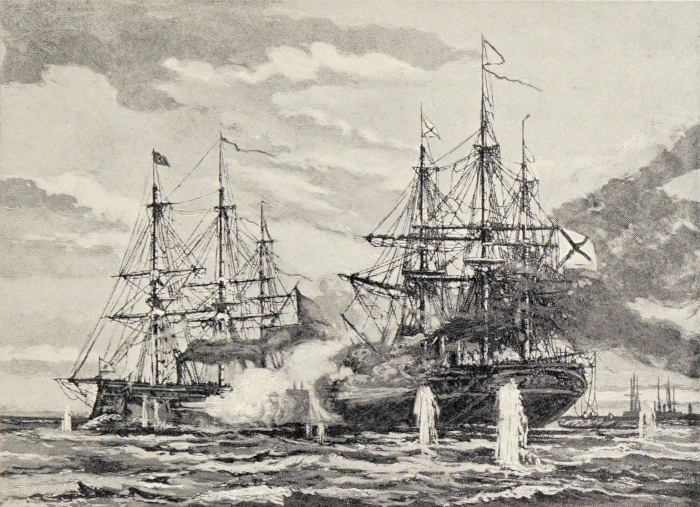
DUEL BETWEEN THE “VESTA” AND “ASSAR-I-CHEVKET.”
From a Contemporary Wood Engraving.
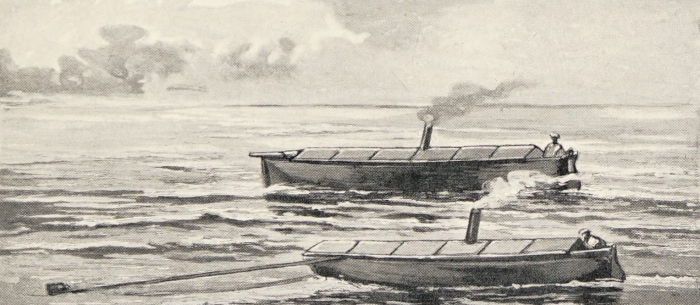
RUSSIAN TORPEDO BOATS ON THE DANUBE IN THE RUSSO-TURKISH WAR.
Many of the British ironclads, the development of which
has been traced in earlier pages, participated in the bombardment
of Alexandria, in July, 1882. The Egyptian fortifications
mounted a great variety of guns, intended, it was unkindly
suggested at that time, to meet on equal terms all kinds of
floating craft from ships’ gigs to battleships. The forts were
provided with a number of heavy Armstrong and Krupp guns
of great calibre and immense power. These included five
10-inch 18-ton guns, eighteen 9-inch, and fourteen 8-inch guns,
all of which were rifled. The majority of the guns in the forts
were indifferently mounted, to a large extent through carelessness
in the work, and some of the latest pattern had been so
recently delivered that there was no time, as time is reckoned
in the East where a few months seldom matter, to mount them
at all. No doubt they had been intended to supersede the
old, small, smooth-bore guns of which the forts had enough
and to spare, there being no fewer than two hundred and eleven
of them, but as this work had not been done the Egyptian
gunners had to make shift as best they could with the guns
in position. There were also thirty-eight mortars. Of course,
under the circumstances many of their projectiles failed to
reach the British vessels at which they were aimed. The
Egyptian gunners also served their weapons very badly, and
even when the British ships were within short range of the
heavier guns, nearly every shot missed its mark. The forts
appeared from the outside to be much better constructed than
they really were, and their magazines, though extensive, were
by no means the safe places they should have been for the
storage of ammunition and projectiles, and in this probably
lies the explanation of the blowing up of some of the forts.
The heavier Egyptian guns were fired through embrasures,
their gunners being thus afforded a considerable measure of
protection; but most, if not all, of the smooth-bores were
fired over parapets, so that they were more exposed to the
fire of the ships.
The disparity in gun power between the fleet and the forts
was so great that the view was confidently expressed in England
that if hostilities should ensue the forts would be reduced in
anything from half an hour to a couple of hours. Yet for
eleven hours the Egyptian gunners maintained the unequal
combat. Had their skill been equal to their determination,
Alexandria had not fallen so easily and with so little damage
to the British ships.
The ironclads were the Inflexible, firing a broadside of 6,880 lb.
from her four 81-ton guns; the Temeraire, 8,540 tons, four
25-ton and four 18-ton guns; the Superb, 9,100 tons, with
four 25-ton guns, and a weight of broadside of 3,280 lb.; the
Alexandra, 9,490 tons, two 25-ton and ten 18-ton guns; the
Monarch, 8,230 tons, four 25-ton and two 6½-ton guns; the
Invincible, 6,010 tons, ten 12-ton guns; and the Penelope,
4,394 tons, ten 12-ton guns. All these vessels carried a number
of smaller guns as well. The gunboats were the Beacon, Bittern,
Cygnet, Condor, and Decoy, and there was also a small despatch
boat.
The Monarch, Temeraire and Penelope attacked Fort Meks
and Fort Marsa-el-Kanit on the mainland; and the Superb,
Sultan and Alexandra opposed the Lighthouse and Pharos
forts. The Inflexible co-operated with either squadron as
required. The Marabout batteries at the entrance to the
harbour were left to the five gunboats. These were each armed
with a 4½-ton 7-inch rifled Woolwich gun and two 64-pounders,
all muzzle-loading. The Marabout forts were protected by
two 18-ton guns, two 12-ton guns, twenty 32-pounders, and
five mortars. This fort had been constructed in such a manner
that the guns could not be trained to fire below a certain angle,
and consequently any vessel which could get within this angle
would be comparatively safe from the fire of the forts, and
with the superior training of its guns could shell the forts at
short range with terrible effect.
Lord Charles Beresford, the commander of the Condor, saw
this, and determined to make the effort. With magnificent
daring and consummately skilful handling of his small vessel,
he managed to get her through the zone of fire without receiving
a shot in return, thanks to the erratic firing of the Egyptian
gunners. Having got under the angle of fire the Condor began
to use her guns with terrible effect.
A certain gun in the Marabout fort was annoying the
attacking flotilla very seriously, and in spite of the efforts of
the assailants they could not suppress its fire entirely. One
man at this gun proved that he was an excellent marksman
and sent several shells dangerously close to the ships.
The story goes that this particularly obnoxious Egyptian
gunner was noticed by Lord Charles Beresford, who ordered
his own best gunner to knock over the Egyptian gun. This
was no sooner ordered than done, but the Egyptians worked
hard and mounted the gun again, and once more the Egyptian
gunner was seen to be in charge of the piece.
“Hit that gunner,” Lord Charles commanded.
“Yes, sir. Where shall I hit him?” the gunner asked.
“Hit him in the eye,” was the reply of the future admiral.
“Which eye, sir?” asked the gunner. But before the
commander could indicate any preference as to the particular
Egyptian optic which should be hit with an explosive shell,
the gunner had fired, and the shot took off the man’s head.
The Condor maintained her duel with the forts for an hour
and was not hit seriously once. Almost single-handed she
silenced the great guns of the Marabout fort, and afterwards
aided the Bittern and Cygnet to suppress the other guns. Little
wonder was it that when she afterwards passed the Invincible
she was rewarded with the splendid compliment, “Well done,
Condor.” The crews of the large warships cheered her as she
passed them, and her own crew returned the compliment, not
forgetting cheers for their popular commander and groans for
Arabi Pacha.
Meanwhile the Inflexible, with her terrible 81-ton guns,
was steadily if slowly firing at the Meks and Lighthouse forts.
The guns of one turret sent shell after shell into one of the
forts and those of the other turret were directed upon the
other fort. The heavy rumbling of her immense shells contrasted
curiously with the scream of the lighter shells of the
smaller guns. Her enormous projectiles, weighing about
1,700 lb. each, fired with terrible precision, blew the face of
Fort Ada to pieces, and aided in reducing the Lighthouse
fort.
The bombardment was a repetition of the old story of fixed
shore fortifications being assailed by a mobile and powerful
fleet. As usual the fleet could manœuvre to its own best
advantage for shelling an enemy and upsetting his aim. The
fleet itself, however, did not escape entirely without injury.
A shell entered the captain’s cabin of the Alexandra and burst,
doing considerable damage to the contents of the apartment,
but singularly little injury to the ship. The Alexandra’s armour
was pierced several times, but none of the projectiles succeeded
in getting through the backing, and a portion of her smokestack
was shot away. Altogether she was struck twenty-five times.
Most of the other attacking vessels also bore marks of the
engagement, but in no instance was the injury inflicted serious.
Much of the damage was sustained aloft, thus showing that the
Egyptian gunners had for the most part aimed too high. Some
of their shells, also, failed to explode, and on the whole the
firing from the forts was badly directed. The British had
five men killed and twenty-eight wounded. The losses of the
Egyptians were never known accurately, but must have been
very great, for the British shells which did not hit the forts
found their billets in the town behind and, exploding, added
to the terror and death-roll among the natives who had not
already fled.
A correspondent who visited the forts immediately after
the bombardment wrote:—
“One is amazed at the destruction accomplished which was not
visible from the sea, and at the bravery of the Arab gunners in remaining
at their posts so long. The number and variety of their guns
are surprising and the stock of projectiles and ammunition is immense.
If they had had more men and been well commanded, the fleet would
have had a very warm reception. In one fort we counted several 18-ton
guns, 19-inch Armstrongs. In another four 9-inch and one 10-inch
Armstrong; in another two 15-inch smooth-bores ... besides
40-pounder Armstrongs and any number of old 32-pounders....
One small battery gave the ships a great deal of trouble ... it
was effectually silenced at last, every gun being knocked off the
trainings. At Bab el Meks some Armstrongs were knocked down,
others were hit up with muzzles in the air, and embedded in one gun
we found shots from a Gatling.”[48]
The present United States navy may be said to date from
1883. After the close of the rebellion the American Government
had no further need of the majority of the war vessels built
or improvised for that struggle, and having sold some, neglected
nearly all the remainder. America and Spain almost came to
blows over what was known as the Virginius affair, and the
great republic prepared to do its best on “the mobilisation in
southern waters of a fleet which consisted in great part of
antiquated and rotting ships.”[49] The United States also sadly
missed the possession of an efficient navy when serious differences
arose with a powerful European state over the right
interpretation and application of the Monroe Doctrine to
the Panama Canal and the control thereof. Both these events,
supported by the Ten Years War in Cuba and the unconcealed
American sympathy for the Cubans, prepared the country
for the acceptance of the dictum that a more modern navy
was necessary, and this was emphasised when it was announced
during the administration of President Rutherford B. Hayes
that the navy of any European power was superior to that of
the United States, and that even Chili, with the Almirante
Cochrane and the Huascar, would be able to bombard San
Francisco and that the United States Government had not the
means to prevent them.
In order to appreciate the enormous progress which the
United States have made as a naval power in the past thirty
years one must turn to the American Navy List for 1879, and
compare it with the present equipment in the matter of ships
and personnel, which places the United States in the position
of being the second naval power of the world—second, indeed,
only to Great Britain, and with resources for the production
of warships of the latest design and the highest fighting capacity
scarcely if at all inferior to those of the United Kingdom itself.
In 1879 there—
“Were five steam vessels classed as first-rates, which had
been built twenty-five years before and were then obsolete and
practically useless as men-of-war; twenty-seven second-rates, of
which three lay on the stocks, rotten and worthless, seven were
in ordinary unfit for repair, and only nine were actually in
condition for sea duty; twenty-nine third-rate steam vessels,
of which fifteen only were available for naval purposes; six
fourth-rate steam vessels, none of which was of account as a
warship; twenty-two sailing vessels, but five of which could
even navigate the sea; twenty-four ironclads, fourteen of which
were ready for effective service; and two torpedo vessels, one
of which was described as rather heavy for a torpedo vessel, not
working so handily as is desirable for that purpose, and the
other, known as the Alarm, was in the experimental stage....
In the entire navy there was not a single high-power, long-range
rifled gun.”
Of the bravery of the American sailors of whatever rank
there has never been any question, but the methods of selecting
them seem to have been as peculiar as the British methods of
corruption in the old days, when it was possible for an infant
in arms to be on the pay roll of a British ship when he had
never so much as seen the sea, to say nothing of never having
been on board the vessel of which he was nominally a midshipman.
The following racy account,[50] which illustrates the American
system of the past better than any lengthy description could
do, of the examination of Midshipman Joseph Tatnall, a relative
of the famous American officer of “Blood is thicker than water”
fame, will be read with interest in this connection:—
Commodore: Mr. Tatnall, what would be your course,
supposing you were off a lee shore, the wind blowing a gale,
both anchors and your rudder gone, all your canvas carried
away, and your ship scudding rapidly towards the breakers?
Tatnall: I cannot conceive, sir, that such a combination
of disasters could possibly befall a ship in one voyage.
Commodore: Tut, tut, young gentleman; we must have
your opinion supposing such a case to have actually occurred.
Tatnall: Well, sir—sails all carried away, do you say,
sir?
Commodore: Aye, all—every rag.
Tatnall: Anchor gone, too, sir?
Commodore: Aye; not an uncommon case.
Tatnall: No rudder, either?
Commodore: Aye, rudder unshipped. (Tatnall drops his
head despondently in deep thought.) Come, sir, come; bear a
hand about it! What would you do?
Tatnall (at last and desperate): Well, I’d let the infernal
tub go to the devil, where she ought to go.
Commodore (joyously): Right, sir; perfectly right! That
will do, sir. The clerk will note that Mr. Tatnall has passed.
A naval advisory board was appointed which, in 1881,
recommended that thirty-eight armoured cruisers should be
built, of which eighteen should be of steel and twenty of wood,
besides several other vessels. An influential minority of the
board objected to steel lest it should be imported instead of
being manufactured in the United States. But in 1882 a
House of Representatives committee decided upon steel, not
only as the best but as the only proper material for the construction
of war vessels. The committee, cautious but determined,
recommended the building of two 15-knot cruisers,
four 14-knot cruisers, and one steel ram. The advisory board
desired five rams, but one was tried as an experiment. This
was the Katahdin, and she was a failure and the experiment
was never repeated. Congress in 1883 decided on two cruisers,
not six, of which one should be between 5,000 and 6,000 tons
displacement and have the highest attainable speed, and the
other of between 4,000 and 4,300 tons displacement; and
both were to have full sail power and full steam power. But
as no money was voted the ships did not appear. Another
naval advisory board recommended the construction of a
4,000-ton vessel and three of about 2,500 tons, all of steel,
and a smaller iron despatch boat. Congress in March, 1883,
adopted the programme, eliminating only one of the smaller
cruisers, and this time voted an appropriation.
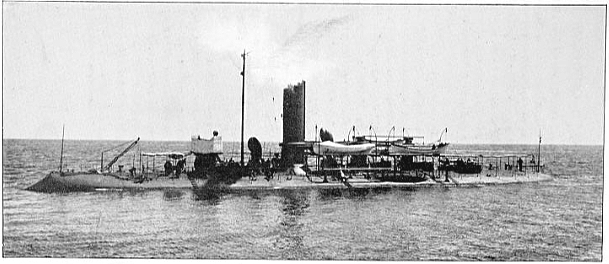
U.S. RAM “KATAHDIN.”
The Chicago was the largest of these vessels; the other
three were the Boston, Atlanta and Dolphin. They were built
of American materials, and were the first vessels of the modern
American navy. The Chicago, besides being a twin-screw
vessel, had engines which recalled the type installed in the
famous Stevens battery. The advocates of the old order
adopted with alacrity the role of Job’s comforters, and predicted
with as much cheerfulness as the role would allow, the absolute
failure of the new vessels. The Chicago’s designed displacement
was 4,500 tons, her engines, gave her a sea-speed of fourteen
knots, and she was armed with four 8-inch, eight 6-inch, and
two 5-inch breech-loading rifled guns. The Atlanta and Boston,
each of 3,000 tons displacement and speed of thirteen knots,
carried two 8-inch and six 6-inch guns. The Dolphin, of
1,500 tons and fifteen knots, the despatch boat, was given one
6-inch gun. All four vessels had secondary batteries of smaller
guns. The three cruisers at their trials attained sixteen knots
or over.
Europe, which had treated the American fleets with derision,
began to take a tolerant and amused interest in American
naval construction when it became known that the new navy
had been decided upon. The European powers only mustered
eight 16-knot vessels among them, and when three American
ships of that speed appeared, Europe became profoundly
interested. These ships and the Yorktown, built later, constituted
the White Squadron which visited Europe about 1891,
and showed the Old World what the New World could do.
The Charleston, the designs for which were purchased abroad,
was provided with machinery and boilers supposed to embody
the best features of the boilers and machinery of various foreign
cruisers, but they had to be altered considerably before she
was considered to meet American requirements. She was the
first vessel of the new navy to be employed on a warlike service.
The supposed filibustering steamer Itata, at the time of the
Chilian insurrection in 1891, escaped from the custody of the
U.S. marshal at San Diego, and the Charleston was successful
in the mission of overtaking her, which she did at Iquique,
after steaming 6,000 miles. The Charleston was wrecked off
Luzon in 1900.
In 1886 the United States made another extraordinary
advance by authorising the construction of the second-class
battleship Texas, the armoured cruiser Maine, the protected
cruiser Baltimore, the dynamite cruiser Vesuvius, and the
torpedo boat Cushing. The Texas and the Maine were the
first modern armoured cruising ships constructed in the United
States. They were decided upon as the result of the knocking
to pieces in half an hour of China’s wooden fleet by the French
in the Min River, in August, 1884.
The Cushing, besides being the first American steel torpedo
boat, was the first American warship driven by quadruple
expansion engines. She was named to commemorate the
officer who commanded the launch which rammed and broke
a protecting boom, and blew up the Albemarle in the Civil
War. The Vesuvius should be included rather in the
category of freaks or comparative failures, for though her
three pneumatic dynamite guns of 10½-inch calibre, designed
by Lieut. Zalinski, could each hurl shells containing 200 lb.
of dynamite or other high explosive at least a mile, they were
soon outclassed by other artillery. These projectiles were
thrown by compressed air, and not by explosions of dynamite.
The Vesuvius was employed at the blockade of Santiago de
Cuba in 1898, where she frightened the Spaniards with her
dynamite shells, but did very little actual damage. Her
three pneumatic guns projected abreast through the forward
part of the deck, some distance aft of the bow, and sloped at
an angle of about 45 degrees. The breech of each gun was in
the hold, and the supports of the weapons were so connected
with the ship itself as to be practically built into it. The guns
were therefore fixtures; their elevation was unalterable and
when it was desired to discharge them to right or left or to
alter the range the whole position of the ship had to be moved.
The Texas and Baltimore were also built on designs purchased
abroad. With the exception of three vessels acquired just
before the war with Spain, all the American ships are entirely
the products of American naval science. The first triple-screw
warships were the Columbia—a very handsome ship, sometimes
called the Gem of the Ocean—and her sister, the Minneapolis.
Up to the attack upon the Spaniards in Cuba, the United
States had retained a number of monitors, but the experiences
of 1898 convinced the naval department that
vessels of that class were out of date and unsuitable for
modern warfare.
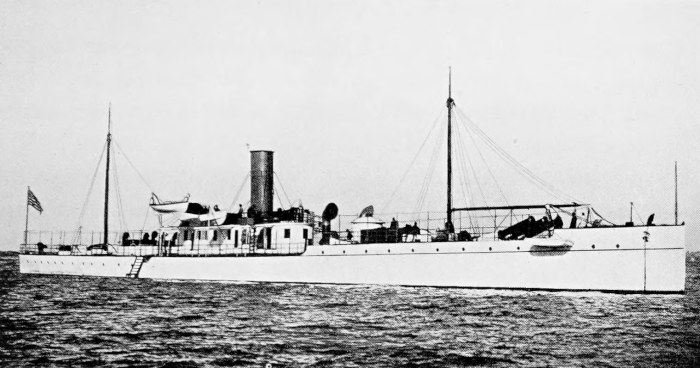
THE U.S. DYNAMITE-GUN BOAT “VESUVIUS.”
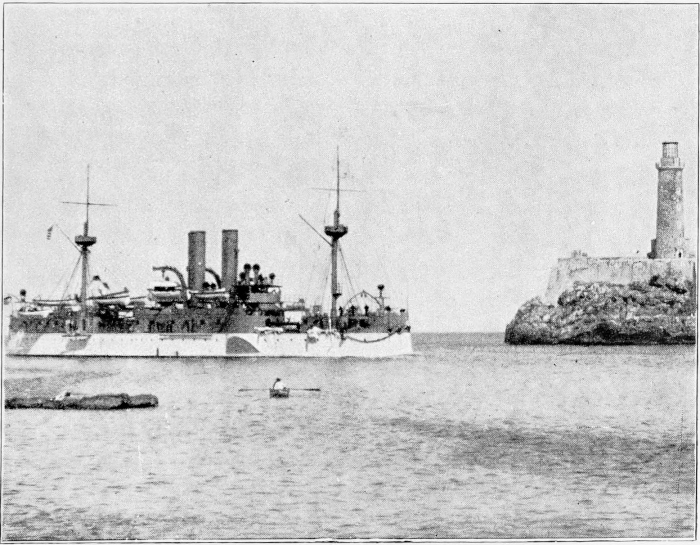
THE “MAINE” ENTERING HAVANA HARBOUR.
Although the American vessels were built in the United
States the compound armour for the turrets had to be imported
at first, and it was not for some years that American-made
armour was available for the navy. Four battleships were
launched in the early ’nineties, and with the Texas comprised
the American battleship force in the war with Spain in 1898.
The Americans showed their inventiveness in the matter of
their warships, and not being content always to follow the
lead of other nations, and being convinced that they could not
make more or greater mistakes than some European naval
architects had perpetrated, produced some remarkable vessels.
They were the first to try the superposed turrets, or one turret
placed on top of another. The Kearsarge and Kentucky were
thus equipped, but the experiment did not give the results
anticipated, and was not repeated. But the Americans had
shown that the guns of one turret could fire over another turret,
and some of the latest and most powerful ships of the super-Dreadnought
types have their turrets arranged so that this
may be done.
The Maine, really an armoured cruiser, but described as
a second-class battleship, was sent to Havana for political
reasons in January, 1898, and was blown up at her moorings
on the evening of the 15th of the following month, two hundred
and sixty-six lives being lost. The explosion was attributed
to the Spaniards, but this has been questioned, as an examination
of the wreck, completed in the summer of 1911,
was stated to have revealed that the cause of the disaster
was the explosion of the vessel’s magazines, but a later
examination is said to have shown that the explosion was
external. War between the two countries was now regarded
as inevitable, and both made preparations for the
struggle, Spain in that lazy and incompetent fashion which
assured her defeat in advance, and the United States with
as much thoroughness and care as the time allowed.
The resources of the latter country were far superior to
those of her opponent, but Spain by no means made the
best of what she had. The American naval preparations
were well conceived and as well carried out. The most
notable exploit in this work was the remarkable voyage
of the battleship Oregon from Bremerton, Washington, to San
Francisco, and thence at her utmost speed round Cape Horn
to Key West. It was the first time any steam warship had
essayed such a feat, and that an American ship should have
accomplished it was a feather in the American cap. Two or
three foreign-built warships were acquired, but the European
powers were friendly to Spain rather than to the United States
in the war, and the latter acquired ninety-seven merchant
steamers to act as auxiliaries to its fighting fleet, and distributed
among them no fewer than five hundred and seventy-six guns
in order that they might take part in the fighting if circumstances
required.
In the Pacific the American preparations were no less
extensive than in the Atlantic. The first of the great naval
battles of the war was that of Manila Bay. Admiral Dewey’s
flagship was the protected cruiser Olympia, 5,800 tons displacement,
launched at San Francisco in 1892, and having four
8-inch and ten 5-inch quick-firers, fourteen 6-pounders and ten
smaller guns. With her were the protected cruisers Baltimore
4,600 tons; Raleigh, 3,217 tons; Boston, 3,000 tons; all heavily
armed for their size, and a couple of gunboats.
The Spanish naval force consisted of the steel cruiser Reina
Cristina, 3,520 tons, built at Ferrol in 1886, and carrying
six 6·2-inch Hontoria guns, two 2·7 inch, and three 2·2 inch
quick-firers, and ten smaller guns; a wooden cruiser, the Castilla,
3,342 tons, built at Cadiz in 1881, and armed with four 5·9 inch
Krupps, and sixteen quick-firers of various sizes; two steel
gunboats of English build and 1,045 tons, and some smaller
Spanish-built gunboats and a number of torpedo boats. The
shore fortifications had also been strengthened by the addition
of a few heavy guns.
Though there was not a great deal of difference between
the Spanish and American fleets at Manila, according to a
comparative statement issued by the American navy department,
the difference was on the side of the Americans, but with
the land forces as well the advantage on paper lay with the
Spaniards. The only instructions to Admiral Dewey were to
“capture or destroy” the Spanish fleet. This, as it happened,
was not a difficult task, for the Spanish vessels were in a
deplorable condition of inefficiency, and the best that the Spanish
admiral could do was to get his ships under the protection of
the forts and keep them there. Not finding the Spanish ships
at Subig Bay, the Americans entered Manila Bay to look for
them, heedless of the mines supposed to be strewn about the
channel, but choosing a dark night illumined only by the
flashes of lightning from the thunder clouds, as though the very
elements were desirous of taking part in the coming struggle
and were flashing their signals preparatory to the discharge
of the sky’s artillery. The American ships showed no light
other than that at the stern of each vessel but the last, to enable
that behind to follow in line. The defenders sighted them
and opened fire, but the ships never paused, firing upon the
batteries as they passed. The Spanish admiral, who, conscious of
the condition of his ships, knew that his command was doomed
before ever a shot had been fired, estimated his available
tonnage at 10,111 as against the American 21,410 tons; his
h.p. at 11,200, as against 49,290; his guns at seventy-six, as
against the American one hundred and sixty-three; but he
had a slight superiority in the number of men.
After day broke the Spaniards opened the battle, the
batteries of Cavité and Manila starting the firing and being
supported by the Spanish vessels. The Concord sent two
shells at the Manila battery by way of reply, but the rest of
the ships steadily steamed towards the Spanish ships, and it
was not until the Olympia was within 5,600 yards of the ships
that Dewey gave permission for the Americans to fire.
“You may fire when you’re ready, Gridley,” Admiral
Dewey said in his imperturbable way. A second later, and
one of the Olympia’s forward guns had answered the Spanish
challenge.
The American ships passed parallel to the Spaniards, and
one after another concentrated its fire upon the Reina Cristina,
the best ship the enemy possessed, and only fired upon the
others when the cruiser was out of range. The Spanish admiral
essayed to attack the Americans by advancing against them
with his one good fighting ship, thinking that possibly at closer
quarters he might be able to meet his opponents with a better
chance of inflicting damage. For bravery and audacity the
feat ranks high in the annals of naval combats. But the chance
he hoped for was never allowed him. A shell penetrated the
Reina Cristina near the bows and, exploding, set her on fire.
Almost at the same time a heavy projectile crashed into her
stern and an 8-inch shell entered the hole thus made and
exploded, setting her on fire at that end also, and damaging
her engines. She retreated under as heavy a fire as a modern
warship could withstand and yet keep afloat. Of her crew of
four hundred and ninety-three men, but one hundred and sixty,
of whom ninety were wounded, answered to the roll call after
the battle.
Three times the Americans passed up and down before the
Spanish ships, gradually decreasing the range to 2,600 yards.
Ship after ship was disabled. Some took refuge behind the
Cavité arsenal and were sunk by the Spaniards rather than
be allowed to fall into the Americans’ possession. One little
iron gunboat, the Don Antonio de Ulloa, whose commander
disregarded the Spanish admiral’s orders to sink his ship, with
sublime audacity prepared to offer battle to the whole American
fleet. The Baltimore, Olympia and Raleigh opened fire upon
her. The odds were too great. She fought bravely for a few
minutes, but the guns of the assailing cruisers riddled her sides,
and her crew left as she listed and sank with her colours flying.
The American ships made short work of the shore batteries.
The Americans in the battle of Manila Bay had seven men
wounded, while the injury to the vessels was trivial. The
Spaniards lost ten ships and had three hundred and eighty-one
men killed and the wounded numbered hundreds more.
Determined to make no mistakes, the Americans took the
Spanish fleet in the Atlantic at its strength on paper, ignoring
the rumours of its neglect and inefficiency, and prepared to
meet it accordingly. Spain possessed five armoured cruisers and
a battleship, which were admitted by the Americans to be
equal to America’s six best ships, a few other vessels, and some
torpedo boat destroyers. The real state of the Spanish ships
is best revealed by Admiral Cervera himself. In one letter he
wrote:—
“The Colon has not received her big guns; the Carlos V.
has not been delivered, and her 10-cm. artillery is not yet
mounted; the Pelayo is not ready for want of finishing her
redoubt, and, I believe, her secondary battery; the Victoria
has no artillery, and of the Numancia we had better not
speak.”[51]
In another letter he complained of the absence of plans
and of the supplies he had asked for not being forthcoming.
“The Colon has not yet her big guns, and I asked for the bad
ones if there were no others. The 14-cm. ammunition, with
the exception of about three hundred shots, is bad. The
defective guns of the Vizcaya and Oquendo have not been
changed. The cartridge cases of the Colon cannot be recharged.
We have not a single Bustamente torpedo.... The repairs
of the servomotors of the Infanta Maria Teresa and the Vizcaya
were only made after they had left Spain.” And after his defeat
at Santiago, when asked where were certain large guns which
should have been on his ships, he answered that he supposed
they were in the pockets of certain officials in Spain.
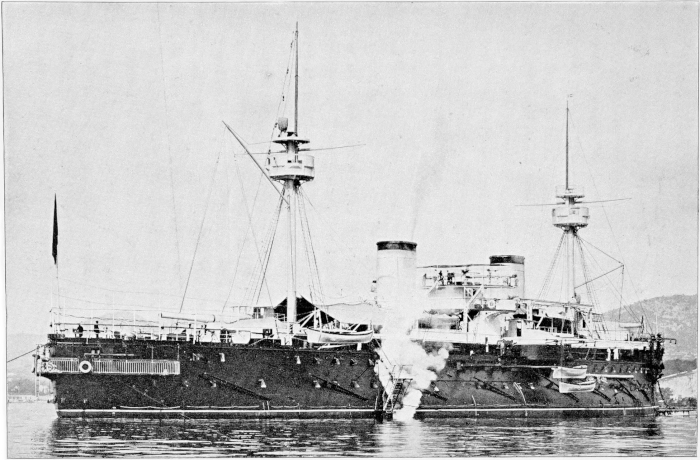
SPANISH BATTLESHIP “PELAYO.”
Photograph by Marius Bar, Toulon.
On May 19th, the Spanish fleet entered Santiago, after
having crawled across the Atlantic to Curaçao, much to the
relief of the Americans, who wondered where the fleet was
and feared lest it should attack New York or some other wealthy
Atlantic port. Once the fleet was inside, a strict blockade
was maintained to see that it did not get out unnoticed. But
the venture had to be made sooner or later.
“The fleet under my command offers the news, as a 4th of
July present, of the destruction of the whole of Admiral
Cervera’s fleet. Not one escaped.”
This was the message Admiral Sampson despatched on
July 3rd to the Secretary of the Navy at Washington.
The situation had become a question of days when the
Spanish fleet should find itself exposed to the fire of the American
forces ashore. While his ships, in spite of their condition,
were yet able to offer fight, Admiral Cervera decided on making
a desperate sortie, or attempt to escape. It was the forlornest
of forlorn hopes at best, for he had nowhere to flee to with
any hope of reaching a place of safety, and turn which
way he would, the American ships, well cared for, within easy
reach of their base, with almost unlimited supplies, and eager
for battle, were waiting for him. The Admiral, in the Cristobal
Colon, led the way seaward through the narrow entrance to
Santiago Bay, and fled down the coast. The other ships
followed as best they could. The Americans sought to ram
the Spaniards, but could not do so because of the latter’s superior
speed. The fleeing admiral’s ship did succeed in getting away
for the time being. The other ships as they appeared were
fiercely assailed by the American ships. The Spaniards fought
with that gallantry and reckless bravery which have been a
prized Spanish tradition for centuries, but their shooting was
so indifferent that few of the American ships were hit, some
were not touched at all, and only one Spanish shell got home
effectively on an American ship. The Americans, on their
part, fired to hit, and hit they did. The armour of the Spanish
ships proved its value, and rang under the blows like anvils
under the strokes of mighty hammers, and the ships shivered
and heeled under the force of the impact.
The engagement began about half-past nine in the morning;
by two o’clock in the afternoon the last ship, the Cristobal
Colon, was run ashore sixty miles down the coast, and Admiral
Cervera himself was a prisoner. In the interval the Infanta
Maria Teresa, the Oquendo, and the Vizcaya were forced ashore
and burnt, blown up, or surrendered, within twenty miles of
Santiago. The Furor and Pluton were destroyed within four
miles of the port. Cervera’s ship was about two knots faster
than the American ships which first assailed it, but it could not
hope to escape the other American vessels lying off the coast,
nor did it. In respect to fighting power, weight of metal,
armour protection, and condition for fighting, the Spanish
ships were hopelessly overmatched; and the Spanish guns,
whatever may have been their value on paper, were as inferior
as the Spanish gunnery. One knows not whether to wonder
more at the state of mind of an administration which could
send so ill-equipped and neglected a fleet to the seat of war,
or at the extraordinary bravery of the crews who went in a
patriotic cause to what was little else than certain death.
The indifferent shooting which the Spaniards displayed in the
Santiago affair, from first to last, prompted Captain (afterwards
Admiral) Robley D. Evans, otherwise “Fighting Bob,”
to declare that they “couldn’t hit a d——d thing but the
ocean” when they missed his ship with unfailing regularity.
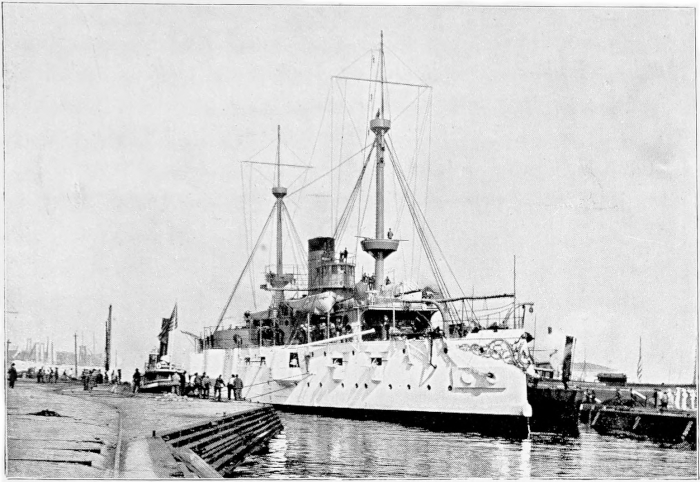
U.S. BATTLESHIP “TEXAS.”
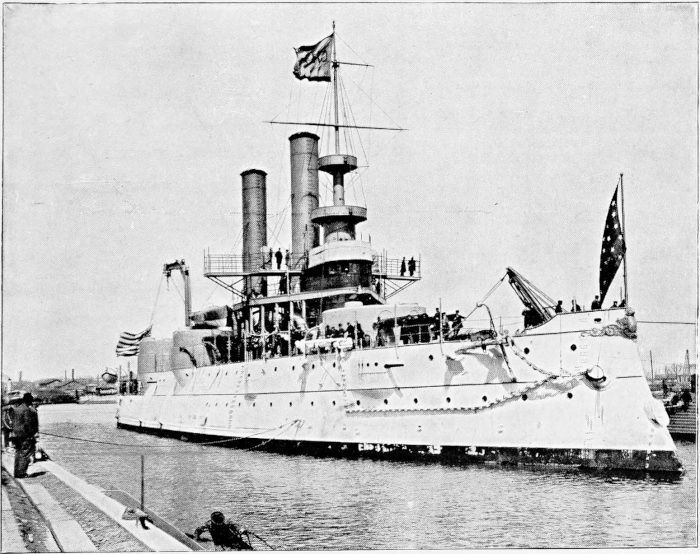
U.S. BATTLESHIP “IOWA.”
When the Cristobal Colon appeared, the Indiana headed
close in shore to get within short range. The Spaniard fired
her 11-inch Hontoria gun and missed. The American ship
replied with her 13-inch guns, and then discharged every
weapon she could bring to bear upon her ill-fated antagonist,
one shell exploding on the Spanish cruiser’s deck. The Iowa
and Texas took up the attack upon the Cristobal Colon; the
Indiana joined with the Brooklyn and Texas in smashing the
Oquendo, which stranded on fire. The Vizcaya next appeared
to run the gauntlet, with two destroyers close behind her.
The destroyers tried to torpedo the Indiana, but the American
ship’s secondary battery soon accounted for them, one drifting
ashore and blowing up. The Vizcaya was set on fire by the
American shells, but was fought until she was no longer tenable
before she was surrendered. The Eulate was also surrendered.
The Cristobal Colon raced with the Brooklyn and Oregon for
3,000 yards, until she struck the rocks bow-on and remained
fast.
The destruction in such short spaces of time of the Spanish
fleets in the Pacific and then in the Atlantic, with such little
injury to the American side, demonstrated most unmistakably
the importance and power of the new American navy. A
few years later the famous cruise round the world was undertaken
by an American fleet, and enabled the powers of the Old
World to inspect some of the ships, and others of later date,
which wrought such havoc. Yet such has been the progress
of naval construction that not one of the ships which made
the cruise is now included in the first rank of the American
fighting line.
After the Japanese had decided to adopt war vessels of
the Western types, they ordered a number of vessels of various
kinds from builders in the United Kingdom. Their first ironclad
frigate was the Foo-So, launched from the slip in Messrs.
Samuda’s yard at Poplar, from which the Thunderbolt, the
first ironclad ever built for the British Navy, took the water.
Another coincidence was that both the Thunderbolt and the
Foo-So were launched with every armour-plate upon them.
The Foo-So had as her main deck battery, which was protected
by armour 8 inches thick, four Krupp’s long 23-cm. breech-loading
guns, each weighing 15¼ tons. On the upper deck were
placed two long 17-cm. Krupp guns of 5½ tons each, but these
were unprotected. The main deck battery projecting beyond
the sides, permitted of a greater training to the guns. She
carried a powerful ram, and her bowsprit, as was the custom
with all vessels at that time fitted with a ram and bowsprit,
was made so that it could be hauled inboard when a ramming
attack was to be made. The ship was belted on the water-line
with 9-inch armour and the vital parts were equally well protected.
She was of 3,700 tons displacement, and fitted with
trunk engines of 3,500 h.p. which, with a steam pressure of
60 lb., were calculated to give her a speed of fourteen knots;
her coal capacity was expected to enable her to cover 4,500 miles
at moderate speed. The first warship on Western lines which
the Japanese built was a little barque-rigged vessel, the Seika,
launched in 1875, a model of which is now (1911) in the
Museum at the Royal Naval College at Greenwich.
The naval engagements in the Chino-Japanese war were
not remarkable for much in the way of fighting, but chiefly
for a pronounced objection by the Chinese officers as a whole
to anything of the sort. A few of them, Admiral Ting among
the number, did their best, but they were so hindered by their
colleagues’ incompetence and cowardice that they never had
a chance of success. Guns that had been neglected, and shells
from which the powder had been extracted and its place filled
with charcoal, are not the best weapons for warfare, and when
to these are added coal that was not much use and ships that
were not in fighting condition, it will be seen that the victory
of the well-organised Japanese was a foregone conclusion.
One or two of the Chinese ships offered the best resistance they
could, but it was a hopeless resistance from the start. The
Battle of the Yalu was won by the Japanese before a shot was
fired. The few survivors of the Yalu fell victims at Wei-Hai-Wei.
The training which a cavalry officer received in the
Chinese army was not such as to fit him to command a fleet
at sea, even of Chinese ships, but the former cavalryman who
became commander of the Chinese fleet tried his utmost;
his personal bravery was unquestioned, and he had preferred
death to dishonour when he was found lifeless in the cabin of
his beaten ship with a revolver by his side and a bullet through
his brain.
Disciplinarian he was not. It is recorded that like most
Chinamen he was an inveterate gambler, and that on one
occasion when the fleet, as usual, was doing nothing, he found
the time heavy on his hands, and when a visitor went on board
the sentries were engaged in fan-tan in a secluded corner of
the deck, the officers who should have been on duty were
similarly engaged elsewhere, and the admiral himself was
acting banker in that charming game with one or two other
officers, and the sentry, who should have been on duty at the
door of the admiral’s cabin, joining whole-heartedly in the
gamble.
Of China’s principal battleships, two fine vessels of 7,400 tons
displacement, one the Chen-Yuen, surrendered at Wei-Hai-Wei,
and having been repaired, was taken to Japan and added to
the navy of her captors, and the other was sunk by a Whitehead
torpedo during a night attack by torpedo boats at Wei-Hai-Wei.
Similar fates befell a couple of armoured cruisers, and of the
six smaller cruisers which completed China’s fleet at the Battle
of the Yalu, five were sunk or wrecked, and one surrendered.
One was raised and added to the Japanese navy. Some of
the ships of which China was despoiled distinguished themselves
in the Japanese attack upon the Russians at the Battle
of Tsushima.
The Battle of Tsushima, which ended Russia’s naval pretensions
in the war between that country and Japan a few
years ago, is the only one in which modern ships and guns
have been employed on both sides in anything approximating
to equal terms. After the Russian squadron already in the
Far East had suffered so severely at Port Arthur and the few
vessels at Vladivostok deemed it advisable to stay there, Russia
collected as many sea-going war vessels of all shapes and sizes
as she could muster, and sent them out in two detachments
from Europe in the hope that they would reach Vladivostok,
Japan permitting. The voyage was exciting enough at the
start when, through a bad attack of nerves, the Russians opened
fire upon and damaged one or two British trawlers in the North
Sea under the delusion that they were Japanese torpedo boats
advancing to attack them. Loud was the outcry in Great
Britain and great was the clamour that the British fleet should
make short work of the Russian ships before they did any more
damage. But the Government saved its powder and money
and put its trust in the Japanese, confident that the Mikado’s
ships would do all that was necessary if the imaginative Russians
ever got that far. The Russian ships were very slow, the best
speed of which the fleet was capable was nine knots, and as
the Russians themselves estimated the Japanese speed at
sixteen knots, and this estimate was endorsed by the naval
experts, it was taken for granted that the Russian fleet was
going out to certain disaster.
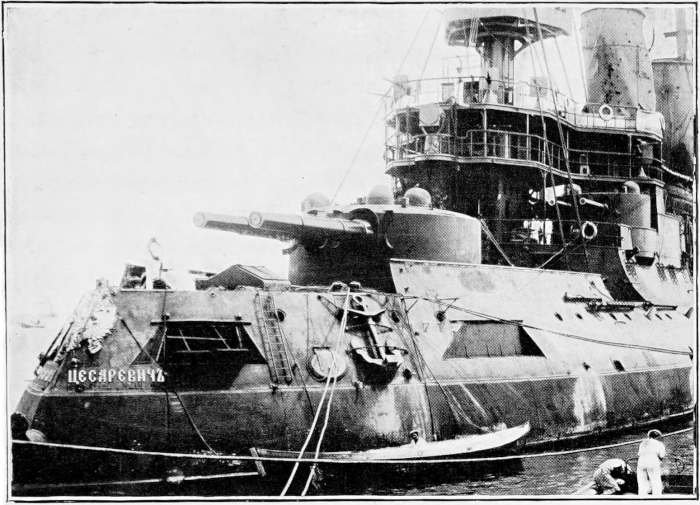
THE RUSSIAN BATTLESHIP “TSAREVITCH” AFTER THE FIGHT OFF PORT
ARTHUR, AUGUST 10, 1905.
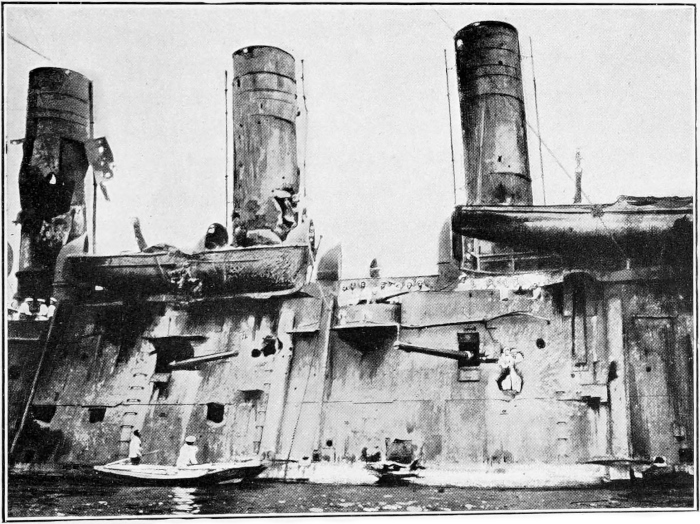
EFFECTS OF JAPANESE SHELLS ON THE “GROMOBOI.”
The progress of this heterogeneous fleet was a matter of
some months, but at last it approached the Japanese coast,
off which the ships of the Mikado’s fleet were waiting. The
Japanese vessels, being of superior speed, were able to choose
their own position for the attack. No innovations in the way
of tactics were attempted. When the Japanese were ready
they attacked, and they selected a moment for doing so when
the slow-moving Russian ships were attempting to carry out
an order of their admiral and were, in consequence of the order
being incompletely executed, unable to offer a resistance to
the suddenness of the attack. This very suddenness, indeed,
threw them into greater disorder, and rendered them the more
easily assailable by their relentless antagonists.
The Russian ships, too, were so overloaded with stores and
coal that the upper edges of their heavy armour-plates were
well below the water-line and, therefore, in so far as the hull
protection was concerned, they were armoured cruisers and
not battleships. The cabins, passages, etc., were so filled with
coal that the sanitary arrangements for the men were blocked
in some of the ships since leaving Leghorn, and the decks were
in consequence in an indescribable condition.[52]
The Russian ships are said to have rolled very heavily
owing to their having so much coal on board, and to the circumstance
that their bunker coals were used before their extra
supplies carried on their decks were consumed. However,
the Russians fought their ships with the utmost bravery and
determination, but the superior training of the Japanese sailors
and their better gunnery told its tale, and in less than a couple
of hours the Russian fleet was hopelessly defeated.
Admiral Togo, according to Lieut.-Commander W. S. Simms,
must have gone into action with two principal objects clearly
defined in his mind. One was to fight at the maximum range
at which actual experience of battle practice had shown him
that he could hit effectively, viz. about 6,000 yards, and at
which he knew the Russian fire would not be dangerous; and
the other was to manœuvre so as to maintain as exactly as
possible that range upon the head of the enemy’s column.
If he had not been able to accomplish these two objects, says
the American authority, he might still have won the battle
because of the Russian inferiority in many other respects,
but the Japanese fleet would certainly have suffered more.
If the Russians had been able by superior speed to run into
1,800 yards range, the battle range of their choice, they would
have made a large percentage of hits, and those hits would
have been very effective, especially from their modern ships
of French design, the Suvaroff, Alexander III., Borodino, and
Orel.
The Japanese at first scored three hits to every one they
received, and as the battle progressed and their men became
more used to their work their hits averaged four to every one
the Russians could manage to inflict on them. The accuracy
of shooting at a greater distance than was formerly thought
possible in an engagement showed the necessity of cultivating
this branch of naval gunnery, and its value was demonstrated
when the Japanese were able to concentrate the rapid fire of
their best battleships upon the leading vessels of the Russian
columns at such a range that the Russian fire was ineffective
and wide of its intended mark.
Most of the Japanese big guns had lengths equal to thirty-five
or forty times their calibres, and had already seen a great deal
of hard work. This to a great extent may account for the
Japanese not having hit oftener. The Japanese shooting in
the later naval stages of the war, as compared with that in the
naval attack on Port Arthur when the Russian squadron already
in Far Eastern waters was crushed, is said to have shown a
slight falling off.
The value of superior speed, of accurate long range firing,
and of protective armour is the principal lesson of the Battle
of Tsushima. The one gives choice of position and all its
attendant advantages; the second enables an enemy to be
partially crippled so that he can be attacked by torpedo boats
and sunk or rendered helpless, or can be overtaken and assailed
by a fast cruiser if an attempt be made to escape. The battle
also demonstrated the value of uniformity in speed of the
principal ships, or ships of the line, for the Japanese admiral,
knowing that his six battleships had each a speed of about
twenty knots, knew exactly the positions he could expect
each one to maintain. He had also a number of first and
second-class armoured cruisers, and his scouts were reinforced
by some of the best vessels in the Japanese mercantile marine.
The actual fighting resulted in the Osliabya being driven
out of the fighting line in less than thirty minutes after the
battle began, and in about an hour after the first shot, the
gun-fire to which she had been subjected had set her on fire
and caused her to founder. The Kniaz Suvaroff was obliged
to leave the fighting line about forty minutes after the battle
commenced, both these ships being rendered ineffective before
the Russians had travelled five miles. Becoming isolated from
her consorts, the Suvaroff was severely pounded. One of her
masts and her two funnels were shot away, and a couple of
torpedo boats attacked her and injured her below the water-line,
so that she soon had a heavy list, but her watertight
bulkheads kept her afloat for a time. Two Japanese destroyers
then took charge of her and torpedoed her three times, inflicting
such injuries that she soon went down. Shortly before this
the Borodino received a shell in her magazine, which blew
up and sent her to the bottom. The Orel surrendered after the
battle, and presented an excellent object lesson of the service
her armour had rendered her, for her partially protected and
unprotected parts were wrecked by the Japanese gun-fire, but
not one of the shells had penetrated her heavy armour, though
it bore ample evidence of the severity of the ordeal through
which she had passed.
Enough has been written to show that the range at which
naval engagements have been fought since steel took the place
of iron for guns and armour has steadily increased. The old
practice of getting close to an enemy and blazing away as
fast as the guns could be loaded, in the hope of smothering
his fire and a certainty of hitting something sometimes, has
become as extinct as the dodo. Guns are too powerful for
anything of the sort to be attempted now, and the object
at present is to hit at the longest range at which the guns are
considered really effective.
The Dreadnought is the logical outcome.
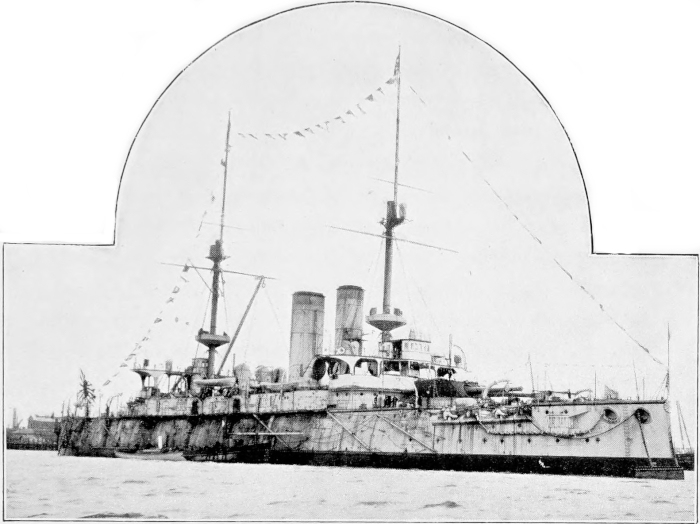
THE JAPANESE BATTLESHIP “ASAHI.”
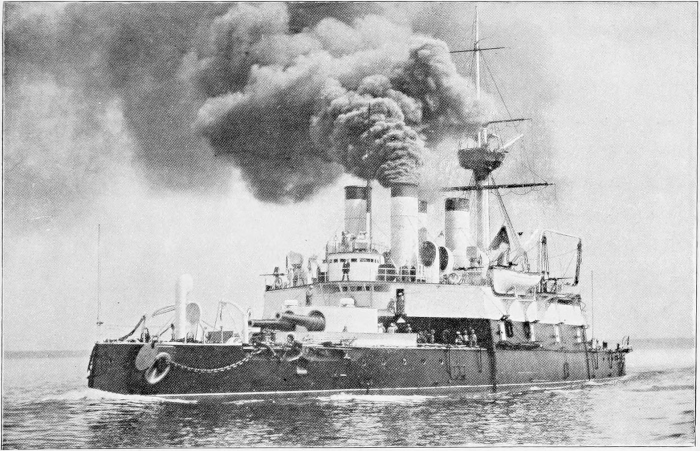
THE RUSSIAN BATTLESHIP “NAVARIN.”
CHAPTER VIII
BATTLESHIPS AND CRUISERS
There was no sudden change from iron to steel in the building
of warships. Steel at first was very expensive, and by no
means the perfect article that we know at the present day,
besides which the supply was very restricted, and the Admiralty
by using it in conjunction with iron was able to ascertain the
extent to which it might ultimately be adopted. Thus, in one
ship, steel was tried for the keel, in another for the protective
deck, in another for facing armour, in another for the
frames, and so on. The two screw propeller shafts of the
Inflexible, for instance, were made of Whitworth compressed
steel. They were 288 feet in length and weighed 63 tons.
Had they been of wrought iron they would have weighed
97 tons.
One of the earliest steel warships ever built, and certainly
one of the smallest, was the Dutch gunboat Handig Vlug,
launched on the Thames in 1864. Commenting on this little
gunboat, the Times said: “The general term ‘gunboat’
conveys to our minds the image of a vessel built of ‘sappy
timbers’ and rotten planking, carrying two heavy shell guns
on their low unprotected upper deck, fitted with 60 h.p. (nominal)
engines, and averaging no more than eight knots under the
most favourable circumstances, a class of vessel that has figured
for almost fabulous sums in our annual navy estimates for
‘repairs,’ etc., but, nevertheless, a class of craft that has left
imperishable marks of its usefulness and power in many parts
of the world, and more especially on the rivers and seaboard
of India and China.”
A comparison between the gunboats of the British Navy,
as revealed by the foregoing quotation, and the type introduced
by the Handig Vlug is striking. She was stated to be the
first vessel of any class, built on this side of the Atlantic, to
carry her armour on the deflective principle instead of offering
vertical resistance to the impact of shot. She was constructed
entirely of steel, her plates below the water-line being only
¼ inch thick, but above the water-line they were ⅜ inch thick,
and the dome or cupola in which her battery was placed was
composed of plates of similar thickness. This cupola occupied
60 feet in the centre of the vessel with a grated top for ventilation,
and above this was a small pilot-house, resembling the usual
American design, about 5 feet high. The cupola had three
gunports at either end, permitting the guns to be trained ahead
and astern, and on the bows or quarters. It also had a number
of holes for rifle fire, which could be covered with brass slides
when not in use. She was intended to be sufficiently fast under
steam to be able to outstrip a battery operating on land in a
country with so many watercourses as Holland, or to be rifle-proof
if sent to Javanese waters. She was to carry two
12-pounder rifle shell guns and fifty riflemen. The length of
this “hornet,” as she was called, was 100 feet between perpendiculars,
her beam was 17 feet, and her depth 6 feet 6 inches,
and she drew only 3 feet of water; her tonnage was 138 tons.
In rough weather this little low ship made a speed of ten knots
on her trial trip, and being a twin-screw vessel—the engines and
ship were built by the Dudgeons—she was put through some
tests in the presence of Admiralty representatives, and made
a complete circle in two minutes forty-seven seconds, and
another in three minutes, while in going ahead at full speed
the course of the vessel was reversed by the altered action of
the screws in one minute. The tests were held to “prove the
worth of the double or twin-screw principle for purposes of
warfare, as it has been proved before for some time for purposes
of commerce, for handiness of any vessel under steam power
is equally valuable for both purposes, whether in avoiding the
shoals of a tortuous shallow river or in flanking the shore battery
of an enemy.”[53]
As steel is much stronger in proportion to its weight than
iron, it followed that the adoption of steel for building warships
meant a great saving in the weight of the hull. The weight
thus gained could be utilised in three ways: by increasing the
extent of the armour carried, by increasing the weight of the
guns carried, or by a combination of the two. As steel was
still further improved it became possible to increase the size
of the vessels, the power and weight of the engines and boilers—in
which the power increased to a far greater proportion
than the weight—the speed of the ships, the strength and
extent of the armour carried, and the effectiveness of the guns.
It permitted also of a destructive secondary armament.
We have seen how from the old broadside ships of the
Northumberland type came the central battery ships like the
Hercules, the last of these being the Superb. Their armament
also underwent a modernising process as time went on, and
many of these old ships, from the Warrior onwards, were
equipped with both quick-firing and anti-torpedo-boat guns,
and were retained long after their fighting capacity had become
a very doubtful quality, and their surrender to the tender
mercies of the shipbreaker became imperative.
Meanwhile from the converted Royal Sovereign there descended
a series of turret ships, some, like the Cerberus, Devastation
and Dreadnought, having two turrets on the centre line of the
ship; others, like the Rupert and Conqueror, having one turret
only; others, like the Monarch, having two turrets in the centre,
and yet others having their turrets en echelon or placed
diagonally, as in the Inflexible. The Colossus was an improved
Inflexible, but of steel, and practically marked the end of the
heavily armoured vessels of this type. From the double
turrets and the central battery ships we have the combination
of the two in the Temeraire.
The Colossus and the Edinburgh, which were begun in 1882
and completed in 1886, may be said to have inaugurated a new
era in the building of the world’s battleships. They were the
first battleships to be built wholly of steel for the British Navy,
and were asserted to be more powerful as fighting ships than
any other ships in existence. This was due not only to the
material of which they were constructed, but also to the fact
that they were given breech-loading guns, Great Britain being
the last of the great Powers to dispense with the old-fashioned
muzzle-loader. These ships were of much the same type as
the Ajax and Inflexible, but their citadels were of greater length;
they were of fourteen knots speed.
The Nile, launched in 1888, had a complete belt, and was
the last low freeboard turret ship. She was preceded by
what were known as the soft-ended barbette ships, because
their ends were comparatively unprotected, the weight being
concentrated amidships in order, among other objects, to
increase the sea-going qualities of the vessels; the first of these
was the Collingwood, begun in 1882 and launched in 1886,
the principal armament being carried in barbettes.
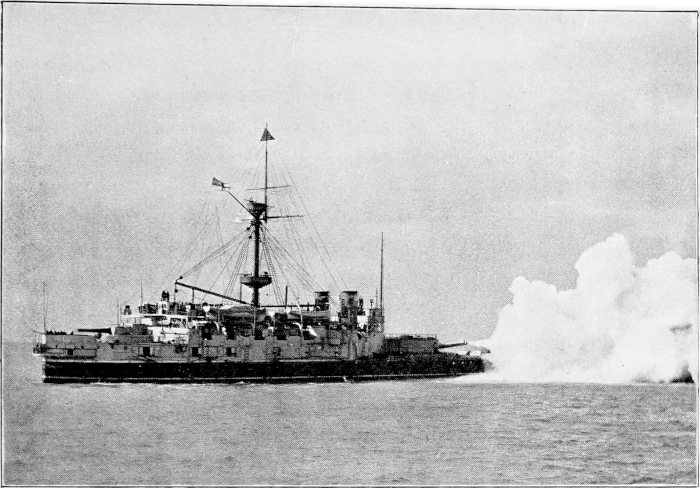
H.M.S. “VICTORIA” FIRING 111-TON GUN.
Photograph by Sir W. G. Armstrong, Whitworth & Co., Ltd.
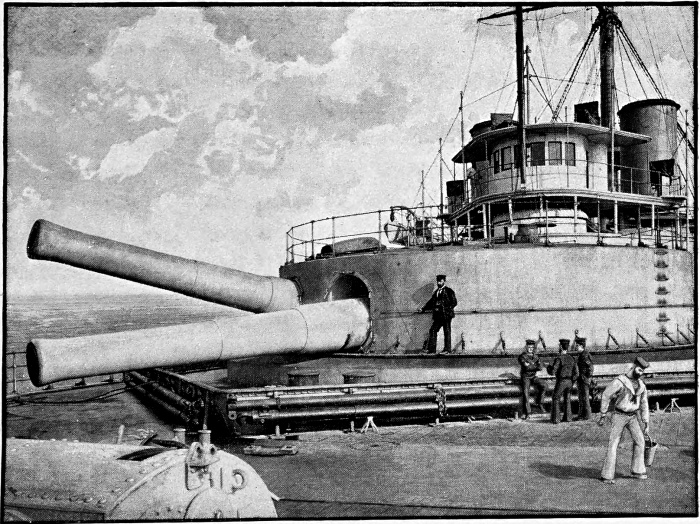
H.M.S. “VICTORIA,” SHOWING 111-TON GUNS AND TURRET.
Photograph by Sir W. G. Armstrong, Whitworth & Co., Ltd.
The Collingwood has been regarded as the pioneer vessel
of the modern battleship, for it certainly was the first in which the
real advantages of steel were displayed. On her was introduced
the system of mounting four heavy guns in pairs on
the middle line of the ship, not in turrets as in her predecessors
carrying a few big guns, but in barbettes or fixed gun positions
protected by heavy armour. The barbettes and turrets have
been so modified in later ships that sometimes one term and
sometimes the other is used by experts to denote the same
design. The method of mounting the guns, as illustrated in
the Collingwood, remained in vogue in the British Navy until
it was supplemented by the Dreadnoughts. The Collingwood’s
side armour was 18 inches in thickness; the armour of her
bulkheads was 16 inches, that of the conning tower 12 inches,
and that of her barbettes, in which her four 12-inch 45-ton
guns were mounted, was 11½ inches. She also carried six
6-inch guns and several smaller guns. Her displacement was
very little more than that of the Colossus, but she was two
knots faster. Other vessels, described as sisters to the
Collingwood, followed, but they were all rather larger, among
them being the Camperdown, which had the misfortune to
sink the Victoria during naval manœuvres in 1893 in the
Mediterranean, when Admiral Sir George Tryon and nearly
all the crew of his flagship went down with the vessel.
The Victoria was a steel-armoured first-class single-turreted
battleship, and was built at Newcastle-on-Tyne in 1887. Her
armour was from 18 to 16 inches thick, and there was a protective
deck 3 inches thick. She had two sets of three-stage
expansion engines, and steam was generated in eight steel
boilers with four furnaces each, which were fired from four
independent stokeholds. She was one of the three ships to be
armed with 111-ton guns, of which she had two in a turret
forward. One 29-ton gun was mounted aft to fire over the
stern, and she also had twelve 6-inch, twelve 6-pounder quick-firers,
twelve 3-pounder quick-firers, eight machine guns, and
four torpedo tubes, two of which were submerged. Her displacement
was 10,470 tons, length 340 feet, breadth 70 feet,
and depth 27 feet 3 inches. The rapidity with which she
heeled over and sank was supposed to be partly due to the
weight of these enormous guns.
Great things were expected from the type represented by
the Benbow, launched in 1885, and completed three years later,
which, next to the Inflexible which cost nearly £800,000, was
the most expensive ship Britain had then built, and cost the
country close upon £775,000. She was very heavily armed,
as she carried two 16.25 inch and ten 6-inch guns, all breech-loaders,
and was the first vessel to be given five torpedo tubes.
This vessel may be said to have inaugurated the big gun era,
notwithstanding that she came under the category of soft-ended
ships. The last British single-turret ship was the Sans
Pareil, launched in 1887, and completed two years later, and
in many respects a sister ship to the unfortunate Victoria.
These three vessels did not give the satisfaction anticipated,
and though various alterations were made in the Victoria no
great improvement was effected, and the results were not
considered such as to justify the construction of any more
like them. The Benbow’s big guns were in barbettes, and
those of the Sans Pareil were in a turret.
The Nile and Trafalgar, which were begun in 1886, were of
11,940 tons displacement, and were the largest ships up to then
built for the Navy. Their heaviest guns, instead of being in
barbettes, were placed in turrets. These vessels were exceedingly
heavily armoured, having a belt of steel no less than
20 inches thick, and above this was an armoured redoubt, or
citadel, protected by compound armour 18 inches in thickness
for 141 feet along each side, the redoubt having parabolic ends
of the same thickness of armour, enclosing the turret bases.
Armour of equal thickness was placed on the turrets. The
secondary armament, consisting of 4.7 inch quick-firing guns,
was contained in an octagonal battery with steel sides 3 to
5 inches thick, placed between the turrets. These ships were
345 feet in length by 73 feet beam, and about 28 feet mean
draught.
The Royal Sovereign, launched in 1891 and completed the
following year, introduced what is known as the high freeboard
barbette type, and in 1893 there was completed the Hood, the
last of the British turret ships. The Royal Sovereign was
noteworthy for several reasons. A record for rapid building
was established in her, for she was laid down in September,
1889, and was launched as early as February, 1891, a quicker
piece of work for a vessel of her dimensions and the weight of
material handled than had ever been accomplished. One
novelty about her armament was that she carried as many as
eight Maxims. In her also the “big four” were 13½-inch
breech-loaders, as against the 12-inch guns placed in her predecessors;
these were mounted in pairs in barbettes. She
also had ten 6-inch quick-firers, six of which were behind shields
and four in casemates; and sixteen 6-pounders, twelve
3-pounders, and three torpedo tubes completed her weapons
of offence. For the protection of the ship a belt of compound
armour, 18 inches thick, extended along the water-line a
sufficient distance to protect the bases of the barbettes.
Across the ship at the top of the belt was a protective steel
deck 8 inches thick, and this deck was continued at the level
of the bottom of the belt to the extreme ends of the ship.
Above the thick belt on the sides and protecting the ship as
high as the main deck and from the fore to the after barbette
was a belt of steel armour 4 inches thick, and above this, on the
main deck, were the casemates enclosing the 6-inch quick-firers.
Altogether eight of these vessels were built, the Hood being
the only one of them to be given turrets instead of barbettes.
Artillerists, however, were not to be beaten, and so far as
steel armour and compound armour were concerned, the gun
appeared once more to be obtaining the advantage. The
Harvey process of strengthening the resisting powers of steel
came to the rescue of the armour-plate. The Renown, which
has been called a “half-way house” between the Royal
Sovereign and the Centurion, was the first warship in the British
Navy to be given Harveyised steel armour, of which both her
armoured belt and her armoured bulkheads were constructed.
Whereas in the Royal Sovereign the thickest armour was
18 inches, that of the Renown was 10 inches, and yet the latter
was declared to be the better protected.
The extraordinary reduction in weight thus secured made
possible the advent of the Majestic and Magnificent. These
two vessels and the others of their class were as far in advance
of the Royal Sovereign as the heavy ironclads were in front
of the iron-plated ships. The side armour of the Majestic and
Magnificent of Harveyised steel was carried to twice the height
that was possible with the Royal Sovereign, and though it was
only 9 inches thick it offered a resistance to penetration by
hostile projectiles at least equal to that of the massive sides
of the Royal Sovereign, and was far stronger than the ponderous
iron masses piled upon the sides of the great turret ships of a
few years earlier.
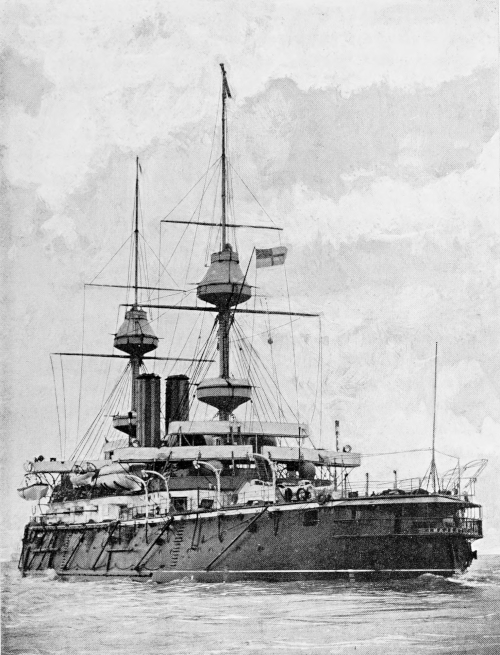
H.M.S. “MAJESTIC.”
Photograph by West & Sons, Southsea.
With the Magnificent, launched in 1894 and completed the
following year, came the barbette ships with a high displacement.
She, and the others of her class, carried four
12-inch guns and twelve 6-inch quick-firers, and thirty-eight
anti-torpedo-boat guns, a number which had not been equalled
by any other vessel except the Royal Sovereign, and five torpedo
tubes, as against seven which had been installed in that vessel
and her sisters. The Magnificent had a displacement of
14,900 tons and engines of 12,000 indicated h.p., a designed
speed of seventeen and a half knots which she exceeded, a
coal capacity of 2,200 tons, a belt of 9 inches of steel armour,
and from 10 to 14 inches of steel for the protection of the main
guns. The Majestic was another of the sisterhood, though
there were certain differences of detail, no two vessels being
precisely alike. She was 390 feet between perpendiculars and,
including the overhang of the stern and the ram of 15 feet,
about 430 feet in length. Her beam was 75 feet. Thus she
was longer than the Royal Sovereign but of the same beam,
which made her a faster ship, her speed on her trial having
reached 17.8 knots, although her engines indicated about
1,000 less h.p. than the battleships of the programme of 1889.
All the ships of this class were remarkable for their appearance,
which certainly justified such names as Magnificent and
Majestic. The great height of the superstructure fore and aft
gave the idea of a good deal of top hamper, which however
was quite as great in the Royal Sovereign. The upper deck
6-inch quick-firers of that vessel were only protected by ordinary
shields, but the new ships had closed-in casemates at each
corner of the battery and double plating above. The bridges
and deck-houses of the Majestic were set back to avoid the
“blast” of the great guns, and the forward conning-tower
stood clear of the bridge and had an uninterrupted view all
round. In regard to the bridges she differed considerably from
many of her predecessors carrying heavy armament, as the
“blast” from the big guns would have rendered a position on
the bridge far from safe, especially when they were fired abeam.
In these vessels the four 12-inch 46-ton wire guns were placed
two in each barbette; the breech and body of each gun was
protected by a steel hood with a maximum thickness of 10 inches.
Their 6-inch guns were in casemates. The 12-inch guns were
very powerful for their weight, and comparing them with
some of their most notable predecessors, it was found that
their energy nearly equalled that of the 67-ton gun and their
perforating power exceeded that of the 110½-ton gun.
The Majestic and her sister ships were at the time they were
added to the Navy the most powerful warships afloat. The
smaller guns were unprotected, this being one of the objections
urged against their design. They were provided rather for
repelling attacks by torpedo boats, for which purpose they would
no doubt have been very effective if they were not disabled
by an enemy’s gun-fire first.
The Canopus class, of slightly larger displacement but less
draught and more lightly armoured, was a lighter version of the
Magnificent, and but very little faster. The next year, 1898,
saw the launching of the Formidable, which carried the same
powerful armament as the last two, but was considered to have
it better protected, as her belt consisted of 9 inches of steel
and her main guns were protected by steel armour 12 inches
thick. The displacement and horse-power of the engines were
greater, but there was little improvement in the matter of speed.
This was remedied in the Duncan and her class. She was
405 feet in length and 75 feet 6 inches beam, being 5 feet longer
and 6 inches wider than the Formidable, and of about the
same draught, but her engines were of 18,000 h.p. indicated,
giving her an estimated speed of nineteen knots and an actual
speed of over twenty knots on occasion. These two classes of
vessels attracted more than usual public attention because of
their cost, as although the cost of warships had been steadily
increasing, the Formidables and the Duncans were the first
in which the cost per ship exceeded a million sterling. A
somewhat smaller vessel followed in the Triumph, launched
in 1903, which attained a speed of nearly twenty-one knots,
and in which also the complete belt was revived. Her principal
guns were four 10-inch and fourteen 7.5-inch quick-firers, and
she had also twenty-four anti-torpedo-boat guns and two
torpedo tubes.
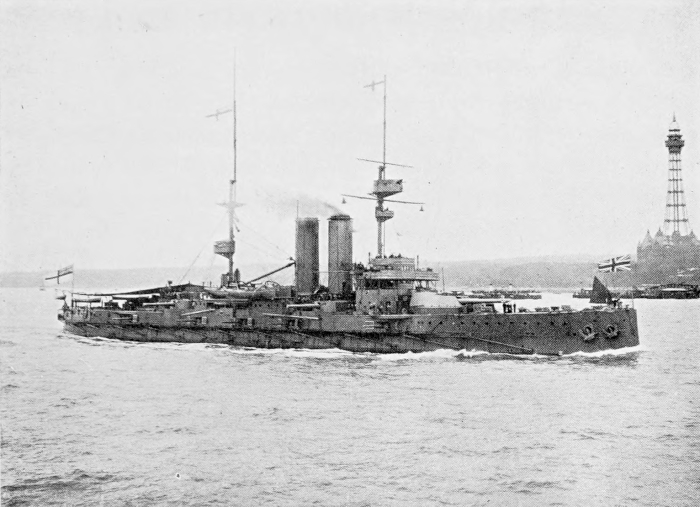
H.M.S. “KING EDWARD VII.”
Photograph by the Carbonora Co., Liverpool.
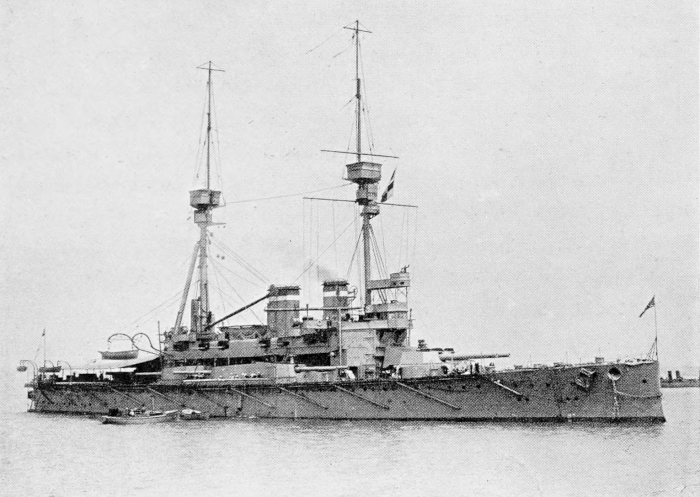
H.M.S. “LORD NELSON.”
Photograph by Stephen Cribb, Southsea.
The increasing power and range of naval guns rendered it
necessary that better protection and more destructive weapons
should be given to the ships, and accordingly there was introduced
in 1903, and completed in 1905, the King Edward VII.,
and eight of this class were built. Their displacement was
16,350 tons, and in this respect they were the largest ships yet
built for the Navy, but though they were shorter than the
Triumph, they were of 2 feet greater draught. Their armour
belt was of 9 inches of steel, and their main guns were protected
by 8 to 12 inches. These ships carried four 12-inch, four
9.2-inch, and ten 6-inch quick-firers, and thirty anti-torpedo-boat
guns. They cost not far short of a million and a half
sterling each. Their engines of 18,000 h.p. gave them a speed
of about nineteen knots. In 1906, there was launched the
Lord Nelson, carrying fewer guns but better protected. Her
armament comprised four 12-inch and four 9.2-inch, besides
twenty-nine smaller guns and five torpedo tubes, and the
armour both of her belt and for her main guns was of steel
12 inches in thickness.
The King Edward VII. and Lord Nelson were the finest
examples of the types of battleships carrying four big guns
and a powerful secondary armament. Both classes were
provided with four 12-inch guns, but the Lord Nelson and the
Agamemnon marked an advance from the principle which had
endured so long towards the principle of the all-big-gun one-calibre
ship as exemplified in the Dreadnought. They were
not, however, ships carrying all big guns of one calibre, for
instead of a secondary armament like that of the King Edward,
they carried ten 9.2-inch guns and twenty-four smaller weapons.
The Lord Nelson and Agamemnon were about 410 feet in length
by 79 feet 6 inches beam, and on a draught of 27 feet had a displacement
of 16,500 tons. They were 15 feet shorter than the
King Edward class and 18 inches broader. Many naval men
preferred the Agamemnon to the Dreadnought, when the latter
appeared in 1906, on account of the greater rapidity of fire
of the former; but against this it was contended that her
hitting power at long range was less. Upon her trials the
Agamemnon’s engines developed 17,285 h.p. indicated, and gave
her a speed of eighteen and three-quarter knots, both power
and speed being in excess of the estimates. Her high freeboard
was a notable feature; her forward guns were 27 feet
and her after pair 22 feet above the water-line, while in a superstructure
above them were the smaller guns some 34 feet above
the water-line, where they were admirably placed for dealing
with any attempt at a torpedo attack.
The Agamemnon was built by the Beardmore firm, at
Dalmuir, and launched in June, 1906, and the Lord Nelson
left the slips at Palmer’s establishment at Jarrow in the following
September. It was contended that their 12-inch guns
were half as powerful again as any of similar calibre mounted
previous to 1906. Of their 9.2-inch guns, eight were in what are
called twin barbettes, and the other two in single barbettes
between the others. There are also a few 12-pounders and a
greater number of 3-pounders, thirty-five in all, most of which
are in a somewhat exposed position. These ships have each a
complete belt extending along the water-line from stem to stern,
12 inches thick amidships, and tapering to 6 inches at the bow
and 4 inches aft, while the sides above the belt and between
the barbettes have 8-inch armour raised to the level of the
upper deck; diagonal bulkheads, also of 8-inch armour, enclose
the citadel at either end. Yet that 8-inch armour was declared
by Mr. Beardmore, when the ship was launched, to be more
than equal in its power of resisting projectiles to the 12-inch
armour of only four years earlier.
In considering the development of the modern warship
attention naturally turns to the battleship, but it should be
remembered that other vessels of scarcely less importance help
to constitute the modern navy, the most notable being the
cruisers of various classes, the destroyers and torpedo boats,
and submarines.
Broadly speaking, the cruiser of the present day is to the
modern fleet what the frigate was to the line-of-battle ship in
the days of the three-deckers. That is to say, she has to be
the eyes of the fleet, able to show a good turn of speed, and
capable of taking care of herself if need be. There the resemblance
ends. The duties of the modern cruiser are multifarious.
She has to be no less a commerce protector than a commerce
destroyer, and while at one end of the scale she may be little
more than a glorified gunboat, she may at the other end have
to be able to take her place in the line of battle and help her
more powerful sisters. Whatever her duties, speed is regarded
as of great importance.
The Iris, in 1878, attained a speed of eighteen and a half
knots, but more than seventeen years elapsed before this speed
was equalled by any of the cruisers. Her sister ship, the
Mercury, covered nearly 18.9 knots, or close upon twenty-two
miles an hour. In 1895 the cruisers Amphion and Arethusa proved
themselves able to exceed their designed speed of seventeen and
a half knots, and thence onwards the increase in speed has
been continuous, until we have the Invincible in the British
Navy capable of exceeding twenty-nine knots under service
conditions and in only moderately fine weather, and the
Von der Tann, in the German navy, possessing a speed of
twenty-eight knots under the most favourable conditions of
weather and lightness of stores. At one time the German ship was
asserted to be the fastest large cruiser afloat, but her supremacy,
if it ever existed, in this respect was very short-lived.
The Phæton was one of the last class of cruisers to be given
square sails. Her canvas certainly proved useful to her, for her
machinery broke down during her commissioning trials preparatory
to the naval review at Spithead in 1897, and had it
not been for her sails she would have been totally disabled.
The incident was seized upon by those who still favoured the
older methods which had done duty for so many hundreds of
years, as an argument for the retention of sail power for the
ships of the Royal Navy, and the modernists replied that such
incidents were few and far between, and with the improvements
in mechanism which science was continually making
would become virtually impossible.
Naval experts do not always agree as to the differences
between a battleship and a cruiser. There are vessels in either
category which could not possibly be placed in the other; but
on the other hand there are some vessels that may be classed
as either one or the other, and the types of the fast battleship
and the armoured cruiser have been approaching each other
in late years in so many respects, that some cruisers are fit
to take their place in the line of battle against all but the
heaviest battleships, and the natural result has been the appearance
of the latest type of warship suitable for either duty, and
known as the cruiser-battleship.
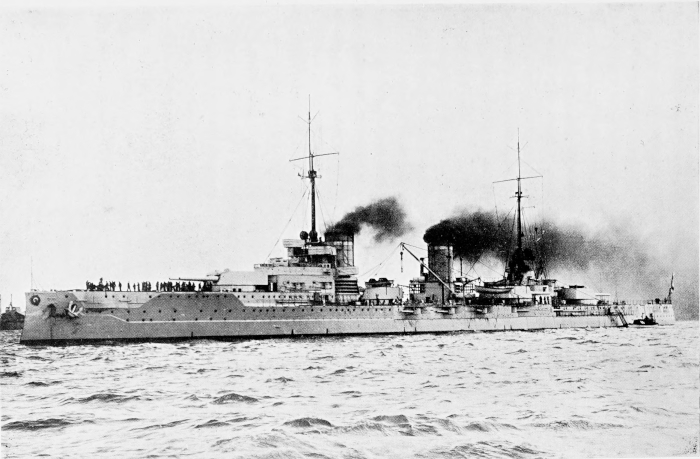
THE GERMAN DREADNOUGHT CRUISER “VON DER TANN.”
Photograph by Stephen Cribb, Southsea.
The Japanese, in their encounter with the Russian fleet,
utilised cruisers against the Russian ships of the line, but
whether they would have been able to do so had the Russian
battleships been in as good condition as were those of their
Oriental opponents is a point upon which opinions differ. The
cruisers, like the latest Invincibles, have been given the armament
of a battleship, but they have been less heavily protected
in order to allow them superior speed; everything, should
they have to take part in a naval battle, will therefore depend
upon their antagonists and the exigencies of the engagement
as to the duties they will have to perform.
Every nation has its own classification of warships, and the
varieties of modern warships are so numerous, and the estimates
of their effectiveness so much at variance, that it is little wonder
the descriptions assigned to the vessels do not agree. Thus
the American Maine, sunk at Havana, was described with
equal accuracy as a cruiser and as a second-class battleship.
But the nations have, for the most part, adopted the British
classification of cruisers, though they have not failed to modify
it to suit their own views. First come the unprotected cruisers,
then the protected cruisers of the first, second, or third class;
then the armoured cruisers; and of recent years the battle-cruiser,
or heavy cruiser, capable of taking her place in the
line with battleships. The unprotected cruisers have no side
armour or other protection worth mentioning, and are mostly
used for police duties, such as guarding fisheries, etc. They
are lightly built and armed, and of relatively good speed for
their size, and the duties they have to perform usually constitute
the chief matter for consideration in the design of the
several vessels. The protected cruisers have strong steel
decks to protect their engines, etc., besides a great number
of watertight compartments, and are classified according to
their size, armament and speed, and the work for which they
are intended.
Although the Admiralty adopted iron ships, it did not
finally abandon its old wooden ships until 1874—or a year
after that in which the first steel vessel was built for the Navy—in
which year the British Navy was enriched by the addition
of the wooden corvettes Sapphire and Diamond. Iron screw-driven
cruisers or corvettes were the successors of the smaller
fast wooden vessels, and a number of fast unarmoured ships
of various types were built. One of them, the Bacchante, had
the honour of being selected for the cruise round the world of
the present King, when he and his brother, the late Prince
Albert Victor, joined the Navy as midshipmen.
The Americans claim that these types of vessels were introduced
by the Wampanoag, which was designed at the time of
the American Civil War to chase Confederate commerce
destroyers. The extraordinary reports published in the sensation-loving
American papers, and duly copied and accepted as
true by the British papers, as to the speed and capabilities of
this vessel and others of her class, in 1866, induced the British
Government to decide on something similar, and, if possible,
superior, and the Inconstant was the result. She was 333 feet
in length by 50 feet beam, and had a displacement of 5,782 tons
on a draught of 23 feet. She was built of iron sheathed with
wood and coppered, this arrangement enabling a light hull to
be constructed which should take the strain of the machinery
without being subject to the same “working” as a wooden
ship would have had to endure on account of the greater
elasticity of the material. The wood sheathing protected the
iron, and also enabled the bottom to be covered with copper,
or “yellow metal” as the composition was called which was
generally used for the purpose, in order to prevent barnacles,
weeds, and other marine growths from accumulating upon the
submerged portion of the hull and retarding the speed. Considering
that barnacles and weeds will grow thus to a length
of several inches, the extent to which the speed of a vessel
will be hindered may be imagined. All unsheathed vessels,
whether of wood or iron, were peculiarly liable to these growths,
which are particularly luxuriant in tropical waters, and might
have their speed reduced even as much as from ten knots to
six knots. The difficulty was to enable an iron ship to carry
a skin of copper or yellow metal, the latter being mostly used
in the mercantile marine, and the former for ships of war,
private owners with their own money to spend being usually
more economical than governments with the taxpayers’ money
behind them, and not hampered by the problems of making
the ships pay commercially. The Inconstant was launched
in November, 1868, and was followed in 1873 by the Shah,
whose famous encounter with the Huascar was alluded to in
the previous chapter.
In 1879 the Comus class, usually called the “C” class,
as their names began with that letter, and the Leander class
were introduced, constructed partly of steel and partly of
iron, their hulls being given a sheathing of wood. Their engines
and boilers were given a protective steel deck over them
1½ inches thick, but otherwise they had little enough in the
way of protection. The most famous of the former class was
the Calliope, which, in March, 1889, made such a magnificently
successful struggle against a hurricane, and fought her way
from Samoa Harbour in the teeth of one of the most severe
storms experienced in the Pacific. The consummate seamanship
and cool daring displayed by Captain Kane in that struggle,
lasting for hours, when six American and German gunboats
in the harbour were wrecked, have made his feat memorable
in the annals not only of the British Navy, but in the heroic
records of the seamanship of all ages. It is no detraction from
the merits of Captain Kane’s exploit to say that credit is due
also to the members of his crew, whatever their station—and
not least to the unknown hero who was at the wheel in that
battle between man’s science and Nature’s force. All shared in
the glory of the feat; from Captain Kane and his officers to the
engineering staff who kept a set of unreliable engines going at a
pressure they were never built to withstand, and to the half-naked
coal-trimmers in the bunkers and firemen in the stokehold, who
stuck to their work in the semi-darkness, knowing full well
that in the case of failure on anyone else’s part, or breakdown
in the engines, they were doomed to die like rats in a trap.
The incident directed attention to the splendid sea-going
capacities of these vessels, and for many years afterwards the
“lines” of the smaller cruisers bore a strong resemblance
to those of the Calliope and her sisters.
It was not, however, until 1883 that the first protected cruiser
appeared. This was not built for the British Navy, but for a
South American State, and under the name of the Esmeralda
came from the slips at Elswick. She had a complete protective
deck, and not simply a protecting deck over her vital parts,
engines capable of giving her a high speed, and a powerful
armament. She was the pioneer vessel of her class. The
British naval authorities, however, preferred the armoured
cruisers, and led the way in 1881 with the Imperieuse and
Warspite, but soon abandoned this type and adopted the protected
cruiser. These two vessels were each of 8,000 tons
displacement, 315 feet in length, and had a partial belt of
10-inch armour along 140 feet on each side, transverse bulkheads
9 inches thick at each end of the belt, and a protective
deck 1½ inches thick. They carried four 9.2-inch guns in
separate barbettes, one forward, one aft, and one on either
side, besides ten 6-inch guns, twenty-six smaller and machine
guns, and six torpedo tubes. Their hulls, which were of steel,
were sheathed with wood and coppered.
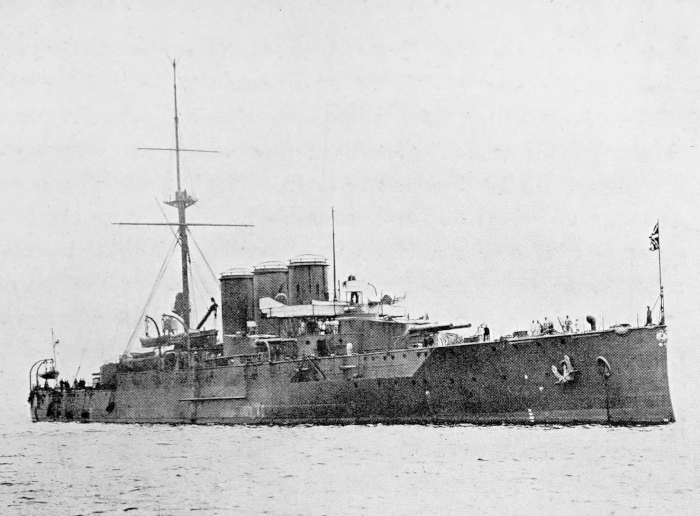
RUSSIAN CRUISER “RURIK.”
By permission of Messrs. Vickers, Ltd.
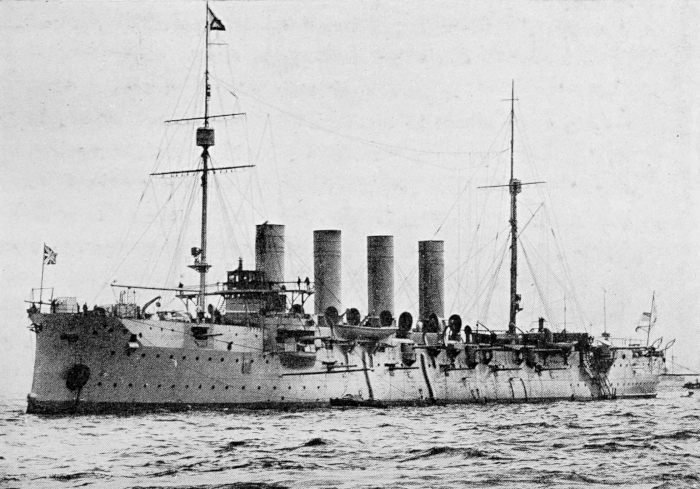
RUSSIAN CRUISER “ROSSIA.”
Photograph by Stephen Cribb, Southsea.
Other nations, notably France and Russia, adhered to the
armoured type, the former producing the Dupuy de Lôme,
and the latter the Rossia and Rurik. Both these vessels were
built at St. Petersburg in 1896 and 1894 respectively, and
must be distinguished from the present Russian cruisers bearing
these names. The Rossia was terribly knocked about in the war
with Japan, but has survived it, thanks to her armour. She
appeared at the Diamond Jubilee Review in 1897 at Spithead.
The Rossia and the present Rurik, the latter launched at Barrow
in 1906, attracted attention on account of their speed, the
former attaining twenty and a quarter knots and the more
modern boat nearly twenty-one and a half knots. Both were
heavily armed, the latter especially so, being the only Russian
cruiser to carry four 10-inch guns. She has, besides, eight
8-inch guns, twenty 4.7-inch quick-firers, eighteen smaller quick-firers,
and two torpedo tubes, and when she left the builders
was one of the most formidable cruisers afloat. Accurate
long-range shooting being indispensable, the Rurik is also
fitted with a range-finding tower.
The new Esmeralda, built in 1895 for the Chilian Government
by the Tyneside firm who built her earlier namesake,
had not a little to do with the introduction of side armour on
British cruisers, thanks to the improvement of the Harvey
and Krupp processes of strengthening steel.
The Powerful, launched at Barrow in 1895, and the Terrible,
launched at Glasgow the same year, were the largest protected
cruisers afloat at that time, and will long be remembered by the
public for the excellent service their crews rendered during
the Boer War, and among naval architects and marine engineers
and shipbuilders by reason of the bitter controversy that arose
over their installation of forty-eight Belleville water-tube
boilers, they being the first cruisers in the British Navy in
which these were carried.
As a contrast to these two was the armoured cruiser Drake,
begun in 1899 and completed in 1902, and at that time the
largest of her class anywhere. Though called a cruiser, she
was a more formidable fighting-machine than the Barfleur,
Renown or Canopus. With a displacement of 14,100 tons,
and a length of 500 feet, and an equipment of Belleville boilers
and engines developing 30,000 h.p., she and her sister ships
could reach a speed of over twenty-four knots, and were faster
than any other large vessels in the British Navy. She was
belted on her sides with Krupp steel from one barbette to the
other, and from 6 feet below the water-line to the level of the
upper deck, and there was lighter armour above this. She
had also two protective decks, the lower being 2 to 3 inches
in thickness. Her two 9.2-inch breech-loading guns were in
barbettes, and she was given sixteen 6-inch, fourteen 3-inch,
and three smaller guns, which, like the last two classes, were
quick-firers, and two machine guns.
The increase in gun power rendered necessary an addition
to the protection of the vessels, and the Devonshire class of
cruisers, which appeared early in the present century, were
given 6 inches of armour instead of 4 inches. The ships of this
class were tried for experimental purposes with four different
types of water-tube boilers in combination with cylindrical
boilers. These fast armoured cruisers were designed to replace
the old protected cruisers, which were no longer equal to modern
requirements, speed being now recognised as of very great
importance.
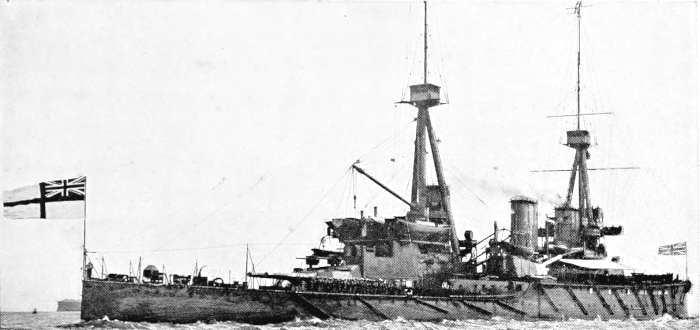
H.M.S. “INDOMITABLE.”
Photograph by West & Son, Southsea.
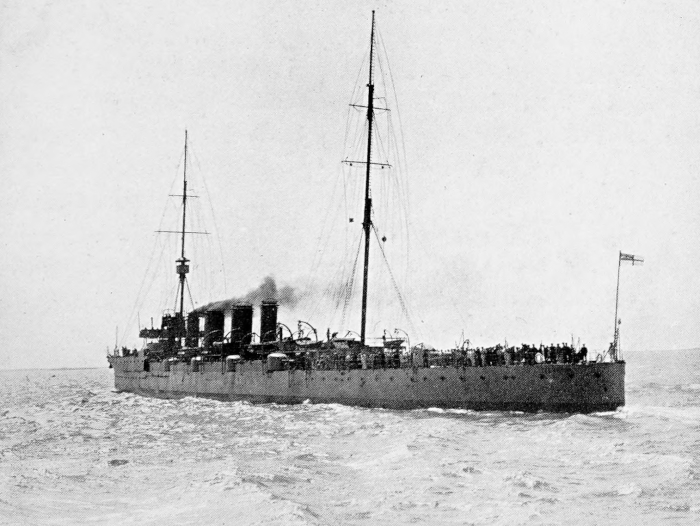
H.M.S. “LIVERPOOL.”
Photograph by E. Sankey, Barrow.
It is not only in the larger ships, however, that examples
of such extraordinary development are to be found. Progress
is shown by the smaller vessels in no less degree. The continually
changing conditions of commerce have necessitated
as many changes in the construction and armament of vessels
whose duty it would be in time of war to protect commerce
at sea, or maintain order in estuaries and rivers.
The Dartford, belonging to the “town” class of cruiser,
may be regarded as one of the best existing specimens of the
modern smaller cruiser. She is of 5,250 tons displacement, as
compared with 4,800 tons in the Liverpool, one of the earliest
of her class, the addition being largely required to carry an
increase in her fighting power, as her armament includes eight
6-inch quick-firers, all well protected, and several smaller guns,
as compared with two 6-inch guns and ten 4-inch guns in her
preceding sisters. The machinery is of the same type and
power as that installed in the earlier “town” cruisers, and
in view of the high efficiency of the Liverpool’s engines at her
speed trials, the Dartford was expected to attain a speed of
twenty-six knots. Besides her coal-bunkers at the sides, the
Dartford has an armoured deck of nickel steel, with sloping
sides extending well below the water-line. Her turbine
machinery of 22,000 shaft h.p. is contained in three separate
engine-rooms, and there are three separate boiler-rooms for her
twelve water-tube boilers. Oil fuel is carried in her double
bottom. She has two masts fitted with wireless telegraphy
apparatus, and on the foremast is a platform from which the
gun-fire can be electrically directed.
Some cruisers are distinctly lighter versions of battleships.
As developments of the swift battleship of the Magnificent
and Duncan types came the armoured cruisers Cressy, in 1899,
Drake, in 1902, and the belted cruisers Black Prince, in 1904,
and Minotaur, in 1906, whence there developed the cruiser-battleship
Inflexible in 1907.
The Dreadnought cruisers as much surpass the preceding
types of cruisers as the Dreadnought battleships surpassed the
Majestics, etc. For that matter, Dreadnought cruisers, like
the Princess Royal, as well as the Queen Mary now being built,
“could steam round a fleet of pre-Dreadnought ships and fire
when it suited them, keeping beyond the range which would
enable the old battleship guns to penetrate the armour of the
modern cruiser.”[54]
The last of the Dreadnought cruisers launched to the time of
writing, the Princess Royal, is the largest warship ever built
by a private firm in England for the British Government,
although she is stated to be exceeded by the battleship Rio de
Janeiro, under construction at Newcastle for the Brazilian
Government, which is asserted to have a displacement of 32,000
tons.
The Princess Royal is a cruiser copy of the battleship Conqueror,
launched the same day. The principal differences
between the two vessels are that the cruiser has a pair less
of the 13.5-inch guns, and also has her side armour 2 inches
less in thickness, in order that she may steam thirty knots
or more in place of the battleship’s twenty-one. Her beam is
the same as that of the Conqueror, but in order to give her speed
she is 700 feet over all as against the battleship’s 545 feet.
In fighting power the Conqueror is superior to the Princess
Royal, the latter having only eight big guns. An idea of the
enormous power required to drive these ships at the necessary
speed, and especially of the increase in power as between the
two vessels, is shown by the fact that turbine engines of 27,000
h.p. will give the battleship a speed of twenty-one knots, but the
thirty knots of the cruiser require engines developing 70,000 h.p.,
or 27,000 more than the Indefatigable, which has done twenty-nine
knots. The vessel is to be completed for sea by March,
1912.
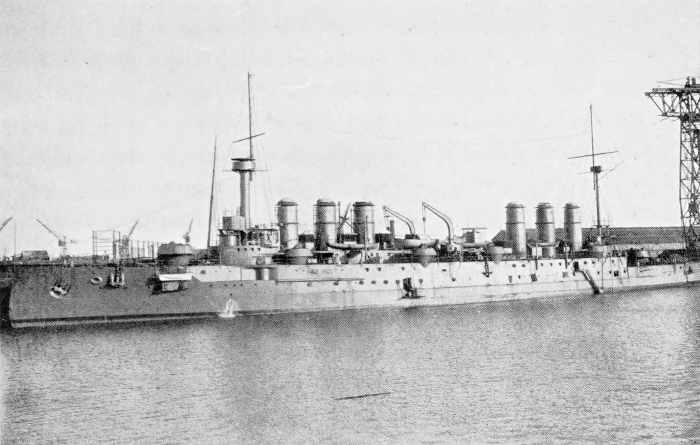
FRENCH CRUISER “ERNEST RENAN.”
Photograph supplied by Société Anonyme des Chantiers et Ateliers de Saint Nazaire.
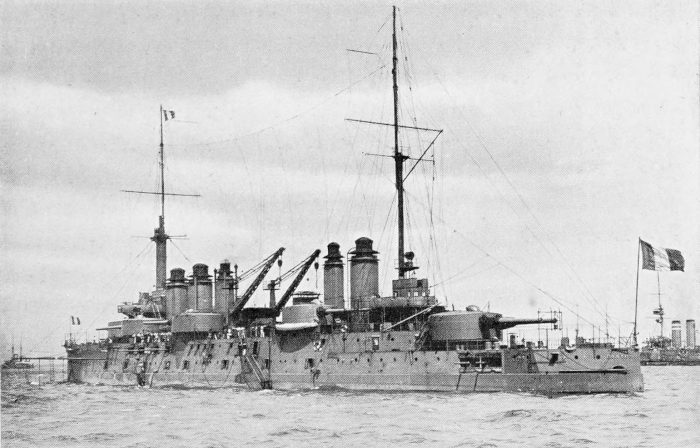
FRENCH CRUISER “DANTON.”
Photograph by Stephen Cribb, Southsea.
It will have been seen from the dimensions quoted of the
various cruisers mentioned that they are longer in proportion
to their beam than the battleships, the additional length being
necessary to give them greater speed. There was launched
at Elswick in 1895, for the Argentine Government, the protected
cruiser Buenos Ayres, which was very narrow for her length.
Though 424 feet over all, she was only 47 feet 2 inches in beam,
by 22 feet in depth. Her displacement was 4,500 tons. Her
normal speed was twenty-three knots, and under forced draught
twenty-four knots. Like all the warships built on the Tyne
for South American States, she was heavily armed. One of
the most heavily armed ships of her size early in the present
century was the Japanese cruiser Tsushima, launched in 1902,
but she has been surpassed by the later vessels of the Japanese
navy in speed, coal capacity and armament, the latest, which
are not yet completed, though only classed as protected cruisers
of 4,035 tons, having a coal capacity of 750 to 1,000 tons, and
carrying two 6-inch guns, ten 4.7-inch, and two 3-inch guns,
all quick-firers, and two machine guns.
A vessel which attracted considerable attention when she
was begun in 1902—at various other times since when changes
in her plans have been suggested to meet the views of French
naval experts, or the theories of successive Ministers of Marine,
a tinkering process from which she has not been the only sufferer
on the other side of the Channel—until she was completed in
1908, is the Ernest Renan cruiser. The length of time which
has elapsed between the laying-down and the completion of
some French vessels has seen them surpassed by newer types
from other shipyards, notably British, even before they have
been commissioned. But this is not the case with the Ernest
Renan, which, apart from the Dreadnought cruisers, is an exceedingly
powerful ship, and a great credit to her builders at St.
Nazaire. She is rather narrow, being only 70 feet 6 inches
beam, with a length of 515 feet, and her draught is 26 feet
9 inches. She is more effectively protected than many a battleship
of a few years earlier, having an armoured deck 2 inches
in thickness, an armoured belt varying from 6¾ inches to
4 inches, while above the water-line belt she carries armour
varying from 5 inches to 3 inches in thickness. Her armament
is remarkably varied, including, as it does, four 7.6-inch guns,
twelve 6.4-inch guns, twenty-one 1.8-inch guns, and two
1.4-inch guns, besides two submerged torpedo tubes. Her
main gun positions are protected by 8 inches of armour, and her
secondary armament by 5 inches of armour.
CHAPTER IX
GUNS, PROJECTILES AND ARMOUR
The introduction of direct shell fire at Sebastopol was a most
important advance in the science of attack, and was followed
soon afterwards by the adoption of elongated instead of circular
projectiles, the French leading the way. Both for solid shot
and explosive projectiles, it became necessary to increase the
range and accuracy. To do this the windage had to be reduced
as much as possible and the barrels of the guns were rifled in
order to give the projectile a certain amount of twist on its axis.
Rifled breech-loading guns were proposed by Major Cavalli,
of the Sardinian artillery, and by Baron Warendorff, of Sweden,
and experiments were made with the weapons in this and
other countries. A great deal of difficulty was found in adopting
rifling for heavy guns, owing to the much greater strain imposed
upon the metal, and the difficulties were still further increased
when it became necessary that ordnance should be produced
of very large calibre and able to throw heavy projectiles with
high velocities. One way in which it was sought to get over
the difficulty was by reducing the charge of powder considerably,
and as the form of the newer projectiles was different
from that of the old spherical projectiles, and the windage was
as far as possible eliminated, it was found that this plan gave
the desired result. Wrought iron and steel replaced cast-iron
and bronze, though a few cast-iron rifled guns were strengthened
with steel hoops. Wrought iron was adopted for gun carriages,
and steel or chilled iron for armour-piercing projectiles.
Sir Henry Bessemer manufactured the first gun that was
ever made of malleable iron without a weld or joint, and though
he showed that guns could be made of steel, the Admiralty,
with its then fondness for the things of the days that were,
decided to continue making its guns of iron. But when the
bore of the iron gun showed cracks, the Admiralty decided on
the insertion of a steel tube, and tied it with a piece of iron.
“Why not with a piece of steel?” Sir Henry Bessemer
asked, in 1881, many years later. “Why not a cylinder made
of steel in preference to that iron coil? For the making of
steel cylinders was then an accomplished fact, but the making
of those iron coils was not an accomplished fact. The iron
coil system has been thoroughly shown up, but at an enormous
expense to this country. The incident was the turning-point
which made us have iron guns, while every other country in
the world has got steel guns.” But the next year the Government
decided that the Navy’s guns should be constructed
entirely of steel.
At the International Exhibition of 1862, a spherical steel
cannon-ball was exhibited, and in January, 1864, some particulars
were published of trials of projectiles of this class fired
from a smooth-bore against armour-plate 5½ inches in thickness.
This moved Sir Henry to remark that an expenditure of £50
three years earlier would have given as full a proof of the
efficiency of these projectiles.
“Meanwhile how many hundred thousands pounds have been
expended in building iron-plated ships, which these long-neglected
steel projectiles will riddle as easily as the cast-iron shot found its
way through the wooden walls of our old men-of-war!... It is
not less remarkable that while our firm at Sheffield have manufactured
some hundred and fifty pieces of Bessemer steel ordnance for foreign
service, guns of this material are still untried by our government,
although it is well known that the strength of this metal is
double that of ordinary iron, while such is the facility of production
that a solid steel gun block of twenty tons in weight can be produced
from cast fluid in the short space of twenty minutes, the homogeneous
mass being free from weld or joint.
“Our armour-plate system has certainly received a severe shock,
and it behoves us now to see how far it is possible to increase the
resisting power of ships so as to keep pace with the advances made
by steel shot.... The fine ship Minotaur ... was all that
excellent workmanship and the best iron could make her, but still
she was only iron. It has been stated that the hull of the vessel
weighs 6,000 tons, and her 4½-inch armour 1,850 tons. Now, had
the hull of this vessel been built of a material possessing double the
strength of ordinary iron her weight might have been reduced to
3,000 tons; but suppose that, while we admit a double strength of
material, we only reduce the weight by one-third, this would give
4,000 tons of steel for the hull. Now, with this reduction in the
weight of the hull, we may employ 9-inch armour-plates in lieu of
the 4½-inch armour-plates now employed. It must be borne in mind
that the resistance offered by the armour-plate is equal to the square
of its thickness; hence a vessel constructed in the manner proposed
would bear a blow of four times the force that the present structure
is calculated to withstand. Thousands of Bessemer steel projectiles
are now being made for Russia.... Have we a single ship afloat
that can keep out these simple round steel shots fired from a common
smooth-bore gun, if ever directed against us?”
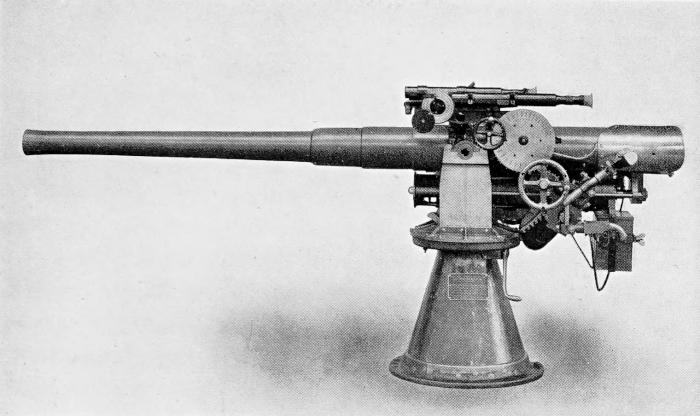
12½-PR. Q.F. 50-CALIBRE GUN AND MOUNTING.
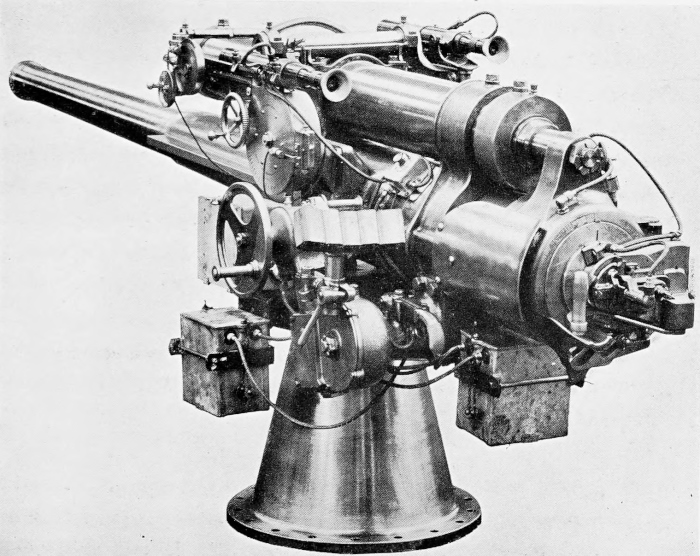
4-INCH B.L. 40-CALIBRE GUN AND MOUNTING FOR TORPEDO BOAT
DESTROYERS.
Photographs supplied by the Coventry Ordnance Works, Ltd.
After a remarkable series of experiments, Sir Joseph Whitworth
produced a number of rifled guns of great power and
precision. In 1863 they proved their worth in the Civil War
in America, and in 1864 a series of competitive experiments
was conducted by the British Government at Shoeburyness
between the Armstrong and Whitworth guns. The committee
of artillerists reported its inability to decide which was the
better weapon, and the Whitworth gun was not then adopted
by the Government, though foreign nations bought them largely.
Four years later a Whitworth gun was produced which threw
a 250-lb. projectile 11,243 yards, a range never before attained,
and a 310-lb. projectile, 11,127 yards. Sir J. Whitworth also
attempted to prove that a flat-headed projectile will penetrate
armour-plates even when striking obliquely.
Like all inventors of war material of increased efficiency,
he believed that the more destructive the weapons and explosives
the more improbable would war become, until it should
be rendered impossible.
“Were it not that the increased destructiveness of war
must tend to shorten its duration and diminish its frequency—thus
saving human life—the invention of my projectiles
could hardly be justified; but believing in the really pacific
influence of the most powerful means of defence, these long
projectiles I call the anti-war shell.” But Sir Joseph Whitworth
was disappointed, and the millennium has not dawned
yet.
His own summary of what he accomplished, however, shows
how one step after another has been taken in the production
of weapon after weapon. The progress has been maintained
by one inventor and scientist after another, until the remarkable
guns with their 25-miles range which now are carried
have been made possible.
“In 1857 I proved for the first time that a ship could be penetrated
below the water-line by a flat-headed rifled projectile.
“In 1860 I penetrated for the first time a 4½-inch armour-plate
with an 80-lb. flat-headed solid steel projectile. In 1862 I penetrated
for the first time a 4-inch armour-plate with a 70-lb. flat-headed steel
shell, which exploded in an oak box supporting the plate. In 1870
I penetrated with a 9-inch bore gun three 5-inch armour-plates inter-laminated
with two 5-inch layers of concrete. In 1872, with my
9-pounder breech-loading gun and a flat-headed steel projectile,
I penetrated a 3-inch armour-plate at an angle of 45 degrees. All
these performances were the first of their kind and were made, with
one exception, with flat-headed projectiles, which alone are capable
of penetrating armour-plates when impinging obliquely, and which
alone can penetrate a ship below the water-line.”
The Brazilian Government began a series of experiments
in 1871 which convinced them that better guns were produced
in this country than on the Continent. The Bessemer steel
process was improved by Sir Joseph Whitworth for gun-making,
and having adopted breech-loading guns, he obtained results
superior to those obtainable with any form of muzzle-loading
weapon. The Brazilian Government gave permission for him
to offer to lend to the British Admiralty a 7-inch breech-loading
steel gun he had made for the former, and a 35-ton muzzle-loading
gun, in order that comparative tests might be made,
but the British Government declined; it had no love for breech-loaders.
Having produced a type of gun capable, as he believed, of
penetrating any armour then in existence, Sir Joseph Whitworth
set about producing an armour-plate which should be
able to beat the gun. Using his compressed steel, he invented
what he called “impregnable armour-plating,” built in hexagonal
sections, each of which was constructed of a series of concentric
rings arranged round a central circular disc, this method preventing
a crack caused by the impact of a projectile from
passing beyond the ring in which it occurred. A Palliser shell
of 259 lb. fired from a 9-inch gun with a charge of 50 lb. of
pebble powder, which would have smashed an ordinary 12-inch
iron armour-plate, was itself smashed against this new armour,
and the target itself was forced 18 inches back into the sand
and was only slightly dented.
A great deal of reliance was placed in America on the gun
invented by Mr. Rodman, after whom it was named. Several
of the American monitors were armed with these weapons.
One, bought by the British Government and tested at Shoeburyness,
weighed 19 tons and had a smooth bore 15 inches
in diameter, and fired a round shot of 453 lb. with a charge
of 100 lb. of American powder. It pierced the 8-inch plates
of the Warrior type of target, but as in other experiments it
was less successful, the Americans claimed that it was used
in such a way as not to show its full capabilities. Even if it
had been, it could only have had a very short career, as the
breech-loading gun was steadily making its way in foreign
navies, and any form of smooth-bore muzzle-loader, whether
American or English, would have proved singularly ineffective
against ships carrying rifled breech-loaders. The Mackay gun,
an English invention doomed to early supersession, was an
attempt to combine the simplicity of the smooth-bore with the
penetrating force of the rifled gun, and in experiments made
with this weapon on the Agincourt target, in 1867, the gun
fully demonstrated its usefulness.
HEAVY GUN UNMOUNTED.
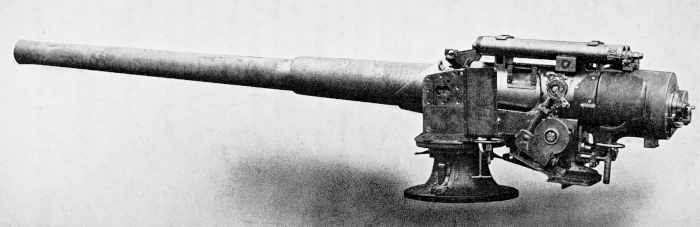
6-INCH B.L. 50-CALIBRE GUN COMPLETED AND WITH MOUNTING.
Photographs supplied by the Coventry Ordnance Works, Ltd.
No satisfactory results either with rifling or with the hexagonal
bore could be obtained, and as guns became more
powerful it was found that the only way of utilising them with
the best results was by loading them at the breech instead
of at the muzzle. Obviously, a heavy explosive shell could not
be rammed down a big muzzle-loader. The old 32-pounder
had a muzzle velocity of 1,600 feet per second, and the 40-pounder
rifled breech-loader which took its place was of only
1,200 foot seconds, and the muzzle energy was 570 and 400 foot
tons respectively. Various methods were employed and were
not by any means satisfactory, but when slower burning powders
were introduced, the strain upon the gun was less sudden and
more cumulative, so that the pressure upon the projectile was
exerted to the full as long as it was within the gun and it
was then expelled at the muzzle with the greatest force obtainable.
A great advance in naval gunnery was made with the
appearance of the Armstrong breech-loader. The first breech-loader
from this famous firm was a tube gun which was formed
to admit of a breech block being dropped in to close the bore
and a screw attachment held it fast. From about 1860 the
principal guns in use in the Navy of the Armstrong screw type
were the 9-pounder weighing 6 cwt., the 12-pounder weighing
8 cwt., the 20-pounder of 16 cwt., the 40-pounder of 35 cwt.,
and the 7-inch gun, 99½ cwt. The last-named was of 7.2 inches
diameter, and fired projectiles weighing 109 lb. All these
guns were on the polygroove system. About this time iron or
steel gun carriages were introduced for use on shipboard. The
Admiralty, for some reason best known to themselves, fancied
muzzle-loaders, and obstinately remained faithful to them long
after all other naval powers had discarded them as cumbersome
and comparatively useless compared with the newer types
of breech-loading guns. The newer muzzle-loaders, however,
were improvements on the old smooth-bores, and were built
on what is known as the Fraser system, and they were far
larger than any which had been constructed before.
The inner barrels of the Armstrong 12-inch, 9-inch, and
7-inch muzzle-loading guns were of tempered steel, with solid
ends; these were strengthened with wrought-iron coils shrunk
on; the trunnion ring, breech-piece and cascable, which was
screwed into the latter, were solid wrought-iron forgings. The
different parts were hooked together with shoulders and corresponding
recesses, to prevent their separation.
The muzzle-loader of 64 lb. on Fraser’s cheap construction
plan consisted simply of a coiled iron tube, having the muzzle
part double, but with a triple coil over the breech.
The Armstrong big muzzle-loading guns were formed with
the Woolwich system of rifling or grooving, the projectiles
being fitted with studs to correspond to the grooves. The
muzzle-loading guns varied from the 7-inch 7-ton gun to the
16-inch 80-ton gun. The 8-inch was 118 inches in length, the
9-inch 125 inches, and so on, up to the 16-inch gun, which was
288 inches in length; the last-named took a charge of 450 lb.,
and fired a projectile weighing 1,684 lb. with a muzzle velocity
of 1,590 foot seconds and a muzzle energy of 29,530 foot tons,
capable of penetrating at the muzzle between 24 and 25 inches
of wrought iron.
By 1877 the initial velocity of rifled projectiles had been
increased from 1,600 to 2,100 foot seconds, and the energies
by nearly 75 per cent., so that a further reconstruction of
artillery became compulsory. It was not until after 1881 that
the Admiralty definitely adopted heavy breech-loading guns for
its armed cruisers. Even as late as 1885 the squadron sent to
sea when it was feared that trouble with Russia was brewing,
included thirteen battleships, not one of which had a breech-loading
gun of more than 6 inches diameter. As a contrast to
this, all the heavy guns of the Russian ships were breech-loaders.
What would have happened to the English ships had
hostilities occurred, and had the Russian gunners been able
to use their weapons properly, is best left to conjecture, but it
might have proved a sorry day in the naval history of England.
Even by 1894 muzzle-loaders were still in use in the Navy.
The Woolwich Armstrong breech-loading guns varied from
12-pounders of 3 inches to the 16.25-inch 111-ton gun, the
length of which was equal to 30 calibres. The last-named gun
took a charge of 960 lb. of powder, and fired a projectile weighing
1,800 lb. with a muzzle velocity of 2,087 foot seconds,
and a muzzle energy of 54,390 foot tons, calculated to penetrate
over 36 inches of wrought iron at the muzzle. Gunpowder not
being powerful enough for these great weapons, other explosives
were introduced, which had, among other advantages, that of
being much more powerful. The principal of these explosives
at present in use is cordite.
In the early ’sixties the guns chiefly in use on this side of
the Atlantic were the 9-inch gun, weighing 12 tons, and discharging
a 250-lb. shot with 43 lb. of powder, the initial velocity
being 1,730 feet per second. The largest gun was the 23½ tons,
with a 12-inch diameter, its shot weighing 600 lb. and the
charge of powder 70 lb., and the muzzle velocity being 1,240
feet per second. The larger guns could not be worked without
considerable improvements being made in the ships themselves.
Greater height had to be given between the decks, and the
distances between the guns had also to be increased, there
being 25 feet between the centre lines of the ports for the
12-ton guns, while the 23-ton guns required about 30 feet
between the ports and between 8 and 9 feet between the deck
and the underside of the beams supporting the deck above.
To keep the portholes as small as possible an arrangement
was made whereby the gun should be pivoted near the muzzle.
The later developments in naval artillery began with the
12-inch 46-ton wire gun, which was the chief weapon of the
battleships between 1894 and 1897. This gun was 37 feet 1 inch
in length, or 35.43 calibres, and threw an armour-piercing
shell of 850 lb. with a charge of 167½ lb. of cordite. It had
a muzzle penetration of 36.8 inches of wrought iron, and was
in every respect as powerful as the 13½-inch 67-ton gun, which
it replaced. During 1898, the 12-inch wire gun, weighing about
50 tons, was introduced.
The adoption of breech-loading made possible a very rapid
rate of firing, even with the heaviest guns. In 1881, the Government,
in reply to an invitation it issued for guns to meet certain
requirements, received a number of replies from gun-making
firms, as did also the French Government at about the same
time in reply to a similar invitation. These guns, which became
known as quick-firing or rapid-firing guns, were comparatively
small weapons, and the Armstrong Company at Elswick,
having improved upon them with quick-firers of 4.7 inches
and 6 inches calibre, they were adopted throughout the Navy
as the secondary armament. Their superiority over those they
displaced was such that a battery’s firing power was increased
sixfold. An important trial took place on board the Hardy
in 1887, when a 4.7 gun was mounted on a centre pivot recoil
mounting, the whole weighing 4 tons 12 cwt.; this gun fired
ten rounds in less than 48 seconds. Compare this with the
firing of the ordinary 5-inch breech-loading gun on the gunboat
Mastiff, when ten rounds took 6 minutes 16 seconds.
In rifling some of the guns an increasing twist was given,
while in others the twist was uniform throughout the bore.
The object of the increasing twist was to lessen the strain
upon the gun, as the rotary motion was not started when the
projectile was first put into motion, but developed as it moved
down the bore. The projectiles were provided with studs
which fitted into the grooves. The breech-loading guns on the
polygonal system of rifling fired projectiles which were coated
with lead fixed on with zinc, so that the bore of the gun was
not injured by the rush of gas past the projectile as was the
case in the rifled guns in which there was windage. Two
systems of breech-loading were designed by Sir W. Armstrong,
one being the screw system and the other known as the wedge.
The projectiles invented by Major Palliser were specially
designed to penetrate iron armour. Cast iron was found to
be smashed against armour, wrought iron was too soft to do
any damage, and steel in those days was too expensive to be
of use. Major Palliser solved the difficulty by making his
projectiles of chilled iron, and giving them a cylindrical shape
with the pointed or ogival head.
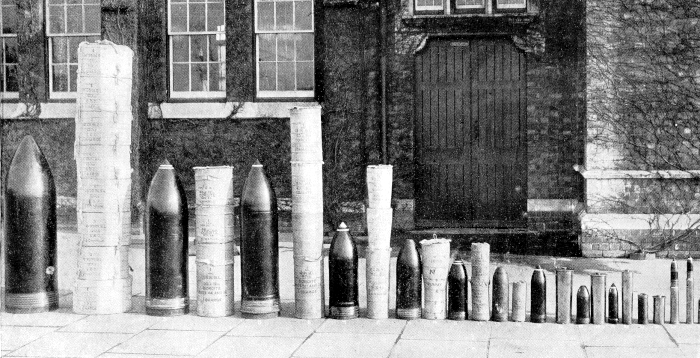
PROJECTILES AND CHARGES USED IN THE BRITISH NAVY.
Photograph by Stephen Cribb, Southsea.
| 1. Projectile, 16·25 B.L., 1,800 lbs. |
9. Projectile, 7·5 B.L., 200 lbs. |
17. Projectile, 4-in., 25 lbs. |
| 2. Charge for ” ” 960 lbs. powder. |
10. Charge for ” ” 77½ lbs. cordite. |
18. 4-in. Cylinder. |
| 3. Projectile, 13·5 B.L., 1,250 lbs. |
11. Projectile, 6-in. B.L., 100 lbs. |
19. Projectile, 12-pounder. |
| 4. Charge for ” ” 187½ lbs. cordite. |
12. Charge for ” ” 29 lbs. |
20. 12-pounder Charge. |
| 5. Projectile, 12-in. B.L., 850 lbs. |
13. Projectile, 5-in. B.L., 50 lbs. |
21. 12-pounder Case Shot. |
| 6. Charge for ” ” 211 lbs. cordite. |
14. Charge for ” ” |
22. 12- ” 8 cwt. Charge. |
| 7. Projectile, 9·2 B.L., 380 lbs. |
15. Projectile, 4·7, 45 lbs. |
23. 6- ” Cartridge. |
| 8. Charge for ” ” 103 lbs. cordite. |
16. 4·7 Cylinder for Cartridge. |
24. 3- ” ” |
|
|
25. 1¼-lb. Cartridge. |
Experiments are often carried out to ascertain the resisting
qualities of various combinations of armour offered to projectiles
of varying weights and penetrative powers according to
the distances at which they are fired. When iron was used for
armour-plating, targets were built in duplication of those provided
for the armoured ships. Both the Armstrong and Whitworth
70-pounders fired in the competition trials over 3,000
rounds, or three times the number assigned as the limit to the
life of the old cast-iron smooth-bore guns. Of course, the bigger
the gun the shorter the life, as a rule.
The French adopted for naval service four different patterns
of heavy breech-loading rifled guns, all made of cast iron, and
strengthened behind the trunnions with steel rings which were
shrunk on. Their weight varied from 21 tons 13 cwt., with a
calibre of 10.82 inches, to the gun of 4 tons 18.5 cwt., with a
calibre of 6.48 inches, firing projectiles respectively of 476 lb.
and 99 lb. The weight of the charge was rather more than
one-sixth of that of the projectile. The guns were mounted
on wrought-iron carriages and slides constructed on the box
girder system.
As the powers possessed a great number of old smooth-bore
guns and rifled guns were expensive, several attempts
at a compromise were made by lining the smooth-bore guns
and converting them into rifled guns, the lining being rifled
according to whichever system the power owning the gun
happened to prefer at the moment. The Dutch Government
is said to have set the example of national frugality in this
respect.
How slow the Admiralty was, is shown by the statement
of the Secretary to the Admiralty in the House of Commons
in March, 1881, to the effect that “at this moment there is not
a single heavy breech-loading gun mounted on any of our
ships, but by the end of next year a very substantial beginning
would have been made towards arming our fleet with breech-loaders....
The Admiralty was driven to the step by the
fact that a high velocity was now required for the projectile,
that high velocity was only obtainable by a great length of
gun, and that to load a gun over a certain length at the muzzle
became impracticable under the ordinary conditions of mounting
guns afloat.” The Government, it was contended, was now
able to profit by the experience which foreign nations had
gained, and intended to improve upon the guns which were
in use abroad. But whatever may have been the official view,
the fact remains that the Admiralty was years behind other
nations, that Woolwich, in spite of official claims, discovered
nothing that had not been known to be possible a decade
earlier at least, and that the Navy was armed with out-of-date
muzzle-loaders. Fortunate it no doubt was for this country
that it had no wars in which its Navy could be tested against a
navy armed with breech-loaders.
In the matter of armour this country owes a debt of gratitude
to Sir John Brown, who made the Atlas Works at Sheffield
famous throughout the world for the excellence of the armour-plates
produced there. Indeed, the records of what he has
accomplished seem to indicate that his rule was to surpass
whatever his rivals produced, and never to forget that he
might be able to learn something from others. His company
took up the manufacture of chrome steel, which was patented
in America about 1871. When the Italian experiments at
Spezzia resulted in the 100-ton gun smashing, in 1876, 22 inches
of iron armour and its backing, the French turned their attention
to steel plates, as did also Sir Joseph Whitworth, but Sir
John Brown thought that better results would be secured with
iron plates with steel faces. These compound plates had half
their thickness of steel. By 1888 the firm was producing
compound plates each 32 tons in weight.
An interesting comparison between French and English
methods was made a few years ago[55] by M. Canet, of the well-known
French firm of gun manufacturers, in a paper on the
heavy naval guns and warships of the two countries. Referring
to the latest type of the large weapons then employed at sea, viz.,
the English 12-inch gun, known officially as Mark IX., he described
its method of construction, which has already been
alluded to, and pointed out that the corresponding gun in the
French navy was of 305-mm. bore (or 12.008-inch) and of 45
calibres in length. The barbette system of gun-mounting,
as already explained, owed its origin to French inventiveness,
and is preferred in the British Navy; but the French, curiously
enough, seem to have preferred the English system of mounting
turrets for the guns. The turrets themselves, however,
differed from those of the English pattern, the French idea
being to make them oval and smaller, so as to offer the narrowest
possible target, and this theory was carried into practice even
at the expense of the interior roominess. The limited dimensions,
however, made it no easy task for artillerists to arrange
conveniently inside the turrets all the machinery required, and
M. Canet avowed a preference for the English practice of allowing
the designer plenty of weight and room inside the turrets
or barbettes. There were also structural differences in the
methods of the two countries of arranging the armour, and
it was claimed that the French oval form, with the other characteristics,
had, among other advantages, that of distributing
the blows of the projectiles over a greater weight of armour.
Another important difference lay also in the method of working
the guns. It has been the custom for many years in the British
Navy to take up the recoil of the guns by hydraulic buffers,
and to use hydraulic pressure to run out the guns again. The
French introduced springs, which were compressed by the force
of the recoil. Again, hydraulic appliances are preferred in the
British Navy for training and elevating the guns, but our
neighbours across the Channel prefer electricity. The latter
has been tried in the British Navy, the most notable example
being one of the super-Dreadnoughts, but the experiment has
by no means given satisfaction.
Even more striking differences appeared in the matter
of the ammunition hoists, etc. The French battleships, M.
Canet said, were equipped with hoists leading direct from the
magazines to the guns, and there was the drawback that the
guns had to be returned to a certain position to be reloaded,
and the muzzle had to be depressed a few degrees below the
horizontal to facilitate the loading, the projectile being pushed
home with a rammer by the gun crew, whose strength was
assisted by a compressed spring. The ammunition hoists on
the English battleships, on the contrary, were made in two
sections. The lower section raised the ammunition to a relay
chamber, and the upper section carried it thence to the gun.
This method is held to allow of more rapid firing, as a large
supply of ammunition can be placed, prior to an action, in the
relay chamber, and the store there, as fast as it is drawn upon,
can be replenished from the magazines. It has also been held
that in case of a shell bursting in the turret the danger to the
magazine would be less, and in M. Canet’s opinion the English
method is superior to that of the French. Another matter
in which he considered the English to have an advantage was
in the manner of loading the guns. How this was done on the
French battleships has just been explained. The English gun
crews could load the guns at any elevation. The ammunition
was carried up in a curved hoist, so that it could be delivered at
any point desired, and was pushed home by a hydraulic rammer
moving with the gun.
By permission of Messrs. Vickers, Sons & Maxim, Ltd.
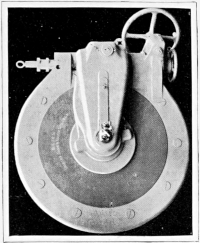
12-INCH BREECH MECHANISM
(CLOSED).
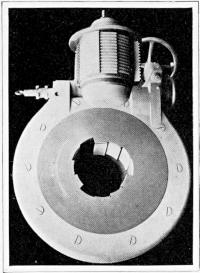
12-INCH BREECH MECHANISM
(OPEN).
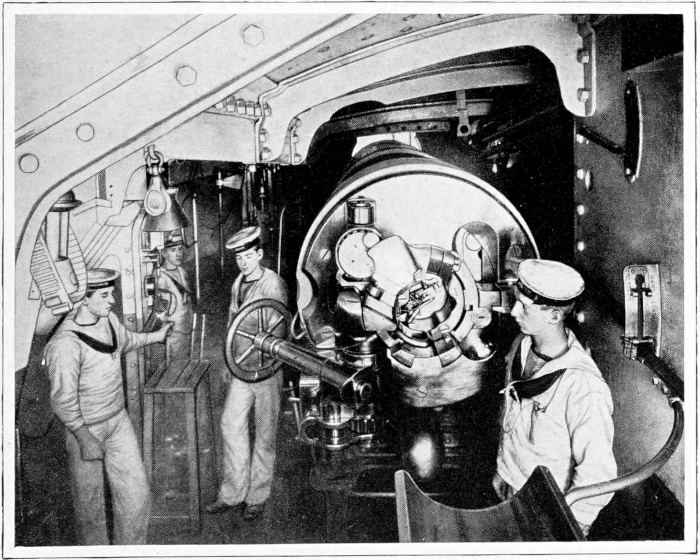
INTERIOR OF A BARBETTE, SHOWING 12-INCH GUN, H.M.S. “CÆSAR.”
Photograph by Gale & Polden, Aldershot.
Time brings strange revenges. At one period the French
were the leading nation in the world in the matter of naval
construction, and the English were content to copy the French
designs. But in later years England has taken the lead, and
not only France but the other maritime powers of the world
have been glad to sit at the feet of Britannia and accept the
instruction she has been able to impart. Some of these pupils,
if pupils they be, have proved themselves exceedingly apt
copyists and improvers, and are inclined to think that their
own creations are every whit as good as anything this country
can produce.
The superiority of the British methods alluded to by the
famous French gun-maker were not lost upon French naval
architects, and in some of the latest French battleships these
methods have been copied. The rapidity of the fire of the
big guns would thus, it was expected, be raised to two rounds
a minute. Electricity, however, has been retained, as the
French consider it to be better than hydraulic machinery for
the loading of the guns and movement of the turrets, and
more easy of repair in case of damage under hostile fire.
The size and weight of the pieces forming the breech
mechanism of the modern guns of large calibre made compulsory
the adoption of mechanical means for loading them. There
was also the further advantage that machinery was less likely to
make mistakes, or to suffer from the accidents which are bound
to disable some of the crew in a naval engagement. In some of
the earlier battleships, in which the large muzzle-loading guns
were fitted, the charge was raised to the gun-mouth by machinery
worked by hand-power, and after it had been rammed home
by the crew the projectile was inserted and rammed home also,
obviously an impossible arrangement when it was sought to
introduce rifled explosive shells. When guns were made
too large to be withdrawn into the turrets to be loaded, they
were loaded by being depressed so that their muzzles just
entered a specially cut orifice in the deck in front of the turret,
and the loading crew were able to do their work in safety. The
drawback to this system was that the gun had to be brought
back to the same position for loading, then revolved with its
turret once more to the direction in which it was to be discharged,
and aimed afresh before its missile could be sent at
its mark. The chief advantage of this system was that the
gun required a smaller, and consequently less weighty, turret
for the protection of its crew. The introduction of the breech-loader
enabled the guns to be loaded in greater security, with
greater speed, and without interfering with the aim or training
of the gun, thereby rendering a more rapid fire possible. Ammunition
hoists brought the charge and projectiles right into the
turret or barbette more expeditiously and with greater precision
than the best-drilled crew, and the men had simply to
load the weapon and fire it. The human element came in here,
however, in all its uncertainty, and, in spite of the greatest
possible care, accidents occurred. A charge or a shell was
dropped or caused to explode in some way, and disastrous were
the results. Again the necessity for the mechanical appliances
caused them to be forthcoming. The projectiles and charges for
fighting purposes, which naval strategists declared to be
necessary in ever-increasing size and weight, and the greater
rapidity of fire which was demanded, made it impossible for
dependence on hand power to be retained. After various
experiments, both steam power and electricity being tried,
hydraulic power was introduced, and has proved more suitable
for the purpose than any other method. Now the heaviest
projectiles, weighing half a ton or more, are lifted with the
greatest ease and exactness to the required position by hydraulic
power, are pushed into their places by the same power which
does a like office for the charge of explosive, closes and fixes
the breech, and does not desist until its task is finished. In
the latest appliances, the machinery is made interlocking, so
that, at least in the system introduced lately by Messrs. Vickers,
no one operation connected with loading the gun can be performed
until its immediate predecessor has been accomplished.
With a view to securing more rapid and accurate fire this firm
has introduced a modification of the breech mechanism by
what is known as a “pure couple.” The hydraulic breech
mechanisms just alluded to are used for the largest guns, such
as the 12-inch weapons, and have also been installed on the
Japanese ships for the 10-inch guns. The guns can be loaded
at the required angle of elevation, the advantage claimed for
this being that the sight can be kept on the target all the
time.
The pressure to which guns are subjected when the charge
explodes is enormous. One reason why they do not burst is
that they have not time to do so. How rapidly the pressure
arises against the sides of the gun and then against the projectile
to expel it from the bore, was shown by experiments
which Sir Andrew Noble conducted some time ago with a
6-inch gun of 100 calibres length of bore. Practically instantaneously
with the ignition of the charge, that is to say in
about the four-hundredth part of a second, a maximum pressure
against the interior of the gun of 22 tons per square inch was
reached, but this declined to about 13 tons per square inch in
about the twelve-hundredth part of a second more. But by
that time the projectile had left the gun, and was rushing,
faster than the eye could follow it, towards its mark.
The English 12-inch (Mark IX.) gun consists of a steel
tube, wound practically from end to end with layer after layer
of steel ribbon or wire of very great tensile strength. This
tube is known as the A tube, and may be called the hollow
heart of the gun. As much as a hundred miles of wire will
be used for one of these guns, and, of course, for the newest
guns, the 13-inch weapons, such as have been placed in the
latest super-Dreadnoughts, or the 15-inch guns which it is
said will be placed in the Dreadnoughts of 1912 or the year
after, the amount is a great deal more. The greatest thickness
of layers is placed round the breech of the gun, where the
strain is most severe, and each succeeding layer is wound on
with increasing tension, though to the ordinary observer the
first layer seems to fit so tightly that nothing could be tighter;
but the gun makers know better. All along the chase or fore
part of the tube another tube, called the B tube, is shrunk
on to ensure that it shall be the tightest fit possible. Then,
over a portion of the B tube, and also over a portion of the
winding, that part of the gun known as the breech jacket is
shrunk. Apparently everything is so strongly fixed together that
nothing can cause the parts to separate, but the gun makers
know this is not so, for into this jacket a bush is screwed to
prevent any movement of the A tube, so far as the jacket is
concerned. The A tube itself contains a thin steel inner tube
inserted from the breech and fixed in position by the breech
bush. It is this inmost tube which has to bear the wear and
tear caused by the firing, and suffers from erosion, due to the
gases generated by the explosion of the charges, and has to
be replaced by a new tube when it is no longer fit for service.
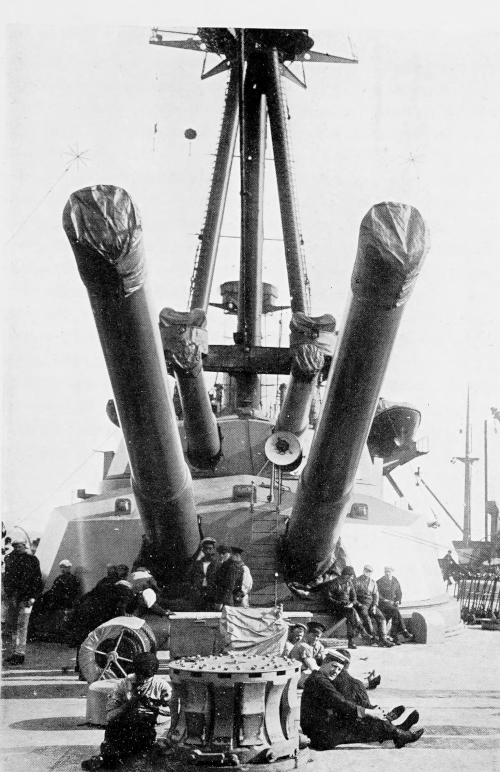
THE 12-INCH GUNS OF H.M.S. “NEPTUNE.”
Photograph by Stephen Cribb, Southsea.
Gun makers have always responded cheerfully to the challenge
to penetrate the hardest armour of the time, and have
succeeded in producing weapons which are able to penetrate
any armour now carried. The problem at present is to increase
the range at which the penetrative power may be exercised.
This can only be attained by the increase in the length of the
gun and the use of explosives developing higher pressures in
order to obtain higher velocities. The British gun of 45 calibres
and 9.2 inches diameter is about to be superseded by one of
50 calibres, and the 40-calibre gun carried in some of the latest
ships is being superseded by the 12-inch gun of 45 calibres.
Twelve-inch guns of 45 calibres and 10-inch guns of 50
calibres have been installed in the new ships, built at Elswick
recently, for the navies of Japan and one of the South American
States.
Greater length means a greater muzzle energy, higher
velocity, and increased power of penetration. The latest guns,
too, have shown that the manufacturers have been considering
the advisability of effecting a certain amount of redistribution
in the thicknesses of the different parts of which the gun is
built, notably the tubes, wires, and jackets, and the adoption
of a uniform type of rifling. The theory was that the rifling
should be increased as the grooves passed down the tube, so
that a gradually increasing twist should be given to the projectile,
but it is now held that no advantage is obtained by
this method, whatever may have been the case in the past,
and that the uniform rifling will give better results as to accuracy,
muzzle energy and velocity, and inflict no greater strain upon
the gun or shorten the “life” of its tube. The trials already
made have shown that uniform rifling for modern high velocity
guns has resulted in giving greater range and greater accuracy
in shooting.
The war between France and Germany in 1871 brought
machine guns into notice. Great things were expected by the
French of the mitrailleuse, and some of the patriotic Paris
newspapers at the time published glowing prophecies of the
number of Germans each gun could be depended upon to kill
in a few minutes, with the result that, according to their calculations,
there would be no Germans left after a few days to
continue the war. But events turned out otherwise; the
mitrailleuse failed, and the Germans were victorious. This
machine gun was very defective, and served to advertise by
contrast the Gatling, Nordenfeldt, Gardner, and Maxim automatic
guns, named after their respective inventors. Of these
the Maxim has been so improved that it is considered to be
superior to any of the others. The machine guns fire, according
to the number of their barrels and their calibre, from four
hundred to six hundred or more shots per minute, at a range
equal to that of the best infantry rifle, and can be sighted
with deadly accuracy.
CHAPTER X
WARSHIPS OF THE TWENTIETH CENTURY
Two classes of vessels stand forward prominently as the
products of the twentieth century. One is the Dreadnought,
or all-big-gun one-calibre type of battleship, the other is the
submarine. The fact that both are the result of the slow
developments of centuries does not render them the less the
products of the last few years. Both are untried in battle,
and they are regarded as preparing the way for the introduction
respectively of surface and under-water warships, the
power of which is conjecturable only. Associated with both
is the torpedo. The dream of a submarine which shall travel
faster than a surface vessel of the same size is never likely
to be realised, provided that the surface vessel is built for
speed also, for the simple reason that the vessel travelling
on the surface has only about a third of its surface in connection
with the water, whereas the submarine has its whole surface
submerged, and has three times as much friction against the
water to overcome. Hence, a lightly armed, very fast vessel is
regarded as likely to play an important role in the navy of
the not distant future, and finds its representative in the
destroyer of to-day.
The submarine and the destroyer owe their existence to
the battleship’s greatest enemy, the torpedo. All three vessels
carry that weapon, and any two of them may combine against
the third. The spar-torpedo was such an unsatisfactory weapon
at best that it had either to be abandoned, save under most
unusual circumstances, or improved out of all recognition.
The possibilities of the torpedo itself were so great as to compel
its retention, and the startling proposition was made that
torpedoes should be fired by under-water guns at a distant
ship. The blowing up of the Albemarle in the American Civil
War showed what could be accomplished by a small fast
steam launch. If this could be done with a spar-torpedo,
how much more destructive would a torpedo be which could be
directed against a hostile vessel from a small fast launch which
could approach to within an effective range, and then turn
and make a rush for safety from the gun-fire which might
be brought to bear in her direction. Several torpedoes of one
kind and another have been designed, but they have all had
to give way to the Whitehead torpedo. The inventor is stated
to have derived his idea in 1864 from a fire-boat designed by
an Austrian officer, who thought of loading a small boat with
explosives, to be fired by a pistol connected with protruding
spars which should strike the vessel attacked, while the fire-boat
itself was to be propelled by a screw driven by clockwork.
Whitehead improved on this by making his boat of iron, and
able to travel under water for a short distance at a speed of
six knots. Its explosive was a few pounds of dynamite. By
1870 he had improved this to a torpedo having a speed of
eight knots, a range of 400 yards, and a charge of 76 lb. of
gun-cotton. The modern Whitehead torpedo is a wonderful
piece of mechanism, so wonderful that to the ordinary spectator
it seems almost endowed with intelligence. To see it lying in
its cradle ashore it is simply a beautifully polished smooth
steel cylinder. The fore end is blunt and with an innocent-looking
steel spike projecting from the centre of its rounded
front, but it is this spike which strikes the object aimed at
and causes the ignition of the explosive an inch or two behind
it in the head of the cylinder. The torpedo has a fine run
aft for about a third of its length, and at the after end are
two vertical and two horizontal rudders, and two screws
revolving in opposite directions. It is some time since compressed
air was adopted as the motive power. The efficacy
of the compressed cold air has been increased to an extraordinary
degree by the introduction of an apparatus for heating
the air. A torpedo fitted with a heater can travel over double
the distance at a given speed and the same expenditure of air
that a torpedo without a heater can. “If a torpedo be run
for the same distance with a heater as a similar torpedo without
a heater, a 100 per cent. gain of power would be realised by
increasing the speed, and at a range of 2,000 yards this increase
is from 26 knots to 33.5 knots, the highest which has ever
been realised with a torpedo over a range of 2,000 yards.”[56]
The newest form of torpedo is that in which hot air instead of
cold air is used.
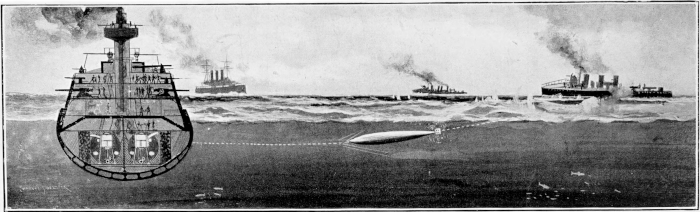
A TORPEDO. DISCHARGED FROM A DESTROYER, TRAVELLING BY ITS OWN ENGINES TOWARDS AN ARMOURED
BATTLESHIP.
In the case of the latest pattern 18-inch Whitehead torpedo,
a speed of 28 knots for 2,000 yards, or 34½ knots for 1,000 yards
when using the ordinary cold air, has been obtained. For
longer distances, such as 3,000 and 4,000 yards, the speed is
proportionately less, falling to about 20 knots for the 4,000 yards
range. When using the heater, “the same torpedo maintains
a speed of over 40 knots for 1,000 yards, 37 knots for 2,000 yards,
30 knots for 3,000 yards, and 27 knots for 4,000 yards. The
speeds are quite extraordinary, as they represent exactly 100 per
cent. more power from the engines, and it is further pointed
out that the heater is extremely small, simple, and burns any
ordinary lamp oil, and is capable of being fitted to practically
any existing type of torpedo. The Admiralty has never been
slow to adopt improvements in the torpedo armament of the
fleet, and for years Great Britain has led in the matter of
submarine tubes for firing torpedoes.”[57]
The explosive carried, usually gun-cotton, weighs 200 lb.
An ingenious arrangement of gyroscope, valve and pendulum
causes the torpedo to remain at the required depth, and to
return to it if it should be diverted from it.
There have been several attempts to solve the problem of
directing torpedoes by means of wireless telegraphy. The
great drawback, however, has been that the receiving apparatus
which the torpedo had to carry was outside it and must appear
above the surface of the water, and was, therefore, liable to be
sighted and shot away. The same objection has been raised
to the equipment of submersible torpedo boats with “wireless.”
Of recent years a torpedo has been contrived which the inventors
claim can be directed by wireless telegraphy, and as there seems
no reason why the principle applied cannot be improved and
extended to submarines and submersibles, the utility of these
under-water craft may be augmented to an inconceivable
degree. The “Actinaut” is the name of the torpedo, and
the jet of salt water which it ejects serves not only to indicate
the position of the torpedo, but is an “indestructible receiver
for the electric waves.”[58]
SUBMARINES
Submarine warfare and exploration are no new ideas, but
in the past as in the present, the great difficulties have been
to ensure the provision of sufficient power for rapid propulsion,
and to keep the air pure enough for the crew to breathe for a
long journey under water.
Efforts at submarine warfare seemed to have been made
many centuries ago, but none of the contrivances then used
had any fighting value, and were more interesting as freaks
than in any other capacity. It is unnecessary to attempt
even to summarise all the schemes which early and late inventors
evolved to render possible under-water attacks upon an enemy’s
fleet. The problem was as fascinating seven or eight hundred
years ago as at the present time. Most of the alleged mediæval
inventions probably never got beyond the imaginative or paper
stage, and however wonderful the inventors’ theories or written
descriptions may have been, even when embellished with weird
illustrations showing the contrivance at the bottom of the
sea, it is not recorded that any of the submarines achieved any
actual success whatever. One of the earliest submarine descents
which is supposed to have been made was that of Alexander
the Great, who is mendaciously represented to have been
lowered to the bottom of the sea in a glass barrel, too small
for him to stand up in, with a smoky oil lamp or two, and
an animal which might have been a dog or a cat (it is difficult
to say which the artist intended) for company, the circumstances
being such that he could not have failed to be asphyxiated
in a very short space of time. It appears, too, that he
wore a crown and his royal robes on that occasion, so that he
evidently visited Neptune in state.
As early as the year 1190 a man is said to have constructed
a diving boat of leather. Numerous suggestions were made to
enable men to go under water in order to bore holes through
the sides of an enemy’s ships, which, considering the thickness
of the planks, must have been a somewhat laborious undertaking.
The Barbary corsairs are stated to have used some
sort of submarine explosive against the ships of their opponents,
but this explosive or combustible was most likely Greek fire.
William Bourne, who served in Queen Elizabeth’s navy, is
said to have had a submarine boat which could have been made
useful, but there are no records in existence to show that the
experiment ever took place. An interesting feature of the
suggestion was that he proposed to sink or raise the vessel by
admitting and expelling water. About the middle of the
seventeenth century, a Dutchman is said to have invented a
boat which travelled under water from Westminster to Greenwich,
and it is even asserted that it carried passengers, in addition
to twelve men at the oars, and that the air in the interior of
this vessel was purified by a “chymicall liquor.” A Royal
Warrant, dated June 29th, 1626, ordered the delivery of “360
fforged iron cases with fireworkes, 50 water mynes, 290 water
petards, and two boats to conduct them under water, for
H.M. special service to goe with the fleete.”
Two worthy friars of the Order of Minims turned from
their spiritual contemplations to devise a submarine, and
they appear to have been the first to suggest that it should
be built with both ends alike, and pointed so that it could
move either end foremost; it was to be given wheels to move
along the sea floor, and to be propelled by oars. It was even
to carry guns, to be fired through holes in the side. Another
inventor in the seventeenth century waxed so enthusiastic
over his submarine, that, besides pointing out its advantages
in all manner of possible and impossible circumstances in time
of war, he represented that it should be used for submarine
hunting parties, who might have great sport shooting the fish
as the boat went along. A Frenchman named De Son, built in
1663, at Rotterdam, a vessel about 72 feet in length, circular,
and running to a cone at each end, by which he promised, but
did not perform, great things. A few years later a boat was
designed by the Abbé Borelli to travel under water, his idea
being that the boat should rise or sink according to the amount
of water admitted through holes in the hull to skins provided
for the purpose. Bushnell, an American inventor, had a vessel
he called the Turtle, which seems to have been shaped more
like an egg. It floated at the surface of the water with the
pointed end downward, and had a small screw propeller, jutting
out at one side. On the opposite side of the body of the vessel
was a magazine containing about 150 lb. of powder. This
magazine was detachable from the inside of the ship, and was
fastened by a rope to a powerful screw which the inventor
intended to drive into the hold of the opposing warship, and
then make the best of his way to safety, leaving the magazine
attached to the screw. He was more anxious to find someone
to make the attack on the British ships than to do it himself.
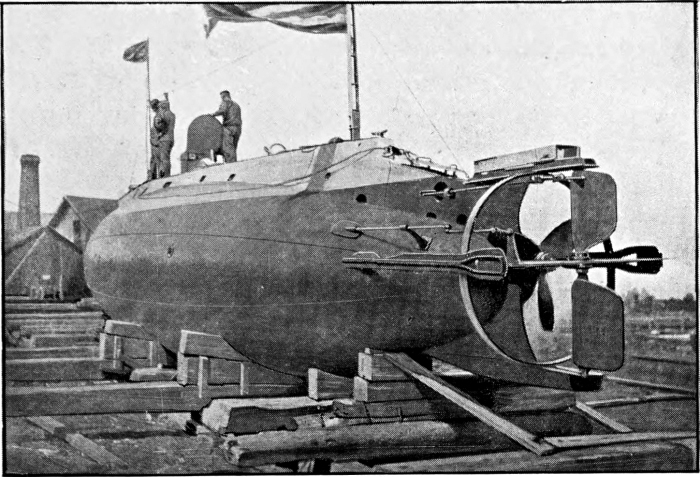
THE “HOLLAND” SUBMARINE.
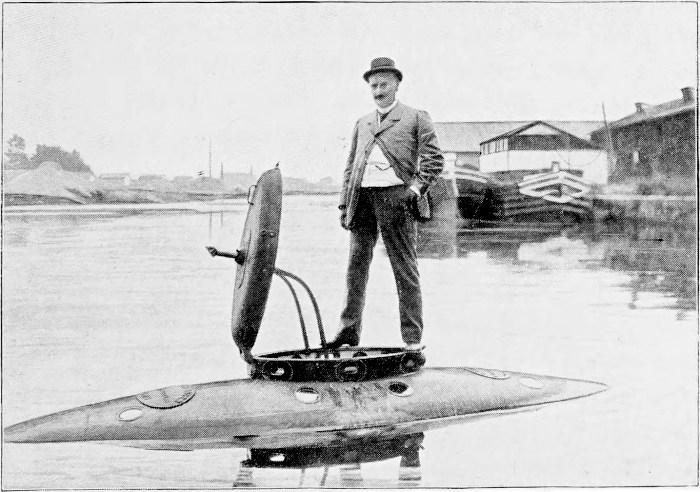
THE “GOUBET” SUBMARINE.
Probably the first really successfully designed submarine was
that of Robert Fulton, the American, who submitted his plans
of the Nautilus to the French Directory in 1797. His first
boat was tried experimentally on the Seine in 1800. His next
boat had iron ribs, and was copper-sheathed, and was shaped
like a very long egg; it was fitted with a small hinged mast
and a bat-wing sail, so that it could be used for surface navigation
if necessary. He made a few descents in the Seine
with success, but at no time stayed under water more than
twenty minutes. Still, the experiment was held to be sufficiently
promising for the boat to be tried at Brest, where he
failed in his attempts to do any damage to the English ships
of war. A preliminary experiment, before that against the
English, was successful. On the British side, a so-called catamaran
was contrived, by which it was intended to blow up
the French ships at Boulogne. The catamaran consisted of a
framework in which one man should sit immersed up to his
arm-pits, and should paddle himself along under cover of darkness,
and tow a floating box of powder to be exploded by
clockwork in so many minutes, this affording him time to
paddle away in safety. This floating mine or torpedo was to
be fastened under the counter of the wooden man-of-war.
Fulton is supposed to have had a hand in this, but the attack
when it was made ended in an absolute failure, the catamarans
making the attack being mostly blown up, while those vessels
against which it was directed suffered no harm whatever.
Upon his return to America, Fulton constructed a submersible
called the Mute, which was to fire “Colombiads,” or under-water
guns. Her inventor died during the course of her trials, which,
however, did not reveal anything to show that the boat would
have been other than an absolute failure as a warship. Though
the British and the French naval authorities were strongly
opposed to submarine warfare for a variety of reasons, American
inventors continued their experiments. A diving boat passed
under the British 74-gun ship Ramilies three times, and at last
got close under the vessel, and tried to fasten a clockwork
mine to it by means of a screw after the plan Bushnell adopted,
but the screw broke. Other attempts were made, and as there
were then no means of discovering when a submarine attack
was intended, the British officer in command placed a number
of American prisoners on board his ships and notified the
American Government that if any of the ships were blown up,
the American prisoners as well as the crew would go with it.
What was known as an American torpedo-pilot was really a
large boat covered from end to end with a curved iron deck,
above which was a small pilot-house or look-out chamber,
which also served as a ventilator; the boat was propelled by
paddle-wheels, and travelled so low in the water as to be practically
awash, and towed a mine behind her. Some of these
mines or torpedoes contained as much as six barrels of
gunpowder. An Englishman named Johnson designed a
submarine or diving boat in which he was to have rescued
the ex-Emperor Napoleon from Saint Helena, but Napoleon’s
death intervened.
Various inventions were tried at one time and another, and
the misfortune is that in many cases the first experiment proved
to be the last, for the contrivances were the inventors’ coffins.
Some of these fatalities were unquestionably due to the submarines
being made to descend too low, when they gave way
under the enormous pressure of the water.
The first effective submarine designed for war purposes
was a cigar-shaped boat constructed by an American shoemaker
named Phillips. The boat was built of iron and carried
a colombiad, which could be fired through a port in the iron
plating, and also a couple of torpedoes or mines. Numerous
experiments with this boat were successful, but Phillips descended
once too often.
A German named Bauer invented a diving boat, which
scared the Danes badly in the war between Denmark and
Prussia in 1848-50. At its second voyage it descended too
far, but Bauer and his two companions escaped through the
scuttle. Thirty-six years later the boat was fished up, and is
now in the Naval Museum at Berlin. Failing to get any more
money in Germany, and being suddenly dropped in Austria
after the Court and Government had given him much encouragement,
he came to England, where the Prince Consort became
his patron. He designed a submarine, but his plans were
altered by some of the leading engineers, ship-builders, and
statesmen, who, whatever their skill in surface navigation and
diplomacy may have been, knew next to nothing of submarine
navigation. The consequence was that his boat as
altered to suit their views was a failure, and the discredit was
cast upon Bauer. Still believing that he was right, he betook
himself to the United States, but the American Government,
probably finding that the local supply of inventors and submarines
was a long way in excess of the demand, turned a
deaf ear to all his suggestions. He went back to Europe, and
the Russian authorities authorised him to construct his Sea
Devil which, after numerous experiments, was sunk under
circumstances never fully explained. He managed, however,
in one of his trips with her, to enter Sebastopol harbour, to the
great dismay of a Russian sentry who, seeing him gliding by
night in a standing position along the surface of the water, took
him for a ghost, dropped his rifle, and ran. The loss of his
boat has been attributed to an order of the Russian Government
that it should be deliberately sunk to get it out of the way.
The French boat Plongeur, launched at Rochefort in 1863,
was cigar-shaped with the upper side flattened, and was driven
by an engine deriving its power from compressed air. She was
too long for her width to be of much use, and had no stability.
The first Confederate David has already been alluded to,
and the Southerners were so pleased with the success that they
ordered another. In five experiments the second boat sank
five times, and drowned altogether thirty-five men. Before
she went down the next time it was determined that she should
attack one of the Federal warships. She was directed against
the Housatonic, then one of the fleet blockading Charleston.
The David was being navigated along the surface of the water
instead of beneath, and her scuttles were open. The little
vessel’s spar-torpedo struck the warship in line with the magazine.
Nothing was ever seen of the David afterwards, nor
of her crew. The Housatonic went down, but nearly all on
board were saved.
Though the Davids proved as destructive to themselves as
to the enemy, they demonstrated as nothing else could have
done that a small boat approaching noiselessly under cover
of darkness could destroy by means of mines or torpedoes a
hostile ship.
The most inappropriately named submarine was the
Resurgam, invented by an English clergyman named Garrett,
for during an experiment off the Welsh coast, in 1879, it never
returned to the surface after diving.
The first submarine as a locomotive engine of warfare was
invented by John P. Holland, and it is to his boat, known
as the Holland the First, that all the modern submarines and
submersibles owe their parentage. It was a one-man affair,
just big enough to allow him to sit down in it and work with
his feet the paddle arrangement that turned the propeller
shaft. It carried five small torpedoes, which could be placed
outside through a chamber in the dome or conning tower,
and were discharged by electricity. This marked the introduction
of one of the means which made modern submarine
vessels possible, for until it was discovered how to use electricity
in this way, a clockwork arrangement was the only reliable
method by which a torpedo could be exploded. The application
of electricity rendered it possible to eject the torpedo a considerable
distance from the ship, comparatively speaking, and
by means of connecting wires discharge it when thought
advisable. This vessel was only 16 feet in length. The second
Holland, built in 1877, was only 10 feet long. A small gas or
oil engine was introduced to drive the screw propeller of a
third submarine built by Holland two years later. This boat
was 31 feet long, 6 feet in diameter, and cigar-shaped. The
experiments he conducted with it showed that it was impossible
to depend on ordinary vision when travelling in any depth of
water on account of the darkness. She carried a pneumatic
gun discharging a 9-inch projectile, the range of the weapon
being 130 feet. It was not until 1884 that Holland’s fourth
boat appeared. In the following year he tried again with a
rather larger vessel, 40 feet long and 7 feet in diameter, often
called the Zalinski, because it was fitted with pneumatic guns
of the type invented by an American army lieutenant of that
name. Again there was a long silence in regard to Holland,
until he submitted the designs of his seventh boat—the sixth
was planned but never built—to the American Government,
which had decided to adopt the under-water torpedo boat as
a definite part of the navy. The Holland the Seventh, as designed
and launched, was to be 85 feet long, of 100 tons displacement,
and to carry three torpedo tubes and two steel armoured gun
turrets. The Holland Company had meanwhile designed a
vessel they considered much superior, and the Government
consented to adopt it in place of No. 7. She was something
like a porpoise, and above a semi-cylindrical hull carried a
flat-sided superstructure, which has been one of the distinguishing
features of the Holland type of submarines from that
day to this. Her aerial torpedo was to carry 100 lb. of gun-cotton.
After discharging it she was to dive, approach the
vessel she sought to destroy, and fire her Whitehead torpedo.
If this missed, she was to go under the vessel and discharge
her after submarine gun immediately after passing underneath.
The Holland was altered and improved, and when the French
announced that they had become possessed of types of submarines
and submersibles upon which dependence could be
placed in time of war for destroying an enemy’s vessels, the
British Admiralty abandoned the attitude of scepticism and
watchfulness combined it had maintained for so long, and
ordered five boats from the Holland Company for experimental
purposes. The experiments which were made with these
boats resulted in the Government becoming possessors of what
were known as the A class of submarine.
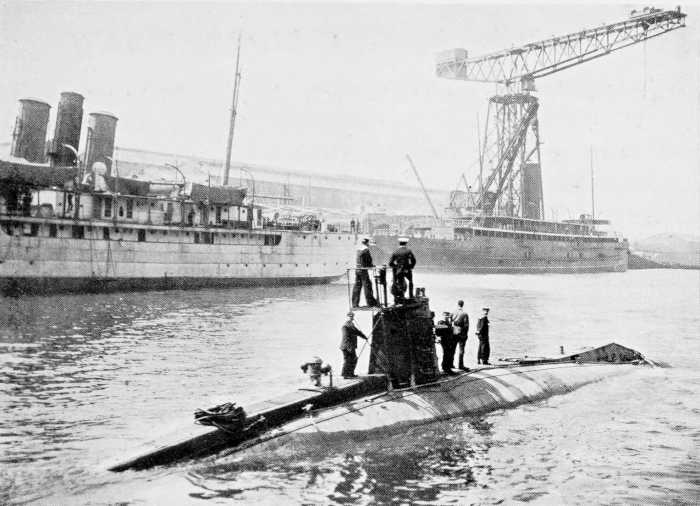
BRITISH SUBMARINE A13.
Photograph by E. Sankey, Barrow.
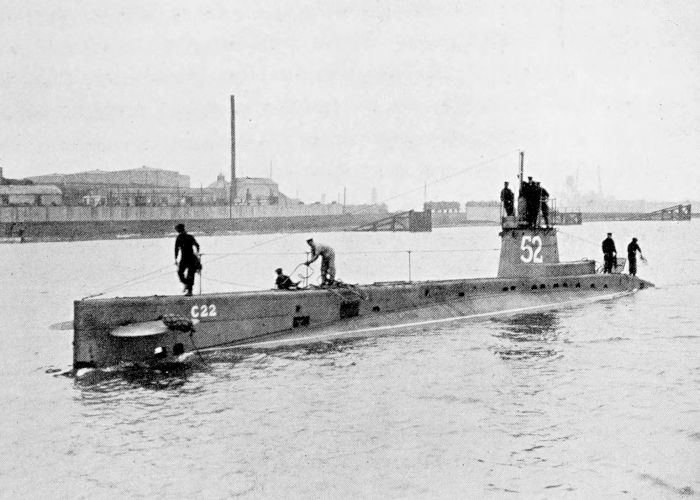
BRITISH SUBMARINE C22.
Photograph by E. Sankey, Barrow.
Very little has been revealed of the details of modern submarines,
for if there is one subject more than another upon
which the admiralties of the world are agreed, it is that they
should not let one another know the secrets of the mechanism
of these under-water craft. That, at least, is the theory, but
it is very questionable if all the governments are not quite
well informed as to the constructional details of each other’s
submarines, and probably know almost as much about them
as they do about their own. The experiments at Barrow
and elsewhere with the Holland boats and their successors
have been responsible for the introduction of several classes
of submarines, every one of which embodies improvements
upon its predecessor. The five boats built for Great Britain
at Barrow, in 1902, were 63 feet 4 inches in length by 11 feet
9 inches breadth, by 12 feet 1 inch depth, and had a surface
speed of ten knots and a submerged speed of seven knots. The
A class, which appeared in 1902, began with a vessel of 180 tons
displacement, and 100 feet in length by 12 feet 8 inches beam.
Larger vessels of this class were built from 1904 to 1907 of
204 tons displacement, but varying considerably in dimensions.
The B class of 313 tons submerged displacement was introduced
in 1903-4. These vessels were 135 feet by 13 feet 6 inches,
and had a cruising speed of fourteen knots and a submerged
speed of nine knots. The C class, which resembled the B class
in many particulars, appeared in 1906-7, as did also the D class,
but the latter were of 500 tons submerged displacement and
of fifteen knots cruising speed. The five boats built on the
Holland designs were each propelled by a 4-cylinder 190 h.p.
petrol engine besides an electrical engine of 70 h.p. The
armament was an 18-inch torpedo tube in the bow, and each
carried five torpedoes. These vessels were divided into seven
compartments. The deck was 31 feet 4 inches by 4 feet 5 inches.
There were two diving rudders at the stern, and the conning
tower, of 32 inches diameter, was formed of 4-inch armour.
The A type, the first of which sank in March, 1904, off Spithead,
had a 12-cylinder 600 h.p. gasolene engine. The B type had
engines of 850 h.p., and could carry 15 tons of fuel structurally,
and were provided with a forward superstructure. The D type
have heavy oil engines, and can carry 15 tons of fuel. Yet
another and more advanced type of submarine is stated to be
under consideration and possibly under construction. It is to
be larger, according to report, than any existing submarine,
and is to carry a gun, which it will come to the surface to discharge.
Is this to be the forerunner of a new cruiser, to be
equally at home and equally dreaded, whether it be operating
at the surface or beneath the waves, advancing stealthily upon
its foe?
The Japanese, when they decided upon importing some
submarines from this country, had two specially built at Barrow.
It was not thought advisable to send them under their own
power, or in tow of tugs, to the Far East, so a special vessel
was built for their accommodation. For two-thirds of her
length her main deck could be removed and her bottom was
constructed to permit of the two submarines lying side by side.
In order to get them on board, this steamer, which was called
the Transporter, was sunk in dock at Liverpool, the submarines
were floated into place and the water was pumped from the
dock, and, of course, from the steamer also. As it subsided,
the submarines were carefully adjusted in their cradles, and
when this work had been completed, the Transporter with her
strange cargo returned to Barrow in order to be prepared for
the voyage to Japan.
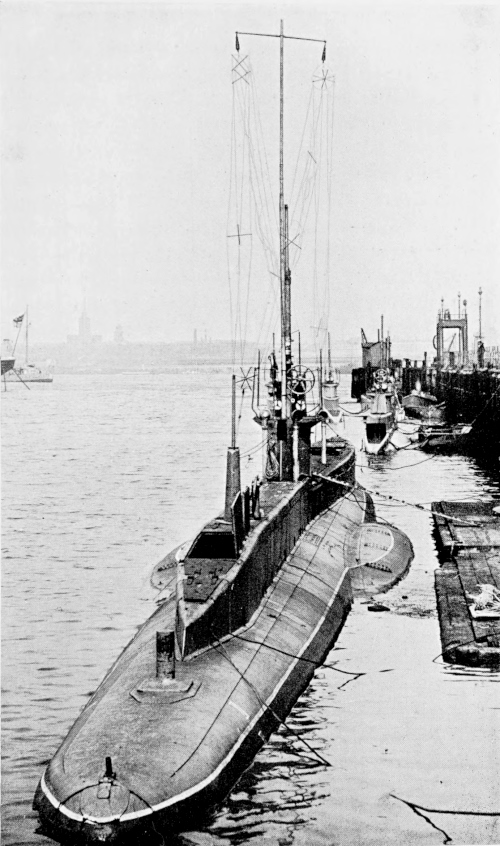
SUBMARINE D1, WITH WIRELESS TELEGRAPH MAST.
Photograph by Stephen Cribb, Southsea.
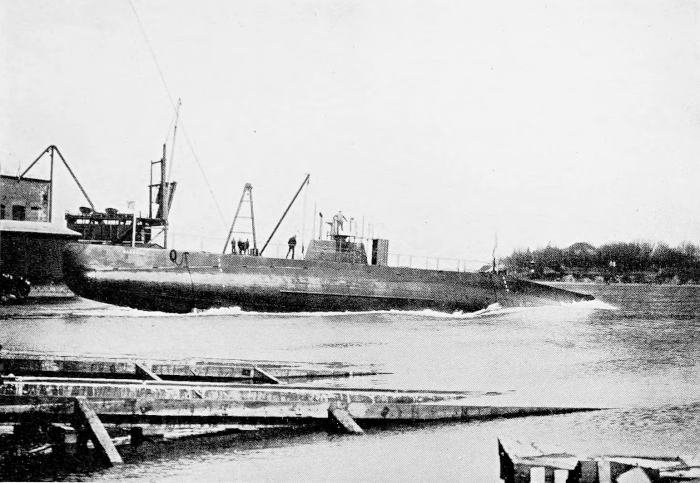
LAUNCH OF U.S. SUBMARINE “NARWHAL.”
Photograph supplied by the Fore River Shipbuilding Co.
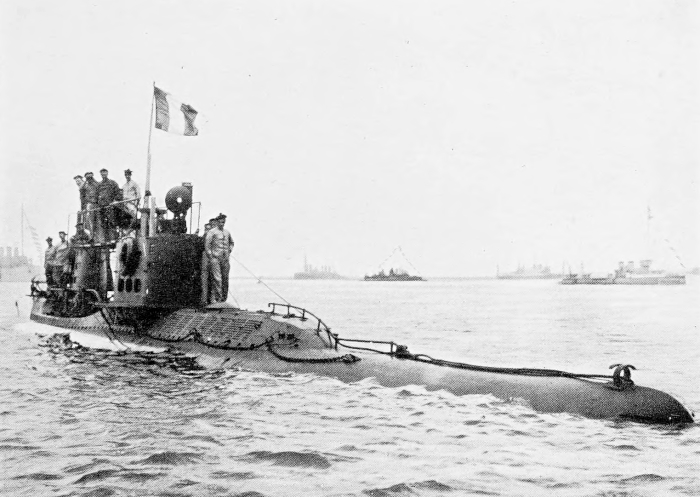
FRENCH SUBMARINE “X.”
Photograph by Stephen Cribb, Southsea.
It is necessary, however, to consider what other nations
have done in connection with the submarine, long before the
Holland was adopted by the British Admiralty. A Swedish
inventor, Dr. Nordenfeldt, who had given a great deal of attention
to the subject, was attracted by Mr. Garrett’s method of
what was called “bottling up” the steam engine, so as to
permit of the vessel diving under water. The first Nordenfeldt
was cigar-shaped and 64 feet long, and was remarkable in one
respect, for she was the first to carry a tube for discharging
Whitehead torpedoes. She underwent in the presence of
Royalty a fairly successful trial on the first day, and was
ultimately purchased by the Greek Government. In 1887
Dr. Nordenfeldt and Mr. Garrett designed boats with screws
placed on top, for regulating the ascent and descent, and the
torpedo tube of each was carried at the outside of the bow
instead of inside. One of these boats was taken by Mr. Garrett
to Constantinople, where she was put through numerous evolutions
in the presence of the Sultan himself and the greater
part of the population of that city. The engineer and
Mr. Garrett understood their work perfectly, but the same
could not be said for the Turkish crew who were told off to be
drilled in its manipulation. They knew nothing of submarines
and did not want to learn, and maintained their obstinacy to
the utmost. The trials took place in June, 1887. The Turkish
boatmen simply would not keep out of her way, until one of
them navigated his empty barge too close to the Nordenfeldt,
whose revolving propeller knocked such a large hole in the barge’s
bottom that it was as much as the boatman could do to get
it to the shore to save it foundering. After that the Nordenfeldt
was allowed more room. The first time, so far as navigation
was concerned, she was tried she was a success, but directly
her stability was altered by the discharge of her Whitehead
torpedo from the bows, her trim was changed very materially,
and it was even thought possible that she might go down
stern first. However, the Turks bought her and added her to
the collection of naval purchases of which they could make
little use. A later submarine was built by Nordenfeldt, but
proved no more stable, horizontally, than the other. It was
purchased by the Russian Government, and was lost on the
way to the Baltic.
The French have seemed to find an extraordinary fascination
in submarine navigation. It was very great before Jules
Verne published his fascinating romance, “Twenty Thousand
Leagues Under the Sea,” and became even more enthusiastic
than ever. Of the early French experiments it is not necessary
to say much. One of the first of the reliable French submarines
was the Goubet, 10 feet in length, 6 feet high and 3 feet wide.
This vessel was succeeded in the estimation of the French
naval authorities by the Gymnote, which proved as remarkable
a forerunner of a type as the Dreadnought did of the new type
of battleships, and, like the Dreadnought, she has been steadily
superseded by improvements upon her design. The Gymnote
was designed by M. Gustave Zédé, although the credit of
suggesting her in the first instance is sometimes ascribed to
M. Dupuy de Lôme. She was launched in September, 1888,
and was cigar-shaped. She displaced about 50 tons with
dimensions of 59 feet in length, 6 feet in depth, and 5 feet
7 inches in breadth, and her electrical motor was supplied
with the necessary power from a large installation of accumulators.
Her conning tower was telescopic, and she had a
periscope to enable her commander to take observations without
coming to the surface; she was one of the first vessels, if
not the first, to be fitted with a periscope or optical tube, the
principle of which is that a mirror placed at a certain angle
above the tube has its reflection reproduced by another mirror
placed entirely parallel to it at the bottom of the tube. She
carried two Whitehead torpedoes. M. Zédé planned another
submarine which was launched in June, 1893, and its electrical
installation nearly poisoned its crew owing to the fumes given
off. Another Goubet followed, but was so slow that the Government
rejected her. Since then, especially in the last few years,
the French Government has gone in for a singular variety of
these vessels. Some of them have undergone marvellous tests
with conspicuous success. But none have attempted such a
feat as two British submarines have accomplished, viz.,
from England to Hong Kong. They were towed part of the
way, and escorted all of it, but their own power was not allowed
to be idle.
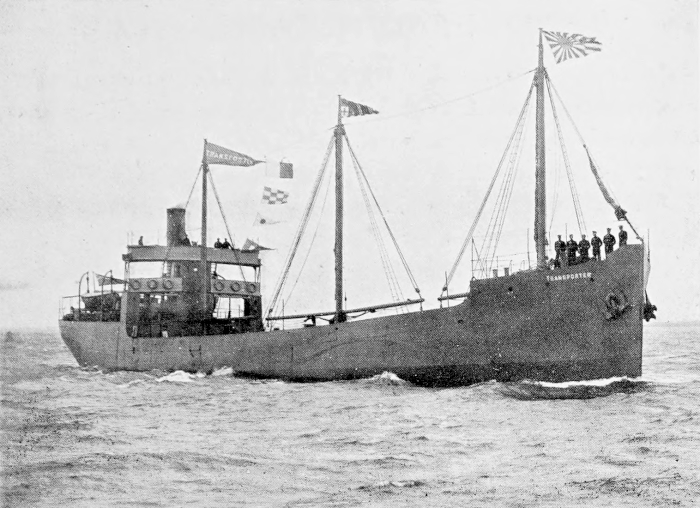
THE “TRANSPORTER.”
Photograph supplied by Messrs. Vickers, Ltd.
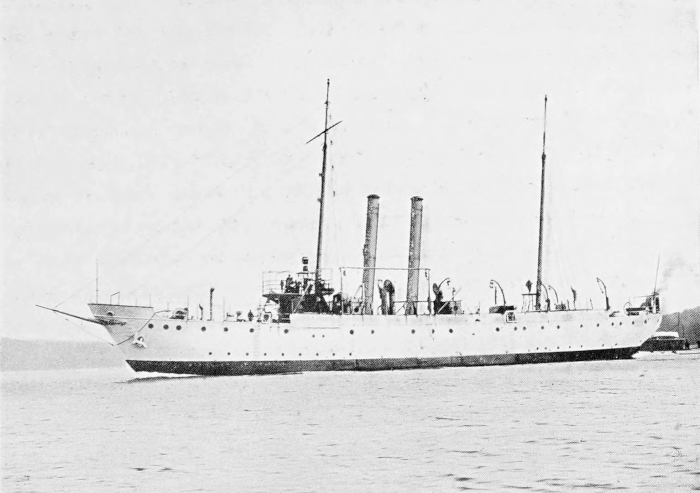
U.S. GUNBOAT “PADUCAH.”
Photograph supplied by the Gas Engine and Power Co.
It is now attempted to propel French submarines by Diesel
engines for surface work, and by electric motors for underwater
work; the result of the experiment is not known at the
time of writing.
The Russian Government is said to favour submarines of
the Lake pattern, so named after its American inventor, of
which a great deal is thought; and America is said to have
adopted both Holland and Lake submarines. One Lake boat was
provided with wheels, and went on a submarine motor tour
along the New England coasts, and Mr. Lake finally offered to
demonstrate the usefulness of his vessel by finding and cutting
the cables of the mines protecting one of the American ports.
This was more than the American Government could allow, so
he had a cable laid across a harbour mouth, and having found
it, severed it.
The Italian authorities have modified the Holland and
French plans to suit their own ideas, and though their boats
are said to have given excellent results, singularly little is known
about them.
All makes of submarines and submersibles have to return
to the surface at fairly frequent intervals to renew the supply
of fresh air, and have to approach it at even more frequent
intervals in order that the navigating officer may see what
are his surroundings at the surface, and, in time of war, whether
it would be safe for him to bring his vessel up. The difficulty
of finding his way about without revealing his whereabouts
by exposing the periscope to view is one of the greatest the
commander of a submarine has to meet, but it would be futile
to say that the ingenuity of scientific inventors will not overcome
even this difficulty.
TORPEDO BOATS AND DESTROYERS
When the Iris was given a speed of 18½ knots, many
declared that the limit in speed, with a due regard to safety,
had been attained. Much the same was said when Mr. Thornycroft
brought out the Lightning in 1876, the first real torpedo
boat ever built for the British Navy, which had a speed of
18½ knots. Now, however, the speed has been more than
doubled, and the sea-going qualities of the vessels are so much
better that there is scarcely room for comparison. In 1873
the same firm built for the Norwegian Government a small
steamboat intended to be employed in torpedo work only.
The Lightning was 87 feet over all, with a displacement on
her trials of 28½ tons; now torpedo boats are a hundred
feet or so longer.
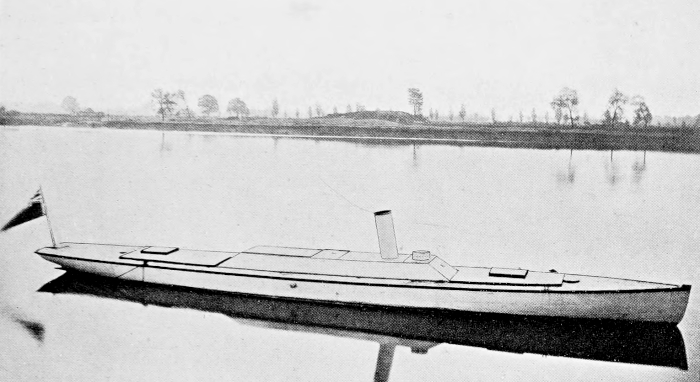
THE EARLIEST EUROPEAN TORPEDO BOAT. BUILT FOR THE NORWEGIAN
GOVERNMENT IN 1873. SPEED 18 KNOTS.
Photograph supplied by Messrs. J. Thornycroft & Co., Ltd.
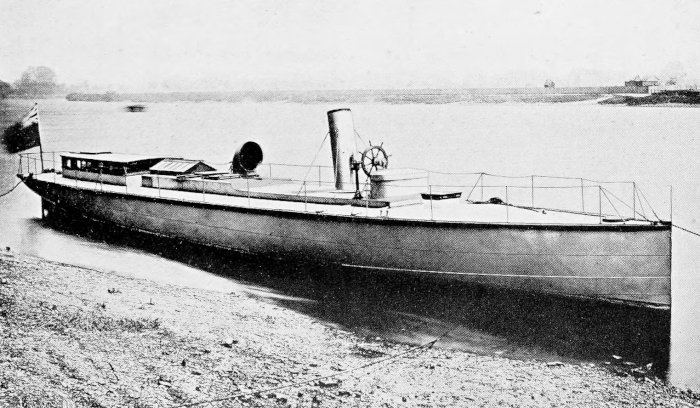
FIRST BRITISH TORPEDO BOAT, “LIGHTNING.” SPEED 18 KNOTS.
BUILT IN 1876.
Photograph supplied by Messrs. J. Thornycroft & Co., Ltd.
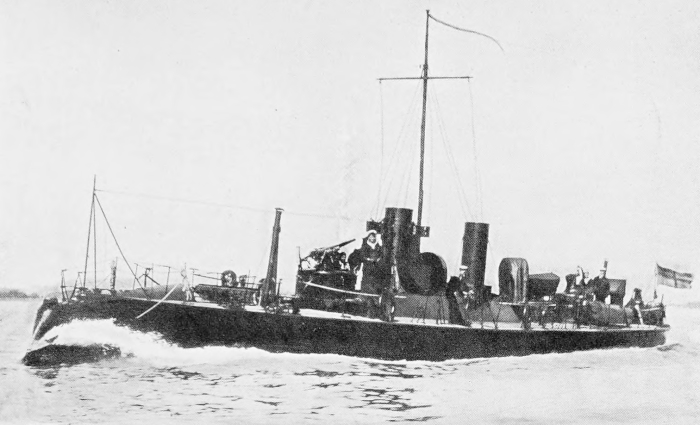
H.M. TORPEDO BOAT NO. 79, BUILT IN 1886.
Photograph by Stephen Cribb, Southsea.
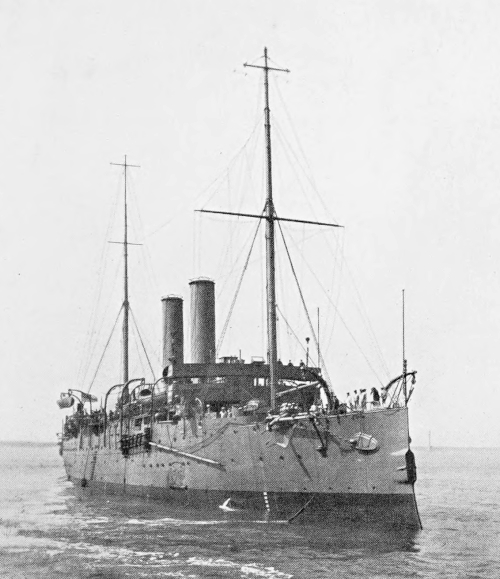
H.M.S. “VULCAN.”
Photograph by E. Sankey, Barrow.
A small torpedo boat built for the Russian Government
by Messrs. Yarrow, in 1879, was considered to be the most
formidable vessel of her class afloat. Her speed was 22 knots,
and on 10 tons of coal it was estimated that she would be
able to steam 800 miles at a speed of 10 to 12 knots. Her
stem was formed to be a sharp ram, and from the conning
tower to the stem she had a hood over her deck to throw off
the water she might take over her bows. The two launching
tubes for her Whitehead torpedoes were on either side of the
bows. The theory was that the first torpedo should break
through the nets or other guards, and that the second torpedo,
discharged a few seconds later, should pass through the gap
thus made in the ship’s defence and attack the hull itself. A
comparatively recent invention is a contrivance to be carried
on the nose of the torpedo to cut through the net.
Torpedo boats had to have their “parent ship,” or ship to
which they could go for any repairs to be made when at sea.
The parent ship was necessarily a floating torpedo boat factory,
and, if the torpedo boat were not too large, could hoist her on
board and repair her as effectually as if she were in dry dock
or on the slips ashore, and lower her again to the water when
the work was finished. The Vulcan, of 6,620 tons displacement,
was launched in 1889 to undertake these duties, and also act
as a laboratory in connection with the mining service. She
had two powerful hydraulic cranes for hoisting in and out
torpedo boats, of which she carried six on her deck for the
assistance of the fleet she might accompany, and also had two
counterbalancing barges and steam pinnaces. In order that
she might be able to protect herself she was equipped with
twenty quick-firing guns. Several “parents” or floating repair
ships have been added to the Navy of recent years, and every
one of them is as modern as science and money can make her.
Having a large fleet of cruisers and battleships, it has been
the British policy of late years to arm them with a powerful
secondary battery, especially designed to meet torpedo attack.
It is not touching upon international or diplomatic questions
to state that the very preponderance of the British fleet has
rendered the risk of invasion of these islands exceedingly small,
and the resources of this country have been, and are, so vast,
that the much-debated two-power standard—in spite of the
numerous and contradictory estimates of comparative naval
strength based upon it—has, on the whole, been maintained.
If the theoretical British frontier be the coast-line of a possible
opponent, it is evident that vessels which can steam to an
enemy’s coasts and destroy his torpedo boats there are of greater
use than the torpedo boats which can only operate along the
coast-line, or venture to cross the seas in fine weather. This
has been set forth as one reason why the British Admiralty of
recent years has preferred destroyers to the smaller vessels.
The introduction of rapid-firing guns of great power and
range is claimed by some naval authorities to have reduced
very materially the effectiveness of the torpedo boat. Its
speed has been doubled in a few years, but it is contended
that with the improvement in guns this has been more than
neutralised by the greater size it has been necessary to give
the torpedo boats in order to provide sufficient space for the
machinery and retain the vessel’s sea-going qualities, as the
increased size renders the vessel easier to hit. It must be
remembered, moreover, that the anti-torpedo boat armament
of a modern warship can fire as many as a hundred shots a
minute, or several times as many as when torpedo boats were
added to the world’s fleets.
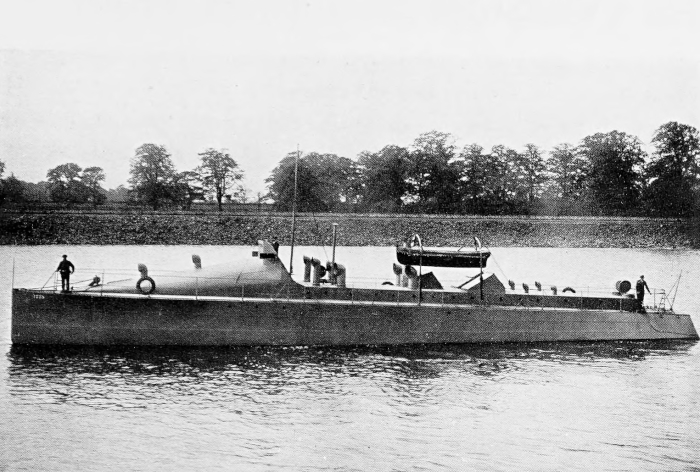
HIGH-SPEED SEA-GOING TORPEDO BOAT OR GUNBOAT, PROPELLED BY
INTERNAL COMBUSTION ENGINES. SPEED 23 KNOTS.
Photograph supplied by Messrs. Yarrow & Co., Ltd.
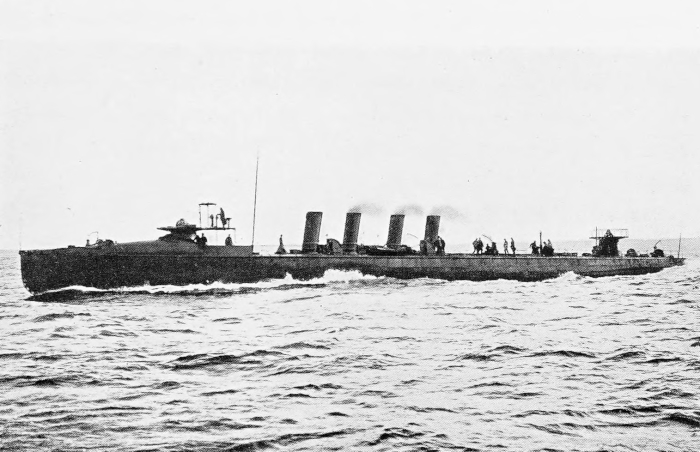
U.S. DESTROYER “LAWRENCE.”
Photograph supplied by the Fore River Shipbuilding Co.
Some of the Continental powers have been quick to appreciate
the value of the torpedo boat as propelled by internal
combustion engines, among the most noteworthy examples
being those built and engined by Yarrow for the Austrian
Government. The “E,” for instance, is 60 feet in length by
9-feet beam, and has a draught of 2 feet 8 inches. She has
three screws, and her five sets of these engines give her a speed
of 22¼ knots, in spite of her diminutive size, and her radius
of action at 11 knots is three times what would be obtainable
with vessels of the same size propelled by steam. Another,
of the same length, has attained a speed, when light, of 25½
knots, and of 24 knots with a load of 3 tons, and her radius
of action at full speed is 250 miles. A somewhat larger vessel
from the same makers is 100 feet in length, with a beam of
13 feet 6 inches, and her internal combustion engines give her
a speed of 23½ knots. The advantages, and they are very
great, claimed for all boats propelled by powerful engines
of this type over those propelled by steam engines, are that
as the vessels have no funnels there can be no flaming from
funnels, with its risk of betrayal of the vessel’s whereabouts;
that only half the engine-room staff is required, and that
the range of action is three times what it would be under
steam.
The development of the torpedo boat as a means of offence
soon made it necessary for a means to be devised of defeating
them. The torpedo gunboat was accordingly designed, the idea
being that it should be able not only to act as a small cruiser,
scout or gunboat, but by reason of its superior size, armament,
and sea-going qualities should hold the torpedo boats in check.
One of the earliest of these was the French Bombe launched
in 1885. She was of 395 tons displacement, and was intended
to have a speed of 18 knots, but being lightly constructed,
proved a slow boat whenever there was the suspicion of a sea on.
England followed suit with the Rattlesnake and others, of
550 tons, but they also failed to maintain their designed speed
of 19½ knots. Improved gunboats followed, which, however,
were not considered to be equal to the duties required of them,
especially as by 1902 torpedo boats were built to travel at a
speed which would leave the gunboats far behind.
This left the way open for the appearance of the torpedo
boat destroyer, which has been described as the result of the
failure of the gunboat to perform its second purpose satisfactorily.
The destroyer was designed to be able to overtake torpedo
boats by superior speed, to be of larger dimensions, and therefore
able to maintain her speed in rougher weather than the
torpedo boat could, and to be sufficiently powerfully armed to
sink a torpedo boat or hostile destroyer by gun-fire. The
destroyer was also to carry torpedoes, it being desired to take
advantage of the great speed to deliver torpedo attacks upon
cruisers and other large ships as occasion offered. The earliest
British destroyers were the Daring of 237 tons, in 1893 the
Hornet of 240 tons, and the Ferret of 250 tons, built respectively
by Thornycroft, Yarrow and Laird, all three boats having a
speed of 27½ knots; and about two years later the Palmer firm
built at Jarrow the Janus, Lightning, and Porcupine of equal
speed. With Thornycroft’s Boxer, in 1894, the speed was
brought up to 29 knots; and in the same year the Desperate,
280 tons, and the Quail, 305 tons—two odd names to be
associated—were the pioneers of the destroyers of the 30-knot
type, many of which attained to 32 knots. These were turbine
boats, but the Albatross by Thornycroft, with reciprocating
engines, also attained 32 knots in 1899. The last 30-knot
destroyer had her engines fitted with forced lubrication on a
special system, which overcame the difficulty of oiling the
engines satisfactorily for running at the high speed necessary
and was the first destroyer in the British Navy to be thus
equipped.
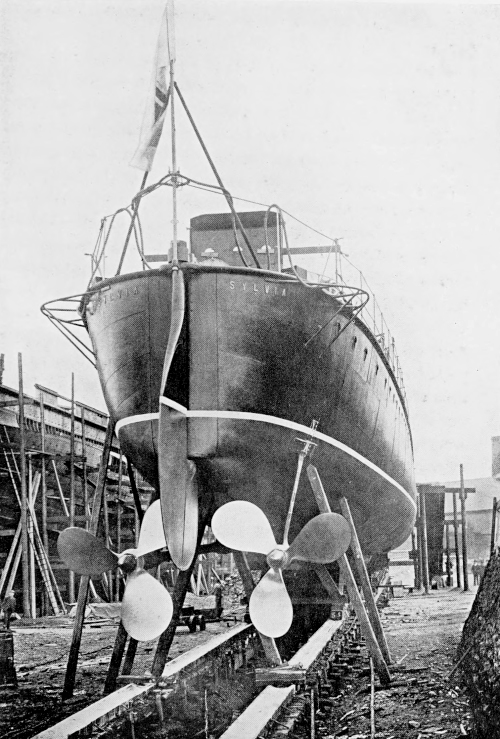
STERN VIEW OF H.M.S. “SYLVIA.” 30-KNOT DESTROYER, WITH
COAL-BURNING
WATER-TUBE BOILERS.
Photograph supplied by Wm. Doxford & Son, Ltd., Sunderland.
No further advance of a sensational character was announced
until the Star was launched from Palmer’s yards, and she was
surpassed very shortly afterwards by the performance of the
little steamer Turbinia. This vessel was only 100 feet in length,
and of 44½ tons displacement. The engines of the Parsons
type of turbines, with which it was fitted experimentally,
received the cold shoulder, which seems to be the fate of all
innovations that do not come into the world through official
channels. But the owners of this vessel and the proprietors
and inventors of the engines adopted a method of compelling
recognition as daring as it was successful. The occasion chosen
was the naval review held in honour of the diamond jubilee
of the late Queen Victoria, and shortly before the Royal Yacht
arrived to pass between the rows of warships, this turbine
steamer shot into the fairway and went at her utmost speed
from one end to the other of the lines of steamships and the
finest assemblage of warships the world had ever seen, and
there was not in the whole British Navy one destroyer or
torpedo boat present that she could not outdistance. Thousands
of spectators witnessed the exploit, and the success of the
turbine engine was assured from that moment.
The remarkable development in steamship propulsion this
vessel heralded was represented in less than ten years by the
fastest and largest steamships in the world, and the largest and
fastest and most powerful battleships afloat. The builders’
estimate of the power of her rotary engines was that for every
ton of the machinery 72 h.p. should be developed, and though
this seems to have been accomplished in the Turbinia, equally
satisfactory results have not been attained in the large seagoing
destroyers fitted with turbine engines, but the results
were in advance of those obtainable with reciprocating engines.
It was not, however, until 1900 that the first turbine-driven
war vessel was added to the fighting force of the Navy.
The Admiralty had not been idle, and as the result of numerous
tests and inquiries made the great experiment which brought
about the revolution in the propulsion of the world’s fighting
ships. The mercantile marine led the way, the Allan line
being the first to have Atlantic liners equipped with turbines.
The Government watched the experiment carefully, and in spite
of opposition from some influential quarters decided to try
how turbines would act in a destroyer. This was the Viper, of
390 tons displacement. The hull and boilers were by Hawthorn,
Leslie and Co., and the engines were by the Parsons Turbine
Company. She astonished everyone by attaining a speed of
36.6 knots when running light, and from that time onward
the development of turbines for warships has been one long
series of progress.
The destroyers of the River class, begun in 1903 and completed
in 1906, had displacements varying from 540 to 590 tons,
but the speed of all of them was about 25½ knots. These were
followed by the coastal destroyers, designed, as their name
indicates, to operate as destroyers along the coast against
any hostile torpedo boats, but now classed as torpedo boats.
In the latter capacity their guaranteed speed of 26 to 27 knots
would stand them in good stead, but as destroyers they were
soon outclassed. Some of them were provided with turbines.
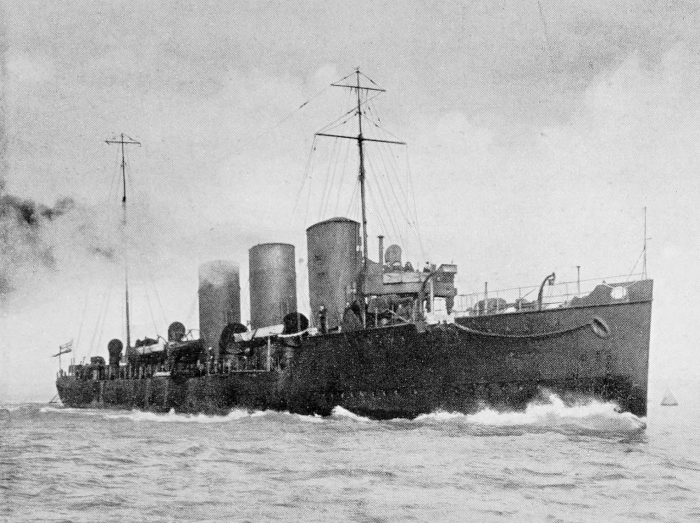
H.M. TORPEDO BOAT DESTROYER “SWIFT.” OIL FUEL.
Photograph by Stephen Cribb, Southsea.
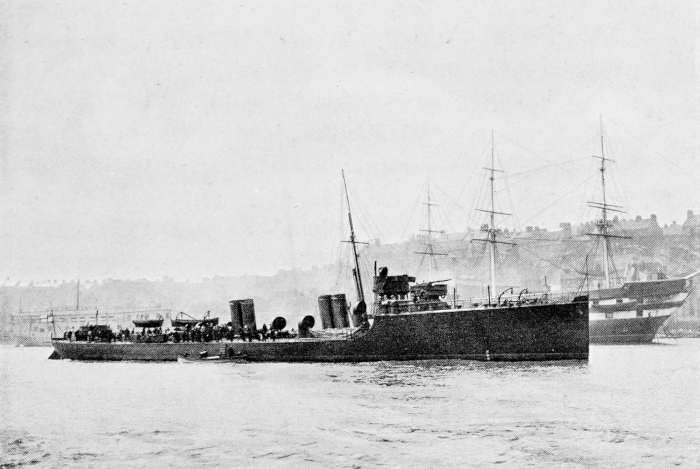
H.M.S. “WEAR.”
Photograph supplied by Palmer Shipbuilding Co., Ltd.
The announcement that the Admiralty favoured a speed
of 33 knots evoked a chorus of disapproval. The Admiralty
was supposed to have become obsessed by a craze for speed,
to which everything must be sacrificed. All the old objections
which had done duty at every increase of speed for years, and
had been proved to be ill-founded, were revived, brought up
to date, and launched against the Admiralty proposals. Again
it was contended that a vessel travelling at that speed must
inevitably founder if she should unfortunately bury her nose
in a wave, and that the violent alternation of stresses as she
travelled in a rough sea must cause her to break her back or
buckle her decks without more ado. But the Mohawk, in
1907, came and conquered, much to the delight of everyone
except those whose prophecies, as usual, were upset, and not
only attained a speed of 34½ knots, but accomplished it in
fairly rough weather in the wintry month of November of that
year, and proved her soundness of construction and the possession
of excellent sea-going qualities. An objection, which
at first was supposed to be serious, was that to attain such a
high speed her consumption of fuel would be so great that her
radius of action would be greatly restricted. The contract
under which the Mohawk was built by White, at Cowes, contained
the stipulation that she should maintain a speed of
33 knots for six hours; at her trials, however, she averaged
34½ knots. Her consumption of oil fuel on this occasion was
64¼ tons, and as she is fitted to carry 148 tons, her radius of
action at this enormous speed is 435 knots, and at 14 knots,
which is known now as the cruising speed, she is estimated
to cover 1,500 miles. Though 270 feet in length she is only
25 feet beam. She is constructed entirely of high tensile steel,
the tensile strength ranging from 37 to 40 tons per square
inch. Her three screw propellers are driven by turbine engines,
and it has been found that with oil fuel she can attain her full
speed in less time than would be possible were her furnaces
fed with coal. Her armament consists of three 12-pounder
rifled quick-firing breech-loading guns, two of which are forward
and one aft, and two revolving tubes on deck for firing 18-inch
torpedoes. Another of the class, Thornycroft’s Tartar, made
35.678 knots on the measured course, an almost equal speed on
the six-hours’ run, while the highest speed she showed was
37.037 knots, thereby establishing a world’s record.
The same year saw the launch of the Swift, at Birkenhead.
She has a displacement of 1,800 tons, and is the largest and
fastest destroyer yet constructed. She is of a special type,
a class by herself; her turbine engines of 30,000 indicated h.p.
give her a speed of 36 knots, and for armament she carries
four 4-inch guns and two torpedo tubes. Not far behind her
in dimensions and speed is the Japanese Kaifu, but a Russian
destroyer building at the Putilov yard in Russia is to be of
1,300 tons, but with engines as powerful as those of the Swift,
is expected to prove fully as fast, if not faster.
The ocean-going destroyers, built in 1909, have displacements
varying from 880 to 1,000 tons, and a speed of from
33 to 34 knots, a typical example being the Maori, built by
Denny at Dumbarton. The new naval force for the Australian
Commonwealth includes some very fine destroyers, among
which may be mentioned the Yarra.
A tendency has been manifest in some of the later destroyers
to provide better all-round fighting and sea-going qualities
than were possible in vessels like the Swift, in which speed was
all-important. The Beagle and Acorn are considered to be
good representatives of the compromise.
The bunker capacity of destroyers being very limited, and
their consumption of fuel large, it is evident that the scope
of their operations must be considerably restricted. At no
time is it possible for them to be more than fourteen days
away from their coal base. In case of necessity they might
coal at sea, if coal storeships accompany the fleet to which
they are attached. The adoption of oil fuel, which can be
stored in the double bottom, may increase the range at which
these vessels can operate, and if, as is expected in the near
future, destroyers driven by internal combustion engines are
adopted, their range of action will prove more extensive still.
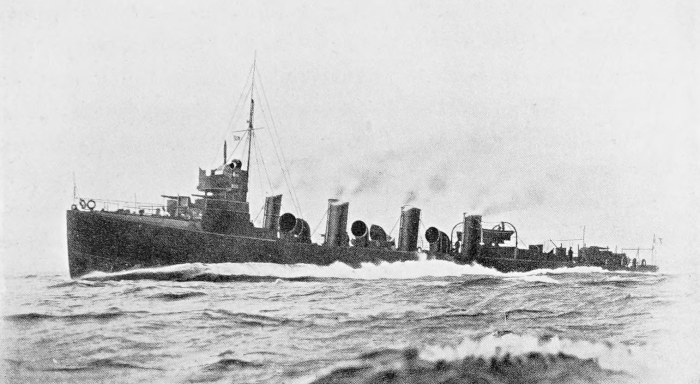
H.M. TORPEDO BOAT DESTROYER “TARTAR.” TURBINE DRIVEN, SPEED
35 KNOTS.
Photograph supplied by Messrs. J. Thornycroft & Co., Ltd.
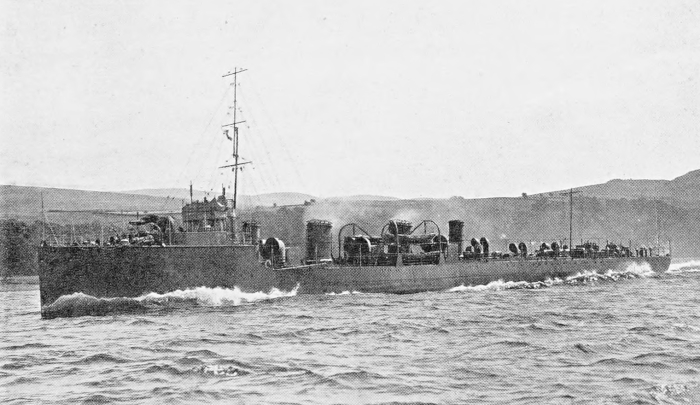
H.M. TORPEDO BOAT DESTROYER “MAORI.”
Photograph supplied by W. Denny & Brothers, Dumbarton.
German and British rivalry in the production of faster
destroyers and torpedo boats has resulted in the production
of two types, each peculiarly suitable to the country to which
it belongs; the British vessels have been designed rather for
the offensive, on the principle perhaps that the truest defence
is the swiftest attack, while the German boats have become
torpedo boats rather than destroyers, and though capable of
performing the duties of both roles, are considered by British
experts to be less destroyers than the British boats, which are
admittedly destroyers first and torpedo boats afterwards. By
1909 the tonnage of the British destroyers had reached 950
tons, the speed being 27 knots. In that year, too, the Admiralty
standardised its vessels instead of leaving the contractors to
design their own craft. Oil fuel was tried in the small boats
of these classes in the British Navy in 1904 and for three years
subsequently, but was dropped, only to be taken up again in
1909, in which year Germany also experimented in this direction.
The armament of the British and German ships shows
that the destroyers of the latter are meant to be torpedo boat
destroyers, though it is contended that they could be more
heavily and effectively armed still than they are without interfering
with their sea-going qualities and speed. The British
boats have probably the greater gun power, while the German
torpedo boats have the better torpedo power.
The scouts were a class introduced early in the present
century, intended to combine the advantages of a fast gunboat
with the speed of a small cruiser and the activity of a commerce
destroyer. One of the best examples is the Adventure, launched
in 1904, of 2,940 tons, whose engines of close upon 16,000 h.p.
under forced draught give her a speed of 25.4 knots. She
is, moreover, powerfully armed for a vessel of her lightness
and speed, as she has ten 12-pounders and eight 3-pounders.
The Americans in 1907 brought out the remarkable scout
cruiser Salem, built by the Fore River Company. She was a
24-knot vessel, and though only of 4,640 tons displacement
fully loaded, was given a freeboard of 34 feet at the stem, 19 feet
8¼ inches amidships, and 21 feet 6 inches at the stern, or higher
than that of any vessel then in the American navy, in order to
give her excellent seagoing qualities in all weathers, and a wide
range of stability. She was built of steel throughout, carried
two torpedo tubes, and is heavily armed.
The crushing defeat of the Russians by the Japanese in both
the naval engagements of the war was brought about by the
superior long-range firing of the Japanese, whose big guns
played havoc with the Russian vessels.
The Battle of Tsushima resulted in the “all-big-gun one-calibre
battleship of high speed.” How this came about has
been admirably demonstrated by Lieut.-Commander Simms, of
the United States Navy, and chief of the American naval
artillery department, in a remarkable report on the battle
and its influence on shipbuilding.
“Experiments have shown,” he wrote, “that it is exceedingly
difficult to hit an enemy at long range when the range
is changing rapidly. This is, of course, not true at short range,
but at long ranges half the danger spaces—those at which the
gun sights must be set in order to hit—are so small, say 50
yards. The bearing of these facts on naval tactics is very
important, since it means that, generally speaking, you cannot
make many hits at long range while you are manœuvring.
Conversely, you will not receive many hits at such a time,
because, when at short ranges, the most dangerous position in
which a ship can place itself is end-on to the enemy. It is
usually assumed that this is equally true at all ranges; but
this is not the case, provided the rate of change in fire is rapid....
From the point of view of the theory of gun-fire alone
it would be unwise to think of building a man-of-war of any
type having more than one calibre of gun in her main battery.
In other words, it may be said that the abandonment of the
mixed battery ships in favour of the all-big-gun one-calibre ship
was directly caused by the recognition of certain fundamental
principles of naval marksmanship developed by gunnery
officers.”
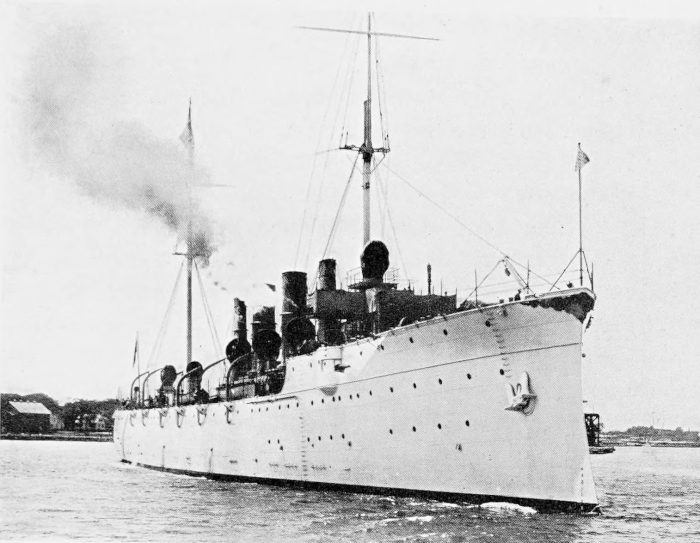
U.S. SCOUT “SALEM.”
Photograph supplied by the Fore River Shipbuilding Co.
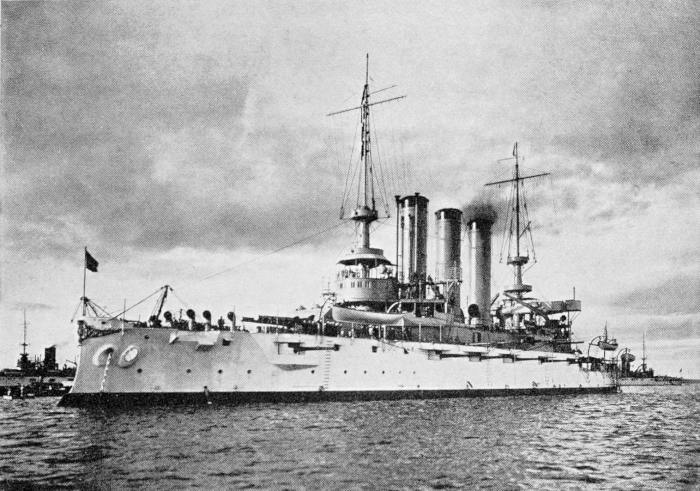
U.S. CRUISER “MAINE.”
Photograph supplied by the W. Cramp & Sons, Ship and Engine Building Co., Philadelphia.
There was no great heralding by trumpet-blast the arrival
of the Dreadnought. The true significance of this vessel only
became understood by degrees. The Admiralty kept its secret
well: indeed, it may be doubted if an Admiralty secret has
ever been so well kept before. A short paragraph in the papers
was all that was vouchsafed for the edification of the public
or the naval experts of other nations. It was known that a
warship to bear the historic name of Dreadnought was to be
launched, but the public took it for granted that it was an
addition to some “programme” or other, and regarding modern
battleships as too wonderful and too full of mechanism to be
comprehended by ordinary mortals, was content to accept that
much, and leave the rest to the experts. But the naval experts
of the other powers were astounded when they learnt the
march that Great Britain had stolen upon them. They appreciated
to the full the importance of the new era in warship
building which had been inaugurated, for they saw that England
had a lead which they could not overtake, and that with her
splendid resources she would be able to accept any challenge
for rivalry for first position which any power might offer.
The Dreadnought meant that any other warship afloat was
already rendered out of date. Her gun-fire, as much by its
weight as by the range of her guns, would enable her to pick
and choose where and when and how she would fight, and her
speed would enable her to prevent any ship, however powerful,
from shrinking from a combat if the Dreadnought thought fit
to insist upon one. It was even recognised that she was a
match for two or three of the most powerful ships that could
be brought against her, for her big guns would be equal to
theirs in hitting power, and their smaller guns would be ineffective
at the range at which she could fight. Again, by
concentrating a portion of her fire upon one of her antagonists
she would be able to crush it, and then turn her attention to
the other two with the odds as represented by gun-fire distinctly
in her favour. Some enthusiastic adherents of the Dreadnought
even went so far as to assert that she was equal to half a dozen
Lord Nelsons, but the more extreme views of this nature were
rather severely criticised. It was not only in the number of
big guns that the Dreadnought exceeded all previous ships,
but in their penetrative quality also. Compared with those
of the Majestic they are of about fifty per cent. greater power.
Lieut.-Commander Simms, however, was by no means the
only one or the first to hold the views explained in his report.
They were entertained by many authorities in other countries,
and especially in England, and the recognition by this country
of the importance of the theory led to the secrecy with which
everything connected with the Dreadnought was invested.
One notable change introduced with the Dreadnought was
that she had no intermediate or secondary armament. She
carried ten 12-inch guns as her main battery, and some smaller
guns to repel torpedo attack, but whereas the Lord Nelson
had twenty-nine anti-torpedo boat guns the Dreadnought had
but five, depending rather upon her smaller armament of twenty-four
3-inch quick-firers (12-pounders), and in addition she had
five under-water torpedo tubes.
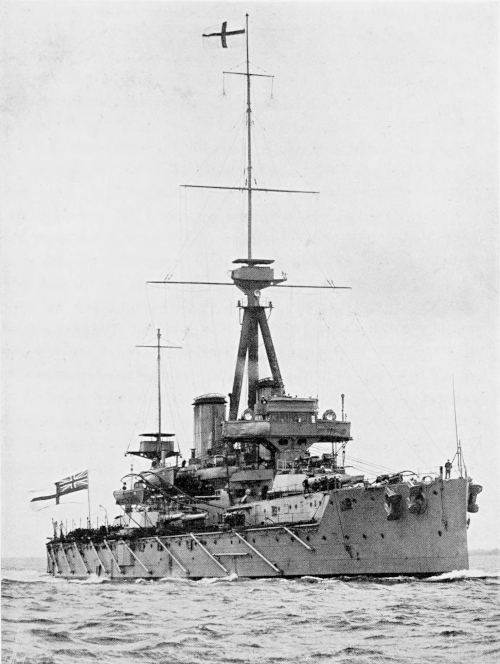
H.M.S. “DREADNOUGHT.”
Photograph by Stephen Cribb, Southsea.
A Parliamentary Paper issued at the time described the
arrangement of her guns as follows:—
“In arranging for a uniform armament of 12-inch guns it became
at once apparent that a limitation to the number of guns that could
be usefully carried was imposed by considerations of the blast effect
of the guns on the crews of those guns adjacent to them. It is
obviously uneconomical to place the guns in such relative positions
that the blast of any single gun on any permissible training should
very seriously hamper the use of one or more of the remaining guns.
While it is recognised that broadside fire is held to be the most
important in a battleship, all-round fire is also considered of great
importance, since it lies in the power of an enemy to force an opponent
who is anxious to engage to fight an end-on action. In the arrangement
of armament adopted six of the guns are mounted in pairs on
the centre line of the ship; the remaining four guns are mounted
in pairs on the broadside. These eight 12-inch guns—80 per cent.
of the main armament—can be fired on either broadside, and four
or possibly six 12-inch guns—or 60 per cent. of the main armament—can
be fired simultaneously ahead or astern.
“In view of the mobility of modern torpedo craft, and considering
the special chances of torpedo attack toward the end of the action,
it was considered necessary to separate the anti-torpedo boat guns
as widely as possible from one another, so that the whole of them
should not be disabled by one or two heavy shells. This consideration
led the committee to recommend the numerous and yet widely
distributed armament of 12-pounder quick-firing guns of a new design
and greater power than those hitherto carried for use against torpedo
craft. In order to give the ship sea-going qualities and to increase
the command of her forward guns a forecastle is provided giving
the ship a freeboard forward of 28 feet, a higher freeboard than has
been given to any modern battleship. The main armoured belt has
a maximum thickness of 11 inches, tapering to 6 inches at the forward
and 4 inches at the after extremity of the vessel; the redoubt armour
varies in thickness from 11 inches to 8 inches; the turrets and fore
conning tower are 11 inches thick, and the after conning tower is
8 inches thick. The protective deck varies from 1¾ inches to 2¾ inches
in thickness. Special attention has been given to safeguarding the
ship from destruction by under-water explosion. All the main
transverse bulkheads below the main deck—which will be 9 feet
above the water-line—are unpierced except for the purpose of leading
pipes or wires conveying power. Lifts and other special arrangements
are provided and give access to various compartments. Mobility of
force is of prime necessity in war. The greater the mobility the
greater the chance of obtaining a strategic advantage. This mobility
is represented by speed and fuel endurance. Superior speed also
gives the power of choosing the range. To gain this advantage the
speed designed for the Dreadnought is twenty-one knots.”
Turbines were decided upon because it was held that their
adoption conferred certain advantages which more than counterbalanced
their disadvantages. Compared with reciprocating
engines, they were said to be lighter, to have a less number
of working parts, to work more smoothly and be more easily
manipulated, and to be less liable to breakdown. They were
claimed also to show a saving in coal consumption at high
powers, and to require less boiler-room space and a smaller
number of engineers to look after them. Another important
consideration was that turbines could be placed lower in the
ship. The point which chiefly occupied the committee was
the question of providing sufficient stopping and turning power
for quick and easy manœuvring. A series of experiments with
pairs of sister ships, fitted respectively with reciprocating and
turbine engines, and also at the Admiralty experimental works
at Haslar, influenced the Admiralty in their decision in favour
of turbines. The Dreadnought’s bunker capacity is 2,700 tons,
with which she could steam 5,800 sea miles at economical
speed, or 3,500 sea miles at 18½ knots, due allowance being
made for extra consumption in bad weather, and for a small
quantity being left in the bunkers. Oil fuel was not taken
into account in estimating the ship’s radius of action, but a
considerable quantity was arranged for and would, of course,
greatly increase her effectiveness in this respect.
Another innovation in this remarkable ship was in the
rearrangement of the principal officers’ quarters. Hitherto they
had been accommodated as far as possible from the conning
tower, where their most important duties were performed, but
in this ship the admiral’s and captain’s quarters are placed
on the main deck forward, near the conning tower. The officers’
quarters also are placed forward, both on the main deck and
on the upper deck. Ample accommodation for the remainder
of the crew is available on the main and lower decks aft.
Space does not permit—and to attempt it would be out of
place in a book of this character, which does not profess to
do more than indicate the general lines upon which the world’s
warships have developed—of a detailed account of all the ships
which have followed the Dreadnought. Some idea of the
wonderful progress that has been made may be obtained from
a comparison of the Dreadnought herself and one of her latest
successors, the battleship Orion, in the matter of armament.
The Dreadnought could fire on the broadside eight guns of
12-inch calibre, throwing projectiles of 850 lb. weight, her
weight of broadside being 6,800 lb. The Orion has ten guns
on the broadside having a calibre of 13½ inches, and throwing
projectiles of 1,250 lb. in weight, the weight of broadside being
12,500 lb. Now, if we take the ships intended to be able to
take their place in the line of battle since 1906, we find the
evidence of development to be equally startling. The dimensions
of the Lord Nelson and Agamemnon have already been
referred to, and are of exceptional interest in this connection
as showing the type of vessel the Dreadnought superseded. This
vessel herself was exceeded slightly in displacement by the
Bellerophon, Temeraire, and Superb, which had sixteen anti-torpedo
boat 4-inch guns, as against the twenty-seven
12-pounders of the Dreadnought. The St. Vincent, completed
in 1909, and her sisters the Vanguard and Collingwood, completed
in 1910, are 500 feet in length by 84 feet beam, and
have a displacement of 19,250 tons, and engines of 25,400 h.p.;
their armoured belt is 9¾ inches thick amidships, tapering fore
and aft to 6½ inches, while the armour of the barbettes is 11 inches
in thickness, and the protective deck is 2¾ inches. They have
the same number of big guns and torpedo tubes, but the number
of the 4-inch anti-torpedo guns was increased to twenty, and
they also had six Maxims. In 1911 the Colossus, Hercules and
Neptune were launched, and showed a very great advance on
those immediately before them. Their length was increased
to 510 feet, and they were 86 feet in the beam and of 20,250 tons
displacement, and their engines developed 25,000 h.p. Their
armour was more powerful, as their water-line belt amidships
was 10 inches thick, tapering to 8 inches forward and 7 inches
aft; their armament was the same. These three ships were
given conning towers with 11-inch armour. There were also
launched in 1911 the Orion, Thunderer, Monarch, and Conqueror,
built respectively at Portsmouth, Blackwall, Elswick
and Dalmuir. These four vessels are so much larger and
heavier than preceding ships of the all-big-gun type that
they have been claimed as inaugurating another class. They
carry ten 13.5 inch guns, which include the famous “12-inch A,”
in five barbettes, all of which are on the centre line of the ship.
These four vessels are each 545 feet in length between perpendiculars,
and 584 feet over all, and have a beam of 88 feet
6 inches. The weight of the Orion at launching was about
8,000 tons, and her estimated load displacement is 22,500 tons.
Her engines, developing 27,000 shaft h.p., are Parsons turbines,
driving four shafts and screws, each having a turbine for
ahead and astern, the ship having a nominal speed of 21 knots,
which is expected to be exceeded. She has eighteen water-tube
boilers, and can carry, besides 2,700 tons of coal, 1,000 tons
of oil in her double bottom tanks. Her armour varies from
12 inches to 4 inches. Under ordinary circumstances the arrangement
adopted for the guns would restrict their direct ahead
and astern fire very materially, and in order to overcome this
difficulty and double the gun-fire ahead or astern, the second
and fourth pairs of guns are raised to fire above the others.
Besides increasing the effectiveness of the end-on fire, it will
also add materially to the weight of the broadside fire, as, the
guns being on a different level, there will be less of what is
known as the interference of one pair of guns with another,
and the air will become clear the sooner so that the gunners
will be able to take a more accurate aim than would otherwise
be possible. There are also sixteen anti-torpedo 4-inch guns.
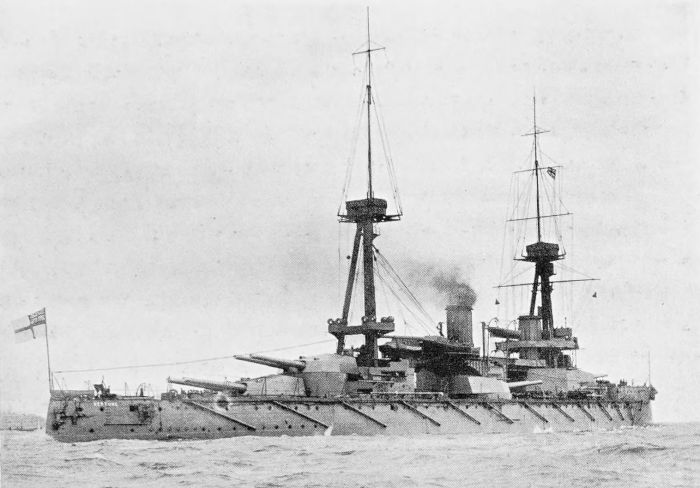
H.M.S. “NEPTUNE.”
Photograph by Stephen Cribb, Southsea.
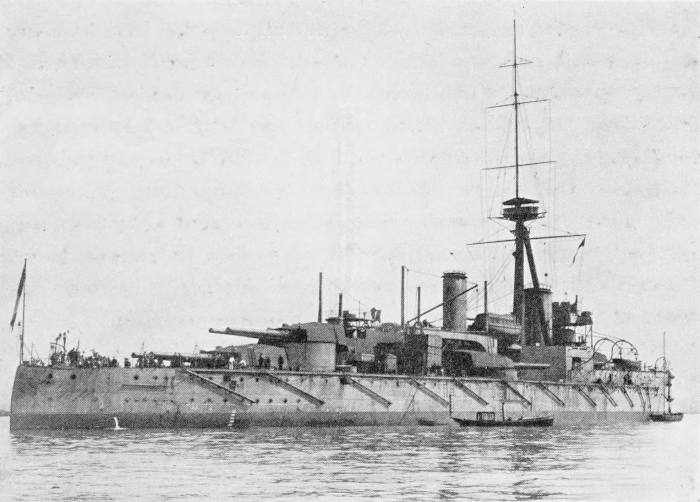
H.M. SUPER-DREADNOUGHT “COLOSSUS.”
Photograph by Stephen Cribb, Southsea.
The Orion has about 2,000 tons more displacement than
the Neptune, and this has enabled her to carry the heavier
guns. She has one elevated tripod mast which is provided
with wireless telegraphy apparatus. Her two funnels
are of more than usual height, and steam is generated
in a series of water-tube boilers. To summarise, by way
of contrast, the armament arrangement of these ships, it
may be said that the Dreadnought, the three Bellerophons,
and the three St. Vincents have six 12-inch guns in three
turrets on the middle line of the ship, and two in a turret
on either wing. The Neptune, Colossus, and Hercules have
their wing turrets en echelon, so that ten guns can be
trained on either side. The Orions have all their guns on the
centre line of the ship. Which of these systems is the best
has been keenly debated. Experiments in gun-fire are being
carried out to ascertain it, but the true test can only be warfare,
and even then much will depend on the circumstances of the
battle and on the men behind the guns.
The Hercules was the first of her class to be given only
one mast. Of the centre-line turrets, one is forward and the
other two are aft, and of these two the foremost can fire over
that aft of it. This arrangement of the turrets makes it possible
for ten of these immense guns to be fired on either broadside.
There are also twenty 4-inch quick-firers and three submerged
21-inch torpedo tubes. Her maximum coal capacity
is 2,700 tons and she can also carry oil fuel in her double
bottom. She is a sister vessel to the Neptune and Colossus.
These three vessels are protected against attack by aerial
warships.
Like all the rest of the Dreadnoughts, the Neptune was constructed
in unusually quick time, only two years elapsing from
the laying of the keel until she was ready for being commissioned.
She has been described as a 30 per cent. improvement
on the Dreadnought, but the rapidity of her construction made
her a cheaper vessel than the other, her cost per ton of displacement
working out at £86.85, as against £101.29 for the
Dreadnought.
The Monarch took the water with a launching weight of
about 11,500 tons, a record for a warship, after having been
just a year on the stocks. This weight included the main
structure, the boilers, funnels, funnel uptakes, casings, and a
large quantity of auxiliary machinery and armour. Her eighteen
boilers weighed 23 tons each, and her two funnels, which
are 53 feet high above the upper deck, weigh 18 tons apiece.
The deck-houses and bridges were also in place, and she was
in other respects in a forward condition. The whole of the
work was carried out in 220 working days. This shows what
can be done in the private ship-building yards of this country.
Builders of warships now find it more economical to put as
much work as possible into the hull before launching it, modern
dockyard methods rendering this comparatively easy. A great
boiler is raised bodily and lifted into position without trouble,
and even items weighing 20 to 30 tons or more are lifted and
deposited where wanted with no more trouble than if they
weighed so many hundredweights.
Mention has been made in earlier pages of such splendid
vessels as the Hood, Trafalgar, Nile and Royal Sovereign, all
of which in their day, not so long past, were considered to be
unsurpassed, and by some to be unsurpassable. Their fighting
efficiency is as great as the day they were launched, yet these
and many others, equally good vessels, have been removed from
the list of the Navy as obsolete and ere long will retire ingloriously
to the scrap-heap. All these vessels have been
launched since 1890, and however much one may deplore that
such fine ships should be discarded, there is no denying that
they are hopelessly outclassed by the Dreadnoughts, and that a
dozen of them would not be a match for one of the latest Orions.
Yet more than one of them was hailed as the last word in
battleships, and there were some who asserted that they would
prove to be the last big armoured ships to be built, as torpedo
craft and protected cruisers would constitute the navies of the
future. But that prophecy was made before the Battle of
Tsushima was fought, and the lessons it taught were learnt.
Protests by naval men against the relegation of these ships
to the lists of the useless have been frequent, and it has been
contended that some of these fine old battleships could have
been sent to the Colonies to act as harbour-defence vessels.
But the Colonies have shown no disposition to be satisfied
with anything under the best that money can buy, and they
have contended that if a ship be out of date it is no use to
them, especially as any hostile power sending a ship out against
them would probably send one of the best and newest and
most powerful.
The compound armour produced in 1879 enabled the thickness
of armour carried to be reduced to 18 inches, and proved
equal to the attacks of the 80-ton gun of the period, but was
ultimately beaten by heavier guns and improved projectiles.
All-steel armour was introduced in 1890, and was followed in
1892 by the super-carburising and subsequent chilling of the
face of plates made of nickel steel. Five years later steel plates
were made yet harder, until the 9-inch plate of the modern
battleship was equal to a 13-inch plate of the early hardened
type; or a 20-inch compound plate of the ’eighties, or a 26-inch
wrought-iron plate of the ’sixties.[59]
The modern 12-inch gun, it has been pointed out, with a
muzzle velocity of 2,859 feet per second, can penetrate the
thickest armour on any of the ships of the Majestic class at a
range of 12,700 yards; the ships of the Duncan class would
suffer at about the same range; that of the Ocean class would
be penetrated at 13,350 yards; and that of the Formidables at
over 11,000 yards. The broadside water-line belt of any of
these ships could be perforated by the same gun at any range
up to the limit of observation. On the other hand, the primary
guns of the ships of the classes named could only perforate
the water-line belt of the Dreadnoughts at from 7,000 to 9,000
yards range, the former being the range of the Oceans for this
purpose. The modern ship could smash the others without
receiving a hit in return. Even if they did succeed in getting
close enough to use their heavier guns and the 6-inch guns as
well, they would be exposed to the risk of a much severer
blow in return. This is not the only consideration. Rapidity
of gun-fire has to be taken into account. The Majestic’s four
12-inch guns can only fire six rounds each in ten minutes or
twenty-four rounds in all in that time, and the other three
classes named could fire forty rounds per ship in a ten minutes’
action. The Dreadnoughts of 1906-7 could reply with 120
rounds, and the latest type of Dreadnought with 150 rounds,
using the 12-inch guns, and of course the disparity would be
even greater with the newest guns.[60]
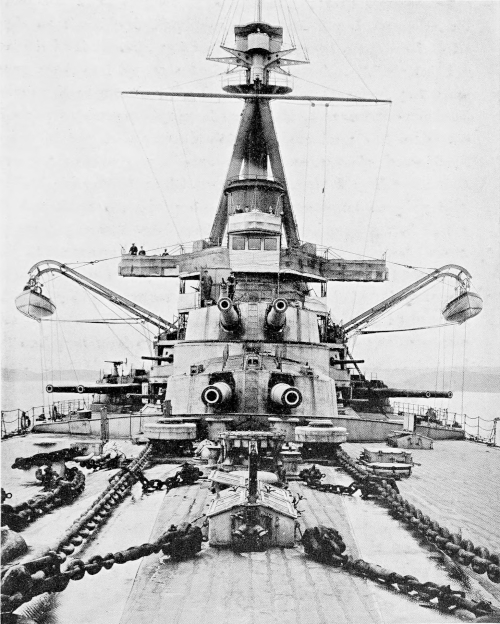
BRAZILIAN BATTLESHIP “MINAS GERAES,” SHOWING DECK AND
SUPERIMPOSED TURRETS.
Photograph supplied by Sir W. G. Armstrong, Whitworth & Co., Ltd.
The rapidity of fire of the large guns has been greatly
increased of late years, and compared with the destructive
effects inflicted by some of the guns they have superseded,
notwithstanding that the changes were not brought about
without encountering some opposition, the new guns are held
to have justified their selection to the fullest. The experiments
made in firing on old battleships have shown what the guns
then considered sufficient could accomplish, and as the muzzle
velocity and muzzle energy and the other scientific data could
all be calculated to a nicety, and the effects on certain constructions
of armour when struck by projectiles of certain
shapes and weights could be estimated approximately and
verified by actual experiment, it became really a question for
the gun-makers whether they could produce a weapon which,
at the range at which modern actions at sea are likely to be
fought in the future, would be able to penetrate the heaviest
armour which could be placed on a battleship of known displacement.
This problem has exercised the artillerists of all
nations with naval aspirations, particularly those of Great
Britain, Germany, Italy and the United States, and of recent
years Japan. Austria has usually been content to follow the
lead of Germany in this respect, and the other powers, such as
the South American States, China, and the smaller European
States, have had to content themselves with the advice of the
experts in the gun-manufacturing countries, except when
political necessities and diplomatic pressure have regulated
their choice for them, to the financial advantage of the vendors.
Some of the most powerful warships afloat have been designed
by private firms, notably those built at Barrow, or on the Tyne,
or at Liverpool, for the South American States, the Minas
Geraes and her two sisters being conspicuous examples. These
vessels have each twelve 12-inch guns, twenty-two 4.7 quick-firers,
and eight 3-pounder quick-firers, and four torpedo tubes.
Their displacement is 19,250 tons, their horse-power indicated
24,500, and their speed 21 knots.
The other nations made up their minds that they must
follow the lead that England had set, and have Dreadnought
ships as good as hers or better. The naval architects of the
powers have since been engaged in a struggle to surpass each
other and England in particular. The name-ship has been so
much improved upon in recent designs that she is as inferior
to the last of the super-Dreadnought battleships as the displaced
pre-Dreadnoughts were to her.
One American legislator, unaware of the historical significance
of the name of the Dreadnought, suggested at Washington
that the United States should “go one better” by building
the “United States warship Skeered-o’-Nothing,” with thirty
or forty guns—a few big guns more or less apparently did not
matter to this naval humorist—and let England see that there
was a flag called “Old Glory” which could also brave the
battle and the breeze. The suggestion was a sample of that
peculiar humour, now, happily, almost moribund, in the Great
Republic, and usually estimated at its proper value; it was
taken seriously, however, in some quarters, and it was shown
to be impossible to build a vessel which should carry forty
guns larger than those of the Dreadnought, and be faster.
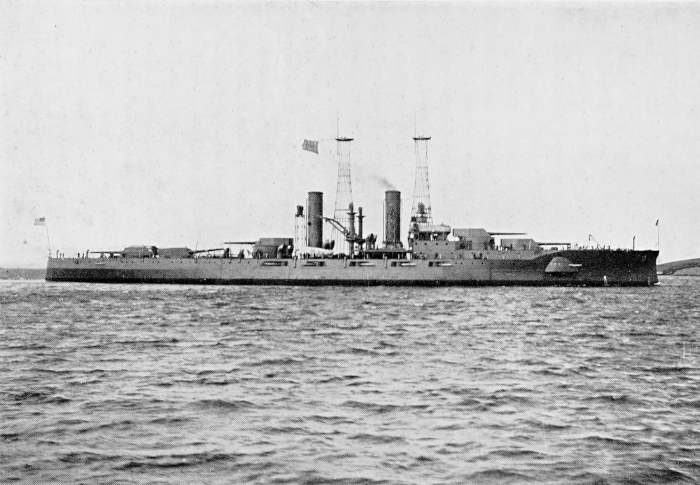
U.S.S. “NORTH DAKOTA.”
From a Photograph by permission of the Fore River Shipbuilding Co., U.S.A.
Modern American battleships have attracted more than
ordinary attention by the daring character of the innovations
the naval architects of that country have not hesitated to
introduce. The armament of the Kearsarge and Kentucky was
extremely powerful, and its arrangement was unique. There
were two turrets with walls 13 inches thick, each containing two
13-inch guns; and above each of these turrets was a smaller
turret with 9-inch walls, in which were two 8-inch guns. This
gave two two-storeyed turrets with four guns to each; either
pair of guns could be fired independently of the other pair, but
they could not be aimed independently, and when it was necessary
to turn the turret all four guns had to go with it. This
experiment, though apparently excellent in theory, did not
prove satisfactory in practice, and the designs for subsequent
vessels which were to have had similar turrets were altered.
Other nations have not taken kindly to the idea, and have not
adopted it, and too many objections have been raised to the
proposal that the upper and lower turrets should be constructed
so as to revolve independently of each other for this plan to
be given serious trial. Some of the American vessels have been
fitted with what are known as lattice masts, or miniature
Eiffel towers. It is claimed for them that they are of great
strength for their weight, and that they are less likely than the
military mast or the tripod mast to be utterly destroyed by
gun-fire. The naval authorities of the other powers are
interested but not converted.
When the Dreadnought was launched, the Americans replied
with the ships of the Delaware class, of 20,000 tons and carrying
ten 12-inch guns. The French had done very little for some
time in the building of big ships, seeming to prefer smaller
ships in greater number, but they too fell into line and built
the Danton and others. The Danton was built in four years,
which contrasts favourably with the seven years spent on some
French ships.
Germany, in constructing her modern fleet, had to bear in
mind that the waters round her coasts are rather shallow,
but she has produced some splendid ships of great fighting
power and high speed. She has some ships under construction
more powerful than any at present in her navy, and one of these—the
cruiser Moltke—is expected to be quite as good as anything
England or America can show.
So great has been the demand for Dreadnoughts, that at
the beginning of this year, for Great Britain alone, there were
built or building no fewer than twenty-two, and arrangements
had been made for laying down five more; while for foreign
powers there have been constructed, or were still in the builders’
hands, up to January last, the enormous total of sixty. The
average cost of these vessels has not been much short of a
couple of millions sterling, and some have cost fully £2,300,000.
The Dreadnought type has admittedly not reached its maximum
development yet, and it may well be asked, where is it to stop?
At present battleships of a somewhat smaller type are being
advocated.
What will be the type of the battleship of the future?
Revolutionary as have been the developments in the nineteenth
century, great as have been the changes in the last twenty-five
years, marvellous as has been the adaptation of scientific
discoveries and appliances to the means for conducting naval
warfare, it would be an idle boast for anyone to say that he
can see finality. The dream to render war impossible by the
introduction of some dread weapon has been entertained by
many inventors, but never a one of them has seen its fulfilment.
When steam-driven armoured warships were proposed, there
were not wanting those who declared that henceforth fleets of
wooden walls were doomed, and that naval war would become
an impossibility. Yet the wooden walls have passed away, the
nations unanimously adopted the newer methods, and the
contingency of naval war must ever be provided for. The
heavily armoured iron ship, carrying few guns of enormous
power, came; and when at last it was found that were the
armour made much thicker the ship would sink under the
weight of her own protection and armament, and that guns
could be constructed to smash that armour, again the hope
was entertained that the limit had been reached, that naval
warfare had become an impossibility, and that the world’s
highways on the vast and beautiful ocean should be devoted
solely to the purposes of commerce and peace. But science
had already come to the rescue and dispelled the illusion before
it was half-formed. Steel, at first gradually and then wholly,
took the place of iron in the building of ships, the production
of guns, and the manufacture of projectiles. Steel itself has
been improved since it was made possible by the Bessemer
process, and Harveyised steel, Krupp steel, and steel toughened
with nickel or chrome or tungsten, or by what is known as the
Simpson process, have all been tried and have all proved their
value. The science of ballistics has made equal progress, and
the development of the resources of marine engineering are
little short of the miraculous. And the end is not yet!
There are guns in existence which at their maximum elevation
will hurl a projectile weighing not far short of three-quarters of
a ton a distance of 25 miles, and the projectile itself contains
an explosive charge more powerful and destructive than the
heaviest charge which could be placed in the heaviest gun
which was fought in the Battle of Trafalgar. The whole fleet
which bombarded Alexandria would be no match for the latest
Orion, and the Orion herself at no very distant date will be
removed from the list of effective ships as obsolete, or as having
only a doubtful fighting value. Scientific development cannot
be arrested, and the only hope is that some day the inventions
for war purposes will have become so terrible that the dream
of inventors that they have made war impossible will be
realised. In the meantime, science is seeking to surpass all its
present achievements. The marine steam engine, of whatever
type, will give way to the internal combustion engine of a type
which will surpass all the existing machinery as surely as the
best turbines are ahead of the old compound engines. The
battleship of the future will have an armament surpassing in
effective range and penetrative power anything at present
afloat, and an armour as far in advance of the present steel
armour as that is ahead of the compound armour it but lately
supplanted. The adoption of the internal combustion engine
will mean the removal from the ship’s deck of the obstructions
which now find a place there. With no furnaces, there will be
no funnels. An armoured citadel, flush decked from end to end,
has been prophesied as a coming type in the early future, with
one mast for signalling purposes and to convey the wireless
telegraphy apparatus, the necessary ventilators, and the conning
towers as the only breaks in the smoothness of the deck. Submarine
signalling, already in extensive use in warships and the
mercantile marine, is being improved beyond all comparison
with what it was a few years ago, and if the wireless apparatus
be shot away it will still be possible for a ship to signal by the
other method over a distance of some miles. Moreover, submarine
signalling will enable an admiral to judge how an
enemy’s fire may be affecting a distant ship of his own squadron.
Size will be another feature of the coming battleship, for in size
lies one of the chief protections from the attack of the most
insidious and most to be feared naval weapons of the present,
as well as the future. The submarine ship will launch its
torpedo at a greater range as the propelling machinery of the
torpedo is strengthened, and, granted that the aim is true,
the only hope the great warship will have of surviving the
explosion of the under-water weapon will lie in the number
of compartments into which her dimensions will permit of her
hull being subdivided or her double bottom to accommodate,
thereby restricting the area of the damage and limiting the
inrush of water.
The torpedo itself is destined to play a part more important
than has yet fallen to its lot in war. Not only will it be launched
from the tubes of the battleship or cruiser or destroyer at the
distant foe, but it will be dirigible, controlled and steered by
wireless telegraphy, and extra speed, or counter explosion, or
gun-fire, or the disablement of the vessel sending it forth will
alone be the means of rendering it ineffective. Torpedo nets
may be of value when ships are at anchor or travelling slowly,
but not at any other time.
The submarine will not be the only danger to be guarded
against from an unexpected quarter. The aeroplane and airship
will play their parts in the next naval war. Experiments
have already been tried in starting a flight of an aeroplane
from a platform at the bows of an American warship, and this
being accomplished, it is not too much to anticipate that
aeroplanes for purposes of observation or attack may become
part of the equipment of every battleship or large cruiser.
The flying machine will drop its bomb on the deck of the
attacked vessel, if the aviator has the good fortune to aim
sufficiently straight, but whether the dropped explosive will do
much harm will depend on whether the deck is comparatively
flat as at present, or is curved like the modern protective deck,
or has a bomb-proof turtle back covering it entirely. Will the
battleship of the future, then, be an immense cylindrical-backed
hull, with one mast or none, innocent of funnels, leaving
no trace of smoke behind her, and rushing at a speed of a
railway train as she belches forth with almost unerring precision
terrible explosives at a similar enemy so far distant as
to be barely discernible on the horizon? Are we to see cruisers
as much faster than the battleship, as the present cruiser is
than the present Dreadnought? If, as is asserted to be possible,
the battleship of twenty years hence will attain a speed of
30 knots under internal combustion engines, armed with weapons
showing a corresponding advance in power and range and
penetration, will the cruiser of that time cover its 40
or 45 knots, and the destroyer hurl itself forward at even
greater speed to explode its torpedo, also correspondingly
more destructive and deadly than now, at its foes? Will the
aeroplane enable the whereabouts of the submarine to be more
easily detected than now? It sounds like a confusion of ideas
that such a thing should be suggested, but it is a well-established
fact that it is possible to see further into the open sea
from a height above it than when close to the surface. If the
cruising aeroplane can detect and reveal the submarine to the
battleship, the submarine will be robbed of half its terrors,
and if the aeroplane can drop an explosive sufficiently near to
the submarine it is not improbable that the career of the latter
will be terminated instantly. The same fate may await the
submarine as the result of the aeroplane signalling its whereabouts,
for recent experiments have shown that it is possible
for a warship to sink a submarine by gun-fire, even when the
latter is several feet under the surface, the victim in this case
being the ill-fated A1. Thus, it is not at all improbable that
the under-water craft may find the swift aeroplane its greatest
and most to be dreaded enemy. The aeroplane will be attacked
by other aeroplanes, and aerial navies may yet be seen “grappling
in the central blue,” fighting their battles on their own
account and so high among the clouds as to be almost out of
reach of the guns which might be directed against them. Are
these ideas but visions and day dreams? It is impossible to
say. Yet they have one and all been enunciated by naval
experts and strategists. Whether these are the lines upon
which the navy of the not distant future will operate, time
alone will show. Events point in their direction. But one
thing is assured, and that is that, marvellous as have been the
developments in the last twenty-five years, it will indeed be
strange if the developments of the next twenty-five years do
not surpass them.