All Ranks join our Corps of Contributors, and the Oasis of
Literature sparkles like a Fountain in a Desert.
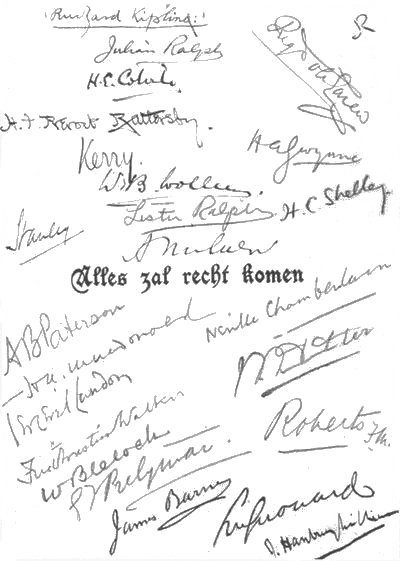
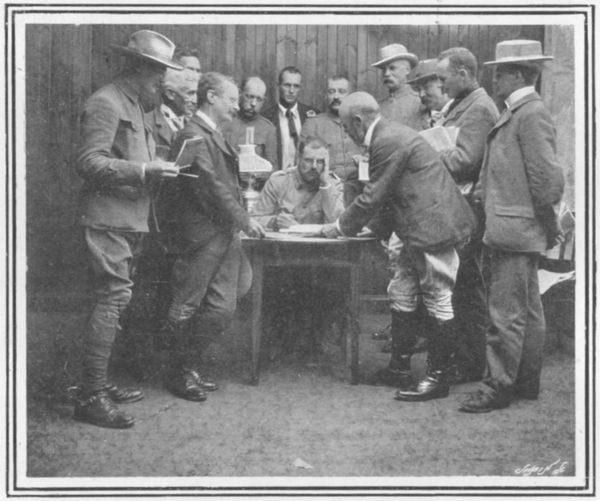
Generals, colonels, majors, captains, subalterns, privates, war
correspondents who had not connected themselves with our venture,
naval officers—all ranks and all sorts, suddenly rushed to our
support, in consequence of my wail for help, and The Friend took on an
interest and importance proportionately greater, I think, than that of
any newspaper then published in the language. Its circulation rose
among the thousands whereas the largest daily distribution had been
only 400 copies before the war.
We numbered the paper of March 24th "No. 6," though it was in reality
the eighth copy we had published, six being the number since we had
enlarged it to its final size. I marvel at our success as I look back
upon this number.
Sir William Nicholson, K.C.B., wrote an appreciation of the character,
life, and work of the late Sir William Lockhart; General Sir Henry E.
Colvile sent us a double acrostic, which the Dutch ones among our
eccentric compositors ruined so far beyond repair that it
would not be just to reproduce its mangled remains; Mr. Lionel James,
who had come over from the Natal side to further distinguish the staff
of the Times, wrote upon the death of our gifted colleague, George
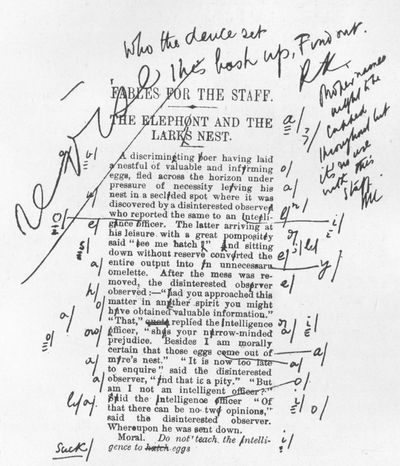
W. Steevens. Rudyard Kipling contributed to this number the first of
his delicious "Fables for the Staff"; a distinguished officer, who
shall remain nameless in this connection, contributed an article on
"Beards in War"; and Mr. Gwynne began a series of letters entitled "Is
the Art of War Revolutionised?" written solely to interest the Army
and spur its thinking men to respond.
Mr. H. Prevost Battersby, of the London Morning Post, was another
distinguished contributor to this number.
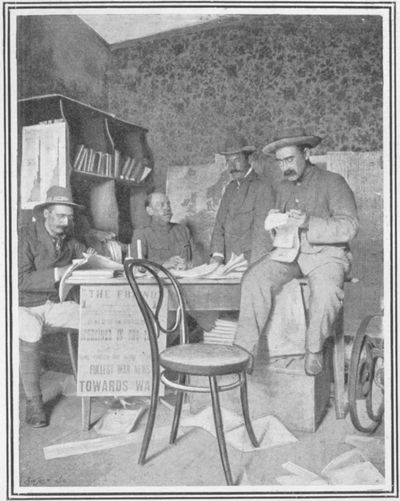
Mr. Kipling now became a regular harnessed member of the four-in-hand
team that pulled the paper. With pen in hand and pipe in mouth he sat
at the larger of the two tables in our editorial poke-hole, and
beginning with a "Now, what shall I do? Write a poem, fill out cables,
or correct proofs?" would fall to and toil away with an enthusiasm
born of the long time it had been since he had "smelled the sawdust of
the ring."
"Oh, how good it is to be at work in a newspaper office again!" he
exclaimed on the first day, doubtless with recollections of the
sanctum of the Allahabad Pioneer strong upon him, and the memory of
the time when the precursors of the "Plain Tales" and of the Barrack
Room Ballads were demanded of him almost every day, and gave him the
practice to produce the carefully finished and matured work we are now
seeing in the novel "Kim," at which he was at work—in the
laboratory of his mind—even as he sat with us in Bloemfontein.
We wondered at his enthusiasm, and, perhaps, had it not been of his
doing, we should have resented the impetus it gave us to toil as never
war correspondents worked before—all day for The Friend and far into
the nights to catch the mails with our home correspondence. But we
soon came to see that the same tremendous energy and ceaseless flow of
wit and fancy were his by nature, and would have found expression as
well in a tent on the veldt as in that office. He was always while
with us like a great healthy boy in spirits and vitality, good humour,
and enterprise.
With us he yelled "Haven't any; go to Barlow's shop around the
corner," to the Tommies who trod on one another's heels to get copies
of the paper from us who had not got them. With us he consigned the
Dutch compositor to æons of boiling torment for the trouble his errors
gave us. With us he entertained Lord Stanley, who now came, out of
kindness, at noon every day, to save us the trouble of sending our
proof-sheets over to him at his office. And from us he insisted upon
taking all the "Tommy poetry," as we called it, that came to the
office. When we derided much of it as outrageous twaddle, he praised
its quality. On this day, I remember, we were belittling a particular
poem that he was reading, and he called out, "Why, that is splendid
stuff! Listen to these lines—'Rule Britannia, Britannia rules the
waves: Britons never, never, never shall be slaves!'" The reader will
not find this particular poem in this book, though it was put in The
Friend by our distinguished poetry editor.
THE FRIEND.
(Edited by the War Correspondents with Lord Roberts' Force.)
SATURDAY, MARCH 24, 1900.
Certain Boers, having blown up a Bridge, departed in the Face of the
British Army, which, arriving at that dynamited Place, made Outcry to
the Gods, saying, "Oh, Jupiter, these Ruffians have blocked the
Traffic, and we are vastly incommoded. Is there Anything worse than
the Boer?"
This being reported to the Railway Authorities, they caused a Railway
Staff Officer to be sent to that Bridge with Instructions to
facilitate Matters by all means in his Power.
Later on They picked up What was left of the British Army in those
parts—one dusty Shovelful, and its Lamentations were louder than
before.
"Ungrateful Wretches," said the Military Authorities; "what would you
now have?"
And the Remnant of the British with one Accord answered, "Give us back
the Boer!"
Our hero was a Tommy, with a conscience free from care.
And such an open countenance that when he breathed the air
He used up all the atmosphere—so little went to spare.
You could hardly say he breathed,—he commandeered it.
For, nowadays, you'll notice when a man is "on the make,"
And other people's property is anxious for to take,
We never use such words as steal, or "collar," "pinch," or "shake:"
The fashion is to say he "commandeers" it.
And our simple-minded hero used to grumble at his lot;
Said he, "This commandeerin's just a little bit too hot.
A fellow has to carry every blooming thing he's got,
For whatever he lets fall they'll commandeer it."
So, at last in desperation, this most simple-minded elf,
He thought he'd do a little commandeering for himself;
And the first thing that he noticed was a bottle on a shelf
In a cottage, so he thought he'd commandeer it.
"What ho!" says he, "a bottle! and, by George, it's full of beer!
And there's no commandin' officer to come and interfere.
So here's my bloomin' health," says he; "I'm on the commandeer."
And without another word he commandeered it.
Anonymous.
Sir William Lockhart's death, as recently announced in Army Orders,
will be deeply deplored by his many friends in the Army in South
Africa. It was known that he had been seriously ill last September,
but he had seemingly recovered when he visited Burma in December. On
his return to Calcutta in January, symptoms developed themselves which
caused great anxiety, and, although he telegraphed to the effect that
he hoped soon to be all right again, the end was not far distant.
Apart from his ability as a soldier and administrator, Sir William
Lockhart endeared himself to all who had the privilege of his personal
acquaintance by his charming manners, his genial hospitality and his
kindness of heart. Born in 1842, he joined the Indian Army in 1858,
and during the Mutiny he was attached to the 7th Fusiliers. He
afterwards served with the 26th Punjab Infantry, the 10th Bengal
Lancers, and the 14th Bengal Lancers. He was employed on the Staff in
the Abyssinian Expedition.
When the Acheen War broke out he was attached to the Headquarters of
the Dutch Force, where he made himself extremely popular. It
was interesting to hear him describe the Dutch method of fighting,
which, as might be imagined, led to no decisive result. The climate
being tropical, the Dutch would only attack the enemy in the early
morning; the rest of the day being spent in camp. The enemy were more
active, and caused the Dutch much annoyance by frequently disturbing
their afternoon siesta. As no means of transport were asked for or
provided, the campaign was of a purely defensive nature, and at the
end of it things were virtually in the same state as at the beginning.
After remaining in Acheen about eighteen months, Lockhart returned to
India, where he joined the Quartermaster-General's Department, and at
the beginning of the Afghan War he was chosen to take charge of the
line of communications up the Khyber. He afterwards joined Lord
Roberts' Staff as Assistant Quartermaster-General at Kabul, and for a
short time acted as Chief of the Staff on Charles MacGregor being
selected for the command of a brigade. In that capacity he had hoped
to accompany his illustrious Chief in the march from Kabul to
Kandahar, but General Chapman being his senior on the staff, it was
decided, much to Lockhart's disappointment, that he should return to
India as Chief of the Staff with the troops under Sir Donald Stewart's
command.
He received a C.B. and brevet Colonelcy for his services in
Afghanistan, and was afterwards appointed Deputy Quartermaster-General
for Intelligence at Army Headquarters, where he remained until 1886,
when Lord Roberts became Commander-in-Chief in India in succession to
Sir Donald Stewart. He was then sent on an exploring
expedition with the late Colonel Woodthorpe, R.E., to Chitral and
Kafiristan, and the admirable report which he drew up was of the
greatest value to the Government of India in considering what steps
should be taken to guard the northern passes between the Pamirs and
the Peshawar Valley.
On his return to India, Lockhart was offered the
Quartermaster-Generalship in that country, but he preferred the
command of a Brigade in Burma, where he greatly distinguished himself
by his activity in pursuit of Dacoits. His health, however, was
undermined by continual attacks of fever, and he had to be invalided
home, where, after a short interval, he became Assistant Military
Secretary for India at the Horse Guards.
After holding this post for a couple of years, he accepted the command
of the Punjab Frontier Force, which was offered him by Lord Roberts,
and in that capacity he commanded a brigade in the Black Mountain
Expedition under the late Sir W. K. Elles, and held the chief command
in the Waziristan and Isazai Expeditions. No abler or more sympathetic
general ever commanded the Punjab Frontier Force; he was beloved alike
by the British officers and the Native ranks; he maintained the
traditions of the Force and raised it to the highest standard of
efficiency; and when he left it he had good reason for regarding it,
as he always did regard it, as the corps d'élite of the Indian Army.
In April, 1895, the Presidential Armies were broken up and the Army
Corps System was introduced, Sir William Lockhart being nominated to
the command of the Forces in the Punjab. In this appointment
he displayed administrative talents of a high order, his main object
being to decentralise responsibility and authority, and to diminish
office work and official correspondence. It was in a great measure due
to his efforts in this direction that the new system worked so
smoothly. When he became Commander-in-Chief he kept the same end in
view by granting the fullest possible powers to the
Lieutenant-Generals of the four Commands and to the General Officers
commanding Districts, and by insisting on their making use of those
powers to the fullest extent.
In March, 1897, Sir William Lockhart went home, having been advised to
undergo a course of treatment at Nauheim. Meanwhile, disturbances took
place along the North-West Frontier, which culminated in an outbreak
of the Orakzaia and Afridis, and the capture by the latter of our
posts in the Khyber Pass. In September he was hurriedly recalled to
India for the purpose of commanding the Tirah Expeditionary Force.
This is not the place to discuss the operations in Tirah, which were
much criticised at home. The fact is that the British public had
become so accustomed to almost bloodless victories over savage enemies
that they failed to appreciate the extraordinary difficulties of the
Afridi country, and the advantages to the defence which the possession
of long-range rifles and smokeless powder confers. Moreover, there are
no better marksmen in the world than the Afridis, who are born
soldiers, and the mobility of hardy mountaineers in their native hills
necessarily exceeds that of regular troops encumbered with baggage and
supplies.
Anyhow, the result of the expedition fully justified the
choice of its commander. The Afridis acknowledged themselves to be
thoroughly beaten; and Sir William Lockhart's tact in dealing with
them after they had submitted has led to the re-establishment of
friendly relations between them and ourselves on a firmer basis than
before. What their present attitude is may be judged from the fact
that Yar Mahomed, the head of the Malikdin Khels, recently petitioned
the Government of India to be allowed to raise 1,500 tribesmen for
service in South Africa.
On the conclusion of the Tirah campaign Sir William Lockhart took
leave to England, and came out again as Commander-in-Chief in India in
November, 1898. He died on the 18th of March, 1900. In him, as Lord
Roberts has remarked in his Army Order of the 20th inst., "the
soldiers in India have lost a friend, and the Indian Empire a trusted
counsellor who cannot soon or easily be replaced."
The late Commander-in-Chief was one of the few remaining
representatives of the Quartermaster-General's Department in India,
and to the admirable training which that department afforded much of
his success as a soldier must be ascribed. No better school of
practical instruction in Staff duties could be desired. Among its
pupils may be mentioned Lord Roberts himself, Sir Charles MacGregor,
Sir Herbert Stewart, Sir William Lockhart, and Sir Alfred Gaselee.
Now, alas! it has been abolished, or, at least, incorporated in the
Adjutant-General's Department.
Dear Mr. Editor,—The following lines were written by me on board the
mail steamer, about two young soldiers now serving with the army:—
'Twas on the deck, that around our ship, from the mast to the taffrail ran,
I saw alone, in a chair (not their own), a tall young girl and a man.
Her hair was light and fluffy and swarthy and dark was he,
And I saw the coon, one afternoon, a-spooning that girl quite free.
So I spotted a Quartermaster bold as he went from the wheel to tea,
And I asked that Jack, if upon that tack, the passengers went to sea.
"Lord love yer honour, we often sees that, the stewards and the likes of us;
There's always couples a-spooning there, but we never makes no fuss.
"If you look around, you'll see, I'll be bound, each day at a quarter to three,
A tall young fellow with curly hair and a girl in black, quite young and fair,
That's another couple," says he.
"And every night, I assure you it's right, straight up on this deck they'll come
And spoon around, till it's time to go down. One night 'twas a quarter to one."
"Now it suddenly struck me early one morn, this might be a serious thing.
Perhaps they loves, these two little doves, and has offered them the ring.
So I leaves them alone in the world of their own; and this 'twixt you and me,
I hope I shall, by each little gal, to the wedding invited be."
LATER.
Then the Quartermaster brushed away a tear with his horny hand,
The last couple now have had a row, and don't speak, I understand.
'Tis not a fable, she won't sit at his table As she used to do of old;
But has taken up with a married man, At least, so I've been told.
Old Salt.
Dear Friend,—I suppose that General French and his lot think they
relieved Kimberley? Well, that's all right, and in spite of his name
being forrin, he's a good chap; so, as Billy the Sailor says, let's
make it so. But I should like to know where would French be now if it
wasn't for Billy and the Yank?
Now, you being an up-to-date paper, we thought you might like to have
an account of the battle which hasn't ever yet appeared in any paper
in the world, yet, as our Adjutant would say, was the most
strategically important part of the whole blooming show.
It was me and Billy and the Yank. Billy's a sailor—says he
was leftenant in the Navy, and I really believe he might have been—he
couldn't have learnt to ride so badly anywhere else, and how he faked
himself through the riding test is a miracle—then his langwidge is
beautiful. The Yank's a Yank; you can tell that by his langwidge, too,
and me being an old soldier (12 years in the Buffs and discharge
certificate all correct), I was made No. 1 of our section; our No. 4
was an Irishman we left behind at Orange with a broken head, all
through fighting outside the Canteen.
Well, when French left Modder, February 15th, we hadn't a horse among
the three of us fit to carry his own skin; so there we was left. Our
troop leader said he hoped to Heaven he'd seen the last of us, but all
the same he gave us a written order, correct enough, to catch up the
squadron as soon as possible. There wasn't much doing all day, barring
a bit of cooking, but that evening we was sitting round the fire when
an M.I. chap comes round and says he's heard there'd be free drinks
for the Relief Force in Kimberley, and perhaps our pals was drinking
'em now. That was the first time our Billy really woke up all day.
"Free drinks," sezee; "that's my sailing orders." Me and the Yank
didn't mind, so we sounds boot and saddle to ourselves in the dark,
and off we slips without a word to nobody. My horse seemed cheered up
by the day's rest, but before I'd gone half a mile I found I got the
wrong horse by mistake! and you'll hardly believe that both Billy and
the Yank had made mistakes too! Lor', how we did laugh! but there,
there ain't no accounting for horses in the dark.
We each had our own notions of the road; the Yank swore he
was tracking the big English cavalry horses; Billy was steering Nor'
Wes' by Nor' on some star or other; and I didn't want to argufy, so I
just shoves on a couple of lengths and marched on the Kimberley
flashlight.
We was going a fair pace too ("making six knots"), and had done near
two hours, when all of a sudden we comes over a kopje right on to the
top of a bivouack, fires and all.
"Let's get"—"Go astern"—"Sections about"—and we did so, back behind
the kopje, linked horses, and crawled up again on our hands and knees.
"First thing," says I, quoting our Adjutant, "is to kalkulate the
numbers of the enemy."
"Twenty thousand," says Billy, who always did reckon a bit large.
"Make it hundreds," says the Yank, sneering—"and I wouldn't mind
betting a pint myself that there was the best part of two dozen of
'em."
"Next point," says I, "who are they?"
"I bleeve they're Highlanders, after all," says Billy; "see the way
they're lowering whisky out of them bottles."
"Well then," says the Yank, "you'd better ride up and say you're the
General, and they'll drop the whisky and run."
"Highlanders," says I, "don't care a cuss for Boers nor Generals, but
say you're the Provost Marshal and they won't stop running this side
of Kimberley."
"Those men, sir," says the Yank, "air not Highlanders. Billy's eyes
was took with them bottles and got no further. Those men don't wear
leg curtains, nor even loud checked bags. They air Boers."
And by Jove he was right.
"Well then," says I, getting back to point three, "what's their
position?"
"Straight there," says the Yank. "Mostly lying on their stummicks,"
says Billy.
"My friends," says I, "if your Adjutant should hear you now he'd break
his blighted heart. Look here, there's General French lowering free
drinks in Kimberley, ain't he? There's the British infantry at Modder,
ten miles back, ain't they? And there's twenty thousand Boers plunk in
the middle, ain't they? That means, as Adjy would say, General French
is busted. Vaultin' ambition! Another orful disaster!"
"My friends, we must reskew General French."
"General be blowed!" says Billy; "let's reskew the whisky."
"Well, bein' agreed on reskewin', wot's our plan of battle? A frontal
attack is always to be depre—well, something that means it's a bally
error." "Take 'em on the starboard quarter, then."
"But the first principel of tactics is to mystify and mislead the
foe."
So far the Yank had been lying rather low, but now he chips in—
"Say, chum, you've pegged it out straight there, and if it ain't
jumping your claim, I'll carry on the working." He did know a bit, the
Yank did, and we'd fixed up the job in no time. He'd a bag of about a
hundred loose cartridges he'd been carrying for days, and in two
minutes he'd a nice hot glowing fire right down in a cleft behind the
kopjy where it didn't show a bit. "Now boys," says I, taking command
again, "that bag of cartridges on the top of that fire will
make as much musketry noise as a brigade fits of joy. We'll let them
have a few real bullets bang in the middle to help out the illooshun.
We're three full battalions advancing to attack, and mind you let them
hear it; not a word till the first cartridge pops off, and then all
the noise you know."
We extended to fifty paces. Billy said it would come more natural if
he was the Naval Brigade, and we puts him on the right. The Yank
wanted to be the "Fighting Fifth," it reminded him somehow of fighting
Stonewall Jackson down South; and the old Buffs was good enough for
me, and I took the left. When we'd fixed our places up nicely and
charged magazines, the Yank slips back to our fire and plunks the bag
of cartridges down in the middle. Then we waited what seemed like a
year.
"Bang!" from the fire.
"At 'em, my hearties!" roared the Naval Brigade; "broadside
fire—don't lay on the whisky—well done, Condor!"
"Steady the Buffs," says I; "volley firing with
magazines—ready—fixed sights—at that fat old buster next the
fire—present—Fire!" and sooting the action to the word I let the old
buster have a volley in the fattest part.
The Fighting Fifth didn't make much noise, but was shooting straight
enough.
Those cartridges went off so quick, once they'd started, that I knew
they couldn't last long, so I gives 'em one more file of my magazine
and then whistles on my fingers, "Cease fire!"—pop went the last
cartridge on the fire—"Who's that silly blighter firin' after the
whistle goes?—take his name, Sergeant-Majer—Now, Buffs,
fix bayonets—prepare to charge!"
"Avast heaving, full speed ahead and ram them!" yells the Naval
Brigade. But the Boers didn't wait for that—what with the dark, and
surprise and noise, let alone a few real bullets, they had gone for
their horses and were moving hard.
"Now then, Lancers!" I holloared, "round our left flank and pursue
them to the devil!" That was just enough to prevent them turning their
heads for the first mile or so. Then our brigade reforms and went down
the hill to tally up the loot. There was half a dozen cripples, none
of them bad, half a dozen knee-haltered horses, a pot of stew on the
fire, and half a dozen black bottles. The Fighting Fifth, who was a
kind-hearted chap in his way, turned over the wounded, gave them a sup
of water, and tied them up with bits of their own shirts. The Naval
Brigade had sweated through everything it had on, barrin' its rifle,
just out of pure excitement, and it went for the bottles like a
cartload of bricks. Blessed if they weren't Dop![3] "Never mind,"
says the Naval Brigade, "if the quality ain't up to Admiralty pattern,
we'll have to issue a double ration"—and he did—so help me!
Meanwhile the Buffs had collected the horses and picked out a nice
little chestnut for myself. After that the Brigade fell out and
enjoyed itself.
But we couldn't waste too much time, so after half an hour we changed
saddles, packed the dop in our wallets, and hoisted the Naval
Brigade on board. The whole way to Kimberley he was fighting the
Condor against the combined land and sea forces of all
creation—even the Yank laughed fit to burst. I do believe Billy might
have been a commander—one can't learn langwidge like that, even in
the Navy, under a longish time.
Well, we fetched Kimberley about reveille after falling off our horses
now and then, and we gives the Sergeant-Major half a bottle to look
pleasant. Up we goes before the troop leader, who looked a bit glum at
his own written order, but cheered up when I hands over three spare
Boer horses we'd brought along.
"If I hear any more of this damfoolishness," sezee, "I'll hang the lot
of you; so you'd better take care that nobody knows of it." He's
almost as hard as the Adjy.
Well, that's why we don't say what Regiment we belong to. But just to
give the devil his jew we don't see why General French gets all the
telegrams from the Queen and Lord Mayors—and we ain't even had our
chocolate served out yet.
But this is the truth—Billy and the Yank'll both swear to it.
Yours truly,
Number One.
Since the days of bows and arrows the art of war has been gradually
developing. The arquebus followed the silent bow, and perhaps it may
be said that this change was the most revolutionary change ever
experienced in the history of warfare. But the arquebus
could not effectively prevent the opposing forces from coming to close
quarters, and therefore the strong man with a thorough knowledge of
the use of the arme blanche—be it pike, sword, or spear—was the
mainstay of their armies. With the successive introduction of the
matchlock, Brown Bess, and the host of old muzzle-loading rifles, up
to the time when the Snider rifle came into use, still the same
conditions of fighting remained. By the same conditions I mean the
following:—
(1) The enemy, when firing at an effective range, was visible to the
naked eye of his opponent.
(2) Even when concealed behind cover the smoke of his rifle easily
disclosed his position.
(3) Neither the accuracy nor the rapidity of fire was sufficient to
make an attack across open ground by a slightly superior force
impossible.
The introduction of the Martini-Henry completely altered at least the
third of these conditions, but owing to the fact that no European war
of great importance was fought with Martini-Henrys, the change was not
brought home to military theorists. It is true that the Turks fought
the Greeks with the Martini and the Gras rifles, but the war was not
serious, and the Greeks never held even their entrenched positions
with sufficient tenacity to bring home to the world the fact that an
advance across the open towards an enemy under cover was becoming more
and more impossible.
But smokeless powder and the long range rifle brought with them
changes which do not appear to be properly understood. In the first
place, it may be laid down as an axiom of warfare that the area of
effective rifle fire (and indeed of any fire) is restricted
by the areas of vision. During the present war it has become evident
to those who have studied the question, that the dangerous zone of
fire with modern rifles is not, as was at first supposed, within the
1,000 yards range, but within 1,500 or even 1,600 yards.
To advance in the open against an enemy, even when that enemy is not
under cover but simply lying on the ground, involves one of two
alternatives. Either the advancing force is annihilated by the time it
gets to within 500 yards of the enemy, or it is forced to lie down
1,500 yards away or less and return the enemy's fire. But the latter
alternative produces a state of things which has never been known in
the history of war. Both the advancing and the expectant forces are
put out of action. Neither can advance and, what is more serious
still, neither can retire.
This contingency opened up an entirely new field of tactics. The
general who can, with a smaller force, succeed in putting out of
action, at least for the time being, a greater force of his opponent,
is more likely to win his battle. In the future, the curious sight
will be seen of regiments or even brigades lying flat on the ground,
doing little damage to the enemy and suffering little loss, and yet
being as useless to their general as if they were snoring in their
barracks at home. Perhaps this is too sweeping, for their presence in
front of the enemy will have the advantage of containing him, but in
the open, across which an enemy has to advance, a containing force of
a proportion of one man to five of the enemy is quite sufficient.
Therefore the use of a brigade to contain a brigade would be
a waste of material. Even those of us who have followed closely and
carefully all the stages of the campaign do not yet perceive the
magnitude of the changes involved by the use of modern rifles, but
they appear to me to be so radical that instead of describing them as
fresh developments, I would prefer to give an affirmative answer to
the title of this article.
But there yet remains to be discussed the question of the arme
blanche—the bayonet, the weapon with which our gallant army has won
so many of its victories. I have heard not a few officers declare that
this war will be known in history as the last war in which a British
soldier carried a bayonet. But is the discarding of the bayonet to be
one of the results of the use of the new rifle and the smokeless
powder? When fighting against an enemy who does not carry it, the
force which is armed with a bayonet has a tremendous moral
superiority. In the present war, there have been one or two
cases—one, particularly, at Slingersfontein—where the Boer has made
a frontal attack on a prepared position held by us. The attacks have
always been made along the tops of kopjes which afforded excellent
cover for a stealthy advance. The obvious way to meet such attacks was
to wait until the enemy came close enough to allow the use of the
bayonet, and this was done with great success at Slingersfontein. So
that it may be laid down that in cases where one only of two opposing
forces is armed with the bayonet, it is obviously to its advantage
that the enemy should in attacking come to close quarters.
It is, equally, to the manifest advantage of the defending force, if
unarmed with the bayonet, to prevent, with heavy rifle fire,
the enemy from being able to use the bayonet. But in my humble
opinion, the bayonet will not be discarded for a long time. In the
first place, the best tactician in the world cannot always prevent,
even with modern rifles, such things as surprises, and small bodies of
men might still, even under the new conditions, be able to get
unperceived into close quarters with the enemy. But the greatest
reason for its retention is that night attacks are still possible, and
in night attacks the bayonet is undoubtedly the weapon to be used. The
very mention, however, of night attacks opens up a long vista of
discussion and arguments which I do not wish to raise. I am aware that
there are many prominent soldiers who will have nothing to say to
night attacks and condemn them lock, stock and barrel, but they can
never be eliminated from the already long list of the contingencies of
warfare. Until something is mooted which will render night attacks
absolutely impossible, so long will the bayonet be retained.
But perhaps the most radical changes effected by the use of the long
range rifle will be in purely regimental organisation. A company now
extends for the attack over a space of over half a mile. The ordinary
complement of officers assigned to a company can never hope to control
the whole of it. What is the remedy? And how are we to bring up
ammunition to the firing line, or carry away our wounded from it? Can
a regiment extended for the attack eight paces apart act as a
regiment, or in the future is the company to be the biggest infantry
unit in action? All these questions spring from the experiences of the
present campaign, and it is to be hoped that they will be
answered by those whose experience in the many engagements against the
enemy will give value and force to their words.
Received orders at 10 a.m. to proceed at once to Ram Dam and to join
the main column as soon as possible. Requisitioned for transport
immediately and supplied at 6 p.m. with about four dozen small
dilapidated hair trunks, misnamed mules, which looked as if they
required three square meals rolled into one, and a fortnight in bed!
No self-respecting cat would have looked at them twice, even cold on a
wooden skewer!
Made a disastrous stand at 8 p.m., as we succeeded in losing our way
in the record time of fifteen minutes, thanks to having no guide and
to a flighty and uncertain young moon, which insisted on playing hide
and seek at the most awkward times. However, we struck the wire at
last, not the barbed variety fortunately, and had brief periods of
comparatively smooth going, variegated by such trifling mishaps as a
broken trace, falling mule, or mule and harness so mixed up that we
couldn't distinguish which was harness and which was mule and
requiring careful sorting out! Veldt stones were also somewhat
inconvenient, as they vary in size to anything above or below a
Pickford van. However, it was a fine night and the mules almost seemed
to warm to their work, racing along in great style at fully three
miles an hour on a smoothish bit of road and appreciably downhill!
What rapture to be out on the starry veldt and to have left
that Enslin "News"—the transport lines—miles (five and a doubtful
bit) behind us. Shortly afterwards the moon again appeared, and we
proceeded to negotiate a very promising nullah with gently sloping
sides. Full speed ahead and up we go, but, alas! the latter part of
our programme was somewhat disarranged, like Labby's furniture at
Northampton, owing to the fact that buck waggons and mule transport
are not adapted to racing through a truckload of sand of uncertain
depth but of certain difficulty! However, "man the wheels and shove
behind" was the natural sequence of events, and when the mules ceased
pulling in every direction except the right one from sheer exhaustion,
a few judicious cracks of the sjambok, together with a few different
languages, mostly bad, and up we eventually did go.
A wide stretch of perfectly flat veldt lay before us, and we shortly
lost both moon and wire simultaneously. Some one suggested "follow the
track": valuable advice, but difficult to carry out, as there happened
to be about fourteen of them, and all in different directions.
Pleasant predicament to be in: 1 a.m., cloudy sky, and lost on the
anything but trackless veldt! Feel about as comfortable as the man who
was going to be hanged at 8 a.m. Finally decided to proceed at right
angles, and return our wrong way if necessary, and succeeded in
finding that precious wire at last. Persistency is the road to
success, but what about an old hen sitting on a china egg?
Moon on the wane, but reached Ram Dam at 3 a.m., and all of us
surprised and delighted to get there, as it would have very
shortly been a case of the "light that failed!" Ram Dam itself looks
like a remarkably low Thames somewhere near the Isle of Dogs, but
glad to get anywhere, and ready to eat or drink anything.
(With an Original Verse by Rudyard Kipling.[4])
Through war and pestilence, red siege and fire,
Silent and self-contained he drew his breath.
Too brave for show of courage—his desire
Truth as he saw it, even to the death.
Rudyard Kipling.
There is a pretty little cypress grove nestling under the shadow of
one of the Ladysmith defences. A peaceful oasis—green where the land
is parched and dry. It is God's acre. Before shaking the dust of
Ladysmith from off my feet for ever, I turned my pony's head towards
the green. The little animal seemed to know the way, and well he
should, for the melancholy journey to the cemetery had been frequent
during the latter period of the siege. I tied the pony to the rail and
passed in under the shadow of the cypresses. The interior of the
enclosure was one stretch of new-turned earth. The turf seemed all
exhausted. The dainty cemetery of three months ago had now the
appearance of a badly harrowed field. In places a rough cross marked
the last resting-place of the victims of war and pestilence, a few had
the names just scrawled upon a chip of wood; the majority
lay unnamed—the price of Empire keeping: a nameless grave!
I passed down the clay trodden pathway. The brief legends
ran—Egerton, Lafone, Watson, Field, Dalzel, Dick-Cunyngham, Digby
Jones, Adams—but why name them? They were all men whom three months
ago I had called my friends. Then I found the spot for which I
searched—a plain wooden cross inscribed G. W. Steevens, and a date.
What an end—six feet of Ladysmith's miserable soil! It was too cruel.
My memory carried me back to the brave companion and upright colleague
who was gone, and to the manner of his death—the man who had raced
with the Cameron Highlanders for Mahmoud's zareba; who had stood with
his hands in his pockets when it seemed that it must be but a matter
of minutes before Wad Helu swallowed up Macdonald's Soudanese brigade.
The man who had scorned death on Elandslaagte's crest lay there a
victim to pestilential Ladysmith. If the spare frame had been as stout
as the heart which it contained, that miserable rat-hole could not
have brought about the end. Poor Steevens—how he strove to live! For
a month he lay and fought the battle for life. And then when all
seemed well, and we looked for the day that we should have him back
again, he quietly faded under a relapse.
Doctors could do no more, and at four in the afternoon of the fatal
day it was evident that the end was near. Maud, who had nursed him
with a devotion unsurpassed, was deputed to break the news. He came to
the bedside and suggested that Steevens should dictate a wire to his
people at home. The patient looked up suddenly, and in a moment
was conscious of the sinister purport of the request. The
conversation which ensued was something of the following:—
"Is it the end?"
Maud nodded assent.
"Will it be soon?"
Again Maud nodded assent.
Steevens turned wearily, and remarked, "Well, it is a strange sideway
out!" Then there passed over his face an expression which plainly
read, "I will not die!"
He turned to Maud and said, almost gaily, "Let's have a drink."
Maud opened a new bottle of champagne and poured out half a glass.
Steevens sipped it, and noticing that Maud had no glass, remarked,
"You are not drinking!"
He seemed better after the wine, and when the last message was
dictated he was still struggling for life; but the disease had the
upper hand, and he sank into unconsciousness which was never broken
until he passed away in the evening.
We buried him at midnight. As we took him down to the cypress grove,
it seemed that the enemy paid tribute to our sorrow, for their
searchlight played full upon the mournful cavalcade as it wound into
the open.
Bloemfontein, March 23, 1900.
Dear Sir,—A distinguished General Officer—who is also an exceedingly
clever man—was issuing orders on one occasion. "I have no wish," said
he, "to interfere with the time-honoured Custom which
ordains that heroes may be dirty; but, until they become heroes, I see
no reason why they should not try and look like soldiers. The troops
under my command will, therefore, shave until they arrive at the
actual front."
This witty sentence provides me with an admirable text for a sermon on
a subject very near my heart. Our troops have, indeed, proved
themselves heroes. Whatever may be the opinion expressed now and
hereafter upon many things in the conduct of this war, upon one thing
there can be no dissentient voice—I refer to the splendid heroism of
our troops. Yes, sir, they are heroes. But why, oh! why do they not
try and look like soldiers too? Why should the erstwhile smart
Guardsman, the dandy Highlander, the dapper Horseman, adopt the facial
disguise of a poacher out of luck, or rather—for the beard is not a
good one—of a member of the criminal classes previous to the Saturday
evening's ablutions? Surely soap can be purchased, razors ground, and
water heated.
It is universally admitted that one of the chief duties of a soldier
is to be smart in his appearance, and the fact that on active service
there may be some difficulty is surely no excuse for its neglect. In
all other periods of the world's history shaving was looked upon as
one of the chiefest necessities in time of war. Napoleon's Old Guard
shaved, as is well known, throughout the entire retreat from Moscow;
there was not a hair upon the faces of Hannibal's legions the day
after the famous crossing of the Alps, while Caesar's well-known
order, "Ut barbas tondeant," must be familiar to every schoolboy.
I might come down to our own times and quote the Queen's
Regulations, but I refrain from doing so lest I should be accused of
priggishness.
It is, I do not hesitate to say, horrible to me to see the unkempt
appearance of those who might be—and are at other times—the
finest-looking troops in the world. I feel inclined to say, in the
words of Scripture, "Tarry ye at Jericho until (and after) your beards
be grown."
I hope, sir, you will forgive this somewhat lengthy letter, but the
subject is, as I have said already, very near my heart. No one ever
has looked well in a beard, and no one ever will, and until our
officers recognise this fact and set an example of spruceness for
their men to follow, the army in South Africa must remain an eyesore
to all who share the opinions of
Your obedient servant,
Field Officer.