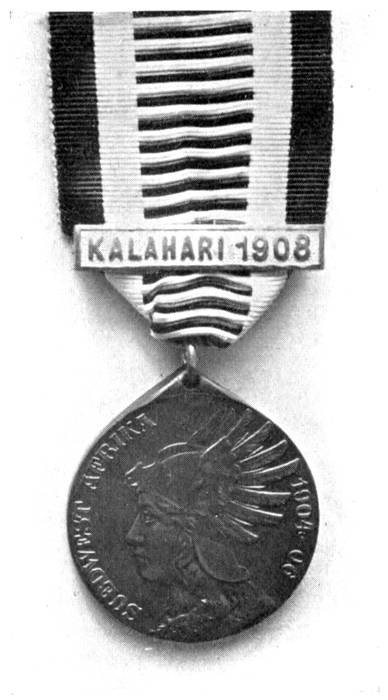
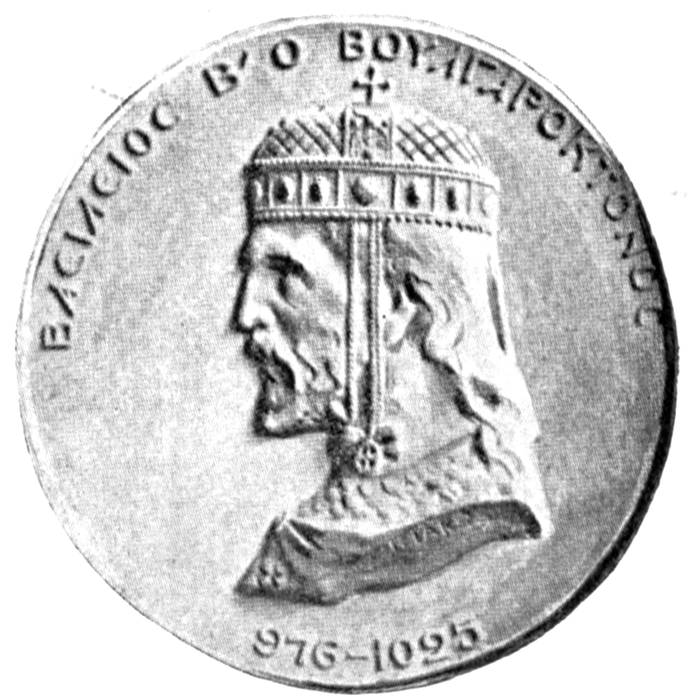
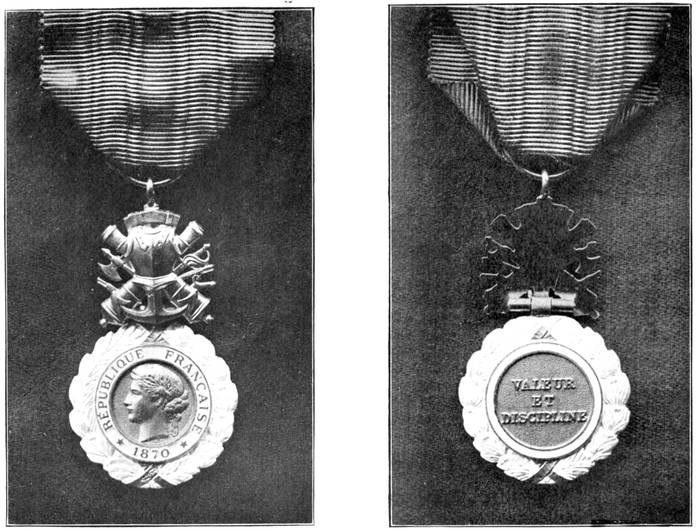
Napoleon, having by a series of brilliant battles
gained supremacy over Central Europe, issued a decree
against all commercial intercourse with Great Britain,
but having lost any semblance of maritime power by
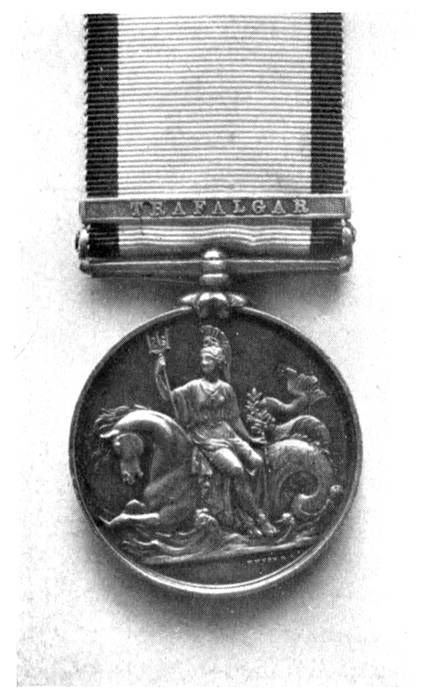
the crushing defeat of Trafalgar (October 21st, 1805),
this was a somewhat idle procedure. Portugal declining
to carry out his Imperial decrees, Napoleon alleged that
the house of Braganza no longer held power, and by
cajoling the Spaniards into a false security led them
to believe that they would participate in the spoils
of Portugal; consequently they permitted an army
under Marshal Junot to over-run Portugal, but Napoleon's
ulterior object was to place his brother Joseph,
King of Naples, on the throne of Spain, and in order
to effect this purpose the weak-minded Charles IV
and his son Ferdinand were induced to go to Bayonne,
where Napoleon extracted from them the renunciation
of the throne of Spain; meanwhile the Royal family
of Portugal had fled to Brazil. On July 20th, 1808,
Joseph Bonaparte entered Madrid, but the high-spirited
Spaniards refused to accept him, and established a
"junta" at Seville, declared Ferdinand VII king,
and drove Joseph out of Madrid within a fortnight.
The Spaniards, however, felt unequal to dealing with
the usurper, and appealed to England, and not in vain—for
an army of 10,000 men was speedily dispatched,
under Sir Arthur Wellesley, who fought his first successful
battle against the French in Spain on August 17th, 1808.
Roleria.—This was the battle of Roliça, erroneously
called Roleria through a mistake in dispatches, and
maintained on the colours ever since, when General
Laborde was driven from the position he held. The
following regiments took part in the battle—5th, 6th,
9th, 29th, 32nd, 36th, 38th, 40th, 45th, 60th, 71st
(known with the 43rd as the "Glasgow Light Infantry,"
owing to the number of Lowland Scots in the regiments),
82nd, 91st, and the Rifle Brigade, which, as Wellesley
stated in his dispatch, had just been formed, but the
brunt of the fighting fell on the 5th, 9th, 29th, Riflemen
of the 60th and the 95th, and also the flank companies
of Major-General Rowland (afterwards Viscount)
Hill's Brigade. Meanwhile Marshal Junot, the French
Commander-in-Chief, decided to brook no delay, and
advanced to attack Wellesley, who was at this time at
the Vimiera heights near the Maceria River.
Vimiera.—In this battle (August 21st, 1808) Wellesley
gave some indication of that power in organising
defence which was to prove so valuable at Waterloo.
The French attacked with considerable spirit, but the
British retaliated with equal vigour and drove them
off. In this battle the 50th, known as the "Blind Half
Hundred" owing to ophthalmia having attacked the
men, and as the "Dirty Half Hundred" owing to the
black coming off their cuffs when rubbing their faces,
made brilliant and determined charges, which, with
those made by the 43rd and the 71st, compelled the
French to retreat. In this battle a piper of the 71st,
being wounded in the leg, sat upon his knapsack, and
declared as he placed his pipes to his lips, "Diel hae
me, lads, if ye shall want for music." There were no
Victoria Crosses in those days, or George Clark would
have had one. Wellesley, who had been superseded
in the command by Lieutenant-General Sir Hew
Dalrymple and Sir Harry Buzzard, now returned to
England, disgusted, it is said, with the Convention of
Cintra, by which the French army was permitted to
evacuate Portugal and leave Lisbon in September for
Brittany, from whence it soon proceeded to re-enter
the Peninsula by way of the Pyrenees. Lieutenant-General
Sir John Moore, who arrived in Spain after the
battle of Vimiera, was placed in command of the troops,
consequent upon the recall of Sir Hew Dalrymple and
the resignation of Sir Harry Buzzard. His glorious
death at Coruña, after a brilliant retreat, is an imperishable
memory.
Sahagun.—The story of the advance against Marshal
Soult is marked by many brilliant episodes, among
them the daring charge of the 15th Hussars on December
20th, 1808, at Sahagun, where, unexpectedly
finding a broad ditch to pass, they leapt it in "a true
fox-hunting spirit," and put the enemy to flight, with
the loss of ten colonels and 160 men prisoners. As a
result of this action, Sir John Moore established his
headquarters at Sahagun. Though the 10th Hussars
also took part in the affair, the 15th is the only cavalry
regiment which won the right to carry the name on
its battle-roll; the 7th, 18th Hussars, and the 3rd
Hussars of the King's German Legion, were also present,
and were later deemed worthy of the bar, likewise
two batteries of Horse Artillery. It is noteworthy that
only fifteen bars for Sahagun were issued, those who
took part in the battle of Benevente as well, receiving
a single bar inscribed with the two names.
Benevente.—On December 24th Sir John Moore
thought it advisable to retire from Sahagun, and on
the 28th reached Benevente in very inclement, snowy
weather, where another brilliant cavalry affair took
place on the 29th, when the 10th Hussars, under
General Lord Paget, made a most dashing charge
against the cavalry of the Imperial Guard, led by
General Lefebvre-Desnouettes, who, together with
70 cavalrymen, were made prisoners. The English
cavalry lost 50 killed and wounded, and the French
150 killed. Dr. Payne points out that the single bars
for this and the previous battle, as well as the bar
SAHAGUN-BENEVENTE, were issued so indiscriminately
that it is difficult to distinguish to which bar the
recipient was entitled. There is a medal with the
single bar BENEVENTE in the Chelsea Hospital.
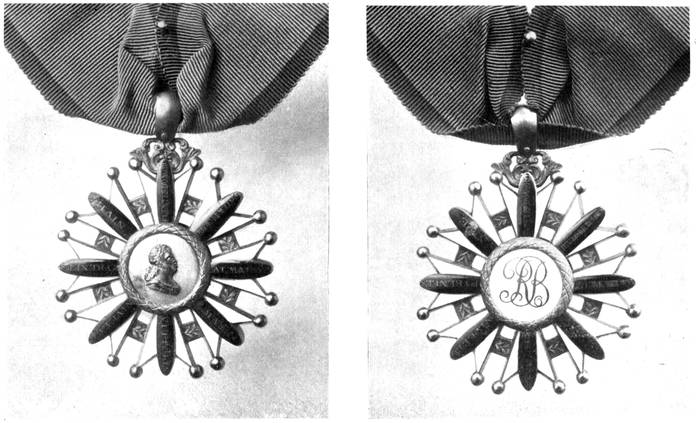
PORTUGUESE PENINSULAR GOLD CROSS FOR COMMANDERS.
Awarded to Lieutenant-Colonel Richard Brunton.
Retreat to Coruña.—Then began the awful yet
masterly retreat to Coruña. Through rain and snow,
and over almost impassable roads, the British army
of about 19,000 retreated with the French army of
about 60,000, with 91 guns, hanging on without daring
to do more than press the retreat, which became so
demoralising to Moore's army, that not only had baggage
to be abandoned, but guns and treasure to the amount
of £25,000 were thrown over a precipice near Nogales
to prevent any possibility of their falling into the
hands of the enemy. And so, with his army of comparatively
raw troops, Sir John Moore resolutely and
defiantly made his way to Coruña, pursued by the
veterans, under Ney and Soult, only to find on arriving
at the port that the transports which were to bear
them to England had not arrived! There was nothing
to be done but to accept battle, and this he did in such
a splendid manner that it makes his death in the hour
of victory an imperishable memory, while the recollection
of the valour of his much-tried and distressed soldiers
will last as long as men respect courage, especially that
which triumphs in the face of adversity. Sir John
Moore was buried on the ramparts of Coruña by his
staff officers and a few men of the Black Watch and
other regiments he loved, but—
"No useless coffin enclosed his breast,
Nor in sheet nor in shroud we wound him;
But he lay like a warrior taking his rest,
With his martial cloak around him."
Over his soldier's grave the French Marshals placed
a plain tomb, while Marshal Soult, who commanded
the French, had placed upon a rock near which Sir
John Moore fell a Latin inscription recording the fact.
He was not allowed, however, to sleep in his soldier's
grave, for the Spaniards removed his body to a more
conspicuous position, and covered it with a magnificent
monument eloquent of his deeds, but hardly in keeping
with his simple spirit.
In the battle of Coruña, fought on January 16th,
1809, the 50th Regiment particularly distinguished
itself by its use of the bayonet, as did also the 42nd,
who made a daring and victorious dash into "the key
of the fight," Elvina village—indeed, the battle is said
to have been won by Lord William Bentinck's brigade;
Sir David Baird's division, consisting of the 4th, 42nd,
and 50th, which, as mentioned in general orders issued
by Lieutenant-General Hope, "sustained the weight
of the attack." The 23rd Royal Welsh Fusiliers were
the last to embark.
The regiments engaged at Coruña also included the
Grenadier Guards; 1st, 2nd, 4th, 5th, 6th, 9th, 14th,
20th, 26th, 28th, 32nd, 36th, 38th, 43rd, 50th, 51st,
52nd, 59th, 71st, 76th, 79th, 81st, 82nd, 91st, 92nd,
95th, and the Rifle Brigade; 7th, 10th, 15th, 18th Light
Dragoons; 1st and 2nd Light Battalions King's German
Legion, and the 3rd Dragoons of the same corps. Three
batteries of the Royal Horse Artillery were also present.
Martinique.—This island was taken by the British
in February, 1762, and on several other occasions, but
a bar was only given for the campaign in 1809, which
had been concluded, despite very bad weather, by its
surrender to Lieutenant-General Beckwith on February
24th, 1809. The French were under Admiral
Villaret-Joyeuse. It was restored to France in 1814.
For this campaign a bar was granted when the decision
was made to issue the Military General Service medal,
commonly but erroneously known as the Peninsular
medal, since not only were bars for Guadaloupe and
Java included, but also for Fort Detroit, Chateauguay,
and Chrystler's Farm in America.
For the capture of Martinique the superior officers
were awarded a gold medal, similar to that I shall
shortly describe as having been conferred upon the
officers who served in the Peninsula.
The following regiments took part in this expedition—60th,
63rd, and 90th; 1st West India Regiment and the
flank companies of the 7th Royal Welsh Fusiliers; 8th,
13th Light Infantry, 15th, 23rd, and 25th Regiments.
Talavera.—In the spring of 1809, Sir Arthur Wellesley
left England to take command of the Anglo-Portuguese
army, and, landing at Lisbon on April 22nd, placed
himself at the head of 25,000 British and Portuguese,
crossed the Douro, drove Marshal Soult out of Oporto,
advanced into Spain, and giving battle to the French
at Talavera, defeated them after a long-drawn conflict
lasting over the 27th and 28th July. The French were
commanded by the intrusive King Joseph Bonaparte,
assisted by Marshal Victor. The French losses in the
first day's fighting were about 1,000 officers and men,
the British losing about 800. For the two days the
French had a total of 7,394 placed hors de combat,
including Generals Lapisse and Morlot killed, and
Generals Sebastiani and Boulet wounded; the killed
numbered 944, and the wounded 6,274, while 150 were
taken prisoners. The British losses amounted to
6,268; Generals Mackenzie and Langewith, 857 officers
and men being killed; 3 generals, 192 officers, and
3,718 men wounded, 9 officers and 643 men missing.
The Spaniards gave their losses as 1,200 killed and
wounded. This battle, the victory in which was
claimed for both sides, gained for the victorious General
the titles of Baron Douro of Wellesley and Viscount
Wellington of Talavera, with a pension of £2,000 per
annum.
The following regiments were engaged in the battle
of Talavera, those marked with an asterisk being
specially mentioned in dispatches. 1st Batt. Coldstream
Guards; 1st and 3rd Batts. Scots Guards;
2nd, 3rd, 4th, 5th, 6th, 2nd Batt. 7th Regiment,* 2nd
Batt. 24th, 1st Batt. 29th,* 2nd Batt. 31st,* 1st Batt.
40th, 1st Batt. 45th,* 1st and 2nd Batts. 48th, 2nd
Batt. 53rd,* 5th Batt. 60th,* 1st Batt. 61st, 2nd
Batt. 66th, 71st, 79th, 82nd, 2nd Batt. 83rd, 2nd
Batt. 87th, 1st Batt. 88th, 91st, 92nd, 1st Batt. 97th,*
and the Rifle Brigade. 3rd Dragoon Guards, 4th
Dragoons, 14th (now Hussars), 16th (now Lancers),
and 23rd Light Dragoons; Royal Artillery, Engineers,
and Staff Corps; 1st and 2nd Light Battalions, 1st
Light Dragoons, and 1st, 2nd, 5th, 7th Line Battalions
of the King's German Legion.
Peninsular Gold Medals.—Following this brilliant
victory it was notified in the London Gazette , September
9th, 1810, that a gold medal would be granted to
commemorate the battles of Roleria, Vimiera, Coruña,
and Talavera. It was, however, only given to officers
who had taken part in these engagements, or who had
participated in any brilliant cavalry affair. It was
also decided that the medal to which an officer would
have been entitled, had he survived, should be given
to his next of kin. The medals vary in size, but are
all of the same design. The larger size was conferred
upon General Officers, and the smaller ones upon
colonels and senior officers. The medal was only given
to those who were actually in command during an
engagement, or succeeded thereto owing to the commander
being killed or placed hors de combat.
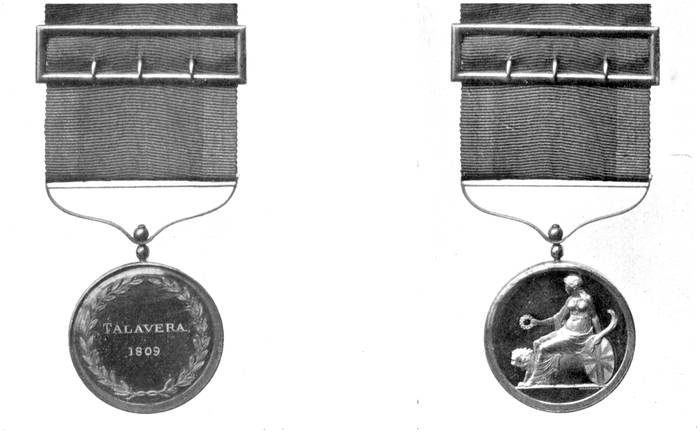
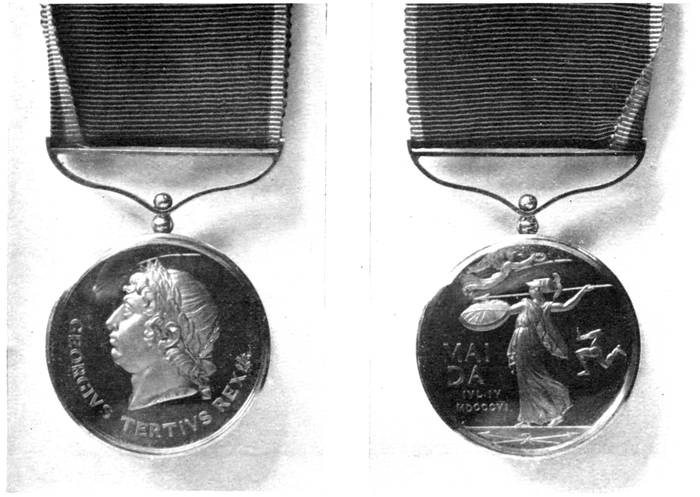
The gold medal bears on the obverse the figure of
Britannia, wearing a rather squat Roman-looking helmet,
seated upon a globe, and bearing in her extended
right hand a laurel wreath and in her left a palm
branch, which rests upon an oval shield bearing the
Union Jack; to Britannia's right is the British lion.
On the reverse is a simple wreath of laurel, with the
name of the battle and the date engraved in Roman
capitals. The medal is attached to the ribbon by a
simple suspender, and a gold buckle was frequently
worn in the middle of the ribbon. General and Commanding
Officers were ordered to wear the medal
suspended from the neck by means of a red ribbon with
blue edges—familiarly known as the Peninsular ribbon—and
below the rank of lieutenant-general by the same
ribbon from a button-hole of their coat. The senior
officers complained that it was very inconvenient to
wear a medal dangling from the neck while on horseback,
and they were supported in their plea by Wellington.
This medal is generally found glazed, to prevent
its surface being damaged, the name and rank of the
officer being engraved upon the edge of the medal
itself.
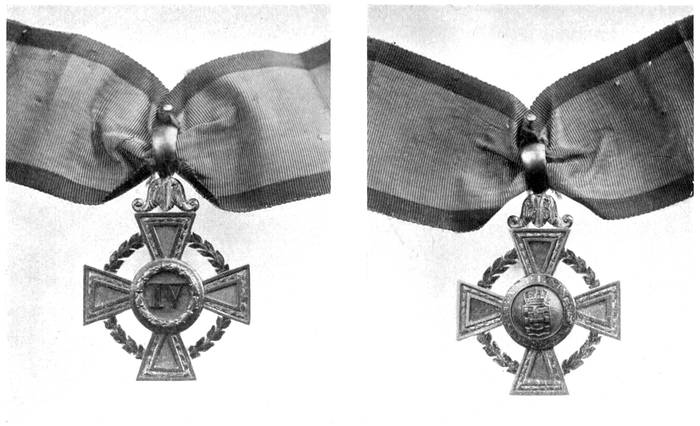
PORTUGUESE OFFICER'S CROSS FOR THE PENINSULAR CAMPAIGN.
Awarded to Lieutenant-Colonel Richard Brunton.
Guadaloupe.—General Beckwith, who had captured
Martinique, attacked the West Indian Island of Guadaloupe,
and captured it on February 6th, 1810. The
French, who lost nearly 600 men, were commanded by
General Ernouf (see Martinique for regiments engaged).
Busaco.—Wellesley's Spanish allies had failed him,
as Sir John Moore with his sorry experience had predicted,
and so after the battle of Talavera de la Regna
he retired into Portugal, whither Napoleon sent Marshal
Masséna to "drive the English Leopards into the
sea," but the "Sepoy General," as Napoleon had
dubbed Wellesley, was alive to the possibilities of the
situation, and in face of the overwhelming numbers of
the French, decided to prepare the impregnable lines
of Torres Vedras, stretching from the Tagus to the sea;
but before he could entrench himself he was compelled
to check the pursuit of Masséna on the Busaco Sierra
on September 27th, 1810, where his army of British
and Portuguese resisted all attempts to dislodge them.
In this battle both the British and Portuguese troops
fought with daring determination, so that it would
appear invidious to single out special regiments for
notice, but the 38th, 45th, and the 8th Portuguese
Regiments were mentioned in dispatches. The 88th
Connaught Rangers repulsed a division of French
infantry, while the 74th Highlanders did a like service.
General Simon, who had bravely led his brigade up
the mountain side, was captured by two men of the
52nd Regiment, and the French losses amounted to
2,000 killed and as many wounded. The British losses
were 197 killed and 1,072 wounded. Marshals Ney,
Masséna, and Regnier commanded the French, the
English and Portuguese being under Wellington.
At the battle of Busaco the following regiments took
part: the Coldstreams and Scots Guards; 4th, 14th,
and 16th Light Dragoons, and three batteries of artillery;
1st Royal Scots 3rd Batt. 3rd, 5th, 7th, 9th,
11th, 24th, 27th, 29th, 31st, 34th, 38th, 39th, 40th,
42nd, 43rd, 45th, 48th, 50th, 52nd, 53rd, 57th, 60th,
61st, 66th, 74th, 79th, 83rd, 88th, 97th, and the Rifle
Brigade; there were also present the following units
of the King's German Legion; 1st and 2nd Light
Battalions, and the 1st, 2nd, 5th, and 7th Line Battalions.
Rodrigues and Isle of France.—To keep our order
chronologically we must leave for a moment the army
in Spain to call attention to the fact that it had become
necessary, in order to protect British shipping from
the French ships harbouring in the Isle of France, or
the Mauritius, that the place should be taken from
them. Previous to this, as part of the same plan, it
had been decided to also take the Island of Rodrigues,
as a preliminary to the capture of the Isle of Bourbon.
For the action which was fought at Rodrigues it was
decided to award a medal to those who had taken
part in the expedition in the then French islands, and
on September 10th, 1811, a General Order was issued
stating that a medal would be awarded to those who
had taken part in the action at Rodrigues, the defeat
of the French on the Isle of Bourbon, and the capture
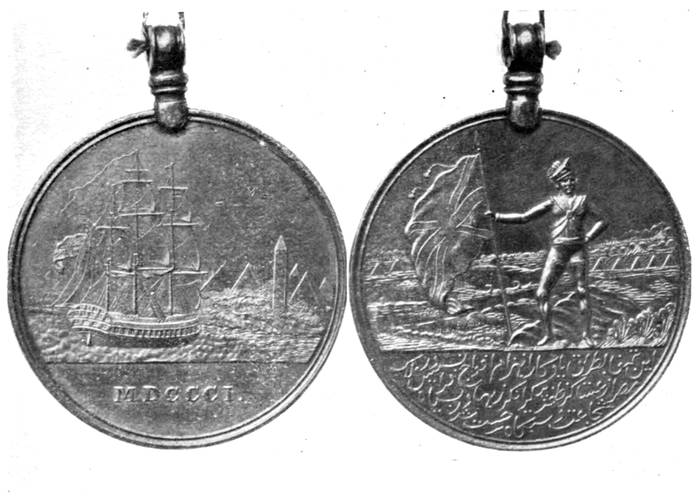
of the Isle of France. The medal was awarded to native
troops only, although the 86th and 96th Regiments
bear BOURBON on their colours. 2,201 were struck,
45 gold and 2,156 silver. The obverse bears a figure
of a sepoy standing beside a field gun, holding the
Union Jack unfurled in his right hand, and in his left
his musket with bayonet fixed; with his left foot he
tramples on a French colour and Eagle, whilst the
British fleet at anchor forms the background. On the
reverse is a Persian inscription surrounding a laurel
wreath, stating that "this medal was conferred in
commemoration of the bravery and accustomed fidelity
exhibited by the sepoys of the English company in the
capture of the Mauritius Islands in the year of the
Hegira 1226." Outside the wreath is the record
RODRIGUES VI JULY MDCCCIX. BOURBON VIII JULY
& ISLE OF FRANCE IN DEC. MDCCCX. The medal, 19∕10 in.
in diameter, was intended to be worn suspended from
a silken cord.
It is noteworthy that a corporal of the 86th planted
the regimental colours on the redoubt, and in the
fight for the Isle of Bourbon Lieutenant Munro of the
86th was killed, also 17 men killed and 59 wounded.
At the taking of the Isle of France only 29 of both
services were killed, and less than 150 wounded and
missing; besides the fleet of 70 sail, an army of 10,000
men under Major-General Abercromby took part in
the expedition.
Barrosa.—On September 29th Wellington retired
with the allied armies of 25,000 British and 30,000
Portuguese behind the famous lines of Torres Vedras,
where his force was augmented by the arrival of English
troops. Masséna made a series of ineffectual attacks,
which had the effect of keeping Wellington's army
from getting stale, and then retired to Santarem.
Meanwhile a force of 4,500 British, under Lieutenant-General
Graham, and 7,000 Portuguese under General
Dom Manuel le Lapeña, reached Tarifa to operate
against the rear of the French army under Marshal
Victor at Chaclana. Graham had unfortunately contented
himself with the command of his own troops,
leaving Lapeña to assume the position of Commander-in-Chief.
On April 5th, 1811, Lapeña halted his army
on the Cerro de Puerco, now known as the heights of
Barrosa. The Spaniards, lacking in discipline and
devoid of esprit de corps, straggled into a situation
which gave the keen-eyed French Marshal an opportunity
he was not slow to take advantage of, for the
blundering Lapeña had left a position which could
have been held on the heights of Barrosa, with the
result that his Spanish army was routed and driven
towards the sea. Lapeña's stupidity had placed Graham
in a very awkward situation. He had obeyed the
command to move to Te Bermeja, but, apprised of the
danger that threatened the Spanish General, he countermarched,
only to find that Lapeña had bolted with his
rabble of soldiery, and that the French held the key
of the position. Graham determined to take the
heights, and it is said there was never a shorter, more
violent, or bloodier conflict; it lasted one hour and
a quarter, and resulted in a loss to the French of about
3,000 killed and wounded, including General Ruffin
and Brigadier Rousseau, who were mortally wounded,
and six guns. The British out of their small army
lost in killed and wounded about 1,243 men, including
50 officers and 60 sergeants. The 87th Regiment, Royal
Irish Fusiliers, distinguished themselves by charging
the French line, and capturing the Eagle of the 8th
Infantry, the first to be taken during the war; two
companies of the Coldstream Guards accompanied the
87th in its charge.
The following British regiments took part in the
battle: 2nd Batts. of the Grenadier, Coldstream, and
Scots Guards; flank companies of the 1st Batt. 9th
Regiment; 1st Batt. 28th; flank companies 2nd
Batt. 47th; 2nd Batt. 67th; flank companies 2nd
Batt. 87th; 2nd Batt. 87th; 2nd and 3rd Batts.
Rifle Brigade; Royal Artillery and Royal Engineers,
also the 2nd Hussars of the King's German Legion.
The British had been under arms for twenty-four
hours, and fought the battle with Lapeña and his
men acting the part of spectators, except for the Spanish
Walloon Guard and the regiment of Ciudad Real, who
joined in the fray "impelled by the instinct natural
to brave men." Napier, in comparing the two leaders
at Barrosa, states: "The contemptible weakness of
Lapeña furnished a surprising contrast to the heroic
vigour of Graham, whose attack was an inspiration
rather than a resolution—so wise, so sudden was the
decision, so swift, so conclusive was the execution."
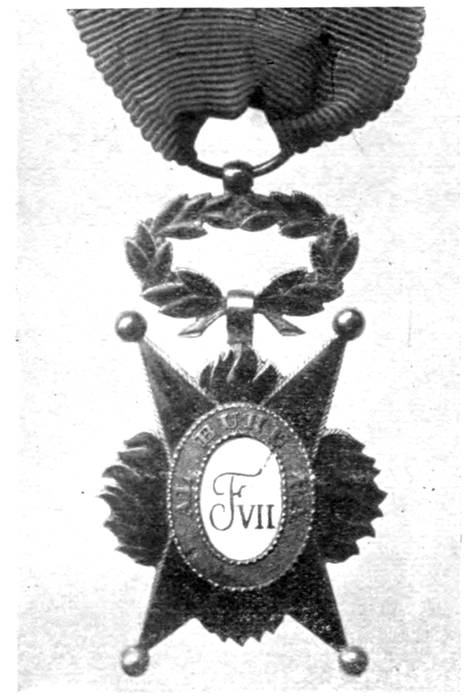
SPANISH CROSS FOR ALBUHERA.
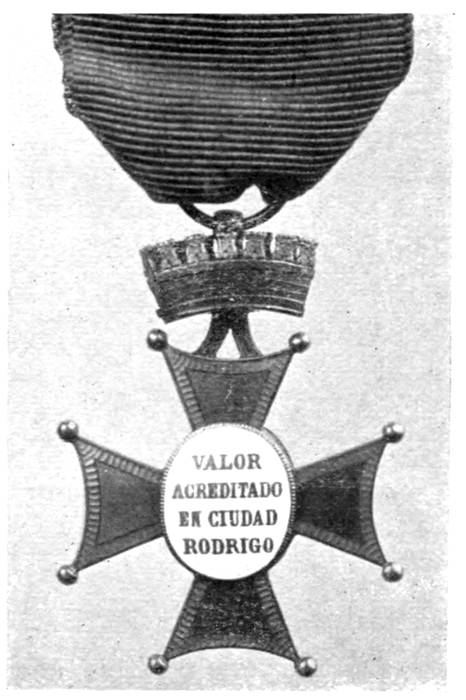
SPANISH CROSS FOR CIUDAD
RODRIGO.
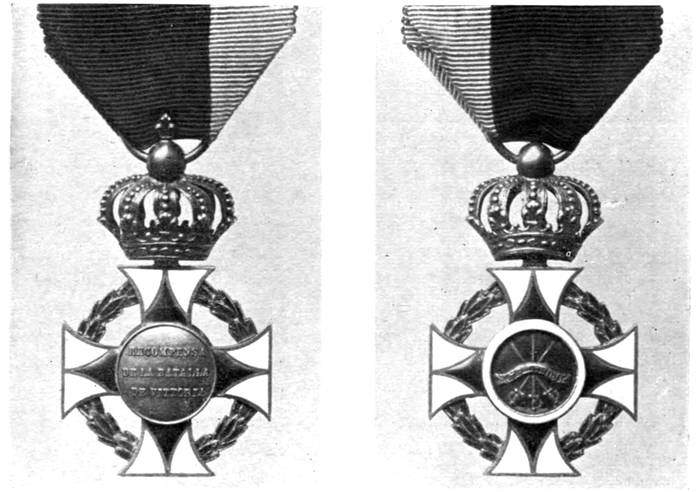
SPANISH GOLD CROSS FOR VITTORIA.
Fuentes d'Onor.—On Sunday, May 5th, 1811, the
battle of Fuentes d'Onor (Fountain of Honour) was
fought. The British and Portuguese armies under
Marshal Beresford had invested Almeida, upon which
Marshal Masséna marched his army, and the British
light division and cavalry retired as the French advanced
upon the village, which gave its name to the battle,
and together with the heights behind was occupied by
the 1st, 2nd, and 3rd division. The French attack
upon the village on May 3rd necessitated the aid of
reinforcements, and the 71st (Highland Light Infantry),
the 79th (Cameron Highlanders), and the 24th (South
Wales Borderers) were dispatched, the first-named
regiment charging the enemy and driving them out
of that portion of the village which they had occupied.
The contest raged until nightfall, and over 250 officers
and men fell on each side in what was practically a
hand-to-hand conflict. The 4th was spent quietly,
but on the 5th Masséna decided to try the fortune
of the day, which at the commencement seemed to
smile in his favour, for Junot carried the village of
Posa Velha, while the French cavalry not only drove
in the cavalry of the allies, but the whole movement
caused Wellington to make a daring change of position,
during which an episode unique in the annals of warfare
took place. In the retirement, two guns, under Captain
Norman Ramsey, had been left behind, and the French
and British also were astounded to see Ramsey charge
through the French masses at the head of his battery,
"his horses breathing fire and stretching like greyhounds
along the plain, his guns bounding like things
of no weight, and the mounted gunners in close and
compact order protecting the rear." Shortly after
the 2nd Battalion of the Black Watch again distinguished
itself by repulsing a charge of French dragoons.
While the fighting was proceeding on the vast plain,
a furious attack was made on Fuentes d'Onor, which
was desperately held by the 24th, 71st, and 79th Regiments,
but the unequal contest was determined by the
bayonet charge of the 88th Connaught Rangers. Nightfall
compelled the cessation of hostilities, and both
armies lay down to rest, looking to the morrow to
decide the battle, but the French gave no sign of battle,
and on the 8th retreated on the road to Ciudad Rodrigo.
Masséna claimed Fuentes d'Onor as a victory, despite
the fact that his object, to relieve Almeida, was unattained.
In this sanguinary battle the British lost
200 killed, 1,028 wounded, and 294 missing. It is
said that Masséna's total loss was about 3,000; of the
French dead 200 were found in the lower village of
Fuentes d'Onor. This was Masséna's last battle,
Napoleon recalling the enfant chéri de la victoire, who
returned to France broken-hearted, and when opportunity
offered gave his allegiance to Louis XVIII.
The regiments engaged in the battle were the 2nd
Foot Guards (Coldstreams), 3rd Foot Guards (Scots
Guards), 1st Dragoons; 14th and 16th Light Dragoons;
1st, 4th, 5th, 9th, 24th, 30th, 38th, 42nd, 43rd, 44th,
45th, 50th, 51st, 52nd, 60th, 71st, 74th, 79th, 83rd,
85th, 88th, 92nd, 94th, and the Rifle Brigade; Horse
Artillery; 1st Hussars; 1st and 2nd Light Battalions,
and the 1st, 2nd, 5th, and 7th Line Battalions of the
King's German Legion.
Albuera.—"Modern history," wrote General Picton,
"presents no example of an action so obstinately
disputed as that of Albuera." It was there that the
"Die-hards" gained their coveted name, and when
the roll-call of the "Buffs" was called, after the battle,
only three privates and a drummer answered to their
names. It was the fight for the regimental colours
which accounted in a degree for the grave loss of life,
so Lieutenant-General Cust states. Ensign Thomas
refused to yield the colours and was killed. Lieutenant
Latham, when severely wounded, tore the precious flag
he had received from Ensign Walsh from the broken
staff, and concealed it under his body, where it was
found after the battle by a sergeant of the 7th Fusiliers.
Latham Gold Medal.—Latham, who had a wonderful
recovery, was presented by the officers of the "Buffs"
with a gold medal commemorating the event, and
a royal authority was given him to wear it. The
"Buffs," as I have indicated, were almost annihilated—4
officers, 4 sergeants, and 208 rank and file were killed;
13 officers, 11 sergeants, 1 drummer, and 222 rank and
file wounded; 1 officer wounded and taken prisoner;
2 officers, 15 sergeants, 1 drummer, and 161 rank and
file missing—a loss of 644 officers and men in one
battle. The "Buffs" had already lost 27 killed and
208 wounded, and 7 missing, at Talavera. The 57th,
Middlesex Regiment, who were called upon by their
dying Colonel Inglis to "die hard," went into action
570 strong, but when the battle was over, 23 officers
and 400 rank and file "were lying as they had fought,
in ranks, with every wound in the front."
The battle was fought on May 16th, 1811, the Spanish
leaders agreeing that Marshal Beresford should have
supreme command, and to receive battle in the village
of Albuera. The allied army consisted of 32,000
infantrymen and 2,000 cavalry, with 38 guns; half
the force was Spanish, and the other half equally
composed of British and Portuguese. The Spaniards,
as usual, were slack, and did not get into position
properly. The battle opened by the French attacking
the heights on the right of the Spaniards, and though
they fought stubbornly at first they gradually gave
way before the onslaught of the French. Matters had
become very serious when General Stewart sent the
leading brigade of his division up the hill under General
Colborne; the advance was made in a drizzling rain.
The French made several brilliant charges, and in the
mêlée the commanding officer, Marshal Beresford, was
attacked by a Polish lancer, whom he seized bodily
and threw from his saddle. Those were heroic days
indeed! The bad weather, which had so far favoured
the French, actually helped to save the day for the
English, for the drizzling rain prevented Marshal Soult
from appreciating the sad condition of the British. On
the heights the 31st had resolutely held its ground;
other regiments had been cut to pieces, and Beresford
thought of retreat, when the cool daring of Colonel
(afterwards Lord) Hardinge, who took upon himself
to order General Cole to advance, and, taking General
Abercromby's brigade to the ground, saved the day—to
which, by the way, the Portuguese regiments of the
fourth division contributed—General Cole leading the
7th and 23rd Fusiliers in person. Cole drove off the
Lancers and recovered the lost guns, but ere the enemy
were driven from the ridge, they had fired a terrific
volley from all the guns, which killed Sir William
Myers, wounded the intrepid Cole and three officers,
while the Fusiliers "reeled and staggered under the
iron tempest like sinking ships, but nothing could
stop them." Soult, rushing into the thickest of the
fight, tried to encourage his brave soldiers to stand;
it was useless. "Suddenly and sternly recovering, they
closed on their terrible enemies, and then was seen
with what a strength and majesty the British soldier
fights." To again quote Napier, "Nothing could stop
that astonishing infantry ... their measured tread
shook the ground, their dreadful volleys swept away
the head of every formation ... the French reserve,
mixing with the struggling multitude, endeavoured to
sustain the fight, but the effort only increased the
irremediable confusion; the mighty mass gave way,
and like a loosened cliff went headlong down the steep.
The rain flowed after it in streams, discoloured with
blood, and 1,500 unwounded men, the remnant of
6,000 unconquerable British soldiers, stood triumphant
on the fatal hill." The dead and wounded lay in two
distinct lines on the ground, and in such compact
masses that 7,000 bodies occupied so small an area
that the artillery advancing into action had to pass
over the living and the dead, friend and enemy.
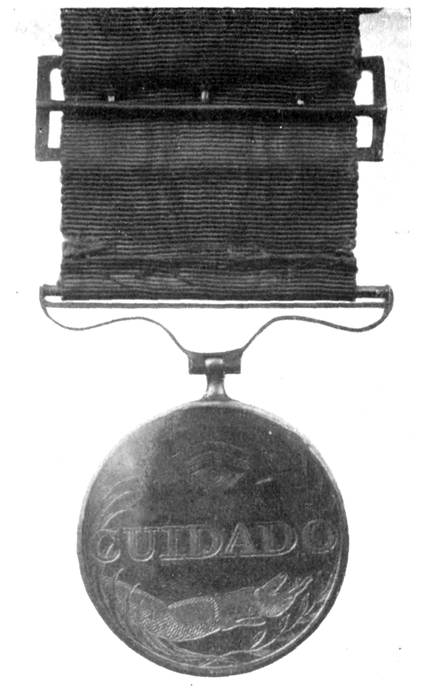
ALCANTARA MEDAL, 1809.
(Obverse.)
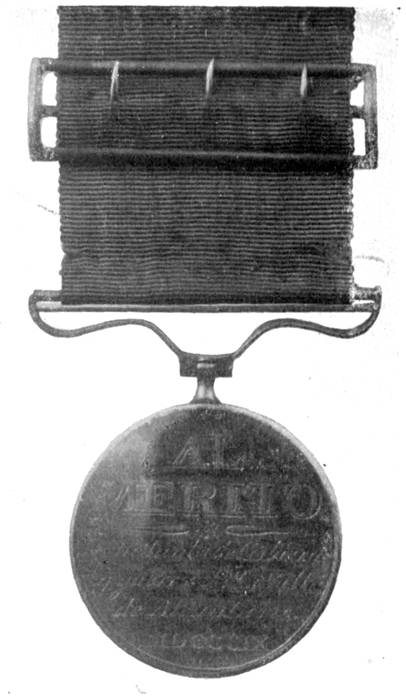
ALCANTARA MEDAL, 1809.
(Reverse.)
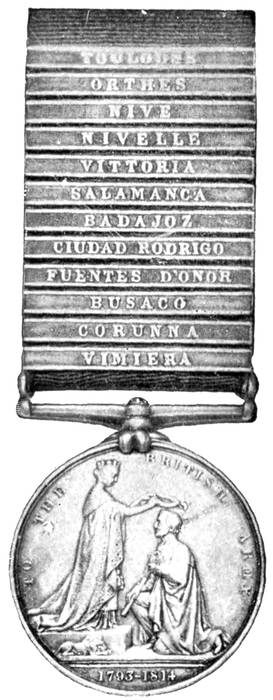
MILITARY GENERAL SERVICE
MEDAL.
The Immortals.—The "Die-hards," the "Buffs,"
the 7th Fusiliers, and the 23rd Welsh Fusiliers immortalised
themselves in that bloodiest of all battles,
where in four hours no less than 15,000 men were placed
hors de combat. Well might M. Thiers say that "a sort
of fatality rendered the heroic bravery of our troops
powerless against the cold courage of the English."
The 23rd lost 347 men, 80 killed, and 257 wounded and
missing, and it is noteworthy that one company was
brought out of action by a corporal. The 29th mustered
only 2 captains and about 100 junior officers and men;
the 57th was little better off, likewise the 48th when
the French were driven across the Albuera River. Of
the 7,000 British soldiers engaged, 4,300 were killed
or wounded; the dead included Major-General Houghton,
who was killed while leading his division, 33 officers,
33 sergeants, and 917 men. The Spanish and Portuguese
allies lost about 2,000 men killed or wounded, and as
the allied army consisted of about 34,000 men, the
brunt of the fighting was borne by the British troops.
The French, who numbered about 33,000, lost about
1,000 more men than the British, including 5 of their
General Officers killed or wounded; 2,000 dead and
800 of their worst wounded were left on the field when
the French drew off, leaving the British uncertain as
to what the morrow might bring forth, but reinforcements
coming for the British, Soult moved off in the
direction of Badajoz, followed by Beresford.
The following regiments took part in the battle:
3rd Dragoon Guards; 4th Dragoons; 13th Light
Dragoons; 1st, 3rd Foot (the "Buffs"); 1st and 2nd
7th (Royal Fusiliers); 1st 23rd (Welsh Fusiliers); 1st
27th Inniskillings; 2nd 28th; 29th; 2nd 31st; 2nd
34th; 2nd 39th (Dorsetshire); 1st 40th; 1st and
2nd 48th (Northamptonshire); 1st 57th (West Middlesex);
1st and 2nd 60th and four companies of the 5th
Battalion; 2nd 66th (Berkshire); 97th Queen's Own;
1st and 2nd Light Battalions of the King's German
Legion, and one company of Brunswick Oels.
Java.—The capture of the East Indian island of
Java, which the Dutch called the most precious jewel
in their diadem, was effected after operations lasting
from July 27th, 1811, when Lieutenant Edmund Lyons—after
Admiral Lyons—made a daring landing with
a few seamen, until August 26th, ten days after the
battle fought at Serondel near Samarang. During this
expedition the storming of Fort Cornelis took place,
when the enemy lost 1,000 killed; and three Brigadiers,
30 Field Officers, 70 Captains, 140 Subalterns, and
5,000 rank and file prisoners; 400 cannons were captured.
A million sterling was received by the British
force as prize money. The British loss (naval and
military) was 150 killed, 788 wounded, and 16 missing.
By the Treaty of Vienna Java was restored to the
Dutch in 1814.
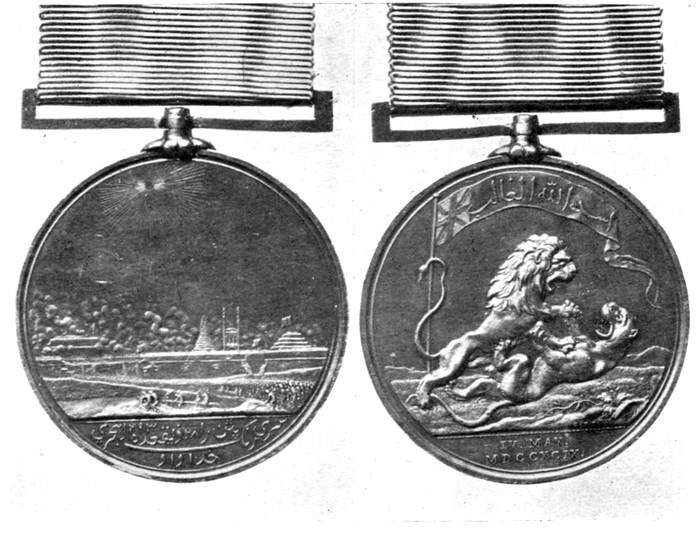
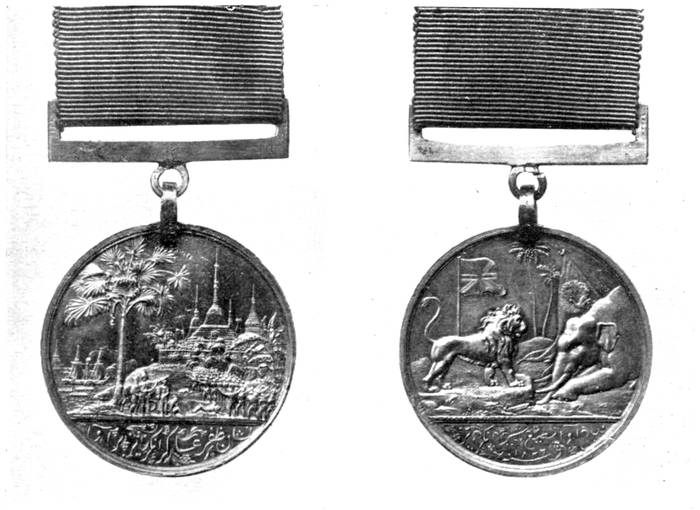
H.E.I. Co.'s Java Medal.—A medal, 1·9 in. in diameter,
was awarded by the Honourable East India Company
to the sepoys who took part in the expedition.
On the reverse is depicted the attack upon Fort Cornelis,
with a British flag flying above the Dutch, and above
all CORNELIS. The following is inscribed in Persian
upon the reverse: "This medal was conferred in commemoration
of the bravery and courage displayed by
the sepoys of the English company, in the capture
of the Kingdom of Java in the year of the Hegira
1228." "Java conquered XXVI August MDCCCXI."
133 gold and 6,519 silver medals of this type were
struck.
King George III conferred gold medals upon the
officers engaged, and when the Naval and the Military
General Service Medals were awarded, the surviving
participants in the capture received a medal with bar
inscribed JAVA. Four distinct medals were issued for
this expedition.
The military present at the capture of Java were
the 14th (now West Yorkshire Regiment), 59th (now
2nd East Lancashire Regiment), 69th (now 2nd Welsh
Regiment), 78th Highland Regiment (now 2nd Seaforths),
89th (now Royal Irish Fusiliers), Bengal Volunteers
and sepoys of "John Company."
Ciudad Rodrigo.—The siege of Ciudad Rodrigo followed
the "soldiers' battle" of Albuera. The army,
after considerable manœuvring, marching, and countermarching,
besieged Ciudad Rodrigo, which, together
with the siege of Badajos, had to be undertaken before
Wellington's plan of campaign could be carried out.
On January 1st, 1812, the order for the siege of the
fortress was suddenly issued, but some days elapsed
before the order could be put into execution, owing to
the inclement weather, snowstorms preventing any
possibility of operations. On the 8th the investment
of the fortress was commenced, and the earth redoubt
of Teson Grande stormed and taken by Colonel Colborne
with three companies of the 52nd Regiment.
On the 13th the Convent of Santa Cruz, one of the two
convents which had been fortified by the French, was
stormed and carried by the light companies of the
brigade of Guards, and on the night between the 14th
and 15th the 40th Regiment escaladed and carried
the fortified San Francisco Convent. Meanwhile preparations
had been progressing for the general assault,
which took place on the night of January 19th. Wellington
had written in his orders "Ciudad must be
stormed this evening," and the order was carried out
in a brilliant manner, but alas! two British Generals
were killed, General Crauford being mortally wounded
whilst leading the light division, and General Mackinnon
killed on reaching the ramparts of the greater breach.
In this assault General Picton adjured the Connaught
Rangers, who passed with the forlorn hope to storm
the breach, to "spare powder and trust to cold iron,"
and it was by the use of the bayonet that the 43rd and
95th drove the French from the "fausse braye." The
city was taken after a siege lasting twelve days, but
the troops "committed frightful excesses," which some
have condoned as a prescriptive right which successful
besiegers may enjoy. The British losses were 9 officers
and 217 rank and file killed, 84 officers—including
Major-General Vandeleur and Major (afterwards Sir
George) Napier, who lost an arm—and 1,000 men
wounded. For the successful issue to his generalship,
Wellington received the patent of an earl, and was
made a Spanish duke, the British Government increasing
his annuity to £4,000 per annum.
The regiments engaged in the siege were the 2nd
Foot Guards (the Coldstreams); 3rd Foot Guards
(Scots Guards); 5th, 7th, 24th, 30th, 40th, 42nd, 43rd,
45th, 48th, 52nd, 60th, 74th, 77th, 83rd, 88th, 94th,
97th, and the Rifle Brigade.
Siege of Badajoz.—Before bringing to a successful
issue the siege of Ciudad Rodrigo, Wellington had been
busily engaged in preparing for the third siege of
Badajoz. On March 16th, 1812, it was invested, but
the weather for some time was particularly unfavourable
to the besiegers, rain falling in torrents so that
the men in the trenches were knee-deep in mud and
water. By March 23rd, however, the weather had
improved, and the ground was in better condition for
placing the guns, which by the 25th were in position
at Picurina, the place being taken by storm on that
day. On the 26th breaching batteries opened fire
on the city, and by April 6th it was deemed possible
to storm the castle by escalade, Picton's division being
ordered to do so. The bastion of La Trinidad was
to be stormed by Colville's division, and the Santa
Maria by the light division under Colonel Barnard,
while the lunette of San Rocque was to be carried by
the 48th under Major Wilson. At 10 o'clock at night
the attack was made: General Kempts, leading his
brigade to the foot of the castle, was there wounded,
but, his men dashing on, the castle was won in an hour
and a half. "At the breaches the tumult was such
as if the earth had been rent asunder ... the carnage
was frightful. It is doubtful whether, since the invention
of gunpowder, any mass of men had ever been
more fearfully exposed to all its murderous power. The
dying were piled upon the dead in mounds, which the
living could not pass; and the French soldiers, undisturbed
in their avocation, raised the deriding cry
'Vive l'Empéreur!'" By midnight 2,000 men had
fallen outside the city, and Wellington ordered the
troops to withdraw; but this was as impossible as to
go forward. Meanwhile some of the 5th division had
entered the town (the 4th Regiment being in first),
which by 6 o'clock the next morning was surrendered
by the Governor. The besiegers lost 131 officers and
1,707 rank and file killed, and 564 officers and 6,083
men wounded. Napier states that "when the havoc
of the night was told to Wellington, the pride of conquest
sunk into a passionate burst of grief for the loss
of his gallant soldiers," for in the assault alone the
British casualties were 59 officers and 744 men killed,
and 258 officers and 2,600 rank and file wounded. No
wonder one of the Connaught Rangers exclaimed with
an oath, "Och! Boys, Soudradrodrago was but a
flay-bite to this." The 43rd Monmouth Light Infantry
lost more men than any other regiment; 20 officers,
including its chief, Colonel M'Leod (who was only
twenty-seven), 335 sergeants and privates killed and
wounded. Alas! the Saturnalia of Ciudad Rodrigo
was repeated, and the disciplined men who had fought
with such valour gave way to demoniacal passions
which we of to-day can scarce believe. The indignity
of the threatened gallows was the only way in which
Wellington could curb his men, but not before several
of the worst plunderers had been executed.
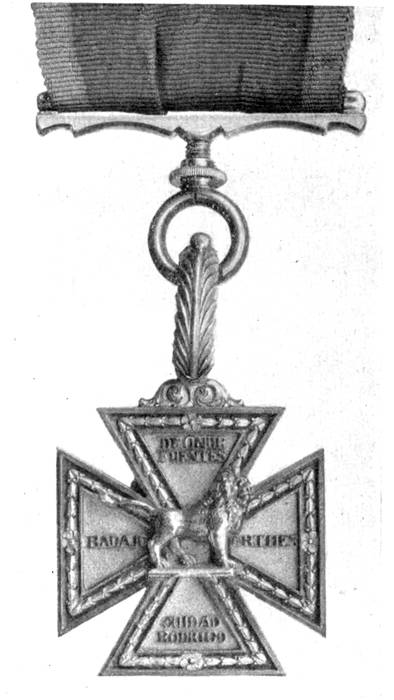
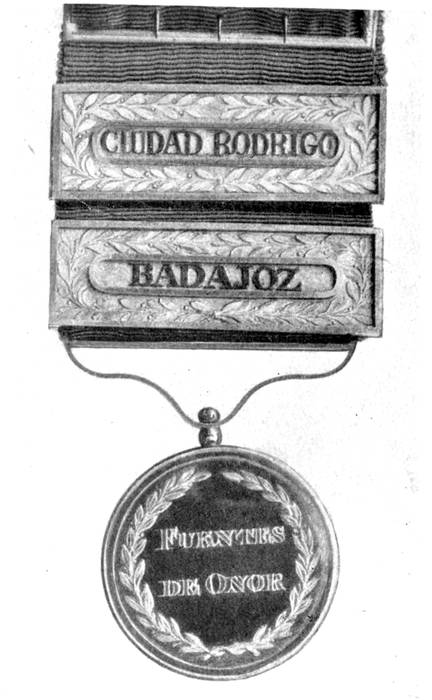
PENINSULAR GOLD MEDAL WITH BARS.
The following regiments were engaged at the siege
and storming of Badajoz: 2nd Foot Guards; 1st,
4th, 5th, 7th, 23rd, 24th, 30th, 38th, 40th, 43rd, 44th,
45th, 48th, 52nd, 60th, 74th, 77th, 83rd, 85th, 88th,
94th, and 95th Regiments, the Rifle Brigade, and the
13th and 14th Light Dragoons.
Salamanca.—The battle of Salamanca, fought on
Sunday, July 22nd, 1812, is noteworthy as the first
general action in the Peninsular War in which Wellington
attacked; his decision was due to Marmont making
a sudden movement which threatened to cut the
British lines of communication with Portugal, but
although the position appeared to be a critical one for
the British General, he turned to the Spanish General
Alva and said, "Mon cher Alva, Marmont est perdu!"
In this battle the 3rd division, under Major-General
Pakenham, were the first in action, and brilliantly
carried everything before them. In this division were
the Connaught Rangers, who, incensed by the death of
a favourite officer, Major Murphy, could hardly be
kept in hand. General Pakenham, noticing their
impatience, ordered them to "be let loose," when they
charged with an impetuosity which nothing could
withstand, and together with the 45th and 74th broke
through the masses of infantry, bayoneting all they
could overtake. Composed of such material, no wonder
the 3rd was called "the fighting division." It took
just forty minutes to defeat Marmont's left wing,
which in his endeavour to close the Ciudad road had
got separated from the right, and into the gap made
thereby Wellington poured his men. The right, however,
reinforced by those who had escaped the conflict
on the left, made a very determined resistance, and
the shades of evening were falling ere the enemy made
a last brave effort to retrieve the day, and, indeed,
appeared to be on the way to doing so when Wellington
ordered Clinton's division, numbering 6,000 bayonets,
to advance, which, after a furious struggle, compelled
the French to give way in confusion. Night had set
in, and the remnants of Bonnet's division, which
Clinton had put to rout, had the good fortune to find
a means of escape through the abandonment of the
ford of Alba de Tormes by the Spaniards. For six
hours the battle of Salamanca raged with unabated
fury, and with varying fortune on the right, so that
the divisions which had been actively engaged, on an
exceedingly hot day, were glad to bivouac on the ground
where they had fought a battle, which again demonstrated
the brilliant commandership and the keen,
quick eye with which Wellington detected an opportunity
when it offered. Salamanca was, in the opinion
of experts, the most skilful of any of his victories,
though the mistakes which Marmont made would
have been obvious to men of lesser capacity. A decisive
battle, it would have proved much more fatal to the
French had darkness not precluded the possibility of
any considerable effort at pursuit on the part of the
victors. As it was, however, Wellington pressed the
retreating French to the ford of Huerta, and ordered
the cavalry to follow the fugitives; continually pressing
on the rear, Wellington forced his way on to the
romantic city of Valladolid, which he entered in triumph
on July 31st. On August 12th he entered Madrid, to
the plaudits of the people, who hailed him as the
deliverer of their country.
In this battle the allies' losses exceeded 5,000. The
British lost General Le Marchant, who was killed
while leading a brilliant and successful charge of the
heavy brigade, 24 officers, and 686 rank and file killed.
Field-Marshal Beresford, Lieutenant-Generals Cotton,
Cole, Leith, and Major-General Allen were wounded,
besides 182 officers of inferior rank; 4,270 of the rank
and file were wounded. The Portuguese lost about
304 killed and 1,552 wounded; the Spaniards lost—4!
The French, who had at the battle about 42,000 men
and 74 guns, lost about 7,000 men, besides Generals
Desgraviers, Ferrey, and Thormières killed. Marmont,
the Commander-in-Chief, was badly wounded early in
the action by a shell; Bonnet was severely wounded,
and Clausel, who commanded after the disablement of
Marmont and Bonnet, slightly; 130 officers and 7,000
men were taken prisoners, and 2 Eagles, 6 standards,
and 11 pieces of artillery were captured by the victors.
Essentially a General's victory, with exceedingly
far-reaching consequences, Wellington was rewarded
with a marquisate, an augmentation of his coat-of-arms
to commemorate his services, and a grant of £100,000
to maintain the dignity of his rank; while the Spanish
Regency presented him with the Order of the Golden
Fleece. The vanquished Marmont, Duke of Ragusa,
on the other hand, was told by Napoleon that he had
"sacrificed to vanity the glory of the country, and the
good of my service."
The following regiments were present at Salamanca,
although some were in reserve: 2nd and 3rd Foot
Guards; 1st, 2nd, 4th, 5th, 7th, 9th, 11th, 23rd, 24th,
27th, 30th, 32nd, 36th, 38th, 40th, 42nd, 43rd, 44th,
45th, 48th, 51st, 52nd, 53rd, 58th, 60th, 61st, 68th,
74th, 79th, 83rd, 88th, 94th, and 95th Regiments;
artillery and Rifle Brigade; 5th Dragoon Guards; 3rd,
4th, 11th, 12th, 14th, 15th, and 16th Light Dragoons.
The King's German Legion was represented by the
1st Hussars; 1st and 2nd Light Battalions; 1st, 2nd,
and 5th Line Battalions.
Fort Detroit.—From that unfortunate day in 1773,
when the youth of Boston boarded the ships and cast
the cargoes of tea into the sea, until the signing of the
Treaty of Ghent in 1814, the relations between the
English-speaking peoples were continuously strained;
the centenary of that auspicious day, and the happy
continuance of peace, we celebrate this year. With
the events which led up to the outbreak of hostilities
I am not here concerned, my province being merely
to record such facts as will help in the appraisement of
the intrinsic, historical, or sentimental value of medals
awarded to those who have carried the burden of war.
The capture of Fort Detroit was an episode which
followed the declaration of war by the American Senate
on June 18th, 1812. Early in July 2,500 Americans,
under General Hull, crossed the Detroit and invaded
Upper Canada, but, opposed by about 1,330 Canadian
militia and regulars under Major-General Brock, they
were forced back to Fort Detroit, on the American
side of the St. Laurence, which Brock proceeded to
invest, but having constructed his batteries and opened
fire, before making the assault he sent his aide-de-camp
to summon the United States General to obviate bloodshed
by surrendering. This he did on August 16th.
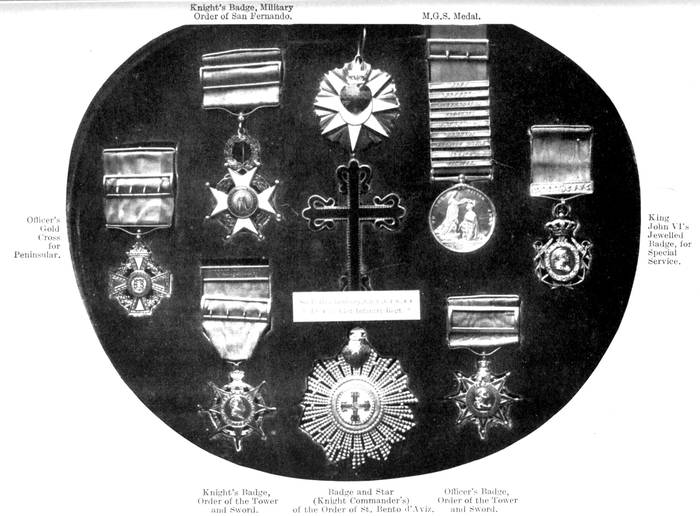
- Knight's Badge, Military
Order of San Fernando.
- M.G.S. Medal.
- Officer's
Gold
Cross
for
Peninsular.
- King
John VI's
Jewelled
Badge, for
Special
Service.
- Knight's Badge,
Order of the Tower
and Sword.
- Badge and Star
(Knight Commander's)
of the Order of St. Bento d'Aviz.
- Officer's Badge,
Order of the Tower
and Sword.
GROUP OF NINE DECORATIONS AWARDED TO LIEUTENANT-COLONEL SIR EDWARD BRACKENBURY, K.B.A., K.T.S., K.F.
The regulars represented in this affair were 30 Royal
Artillerymen, about 250 men of the 41st (the Welsh
Regiment), which, together with its linked battalion,
the 69th, bears DETROIT on its colours; 50 of the
Royal Newfoundland Regiment; 400 Canadian militiamen,
and 600 Indians.
Vittoria.—Following the abortive siege of Burgos,
September 19th, 1813, Wellington retired to Frenada
and Coria on the frontiers of Portugal, and went into
winter quarters to await reinforcements. They having
arrived, and the army being well equipped and in a
good disciplinary spirit, he commenced the second
part of the Peninsular campaign, which was destined
to be a series of successes for the British commander,
who commenced the final campaign in May 1813, by
bidding adieu to Portugal, and marching into Spain
with 70,000 men. He swept everything before him to
the Pyrenees. "Neither," says Napier, "the winter
gulleys, nor the ravines, nor the precipitate passes
among the rocks, retarded even the march of the
artillery—where horses could not draw, men hauled;
when the wheels would not roll, the guns were let
down or lifted by ropes—six days they toiled unceasingly,
and on the seventh (June 20th) they burst like
raging streams from every defile, and went foaming
into the basin of Vittoria." There Joseph Bonaparte
and Marshal Jourdan had taken up the position from
which they were to be driven by the forceful Wellington,
who spared nothing to achieve his object. "Never,"
wrote Napier, "was an army more hardly used by its
commander, and never was a victory more complete."
It was a terrific struggle; "the hills laboured and
shook, and streamed with fire and water," ere the
pseudo-king, Joseph Bonaparte, and his army fled in
confusion, leaving all his personal belongings, and the
rich pictures and plunder he had taken from every
part of Spain, strewn on the road, for whosoever had a
mind to acquire; 151 guns, 415 caissons of ammunition,
4,000 rounds for guns, and 2,000,000 musket
cartridges were also abandoned, and a full military
treasure-chest. Indeed, never had such an accumulation
of military stores and private wealth been abandoned
by a routed army.
The French General Gazan, who took part in the
battle, recorded that the French "lost all their equipage,
all their guns, all their treasure, all their papers, so
that no man could prove how much pay was due to
him." Joseph Bonaparte's carriage was abandoned
in the street in his haste to evade Captain Wyndham,
who made a bold dash to secure him; the Sword of
State, emblematic of the kingship which the brother
of Bonaparte had claimed, but which he had lost for
ever, and the marshal's baton belonging to Jourdan,
together with the Eagle of the 100th Regiment, were
among the spoils. It is also recorded that "a perfect
herd of women, including General Gazan's wife, and
a number of the wives, mistresses, actresses, and nuns,
belonging to officers and men of the French army,
were abandoned." The Field Marshal's baton, which
was taken by the 87th Royal Irish Fusiliers, commanded
by Lieutenant-Colonel (afterwards Viscount)
Gough, was sent to the Prince Regent, who responded
by sending Wellington the Field Marshal's baton of
Britain.
The French loss in killed and wounded was estimated
by M. Thiers at 5,000; the allies' losses were, British
500 killed, 2,300 wounded, and 266 missing; the
Portuguese loss was about 150 killed and 900 wounded;
the Spanish losing 89 killed and 460 wounded.
The British regiments present were the 1st and 2nd
Life Guards and Horse Guards, represented by two
squadrons; 1st, 3rd, and 5th Dragoons; 3rd, 4th, 10th,
11th, 12th, 13th, 14th, 15th, 16th, and 18th Light
Dragoons; 2nd and 3rd Foot Guards; 1st Royal
Scots; 2nd Queen's Royal; 4th King's Own Royal;
5th Northumberland Fusiliers; 6th Royal 1st Warwickshire;
7th Royal Fusiliers; 9th East Norfolk; 20th;
23rd Royal Welsh Fusiliers; 24th; 27th Inniskilling;
28th North Gloucestershire; 31st, 34th, 38th Staffordshire;
39th Dorsetshire; 40th; 43rd Monmouth
Light Infantry; 45th Sherwood Foresters; 47th
Lancashire; 48th Northamptonshire; 50th Queen's
Own; 51st King's Own Light Infantry; 52nd Oxford
Light Infantry; 53rd Shropshire; 57th West Middlesex;
58th, 59th, 60th King's Royal Rifle Corps; 66th
Berkshire; 68th Durham Light Infantry; 71st Highland
Light Infantry; 74th Highland Regiment; 82nd
Prince of Wales Volunteers; 83rd; 87th Royal Irish
Fusiliers; 88th Connaught Rangers; 92nd Gordon
Highlanders; 94th; 95th Derbyshire.
Pyrenees.—The rout at Vittoria gave Wellington
possession of the passes of the Pyrenees, and when in
1849 it was decided to decorate the surviving soldiers
of the Peninsular War, all those who had taken part in
the series of extraordinary actions in the Pyrenees,
Roncesvalles, Maya, Santarem, and Buenzas, from
July 28th to August 2nd, 1813, were awarded the
medal with bar inscribed PYRENEES, and those who
were entitled to the medal for other actions received
the additional bar. Napoleon ordered his brother to
retire into private life and instructed the officials not
to pay him the respect due to a monarch. Soult was
ordered to take up the command, and did so with a
zest and ability that has called forth the admiration
of all who recognise in the dread game of war that
sportsmanlike character which thoughtfully dares all
and takes its rebuffs with a smile.
Siege of Sebastian.—Meanwhile, Wellington instructed
the Spanish Generals to blockade the fortress
of Pampeluna, and besieged San Sebastian, which was
blockaded by the British Navy on July 3rd, and invested
by the troops under Sir Thomas Graham on
the 9th. During this, the first siege of San Sebastian,
a Frenchman states that on the 19th and 20th for
fifteen hours the British fired 350 shots per gun. On the
24th General Graham ordered the assault, and the
way was led by Colin Campbell (afterwards Lord Clyde)
of the 9th, and Machet the engineer. Campbell, doing
many a daring deed, saw all his friends dead round him,
while he, seriously wounded, was spared to achieve
greater things. In this assault 44 officers of the line
and 500 men were killed, wounded, or taken prisoners.
The battalion of the Royal Scots present alone lost
87 killed and 246 wounded in the unsuccessful assault.
In the meantime Marshal Soult, who had reached
Bayonne on July 13th to take command of the united
French army, attacked Major-General Byng's brigade
at Roncesvalles on the 25th, while Count D'Erlon
proceeded to attack Sir Rowland Hill in the Pass
of Maya, where very desperate fighting ensued. The
fighting at Roncesvalles and Maya continued until
nine in the evening, when it was deemed advisable
to abandon the Pass of Maya to the enemy.
Gallantry of Gordons at Maya.—In the day's
fighting the allies lost 1,600 men and 4 guns. In the
Pass of Maya the British troops had been engaged
for ten hours, and it is noteworthy that the 92nd
Gordon Highlanders, being without ammunition, although
ordered by General Stewart not to charge,
could not be restrained, and not only charged, but
led a charge against the enemy. In this engagement
the 92nd lost 1 officer and 34 men killed, and 18 officers
and 268 men wounded, one wing being practically
annihilated. Napier states in his history of the war
that "so dreadful was the slaughter, especially of
the 92nd, that it is said the advancing enemy was
actually stopped by the heaped dead and dying. The
stern valour of the 92nd, principally composed of
Scotsmen, would have graced Thermopylæ." In this
sanguinary combat the 82nd also particularly distinguished
itself.
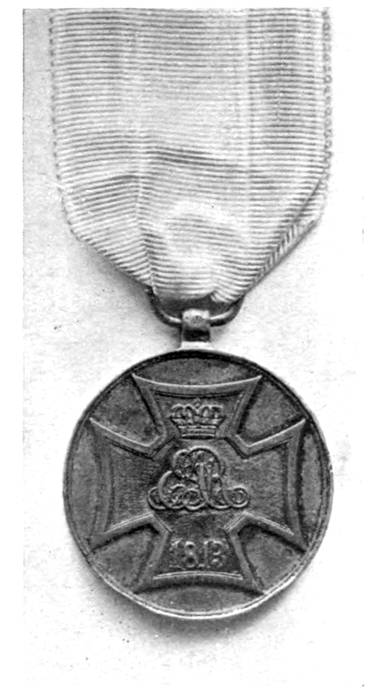
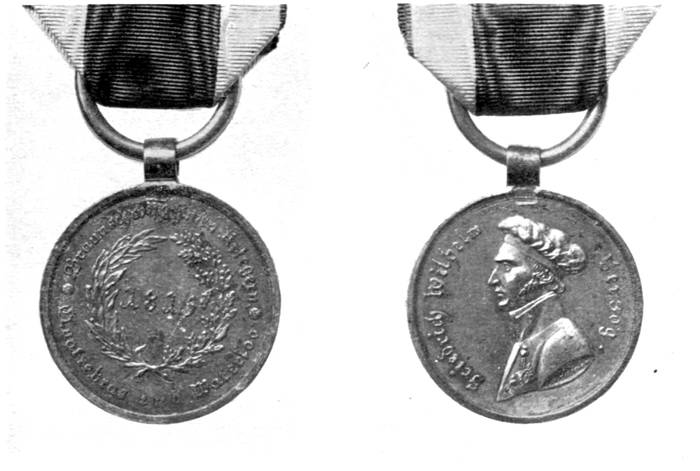
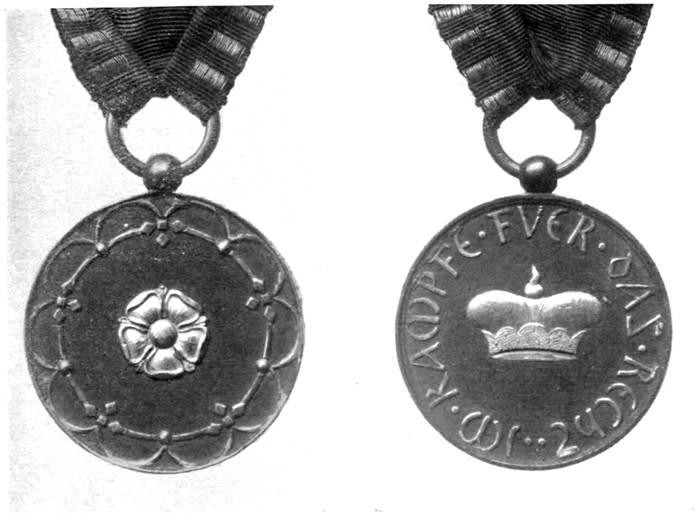
BRONZE MEDAL TO BRITISH
GERMAN LEGION FOR PENINSULAR
WAR.
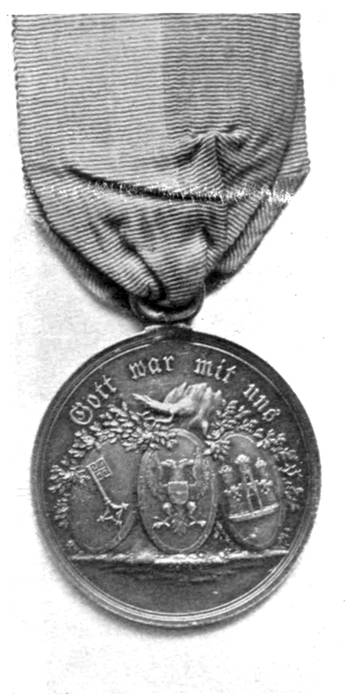
SILVER MEDAL TO HANSEATIC
LEGION, 1813-15.
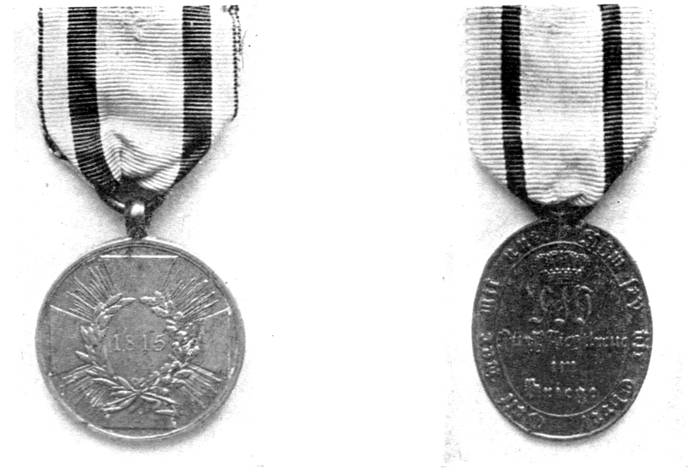
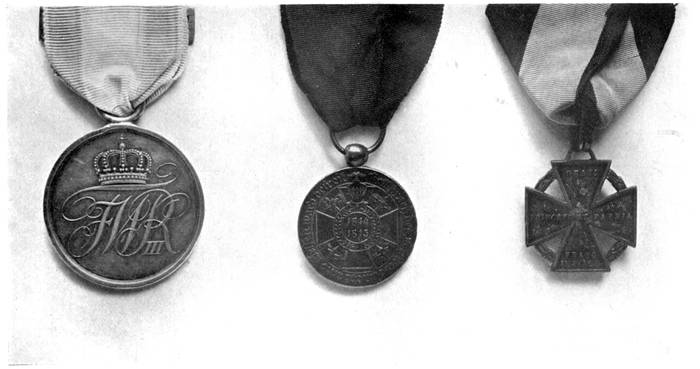
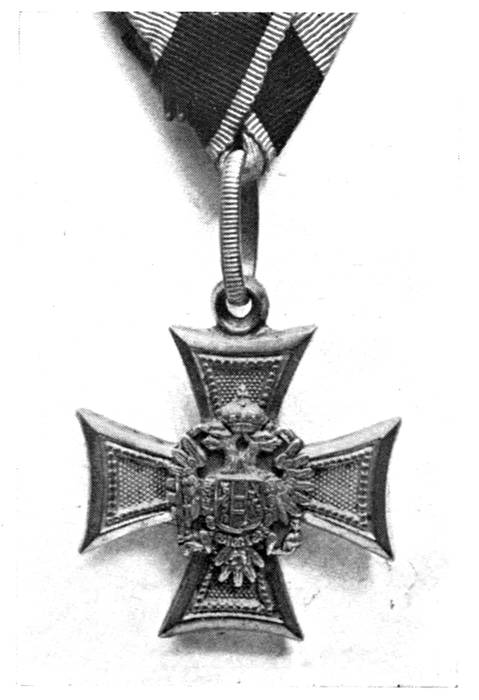
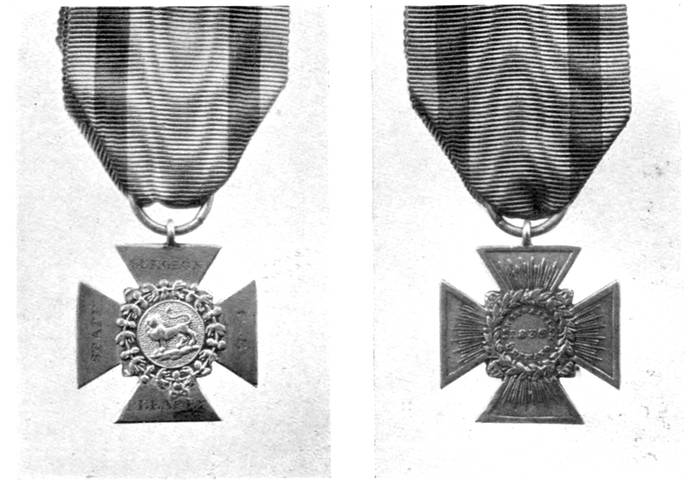
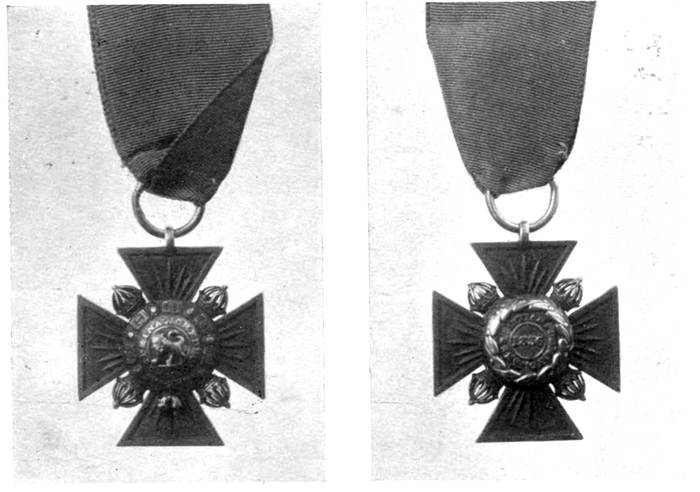
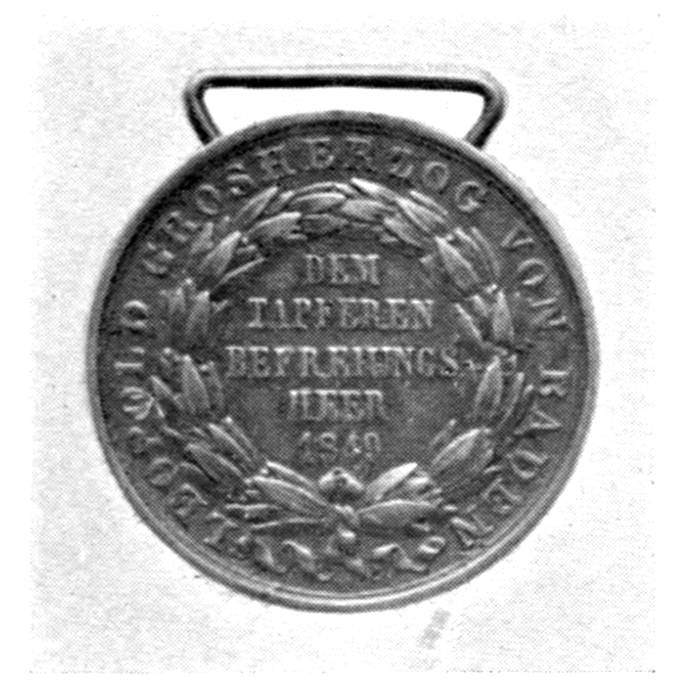
PRUSSIAN MEDALS FOR NAPOLEONIC WARS.
(See section, Some Continental and Foreign War Medals, p.
357.)
On the 28th the British were attacked in position
on a mountain ridge between the valleys of the Lanz
and the Guy, with Byng's brigade in reserve on the
second ridge of Huerta, and the 6th division adjoining;
the latter had scarcely got into position, when General
Clausel attacked it from the Sorauren side; the fight
became general, and 27th and 48th Regiments, charging,
"rolled back the enemy in disorder, and threw them
headlong down the mountain side." With admirable
heroism the French soldiers returned three times to
the charge, but their efforts could not avail against
the dogged determination of the allied troops. In this
affair every regiment in the 4th division, the 40th,
7th, 20th, and 23rd, charged four times, while Major-General
Ross had two horses shot under him. On the
29th the rival armies were inactive, Soult apparently
considering his plans for the relief of Pampeluna and
San Sebastian. He decided to abandon any advance
on the former, and proceeded to relieve San Sebastian,
but by masterly manœuvres Wellington checkmated
his opponent, and compelled him to abandon the
endeavour, and on August 2nd the French troops
evacuated Spain at all points.
For nine days the armies had confronted one another,
and the allies had lost in the different actions no less
than 7,096 officers and men killed and wounded, while
the aggregate loss of the French is put down at 15,000.
At the conclusion of this series of conflicts Sir William
Stewart was wounded, and Wellington narrowly escaped
being taken prisoner by a French detachment which
surprised him whilst studying a map; the French
Commander-in-Chief, Soult, also narrowly escaped with
his liberty.
St. Sebastian.—While Soult and Wellington had
been busily engaged, General Rey, the Governor of
San Sebastian, had employed himself in strengthening
the city and castle, so that when the second siege
was renewed on August 5th, 1813, he was in a position
to make a very desperate defence. Many inactive days
were spent, to the chagrin of Wellington, who complained
of the exceeding inactivity of the navy, which
compelled him to lose more than half of August. However,
by the 26th he had breaching guns and mortars
in position, and with these he opened fire upon the
city, and as a result 250 yards of the walls were reduced
to ruins; but it was not until the night between August
30th and 31st that the place was assaulted. Then,
again, the British soldier gave proof of his cool bearing,
not once, but again and again. At 8 a.m. the town
was bombarded by all the batteries, and the fire was
kept up until 11 a.m., when the order for the assault
was given. A storming party of 750 volunteers was
asked for from the 1st, 4th, and light divisions, "men
who could show other troops how to mount a breach."
They successfully passed one danger which destroyed
a party of thirteen that had rushed to cut the saucisson
of a mine, to die in mounting the great breach. At the
sea wall hundreds of the British were killed by the
explosion of a mine, and then "began a frightful
slaughter," for there was hardly another conflict so
desperate and so sanguinary as that which took place
at the storming of the great breach; "the appearance
of the breach was perfectly delusive; nothing living
could reach the summit; no courage, however desperate,
could overcome the difficulties, for they were alike
unexpected and unsurmountable." The officers encouraged
their men by word and action, "crowd after
crowd were seen to mount, totter, and to fall, and at
length the whole mass sank to the bottom of the breach,
but remained stubborn and immovable on this lower
part." General Graham, beholding this, resorted to
an unparalleled expedient by ordering all the breaching
batteries to fire over the stormers' heads on to the
inner wall. This daring inspiration saved the situation,
for the terrible storm of missiles, passing over the heads
of the British troops, did their deadly work by demolishing
the defences, and killing or driving away the defenders.
Another furious effort was made upon the
breach, and when this seemed as though it must fail,
explosions occurred all along the enemy's defences,
and the British soldiery, breaking into the first traverse,
poured through the town, pushed past the barricades,
which the defenders could not hold even for a few
moments in face of the impetuous stormers, who were,
however, compelled to leave the castle unattacked.
In this terrible conflict the chief engineer, Sir Richard
Fletcher, was killed; Burgoyne, the second engineer,
wounded; also Generals Sir James Leith, Oswald,
and Robinson. The total loss of the besiegers on the
day of the capture was 761 killed, 1,697 wounded, and
45 missing. The castle was pluckily defended, but on
the 8th was reduced to ruins, and the garrison, surrendering,
were allowed to march out, the brave Rey at their
head, with all the honours of war. The siege had lasted
seventy-three days, during which time nine assaults
had been made. The disgraceful scenes of Ciudad
Rodrigo and Badajoz were surpassed at San Sebastian
by the addition of revolting cruelty to the excesses of
drunkenness, and the crimes of rape and murder.
The regiments engaged in the siege and capture
were 200 of the Guards; 1st, 2nd, 4th, 7th, 9th, 11th,
20th, 23rd, 24th, 27th, 36th, 38th, 40th, 43rd, 47th,
48th, 51st, 52nd, 53rd, 59th, 68th, 82nd, 85th, 87th,
88th, and 95th, but only the Royal Scots, 4th, 9th,
38th, 47th, and 59th Regiments, are permitted to carry
ST. SEBASTIAN on their colours.
Chateauguay.—This battle, fought on October 26th,
1813, occurred during the military campaign in America.
Having achieved a series of successes, the Americans
concentrated about 18,000 regulars and 10,000 militia
at Sackett's Harbour. Sir George Prevost, thinking it
expedient, quitted Kingston and proceeded to the
capital, whilst Sir R. Skeaffe assembled as many troops
as he possibly could, 8,000 militia readily responding
to the call. Major-General Hampton, commanding
the eastern division of the United States army, crossed
the Canadian border with 8,000 men on October 21st,
having arranged to co-operate with General Wilkinson,
who was in command of about 10,000 men, but through
some misunderstanding the two forces were unable
to combine, and on October 26th General Hampton
found himself faced by a body of 800 men, under
Lieutenant-Colonel De Salaberry, who disposed his
little army so admirably that he not only caused the
enemy a severe loss, but compelled Hampton to fall
back to Plattsburgh, from which he "had not the
resolution again to return to the frontier."
Those engaged in this affair were the Canadian
Fencible Light Infantry, Canadian Militia, two companies
of Voltigeurs, some Indians, and Royal Artillery.
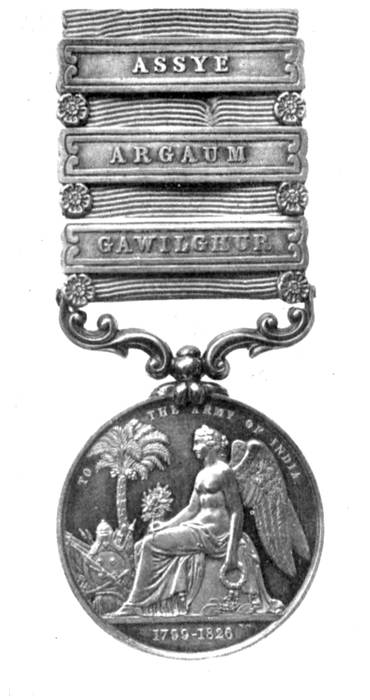
The Peninsular Gold Cross.—The long-drawn character
of the Peninsular War, and the frequent general
engagements which called for recognition, occasioned the
recipients of the gold medals inconvenience in wearing
them; in consequence the names of battles were sometimes
engraved on the medals as suggested in Wellington's
dispatch of October 1st, 1811, dated from Richoso.
Subsequently an order was issued from the Horse
Guards, on October 7th, 1813, to the effect that amended
regulations would be adopted in the grant and circulation
of marks of distinction, i.e. medals. The regulations
set forth that (1st) only one medal should be
borne by each officer, (2nd) that for the second and
third events a gold clasp attached to a ribbon, from
which the medal is suspended, inscribed with the name
of the battle or siege to which it relates. These bars,
which were unconnected, were 2 in. long by ⅗ in. broad,
with laureated edges, the names of the battles being
soldered on. They were pierced and lapped bright.
(3rd) That upon a claim being admitted to a fourth
mark of distinction, a cross shall be borne by each
officer with the names of the four battles or sieges
respectively inscribed thereupon, and to be worn in
substitution of the distinctions previously granted.
(4th) That upon each occasion of a similar nature,
that may occur subsequent to the grant of the cross,
the clasp shall again be issued to those who have a
claim to the distinction. The following officers were
eligible for the distinction: General Officers, Commanding
Officers of Brigades, Commanding Officers of
Artillery and Engineers, Adjutant-General and Quartermaster-General,
also Assistant Adjutant-General and
Quartermaster-General ranking with Field Officers;
Military Secretary having the rank of Field Officer,
Commanding Officers of Battalions or Corps equivalent
thereto, and Officers who may have succeeded to the
actual command during an engagement, owing to the
death or removal of the original Commanding Officer.
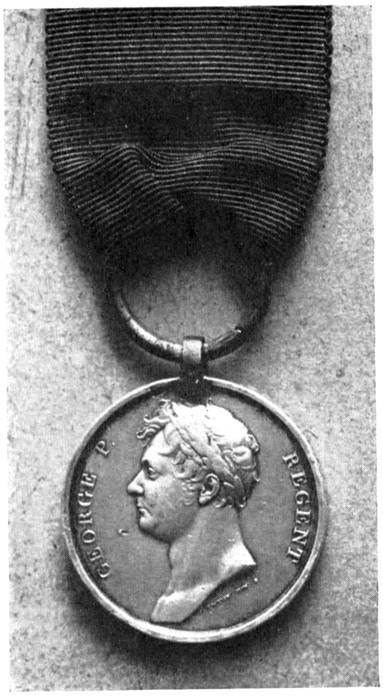
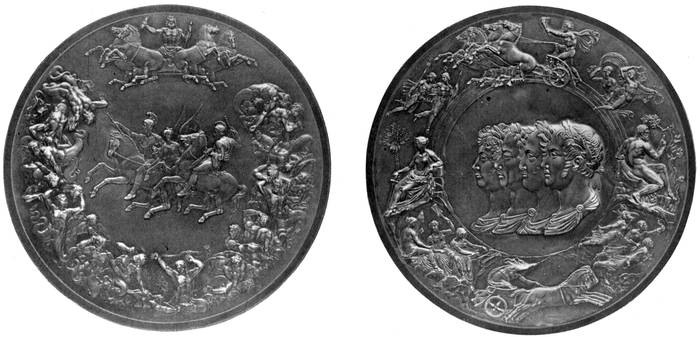
(Obverse)
WATERLOO MEDAL.
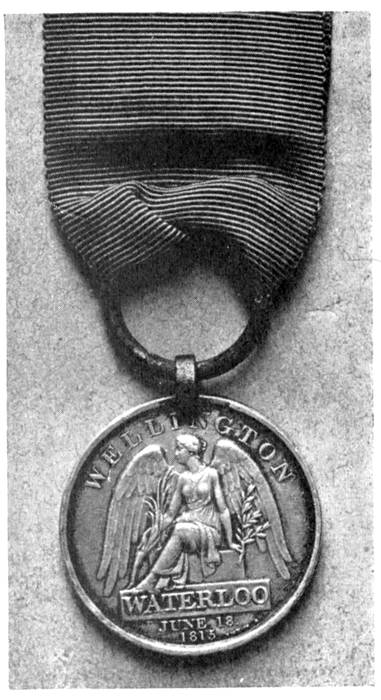
(Reverse.)
WATERLOO MEDAL.
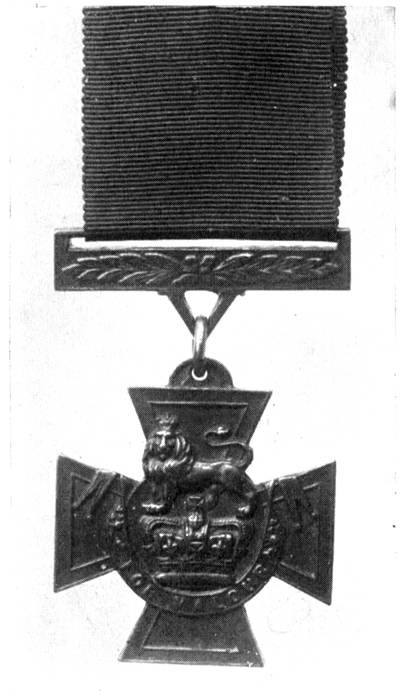
The cross (see facing page 44), Maltese in form, is 1½ in.
square, with a bright lapped double border framing a
laurel mount. In the centre in bold relief is the British
Lion statant, and on the four arms of the cross are
arranged the names of the battles the recipient was
engaged in. The name of the first battle is arranged in the
space above the Lion. The obverse and reverse are
similar; the cross was suspended from a crimson ribbon
with blue edges—the regulation ribbon at this time—17∕10
in. wide, by means of a gold swivel and laureated
ring, connected to the cross by means of a gold loop and
ornamentation. The names and regiments of recipients
were engraved on the edges of the arms of the cross.
Number Issued.—The Duke of Wellington received
the only cross with 9 bars, representing 13 engagements;
two were issued with 7 bars; three with
6 bars; seven with 5 bars; eight with 4 bars;
seventeen with 3 bars; eighteen with 2 bars;
forty-six with 1 bar, and sixty-one the cross alone.
Eighty-five large gold medals were issued, and 599
small gold ones. One hundred and forty-three bore
1 bar, and seventy-two 2 bars, leaving four hundred
and sixty-nine medals without bars or clasps.
Nivelle.—For nearly six cold and inclement weeks
after the fall of San Sebastian, Wellington remained
inactive in the Pyrenees, the troops suffering considerably
in the bleak situation. Then began the operation
which has been described as one of the boldest of the
war. Wellington determined to seize the great La
Rhune mountain, 2,700 ft. high, which stood between
the Nivelle and Bidassoa valleys and the dependent
heights; by so doing he could menace the centre of
the French line, and cross the border. Soult lost his
head, and called upon the French peoples of the provinces
to take up arms and war "to the knife." Wellington
coolly responded by informing the inhabitants
that England did not make war upon the people, but
upon their ruler, who did not allow others to remain
at peace, and impressed upon his soldiers that any
acts of violence or marauding would be punished by
death. Early on the morning of October 7th, 1814,
the British made their first movement by crossing
the mouth of the Bidassoa River—a feat classed among
the ablest and boldest of Wellington's operations; the
enemy were taken by surprise, and the British carried
everything before them. At 3 o'clock in the afternoon
the famous exploit of Lieutenant William Havelock,
"El Chico Blanco," took place. He had been sent by
General Baron Alten to see the progress that Marshal
Giron's Spaniards had made, and finding them irresolute,
despite their previous successes, his fiery spirit could
not brook the check. Taking off his hat, he called upon
the Spaniards to follow him, set spurs to his horse, and
cleared the abattis at a bound. "Then," wrote Napier,
"the soldiers, shouting for 'El Chico Blanco' (the
fair boy)—so they called him, for he was young and had
light hair—with one shock broke through the French,
and at the very moment when their centre was flying
under the fire of Kempt's skirmishers from the Puerto
de Vera." (Lieutenant-Colonel Havelock, elder brother
of Sir Henry Havelock, was born on January 23rd,
1793, and killed while leading the 14th Light Dragoons—"450
sabres against an army amounting to more
than 15,000 men with heavy cannon"—at Ramnuggur,
November 22nd, 1848.) In three days the allies lost
814 men, and the French 1,400, but the victorious
allies were now on French soil, and working well together,
the Spaniards rising to the occasion as success
succeeded success. For some days the armies were
inactive; Wellington was getting ready to resume
the offensive, while Soult was preparing to attack.
The enemy, however, attacked, and carried a redoubt
in the camp of Sarre held by the Spaniards. They
then attacked, on the morning of the 13th, the advance
posts of the army of Andalusia, under the command
of Marshal Giron, but were easily repulsed. Ultimately
the French retreated in confusion towards the bridge
of Nivelle, and on November 10th the battle of La
Nivelle was fought. It was a beautiful morning, and
it must have been a grand sight to see the army of
90,000 men descend to the battle. "Three guns pealed
from the mountain heights of Achubia ... and the
battle of the Nivelle commenced." Driven from the
centre, many of the French troops crossed the Nivelle
at St. Pè, while Major-General Colville, with the 3rd
division, and General Le Cor with the 7th, drove off
those who held the heights above, and established the
allied army on the rear of the enemy's right. Night
ended the battle, and under cover of the darkness
Soult withdrew his army and abandoned the position
he had been fortifying for three months. On the
12th he took up his position in front of the camp at
Bayonne. In this engagement the allies took 1,400
prisoners, 51 pieces of cannon, and 6 tumbrils of ammunition.
The French also lost 2,000 men killed and
wounded.
In his dispatch Wellington particularly referred to
the gallant conduct of the 51st and 68th Regiments in
the attack on the heights above St. Pè. The allies lost
26 officers, including Lieutenant-Colonel Lloyd of the
94th, 28 sergeants, 289 rank and file; 155 officers,
including Major-General Kempt, and 2,146 men
wounded; 3 officers and 70 men missing.
The following regiments were present in the engagements
leading up to the battle of Nivelle. 1st and 2nd
Batts. Foot Guards; 1st, 2nd, 3rd, 4th, 5th, 6th, 7th,
9th, 11th, 20th, 23rd, 24th, 27th, 28th, 31st, 32nd,
34th, 36th, 38th, 39th, 40th, 42nd, 43rd, 45th, 47th,
48th, 50th, 51st, 52nd, 53rd, 57th, 58th, 59th, 60th,
61st, 62nd, 66th, 68th, 71st (did not take active part),
74th, 76th, 79th, 82nd, 83rd, 84th, 85th, 87th, 88th,
91st, 92nd, 94th, and 95th; the Rifle Brigade; 12th,
13th, 14th, and 18th Light Dragoons, and the 1st and
2nd Light Battalions, also the 1st, 2nd, and 3rd Line
Battalions of the King's German Legion.
Chrystler's Farm.—The day following the battle of
Nivelle in France saw a victory for British arms in
Canada at Chrystler's Point, commonly called Chrystler's
Farm. This battle was a sequel to that at Chateauguay.
I have referred to the fact that the American
General Wilkinson, with his army of 10,000 men, had
failed to combine with Major-General Hampton, but
by November 3rd he landed a portion of his troops
near Point Iroquois, to which place the British General
dispatched a force of 800 regulars and militia, under
Colonel Morrison, to stop the advance. Meeting 3,000
men who had been landed under Major-General Boyd
at Chrystler's Farm, Colonel Morrison's little army
routed them after a fight lasting two and a half hours,
with a loss of 250 killed and wounded, besides 100
prisoners and one gun. The effect of the action at
Chrystler's Farm was to compel the enemy to evacuate
Lower Canada.
Men of the 49th and 2nd Battalion 89th Regiments,
the Royal Artillery, Canadian Militia, Fencibles and
Voltigeurs, likewise a few Indians, were engaged in this
battle. As comparatively few regulars took part in
the American battles, Fort Detroit, Chateauguay,
and Chrystler's Farm, and because they were awarded
so many years after, medals to British regiments
bearing these bars are very rare, as indeed are those
of the Colonials who took part.
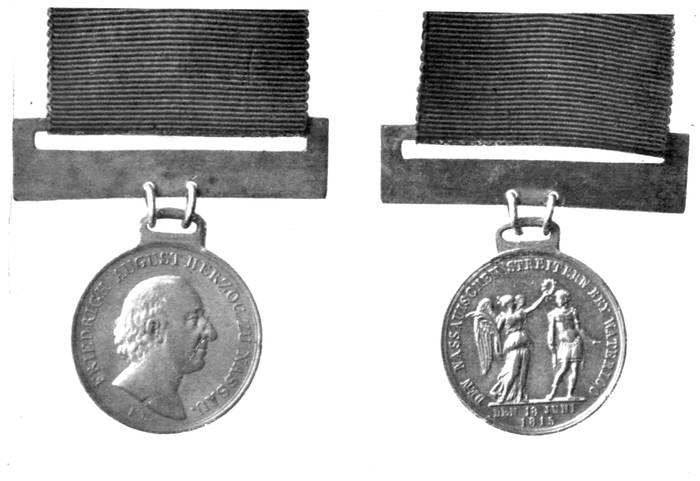
NASSAU MEDAL FOR WATERLOO.
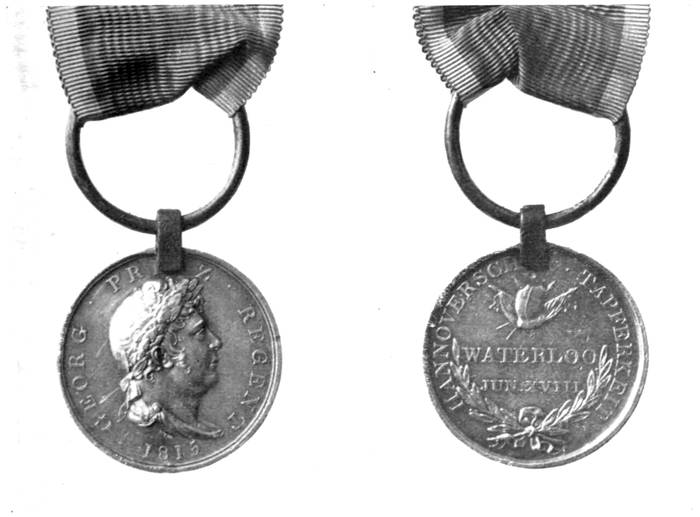
HANOVERIAN MEDAL FOR WATERLOO.
Nive.—Soult, having lost the Nivelle, withdrew his
army to Anglet, and formed a line of defence with his
unfinished fortified camp in front of Bayonne. Wellington,
owing to the bad weather—the 12th was very
foggy, and rain fell in torrents from the 11th until
the 20th November—was unable to move, and was
consequently constrained to maintain the allied army
in very close quarters. The bad weather abating, the
British commander determined to enlarge the productive
area for his army by forcing the line of the Nive, and
taking up a position on the left bank of the Adour,
where reasonable subsistence could be found for the
allied army. The time had not passed tamely, for
in pressing the posts slowly forward, Generals Wilson
and Vandeleur were wounded, while the light division
alone lost 100 men. On December 8th the troops made
a forward movement, and on the 9th the Nive was
crossed near Cambo by the right of the army under
Lieutenant-General Sir Rowland Hill, while the 6th
division, under Lieutenant-General Sir H. Clinton,
successfully passed at Ustaritz, and by this manœuvre
the enemy were driven from the right bank of the
river, and retired towards Bayonne by the great road
of St. Jean Pied de Port. Those opposite Cambo were
nearly intercepted by the 6th division, one regiment
being driven from the road and compelled to march
across country.
On December 10th, 11th, 12th, and 13th, Soult made
a series of determined and often desperate attacks upon
the British divisions, but without success, and was
ultimately forced to fall back upon Bayonne, leaving
the courses of the Nivelle, Nive, and Adour in the possession
of the allies, who were thus enabled to obtain
plentiful supplies for their needs, while the enemy were
harassed by having their communications threatened
and supplies restricted. During the conflicts between
the 9th and 13th the French lost about 6,000 killed
and wounded, and two guns. The British losses were
650 officers (including 6 Generals) and men killed;
233 officers, 215 sergeants, and 3,459 rank and file
wounded; 17 officers, 14 sergeants, and 473 rank and
file missing.
The battle on December 13th, which determined the
series of conflicts, was practically fought and won by
the corps under Sir Rowland Hill—indeed the glory
of the day was frankly given him by Wellington, who,
taking him by the hand, said, "My dear Hill, the day
is your own." There could be little doubt about that,
for on the heights of St. Pierre—with only 16,000 men
and 14 guns—he defied and drove off 35,000 French
bayonets and 22 guns which assailed him in front, and
the corps (8,000) of General Paris, with the Light
Cavalry under Pierre Soult, which threatened his rear.
The battle was regarded on both sides as "one of the
most sanguinary that the French Army of Spain had
fought, and that there was not one where so many
deaths took place on the battlefield." No wonder the
enemy never again took the offensive!
The following regiments were present in the series
of engagements: 1st, 2nd, and 3rd Foot Guards; 7th,
12th, 13th, 14th, 16th, and 18th Light Dragoons; 1st,
2nd, 3rd, 4th, 5th, 7th, 9th, 11th, 20th, 23rd, 27th,
28th, 31st, 32nd, 34th, 36th, 38th, 39th, 40th, 42nd,
43rd, 45th, 47th, 48th, 50th, 52nd, 53rd, 57th, 59th,
60th, 61st, 62nd, 66th, 71st, 74th, 76th, 79th, 83rd,
84th, 85th, 87th, 88th, 91st, 92nd, 94th, 95th, and the
Rifle Brigade. Many of the regiments particularly
distinguished themselves on the day of victory;
notably the 92nd, which, scattering light troops that
should have checked them, charged and repulsed a
column; re-forming behind St. Pierre, they again
advanced with colours flying and pibroch sounding, as
if going to a review, and offered battle to a French
column five times their superior: the challenge was,
however, declined, for like Napier the French commanding
officer recognised that men who could act
so understood war.
Orthes.—On February 27th, 1814, the battle of
Orthes (Orthez) was fought. A period of inaction had
again been forced on Wellington by the severity of
the weather, but by the second week in February the
conditions were such as to make the roads passable,
and the British commander proceeded to follow up
his successes. Several minor, but in some instances
obstinate, engagements, were fought, among them
that of Garris, where Wellington, determined to force
the passage of the Bidouse, ordered the 29th, with the
28th in support, to carry a bold hill, occupied by 4,000
of the enemy, before dark. This they did in a brilliant
manner. Soult, finding the enemy pressing him rather
forcibly, crossed the Gave d'Olèron in the night, and
marching rapidly to Sauveterre, took up a position
on the left of the Gave, while Wellington, having
strongly established his right upon the Gave d'Olèron,
returned to St. Jean de Luz to superintend the putting
together of the remarkable and "wondrous bridge,"
which had been devised to enable the army to cross
the Adour, 3 miles below Bayonne. On the 25th
Sir John Hope crossed with his whole corps for the
investment of the fortress; meanwhile Wellington was
acting vigorously at Gaves, and General Hill was ready
to force the passage of the Gave d'Olèron, which he
did on the 24th, while Picton crossed between Montfort
and Lass; other divisions having made equal progress,
Marshal Soult withdrew his army across the Gave
du Pau, and determined to make a final stand at
Orthez. There, on the semicircular heights, the army
of about 40,000 stood at bay, while the allies with
about 37,000 men advanced to the attack. They
were irresistible, but Soult retreated in a masterly
manner, defending his divisions with splendid valour
at each ridge they passed. Once forced on to the plain,
they fell into disorder, and, charged and pursued
by the British cavalry, they hastened to the river,
over which they passed in scattered parties, and Soult
retreated towards Toulouse, where the last and most
unnecessary battle of the campaign was to be fought.
It is estimated that 8,000 men were lost to the French
in killed and wounded, while the allies lost 18 officers,
25 sergeants, and 234 men killed; 134 officers (including
the Duke of Wellington), 89 sergeants, and 1,700 rank
and file wounded; 1 officer, 5 sergeants, and 64 men
missing.
The following regiments were present: 3rd, 7th,
10th, 13th, 14th, 15th, and 18th Light Dragoons;
2nd, 5th, 6th, 7th, 10th, 20th, 23rd, 24th, 27th, 28th,
31st, 32nd, 34th, 36th, 37th, 39th, 40th, 42nd, 45th,
48th, 50th, 51st, 52nd, 57th, 58th, 60th, 61st, 66th,
68th, 71st, 74th, 82nd, 83rd, 87th, 88th, 91st, 92nd,
94th, 95th, and the Rifle Brigade. The 7th Hussars
(Light Dragoons) distinguished themselves in the
neighbourhood of Sault de Navailles, and made a charge
under Lord Edward Somerset which Wellington described
as "highly meritorious." The 52nd Oxford
Light Infantry were also mentioned in dispatches.
Toulouse.—On April 10th, 1814, the sanguinary and
unnecessary battle of Toulouse was fought, for the
allies had entered Paris on March 31st, and Napoleon
had abdicated. It is alleged that Soult fought the
battle out of personal vanity or pique, since he had
news—on April 7th—of what had happened in Paris.
It was perhaps his last desperate effort for his master.
However, this last battle of the Peninsular War was
fought with terrible determination on both sides; but
when the range of heights had been carried by the
British, and the redoubts of the city won, Soult abandoned
the town of Toulouse with 3 Generals and 1,600
men "prisoners at the generosity of the conqueror."
The allied British, Portuguese, and Spanish armies lost
in killed and wounded about 4,650, the latter including
Generals Brisbane, Pack, Mendizabel, and Espelette,
while the French had 5 generals and 3,234 men placed
hors de combat. These numbers include, British losses,
31 officers and 563 men killed; 248 officers and 3,898
men wounded; 3 officers and 15 men missing.
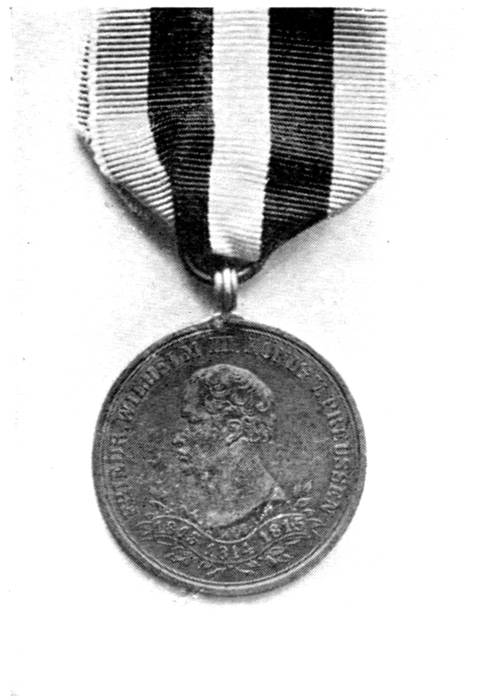
PRUSSIAN JUBILEE MEDAL GIVEN BY
WILHELM I IN 1863 TO VETERANS OF
1813-14-15 CAMPAIGNS.
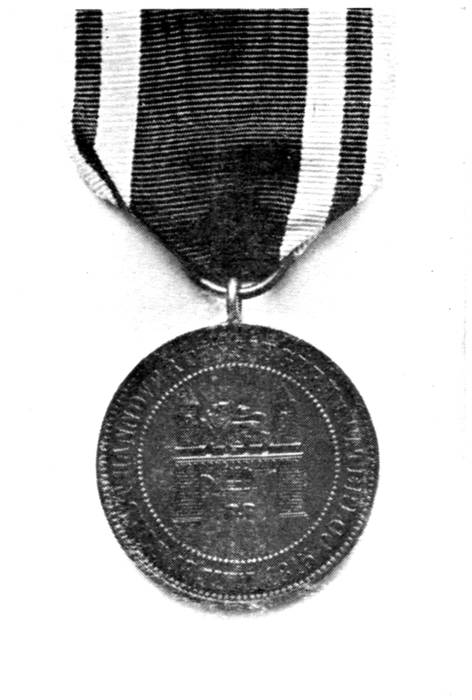
JUBILEE MEDAL GIVEN BY THE CITY
OF HANOVER TO VETERANS OF
WATERLOO.
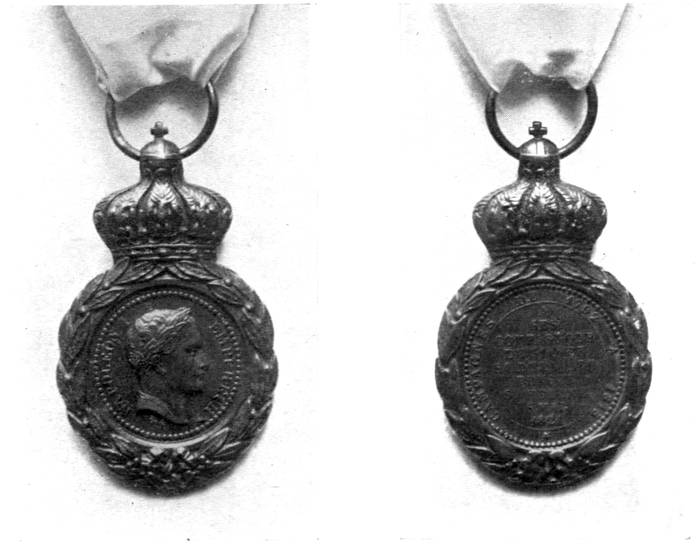
"ST. HELENA MEDAL" GIVEN BY NAPOLEON III TO SURVIVORS OF
WATERLOO AND THE NAPOLEONIC WARS.
In storming the redoubts the 42nd Black Watch,
which had the honour of leading the attack, displayed
their usual courage, but the withering fire from the
defenders was such that in a short time it would have
annihilated the regiment; indeed, out of the 500 who
went into action, scarcely 90 reached the redoubt,
from which the enemy fled, but these "leapt over the
trenches like a pack of hungry hounds in pursuit."
Two officers and sixty men of inferior rank were all
that remained unwounded of the right wing of the
regiment that entered the field in the morning. During
the battle the standard of the regiment had passed
through the hands of three wounded officers, until it
was borne by a sergeant and defended by a few men.
The 42nd, likewise the 36th, 79th, and 61st, who also
lost considerable numbers, were mentioned in Wellington's
dispatches. The 13th Light Dragoons, the
14th and 15th Dragoons, and the 18th Hussars, were
also mentioned for gallant conduct during the advance
on Toulouse.
The regiments represented at the battle were: 2
squadrons of the 1st and 2nd Life Guards and Horse
Guards; 1st Dragoons; 3rd and 5th Dragoon Guards;
3rd, 4th, 7th, 10th, 13th, 14th, 15th, and 18th Light
Dragoons; 1st, 2nd, 3rd, 5th, 7th, 11th, 20th, 23rd,
27th, 28th, 31st, 32nd, 34th, 36th, 39th, 40th, 42nd,
43rd, 45th, 48th, 50th, 52nd, 53rd, 57th, 60th, 61st,
66th, 71st, 74th, 79th, 83rd, 87th, 88th, 91st, 92nd,
94th, and 95th.
Rewards for Generals.—On May 30th, 1814, a treaty
of peace was signed between Great Britain and France,
Louis XVIII having been restored, and Napoleon
permitted to retire to the Isle of Elba, where the allies
allowed him to reign as sovereign. The Duke of
Wellington was raised to the rank and dignity of a
Duke and Marquis of the United Kingdom; Parliament
suggested an annuity of £10,000, to be "paid
annually out of the consolidated fund for the use of
the Duke of Wellington, to be at any time commuted
for the sum of £300,000 to be laid out in the purchase
of an estate," but the sum was objected to as being
too small, and an additional £100,000 was voted.
Wellington's lieutenants—Generals Hope, Graham, Cotton,
Rowland Hill, and Beresford—were also rewarded
by pecuniary grants, and raised to the peerage.
Nothing for Officers and Soldiers.—The majority
of the officers and all the men who had participated in
this seven years' campaign were, notwithstanding the
generosity of the nation to the leaders, left undecorated,
and, irony of ironies, the Commander-in-Chief, who
had shed tears at the loss of brave soldiers, and who
had been so well rewarded, raised his voice against
the bestowal of decorations upon the men who had
fought and bled with him!