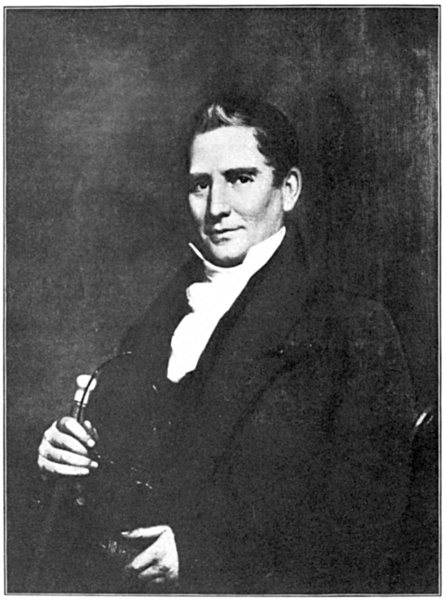
Humanity, wisdom, and goodness at once combine
all that can be great and lovely in man. Inhumanity,
folly, and wickedness reverse the picture, and at once
represent all that can be odious and hateful. The
former is the spirit of Heaven, and the latter the offspring
of hell. The spirit of the gospel not only
breathes “glory to God in the highest, but on earth
peace, and good will to men.” The wisdom from
above is first pure, then peaceable, gentle, easy to be
entreated; but the wisdom from beneath is earthly,
sensual, and devilish.
It is exceedingly strange that any one under the light
of the gospel, professing to be guided by its blessed
precepts, with the Bible in his hand, while the whole
creation around him is so often groaning under the
weight and terrors of war, should have doubts whether
any kind of wars under the gospel dispensation, except
spiritual warfare, can be the dictate of any kind of wisdom
except that from beneath; and much more so, to
believe that they are the fruit of the Divine Spirit,
which is love, joy, and peace.
An inspired apostle has informed us from whence
come wars and fightings. They come from the lusts
of men that war in their members. Ever since the fall,
mankind have had naturally within them a spirit of pride,
avarice, and revenge. The gospel is directly opposed
to this spirit. It teaches humility, it inculcates love,
it breathes pity and forgiveness even to enemies, and
forbids rendering evil for evil to any man.
Believing as I do, after much reflection and, as I
trust, prayerful investigation of the subject, that all
kinds of carnal warfare are unlawful upon gospel principles,
I shall now endeavor to prove that WAR is
INHUMAN, UNWISE, and CRIMINAL, and then make some
general remarks, and state and answer several objections.
In attempting to do this I shall not always confine
myself strictly to this order of the subject, but
shall occasionally make such remarks as may occur,
directly or indirectly, to show that the whole genius of
war is contrary to the spirit and precepts of the gospel.
That it is the duty of mankind to be tender-hearted,
feeling for the distress of others, and to do all in their
power to prevent and alleviate their misery, is evident
not only from the example of the Son of God but the
precepts of the gospel.
When the Saviour of sinners visited this dark and
cruel world he became a man of sorrow and was
acquainted with grief, so that he was touched with the
feeling of our infirmities. He went about continually
healing the sick, opening the eyes of the blind, unstopping
the ears of the deaf, raising the dead, as well as
preaching the gospel of peace to the poor. He visited
the houses of affliction and poured the balm of consolation
into the wounded heart. He mourned with those
who mourned, and wept with those that wept. Love
to God and man flowed from his soul pure as the river
of life, refreshing the thirsty desert around him. He
was not only affectionate to his friends but kind to his
enemies. He returned love for their hatred, and blessing
for their cursing. When he was surrounded by all
the powers of darkness and resigned himself into the
hands of sinners to expiate their guilt, and they smote
him on the cheek and plucked off the hair, he “was
dumb and opened not his mouth.” While suffering all
the contempt and torture which men and devils could
invent, instead of returning evil for evil he prayed for
his murderers and apologized for his persecutors, saying,
“Father, forgive them, for they know not what
they do.”
The apostle exhorts Christians, saying, “Be ye kind
and tender-hearted, forgiving one another, even as God
for Christ’s sake hath forgiven you.”
Authority in abundance might be quoted to show
that the spirit of the gospel absolutely requires the
exercise of love, pity, and forgiveness, even to enemies.
But who will undertake to prove that soldiers are
usually kind and tender-hearted, and that their employment
has a natural tendency to promote active
benevolence, while it requires all their study of mind
and strength of body to injure their enemies to the
greatest extent?
Though we often hear of the generosity and attention
of soldiers to prisoners, and notwithstanding I am
willing to allow that feelings of humanity are not altogether
obliterated from every soldier, yet much of this
apparent kindness may flow from a desire of better
treatment themselves should circumstances be reversed,
or from a hope of the applause of mankind. My object,
however, is not to prove that all soldiers are destitute
of humanity, but that their occupation has a natural
tendency and actually does weaken their kind and
tender feelings, and harden their hearts.
Is it not a fact that those who are engaged in the
spirit of war, either in the council or in the field, are
not usually so meek, lowly, kind, and tender-hearted as
other men? Does the soldier usually become kind and
tender-hearted while trained to the art of killing his
fellow-man, or more so when engaged in the heat of
the battle, stepping forward over the wounded and
hearing the groans of the expiring? Does he actually
put on bowels of tenderness, mercy, and forgiveness,
while he bathes his sword in the blood of his brother?
Do these scenes generally change the lion into the
lamb? On the contrary, do not the history of ages and
the voice of millions bear testimony that the whole trade
of war has a natural tendency to blunt the tender edge
of mercy and chill all the sympathizing feelings of the
human heart? Who that is a parent, having an uncommonly
hard-hearted and unfeeling son, would send him
into the camp to subdue his inhumanity and to stamp
upon him kind and tender feelings? If war has not a
natural tendency to harden the heart, permit me to
inquire why mankind do not usually feel as much at the
distress occasioned by war as by other calamities?
It would be truly astonishing, were it not so common,
to see with what composure the generality of mankind
hear the account of barbarous and destructive battles.
They may have some little excitement when they hear of
savages—whose religion teaches them revenge—using
the tomahawk and scalping knife; but when thousands
are torn to pieces with shot and shells and butchered
with polished steels, then it becomes a very polite and
civil business, and those who perish are contemplated
as only reclining on a bed of honor. If an individual
in common life breaks a bone or fractures a limb, all
around him not only sympathize but are ready to aid in
alleviating his distress; but when thousands are slain
and ten thousand wounded in the field of battle, the
shock is but trifling, and the feelings are soon lost in
admiring the gallantry of this hero and the prowess of
that veteran. And why all this sensibility at the pains
of an individual, and all this indifference at the sufferings
of thousands, if war has not a natural tendency to
harden the heart and destroy the tender feelings of
mankind?
It is a fact, however, so notorious that the spirit and
practice of war do actually harden the heart and chill
the kind and tender feelings of mankind, that I think
few will be found to deny it, and none who have ever
known or felt the spirit of Christ.
The spirit of war must be very unlike the spirit of
the gospel, for the gospel enforces no duty the practice
of which has a natural tendency to harden men’s hearts,
but in proportion as they are influenced by its spirit
and actuated by its principles they will be humane;
therefore, if war hardens men’s hearts it is not a
Christian duty, and of course it cannot be right for
Christians to engage in it.
When God at first created man, he gave him authority
over the beasts of the field, the fowls of the air, and
the fishes of the deep. After he had swept away the
old ungodly world of mankind for their violence with
all the animal creation, except those in the ark, he was
pleased to renew to Noah the same privilege of being
lord over the animal world.
It may not perhaps be improper here to digress a
little and remark that this appears to have been the
original bounds of man’s authority,—that of having
dominion only over the animal world and not over his
fellow-man. It appears that God reserved to himself
the government of man, whom he originally created in
his own image; from which it may be inferred that
man has no lawful authority for governing his fellow-man
except as the special executor of divine command,
and that no government can be morally right except
that which acknowledges and looks up to God as the
supreme head and governor.
But to return: although the animal world is put
under the dominion of man for his use, yet he has no
authority to exercise cruelty towards it. “For the
merciful man regardeth the life of his beast.” God is
very merciful to his creatures; he not only hears the
young ravens when they cry but he opens his hand
and supplies the wants of the cattle upon a thousand
hills.
Though God has decorated the earth with beauty
and richly clothed it with food for man and beast, yet
where an all-devouring army passes, notwithstanding
the earth before them is like the garden of Eden, it
is behind them a desolate wilderness; the lowing ox
and bleating sheep may cry for food, but, alas! the
destroyer hath destroyed it.
The noble horse, which God has made for the use
and pleasure of man, shares largely in this desolating
evil. He is often taken, without his customary food,
to run with an express, until, exhausted by fatigue, he
falls lifeless beneath his rider. Multitudes of them are
chained to the harness with scanty food, and goaded
forward to drag the baggage of an army and the thundering
engines of death, until their strength has failed,
their breath exhausted, and the kindness they then
receive is the lash of the whip or the point of a spear.
In such scenes the comfort of beasts is not thought of,
except by a selfish owner who fears the loss of his
property.
But all this is trifling compared with what these
noble animals, who tamely bow to the yoke of man,
suffer in the charge of the battle; the horse rushes
into the combat not knowing that torture and death
are before him. His sides are often perforated with
the spur of his rider, notwithstanding he exerts all his
strength to rush into the heat of the battle, while the
strokes of the sabers and the wounds of the bullets
lacerate his body, and instead of having God’s pure air
to breathe to alleviate his pains, he can only snuff up
the dust of his feet and the sulphurous smoke of the
cannon, emblem of the infernal abode. Thus he has
no ease for his pains unless God commissions the
bayonet or the bullet to take away his life.
But if such is the cruelty to beasts in prosecuting
war, what is the cruelty to man, born for immortality?
No wonder that those who feel so little for their
fellow-men should feel less for beasts.
If war is an inhuman and cruel employment, it must
be wrong for Christians to engage in it.
To oppress the poor is everywhere in the Scriptures
considered as a great sin: “For the oppression of the
poor, for the sighing of the needy, now will I arise,
saith the Lord”; “Whoso stoppeth his ears at the
cry of the poor, he also shall cry himself and not be
heard”; “What mean ye that ye beat my people to
pieces, and grind the faces of the poor? saith the Lord
God of hosts.”
The threatenings against those who oppress the poor,
and the blessings pronounced upon those who plead
their cause, are very numerous in the Scriptures. The
threatenings are so tremendous and awful that all men
ought to consider well before they are active in any
step which has a natural tendency to oppress the poor
and needy.
That war actually does oppress the poor may be
heard from ten thousand wretched tongues who have
felt its woe. Very few, comparatively, who are instigators
of war actually take the field of battle, and are
seldom seen in the front of the fire. It is usually those
who are rioting on the labors of the poor that fan up
the flame of war. The great mass of soldiers are generally
from the poor of a country. They must gird on
the harness and for a few cents per day endure all the
hardships of a camp and be led forward like sheep to
the slaughter. Though multitudes are fascinated to
enlist by the intoxicating cup, the glitter of arms, the
vainglory of heroes, and the empty sound of patriotism,
yet many more are called away contrary to their wishes
by the iron hand of despotic laws. Perhaps a parent
is enrolled whose daily labor was hardly sufficient to
supply a scanty pittance for a numerous offspring, who
are in his absence crying for bread. And why all this
sorrow in this poor and needy family? Because the
husband and father is gone, and probably gone forever,
most likely to gratify the wishes of some ambitious men
who care as little as they think of his anxious family.
Perhaps an only son is taken from old, decrepit parents,
the only earthly prop of their declining years; and with
cold poverty and sorrow their gray hairs are brought
down to the dust.
War cannot be prosecuted without enormous expenses.
The money that has been expended the last
twenty years in war would doubtless have been sufficient
not only to have rendered every poor person on earth
comfortable—so far as money could do it—during
the same period, but, if the residue had been applied
to cultivate the earth, it would have literally turned
the desert into a fruitful field. Only the interest of the
money that has been expended in a few years by the
European nations in prosecuting war would have been
sufficient, under proper direction, to educate every poor
child on earth in the common rudiments of learning,
and to support missionaries in abundance to convey
the gospel of peace to every creature. What a noble
employment if those nations had exerted their powers
for these objects as much as they have for injuring
each other! And what a difference would have appeared
in the world! Blessings would have fallen on
millions ready to perish, instead of desolation, terror,
and death.
The vast expenses of war must be met by corresponding
taxes, whether by duties on merchandise or
direct taxes on real estate; yet they fall most heavily
on the poor. Whatever duty the merchant pays to the
customhouse, he adds the amount to the price of his
goods, so that the consumer actually pays the tax. If
a tax is levied on real estate, the product of that estate
is raised to meet it, and whoever consumes the product
pays the tax. In times of war the prices of the necessaries
of life are generally very much increased, but the
prices of the labor of the poor do not usually rise in
the same proportion, therefore it falls very heavily on
them. When the honest laborers are suddenly called
from the plow to take the sword and leave the tilling
of the ground, either its seed is but sparingly sown or
its fruit but partially gathered, scarcity ensues, high
prices are the consequence, and the difficulty greatly
increased for the poor to obtain the necessaries of life,
especially if they were dependent on the product of a
scanty farm which they are now deprived of cultivating.
Many a poor widow, who has been able in times
of peace to support her fatherless children, has been
obliged in times of war in a great measure to depend
on the cold hand of charity to supply their wants.
The calamities of war necessarily fall more on the
poor than on the rich, because the poor of a country are
generally a large majority of its inhabitants.
These are some of the evils of war at a distance, but
when it comes to their doors, if they are favored personally
to escape the ferocity of the soldiers, they fly
from their habitations, leaving their little all to the fire
and pillage, glad to escape with their lives, though destitute
and dependent; and when they cast round their
eyes for relief, they only meet a fellow-sufferer, who can
sympathize with them but not supply their wants. Thus
does war not only oppress the poor but adds multitudes
to their number who before were comfortable.
If war actually does oppress the poor, then we may
infer that in its nature and tendency it is very unlike
the genius of the gospel, and not right for Christians
to engage in it.
In the benign reign of Messiah the earth will be
filled with the abundance of peace; there will be nothing
to hurt or destroy; every one will sit quietly under his
own vine and fig tree, having nothing to molest or
make him afraid. But in times of war, mankind are
usually full of anxiety, their hearts failing them for
fear, looking for those things which are coming upon
our wicked world.
One of the most delightful scenes on earth is a happy
family where all the members dwell together in love,
being influenced by the blessed precepts of the gospel
of peace. But how soon does the sound of war disturb
and distress the happy circle! If it is only the distant
thunder of the cannon that salutes the ear, the mother
starts from her repose, and all the children gather round
her with looks full of anxiety to know the cause. Few
women can so command their feelings as to hide the
cause; and let it be said to the honor of the female sex
that they have generally tender feelings, which cannot
easily be disguised at the distress of their fellow-beings.
Perhaps a mother’s heart is now wrung with anguish
in the prospect that either the partner of her life or the
sons of her care and sorrow, or both, are about to be
called into the bloody field of battle. Perhaps the decrepit
parent views his darling son leaving his peaceful
abode to enter the ensanguined field, never more to
return. How soon are these joyful little circles turned
into mourning and sorrow!
Who can describe the distress of a happy village
suddenly encompassed by two contending armies—perhaps
so early and suddenly that its inhabitants are
aroused from their peaceful slumbers by the confused
noise of the warriors more ferocious than the beasts
that prowl in the forest? Were it not for the tumult of
the battle, shrieks of distress from innocent women
and children might be heard from almost every abode.
Children run to the arms of their distracted mothers,
who are as unable to find a refuge for themselves as
for their offspring. If they fly to the streets they are
in the midst of death: hundreds of cannon are vomiting
destruction in every quarter; the hoofs of horses
trampling down everything in their way; bullets, stones,
bricks, and splinters flying in every direction; houses
pierced with cannon shot and shells which carry desolation
in their course; without, multitudes of men
rushing with deadly weapons upon each other with all
the rage of tigers, plunging each other into eternity,
until the streets are literally drenched with the blood
of men. To increase the distress, the village is taken
and retaken several times at the point of the bayonet.
If the inhabitants fly to their cellars to escape the fury
of the storm, their buildings may soon be wrapt in
flames over their heads.
And for what, it may be asked, is all this inhuman
sacrifice made? Probably to gain the empty bubble
called honor,—a standard of right and wrong without
form or dimensions. Let no one say that the writer’s
imagination is heated while it is not in the power of
his feeble pen to half describe the horror and distress
of the scenes which are by no means uncommon in a
state of war.
If such are some of the effects of war, then it must
be a very inhuman employment, and wrong for Christians
to engage in it.
To describe the fatigues and hardships of a soldier’s
life would require the experience of a soldier, so that
only some of their common sufferings can be touched
upon by a person who is a stranger to the miseries of
a camp.
A great majority of those who enter the ranks of an
army are persons unaccustomed to great privations and
severe fatigues; hence the great proportion of mortality
among fresh recruits. Their habits and strength are
unable to endure the hard fare, rapid and constant
marches generally imposed upon them in active service.
The young soldier commonly exchanges a wholesome
table, a comfortable dwelling, an easy bed, for bad food,
the field for his house, the cold earth for his bed, and
the heavens over him for his covering. He must stand
at his post day and night, summer and winter; face the
scorching sun, the chilling tempest, and be exposed to
all the storms of the season, without any comfortable
repose; perhaps during most of the time with a scanty
allowance of the coarsest food, and often destitute of
any, except the miserable supply he may have chance
to plunder,—not enough to satisfy but only to keep
alive the craving demands of nature; often compelled
to march and countermarch several days and nights in
succession, without a moment to prepare his provisions
to nourish him and glad to get a little raw to sustain
his life. Frequently this hardship is endured in the
cold and inclement season, while his tattered clothing is
only the remains of his summer dress. Barefooted and
half naked, fatigued and chilled, he becomes a prey to
disease, and is often left to perish without a human
being to administer to him the least comfort. If he is
carried to a hospital, he is there surrounded by the pestilential
breath of hundreds of his poor fellow-sufferers,
where the best comforts that can be afforded are but
scanty and dismal.
But all this is comparatively trifling to the sufferings
of the wounded on the field of battle. There thousands
of mangled bodies lie on the cold ground hours, and
sometimes days, without a friendly hand to bind up a
wound; not a voice is heard except the dying groans of
their fellow-sufferers around them. No one can describe
the horrors of the scene: here lies one with a fractured
skull, there another with a severed limb, and a third
with a lacerated body; some fainting with the loss of
blood, others distracted, and others again crying for help.
If such are some of the faint outlines of the fatigues
and sufferings of soldiers, then their occupation must be
an inhuman employment, for they are instrumental in
bringing the same calamities on others which they suffer
themselves; and of course it is unfriendly to the spirit
of the gospel, and wrong for Christians to engage in it.
Mankind are speedily hastening into eternity, and it
might be supposed sufficiently fast without the aid of
all the ingenuity and strength of man to hurry them
forward; yet it is a melancholy truth that a great proportion
of the wealth, talents, and labors of men are
actually employed in inventing and using means for the
premature destruction of their fellow-beings.
One generation passes away, and another follows in
quick succession. The young are always the stay and
hope of the aged; parents labor and toil for their children
to supply their wants and to educate them to be
happy, respectable, and useful, and then depend upon
them to be their stay and comfort in their declining
years. Alas, how many expectations of fond parents
are blasted! Their sons are taken away from them
and hurried into the field of slaughter.
In times of war the youth—the flower, strength, and
beauty of the country—are called from their sober, honest,
and useful employments, to the field of battle; and
if they do not lose their lives or limbs, they generally
lose their habits of morality and industry. Alas! few
ever return again to the bosom of their friends. Though
from their mistaken and fascinating views of a soldier’s
life and honor they may be delighted in enlisting, and
merry in their departure from their peaceful homes, yet
their joy is soon turned into pain and sorrow. Unthinking
youth, like the horse, rushes thoughtlessly
into the battle. Repentance is then too late; to shrink
back is death, and to go forward is only a faint hope of
life. Here on the dreadful field are thousands and hundreds
of thousands driven together to slaughter each
other by a few ambitious men, perhaps none of whom
are present. A large proportion are probably the youth
of their country, the delight and comfort of their
parents. All these opposing numbers are most likely
persons who never knew or heard of each other, having
no personal ill-will, most of whom would in any other
circumstances not only not injure each other but be
ready to aid in any kind office; yet by the act of war
they are ranged against each other in all the hellish
rage of revenge and slaughter.
No pen, much less that of the writer’s, can describe
the inhumanity and horrors of a battle. All is confusion
and dismay, dust and smoke arising, horses running,
trumpets blasting, cannon roaring, bullets whistling,
and the shrieks of the wounded and dying vibrating
from every quarter. Column after column of men charge
upon each other in furious onset, with the awful crash
of bayonets and sabers, with eyes flashing and visages
frightfully distorted with rage, rushing upon each other
with the violence of brutish monsters; and when these
are literally cut to pieces others march in quick succession,
only to share the same cruel and bloody tragedy.
Hundreds are parrying the blows; hundreds more are
thrusting their bayonets into the bowels of their fellow-mortals,
and many, while extricating them, have their
own heads cleft asunder by swords and sabers; and all
are hurried together before the tribunal of their Judge,
with hearts full of rage and hands dyed in the blood of
their brethren.
O horrid and debasing scene! my heart melts at the
contemplation, and I forbear to dwell upon the inhuman
employment.
The widow and fatherless are special objects of
divine compassion, and Christianity binds men under
the strongest obligation to be kind and merciful towards
them, as their situation is peculiarly tender and afflicting.
“A father of the fatherless, and a judge of the
widow, is God in his holy habitation.” “Pure religion
and undefiled before God and the Father is this, to
visit the fatherless and widows in their affliction.”
To be active in any measure which has a natural
tendency to wantonly multiply widows and orphans in
a land is the height of inhumanity as well as daring
impiety.
I will venture to say that no one circumstance in our
world has so greatly multiplied widows and fatherless
children as that of war. What has humanity ever gained
by war to counterbalance simply the afflictions of the
widow and fatherless? I verily believe nothing comparatively.
I am well aware that a very popular plea
for war is to defend, as it is styled, “our firesides, our
wives and children”; but this generally is only a
specious address to the feelings, to rouse up a martial
spirit which makes thousands of women and children
wretched where one is made happy. I am sensible that
those will sneer at my opinion who regard more the
honor that comes from men than they do the consolation
of the widow and the fatherless.
In times of war thousands of virtuous women are
deprived of their husbands and ten thousands of helpless
children of their fathers. The little tender children
may now gather round their disconsolate mothers,
anxiously inquiring about their fathers, remembering
their kind visages, recollecting how they used fondly to
dandle them on their knees and affectionately instruct
them; but now they are torn from their embraces by
the cruelty of war, and they have no fathers left them
but their Father in heaven.
It is probably no exaggeration to suppose that in
Europe there are now two hundred thousand widows
and a million fatherless children occasioned by war.
What a mass of affliction! humanity bleeds at the
thought! These children must now roam about without
a father to provide for, protect, or instruct them.
They now become an easy prey to all kinds of vice;
many probably will be trained up for ignominious death,
and most of them fit only for a soldier’s life, to slaughter
and to be slaughtered, unless some humane hand kindly
takes them under its protection.
And here I cannot help admiring the spirit of Christianity.
It is owing to the blessed spirit and temper of
the gospel of peace that many of the evils of war are
so much ameliorated at the present day as well as the
inhuman slavery of men.
The numerous asylums that now exist for the relief
of the needy, the widow, and the fatherless are some of
the precious fruits of Christianity; and if this spirit
were universal the bow would soon be broken to pieces,
the spear cut asunder, and the chariots of war burnt with
fire, and wars would cease to the ends of the earth.
And is it not the duty of all who name the name
of Christ to do all in their power to counteract this
destroying evil?
War not only multiplies widows and orphans but
clothes the land in mourning. In times of war multitudes
of people are clothed with ensigns of mourning.
Here are gray-headed parents shrouded in blackness,
weeping for the loss of darling sons; there are widows
covered with veils mourning the loss of husbands, and
refusing to be comforted; children crying because their
fathers are no more. Cities and villages are covered
in darkness and desolation; weeping and mourning
arise from almost every abode.
And it may be asked, What inhuman hand is the
cause of all this sorrow? Perhaps some rash man, in
the impetuosity of his spirit, has taken some unjust,
high ground, and is too proud to retrace a step, and had
rather see millions wretched than to nobly confess that
he had been in the wrong.
Surely Christians cannot be active in such measures
without incurring the displeasure of God, who styles
himself the father of the fatherless and the judge and
avenger of the widow.
Thus I have shown that war is inhuman and therefore
wholly inconsistent with Christianity, by proving that
it tends to destroy humane dispositions; that it hardens
the hearts and blunts the tender feelings of men; that
it involves the abuse of God’s animal creation; that it
oppresses the poor; that it spreads terror and distress
among mankind; that it subjects soldiers to cruel privations
and sufferings; that it destroys the youth and cuts
off the hope of the aged; and that it multiplies widows
and orphans and occasions mourning and sorrow.
The fact that war is inhuman is indeed one of those
obvious truths which it is difficult to render more plain
by argument; those who know in what war consists
cannot help knowing that it is inhuman.
What Mr. Windham said with reference to the inhumanity
of slavery may be said of the inhumanity
of war. In one of his speeches in the House of Commons
against the slave trade he stated his difficulty in
arguing against such a trade to be of that kind which is
felt in arguing in favor of a self-evident proposition.
“If it were denied that two and two made four, it would
not be a very easy task,” he said, “to find arguments
to support the affirmative side of the question. Precisely
similar was his embarrassment in having to prove
that the slave trade was unjust and inhuman.”
Whoever admits that the slave trade is inhuman must
admit that war is inhuman in a greater variety of ways
and on a much larger scale.
The inhumanity of the slave trade was the great and,
finally, triumphant argument by which it was proved to
be inconsistent with Christianity.
The advocates of slavery, like the advocates of war,
resorted to the Old Testament for support; but it
appeared that slavery, as it appears that war, was permitted
and approved of for reasons and on principles
peculiar to the ancient economy. This is apparent as
well from the difference between the general design of
the old and new dispensations as from the whole genius
and spirit of the gospel. Hence those who opposed the
slave trade argued from the general nature and spirit of
Christianity as the strongest ground which could be
taken. If slavery was inconsistent with this, it ought
not to be tolerated; but slavery is inhuman and is therefore
inconsistent with Christianity. Exactly the same
is true of war, nor can anything short of an express
revelation from God, commanding war or slavery, render
either of them justifiable.
It deserves to be distinctly considered that the gospel
contains little or nothing directly by way of precept
against slavery; but slavery is inconsistent with its
general requirements and inculcations and is therefore
wrong. But war, besides being inconsistent with the
genius and spirit of the gospel, is prohibited by those
precepts which forbid retaliation and revenge and those
which require forgiveness and good will.
It is plain, then, that he who does not advocate and
defend the slave trade, to be consistent, must grant
that war is incompatible with Christianity, and that it
is a violation of the gospel to countenance it.
That the principles and practice of war are unwise
I argue:
The maxim, that in order to preserve peace, mankind
must be prepared for war, has become so common,
and sanctioned by such high authority, that few
question its wisdom or policy; but if stripped of its
specious garb, it may appear to proceed not from that
wisdom which came down from above, which is “first
pure, then peaceable, gentle, easy to be entreated, full
of mercy and good fruits, without partiality, and without
hypocrisy”; and if it is not the wisdom from
above, then it must be the wisdom from beneath.
Are not pride, avarice, and revenge the seeds of all
kinds of carnal warfare? From these grow all the
quarreling among children, the discord among families,
the bickerings, law suits, and broils among neighbors,
the boxing among bullies, the dueling among modern
gentlemen, and wars among nations. They all originate
from one and the same spirit.
Now, is the mild, meek, and peaceable man, unarmed,
more liable to inspire jealousy in others that
he is about to insult and abuse them than the high-toned
duelist who constantly carries with him deathly
weapons? Does he, in fact, so often get into difficulty,
quarreling and fighting? The respectable
Society of Friends stands a living monument to answer
the question.
On the principles of self-defense, as they are styled,
if one man suspects an injury from another, unless he
is naturally a more powerful man, he must take a cane,
as the principles of self-defense require a superior power
in your own hand, either by art or muscular strength.
When the other learns the suspicions and sees the preparation,
he in his turn must take a bludgeon to preserve
the balance of power and proclaim a threatening to awe
his antagonist, who must now take a sword and return
a threatening in order to maintain his dignity; for it
will not do for men of honor to retract, however much
they may be in the wrong. The other, again, must take
a deathly weapon for his defense, and nothing is now
wanting but an unhappy meeting to set each other’s
blood a flowing.
Much in the same way do nations often get into
desperate warfare. One nation is busily increasing its
military strength on the plausible maxim of preserving
peace and maintaining its rights. Another nation views
the preparations with a jealous eye, and also goes to
work on the same principle to make formidable preparations.
All the nations around take the alarm, and on the
same principle begin active preparations, all vying with
each other to become the most formidable. If one sends
an ambassador to inquire the cause of the great preparations,
the answer always is, let the motive be what
it may, For their own defense. Then the other makes
new exertions and begins to fortify towns on the confines
of his neighbor, who must not only do the same but
march a large army for the defense of his frontier; and
the other must do likewise. By this time, if no old quarrel
remained unsettled, perhaps one charges the other
with encroachment on territory; the other denies the
charge, and contends sharply for his pretended rights.
Ministers may be interchanged, and while negotiations
are pending a high tone must be taken by both parties,
for this is an essential principle in the doctrine of self-defense;
the contrary would betray weakness and fear.
Newspapers must be ushered forth with flaming pieces
to rouse, as it is called, the spirit of the countries, so
as to impress upon the populace the idea that the approaching
war is just and necessary, for all wars must
be just and necessary on both sides. In the meantime
envoys extraordinary may be sent to other powers by
each party to enlist their aid,—most of whom are
already prepared for war,—and each one selects his side
according to his interests and feelings. At length the
ultimatum is given and refused, and the dreadful conflict
commences. Few wars, however, begin in this slow
and progressive mode; a trifling aggression is sufficient
to blow up the flame with nations already prepared.
Thus, we see, nations resemble bulldogs who happen
to meet. They will first raise their hairs, show their
teeth, then growl, and then seize upon each other with
all their strength and fury; and bulldogs have something
of the same kind of honor, for they scorn to
retreat.
Hence we see that the acknowledged principles of
defensive war are the vital springs of most of the wars
that agitate and desolate our world. The pretended
distinction between offensive and defensive war is but
a name. All parties engaged in war proclaim to the
world that they only are fighting in defense of their
rights, and that their enemies are the aggressors; while
it may be impossible for man to decide which are most
in the wrong.
The popular maxim of being prepared for war in order
to be at peace may be seen to be erroneous in fact, for
the history of nations abundantly shows that few nations
ever made great preparations for war and remained long
in peace. When nations prepare for war they actually
go to war, and tell the world that their preparations
were not a mere show.
Thus we may see that the principles and preparations
of war actually engender war instead of promoting peace;
and of course they are unwise, and, if unwise, then it
is folly for Christians to engage in them.
As the principles and preparations of war have a
natural tendency to generate war and are actually the
cause of a great proportion of the wars which do exist,
so actual hostilities have a natural tendency to increase
difficulties and to spread abroad the destroying evil.
It is almost impossible for any two nations to be long
engaged in war without interfering with the rights and
privileges of other nations, which generally awakes their
jealousy and resentment, so that most of the surrounding
nations are drawn into the destructive vortex, which
is the more easily done, as war inflames the martial spirit
in other nations not engaged, and rouses up the desperate
passions of men. Besides, the belligerent nations are
not content with suffering themselves, but use every
art and persuasion to get the neighboring nations to
join them; and they are generally too successful, for it
seldom happens that two nations engage in war for a
length of time and conclude a peace before they have
involved other nations in their difficulties and distresses,
and often a great proportion of the world is in arms.
Moreover, the nations who first engage in the contest
always widen the breach between themselves by war.
It is much easier settling difficulties between individuals
or nations before actual hostilities commence than
afterwards. Mankind are not apt to be any more mild
and accommodating in a state of actual warfare. Besides,
new difficulties constantly arise. The passions become
inflamed, and charges are often made of violating the
established laws of civilized warfare, which laws, however,
are generally bounded only by the strength of
power. If one party makes an incursion into the other’s
territory and storms a fortified place and burns the
town, the other party must then make a desperate effort
to retaliate the same kind of destruction, to a double
degree, on the towns of their enemy. Retaliation, or
“rendering evil for evil,” is not only allowed by Mahometans
and pagans, but is an open and avowed principle
in the doctrine of self-defense among professed Christian
nations; not only is it sanctioned by the laity, but
too often by the priests who minister in the name of
Jesus Christ.
Both of the contending parties generally seize on each
other’s possessions wherever they can get hold of them,
whether on the seas or on the land. The barbarous
spoliations on each other stir up the passions of the
great mass of their inhabitants, until they esteem it a
virtue to view each other as natural and perpetual
enemies, and then their rulers can prosecute the war
with what they call vigor.
Can the wound now be so easily healed as it could
have been before it became thus lacerated and inflamed?
Facts speak to the contrary, and nations seldom attempt
negotiations for peace under such circumstances. They
generally prosecute the war with all their power until
one party or the other is overcome, or until both have exhausted
their strength, and then they may mutually agree
to a temporary peace to gain a little respite, when perhaps
the original matter of dispute has become comparatively
so trifling that it is almost left out of the account.
With a small spirit of forbearance and accommodation
how easily might the difficulties have been settled
before such an immense loss of blood and treasure!
If war does actually increase, instead of diminishing,
difficulties, then it must be very unwise to engage in it.
Property is what a great proportion of mankind are
struggling to obtain, and many at the hazard of their
lives. Though in some instances they may misuse it,
yet it is the gift of God, and when made subservient to
more important things, it may be a blessing to individuals
and communities. It has in it, therefore, a
real value, and ought not to be wantonly destroyed
while it may be used as an instrument for benefiting
mankind.
It is a notorious fact that war does make a great
destruction of property. Thousands of individuals on
sea and on land lose their all, for the acquisition of
which they may have spent the prime of their lives.
Ships on the high seas are taken, often burnt or
scuttled, and valuable cargoes sent to the bottom of the
deep, some possibly laden with the necessaries of life
and bound to ports where the innocent inhabitants
were in a state of famine. Whole countries are laid
waste by only the passing of an immense army: houses
are defaced, furniture broken to pieces, the stores of
families eaten up, cornfields trodden down, fences torn
away and used for fuel, and everything swept in its
train as with the besom of destruction more terrible to
the inhabitants than the storms of heaven when sent
in judgment. Beautiful towns are often literally torn
to pieces with shot and shells. Venerable cities, the
labor and pride of ages, are buried in ashes amid devouring
flames, while in melancholy grandeur the fire and
smoke rise to heaven and seem to cry for vengeance
on the destroyers.
Notwithstanding an avaricious individual or nation
may occasionally in war acquire by plunder from their
brethren a little wealth, yet they usually lose on the
whole more than they gain. On the general scale the
loss is incalculable. It is not my object to examine
the subject in relation to any particular nation or
war, but upon the general scale in application to all
warlike nations and all wars under the light of the
gospel.
If war does destroy property, reduce individuals to
beggary, and impoverish nations, then it is unwise to
engage in it.
Liberty is the gift of God, and ought to be dear to
every man; not, however, that licentious liberty which
is not in subordination to his commands. Men are not
independent of God. He is their creator, preserver, and
benefactor. In his hand their breath is, and he has a
right to do what he will with his own; and the Judge
of all the earth will do right. As man is not the
creator and proprietor of man, he has no right to
infringe on his liberty or life without his express divine
command; and then he acts only as the executor of God.
Man, therefore, bears a very different relation to God
from what he does to his fellow-man.
The whole system of war is tyrannical and subversive
of the fundamental principles of liberty. It often brings
the great mass of community under the severe bondage
of military despotism, so that their lives and fortunes
are at the sport of a tyrant. Where martial law is proclaimed,
liberty is cast down, and despotism raises her
horrid ensign in its place and fills the dungeons and
scaffolds with her victims.
Soldiers in actual service are reduced to the most
abject slavery, not able to command their time for a
moment, and are constantly driven about like beasts
by petty tyrants. In them is exhibited the ridiculous
absurdity of men rushing into bondage and destruction
to preserve or acquire their liberty and save their lives.
When the inhabitants of a country are cruelly
oppressed by a despotic government, and they rise in
mass to throw off the yoke, they are as often as otherwise
crushed beneath the weight of the power under
which they groaned, and then their sufferings are
greatly increased; and if they gain their object after
a long and sanguinary struggle, they actually suffer
more on the whole than they would have suffered had
they remained in peace. It is generally the providence
of God, too, to make a people who have thrown off the
yoke of their oppressor smart more severely under the
government of their own choice than they did under
the government which they destroyed. This fact ought
well to be considered by every one of a revolutionary
spirit.
War actually generates a spirit of anarchy and rebellion
which is destructive to liberty. When the inhabitants
of a country are engaged in the peaceable employments
of agriculture, manufactures, and commerce,
anarchy and rebellion seldom happen. When these useful
employments flourish, abundance flows in on every
side, gentleness and humanity cast a smile over the
land, and pleasure beams in almost every countenance.
To turn the attention of a nation from these honest
employments to that of war is an evil of unspeakable
magnitude. The great object in times of war is to
rouse up what is styled the spirit of the country,—which,
in fact, is nothing but inflaming the most destructive
passions against its own peace and safety.
If you infuse into a nation the spirit of war for the
sake of fighting a foreign enemy, you do that which is
often most dangerous to its own liberties; for if you
make peace with the common enemy, you do not
destroy the spirit of war among your own inhabitants;
pride, discontent, and revenge will generally agitate the
whole body, so that anarchy and confusion will fill the
land, and nothing but a despotic power can restrain it;
and often absolute despotism is too feeble to withstand
it, and the only remedy is again to seek a common
enemy. Nations have sometimes waged war against
other nations because there was such a spirit of war
among their own inhabitants that they could not be
restrained from fighting, and if they had not a common
foe they would fight one another. So when a nation
once unsheathes the sword, it cannot easily return the
sword again to the scabbard, but must keep it crimsoned
with the blood of man until “they who take the sword
shall perish with the sword,” agreeably to the denunciation
of Heaven.
To inflame a mild republic with the spirit of war is
putting all its liberties to the utmost hazard, and is an
evil that few appear to understand or appreciate. No
person can calculate the greatness of the evil to transform
the citizens of a peaceful, industrious republic
into a band of furious soldiers; and yet the unhappy
policy of nations is to cultivate a martial spirit that
they may appear grand, powerful, and terrific, when in
fact they are kindling flames that will eventually burn
them up root and branch.
In confirmation of what has been said, if we examine
the history of nations we shall find that they have generally
lost their liberties in consequence of the spirit
and practice of war. Thus have republics who have
boasted of their freedom lost their liberty one after
another, and that this has resulted from the very
nature of war and its inseparable evils is evident from
the fact that so violent and deadly is this current of
ruin, republics have generally sunk down to the lowest
abyss of tyranny and despotism, or have been annihilated
and their inhabitants scattered to the four winds
of heaven. Indeed, what nation that has become extinct
did not first lose its liberty by war, and then hasten to
its end under the dominion of those passions which war
inflames?
Do nations ever enjoy so much liberty as when
most free from the spirit of war? Are their liberties
ever so little endangered as when this spirit is allayed
and all its foreign excitements removed? Do not nations
that have partially lost their civil liberties gradually
regain them in proportion as they continue long without
war? Is it not a common sentiment that the liberties
of a people are in danger when war engrosses their
attention? On the whole, is it not undeniable that
peace is favorable to liberty, and that war is its enemy
and its ruin? If so, what can be more unwise, what
more opposite to every dictate of sound wisdom and
policy, than the spirit and practice of war?
Happiness is the professed object which most men
are striving to obtain. Alas! few, comparatively, seek
it where it is alone to be found. But that happiness
which flows from the benevolent spirit of the gospel is
to be prized far above rubies; it is a treasure infinitely
surpassing anything that can be found merely in riches,
honors, and pleasures.
But war always diminishes the aggregate of happiness
in the world. When nations wage war upon each
other, all classes of their inhabitants are more or less
oppressed. They are subjected to various privations;
prosperity declines; external sources of happiness are
mostly dried up; anxiety for friends, loss of relations,
loss of property, the fear of pillage, severe services,
great privations, and the dread of conquest keep them
constantly distressed. They are like the troubled sea
that cannot rest, whose waters cast up mire and dirt.
Those actually engaged in war generally suffer privations
and hardships of the severest kind. Even the sage
counselors who declare wars are often in so great anxiety
and pain as to the result of their enterprises as to be
unable quietly to refresh themselves with food or sleep.
All the rejoicings occasioned by military success are
fully counterbalanced by the pain and mortification of
the vanquished; and, in short, all the interest and
happiness resulting from war to individuals and nations
are dearly bought, and are at the expense of other
individuals and nations.
It is because war has no tendency to increase, but
does in fact greatly diminish, happiness that it is so
universally regarded and lamented as the greatest evil
that visits our world. Hence fasting has generally been
practiced by warlike Christian nations to deplore the
calamity, to humble themselves before God, and to
supplicate his mercy in turning away the judgment.
Though fasting and deep humility before God is
highly suitable for sinners, with a hearty turning away
from their sins and humble supplication for God’s mercy
through the mediation of Christ, yet those fasts of
nations who have voluntarily engaged in war and are
determined to prosecute it until their lusts and passions
are gratified do not appear to be such fasts as God
requires.
Does it not appear absurd for nations voluntarily to
engage in war, and then to proclaim a fast to humble
themselves before God for its evils, while they have no
desire to turn away from them, but, on the contrary,
make it an express object to seek the divine aid in
assisting them successfully to perpetuate it?
We often see contending nations, all of whom cannot
be right, on any principle, proclaiming fasts, and chanting
forth their solemn Te Deums as each may occasionally
be victorious. Though such clashing hymns cannot
mingle in the golden censer, yet few Christians seem to
question the propriety of quarreling and fighting nations
each in their turn supplicating aid in their unhallowed
undertakings and returning thanks in case of success.
Doubtless many would consider it as solemn mockery
to see two duelists before their meeting supplicating
God’s blessing and protection in the hour of conflict,
and then to see the victor returning thanks for his
success in shedding the blood of his brother; and yet,
when nations carry on the business by wholesale (if I
may be allowed the expression) it is considered a very
pious employment. The Lord has said, “And when
ye spread forth your hands, I will hide mine eyes from
you: yea, when ye make many prayers, I will not hear;
your hands are full of blood.”
Penitent Christians may weep and mourn with propriety
for their own sins and the sins of the nations,
with a hearty desire not only to forsake their own iniquities,
but that the nations may be brought to confess
and forsake their sins and turn from them to the living
God. It is true that war is a judgment in God’s providence.
It is also a sin of the highest magnitude and
ought to be repented of. It is a crime so provoking to
Heaven that other calamities generally attend it. The
famine, fire, and pestilence often attend its horrors and
spread distress through a land. War with its attending
evils unquestionably diminishes the aggregate of happiness
in the world, and is therefore unwise.
The strength, defense, and glory of a country consists
primarily in the good moral character of its inhabitants.
The virtuous and the good are the salt that
preserve it from ruin. Says the Rev. Dr. Miller in his
sermon on the death of Dr. Rogers (pages 366 and 388
of the Memoirs), “It is manifest from the whole tenor
of his word that God is slow to inflict heavy judgments
upon a nation in which many of his people dwell; that
he often spares it, spreads over it the protection of his
providence, and finally delivers it for their sake; and, of
course, that the presence of his beloved children, speaking
after the manner of men, is a better defense than
chariots and horsemen, a better defense than all the
plans of mere politicians, than all the skill, courage, and
activity of mere warriors.” Again, “I have no doubt
that it is as great and precious a truth at this day as
it ever was, that a praying people are, under God, the
greatest security of a nation.”
When the inhabitants of a country become generally
profane and dissolute in their manners, slaves to
dissipation and vice, it is usually God’s providence soon
to visit them in his wrath and let loose the instruments
of his destroying vengeance; how important, therefore,
in a temporal point of view, is the preservation of good
morals to a nation. But no event has so powerful a
tendency to destroy the morals of a people as that of
actual war. It draws the attention of the inhabitants
from useful employments; it generates curiosity, dissipation,
and idleness, and awakes all the furious passions
of men.
War occasions a great profanation of the Sabbath.
Under God’s providence the Sabbath has always been
a great barrier against vice, and the observance of it
is indispensable to good morals.
In time of war the Sabbath among soldiers is often
a day of parade. In the streets of the best-regulated
cities may be seen soldiers marching, flags flying, drums
and fifes playing, and a rabble of children following in
the train. Now all this is not only calculated to dissipate
all reverential respect for the solemnities of the
day among the soldiers, but is calculated to destroy the
respect and observance of the day with which the children
and youth have been inspired. Add to this, flags
are suspended from the windows of taverns and grogshops
to entice in the youth by the intoxicating cup.
In the camp the Sabbath is almost forgotten and rendered
a common day. Armies from professing Christian
nations as often begin offensive operations on the
Sabbath as on any other day; and professing Christians
not only tolerate all this but approve of it as a work
of necessity and mercy.
War occasions dishonesty. In countries where armies
are raised by voluntary enlistment all kinds of deception
and art are practiced by recruiting officers, and
connived at by their governments, to induce the heedless
youth to enlist. The honor and glory of the employment
is held up to view in false colors; the importance
of their bounty and wages are magnified; the lightness
of the duty and opportunities for amusements and
recreation are held out; and probably one half have
the assurances of being noncommissioned officers, with
a flattering prospect of a speedy advancement; and
prospects of plunder are also held out to their cupidity.
These deceptive motives are daily urged under the stimulating
power of ardent spirits and the fascinating charms
of martial music and military finery. Many a young man
who has entered the rendezvous from curiosity or for
the sake of a dram, without the least idea of joining the
army, has been entrapped into intoxication, and his
hand then grasped the pen to seal his fate.
Recruits after joining the army find from experience
that most of the allurements held out to them to enlist
were but a deception, and from lust and want they often
become petty thieves and plunderers to repay them for
their great privations, fatigues, and sufferings.
War occasions drunkenness,—one of the greatest
evils and most destructive to morality, as a multitude
of other vices necessarily follow in its train. Many a
young man has entered the military ranks temperate, and
has returned from them a sot. All the enticements of
liquor are exhibited in the most inviting forms to youth
in the streets by the recruiting officer, to tempt them
to enlist; and while those who have enrolled themselves
remain at the rendezvous, they are probably
every day intoxicated with the inebriating poison, soul
and body, and soon the habit becomes confirmed. While
in actual service their fatigues are so great that they
greedily lay hold on the destroying liquor wherever they
can find it to exhilarate their languid frames, even if
they had not before acquired an insatiable thirst; and
soon this detestable evil will become so enchanting that
they will not only barter away their wages for it but
their necessary clothing. If they survive the campaign
and return to their homes, they are often the visitors
of grogshops and taverns, and by their marvelous
stories attract the populace around them, who must
join them in circulating the cup; and thus they spread
this destroying evil all around.
War occasions profaneness. Profaneness is an abomination
in the sight of God: “For the Lord will not hold
him guiltless who taketh his name in vain.” Profaneness
draws down the judgments of heaven, “for because
of swearing the land mourneth.”
That soldiers are generally considered more profane
than other men is evident, because it has become a
proverb that “such a person is as profane as a soldier,
or a man-of-war’s man.” Young men who have been
taught to revere the name of the God of their fathers
may shudder at the awful profanations that fill their
ears when they first enter an army; but if destitute of
grace in the heart, the sound will soon cease to offend,
and they will eagerly inhale the blasphemous breath
and become champions in impiety. For want of habit
they may not swear with so easy a grace as the older
soldiers; they will for that reason make great exertions
and invent new oaths, which will stimulate their
fellows again to exceed in daring impiety. Seldom
does a soldier return from the camp without the foul
mouth of profanity. Astonishing to think that those
who are most exposed to death should be most daring
in wickedness!
War occasions gambling. A great proportion of the
amusements of the camp are petty plays at chance, and
the stake usually a drink of grog. The play is fascinating.
Multitudes of soldiers become established gamblers
to the extent of their ability, and often, if they
return to society, spread the evil among their neighbors.
War begets a spirit of quarreling, boxing, and dueling;
and no wonder that it should, for the whole business
of war is nothing else but quarreling and fighting.
The soldier’s ambition is to be a bully, a hero, and to
be careless of his own life and the lives of others. He
is therefore impatient in contradiction, receives an
insult where none was intended, and is ready to redress
the supposed injury with the valor of his own arms;
for it will not do for soldiers to shrink from the contest
and be cowards.
War destroys the habits of industry and produces
idleness. Industry is necessary to good morals as well as
to the wealth and happiness of a country, and every wise
government will take all laudable means to encourage
it; but a large proportion of common soldiers who may
return from the armies have lost the relish and habits
of manual labor and are often found loitering about in
public places, and if they engage in any kinds of labor,
it is with a heavy hand and generally to little purpose.
They therefore make bad husbands, unhappy neighbors,
and are worse than a dead weight in society.
Their children are badly educated and provided for, and
trained up to demoralizing habits, which are handed
down from generation to generation.
These immoralities, and many more that might be
named, are not confined to soldiers in time of war, but
they are diffused more or less through the whole mass
of community; and war produces a general corruption
in a nation, and is therefore unwise, even in a temporal
point of view. But when we consider the natural effects
of these immoralities on the souls of men, all temporal
advantages are in comparison annihilated. In this
school of vice millions are ripening for eternal woe.
The destroying influence will spread and diffuse itself
through the whole mass of society unless the spirit of
the Lord lifts up a standard against it.
The state of morals, so much depressed by the American
Revolution, was only raised by the blessed effusions
of God’s holy spirit.
If war does actually demoralize a people, then no
wise person can consistently engage in it.
Says our blessed Saviour: “For what is a man profited,
if he should gain the whole world, and lose his
own soul?”
The loss of a soul infinitely exceeds all finite calculations.
It is not only deprived forever and ever of all
good but is plunged into misery inexpressible and
everlasting. All temporal things dwindle to nothing
when placed in comparison with eternal realities. The
rights, liberties, and wealth of nations are of little value
compared with one immortal soul. But astonishing to
think that millions and millions have been put at everlasting
hazard only for the chance of defending temporal
things!
The habits and manners of a soldier’s life are calculated,
as we have already seen, to demoralize them, to
obliterate all early serious impressions, to introduce and
confirm them in the most daring wickedness and fit
them for everlasting destruction. And notwithstanding
God may have occasionally, to display his sovereign
power, snatched some soldiers from the ranks of rebellion
and made them the heirs of his grace, yet no sober
Christian will say that the army is a likely place to
promote their salvation; but, on the contrary, must
acknowledge that it is a dangerous place for the souls
of men. It may be assumed as an undeniable fact that
the great mass of soldiers are notoriously depraved and
wicked. With but few exceptions their impiety grows
more daring the longer they practice war; and when it
is considered that thousands and thousands of such are
hurried by war prematurely into eternity, with all their
sins unpardoned, what an amazing sacrifice appears
only for some supposed temporal good. But when it is
remembered that this infinite sacrifice is made merely
for the chance of obtaining some temporal advantage,
the folly of war appears in more glaring colors, as the
battle is not always to the strong. Those who are contending
for their rights, and are least in the wrong, are
about as often unsuccessful as otherwise, and then they
very much increase their evils in a temporal point of
view. A wise man would not engage in a lawsuit to
recover a cent, admitting that it was his just due, if the
trial put to the hazard his whole estate. But this bears
no comparison with one soul in competition with all
temporal things; and yet men, professing to be wise,
not only put one soul at hazard but millions, not for
the chance of defending all temporal good, but often for
a mere bubble, the hollow sound of honor; and many
of those who are watching for souls, and must give an
account, instead of sounding the alarm, approve of it.
All who engage in war, either in the field or otherwise,
practically regard time more than eternity, and temporal
more than eternal things.
If souls are of more value than temporal things, and
eternity of more consequence than time, it must be
unwise to engage in a war and put souls to immediate
hazard of everlasting ruin, and totally wrong for
Christians to engage in it.
The professed object of war generally is to preserve
liberty and produce a lasting peace; but war never did
and never will preserve liberty and produce a lasting
peace, for it is a divine decree that all nations who take
the sword shall perish with the sword. War is no more
adapted to preserve liberty and produce a lasting peace
than midnight darkness is to produce noonday light.
The principles of war and the principles of the gospel
are as unlike as heaven and hell. The principles of war
are terror and force, but the principles of the gospel
are mildness and persuasion. Overcome a man by the
former and you subdue only his natural power, but not
his spirit; overcome a man by the latter, and you conquer
his spirit and render his natural power harmless.
Evil can never be subdued by evil. It is returning
good for evil that overcomes evil effectually. It is,
therefore, alone the spirit of the gospel that can preserve
liberty and produce a lasting peace. Wars can
never cease until the principles and spirit of war are
abolished.
Mankind have been making the experiment with war
for ages to secure liberty and a lasting peace; or, rather,
they have ostensibly held out these objects as a cover
to their lusts and passions. And what has been the
result? Generally the loss of liberty, the overturning
of empires, the destruction of human happiness, and
the drenching of the earth with the blood of man.
In most other pursuits mankind generally gain wisdom
by experience; but the experiment of war has not
been undertaken to acquire wisdom. It has, in fact,
been undertaken and perpetuated for ages to gratify
the corrupt desires of men. The worst of men have
delighted in the honors of military fame and it is what
they have a strong propensity for; and how can a
Christian take pleasure in that employment which is
the highest ambition of ungodly men? The things that
are highly esteemed among men are an abomination in
the sight of God. Is it not, therefore, important that
every one naming the name of Christ should bear open
testimony against the spirit and practice of war and
exhibit the spirit and temper of the gospel before the
world that lieth in wickedness, and let their lights
shine before men?
But what can the men of the world think of such
Christians as are daily praying that wars may cease to
the ends of the earth, while they have done nothing
and are doing nothing to counteract its destructive tendency?
Alas! too many are doing much by their lives
and conversation to support its spirit and principles.
Can unbelievers rationally suppose such prayers to
be sincere? Will they not rather conclude that they
are perfect mockery? What would be thought of a
man daily praying that the means used for his sick
child might be blessed for his recovery, when he was
constantly administering to him known poison? With
the same propriety do those Christians pray that war
may come to a final end, while they are supporting its
vital principles.
It is contrary to fact that war is calculated to preserve
liberty and secure a lasting peace; for it has done
little else but destroy liberty and peace and make the
earth groan under the weight of its terror and distress.
It is contrary to the word of God that war is calculated
to promote peace on earth and good will toward
men. The law that is to produce this happy effect will
not be emitted from the council of war or the smoke
of a camp; but the law shall go forth out of Zion, and
the Lord shall rebuke the strong nations and they shall
beat their swords into plowshares and their spears into
pruning hooks; then nations shall no more lift up
sword against nation, neither shall they learn the art
of war any more; then shall the earth be filled with
the abundance of peace and there shall be nothing to
hurt or destroy. It is reserved alone for the triumph
of the gospel to produce peace on earth and good will
to men.
If war does actually provoke insult and mischief; if
it increases difficulties, destroys property and liberty;
if it diminishes happiness, injures the morals of society,
hazards eternal for only the chance of defending
temporal things, and, finally, does not answer the end
for which it was intended, then it must be very unwise
to engage in it, and it must be wrong for Christians to
do anything to promote it, and right to do all in their
power to prevent it.
I am now to show that war, when judged of on the
principles of the gospel, is highly criminal.
... I would have it understood that I consider
every act of mankind which is palpably contrary to the
spirit and precepts of the gospel criminal.
It is an express precept of the gospel to abstain from all
appearance of evil. “Watch and pray that ye enter not
into temptation” is also an express command of Christ.
A person desiring not only to abstain from evil, but
from the very appearance of it, will suffer wrong rather
than hazard that conduct which may involve doing
wrong. He will be so guarded that if he errs at all he
will be likely to give up his right when he might retain
it without injuring others.
No person, it is believed, will attempt to maintain
that there is no appearance of evil in carnal warfare, or
that it is not a scene of great temptation.
One great object of the gospel is to produce good
morals, to subdue the irascible passions of men and
bring them into sweet subjection to the gospel of
peace.
But war cannot be prosecuted without rousing the
corrupt passions of mankind. In fact, it is altogether
the effect of lust and passion. In times of war almost
every measure is taken for the express purpose of
inflaming the passions of men, because they are the
vital springs of war, and it would not exist without
them. Those who are engaged in war, both in the
council and in the field, have a feverish passion, which
varies as circumstances may happen to change. Those
who are actually engaged in the heat of battle are
usually intoxicated with rage. Should this be denied
by any one, I would appeal to the general approbation
bestowed on the artist who displays most skill in painting
scenes of this kind. He who can represent the
muscular powers most strongly exerted, the passions
most inflamed, and the visage most distorted with
rage, will gain the highest applause. The truth of
the assertion is, therefore, generally admitted. Some
men, perhaps, may be so much under the influence of
pride as to have the appearance of stoical indifference
when their antagonists are at some distance, but
let them meet sword in hand and the scene is at once
changed.
The temptations for those who constitute, or those
who encourage and support, armies to commit or to
connive at immorality are too various and too multiplied
to be distinctly mentioned.
Who can deny that war is altogether a business of
strife? But, says an inspired apostle, “where envying
and strife is, there is confusion and every evil work.”
Now, if war is a scene of confusion and strife and
every evil work, it is impossible for any one to engage
in it and avoid the appearance of evil or be out of the
way of temptation; those who are armed with deathly
weapons and thirsting for the blood of their fellow-mortals
surely cannot be said to exhibit no appearance
of evil. But if engaging in wars is putting on the
appearance of evil and running into temptation, then it
is highly criminal to engage in it.
One of the abominable things which proceed out of
the corrupt heart of man, as represented by our Saviour,
is pride. “God resisteth the proud, but giveth grace
to the humble.” “The Lord hates a proud look.”
“Every one that is proud in heart is an abomination to
the Lord.” That pride is criminal and that humility is
commendable will doubtless be admitted by all who
believe the Scriptures.
Pride, however, is one of the chief sources of war.
It is pride that makes men glory in their strength and
prowess; it is pride that hinders them from confessing
their faults and repairing the injury done to others.
Although pride is commonly condemned in the
abstract, yet it is generally commended in soldiers and
fanned by every species of art and adulation, not only
by men of the world but too often by those who bear
the Christian name. And why is it necessary to inflame
the pride of soldiers? Because it is well understood
that soldiers without pride are not fit for their business.
If war is a Christian duty, why should not the example
and precepts of Christ, instead of the example of
the heroes of this world, be exhibited to those who
fight to stimulate them? Is not Christ as worthy of
imitation as the Cæsars and Alexanders of this world?
He was a triumphant conqueror; he vanquished death
and hell, and purchased eternal redemption for his
people; but he conquered by resignation and triumphed
by his death. Here is an example worthy of the highest
emulation. And why not animate soldiers by it? Only
because it would unnerve their arms for war and render
them harmless to their foes.
It is so common to compliment the pride of soldiers
that, instead of considering it that abominable thing
which the Lord hates, they consider it a virtue. We
frequently hear “gentlemen of the sword,” as they are
styled, in reply to the flattery bestowed upon them,
frankly declare that it is their highest ambition to obtain
the praise of their fellow-citizens; and, of course, they
confess that they are seeking the praise of men more
than the praise of God. These gentlemen, however,
are far less criminal than those who lavish flattery on
them; for doubtless most of them are sincere and think
themselves in the way of their duty, while their profession
often leads them, necessarily, from the means
of knowing correctly what is duty. While professing
Christians have been taught from their cradles that the
profession of arms is not merely an allowable but a
noble employment, it is easy for them to slide into the
current and go with the multitude to celebrate victories
and to eulogize heroes, without once reflecting whether
they are imitating their Lord and Master. But is it not
time for Christians to examine and ascertain if war is
tolerated in the gospel of peace before they join in festivities
to celebrate its bloody feats? How would a pagan
be astonished if he had been taught the meek, lowly,
and forgiving spirit and principles of the gospel, without
knowing the practice of Christians, to see a host of men,
professing to be influenced by these blessed principles,
marshaled in all the pomp of military parade, threatening
destruction to their fellow-mortals! Would he not conclude
that either he or they had mistaken the genius of
the gospel, or that they believed it to be but a fable?
It is a notorious fact, which requires no confirmation,
that military men, decorated with finery and clad in the
glitter of arms, instead of being meek and lowly in their
temper and deportment, are generally flushed with pride
and haughtiness; and, indeed, what purpose do their
decorations and pageantry answer but that of swelling
their vanity? Their employment is not soft and delicate.
Other men who follow rough employments wear rough
clothing; but the soldier’s occupation is not less rough
than the butcher’s, though, in the world’s opinion, it is
more honorable to kill men than to kill cattle.
But if war has a natural tendency to inflame, and does
inflame and increase the pride of men, it is criminal;
it does that which the Lord hates, and it must be highly
criminal to engage in it.
Liberty of conscience is a sacred right delegated to
man by his Creator, who has given no authority to man
to infringe in the least on the conscience of his fellow-man.
Though a man, by following the dictates of his
conscience, may be injured by men, yet they have no
authority to deprive him of the rights of conscience.
To control the conscience is alone the prerogative of
God. That man has no right to violate the conscience
of his fellow-man is a truth which few, under the light
of the gospel, since the days of ignorance and superstition,
have ventured to call in question.
But military governments, from their very nature,
necessarily infringe on the consciences of men. Though
the word of God requires implicit obedience to rulers
in all things not contrary to the Scriptures, it utterly
forbids compliance with such commands as are inconsistent
with the gospel. We must obey God rather than
man, and fear God as well as honor the king. But governments,
whether monarchial or republican, make laws
as they please, and compel obedience at the point of
the sword. They declare wars, and call upon all their
subjects to support them.
Offensive war, by all professing Christians, is considered
a violation of the laws of Heaven; but offensive
war is openly prosecuted by professing Christians
under the specious name of self-defense. France invaded
Spain, Germany, and Russia; England invaded
Holland and Denmark; and the United States invaded
Canada, under the pretense of defensive war. The fact
is, however, that no man can, on gospel principles, draw
a line of distinction between offensive and defensive
war so as to make the former a crime and the latter
a duty, simply because the gospel has made no such
distinction. But while many Christians profess to
make the distinction, and to consider offensive war
criminal, they ought to have the liberty to judge, when
war is waged, whether it is offensive or defensive,
and to give or withhold their aid accordingly; otherwise
they are not permitted the free exercise of their
consciences.
But suppose this principle adopted by governments.
Could they prosecute war while they left every individual
in the free exercise of his conscience to judge
whether such war was offensive or defensive and to
regulate his conduct accordingly? Would it be possible
for governments to carry on war if they depended for
support on the uncertain opinion of every individual?
No; such a procedure would extinguish the vital strength
of war and lay the sword in the dust. The fact is well
known, and monarchs declare war and force their subjects
to support it. The majority in republican governments
declare war and demand and enforce obedience
from the minority.
Though the constitutions of governments may, in
the most solemn manner, guarantee to citizens the free
exercise of their consciences, yet governments find it
necessary practically to make an exception in relation
to war, and a man may plead conscientious motives in
vain to free himself from contributing to the support
of war.
I think it proper here to notice what has appeared
to me a gross absurdity among some Christians in this
land. They have openly declared that in their opinion
the late war was offensive; that it was contrary to the
laws of God, and that they were opposed to it; but
though they wished not to support it because it was
criminal, yet they said, if they were called on in a constitutional
way, they would support it. Thus did they
publicly declare that they would, under certain circumstances,
obey man rather than God.
But soldiers actually resign up their consciences
to their commanders, without reserving any right to
obey only in such cases as they may judge not contrary
to the laws of God. Were they at liberty to judge
whether commands were morally right or not, before
they yielded obedience, it would be totally impracticable
for nations to prosecute war. Ask a general if his soldiers
have the privilege of determining whether his
commands are right or not, and he will tell you it is
their duty only to obey.
Suppose that a general and his army are shut up in
a city in their own country, and that provisions are
failing; that an army is advancing for their relief, but
cannot reach the place until all means of sustenance
will be consumed; that the inhabitants cannot be let
out without admitting the besiegers; and that in this
extremity, to preserve his army for the defense of his
country, the commander orders his men to slay the
inhabitants, doing this evil that good may come. But
some conscientious soldiers refuse to obey a command
to put the innocent to the sword for any supposed
good. What must be the consequence? Their lives
must answer for their disobedience. Nor is this contrary
to the usages of war. And Christians satisfy
their consciences upon the false principle that soldiers
are not accountable for their conduct, be it ever so
criminal, if they obey their commanders; all the blame
must fall on the officers, which involves the absurdity
of obeying man rather than God. Thus soldiers must
be metamorphosed into something besides moral and
accountable beings in order to prosecute war; and, in
fact, they are treated generally not as moral agents
but as a sort of machinery to execute the worst of
purposes.
The only plausible method of which I can conceive
to avoid the above consequences requires that soldiers
should not practically resign their consciences, but, when
commands which are morally wrong are given, that they
should refuse obedience and die as martyrs. But to
enter an army with such views would be to belie the
very oath of obedience which they take. Besides, who
could execute the martyrs and be innocent? In this
way all might become martyrs, and the army be
annihilated.
But if war does not admit the free exercise of
conscience on Christian principles, then it is criminal
for Christians to become soldiers, and the principles
of war must be inconsistent with the principles of
Christianity.
That patient suffering under unjust and cruel treatment
from mankind is everywhere in the gospel held
up to view as the highest Christian virtue probably few
professing Christians will deny.
But notwithstanding this truth is generally admitted,
there is very commonly introduced a carnal, sophistical
mode of reasoning to limit, or explain away, this
precious doctrine, which is peculiar to the gospel and
which distinguishes it from all other kinds of morality
and religion on earth. It has relation, it is said, only
to matters of religion and religious persecution,—as if
the gospel required mankind actually to regard a little
wealth and a few temporal things more than all religious
privileges and life itself; for, by this human maxim,
men may fight to defend the former, but not the latter.
And this maxim is built on the supposition that Christians
are not bound strictly by gospel precepts in relation
to temporal things, but only in relation to spiritual
things. Hence it is said that the martyrs conducted
nobly in refusing to fight for the privilege of worshiping
the true God, but if Christians now refuse to fight
to defend their money and their political freedom they
act in a dastardly manner and violate the first principles
of nature. Thus are temporal regarded more than
spiritual and everlasting things.
The precepts of the gospel, however, unequivocally
forbid returning evil for evil, and enjoin patient
sufferings under injurious and cruel treatment. A few
instances shall be quoted: “Now we exhort you, brethren,
warn them that are unruly, comfort the feeble-minded,
support the weak, be patient towards all men.
See that none render evil for evil to any man; but ever
follow that which is good, both among yourselves, and
unto all men.” “If, when ye do well, and suffer for it,
ye take it patiently, this is acceptable with God.” The
apostle James, in his solemn denunciation against oppressors,
says, “Ye have condemned and killed the just,
and he doth not resist you”; he then immediately
exhorts the Christians, saying, “Be patient therefore,
brethren, unto the coming of the Lord.” “Finally, be
ye all of one mind, having compassion one for another,
love as brethren, be pitiful, be courteous, not rendering
evil for evil, railing for railing; but contrariwise
blessings, knowing that ye are thereunto called, that ye
should inherit a blessing.” “For the eyes of the Lord
are over the righteous, and his ears are open to their
prayers; but the face of the Lord is against them that
do evil. And who is he that will harm you, if ye be
followers of that which is good?”
A patient, forbearing, suffering disposition is peculiar
to the lamblike temper of the gospel, and is wholly
opposed to the bold, contending, daring spirit of
the world which leads mankind into quarreling and
fighting.
It is generally admitted, I believe, that it is the duty
of Christians patiently to suffer the loss of all temporal
things, and even life itself, rather than willfully violate
any of God’s commands. If, then, it is the duty of a
Christian patiently to suffer death rather than bear
false witness against his neighbor, be he friend or foe,
is it not equally his duty patiently to suffer death rather
than kill his neighbor, whether friend or foe? Not
merely taking away the life of our neighbor is forbidden,
but every exercise of heart and hand which may have a
natural tendency to injure him. But which is the greatest
evil,—telling a lie, or killing a man? By human
maxims you may do the latter to save your life, but not
the former; though the former might injure no one
but yourself, while the latter, besides injuring yourself,
might send your neighbor to eternal destruction.
The spirit of martyrdom is the true spirit of Christianity.
Christ himself meekly and submissively died
by the hands of his enemies, and instead of resistance,
even by words, he prayed, “Father, forgive them, for
they know not what they do.” Stephen, when expiring
under a shower of stones from his infuriate murderers,
prayed, “Lord, lay not this sin to their charge.” St.
Paul testified that he was not only ready to be bound but
to die for the Lord Jesus. The early martyrs resigned
up their lives with patient submission as witnesses for
Jesus,—and this at a time, when, Sir Henry Moncrief
Wellwood in his Sermons, page 335, says, “Tertullian
has told us that Christians were sufficiently numerous
to have defended themselves against the persecutions
excited against them by the heathen, if their religion
had permitted them to have recourse to the sword.”
The spirit of martyrdom is the crowning test of
Christianity. The martyr takes joyfully the spoiling
of his goods, and counts not his life dear to himself.
But how opposite is the spirit of war to the spirit of
martyrdom! The former is bold and vindictive, ready to
defend property and honor at the hazard of life, ready
to shed the blood of an enemy. The latter is meek and
submissive, ready to resign property and life rather
than injure even an enemy. Surely patient submission
under cruel and unjust treatment is not only the highest
Christian virtue but the most extreme contrast to
the spirit of war.
Now if it is a duty required by the gospel not to
return evil for evil, but to overcome evil with good;
to suffer injustice and to receive injury with a mild,
patient, and forgiving disposition,—not only in words
but in actions,—then all kinds of carnal contention
and warfare are criminal and totally repugnant to
the gospel, whether engaged in by individuals or by
communities.
Can it be right for Christians to attempt to defend
with hostile weapons the things which they profess but
little to regard? They profess to have their treasure
not in this world but in heaven above, which is beyond
the reach of earthly invaders, so that it is not in the
power of earth or hell to take away their dearest
interests. There may be a propriety in the men
of the world exclaiming that their dearest rights are
invaded when their property and political interests
are infringed upon; but it is a shame for Christians
to make this exclamation, while they profess to
believe that their dearest interest is in the hand of
Omnipotence, and that the Lord God of hosts is
their defense.
Whoever, without divine command, dares to lift his
hand with a deathly weapon against the life of his fellow-man
for any supposed injury denies the Christian
character in the very act, and relies on his own arm
instead of relying on God for defense.
Says our blessed Saviour, “All things whatsoever
ye would that men should do to you, do ye even so to
them; for this is the law and the prophets.” Now if
we wish men to be kind and forbearing to us, we must
be kind and forbearing to them; if we wish them to
return love for hatred and good for evil, then we must
return love for hatred and good for evil; if we wish not
to be injured by men, then we must not injure them;
if we wish not to be killed, then we must not kill.
But what is the practical language of war? Does the
man who is fighting his fellow-man and exerting all his
strength to overcome him really wish to be overcome
himself and to be treated as he is striving to treat his
enemy? Can it be believed that England, in the late
war, wished France to do to her what she endeavored
to do to France; or that the latter really desired in
return what she endeavored to inflict on England? If
not, both violated this express precept of Christ.
None can say, consistently with the principles of the
gospel, that they wish to be killed by their enemies;
therefore none can, consistently with those principles,
kill their enemies. But professing Christians do kill
their enemies, and, notwithstanding all they may say
to the contrary, their actions speak louder than their
words. It is folly for a man to say he does not wish
to do a thing while he is voluntarily exerting all his
powers to accomplish it.
But if the act of war does violate this express precept
of Christ, then it must be exceedingly criminal to
engage in it.
Mercy is the grand characteristic of the gospel, and
the practice of mercy is the indispensable duty of man.
“Be ye merciful, as your Father also is merciful”; “For
he maketh his sun to rise on the evil and on the good,
and sendeth rain on the just and on the unjust”;
“Blessed are the merciful, for they shall obtain mercy”;
“For he shall have judgment without mercy, that hath
showed no mercy.”
Mercy is that disposition which inclines us to relieve
distress, to forgive injuries, and to promote the best
good of those who are ill deserving. Mercy in us
towards our enemies implies seeking and pursuing their
best good for time and eternity. It is sinful to exercise
any affection towards enemies short of that benevolence
or mercy which involves the advancement of their best
good, and Christians may not suspend this disposition,
or do evil that any supposed good may come; for no law
can be of higher authority than the express precept of
Christ which requires this disposition towards enemies,
and of course no other consideration can be paramount
to this, for nations are as much bound as individuals.
It is surely too grossly absurd for any to pretend
that destroying the property and lives of enemies is
treating them mercifully, or pursuing their best good
for time and eternity. Nor can any so impose upon
their imaginations as to think that injuring mankind
is treating them with benevolence or mercy.
But the direct object of war is injury to enemies;
and the conduct of soldiers generally speaks a language
not easily to be misunderstood. Though soldiers are
not always as bad as they might be, their tender mercies
are often but cruelty. When they storm a fortified
place and do not put all the captives to the sword, they
are complimented for exercising mercy, merely because
they were not so cruel as they might have been. But
shall a highway robber be called an honest man because
he takes but half the money of him whom he robs? Is it
an act of mercy, when a man encroaches on your property,
to take away his life? Do nations exercise mercy
towards each other when they enter into bloody wars
in consequence of a dispute which shall govern a small
portion of territory? or does a nation show mercy to
another that has actually invaded its rights by falling
upon the aggressor and doing all the injury in its
power? This surely is not forgiving injuries. And
when two contending armies come in contact and rush
on each other with all the frightful engines of death
and cut each other to pieces they do not appear to me
as merciful, kind, and tender-hearted, forgiving one
another in love, even as God for Christ’s sake forgives
his children. Yet this is the rule by which they should
act and by which they will at last be judged.
But the whole system of war is opposed to mercy, and
is therefore altogether unlike the spirit of the gospel,
and must be criminal.
Our Saviour says: “If ye forgive men their trespasses,
your heavenly Father will also forgive you; but if ye
forgive not men their trespasses, neither will your heavenly
Father forgive your trespasses”; “Forgive, and ye
shall be forgiven.”
Here it is evident that the everlasting salvation of
men depends on their exercising forgiveness towards
their enemies; for if they forgive not, they will not be
forgiven of God, and with what measure they mete to
others, it will be measured to them again.
To forgive is to pass by an offense, treating the
offender not according to his desert, but as though he
had done nothing amiss.
But do the principles of war lead individuals or nations
to pass by offenses and to treat offenders as if
they were innocent? Do they not, on the contrary,
require justice and exact the very last mite? Has it
the aspect of forgiveness for us, when an enemy trespasses
on our rights, to arm with weapons of slaughter
and meet him on the field of battle? Who, while piercing
the heart of his enemy with a sword, can consistently
utter this prayer: “Father, forgive my trespasses,
as I have forgiven the trespasses of this my enemy”?
But this, in reference to this subject, is the only prayer
the gospel warrants him to make. And professing
Christian nations, while at war and bathing their swords
in each other’s blood to redress mutual trespasses, are
daily in their public litanies offering this prayer; but
is it not obvious that either their prayers are perfect
mockery, or they desire not to be forgiven but to be
punished to the extent of their deserts?
If individuals or nations desire that God would forgive
their trespasses, then they must not only pray for
it, but actually exercise forgiveness towards those who
trespass against them; and then they may beat their
useless swords into plowshares and their spears into
pruning hooks and learn war no more.
But it must be very criminal to engage in war, or to
tolerate it in any way, if it is inconsistent with the forgiveness
of injuries as we hope to be forgiven, and in
this respect violates the precepts of the gospel.
Returning good for evil and manifesting benevolence
to enemies is, perhaps, the most elevated and noble part
of Christian practice,—the inculcation of which in the
gospel exalts Christianity far above any other form of
religion and proves it to be not only divine but efficacious
to subdue the turbulent and corrupt passions of
men; and for these reasons this part of duty ought to
be zealously advocated and diligently performed by every
one who bears the Christian name.
The ablest writers who have defended the divine
origin of the Scriptures against infidels have urged this
topic as constituting conclusive evidence in their favor;
and unbelievers, instead of attempting to meet the argument
fairly, have urged the inconsistency of Christians
in acting contrary to so conspicuous a rule of duty; and
such is and ever has been the most powerful weapon
that infidels can wield against Christianity. But it is
the will of God that by welldoing we should put to
silence the ignorance of foolish men. Let Christians
act in strict conformity to this part of Christian practice,
and they will wrest from the infidel’s hand his
strongest weapon.
That exercising benevolence towards enemies and
returning good for evil is inculcated as one of the most
important doctrines of the gospel is evident as well
from the whole tenor of the New Testament as from
the express commands of the Son of God: “I say unto
you, Love your enemies, bless them that curse you, do
good to them that hate you, and pray for them that
despitefully use you and persecute you, that ye may be
the children of your Father in heaven”; “If thine
enemy hunger, feed him; if he thirst, give him drink;
for in so doing thou shalt heap coals of fire on his
head”; “Be not overcome of evil, but overcome evil
with good.”
Such are some of the divine precepts on this subject.
So different, however, are the laws of war among Christian
nations, that rendering comfort or relief to enemies
is considered high treason, and they punish with death
the performance of the very duty which God commands
as a condition of eternal life!
The common sense of every man revolts from the
idea that resisting an enemy by war is returning good
for evil. Who would receive the thrust of a sword as
an act of kindness? Was it ever considered that killing
a man was doing good to him? Has not death always
been considered the greatest evil which could be returned
for capital crimes? But the principles of war
not only allow enemies to return evil for evil by killing
one another, but secure the highest praise to him who
kills the most. It is often said of those who distinguish
themselves in butchering their fellow-men, that “they
cover themselves with glory!”
Nations, when they go to war, do not so much as
pretend to be actuated by love to their enemies; they do
not hesitate to declare in the face of Heaven that their
object is to avenge their wrongs. But, says an inspired
apostle, “Dearly beloved, avenge not yourselves, but
give place unto wrath: for it is written, Vengeance is
mine; I will repay, saith the Lord.” Retributive judgment,
the execution of strict justice, or vengeance, God
declares often, belongs to him. He has reserved it in
his own hand as his sovereign prerogative.
It is not very surprising that savage pagans should
glory in revenge, but that those should do so who have
the Bible in their hands, and profess to take it as the
rule of their faith and practice, is truly astonishing.
Still more astonishing is it that some ministers of the
gospel not only connive at but approve of the spirit
and practice of revenge by war.
But though the whole tenor of the gospel absolutely
enjoins returning good for evil and blessing for cursing;
yet the open and avowed principles of war are to return
evil for evil, violence for violence.
Now if the principles of war are so directly opposed
to the principles of the gospel, if the practice of war is
so perfectly contrary to Christian practice, then it must
be very criminal for Christians not to bear open testimony
against war, and much more criminal to do
anything to promote it.
It is a fact which can neither be disguised nor controverted
that the whole trade of war is returning evil
for evil. This is a fundamental principle in the system
of self-defense. Therefore every exertion in the power
of contending nations is made to inflict mutual injury,
not merely upon persons in public employment and upon
public property, but indiscriminately upon all persons
and property. Hence it is an established rule of what is
styled “civilized warfare” that if one party takes a person
suspected of being a spy, they put him to death; which
act is retaliated by the other the first opportunity. If
one party storms a fortified place and puts the garrison
or the inhabitants to the sword, the other, in their
defense, must retaliate the same thing, and, if possible,
to a greater degree. If one side executes a number of
captives for some alleged extraordinary act, the other,
on the principles of self-defense, may execute double
the number; the first may then, on the same principles,
double this number; and so they may proceed to return
evil for evil, till one or the other yields.
The principles of self-defense require not merely an
eye for an eye and a tooth for a tooth, but for one eye
two eyes, for one tooth two teeth. They require the
retaliation of an injury to a double degree,—otherwise,
there would be no balance in favor of the defensive
side; but as both parties must always be on the defense,
both must, of course, retaliate to a double degree.
Thus war is aggravated and inflamed, and its criminality
raised to the highest pitch.
The doctrine of retaliation is not only openly avowed
and practiced by professing Christian nations, but is
sometimes defended before national councils by professing
Christians of high standing in churches. “O! tell
it not in Gath! publish it not in the streets of Askelon!
lest the daughters of the uncircumcised triumph!”
That the retaliation of injury, of whatever kind it
may be and to whomsoever it may be offered, is most
absolutely and unequivocally forbidden by the whole
spirit of the gospel dispensation, as well as by its positive
precepts, surely can never be fairly controverted.
Says the great Author and finisher of our faith, “Ye
have heard that it hath been said, An eye for an eye,
and a tooth for a tooth: but I say unto you that ye
resist not evil; but whosoever shall smite thee on the
right cheek, turn to him the other also.” Whether the
literal import of these words be contended for or not,
they cannot fairly be construed as teaching anything
short of a positive and unconditional prohibition of the
retaliation of injury. Had our Lord added to these
words the maxim of the world, “If any man assaults
you with deathly weapons, you may repel him with
deathly weapons,” it would have directly contradicted
the spirit of this command and made his sayings like
a house divided against itself.
The apostles largely insist upon this doctrine of their
divine Master, thus: “Recompense to no man evil for
evil”; “Be ye all of one mind, not rendering evil for
evil, or railing for railing”; “See that none render evil
for evil to any man.” These comprehensive passages
make no conditions or limitations, and are, therefore,
applicable to all men and binding upon all in all situations
and circumstances under the light of the gospel;
but had they added, “If any man injures you, you may
return him an injury and repel violence with violence,”
it would have been most palpably absurd, and the precepts
of the gospel would have been truly what infidels
have asserted they are,—a series of gross contradictions.
But I repeat that the open and avowed principles of
war, even among Christian nations, are those of returning
evil for evil. Surely, nations neither aim nor pretend
to aim at the best good of their enemies; but, on
the contrary, their real and professed object in the
sight of God and man is to do them, while at war, all
the injury in their power. What means that language
which conveys instructions to those who command
ships of war, to sink, burn, and destroy, if it does not
mean evil to enemies? Why do nations encourage the
cupidity of men by licensing and letting loose swarms
of picaroons on their enemies, if it is not to inflict evil
on them? But all this is sanctioned under the notion
of self-defense, and, as though it were a light thing for
men thus publicly to trample on the laws of the gospel,
they lift up their daring hands to heaven and supplicate
God’s help to assist them in violating his own commands!
No apology can be made for such proceedings
until it is shown that war is not returning evil for evil.
But what is it to return evil for evil?
When one man is injured by another and returns
injury, he returns evil for evil and violates those precepts
of the gospel which have been quoted. When one
association of men is injured by another association
and the injured returns an injury, evil is returned for
evil and those precepts are violated. When one nation
infringes on the rights of another and they in return
infringe on the aggressor’s rights, they return evil for
evil and violate those precepts. When one nation
declares war against another and is repelled by war,
evil is returned for evil and those precepts are violated.
But these things are constantly practiced, without
a blush or a question as to their propriety; and
God is supplicated to aid in the business.
To what a state has sin reduced our world? Is not
the church covered with darkness and the people with
gross darkness? A man may now engage in war with
his fellow-man and openly return evil for evil, and still
remain in respectable standing in most of the churches,
being at the same time highly applauded and caressed
by the world lying in wickedness!
But if we are here to be directed and at last to be
judged by the gospel, no man can return evil for evil,
in war or otherwise, without aggravated guilt.
That it is an evil to spread distress, desolation, and
misery through a land and to stain it with the blood
of men probably none will deny. War, with its attending
horrors, is considered by all, even those who advocate
and prosecute it, to be the greatest evil that ever
befalls this wicked, bleeding, suffering world.
Though men go to war primarily to gratify their corrupt
passions,—for they can never propose the attainment
of any good by war which shall be commensurate
with the natural and moral evils that will be occasioned
by the acquisition,—yet the prospect of attaining some
supposed good must be held out as a lure to the multitude
and a means of self-justification.
Usually the object of war is pompously represented
to be to preserve liberty, to produce honorable and
lasting peace, and promote the happiness of mankind;
to accomplish which, liberty, property, and honor—that
honor which comes from men—must be defended, though
war is the very thing that generally destroys liberty,
property, and happiness, and prevents lasting peace.
Such is the good proposed to be attained by the certain
and overwhelming evil of war.
But no maxim is more corrupt, more false in its nature,
or more ruinous in its results than that which tolerates
doing evil that good may come. Nor can any defend
this maxim without taking the part of infidels and atheists,
to whom it appropriately belongs, and with whose
principles and practice alone it is consistent.
The apostle Paul reprobates this maxim in the
severest terms, and he considered it the greatest scandal
of Christian character to be accused of approving it:
“As we be slanderously reported,” says he, “and as
some affirm that we say, Let us do evil that good may
come; whose damnation is just.”
Now if war is in fact an evil, and it is prosecuted
with a view to attain some good, then going to war is
doing evil that good may come. It is therefore doing
that which scandalizes Christian character; that which
is wholly irreconcilable with the principles of the gospel,
and which it is highly criminal for any man or
nation to do.
The example of the Son of God is the only perfect
model of moral excellence, and his moral conduct, so
far as he acted as man, remains a perfect example for
Christians.
But did he appear in this world as a great military
character, wearing a sword of steel, clothed with
military finery, and surrounded by glittering soldiers,
marching in the pomp and parade of a warrior? No; he
was the meek and lowly Jesus, despised and rejected of
men. He was King of kings and Lord of lords, but his
kingdom was not of this world. Had his kingdom been
of this world, then would he have appeared as an earthly
conqueror, and his servants would have been warriors.
Though a prince, he was the Prince of Peace. At
his advent the angels sang, “Glory to God in the highest,
on earth peace, good will to men.” “He came not
to destroy men’s lives, but to save them.” He was the
Lamb of God, meek and lowly. He followed peace with
all men; he returned good for evil and blessing for
cursing, and “when he was reviled he reviled not again.”
Finally, he was “brought as a lamb to the slaughter,
and as a sheep before her shearers is dumb, so he opened
not his mouth.” That he did this as a necessary part
of his mediatorial work need not be denied; but that
he intended it also as an example to his followers is
fully confirmed by an inspired apostle, who says, “If,
when ye do well, and suffer for it, ye take it patiently,
this is acceptable with God. For hereunto were ye
called: because Christ also suffered for us, leaving us
an example, that ye should follow his steps: who did
no sin, neither was guile found in his mouth: who,
when he was reviled, reviled not again; when he suffered,
threatened not; but committed himself to him
who judgeth righteously.”
Christ taught his disciples the doctrines of peace,
and commanded them to take up the cross and follow
him; to live in peace and to follow peace with all men.
His last gift to them was peace. He said to them, when
about to send them into the world, “Behold I send you
forth as lambs among wolves”; thus teaching them
what treatment they might expect and what character
they must maintain among wicked men. The nature
of lambs and wolves is too well known for any one to mistake
this figurative representation. Wolves are fierce,
bloody, and ravenous beasts; but lambs are mild, inoffensive,
and unresisting, having no means of relief
but by flight. Now if a host of professing Christian
warriors, marshaled under the ensign of a preying eagle
or a prowling lion, clothed in all the splendor of deathly
armor, and rushing forward to destroy their fellow-creatures,
are in figurative language but lambs, I confess I
am at a loss where to look for the wolves! Do these
warlike Christians appear mild as lambs and harmless
as doves, kind and tender-hearted, doing good to all,
to friends and foes, as they have opportunity? Can
fighting be living peaceably with all men? Is it returning
good for evil, and overcoming evil with good? If
not, it is not imitating the example of Christ.
If Christians were like Christ, their warfare would
not be carnal, but spiritual, corresponding with the
armor which he has provided. They would conquer by
faith and overcome by the blood of the Lamb, not
counting their lives dear to themselves.
On the whole, if to engage in war is not avoiding the
appearance of evil, but is running into temptation; if
it inflates the pride of men; if it infringes on the rights
of conscience; if it is not forgiving trespasses as we
wish to be forgiven; if it is not patient suffering under
unjust and cruel treatment; if it is not doing to others
as we would have them do to us; if it is not manifesting
love to enemies and returning good for evil; if it
is rendering evil for evil; if it is doing evil that good
may come; and if it is inconsistent with the example
of Christ, then it is altogether contrary to the spirit
and precepts of the gospel and is highly criminal. Then
Christians cannot engage in war or approve of it without
incurring the displeasure of Heaven.
In view of the subject, if what has been said is in
substance correct, and of this I desire the reader conscientiously
to judge, then the criminality of war and
its inconsistency with the gospel are undeniable.
It is admitted by all that war cannot exist without
criminality somewhere, and generally where quarreling
and strife are, there is blame on both sides. And
how it is that many Christians who manifest a laudable
zeal to expose and counteract vice and wickedness in
various other forms are silent on the subject of war,
silent as to those parts or practices of war which are
manifestly and undisputably criminal, is to me mysterious.
There has been a noble and persevering opposition
against the inhuman and cruel practice of the slave
trade; and by the blessing of God the efforts against
it have been successful, probably, for the time, beyond
the most sanguine expectations. When the lawfulness
of this practice was first called in question, it was violently
defended as well by professing Christians as by
others. Comparatively few Christians fifty years ago
doubted the propriety of buying and holding slaves;
but now a man advocating the slave trade could hardly
hold in this vicinity a charitable standing in any of the
churches. But whence has arisen so great a revolution
in the minds of the mass of professing Christians on
this subject? It has happened not because the spirit
or precepts of the gospel have changed, but because
they are better understood.
Christians who have been early educated to believe
that a doctrine is correct, and who cherish a respect for
the instructions of their parents and teachers, seldom
inquire for themselves, after arriving at years of maturity,
unless something special calls up their attention;
and then they are too apt to defend the doctrine they
have imbibed before they examine it, and to exert themselves
only to find evidence in its favor. Thus error is
perpetuated from generation to generation until God,
in his providence, raises up some to bear open testimony
against it; and as it becomes a subject of controversy,
one after another gains light, and truth is at
length disclosed and established. Hence it is the solemn
duty of every one, however feeble his powers, to bear
open testimony against whatever error prevails, for God
is able from small means to produce great effects.
There is at present in many of our churches a noble
standard lifted up against the abominable sin of intemperance,
the greatest evil, perhaps, war excepted, in
the land, and this destructive vice has already received
a check from which it will never recover unless Christians
relax their exertions. But if war is a greater evil
than drunkenness, how can Christians remain silent
respecting it and be innocent?
Public teachers consider it to be their duty boldly
and openly to oppose vice. From the press and from
the pulpit they denounce theft, profaneness, Sabbath
breaking, and intemperance; but war is a greater evil
than all these, for these and many other evils follow in
its train.
Most Christians believe that in the millennial day
all weapons of war will be converted into harmless
utensils of use, that wars will cease to the ends of the
earth, and that the benign spirit of peace will cover the
earth as the waters do the seas. But there will be then
no new gospel, no new doctrines of peace; the same
blessed gospel which we enjoy will produce “peace on
earth and good will to men.” And is it not the duty of
every Christian now to exhibit the same spirit and
temper which will be then manifested? If so, let every
one “follow the things that make for peace,” and the
God of peace shall bless him.
As was proposed, a number of objections to the
general sentiments that have been advocated shall be
stated and answered.
Objection first. Shall we stand still and suffer an
assassin to enter our houses without resistance and
let him murder ourselves and families?
Answer. I begin with this because it is generally the
first objection that is made to the doctrine of peace
by all persons, high and low, learned and unlearned;
notwithstanding it is an objection derived from a fear
of consequences and not from a conviction of duty, and
might with the same propriety have been made to the
martyrs who, for conscience’ sake, refused to repel their
murderers with carnal weapons, as to Christians who,
for conscience’ sake, refuse at this day to resist evil.
No Christian will pretend that defense with carnal
weapons is not criminal, if the gospel really forbids it,
let the consequences of nonresistance be what they
may. For the requisitions of the gospel are the rule
of duty. But I presume the objection above stated
arises altogether from an apprehension of consequences
rather than from regard to duty.
Every candid person must admit that this objection
is of no force, until the question whether the gospel
does or does not prohibit resistance with deathly
weapons is first settled. It might, therefore, justly be
dismissed without further remark; but as mankind are
often more influenced by supposed consequences than
by considerations of duty, and as the objection is very
popular, it may deserve a more particular reply.
In the first place, I would observe that the supposition
of the objector relates to a very extreme case, a
case which has very rarely, if ever, occurred to Christians
holding to nonresistance with deathly weapons,
and it bears little or no resemblance to the general
principles or practices of war which are openly advocated
and promoted by professing Christians. Should
an event like that supposed in the objection take place,
it would be a moment of surprise and agitation in
which few could act collectedly from principle. What
was done would probably be done in perturbation of
mind. But war between nations is a business of calculation
and debate, affording so much time for reflection
that men need not act from sudden and violent impulse,
but may act from fixed principle. In this respect, therefore,
war is a very different thing from what is involved
in the objection which does not in the least affect the
principles or practice of systematic warfare. It is not
uncommon to hear persons who are hopefully pious,
when pressed by the example and the precepts of
Christ against war, acknowledge that most of the wars
which have existed since the gospel dispensation cannot
be justified on Christian principles; yet these very
persons are never heard to disapprove of the common
principles of war, or to counteract them by their lives
and conversation before a wicked world; but, on the
contrary, they will often eulogize heroes, join in the
celebration of victories, and take as deep an interest in
the result of battles as the warriors of this world; and
if their conduct is called in question, they will attempt
to justify it by pleading the necessity of self-defense,
and immediately introduce the above objection which
is by no means parallel with the general principles and
practices of all wars.
The truth is, war is a very popular thing among mankind,
because it is so congenial to their natural dispositions;
and, however gravely some men may, at times,
profess to deplore its calamity and wickedness, it is too
evident that they take a secret pleasure in the approbation
of the multitude and in the fascinating glory of
arms; and we have reason to believe that this objection
is often made merely to ward off the arrows of conviction
which would otherwise pierce their consciences.
The objection, however, wholly overlooks the providence
and promise of God. Assassins do not stroll out
of the circle of God’s providence. Not only is their
breath in his hand, but the weapons they hold are under
his control. Besides, God’s children are dear to him,
and he shields them by his protecting care, not suffering
any event to befall them except such as shall be for
his glory and their good. Whoever touches them
touches the apple of his eye. He has promised to be a
very present help to them in every time of need, and to
deliver them that trust in him out of all their trouble.
He will make even their enemies to be at peace with
them. For the eyes of the Lord are over the righteous
and his ears are open to their prayers, but the face of
the Lord is against them that do evil; and who is he
that will harm you if ye be followers of that which is
good? But if ye suffer for righteousness’ sake, happy
are ye, and be not afraid of their terror, neither be
troubled. If God be thus for his children, who can be
against them? Is not the arm of the Lord powerful
to save, and a better defense to all who trust in him
than swords and guns? Whoever found him unfaithful
to his promises or feeble to save? Are not the hosts
of heaven at his command? Are not his angels swift
to do his will? “Are they not all ministering spirits
sent forth to minister for them who shall be heirs of
salvation?” “The angel of the Lord encampeth round
about them that fear him, and delivereth them.” If
the Lord is on their side, Christians have no cause to
fear what man can do unto them. Says the blessed
Saviour, “Whosoever will save his life shall lose it,
and whosoever shall lose his life for my sake shall
find it.”
If consequences are rightly examined, they may
prove to be of more importance than at first supposed.
If the gospel does forbid resistance with deathly
weapons, then he who saves his temporal life by killing
his enemy may lose his eternal life; while he who loses
his life for Christ’s sake is sure of everlasting life.
Thus the Christian, if he is killed, goes to heaven; but
the assassin, if he is killed, goes to hell, and the soul of
the slayer is in danger of following. Whoever kills
another to prevent being killed himself, does it on presumption;
for, whatever may be the appearances, God
only can know whether one man will assassinate another,
before the event has taken place. Men, however, seem to
think little of killing or being killed by fighting, whether
in single combat or on the field of general battle, though
they shudder at the idea of being put to death by an
assassin, unless they can inflict or attempt to inflict on
him the same evil.
But the objection is usually made on the supposition
that the doctrine in question requires Christians to
stand still and rather court the dagger than otherwise.
This is an unfair statement, for it would be presumption
to stand still when there was a chance of escape.
Besides, the Christian must act on the defensive, not
with carnal, but with spiritual weapons, which are
more powerful when exercised in faith than swords
or spears.
Probably no instance can be found of robbers murdering
such as conscientiously held to nonresistance.
It is resistance that provokes violence; forbearance
and good will repress it. But if instances of this kind
may be found, it is no evidence against the doctrine in
question any more than against the principles of the
Martyrs. God may, for wise reasons, call away some
of his children by the hands of murderers; if so,
instead of losing, they save their lives.
Objection second. Self-defense, and, if necessary, with
deathly weapons, is the first law of nature. All the
animal creation are armed with means of defense, and
the principles of the gospel are not contrary to the
principles of nature; therefore self-defense is not
inconsistent with Christianity.
Answer. It is admitted that the laws of the gospel
are not contrary to the primitive laws of nature; but
it is by no means granted that they are consistent with
the laws of corrupt nature. In consequence of the revolt
of man the earth was cursed for his sake. It appears
probable that before the fall of man animals were harmless
and docile; and it is not improbable that when the
curse shall be removed, when the earth shall be filled
with righteousness and peace, the lion and the lamb may
literally lie down together. At present, indeed, the
dove, the lamb, and some other animals have no means
of defense, unless flight be considered such. And while
warriors are figuratively represented by ferocious beasts,
real Christians are represented by lambs and doves. So
far as nature is made to speak fairly on the subject, it
speaks in favor of the doctrine which has been advocated.
But corrupt nature strongly dictates many things
quite contrary to the precepts of the gospel; and no
doctrine will be given up more reluctantly by corrupt
nature than that of the lawfulness of war, because no
doctrine is more congenial with the depraved feelings
and propensities of unsanctified men, for their “feet
are swift to shed blood; destruction and misery are in
their ways, and the way of peace have they not known;
there is no fear of God before their eyes.”
Objection third. The precepts of the gospel are consistent
with the moral law, or the eternal nature of
things, which is forever the standard of right and wrong
to all moral beings in the universe; and war has been
prosecuted consistently with this rule of right and
wrong; therefore war cannot be contrary to the precepts
of the gospel.
Answer. This is an objection founded on an undefinable
something aside from divine precept; yet as
some terms in it have been much used in polemic
divinity by men of eminent talents and piety, whose
praise is in the churches, I think it neither proper nor
modest to dissent from so high authority without offering
some reasons. I shall, therefore, make a few general
observations on what is called the moral law, the eternal
rule of right and wrong, or the nature of things; all
of which phrases, I believe, have been occasionally used
by eminent writers as conveying the same ideas.
I cannot agree with such as suppose that a moral
law or nature of things exists independently of the will
of God and is the common law of God and man. It
appears to me as inconsistent to suppose a law to exist
without a lawgiver as to suppose a world to exist without
a creator. If God is the only eternal and independent
Being in the universe, and if all things are the
work of his power and goodness, then the supposition
that an eternal law exists independently of him appears
to me to be absurd, as on this supposition there exists
a law without a lawgiver and an effect without a cause.
If God is not the author of all things, then there must
be more than one eternal cause of things.
To suppose that the reason and fitness of things
independently of the will of God, either in his works,
his providence, or word, can be a rule of man’s duty
appears to me as inconsistent as to suppose that men
might institute divine worship from such fitness of
things independently of the existence of God; for the
will of God to man seems as necessary to lay a foundation
of moral obligation and to direct man’s obedience
as the existence of God is necessary to lay a foundation
of religious worship. Should it be asked whether the
laws of God are not founded on the eternal nature and
fitness of things, I would answer that such a supposition
appears to me no more reasonable than to suppose
that his power is founded on the eternal capacity of
things; for the capacity of things has just as much
reality and eternity in it to found the omnipotence of
God upon, as the reason and nature of things have to
found his infinite wisdom or justice upon.
I therefore dissent from all standard of moral obligation
which are supposed to exist aside from, and independently
of, the divine will; and fully agree with
the Assembly’s Shorter Catechism, in the answer to
this question: “What is the duty which God requires
of man? Answer: The duty which God requires of
man is obedience to his revealed will.” Should it, however,
be said that things do exist aside from the divine
will, that it does not depend on the divine will, but on
the nature of things, that two and two make four, or
that a thing cannot be in motion and at rest at the
same time, it is by no means admitted that this order
or constitution of things exists independently of God;
but it is believed to be as much the effect of his power
and goodness as anything else. And if God is not the
author of all the laws both in the natural and moral
world, it may reasonably be inquired, who is?
If God is the moral governor of the world, then all
his laws over men, as moral beings, must be moral laws;
and to make a distinction between the laws designed
to regulate the moral conduct of men, and to call some
of them moral and others by different names, seems to
me not necessary, while I find no such distinction in
the Scriptures. Because some of God’s laws were
intended to be temporary, under certain circumstances,
they were no less of a moral nature on that account;
neither was it any less criminal to violate them.
As created things are in some respects constantly
changing, and as the relations of things are often varied,
so a law may be relatively right at one time and relatively
wrong at another. But as man is frail and short-sighted,
and is incapable of seeing the end from the
beginning, he is totally unable of himself to judge what
is and what is not right, all things considered; hence the
necessity of a revelation from God to direct his steps.
That there is a fitness of things and a standard of
moral right and wrong cannot be denied; but, instead
of being founded in a supposed nature of things independent
of God, it originates in the very nature and perfections
of God himself, and can never be known by
man any farther than the nature and perfections of
God are known. A standard of right and wrong independent
of God, whether by the name of moral law or
nature of things, is what never has been and never can
be intelligibly defined. It is like a form without dimensions,
like a foundation resting on nothing. It is, therefore,
in my opinion, as extravagant to talk of an eternal
nature of things, without reference to the laws of God,
as it would be to talk of an eternal wisdom or an eternal
omnipotence, independent of the existence of God.
But if the statement of the objector is meant only to
imply a rule of right and wrong emanating from the
nature and perfections of God, and coincident with his
laws, then, admitting the propriety of the terms moral
law, nature of things, etc., the objection, if it proves
anything, may prove quite too much for its advocates;
for under certain circumstances it has been consistent
with this rule of moral right and wrong utterly to exterminate
nations, to destroy men, women, and children,
and show them no mercy.
Besides, the whole force of the objection rests on the
supposition that no laws which have existed, and which
were not contrary to the moral law, can be abrogated
under the Christian dispensation or be inconsistent
with the precepts of the gospel. It hence follows that
whatever has been morally right and lawful for men to
do must forever remain right and lawful to be done.
This is a necessary result from the premises; but no
Christian can consistently subscribe to this. The premises
must, therefore, be unsound and the objection of
no force.
If literal sacrifices, slavery, and many other practices
which are totally abolished under the Christian dispensation
were not contrary to the moral law under the
Old Testament economy, why may not the same be
true of war? Why may not the gospel forbid war as
consistently as it can forbid slavery?
Objection fourth. The nature of religion and morality
under the ancient dispensation was the same as under
the new. Love to God and man was the substance of
the law and the prophets; and though truth under the
former was inculcated more by types and ceremonies,
yet the essence of religion was the same under that as
under the present dispensation; and as war was not
inconsistent with the nature and precepts of religion
then, it cannot be inconsistent with the nature and precepts
of religion now, under like circumstances.
Answer. It is readily admitted that the essence of
religion is the same under the present as under the
former dispensation, both requiring at all times and in
all actions holy exercises of heart in cordial obedience
to divine command; yet the laws for external conduct
under the two dispensations differ widely, and the practice
of war involves much of the external conduct of
men. It was never right for men to indulge unholy
feelings in the act of war, but the external act was
required as a means of executing the divine vengeance;
the gospel does not command, but seems plainly to
forbid, the external act of war.
But to suppose that saints under the gospel can ever
be placed in circumstances like those of the ancient
church is to suppose that they may be put under the
same typical economy which has vanished away, given
place to the substance, and ceased to be binding even
on the natural Israelites. To be in like circumstances
they must also be made the executors of God’s wrath,
to inflict vengeance, by his particular command, on
idolatrous and rebellious nations. The Israelites had
the same high authority to exterminate the Canaanites
and subdue the idolatrous nations about Palestine that
the holy angels had to destroy Sodom and Gomorrah.
It is perfectly plain that if God should positively
command Christians to take the weapons of war and
not only repel invasion but actually exterminate nations,
it would be their duty to obey, and a refusal would be
open rebellion against God. The Old Testament saints
received such commands, but Christians have no such
authority, which makes a material difference in circumstances.
Some general observations relative to the different
dispensations of the church of God may illustrate this
topic more fully.
The Old Testament economy has sometimes, perhaps
without reason, been divided into the Adamic,
Patriarchal, and Mosaic dispensations of the church; but
as the latter was more full and complete, and as the
distinction between the Mosaic and Christian dispensations
is common, I shall confine my remarks chiefly
to that distinction, though I consider the great distinction
to be between the Old and New Testament
economies.
The Old Testament economy, in general, was typical
of the New. Under the former dispensation literal and
temporal things typified spiritual and everlasting things
under the latter. The nation of Israel, chosen and
separated from all other nations, typified the true Israel
of God, who are chosen out of every nation and sanctified
and set apart as a holy nation and peculiar people,
to offer up spiritual sacrifices to God. The land of
Canaan was a type of the heavenly Canaan. Jerusalem
was a type of the New Jerusalem from above. Mount
Zion and the royal throne of Israel, which were in
Jerusalem, typified the heavenly Zion and the throne
of the true David who now reigns in glory. The sacrifices
were types of spiritual offerings. The Israelites
had enemies within and foes without, literal weapons
of war and literal warfare, typical of spiritual foes,
spiritual armor, and spiritual warfare.[1] Their kings were
seated on the throne of the Lord (see 1 Chron. xxix.
23). At the command of God they judged and made
war and conquered their enemies and thus typified the
Son of God who is now on the throne of his Father
David, and who in righteousness judges and makes war
and rides forth conquering and to conquer. The ancient
promises and threatenings were mostly temporal, but
typical of spiritual and everlasting promises and threatenings.
Doubtless the gospel was preached by types
and figures under the Old Testament economy, and the
saints of old looked upon those temporal things merely
as shadows representing a more enduring substance.
When they looked upon Canaan, the land of promise,
they viewed it as a type of the heavenly Canaan, and
confessed that they were strangers and pilgrims on
earth seeking a better country. When they looked
on the bleeding lamb they beheld, by the eye of
faith, the Lamb of God who taketh away the sins of
the world.
Thus we may see that almost the whole of the Old
Testament economy was typical and temporary, and
not intended to be perfect and everlasting. But under
the gospel dispensation we have a new covenant and
better promises which are intended to be perfect and
everlasting. It is therefore more proper for those
who live under this new and perfect dispensation to
look at the substance than at the shadow for a rule of
duty. Errors are often and easily propagated by reasoning
from analogy and introducing it as proof of sentiments
instead of illustration. This is frequently done
in relation to the Old Testament economy and common
political government. It is not uncommon to hear ministers,
in their political sermons, reason and infer just
as if there were a perfect parallel between the Jewish
theocracy and political governments, when at the head
of one was the Lord of hosts and at the head of the
others are but men; when one was the church of the
living God, and the others are but human institutions.
They not unfrequently speak of God’s driving out the
heathen before his American Israel and planting them
in a goodly land, as though there were a perfect parallel
between the Americans driving the Indians from their
native soil and taking possession of it themselves, without
divine commission, and the Israelites going at the
express command of God and taking possession of
Canaan. Thus they endeavor to keep up a parallel
between God’s ancient church and civil governments.
The economy of God’s ancient covenant people was by
no means a political institution in the popular sense,
but it was a dispensation of the church of God, and in
its rites, ceremonies, and government was typical of
the kingdom of Messiah under his mediatorial reign,
and differed widely in its nature, origin, and design from
mere political governments; therefore all reasoning
drawn from a supposed analogy between them is specious
and false. The Israelites had no authority to
enact laws or to alter God’s laws one iota; their duty
was implicitly to obey them.
But if Christians take their authority for going to
war from the practice of the Old Testament saints,
their example will prove too much; it will not only allow
war, but offensive war in its most dreadful forms.
Objection fifth. Abraham went to war, not like the
Israelites at the command of God, yet he met with the
divine approbation when he returned from the slaughter
of the kings; he, therefore, must have acted on a
universal law still in force; and as Christians are called
the children of Abraham they ought, of course, to imitate
his example in such things as God approved.
Answer. Abraham, like the Israelites, was under a
typical dispensation and practiced rites and ceremonies
which were a shadow of good things to come. That he
acted without divine command, in the war referred to, is
more than we are warranted to say. He was a prophet
and the friend of God and probably was acquainted with
the divine will on this subject.
Christians are not called the children of Abraham
because they imitate his example in war, but because
they exercise like precious faith with him. If Christians
are warranted to imitate the example of Abraham
in all things which were tolerated by God, then they
may sacrifice cattle, practice polygamy, and buy and
hold slaves. But if they object to his example as a rule
of duty in these instances, why not object to his example
as a rule of duty in the case of war?
But to say that he acted from some universal law
still in force is taking for granted the question in dispute,
and cannot be admitted without evidence.
The war waged by Abraham against the kings was,
I apprehend, offensive rather than defensive; for Lot,
his brother’s son, whom he rescued, did not then belong
to his family or kingdom, but was separated from him
and was also a patriarch, a father of nations, and a
prince or head over his own house or kingdom.
It appears very evident that offensive as well as
defensive war was tolerated under the patriarchal economy,
as may be seen from the words of the inspired
Jacob when blessing his sons (Gen. xlviii. 22). That,
as well as the Mosaic dispensation, was typical, and
doubtless war was allowed under both for the same
reasons.
But there can be no doubt that whoever attempts to
justify war by the example of Abraham may equally
justify the slavery of our fellow-men; and whoever
depends on his example for authority for engaging in
war, to be consistent, must advocate and defend the
doctrine of slavery.
Objection sixth. It appears to be a universal law of
God that “whoso sheddeth man’s blood, by man shall
his blood be shed.” If one man, or one nation, attacks
another and sheds his blood, his own must be shed in
return. Hence this precept not only authorizes taking
away the life of a murderer, but authorizes nations to
repel by war nations that wage war against them.
Answer. Whether this was a precept given to man
as a rule of duty or not is very questionable, though it
has generally been so construed, at least since the
dark ages of the church; and it is still more questionable
whether it is a universal and perpetual law.
If we attend to the phraseology of this decree of
God, we shall find it to be very different from that of
the precepts, generally, delivered to Moses. God did
not say to Noah, as he often did to Moses, thou shalt
do this, or that, but he said, “I will require the life of
man,” etc. If God had designed to delegate executive
authority to Noah and his descendants to execute retributive
judgment on the manslayer, the connection of
the whole language must have been altered, for God
declared what he would do himself. It appears, therefore,
to have been God’s decree, and the promulgation
of his law by which he would inflict righteous judgment
on the guilty; the penalty was intended as a
warning to deter mankind from violence, the sin for
which the old world was swept away. And I see no
reason why this threatening should not be considered
parallel with the decrees of Christ,—that “all they
that take the sword shall perish with the sword; he
that leadeth into captivity shall go into captivity;
he that killeth with the sword must be killed with the
sword; here is the faith and the patience of the saints.”
Why the former should be considered as a rule of
obedience for man, and these latter passages not so, I
am unable to say. “He that killeth with the sword must
be killed with the sword” is as positive as “whoso
sheddeth man’s blood, by man shall his blood be shed.”
It may be observed that the faith and patience of the
saints is here spoken of in such a way as to imply that
they exercised and manifested their faith and patience
when they were put to death by violence or carried into
captivity. And, indeed, how could their faith and
patience appear if they, like the wicked world, returned
evil for evil, carried into captivity, and killed with the
sword?
The original threatening has been fulfilled by the
providence, and sometimes by the express command, of
God. As Noah was the head of the new world and
the father of nations, it seems to have had reference to
nations rather than to individuals; and all nations that
have shed blood in war must, in their turn, have their
own blood shed; so that all they that take the sword
may perish with the sword agreeably to the threatening
made known to Noah, and to those announced by Christ.
But, admitting that the law quoted in the objection
was intended as a rule of duty for man, it does not
appear that it was designed to be universal and perpetual.
Before the flood no authority appears in any
sense to have been delegated to man to shed the blood
of man. So far from executing the penalty of death or
causing it to be executed upon Cain, who was of the
wicked one and slew his brother, notwithstanding his
guilty forebodings, God threatened a sevenfold vengeance
on him who should presume to do it.
Under the Mosaic dispensation many crimes were
punishable with death according to positive precept; but
God, for wise reasons, did not always have the penalty
executed. David was guilty of murder and adultery,
both capital crimes; yet he was permitted to live.
All kinds of vindictive punishment under the Christian
dispensation appear to be absolutely forbidden.
By vindictive I mean that which is intended to vindicate
the law, as executing strict justice, and prevent
offenses only, as taking away life, but which is not
designed to promote the individual good of the person
punished. That punishment which is designed and
which has a tendency to promote the good of the punished,
as well as to deter offenders, I consider to be
strictly disciplinary or corrective, and consistent with
the spirit and precepts of the gospel. Says an apostle,
“Dearly beloved, avenge not yourselves, but give place
unto wrath: for it is written, Vengeance is mine; I will
repay, saith the Lord.” “For the wrath of man worketh
not the righteousness of God.” It has been said that
this only forbids a revengeful temper, but this evasion
will not do; for Christians are here forbidden to do the
very thing which God declares he will do himself, and
he does nothing but what is holy.
“Render to no man evil for evil,” is a positive precept
without any limitation, and which admits of no
evasion; and it must plainly rescind the law of shedding
man’s blood because he had shed the blood of man.
But the exclamation is often made, What, not punish
a murderer with death! Little do those who make
this exclamation think that they themselves also are
sinners and that every sin deserves not only temporal
death but God’s wrath and curse forever, and that they
are in like condemnation unless redeemed by the blood
of the Lamb. For such, it might be well to inquire if
they know “what manner of spirit they are of.”
The most prominent characteristic of Messiah’s reign
over men in this world is mercy, since he has secured
the rights and honor of the divine government by the
sacrifice of himself so that the guilty may live. He has
given his life as a ransom and taken the world into his
hands as the ruler, judge, and rewarder, and offers the
chief of sinners mercy; and the merits of his blood are
sufficient to cleanse from all sin as well against man as
against God. And who can help being astonished at
the amazing difference between his laws and his dealings
with men, and those sanguinary laws of men
according to which under the light of the gospel they
punish with death.
The professed principle and design of these laws is
strict justice; but were men dealt with according to
strict justice by him who rules above, who would be
able to stand? These laws of men accept no atonement
for capital offenses; no mercy is offered, for none
is provided for those who incur their penalty; but the
gospel offers mercy to the chief of sinners while it
condemns those who reject the offers. Capital offenders
will never be condemned by civil governments for
the rejection of offered mercy, for no mercy is provided
for them. How unlike the divine government!
But Christians are commanded to be merciful, as their
Father in heaven is merciful, who showers down blessings
on the evil and unthankful. Our Master has told
us that with what judgment we judge we shall be judged;
and with what measure we mete it shall be measured to
us again; that if we forgive we shall be forgiven; and if
we forgive not we shall not be forgiven; and that if we
show no mercy we shall have judgment without mercy.
Christians ought to ponder the subject well before
they advocate the consistency and safety of dispensing
justice without mercy. Let them learn what that
meaneth, “I will have mercy and not sacrifice.”
Objection seventh. “Every purpose is established by
counsel, and with good advice make war”; “For by
wise counsel thou shalt make war,” etc. Here war is
recognized as a duty under certain circumstances, and
the manner in which it is to be undertaken is pointed
out, viz., by wise counsel.
Answer. The inspired Proverbs are maxims of wisdom
illustrated, for the most part, by some familiar
subject that existed at the time they were delivered. The
object here is not to inculcate the lawfulness of war but
the necessity of sound wisdom in relation to the actions
of men; and the subject of war appears to be introduced
merely to illustrate this idea. The counsel and
wisdom of men in relation to their temporal and worldly
concerns are often worthy of imitation in reference to
spiritual things; for the children of this world are, in
some sense, wiser in their generation than the children
of light, and the conduct of worldly men is often very
appropriately introduced to illustrate Christian duty.
Our Lord says, “What king, going to war with another
king, sitteth not down first, and consulteth whether he
be able with ten thousand to meet him that cometh
against him with twenty thousand?” Doubtless our
Lord’s design was to warn people to count the cost
before they professed to be followers of him, that they
might not be deceived and discouraged, and that they
might act from principle and not from hypocrisy. But
he inculcated these things by referring to the example
of kings in their consultations about war. And it is
believed that the passages before cited are of similar
import. These references to war, being introduced
merely for the illustration of other subjects, will no
more prove the lawfulness of war than the reference
of the apostle to the Olympic games, for illustration,
will prove the lawfulness of those heathen feats. But
if this explanation should not be satisfactory, it may be
observed that the Proverbs were written under the Old
Testament economy which tolerated offensive as well as
defensive war; whence it does not appear that any war
can be undertaken under the present dispensation, “by
wise counsel,” except that which is spiritual; so that if
the ancient was typical of the new dispensation, then the
passages quoted will now apply only to spiritual warfare.
Objection eighth. When the soldiers demanded of
John the Baptist what they should do, one of the directions
which he gave them was to be content with their
wages. If their occupation had been unlawful, then he
would not have directed them to be contented with
the wages of wickedness.
Answer. John the Baptist was under the Mosaic
economy, the new dispensation not having commenced.
He was but the forerunner of the Lord, a herald to sound
his approach. But he gave the soldiers another direction,
viz., to “do violence to no man,” obedience to
which is totally incompatible with war, as that is nothing
else but violence. Only hinder soldiers from doing
violence to any man and you stop at once the whole
progress of war; therefore, if the directions of John
are insisted on as gospel authority, they will prove,
probably, much more against the lawfulness of war
than in favor of it.
Objection ninth. The Centurion and Cornelius were
Christians and soldiers and highly approved of God for
their faith and piety; nor were they directed by Christ
or his apostles to renounce their profession; therefore
the profession of arms is not inconsistent with Christian
duty.
Answer. They were first soldiers and then Christians;
and we have no evidence that they continued in the
profession of arms; nor are we warranted to say that
they were not directed to renounce that profession, as
the Scriptures are silent on the subject. Peter, it
appears, tarried a number of days with Cornelius, and
he doubtless explained to him the spirit and precepts
of the gospel; and it is very probable that neither
Cornelius nor the Centurion continued soldiers in any
other sense than they were soldiers of Christ, as the
idolatrous rites enjoined on the Roman soldiers were
totally inconsistent with the Christian character, aside
from the unlawfulness of war itself. Besides, the Roman
soldiers were as often engaged in offensive as in defensive
war; therefore, if the argument has any force on
the question, it will tolerate not only defensive but
offensive war, and also the idolatrous rites of the
Roman armies.
Objection tenth. Our Lord paid tribute money, which
went to support military power, but he would not contribute
to the support of a wicked thing, therefore war
is not inconsistent with Christianity.
Answer. A distinguished trait of the Christian religion
is peace. The command is, “Follow peace with
all men.” “Blessed are the peacemakers: for they shall
be called the children of God.”
Our Lord set the example of giving no just cause of
offense to any. Tribute was demanded of him unjustly
according to the existing laws, but lest fault should be
found, he wrought a miracle and paid it. Money is a
temporal thing, and belongs to the governments of this
world, as the various coins bear the ensign of the nation
by whom they were made; but the Christian’s treasure
is not in this world, and when the rulers of this world
call for that which bears their own image and superscription,
Christians have no right to withhold from
them their dues, for they must “render to Cæsar the
things that are Cæsar’s.” For this cause they ought to
pay tribute and resign up temporal things without a
murmur to temporal governments, and leave it with
Cæsar to manage the things of Cæsar. Thus far are
Christians warranted to act, from the example of Christ
and the precepts of the gospel; but how does the lawfulness
of war follow from Christians rendering to
Cæsar his due? Is it because some of the money goes
to support war? Probably, of the money which our
Lord paid as much went to the support of idolatry and
the games of the day as to the support of war. Now
if the argument is sound, we may not only prove by it
the lawfulness of war but the lawfulness of idolatry
and many other abominable things practiced by the
heathen governments.
Objection eleventh. Our Lord, just before his crucifixion,
commanded his disciples to take swords, and, if
any were destitute, to sell their garments and procure
them, as they would no longer have his personal presence
to protect them; and as they were to encounter
great trials and difficulties, they must, besides relying
on providence, take all prudent means for their defense
and preservation.
Answer. That our Lord did not direct them to take
swords for self-defense is evident because he told them
that two were enough, and because the disciples never
made any use of them after their Master directed Peter
to put up his and pronounced a penalty on all who
should have recourse to swords afterwards. But the
design seems to have been to show by example in the
most trying situation where self-defense was justifiable,
if in any case, that the use of the sword was utterly
prohibited under the gospel economy, and to show the
criminality and danger of ever using deathly weapons
against mankind afterwards. If Christ’s kingdom had
been of this world, then, he tells us, his servants would
have fought; but his kingdom being not of this world,
the weapons of their warfare were not carnal but
spiritual. He therefore rebuked them for their mistaken
zeal, healed the wound they made, and forbade
the use of the sword.
Objection twelfth. Christians are commanded to be
in subjection to civil rulers who are God’s ministers to
execute wrath on the wicked and are ministers of good
to the church; therefore Christians are bound to take
the sword at their command; for civil government is
ordained of God and civil rulers are not to bear the
sword in vain, and Christians may lawfully do what God
ordains to be done.
Answer. That civil government, so called in distinction
from religious government, is ordained by God is
fully admitted, and also that God ordains whatsoever
comes to pass. But there is a great difference between
his decretive and his preceptive will. The former is
not a rule of duty for man without the latter; the latter
is always a rule of duty. This fact might be proved by
a multitude of instances from Scripture. Persons therefore
may be very wicked in doing what God ordains to
be done, if they act without his command.
That civil governments and civil rulers exist only by
God’s decretive will, which is fulfilled by his providence
and not by his preceptive will, is evident because God
has never authorized the appointment of them or given
any precepts or any commands as a code of laws to any
denomination or class of people as such, distinct from
his own covenant people or church; and this fact I beg
leave to submit as a conclusive evidence that civil governments
and civil rulers exist only by God’s decretive
will and not by his preceptive will. Under the ancient
dispensation no laws or directions were given to any
class of men, as such, other than God’s own covenant
people or church, unless some special commands on
singular occasions, or the general command to repent
and turn to God, be excepted.
The king on the throne of Israel was as truly an
officer in the church of God as the high priest who
entered into the holy of holies. Both were set apart
and anointed with the holy oil, at the command of God,
and both were types of the Son of God. The king as
much typified his kingly office as the priest did his
priestly office. Both were necessary parts of that complete
shadow of good things then to come.
Under the gospel dispensation no authority from
God is to be found for appointing and setting apart
civil rulers, nor are there any directions given to civil
rulers, as such, how to conduct in their office, unless
those who rule in the church are called civil rulers.
All the precepts and directions in the gospel, excepting
such as were special (as those which related only to the
apostles) or such as are universal (relating alike to all
men), are given to the disciples as members of Christ’s
kingdom, who are not of this world, even as he was not
of this world.
The Son of God came into the world to set up the
kingdom of heaven, which is a perfect and everlasting
kingdom and distinct from all other kingdoms which
are to be destroyed to give place to his divine and
heavenly reign. He came in the likeness of men, sin
excepted, and laid down his life a ransom for the
world, and then rose a triumphant conqueror, and in the
complex character of God and man, as Mediator, he
took the universe, his purchased possession, into his
hands as a lawgiver, judge, and rewarder. He took the
scepter when it departed from Judah, and is exalted far
above all principality and power and might and dominion,
and has a name above every name, all executive power
in heaven and earth being given to him as Mediator.
Thus, as Mediator, the kingdom of heaven is his kingdom.
He reigns not only as King of kings and Lord of
lords but seated on the throne of his father David, he is
forever King in Zion and is head over all things to his
church. His kingdom is not of this world, neither are
his subjects of this world, though some of them are in it.
He sent out his disciples to appear in a distinct character
from the world and to be a light to it by imitating
his example and by exhibiting his spirit and temper.
They ought not to say, as the Jews did, that they have
no king but Cæsar, for they have an everlasting King
and kingdom and laws perfect and eternal. They should,
therefore, set their affections on things above and not
on things beneath.
While the kingdoms of this world exist, Christians
must remain in captivity to them and must obey all their
laws which are not contrary to the laws of the gospel;
otherwise they cannot remain peaceful, harmless, and
blameless in the midst of a wicked world before whom
they must shine as lights.
Though the church is now in captivity, yet her redemption
draweth nigh, for God will soon “overthrow the
throne of kingdoms,” and the thrones will be cast down
and the princes of this world will come to naught. The
stone which was cut out of the mountain without hands
will dash them to pieces, as the potter’s vessel is shivered,
and will become a great mountain and fill the whole
earth; then the kingdom and the dominion and the
greatness of the kingdom under the whole heaven shall
be given to the people of the saints of the most high
God whose kingdom is an everlasting kingdom and of
whose dominion there shall be no end.
Though God, by his decree, has ordained civil governments
and established kingdoms, and will by his
providence make them subservient to the good of his
church and people, and notwithstanding it is the duty
of Christians to be in subjection to them and pay tribute,
yet it does not follow that their genius and laws may
not often be contrary to the genius and laws of the
gospel, and when they are so Christians must not obey
them nor count their lives dear to themselves. It
should be distinctly remembered that when Christians
were exhorted and commanded to be obedient to civil
rulers, they were under heathen, idolatrous, civil governments,
and those civil governments were by no
means congenial with the spirit and precepts of the
gospel; still Christians were commanded to be in subjection
to them; not, however, without limitation, for
they utterly refused obedience in many instances and
nobly suffered or died as martyrs.
Thus civil government may be an ordinance of God,
may be subservient to the good of the church, may be
an instrument in God’s hands of executing his wrath,
and Christians may be bound to obey magistrates in all
things not contrary to the gospel; and yet it will not
follow that Christians may consistently with the gospel
take up the sword or do anything to countenance war.
If it be the duty of Christians to take the sword and
enter the field of battle at the command of their civil
rulers, then there could be no impropriety in having
armies wholly made up of real Christians, especially
since it is the duty of every man to become a Christian;
and as professing Christian nations are almost constantly
fighting each other, it would be perfectly proper
for hosts of pious saints to be daily engaged in shedding
each other’s blood. But how would it appear, how
does it appear, for those who have drunk into the same
peaceful and heavenly spirit, who are united together
by the tender ties of the Redeemer’s blood, who are all
members of the same family, and who hope through
divine grace to dwell together in everlasting love and
blessedness, to be fighting one another here with
relentless fury?
Let us contemplate the subject, in this point of view,
a little further. Suppose an English and an American
frigate in the time of war, both manned entirely with
real Christians, should meet in a neutral port. Ought
they not then to conduct towards each other as brethren
of one common Lord? As they are all members of the
same family and have all been redeemed by the same
blood, and sanctified by the same divine spirit, they
surely must have the most tender affection for each
other, and it would be highly proper for them to meet
together for Christian fellowship, worship, and communion.
Suppose, then, that they occasionally go on
board each other’s ships for religious worship; that
their chaplains lead in their devotions, using such petitions
as these—praying that they may be all of one
heart and one mind in the knowledge of Christ, knit
together in the bonds of Christian love; that they may
have much of the wisdom from above which is first
pure, then peaceable, gentle, easy to be entreated; that
they may do good to all as they have opportunity, especially
to the household of faith; that they may be meek
and gentle as lambs and harmless as doves; that they
may be kind and forgiving and that, like their Divine
Master, they may return good for evil and have their
affections on things above and not on things beneath;
after which they unitedly partake of the symbols of
Christ’s broken body and shed blood, and then part
with the tenderest tokens of Christian fellowship and
love. They leave the port and meet again at sea. It
now becomes their duty, on the principles of war, instead
of meeting as Christian brethren, to meet as raging
tigers and discharge the flaming engines of death on
each other; and in order to perform “their duty to
their God and country,” they must exert all their power
and skill to destroy one another. The dreadful struggle
and carnage must be continued by both parties as long
as both can fight. When half of their crews are wallowing
in their blood and expiring in agonies, a violent
effort must be made by one or both to board the other
and end the contest sword in hand. Those hands which
recently saluted each other with Christian love now
plunge the envenomed steel into their brethren’s bosoms.
At length one is vanquished and yields to the other.
Those who remain alive after the conflict again unite
in prayer and give thanks to God that he has given
them courage and strength to fight so nobly, and that
he has shielded their lives in the hour of battle. Thus
they again resume their Christian fellowship and communion.
This mutual fellowship, communion, and love
are perfectly consistent with Christian character and
are required by it. The conduct which has been supposed
as enemies when fighting is also entirely consistent
with the principles of war and with the character
of warriors, and is such as would be highly applauded
and admired by the world. But is it not obviously and
perfectly absurd and perfectly incompatible with the
principles of the gospel for Christians to act in this
twofold character? If, however, it is the duty of Christians
to obey the command of their rulers and engage
in war, then it would be perfectly proper for what has
been supposed to take place. Christians may one day
surround the table of the Lord together, and the next
kill and destroy each other.
The god of this world, not being yet chained down
to hell, deceives the nations and gathers them together
to battle; but the children of peace, the citizens of Zion,
ought not to mingle with them or listen to the deceiver.
They should take to themselves not carnal weapons but
the whole armor of God, that they may be able to stand
in an evil day and to quench all the fiery darts of Satan.
Objection thirteenth. To deny the right of the magistrate
to call on his subjects to take the sword is to deny
that he is an avenger to execute wrath, though the
gospel expressly declares that he is.
Answer. This conclusion does not follow unless it is
a fact that God cannot and does not actually make him
the instrument of doing it, by his providence, without
his command; for, as we have already observed, men
may fulfill the decrees of God under his providence,
without his command, and be very criminal in the deed.
God raised up the king of Assyria and made him the
rod of his anger, to chastise his people and to execute
wrath upon the ungodly nations around. “Howbeit he
meant not so, but it was in his heart to cut off nations
not a few.” And God declared, with reference to him,
“that when he had performed his whole work he would
punish the fruit of his stout heart and the glory of his
high looks.” It will not be contended that warlike
nations are commanded by God to destroy and trample
down the nations of the earth as the dust of their feet;
yet, when they do so, they doubtless fulfill his high
decree and are avengers to execute his wrath on a
wicked world.
The beast represented in the Revelation with seven
heads and ten horns has generally been considered as
an emblem of nations. These ten horns, or powers, are
to hate the great harlot of Babylon; to eat her flesh
and burn her with fire; and though they destroy the
greatest enemy of the church, and in this way are ministers
of good to her, yet they receive their power and
their seat and their authority from the old serpent, the
dragon. And a magistrate or king may be a minister
of good to the church and an avenger to execute wrath,
and still be very wicked in the deed and use very
unlawful means to accomplish the end. While he fulfills
the decree of Heaven, he acts not in obedience to
the command of God, but to the dictates of his own
lusts and passions.
Objection fourteenth. The passages of Scripture which
have been quoted against retaliation and which inculcate
love to enemies and the returning of good for evil
have reference to individuals in their conduct towards
each other, but have no relation to civil government and
are not intended as a rule of duty for one nation towards
another; they therefore have no bearing on the subject
of war.
Answer. Those precepts of the gospel appear to be
binding universally without any limitation, and men
have no right to limit that which God has not limited.
If the commands of the gospel are binding upon every
one in his individual capacity, then they must be binding
upon every one in any collective body, so that
whatever is morally wrong for every individual must
be equally wrong for a collective body; and a nation is
only a large number of individuals united so as to act
collectively as one person. Therefore, if it is criminal
for an individual to lie, steal, quarrel, and fight, it is also
criminal for nations to lie, steal, quarrel, and fight. If
it is the duty of an individual to be kind and tender-hearted
and to have a forgiving and merciful disposition,
it is likewise the duty of nations to be kind, forgiving,
and merciful. If it is the duty of an individual to return
good for evil, then it is the duty of nations to return
good for evil.
It is self-evident that individuals cannot delegate
power to communities which they do not possess themselves.
Therefore, if every individual is bound to obey
the precepts of the gospel and cannot as an individual
be released from the obligation, then individuals have
no power to release any collective body from that obligation.
To say that God has given to nations a right to
return evil for evil is begging the question, for it does
not appear and cannot be shown that God has restricted
the precepts of the gospel to individuals, or that he has
given any precepts to nations as such, or to any other
community than his own covenant people or church. This
objection makes government an abstraction according
with the common saying, “Government is without a soul.”
No practice has a more corrupt tendency than that
of attempting to limit the Scriptures so as to make
them trim with the corrupt practices of mankind. Whoever,
for the sake of supporting war, attempts to limit
these precepts of the gospel to individuals and denies
that they are binding upon nations destroys one of the
main pillars by which the lawfulness of war is upheld.
The right of nations to defend themselves with the
sword is argued on the supposed right of individual
self-preservation; as it is said to be right for individuals
to defend themselves with deathly weapons, so it is lawful
for nations to have recourse to the sword for defense
of their rights. But if these passages are applicable to
individuals and prohibit them from acts of retaliation,
and if the rights of nations are founded on the rights
of individuals, then nations have no right to retaliate
injury.
Objection fifteenth. Christians, with comparatively
few exceptions, have not doubted the lawfulness of
war, and many have actually fought and bled on the
field of battle and considered themselves in the way
of their duty. And shall all our pious forefathers be
condemned for engaging in war?
Answer. It is admitted that many pious people have
engaged in war, but they might have been in an error
on this subject as well as on many other subjects.
Many of our pious forefathers engaged in the slavery
of their fellow-men, and thought themselves in the way
of their duty; but does it follow that they were not in
an error? The circumstance that multitudes defend a
sentiment is no certain evidence of its truth. Some of
the reformers were objected to because the multitude
were against them. Popularity, however, ever has
influenced and ever will influence mankind more than
plain gospel duty, until the earth shall be filled with
the abundance of peace. But notwithstanding this, it
is not right to follow the multitude to do evil. All
ought to remember that they have no right to follow the
example of any one any further than that example coincides
with the example of Christ or the precepts of the
gospel; all other standards are fallible and dangerous.
If real Christians have, from mistaken zeal, prayed
against each other and fought each other and shed each
other’s blood, this does not justify war.
Objection sixteenth. If Christians generally should
adopt these sentiments, it would be impossible for them
to subsist in this world in its present state, and if they
did continue it must be in abject slavery. They would
become hewers of wood and drawers of water to the
tyrannical and oppressive, and would only encourage
them in their deeds of wickedness. The injustice of
men must be restrained or the earth will again be filled
with violence. The necessity of the case is such that
mankind would be warranted to take up arms to maintain
their rights and repel oppressors, if the Scriptures
were silent on the subject.[2]
Answer. We have the history of the heathen world
to teach us what mankind are without the light of revelation.
They are full of all unrighteousness, covetousness,
maliciousness; full of enmity, murder, debate,
deceit, malignity; they are proud, boasters, without
natural affection, implacable, unmerciful. Now the very
design of the gospel is to subdue and overcome these
abominable passions and dispositions; not however by
returning violence for violence but by producing virtues
directly contrary. The great duty of Christians is
to be a light to this wicked world by exhibiting in their
conduct and conversation the spirit and temper of the
gospel. If such were the practice of Christians, we have
reason to believe that wicked men would be overawed and
deterred from their violence in a great measure. Besides,
if all real Christians should utterly refuse to bear arms
for the destruction of their fellow-men, it would greatly
diminish the strength and boldness of warlike nations,
so that it would be impracticable for them to prosecute
war with the vigor and fury that they now do.
But if the gospel prohibits war, then to urge the necessity
of the case against the commands of God is
open rebellion against his government as well as total
distrust of his word and providence.
If Christians live in habitual obedience to God’s commands,
they have the promise that all things shall work
together for their good, and they have no reason to fear
them that kill the body and after that “have no more
that they can do.”
It is strange that Christians should have so great a
reluctance to suffer inconvenience in worldly things for
the sake of the gospel. The scoffs and persecutions of
the world and the fear of the loss of worldly things are
powerful barriers against Christian warfare. The gospel
teaches us that all who live godly in Christ Jesus
shall suffer persecution, and that through much tribulation
the saints must enter into the kingdom of heaven;
and is it not plainly owing wholly to their conformity
to the world that they now suffer so little persecution
and practice so little self-denial? If there is reserved
for them an eternal weight of glory, what if they, like
their Divine Master, should not have where to lay their
heads? If they are to inherit a crown of immortal
glory, what if they are called to suffer the loss of
earthly things? If they are hereafter to reign as kings
and priests unto God, what if they are not ranked among
the great and honorable of the earth? If they suffer
with Christ, then will they also reign with him; but if
they deny him, he also will deny them; and if they are
ashamed of him, he will also be ashamed of them before
his Father and the holy angels. Let Christians then
obey his commands and trust to his protection while
they resolutely abstain from the wicked practices of
the world.
Objection seventeenth. It is the duty of mankind to
use means for the preservation of life and liberty; they
must till the ground, if they expect a crop. It would be
presumptuous for them to pray for and to expect their
daily bread without using such means as God has put
in their power to obtain it; and it would be equally
presumptuous to expect the preservation of their lives
and liberties without using such means to preserve and
defend them as God has put into their hand; they
must act as well as pray.
Answer. That using means is the duty of Christians,
there can be no doubt; but they must be such as God
has appointed, and not such as human wisdom may
dictate. There is no dispute as to the propriety of
using means, but only as to the kind of means which
Christians ought to use. The weapons of their warfare
are not carnal, but spiritual, and they are mighty
through God to the pulling down the strongholds of
sin and Satan. It is often said, If you wish to put a
stop to war, spread the gospel through the world. We
would inquire, If the gospel tolerates war, how will its
universal diffusion put a stop to war?
As has already been observed, it would be open rebellion
to do what God has forbidden, and high-handed
presumption to ask his aid in the things which he has
prohibited.
Objection eighteenth. Some ecclesiastical historians
inform us that Christians in the early ages of the church,
though they contended so firmly for the faith as to
suffer martyrdom rather than submit to idolatry, yet
did not refuse to bear arms in defense of their country,
even when called upon by heathen magistrates, and
their example ought to have weight with us.
Answer. The testimony of the early Fathers is entitled
to regard, but must not be considered as infallible
authority, for they were men of like passions with others
and cannot be followed safely any farther than they
followed Christ. But the weight of their testimony on
the subject, I apprehend, will be found to stand directly
against the lawfulness of war on Christian principles.
Erasmus, who was an eminent scholar, and who was
probably as well acquainted with the sentiments of the
primitive Fathers as any modern writer, in his Antipolemus,
or Plea against War, replies to the advocates
of war as follows: “They further object those opinions
or decrees of the Fathers in which war seems to be
approved. Of this sort there are some, but they are
only late writers, who appeared when the true spirit of
Christianity began to languish, and they are very few;
while, on the other hand, there are innumerable ones
among the writers of acknowledged sanctity which
absolutely forbid war; and why should the few rather
than the many intrude themselves into our mind?”
Barclay, who examined the writings of the Fathers
on this subject, says, “It is as easy to obscure the sun
at midday as to deny that the primitive Christians
renounced all revenge and war.”
Clarkson, who also examined the Fathers, declares
that “every Christian writer of the second century who
notices the subject makes it unlawful for Christians to
bear arms.”
Clarkson has made copious extracts from the writings
of the Fathers against war, a few of which, as quoted
by him and others, shall be inserted here.
Justin Martyr and Tatian both considered the devil
the author of war.
Justin Martyr, while speaking of the prophecies relating
to the days of peace, says, “That this prophecy is
fulfilled you have good reason to believe, for we who in
times past killed one another do not now fight with our
enemies.” Clarkson adds, “It is observable that the
word ‘fight’ does not mean to strike, beat, or give a
blow, but to fight in war; and the word ‘enemy’ does
not mean a common adversary who has injured us, but
an enemy of state.”
Irenæus says that Christians in his day “had changed
their swords and their lances into instruments of peace,
and that they knew not how to fight.”
Maximilian and a number of others in the second
century actually suffered martyrdom for refusing, on
gospel principles, to bear arms.
Celsus made it one of his charges against the Christians
that they refused to bear arms for the Emperor.
Origen, in the following century, admitted the fact and
justified the Christians on the ground of the unlawfulness
of war itself.
Tertullian, in his discourse to Scapula, tells us “that
no Christians were to be found in the Roman armies.”
In his declaration on the worship of idols he says,
“Though the soldiers came to John and received a
certain form to be observed, and though the Centurion
believed, yet Jesus Christ, by disarming Peter disarmed
every soldier afterwards; for custom can never sanction
an illicit act.”
Again, in his Soldier’s Garland, he says: “Can a
soldier’s life be lawful, when Christ has pronounced
that he who lives by the sword shall perish by the
sword? Can one who professes the peaceable doctrine
of the gospel be a soldier when it is his duty not so
much as to go to law? And shall he who is not to
avenge his own wrongs be instrumental in bringing
others into chains, imprisonment, torment, and
death?”
He tells us, also, that the Christians in his day were
sufficiently numerous to have defended themselves if
their religion had permitted them to have recourse to
the sword.
There are some marvelous accounts of Christian soldiers
related by Eusebius; but Valesius, in his annotations
on these accounts, has abundantly proved them
to be fabulous, though he was not opposed to war and
could have had no other object but to support the
truth. Eusebius, in his orations on Constantine, uses
such extravagant adulation, which falls but little short
of idolatry, that his account of Christian warriors ought
to be received with great caution, especially when we
recollect that church and state were, in his day, united.
On the whole, it is very evident that the early Christians
did refuse to bear arms, and although one of their
objections was the idolatrous rites connected with military
service, yet they did object on account of the
unlawfulness of war itself.
We have no good evidence of Christians being found
in the armies until we have evidence of great corruption
in the church. But admitting that we had good evidence
that there were professing Christians in the army at an
early period of the church, I apprehend it would be of
little importance, for the idolatrous rites and ceremonies
of the heathen armies were of such a nature as to be
totally inconsistent with Christian character, and the
example of idolatrous Christians surely ought to have
no weight.
Some objections of less importance might be stated
which have from time to time been made against the
sentiments here advocated; but to state and reply to
everything that might be said is not necessary. Specious
objections have been and still are made to almost
every doctrine of Christianity. Mankind can generally
find some plausible arguments to support whatever they
wish to believe. The pleas in favor of war are very congenial
with the natural feelings of the human heart, and
unless men will examine with a serious, candid, and prayerful
disposition to ascertain the truth as it is in Jesus,
they will be very likely to imbibe and defend error.[3]
The writer, though far from supposing that everything
he has said on a subject that has been so little
discussed is free from error, is conscious of having
endeavored to examine it with seriousness and candor,
and feels satisfied that the general sentiments he has
advanced are according to godliness. He sincerely
hopes that every one who may peruse these pages will
do it in the meek and unbiased spirit of the gospel,
and then judge whether war can be reconciled with the
lamblike example of Christ; whether it is really forgiving
the trespasses of enemies, loving and doing them
good, and returning good for evil; for if it is not, it
is unquestionably inconsistent with the spirit and the
precepts of Christianity.
All who earnestly desire and look for the millennial
glory of the church should consider that it can never
arrive until the spirit and practice of war are abolished.
All who love our Lord Jesus Christ in sincerity cannot
but ardently desire that wars may cease to the ends of
the earth and that mankind should embrace each other
as brethren. If so, is it not their duty to do all in their
power to promote so benevolent an object? Ought not
every individual Christian to conduct in such a manner
that if every other person imitated his example it would
be best for the whole? If so, would they not immediately
renounce everything that leads to wars and fightings
and embrace everything which would promote that
glorious reign of righteousness and peace for which
they earnestly hope, long, and pray? “The work of
righteousness shall be peace, and the effect of righteousness,
quietness and assurance forever.”