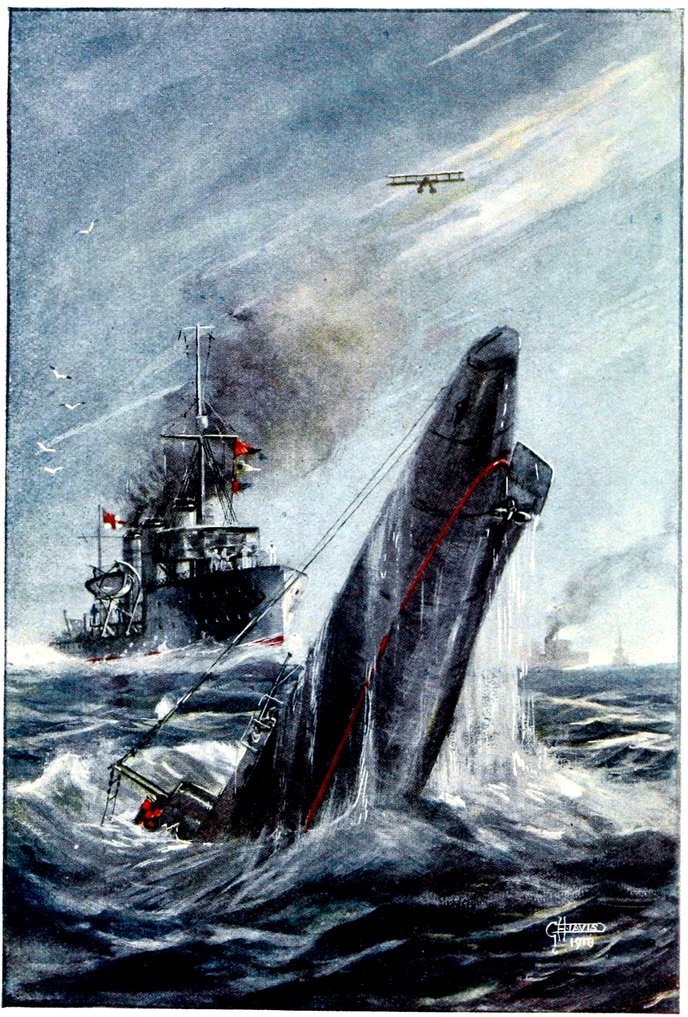
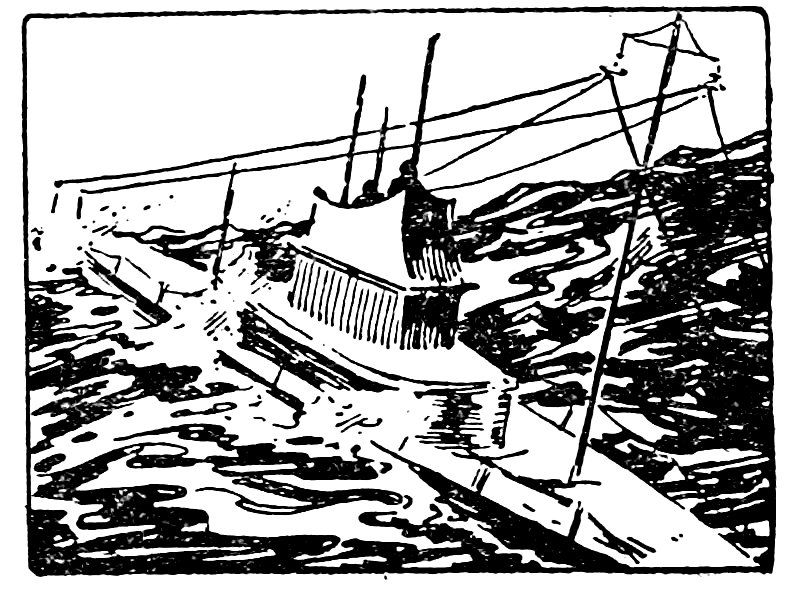
CHAPTER I Clearing the Decks
13
“Society must not remain passive in face of the deliberate
provocation of a blind and outrageous tyrant. The common
interests of mankind must direct the impulses of political bodies:
European society has no other essential purpose.”—Schiller.
Surprise is the soul of war. The submarine
illustrates this elemental principle,
and its astounding development is
the most amazing fact of the World Struggle.
Given favourable circumstances it can attack
when least expected, pounce on its prey at
such time as may be most convenient to itself,
and return to its lair without so much as being
sighted. What has become a vital means to
the most important military ends was once
described by the British Admiralty as “the
weapon of the weaker Power.” To a large
extent, of course, it is par excellence the type
of vessel necessary to bidders for Sea Supremacy
who would wrest maritime predominance from
a stronger Power. On the other hand, it has
rendered yeoman service to the British Navy,
14as many of the following pages will show.
Germany, a nation of copyists but also of
improvers, diverted the submersible from the
path of virtue which previous to the outbreak
of hostilities it was expected to pursue.
It is safe to say that few people in Great
Britain entertained the suspicion that underwater
craft would be used by any belligerent
for the purpose of piracy.
Up to August 1914 the submarine was
intimately associated in the public mind with
death and disaster—death for the crew and
disaster for the vessel. It is so easy to forget
that Science claims martyrs and Progress
exacts sacrifice. These are two of the certainties
of an uncertain world. The early stages of
aviation also were notable for the wreck of
hopes, machines, and men. To-day aircraft
share with submarines and tanks the honour
of having altered the aspect of war. The
motor-car, once the laughing-stock of everybody
other than the enthusiast, and now
grown into a Juggernaut mounting powerful
guns, is the foster-father of the three, for the
perfection of the internal combustion engine
15alone made the submarine and the aeroplane
practicable.
For good or for ill, the underwater boat has
passed from the experimental to the practical.
In the hands of the Germans it became a
particularly sinister and formidable weapon.
The truth is not in us if we attempt to disguise
the fact. When there was not so much as a
cloud the size of a man’s hand on the European
sky, and the Betrayer was pursuing the path
of peaceful penetration all undisturbed and
almost unsuspected, the submarine was regarded
by many eminent authorities as a
somewhat precocious weakling in the naval
nursery. They refused to believe that it would
grow up. Even Mr H. G. Wells, who has
loosed so many lucky shafts, unhesitatingly
damned it in his Anticipations. He saw few
possibilities in the craft, and virtually limited
its use to narrow waterways and harbours.
There were others, however, who thought
otherwise, and the controversy between the
rival schools of thought was brought to a head
by a fierce battle fought in Printing House
Square. Sir Percy Scott, who had previously
16held more than a watching brief for the heavy
fathers of the Fleet, bluntly told the nation
through the columns of the Times that the
day of the Dreadnought and the Super-Dreadnought
was over. With a scratch of the pen
he relegated battleships to the scrap-heap—until
other experts brought their guns to bear
on the subject. Almost on the conclusion of
this war of words the war of actuality began.
I do not think I am wrong in saying that
the former ended in an inconclusive peace.
Practice has proved the efficiency of both
surface and underwater craft, but particularly
of vessels that do not submerge.
Admiral Sir Percy Scott’s prophecy remains
unfulfilled. The big-gun ship has asserted
itself in no uncertain language. It is interesting
to note, however, that the ruling of one
who took part in the discussion, and whose
personal experience in the early stages of the
evolution of a practical submarine entitled
him to special consideration, has been entirely
negatived. Rear-Admiral R. H. S. Bacon,[1]
17the principal designer of the first British type,
asserted that “the idea of attack of commerce
by submarines is barbarous and, on account
of the danger of involving neutrals, impolitic.”
It is obvious from this that the late commander
of the Dover Patrol never contemplated
any departure from the acknowledged
principles of civilized warfare. The unexpected
happened, as it is particularly liable to do in
war. One of the main purposes of the enemy’s
submarines in the World War was piracy, unrestrained,
unrestricted, and unashamed. It
failed to justify Germany’s hope.
Probably Lord Fisher was the first seaman
holding high position to actually warn
the British Government of the likelihood of
Germany’s illegitimate use of the submarine.
Early in 1914 he handed to Mr Asquith and the
First Lord of the Admiralty a memorandum
pointing out, among other things, that the
enemy would use underwater boats against
our commerce.[2] His prescience was forestalled
thirteen years before by Commander Sir Trevor
18Dawson, who had prophesied that the enemy
would attack our merchant fleet in much the
same way as the Boers were then attacking
the army in the Transvaal. “Submarine
boats,” he told a meeting of engineers, “have
sufficient speed and radius of action to place
themselves in the trade routes before the darkness
gives place to day, and they would be
capable of doing almost incalculable destruction
against unsuspecting and defenceless
victims.”
Originally Germany was by no means
enamoured of the new craft. Her first two
submarines did not appear until 1905–6;
Great Britain’s initial venture was launched
at Barrow-in-Furness in 1901. The latter, the
first of a batch of five, was ordered on
the advice of Lord Goschen. Even then the
official attitude was sceptical, not altogether
without reason. Mr H. O. Arnold-Forster,
speaking in the House of Commons on the
18th March, 1901, after admitting that “there
is no disguising the fact that if you can add
speed to the other qualities of the submarine
boat, it might in certain circumstances become
19a very formidable vessel,” adopted what one
might call a misery-loves-company attitude.
“We are comforted,” he averred, “by the
judgment of the United States and Germany,
which is hostile to these inventions, which I
confess I desire shall never prosper.”
Dr Flamm, Professor of Ship Construction
at the Technical High School at Charlottenburg,
who should and probably does know
better, has aided and abetted certain other
publicists in foisting on the public of the
Fatherland the presumption that the submarine
is a German invention. This is not the
place for a full history of the underwater craft
from its early to its latest stages, but perhaps
it is permissible to give a few particulars
regarding the toilsome growth of this most
formidable type of vessel.
The first underwater craft of which there is
anything approaching authentic record was the
invention of Cornelius Drebbel, a Dutchman
who forsook his own country for England.
According to one C. van der Woude, writing
in 1645, Drebbel rowed in his submerged boat
from Westminster to Greenwich. Legend or
20truth has it that this “Famous Mechanician
and Chymist” managed to keep the air more
or less sweet in his craft by means of a secret
“Chymical liquor,” and that the structure
was covered with skin of some kind to make
it watertight. Drebbel, who also professed to
have discovered the secret of perpetual motion,
is stated to have hit upon the idea of his
invention by the simple process of keeping
his eyes open. He noticed some fishermen
towing behind their smacks a number of
baskets heavily laden with their staple commodity.
When the ropes were not taut the
vessels naturally rose a little in the water.
He came to the conclusion that a boat could
be weighted in much the same way to remain
entirely below the surface, and propelled by
means similar to a rowing-boat. It is even
said that King James travelled at a depth
of from twelve to fifteen feet in one of the
two vessels constructed by Drebbel, whose
invention is referred to in Ben Jonson’s Staple
of News.
The submarine may be said to have remained
in this essentially elementary stage until 1775,
21when David Bushnell, an American, launched
a little one-man submarine after five years
of planning and preparation. The shape of
the vessel resembled a walnut held upright,
the torpedo being carried outside near the
top. At the bottom was an aperture fitted
with a valve for admitting water, while a
couple of pumps were provided for ejecting it.
About 200 lb. of lead served as ballast, which
could be lowered by ropes for the purpose of
giving immediate increase of buoyancy should
emergency require it. “When the skilful operator
had obtained an equilibrium,” Bushnell
writes, “he could row upward and downward,
or continue at any particular depth,
with an oar placed near the top of the vessel,
formed upon the principle of the screw, the axis
of the oar entering the vessel; by turning the
oar one way he raised the vessel, by turning
it the other way he depressed it.” A similar
apparatus, worked by hand or foot, whichever
was the more convenient, propelled the submarine
forward or backward. The rudder
could also be utilized as a paddle.
Bushnell provided his little wooden craft
22with what he called a crown and we should
designate a conning-tower. In this there
were several glass windows. Neither artificial
light nor means of freshening the air was
carried, though the submarine could remain
submerged for thirty minutes before the condition
of the atmosphere made it necessary to
ascend sufficiently near the surface to enable
the two ventilator pipes to be brought into
action. The water-gauge and compass were
rendered discernible by means of phosphorus.
The torpedo—Bushnell termed it a magazine—was
an oak box containing 150 lb. of gunpowder
and a clockwork apparatus which was
set in operation immediately the affair was
unshipped. It was attached to a wooden
screw carried in a tube in the brim of the
‘crown.’ Having arrived beneath an enemy
vessel, the screw was fixed in the victim’s
hull from within the submarine, and the
‘U-boat’ made off. At the time required the
mechanism fired what to all intents and
purposes was a gun-lock, and the torpedo
blew up.
The wooden screw was the least successful
23of the various appliances. An attempt was
made in 1776 to annihilate H.M.S. Eagle,
then lying off Governor’s Island, New York.
The operator apparently tried to drive his
screw into iron, and quite naturally failed.
Writing to Thomas Jefferson on the subject,
Bushnell suggests that had the operator shifted
the submarine a few inches he could have
carried out his operation, even though the
bottom was covered with copper. Two other
unsuccessful trials were made in the Hudson
River. Owing to ill-health and lack of means,
the inventor then abandoned his submarine,
though in the following year he attempted to
‘discharge’ one of his magazines from a whaleboat,
the object of attack being H.M.S. Cerberus.
It failed to reach the British frigate, and blew
up a prize schooner anchored astern of her.
Washington was fully alive to the possibilities
of Bushnell’s invention, but was evidently
of opinion that it was too crude to warrant
his serious attention. Writing to Jefferson,
he says: “I thought, and still think, that it
was an effort of genius, but that too many
things were necessary to be combined to expect
24much from the issue against an enemy who
are always upon guard.” Incidentally this
was a remarkable testimonial to the men on
look-out duty on the British vessels. Keen
sight is still a recognized weapon against
submarine attack.
In 1797 Robert Fulton, also an American,
brought his fertile brain to bear on the submarine,
possibly on hearing or reading of
David Bushnell’s boat. One would have anticipated
that the era of the Revolutionary and
Napoleonic wars would be propitious for the
introduction of new plans and methods calculated
to bring a seemingly never-ending state of
hostilities to an end. Novel propositions were
certainly brought forward; few were utilized.
Fulton, an artist by profession, simply bubbled
over with ideas connected with maritime
operations. Moreover, he had extraordinary
tenacity and enthusiasm. Set-backs seemed
to give him added momentum. He tried to
do business with Napoleon in France, with
Pitt in England, with Schimmelpenninck on
behalf of Holland, not always without success,
before returning to the United States and
25running the steamer Clermont at five miles
an hour on the Hudson.
At the end of 1797 the enterprising American
proposed to the French Directory to construct
a submarine, to be christened the Nautilus,
or, as he frequently spelled it, the Nautulus.
So great was his faith in the project for “A
Machine which flatters me with much hope
of being Able to Annihilate” the British Navy,
that he was willing to be remunerated by
results, viz., 4000 francs per gun for every ship
of forty guns and upward that he destroyed,
and half that amount per gun for smaller
vessels. All captures were to become the
property of “the Nautulus Company.” A
little chary of being caught red-handed by
the enemy and dealt with as a pirate, he asked
that he might be given a commission in the
Service, which would ensure for him and his
crew the treatment of belligerents. Pléville
le Pelley, Minister of Marine, deeming that
such warfare was “atrocious,” and yet not
altogether unkindly disposed toward it, refused
the latter request, which would obviously give
the submarine official sanction. The proposed
26payment by results he reduced by fifty per
cent. All the arrangements were subsequently
cancelled.
Nothing further was done until July 1798,
when Bruix was Minister of Marine. Fulton
renewed his proposition, and certain inquiries
by scientists of repute were made at the instigation
of Bruix. The report was distinctly
favourable, but again there was disagreement
as to terms. Fulton, impatient of delay, built
the Nautilus. This little vessel, twenty feet long
and five feet beam, was launched at Rouen
in July 1800. On the trial trip the inventor
and two companions made two dives in the
boat, the time of submersion varying from
eight minutes to seventeen minutes. Proceeding
to Havre, Fulton made various improvements
in the Nautilus, including the
introduction of a screw propeller worked by
hand, and the addition of wings placed horizontally
in the bows for the purpose of
ascending or descending. While at Havre the
submarine remained below over an hour at a
depth of fifteen feet with her crew and a lighted
candle. On another occasion the Nautilus
27was submerged for six hours, air being supplied
by means of a little tube projecting
above the water.
For sailing on the surface the boat was fitted
with a single jury-mast carrying a mainsail
jib, which could be unshipped when submarine
navigation was required. By admitting water
she sank to the required depth, and was then
propelled by the method already referred to.
A glass dome, a compass, a pump for expelling
the water when necessary, and a gauge for
testing depth, which Fulton called a bathometer,
constituted the ‘works.’ The torpedo
was an apparatus made of copper filled with
gunpowder, “arranged in such a manner that
if it strikes a vessel or the vessel runs against
it, the explosion will take place and the bottom
of the vessel be blown in or so shattered as
to ensure her destruction.”[3] The weapon
was to be fixed to the bottom of the victim
by means of a barbed point on the chain used
for towing it.
Fulton approached Napoleon, who authorized
Forfait, the latest Minister of Marine,
28to advance the sum of 10,000 francs for the
purpose of perfecting the Nautilus. He also
granted Fulton an interview. When, in the
autumn of 1801, he expressed a wish to see
the submarine, the vessel had been broken
up. Here the matter ended, and the ingenious
American turned his thoughts in the direction
of steam navigation. The Nautilus was his
one and only experiment in underwater craft.[4]
The first ship to be actually sunk during
hostilities by submarine was the Federal
13–gun frigate Housatonic, of 1264 tons. She
went down off Charleston on the 17th February,
1864, during the American Civil War, as the
result of being attacked by a spar-torpedo
carried by the Confederate submarine Hunley,
so named after her designer, Captain Horace L.
Hunley. Unfortunately the underwater boat
was also a victim, and she carried with her
her fourth crew to meet with death as a consequence
29of misadventure. On the first occasion
the boat was swamped and eight men were
drowned, on the second a similar disaster overtook
her, with the loss of six of her crew,
on the third she descended and failed to
come up. Small wonder that the Hunley came
to be known as ‘the Peripatetic Coffin.’
The shape of the Hunley was cylindrical.
For’ard and aft were water ballast tanks
operated by valves, and additional stability
was given by a sort of false keel consisting of
pieces of cast iron bolted inside so as to be
easily detachable should it be necessary to
reach the surface quickly. On each side of
the propeller, worked by the hand-power of
eight men, were two iron blades which could
be moved so as to change the depth of the
vessel. The pilot steered from a position near
the fore hatchway.
The torpedo, a copper cylinder containing
explosive and percussion and primer mechanism,
was fired by triggers. It was carried on a
boom, twenty-two feet long, attached to the
bow. The speed was seldom more than four
miles an hour on a calm day. As there was
30no means of replenishing the air other than by
coming to the surface and lifting one of the
hatchways, it was obviously a fair-weather
ship.
On the afternoon of the 17th February, 1864,
the Hunley set out on her final trip. While
attacking the submarine was only partly submerged,
and one of the hatches was uncovered;
why will never be known. She made straight
toward the Housatonic, with the evident intention
of striking the vessel near the magazines
with her torpedo. There was an explosion,
the ship heeled to port, and went down by the
stern. When divers examined the extent of
her injuries the plucky little Hunley was found
with her nose buried in the gaping wound in
her victim’s hull. Her crew were dead, but
apparently the officer was saved.
Other submarines or partly submersible boats
were used by the defenders of the Southern
cause. They were usually termed ‘Davids’
because they were built to sink the Goliaths
of the Federal Navy. The New Ironsides, the
Minnesota, and the Memphis were all damaged
as a result of their operations.
31The only weapon of the submerged submarine
is the torpedo. The World War brought no surprise
in this direction. For surface work the
calibre of the guns mounted on the disappearing
platforms has increased very considerably.
In 1914 a 14–pdr. was considered ample armament.
With added displacement, gun-power
has grown enormously. Some German underwater
craft in 1918 carried 5.9–in. guns—that
is to say, weapons larger than those used by
many destroyers.
During the past decade torpedoes and submarines
have made almost parallel progress.
Of the various types of the former, the Whitehead
is first favourite in the Navies of Great
Britain, Japan, Russia, and Austria-Hungary,
while France uses both the Whitehead and the
Schneider, and Germany was exclusively devoted
to the Schwartzkopf (Blackhead). The extreme
effective range of each may be taken as from
10,000 to 12,000 yards. The essential difference
between a torpedo and the usual run of
naval ammunition for guns is that the torpedo
retains its propellant, while the shell does not.
The torpedo is really an explosive submarine
32mine forced through the water at a rate
varying from 28 knots to 42 knots by twin-screws
worked by compressed air engines. Any
deviation from the course is automatically
corrected by a gyroscope. Some torpedoes
are now fitted with an apparatus which causes
the torpedo to go in circles should it miss its
mark and meet with the wash of passing ships.
There is the added possibility, therefore, that
the weapon may strike a vessel at which it
was not aimed when a squadron is proceeding
in line ahead.
To a certain extent the submarine has enabled
the torpedo to come into its own. It is
not at all an easy task to hit a rapidly moving
ship from a platform also ploughing the water
at a great rate. Among other things the speed
and distance of the opponent have to be taken
into consideration, and the missile aimed
ahead of the enemy so that it and the target
shall arrive at a given point at the same
moment. The late Mr Robert Whitehead’s
invention, an improvement on that of Commandant
Lupuis, of the Austrian Navy, who
had sold his patent to the former, was tested
33by the British Admiralty at Sheerness in 1871.
Although extremely crude when compared with
its successor of to-day, the sum of £15,000
was paid for the English rights. It was first
put to a practical test in the Russo-Turkish
War of 1877, when Lieutenant Rozhdestvensky,
who afterward suffered defeat at the hands of
the Japanese in May 1905, sank a Turkish
warship by its means.
Viscount Jellicoe has told us that the arrival
of the submarine led to certain alterations in
strategy. I quote from an interview which
the former First Sea Lord granted to a representative
of the Associated Press in the spring
of 1917. Sir John, as he then was, said:
“The most striking feature of the change in
our historic naval policy resulting from the
illegal use of submarines, and from the fact
that the enemy surface ships have been driven
from the sea, is that we have been compelled
to abandon a definite offensive policy for one
which may be called an offensive defensive,
since our only active enemy is the submarine
engaged in piracy and murder.” Mr Winston
Churchill, First Lord of the Admiralty in
34August 1914, put the matter a little more
bluntly. “But for the submarine and the
mine.” he wrote, “the British Navy would, at
the outset of the war, have been able to force
the fighting to an issue on their old battleground—outside
the enemy’s ports.”
This did not mean that every other type of
ship had been rendered obsolete or even obsolescent
by the coming of the vessel that can
float on or under the waves. Admiral von
Capelle, Secretary of State for the German
Imperial Navy, told the Main Committee of
the Reichstag that the submarine was an
“important and effective weapon,” but added
that “big battleships are not wholly indispensable.
Their construction depends on the
procedure of other nations.”[5] For instance,
the submarine has emphasized the importance
of the torpedo-boat destroyer, which
some seamen thought it would supersede. The
T.B.D. has more than maintained its own.
Not only is it useful for acting independently,
fighting its own breed, but as the safeguard
of the battleships and battle-cruisers at sea,
35and also as the keenest weapon against submarines,
the naval maid-of-all-work has proved
extraordinarily efficient.[6]
In the general operations of naval warfare
it cannot be said that the enemy U-boats
were particularly successful. In the five
battles that were fought the work of German
submarines was negligible so far as actual fighting
was concerned. In two of them, namely
Coronel and the Falklands, they were unrepresented
on account of the actions taking
place many thousands of miles from European
waters. This limitation of range of action is
a difficulty that time and experiment were
beginning to solve when hostilities came to an
abrupt conclusion.
The battles of Heligoland Bight and Dogger
Bank are profoundly interesting to the student
of War in the Underseas. Sir David Beatty,
who commanded the Battle Cruiser Squadron
in the first big naval engagement in which
submarines were used, while admitting that
he did not lose sight of “the risk” from them,
says in his dispatch that “our high speed ...
36made submarine attack difficult, and the
smoothness of the sea made their detection
comparatively easy.” These two antidotes will
be noted by the reader. The same distinguished
officer, perched on the fore-bridge of the Lion
in his shirt-sleeves while pursuing the German
Fleet near the Dogger Bank, personally observed
the wash of a periscope on his starboard
bow. By turning immediately to port he
entirely upset the calculations of the enemy
commander, who was not afforded a further
opportunity to torpedo the flagship. A like
manœuvre defeated a similar projected attack
on the Queen Mary in the Bight. The helm
is therefore a third instrument of defence.
Apparently the service rendered by enemy
U-boats at these two battles was worthless.
If they fired at all they missed. On the other
hand, any attempt to sink them likewise
failed.
In the dispatches on the Battle of Jutland,
which a well-known Admiral tells me were
severely edited before publication, there are
several references to enemy submarines, none
to our own. The first attempted attack took
37place about half an hour after Sir David Beatty
had opened fire, and immediately following
the entry of the 5th Battle Squadron into the
fight. The destroyer Landrail sighted a periscope
on her port quarter. With the Lydiard
she formed a smoke-screen which “undoubtedly
preserved the battle-cruisers from closer submarine
attack.” The light cruiser Nottingham
also reported a submarine to starboard. We
are also informed that “Fearless and the
1st Flotilla were very usefully employed as
a submarine screen during the earlier part
of May 31.” The Marlborough, flagship of
Vice-Admiral Sir Cecil Burney’s First Battle
Squadron, after having been torpedoed—whether
by submarine or other craft is not
mentioned—drove off a U-boat attack while
proceeding to harbour for repairs. “The
British Fleet,” adds Sir John Jellicoe, “remained
in the proximity of the battlefield
and near the line of approach to German ports
until 11 a.m. on June 1, in spite of the disadvantages
of long distances from fleet bases
and the danger incurred in waters adjacent
to enemy coasts from submarines and torpedo
38craft.” In the British list of enemy vessels
put out of action, one submarine figures as
sunk.
Admiral Beatty justly remarks that the
German losses were “eloquent testimony to
the very high standard of gunnery and torpedo
efficiency of His Majesty’s ships.” Of the
twenty-one vessels lost or severely damaged,
it would appear as though nine were accounted
for by torpedoes, although this does not
necessarily mean that they had not been
engaged by gunfire as well. At Dogger Bank,
it may be recollected, a torpedo finally settled
the Blücher, which had already been rendered
hors de combat by shell fired from more old-fashioned
weapons.
The German High Sea Fleet adopted a prolonged
attitude of caution after Jutland, but
the All-Highest thought it well to issue an
Imperial Order calculated to inspire the officers
and men of the submarine flotillas. “The
impending decisive battle” mentioned in the
following message, which is dated Main Headquarters,
1st February, 1917, evidently refers
to the ‘unlimited’ phase of U-boat warfare
39and not to a general action, as one might
imagine at first glance. This highly interesting
document runs:
In the impending decisive battle the task falls on my
Navy of turning the English war method of starvation,
with which our most hated and most obstinate enemy
intends to overthrow the German people, against him
and his Allies by combating their sea traffic with all
the means in our power.
In this work the submarine will stand in the first
rank. I expect that this weapon, technically developed
with wise foresight at our admirable yards, in co-operation
with all our other naval fighting weapons, and
supported by the spirit which during the whole course
of the war has enabled us to perform brilliant deeds,
will break our enemy’s war designs.
The defensive policy of the Imperial Navy
was summed up by a writer in the Deutsche
Tageszeitung seven months after the publication
of the above. “Above all else,” he wrote,
“the German High Sea Fleet has rendered
possible the conduct of the submarine war.
Without it the enemy would have threatened
our submarine bases and restricted our submarine
warfare, or made it impossible.” It
40was not a valorous rôle to play, but there was
wisdom in it.
The submarine campaign passed through
several phases. In its earliest stages it was
mainly directed by Grand Admiral von Tirpitz,
the predominant personality associated with the
growth of the Imperial Navy. In December
1914 this Bluebeard of the Seas asserted that
as England wished to starve Germany, “we
might play the same game and encircle England,
torpedoing every British ship, every ship
belonging to the Allies that approached any
British or Scottish port, and thereby cut off
the greater part of England’s food supply.”
The ‘game’ was started on the 18th February,
1915, and enthusiastically applauded throughout
the German Empire. All the waters surrounding
the United Kingdom, and “all English
seas,” were declared to be a war area. Every
vessel of the British Mercantile Marine was to
be destroyed, “and it will not always be
possible to avoid danger to the crews and
passengers thereon.”[7] Peaceful shipping was
warned that there was a possibility of neutrals
41being “confused with ships serving warlike
purposes” if they ventured within the danger
zone. Great Britain had declared the North
Sea a military area in November 1914, and
every care was taken to respect the rights
of neutral shipping. The enemy, on the contrary,
speedily showed utter disregard of international
law. The submarine programme was
started before the day advertised for the opening
performance.
The sinking of the Lusitania on the 7th May,
1915, with the loss of 1225 lives, showed in
no uncertain way that the Germans intended
nothing less than an orgy of cold-blooded
devilry. In the following month the always
strident German Navy League stated that
the fleet which it had done so much to bring
into being “was not in a position to break
the endless chain of transports carrying munitions
in such a manner as blockade regulations
had hitherto required.” To search ships was
“in most cases impossible.” In the same
manifesto the sinking of the giant Cunarder
was ‘explained’ by arguing that as submarines
had no means to compel vessels to stop, and
42there was ammunition on board, sinking without
warning was justified. “Such must continue
to be the case, and the Army has a just
claim to this service of the Fleet.”
As a protest against armed traders, the
campaign was intensified on the 1st March,
1916. These ships were “not entitled to be
regarded as peaceful merchantmen.” The plain
English of the move was that Germany wanted
some kind of excuse for ordering her submarines
to sink vessels at sight. According to her, none
other than naval ships had the least excuse
to assume so much as the defensive. In President
Wilson’s so-called Sussex note of the
18th April, 1916, attention is called to the
“relentless and indiscriminate warfare against
vessels of commerce by the use of submarines
without regard to what the Government of
the United States must consider the sacred
and indisputable rules of international law
and the universally recognized dictates of
humanity.”
The third phase was that of “unlimited
submarine war,” announced on the last day
of January 1917. “Within the barred zones
43around Great Britain, France, Italy, and in the
Eastern Mediterranean, all sea traffic will henceforth
be oppressed by all means.” Neutral
ships in those areas would traverse the waters
“at their own risk.” To a large extent they
had done so before. Notwithstanding repeated
‘regrets’ and pledges given by Germany to
the United States, murder on the high seas
was now to be an acknowledged weapon of
German warfare. It culminated in a declaration
of war on the part of the United States
on the 6th April, 1917, by which time over
230 Americans had lost their lives by the
enemy’s illegal measures. The date is worth
remembering; it will loom big in the history
books of to-morrow. Zimmermann, Germany’s
Minister for Foreign Affairs, had already expressed
the opinion that ruthless submarine
warfare promised “to compel England to
make peace in a few months.”[8] In this expectation,
as in several others, he miscalculated.
The Lord Chancellor declared that submarine
warfare, as carried on by the enemy, was
44absolutely illegal by international law, and was
mere piracy.[9] As to mines, which were also
greatly favoured by the Huns and sown by
their U-boats, it may be mentioned that such
weapons laid to maintain a general commercial
blockade are equally illegal, although perfectly
legitimate outside naval bases. This was
a small matter to the Kaiser and his satellites,
who were out to win at any and all costs. No
British mines were placed in position until
many weeks after the declaration of hostilities,
although the enemy had scattered them indiscriminately
in the trade routes either before
or immediately following the outbreak of
war. When we resorted to the use of
mines they were anchored in all cases, and
constructed to become harmless if they broke
loose.
The reply of England and of France to these
measures was to stop supplies from entering
Germany by means of a blockade controlled
by cruiser cordon. “The law and custom of
nations in regard to attacks on commerce,”
to quote the British Declaration to Neutral
45Governments,[10] “have always presumed that
the first duty of the captor of a merchant
vessel is to bring it before a Prize Court, where
it may be tried, where the regularity of the
capture may be challenged, and where neutrals
may recover their cargoes.” With delicate
consideration for the convenience of neutrals,
which some folk held to be wisdom and others
lunacy, the British Government declared their
intention “to refrain altogether from the exercise
of the right to confiscate ships or cargoes
which belligerents have always claimed in
respect of breaches of blockade. They restrict
their claim to the stopping of cargoes
destined for or coming from the enemy’s
territory.”[11]
Much ado was made about the stoppage of
food for the civil population of the Central
Empires. It was barbarous, inhuman, and
so on. Yet the principle had been upheld
by both Bismarck and Caprivi, and practised
at the siege of Paris. As Sir Edward Grey
delightfully put it, this method of bringing
46pressure to bear on an enemy country “therefore
presumably is not repugnant to German
morality.”[12]
A great deal has been said and written to
show that the Prussian Government was not
the German People, that instead of Representation
there was Misrepresentation. It is still
extremely difficult to secure reliable information
on any subject connected with intimate
Germany, and the contemporary views of so-called
neutrals are often more than suspect.
A study of German newspapers at the time
certainly led one to believe that opposition to
the submarine campaign had been more or less
negligible. A change of view only came when
the people realized that ruthlessness did not
pay, and it was the business of the British
Navy to demonstrate this—as it did. Meantime
the German official accounts of sinkings
were grossly exaggerated, and the nation had
no means of discovering the loss of submarines
other than when relatives serving in them failed
to return to their families. There was no one
to contradict the grossly exaggerated statement
47made by Dr Helfferich, Minister for the Interior,
that in the first two months of unrestricted
U-boat warfare over 1,600,000 tons of shipping
had been sunk at the cost of the loss of a mere
half-dozen submarines.[13]
Dr Michaelis, a more noisy sabre-rattler
than his predecessor in the Chancellorship,
asserted that “the submarine warfare is accomplishing
all, and more than all, that was expected
of it.”[14] Like many other of his countrymen,
to him the crews of the Imperial Pirate
Service were more of the nature of soldiers than
of sailors. Certainly their callous behaviour
suggested that they were strangers to the proverbial
comradeship of the sea, and one with
the glorious band that hacked a way through
Belgium, drove their bayonets through babies,
and crucified their prisoners. Loud cheers
followed the remark that “We can look
forward to the further labours of our brave
submarine warriors with complete confidence,”
and also to a reference to greetings sent home
to the Fatherland by “our troops on all fronts
48on land and sea, in the air and under the
sea.”
As to the thoroughness with which commanders
of U-boats performed their task, there
is no need to speak. There is plentiful evidence
to prove that so elementary a duty as that of
examining a ship’s papers seldom interested
them. They had no respect for law or life.
Witness a case[15] that has a direct bearing
on this matter. It arose in connexion with
the salving of the s.s. Ambon, a neutral vessel
bound for the Dutch East Indies, after having
been torpedoed on the 21st February, 1916,
when about seven miles off Start Point. A
shell was fired from an enemy submarine.
Immediately the engines of the steamship were
stopped, a lifeboat was lowered, and the chief
engineer sent off with the ship’s papers and
instructions. The latter included a copy of
a telegram from the owners advising that the
steamer was to call at a certain port on a specified
day, in accordance with an agreement between
the Dutch and German Governments. The
German commander did not so much as look
at the documents, and peremptorily told the
crew to leave the Ambon. “My orders admit
of no variation,” he remarked. They were
“to sink every ship in the blockade area.”
The steamer was then torpedoed, but did not
founder, and was subsequently towed into
Plymouth.
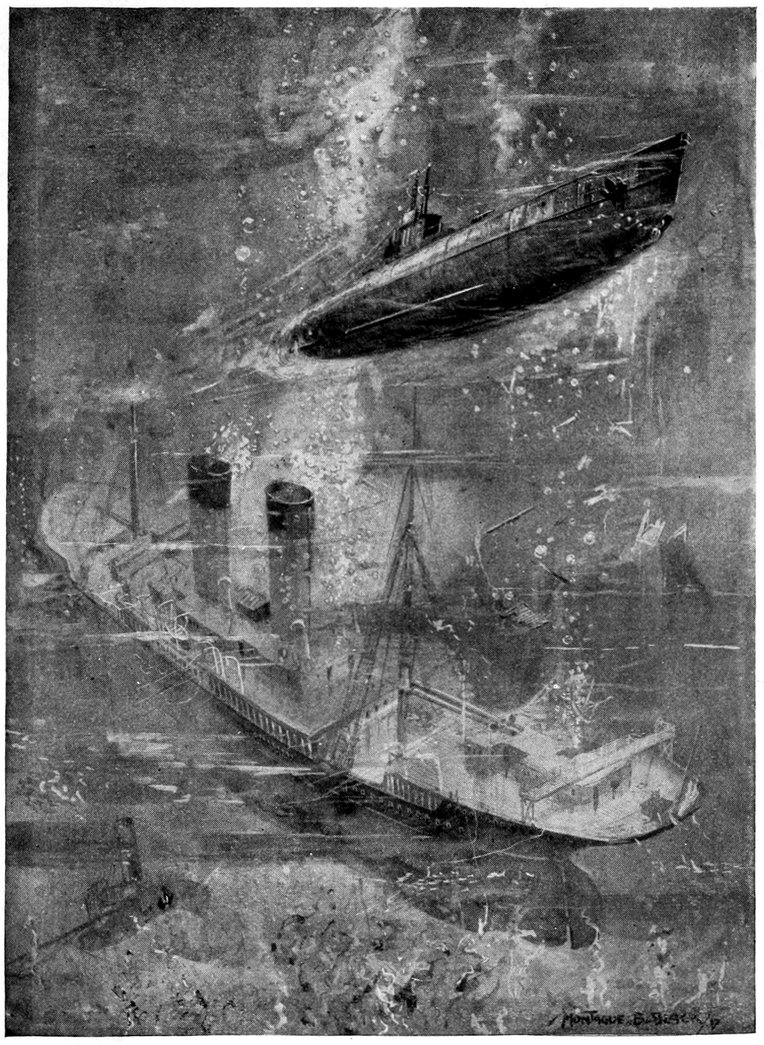
Unrestricted Submarine Warfare
A U-boat gliding, submerged, over her victim.
Montague Black
49No reliance whatever could be placed on
Germany’s word, as neutrals early discovered
to their cost. Having provided a so-called
‘safe’ zone, the Dutch steamer Amsterdam
was torpedoed within it. At Germany’s own
suggestion, an International Committee, composed
of Dutch, Swedish, and German naval
officers, was formed to investigate the circumstances.
Their finding was that the vessel
had been sunk in the ‘safe’ zone.
There was a time when the French authorities
seemed to be in favour of the submarine above
all other types of naval ships. The result was
that France lost her position in the race for
second place in the world’s fleets, though it
is to her credit that in 1888 she launched
the Gymnote, the first modern submarine to be
50commissioned. Nordenfeldt, of gun fame, had
already achieved a certain amount of success
with steam-driven underwater boats, but they
had many disadvantages when compared with
those of Mr John P. Holland, who hailed from
the same country as Fulton. The first submarines
built for the British Government
were of the Holland type, of 120 tons displacement
when submerged, and having a speed of
five knots when travelling below. Germany’s
pioneer U-boat was built in 1890. In 1918
she boasted giant diving cruisers of 5000 tons,
with a radius of action of 8000 miles, and
mounting 5.9–in. guns.
As to the vexed question of the number of
submarines possessed by Great Britain and
Germany respectively at the beginning of the
war, one can only say that authorities differ.
According to an interview granted by Mr
Winston Churchill to M. Hugues le Roux
which appeared in Le Matin in the first week
of February 1915, we then had more underwater
boats than the enemy, but Lord Jellicoe
afterward asserted that in August 1914 “the
German Navy possessed a great many more
51oversea submarines than we did.”[16] Unless
there is a subtle distinction between the general
term used by the then First Lord and the
oversea type referred to by the former Commander-in-Chief
of the Grand Fleet, it is impossible
to reconcile the two statements, for it
is obvious that the leeway mentioned by the
latter cannot have been made up in five months.
According to the Berlin official naval annual
Nautilus, published in June 1914, the total
number of completed German submarines up
to the previous month was twenty-eight.
Commander Carlyon Bellairs, R.N., M.P., estimated
them at “fifty built, building, and
projected.” Austria had six ready, four under
construction at Pola, and five on the stocks in
Germany. In the five years immediately preceding
the beginning of the struggle Germany
certainly spent more on underwater craft than
Great Britain, the figure for the former being
£5,354,206, and for the latter £4,159,670.
CHAPTER II Life as a Latter-day Pirate
52
“The unrestricted U-boat war means a very strong naval
offensive against the Entente.”—Admiral von Capelle.
Writing in the early summer of
1915, a neutral who visited the
once busy ports of Danzig, Stettin,
Hamburg, and Bremen remarked that “wherever
one goes in these cities, wherever one
takes one’s meals, one hears the word Unterseeboot.
Amazing, and often untrue, stories are
told of the number of submarines that are
being constructed, the size and speed of the
latest ones, and the great number of English
ships that have been sunk, but whose loss
has been ‘concealed from the British public.’”
The submarine barometer was Set Fair. It
soon dropped to Change.
Within six months the industrious and
outspoken Captain Persius was confessing in
the Berliner Tageblatt that “regarding the
effectiveness of our U-boats in the trade war,
one hears frequently nowadays views that
53bear little resemblance to the views uttered
a year ago. Then, alas, hopes were extravagant,
owing to a disregard of facts
which the informed expert, indeed, observed,
but which remained concealed from the
layman”—a confession of failure, notwithstanding
the offer of substantial rewards for
every merchant vessel sunk, and pensions
for each man in a submarine which destroyed
a transport.
Twenty months later Admiral von Scheer
asserted that German submarine losses were
more than equalized by new construction.
Note the definite acknowledgment of losses
and of the necessity for replacing them. In
April 1918 Admiral von Capelle, Imperial
Secretary of State for the Navy, endeavoured
to explain the declining maritime death-rate
of the enemy by assuring the Main Committee
of the Reichstag that the average loss of
British ships from submarine attacks alone,
during 1917, was 600,000 tons per month.
The truth of the matter was that the average
loss from all causes was not more than 333,000
gross tons. According to an official statement
54circulated to the German Press on the
4th of the following June, food conditions in
England were “extraordinarily bad,” because
the U-boat campaign was “having the intended
result of constantly diminishing England’s
food supply.” In actual fact, the U-boats
were then having a particularly rough time.
So far as the German Independent Socialists
were concerned, they did not “look forward
with complete confidence,” as Dr Michaelis
had professed to do in July 1917, “to the
further labours of our brave submarine
warriors.” Herr Vogtherr, a member of the
party, bluntly remarked that “it cannot be
seen that U-boat warfare has brought peace
nearer. Meanwhile we continue to destroy
tonnage which we shall need after the war in
order to obtain necessary raw materials.” As
to the latter clause, the British Mercantile
Marine has already had something to say. It
lost 14,661 gallant fellows through enemy
action.
According to the statement of a member
of the crew of the British destroyer which
rammed U 12, some of the prisoners at least were
55thankful to be in despised England. They
said that the coxswain had been a North Sea
pilot for fifteen years previous to the outbreak
of war, and though the veriest tyro in matters
relating to underwater craft, was compelled
to take service, presumably because he was
well acquainted with the east coast of the
United Kingdom. The story of crews being
forced with the gentle persuasion of a revolver
to board other U-boats while their own was
docked to undergo repairs was not necessarily
exaggerated. There is evidence that on occasion
German seamen were shot for refusing
to go on board a submarine. The mate of the
Brazilian steamer Rio Branco, when taking
the ship’s papers to the commander of an
enemy U-boat, asked a member of the crew
what life was like as a latter-day pirate. He
replied in a single word usually taken to denote
eternal misery, and added that although he
and his mates would like to mutiny, opportunity
was never afforded them, because they
were shot on the slightest pretext. There is
no reason to doubt that crews were sent to
sea with insufficient training, and that their
56moral steadily declined as Allied efforts to
tackle the foe developed.
With a stoical philosophy which may have
been specially intended for neutral consumption,[17]
Lieutenant-Commander Claus Hansen
informed the Kiel representative of the New
York World that “We need neither doctors
nor undertakers aboard U 16; if anything
goes wrong with our craft when below no
doctor can help; and we carry our coffin
with us.” One can thoroughly appreciate his
remark that the work “is fearfully trying on
the nerves. Every man does not stand it.”
The same article also furnishes other interesting
particulars of the life of a modern
pirate which bear prima facie evidence of
truth. “We steer entirely by chart and compass,”
the commander averred. “As the air
heats it gets poor, and, mixed with odours of
oil from machinery, the atmosphere becomes
fearful. An overpowering sleepiness often
attacks new men, who require the utmost
will-power to remain awake. Day after day
in such cramped quarters, where there is
57hardly room to stretch the legs, where one
must be constantly alert, is a tremendous
strain on the nerves. I have sat or stood
for eight hours with my eyes glued to the
periscope, peering into the brilliant glass until
my eyes and head have ached. When the
crew is worn out, we seek a good sleep and
rest under the water, the boat often rocking
gently, with a movement like that of a cradle.
Before ascending I always order silence for
several minutes, to determine whether one
can hear any propellers in the vicinity through
the shell-like sides of the submarine, which
act like a sounding-board.”
Hansen gave the interviewer to understand
that lying dormant many fathoms deep was
not exactly a treat to his crew. “When the
weather or the proximity of the enemy make
it necessary to remain down so long that the
air becomes unusually bad, every man except
those actually on duty is ordered to lie down,
and to remain absolutely quiet, making no
unnecessary movements, as movement causes
the lungs to use more oxygen, and oxygen
must be saved, just as the famished man in
58the desert tries to make the most of his last
drop of water. As there can be no fire, because
fire burns oxygen, and the electric power
from the accumulators is too precious to be
wasted for cooking, we have to dine cold when
cruising.” This chat, it is necessary to add,
took place in March 1915. Since then many
improvements have been made in submarines,
including ventilation and roominess.
At this particular period everything possible
was being done to arouse the enthusiasm of
the German nation for the Underseas War.
Carefully written articles by naval men,
syndicated by official or semi-official Press
bureaux, made their appearance with almost
bewildering frequency. German submarines
had found their way to the Dardanelles, a
feat attended by much metaphorical trumpet-blowing
and flag-waving. To quote Captain
von Kühlewetter, a devout worshipper at the
shrine of Tirpitz:
“The layman can hardly imagine what it
means for a craft of only 1000 tons displacement,
about 230 feet long and 19 or 20 feet
beam at its widest point, to make with a
59crew of thirty a trip as far as from Hamburg
to New York. The little vessel can only travel
at moderate speed in order that the petrol
may last. It is always ready to meet the
enemy without help of any kind on a journey
through hostile waters for the entire distance.
And these submarines did meet the enemy
often.”
There is a charming naïveté about the
narrative of a U-boat man who spent some
time reconnoitring the coast of Scotland. His
vessel left her base in company with several
others, including U 15, which failed to return.
“She fell before the enemy” is his pathetic
little epitaph to her memory. Each of the
ten days spent on the trip was divided into
four shifts for alternate sleep and work. For
variety there was “a little while under, a
little while on top.” The only sensational
phase of the cruise appears to have been when
“one after another had to leave his place for
a minute and take a peep through the periscope.
It was the prettiest picture I ever
saw. Up there, like a flock of peaceful lambs,
lay an English squadron without a care, as if
60there were no German sea-wolves in armoured
clothing. For two hours we lay there under
water on the outposts. We could with certainty
have succeeded in bringing under a
big cruiser, but we must not. We were on
patrol. Our boat had other work to do. It
was a lot to expect from our commander.
So near to the enemy, and the torpedo must
remain in its tube! He must have felt like
a hunter who, before deer-stalking begins,
suddenly sights a fine buck thirty paces in
front of him.”
The reference to British cruisers resembling
peaceful lambs is delicious. The writer seems
to have forgotten that so far as ‘armoured
clothing’ goes they are considerably better
provided than the toughest submarine afloat.
And what kind of a wolf was it to let such
easy prey escape? One surmises a reason
connected with the British patrol rather than
with its German counterfeit.
An American sailor-boy was taken on board
U 39 after that submarine had torpedoed his
ship. The lad afterward characterized the
unenviable experience as “a dog’s life in a
61steel can,” accompanied by a constant succession
of rings of the gong that sent every
member to his appointed station as though
the Last Trump had blown. The usual menu
was stew and coffee, the liquid refreshment
being varied on occasion by the substitution
of raspberry juice.
Three captains—a Briton, an American, and
a Norwegian—were made prisoners on U 49.
For days they were confined in a tiny cabin
containing three bunks. They took turns in
the solitary chair that was the only furniture
other than a folding table. As no light was
allowed, conversation and change of position
were their only occupations. They found
plenty to talk about, but even desultory
chatter becomes irksome when it is centred
around the topic, What will happen? Still,
misery loves company, even if it does not
appreciate cramp. The prisoners were kept
in this Dark Hole of the Underseas except
for occasional airings on deck when the craft
was running awash and there was ‘nothin’
doin’’ in the piracy or anti-piracy line.
Even then they were closely watched by
62armed guards. Their rations consisted of an
unpalatable concoction called stew, black bread,
rancid butter, and alleged marmalade, any
one of which might have been guaranteed to
engender mal de mer.
When off the coast of Spain the commander
of U 49 hailed a Swedish steamer. The
captain must have been deeply relieved when
he found that his services were merely required
as temporary gaoler. He was peremptorily
told to take charge of the prisoners, and
land them in the neighbourhood of Camarina.
Neither ship nor cargo was interfered with.
Never were mariners more pleased to set foot
on solid earth.
This particular barbarian was not quite
so callous as the presiding genius of U 34.
Four of the crew of the trawler Victoria, of
Milford, which he had sunk, were picked up
by the submarine. Six of their comrades had
passed to where there is no sea, and required
no favours from enemy or friend. As though
they were not sufficiently well acquainted
with the ways of U 34, the survivors were
summoned on deck the following morning to
63receive a further object-lesson in humanity
as the Hun understands it. They were compelled
to watch the death and burial of a
Cardiff trawler. “England,” explained one
of the German officers, “began the war, and
we shall sink every ship we see flying the
British flag.” When the latest victim of
U 34 had gone to her watery grave, the men
were given a handful of biscuits, placed in a
boat, and left to the mercy of the sea.
Apparently U-boats were not keen on fine
weather. “A smooth sea and a lull in the
wind are very disagreeable for U-boats,” said
Dr Helfferich, the Vice-Chancellor, “especially
in view of the enemy’s defensive measures,
particularly as regards aircraft. Some U-boat
commanders are of opinion that U-boat warfare
can be carried on with still better results when
the weather is not too fine and the nights are
longer.”
A certain submarine left her lair at Zeebrugge
a few days before Vice-Admiral Sir Roger
Keyes and his band of heroes gave an enforced
holiday to those that remained. She
had not proceeded any great distance before she
64encountered a mine. It did not completely
put her ‘out of mess,’ but sent her staggering
backward in inky darkness to the bottom.
The electric light had failed with the quickness
of a candle meeting a sudden draught.
To restore the current was obviously the first
thing to do. It was not easy working with the
aid of torches, the boat tipped up on end,
her stern buried deep in the bed of the sea.
Primitive man, his tail not yet worn off, would
have fared better. Eventually the supply was
restored, and it became possible to make a
more thorough survey of the damage. The
engineers found that the shock had paralysed
the nervous system of the machinery. Not only
was the boat leaking badly, but the pumps
refused to blow out the ballast tanks.
On an even keel the problem would be
easier to tackle. The men were therefore ordered
to assemble in the stern and rush forward
on the word of command. Their combined
movement had the desired effect. Slowly the
extra weight in the bow caused the ooze to
loose its grip. The submarine sank down
with languid grace. There was now nothing
65to hamper movement. Each member of the
crew had a pair of hands ready for service
instead of having to employ one for the
purpose of hanging on.
The engineers tried to start the motors.
They refused to budge. Sea-water found its
way into the accumulators, adding a further
terror to the overwrought men by the introduction
of poison gas in an atmosphere already
charged with death. Pirates might laugh when
they saw British sailors struggling for life in
icy water, might derive entertainment from
shelling frail craft laden to the gunwale with
survivors from ships sunk in pursuance of
the German cult of frightfulness, but they
failed to appreciate the humour of the situation
when they were the victims and the tragedy
was enacted 100 feet beneath the surface. The
traditional Nero would never have fiddled had
he felt the scorch of the flames that burnt
Rome. There is little enough of the alleged
glory of war in being trapped like a rat. Much
of its glamour in any circumstance is imaginary,
and exists chiefly in the minds of scribblers.
This is not pacificism, but fact.
66The sea mounted higher and higher in the
lonely prison cell. Officers and crew tried to
staunch the inflow, to stop the leaks with tow
and other likely material. These devices
held for a little, then burst away. Some
sought to make their escape through the
conning-tower, as Goodhart of the British
Navy had done;[18] others tried to force a
way out via the torpedo-tubes. Bolts were
wrenched off, fastenings filed through. The
doors held firm. The mighty efforts of the
men met with no reward. They fell back
exhausted and covered with sweat. The
pressure from without would have thwarted
a score of Samsons. The hatches remained
immovable.
They read the handwriting on the curved
walls of their prison: “No hope!” The
crew must have cursed the Hohenzollerns
then. Despair robbed them of reason. One
fellow went mad, then another, followed by a
third. A man plunged into the water, now
up to his knees. His overwrought brain
could stand the terrible strain no longer. He
67drowned in two feet of water. Nobody moved
to pull him out. The place became a Bedlam.
A comrade tried to shoot himself. The revolver
merely clicked. In a passion of rage
he flung both weapon and himself into the
rising flood. Death was the most desired
of all things.
A plate burst, letting in a Niagara. The
swirl of waters increased the pressure of air
against the hatches. One of them burst open.
Those who remained alive were carried off
their feet and hurled through the aperture.
The blind forces of Nature succeeded where
man had failed. A mangled mass of human
flotsam was flung to the surface. Two maimed
bodies alone had life in them when a British
trawler steamed by. A boat was lowered,
the half-dead forms fished out of the sea.
Then the enemy, potential victims of these
men but an hour before, did what they could
to alleviate their agony. That is the spirit
and the tradition of the British Sea Service,
though the sufferer be the Devil himself.
A survivor of a neutral ship blown up by
a U-boat, who was kept swimming about for
68ten minutes before being rescued because the
officers wanted to take some snap-shots,
avowed that he and his mates were compelled
to lend a hand with the ammunition. That
was the Huns’ method of making them pay
their way. Their ‘dungeon,’ to quote the
narrator, was “furnished with tubes, pressure
gauges, flywheels, torpedoes, and the floor
paved with shells.” The life he characterized
as “monotonous.” During their stay of twelve
days five vessels were sunk.
As “a recognition of meritorious work during
the war” the Kaiser created a special decoration
for officers, petty officers, and crews of
submarines on the completion of their third
voyage. That did not make them any the
more enamoured of mines and wasserbomben.
CHAPTER III Germany’s Submersible Fleet
69
“The submarine is the hunted to-day.”—Sir Eric Geddes.
In the first phase of the Underseas War
torpedoes were the favourite weapons of
the U-boat. The work was done more
effectively and quicker than was possible with
the comparatively small guns then mounted.
Later, the number of ships attacked by shellfire
rapidly increased. This was due to several
reasons. The second method of attack was
considerably less expensive, for a torpedo
costs anything from £750 to £1000. Comparatively
few merchant vessels had any
means of defence, for ramming was seldom
practicable, and other dodges, such as obscuring
the vessel by voluminous smoke from the
funnels, and steering stern on, thus presenting a
relatively small target, were equally uncertain.
Altogether the submarine had things very
much her own way. She could carry an
augmented provision of ammunition, and the
70difficulties of supply were more easily met.
It takes longer to make a torpedo than to
turn a shell; to train a torpedo expert than
a gunner. If no British patrol were at hand,
the German commander could safely risk
waging war on the surface. He did not have
to return to his base so frequently for the
purpose of replenishing empty magazines, and
he was saving money for the dear Fatherland.
With increasing range of action the
necessity for conserving torpedoes became
more pronounced. The menace grew to
such proportions in the Mediterranean that
it was found necessary to send vessels by
the long Cape route instead of via the Suez
Canal.
When slow-moving John Bull at last bestirred
himself and decided to arm merchantmen,
the risks of an exposed U-boat were
considerably increased. The torpedo again
came into her own. As Mr Winston Churchill
told the House of Commons,[19] “the effect of
putting guns on a merchant ship is to drive
the submarine to abandon the use of the gun,
71to lose its surface speed, and to fall back on the
much slower speed under water and the use
of the torpedo. The torpedo, compared with
the gun, is a weapon of much more limited
application.”
Germany’s maritime faith being based on
the U-boat, despite the Kaiser’s dictum that
“our future lies on the water,” many keen
scientific brains there had a part in its recent
evolution. Whereas in 1914 the latest type,
such as U 30, could travel 300 miles submerged
or 3500 miles entirely on the surface—the
latter trip an impossibility, of course, with
the British Navy in being—at least 8800 miles
were traversed by the submarine which in
1918 bombarded Monrovia, the capital of
Liberia, on the west coast of Africa. This is
assuming that she returned to her home port
in Europe.
The following table, in which round figures
are used, will help us to appraise Germany’s
progress in the construction of U-boats previous
to the outbreak of hostilities. It is based on
what is considered to be reliable evidence,
although the difficulty of obtaining accurate
72figures will be appreciated. I shall refer to the
larger types later.
U 1 (1905).—Submerged displacement, 236 tons.
Surface engines, 250 H.P.; electric motors, 100 H.P.
Speed, 10 knots on surface, 7 knots submerged. Surface
range, from 700 to 800 miles. Armament, one
torpedo-tube in bow. Complement, nine officers and
men.
U 2–U 8 (1907–10).—Submerged displacement, 250
tons. Surface engines, 400 H.P.; electric motors, 160
H.P. Speed, 12 knots on surface, 8 knots submerged.
Surface range, 1000 miles. Armament, two torpedo-tubes
in bow. Fitted with submarine signalling apparatus.
Complement, eleven officers and men.
U 9–U 18 (1910–12).—Submerged displacement, 300
tons. Surface engines, 600 H.P. Speed, 13 knots on
surface, 8 knots submerged. Surface range, 1500 miles.
Armament, two torpedo-tubes in bow, one torpedo-tube
in stern. With U 13 anti-aircraft weapons were
introduced.
U 19–U 20 (1912–13).—Submerged displacement, 450
tons. Surface engines, 650 H.P.; electric motors,
300 H.P. Speed, 13½ knots on surface, 8 knots submerged.
Surface range, 2000 miles. Armament, two
torpedo-tubes in bow, one torpedo-tube in stern, two
14–pdr. Q.F. guns. Complement, seventeen officers and
men.
U 21–U 24 (1912–13).—Submerged displacement, 800
tons. Surface engines, 1200 H.P.; electric motors, 500
H.P. Speed, 14 knots on surface, 9 knots submerged.
Surface range, 3000 miles. Armament, two torpedo-tubes
in bow, two torpedo-tubes in stern, one 14–pdr.
Q.F. gun, two 1–pdr. anti-aircraft guns. Complement,
twenty-five officers and men.
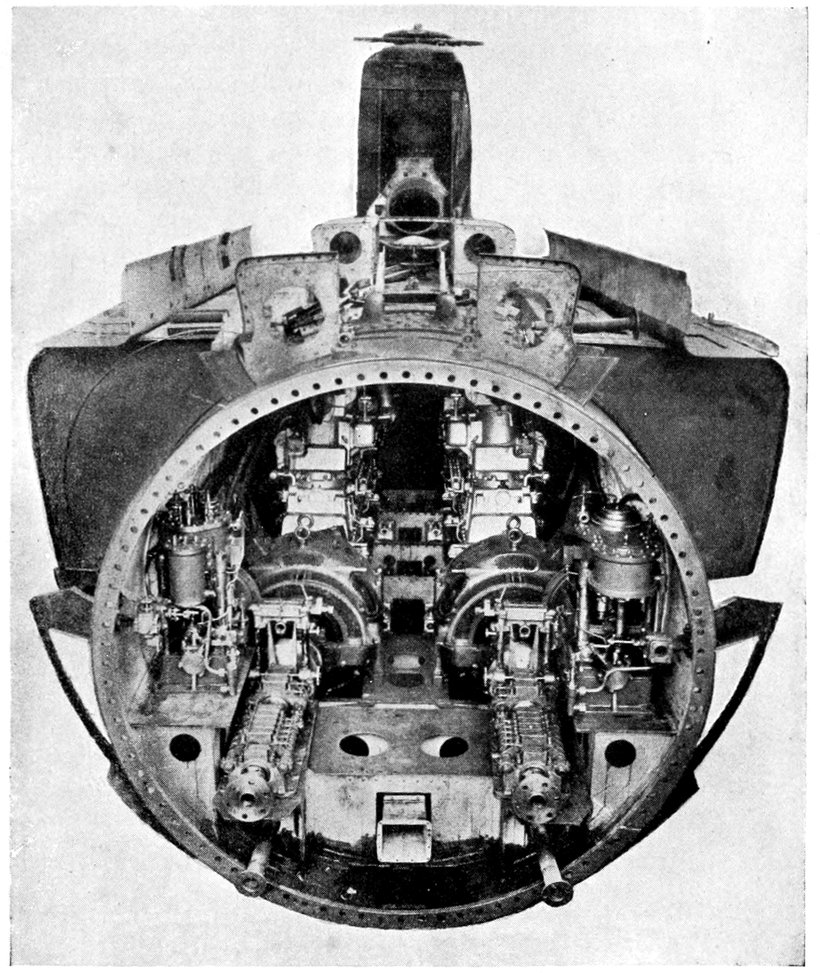
The Interior of a German Submarine
Showing the internal combustion engines for surface work, and the motor-generators for driving the propellers when submerged.
73U 25–U 30 (1913–14).—Submerged displacement, 900
tons. Surface engines, 2000 H.P.; electric motors, 900
H.P. Speed, 18 knots on surface, 10 knots submerged.
Surface range, 4000 miles. Submerged range, 300 miles.
Armament, two torpedo-tubes in bow, two torpedo-tubes
in stern, two 14–pdr. Q.F. guns, two 1–pdr. anti-aircraft
guns. Complement, thirty to thirty-five officers
and men. Upper works lightly armoured. Fitted with
wireless.
German U-boats are really submersibles.
That is to say, the outer shell conforms to the
shape of an ordinary ship, with a broad deck,
whereas British submarines resemble a fat
cigar. Internally they are cylindrical, the
space intervening between the compartments
and the shell affording accommodation for
the ballast tanks. The theory is that vessels
built to this design are more seaworthy and
easier to handle. U 36, which was building
when war broke out, was divided into ten compartments,
below which were the steel cylinders
containing compressed air for freshening the
atmosphere, oil fuel, lubricating oil, and
water-ballast tanks, and the accumulators
for driving the dynamos when travelling
74beneath the surface. The officers’ combined
ward-room and sleeping quarters were for’ard,
immediately behind the bow torpedo compartment.
Adjoining were the crew’s quarters,
divided by a steel bulkhead from the control
chamber, situated below the conning-tower.
In the control chamber the steering wheel,
periscope, projection table on which a surface
view was thrown after the manner of a camera
obscura, water-pressure dial, and other delicate
and necessary instruments for the safety and
navigation of the ship were distributed. Proceeding
toward the stern, the petty officers’
quarters, the machine-room with its heavy oil
engines for surface work and electric motors
for progression when submerged, and the stern
torpedo compartment were to be found. U 36
was one of the “new Super-Dreadnought submarines,”
to quote an American correspondent
who saw them under construction at Kiel.
On these, he added, “the Germans appear to
be banking.”
The autumn of 1915 witnessed the introduction
of mine-laying submersibles. The
trotyl-filled cylinders were dropped on recognized
75trade routes without the slightest
regard for the rights of neutrals. The mines
were kept in a special chamber, ingeniously
contrived so that it could be flooded without
the water entering elsewhere, and released
through a trap-door. Thus another weapon
was added to the submarine’s armoury. It
answered all too well. “They can follow
your mine-sweeper,” said Sir Edward Carson,
“and as quickly as you sweep up mines they
can lay new ones without your knowing or
suspecting.” In 1914 the enemy had only
one means of sowing these canisters of
death, namely, by surface vessels. It will
be recollected that the Königin Luise was
sunk in the North Sea on the morning of the
5th August while on this hazardous duty.
Germany’s opportunity for hurting us in this
manner was of short duration. The British
Navy asserted itself, with the result that the
enemy was perforce compelled to find a new
method. He resorted to the use of specially
fitted submarines.
In due course 4.1–in. guns, mounted on
disappearing platforms, made their début,
76followed by U-boats provided with two 5.9–in.
guns. With increase of gun-power came a necessary
increase in size, and with both several distinct
advantages and disadvantages. The boats
were less easy to manœuvre, required augmented
crews, and offered a larger area for attack.
Against these minus qualities must be set those
of increase of cruising range, and the possibility
of spoil, the sole excuse of the old-time pirate.
Hitherto his more scientific successor could
only sink his victim. Now, given favourable
conditions, he might carry off goods useful to
the Fatherland. One German U-boat secured
twenty-two tons of copper from merchantmen
destroyed during a 5000–mile cruise.
Germany waxed particularly enthusiastic over
her diving cruisers. These boats displaced
5000 tons, were from 350 feet to 400 feet
long, had a much accelerated submerged and
surface speed, were protected by an armour
belt of tough steel plate, and mounted a couple
of 5.9–in. guns. Some of these submersibles seem
to have been driven by steam when in surface
trim, others by the usual Diesel engines. On
the 11th May, 1918, a British Atlantic escort
77submarine came across one of these fine fellows
travelling awash, likely enough anxious to
have a shot at the merchant convoy which the
representative of His Majesty’s Navy was
on her way to pick up. A heavy sea was
running at the time, but at intervals between
the waves the periscope revealed the position
of his rival to the British commander.
One torpedo sufficed. The Tauchkreuzer went
down, carrying with her the sixty or seventy
men who constituted her company. There
were no survivors. She had the distinction of
being the first of the type to be destroyed.
Germany’s merchant service, prizes of war,
or driven off the seven seas and growing
barnacles in neutral or home ports, virtually
ceased to exist at the outbreak of hostilities.
The mammoth liners which formerly competed
with our own no longer sailed the seas with
their holds full of cheap goods and their saloons
alive with travellers bent on ‘peaceful penetration’—and
other things. It rankled in
the bosoms of her shipping magnates that the
much-vaunted High Sea Fleet was impotent
to prevent Britain ‘carrying on’ commercially
78while conducting campaigns in all parts of the
world. It was true that Germany’s U-boats
were making inroads on the maritime resources
of her enemy, that when hostilities were over
they might compete on more than even
terms because of these losses, but to-day
rankled though to-morrow was full of hope.
Likewise the Economic Conference in Paris
had declared its firm intention to impose
special conditions on German shipping after the
war. After the war! The Director-General of
the North German Lloyd Line said that the
English were not so unpractical as to reject a
favourable freightage or passage.
I cannot give you the name of the man or
woman who first suggested the possibilities
of the submarine for business purposes. The
idea was certainly not a particularly novel
one. All I can say definitely is that the
concern which owned the pioneer vessels was
called the Ocean Navigation Company, and
that the president was Herr Alfred Lohmann.
If British merchantmen could use American
ports, why not German commercial submarines?
The Deutschland was built with this object in
79view. Officially she was described as “a
vessel engaged in the freight trade between
Bremen and Boston and other Eastern Atlantic
ports.”
She left Heligoland on the 23rd June, 1916,
and arrived at Norfolk News, Virginia, seventeen
days later. The German Press quite naturally
went into ecstasies over the achievement.
Yet it was not quite such a unique event
as they imagined. Ten submarines built in
Montreal had crossed the Atlantic nine months
before. The Deutschland duly discharged her
cargo, stayed three weeks or so, and returned
to Germany. The Kaiser showed his pleasure
by conferring decorations on Herr Lohmann
and the crew. Germany was again a maritime
nation—of sorts.
The submersible had travelled no fewer than
8500 nautical miles. She made a second
voyage to America in October. This time her
port of arrival was New London, Connecticut.
When starting on her return journey she
managed to get in collision with one of the
escorting tugs, which sank with the loss of
seven of her crew. The Deutschland was the
80pioneer of seven similar boats said to be in
course of construction. A sister vessel, the
Bremen, was launched and started on a voyage.
She is now some two years overdue.
Official Germany revealed no great faith in
the possibilities of the commercial submarine,
though this does not necessarily mean that the
autocrats of the Wilhelmstrasse showed their
real belief. It sometimes suited them to
lie. According to the Frankfurter Zeitung,
£15,000,000 per annum was earmarked for the
fostering of Germany’s moribund merchant
service in the next decade.
In October 1916 the depredations of U 53
off the American coast were hailed by the
population of Berlin and other German towns
as a sure prelude to peace. She was the first
armed U-boat to cross the Atlantic, but the
German nation saw her multiplied by scores,
if not by hundreds. Many optimistic folk
held the belief, based on the wonderful tales
that were told of huge Allied shipping losses,
that the war would be over before the
dawn of a new year. Britons are not the
only people who have hugged delusions. After
81having put in at Newport News for a few hours
and been visited by various notabilities, U 53
took up a position off the Nantucket Lightship,
so well known to all Atlantic voyagers. She
then calmly proceeded to sink half a dozen
ships—British, Dutch, and Norwegian—under
the nose of U.S. destroyers. According to
accounts that were published in American
newspapers at the time, the submersible had
four torpedo-tubes, one 4–in. gun forward and one
3–in. gun aft, three periscopes, wireless apparatus,
and engines of 1200 h.p. that enabled her to
travel on the surface at eighteen knots. Her
submerged speed was understood to be some
four knots less.
U-boats were built at the Vulkan and Blohm
and Voss shipyards of Hamburg; at Hoboken,
in the former yards of the Société John
Cockerill;[20] at Puers, near Termonde; and at
the great naval bases of Kiel and Wilhelmshaven.
Here the parts were assembled, for
it is fairly evident that the thousand and
one units of a modern submersible were constructed
82on many lathes in many parts of the
Fatherland. For example, it is believed that
UC 5, the small mine-layer of 200 tons displacement
captured by the British Navy and
exhibited off the Thames Embankment, was
brought in sections to Zeebrugge and put
together there.
When German liners were compelled to keep
in American ports owing to the pressure of
British sea-power, there seemed not the
slightest likelihood that the United States
would become an active participant in the
war. In 1917 these selfsame steamers were
traversing 3000 miles of ocean with armed
tourists bound for Germany, giving the lie
direct to the Imperial Chancellor’s hopeful
message that Uncle Sam could not “send and
maintain an army in Europe without injuring
the transport and supply of the existing Entente
armies and jeopardizing the feeding of the
Entente people.” The mercantile marine of
the United States is small, but with the aid of
former German vessels and British ships her
troops defied the submarine menace and were
landed by the hundred thousand in France
83as America’s splendid contribution toward the
liberation of the world. The spectacular appearance
of the Deutschland and U 53 fade into
insignificance before this amazing triumph.
Speaking at a luncheon given in London[21]
in honour of American Press representatives
visiting England, Vice-Admiral Sims remarked
that some of his countrymen regarded it as a
miracle of their Navy that it had got a million
and a half troops across the Atlantic in a few
months and had protected them on the way.
“We didn’t do that,” he avowed. “Great
Britain did. She brought over two-thirds of
them and escorted a half. We escort only one-third
of the merchant vessels that come here.”
America has been most generous in her
appreciation of the part played by Britain in
the war.
CHAPTER IV Pygmies among Giants
84
“This is the first time since the Creation that all the world has
been obliged to unite to crush the Devil.”—Rudyard Kipling.
Two weeks after the declaration of
war Count von Reventlow was cock-a-hoop
regarding the “attitude of
reserve” of what he was kind enough to term
the “alleged sea-commanding Fleet of the
greatest naval Power in the world.” “This
fleet,” he asserted, “has now been lying idle
for more than a fortnight, so far from the
German coast that no cruiser and no German
lightship has been able to discover it, and it is
repeatedly declared officially, ‘German waters
are free of the enemy.’”
Whether the Count was aware of the fact
or not, British submarines were watching in
the vicinity of the ironclad fortress of Heligoland
three hours after hostilities had begun.
Had the High Sea Fleet ventured out it would
have been greeted with anything but an
“attitude of reserve,” as part of it found to its
85cost on the 28th August, 1914. The initiative
on that splendid occasion was taken by the
British, who compelled the enemy to give
battle by means of a delightful little ruse in
which submarines not only played the leading
part, but had “supplied the information on
which these operations were based.”
At midnight on the 26th August Commodore
Roger Keyes hoisted his broad pennant on
the Lurcher, a small T.B.D. of only 765 tons,
and accompanied by the Firedrake, of similar
displacement, escorted eight submarines to
sea. On the night of the 27th the vessels
parted company, the submarines to take up
positions preparatory to the following day’s
work. Destroyer flotillas, the Battle Cruiser
Squadron, the First Light Cruiser Squadron,
and the Seventh Cruiser Squadron also left
their various bases and made toward the
Bight.
At dawn the Lurcher and the Firedrake
carefully searched for U-boats the area that
would be traversed by the battle-cruisers in
the succeeding operations, and then began
to spread the net into which it was hoped the
86Germans would fall. E 6, E 7, and E 8,
travelling awash, proceeded in the direction
of Heligoland, the destroyers following at
some distance. They were “exposing themselves
with the object of inducing the enemy
to chase them to the westward.” In this
decoy work the submarines were eminently
successful. In the ensuing action they played
no active part. “On approaching Heligoland,”
to quote the Commodore’s dispatch,
“the visibility, which had been very good to
seaward, reduced to 5000 to 6000 yards, and
this added considerably to the anxieties and
responsibilities of the Commanding Officers
of Submarines, who handled their vessels
with coolness and judgment in an area which
was necessarily occupied by friends as well as
foes. Low visibility and calm sea are the
most unfavourable conditions under which
Submarines can operate, and no opportunity
occurred of closing with the Enemy’s Cruisers
to within torpedo range.” The German
U-boats were no more fortunate. Three of
them attacked the Battle Cruiser Squadron
before it was engaged, to be frustrated by
87rapid manœuvring and the attention of four
destroyers. The use of the helm also saved
the Queen Mary and the Lowestoft during the
battle.
The most enthralling incident in the fight
centres around E 4, whose commander witnessed
the sinking of the German torpedo-boat
U 187 through his periscope. British
destroyers immediately lowered their boats
to pick up survivors. They were rewarded
by salvoes from a cruiser. Lieutenant-Commander
Ernest W. Leir prepared to torpedo
the vessel, but before he could do so she had
altered course and got out of range. Having
covered the retirement of the destroyers, he
went to the rescue of the boats, which had
necessarily been abandoned. The story of what
followed is well told by a lieutenant in a letter
to the Morning Post.
“The Defender,” he writes, “having sunk
an enemy, lowered a whaler to pick up her
swimming survivors; before the whaler got
back an enemy’s cruiser came up and chased
the Defender, and thus she abandoned her
whaler. Imagine their feelings; alone in an
88open boat without food; twenty-five miles
from the nearest land, and that land the
enemy’s fortress, with nothing but fog and
foes around them. Suddenly a whirl alongside,
and up, if you please, pops His Britannic
Majesty’s submarine E 4, opens his conning-tower,
takes them all on board, shuts up again,
dives, and brings them home 250 miles! Is
not that magnificent? No novelist would dare
face the critics with an episode like that in his
book, except, perhaps, Jules Verne; and all
true!”
Another survivor asserts that while he was
in the whaler about two hundred shells burst
within twenty yards without doing the slightest
damage to the company. A lieutenant and
nine men of the Defender were stowed below
in E 4, while a German officer, six unwounded
men, and twenty-six others who
had sustained injuries of various kinds were
provided with water, biscuit, and a compass,
and told to make for land. A German officer
and two A.B.s were taken prisoners of war.
“Lieutenant-Commander Leir’s action,” the
Commodore justly remarks, “in remaining on
89the surface in the vicinity of the enemy, and in
a visibility that would have placed his vessel
within easy gun range of an enemy appearing
out of the mist, was altogether admirable.”
The enemy suffered the loss of three cruisers
and a destroyer, and one cruiser and at least
seven torpedo-boats were badly mauled.
Reference has already been made to the
running fight in the North Sea on the 24th of
the following January, when Sir David Beatty
very effectively prevented a raid on the North-east
Coast, and to the Battle of Jutland.[22]
The former affair, characterized by the Germans
as having been broken off by the British, and
in which they sank a hypothetical battle-cruiser,
ended in the loss of the Blücher and serious
damage to two other enemy battle-cruisers.
The enemy squadron escaped because Sir
David Beatty had chased them to the verge
of “an area where danger from German submarines
and mines prevented further pursuit.”
The Germans were so keen on meeting the
hated British that they sheered off immediately
they sighted our ships and laid a straight
90course for home. Although the Lion and the
destroyer Meteor were disabled, they reached
harbour safely and the necessary repairs were
speedily effected.
These are some of the high lights of a picture
which has in it many dark and sombre shadows.
Enemy submarines exacted a heavy toll of
the British Navy. It would be a tedious
business to detail the loss of every man-of-war
lost by enemy action. Casualty lists
make uncongenial reading, but it is well to
bear in mind that Germany’s campaign was not
entirely devoted to commerce-destroying. I
shall therefore deal with some of the more
outstanding triumphs of her attempt to control
the Empire of the Ocean from below before
dealing with the victories of her British rivals
in the Realm of the Underseas.
H.M.S. Pathfinder was the first naval vessel
to be lost by submarine action in the Great
War. When the news was given to the public,
it was announced that this fast light cruiser
of 2700 tons had struck a mine “about
twenty miles off the East Coast,” a geographical
expression conveying the minimum of
91information. The intimation sent to relatives
of those who lost their lives stated that the
ship had been sunk by a submarine, which was
the case. The discrepancy in the two statements
was due to a belief that the Pathfinder
had been blown up in the manner originally
described. Subsequent investigation proved
this to be incorrect. It was not contradicted
at once because the Admiralty held that
possibly the intelligence might hamper operations
for catching the offender. It must have
occurred to many people, however, that a
notice issued shortly after the original communiqué,
that all aids to navigation on the
East Coast of England and Scotland were
liable to be removed, was more or less connected
with the loss of the cruiser and the
presence of enemy submarines. When letters
from survivors began to appear in the newspapers
it was clear that a torpedo had caused
the loss of the ship, which foundered twelve
miles north of St Abb’s Head, Berwickshire.
The approach of the weapon was observed
by some of those on board, and the order
was given for the engines to be stopped and
92reversed. It was too late. The explosion took
place close to the bridge, causing the magazine
to blow up.
“I saw a flash” says a survivor, “and the
ship seemed to lift right out of the water. Down
went the mast and forward funnel and fore
part of the ship, and all the men there must
have been blown to atoms.” When the order
to man the boats was given it was found that
only one boat was left whole; it capsized on
reaching the water. Nothing could be done
to save the Pathfinder, now partly on fire and
in extremis. The death-knell of hope rang out
sharp and clear: “Every man for himself.”
Officers and crew jumped overboard and made
for anything floatable that had been flung
adrift by the explosion or thrown out by the
men themselves when the last dread order
had been given. Wonderful work was done by
a lieutenant and a chief petty officer. Both
of them powerful swimmers, they paddled
about collecting wreckage, and pushing it
toward those in need of help. One of the
most miraculous escapes was that of Staff-Surgeon
T. A. Smyth, who got jammed beneath
93a gun, was carried down with the ship, and
escaped with a few bruises.
The dramatic swiftness attending the loss
of the Aboukir, the Hogue, and the Cressy
accentuated the ruthless nature of the sea
campaign in the public mind. The three
armoured cruisers were struck down within
an hour by the same submarine. They were
patrolling in company, and two of them were
lost while going to the assistance of the
Aboukir, which was believed to have struck
a mine.
Sixty officers and over 1400 men, many of
them reservists, perished as a sequel to Otto
Weddigen’s prowess and their own humanity,
or more than the total British losses at the
battles of the Glorious First of June, St Vincent,
the Nile, and Trafalgar. From a naval point
of view the loss of the ships was unimportant.
One is apt to forget that men-of-war have
often a floating population equal to many a
place in the United Kingdom which prides
itself on being called a town. If several hundred
inhabitants of such a spot were wiped
out in a few minutes it would be regarded as
94a terrible happening. The tragedy of the
affair would come home to us because a similar
thing might occur where we live. Yet often
enough a naval disaster arouses nothing more
than scant sympathy and a mere comment.
During the Great War those at sea in our big
ships faced such disasters every hour of every
day and every night.
Fortunately the Aboukir, the Hogue, and
the Cressy did not constitute the “British
North Sea Fleet,” as ultra-patriotic German
newspapers inferred. According to his own
statement, the commander of U 9 was eighteen
nautical miles to the north-west of the Hook
of Holland when he first sighted the cruisers,
time 6.10 a.m. The vessels were proceeding
slowly in line ahead, and the first torpedo
struck the Aboukir, which was the middle
ship. The reverberations of the explosion
could be felt in the submarine, for “the shot
had gone straight and true.” The Aboukir’s
consorts closed on her, intent on offering
assistance, but, as Weddigen points out, this
was playing his game. They were torpedoed
in rapid succession. “I had scarcely to move
95out of my position, which was a great aid,
since it helped to keep me from detection.”
One shot from the Cressy, he adds, “came
unpleasantly near to us.” The commander
pays a generous tribute to his foes: “They
were brave, true to their country’s sea traditions.”
In one thing only was he unsuccessful.
The cruisers were unattended by a covering
force of destroyers, but while U 9 was returning
to her lair he came across some of
these vessels. By exposing his periscope at
intervals Weddigen hoped to entice them
into a zone where capture or destruction by
German warships was probable. Although the
destroyers failed to put an end to his career,
he likewise failed to get the flies into the
spider’s parlour.
The Admiralty held that the commanders
of the Hogue and the Cressy committed a
pardonable error of judgment, and noted that
“the conditions which prevail when one vessel
of a squadron is injured in a mine-field or is
exposed to submarine attack are analogous to
those which occur in an action, and that the
rule of leaving disabled ships to their own
96resources is applicable, so far at any rate as
large vessels are concerned.”
The Hawke, a cruiser of 7350 tons, with an
armament of two 9.2–in., ten 6–in., twelve
6–pdr., and five 3–pdr. guns, plus two 18–in.
submerged torpedo-tubes, was characterized by
some of those in the Service as an unlucky
ship. She had collided with the White Star
liner Olympic when that vessel was on her
maiden voyage, an incident deemed quite
sufficient to justify sinister prophecies of an
untimely end. On that occasion she lost her
ram, which was replaced by a straight stem.
On the 15th October, 1914, when the war was
only a little over two months old, she was
torpedoed by U 29, with the loss of some three
hundred officers and men. Her enemies were
subsequently decorated with the Iron Cross
at the hands of the Crown Princess.
H.M.S. Theseus, a vessel of the same class
which was patrolling with the Hawke in
northern waters at the time, was attacked
first, but managed to escape. The submarine
then aimed at the Hawke, hitting her amidships
on the starboard side aft of the fore
97funnel, and probably blowing up the magazine,
as in the case of the Pathfinder. She settled
very rapidly, “at God knows what angle,”
according to an eye-witness. She had nearly
a hundred watertight doors, but even they can
buckle and jam, and are not explosive-proof.
When the order was given to abandon ship
a few of the crew managed to get into one of
the boats, while about forty others scrambled
on to a raft. Commander Bernhard Pratt-Barlow
was of the company. “There are too
many on this raft,” he remarked, “I will swim
to another.” He dived in, but was never seen
again. It was merely prolonging the agony
for most of those who remained. Before night
many of the poor fellows had succumbed to
exposure and the bitter cold. After being
on the raft for twenty-three hours the survivors
were picked up by a destroyer, and
after recovery proceeded to Portsmouth for a
new kit. The last seven words epitomize the
splendid spirit of the British Navy.
The Hermes, an old cruiser used as a sea-plane-carrying
ship, was sunk in the Straits
of Dover in October 1914, while returning
98from Dunkirk. She was the victim of two
torpedoes fired by a U-boat. The sea was
choppy, which may account for the submarine’s
escape, for she was not seen. As the Hermes
was near the warships engaged in bombarding
the Dunes in support of the Belgians, it
is more than likely that the enemy vessel
had been hopeful of catching larger fry, an
expectation which did not materialize. One
sailor who endeavoured to make himself more
or less comfortable on an upturned table was
asked if he was training for the next Derby,
while two fellows in similar straits informed
their friends in the water that they were Oxford
and Cambridge. The Hermes must have been
what is called a ‘matey’ ship. The majority
of her company were saved.
Another loss to the Navy in 1914 was the
Niger, a torpedo gunboat built in 1892 and
sister ship to the Speedy, mined on the 3rd
September.
The little vessel of 810 tons was torpedoed
while on patrol duty by the first U-boat which
succeeded in dealing destruction in the Downs.
Despite a high wind and a heavy sea, all the
99officers and seventy-seven men were saved,
thanks in no small measure to the efforts of
three Deal boats and the fact that many of
the bluejackets were wearing life-saving collars.
The submarine was seen approaching from
the direction of South Sand Head Lightship,
but as the Niger was anchored she was an
easy prey. At the moment of impact the wireless
operator was actually sending the S O S
signal. When the explosion occurred Lieutenant-Commander
A. T. Muir was on the navigation
bridge, which, despite severe injuries, he vacated
only after every other person had left the
sinking vessel.
The gunboat was struck abaft the foremast.
Although the bow was soon under water, she
kept afloat for quite twenty minutes, probably
because orders had been given for the watertight
doors to be closed. One poor fellow
was lugged through one of the portholes;
another scrambled aboard after he had been
rescued, hauled down the flag, and returned
to the boat.
The torpedoing of the Formidable was an
inauspicious omen for 1915. This, the fourth
100ship to bear the name of one of Hawke’s prizes
in the battle of Quiberon Bay, was a pre-Dreadnought
of 15,000 tons, armed with four
12–in. and twelve 6–in. guns, twenty-six smaller
weapons, and four submerged torpedo-tubes.
She was encountering a south-west gale in the
Channel at 2.20 a.m. on New Year’s Day
when a torpedo struck her abaft the starboard
magazine and abreast of No. 1 stokehold.
The Formidable was the first victim of a submarine
attack in the darkness of night. While
boats were being got away, and chairs, tables,
and other floating articles thrown overboard
for use as life-savers, a torpedo exploded on
her port side. Captain Loxley, puffing at a
cigarette, gave orders from the bridge as coolly
and collectedly as though the Formidable was
making her way to Portsmouth Harbour on an
even keel in the piping times of peace. “Into
the water with you! She’s going!” he sang out.
“Good-bye, lads. Every man for himself, and
may God help you all!” He went down
with his vessel and as goodly a company of sea-dogs
as ever trod the deck of a British battleship.
Over five hundred officers and men
101were coffined in the Formidable or drowned in
attempting to get away.[23] The loss of this
useful, if obsolescent, vessel was severely
criticized by Admiral Lord Charles Beresford.[24]
He commented on the fact that the squadron
of which the battleship was a unit had started
from port with destroyers and afterward sent
them back, also that the ship had slackened
speed in an area known to be infested with
submarines.
Although it was announced that the battleship
Russell struck a mine in the Mediterranean,
the Germans claimed that she was
sunk by one of their U-boats. This was the
second pre-Dreadnought and the third flagship
to pay the price of Admiralty during
the war. The Russell, named after one of
six famous admirals, was commissioned in
1903, and completed her career on the 27th
April, 1916. She carried four 12–in., twelve
6–in., ten 12–pdr., and two 3–pdr. guns, and
four torpedo-tubes. Although Rear-Admiral
102S. R. Fremantle, M.V.O., the captain, twenty-four
other officers, and 676 men were saved,
over 100 of her complement were reported
as missing.
Of the five capital ships lost by Britain in
the Dardanelles campaign, the Ocean and the
Irresistible were lost by mines or torpedoed
from the shore, the Goliath was torpedoed in
a destroyer attack, and the Triumph and
the Majestic were submarined. On the 22nd
May, 1915, the periscope of a U-boat was
sighted from the battleship Prince George.
A couple of rounds made the submersible
take cover. That was the first occasion on
which enemy underwater craft had put in an
appearance in the vicinity of the Gallipoli
peninsula. Three days later the Swiftsure
was on the verge of being attacked, but her
gunners proved too wide-awake and drove
off the enemy. A little later the submarine
discharged a torpedo at the Vengeance, and
missed. On the 26th the enemy was seen
again, escaped, and plugged two or three
torpedoes into the Triumph, lying stationary
off the now famous, or infamous, Gaba Tepe.
103Her nets were down, but the weapons went
through them with almost as much ease as
a circus clown jumps through a hoop covered
with tissue-paper. Henceforth devotees of
this form of protection had little to say.
The battleship disappeared in fifteen minutes,
fortunately without a heavy roll of casualties.
Three officers and fifty-three of her considerable
company were lost. Like the Swiftsure,
her sister ship, the Triumph was built for the
Chilian Government and purchased by Britain.
An enemy submarine exacted another toll
on the following day, when the Majestic, one
of the oldest battleships on active service, was
sunk while supporting the troops against an
attack by the Turks. Within four minutes
of the explosion, says a member of the
French Expeditionary Force who witnessed
the catastrophe, the Majestic turned completely
over and went down. “It was a terrible
moment,” he adds, “but it was also sublime
when 600 men, facing death mute and strong,
were thrown into the sea, covered and caught
in the torpedo nets, which ensnared them like
an immense cast-net among the gigantic eddies
104and the profound sobs of their dear annihilated
battleship. I shall never forget that infernal
instant when submarines, aeroplanes, cannons,
and quick-firing guns dealt death around me.
And yet this vision only lasted the space of
a flash of lightning, for we too looked death
in the face, and in our own ship’s boats we
took part in the finest rescue that the palette
of an artist ever represented.”
So the French have forgiven us for Nelson
and Trafalgar!
The last battleship to be sunk by a U-boat
in the World War was H.M.S. Britannia, lost
near Gibraltar on the 9th November, 1918.
Two explosions occurred, killing some forty of
the crew. An hour and a half later, while she
was still afloat, the periscope of a submersible
was spotted. The guns of the stricken leviathan
were trained and fired, with what success is
uncertain. Then two destroyers dropped depth
charges where the enemy was seen to submerge.
If her ugly sides ever rose again they certainly
did not do so in the vicinity of the Britannia.
Shortly afterward the battleship turned turtle
in deep water.
CHAPTER V Tragedy in the Middle Seas
105
“Germany must for all time to come maintain her claim to
sea-power.”—Lt.-Gen. Baron von Freytag-Loringhoven,
Deputy Chief of the German General Staff.
The Adriatic afforded much interesting
naval news. The strategy of
the Austrians was exactly that of
the High Sea Fleet—tip-and-run raids and
avoidance of battle whenever possible. During
the blockade of the Austro-Hungarian naval
ports of Pola and Cattaro previous to Italy’s
becoming an active participant in the war,
the battleships and cruisers of the French Fleet
were frequent objects of attacks on the part
of enemy underwater craft. The armoured
cruiser Leon Gambetta escaped being submarined
on the 2nd September, 1914, only
to fall a victim on the 27th April, 1915. The
Austrian U 5, a small boat with a surface
displacement of 235 tons, commanded by
Lieutenant von Trapp, picked her up some
twenty miles south-west of Cape Leuca. It
106was a brilliant moonlight night, the armoured
cruiser was steaming slowly, and hitherto no
U-boat in the Adriatic had betrayed activity
after the passing of day. The great black
shape, with its four massive funnels, stood
out a mammoth silhouette as the first torpedo
sped on its devastating errand. It struck
the port side, wrecked the dynamos, and
plunged the ship in darkness, precluding the
possibility of a momentary flash of a search-light
to discover the assailant. The wireless
was also put out of action by the same
cause. A second torpedo wrought havoc in
one of the boiler-rooms. “From the heeling
of the cruiser,” says a Vienna account,
“Lieutenant Trapp concluded that a further
torpedo was unnecessary.”
An effort was made to beach the ship. This
failing, it became the difficult task of Captain
Andre to provide for the safety of his crew,
a task not only hampered by lack of illumination,
but by the boats having been swung
inboard to ensure the more effective use of
anti-torpedo guns. “The boats are for you;
we officers will remain,” Admiral Sénès told
107the crew without the slightest affectation of
heroism, although neither he nor any single
individual on the quarterdeck was to be
saved. He called the men his children, told
them to keep steady and take to the boats.
“Forward, sailors of France!” he cried. “My
destiny is here,” said Commander Depérière,
the worthy colleague of so gallant an officer.
“I die with my ship. Vive la France!”
Portable torches were used to show the way
to the wounded and the sick. To make escape
easier the captain issued orders to fill the
starboard compartments so as to counterbalance
the intake of water on the other side.
He did not want the great ship to turn turtle
before mes enfants had been afforded an opportunity
to escape. One officer, anxious to
restrain any undue haste that would retard
escape, took out a cigar from his case, lit it,
and puffed away as calmly as though he were in
Toulon Harbour instead of standing in a foot
of water on a ship that was rapidly sinking
under him. “Vive la France!” shouted the
officers on the bridge; “Vive la France!”
echoed the many who had failed to get away.
108With that ringing cheer of Victory and not
of Defeat, the Leon Gambetta and 684 officers
and men of the gallant company disappeared
out of the night into the greater darkness.
From first to last the tragedy took just ten
minutes.
Those who were saved owed their lives to
the fine courage of the commanders of Italian
torpedo-boats and destroyers, who ran the risk
of being mistaken for French men-of-war.[25]
Jean and Jacques are never at a loss when
it comes to paying a compliment. Had they
been British sailors who were pulled out of the
water, a gruff but well-meant “Much obliged”
would probably have sufficed. Frenchmen are
more artistic. They cried “Vive l’Italie!”
As for U 5, when she returned to Cattaro she
was naturally received with honours.
The Danton, a French battleship with a
displacement of 18,028 tons, completed at
Brest in the spring of 1909, was on the point
of celebrating the seventh anniversary of
her launching when she was struck down in
the Mediterranean on the 19th March, 1917.
109She had taken many months to build, but
took only thirty minutes to sink. Destruction
comes easier to man than construction. Two
torpedoes accomplished her end. Fortunately
the catastrophe occurred in the afternoon, and
the tragedy of the personnel of the Leon
Gambetta was not repeated, although even
then 296 of her company lost their lives. The
destroyer Massue and patrol vessels rescued
the remaining 806 officers and men.
The story of how Lieutenant-Captain Robert
Moraht sent the Danton to her doom was subsequently
told by himself. The following is
based on his lively narrative.
At midday the U-boat was off the south-west
point of Sardinia, and those of the crew
not actually required for the working of the
ship were enjoying a breath of fresh air
on deck with a delightful sense of having
nothing whatever to do. Moraht was below,
when the whistle of the speaking-tube blew a
short, sharp blast. He answered the summons
readily enough. “A steamer on the port
bow,” came the message, spoken in a tone of
some urgency. Almost before the commander
110had taken his ear from the instrument the
men were clattering down the ladders and
taking up action stations. Reaching the conning-tower
with some difficulty by reason of
the undue haste, Moraht distinctly saw the
outlines of the vessel whose appearance had so
suddenly changed their programme for the
afternoon. The commander picked it up with
his glasses. “French battleship!” announced a
fellow officer who was standing at the telescope.
At the moment the commander’s thoughts
were centred on whether the U-boat had been
seen, whether hunter and hare were both aware
of the other’s presence.
Apparently not. The Danton kept on her
zigzag course, as yet far out of range. Had
she sighted the submarine she could have
got clear away; there was little chance now,
for Moraht had submerged. Presently a
destroyer made her appearance, likewise zigzagging,
and in advance of the battleship.
The U-boat was nearer the object of her
vengeance, and likewise nearer danger. Destroyers
are to submarines what terriers are
to rats. Moraht felt a shade uncomfortable.
111Besides, a battleship in the Mediterranean,
or any other sea for the matter of that, does
not go about blind. Keen eyes look out for
her safety and their own. What the men on
the destroyer might miss, those on the Danton
might find. The commander of the submarine
was sparing in the use of the periscope. There
is a tell-tale wake when that apparatus is above
the surface that human device cannot dispel.
The waters, parted by the tube, embrace as
though long separated, leaving a trail of emotion
behind. Moraht popped it up now
and again as necessity compelled, took his
bearings, lowered it, and checked his course.
The weather conditions on this ‘Mediterranean
Front’ changed in favour of the
Germans, as they usually did in France, according
to popular belief, whenever the Allies took
the offensive. Listen to the commander: “A
considerable lightening of the mist was rolling
up from the north-west, and the wind was
freshening; thick white tufts of foam stood
on the deep blue sea. That was the light
we wanted. Anyhow, nobody saw us. The
destroyer raced past without suspicion about
112600 yards off, then the giant ship herself came
before our bow. Everything was just right
to-day. ‘Both tubes, attention! No. 1—let
go! No. 2—let go.’”
The periscope vanished, its wash was replaced
by that of the torpedoes and a liberal
accompaniment of bubbles. The weapons, at
an interval of five seconds between them, tore
the ship asunder. Later, from a safer distance,
Moraht took a peep at his victim in her death-agony.
The rudder was hard to port, proof
that the twin harbingers of destruction had
been seen and a fruitless attempt made to
dodge them. The torpedoes could scarcely
have performed their duty more loyally. The
Danton’s massive keel was where her turrets
ought to have been; her bulgy side, with casemates
resembling a fortress, revealed “two
holes like barn doors.”
Moraht says that his boat ‘buck-jumped’
after the shots. This means that the compensating
tanks, which fill with water to make
up for loss of displacement when a torpedo
leaves the tube, did not act quickly enough.
As a consequence the periscope and the upper
113part of the superstructure appeared above the
surface for a second or two. The Massue
dropped depth charges, and the ‘buck-jump’
may not have been entirely unconnected with
them.
To-day the submarine that robbed the Allies
of a fine ship mounting four 12–in., a dozen
9.4–in., and sixteen 2.9–in. guns does not figure
as a fighting unit in what remains of the German
Navy. She has joined the Danton,
Visiting the bottom of the monstrous world.
Austrian submarines depleted the ranks of
Italy’s naval forces by several ships, but the
hereditary enemy of the Land of Dante
lost considerably more at the hands of Italy,
which also policed some 300 miles of coast
with flotillas of hydroplanes in addition to
the regular naval units. During a reconnaissance
in force in the Upper Adriatic, the
Amalfi, an armoured cruiser of 9958 tons
displacement, carrying four 10–in. and eight
7.5–in. guns, was torpedoed at dawn on the
7th July, 1915. According to information received,
it was the intention of the Austrians to
114bombard the Italian coast. While searching
the Dalmatian littoral for the enemy, with the
idea of bringing him to battle before he could
carry out his object, the cruiser was lost. The
ship listed heavily to port almost immediately,
and sank in less than thirty minutes. Nearly
all her officers and crew, numbering 684, were
saved. Before giving orders to leave the ship
the commander lined up his men on the
quarterdeck and shouted, “Long live the
King! Long live Italy!” The response was
not less hearty than if they had been given a
week’s leave.
One instance of extraordinary bravery stands
out conspicuously, though the discipline was
exemplary in every respect. While in the
water the chief engineer was drawn toward the
revolving propellers, and one of his arms was
completely severed. A surgeon witnessed the
incident when swimming at no great distance
away. With powerful strokes he reached the
injured officer, took off his own belt, applied
it as a tourniquet, and then supported the
sufferer until help arrived. The surgeon was
on the verge of collapse, but he had performed
115a feat probably unique in the annals of
first aid.
The second armoured ship to be lost by
Italy was torpedoed three weeks later in the
same sea. She bore the honoured name of
Giuseppe Garibaldi, whose presentation swords
of gold were kept on board as treasures beyond
price. The cruiser formed part of a squadron
that had been bombarding the railway and
fortifications at Cattaro, where a number of
Austrian battleships had taken refuge, unwilling
to face four Italian vessels which had
outlived their youth. The enemy adopted
much more stealthy tactics. As the Giuseppe
Garibaldi, the Vettor Pisani, the Varese, and
the Ferruccio were steaming away they sent
out a flotilla of submarines. The first attack
was skilfully fended. Subjected to a withering
fire, in which the Giuseppe Garibaldi joined, two
of the U-boats sought safety in flight. U 4 was
so badly damaged that she sank. A fourth
either lay ‘doggo’ for a time or returned to
the attack a little later. Her first torpedo,
fired at the close range of about 500 yards,
missed, but the second did such damage, despite
116the cruiser’s belt of 6–in. armour, that saving
her was out of the question. The majority of
her crew of 540 were rescued.
When Germany and Austria arranged to
drench Europe in blood in pursuit of Teutonic
ambitions, the Austro-Hungarian Navy possessed
three completed Dreadnoughts, of which
the Viribus Unitis was one. This powerful
battleship of 22,000 tons, carrying twelve
13–in. guns, twelve 5.9–in. quick-firers, six
torpedo-tubes, and a complement of nearly
1000 officers and men, was attacked in Pola
Harbour by an intrepid French submarine,
which succeeded in damaging her to such an
extent that she was rendered useless for a
considerable time. Had she been at sea it is
probable the Viribus Unitis would have sunk,
but plenty of assistance was handy, and she
reached dry dock with a very ugly wound in
her hull and certain portions of her engines
so badly wrecked that the workshops at Trieste
had to get busy to provide new parts. This
was in December 1914. She was still in Pola
Harbour in May 1918, when a little Italian
motor-boat penetrated the mine-field, cables,
117and steel nets guarding the entrance and completed
the discomfiture of the great vessel.
Captain Pellegrini and three volunteers discharged
two torpedoes at the Viribus Unitis,
and after seeing them take effect, sank their
own tiny craft to prevent it from falling
into the hands of the enemy. This was the
thirteenth operation by the Italian Navy
against enemy bases, and was completely successful.
Apparently the Dreadnought was resurrected,
for she was again sunk in November
1918 by means of a time-charge laid by two
Italian officers.
Italy also lost several fine destroyers by
attack from Austrian or German U-boats.
The Impetuoso was submarined in the Straits
of Otranto on the 10th July, 1916, with small
loss of personnel, but the fate which befell the
Nembo was more tragic and more romantic.
The Nembo was escorting a transport to Valona.
The submarine was sighted on board the
destroyer, whose commander at once changed
course so as to cover his charge, which had
some 3000 soldiers on board. He succeeded
in doing this, and the torpedo intended for the
118transport struck the Nembo with full force.
She at once began to settle, but the indomitable
officer swung his ship round with the
intention of ramming his assailant. Loss of
speed and gain of water on the part of the
destroyer gave the U-boat time to submerge,
but the commander still had another card to
play. He ordered depth charges to be dropped
overboard. There was a mammoth upheaval
of water, followed by the reappearance of
the enemy showing evident signs of distress.
Shortly afterward destroyer and submarine
went to a common grave, the Nembo carrying
with her most of her gallant crew, while eleven
men from U 16 managed to scramble into one
of the destroyer’s boats that floated by without
a solitary occupant.
Vienna newspapers, like those of Berlin,
endeavoured to bolster up the naval cause
of the Central Powers by deliberately manufacturing
desirable news. In January 1915
the Austrians were told that their E 12 had
sunk the French battleship Courbet, a Dreadnought
armed with a dozen 12–in. guns. That
was sufficiently wide of the mark in all conscience,
119for it was absolutely untrue, but the
loss of the Jean Bart by colliding with her
when going to her assistance was tagged on
to make the victory still more complete. E 12
certainly did succeed in hitting the Jean Bart
with a torpedo, but the material damage was
of slight importance and was speedily repaired.
At the time the Courbet was many miles
away from the scene of the imaginary action—“in
excellent trim,” as the French Ministry
of Marine stated. On another occasion the
French battleship Vérité was alleged to have
been seriously damaged by a German submarine.
This tale of disaster, terrible in the loss of
great ships and greater men, is at the worst
only a record of what is legitimate in modern
naval warfare. Those who thought, like Nobel,
that the more violent the agencies to be employed
in conflict the more likelihood of
preserving peace had their fond delusions
shattered in the saturnalia of the centuries.
Likewise those who sow the wind often reap
the whirlwind.
CHAPTER VI Horton, E 9, and Others
120
“If the submarine had succeeded our Army in France would
have withered away.”—D. Lloyd George.
Previous pages have had much to
say about U-boats. The northern mists,
from the obscurity of which the Grand
Fleet occasionally emerged into the broad sunlight
of publicity, were as nothing compared
with the fog of war which veiled the hourly
activities of British and Allied submarines.
Scouting is notoriously hazardous and necessarily
private. Our underseas craft had sufficient
of it. In the performance of this task
they also tackled much other business, tracked
and sent to the bottom vessels of their own
species though not of their own tribe, wormed
their way through waters sealed to surface
ships, ferreted a course through strings of
floating mines, dodged unanchored infernal
machines, convoyed in safety hundreds of
thousands of troops, and stalked men-of-war.
They proved themselves friends to all but the
121Ishmael of the seas; and when opportunity
served they snatched him from a watery grave
when he ought to have perished.
The first German warship to be sunk by a
British submarine was the Hela. She fell to
E 9 on the 13th September, 1914. Heaven
knows it was not for lack of searching for
legitimate prey that nothing had been secured
by our underwater craft ere the second month
of the war. Like Villeneuve’s ships before
Trafalgar, if any German vessels occasionally
took an airing they also took good care to
keep near home. The Hela, a light cruiser of
2040 tons displacement, with a complement of
178, of little consequence for fighting purposes
because her heaviest guns were 15½-pdrs., was
only six miles south of Heligoland when she
was torpedoed by Lieutenant-Commander Max
K. Horton.
E 9, it may be well to note, had already
won her spurs in the prelude to the battle of
Heligoland Bight. Two torpedoes were fired,
with an interval of fifteen seconds between.
One hit. Greatly daring, about a quarter of
an hour later Horton took just the suspicion of
122a glance in her direction through the periscope,
and saw that she was heeling over to starboard.
When he again ventured to use his
‘eye’ there was no Hela, and a trawler had
gone to the rescue of her crew. “What we
are so proud about is that it is the first torpedo
fired from a [British] submarine that made a
hit,” one of the crew wrote, “and it has been
a great competition among all our boats to
get first one in, and of course we consider
ourselves ‘the cock of the submarine flotilla’
now.”
A number of German torpedo-boats hunted
for E 9 during several hours after the destruction
of the cruiser. Yet the following day
saw her calmly at work examining the outer
anchorage of the island fortress, “a service
attended by considerable risk.” An exceptionally
heavy westerly gale was blowing on
the 14th and continued for a week. On a
lee shore, with short, steep seas, the lot of the
submarines in the Bight was both hazardous
and unpleasant. “There was no rest to be
obtained,” says the Commodore, “and when
cruising at a depth of sixty feet the submarines
123were rolling considerably, and pumping—i.e.
vertically moving about twenty feet.” Officers
and men were granted prize bounty amounting
to £1050 for sinking the Hela, an exploit
which the crew regarded as avenging the
Pathfinder.
Further insight into the hazardous life of
those who operated in the Bight is afforded
by the following extract from another official
report:
“When a submarine is submerged, her
captain alone is able to see what is taking place.
The success of the enterprise and the safety
of the vessel depend on his skill and nerve
and the prompt, precise execution of his orders
by the officers and men under his command.
Our submarines have been pioneers in waters
that have been mined. They have been subjected
to skilful and well-thought-out anti-submarine
tactics by a highly trained and
determined enemy, attacked by gunfire and
torpedo, driven to lie at the bottom at a great
depth to preserve battery power, hunted for
hours at a time by hostile torpedo craft, and
at times forced to dive under our own warships
124to avoid interfering with their movements.
Sudden alterations of course and depth, the
swirl of propellers overhead and the concussion
of bursting shells, give an indication to
the crew of the risks to which they are being
exposed, and it speaks well for the moral of
these young officers and men, and their gallant
faith in their captains, that they have invariably
carried out their duties quietly, keenly,
and confidently under conditions that might
well have tried the hardened veteran.”
On the 6th of the succeeding month E 9
was ‘at it again.’ She was patrolling off the
estuary of the Ems, near the much-advertised
island of Borkum, which boasted some of the
most powerful guns ever mounted for coast
defence. Presently the enemy’s torpedo-boat
S 126 came along, entirely unsuspecting.[26]
Horton was really after bigger game, but
when out shooting pheasants one does not
disdain a pigeon if nothing else is available.
He was keen on a battleship, and only
125a little while before had spotted a fair-sized
cruiser, an excellent ‘second best.’ When
enthusiasm was at its height, and triumph
reasonably sure, circumstances compelled him
to dive. We are not told what those circumstances
were. Perhaps we should not be far
wrong if we ventured the opinion that they
were intimately connected with the noisome
presence of fleeter craft whose pet particular
prey is the British submarine. When the
officer had another opportunity to observe
what was going on in the upper world, the
larger ship had gone out of sight and a smaller
vessel come into view.
Within a hundred yards of E 9 was S 126,
followed at some distance by a second T.B.
Horton waited until the leader had travelled
another 500 yards, ensuring a ‘comfortable’
range, and then fired. The commander evidently
believed in even numbers, for he
discharged two ‘rooties’ at his quarry, as
he had done when attacking the Hela. It
was just as well that he did, for one missed.
The other struck the enemy amidships and
worked deadly havoc. Coastguards on the
126Dutch island of Schiermonnikoog, opposite
Borkum, and some seven miles from the scene,
heard the roar of the explosion, and saw a
great column of water shoot up near the
forepart of the ship. In three minutes all
that remained of S 126 was flotsam. She went
down bow foremost, like a leaping salmon.
As the stern rose her men took to the water.
Most of them appear to have been rescued by
a cruiser which came up a little later, but did
not consider it advisable to make a long stay.
“Look at her!” Horton cried. “The beggar’s
going down!” as though it was the most surprising
thing in the world for a ship to sink
after having a 21–in. torpedo plugged in her
side.
The second torpedo-boat, unwilling to run
the risk of sharing her consort’s fate, made off,
leaving the shipwrecked crew of thirty-six to
fend for themselves. The lost vessel, launched
in 1905, had a displacement of 420 tons, and
carried three 6–pdr. guns and three torpedo-tubes.
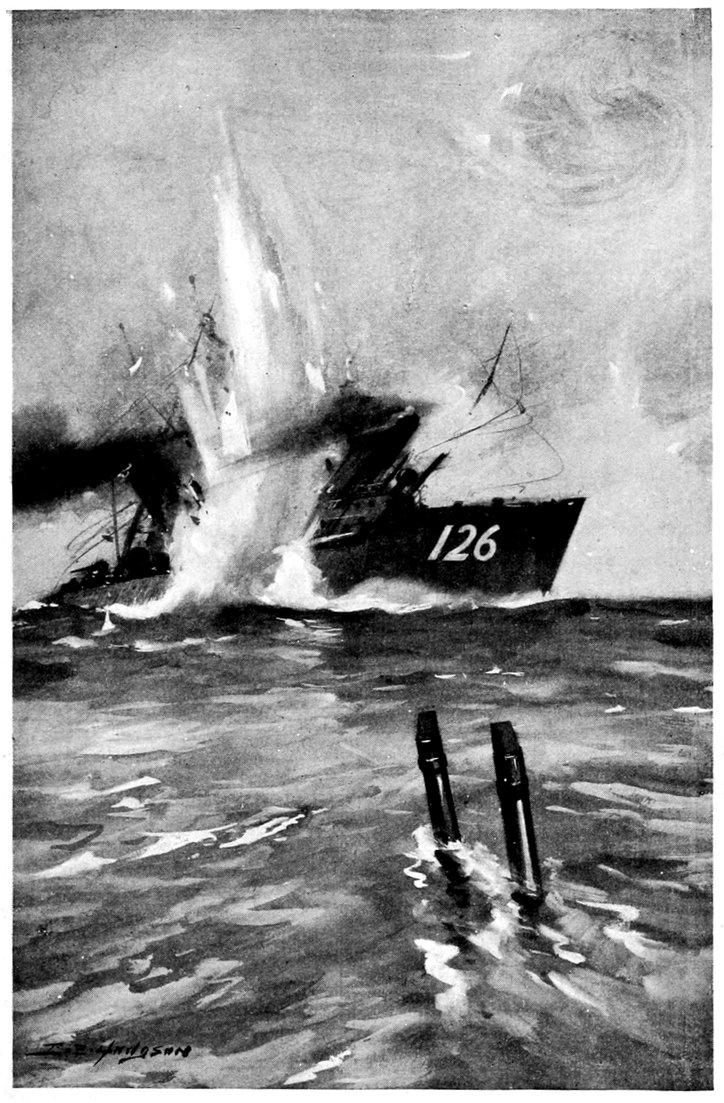
The Second Exploit of E 9
When Lieutenant-Commander Max K. Horton torpedoed S 126 in the mouth of the Ems
E. S. Hodgson
127When E 9 swung into Harwich safe and
sound the crews of destroyers and other craft
based there knew that Horton and his gallant
little band had scored another hit. No wireless
conveyed the intelligence. She was displaying
the White Ensign, plus two unofficial flags
that are the pride and glory of the Submarine
Squadron. These little bits of bunting, one
yellow and the other white, bore the death’s-head
and cross-bones so intimately associated
with the pirate of yester-year, and more appropriate
to the Huns. The former represented the
‘tuft’ of the Hela, the latter that of the latest
victim. The officers and crew received further
prize money to the tune of £350 for ‘digging
out’ S 126. Horton was awarded the D.S.O.,
and noted for early promotion. On the last
day of 1914 he became Commander.
The news was spread abroad by Germany
that the action had taken place in Dutch
territorial waters, within a mile of the shore.
The Dutch Naval Staff promptly contradicted
this report, pointing out that sands extend for
two and a half miles from Schiermonnikoog,
off which it was alleged E 9 had committed
this grave misdeed.
Horton’s succeeding coup took place in the
128Baltic, and rightly belongs to a later chapter.
I introduce it here because it will better help
us to appreciate his worth.
Shortly after the Germans had occupied
Libau, Russia’s most southerly port in the
Baltic, a certain mysterious submarine made
her presence felt in the Mediterranean of the
North. An official bulletin from Petrograd
stated that the boat was British, and that she
had sunk the pre-Dreadnought Pommern off
Danzig on the 2nd July, 1915. The Censor in
London removed the reference to the nationality
of the submarine, but a little later it
leaked out that E 9 had resumed operations
and was responsible for the disaster. In reply
to a question put by Commander Bellairs, Dr
Macnamara answered that no official report
had been transmitted to the Admiralty, “but
from a semi-official communication received
from the Russian Government it appears that
the name of the officer referred to is Commander
Max K. Horton, D.S.O.,” which statement
was received with enthusiastic cheers by
the House of Commons.
The Pommern was completed in 1907, and
129displaced 13,200 tons. She carried four 11–in.
and fourteen 6.7–in. guns, and a crew of
over seven hundred officers and men. The
Pommern was the first German battleship to
be sunk in the war. The coveted Order of
St George (Fourth Class) was bestowed on the
Commander by Tsar Nicholas. The German
Government vigorously denied that a battleship
had been lost, but
All the King’s horses and all the King’s men
Couldn’t put Humpty Dumpty together again,
and all the contradictions in the world failed to
resurrect the Pommern.
The energetic E boats did not remain in
obscurity very long. In the following month
the enemy endeavoured to secure naval control
of the Gulf of Riga. Their first attempt,
made on the 8th August with nine battleships,
twelve cruisers, and a brave showing of
torpedo-boats, was a complete failure. It was
followed up eight days later by a more ambitious
force. Favoured by heavy sea fog, the
enemy cleared a channel through the mines
and net defences at the entrance within forty-eight
130hours, and were then ready to penetrate
farther. If we accept the assertion of
the Russians, the Germans paid dearly for
their adventure. Against their own losses of
two gunboats and several torpedo craft they
assessed those of the Germans at two cruisers,
and eight torpedo-boats either sunk or badly
damaged. In addition, the Moltke, a battle-cruiser,
was torpedoed by E 1. She was not
mortally wounded, and was towed back to harbour,
where she remained until Beatty claimed
her. The Huns gained nothing and lost much
in this attempt to dominate the Gulf.
On the 19th August, 1916, Lieut.-Commander
Robert R. Turner of E 23 attacked
an enemy battleship. The vessel, a member
of the Nassau family, the first type of Dreadnought
to be built in a German yard, was
powerfully armed with twelve 11–in., twelve
5.9–in., and sixteen 21–pdr. guns, in addition
to half a dozen submerged torpedo-tubes.
The displacement was 18,600 tons, and the
speed 19–20 knots, but experts held that the
class was a failure when compared with our
own earlier Dreadnoughts.
131The first torpedo fired by E 23 badly
damaged the battleship. Of that there is
not the slightest doubt. Five destroyers immediately
went to her assistance. While these
were engaged in escorting her, a second torpedo
hit the target, and the officer in command
of the submarine reported that he “believed
she was sunk.” Then began a war of contradiction.
The Germans stated that one
of their submarines had attacked a British
destroyer and a cruiser, both of which went
down shortly afterward. They admitted that
the submarine was rammed, but added the
rider that she had returned to harbour ‘badly
damaged.’ The question of the loss of a
second U-boat was carefully hedged. “The
statement can only be verified when all reports
from our submarines are to hand”—an ingenious
ruse. The report anent British losses
was without foundation.
As in the above case, it is not always possible
to ascertain the result of a shot. Many other
instances of likely losses could be cited. A
British submarine saw four battleships of
the Kaiser class off the Danish coast. After
132making all ready to attack, the boat broke
surface of her own accord owing to the exceedingly
heavy swell. This terrible risk was
run quite accidentally, but she got under
again. Four torpedoes were discharged at a
range of 4000 yards at the third ship in the
line. Two explosions proved that the weapons
had performed their tasks, and the commander
was of opinion that the third and fourth ships
had both been hit. He was about to verify
his belief when a destroyer was heard racing
in his direction, followed by others. For two
hours they patrolled in search of the boat that
had shot this ‘bolt from the blue.’ They failed
to find her. Two depth charges nearly did,
but not quite, and a sweep dragged ominously
over her hull. Puzzle: Did the battleships
founder? The Marineamt in Berlin knows but
does not say. In fifty-one months of conflict
British submarines successfully attacked forty-three
enemy warships.
A British submarine, referred to in a Dutch
official communication as C 55, was patrolling
in the North Sea on the 27th July, 1917, when
she picked up a German steamer. This was
133the Batavier II, of 1328 tons net, proceeding
in the direction of Hamburg. The North Sea,
or ‘German Ocean’ as those who dwell on
its eastern fringe fondly call it, had not been
darkened by a mercantile ship of that nationality
for many long months, and even the
Batavier II was British-built and had been
captured from the Dutch. The submarine
overhauled her, and after having sustained
damage by gunfire, she was captured, her crew
escaping in their boats. A prize crew took
possession of the vessel and endeavoured to
bring her to port. The idea had to be abandoned
because she made so much water. The
opening of her sea-cocks speedily sent her
beneath the waves. Twenty-eight survivors of
the steamer’s crew were subsequently landed
at Texel.
According to the Dutch Navy Department,
the steamer was towing the motor-ship Zeemeeuw
at the time, and at the opening of the
engagement both vessels were outside territorial
waters. When they were abandoned
they had again entered the three-mile limit.
The prize crew succeeded in getting the
134Batavier II outside, but owing to her disability
and a strong current she again drifted
within the Dutch sphere of influence. A Dutch
torpedo-boat then hoisted the signal “Respect
neutrality,” and the submarine retired. The
Zeemeeuw was taken in tow and conducted to
Nieuwediep.
Less than a month later the Renate Leonhardt,
another German steamer, attempted to run
the blockade. Instead she ran ashore near
the Helder, and after being refloated was met
on the high seas by a British submarine, which
made short work of her. The crew were
picked up and taken to Holland.
Let me close this chapter with a contrast.
Fiendish brutality characterized the behaviour
of most German U-boat commanders. It
mattered not whether the ship attacked was
sailing under the colours of the Allies or of
neutrals. To them war was a biological necessity,
a phase in the development of life, to be waged
relentlessly and vitriolic ally. The more cruel
the method, the shorter the conflict. That was
the Prussian theory, and the Great Conflict
proved it false. To the German the neutral
135country was only neutral when it was working
for the Fatherland. Often enough, even in
these circumstances, he preferred to regard it
as an open enemy. The lanes of the ocean are
strewn with the wrecks of neutral craft and
dead men assassinated by “our sea-warriors”
in their hideous attempt at world-conquest.
I quote a report received from the commander
of a British submarine. The statements are
corroborated by the neutrals of the world:
“On the morning of March 14 [1917] His
Majesty’s submarine E —, when proceeding on
the surface in the North Sea, sighted two
suspicious craft ahead. On approaching them,
however, she found them to be ship’s boats
sailing south, and containing some thirty
members of the crew of the Dutch steamship
L. M. Casteig, which had been torpedoed and
sunk by a German submarine some distance
to the northward over twenty-four hours
previously.
“After ascertaining that there was both
food and water in the boats, E — took them in
tow at once, and proceeded toward the Dutch
coast at the greatest possible speed consistent
136with safety, in view of the state of the weather.
Some four hours later the Norwegian steamship
Norden was sighted, and as she showed some
natural reluctance about approaching the submarine,
not knowing that it was a British one,
the boats containing the Dutch crew cast off
the tow and pulled toward her. E — kept
the boats in sight until they were seen to have
been picked up by the Norden, and then
proceeded on the course which had been
interrupted for this act of mercy.”
Mercy as a biological necessity of war! It
is a suggestive thought, of British origin. It
compares favourably with the treatment of
forty of the crew of the s.s. Belgian Prince,
who were lined up on U 44 and drowned as
the submersible plunged. About a fortnight
later Paul Wagenführ, the instigator of this
diabolical outrage, was drowned with his confederates.
U 44 was their coffin.
CHAPTER VII Submarine v. Submarine
137
“Grapple your minds to sternage of this navy.”
At the beginning of the war it was
freely stated that the one ship a
submarine could not fight was the
submarine. This theory, like so many others,
went by the board in the process of time.
Finally the notion was completely reversed.
Allied underwater craft ferreted out many an
enemy submersible. Indeed, if we accept the
authority of Rear-Admiral S. S. Robison, of
the United States Navy, they did “more
than any other class of vessel” to defeat the
U-boats.
The French and Italians name the units of
their underseas navy. They are not vague,
impersonal things denoted by a letter and a
number, after the fashion of an inhabitant of
Portland Prison. The first recorded action
between submarines took place in June 1915.
It remains one of the mysteries of the war.
138The Italian submarine Medusa, after carrying
out several daring reconnaissances, was torpedoed
by an Austrian submersible of almost
similar type and size. The Medusa was quite
a small boat, built at Spezzia in 1911, with a
displacement of 241 tons on the surface and
295 tons below water. Her crew numbered
seventeen. She was scouting in the Adriatic
when the incident occurred, and we must
presume her to have been comparatively close
to the enemy without being aware of the
fact, otherwise her action is unaccountable.
For some reason or other she came to the
surface, whereupon the commander of the
Austrian U-boat sighted her through his periscope
and torpedoed her. An officer and four
men were picked up. According to a later
report, divers were sent down to examine the
condition of the Medusa with a view to salvage
operations. They made the startling discovery
that the wreck of an Austrian submersible
was lying close to that of the Italian, suggesting
that the two vessels had participated in a duel
in which both had got a fatal shot home and
neither was the victor.
139In August of the same year an Italian
destroyer was escorting a submarine, when
the commander of the former became aware
that his ship was the object of attention on
the part of an Austrian U-boat. He could see
the periscope just sticking out of the water.
Judging by her movements the enemy was
manœuvring for a favourable position from
which to strike. The destroyer sought to
cover her charge, and did so. At the same
time the submarine took advantage of the protection
thus afforded, and played the same
game as her rival. Everything being ready
for the projected attack, the destroyer changed
course so as to give her consort an unlimited
field for operations. The Austrian opened fire
from one of her bow tubes, and scored a
miss. The Italian, not satisfied with the
target presented, made no reply. Both tried
to out-manœuvre the other, and admirably
succeeded for an hour and a half. It was the
most skilful game of ‘touch’ ever played. At
last the Italian secured a slight advantage and
fired. Almost at the same moment her adversary
did the same, but whereas the Italian
140escaped without a scratch, the Austrian received
the full force of the blow amidships.
Not a man of the crew of U 12 survived,
though the destroyer reached the spot shortly
after the submersible had disappeared.
On one of those evenings which the tourist
in Venice calls perfect because the sea and sky
seem to have less imperfection in them than
most things deemed of the earth earthy, the
commander of an Italian submarine was taking
a look round. A wilderness of blue water,
calm as the proverbial millpond, had met his
gaze all day, and was becoming tedious. Perfection
depends so much on the point of view.
To him the sea which pleases and fascinates
the traveller was a medium for work, and
had become the abomination of desolation by
reason of enforced inaction. He had almost
completed the circle of his observations when
a blot representing something maritime appeared
squatting on the waters. He held on
his course, his eyes strained on the far-away
object. As the submarine and ‘it’ grew
nearer, ‘it’ assumed definite shape. A submersible
of Austrian origin without doubt,
141lying on the surface as listless as a dead
whale. At first men were busy on the deck,
then they disappeared one by one down the
hatches until there was not a living soul
visible. Apparently the Italian boat had not
been seen. By great good fortune it might
escape observation if the enemy did not bring
his periscopes into early service.
The Italian broke surface, stealthily approached,
found the range. There must be
no mistake, no ‘giving the show away,’ and
likewise no hesitation. She was discovered
nevertheless, though not through lack of
caution on the commander’s part. One of
the enemy’s ‘eyes’ moved in her direction,
revealing its owner’s dire peril, and at the
same time making the Italian’s task more
risky. At the moment the Austrian was
broadside on—a lovely target. Slowly the
Austrian began to turn so as to bring her
torpedo-tubes to bear on her rival. A few
more seconds would have sufficed, but the
Italian officer got his blow in first. It literally
disembowelled his enemy, and she sank like
a stone.
142Ramming submarines was formerly regarded
as the special prerogative of surface vessels.
Submersibles were certainly more inclined to
fight duels by other means, but several instances
could be cited of British commanders
who did not hesitate to turn and rend an
enemy without so much as a shot or a torpedo
being fired. A British submarine was patrolling
her beat in the North Sea. Suddenly
her commander caught sight of a couple of
periscopes that had no right to be there. He
tackled the U-boat, ramming the nose of his
vessel so far into her side that he could
not back it out again. It was a horrible predicament
for both of them. Thanks to the
German’s effort the British submarine got
clear. By pumping out the ballast tanks
the U-boat managed to rise to the surface,
bringing her assailant with her. The wounded
vessel slowly drew away, making water rapidly.
Already the bow was submerged, and she betrayed
an unhealthy list to starboard. Less
than two minutes later the stricken pirate
gave a lurch and disappeared.
On another occasion a British submarine
143and a German U-boat sought to come to grips
for nearly half an hour. As soon as one had
taken up a position the other dodged. At last
the British commander ventured a torpedo. It
missed by a few feet. Again the game of hide-and-seek
began with renewed zest. It went
on for exactly eight minutes, when another
torpedo went speeding through the water
in the direction of the U-boat. There was a
terrific noise as the weapon struck the enemy’s
stern, which rose completely out of the water
with, judging by the smoke, one or more of
the aft compartments on fire. Another U-boat
had finished her career. She rose almost as
straight as a church steeple, then slid under.
One of our submarines chased a U-boat for
nearly two hours before she finally sent her
quarry to the bottom. When the commander
first became aware of the enemy’s presence
the latter was making ready for a cruise on
the surface. She was then too far away to
warrant a shot, and consequently there was
every likelihood that the German would escape
unless swift measures were taken for dealing
with her. The British officer dogged the
144U-boat with grim determination, then struck
a patch of shallow water. If he could safely
navigate this he knew that the other’s ‘number
was up’; if he avoided it by taking a circuitous
route he was equally confident that
the enemy would escape. He took the risk,
bumping the bottom heavily several times,
and stealthily approached to a distance of
550 yards. Two torpedoes were fired simultaneously.
From his place of safety, several
fathoms below, the commander heard them
explode. When he took a peep no submersible
was visible, though the water was bubbling
where she had floated a few minutes before.
Some of the commanders of British submarines
are exceedingly cryptic in their reports.
They give the barest information and the
fewest possible details. Here is one in its
brief entirety:
10.30 a.m.—Sighted enemy submarine, so dived and
altered course.
10.47 a.m.—Enemy picked up in periscope.
10.50 a.m.—Again altered course.
10.52 a.m.—Stern tube torpedo fired.
10.53 a.m.—Sharp explosion heard.
11.10 a.m.—Came to surface and sighted oil right
145ahead, with three men swimming in it. Two were
picked up, but the third sank before we could reach
him. Dived. Survivors stated that submarine U — was
hit in a full tank just before conning-tower and sank
very rapidly by the head, rolling over at the same time.
Here is a chapter of thrilling heroism told
in less than fifty words:
10 a.m.—Sighted hostile submarine. Attacked same.
10.30 a.m.—Torpedoed submarine. Hit with one torpedo
amidships. Submarine seen to blow up and
disappear. Surface to look for survivors. Put down
immediately by destroyers, who fired at me.
Had the periscope been in good health—it
was suffering from a stiff neck that took three
men to move—the commander might have
bagged one or two of the destroyers in addition
to the submarine. As it was he dared not
risk the operation, particularly as he knew
that the surface craft would be scouring the
sea in every direction and dropping pills all
round him. He put a distance of four miles
between himself and the scene of his prowess,
then awaited events. Depth charges were used
in great profusion. He lay at the bottom
and heeded them not, though the noise of
discharge was heard right enough. For hours
146he listened to vessels passing above, and once
a wire sweep scraped along the port side with
an ominous grating. It was not particularly
inviting waiting for something to happen, but
the commander had the satisfaction of knowing
that he had scored a victory over his rival.
Through the ill-behaved periscope he had
seen a torpedo take effect forward of the
conning-tower, send up a tall column of water
and yellow smoke, and had watched the U-boat
disappear.
While returning home after an arduous
cruise, a British submarine, travelling on the
surface, came across a U-boat prowling about
for merchantmen. She also was unsubmerged,
and apparently so engrossed in searching the
horizon for fat cargoes that the patrol was
not noticed. The Britisher went under, took
careful aim, fired a couple of torpedoes, and
waited. The weapons took effect. After the
German had disappeared, the submarine came
up and searched for possible survivors. One
was bobbing up and down in the water. He
was the captain of the U-boat.
The Nereide, an Italian submarine of 297 tons,
147was unloading supplies for the garrison at
Pelagosa when an Austrian U-boat suddenly
appeared. Although the commander of the
Nereide made instant preparation to meet the
enemy he had insufficient time at his disposal.
Two torpedoes struck the boat and she went
down with her crew.
Another of these unusual encounters occurred
on the 19th June, 1917, when the French
submarine Ariane was sunk by a U-boat in
the Mediterranean. The vessel carried a crew
of about thirty, of whom nine were saved.
I began this chapter by quoting a remark
of Rear-Admiral Robison. I will end it with
another anent Britain’s stalking submarines,
whose duty he regarded as the most hazardous
occupation of the war. He stated that at
Harwich, in June 1918, “there was a record of
twenty-five submarines which had gone out of
port and had not come back.”
CHAPTER VIII A Chapter of Accidents
148
“In the future as in the past, the German people will
have to seek firm cohesion in its glorious Army and in its
belaurelled young Fleet.”—Lt.-Gen. Baron von Freytag-Loringhoven.
All kinds of queer accidents happen
to submarines. It was one thing to
have a ‘joy-ride’ standing on the
conning-tower of a spick-and-span craft in the
neighbourhood of Haslar, and quite another
to be compelled to lie ‘doggo’ hundreds of
miles from the base owing to the near presence
of German torpedo-boats out for slaughter.
The following story has been told before, but
may be thought worthy of repetition because
it reveals the calm philosophy which is the
submarine man’s sheet-anchor. Without it he
would speedily be reduced to nothing more
than a nervous wreck.
A British submarine, intent on business
intimately connected with the enemy, broke
surface at an awkward moment. A shell
149whizzed close enough to assure the commander
that somebody was on the watch for the Paul
Prys of the British Navy. She went under,
and after lying quiet for four hours again
ascended for the purpose of finding out things.
She discovered them all right, although they
were not exactly of the kind she sought. One
of the shots made a hole that necessitated
a certain amount of plugging in double quick
time. The submarine submerged until after
dark, then made off to report. “What did
you do while you were at the bottom?” an
inquisitive friend asked the commander as he
was stretching his legs on the quay and forming
a miniature smoke screen with whiffs of
Navy Cut. “I did fine,” was the answer; “we
played auction bridge all the time, and I made
4s. 11½d.”
The officers and crew of a French submarine
had a much more exciting experience while
engaged on similar duty in the early days
of the war. They were proceeding cautiously
toward the entrance of an enemy harbour.
The periscope showed a delightful bag, but
unfortunately the battleships that constituted
150it were protected by nets sufficiently substantial
to make poaching impossible. There
was no sign of movement other than in
the smoke issuing languidly from the funnels.
While the commander was taking observations,
the ships began to show signs of life, and,
with a number of torpedo-boats, denoted by
their actions that they had every intention of
weighing anchor. Here was an opportunity in
a thousand, an unexpected one too, and the
French officer seized it with avidity. As the
enemy approached, he decided to go ahead a
short distance so as to make assurance doubly
sure. He wanted his aim to be absolutely
certain. The submarine had not proceeded
more than a few yards when there was a
nasty jar. The rudder had become fixed as in
a vice. It was caught so tightly in a steel
cable that the boat could not budge an inch.
The crews of the T.B.s knew exactly what
had happened, though how they came by the
knowledge remains their secret. The vessels
raced to the spot, hoping that the submarine
was sufficiently near the surface to be rammed.
Providentially she was not, though her crew
151heard the thrashing of the screws as they
passed perilously close to her carcase. Immediately
they had gone a furious hail of shells
ploughed the sea, and one or two torpedoes were
discharged by the enemy on the off chance that
they might hit the intruder. It was a hot
spot, despite the cold water. One who was
on board says it was a miracle they were
not struck. “We thought we were done for,”
he adds, “and we patiently awaited the explosion
which would deliver us from the cruel
suspense.”
Meanwhile something had to be done, and
quickly. Death by being blown to pieces
is infinitely preferable to suffocation. The
one is speedy and certain; the other slow and
agonizing. The water tanks were filled until
they could hold no more. It was hoped
that the added weight would force the craft
down and snap the cable. Nothing happened.
Then some one suggested that if the steering wheel
were compelled to move, possibly the
wire would snap. If it failed to do so, and
merely smashed the rudder, it could scarcely
add to their anxieties. A doomed ship
152might as well be without steering gear as
otherwise.
Half a dozen men exerted their full strength
on the spokes. The wheel remained rigid for
one, two, three seconds, then spun round with
a sudden jerk that was not good for the
equilibrium of the sailors but entirely satisfactory
from every other point of view. The
submarine went down several fathoms before
she was brought under control.
The commander thought it was time to
make tracks for a healthier clime without
further spying. Risks are to be run only
when necessary. Some hours later he ventured
to use his periscope, only to find that an enemy
vessel was no great distance off, evidently on
the watch for such as he. The craft reached
her base somewhat overdue. “All’s well that
ends well,” but there is often a painful interim.
Explosions in underwater boats are not
frequent, though they have occurred. Several
men were either killed or injured in a disaster
of this nature in a U.S. submarine cruising off
Cavite, in the Philippines. The ‘blow’ was
due to gasoline fumes, but the cause of ignition
153is unknown. U.S. submarine E 2 also sank as
the result of a similar mishap in the Brooklyn
Navy Yard in January 1916.
Spain, a neutral country, was treated by
the Germans as though she were an admitted
combatant on the side of the Allies. Yet
after torpedoing Spanish ships and leaving
their crews to look after themselves as best
they could, U-boat commanders were very
thankful to take shelter in her ports on more
than one occasion, despite the risk of internment.
Here is a typical case. A French
seaplane caught sight of U 56 while on the
prowl in the Mediterranean, dropped what
bombs she possessed on the shadowy target,
and proceeded on her way. She could do
no more. U 56 found herself in difficulties.
Damage had been done to the diving gear.
The second officer was for ‘risking it’ and
making an attempt to reach home. The commander
thought otherwise, and as he had the
casting vote in this as in other matters, the
submarine limped into Santander. Kissvetter,
the officer in question, after seeing that his
ship was safely berthed, lined up his crew and
154marched them to the naval headquarters of
the port. On giving his parole, he indulged
in a lively chat with the officer in charge,
during the course of which he was good enough
to volunteer the information that the British
bluejackets who had taken part in the raids
on Zeebrugge and Ostend[27] had displayed great
valour.
Another French aeroplane distinguished
itself in a similar manner off the Moroccan
coast. It succeeded in so badly damaging
U 39 that the submarine could not reach
Cartagena unassisted. There was an ugly dent
in her bow, the upper structure was damaged,
and part of the machinery put out of commission.
Although his craft had sustained
these injuries, the commander found no difficulty
in submerging, which proves that the
more modern U-boat was not so easily defeated
as some people imagined. Presumably the submarine
waited until another of her tribe was
due to come along, possibly at dusk, and
then made her presence known. At any rate,
a sister boat towed her within easy distance of
Cartagena Harbour, cast off, and disappeared.
In response to signals of distress, a tug took
the battered submersible in charge and berthed
her alongside a Spanish cruiser. Commander
Metzger, wearing the Iron Cross, was taken
with his crew of forty men to Madrid and
interned.
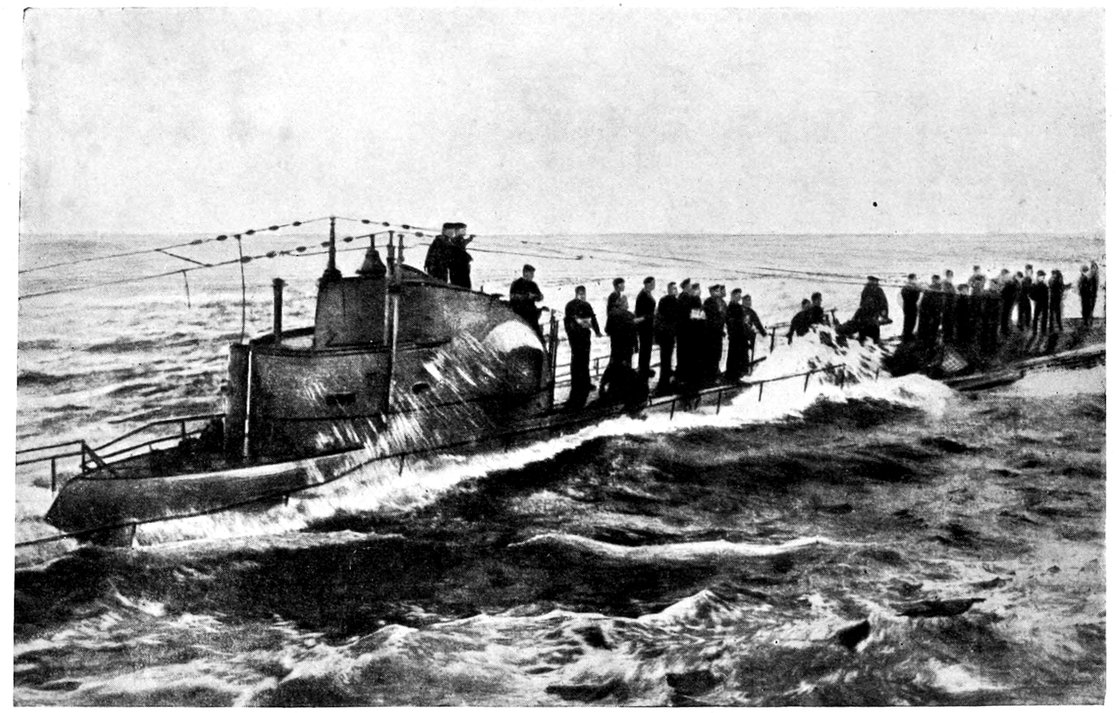
“Kamerad! Kamerad!”
Photo by W. S. Wiggins, U.S.S. Fanning
Reproduced by courtesy of the Naval Exhibition
155Fog is usually accepted as one of the plagues
of the sea, but on occasion it proved an
excellent friend to the enemy when British
patrol craft were hot on the scent. This was
not the case, however, with a small German
submarine which went ashore near Hellevoetsluis
in perfectly clear weather. The officer
seems to have lost his bearings completely.
After spending several fruitless hours hoping
that the incoming tide would refloat his ship,
the crew of fifteen men were compelled to
abandon her.
Their action was certainly less desperate
than the means adopted by the officers and
men of a German mine-laying submarine which
grounded on the French coast to the west of
Calais. She ‘touched bottom’ at high tide,
the worst possible time to choose for such a
156performance, and remained as immovable as
a rock. At daybreak the coastguards saw the
boat lying like a stranded whale, and promptly
secured her. The officers and men offered no
resistance. They had made their plans when
they realized that the ‘game was up.’ By
flooding the submarine with inflammable oil
and applying a match they effectively prevented
the boat from passing into the service of the
French Navy.
Occasionally the hunter got more than he
bargained for and was ‘hoist with his own
petard.’ The pirate commander of a U-boat
was congratulating himself on having disposed
of a British steamer with the minimum of
trouble, when the victim blew up. He had
attacked a vessel loaded with ammunition
without knowing what was in her hold, and
at comparatively short range. The explosion
was so violent that it upset the stability of
the submersible, and did so much damage
in other ways that for a time it was believed
she would founder. She was a sorry spectacle
when the cliffs and frowning guns of Heligoland
were sighted through the periscope.
157In the early days of submarines their constitution
could only be described as delicate.
At each stage of progress the craft has taken
on strength, until it has now anything but a
fragile frame. That was one of the reasons why
the British Admiralty was chary of issuing
definite statements as to U-boat losses. Oil
rising to the surface might be a sign that a submarine
had been wounded, but was no definite
guarantee that the patient would bleed to death.
U-boats had a little trick of letting out oil
when attacked in the hope that it would deceive
the enemy. Take the case of a certain British
submarine which had the very undesirable
misfortune to barge into a German mine.
These submerged canisters were filled with a
heavy charge of trotyl. You will better appreciate
what this means when I add that
T.N.T. has a bursting force when confined of
128,000 lb. per square inch. Yet this British-built
ship is still afloat, and her crew alive
to tell the tale. Vessel and men owed their
escape from death to a mighty good bulkhead.
She struck the mine bow on. Bulkheads
1 and 2 were burst open; her two fore
158torpedo-tubes, both loaded, were so twisted
and jammed that they were rendered useless;
the glass of the dials of the various recording
instruments was scattered in all directions;
every member of the crew was knocked flat,
and the vessel sent to the bottom, nose foremost.
A landsman would have said it was
the end of all things; the men most concerned
merely admitted that it was ‘a nasty jar.’
When they had regained their feet the crew
went back to their allotted stations to await
orders. There was no need for them to puzzle
why their craft was in this predicament.
Neither a sunken wreck nor a submerged rock
goes off with a bang. Meanwhile, there were
some nasty leaks to divert the mind. They
would be attended to later, when orders had
been given. Discipline, like explosive, is a
mighty force.
The commander picked himself up, carefully
brushed his uniform with his hands, and went to
his post. “Let all things be done decently and
in order” is the acknowledged, if unwritten,
motto of British submarines. The officer’s
action was the outward and visible sign that
159he had not forgotten it. He gave instructions
for the pumps to be set in motion—if they were
capable of movement. Everything depended
on the answer. There were moments of tense
anxiety before it came. No one, even the
bravest of the brave, likes to be drowned like
a rat in a trap. The motors were going. They
had not stopped. But the pumps?
They started! With the beating of their
pulse hope flowed in where before it had been
on the ebb. The submarine came to the
surface as game as ever, though terribly
bruised. If “God tempers the wind to
the shorn lamb,” a kindly Providence most
assuredly watched over this craft. In enemy
waters, three hundred odd miles from home,
with a broken nose and internal injuries, she
had not too much strength for the journey.
She accomplished it satisfactorily enough, and
was back again in her old haunts within a few
weeks.
There is a particularly poignant note of
tragedy in a strange mishap that befell another
British submarine. The why and the wherefore
of the accident have now been revealed.
160She was on her trials, and the ventilating
shafts had been left open, flooding the rear
compartments and drowning thirty-one men.
She took an unexpected plunge of thirty-eight
feet, stuck fast in the mud, and positively
refused to budge. She lay like a dead
thing. Every conceivable means of resurrection
was tried; each failed. One has read
of wonderful life-saving devices that are supposed
to be donned by submarine men when
their boat is in difficulties. They look like
smoke-helmets. All that is required is to don
one of these affairs, enter the conning-tower,
open the lid, and pop up like a cork. It
sounds simple, even entertaining, and might be
introduced as a side show at an exhibition
as a change from the Flip-Flap. Whatever
other submarines may have of this kind, this
particular boat either did not possess or could
not use.
Officers and crew watched the hands of the
clock complete the circle several times. There
was little else to do. One does not talk much
when waiting for eternity. Each felt that he
was a doomed man, that ere long his wife
161would be a widow and his children fatherless.
There was ‘a war on,’ but was this war? No
enemy had done this, unless Destiny be an
enemy. The forty-two men who still lived
were within a comparatively short distance of
the Scottish shore.
A terrible way out suggested itself to
Commander Francis Herbert Heaveningham
Goodhart. It is a formidable name to remember
in its lengthy entirety, but one to
make a note of. No future Book of Sea
Heroes will omit it and be reasonably complete.
The surname, although it is without an ‘e,’
fitted the man and the deed. He already had
the D.S.O. to his credit; his next award, the
Albert Medal in gold, was posthumous. Now
you know the tragedy of the story. The story
of the tragedy remains to be told.
Goodhart’s “terrible way out” was this.
The conning-tower of a submarine may be
cut off from the boat by a trap-door. He
proposed that a tin cylinder with a message
giving full particulars of the position of the
craft, the approximate length of time the men
could hold out, and other details should be
162given to him, and that he should be blown up
with it through the conning-tower. To effect
this it was necessary to partly fill the chamber
with water, turn on the high-pressure air, and
release the clips that secured the lid. Placing
the little cylinder in his belt, Goodhart set
out on his last desperate adventure. Together
with the commanding officer, who was to
open and close the hatch, he stepped into
the conning-tower. “If I don’t get up, the
tin cylinder will,” he remarked quite casually
to his colleague.
Water was admitted, then air. The lid fell
back, and Goodhart made his escape. At this
point Destiny, the unknown and the unknowable,
intervened. It reversed the order of
affairs that man had so carefully planned.
Goodhart was flung back against the structure
and killed outright. At the same moment the
officer who was to retire into the submarine
was shot upward and reached the surface.
According to the official account in the London
Gazette, “Commander Goodhart displayed
extreme and heroic daring, and thoroughly
realized the forlorn nature of his act.” This
163does not go quite far enough. Had it not been
for the dead man’s attempt the instructions
which were of such vital consequence to the
imprisoned men would never have reached the
rescuers. In due course fresh air, food, and
water were sent to those below by methods
private to the printed page. That night the
survivors slept on shore as a slight compensation
for their long and awful vigil.
In October 1916 the Danish submarine
Dykkeren met with a somewhat similar mishap,
although the cause of her sudden disappearance
was a collision with a Norwegian steamer
in the Sound. Divers entrusted with the
salvage operations hammered messages of good
cheer in the Morse code on the side of the
sunken boat, to which the prisoners promptly
responded. The commander alone lost his life.
He was found dead in the conning-tower.
The pirate chiefs of Germany did not have
it all their own way even when the absence of
Allied patrol vessels, mines, and anti-submarine
nets rendered existence a little less worrying
than was usually the case with these pariahs of
the deep. Lieutenant-Commander Schneider,
164who had won renown in the Fatherland as
an instrument of the ‘Blockade,’ was swept
overboard from his conning-tower while his
craft was travelling awash. When his body
was recovered life was extinct. It was consigned
to the deep, whither the Commander
had sent many another during his career as a
pirate. Some men from a U-boat in the Baltic
were investigating the papers of a schooner,
when a German cruiser put in an appearance.
Being uncertain whether the submarine was a
foreigner or not, as no colours were displayed,
the man-of-war ventured too close, and crashed
into the bow of the stationary vessel. Both
U-boat and cruiser were compelled to retire
for repairs. Off Norway a German submarine
mistook another of her own nationality for a
British representative of the underseas and
promptly torpedoed her.
CHAPTER IX Sea-hawk and Sword-fish
165
“The present submarine difficulty is the result of our undisputed
supremacy upon the sea surface. The whole ingenuity,
building power, and resource of Germany are devoted to submarine
methods, because they cannot otherwise seriously damage
us.”—Lord Montagu of Beaulieu.
They call them ‘blimps’ in the Navy.
The term conveys to the landsman
about as much information as
‘Blighty’ to a Chinaman. Blimps are speedy
little airships driven by a single propeller, with
a gondola capable of holding two or three
men and a supply of munitions of war. These
miniature Zeppelins are handy little craft not
given to high flying and acrobatic feats,
therefore less interesting to the general public
than aeroplanes, though not less useful to the
commonwealth. They were the guardian angels
of the Merchant Service in the war. As such
they played an important part in combating
the submarine evil. These tractor balloons,
with envelopes conforming to the shape of a
fish, can hover over a suspected spot for hours
166at a time, which a seaplane cannot do. On
the other hand, they are useless for raiding
purposes on account of their vulnerability.
Blimps are submarine spotters, and frequently
submarine sinkers.
From the height at which it is accustomed
to travel, the blimp, given fair weather conditions,
is able to see the shadowy form of a
‘dip chick’ when not so much as her periscope
is showing, and it can cover a fairly wide area
of observation. If you stand on the bank of
a broad and deep brook you will not be able to
see so far into the water as if you were standing
on a bridge that spans it and leaning over
the parapet. That is why a gull looks for its
food above the sea, and having glimpsed a
toothsome, or rather beaksome, morsel, dives
after it. This is also the secret of the spotter’s
sight. Many a German and Austrian U-boat
disappeared in a welter of oil and bubbles by
reason of the fact.
It was during Lord Jellicoe’s term of office
as First Sea Lord that increasing attention
was paid to aircraft as an ally of the Senior
Service. At the same time it is only fair to
167mention that when the British Expeditionary
Force crossed to France in 1914, aircraft
patrolled the marches of the sea between the
French, Belgian, and English coasts.
The Navy and the Army have their own
schemes of warfare, but in one particular plan
of operations there is marked similarity. Just
as the land is divided into sectors for
fighting purposes, so the sea is divided into
sections for the purpose of patrol. Destroyers
and hydroplanes, auxiliaries and trawlers, airships
and seaplanes have their beats mapped
out for them like a City policeman. This does
not mean that every square yard of salt water
is covered—an obvious impossibility—but it
does mean that as many square yards are
watched as is humanly and practicably possible.
In one month 90,000 miles were travelled
by seaplanes on patrol, and 80,000 miles by
airships.
When the war was very young, a seaplane
containing an officer and a petty officer was
scouting. Without any preliminary warning
the engine broke down, and they were compelled
to descend and drift on the surface with
168a heavy sea running. Of rescue there seemed
to be little hope. Fog completely enveloped
them. A survey of the damage proved that
patching up was altogether out of the question.
Nothing short of a lathe would suffice. The
airmen fell back on tobacco, “the lonely man’s
friend.” Even this comfort speedily failed
them. Cigarettes and sea-sickness do not go
well together. The poor fellows held on and
watched their machine gradually break up.
They were horribly ill, and on the verge of
despair, when the throb of machinery suddenly
fell on their ears, and a destroyer peered in
through the opaque surroundings of their little
world. They were no longer face to face with
death. Other men have not always been so
fortunate. One does not necessarily have to be
washed overboard to be “lost at sea.”
A couple of seaplanes on outpost duty
were watching the waters below with great
interest when one of them sighted a submarine
travelling on the surface. They were up a
good height, but the observers duly noted a
couple of men on the conning-tower. Apparently
the Germans were too intent on the
169business in hand to observe the sky-pilots,
who kept on a steady course. They suffered
a rude awakening a few minutes later. A
weighty bomb fell plumb on the starboard side
of the sea pest, midway between the conning-tower
and the stern. That bomb ‘did its bit’
for King and Country. Slowly but surely the
U-boat heeled over, ceased to make progress,
and lay like a log on the water. Then the bow
rose at an awkward angle, and the vessel began
to settle rapidly. Another bomb, released by
the second seaplane, burst close to the conning-tower,
followed by a third bomb, “to make
assurance doubly sure.” This particular submarine
was not handed over to Sir Reginald
Tyrwhitt.
America did much excellent work in helping
the British Navy to rid the seas of
underwater pests. An ensign in the U.S.
Naval Reserve attached to the Aviation Service
was patrolling in a British seaplane with a
British observer. Within thirty minutes of
having started, “we sighted the periscope of
a submarine directly in front of us,” he reports.
“Immediately I opened the engine full out
170and attacked, dropping a bomb which landed
a few feet ahead of the periscope and directly
in line with it. A moment later a great
quantity of air bubbles came to the surface.
The water all about began to boil. I turned
and attacked again. This time I dropped a
bomb of twice the size. It landed nearly in
the centre of the first disturbance. A mass of
oil now appeared on the surface in addition
to the débris left by the bomb itself. The
second disturbance continued for some time.
Then I circled round for two hours before
returning to warn merchant ships in the vicinity
and inform a destroyer escorting a British submarine
of what I had done and seen.”
From his point of vantage the look-out of a
British airship noticed a steamer limping along
in a manner which distinctly suggested that
she was in difficulties. That had been a fairly
familiar sight since the opening of Germany’s
illegal warfare. The cause of her crippled condition
was evidently of enemy origin, though
her assailant was invisible. Sea-wolves did not
make a regular habit of gloating over their
victims. That little hobby was only indulged
171in when the ‘coast’ was clear. The coxswain
headed the airship in the direction of the
stricken steamer, but before reaching her tugs
had made their welcome appearance and lent
the assistance of a stout steel hawser that
worked wonders.
As a precaution against surprise the airship
accompanied the miniature squadron. They
proceeded quietly enough for a time, making
fair speed, when a U-boat broke surface about
five miles off. Signalling by wireless the
position of the pest to all and sundry, the
airship accelerated her engine and lowered to
a height from which she could make the
best use of her weapons. The submarine was
not taken entirely unawares; she submerged
before the sea-hawk was immediately above.
Two bombs, released simultaneously, caused a
terrible commotion and effected a kill. A
destroyer which had picked up the wireless
subsequently dragged the spot, and signalled
the cheering news, “You’ve undoubtedly bagged
her.”
Better luck attended this effort than befell
the pilot of a seaplane who came across a
172large submersible travelling awash. Here early
demise seemed a certainty. Unfortunately there
is many a slip ’twixt the bomb and the
U-boat. One packet of high explosive fell
ahead and another astern of the grey monster.
The third was a marvellous shot. It did the
aviator’s heart good to see it strike. It landed
directly in the centre of the deck. He had
scored a bull’s-eye. I am afraid I cannot
quote what he said when the missile failed to
detonate. His anger was not appeased by the
knowledge that his supply of ammunition was
exhausted. The enemy submerged, descended
to the lowest depths, and made off.
Observation balloons, towed by destroyers,
although they obviously lack the initiative of
airship and seaplane, have their uses like
their more energetic brethren of the sky.
On one occasion an observer telephoned that
there was a U-boat in the neighbourhood.
Depth charges were thrown overboard, but
achieved nothing more than causing the boat
to shift her position. She passed from mortal
ken so far as her hunters were concerned.
Later on, however, the submarine came to the
173surface and began shelling a poor little helpless
sailing vessel that could neither escape nor
offer effective resistance. The destroyer opened
fire, and as a submersible is no match
for this type of vessel, she promptly went
below. Her rapidity of movement failed to
evade Nemesis, though her smartness in this
respect was highly commendable. Guided by
the balloon, the parent ship took up the trail,
and nine ‘pills’ were sent overboard with the
compliments of the captain. Then followed
such a display of oil as is rarely seen. No fake
oil squirt ever succeeded in covering a mile
of sea with the colours of the rainbow. The
U-boat had gone to her doom.
The task undertaken by blimps and seaplanes
in their daily warfare against the pirates
was far from selfish. The Mistress of the Seas
and her Allies kept guard over the welfare
of neutral nations as well as of their own.
While journeying homeward the Danish steamer
Odense was met by a German submersible. It
signalled her to stop. The order was complied
with without hesitation, but instead of making
an examination of the ship’s papers the U-boat
174opened fire, killing two of the crew. The
enemy commander then ordered the survivors
into the boat. This was really inviting them
to commit suicide, for the weather was such
as to render the likelihood of the men’s being
saved extremely remote. While this little
tragedy of the sea was being acted, a British
submarine put in an appearance, apparently
from nowhere. She had been summoned by
aircraft. The U-boat did not stay to fire
further shells into the steamer. Not long
afterward a British patrol ship on its ceaseless
vigil came across the Danes in their cockleshell,
took them on board, gave them warm
food and dry clothes, and amply demonstrated
the fact that the British Navy was neither spiteful
nor cruel because it did not own the globe.
A British coastal airship was scouting for
a convoy bound westward. The voyage had
been uneventful, when a look-out spied the
track of a torpedo aimed with deadly certainty
at one of the steamers. With marvellous
agility the course of the airship was altered
and traversed the trail still outlined on the
water. It is said that she travelled at a rate
175approaching ninety miles an hour. There was
the gaunt form of the submarine right enough,
though submerged. Well-placed bombs did
the rest.
Another airship, quietly sailing in the upper
air, also came across a British convoy. The
reply to the pilot’s request for news was entirely
unsatisfactory from his point of view. No
U-boats had been seen or reported. Things
were slow. They continued so for several
hours after the two branches of the Service
had parted, but brightened up a bit when a
wireless message was received that a merchantman
was being attacked by a pirate. Details
as to position proved correct. The submersible
was floating awash. Blimps being preeminently
handy affairs which readily respond
to helm and engine control, the airship was
hovering over the U-boat before the latter was
completely submerged. It boded ill for the
intended victim, whose ballast tanks were
slower in filling than the airship’s mechanical
appliances in accelerating. The first bomb was
a good shot, but not a hit. It fell three feet
short of the mark, and exploded astern of
176the propellers. That it did the enemy no good
was evident. Streams of oil, too voluminous
to be make-believe, spurted to the surface.
The second bomb was a direct hit aft of the
conning-tower, causing the stern to rise upward.
It would have been waste of good ammunition
to spend more on the wreck that lay below.
She slowly turned turtle, and was no more
seen. Another U-boat had paid the price of
her perfidy. The blimp had scored a full
triumph that admitted of no question.
A seaplane was patrolling her section, keeping
a sharp eye on possibilities in the nether
regions that failed to eventuate. Presumed
periscopes are sometimes in reality nothing
more than mops or spars. After the novelty
of flying has worn off it is apt to become
a trifle boring without action. As the pilot
was proceeding on his way, doubtless thinking
that his luck was most decidedly out, he
picked up a wireless message. Judging by its
purport it was evidently sent by a U-boat no
great distance off. He had not proceeded very
far before he spotted his prey, comfortably
squatting on the surface about a mile ahead.
177The seaplane was ‘all out’ in a trice. Sea-hawk
and sword-fish exchanged greetings, the
one with a bomb, the other with a shell. The
latter burst quite harmlessly within fifty feet
of the aircraft, then splashed over the sea
like a shower of pebbles. The bomb went
more than one better. It fell on the U-boat
and tore a great rent in her deck. While
this battle royal was proceeding, three German
U-boats, three torpedo-boats, and a couple of
seaplanes were speeding in the direction of
the firing. The weather was somewhat misty,
but they sighted the solitary seaplane and
tried to wing her. The pilot treated them
with contempt, and calmly proceeded with
the business immediately in hand. The firing
in his direction became so heavy that it
formed a barrage through which the German
aircraft were totally unable to penetrate.
The officer gave his enemy another dose of
bomb, photographed her as she was going
down, took a picture of her friends, and having
exhausted his ammunition, returned to report.
A gunner on a British submarine cruising
off Denmark proved himself a better shot
178than his German rivals in the afore-mentioned
incident. Two enemy seaplanes saw the boat
and dropped their highly explosive eggs. The
bombs burst, made a great noise, but did
no damage. A shell from the submarine sped
straight and true and one of the seaplanes
was brought down, whereupon her companion,
realizing that the locality was unhealthy, beat
a hasty and undignified retreat.
German airmen naturally endeavoured to turn
the tables on us. They hunted for British submarines
in addition to doing scouting work for
their own. Within a month of the outbreak of
war an enemy airman and his mechanic got
what was at once the greatest shock in their
lives and the means of the aforesaid lives being
preserved. Their machine had broken down,
and they were using it as a raft, when one
of His Britannic Majesty’s submarines rose to
the surface. Instead of making war on them as
a ‘biological necessity,’ the commander rescued
the two men and took them into Harwich, after
their damaged craft had been satisfactorily
disposed of.
During the afternoon of the 6th July, 1918,
179a British submarine was on guard off the East
Coast when five hostile seaplanes swooped
down on her and made a vigorous attack with
bombs and machine-guns. According to the
German official account, the action took place
off the mouth of the Thames, and two submarines
were severely damaged, one of which,
when last observed, was in a sinking condition.
The report rather reminds one of occasions
when Teutonic imagination has robbed the
Grand Fleet of battle-cruisers. As it happened,
the British craft sustained only minor injuries,
and was towed into harbour by another submarine—presumably
the one which the enemy
had seen. She had suffered no inconvenience
whatever from the seaplanes’ attentions. Unhappily
an officer and five men were killed in
this attack.
Some time since the Berlin Press made
much ado about a British submarine being
sunk by a German airship. It was when
Zeppelins were considered to be rather more
substantial assets in the Wilhelmstrasse than
they subsequently became. A little later the
‘sunken’ submarine returned to her base
180without so much as a scratch on her bulgy
sides, and reported that she had been in action
with a hostile airship, which she had damaged
and driven off. So much for the Truth as propagated
in Berlin.
One of the most brilliant exploits of what
I may term the aerial phase of war in the
underseas took place in March 1918. The
scene of the engagement, in which three British
seaplanes and five German machines were
involved, was just beyond the North Hinder.
While the enemy were attacking from the
rear, and our men were busily engaged in
putting up a stiff fight, a U-boat made its
appearance ahead with several officers and men
on the conning-tower. The three Britishers
dived down, and having nothing else available,
fired their machine-guns at the spectators, who
disappeared inside and slammed the hatch.
They then took up positions to renew the
aerial combat. The fight continued for half
an hour, to be broken off by the enemy when
five British trawlers were sighted. As for the
submarine, she was nowhere to be seen. One
of our seaplanes was then out of action owing
181to a petrol pipe having burst. It returned
home without overmuch difficulty.
Meanwhile the remaining two seaplanes
carried on with their patrol work, though some
of the men were relieved. Almost three hours
later they came across as pretty a sight as
British airmen could wish to see. The five
Germans were floating on the water. The
British gave them a round or two from their
guns, but before they had got well within range
the enemy were up and had taken places in
their usual V formation at a height of about
200 feet. This was speedily broken up as our
airmen gained on them, the V rapidly assuming
the appearance of an elongated I, or
single line ahead. Having succeeded in scattering
them, the British seaplanes attacked
them individually. An enemy twin-seater was
hurled down, followed by a second machine,
whose observer and gunner were both shot,
and a third seaplane was rendered unfit
for immediate service. The other machines
escaped because not a solitary cartridge was
left available for pursuit; in all 2500 rounds had
been fired. A solitary casualty was sustained
182on our side. A wireless operator was wounded
in the neck, whereupon his companions administered
first aid and returned to their
respective duties.
Five British seaplanes were patrolling off the
East Coast on the afternoon of the 4th June,
1918. After a particularly ‘tame’ flight, a
similar accident to that which had occurred
in the engagement related above compelled one
of the machines to descend to the water. A
petrol pipe had broken, and as repairs of this
nature cannot be effected to a heavier-than-air
machine while it is on the wing, there was
no alternative but to come down. While the
others were on guard, a squadron of five enemy
aircraft was seen approaching. The seaplanes
at once gave battle, but the Germans were in
no mood for fighting, and made off as fast as
their propellers would take them. When it
was obvious that they could not be brought to
action, the British machines returned to their
crippled comrade. Two more hostile seaplanes
appeared a little later, and were similarly
disposed of.
Before the wounded sea-hawk was fit for
183further fighting, no fewer than ten hostile seaplanes
came in view. Probably they were the
previous flock concentrated and augmented.
There was no thought of “retiring according
to plan.” The Britons went to meet the
enemy, as is their wont. By taking the
offensive they would also best screen their
comrades below, who were working with an
energy seldom equalled. They, like the others,
wanted to be up and at them. The aerial
battle was sharp and furious. Two of the
German craft were shot down; one of our
machines fought till she could fight no longer.
The latter eventually landed in Vlieland,
Holland. Finding that the task of putting
their craft in order was impossible with the
appliances at their command, the crew of the
other maimed machine set it on fire when they
reached Dutch territorial waters, and made their
escape by swimming to land.
During the course of the action a British
seaplane was attacked by two of the enemy,
and the assistant pilot was shot dead. Five
other German ’planes then closed with the
British machine. The pilot made a nose-dive,
184shook off his assailants, and put up such a hot
fight with the gun in the stern that they broke
off the contest. A little later the petrol pipe
of this machine also broke, and the seaplane
was forced to descend for the needful repairs.
Petrol pipes are the bêtes noires of the airman’s
life. The engineer air-mechanic did his work
with such dexterity that within ten minutes
everything was in running order again and
the machine was climbing up to rejoin its
companions. When it reached them they set
out in search of the enemy. They met with
no luck, and returned to their base.
In such ways as these aircraft fought fish with
steel fins and winged creatures after their own
kind. There remained yet another method of
warfare known to them, namely, bombing
submarine bases, of which Ostend, Zeebrugge,
and Bruges were probably the most important.
Time after time one read in the newspapers
that these places had been attacked by aircraft,
until one wondered how it was that
so much as a stone or a stick of timber was
left. The reason is that a bomb explosion
is entirely local in its effects. It does not
185spread like fire in a gale, though it may cause
buildings to be gutted. It was only now and
again that direct hits were scored on submarines,
torpedo-boats, and other vessels in the docks.
But there was another important factor to be
taken into consideration. The soldiers, sailors,
tinkers and tailors who inhabited these places
could not possibly produce their best work under
the strain of constant attacks from the air.
They must have suffered from the ‘jumps’
pretty frequently; and Napoleon said truly that
the moral is to the physical as three to one.
Submarines, aircraft, and surface fighting
forces were involved in the famous Christmas
Day attack on the heavily fortified base of
Cuxhaven in 1914. This was a sequel to the
German naval raid on Scarborough, Whitby,
and the Hartlepools ten days before. Seven
seaplanes, three seaplane-carriers, escorted by the
light cruisers Undaunted and Arethusa, several
destroyers and submarines, duly arrived in the
neighbourhood of Heligoland. When they had
left England the previous afternoon the coast
was bathed in sunshine, but the mouth of
the Elbe was fog-bound. However, the aircraft
186got away, their principal objective being the
warships lying in Schillig Roads. The surface
craft then toured about while awaiting their
return, and were seen from Heligoland. Two
Zeppelins, several seaplanes, and a number of
U-boats came out to attack, but it is significant
that although the British ships were off the
German coast for three hours not a solitary
surface vessel attempted to face them. They
doubtless foresaw a second battle of Heligoland
Bight and were anxious to avoid it. Bombs
from the aircraft dropped fast and furious;
they merely ploughed the sea. Maxims, anti-aircraft
weapons, rifles, and 6–in. guns took up
the challenge and put the Zeppelins to flight;
torpedoes were fired at the Arethusa, and skilfully
avoided by swift manœuvring. A Taube
spotted one of our submarines, made half a
dozen attempts to sink her, and failed. In
this matter they were no more successful than
the British seaplanes, which tried to hit an
enemy torpedo-boat and a submersible. What
actual damage was achieved by the airmen is
unknown, but the Germans certainly scored at
Langeoog. Under the impression that T.B.D.s
187were hiding in the fog off the island they
dropped a number of bombs, thereby killing
several civilians.
Of the six British airmen who returned,
three were picked up by our surface ships, the
others by submarines. In the case of the
latter the machines were sunk. For a time
it was feared that Flight-Commander Hewlett
had been brought down or was drowned, but
he eventually turned up none the worse for
his exciting adventure, having been picked up
by a Dutch trawler. Chief Mechanic Gilbert
Budds, writing to his father, gives a little
glimpse of his exciting experiences. “Just
fancy,” he says, “Christmas Day—first on a
ship through mine-fields, on a seaplane over
the enemy’s fleet and force, and then back
in a submarine. During the homeward trip we
had the gramophone going with all the latest
music, and had chicken, Christmas pudding,
custard and jellies for dinner. How’s that,
Dad, for a submarine in the heart of the
enemy’s fleet in war-time?”
After all, perhaps life in an underwater
craft during the war had its compensations.
188The French seaplane patrol service also
did wonderful things, as was to be expected,
for our Allies took aircraft seriously when we
only regarded them as expensive toys for
wealthy folk with suicidal tendencies. In a
single month, and in various samples of weather,
their seaplanes made as many as 3139 flights.
During the thirty days under review, ten submarines
were attacked, six mine-fields were
located, and nine night bombardments carried
out. French airships also made 141 trips.
So much for statistics, which is the practical
in undress uniform. Now for the more
picturesque aspect of the Service. A couple of
French sea-hawks were watching the Channel,
and came across a German submersible on
the surface. Apparently the commander of the
U-boat had not the slightest notion that there
was an enemy “up above the world so high”
until he was attacked. When the rude awakening
came he began to submerge. The boat
was not quite so quick in her movements as
the seaplanes. The airmen dived with extraordinary
rapidity, and both scored a bull’s-eye
on the target.
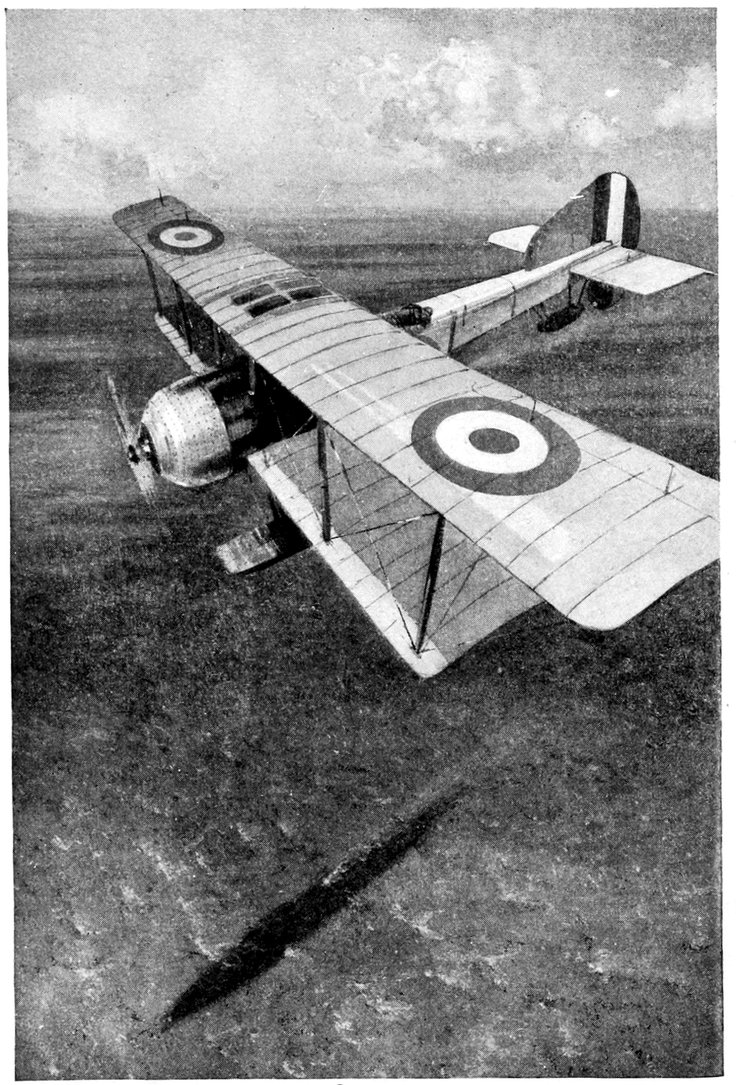
A Seaplane of the R.N.A.S keeping a Watchful Eye on an Enemy Submarine
189“The leading machine,” says the semi-official
note, “then returned to its base for
a further supply of bombs, leaving the other
machine to keep a look-out. The latter, a
few seconds after the attack, saw the forepart
of the submarine emerge at an angle of
45 degrees. Then the submarine slowly rose
to the surface, without, however, being able
to regain a horizontal position, and again disappeared
in a violent whirlpool. Three times
at short intervals the submarine attempted
to rise to the surface, taking at each attempt a
stronger list to starboard. Then the observer
saw the whole of the submarine’s port side
exposed, while the submarine rested on its
beam ends. Finally the vessel disappeared
without having succeeded in getting its conning-tower
above water.”
One Sunday a British pilot and a Frenchman
attached to the R.N.A.S. were on the spy
for U-boats off the Belgian coast. They had
scarcely been in the air half an hour, and had
reached a height of about 9000 feet, when
they saw two submarines lying side by side
on the surface. The spot was some five
190miles west of Nieuport, where the water is
shallow. To the aviators it looked very much
as though the craft were just above a sandbank.
So much the better for the attackers.
The boats would have furnished lovely targets
had there been no look-out below, but it was
first of all necessary to decrease the distance
separating the airmen from the objects about
to be attacked, and during the descent the
Germans saw their enemy. One of the submarines
managed to get away, leaving the other
to fend for herself. At 600 feet Lieutenant de
Sincay dropped a bomb right on the conning-tower.
A second missile did such terrible
execution that the boat sank like a stone.
The great Austrian naval bases of Cattaro
and Pola were visited several times by Italian
airmen. On one occasion a raid was made on
the former harbour at night and direct hits
were scored on submarines and torpedo-boats,
while an aerial attack on Pola was responsible
for the destruction of three U-boats undergoing
repairs.
It is only doing bare justice to remember
that neutral aviators also played a part in
191making a life under the rolling deep in a
U-boat anything but pleasant. Time and
again German pirates endeavoured to use
the deep fiords of North-western Scandinavia
for purposes best known to themselves, but
in all probability as convenient rendezvous
for stabbing Norwegian vessels in the back.
Several tried to hide themselves in Bergen
Bay. They were discovered by native airmen
and promptly informed that if they did not
quit the neutral zone without delay they would
be interned. They left.
CHAPTER X U-Boats that Never Returned
192
“Let us march farther, undaunted and confident, along
the road of force. Then our future will be secure against British
avarice and revenge. The German is too good to become
England’s vassal.”—Admiral von Scheer.
Many U-boats were buried in the
same grave as their last victim.
This was not adequate retribution,
but it left the Navy and the Mercantile Marine
with one submarine the less to fight.
Close to the wreck of the great White
Star liner Justicia, a magnificent steamer of
32,000 tons, lie the remains of one of her
attackers. There may be others, but I give
the official figure. The submarine in question
was sunk by the destroyer Marne on the
20th June, 1918, the day the Germans were
being driven back across the historic river
whose name she bore. The Justicia was dogged
by submersibles for twenty-two hours, during
which time no fewer than seven torpedoes
were fired at her. It was the most determined
193onslaught ever made by U-boats. Moreover, the
attack is remarkable by reason of the fact that
not only were destroyers and other craft convoying
the vessel, but she herself was armed.
The first torpedo struck and exploded in
the engine-room, killing fifteen men and injuring
the third engineer so terribly that he
died later. The second weapon was diverted
from its course by the Justicia’s gunners; the
third missed. Depth charges and other means
were used to deal with the menace, and apparently
with success. During the ensuing
night nothing further was seen or heard of
the enemy. Early the following morning, however,
two torpedoes were fired simultaneously,
one taking effect in No. 3 hold, the other in
No. 5 hold. When it was realized that there
was not the remotest chance of bringing the
Justicia to port, the crew of between six
and seven hundred were quietly transferred
to another vessel. The liner kept afloat for
eight hours after that, a remarkable testimony
to the efficient work of those who had
built her in the Belfast yards of Messrs
Harland and Wolff.
194Several commanders of U-boats asserted
that a number of attempts had previously been
made to sink the Justicia, but had failed
because she was provided with torpedo nets.
This does not seem altogether an adequate
explanation, unless we are to presume that the
devices alleged to be in use were not in position
when the maritime snipers succeeded in sending
her to Davy Jones’s locker.
The during-the-war policy of the British
Admiralty as regards lost, stolen, and strayed
U-boats was one of reserve, and rightly so.
When you are on the watch for a gang of
burglars you make as little fuss about it as
possible. If full publicity had been given to the
methods of capture the Central Powers would
have speedily become conversant with them.
We preferred to let the enemy find out things
for himself—if he could. To use an expression
common on the Western Front, it ‘put the
wind up’ German crews to find that an ever-increasing
number of their friends on U-boats
failed to report after a voyage. Except in rare
instances no information as to their fate came
to relieve their friends’ anxiety. They just disappeared
195from mortal ken. It did not make
for ease of mind; it harrowed the nerves of the
strongest. The effect on the moral of the enemy
was distinctly marked. The plot rebounded.
The sea-dogs of the British Merchant Service
were to be frightened into submission; their
ships were to rust for want of use, moss was
to grow on the quayside. It was the U-boat
which surrendered to the White Ensign.
The first enemy submersible to be lost
was U 15, sunk in the North Sea by H.M.S.
Birmingham on the 9th August, 1914. This
was admitted by Mr Winston Churchill in a
telegram to the Lord Mayor of the cruiser’s
name-place, whose loyal citizens had made a
presentation of plate to her officers’ mess.
U 15 was a small vessel of about 300 tons,
carrying a crew of twelve officers and men,
and appears to have had two or three consorts
with her. An A.B. on the Birmingham,
which was attached to the First Light Cruiser
Squadron, sighted the periscope of a submarine,
and fire was opened at once. The noise of
the guns and the piercing notes of the bugle
calling all to action stations brought those
196who were not on watch to their allotted
positions in double quick time. Officers in
pyjamas, men with one leg in their trousers
and one out, scampered along the upper deck
as though joining in a race, anxious only
to get to grips with the enemy. It is said
that the first shell struck the periscope and
rendered the submarine sightless. If so, it was
a marvellous shot at a range of a couple of
miles or thereabouts. Probably the sailor who
set the story going was indulging in a little
game of ‘leg-pulling,’ a hobby not unknown
in the Navy. There was a mighty swerve as
the captain of the cruiser altered course so
as to be out of the line of fire. In another
instant the Birmingham was racing toward her
assailant as though the engines would tear
themselves from their pits in the excitement
of the chase. Every gun was trained on the
U-boat. Another shot rang out, wrecking
the conning-tower. The sharp steel bow of
the man-of-war did the rest. There were no
survivors.
In October 1914 it was announced that
the T.B.D. Badger had rammed and probably
197sunk an enemy submarine. This was contradicted
by the Germans, who asserted that
the vessel in question had returned to her
base in a damaged condition. There was
less uncertainty about a U-boat casualty that
happened in the following month. U 18 penetrated
a certain harbour in the north of
Scotland much frequented by naval vessels.
It happened that just as the submarine was
going in, a trawler attached to the Patrol was
coming out. Apparently the tough little craft
passed over the U-boat, for the skipper immediately
signalled, “Have struck submarine.”
Now a submarine chase was much appreciated
by those who commanded destroyers.
There was sport about it rather more exciting
than merely “barging about the North Sea.”
The T.B.D. Garry was first in the field. She
slipped along in wonderful style and attempted
to ram the enemy as she was endeavouring to
get away. According to a seaman, the periscope
crumpled up, but the jar that was felt
was scarcely enough to warrant his commander
in believing that the U-boat had run her course.
Accordingly he cruised about for a while,
198anticipating that eventually she would come to
the surface if any life remained in her. This
is exactly what happened, and once again the
Garry worked up to full speed. She was on
the verge of crashing into the enemy when the
crew appeared on deck. One of them waved
a white handkerchief in token of surrender. It
was a narrow squeak, but the destroyer rescued
three officers and twenty-three of her crew.
One of the latter was drowned. He volunteered
to stay behind and open the Kingston
valve so that the craft might not be captured.
To give a chronological list of the U-boats
known to have perished in the war, with particulars
of their death, would occupy all the
pages in this volume. I can therefore only
cite a few instances. The story of the sinking
of an unknown marauder by the Thordis, a
little coasting steamer of 500 tons, is too well
known to require retelling.[28] Captain Bell was
the first master in the Merchant Service to win
official recognition as a submarine-sinker.
199U 8 had been operating in the Straits of
Dover and the English Channel for several
weeks before she was finally rounded up by
a dozen destroyers under the command of
Captain C. D. Johnson. This was in the afternoon
of the 4th March, 1915. Here again there
was an alarming discrepancy in the company
the submersible ought to have carried and
the number she actually had on board. Her
normal complement was twelve officers and
men; when she was sunk twenty-nine survivors
were picked up. The sinking of U 8
and U 12 was made the basis of a threat of reprisals
upon British officer prisoners in Germany
because the authorities at Whitehall did not
“feel justified in extending honourable treatment”
to the men of U 8. They held that
there was “strong probability” of their having
“been guilty of attacking and sinking unarmed
merchantmen” and “wantonly killing
non-combatants.” Sir Edward Grey pointed
out that up to the time of the incident more
than a thousand officers and men of the
German Navy had been rescued from the
sea, “sometimes in spite of danger to the
200rescuers, and sometimes to the prejudice of
British naval operations.” Not a single British
sailor had been picked up by the enemy.
The widely circulated report that the officers
of U 8 were guests of Royal Artillery officers
at lunch at Dover Castle was a falsehood.
The life of U 12 as a pirate was extremely
short. She was caught by the destroyer Ariel
on the 10th March, 1915, before she had been
able to do anything approaching appreciable
damage, her sole victim being a little steam
collier of 60 tons, which she sank by means of
a bomb.
A certain amount of mystery is also associated
with this particular submarine. Her displacement,
if she were the original U 12, was
300 tons submerged and 250 tons above water.
Fourteen men would have been ample to work
her, yet she had a complement of twenty-eight.
It is possible, though the idea seems somewhat
far-fetched on account of the limited accommodation
on board, that the men in excess
were being trained. What appears to be far
more probable is that an old number had been
given to a new boat, just as the name Arethusa
201has been borne by a long line of fighting ships
in the Royal Navy. Ten of the pirates were
picked up and landed in Scotland; eighteen
were drowned.
Although Captain Otto Weddigen achieved
momentary fame in Germany as the hero of
an exploit that sent the Aboukir, the Cressy,
and the Hogue to the bottom of the North Sea,
he did not live long to enjoy his popularity.
When the U 9, the submarine which he commanded
on that occasion, was withdrawn
from service, he was given the U 29, believed
to have a displacement of some 800 tons,
and to be armed with two quick-firing guns
and four or more torpedo-tubes. One of the
U 9’s last adventures was to get entangled in
the net of a Dutch steam trawler, necessitating
the cutting away of the lines.
U 29 first appeared as a commerce-destroyer
about a fortnight before she was sent to the
bottom. Her hunting-ground was the vicinity
of the Scillies. Known as ‘the Polite Pirate,’
Weddigen sank five or six merchant ships, and
on occasion regaled the crews with cigars and
wine and towed their boats toward land.
202Not once did he behave with the stupid and
blundering brutality of many of his associates
in arms. When the crew of the Adenwen were
taking to the boats, one of the men fell
overboard. Weddigen happened to be on
the conning-tower at the time. Noticing the
sailor’s plight and his rescue, the captain of
the U-boat sent him a suit of dry clothes.
The German commander’s order Pour le
Mérite and the Iron Cross of the First Class
went down with his ship. This misfortune
reached the Kaiser’s ears. That august personage
sent duplicates to Weddigen’s widow,
at the same time condoling with her in “the
bitter loss of a man whom the entire Fatherland
mourns, who achieved unforgettable fame for
himself and the Fatherland, and who will live
for all time as a shining example of daring,
calm, and resolution.”
Weddigen’s humanity came in very useful
when the fate of U 29 had to be explained in
the German Press. The Deutsche Tageszeitung
suggested that “British ships surprised U 29
while she was busy saving the crew of the
steamer. In the midst of this humane work
203the knightly English must have caught U 29
while she was helpless, and it would be easy
for them to destroy her. The noble hypocritical
sentimentality of the English Press
about the captain points to facts of this kind.”
Admiral Klaus, writing in the Vossische
Zeitung, put forward the theory that the
submarine was sunk by a British ship flying
a neutral merchant flag, and added that as the
British Admiralty had seen fit to withhold
details there were apparently good reasons
for not being proud of the success. The only
information vouchsafed by the officials of the
Wilhelmstrasse was couched in the baldest of
bald language: “U 29 has not yet returned
from her last cruise. According to the report
of the British Admiralty issued on March 26
[1915], the ship sank with her entire crew.
The submarine must therefore be regarded as
lost.” The burial of the U-boat in a shroud of
mystery must have been horribly galling to
the bigwigs of Berlin. The intimation that
she was “sunk by one of His Majesty’s ships”
conveyed nothing to them except the obvious.
On the 9th June, 1915, Mr Balfour announced
204in the House of Commons that a German submarine
had been sunk and the entire crew
taken prisoners. The German Admiralty subsequently
announced that U 14 was evidently
the vessel in question, as it had “not
returned from its last expedition.”
Whether the following letter is a typical
revelation of the mind of the German underwater
sailor or not is more than I can say, but
it is particularly interesting as showing that
the writer was thankful to a kindly Providence
for sparing him when the game of piracy and
murder had come to an end and he was safe
in British hands. It could scarcely be supposed
that every German who sailed in a submarine
did it of his own free will or took a delight
in the work. I can only suggest that all too
often the Prussian Cult makes blackguards of
men who are not by nature what they afterward
become. The communication runs as
follows:
Go to church the first Sunday after you receive these
lines from me, and thank the good God for having so
mercifully watched over and preserved me. I have
fallen into the hands of the English, unwounded and
205whole in body and mind, and have been well treated,
quite particularly so by the English naval officers.
It was an extremely sad day for me. First of all in
the morning I saw dead on the deck two poor Norwegians
who had unhappily fallen victims to our gunfire. The
day will be engraved on my memory in letters of blood.
But as for you, dear parents, do not be distressed, and
do not weep for me. The good God Who has protected
me hitherto will continue to be my aid, and if it should
be His will that I should quit this world I shall know
how to die.
The submersible in which the writer of the
above letter served was UC 39, commanded
by Otto Ehrentraut, a personal friend of
Prince Henry of Prussia. UC 39 was a mine-layer,
but does not appear to have been so
employed when she was destroyed. She was
simply indulging in cold-blooded piracy with
the aid of torpedoes and shell. Her first
victim was the Norwegian s.s. Hans Kinck.
Although the vessel stopped when summoned
to do so, many rounds were fired at the helpless
ship. Victim No. 2 was the British s.s. Hanna
Larsen, which was sunk by bombs and the
master and chief engineer made prisoners.
Victim No. 3 was another Norwegian steamer,
the Ida, when the old practice of firing after
206the vessel had stopped was again indulged.
No fewer than twenty shells were hurled at
her before Otto Ehrentraut gave the order to
cease fire. It was only then that the men in
one of the Ida’s boats ventured to come alongside
and inform him that two of their comrades,
both wounded, had been left on the sinking
vessel. When a German officer clambered on
board, the mate and the steward were lying
dead on the deck. There they were allowed
to remain while the Ida was finished off with
bombs.
A steamer and a trawler were next attacked.
Both escaped in the mist. Another steamer
was encountered a little later, but this time
UC 39 caught a Tartar. A destroyer was close
by and opened fire. Before the submarine
could dive sufficiently low to make her whereabouts
uncertain a depth charge exploded in
her near vicinity. Water poured in, making
it dangerous to remain submerged. So she
came to the surface, to receive a tornado
of fire from the man-of-war. Ehrentraut
appeared on the conning-tower, and was struck
by a shell. His place was taken by another
207officer. As UC 39 continued on her course, the
commander of the destroyer yelled through
a megaphone for her to stop. Before she
answered the summons several of the crew
had been killed or wounded, but seventeen
survivors were rescued. All these events were
crowded into two days.
The French, Italian, and Japanese Navies
all displayed splendid prowess in dispatching
submarines. The Austrian U 3, a small
submarine of 300 tons displacement when
submerged, was rounded up in the Lower
Adriatic by the French T.B.D. Bisson after
a search in which Italian men-of-war had
joined. No sooner was the periscope sighted
than the destroyer scored a hit at over 3000
yards. The second shot was not so successful,
for it fell short, but the third struck her and
exploded in the engine-room. Although U 3
went down in half a minute, twelve of her
crew were rescued.
The U-boat which wrecked the Chateaurenault
in the Ionian Sea on the 14th December, 1917,
took a lot of killing. After the enemy had
sent her first torpedo, the spot where she
208submerged was riddled with shells. On her
reappearance shortly afterward, the gunners
of the cruiser opened fire, causing her once
more to make a hasty withdrawal. A second
torpedo followed, and the U-boat was again
shelled, while two seaplanes dropped bombs.
Unable to keep under water, she came up for
the last time, and was literally blown to pieces.
I have scarcely touched the fringe of a vast
topic. In August 1918 Mr Lloyd George
stated that 150 enemy submarines had been
destroyed by the British Navy alone since
the beginning of the war. Before the end
forty more had been added to the obituary
list, while three were destroyed by the Germans
at Zeebrugge, half a dozen foundered in British
mine-fields, and one was lost in the North Sea
while crossing to Harwich. Precise particulars
of the When and Where of submarine-hunting
cannot even now be given, but the How of the
matter will be related in fuller detail in later
chapters.
CHAPTER XI Depth Charges in Action
209
“I believe the day is not distant when we shall overcome the
submarines as we have overcome the Zeppelins and all the
infernal machines started by the Germans in this war.”—Lord
Milner.
One of the most effective antidotes
for the submarine menace when
the approximate whereabouts of the
enemy is known is the depth charge, already
mentioned more than once in these pages.
Outwardly it resembles nothing more murderous
than a cylindrical drum such as is used for
storing paraffin oil. There the likeness ends.
Inwardly it is filled with high explosive, and
fitted with a fuse that can be set to detonate
at any desired depth. Given a reasonable
amount of luck, the surprise packet when
thrown overboard blows up in the track of the
enemy. Very often it strikes a death-blow,
sometimes it does such extensive damage that
it is only with extreme difficulty that the
injured craft can crawl back to port, and
210occasionally the enemy escapes with nothing
worse than a nasty jar. The effect naturally
depends on the distance separating the charge
from the target.
Some time since a young friend of mine
who is an engineer officer on a certain armed
auxiliary was asked if he would volunteer to
take charge of the engine-room of a mine-sweeper.
“Their man” was in sick bay,
and as mine-laying U-boats had become increasingly
active in the vicinity, it was highly
desirable that operations should be resumed with
the least possible delay. As his own ship was
not due to sail for several days, he assured the
skipper that he would be delighted to render
any possible service. Incidentally he looked
forward to what he termed “a bit of sport.”
It was abominably rough outside the sheltered
seclusion of the harbour, and he was beginning
to think that ‘a willing horse’ is a synonym
for a fool, when a terrific crash made the
ship quake, flung him in anything but a
gentle manner against the nearest handrail,
and nearly burst his ear-drums. Our friend
glued his eyes to the indicator, expecting it to
211swing round to ‘Astern’ or ‘Stop.’ The hand
remained motionless. He comforted himself
with the reflection that if the bow was blown
to bits or the vessel sent sky-high it was none
of his business. It was not his duty to interfere
with the navigation of the ship, which
was certainly ploughing her way through the
short and choppy seas as though nothing
untoward had happened.
Presently the skipper’s burly form appeared
at the casemate. “What on earth was that?”
asked the engineer. “Only a depth charge
exploding a couple of miles away,” was the
answer. “There’s lots of oil hereabouts.”
Unfortunately the Allies were not the sole
possessors of the prescription for these
quick-acting pills. Depth charges ‘made in
Germany’ were sometimes dropped in the
tracks of British submarines. A certain commander,
who also knows what it is to face
the ugly muzzles of 6–in. guns spitting flame
when a submarine is cruising awash, confesses
to a preference for the latter weapon. This is
the reason why:
He came near the surface at an awkward
212moment. No sooner had he fixed his eyes to
the periscope than he discovered that enemy
torpedo-boats—not one but many—were in
the immediate neighbourhood. Their movements
showed them to be perfectly well aware
of his presence. His orders were terse. Any
hesitation in translating them into action
would have meant disaster. The boat began
to descend, nose foremost. She continued
travelling in that direction even when it was
a matter of urgent importance to maintain
an even keel. Something had jammed, and
jammed badly. Then there was a terrific
report, followed by a concussion that did more
than merely shake the submarine. Some of
the crew were knocked down. No need to ask
if there had been a seaquake. Everybody
knew right enough what had happened, and
fully realized that the shock was probably only
the prelude to further episodes of a similar
kind. Rivets, bolts, and plates held good—so
did the beastly jam. The submarine just
dived to the bottom. There the officer let
her remain without any attempt to repair the
trouble. Like Brer Rabbit, he believed there
213were occasions when it is supreme wisdom to
‘lie low’ and do nothing. This was one of
them. There was no immediate haste. He
appeared to be waiting for something.
The ‘something’ came three minutes later,
accompanied by a deafening bang that made
rich, warm blood run cold. Another depth
charge had been hurled overboard. It made
the submarine rock, but a careful investigation
of every nook and cranny made it evident that
she had not so much as sprung a leak. British
shipbuilders are the finest in the world when
they like, and they had liked when putting
together this underwater craft. With those
on board the Norah Creina the commander
could say, “God bless every man that swung
a mallet on that tiny and strong hull! It was
not for wages only that they laboured, but to
save men’s lives.”
Evidently the enemy was not quite satisfied
that he had killed his prey. There was
nothing on which to base a report of death.
Surmise is not certainty; it withholds proof.
The Germans got out their sweeps and began
fishing. The imprisoned men could hear the
214cable scraping along their boat, and thanked
God when it ceased. The wire rope got entangled
in nothing. That was a big mercy.
A third depth charge was heard and felt
to explode, nearer this time, but still without
doing serious injury. The torpedo-boats
dropped no more ground-bait after that. The
submarine was “missing, believed killed.” The
Germans were not fond of remaining in one spot
for any considerable time. When the victim was
dead or mortally wounded, there was no need
to attend the funeral. There were always the
grey police of the Patrol to be reckoned with.
Down below the crew of the “missing,
believed killed” were straightening things out
and wondering if they were to receive
further attention from above. Two, four, six,
eight hours passed, daylight with them. Little
likelihood of the hunters being about now.
Then the submarine, according to the official
report, “proceeded to her base.”
Before the war I tried to puzzle out why it
was that human beings, of their own free will,
became firemen on a battleship. One minute
in a stokehold is sixty seconds too long
215for most people. To me the problem remains
unsolved. Are they all possessed of the steel
nerves of Hotham when he was told to fight
his vessel till she sank and was comforted by
Duncan’s remark that he had taken the depth
of the water and that when the Venerable went
down his flag would still be flying? Stoking
is bad enough, but what of those who volunteer
for service in a submarine? They do not seem
to be out of the ordinary ruck of humanity.
Solve the riddle of the ‘something’ they
possess and you will be able to put down in
black and white, after the manner of a sum,
the secret of Britain’s Sea-power.
Seemingly unconscious of the unpleasant
fact that a T.B.D. was a mere mile away,
a submersible broke surface, presumably to
recharge her storage batteries. No sooner had
she come to the top than the commander discovered
the British vessel racing toward him
at full tilt. If the destroyer missed a fine
chance of ramming by reason of the Hun’s
alertness, she certainly seized a rare opportunity
for dropping a couple of depth charges.
They gave the enemy a terrible shaking. No
216other reason would have brought the U-boat
so perilously near the surface as to uncover
the periscope, which appeared at an angle
sufficiently rakish to show that the submarine
was anything but comfortable. The T.B.D.
gave her another dose. One or two other
vessels appeared, anxious to render assistance
with a further supply of concentrated destruction.
In addition to a lavish waste of
oil, there came to the surface four significant
things: a calcium float, a broken steel buoy,
a wooden ladder, and a lifebelt. I do not
think there is the least likelihood that that
particular U-boat returned to Zeebrugge or
any other lair.
Sometimes even more conclusive evidence of
decease was furnished by the victim. Motor
launches which formerly lived a genteel existence,
lifting silver cups at smart regattas,
became terribly efficient engines of war as
submarine-chasers. One of them sighted the
‘eye’ of a U-boat not more than 200
yards away. A couple of depth charges were
dropped on the spot just after she had disappeared.
Some hefty sheets of metal came
217hurtling up from Neptune’s kingdom, flung
wide of the attacking vessel by great good
fortune. The usual tell-tale streaks of oil,
ascending in ever-increasing volume, afforded
further testimony to the efficacy of the
explosions.
Some U-boats took a lot of killing; they
seemed as hydra-skinned as the offspring of
Typhon and Echidna was many-headed. They
came to resemble the poor patient who has
a complication of diseases and yet lives for
years. Therefore we usually made assurance
doubly sure. A destroyer on patrol gave a
submersible a thundering good ramming. There
was no doubt about it, because the skipper
on the bridge saw a gaping hole in the hull
just before the conning-tower, and seeing is
believing. Now it was no part of British war
methods to impose a lingering death on our
enemies, however deep-dyed in sin they might be.
We got the killing business over as speedily as
possible. On this occasion two depth charges
were flung out to polish off the job with
the maximum of celerity. Then the destroyer
circled round the spot on the off chance that
218the U-boat might still be near the surface.
There was plenty of oil rising thereabouts, but
the commander of the T.B.D. was not quite
convinced of a ‘kill,’ and it was his business
to deal with facts rather than probabilities.
So he anchored a buoy near the spot, determined
to return at daylight. When he came
back several hours later rainbow patches were
still rising. He used another depth charge
before proceeding on the uneven tenor of his
way. In due course the position was swept
and the wreck located.
Lord Jellicoe has told us that at night a
submarine travelling awash is not visible at a
distance of more than 200 yards. Moonlight,
of course, increases visibility, and on the
particular night I have in mind the look-out
on a British auxiliary sighted a U-boat in
surface trim about half a mile distant. The
patrol vessel gave chase, but the submarine
managed to submerge before her enemy
came up. Half a dozen depth charges were
dropped overboard. Their explosion—‘some
explosion,’ as Uncle Sam would say—was
followed by what the commander termed a
‘disturbance’ about 300 yards distant, which
may or may not have been the U-boat breaking
surface, likely enough inadvertently. At any
rate, a shot whistled in that direction. Vast
pools of oil settled on the water. Harsh,
guttural voices made themselves audible above
the tumult. One survivor was picked up. Sir
Eric Geddes has said that when the full
story of the British Navy in the Great War is
told “it will surpass in heroism and daring
and ingenuity and wonder the tales of Captain
Marryat.”
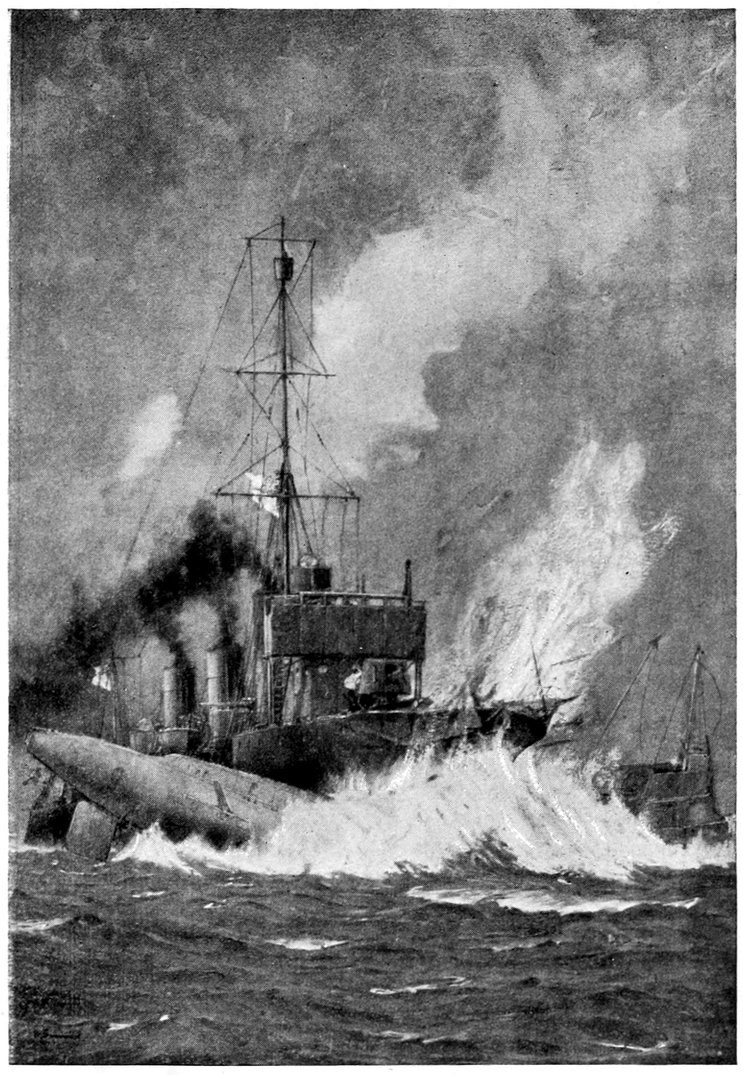
The Destroyer’s Short Way with the U-Boat
Sighted at a distance of several miles, a British destroyer found a U-boat in difficulties and ended them in the manner depicted.
Drawn by a Naval Officer
219The speed of a convoy is necessarily that of
the slowest ship, but sometimes bad steaming
plays ducks and drakes with the keeping of a
correct formation, on which so much depends.
Ships have an awkward way of falling behind,
necessitating their being shepherded like a
flock of sheep, and adding considerably to the
risks. The commander of a convoy needs a
sweet temper.
A merchantman was forming an involuntary
rearguard on her own account. She had fallen
behind, and in her isolated position was an
ideal target for any U-boat that might happen
220to be lying low by reason of the presence
of lynx-eyed destroyers with the main body.
One of the latter was detached to hasten up
the sluggard. Scarcely had she reached her
before one of the steamers in the van was
neatly torpedoed. Heading for the track of
the steel fish, the T.B.D. apparently cut across
the submarine. She quivered from stem to
stern with the force of the bump. The skipper
of a sister ship distinctly saw a periscope
sticking above the waves, and, coming up,
dropped a depth charge, which was followed
by an explosion and the appearance of
the U-boat astern. Both destroyers put their
helms right over, and opened fire. The fight
was ended by one of them charging the submersible
and literally chopping her in half.
Both sections kept afloat for a few seconds, then
disappeared in two mammoth whirlpools. It
was one of the cleanest cuts of the war, though
a United States cruiser managed to perform
a similar feat a few weeks later.
While escorting a convoy a look-out on the
U.S. destroyer Fanning noticed a periscope
sticking out of the water. Heading for the
221spot, a single depth charge was unloaded.
The U-boat came to the surface, and after a
short chase meekly surrendered. According
to the evidence of prisoners, the machinery
of the submarine was wrecked beyond repair.
The Germans referred to depth charges as
‘water-bombs.’ Frankly, they were not enamoured
of them. With that abnormal lack
of humour which no Briton can understand,
Commander Rose of the Kaiser’s Underseas
Navy explained that “their material effect is
only small”—witness the above samples—“but
the infernal din of their explosion”
had a great moral effect, “especially on an
inexperienced crew.”
CHAPTER XII Singeing the Sultan’s Beard
222
“There must be a beginning of any great matter, but the
continuing unto the end until it be thoroughly finished yields the
true glory.”—Sir Francis Drake.
To win the first Victoria Cross awarded
to a naval officer in the Great War,
to be the first submarine commander
to gain it in any war—these are no mean
distinctions. Primarily, of course, Lieutenant
Norman Douglas Holbrook, R.N., owed his
blue ribbon to “most conspicuous bravery,”
as the Gazette has it, but to this must be
added a particularly daring and unique exploit
that showed exceptional tactical and executive
skill.
The deed was not one of those lightning-stroke
affairs that lack premeditation and are
accomplished on the spur of the moment in
the heat of battle. The elements of conflict
were there, guns, ammunition, soldiers, and all
the stage scenery necessary to give a picturesque
and enthralling setting. The chief actor alone
223failed to appear in the picture. I would not
for the world attempt to minimize the superb
heroism of any holder of a much-coveted decoration.
Yet there is a marked difference
between this particular deed and all others
that had gone before. It was accomplished
in a place remote from other British battle
forces. The young officer neither carried a
wounded man on his back amid a storm of
bullets, his comrades looking on, nor with a
machine-gun held up a horde of Huns.
Harking back, it is interesting to recall
that the first person to win the V.C. was a
bluejacket—an above-salt-water sailor. Holbrook
belonged to the same splendid Service,
but to a section unborn when Charles Davis
Lucas flung overboard a live shell from H.M.S.
Hecla off Bomarsund in 1854. The commander
of B 11 gained his fourpennyworth of bronze
in a submarine below the sea. What Holbrook’s
meritorious action lacks in intensity
of swift drama is more than compensated by
the cool and calculated daring of the whole
proceeding.
Standing quietly in a sealed chamber breathing
224‘canned air’ for nine mortal hours, dodging
mines, torpedo-boats, and gunfire from forts,
requires a steady nerve and a concentration of
mind and purpose beyond what is called for
in open fighting. He accomplished what he
had to do, brought back his ship, fourteen
men and an officer, quite safely, and betrayed
an eager anxiety as to what his next task
might be.
It was not as though Holbrook had been
placed in command of a brand-new vessel of
modern type, replete with the latest improvements,
spacious, comfortable, and minus the
stuffiness so inseparably associated with earlier
craft. B 11 was one of the smallest, slowest,
and oldest submarines in the British Navy.
She had been launched in 1906, when Holbrook
was still a ‘snotty,’ which is the Service name
for midshipman. There was no question as
to the risks all on board knew they were about
to run. It was an adventure in the truest
sense of the word, without a single ‘dead cert.’
in it. Every man jack of them left letters
behind, “in case of accidents,” as one of the
brave fellows modestly put it, and he added,
225perhaps half wistfully, that the commander
was “a very cool hand.” The latter fact
needs no qualification; it is self-evident. For
one thing the Lieutenant had promised his
mother “to be careful” when he bade her
good-bye at Portsmouth. He fulfilled his
pledge, as is the habit of worthy sons of worthy
parents. Later on, when he gave her an
account of his deeds, Holbrook gently reminded
her of his vow in a subtle way. He signed his
letter, “Your affectionate and careful son.”
Which shows that a sense of humour is likewise
one of his traits.
Lieutenant Holbrook had been appointed
to H.M.S. Egmont at Malta for the command
of B 11 in December 1913. What he and his
submarine did in the interim of a year does
not concern us. The blue waters of the Mediterranean
hid them from the public gaze for
exactly twelve months. Then they suddenly
turned up in the Ægean Sea, hundreds of
miles from their base. The Angel of Peace
had retired sadly before the bustling entrance
of Mars. A combined British and French
squadron was gathered together in the neighbourhood
226of the entrance to the Dardanelles.
There was an idea that big ships and big guns
could smash their way through the Straits
and appear before Constantinople. Eminent
naval men said that the project was perfectly
feasible; others that it was an impossible task.
The ‘Ayes’ had it; the ‘Noes’ came into
their own a little later. The heavy fathers of
the Fleet had tuned up for the overture at
daybreak on the 3rd November, 1914. On
the 13th of the following month Holbrook
and his merry men started to pierce the Straits
via the underseas.
Wiseacres in the battleships, jealous of the
reputation of the giants, and secretly itching
to follow in the tracks of Admiral Sir J. Duckworth,
who had got through in 1807, before
battleships were quite so bulky and the Turks
so well prepared, called in superstition to justify
their views. The 13th was, and always had
been, unlucky. It was the height of foolishness
to tempt Providence with that date staring at
one from the calendar. Really, the lack of
wisdom in their superiors was beyond words!
The commander of the expedition was too
227eager to get on with the job to be deterred by
superstition, and too much occupied with practical
affairs to be concerned with old women’s
tales once the Dardanelles had been entered.
The Hellespont of ancient history is a bit of a
teaser to a navigation officer. It has all manner
of depths and shallows, widths and currents.
Mists frequently hang between the rocky heights
and the low hills of the landlocked waterway
like steam and smoke in a railway tunnel. To
these difficulties were added peril from mine,
floating and fixed, peril from the guns of forts
and land batteries, and peril from whatever
naval forces might be in the vicinity.
Holbrook’s main object was to torpedo
the Turkish battleship Messudiyeh. She was
guarding the mine-field in the roadstead of
Nagara, below the Narrows. Here the distance
between the banks is only some 1400 yards,
and the current often runs at the rapid rate
of four and a half knots. The Messudiyeh was
a rather curious specimen of naval architecture,
the combined product of British and Italian
labour. Launched at Blackwall forty years
before, she had been rebuilt to a great extent
228at Genoa in 1902. From the point of view of
armament she was by no means to be despised.
Although her two 9.2–in. breech-loaders were
being overhauled in England and had given
place to wooden replicas, she mounted twelve
6–in. quick-firers, and over two dozen smaller
weapons—a plentiful selection of guns for service
should B 11’s periscope be sighted. As a
matter of fact it was sighted, but not before
Holbrook had taken his observations and discharged
a torpedo, as we shall have occasion
to notice a little later.
The 10,000–ton battleship was perhaps the
least of the difficulties that confronted the
intrepid Lieutenant. When beset by so many
dangers comparison between one and another
is of little consequence. The ship was anchored,
and therefore presented as fine a target as a
submarine commander could wish. But before
she could be reached there was a gauntlet of
five rows of live mines to be run. It was no
good trying to ‘rush’ the Straits. For one
thing, the motors of B 11 could not propel her
more than 5½ knots an hour when submerged,
and only 11 knots on the surface, and for
229another, speed would have been a disadvantage
rather than a help. Barging into the nearest
horned canister is not good for the health of
a submarine, and Holbrook realized that he
must feel his way in the painful manner of a
blind man, with the difference that at intervals
he could use his periscope.
The fact that the Messudiyeh had been the
flagship of a British admiral previous to the
outbreak of war lent a sentimental interest
to the commander’s project. All submarine
officers are not compounded of crude blood
and iron, as popular belief has it. Holbrook
is a particularly human specimen of the species,
and has more than a strain of idealism in
his make-up. Rear-Admiral Limpus had been
engaged in reorganizing the Ottoman naval
service previous to the winning-over of the
Turks by the Germans. To be sure the serviceable
material at his disposal, so far as battleships
were concerned, was poor enough. These
numbered three in all, but three on the effective
list are better than none, and two Dreadnoughts
were under construction in England.
The last-mentioned are now members of the
230great family that goes under the generic name
of the Royal Navy.
Holbrook threaded his way through the
mines, as Nelson dodged the shoals at Copenhagen,
got within target-distance of his intended
victim, took his bearings, and discharged an
18–in. torpedo, the first to be fired by a B boat
since the commencement of the war.
Do not run away with the idea that it was
a one-sided affair—a game of naval cricket
with the British commander as bowler and
the batsman out of his wicket. The wash of
the periscope had been spotted by a keen-eyed
look-out on the Messudiyeh. Before Holbrook
knew the result of his aim, shells were falling
unpleasantly near, and not a few! The enemy
peppered the spot with a mighty weight of
metal, but B 11 was down and under when the
Turks got the correct range. Even then things
were precious uncomfortable, for the submarine
grounded on a shoal, with only about thirty
feet of water above her thin skin. It took some
little time, plus much bumping and scraping, to
get clear, but Holbrook never turned a hair.
Flurry is not in his dictionary. He gave an
231order or two, then waited. On the whole
B 11 behaved herself very well. She got into
deeper water, from which Holbrook took a look
round to ascertain the extent of the damage
done. After expressing his satisfaction, he
again descended.
During the whole voyage B 11 remained
submerged for nine of the longest hours that
the crew had ever experienced. The early
British submarines are cramped and stuffy,
with the minimum of accommodation and
the maximum of discomfort. At least the
crew could congratulate themselves on having
accomplished something, for there had been
a mighty reverberation a few seconds after
the torpedo had started on its travels. It
was horribly difficult to keep a straight course
on account of the current, but coxswains
and men proved themselves worthy of so
gallant a skipper.
What of the Messudiyeh? It was given
out by the Turkish authorities that she had
sunk at her anchorage off the Asiatic shore
“as the result of a leak,” and that part of the
ship was still above water. The communiqué
232has a refreshing touch of humour about it
not altogether characteristic of the general
run of similar announcements. If we may
accept the word of ‘a reliable source,’ the
veteran turned turtle in shallow water within
five minutes of having received Holbrook’s
compliments. Of the battleship’s crew, which
may have numbered 600 or more, the same
authority states that only twenty-three escaped.
These were got out by the dexterous manipulation
of axe and saw.
If Englishmen take their pleasures sadly,
they make war with a light heart. Shortly
after his return, Lieutenant Holbrook was
presented with a specially constructed Iron
Cross—a huge metal affair almost as big as his
head. Commander Bromley[29] performed the
mock ceremony on board H.M.S. Indefatigable,
to the immense amusement of the assembled
company.
Holbrook was rightly acclaimed the Hero of
the Service. Admiral Count Bettolo, voicing
the opinion of the countrymen of Columbus,
said that the achievement was a “magnificent
233feat which highly honours the British Navy
and shows the firm determination to succeed on
the part of the English sailors.” “The British
Navy,” he added, “wishes the world to know
it is capable of heroism and daring not inferior
to that of any other Navy. The organizer of
the raid has demonstrated that he possesses
the qualities to triumph at any cost.” In
Russia the exploit was hailed as one of enormous
military value, which the enthusiasm
of the moment doubtless suggested but subsequent
events did not justify. It certainly
robbed Turkey of the Messudiyeh. Most important
of all, Lieutenant Norman Douglas
Holbrook had blazed a trail.
Lieutenant Sydney T. Winn, second in
command of B 11, was appointed to the
Distinguished Service Order. No one was
more delighted to hear of this honour than
Lieutenant Holbrook. All the members of the
crew were granted the Distinguished Service
Medal.
The ill-fated Dardanelles Campaign, so rich
in deeds of daring and so poor in practical
results, introduced to the world at large two
234other submarine commanders, each of whom
won the V.C. in connexion with it.
Lieutenant-Commander Edward Courtney
Boyle, R.N., took E 14 beneath the enemy
mine-fields and suddenly appeared in the Sea of
Marmora on the 27th April, 1915. He was stalking
transports, the enemy’s favourite method
of conveying troops to Gallipoli because the
land communications consisted of a solitary
road. The submarine, a larger and more
powerful boat than B 11, with a displacement
of 810 tons, did not return to her base until
twenty-two days later. When she arrived it
was much to the astonishment of many officers
and men of the Allied Fleet, who had firmly
believed that she and her brave crew had gone
to Davy Jones’s locker.
During the interim E 14 had dodged mines,
navigated treacherous currents, kept out of
harm from hostile patrols, sunk a couple
of gunboats, wrecked two transports—one
crowded with 6000 troops—and poked her
inquisitive nose into the Bosphorus.
The first week spent in the Sea of Marmora
was terribly exciting. E 14 was hunted by
235all the light craft at the disposal of the Turks.
Gunboats, destroyers, and torpedo-boats took
part in the chase, without achieving the
slightest success. Their failure, combined
with shortage of coal, caused most of them
to be withdrawn from the service. Thenceforth
they assumed the more humble rôle of
convoys. This phase lasted a short time only.
After Boyle had sunk the large troopship already
mentioned, the Turkish soldiers refused to go
by sea, preferring to march for three days and
three nights rather than run the risk of meeting
the terrible submarine.
E 14 went into the Marmora on two subsequent
occasions. Altogether she spent no
fewer than seventy days there. On her last
visit she had to break through the net placed
across the Dardanelles by Nagara Point. As
this formidable obstacle was made of chain
and 3½-in. wire, it “required some breaking,”
to quote the words of the commanding officer.
Then Boyle’s first lieutenant developed typhoid,
and was ill for the remainder of the voyage, a
matter of over a fortnight. About fifty vessels,
including dhows laden with grain and other
236useful commodities, were sent to the bottom
by E 14, but—mark this—no non-combatant
ship was ever sunk before the crew had been
taken close inshore in their boats and had been
fed if they were hungry. Submarines can be
good Samaritans, despite German assertions to
the contrary. It should also be added that for
two days E 14, in conjunction with E 11,
shelled the reinforcing troops marching to
repel the Suvla Bay landing.
Boyle superbly earned and won the V.C.,
his colleagues, Lieutenant E. G. Stanley, R.N.,
and Acting-Lieutenant R. W. Lawrence, R.N.R.,
were awarded the Distinguished Service Cross,
and each member of the crew was given
the Distinguished Service Medal. One can
fully appreciate the statement of Admiral
de Robeck, that “it is impossible to do full
justice to this great achievement.” On the
occasion of E 14’s first penetration of the
Straits the King sent the gallant Commander
and his crew a telegram of congratulation.
Another E boat carried this process of anything
but peaceful penetration still farther.
Lieut.-Commander Martin Eric Nasmith, R.N.,
237not only took E 11 through the Dardanelles
and crossed the Sea of Marmora, but actually
succeeded in entering the Golden Horn, situated
no fewer than 170 miles from the entrance
to the Straits. At the quay adjoining the
arsenal he fired a torpedo, which “was heard
to explode.” Whether it hit a transport or
a lighter laden with firebricks lying near by
has not been ascertained with certainty. The
Turks and their Teutonic friends are none too
keen on telling the truth if it is to their disadvantage.
One informant had it that the
barge was blown to smithereens, and that
part of the débris was flung with such terrific
force against the German Levant steamer
Stambul that she was holed and had to be
beached. Another report stated that the
strong current deflected the torpedo, causing
it to blow up part of the jetty. All independent
observers were at least unanimous
as to the effect of the raid on the nerves of
the inhabitants of Constantinople. The people
were panic-stricken, and when the Turkish
guns opened fire on their invisible foe they
merely contributed to the ferment. So far
238as Nasmith was concerned, it was almost a
case of ‘much ado about nothing.’ E 11
escaped with no worse casualty than a jagged
wound in her periscope! Many of the Turks
thought that the Russian Black Sea Fleet
had broken through and was bombarding the
capital as a preliminary to the landing of troops.
Nasmith was merely singeing the Sultan’s
beard, as Drake had singed that of Philip of
Spain three centuries before.
Whether the torpedo in question struck
troopship, lighter, or jetty at Constantinople
does not much matter; the Commander’s
remaining torpedoes found their billets right
enough. Nasmith undoubtedly destroyed two
heavily laden transports, a large gunboat, an
ammunition ship, and three store ships, while
another vessel containing supplies was driven
ashore. As though this bag were not large
enough, he returned to torpedo a fourth
transport when his crew were congratulating
themselves that the most dangerous part of
the homeward voyage had been safely
negotiated. The ammunition ship blew up
with a terrific explosion. By her loss the
239enemy was deprived of thousands of charges,
a quantity of gun mountings, and a 6–in. gun.
Having sunk everything that could be sunk,
Nasmith returned to report.
The most unpleasant incident of a whole
chapter of exciting passages occurred in the
Sea of Marmora. The submarine ran foul of
the cable that anchored a mine. As other
canisters of death were in the vicinity, it was
much too perilous to attempt to go astern in
the hope that the steel rope would become
disentangled. The mine was the submarine’s
unwelcome guest for eleven miles. Every
officer and man knew it, and each realized
only too well exactly what would occur if one
of the horns of the beastly thing bumped
against the boat or struck some floating object.
What with submerged torpedo-tubes skilfully
rigged up by the Turks on shore, land batteries,
forts, floating and anchored mines, there was
sufficient food for reflection to say nothing of
the sinister appendage, and it is perhaps not
surprising that the company was serious. If
conversation was not animated this was not
entirely due to the somewhat sultry atmosphere
240of E 11. However, Nasmith got rid of the
mine at last, and when he emerged among the
battleships and cruisers at the other end of
the Dardanelles no King or Kaiser ever received
a warmer welcome.
This young hero of thirty-two years, who
had already attracted notice by his ready
resource when A 4 inadvertently sank while
exercising at Spithead in 1905, had certainly
earned his V.C., and the same may be
recorded of his brother-officers, Lieutenant
Guy D’Oyle-Hughes, R.N., and Acting-Lieutenant
Robert Brown, who were given
similar distinctions to those awarded to the
subordinate officers of E 14. Had Nelson
been alive we may be quite sure he would
have admitted the heroes of this chapter to
his gallant ‘band of brothers.’ Their exploits
are memorable, as Bacon says of another great
naval episode, “even beyond credit, and to
the Height of some Heroicall Fable.”
CHAPTER XIII On Certain Happenings in the Baltic
241
“British submarines may take to themselves the credit of
having damaged our trade and shipping in the Baltic.”—Captain
Persius.
Before our Russian allies abandoned
the sword and the ploughshare for
revolution and famine the Baltic was
alive with naval doings. Occasionally it even
became the scene of intense activity. When
the former subjects of the Little Father obtained
their liberty, and thereby shackled
themselves with a greater tyranny, the inland
sea of Northern Europe passed to the enemy.
The unweaned democracy of Russia sought
peace with paper and not with a sword, hugging
the delusion that a new heaven and a new
earth could be created with the aid of the
devil and the whirlwind. The Baltic became
a vast German lake. With the acumen of a
committee of Frankfort Jews, and in pursuance
of the much-vaunted Mittel-Europa
policy that was both commercial and political,
242the Fatherland at once projected a canal between
the Baltic and the Black Sea. This, of
course, would have rendered the Empire entirely
independent of the sea-water and long-distance
route from Odessa, the granary of the South.
Great Britain was Russia’s only ally in the
Baltic before she surrendered. Two or three
battle-cruisers from the neighbourhood of the
Orkneys would doubtless have been a desirable
addition to her naval strength, but there were
good and sufficient reasons why they were
withheld. What would have happened had
there been no revolution can only be surmised.
Certainly there was a time when the appearance
of large British vessels was not regarded
as altogether visionary. Sir John Jellicoe,
when Commander-in-Chief of the Grand Fleet,
stated that it would be difficult to go to the
Baltic, but not impossible, and he hoped the
day might come when the two Navies would
fight a common foe. That day never arrived.
Submarines alone represented the might and
majesty of the British Navy; and excellent
representatives they made. These underseas
craft, which threaded their way through the
243tortuous channels of the Cattegat and the
Sound, or were conveyed in sections from
Archangel by inland water transport, rendered
yeoman service. Some of the boats put in
three long years of hard and hazardous work
before the signature of the fatuous Brest-Litovsk
Treaty negatived further effort and
the ice-bound condition of the frozen waters
made escape impossible. Their tasks accomplished,
they were blown up by their own
crews. The battered plates of seven worthy
successors of the gallant little Revenge lie
buried deep in the Gulf of Finland. Not
every British victory is perpetuated to an
apathetic posterity by such visible tokens as
a sail-of-the-line or a gun at the United Service
Museum. There are other and grimmer relics
which will never meet the public eye.
Scouting for months in conditions bordering
on life in the Arctic, eternally on the prowl for
the High Sea Fleet, sinking men-of-war and
German cargoes, holding the enemy at bay
while the Russian Fleet secured safety in the
Gulf of Finland and the Huns sought to
corner it at Reval—these and other things
244must be put to the credit of British submarines
in the 160,000 odd square miles of waterway
which constitute the changeful northern sea.
Flat and sandy coast, rocky and precipitous
cliff, treacherous shallows, weather as fitful
as the temper of a fractious child, added to
the anxieties of the watchers. If ever there
existed a legitimate excuse for jumpy nerves,
surely it was here. Yet throughout their long
vigil officers and men upheld the worthy
tradition of the British sea game. Not one
enemy merchant ship was sunk without warning,
or before ample time had been afforded
every member of the crew to secure safety in
the boats. No shot was fired until they had
pulled away from the danger zone. If the
distance from land was great, the submarine
stood by until a neutral took charge of the
refugees. “That bloody wild beast that
slumbers in man” of whom Robert Louis
Stevenson makes mention was never allowed
to awake, though often enough there was
sufficient of insolence and bitter hate on the
part of the enemy to arouse it.
The case of the s.s. Nicomedia, of Hamburg,
245is typical of British methods in the Baltic.
This big steamer was laden with 6700 tons
of valuable ore for the hungry melting-pots
of Essen. E 19 hauled her up, gave her
complement ‘fain’its’ to gather their belongings
and stow them into the boats, patiently
waited for them to clear out, and then sent
the ship to the bottom with the assistance of
a dynamite cartridge. No cold-blooded-murder
tricks sullied the fair fame of the English-speaking
seafarers, who thus gave the lie
direct to the Teutonic assertion that submarine
warfare could only be carried on if it set at
nought the common decencies of humanity.
The sportsmanlike behaviour of the British
was entirely unappreciated by the enemy.
They deliberately falsified the accounts which
they sent broadcast throughout the world as
part of their propaganda work. For instance,
neutrals were informed that the commander
of a British submarine had blown up the
s.s. Germania in Swedish territorial waters by
placing a bomb in her hold. When sighted
off the Swedish coast the vessel was bound for
Stettin with a cargo of 2750 tons of concentrated
246iron ore. Shots were fired as a signal
to her captain to stop, and also to warn him
that he was making straight for a dangerous
sandbank. They were disregarded, with the
inevitable result that the Germania ran ashore.
Then, and not till then, the British boat
entered Swedish waters, intent only on saving
the crew and helping to salve the vessel. Not
a soul was found on board. After spending
an hour in a useless endeavour to move the
steamer, the ship’s papers and some fresh
meat were removed to the submarine. When
the British officers and men left the Germania
the engine-room was already partly submerged.
On the water reaching the boilers they quite
naturally blew up. No attempt was made to
destroy the vessel.
After the high seas had been swept of much
Teutonic baggage, the Baltic alone remained
to the German merchant service as a field for
possible operations with surface vessels. Westward
of the Skager-Rack the way was barred
by the British Grand Fleet; eastward, the
German High Sea Fleet felt more or less
confident of supremacy, though not positively
247sure. The Russian Baltic Fleet, consisting of
four pre-Dreadnought battleships, six armoured
cruisers, four protected cruisers, over a hundred
destroyers, twenty or more submarines,
and four Dreadnoughts in the making,[30] was
obviously numerically weaker than that of the
second naval Power in the world. It was not
in a position to undertake a vigorous offensive.
The strategy adopted, to quote Admiral Kanin,
was that of regarding the Baltic Fleet as
“a continuation of the extreme flank of the
Army.” Its task was “as far as possible to
support the movements of the army, protecting
it against envelopment by the German
Fleet.” The element of uncertainty, from the
enemy’s point of view, was introduced by
England as usual. Had the latter not declared
war, Germany could have swamped the Russian
Fleet and landed troops for the invasion of
Russia without fear of molestation from the
sea. As it was she had to keep both eyes
open, for on each flank she had maritime
enemies. It was scarcely likely that any of
Britain’s battleships would venture to render
248assistance, but what of her submarines? The
machines in which Germany placed so much
faith were not her secret. They represented
no new departure. Britain might attempt to
get a squadron or two through the narrow
passageway. When the devil gets among
tailors, complications are more than likely.
Evidence that the Germans anticipated inroads
from hostile underwater craft is afforded
by the vigilance of their guard at the doors
affording entry and exit. Three E boats
once tried to make the passage in company.
Two of them got through unscathed, though
trawlers were busily hunting for poachers at
the time. No. 3 got into difficulties with a
sweep slung between two of the afore-mentioned
watch-dogs. She ran smack into the hawser,
seeing nothing, got entangled, and gave her
commander furiously to think on ways and
means of possible extrication. By the ‘feel’
of it the officer knew approximately where the
cable had caught, so he went astern, cocked
the boat’s nose up a little, and attempted to
‘step’ over it. The manœuvre was executed
with celerity. Rapidity of movement is the
249soul of underwater warfare. Once let the
watchers above become aware that they had
a ‘bite,’ and an explosive charge would come
rattling down the line with the ease of a load
of bricks on an aerial railway. Then good-bye
to the Baltic and all deeps. They must have
felt the tug, but it was so momentary that
it is more than likely it was put down to
jetsam, and one does not waste good material
on lumps of sunken wreckage. The string of
death rasped along the keel of the submarine,
slipped over the bow, and freed itself. If
the commander of E — failed to mutter an
audible exclamation of thankfulness, he at
least breathed a little more freely as a sign of
relieved tension. He had lived an hour in less
than sixty seconds, and for aught I know added
a grey hair or two to his head as outward
and visible indications of inward perturbation.
On another occasion a squadron of the High
Sea Fleet left the sheltering shores of Kiel
Bay for a trip in the Baltic. Three additional
British submarines were detailed to pass
through the Sound. No patrol work this;
their orders were to attack. They left their
250base in company, intending to make the
passage of fifty miles together on the first
favourable night. During the voyage one of
the craft developed a minor malady, to which
submarines are subject. As she could not keep
up with the others, and instructions were not
to be disregarded, the lame duck had perforce
to limp her way alone. Her consorts aroused
no suspicion until they had actually entered
the Baltic. Then the enemy became aware of
their presence. While trawlers and torpedo-boats
hunted for them, four merchantmen in
line abreast, supported by warships, swept
the entrance to prevent others from following
suit.
The third submarine, restored to health,
arrived twenty-four hours late. The commander
fully appreciated what was happening.
He sought salvation in bluff. As the sweepers
were showing navigation lights he quite
reasonably argued that if he made a similar
display he might possibly get through. He
came to the surface, lamps were placed in
position, the operation began. For a time it
looked as if the artful little ruse would be
251successful. Then from out the surrounding
darkness a torpedo-boat was felt rather than
seen coming full tilt at the submarine. It
took the latter three minutes to submerge,
according to the log-book; the surface craft
occupied a little longer in reaching the spot.
Even then it was a mighty close shave. There
were not many feet of blue water between the
enemy’s keel and the submarine’s conning-tower.
After an interval the British commander
thought he would try his luck again, minus
lights. He waited his opportunity, riding
quietly on the waves in the meantime, and
keeping a pair of keen eyes to his night-glasses.
Presently a ship came along, seemingly intent
on navigating the difficult passage through
the Sound. The low-lying craft awakened
into life, and followed at a respectful distance.
There was just a chance that she would not
be detected. The blackness of the night prevented
the officer from being certain of the
nature of his pilot, otherwise he would scarcely
have used her as a screen. A mouse does not
creep behind a cat. Meantime she was making
252no great speed, and looked like some old tub
loaded to the Plimsoll mark with merchandise.
Then for no apparent reason the vessel
suddenly developed marked eccentricity, went
dead slow, then put on full speed, altered
course, and made in the direction of her
follower. The submarine again sought refuge
in the chilly and inhospitable waters, and her
company listened to the threshing of propellers
racing above. She returned home, “prior to
making a further attempt.” Thus the commander
in his official communication to My
Lords of the Admiralty.
In October 1914 it was announced that the
cruiser Prinz Adalbert had been sunk by two
shots from a submarine off Libau, with the
loss of most of her crew. According to a
Petrograd report, her demise “was effected
after much skilful manœuvring” by a British
submarine. The cruiser was not actually the
Prinz Adalbert, but a vessel of the same class.
The warship bearing that name fell a victim
to a British torpedo in the autumn of the
following year.[31]
253A light cruiser—name unknown—and a
torpedo-boat were taking an airing when a
certain British submarine of the celebrated
‘E’ class met them. The larger vessel was
torpedoed forward, apparently set on fire, and
showed signs of sinking by the head. As the
torpedo-boat sought to pounce on the enemy
the submarine passed under her stern and
struck the cruiser in or near the after-magazine.
There was a double explosion. The torpedo-boat
and her tornado of shell were dodged a
second time. Three minutes later the periscope
showed no cruiser.
On the 10th October, 1914, an attempt was
made by enemy submarines to sink the Russian
Admiral Makaroff, at the moment busily engaged
in searching a suspicious fishing-boat flying the
Dutch commercial flag. Several torpedoes were
fired, but missed, and the armoured cruiser
beat off the enemy. On the next day, however,
the German craft atoned for previous bad
marksmanship by sinking the Pallada, a sister
ship of the Admiral Makaroff, while she was
scouting in company with the Bayan. This
success was achieved through the ‘neutral
254flag’ trick. The submarine lay in waiting
behind a vessel displaying Dutch colours.
The ruse was discovered too late. Although
subjected to a heavy fire, the submarine got
a shot home which apparently exploded the
magazines. This vessel, armed with two 8–in.,
eight 6–in., and many smaller guns, had a
normal complement of 568 men. Not a soul
was saved. An interesting sequel to this
disaster was furnished by the announcement
of the Russian Naval Headquarters Staff that
during the course of their predatory operations
on the 10th and 11th a German submersible
had been sunk by the fire of the Bayan, a
second foundered through striking a mine,
and a third was put to flight by a torpedo-boat.
Admiral von Essen, Commander-in-Chief
of the Russian Baltic Fleet, told the
Tsar that twenty unsuccessful submarine
attacks had been made within two months
previous to the sinking of the Pallada.
Early in 1915 the German cruiser Gazelle
was attacked off the Danish coast by a submarine
whose nationality was not disclosed,
although rumour had it that she was Russian,
255but commanded by a British officer. Despite
a big hole in her side made by the explosion,
the cruiser was able to keep afloat and reach
Sassnitz with the assistance of a ferry steamer.
As a withering fire was kept up by the enemy,
and floating mines were flung out indiscriminately
as a further means of protection, a second
shot was impracticable.
A lonely Russian submarine boldly attacked
an enemy squadron of ten battleships and
a swarm of torpedo-boats in the following
summer. One evening, when far out in the
Baltic, the commander picked up dense black
clouds of smoke on the horizon. Then the
funnels of warships and their massive hulls
rose out of the sea. They were proceeding
in two columns, the smaller vessels on the
flanks of the larger ones.
An hour or more passed before the squadron
was sufficiently near for action. As the vessels
approached, the commander concluded that
his best position would be on the port side of
the oncoming ships, between the enemy and
the light. He raised his periscope, and believing
he had ample time to change his position
256before the torpedo-boat in the van of the right
column came abreast of him, proceeded to
carry out the manœuvre. The submarine rose
a matter of fifteen feet to bring her periscope
again into use. The ‘eye’ revealed the distance
between her and the first of the oncoming
battleships as certainly not more than
sixty yards. The officer fired a torpedo,
dived immediately, and struck the ram of
the object at which he had aimed. As no
German battleship draws less than twenty-six
feet of water, the boat had evidently not
submerged sufficiently rapidly.
Everybody on board firmly believed that
their craft would founder. Only those who
have been in a similar occurrence or a railway
collision can appreciate the appalling suddenness
of such a crash. The electric light bulbs
burst, the boat assumed a list to starboard,
something in the superstructure snapped, water
came in. Apparently the engines had sustained
no damage from the shock, for they continued
to work without any appreciable loss of speed.
The boat descended seventy-five feet. Then the
sound of a great tumult penetrated her steel
257plates. The commander afterward declared
that when he heard the explosion he was
perfectly convinced that the boat in her
damaged state could not withstand the pressure
of the water. He tried to reach the
surface several times, but on each occasion
was compelled to descend because the thud
of screws above told only too plainly that
the enemy vessels were still in the same area,
some doubtless assisting the wounded battleship,
others zigzagging about in the hope
that the assailant might be made to pay the
full penalty. When the officer tried to use
the periscope he found it to be irretrievably
damaged, and about as useless as a broken
cowl on a chimney-stack. It revealed a blank.
At 11.30 the commander, hearing nothing to
suggest the presence of the enemy, rose to the
surface after having been below four hours.
The submarine reached port without further
incident, and was docked for repairs. To this
day the commander does not know whether the
vessel he aimed at was put hors de combat.
Late in June 1915 a number of enemy warships
bombarded Windau with 9.4–in. guns,
258and also tried to effect a descent on the
coast with a view to co-operating with the
German army in Courland. The invasion project
was entirely unsuccessful, and the naval forces
were compelled to retire. The defence seems
mainly to have been the work of torpedo-boats;
no mention was made on either side
of the presence of submarines. A similar
attempt made three weeks before had robbed
the Russians of the Yenissei, which fell a victim
to a U-boat. According to reports furnished
by commanders of Russian submarines, three
of the enemy vessels were sunk or damaged
by mines previously dropped by the wrecked
vessel.
Early in the following month Russian naval
forces came across two enemy light cruisers
and destroyers on outpost duty between Gothland
and Windau. On this occasion the tables
were turned, and the Germans lost a mine-layer.
The Albatross, the ship in question,
was so severely handled that she ran aground
near Oestergarn, and became a total wreck,
her consort, the Augsburg, managing to escape
in the fog. While the Russian squadron continued
259its course northward, two cruisers,
four destroyers, and a flotilla of U-boats
joined battle, but speedily retreated after
the armoured cruiser Roon had been badly
damaged. On being reinforced by a battle
squadron, another attempt was made against
the Russian vessels, including a spirited submarine
attack on the Rurik. The latter was
saved by a destroyer, which was reported to
have sunk one of the hostile underwater craft.
The 2nd July was a disastrous day for Germany
in the Baltic. In addition to the Albatross
she lost a battleship of the Pommern type at
the hands of Commander Max K. Horton.[32]
On the 30th, E 1 sank a large transport, despite
a determined effort on the part of the latter
to run down the attacking party.
The next happening of importance from the
point of view of the submarine war was a
dramatic series of actions at the entrance of
the Gulf of Riga in the succeeding August.
These were carried out with the object of
assisting Hindenburg’s land offensive in the
direction of the great seaport of Riga, whose
260fall would open the road to Petrograd. The
weather, mostly calm and foggy, was entirely
favourable to the enemy, who slipped past
the patrols and were able to sweep up many
mines that barred further progress. In this
dangerous operation it would have been
nothing short of miraculous had the enemy
escaped scot-free, and one or two vessels were
destroyed. The Russian warships put up an
excellent defence, with the result that the
attempt to capture the old city of the Merchant-Venturers
completely failed and the Gulf was
evacuated.
Again British submarines were to the fore.
Commander Noel F. Laurence in E 1 torpedoed
the Dreadnought cruiser Moltke in thick
weather on the 19th. This great vessel of
23,000 tons, a sister ship of the more romantic
Goeben, mounting ten 11–in. guns, was believed
to have taken part in the infamous raid on
Scarborough. Although the Moltke did not
sink, she was sufficiently damaged to be
placed temporarily out of commission, thereby
easing the situation for a time by denuding
Germany of a very formidable fighting machine.
261Laurence, whose boat had been the first British
submarine to penetrate the Baltic, narrowly
escaped having E 1 rammed on this occasion.
A torpedo-boat missed her by a few feet only.
The Tsar acknowledged the officer’s services
by decorating him with the St George’s Cross
of the Fourth Class.
In this month of August 1915, so big with
events in the Baltic, the enemy committed a
flagrant breach of international law by firing
on the British submarine E 13 while she was
ashore in Danish territorial waters. The outrage
was intensified by the attacking torpedo-boat
firing shrapnel and bringing machine-guns
to bear on the members of the crew struggling
in the water.
E 13, in charge of Lieutenant-Commander
Layton, grounded on the island of Saltholm,
and was given the usual twenty-four hours’
grace to get off. Long before the time-limit
had expired a German torpedo-boat let off a
torpedo at a range of about 300 yards, and
opened fire with all her other available weapons.
The torpedo exploded on hitting the bottom,
close to E 13. Within a few seconds the submarine
262was a mass of flame. Unable to offer
any defence, the officer ordered the crew to
abandon the ship. Had it not been for the
intervention of a Danish man-of-war, which
lowered her boats and steamed between the
attacker and the attacked, probably not a
soul would have been saved.
Fishermen who witnessed the tragedy avowed
they had never seen any bravery to equal
that of the helpless crew. When E 13 was
refloated by the Danish authorities the hull
was found to be riddled with shells, but her
colours were still on the charred staff. Fifteen
bluejackets lost their lives in an attack which
Sweden’s leading newspaper characterized as
“wilful murder.”
Acting under the orders of the Russian
Commander-in-Chief, the British boats in the
Baltic carried on as before. They rendered
valuable support to the Allies by cutting off
supplies of timber, ore, and coal consigned to
the Fatherland, and sinking transports and
merchantmen whenever bigger prey was undiscoverable.
“The capture of an enemy’s
merchant ships,” as Mr David Hannay has so
263well said, “is the maritime equivalent for the
occupation of territory.” This active warfare
was carried out despite vigorous search on the
part of Zeppelins and seaplanes.
E — was treated with three bombs from an
enemy aircraft. Then the latter, apparently
not satisfied with the result, dropped seven
more. Sixty minutes later the submarine
came up to have a look round, and was obliged
to retreat hurriedly on account of a biplane
coming toward her at great speed. Five bombs
followed her passage below. After a lapse of
forty-five minutes E — again rose to the
surface. Subsequent events are best related
by reference to the commander’s log:
Decided to rise and get the gun into action. Got
under way on a north course at 10 knots with the upper
deck awash. The biplane was sighted on the starboard
bow at 6.20 p.m., and we opened fire at 3000 yards.
The biplane immediately sheered off, and got out of
range after the eighth round, and then kept three miles
astern of us. I decided to run north till dark or till the
aeroplane retired, and then to return under water to
—— position. At 7.30 we lost sight of the aeroplane,
and at 8.30 decided to turn and dive south. Just then
the aeroplane was sighted. Dived. Heard nine distant
explosions. Decided to remain down till dark.
264For a month business was bad in the ‘big
event’ line, but things brightened in October,
although E 19, sighting a German cruiser and
two escorts outside Danish territorial waters
off Klintholm Moen, had rather an unpleasant
ten minutes in trying to hit one of them. The
large warship opened fire with great promptitude,
while the smaller fry cruised about
trailing high explosive charges. E 19 dodged,
got in a neat shot at one of the torpedo-boats,
and was rewarded by the knowledge that she
sank.
On the 23rd October the cruiser Prinz Adalbert,
although escorted by a couple of destroyers,
one on each bow, was sent to the bottom by a
British submarine near Libau. Regarding the
manner of her death, the commander of the
boat which wrought her destruction has this
to say:
Fired bow tube at enemy’s fore-bridge. Observed very
vivid flash of explosion along water-line at point of aim.
This was immediately followed by very large concussion,
and entire ship was immediately hidden in huge columns
of thick grey smoke, fore magazine having evidently
been exploded by torpedo.
For some unknown reason a newspaper
265correspondent’s account of the loss of this ship
was allowed to be sent by the German official
wireless to New York. The writer asserted
that the affair took place in hazy weather—“ideal
conditions for an attack,” according to
the British commander—and that the vessel
was struck by two torpedoes almost simultaneously.
According to him the Prinz Adalbert
went down “immediately, like a piece of
iron.” How the following paragraph came to
be passed by the censor is a greater mystery:
“The enemy submarines in the Baltic offer a
difficult problem. The Admiralty is confronted
with the practically impossible task of keeping
them out. The Admiralty can mine or set
barrier nets in the Sound between Denmark
and Sweden only up to the three-mile limit,
where the neutral waters of the two countries
begin. The problem is causing the Admiralty
serious thought.”
The range was some 1300 yards, and the
“very large concussion” so great that it upset
the working of the torpedo mechanism of the
submarine and necessitated the craft’s burying
herself in deep water to avoid injury from the
266great masses of débris that were falling over a
wide area. The Prinz Adalbert was not wrecked,
but annihilated.
The light cruiser Undine was dispatched by
two torpedoes in three minutes, while convoying
the steam ferry Preussen from Trelleborg
to Sassnitz on the 7th November, 1915. The
first missile missed, and merely put a couple
of attendant torpedo-boats on the qui vive.
In attempting to ram the assailant, one of
them uncovered her charge, with the result
that the second weapon struck the Undine
full amidships. The underwater craft, uninjured
by the withering fire of the disconcerted
cruiser, ducked and was seen no more.
As a neutral captain remarked, “the submarines
pop up everywhere, and disappear
again with an alertness which only an intimate
knowledge of the waters would allow. Several
times they have been seen in close proximity
to the mine-field, but they seem to be as much
at home as in the North Sea.” A little later
the Preussen played into the enemy’s hands by
ramming and sinking her escorting torpedo-boat,
of whose company only five were picked up.
267The Flying Dutchman of the Great War was
surely the German light cruiser Bremen, completed
in 1904 at the port whose name she
bore. This little 3200–ton warship, mounting
ten 4.1–in. guns and fourteen smaller weapons,
was reported from time to time as having been
seen in the Atlantic, the North Sea, and the
Pacific. Then she appeared—and disappeared—in
the Baltic. On the 18th December, 1915,
Berlin admitted her loss, together with a
torpedo-boat escorting her. This double event
of the previous day was due to a British
submarine.
In May 1916, when the eastern and southern
parts of the Baltic were once more free from
ice, British submarines lost no time in renewing
their activity, to the utter discomfiture of
traders who did not mind running big risks
for big money. A German convoy was also
intercepted off the coast of Sweden by Russian
torpedo-boats, destroyers, and submarines. The
squadron sank the auxiliary cruiser König
von Sachsen, and set fire to another auxiliary
ship, the Hermann. The latter was afterward
blown up by her crew.
268The raid in the Gulf of Finland in November
1916, again under cover of a fog, showed the
efficiency of the Russian Baltic Fleet to be still
unimpaired, but the Revolution achieved what
the enemy failed to do. “Confusion and
mistrust prevailed”: in these words Admiral
Koltchak summed up the whole unhappy
situation. In October 1917 the German High
Sea Fleet held the mastery of the Gulf of Riga.
The most belligerent representative of the
London Press went frantic because the enemy’s
object had been carried out “without any
interference from the British Fleet, which, as
we are accustomed to say, commands the
sea.” Presumably it would have had battleships
and vessels of Sir David Beatty’s celebrated
‘Cat Class’ forging ahead through the
entrance, disregarding the imminent likelihood
of their being sent to the bottom by U-boats
and mine-fields. The difficulties surmounted by
underwater craft in penetrating the Baltic,
to which I have already drawn attention, is
surely sufficient answer to the most amateur
of amateur strategists, who, indeed, were somewhat
roughly handled by Sir Eric Geddes in
269the House of Commons. What it was possible
for the British Navy to do it achieved.
On the 23rd it was announced that a British
submarine had fired two torpedoes at an enemy
Dreadnought of the Markgraf class mounting
ten 12–in. guns, with what result was unknown.
The Germans made it somewhat too hot with
shells from ships and bombs from seaplanes
for her commanding officer to wait and see.
She certainly succeeded in blowing up a big
transport.
Opportunity is four-fifths of the battle where
underwater craft are concerned. As the war
progressed and Britain learned how to tackle
those of the enemy, so the Germans gained
experience in dodging our boats. Three Dreadnoughts,
a light cruiser, and several torpedo craft
hailing from Kiel were chased for four
hours by one of our submarines. Every ounce
of energy was got out of the motors, but
never once did she succeed in getting closer
than eight miles. A decent-sized gun would
have reached readily enough, but no torpedo
has ever achieved so distant a range. The
squadron covered a wide area of sea, frequently
270changed course, and manœuvred in such a
way that the British skipper candidly confessed
that his German rival “made use of
very confusing and successful anti-submarine
tactics.”
This chapter cannot be other than a faint
and incomplete outline of happenings in the
Baltic between 1914 and 1917. The British
campaign ended in April 1918. When the
German naval forces and transports approached
Hangö, South-west Finland, four ‘E’ and
three ‘C’ boats were taken outside the harbour
of Helsingfors and blown up. The crews made
their way, not without difficulty and danger,
to Petrograd. “Whether it be wise in men
to do such actions or no,” said Sir William
Temple over two centuries ago, “I am sure it
is so in States to honour them.”
Russia had gone into ‘Committee.’ The
Baltic had ceased to be a battle area. A
chapter in which the names of Horton,
Laurence, Goodhart, and Crombie afforded
something more than a tinge of romance had
been added to the history books. To quote
Admiral Kanin, successor to the hard-working
271and reforming von Essen, Russia had been
“helped extraordinarily by the English submarines.”
The boats were “magnificent,” the
officers “fine young fellows.” Their bearing
was “wonderful—and their coolness!”
CHAPTER XIV Blockading the Blockade
272
“This blockade is a complete avowal of Germany’s weakness.”—Lord
Robert Cecil.
Shelling an enemy is merely a scientific
way of throwing stones. When a schoolboy
in God’s open air is not quite sure of
the nature of an object, his primitive ancestors
prompt him to fling something at it; middle
age, having the full advantage of civilization,
pokes it with a stick.
In naval warfare ‘throwing things’ is perfectly
legitimate cricket, but mining, which is
invisible poking, is scarcely recognized as a
worthy substitute for football. Two or three
years passed before the last mine was swept
from the waters that formed the theatre of
the maritime drama of the Russo-Japanese
War; it may take thrice that time to clear
up the aftermath of the World Conflict. The
prospect is not pleasant to contemplate. The
belligerents sowed these murderous canisters
in many latitudes. Germany, to her lasting
273shame, did not always provide the necessary
apparatus to render them innocuous when they
broke loose, or for those of the unanchored
variety to become worthless “one hour at
most after the person who laid them shall have
lost control over them,” according to Article 1
of the Eighth Convention of The Hague Conference
of 1907. Her favourite trick after a
naval engagement was to fling floating mines
overboard in the hope that the pursuing
fleet would blunder into them. Many thousands
were scattered along the trade routes. Let me
hasten to add that in the use of mines Germany
was well in advance of every other belligerent
in 1914. It was weeks before the British Navy
took advantage of what most salt-water sailors
regard as a device associated with the dirty,
low-down trick of hitting below the belt.
Mines, like their cousin the depth charge,
played a very important part in combating
the submarine menace. As Germany showed a
partiality for them, we did our best to oblige
her. The most extensive mine-field ever planted
was sown by Great Britain. It stretched from
the Orkney Islands to the fringe of the territorial
274waters of Norway, and covered an area
of not less than 22,000 square miles. Access
to the Atlantic, rigidly guarded by the naval
police of the Patrol, was provided on the
Scottish side. Other British mine-fields existed
at the farther end of the North Sea, guarded
by a hundred or more surface craft, and in
the neighbourhood of Flanders, Heligoland,
and Denmark. The object of these vast prohibited
areas was to prevent U-boats from
gaining easy access to the great ocean routes.
Germany early laid a mine-field inside the
Skager-Rack to prevent British submarines from
entering the Baltic—which it did not do—and
afterward violated international law by taking
similar steps in the Cattegat. While the latter
operation was proceeding, certain of our naval
forces came across a batch of enemy mine-layers
at their nefarious task, sank ten of them,
and rescued their crews. The men ought to
have been ordered to walk the plank, pour
encourager les autres, as Voltaire said of Admiral
Byng’s execution.
Britain’s bold bid to foil the U-boats was
undertaken, in the words of the official explanation,
275“in view of the unrestricted warfare
carried on by Germany at sea by means of
mines and submarines, not only against the
Allied Powers, but also against neutral shipping,”
and because merchant ships were
“constantly sunk without regard to the ultimate
safety of their crews.” The big northern
mine-field proved very useful. That was why
the enemy immediately started a loud-mouthed
campaign in neutral countries in the hope of
inciting their Governments to protest against
an effective method of warfare decidedly prejudicial
to the German cause.
A word or two about the surface barrage
maintained across the Channel. Every day and
night, ceaselessly and relentlessly, in fair weather
and foul, over a hundred armed patrolling
craft of various sorts and sizes kept sentinel
at the great southern gateway, and enabled
troops and munitions to cross the drawbridge
from England to France. It was not so difficult
a task during the day as at night. When
darkness fell the guard burned flares that made
the passage of a submarine travelling on the
surface an exceedingly dangerous undertaking.
276If a U-boat tried the underwater route, there
were other means of obstruction quite as deadly
as the methods of the fire-breathing trawlers.
There is no truth in the yarn that a steel net
stretched across the Straits of Dover, thereby
guaranteeing with more or less certainty the
immunity of transports from attack by underwater
vessels.
The fisherman’s device for catching members
of the finny tribe was, of course, applied
to submarines. Long nets with meshes ten
or fifteen feet square proved of great service
when the war was young. Dropped in the
course of an approaching U-boat, the probability
was that she would poke her nose into
it and find extreme difficulty in getting out.
Subsequently cutters were fitted to the enemy’s
craft, but nothing could eliminate the movement
of the net, which was supported on the
surface by small buoys or planks. Moored
nets with mines attached boded no good to
the submarine that was unfortunate enough to
encounter the obstacle.
An enemy commander found that his boat
was towing a red buoy, and shortly afterward
277that she was entangled in wire-netting. “For
an hour and a half,” he relates, “the netting
carried us with it, and although I made every
effort to get clear of it, rising and then sinking
with the object of getting to the bottom of
the netting, it was all in vain, for we were
always dragged back, sometimes to the right
and sometimes to the left.” By increasing
the weight of water in the tanks the U-boat
managed to tear the netting. She remained
under water for eighteen hours, came up and
found patrol craft in the vicinity, and was
compelled to descend for another six hours.
After a further look round, the officer adds, “I
remained submerged for two hours, then slowly
turned outward, and at a distance of some fifty
yards from the leading enemy craft passed toward
the open sea. At nine o’clock in the evening
we were able to rise to the surface in safety.”
The arming of traders gave the Central
Powers furiously to think, especially as the
policy was a perfectly natural sequel to their
own misdoings. Details of the calibre of guns
mounted by ships of the British Mercantile
Marine were withheld from Parliament as “not
278in the public interest.” The French Minister
of Marine was more communicative. At the
end of 1917 every French merchantman was
armed with two 3.7–in. guns. International
law held that trading vessels during war-time
must be stopped and searched before further
action could be taken. Exceptional circumstances
alone justified the sinking even of an
enemy vessel, the usual practice being to
conduct the captive to port, the final disposal
being settled in the Prize Court. Neutral
ships could in no circumstances be destroyed.
Germany’s difficulty was that it was next to
impossible for a submarine to follow this
programme, which she herself had recognized
previous to the advent of the U-boat. While
the process of search was going on, a necessarily
slow and tedious task, ten to one a
patrol boat would appear on the scene and
show an untoward amount of inquisitiveness.
The natural development of blockade by submarine
was via the line of least resistance.
Rules and rights, obligations and understandings
must go by the board. The word illegitimate
was wiped out. From naval virtue to
279piracy is but a step; the enemy took it. She
would sink at sight.
As a direct consequence of the arming of
merchantmen there was an increase in the
number of submerged attacks and a decrease
in the use of the gun on the part of the submarine.
This was entirely to the good, because
it necessitated more frequent visits to the base
to replenish depleted magazines.
Elsewhere I have dealt at length with the
wonderful way in which the men of the
Merchant Service settled down to the altered
condition of affairs.[33] The crews showed as
much faith in their solitary weapon mounted
in the stern as a gun-layer of the Queen Elizabeth
believed in the giant organs of destruction
housed in the fore turret. They achieved
wonders with the little spitfires, though sometimes
their confidence was misplaced. Uncertainty
is the only certainty in war.
Lest I should be accused of being a devotee
of mere drum and trumpet history, let me relate
the story of a failure. At a few minutes to
2803 a.m., in squally and heavy weather, the
captain of a merchantman made out the form
of a U-boat right ahead. His attempt to ram
missed by a few feet. Putting the helm hard
over to bring the submarine astern, he ordered
the gun to be brought into action. The first
shot looked as though it had struck the evil
thing. But the bursting shell failed to check
the enemy, despite what the master called “a
big, bright flare-up.” A little later he observed
what he presumed to be the wake of a torpedo,
followed by the appearance of the U-boat
travelling parallel to the steamer. Again the
gun was fired, and again achieved nothing.
As the darkness made range-finding exceedingly
difficult, and the flash of the cordite betrayed
the position of the steamer, the captain gave
orders to cease fire, and sent every available
man to the stokehold. What the trusted gun
had failed to do the engines might achieve.
He then told the steward to get coffee. What
a delightful human touch! It reminds one of
Nelson writing a prayer when within sight of
the Combined Fleet, and of Sturdee shaving
before giving battle to von Spee.
281At 6.20 a.m. a torpedo struck the port side
of the steamer, the boilers burst, and ship and
gun disappeared in a welter of steam, smoke,
and flame. The survivors were picked up a
few hours later. But don’t think for one
moment that they blamed their armament.
They attributed their failure to unfortunate
weather conditions.
Now for a more pleasing picture. A U-boat
tried to torpedo the Nyanza, an American
steamer with an Imperial name, at a range of
approximately 1000 yards. By quick manipulation
of the helm the tin fish was skilfully
dodged, and the ship’s gun opened fire. The
submarine thereupon brought two guns to
bear on the vessel. The running fight continued
for two and a half hours, and was ended
by four shots from the Nyanza. The enemy
visibly staggered, slowly heeled over, and is
now gathering rust and barnacles on the ocean
floor.
The first of all anti-submarine appliances is
the human eye. “It is seven to three on the
ship if the submarine is sighted, and four to
one against it if it is not,” says Sir Eric Geddes.
282In every British merchant vessel of 2500 gross
tonnage and upward, four men possessing the
special Board of Trade certificate as to eyesight
were required to act as look-outs at
the masthead or elsewhere in areas in which
U-boats were likely to be encountered. They
kept watch in turn for not more than two hours,
and although not necessarily additional members
of the crew, were specially engaged and
received extra pay.
The necessity for keeping a keen look-out
was early recognized. The Admiralty offered
a reward not exceeding £1000 for information
leading to the capture or destruction of an
enemy vessel, including a mine-layer or submarine,
and a sum up to £200 for information
leading to the craft being sighted and
chased. Prominent shipowners and other patriotic
citizens aided and abetted these rewards by
offering various sums to the captain and crew
of the first British merchantman who sank a
U-boat.
In due course the idea of ‘camouflage’ was
borrowed from the Army. In military campaigns
the ingenious daubing of guns with
283paint that harmonized with the colours of the
surrounding scenery became, if not high art,
a most skilful artistic device. It was found
impossible to make ships invisible at sea, but
much was done to render them considerably
less conspicuous. The constantly changing light
defeated every plan that had invisibility for its
aim.
While it is a wise thing to consume one’s
own smoke, steamers are unable to do so.
Smoke is an excellent tell-tale. On the other
hand it was not always a friend of the enemy.
Destroyers in battle often put up a smoke-screen
sufficiently dense to cover battleships
and cruisers—it was a marked device of the
German fleet at Jutland—and many a ‘black
gang’ in the stokehold have saved their ship
by its means. Boxes filled with smoke-making
powder that burnt slowly and gave off black
clouds when flung in the sea have enabled
many a vessel to escape behind a dense pall.
They played their part in the daring raids
on Ostend and Zeebrugge. Special smoke-funnels
for use on board were also introduced
with success. The Compagnie Transatlantique
284liner Le Gard escaped from two U-boats by
means of this system.
On those rare occasions when an unsuspecting
U-boat popped up under the very nose
of a patrol boat the lance-bomb proved a
thoroughly efficient weapon. It consisted of
a 14–lb. bomb that exploded on contact, placed
on the end of a shaft some 6 feet in length.
An expert thrower could hurl this naval hand-grenade
quite a fair distance and with splendid
precision. A destroyer or chaser towing explosive
charges at breakneck speed was a sure
and certain harbinger of death should a
marauder happen to be in the way.
Armed yachts and fast motor-boats displayed
their sea-keeping qualities as never
before, and to these were added capacities as
auxiliary fighting vessels. One of the former
picked up an S O S signal. The sender proved
to be a trader, and at no great distance from
her was a periscope. The enemy was just a
little too late in getting under, for the ‘eye’
had scarcely disappeared when the yacht cut
right across her back. A couple of depth
charges were thrown out to complete the
285business, and the yacht was swung round to
cross the spot again after the explosion had subsided,
when a peculiar disturbance was noticed
in another direction. A third depth charge
added considerably to the turmoil. As the
sailors watched a human form came to the
surface. The ‘peculiar disturbance’ was doubtless
the death-rattle of the U-boat, and
as she broke in halves the solitary survivor
was flung up. He did not live to relate his
terrible experience.
The celebrated submarine-chasers, while they
varied in design, were usually stubby craft
mounting a remarkably serviceable quick-firer
on a high forecastle and carrying a liberal
supply of ‘pills’ in the stern. As the range
of the former was about three and a half miles,
and the engines were capable of attaining a speed
of thirty or more knots an hour in calm weather,
a submarine was at considerable disadvantage
unless she managed to deliver the first blow.
Should a U-boat consider it worth while to risk
a fight on the surface or attempt to torpedo
the ‘weasel’ from below, the speed of the
chaser was obviously her greatest asset. Italian
286chasers, by the way, resembled small submarines,
minus the conning-tower; those of France were
very similar to our own. When the United
States entered the war one of President Wilson’s
first measures was to order the construction of
a large number of these vessels.
Many of the motor launches in the Service
were commanded by former amateur yachtsmen,
who soon became hardy seafarers. Pluck,
energy, and resource characterized their hazardous
work. “Day after day, year after year,”
as a senior naval officer reports, “they have
kept the sea in the worst weather when
other craft have had to run for shelter.”
One story must suffice as typical of many
others.
Three motor launches of the Auxiliary Patrol
were forging ahead one morning when a look-out
saw certain movements known as ‘white
feathers,’ sure indications of the presence of
a U-boat. The Germans led them many miles
afield in their effort to escape. The launches
hung on, and gradually worked themselves into
a position which cornered the submersible.
Overboard went several depth charges, followed
287by convulsions and the end of the ‘spasm’—naval
for submarine chase.
Several ingenious inventions having sound
as their basis were introduced. Of these the
microphone, enabling the listener to detect the
rhythm of submarine motors when submerged,
is undoubtedly the most important. The télémétriste
and the hydrophone, somewhat similar
contrivances, were fitted on certain ships of the
French Navy.
The convoy system of gathering together a
group of merchantmen and conducting them
through the danger zone was merely the revival
of a venerable institution. Its modern application
met with considerably greater success
than was often evident in the past. The First
Dutch War of 1652–4, for instance, consisted
very largely, so far as England was concerned,
of attacks on convoys. The necessity for protecting
them was responsible for four of the seven
battles fought.
Beginning in a comparatively small way,
the idea of shepherding merchant shipping
was gradually enlarged until few vessels sailed
overseas unattended. The system was extraordinarily
288successful. Before it was introduced
nearly 10 per cent. of Britain’s food
ships were sent to the bottom by an enemy
bent on starving England into submission.
When the vessels were assembled and protected
only 1 per cent. was lost, and 26,000,000
tons of foodstuffs were brought over from
different parts of the world, in addition to
35,000,000 tons of munitions of various kinds.
The whole of the Argentine wheat crop was
transported to Great Britain, France, and Italy
in 307 ships, of which only one was lost through
enemy action.
The celebrated ‘Q’ ships are mystery ships
no longer. The idea of these decoy vessels
was obviously suggested by the raider Möwe,
which resembled a tramp and was really a
powerfully armed fighting unit of the German
Navy, as many a captain of the Mercantile
Marine found to his cost. Officered and manned
by volunteers, the avowal of Sir Eric Geddes
that the crews were made up of “the very
bravest that our sea service can produce” was
more than a mere figure of speech. No fewer
than eight of their commanders won the V.C.
289Some of the Q class were sailing ships,
others looked like colliers or aged cargo boats;
all resembled slow-going, nondescript tubs likely
to attract the fond attention of the Germans.
When a submarine appeared and called upon
the captain to surrender, a special ‘panic party’
would abandon ship in a terrible state of consternation.
They showed beyond doubt that
the U-boat campaign had put the fear of the
Hun in their hearts. Sometimes the poor fools
of Englishmen were not given an opportunity
to get away. Fire was opened on the innocent
babe without palaver. The panic party would
then go frantic with terror, try to launch the
boats, occasionally upsetting one in their haste
to get away, or leaving it dangling like a skeleton
on a gibbet. Not until the submersible popped
up alongside or presented a ‘dead certain’
target was the true nature of the vessel revealed.
Sometimes the ship was torpedoed, shelled, set
on fire, and sunk almost to the water’s edge
before the captain deemed that the psychological
moment had arrived. Then flaps
dropped that uncovered guns guaranteed by
Woolwich to sink the stoutest submersible
290afloat, bullets spat from chicken coops, and
hell was let loose on the surprised enemy.
The story of the Q ships is full of dramatic
incidents, but words fail to describe the agony
of waiting for action or the cool courage of the
men who went through strange performances
to order when under fire.
H.M.S. Stock Force was a steam mystery
ship of only 360 tons. What she lacked in
size she more than made up for in impudence.
On the 30th July, 1918, at 5 p.m. by the captain’s
chronometer, a torpedo struck her abreast No. 1
hatch. Her stubby nose was blown off, its
component parts and contents hurled sky-high,
and the bridge completely wrecked. This was
a bad beginning, particularly as several of the
crew of the foremost guns were wounded.
One poor fellow was pinned under the weapon
it was his duty to serve when occasion arose,
and there he remained throughout the action.
A few seconds later lumps of iron, planks, and
unexploded shells flung up from the fore part
of the ship by the force of the explosion fell
on deck and added to the injuries already sustained
by the ratings, at the same time wounding
291the first lieutenant and the navigating
officer. As the vessel began to settle down
forward the panic party pushed off. Although
the lower deck was flooded, the surgeon got
to work standing up to his waist in water,
and the engine-room staff went on with their
labours. The captain and two guns’ crews
alone had nothing to do at the moment beyond
keeping themselves out of sight. Sometimes
waiting is the hardest of all tasks.
The attacking U-boat behaved in a most
irritating way. She came to the surface
straight ahead, and showed no immediate
intention of approaching nearer. Meanwhile
the Stock Force was going down. There was
not the slightest doubt about that. It was
then that the panic party played their second
act. They began to row back to the ship,
hoping to entice the enemy nearer. The U-boat
swallowed the bait, approaching slowly. When
she was abeam, up went the White Ensign,
the contraptions fell away, and two guns
crashed out. Three rounds smashed the
conning-tower, felled a periscope, and tore a
great rent in the hull on the water-line. Several
292Germans were blown out through the hole,
while the officer on watch got a sudden rise
in the world.
As the water rushed into the stricken U-boat
her bows rose, to be instantly subjected to a
terrific bombardment. Then she disappeared.
Her assailant kept afloat until 9.25 p.m.
Officers and men were taken off by torpedo-boats
and a trawler.
For nearly half an hour after the panic party
had pulled away from H.M.S. Prize, another
Q ship, the guns’ crews were lying face
downward on the deck subjected to heavy fire
from a U-boat. When the enemy came abeam
the schooner’s weapons were revealed in no
uncertain fashion. The action was over in
four minutes. One shell shattered the foremost
gun of the U-boat, killing everybody
near it. Another wrecked the conning-tower,
and the interior of the craft became a mass of
flame. Three survivors were rescued, though
how they escaped passes understanding. The
Prize had been so badly holed that she looked
like following her victim. Q boats, however,
were built to stand a lot of knocking about.
293More often than not they were severely handled
before they got an opportunity to retaliate.
On this particular occasion every available
man turned carpenter or lent a hand with the
pumps. The nearest port was 120 miles off.
The Q ship sailed to within five miles of the
‘haven where she would be’ before accepting
assistance. She was then given a friendly tow
by a nimble little motor-launch.
The following is the official account of what
happened to H.M.S. Q 5 on the 17th February
1917, after she had been torpedoed abreast of
No. 3 hold. The chief hero of the exploit was
Commander Gordon Campbell, who had been
awarded the D.S.O. for sinking a U-boat when
in command of H.M.S. Farnborough nearly a
year before.
Action stations were sounded and the ‘panic party’
abandoned ship. The engineer officer reported that the
engine-room was flooding, and was ordered to remain at
his post as long as possible, which he and his staff,
several of whom were severely wounded, most gallantly
did. The submarine was observed on the starboard
quarter 200 yards distant, watching the proceedings
through his periscope. He ran past the ship on the
starboard side so closely that the whole hull was visible
beneath the surface, finally emerging about 300 yards
294off on the port bow. The enemy came down the port
side of the ship, and fire was withheld until all guns
could bear at point-blank range. The first shot beheaded
the captain of the submarine as he was climbing
out of the conning-tower, and the submarine finally
sank with conning-tower open and crew pouring out.
One officer and one man were rescued on the surface
and taken prisoner, after which the boats were recalled,
and all hands proceeded to do their utmost to keep the
ship afloat. A wireless signal for assistance had been
sent out when (but not until) the fate of the submarine
was assured, and a destroyer and sloop arrived a couple
of hours later, and took Q 5 in tow. She was finally
beached in safety the following evening.
The action may be regarded as the supreme test of
naval discipline. The chief engineer and engine-room
watch remained at their posts to keep the dynamo
working until driven out by the water, then remaining
concealed on top of the cylinders. The guns’ crews
had to remain concealed in their gun-houses for
nearly half an hour, while the ship slowly sank lower in
the water.
One such adventure would suffice most men.
Not so Commander Gordon Campbell. He
was ‘at it again’ in August 1917, when in
command of another Q ship, the Dunraven.
This particular vessel was ostensibly an armed
British trader. On the U-boat beginning the
action, the undisguised stern gun was brought
into play, the speed of the ship reduced so that
295the submarine might overtake her, and wireless
calls for help were sent out. She caught fire
aft, in the vicinity of a magazine, above which
was a concealed gun with its crew ready for
immediate service. Shortly after the panic
party left the vessel the magazine exploded,
starting the electric gongs that signalled
‘Action’ at the other gun positions. This
was unfortunate, for only one weapon could
be brought to bear on the enemy, then in the
act of submerging. Although the Dunraven
was on fire, a wireless code message was sent
to warn approaching traffic not to intervene.
After two torpedoes had struck the vessel a
second panic party abandoned ship, leaving
the guns unmasked. Apparently not a soul
remained on board, but the commander of the
submarine was evidently not quite sure. For
nearly an hour he regarded discretion as the
better part of valour. He merely watched and
waited for the ship to blow up or go down. As
the mystery ship did neither, the U-boat
pounded her for twenty minutes, then slowly
passed at a distance of about 150 yards. A
torpedo fired by the Dunraven missed by a
296hair-breadth, but was apparently unperceived.
A second torpedo was tried as the enemy
returned on the other side. That likewise
failed. Uncertain as to the next proceeding
of her astonishing antagonist, the U-boat
made off. When destroyers arrived on the
scene the fire on the gallant little ship was got
under, and a valiant attempt made to keep
her afloat. She eventually succumbed to bad
weather. But what a career, and what superb
courage! You will not meet the like in
fiction.
These wonderful mystery ships, that took
such a lot of sinking, that purposely courted
trouble to entice their aggressors into the same,
were no ordinary vessels. Externally, as I
have said, they resembled rusty old tramps;
internally they were built for battering. Iron
girders gave them additional strength, and
bales of cork served to check the shock of a
torpedo and keep them afloat. No wonder
Fritz got scared and threw up the game!
CHAPTER XV Bottling up Zeebrugge and Ostend
297
“Their Lordships desire to express to all ranks and ratings
concerned in the recent gallant and successful enterprise on the
Belgian coast their high admiration of the perfect co-operation
displayed, and of the single-minded determination of all to
achieve their object. The disciplined daring and singular contempt
of death exhibited by those who were assigned the posts of
greatest danger places this exploit high in the annals of the Royal
Navy and Royal Marines, and will be a proud memory for the
relatives of those who fell.”—General Order to the Fleet.
Prevention is better than cure, even
in the Navy. To bottle up the U-boats
was obviously a far quicker way of ridding
the sea of the vermin than scouring the ocean
highway for them. It required no effort of
genius to come to that conclusion. But how?
Many minds had puzzled over the problem
and evolved all kinds of devices for the purpose,
most of them more ingenious than practical.
Zeebrugge and Ostend were within a comparatively
few miles of the Essex coast, and
from these ports there issued U-boats that
played the part of maritime highwaymen
every hour of the twenty-four, and surface
298craft that stole along in the darkness of night
and raided the Straits. The importance
attached by the enemy to Zeebrugge and
Ostend was so great that they said they would
never give them up. That defiant attitude,
suggestive of a rude little boy putting his
fingers to his nose in token of profound disrespect,
was calculated to make every British
son all the more determined that the Germans
should be compelled to clear out.
Napoleon I quite rightly regarded Antwerp
as a pistol held at the heart of England; when
William II ravished Belgium he brought his
weapons nearer still. Under German domination
Zeebrugge and Ostend became vastly important
bases for submarines and torpedo-boats.
Together they formed a veritable
pirates’ lair. From time to time since August
1914 they had been heavily bombarded by the
Navy and from the air, but always with surprisingly
little effect on their fiendish activities.
Warships came and warships went, tons of
high explosive shells and bombs were rained
on them, until one dismally surmised that they
must be invulnerable.
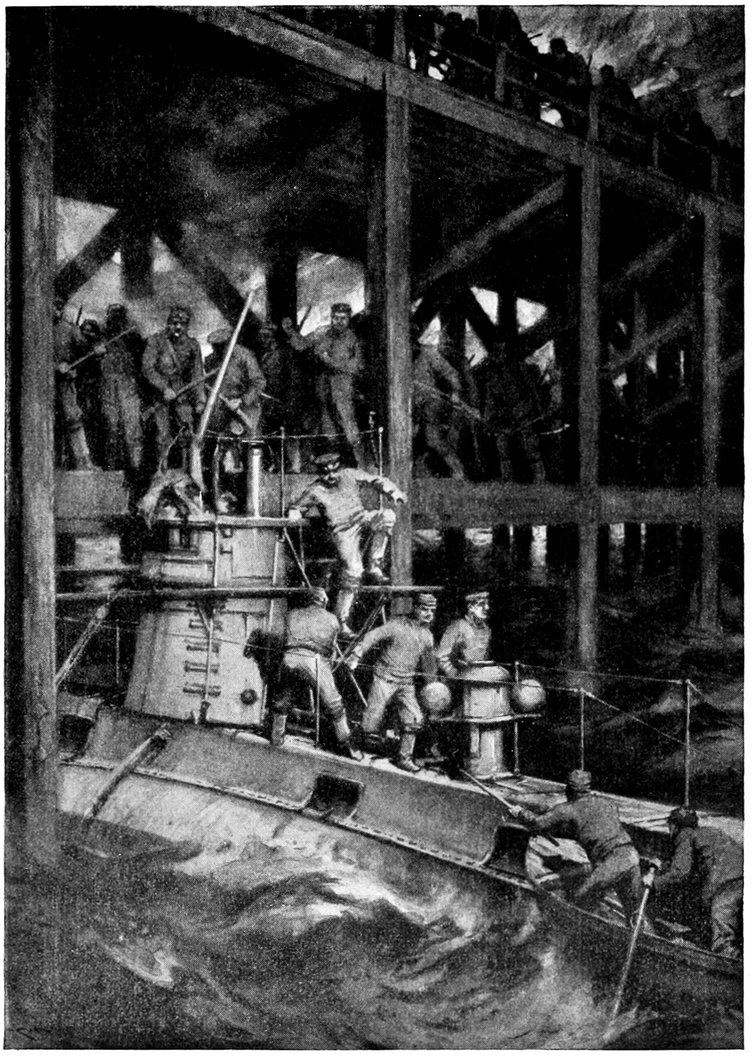
C 3 at Zeebrugge Mole
An old British submarine, loaded with explosives, was run into the piles of the jetty at the shore end of Zeebrugge Mole and blown up, to the amazement and destruction of the defenders.
299Zeebrugge was the more important because
it was directly connected by canal with
medieval Bruges. Previous to the outbreak
of hostilities the City of the Golden Fleece
was a sort of Sleepy Hollow kept awake by
its carillon and tourists. The German invaders
transformed the place into a naval arsenal.
Torpedo-boats and submarines found shelter
in the port, making their entry and exit via
Zeebrugge Harbour, with its broad mole extending
about a mile and a half seaward.
The latter was connected with the shore by
a wooden jetty of enormous strength. This
arrangement prevented the harbour from silting
up, which otherwise it would have done.
The long concrete arm sheltering the canal
was something more than a mere breakwater.
It had been converted into a fort, with batteries
and machine-guns, seaplane hangars and stores,
and was strongly garrisoned. No fewer than
120 guns guarded the littoral of Zeebrugge and
Ostend.
Could the ports be sealed, despite the difficulties
presented by the treacherous nature of
the coast, the mine-fields that shielded them,
300the batteries that bristled on the sand-dunes,
the aircraft that kept watch and ward, the
warships that lay in hiding? The question
was entertained seriously by Rear-Admiral Sir
Reginald Tyrwhitt. There seemed to be little
likelihood at that date that the Army would
achieve the result by military means, and so
if these places were to be rendered useless as
sea bases the task, it was clear, must be accomplished
by the Navy.
The scheme was laid before Sir John Jellicoe,
at that time First Sea Lord, and given to Vice-Admiral
Roger Keyes, in command at Dover,
to carry out. We have already met the latter
as Commodore of Submarines in August 1914;
he now returned to a task he had undertaken
on a much smaller scale in 1900, during the
Boxer Rebellion in China. With a dozen men
he stormed a fort and blew it up, despite the
opinion of some of his seniors that the attempt
was little more than a forlorn hope. While
he and his associates were planning the multitudinous
details of the Zeebrugge-Ostend expedition,
the memory of the former ‘impossible’
task must have crossed his mind more than
301once. Here was an operation ten thousand
times more difficult, requiring the most minute
calculations, an efficient fighting force, a considerable
fleet, and an exact time-table.
Chinamen can fight, and fight desperately,
but the garrison Keyes purposed to attack
was officered and manned by the German
Army, and the place defended by the most
modern weapons.
The resources that Keyes asked for were a
covering force, half a dozen obsolete cruisers—there
is sometimes a good deal of ‘kick’ in
a ship marked for the scrap-heap—a couple of
ferry-boats, and a number of auxiliary vessels.
Of the six old-timers, five were to be filled with
concrete and sunk in such a position that
navigation would be blocked (hence the term
block-ships) and one was to land the main
storming party; the ferry-boats were to convey
additional fighting men, and the auxiliaries
were to pick up any survivors there might be.
For mark this: the desperate nature of the
enterprise made annihilation possible. None
expected to get back, but all had made up
their minds to dam up the raiders. That was
302the sole and sufficient object of the expedition.
It formed part of no invasion project.
There was urgency but no hurry, a naval
paradox which meant that while the Service
fully realized the importance of bottling up
the U-boats, it also understood that delay
in executing the operation was preferable to
a tragic anti-climax. Twice the armada set
out and returned without having accomplished
its purpose. On St George’s Day 1918 Keyes
and his men showed their mettle in the most
dashing naval exploit of the Great Conflict.
The cruiser Vindictive, accompanied by the
Daffodil and the Iris, both Mersey ferry-boats,
carried storming and demolition parties of
bluejackets and ‘jollies,’ all picked men. The
Vindictive, armed with various species of things
Satanic, was to focus the attention of the enemy.
The Intrepid, the Iphigenia, and the Thetis,
cargoed with concrete, were to be sunk by
explosives detonated from their respective
bridges in the channels and entrances to
Zeebrugge; the Brilliant and the Sirius were
to perform similar operations at Ostend.
The night was hazy and overcast. Navigation
303in mined waters is not easy, but there were
no casualties. As the Vindictive and her
consorts headed for Zeebrugge Harbour they
shrouded themselves in a smoke-screen so
dense that the strongest search-light could not
penetrate it. Everything went splendidly
until the old cruiser and the ferry-boats were
just off the mole. Then the wind turned Hun.
The star-shells and search-lights that suddenly
awakened, lighting up the harbour almost as
though it were day, revealed the visitors to
the enemy. Batteries thundered, machine-guns
on the mole awoke to life, shells burst
above, about, and on the incoming cruiser.
In addition to the immediate din the boom of
the guns of the supporting monitors and of
siege guns in Flanders could be heard. The
Vindictive held on her way through the inferno
as though the reception was nothing more
formidable than fireworks sent up to welcome
her.
Commander Alfred F. B. Carpenter, standing
on the exposed bridge of the cruiser, brought
the bows of his ship alongside the mole, while
the Daffodil ran a grave risk of bursting her
304boilers in a giant effort to shove her stern in.
As the parapet of the mole was thirty feet high
the Vindictive had been fitted with a temporary
deck, from whence eighteen gangways were
speedily run out. Before they had ordered
their men to land both Colonel Elliot, of the
Marines, and Captain H. C. Halahan, who was
to lead the sailors, were lying dead. When
the word was given the fighters moved down
the brows in face of a withering fire, an operation
made more difficult by the rolling of the
ship in a heavy swell. Many were killed
and wounded as they attempted to land.
Lieutenant H. T. C. Walker, with one arm
blown off, was trodden under before he could
be dragged away. “Good luck!” he yelled,
“good luck!”
The howitzer mounted forward in the Vindictive
was fed and fought with uncanny
precision, though two crews were wiped out.
In the foretop a solitary man alone remained
to work one of the Lewis guns, and he was
grievously wounded. Near by, sitting in a
little cabin, a mere landsman fired rockets for
the guidance of the block-ships with as little
305concern as if he were managing a benefit
performance at the Crystal Palace. Commander
Carpenter’s coolness was infectious.
There was no ‘panic party,’ real or fancied, on
this mystery ship. The Daffodil, still holding
the cruiser in position, was ordered to maintain
her station and withhold landing her storming
party. The Iris, owing to the failure of her
grapnels to grip the parapet, fell astern of the
cruiser, though Lieutenant-Commander Bradford
and Lieutenant Hawkins clambered up
and tried to fix them, sitting at work on the
wall until they were shot dead.
The Thetis, with a nucleus crew—the others
had been taken off by motor-boats—approached
the mole, but failed to reach it. One of her
propellers got entangled in a steel defence net.
Becoming unmanageable, she struck the edge
of a shoal and refused to budge. Shell after
shell crashed against her old sides, but it was not
until she was virtually a wreck that Commander
R. S. Sneyd, D.S.O., exploded the charges in
her hold and sank her. Then he signalled the
course to the other ships.
The Intrepid and the Iphigenia came bowling
306along, sorry for their consort’s ill-luck but
anxious only to get on with the immediate
task in hand. Lieutenant S. Bonham-Carter
beached the Intrepid on the muddy spot
marked as her grave, blew a great hole in her
side, and was smilingly told by the chief
engineer, who had remained below, that
the performance was eminently satisfactory.
Surely that engineer was the embodiment of
dignity and impudence, that peculiar combination
that marks the true Briton. Lieutenant
E. W. Billyard-Leake, in command of the
Iphigenia, also entered the canal and carried
out his task with splendid efficiency. Both
ships were sunk about 200 yards up the
fairway.
The officers and men of the block-ships were
picked up with conspicuous gallantry by perky
little motor launches that were all the while
subjected to the attention of land batteries as
they bustled about their business. Lieutenant
Bonham-Carter sent away his boats before
leaving the ship, trusting to a Carley float for
his own salvation. The calcium flare, which is
an integral part of this apparatus, showed him
307up to the Germans, who kindly turned on a
machine-gun for his special benefit. Probably
the smoke from his own vessel saved him. He
was subsequently picked up by a launch.
The most dramatic incident was yet to come.
Suddenly the shore end of the mole was lit up
by a sheet of livid flame that seemed to sear
the sky. C 3, an old submarine commanded
by Lieutenant R. D. Sandford, R.N., had been
jammed into the great piles that supported
the jetty. No ordinary submarine this, but
one loaded with several tons of high explosive.
Her little crew of heroes got away in a boat
before the charge was fired, but not before the
craft had been driven right home. The explosion
severed the communications of the
mole with the shore, a break 60 feet wide being
effected. The Germans crowding the wooden
structure were blown to bits.
The landing parties, working under a galling
fire, blew up buildings, destroyed gun-emplacements,
and did as much damage as was possible
before being recalled. Not a few of the enemy
felt the cold steel of British bayonets, and at
least two of their guns were captured and
308turned on them. Fifty minutes elapsed before
the siren of the Vindictive sounded for the men
to return.
The operation against Ostend was not so
successful. Owing to the change of wind the
Sirius and the Brilliant were revealed by means
of the calcium flares lit to guide them, which
had previously been hidden by the smoke-cloud.
These lights were promptly extinguished
by the enemy’s gunners. Unable to
find the entrance, the two ships grounded
east of the piers, and were there sunk.
Taking all things into consideration, the
casualties in these two dare-devil actions were
small, although they totalled over 600. Vice-Admiral
Keyes, who was present in the destroyer
Warwick, was knighted in recognition of his
distinguished service, and Commander Alfred
F. B. Carpenter was promoted to Captain and
received the V.C. Sandford, of C 3, Lieutenant
P. T. Dean, R.N.V.R., who performed wonders
in rescuing men from the Intrepid and the
Iphigenia, Captain E. Bamford, D.S.O., who
landed three platoons of the Marines on the
mole, Sergeant N. A. Finch, who fought in the
309foretop of the Vindictive, and Able Seaman
A. E. Mackenzie, who worked a machine-gun
in an exposed position, were also decorated
with the Victoria Cross.
Battle-scarred and holed in many places,
the Vindictive was patched up at Dover for a
final exploit. The British Navy does not like
leaving things half done. The affair at Ostend
had miscarried through sheer bad luck. It
must be completed. In the early hours of the
morning of the 10th May, 1918, the brave old
cruiser, now rigged up as a block-ship, faced
15–in. guns and found the entrance, though
twice she lost her way. She got a terrible
pasting from the defenders of the port. The
after-control was wiped out, the conning-tower
struck by a heavy shell. On reaching the
eastern pier she swung round to an angle
of about forty degrees to the structure, the
charges were fired, and she settled down. The
casualties reached 136 officers and men.
That these stirring episodes in the War in
the Underseas aided and abetted in the final
surrender of the U-boats in November 1918
cannot be doubted.
CHAPTER XVI The Great Collapse
310
“The Board of Admiralty desire to express to the officers and
men of the Royal Navy and Royal Marines on the completion of
their great work their congratulations on a triumph to which
history knows no parallel.”
They came in flying the White Ensign,
which was the cleanest thing about
them. Only a few weeks before the
commanders of these same bedraggled U-boats
had boasted of defying the world; now they
had been brought to heel like a pack of whipped
curs. German officers and men were taking
part in the biggest collapse in naval history;
their conquerors in the greatest triumph. At
Beatty’s bidding they meekly surrendered their
piratical craft at the rate of a score a day for
a week or more. The bluejackets at Harwich
rechristened the Stour “U-boat Avenue” when
the captives were given floating-room in its
sluggish waters.
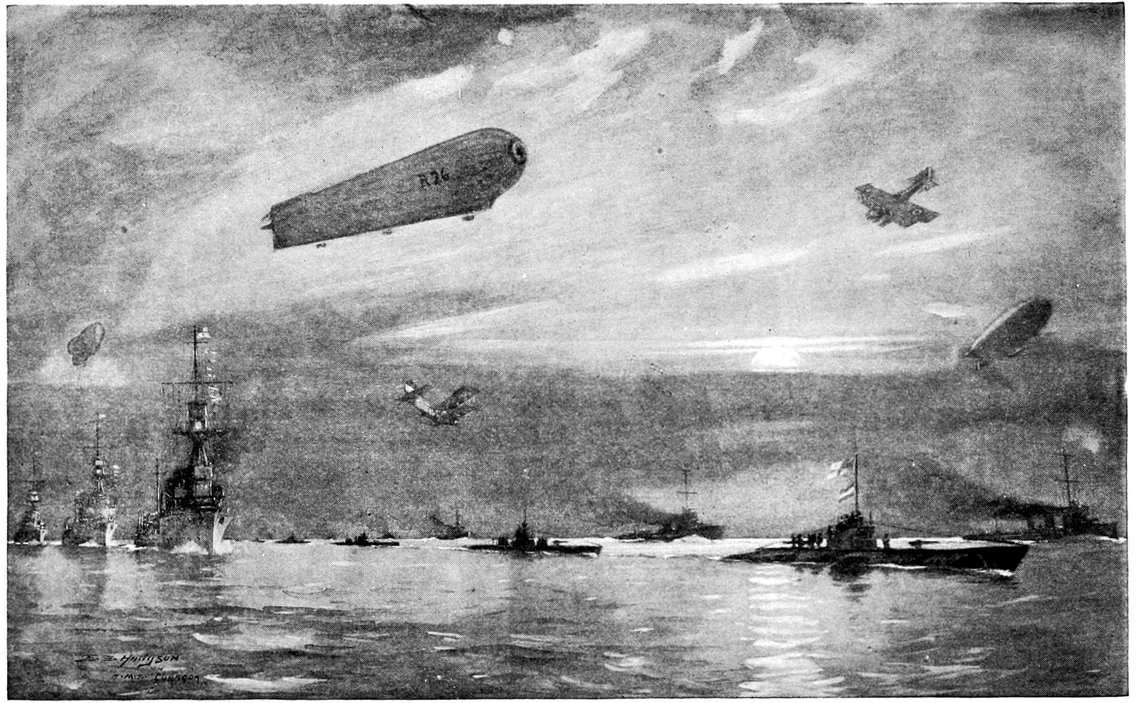
Entry of the Surrendered U-Boats into Harwich, November 20, 1918
E. S. Hodgson
311On the 9th November, 1918, Sir Eric Geddes
gave it as his opinion that the High Sea Fleet
had “gone mad” because it “dared not
fight” and because it “had not got a good
cause.” That is the psychological explanation,
true to fact and experience. Its moral
broke down, which is another way of saying
that it lost its nerve. When ordered to put to
sea on the 28th October, 1918, ostensibly for
manœuvres, but in reality as a gambler’s last
hazardous throw of the dice, the German Fleet
mutinied in a far more thorough manner than
had obtained a few months previously.
At Wilhelmshaven about one thousand sailors
were imprisoned for taking part in the mutiny;
Kiel, on the other hand, went wholly ‘red,’ as
did also the commercial ports of Hamburg,
Bremen, and Lübeck. Soviets came into being,
a Workers’ and Soldiers’ Council was formed,
Bolshevism was openly preached, fireworks were
let off at Wilhelmshaven in honour of the
German Republic.
Apart from the moral issue, three main
causes led to the defection of the German
Navy. It did not fight because the Battle of
Jutland had proved the vast superiority of
the Grand Fleet; it did not want to fight
312because the complements of the vessels were
mainly landsmen by upbringing and inclination;
it had no heart to fight because the
U-boat campaign had failed to win the war
according to promise, or even to shake Britain’s
resolution by one iota. Probably the ultimate
and determining factor was the frightful
mortality among the submersibles. When the
High Sea Fleet failed at Jutland the U-boat
campaign was undertaken in real earnest;
when that failed the mutiny took place. The
death-rate toward the end was frightful. Of
360 submarines launched during 1914–18, 200
were sunk or captured.
That Germany made a bold bid for triumph
cannot be gainsaid. There were times when
the Allied Admiralties regarded the situation
as critical. The statistics of the matter are
instructive, though not pleasing. From first to
last Great Britain lost 9,000,000 tons of shipping,
while Allies and neutrals suffered to the
extent of a further 6,000,000 tons. In addition
there were eighty British vessels, with an
aggregate tonnage of 172,554, held up in
German ports during hostilities, an amount by
313no means to be despised, although it is small
compared with the enemy tonnage captured
and brought into Allied service. The latter
reached the respectable figure of 2,392,675.
British naval casualties totalled 39,766 in
killed, wounded, interned, and captured. In
the Merchant Service 14,661 lost their lives,
and 3,295 were taken prisoners. War in the
Underseas was waged at frightful cost to all
belligerents, both vanquished and victors.
Taking British losses by enemy action and
marine risks during the war, the worst quarters
were in this order: second quarter of 1917,
third, first, and last quarters of the same year,
and first quarter of 1918 and last quarter of
1916. In April 1917, 555,000 tons of British
shipping were sent to the bottom. Had things
gone on at that rate, “we were in deadly
danger; had it gone on for nine months we
were ruined.”[34] In September 1918 the depletion
had been reduced to 151,000 tons.
Captain Persius asserts that, following the
action off the Danish coast, twenty-three battleships
314were disarmed for the purpose of obtaining
metal for constructing U-boats—excellent
proof of the grip of the blockade and of the
British victory at Jutland. His figures regarding
underseas craft are a little difficult to follow,
because he only deals with what he calls ‘front
submarines,’ presumably those definitely on
active service and not merely patrolling in
home waters. In April 1917, he says, Germany
had 126 U-boats, in the following October
146; in February 1918 she possessed 136; in
June of the same year, 113. In January 1917
only 12 per cent. were at sea, 30 per cent. in
harbour, 38 per cent. under repair, and 20 per
cent. incapacitated. His most important admission
is that the ill-trained crews had no
confidence in their craft, and that toward the
end of the campaign it was difficult to get men to
work them. He flatly contradicts the assertion
that losses were made up by new construction.
Apart from the offensive operations of the
Navy proper, the defensive equipment of
traders and the introduction of the convoy
system in the summer of 1917 were of enormous
importance in thwarting the submarine.
315In addition to merchant shipping and munitions
16,000,000 fighting men were escorted, and of
these less than 5000 met with disaster.
Sea-power worked miracles in other directions.
“The blockade,” says Sir Eric Geddes,[35]
“is what crushed the life out of the Central
Empires.” That was the work of the 10th
Cruiser Squadron. From 1914 to 1917 the
ships of that squadron “held the 800 miles
stretch of grey sea from the Orkneys to Iceland.
In those waters they intercepted 15,000 ships
taking succour to our enemies, and they did
that under almost Arctic conditions, and mainly
in the teeth of storm and blizzard; out of
that 15,000 they missed just 4 per cent., a
most remarkable achievement under impossible
conditions. Behind the blockade was
the Grand Fleet, the fulcrum of the whole
of the sea-power of the Allies. If ever testimony
were needed of the value of sea-power,
I can give it. In every individual case when
an armistice was signed by our enemies, and
in one, if not two, cases before, the one cry
that went up was, ‘Release the blockade.’”
316Admiral Sir Percy Scott holds that four
years of U-boat warfare have “tragically
demonstrated the truth” of his neglected
warning, but he also acknowledges that the
Navy did not fail us. “From the first,” to
quote the apostle of the submarines, “Great
Britain kept command of the seas.” His
prophecy of 1914 that the day of the big
surface ship was over has not been fulfilled,
though the submarine may become the capital
ship of the future. He contends that if Germany
could have placed 200 U-boats on the
ocean trade routes at the outbreak of war she
would have defeated the Allies. She might
have done so, but the important fact is that
she did not possess the requisite number. At
that time we were lamentably short of light
craft, German cruisers and raiders were running
amok in various parts of the world, and the
Grand Fleet was fully occupied ‘containing’
the main German squadrons. Given the hypothetical
conditions mentioned by the Admiral,
it is not improbable that the enemy would
“have defeated the Allies and practically
conquered the world,” but it is not “certain,”
317as Sir Percy asserts. Germany regarded the
intensified U-boat campaign as a sure thing;
we know the result. In his now famous letter
to the Times, one of the eminent correspondent’s
contentions was that “the introduction of
vessels that swim under water has already
done away with the utility of ships that swim
on the top of the water,” that “as the motor
vehicle has driven the horse from the road, so
has the submarine driven the battleship from
the sea.” The Great War of 1914–18 disproved
this very definite statement, and witnessed the
introduction of mighty ‘hush’ ships which
lived and moved and had their being on the
surface of great waters.
On the other hand we should be crass fools
if we neglected the lessons of the war as regards
the latest naval arm. The records of British
submarines are eloquent of their effectiveness.
Summed up they amount to this: Two battleships
sunk and three badly damaged; two
armoured cruisers destroyed; two light cruisers
sunk and one badly damaged. The long obituary
list also included seven torpedo-boats,
five gunboats, twenty submarines, five armed
318auxiliaries, fourteen transports, two store ships,
half a dozen ammunition and supply ships,
fifty-three steamships, 197 sailing vessels, and
one Zeppelin, making a grand total of 315
vessels dead and buried. As to the sea-going
qualities of the craft, one British commander
made twenty-four cruises, covering 22,000 miles,
in a year, while in a single month British submarines
navigated 105,768 sea miles, one mile
in every ten being in the submerged position.
We have seen in previous chapters that the
Allied naval losses, while they made no appreciable
difference to the situation, were not negligible.
Approximately 230 fighting ships were lost
from all causes by Great Britain during the war.
Without going so far as Mr Arthur Pollen,
whose opinion regarding the submarine is that,
“viewed strictly as a form of sea force, it is the
feeblest and least effective that has ever been
seen,” all available facts show that warships
travelling at a good speed are comparatively
immune from attack. There is also little
danger when they are going slowly, provided
they have a covering screen of destroyers.
The majority of battleships and cruisers that
319fell victims to U-boats were taking life easy,
as for instance the Aboukir, the Cressy, and the
Hogue in the North Sea, and the Formidable in
the Channel.
The Great Collapse revealed no new wonders,
though the cargo-carrying Deutschland, converted
into a ‘front submarine’ and mounting
5.9–in. guns, was a sight for the gods as she
lay floating on the bosom of old Father Thames.
Another former commercial cruiser, U 139, had
just returned to the Fatherland after a voyage
of sixty-four days with a company of ninety-one,
fifteen of whom were specially detailed for
manning prizes. One ugly brute, believed to
have been responsible for the sinking of 47,000
tons of shipping, carried forty-two mines
and twenty-two torpedoes. Perhaps the most
interesting discovery was a cat-o’-nine-tails
stained with blood, extracted from under the
bunk of a certain U-boat commander. Two
sailors were so enamoured of their own country
that they had to be persuaded to go on board
the transport at the point of a revolver. One
commander, in handing over his signed declaration,
was good enough to remark, “We shall
320be coming over again for them soon.” Another
officer explained that his periscope was missing
and his compass gave an incorrect reading
because a steamer had ‘sat’ on his boat,
while a British Lieutenant-Commander had the
satisfaction of piloting a submarine he had
once attacked in German waters. Another
boat was brand-new from the shipbuilding
yard. Nearly all were camouflaged. The
majority of the submarines surrendered were
certainly not of the cruiser type, about which
one heard so much during the war, although in
the first batch to reach Harwich was a monster
340 ft. long, with a displacement of 2300 tons
and accommodation for a crew of seventy.
The remainder were mostly of 800 tons displacement,
225 ft. long, and 22 ft. beam.
It has taken ten centuries to make the
British Navy; it took four and a quarter years
for the Senior Service to secure the surrender
of its most formidable rival in the greatest Sea
Conquest of all time.
- Silently corrected typographical errors and variations in spelling.
- Archaic, non-standard, and uncertain spellings retained as printed.
- Footnotes were re-indexed using numbers and collected together at the end of the last
chapter.