Our scene is the wind-swept coast of Devon. By day there is a wide
stretch of ocean far below. The time is remote and doubtless great
ships of forgotten build stand out from Bristol in full sail for
western shores. Their white canvas winks in the morning sun as if
their purpose were a jest. They seek a northwest passage and the
golden mines of India. But we must be loose and free of date lest our
plot be shamed by broken fact. A thousand years are but as yesterday.
We shall make no more than a general gesture toward the wide spaces of
the past.
The village of Clovelly climbs in a single street—a staircase,
really—from the shore to the top of the cliff, and is fagged and out
of breath half way. But on a still dizzier crag, storm-blown,
clinging by its toes, there stands the pirates' cabin. To this topmost
ledge fishwives sometimes scramble by day to seek a belated sail
against Lundy's Isle. But after twilight a night wind searches the
crannies of the rock and whines to the moon of its barren quest, and
then no villager, I think, chooses to walk in that direction. I have
visited Clovelly and have kicked a sodden donkey from the wharf to the
top of the street, past the shops of Devon cream and picture postal
cards, but have sought in vain the pirates' cabin. Since our far-off
adventure of tonight ten thousand tempests have snarled across these
giddy cliffs and we must convince our reason that these highest crags
where we pitch our plot have long since been toppled in a storm. Where
yonder wave lathers the shaggy headland, as if Neptune had turned
barber, we must fancy that the pinnacles of yesteryear lie buried in
the sea.
We had hoped for a play upon the sea, with a tall mast rocking from
wing to wing and a tempest roaring at the rail. Alas! Our pirates grow
old and stiff. They have retired, as we say, from active practice and
live in idle luxury on shore. Yet we shall see that their villainy
still thrives.
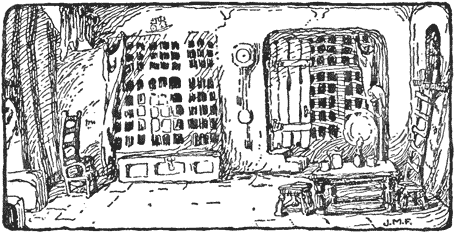
Our scene is their cabin on the cliff. It is a rough stone building
with peeling plaster and slates that by day are green with moss. But
it is night and the wind is whistling its rowdy companions from the
sea. Until the morning they will play at leap-frog from cliff to
cliff. Far below is the village of Clovelly, snug with fire and
candles.
We enter the cabin without knocking—like neighbors through a
garden—and poke about a bit before our hosts appear. A door, forward
at the right, leads to the kitchen. Back stage, also, at the right, a
ladder rises to a sleeping loft. On the left wall are a chimney and
fireplace with a crane and pot for heating grog, and smoky timbers
above to mark the frequent thirst. On a great beam overhead are bags
of clinking loot and shining brasses from wrecked ships. Peppers hang
to dry before the fire, and a lighted ship's lantern swings from a
hook. At the rear of the cabin, to the left, a row of mullioned
windows looks at sea and cliffs in a flash of lightning. Below is a
seaman's chest. Above, on the broken plaster, is scrawled a ship. In
the middle, at the rear, there is a clock with hanging pendulum and
weights. A gun of antique pattern leans beside the clock. To the right
the cabin is recessed, with a door right-angled in the jog and other
windows looking on the sea. A parrot sits on its perch with curbed
profanity. The gaudy creature is best if stuffed, for its noisy tongue
would drown our dialogue. Like Hamlet's player it would speak beyond
its lines and raise a quantity of barren laughter. Our furniture is a
table and three stools, and a tall-backed chair beside the hearth. On
the table a candle burns, bespattered with tallow. The cabin glows
with fire light.
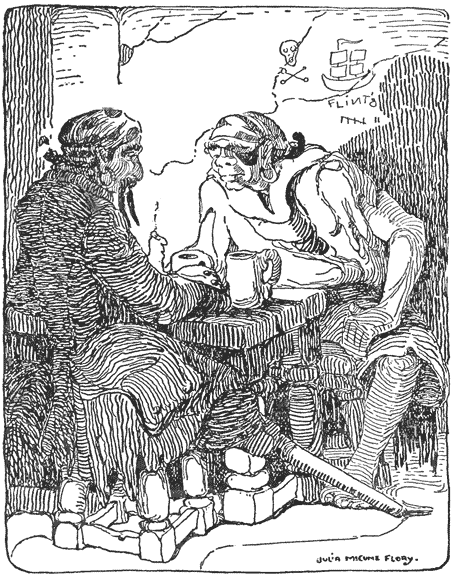
Two pirates are discovered drinking at a table
At the lifting of the curtain there is thunder and lightning, and a
rush of wind—if it can be managed. Two pirates are discovered,
drinking at the table. By the smack of their lips it is excellent
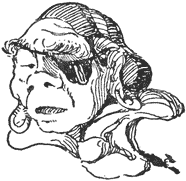
grog. One of them—Patch-Eye—has lost an eye and he wears a black
patch. His hair curls up in a pigtail, like any sailor before Nelson.
It looks as stiff as a hook and he might almost be lifted by it and
hung on a peg. But all of our pirates wear pigtails—except one, Red
Joe.
The other pirate at the table is called the Duke, for no apparent
reason as he is a shabby rogue. We must not run our finger down the
peerage in hope of finding him, or think that he owns a palace on the
Strand. He has only one leg, with a timber below the knee. He wears a
long cloak so that the actor's rusticated leg can be folded out of
sight. The Duke has a great red nose—grog and rum and that sort of
thing. His whiskers are the bush that marks the merry drinking place.
Patch-Eye is melancholy—almost sentimental at times. He would stab a
man, but grieve upon a sparrow. At heart we fear he is a coward, and
stupid. The Duke, on the contrary, is shrewd and he does a lot of
thinking. He has heavy eyebrows. He is the kind of thinker that you
just know that he is thinking. Both pirates are very cruel—and
profane, but we must be careful.
And now we hush the melancholy fiddlers. If this comedy can stir the
croaking bass-viol to any show of mirth, our work tops Falstaff. Glum
folk with beards had best withdraw. Only the young in heart will catch
the slender meaning of our play. Let's light the candles and draw the
curtain!
Patch: Darlin'! Darlin'! (He lolls back in his chair and stretches
out his legs for comfort.) Darlin'!
(At this a dirty old woman with one tooth appears from the kitchen.
She is called Darlin' just for fun, as she is not at all kissable. A
sprig of mistletoe, even in the Christmas season, would beckon
vainly.)
Patch: Me friend, the Duke, is thirsty. Will yer fill the cups? Hurry,
ol' dear! And squeeze in jest a bit o' lemon. It sets the stomich.
Darlin': Yer sets yer stomich like it were hen's eggs. Alers coddlin'
it.
(She stirs and tastes the pot of grog, and hoists her wrinkled
stockings.)
Duke: There 's no one like Darlin' fer mixin' grog.
Darlin': Fer that kind word I 'm lovin' yer. (She looks at him with
admiration.) Ain 't he a figger o' a man? Wenus was nothin'. Jest
nothin' at all.
Patch: It 's grog beats off the melancholy. As soon as me pipes go
dry, I gets homesick fer the ocean. Here we be, Duke, thrown up at
last ter rot like driftwood on the shore. No more sailin' off to
Trinidad! No tackin' 'round the Hebrides! We is ships as has sprung a
leak. It was 'appy days when we sailed with ol' Flint on the Spanish
Main.
Duke: 'Appy days, Patch! (They drink.)
Patch: Aye! The blessed, dear, ol' roarin' hulk. No better pirate ever
lived than Flint. Smart with his cutlass. Quick at the trigger. Grog!
A sloppin' pail o' it was jest a sip.
Duke: I used ter tell him that his leg was holler.
Patch: He was a vat, was Flint—jest a swishin' keg.
Duke: Grog jest sizzled and disappeared, like when yer drops it on a
red-hot seacoal.
Patch: Fer twenty year and more me and you has seen ol' Flint march
his wictims off the plank.
Duke: "Step lively!" he 'd say. "Does n't yer hear Davy callin' to
yer?" There was never a sailorman ever sat in the Port Light at
Wappin' wharf which could drink with Flint.
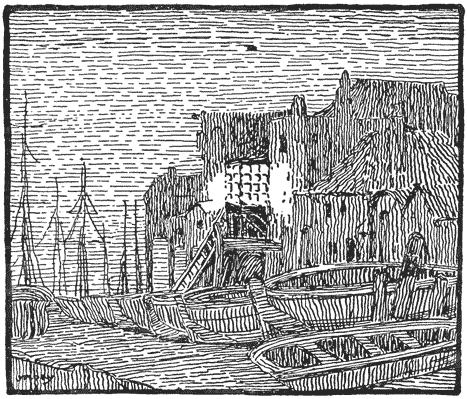
"Port Light" at Wappin' Wharf
Patch: Wappin' wharf and gibbets is nothin' ter talk about. Funerals
even is cheerfuller.
Duke: There 's his parrot.
Patch: She used ter cuss soft and gentle to herself—'appy all the
day. She ain 't spoke since Flint was took. Peckin' at yer finger and
broodin'.
Duke: There 's his ol' clock.
Patch: As hung in the cabin o' the Spittin' Devil.
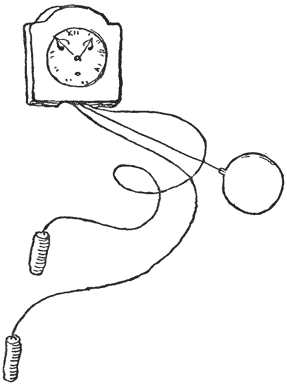 "A 'ell of a clock fer a bouncin' ship"
Duke: With the pendulum gettin' tangled in a storm. A 'ell of a clock
fer a bouncin' ship.
"A 'ell of a clock fer a bouncin' ship"
Duke: With the pendulum gettin' tangled in a storm. A 'ell of a clock
fer a bouncin' ship.
Patch: She was tickin' peaceful the day Flint was hanged. But she
stopped—does yer remember it?—the very minute they pushed him off
the ladder.
Duke: She ain 't ticked since.
Patch: It makes yer 'stitious. And she won 't never run agin—that 's
what Flint alers said—till his death 's revenged.
Duke: He told us never ter wind her—says she 'd start hisself without
no windin' when the right time came.
Patch: If I was ter look up and see that pendulum swingin'—Horrers!
Yeller elephants would be nothin'!
Duke: Pooh! I 'd give a month o' grog jest ter hear the ol' dear
tickin', and ter know that Flint was restin' easy in his rotten
coffin—swappin' stories with the pretty angels.
Patch: I loved Flint like a brother. (He is quite sentimental about
this.) It was him knocked this out. (Pointing to his missing eye.)
But it was jest in the way o' business. We differed a leetle in the
loot. He was very persuasive, was ol' Flint.
Duke: Yer talks like a woman. They loves yer to cuff 'em. Them was
'appy days, Patch.
Patch: Blast me gig what 's left, Duke, but me and you has seen a heap
o' sights. I suppose I 've drowned meself a hundred men. It 's
comfertin' when yer lays awake at night. I feels I ain 't wasted
meself. I 've used me gifts. I ain 't been a foolish virgin and put me
shinin' talent inside a bushel. But me and you is driftwood now, Duke.
Duke: Aye. But it ain 't no use snifflin' about it, ol' crocodile.
Darlin' is certainly handy at mixin' grog. And we 've a right smart
cabin with winders on the sea. Since I stuffed yer ol' shirt in the
roof it hardly leaks.
Patch: My shirt! Next week is me week fer changin'. How could yer ha'
done it? I 'm a kinder perticerler dresser. I likes ter wash now and
then—if it ain 't too often.
Duke: Darlin', me friend Patch is thirsty. And a drop meself. (The
cups are filled.) Yer a precious ol' lady, and I loves yer.
Darlin': Yer spoils me, Duke.
(Lightning and a crash of thunder.)
Duke: It 's foul tonight on the ocean. How the wind blows! It be
spittin' up outside. The channel 's as riled as a wampire when yer
scorns her. How she snorts!
Patch: The devil hisself is hissin' through his teeth.
Duke: There 'll be sailormen tonight what 's booked fer Davy Jones's
locker. I 'm not kickin' much ter be ashore. I rots peaceful.
(Patch-Eye has opened the door to consult the night. It slams wide in
the wind and the gust blows out the candle.)
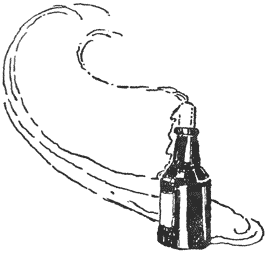 "Yer blowin' the gizzard out o' us"
Duke: Hi, there, for'ard! Batten yer hatch! Yer blowin' the gizzard
out o' us.
"Yer blowin' the gizzard out o' us"
Duke: Hi, there, for'ard! Batten yer hatch! Yer blowin' the gizzard
out o' us.
(He hobbles on timber leg to the warm chair by the fire. Patch closes
the door and sits. Darlin' relights the candle.)
Patch: Poor Flint! He was took on jest such a night.
Dropped inter the Port Light fer somethin' wet and warmin'. Jest ter
kinder say goodby. Ship all fitted out. He 'd got three new
sailormen—fine fellers as had been sentenced ter be hanged fer
cuttin' purses, but had been let go, as they had reformed and wanted
ter be honest pirates.
Duke: I remembers the night, ol' sea-nymph. It was rainin' ter put out
the fires o' hell—with the leetle devils stoakin' in the sinners. It
's sinners, Patch, as is used fer kindlers, ter keep the devils in a
healthy sweat.
Patch: He was ter sail when the tide ran out. Lord a Goody! How the
tide runs down the Thames, as if it were homesick fer the ocean!
Duke: But someone squealed.
Patch: Squealers is worse 'n hissin' reptiles. They ketched Flint and
they strung him to a gibbet. Poor ol' dear! I never touches me patch,
but I thinks o' Flint.
Duke: This here life is snug and easy. We has retired from practice,
like store-keepers does who has made a fortin. Ain 't we settin' here
in style and comfert, and jest waitin' fer the treasure ships ter come
ter us? We gets the plums without chawin' at the dough. We blows out
the lighthouse, and we sets our lantern so as ter fool 'em on the
course, and when they smashes on the rocks, well—all we does is stuff
our pokes with the treasure that washes up. I prays meself fer fog and
dirty weather. Now I lay me, says I, and will yer send it thick and
oozy?
Patch: I ain 't disputin' yer. (He cheers up a bit.) And we robs
landlubbers once in a while.
Duke: Now yer talkin', ol' sea-lion. I 'm tellin' yer it were a good
haul we made last night on Castle Crag.
Patch: Who 's disputin' yer?
Duke: I 'm tellin' yer. Silver candles! And spoons! Never seen such a
heap o' spoons.
Patch: What 's anyone want more 'n one spoon fer? Yer cleans it every
bite agin the tongue.
Duke: Yer disgusts me, Patch. Yer ain 't no manners. Fer meself I
spears me food tidy on me knife.
(The Duke sits looking at the seaman's chest at the rear of the
cabin. He is deep in thought.)
Duke: There 's jest one leetle thing I does n't understand. I asks
yer. (He goes to the chest, opens it and draws out a rich velvet
garment. He holds it up.) What 's the meaning o' this here loot we
took at Castle Crag? I asks yer. Ain 't we been by that castle a
hundred times? The Earl, he don 't wear clothes like this. None o' the
arstocky does, 'cept when they struts on Piccadilly. I asks yer,
Patch. I asks yer who wears a thing like that.
(He puts the garment around Patch's shoulders.)
Darlin': Yer looks like the Archbishop o' Canterbury.
Patch: (with strut and gesture). His Grice takin' the air—pluckin'
posies.
Duke: Lookin' like a silly jackass.
Patch: Yer hurts me feelin's, Duke.
(The Duke folds the cloak and puts it back again in the chest. He
sits at the table in meditation.)
Duke: I does n't like it, Patch. I does n't understand it. And what I
does n't understand, I does n't like.
Patch: What?
Duke: Them gay clothes. Who owned 'em, I asks yer, afore we stole 'em.
Patch: Darlin'! Me friend, the Duke, is thirsty. Yer had better mix
another pot. Our cups is low. Yer does n't want ter be a foolish
virgin and get ketched without no grog.
Duke: With this bit o' slop what 's left I drinks to yer shinin'
lamps—Wenus's flashin' gigs.
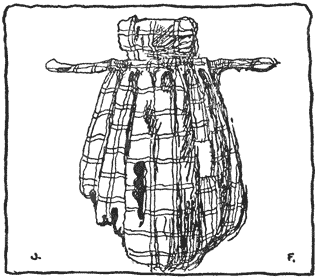 Her apron is towel, dust rag, mop and handkerchief
Darlin': I loves yer, Duke.
Her apron is towel, dust rag, mop and handkerchief
Darlin': I loves yer, Duke.
(She fills, mixes and stirs the pot. She tastes it like a practiced
house-wife. Her apron is maid of all work. It is towel, dust-rag, mop
and handkerchief.)
Duke: What does yer make, ol' Cyclops, o' the new recruit?
Patch: Red Joe?
Duke: Him.
Patch: He 's a right smart pirate, I says. I never seen a feller as
could shoot so straight.
Duke: I says so. But he 's a wee bit nobby—kinder stiff in the nose.
Patch: Looks as if he knowed he was kinder good.
Duke: It 's queer how he come ter us. Jest settin' on top his dory on
the beach, when we found him. And what he said about his ship goin'
down! Blast me ol' stump, but it were queer.
Patch: Queer?
Duke: Yer said it, Patch. Queerer than mermaids. Did we ever see a
stick o' that ship? I 'm askin' yer, Patch.
Patch: Ain 't I listenin'?
Duke: Ain 't I tellin' yer? Nary a bit washed in. Did yer ever know a
wreck 'long here where nothin' washed in—jest nothin'? I 'm askin'
yer.
Patch: You and me would starve if it happened regular.
Duke: It 's what we lives by—pickin's on the beach.
Patch: He 's a right smart pirate, 's Red Joe. The Captain—the most
'ticerler man I know—he took ter him at once. He 's a kinder
good-lookin' feller.
Darlin': (stirring at the pot). He ain 't got whiskers like the
Duke.
(She spits—must I say it?—she spits into the fire.)
Duke: Queer that never a stick washed in.
Patch: I 'm not denyin' yer, Duke. Where 's Red Joe now? It 's gettin'
on. I 'll jest take a look fer him. (He takes the lantern from its
hook and stands at the open door.) It ain 't blowin' so hard. Ol'
Borealis—I speaks poetical—ain 't strainin' at his waistcoat buttons
like he was.
Duke: Igerence! I pities yer. Borealis ain 't wind. He 's rainbows.
(Patch-Eye goes into the night. The Duke sits to a greasy game of
solitaire.)
Duke: It 's queer, I says. Nary a stick! Jest Red Joe on top his dory!
(He sings abstractedly.)
PIRATE CHANTY
[Listen] [PDF] [MusicXML]
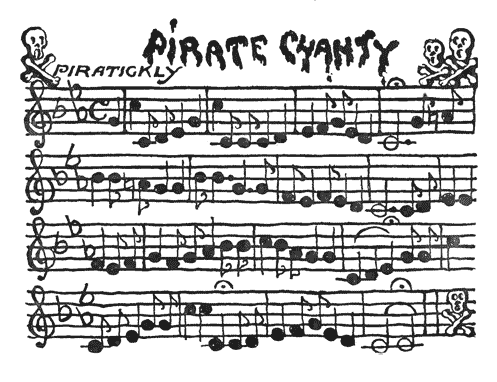
Bill Bones used ter say, on many a day,
When takin' a ship fer its loot,
That a blow on the head was quickest dead
And safest and best ter boot.
But a wictim's end, fer meself I contend—
There 's a hundred been killed by me—
Is a walk, I 'll be frank, on a slippery plank,
And a splash in the roarin' sea.
|
(He turns and surveys the drawing above the windows. He cocks his
head like a connoisseur, critically—with approval.)
 "It eases yer pipes"
Duke: I 'm the artist o' that there masterpiece. The Spittin' Devil! I
done it on a rainy mornin'. Genius is queer. (Then he sings again.)
"It eases yer pipes"
Duke: I 'm the artist o' that there masterpiece. The Spittin' Devil! I
done it on a rainy mornin'. Genius is queer. (Then he sings again.)
Ol' Pew had a jerk with a long-handled dirk—
His choice was a jab in the dark—
|
(He is engaged thus, fumbling with his cards, when Darlin', crossing
from the fire, interrupts him.)
Darlin': Duke, will yer have a nip o' grog? It eases yer pipes. Yer
sounds as if yer had crumbs in yer gullet.
(The Duke pushes forward his cup.)
Duke: It 's a lovely tune, and I wrote the words meself. (He
continues his song.)
Old Pew had a jerk with a long-handled dirk—
His choice was a jab in the dark—
And Morgan's crew, 'twixt me and you,
Considered a rope a lark.
But a prettier end, I repeat and contend—
And I 've sailed on every sea—
Is a plunge off the side in the foamin' tide.
It tickles a sailor like me.
|
Darlin': Duke, does yer happen ter have a wife?
Duke: (deeply engaged). Some tunes is hard, so I jest makes 'em up
as I goes along.
Blackbeard had a knife which he stuck in his wife.
Fer naggin', says he ter me—
|
Darlin': Has yer a wife? A wife as might turn up, I mean.
Duke: Say it agin, Darlin'.
Darlin': Most sailors has wives o' course, strewed here and there from
Bristol to Guinea—jest ter make all ports cozy. So 's yer goin' home
ter a 'appy family, no matter where yer steers.
Duke: It 's comfertable, Darlin'—I 'll not deny it—when yer heads
ter harbor to see a winkin' candle in a winder on a hill, and know
that a faithful wife and a couple o' leetle pirates is waitin' ter hug
yer.
Darlin': I says so, Duke. I 've been a wife meself on and off, with
husbands sailin' in and out—kissin' yer and 'oistin' sail.
Roundabout, I says, makes 'appy marriages. Has yer a wife,
Duke—livin', as yer can remember?
Duke: Yer a bold, for'ard creature. Are yer proposin' ter me?
(Something like a wink shows in the blush.)
Darlin': I blush fer yer bad manners, Duke. I 'm a lady and I waits
patient fer the 'appy question. I lets me beauty do the pleadin'. I
was a flamin' roarer in me time. Lovers was nothin'. Dozens! There was
a sea-captain once—(She smiles dreamily, then seems to cut her
throat with her little finger.) Positive! Jest 'cause we tiffed. And
a stage-coach driver! I had ter cool his passion with a rollin' pin.
He brooded hisself inter drink. 'Appy days! (She is lost for a moment
in her glorious past, then blows her nose upon her apron and returns
to us.) Duke—askin' yer pardon—I was noticin' lately that you was
castin' yer eyes on leetle Betsy.
Duke: As washes the dishes?
Darlin': Her.
Duke: Go 'long!
Darlin': And I thought yer might be drawn to her.
Duke: Darlin', I 'm easy riled.
Darlin': Yer can have her, Duke, on one condition.
Duke: She 's a pretty leetle girl.
Darlin': Yer must set me up in a pub in Bristol—with brass
beer-pulls.
Duke: I 'll not deny I 've given her a thought. Usual, wives is
nuisances—naggin' at yer fer sixpences. But sometimes I does get
lonesome on a wet night when there are nothin' ter do. I need someone
ter hand me down me boots. Betsy 'd make a kinder cozy wife. Could yer
learn her ter make grog?
Darlin': Aye.
Duke: I might do worse. And roast pig that crackles?
Darlin': I could learn her.
Duke: I might do worser. I 'd marry you, Darlin'—
Darlin': Dearie!
Duke: But yer gettin' on. Patch might marry yer. He 's only got one
eye.
Darlin': (with scorn). Patch!
Duke: I 'll not deny I 've been considerin' leetle Betsy. I was
thinkin' about it this mornin' as I was cleanin' me boot. Wives cleans
boots. I 'm the sort o' sailorman she would be sure ter like.
Darlin': And what about the pub?
Duke: Blast me stump, Darlin', I 'll not ferget yer.
Darlin': Does I get brass beer-pulls in the tap?
Duke: Everythin' shiny.
Darlin': I 'm lovin' yer.
Duke: Betsy would kinder jump at me. There 's somethin' tender about a
young girl's first love—cooin' in yer arms.
Darlin': Easy, Duke!
Duke: I alers was a fav'rite with the ladies. I think it 's me
whiskers.
Darlin': 'Vast there, Duke! There 's a shoal ahead. Red Joe 's a right
smart feller.
Duke: Red Joe?
Darlin': Him. He sets and watches her.
Duke: What can she see in a young feller like that?
Darlin': Women 's queer folks. They 're wicious wampires. Jest yer
watch 'em together. Red Joe 's snoopin' in on yer.
Duke: Yer can blast me. He ain 't got whiskers.
Darlin': I 'm tellin' yer, Duke. If I was you I 'd tumble that Red Joe
off a cliff. I 'm hintin' to yer, Duke. Off a cliff! (She sniffs
audibly.) It 's the pig. I clean fergot the pig. It 's burnin' on the
fire. Off a cliff! I 'm hintin' to yer.
(She runs to the kitchen.)
Duke: Red Joe! Women 's queer—queerer than mermaids. A snooper! Jest
a 'prentice pirate! No whiskers! Nothin'!
(At this moment there is a stamping of feet outside and Patch-Eye
enters with Red Joe.
If Red Joe were born a gentleman we might expect silver buckles and a
yellow feather to trail across his shoulder, for he bears a jaunty
dignity. His is a careless grace—the swagger of a pleasant
vagabond—a bravado that snaps its fingers at danger. His body has the
quickness of a cat, his eye a flash of humor—kindly, unless necessity
sharpens it. As poets were thick in those golden days we suspect that
the roar of the ocean sets rhymes jingling in his heart. He is,
however, almost as shabby as the other pirates, although he wears no
pigtail. His collar is turned up. He wrings the water from his hat.
Patch-Eye throws himself on the seaman's chest and falls asleep at
once. He snores an obligato to our scene. Just once an ugly dream
disturbs him and we must fancy that a gibbet has crossed the frightful
shadow of his thoughts.)
Duke: Evenin', ol' sea-serpent! Where has you been?
Joe: Up at the lighthouse. It 's as mirky as hell's back door.
Duke: See Petey?
Joe: I did. He was puttering with his light and meowing to his tabby
cat.
Duke: We 're a blessin' ter ol' Petey. I 'm bettin' me stump he 'd get
lonesome up there 'cept fer us. (He points to the window to the
right, where the lighthouse shows.) There 's ol' Petey, starin' at
the ocean. Yer ain 't never seen a light at that t' other winder, has
yer Joe? We waits fer a merchantman which he knows has gold aboard.
Then we jest tips a hint ter Petey, and he douses his light. Then we
sets up our lantern—ol' Flint's lantern—outside on the rocks, jest
where she shows at t' other winder. The ship sticks her nose agin the
cliff. Smash!
(At this point, after a few moments of convulsion, Patch-Eye falls
off the chest. He sits up and rubs his eyes.)
Patch: I dreamed o' gibbets!
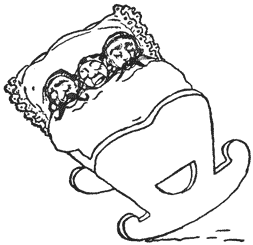 "And we jest as innercent as babies in a crib"
Duke: Yer is lucky, ol' keg o' rum, yer does n't dream o' purple
rhinoceroses. Go back ter bed. (Then to Joe.) Smash! I says. On
comes Petey agin. And we jest as innercent as babies in a crib. It was
me own idear. Brains, young feller. Jest yer wait, Joey, till yer sees
a light at t' other winder.
"And we jest as innercent as babies in a crib"
Duke: Yer is lucky, ol' keg o' rum, yer does n't dream o' purple
rhinoceroses. Go back ter bed. (Then to Joe.) Smash! I says. On
comes Petey agin. And we jest as innercent as babies in a crib. It was
me own idear. Brains, young feller. Jest yer wait, Joey, till yer sees
a light at t' other winder.
(Betsy is heard singing in the kitchen. The Duke stops and listens. A
dark thought runs through his head. His shrewd eye quests from kitchen
door to Joe.)
Duke: Darlin'! Darlin'! (She thrusts in her head.)
Duke: Where 's Betsy?
Darlin': She 's washin' dishes.
Duke: I 'm wonderin' if she would lay off a bit from her jolly
occerpation, and sing us a leetle song.
Darlin': (calling). Betsy! I wants yer.
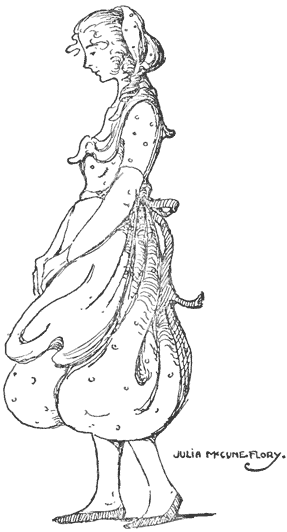 Betsy enters
Patch: I never knowed yer cared fer music, Duke. Usually yer goes
outside. Yer jest boohs.
Betsy enters
Patch: I never knowed yer cared fer music, Duke. Usually yer goes
outside. Yer jest boohs.
Duke: I does usual, Patch. Tonight 's perticerler. Red Joe ain 't
never heard Betsy sing. Does yer like music, Joe?
Joe: I like the roaring of the ocean. I like to hear the trees tossing
in the wind.
Patch: Wind ain 't music. Yer should hear Betsy. She 's got a leetle
song that makes yer feel as good and peaceful as a whinin' parson.
Darlin': (beckoning at the kitchen door). Betsy! Stop sloppin' with
the dishes!
(Betsy enters. She is a pretty girl. Our guess at her age is—but it
is better not to guess. We have in our own experience made several
humiliating blunders. Let us say that Betsy is young enough to be a
grand-daughter. Plainly she is a pirate by accident, not inheritance,
for she is clean and she wears a pretty dress.)
Duke: (as he rises and makes a show of manners). Betsy, yer is
welcome ter the parlor. We wants Red Joe ter hear yer sing. That
leetle song o' yers.
(He returns to the recess at the rear of the cabin and covertly
watches Joe. Patch-Eye is lost in heavenly meditation. Joe's attention
is roused before the first stanza of the song is finished. By the
third stanza Betsy sings to him alone.)
Betsy's Lullaby
[Listen] [PDF] [MusicXML]
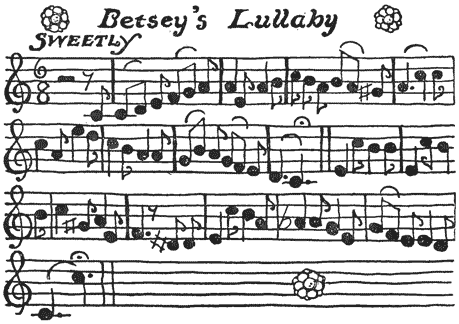
Betsy: (sings).
The north wind's cheeks are puffed with tunes:
It whistles across the sky.
Its song is shrill and rough, until
The hour of twilight 's nigh.
Rest, my dear one, rest and dream.
The winds on tip-toe keep.
In the dusk of day they hum their lay,
And weary children sleep.
The waves since dawn roared on the rocks:
They snarled at the ships on the deep.
But at twilight hour they chain their power
And little children sleep.
Rest, my dear one, rest and dream.
The ships in a cradle swing,
And sailormen blink and children sink
To sleep, as the wavelets sing.
The sun at noon was red and hot:
It stifled the east and west.
But at even song the shadows long
Have summoned the world to rest.
Rest, my dear one, rest and dream.
The sun runs off from the sky.
But the stars, it 's odd, while children nod,
Are tuned to a lullaby.
|
(She sings slowly, to a measure that might rock a cradle. This can be
managed, for I have tried it with a chair. Once, Patch-Eye blows his
nose to keep his emotions from exposure. But make him blow
softly—soto naso, shall we say?—so as not to disturb the song. In
Red Joe the song seems to have stirred a memory. At the end of each
stanza Betsy pauses, as if she, too, dwelt in the past.)
Patch: When I hears that song I feels as if I were rockin' babies in a
crib—blessed leetle pirates, pullin' at their bottles, as will foller
the sea some day.
(He blows his sentimental nose. A slighter structure would burst in
the explosion.)
Duke: Yer ol' nose sounds as if it were tootin' fer a fog. Yer might
be roundin' the Isle o' Dogs on a mirky night.
(He goes to the door and stretches out his hand for raindrops.)
Duke: Joe, you and me has got ter put ile in the lantern. Come on, ol'
sweetheart. When yer sees this lantern blinkin' at that there winder,
yer will know that willainy 's afoot.
(He comes close to Darlin' and whispers.)
Duke: Yer said it, Darlin'. Yer said it. Red Joe 's castin' his eye on
Betsy. Off a cliff! Tonight! Now! If I gets a chance. Off a cliff!
Come on, Joey!
(He goes outdoors with Red Joe, singing Betsy's song. The lullaby
fades in the distance. Patch-Eye and Betsy are left together, for the
roast pig again calls Darlin' to the kitchen.)
Patch: Will yer wait a bit, Betsy—askin' yer pardon—while I talks to
yer?
Betsy: Of course, Patch.
Patch: I don 't suppose, dearie, I 'm the kind o' pirate as sets yer
thinkin' of fiddles tunin' up, ner parsons. No, yer says. Ner cradles
and leetle devils bitin' at their coral. And I don 't suppose yer has
a kind o' hankerin' and yearnin'. Yer never sets and listens to me
comin'. Course not, yer says. Betsy, if I talk out square you 'll not
blab it all 'round the village, will yer? They would point their
fingers at me, and giggle in their sleeves. I want ter tell yer
somethin' o' a wery tender nater. There 's a leetle word as begins
with L. L, I mean, not 'ell. I would n't want yer to think, Betsy,
I 'm cussin'. 'Ell is cussin'. That leetle word is what 's ailing me.
It 's love, Betsy. It 's me heart. Smashed all ter bits! Jesus, yer
asks, what done it? It 's a pretty girl, I answers yer, as has smashed
it. Does yer foller, Betsy? A pretty girl about your size, and with
eyes the color o' yourn. What does yer say, Betsy? Yer says nothin'.
Betsy: I never meant to, Patch. I 'm sorry.
Patch: Course you are. Jest as sorry as the careless feller as nudged
Humpty Dumpty off the wall. But it did n't do no good. There he was,
broke all ter flinders. And all the King's horses and all the King's
men could n't fix him. Humpty Dumpty is me, Betsy. Regularly all split
up, fore and aft, rib and keel. I mopes all day fer you, Betsy. And I
mopes all night. Last night I did n't get ter sleep, jest fidgettin',
till way past 'leven o' clock. And I woke agin at seven, askin'
meself, if I loves you hopeless. Yer is a lump o' sugar, Betsy, as
would sweeten ol' Patch's life. If we was married I 'd jest tag
'round behind yer and hand yer things. And now yer tells me there ain
't no hope at all.
Betsy: No hope at all, Patch.
Patch: Yesterday I was countin' the potaters in the pot, sayin' ter
meself: She loves me—She don 't love me. But the last potater did n't
love me, Betsy. There was jest one too many potaters in the pot. No,
yer says, yer could n't love me. Cause why? Cause Patch is a shabby
pirate with only one eye.
Betsy: I am sorry, Patch.
(She offers him her hand.)
Patch: Blessed leetle fingers, as twines their selves all 'round me
heart. Patch, yer says, yer sorry. There ain 't no hope at all. Yer
nudges him off the wall, but yer can 't fix him. But I never heard
that Humpty Dumpty did a lot o' squealin' when he bust. He took it
like a pirate. And so does Patch. I does n't sulk. If yer will pardon
me, Betsy, I 'll leave yer. Me feelin 's get lumpy in me throat. I 'll
take a wink o' sleep in the loft.
(He climbs the ladder, but turns at the top.)
Patch: There was jest one too many potaters in the pot.
(He disappears through the hole in the wall. Betsy arranges the mugs
on the table, then stands listening. Presently there is a sound of
footsteps. Red Joe enters at the rear.)
Joe: I slipped the Duke in the dark. I came back to talk with you.
(Then bluntly, but with kindness.) How old are you, my dear?
Betsy: I don 't know.
Joe: You don 't know? How long have you lived here?
Betsy: In this cabin? Three years.
Joe: And where did you live before?
Betsy: In the village—in Clovelly.
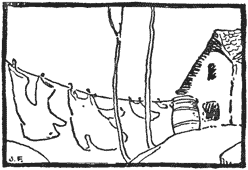 "She did washing for the sailormen"
Joe: Did your parents live there?
"She did washing for the sailormen"
Joe: Did your parents live there?
Betsy: Y-e-s. I think so. I don 't know. Old Nancy, they called
her—she brought me up. But she died three years ago.
Joe: Who was old Nancy?
Betsy: She did washing for the sailormen.
Joe: Was she good to you?
Betsy: Oh yes. I think—I do not know—that she was not my mother.
Joe: And Darlin'?
Betsy: Yes. She has been good to me. And the others, too. I seem to
remember someone else. How long have you been a pirate?
Joe: A pirate? Years, it seems, my dear. But I am more used to a
soldier's oaths. I have trailed a pike in the Lowland wars. The roar
of cannon, and siege and falling walls, are gayer tunes than any ocean
tempest. What is this that you remember, Betsy?
Betsy: It is far off. Some one sang to me. It was not Nancy. When
Nancy died, Darlin' took me and brought me up. That was three years
ago. But last year the Captain and Duke and Patch-Eye came climbing up
the rocks. They were sailormen, they said, who had lost a ship. And
these cliffs with the sea pounding on the shore comforted them when
they were lonely. So they stayed. And Darlin' and I cook for them.
Joe: Do you remember who it was who sang to you?
Betsy: No.
Joe: That song you just sang—where did you learn it?
Betsy: I have always known it. It makes me sad to sing it, for it sets
me thinking—thinking of something that I have forgotten. (She stands
at the window above the sea.) Some days I climb high on the cliffs
and I look upon the ocean. And I know that there is land beyond—where
children play—but I see nothing but a rim of water. And sometimes the
wind comes off the sea, and it brings me familiar far-off
voices—voices I once knew—voices I once knew—fragments from a life
I have forgotten. Why do you ask about my song?
Joe: Because I heard it once myself.
(Betsy sits beside him at the table.)
Betsy: Where? Perhaps, if you will tell me, it will help me to
remember.
Joe: I heard the song once when I was a lad—when I was taken on a
visit.
Betsy: Were your parents pirates?
Joe: It was a long journey and all day we bumped upon the road,
seeking an outlet from the tangled hills. Night overtook our weary
horses and blew out the flaming candles in the west; and shadows were
a blanket on the sleeping world. Toward midnight I was roused. We had
come to the courtyard of a house—this house where I was taken on a
visit.
Betsy: Was it like this, Joe—a cabin on a cliff?
Joe: I remember how the moon peeped around the corner to see who came
so late knocking on the door. I remember—I remember—(He stops
abruptly). Do you remember when you first came to live with Nancy?
Betsy: I dreamed once—you will think me silly—Are there great stone
steps somewhere, wider than this room, with marble women standing
motionless? And walls with dizzy towers upon them?
Joe: Go on, Betsy.
Betsy: In Clovelly there are naught but cabins pitched upon a hill,
and ladders to a loft. And, at the foot of the town, a mole, where
boats put in. And I have listened to the songs of the fishermen as
they wind their nets. And through the window of the tavern I have
heard them singing at their rum. And sometimes I have been afraid. I
have stuffed my ears and ran. But the ugly songs have followed me and
scared me in the night. The shadows from the moon have reeled across
the floor, like a tipsy sailor from the Harbor Light. Joe, are you
really a man from the sea?
Joe: Why, Betsy?
Betsy: The sea is never gentle. It never sleeps. I have stood
listening at the window on breathless nights, but the ocean always
slaps against the rocks. Even in a calm it moves and frets. Is it not
said that the ghosts of evil men walk back and forth on the spot where
their crimes are done? The ocean, perhaps, for its cruel wreckage,
haunts these cliffs. It is doomed through all eternity with a lather
of breaking waves to wash these rocks of blood. And the wind whistles
to bury the cries of drowning men that plague the memory. Joe—
Joe: Yes, my dear.
Betsy: You are the only one—Patch-Eye, Duke and the Captain—you are
the only one who is always gentle. And I have wondered if you could
really be a pirate.
Joe: Me? (Then with sudden change.) Me? Gentle? The devil himself is
my softer twin.
Betsy: Don 't! Don 't!
Joe: What do you know of scuttled ships, and rascals ripped in fight?
Of the last bubbles that grin upon the surface where a dozen men have
drowned?
Betsy: Joe! For God's sake! Don 't!
Joe: Is it gentleness to plunge a dagger in a man and watch for his
dying eye to glaze?
Betsy: It is a lie. Tell me it is a lie!
Joe: My dear. (Gently he touches her hand.)
Betsy: It is a lie.
Joe: We 'll pretend it is a lie.
(They sit for a moment without speaking.)
Betsy: How long, Joe, have you lived with us?
Joe: Two weeks, Betsy.
 "From Monday to Monday, and then around again to
Monday"
Betsy: Two weeks? So short a time. From Monday to Monday and then
around again to Monday. It is so brief a space that a flower would
scarcely droop and wither. And yet the day you came seems already long
ago. And all the days before are of a different life. It was another
Betsy, not myself, who lived in this cabin on a Sunday before a
Monday.
"From Monday to Monday, and then around again to
Monday"
Betsy: Two weeks? So short a time. From Monday to Monday and then
around again to Monday. It is so brief a space that a flower would
scarcely droop and wither. And yet the day you came seems already long
ago. And all the days before are of a different life. It was another
Betsy, not myself, who lived in this cabin on a Sunday before a
Monday.
Joe: It is so always, Betsy, when friends suddenly come to know each
other. All other days sink to unreality like the memory of snow upon a
day of August. We wonder how the flowering meadows were once a field
of white. Our past selves, Betsy, walk apart from us and, although we
know their trick of attitude and the fashion of their clothes, they
are not ourselves. For friendship, when it grips the heart, rewinds
the fibres of our being. Do you remember, dear, how you ran in fright
when you first saw me clambering up these rocks?
Betsy: I was sent to call the Duke to dinner and carried a bell to
ring it on the cliff. I was afraid when a stranger's head appeared
upon the path.
Joe: Yet, when I spoke, you stopped.
Betsy: At the first word I knew I need n't be afraid. And you took my
hand to help me up the slope. You asked my name, and told me yours was
Joe. Then we came together to this cabin. And each day I have been
with you. Two weeks only.
Joe: I shall be gone, Betsy, in a little while.
Betsy: Gone?
Joe: I am not, my dear, the master of myself. We must forget these
days together.
Betsy: Joe!
Joe: May be I shall return. Fate is captain. The future shows so
vaguely in the mist. Listen! It is the Duke.
(In the distance the Duke is heard singing the pirates' song.)
Joe: We must speak of these things together. Another time when there
is no interruption.
(Gently she touches his fingers.)
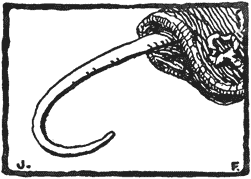 The Captain would be a frightful man to meet socially
Betsy: I shall be lonely when you go.
The Captain would be a frightful man to meet socially
Betsy: I shall be lonely when you go.
(There is loud stamping at the door. Betsy goes quickly to the
kitchen.
The Captain enters, followed by the Duke. Patch-Eye enters by way of
the ladder. The Captain has a hook hand. This is the very hook
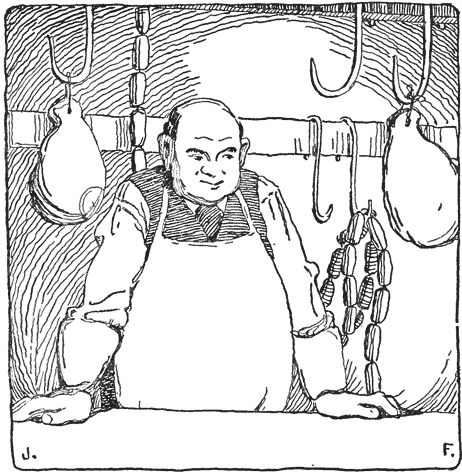
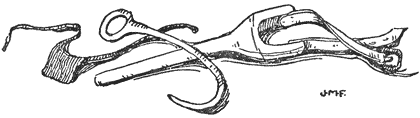
mentioned in my preface—if you read prefaces—got from the corner
butcher. The Captain would be a frightful man to meet socially. I can
hear a host saying "Shake hands with the Captain." One quite loses
his taste for dinner parties. There is a sabre cut across the
Captain's cheek. He is even more disreputable in appearance than his
followers, with a bluster that marks his rank.)
Captain: There 's news! There 's news, me men! I 've brought big news
from the village.
(He wrings the water from his hat. He is provokingly deliberate. All
of the pirates crowd around.)
Captain: By the bones of me ten fingers, it 's a blythe night fer our
business. It 's wetter than a crocodile's nest. When I smells a fog, I
feels good. I tastes it and is 'appy.
Patch: What 's yer news, Captain?
Captain: News? Oh yes, the news. I 've jest hearn—I 've jest
hearn—blast me rotten timbers! How can a man talk when he 's dry! A
cup o' grog!
(Darlin' has slipped into the room in the excitement. Old custom
anticipates his desire. She stands at his elbow with the cup, like a
dirty Ganymede. The Captain drinks slowly.)
Captain: There 's big news, me hearties.
Duke: What 's yer news, Captain? We asks yer.
Captain: I 'm tellin' yer. It 's sweatin' with curiosity that kills
cats. (He yawns and stretches his legs across the hob.) Down in the
village I learnt—I was jest takin' a drop o' rum at the Harbor Light.
It 's not as sweet as Darlin's. They skimps their sugar. Yer wants ter
keep droppin' it in as yer stirs it. I thinks they puts in too much
water. Water 's not much good—'cept fer washin'. And washin' 's not
much good.
Duke: Now then, Captain, hold hard on yer tiller agin wobblin', and
get ter port.
Darlin': We 're hangin' on yer lips.
Captain: Yer need n't keep shovin' me. I kicks up when I 'm riled.
They say down in the village—
(It is now a sneeze that will not
dislodge. He has hopes of it for a breathless moment, but it proves to
be a dud.)
Captain: There 's Petey—
Patch: We 're jest fidgettin' fer the news.
Captain: The news? Oh, yes. Now yer hears it. (He draws the pirates
near.) A great merchantman has jest sailed from Bristol. The Royal
'Arry. It 's her. With gold fer the armies in France. She 's a brig o'
five hundred ton. This night, when the tide runs out, she slips away
from Bristol harbor. With this wind she should be off Clovelly by this
time termorrer night.
Darlin': Glory ter God!
Duke: And then Petey will douse his glim. And we 'll set up the ship's
lantern.
Patch: Smash!
Duke: Then Petey will light hisself.
Patch: And we 'll be jest as innercent as babies rockin' in a crib.
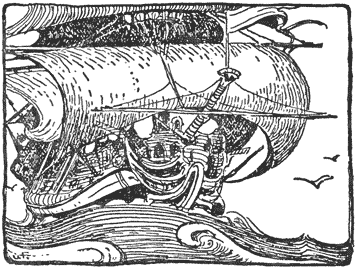
"The Royal 'Arry. It 's her."
Duke: And lay it on the helmsman fer bein' sleepy.
Captain: And I 've other news. Down in the village they say—fer a
fishin' sloop brought the word—that his 'Ighness, the Prince o'
Wales, left London a month ago.
Duke: And him not givin' me word. I calls that shabby. He was me fag
at Eton.
Patch: Does yer think, Captain, he 'll spend a week-end with us,
ridin' to the 'ounds, jest tellin' us the London gossip—how the
pretty Duchesses is cuttin' up?
Duke: I thought he was settin' in Whitehall, tryin' on crowns, so as
ter get one that did n't scratch his ears.
Captain: They say he 's incarnito.
Patch: What? Is it somethin' yer ketches like wollygogs in the
stomich?
Duke: Igerence. I 'm 'shamed o' yer, Patch. Ain 't yer been ter
school? Ain 't yer done lessons on a slate? Ain 't yer been walloped
so standin' 's been comfertabler. The Captain and me soils ourselves
talkin' to yer. Incarnito is dressed up fancy, so as no one can know
him.
Darlin': Like Cindereller at the party.
Duke: If yer wants Patch ter understand yer, Captain, yer has got to
use leetle words as is still pullin' at their bottles.
Darlin': When words grow big and has got beards they jest don 't say
nothin' to Patch.
Captain: This here Prince o' Wales is journeyin' down Plymouth way.
Duke: What 's that ter us? I 'm askin' yer. His 'Ighness cut me when I
passed him in Piccadilly. The bloomin' swab! I pulled me hat, standin'
in the gutter, but he jest seemed ter smell somethin'.
Patch: It were n't roses, I 'm tellin' yer.
Captain: Silence! They say he has sworn an oath to break up the pirate
business on the coast.
Patch: And let us starve? It 's unfeelin'.
Duke: No pickin's on the beach?
Joe: I 'd like to catch him. I 'd slit his wizen.
Darlin': I 'd put pizen in the pig I feeds him.
Duke: I 'd nudge him off the cliff—jest like he were a sneakin'
snooper.
Captain: Well, there 's yer news! I 'm dry. Darlin'! Some grog!
(He crosses to the table and draws the pirates around him.)
Captain: Here 's to the Royal 'Arry!
Duke: And may the helmsman be wery sleepy!
Darlin': And we as innercent as leetle pirates suckin' at their
bottles!
All: The Royal 'Arry!
(While the cups are still aloft there is a loud banging at the door.
An old woman enters—old Meg. We have seen her but a minute since pass
the windows. Perhaps she is as dirty as Darlin'. A sprig of mistletoe,
even at the reckless New Year, would wither in despair. She is a gypsy
in gorgeous skirt and shawl, and she wears gold earrings. Any
well-instructed nurse-maid would huddle her children close if she
heard her tapping up the street. Meg walks to the table. She sniffs
audibly. It is grog—her weakness. She drinks the dregs of all three
cups. She rubs her thrifty finger inside the rims and licks it for the
precious drop. She opens her wallet and takes from it a
fortune-teller's crystal.)
Meg: I tells fortins, gentlemen. Would n't any o' yer like ter see the
future? I sees what 's comin' in this here magic glass. I tells yer
when ter set yer nets—and of rising storms. Has any o' yer a kind o'
hankerin' fer matrimony? I can tell yer if the lady be light or dark.
It will cost yer only a sixpence.
Captain: Yer insults me. Fer better and fer worse is usual fer worse.
Does yer think yer can anchor an ol' sea-dog like me to a kennel as is
made fer landlubbery lap dogs? I 've deserted three wives. And that 's
enough. More 's a hog.
(He retires to the fireplace in disgust.)
Darlin': Husbands is nuisances, as I was tellin' the sea-captain, jest
afore he cut his throat.
Duke: Thank ye, ol' lady, I does n't need yer. When the ol' Duke is
willin', he knows a leetle dear as will come flutterin' to his arms.
Patch: What can yer do fer an ol' sailorman like me? I 'd like someone
with curlin' locks, as can mix grog as good as Darlin's. And I likes
roast pig—crackly, as Darlin' cooks it. (He offers his hand.) I has
a leetle girl in mind, but she 's kinder holdin' off. What does yer
see, dearie? Does yer hear any fiddles tunin' fer the nupshals? Is
there a pretty lady waitin' fer a kiss?
Meg: I sees the ocean. And a ship. I sees inside the cabin o' that
ship.
Patch: Does yer see me as the captain o' that ship? Jest settin' easy,
bawlin' orders—jest feedin' on plum duff.
Meg: I sees yer in irons.
Patch: Mother o' goodness! Now yer done it!
Meg: I sees Wappin' wharf. I sees a gibbet. I sees—
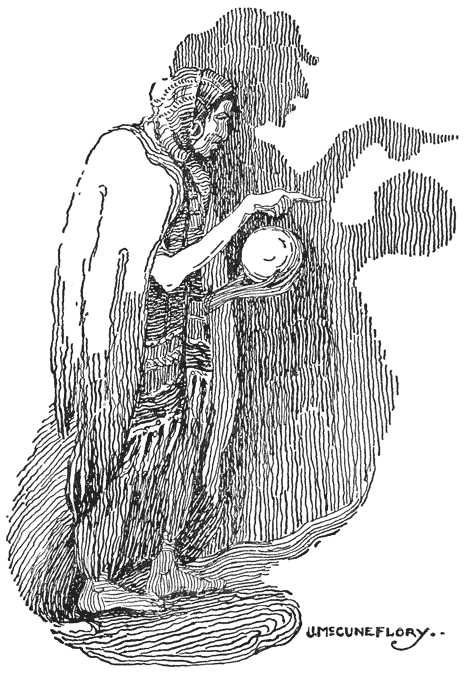
"I sees a gibbet. I sees——"
Patch: Horrers!
Meg: I sees you swingin' on that gibbet—stretchin' with yer
toes—swingin' in the wind.
Patch: Yer makes me grog sour on me.
(He goes to the rear of the cabin and looks disconsolately over the
ocean.)
Meg: (as she looks in the glass). I sees misfortin fer everyone
here—'cept one—tragedy, the gibbet. Go not upon the sea until the
moon has turned. Ha! Leetle glass, has yer more to show? Has yer any
comfort? The light fades out. It is dark.
Duke: Ain 't yer givin' us more 'n a sixpence worth o' misery? Yer
gloom is sloppin' over the brim.
Meg: Ah! Here 's light agin at last. There 's a red streak across the
dial. It drips! It 's blood!
Captain: Ain 't yer got any pretty picters in that glass?
Patch: Graveyards are cheerfuller 'n gibbets.
Meg: Peace! I sees a man in a velvet cloak. It 's him that swings yer
to a gibbet. It 's him that strangles yer till yer eyes is poppin'.
That man avoid like a pizened snake.
Captain: Avoid? By the rotten bones o' Flint, if I meets that man in a
velvet cloak I hooks out his eye.
Duke: Captain, yer sweats yerself unnecessary. (Slyly.) Here 's Red
Joe, ol' dear. Joe 's a spry young feller. He looks as if he might be
hankerin' fer a wife. Hey, Darlin'?
Darlin': He 's the kind as wampires makes their wictims.
(With a laugh—but unwillingly—Joe holds out his hand.)
Meg: (as she looks in the glass her face brightens). I sees a tall
buildin' with gold spires. I hears a shout o' joy and I hears stately
music, like what yer hears in Bartolmy Fair arter the Lord Mayor has
made his speech. I sees a man in a silk cloak. He swaggers to the
music. I sees—I sees—
(She looks long in the glass and seems to see great and unexpected
things. Her eyes are as wide as a child's at a tale of fairies. It is
no less a moment—but how different!—than when Lady Bluebeard peeped
in the forbidden door. Scarcely was Little Red Riding Hood more
startled when she touched the strange bristles on her grandmother's
chin. But Meg is not frightened. She smiles. She bends intently. She
is about to speak. Then she sinks into the chair behind the table.)
Meg: I sees—I sees—nothin'! The glass is blank!
Captain: Nothin'? Jest nothin' at all?
Patch: Ain 't there no blood drippin'?
Darlin': Ner gibbets?
Captain: Ner sailormen swingin' in the wind?
(Old Meg is visibly affected by what she has seen. The Duke, with a
suspicious glance at Red Joe, moves forward to look over her shoulder
at the glass. Slyly she sees him. She pushes the crystal forward and
it breaks upon the stones. Then she rises abruptly. She lifts a
portentous finger. She advances to Red Joe.)
Meg: I sees danger fer yer, Joe. Who can tell whether it be death? 'T
is beyond my magic. But beware a knife! Go not near the cliff! (Then,
in a lower tone.) You will see me agin. And in your hour o' danger.
When yer least expects it.
(She is about to curtsy, but turns abruptly and leaves the cabin.
Darlin', with shaken nerves, runs to bolt the door. There is silence
except for the monotone of rain.)
Patch: Nice cheerful ol' lady, I says.
Captain: Yer can pipe the devil up, but she give me shivers.
Joe: For just a minute I thought some old lady had died and left me
her money box.
(The Duke picks up a fragment of the crystal and puts it to his eye.
He examines it at the candle, and turns it round and round. He makes
nothing of it, and shakes his head.)
Patch: Yer can dim me gig that 's left, I 'm clean upset.
Captain: I ain 't been so down in the boots since the blessed angels
took Flint ter 'ell.
Duke: Captain, you and Patch is melancholier 'n funerals. Weepin'
widders is jollier. Will yer let a hanted, thirsty, grog-eyed
grand-daughter o' a blinkin' sea-serpent upset yer 'appy
dispersitions? Stiffen yerself! Keep yer nose up, Captain! We has sea
enough. We 're not thumpin' on the rocks.
Captain: Yer said it, Duke. I sulks unnecessary. There 's ol' Petey
shinin' up there. Termorrer night, if the wind holds, we 'll see his
starin' eye go out, and our lantern shinin' at t' other winder. (He
takes a pirate flag from his boot. He smoothes it with affection. Then
he waves it on his hook.) The crossbones as hung on the masthead o'
the Spittin' Devil. Ol' Flint's wery flag. Him as they hanged on a
gibbet on Wappin' wharf. It was a mirky night like this, with
'prentices gawpin' in the lanterns and Jack Ketch unsnarlin' his
cursed ropes. I spits blood ter think o' it.
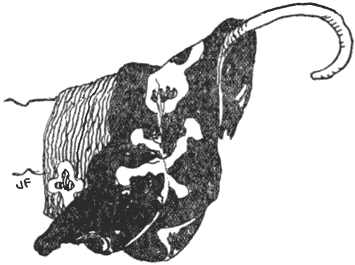
"Ol' Flint's wery flag"
Duke: I 'll die easy when I 've revenged his death and the ol' clock
is tickin' peaceful and Flint sleepin' 'appy in his rotten coffin.
Captain: A drink all 'round. We 'll drink the health o' this here
flag. You 'll drink with us, Darlin'.
Darlin': Yer spoils me, Captain.
(Everyone drinks.)
Captain: And now we 'll drink confusion to the swab that 's settin' on
the English throne.
(All drink except Red Joe. He makes the pretense, but pours his grog
out covertly. Our play is nothing if not subtle.)
Duke: Here 's to ol' Flint!
All: Here 's to ol' Flint!
(It is bed-time. They all stretch and yawn. The Captain climbs the
ladder to the sleeping loft. Patch follows with the candle, warming
the Captain's seat for speed. The Duke comes next, carrying his one
boot which he has removed before the fire. Darlin' kisses her hand to
the Duke and retires to the kitchen. We suspect that she curls up
inside the sink, with a stewpan for a pillow. Red Joe lingers for a
moment and stands gazing at the ocean.)
Joe: My memory fumbles in the past. I, too, hear familiar voices—lost
for many years. A dark curtain lifts and in the past I see myself a
child. There are strange tunes in the wind tonight. Methinks they sing
the name of Margaret.
(He climbs the ladder. And now, with an occasional dropping boot, the
pirates prepare for bed. Presently we hear the Duke up above,
singing—rigorously at first, until drowsiness dulls the tune.)
It is said in port by the sailor sort,
As they swig all night at their rum,
That a jolly grave is the ocean wave,
But a churchyard bell 's too glum.
I agrees ter this and ter give 'em bliss—
From Pew I learned the trick—
I push 'em wide o' the wessel's side
And poke 'em down with a stick.
|
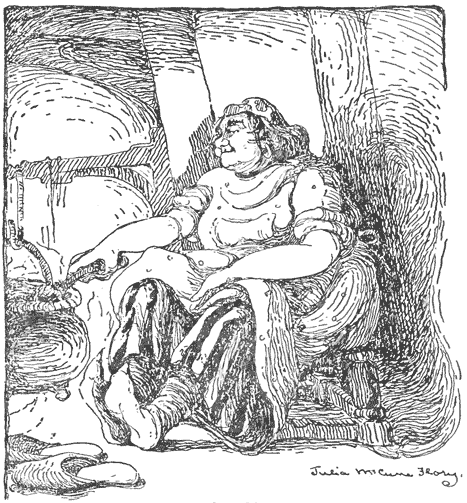
Darlin' warms her old red stockings
(Darlin' enters. With a prodigious yawn she sits at the fire. She
kicks off her slippers and warms her old red stockings. She comforts
herself with grog and spits across the hearth. She sleeps and gently
snores. The Duke continues with his song.)
Ol' Flint had a fist and an iron wrist,
And he thumped on the nose, it is said,
Till a wictim's gore ran over the floor
And he rolled in the scuppers dead.
But, Patch, there 's a few, I 'm tellin' ter you,
Who 's nice and they hates a muss,
And a plank, I contend, is a tidier end.
No sweepin', nor scrapin', nor fuss.
Captain Kidd, when afloat, put the crew in a boat,
And he shoved 'em off fer to starve.
On a rock in the sea, says he ter me—on a rock
In the sea, says he ter me—on a rock—
|
(The singer's voice fails. Sleep engulfs him. Silence! Then sounds of
snoring. The range of Caucasus hath not noisier winds. Let's draw the
curtain on the tempest!)
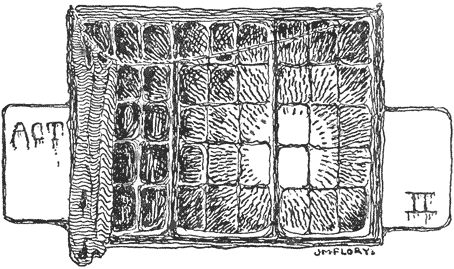
It is the same cabin on the following night. There is no thunder and
lightning, but it is a dirty night of fog—as wet as a crocodile's
nest—and you hear the water dripping from the trees. The Duke,
evidently, has had an answer to his "Now I lay me." The lighthouse, as
before, shows vaguely through the mist.
In this scene we had wished to have a moon. The Duke will need it
presently in his courtship; for marvelously it sharpens a lover's
oath. 'T is a silver spur to a halting wooer. Shrewd merchants, I am
told, go so far as to consult the almanac when laying in their store
of wedding fits; for a cloudy June throws Cupid off his aim. What
cosmetic—what rouge or powder—so paints a beauty! If the moon were
full twice within the month scarcely a bachelor would be left. I pray
you, master carpenter, hang me up a moon. But our plot has put its
foot down. "Mirk," it says, "mirk and fog are best for our dirty
business."
We had wished, also, to place one act of our piece on the deck of a
pirate ship, rocking in a storm. Such high excitement is your right,
for your payment at the door. It required but the stroke of a lazy
pencil. But our plot has dealt stubbornly with us. We are still in the
pirates' cabin in the fog.
We hear Darlin' singing in the kitchen, as the curtain rises.
DARLIN'S SONG
[Listen] [PDF] [MusicXML]
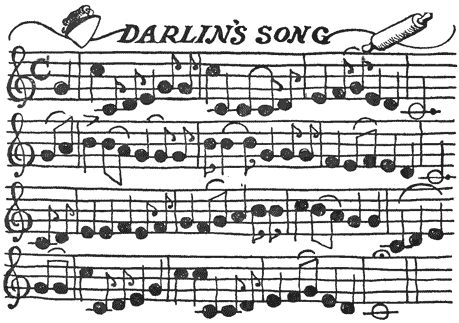
Oh, I am the cook fer a pirate band
And food I never spoil.
Cabbage and such, it sure ain 't much,
Till I sets it on ter boil.
And I throws on salt and I throws on spice,
And the Duke, he says ter me,
Me Darlin', me pet, I 'm in yer debt,
And he sighs contentedlee.
|
(There is a rattle of tinware. Patch-Eye sings the next stanza in the
loft.)
On the Strand, it 's true, I 'm tellin' ter you,
The Dukes and the Duchesses dwell.
And they dines in state on golden plate—
Eatin' and drinkin' like 'ell.
But I says ter you, and it 's perfectly true,
They stuffs theirselves too much;
And a mutton stew, when yer gets it through,
Is better than peacocks and such.
|
(More tinware in the kitchen. And now Darlin' again!)
I 've cooked in a brig to a dancin' jig
Which the sea kicks up in a blast.
And me stove 's slid 'round until I 've found
A rope ter make it fast.
But I braces me legs and the Duke, he begs
Fer puddin' with sweets on the side.
Me Darlin', it 's rough, and I likes yer duff.
I 'll marry yer, Darlin', me bride.
|
(In her reckless joy at this dim possibility she overturns the
dishpan. During the song the Duke's legs have appeared on the ladder.
He descends, fetching with him a comb and mirror.
 "I pray you, master carpenter, hang me up a moon"
He brushes his hair. This is unusual and he finds a knot that is
harder than any Gordian knot whatsoever. He smoothes and strokes his
whiskers. He goes so far as to slap himself for dust. He puts a sprig
of flowers—amazing!—in the front of his cloak. He practices a smile
and gesture. He seems to speak. He claps his hand upon his heart. Ah,
my dear sir, we have guessed your secret. The wind, as yet, blows from
the south, but a pirate waits not upon the spring. His lover's oath
pops out before the daffodil. I pray you, master carpenter, hang me up
a moon.
"I pray you, master carpenter, hang me up a moon"
He brushes his hair. This is unusual and he finds a knot that is
harder than any Gordian knot whatsoever. He smoothes and strokes his
whiskers. He goes so far as to slap himself for dust. He puts a sprig
of flowers—amazing!—in the front of his cloak. He practices a smile
and gesture. He seems to speak. He claps his hand upon his heart. Ah,
my dear sir, we have guessed your secret. The wind, as yet, blows from
the south, but a pirate waits not upon the spring. His lover's oath
pops out before the daffodil. I pray you, master carpenter, hang me up
a moon.
And now the Duke stands before us the King of smiles. His is the
wooer's posture. He speaks, but not with his usual voice of command.
Oberon, as it were, calls Titania to the woodland when stars are torch
and candle to the sleeping world.)
Duke: Betsy! Betsy!
(She appears. The Duke wears a silly smile. But did not Bottom in an
ass's head win the fairy princess? A moon, sweet sir! And
now—suddenly!—the magic night dissolves into coarsest day.)
Duke: Would yer like ter be the Duchess?
(This is abrupt and unusual, but nice customs curtsy to Dukes as well
as Kings.)
Duke: I 'm askin' yer, Betsy. Yer ol' Duke is askin' yer. I 'm lovin'
yer. Yer ol' Duke is lovin' yer. I 'll do the right thing by yer. I
'll marry yer. There! I 've said it. When yer married yer can jest set
on a cushion without nothin' ter do—(reflectively) nothin' 'cept
cookin' and washin' and darnin'. Does yer jump at me, Betsy?
(I confess, myself, a mere man, unable to analyze Betsy's emotions.
She stands staring at the Duke, as you or I might stare at a
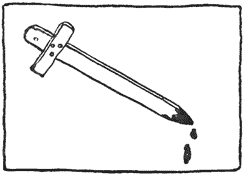
hippopotamus in the front hall. I have bitten my pencil to a pulp—the
maker's name is quite gone—but I can think of no lines that are
adequate. Her first surprise, however, turns to amusement.)
Duke: Ain 't yer a kind o' hankerin' fer me? Come ter me arms,
sweetie, and confess yer blushin' love. I 'm askin' yer. I 'm askin'
yer ter be the Duchess.
Betsy: But I do not love you, Duke.
(In jest, however, the little rascal perches on his knee.)
Duke: Make yerself comfertable. Yer husband 's willin'. When I cramps,
I shifts yer. Kiss me, when yer wants.
Betsy: You are an old goose.
Duke: Did I hear yer? Does yer hold off fer me ter nag yer? The ol'
Duke 's waitin' ter fold yer in his lovin' arms.
Betsy: I do not love you, Duke.
(The Captain and Patch-Eye have thrust their heads through the
opening above the ladder, and they listen with amusement.)
Duke: I 'm blowed. I 'm a better man than Patch. I 'm tellin' yer. Is
it me stump, Betsy? I has n't a hook hand like the Captain. Yer has
got ter be linked all 'round. There 's no fun, I says, in bein' hugged
by a one-armed man. Yer would be lop-sided in a week.
Betsy: It 's just that I do not love you, Duke.
Duke: Yer wounds me feelin's. Does n't I ask yer pretty? Should I have
waited fer a moon and took yer walkin'? And perched with yer on the
rocks, with the ol' moon winkin' at yer, shovin' yer on? The Duke 's
never been refused before. A number o' wery perticerler ladies, arter
breakfast even, has jest come scamperin'. 'T ain 't Patch, is it
Betsy? A pretty leetle girl would n't love a feller as has one eye. It
ain 't the Captain. He ain 't no hand with the ladies. Yer not goin'
ter tell me it 's Petey? I would n't want yer ter fall in love with a
blinkin' light.
Betsy: You have lovely whiskers, Duke.
Duke: Yer can pull one fer the locket that yer wears. Are yer makin'
fun o' me?
Betsy: I would n't dare.
Duke: Does yer mean it, Betsy? Are yer relentin'? Are yer goin' ter
say the 'appy word as splices us from keel to topsail? Yer ain 't jest
a cruel syren are yer, wavin' me on, hopin' I 'll smash meself? Are
yer winkin' at me like ol' Flint's lantern—me thinkin' it 's love I
see, shinin' in yer laughin' eyes?
Betsy: Why don 't you marry Darlin'?
Duke: Her with one tooth? Yer silly. I boohs at yer. Ol' ladies with
one hoof inside a coffin does n't make good brides. Yer wants someone
kinder gay and spry, as yer can pin flowers to.
Betsy: She loves you, Duke.
Duke: Course she does. So does the ol' lady as keeps the tap at the
Harbor Light, and one-eyed Pol as mops up the liquor that is spilt.
And youngsters, too. A pretty leetle dear—jest a cozy armful—was
winkin' at me yesterday—kinder givin' me the snuggle-up. I pities
'em. It 's their nater, God 'elp 'em, ter love me; but the ol' Duke is
perticerler. Yer has lovely eyes, Betsy—blessed leetle mirrors where
I sees Cupid playin'. They shines like the lights o' a friendly
harbor.
Betsy: Darlin' cooks roast pig that crackles.
Duke: I sets me heart on top me stomich. Ain 't yer comfertable,
settin' on me knee? Shall I shift yer to me stump? Betsy, I calls
arter we are married, fetch me down me slipper and lay it on the
hearth ter warm. Yer husband 's home. And I tosses yer me boot, all
mud fer cleanin'. And then yer passes the grog. And arter about the
second cup I limbers up and kisses yer. And then yer sets upon me
knee. It will be snug on winter evenin's when the blast is blowin'.
And when we 're married yer can kiss me pretty near as often as yer
please. And I won 't deny as I won 't like it. The ol' Duke ain 't
slingin' the permission 'round general. Darlin' nags me. What yer
laughin' at?
Betsy: You silly old man!
Duke: Yer riles me. Once and fer all, will yer marry me? I 'll not
waste the night argyin' with yer. I 'm not goin' ter tease yer. I 've
only one knee and it ain 't no bench fer gigglin' girls as pokes fun
at their betters. I 'll jolt yer till yer teeth rattles. Is it someone
else? Has yer a priory 'tachment? Red Joe? Is it Red Joe, Betsy? Is he
snoopin' 'round?
(Betsy rises with sobered mood, and walks away.)
Duke: There 's somethin' about that young feller I does n't like. He
's a snooper. Betsy, does yer get what I 'm talkin' about? I have
offered ter make yer the Duchess. I 'll buy—I 'll steal yer a set o'
red beads. I 'll give yer a sixpence—without no naggin'—every time
yer goes ter town, jest ter spend reckless. I 'll marry yer. I 'll
take yer ter Minehead and get the piousest parson in the town. Would
yer like Darlin' fer a bridesmaid—and grog and angel-cake? Me jest
settin' ready ter kiss yer every time yer passes it. I 'm blowed! You
are wickeder than ol' Flint's lantern. It must be Red Joe. Him with
the smirk! There 's a young feller 'round here, Betsy, as wants ter
look out fer his wizen.
(But Betsy has run in panic to the kitchen.)
Duke: I does n't understand 'em. I 'm thinkin' the girl 's a fool. A
ninny I calls her. It 's Red Joe. Off a cliff! Yer said it, Darlin'.
Off a cliff!
(He removes the sprig of flowers and tosses it into the fire.
Rough winds do shake the darling buds of May,
And summer's lease hath all too short a date:—
|
He retires to the rear of the cabin and strokes the parrot's head. He
jerks away his hand for fear of being nipped. The ungrateful world has
turned against him.)
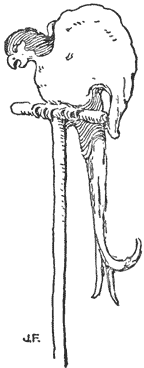 "Yer as mean as women"
Duke: Yer a spiteful bird. Yer as mean as women. Ninnies I calls 'em.
It must ha' been the moon. I should ha' waited fer a moon.
"Yer as mean as women"
Duke: Yer a spiteful bird. Yer as mean as women. Ninnies I calls 'em.
It must ha' been the moon. I should ha' waited fer a moon.
(He sits on the chest at the rear of the cabin and whittles a little
ship. Women are a queer lot.
The Captain and Patch-Eye have climbed down the ladder. They burst
with jest. The Captain sits on the chair by the fire, mimicing the
posture of the Duke. Patch-Eye perches on his knee.)
Patch: Darlin' loves yer, Duke.
Captain: Course she does. They all does. Youngsters, too—winkin' and
givin' me the snuggle-up.
Patch: Yer has lovely whiskers, Duke.
Captain: Yer can pull one, Betsy, fer the locket that yer wears.
(But the Duke ends the burlesque by upsetting the chair. The Captain
and Patch-Eye, chuckling at their jest, sit to a game of cards. The
Duke returns to the chest. Once in a while he lays down the ship and
seems to be thinking. The broken crystal of the fortune-teller lies on
the floor. He picks it up and puts it to his eye, as if the future may
still show upon its face. He is preoccupied with his disappointment
and his bitter thoughts.
Darlin', meantime, is heard singing in the kitchen with her dishes.)
Fer griddle cakes I 've a nimble wrist
And I tosses 'em 'igh on a spoon.
And the Duke and Patch yer can hardly match
Fer their breakfast they stretch till noon.
And I heaps the fire and I greases the iron,
And the Duke, he kisses me thumb.
Me Darlin', me dear, it 's perfectly clear
I 've lovin' yer better than rum.
|
Patch, also sings.
She 's cooked fer sailors worn down to the bone,
Till they rolls like the Captain's gig.
At soup and stew we are never through,
But our fav'rite dish is pig.
And she cuts off slabs and passes 'em 'round,
And the Duke, he takes her hand.
Me Darlin', me love, by the gods above,
Yer a cook fer a pirate band.
|
And now Darlin' again.
Me grog is the best. It is made o' rum,
And I stirs in sugar, too.
And a hogshead vast will hardly last
A merry evenin' through.
And I fills the cups till mornin' comes,
And the Duke, he talks like a loon.
Me Darlin', me life, will yer be me wife,
And elope by the light o' the moon.
|
(Let all the tinware crash!)
 "Did n't yer ever play Black-ace at the Rusty Anchor?"
Captain: (as he throws down his cards). There! I done yer. Yer a
child at cards, Patch. How ain 't it that yer never learnt? Did n't
yer ever play black-ace at the Rusty Anchor down Greenwich way? Crack
me hook, I 've played with ol' Flint hisself, settin' in the leetle
back room. With somethin' wet and warmin' now and then, jest ter keep
the stomich cozy. Never stopped till Phœbus's fiery eye looked in
the winder.
"Did n't yer ever play Black-ace at the Rusty Anchor?"
Captain: (as he throws down his cards). There! I done yer. Yer a
child at cards, Patch. How ain 't it that yer never learnt? Did n't
yer ever play black-ace at the Rusty Anchor down Greenwich way? Crack
me hook, I 've played with ol' Flint hisself, settin' in the leetle
back room. With somethin' wet and warmin' now and then, jest ter keep
the stomich cozy. Never stopped till Phœbus's fiery eye looked in
the winder.
Patch: Poor ol' Flint! I never sees his clock up there but I drops a
tear.
Captain: Yer cries as easy as a crocodile. And yer as innercent at
cards as—as a baby bitin' at his coral, a cooin' leetle pirate.
Patch: It 's frettin' does it, Captain.
Captain: What 's frettin' yer?
Patch: It 's what the ol' lady said last night. She hung me ter a
gibbet, jest like ol' Flint. There 's a gibbet, Captain, on Wappin'
wharf, jest 'round the corner from the Sailors' Rest. Does yer
remember it, Captain? It makes yer grog belch on yer.
Captain: (to tease and frighten Patch). Aye. There was two sailormen
hangin' there when I comes in a year ago.
Patch: Horrers!
Captain: Jest swingin' in the wind, and tryin' ter get their toes down
comfertable. (He has hooked two empty mugs and he rocks them back and
forth.) Jest reachin' with their footies ter ease theirselves.
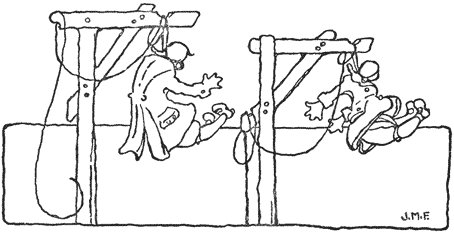
"Jest swingin' in the wind"
Patch: The ol' lady last night made me a wee bit creepy. Gibbets and
Wappin' wharf ain 't nothin' ter talk about.
Captain: I never see a flock o' crows but I asks their pardon fer
keepin' 'em waitin' fer their supper. Crows, Patch, is fond o' yer as
yer are, without neither sauce ner gravy—jest pickin' 'appy, soup
ter nuts, at yer dry ol' bones. Here 's ol' Patch, they says, waitin'
in the platter fer his 'ungry guests ter come.
Patch: Me stomich 's turned keel up.
Captain: Patch, yer ain 't got spunk ter be a pirate. Yer as soft as
Petey's pussycat.
Patch: I ain 't, ain 't I? Was n't it me as nudged the Captain o' the
Northern Star off his poop—when he were n't lookin'? Him with a
pistol in his boot! Did n't I hit Bill, the bos'n, with a
marline-spike—jest afore he woke up? Sweet dreams, I says, and I
tapped him gentle. I got a lot o' spunk. Bill did n't wake up, he did
n't. Was n't it me, Captain, that started that mutiny? Was n't it me?
I 'm askin' yer.
Captain: Still braggin' o' that ol' time. It was more 'n four years
ago. What yer done since? Jest loadin' yer stomich—jest gruntin' and
wallerin' in the trough—jest braggin'.
Patch: I ain 't 'fraid o' nothin'—'cept a gibbet. (For a moment the
ugly word sticks in his gullet.) But the ol' lady kinder got me. Yer
looked down yer nose yerself, Captain—askin' yer pardon.
Captain: Struck me, Patch, she was jest a wee bit flustered by Red
Joe. Did yer notice how she sat and looked at the glass? And would n't
say nothin'? Jest nothin' at all.
Patch: And then the ol' dear's fingers slipped and the glass was
broke.
Captain: It looks almost as if she done it a purpose.
(The Duke has been thinking all of this time with necessary
contortions of the face. It is amazing how these help on a knotty
problem.)
Duke: Course she done it a purpose. It was ter stop me lookin' 'cross
her shoulder in the glass.
Captain: What does yer think she saw?
Patch: Was it blood drippin'?
Duke: I 'll tell yer. I 'll tell yer.
(But he continues whittling.)
Captain: Well, ain 't we listenin', Duke?
Patch: Jest strainin' our ears.
Duke: I 'll tell yer. I squinted in the glass, meself, arter it was
broke.
Captain and Patch: What did yer see?
(There is intense silence. The Duke comes forward to the table. He
taps his fingers sagely. He looks mysteriously at his fellow pirates.
They put their heads together. The Duke sinks his voice. In such
posture and accent was the gunpowder plot hatched out.)
Duke: Nothin'! Jest nothin'!
(The strain is over. They relax.)
Captain: The Duke, he jest seen nothin'.
Patch: Jest nothin' at all.
 "I 'spects nothin' from Patch"
Duke: That 's what gets me. If the ol' lady 'd seen nothin', she
would n't took ter fidgettin'. And therefore she seen somethin'.
Does yer foller? You, Captain? I 'spects nothin' from Patch.
"I 'spects nothin' from Patch"
Duke: That 's what gets me. If the ol' lady 'd seen nothin', she
would n't took ter fidgettin'. And therefore she seen somethin'.
Does yer foller? You, Captain? I 'spects nothin' from Patch.
Patch: Yer hurts me feelin's, Duke.
Duke: Somethin' 's wrong. Somethin' 's wrong with Red Joe.
Patch: Red Joe 's a right smart feller, I says.
Captain: He can shoot as straight as ol' Flint. Barin' meself, Joe 's
as straight a shot as I 've seen in many a year. Patch, agin him, is
jest a crooked stick.
Patch: Pick on the Duke jest once, why does n't yer?
Duke: Ease off, mates! Red Joe ain 't goin' ter hang on no gibbet.
'Cause why? 'Cause I 'm tellin' yer. I 'll tell yer what the ol' lady
seen in the glass.
(Once more the Duke draws the pirates around him. He is Guy Faux and
the wicked Bothwell rolled together.)
Captain: We 're listenin', Duke.
Patch: Like kittens at a mouse-hole.
Duke: Captain, it 's deuced strange that Red Joe's ship—nary a stick
o' her—never come ter shore. Does yer remember a wreck 'long here
where nothin' washed ter shore?
Captain: Yer right, Duke. I never did.
Duke: Does you remember one, stoopid?
Patch: I does n't remember one this minute, Duke.
Duke: Ol' Flint, he had a pigtail, did n't he? And you 've a pigtail,
Captain, has n't yer? And Patch-Eye, he 's got what he calls a
pigtail.
Captain: Spinach, I calls it.
Duke: And ol' Pew, he 'd got a pigtail, ain 't he? And every blessed
man as sailed with him. I 'm tellin' yer, Captain.
Patch: The sea-cook, he did n't have one.
Duke: Sea-cooks ain 't sailormen. They 're swabs. Jest indoor swabs.
Did yer ever see a pirate snipped all 'round like a landlubber, with
nary a whisp behind?
Captain: Yer can rot me keel, Duke, I never did.
Patch: I agrees with the Captain.
Duke: Red Joe, he ain 't got a pigtail.
Captain: No more he ain 't.
Patch: Was n't it Noah, Captain; as got his pigtail cut by some
designin' woman? Does yer think Red Joe 's gone and met a schemin'
wixen?
Captain: I scorns yer igerence. Yer thinks o' Jonah.
Duke: Well? Well? I 've told yer Red Joe ain 't got a pigtail. Does
n't yer smell anythin'?
Captain: (as he turns his head and sniffs audibly). I can 't say as
I sniffs nothin'—leastways, nothin' perticerler. I smells a bit o'
grog, perhaps.
Patch: I gets a whiff o' garlic from the kitchen.
Duke: The two o' yer never can smell nothin' when there 's garlic or
grog around. I 'm askin' yer pardon, Captain. Does Red Joe talk like a
pirate? Sink me, he can 't rip an oath. Did yer ever know a pirate
which could n't talk fluent?
Captain: What 's bitin' yer, Duke?
Duke: Ain 't I tellin' yer?
Captain: Ain 't we listenin'?
Patch: Jest hangin' on yer tongue?
Duke: Captain, you and me and Patch has seen a heap o' sights. We
knows the ocean. We knows her when she 's blue and when she 's kickin'
'igher than a gallow's tree.
Captain: We has been ter Virginy.
Patch: We has traded slaves at the Barbadoes.
Duke: And does n't we set around o' nights and swap the sights we
seen—mermaids and sea-serpents and such? Did yer jest once ever hear
Red Joe tell what he 's seen? Yer can sink me stern up with all lights
burnin', if I think the feller 's ever been beyond the Isle o' Dogs.
Captain: What 's bitin' yer, Duke?
Duke: It 's jest this. Red Joe ain 't no pirate. He 's a landlubber.
(He says this as you or I might call a man a snake.)
Captain: (And now a great light comes to him. He is proud of his
swift perception. He leans across the table to share his secret with
Patch.) I seem ter get what Duke means. He 's hintin', Patch, that
Red Joe ain 't a pirate.
Patch: If he ain 't a pirate, what is he? I asks yer that.
Duke: (as he brings down his fist for emphasis). He 's a bloomin'
spy.
Captain: A spy! (He gives a long-drawn whistle as the truth breaks on
him.)
Patch: If I thought he was a spy, I 'd ketch him right here with me
dirk. I hates spies worse 'n empty bottles.
Captain: I 'd scrape him with me hook.
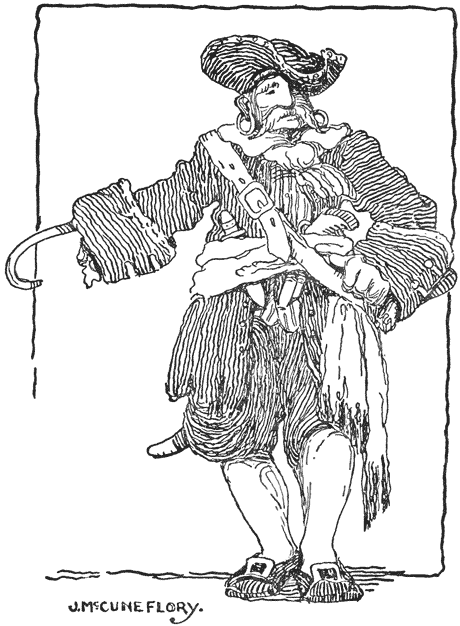
"I 'd scrape him with me hook"
Duke: I 've been thinkin', Captain, while you and Patch has been
amusin' yerselves. Askin' yer pardon, Captain, but cards rots the
mind. Did yer ever know a pirate that ain 't drunk at the Port Light
on Wappin' wharf?
Captain: Not as yet I never did. I never knowed a pirate as did n't
have a double-barreled nose fer grog.
Duke: Well, when Red Joe comes in, we 'll jest ask him. And we 'll ask
him if he ever played black-ace at the Rusty Anchor.
Captain: It ain 't no night ter have spies about. With the Royal 'Arry
comin' on so pretty.
Patch: And jest gettin' ready ter smash hisself.
Duke: That innercent ship will be due in less 'n half an hour.
Captain: If Red Joe is a spy, by the fiery beard o' Satan, I 'm
tellin' yer that dead men tell no tales.
(He lifts the terrible hook and claws the air.)
Duke: Askin' yer pardon, Captain, bein' as it was me as smelled him
out, won 't yer let me slit his wizen? I does it pretty, without
mussin' up the cabin. I ain 't askin' favors often, Captain. And I
've 'ticerler reasons—reasons as touches me heart. (For a moment he
is almost sentimental.) Reasons as touches me heart! Red Joe 's been
snoopin'.
Captain: I loves yer, Duke. There ain 't much as I won 't let yer
have. And jest ter show yer that I 'm all cut up by this here
snoopin', when I 'm dead I 'll will yer this ol' hook o' mine, as has
scraped a hundred men.
Duke: Yer honors me, Captain. And if I is shoveled in first, me stump
is yourn.
Captain: It 's handsome of yer, Duke. And I 'll not be jolly till a
year is up—jest like a widder.
Duke: Yer touches me. I 'll tie a black ribbon on yer hook.
(At this pathetic moment Darlin' is heard singing in the kitchen.)
And I fills the cups till mornin' comes,
And the Duke, he talks like a loon.
Me Darlin', me life, will yer be me wife,
And elope by the light o' the moon?
|
(There is a stamping of boots outside. The pirates put their fingers
on their lips. They are innocence itself. The Duke scratches the head
of the parrot. The strange bird declines to taste his grog. Patch-Eye
shuffles the cards. The Captain hooks the mugs toward him one by one
for the last drops of their precious liquor. Red Joe enters. Also,
Darlin' from the kitchen.)
Joe: Hello, mates! Evening, Captain! Are n't you cozy! As peaceful as
old ladies with their darning. I 've just come from seeing Petey, up
at the lighthouse. Petey says that along in about fifteen minutes the
Royal Harry will be showing around the cliff. Is n't it time, Captain,
to set up the lantern where 's she 's useful?
Duke: Is n't it? Did yer hear that, Captain? Ain 't it, is what
Red Joe means.
Captain: Right yer are, Joey. We must be trottin'.
Duke: What 's the name o' that tavern, Joe, at Wappin' wharf where we
gets the uncommon grog?
Joe: Wappin' wharf? I 'm blessed if the name 's not gone from me. The
grog 's nothing to Darling's.
Duke: What does yer call the tavern on the Isle o' Dogs?
Joe: I 'm remembering the rum. What 's the use of looking at the
signboard?
Duke: How does yer sight ter turn the bar at Guinea?
Joe: Sorry, Duke. It was my watch below. I was snoring when we turned.
Captain: What happened to yer pigtail?
Patch: Where does we ship the niggers?
Darlin': Ain 't yer got a mermaid on yer chest?
(The pirates have risen and come forward. Their questions are put
faster and with insolence. Dirk and hook are drawn. Joe stands in an
easy, careless attitude. He seems ignorant of danger. He has taken a
coal from the fire and slowly, deliberately, with back to the menace,
he lights his pipe. Then suddenly he drops it from his teeth. He leaps
to action. He draws his knife—two knives, one for each hand. He kicks
away a chair, for room. He drives the pirates across the cabin. The
candle—all the mugs upon the table—rattle to the stones. He cries
out with bravado.)
Joe: Who offers me his carcass first? What! Is pirate blood so thin
and white?
(The pirates stand with knives drawn. It is an awkward moment of
social precedence.)
Patch: (safe in the farthest corner). It 's me patch, Captain. It 's
fetched loose. I follers yer.
Joe: Come, Duke, and take your answer! Have you no stomach for my
message? 'Fore God, is there no black ram to lead his sheep to the
shearing?
(Joe's is a dangerous gayety. His two knives glisten in the candle
light.)
Patch: Scrape him with yer hook, Captain, I follers yer.
Joe: My knife frets. It is thirsty for thick red wine. Who offers me
his cask to tap? I 'll pledge the King, although it is a dirty
vintage. Come, Captain, I 'll carve you to a dainty morsel. We 'll
have fresh meat for the platter. You 'll not be known from scared
rabbit-flesh.
(He drives them around the table. Patch takes refuge behind the door.
Darlin's red stockings run up the ladder.)
Joe: You bearded hound!
Patch: He 's tauntin' yer, Captain. Hand him the hook! The Duke and me
is back o' yer.
Joe: Do you fear to cheat the gibbet on Wapping wharf? A knife 's a
sweeter end. Who comes first? I 'll help him across the Styx. Or sink
or swim! Flint waits in hell for three whelps to join his crew.
Patch: Captain, I 'm 'sprized at yer good nater. Scrape him one!
Joe: Who comes to the barber first? Cowards! I 'll ram your pigtails
down your throats. I 'll wash your dirt in blood.
(The Duke proves to be the strategist. He has edged to the rear of
the cabin. He circles behind Red Joe. And now in a flash he leaps on
him. Joe is buried under the three pirates, for Patch's valor returns
when Joe is down. Joe is tied with ropes and fastened to an upright at
the chimneyside. This is the terrible, glorious moment, now that the
fight is over, when the actor-manager, as I first read the play—as
explained in the preface (you really must read the preface)—turned
his excited somersault down the carpet.)
Patch: Did yer notice, Captain, how I took him by the throat? He was
squirmin' loose when I grabbed him. It was me tripped him.
Duke: Captain, I asks yer a favor. Can I stick him now. Dead men tell
no tales.
Patch: Captain, yer jest makes a pet o' the Duke. Ain 't it my turn? I
gets rusty.
Darlin': Let the Duke do it. He has more reasons than Patch.
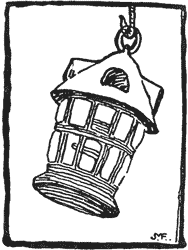 "It 's full o' ile"
Captain: Lay off, me hearties! Does n't yer know we 're in a hurry?
Red Joe 's kickin' up has wasted a heap o' time. The Royal 'Arry will
be showin' 'round the cliff any minute now. Red Joe 's safe. He 's
tied up double. We 'll have a merry party arterward—with grog and
angel cake. It 's business afore pleasure. Here, Duke, take the
lantern. (He shakes it.) It 's full o' ile. Jest stir yer timber
stump, Duke. Yer can foller, Patch. Yer follers better 'n yer leads.
Some folks is pussycats.
"It 's full o' ile"
Captain: Lay off, me hearties! Does n't yer know we 're in a hurry?
Red Joe 's kickin' up has wasted a heap o' time. The Royal 'Arry will
be showin' 'round the cliff any minute now. Red Joe 's safe. He 's
tied up double. We 'll have a merry party arterward—with grog and
angel cake. It 's business afore pleasure. Here, Duke, take the
lantern. (He shakes it.) It 's full o' ile. Jest stir yer timber
stump, Duke. Yer can foller, Patch. Yer follers better 'n yer leads.
Some folks is pussycats.
Duke: He 's pokin' fun at yer, ol' lionheart.
Patch: Yer hurts me feelin's.
Duke: I 'll hurt yer in a fatter place—where yer sits—if yer does
n't step along. Yer a yeller-livered, maggoty land fish. I curbs me
tongue. I scorns yer worse 'n cow's milk. Go 'long, afore I loosens up
and tells yer what yer are!
Captain: In about two minutes that blessed eye o' Petey will go out.
We must set up the lantern afore the Royal 'Arry sticks her nose in
sight.
Duke: By by, Joey. See yer later, ol' angel cake. Yer has jest time
ter say "Now I lay me."
Captain: How 's the night, Duke?
Duke: Blacker than the Earl o' Hell's top-boots.
Darlin': I 'll jest stick me apron on me head and go 'long, too. It
ain 't proper fer a lady as has me temptin' beauty ter be left alone
with snoopers.
(The cabin is empty except for Red Joe. He strains at his cords, but
is tied fast. You hear the voices of the pirates singing in the
distance.)
I agrees ter this and ter give 'em bliss—
From Pew I learned the trick—
I push 'em wide o' the wessel's side,
And poke 'em down with a stick.
|
(As soon as the pirates have left the cabin Betsy enters. She sees
Joe but passes him in fright. She runs to the window and shields her
eyes to see into the darkness.)
Betsy: God help the poor sailormen!
Joe: Betsy! Betsy! For the love of God!
(Suddenly the lighthouse light vanishes. And almost at once the
ship's lantern shows at the window to the left. All sounds are
hushed.)
Betsy: The ship 's in sight. I see her lights. She has rounded the
farther cliff. I see her turning. She heads in from the sea. Her three
masts are in line. She steers for the lantern. God have mercy! She 'll
strike in another minute. (She stuffs her ears and runs from the
window.) I can 't bear to listen. I can 't bear to look.
Joe: Betsy! Betsy! Do you hear? Margaret! Margaret!
(At the sound of Margaret she lifts her head, buried in her arms. She
runs toward Joe. Her wits seem dazed.)
Joe: Quick! Margaret! Margaret! That knife! That knife on the stones!
Margaret, cut me loose!
(Still dazed, moving as if in a dream, Betsy picks up the knife. She
cuts Joe's cords. Joe seizes the gun that leans against the clock. He
takes deliberate aim through the window. He fires. The window glass is
shattered. The ship's lantern is hit. The light vanishes. He replaces
the gun. Betsy stands beside him, looking in his face.)
Betsy: You 've hit it! Thank God! The light is shattered. (Then,
after a pause.) I seem to remember now. My name is Margaret. I
remember—
Joe: What do you remember?
Betsy: A great staircase—a room, with shadows from a candle. And when
I was afraid, a lady sang to me. And she set the candle so that the
fearful giant upon the wall ran off, and I was safe.
Joe: What else do you remember?
Betsy: I remember—
Joe: Margaret, do you remember me?
(Margaret looks at him and a new memory is stirred.)
Betsy: Yes, I remember you. Were you not a great tall lad whose
crook'd elbow was level with my head? And once we climbed a tower—or
do I recall a dream? You held me so that I might see the waves
breaking on the rocks below. Then with level eyes we looked upon the
sea, and cried out our discovery of each glistening sail. Are these
things real? One morning you mounted horse, and I was held aloft so
that you might stoop and kiss me. You rode off with a clatter on the
stones. You turned and waved your hat. And now you have come back. You
are Hal. We were playmates once.
Joe: And by luck and God's help we shall be playmates once again.
(He puts his arms around her and kisses her.)
Betsy: Quick, Hal! You must escape. Quick! Before the pirates come.
Follow the path to the village! You can escape by the Royal Harry.
(They are running to the door when there is a sound of voices on the
path outside. Joe has just time to put himself in the posture in which
the pirates left him. The pirates and Darlin' enter in dejection.
Betsy runs to the kitchen.)
Captain: Blast me, the lantern 's out!
Patch: Rot me, but there were an explosion!
Darlin': Poof! And there were n't no lantern!
Duke: What done it? What done it? I asks yer.
(They stand at the window and look toward the ocean.)
Duke: She is still headed on. Her nose is still pointin' toward the
cliff.
Captain: What 's that?
Duke: I hears the rattlin' o' chains. She 's droppin' anchor. She has
sniffed the willainy. Her anchor 's down. She 's saved hisself. Blow
me, she 's saved hisself.
Captain: Yer can hang me ter a gibbet.
Patch: Yer can rot me bones.
Darlin': Me heart 's gone palpy.
Duke: What done it? What done it? I asks yer.
(At this point let us hope that the curtain does not stick.)
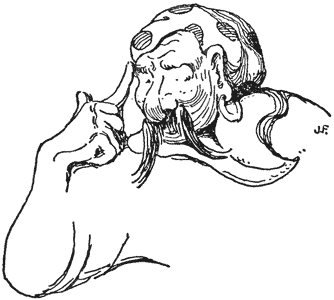
"What done it? I asks yer"
The scene is the same as before. We have given up all hope of a
pirate ship rocking on the sea. Our plot still twists us around its
little finger. The curtain rises on the tableau of the second act. Old
Petey shows again at the window to the right.
Duke: What done it? What done it? I asks yer.
Patch: Jest when everythin' was goin' pretty.
Captain: Jest when she was about ter hit.
Darlin': Me heart near stopped—I was that excited.
(The pirates sit in deep dejection.)
Duke: The mystery o' this business is how the blinkin' lantern went
out.
Captain: Ol' Petey done his part.
Patch: He doused herself in time.
Captain: It was the lantern done it.
Duke: When there were n't no light at all, the Royal 'Arry, she jest
sniffed willainy and dropped anchor.
Patch: I was repeatin' Smash yer devil! Smash yer devil!—kinder
hurryin' her on.
Darlin': I was sayin' Now I lay me—throbbin' with excitement.
Duke: It was n't ile. I put ile in the lantern meself. Captain, yer
seen me put in ile.
Captain: I seen yer. And I swished it meself ter be sure.
Patch: Nothin 's been right since that ol' lady hanged me ter a
gibbet.
Captain: There we was watchin'—
Patch: Pop!
Captain: And all of a sudden—quicker 'n seven devils—the bloomin'
lantern went all ter pieces. It 's grog, I says. Snakes is next. It
were a comfert to the ol' Captain ter know that all o' yer seen it. I
seen a yeller rhinoceros once, runnin' along with purple mice—all
alone I seen it—and it kinder sickened me o' rum.
Patch: Does yer think the lantern exploded?
Duke: Did yer ever hear o' a ship's lantern explodin'? I asks yer,
Captain.
Captain: Yer talks silly, Patch. That lantern has hung fer twenty year
on ol' Flint's ship—swingin' easy and contented all 'round the
Horn—and it ain 't never exploded once.
Duke: Swabs' lanterns explode, stoopid. Ships' lanterns don 't.
Captain, I feels as mournful as when Flint's clock did n't tick no
more and we knowed he was took by the blessed angels.
Captain: I ain 't meself as gay as a cuckoo—not quite I ain 't.
Patch: Ever since that ol' lady—
Duke: Lay off on that ol' lady!
(They sit in silence, in dejection. All stare stupidly at the floor.
For a moment it seems as if nothing more will be said and the audience
might as well go home. But presently the Duke sees something at the
rear of the cabin. He looks as you or I would look if we saw a yellow
elephant taking its after-dinner coffee in the sitting-room; but, as
he is a pirate, he is not frightened—merely interested and intent. He
brushes his hand before his eyes, to make sure it is no delusion—not
grog or rum. Then he rises softly. He crosses to the window. Very
gently he touches the glass. He finds it is really broken. He loosens
a piece of the shattered glass. The others are sunk in such melancholy
that they do not observe him.
He gazes through the window, studying the direction of the broken
ship's lantern. He traces the angle with his finger. The gesture ends
with an accusing finger pointing at Red Joe. He whistles softly. For a
moment his eye rests upon the gun, which leans against the clock. He
has guessed the riddle. He advances casually, but with dirk in hand.
He comes in front of Joe. Suddenly he presses the blade of his dirk
against Joe's stomach.)
Duke: Captain! Captain! Quick! Tie him up!
(Joe is bound again with rope.)
Duke: It 's him that done it. It 's Red Joe.
Captain: How did he get loose?
Duke: (as he points to the knife on the floor). Does yer see that
knife? Does yer see Joe? I 'm tellin' yer. It was him shot out the
lantern.
Patch: Did n't I help ter tie him meself?
Duke: Askin' yer pardon, Captain, but you and Patch has the brains o'
a baby aligator. A stuffed rhinocopoterus is pos'-lutely nothin'.
Askin' yer pardon fer speakin' so plain. I does all yer thinkin' for
yer. There 's some folks settin' here as are fat-headed, and thinks
ships' lanterns explode.
Patch: Easy now, ol' dear. Yer alers pitchin' inter me, 'cause I 'm
good-natered.
Captain: Red Joe, I calls yer a dirty spy. A swab! A landlubber! Fer
one copper farthin' I 'd ketch yer one with this hook.
Duke: It was me discovered him. I asks yer, Captain, ter leave Red Joe
ter me. I hates him most perticerler.
(Betsy enters from the kitchen.)
Betsy: Did you call, Captain?
Darlin': Nobody ain 't callin' yer, dearie. Now jest toddle back to
the kitchen.
Duke: This ain 't no place fer a leetle girl. It will give yer bad
dreams. Mince pie 's nothin'.
(Betsy attempts to leave the cabin by the door that leads to the
cliffs—the door at the rear of the cabin.)
Duke: Where you goin', Betsy?
Betsy: I 've an errand in the village.
Duke: Well, yer ain 't goin'. It ain 't no night fer a leetle girl ter
be out. I ain 't goin' ter have me Duchess snifflin' with a cold. Go
to grandma! It was me discovered him, Captain. I 'm askin' yer a
favor. He 's a snooper.
Patch: Captain, I gets rusty.
Captain: Lay off, me hearties. Duke! Patch! I loves both o' yer. I
loves yer equal, like two mugs o' grog as is full alike. Yer can pitch
dice ter see which does it.
(He places the dice cup on the table beside the candle. The Duke and
Patch take their places. Betsy, under cover of this centered interest,
runs to Red Joe, who whispers to her.)
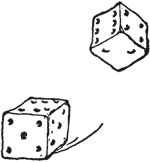 "The leetle bones is me friends"
Duke: I drops 'em in me mug, so 's they can get a smell o' rum. The
leetle bones is me friends. I never throws less 'n a five spot. I
makes a pint o' shakin' the bones till they rattles jolly. I likes the
sound o' it even better 'n the blessed scrapin' o' a spoon what 's
stirrin' grog. Write it on me tombstone—if I rots ashore—He was the
kinder feller as never throwed less 'n a five spot.
"The leetle bones is me friends"
Duke: I drops 'em in me mug, so 's they can get a smell o' rum. The
leetle bones is me friends. I never throws less 'n a five spot. I
makes a pint o' shakin' the bones till they rattles jolly. I likes the
sound o' it even better 'n the blessed scrapin' o' a spoon what 's
stirrin' grog. Write it on me tombstone—if I rots ashore—He was the
kinder feller as never throwed less 'n a five spot.
Captain: Go 'long, Duke. Bones, as is kept waitin', sulks.
Patch: One or three?
Duke: One 's enough. I 'm talkin' to yer, bones. I wants sixes,
sweeties.
(As he throws Betsy jostles the candle with her arm. It overturns and
falls. The cabin is dark. You can see her run from the cabin and pass
the windows to the left.)
Duke: Now yer done it!
Patch: You is all thumbs, Betsy.
Captain: Easy, mates! It were jest an accident. Betsy, fetch a seacoal
from the hearth! Betsy! We ain 't goin' ter wallop yer. Where are yer,
Betsy?
Darlin': Come out o' yer hidin'!
Captain: I 'll light the candle meself.
(He takes it to the fire, lights it and returns to the table.)
Captain: There yer are—blazin' like ol' Petey. Yer had better sit
down, Betsy. Crack me stump, where is the girl?
Patch: Kinder silly o' her ter run away. We ain 't never walloped her.
Duke: Women 's silly folks. I calls 'em ninnies. It don 't do no good
tryin' ter understand 'em. Now then, ol' lionheart, are yer ready?
(He throws.) Two fives! I 've done yer, Patch.
(It is Patch's turn. He kisses the cubes.)
Patch: Yer as sweet as honey. Tell me yer loves me. Me dirk is itchin'
fer yer answer. Luck 's a lady as dotes on me. (He throws.) A pair
o' sixes! Does yer see it, Duke? Stick yer blinkin' eye right down
agin the table! It 's me, Captain. (He rises and draws his knife.)
Joey are yer ready?
Joe: God, if I were loose I 'd take you by the dirty gullet and twist
it until you roared. I 'd kick you off my path like a snarling cur. Of
what filth does nature sometimes compound a man! Shall a skunk walk
two-legged to infect the air? Three cowards will hang on Wapping wharf
before the month is up.
Patch: Are n't meanin' us, are yer Joey?
Joe: And I 'll tell you more.
Captain: Ain 't we listenin' to yer? Yer can talk spry, as Patch here
has a leetle job ter do, and it 's nearin' bed time.
Duke: We does n't want ter sit up late and lose our beauty sleep jest
listenin' to a speech.
Joe: A pirate takes his chance of death. You guard your dirty skins by
wrecking ships upon the rocks. You dare not pit yourselves against a
breathing victim. Like carrion-crows you sit to a vile and bloated
banquet.
Patch: Tip me the wink, Captain, when yer has heard enough.
Joe: Stand off, you whelp! The King of England fights in France—
Duke: Ain 't yer 'shamed that you is not there ter help?
Joe: I 'll tell you why I am not in France. I swore to his majesty
that I would clear his coast of pirates. My plans are made. The
channel is swept by gunboats. They will close in on you tomorrow—you
and all the dirty vermin that befoul these cliffs.
Duke: He talks so big, ye 'd think he was the King himself.
(Everyone laughs at this. The Duke takes the cloak from the chest. In
derision he hangs it across Red Joe's shoulders.)
Duke: We 'll play ch'rades. Here 's yer costume, Joey. There! It fits
yer like the skin o' a snake. We makes yer King. Yer looks like yer
was paradin' in St. James's park, lampin' a Duchess.
Patch: Does yer majesty need a new 'igh chancellor. I asks yer fer it.
I wants a fine house in London town, runnin' ter the Strand, and
peacocks struttin' in the garden.
Captain: King, I asks yer ter cast yer gig on me. I 'd be a right
smart Archbishop o' Canterbury. Me whiskers is 'clesiastical.
Duke: I offers meself, King, as Lord 'Igh Admiral o' the Navy. I
swears fluent.
Darlin': Has yer a Princess vacant? I lolls graceful on a throne.
(The horrid creature spits.)
Captain: 'Vast there, me hearties! I 'm thinkin' I 'm hearin' the
sound o' footsteps.
Duke: (to Patch). Did yer lordship hear any sound?
Patch: Askin' your Grice's pardon, I did n't ketch a thing. Did you
hear anythin', Princess?
Darlin': There 's nothin' come ter me pearly ears.
Captain: Silence! I wants ter listen.
(No sound is heard.)
Captain: Well, Patch, yer had better get yer dirk ready. I 'm uncommon
sleepy. I wants ter get ter bed.
Darlin': Ketch him a deep one, Patch.
Patch: I takes it mighty kind o' you, Captain. Yer has alers been a
lovin' father ter me. Joey, I 'll tell yer what yer are. Yer the kind
o' feller I hates most perticerler. Yer a spy! Say yer prayers, you
hissin' snake!
(He sharpens his dirk and gayly tests it on his whiskers.)
Joe: My wasted day is done. In the tempest's wrack the stars are dim
and faith 's the only compass. Now or hereafter, what matters it? The
sun will gild the meadows as of yesteryear. The moon will fee the
world with silver coin. And all across the earth men will traffic on
their little errands until nature calls them home. I am a stone cast
in a windy pool where scarce a ripple shows. Life 's but a candle in
the wind. Mine will not burn to socket.
Duke: He 's all wound up like a clock—jest tickin' words.
Captain: Patch, Joe is tellin' us poetical that his wick has burned
right down to the bottle. Yer had better put it out, without more
hesitatin'.
(And now, as they are intent for the coming blow—suddenly!
quietly!—a woman's hand and arm—a claw, rather, with long, thin,
shrivelled fingers—have come in sight at the window with the broken
glass.
It quite terrifies me as I write. My pencil shakes. Old ladies will
want to scream.
The fingers grope along the sill. They fumble on the wall. They
stretch to reach the gun which stands beside the clock. Another inch
and they will grasp it and Red Joe will be saved. The arm rubs against
the pendulum of the clock. It swings and the clock starts to tick. And
still no one has seen the terrible hand. And now the fingers are
thrust blindly against the gun. It falls with a clatter on the stones.
The hand and arm disappear. But Darlin' has seen the swinging pendulum
and shrieks.)
Duke: Does yer see it, Captain?
Patch: Horrers!
Duke: It 's never went since Flint was hanged.
Captain: And would n't run till his death 's revenged and him layin'
peaceful in his coffin.
Patch: Does yer think it 's grog? Does all o' yer see it?
Duke: What done it?
(From the distance is heard a long-drawn whistle.)
Captain: What 's that?
Patch: It makes me jumpy.
Duke: It ain 't a night when folks whistles jest fer cows and such.
Finish yer job, Patch.
Patch: Are yer feared o' somethin' special, Duke?
Duke: Feared? If we ain 't quick, there 'll be a gibbet fer all o' us.
Captain: Ain 't the clock tickin' peaceful?
Patch: She ain 't got no right ter tick. It 's like a dead man
talkin'.
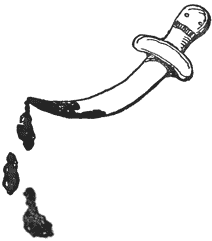 "I 'll be wipin off a streak o' red upon me breeks"
Duke: Quick! Give me the knife! I 'll stick it in him. And when I 'm
done, we scatters. There 's trouble brewin'. Termorrer night, when the
tide is out, we meets at the holler cave. And may the devil lend a
helpin' hand. Snooper, are yer ready? Does yer see this here blade
shinin' in the candle? In about one minute I 'll be wipin' off a
streak o' red upon me breeks. Flint—blessin' on yer gentle soul!—yer
can rest in peace!
"I 'll be wipin off a streak o' red upon me breeks"
Duke: Quick! Give me the knife! I 'll stick it in him. And when I 'm
done, we scatters. There 's trouble brewin'. Termorrer night, when the
tide is out, we meets at the holler cave. And may the devil lend a
helpin' hand. Snooper, are yer ready? Does yer see this here blade
shinin' in the candle? In about one minute I 'll be wipin' off a
streak o' red upon me breeks. Flint—blessin' on yer gentle soul!—yer
can rest in peace!
(He approaches Joe with upraised knife. Suddenly he cries out.)
Duke: It 's him the fortin-teller mentioned. It 's the man in a velvet
cloak!
Captain: It 's him! Me God! Me hook!
(With a growl of rage the pirates leap forward toward Joe, but are
arrested by the sound of running feet. Into the cabin rushes the
sailor captain, followed by three sailors. The sailor captain cries
"'Vast there!" and the pirates turn to face his men. They put up a
fight worthy of old Flint. Darlin', to escape the rough-and-tumble
runs half way up the ladder. The table is overturned. The stools are
kicked across the room. Even the precious grog is spilled. But the
pirates' valor is insufficient. They are overpowered at last and tied.
Red Joe's cords are cut. Into the cabin Betsy comes running, followed
by old Meg.)
Betsy: Joe! Hal! Thank God, you are safe.
Joe: Margaret!
Sailor Captain: I am the captain of the Royal Harry.
Joe: Captain, I charge you to arrest these men.
Sailor Captain: Yes, your Royal Highness.
Duke: Royal 'Ighness? Did yer hear what he said?
Darlin': 'Ighness nothin'. He 's jest a snooper.
(She sits on the floor, with her head on the Duke's knee. She is
staunch to the last—a true cook for a pirates' band.)
Joe: You will transport them in chains to London to wait their
sentence by a court of law.
Sailor Captain: Yes, your majesty.
Joe: You mistake me, Captain. My father is the King of England. I am
but the Prince of Wales.
Sailor Captain: Alas, sire, we bring you heavy news. Your Royal
Father, the King of England, has been killed, fighting gloriously on
the soil of France.
Joe: Bear with me. My grief has leaped the channel. My thought is a
silent mourner at my father's grave. Shall a King sink to the measure
of a mound of turf for the tread of a peasant's foot? Where is now the
ermine robe, the glistening crown, the harness of a fighting hour, the
sceptre that marked the giddy office, the voice, the flashing eye that
stirred a coward to bravery, the iron gauntlet shaking in the pallid
face of France? All—all covered by a spadeful of country earth.
Captain, has Calais fallen to our army's siege? Are the French lilies
plucked for England's boutoniere?
Sailor Captain: Calais has fallen.
Joe: Then God be praised even in this hard hour. By heaven's help I
throw off the idle practice of my youth. The empty tricks and trivial
habits of the careless years, I renounce them all. A wind has scoured
the sullen clouds of youth. My past has been a ragged garment, stained
with heedless hours. Tonight I cast it off, like a coat that is out at
elbow. My father henceforth lives in me.
(Meg, at her entrance, has sniffed the wasted grog. Her nose, surer
than a hazel wand, inclines above the hearth. She bends to the lovely
puddle. She employs and tastes her dripping finger—covertly, with
mannerly regard to the Prince's rhetoric—sucking in secret his good
health and happy returns, so to speak. The liquor warms her
tongue—not to drunkenness, but to ease and comfort. The hearth-stone
is her tavern chair.)
Meg: (not boisterously—with just a flip of her trickling finger, as
if it were a foaming cup). Hooray! I wants ter be the first, yer
Majesty, ter swear allegiance to yer throne. I saw yer future in the
glass. Ol' Meg knowed yer, like she had rocked yer in the cradle. I
told yer I would come in yer hour o' danger. It was me reached through
the winder fer the gun ter save yer. It was me whistle that yer heard,
dearie, hurryin' up the sailormen as Betsy went ter fetch.
Joe: Thanks my good woman. We grant you a pension for your love.
(She quests back to her pool of grog. She finds a spoon. She sits to
the delicious salvage, with back against the chimney and woolen legs
out-stretched. Speeches to her are nothing now. We cannot expect her
help in winding up our play. The burden falls on Joe. We must be
patient through a sentimental page or two.)
Joe: Ha! My velvet cloak, which I left at Castle Crag when I laid
aside the Prince and took disguise. These unintentioned ruffians by
their dirty jest have clothed me to my office.
Sailor Captain: I swear my allegiance, your Majesty.
Joe: I rely on my sailors to clear the coast and seas. But first I
want your allegiance in another high concern. Some fourteen years ago,
when I was a lad of ten, I journeyed with my royal father to the
castle of the Duke of Cornwall, which stands high on the wind-swept
coast. Its giddy towers rise sheer above the ocean until the very
rooks nesting in the battlements grow dizzy at the height. It is the
outer bastion of the world, laughing to scorn the ocean's siege.
In that castle, Captain, there lived a little girl; and she and I
romped the sounding corridors together. And once I led her to an open
'brasure in the steep-pitched wall, and held her so that she might see
the waves curling on the rocks below. And tales of mermaids I
invented, and shipwreck and treasure buried in the noisy caverns of
the rock, where twice a day the greedy tide goes in and out to seek
its fortune. And far afield we wandered and stood waist-deep in the
golden meadows, until the weary twilight called us home.
And I remember, when tired with play, that her mother sang to us an
old song, a lullaby. Her voice was soft, with a gentleness that only a
mother knows who sits with drowsy children.
And to that little girl I was betrothed. It was sworn with oath and
signature that some day I would marry her and that, when I became king
of England in the revolving years, she would be its queen.
Betsy: By what miracle did you know me, Hal?
Joe: It was the song you sang. Your voice was the miracle that told
the secret. With unvarnished speech I woo you. I love you, Margaret,
and I ask you to be my wife.
Meg: (faintly—floating in a golden sea of grog) Hooray!
(Joe takes Betsy in his arms and kisses her.)
Joe: The magic of your lips, my dear, is the miracle that answers me.
My loyal sailors, I present you. Margaret, Duchess of Cornwall,
Countess of Devon, Princess of the Western Marches, by right and title
possessor of all land 'twixt Exeter and Land's End. And now, by her
consent and the grace of God, the wife of Harry, King of England.
Captain: Leetle Betsy, I fergives yer.
Duke: I asks yer health, though I swings termorrer.
Patch: And may yer live long and 'appy!
Darlin': We 're lovin' yer, Betsy.
Betsy: My gracious lord, for these three years this cabin has been my
home. These are my friends—the only friends I have ever known. They
fed me when I had no food and they kept me warm against the cold. Must
they hang? I ask you to pardon them.
Darlin': Glory ter God!
Joe: The pardon is granted. Captain, strike off their irons!
Darlin': We loves yer, Betsy.
Captain: We are fonder of yer than grog and singin' angels.
Patch: I thanks yer, King.
Duke: It were jest an hour ago, settin' in that chair, I asks ter
splice yer, Betsy, keel ter topsail. The ol' Duke never thought the
Countess of all them places, and the Queen o' England, ter boot, would
ever be settin' on his knee, pullin' at his whiskers—him askin' her
ter name the 'appy day.
Betsy: It was a prior attachment, Duke.
Captain: We 'll serve yer, King, like we served ol' Flint.
Patch: Top and bottom, fore and aft.
Duke: We 'll brag how the King o' England and us has drunk grog
together, and how the Queen washed up the mugs.
Meg: (in a whisper). Hooray!
Joe: And now, Captain, lead the way. We must speed to London.
Betsy: Good by, Duke. Some day you will find a girl who cooks roast
pig that crackles.
Duke: A blessin', Betsy, on yer laughin' eyes!
Captain: A health ter King Hal and his blushin' bride!
All: King Hal! Leetle Betsy!
(With a wave of the hand Joe departs, and with him, Betsy, who kisses
her fingers to the pirates in farewell. The sailors follow. The
pirates and Darlin' are left. The pirates sit at the table. They
exchange glances of satisfaction. They unbutton for a quiet evening at
home. Kings are but an episode in a pirate's life. They return to the
happy routine of their lives. Our adventure has circled to its
start.)
Patch: Darlin'! Me friend, the Duke, is thirsty. Yer had better mix
another pot o' grog. Yer does n't want ter be a foolish virgin and get
ketched without no grog.
Darlin': (at the fire). Yer coddles yer stomich, Patch.
Patch: The Duke, he knows a leetle dear as is jest waitin' ter come
flutterin' ter his lovin' arms. I thinks it 's yer whiskers, Duke.
Captain: Yer can pull one, Betsy, fer the locket that yer wears. We is
laughin' at yer, ol' walrus.
Duke: Kings is bigger than Dukes. I looses without no kickin' up.
There 's no one like Darlin' fer mixin' grog.
Darlin': Fer that kind word I 'm lovin' yer.
(She fills the cups.)
Patch: It 's grog beats off the melancholy. As soon as me pipes goes
dry, I gets homesick fer the ocean. Here we be, Duke, thrown up at
last ter rot like driftwood on the shore. It was 'appy days when we
sailed with ol' Flint on the Spanish Main.
Captain: 'Appy days, Patch!
All: 'Appy days!
(They lift their cups in memory of a golden past. It is a contented
family around the evening candle. They are as cozy as old ladies with
their darning. Meg snores in peace as the curtain falls.)
Our candles have burned to socket. Our pasteboard cabin is bare and
dark. No longer do pirate flags flaunt the ghostly seas. The stormy
ocean, the dizzy cliffs of Devon, melt like an unsubstantial pageant.
Let's put away our toys—the timber leg, the patch, the frightful
hook. Once again, despite the weary signpost of the years, we have run
on the laughing avenues of childhood.