Well I remember my first escapade, and as I sit here to-night writing
these memoirs, most vividly do I recall some thrilling experiences
which occurred in the pine fields and on the sand hills of Florida.
I was then about fourteen years old and had just returned to the
preparatory college after a most enjoyable vacation. While at home I
began to love the open life and to long for the grassy sarannaks, the
orange groves and the pine belts of the southland.
I had been thinking of running away for some time, being of a roving
disposition and adventurous spirit, which, at this particular time, was
fostered by the reading of dime novels and tales of adventure.
One bitterly cold night in January I sat by the fire and read of Jesse
James and his desperate gang of outlaws until midnight. Eighteen
months' confinement in college with the check rein taut was more than
the embryo hero could possibly stand.
The clock struck twelve as I closed my book, and, reaching over,
I stirred up the fading embers. I sat there and thought of the
desperadoes of whom I had been reading, how heroic it would be to fight
them, to have so many exciting adventures and hair-breadth escapes.
The embers were dead when I finally decided on my plan of action.
Sitting down at the little writing table I wrote the following note:
My Dear Mrs.——:
I have been thinking of running away for a long time. To-night I
have made up my mind to do so. I leave for Charleston this morning
on the two fifteen train. Please send my trunk home.
Yours very respectfully,
Jack.
I folded the note, addressed it, and left it lying on the table; then I
arose, opened the door, and stole silently along the hallway and down
the stairs out into the darkness and cold. My shoes I carried in my
hand, but before stepping off the porch I sat down and laced them on
again. It was two miles and a half to the nearest railroad. I hastened
along the deserted highway and reached the station, just in time to
purchase my ticket and board the train.
Two days later I stood on the wharf of the Clyde Line Steamship Company
at Charleston, S. C., thinking of home, and the dear ones I had
left behind. There I was, three hundred miles away from friends and
acquaintances, and not one cent with which to purchase my next meal.
The day before I had arrived at Charleston with just ten cents in my
pocket, and a dollar Ingersoll watch. I had not been there more than
two hours before I succeeded in selling my watch to a negro. It was my
first watch, too, and boylike, I had been inordinately proud of it, but
the adventurer must be fed and lodged, and so the valued timepiece was
sacrificed.
Candidly, I longed to be back in college, for, no outlaw appearing in
my immediate neighborhood, it seemed as though I had reached the end of
my tether. After standing there on the wharf for some time, worrying
over the situation and gazing over the blue waters of the Atlantic, new
courage seized me.
I boarded a ship which was anchored by, and inquired for the second
officer. Being told that I would find him on the upper deck, I
proceeded thither and found the said individual giving orders to a
greasy squad of sailors. Stepping up to him, I inquired if he would
allow me to work my way to Jacksonville, Florida. He asked me if I had
ever been to sea, and I replied in the affirmative.
"Well," said he, "be aboard by five o'clock this afternoon, and I will
put you to work cleaning brasses."
We sailed at the set time, and in the afternoon of the second day
out, while polishing brass on the railing of the upper deck, a man
approached me and introduced himself as Captain Hastings. After a
short conversation, he told me that he was in need of a young man on
his farm, which was in Florida, and he concluded by asking if I would
take a position with him. I asked him what kind of work I would have
to do, what salary he would pay and where his farm was located. He
replied that he would want me to carry the mail on horseback Mondays,
Wednesdays and Saturdays from the railroad station to his farm, a
distance of thirty miles. He further added, that his farm was one
hundred and fifty miles below Jacksonville, on Haw Creek, a branch of
the St. John's River, and that he would furnish a horse and give me
twenty dollars a month. I jumped at the chance.
While talking with this gentleman the second officer came along and
instructed me to go below and assist in washing dishes. I was glad to
do this, for it was very windy on deck and I had already contracted a
cold. The waiters on board the ship were negroes, one of whom I shall
remember always for the little disagreeable encounter that took place
between us. Southern born, I had been taught to make a negro respect
me, and even in my menial position I could not suffer myself to be
bulldozed. Every time he came in the dish-closet to empty his tray in
the sink he would make some insulting remark, sneer and brush rudely
against me.
I realized my position. Knowing that the odds were against me, I held
my temper to the very last moment. I told him to mind his own business
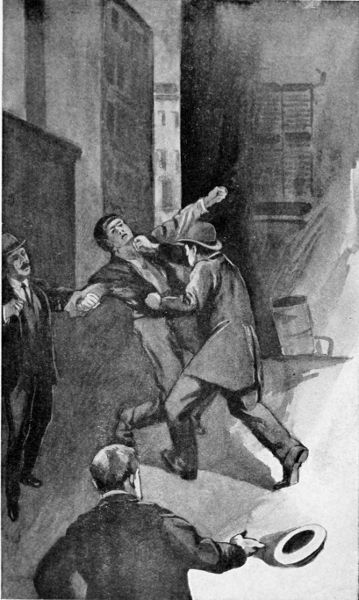
or else there would be trouble. At this remark, he slapped me in the
face and said, "Don't talk to me, you poor white trash."
I did not attempt revenge at that moment, although the blood in
my veins was running hot with anger, but waited for a suitable
opportunity, and it was not long in coming. A few moments later, as he
was walking through a curtained door, carrying a tray heavily laden
with dishes, I turned and caught him squarely on the cheek with a big
coffee cup, which caused him to drop dishes and all as he fell to the
floor bleeding. This blow rendered him unconscious, and that part of
the ship was put in disorder.
I thought the other negroes would mob me before I could make my escape,
but, jumping through an open window, I gained the deck and ascended to
the officers' quarters, where I presented myself to the captain, asking
for protection and telling him what had occurred. He listened kindly,
and taking pity on me, a boy of fourteen, he promised me protection
until we arrived in Jacksonville.
This affair was the talk of the ship until we arrived in port, and just
as we were anchoring I was told by the second officer that the negro
intended having me arrested by the city officials. Becoming aware of
this, I informed Captain Hastings, and he volunteered to see me safely
ashore, and also to place me on board the "City of Jacksonville," a
small steamer which was to carry us to Crescent City, a distance of one
hundred and twenty-five miles from Jacksonville, and fifteen miles from
his home.
We left Jacksonville in the morning and arrived at Crescent City about
six o'clock the same evening, where we spent the night. That day, as
we were steaming up the St. John's River, I became hungry between
meals, as boys generally do, so I went to the chef and traded a little
imitation diamond ring for a couple of ham sandwiches.
I had not written home since my departure, consequently, that night at
Crescent City I indulged in a second commercial adventure. I traded a
gold watch chain for a two cent stamp, paper, and envelope and informed
my people of my whereabouts and of my future intentions.
We put up, so to speak, at one of the small hotels of the town, for
the night, and I bunked in a room with two men who were accompanying
Captain Hastings to his turpentine farm, where they were going to
serve as overseers. This was their second winter on his farm, and
before going to sleep that night they told me many stories of the
big plantation, its hundreds of negroes, horses, cattle, turpentine
stills, and alligators. They took special delight in reciting the
brutal murders committed by the outlaws, who at that time were roaming
throughout the section. All of this did not frighten me, however,
nerved as I was by home-sickness, and the fear of finding myself
unromantically lodged in jail.
At Crescent City the next morning, Captain Hastings' private launch met
us, and we moved down Haw Creek to his place, arriving about noon. The
same afternoon I made arrangements for board with Jim Hughes (a young
married man), who had lived on the place several years and who was head
stable man.
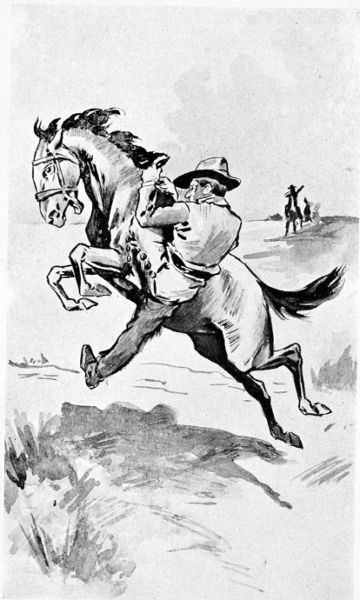
Monday morning I mounted the pony which was given me, and was off for
the station. I reached the station late that afternoon, making slow
time because the roads were very bad and swampy, and by sunrise the
next morning I was five miles on my way back to the farm with saddle
bags full of mail and packages.
The pony was a sturdy little rascal with shaggy mane and tail. His name
was Billy, and the more I rode him the more I liked to have him carry
me swiftly to and from the mail station. Whenever I went into his stall
to feed him he would always put his shaggy head over my shoulders and
whinny as if to say, "I'm ready for it."
I stayed around the ranch a few weeks until I tired of the monotony of
those daily rides, and even Billy could not hold me. So one morning I
gathered my few belongings together, tied them up in a little brown
sweater, bade all good-by and proceeded on foot to Barbersville. I took
to the road early in the morning, that I might have ample time to make
the distance in two days.
The road was a sandy one, leading through desolate, lonely woods, the
same road over which the little pony had borne me many a time. It was
difficult walking, for there were many swamps and miles of sand roads.
I plodded silently and slowly on my way, arriving at the half way camp
about dusk. This was a lumber camp, established temporarily, and I knew
some of the boys, as I had been accustomed to pass there on my way to
the post office. Often I used to make small purchases in Barbersville
for the boys at this camp, and they were glad to shelter me over night.
We sat around the fireside, relating stories. By sunrise the next
morning I was on my way, and at four o'clock that afternoon I strolled
into town. I walked down the railroad track to where an empty box car
was standing, and after gaining an entrance I proceeded to change my
socks and trousers, for I had braved more than one stream between the
camp and the station.
Folding my wet garments in the brown sweater, I strapped it on my
shoulders, and walked down the railroad track, a hike towards Sanford.
Nightfall came shortly, and I became hungry.
Through the dusk I sighted a small house, so I left the track and
struck out across the marshy lands, towards it. After crawling under
several wire fences and beating off a dog with my stick, I finally
arrived at the door. I rapped, and at my call there appeared an old
lady. I informed her of my predicament, and she went to the cupboard
and brought forth a big chunk of meat and a piece of bread, which was
eagerly accepted, I can assure you. I thanked her kindly, and turned
back to the railroad.
By this time it had grown dark, and I was unable to find my way. I
walked for at least half an hour, and then realized that I was lost. I
stopped and took in the situation. The light I could no longer sight.
There I was, lost in the swamps of Florida. What was I to do? To my
right I sighted through the darkness an object which looked like a
mound of some description. On investigating it proved to be a haystack.
This, indeed, afforded a great treat, for in the side of it I burrowed
a hole where I buried myself for the night. Being tired and sore from
my two days' journey, I did not move from my comfortable nest until
fully three hours after sunrise.
I yawned, stretched my rested limbs, rubbed my eyes, and crawled out of
my warm, cozy nest into the sunlight. Strapping on the sweater, with
its contents, I struck across the field for the railroad, and hit a
slow pace over the cross-ties down the track.
Boys are always hungry, and justly so when they haven't had breakfast.
Sighting a little cottage which sat back only a few rods from the
railroad, I strolled up to the back door and rapped. A lady opened
it to me, and when I told my tale, she invited me into the kitchen,
where I sat down at a table, and relished a nice breakfast. Goodness!
but it did taste good. As I sat there devouring my food, she asked me
many questions concerning myself. This put me in a serious mood, and
when she began talking about home and those I had left behind, a great
lump formed in my throat, and a big cruel tear rolled down my cheek.
I did not wish to let her know she had touched a tender cord, so I
said, "There is something in my eye," at the same time rubbing it and
drying the tears with my handkerchief. She was a good woman, and those
soft, tender words would have brought tears to the eyes of a hardened
criminal, much less a very youthful modern soldier of fortune.
She became interested in me, and related the sad story of her son.
Only a few months previous, he had run away from home and had been
killed while riding on a freight train in Georgia. She pointed out to
me his lonely grave, which was at the edge of a little clump of pines,
just across the field. My heart went out to her in warm-felt sympathy,
and bowing my head, I uncovered and went out into the lonely world,
thinking of that poor heart-stricken mother.
About noon I walked into a typical swamp town, the one room station
being the principal building, and drew myself up on a pile of cross
ties, just across the track. There I sat in deep meditation. Two or
three little children who were playing in the station yard came over
and stood looking and jeering at me. They ran, however, when I muttered
several mild threats, and made as though I was going to pursue them. It
was not long before I heard the whistle of a locomotive in the still
distance.
Presently, the big engine, with its train of passenger cars, pulled
into the station and drew up at the water tank. When it stopped, I
descended from my perch and walked down the track. I was afraid to
board the blind baggage, the space between the mail coach and the coal
car, for a number of the train crew were standing around. When the tank
had been filled and the engine began to draw away, my heart sank within
me, for I thought I had lost an opportunity to ride.
As the big engine puffed by, the engineer saw me, a poor little kid
away out in the wilderness, standing by the track, and he motioned me
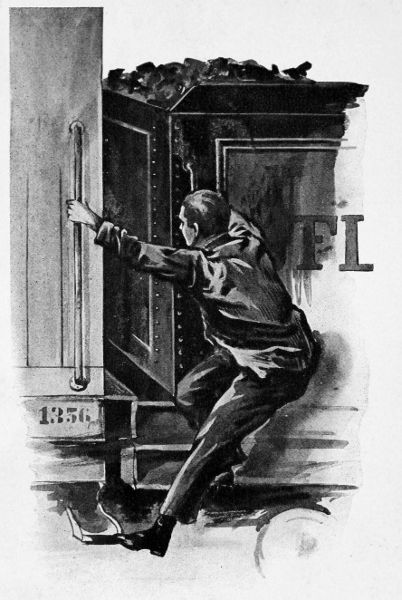
to jump aboard. I ran, caught the rod on the side of the mail coach,
and swung myself into a seat on the platform, right behind the coal car.
It was one hundred miles to Sanford, so the mile posts read, and I was
determined to stay aboard. I unbuckled the sweater from my shoulder
and threw it up on the coal. Around my neck I wore a big blue kerchief
and on approaching a station, I would turn my black felt hat up in the
front, perch myself on the coal car in full view, there escaping the
observation of any one, for officers at every station would pass me by
believing me to be one of the train crew.
About five o'clock that afternoon, the big locomotive drew us safely
into Sanford. Before pulling fairly into the station I yelled good-by
to the engineer and swung lightly to the ground. He looked back and I
waved again.
Realizing that town folks are not wont to help one in search of food
and shelter, I began my march towards the outskirts and into the
country. At a farmhouse about two miles out, just as dusk was clothing
the world in darkness, I secured shelter for the night. I told the
man of the place I was in search of work, so he took me in, with the
provision that I should do a few odd jobs the next morning. With a hot
steaming supper under my belt, I sought my bed and was soon wrapped in
slumber.
I did about two hours' work the next morning and then walked back to
Sanford, where I secured a place as help boy on one of the fishing
boats. We stayed out on the first trip three days, and I was so
desperately sea-sick all the time I was of little help to them. The
master of the boat was a good old fellow and he paid me for my three
days just the same, one dollar and fifty cents, half a dollar a day.
With this fortune in my jeans, I felt very prosperous, and strolled
down the main street, where I bought half a pound of mixed candies for
five cents. As I walked casually along the main street chewing the
sweets, a pair of tan shoes for one dollar and twenty-five cents caught
my eye. These I purchased and went triumphantly squeaking out into the
street.
It was difficult to catch a freight or passenger train out of Sanford
as all trains were closely watched, so I decided to foot it to the
first station where southbound trains stopped for signals and orders.
This I understood was about ten miles. I struck up a lively pace down
the track, through the work yards, out of the city limits and into the
open country.
The big heavy tan shoes I had recently purchased felt comfortable and
evidently were made for walking cross-ties, for the cinders in the
track could not cut through the heavy soles. I made good time on this
piece of road-bed, for the ties were just about the right distance
apart to fit my steps. Along the railroad there were numberless orange
groves with loads of large luscious oranges, and occasionally I
refreshed myself. Finally, I came to a big orange grove. A number of
the limbs were hanging so near the track, one passing on a train could
almost have plucked an orange from the coach window.
I filled my pockets with fruit, and noticing a little pond a few
steps from the track, I went over and sat down by its border, on a
springboard, one end of which was made fast to the bank. There I sat
and ate oranges to my heart's content, and never did stolen fruit taste
sweeter. The sun was now almost perpendicular, and its golden rays
beating profusely down on my top knot, put me in the notion of taking a
swim.
Taking off my clothes, I plunged from the end of the spring-board
and paddled around in the lucid and refreshing water. The bottom of
the lake was sandy and cool, and it felt awfully good to my feet,
especially after a walk over cross-ties in those new tan shoes. I
paddled around the water enjoying every moment to myself till I saw
several little alligators around me, then I made a bee-line for the
land. Just as I was nearing the bank a big ugly looking alligator
bobbed his head up out of the water directly in front of me cutting
off escape. For a moment I was so stunned with fear I could not move.
There was that big ugly mouth with its even row of sharp white teeth.
Gee whiz! he was big enough to swallow me whole, but he was not going
to get a chance if I could help myself. Realizing my danger, I stood
perfectly still and didn't move a muscle. I couldn't. My heart seemed
to stop beating. Without my mind's command my body plunged forward, and
before I knew it I was standing on the bank, shivering with fright.
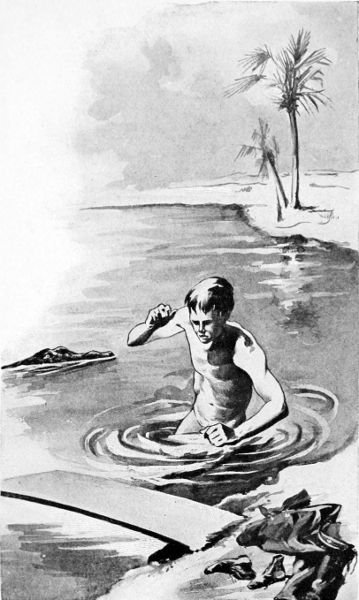
"Gee Whiz! He was big Enough to Swallow me Whole."
(Wanderlust)
The alligator wiggled over to the other side of the bank and lay in
the sun while I made ready to put on my garments. This indeed did not
consume much time, for my costuming was scant. As I was about to depart
from the field of my recent adventure, a native black informed me that
I was intruding on private grounds and I must "git out."
Emerging from the tall tropical bushes which were on either side of
the railroad track, I saw a man standing there, and I was not long
in learning that he was the owner of the grounds on which I had been
intruding, and when I told him of my adventure with the alligator
in the pond, he laughed heartily. In reciting my story to him he
interrupted me by asking if I had thought of Jonah and the whale when
that big pet alligator of his was staring me in the face. Well, not on
your life!
I learned that the station was only a ten minute walk, and I made a
bee-line for it. I soon arrived, and behind some box cars I sat down
to await the train, but, hungry again, I stole over to a small house
nearby and secured a snack from the good housewife. With the food
wrapped in a piece of newspaper, I returned to my seat behind the car,
partook of my noontime meal, finishing off with mixed candies.
The first train that came along was a local freight. I hid myself
between the two front box-cars, but before the train drew out I
was discovered by the conductor, who made me leave my perch on the
couplers. He inquired where I was bound for, and I promptly told him
I lived in Orlando and was trying to make my way home. I asked him to
allow me to work my way and to this he consented. The freight was soon
off and I was on my way once more. At stations I helped the train crew
to load and unload the freight.
About five o'clock that afternoon we reached Orlando, where I spent the
night in an empty box-car. Kissimmee, a distance of thirty miles, was
the next town of any size on the line to Tampa, so I decided to walk
the entire distance.
Thirty miles when accurately measured is no short walk, and especially
so when over cross-ties and cinders. Well, it was a long, long walk,
and before I reached Kissimmee that evening I was both hungry and
tired. Thirty miles! It seemed like sixty! Along the route I met
several tramps, but did not stop to talk with them. At a house I asked
for food, but was refused, the woman telling me that half a dozen of my
kind had been there that very day with the same request. On insisting,
she sicked the dog after me, and I lost no time in clearing out. After
covering about twenty-five miles of the journey my shoes began to hurt
and blister my feet so badly I had to take them off and finish the
journey in bare feet. Here another trouble arose, for the sharp cinders
cut me. This was slow walking, but it was a great deal better than
walking in new shoes.
At dusk I limped slowly into Kissimmee with the new tans swinging
idly on my arm. I truly felt tired and footsore. I was so hungry I
could scarcely pull my weary limbs along the highway. Arriving at the
station, I left the track and made my way to the main street. I walked
casually into a sixth rate restaurant, and after some bargaining with
the proprietress, an old maid from the swamps, I succeeded in inducing
her to give me supper in exchange for the shoes I carried under my arm.
"The regular price of a meal here is twenty-five cents," she informed
me, and at least she reckoned she would let me eat, provided I would
bring around the quarter the next day and redeem the shoes. I handed
her the shoes and then seated myself at the table.
I ate a hearty meal of wholesome food, and before I finished I think
the old maid regretted her exchange. When finished, I strolled over by
the little stove in the dining room and sat down. An old fellow sat
just opposite me, and I was just about to ask him if he would know me
in the future, when he broke the silence by inquiring, "Where are you
from, sonny?"
"Why, I am from North Carolina," I replied.
"Well, what you a doing away off from home down here in this country?"
"Just out for my health," I rejoined.
"You must be taking a natural cure. I see you ain't wearin' no shoes,"
he blurted, laughing heartily at what he thought a great joke.
To this remark I made no answer, and he again broke the silence by
asking several questions; as to whether or not I smoked, chewed, drank
or had any bad habits. I told him I did not smoke, drink, chew, nor
stay out late at nights, and as for my bad habits that was for others
to judge. The old fellow seemed to be rather interested, and before our
conversation ended he offered me a job out on his sheep ranch, five
dollars a month and board.
Considering his proposition a few moments, I accepted, calculating
that the experience itself would be well worth my while. That night he
redeemed my shoes. The following afternoon we drove out to his ranch,
some fifteen miles from town. He lived in a big log house and, all in
all, he was very comfortably fitted up.
My employer, Mr. Heines, conducted a general feed and sale stable in
Kissimmee, so the next day he returned to town leaving me there with
the members of his family to help around the house, doing odd jobs,
such as cutting wood, feeding the pigs and cleaning up the barnyard.
Mr. Heines had an unfortunate brother who was a lunatic, and I had to
sleep in the same room with him. This did not suit my fancy very much,
so about the fifth day I told Mrs. Heines I wanted to leave. I stayed,
however, till the following Monday morning and went back with Mr.
Heines, who had come out to spend Sunday with his family.
The week before, "the boss" had received a carload of Texas mules, and
for the next few days after my return to town I was engaged in breaking
them under saddle. Before I left, I was declared one of the best riders
in town.
During my stay in Kissimmee I made the acquaintance of a young fellow
by the name of Ed James, an engineer on one of the trade boats which
plied over Lake Kissimmee, where its captain traded with the Seminole
Indians. Ed told me that if I wished he would get me a place as cabin
boy on his boat and that I could make the next trip around the lake
with them. This offer I accepted willingly, and a few days later found
us steaming around the lake heavily laden with goods of all kinds which
Captain Hall traded to the Seminoles for furs, dried fish, shells, and
hides, as well as baskets and other little things made by the Indians
who inhabit the swamp lands of Florida.
On this trip I served as cabin boy, and it was a most enjoyable two
weeks' outing.
After my return from the cruise on the lake, I spent a few days
loitering around the town, and then made my way to Tampa. At Tampa I
worked several weeks on a fruit boat which ran between Tampa and Key
West.
To make a long story short, I visited Miami, Tallahassee and Pensacola,
finally arriving back at Tampa some weeks later. From Tampa I journeyed
to Sanford via freight train de luxe, and at that place I succeeded
in boarding a blind baggage on a passenger bound for Jacksonville. At
Sanford I was standing by the track about a quarter of a mile from
the station, when I saw the train slowly approaching, but before it
reached me it had increased to such speed that I was almost afraid I
could not swing aboard. However, I determined to take my chance.
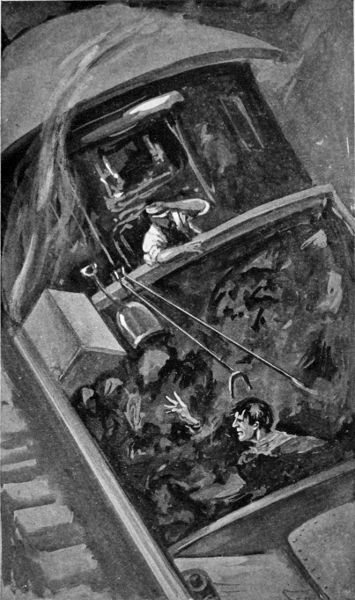
As the engine came steaming by I caught the handle rod of the first
coach and swung myself into a position just behind the coal car, and
there I rode, standing upright. The engineer and fireman both knew I
was on, for the engineer had seen me as I swung into position. Part of
the time I rode sitting up on the back of the coal car, and part of the
time I rode behind the coal car, standing up and holding myself steady
with the iron rod which ran along behind the rim of the car.
We stopped at a little station called Warner, and as we drew up to get
water, I suddenly remembered that an old friend of mine, Mr. White, a
lawyer whom I had met at a summer resort several seasons before, lived
there. By the side of the track I saw a couple of negroes sitting on a
pile of cross-ties, and of them I inquired about my friend. They told
me they knew Mr. White and that he lived in a house not far distant,
at the same time pointing out a big residence. Quickly I drew from my
pocket a letter which was addressed to me, and after taking the letter
out of the envelope, I handed the latter to the negro and asked him
to give it to my friend, requesting him to tell Mr. White that I, the
person whose name was written on the envelope, had passed through that
afternoon. He promised me faithfully that he would, and I afterwards
learned that he had.
The sun was sinking behind the pine fields and dusk was slowly clothing
the earth in its folds as we rode into Palatka. The train pulled in,
and as fate would have it, the engine drew up only a few yards beyond
the depot. As we passed slowly by, I saw a policeman on the platform of
the station and, quick as a flash, I jumped from where I was standing
on the rear of the coal car to the platform of the baggage coach, and
crouched, to prevent his seeing me as the train passed. I hid myself
on the very bottom step of the car, opposite where he was standing,
but evidently he saw me jump from my perch, or else he saw the top of
my head as we passed, for we had no sooner come to a standstill, when,
peeping from my position, I saw him coming around in front of the
engine.
I was determined not to be caught after having ridden so many miles in
safety, so I left the steps quickly, walked to the engine, and drawing
my handkerchief from my pocket, I began rubbing vigorously the brass
rods and pipes on the side of the locomotive. When the officer stepped
around the engine to where I was standing, he looked at me for a second
and then asked me if I had seen a "bum" coming around that way. I
told him that I had seen a fellow jump off the steps of the car only
a second before and walk towards the rear of the train. Evidently he
thought me one of the crew, the way I was working on that brass, for he
beat it towards the rear of the coach in search of his man.
Another moment's wait and we were again on our way. It was ten o'clock
when we arrived at Jacksonville, and before I left the coal car, the
dear old engineer with whom I had ridden all day, called me to him and
handed me a quarter, with which to buy supper.
I walked out of the big station into the streets and soon fell into a
quarter restaurant, where I purchased supper and then began to hunt for
a place to sleep. No one proved a good Samaritan, so I had to content
myself with an empty box-car, but this was not as bad as one might
imagine, for it was strewn with bits of hay, which I gathered up in a
pile and made for myself a fairly comfortable bed.
The next morning while walking down the main street of Jacksonville,
wondering where my next meal was coming from, a gentleman stepped up to
me and remarked, "Well, you look as though you might have slept in a
hay barn, young man."
At this I did not take offence, but smiled, telling him that I really
had slept in the hay that night, and that I was now looking for a place
to get something to eat. As luck would have it, he took me over to a
fairly decent restaurant and bought me a steaming hot cup of coffee and
breakfast. He sat there and chatted with me while I devoured my food,
and when I had finished I thanked him most heartily for his kindness
and bade him good-by. I hung around Jacksonville several days living on
"hand outs" and sleeping at nights in the empty box-car.
I tried to catch a train out of there, but found them so closely
watched that it was impossible, so I undertook another walk.
It was twenty miles from Jacksonville to Way Cross, and one bright
morning I set out on foot.
By then the tans were well worn and the walking easy. About noon time I
met another of my apparent caliber and he happened to be eating beside
the track when I arrived. He had a fire kindled and was preparing his
meal in a tin can. I sat down and soon we were partaking of hot coffee
and cold biscuits.
He had a letter in his pocket which he had written to his people in
Connecticut and I gave him postage. He asked me where I was headed for,
and I told him I was on my way home, and when I got there I was going
to stay, for I was damn tired of tramping around.
When he heard me through he said, "Do you know what your folks will say
when you get there?"
"No. What will they say when I get there and tell them I have come home
to die?"
"Well," he said, "they will say, 'You lie, boy; you have come home to
eat.'"
That night about dark I reached the little town of Way Cross. A few
negro huts, a post office, a general store, and one fairly decent
house, which stood just across the track from the depot. At this house
I requested food and the lady gave me a splendid lunch. I asked the
station master if I might sleep in the waiting room that night, and he
told me I could. I was tired from my long walk, so it was early in the
evening when I sought my sleeping place. I lay down on the bench and
snoozed soundly till daylight next morning.
Feeling somewhat rested, I arose and went out on the platform. I walked
around to the side of the station and there lay, close up to the house,
three men who were formerly with a circus in lower Florida and were
now making their way to their homes in Baltimore. Within a short time
a freight arrived and drew up at the water tank. I arranged with the
engineer to let me ride to Uleaf in consideration of my helping the
fireman.
At that time most of the roads in Florida used pine wood instead of
coal, so I busied myself in helping the fireman. From Uleaf I rode an
empty box car over to Fernadina. By the time I arrived at Fernadina
I was getting mighty tired of tramping around and wanted to get home
pretty badly. I had three cents when I arrived there and with this I
purchased crackers and walked down on the pier where I gathered up some
oysters in the shell and thus fared sumptuously.
For some time I had been thinking of wiring home for money and that day
I thoroughly made up my mind to do so. Strolling up the street I walked
into the telegraph office and advised the young lady in charge that
I wanted to send a telegram, charges C. O. D. She informed me that a
telegram could not be sent without a deposit for she did not know me,
and that the telegram might not be accepted at the other end and she
would therefore have to pay for the message herself. I assured her that
the message would be accepted, but could not convince her.
Half the day I spent in trying to get work but at every attempt, I
was discouraged. That afternoon I made twenty-five cents in a local
newspaper office turning the big wheel while the editor of the local
Bugle fed the press. This quarter was my salvation, and after
finishing my work I sallied forth to the telegraph office and planked
over my money. The young lady promptly dispatched a message for me
which was worded as follows:
Want to return home badly. Please wire money.
Jack.
Night soon came, and I sought a lumber yard down by the wharf. I
crawled up in the lumber pile and made my bed for the night. I did
not sleep much, for I was thinking of home, how good a nice warm bed
would feel and how glad they would all be to see me after months of
separation.
The next morning I received twenty-five dollars and made ready to
depart for home. I inquired of the ticket agent what my fare would be,
and he told me "twenty-one dollars." This money looked too good to me
to spend so foolishly, since traveling freight was so easy, I decided
to hold the coin and ride cheaper. I caught a train out of there that
morning, and at ten o'clock that night I arrived safely in Jacksonville
after a rough ride on the rods of a freight. I went down to the docks
and found one of the Clyde line steamers loading for Charleston. While
the negroes were busily engaged in loading the freight I hid myself
in the bottom and there awaited its departure. My hiding place was
between some big boxes, and I knew I would not be discovered till after
the ship had left port, so, feeling comfortably safe, I dropped off
to sleep. When I awoke we were steaming northward. Just as I crawled
from my hiding place one of the crew saw me and let forth an oath.
He grabbed me by the nape of the neck and hauled me bodily up to the
foreman who was standing nearby. I did not attempt to resist at all,
for he was a great, big, ugly devil and I was not going to take any
chances on being disfigured at that time. The mate could do nothing
more than set me to work, so to work I bent, and it certainly was over
hard. From the time they caught me till we arrived in Charleston I
worked like a slave, scrubbing decks.
Arriving in Charleston, that night I sought a lodging house, and the
next day, after making a thorough toilet and purchasing a few clean
clothes, I bought a ticket for my home in the mountains of Western
Carolina. Here endeth the first adventure, and I returned, wiser
of course, and somewhat disappointed, truth to tell, in not having
captured a ruffian. However, I was glad enough to have saved my skin.
How uncomfortable to have passed the remainder of my days in the
somewhat contracted belly of the alligator.