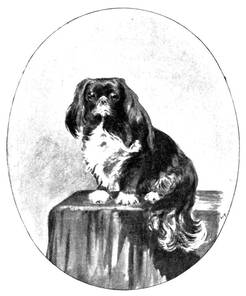
We were talking the other day of the many and
interesting books of travel that have been written
lately, books so full of valuable information and
precise descriptions that you almost feel that Inner
Africa and the North Pole are as familiar to you as
Piccadilly and Oxford Street.
"It is a blessing that such books exist," said our
host, who has rather a philosophical turn of mind.
"Of course, I never read them; personally, I think
that reading and writing are decidedly a mistake;
but if I wanted to know anything about these countries
there would not be the slightest necessity to
travel about; other people have done that for me.
To speak the truth, I do not want to know anything
about foreign parts. One book of Stanley, for
instance, is enough to make me hate the very idea of
Inner Africa; and as to the North Pole, I cannot
describe my feelings with regard to the raving
lunatics who imagine they have anything to do
there. I am all for a quiet life, you know. I stick
to my principles—the summer in Cairo, the winter
in bed."
This speech was received with icy coldness. We
are not philosophically inclined, I am sorry to say,
and though I should not much like Inner Africa on
account of the heat, I have always cherished the
idea of some day making a trip to the North Pole.
This I said with my usual diffidence and modesty,
but of course I was hooted by the rest of the company,
and one energetic lady explained at great length that
the North Pole is a "humbug." Another lady (the
one who is my collaborator now) confessed a great
partiality for travelling. "Only," she said, "it is
not at all necessary to go so far; there are many
wonderful countries in Europe which are very little
known. For instance," she added, turning to me,
"I always wonder how very little you English know
of Austria. The fact that Vienna is a pretty town,
where everything English is particularly liked; that
Prague is a fine old city, and that here and there we
have first-rate shooting, is about all that is known of
Austria by foreigners. And it is a pity! Who
really has seen the wonderful mountains of the
Tyrol, mountains that are just as fine as any in
Switzerland; the charming lakes of the Salzkammergut;
the green valleys of that greenest of lands,
Styria? Who has spoken of the mysterious charm
of the great Bohemian forests of oak and pine, the
quaint little towns of Carinthia, the beautiful banks
of the blue Danube? How very few people know
the puzsta, the immense plains of Hungary; and
who has explored the wildernesses of Galicia and
Transylvania, or the wonderful beauty of the
Dalmatian coasts from the Bocche di Cattaro up to
here, where we are on the shores of the Adriatic
Sea? And just here—this little spot so full of
memories and classic associations—who has ever
heard even the names of Istria and the Littoral?
And yet how pretty and interesting the scenery is in
this unknown part of Austria. The azure waters
of the Adriatic, the wonderful southern sky, the
Italian landscapes, the many relics of old Roman life
and grandeur, everything combines to make this
country worthy to be seen and admired. Do you
know," she concluded, "you ought to write a book
about it."
"Write a book!" I exclaimed, duly horrified,—"I,
who hate even to write a letter of ten lines!"
"Writing a book is quite different, I am sure,"
was the answer; "and I don't mean a learned,
scientific work. Write a simple sketch of this part
of the country. Begin with Duino, where we are
now. Then we will make excursions to other places
near here, and you can write about them. If you
will do it, I will try to make the illustrations."
This was another thing; and though our host
looked rather gloomy at the idea of having any
book-writing going on under his roof (a thing
decidedly against his principles), I promised I would
think about it. At first I felt very much as an
unhappy being feels who is about to make his first
speech; he knows there are lots of things to be
said, but for the life of him he cannot remember
what they are.
Now, however, I have written the Introduction
and made the first plunge. I am writing the rest to
please my collaborator and myself. I do not intend
to be apologetic. If other people like this scribble,
all well and good; if they do not, they should not
read it.
CASTLE DUINO
CHAPTER I DUINO
Hast thou seen that lordly castle, That Castle by the Sea?
Golden and red above it The clouds float gorgeously.
Longfellow.
I never read an account of any pile
of stones, dignified by the name of
"castle" and situated near the sea, that
did not begin with these lines of Longfellow's.
It is not the force of example, however,
that makes me prefix them to this attempt at
a description of one, but it is the fact that they really
suit Duino.
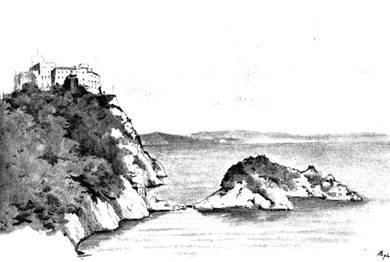
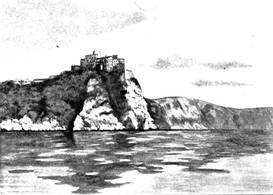
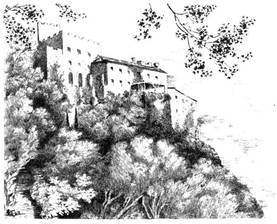
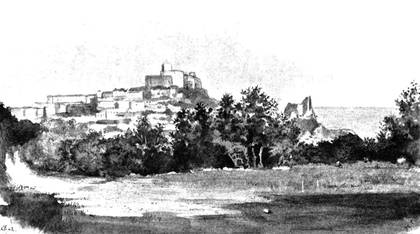
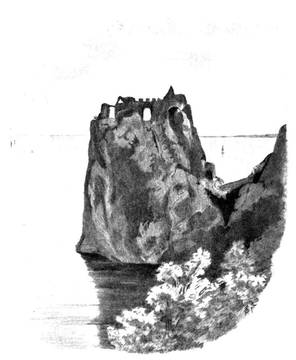
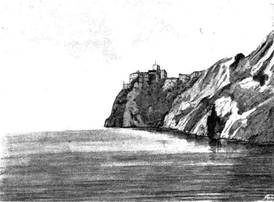
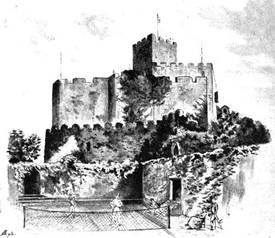
It looks lordly and imposing enough standing
out grand and massive on frowning cliffs two hundred
feet above the sea, grim and gray, like some
old sentinel keeping a constant watch over the blue
waters of the Adriatic stretching at its feet.
DUINO FROM THE SEA
The view from it is magnificent: before you the
open sea; on both sides, extending in graceful curves,
the coast, amethyst-hued; far on the left the white
houses of Trieste, and rather nearer, the Imperial
Castle of Miramar; on the right, just on the
horizon, the tower of Aquileia, famous in Roman
times; and in the dim distance the snow-clad Alps.
From the land side the castle looks perhaps even
more stern and severe, and like the fortress it was in
old days. Not a window is to be seen, only the
bare fortifications and the old walls clad with ivy,
almost as old to all appearance as the walls themselves.
What appeals to one most is the restfulness
and quiet of the place. The old castle, with its
towers and battlements, its cloisters and courtyard,
stands just as it has stood for centuries. You are
out of the world here, the bustling, hurrying,
work-a-day world of to-day, and back again in a
world of two or three hundred years ago.
It is a nice, sad sort of feeling that comes over
one: you think of your debts, of the friends of your
youth that are dead and gone, of your elderly relation
from whom you have expectations, and who will not
die, and other melancholy things of a like nature;
but your troubles seem far away, and are quite
pleasant—"grateful and comforting."
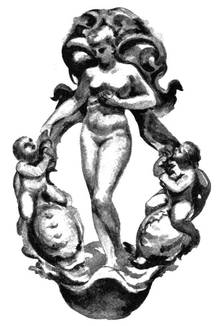
DOOR-KNOCKER
The place seems peopled with ghosts—ghosts of
a bygone age. There is a legend that on certain
nights of the year a troop of phantom horsemen ride
into the courtyard, and even in daylight you
almost expect something of the sort to happen—you
listen for the clank of arms and the ring of the
horses' hoofs. Modern dress seems out of place,
you feel you ought to be in armour yourself. Every
nook and corner, every stone, seems to have a story
to tell. What a pity they cannot speak and tell all
they have seen!
The castle must have been well-nigh impregnable
in the old days, and probably extended to the ruin
one sees on the right, on entering it.
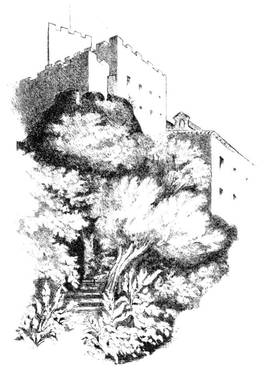
Between the two—the ruin and the inhabited part—there
is a sort of half garden, half wilderness,
known as the "Riviera"—a delightful spot. Ilex,
cypresses, laurels, and olive-trees grow in luxuriant
profusion. Little winding paths tempt you to
explore them. There is a long, old, steep flight of
steps with the trees meeting over them in a roof of
green leaves, leading down to the sea. Old-fashioned
flowers abound, and grow almost wild—purple irises,
great blue periwinkles, honey-scented "dragons'
mouths," and roses of every kind. Butterflies that
are rare in England are common enough here—huge
yellow swallow-tails, the graceful "White Admiral,"
glorious "Camberwell Beauties" flit from flower to
flower. There are swarms of nightingales; and pigeons
and starlings have formed a perfect colony in the cliff
under the ruin; a pair of kestrels have their nest here
too. There are snakes in the long grass, and bright-coloured
lizards bask in the sunshine.
Notice the big doors as you enter the castle—there
is "Salve!" on one of them. It is pleasant to
know one is "welcome," but one always is in
Austria—it is the land of hospitality.
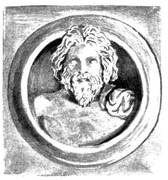
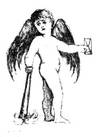
BOREAS
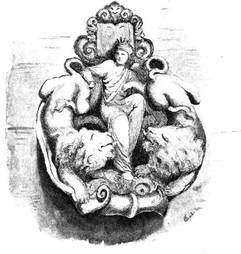
On the other door is an ancient knocker—interesting
if you have a passion for old things. That
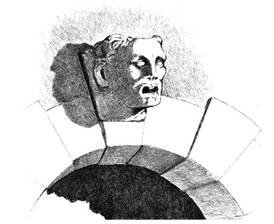
ugly face over the archway is a portrait of Mr.
Boreas, the personification of the North Wind. He
is represented as continually blowing. As a matter of
fact he does blow rather strongly here, and in the
spring almost perpetually.
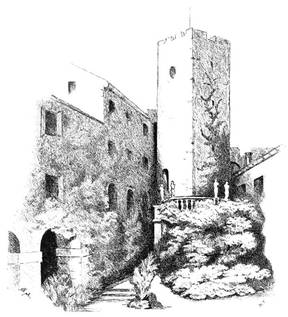
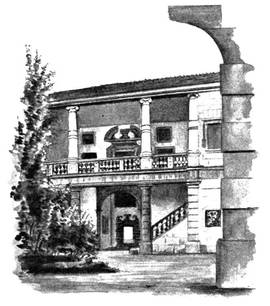
One of the most picturesque parts of the castle is
the old courtyard, with its big square tower, its
glistening statues, its dark cloisters, its graceful
balconies, and with the ivy entwining and creeping
over everything. The tower is said to be Roman.
There are rooms here that have been walled up for
centuries and are so still—nobody knows why. It is
said in the village too that somewhere in the tower
is "the buried treasure." I should very much like
to find that!
Those coats of arms in mosaic on the wall of the
covered passage are the arms of some of the various
owners of Duino. "Ditthalm, 1139," is the earliest
date there. War was the principal amusement of
those times, and these first "Lords of Duino"
certainly had enough of it. It mattered little to
them which side they were on. If there were a war,
or a petty feud, or anything going on in which hard
blows might be struck, there they were, on one side
or the other. They must have been fine fellows in
their way, these old warriors, and have kept the
citizens of Trieste and the neighbouring little towns
in a perpetual state of alarm.
· · · · ·
THE ROMAN TOWER
Here I had written some beautiful sentiments
about the chivalry and loyalty and manliness of "the
men of old." I felt rather pleased with my handiwork.
It was full of nice poetic sentences, with a
dash of enthusiasm, and here and there a fine contempt
for our "degenerate time." So I went to
my collaborator and wanted her appreciation. I
cannot say she did appreciate my flight of eloquence—I
did not find her quite so enthusiastic as I had
expected.
"Don't be so ridiculous," she exclaimed. "What
do we know about the men of old? I have not the
slightest respect for them. I am sure they were
exactly as men are now—if anything I think they
were worse; but I don't know anything about it,
and you don't either, so please stop that nonsense and
stick to the present times—they may be 'degenerate,'
but they are much more comfortable."
No, I decidedly think she was unsympathetic!
· · · · ·
Duino changed hands many times. In 1465 it
was the property of the Emperor Frederick III., and
in 1508 it belonged to the city of Venice. In 1669
it came into the possession of the Della Torre (the
old Lords of Milan), and from them it descended to
Prince Egon-Carl Hohenlohe, the father of the
present owner, our host.
There is a portrait of Dante in the covered
passage. He came to visit Pagano Della Torre here
about the year 1320, and is said to have frequented
the little island near the bathing place in the
"Riviera." The neighbourhood of Duino was
very different in his time from what it is now;
tradition says the hills were covered with forests
of red pine, and that the country generally was
swarming with game. The game now is conspicuous
by its absence; there is one solitary hare left, which
inhabits Dante's island, by the way.
Poor old Dante! He looks very melancholy and
unhappy, but we can most of us sympathise with
him. There are not many of us, however easily the
wheels of life may have run, who do not feel a pang
of something like regret when now and then the
thought of some one gone out of our lives comes
over us. Fate plays tricks with us all. Death, the
force of circumstances—it matters little what the
cause of our separation was; we have drifted apart,
and there is nothing left us but a memory—a dream
of what might have been.
CHAPTER II DUINO— continued
Full of long-sounding corridors it was, That over-vaulted grateful gloom,
Thro' which the livelong day my soul did pass, Well pleased, from room to room.
Tennyson.
The covered passage before mentioned leads one
straight to the principal staircase. It is a graceful
winding staircase, and rare and interesting prints
cover the walls. On the first landing, after passing
through two anterooms (the second of which contains
a collection of fine old Viennese china), one
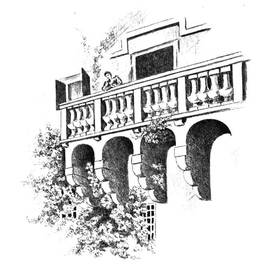
enters the dining-room. It is a large room with a
balcony, from which there is a beautiful view of
Miramar and the sea. There are some most appropriate
pictures of eatables by various Dutch
masters on the walls. It was a curious taste of these
gentlemen to paint things to eat. Perhaps they were
on the verge of starvation—that might account for it.
I should have thought they might have found more
interesting studies, though, than "gralloched" hares
and fishes with their necks broken. I know nothing
of Art (this is constantly dinned into me), so can
speak absolutely without prejudice. An old telescope
that once belonged to Nelson, and was presented
by him to Count Della Torre (Thurn), Admiral of
the King of Naples, is in this room. It is a very good
glass; one can see things through it almost as well
as with the naked eye, but it requires some manipulation
to get the focus right.
THE BALCONY
People dine well in Austria, but you get a superabundance
of veal. Veal for lunch, veal for dinner,
veal cooked in many ways and concealed under
numerous devices, but always veal. There is a fearful
invention called "Schnitzl" that is the worst
form of all. Foreigners say we English live on beef
and mutton, but in Austria they live on veal, so we
have the pull over them in the way of variety. One
never sees grown-up cattle here. Poor things! they
don't get the chance of reaching years of maturity,
they are always killed in the first spring of their
youth.
Opening into the dining-room is a small drawing-room.
This contains mostly family portraits. The
most noticeable among them is the portrait of the
late Princess Hohenlohe. She must have been very
beautiful, and has a very English appearance. She
was the last Della Torre.
There are two pictures here that I am convinced
are by Morland. No one knew this before, so I am
very proud at having made the discovery. Some
other animal pictures are ascribed to a Venetian artist—Longhi—portraits
of horses. They are extraordinary
horses—very fat, and they appear to have
been taught to beg, as they are almost all standing
up on their hind legs. I am told this is a playful
habit that Spanish steeds had.
You go up another flight of stairs and arrive at
the door of the gallery. This is a long passage,
especially designed for ghosts to walk in—not the
sort of place one would care to be left alone in after
dark. There are some very fine pictures of the
Venetian and Dutch schools here. One of the best
is the "Entrance of the Dogaressa Morosina
Morosini into Venice," by Tintoretto—all the figures
are said to be portraits. At the further end of the
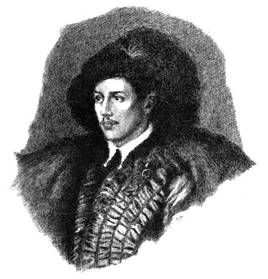
gallery is the great banqueting hall. There is a
portrait here by Van Dyck of one Matthew Hofer,
a former owner of Duino. An old chronicle calls
him "a tempestuous and arrogant youth, who had
always his hand on his sword, and whose whole life
was a drama of blood." In his portrait he has a
proud and handsome face, with dark melancholy
eyes.
The other full-length portraits represent some of
the Lords of Milan—Della Torre—who after many
years of unending civil wars were vanquished by the
rival family, the Visconti, and obliged to fly from
Milan. They took refuge near their kinsman, Pagano IV.,
then Patriarch of Aquileia, and soon gained wealth
and great power in their adopted country. They
were a turbulent and overbearing race, and many are
the tales still told by the people of their violent or
heroic deeds.
PORTRAIT OF MATTHEW HOFER (Van Dyck)
Notice the painting of the gentleman on the
ferocious-looking horse, that appears determined to
jump on you whichever part of the room you retire
to. He was quite a character, and had a special
talent for eloping with other people's wives. On one
occasion he was condemned to be beheaded, and the
soldiers of the Emperor were sent to Duino to arrest
him. He treated them with great hospitality, and
gave them a splendid banquet—probably in this very
room. After dinner he retired to his own apartment,
and as all the entrances to the castle were securely
guarded, the unsuspicious soldiers thought nothing of
it. Suddenly they heard a shot from the sea, rushed
to find out what it was, and perceived their former
prisoner on board a ship in full sail. Our friend
fired the shot to let his would-be captors know they
need not wait for him—a proof of his kindly and
considerate nature! There was an underground
passage leading from the library (the entrance may
still be seen) to the shore. The soldiers did not
know this, and their host had omitted to inform them
of the fact.
THE BANQUETING HALL
It is said that he was retaken years afterwards
and deprived of his head; but there is another
account that he made a compact with the devil and
escaped again, this time on a black horse, one
of His Satanic Majesty's own particular breed,
that carried him safely over the sea to Aquileia,
where horse and rider disappeared, and were seen
no more.
The old man on the gray steed who is so cruelly
trampling down four poor individuals very scantily
clothed, is Napoleon I. Della Torre. One story says
he rode over his own children in this way, but it is
a base calumny; the children are four cities which
he conquered for Milan, allegorically represented in
the picture.
In the library I examined the entrance to the
famous underground passage. You see a trap-door
cleverly concealed in the wooden floor, and on lifting
it, a small staircase leads you down to a very diminutive
room, built in the thickness of the massive outer
wall. On your left is the passage. It is very small—in
fact, you have to proceed on your hands and
knees, and after a few yards you are stopped by a
quantity of stones and earth.
The father of "our host" wished to have the old
passage reopened, and set people to work, but it
seems they were so frightened at finding a number of
human bones mixed with the soil and rubbish, that it
was impossible to persuade them to work on. They
said it would be dangerous to clear it, as the castle
would inevitably fall in consequence—a mere excuse,
of course. I think the mysterious passage must
descend through the terrace tower which rises against
the middle of the side of the castle that faces the sea,
and come out somewhere in the "Riviera," meeting
the old staircase spoken of in the preceding chapter.
THE RIVIERA
I must say this passage interested me much more
than all the many books of the library, but I noticed
an enormous old "missal," most elaborately painted
by hand on parchment, a very valuable work of the
fifteenth century.
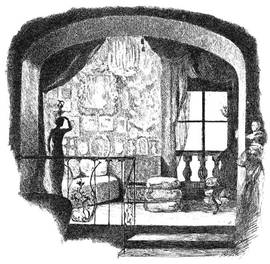
There is a charming little recess in the library,
where there are some beautiful miniatures, one or two
fine old pastels, and some splendid old china; this
corner would be a paradise for an antiquary.
A RECESS IN THE LIBRARY
A portrait of "Martin the Giant," a big man clad
in armour, looks down threateningly from one of the
dark corners of the room. He was a great warrior
and statesman in his native Lombardy, but finally
went off to the Crusades, and after showing great
prowess, is said to have been taken and skinned alive
by the Saracens (1147).
The walls of the drawing-room, next to the
library, are covered with pictures, mostly of religious
subjects. I suppose I ought to expatiate on them,
but the artistic side of my nature is exhausted, and I
should probably admire the wrong ones.
What I can safely speak of is the view from the
large terrace over the afore-mentioned tower, where we
used to have breakfast. It was charming to sit there
in the early morning and look out upon that grand
expanse of boundless sea, with the little wavelets
dancing in the sunshine; it was almost cool too at
that time of the morning.
· · · · ·
Here the "energetic lady" remarks in an undertone
that at this early hour she believes I was generally
in bed, and that she did not remember having once
seen me at breakfast on the terrace. Fortunately I
can allow such remarks to pass unnoticed.
· · · · ·
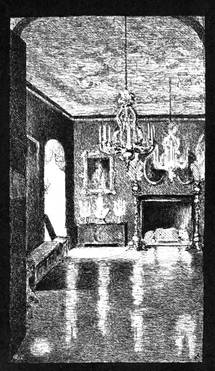
There is a mysterious charm about all these old
rooms, they are so quiet, so restful, with their stained
floors, their black oak carving, the tapestried
hangings, and the old furniture. There are no
bright colours, everything is subdued; no glare,
always a sombre half-light. One feels inclined to
walk softly in them, and speak in whispers, so as
not to disturb their restfulness. There is something
almost sad about their silence; they belong to a
time long ago, not to the present day, and they seem
to be waiting—waiting for the years that have passed
to come again.
CHAPTER III M IRAMAR
And round about his home the glory That blushed and bloomed
Is but a dim-remembered story Of the old time entombed.
E. A. Poe.
On Friday, 31st May, we all
went to Miramar, eleven of us.
We drove to Nabresina, the
nearest station to Duino, went
from there to Miramar by train (it gave some
trouble to the engine-driver, as he had to stop
the train on purpose for us to get out), and then
walked from the station to the castle. It was a
stupid way of getting there; it would have been
much better to have driven all the way, but the
directress of our party did not think so. I suppose
she thought we should enjoy the various modes of
travelling. It was rather a pity we had not relays
of saddle-horses and bicycles to meet us somewhere—we
should have had still more variety. We might
have crawled the last bit too on our hands and knees,
but I didn't think of it at the time. I used to like
railway travelling. When I was very small I could
have no greater treat than to be taken somewhere
by train—now I don't. I still like to see a train.
If I am in the country and feel lonely, I walk to the
nearest railway line and wait for an express to rush
by. That cheers me. I don't wish to be in it—the
sight of it is enough. It must be an English express,
however; a Continental express merely irritates one,
and deepens the melancholy; I feel I can walk faster
than it can travel.
We arrived at the Imperial Castle at last. The
gardens are very pretty. There are numbers of
terraces, and flights of steps, and cedar-trees, and
little Italian gardens. There are big palm-trees, and
strange foreign-looking shrubs, and beautiful beds of
old-fashioned monthly roses.
· · · · ·
I had written so far in this chapter when I thought
I had better consult my collaborator. I found her
making a sketch in pen and ink. "That is very
nice," I said. "I really know those things are trees."
"I am glad you realise what they are," she answered
with icy coldness. "Won't you read what you have
written?"
I did so, and then the storm burst.
"You call that a description of those beautiful
gardens!" she said. "Have you no poetry in your
nature? Have you no appreciation of the beautiful?
Why don't you say much more of the terraces, the
marble staircases? Why don't you speak of the
funereal cypresses clear-cut against the sky, the dark
green of the ilex contrasting with the gray of the
olives? Why don't you write about the white starry
blossom of the jasmine, the sweet scent of the honeysuckle,
the tea-roses creeping up and festooning the
rough stems of the towering palm-trees, and shedding
their perfume on the soft summer air, the glistening
of the water in the fountains, the azure blue of the
sea, the whiteness of the marble statues gleaming
through the dark foliage, the mysterious appearance
of the Italian gardens with their staircases leading
down to the deep-hued waters of the Adriatic?
Why don't you say something about the liquid
notes of the nightingale, the faint whispering of
the trees overhead, the 'Lovers' Walk?' Oh! you
are stupid."
Perhaps I am. I have written all I could remember
of our conversation. I hope she will be
satisfied now.
· · · · ·
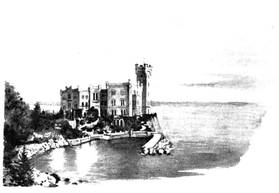
MIRAMAR
The castle was built about the middle of the
present century by the Emperor Maximilian. We
saw the rooms that had been his. They are built to
exactly resemble the cabins on board his ship when
he was Admiral of the Austrian Fleet. Every one
knows his tragic story: how he, persuaded by the
promise of French support, went off to be Emperor
of Mexico; how the French deserted him (France
has done many things she may well be ashamed of,
but nothing more dastardly than this); how he was
captured by the rebel Mexicans, and finally shot by
them. Poor fellow! one would have thought that
with all he had he might have been content without
being Emperor of Mexico. But who knows what
dreams of glory and heroic adventures passed through
his brain! He was a poet and an enthusiast, a man
worshipped by the people, and in his veins flowed
the blood of Charles V., who once had been the
master of those far countries where his destiny called
him. And what must have been his thoughts when
he, the son of the German Cæsars, stood forsaken
and betrayed before the handful of rebels who put
an end to all his golden dreams? In any case his
end was worthy of his noble nature. There is an
incident in connection with it not generally known.
One of the few Mexicans who remained faithful to
him was Mejia, one of his generals. He was also
captured by the rebels, and was condemned to be
shot with the Emperor, but with this difference: for
the Emperor a company of picked shots had been
selected, and for Mejia they had chosen a number of
raw and young recruits, unaccustomed to the use of
the rifle. The Emperor, whose experienced eye had
immediately remarked the cruel intention of the
Mexicans, ordered his companion, as the last boon
he could grant him, to exchange places with him.
Mejia obeyed, and was killed instantaneously; but
the Emperor died a lingering and miserable death.
People say he was so disfigured that when his
embalmed body arrived in Vienna, no one, not even
the Grand Master of the Court, could be quite sure of
his identity.
I do not admire the castle. It is new, and looks
new, and is built in no particular style, though the
first intention was evidently to make it Gothic. One
sees the love of the unfortunate Emperor for Spanish
and Moorish things, by the way in which they are
dotted here and there. The interior too is rather
tasteless. There are some fine things, but the arrangement
is bad. A beautiful cabinet that once belonged
to Marie Antoinette is in one of the rooms; it has
some wonderful old Wedgwood china on the doors.
We were shown round by the most melancholy
attendant it has ever been my lot to meet with. He
seemed to find it a heartrending business, and his
voice sounded as if he were continually on the verge
of tears. I was quite glad when the inspection was
over. I am tender-hearted myself, and do not like
to wantonly distress any one.
After viewing the castle we went out into the
gardens again, and (I am sorry to have to confess it)
ate some provisions that we had brought with us, on
one of the flights of marble steps. Then we wandered
about in the gloaming till it was time for our train.
It was a lovely evening:—
Skies strewn with roses fading, fading slowly,
While one star, trembling, watched the daylight die.
The nightingale's rich music and the soft murmur
of the waves were the only sounds. All the clamour
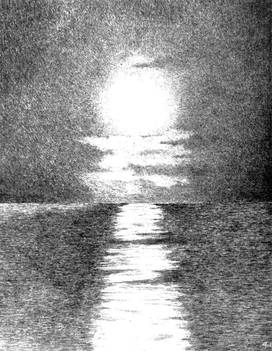
and bustle of the day were over. The moon rose
and flooded the calm sea with a pathway of melted
silver; the stars came out one by one, and seemed
to smile on us. It was the time when all evil
thoughts go out of one's heart, when heaven itself
seems nearer in the dim light. On such an evening
I always think of the old familiar words of the "blessing"
after the sermon, "The peace of God, which
passeth all understanding."
THE RISING MOON
We had an exciting adventure during our return
journey in the train. We had started, and the conductor
was just examining our tickets—having carefully
left the door open—when the Vienna "express"
crawled by (I almost said tore, but I cannot tell a
lie). Some projecting portion of it caught our carriage
door, sent it to with a violent crash, smashing the
door and half tearing it from its hinges. The crash
was like a cannon-shot, and the explosion was followed
by the tinkling of the shower of broken glass that
fell over and around us. For the moment we could
not understand what had happened, and all looked
fearfully around, expecting to see pieces of ourselves
lying about the wrecked compartment. Fortunately,
we were all whole and unhurt, however. Of course,
there was the wildest excitement in our railway
carriage. "The Seal" kept congratulating himself
on not having been nearer the broken window, and
explaining what dreadful injuries would have ensued
for him if he had been. The directress of our party—the
"Energetic Lady"—abused an unfortunate
stationmaster, who came at the next stoppage to
inquire about the accident, in such a way that the
poor man shrank back terrified and in tears. The
"Learned Fair Man" started a scientific theory (in
which he dragged in Darwin) to explain the matter;
but the "Learned Dark Man" (with Schopenhauer
in the background) had another scientific explanation
exactly the reverse. The "Fat Boy" thought
Anarchists had an especial grudge against himself;
the "Thin Boy" profited by the occasion to bleed
copiously from the nose—a pastime he had indulged
in at intervals throughout the whole day, and the
other boy lost immediately the one bag of the party.
The two other ladies, who had not been in the
baneful compartment, explained at great length all
their misgivings, presentiments, and extraordinary
perceptions; whilst my collaborator shrieked excitedly—
"There! that's a beautiful incident for the book."
"Bother the book!" I answered with pensive grace.
After this the drive home was dull and uneventful.
We were almost smothered in dust, but that was
merely a trifling inconvenience, which the beauty of
the night and the glorious moonlight quite made
up for.
CHAPTER IV T HE TIMAVO AND SAN GIOVANNI
O water whispering
Still through the dark into mine ears.
D. G. Rossetti.
I made two excursions to the Timavo and
San Giovanni. The first was with the "Fat
Boy." It was a rainy sort of day, and there was
nothing to be done in the way of exercise but to
go for a walk, so I beguiled the "Fat Boy" into
accompanying me. I like to take him for walks.
I feel I am doing good to suffering humanity—he
may get rid of a little of his superfluous flesh by
the exertion. I cannot say that up to now he has
exhibited much thankfulness for my philanthropic
efforts. We took Pixner, the gamekeeper, and his
two dogs with us. Pixner is much looked up to
in the village of Duino as a great traveller and
linguist. He spent one or two years in England as
servant to "our host," and was commonly known
there as "Mr. Pig-nose"—his own name being
found difficult to pronounce.
San Giovanni is not far from Duino—only a walk
of half an hour or so. It is classic ground, for does
not the world-famed Timavo make here its appearance
into the light of day?
Antenor potuit mediis elapsus Achivis
Illyricos penetrare sinus atque intima tutus
regna Liburnorum et fontem superare Timavi,
unde per ora novem vasto cum murmure montis
it mare proruptum et pelago premit arva sonanti.
Virgil'sAeneid, Book I. 242-246.
The "nine mouths" of Virgil have now sunk to
three, however. It is a most extraordinary thing,
this river, all at once, seeming to come from nowhere,
there it is, not a little feeble, trickling streamlet,
but a wide, fast-flowing river. There is no
doubt that the original springs are somewhere
underground, and that it runs for a considerable
distance in the bowels of the earth. Every now and
then on the neighbouring hill-side you come to a
hole in the ground where you hear the rush of the
water, and the splash if you drop a stone down.
The ground about this neighbourhood is a perfect
honeycomb.
SPRINGS OF THE TIMAVO
Almost all the classic authors speak of the Timavo.
I had carefully compiled a list of these old gentlemen
with a kind of history of the river, but I will spare
the reader, and merely say that they believed it to be
the entrance to the Infernal Regions, and that the
Argonauts are said to have come here after they had
annexed the Golden Fleece.
After having gazed at the place where the Timavo
first appears, we went on to the little church of San
Giovanni. This is very old, and is built on the
foundations of a temple erected by the Greeks in
honour of Diomed—either the Greek hero or the
Thracian Diomed who was celebrated for his horses.
The latter gentleman seems to have had a stud in
the neighbourhood of San Giovanni. The horses
from this part of the country were very celebrated,
and eagerly sought after for the Olympian games.
It is interesting to note that one of the great annual
events here is the horse-fair of Duino, which takes
place in the month of June.
The Romans built a temple on the same site
later on, the temple of the "Speranza Augusta";
and there was another temple—that of the Nymphs—somewhere
near it. Villas and country houses were
here in abundance; it was then quite a fashionable
watering-place on account of the warm springs in
the neighbourhood. There is still a miserable little
bathing-place at some distance from San Giovanni,
a most abandoned and dismal-looking house, though
the waters have still their ancient reputation for great
healing power.
In Roman times the view from this now solitary
spot must have been very beautiful: the murmuring
springs of the Timavo, the great lake (now a marsh),
with its banks bright with glistening white monuments
and the neighbouring boundless forests,
which fable said were inhabited by the most extraordinary
creatures.
The wine of the country was very famous. It
was the favourite beverage of Julia (or Livia), the
wife of Augustus, who died in Aquileia at the age
of eighty-three. She gave all the credit of her long
life to the wine! Pliny the younger is our informant
on this point.
Battles were continually fought on the Timavo
towards the end of the Roman Empire and in the
Middle Ages. Its banks were the scene of many a
fierce conflict between the Roman legions and the
Barbarians, whilst, later on, the German Emperors
would generally choose this way to sweep down
from the north upon Italy. The Venetian and
Imperial troops often fought here, and the different
lords of the land being always at war with each
other, the country round about was kept pretty lively.
The "pigeon-holes" among the rocks are very
interesting. They are like the shafts of extinct
volcanoes, and descend to a great depth into the
earth. The pigeons, which are identically the same
bird as the old-fashioned English "Blue-rock,"
make their nests in the sides. There is good shooting
to be had at these holes in September by lying
in wait for the pigeons as they come home in the
evening.
· · · · ·
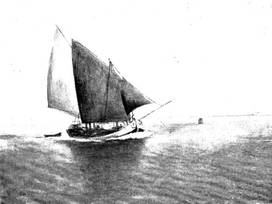
The second time we went by sea, in a diminutive
cutter bearing the proud name of St. George. I
dislike yachting on the whole—there is always
either too much wind or none at all. In my case it
is generally the latter. It is enough for me to go out
in a yacht for a cruise of an hour or two, and you
may be sure that yacht will become becalmed, and
the unhappy people on board will have to choose
between a night "on the ocean wave" and a row
home in a small boat. I seem to be a sort of Jonah,
and live in expectation of being thrown overboard
every time I go on a yacht. A steamer does away
with the fear of being becalmed, but then there is
the smell of the engines. Do not mistake me, it is
not that I fear sea-sickness,
For I can weather the roughest gale That ever wind did blow.
In fact, I am an excellent sailor.
Once I did feel rather queer, but that was a dispensation
of Providence in fulfilment of the old adage
"Pride goes before a fall." I was crossing the
Channel—Dover to Calais. We had a small steamer,
a choppy sea, and there was a young man with a
Kodak on board. I abominate amateur photographers.
They are offensive. It is the fact that
they insist on photography being an art that makes
them so objectionable. Photography is not an art.
One merely requires a good apparatus and a knowledge
of how to work it, and there you are—a good
photographer. That is my idea on the subject.
Well, this young man was particularly offensive.
He wore a knickerbocker suit, and skipped about
with his Kodak and took "snap-shots" at everything.
He did not "speak to the man at the wheel," but he
"shot" him instead. He photographed the sea, the
sky, the sea-gulls, the passing steamers, his fellow-passengers;
but then he became sea-sick. His
Kodak fell from his nerveless hand, and he looked
very ill. I revelled in his misery, I "chortled in
my joy"; but the Fates were on my track. Half an
hour before we reached Calais I began to feel very
miserable. I thought I was dying. Somebody came
to me, a sailor, or a steward, or an admiral, or something
of that sort, and asked me if I felt ill. I
said I did, that my last hour had come, that I
wanted to throw myself overboard and hasten the
end. He would not let me do this. I should feel
all right when we landed, he said. I knew this was
impossible, it was merely uselessly lengthening my
sufferings; but, curiously enough, he was right. At
the time I was unable to understand my misery, but
I see through it now. My wretchedness was intended
to teach me a lesson—the lesson of never
laughing at people in adversity. I learnt it, and
since then have never suffered evil effects from being
on the sea.
This is a long digression, but I wish to explain
the disgust I felt on our going to San Giovanni by
sea. We were not becalmed on this occasion, but
there was next to no wind, the sun was blazing hot,
and as we were constantly tacking, and the St.
George is a very small boat, my life was in perpetual
danger from the eccentricities of the boom. I was
very unhappy, and not in the mood to admire the
beauties of nature that were constantly pointed out
to me. But Checco was a comfort. Checco is
captain, crew, and cabin-boy combined of the St.
George, a great character and a philosopher. A
nice-looking man too, tall and broad-shouldered,
with a bronzed skin and snowy white hair (though,
in fact, he is not old) and extraordinarily bright blue
eyes—they look as if all the light and colour of the
sea were reflected in them. He is a proud man is
Checco, and generally very silent. He only talks to
particular chums, but then he does talk. The "Fat
Boy" is the proud possessor of his confidence,
and to him Checco unfolds his theories; he even
puts the two learned men in the shade with regard
to theories. On this particular occasion he was
explaining earthquakes. (There have been some here
lately.) This is what Checco said to the "Fat Boy":
"People are very much afraid of earthquakes, you
know. I am not afraid, for it is no use. What
must be, must be. But I say, What is the reason
for them? I will tell you: it is the doing of those
mad winds. When I was young, things were quite
different on the sea. The winds blew steadily.
Either it was Bora, or Levante, or Scirocco, or
Libeccio, and you knew how long it would blow in
the same direction. It was a pleasure to sail a boat
then. But now the winds blow all ways at once, and
are always fighting against one another. The weaker
winds must give way, and what becomes of them?
They rush into the earth—you know all the holes
and grottoes there are everywhere—and so cause the
earthquakes. Yes, you can believe me, it is all the
doing of those mad winds." Checco was silent and
gazed out over the blue sea, and the "Fat Boy"
pondered over his words. Then he began again,
still looking at the distant horizon: "Everything
was different when I was a young man—the winds
were not mad, the girls were pretty. When we
came out of church on Sundays, and the girls, as is
the fashion, gave the red carnation they wore to the
man they liked best, none of the fellows got as many
as I did. But now I have white hair, you see....
Still none of my boys are as tall as I am, and I have
never tried my whole strength yet."
Then Checco relapsed into silence, and not even
the "Fat Boy" could draw another word from him.
CASTLE DUINO FROM THE ROMAN ROAD
· · · · ·
We sailed up the Timavo. The wind had freshened,
and I must confess it was really rather pleasant.
Wild ducks rose from the reeds with a great splashing
and flapping of wings, and occasionally a snipe would
dart away with its peculiar twisting zigzag flight and
harsh cry. At San Giovanni we landed, and walked
home. Our path, for part of the way, lay along an
old Roman road, and then we passed through a little
wood of stunted trees (the last remnant of the "boundless
forests" of old times), which in autumn is one
pink carpet of heavily-scented cyclamens. We
skirted the deer park, where some twenty or thirty
fallow deer lead a cheerless existence and are fed on
hay all the year round. The ground in the park is
covered with stones, not a blade of grass is to be
seen, only the hardy ilex seems able to flourish on
the barren soil.
It has a curious appearance, this little tract of
country round Duino, with its dull gray rocks.
A few bushes manage to extract enough nourishment
from somewhere to exist, but every cranny
and crevice in the stones is gay and bright with
wild flowers.
Monotonous and almost melancholy is the scenery,
and yet it has a charm of its own; the sun shines
so brightly, the sky is so blue; and then there is
always the sea, ever changeful and ever beautiful, and
the old gray castle in the distance, towering above
all, and watching over the silent land.
CHAPTER V A RAINY DAY
The rain came down upon my head
Unsheltered, and the heavy wind
Rendered me mad, and deaf, and blind.
E. A. Poe.
It was not quite so bad as all
that. I did not go out in the
rain, and at present I am neither deaf nor blind. I
cannot be sure about the madness. It was very wet,
though, but it cleared up before the evening.
A really wet day may be dreary, but still it is
rather pleasant to have one sometimes. The rain
affords such a grand excuse to be idle and do nothing.
One can lounge about, and smoke, and read the newspapers
or a novel all day, and justly feel it is quite
impossible to be energetic. I am often told that my
besetting sin is laziness. I am not sure whether it
is true, but all I can say is, it is very pleasant to
spend a lazy day occasionally. One must have piles
of work waiting to be done, or it loses its charm.
If there is really nothing to do, one is bored, and
wants something to fill up the time.
On this particular day, however, I was not lazy—far
from it. We explored the castle thoroughly from
dungeon to attic, with a view to discovering new
beauties for "the book."
I must say that occasionally I almost repent of my
rashness in promising to write this book; my
collaborator is so intensely business-like, and keeps
me at it from early morn till dewy eve. I never
have a moment's rest. It somewhat detracts too
from the pleasure of going anywhere to know that
you have to write an account of everything you see
afterwards.
THE GROTTO ROOM
We began with the "grotto room." This is a
summer drawing-room that we usually sit in. It is a
big room, with a tiled floor and an arched roof; the
latter and the walls are of cement, thickly studded
with little bits of stalactite, that glisten and gleam
when the place is lighted up, and give a fairy-like
appearance to it. Birds of paradise and sea-gulls,
suspended by invisible wires, swing from the vaulted
roof and appear to be hovering about the room.
Enormous shells, quaint Venetian lamps and mirrors,
funny old china, are scattered all about. There is a
curious old sedan chair standing in one corner, and
near it are two pianos. I never made out the mystery
of those two pianos. I believe they are near relations,
and that they would be heart- (or string-) broken if
they were to be separated. There is a massive
marble mantelpiece at the farther end, surmounted
by two shields, one bearing the Hohenlohe leopards,
and the other the tower and crossed lilies of the
Della Torre. Altogether it is a quaint room, without
any particular order or style, but very comfortable,
and it has one great advantage in being cool.
I have spent many a weary hour here, labouring over
these sketches, or gazing out through the coloured
glass at the sea and the glorious sunsets.
The sunsets at Duino are magnificent—the whole
western sky is one flaming blaze of colour, of every
tint, from the deepest crimson to the faintest daffodil.
The most beautiful moment is, I think, when the sun
has sunk to rest behind the distant Alps, that stand
out pearly-gray against the rose-coloured sky, and
the sea in the foreground glows like a huge bowl of
melted gold.
We went next to see the dungeons. They are by
no means cheerful—two little damp and musty
rooms, destitute of furniture, with grated windows
and enormously thick walls—you see their immense
thickness when you enter. The last man who was
confined here (it was not so very long ago) hung
himself. He is now said to haunt them. Poor
fellow! one cannot wonder that he should have
availed himself of the only possible way of escape
open to him.
We then penetrated a little room where the family
archives are kept. It has a massive iron door, and
shelves full of dusty, musty old parchments. We
unearthed a grand treasure here—an old manuscript
diary of a tour through France and Italy at the
beginning of this century, written by an Englishman
of the name of Cockburn. Fired by this discovery
we rushed up the tower stairs to another little room,
formerly used as a study by an old priest who had
once belonged to the household. We found it just
as he had left it: the chair, the pens, the old ink-bottle,
and he, poor old man, dead years ago! He
wrote a book in Italian about Duino and the neighbourhood.
It has been very useful to us in some
respects, though it is very confused.
We came down the tower stairs again, and I was
shown the door of the walled-up rooms; it has been
carefully built up flush with the wall, and recently
whitewashed over, so as to conceal it. Then we explored
all the funny little staircases and passages that
are everywhere about the castle, and form a perfect
labyrinth.
The rain had cleared off by this time, and the
sun was struggling to show himself through the
clouds, so we went out, the "Other Boy" accompanying
us. First we went down into the old moat,
long dry and overgrown with grass and nettles, but
in one corner some white lilies rise pure and stately,
and bloom unseen in this neglected spot. Some
fragments of Roman columns have been built into
the wall of the castle—one sees them from the moat.
Then we explored some terraces that are round the
outside walls, where enormous yellow roses cling to
the crumbling stones and lemon-scented verbenas
grow wild. We made another interesting discovery
here—at least it would be interesting if the general
opinion about it is correct. We found a hole in the
wall of the tower under the terrace. My collaborator
maintains it is the beginning of a ventilating shaft
that communicates with the underground passage,
but I am afraid it is nothing but a rat-hole.
We descended some rickety stairs, and after
inspecting a sculptured Madonna, who, half overgrown
with ivy, looks down on the occasional
passers-by (people admire her; I do not, as she has
her nose on one side), proceeded to the battlements.
There are two old field-pieces here that formerly
belonged to the French Republic. They have the
fasces engraved upon them and the inscription, "An
VII. République francaise 6 Fructidor." I could not
discover the history of these guns. I was told a hazy
story about Duino being in the hands of the French
in the beginning of this century; of its being stormed,
taken, and partially burnt by the English, and that
the English captain was always drunk; but the story
lacks confirmation—particularly the last part of it.
CASTLE DUINO FROM THE MOAT
In any case, the French were here, and took away
all the contents of the armoury. In 1813, too,
Trieste being in the possession of the French,
Admiral Freemantle sailed up the Adriatic with
some English men-of-war, whilst General Nugent
advanced on the land side with the Austrian troops.
The French commander retired into the citadel, and
was there besieged by the English and Austrians.
On October 24th the French surrendered.
This being so, it is quite possible that there was
a siege of Duino, as it is very strongly situated and
has always been an object for attack. Even as recently
as 1866, in the war between Austria and Italy, the
Italians had intended to land at Duino, had not their
fleet been destroyed in the battle of Lissa.
We went down the old staircase to the little bathing-place
near Dante's island. There is a strong wire net
in the water to guard against the sharks. "Our host"
disapproves of this net. He maintains that if any one
bathing at Duino is unfortunate enough to be eaten
by the one solitary shark that cruises in the Adriatic,
he or she is the victim of such extraordinary bad
luck that it is much better for him or her to be
finished off at once.
Then we wandered through the "Riviera" to the
old ruin and the little sombre wood "sacred to
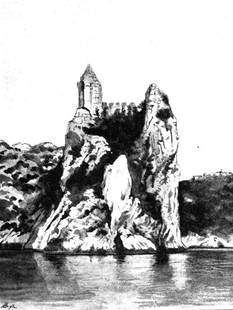
Diana." The ruined castle rises dark and threatening
on a massive and perpendicular rock, which is
on three sides surrounded by the sea. The position
is immensely strong—one can only approach by one
little narrow path that could easily have been held
in the old days by two or three resolute men. There
is not much to be seen in the ruin. It is all crumbling
to pieces and is half-smothered with creepers and
grass. In one vaulted arch, probably once part of
the chapel, there are faint traces of fresco-painting;
and there are one or two enormous stone bullets
lying about that must have been thrown from some
kind of catapult. Every provision was made for a
siege. One sees the old well, which still holds water.
THE RUIN
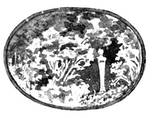
Just under the old ruined castle the ground sinks
and forms a hollow, and there a little wood of ilex-trees
has grown, through whose dark and thick evergreen
foliage no ray of sunlight seems ever to penetrate.
It is a weird and uncanny sort of place: the
trees seem black, the ground is black, and no grass
or flowers grow there. Only on some bit of old
crumbling masonry the ivy has extended a funereal
pall. No birds seem to nestle in this solitary spot,
and the earth smells damp, whilst you shiver a little
in the cool shade of the sacred trees. It is peculiarly
quiet and silent under the ilex; and if, sitting there
in the long summer afternoons, you get drowsy and
dreamy, thinking perhaps of times long, long ago,
you would not wonder very much if, through the
dark green of the melancholy trees that make a dome
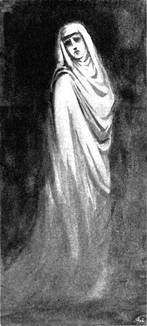
of shade over your head, a white form should glide,
swift and silent—glide down from the golden light
beyond into the darkness and gloom of the ilex
wood.
Dream or reality, what does it matter, since both
pass away in the night of time, and after a while are
remembered no more?
How many may have come under the old, old
ilex-trees in drowsy hot summer afternoons, or later,
when the silver moon tried with her trembling rays
to pierce the dark gloom of the wood! how many,
each with his burden of joy or sorrow—gone—forgotten—faded
away!
Dream or reality, what does it matter?
CHAPTER VI A QUILEIA
We were a gallant company.
Byron.
On Tuesday, 4th June, we had a
regular "day out." We were
twelve—the original eleven who went to Miramar,
with the addition of "our host." We started at
7.30 in the morning, and this involved getting up
at six. There is nothing I object to more than early
rising. Since my earliest infancy I have always
been told what an excellent thing it is to get up
early, and the ancient proverb (which you may have
heard)—
Early to bed and early to rise
Makes a man healthy, wealthy, and wise—
has been repeated to me so often that I actually know
it by heart. I do not believe in it, though; I infinitely
prefer the sentiments contained in the old Scotch
song—
I would rather go supperless to my bed Than rise in the morning early.
It was not a matter of going supperless to bed in
this case, but it meant (at least to our host and myself—we
were late) starting without breakfast. We
rose to the occasion. Rather than keep the rest of
the party waiting, we went without breakfast, and
had the satisfaction of feeling martyrs for the rest
of the day.
My collaborator, our host, the Thin Boy, and myself
were in the first carriage. We kept congratulating
ourselves and each other on this fact all the way.
There was plenty of dust, clouds of it, and we could
dimly discern the other carriages behind us, and their
miserable occupants being half-smothered, whilst we
were in the pure fresh air of the morning. It was
a very pretty drive of about two hours to Aquileia,
past marshy meadows bright with flowers, and vineyards
with their graceful festoons of vines, the fresh
and luxuriant green of the plain contrasting strangely
with the gray barrenness of the neighbouring hills,
through the little old-fashioned town of Monfalcone.
It is quite an Italian town, with its big piazza, graceful
church tower, and balconied houses—closely
shuttered, of course; the inhabitants seem to have a
horror of fresh air. After Monfalcone the scenery
too becomes quite Italian, though we are still in
Austria. The plain continues fresh and green as
ever, but the hills fade away in the blue distance.
We cross that bluest of rivers, the Isonzo, drive
between green hedges fragrant with wild roses and
honeysuckle, pass a long, low, house covered with
roses, with a lovely garden and a grass lawn-tennis
ground (the only grass court I have seen on the
Continent), go over numerous little brooks that wind
along under the dark shadow of overhanging bushes,
and are generally haunted by promising families of
downy yellow ducklings, and at last reach Aquileia.
Here we had what was a second breakfast to most
of the party, of coffee and rolls. Our host did not
eat anything. He said he couldn't eat when he had
risen in "the middle of the night." It was a mild
rebuke, but it passed unnoticed.
We intended to go to Grado before seeing Aquileia,
so after this meal we sought our steamer, a launch
that plies daily between the two places. It did not
require much seeking, firstly, because it rested on
the placid waters of the canal close to our "hotel,"
and, secondly, as it guided us to its whereabouts, with
great consideration, by a series of most unearthly
screams of the whistle, and by disgorging vast quantities
of evil-smelling smoke.
The scenery is rather pretty after leaving Aquileia.
High reeds and grass grow down to the water's edge,
larks carol joyously in the sky, reed-warblers twitter
among the rushes, and bright-hued dragonflies dart
hither and thither. There is a smell of new-mown
hay in the air (which causes the Fat Boy to sneeze
thirty-seven times without stopping), and one sees
the peasants at work, with the big, gentle, sleepy-looking
oxen drawing the waggons. One soon leaves
the canal behind, and comes out into numberless
shallow lagoons of salt water, with dreary sandbanks,
and lonely-looking posts to mark the deeper channels.
There are a few dismal huts on some of the sandbanks,
and in one place a church tower stands alone
in its glory—the rest of the church has fallen down.
We saw no living thing there except a solitary eagle.
It is a desolate and melancholy sort of place, and I
for one was very glad when we came out into "blue
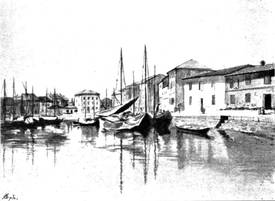
water" and Grado hove in sight. It forms a pretty
picture, this little Venetian-like town, the blue sea,
and the fleet of fishing boats with their brightly-coloured
sails.
FISHING BOAT (BRAGOZZO)
Grado is a sea-bathing place, or would be one, if
anybody went there. The bathing sheds are a very
imposing-looking building, there is an excellent
sandy beach, the water is lukewarm, and drowning
is quite impossible on account of its shallowness.
What Grado wants is a good waking up. If the
inhabitants were a little more speculative; if they
would build a good hotel and open a railway line,
etc., it might become a flourishing place. At present
there is no accommodation for visitors, so no visitors
go there. We bathed, of course, all of us, with the
exception of the two learned men, who had different
theories with regard to bathing, and who were disputing
thereon. We enjoyed it very much, except
the Seal, who did not take at all kindly to his native
element, and found it cold; he evidently felt, too,
that his life was in danger, as he explained to everyone
the dreadful end he might come to if a larger
wave than usual were to carry him away.
GRADO—THE HARBOUR
After our bath we returned to the hotel, very
hungry. Our lunch included a dish called Risotto,
which, I am told, can only be made to perfection in
this part of the world; it is very good. Owing to
the bathing and the lunch, the latter being much
prolonged by the voracious appetites of the "Seal"
and the "Fat Boy," we had no time to see the town
thoroughly, but we managed to make a hurried
inspection of the church before our steamer left. It
is a fine old building, with two rows of marble
columns in the interior, the capitals of which are
all different, and remind one of those in the church
of St. Mark at Venice. The Byzantine pulpit, a
very old episcopal seat behind the altar, and some
sarcophagi with inscriptions and carvings in a little
courtyard near the church, are also interesting.
THE CHURCH AT GRADO
Our return journey to Aquileia was not exciting.
We were all sleepy, and hot, and rather irritable. On
reaching it we proceeded to the hotel, and refreshed
ourselves with sundry cooling drinks, and then set
out to view the town.
Aquileia was founded B.C. 183 or 181, after the
second war against Hannibal. It was one of the
twelve fortified towns built to repel the attacks of the
Barbarians, and at the same time such towers as
Duino, Monfalcone, and Sagrado were erected as
watch-towers. Aquileia was a very extensive and
important place under the Romans, and possessed
a population of half a million. With the decline
of the Roman power the glory of Aquileia departed.
The town withstood many attacks from
the Barbarians, but after a siege of some months
it was finally burnt down and quite destroyed
by the Huns under Attila. Some of the inhabitants
escaped to Grado, and others sought refuge
among the neighbouring lagoons.
There is a museum of Roman remains containing
a collection of statues, pottery, glass, etc. The old
glass is very beautiful, its colouring wonderful, and
two of the many statues are particularly fine, one of
a Venus or a nymph, very much mutilated, and an
almost perfect one of the family of Tiberius. The
rest of the statues and carvings, though interesting,
did not seem to be of great artistic value, still I was
struck by a fine mosaic pavement representing the
rape of Europa.
When one reflects that all this collection has been
made up of things (one could almost say) casually
found, one can form some idea of the valuable
treasures still left in the soil. Probably Aquileia
could rival Pompeii or Herculaneum—in any case, it
was a much more important place. In the last year
or two some Austrian noblemen have begun to
interest themselves in making excavations. It is to be
hoped they will continue the work, and that successful
results may follow.
After some time Aquileia was rebuilt, but not on
the same extensive scale. It seems that Charlemagne
came to the town for the sake of the hunting that
was to be had in the big forests then existing round
Isonzo and Timavo. Old chronicles say that wild
boar, wild goats, and pheasants were the principal
objects of pursuit, but unfortunately there is no
record of the "bags." When one sees the general
barrenness of the country now, it is difficult to believe
it was once all one dense forest through which the great
Emperor and his nobles chased the flying game,
whilst the woodland rang with the deep music of the
hounds.
The church is extremely old—it dates back to
1031—and the arches and pillars of the interior are
very graceful. There is a most curious monument
in the church—a sort of little temple of white marble
surrounded by marble columns that support a modern
wooden roof. The inside is quite empty—no trace
of fittings left. What it was used for is a riddle not
yet solved.
Very interesting is a small chapel with the tombs
of the four Della Torre who were Patriarchs of
Aquileia. The power of the Patriarchs lasted for
fourteen centuries. They were not only very great
Church dignitaries, but possessed immense secular influence,
and in spite of their peaceful profession were
brave warriors. The Lords of Duino were generally
their firm allies. We read that when Bertram, Patriarch
of Aquileia, defeated the troops of Goritz at
Osoppo (1340) he himself celebrated mass in his
camp in full armour, it being Christmas Eve. Hence
arose the custom, long existing in this part of
the country, that on that night the priest should
bless the people with the cross of the sword. It
was to visit one of the Della Torre, who lies buried
here, that Dante in 1320 came to Duino, which
was at that time a dependency of the Patriarch of
Aquileia.
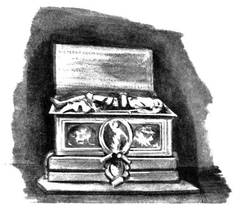
A crypt is under the church, containing the relics
of various saints. Formerly an immense treasure
was there too, but it is said that about 1820 an
organised band of some hundreds of people from
Udine and Goritz made a raid on the church and
stole all that was left of it. The most valuable part,
and among other treasures a copy of the Gospel of
St. Mark, written in the fifth century, had been taken
away long before, and is to be seen now in the
neighbouring town of Cividale, where the Patriarchs
had in later time transported their seat. Some old
Byzantine fresco-paintings of saints are at the east
end, very much faded, but still discernible. On the
roof above them are some hideous modern abominations.
It is a great pity that in the last century all
the old frescoes were whitewashed over, and in some
places repainted. Now people are trying to discover
the old paintings, but it will be a long and difficult
task. The font is outside the church. It is enclosed
in a circular wall, and is of unusual size—a relic of
Roman times, as it seems.
We were completely exhausted after going round
the town, and returned to the hotel with the ladies,
clamouring for ices. I think we spent the greater
part of this day in eating and drinking.
After all, it was an impression of sadness that I
took with me as we left the town behind us. Turning
round, one could only see a few humble peasants'
houses rising gray and desolate against the golden
glory of the setting sun. No trace of gorgeous
temples, of thronged streets, of the mighty legions
who started from this very spot to vanquish the
Barbarians and to conquer new and immense lands
for Rome.
No trace of the great Emperor's passage as,
surrounded by his fantastic knights, he hunted the
deer through the vast forests.
Nothing even of feudal times. The luxurious
palace of the Patriarchs has disappeared, their armies
gone, their treasure dispersed; only a few tombs
remain in a silent and deserted church.
And yet, if energy and intelligence were to be
expended in this abandoned spot where now the
peasant drives his plough, a new world would rise
in all the glory of white marble limbs—a new world,
and yet so old! Shaking off the sleep of centuries
from their solemn eyes, the gods and the nymphs,
the heroes and the statesmen would live again, and
once more Aquileia would rise from her ashes, the
proud daughter of Imperial Rome.
ENTRANCE TO CASTLE DUINO
The drive home in the cool of the evening—a
wonderful soft June evening—was very pleasant.
The air was heavy with sweet scents, the sun was
setting in a crimson sky and flooding the green
vineyards with golden rays, whilst the dark shadows
grew longer and longer, and the blue mists veiled
the distant hills. But our peaceful enjoyment
was spoiled by the gloominess of "our host," who,
having met a bicycle on the way, failed absolutely
and entirely to recover his equanimity. He talked
to us with great eloquence on the subject (bicycles
are against his principles), but we gradually grew
more and more sleepy, and only the view of the old
castle rising dark against the paling sky (and the
hope of our dinner) had the power to rouse our
despondent and drooping spirits again.
CHAPTER VII V ILLA VICENTINA
Gray twilight pour'd On dewy pastures, dewy trees,
Softer than sleep—all things in order stored, A haunt of ancient Peace.
Tennyson.
My collaborator and I
drove to Villa Vicentina
on Friday, June 7th. We
took a lady who is possessed with the photographic
mania with us, thinking she might be
useful, and the Other Boy to carry her camera, etc.
There was no rising at unearthly hours in the
morning this time—we started at a respectable hour
in the afternoon. The early part of our drive
was along the same road by which we went to
Aquileia—the long white road bordered with poplars
leading through the marshes. After passing through
Monfalcone and crossing the bridge over the Isonzo,
however, we turned to the right. Hedges of
acacia shadowed the road; the flowers are over, here,
by June, but the leaves have still their first freshness,
the beautiful tender green that the sun seems to love
to illumine and brighten into golden yellow. We
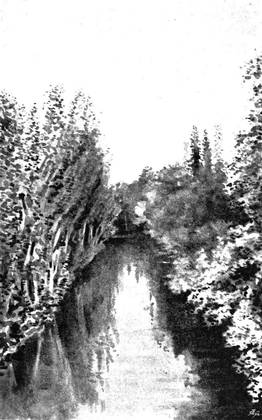
crossed a little river, a placid stream fringed with
graceful willows and bordered with blue forget-me-nots,
flowing through the level meadows and sweet-smelling
vineyards, and at last came to the gate of
Villa Vicentina. The house stands some distance
from the road in a large park that, with its huge trees
and rich grass, reminds one of dear old England.
The trees are really magnificent, mostly white poplars
("the light quivering aspen"), venerable oaks, and
towering sombre pines. We got out of our carriage,
and walked part of the way to the house
Mid mystic trees, where light falls in Hardly at all.
I like big trees, particularly on a hot day; it is so
cool and pleasant under their green shade, where no
sunlight comes but in little chequered patches here
and there, when outside everything is bathed in the
scorching rays, and you see the air tremulous with
heat.
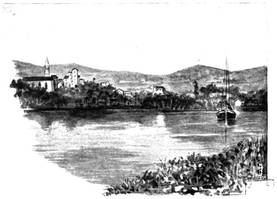
LITTLE RIVER NEAR VILLA VICENTINA
The Villa Vicentina formerly belonged to Princess
Baciocchi, the sister of Napoleon I. Her daughter
left it to the late Prince Imperial, and after his death
it became the property of the Empress Eugénie.
She never comes here—it is left in charge of an old
caretaker and his wife, who, with another lady,
possibly their daughter, and a female servant, appear
to form the establishment. There is nothing particular
about the house—it is an ordinary country
villa. All the finer things have been taken away
too, but there are still some bits of interesting furniture.
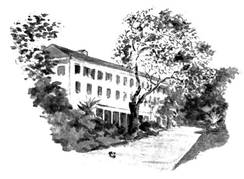
VILLA VICENTINA
· · · · ·
It was a strange feeling, not without a tinge of
sadness, that stole over one whilst going up and down
the deserted staircases and peeping into the empty
rooms. Here and there a marble bust with the classic
profile of the Buonapartes, an engraving, a faded
water-colour, on the scanty remnants of furniture the
Imperial eagle, some old firearms, the slender hand
of beautiful Pauline Borghese cast in marble, a few
bits of rare china, and everywhere the peculiar smell
of damp and age that pervades long-unused houses.
Where are the eagles now that once spread their
wings over all Europe? Where are the famous
beauties? Where are the glorious dreams?
But where are the snows of yester-year?
· · · · ·
To be truthful, this last bit is not mine. My
collaborator has just been worrying the life out of me
to make me grow enthusiastic about Napoleon, but
it is useless—quite useless. I am not enthusiastic
about him, nor about his eagles, nor about his dreams.
In fact, I cannot bear him, and he and Wagner make
my life a burden. I do not admire them—I wish
they had never existed. When those two unhappy
beings are mentioned I know people will "jump on"
me and abuse me. I bear it all as a martyr, but I
absolutely cannot write with enthusiastic admiration
about "old Nap" or stay in the room when there is
Wagner music going on. So my collaborator has
found it necessary to add these lines to my sketch.
I do not call this fair, for when I write something she
does not like, I have no rest till it is cut out. I
know that some time or other Wagner will be brought
in somehow, and I protest against it even now. It is
a comfort that "our host" is of my opinion about
Wagner. He says that he has lost all respect for him
since he once went to see some Zulus that were exhibited
somewhere, and found that those simple and
unsophisticated savages with their war-music could
make ever so much more noise than a whole orchestra
playing Wagner. He says, too, that, after all, he
only once went to a Wagner opera, and discovered
that the unhappy tenor or baritone was obliged to
make a whole shoe on the stage. No humbug, you
know. He had to begin from the beginning and to
make that whole shoe (a real serviceable article—no
pretence about it) to perfection and to sing all the
time till he had finished it. Our host could not
stand it. He left the house to give the poor man a
chance, and when he came back after two hours,
there was the unhappy fellow still hammering away
at his shoe, singing quite feebly, for he had no breath
left in him. This time he went away for good, and
never went to a Wagner opera again.
There! that has done me good.
· · · · ·
The gardens are beautiful—nice old-fashioned
gardens where one could wander about all day with
pleasure. There is a pretty conservatory with some
wonderful climbing geraniums. What delighted us
most was a little walk about a hundred yards long,
and quite straight, with a trellis-work covered with
creepers—a perfect tunnel. At the farther end is an
old stone table and seat, where we intended to have
tea. It was a charming spot, but unfortunately we
were almost devoured by mosquitoes—they seem to
be particularly ferocious and bloodthirsty there. The
lady-photographer took some photographs, but I
am sorry to say she is an utter fraud. Generally
there is nothing at all on the plate, and if there is,
you are quite at a loss to know whether the photograph
represents a landscape, a dog, or a flash of
lightning.
We had brought a huge basket, like a Noah's ark,
with us, which contained the "tea-things." My
collaborator told me during the drive that they (the
tea-things) had originally been packed in a much
larger basket, but that she (with characteristic
thoughtfulness) had taken them all out and repacked
them again in this "small" one. Personally I had
looked forward to tea all afternoon. It was very hot,
and I was thirsty, so it was with feelings of joyous
expectancy that I began unpacking the following
articles:—
1. Two forks.
2. Some butter (in a liquid state) wrapped up in
white paper.
3. The poemshorts of Rossetti (neatly bound).
4. Three drawing pencils.
5. Two cups (without saucers).
6. A telescope.
7. Three tablets of Pears' soap (unscented).
8. A little bottle containing something—we didn't
dare to open it. I fancy it was poison, and had some
connection with photography.
9. A bottle of milk (sour).
10. Two enormous bottles of spirit of wine (to
boil the kettle).
11. No kettle!
12. No tea!!
Happily the "Photographic Lady" (who considers
tea a diabolical beverage) had some cake and some
cherries mixed up with her apparatus, so, after all,
our "tea" was rather a success—our tea on the old
stone bench of Villa Vicentina, where the mosquitoes
flourish!
There is a tree in the garden that was brought
from the Emperor's grave in St. Helena. This is
the end of the chapter. I finish it up quickly, or my
collaborator will have a fit of enthusiasm again.
CHAPTER VIII S AGRADO AND GRADISCA
Blossoms of grape-vines scent the sunny air.
Longfellow.
The usual quartette went to
Sagrado and Gradisca—two little
Italian-like towns—on Saturday, 15th June.
There is one great drawback about Duino—there
are only two roads. One goes to Trieste and the
other doesn't. It is rather monotonous always
driving along the same road. Familiarity breeds contempt,
and even poplar-trees and marshes pall on one
in time. However, "what can't be cured must be
endured," and if you do not want to go to Trieste
you must go the other way, even if it has grown
almost too familiar. We branched off on a new
road after passing through Monfalcone, and soon
came to Sagrado. It is quite a little place, more of
a village than a town, but there is an old villa
standing in a large park, which was the attraction
here. Two magnificent cypresses stand at the
entrance-gate, one on each side, and the park is
beautiful, full of fine trees, especially oaks overgrown
with ivy. It forms a great contrast to the surrounding
country, which towards Duino is barren
and stony in the extreme. One has a magnificent
view from the villa. It stands on a hill, and the
valley of the Isonzo stretches below it. Far on the
left one catches a glimpse of the sea. Before one, far
as the eye can reach, is the plain, covered with vineyards,
like waves of a billowy sea of emerald green,
with tiny villages nestling here and there (the
"Photographic Lady" says you can count two
thousand of them, but I am afraid some untruthful
person has imposed on her credulity), and the blue
river winding through it, like some giant snake; and
on the right, rising higher and higher as they fade
away into the shadowy distance, are the snow-capped
Alps.
The house is an old villa of the Italian style, with
stuccoed walls, and on the floor the pretty Italian
"terrazzi." In the hall, just when you enter, one is
struck by four quaint old pictures of four men
almost life-size; they are dressed in the peasant's
costume of the country, of last century, and each
holds a little money-bag in his hand. It seems that
these worthy people were four farmers, who, when
a former owner of the property (one of the Della
Torre) was in financial difficulties and on the verge
of ruin, came forward and paid off his debts. In
gratitude to them he had their portraits painted and
put in his entrance-hall. What a pity it is that
people don't do this sort of thing nowadays! If
any one feels inclined to follow the example of the
four farmers and pay off my debts, I will faithfully
promise to have his photograph taken and placed on
my writing-table. I am only sorry I cannot rise to
oil-paintings and entrance-halls.
From the pretty marble staircase you enter a
charming drawing-room in the Italian Louis XVI.
style. The walls are green marmorino, with ornaments
of white stucco, and big mirrors let into
them. There is a very large dining-hall of great
height, with its walls and ceiling painted in fresco.
No one lives in the villa at present.
The gardens must have been very pretty—all
terraces and staircases—when they were kept in the
style of the time. They are rather neglected now,
and seem to be only inhabited by a perfect army of
nightingales. A queer little red house is at the
farther end of the garden, with a crypt under it and
an imitation tomb. The walls are covered with
mottoes—Greek, Latin, French, etc., and there is
one in English: "Happiness is of a retired nature,
and an enemy of pomp and noise." The individual
who built the house must have been very much
struck by this last motto, for it seems that he used to
live in this little dismal-looking place all alone, in
the one room over the crypt, leaving his smiling
villa untenanted at the top of the hill.
We had tea in the park. It is a great mistake to
wander about to find a suitable spot for tea—you
are sure to pick out the worst possible place. It is
much better to stop under the first shady tree one
comes to, and to sit down there. On this occasion
the ladies chose the situation, and when tea was about
half over we found we were sitting on an ant-heap.
It was hardly worth moving then, though, so we
stayed where we were, and pretended to be very
much interested in the movements of the ants. I
made the tea. I have a way of my own for making
it, which is, I believe, sometimes practised by homeless
wanderers in foreign countries—it is very
superior to civilised methods. I am not selfish,
and I have not taken out a patent for it, so I have
no objection to presenting my method to the world,
free, gratis, and for nothing. This is my recipe.
Boil the water in the kettle, and when fiercely boiling
put in your tea (one teaspoonful for each person
and one for the kettle) and stir up the mixture.
Let it go on boiling for a few seconds, and then
pour out and drink. You will find you have excellent
tea in this way. N.B.—It is as well to have
a strainer with you to get rid of the tea-leaves.
My collaborator had often stayed at the villa as
a child, and had hosts of acquaintances. I was
interested to know who the various ladies and gentlemen
who kept addressing her were, but her explanations
were so confusing that I soon gave up inquiring.
I remember that one lady was "the sister-in-law of a
gardener, who was the step-brother of a cousin of the
late wife of the man with the wig, who was the old
butler." I cannot grasp such involved relationships—they
are too much for my intellect. I made the
acquaintance of the "man with the wig" afterwards.
We called to ask him to order supper to be ready
for us at the little inn when we came back from
Gradisca. Then we drove on to Gradisca. You
cross the Isonzo to get there, and there is a lovely
view from the bridge, of the blue river and the
distant Alps. Gradisca is a nice little old-fashioned
town. The inhabitants are evidently not accustomed
to visitors, and we caused an immense sensation.
The "Photographic Lady" took several photographs,
and she was always the centre of an admiring crowd.
They were rather disappointed, I fancy, not to see any
results then and there. They caused the lady great
annoyance by going and standing before the camera
to get a better view of the performance—in fact, she
got quite angry, and abused them in all the four
languages of the country.
PALAZZO FINETTI
HOUSE AT GRADISCA
There is a fine old palace in Gradisca that once
belonged to the Della Torre. The whole of this part
of the country seems to have belonged to them, and
everywhere—in churches, on old houses, over doors—you
see the tower with crossed lilies that was their
coat of arms. In this particular house I was struck
by a charming courtyard with graceful "loggia"
and a flight of steps from both sides to the ground.
TOMB OF NICOLAO DELLA TORRE
We went to see two churches. The first contained
nothing interesting, but the second is worth seeing.
There is a tomb there erected to the memory of
Nicolao Della Torre in a private burial-chapel.
The monument is very large, with a recumbent
figure of the gentleman lying in full armour. He
must have been of unusual size, with a fine regular
face and a long flowing beard, and is very much
like the portraits of Martin the Giant. He, too,
fought against the infidels, being General of the
Imperial troops that protected the Hungarian frontier
against the Turks. He was badly wounded in one
of the battles, but his end was not so tragic as that of
his ancestor, and he now lies peacefully in the little
church of Gradisca, enjoying at last the strange old
motto of his family—"Tranquillité."
The stuccoed ceiling of the chapel, which seems
to be particularly fine, was pointed out to me, but
somehow I had had too much of churches and
monuments for one day, so I was not so appreciative
as I suppose I ought to have been. In any case, I
was again the victim of sundry abuse.
After all this sight-seeing it was a pleasure to
wander quietly and aimlessly through the quaint
little streets, meeting only an occasional donkey or
dirty baby, who stared very much, whilst at the
windows one would sometimes catch a glimpse of a
pair of big black eyes following one curiously from
behind a row of red carnations. We admired the
old walls of the town, which was strongly fortified in
ancient times—enormous black walls with battlements,
and beneath them a sort of green lawn shadowed by
numerous chestnut-trees, the fashionable promenade
of the high life of Gradisca.
We drove back to Sagrado and had supper in the
little inn. The "man with the wig" waited on us
with a beaming face. I did not feel at all happy, for
we had the most horrid wine it has ever been my lot
to drink. It is the wine of the country, and said to
be the pure juice of the grape (everything nasty
seems to be "the pure juice of the grape"). One
drinks it diluted with water, and it has a most extraordinary
bitter taste. The ladies assured me that I
should soon grow accustomed to it, and then I
should never like any other wine as well. I had my
own opinion on the subject, but I had to smile and
look pleasant.
We drove home in the evening. I had foretold a
thunderstorm all the afternoon, but had been laughed
to scorn by everybody. My prophecies were correct,
however, for we had hardly left Sagrado when the
storm began. I never saw more vivid lightning—the
whole sky was lighted up by it, and it was almost
incessant. The weird effect was increased, too, by
the fireflies—there must have been millions of them
flitting hither and thither, like the lost souls of the
departed. We had a great argument as to whether
we should remain at Monfalcone till the storm had
passed over. The ladies were in favour of waiting, the
coachman and I were for going on, and the boy was
neutral, being fast asleep. Our eloquence prevailed—we
hurried on. It was a desperate race, but we had
the satisfaction of beating the worst of the storm by
some ten seconds.
After all, I did not think much of Sagrado and
Gradisca, and I can only say I hope people will be
as bored in reading this chapter as I have been in
writing it.
CHAPTER IX O N GHOSTS
All houses wherein men have lived and died Are haunted houses. Through the open doors
The harmless phantoms on their errands glide, With feet that make no sound upon the floors.
We meet them at the doorway, on the stair, Along the passages they come and go,
Impalpable impressions on the air, A sense of something moving to and fro.
There are more guests at table than the hosts Invited; the illuminated hall
Is thronged with quiet, inoffensive ghosts, As silent as the pictures on the wall.
Longfellow.
Ghosts! There is a charm in the very word.
Tales of gruesome apparitions told over a blazing
fire at Christmas-time come back to one—tales told
long years ago, when, after hearing them, one was
almost afraid to go to bed; when one started at
every shadow on the stairs and imagined it was
some dark denizen of the spirit world come to carry
us off; when, being fairly in bed and the light out,
we drew the sheets over our heads to shut out the
phantoms that appeared in the darkness.
From my earliest childhood I was always a firm
believer in ghosts—the good old-fashioned ghost, I
mean,—the unhappy lady or gentleman who appears
at twelve o'clock at night with wailings and groans,
and rattles chains and carries his or her head under
his or her arm. That is the sort of ghost I like.
I have a contempt for the feeble ghost of to-day—the
spirit that raps on tables and moves chairs,
that writes letters backwards that no one can read,
and never shows itself or behaves in a rational
manner. The modern ghost is very degenerate.
THE WHITE LADY
My collaborator is a member of the Society for
Psychical Research, so I must be careful what I say,
or I shall be abused again. We had a grand
séance on the evening of 16th June. It was held
in the "Emperor's Room"—so called because the
Emperor Leopold I. is said to have slept there.
His portrait is painted on the ceiling, which, by the
way, is of wonderful Venetian stucco, with cupids and
garlands of fruits and flowers all over it. It is a
haunted room. It is not the Emperor that appears here,
however, but a much more interesting sort of person—the
White Lady. She had a cruel husband who threw
her down the cliff under the ruin. Her body may
still be seen, as she was turned into stone, a gigantic
woman wrapped in a long white garment—everlastingly
climbing up the cliff, but never getting
any higher. Her spirit returns to the castle and
searches for her lost children. On nights when the
moon is full one can hear the rustling of her robes,
as she wanders disconsolately about in the "Emperor's
Room."
THE WHITE LADY
We carried out our séance on the most approved
methods. Eight of us—my collaborator, the Energetic
Lady, the Photographic Lady, Miss Umslopogaas, the
two learned men, the Seal, and myself—sat round a
little oval table with both our hands on it, and
clasped each other's little fingers. The learned Dark
Man calculated that there were eighty fingers on that
table. "Better eighty fingers on one table than
eighty tables on one finger" remarked our host. He
was rather a nuisance (our host, I mean), as he
insisted on walking about the room and smoking
cigarettes. He also kept turning up the lamp
(ghosts dislike much light, and it is necessary to
respect their feelings) to see how we were getting on.
TIN-HO—FIRST-CLASS MANDARIN
There was also a dog in the room. This dog rejoices
in the name of "Tin-ho"—he is a Chinese
animal. I believe he is the last of his race, or something
of that sort, and is the most cherished possession
of the Energetic Lady. He is one of the banes of my
life—he, Napoleon I., and Wagner. I like animals—in
fact, I love them—especially cats and dogs.
But this dog is too much for me. I have made the
most friendly overtures to him. I have called him by
the most endearing terms. I have even learned some
Italian (he only understands that language) especially
for his benefit, and have said poverissima bellissima
to him with a pathos that would have moved a stone
statue to tears. But it is of no use. He is as unfriendly
as ever, and treats me with contempt. Now
I kick him, whenever the Energetic Lady is not anywhere
near him, which is not very often, by the way.
I have not explained yet who Miss Umslopogaas is.
She is a lady who is staying here, and her proper
name is difficult to pronounce—at least, I cannot
conquer it. I began by calling her Miss Asparagus,
but that sounds too much like a vegetable, and is
familiar besides. Umslopogaas is quite as much like
what I can imagine her real name to be, and has the
advantage of sounding more foreign.
Well, we sat round that table for an hour and a
half. My collaborator was delighted at the beginning—she
was sure the Seal was a perfect medium, as
he trembled all over and felt cold. (I have my own
private opinion about it.) The table, too, moved
occasionally (no wonder, when the Seal was shaking
like an aspen leaf), so she was convinced something
was about to happen.
At last something did happen!
An unearthly shriek rang through the haunted
chamber. There was a sound of scuffling and
struggling, a smothered exclamation.
The Photographic Lady leaped a foot from her
chair and showed a tendency to go into hysterics.
The Seal's teeth chattered with fright.
But, after all, it was only our host who had
trodden on the dog.
We sat on. The Photographic Lady flirted with
the learned Fair Man, and Miss Umslopogaas pinched
the little finger of the learned Dark Man; but no
ghost appeared. I think there were too many of us,
or we were not serious enough, or the vagaries of our
host and the dog were too much for the spirits.
But, in any case, our séance was a failure, and we had
no manifestations at all.
We gave it up then, and took to telling ghost-stories.
The Photographic Lady related an experience
of her own. Some three or four years ago
she went into the great banqueting hall in the
evening, and there saw the figure of a man. He
was of immense height, elderly, and with a long
flowing beard, and his face was vividly impressed
on her memory. He advanced towards her, and
then suddenly disappeared. According to her own
account she was not at all frightened. At the time
she did not know who it was, but on visiting the
church at Gradisca some time later, she recognised
the ghost at once as the Della Torre who is carved
in stone on the tomb there, an ancestor of her own.
The Energetic Lady had had a strange experience
in the same room. She was there alone, and a chair
began to move about of its own accord. It moved
forwards—it moved backwards—it moved sideways,
and then in a slow and stately manner it waltzed
round and round. With her usual energy, she
chased it, caught it, sat down on it, but it continued
its antics, she still sitting on it. She said
it was an uncomfortable sensation and confessed
to feelings of alarm—in fact, she left the apartment
in haste.
At this point the Seal said he should retire, as
he did not like to talk of such things. Miss
Umslopogaas also took her departure—she did not
consider ghosts quite proper. She thought they
should not appear in people's bedrooms uninvited.
Some of them were so insufficiently clothed too!
The two learned men disputed on ghosts generally.
They had different theories on the matter.
My collaborator listened with a look of supreme
contempt. She does not care to relate her experiences
to the common herd. I was so crushed by
her superior manner that I was too modest to tell
any story. I never saw a ghost myself, but an
intimate friend of mine has had that pleasure.
Our host was not bashful, however. This is
what he said: "I like ghosts, because they never
come. If there are ten persons in a room, eight
are fools, one is a rascal, the tenth might be all
right ... but he is generally dead. I have no
objection to his coming. Still, as 'Happiness is of
a retired nature,' I think him very considerate never
to do so."
I did not see any point in this, but every one
else seemed to find it very amusing.
Suddenly the great clock in the tower began
striking—slowly—twelve!
Then we all went to bed.
· · · · ·
We are all haunted by ghosts—ghosts of old
friends, old scenes. We sit alone, and the past
rises up before us. They are all with us again—the
friends of our childhood, of our school-days,
of our "Varsity" life. Once more we feel the
warm clasp of their hands, once more we hear the
merry voices and look into the kindly faces we
knew long years ago.
Picture follows picture.
We see the old garden where we played as
children, our brothers and sisters, our child-friends,
the old house, the flowers, the green lawn. It
is all so familiar, and yet it was all so long ago.
The scene changes: a long, low room, desks
hacked with pocket-knives and stained with ink,
a hot, drowsy afternoon, a hum of voices, the
master's desk, the master himself in cap and gown,
a crowd of boys.
The scene changes again. Stately buildings
appear before us, old courts and cloisters, the gleam
of the river. Old familiar sounds ring in our ears:
the thud of the oars in the rowlocks, the click of
the cricket-bat, the tramp of feet on the football
field.
Fair faces pass before us too. We hear the
rustle of their dresses, their girlish laughter, their
soft voices, we see the bright eyes that look into
ours, the rosy lips that murmured words we shall
never forget.
There are things of which I may not speak; There are dreams that cannot die!
There are thoughts that make the strong heart weak,
And bring a pallor into the cheek, And a mist before the eye. And a verse of a sweet old song Is haunting my memory still: A boy's will is the wind's will,
And the thoughts of youth are long, long thoughts.
Where are they all—those friends of other
days?
Gone—some dead—all scattered; we have lost
sight of most of them. Some are sleeping on
distant battlefields or beneath the waves of the
hungry sea, some are preaching their message of
peace in busy town or quiet village, some fighting
with disease and death in the crowded hospitals
of great cities, some working their way upwards
through dusty law-courts or in foreign lands. But
here—in Shadow-Land—they one and all come
back to us.
CHAPTER X C APODISTRIA
Happy star reign now!
Here comes Bohemia.
Shakespeare (The Winter's Tale).
This chapter is remarkable, since it introduces a
new and interesting character to the public, to wit
the "Gentle Lunatic," who rushed down upon us
from the wild and boundless forests of Bohemia.
We journeyed to Capodistria on Saturday, 22nd
June, the "Gentle One" filling the place of the
"Other Boy" in the usual quartette.
We left Duino at 8 o'clock in the morning
(another early start), and drove to Nabresina; from
thence we went to Trieste by train. Our train
was half an hour late, for which we abused the
"Photographic Lady," as she had made all the
arrangements for the journey.
It is marvellous how our arrangements always
go wrong! We have tried all the ladies in turn
as superintendent-in-chief: the "Energetic One,"
who did not want any railway guide or any advice,
but knew everything generally; the "Photographic
Lady," who smothered herself and everybody else
with books, time-tables, etc., asked every one's
opinion collectively and singly, and made an
elaborate plan beforehand; my collaborator, who
did not care a rap how things went, supposed they
would be sure to come right somehow, and when
they did not, said it was destiny; but none of them
answered. We were always in a hopeless muddle,
either starting too soon, or too late, or not at all.
We were very much annoyed by the dilatory
conduct of our train, even when it arrived at
Nabresina. It is extraordinary the length of time
it takes to start a continental train! A bell rings
violently and then tolls one. This is to inform the
passengers that the train is in the station. A long
interval follows. The bell rings more violently than
before and then tolls two. This shows that in the
course of time the train will proceed. There is no
hurry, however. You have plenty of time still to
make a substantial meal and pay calls on any friends
you may have in the neighbourhood of the station.
The bell rings a third time and tolls three. The
conductor suggests the advisability of taking your
seat, the engine-driver and stoker go for their last
drink, and the stationmaster begins to play with
a little horn he wears suspended round his neck.
The conductors—there are generally two or three
of them on each train—having ascertained that none
of the passengers have any particular wish to remain
any longer, step out upon the platform, shout ready,
and blow whistles. The stationmaster, with an air
of immense importance, sounds his toy trumpet, the
engine utters a scream of defiance to the world
generally, and after a decent interval, to avoid the
semblance of haste, the train crawls out of the
station. It is an imposing ceremony, but as it is
repeated at every small station on the line, it grows
somewhat monotonous and makes railway-travelling
rather a formidable and lengthy business. At last,
however, our train, having rested sufficiently, proceeded
slowly on its journey, and we arrived in the
course of time at Trieste.
We drove to the Hotel Delorme, and ordered
lunch to be ready in an hour. The "Gentle
Lunatic" announced his intention of going to find
some tame turtles. He said he meant to buy a
dozen, and we could take them home in our
pockets. He could dispose of six, and we three
should have two each. We argued and remonstrated,
but it was of no use—he went.
Meanwhile the two ladies and I set out to see
the Church of St. Just, a very fine church—in fact,
one of the oldest Christian basilicae. It is a great
pity that the beautiful old columns are covered with
red damask. They look like a forest of pillars, and
divide the church into five aisles. Two of the
many altars are bright with very ancient Byzantine
gold-grounded mosaics.
The "Photographic Lady" took a photograph
of the interior and carried on a flirtation with a
young verger, to whom she promised a photograph,
whether of herself or the church we were unable to
discover. We were then joined by the "Gentle
One," who was quite heart-broken, as he had not
been able to find his turtles.
Trieste is a nice town. It is a pity it is not a
pleasure resort instead of a mercantile place, as it is
beautifully situated on green hills sloping quite gently
down to the sea; the surroundings are pretty, and
brightened with villas and flower-covered cottages.
We went on to Capodistria by steamer. There
was a very motley crowd of passengers on board—peasants
returning from market, business people
bound for an afternoon's pleasure-seeking, persons
of all sorts and conditions. The "Photographic
Lady" was delighted that, in one particular at least,
her researches with regard to our arrangements were
correct—namely, that the steamer had left Trieste at
one o'clock. To prove her accuracy, she asked the
"G. L." soon after starting to tell her the time.
But his answer was somewhat vague, and his method
of ascertaining the time appeared to us peculiar.
He took out his watch, looked at it for a long time,
gazed fixedly at the sun, shut his eyes, seemed by
the contortion of his features to be going through
some abstruse calculation, and then said it was
between one and two o'clock. This nettled the lady,
and she replied rather warmly that she wanted to
know the exact time. With a mournful smile he
took out his watch again, went through the previous
programme, and gave the same answer. At this we
all insisted on seeing his watch for ourselves, and
then the mystery was explained. It had no glass!
it had no hands! We suggested that such a watch
must be rather inconvenient, but he assured us it
was the best watch he had ever had in his life; for
more than ten years it had been in this state, during
which time it had gone absolutely perfectly, and had
never needed the slightest attention beyond winding
up.
It took us three-quarters of an hour to reach
Capodistria. It looks very quaint and old-fashioned
this little out-of-the-way town, with its red-roofed
houses, blue sky above, and blue sea all around, and
the great gaunt prison lighted up by the golden rays
of the sun, and forming a bright patch of yellow in
the landscape. My collaborator says the prison
spoils the appearance of the town, but I maintain
that it forms a pleasing contrast to the old gray walls
of the houses.
Capodistria was formerly Byzantine, but in 1278
it became Venetian. Under the Republic of Venice
it was a very flourishing place, and is said to have
been the richest town in Istria. There were many
wealthy patrician families, renowned for their
luxurious living, inhabiting it. With the fall of the
Venetian Republic, Capodistria declined, and it is
now a small unimportant town. It was formerly
known by the name of "the Gentlewoman of Istria."
On arriving, we found that we had made a mistake
of two hours in the time of the return steamer,
a discovery that threw all our plans out of gear, but
we comforted ourselves with the reflection that it
gave us more time to see the place. We engaged a
chariot and drove off to inspect the town. It was
a remarkable conveyance. The "G. L." selected it,
and it appeared as if he had chosen the dirtiest he
could find. It was small too. We could only just
squeeze in, and were very much cramped for room;
but any trifling defects in the carriage were amply
made up for by the horse. This was indeed a noble
animal, and high spirited in the extreme; the driver
too was perfectly reckless, so we dashed off at the
rate of some sixty miles an hour, the chariot pitching
and tossing like a small boat in an angry sea.
The "piazza" is quite the sight of Capodistria,
and is very picturesque. A church stands on one
side of it, and before one is an old Town Hall,
turreted on both sides, with graceful Venetian windows,
innumerable inscriptions, coats-of-arms, and other
carvings, and the whole crowned by the Venetian
lion. A pretty outer staircase with little marble
columns runs along part of the front of the building,
and under it there is a deep and sombre archway,
through which one sees a narrow street, with great,
high, irregularly built houses almost meeting above it.
THE TOWN HALL
I believe we went to see three churches in this
little town, but I have seen such a superabundance
of churches lately, that I cannot remember the
characteristic features of any of the three. I know
that in one there was a quantity of fine old silver,
and that we were shown round another by a most
obsequious monk, clad in russet brown, who explained
its beauties to us in a confidential manner. I
remember, too, that we saw some pictures. In one
church (the "G. L." says it was in the big one on
the piazza) there was a very fine one of Benedetto
Carpaccio—the Madonna in the company of some
saints, and with two little angels playing the banjo
(it may be a guitar) at her feet. In the church
where we interviewed the monk there was a big
altar-piece of Cima da Conegliano, very much spoilt
by having been restored, and a most curious picture
of Vittore Carpaccio, with a garland of angels' heads
(hundreds of them), some painted in natural colours
and some bright red. (Red-headed angels—this is
art!)
By the way, I was told that in Venice there is a
very old picture attributed to the same Carpaccio,
and said to represent the Lords of Duino taking
tribute from the town of Zara; the Lords of Duino,
in quaint armour, with their ladies and soldiers, on
the one side of the picture; on the other, the representatives
of the vanquished town bringing gold, etc.,
and in the background a turreted castle—Duino, and
a town near it—Trieste. As Carpaccio was a native
of Capodistria, it is very probable that he painted
this triumph of some of the most powerful barons of
his country.
After this came more sight-seeing. We visited
a funny old drinking-fountain known as the
"Bridge" (why, I know not), and watched the
women drawing water.
It is a sleepy and dull little town, with small
streets and dark forbidding-looking houses. There
are hardly any shops, but in one quaint sort of
jeweller's stall the fashionable ornaments of Istria
were pointed out to me. These are ear-rings—little
crowned negroes' heads in black and white enamel,
and the height of fashion among the fishermen is
to wear both in one ear.
One sees very few people in the streets. Here and
there a dark-eyed girl strolling along with the
peculiar shuffling gait caused by the "zoccoli"—the
wooden slippers of the Venetian women.
DOOR-KNOCKER
Everywhere are relics of Venice—the carved
cisterns on the piazzas, the winged lions on the houses,
where you find inscriptions bearing some of the most
illustrious names of the Republic, but everywhere,
too, silence, abandonment, and decay. There are
some fine old palaces, but the windows are shut, and
they seem deserted. On one we admired a wonderful
old bronze knocker of most refined workmanship,
and as the house with its arched windows and
marble balconies looked particularly nice, we explored
the interior. There, too, we found the large Venetian
entrance-hall and an imposing-looking staircase,
but no soul appeared.
Then we repaired to a café on the piazza. It
was formerly an open "loggia," but between the
stately marble columns some mean commercial soul
has put glass windows, and the interior is dishonoured
by the usual little marble tables and black leather
seats. The ladies ordered coffee and sponge-cakes,
I drank beer, and the "Gentle Lunatic" asked for a
cup of hot water—his favourite drink.
CAFÉ AT CAPODISTRIA
One of the "G. L.'s" passions is his liking for
low acquaintances. Hardly had we finished our
repast and gone out, before he formed a new friendship
of this kind. An old beggar with a long gray
beard approached, and the two immediately fraternised.
They sat down on a stone bench together,
and discussed politics and literature. In the meantime
another beggar came up, whom the first beggar
introduced as "the greatest poet of Capodistria."
The poet was proud, however, and evidently averse
to becoming intimate with strangers; at any rate,
after having received with lofty condescension the
"tip" diffidently offered to him by the "G. L.,"
he went majestically off. It was with the greatest
difficulty that we finally separated the two friends, who
parted with mutual expressions of everlasting esteem.
We then once more mounted our chariot, and
betook ourselves to the steamer.
So good-bye to "the Gentlewoman of Istria,"
lying placidly asleep by the blue waters of the
Adriatic. Though changed and abandoned, you
can still distinguish some of the charms that won
for her that poetic name. May she dream of the
glorious time long ago—the glorious time of her
youth, when she was growing and blooming in the
shade of the mighty wings that Saint Mark's lion
was once spreading over land and sea!
CHAPTER XI G ORITZ
In the greenest of our valleys.
E. A. Poe.
On Monday, 24th June, we went to Goritz—my
collaborator, the "Gentle Lunatic," and I. Our party
had already broken up—the "Energetic Lady" and
the "Seal," Miss Umslopogaas, the two learned men,
the Thin Boy, the Other Boy, even "our host"—all
had gone. And now we left too. My collaborator
was going on to Venice from Goritz, and the G. L.
and I, after picking up the Fat Boy at Nabresina,
were going to Vienna by the night train.
We drove to Monfalcone, and then went on by
rail.
Goritz is charmingly situated in the smiling valley
of the Isonzo. I have spoken of the beauty of this
valley before, but never does it strike one so
pleasantly as when one approaches Goritz. It is a
forest of vineyards surrounded by tier upon tier of
majestic mountains, that rise higher and higher, until
they are lost to sight among the clouds, and in the
centre of the mass of greenery, on the banks of the
blue river, nestles the little town.
Not much is known of the early history of Goritz.
From the twelfth century, however, it seems to have
played an important part in the history of the country,
and the Counts of Goritz stand out prominently as a
powerful and warlike family, second in importance
only to the Patriarchs of Aquileia. They were celebrated
for their munificence and for the splendour
of the tournaments promoted by them. By the
way, an old chronicle says that in 1224 a great
tournament, arranged by Mainardo II., Count of
Goritz, was held at Trieste. To this came Ulrich of
Lichtenstein, the German Minnesänger, who always
went about dressed as Venus. Unfortunately the
details of his dress are wanting.
After the extinction of the family, Goritz came
into the possession of the Emperors. The Venetians
attempted to conquer it, and indeed appear to have
held it for a short time. The town seems to have kept
up its reputation of gaiety, as later chronicles speak
of the lavish hospitality of the nobility residing there.
It is now quite a lively little place, with broad
streets and good shops, and its outskirts are one
charming garden full of pretty villas. There is not
much to be seen in the way of antiquities—an old
castle, by no means beautiful, perched on a hill, and
some churches.
It was a very hot day. It is all very well to talk
poetically of the sunny South, but for my part I wish
it was not so confoundedly warm. We were taken
to an antiquary's shop by my collaborator, and spent
most of the morning there—she in looking over the
things in a business-like manner, the G. L. in
wandering aimlessly around, and I in sitting on the
back stairs. (I found it the coolest place.)
We lunched with Count and Countess C., and, to
speak truly, my pleasantest recollections of Goritz are
associated with that lunch. I must say I had spent
rather a miserable sort of morning, what with the
heat and the antiquary's shop, but these troubles
were soon forgotten on our arriving at their house.
It is an old-fashioned, rambling house, with low,
dim rooms, furnished with a charming disregard to
all pretence at style—old carved furniture side by
side with little modern round tables, and valuable
paintings of the last century hanging by oleographs of
to-day. Every room, too, is a menagerie—dogs, cats,
monkeys, snakes, birds of all sorts, are everywhere.
I like a house of this kind—there is an entire absence
of that bugbear Art (art with a big capital "A," you
know), and most charming of all are its inhabitants.
They are brother and sister, and both on the verge
of eighty, the Countess the personification of goodness
and the Lady Bountiful of the town, and the
Count a curious mixture of the beau of the beginning
of the century, poet, artist, and philosopher rolled into
one. In spite of their age they both look marvellously
young, and are more gay and active than the
majority of young people I know.
We ate our lunch—which was excellent, by the
way—in a little cool room that opens into the garden.
The latter is as quaint as the house—roses and red
currants grow together in luxuriant profusion. There
is a delightful little arbour overgrown with white
jasmine, and an old flight of steps that leads up to
what was probably once a fortification, but is now a
fine bed of cabbages with a border of hollyhocks, and
the whole overshadowed by an enormous cherry-tree.
Just outside the garden rises a big modern building,
and from this, every now and then, a chorus of sweet
girlish voices floated forth upon the still summer air.
They were factory girls spinning silk, I was told,
and singing over their work.
A CAST
After lunch we adjourned to the Count's study—the
most remarkable room in the house perhaps. It
is lower than the street, very large and vaulted, full
of old furniture and curiosities of every kind; here
and there casts of famous sculptures, very white
against the dark walls; on the many tables a litter of
books and papers, except on one, where we were told
to admire a collection of paper-knives.
It is an extraordinary thing that passion for
collections. I knew a man once who collected pipes.
He had one hundred and sixty-three when I saw
him last, and he had stolen them all. I have no
sympathy with this sort of thing, and quite disapproved
of his actions—in fact, I withdrew from his
acquaintance. I have too much affection for my own
pipes to know such people. The "Gentle One"
told me that a friend of his collected old hats. He
labelled each hat with the name of its former owner,
and studied his character from his head-covering.
He knew a family too who collected buttons. They
were accustomed to secretly steal them from their
visitors' overcoats, with a view to scientifical and
psychological research—of course!
Now I collect money. Do not think me a miser.
I do not hoard it up—I spend it. I shall be delighted
to receive help with my collection. I have
no false pride—any contribution, however small, will
be thankfully received, and acknowledged by return
of post.
In the afternoon the "Gentle Lunatic" and I
drove round to inspect the place. We made a sort
of grand tour of the town, and then went out to a
little village from which there is a view. It is a
lovely view, too. You stand on a hill and look
down into a valley, or rather glen; far below one
flows the Isonzo, bluer than any sea or any sky,
winding along, with a little cascade here and there,
between banks thickly covered with oak woods,
whilst above everything tower the mountains. Another
interesting place near Goritz is the church and
convent of Castagnavizza, not on account of the
buildings, which are nothing remarkable, but because
the last princes of the French Royal Family are
buried there. They all lie in a little chapel (a Della
Torre burial-ground, by the way), in simple coffins—Charles X.
and his sons, the unfortunate Duchess of
Angoulême, and, last of all, the Count and Countess
of Chambord. It is a very gloomy vault, and one
cannot help thinking of all the splendour and glory
of Versailles, of all the memories of that long lineage
of kings, and contrasting them with this their
last resting-place, so humble and forsaken in a
strange land—the royal lilies withered in a foreign
soil.
After this visit one is glad to get out into the
sunshine again and to ramble through the streets of
the gay little town.
There are four languages generally spoken in
Goritz—Italian, Slav, Friulan, and German. Friulan
is an extraordinary language, a sort of Italian dialect,
only spoken in the Friul, as the neighbourhood of
Goritz is called. German is, of course, the State
language, but Italian is universally spoken all over
the Littoral. The lower classes do not understand a
word of German, and I have found that hardly any
one understands my German. I had a forcible
illustration of this not long ago. I was lunching
with the Gentle Lunatic at a hotel, when an acquaintance
of his came in and sat at our table. With
my accustomed modesty, I said little or nothing until
the G. L. suggested that I might air some of my
German. I promptly opened conversation with a
sentence I had learned from an exercise book—"The
dog is more faithful than the cat." It was perhaps
not the sort of remark one would as a rule make to
a stranger, but I thought he would in all probability
agree with my sentiments, and then it was one of the
few complete German sentences I knew. The reply,
however, was not what I expected. Instead of
answering, "Yes, but have you seen the penknife of
my grandmother's female gardener?" or something
of that sort, he turned to the Gentle One—"Tell
him," he said, "I am very sorry, but I have forgotten
all my English." It was a crushing blow—he had
mistaken my best German sentence for English!
GIRL FROM DUINO
The people of the Littoral are of the Italian type.
Many of the women are very handsome, and they
have almost all fine eyes, large and black, and soft
and velvety-looking. They hold themselves very
well too, probably from being accustomed to carry
baskets and bundles on their heads. Only the
better class women wear hats. The peasants wear
nothing but their own luxuriant hair, or merely a
coloured kerchief thrown gracefully over their heads.
The height of fashion at present is a black kerchief
with large red spots. The people generally are a
good-natured, cheerful race. "They are dirty, they
are rough and ready, but they have the heart in the
right place," as the G. L.'s English butler says, and
his words exactly describe them.
CASTLE DUINO FROM THE RAILWAY
We stopped at an open-air café in driving back
and drank some beer, and then we returned to
Count C.'s and ate ices. Beer and ices are not a
nice mixture. Don't try it if you have not already
done so.
We saw my collaborator off, and then started
ourselves for Vienna. The railway line runs quite
close to Duino, so we had one more glimpse of
the old castle from the train. There had been a
thunder-storm in the afternoon, and the sky was
still covered with black clouds. The sea was
leaden-coloured and the far horizon blotted out by
thick gray mist and rain streaks, but as we
flattened our noses against the window-pane to
"take a last fond look," one bright ray from the
setting sun shone through the darkness of the
thunder-clouds. It brightened the old gray walls
of the castle, and bathed them in rosy light; it
lingered lovingly round the great Roman tower,
and lit up the red and white Hohenlohe banner
that floated in the breeze.
And so I saw Duino for the last time.
CHAPTER XII ON NOTHING AT ALL
Story! God bless you! I have none to tell, sir.
My collaborator is to blame for
this chapter. She found that
when the eleven chapters already
written and the Introduction
and the Conclusion (reckoning
the two last as chapters) were
added together, the result would
be thirteen. And so I am to
write one more, and there is
nothing to write about. I feel
myself to be a martyr offered
up on the altar of superstition.
Superstition is all very well, but I think it can
be carried too far. I was a victim to this fatal
number 13 only the other day. I came in to lunch
rather late, and was just going to sit down, when
the "Energetic Lady" jumped up from the table
with a howl of despair, taking her plate with her,
and began to eat at a sideboard. She had seen
that when I sat down there would be thirteen at
table. Of course, I could not allow her to be made
uncomfortable, so the result was that I had to go
and sit at a little table by myself, and eat my lunch
in lonely misery. I have known people too (I will
not mention names) who would not start on a
journey, or arrive at a place—in fact, I believe they
absolutely do nothing—on the thirteenth of the
month. I am rather superstitious myself about
some things. I confess I always throw three grains
of salt over my left shoulder if I should by any
chance spill some; also I always tap my first and
fourth fingers on something wooden, and say "unberufen"
when I have made some such remark as "I
have not had toothache for more than three years";
and then I invariably take off my hat to a single
magpie. But then you cannot call these things
superstitions—they are merely the force of habit.
"For use almost can change the stamp of nature,"
as Shakespeare says.
Speaking of superstitions reminds me that I have
known people who believe implicitly in dreams.
I have a near relation who says he always dreams
that he has a tooth pulled out before the death of
any one of the family or of an intimate friend.
I had a curious dream the other night. I dreamed
I was sitting in a little room with a big sheet of
paper before me, on which was written in large
letters, "On the Philosophy of Life." I was to
write an article on the subject. I had absolutely
no ideas about the Philosophy of Life, and felt very
miserable. Whilst I was pondering over it the
door opened, and in came Slip. Slip is a small fox
terrier, and a particular friend of mine. I cannot
say he looks very reputable—he has a sort of rakish
appearance about him, and is, in fact, a great rascal,
always up to any mischief, with funny ears that
flap about when he runs, and small eyes—he always
shuts one and winks at you when he feels in safe
society. So in came Slip, winking and smiling as
dogs can smile, and I asked him immediately for
his ideas on the subject. I was not at all surprised
when he began to speak and answered as follows:
"Don't you worry your head about things of that
sort. Men are never true philosophers—we dogs
know that well. Take your pipe and your cap
and let's go for a stroll. It's a glorious evening,
and I know a particular spot where there are rabbits.
Bother the 'Philosophy of Life.' Tell me rather
why rabbits, and rats too, have such confoundedly
small holes? Come along, old fellow!" He made
some steps towards the door, wagging his little
stump of a tail and flapping his funny ears with
a knowing look; but all at once he stopped, turned
back, came to me, took me by the hand, and winking
more than ever, said confidentially in an undertone,
"But believe me, my friend, women are at
the root of all evil."
I awoke, and am still pondering over that
dream.
By the way, I heard a touching anecdote about
a dog the other day. It is quite true. I knew the
dog well—in fact, we were on the most intimate
terms. He was a pug, and a very ancient one, and
for some time had been in failing health. His
constitution was breaking up, but no one imagined
that his end was so near. This dog had a wife, but
she lived at a house some little distance from his
home. One night the dog became worse—as a
matter of fact he was dying. Though he must
have felt that his last hour had come, that poor
dog dragged himself to the abode of his wife, up
a flight of stairs,
And there by her side
He lay down and died.
(This poetry is original.) Did you ever hear of a
more touching exhibition of domestic affection?
Some of my best friends have been dogs. A
dog never bothers nor worries one, nor tells one
things for one's good, nor remarks how foolish one
was to do so and so, nor says, "You see if you had
only taken my advice that would never have
happened." And who can enter into all one's
moods better than a dog? You want to go out,
you feel gay and joyous—doggie is game enough,
and frisks and barks around you. You want to
sit quietly by the fire and think—doggie will sit
quietly by the fire and think too. And when you
feel utterly miserable and wish you were dead, who
comes and licks your hand and looks up with silent
sympathy in his big, honest, loving brown eyes,
which say as plainly as eyes can speak, "Never
mind, old chap, you always have me, you know.
I shall never leave you."
Dear faithful old doggie! They say you have
only instinct and no soul, and will never go to
heaven—more's the pity—but if ever there was a
true friend you are one.
Faäithful an' true—them words be i'
Scriptur—an faäithful an' true
Ull be fun' upo' four short legs ten
Times fur one upo' two.
· · · · ·
LAWN-TENNIS GROUND
I remember that I have not said anything about
the tennis-court at Duino. It was formerly a riding-school,
but the roof has been taken off, and the
walls make excellent "fielders." Here we were
accustomed to disport ourselves every evening. It
was interesting to notice the various characteristic
(that word will please my collaborator—she says
one ought always to notice the characteristic features
of everything) styles of play: the "Energetic
Lady," with her dress pinned up, a large white hat
on her head, and a look of intense determination
on her face; the "Photographic Lady" progressing
about the court with a series of little jumps and
bounds, and expressing her feelings by sundry
squeaks and screams; my collaborator "serving"
with tremendous vigour, but leaving all the after
play to her partner and Destiny; Miss Umslopogaas
not playing at all, but looking on sweetly with great
success; our host playing brilliantly as long as the
ball came obligingly to him, but never running
at all (a thing distinctly against his principles);
the "Gentle Lunatic" rushing madly about; the
"Seal" in gorgeous apparel, trotting along with
bristling moustache, and revenging his failures on
the unoffending balls; the ponderous "Fat Boy"
with the ground shaking and trembling beneath
his elephantine tread; the "Thin Boy" tying himself
into intricate knots; the "Other Boy" posing
in various elegant statue-like attitudes; and the two
learned men, each with a distinct but equally unsuccessful
theory.
ENTRANCE TO THE VILLAGE OF DUINO
Lawn-tennis is very popular in Austria, and quite
a fashionable game; whilst (alas!) the glorious
games of cricket and football are almost unknown.
No wonder, though; cricket and football must be
begun in one's earliest boyhood, and boys here
are so overburdened with learning that they have
very little time for out-of-door sports. I think the
educational system on the Continent is a great
mistake. They cram all sorts of knowledge into
the heads of the miserable children, never thinking
of their bodily development and health. What is
the result? Every other child one meets wears
spectacles, and the sickly appearance of schoolboys
generally is something depressing.
All work and no play
Makes Jack a dull boy.
Make a note of this, all ye professors and schoolmasters!
The moral side, too, is, as a rule, not
enough thought of. Surely to teach a boy to fear
God, honour the King, Queen, Emperor, or whatever
the ruling power is, to be a gentleman, and speak
the truth, are, after all, more important factors in
his education than all the languages and sciences
under the sun.
There! I have preached my little sermon, so
will finish the chapter. There is not much in it
about "Nothing at all." It would be rather an
interesting subject. I will write about it some
other time.
C ONCLUSION
What ...
I did not well I meant well.
Shakespeare (The Winter's Tale).
And now these sketches are
finished, and there is nothing
left but to take farewell. It is
always painful to say good-bye, whether to friends
or places.
Life is a curious drama, and the scenes change
very quickly. Accident, destiny, fate (call it what
you like) sends us to some place; we stay there a
few days, or weeks, or years; we make friends, we
are on the most intimate terms with them; something
calls us away; we never return to the well-known
spot, and the friends there pass out of our
lives—place and friends alike are but a memory.
Memories! how they crowd in on us, and how
each year adds to their number! Look back down
the fading river of years, and see how they stand
out—monuments of bygone days—till they are
finally lost in the sea of forgetfulness. Thank
God, the pleasant ones last the longest! It seems
as if old Time loves to wipe out the painful recollections,
and to keep the pleasant ones ever fresh and
green.
· · · · ·
I am writing in a railway carriage. The "Gentle
Lunatic" is snoring sweetly on the seat opposite
me, and the train is taking us every minute farther
and farther from Duino.
Good-bye, old castle! May your old walls withstand
the wear and tear of many another century.
They have been very happy days that I have spent
in them, but they are all over. Only in dreams
shall I behold your old battlements and towers,
the sea in all its blueness breaking at your feet, the
sun setting in a sky of golden glory and gilding
your gray stones with its dying rays.
Good-bye to all the friends who have made up
our party! If ever these sketches should be printed,
and you should read them, I hope you will none of
you be offended at anything I have written. In case
you should be so, I apologise most humbly beforehand,
and trust you will forgive me.
And to you, my collaborator, I must also say
good-bye for the present.
To you I dedicate these little sketches. If they
bring back to you one pleasant thought of the days
in Duino,