Wanderings of a pilgrim in search of the picturesque, volume 1
Whole book · 46 sections
Transcriber’s Note: This book was published in two volumes, of which
this is the first. The second volume was released as Project Gutenberg
ebook #74043, available at https://www.gutenberg.org/ebooks/74043.
SRI GŬNÉSHŬ.
WANDERINGS OF A PILGRIM, IN SEARCH OF The Picturesque,
DURING FOUR-AND-TWENTY YEARS IN THE EAST; WITH
REVELATIONS OF LIFE IN
THE ZENĀNA.
BY
فاني پارکس
ILLUSTRATED WITH SKETCHES FROM NATURE.
“Let the result be what it may, I have launched my boat.”
IN TWO VOLUMES.
VOL. I.
LONDON:
PELHAM RICHARDSON, 23, CORNHILL.
1850.
LONDON:
GILBERT AND RIVINGTON, PRINTERS,
ST. JOHN’S SQUARE.
To the Memory
OF MY BELOVED MOTHER,
AT WHOSE REQUEST IT WAS WRITTEN, THIS NARRATIVE IS DEDICATED:
AND IF ANY OF THE FRIENDS,
WHOSE KIND PARTIALITY HAS INDUCED THEM TO URGE
ITS PUBLICATION,
SHOULD THINK I HAVE DWELT TOO MUCH
ON MYSELF, ON MY OWN THOUGHTS, FEELINGS, AND ADVENTURES,
LET THEM REMEMBER THAT
THIS JOURNAL WAS WRITTEN FOR THE AFFECTIONATE EYE Of Her
TO WHOM NOTHING COULD BE SO GRATIFYING
As THE SLIGHTEST INCIDENT CONNECTED WITH HER
BELOVED AND ABSENT CHILD, فاني پارکس
श्री INVOCATION.
Work-perfecting Gŭnéshŭ! Salamut.
Gănésh!—Gănésh!
Two-mothered! One-toothed!
Portly-paunched! Elephant-faced Gŭnéshŭ!
Salām!!
Moon-crowned! Triple-eyed!
Thou who in all affairs claimest precedence in adoration!
Calamity-averting Gănésh!
Salām!!
Thou who art invoked on the commencement of a journey,
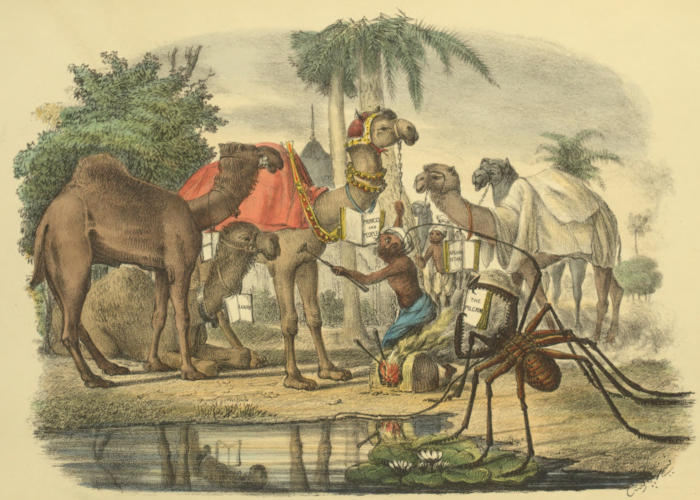
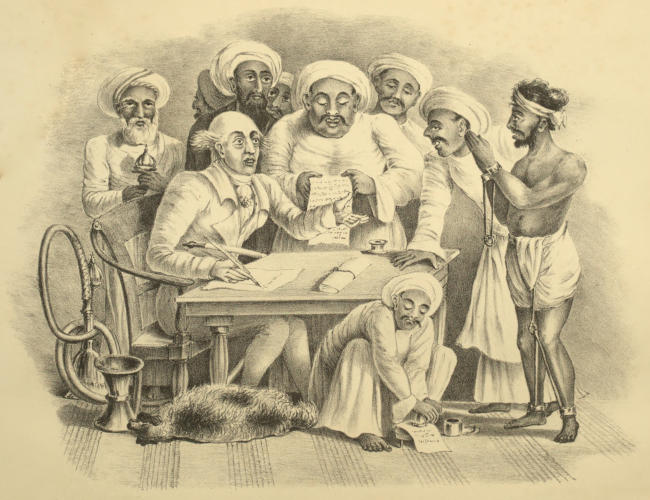
“The Camels were being branded for the
Public Service and the Spider came to be marked also.”
In stone by Major Parlby
فاني پارکس
श्री INTRODUCTION. — GĂNÉSH, THE PATRON OF LITERATURE.
“WHATEVER THE WANDERING TRAVELLER SAYS, HE DOES SO FROM HAVING
SEEN THAT OF WHICH HE SPEAKS[4].”
So many admirable works have appeared of late, illustrating
scenes in India, both with pen and pencil, that I offer these
sketches in all humility, pleading the force of example.
“THE CAMELS WERE BEING BRANDED WITH HOT IRONS FOR THE PUBLIC
SERVICE, AND THE SPIDER CAME TO BE MARKED ALSO[5].”
For four-and-twenty years have I roamed the world,—
“I NEITHER WENT TO MEKKA NOR MUDĪNA, BUT WAS A PILGRIM
NEVERTHELESS[6].”
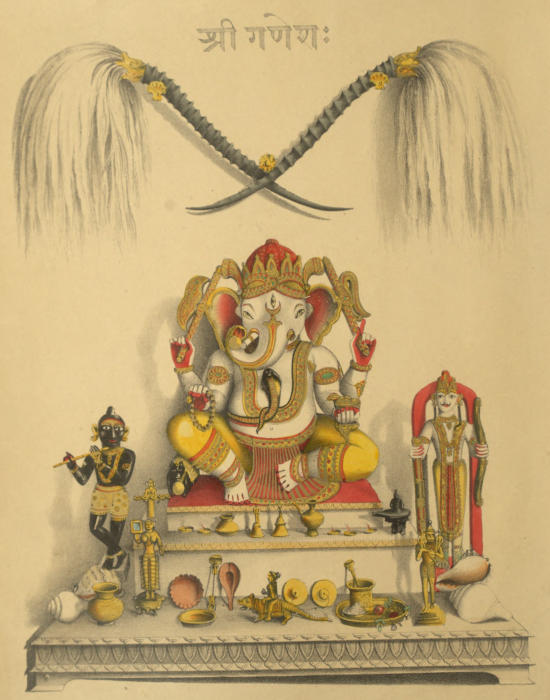
The Frontispiece represents the idol Gănésh, the deified infant
whom I have invoked.
The sign Sri, at the top of the page, implores his triple
eyes to look with favour on the undertaking,—in the same
manner that this sign, ♃, the old heathen invocation to Jupiter,
sought his blessing; and is equivalent to the usual invocation of
the poets to the Muses,—the Muhammadan authors to the
Prophet,—or the “Laus Deo,” with which merchants’ clerks
formerly began their books,—a practice not yet quite extinct.
“Sri” is written at the top of all Hindi writings; the
meaning of the word is “prosperity;” it is put as a title of
respect before proper names; frequently they write the same
word twice over (“Sri, Sri,”)—or they write “Sri Gănésh.”
The Muhammadans, in a similar manner, dedicate their writings
to God by a character on the first page, which, as in short-hand
writing, implies a whole sentence.
The history of Gănésh is as follows:
“I SPEAK TO THOSE WHO HAVE DAUGHTERS, AND LET THOSE WHO HAVE
SONS LISTEN[7]!”
Parvutī, the mountain-born, the daughter of the Himalaya,
the mountain goddess, the mother of Gănésh the wisest of
deities, on the birth of her son, charmed with his beauty, and
proud of the infant, in the presence of the gods assembled in
council, requested their congratulations on the happy event.
Shivŭ the destroyer, although he paid the compliments
necessary on the occasion, ever avoided looking upon the child.
The mother naturally reproved him; Shivŭ, annoyed at the
rebuke, gazed upon the infant, whose beautiful head instantly
withered away beneath a glance which none can endure and live.
Indra, the abode of the gods, resounded with the lamentations
of Parvutī, who, struck with dismay, was inconsolable.
Brahma, having pity on her distress, bade her be comforted,
and commanded Shivŭ to bring the head of the first animal that
he should find lying with its head to the north.
This sleeping with the head to the north is unlucky, and
ever to be avoided, it being forbidden by the Shăstr, and the
penalty thereof death.
Shivŭ went forth: the first animal he encountered in the
above-mentioned unlucky position being an elephant, he cut off
its head, and, returning to the assembly of the gods, fixed it
upon the body of Gănésh. Seeing this, the mother became
frantic, nor could she be consoled until Brahma thus addressed
her: “Lament not the fate of your child;—with the head of an
elephant he shall possess all sagacity. In pūja Gănésh shall be
invoked ere any other god be worshipped, hence shall he be
greater than all the gods. Ere a pious Hindū commence any
sort of writing, the sign of Gănésh shall he make at the top of
the page, otherwise his words shall be folly, and his traffic a
matter of loss. He shall be the patron of learning, his writing
shall be beautiful.
“‘Behold! he writes like Gănésh!’ who shall say more?—with
the simplicity of the child shall be united the wisdom
of the elephant, his power shall be all-seeing—The patron of
literature and work-perfecting.”
The daughter of the Himalaya listened to the words of Brahma,
and the heart of the mother found consolation in the honours
bestowed upon her child.
He is called two-mothered, uniting the elephant’s head to
his natural body, therefore having a second mother in the
elephant.
In the wars of heaven he lost one tusk, hence his appellation
one-toothed.
His quadruple hands and arms denote power. In one of his
hands is the ānkus, the instrument with which the elephant is
guided; in another a battle-axe. Being a child, and therefore
fond of sweetmeats, a third hand bears a small cup filled with
pera, a sweetmeat common in all bazārs; in the fourth he carries
a short rosary, wherewith he counts his beads. Around his
neck is twined the Cobra-di-capello, the holy serpent, whose
hood is outspread upon his breast. This image is dignified by a
frontal eye, signifying the sun, encircled by a crescent, a sol
lunar emblem and mystical mark, hence “moon-crowned,”
“triple-eyed.” His attendant, a rat, holding a pera, sweetmeat, is
placed at his side: on his head is a crown, and around his limbs
a yellow dhotī, a cloth of Benares tissue edged with gold. His
body is covered with ornaments of rich jewellery, such as are
worn by men in the East,—his single tusk is bound with gold,—his
hands and feet are dyed with menhdī, hinnā. On each of
his four arms are two bāzūbands, or armlets; and chūrīs, or
bracelets, of massive gold, adorn his wrists. A golden plate on
the back of the hand is fastened round the wrist by chains of
gold, and from the upper part similar but finer chains pass
over the back of the hand, and unite with rings on all the
fingers and the thumb. This ornament is very peculiar; both
hands are thus adorned. The chaunrīs above his head, emblems
of royalty, are used by the attendant Brahmāns to keep off the
flies; they wave them over the head of the idol during pūja.
Gănésh is seated on an altar, such as is used in the mut’hs,
Hindū temples, surrounded by divers idols, sacred shells, and
instruments of worship; small brass cups filled with oil, called
chirāghs, are burned as lamps before the shrine. The worshippers
pour oil and the holy water of the Ganges over the head of the
god, which is thus bathed daily, and offerings of boiled rice and
flowers are made at the time of prayer. The conch shell, which
lies before him, is blown by the Brahmāns during the hours of
pūja at different times—it is considered very holy—the priest
holds it clasped in both hands, and blows into it from the top.
The sound can be heard afar off, especially when on the river
at the time of evening worship; it resounds from every side of
the water, mingled with the ringing of the priest’s bells and
the sound of a sort of brass castanet, which they strike whilst
chanting forth their prayers.
The opening of these shells is on the left side; but they say
a shell is sometimes found with the opening on the right side,
and its spiral involutions reversed; it is then called Dūkshina
Vŭrtŭ, and is valued at from three to five hundred rupees.
Vishnŭ is said to hold a shell of this sort in his hand. Shells
are placed with flowers around the idol, the bull-mouthed is
considered sacred, and often adorns the shrine.
Small brass bells are used in worship; some are decorated with
the image of Hŭnoomān, some with the sacred cow. They are
rung during pūja, not only, it is said, to amuse the god, but to
keep off evil spirits.
The shape of the spoon with which the rice or oil is put upon
the head of the image is remarkably beautiful and antique. The
top of the spoon bears the image of Gănésh, crowned by the
Nāgā, or holy serpent, with a hundred heads, which are outspread,
to screen him from the sun.
This idol is made of solid white marble, and weighs three
hundred weight and a quarter. It is painted and gilt, as in
the Frontispiece. It was brought down from Jeypūr to the
sacred junction of the triple rivers at Prāg, at which place it
came into my possession.
Although a pukka Hindū, Gănésh has crossed the Kālā Pānī,
or Black Waters, as they call the ocean, and has accompanied
me to England.
There he sits before me in all his Hindū state and peculiar
style of beauty—my inspiration—my penates.
O Gănésh, thou art a mighty lord! thy single tusk is
beautiful, and demands the tribute of praise from the Hājī of
the East. Thou art the chief of the human race; the destroyer
of unclean spirits; the remover of fevers, whether daily or
tertian! The pilgrim sounds thy praise; let her work be
accomplished!
Salām! Salām!
فاني پارکس
CONTENTS TO VOL. I.
PAGE
INTRODUCTION.
Gănésh, the Patron of Literature—Parvutī—The Gods in Council—Chaunrīs
of the Yāk—The Conch Shell—Bells used in Pūja—The
Sacred Spoon—The Kālā-Pānī—The Salām
Flying Visit to Switzerland—The good Ship ‘Marchioness of Ely’—H.
M. 16th Lancers—Porto Santo—Fellow-Passengers—Isle of Palma—Divine
Service—The Band—Quadrilles—The first Shark—Bristol
Water—Skip-jacks—Prickly Heat—Crossing the Line—Amusements on
Board—A Blue Shark—Sucking-Fish—Bonito—Santa Trinidada and
Martin Vas Rocks—The Albatross—Thoughts of Home—A Calm—Shooting
Season on the Ocean—Three Days of Battue—Whale-Shooting—A
deep Calm—Scarcity of Water—Anchored at Carnicobar
Appearance and Attire of the Islanders—Canoes—Visit to their Village—Ornaments
of the Natives—Departure from the Island—The Andamans—Anchorage
at Saugor—The Hoogly—Arrival in Calcutta
Calcutta—First Impressions—Style of Indian Houses—Furniture—Mats—Arabs—Departure
of the Marquis of Hastings—Fogs—Christmas-Day—Indian
Servants—The Sircar—Thieves—The Hot Winds—Pankhās—Fire-flies—North-Westers—The Foliage—Musquitoes—Elephantiasis—Insects—The
Chŭrŭk Pooja—Religious Mendicants
Baboo Ramohun Roy—Nāch girls—Children in India—Sickness in the
Fort—The Rains—Vessels for a Voyage on the Ganges—Indian Fever—Arrival
of Lord Amherst—Introduction of Steam-boats on the
Hoogly—Interest of Money in Calcutta—Robberies—Jamh o Deen,
Prince of Mysore—The Doorga Pooja—Images of Clay—The Races—Chinese
Screens—The Dog Crab
Advantages and Disadvantages—Interest never sleeps—Barrackpore—Cairipoor—The
Fakīr—The Menagerie—Hyena—Change of Residence
to Chowringhee Road—Mouse and Spotted Deer—Bengallee Goats—Lotteries—Trial
by Rice—The Toolsee—Epidemic Fever—Burmese
War—Major Sale—Haileybury—The Hooqŭ—Dr. Kitchener—Death
of Lord Byron—Early Marriages—Pleasures of the Cold Season—Indian
Hospitality—Knack of Fortune-making lost
A Day in March—The Furlough and Pension Funds—Bandicote Rats—The
Strand—The Cutting System—Harrow-on-the-Hill—Sickness in
Amman—The Golden Feet—Arrival of Lord Combermere—Bhurtpore—La
Pucelle—Marsh Fever—Change of Residence to Middleton Row,
Chowringhee—Fogs up to the Second Story—Burrā Bazār—Seed Pearl
Fulbertus Sagittarius—Billiards—The Recall of Lord Amherst—Zenāna of
an opulent Hindoo—The Death of Bishop Heber—Affliction in the
Family of the Governor-General—Appointment to Allahabad—Sale of
‘Scamp’—March up the Country—Dāk Bungalows—Fakīrs en route—The
Soane River—Sassaram—Suttees at Nobutpoor—Benares—Pooja
in a Hindoo Temple—Brāhmani Bulls—The Minarets—Beetle Wings—Hindoo
House—Benares Hackeries—Dāk to Allahabad—Visit to
Papamhow
CHAPTER VIII. LIFE IN THE MUFASSIL. 1827, January.
First Visits in the East—Papamhow—Runjeet Singh’s Illness—Death of
Lord Hastings—Lord Amherst created Earl of Arracan—Marriage of
a Neem to a Peepul—The Bacäin—A Koord Arab—Visit to Lucnow—His
Majesty Nusseer-ood-Deen Hyder—Lord Combermere—Kywan
Jab—Presents not allowed to be accepted—Fights of Wild Beasts—Quail—Departure
of Lord Combermere—Skinner’s Horse—Return to
Prāg
Sinking a Well—Hurriannah Cows—Delhi Goats—The Jumnapār—Doomba
Sheep—Buffalo Humps—Water-cresses—Marrowfat Peas—Carrots—The
Chatr—The Oleander—The Ice-pits—Cream Ice, how
to freeze—Burdwan Coal—Indian Fevers—Mr. Bayley, Viceroy—Fear
of the Invasion of the Russians and Persians—Intense Heat—Deaths
in the Farm-yard—Chota Jehannum—The Verandah at Noon—Mad
Pariah—Trelawny—Châteaux en Espagne—Height of the two Rivers—Death
of the Bishop of Calcutta—An Hummām—The first Steamer at
Prāg
Zenāna of the King of Oude—Regiment of Females—The Favourite
Wife—The English Begam—The Princess of Delhi, the Begam par
excellence—Colonel Gardner—Mirza Sulimān Sheko and his fifty-two
Children—The Forty Princesses—Mootee, the Pearl of the Desert—Hunting
Season at Papamhow—Jackals and Foxes—A Suttee at Prāg—Report
of a Suttee—An Ill-starred Horse
March to Benares—Misfortunes en suite—The Hummām of the Rajah—Flowers
of Wax and Ubruk—Return to Prāg—Storm en route—Gram—A
Central Government—Thieves, Domestic—Snake in the Stable—Death
in a Pālkee—Power of the Sun to change the Sex—Lord William
Bentinck—Half-Batta—The Jaws of the Crocodile—The Clipper—Discontent
of the Army—Recovery of the Stolen Rupees—The Gosāin—Ram
Din—The Ancient Temple
The Snake-charmer—Ram Leela—Board of Works—The Hukāk—Kurand
Patthar—Pebbles from the Soane and Cane Rivers—Raj Ghāt—The
Dhrumsāla—The Ginee—Temple of Hŭnoomān, Ram, and
Seeta—Ravuna the Giant—Bene-Māhadēo—The Adansonia—Little
Jack Bunce—Encampment of the Governor-General—Ashes of a Rajah
consigned to the Ganges—Christmas-boxes
CHAPTER XIII. REMOVAL TO CAWNPORE—CONFESSIONS OF A THUG. 1830, January.
Removal to Cawnpore—Failure of Messrs. Palmer and Co.—An Appointment
at Cawnpore—Removal from Allahabad—The Mowa Tree—Futtehpore—Dead
Body in a Well—The Kutcherry—Confessions of a
Thug
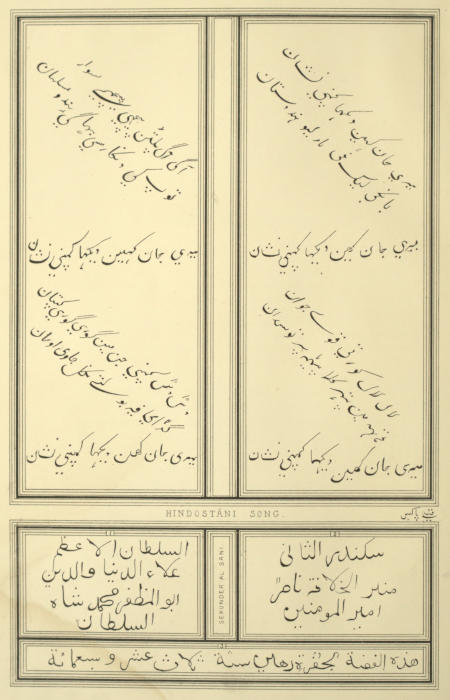
The Iron-shod Lāthī—Coins of Sekunder al Sāni—Hindostanī Song—The
first Thermantidote—Dāk to Cawnpore—The Barkandāz—The
Station—Sand-storm—Indian Method of Washing the Hair—Pukka
Houses and Bungalows—The Ayha’s Revenge—Horses Poisoned—The
Isle of France—The Visionary Old Man—Influence of Women in India—Gambling—Eating
the Air—The Ayha’s Trowsers—Darzees—Refuge
of the Distressed—Signet-rings—The Durwān—Ganges Water—Small-pox—Grass-cutters—Beauty
of a Night in India—Forgery—Qui hy?—Winged
Ants and Bugs—The Moon—A Set-to—Revenge of a Sā’īs—Soldiers
in Hospital—Arrak—The Chārpāī—A New Servant—Unpopularity
of the Governor-General
CHAPTER XVI. RESIDENCE AT CAWNPORE—THE DEWĀLĪ. 1830, October.
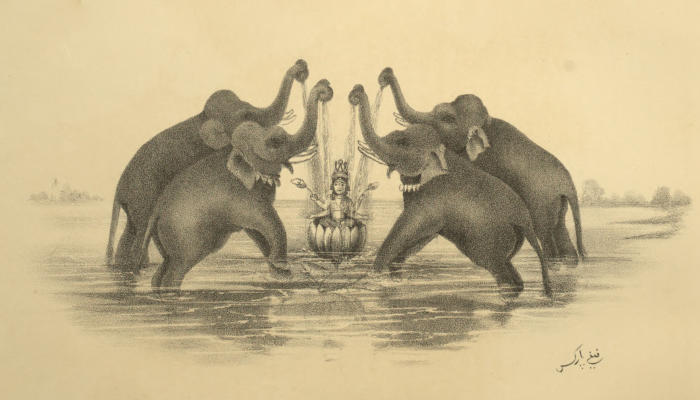
Aghā Meer the Nawāb—Elephants Swimming the Ganges—Cashmere
Goats—Discontent of the Soldiers—Buffaloes—Methodism—Desertion
of Soldiers to Runjeet Singh—Marks of Age on Stud-bred Horses—Abolition
of Sŭtēē—Pilgrim Tax—The Dewālī—The Phŭlŭ-hŭrēē
Festival—Arrival of Aghā Meer and his Zenāna—Vicious Horses—Turquoise
Mines in Persia—Lament of the Hindoo Women—Burning
the Dead—The Mug Cook—Brutal Punishment—Plagues of Egypt—Conversion
of Hindoo Women—The Races—The Riding School—Kishmish
Bakhshish—Apples and Grapes from Cabul—Arab Merchants
New Year’s Day—Meeting of the King of Oude and the Governor-General—Visit
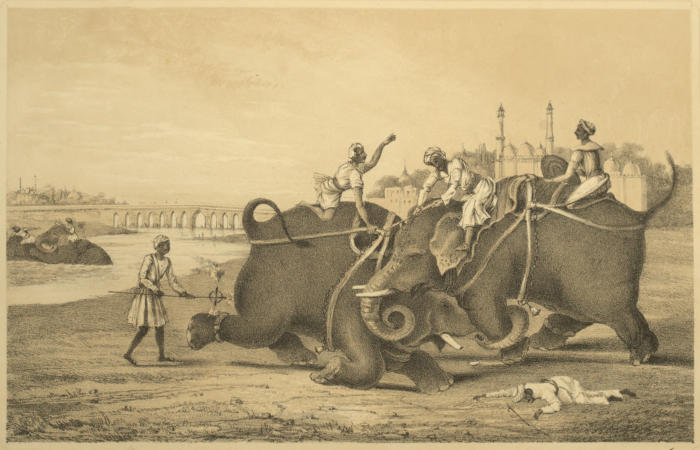
of Lord William Bentinck to Lucnow—A Native Christian—Elephant,
Tiger, Buffalo, and Bear Fights—Constantia—Beautiful
Buildings—Departure of the Governor-General—The Padshāh Bāgh—The
Royal Hummām—The King’s Stables—The Party at the Residency—Dil-Kushā—Zoffani’s
Picture—Doves released from Captivity—The
Menagerie—A Zenāna Garden—Letter of Introduction to the Begams
at Delhi—Gardner’s Horse—The Sorrows of the Begam
CHAPTER XVIII. REVELATIONS OF LIFE IN THE ZENĀNA. 1831.
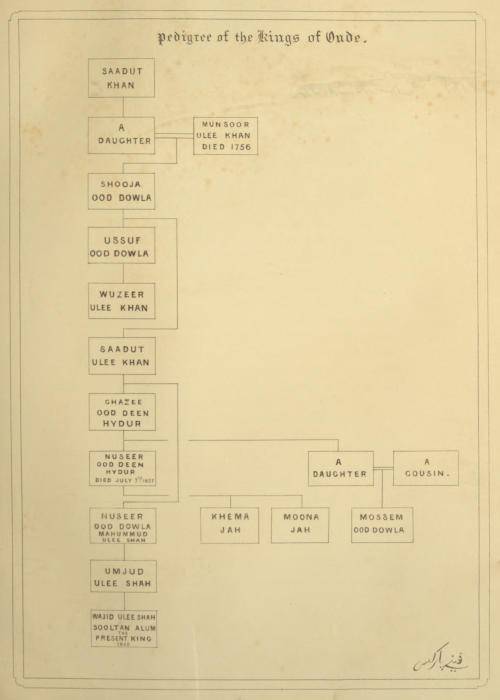
Pedigree of the Kings of Oude—Lucnow Mohurs—Anniversary of the
Coronation—The Prime Minister—Khema-jah—Feredooa Buckht—Evil
Omens—Mossem-ood-Dowla—Largesse—Hārs, Pān, and Atr—The
Zenāna—Sultana Boa—Mulka Zumanee—Gosseina—Tajmahŭl—Plurality
of Wives
CHAPTER XIX. THE RETURN TO ALLAHABAD—EXECUTION OF TWENTY-FIVE THUGS. 1831, February.
Removal to Allahabad—Crocodiles—Aurunzebe’s Fort—The Old Well
at Kurrah—Arrival at Allahabad—The Thermantidote—The King’s
Picture and the Celestials—Pattū—Execution of Twenty-five Thugs—Cholera—The
Effect on the Insane—The Arabian Leprosy—Elephantiasis—Asylums
for the Blind and for Lepers—Lachhmī, the Goddess of
Prosperity—Intense Heat—Early Rising—Danger of a Thermantidote—List
of Servants
CHAPTER XX. SCENES AT ALLAHABAD—PILGRIMAGE TO THE TRIVENI. 1831, July.
The old Brahman—The Triveni—The Achivut—The Pātal Pooree—Temples
of Bhardoajmun—Radha Krishnŭ—Hindoo Oath—The Tulsī—The
Peepul-tree—Skeleton Leaves—Lamps in the Air—Paintings
on Ubruk—Impressions on Leaves and Flowers—The Mootee Musjid—The
Crows a Pest—Byā Birds—Haymaking—The Silver Tankard—An
Earthquake—Transferring Diseases to Flowers—Perjury—Farming
Operations—Oats—Bhoodder Ram the Dwarf—The Camel—The
Powder Works and Rocket Manufactory
Devotees at the Great Fair—Wild Ducks—Quail Shooting—Price of
English Hounds—Colonel Gardner—Life in the Zenāna—The Grass
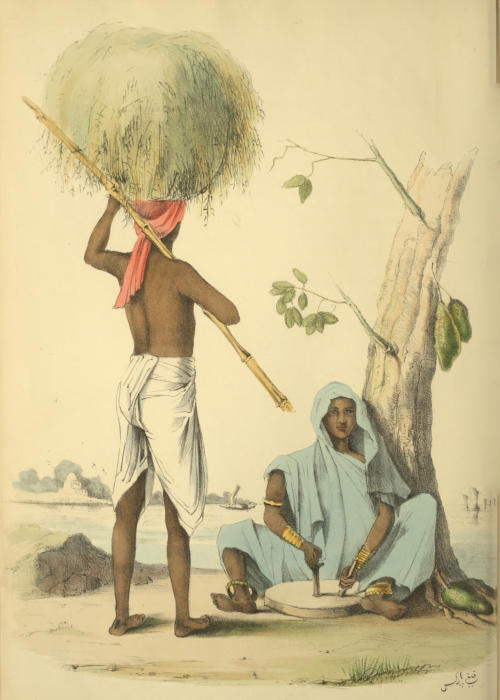
Cutter—Dūb Grass—The Gram-grinder—The Chakkī—Jack Fruit—Duty
of a Sā’īs—Arrangement of a Turban—The young Princes of
Lucnow—Archery—Indian Bows and Arrows—Whistling Arrows—The
Bows, Arrows, and War Hatchet of the Coles—The Pellet Bow—Witchcraft
practised with a charmed Bow
Gaiety of Allahabad—Lucnow Chutnee—Tails of the Yāk—Horn of the
Unicorn—The Looking-glass Shawl—The First Flight of Locusts—An
Adventure—The Rats’ Granary—Balls—Profiles—The Leaf Grasshopper—Appointed
to Allahabad—Ramohun Roy—The Bottle of
Horrors—Narrative of a Thug—The Quicksand—Meteors and Falling
Stars—Hanging oneself for spite—The Sipahī Guard—The Ghurī—The
Sitar—The Ektara—The Gynee Club—Soonghees—Colonel
Gardner
CHAPTER XXIII. THE GREAT FAIR AT ALLAHABAD. 1833, January.
Booths at the Fair—Diamonds, Pearls, Shawls, Sable, Coral—The Triveni—Suicide—Religious
Mendicants—The Sacred Ginī—Consecration of
an Idol—Household Gods—Rosaries—Pilgrims, Carriers of Holy Water—Snakes—Arrival
of Lady William Bentinck—Visit to the Fair—Description
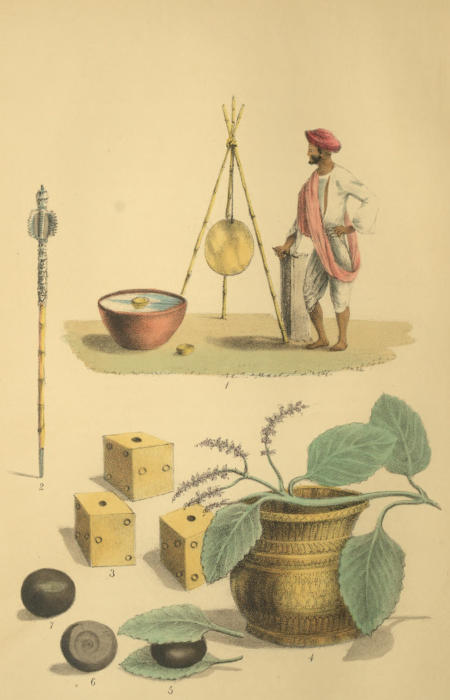
of the Frontispiece—Chamelee, the Brahmanical Bull
The Hounds—A Gumuki—The Eade—Trelawny—The Rev. J. Wolff—The
Nut Log—Balancing Goat—Sirrākee Grass—A Dividend—Ear-rings
of Jasmine—A Rat given to a Cow—The Mādār—Enamelled
Grasshoppers—The Shaddock—The Agra Gun—Corruption of Words—Variegated
Locusts—Beautiful Flowers
Hindū Method of Frightening away the Cholera recommended to the
Faculty—Death of the Darzee—Necromancy—The New Moon—A Bull
laden with the Pestilence—Terror of the Natives—The Pathan—An
Earthquake—Sola Hats—Importation of Ice from America—Flight of
Locusts—Steam Navigation—The Civil Service Annuity Fund—The
Bāghsira—Rajpūt Encampment—Hail Storm—Delights of the Cold
Weather
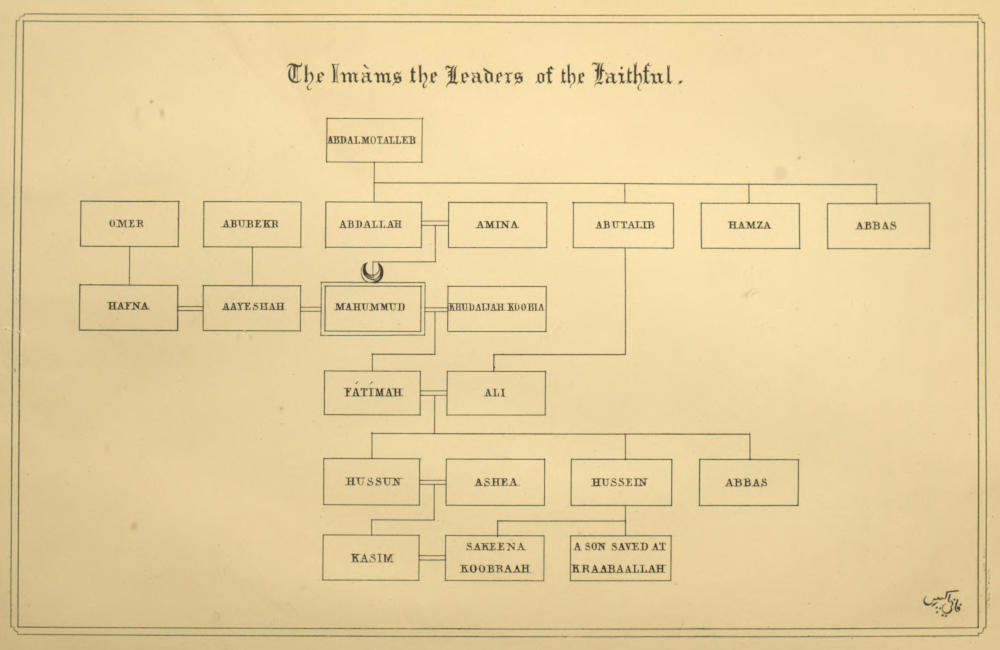
The Imāms the Leaders of the Faithful—The Muharram—The Procession—The
Banners—The Band—The Sword-bearer—The Mourners—Dhul
Dhul—The Reader—The Fakīr—The Taziya—Tomb of Kasim—Palkī
and Trays of Mehndi—Charkh-charkhī Wālā—The Bihīshtī—Camels—Elephants
and Charity—The Chameleon—The Ghirgit—An
Alligator—The Tiger on his Travels—A well-educated Snake—Indian
Fevers—Depression of Spirit
CHAPTER XXVII. THE BRAHMANICAL THREAD. 1834, June.
The Janao—The Fakir—The Fair—Pūja of the Cow—Cusa Grass—The
Flying Fox—Air Plants—Musk Deer—Nāg-panchamī—The
Snake—The Pinnace—City of Allahabad—The Pillar in the Fort—Sealing-wax—Butea
Frondosa—The Dewālī—The Bower—Climbers
and Creepers—The Humming Birds—The Pellet Bow—White Ants—Chintz—The
Horseradish Tree—The Ichneumon—The Garden—The
Bouquet—Cold Mornings for Hunting—The Moustache
CHAPTER XXVIII. PILGRIMAGE TO THE TĀJ. 1834, December.
The Seagull—The Patelī—Chapātīs—Sujawan Deota—Burriaree Rocks—Thieves—Parbosa—Temple
of Parisnāth—Darogahs—Utility of a
Pellet-bow—The Cane River—The Leak—A Storm—Kalpee—Belaspoor—Alligators
in their own Wildernesses—River Shells—Passage
through the Rocks—A Pilot—Badowra—Fossil-bones—The Chumbal
River—Bhurrage—Burning the Dead—A Woman Drowned—Cutting
through a Sandbank on a Chain Cable—A Leak—White Ants—Picturesque
Scenes—A Tufān—The Mem Sāhiba’s Speech—River Dogs—Presents
of Sweetmeats
CHAPTER XXIX. PILGRIMAGE TO THE TĀJ. 1835, January.
Etaweh—Moonlight Ride—The Wolves—Bird-catchers—Peacocks—The
Bar of Sand—The Good Luck of the Mem Sāhiba—Narangee Ghāt—Betaizor—The
Silk-cotton Tree—Fields of the Cotton Plant—The
Chakwā Chukwaee—Eloquence of a Dhobee—Aladīnpoor—Noon, or
Loon—Modelling in Khuree—Cotton Boats—The Ulāk—Vessels on
the River—Plantations of the Castor Oil Plant—Cutting through a
Sandbank—First Sight of the Tāj—Porcupines—Bissowna—Quitted the
Pinnace—Arrival at Agra
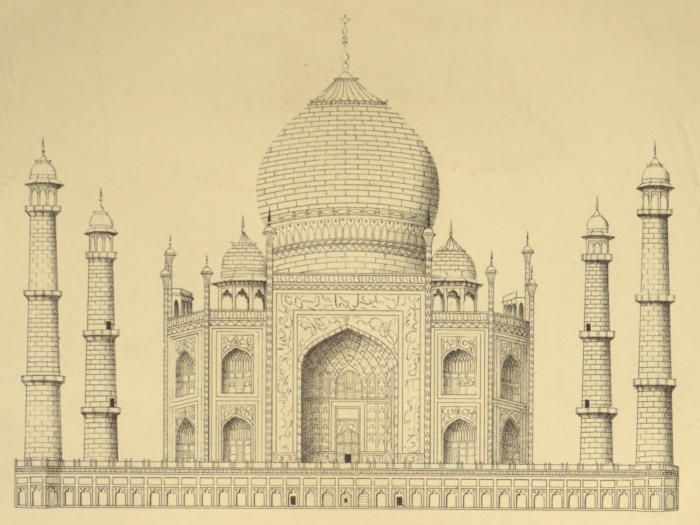
The Tāj Mahul—Arzumund Bānoo—Shāhjahān—The Screen—The
Echo of the Dome—Momtâza Zumâni—Her Sons and Daughters—Asaf-jāh—Noormāhul—Ruins
of the second Tāj—Offerings at the
Shrine—The Wall—The Kālūn Darwāza—The Fountains—Melā of the
Eed—The Burj—The Jāmma Khāna—The Masjid—The Bāo’lī—Tomb
and Masjid of the Fathīpooree Begam—Tomb of the Akbarābādee
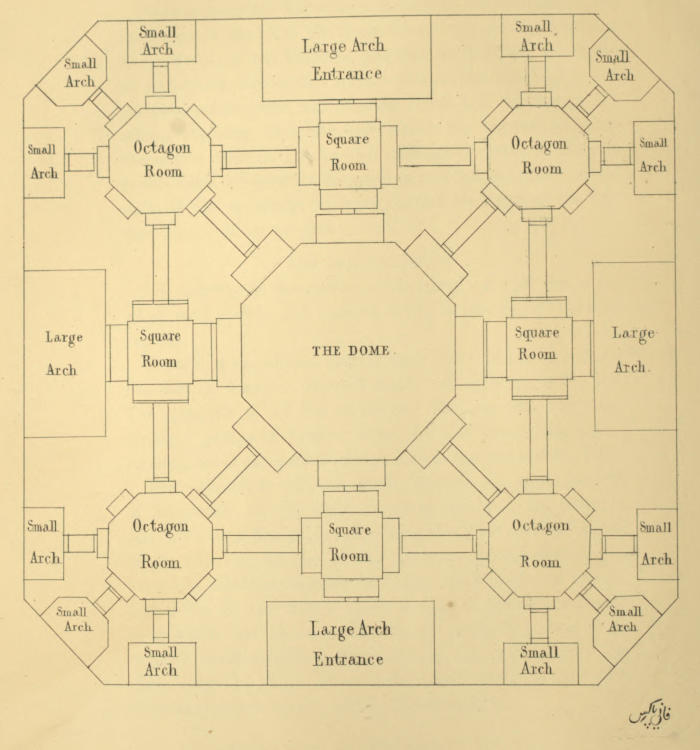
Begam—Ground-plan of the Tāj—The Minarets—Stones used in the
Mosaic—Tomb of the Simundee Begam—The Sitee Khanam—A Farewell
to the Tāj
CHAPTER XXXI. PLEASANT DAYS IN AGRA. 1835, February.
The Fort—The Mosque of Pearl—The Jahāngeeree Mahul—Mher-ul-Nissa—Selīm
Ghar—The Palace in the Fort—The Dewanī Khas—Noor-jahān
Burj—Zenāna Masjid—The Shīsha-Mahal—Hall of Audience—The
Vault of Secret Murder—The Black Marble Slab—The
Throne of Akbar—The Steam Baths—The Worship of the Rising Sun—View
from the Bridge of Boats on the Jumna
CHAPTER XXXII. REMARKABLE BUILDINGS AROUND AGRA. 1835, February.
The House of the Wuzeer—The Jāma Masjid—Tomb of Jahānārā
Begam—The Tripolia—The Mahookma Masjid—The Madrissa—Etmad-od-Doulah—Cheen-ke-Masjid—Rām
Bagh—Syud Bagh—Secundra—The
Chamber of Gold—Miriam Zemānee—Kos Minārs
CHAPTER XXXIII. REVELATIONS OF LIFE IN THE ZENANA. 1835, February.
Invitation to Khāsgunge—Kutchowra—The Zenāna—A Timoorian Princess—Opium-eating—Native
Dishes—The Evening Party—The Beautiful
Begam—Musalmanī Attire and Ornaments—Timūr-lung—Gold and
Silver Beds—Atr of various sorts—Perfume of the Body of the Prophet—Dye
for the Hands and Feet—Churees
CHAPTER XXXIV. LIFE IN THE ZENĀNA, AND CHĪTĀ HUNTING. 1835, February.
Plurality of Wives—Intrigues and Hatred—Arrival at Khāsgunge—The
Four Walls—Arwarī Shooting—The Pūtlī-nāch—The Lynx—Introduction
to Colonel Gardner’s Begam—The Morning Star—The Evening
Star—The Nawab of Cambay—The Beautiful Gardens—The Bara Deri—Rattler—Chītā
Hunting—Antelopes—The Sulky Chītā—Heera Sing—Chītā
Hunting attended by Native Ladies
CHAPTER XXXV. FATHIPOOR SICRI AND COLONEL GARDNER. 1835, March.
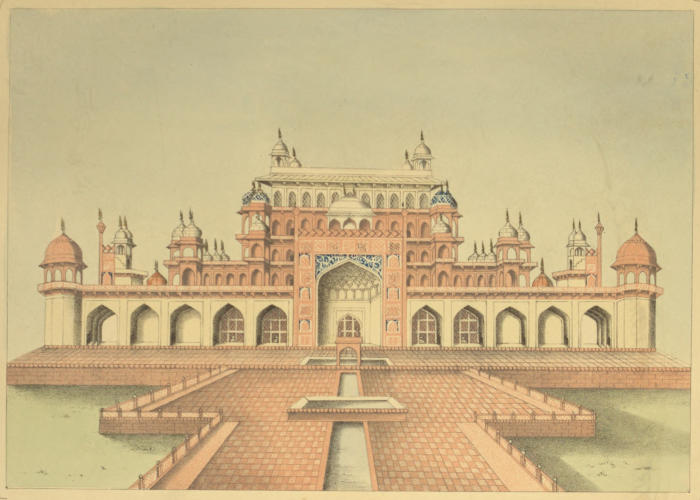
Pilgrimage of Akbar Shāh to Fathīpoor Sicri—Shaikh Selīm Cheestie—The
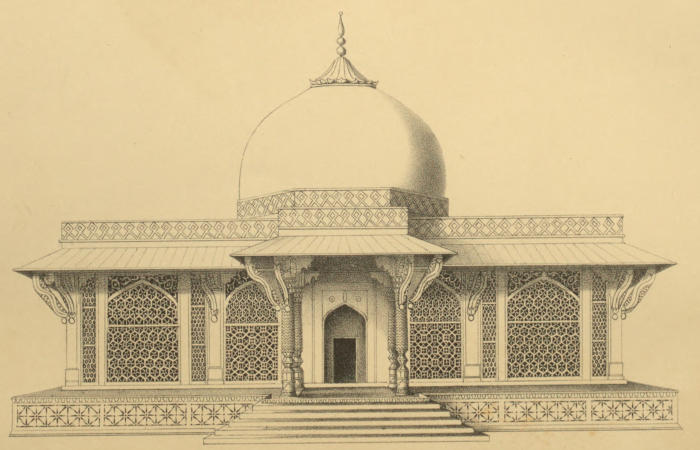
Jodh Bā’ī—Birth of Selīm—The Tomb of the Saint—The Gateway—A
Tradition—The Temple of Magic—The Zenāna—The Pachīsī
Board—The Mint—Akbārābādee Rupees and Gold Mohurs—The
Elephant Minār—A Child destroyed by a Wolf—Tomb of the Jodh Bā’ī—Agra
built by Akbar—Sketches of Remarkable Living Characters in
India—Legality of a Marriage between a Christian and one of the
Faithful—Colonel Gardner’s Letter—Letter of Colonel Tod—Insult
offered by Holkar—Colonel Gardner’s Marriage—Tomb of Colonel
Hessing—Cure of Influenza within the Four Walls—Death in a Steam-Bath
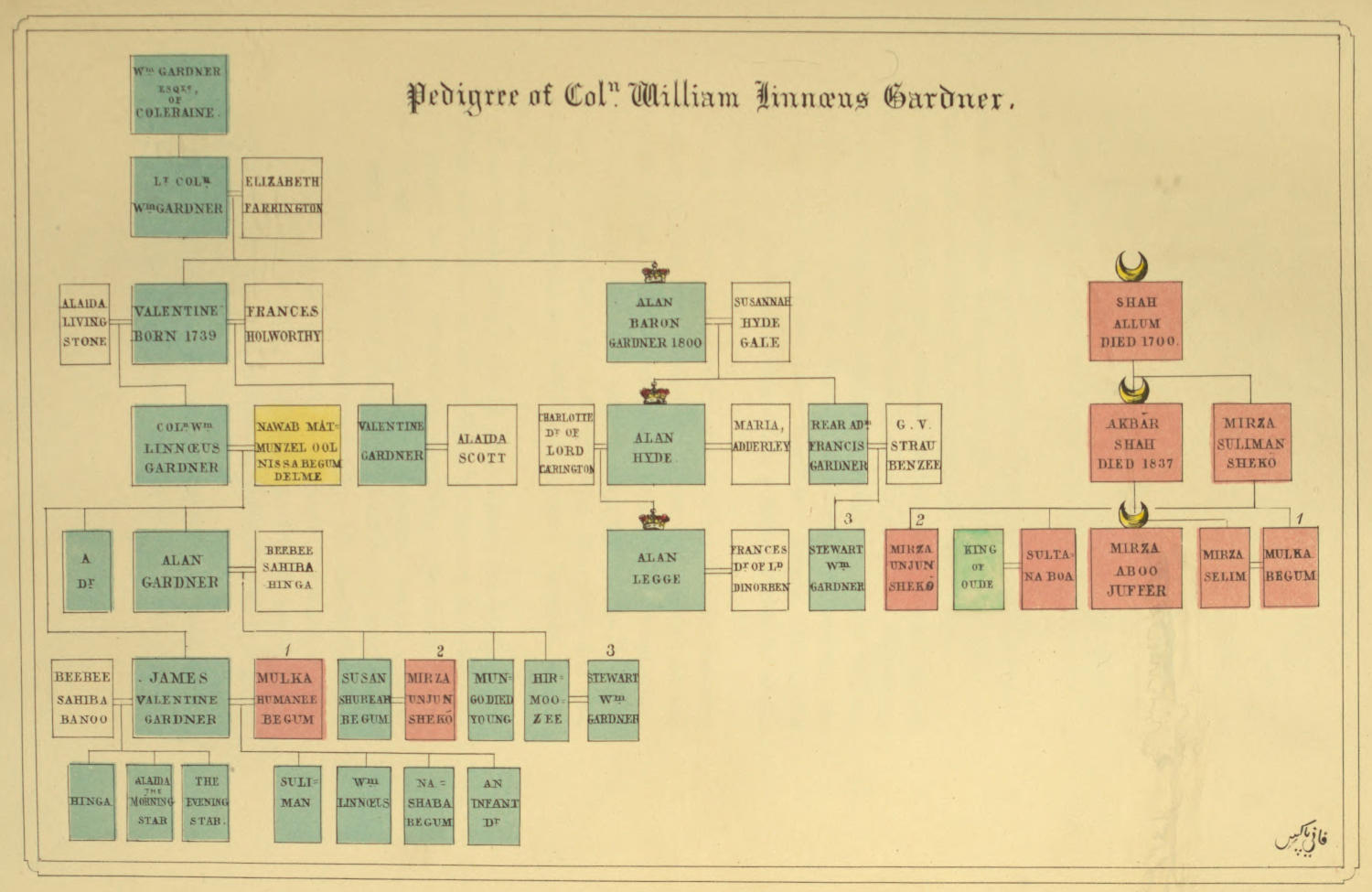
Pedigree of the Bride and Bridegroom—Reports concerning the Beauty
of the Bride—Anxiety of English Gentlemen to marry into Colonel
Gardner’s Family—Mirza Unjun Shekō—The First Procession—The
Bride’s Dress—Necessity of Weeping—The Oily Mixture—Strict
Seclusion—Dress of the Bridegroom—The Oily Mixture complimentary—The
Hoolī—Bridal Songs—The Sāchak—The Bridegroom’s Procession—Nāch
Girls on Platforms—The Menhdi—The Grand Display in the
Bride’s Procession—The Parda—The Prince dyed with Hinnā—Midnight
the Fashionable Hour for Dinner—Wedding Dishes—Silvered
Food—Conclusion of the Day—Mr. James Gardner—Mulka Begam
highly respected; her will is law
The Bridegroom fights for his Bride—The Grand Procession—Superstition
of the Prince—Bridal Attire—The Bride’s Consent—Signing the
Contract—The Nose-ring—Dress of the Bride—The Prince enters the
Zenāna—He beholds his Bride—He carries her off—Colonel Gardner’s
Distress—Fanī Bhū’a—The Bride’s Dower carried in Procession with
the newly-married Couple to the Prince’s Tents—A Singular Custom—Pān
The Chāotree—Timūrian Dance—Churees—Finale of the Wedding—Jhanee
Khanum—The Zenāna Doll—Jealousy of the Natives—Meals
of the Slave Girls—Tara, the Pretty Slave—Conduct of English Ladies
considered extraordinary—Poppy-heads—Devotion of Native Women to
their Husbands—Illness of Colonel Gardner—Burial-ground of the
Family—My Departure—Death of Colonel Gardner, and of his Begam—Orders
of Knighthood—Remarks on the Muhammadān Religion, and
the Punishments of the Grave
GLOSSARY. — A. — B. — C. — D. — E. — F. — G. — H. — I. J. — K. — L. — M. — N. — P. — R. — S. — T. — U. V. — W. — Y. — Z.
Āb, water. Ābdār, water-cooler.
Abīr, red powder used in the Holī.
Ābnūs, ebony.
Achchhā, good.
Ādāb, salutation, respects, politeness.
Adālut, court of justice.
Ādam-ḵẖor, a cannibal.
Afgan, overthrowing.
Afg̱ẖān, the name of a race of people
who inhabit the country to the north-west
of Lahore; called also Pathans.
They are supposed to be of Jewish
extraction.
Afīm, or aphīm, opium.
Agārī pichhārī, the ropes with which
horses are tied.
Agast, æschynomene grandiflora.
Āghā, lord master.
Aghan, the eighth Hindū solar month.
Aghorī, professing ughorpanth, an order
of religious mendicants, who eat
every thing, however filthy, even
human carcases; hence, a gross or
filthy feeder.
Ā’īna, a mirror.
Ākās, the sky, the firmament.
Ākās-bel, the air-creeper; it has no
root nor leaves, but grows on the tops
of trees.
Ākās-diya, a lamp which the Hindūs
hang aloft on a bamboo in the month
Kārtik.
Akbar, very good, greatest.
Akbarābādī, of Akbar.
’Alam, a spear, a standard.
’Alam-dār, standard-bearer (Abbās).
’Ālam-gīr, conqueror of the universe.
Allāh, God. Allāhu akbar, God is great!
Ām, mango (mangifera Indica).
Amarī, a seat with a canopy to ride
in on an elephant.
Ānā, a copper coin, the sixteenth part
of a rupī.
Anannās, pine-apple.
Āndhī, storm, tempest.
Angethī, chafing-dish, brazier.
Angiya, a native boddice.
Ankus, the elephant goad.
Arghā, a vessel shaped like a boat,
used by the Hindūs for making libations
in their devotions.
Ārsī, a mirror, particularly a mirror in
a thumb-ring.
Asārh, the third Hindū solar month
(June and July).
Aswina, the first month of the Hindū
lunar year.
Ātashbāzī, fireworks.
Ātash-khwar, fire-eater; name of a
bird, the chakor.
Atr, perfume. Atr-dan, perfume-box.
Avatār, a descent.
Ayb, or aib, spot, mark, defect.
Ayha, a lady’s maid.
Azan, the summons to prayers, generally
proclaimed from the minārs or
towers of a mosque.
Baboo, a Hindū gentleman, a Calcutta
merchant.
Babūl, mimosa Arabica.
Badrī-nāth, a celebrated place of pilgrimage.
Badshah, or pādshāh, a king.
Bāgh, a tiger.
Bāgḥ, a garden.
Bāghsira, gryllus monstrosus.
Bāghīchar, a small garden.
’baghnā, an ornament made of tigers’
claws.
Bahādur, champion, boaster.
Bahangī, a stick with ropes hanging
to each end, for slinging baggage
to, which is carried on the shoulder.
Bahut, much, most.
Bā’ī, mistress, lady amongst the Mahrattas.
Bailī, bullock carriage.
Bairāgī, a fakīr.
Bājrā, panicum spicatum.
Bakāyan, melia sempervirens.
Baḵẖshish, a gift; bakhshnā, to give.
Bakrā, he-goat.
Bandar, a monkey.
Bandh, an embankment.
Banglā, a thatched house.
Baniya, shop-keeper.
Bāns, the bamboo.
Bā’olī, a large well.
Barā, great.
Barā-dīn, a holiday.
Bāra-singha, twelve-horned stag (cervus
elaphus).
Barāt, marriage procession.
Bardār, a bearer.
Barha’ī, a carpenter.
Bārī, a garden house.
Barkandāz, a native policeman.
Basantī, yellow, the favourite colour of
Krishna.
Bastī, a village.
Baṭer, quail.
Batū’ā, a small bag.
Baunā, a dwarf.
Bāwarchī, cook.
Bayā, loxia Indica.
Bāzār, market.
Bāzūbands, armlets.
Begam, lady.
Bel, ægle marmelos (cratæva religiosa).
Belā, jasminum zambac.
Bengālī, a native of Bengal.
Bér, or bar, ficus Indica.
Besan, flour or meal of pulse, particularly
of chanā (cicer arietinum).
Betī, daughter.
Bhabhūt, ashes which the fakīrs use.
Bhagat, a devotee of a religious order,
peculiar to the low tribes, whose initiation
consists in putting a necklace
of beads around the neck, and marking
a circle on the forehead; after
which the initiated person is bound
to refrain from spirituous liquors,
flesh, &c.
Bhāgulpūr, the town of.
Bhagwān, the Deity, the Supreme Being,
fortunate.
Bhains, buffalo.
Bhaiyā, brother.
Bhang, or bhengh, cannabis Indica.
Bhātā, an extra allowance to troops on
service.
Bhū’a, a father’s sister.
Bhūsā, chopped straw.
Bichchhū, the scorpion.
Bidrī, a kind of tutanag, inlaid with
silver, used to make hukka bottoms,
cups, &c.
Bīghā, a quantity of land, containing
20 katthās, or 120 feet square, or
1600 square yards, which is nearly
one-third of an English acre; in the
Upper Provinces it is nearly five-eighths
of an acre.
Bihisht, paradise.
Bihishtī, a water-carrier.
Bilva, or bilwa, cratæva marmelos
(Linn.).
Binaulā, seed of the cotton tree.
Biskhopra, lacerta iguana.
Bismillāh, in the name of God.
Boxwālā, an itinerant merchant with a
box of goods.
Brahm, or Brŭmhŭ, the one eternal
God.
Brahma, the first person of the Hindū
trinity.
Brahman, an Hindū priest.
Brahmand, the mundane egg of the
Hindūs.
Bṛindāban, the forest of Bṛindā, in the
vicinity of Mathurā, celebrated as
the scene of Krishna’s sports with
the Gopīs.
Burāk, Muhammad’s steed.
Burhiyā, old woman.
Burj, a bastion, tower; burūj, pl.
Burjī, a turret, a small tower.
Burka, a dress, a disguise.
Chabenī, parched grain.
Chābuk, a whip.
Chabūtāra, a terrace to sit and converse
on.
Chādir, Chādar, mantle, garment.
Chakkī, a mill-stone.
Chakor, partridge (perdix chukar).
Chakwā, Brāhmanical duck.
Chakwī, the female of the chakwā.
Chamār, currier, shoemaker.
Champā kalī, a necklace.
Chanā, gram (cicer arietinum).
Chānd, the moon.
Chandnī-chauk, a wide and public
street or market.
Chandnī kā mār-janā, a disease in
horses, supposed to proceed from a
stroke of the moon. “The moonlight
has fallen on him,” is said especially
of a horse that is weak in the
loins.
Chāotree, or chauthī, a marriage ceremony,
the fourth day.
Chapātī, a thin cake of unleavened
bread.
Chaprāsī, a messenger or servant wearing
a chaprās, badge.
Chār, four.
Charḵẖī, a spinning-wheel, &c.
Chārpāī, bed, four-legged.
Chatā’ī, mat.
Chatr, umbrella.
Chauk, market.
Chaukīdār, watchman.
Chaunrī, fly-flapper.
Chhach hūndar, musk-rat.
Chhallā, thumb or great toe ring.
Chhappar, a thatched roof.
Chhat, roof.
Chhattak, about an ounce.
Chilamchī, washhand bason.
Chirāgh, lamp.
Chirāgh-dān, stand for lamps.
Chiṛi-mār, bird-catcher.
Chītā, hunting leopard.
Chītthī, note.
Chob-dār, mace-bearer.
Chor, or cho’ār, thief.
Chūlee, a fire-place.
Chūnā, lime.
Chūrī, bracelets.
Chŭrŭk-pūja, a festival.
Chyūnta, black ant.
Compound, ground around a house.
Conch, a shell.
Corook. See Kurk.
Dabāo, pressure.
Daftarī, the paper-ruler, penmaker,
&c.
Dāk, post, post-office.
Dakait, or dākū, a robber.
Daldal, bog, quagmire.
Dālī, basket of fruit.
Damṛī, a coin, four to a paisā.
Dānd, oar.
Dāndī, boatman.
Darbār, hall of audience.
Dārogha, head man of an office, inspector.
Darwāza, a door; darwān, doorkeeper.
Daryā-i, or daryā, the sea, river.
Darzī, a tailor.
Dastkhatt, signature.
Dastūrī, perquisites paid to servants by
one who sells to their master.
Daulut-khāna, house of fortune.
Derā, a dwelling, a tent.
Devī, a goddess.
Dewālai, dewāl, or dewālaya, temple
of idols.
Dewālī, an Hindū festival, celebrated
on the day of the new moon of
Kārtik; when the Hindūs, after
bathing in the Ganges, perform a
shraddhā, and at night worship
Laksḥmī; the houses and streets are
illuminated all night; and in Hindostan
the night is universally spent
in gaming.
Dhān, rice before it is separated from
the husks.
Dhanuk, a bow, a bowman.
Dhobī, washerman.
Dhotī, a cloth, passed round the waist,
passing between the limbs, and fastening
behind.
Dighī, a large tank or reservoir, in
the form of an oblong square.
Dil, heart; dil-kushā, heart-expanding.
Dillī, or Dihlī, the metropolis of Hindūstan;
generally called by Musalmāns
Shah-jehan-abad, and by Europeans
Delhi.
Dinghee, a small boat.
Dīwak, white ant.
Dīwān-i-am, public hall of audience.
Dīwān-i-ḵẖās, privy-council chamber.
Dog̱ẖ, buttermilk.
Dohā’ī, or duhā’ī, mercy.
Dolī, a kind of sedan for women.
Domra, the name of a caste of Musalmāns,
the males of which are musicians,
and the females sing and
dance in the company of females
only.
Donī, a native vessel or boat.
Dopatta, or dupatta, a sheet of two
breadths.
Do-shāla, or du-shāla, two and shawl,
two shawls being always worn together
by the natives.
Dosūtā, two-threaded cloth.
Dūb, name of a grass (agrostis linearis).
Dūdhiyā, milky.
Duldul, a hedgehog; the name of the
horse of ’Ali, the prophet’s son-in-law.
Dūlhā, or dūlha, bridegroom.
Dulhān, bride.
Dumba, a kind of sheep with a thick
tail.
Durga, one of the names of Bhawānī,
the goddess Durgā.
Durga-pūja, the festival in honour of
Durgā.
Durgah, a tomb, a shrine.
Eed, a festival, a solemnity.
Fajr, morning; barī-fajr, early dawn.
Faḵẖr, glory, nobility.
Fakīr, a religious mendicant.
Falīta, fusee; falīta-dār, a matchlock.
Fānūs, a shade to keep the wind from
a candle.
Fatḥ, victory.
Fāṭīma, the daughter of the prophet,
and the wife of the caliph ’Ali.
Fidwī, devoted (your devoted servant).
Fīl, elephant.
Fīl-ḵẖāna, elephant shed.
Fīl-pāī, elephantiasis.
Gaddī, sovereign’s throne.
Gāgrī, a water-vessel of brass.
Gainā, a species of small bullock.
Gaini, a carriage for a gainā.
Galahi, forecastle.
Gal’haiya, boatswain, forecastle-man.
Gālī, abuse.
Gāndar, a kind of grass, of which khas-khas
is the root (andropogon muricatum).
Ganjha, or gānja, the young buds on the
leaves of the hemp-plant.
Garh, a fort, as fatīh-garh.
Garī, a cart, a carriage.
Garī-wan, carter, driver.
Gaur, an ancient city, formerly the
capital of Bengal.
Ghantā, a clock.
Ghar, a house.
Gharā, an earthen water-pot.
Gharāmī, a thatcher.
Gharī, an instrument for measuring
time, a water-clock.
Gharis, division of time.
Ghariyāl, a crocodile, a plate of brass
for beating time.
Ghariyālī, the person who attends the
gharī, and strikes the hours.
Gharna’ī, a raft supported by empty
pots (gharā, an earthen water-pot).
Ghī, clarified butter.
Ghirgut, or girgut, lizard, chameleon.
Ghulām, slave.
Ghunghrū, a small bell, or little bells
on a string for the ankles.
Ghur, or ghorā, a horse.
Ghur-daur, race-course.
Ghuwā, a coarse kind of cotton cloth.
Go-mukhī, a cloth bag, containing a
rosary, the hand being thrust in
counts the beads; the chasm in the
Himalaya mountains, through which
the Ganges issues.
Gobar, cow-dung.
Gola, a granary.
Gop, a cow, a caste.
Gopī, feminine of gwālā, a cowherd.
Gor-istān, burying-ground.
Gosā’īn, a holy man.
Gul-āb, rose-water.
Gul-badan, a kind of silk cloth.
Gulistān, rose garden.
Gun, track rope.
Gūnth, a pony.
Gurū, spiritual director.
Hājī, pilgrim.
Hajjām, a barber.
Hakīm, a physician, a learned man.
Hakrī, a cart.
Hammām, a hot bath.
Hān, yes.
Hāndī, a pot, a small cauldron.
Hār, a necklace of pearls, a wreath, a
chaplet of flowers.
Hargilla, the adjutant, or gigantic crane.
Harkāra, running footman.
Harphārewrī, or harphāraurī, the name
of a sour fruit (averrhoa acida, Linn.).
Hāth, the hand, a cubit, or eighteen
inches.
Hāthī, an elephant.
Hathī-wān, elephant-driver.
Hawāldār, a native military officer of
inferior rank.
Hāzim, digestive.
Hāzir, present.
Hāzirī, breakfast.
Ḥaẓrat, a title addressed to the great;
majesty; highness.
Ḥaẓrat’īsā, Jesus Christ.
Hinnā, the tree lawsonia inermis.
Hirdāwal, the name of a defect in
horses.
Hisāb, accounts, computation.
Howā, air.
Howdah, a seat to ride in on an elephant,
without a canopy.
Hubāb, a bubble.
Hubāb-i, bubbling.
Hukāk, stone-cutter, lapidary.
Huḳḳa, or hooqŭ, a pipe.
Huḳḳa-bardar, pipe-bearer.
Hukm, order.
Huzūr, the presence.
Jādū, enchantment.
Jādū-garī, magic.
Jafari, lattice-work.
Jāgīr, land given as a reward for
service.
Jahānārā, world adorning.
Jahān-gīr, world-taking.
Jahān-pannāh, world protection, his
majesty, your majesty.
Jahannam, the infernal regions.
Jahaz, a ship.
Jahāzi, a sailor.
Jai, or jaya, triumph, victory, bravo!
huzza! all hail!
Ja’ī, oats.
Jamadār, head of the harkāras.
Jān, life, soul, spirit.
Janao, Brāhmanical thread.
Jangal, forest.
Janglī-kawwa, a raven.
Janwār, an animal.
Jawāb, an answer.
Jhaīhar, cymbals or bells for the
ankles.
Jhāmā, pumice-stone, bricks burnt to
a cinder.
Jhāmp, a matted shutter.
Jhārū, a broom.
Jhārū-bardar, a sweeper.
Jinn-ī, genii.
Ikbal, good fortune.
Imām, a leader in religious affairs.
Indra, the Hindū heaven.
Joār, or jwār, millet (andropogon sorghum).
Ishk-peshā, ipomea quamoclit.
Islām, the religion of Muhammad.
Istrī, a smoothing iron, a wife.
Jum’a, Friday.
Jum’a-rāt, Thursday, eve of Friday.
Izār-bund, the string with which trowsers
are tied.
Ka’ba, the temple of Mecca.
Kabr, a grave, a tomb.
Ḳabūl or ḳubūl, consent, assent.
Kābul, the capital of Afg̱ẖanistān.
Kacharī, or kacherī, court of justice,
an office.
Kachchhī, a horse with a hollow back,
from the province of Kachchh, on the
banks of the Sind.
Kachnār, bauhinia variegata.
Ḳadam, a footstep.
Ḳadam-bos, one who kisses the feet of
a superior.
Kadam-chūṃṇā, to kiss the feet, to bid
adieu.
Kāfir, infidel.
Kāfūr, camphor.
Kāghaz, paper.
Kāghazī, paper-case.
Kāhan, an aggregate number, consisting
of 17 pans, or 1280 kaurīs.
Kahār, a palkī bearer.
Kahwa, coffee.
Kālā, black.
Kālā chor, an unknown person, a domestic
thief.
Kālā namak, a kind of rock salt,
impregnated with bitumen and sulphur.
Kālā pānī, the ocean, the black water.
Kālā zīra, the seeds of the nigella
Indica.
Kalam, a pen, a reed.
Kalam-dan, inkstand.
Kalg̱ẖī, an ornament on a turban, an
aigrette, a plume.
Kālī, the goddess; or, Kālī Mā, the
black mother.
Kalsā, the spire or ornament on the top
of a dome, a pinnacle.
Kam-baḵẖt, unfortunate.
Kam de’o, the god of love.
Kamān, a bow.
Kamān-dār, an archer.
Kamarband, a girdle.
Kammal, a blanket.
Kanāt, canvas enclosure, walls of a
tent.
Kanauj, the ancient city.
Kangan, an ornament worn on the
wrists of Hindū women, a bracelet.
Kangni, millet (panicum Italicum).
Kanhaiyā, a name of Kṛisḥṇa.
Kans, or Kansa, the tyrant whom
Kṛisḥṇa was born to destroy.
Kapās, cotton undressed, the cotton
plant (gossypium herbaceum).
Kaprā, cloth.
Karbalā, the name of a place in Irāk,
where Ḥusain, the son of ’Ali, was
murdered.
Karbī, the stalk or straw of jo’ār or
bājrā (holcus sorgum and spicatus).
Kār-khāna, workshop.
Kark-nath, a fool with black bones.
Karn-phūl, a kind of ear-ring.
Karor, ten millions.
Kārtik, a Hindū month, our October
and November.
Karwā-tel, oil made from mustard-seed,
bitter oil.
Kās, a kind of grass of which rope is
made (saccharum spontaneum).
Ḳaṣā’ī, a butcher, cruel, hard-hearted.
Kāshī, the city of Benares.
Kāsid, courier, a runner.
Kath, an astringent vegetable extract.
Katmiram, (vulgo: catamaran,) a very
small raft, used as a fishing boat on
the coast of Madras.
Kaurī, a cowrie, a small shell used as
a coin (cypræa moneta).
Kāwar, the baskets in which the holy
water is carried.
Kawwā, a crow.
Kāzī, a judge.
Ḵẖāla, mother’s sister.
Ḵẖalāsī, a sailor, a native artilleryman,
a tent pitcher.
Khān, a lord, a title of respect.
Ḵẖāna, a house.
Ḵẖānā, food.
Khāna-pīnā, meat and drink.
Khānsāmān, head table-servant.
Ḵẖarītạ, bag, a letter.
Khas-khas, root of gāndar.—See Gāndar.
Kḥatrī, the second of the four grand
Hindū castes, being that of the military.
Kazānchī, treasurer.
Khet, a field.
Khidmatgar, table-servant.
Khil’at, dress of honour.
Khīsā, a rubber used in baths.
Khraunchī, a native carriage.
Ḵẖudā, God.
Ḵẖudā-wand, master.
Ḵẖudā-yā, O God!
Khūnd, a well, a spring.
Khush-bo, perfume, odour.
Khusrū, the king; Khusrau, the sultan.
Kibla-gāh, the place turned to when at
prayer; a father, or the one beloved.
Kibla, Mecca, an altar.
Kimḵẖwab, silk brocade worked in gold
and silver flowers.
Kishan, the Hindū god Kṛisḥṇa.
Kishtī, (prop. kashtī), a ship, boat,
barque.
Kismat, fate, destiny.
Kitāb, a book.
Kohī, mountain.
Kohī-nūr, the mountain of light, the
great diamond.
Kohirawān, the moving mountain, i.e.
the elephant.
Kot, a fort.
Krānī, a clerk.
Krishna, a descent of Vishnŭ.
Kū’ā, a well.
Kudalī, a small pickaxe.
Ḳulfī, a cup with a cover, in which ice
is moulded.
Kumbhīr, an alligator.
Kumhār, potter.
Kum’hir, a crocodile.
Kur’ān, (vulgo: koran,) the precepts of
Muhammad.
Kurand, corundum stone (adamantine
spar).
Kurk, an order made public, that no
one may be seen on the road on pain
of death.
Kurtā, a kind of shirt, a tunic.
Kurtī, a short garment for women,
jacket for soldiers, coat.
Kusūr, fault.
Ḳuṭb, the polar star, the north pole.
Kuttā, a dog.
Kutwāl, native magistrate, head of the
police.
Lachḥman, the half-brother of Rāmachandra.
Lachḥmī, the goddess of beauty.
Lailī, also Lailā, the beloved of Majnūn.
Lākh, one hundred thousand; gum lac,
a kind of wax formed by the coccus
lacca.
Lāṭ, or lāṭh, obelisk, pillar, club, staff.
Lāṭhī, staff, stick.
Lāw, a rope, cable.
Līchī, a fruit (dimocarpus litchi).
Līl, indigo.
Log, people.
Lon, salt.
Lota, a drinking vessel.
Lubāda, or labāda, a wrapper, great
coat.
Lūnī, the salt that effloresces from
walls.
Lunj, or langrā, lame.
Mā, mother.
Mā-bāp, mother and father, parents.
Machh, or Machchh, the name of the
first avatār.
Machchhar, a gnat.
Machhlī, or Machhī, a fish.
Madrasa, a Muhammadan college.
Magar, an alligator.
Magrela, a seed (nigella Indica).
Mahā-bhārat, the great war.
Mahādēo, or Mahā-deva, a descent of
Shiva.
Mahā-kalī, or Kalī-mā, a terrific form
of Durgā, the consort of Shiva.
Māhā-nimba, melia sempervirens.
Mahārāj, great king, excellency.
Mahārājā, an Hindū emperor.
Mahạl, house.
Mahāwat, elephant driver.
Mahū’ā, or mahu’ā, bassia longifolia,
bearing flowers which are sweet, and
from which a spirituous liquor is distilled;
the nuts afford an oil used
instead of butter.
Maidān, a plain.
Makka, vulgo: Mecca.
Makrī, a spider.
Mālā, Hindū rosary, a garland.
Mālī, gardener, florist.
Mālik, lord, master.
Manḍap, or mandul, a house, a temple.
Mangūs, or newalā (viverra mungo),
ichneumon.
Mānjhī, master of a vessel, steersman.
Maṣālaḥ, spices, drugs, materials.
Mash’al, a torch.
Mash’al-chi, torch-bearer.
Mashk, water bag.
Masīḥ, or Masīḥā, the Messiah, Christ
our Lord.
Masjid, mosque.
Masjid-i-jāmī, a great mosque.
Masnad, a throne, a large cushion.
Māyā, idealism, illusion; a deception
depending on the power of the Deity,
whereby mankind believe in the existence
of external objects, which are
in fact nothing but idea.
Melā, a fair.
Mem sāhiba, madam, the lady of the
house.
Menhdī, lawsonia inermis.
Mihtaranī, sweeper’s wife.
Mik’hal, the instrument with which
collyrium is applied to the eyes.
Mirg, a deer.
Mirg nābbī, musk, a bag of musk.
Mirzā, a prince.
Misī, or missī, a powder to tinge the
teeth black.
Misrāb, a steel frame for the fore-finger
when playing on the sitar.
Motī, a pearl.
Muazzin, the call to prayers.
Mufassal, the country.
Mugdar, a club.
Muḥammad, the Arabian prophet.
Muḥarram, the first Muhammadan
month.
Mulākāt, interview.
Mulk, kingdom, realm.
Mumtāz, distinguished, exalted.
Mŭn, a weight, forty ser.
Mund-māl, a necklace of human heads.
Munh, mouth.
Muniyā, amadavat.
Munkir, Nakīr, the names of the two
angels who examine the dead in the
tomb.
Murabbā, a preserve, confection.
Musāfir, a traveller.
Muṣāhib, aide-de-camp, companion.
Muṣallā, a carpet to pray upon.
Musalmān, a Muhammadan.
Musalmanī, fem. of Musalmān.
Mushk, musk.
Mut’h, Hindū temple.
Nāch, an Indian dance.
Nadī, or naddī, a river.
Nadir-shāh, the king.
Nā’echa, a small reed, hukka snake.
Nāgā, the holy serpent.
Nahīn, or nā’īch, not, no.
Nālā, a rivulet.
Nālkī, a sort of litter used by people
of rank.
Nānd, a large earthen pan.
Nārangī, an orange.
Nārjīl, cocoa-nut, or cocoa-nut tree.
Nasīb, fortune; balā-nasīb, unfortunate.
Nawab, vulg. Nabob.
Nazr, a gift especially offered to a
superior.
Newala, mungoose (viverra mungo).
Newār, tape.
N’hut, a nose-ring.
Nīl-gāw, lil-gā’ī, or rojh, the white-footed
antelope of Pennant, antilope
picta of Pallos.
Nīm, or neemb, margosa tree (melia azadirachta).
Nīmbu, or līmu, a fruit, the lime.
Nūn, non, or lon, salt.
Nūr, light.
Nut-log, tumblers.
Pābos, kissing the feet.
Pachāsī, a game, so named from the
highest throw, which is twenty-five.
Padshāh, a king.
Pāgal, fool; pāgal-i-nāch, a fancy-ball.
Pahār, a mountain.
Pahar, a watch of three hours.
Pahare-wālā, a sentry.
Pahār-i, a hill, a mountain.
Pā’ī, the fourth part of an ānā.
Paisā, copper coin.
Pājāma, trowsers, long drawers.
Pakkā, exact, expert, built of brick.
Palang, couch, cot.
Palīta, match (of a gun).
Pālkī, or palkee, a palanquin.
Palwār, a boat.
Pān, leaves of piper betel.
Panchāyāt, a court of inquiry.
Pānī, water.
Pankhā, a fan.
Pā-posh, slipper.
Pāras-patthar, the philosopher’s stone.
Pārbatī, pārvatī, mountaineer.
Parbut, mountain.
Parda-nishīn, remaining behind the
curtain.
Parī, fairy.
Pāt, a leaf, ornament worn in the upper
part of the ear.
Pātā, a plank on which washermen
beat clothes.
Pātāl, the infernal regions.
Patelā, or patailā, a flat-bottomed boat.
Patelī, a small flat-bottomed boat.
Pāthur, or patthar, a stone.
Pattar, puttī, or pattī, a leaf.
Pattū, a kind of woollen cloth.
Pera, a sweetmeat.
Peshkār, minister, deputy.
Peshwā, Mahratta minister.
Peshwāz, a gown.
Phāns, a bamboo.
Phānsī-gār, a strangler, a ṭhag.
Phānsnā, to noose.
Phurr, the noise of a bird, as a partridge
or quail, suddenly taking
wing.
Phuslānā, to decoy.
Phuslā’ū, wheedling.
Pīlī-bhīt, the name of a town in Rohilkhand,
famous for the smallness
and fineness of its rice.
Pinnace, a yacht.
Pīpal, ficus religiosa.
Pīr, a saint.
Pitārā, a basket.
Piyāla, a glass, a cup.
Prāg, the ancient name of Ilāhābād,
commonly Allahabad.
Pūjā, worship, adoration.
Pul, a bridge.
Pulā’o, a dish of flesh and rice.
Pur, a town, a city.
Purā, a large village, a town.
Purāṇ or purāṇa, the Hindū mythological
books.
Putla, a puppet, an image.
Pūtlī, a small puppet or image.
Puwāl, straw.
Rahīm, merciful, compassionate.
Rahmān, forgiving.
Ra’īyat, tenants, subjects.
Rāj, kingdom.
Rājā, a prince, a king.
Rāj-rānī, a queen, royal consort.
Rājput, a descendant of a rājā, the
name of a celebrated military caste.
Rākkī, a bracelet or amulet, which the
Hindūs tie on their arms on a certain
festival, held in the full moon of
Sāwan, in honour of Ḳrisḥṇa.
Rām, the seventh Hindū incarnation.
Rām-rām, a Hindū form of salutation.
Rāmtur’aī, hibiscus longifolius.
Rānī, a Hindu queen or princess.
Rā’ō, a prince.
Rās, the circular dance performed at
the festival of Krishna.
Rās-dhārī, a dancing boy.
Rasūl, a messenger.
Rāt-alū, the yam (dioscorea sativa).
Rat-aundhā, blindness at night (nyctalopia).
Rath, a four-wheeled carriage.
Rauza, mausoleum.
Rāwtī, a kind of tent.
Ṛezai, or razā’ī, a native counterpane.
Rikhi or ṛisḥi, a sage, a saint.
Rohū, a fish (cyprinus denticulatus).
Rotī, wheaten cakes baked on an iron
plate, called tawā.
Rūpiya, a rupee.
Rustam, a hero.
Sach, truth.
Sāchak, hinnā presented to the bride
on the day of marriage.
Sadr’adālut, supreme court of justice.
Sāgar, the sea, the ocean.
Sāgūn, teak, a forest tree.
Sahajnā, horseradish tree.
Sāhib, master, gentleman of the house.
Sāhiba, lady.
Sā’īs, a groom.
Sajjāda, a carpet or mat on which the
Muhammadans kneel at prayers.
Sālagrām, a stone containing the impression
of one or more ammonites.
Salām, salutation, peace, safety.
Salāmut, salvation, safety.
Sallam, cloth.
Sālotarī, horse doctor.
Samāt, signs.
Samudr, the sea.
Sānchā, a mould.
Sang-i-miknātīs, the loadstone.
Sang-i-sulaimānī, agate, onyx.
Sang-tarāsh, a stone-cutter, lapidary.
Sang-i-yashm, a kind of jasper or
agate.
Sangtara, an orange (cintra).
Sankh, a conch which the Hindūs
blow, a shell.
Sānkho, shorea robusta.
Sarā’e, a native inn.
Sarā’ī, a small cover.
Sārangī, a musical instrument like a
fiddle.
Sāras, a species of heron (ardea antigone),
saras phenicopteros.
Sardar, headman.
Sarhang, (corrupt: serang,) or galaiya,
master of a vessel, commander.
Sarī, a dress, consisting of one long
piece of cloth or silk, worn by Hindū
women.
Sarkār, a superintendent.
Sarp, a serpent.
Sarpat, a kind of reed or grass (saccharum
procerum).
Sarpesh, an ornament worn in the
turban.
Sarposh, cover, lid.
Satī, a woman who burns herself on
her husband’s funeral pile, chaste,
virtuous, constant.
Sawār, a horseman.
Ser, two pounds.
Shab-bo, polianthes tuberosa.
Shaddā, the banners that are carried
with the Taziya in the Muharram.
Shādī, a wedding, marriage.
Shāh, king.
Shāh-bāsh! bravo!
Shāh-zāda, a prince.
Shāhī, kinglike.
Shaikh, (vulgo: Shekh,) a chief, a venerable
old man.
Sihrā, a chaplet worn on the head by
the bridegroom and bride at the
marriage ceremony.
Silā, the stone on which cooks grind,
with the looreea or rolling pin of
stone.
Singhārā, trapa natans.
Sipāh’ī, (whence seapoy,) a soldier.
Sir, head.
Sircar. See Sarkār.
Sirjāh-tālū, black mouthed.
Sītalpatī, a fine and cool mat.
Siwālā, or shīwālā, a temple dedicated
to Mahadēo.
Sonā, gold; sonahla, golden.
Sontā, a club.
Sonte-bardār, a mace-bearer; a person
in the retinue of the great, armed
with a short curved club, generally
covered with silver.
Sraddha, funeral obsequies in honour
of ancestors.
Srī or Shrī, a name of Laksḥmī, the
wife of Visḥṇu. It is written as a
mark of respect at the beginning of
Hindū proper names of persons.
Sū’ar, a hog.
Sūbadār, governor of a province.
Sulaimān, Solomon.
Sultān, king, emperor.
Sunn, hemp.
Sunnī, an orthodox Muhammadan, who
reveres equally the four successors
of Muhammad. The Turks are Sunnīs,
the Persians are Shī’as.
Sūp, a kind of basket for winnowing
corn.
Supyāri, betel nut.
Surāh-ī, a long-necked goblet.
Surma, collyrium.
Taat, paper made of hemp, i.e. sunn.
Tāj, a crown.
Takā, a copper coin, equal to two
paisā.
Takht, a throne; padshah-i-takht, the
king’s throne.
Taksāl, the mint.
Tamāshā, fun, sport.
Tana, a spider’s web.
Tanjan, a chair carried by natives.
Tarāi, marsh meadows.
Tasar, a cloth.
Tattī, a screen or matted shutter.
Tattoo, a pony.
Tawā, the iron plate on which (rotī)
bread is baked.
Taziya, the representation of the tomb
of Hasun and Husain, used during
the Muharram.
Thaili, purse, bag.
Thiliyā, water pot.
Tīkā, a mark or marks made with
coloured earths, or unguents, upon
the forehead and between the brows,
either as ornament or sectorial distinction;
an ornament worn on the
forehead.
Tilak, a mark the Hindūs make on the
forehead.
Tiriyā, wife.
Tiriyā-raj, Amazon country, petticoat
government.
Top, cannon.
Tope, plantation.
Tri-benī, or tri-venī, the junction of
the three sacred rivers.
Tūfān, a hurricane, a storm of wind
whirling round.
Yug, or yuga, an age of the world.
The Hindūs reckon four yugas, or
ages, since the creation of the present
world.
Yugānt, the end of the four yugas, or
ages, when, according to the Hindūs,
a total destruction of the universe
takes place.
Zaban-i-urdū, the court language.
Zāmin, guarantee.
Zamīndar, landlord.
Zanāna, or zenāna, female apartments,
feminine, effeminate.
Zūl-jana, the horse of Husain, i.e. the
winged wolf.
Zunnār, the Brahmanical thread.
WANDERINGS OF A PILGRIM. — CHAPTER I. DEPARTURE FROM ENGLAND.
1822, April.—Flying Visit to Switzerland—The good Ship ‘Marchioness of
Ely’—H. M. 16th Lancers—Porto Santo—Fellow-Passengers—Isle of Palma—Divine
Service—The Band—Quadrilles—The first Shark—Bristol Water—Skip-jacks—Prickly
heat—Crossing the Line—Amusements on Board—A
Blue Shark—Sucking-Fish—Bonito—Santa Trinidada and Martin Vas Rocks—The
Albatross—Thoughts of Home—A Calm—Shooting Season on the
Ocean—Three Days of Battue—Whale-Shooting—A deep Calm—Scarcity
of Water—Anchored at Carnicobar.
In April, 1822, Monsieur mon mari took me to Switzerland.
For the first time, I quitted England. How beautiful was the
Valley of Chamouni! how delightful our expedition on the
La Flegère! The guides pronounced it too early in the year to
attempt the ascent of Mont Blanc. We quitted the valley
with regret, and returned to Geneva: but our plans were
frustrated, and our hopes disappointed; for, on reaching the
hotel, we found a letter requiring our instant return to England.
The ‘Marchioness of Ely,’ in which we had taken our passage to
Bengal, was reported to be ready to sail in a few days: no time
was to be lost; we started immediately, travelled night and day
incessantly, and arrived, greatly harassed, in town. The illness
brought on by the over-fatigue of that journey never quitted
me for years. The vessel, however, was merely preparing for her
departure, and did not sail until long after.
Happily the pain of separation from the beloved home of my
childhood was broken by the necessity of exertion in preparation
for the voyage.
June 13th.—We went to Gravesend, to see the ship: it was
scarcely possible to enter our destined abode, the larboard stern
cabin; so full was it to overflowing—boxes of clothes, hampers of
soda water, crates of china and glass—a marvellous confusion!
After a time the hampers and boxes were carried below, the
furniture cleated and lashed, and some sort of order was
established.
We had carefully selected a ship that was not to carry troops:
we now found the ‘Ely’ had been taken up to convey four troops
of H. M. 16th Lancers; the remainder of the regiment was to sail
in the ‘General Hewitt.’ Some of our fellow-passengers were on
board on the same errand as ourselves.
June 18th.—We had lingered with our friends, and had deferred
the sad farewell until the last moment: half uncertain if
we should be in time to catch the ship in the Downs, we posted
to Deal, took refuge at the ‘Three Kings,’ and had the satisfaction
of watching the ‘Marchioness of Ely,’ and the ‘Winchelsea’
her companion, as they bore down. At 11 P.M. we went on board,
and sailed the next day. There was such a glorious confusion
on deck, that those who were novices in military and naval
affairs might deem, as they gazed around, it could never subside
into any thing approaching order. Every one, however,
was saying it would be very different when the ship was at sea;
of which, indeed, there was little doubt, for to go on as we
were would have been impossible. Off the Isle of Wight the
pilot left us to our captain’s guidance; the breeze was favourable;
we were sailing so smoothly, there was scarcely any
motion. The last farewell tears dropped as I passed the
Needles and the coast of Hampshire, whilst memory recalled
the happy days I had spent there, and in the Forest, the beautiful
Forest!
Such thoughts and feelings it was necessary to throw aside.
I joined the party in the cuddy, scrutinized the strange faces,
and retired to my cabin, with as solitary a feeling as if my
husband and I had been exiles for ever.
The voyage began prosperously; I was satisfied with the
captain, with my cabin, with my servant, and happy with my
lord and master.
We regretted we had taken our passage in a ship full of
troops, and anticipated we should be debarred taking exercise
on the quarter-deck, and enjoying ourselves with walk and talk
during the fine moonlight nights. In the ‘Ely’ it appeared as
if it would be impossible; were you to attempt it, you would be
sure to blunder over some sleeping Lancer. However, the band
was on board—some small consolation; and as the society was
large, there was more chance of entertainment.
July 1st.—Porto Santo looked beautiful, its head enveloped
in clouds. The rocky island rises boldly out of the sea; its
mountains are very picturesque. The sight of land and white
châteaux was quite charming.
I now began to recover from the maladie de mer, and to
regain my usual good spirits. Creatures of habit, we soon
grew accustomed to the small space. The stem cabin, twelve
feet by ten, at first sight appeared most extremely inconvenient;
but now it seemed to have enlarged itself, and we were more
comfortable. Still sleep would scarcely visit me, until a
swinging cot was procured. From that time I slept calmly and
quietly, whatever pranks the old ‘Ely’ might choose to play.
The comfort or discomfort of a voyage greatly depends upon
your fellow-passengers. In this respect we were most fortunate;
one-half the officers of the 16th Lancers were in the
‘Ely.’ The old 16th to me were friends; my father, who had
been many years in the regiment, was forced to quit it, in consequence
of a severe wound he received in action in the Pays
Bas, under the command of the Duke of York. My uncle had
commanded the gallant regiment in Spain, and other relatives
had also been many years with the regiment. Chance had
thrown us amongst friends.
Perhaps no friendships are stronger than those formed on
board ship, where the tempers and dispositions are so much set
forth in their true colours.
July 4th.—We passed the Isle of Palma; it looked beautiful,
rising abruptly from the sea; the trees appeared fine and
numerous. We are in the trade winds, going generally about
eight knots an hour; the evenings are delicious; little or no
dew falls so far from land; in the evening we sit on deck, and
enjoy the breeze. The moon is reflected so beautifully on the
waves, the nights are so warm, the air so pure, the climate so
agreeable, I could willingly turn canary bird, and take up my
residence in this latitude.
Sometimes quadrilles are danced by the light of the moon;
sometimes by the glare of half-a-dozen lanterns. There is little
or no motion in the vessel; no events occur; yes—let me not
forget—a little boy fell into the pea-soup and got a ducking;
luckily for him, it was nearly cold. “The misfortunes of the
stable fall on the head of the monkey[8].” The deck presents
a curious assemblage: Lancers at extension exercise, women
working, sailors hauling, children at school, ladies reading or
talking in groups—altogether an amusing scene.
On Sundays Divine service is performed; the psalms are
sung in very good style, accompanied by the Lancer band.
The weather is hot; the thermometer 79° in our cabin, 81° in
the cuddy, which at dinner-time contains six-and-thirty people.
To-day a shark was caught; it was attended by three pilot fish,
which, they say, guide the shark to its prey. These small fish
are very pretty, and striped like zebras. The shark was hooked
and dragged up by the stern windows; he struggled manfully,
but was soon despatched.
A little flying-fish flew into one of the ports to escape the
pursuit of a larger fish; it was small and curious, but not so
pretty as one would imagine. Two large fins spread out on its
sides, like wings. It was a novelty to most of the passengers.
July 22nd.—What a strange, bustling life! This is baggage-day;
all the trunks are on deck—such a confusion! I am
suffering from maladie de mer; the wind is contrary; we tack
and veer most tiresomely; the ship pitches; we cling about
like cats, and are at our wits’ end, striving to endure our miseries
with patience.
The Bristol water is invaluable, the ship water very black,
and it smells vilely. I knew not before the value of good
water; and, were it not for the shower bath, should be apt to
wish myself where Truth is—at the bottom of a well.
Yesterday such a noise arose on deck, it brought me to the
scene of action in a minute: “Come here! come here! look!
look! There they go, like a pack of hounds in full cry!” I
did come, and I did look; and there were some hundred of
skip-jacks leaping out of the water, and following each other
with great rapidity across the head of the ship. When many
fish leaped up together, there was such laughing, shouting,
pointing, and gazing, from four hundred full-grown people,
it was absurd to see how much amusement the poor fish
occasioned. I looked alternately at the fish and the people,
and laughed at both.
A kind of rash teases me; in these latitudes they call it
prickly heat, vow you cannot be healthy without it, and affirm
that every one ought to be glad to have it. So am not I.
Having beaten about the line for a fortnight, with a contrary
wind, at length we entertained hopes of crossing it, and
letters were received on board from Neptune and Amphitrite,
requesting to be supplied with clothes, having lost their own in
a gale of wind.
July 30th.—Neptune and his lady came on board to acquaint
the captain they would visit him in form the next day. The
captain wished the god good night, when instantly the deck was
deluged with showers of water from the main-top, while a
flaming tar-barrel was thrown overboard, in which Neptune
was supposed to have vanished in flame and water.
July 31st.—At 9 A.M. the private soldiers who were not to be
shaved were stationed on the poop with their wives; on the
quarter-deck the officers and ladies awaited the arrival of the
ocean-god. First in procession marched the band, playing
“God save the King;” several grotesque figures followed; then
came the car of Neptune—a gun-carriage—with such a creature
for a coachman! The carriage was drawn by six half-naked
seamen, painted to represent Tritons, who were chained to the
vehicle. We beheld the monarch and his bride, seated in the
car, with a lovely girl, whom he called his tender offspring.
These ladies were represented by the most brawny, muscular,
ugly and powerful fellows in the ship; the letters requesting
female attire having procured an abundance of finery. The
boatswain’s mate, a powerful man, naked to the waist, with
a pasteboard crown upon his head and his speaking-trumpet in
his hand, who represented Neptune, descended from his car,
and offered the captain two fowls as tropical birds, and a salted
fish on the end of a trident, lamenting that the late boisterous
weather had prevented his bringing any fresh. A doctor, a
barber with a notched razor, a sea-bear and its keeper, closed
the procession.
Re-ascending the car, they took their station in front of the
poop, and a rope was drawn across the deck to represent the
line. Neptune then summoned the colonel-commandant of
the Lancers to his presence, who informed him he had before
entered his dominions. The major was then conducted, by a
fellow calling himself a constable, to the foot of the car: he
went up, expecting to be shaved, but the sea god desired him to
present his wife to Amphitrite. After the introduction they
were both dismissed.
My husband and myself were then summoned: he pleaded
having crossed the line before. Neptune said that would not
avail, as his lady had entered the small latitudes for the first
time. After a laughable discussion, of to be shaved or not to
be shaved, we were allowed to retire. The remainder of the
passengers were summoned in turn. The sentence of shaving
was passed upon all who had not crossed the line, but not
carried into execution on the officers of the ship. The crew
were shaved and ducked in form, and in all good humour. In
the mean time the fire-engine drenched every body on deck, and
the officers and passengers amused themselves for hours
throwing water over each other from buckets. Imagine four
hundred people ducking one another, and you may have some
idea of the frolic. In the evening the sailors danced, sang,
recited verses, and spliced the main brace[9], until very late,
and the day ended as jovially as it began. Several times they
charmed us with an appropriate song, roared at the utmost
pitch of their stentorian lungs, to the tune of “There’s na
luck about the house.”
“We’ll lather away, and shave away,
And lather away so fine,
We always have a shaving day
Whenever we cross the line.”
With sorrow I confess to having forgotten the remainder of
the ditty, which ended—
“There’s nothing half so sweet in life
As crossing of the line.”
“Rule Britannia,” with a subscription for the ruler of the
seas, was the finale, leaving every one perfectly satisfied with
his portion of salt water. It was agreed the rites and
ceremonies had never been better performed or with greater
good humour.
Colonel Luard’s beautiful and faithful sketches have since
been presented to the public. Watching his ready pencil, as it
portrayed the passing scene, was one of the pleasures of the
‘Ely;’ and I feel greatly obliged to him for having given me
permission to add copies of some of his original sketches to
my journal.
Neptune was accompanied on board by a flying-fish that came
in at one of the ports, perhaps to escape from an albicore: a
lucky omen. The gentlemen amuse themselves with firing at
the albatross, as they fly round and round the vessel; as yet, no
damage has been done—the great birds shake their thick
plumage, and laugh at the shot.
The favourite game is pitch-and-toss for dollars. Boxing is
another method of spending time. Chess and backgammon-boards
are in high request; when the evenings are not calm
enough for a quadrille or a waltz on deck, the passengers retire
to the cuddy, to whist or blind hookey, and dollars are brought
to table in cases that formerly contained Gamble’s most excellent
portable soup! On the very general introduction of caoutchouc
into every department of the arts and sciences, some of the
principal ship-builders proposed to form the keels of their
vessels of indian-rubber, but abandoned the project apprehending
the entire effacement of the equinoctial line.
Aug. 1st.—Caught a bonito and a sea-scorpion; the latter
was of a beautiful purple colour, the under part white: also a
nautilus and a blue shark; in the latter were four-and-twenty
young ones. The shark measured seven feet; its young
from twelve to fourteen inches. The colour of the back was
blue, of the belly white; several sucking-fish were upon the
monster, of which some were lost in hauling him on board:
one of those caught measured nine inches and a half; it stuck
firmly to my hand in an instant.
Our amusements concluded with viewing an eclipse of the
moon.
A stiff gale split the mainsail and blew the foretop and
mizentop sails to pieces: no further damage was sustained. I
enjoyed the sight of the fine waves that tossed the vessel as if
she were a cockle-shell.
We caught two Cape pigeons, very beautiful birds; the
moment they were brought on deck they suffered extremely from
maladie de mer!
Aug. 11th.—During Divine service we came in sight of
San Trinidada and Martin Vas Rocks; the former distant
twelve miles, the latter thirty.
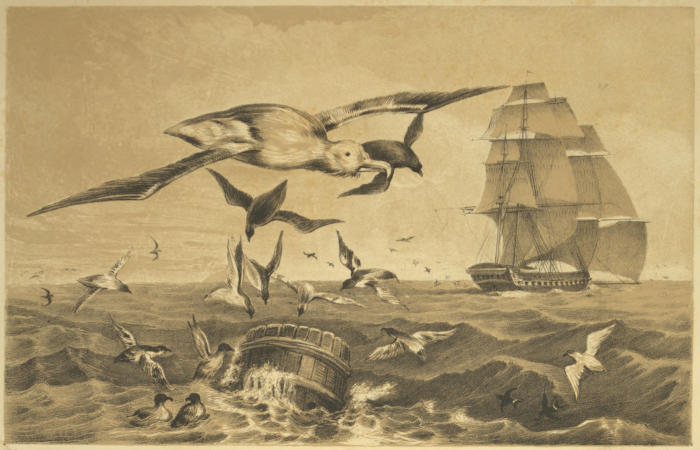
Aug. 16th.—Lat. 27° S., long. 19° W.—The annexed lithograph
is from an original drawing of Colonel Luard’s, and the
following extract from his “Views in India:”—
“This drawing represents the numerous birds that constantly
follow ships from lat. 27° S. to lat. 40° S., constantly hovering
about the ship, and picking up anything eatable which may be
thrown overboard. The pintado, or Cape pigeon, a very pretty
bird, black and white striped all over, is the most numerous.
They fly backwards and forwards across the ship’s wake, in such
numbers and so carelessly, that they are frequently caught by entangling
their wings in lines thrown over the stern of the ship
to catch the albatross. This immense bird is also portrayed in
the drawing, whose astonishing power, fierceness, and fleetness,
render him formidable amongst the feathered tribe of these
regions. There is an instance on record of a man having
fallen overboard from a ship-of-war, when a noble-minded midshipman
instantly jumped overboard, and, from his power as a
swimmer, would probably have rescued the sailor from a watery
grave, had not an albatross passing at the moment stooped upon
the generous youth, and struck him upon the head: he sank to
rise no more! Both he and the sailor were drowned.”
S. LAT: 27°. W. LONG: 19°.
On Stone by Major Parlby. From an Original Drawing by Colˡ Luard.
Aug. 23rd.—There is a ship alongside! a ship bound for
England! it speaks of home and the beloved ones, and although
I am as happy as possible, my heart still turns to those who
have heretofore been all and everything to me, with a warmth
of affection at once delightful and very painful.
Aug. 27th.—Lat. 32° 9′ S., long. 4° 25′ E.—A dead calm!
give me any day a storm and a half in preference! It was so
miserable—a long heavy swell, without a ripple on the waves;
the ship rolled from side to side without advancing one inch;
she groaned in all her timbers: the old ‘Marchioness’ appeared
to suffer and be as miserable as myself. The calm continued
the next day, and the rolling also; the captain kindly
allowed the jolly-boat to be lowered, in which some of the
Lancers and my husband went out shooting.
This day, the 28th of August, was the commencement of the
shooting season: game was in abundance, and they sought it over
the long heavy swell of the glasslike and unrippled sea. The
sportsmen returned with forty head of game: in this number
was an albatross, measuring nine feet from the tip of one wing
to that of the other; a Cape hen, a sea-swallow, with several
pintado and other birds.
When the boat returned, it brought good fortune; the wind
instantly sprang up, and we went on our way rejoicing. This
day a whale was seen at a distance; if it had approached the
vessel, a captain of the Lancers had prepared a Congreve rocket
for its acceptance.
Sept. 1st.—We spoke a Dutchman off the Cape, looking in a
very pitiable condition: the same gale which had damaged
her overtook us, and blew heavily and disagreeably for three
days. The weather was very cold and wet, and we felt disappointed
at not touching at the Cape.
Sept. 10th.—Lat. 36° 43′ S., lon. 45° 30′ W., ther. 64°.—Another
calm, and another battue: the gentlemen returned from
the watery plain with great éclat, bringing seven albatross, thirty
pintados, a Cape hen, and two garnets. One of the albatross,
which was stuffed for me, measured fifty-three inches from head
to tail, and nine feet ten inches across the wings.
Sept. 20th.—In the evening we passed St. Paul’s and Amsterdam,
but the haziness of the weather prevented our seeing them.
This, the most southerly point of our voyage, was also the coldest.
The cold was really painful.
Sept. 23.—A school[10] of twenty or thirty whales passed near
the ship; it was almost a calm; they were constantly on the
surface, frolicking and spouting away. They were, the sailors
said, of the spermaceti order, which are smaller in size, and do
not spout so high as the larger race. I was disappointed.
Two of the officers of the Lancers rowed within ten yards of a
large whale, and fired a Congreve rocket into its body; the
whale gave a spring and dived instantly. The rocket would
explode in a few seconds and kill him: a good prize for the first
ship that falls in with the floating carcase. They fired at
another, but the rocket exploded under water and came up
smoking to the surface. The boat returned safely to the ship,
but it was rather a nervous affair.
Sept. 25th.—Another calm allowed of more shooting, and
great was the slaughter of sea game. I must make an extract
from Colonel Luard’s work, speaking of a battle that took place
on the 10th:—“The Cape hen was a large fierce black bird, and
only having its wing broken, tried to bite every person’s legs in
the boat. When she was placed on the ship’s quarter-deck, a
small terrier belonging to one of the officers attacked her, and
they fought for some time with uncertain advantage; the bloody
streams from the dog proving the severity of the bird’s bite:
at last the terrier seized his adversary by the throat, when the
battle and the bird’s life ended together. In lat. 4° 13′ S., long.
93° 11′ E., the thermometer in the sun standing at 130°, and
in the shade 97°, two small birds, in every respect resembling
the English swallow, came about the ship. One of them was
caught, and died; the other (probably in hopes of rejoining its
companion) remained with the ship fourteen or fifteen days,
frequently coming into the cabins and roosting there during the
night. It was at last missing; and, not being an aquatic bird,
perhaps met a watery death.”
During the time of the battue on the third day, three sharks
were astern; we caught one that had a young one by her side.
When opened on deck, a family of twenty-four were found, each
about twelve or fourteen inches long; the mother measured seven
feet. The shark is said to swallow its young when in peril, and
to disgorge them when the danger has passed. The curious
birds and fish we see relieve the tedium of the voyage.
We now looked impatiently for the end of our passage, and
counted the days like schoolboys expecting their vacation. It
was amusing to hear the various plans the different people on
board intended to pursue on landing—all too English by far for
the climate to which they were bound.
The birds were numerous south of the tropics; we saw few
within them. The flying-fish are never found beyond the tropics.
Oct. 11th.—Lat. 4° 20′ S., long. 93° 11′ E.—The heat was
very great; the vertical sun poured down its sickening rays,
the thermometer in the shade of the coolest cabin 86°; not a
breath of air; we felt severely the sudden change of temperature.
The sails flapped against the mast, and we only made progress
seventeen knots in the twenty-four hours! Thus passed eleven
days—the shower bath kept us alive, and our health was better
than when we quitted England. M. mon mari, who was studying
Persian, began to teach me Hindostanee, which afforded me
much pleasure.
In spite of the calm there was gaiety on board; the band played
delightfully, our fellow-passengers were agreeable, and the calm
evenings allowed of quadrilles and waltzing on the deck, which
was lighted up with lanterns and decorated with flags.
We spoke the ‘Winchelsea,’ which had quitted the Downs
seven days before us and experienced heavy weather off the
Cape: it was some consolation to have been at sea a shorter
time than our companion. But little sickness was on board; a
young private of the Lancers fell overboard, it was supposed,
during a squall, and was lost; he was not even missed until the
next day: a sick Lancer died, and a little child also; they were
buried at sea: the bill of health was uncommonly good. A
burial at sea, when first witnessed, is very solemn and impressive.
We passed an English ship—the Lancer band played “God
save the King,” the vessel answered with three cheers. It was
painful to meet a homeward-bound ship; it reminded me of
home, country, and, dearer still, of friends. The sailors have a
superstition, that sharks always follow a ship when a corpse is
on board: the night after the man fell overboard, the Lancer
and the child died; the day they were buried three sharks were
astern. I thought of the sailors’ superstition; no sharks had
been seen alongside for three weeks. The sunsets on and near
the line are truly magnificent, nothing is more glorious—the
nights are beautiful, no dew, no breeze, the stars shining as
they do on a frosty night at home, and we are gasping for a
breath of air! A sea-snake about a yard and a half long was
caught—many turtle were seen, but they sank the moment the
boat approached them. A subscription lottery was made; the
person whose ticket bears the date of our arrival at Saugor will
win the amount.
Oct. 22nd.—Becalmed for eighteen days! not as when off
the Cape; there it was cool, with a heavy swell, here there is
no motion, the sun vertical, not a breath of air, the heat excessive.
At length a breeze sprang up, and we began to move:
one day during the calm we made seven knots in the twenty-four
hours, and those all the wrong way!
“Day after day, day after day,
We stuck, nor breath nor motion;
As idle as a painted ship
Upon a painted ocean.”
Our voyage advanced very slowly, and the supply of fresh
water becoming scanty, we were all put on short allowance;
any thing but agreeable under so hot a sun. Captain Kay determined
to make the land, and water the ship, and made signals to
our companion, the ‘Winchelsea,’ to that effect.
Oct. 30th.—To our great delight we arrived at, and anchored
off, Carnicobar, one of the Nicobar Islands, lat. 9° 10′ N., long.
92° 56′ E. Boats were immediately sent on shore to a small
village, where the landing was good, and two springs of delicious
water were found for the supply of the ship.
CHAPTER II. CARNICOBAR.
“A HANDSOME SISTER, WITH A MAT FOR A PETTICOAT[11].”
1822, October.—Appearance and Attire of the Islanders—Canoes—Visit to
their Village—Ornaments of the Natives—Departure from the Island—The
Andamans—Anchorage at Saugor—The Hoogly—Arrival in Calcutta.
The island where we landed was covered to the edge of the sand
of the shore with beautiful trees; scarcely an uncovered or open
spot was to be seen. Off the ship the village appeared to
consist of six or eight enormous bee-hives, erected on poles and
surrounded by high trees; among these, the cocoa-nut, to an
English eye, was the most remarkable.
CAR NICOBAR.
On Stone by Major Parlby. From an original drawing by Col.ˡ J. Luard.
The ship was soon surrounded by canoes filled with natives;
two came on board. The ladies hastened on deck, but quickly
scudded away, not a little startled at beholding men like Adam
when he tasted the forbidden fruit: they knew not they were
naked, and they were not ashamed. I returned to my cabin.
The stem of the vessel was soon encircled by canoes filled with
limes, citrons, oranges, cocoa-nuts, plantains, yams, eggs,
chickens, little pigs, and various kinds of fruit. The sight of
these temptations soon overcame my horror at the want of
drapery of the islanders, and I stood at the port bargaining for
what I wished to obtain until the floor was covered. Our
traffic was thus conducted—I held up an empty jam-pot, and
received in return a basket full of citrons; for two empty phials,
a couple of fowls; another couple of fowls were given in
exchange for an empty tin case that held portable soup; the
price of a little pig was sixpence, or an old razor: they were eager
at first for knives, but very capricious in their bargains: the
privates of the Lancers had glutted the market. On my holding
up a clasp-knife, the savage shook his head. I cut off the
brass rings from the window-curtains,—great was the clamour
and eagerness to possess them. On giving a handful to one of
the men, he counted them carefully, and then fitted them on
his fingers. The people selected those they approved, returned
the remainder, and gave me fruit in profusion. Even curtain-rings
soon lost their charm—my eye fell on a basket of shells,
the owner refused by signs all my offers—he wanted some
novelty: at length an irresistible temptation was found—an
officer of the Lancers cut off three of the gay buttons from his
jacket, and offered them to the savage, who handed up the
shells.
“Figurez-vous,” said the Lancer, “the Carnicobarbarian love
of that fellow, matted with straw and leaves from the waist to
the knee, decked with three Lancer buttons suspended round her
neck by a cocoa-nut fibre, and enraptured with the novelty and
beauty of the tout ensemble!!”
The dress, or rather the undress of the men was very simple;
a handkerchief tied round the waist and passed between the
limbs so as to leave the end hanging like a tail: some wore a
stripe of plantain-leaf bound fillet-like round their heads; the
necks of the chiefs were encircled either with silver wire in many
rings, or a necklace of cowries.
One of the canoes which came from a distant part of the
island was the most beautiful and picturesque boat I ever saw;
it contained twenty-one men, was paddled with amazing swiftness,
and gaily decorated. Of the canoes, some were so narrow
that they had bamboo outriggers to prevent their upsetting.
The natives appeared an honest, inoffensive race, and were much
pleased with the strangers. After dinner it was proposed to go
on shore in the cool of the evening: the unmarried ladies
remained on board. I could not resist a run on a savage island,
and longed to see the women, and know how they were treated.
Really the dark colour of the people serves very well as dress, if
you are not determined to be critical. On landing, I was surrounded
by women chattering and staring; one pulled my
bonnet, but above all things they were charmed with my black
silk apron; they greatly admired, and took it in their hands.
They spoke a few words of English, and shook hands with me,
saying, “How do? how do?” and when they wished to purchase
my apron they seized it rather roughly, saying, “You buy? you
buy?” meaning, Will you sell it? they were kind after the mode
Nicobar.
The natives are of low stature, their faces ugly, but good-humoured;
they are beautifully formed, reminding one of ancient
statues; their carriage is perfectly erect. A piece of cloth is tied
round the waists of the women, which reaches to the knee. Some
women were hideous: of one the head was entirely shaved,
excepting where a black lock was left over either ear, of which
the lobes were depressed, stretched out, and cut into long
slips, so that they might be ornamented with bits of coloured
wood that were inserted. She had the elephantiasis, and her
limbs were swollen to the size of her waist. They are
very idle; in fact, there appears no necessity for exertion—fruits
of all sorts grow wild, pigs are plentiful, and poultry
abundant. Tobacco was much esteemed. Silver they prized
very much, and called coin of all sorts and sizes dollars—a sixpence
or a half-crown were dollars. The only apparent use
they have for silver is to beat it out into thick wire, which they
form into spiral rings by twisting it several times round the
finger. Rings are worn on the first and also on the middle
joint of every finger, and on the thumb also. Bracelets formed
after the same fashion wind from the wrist half-way up the arms.
Rings ornament all their toes, and they wear half-a-dozen
anklets. The same silver wire adorns the necks of the more
opulent of the men also. They are copper-coloured, with straight
black hair; their bodies shine from being rubbed with cocoa-nut
oil, which smells very disagreeably. Their huts are particularly
well built. Fancy a great bee-hive beautifully and most carefully
thatched, twelve feet in diameter, raised on poles about five feet
from the ground; to the first story you ascend by a removeable
ladder of bamboo; the floor is of bamboo, and springs under
you in walking; the side opposite the entrance is smoked by
a fire: a ladder leads to the attic, where another elastic floor
completes the habitation. They sit or lie on the ground.
Making baskets appears to be their only manufacture.
From constantly chewing the betel-nut, their teeth are
stained black, with a red tinge, which has a hideous effect. I
picked up some beautiful shells on the shore, and bartered with
the women for their silver wire rings.
The colours of my shawl greatly enchanted Lancour, one of
their chief men; he seized it rather roughly, and pushing three
fowls, tied by the legs, into my face, said, “I present, you
present.” As I refused to agree to the exchange, one of the
officers interfered, and Lancour drew back his hand evidently
disappointed.
The gentlemen went on shore armed in case of accidents;
but the ship being in sight all was safe. I have since heard
that two vessels, which were wrecked on the island some years
afterwards, were plundered, and the crews murdered.
Many of the most beautiful small birds were shot by the
officers. As for foliage, you can imagine nothing more luxuriant
than the trees bending with fruits and flowers. No quadrupeds
were to be seen but dogs and pigs; there are no wild beasts on
the island. They say jackals, alligators, and crabs are numerous:
the natives were anxious the sailors should return to the
ship at night, and as they remained late, the Nicobars came
down armed with a sort of spear; they were cautious of the
strangers, but showed no fear, and told the men to come again
the next day. It must be dangerous for strangers to sleep on
shore at night, on account of the dense fog, so productive of
fever.
The scene was beautiful at sunset; the bright tints in the
sky contrasted with the deep hue of the trees; the shore covered
with men and boats; the bee-hive village, and the novelty of
the whole. Many of the savages adorned with European jackets,
were strutting about the vainest of the vain, charmed with
their new clothing; Lancour was also adorned with a cocked-hat!
The woman who appeared of the most consideration,
perhaps the queen of the island, wore a red cap shaped like a
sugar-loaf, a small square handkerchief tied over one shoulder,
like a monkey mantle, and a piece of blue cloth round her
hips; a necklace of silver wire, with bracelets, anklets, and
rings on the fingers and toes without number. The pigs
proved the most delicate food; they were very small, and
fattened on cocoa-nuts: the poultry was excellent.
The natives make a liquor as intoxicating as gin from the
cocoa-nut tree, by cutting a gash in the bark and collecting the
juice in a cocoa-nut shell, which they suspend below the opening
to receive it; it ferments and is very strong—the taree or
toddy of India.
Little did I think it would ever have been my fate to visit
such an uncivilized island, or to shake hands with such queer
looking men; however, we agreed very well, and they were quite
pleased to be noticed: one man, who made us understand he
was called Lancour, sat down by my side, and smoked in my
face by way of a compliment. They delight in tobacco, which
they roll up in a leaf, and smoke in form of a cigar. I cannot
refrain from writing about these people, being completely island
struck.
It was of importance to the ‘Winchelsea,’ in which there
were a hundred and twenty on the sick list, to procure fruit
and vegetables, as the scurvy had broken out amongst the
crew.
We landed, Oct. 30th, and quitted the island, Nov. 2nd, with
a fair wind: all the passengers on board were in good spirits,
and the ship presented a perfect contrast to the time of the
calm.
Nov. 3rd.—We passed the Andaman Islands, whose inhabitants
are reported to have a fondness for strangers of a nature
different to the Carnicobarbarians,—they are Cannibals!
A steady, pleasant monsoon urged us bravely onwards: a
passing squall caught us, which laid the vessel on her side,
carried away the flying jib, and split the driver into shreds:
the next moment it was quite calm.
7th.—We fell in with the Pilot Schooner, off the Sandheads,
the pilot came on board, bringing Indian newspapers and fresh
news.
10th.—We anchored at Saugor.—Here we bade adieu to our
fellow-passengers, and the old ‘Marchioness of Ely:’ perhaps a
more agreeable voyage was never made, in spite of its duration,
nearly five months.
Our neighbours, in the stern cabin, very excellent people,
and ourselves, no less worthy, hired a decked vessel, and proceeded
up the Hoogly; that night we anchored off Fulta, and
enjoyed fine fresh new milk, &c.; the next tide took us to
Budge-Budge by night, and the following morning we landed at
Chandpaul Ghaut, Calcutta.
The Hoogly is a fine river, but the banks are very low; the
most beautiful part, Garden Reach, we passed during the night.
The first sight of the native fishermen in their little dinghees is
very remarkable. In the cold of the early morning, they wrap
themselves up in folds of linen, and have the appearance of men
risen from the dead. Many boats passed us which looked as if
“By skeleton forms the sails were furled,
And the hand that steered was not of this world.”
13th.—In the course of a few hours after our arrival, a good
house was taken for us, which being sufficiently large to accommodate
our companions, we set up our standards together in
Park-street, Chowringhee, and thus opened our Indian campaign.
CHAPTER III. LIFE IN INDIA. — The Sircar. — The Chŭrŭk Pooja.
“I HAVE SEEN BENGAL: THERE THE TEETH ARE RED AND THE MOUTH IS BLACK[12].”
1822, November.—Calcutta—First Impressions—Style of Indian Houses—Furniture—Mats—Arabs—Departure
of the Marquis of Hastings—Fogs—Christmas-Day—Indian
Servants—The Sircar—Thieves—The Hot Winds—Pankhās—Fire-flies—North-Westers—The
Foliage—Musquitoes—Elephantiasis—Insects—The
Chŭrŭk Pooja—Religious Mendicants.
The four troops of the 16th Lancers, from the ‘Ely,’ disembarked,
and encamped on the glacis of Fort William; the
‘General Hewitt,’ with the remainder of the regiment, did not
arrive until six weeks afterwards, having watered at the Cape.
Calcutta has been styled the City of Palaces, and it well
deserves the name. The Government House stands on the
Maidān, near the river; the city, and St. Andrew’s Church, lie
behind it; to the left is that part called Chowringhee, filled with
beautiful detached houses, surrounded by gardens; the verandahs,
which generally rise from the basement to the highest
story, give, with their pillars, an air of lightness and beauty to
the buildings, and protecting the dwellings from the sun, render
them agreeable for exercise in the rainy season.
The houses are all stuccoed on the outside, and seem as if
built of stone. The rent of unfurnished houses in Chowringhee
is very high; we gave 325 rupees a month for ours, the larger
ones are from 4 to 500 per month.
The style of an Indian house differs altogether from that of
one in England.
The floors are entirely covered with Indian matting, than
which nothing can be cooler or more agreeable. For a few
weeks, in the cold season, fine Persian carpets, or carpets from
Mirzapore are used. The windows and doors are many; the
windows are to the ground, like the French; and, on the outside,
they are also protected by Venetian windows of the same
description. The rooms are large and lofty, and to every sleeping-apartment
a bathing-room is attached. All the rooms open
into one another, with folding-doors, and pankhās are used
during the hot weather. The most beautiful French furniture
was to be bought in Calcutta of M. de Bast, at whose shop
marble tables, fine mirrors, and luxurious couches were in
abundance. Very excellent furniture was also to be had at
the Europe shops, made by native workmen under the superintendence
of European cabinet and furniture makers; and furniture
of an inferior description in the native bazaars.
On arriving in Calcutta, I was charmed with the climate; the
weather was delicious; and nothing could exceed the kindness we
experienced from our friends. I thought India a most delightful
country, and could I have gathered around me the dear ones I
had left in England, my happiness would have been complete.
The number of servants necessary to an establishment in India,
is most surprising to a person fresh from Europe: it appeared
the commencement of ruin. Their wages are not high, and they
find themselves in food; nevertheless, from their number, the
expense is very great.
A very useful but expensive person in an establishment is a
sircar; the man attends every morning early to receive orders,
he then proceeds to the bazaars, or to the Europe shops, and
brings back for inspection and approval, furniture, books,
dresses, or whatever may have been ordered: his profit is a
heavy per centage on all he purchases for the family.
SIRCAR.
فاني پارکس
One morning our sircar, in answer to my having observed that
the articles purchased were highly priced, said, “You are my
father and my mother, and I am your poor little child: I have
only taken two annas in the rupee, dustoorie.”
This man’s language was a strong specimen of Eastern hyperbole:
one day he said to me, “You are my mother, and my
father, and my God!” With great disgust, I reproved him
severely for using such terms, when he explained, “you are my
protector and my support, therefore you are to me as my God.”
The offence was never repeated. The sketch of “the sircar”
is an excellent representation of one in Calcutta: they dress
themselves with the utmost care and most scrupulous neatness
in white muslin, which is worn exactly as represented; and the
turban often consists of twenty-one yards of fine Indian muslin,
by fourteen inches in breadth, most carefully folded and
arranged in small plaits; his reed pen is behind his ear, and
the roll of paper in his hand is in readiness for the orders of the
sāhib. The shoes are of common leather; sometimes they wear
them most elaborately embroidered in gold and silver thread and
coloured beads. All men in India wear mustachoes; they look
on the bare faces of the English with amazement and contempt.
The sircar is an Hindoo, as shown by the opening of the vest on
the right side, and the white dot, the mark of his caste, between
his eyes.
Dustoorie is an absolute tax. The durwān will turn from
the gate the boxwallas, people who bring articles for sale in
boxes, unless he gets dustoorie for admittance. If the sāhib
buy any article, his sirdar-bearer will demand dustoorie. If the
mem sāhiba purchase finery, the ayha must have her dustoorie—which,
of course, is added by the boxwalla to the price the
gentleman is compelled to pay.
Dustoorie is from two to four pice in the rupee; one anna,
or one sixteenth of the rupee is, I imagine, generally taken. But
all these contending interests are abolished, if the sircar purchase
the article: he takes the lion’s share. The servants
hold him in great respect, as he is generally the person who
answers for their characters, and places them in service.
It appeared curious to be surrounded by servants who, with
the exception of the tailor, could not speak one word of English;
and I was forced to learn to speak Hindostanee.
To a griffin, as a new comer is called for the first year, India is
a most interesting country; every thing appears on so vast a
scale, and the novelty is so great.
In December, the climate was so delightful, it rendered the
country preferable to any place under the sun; could it always
have continued the same, I should have advised all people to
flee unto the East.
My husband gave me a beautiful Arab, Azor by name, but as
the Sā’īs always persisted in calling him Aurora, or a Roarer,
we were obliged to change his name to Rajah. I felt very
happy cantering my beautiful high-caste Arab on the race-course
at 6 A.M., or, in the evening, on the well-watered drive in
front of the Government House. Large birds, called adjutants,
stalk about the Maidān in numbers; and on the heads of the lions
that crown the entrance arches to the Government House, you
are sure to see this bird (the hargilla or gigantic crane) in the most
picturesque attitudes, looking as if a part of the building itself.
The arrival of the 16th Lancers, and the approaching departure
of the Governor-general, rendered Calcutta extremely gay.
Dinner parties and fancy balls were numerous; at the latter,
the costumes were excellent and superb.
Dec. 16th.—The Marquis of Hastings gave a ball at the
Government-house, to the gentlemen of the Civil and Military
Services, and the inhabitants of Calcutta; the variety of costume
displayed by Nawābs, Rajahs, Mahrattas, Greeks, Turks,
Armenians, Mussulmāns, and Hindoos, and the gay attire of the
military, rendered it a very interesting spectacle. Going to the
ball was a service of danger, on account of the thickness of one
of those remarkable fogs so common an annoyance during the
cold season at the Presidency. It was impossible to see the
road, although the carriage had lights, and two mashalchees,
with torches in their hands, preceded the horses; but the glare
of the mashals, and the shouts of the men, prevented our meeting
with any accident in the dense cloud by which we were
surrounded.
Palanquins were novel objects; the bearers go at a good rate;
the pace is neither walking nor running, it is the amble of the
biped, in the style of the amble taught the native horses, accompanied
by a grunting noise that enables them to keep time.
Well-trained bearers do not shake the pālkee. Bilees, hackeries,
and khraunchies, came in also for their share of wonder.
So few of the gentry in England can afford to keep riding-horses
for their wives and daughters, that I was surprised, on
my arrival in Calcutta, to see almost every lady on horseback;
and that not on hired hacks, but on their own good steeds.
My astonishment was great one morning, on beholding a lady
galloping away, on a fiery horse, only three weeks after her
confinement. What nerves the woman must have had!
Dec. 16th.—The Civil Service, the military, and the inhabitants
of Calcutta, gave a farewell ball to the Marquis and
Marchioness of Hastings, after which the Governor-general
quitted India.
On Christmas-day the servants adorned the gateways with
hārs, i.e. chaplets, and garlands of fresh flowers. The bearers
and dhobees brought in trays of fruit, cakes, and sweetmeats,
with garlands of flowers upon them, and requested bakhshish,
probably the origin of our Christmas-boxes. We accepted the
sweetmeats, and gave some rupees in return.
They say that, next to the Chinese, the people of India are the
most dexterous thieves in the world; we kept a durwān, or porter
at the gate, two chaukidārs (watchmen), and the compound
(ground surrounding the house) was encompassed by a high
wall.
1823. Jan. 12th.—There was much talking below amongst
the bearers; during the night the shout of the chaukidārs was
frequent, to show they were on the alert; nevertheless, the next
morning a friend, who was staying with us, found that his desk
with gold mohurs and valuables in it, had been carried off from
his room, together with some clothes and his military cloak.
We could not prove the theft, but had reason to believe it
was perpetrated by a khansāmān (head table servant) whom we
had discharged, connived at by the durwān and chaukidārs.
March 20th.—I have now been four months in India, and my
idea of the climate has altered considerably; the hot winds are
blowing; it is very oppressive; if you go out during the day, I
can compare it to nothing but the hot blast you would receive
in your face, were you suddenly to open the door of an oven.
The evenings are cool and refreshing; we drive out late; and
the moonlight evenings at present are beautiful; when darkness
comes on, the fire-flies illuminate the trees, which appear full of
flitting sparks of fire; these little insects are in swarms; they
are very small and ugly, with a light like the glow-worm’s in the
tail, which, as they fly, appears and suddenly disappears: how
beautifully the trees in the adjoining grounds are illuminated at
night, by these little dazzling sparks of fire!
The first sight of a pankhā is a novelty to a griffin. It is a
monstrous fan, a wooden frame covered with cloth, some ten,
twenty, thirty, or more feet long, suspended from the ceiling of
a room, and moved to and fro by a man outside by means of a
rope and pullies, and a hole in the wall through which the rope
passes; the invention is a native one; they are the greatest
luxuries, and are also handsome, some being painted and gilt,
the ropes covered with silk, and so shaped or scooped, as to
admit their vibratory motion without touching the chandeliers,
suspended in the same line with the pankhā, and when at rest,
occupying the space scooped out. In the up country, the pankhā
is always pulled during the night over the chārpāī or bed.
The weather is very uncertain; sometimes very hot, then suddenly
comes a north-wester, blowing open every door in the
house, attended with a deluge of heavy rain, falling straight
down in immense drops: the other evening it was dark as night,
the lightning blazed for a second or two, with the blue sulphureous
light you see represented on the stage; the effect was
beautiful; the forked lightning was remarkably strong; I did
not envy the ships in the bay.
The foliage of the trees, so luxuriously beautiful and so novel,
is to me a source of constant admiration. When we girls used
to laugh at the odd trees on the screens, we wronged the Chinese
in imagining they were the productions of fancy; the whole
nation was never before accused of having had a fanciful idea,
and those trees were copied from nature, as I have found from
seeing the same in my drives and rides around Calcutta. The
country is quite flat, but the foliage very fine and rich. The
idleness of the natives is excessive; for instance, my ayha will
dress me, after which she will go to her house, eat her dinner,
and then returning, will sleep in one corner of my room on the
floor for the whole day. The bearers also do nothing but eat
and sleep, when they are not pulling the pankhās.
Some of the natives are remarkably handsome, but appear far
from being strong men. It is impossible to do with a few
servants, you must have many; their customs and prejudices
are inviolable; a servant will do such and such things, and
nothing more. They are great plagues; much more troublesome
than English servants. I knew not before the oppressive power
of the hot winds, and find myself as listless as any Indian lady
is universally considered to be; I can now excuse, what I before
condemned as indolence and want of energy—so much for
experience. The greatest annoyance are the musquito bites; it
is almost impossible not to scratch them, which causes them to
inflame, and they are then often very difficult to cure: they are
to me much worse than the heat itself; my irritable constitution
cannot endure them.
The elephantiasis is very common amongst the natives, it
causes one or both legs to swell to an enormous size, making
the leg at the ankle as large as it is above the knee; there are
some deplorable objects of this sort, with legs like those of the
elephant—whence the name. Leprosy is very common; we see
lepers continually. The insects are of monstrous growth, such
spiders! and the small-lizards are numerous on the walls of the
rooms, darting out from behind pictures, &c. Curtains are not
used in Calcutta, they would harbour musquitoes, scorpions,
and lizards.
THE CHŬRŬK PŪJĀ
فاني پارکس
The other day, hearing it was a Burra Din, (day of festival in
honour of the goddess Kālee, whose temple is about a mile and a
half from Calcutta,) I drove down in the evening to Kālee Ghaut,
where, had not the novelty of the scene excited my curiosity, disgust
would have made me sick. Thousands of people were on
the road, dressed in all their gayest attire, to do honour to the
festival of the Chŭrŭk Pooja, the swinging by hooks. Amongst the
crowd, the most remarkable objects were several Voiragee mendicants;
their bodies were covered with ashes, their hair clotted with
mud and twisted round their heads; they were naked all but a
shred of cloth. One man had held up both arms over his head
until they had withered and were immoveable, the nails of the
clenched fists had penetrated through the back of the hands, and
came out on the other side like the claws of a bird. To fulfil some
vow to Vishnoo this agony is endured, not as a penance for sin,
but as an act of extraordinary merit. At first the pain must be
great, but it ceases as the arms become benumbed. A man of
this description is reckoned remarkably holy, having perfect dependence
upon God for support, being unable, his arms having
become immoveable, to carry food to his mouth or assist himself.
Two or three other mendicants who were present had
only one withered arm raised above their heads. Some Hindoos
of low caste, either for their sins or for money, had cut three or
four gashes in the muscular part of the arm, and through these
gashes they kept running a sword, dancing violently all the
time to hideous music; others ran bamboos as thick as three
fingers through the holes in the arm, dancing in the same manner.
One man passed a spit up and down through the holes,
another a dagger, and a third had a skewer through his tongue.
A little further on were three swinging posts erected in this
fashion; a post some thirty feet in height was crossed at the
top by a horizontal bamboo, from one end of which a man was
swinging, suspended by a rope, from the other end another rope
was fastened to a horizontal pole below, which was turned by
men running round like horses in a mill. The man swung in a
circle of perhaps thirty feet diameter, supported by four iron
hooks, two through the flesh of his back, and two in that of his
chest, by which, and a small bit of cloth across the breast, he
was entirely supported: he carried a bag in one hand, from
which he threw sweetmeats and flowers to the populace below.
Some men swing with four hooks in the back and four on the
chest without any cloth, eight hooks being considered sufficient
to support the body. The man I saw swinging looked very
wild, from the quantity of opium and bengh he had taken to
deaden the sense of pain. Bengh is an intoxicating liquor,
which is prepared with the leaves of the Gánja plant (Cannabis
Indica).
Hindoos of the lower castes are very fond of this amusement,
accidental deaths occasioned by it are reckoned about three per
cent. Sometimes four men swing together for half an hour;
some in penance for their own sins; some for those of others,
richer men, who reward their deputies and thus do penance by
proxy.
Khraunchies full of nāch girls were there in all their gaily-coloured
dresses and ornaments, as well as a number of respectable
men of good caste.
I was much disgusted, but greatly interested.
Sentries from the Calcutta militia were stationed round the
swings to keep off the crowd.
The men on the mound at the foot of the second swing run
round with the bamboo frame which is connected with the pole,
at the summit of which are the cross bamboos. As they proceed,
the four men above swing merrily on their hooks, scattering
flowers and sweetmeats on the people, and repeating verses
and portions of the shāstrs.
“i.e. A man in debt is always at the mercy of his creditors, as a woman
at her husband’s.”
1823.—Baboo Ramohun Roy—Nāch girls—Children in India—Sickness in the
Fort—The Rains—Vessels for a Voyage on the Ganges—Indian Fever—Arrival
of Lord Amherst—Introduction of Steam-boats on the Hoogly—Interest
of Money in Calcutta—Robberies—Jamh o Deen, Prince of Mysore—The
Doorga Pooja—Images of Clay—the Races—Chinese Screens—The
Dog Crab.
1823, May.—The other evening we went to a party given by
Ramohun Roy, a rich Bengallee baboo; the grounds, which are
extensive, were well illuminated, and excellent fireworks displayed.
In various rooms of the house nāch girls were dancing and
singing. They wear a petticoat measuring, on dit, one hundred
yards in width, of fine white or coloured muslin, trimmed with
deep borders of gold and silver; full satin trousers cover the
feet; the doputta, or large veil, highly embroidered, is worn over
the head, and various ornaments of native jewellery adorn the
person.
They dance, or rather move in a circle, attitudinizing and
making the small brass bells fastened to their ankles sound in
unison with their movements. Several men attended the women,
playing on divers curiously-shaped native instruments.
The style of singing was curious; at times the tones proceeded
finely from their noses; some of the airs were very pretty; one
of the women was Nickee, the Catalani of the East. Indian
jugglers were introduced after supper, who played various tricks,
swallowed swords, and breathed out fire and smoke. One man
stood on his right foot, and putting his left leg behind his back,
hooked his left foot on the top of his right shoulder; just try
the attitude pour passer le temps. The house was very handsomely
furnished, everything in European style, with the exception
of the owner.
The children of Europeans in India have a pale sickly hue,
even when they are in the best of health; very different from
the chubby brats of England.
All the Indian fruits appear very large, and a new comer
thinks them inferior in point of flavour to the European; as for
the far-famed mangoes, I was disgusted with them, all those to
be had at that time in Calcutta being stringy, with a strong taste
of turpentine.
The fort is spacious and handsome, but very hot from the
ramparts that surround it. The 44th Queen’s have lost three
officers by death, nine more have returned to England on sick
certificate, and three hundred of the privates are in hospital;
this in six months! The mortality amongst the privates has
been dreadful, owing, I believe, to the cheapness of spirituous
liquors, and exposure to the sun.
Port or sherry is seldom seen on table, during the hot
weather; Madeira is not much used; Burgundy, Claret, and
light French wines are very rationally preferred.
Where the climate is so oppressive, what are luxuries indeed
at home, are here necessary to health and existence; to walk is
impossible, even the most petty Europe shop-keeper in Calcutta
has his buggy, to enable him to drive out in the cool of
the evening.
June 1st.—This is the first day of the month; the morning
has been very hot, but at this moment the rain is descending,
as if the windows of heaven were again opened to deluge the
earth; the thunder rolls awfully, and the forked lightning
is very vivid. I never heard such peals of thunder in
Europe. No one here appears to think about it; all the
houses have conductors, and as the storm cools the air, it is
always welcomed with pleasure by those on shore.
Our friends who are going to Lucnow have hired their boats,
an absolute fleet! I must describe the vessels.
1st. A very fine sixteen-oared pinnace, containing two excellent
cabins, fitted up with glazed and Venetian windows, pankhās,
and two shower-baths. In this vessel our friend, his
lady, and their infant, will be accommodated.
2dly. A dinghee for the cook, and provisions.
3rdly. An immense baggage boat, containing all their furniture.
4thly. A vessel for the washerman, his wife, and the dogs.
5thly. A large boat with horses. 6thly. A ditto. What a
number of boats for one family! The hire of the pinnace is
twenty rupees a-day, about 2l.; the other boats are also very
expensive. They will be three or four months before they
arrive at Lucnow; they quitted us the 12th of June.
I have now become acquainted with the three seasons in
India; the cold weather, the hot winds, and the rains. The
last have set in; it is quite warm; nevertheless, the rains
descend in torrents for some hours daily: pankhās are still
necessary.
The natives are curious people; my ayha was very ill yesterday,
and in great pain, she would take no medicine unless from
a doctor of her own caste; brandy was prescribed; she would
not take it, said it was very wicked to drink it, that she would
sooner die; therefore I was obliged to leave her to her fate,
and sent her home to her friends; she is a good and honest
servant.
In July, my husband was seized with one of those terrific
Indian fevers, which confined him to his bed about fourteen
days; he got up looking very transparent and ghostlike,
and in a state of great debility, from which he was some time
in recovering. Happily, he was saved from a premature
epitaph.
I had great trouble with the servants, with the exception of
five of them; a speech made by the ayha is worthy of record:—“It
would be a great pity if the sāhib should die, for then—we
should all lose our places!”—symptoms of fine feelings!
Lord Amherst arrived, and we attended a party given to those
over whom he had come to reign.
There is much talk here of a passage to India by steam.
“Cœlum ipsum petimus stultitiâ,” which means, “On veut
prendre la lune par les cornes.” Heaven forefend that I
should find myself in a steam-boat, in a fine rolling sea and
a brisk gale, off the Cape. I should not hesitate to give
the preference to the twelve hundred ton ship. Some of
the old rich Indians, as they are called at home, will have full
opportunity to try its safety before my time is come. We
have, however, established a steam-boat upon the Hoogly,
which goes about four knots against tide; something prodigious
in a river where the tide runs like lightning, and with
tremendous force.
At this time we became anxious for an appointment up the
country, at a cooler and healthier station than Calcutta, far
removed from the damp, low, swampy country of Bengal
Proper.
August 29th.—The Governor-general and Lady Amherst are
great favourites in Calcutta; the latter renders herself particularly
agreeable to her guests at the Government-house. The new
Governor-general is so economical he has discharged a number
of servants, quenched a number of lamps; on dit, he intends to
plant potatoes in the park at Barrackpore; people are so unaccustomed
to anything of the sort in India, that all this European
economy produces considerable surprise.
It happens that in India, as in other places, they have an absurd
custom of demanding a certain portion of the precious
metals in exchange for the necessaries and luxuries of life, to
procure which, if you have them not, you are forced to borrow
from agents, the richest dogs in Calcutta: and why? Because,
forsooth, they merely require now eight per cent, (formerly
ten) added to which, after your debt reaches a certain
amount, they oblige you to ensure your life, and in this ticklish
country the rate of insurance is very high.
In the third place, which to us is the argumentum ad hominem,
many and many are the lives that have been sacrificed,
because poor miserable invalids have been unable from their
debts to leave India. Interest—horrible interest—soon doubles
the original sum, and a man is thus obliged to pay the debt
three or four times over, and after that he may put by a fortune
to support him in his native land.
Do not suppose I am painting; this is the plain fact, of which
almost every month furnishes an example.
A man on first arrival (a griffin) cannot or will not comprehend
that “one and one make eleven[14].”
Sept. 7th.—Since our arrival we have been annoyed with constant
robbery in the house. Seventy rupees were stolen one
day, and now they have carried off about eighteen silver covers
that are used to put over tumblers and wine-glasses to keep out
the flies; in consequence we have discharged our Ooriah bearers,
who we suspect are the thieves, and have taken a set of up
country men.
Oct. 1st.—We have had a singular visitor, Shahzadah Zahangeer
Zaman Jamh o Deen Mahomud, Prince of Mysore, the son
of Tippoo Sāhib, and one of the two hostages.
He resides in a house near us, and sent us word he would honour
us with a visit. The next morning he called, and sat two hours.
He had studied English for twelve months. Seeing a bird in a
cage, he said, “Pretty bird that, little yellow bird, what you
call?”—“A canary bird.” “Yes, canary bird, pretty bird,
make fine noise, they not grow here.” In this style we conversed,
and I thought my visitor would never depart. I was
ignorant of the oriental saying, “Coming is voluntary, but
departing depends upon permission[15];” his politesse made him
remain awaiting my permission for his departure, whilst I was
doubting if the visit would ever terminate. At last he arose, saying,
“I take leave now, come gen soon.” The next day he sent
three decanters full of sweetmeats, very like the hats and caps
that used to be given me in my childish days, mixed with
caraway comfits, and accompanied by this note:—
“Some sweetmeats for Missess ⸺ with respectful thanks
of P. Jamh o Deen.” I suppose my visitor Prince Jamh o
Deen did not understand the difference between compliments
and thanks. I did not comprehend why the sweetmeats had
been sent, until I was informed it was the custom of the natives
to send some little valueless offering after paying a visit, and
that it would be considered an insult to refuse it.
13th.—We went to a nāch at the house of a wealthy Baboo
during the festival of the Doorga Pooja or Dasera, held in
honour of the goddess Doorga. The house was a four-sided
building, leaving an area in the middle; on one side of the area
was the image of the goddess raised on a throne, and some
Brahmins were in attendance on the steps of the platform. This
image has ten arms, in one of her right hands is a spear with
which she pierced a giant, with one of the left she holds the tail
of a serpent, and the hair of the giant, whose breast the serpent
is biting; her other hands are all stretched behind her head, and
are filled with different instruments of war. Against her right
leg leans a lion, and against her left leg the above giant. In
the rooms on one side the area a handsome supper was laid out,
in the European style, supplied by Messrs. Gunter and Hooper,
where ices and French wines were in plenty for the European
guests. In the rooms on the other sides of the square, and in the
area, were groups of nāch women dancing and singing, and crowds
of European and native gentlemen sitting on sofas or on chairs
listening to Hindostanee airs. “The bright half of the month
Aswina, the first of the Hindu lunar year, is peculiarly devoted to
Doorga. The first nine nights are allotted to her decoration; on
the sixth she is awakened; on the seventh she is invited to a
bower formed of the leaves of nine plants, of which the Bilwa[16]
is the chief. The seventh, eighth, and ninth are the great days,
on the last of which the victims are immolated to her honour, and
must be killed by one blow only of a sharp sword or axe.
The next day the goddess is reverently dismissed, and her image
is cast into the river, which finishes the festival of the Dasera.
“On the fifteenth day, that of the full moon, her devotees
pass the night in sports and merriment, and games of various
sorts: it is unlucky to sleep; for on this night the fiend Nicumbha
led his army against Doorga, and Lukshmi, the goddess of
prosperity, descended, promising wealth to those who were
awake[17].”
A short time before this festival, the Sircars employed in Calcutta
generally return home to enjoy a holiday of some weeks.
Immense sums are expended by the wealthy Baboos during
the Doorga Pooja.
Dec. 2nd.—Would you believe that we sit at this time of the
year without pankhās, with closed windows, and our floors carpeted!
In some houses, fires are adopted. We have not yet
come to this, though I occasionally have found it cold enough
to desire one. The mornings are delightful, and the nights so
cold, I sleep under a silk counterpane quilted with cotton, called
a Rezai.
The natives form images in clay; the countenances are
excellent; the eyes, eyelids, and lips move remarkably well;
they are very brittle; they represent servants, fakīrs, and
natives of all castes: the best, perhaps, are to be procured in or
near Calcutta; they are attired according to the fashion of the
country, and cost from eight annas to one rupee each.
We are in the midst of our gaieties, balls, plays, and parties,
agreeably varied. Our first meeting (the races) is held during
this month; for we have our Derby, and Oaks, and Riddlesworth.
The Riddlesworth is with us a very interesting race, all
the riders being gentlemen, and sometimes ten or twelve horses
starting. From the stand, of a clear morning, there is a good
view of the horses during the whole of their course.
We have just received from China two magnificent screens,
of eight panels each; they are exceedingly handsome, and keep
out the glare by day and the air by night: I think I may say
they are magnificent.
Amongst the ornaments of the household, let Crab the terrier
be also mentioned; he is much like unto a tinker’s dog, but is
humorous and good-tempered, plays about, chases cats, and
kills rats, not only in the stable, but house, and serves us in
the place of a parvulus Æneas.
CHAPTER V. RESIDENCE IN CALCUTTA. — THE TOOLSEE.
1824—Advantages and Disadvantages—Interest never sleeps—Barrackpore—Cairipoor—The
Fakir—The Menagerie—Hyena—Change of residence to
Chowringhee road—Mouse and Spotted Deer—Bengallee Goats—Lotteries—Trial
by Rice—The Toolsee—Epidemic Fever—Burmese War—Major Sale—Haileybury—The
Hooqŭ—Dr. Kitchener—Death of Lord Byron—Early
Marriages—Pleasures of the Cold Season—Indian Hospitality—Knack of
Fortune-making lost.
January, 1824.—The advantages of a residence in Calcutta are
these: you are under the eye of the Government, not likely to
be overlooked, and are ready for any appointment falling vacant;
you get the latest news from England, and have the best medical
attendance. On the other hand, you have to pay high house-rent;
the necessary expenses are great; and the temptations to
squander away money in gratifying your fancies more numerous
than in the Mofussil.
A friend, now high in the Civil Service, contracted, on his
arrival here about eighteen years ago, a debt of 15,000 rupees,
about 1500l. or 1800l. Interest was then at twelve per cent.
To give security, he insured his life, which, with his agent’s
commission of one per cent, made the sum total of interest
sixteen per cent. After paying the original debt five times, he
hoped his agents upon the last payment would not suffer the
interest to continue accumulating. He received for answer,
“that interest never slept, it was awake night and day;” and
he is now employed in saving enough to settle the balance.
I wish much that those who exclaim against our extravagances
here, knew how essential to a man’s comfort, to his
quiet, and to his health it is, to have every thing good about
him—a good house, good furniture, good carriages, good horses,
good wine for his friends, good humour; good servants and a
good quantity of them, good credit, and a good appointment:
they would then be less virulent in their philippics against
oriental extravagance.
15th.—The Governor-general has a country residence, with a
fine park, at Barrackpore; during the races the Calcutta world
assemble there: we went over for a week; it was delightful to
be again in the country. Lady Amherst rendered the Government-house
gay with quadrilles and displays of fireworks;
but I most enjoyed a party we made to see the ruins of an
ancient fort, near Cairipoor, belonging to the Rajah of Burdwan,
about five miles from Barrackpore, and thought them beautiful.
The road was very bad, therefore I quitted the buggy and
mounted an elephant for the first time, feeling half-frightened
but very much pleased. I ascended by a ladder placed against
the side of the kneeling elephant; when he rose up, it was like
a house making unto itself legs and walking therewith.
We went straight across the country, over hedges and ditches,
and through the cultivated fields, the elephant with his great
feet crushing down the corn, which certainly did not “rise
elastic from his airy tread.” The fields are divided by ridges
of earth like those in salterns at home; these ridges are narrow,
and in general, to prevent injury to the crops, the mahout guides
the elephant along the ridge: it is curious to observe how firmly
he treads on the narrow raised path.
By the side of the road was a remarkable object:—
“The appearance of a fakir is his petition in itself[18].” In
a small hole in the earth lay a fakir, or religious mendicant;
the fragment of a straw mat was over him, and a bit of
cloth covered his loins. He was very ill and quite helpless, the
most worn emaciated being I ever beheld; he had lain in that
hole day and night for five years, and refused to live in a village;
his only comfort, a small fire of charcoal, was kindled near
his head during the night. Having been forcibly deprived of
the property he possessed in the upper provinces, he came to
Calcutta to seek redress, but being unsuccessful, he had, in
despair, betaken himself to that hole in the earth. An old
woman was kindling the fire; it is a marvel the jackals do not
put an end to his misery. The natives say, “It is his pleasure
to be there, what can we do?” and they pass on with their
usual indifference: the hole was just big enough for his body,
in a cold swampy soil.
There is a menagerie in the park at Barrackpore, in which are
some remarkably fine tigers and Cheetahs. My ayha requested
to be allowed to go with me, particularly wishing to see an hyena.
While she was looking at the beast, I said, “Why did you wish
to see an hyena?” Laughing and crying hysterically, she answered,
“My husband and I were asleep, our child was between
us, an hyena stole the child, and ran off with it to the jungle;
we roused the villagers, who pursued the beast; when they
returned, they brought me half the mangled body of my infant
daughter,—that is why I wished to see an hyena.”
Before we quitted Calcutta, we placed the plate in a large iron
treasure chest. A friend, during his absence from home, having
left his plate in a large oaken chest, clamped with iron, found,
on his return, that the bearers had set fire to the chest to get at
the plate, being unable to open it, and had melted the greater
part of the silver!
It appears as if the plan of communicating with India by
steam-boats will not end in smoke: a very large bonus has
been voted to the first regular company who bring it about, and
the sum is so considerable, that I have no doubt some will be
bold enough to attempt it.
In Calcutta, as in every place, it is difficult to suit yourself
with a residence. Our first house was very ill defended from
the hot winds; the situation of the second we thought low and
swampy, and the cause of fever in our household. My husband
having quitted college, was gazetted to an appointment in Calcutta,
and we again changed our residence for one in Chowringhee
road.
Prince Jamh o Deen, hearing me express a wish to see what
was considered a good nāch, invited me to one. I could not,
however, admire the dancing; some of the airs the women sang
were very pretty.
Calcutta was gay in those days, parties numerous at the
Government-house, and dinners and fancy balls amongst the
inhabitants.
A friend sent me a mouse deer, which I keep in a cage in the
verandah; it is a curious and most delicate little animal, but
not so pretty as the young pet fawns running about the compound
(grounds) with the spotted deer. The cows’ milk generally
sold in Calcutta is poor, that of goats is principally used:
a good Bengallee goat, when in full milk, will give a quart every
morning; they are small-sized, short-legged, and well-bred.
The servants milk the goats near the window of the morning
room, and bring the bowl full and foaming to the breakfast-table.
Feb. 27th.—My husband put into one of the smaller lotteries
in Calcutta, and won thirteen and a half tickets, each worth
100 rupees: he sent them to his agents, with the exception of
one, which he presented to me. My ticket came up a prize
of 5000 rupees. The next day we bought a fine high caste
grey Arab, whom we called Orelio, and a pair of grey Persian
horses.
Feb. 28th.—Trial by Rice.—The other day some friends
dined with us: my husband left his watch on the drawing-room
table when we went to dinner: the watch was stolen, the theft
was immediately discovered, and we sent to the police. The
moonshee assembled all who were present, took down their
names, and appointed that day seven days for a trial by rice,
unless, during the time, the watch should be restored, stolen
property being often replaced from the dread the natives entertain
of the ordeal by rice. On the appointed day the police
moonshee returned, and the servants, whom he had ordered to
appear fasting, were summoned before him, and by his desire
were seated on the ground in a row.
The natives have great faith in the square akbarābādee rupee,
which they prefer to, and use on such occasions in lieu of, the
circular rupee. In the plate entitled “Superstitions of the
Natives,” No. 5, is a representation of this coin.
The moonshee, having soaked 2lbs. weight of rice in cold
water, carefully dried it in the sun: he then weighed rice equal
to the weight of the square rupee in a pair of scales, and, calling
one of the servants to him, made him take a solemn oath that
he had not taken the watch, did not know who had taken it,
where it was, or any thing about it or the person who stole it.
When the oath had been taken, the moonshee put the weighed
rice into the man’s hand to hold during the time every servant
in the room was served in like manner. There were thirty-five
present. When each had taken the oath, and received the rice
in his hand, they all sat down on the ground, and a bit of plantain
leaf was placed before each person. The moonshee then said,—
“Some person or persons amongst you have taken a false
oath; God is in the midst of us; let every man put his portion
of rice into his mouth, and having chewed it, let him spit it out
upon the plantain leaf before him; he who is the thief, or
knows aught concerning the theft, from his mouth it shall come
forth as dry as it was put in; from the mouths of those who
are innocent, it will come forth wet and well chewed.”
Every man chewed his rice, and spat it out like so much milk
and water, with the exception of three persons, from whose
months it came forth as dry and as fine as powder. Of these men,
one had secreted two-thirds of the rice, hoping to chew the
smaller quantity, but all to no purpose; it came perfectly dry
from his mouth, from the effect of fear, although it was ground
to dust. The moonshee said, “Those are the guilty men,
one of them will probably inform against the others;” and he
carried them off to the police. It is a fact, that a person under
great alarm will find it utterly impossible to chew and put forth
rice in a moistened state, whilst one who fears not will find it
as impossible to chew and to spit it out perfectly dry and
ground to dust. An harkāra, in the service of one of our
guests, was one of the men whom the moonshee pronounced
guilty; about a fortnight before, a silver saucepan had been
stolen from his master’s house, by one of his own servants.
Against another, one of our own men, we have gained some
very suspicious intelligence, and although we never expect the
watch to be restored, we shall get rid of the thieves. So much
for the ordeal by rice, in which I have firm faith.
May 4th.—The weather is tremendously hot. A gentleman
came in yesterday, and said, “this room is delightful, it is
cold as a well;” we have discovered, however, that it is infested
below with rats and musk-rats, three or four of which my little
Scotch terrier kills daily; the latter make him foam at the
mouth with disgust. My little dog Crab, you are the most
delightful Scotch terrier that ever came to seek his fortune in
the East!
Some friends have sent to us for garden-seeds. But, oh!
observe how nature is degenerated in this country—they have
sent alone for vegetable-seeds—the feast of roses being here
thought inferior to the feast of marrowfat peas!
An European in Calcutta sees very little of the religious ceremonies
of the Hindoos. Among the most remarkable is the
worship of the toolsee, in honour of a religious female, who
requested Vishnoo to allow her to become his wife. Lukshmee,
the goddess of beauty, and wife of Vishnoo, cursed the woman
on account of the pious request she had preferred to her lord,
and changed her into a toolsee plant. Vishnoo, influenced by
his own feelings, and in consideration of the religious austerities
long practised by the enamoured devotee, made her a promise
that he would assume the form of the shalgramŭ, and always
continue with her. The Hindoos, therefore, keep one leaf of
the toolsee under and another upon the shalgramŭ.—See Fig. 5,
in the plate entitled “The Thug’s Dice.”
“The sweet basil is known by its two leaves[19].” Throughout
a certain month they suspend a lota (earthen vessel) over
the toolsee filled with water, and let the water drop upon it
through a small hole. The Hindoo, in the sketch “Pooja of
the Toolsee,” is engaged in this worship, perhaps reading the
Purana, in which a fable relates the metamorphosis of the
nymph Toolsee into the shrub which has since borne her name.
The whole plant has a purplish hue approaching to black, and
thence, perhaps, like the large black bee of this country, it is
held sacred to Krishna, in whose person Vishnoo himself appeared
on earth.
PŪJA OF THE TULSĪ.
فاني پارکس
The Hindoos venerate three kinds of toolsee—the kala (ocimum
sanctum), purple-stalked basil; the small-leaved toolsee; and the
suffaid toolsee, white basil or Indian tea. The leaves of the
latter are used by those in India who cannot afford the tea of
China; they are highly aromatic. The Hindoos have faith in
their power to cure diseases, and use them with incantations to
dispel the poison of serpents.
This plant is held in estimation by the Mussulmāns as well as
the Hindoos. It is recorded of the prophet that he said:
“Hásan and Húsain are the best young princes of paradise.
Verily, Hásan and Húsain are my two sweet basils in the world.”
At Benares I saw, on the side of the Ganges, a number of
pillars hollowed at the top, in which the Hindoos had deposited
earth and had planted the toolsee; some devotees were walking
round these pillars, pouring water on the sacred plant and
making sālām. My bearers at Prag had a toolsee in front of
their house, under a peepul tree; I have seen them continually
make the altar of earth on which it was placed perfectly clean
around it with water and cow-dung; and of an evening they
lighted a little chirāgh (small lamp) before it. If one of these
sacred plants die, it is committed in due form to Gunga-jee: and
when a person is brought to die by the side of the sacred river,
a branch of the toolsee, the shrub goddess, is planted near the
dying man’s head.
The shalgramŭ is black, hollow, and nearly round; it is found
in the Gunduk river, and is considered a representation of
Vishnoo; each should have twenty-one marks upon it, similar
to those on his body. The shalgramŭ is the only stone which is
naturally divine; all the other stones worshipped are rendered
sacred by incantations.
A pan of water is suspended over this stone during the hottest
month in the year, exactly in the same manner as over the
toolsee in the sketch; and during the same month another pan
is placed under the stone, in which the water is caught, and
drunk in the evening as sanctified.
Ward mentions that some persons, when ill, employ a Brahmin
to present single leaves of the toolsee sprinkled with red powder
to the shalgramŭ, repeating incantations. A hundred thousand
leaves are sometimes presented. It is said that the sick gradually
recover as each additional leaf is offered. When a
Hindoo is at the point of death, a Brahmin shows him the
marks of the shalgramŭ, of which the sight is supposed to insure
the soul a safe passage to the heaven of Vishnoo. When an
Hindoo takes an oath, he places a sprig of toolsee on a brass
lota, filled with the sacred water of the Ganges, and swears by
Gunga-jee[20]. If a small part of the pebble god be broken, it is
committed to the river. I bought several of these stones from
a Brahmin at the great Mela at Prag. I gave two old Delhi gold
mohurs to a native jeweller, to make into an ornament for the
forehead after a native pattern. My jemmadār took the mohurs,
and, rubbing them on a shalgramŭ, gave it to me to keep, in
order to compare the purity of the gold on its return when
fashioned, with that of the red gold I had given the man to melt.
In making fine jewellery the natives put one-fourth alloy; they
cannot work gold so impure as that used by English jewellers,
and contemptuously compare it to copper.
In the plate entitled “The Thug’s Dice,” Fig. 6 represents
the shalgramŭ, shalgram, or salagrama; it is a small heavy
black circular stone, rather flattened on one side, with the cornu
Ammonis strongly marked upon it.
Fig. 5 is one covered by the leaves of the kala toolsee,
purple-stalked basil.
No. 7 is still heavier, perfectly black and smooth, without
any marks. This was the touchstone, and a little gold still
remaining upon it.
“Gold is known by the touchstone, and a man by living
with him[21].”
“Some salagrams are perforated in one or more places by
worms, or, as the Hindoos believe, by Vishnŭ in the shape of a
reptile; some are supposed to represent his gracious incarnation,
but when they border a little in colour on the violet they denote
a vindictive avatār, such as Narasinga, when no man of ordinary
nerve dares keep them in his house. The possessor of a salagrama
preserves it in clean cloth; it is frequently perfumed
and bathed; and the water thereby acquiring virtue, is drunk,
and prized for its sin-expelling property.”
The shalgrams, which are in my possession, are of exactly the
shape and size represented in the sketch.
July 17th.—On this day, having discovered a young friend ill
in the Writer’s Buildings, we brought him to our house. Two
days afterwards I was seized with the fever, from which I did
not recover for thirteen days. My husband nursed me with
great care, until he fell ill himself, and eleven of our servants
were laid up with the same disorder.
The people in Calcutta have all had it; I suppose, out of
the whole population, European and native, not two hundred
persons have escaped; and what is singular, it has not occasioned
one death amongst the adult. I was so well and strong—over
night we were talking of the best means of escaping the
epidemic—in the morning it came and remained thirty-six
hours, then quitted me; a strong eruption came out, like the
measles, and left me weak and thin. My husband’s fever left
him in thirty-six hours, but he was unable to quit the house
for nine days: the rash was the same. Some faces were
covered with spots like those on a leopard’s skin. It was so
prevalent, that the Courts of Justice, the Custom House, the
Lottery Office, and almost every public department in Calcutta,
were closed in consequence of the sickness. In the course of
three days, three different physicians attended me, one after the
other having fallen ill. It is wonderful, that a fever producing
so much pain in the head and limbs, leaving the patient
weak, reduced, and covered with a violent eruption, should
have been so harmless; after three weeks, nobody appeared to
have suffered, with the exception of two or three children,
whom it attacked more violently than it did grown-up people,
and carried them off.
The politicians at home have anticipated us in reckoning
upon the probability of a Burmese war. We have hitherto
been altogether successful. I saw yesterday a gold and a silver
sword, and a very murderous looking weapon resembling a
butcher’s knife, but on a larger scale. A necklace (so called
from its circling the neck, for it was composed of plates of gold
hammered on a silken string), and some little squab images,
gods, perhaps, taken from a chief, whom Major Sale of H. M.
13th, dispatched in an attack upon a stockade, leaving the chief
in exchange part of the blade of his own sword, which was
broken in his skull by the force of the blow that felled him.
It is an unlucky business: the Company certainly do not
require at present more territory on that side India, and
the expense to which Government is put by this elegant little
mill, as Pierce Egan might call it, is more than the worthies in
Leadenhall-street suppose.
I see Lord Hastings is made Civil Governor of Malta! “To
what base uses we may return!” I observe the motion to
prevent the necessity of parents sending their sons to Haileybury
has been lost. The grand object of the students should
be the acquisition of the oriental languages; here nothing else
tells.
If a young man gets out of college in three or four months
after his arrival, which, if he crams at college in England, he
may easily effect, he is considered forthwith as a brilliant
character, and is sealed with the seal of genius. Likewise
pockets medals and money, and this he may do without knowing
any thing else.
To a person fresh from England, the number of servants
attending at table is remarkable. We had only a small party of
eight to dinner yesterday, including ourselves; three-and-twenty
servants were in attendance! Each gentleman takes his own
servant or servants, in number from one to six, and each lady
her attendant or attendants, as it pleases her fancy. The Hooqŭ
was very commonly smoked at that time in Calcutta: before
dinner was finished, every man’s pipe was behind his chair.
The tobacco was generally so well prepared, that the odour was
not unpleasant, unless by chance you sat next to a man from
the Mofussil, when the fume of the spices used by the up
country Hooqŭ Bardārs in preparing the tobacco, rendered it
oppressive and disagreeable.
Sept. 1st.—The fever has quitted Calcutta, and travelled up
the country stage by stage. It was amusing to see, upon your
return to the Course, the whole of the company stamped, like
yourself, with the marks of the leech upon the temples. Its
origin has been attributed to many causes, and it has been called
by many names. The gentlemen of the lancet are greatly divided
in their opinions; some attribute it to the want of rain, others
to the scarcity of thunder and lightning this season. There was
an instance of the same general fever prevailing in the time of
Warren Hastings. Not a single instance has been heard of its
having proved mortal to adults.
Extract from a homeward-bound epistle.
“The cold season is fast approaching, when every one becomes,
per force, most amiable. Indeed we are all creatures of
a different order during this delightful time. You in England
cannot fancy the sensible feeling of actual enjoyment our bodies
and minds experience from this exhilarating change. We live
upon the thought of it for months; it must beat the snake casting
his skin. I feel quite invigorated even at describing its effects.
“We both continue excellently well, and persist in defying
the foul cholera and all other tropical maladies. The hot season
has passed, and the rains are setting in, rendering the air more
temperate. We now occasionally enjoy a cool fresh breeze. A
few days since I felt gay enough to fetch a walk in the evening,
and got well ducked for my reward; also an appetite for dinner.
Apropos, I rejoice to see that feeding is assuming the high place
among the sciences which was always its legitimate right.
‘Oh Dick! you may talk of your writing and reading,
Your logic and Greek, but there’s nothing like feeding.’
Dr. Kitchener has borrowed the most erudite and savoury parts
of his two books from the ‘Almanach des Gourmands,’ a work
well worthy of being placed in the hands of the rising generation
as a standard book; I am sure it would be a perfect Kurān for
an English lady. But, alas! in this savage place, dindon aux
truffes, omelette soufflée, vol au vent à la financière, coquille de
volaille, pâté de Strasbourg, exist but in name. The thousand
temptations which fascinate the eye and distract the choice in a
French carte à dîner, rarely, very rarely appear. The beef of
to-day succeeds to the mutton of yesterday; none of those
‘coruscations of genius, breaking like lightning from a cloud,’
which must now so frequently illumine the horizon of the London
mahogany. But all is tame and unvaried, and man remains
here comparatively dead to one of the noblest ends of his creation.
I endeavour to struggle against this lifeless life by anticipating
the time when I shall return to Europe, at the proper
gourmand age of forty-five, with a taste corrected by experience,
and a mouth open as day to melting delicacies.
“Oct.—We have heard with sorrow of the death of Lord
Byron; the other evening, as we were driving past a Greek chapel
on the banks of the Hoogly, prayers were being offered for the
repose of the soul of the departed. We cannot join with the
yelpers who cry him down on the score of his immorality; the
seed he sowed must have fallen upon a soil villainously bad to
have brought forth nothing but an unprofitable harvest. Mr.
Hunt is publishing a translation of a work capable of producing
more evil than any of his lordship’s—Voltaire’s ‘Dictionnaire
Philosophique’ to wit. What is the correct story about the
Memoirs? Are we to believe the papers?
“The cold weather has now begun. We have weddings and
rumours of weddings. The precipitate manner in which young
people woo and wed is almost ridiculous; the whole affair, in
many cases, taking less than a month. Many young gentlemen
become papas before they have lawfully passed their years
of infancy. Marrying and giving in marriage is, in this country,
sharp, short, and decisive; and where our habits are necessarily
so domestic, it is wonderful how happily the people live together
afterwards.
“Dec.—The races are beginning, the theatre in high force,
fancy-dress balls and dinner-parties on the tapis, water-parties
to the botanical gardens, and I know not what. My beautiful
Arab carries me delightfully; dove-like, but full of fire.
“We shake off dull sloth, rise early, and defy the foul fiend.
Many a nail is extracted, by this delightful weather, from our
coffins. Calcutta opens her palaces, and displays hospitality,
after a fashion which far outdoes that of you cold calculating
islanders. And there is such a variety in our pastimes, and the
season is so short,—about four months,—that we have no time
to ‘fall asleep in the sameness of splendour.’
“We were glad to hear our friend would not come out to India.
It is a pity that men like him should be sacrificed—and for
what? To procure a bare subsistence; for the knack of fortune-getting
has been long since lost. Show me the man in these
latter days who has made one,—always provided he be no auctioneer,
agent, or other species of leech,—and we will sit down
and soberly endeavour to make one for ourselves.
“A merry Christmas to you, dear friends; may you find it as
great a restorer as we favourites of the sun and minions of the
tropics!”
CHAPTER VI. RESIDENCE IN CALCUTTA.
1825.—A Day in March—The Furlough and Pension Funds—Bandicote Rats—The
Strand—The Cutting System—Harrow-on-the-Hill—Sickness in Arracan—The
Golden Feet—Arrival of Lord Combermere—Bhurtpore—La Pucelle—Marsh
Fever—Change of Residence to Middleton Row, Chowringhee—Fogs
up to the Second Story—Burrā Bazār—Seed Pearl.
January, 1825.—The cold weather is delightful, and a Persian
carpet pleasant over the Indian matting, but a fire is not
required—indeed, few houses in Calcutta have a fire-place. Ice
is sent from Hoogly, and is procurable in the bazaar during the
cold weather; it is preserved in pits for the hot season.
March 23rd.—I will describe a day at this time of the year.
At 6 A.M. it is so cold that a good gallop in a cloth habit will
just keep you warm. At 9 A.M.—a fine breeze—very pleasant—windows
open—no pankhā.
3 P.M.—Blue linen blinds lowered to keep off the glare of the
sunshine, which is distressing to the eyes; every Venetian shut,
the pankhā in full swing, the very musquitoes asleep on the
walls, yourself asleep on a sofa, not a breath of air—a dead
silence around you.
4 P.M.—A heavy thunder-storm, with the rain descending in
torrents; you stop the pankhā, rejoice in the fraîcheur, and are
only prevented from taking a walk in the grounds by the falling
rain.
5 P.M.—You mount your Arab, and enjoy the coolness for
the remainder of the day;—such is to-day.
April 11th.—The hot winds are blowing for the first time
this year.
We understand that after twenty-five years’ service, and twenty-two
of actual residence in India, we of the Civil Service are to
retire upon an annuity of 1000l. a year, for which we are to pay
50,000 rupees, or about 5000l. This, on first appearance, looks
well for us and generous in the Company; but I should like
first to know, how many will be able to serve their full time of
bondage? secondly, what the life of a man, an annuitant, is
then worth, who has lingered two and twenty years in a tropical
climate?
May 9th.—The heat is intense—very oppressive. I dare not
go to church for fear of its bringing on fits, which might disturb
the congregation; you have little idea of the heat of a collection
of many assembled in such a climate—even at home, with all
appliances and means to boot for reducing the temperature, the
heat is sickening. You in England imagine a lady in India has
nothing to do. For myself, I superintend the household, and
find it difficult at times to write even letters, there is so much to
which it is necessary to attend. At this moment I would willingly
be quiet, but am continually interrupted. The coachman,
making his salām, “Mem sāhiba, Atlas is very ill, I cannot
wait for the sāhib’s return; I have brought the horse to the
door, will you give your orders?” The durwān (gate-keeper),
“Mem Sāhiba, the deer have jumped over the wall, and have
run away.” The sirdar-bearer, “Mem sāhiba, will you advance
me some rupees to make a great feast? My wife is dead.”
The mate-bearer then presented his petition, “Will the mem
sāhiba give me a plaister? the rats have gnawed my fingers and
toes.” It is a fact that the lower part of the house is overrun
with enormous rats, they bite the fingers and feet of the men
when they are asleep on the ground.
The other evening I was with my beautiful and charming
friend, Mrs. F⸺, she had put her infant on a mat, where it
was quietly sleeping in the room where we were sitting. The
evening darkened, a sharp cry from the child startled us—a
bandicote rat had bitten one of its little feet!
It is reported the Burmese war is nearly finished. I hope it
may be true; it is a horrible sacrifice of human life, a war in
such a climate! I hear much of all the hardships of fighting
against the climate endured by the military, from friends who
return to Calcutta on sick leave.
When we arrived in Calcutta the only drive was on the
Course, which was well-watered; a fine broad road has since
been made along the side of the river, about two miles in length;
it is a delightful drive in the evening, close to the ships.
The Course is deserted for the Strand.
June 25th.—The Furlough and Pension Fund for the Civil
Service has been established; we subscribe four per cent. from
our salary, for which we are allowed by Government six per cent.
interest, towards the purchase of an annuity of 1000l. after
twenty-five years service. A very strong inducement this to
economy—yet human nature is very contrary.
“J’avois juré d’être sage,
Mais avant peu j’en fus las.
Ah! raison, c’est bien dommage,
Que l’ennui suive tes pas.”
Nevertheless, we will return home as soon as we can.
Our friend Mr. C⸺ is going down to Bulloah, a savage
spot, where he is to make salt; he takes down three couple of
hounds to assist him in his labours.
Provided there is a good bulky dividend at the end of the
year upon India Stock, the holders think the country flourishing
in the greatest security. Every governor who is sent out is
told that the principal thing to be considered is economy. Lord
Moira, who had a becoming horror of such petitesses, and who
saw the political danger of carrying the cutting system into
practice, in several instances refused to adopt the measures he
was intrusted to execute. Yet India was never in a more flourishing
state; dividends on India Stock never looked up more cheerfully.
Lord Amherst has applied the paring-knife, and much
good it has done;—the military ran riot[22], the civilians were
inclined to grow rusty, and India Bonds were very dismal and
looking down.
A letter appeared in the Gazette the other day, in which the
Harrow boys were spoken of in an irreverend manner, which
elicited the following answer from the sāhib[23]:—
“To the Editor of the Government Gazette.
“June, 1825.
“Sir,
“In one of your late papers I was much amused by a report
of the proceedings of a ‘Morning at Bow Street,’ during which
the behaviour of the Harrow boys was brought to the notice of
that worthy magistrate, Sir R. Birnie. To suppose that these
young gentlemen are accustomed to parade the streets with
sticks charged with lead, searching for snobs with heads to correspond,
and carrying pistols loaded with the same metal in their
pockets to confer the coup-de-grâce upon these unfortunates,
would be to believe, what
‘Nec pueri credant, nisi qui nondum ære lavantur.’
Excuse Latin, the English proverb is somewhat coarse.
“I recollect the operative artisan Jones: he succeeded an
excellent farrier, who emigrated with Sir Bellingham Graham,
one of our worthies. Unless Jones had in the first instance
made himself obnoxious to the boys, which from W. L.’s account
is more than possible, they would not have interfered with him.
The whole account I know to be sadly exaggerated; you are,
perhaps, an advocate for the publicity of these reports, so should
I be, were they not for the most part so outrageously surchargés.
The ‘Gentlemen of the Press’ think truth needs the
aid of foreign ornament, for in this particular instance neither
pistols nor sticks, loaded or unloaded, were seen, or afterwards
discovered to have been in the possession of the boys, but were
gratuitously conferred upon them by the reporters.
“Shall such fellows as these be allowed to bespatter an institution
which reckons Sir William Jones, Lord Byron, Parr, and
others ‘dear to memory and to fame,’ among her mighty dead—and
Lord Teignmouth, the Marquis of Hastings, Messrs. Peel,
Barry Cornwall, and myself, among her mighty living[24]?
“You will, I know, excuse me. I am by nature modest,
even as an American, but having been hitherto particular as to
my society, if I am to be damned to everlasting fame, it must
be in good company!
“We are so few and far between in this country, that we
cannot form a corps to show our esprit, yet even in this wilderness
will I upraise my solitary voice in praise of Harrow-on-the-Hill.—Floreat
in æternum!—Hoping that I have said enough
‘to Harrow up your soul,’
“I am, your’s,
“One of the Old School.”
“Jungle Mehals.”
August 6th.—The natives, especially the Hindūs, are dying
by hundreds daily in the damp and marshy part of Calcutta;
410 died in one night of cholera and fever, both of which
are raging fearfully. They sleep in such swampy places, in
the open air, it is only surprising they are not all carried off.
Last month a fever amongst the Europeans was universal, many
died of it; it has disappeared, and Calcutta is tolerably healthy;
the cholera has not attacked the Europeans.
September 18th.—We now consider ourselves fairly fixed in
Calcutta; the climate agrees with us; and though we hold
existence upon a frailer tenure than those in England, we still
hope to see many happy years.
“’Tis in vain to complain, in a melancholy strain,
Of the money we have spent, which will never come again.”
Furlough and the pension must make amends.
The cold season is the only time in which we live, and
breathe, and have our being, the rest of the year is mere
“leather and prunella,” and we “groan and sweat under a
weary life.”
But then in Calcutta, we do not die of the blue devils, ennui,
or from want of medical attendance, as those do who are far
removed; and even the maladie du pays is relieved by the constant
letters and news we receive from our native land.
The Burmese seem to have adopted the plan of the Russians,
and left their infernal climate to fight their battles; it has done
it most wofully—fever has killed more men than the sword.
Our troops are now waiting for the breaking up of the rains, to
recommence operations. It is supposed that they will meet with
little difficulty in making their way to Amrapūrā, the capital;
but if they do, it seems that the king and his court will not wait
for their arrival, but start with their valuables to the mountains.
There has been a sad waste of life and money. Commissioners
have now been appointed. Report says that Sir Archibald
Campbell’s spirit is too bellicose; and the deputation (civil) to
Rangoon is to check his warlike excesses. The company profess
that they do not wish for an extent of territory; so that the
present war has been entered into solely for the purpose of
avenging the insults that have been offered to their arms. I wish
most sincerely that they had been contented with holding what
they had, instead of proclaiming war; and probably they may
be of the same opinion. The papers say that a truce has been
entered into with the Burmese, for the purposes of negotiation.
Within these few days we have heard that it has been prolonged,
in order that our terms might be submitted to the Golden Feet.
It is to be hoped that they will not trample upon them, and that
this most detestable war, which has cost so many lives and so
much money, may be honourably concluded.
Lord Combermere has determined to proceed immediately to
the Upper Provinces, and to have a fling at Bhurtpore. There
is no doubt as to the event being successful, but the natives
have a great conceit about it; it is another Pucelle, as it has
never yet been taken. In Lord Lake’s time, our troops were
three times repulsed; but that is a tale of the times of old, when
these matters were conducted on too small a scale. Now there
is to be a fine park of artillery, fully capable of making an impression
on the heart of this obdurate maiden. It will do much
service in taking the conceit out of these people. They have
songs, and even caricatures, in which Europeans are drawn as
craving for mercy under their victorious swords, to the number
of three or four to one Mahratta horseman. It is an old grudge,
and our sipahīs fancy the affair hugely. We took Bhurtpore
last night over the whist-table, by a coup de main; I trust we
shall be able to play our cards as well when before it. This will
be of a different nature altogether from the vile Burmese war.
Those who fall will die nobly in battle, not by the host of diseases
by which our poor fellows have been sacrificed at Rangoon
and Arracan.
The early marriages which take place in India were brought
under my eye this morning. My ayha being ill, sent another to
act for her during her absence; she is a pretty little woman,
aged twenty-five, and has been married fourteen years!
The sickness in Arracan is dreadful; ship-loads of officers
and men are arriving daily, with shaved heads and white faces,
bearing testimony of the marsh fever, considering themselves
most fortunate in having quitted the country alive.
Imagine living in a straw-shed, exposed to the burning sun
and the torrents of rain that fall in this country; the nights
cold, raw, and wet; the fog arising from the marshes spreading
fever in every direction. Where the sword kills one, the climate
carries off an hundred.
Oct.—Lord Combermere intends to render the cold weather
gay with balls and dinner parties. His staff are quite a relief to
the eye, looking so well dressed, so fresh and European. They
express themselves horrified at beholding the fishy hue of the
faces on the Course; wonder how they are ever to stay at home
during the heat of the day, and sigh for gaiety and variety.
Speaking of the ladies in the East, one of them said, “Amongst
the womankind, there are some few worth the trouble of running
away with; but then the exertion would be too much for the
hot season; and in the cold, we shall have something else to
think about!”
Dec. 1st.—We changed our residence for one in Middleton-row,
Chowringhee, having taken a dislike to the house in which
we were residing, from its vicinity to tanks and native huts.
The house has a good ground floor and two stories above,
with verandahs to each; the rent 325 rupees per month; the
third story consists of bed-rooms. The deep fogs in Calcutta
rise thick and heavy as high as the first floor; from the
verandah of the second you may look down on the white fog
below your feet, whilst the stars are bright above, and the
atmosphere clear around you. The spotted deer play about the
compound, and the mouse deer runs about my dressing-room,
doing infinite mischief.
The Barā bazār, the great mart where shawls are bought, is
worth visiting. It is also interesting to watch the dexterity
with which seed pearls are bored by the natives. This operation
being one of difficulty, they tell me seed pearls are sent from
England to be pierced in Calcutta.
CHAPTER VII. DEPARTURE FROM THE PRESIDENCY.
Fulbertus Sagittarius—Billiards—The Recall of Lord Amherst—Zenāna of an
opulent Hindū—The Death of Bishop Heber—Affliction in the Family of
the Governor-General—Appointment to Allahabad—Sale of ‘Scamp’—March
up the Country—Dāk Bungalows—Fakīrs en route—The Soane
River—Sassaram—Satīs at Nobutpoor—Benares—Pūjā in a Hindū Temple—Brāhmanī
Bulls—The Minarets—Beetle Wings—Hindū House—Benares
Hackeries—Dāk to Allahabad—Visit to Papamhow.
1826.—Lady Amherst is on horseback at gun-fire; few young
women could endure the exercise she takes. She is an admirable
equestrian, and possesses all the fondness of an Archer for
horses. Her ladyship has won my heart by expressing her
admiration of my beautiful Arab. His name originally was
Orelio; but having become such a frisky fool, he has been rechristened
‘Scamp.’
On the death of Lord Archer, in 1778, she “who knew and
loved his virtues,” inscribed the following sentence on his tomb:
“He was the last male descendant of an ancient and honourable
family that came over with William the Conqueror, and settled
in the county of Warwick in the reign of King Henry the Second,
from whom his ancestors obtained the grants of land in the said
county.”
When it was recorded on his monument at Tanworth that
Lord Archer was the last of the male branch of the Archers who
came over with the Conqueror, little did Lady Amherst (then
the Hon. Miss Archer) imagine that, in her future Indian
career, she would cross the path of the poor Pilgrim, the child
of one of the noblest and best of men, who through Humphrey
Archer, deceased 1562, is a direct descendant, in the male line,
from our common ancestor, Fulbertus Sagittarius[25].
March.—Lord Amherst has been recalled, a circumstance we
regret. He has had great difficulties to contend with since his
arrival; and now, just at the moment his troubles are nearly
ended, he has been recalled. I believe his lordship signified to
the Home Government his wish to resign.
In a climate so oppressive as this, billiards are a great resource
in a private house; the table keeps one from going to sleep
during the heat of the day, or from visiting Europe shops.
April 17th.—The perusal of Lady Mary Wortley Montague’s
work has rendered me very anxious to visit a zenāna, and to
become acquainted with the ladies of the East. I have now been
nearly four years in India, and have never beheld any women
but those in attendance as servants in European families, the
low caste wives of petty shopkeepers, and nāch women.
I was invited to a nāch at the house of an opulent Hindū
in Calcutta, and was much amused with an excellent set of
jugglers; their feats with swords were curious: at the conclusion,
the baboo asked me if I should like to visit his wives
and female relatives. He led me before a large curtain, which
having passed I found myself in almost utter darkness: two
females took hold of my hands and led me up a long flight of
stairs to a well-lighted room, where I was received by the wives
and relatives. Two of the ladies were pretty; on beholding
their attire I was no longer surprised that no other men than
their husbands were permitted to enter the zenāna. The dress
consisted of one long strip of Benares gauze of thin texture,
with a gold border, passing twice round the limbs, with the end
thrown over the shoulder. The dress was rather transparent,
almost useless as a veil: their necks and arms were covered
with jewels. The complexion of some of the ladies was of a
pale mahogany, and some of the female attendants were of a
very dark colour, almost black. Passing from the lighted room,
we entered a dark balcony, in front of which were fine bamboo
screens, impervious to the eye from without, but from the
interior we could look down upon the guests in the hall below,
and distinguish perfectly all that passed. The ladies of the
zenāna appeared to know all the gentlemen by sight, and told
me their names. They were very inquisitive; requested me to
point out my husband, inquired how many children I had, and
asked a thousand questions. I was glad to have seen a zenāna,
but much disappointed: the women were not ladylike; but, be
it remembered, it was only at the house of a rich Calcutta
native gentleman. I soon quitted the apartments and the nāch.
The sketch of “a Bengālī woman” represents the style of
attire worn by the ladies of the baboo’s zenāna, with this difference,
that the dress of the woman called a sārī is of muslin,
edged with a bright blue border; it is passed several times
round the figure, but the form of the limbs and the tint of the
skin is traced through it: no other attire is worn beneath the
sārī; it forms, although in one long piece, a complete dress,
and is a remarkably graceful one. Her nose-ring, ear-rings,
and necklaces are of gold; her armlet of silver; the anklets
of the same metal. A set of chūrīs (bracelets) adorn her
arms, below which is a row of coral, or of cornelian beads.
Silver chains are around her waist; her hands and feet are
stained with hinnā. She is returning to her home from the
river, with her gāgri, a brass vessel filled with water; her
attitude may appear peculiar, but it is natural; by throwing out
one hip, a woman can carry a heavy water-jar with ease. A
child is often carried astride the hip in the same manner;
hence the proverb, speaking of a vicious child, says, “Perched
on your hip, he will peck your eyes out.” The dark line of
surma is distinctly seen around her eyes, and a black dot
between the eyebrows.
April.—We heard, with sorrow, the death of Bishop Heber,
from my sister at Cuddalore, whose house he had just quitted
for Trichinopoly; after preaching twice in one day, he went
into a bath, and was there found dead. It was supposed, that
bathing, after the fatigue he had undergone, sent the blood to
the head and occasioned apoplexy.
A BENGALEE WOMAN.
فاني پارکس
May 18th.—Killed a scorpion in my bathing-room, a good
fat old fellow; prepared him with arsenical soap, and added him
to the collection of curiosities in my museum.
My Italian master praises me for application: he says, the
heat is killing him, and complains greatly of the want of rain.
When I told him we had had a little during the last two days,
he replied, “You are the favoured of God in Chowringhee, we
have had none in Calcutta.” The natives suffer dreadfully.
Cholera and the heat are carrying off three and sometimes five
hundred a day.
An eclipse has produced a change in the weather, and the
sickness has ceased in the bazārs.
August.—A gloom has been thrown over Calcutta; and Lord
Amherst’s family are in the deepest affliction, caused by the
death of Captain Amherst, which took place a short time ago.
His lordship, his son, and his nephew were seized with fever
at the same time; Captain Amherst’s became typhus, and carried
him off. The family have proceeded up the country. All
those who have the pleasure of their acquaintance, sympathize
most deeply in their affliction; they are much respected.
Oct. 18th.—My husband having received an acting appointment
at Allahabad, we prepared to quit Calcutta. The distance
by the river being eight hundred miles, and by land five hundred,
we determined to march up stage by stage, sending the
heavy baggage by water.
On quitting the Presidency, a great part of our furniture,
horses, &c. were sold. I had refused 2000 rupees for my
beautiful Arab; but determined, as economy was the order of
the day, to fix his price at 2500. The pair of greys, Atlas and
Mercury, carriage-horses, sold for 2200 rupees, 300 less than
they cost; they, as well as Scamp, were too valuable to march
up the country. This will give you some idea of the price of
good horses in Calcutta. One morning a note was sent, which
I opened (having received instructions to that effect), requesting
to know if the grey Arab was for sale. I answered it, and
mentioned the price. The gentleman enclosed the amount,
2500 rupees, about 250l., in a note to me, requesting me to
keep and ride the horse during the remainder of my stay in
Calcutta, and on my departure to send him to his stables. For
this charming proof of Indian politesse, I returned thanks, but
declined the offer. I felt so sorry to part with my beautiful
horse, I could not bear the sight of him when he was no longer
my own: it was my own act; my husband blamed me for
having sold a creature in which I took so much delight, and
was not satisfied until he had replaced him by a milk-white
Arab, with a silken mane and long tail. Mootee, the name of
my new acquisition, was very gay at first, not comprehending
the petticoat, but on becoming used to it, carried me most
agreeably. A fine Scotch terrier was given me to bear me
company on the journey, but he was stolen from us ere we
quitted Calcutta.
The people in Calcutta abused the Upper Provinces so much,
we felt little inclination to quit the city, although we had
applied for an appointment in the Mufassil. Imagining the
march would be very fatiguing, I went on board several pinnaces;
they did not please me; then I crossed the river to see
the first dāk bungalow, and brought back a good account.
Nov. 22nd.—We quitted Calcutta, crossed the river to the
bungalow, on the New Road, stayed there one day to muster
our forces, and commenced our journey the next.
Our marching establishment consisted of two good mares for
the Stanhope, two fine saddle Arabs for ourselves, two ponies,
and nine hackeries, which contained supplies and clothes, also a
number of goats, and two Arabs, which we had taken charge
of for a friend. We travelled by the Grand Military road,
riding the first part of the stage, and finishing it in the buggy.
30th.—I now write from Bancoorah, some hundred miles
from the Presidency. Thus far we have proceeded into the
bowels of the Mufassil very much to our satisfaction. The
change of air, and change of scene, have wrought wonders in us
both. My husband has never felt so well in health or so
désennuyé since he left England. I am as strong as a Diana
Vernon, and ride my eight or ten miles before breakfast without
fatigue. We have still some four hundred miles to march; but
the country is to improve daily, and when we arrive at the hills,
I hear we are to be carried back, in imagination, to the highlands
of Scotland. I have never been there; n’importe, I can fancy
as well as others. We rejoiced in having passed Bengal Proper,
the first one hundred miles; the country was extremely flat,
and, for the greater part, under water, said water being stagnant:
the road was raised of mud, high enough to keep it above
the swamp; a disagreeable road on a fly-away horse like my new
purchase; low, marshy fields of paddy (rice) were on either
side: sometimes we came to a bridge, surrounded by water, so
that instead of being able to cross it, you had to ford the nullah
(stream) lower down. No marvel, Calcutta is unhealthy, and
that fevers prevail there; the wind flowing over these marshes
must be charged with malaria.
Bancoorah has a bad name. It is remarkable that almost all
the horses that are any time at the station, go weak in the loins.
Dec. 2nd.—We reached Rogonautpoor, a very pretty spot,
where there are some peculiar hills. Here we found Sir A. B⸺
and his daughters; we accompanied them in a ramble over the
hills in the evening. Sir A. took his Sipahee guard with him,
having heard the hills were infested with bears, but we found none.
At Chass, quail and partridge, snipe and pigeons, were abundant.
I generally accompanied my husband on his sporting
expeditions in the evening, either on foot or on a pony, and
enjoyed it very much.
At Hazāree Bāgh I became possessed of the first pellet bow I
had seen, and found it difficult to use. We travelled from bungalow
to bungalow. They are built by government, and are all
on the same plan; at each a khidmutgar and a bearer are in attendance.
At Khutkumsandy we were on the hills. Partridges
were in plenty by the nālā.
At one of the stages the bearer of the dāk bungalow stole a
large silver spoon off the breakfast-table. Happening, from his
defending himself with great vehemence, to suspect him of the
theft, we sent for the police, to whom he confessed he had hidden
the spoon in the thatch of his own house. They carried him on
a prisoner.
The country from this place, through Ranachitty to Dunghye,
is most beautiful; fine hills, from the tops of which you have a
noble and extensive view. Sometimes I was reminded of my
own dear forest, which in parts it much resembles. The weak
Calcutta bullocks finding it hard work, we were obliged to hire
six more hackeries. We rode the whole of this stage. The
road was too bad, and the hills too steep, for the buggy; but as
it was nearly shaded the whole distance by high trees, the heat
of the sun did not affect us. Tigers are found in this pass; and
when Mootee my Arab snorted, and drew back apparently
alarmed, I expected a sortie from the jungle. At this stage a
horse ran away in a buggy, alarmed by a bear sleeping in the road.
At the Dunghye bungalow some travellers had been extremely
poetical:
“Dunghye! Dunghye! with hills so high,
A sorry place art thou;
Thou boasts not e’en a blade of grass,
Enough to feed an hungry ass,
Or e’en a half-starved cow.”
Nevertheless, we saw fine jungle and grass in plenty on every
side, and were told partridge and jungle fowl were abundant.
En route were several parties of fakirs, who said they were
going to Jugunnath. These rascals had some capital tattoos
with them. Several of these men had one withered arm raised
straight, with the long nails growing through the back of the
hand. These people are said to be great thieves; and when
any of them were encamped near us on the march, we directed
the chaukidārs (watchmen) to keep a good look out, on our
horses as well as our chattels. The adage says of the fakir,
“Externally he is a saint, but internally a devil[26].”
At Sherghattee we delivered the stealer of the spoon over
to the magistrate. In the evening I went out with the gentlemen
on an elephant; they had some sport with their guns.
At Baroon we bought some uncut Soane pebbles, which
turned out remarkably good when cut and polished. We rode
across the Soane river, which was three miles in breadth, and
had two large sandbanks in the middle of the stream. Wading
through the water was most troublesome work on horseback.
Twice we were obliged to put the horses into boats, they struggled,
and kicked, and gave so much trouble. The Arab ‘Rajah’
jumped fairly out of the boat into the stream. The mares
worked hard getting the buggy across the deep sand; they went
into and came out of the boats very steadily.
On our arrival at Sahseram, a native gentleman, Shah Kubbeer-oo-deen
Ahmud, called upon us. At tiffin-time he sent us some
ready-dressed native dishes; I was much surprised at it, but the
natives told me it was his usual custom. In the evening, some
fireworks, sent by the same gentleman, were displayed, particularly
for my amusement. The town is very ancient, and
there are numerous remains of former magnificence rapidly
falling into decay. The tombs are well worth a visit.
Dec. 23rd.—We arrived at Nobutpoor, a very pretty place.
The bungalow is on a high bank, just above the Curamnassa
river. To the right you have a view of a suspension-bridge,
built of bamboo and rope; on the left is a suttee-ground, to me
a most interesting sight. I had heard a great deal regarding
suttees in Calcutta, but had never seen one; here was a spot
to which it was customary to bring the widows to be burned
alive, on the banks of the Curamnassa, a river considered holy
by the Hindoos.
In the sketch I took of the place are seven suttee mounds,
raised of earth, one of which is kept in good repair, and there
are several more in the mango tope to the left. The people
said, no suttee had taken place there for twenty years, but that
the family who owned the large mound kept it in repair, and
were very proud of the glory reflected on their house by one of
the females having become suttee. A fine stone bridge had been
begun some years before by a Mahratta lady, but was never
finished; the remains are in the river. The touch of its waters
is a dire misfortune to an Hindoo; they carefully cross the suspension-bridge.
The next stage took us to the Mogul Serai; and, some rain
having fallen, we felt the difference between the cold of the up-country
and the fogs of Calcutta.
Dec. 25th.—Arrived at Benares; and here, again, crossing the
Ganges was a great difficulty. The Arab ‘Rajah’ was so extremely
violent in the boat, that we were obliged to swim him
over. At length we reached the house of a friend in the civil
service, and were well pleased to rest from our labours. Rising
and being on horseback by four A.M. daily, is hard work when
continued for a month.
My husband, finding it necessary to reach Allahabad by the
30th, left me at Benares, to discharge the Calcutta hackeries, to
get others, and to continue my journey. During my stay, our
friend took me into the holy city, and showed me a great deal of
what was most remarkable. Long as I had lived in Calcutta, I
had seen very little of native life or the forms of pooja. The
most holy city of Benares is the high place of superstition. I
went into a Hindoo temple in which pooja was being performed,
and thought the organ of gullibility must be very strongly developed
in the Hindoos.
It was the early morning, and before the people went to their
daily avocations, they came to perform worship before the idols.
Each man brought a little vessel of brass, containing oil, another
containing boiled rice, another Ganges’ water and freshly-gathered
flowers. Each worshipper, on coming into the temple, poured
his offering on the head of the idol, and laid the flowers before
it; prayed with his face to the earth, then struck a small bell
three times, and departed. The Hindoo women follow the same
custom.
There were numerous uncouth idols in the temple. A black
bull and a white bull, both carved in stone, attracted many worshippers;
whilst two living bulls stood by the side, who were
regarded as most holy, and fed with flowers.
If an Hindoo wishes to perform an act of devotion, he purchases
a young bull without blemish, and presents him to the
Brāhmans, who stamp a particular mark upon him; he is then
turned loose, as a Brāhmani bull, and allowed to roam at pleasure.
To kill this animal would be sacrilege. When they get
savage they become very dangerous. The Brāhmani bulls roam
at pleasure through the bazaars, taking a feed whenever they
encounter a grain shop.
We ascended the minarets, and looked down upon the city
and the Ganges. Young men prefer ascending them at early
dawn, having then a chance of seeing the females of some zenāna,
who often sleep on the flat roof of the house, which is
surrounded by a high wall. From the height of the minarets
you overlook the walls. I thought of Hadji Baba and the unfortunate
Zeenab, whom he first saw spreading tobacco on the
roof to dry. The shops of the kimkhwāb and turban manufacturers,
as also of those who prepare the silver and gold wire used
in the fabric of the brocade worked in gold and silver flowers,
are well worth visiting.
Beetle wings are procurable at Benares, and are used there
for ornamenting kimkhwāb and native dresses. In Calcutta and
Madras, they embroider gowns for European ladies with these
wings, edged with gold; the effect is beautiful. The wings are
cheap at Benares, expensive at other places.
I was carried in a tanjan through Benares. In many parts,
in the narrow streets, I could touch the houses on both sides
of the street with my hands. The houses are from six to seven
stories high.
In one of these narrow passages it is not agreeable to meet a
Brāhmani bull. Four armed men, barkandāzes, ran on before
the tanjan to clear the road. I procured a number of the brazen
vessels that are used in pooja. On my return we will have it
in grand style; the baby shall represent the idol, and we will
pour oil and flowers over his curly head.
The cattle live on the ground-floor; and to enter a gay Hindoo
house, you must first pass through a place filled with cows
and calves; then you encounter a heavy door, the entrance to a
narrow, dark passage; and after ascending a flight of steps, you
arrive at the inhabited part of the house, which is painted with
all sorts of curious devices. I visited one of these houses; it
was furnished, but uninhabited.
The contents of the thirteen small hackeries were stowed away
upon four of the large hackeries of Benares, which started on
their march with the buggy and horses. For myself, a dāk was
hired. Our friend drove me the first stage, and then put me
into my palanquin. I overtook the hackeries, and could not
resist getting out and looking into the horses’ tents. There
they were, warm and comfortable, well littered down, with their
sā’īses asleep at their sides; much more comfortable than myself
during the coldness of the night, in the pālkee. The bearers
broke open one of my bahangīs, and stole some articles.
I reached Raj Ghāt early, and crossed the river. The fort,
with its long line of ramparts, washed by the river, and the
beauty of a Dhrumsālā, or Hindoo alms-house, on the opposite
bank, under one of the arches of which was an enormous image
of Ganesh, greatly attracted my attention. I watched the
worshippers for some time, and promised myself to return and
sketch it[27].
The carriage of a friend was in waiting at this spot, and took
me to Papamhow, where I rejoined my husband. Notwithstanding
the difficulties, which according to report we expected,
we made good progress, and arrived at Allahabad on the 1st of
January, after a very pleasant trip. Indeed, this short time we
agreed was the most approaching to delightful that we had
passed in India; the constant change of scenery, and the
country very beautiful in some parts, with the daily exercise,
kept us all, horses included, in high health and spirits. We
travelled at the rate of about fifteen miles a day, making use of
the staging bungalows that have been erected for the accommodation
of travellers, as far as Benares; thence we travelled by
dāk to Prāg, the distance being only ninety miles. So much
for our journey, which, considering our inexperience, I think
we performed with much credit to ourselves.
A friend received us at Papamhow with the utmost kindness,
housed and fed us, and assisted us in arranging our new residence,
which, by the bye, has one great beauty, that of being
rent free: no small consideration where the expense of an
unfurnished house is equal to that of a small income in England.
Said house is very prettily situated on the banks of the Jumna,
a little beyond the Fort. We like our new situation, and do not
regret the gaiety of the City of Palaces; indeed, it now appears
to me most wonderful how we could have remained there so
long: in climate there is no comparison, and as to expense, if
we can but commence the good work of economy, we may
return on furlough ere long.
The peaceful termination of the war with Ava was one of the
happy events of this year.
CHAPTER VIII. LIFE IN THE MUFASSIL.
“PLANT A TREE, DIG A WELL, WRITE A BOOK, AND GO TO HEAVEN[28].”
First Visits in the East—Papamhow—Runjeet Singh’s illness—Death of Lord
Hastings—Lord Amherst created Earl of Arracan—Marriage of a neem to a
peepul—The Bacäin—A Koord Arab—Visit to Lucnow—His Majesty Nusseer-ood-Deen
Hyder—Lord Combermere—Kywan Jah—Presents not allowed
to be accepted—Fights of Wild Beasts—Quail—Departure of Lord Combermere—Skinner’s
Horse—Return to Prāg.
January 1827.—It is usual in India for those newly arrived to call
upon the resident families of the station; the gentleman makes
his call, which is returned by the resident and his family; after
which, the lady returns the visit with her husband. An invitation
is then received to a dinner-party given in honour of the
strangers, the lady being always handed to dinner by the host,
and made the queen of the day, whether or not entitled to it by
rank.
Our début in the Mufassil was at the house of the judge,
where we met almost all the station, and were much pleased
that destiny had brought us to Prāg. Prāg was named
Allahabad when the old Hindoo city was conquered by the
Mahomedans. We were very fortunate in bringing up our
horses and baggage uninjured, and in not having been robbed
en route. Lord Amherst has lost two horses, and his aide-de-camp
three: guards are stationed around the Governor-general’s
horse-tents and baggage night and day, nevertheless native
robbers have carried off those five animals. His lordship is at
present at Lucnow.
We have spent the last three weeks most delightfully at
Papamhow. Every sort of scientific amusement was going
forward. Painting in oil and water colours, sketching from
nature, turning, making curious articles in silver and brass,
constructing Æolian harps, amusing ourselves with archery,
trying the rockets on the sands of an evening, chemical experiments,
botany, gardening; in fact, the day was never half long
enough for our employment in the workshop and the grounds.
Papamhow is five miles from our own house, standing on
higher ground and in a better situation, on the Ganges; when
we can make holiday, we go up and stay at our country house,
as our neighbours call it.
The old moonshee is cutting out my name in the Persian
character, on the bottom of a Burmese idol, to answer as a
seal. What an excellent picture the old man, with his long grey
beard, would make! I have caught two beautiful little squirrels,
with bushy tails and three white stripes on their backs; they
run about the table, come to my shoulder, and feed from my
hand.
May.—Our friend at Papamhow is gunpowder agent to the
Government, and manager of the rocket manufactory; his
services are likely to be fully exerted, as it is reported that
Runjeet Singh is not expected to live four months, being in the
last stage of a liver complaint, and that his son, it is thought,
will hoist the standard of rebellion. What gives foundation
for this, is, that Lord Combermere is about to make the tour of
the Upper Provinces, and that a concentration of forces is to
take place on the frontier, under the pretext of a grand military
inspection and review. There is no doubt as to who will go to
the wall.
We have just received news of the death of Lord Hastings,
and learn from the same papers, that Lord Amherst has been
created an earl, and Lord Combermere a Viscount.
We have been occupied in planting a small avenue of neem-trees
in front of the house; unlike the air around the tamarind,
that near a neem-tree is reckoned wholesome:—according to the
Guzrattee Proverb, we had made no advance on our heavenward
road until the avenue was planted, which carried us on one-third
of the journey. No sooner were the trees in the ground, than
the servants requested to be allowed to marry a neem to a young
peepul-tree (ficus religiosa), which marriage was accordingly
celebrated by planting a peepul and neem together, and
entwining their branches. Some pooja was performed at the
same time, which, with the ceremony of the marriage, was sure
to bring good fortune to the newly-planted avenue.
The neem is a large and beautiful tree, common in most parts
of India (melia azadirachta), or margosa-tree; its flowers are
fragrant—a strong decoction of the leaves is used as a cure for
strains.
Oil is prepared from the berry of the neem, (neem cowrie, as
they call it,) which is esteemed excellent, and used as a liniment
in violent headaches brought on by exposure to the sun, and in
rheumatic and spasmodic affections. The flowers are fragrant:
any thing remarkably bitter is compared to the neem-tree; “yeh
duwa kŭrwee hy jyse neem:” this medicine is bitter as neem.
The bacäin, or māhā nimba, (melia sempervirens,) a variety of
the neem-tree, is remarkably beautiful. “The neem-tree will
not become sweet though watered with syrup and clarified
butter[29].”
My pearl of the desert, my milk-white Arab, Mootee, is
useless; laid up with an inflammation and swelling in his fore-legs;
he looks like a creature afflicted with elephantiasis—they
tell us to keep him cool—we cannot reduce the heat of the
stable below 120°!
I feel the want of daily exercise: here it is very difficult to
procure a good Arab; the native horses are vicious, and utterly
unfit for a lady; and I am too much the spoiled child of my
mother to mount an indifferent horse.
August 28th.—Last week we made our sālām to the Earl of
Arracan and his lady, who stopped at Allahabad, en route, and
were graciously received.
The society is good and the station pretty and well-ordered;
the roads the best in India, no small source of gratification to
those whose enjoyment consists in a morning and evening drive:
a course is also in progress, round which we are to gallop next
cold weather, when we have, indeed, the finest of climates, of
which you, living in your dusty, damp, dull, foggy, fuliginous
England, have no idea.
About the middle of April the hot winds set in, when we are
confined to the house, rendered cool by artificial means; after
this come four months of the rains, generally a very pleasant
time; then a pause of a month, and then the cold weather.
Sept. 20th.—I have just received a most charming present, a
white Arab, from Koordistān: he is a beautiful creature, and
from having been educated in the tents of the Koords, is as tame
as a pet lamb. His colour grey, his mane long and dark; his long
white tail touches his heels; such a beautiful little head! he
looks like a younger brother of Scamp, the Arab I sold on
quitting Calcutta. I hear that when a lady was riding Scamp
the other day, he threw her, and nearly fractured her skull.
She was for some time in danger, but has recovered.
Oct. 27th.—The weather is now very pleasant, cold mornings
and evenings; the end of next month we hope to begin collecting
the ice, which is quite a business in this country. The next
four months will be delightful; March will bring in the hot
weather, and in April we shall be roasted alive.
Dec. 31st.—For the last three weeks I have been gadding
about the country, the gayest of the gay. A friend at Lucnow
invited me to pay her a visit, at the time Lord Combermere was to
stay at the residency. Having a great desire to see a native court,
and elephant and tiger fights, I accepted the invitation with
pleasure.
Accompanied by an aide-de-camp who was going to see the
tamāshā, I reached Lucnow after a run of three nights. Mr.
Mordaunt Ricketts received me with great kindness; I spent
a few days at the residency, and the rest with my friend.
On the arrival at Lucnow of his excellency the commander-in-chief,
the king of Oude, Nusseer-ood-Deen Hyder, as a compliment
to that nobleman, sent his son, prince Kywan Jah, with
the deputation appointed to receive his lordship, by whom the
prince was treated as the walī-uhd, or heir-apparent.
The first day, Lord Combermere and the resident breakfasted
with the king of Oude; the party was very numerous. We
retired afterwards to another room, where trays of presents were
arranged upon the floor, ticketed with the names of the persons
for whom they were intended, and differing in their number and
value according to the rank of the guests. Two trays were presented
to me, the first containing several pairs of Cashmere shawls,
and a pile of India muslin and kimkhwāb, or cloth of gold. The
other tray contained strings of pearl, precious stones, bracelets,
and other beautiful native jewellery. I was desired to make my
sālām in honor of the bounty of his majesty. As soon as the
ceremony had finished, the trays were carried off and placed in
the Company’s treasury, an order having arrived, directing that
all presents made to the servants of the Company should be
accepted,—but for the benefit of the state.
That night his majesty dined at the residency, and took his
departure at ten P.M., when quadrilles immediately commenced.
The ladies were not allowed to dance while his majesty was
present, as, on one occasion, he said, “That will do, let them
leave off,” thinking the ladies were quadrilling for his amusement,
like nāch women. The second day, the king breakfasted
with Lord Combermere, and we dined at the palace.
During dinner a favourite nāch woman attitudinized a little
behind and to the right of his majesty’s chair; at times he cast
an approving glance at her performance. Sometimes she sang
and moved about, and sometimes she bent her body backwards,
until her head touched the ground; a marvellously supple, but
not a graceful action.
The mornings were devoted to sports, and quadrilles passed
away the evenings. I saw some very good elephant fights, some
indifferent tiger fights, a rhinoceros against three wild buffaloes,
in short, battles of every sort; some were very cruel, and the
poor animals had not fair play.
The best fight was seen after breakfast at the palace. Two
battaire (quails) were placed on the table; a hen bird was put
near them; they set to instantly, and fought valiantly. One
of the quails was driven back by his adversary, until the little
bird, who fought every inch of his forced retreat, fell off the
table into my lap. I picked him up and placed him upon the
table again; he flew at his adversary instantly. They fight,
unless separated, until they die. His majesty was delighted with
the amusement. The saying is, “Cocks fight for fighting’s sake,
quails for food, and the Lalls for love.” It appeared to me the
quails were animated by the same passion as the Lalls:
“Deux coqs vivaient en paix: une poule survint,
Et voilà la guerre allumée.
Amour, tu perdis Troie!”
On quitting the presence of his majesty, a harrh, a necklace
of silver and gold tissue, very beautifully made, was placed
around the neck of each of the guests, and atr of roses put on
their hands.
The resident having sent me a fine English horse, I used to
take my morning canter, return to cantonments, dress, and drive
to the presidency to breakfast by eight A.M. The horse, a
magnificent fellow, had but one fault,—a trick of walking
almost upright on his hind legs. It was a contest between us;
he liked to have his own way, and I was determined to have
mine.
The dinners, balls, and breakfasts were frequent. Lord Combermere
was in high good humour. His visit lasted about eight
days, during which time he was entertained by the resident in
Oriental style.
My journey having been delayed for want of bearers for my
palanquin from Cawnpore, I arrived at Lucnow too late to see
the ladies of the royal zenāna. The lady of the resident had
been invited to visit their apartments the day before my arrival.
She told me they were very fine, at least the dopatta (veil) was
gay in gold and silver, but the rest of the attire very dirty.
They appeared to have been taken by surprise, as they were not
so highly ornamented as they usually are on a day of parade. I
felt disappointed in being unable to see the begams; they would
have interested me more than the elephant fights, which, of all
the sights I beheld at Lucnow, pleased me the most.
I returned home at the end of December. The resident had
the kindness to give me an escort of Skinner’s horse, to protect
my palanquin, and see me safely out of the kingdom of Oude, as
far as Cawnpore, which, being in the Company’s territories, was
considered out of danger; and during the rest of the journey I
was accompanied by two gentlemen.
Colonel Luard thus speaks of Skinner’s horse: “This is a most
effective irregular corps, taking its name from its gallant colonel.
An extraordinary feat is performed with the lance: a tent-peg
is driven into the ground, nearly up to the head; and the lancer,
starting at speed some distance from the peg, passes it on the
near side, at his utmost pace, and, while passing, with considerable
force drives his lance into the tent-peg, allowing the lance
instantly to pass through his hand, or the shock would unhorse
him; then, by a dexterous turn of the wrist, forces the peg out
of the ground at the point of his lance, and bears the prize in
triumph over his shoulder.”
In my vanity I had flattered myself dulness would have
reigned triumphant at Prāg; nevertheless, I found my husband
had killed the fatted calf, and “lighted the lamp of ghee[30];” i.e.
made merry.
I sent a little seal, on which this motto was engraved, “Toom
ghee ka dhye jalāo,” to a lady in England, telling her ghee is
clarified butter. When a native gives a feast, he lights a number
of small lamps with ghee. If he say to a friend, “Will you
come to my feast?” the answer may be, “Light thou the lamp
of ghee;” which means, “Be you merry, I will be there.”
Therefore, if you accept an invitation, you may use this seal with
propriety.
CHAPTER IX. RESIDENCE AT ALLAHABAD. — THE ICE-PITS.
1828.—Sinking a Well—Hurriannah Cows—Delhi Goats—The Jumnapār—Doomba
Sheep—Buffalo Humps—Water-cresses—Marrowfat Peas—Carrots—The
Chatr—The Oleander—The Ice-pits—Cream Ice, how to freeze—Burdwan
Coal—Indian Fevers—Mr. Bayley, Viceroy—Fear of the Invasion
of the Russians and Persians—Intense Heat—Deaths in the Farm-yard—Chota
Jehannum—The Verandah at Noon—Mad Pariah—Trelawny—Châteaux
en Espagne—Height of the two Rivers—Death of the Bishop of Calcutta—An
Hummām—The first Steamer at Prāg.
Jan., 1828, Leap Year.—I before mentioned we had accomplished
one-third of our way to heaven, by planting an avenue;
we now performed another portion of the journey, by sinking a
well. As soon as the work was completed, the servants lighted
it up with numerous little lamps, and strewed flowers upon its
margin, to bring a blessing upon the newly-raised water. From
Hissar we received six cows and a bull, very handsome animals,
with remarkably fine humps, such as are sold in England under
the denomination of buffalo humps, which are, in reality, the
humps of Indian cows and oxen.
Tame buffaloes are numerous at Prāg. The milk is strong,
and not generally used for making butter, but is made into ghee
(clarified butter), useful for culinary purposes. Some most
beautiful Barbary goats arrived with the cows; they were spotted
brown and white or black and white, and almost as beautiful as
deer. The Bengālee goats yield a much larger portion of milk.
I had also a Jumnapār goat, an enormous fellow, with very
broad, long, thin, and silky ears, as soft as velvet. The Jumnapār
are the best adapted for marching. Unless they can go into
the jungle and browse, they become thin and lose their milk.
These goats, bred on the banks of the Jumna, thence called
“Jumnapār,” are remarkably fine, and of a large size.
We had a Doomba ram at Prāg. The Doomba sheep are
difficult to keep alive in this climate. Their enormous tails are
reckoned delicacies; the lambs are particularly fine flavoured.
Jan.—Our garden was now in good order; we had vegetables
in abundance, marrowfat peas as fine as in England, and the
water-cresses, planted close to the new well, were pearls beyond
price. Allahabad is famous for the growth of the finest carrots
in India. At this time of the year we gave our horses twelve
seer each daily; it kept them in high health, and French-polished
their coats. The geraniums grew luxuriantly during this delightful
time; and I could be out in the garden all day, when
protected by an enormous chatr, carried by a bearer. The
up-country chatr is a very large umbrella, in shape like a
large flat mushroom, covered with doubled cloth, with a deep
circle of fringe. Great people have them made of silk, and
highly ornamented. The pole is very long, and it is full employment
for one man to carry the chatr properly.
The oleander (kanér), the beautiful sweet-scented oleander,
was in profusion,—deep red, pure white, pink, and variegated,
with single and double blossoms. I rooted up many clusters of
this beautiful shrub in the grounds, fearing the horses and cows
might eat the leaves, which are poisonous. Hindoo women,
when tormented by jealousy, have recourse to this poison for
self-destruction.
Jan. 22nd.—My husband has the management of the ice concern
this year. It is now in full work, the weather bitterly cold,
and we are making ice by evaporation almost every night. I
may here remark, the work continued until the 19th of February,
when the pit was closed with 3000 mann,—a mann is about
80lbs. weight. There are two ice-pits; over each a house is
erected; the walls, built of mud, are low, thick, and circular;
the roof is thickly thatched; there is only one entrance, by a
small door, which, when closed, is defended from the sun and
air by a jhamp, or frame-work of bamboo covered with straw.
THE ICE PITS.
On Stone by Major Parlby.
فاني پارکس
The diameter of the pit, in the centre of the house, is large, but
the depth not great, on account of the dampness of the ground.
At the bottom is a small well, the top of which is covered over
with bamboo; a channel unites it with a dry well on the outside,
still deeper than itself, so constructed, that all the water
collected in the pit may immediately run off through this duct,
and be drawn up from the external well. This keeps the pit
perfectly dry—a material point. The interior is lined, from top
to bottom, with chatā’īs (mats), three or four deep, which are
neatly fastened by pegs round the inside; mats are also kept
ready for covering in the top of the pit. Some ābdārs recommend
a further lining of sulum (cotton-cloth), but it is unnecessary.
The ground belonging to the ice concern is divided into keeārees,
or shallow beds, very like saltern-pans in England, about
six feet square and a cubit in depth; between them are raised
paths.
When the weather in December is cold enough to induce us
to suppose water will freeze at night with artificial aid, the business
of ice-making commences. At the bottom of the keeārees,
the shallow square beds, a black-looking straw is spread about
a foot in depth, called “pooāl,” which is reckoned better for the
purpose than wheat-straw. Some ābdārs think sugar-cane leaves
the best thing to put under the pans in the ice-beds; next in
estimation is the straw or grass of kodo (the paspalum frumentaceum);
and then rice-straw, which is called “puwāl,” or
“pooāl,” though the term “pooāl” is not applied exclusively to
the straw of rice. The highest temperature at which ice was
made in 1846, at Cawnpore, was 43° of Fahrenheit, or 11° above
freezing point. At each of the four corners, on the pathway, is
placed a thiliyā (an earthen jar), which is filled by a bihishtī with
water[31]. The pooāl straw in the shallow beds must be kept perfectly
dry, to produce evaporation and the freezing of the water
in the little pans placed upon it; should rain fall, the straw must
be taken up and thoroughly dried before it can again be used.
It is amusing to see the old ābdār who has charge of the ice
concern, walking up and down of an evening, watching the
weather, and calculating if there be a chance of making ice.
This is a grand point to decide, as the expense of filling the pans
is great, and not to be incurred without a fair prospect of a crop
of barf (ice) the next morning. He looks in the wind’s eye, and
if the breeze be fresh, and likely to increase, the old man draws
his warm garment around him, and returning to his own habitation,—a
hut close to the pits,—resigns himself to fate and his
hubble-bubble. But should there be a crisp frosty feeling in
the air, he prepares for action about 6 or 7 P.M., by beating a
tom-tom (a native hand-drum), a signal well known to the coolies
in the bazaar, who hasten to the pits. By the aid of the
little cup fastened to the long sticks, as shown in the sketch, they
fill all the rukābees with the water from the jars in the pathway.
Many hundred coolies, men, women, and children, are thus
employed until every little pan is filled.
If the night be frosty, without wind, the ice will form perhaps
an inch and a half in thickness in the pans. If a breeze should
blow, it will often prevent the freezing of the water, except in
those parts of the grounds that are sheltered from the wind.
About 3 A.M. the ābdār, carefully muffled in some yards of
English red or yellow broad cloth, would be seen emerging from
his hut; and if the formation of ice was sufficiently thick, his
tom-tom was heard, and the shivering coolies would collect,
wrapped up in black bazār blankets, and shaking with cold.
Sometimes it was extremely difficult to rouse them to their
work, and the increased noise of the tom-toms—discordant
native instruments—disturbed us and our neighbours with the
pleasing notice of more ice for the pits. Each cooly, armed
with a spud, knocked the ice out of the little pans into a basket,
which having filled, he placed it on his head, ran with it to the
ice-house, and threw it down the great pit.
When all the pans had been emptied, the people assembled
around the old ābdār, who kept an account of the number at
work on a roll of paper or a book. From a great bag full of
pice (copper coins) and cowrie-shells, he paid each man his hire.
About ten men were retained, on extra pay, to finish the work.
Each man having been supplied with a blanket, shoes, and a
heavy wooden mallet, four at a time descended into the pit by
a ladder, and beat down the ice collected there into a hard flat
mass; these men were constantly relieved by a fresh set, the
cold being too great for them to remain long at the bottom of
the pit.
When the ice was all firmly beaten down, it was covered in
with mats, over which a quantity of straw was piled, and the
door of the ice-house locked. The pits are usually opened on
the 1st of May, but it is better to open them on the 1st of April.
We had ice this year until the 20th of August. Each subscriber’s
allowance is twelve ser (24 lbs.) every other day. A bearer, or
a cooly is sent with an ice-basket, a large bazār blanket, a cotton
cloth, and a wooden mallet, at 4 A.M., to bring the ice from the
pit. The ābdār, having weighed the ice, puts it into the cloth,
and ties it up tightly with a string; the cooly then beats it all
round into the smallest compass possible, ties it afresh, and,
having placed it in the blanket within the ice-basket, he returns
home. The gentleman’s ābdār, on his arrival at his master’s
house, re-weighs the ice, as the coolies often stop in the bazaars,
and sell a quantity of it to natives, who are particularly fond
of it, the man pretending it has melted away en route.
The natives make ice for themselves, and sell it at two annas a
seer; they do not preserve it for the hot winds, but give a good
price for the ice stolen from the sāhib loge[32].
For the art of freezing cream ices to perfection, and the
method of making them in India, I refer you to the Appendix[33].
As the ābdārs generally dislike rising early to weigh the
ice, the cooly may generally steal it with impunity. The ice-baskets
are made of strips of bamboo covered inside and out
with numdā, a thick coarse woollen wadding. The interior is
lined with dosootee (white cotton cloth), and the exterior
covered with ghuwā kopra, a coarse red cloth that rots less
than any other from moisture.
The basket should be placed on a wooden stool, with a pan
below to catch the dripping water.
Calcutta was supplied, in 1833, with fine clear ice from
America, sent in enormous blocks, which sold at two annas
a seer, about twopence per pound: this ice is greatly superior
to that made in India, which is beaten up when collected into a
mass, and dissolves more rapidly than the block ice. It is not
as an article of luxury only that ice is delightful in this climate,
medicinally it is of great use: there is much virtue in an iced
nightcap to a feverish head. The American ice has not yet
penetrated to the Up Country; we shall have ice from Calcutta
when the railroads are established. No climate under the sun
can be more delightful than this during the cold weather, at
which time we enjoy fires very much, and burn excellent coal,
which is brought by water from Calcutta. The coal mines are
at Burdwan, 100 miles from the presidency. In Calcutta it
costs eight annas a mann; here, if procurable, it is one rupee:
this year we had fires until the 29th of February.
After a good gallop round the Mahratta Bund, on Master
George, a remarkably fine Arab, with what zest we and our
friends partook of Hunter’s beef and brawn!—as good as that of
Oxford; the table drawn close to the fire, and the bright blaze
not exceeding in cheerfulness the gaiety of the party!
March 31st.—How fearful are fevers in India! On this day
my husband was attacked; a medical man was instantly called
in, medicine was of no avail, the illness increased hourly. On
the 9th of April, the aid of the superintending surgeon was
requested; a long consultation took place, and a debate as to
which was to be employed, the lancet, or a bottle of claret; it
terminated in favour of the latter, and claret to the extent of a
bottle a day was given him: his head was enveloped in three
bladders of ice, and iced towels were around his neck. On the
17th day, for the first time since the commencement of the
attack, he tasted food; that is, he ate half a small bun; before
that, he had been supported solely on claret and fresh strawberries,
being unable to take broth or arrow-root.
Not daring to leave him a moment night or day, I got two
European artillerymen from the fort, to assist me in nursing
him. On the 23rd, the anxiety I had suffered, and over-exertion,
brought on fever, which confined me to my chārpāī
for seven days; all this time my husband was too ill to quit his
bed; so we lay on two chārpāīs, under the same pankhā, two
artillerymen for our nurses, applying iced towels to our heads,
while my two women, with true native apathy, lay on the
ground by the side of my bed, seldom attending to me, and only
thinking how soon they could get away to eat and smoke. The
attention and kindness of the medical men, and of our friends
at the station, were beyond praise. Thanks to good doctoring,
good nursing, and good claret, at the end of the month we
began to recover health and strength.
May 18th.—The ice-pits were opened, and every subscriber
received twenty-four pounds weight of ice every other day—perfectly
invaluable with a thermometer at 93°! Our friends
had kindly allowed them to be opened before, during our fevers.
It is impossible to describe the comfort of ice to the head, or
of iced-soda water to a parched and tasteless palate, and an
exhausted frame.
April.—Lord Amherst was requested by the directors to
remain here until the arrival of Lord William Bentinck; and
such was his intention, I believe, had he not been prevented by
the dangerous illness of lady Sarah; and by this time, it is
possible the family are on their way home. Mr. Bayley is Viceroy,
and will reign longer than he expected, as Lord William
Bentinck does not sail before January.
Our politicians are all on the qui vive at the mêlée between
the Russians and Persians, and the old story of an invasion of
India is again agitated:—we are not alarmed.
June 7th.—The weather is more oppressive than we have ever
found it; the heat intolerable; the thermometer, in my room,
93°, in spite of tattees and pankhās. Allahabad may boast of
being the oven of India; and the flat stone roof of our house
renders it much hotter than if it were thatched.
We were most fortunate in quitting Calcutta; this past year
the cholera has raged there most severely; the Europeans have
suffered much; many from perfect health have been carried to
their graves in a few hours.
A novel and a sofa is all one is equal to during such intense
heat, which renders life scarcely endurable.
Ice is our greatest luxury; and our ice, made from the cream
of our own cows, and Gunter’s jam, is as good as any in England.
My thoughts flow heavily and stupidly under such intolerable
heat: when the thermometer is only 82°, we rejoice in the coolness
of the season; to-day it is 92°, and will be hotter as the
day advances; the wind will not blow. If a breeze would but
spring up, we could be comfortable, as the air is cooled passing
through the wet khus-khus: what would I not give for a fresh
sea-breeze! Let me not think of it.
Horses at this season of the year are almost useless; it is
too hot to ride, and even a man feels that he has scarcely nerve
enough to mount his horse with pleasure: in the buggy it is
very oppressive, the fiery wind is so overpowering; and a
carriage is too hot to be borne. I speak not of the middle of
the day, but of the hours between 7 P.M. and 6 A.M.,—the cool
hours as we call them!
From Madras they write the thermometer is at 96°! How can
they breathe! Here at 93° it is fearfully hot—if they have a
sea-breeze to render the nights cool, it is a blessing; here the
heat at night is scarcely endurable, and to sleep almost impossible.
I had a very large farm-yard. The heat has killed all the
guinea-fowls, turkeys, and pigeons, half the fowls, and half the
rabbits.
12th.—We have had a most miserable time of it for the last
two months; this has been one of the hottest seasons in recollection,
and Allahabad has well sustained its sobriquet of Chōtā
Jahannum! which, being interpreted, is Hell the Little. Within
these two days the state of affairs has been changed; we are
now enjoying the freshness of the rains, whose very fall is music
to our ears: another such season would tempt us to quit this
station, in spite of its other recommendations.
Lord William Bentinck arrived July 3rd. The new Bishop
of Calcutta is gone home, obliged to fly the country for his life;
indeed, he was so ill, that a report of his death having come up
here, some of his friends are in mourning for him; but I trust,
poor man, he is going on well at sea at this minute.
Sept. 8th.—My verandah presents an interesting scene: at
present, at one end, two carpenters are making a wardrobe;
near them is a man polishing steel. Two silversmiths are busy
making me some ornaments after the Hindostani patterns; the
tailors are finishing a gown, and the ayha is polishing silk
stockings with a large cowrie shell. The horses are standing
near, in a row, eating lucerne grass, and the jumadār is making
a report on their health, which is the custom at twelve at noon,
when they come round for their tiffin.
Yesterday a mad pariah dog ran into the drawing-room; I
closed the doors instantly, and the servants shot the animal:
dogs are numerous and dangerous at some seasons.
Exchanged a little mare—who could sing, “I’m sweet fifteen,
and one year more”—for a stud-bred Arab, named Trelawny;
the latter being too impetuous to please his master.
Our friend Major D⸺ is anxious to tempt us to Nagpore,
if we could get a good appointment there. “He rides a steed
of air[34];” and we have indulged in building châteaux d’Espagne,
or castles in Ayrshire.
Aug. 21st.—It is thought the gentleman, for whom my husband
now officiates, will not rejoin this appointment; should he
be disappointed of his hope of reigning in his stead, he will
apply for something else rather than return to Calcutta, which
we do not wish to see till the year of furlough, 1833-4. Meantime
we must make it out as well as we can, and live upon hope,
with the assurance that if we live, we shall not die fasting.
I wish the intermediate years would pass by as quickly as the
river Jumna before our house, which is in such a furious hurry,
that it is quite awful to see the velocity with which the boats fly
along. Both the Ganges and the Jumna have this year been
unusually high, and much mischief to the villages on the banks
has been the consequence. There was a report the day before
yesterday, that the Ganges, about a mile from this, had burst
its banks. Luckily it was false; but it was a very near thing.
Since then the river has sunk nearly twenty feet, so that we
have no fear at present. The Jumna was within six feet of
our garden bank.
Of the climate we cannot form a fair opinion, but it is certainly
very superior to any they have in Bengal. This year has
been most unnatural; no regular hot winds, unexpected storms,
and the rains delayed beyond their proper season. Allahabad
is called the oven of India, therefore I expect to become a jolie
brune, and the sāhib well-baked.
We have just received telegraphic intelligence of the bishop’s
death at the Sandheads, where he was sent on account of severe
illness, which terminated fatally on the 13th instant. It is
said, that three bishops are to be imported, the late consumption
having been so great. They ought to make bishops
of the clergy who have passed their lives in India, and not
send out old men who cannot stand the climate.
We have the use of a native steam-bath, which is most refreshing
when the skin feels dry and uncomfortable. There are
three rooms—the temperature of the first is moderate; that of
the second, warmer; and the third, which contains the steam, is
heated to about 100°. There you sit, until the perspiration starts
in great drops from every pore; the women are then admitted,
who rub you with besun[35] and native hand-rubbers[36], and pour
hot water over you until the surface peels off; and you come
out a new creature, like the snake that has cast its skin. One
feels fresh and elastic, and the joints supple: the steam-bath
is a fine invention.
Oct. 1st.—The first steamer arrived at Allahabad in twenty-six
days from Calcutta; the natives came down in crowds to
view it from the banks of the Jumna; it was to them a cause of
great astonishment.
CHAPTER X. LIFE IN THE ZENĀNA. — The Suttee. — TEMPLE OF BHAWĀNĪ AND SUTTEES, ALOPEE BAGH.
Zenāna of the King of Oude—Regiment of Females—The Favourite Wife—The
English Begam—The Princess of Delhi, the Begam par excellence—Colonel
Gardner—Mirza Sulimān Sheko and his fifty-two Children—The
forty Princesses—Mootee, the Pearl of the Desert—Hunting Season at Papamhow—Jackals
and Foxes—A Suttee at Prāg—Report of a Suttee—An ill-starred
Horse.
Oct. 1828.—A letter just received from a lady, a friend of mine,
at Lucnow, is so amusing and so novel, I must make an
extract:—
“The other day, (Oct. 18th,) was the anniversary of the King
of Oude’s coronation; and I went to see the ceremony, one I
had never witnessed before, and with which I was much gratified.
But the greatest treat was a visit to the begam’s afterwards,
when the whole of the wives, aunts, cousins, &c., were assembled
in state to receive us.
“The old begam (the king’s mother), was the great lady, of
course, and in her palace were we received; the others being
considered her guests, as well as ourselves. It was a most
amusing sight, as I had never witnessed the interior of a zenāna
before, and so many women assembled at once I had never
beheld. I suppose from first to last we saw some thousands.
Women-bearers carried our tanjans; a regiment of female gold
and silver-sticks, dressed in male costume, were drawn up before
the entrance; and those men, chiefly Africans, who were employed
inside the zenāna (and there were abundance of these
frightful creatures), were all of the same class as the celebrated
Velluti. The old begam was without jewels or ornaments, likewise
a very pretty and favourite wife of the late king, their state
of widowhood precluding their wearing them. But the present
king’s wives were most superbly dressed, and looked like creatures
of the Arabian tales. Indeed, one was so beautiful, that I
could think of nothing but Lalla Rookh in her bridal attire.
“I never saw any one so lovely, either black or white. Her
features were perfect; and such eyes and eyelashes I never
beheld before. She is the favourite queen at present, and has
only been married a month or two: her age about fourteen;
and such a little creature, with the smallest hands and feet, and
the most timid, modest look imaginable. You would have been
charmed with her, she was so graceful and fawn-like. Her
dress was of gold and scarlet brocade, and her hair was literally
strewed with pearls, which hung down upon her neck in long
single strings, terminating in large pearls, which mixed with and
hung as low as her hair, which was curled on each side her
head in long ringlets, like Charles the Second’s beauties.
“On her forehead she wore a small gold circlet, from which
depended (and hung half-way down her forehead) large pear-shaped
pearls, interspersed with emeralds. The pearls were of
this size and form, and had a very becoming effect,
close upon the forehead, between the eyes. Above
this was a paradise plume, from which strings of pearls
were carried over the head, as we turn our hair.
“I fear you will not understand me. Her ear-rings were
immense gold-rings, with pearls and emeralds suspended all
round in long strings, the pearls increasing in size. She had a
nose-ring also, with large round pearls and emeralds; and her
necklaces, &c., were too numerous to be described. She wore
long sleeves, open at the elbow; and her dress was a full petticoat,
some dozen yards wide, with a tight body attached, and
only open at the throat. She had several persons to bear her
train when she walked; and her women stood behind her couch
to arrange her head-dress, when in moving her pearls got
entangled in the immense dopatta of scarlet and gold she had
thrown around her. How I wished for you when we were
seated! you would have been delighted with the whole scene.
This beautiful creature is the envy of all the other wives, and
the favourite, at present, of the king and his mother, both of
whom have given her titles—the king’s is after the favourite
wife of one of the celebrated kings of Delhi, ‘Tajmahŭl,’ and
Nourmahŭl herself could not have been more lovely.
“The other newly-made queen is nearly European, but not a
whit fairer than Tajmahŭl. She is, in my opinion, plain, but is
considered by the native ladies very handsome; and she was the
king’s favourite until he saw Tajmahŭl.
“She was more splendidly dressed than even Tajmahŭl; her
head-dress was a coronet of diamonds, with a fine crescent and
plume of the same. She is the daughter of an European merchant,
and is accomplished for an inhabitant of a zenāna, as she
writes and speaks Persian fluently, as well as Hindostani, and it
is said she is teaching the king English; though, when we
spoke to her in English, she said she had forgotten it, and could
not reply. She was, I fancy, afraid of the old begam, as she
evidently understood us; and when asked if she liked being in
the zenāna, she shook her head and looked quite melancholy.
Jealousy of the new favourite, however, appeared the cause of
her discontent, as, though they sat on the same couch, they
never addressed each other. And now you must be as tired of
the begams, as I am of writing about them.
“The mother of the king’s children, Mulka Zumanee, did
not visit us at the old queen’s, but we went to see her at her
own palace: she is, after all, the person of the most political
consequence, being the mother of the heir-apparent; and she
has great power over her royal husband, whose ears she boxes
occasionally.
“The Delhi princess, to whom the king was betrothed and
married by his father, we did not see; she is in disgrace, and
confined to her own palace. The old begam talked away to us,
but appeared surprised I should admire Tajmahŭl more than
the English begam, as she is called,—my country-woman as they
styled her!
“Poor thing, I felt ashamed of the circumstance, when I saw
her chewing pān with all the gusto of a regular Hindostanee.”
The above letter contains so charming an account of Lucnow,
that I cannot refrain from adding an extract from another of the
same lady.
“At the residency, on such a day as this, the thermometer is
seldom short of 100°!
“Did you ever hear of Colonel Gardner? he is married to a
native princess. The other day he paid Lucnow a visit. His
son’s wife is sister to the legal queen of our present worthy
sovereign of Oude. Colonel Gardner came on a visit to the
begam’s father, Mirza Sulimān Sheko, a prince of the house of
Delhi, blessed with fifty-two children, twelve sons and forty
daughters! Did you ever hear of such enormity? the poor
papa is without a rupee, his pension from government of 5000
rupees a month is mortgaged to his numerous creditors. He
has quarrelled with his illustrious son-in-law, the king of Oude;
and Colonel Gardner has come over with the laudable purpose
of removing his family from Oude to Delhi, where they will
have a better chance of being provided for.
“Indeed, the other day, seventeen of the daughters were
betrothed to seventeen princes of Delhi: this is disposing of
one’s daughters by wholesale! is it not? Colonel Gardner,
who is a very gentlemanlike person, I hear, of the old school,
was educated in France some fifty years ago. He gave a
description of his sojourn amongst this small family in the city,
in these words,—‘I slept every night with the thermometer
at 100°, and surrounded by 500 females!’
“What a situation! I do not know which would be the most
overpowering, the extreme heat, or the incessant clack of the
forty princesses and their attendants. It reminds me of the old
fairy tale of the ‘Ogre’s forty daughters with golden crowns on
their heads.’”
On dit, the English begam was the daughter of a half caste
and an English officer; her mother afterwards married a native
buniyā (shop-keeper). She had a sister; both the girls lived
with the mother, and employed themselves in embroidering
saddle-cloths for the horses of the rich natives. They were
both very plain; nevertheless, one of them sent her picture to
his majesty, who, charmed with the portrait, married the lady.
She had money in profusion at her command: she made her
father-in-law her treasurer, and pensioned her mother and sister.
A rich buniyā, a corn chandler, whose house was near the
gate of our grounds, departed this life; he was an Hindoo.
On the 7th of November, the natives in the bazār were making
a great noise with their tom-toms, drums, and other discordant
musical instruments, rejoicing that his widow had determined
to perform suttee, i.e. to burn on his funeral-pile.
The magistrate sent for the woman, used every argument to
dissuade her, and offered her money. Her only answer was,
dashing her head on the floor, and saying, “If you will not let
me burn with my husband, I will hang myself in your court
of justice.” The shāstrs say, “The prayers and imprecations
of a suttee are never uttered in vain; the great gods themselves
cannot listen to them unmoved.”
If a widow touch either food or water from the time her
husband expires until she ascend the pile, she cannot, by
Hindoo law, be burned with the body; therefore the magistrate
kept the corpse forty-eight hours, in the hope that hunger would
compel the woman to eat. Guards were set over her, but she
never touched any thing. My husband accompanied the magistrate to
see the suttee: about 5000 people were collected together
on the banks of the Ganges: the pile was then built, and
the putrid body placed upon it; the magistrate stationed guards
to prevent the people from approaching it. After having bathed
in the river, the widow lighted a brand, walked round the pile,
set it on fire, and then mounted cheerfully: the flame caught and
blazed up instantly; she sat down, placing the head of the
corpse on her lap, and repeated several times the usual form,
“Ram, Ram, suttee; Ram, Ram, suttee,” i.e. “God, God,
I am chaste.”
As the wind drove the fierce fire upon her, she shook her
arms and limbs as if in agony; at length she started up and
approached the side to escape. An Hindoo, one of the police
who had been placed near the pile to see she had fair play, and
should not be burned by force, raised his sword to strike her,
and the poor wretch shrank back into the flames. The magistrate
seized and committed him to prison. The woman again
approached the side of the blazing pile, sprang fairly out, and
ran into the Ganges, which was within a few yards. When the
crowd and the brothers of the dead man saw this, they called out,
“Cut her down, knock her on the head with a bamboo; tie her
hands and feet, and throw her in again;” and rushed down to
execute their murderous intentions, when the gentlemen and
the police drove them back.
The woman drank some water, and having extinguished the
fire on her red garment, said she would mount the pile again
and be burned.
The magistrate placed his hand on her shoulder (which rendered
her impure), and said, “By your own law, having once
quitted the pile you cannot ascend again; I forbid it. You are
now an outcast from the Hindoos, but I will take charge of you,
the Company will protect you, and you shall never want food or
clothing.”
He then sent her, in a palanquin, under a guard, to the
hospital. The crowd made way, shrinking from her with signs
of horror, but returned peaceably to their homes; the Hindoos
annoyed at her escape, and the Mussulmans saying, “It was
better that she should escape, but it was a pity we should have
lost the tamāshā (amusement) of seeing her burnt to death.”
Had not the magistrate and the English gentlemen been
present, the Hindoos would have cut her down when she
attempted to quit the fire; or had she leapt out, would have
thrown her in again, and have said, “She performed suttee of
her own accord, how could we make her? it was the will of
God.” As a specimen of their religion the woman said, “I
have transmigrated six times, and have been burned six times
with six different husbands; if I do not burn the seventh time,
it will prove unlucky for me!” “What good will burning do
you?” asked a bystander. She replied, “The women of my
husband’s family have all been suttees, why should I bring
disgrace upon them? I shall go to heaven, and afterwards
re-appear on earth, and be married to a very rich man.” She
was about twenty or twenty-five years of age, and possessed of
some property, for the sake of which her relatives wished to
put her out of the world.
If every suttee were conducted in this way, very few would
take place in India. The woman was not much burned, with
the exception of some parts on her arms and legs. Had she
performed suttee, they would have raised a little cenotaph, or a
mound of earth by the side of the river, and every Hindoo who
passed the place returning from bathing would have made sālām
to it; a high honour to the family. While we were in Calcutta,
many suttees took place; but as they were generally on the other
side of the river, we only heard of them after they had occurred.
Here the people passed in procession, flags flying, and drums
beating, close by our door. I saw them from the verandah; the
widow, dressed in a red garment, was walking in the midst.
My servants all ran to me, begging to be allowed to go and see
the tamāshā (fun, sport), and having obtained permission,
they all started off, except one man, who was pulling the
pankhā, and he looked greatly vexed at being obliged to remain.
The sāhib said, the woman appeared so perfectly determined, he
did not think she would have quitted the fire. Having performed
suttee according to her own account six times before,
one would have thought from her miraculous incombustibility,
she had become asbestos, only purified and not consumed by
fire. I was glad the poor creature was not murdered; but she
will be an outcast; no Hindoo will eat with her, enter her house,
or give her assistance; and when she appears they will point at
her and give her abuse. Her own and her husband’s family would
lose caste if they were to speak to her: but, as an example, it
will prevent a number of women from becoming suttees, and do
infinite good: fortunately, she has no children. And these are
the people called in Europe the “mild inoffensive Hindoos!”
The woman was mistress of a good house and about 800
rupees; the brothers of her deceased husband would, after her
destruction, have inherited the property.
The burning of the widow is not commanded by the shāstrs:
to perform suttee is a proof of devotion to the husband.
The mountain Himalaya, being personified, is represented as a
powerful monarch: his wife, Mena; their daughter is called
Parvuti, or mountain-born, and Doorga, or difficult of access.
She is said to have been married to Shivŭ in a pre-existing state
when she was called Sŭtēē. After the marriage, Shivŭ on a
certain occasion offended his father-in-law, King Dŭkshŭ, by
refusing to make sālām to him as he entered the circle in which
the king was sitting.
To be revenged, the monarch refused to invite Shivŭ to a
sacrifice which he was about to perform. Sŭtēē, the king’s
daughter, however, was resolved to go, though uninvited and
forbidden by her husband. On her arrival, Dŭkshŭ poured a
torrent of abuse on Shivŭ, which affected Sŭtēē so much that
she died.
In memory of this proof of great affection, a Hindoo widow
burning with her husband on the funeral-pile, is called a Sŭtēē.
The following passages are from the Hindoo Shāstrs:—
“There are 35,000,000 hairs on the human body. The
woman who ascends the pile with her husband, will remain so
many years in heaven.”
“As the snake draws the serpent from its hole, so she,
rescuing her husband (from hell), rejoices with him.”
“The woman who expires on the funeral-pile of her husband,
purifies the family of her mother, her father, and her
husband.”
“So long as a woman, in her successive transmigrations,
shall decline burning herself, like a faithful wife, on the same
fire with her deceased lord, so long shall she not be exempted
from springing again to life in the body of some female animal.”
TEMPLE OF BHAWĀNĪ AND SUTTEES ALOPEE BĀGH.
On Stone by Major Parlby.
Sketched on the Spot by فاني پارکس
“There is no virtue greater than a chaste woman burning
herself with her husband:” the term Sŭtēē, here rendered
“chaste” is thus explained; “commiserating with her husband
in trouble, rejoicing in his joys, neglecting herself when he is
gone from home, and dying at his death.”
“By the favour of a chaste woman the universe is preserved,
on which account she is to be regarded by kings and people as
a goddess.”
“If the husband be out of the country when he dies, let the
virtuous wife take his slippers (or any thing else which belongs
to his dress) and binding them, or it, on her breast, after purification,
enter a separate fire.”
Mothers collect the cowries strewn by a sŭtēē as she walks
round the pile, ere she fires it, and hang them round the necks
of their sick children as a cure for disease.
The suttee took place on the banks of the Ganges, under the
Bund between the Fort and Raj Ghat, a spot reckoned very
holy and fortunate for the performance of the rite.
Several of our friends requested me, in case another suttee
occurred, to send them timely notice. Five days afterwards,
I was informed that a rānee[38] was to be burned. Accordingly
I sent word to all my friends. Eight thousand people were assembled
on the suttee-ground, who waited from mid-day to
sunset: then a cry arose—“The mem sāhiba sent us here! the
mem sāhiba said it was to take place to-day! see, the sun has
set, there can now be no suttee!” The people dispersed. My
informant told me what he himself believed, and I mystified
some 8000 people most unintentionally.
In Alopee Bagh, in the centre of a large plantation of mango-trees,
is a small temple dedicated to Bhawānī; there is no
image in it, merely a raised altar, on which victims were, I
suppose, formerly sacrificed. Each of the small buildings on the
right contains the ashes of a suttee; there are seven suttee-graves
of masonry on this, and six of earth on the other side, near the
temple, in the mango tope. The largest suttee-tomb contains
the ashes of a woman who was burnt in 1825, i.e. six years
ago. The ashes are always buried near a temple sacred to
Bhāwanī, and never by any other. Families too poor to raise
a tomb of masonry in memory of the burnt-sacrifice, are contented
to raise a mound of earth, and place a kulsa of red
earthenware to mark the spot. In the sketch of “The Kulsas[39],”
Fig. 8 is one of this description, which I carried away from
these suttee-mounds.
The temple of Bhawānī is shaded by a most beautiful peepul-tree,
from the centre of which a fakīr’s flag was flying; it stands
in a plantation of mango-trees. I desired an Hindoo, who was
present when I sketched the temple, to count the suttee-graves
around it. As he counted them, he repeatedly made sālām
to each mound.
The kulsa, Fig. 8, is made of common unglazed red pottery:
there are five points—one at the top, the others placed at equal
spaces around it; between the points are two figures of human
beings, and two emblems like a moon and a crescent, see Fig. 9.
The kulsa is hollow, and has five holes, through which the points,
which are of solid earthenware, are introduced before baking,
see Fig. 10: height, ten inches and a half; circumference just
below the points, twenty-six inches; diameter at bottom, six
inches. The kulsa, Fig. 7, is another from a large suttee at the
same spot, of a different form; they call it a topee walla kulsa.
The suttees in the sketch of the temple of Bhawānī are all of
masonry; the mounds are invisible, lying at the back of the
temple.
Nov.—My beautiful Arab, Mootee, after taking a most marvellous
quantity of blue vitriol and opium, has recovered, but
will be unfit for my riding; the sinews of his fore-leg are injured;
besides which, he is rather too playful; he knocked down his
sā’īs yesterday, tore his clothes to pieces, bit two bits of flesh
out of his back, and would perhaps have killed him, had not the
people in the bazār interfered and rescued the man. It was an
odd freak, he is such a sweet-tempered animal, and I never knew
him behave incorrectly before.
We spent the month of December, our hunting season, at
Papamhow; and purchased several couple of the Berkeley
hounds, from the Calcutta kennel, for the pack at Allahabad.
I received a present of an excellent little black horse with a long
tail; and, mounted on him, used to go out every day after the
jackals and foxes. I am rich in riding-horses, and the dark
brown stud Arab Trelawny bids fair to rival Mootee in my
affections. Returning from chasing a jackal one evening, it
was very dark, and as Captain A⸺ S⸺ was cantering his
Arab across the parade-ground, the animal put his foot into a
deep hole, and fell; our friend thought nothing of it, and refused
to be bled; a few days afterwards the regiment quitted
Allahabad, and he died the second day, on the march to Benares.
He was an ill-fated animal, that little horse of his: they called
him an Arab pony, but no good caste animal would have been
so vicious; he had one fault, a trick of biting at the foot of his
rider—he bit off the toe of his former master, mortification
ensued, and the man died. I often wished to mount him, but
they would never allow me: the creature was very handsome,
and remarkably well formed; doubtless a native would have
found unlucky marks upon him—at that time I was ignorant
respecting samāt, or unlucky marks on horses.
CHAPTER XI. RESIDENCE AT PRĀG. — The Gosāin’s Temple.
“I KEEP WRITING ON UPON THE PRINCIPLE OF A GOOD ECONOMIST, THAT IT IS A
PITY SO MUCH PAPER SHOULD BE LOST, WHICH, LIKE THE QUEER LITTLE OLD
MAN IN THE SONG, ‘HAS A LONG WAY TO GO.’”
“HE WHO HAS ILL-LUCK FOR HIS COMPANION WILL BE BITTEN BY A DOG
ALTHOUGH MOUNTED ON A CAMEL[41].”
1829—March to Benares—Misfortunes en suite—The Hummām of the Rajah—Flowers
of Wax and Ubruk—Return to Prāg—Storm en route—Gram—A
Central Government—Thieves, Domestic—Snake in the Stable—Death in a
Pālkee—Power of the Sun to change the Sex—Lord William Bentinck—Half-Batta—The
Jaws of the Crocodile—The Clipper—Discontent of the
Army—Recovery of the Stolen Rupees—The Gosāin—Ram Din—The
Ancient Temple.
Jan. 1829.—In the beginning of this month, having promised
to meet Captain A. S⸺ at the races at Ghazeepore, we
started by land, having sent tents and provisions by water to
await our arrival. A violent headache preventing me from
mounting my horse, I proceeded in a pālkee, much against
medical advice, and slept half-way to Benares, in our tents.
Rising late the next day, we had a hot ride before reaching
the Stanhope, where we learnt that our pitaras had been stolen.
My husband rode forward in pursuit of the thieves, leaving me
seated by the side of the road; the sun becoming very hot, I
got into the buggy, overcome from my recent illness, the sā’īs
holding the horse. I was startled from a doze by the sound
of the bells of a native cart passing with flags flying; the horse
alarmed sprang from the sā’īs’s hands, pulling away the reins,
which fell to the ground; away galloped the horse, a strong
animal fifteen hands high; he looked down the steep ditch on
one side the raised road, turned round, looked over the ditch on
the other side, made one more sudden turn in alarm, and upset
the buggy. I was thrown head foremost through the opening
in the back, my limbs remaining under the buggy-hood, which
was broken to pieces; the horse fairly kicked himself out of the
shafts, and galloped off; I was glad when I found he was free,
and knew he could not break my legs, which were still under
the hood: at length I dragged them out, with my long habit-skirt,
and made an attempt to go after the horse, but was obliged
to sit down—blue and yellow suns, stars, and bright objects
floated before my eyes—I was unable to stand: my dressing-case
having been thrown out of the buggy, I drank some sal volatile,
which took off the giddiness. My husband returned at this
moment, and an officer from some tents near at hand came to
our assistance. The Stanhope was carried forward by coolies;
we had a Calcutta buggy also with us, in which we proceeded.
The road was covered with the finest sand, rendering it impossible
to see the deep holes in every direction. The horse, a
powerful English imported creature, was going very fast, when
he put both his fore feet into a deep hole, and came down; the
high Calcutta buggy swung forwards with such force I was
pitched out over the wheel on my head, and remained insensible
for a few seconds. My husband was not thrown out. He was
unable to leave the frightened horse; it was a relief when he
heard a voice from the dust, saying, “I am not hurt;” a voice
he feared he should never hear again. The bruises I had before
received, united with this blow on my head, which cut through
my riding-hat, made me very nervous; and when at the last
stage we had to drive a run-away mare, laid for us by a friend,
I really sat in fear and trembling. At last we arrived at Benares.
I was carried up-stairs to bed, my limbs being stiff and painful.
For ten days I could scarcely move, so much was my body
bruised by the iron rail and hood of the buggy, and my right
arm was greatly swollen.
My recovery was brought about by having four women to
shampoo me for five hours daily, and by going into a vapour-bath
belonging to the Rajah of Benares. In the bath the
women shampooed, and twisted, and pinched my limbs, until I
could walk without assistance—that vapour-bath was a great
relief.
One morning the rajah sent me a bouquet of flowers, they
were beautifully made of ubruk (talc, mica) and coloured wax,
the first I had seen well executed.
My husband at the billiard-table, said: “I am uncertain
respecting that stroke, I wish A⸺ S⸺ was here.” “Do
you not know he is dead?” said his opponent, “he died in
consequence of his fall with that Arab pony at Papamhow.”
We were greatly shocked.
Jan. 29th.—We quitted our kind friends at Benares to return
home: ill-luck pursued us—the first stage the horse fell lame,
and we reached our tent with difficulty. During the night a
heavy storm came on; the tent being old was soon saturated,
and the water poured in on our chārpāīs. The horses picketed
outside were drenched, they neighed and shook their chains;
the sā’īses crept under the corners of the rāwtī, and we had the
floorcloth put over us, to protect us from the rain and cold.
The next day we galloped to our second tent, which we
found soaked through from the rain of the night. There was
the tent, and nothing else. One of the camels having fallen
lame, the servants had made it a pretext for not continuing their
march, and we were planté in the jungle without food, bedding,
or warm clothing! A camel-driver caught a chicken, and drawing
out a long queer crooked blade, killed it, and dressed an
excellent curry in a few minutes; having had no food all day,
and much exercise, we devoured it to the last grain of rice.
I thought of the saying, “If you ask a hungry man how much
two and two make—he answers, ‘Four loaves[42].’” The night
was miserable, the wind blowing through the wet canvass; we
could not even borrow a blanket from the horses, everything
was drenched. A pukka ague and fever was the consequence,
which lasted seven or eight days, and returned regularly once
every four weeks for three months.
Nor did our misfortunes end here. Much to the surprise of
my husband, his Arab Rajah, whom he had had for seven years,
threw him over his right shoulder. Rajah was particularly
pleased; for having looked at him, he cocked his tail and went
off at his best pace towards home. Monsieur was not hurt, and
received only a few bruises for his carelessness, which, considering
he now weighs fourteen stone, shows that, like Cæsar, he
has much respect for his person and can fall in proper form.
Another malheur! a box from England on its way up the
river was stolen at Patna; it contained letters and presents for
me, amongst the rest a veritable tête montée à la Giraffe, a
serious loss, qui pourrait bien faire monter la tête—but I bear the
misfortune bravely.
The arrival of a friend from England has pleased us greatly.
What pleasure reminiscences Etonian and Harrovian give him
and the sāhib! “Economy, esperanza, and 1833,” is our motto.
“In five years,” says an old Harrovian, “we may hear the bell
and going up—sounds worth listening to.”
Cicer arietinum (chickweed), is called arietinum because the
young seed bears a very curious resemblance to a ram’s horn.
The crops being favourable this year, this chickweed (chāna or
gram) was sold in the city one mŭn twenty-two ser per rupee;
and in the district, one mŭn thirty-five ser for the same.
March 8th.—At this time my husband was attacked with ague
and fever, the consequence of our expedition to Benares.
There is a rumour of a central government being established,
the location to be hereabouts, so that Allahabad may again
become a city of repute.
We have had much annoyance of late from the servants
stealing all sorts of little things, as also wine. Two of the
khidmatgārs were the culprits: one has been rataned, and
put in irons to work on the road; we could not punish the
other, but it was a pleasure to get him out of the house. In
India, amongst so many servants, it is very difficult to discover
the thief.
May 31st.—How I rejoice this month is over!—this vile month!
It appears almost wicked to abuse the merry merry month of
May, so delightful at home, but so hot in India. Mr. M⸺
started from Calcutta to come up dāk on the 7th instant, and
died in his pālkee of brain-fever only three days afterwards,
in consequence of the intense heat! We spare no expense to
keep the house cool, and have fourteen men whose sole business
night and day is to throw water on tattīs to cool the rooms;
unless the wind blows, the tattīs are useless. The heat makes
you as sick as if you were to shut your head up in an oven.
A young bullock was standing in the stable to-day by the
side of three horses, a snake bit the animal, and it died in a few
minutes; the horses escaped,—and so did the snake, much to
my sorrow.
July 19th.—The other evening Major P⸺ was with us,
when Ram Din, a favourite Hindoo servant, brought into the
room a piece of cotton cloth containing 150 rupees tightly tied
up in it; the man placed it on the table by my side, and retired.
Major P⸺, who thought the cloth looked dirty, took it up,
and saying, “Oh the vile rupees!” let it drop upon the ground
between his chair and mine. We took tea; and I retired to
rest, entirely forgetting the bag of rupees. When I looked for
it the following morning, of course it had disappeared. By the
advice of the jāmadār of the office we sent for a gosāin, a holy
personage, who lived in a most remarkable temple on the ruins
of an old well by the side of the Jumna, close to our house.
The gosāin came. He collected the Hindoos together, and
made pooja. Having anointed a sacred piece of wood[43] with oil
and turmeric, and placed it in a hut, he closed the door; and
coming forth, said: “To show you that I am able to point out
the thief, I have now left a gold ring in front of the idol in that
house; go in and worship, every man of you. Each man must
put his hand upon the idol. Let one amongst you take the
ring, I will point out the man.”
The Hindoos looked at him with reverence; they all separately
entered the dwelling, and did as they were ordered. The
jāmadār performed the same ceremony, although he was a
Mussulmān. On their appearing before the gosāin, he desired
them all to show their hands, and having examined them with
much attention, he exclaimed, looking at the hands of the
jāmadār, “You are the thief!” The man held up his hands
to heaven, exclaiming, “God is great, and you are a wonderful
man! I, a Mussulmān, did not believe in your power; your words
are words of truth; I took the ring, here it is: if it be your
pleasure, you can, doubtless, point out the man who stole the
rupees.”
The gosāin then told the people, that unless the money were
forthcoming the next day, he would come and point out the
thief. That evening the jāmadār roamed around the house,
calling out in the most dismal voice imaginable, “You had
better put back the rupees, you had better put back the rupees.”
The police came, and wished to carry off Ram Din to prison,
because he was the servant who had put the money by my side.
The man looked at me. “Is it your will? I am a Rajpoot,
and shall lose caste; I have served you faithfully, I am present.”
“Who will be security that you will not run away?” said
the barkandāz. I replied, “I will be his security: Ram Din
will remain with us, and when the magistrate sends for him, I
will answer for it he will be present.” The man’s eyes filled
with tears: it was the greatest compliment I could pay him:
he made a deep sālām, saying, “Mem sāhiba! Mem sāhiba!”
in an agitated and grateful tone. The next morning the jāmadār
informed me that a bag was on the top of the wardrobe
in my dressing-room, and none of the servants would touch it.
I went to the spot, and desired Ram Din to take it down.
“This is the cloth that contained the rupees,” said the man,
“and it has never been opened; I know it by a peculiar knot
that I always tie.” He opened the bag, and found the whole
of the money.
We had reason to believe one of the under bearers committed
the theft. The Hindoos have such faith in their gosāins, and
their influence over them is so great, they dare not do otherwise
than as they are ordered by the holy men. I got back the 15l.,
and gave 4l. to those who had exerted themselves to find it.
Just above the Fort of Allahabad, on the banks of the
Jumna, close to the Jāmma Musjid, or large mosque, amongst
the ruins of the ancient city of Prāg, within a Boorj (or Bastion),
is an old well, from which the bank has been washed away by
the river, and which now stands within the edge of the stream.
The well in the centre of the Boorj descends into the Jumna;
over it is built a most peculiar, circular, and singular temple;
this and a small square outer building is the residence of the
gosāin, who by his incantations, made the servants restore the
150 rupees that had been stolen.
The pillars are peculiar—Ionic—no further ornamental
work is visible: perforated stone fills up the openings
above: some have been blocked up: the Nagree writing in
red letters at the foot of the pillar is recent: several boorj
(bastions) beyond this one, which contains the water-gate, have
sunk into the river: there were eight originally, seven of which
are still visible. Accompanied by a gentleman, I went to sketch
it, and asked the gosāin to allow us to see the interior. The
holy man made some difficulty in allowing us to enter; sweet
words induced him to open the door.
“By sweet words and gentleness you may draw an elephant
by a hair[44].”
Within was a small room, in which was the gosāin’s bed,
and a large green painted chest, iron clamped, on wheels, which,
I suppose, contained his valuables: it must have been put together
in the room, being too large to have come in through the
door-way. In a nitch of the wall was a small brazen image of
Krishna, with a smaller one of Rhada, the latter dressed in a
full red and yellow petticoat, stretched out like a fan, and many
times wider than the height of the idol.
This is the second time I have seen a place consecrated to
these images. The worship is very impure, I am told; and, in
spite of the holy character of the priest, histories are whispered
about which account for the marvellous properties of the
seeds of the peepul-tree. Women principally worship at this
shrine.
The circular temple above the well, to which there is a
grating, contains either the gosāin’s money or zenāna, or both:
he would not allow us to take a view of the interior. On the
outside, at the foot of the temple, is a neglected and broken
image, in stone, of Varaha, the avatār of Vishnoo with the head
of a boar.
Whilst sketching the temple, we remarked its strong resemblance
to the temple of the Sibyl, and were greatly surprised
at its Ionic style of architecture.
On my return to England, a gentleman, seeing the sketch,
said, “You must have painted from imagination, no such
architecture is in the East.” This remark annoyed me. I
defended the truth and faithfulness of my pencil, and determined,
should fate ever carry me back to the ancient city of
Prāg, to pay most particular attention to the architecture,
and to re-sketch the temple. The mystery of its similarity to
that of the Sibyl will be explained hereafter.
I must give a specimen of the natives. I asked the man who
has the charge of the rabbits, why a remarkably handsome
buck was missing, and a white doe was in its place?
The man vowed that “the day being extremely hot, the sun
had turned the black buck white, and had altered the sex
also!” I called a chaprāsī, desired him to pay the man’s
wages, deducting the value of the buck, and turn him out of
my service: his penitence and recantation were in vain. “I
wish you would give me a beating, and let me remain in your
service,” said the man. “You may have a beating if you wish
it,” said I, “but unless it changes your sex, you shall not
remain in my service.”
“THE DIVER WHO THINKS ON THE JAWS OF THE CROCODILE, WILL NEVER
GATHER PRECIOUS PEARLS[45].”
This saying is very applicable to Europeans in India: the climate
is worse than the jaws of the crocodile; and as for the pearls—when
large appointments, in the hope of attaining which men
have been slaving upon small allowances, fall vacant, the shears
are applied, and a reduction of one-third or more follows. It
is rumoured, but upon doubtful evidence, that the Governor-general
and members of Council determined to sacrifice part of
their allowances to contribute to the general exigencies of the
state, but found they were restricted from receiving less by the
Act of Parliament, by which their salaries are fixed. The Governor-general,
in common parlance, is called “the clipper.”
It is to be hoped the Half Batta measure will be abandoned;
if it is insisted upon, the experiment will be somewhat perilous.
Let the Board of Control look at the numbers carried off by the
climate, and they must acknowledge their pay is blood-money.
The sipahīs are deserting from different stations, eight and nine
a day, and some regiments are almost in a state of mutiny.
The men desert to Runjeet Singh; and I understand the officers
of many regiments will not dine at the Government-house, and
only make their appearance when obliged by order. Heaven
help those poor fellows who have wives and children to starve
on half batta!
A DHURMSĀLĀ BENE MAHADĒO CHAUT.
Sketched on the spot and on Stone by Major Parlby.
CHAPTER XII. SKETCHES AT ALLAHABAD. — THE BOARD OF WORKS. — A DHRUMSĀLĀ BĒNE MĀHADĒO GHĀT. — ADANSONIA DIGITATA.
Which, like the Burmese idols, is supposed to carry a bright jewel in its head.
1829.—The Snake-charmer—Ram Leela—Board of Works—The Hukāk—Kurand
Patthar—Pebbles from the Soane and Cane Rivers—Raj Ghāt—The
Dhrumsāla—The Ginee—Temple of Hŭnoomān, Ram, and Seeta—Ravuna
the Giant—Bene-Māhadēo—The Adansonia—Little Jack Bunce—Encampment
of the Governor-general—Ashes of a Rajah consigned to the Ganges—Christmas-boxes.
1829, Oct.—Snakes are very numerous in our garden; the
cobra de capello, and the black snake, whose bite is just as
mortal. This morning I turned over some tiles with my foot,
when a cobra I had disturbed glided into the centre of the heap,
where we killed him.
Mohummud said, “Kill snakes, and kill the snake which has
two black lines upon its back, and kill the snake called abter,
on account of its small tail; for verily these two kinds of
snake blind the eyes as soon as they are looked at. You must
not kill the snakes that live in the houses, because they are not
snakes but a kind of genii. Domestic snakes, which are genii,
must be warned to depart; if they do not, they are to be killed.
The genii are of three kinds, one kind have wings, and fly;
another are snakes and dogs; and the third move about from
place to place like men.”
“But do not hurry in killing them, but say, ‘do not incommode
me, if you do, I shall kill you.’ Then, if it goes away,
so much the better; but if not, kill it, because it is an infidel
genius.”
“Kill all snakes, except the small white one, which is not
poisonous[47].”
Several were in the stable and hen-house. A snake-charmer
came, who offered to fascinate and catch the snakes for me at
one rupee a head. He caught one, for which I gave him a
rupee; but as I had it killed, he never returned—the charm
was broken—it was a tame fangless snake, which he had tried
to pass off as the wild one.
We killed three scorpions in the dining-room, of rather large
dimensions. Our friend and neighbour had much compassion
on frogs. Many an enormous bull-frog he rescued alive from
the jaws of the snakes he killed in his garden. The poor frogs
lost their defender on his return to England, and we an excellent
friend.
During the Burmese war I had presents made me of seven or
eight idols: one was of gold, several of silver; some of black,
some of white marble, others of bronze. The soldiers in
Burmah opened the heads of many of the large idols, and
found jewels within them. I have never disturbed the “reflecting
gems” within the brains of my Burmese gods; they may
contain, for aught I know, “heaps of gold, inestimable jewels,”—there
let them rest.
Oct. 29th.—We drove to the Parade-ground, to view the
celebration of the Ram Leela festival. Ram the warrior god
is particularly revered by the sipahīs. An annual tamāshā is
held in his honour, and that of Seeta his consort. A figure of
Rawan the giant, as large as a windmill, was erected on the
Parade-ground: the interior of the monster was filled with
fireworks. This giant was destroyed by Ram. All sorts of
games are played by the sipahīs, on the Parade. Mock fights
and wrestling matches take place, and fireworks are let off. Two
young natives, about ten or twelve years old, are often attired to
represent Ram and Seeta; and men with long tails figure as the
army of monkeys, headed by their leader Hŭnoomān.
On dit, that the children who personate Ram and Seeta, the
handsomest they can select, never live more than a year after
the festival—for this I vouch not—it is said they are poisoned.
One ceremony was very remarkable: each native regiment
took out its colours and made pooja to the standards, offering
them sweetmeats, flowers, rice, and pān, as they do to a god!
At Cawnpore I saw the men of the third cavalry riding round
the image of the giant, with their colours flying, after having made
pooja to them.
At the conclusion of the tamāshā, the figure of Rawan is
blown up by the conqueror Ram. At the great Mela at Allahabad,
I procured a large marble image of Ram, which came
from Jeypore; it is highly gilt and ornamented: in his left
hand is the bow of power, and the quiver full of arrows in his
right: the trident mark adorns his forehead, and on his head is
a crown. See the figure on the left of Ganesh in the frontispiece.
“Ram, the deified hero, was a famous warrior, and a youth of
perfect beauty. He was the happy possessor of the divine bow
Danush, which the giant Ravuna could not bend, and with
which he contested for, and won, the hand of the goddess Seeta.
It was ordained, that he only who could bend this bow, and
with it shoot a fish, while revolving on a pole, through the left
eye, not seeing the fish, but its reflection in a pan of oil, should
espouse Seeta. The name of Ram is used beyond the pale of
his own sectarists, in supplication and praise.”
Rám, rám, is a usual salutation, like our good-morrow,
between friends at meeting or parting. It is reverently reiterated
at times in aid of abstraction, and in moments of
enthusiasm or distress.
On the birthday of this god the Hindoo merchants in general
begin their year’s accounts; and on this day the gods caused a
shower of flowers to fall from heaven.
“Ravuna, a giant who reigned at Ceylon, having seized
Hŭnoomān, ordered his tail to be set on fire. The enraged
monkey, with his burning tail, leaped from house to house, and
set all Lŭnka (Ceylon) on fire; after finishing which, he came
to Seeta, and complained that he could not extinguish the fire
that had kindled on his tail. She directed him to spit upon it;
and he, raising it to his face for this purpose, set his face on
fire. He then complained, that when he arrived at home with
such a black face, all the monkeys would laugh at him. Seeta,
to comfort him, assured him, that all the other monkeys should
have black faces also; and when Hŭnoomān came amongst his
friends, he found that, according to the promise of Seeta, they
had all black faces as well as himself.
“Mŭndodŭrēē, the chief wife of Ravuna the giant, whom
Ram had killed, came to Ram weeping; and he, not knowing
who she was, gave her this blessing, that she should never
become a widow. Finding his mistake, having just killed her
husband, he ordered Hŭnoomān continually to throw wood
upon the fire, according to a proverb amongst the Hindoos,
that as long as the body of the husband is burning, a woman is
not called a widow.
“To this day, therefore, Hŭnoomān keeps laying logs on the
fire; and every time a Hindoo puts his fingers in his ears and
hears a sound, he says he hears the bones of the giant Ravuna
burning[48].”
The marks on the foreheads of Ram’s followers very much
resemble a trident.
At the time of death many Hindoos write the name of Ram
on the breast and forehead of the dying person, with earth taken
from the banks of the Ganges; and thence those persons after
death, instead of being dragged to Yamu, the Holy King, the
Judge of the Dead, to receive sentence, immediately ascend to
heaven.
The mock fights at the Ram Leela are in remembrance of the
time when Hŭnoomān and his monkeys constructed a bridge
from the continent of India to Ceylon (Lŭnka), over which
Ram’s army passed, and rescued the imprisoned Seeta from the
hands of the giant Rawan or Ravuna, who had carried her off.
Seeta then passed through the ordeal of fire, and by her miraculous
incombustibility assured the world of her purity; Ram
placed the mālā, the chaplet of marriage, around her neck, and
the monkeys capered and gambolled with delight.
The white marble figure in the frontispiece to the left of
Ganesh represents Ram, the deified hero, with his bow and
quiver. The brass figure in front of the latter is Hŭnoomān,
bearing Ram Seeta on his shoulders.
Nov.—The cold season is a busy time. Having procured a
quantity of teak timber and toon wood, we established a Board of
Works in the verandah, consisting of five carpenters, two sawyers,
two turners, six iron-smiths, one stone-cutter, and one harness-maker.
Most excellent and very handsome were the dining-tables,
sideboard, horseshoe-table, wardrobes, &c., and a Stanhope
made by these men, from our own designs.
The carpenters carve wood extremely well. On my return to
England, I saw and admired a round table in a friend’s drawing-room;
“Do you not remember,” said she with surprise, “you
made up that table yourself?” On looking at it, I recognized
the pedestal and claw carved with broad leaves, copied from a
model I made for my carpenter of Ganges mud.
The furniture was of various kinds of wood, as follows:—
Teak sāgūn (tectona grandis) or Indian oak—a fine heavy
timber, in colour resembling oak; strong and good wood. The
teak I made use of came from Ava, and was brought up from
the salt-water lake near Calcutta; good sāgūn was also to be
purchased at Cawnpore.
The finest is brought from Java and Ava. I saw one plank of
Java teak which, even when made up, measured five feet six
inches in diameter. It was the top of an oval table. It bears a
good polish, and is suited for tables, wardrobes, and the beds of
billiard-tables. In the up-country the usual price is one rupee
per foot when the plank is one inch in thickness; in Calcutta,
the same price when the plank is four inches in thickness. The
general size of the timber brought from Ava is eighteen inches in
breadth.
Sāl, sānkho or sākoo (shorea robusta)—a heavy strong wood,
from the up-country; fit for beams of houses, wardrobes, frames,
window-frames, kitchen-tables, &c. Price, when thirty feet in
length by seventeen inches in breadth, twenty-six rupees; when
twenty-one feet in length by twenty-two in breadth, thirty-two
rupees. It is sold cheap at Cawnpore in September and
October.
Shīsham, sissoo or sesoo (dalbergia sissoo)—from the up-country;
fit for tables, chairs, carriage-wheels and bodies; very
heavy, takes a good polish, fine grained. Price, eighteen feet
in length by fourteen in breadth, thirteen rupees; good for
bullock-collars; cheap in September.
Toon—a light soft-grained wood, very much resembling
mahogany; fit for tables, chairs, billiard-table frames, book-cases,
&c.; reasonable at Cawnpore.
Soondry—comes from Calcutta; the best wood for shafts and
carriage-wheels.
Arnoose, or bastard ebony, also called teenoo—a common
timber, found on the banks of the Jumna; used for firewood;
three or four mŭns per rupee. In the centre of the wood the
ebony is found, which is lighter, both in colour and weight,
than the ebony from the hills (abnoos), which is very heavy,
hard, and difficult to cut; also of a good blackness; useful for
handles of seals, chess-men, &c.
Cocoa-nut tree, naryul—from Calcutta; also one of the best
for shafts; the bark is curious; when petrified and polished it is
made into ornaments, brooches, &c.
Sutsaul—something like rosewood; comes from the Nepaul
Terāee.
Tindoa—hard, tough, and very good for turning.
Rouswood (rous)—from the hills; extremely delicate and fine
grained; turns beautifully; colour light. I procured rouswood
fit for turning in the jungles near Allahabad.
Neem or neemb (melia azadirachta)—extremely heavy and
tough; colour light—almost white; turns well.
Korieah—Benares toys are made of this wood: it is beautifully
white, fine grained, and delicate; it turns delightfully, and
is very light. The toys are lacquered on the lathe by applying
sealing-wax to them; the friction warms the sealing-wax, and it
adheres. See Appendix, No. 11.
Mango-wood, amrā, (spondias mangifera)—fit for common
work, out-house doors and beams, kitchen-tables, &c.
Babul—a very heavy and extremely hard wood (acacia Arabica).
Patang—a red wood, used in colouring cloths.
Lall chundun—a cedar.
Chucrassy—also walnut-wood from the hills.
From the Soane and Cane rivers we procured about half a
bushel of pebbles, consisting of chalcedony, moss-agate, tree
and fortification agate, cornelian, cinnamon-stone, goree (a sort
of spar); and from Lucnow and Agra, bloodstone, lapis-lazuli,
jet, petrified cocoa-nut bark, plum-pudding-stone, fossil-stone,
gold-stone, and amethyst.
The tree-agate, or tree-stone, is so called by the natives from
the marks on the surface resembling trees and flowers. In
other agates the marks lie deep in the stone, in these they are
all on the surface, and in grinding and polishing are easily
destroyed, unless care be taken not to go too deep; they reminded
me of a stone I saw in England, called Mocha-stone,
which was set in small brilliants.
The pebbles from the Soane river are generally esteemed more
than those of the Cane.
The process of cutting, and grinding, and polishing pebbles is
as follows:—
The pebble is kept firm by being fastened on a board by a bit
of lac—not sealing-wax. It is cut in halves by a small bamboo
bow, strung with fine iron wire; powdered kurand patthar and
water are put upon it during the time. The bow is used by
the hand. The natives cut the pebbles by this simple method
wonderfully even.
The Indian lathe for grinding and polishing stones is turned
by the hŭkāk, or stone-cutter, with a long bow in his right
hand, whilst with the left hand he applies the pebble to the wheel.
It has four wheels—three of them are made of kurand patthar:
the first wheel is of coarsely-pounded particles; in the second
the particles are finer; and, in the third, are reduced to a fine
powder. The wheels are merely kurand patthar mixed with
glue, and formed into a large broad flat cake; in the centre a
hole is cut to allow their being put upon the lathe. The pebble
having been cut by the stone-cutter, is now ready for grinding,
which is performed by pressing it against the first wheel with
the right hand, and using water and pounded kurand patthar at
the same time, until the most uneven parts on the surface are
removed; the second wheel is then put on, and the surface a
little more reduced; after which the third wheel is used, and
the stone becomes perfectly even: the kurand patthar, in powder,
and water, is used with all the three wheels.
It is now to be polished, which is done upon a wooden wheel.
The kurand patthar is but very little known to stone-cutters and
cutlers in England; for a further account of it, see Appendix,
No. 12.
The pebbles, bloodstone, lapis-lazuli, and agates which I had
cut and polished for bracelets, brooches, and snuff-boxes, were
beautiful, and did honour to the hŭkāk.
During the time of the burra mela (great fair) at Prāg,
natives used to come round to the houses of the gentry with
boxes full of polished pebbles for sale—in sets for necklaces and
bracelets, and large stones for snuff-boxes.
Raj Ghāt is on the banks of the Ganges, about a mile and a
half above the Fort of Allahabad, and the village of Daragunge
extends along the side of the Mahratta Bund above for some
distance. To the right of the spot where travellers land on
coming from Benares is a fine building, called a dhrumsālā, or
place to distribute alms; it is dedicated to a form of Māhadēo,
which stands in the shiwālā, or little temple, above: the form
of this octagonal temple, as well as that of a similar one, which
stands at the other side of the building, is very beautiful.
On the left are the remains of a very large and curious old well.
“Why is a woman like a Hindoo temple[49]?”
After sketching this dhrumsālā, we ascended the bank to
Daragunge, to see the inner court, and found it filled with
elephants, tattoos, cows, and natives. It is used as a sarāe, or
abode for travellers. I saw there a most beautiful and exceedingly
small gynee (a dwarf cow), with two bars of silver round
each of her little legs; she looked so pretty, and was quite
tame. Through the doorways of this court you look into the
little octagonal temples, and, through their arches, on a fine
expanse of the Ganges which flows below.
You cannot roam in India as in Europe, or go into places
crowded with natives, without a gentleman; they think it so incorrect
and so marvellous, that they collect in crowds to see a
beebee sāhiba who is indecent enough to appear unveiled. A
riding-habit and hat, also, creates much surprise in unfrequented
bazārs, where such a thing is a novelty.
We proceeded through the bustee (village) on foot, and up a
dirty alley, through which I could scarcely pass, to the Temple
of Hŭnoomān, the black-faced and deified monkey, and found
there an enormous image of the god painted red and white, and
made either of mud or stone. A great number of worshippers
were present. The bearers hold Hŭnoomān in the greatest
reverence.
In another apartment were forty or fifty large and small
figures, representing Ram and Seeta his consort, with his brother
Lutchman, Hŭnoomān, and all his army of monkeys. Seeta
was carried off by the giant Ravuna, Hŭnoomān fought for and
restored her to Ram, therefore they are worshipped together.
These figures were decorated with coloured cloth and tinsel,
much in the same manner in which the saints are clothed in the
churches in France. I had never but once before seen idols, in
India, tricked out after this fashion. Many lamps were burning
before the shrine. We were allowed to behold them from the
door, but not to enter the apartment.
The evening was very fine; my companion, as well as myself,
enjoyed rambling about and exploring such queer, curious, and
out-of-the-way places.
We descended to the side of the Ganges, and walked on until
we came to the Ghāt of Bene-Māhadēo which is represented in
the sketch, where there is another dhrumsālā. This building is
also dedicated to Shivŭ; the mystical symbol is in the small
temple above. Under the arches in the lower part, by the side
of the Ganges, is an enormous figure of Ganeshŭ; many worshippers
were present, who were pouring oil and Ganges water
over the image, with rice and flowers, and hanging chaplets of
flowers around his neck. The idol was dripping with oil.
Above the god, over the arch, three long thin bamboos were
stuck up, each bearing the red flag of a fakīr, adding greatly to
the picturesque beauty of the scene. These flags denoted that
three holy men had there taken up their abode for a time. This
temple is very picturesque, and the fine trees around it add to
its beauty.
We ascended the banks, and entered the dhrumsālā. It
fronts the Ganges, and a high wall around the other three sides
separates it from the bazār. We entered by a gateway of three
arches. The court in the interior contained three long buildings
supported on arches, and two octagonal temples, one at each
end. The front facing the Ganges had no wall, being built on
the edge of a high cliff. In the arched building to the right, in
which were many apartments, we found a number of devotees
singing and making a great religious noise with small brazen
cymbals.
Dec. 5th.—The gunpowder agency at Papamhow has been
done away with by the government, and our friend has quitted
us for England. I must not take leave of Papamhow without
mentioning the remarkable trees in the grounds. The natives
call them veläitee imlee. They are enormous trees, natives of
Africa. Adansonia digitata, from Michel Adanson, a French
botanist. M. G. Mollien thus speaks of this tree—the boabab,
Ethiopian sour-gourd, or monkeys’-meat tree—in his travels in
Africa: “This was the first time that I saw the boabab, that
enormous tree which has been described by Adanson, and which
bears his name ‘Adansonia.’ I measured one, and found it to
be forty feet in circumference. This majestic mass is the only
monument of antiquity to be met with in Africa. To the
negroes the boabab is perhaps the most valuable of vegetables.
Its leaves are used for leaven, its bark furnishes indestructible
cordage, and the bees form their hives in the cavities of its
trunk. The negroes, too, often shelter themselves from storms
in its time-worn caverns. The boabab is indisputably the
monarch of African trees.” It is also called monkeys’-bread.
Several measured by Adanson were from sixty-five to seventy-eight
feet in circumference, but not extraordinarily high. The
bark furnishes a coarse thread, used in Africa for cloth and
ropes; the small leaves are used as bread in times of scarcity,
and the large for covering their houses, or, by burning, for the
manufacture of soap.
ADANSONIA DIGITATA.
On Stone by Major Parlby
فاني پارکس
This tree may be styled the Jugunnāth of the forest, from the
style in which it grows; its large branches terminating in an
abrupt end, from which the small branches are given off.
Ropes made of the boabab-tree are indestructible; there is a
saying, “As secure as an elephant bound with a boabab rope.”
Two of these fine trees are still standing in the grounds, there
were originally three; the sketch was taken in January, 1827.
One of the trees fell down in the rains of that year, on the day
Lord Amherst arrived at Allahabad on his return from the hills;
it measured thirty-five feet in circumference, and we were surprised
to find it had scarcely any roots. It did not fall from
age, or from the wind, but because the branches on one side
were much heavier than those on the other. It was so full of
juicy sap that, when the tree was cut, the sap ran out like
water, and the agent preserved some of it in bottles. The wood
was woolly, spongy, of little or no use as timber, and useless
even as firewood—it would not burn.
Another of these trees, which measured thirty-seven feet in
circumference, is still in the grounds, which are on the banks
of the Ganges.
The tree that fell was supposed by the natives to be 1100
years old. It is only wonderful, from the short distance the
roots penetrated into the ground, it had not long ago been laid
prostrate by a tūfān. These trees are natives of Senegal, and
are known in central India; but those at Papamhow are the
only ones on our side the country.
Adanson supposed this tree to exceed almost any other in
longevity. He inferred that the one he measured, and found to
be thirty feet in diameter, had attained the age of 5150 years.
Having made an incision to a certain depth of the stem, he first
counted 300 rings of annual growth, and observed what thickness
the tree had gained in that period. The average rate of
growth of younger trees of the same species was then ascertained,
and the calculation was made according to the supposed
mean rate of increase.
Had we known the proverb at this time, we would have made
ropes of its bark. On the very topmost bough of one of the
trees a vulture had built its nest, and appeared to have made
the boabab its city of refuge; the aerie was filled annually.
The flower is large, beautiful, and smells like a ripe apple;
the fruit small and granular; the leaves large and fine. It is
said there are several species of this tree in Africa, one of which
yields a large fruit.
During the annual fair held in the grounds at Papamhow in
the month of August, the gaily dressed natives congregated under
the widely spreading branches of the Adansonia, increased the
picturesque beauty of the trees.
Let me record the death of little Jack Bunce, my pet squirrel.
On our arrival at Prāg I went into the stable to see a sick horse,
and, hearing a chirping noise, looked up, and saw a young
squirrel, which, having escaped from its nest, was in great perplexity
on its first expedition from home. I caught it. Its
eyes were open; but it could not run very fast. For the first
week it lived either in my husband’s pocket or on my shoulder;
if alarmed, it took refuge with him. It became very tame, and
never ran away. A gay house with two rooms was built for it.
At first it drank milk and ate sweetmeats (pera); as it grew
older it had bread, grain, milk, and whatever it pleased during
meals, at which time it would quit my shoulder for the table.
We caught several young ones, and put them into Jack’s cage;
he was pleased, and tended them like a little old nurse; but
they grew very wild, and we let them go, with the exception of
one little female whom Jack reared as his helpmate, and appeared
very fond of her; she was very wild, and would not allow me to
touch her. They went with me to Lucnow. One night I heard
Jack and his wife quarrelling violently—she bit off his beautiful
long tail, and Jack killed her for it: the wretches also ate their
young one. Jack returned with me, and, to complete his education,
I took him to the holy city of Benares, that he might gain
absolution for his little improprieties. Never was there so
travelled a squirrel! He lived with us three years, always fat,
sleek, and merry; and very fond of us, chirping and running to
us when we called him; at last he fell ill, and died quickly.
Sometimes he would run off into the garden, but when I called him
would return, run up my gown to my shoulder, and give a shrill
peculiar whistle; he was the largest of the kind I ever saw, and
the three streaks down his back were beautiful. Poor little
Jack! you were a nice and sensible little animal! The males
are more courageous, and more easily tamed, than the females.
At this time the plain in front of the fort, by the avenue on
the side of the Jumna, was exceedingly picturesque. It was
covered by an encampment awaiting the arrival of the Governor-general.
There were assembled 200 elephants, 1000 camels,
horses and hackeries, servants and natives without number. A
double set of new tents for the Governor-general were pitched
on the plain; the tents which were new the year before, and
which cost a lac, having been discarded. These new tents, the
elephants, camels, horses, and thousands of servants, will cost
the Company more than half-batta saves in the course of a
year.
News have just arrived that the Directors have rendered all
this encampment useless, by sending orders to Lord William
Bentinck not to proceed up the country at their expense; in
consequence Lord William has discharged the people. I am
glad they are going away. Last night a friend of ours, who is
in tents in our grounds, had his gun and dressing-case stolen,
no doubt by thieves from the encampment.
20th.—The ashes of a rajah were brought to Prāg this morning
to be thrown into the Ganges at the holy junction; they
were accompanied by the servants of the rajah, bearing presents
to be given, as is the custom, to the Brahmans, amongst which
were two remarkably fine Persian horses. One of these horses,
a flea-bitten grey from Bokhara, was bought by us from the
Brahman to whom it had been presented. On Christmas-day my
husband gave me this horse, making my own particular riding-stud
amount to a fair number—Mootee, Black Poney, Trelawny,
Bokhara. Are ladies in England as fond of their horses as I
am? They cannot make pets of them in that country as we
can in India.
25th.—How many presents I received this day—and such odd
ones—the Bokhara grey, a sketch of Lord William Bentinck,
Martin’s Deluge, a proof-print, a bag of walnuts, a diamond ring,
a hill-shawl, two jars of jam, and two bottles of hill-honey! All
farewell-gifts from friends bound to England. We spent the
evening around the horseshoe-table, the coal fire blazing brightly
as we cracked the hill-walnuts and enjoyed the society of our
friends. Of all the offerings of that day, the most welcome was
a packet of letters from the beloved and absent ones in England.
“A letter is half an interview[50].”
A KUTCHERRY.
C. D’Oyly, delᵗ.
On Stone by Major Parlby.
CHAPTER XIII. REMOVAL TO CAWNPORE.—CONFESSIONS OF A THUG. — A KUTCHERRY OR KACHAHRĪ.
“WHAT VARIETY OF HERBS SOEVER ARE SHUFFLED TOGETHER IN THE DISH, YET
THE WHOLE MASS IS SWALLOWED UP IN ONE NAME OF sallet. IN LIKE MANNER
I WILL MAKE A HODGE-PODGE OF DIFFERING ARTICLES.”
1830.—Removal to Cawnpore—Failure of Messrs. Palmer and Co.—An Appointment
at Cawnpore—Removal from Allahabad—The Mowa Tree—Futtehpore—Dead
Body in a Well—The Kutcherry—Confessions of a Thug.
Jan. 1830.—The failure of Messrs. Palmer and Co., early in
this month, caused the greatest consternation in India, and fell
most severely on the widows and orphans of military men, who,
having left their little portions in Palmer’s house, had returned
to England.
9th.—My husband gave over charge of his office to Mr. N⸺,
who had returned from the Cape, and we began to speculate as
to our destiny.
March 1st.—My husband, having applied to remain up the
country, was informed he might proceed to Cawnpore as acting-collector
for eight months, on condition that he consented to
give up the deputation-allowance, to which he was entitled by
the rules of the Civil Service. The conditions were hard,
although offered as a personal favour, and were accepted in
preference to returning to Calcutta.
Cawnpore, 150 miles from Allahabad, and 50 from Lucnow, a
large station, is on a bleak, dreary, sandy, dusty, treeless plain,
cut into ravines by torrents of rain; if possible, the place is
considered hotter than Prāg.
Like the patriarchs of old we travelled with our flocks and
herds, or, rather, we sent them on in advance, and followed
dāk.
March 27th.—We quitted Allahabad, and drove the first stage
to Allumchund, where we were kindly received by friends. At
this place I first remarked the mowa-tree (bassia longifolia).
The fruit was falling, and the natives were collecting it to make
bazār srāb (ardent spirits). The fruit, which is white, only
falls during the day-time; when dried, it is given to cows as
cheap food—from it the butter takes a fine yellow colour.
In the evening we proceeded dāk, and arrived the next morning
at the house of the judge of Futtehpore. Just before entering
his compound, (grounds around a house,) I stopped my palanquin,
and desired a bearer to draw me a lota full of water from
a well at the road side. The man took the brass vessel, which
was fastened to a very long string, and threw it into the well;
then drawing it up, he poured the contents on the ground, saying,
“A thuggee has been committed, you cannot drink that water.
Did you not hear the lota—bump—bump upon a dead body in
the well[51]?” I reported the circumstance on my arrival, and
not having before heard of the Thugs, was very much interested
in the following account of “The Confessions of a Thug.”
These fellows, it appears, roam about the country in gangs,
strangling people for their money; it is their only employment.
During the three weeks of my stay at Futtehpore, the bodies of
three men were found in the neighbouring wells—thugged, that
is, strangled. Some years ago the Thugs were in great force,
but they were well looked after by the police, and a thuggee was
seldom committed: within a few months they have become very
daring, especially around Cawnpore, Humeerpore, and Futtehpore.
The sketch represents the examination of a criminal before
the judge of the station, who is taking notes. The fat moonshee
on his right hand is reading the deposition, and the native
officers of the court are in attendance. The scene of the
kachahrī, or court of justice, is a room in the house of the
magistrate. The duffadār stooping by the side of the table is
putting the seal of office to the paper that will consign the
criminal for trial to the suddur dewani. The hooqŭ bārdar with
his snow-white beard, standing behind his master’s chair, has
just brought a fresh chilam for the hooqŭ, which the gentleman
has laid aside during the examination of the Thug. The
criminal, who appears to have suffered from a blow on the head
from one of those iron shod lātees, of which a description is
given in the next chapter, is attempting to prove his innocence;
and the man to the right, who was speaking in his defence to
the judge, has stopped in the midst of his sentence, and is
cocking his ear to catch the words of the defendant. A sketch
of the lātee is in the plate entitled “The Thug’s Dice,” Fig. 2.
Copy of “The Confessions of a Thug,” from a circular dated
August, 1829, sent by the Governor-general to the judges of
the different stations on this subject. The reason for the Governor-general
sending this circular to all the judges and magistrates,
was to induce them to be on the alert after Thugs, in consequence
of a party of them having been seized up the country by
Captain Borthwick, four of whom turned evidence against the
others. They were examined separately, and their confessions
compared.
The following is the confession and statement of the principal
witness:—
“My father was a cultivator of land in Buraicha and other
neighbouring villages, and I followed the same occupation until
I entered my thirtieth year, when I joined the Thugs, with
whom I have been more or less connected ever since, a period
of upwards of thirty years.
“During this time, however, I have not accompanied them on
every excursion; but, on the contrary, for intervals of two,
three, and even six years, have remained at home and earned a
subsistence by cultivating land, so that I have been engaged in
only six predatory excursions: four under a leader, since dead,
called Oo-dey Singh, and two under my present chief and fellow-prisoner,
Mokhun Jemadar.
“Whilst residing at home during the last interval alluded to,
I was apprehended on suspicion of being a Thug, but the proofs
I adduced of having been for so many years employed in husbandry
were the means which restored me to liberty.
“By this event, however, my circumstances became so greatly
embarrassed, that I was forced to go to Salany to borrow money
from Mokhun Jemadar, who I knew had generally some at
command; but he would not agree to relieve my wants except
on condition of my engaging to bring my family to Salany and
becoming one of his gang. These conditions I was forced by
my destitute state to comply with, and I accordingly accompanied
him in his last two excursions.
“Oo-dey Singh my former leader was, at the period of my
joining his gang, beyond the prime of life, although, at the same
time, active and enterprising; but gradually becoming unfit for
the exertion required of him by his situation, and his son Roman
being seized, with other Thugs, and cast into prison at Jubbalpore,
he abandoned his former course of life, and shortly after
died.
“At the time I was serving under Oo-dey Singh, tranquillity
had not been established throughout the country, and our excursions
were neither carried to so great a distance, nor were
they so lucrative or certain as they have since been; for in
those days travellers, particularly those possessed of much property,
seldom ventured from one place to another unless in
large parties, or under a strong escort; and we ourselves held
the Pindaries and other armed plunderers in as much dread as
other travellers.
“About three months after I had joined Mokhun’s gang,
which consisted of forty men, we set out from Bundelkund for
the Dekkun, this was in the month of Phagoon Summet, 1883
(about March, 1826). We proceeded by regular stages, and
crossed the Nerbudda at the Chepanair Ghāt, where we fell in
with Chotee Jamadar (a Brahman), who joined us with his gang,
the strength of which was about the same as our own.
“We then continued our course towards Mallygaow, and at
Thokur, near that cantoonment, celebrated the Hooly; after
which we resumed our route and reached Mallygaow, where we
struck off by the Nassuk road, intending to turn from Nassuk
to Poona and Aurungabad.
“After proceeding a coss or two on this road we met a
relation of Mokhun’s, belonging to Oomrao and Ruttyram’s
gangs, who informed us that these two leaders with their gangs
were near at hand on the Poona road, engaged in the pursuit
of some angriahs with treasure. It was proposed that Mokhun
should join them with some of his men, in order to be entitled
to a share of the spoil. Mokhun at first thought of going himself,
but recollecting that Oomrao and himself were not on good
terms, he sent twenty-five men with Chotee Jamadar. On the
day following we heard the business was effected, and that they
intended to proceed with Oomrao and Ruttyram to Bhoorampore,
at which place they requested us to meet them. We
accordingly proceeded to that quarter, and found Chotee Jemadar
and his party at Bhoorampore, Oomrao and Ruttyram
having returned to their homes.
“Here we learnt that the angriahs had been attacked and
murdered near Koker (the place where we had celebrated the
Hooly), and that no less a sum than 22,000 rupees was found
on their persons in gold, bullion, mohurs, and pootlies. Of
this 6000 rupees had been received as the share of our two
gangs, and was disposed of in the following manner.
“Mokhun received one-third for himself and gang, a third
was given to Chotee Jamadar for himself and his gang, and the
remainder was reserved for the mutual expenses of the two
gangs. Mokhun and Chotee despatched the two-thirds above
mentioned to their homes: that sent by the latter reached its
destination safely; but one of Mokhun’s men in charge of our
share having got drunk at Jansy, blabbed that he was a Thug,
and returning with others with a large amount of treasure; he
was consequently seized by the sirdar of the place, and the money
taken from him. We now quitted Bhoorampore, and proceeded
to Aurungabad, but, meeting with little or no success, we
returned by Dhoolia and Bhopaul to Bundelcund, and reached
our several homes before the rains set in. Our next excursion
was towards Guzerat, but in this nothing occurred worthy of
note.
“I have never, during my connexion with the Thugs, known
a single instance of their committing a robbery without the previous
destruction of life, which is almost invariably accomplished
by strangulation. This is effected either by means of a roomal
(handkerchief) or shred of cloth well twisted and wetted, or
merely by the hands, though the latter is rarely practised, and
only had recourse to from accidental failure in the former and
usual mode.
“A preconcerted signal being given, the victim or victims
are instantly overpowered, and death, either by the roomal or
hands, is the act of a moment. In perpetrating murder it is an
invariable rule with the Thugs never, if possible, to spill the
blood of their victims, in order that no traces of murder may
appear, to awaken suspicion of the deed in the minds of those
who may happen to pass the spot, and detection be the consequence.
In the hurry in which it is sometimes necessary to
dispose of the bodies, holes cannot be dug sufficiently large to
contain them in an entire state, particularly when the number of
them is great; the bodies are then cut in pieces and packed
therein.
“When these holes are near the road side, and especially in
an exposed spot, it is usual, after covering them with earth, to
burn fires over them, to do away with the appearance of the
earth having been newly turned. Murders, in the manner just
described, are perpetrated as frequently, and with equal facility
and certainty, whilst the victims are walking along the road, as
when they have been enticed to our places of encampment, and,
unconscious of what is to befal them, are sitting amongst us with
every thing carefully and leisurely arranged for their destruction.
“These murders frequently take place near villages where we
encamp, and usually during twilight; and always, whilst the
business is going on, the hand-drum is beaten and singing commenced,
to drown any noise that might be made by the victims.
“The several persons actually engaged commence their operations
simultaneously at a preconcerted signal given.
“The signal is an arbitrary one; generally a common, coarse
expression is used, not likely to strike the attention of the
victims, such as, ‘Tumbākoo lao,’ (bring tobacco).
“I have never seen the phansy (or noose) made of cord
employed for strangling, though I am fully aware of the general
supposition, that it is with it that we strangle people; but if
such has ever been employed, which I greatly doubt, it has long
since been laid aside, for the obvious reason, that if a Thug
were seized having it about his person, it would inevitably lead
to his detection.
“A direct understanding with the local authorities in Bundelcund
is constantly kept up by Oomrao, Mokhun, and all the
other leaders and jāmadārs, who on their return from their
excursions reside in that part of the country, and these authorities
are conciliated and their favour gained by suitable presents.
“Assistance and support from the English authorities, being
likewise indispensable, are obtained through artifice. This is
effected by means of their emissaries, who, by misrepresentation
and falsehood, frequently contrive to extricate them from the
difficulties in which persons of our habits are constantly involved.
A relation of Oomrao’s, Motee by name, and Lala
Hajain, an inhabitant of Secundra, render important services in
this way. Motee, who was himself a Thug formerly, has for
some years past discontinued going on predatory excursions.
He first brought himself into notice with European gentlemen
by informing against a gang, which was seized in consequence,
and confined at Jubbulpore, where the greater part still
remain.
“Since then Motee has advanced in favour with these gentlemen,
who are led to suppose he acts as a check upon the
Thugs and other plunderers; at least, he persuades us that such
is the case, the consequence of which is, that he exercises great
influence over us; making us pay well for his connivance,
and the good offices he no doubt frequently performs in our
behalf.
“He principally exerts himself in protecting and assisting
Oomrao, Ruttyram, Hera Mandeen, and their gangs.
“Lala Hajain, by means of representations to different persons
of his acquaintance in the adālut at Cawnpore, renders great
assistance to Mokhun in getting him through matters of difficulty.
The latter, after his return to Bundelcund from his last
excursion but one, when he heard the mishap which had befallen
the share of the plunder sent by him to Boorampore, had
recourse, as was usual with him, to his patron Lala Hajain.
Lala lost no time in waiting on his friend Madee Moonshee, at
Cawnpore, to whom he represented matters in such a light, that
the moonshee wrote himself, or had instructions sent by his
superiors to the Tausy Rajah, intimating that, it having been
made known that he, the Rajah, had seized four travellers of
respectable and inoffensive character passing through his territories,
and plundered them of their property—he was directed
to restore them to liberty, with whatever property he had taken
from them.
“A day or two before the receipt of the letter containing this
order, the Rajah had released Mokhun’s men, having first obtained
from them an acquittance of the money he had taken;
but now, thinking that unless he could prove the men to be
Thugs, and that their true characters had been misrepresented,
he should get a bad name with Europeans, he immediately
sent after them, and had them again apprehended. What
became of these men afterwards I have never been able to learn.
“Besides Lala Hajain, who manages matters favourably for
him through his acquaintance at the courts and kutcherries at
Cawnpore, Etaweh, Humeerpore, Auria, and Mynpoor, Mokhun
has a great friend and supporter in the Tauzie Vakeel, Gunesh
Lall, who resides at Humeerporah.
“Oomrao may have other patrons besides his relation Motee,
who watches over his interests principally at Jubbulpore.
Makay Sahib, at Kytah, is a great friend of Motee’s, and it was
from him that the English pass, which Oomrao showed the
horsemen when we were apprehended at Dekhola, was obtained.
“Passing through a country in so numerous a body as our
gangs sometimes form, is certainly calculated to awaken suspicion,
but when this happens, it is always lulled to rest by our
being all prepared with the same story or explanation.
“Few of us carry arms, indeed, amongst fifteen or twenty
persons not more than two or three swords may be found.
“When Thugs, though strangers to each other, meet, there
is something in their manner which discovers itself; and, to
make ‘assurance doubly sure,’ one exclaims ‘Alee khan!’ which
being repeated by the other party, recognition takes place, but
is never followed by a disclosure of past acts.
“In the division of plunder the jāmadārs receive seven and a
half per cent., besides sharing equally with the rest of the gang;
but, before any division is made, a certain portion is devoted to
Bhawānī, our tutelar deity. This applies only to money in
gold or silver; for when the plunder consists of diamonds and
pearls, the leader draws blood from his hand, and having
sprinkled a little over them, the sanction of the goddess to a
division is thereby obtained without any other alienation. But
the omission of this ceremony, or neglecting, when success attends
us, to propitiate a continuance of Bhawānī’s favour by
laying aside a part of our acquisitions for her service, would, we
firmly believe, bring heavy misfortune upon us.
“The office of strangler is never allowed to be self-assumed,
but is conferred with due ceremony, after the fitness of the
candidate in point of firmness, activity, and bodily strength, has
been ascertained, and a sufficient degree of expertness in the
use of the roomal has been acquired by long sham practice
amongst ourselves.
“When thus qualified, the person on whom the office is to
be conferred proceeds to the fields, conducted by his gooroo
(spiritual guide), previously selected, who carries with him the
roomal (or handkerchief), and anxiously looking out for some
favourable omen, such as the chirping of certain birds, or their
flight past the right hand, knots the roomal at each end the
moment that either occurs, and delivers it to the candidate,
imploring success upon him.
“After this they return, when the ceremony is closed by a
feast, or distribution of sweetmeats. The seniors only confer
this office, generally old Thugs held in some estimation, but
who from infirmity or age have ceased to accompany the gangs
in their expeditions, and whose chief support is received from
the voluntary contributions of those on whom they have conferred
the privilege of using the roomal.
“Certain terms, known to ourselves alone, are made use of
to distinguish certain circumstances, events, &c., connected
with our proceedings: viz.
The persons whose office it is to strangle the victims are
called Luddya, also Bullod.
Those who dig the graves or holes, Lucka.
Those who carry away the bodies, Gutnee Walow.
A scout or spy, Tulha.
A traveller on whom designs are formed, Betoo.
If a Musulmān, Sultan Betoo.
If a Hindoo, Bundoo Betoo.
A murder committed at the halting-place or encampment-ground,
Topa.
A murder committed whilst the victims are walking along
the road—if during the day, Phoolkee; if during the night,
Kootul.
The spot where the bodies are buried, Kurwa.
The spot where the murder is committed, Balee.
A female victim, Ecmud.
A child victim, Chumota.
Horse, Poornkna or Pootra.
Bullock, Subba.
Gold, Sirya.
Sword, Lumberee.
Silver or rupee, Peeky.
Matchlock, Puttakee.
Gold mohurs, Tandya.
Turban, Kassee.
A ring, Pulbya.
Dhotee, Kurdhunny.
Pearls, Punnyara.
Diamonds, Kukreya.
A knife, Booky.
The roomal with which people are strangled, Phyloo and
roomal.
If one person is strangled, it is called Eloo.
If two persons are strangled, it is called Beetsee.
If three ... Singod.
If four ... Bhurra.
If five ... Puckrao.
If six ... Chutroo, &c.
“These terms are used by the Thugs in all parts of the
country. The numerals exclusively apply to travellers, and are
used to denote the number that fall into the hands of detached
parties.”
This is the end of the “Thug’s Confession.”
The other men, on their examination, acknowledged having
murdered a bearer, on whom they found four rupees. They
also met with twelve seapoys; eight of the soldiers took one
road, and the other four another. The Thugs, therefore, divided
into two parties, overtook the seapoys, and killed them all.
One Thug said, that on a certain day eleven men were killed
and buried. The other Thug said, that on the same day only
seven were strangled: on re-examination he replied, “Yes, it is
true I only mentioned seven—there might have been eleven, or
more, I cannot remember; we strangled people so constantly,
that I took little account of the numbers buried, I only know
on that day about seven or eleven were buried.”
The Thugs never attack Europeans.
CHAPTER XIV. RESIDENCE AT CAWNPORE. — HINDOSTANI SONG. — THE BARKANDĀZ. — THE DURWĀN. — “A NEW SERVANT WILL CATCH DEER [61] .”
1830.—The iron-shod lāthī—Coins of Sekunder al Sāni—Hindostanī Song—The
first Thermantidote—Dāk to Cawnpore—The Barkandāz—The Station
Sand-storm—Indian method of washing the hair—Pukka houses and bungalows—The
Ayha’s revenge—Horses poisoned—The Isle of France—The
visionary old man—Influence of women in India—Gambling—Eating the air—The
Ayha’s trowsers—Darzees—Refuge of the distressed—Signet-rings—The
Durwān—Ganges water—Small-pox—Grass-cutters—Beauty of a night
in India—Forgery—Qui hy?—Winged ants and bugs—The moon—A set-to—Revenge
of a sā’īs—Soldiers in hospital—Arrak—The Chārpāī—A new
servant—Unpopularity of the Governor-general.
1830, March.—The natives use a very dangerous weapon, which
they have been forbidden by the Government to carry. I took
one as a curiosity, which had been seized on a man in a fight in
a village. It is a very heavy lāthī, a solid male bamboo, five
feet five inches long, headed with iron in a most formidable
manner. The man was brought before the judge for murder,
and this lāthī was the weapon with which two men were supposed
to have lost their lives. There are six jagged semicircular
irons at the top, each two inches in length, one in height;
and it is shod with iron bands sixteen inches deep from the top;
diameter of the iron ornament on the top, six inches. Sticks
headed with brass put on in the same fashion, are often carried
by the native servants for protection when returning to their
homes at night[52].
During my stay at the house of the judge at Futtehpore, he
allowed me to purchase some coins from the office, which are
very curious. I took four of them; they are of fine silver,
rather larger and heavier than the common rupee. About 125 of
these coins were found by some children in a field five miles from
Kurrah, in August, 1829, buried in an earthen pot. The letters
are in the Arabic character, and the date corresponds with
A.D. 1313, being 516 years ago. The greater part of the coins
are perfectly bright, and look quite new; between the letters,
the spaces are filled with the fine white sand in which they
were buried.
On one side of the coin is written in Arabic,—fig 2,
“Sekunder al Sāni[53], illuminating the state, Commander of the Faithful.”
On the other side,—fig. 1,
“The mighty Sultan, glory of the world and of religion,
The victorious Mahmood Shāh, the Imperial.”
Round the edge of the coin is written,—fig. 3,
“This silver deposited in a ditch in the year 3 and 10 and 700.”
I brought the coins to England. The above translation of
the Arabic is by the munshī of the office. At the bottom of
the plate entitled “Hindostanī Song,” is a copy of the Arabic
inscription, written from the coins by the same munshī[54].
The Hindostanī song, written in the Persian character, may
amuse the dear friends around the hearth of my childhood’s
home; and the translation into Hindostanī is annexed, lest
errors may have occurred either in the written character or in
putting it on stone: the oriental scholar is requested to draw
the veil of kindness over any incorrectness in the Persian caligraphy
of a poor hàjī in search of the picturesque.
Transcriber’s Note: In the image, the second word of the first
line appears as حان. In the transcription, it has been corrected
to جان.
ميري جان کہيں ديکھا کمپني نشان
بانکي ليک نے مار ليو ہندوستان
ميري جان کہيں ديکھا کمپني نشان
لال لال کورتي قوي جوان
ہاتھ ميں پتھرکلا پيٹھ پر توسدان
ميري جان کہيں ديکھا کمپني نشان
آگے آگے پلٹن پيچھے پيچھے سوار
توپ کي دنکار سے بھاگے ہندو مسلمان
ميري جان کہيں ديکھا کمپني نشان
دس دس کمپني جن ميں گورے گورے کپتان
گڈامي فير بولتے نکل جاوے اوسان
ميري جان کہيں ديکھا کمپني نشان
HINDOSTĀNI SONG.
فاني پارکس
1
السلطان الاعظم
علاء الدنيا والدين
ابو المظفر محمد شاہ
السلطان
SEKUNDER AL SANI
2
سکندر الثاني
منير الخلافة ناصر
امير المومنين
3
هذه الفضة مجفرة رهين سنة ثلاث عشر و سبعمائة
“Mere jan khyn dekha Company neshān
Bankee Leek ne marlēō Hindostān
Mere jan khyn dekha Company neshān.
Lall, lall kourtee koēē jawān
Hart min Putter kullee, pet per tosdān
Mere jan khyn dekha Company neshān.
Agi, agi, Pultān, peche peche sowār
Top ke dunkar se baghe Hindoo Musulmān
Mere jan khyn dekha Company neshān.
Dūs dus Company jin min goree goree Captān
Godamee fire bolte, nikul jaōē aōūsān
Mere jan khyn dekha Company neshān.”
March 29th.—My husband proceeded dāk to Cawnpore, to
take charge of his appointment and to engage a house, leaving
me with my friends. On one stage of the road he had such a
set of coolies, instead of bearers, to his pālkee, that they could
not continue to carry it—at last, setting it down, they all ran
away, and he had to wait six hours on the road until other
bearers came: as this happened during the night, it was of no
further consequence than making the latter part of his dāk very
hot, as he did not reach his destination until 11 A.M. The
bearers on this road are proverbially bad.
Here I saw the first thermantidote, and took a sketch of it, in
order to make one for myself. Here, also, I saw the first alligator,
a snub-nosed fellow, which was caught in the Jumna, and
sent up on a chārpāī. Mr. W⸺ had the kindness to give
me skulls of alligators, crocodiles, hyenas, and tigers beautifully
prepared, to add to my cabinet of curiosities.
Collecting Persian and Hindostanī proverbs and sayings, and
having them cut on seals, was another of my amusements.
April 19th.—This day brought a letter, saying a good bungalow
had at length been procured, and I started dāk the next
day. The judge, that I might meet with no adventures on the
road, gave me a guard, which was relieved at the different
chaukees, police stations.
A BARKANDĀZ.
فاني پارکس
A barkandāz, or policeman, and two chaukidārs (watchmen)
ran by the side of my palanquin all the way; in consequence I
was not detained one moment more than necessary on the road.
One of the barkandāz was armed with two swords and a great
bamboo!
A man of this description is too picturesque a personage to
be omitted. The annexed portrait was taken by S. Mahumud
Ameer; it represents a policeman in Calcutta with his sword,
shield, and small-arms: the style of the turban and the dress
altogether is remarkable; on the leathern band across his
shoulder is the chaprās, or badge of the station to which he
belongs.
The shield is generally of black leather adorned with brass
knobs. Native gentlemen have shields well painted, sometimes
bearing the portrait of some native lady, and richly ornamented
with silver. We purchased a shield of the hide of the rhinoceros
at the fair at Allahabad; there are numerous indentations upon
it, the marks of bullets, which appear to have been turned off by
the thickness and strength of the hide. My husband used to
cut it up to leather the tips of billiard cues—therefore I carried
it off, and added it to my museum.
The journey was very unpleasant, very hot, and not a breath
of air.
The dust from the trampling of the bearers’ feet rolled up in
clouds, filling my eyes and mouth, and powdering my hair; and
my little terrier, Fairy Poppus, as the natives call her, in imitation
of my “Fury, pup, pup,” was very troublesome in the
pālkee.
I arrived at Cawnpore at 7 A.M., and was glad to take shelter
in my new house, which I found very cool and pleasant, after a
hot drive during the last stage in a buggy.
The house, or rather bungalow[55], for it is tiled over a thatch,
is situated in the centre of the station, near the theatre; it
stands on a platform of stone rising out of the Ganges, which
flows below and washes the walls. The station is a very large
one: besides the gentlemen of the Civil Service, there are
the artillery, the eleventh dragoons, the fourth cavalry, and
three or four regiments of infantry.
The work of this day began by what is really an operation in
India, and constantly repeated, that is, washing the hair. My
ayha understood it remarkably well; for the benefit of those
ladies having beautiful tresses in the East, I give the receipt[56].
June 9th.—The deaths are numerous in our farm-yard; in
such weather it is a matter of surprise that any thing can exist.
At 4 P.M. the thermometer outside the verandah, in the sun,
stood at 130°; in the shade, at 110°! From this time to the
end of August we lost 280 Guinea fowls from vertigo, and three
calves also died.
A storm is raging: it arose in clouds of dust, which, sweeping
over the river from the Lucnow side, blow directly on the
windows of the drawing-room; they are all fastened, and a man
at every one of them, or the violence of the wind would burst
them open; my mouth and eyes are full of fine sand; I can
scarcely write;—not a drop of rain, only the high wind, and the
clouds of dust so thick we cannot see across the verandah. I
feel rather afraid lest some part of the house, which is not in
good repair, should give way if it continue to blow in such gusts.
This bay-windowed room feels the whole force of the tufān,
which is the heaviest I have seen. In Calcutta we had severe
storms, with thunder and lightning; here, nothing but clouds
of sand—reaching from earth to heaven—with a hot yellow
tinge, shutting out the view entirely. The storm has blown for
an hour, and is beginning to clear off; I can just see the little
white-crested waves on the river beneath the verandah.
In the open air the thermometer stands at 130°; in the
drawing-room, with three tattīs up, at 88°. The heat is too
oppressive to admit of an evening drive.
A high caste and religious native gentleman, Shah Kubbeer-oo-deen
Ahmud, requested to be allowed to play at chess with
me; the natives are passionately fond of the game, which is
remarkable, as chess was one of the games forbidden by the
prophet. On the arrival of my opponent, I recognized the
native gentleman who had entertained me with fireworks at
Sahseram. I have spoken of him as of high caste—that term is
only correct when applied to an Hindoo, Musulmāns have no
distinction of caste.
14th.—A tufān, a sand storm, or rather a storm of sand
and dust, is now blowing; indeed, a little while ago the darkness
was so great from that cause, I was obliged to leave off writing,
being unable to distinguish the letters.
The Ganges opposite Cawnpore is about three miles in breadth;
and, at this season, the water being low, the natives cultivate
melons, cucumbers, wheat, &c., on the islands in the centre of
the stream; some of the melons are delicious, remarkably fragrant,
and very cheap. During the rains the islands are entirely
under water, and the river, when there is a breeze, swells into
waves like a little sea.
If a house has a flat roof covered with flag-stones and mortar,
it is called a pukka house; if the roof be raised and it be
thatched, it is called a bungalow; the latter are generally supposed
to be cooler than the pukka houses. The rooms of our house
are lofty and good; the dining-room forty feet by twenty-eight,
the swimming-bath thirty feet by twenty-one, and all the other
rooms on a suitable scale. There is a fine garden belonging to
and surrounding the house, having two good wells, coach-house,
stables, cow-house, &c. In India the kitchen and all the servants’
offices are detached from the dwelling on account of the
heat. We pay 150 rupees a month, about 150 guineas per
annum, a heavy rent for an up-country house: the houses are
always let unfurnished.
Very fine white grapes are now selling at fourpence-halfpenny
per pound. Cawnpore is famous for its fruit-gardens.
The natives are curious people! My ayha, a Musulmāne,
asked me to allow her to go to a dinner-party given by some
khidmatgārs, friends of hers; and on her return, she said to me,
“Mem sāhiba, we have had a very fine khānā (dinner), and plenty
to eat—I am quite full;” patting her body with great glee, “but
we have had a great quarrel.” She then explained that at a
native feast every guest sits down in a circle, or in a line, and
before each person a freshly gathered leaf is placed as a plate;
then the giver of the feast comes round, and puts an equal portion
of curry and rice before each guest. When all have been
helped, they start fair—and, in general, the host refills all the
plates. It sometimes happens that some of the guests eat so
fast they get a greater share than the others, this puts the rest
into a rage, and they quietly vent their spite by slyly cutting
holes in the clothes worn by the great eaters. It happened at
this feast that my ayha sat next a man who was helped three
times, and I suspect she cut holes in his attire, which caused
the disturbance.
During this month of June we have lost two very fine grey
carriage-horses, the first we have lost during a residence of
nearly eight years in India; they have been poisoned by the
grass-cutters for the sake of their skins, each skin being worth
about six rupees. The first stage out of Cawnpore is famous as
a place where horses die on their march, and hides are there
procurable for tanning. The poison is made into small balls,
scarcely larger than pills, which are thrown into the manger, or
into the grass. In the evening I observed about twenty natives
surrounding the entrance-gates, who had come in the hope of
carrying the carcase away, to sell the hide, and to feast themselves
upon the flesh, for the people of the Jullah or Doom caste
eat carrion. They were disappointed in their hope of a repast;
we had the horse put into a boat, and sunk in the Ganges.
Extract from the Letter of a Friend Homeward-bound.
June.—“After leaving the Sandheads we were obliged to put
into Trincomalee, Ceylon, in consequence of an accident to
the chain-cable, and having sprung a leak. We put to sea again,
but the leak was as bad as before whenever the sea made the
vessel pitch; fortunately, we reached the Isle of France, March
19th, and were in quarantine three days and a half. On landing I
thought I had never seen a dirtier place nor filthier people than Port
Louis and its inhabitants. And now I will tell you an odd story.
“There is an old French soldier living on this island, who
has the power of seeing in the clouds the reflections of approaching
ships, and this when the ships are at the distance
of 300 or 400 miles. Three days before we came in, he
made his public report at the proper office that five ships
and three brigs were approaching the island, pointing out the
different directions in which they lay. The exact number and
description of vessels, of which our ship, the Lady Flora,
was one, came in; we were the first at anchor, and the others
came in during the day of our arrival and the next. At
the time he reported seeing us, we must have been at least 350
miles from the island. The old man died suddenly the day
after our arrival. He was an European, born in France, and
had been thirty-six years on this island. Buonaparte made him
liberal offers to go home to France, but he would not—as he
said that it was only in a particular atmosphere, such as that
round this island, that he could exert his singular faculty. The
old man used to lie or sit nearly all day, with a telescope in his
hand, looking at the clouds all round the island. He foretold the
number and description of ships when the British expedition to
this island was approaching, and, as I understand, quite correctly.
“Once he reported that there were either two brigs lashed
together, or a four-masted ship coming to the island; and this
turned out to be a large 1200 ton ship, which had lost all her
masts in a storm, and had put up four temporary spars to supply
the place of masts. The reflection, therefore, in the clouds
must have been very correct. And surely the power of seeing
these reflections is not confined to one individual, but many
have the power of vision equal to this man’s, if they had the
patience and time to make the trial.”
My friend spoke with great pleasure of the kindness he
received from the governor of the island, during his stay at
Reduit; and in raptures of a most beautiful waterfall. The
thermometer at Reduit was only 75°, the elevation above the
sea being 1200 feet. He says; “The island is an unhealthy
place for animals; out of 212 Java ponies that arrived here two
months before, fifty or sixty are dead.”
How much I like the description of the visionary life the old
man led, lying idly on the shore and gazing on the clouds! It
brought to memory the happy days I formerly passed on the
western shore of Hampshire, seeing or fancying the most
beautiful visions in the clouds, whilst I listened to the sweet
monotony of the waves—
“I may not muse—I must not dream—
Too beautiful those visions seem
For earth or mortal man; but when
Shall by-past times come back again?”
Women have more influence over men in India than in any
other country. All out-door amusements are nearly denied to
the latter by the climate, unless before sunrise or after sunset;
therefore the whole time of military men, generally speaking, is
spent in the house, devoted either to music or drawing, which
of course they prefer in the society of ladies, or in the study of
the languages, or in gaming. The young officers at this station
play exceedingly high, ruinously so—two guinea points at short
whist, and 100 guineas on the rubber, is not unusual amongst
the young men.
Happily the gentlemen in the Civil Service have too much
employment to admit of their devoting their time to gambling.
If you ask a native—“Where is your master gone?” if the
gentleman be from home, you are sure to receive the answer—“Howā
khānā-ke-wāste” (to eat the air); this chamelion-like
propensity of eating the air is always the object during the
early morning ride and the evening drive.
Our servants at present only amount to fifty-four, and I find
it quite difficult enough to keep them in order; they quarrel
amongst themselves, and when they become quite outrageous,
they demand their discharge.
My ayha and the ābdār had a laughable quarrel. She was
making herself a pair of Europe Chintz pajamas (trousers) such
as they usually wear, made very full round the body, and quite
tight from the knee to the ancle.
Musulmāne women never wear a petticoat when amongst
themselves; it is the badge of servitude, and put on to please
European ladies; the moment an ayha gets into her own house,
she takes off her full petticoat and the large white mantle
(chādar) that covers her head and the upper part of her body,
and walks about in the curiously shaped trousers I have described,
with a sort of loose jacket of muslin over the upper
part, beneath which is the angiya.
The ayha was sitting on her chārpāī (native bed) working
away with great eagerness, when her friend the ābdār advised
her to make the trousers full to the ankle; and she came to me
to give warning to quit my service, vowing revenge upon the
ābdār, because nāch women wear trousers of that description.
The old ābdār, Sheik-jee, was sitting down very quietly making
chapāties (flour-cakes), and smoking his narjil (cocoa-nut
shell hooqŭ) at intervals, enjoying the ayha’s anger, until she
stood up, and, screaming with passion, gave him gālee (abuse);
he then flew into a rage, and I had some trouble to restore
peace and quietness. Natives seldom, indeed hardly ever, come
to blows, but they will go on for hours abusing each other in
the grossest language, screaming out their words from passion.
A darzee (tailor) is an Indian luxury: they work beautifully—as
strongly and finely as the French milliners; they have
great patience—because they are paid by the month, and not by
the piece. In Calcutta I found my tailors great thieves—knives,
scissors, seals—they would steal anything. One man carried
off a present I had just received, a necklace and bracelets of a
very curious pattern, and a box full of polished pebbles, in sets,
from the Soane river.
Bishop Heber, who did not understand native character,
and possessed much simplicity, was surprised when the up-country
natives thus addressed him: “Defender of the poor,
peace be unto you! Refuge of the distressed, sālāmut[57]!” and
imagined it was from respect to his holy office. I was playing
with the son of the judge, a little fellow of two years old; the
child offered to shake hands, and presented his left hand—his
native attendant, shocked at what he considered an insult,
desired him to give the right hand; the child did so, when the
chaprāsī cried out with great pleasure, “Well done! well done!
Refuge of the distressed! defender of the poor!”
Ram Din, the man mentioned in Chapter XI., was a Rājput
sipahī in the Company’s service, from which, after twelve
years’ service, he obtained his discharge; he was in many
engagements. In Calcutta the man came to us, and, making
salām, presented his chitthīs (written vouchers of conduct),
saying; “Refuge of the distressed, having heard of your great
name, I am present to offer my services; I have served the
Company faithfully twelve years, I will serve you faithfully.”
He was a fine native, about six feet high or upwards; he lived
with us many years, and had always charge of the boats or the
tents when we moved about the country.
A native is very fond of wearing a plain silver ring on the
little finger, with a stone on the top, on which is engraved his
own name, and sometimes that of the god he particularly worships,
if the man be an Hindoo. They usually stamp any
petition they may have to send to any gentleman with it, by
putting Hindostanī ink on the seal, wetting the paper, and
pressing the seal down upon it[58].
On the signet-ring of the Rājput above mentioned was “Ram
Din Mahādēo.” The engraver invariably puts the date of the
year on the corner of the stone, unless it be expressly forbidden.
Engraved on the ruby of a signet-ring, brought to me from
Persia, was “Allah, Muhammad, Ali, Fatima, Hussen, Hossein[59].”
What happy wretches the natives are! A man who gets two
annas a day (fourpence), can find himself in food, clothing,
house, silver finery for his person, and support his wife and
children also. My ayha in Calcutta, who received eleven
rupees a month, refused any longer to dine with her dear friend
the durwān, because, as she expressed it, he was so extravagant
and such a glutton he would eat as much as one rupee and a
half or two rupees a month; and, as she herself never ate more
than one rupee per month, she would no longer go shares in
his expenses. The durwān lives at the entrance-gates of his
master’s house, and is always in attendance to open them; his
wages are usually five rupees a month; and he is always on the
watch that nothing may be carried away clandestinely. The
man, whose portrait is annexed, bears the marks of his caste in
three yellow horizontal lines above the red circle on his forehead;
around his neck are two strings of the beads called
mandrasee, as represented by Fig. 9, in the sketch entitled
“Jugunnath.” Large heavy rings of silver are on his arms,
and the bracelet is also of silver.
THE DURWAN.
فاني پارکس
The durwāns are very fond of brilliant colours, and are generally
well dressed; their food consists principally of curry made
of kid, fish, chicken, prawns, or vegetables, with a great quantity
of Patna rice boiled to perfection, every grain separate, and
beautifully white. My ayha brought me one day a vegetable
curry of her own making, to show me the food on which she
lived with her friend the durwān; it would have been excellent,
had it not been made with moota tel, i.e. mustard oil.
16th.—The native boys whom I see swimming and sporting
in the river of an evening, are much better off than the poor
people in England. I wish we had some of them here, on
whom to bestow a fine cold saddle of mutton. A round of
beef would be of importance to them. You may imagine how
much must be thrown away, when you cannot with the greatest
care, at this season, keep meat good for more than twenty-four
hours; and roasted meat will only keep until the next day.
In Calcutta, the tank water being unwholesome to drink, it is
necessary to catch rain water, and preserve it in great jars; sixty
jars full will last a year in our family. It is purified with alum,
and a heated iron is put into it. Here we drink the Ganges
water, reckoned the most wholesome in India; it is purified in
jars in the same manner. The water of the Jumna is considered
unwholesome, and in some parts, my old ābdār declares,
it is absolutely poisonous.
We were glad to quit Allahabad, the small-pox having commenced
its ravages at that station. On our arrival at Cawnpore,
we found it raging still worse; the magistrate took it,
and died in three days. Hundreds of children are ill of this
disease in the bazār; and the government, in their humanity,
have done away with the vaccine department here. Surely it
is a cruel act, where there are so many regiments and so many
European children, who cannot now be vaccinated. It is very
severe, and numbers of adults have been attacked.
In India wax candles are always burned. A bearer will not
touch a mould because they say it is made of pig’s fat. We
burn spermaceti generally. The first time the bearers saw them,
they would not touch the spermaceti, and I had great difficulty
in persuading them the candles were made from the fat of a
great fish. Some bearers in Calcutta will not snuff a candle if
it be on the dinner-table, but a khidmatgār having put it on
the ground, the bearer will snuff it, when the other man replaces
it. In the upper provinces they are not so particular.
One of the grass-cutters has been sent to the hospital, dying,
I fear, of fever. Every horse has a sā’īs (groom) and a grass-cutter
allowed him: the latter goes out every morning, perhaps
some four or five miles, cuts a bundle of grass, and brings it home
on his head. The men are exposed to the sun so much, and
live so badly, it is no wonder they fall ill of fever; besides
which, they are extremely fond of arrak (bazār spirits). Wine
they delight in: when the empty bottles are carried from the
house to the godown, the grass-cutters often petition to have
the dregs of the wine. They pour off into their lotas (brass
drinking cups) the remains of all the bottles, mixing beer,
sherry, claret, vinegar, hock, champagne, in fact, any thing of
which they can find a drop; and then, sitting down, each man
drinks a portion and passes the cup to his neighbour, often
saying “Bahut achchhā, bahut achchhā,” very good, very good,
and eagerly looking out for his turn again, and fair play.
I have several times made them put this vile mixture away
for another day, or they would have drunk it until the whole
was finished.
21st.—Finding the night very oppressive, I quitted my
chārpāī, and putting on a cambric dressing-gown and slippers,
went out on the platform by the river and stayed there an hour,
there being a little breeze to refresh me. You may imagine how
dry the air must be; I had no fear of cold, no want of a shawl,
and my light dress was sufficiently warm. It was as fine a
starlight night as I have seen in India. The horses are sick,
burnt up in their stables, which are made on a bad principle;
they feel the want of the large, cool, loose boxes they had at
Allahabad.
August 4th.—It is said, the Earl of C⸺ lost 65,000 rupees
a short time ago, by forgeries committed in Calcutta: the person
at the head of the forgeries was Rajah Buddinath Roy, a native
prince in high favour with Lord Amherst; and I rather imagine
his lordship has suffered also by the Rajah’s forged bills. On
dit, he used to talk about Christianity as if in time he might
be converted; he subscribed to schools and missionary societies,
and distributed Bibles—the bait took—in return he was
allowed such and such honorary attendance, as by the Company’s
regulations a native may not have without permission.
This flattered his pride, and his seemingly religious disposition
secured him from suspicion falling upon him as a
forger, especially of passing forged bills on the Governor-general.
The case is now being tried in Court.
People think of nothing but converting the Hindoos; and
religion is often used as a cloak by the greatest schemers after
good appointments. Religious meetings are held continually in
Calcutta, frequented by people to pray themselves into high
salaries, who never thought of praying before.
In India we use no bells to call servants; but as the chaprāsīs
are always in attendance just without the door, if you want one,
you say “Qui hy?” i.e. “is there any one?”—or “Kon hy?”—“who
is there?” when a servant appears. For this reason
old Indians are called Qui hys.
7th.—The plagues of Egypt were not worse than the plagues
of India. Last night the dinner-table was covered with white
ants, having wings: these ants, at a certain period after a
shower, rise from the earth with four large wings. They fly to
the lights, and your lamps are put out in a few minutes by
swarms of them: they fall into your plate at dinner, and over
your book when reading, being most troublesome. Last night
heavy rain fell, and the rooms were swarming with winged-ants,
which flew in; their wings fell off almost immediately, verifying
the proverb: “When ants get wings they die[60].”
To-night we are suffering under a more disagreeable infliction;
a quantity of winged-bugs flew in just as dinner was put on the
table, the bamboo screens having been let down rather too late.
They are odious; they fly upon your face and arms, and into your
plate; if you brush them away, they emit such terrible effluvia
it is sickening, and yet one cannot bear them to crawl over one’s
body, as one is at this minute doing on my ear, without pushing
them off.
21st.—There has been a great fire in the Fort of Allahabad,
and the magazine of gunpowder was with difficulty saved.
What an explosion it would have caused had it taken fire!
Oh! how I long for the liberty and freshness of a country life
in England—what would I not give for a fine bracing air, and a
walk by the sea-side, to enable me to shake off this Indian
languor, and be myself again! The moon is so hot to-night, I
cannot sit on the Terrace; she makes my head ache. A chatr
(umbrella) is as necessary a defence against the rays of the
moon at the full, as against the sun.
These natives are curious people. Two of our khidmatgārs
were looking at the weather; the one said, “It is a good thing
that from the pleasure of Allah the rain has been stopped;
otherwise, so many houses would have fallen in.” The ābdār
answered, “Those are the words of an unbeliever.” Kaffir ke
bat. “You are a Kaffir,” exclaimed the first man, in a great
rage. It being high abuse to use the term, the ābdār took off his
shoe and flung it at the other, on which the first man struck
him a good blow with his fist, which cut his cheek open. Here
ended the fight—they were both frightened at the sight of
blood—it is the only instance we have met with of a native
using his fists like an Englishman.
The other affair was this: my sā’īs (groom) had bought
some ganja, an intoxicating herb, which he put into his hooqŭ
to smoke, and offered it to the other sā’īses. To refuse to
smoke from an offered hooqŭ, is a high offence. The sā’īses
would not smoke the ganja, abused the man for buying it,
and getting intoxicated daily from its effect. He said, “I will
not stay in service, if you will not smoke with me.” “Well, go
and give warning,” said the head groom. My sā’īs gave him
gālee (abuse); at which the head groom took a stick and beat
him. The sā’īs immediately said, “My life be on your head,”
and running to the well, he let himself drop down into the
water; but when at the bottom, he began to halloo for assistance,
the well being very deep, and the water also. He was
drawn up by ropes. I do not think he meant to kill himself;
and yet dropping down such a distance was a great risk.
He said, if he had died of the fall, the head groom would have
been hung, and he should thus have had his revenge. The
next time he plays such a prank, he is to remain at the bottom
of the well.
22nd.—They tell me the people in Calcutta are dying fast
from a fever resembling the yellow fever. The soldiers,
European, here are also going to their graves very quickly;
three days ago, six men died; two days ago, six more expired;
and one hundred and sixty are in the hospital. The fever, which
rages, tinges the skin and eyes yellow; perhaps only the severe
bilious fever of India brought on by drinking brandy and arrak,
a bazār spirit extremely injurious, to say nothing of exposure
to the sun. Almost every evening we meet the two elephants
belonging to the hospital carrying each about ten sick men,
who are sufficiently recovered to be able to go out “to eat the
air,” and for exercise; the poor fellows look so wan and ghastly.
The sā’īs before-mentioned added the leaves of hemp (cannabis
sativa) to his tobacco, and smoked it to increase its intoxicating
power. Bhang, an intoxicating liquor, is prepared from the
same leaves. Pariah arrak, an inferior sort of spirituous liquor,
is sold extremely cheap, from one to four ānās a quart: it is
most unwholesome, and mixed with most injurious articles to
increase its intoxicating power, such as the juice of the thorn-apple
and ganja. There are many kinds of arrak; that distilled
from cocoa-nut toddy is, they say, the least injurious. Who
can be surprised at the number of deaths that occur amongst
men in the habit of drinking this heating and narcotic spirit,
called rack by the soldiers? Flax is grown in great quantities
in India, but is little used for cloth. Taat, which is made from
sunn (hemp), is manufactured into paper. Linseed oil is
extracted from the seed, and the remainder, the cake, is given
to cows. The waste land in our compound (grounds around
the house) was covered with thorn-apple plants. I had them
rooted out, leaving only two or three of different kinds in the
garden. Abdārs have been known to administer this plant
(datura) to their masters in the hooqŭ: an over-dose produces
delirium.
There are several species of this beautiful plant:
Common datura
(Datura stramonium), thorn-apple.
Kala datura
(Datura fastuosa), a triple flower of a most beautiful
dark purple.
Suffeid datura
(Datura metel), flowers white, hairy thorn-apple.
Another
(Datura ferox), flowers yellow.
Ditto
(Datura canescens), a variety, flowers always single,
and of a yellowish white colour.
Qualities, intoxicating and narcotic.—The Mahomedans give
kala datura in those violent headaches that precede epilepsy and
mania. It produces vertigo when taken in large doses, and has
the effect of dilating in a singular manner the pupil of the eye.
Some writers call it “Trompette du jugement,” and “Herbe aux
sorciers.” The leaves of the datura ferox are sometimes used to
make arrak more intoxicating: its seeds produce delirium. Stramonium
is an abbreviation of the Greek “Mad apple,” on
account of the dangerous effects of the fruit of that species.
Metel is an Arabic name, and expresses the narcotic effect of
the plant.
What can be more wretched than the life of a private soldier
in the East? his profession employs but little of his time.
During the heat of the day, he is forced to remain within
the intensely hot barrack-rooms; heat produces thirst, and
idleness discontent. He drinks arrak like a fish, and soon
finds life a burden, almost insupportable. To the man weary
of the burden of existence, to escape from it, transportation
appears a blessing. The great source of all this misery is the
cheapness of arrak mixed with datura, and the restlessness
arising from the want of occupation; although a library is
generally provided for the privates by the regiment.
You at home, who sleep in gay beds of carved mahogany,
with handsome curtains, would be surprised at sight of the beds
used by us during the hot winds. Four small posts, and a
frame, on which very broad tape (newār) is plaited and strained
very tight, over this a sītal-pātī, a sort of fine cool Manilla mat,
then the sheets, and for warmth, either an Indian shawl, or a
rezai, which is of silk quilted with cotton, and very light. We
use no musquito curtains, for each chārpāī is placed just before
an open window, with the east wind blowing on it, and a
pankhā, with a deep double frill, is in full swing over the beds
all night, pulled by a string which passes through a hole in the
wall—the wind it creates drives off the musquitoes, and the man
who pulls the pankhā is relieved every two hours.
A gentleman in the Civil Service had succeeded, after much
trouble, in rearing some very fine strawberry plants, and he
visited his garden daily to admire the blossoms. One day,
when he called a chaprāsī, a new man, a stupid fellow, came
into the room; the gentleman would not tell him what he
wanted, but said, “Send another servant to me;” the man went
out, and after some time returned with his hands full of the
beautiful strawberry-blossoms! Had you seen how the countenance
of the sāhib fell when he saw them, you would have
laughed as I did. He desired the man to put his chaprās
on the table, and quit his service at once. The gentleman was
an excellent linguist, but the new servant would willingly have
caught deer.
The Governor-general left Calcutta on the 11th inst., and
proposes to be at Benares on the 10th December. Lady
William Bentinck accompanies him in his tour. They say that
she is dreadfully nervous about him. His unpopularity is increasing,
and some ill-regulated person, in a moment of disappointment
and frenzy, might perhaps cause a scene. The
events of the last few years, since Mr. Canning’s death, have
been astounding. I wonder if there is more room for amazement.
I hope his Grace the Duke will not take us under his
charge. We are satisfied with King Log, provided he stands
in the way of King Stork.
Lord William has been doing away with all the good appointments
in the Civil Service; and the army have been cruelly
treated, with respect to the half-batta. Perhaps, when the
renewal of the Charter is concluded, the Directors will again be
enabled to treat those living under their command with the
generosity which has ever distinguished them, and which has
rendered their service one of the finest in the world.
CHAPTER XV. THE THUG’S DICE.
The Thug’s Dice—Execution of Eleven Thugs.
1830, Oct.—Mr. S⸺, the acting magistrate, has sent me a
present of the dice used by the Thugs; they were taken from a
Thug in the magistrate’s office. There are three dice, made of
brass roughly filed. In the sketch entitled “The Thug’s Dice,”
(Fig. 3.) they are represented exactly of the size and shape of
the originals, which are all of one size and shape. Two sides
are perforated by a large hole that goes through the centre.
Two of the sides are marked with three small circles placed
in a triangular form; one side has two circles, and four are on
the other side.
THE THUG’S DICE.
On Stone by Major Parlby
فاني پارکس
When the Thugs are going out on a strangling expedition,
they throw these dice to see what days will prove lucky or
unlucky.
Oct. 16th.—In the Government Gazette of this evening is an
account of the execution of eleven Thugs, in a letter from a
man up the country to the editor: the account is so interesting,
I cannot refrain from copying it.
“Sir,—I was yesterday present at the execution of eleven
Thugs, who had been seized in the neighbourhood of Bhilsa,
convicted of the murder of thirty-five travellers, (whose bodies
were disinterred as evidence against them at the different places
along the lines of road between Bhopaul and Saugor, where
they had been strangled and buried,) and sentenced to death by
the agent to the Governor-general, Mr. Smith.
“As the sun rose, the eleven men were brought out from the
jail, decorated with chaplets of flowers, and marched up to the
front of the drop, where they arranged themselves in line with
infinite self-possession.
“When arranged, each opposite the noose that best pleased
him, they lifted up their hands and shouted, ‘Bindachul ka
jae! Bhawānī ka jae!’ i.e. ‘Glory to Bindachul! Bhawānī’s
glory!’ every one making use of precisely the same invocation,
though four were Mahomedans, one a Brahman, and the rest
Rajpoots, and other castes of Hindoos; they all ascended the
steps, and took their position upon the platform with great
composure, then, taking the noose in both hands, made the
same invocation to Bhawānī, after which they placed them over
their heads and adjusted them to their necks; some of the younger
ones laughing at the observations of the crowd around them.
“One of the youngest, a Mahomedan, impatient of the delay,
stooped down so as to tighten the rope, and, stepping deliberately
over the platform, hung himself as coolly as one would
step over a rock to take a swim in the sea! This man was
known to have assisted in strangling a party of six travellers at
Omurpatan, in the Rewah Rajah’s territories, in December last,
and closely pursued—to have gone off, joined another gang,
and, in less than a month, to have assisted in strangling thirty
more in Bhopaul; he was taken at Bhilsa, the last scene of his
murders. Omurpatan is 100 miles east of Jubulpore; and the
place in which the Thug assisted in strangling in the Bhopaul
territories, a month afterwards, is 200 miles west of Jubulpore.
Such is the rapidity with which these murderers change the
scene of their operations, when conscious of keen pursuit! He
was taken at Bhilsa by the very man whom he found upon his
trail at Omurpatan, 300 miles distant.
“On being asked whether they had any wish to express to
the magistrate, they prayed that for every man hung, five convicts
might be released from jail, and that they might have a
little money to be distributed in charity.
“Their invocation of Bhawānī at the drop, was a confession
of their guilt, for no one in such a situation invokes Bhawānī
but a Thug, and he invokes no other deity in any situation,
whatever may be his religion or sect. She is worshipped under
her four names, Devi, Kalee, Doorga, and Bhawānī, and her
temple at Bindachun, a few miles west of Mirzapore on the
Ganges, is constantly filled with murderers from every quarter
of India, who go there to offer up a share of the booty acquired
from their strangled victims in their annual excursions.
“This accounts for the invocation—‘jae Bindachul!’ made
use of by these men in approaching and ascending the drop.
These pilgrimages to the temple are made generally at the latter
end of the rainy season, and whilst on their road from their homes
to the temple, nothing can ever tempt them to commit a robbery.
They are not, however, so scrupulous on their way back.
“The priests promise the Thugs impunity and wealth, provided
a due share be offered to the goddess. If they die by the
sword in the execution of murders, she promises them paradise
in all its most exquisite delights; if taken and executed, it must
arise from her displeasure, incurred by some neglect of the
duties they owe her, and they must, as disturbed spirits, inhabit
mid-air until her wrath be appeased. After they have propitiated
the goddess by offering up a share of the preceding year, and
received the priest’s suggestions on the subject, they prepare for
the next year’s expedition.
“The different members who form the gang assemble at the
village of the leader at a certain day, and, after determining the
scene of operations, they proceed to consecrate their kodalee, or
small pickaxe, which they use to dig the graves of their victims,
and which they consider as their standard. They believe that
no spirit can ever rise to trouble their repose from a grave dug
by this instrument, provided it be duly consecrated, and they
are fearfully scrupulous in the observance of every ceremony
enjoined in the consecration, and never allow the earth to be
turned with any other instrument. It is a neatly made pickaxe
of about four or five pounds’ weight, six or eight inches long,
and with one point.
“They sacrifice a goat, and offer it up, with a cocoa-nut, to
Bhawānī; they then make a mixture of sandal and other
scented woods, spirits, sugar, flour, and butter, and boil it in a
cauldron.
“The kodalee, having been carefully washed, is put upon a
spot cleared away for the purpose, and plastered with cow dung,
and the mixture is poured over it with certain prayers and
ceremonies.
“It is now wiped and folded in a clean white cloth by the
priest, and the whole gang proceed some distance from the
village upon the road they intend to take, and stand until they
hear a partridge call, the priest having in his mind some one as
the bearer of the sacred deposit. If the partridge call on the
right, he places it in the hands of that individual, and in a solemn
manner impresses upon him the responsibility of the charge.
If a partridge call on the left, or one do not call until the
sun is high, they all return, and wait until the next morning,
when they proceed to another spot, and the priest fixes his mind
upon some other individual; and so every morning, until the
deity has signified her approbation of the choice by the calling
of the partridge on the right.
“If the kodalee should fall to the ground at any time, the
gang consider it as an evil omen, leave that part of the country
without delay, and select another standard-bearer. If no accident
happen, the man first elected bears it the whole season;
but a new election must take place for the next. The man who
bears it carries it in his waistband, but never sleeps with it on
his person, nor lets any man see where he conceals it during the
night, or whilst he takes his rest.
“All oaths of the members of the gang are administered
upon this instrument, folded in a clean white cloth, and placed
on ground cleared away and plastered with cow dung: I have
heard the oldest of them declare, that they believe any man
who should make a false oath upon it would be immediately
punished by some fatal disease. If any man be suspected of
treachery, they make him swear in this manner.
“The standard-bearer, immediately after his election, proceeds
across the first running stream in the direction of the
country to which the gang intend to proceed, accompanied by
only one witness, to wait for a favourable omen. When they
come to the Nurbudda, Jumna, or any other river of this class,
the whole gang must accompany him. A deer on the right of
the road is a good omen, especially if single, according to the
verse—
“Leela Mirga daena—Suda daena Tas.
Kishunrut hark doo, bhule kure Bhugwan.”
“If a wolf is seen to cross the road, either before or behind
them, they must return, and take another road. If they hear a
jackal call during the day, or a partridge during the night, they
leave that part of the country forthwith. An old man once told
me, in proof of the faith to be placed in these signs, that he was,
in his youth, one of a gang of fifty, who were sleeping under
some date-trees, between Indore and Ojeya, when a partridge
was heard to call out of one of them about two in the morning.
They got up in great alarm, moved off instantly, but about daylight
met a party of horse going from Ojeya to Indore. Some
dispute took place between them, and they were taken back to
Indore.
“They had murdered the gooroo (or chief priest) of the
Holcar family and his followers; and their leader taking a
liking to a parrot of his, had brought it with them.
“On arriving at Indore the parrot began to talk, and was
almost immediately recognized by one of Holcar’s family as the
parrot of the gooroo who had gone off for Ojeya some days before.
One of the youngest of them was immediately tied up and
flogged, and after a couple of dozen, he confessed the robbery
and murder. The bodies were taken up and recognized, and
five-and-forty Thugs were blown off at once from the mouths of
cannon. He was one of the five who were pardoned on
account of their youth, and taken into service.
“The handle of the kodalee is made and put on when
it is required, and thrown away the moment the work is
done, so that it forms no essential part of the consecrated
instrument.
“The investiture of the roomal (or handkerchief) is the next
religious ceremony performed. No man can strangle until he
has been regularly invested by the priest with the cloth with
which it is performed. Cords and nooses are no longer used.
A common handkerchief or cummerbund is all that men north
of the Nurbudda will now use, though it is said, that in some
parts of the Peninsula the cord and noose are still in use,
owing to the Thugs there being less liable to be searched.
“After a man has passed through the different grades, and
shown that he has sufficient dexterity, nerve, and resolution,
which they call ‘hard breastedness,’ to strangle a victim himself,
the priest, before all the gang assembled on a certain day,
presents him with the roomal, and tells him how many of his
family have signalized themselves by the use of it, how much
his friends expect from his courage and conduct, and implores
the goddess to vouchsafe her support to his laudable ambition
and endeavours to distinguish himself in her service.
“The investiture of the roomal is knighthood to these
monsters; it is the highest object of their ambition, not only
because the man who strangles has so much a head over and
above the share which falls to him in the division of the spoil,
but because it implies the recognition, by his comrades, of the
qualities of courage, strength, and dexterity, which all are
anxious to be famed for.
“The ceremony costs the candidate about forty rupees; and
is performed by a gooroo, or high priest of the gang, who is
commonly an old Thug, no matter whether Musulmān or
Hindoo, who has retired from service, and lives upon the contributions
of his descendants and disciples, who look up to him
with great reverence for advice and instruction, and refer to his
decision all cases of doubt and dispute amongst themselves.
“Many attain this degree of knighthood before the age of
twenty, having been taken out by their masters when young,
and early accustomed to assist by holding the hands of the
victims while the roomal-bearers strangle them; and a man
must show good evidence of the ‘kura chatee,’ or hard breast,
before he is admitted even to this office; some men never
attain to this honour, particularly those who have adopted the
profession late in life, and remain all their lives as decoys,
watchmen, grave-diggers, and removers of bodies. An attempt
has been made, and with some success, to impress Thugs with
the belief that the souls of their victims attain paradise, as in
the case of other human victims, offered in sacrifice to this
goddess, and become the tutelar saints of those who strangle
them.
“This is, however, somewhat at variance with their notion,
that the spirits of those who have been buried with the consecrated
pickaxe can never rise from their graves; but it reminds
me of an opinion that prevails amongst the people in wild and
mountainous parts of India, that the spirit of a man destroyed
by a tiger, sometimes rides upon his head and guides him from
his pursuers.
“The person invested with the roomal has long used it in
play before the practised eye of his gooroo, and has been long
accustomed to see others use it in earnest; but it is still thought
necessary to select for him easy victims at first, and they do not
employ him indiscriminately, like the others, until he has shown
his powers in the death of two or three travellers of feeble
form and timid bearing. The maxim that ‘dead men tell no
tales’ is invariably acted upon by these people, and they never
rob a man until they have murdered him.
“In the territories of the native chiefs of Bundelcund, and
those of Scindia and Holcar, a Thug feels just as independent
and free as an Englishman in a tavern, and they will probably
begin to feel themselves just as much so in those of Nagpore,
now that European superintendency has been withdrawn. But
they are not confined to the territories of the native chiefs;
they are becoming numerous in our own, and are often found
most securely and comfortably situated in the very seats of
our principal judicial establishments; and of late years they are
known to have formed some settlements to the east of the
Ganges, in parts that they formerly used merely to visit in the
course of their annual excursions.
“I should mention that the cow being a form of Doorga, or
Bhawānī, the Mahomedans must forego the use of beef the
moment they enlist themselves under her banners; and though
they may read their khoran, they are not suffered to invoke the
name of Mahommed.
“The khoran is still their civil code, and they are governed
by its laws in all matters of inheritance, marriage, &c.
I have been greatly interested in the above account: there
are numerous Thugs in and around Cawnpore; they never
attack Europeans; but the natives are afraid of travelling alone,
as a poor bearer with one month’s wages of four rupees has
quite sufficient to attract them. They seldom bury them in
these parts, but having strangled and robbed their victim, they
throw him down a well, wells being numerous by the side of the
high roads.
In 1844, I visited the famous temple of Bhawānī at Bindachun,
near Mirzapore. See the portrait of the Devi, entitled
“Bhagwan;” and the sketch of the “Temple of Bhawānī,” in
the Second Volume.
CHAPTER XVI. RESIDENCE AT CAWNPORE—THE DEWĀLĪ. — THE DEWĀLĪ. — PHŬLŬ-HŬRĒĒ.
1830.—Āghā Meer the Nawāb—Elephants swimming the Ganges—Cashmere
Goats—Discontent of the Soldiers—Buffaloes—Methodism—Desertion of
Soldiers to Runjeet Singh—Marks of age on stud-bred Horses—Abolition of
Sŭtēē—Pilgrim Tax—The Dewālī—The Phŭlŭ-hŭrēē Festival—Arrival of
Āghā Meer and his Zenāna—Vicious Horses—Turquoise mines in Persia—Lament
of the Hindoo Women—Burning the dead—The Mug Cook—Brutal
punishment—Plagues of Egypt—Conversion of Hindoo Women—The Races—The
Riding School—Kishmish Bakhshish—Apples and grapes from Cabul—Arab
Merchants.
1830, Oct.—Mooatummud-ood-Dowlah, generally known as
Āghā Meer, the deposed Prime Minister to the King of Oude,
Ghazee-ood-Deen Hyder, is coming over to Cawnpore; his
zenāna, treasures, two lacs of shawls, &c. &c., have arrived on
the other bank of the Ganges, escorted by the military. The
ex-minister has not yet arrived; and a large detachment of the
military from this station has been sent to escort him in safety
to the Company’s territories.
This morning, from the verandah, I was watching what appeared
to be a number of buffaloes floating down the stream,
with their drivers; but, as they approached, found them to be
sixteen of Aghā Meer’s elephants swimming over.
The distance from the Camp on the opposite side the river
to our garden, under which they landed, must be four miles, or
more. Elephants swim very low, and put down their trunks
occasionally to ascertain if they are in deep water. Their
heads are almost invisible at times, and the mahāwats strike
them with the ānkus (goad) to guide them.
On reaching the bank just below our verandah, they set up
a loud bellowing, which was answered by those still struggling
to get to land, a work rather difficult to accomplish on account
of the rapidity of the river.
What would not the people at home give to see sixteen fine
elephants swimming four miles over a rapid river, with their
mahāwats on their backs, the men hallooing with all their
might, and the elephants every now and then roaring in concert!
It was an interesting sight, and my first view of their power in
the water.
2nd.—A friend, just returned from the hills, brought down with
him some forty Cashmere goats; the shawl goats, such as are
found in the hills: they die very fast on quitting the cold
regions; he has lost all but three females, which he has given
to me; they will scarcely live in this burning Cawnpore.
Report says the Governor-general has put off his journey for
a month longer; it is supposed he will, if possible, avoid this
large military station; the soldiers are in so discontented a state,
he may perchance receive a bullet on parade. The privates here
have several times attempted the lives of their officers, by shooting
and cutting them down, sometimes upon the slightest cause
of complaint, and often without having any to provoke such
conduct.
7th.—I have just returned from calling on a friend of mine,
and overheard the remarks of a gentleman, who was speaking
of her to another; they amused me.
“Really that is a noble creature, she has a neck like an Arab,
her head is so well set on!”
Buffaloes from Cawnpore swim off in the early morning in
herds to the bank in the centre of the river, where they feed;
they return in the evening of their own accord. The other
evening I thought a shoal of porpoises were beneath the verandah—but
they were buffaloes trying to find a landing-place; they
swim so deeply, their black heads are only partly visible, and at
a little distance they may easily be mistaken for porpoises.
Sometimes I see a native drive his cow into the river; when
he wishes to cross it, he takes hold of the animal by the tail,
and holding on, easily crosses over with her; sometimes he
aids the cow by using one hand in swimming.
“What is that going down the river?” exclaimed a gentleman.
On applying a telescope, we found fifty or sixty buffaloes all in
a heap were coming down with the stream, whilst ten natives
swimming with them kept thrashing them with long bamboos
to make them exert themselves, and keep all together: the
natives shouting and urging on the animals, and the buffaloes
bellowing at every blow they received. At what a rate they
come down! the stream flows with such rapidity during the
rains! This is the first time I have seen such a large herd
driven in this curious fashion.
Methodism is gaining ground very fast in Cawnpore; young
ladies sometimes profess to believe it highly incorrect to go to
balls, plays, races, or to any party where it is possible there may
be a quadrille. A number of the officers also profess these
opinions, and set themselves up as New Lights.
9th.—I was remarking to an officer to-day, I thought it very
unlikely any one would attempt the life of the Governor-general.
He replied: “The danger is to be feared from the discharged
sipahīs, who are in a most turbulent and discontented state.
Squadrons of them are gone over to Runjeet Singh, who is most
happy to receive well-disciplined troops into his service.”
I have just learned how to tell the age of a stud-bred horse.
All stud horses are marked on the flank, when they are one
year old, with the first letter of the stud and the last figure of
the year. Our little mare, Lachhmī, is marked K. 0., therefore
she was foaled at Kharuntadee in 1819, and marked in 1820—making
her age now eleven years.
Oct. 10th.—I see in the papers—“A member in the House
of Commons expressed his satisfaction that so abominable a
practice as that of sŭtēē should have been abolished without
convulsion or bloodshed. Great credit was due to the noble
lord at the head of the Government there, and to the missionaries,
to whom much of the credit was owing.”
How very absurd all this is, was proved to me by what came
to my knowledge at the time of the sŭtēē at Allahabad. If
Government at that time had issued the order to forbid sŭtēē,
not one word would have been said. The missionaries had
nothing to do with it; the rite might have been abolished long
before without danger.
Women in all countries are considered such dust in the
balance, when their interests are pitted against those of the
men, that I rejoice no more widows are to be grilled, to ensure
the whole of the property passing to the sons of the deceased.
The Government interferes with native superstition where
rupees are in question—witness the tax they levy on pilgrims at
the junction of the Ganges and Jumna. Every man, even the
veriest beggar, is obliged to give one rupee for liberty to bathe
at the holy spot; and if you consider that one rupee is sufficient
to keep that man in comfort for one month, the tax is severe.
16th.—This is the great day of the Dewālī, celebrated by the
Hindoos in honour of Kālī, also called Kālee-pooja. This evening,
happening to go down to the river just below the verandah to look
at a large toon-wood tree lying in a boat, which some people had
brought in hopes we should purchase it, my attention was attracted
to a vast quantity of lamps burning on Sirsya Ghāt, and I desired
the boatmen to row to the place; I had never been on the river
before, nor had I seen this ghāt, although only a stone’s throw
from our bungalow, it being hidden by a point of land.
On reaching the ghāt, I was quite delighted with the beauty
of a scene resembling fairy land. Along the side of the Ganges,
for the distance of a quarter of a mile, are, I should think, about
fifty small ghāts, built with steps low down into the river, which
flows over the lower portion of them. Above these ghāts are, I
should imagine, fifteen small Hindoo temples, mixed with native
houses; and some beautifully picturesque trees overshadow the
whole.
The spot must be particularly interesting by daylight—but
imagine its beauty at the time I saw it, at the Festival of
Lights.
On every temple, on every ghāt, and on the steps down to the
river’s side, thousands of small lamps were placed, from the
foundation to the highest pinnacle, tracing the architecture in
lines of light.
The evening was very dark, and the whole scene was reflected
in the Ganges. Hundreds of Hindoos were worshipping before
the images of Mahadēo and Gŭnéshŭ; some men on the ghāts
standing within circles of light, were prostrating themselves on
the pavement; others doing pooja standing in the river; others
bathing. The Brahmans before the idols were tolling their
bells, whilst the worshippers poured Ganges water, rice, oil, and
flowers over the images of the gods.
Numbers of people were sending off little paper boats, each
containing a lamp, which, floating down the river, added to the
beauty of the scene. I saw some women sending off these little
fire-fly boats, in which they had adventured their happiness,
earnestly watching them as they floated down the stream: if at
the moment the paper boat disappeared in the distance the
lamp was still burning, the wish of the votary would be crowned
with success; but if the lamp was extinguished, the hope for
which the offering was made was doomed to disappointment.
With what eagerness did many a mother watch the little light
to know if her child would or would not recover from sickness!
The river was covered with fleets of these little lamps, hurried
along by the rapid stream.
The stone ghāts are of all shapes and sizes, built by the
Cawnpore merchants according to their wealth. Some are
large and handsome—some not a yard in diameter. A good
one, with arches facing the water, is put aside for the sole use
of the women; and all were most brilliantly lighted. The
houses in the city were also gaily illuminated. But to see the
Dewālī in perfection, you must float past the temples during
the dark hours on Gunga-jee. I was greatly pleased: so Eastern,
so fairy-like a scene, I had not witnessed since my arrival in
India; nor could I have imagined that the dreary-looking station
of Cawnpore contained so much of beauty.
The goddess Kālee, to whom this festival is dedicated, is the
black goddess to whom human sacrifices are offered. This
evening beholding the pretty and fanciful adorations of the
Hindoos, offering rice and flowers, and sending off their floating
lamps upon the river, I could scarcely believe the worship could
be in honour of Kālee.
I have seen no temples dedicated to her up the country.
Her celebrated shrine is at Kāli Ghāt, near Calcutta. A Hindoo
often makes a vow, generally to Kālee, that if she will grant
his prayer, he will not cut off a particular lock of his hair for so
many years; at the end of that time he goes to the shrine,
makes pooja, and shaves the lock: at particular times of the
year, they say, piles of hair are shaved off at Kālee Ghāt.
When we were residing in Chowringhee we heard of the
body of a man, who had been sacrificed to the goddess, having
been found before the image at Kālee Ghāt. It was supposed
he was some poor wanderer or devotee, possessing no friends to
make inquiries concerning his fate. When a victim is sacrificed,
it is considered necessary to cut off the head at one blow with a
broad heavy axe.
At Benares I purchased thirty-two paintings of the Hindoo
deities for one rupee! and amongst them was a sketch of the
goddess Kālee.
A figure of Kālee, exactly similar to the one purchased at
Benares, and attired in the same manner, I saw worshipped at
Prāg under the name of Phŭlŭ-hŭrēē (she who receives much
fruit). She is worshipped at the total wane of the moon, in
the month Jyoishthŭ—or any other month, at the pleasure of
the worshipper. Her offerings are fruits especially. Animals
are sacrificed in her honour, and Jack-fruit and mangoes are
presented to her in that particular month.
The day after the worship the people carried the goddess in
state down to the river Jumna, and sank her in its deep waters:
the procession was accompanied by the discordant music of
tom-toms, &c., and all the rabble of Kydgunge. The image,
about three feet in height, dressed and painted, was borne on a
sort of platform.
The goddess is represented as a black female with four arms,
standing on the breast of Shivŭ. In one hand she carries a
scymitar; in two others the heads of giants, which she holds by
the hair; and the fourth hand supports giants’ heads.
“She wears two dead bodies for ear-rings, and a necklace of
skulls. Her tongue hangs down to her chin. The heads of
giants are hung as a girdle around her loins, and her jet black
hair falls to her heels. Having drunk the blood of the giants
she slew, her eyebrows are bloody, and the blood is falling in a
stream down her breast. Her eyes are red, like those of a
drunkard. She stands with one leg on the breast of her husband
Shivŭ, and rests the other on his thigh.”
Men are pointed out amongst other animals as a proper
sacrifice to Kālee: the blood of a tiger pleases her for 100
years; the blood of a lion, a reindeer, or a man, for 1000 years.
By the sacrifice of three men she is pleased for 100,000 years.
Kālee had a contest with the giant Ravŭna, which lasted ten
years; having conquered him, she became mad with joy, and
her dancing shook the earth to its centre. To restore the peace
of the world, Shivŭ, her husband, threw himself amongst the
dead bodies at her feet. She continued her dancing, and
trampled upon him. When she discovered her husband she
stood still, horror-struck and ashamed, and threw out her
tongue to an uncommon length. By this means Shivŭ stopped
her frantic dancing, and saved the universe. When the Hindoo
women are shocked or ashamed at anything, they put out their
tongues as a mode of expressing their feelings. Nor is this
practice confined to the women of the East alone, it is common
amongst the lower orders of the English.
18th.—Āghā Meer, the ex-minister of Oude, has come over.
His train consisted of fifty-six elephants, covered with crimson
clothing deeply embroidered with gold, and forty gārees (carts)
filled with gold mohurs and rupees.
His zenāna came over some days ago, consisting of nearly
400 palanquins; how much I should like to pay the ladies a
visit, and see if there are any remarkably handsome women
amongst them!
19th.—Mr. M⸺ rode my Arab Mootee on the course last
night; how beautiful he looked! not Mr. M⸺, but the horse;
there was not a man who did not turn to admire him; nor was
there a horse that might compare with my Pearl of the Desert.
In consequence of the number of troop horses with the artillery
and regiments of cavalry at this station, riding is almost dangerous,
especially in the early morning, when the horses are out
for exercise. You sometimes see a vicious native horse,—a man-eater,
as they call him,—walking with his eyes bandaged, and
led by two natives, one on each side his head; every now and
then, a beast of this description will turn restive, rear and fight
with his fore-feet, and shout out lustily; when such animals
break away from their attendants, they attack other horses, and
become very dangerous. Some gentlemen at the station allow
their sā’īses to carry hog-spears to defend them from loose
horses. To-day, whilst our horses were out in the early morning
for exercise, a troop horse, that had broken loose, attacked our
English-imported grey mare; she galloped off, he pursued her,
and the men could not secure him before he had bitten her
severely on the neck in several places, and had cut her leg. I
shall make my sā’īs carry a bamboo in future, lest my Arab
Trelawny should be attacked whilst I am on his back.
20th.—In the evening I went with Mr. A⸺ to Sirsya Ghāt;
whilst we were sketching the mut’hs (Hindoo temples), about
fifty women came down, two by two, to the ghāt. After having
burnt the corpse of a Hindoo by the side of the Ganges, they
came in procession, to lament, bathe, and put on clean garments;
one woman walked in front, reciting a monotonous chant, in
which the others every now and then joined in chorus, beating
their breasts and foreheads in time to the monotonous singing.
They assembled on the steps of the ghāt. Each woman wore
a white chudda (in shape like a sheet), which was wrapped so
closely around her that it covered her body and head entirely,
the eyes alone being visible. Standing on the steps of the ghāt,
they renewed their lament; beating their breasts, foreheads, and
limbs, and chanting their lament all the time; then they all sat
down, and beat their knees with their hands in time to the dirge;
afterwards, they descended into the river to bathe and change
their clothes; such an assortment of ugly limbs I never beheld!
A native woman thinks no more of displaying her form as high
as the knee, or some inches above it, than we do of showing
our faces. This being rather too great an exhibition, I proposed
to my companion to proceed a little further, that the lovely
damsels might bathe undisturbed.
25th.—I have been more disgusted to-day than I can express:
the cause is too truly Indian not to have a place in my journal;
I fancied I saw the corpse of a European floating down the
Ganges just now, but, on looking through the telescope, I beheld
the most disgusting object imaginable.
When a rich Hindoo dies, his body is burned, and the ashes
are thrown into the Ganges; when a poor man is burned, they
will not go to the expense of wood sufficient to consume the
body. The corpse I saw floating down had been put on a pile,
covered with ghee (clarified butter), and fire enough had been
allowed just to take off all the skin from the body and head,
giving it a white appearance; any thing so ghastly and horrible
as the limbs from the effect of the fire was never beheld, and it
floated almost entirely out of the water, whilst the crows that
were perched upon it tore the eyes out. In some parts, where
the stream forms a little bay, numbers of these dreadful objects
are collected together by the eddy, and render the air pestiferous,
until a strong current carries them onwards. The poorer Hindoos
think they have paid all due honour to their relatives when they
have thus skinned them on the funeral pile, and thrown them,
like dead dogs, into the Ganges.
The Musulmāns bury their dead—generally under the shade of
trees, and erect tombs to their memory, which they keep in
repair; they burn lights upon the graves every Thursday
(Jumarāt), and adorn the tomb with flowers.
27th.—As we floated down the stream this evening, I observed
the first ghāt was lighted up, and looked very brilliant, with
hundreds of little lamps; the Dāndees said, it was not on account
of any particular festival, but merely the merchant, to whom the
ghāt and temple belonged, offering lamps to Gunga-jee.
Nov. 8th.—My husband received an order to return to Allahabad;
this gave us much satisfaction.
17th.—Mr. S⸺, of the Civil Service, told me to-day,
speaking of the Thugs, “It is about a year ago that Major H⸺,
the assistant to the agent for the Governor-general, had a
narrow escape from a Thug. He was sleeping in his tent at
Powergong, a place between Saugor and Dinapore, when a Thug
entered, and put a noose over his head! The gentleman stirred,
and his nightcap prevented the noose slipping over his face; he
awoke, the Thug fled, leaving the noose in the tent, nor were
they able to secure him.”
Mr. S⸺ tells me he has seen, on the Nurbudda, numerous
images in stone of Bhawānī, and that they are very beautiful,
she being one of the most beautiful of the Hindoo idols! I have
requested him to send me an image, or a picture of the goddess,
as the likenesses I have seen are any thing but agreeable. He
has been looking over my cabinet of curiosities, and promises to
send me some turquoise he procured at the turquoise mines in
Persia, as specimens of really good stones. He tells me, at
those mines you purchase the stones just as they come from the
beds at two rupees eight ānās a sēr, about five shillings for two
pounds’ weight of turquoise!
I gave him a rough emerald, one of five that I purchased of a
native, who found them in the Soane river, and brought them to
the door for sale.
Another fire has taken place in the fort at Allahabad, and
sulphur, valued at two lacs of rupees, melted by the heat, ran
over the square like lava; fortunately the fire did not reach the
powder magazine. This is the second attempt that has been
made within the space of a few weeks to burn the fort; the discharged
natives who used to work at the powder mills are supposed
to be the persons who kindled the fires.
The damage done by these fires is much greater than the saving
which has arisen to Government from cutting the pay of the
men, or from dismissing them; so much for economy!
18th.—To-day, our Mug cook died suddenly after a short
illness; the corpse will be burned, and the ashes thrown into
the Ganges; the man came from Ava. The Mugs are reckoned
better cooks than the Musulmāns. He was an excellent artiste
and a good servant; we shall replace him with difficulty. He
professed himself a Hindoo, and during their festivals would give
money, and worship according to their fashion.
During the Muharrum he called himself a follower of the
prophet; he gave forty rupees to assist in building a Taziya,
performed all the ceremonies peculiar to the faithful, and was
allowed to be considered a Musulmān for the time; at the conclusion,
when the Taziya was thrown into the river, he became a
Mug again.
22nd.—With a westerly wind, and the thermometer at 65°,
we Indians find it very cold, the contrast to the hot winds is so
great. I have worn a shawl all the morning, and to-night, for
the first time this year, we have begun fires; and have had the
horse-shoe table placed in front of the fire-place, that we may
enjoy the warmth during dinner-time. The room looks so cheerful,
it puts me into good humour and good spirits; I feel so
English, without lassitude, so strong and well. My husband
has just sallied out in his great coat to take a very long
walk; and the little terrier is lying under the table, watching
a musk rat, which has taken refuge in a hole under the
grate.
26th.—I have just heard of an occurrence at Lucnow, which is
in true native style. The Nawāb Hukeem Mehndee Ali Khan, the
present minister, poisoned the King of Oude’s ear against one of
his people by declaring that the man betrayed some state secrets
and intrigues; the king accordingly, without judge or jury, ordered
the man’s head to be fixed, and a heavy weight to be fastened on
his tongue until the tongue should be so wrenched from the
roots that it should ever after hang out of his mouth. This
brutal punishment was inflicted some two or three months ago,
and the poor creature’s life has been preserved by pouring liquids
down his throat, as, of course, he is unable to eat at present.
They have now discovered the man is innocent! but what does
it avail him? His accuser, the Nawāb Hukeem Mehndee, is rich;
money is power. The king is displeased with the minister, I
understand, for his misrepresentations; he is also on bad terms
with the resident,—they do not speak.
Any lady having a horror of the plagues of Egypt would not
admire what is going on at this moment; several lizards are
peering about, as they hang on the window frames, with their
bright round eyes; a great fat frog or toad, I know not which, is
jumping across the floor, under the dinner-table; and a wild cat
from the jungles, having come in, has made her exit through the
window, breaking a pane of glass; a musk-rat is squeaking in
the next room, I must go and prevent the little terrier from
catching it: I do not like to see the dog foam at the mouth, which
she always does after killing this sort of rat.
Dec. 1st.—A marriage has taken place this day, between the
widow of the Mug cook, a low caste Hindoo, old and ugly, and
one of our khidmātgars, a Mahommedān. On account of her
caste the man cannot eat with her without pollution; therefore,
having taken her to a mosque, and the kurān having been read
before her, she declares herself a convert. The musulmān
servants have dined with her; she is now a follower of the
prophet. They are very fond of making converts, but the
Hindoos never attempt to convert any one; in fact, they will not
admit converts to their faith, nor will they embrace any other
religion; here and there a woman becomes a musulmāne, on
her marriage with a man of that faith.
5th.—To-day’s news is, that the Governor-general met the
3rd cavalry at Allahabad, on their march from Cawnpore to
Benares. His lordship reviewed the regiment, and asked the
officers to dinner; an invitation they all refused. This annoyed
his lordship very much, being the first display of resentment
manifested towards him on his march by the army, and he ordered
them to dine with him on pain of forfeiting their rank, pay, and
allowances, pending a reference to the Court of Directors. Of
course the officers obeyed the order; they were obliged to do so:
what an agreeable party the Governor-general must have had,
with guests whom he had forced to partake of the feast!
Dec. 11th.—I went to the races at sunrise: the first race was
between two beautiful Arabs; Sultan looked so handsome at
starting, and shot ahead of the other, keeping him in the rear
until he very nearly gained the stand at the end of the three
miles; of a sudden his speed relaxed, the other horse came up,
and passed the post just before him. Sultan looked wild; the
jockey dismounted; the horse fell, regained his feet three times,
reared with pain, and, falling again, died in the space of a
minute.
The Cawnpore races have been unfortunate; two years ago, a
jockey was thrown, and broke his neck on the spot. Last year,
the favourite Arab broke his hind leg and was shot: this year,
Sultan has been killed, and two other horses have gone lame.
13th.—I accompanied some ladies to the riding-school of the
11th dragoons, and, being much pleased, requested to be allowed
to take lessons with them; afterwards, riding there during those
hours that the school was unoccupied by the dragoons, formed
one of our greatest amusements. As for the corporal, the rough-rider
of the 11th dragoons who attends in the riding-school,
his affections are quite divided between my horse Trelawny and
myself; I heard him say the other day, speaking of the former,
“I like that little chap, he looks so innicent.”
My sā’īs cannot accomplish putting me on my horse after the
English fashion; therefore, he kneels down on one knee, holding
the horse in his left hand, and the stirrup in the right; I step
from his knee to the stirrup, and take my seat on the saddle;
rather a good method, and one of his own invention.
Christmas Day.—The house is gaily decorated with plantain
trees, roses, and chaplets of gaudy flowers, but no holly; we
miss the holly and misletoe of an English Christmas. The
servants are all coming in with their offerings,—trays of apples,
grapes, kishmish, walnuts, sugar, almonds in the shell, oranges,
&c. The saddler, who is also a servant, has brought five trays
in honour of kishmish (Christmas); these presents are rather
expensive to the receiver, who returns kishmish bakhshish
(Christmas boxes) in rupees; the apples au naturel, brought
down at this time of the year by the Arab merchants from
Cabul, are rather insipid, yet the sight is very grateful to the
eye; they are large, fine, and of a roseate hue. The grapes,
which are in small round boxes, are picked off the bunch, and
placed in layers of cotton. The dates are excellent. Kishmish
are small raisins without stones, which have an agreeable
acidity; they are known in England as sultana raisins.
These Arab merchants bring pattū, pushmeena, cashmere gloves
and socks, curiously illuminated old Persian books, swords and
daggers, saleb misree, and Persian cats, saffron, and various other
incongruous articles, which are all laden on camels, which they
bring in strings, in large numbers. The men are fine, hardy,
picturesque looking personages, independent in their bearing;
and some of the younger ones have a colour on their cheeks
like the bright red on their apples. Their complexions are
much fairer than any I have seen in India.
CHAPTER XVII. SCENES IN OUDE. — THE ELEPHANT FIGHTS.
New Year’s Day—Meeting of the King of Oude and the Governor-General—Visit
of Lord William Bentinck to Lucnow—A Native Christian—Elephant,
Tiger, Buffalo, and Bear Fights—Constantia—Beautiful Buildings—Departure
of the Governor-General—The Padshāh Bāgh—The Royal Hummām—The
King’s Stables—The Party at the Residency—Dil-Kushā—Zoffani’s
Picture—Doves released from Captivity—The Menagerie—A Zenāna Garden—Letter
of Introduction to the Begams at Delhi—Gardner’s Horse—The
Sorrows of the Begam.
1831. Jan. 1st.—New Year’s Day was celebrated with all due
honour at home, the party separating at 4, A.M.; punch à la
Romaine and fine ices making men forget the lapse of time.
The people here are ice-making mad; I flatter myself I understand
the mystery of icefication better than any one in India.
5th.—The view from our verandah is remarkably good; the
King of Oude, Ghazee-ood-Deen Hyder, has pitched his tent on
the opposite side of the Ganges, and has constructed a bridge of
boats across the river. In attendance upon him, they say, there
are 2000 elephants, camels, and men in proportionate number;
the sides of the river swarm with troops, animals, and tents.
Early on the morning of the 6th, the Governor-general,
Lord William Bentinck, arrived at Cawnpore; and her Ladyship
received the station. We paid our devoirs; and, in conversation
with Lady William on the subject of the zenāna of the King of
Oude, I excited her curiosity so much by my account of Tajmahŭl,
that I feel convinced she will pay her a visit on her arrival
at Lucnow.
7th.—We were invited to breakfast with the Governor-general,
with whom the King of Oude was to breakfast in state.
We rode to the tents—but let me commence the narrative from
the dawn of day. Long before sunrise the guns and drums in
the king’s encampment announced that all were in preparation
to cross the bridge of boats. About 7 A.M. an enormous train
of elephants, camels, and troops crossed over, brilliantly decorated,
and proceeded to the camp of the Governor-general.
We then cantered off—I on the Bokhara grey, who became
very impetuous; but, although surrounded with elephants,
camels, galloping horses, and guns firing, I never lost my
courage for an instant: nevertheless, I will play no such game
again, it is too hazardous.
Lord William met the king half-way, and having been invited
to enter the royal howdah, he took his seat on the king’s
elephant, and they proceeded together to the breakfast-tent
through a street of dragoons, infantry, &c. Lady William, with
all her visitors assembled around her, was in the tent awaiting
the entrance of the great people; on their arrival, after the
usual embracings and forms were over, we proceeded to
breakfast.
The whole scene was one of extreme beauty. The magnificent
dresses of the natives, the superb elephants, covered with
crimson velvet embroidered with gold, the English troops, the
happy faces, and the brilliant day, rendered it delightful.
After breakfast Lord William received all visitors who asked
for a private audience in a separate tent: my husband made his
sālām, and requested permission to visit Lucnow in his Lordship’s
train; having received a kind affirmative, we returned
home.
8th.—The Governor-general returned the king’s visit, and,
crossing the bridge of boats, breakfasted with his majesty on
the territories of Oude.
10th.—Lady William gave a ball to the station.
11th.—His lordship was invited to dinner—and dined with
the eleventh dragoons, he being their colonel; the next day the
Governor-general’s party commenced their march to Lucnow,
the king having quitted the day before.
18th.—Having sent on our camels and tents beforehand, we
started for Lucnow, intending to drive the whole distance in
one day, for which purpose we had laid eight buggy horses on
the road, the distance being only fifty-five miles.
Going over the sandy bed of the Ganges, the horse being
unable to drag the Stanhope, we mounted an elephant, which
took us some miles; being obliged to return the elephant, we
got into a native cart drawn by bullocks, and so arrived at the
spot where the second horse was laid. But the horses found it
almost impossible to get through the sand, the country had
been so much cut up from the multitudes that had crossed and
recrossed it. In consequence night overtook us in the middle
of Oude without a tent or food, and a dark night in prospect;
whilst debating where to find shelter, we espied a tent in the
distance, which proved to be an empty one belonging to a
friend of ours, and there we took up our quarters.
A boy came forward, and saying, “I Christian,” offered to procure
a chicken and give us a curry, which we ate off red earthen
dishes, with two bits of bamboo as a knife and fork, after the
style of chop-sticks. I must not forget to mention, that
after our repast, Christian came forward and repeated the Creed
and the Lord’s Prayer in Hindostanee; he repeated them
like a parrot, but, judging from his answers when questioned,
did not appear at all to comprehend his newly-acquired
religion.
The sutrāengī, the cotton carpet of the tent, served to defend
us from the cold during the night; and the next morning we
recommenced our journey, but did not reach Lucnow in time to
join the dinner-party at the Residency, to which we were invited
to meet Lady William Bentinck.
Our camels, tents, and horses had gone on in advance. On
our arrival, I found the camel that carried my trunks had fallen
down in crossing part of the river, and both my finery and my
journal were soaked in the stream; much damage was done to
the wardrobe—and, as for the journal, it was quite mouldy and
almost illegible: for the benefit of distressed damsels in a similar
predicament, I give a receipt to restore the colour of faded
writing, to which I had recourse with good success on this
occasion[63].
18th.—The Governor-general breakfasted with the king. The
whole party quitted the Residency on elephants most beautifully
clothed, and were met half-way by his majesty. The scene
was magnificent. The elephants, the camels, the crowds of
picturesque natives, the horsemen, and the English troops,
formed a tout ensemble that was quite inspiring. The Governor-general
got into the king’s howdah, and proceeded to the palace,
where breakfast was laid in a fine service of gold and silver.
After breakfast we proceeded to a verandah to see various fights,
and, having taken our seats, the order was given to commence
the tamāshā.
The river Goomtee runs in front of the verandah; and on the
opposite side were collected a number of elephants paired for
the combat. The animals exhibited at first no inclination to
fight, although urged on by their respective mahāwats, and we
began to imagine this native sport would prove a failure.
ELEPHANT FIGHTS
فاني پارکس
At length two elephants, equally matched, were guided by
the mahāwats on their backs to some distance from each other,
and a female elephant was placed midway. As soon as the
elephants turned and saw the female they became angry, and
set off at a long swinging trot to meet each other; they attacked
with their long tusks, and appeared to be pressing against each
other with all their might. One elephant caught the leg of
the other in his trunk, and strove to throw his adversary or
break his fore-leg. But the most dangerous part appeared to
be when they seized one another by their long trunks and
interlaced them; then the combat began in good earnest. When
they grew very fierce, and there was danger of their injuring
themselves, fireworks were thrown in their faces, which alarmed
and separated them, and small rockets were also let off for that
purpose.
The situation of a mahāwat during the fight is one of danger.
The year before, the shock of the combat having thrown the
mahāwat to the ground, the elephant opposed to him took a
step to one side, and, putting his great foot upon him, quietly
crushed the man to death!
Sometimes the elephant will put up his trunk to seize his
opponent’s mahāwat and pull him off: skill and activity are
requisite to avoid the danger.
The second pair of elephants that were brought in front of
the verandah hung back, as if unwilling to fight, for some time;
several natives, both on horseback and on foot, touched them
up every now and then with long spears to rouse their anger.
One of the elephants was a long time ere he could be induced
to combat—but, when once excited, he fought bravely; he was
a powerful animal, too much for his adversary—for having
placed his tusks against the flank of his opponent, he drove him
before him step-by-step across the plain to the edge of the
river, and fairly rolled him over into the Goomtee. Sometimes
a defeated elephant will take to the water, and his adversary
will pursue him across the river.
The animals are rendered furious by giving them balls to eat
made of the wax of the human ear, which the barbers collect for
that purpose!
The hair on the tail of an elephant is reckoned of such
importance, that the price of the animal rises or falls according
to the quantity and length of the hair on the tail. It is
sometimes made into bracelets for English ladies.
A great number of elephants fought in pairs during the
morning; but, to have a good view of the combat, one ought
to be on the plain on the other side the river, nearer to the
combatants; the verandah from which we viewed the scene is
rather too distant.
When the elephant fights were over, two rhinoceros were
brought before us, and an amusing fight took place between
them; they fought like pigs.
The plain was covered by natives in thousands, on foot or on
horseback. When the rhinoceros grew fierce, they charged the
crowd, and it was beautiful to see the mass of people flying
before them.
On the Goomtee, in front of the verandah, a large pleasure-boat
belonging to his Majesty was sailing up and down; the
boat was made in the shape of a fish, and the golden scales
glittered in the sun.
The scene was picturesque, animated, and full of novelty.
In an inclosed court, the walls of which we overlooked, seven
or eight fine wild buffaloes were confined: two tigers, one
hyena, and three bears were turned loose upon them. I expected
to see the tigers spring upon the buffaloes, instead of which
they slunk round and round the walls of the court, apparently
only anxious to escape. The tigers had not a fair chance, and
were sadly injured, being thrown into the air by the buffaloes,
and were received again when falling on their enormous horns.
The buffaloes attacked them three or four together, advancing
in line with their heads to the ground. I observed that when
the buffaloes came up to the tiger, who was generally lying on
the ground, and presented their horns close to him—if the
animal raised his paw and struck one of them, he was tossed in
a moment; if he remained quiet, they sometimes retreated
without molesting him.
The bears fought well, but in a most laughable style. The
scene was a cruel one, and I was glad when it was over. None
of the animals, however, were killed.
A fight was to have taken place between a country horse and
two tigers, but Lady William Bentinck broke up the party and
retired. I was anxious to see the animal, he is such a vicious
beast; the other day he killed two tigers that were turned loose
upon him.
Combats also took place between rams: the creatures attacked
each other fiercely—the jar and the noise were surprising as
head met head in full tilt. Well might they be called battering
rams!
21st.—We visited Constantia, a beautiful and most singular
house, built by General Martine; it would take pages to
describe it; the house is constructed to suit the climate; ventilation
is carried up through the walls from the ground-floor to
the top of the building, and the marble hall is a luxurious
apartment. The king having refused to give General Martine
the price he asked for Constantia, the latter declared his tomb
should be handsomer than any palace in his Majesty’s dominions.
He therefore built a vault for himself under the house, and
there he lies buried; this has desecrated the place, no Musulmān
can inhabit a tomb.
The monument stands in the vault; a bust of the general
adorns it. Lights are constantly burned before the tomb. The
figures of four sipahīs large as life, with their arms reversed,
stand in niches at the sides of the monument. In the centre of
the vault, on a long plain slab, is this inscription:
“Here lies Major-General Claude Martine, born at Lyons, 1735; arrived in
India a common soldier, and died at Lucnow, the 13th December, 1800.
PRAY FOR HIS SOUL.”
Claude Martine was a native of the city of Lyons. He was
originally a common soldier, and fought under Count Lally; he
afterwards entered the service of the East India Company, and
rose to the rank of a Major-general. He died possessed of
enormous wealth, and endowed a noble charity in Calcutta,
called La Martinière.
The house is a large and very singular building; a motto
fronts the whole, “Labore et Constantiâ,”—hence the name of
the house.
Returning from this interesting place, we proceeded on elephants
to see the Roomee Durwāza, a gateway built at the
entrance of the city, on the Delhi road, by Ussuf-ood-Dowla; it
is most beautiful and elegant, a copy of a gate at Constantinople.
Near this spot is the Imām-Bārā, a building almost too
delicate and elegant to be described; it contains the tomb of
Ussuf-ood-Dowla, the second king of this family. Within the
court is a beautiful mosque.
We were delighted with the place and the scene altogether—the
time being evening, and the streets crowded with natives.
22nd.—The Governor-general quitted Lucnow at daybreak.
On account of some points of etiquette respecting the queen-mother
and the king’s favourite wife, Gosseina, Lady William
Bentinck did not visit the royal zenāna.
This day we visited a palace called Padshāh-i-Takht, containing
the king’s throne and the banquetting-rooms, a delightful
place; on quitting it we crossed the river to a new house and
garden, built by the present king, called Padshāh Bāgh; of
which I must give a description, it being the most luxurious
palace I have seen in India.
A large space has been enclosed as a garden within a high
wall; it contains three houses and two gateways; the first house
is a most delightful one, all you can wish for in such a climate
as this; beautiful rooms, with six fountains playing in them,
and everything in fairyland style; then such an hummām! or
steam baths, containing rooms heated to different temperatures,
the heat of each increasing until you arrive at the steam
bath itself.
The apartments are built of white variegated marble, and the
roofs arched; the rooms were so delightful, we felt every inclination
to remain in the hummām, the temperature was so
luxurious.
Crossing from this palace to the centre of the garden, we
entered another elegant building, supported on white marble
pillars, beautifully finished, and adorned and furnished with crimson
and gold.
On the left of the garden is a third palace, sacred to the ladies
of the zenāna; this house is built of marble, and covered with
flower-work of pounded tālk (talc), which has exactly the
appearance of silver, giving an eastern style to the place. There
are two handsome gateways, a steam-engine to supply the fountains,
and a superb tiger in a cage. Every luxury of life may be
contained within the walls of this garden; it is at present
scarcely finished, but displays great taste and beauty.
On our return we visited the king’s stables, and saw 200
horses, amongst which were some very fine Arabs. His Majesty
has 500 horses in his private stables. This day was one of much
fatigue; we were on elephants, and exposed to the sun throughout
the whole day.
23rd.—Mr. M⸺ invited us to quit our tents, and come into
the Residency, giving us the apartments vacated by the Governor-general,
which are delightful; and here we are installed with
some most agreeable people. First and foremost, our kind host
the Resident; Mr. G⸺, the Resident of Nagpore; Mr. H⸺,
the Resident of Delhi; and Col. Gardner, a most charming old
gentleman;—but he will require pages to himself, he is one of
many thousand.
But I can write no more—my aide-de-camp, a young Bhopaul
Chieftain, is in attendance, to invite me to ride with the Resident.
This little native chief is a fine intelligent boy about fourteen
years of age; he rides well, on a small horse covered with silver
ornaments; and his own dress, with two and sometimes three
swords at his waist, is so curious, I should like to have his
picture taken. The young chief, with his followers, often attends
me on horseback to do my bidding.
The king has a charming park near Lucnow, called Dil-Kushā,
or “Heart’s Delight,” filled with game; deer, nil-gā’ī, antelopes,
bears, tigers, peacocks, and game of all sorts; the drive
through it is most agreeable, the road being kept constantly
watered: the house is good, and very convenient. His Majesty
visits the place often for shooting.
Just beyond the park is a second park called Beebeepore,
formerly the residence of Mr. Cherry, who was murdered at
Benares.
24th.—I took a steam bath in true oriental style, which was
very delightful; when the pleasing fatigue was over, I joined a
party, and proceeded to Daulut Khāna, a palace built by Ussuf-ood-Dowla,
but now uninhabited, except by some of the ladies
and attendants of the old king’s zenāna.
We went there to see a picture painted in oil by Zoffani, an
Italian artist, of a match of cocks, between the Nawāb Ussuf-ood-Dowla
and the Resident, Colonel Mordaunt; the whole of
the figures are portraits; the picture excellent, but fast falling
into decay.
The next place visited was the country-house of one of the
richest merchants in India, a place called Govinda Bāgh. It is
one of the handsomest houses I have entered, and beautifully
furnished, with fine mirrors and lustres; its painted ceilings are
remarkably well done, and have a very rich effect; the pillars
also in imitation of porphyry look extremely well. The owner,
Govind Lall, lives in a mean dirty house, in one of the meanest
gulīs (lanes) in the city, that his wealth may not attract robbers
or cause jealousy.
25th.—My husband accompanied the Resident and a party
to breakfast with the King, and I called on my charming friend,
Mrs. F⸺, in cantonments.
In the evening I accompanied the Resident, in his barouche,
drawn by four fine horses, round the grounds of Dil-Kushā.
The carriage was attended by an escort on horseback; when it
passed the guards, arms were presented, and trumpets blown:
and sometimes men with baskets of birds running by the side of
the carriage, let them fly whenever they caught his eye, in the
hope of some reward being thrown to them for having liberated
their captives in compliment to the great man.
To release captive birds propitiates the favour of heaven.
A great man will release prisoners from jail when he is anxious
for the recovery of a relative from illness, or to procure an heir!
The Jānwar Khāna, a menagerie filled with wild beasts,
animals of every sort, and birds in profusion, next attracted my
attention. You may talk of Le Jardin des Plantes, but the
Jānwar Khāna at Lucnow is far better worth visiting. There
was an immense Doomba sheep, with four horns, and such
a tail! perfectly enormous.
We paid a visit to the tomb of Saadut Ulee Khan, the king’s
grandfather, a beautiful building, near which is the tomb of the
begam, both worth seeing.
20th.—I rode with the Resident to his country-house, a
short distance from Lucnow, situated in the midst of delightful
gardens; there are about twenty of these gardens, filled with
fine tanks, wells, and beautiful trees; the Resident contemplates
turning them into a park.
28th.—We went over a zenāna garden; the house, dedicated
to the ladies, was a good one, situated in a large garden
surrounded by a high stone wall. The orthodox height for the
four walls of a zenāna garden is, that no man standing on an
elephant can overlook them. The building is surrounded with
fine trees; and a fountain played before it, in which gold and
silver fish were swimming. Near it was an avenue, in which
was a swing, the invariable accompaniment of a zenāna garden.
The season in which the ladies more particularly delight to
swing in the open air is during the rains. I cantered back to
the Residency at ten A.M.; the sun was warm, but I thought not
of his beams.
After breakfast, I retired to write my journal (knowing how
much pleasure it would give her for whom it was kept), although
I had that delightful man, Colonel Gardner, to converse with;
such a high caste gentleman! how I wish I had his picture! He
is married to a native princess, and his grand-daughter is betrothed
to one of the princes of Delhi. The begam, his wife, is
in Lucnow, but so ill that I have been unable to pay my respects
to her. Colonel Gardner has promised me, if we will visit Agra
or Delhi next year, which we hope to do, he will give me letters
of introduction to some of the ladies of the palace, under which
circumstances I shall have the opportunity of seeing Delhi to
the greatest advantage.
A very fine corps of men, called Gardner’s Horse, were
raised by him; single-handed nothing can resist them, such
masters are they of their horses and weapons. I told him, I
was anxious to see good native riding, and feats of horsemanship;
he said, “An old servant of mine is now in Lucnow, in the
king’s service; he is the finest horseman in India. I gave that
man 150 rupees a month (about 150l. per annum) for the pleasure
of seeing him ride. He could cut his way through thousands.
All men who know any thing of native horsemanship,
know that man: he has just sent me word he cannot pay his
respects to me, for if he were to do so, the king would turn
him out of service.” I asked why? He answered, “There is
such a jealousy of the English at court: as for the king, he
is a poor creature, and can neither like nor dislike. Hakīm
Mehndie the minister rules him entirely, and he abhors the
English.”
It is a curious circumstance that many of the palaces in
Lucnow have fronts in imitation of the palaces in Naples and
Rome, &c.; and the real native palace is beyond in an enclosed
space.
Being tired with writing, I will go down and talk to Colonel
Gardner; should no men be in the room, he will converse
respecting the zenāna, but the moment a man enters, it is a
forbidden subject.
Lucnow is a very beautiful city; and the view from the roof
of the Residency particularly good.
I am fatigued with my ride through the sun; nevertheless,
I will go out on an elephant this evening, and view all the
old part of the city. I like this barā sāhib life; this living
en prince; in a climate so fine as this is at present it is
delightful.
The subjects of his Majesty of Oude are by no means desirous
of participating in the blessings of British rule. They are a
richer, sleeker, and merrier race than the natives in the territories
of the Company.
What a delightful companion is this Colonel Gardner! I
have had the most interesting conversation with him, which has
been interrupted by his being obliged to attend his poor sick
wife, as he calls the begam. She is very ill, and her mind is as
much affected as her body: he cannot persuade her to call in
the aid of medicine. A short time ago, she lost her son, Allan
Gardner, aged twenty-nine years: then she lost a daughter and
a grandson; afterwards a favourite daughter; and now another
young grandson is dangerously ill. These misfortunes have
broken her spirit, and she refuses all medical aid. That dear
old man has made me weep like a child. I could not bear the
recital of his sorrows and sufferings. He said, “You often see
me talking and apparently cheerful at the Resident’s table, when
my heart is bleeding.”
We have had a long conversation respecting his own life, and
I have been trying to persuade him to write it. He says, “If
I were to write it, you would scarcely believe it; it would
appear fiction.” He is gone to the sick begam. How I long
for another tête à tête, in the hope of learning his private
history!
He must have been, and is, very handsome; such a high
caste man! How he came to marry the begam I know not.
What a romance his love must have been! I wish I had his
portrait, just as he now appears, so dignified and interesting.
His partiality flatters me greatly.
CHAPTER XVIII. REVELATIONS OF LIFE IN THE ZENĀNA. — THE ZENĀNA. — SULTANA BOA. — MULKA ZUMANEE.
1831.—Pedigree of the Kings of Oude—Lucnow Mohurs—Anniversary of the
Coronation—The Prime Minister—Khema-jah—Feredooa Buckht—Evil
omens—Mossem-ood-Dowla—Largesse—Hārs, Pān, and Atr—The Zenāna—Sultana
Boa—Mulka Zumanee—Gosseina—Tajmahŭl—Plurality of wives.
Saadut Khan, known at first under the name of Meer Muhammad
Ameen, descended in a direct line from the Imām Mousa
Kasim, of the family of Ali, esteemed in Persia as of the
highest and most noble extraction. During the civil wars, he
quitted Khorasān, his native province, and repaired to Lahore,
where he took the name of Saadut Khan. On the accession of
Mahmud Shāh, he was created a noble of the empire, and
Soobadar of Oude, with the titles of “Pillar of the empire,
confident support of the state, Meer Muhammad Ameen Khan,
the Glory of War.”
Fortune having proved favourable, he sent for his only sister,
the widow of a nobleman, Jaafer Beg, and her two sons, and
bestowed his only daughter in marriage on the elder brother, the
young Nawāb Munsoor Ulee Khan, commonly called Sefdar
Jung, who on the death of his uncle was confirmed by the king
in his government of Oude. He died in 1756, leaving Soojah-ood-Dowla
his son and successor.
Soojah-ood-Dowla, the first prince of the race, died leaving
two sons, Ussuf-ood-Dowla and Saadut Ulee Khan. Ussuf-ood-Dowla
ascended the masnud; he built Lucnow, and most of
the palaces around the city, also the Roomee Durwazah, and
the Imām-Bārā; in the latter he was buried.
Pedigree of the Kings of Oude.
فاني پارکس
The Daulut Khāna was also built by him; in it is his picture,
by Zoffani. In fact, whenever you ask who built this or that
place, the answer is sure to be Ussuf-ood-Dowla.
He died, leaving no issue, and was succeeded by Wuzeer Ulee
Khan, an adopted son, but whom he declared to be his own.
Mr. Cherry was at this time Resident of Lucnow. Sir John
Shore deposed Wuzeer Ulee Khan, on account of his not being
the real son of the late king, and raised Saadut Ulee Khan to
the throne, the brother of Ussuf-ood-Dowla.
The deposed Wuzeer went to Benares, and attempted to
rouse the natives to murder all the English. In pursuance of
which plan, Ulee Khan came to Mr. Cherry’s house, he being at
that time Resident at Benares, and murdered him, while sitting
at breakfast. The house of Mr. and Mrs. Davis, of the Civil
Service, was attacked. Mr. Davis and his wife ran up a narrow
winding staircase to the roof of the house, where, with a hog-spear,
he defended the door of the staircase, and kept his pursuers
at bay until the arrival of the military from cantonments.
The roof of the house being flat, as is the custom in India, and
the narrowness of the winding stair admitting only one person
at a time, Mr. Davis was able to defend himself, and killed
several of the assailants. Wuzeer Ulee Khan was confined for
life in the Fort, in Calcutta, and died a few years ago.
Saadut Ulee Khan, the brother of Ussuf-ood-Dowla, amassed
thirteen millions of money, and left the throne to his son,
Ghazee-ood-Deen.
The Nawāb Wuzeer, Ghazee-ood-Deen Hydur, assumed the
sceptre by the advice of his minister, Āghā Meer. He cast off
allegiance to Delhi, and stamped coins in his own name.
The gold mohurs struck by him, bear the following inscription
in the Persian character:—
“Coined in the Royal Treasury of Lucnow, Soubah Oude, in the 3rd year
of the great and auspicious reign. Struck in silver and gold, by the
grace of God, the giver of all good, by Ghazee-ood-Deen Hydur, the
Great Lord, the King of Time.”
The crown is placed between two standards, on each of
which is a fish: the standards are supported by leopards:
beneath the crown is the double-handled dagger, a most
formidable weapon; and at the base of the whole are two
large fish.
Ghazee-ood-Deen Hydur had no son, and one only daughter,
who married her cousin, and had issue Mossem-ood-Dowla, the
true heir to the throne; a man whom you may see constantly
at the present king’s table.
Ghazee-ood-Deen, instead of leaving the throne to his true heir
and grandson Mossem-ood-Dowla, left it to Nusseer-ood-Deen
Hydur, a boy whom the king declared to be his own son by a
slave girl; but who, they say, is in reality the son of a
dhobee (washerman) belonging to the palace. This man is the
present king of Lucnow. The English are aware of these facts.
On the decease of the present king, the succession will be disputed,
as he wishes to place a boy, named Khema-jah, on the
masnud, instead of his own son, Feredooa Buckht Moona-jah:
but for the history of these two boys, I refer you to the lives of
the wives of the king.
The Muhammadan law allows an adopted son to take the
place of a legitimate son at the pleasure of the parent, by
which law Nusseer-ood-Deen Hydur claimed the throne, and put
aside Mossem-ood-Dowla, the grandson of Ghazee-ood-Deen
Hydur.
29th.—We drove to Barouda, a palace built in the French
style; I saw there nothing worthy of remark, but two marble
tables, inlaid in the most delicate and beautiful manner with
flowers of the convolvulus.
30th.—The Resident and all his party breakfasted with the
King on the anniversary of his coronation, which takes place
in any month, and on any day, according to his Majesty’s
pleasure.
During breakfast my attention was deeply engrossed by the
prime minister, the Nawāb Mootuzim-ul-Dowla, Mehndee Ulee
Khan Bahadur, commonly called Nawāb Hakīm Mehndi. I
conversed with him at times, and eyed him well as he was seated
next to me, and opposite the King, telling his beads the whole
time, for good luck perhaps; his rosary was composed of enormous
pearls.
His majesty’s hooqŭ was presented to the Nawāb; Lord
William Bentinck and the Resident were honoured with the
same: it is a great distinction; no subject can smoke, unless by
permission, in the royal presence. Hooqŭs are only presented
to the Governor-general, the Commander-in-chief, the Resident,
and the Bishop of Calcutta—if he likes a pipe.
Numerous histories respecting the prime minister were current
in the bazār, far too romantic and extraordinary to be
believed, of which the following is a specimen:
“The truth or falsehood of the story rests on the head of
the narrator[64].”
“The dagger in his bosom and salutation in his mouth[65].”
The hakīm (physician or learned man) was formerly employed
on a salary of about twenty rupees a month. The commencement
of his enormous fortune began thus:—He was in tents in the
district; a very rich Hindoo was with him, within the (kanāts)
canvass walls, with which tents are surrounded. This man was
said to have died during the night; his corpse was given to his
relations, who were in the camp, to be burned according to
Hindoo custom. There were two black marks round the neck
of the corpse. It is a custom amongst Hindoos to put sweetmeats
into the mouth of a dead body. When they opened the
mouth of the corpse for this purpose, within it was found a
finger, bitten off at the second joint. On that very night the
confidential servant of the hakīm lost his finger! The hakīm
seized the man’s treasure, which laid the foundation of his
fortune. He next took into pay a number of thieves and
murderers, who made excursions, and shared the booty with the
hakīm. They say the man’s art is such that he keeps in favour
both with natives and Europeans, in spite of his crimes.
Having been unable to bring the Resident over to his views,
he is his sworn enemy, and would give thousands to any one
who would poison him. Many of the servants now standing
behind the Resident’s chair know the reward they might obtain.
They would not poison any dish from which many might eat,
the most likely thing in which it would be administered would
be coffee or ice!
After breakfast, the King went into the next apartment, where
the Resident, with all due form, having taken off the King’s
turban, placed the crown upon his head, and he ascended the
masnud.
Khema-jah, the eldest boy, about fourteen years of age, is an
ill-looking low caste wretch, with long, straight, lank hair,
coarse, falling lips, and bad teeth. The manners and looks
of the boy proclaim his caste. He was the first person
presented to his Majesty, and received four or five dresses of
honour, made of thick Benares gold and silver kimkhwāb, which
were all put upon his person one over the other. A jewelled
turban was put on his head, and a necklace of pearls and precious
stones round his neck; and over all these dresses of
honour were placed four or five pairs of Cashmere shawls. A
sword, dagger, and shield were given him; an elephant, a horse,
and a palanquin. Having made his sālām to his majesty, and
offered some gold mohurs, he retired.
The younger boy, Feredooa Buckht, a bold and independent
child, then came forward and received the same presents in the
same style.
The khil’ats (dresses of honour) are sometimes given away to
dependents on the same day; this, if known, would be considered
an insult.
Then appeared the minister, the Nawāb Hakīm Mehndi:
when the first dress of honour was put on him, it being too
small, he could only put in one arm; and there he stood shaking,
perhaps from an idea of its being a bad omen. The Nawāb
prostrated himself before the King, and took off his own turban;
his Majesty himself immediately placed a jewelled one on the
uncovered head of the minister. Imagine the old man, sinking
beneath the weight of years, his head totally bald, and his person
overwhelmed with dresses of honour, shawls, and presents, like
those before given to the young princes: he trembled so much,
the elephant-goad fell from his hand, a sign of his own fall;
and the gold mohurs he attempted to retain in his hands fell at
the foot of the throne. The people say there is a prophecy he
will come to an untimely end next February:—“A bad omen
ought not to be mentioned[66].”
When Mossem-ood-Dowla (the true heir) approached, he was
coldly received, and a deep cloud for some time darkened his
countenance. Mossem-ood-Dowla is a fine, handsome man, with
a keen eye, and a very intelligent, good-natured countenance.
It was a painful sight to see him do homage to one who had no
right to the throne, but through the power of an unjust law.
I was standing next to the Resident and the Prime Minister,
when, during a part of the ceremony, a shower of precious
stones was thrown over us; I looked at the Resident, and saw
him move his arm to allow the valuables that had fallen upon
him to drop to the ground; I imitated his example by moving
my scarf, on which some were caught; it would have been infra
dig. to have retained them; they fell to the ground, and were
scrambled for by the natives; the shower consisted of emeralds,
rubies, pearls, &c., &c.
A magnifique style of largesse!
After all the dresses of honour had been presented to the
different persons, a hār (a necklace of gold and silver tinsel,
very elegantly made,) was placed around the neck of each of the
visitors; atr of roses was put on my hands, and on the hands
of some other visitors, in compliment to the Resident, by his
Majesty himself. Pān was presented, and rose water was
sprinkled over us; after which ceremonies, we all made our
bohut bohut udūb sālām[67] to the King of Oude, and took our
departure. The gold and silver tinsel hārs have been substituted
for strings of pearl, which it was customary to present to visitors,
until an order of government, promulgated four years ago,
forbade the acceptance of presents.
“WHEREVER THERE IS A FAIRY-FACED DAMSEL, SHE IS ATTENDED BY
A DEMON[69].”
The following account of the Begams was given me by one
whose life would have paid the forfeit, had it been known he had
revealed the secrets of the zenāna; he desired me not to mention
it at the time, or he should be murdered on quitting Oude.
“The Queen is the daughter of his Royal Highness Mirza
Muhammad Sulimān Shekō, the own brother of the present
Emperor of Delhi, Akbar Shāh.
“From the first day after marriage, neglected and ill-treated,
she was only allowed, until lately, twenty rupees a day; she has
now 2000 rupees a month, but is not permitted to leave her
apartments; the servants of her family have all been discharged,
and she is in fact a prisoner. Neither the King nor any of his
family ever visit her, and no other person is permitted to approach
her apartments.
“The lady of the Resident told me, ‘She is a great beauty, the
handsomest woman she ever saw;’ I have seen her sister, and
can easily believe she has not exaggerated. The Queen is now
about sixteen or seventeen years old (1830), and has been
married, I believe, about five years.
“Mirza Sulimān Shekō, the father, lived at Lucnow since the
time of Ussuf-ood-Dowla, and was forced by the late King of
Oude to give him his daughter in marriage. The mehn (dower)
of the Princess was settled at five crores[70], and the father had a
grant of 5000 rupees a month, which is not paid; and in June,
1828, the Prince was insulted, and obliged to quit Lucnow with
every sort of indignity.”
“The second begam is the wife of Ramzānee, a cherkut or
elephant servant, who is now pensioned on thirty rupees a
month, and kept in surveillance at Sandee; some time after her
marriage the lady proved naughty, and was next acknowledged as
the chère amie of an itinerant barber; she left him, and took service
with Mirza Jewad Ali Beg’s family as a servant-of-all-work, on
eight anās a month and her food. She was next heard of as a
gram-grinder at ⸺serai, where her eldest son, by name Tillooah,
was born; her next child was a daughter.
“At this time Moonah Jāh (Feredooa Buckht) was born in
the palace; and, amongst others who sought the situation of
nurse, Ramzanee’s wife attended; she was approved of by the
hākims, and was installed nurse to the heir-apparent.
“Her age was then near forty, her size immoderate, her complexion
the darkest; but she soon obtained such influence over
the King, that he married her, and gave her the title of—(the
daughter of the Emperor Furrukshere, and the wife of the
Emperor Mohummud Shāh,)—Mulka Zumanee! Well may she
exclaim, ‘Oh Father! I have got into a strange difficulty, I have
left off picking up cow-dung, and am employed in embroidery[71]!’
“She has a jagheer of 50,000 rupees a month, and the power
of expending 50,000 rupees more from the treasury monthly.
Her son Tillooah was about three years of age when she was
entertained as nurse, but such was her power, that his Majesty
publicly declared himself the father of the boy, and he was in
consequence recognised as heir to the crown, with the title of
Khema Jāh!”
The King has five queens, although by Muhammadan law he
ought only to have four. His Majesty of Oude possesses, to a
considerable extent, that peculiarly masculine faculty of retaining
the passion, and changing the object.
He heeds not the proverb, “Do not put your beard into the
hands of another[72].”
As far as I recollect the history of his last and favourite wife,
it is this:
The Nawāb Hakīm Mehndi, finding his influence less than
usual, adopted a Nāch girl as his daughter, because the King
admired her, and induced his Majesty to marry her. Her name
is Gosseina; she is not pretty, but possesses great influence over
her royal lover. This girl, some fourteen months ago, was
dancing at the Residency for twenty-five rupees a night: and a
woman of such low caste not even a sā’īs would have married
her. The King now calls the hakīm his father-in-law, and
says, “I have married your daughter, but you have not married
her mother; I insist on your marrying her mother.” The hakīm
tries to fight off, and says he is too old; but the King often
annoys him by asking when the marriage is to take place.
“There is no bird like a man[73],” i.e. so volatile and unsteady.
The beautiful Tajmahŭl, whom I mentioned in Chapter X., is
entirely superseded by this Gosseina, the present reigning
favourite; Tajmahŭl has taken to drinking, and all the King’s
drunken bouts are held at her house.
When he marched to Cawnpore, he took Tajmahŭl and
Gosseina with him, and their retinue was immense. It is said,
that the beautiful Timoorian, Sultana Boa, the Princess of Delhi,
was so much disgusted at her father’s being forced to give her in
marriage to Nusseer-ood-Deen Hydur, and looked upon him as a
man of such low caste, in comparison with herself, that she
never allowed him to enter her palace,—a virgin queen.
Her sister, Mulka Begam, married her first cousin, Mirza
Selim, the son of the emperor, Akbār Shah; from whom she
eloped with Mr. James Gardner, and to the latter she was afterwards
married. This elopement was the cause of the greatest
annoyance and distress to Col. Gardner, nor did he grant his
forgiveness to his son for years afterwards.
Affairs being in so unpleasant a state at the Court of Lucnow,
was the cause of Lady Wm. Bentinck’s being unable to visit the
zenāna; and after her ladyship’s departure, I was prevented
going there by the same reason.
One cannot be surprised at a Musulmān’s taking advantage
of the permission given him by his lawgiver with respect to a
plurality of wives.
The Prophet himself did not set the best possible example in
his own domestic circle, having had eighteen wives! Nevertheless,
his code of laws respecting marriage restricted his followers to
four wives, besides concubines.
In a book published in England, it is observed, “there are
some instances of remarkable generosity in the conduct of good
wives, which would hardly gain credit with females differently
educated.” This, being interpreted, means, a good wife provides
new wives for her husband!
The King is very anxious the Resident should patronize
Khema Jāh, his adopted son, and is much annoyed he can gain
no control over so independent and noble-minded a man.
CHAPTER XIX. THE RETURN TO ALLAHABAD.—EXECUTION OF TWENTY-FIVE THUGS. — THE ARABIAN LEPROSY (KOOSTUM). — LACHHMĪ, THE GODDESS OF BEAUTY.
“WHO HAS SEEN TO-MORROW?”
i.e. Enjoy to-day, no one knows what will happen to-morrow[74].
Removal to Allahabad—Crocodiles—Aurunzebe’s Fort—The Old Well at
Kurrah—Arrival at Allahabad—The Thermantidote—The King’s Picture and
the Celestials—Pattū—Execution of Twenty-five Thugs—Cholera—The
Effect on the Insane—The Arabian Leprosy—Elephantiasis—Asylums for the
Blind and for Lepers—Lachhmī, the Goddess of Prosperity—Intense Heat—Early
Rising—Danger of a Thermantidote—List of Servants.
1831. Feb. 1st.—We quitted the Residency at Lucnow, feeling
greatly gratified by the kindness we had experienced from the
Resident, and returned to Cawnpore.
We now prepared for our removal to Allahabad, the horses
and carriages having been dispatched by land; the furniture,
&c., was put into six great country boats, one of which, an
immense 900 mŭn patailā, contained cows, sheep, goats, besides
a number of fowls, guinea-fowls, turkeys, &c.; and on the top of
all was a great thermantidote.
17th.—We quitted Cawnpore, and commenced our voyage
down the Ganges.
18th.—The low sandbanks in the river swarm with crocodiles;
ten are basking on a bank to the left of our boat, and five or six
are just ahead. The sāhib has fired at them several times, but
they are beyond the reach of pistol shot. They are timid
animals; as soon as you approach them they dive down into the river.
We have only seen the long-nosed crocodiles, none of
the snub-nosed alligators. What a monster there is very near
us, and such a winsome wee one by its side! I want a baby
crocodile very much for my cabinet.
At Sheorajpore our friends tried to tempt us to remain with
them, showing us a nil-gā’ī, a wild boar, hares, black partridges,
and the common grey partridges, that they had shot;
and offering us an elephant to enable us to join the sportsmen
the next day.
How much I enjoy the quietude of floating down the river,
and admiring the picturesque ghāts and temples on its banks!
This is the country of the picturesque, and the banks of the river
in parts are beautiful.
On the morning of our quitting Lucnow, my aide-de-camp, the
young Bhopaul chieftain, was made quite happy by being allowed
to make his salām to his Majesty, who gave him a dress of
honour.
I can write no more; the sāhib’s vessel has lugāoed, that is,
has made fast to the bank; I must go out shooting with him,
and mark the game.
19th.—We slept off Nobusta; the wind was very high, it blew
a gale, but the high bank afforded us protection. Our boats are
large, flat-bottomed, shallow, and broad country boats, on each of
which a great house is built of bamboo and mats, and the roof
is thatched. The interior is fitted up with coloured chintz, like
that used for tents. Such unwieldy vessels are very likely to be
upset in a storm. The great patailā, which contains the cows,
&c., has given us much trouble; she has been aground several
times, being, from her height and bulk, almost unmanageable in
a strong wind.
It is very cold, the rain is falling fast; all the servants and
the crew look so deplorable, and keep their shoulders to their
ears. The horses on their march will be exposed to it; they are
merely sheltered by a tree at night,—a cold berth for animals
accustomed to warm stables.
20th.—This has been a day of rain and contrary wind; we
have made but little way, and being unable to reach Mirzapore,
have lugāoed off a sandbank.
21st.—We breakfasted at Mirzapore, and reached Kurrah at
night, where we moored our little fleet under an old fort built
by Aurunzebe. No sooner had we made fast, than a heavy
storm came on, accompanied by thunder and lightning, hail and
rain; the latter was so heavy, it soaked through the thatch of
the bamboo houses on the boats, and rendered us very uncomfortable.
The large patailā was missing, but came in the next
day with her cargo of cows and sheep; from her height she must
have been in danger, as she had not gained the land when the
storm came on.
We have moored just below Aurunzebe’s fort, over which I
have roamed; it is an excellent subject for a sketch; the view
from the height is beautiful.
On the other side is an old well, built of the very small Hindostani
bricks; the river has washed away all the bank in which
the well was originally sunk, and it now stands naked on the
sand,—a remarkable object.
24th.—We arrived at Allahabad, and my husband took charge
of his appointment. Then commenced dinner-parties given in
honour of our return by our old friends at the station.
Am I not happy once more in dear old Prāg? We have no
troubles as at Cawnpore; no one poisons our horses; all the
people around us appear pleased at our return, and eager to
serve us; our neighbours here are friends interested in our
welfare. My old carpenters, the saddler, the ironsmith, the
painter, the stone-cutter, and the sealing-wax-maker, are all in
their old nooks in the verandah.
March 1st.—It was so cold we had fires of an evening, which
were not discontinued until the 5th of the month.
Our friend Capt. B⸺ is going home; he will tell those we
love of our goings out and comings in, and will be as a connecting
link to those, betwixt whom and us this great gulph of distance
is fixed. It really requires an exile from home to be able to
enjoy its blessings. He will, or ought to run about almost demented
for the first year. Heaven prosper the good country!
I hope to turn Hampshire hog myself, either here or hereafter,
after the Pythagorean system.
The weather is becoming very hot; we are making our house
look cool and comfortable, colouring it with French grey, and
hanging pankhās in preparation for the hot winds. We hope
to feel cool by the aid of a thermantidote, for which we are
building a terrace and verandah.
The thermantidote is a structure awful to behold; but we
shall benefit from its good effect; and, like a steam-boat, shall
be able to do without wind, which, with the tattīs commonly in
use, is the sine quâ non for fraîcheur.
A thermantidote is an enormous machine for forcing cool air
into the house; it is made of amrā (mango wood), or of sākoo
(shorea robusta): the wheels and axle are of iron. In height, it
is about seven feet, in breadth four or five, and some nine or ten
or twelve feet in length.
There is a little machine sold in England, under the name of
a fire-blower, which is on the same principle, and is almost a
miniature thermantidote. It also resembles in some respects a
machine for winnowing corn, but on a larger scale.
The thermantidote, which is hollow, and of circular form,
has a projecting funnel, which is put through and fixed into
a window of the house, from the machine which stands in the
verandah.
In the interior, four large fans are affixed to an iron axle,
which, passing through the centre of the machine, is turned
round by two men on the outside; by which means the fans
revolve, and force the air out of the thermantidote through the
funnel into the house.
To render the outer air cool, which is thus driven into the
house, a circle of about four feet in diameter is cut out in the
planks which form the two broad sides of the thermantidote;
and beyond these circles khās-khās tattīs are affixed; so that
the vacuum produced by forcing the air out of the machine is
supplied by air passing through the tattīs.
On each side of the thermantidote, on the outside at the top,
a long trough is fixed, perforated with small holes in its bottom.
Water is constantly poured into these troughs, which, dropping
through the holes upon the tattīs placed below them, keeps
them constantly wetted. This water is received below in two
similar troughs, and, passing through a little spout at the
side, is collected in tubs, or in large high earthen pans. Coolies
are constantly employed in handing up this water, in thiliyas
(earthen waterpots), to other coolies on the top of the thermantidote,
whose business it is to keep the tattīs constantly dripping
wet. By this means, all the air that passes into the body of the
machine through the wetted khās-khās is rendered cool, and fit
to be forced into the house by the action of the fans in their
circular course.
The thermantidote stands upon four small wheels, which
facilitate the movement of so cumbersome and ponderous a
machine.
Khās-khās was put on the thermantidote to-day; you have
no idea how fragrant, delicious, and refreshing is the scent of the
fresh khās-khās, which is the root of a high jungle grass, called
gāndar (andropogon muricatum). These fibrous roots are thinly
worked into bamboo frames, which fit exactly into the thermantidote,
or into windows. These frames are kept constantly
watered, for the purpose of cooling the hot wind; which, passing
through the wetted roots, is lowered many degrees in temperature,
owing to the evaporation that is produced.
Our station is about to be increased by the addition of two
Boards; one of Revenue, and one of Criminal and Civil Justice.
The station is already sufficiently large for quiet society.
We have received the news of a Chinese revolution; or rather
the old squabble, but of a more violent sort, between the Factory
and the Hong merchants. Trade is stopped, and the
papers here are talking of the necessity of fitting out an expedition
to chastise the celestials. The mob broke into the Factory,
and, amongst other extravagancies, amused themselves with
spitting at the King’s picture, and then turning it with its face
to the wall!
The Arabs bring down a sort of coarse shawl, called puttuah
or pattū; it is extremely light, and remarkably soft and warm.
I was examining some, intending to purchase it: “This is not a
good piece,” said I. “The name of God is better than this!”
exclaimed the man, with indignation; meaning, nothing is
superior to it but the name of God[75].
EXECUTION OF TWENTY-FIVE THUGS.
May 9th.—The inhabitants at Jubbulpore were this morning
assembled to witness the execution of twenty-five Thugs, who
were all hanged at the same time, arrangements having been
previously made. It would be impossible to find in any country
a set of men who meet death with more indifference than these
wretches; and, had it been in a better cause, they would have
excited universal sympathy.
As it was, there was something dreadful in the thought that
men, who had so often imbrued their hands in blood, should
meet their death with such carelessness. I believe they had
previously requested to be allowed to fasten the cord around
their necks with their own hands; certain it is that each individual,
as soon as he had adjusted the noose, jumped off the
beam, and launched himself into eternity; and those who first
mounted the ladder selected their ropes, rejecting such as did
not please them. One of them, who had leaped off the beam,
and had been hanging for more than three seconds, put his hand
up and pulled his cap over his face.
This is the second execution of Thugs that has taken place
here, but no accident happened this time, nor did a single rope
break.
However satisfied with the justice of their sentence, of which,
from the many sanguinary murders proved, there can be no
doubt; still, it cannot but be lamented that the course of
justice is so slow; as these men, who were this day executed,
have been in prison for more than eight years, for want of sufficient
evidence.
The number of Thugs in the neighbouring countries is enormous;
a hundred and fifteen, I believe, belonged to the party of
which twenty-five were executed, and the remainder are to be
transported; and report says there are as many more in the
Saugor jail.
Too much credit cannot be given to the principal assistants of
this district, who have succeeded in capturing so many of them;
and Capt. S⸺ has the satisfaction of knowing that by his
endeavours these men have been seized.
The extent of murder committed by the Thugs exceeds belief;
and some time since a serjeant-major was murdered by a party
of them. One of the principal assistants, some time ago, when
marching in the district, received information that some bodies
which had been strangled were under his tent, and upon digging,
he discovered a great many!
One of the men who were executed this morning was a chaprāsi,
who had been sent towards Nagpore to seize the party,
but who joined himself with them, and by his presence protected
them.
A guard of a company of sipahīs, under the command of
Lieut. G⸺, was in attendance; but there was not the slightest
disturbance, nor did the natives betray the slightest emotion of
any kind, except one Nujeeb, who fainted.
A Spectator.
13th.—Deep grief and affliction has fallen upon us: the
happiness of our lives is overcast: the stroke of death has
deprived us of one beloved most tenderly.
Our physician has just quitted us: we have had a conversation
on the subject of the dreadful malady that has wrought for
us so much misery: he says,
“Cholera is the endemic of Ceylon: from the year 1813 to
1817 I never met with it in India. In 1817 it burst out in a
madhouse, of which I had the charge, and the patients confined
there died daily, in the course of a few hours after the
first seizure. The horror produced amongst the unfortunate
insane was so great that many became perfectly sane. One
instance was remarkable.
“A man who had attempted to destroy himself in a fit of
frenzy, by cutting his own throat, and stabbing himself, became
perfectly sane; and coming to me, entreated to be allowed to
leave the madhouse, as he was sure he should die of the
cholera. It was utterly impossible his request could be granted
at the moment; in the course of the week he fell a victim to
the malady he dreaded.”
Our medical man added, “The causes of cholera are quite
unknown. I know that the disease is often confined to a space
of two or three hundred yards: for instance, deaths occur daily
in the madhouse. In the jail, which contained five hundred
prisoners, and was not three hundred yards distant, not a case
appeared. I was so well convinced of the disease being confined
to a certain spot, that I applied for leave to remove all the
insane to a spare room in the jail; from the time of their
entering the jail, not one man died of cholera.
“The environs, as well as the interior of the madhouse were
quite clear and pure; no stagnant water, nothing that could
generate disease in any shape.”
I mentioned that it was supposed our beloved one had been
exposed to the baneful influence of cholera, in passing through
Arcot, where it was known to be. He said, “Certainly not, it
would not lurk about a person twenty-four hours.” Until the
moment she was seized she was in perfect health. “I once saw
a man, previously in good health, seized with cholera; he was
sitting in a chair, talking to me: he dropped—his nervous
power quite prostrated; he was perfectly sensible the whole
time, and died in a few hours.”
I asked, if the sufferings were not very great—the physician
replied, “I should think not, from the extreme want of life in
the body. The effect of the illness is such, that the vital spark
is almost extinguished whilst still the body breathes.” He said,
“You should not grieve at the speedy termination of her illness;
from severe cholera it is hardly possible to recover. Those who
do recover, generally linger on for twelve or fourteen days, and
then expire in a melancholy state: it is better it should terminate
at once[76].”
It came from Ceylon, and broke out with dreadful severity in
1817; especially in what we call Bengal, which is 100 miles
around the Presidency; since which time, it has raged partially
in Calcutta, and all the Lower Provinces, also in the higher;
but in the Central Provinces, in which Allahabad is situated, it
is very rare, only one case of cholera having occurred during
the last two years at this station.
At Berhampore it is dreadfully prevalent; the 48th regiment
quitted this a short time ago by the river, and lost nine
men at that place. No diet, no care, can avail. Our medical
man said, “I can compare it to nothing but a flash of lightning;
its effects are instantaneous; the nerves from the first
moment are powerless, dull, and torpid.”
If I were to be seized with it to-morrow, I should only
strive to resign myself quietly to my fate, feeling, that to strive
against the malady is hopeless: in fever you have hope, in
cholera scarcely a shadow of it; it is better not indulged; but
the disease is so powerful it dulls the senses,—mercifully dulls
them.
The cholera is raging at Malda; all the public works are
stopped in consequence.
18th.—The thermantidote has been put up in our verandah.
The rooms are ten degrees cooler than when we had only
tattīs. For the first time I have been laid up with a strong
attack of rheumatism and lumbago. My medical man says,
“The thermantidote pours forth such a volume of cold air,
that if you have fallen asleep near it, it has caused all these
aches and pains. ‘Nulla rosa senza spine.’”
Happily this dreadful disease is not as common as the other
forms of leprosy: but once I beheld a dreadful specimen of its
virulence; going into the verandah at 7 A.M., where the carpenters
were all at work, a close and most disagreeable effluvium
annoyed me—the cause could not be discovered.
Just beyond, in the garden, lay a lump under a black blanket.
“What is this?” said Lutchman, the carpenter, “the smell proceeds
from this lump.” He raised the blanket, beneath it
was a leper. Lutchman desired the man to quit the grounds.
The poor wretch held up his hands and showed his feet; the
fingers and toes of which were festering and rotten from the
black Arabian leprosy!
I desired he might be carried to the hospital. “We will not
touch him,” said the servants; “let him go to the leper hospital.”
I sent the man a rupee. “What is the use of a rupee?”
said Lutchman, “he cannot enter the bazār; how can he change
it?” I sent him some copper coins. “Perhaps some one of
low caste will bring him food and take the ānās,” said the
carpenter. The poor wretch raised himself, made salām for
the money, and crawled away on his knees and elbows.
The next day he was found dead in a field: some of the
copper coins had been expended, the remainder and the rupee
were on his person.
The man had come up from Calcutta on a boat, had been
put ashore under our garden bank, and had crawled up; he had
not a cowrie. “There was not even left a sigh in his heart[77].”
He was totally destitute: but of this I was ignorant, until
the next day. The effluvium was so bad, and the danger of
infection so fearful, it was necessary to remove him at once from
the garden.
There is a pink leprosy very common: I have often seen a
man—once I saw two men—bathing amongst a multitude of
men and women, their skins were pink, like the pink of salmon;
the disease is not catching, I understand, and they are not
avoided.
Another leprosy shows itself in white spots on their dark
skins. I was practising archery one morning early; suddenly
from behind a tree, a woman came to me, and throwing herself on
the ground, laid hold of my foot with both hands, and bent her
head upon it; saying, “Mercy, mercy, Beebee Sāhiba!” “May
you bathe in milk, and be fruitful in children[78]!” A gentleman
present caught me by the shoulder, and pulled me back, at the
same time speaking angrily to the woman. “Do you not see,”
said he, “she is a leper? She is covered with spots, come away,
I am very sorry she touched you.” I gave her some ānās, and
told her to go to the hospital—one established by the contributions
of the gentlemen at the station, and supported by subscription.
There is, also, an asylum for the blind, supported in
the same manner.
If I remember correctly, in the course of six weeks after the
opening of the Leper Hospital, it contained sixty patients. I
have often walked my horse round the compound, during my
morning ride, to look at the poor creatures.
The elephantiasis, called by the natives fīl-paī, from fīl, an
elephant, and paī a foot, is sometimes seen in the Up Country,
but is not as common as in Bengal; perhaps the chapāties,
thin cakes of unleavened bread which the natives here eat,
conduce more to health than rice, the principal food in Bengal.
However that may be, it is certain so many miserable objects
are not to be seen here afflicted with fīl-paī, as in that low,
marshy, and swampy country.
Divine service is performed at Allahabad, either in the Fort
or at the Circuit Bungalow, the resident families being unable
amongst themselves to raise a sum sufficient to build a handsome
church: nevertheless they are the most liberal contributors
to all charitable institutions.
There is to be a raffle for an English imported chestnut horse.
I have taken a ticket, but not without first invoking Lachhmī,
the goddess of beauty and prosperity. She who is painted yellow,
and dwells in a water-lily, the goddess of fortunate signs; she
who holds the water-lily in her hands, she in whom all take
refuge, the wife of Hŭrēē.
If a man be growing rich, the Hindoos say, “Lachhmī is
gone to abide in his house:” if he be sinking into poverty,
“Lachhmī has forsaken him.” If they wish to abuse a man
they call him “Lachhmī-chara,” i.e. luckless.
LACHHMĪ THE GODDESS OF BEAUTY.
فاني پارکس
Vishnoo obtained this goddess of beauty from the sea, when
it was churned by the good and evil spirits for the amrita, or
immortal beverage. Like Venus she arose beautiful from the
foam of the ocean, ascended to the heavens, and captivated all
the gods.
In the sketch which I copied from a native picture at Prāg,
the beautiful goddess, seated in a water-lily, is bathing in a
novel style. Four elephants, from their trunks, are pouring
the Ganges water over her.
Oh! Lachhmī, send the chestnut horse to abide in my
stables! let me rejoice in Akbal! (good fortune.)
“From the body of Lachhmī the fragrance of the lotus
extends 800 miles. This goddess shines like a continued blaze
of lightning!”
It is as well to remark, with respect to this sketch, that at
the end of each of the trunks of the four elephants there is a
turn, which, in the original old Hindoo drawing from which I
copied it, I could not comprehend. In putting it on stone I
left those four turns, but not quite so large as in the original.
Since which time I have minutely examined a marble image in
my possession, of two elephants pouring water over the head of
the beautiful goddess, who appears seated on a water-lily, with
a chatr, the emblem of royalty, over her head, and the buds of
the lotus in her hands.
Each of these elephants holds in his trunk one of those long-necked
globe-shaped bottles, in which the pilgrims carry holy
water, and from them they are pouring the liquid. It is possible
that the circles that are indistinct in the Hindoo drawing of the
four elephants may have been the outlines of such bottles.
However, the sea-born goddess is placed in a much more
picturesque point of view, if you imagine her as she appears,
floating in the beautiful and pure blossom of the lotus, while
bathed from the trunks of the elephants with the sacred water
of the Ganges.
Since our arrival from Cawnpore, I have never mounted my
horse, my spirits have been too much depressed.
June 1st.—Finding myself ill for want of exercise, I commenced
rising early; dressing by candlelight, going out by
moonlight, and mounting my horse at half-past 3 A.M.! What
an unnatural life! The buggy is always sent forward to await
my arrival at a certain spot; I never draw my horse’s rein until
I arrive at the place, the heat is so much greater when you
walk your horse. I return in the buggy at 6 A.M., go to bed
for a couple of hours, bathe, and appear at breakfast.
How often “Chār vajr, barī fajr,” i.e. four o’clock in the
early dawn, sleepy and unwilling to exert myself, have I thought
of the proverb:—“Oh, thou who art so fond of sleep, why
don’t you die at once[79]?”
To-day the heat is dreadful; 89° even at the mouth of the
thermantidote, and in the other parts of the house six degrees
higher! After my early canter, I did not quit my chārpāī until
3 P.M., so completely was I exhausted by the heat.
Although by nature not inclined to the melting mood, I felt
as if I should dissolve, such streams from my forehead, such
thirst, and lassitude; I really “thaw, and resolve myself into
a dew.” The call all day is soda-water, soda-water.
To the 21st of June, this oppressive weather held its sway;
our only consolation grapes, iced-water, and the thermantidote,
which answers admirably, almost too well, as on the 22nd I was
laid up with rheumatic fever and lumbago, occasioned, they
tell me, by standing, or sleeping before it after coming in from
a canter before sunrise.
22nd.—Heavy rain fell, the thermantidote was stopped, and
the tattīs taken down; nor were they replaced, as the rain
poured down almost night and day from that time until the end
of the month.
30th.—We had a party at home: the thermometer during
the day 88°; after dinner it rose to 91°, in consequence of the
numerous lamps in the rooms, and the little multitude of
servants in attendance.
A LIST OF SERVANTS IN A PRIVATE FAMILY.
No.
Wages. Rupees per month.
1
A khānsāmān, or head man; a Musalmān servant who
purchases the provisions, makes the confectionary, and superintends
the table
12
2
The ābdār, or water-cooler; cools the water, ices
the wines, and attends with them at table
8
3
The head khidmatgār; he takes charge of the
plate-chest, and waits at table
7
4
A second khidmatgār, who waits at table
6
5
A bāwarchī, or cook
12
6
Mate bāwarchī
4
7
Mashalchī; dish-washer and torch-bearer
4
8
Dhobee, or washerman
8
9
Istree wālā, washerman for ironing
8
10
A darzee, or tailor
8
11
A second tailor
6
12
An ayha, or lady’s maid
10
13
An under woman
6
14
A doriya; a sweeper, who also attends to the dogs
4
15
Sirdar-bearer, an Hindoo servant, the head of the
bearers, and the keeper of the sāhib’s wardrobe; the keys of which
are always carried in his kamarband, the folds of cloth around his
waist
8
16
The mate-bearer; assists as valet, and attends to the lamps
6
22
Six bearers to pull the pankhās, and dust the furniture, &c.
24
23
A gwālā, or cowherd
4
24
A bher-i-wālā, or shepherd
5
25
A murgh-i-wālā, to take care of the fowls, wild-ducks,
quail, rabbits, guinea-fowls, and pigeons
4
26
A mālee, or gardener
5
27
A mate, do
3
28
Another mate, or a cooly
2
29
A gram-grinder, generally a woman who grinds the
chanā for the horses
2
30
A coachman
10
38
Eight sā’īses, or (grooms), at five rupees each, for eight horses
40
46
Eight grass-cutters, at three rupees each, for the above
24
47
A bihishti, or water-carrier
5
48
A mate bihishti
4
49
A Barha’ī mistree, a carpenter
8
50
Another carpenter
7
52
Two coolies, to throw water on the tattīs
4
54
Two chaukīdārs, or watchmen
8
55
A durwān, or gate-keeper
4
57
Two chaprāsīs, or running footmen, to carry notes, and
be in attendance in the verandah
10
57
total.
Rupees per month
290
or about 290l. per annum.
During the hot winds, a number of extra coolies, twelve or
fourteen, are necessary, if you have more than one thermantidote,
or if you keep it going all night as well as during the
day; these men, as well as an extra bihishti, are discharged
when the rains set in.
We, as quiet people, find these servants necessary. Some
gentlemen for state add an assa burdar, the bearer of a long
silver staff; and a sonta burdar, or chob-dar, who carries a silver
club, with a grim head on the top of it. The business of these
people is to announce the arrival of company.
If many dogs are kept, an extra doriya will be required.
The above is a list of our own domestics, and the rate of
their wages.
The heat of the climate, added to the customs and prejudices
of the natives, oblige you to keep a number of servants; but
you do not find them in food as in England. One man will not
do the work of another, but says, “I shall lose caste,” which
caste, by the bye, may be regained by the expenditure of a few
rupees in a dinner to their friends and relatives. The Mohammadan
servants pretend they shall lose caste; but, in fact, they
have none: the term is only applicable to the Hindoos.
If your khānsāmān and sirdar-bearer are good and honest
servants, you have little or no trouble with an Indian household;
but, unless you are fortunate with your head servants,
there is great trouble in keeping between fifty or sixty domestics
in order.
CHAPTER XX. SCENES AT ALLAHABAD—PILGRIMAGE TO THE TRIVENI. — PILGRIMAGE TO THE TRIVENI. — THE HOLY ACHIBUT. — THE TEMPLES OF BHARDOAJMUN. — THE PEEPUL TREE (FICUS RELIGIOSA).
The old Brahman—The Triveni—The Achivut—The Pātal Pooree—Temples
of Bhardoajmun—Radha Krishnŭ—Hindoo oath—The Tulsī—The Peepul-tree—The
Letin leaves—Lamps in the air—Paintings on Ubruk—Impressions
on leaves and flowers—The Mootee Musjid—The Crows a pest—Byā
birds—Haymaking—The silver Tankard—An Earthquake—Transferring diseases
to flowers—Perjury—Farming operations—Oats—Bhoodder Ram the
Dwarf—The Camel—The Powder-works and Rocket manufactory.
1831, July 6th.—I study the customs and superstitions of the
Hindoos so eagerly, that my friends laugh and say, “We expect
some day to see you at pooja in the river!”
In one of the temples near the Circuit bungalow, I was surprised
at seeing two small brazen figures of Krishnŭ and his
love Radha, or, to speak more correctly, of Radha Krishnŭ,
dressed up in silks and satins. Making a reverence, “Salāmut,”
I exclaimed, in Hindostani, “yah! yah!” “Oh, my father, what
a beautiful Krishnŭ is this! and there is Radha the beloved.
This is, indeed, a Krishnŭ; I never saw so beautiful a fellow!”
The old Brahman made many salāms and reverences, exclaiming,
“There is an excellent mem sāhiba! she understands all, she
understands every thing!” As Krishnŭ of yore charmed every
woman who beheld him, so that quitting all on earth they followed
and worshipped him alone, I suppose the old Hindoo
imagined his god still retained the power of fascination.
The Hindoos think it most meritorious to make a pilgrimage
to the holy city of Prāg (Allahabad); but this is not perfect,
unless they visit three different places on that spot:
1st. The junction of the Ganges and Jumna.
2nd. The holy Achibut, or Akhivut.
3rd. The temples of Bhardoajmun.
One of the holiest spots of the Ganges is where it joins the
Jumna (Yamuna), just below the fort. The Saraswati is supposed
to unite with them underground, whence the junction is
called Triveni or Tribeni. This spot is deemed so holy that a
person dying there is certain of immediate moskh or beatitude,
without risk of further transmigration.
There is a mythological representation of the Triveni, or
mystical union of the three divine rivers personified,—“Gunga,
Yamuna, Saraswati.” The drawing represents a female with
three heads and six arms, riding astride upon a fish. The
Hindoos say the Ganges and Jumna unite above ground; the
Saraswati joins them below; this they see with the eye of faith.
In reality, the Saraswati falls into the Jumna a little below
Delhi; and, therefore, they all three unite below the fort at
Prāg. Saraswati, the wife of Vishnoo, by the curse of a Brahman
was turned into the river which bears her name.
The Purānas declare that the sight, the name, or the touch of
Gunga takes away all sin, however heinous; that thinking of
Gunga when at a distance is sufficient to remove the taint of sin;
but that bathing in Gunga has blessings in it, of which no imagination
can conceive. At the Tribeni they bathe and make
pooja.
This tree grows in, or is enclosed within the walls of the fort,
in such a manner that you cannot see it from any place. They
take you into a room, which was formerly one of an hummām, or
steam bath. This room is called the Achibut chamber, and
there, with the eye of faith, the pilgrims behold the everlasting
tree; which they believe has been there from the beginning
of time, and will remain there to all eternity. They showed me
a crack in the roof, and said, “Do you not see the branch of the
tree has cracked the roof in three places?” I certainly saw
three cracks, but whether from a tree or ivy I cannot say; not
a leaf was visible. The door of this chamber has been blocked
up, on account of a native in the collector’s office wishing to
put up his idol there; the man is a worshipper of Parisnāth, the
god of the heretical Hindoos. No orthodox Hindoo will
worship in a temple where there is an image of Parisnāth;
and as this man had raised an altar in the Achibut chamber, and
wished to place his idol thereon, it caused a great commotion;
to quell which, the Commandant of the fort bricked up the door,
and has never allowed the people entrance since that time.
There are about four hundred heretical Hindoos at Prāg; I
did not know until to-day such a caste existed.
The sacred Achibut is the bér, or great banyan tree, the Ficus
Indica; the burgot of the Mahrattas; the Portuguese arbor de
rayz, i.e. the rooting-tree. It is sacred to Vishnoo, who was
born on its leaves. It is called the rooting tree, from the circumstance
that it propagates itself by letting a kind of gummy string
fall from its branches, which takes root, grows large, and by this
means the branches often spread to a vast circuit, affording the
most delightful shade in a hot climate; it is one of the largest
and most majestic trees in the world.
At the gate of the magazine is a very fine young bér tree.
Although sacred to Vishnoo, the preserver, nevertheless, it is
said that “a demon resides under a bér tree.[80]” The goblin
attached to this tree is reported to be exceedingly obstinate.
Demons or goblins are said to be attached to different places;
as to Musans, or places where the dead are burned; and to
various trees and shrubs.
There is a remarkable passage in the Brahma Purāna,
respecting the Achibut.
“Let the man who is afflicted with a grievous and incurable
disease enter a burning fire, or procure his death by starvation,
or by plunging into unfathomable waters, or by precipitating
himself from an eminence, or by ascending to Paradise by a
respectful pilgrimage to the Himalaya mountains; whoever
relinquishes life under these circumstances,—by precipitating
himself from the sacred bér tree at Prāg (Allahabad), or his
time being come destroys himself; that high-minded person
shall receive a great reward in the future state, and shall not be
considered a suicide; even although he may have been a great
sinner, he shall meet with supreme bliss in Paradise.”
The pooja of the Achibut takes place on the 9th of June
(jet ke pondrah tarik). All bér trees are holy; no Hindoo will
cut them.
On the outside of the magazine is a subterraneous passage,
called Pātal Pooree; it is built of stone. From the entrance,
you pass down a long stone passage, the walls of which on both
sides are covered with idols; you arrive at a chamber, supported
by pillars; in this place there are forms of Mahadēo, that are
worshipped.
When the Achibut chamber was blocked up, the Brahmans
set up the stump of a bér tree in the Pātal Pooree, and declared
that it was a branch of the real Achibut, that had penetrated
through the walls.
They certainly have established it firmly in that situation,
making good the proverb, “Its roots have already reached to
Pātal[81]” (the infernal regions). The morning I visited the Pātal
Pooree, I saw this stump, which must have been freshly
worshipped, as the earth at its base was covered with oil, ghee,
boiled rice, and flowers. The passage itself, and the chamber
also, were oily, dark, very hot, and slippery: we saw it by lamp-light;
the chirāgh (lamp) was carried by a portly Brahman,
who has charge of the place, and makes much money during
the time of the fair. The resident Hindoos of Prāg, who know
the trick the Brahmans have played, do not pooja the false
Achibut. In this place is the mysterious passage which they
say leads underground to Delhi; devotees were making pooja
before it.
The third holy spot visited by the devotees are some mhuts,
Hindoo temples, about two miles from the fort, near the circuit
Bungalow. This spot was formerly the abode of Bhardoajmun,
a fakir, and here he displayed his red flag from a bamboo. This
Bhardoajmun was a very holy man; after his departure, or after
his ashes had been consigned to Gunga-jee, some temples were
raised on the spot, and dedicated to Mahadēo, the great god.
There are three principal mhuts, in one of which is a white
marble image or form of Mahadēo, with four faces, very well
executed. In the second is an image in stone of the old fakir
himself, about fifteen inches high, to which divine honours are
paid. There are, counting all the small mhuts, some nine or ten
temples, under the shade of very fine tamarind trees, which are
very picturesque. The eyes of the images are covered with thin
silver plates, and the eyes themselves are about five times larger
than the natural size; in one of the temples the face of the idol
was covered or made of a thin plate of gold.
One of the temples is dedicated to Varaha, an avatār or incarnation
of Vishnoo; and represents a man with a boar’s head,
on whose tusks rests a crescent, containing in its concavity an
epitome of the earth, which had been immerged in the ocean as
a punishment for its iniquities,—the story of the deluge. Vishnoo,
in the form of a boar, dived into the abyss, and restored
the earth on the points of his tusks. This is the first temple I
have seen dedicated to Varaha: also, for the first time, I here
saw a shrine, sacred to Radha Krishnŭ, the wife of a cowherd,
whom Krishnŭ carried off from her husband to a forest on the
banks of the Jumna, where they resided for some time; she has
been deified with the god, and her image is worshipped at his
festivals. If a Hindoo be charged with any particular act, of
which he wishes to express his abhorrence, he exclaims “Radha
Krishnŭ!” Many persons repeat, “Ram, Ram, Ram!” on such
occasions, but no one says Seeta Ram; yet, when Krishnŭ’s
name is to be repeated they always join to it that of his beloved
Radha. It has passed into a proverb, “Apne Radha ko yad ker.”
As Krishnŭ always thought of Radha, so they say, “Attend to
your own Radha[82],” either in anger or laughingly; i.e. attend to
your own business.
What a noise the people are making! a Hindoo is taking an
oath. The man is holding in both hands a lota, a brass drinking
vessel, filled with Ganges water, on which is placed a sprig of
the sacred tulsī, and by Gunga-jee he swears. I would bet ten to
one all he is swearing is false, from the elevation of his voice,
and his insisting so strongly on its being true. In the plate,
entitled “The Thug’s Dice,” figure 4 represents a highly
ornamented small brass lota, containing the Ganges water, and a
sprig of the kālā tulsī on the top of it.
The tulsī or tulasī is a native of India, and there are several
sorts of it. The kālā tulsī, purple-stalked basil, (ocymum sanctum,)
is more especially worshipped by the Hindoos, and is the
most sacred of all the tulsīs. The Malays cultivate this plant
with care, for the purpose of strewing on graves; it is highly
aromatic.
Suffaid tulsī, white basil, or Indian tea, (ocymum album,)
seldom rises more than a foot high; the stem is of a greenish
white colour, and woody at the base; the leaves, which are two
or three inches long, have an aromatic taste and agreeable smell.
Mummerree, or nazbo, (ocymum pilosum,) ciliated basil: the
scent is delicious and powerful; the bruised leaves have an
odour resembling that of lemon. The Baghuts (a class of Hindoos
who neither eat meat nor drink wine,) wear rosaries made
of the root of the tulsī. These plants are all considered sacred.
But to return to the man of whose veracity I felt in doubt: Their
own proverbs condemn the Hindoos: “What need of economy
in telling lies[83]?” and to a man who has an unconquerable habit
of lying, they apply a very singular proverb[84].
A peepul tree grows on the banks of the Jumna, just in front
of our house; the fine old tree moans in the wind, and the
rustling of the leaves sounds like the falling of rain; this is
accounted for by the almost constant trembling of its beautiful
and sacred leaves, which is occasioned by the great length and
delicacy of the foot stalks; whence it is called Chalada, or the
tree with tremulous leaves. The leaves are of a beautiful bright
glossy green, heart-shaped, scalloped, and daggered; from their
stalks, when gathered, a milky juice pours out; on wounding
the bark of the trunk this milk is also poured out, with which
the natives prepare a kind of birdlime.
There is a remarkable similarity between the Ancient Britons
and the Hindoos: on the sixth day of the moon’s age, which is
called Aranya-Shashti, “women walk in the forests, with a fan
in one hand, and eat certain vegetables, in hope of beautiful
children. See the account, given by Pliny, of the druidical
misletoe, or viscum, which was to be gathered when the moon
was six days old, as a preservative from sterility[85].” The Hindoo
women eat the fruit of the peepul tree, and believe it to have
the same wondrous qualities. There is another similarity between
the hill tribes and the Ancient Britons, which will be mentioned
hereafter. The peepul is sacred to Vishnoo, one of the Hindoo
Triad; they believe a god resides in every leaf, who delights
in the music of their rustling and their tremulous motion.
During the festival of the Muharram, the followers of the
prophet suspend lamps in the air, and in their houses, made of
the skeleton leaves of the peepul tree, on which they paint
figures; some of these lamps are beautifully made; no other
leaves will form such fine and delicate transparencies; I have
tried the large leaf of the teak tree, but could not succeed as
well with it as with that of the ficus religiosa. The Chinese
paint beautifully on these leaves, first putting a transparent
varnish over them. At Schwalbach, in Germany, I purchased
skeleton leaves of the plane, in the centre of which the figure of
Frederick the Great was preserved in the green of the leaf,
whilst all around the skeleton fibres were perfect; how this is
accomplished, I know not. The skeleton leaves are very beautiful,
and easily prepared[86].
The peepul is universally sacred; the Hindoo women, and the
men also, are often seen in the early morning putting flowers in
pooja at the foot of the tree, and pouring water on its roots.
They place their idols of stone beneath this tree, and the bér
(banyan), and worship them constantly; nor will they cut a
branch, unless to benefit the tree.
The native panchāyats (courts of justice) are often held beneath
it. The accused first invokes the god in his sylvan throne above
him, to destroy him and his, (as he himself could crush a leaf in
his hand,) if he speak anything but the truth; then gathering
and crushing a leaf, he makes his deposition.
The Hindoos suspend lamps in the air on bamboos, in the
month Kartiku, in honour of their gods; these lamps are generally
formed of ubruk (talc). Sometimes they are formed of
clay, pierced through with fretwork, in remarkably pretty
patterns. This offering to all the gods in this month procures
many benefits, in their belief, to the giver; and the offering of
lamps to particular gods, or to Gunga-jee, is also esteemed an
act of merit.
Speaking of ubruk reminds me of the many uses to which it
is applied. The costumes of native servants, Nāch women and
their attendants, the procession of the Muharram, the trades,
&c., are painted upon it by native artists, and sold in sets; the
best are executed at Benares. By the aid of ubruk, drawings
can be very correctly copied; they are speedily done, and look
well[87]. We also used ubruk in lieu of glass for the windows of
the hummām.
It was a source of great pleasure to me, at Allahabad, to ride
out long distances in the early morning, hunting for rare plants
and flowers; on my return I took off the impressions in a book
of Chinese paper, and added to it the history of the tree or
plant, its medicinal virtues, its sacred qualities, and all the legends
attached to it, that I could collect[88].
From the Calcutta John Bull, July 26th, 1831.
“The Governor-general has sold the beautiful piece of architecture,
called the Mootee Musjid, at Agra, for 125,000 rupees
(about £12,500), and it is now being pulled down! The taj
has also been offered for sale! but the price required has not
been obtained. Two lacs, however, have been offered for it.
Should the taj be pulled down, it is rumoured that disturbances
may take place amongst the natives.”
If this be true, is it not shameful? The present king might
as well sell the chapel of Henry the Seventh in Westminster
Abbey for the paltry sum of £12,500: for any sum the impropriety
of the act would be the same. By what authority does
the Governor-general offer the taj for sale? Has he any right
to molest the dead? To sell the tomb raised over an empress,
which from its extraordinary beauty is the wonder of the world?
It is impossible the Court of Directors can sanction the sale of
the tomb for the sake of its marble and gems. They say that a
Hindoo wishes to buy the taj to carry away the marble, and
erect a temple to his own idols at Bindrabund!
The crows are a pest; they will pounce upon meat carried
on a plate, and bear it off: they infest the door of the Bawarchī
Khānā (cook room), and annoy the servants, who retaliate on a
poor kawwā, if they can catch one, by dressing it up in an
officer’s uniform, and letting it go to frighten the others. The
poor bird looks so absurd hopping about. Sometimes they drill
a hole through the beak, and passing a wire through it, string
thereon five cowries; this bears the poor crow’s head to the
ground, and must torture it. Such cruelty I have forbidden.
The crow is a bird of ill omen.
On a babūl-tree in the grounds are twelve or fifteen beautiful
nests pendant from the extremity of slender twigs—the habitations
of a little community of Byā birds. I took down three of
the nests; they contained two, three, and four little white eggs;
the parent birds made a sad lament when the nests were taken.
If you take a nest with the young birds in it, the parent bird will
follow and feed them. The natives consider it highly improper
to shoot the Byā birds; they are sacred, and so tame. One of
my servants has brought me a young bird, it flies to my hand
when I call it. There is a pretty fable which says, “The old
birds put a fire-fly into their nests every night to act as a lamp.”
Perhaps they sometimes feed their young on fire-flies, which may
be the origin of the story. It is pleasing to imagine the sacred
birds swinging in their pretty nests pendant from the extreme
end of a branch, the interior lighted by a fire-fly lamp. The
Byā bird is the Indian yellow-hammer; the nests I speak of are
almost within reach of my hand, and close to the house. For
the shape of the nests, see the sketch entitled “The Spring
Bow.” They are of grass beautifully woven together, and
suspended by a long thin tapering end, the entrance hanging
downwards. In the nests containing the young, there is no
division, the swelling on the side is the part in which the
young ones nestle together. Some of the nests appear as if
they were cut short off: these are purposely built so, and
contain two apartments, which are, I suppose, the places where
the parent birds sit and confabulate on the aspect of affairs
in general. The birds are very fond of hanging their nests
from slender twigs, over a pool of water, as in the sketch, the
young birds thus being in greater safety.
The wood of the babūl (acacia Arabica) is extremely hard,
and is used by the Brahmans to kindle their sacred fire, by
rubbing two pieces of it together, when it is of a proper age,
and sufficiently dried. It produces the Indian gum Arabic.
The gold ear-rings made in imitation of the flower of the babūl,
worn by Indian women, and by some men also, are beautiful.
My ayha is ill with cholera: there is no hope of her recovery.
The disease came across the Jumna, about four miles higher up
than our house, and is regularly marching across the country
to the Ganges: as it proceeds no fresh cases occur in the
villages it leaves behind.
The old peepul moans and rustles in the wind so much, that
deceived by the sound, we have often gone into the verandah
joyously exclaiming “There is the rain!” To our sorrow it was
only the leaves of the tree agitated by the wind.
In such a climate and during the hot winds, you cannot imagine
how delightful the noise of the wind (like rain) in the old
peepul appeared to us, or the lullaby it formed. It is a holy
tree, every leaf being the seat of a god. They do not listen to
the music of its rustling with greater pleasure than I experience;
indeed, my penchant for the tree is so great, I am half
inclined to believe in its miraculous powers.
August 31st.—The ice has lasted four months and fifteen
days, which we consider particularly fortunate. It was opened
the 15th of April.
Oct.—We are collecting grass and making hay for use during
the hot winds. The people cut the grass in the jungles, and
bring it home on camels. We have one stack of hay just
finished, and one of straw.
“Bring me the silver tankard.” “I have it not, I know
not where it is,” said the khidmatgār. The plate-chest was
searched, it was gone.
It was the parting gift of a friend; we would not have lost it
for fifty times its value. The servants held a panchāyat, and
examined the man who had charge of the plate. When it was
over, he came to me, saying, “I had charge of the tankard—it
is gone—the keys were in my hands; allow me to remain in
your service; cut four rupees a month from my pay, and let
another silver cup be made.” The old man lived with us many
years, and only quitted us when he thought his age entitled him
to retire on the money he had earned honestly and fairly in
service.
My tame squirrel has acquired a vile habit of getting up the
windows and eating all the flies; if he would kill the musquitoes,
it would be a very good employment, but he prefers the
great fat flies—a little brute. The little squirrel is the only
animal unaffected by the heat; he is as impudent as ever, and
as cunning as possible.
Oct. 24th.—A slight earthquake has just taken place—this
instant. I did not know what was the matter; there was a
rumbling noise for some time, as if a carriage were driving over
the roof of the house. My chair shook under me, and the
table on which I am writing shook also. I became very sick
and giddy, so much so, that I fancied I had fallen ill suddenly.
When the noise and trembling ceased, I found I was quite well,
and the giddy sickness went off. I never felt the earth quake
before. Every one in the house was sensible of it. At the
Circuit bungalow, nearly three miles off, it was felt as much as
on the banks of the Jumna.
In a native family, if a person be ill, one of the relations
takes a small earthen pan, filled with water, flowers, and rice,
and places it in the middle of the road or street, in front of the
house of the sick person, believing that if any one en passant
should touch the offering, either by chance or design, the illness
would quit the sufferer and cleave to the person who had touched
the flowers or the little pan containing the offering. A native
carefully steps aside and avoids coming in contact with the
flowers.
To-day, a man was punished for perjury in this manner; he
was mounted on a donkey, with his face to the tail of the animal;
one half of his face was painted black, the other white, and
around his neck was hung a necklace of old shoes and old bones.
Surrounded by a mob of natives, with hideous music and shouts,
he was paraded by the police all through the town! An excellent
punishment.
Our farming operations commenced last September. On
the banks of the Ganges, near the fort, we planted thirty
beeghās with oats, and expect a crop sufficient to feed our horses
and sheep, with plenty of straw to cut into bhoosa. The oats
are not so large and heavy as those of England, nevertheless,
very good. During the hot weather, we give our horses half
oats half gram (chanā); in the cold season, oats and carrots;
the latter are remarkably fine, we purchase them by the beeghā.
A beeghā, or bīghā, is a quantity of land, containing twenty
katthās, or 120 feet square.
In Calcutta, oats are procurable in abundance, and are usually
to be had at those stations where there are race-horses; but they
are not generally cultivated, and where they are a novelty the
natives speak of them as “wheat gone mad.” At Allahabad,
the gentlemen at the station cultivate large quantities on the
river side.
I have just taken a sketch of a dwarf, a Hindoo, called
Bhoodder Ram; he is fifty years of age, is married, and has a tall
son, aged twelve years.
Bhoodder Ram measures three feet one inch and seven-eighths
of an inch in height; his face bears the stamp of more than his
age; his body is like a child’s; he is a native of Gyah. His
brother, a tall man, accompanied him; the dwarf rode on a little
pony. I asked him, “How old is your wife?” He answered,
“She is tall, and like your sirdar-bearer,—as old as he is; and
her face resembles his as nearly as nineteen is equal to twenty!”
The dwarf is of low caste; he makes a great deal of money by
asking charity, and travelling about the country.
I questioned him as to whom he made pooja to: he said, “God
has made me little, and I go about asking charity; I was never
taught how to make pooja to any god.” He wears a turban
of gold and silver tinsel; but some foolish people, instead of
allowing him to wear an Hindoo dress, have decked him out in
the blue cloth frock and linen trowsers of an European child;
a crimson scarf is thrown over his shoulders, and in his ears are
gold hoops.
A man from Cabul passed me this morning, leading a beautiful
high caste camel, with two humps on its back: the animal was
very handsome, its hair remarkably long. I wished to sketch
it, but the Arab was too great a gentleman to come out of his
way for a rupee. The animals in general use have only one
hump; they are, in fact, dromedaries, although generally called
camels. The dokaha (camelus bactrianus), the real camel, has
two humps or elevations on the back.
Nov. 7th.—We took the hounds to Papamhow, and soon
found a jackal in the grounds: he took shelter in a field of
joār or jwār, millet (andropogon sorghum), from which he could
not again be started. Hounds in this country are extremely
expensive; it is scarcely possible to keep them alive. Out of
eight couple brought from England and added to the pack at
Allahabad a few months ago, only three couple are alive. We
rode over the grounds: how deserted they looked! the flowers
dead, the fountain dry.
“’Twas sweet of yore to see it play
And chase the sultriness of day;
As springing high, the silver dew
In whirls fantastically flew,
And spread luxurious coolness round
The air, and verdure on the ground.”
“Demons take possession of an empty house[89];” the place
is a wilderness. The old Brahman, who lives at a picturesque
temple in the grounds by the side of the Ganges, did not remember
me; he spoke in the warmest terms of the agent for
gunpowder to the Government, who formerly lived here; and
said he prayed to Mahadēo to send him back to Papamhow, as
the natives had never had so good a master, either before or
since.
A fair is annually held in these grounds, at which period the
old Brahman reaps a plentiful harvest of paisā. The people
who attend the fair make pooja at his little temple. The old
man had an idiot son, who, having a great dislike to clothes,
constantly tore all his attire to pieces; in the sketch, entitled
Adansonia Digitata, he is represented in his usual attitude, with
both arms stretched out, remonstrating (after his fashion) with
his father, on the impropriety of wearing clothes. The poor boy
was speechless, but not dumb, for he could utter the most horrible
sounds: and when enraged at his father’s attempting to clothe
him, he would howl, make angry gestures, and tear off the
obnoxious attire. During the time of the fair, the groups of
natives, of horses, and odd-looking conveyances are very picturesque
beneath the spreading branches of the great Adansonia
trees.
Our friend was not only agent for gunpowder, but also, by the
order of Government, he had established a manufactory for
rockets at Papamhow, in consequence of the congreve rockets
sent from England having proved unserviceable. He was obliged
to make many experiments, to suit the composition to our
burning climate, and to test the result of exposure to the
sun. When the trials were to be made, and the rockets proved,
I often went down upon the white sands in the bed of the river,
to see the experiments.
The Ganges is from forty to forty-five feet deeper during the
rains than during the dry season; and banks of the finest white
sand, of immense extent, are left dry for many months in the bed
of the river when the rains have passed away. The sands extended
three or four miles, and being without cultivation or
inhabitants, were exactly suited to the purpose. When the
rockets were laid upon the sands, and fired, it was beautiful to
see them rushing along, leaving a train of fire and smoke behind
them; the roar of the large rockets was very fine,—quite
magnificent.
When the rockets were fired from an iron tube at an elevation,
it was surprising to see them ranging through the air for a mile
and a half or two miles before they came to the sands, where, a
certain distance being marked by range pegs at every fifty yards,
the extent of their ranges was accurately ascertained: one of the
large rockets ranged 3700 yards, upwards of two miles. I
should think they would prove most formidable weapons in
warfare.
Nov. 14th.—Some natives have just brought a lynx to the
door,—such a savage beast! it was caught in the grounds of the
circuit Bungalow; the first animal of the sort I have beheld.
At Papamhow we found a wolf, and had a long chase, until the
hounds lost him in an immense plantation of sugar-cane, from
which there were too few dogs to dislodge him.
15th.—This is delightful weather; we ride from six to eight,
A.M., and take a drive at four in the evening, returning to dinner
at six, at which time a coal fire is agreeable. I am in stronger
health than I ever before enjoyed in India, which I attribute to
the cold weather and great exercise.
CHAPTER XXI. LIFE IN THE ZENĀNA.
Devotees at the Great Fair—Wild Ducks—Quail shooting—Price of English
Hounds—Col. Gardner—Life in the Zenāna—The Grass-cutter—Dūb Grass—The
Gram-grinder—The Charkhī—Jack fruit—Duty of a Sā’īs—Arrangement
of a Turban—The young Princes of Lucnow—Archery—Indian
Bows and Arrows—Whistling Arrows—The Bows, Arrows, and War Hatchet
of the Coles—The Pellet Bow—Witchcraft practised with a charmed Bow.
1832. Feb. 2nd.—I went to the Burā Mela, the great annual fair
on the sands of the Ganges, and purchased bows and arrows,
some curious Indian ornaments, and a few fine pearls. On the
sands were a number of devotees, of whom the most holy person
had made a vow, that for fourteen years he would spend every
night up to his neck in the Ganges; nine years he has kept his
vow: at sunset he enters the river, is taken out at sunrise, rubbed
into warmth, and placed by a fire; he was sitting, when I saw
him, by a great log of burning wood; is apparently about thirty
years of age, very fat and jovial, and does not appear to suffer in
the slightest degree from his penance. Another religious mendicant
lies all day on his back on the ground, his face encrusted
with the mud of the Ganges. The Hindoos throw flowers over
them, and feed them, paying the holy men divine honours.
The fair this year is thinly attended, the people not amounting
to a lākh, in consequence of the very heavy rain which fell
throughout December last, and prevented many of those from
attending who had to come from a very great distance.
25th.—I went with my husband into tents near Alumchund,
for the sake of shooting; and used to accompany him on an
elephant, or on my little black horse, to mark the game. Quail
were in abundance, and particularly fine; common grey partridge,
plentiful; a few black partridges, most beautiful birds;
and some hares. Instead of dogs, we took twenty men with us,
armed with long bamboos, to beat up the game; as for dogs in
such high plantations, they are useless and invisible.
March 14th.—During the cold weather we collect wild ducks,
and keep them for the hot winds. We have just finished a new
brick house for the birds, consisting of a sleeping apartment,
with a tank in front, in which they have a fine supply of running
water; the whole surrounded by lattice work, covered with an
immense climber, the gāo pāt, or elephant creeper, of which
the large velvet-like leaves shade the birds from prying eyes[90].
Unfortunately, by some mischance or other, a jackal got into
the place at night, and killed fifty out of one hundred: very
unlucky, as the season for collecting them is nearly over, and
we require wild ducks and teal during the hot winds, when beef
and mutton are disagreeable, even to see on table; fowls,
turkeys, rabbits, wild fowl, game, and fish, are the only things
to tempt one’s appetite in the grilling season, when curries and
anchovies are in requisition.
Speaking of wild ducks; we used to send out men into the
jungle to catch them, which was performed in a singular
manner. The man, when he got near water on which the
wild fowl were floating, would wade into the stream up
to his neck with a kedgeree pot upon his head; beneath
this mask of pottery the birds would allow him to approach
them without taking alarm, they being used to the sight
of these thiliyas (earthen pots), which are constantly to
be seen floating down the stream, thrown away by the natives.
When close to a bird, the man puts up his hand, catches its
legs, pulls it instantly under water, and fastens it to his girdle.
Having caught a few, he quits the river, and secures them in a
basket. The wild ducks are in beautiful condition, and very
fine when first brought in. They pine and waste away in confinement
for the first fortnight; then resigning themselves with
all due philosophy to their fate, they devour barley with great
glee, and swim about in the tank, eating principally at night.
They must be surrounded by mats to keep them quiet and composed:
in a short time they again become fat, and are most
excellent. As soon as the rains commence, the wild ducks lose
all their flavour; it is then better to open the door and let the
survivors escape. They are good for nothing if kept for the
next season. The teal are as good, if not superior to the wild
ducks.
Quail shooting is now to be enjoyed; my husband and his
companion bring home forty brace and upwards daily. The
quail take shelter in the khets (fields, plantations) of jwār,
millet, (andropogon sorghum,) and bājrā (panicum spicatum),
from which it is difficult to dislodge them, and in which dogs
are useless. The birds are driven out by some twenty-five or
forty beaters, natives, armed with long latīs (male bamboos),
with which they beat the high stems of the plants, and drive
them out. Quail are sold twenty-five per rupee; if kept in
cages, in darkness, and fed with kungnee-seed (panicum Italicum),
they are excellent in the hot winds: when first caught,
they are in high condition.
We hunt jackals in the grounds at Papamhow; and sometimes
have a canter after a wolf in the ravines. The gentlemen
have a pack of hounds: ten English imported dogs were added
to the pack last year. It is disheartening to see those fine dogs
die daily. The price now asked in Calcutta for English hounds
is considered too high, even by us Indians, being fifty guineas a
couple! Of the ten bought last year, two only are alive. Perhaps
accidents have occurred; from ignorance at the time, that
castor-oil, when not cold-drawn, is certain death to dogs. The
natives have a great objection to using castor-oil medicinally when
the seeds have been heated before putting them into the mill.
March 19th.—The arrival of Colonel Gardner pleased us
greatly: his boats were anchored in the Jumna, under our
bank. He came down from Lucnow to visit the quarries, in
order to build a bridge for the King of Oude; and after having
spent nine days with us, he departed for Benares. He is a
great favourite at present, both with the king and the minister
at Lucnow; and if he is allowed to retain the jagīr he now
holds, upon the same terms for a few years, he will be a rich
man. He deserves it all; we found him the same kind, mild,
gentlemanly, polished, entertaining companion I have before
described him. He was looking ill; but now that his fatigues
are over, and he is once more at rest, he will soon recover. I
requested him to inform me how native ladies amuse themselves
within a zenāna, and he gave me the following account:—
“They have ponies to ride upon within the four walls of the
zenāna grounds. Archery is a favourite amusement; my son,
James Gardner, who is a very fine marksman, was taught by a
woman.
“A silver swing is the great object of ambition; and it is
the fashion to swing in the rains, when it is thought charming to
come in dripping wet. The swings are hung between two high
posts in the garden.
“Fashion is as much regarded by the Musulmāne ladies as by
the English; they will not do this or that, because it is not
the fashion.
“It is general amongst the higher and the middle classes of
females in Hindostān to be able to read the Kuran in Arabic
(it is not allowed to be translated), and the Commentary in
Persian.
“The ladies are very fond of eating fresh whole roasted
coffee. When a number of women are sitting on the ground,
all eating the dry roasted coffee, the noise puts me in mind of a
flock of sheep at the gram trough.
“The most correct hour for dinner is eleven or twelve at
night: they smoke their hooqŭs all through the night, and sleep
during the day.
“Nothing can exceed the quarrels that go on in the zenāna,
or the complaints the begams make against each other. A
common complaint is ‘Such an one has been practising witchcraft
against me.’ If the husband make a present to one wife,
even if it be only a basket of mangoes, he must make the same
exactly to all the other wives to keep the peace. A wife, when
in a rage with her husband, if on account of jealousy, often
says, ‘I wish I were married to a grass-cutter,’ i.e. because a
grass-cutter is so poor he can only afford to have one wife.
THE GRASS-CUTTER AND GRAM-GRINDER.
فاني پارکس
“My having been married some thirty or forty years, and
never having taken another wife, surprises the Musulmāns
very much, and the ladies all look upon me as a pattern: they
do not admire a system of having three or four rivals, however
well pleased the gentlemen may be with the custom.”
Colonel Gardner admired the game of “La Grace.” I
requested him to take a set of sticks and hoops for the ladies
of his zenāna: he told me afterwards they never took any
pleasure in the game, because it was not the dastūr, the
custom.
The account of the style in which affairs are conducted
amused us exceedingly.
“I wish I were married to a grass-cutter!” To enable you to
comprehend the sort of person to whom a begam, an eastern
princess, wishes herself united, in order to avoid the pangs of
jealousy, I introduce a portrait of Chungua, the grass-cutter of
my horse Mootee, the Pearl of the Desert.
A cloth wrapped round the head in the form of a turban, and
another cloth bound round the loins, is the usual dress of the
lower orders, if dress it may be called. But it gives no idea of
impropriety; the natural hue of the skin being of itself a sort
of mahogany coloured covering.
Every horse has a sā’īs to groom him, and a grass-cutter to
bring in his daily allowance of dūb-grass: this grass is a most
luxuriant creeper; it is jointed, and shoots out to a surprising
length, covering a great space of ground in the rains: the men
grub it up close to the roots; nevertheless the portion that
remains in the earth soon springs up, you cannot eradicate it:
in the hot winds, the men grub up the roots, wash them, and
give them to the horses: sometimes the people have to go four
or five miles to bring it in, and are therefore exposed very much
during the hot weather. Their pay is three rupees or three and
a half per month, on which they feed and clothe themselves.
Doorba, doova, or dūb grass, (Linear bent grass, agrostis
linearis, or panicum dactylon,) is thus described:—The flowers
of dūb grass in their perfect state appear, through a lens, like
minute rubies and emeralds in constant motion, from the least
breath of air; it is the sweetest and most nutritious pasture for
cattle, and its usefulness, added to its beauty, induced the Hindoos,
in their earliest ages, to believe that it was the mansion of
a benevolent nymph. Even the Veda celebrates it, as in the
following text.
“May Durva, which rose from the water of life, which has a
hundred roots, and a hundred stems, efface a hundred of my sins,
and prolong my existence on earth for an hundred years.”
“Landed property is like the root of the dūb grass[91],” i.e.
it is not easily destroyed.
Grass is to be procured in the bazār, but it is generally very
bad, and the supply uncertain. In Calcutta, grass-cutters are
not kept, as excellent hay is always to be purchased, which is
much better for the horses.
“The pendant part of the turban should be in proportion to
the learning[92].”
This will not exactly apply to grass-cutters and sā’īses, who
generally wear a long end pendant from the turban. If the
carriage comes to the door ere the sā’īs has arranged his
clean turban, the fellow will come bounding along, absolutely
flinging his turban around his head as he runs; and thus will
often put it on with a negligent grace, that is quite inimitable,
the long end usually hanging far below the shoulder. Chungua,
the original of the sketch, was raised from being a grass-cutter
on three rupees a month, to the dignity of a sā’īs on five, for his
good conduct.
The woman sitting on the ground is the wife of one of our
grass-cutters; she grinds the gram for the horses at two rupees
a month[93]. The charkhī is formed of two flat circular stones,
the lower of which is generally fixed in the earth, and from its
centre a peg passes through a hole in the upper stone, and forms
the pivot on which the upper stone works. In her left hand she
holds a peg, which is fixed on the upper stone, by which she
forces it round; the inner surfaces are rough; the gram is put
in through a hole in the upper stone, and the flour works out
at the edges between the two stones. The ornaments on her
ankles are of pewter, and very heavy; they weigh six pounds;
her bracelets and armlets of heavy solid brass. The petticoat
and the part that goes over the head are only one piece of coarse
cloth, bound like a petticoat around the limbs, and the end
thereof brought over the head; it is called a sāree. The damsel
is a Hindoo, and her garment is sometimes of a very dirty brown
colour, and sometimes blue.
When there is much work to be done, two women will sit on
the ground and grind the same mill, which is placed between
their legs; this is the sort of mill spoken of in Scripture,—“Two
women were grinding at the mill, the one shall be taken, and the
other left.” Every native has a charkhī, and grinds his own
corn. English corn mills were erected in Calcutta; they failed,
I understand; as the natives objected to the grain brought
by all castes of people being ground in the same mill.
The woman is seated beneath the kuthul, the jack or jake tree,
(atrocarpus integrifolia); the fruit measures eighteen inches in
length, by twenty-three and a half in circumference, and is
covered with sharp small cones. The situation of the fruit
varies with the age of the tree, being first borne on the branches,
then on the trunk, and finally on the roots. The roasted seeds
exactly resemble chesnuts: it is a species of bread-fruit. In the
sketch, the fruit is placed both on the trunk and on the roots;
I have never seen it on both at the same time, and have only
thus placed it in the drawing to show the manner in which it
grows upon the roots.
“The jack-fruit is upon the tree, and oil on your lips[94],” is a
proverb used to express premature precautions.
This fruit has a very glutinous juice, on which account, those
who pluck it previously rub their hands with oil; and if its
adhesive juice remain on the lips after eating, it is removed by
the same means.
I had made over a sā’īs of mine to a gentleman just arrived
in the country ⸺; he wished to send his horse some sixteen
miles, and desired the man to ride it, thinking the distance too
great for him to lead the animal. The sā’īs came to me to complain;
he wished to quit the gentleman’s service, saying, “You
hired me, Mem sāhiba, to take care of the gentleman’s horse, and
to lead him; he has no right to force me to ride him.” I told
him the gentleman had just arrived in the country, and gave the
order from a kind motive. “Ah well!” said the sā’īs, “if that be
the case, I consent to stay in his service,—but not to ride the
horse;” adding, with a contemptuous shrug and look of condescending
pity, “if he has only just come from England, what
should he know?”
How beautifully the natives put on a turban! The jamadar’s
was most gracefully arranged this morning; I made him explain
the mystery, and put it on before me. Those who wish to
understand the true oriental mode of arranging a turban, may
refer to No. 22 in the Appendix.
Col. Gardner tells me that the two boys, Khema Jāh and
Feredooa Buckht, whom I saw at Lucnow, and whom the King
declared to be his heirs, are now out of favour, and are not
allowed to enter the palace; I am glad that low caste boy has
no chance of being raised to the throne. The King has taken
another wife; his taste is certainly curious, she is an ugly low caste
woman. The old Nawāb Hakīm Mehndi has the whole power
in his hands; the King amuses himself sitting up all night
and sleeping all day; leaving the cares of state to the Hakīm.
The revenue, under his superintendence, has increased very
considerably; the Hakīm’s passion is saving money, and he
appears to take as much pleasure in saving it for the King as
for himself.
Col. Gardner gave us some instructions in archery, for which
we have a great penchant; nor could I resist going continually
into the verandah, to take a shot at the targets, in spite of the
heat—84°, or the annoyance of an ague and fever from which I
was suffering. Archery, as practised in India, is very different
from that in England; the arm is raised over the head, and the
bow drawn in that manner: native bowmen throw up the elbow,
and depress the right hand in a most extraordinary style,
instead of drawing to the ear, as practised by the English. A
very fine bow was given me, which was one of the presents made
by Runjeet Singh to Lord Wm. Bentinck; it is formed of strips
of buffalo horn, and adorned with bareilly work; when strung,
it resembles the outline of a well-formed upper lip, Cupid’s bow.
During the rains, the natives unstring their bows, and, bending
them backwards until they curl round almost into a circle, fix
them between two slips of bamboo, until the rains are over, when
they re-string them: the string of this bow is of thick silk.
To bring back the bow to its proper form is a difficult affair;
they warm it over a charcoal fire, and bend it back by fixing two
iron chains upon it; after this it is usually strung by taking one
end of the bow in the left hand, passing it behind the left leg,
and over the shin bone of the right, then bending it by forcing
the upper end round towards the opposite side; when the string,
which has been previously secured on the lower horn, is slipped
into its place by the right hand.
The quiver, which is of crimson velvet, embroidered with gold,
is very handsome. The arrows are steel-headed, and bound with
brass rings, to render the pile more secure; the shafts are made
of beautifully smooth, straight, hard reeds; the heads are either
plain, or of a fish-hook shape; and the whole are highly
ornamented with bareilly work.
The natives do not draw the bow with two or three fingers, as
practised in Europe; they make use of a thumb-ring, of which
I have seen two kinds.
Whistling arrows are reeds, on which, in lieu of a pile of steel,
a hollow bit of wood is affixed, in form not unlike a small egg;
when shot perpendicularly into the air they produce a shrill
whistling sound. Sometimes a slip of paper is rolled up and
put into the hole in the head, when the arrow is shot into a
zenāna garden, over the high wall, or into a fortress.
N.B. First consider, ere you shoot your arrow, if your
beloved can read the enclosed epistle.
Bows, and very powerful ones, in shape like those of England,
are also made use of in India; they are formed of one piece of
bamboo, covered with ornaments in bareilly work, and strung
with catgut; I have two of these, the largest measures four feet,
the smaller three feet and a half.
The bow used by the Coles is of the same shape, made of one
piece of black bamboo, the string a strip of cane. The Cole
places one end of the bow on the ground, kneels on his right
knee, and pressing his left foot against the bow, fires in that
position.
The Cole quiver is of leather, the workmanship very coarse.
The arrows, most villainous weapons, are double-barbed; one of
them entering the flesh must be cut out, and it would be a severe
operation to extract the double-barbed head, which is of rough
iron; they are often poisoned in war. The shaft is a rough reed
of the commonest sort, with three bits of feather tied upon the
end of it; the length of the arrow from twenty-seven to thirty-five
inches; nothing can be ruder than the workmanship.
The war hatchet carried by the Coles is a fearful-looking weapon;
it is used to cut down horses in action: sometimes they
fix it at the end of a long bamboo, to enable them to hamstring
a horse at a distance. These weapons were taken during the
Cole war, and presented to me.
For further information respecting the aboriginal inhabitants
of India,—the Coles, the Bheels, the Gonds, the Khonds, &c.,
see Appendix, No. 23.
A more particular description of the poisoned arrows, and of
the bows used by the Hill-men, is inserted in another chapter.
The Pellet bow, in form like the common English bow, is
strung with two catgut strings, which are confined above by a
bit of wood, and below, in the centre, by a small cotton sling,
which is woven in between the two strings. The pellet is placed
in the sling, between the first finger and thumb of the right
hand, which draws the bow, and lets fly the pellet.
At the instant the pellet is loosed, the wrist of the left hand
should be turned to prevent the striking of the ball on the
bow; the sling should be a little higher than the centre of the
bow, or the pellet will be liable to strike the left thumb,—a
painful accident.
The pellets should be made about the size of a large marble,
of stiff clay, with which a little cotton-wool should be mixed,
and dried in the sun.
The shikar-ke-tilee, ammunition-pouch, is of ornamented
leather.
Sorcery is practised with a charmed bow. At a sŭtēē,
bamboo levers are often brought down over the whole pile, to
hold down the woman, and the corpse of her husband; and
several persons are employed to keep down the levers, whilst
others throw water upon them that the wood may not be
scorched.
A person sometimes takes one of these bamboo levers after
the bodies are burnt; and, making a bow and arrow with it,
repeats incantations over it. He then makes an image of some
enemy with clay, and lets fly the arrow at it. The person whose
image is thus pierced is said to be immediately seized with a
pain in his breast.
April 1st.—What would the people at home think of being
up at five A.M., and in church by six o’clock! This is the usual
hour for divine service at this time of the year. To us Indians,
accustomed to early rising, it is no fatigue.
7th.—This morning I cantered down to see our fields of oats
by the side of the Ganges, which they have just begun to cut;
such a fine crop! When they are stacked, we shall have three
or four large ricks.
CHAPTER XXII. ADVENTURES IN THE EAST. — NARRATIVE OF OOMEID THUG.—(August 10th, 1832.) — SECOND ENTERPRISE OF OOMEID THUG.
Gaiety of Allahabad—Lucnow Chutnee—Tails of the Yāk—Horn of the Unicorn—The
Looking-glass Shawl—The first flight of Locusts—An Adventure—The
Rats’ Granary—Balls—Profiles—The leaf Grasshopper—Appointed to Allahabad—Ramohun
Roy—The Bottle of Horrors—Narrative of a Thug—The
Quicksand—Meteors and falling Stars—Hanging oneself for spite—The Sipahī
Guard—The Ghurī—The Sitar—The Ektara—The Gynee Club—Soonghees—Colonel
Gardner.
1832, May.—Allahabad is now one of the gayest, and is, as it
always has been, one of the prettiest stations in India. We
have dinner-parties more than enough; balls occasionally; a
book society; some five or six billiard-tables; a pack of
dogs, some amongst them hounds, and (how could I have forgotten!)
fourteen spinsters!
2nd.—Colonel Gardner has sent us twelve jars of the most
delicious Lucnow chutnee, the very beau idéal of mixtures of
sharp, bitter, sour, sweet, hot, and cold!
This station, which in former days was thought one of the least-to-be-coveted
positions, has now become, what from the first we
always pronounced it to be, one of the most desirable. We
have a kind neighbourly society, as much, or even more of
gaiety than we sober folks require, and, mirabile, no squabbling.
I hope his lordship will not disturb our coterie by moving the
Boards of Revenue and of Criminal and Civil Justice higher up
the country, which some think not improbable.
A friend has made me a present of a pair of the most magnificent
cow-tails, of the yāk or cow of Thibet. They are great
curiosities, and shall go with my collection to England. These
tails I have had made into chaunrīs by having them fastened
into leaves of embossed silver, which have been affixed to the
horns of deer of the Himalaya. The hair on the chaunrī (fly-flapper)
is on the original bone as it was on the yāk; and the
hair, which is perfectly white, is considered the most valuable,
the dark coloured hair being reckoned inferior. They were
brought by some Hill-men from Bhootan. The horns came
from Landour, brought from the interior of the Himalaya, by the
Pahārees (Hill-men). Three more of the same sort were also
sent me from Almorah, but they are very scarce.
The horn is said to be that of a deer of the Himalaya, which,
when first brought down, was supposed to be unicorn. These
two horns came from Landour, brought down by Hill-men.
Three more were sent me from Almorah. The men described
the animal as having but one horn in the centre of its forehead;
when questioned particularly on this point, they were firm; and,
being ignorant that we believe the unicorn fabulous, could have
no motive for the assertion. During my residence in the East,
I saw only five of these horns, which are all in my possession,
and not one of them will pair with another. The men were
requested to bring the head of the animal with the horn upon
it; they have not done so, and there is no further proof to
convince unbelievers of the existence of the unicorn of the
Himalaya. Chaunrīs of peacock’s feathers are emblems of
royalty, and are used by servants in attendance on the Governor-general,
who stand behind his chair and wave them over
his head. The sā’īses carry them of horse-hair, to wisk the flies
off the horses; and a very common sort are made of grass.
Very beautiful white chaunrīs are also made of strips from the
quill of the peacock’s feather. The chaunrīs are represented in
the frontispiece, over the head of Gănéshŭ. The Brahmans use
them in pooja, waving them over the idol.
A lady has sent me a great curiosity—a common dark brown-red
shawl, worn by low caste women at Hissar. It is worked
all over in large flowers, in orange silk; the centre of the flower
contains a circular bit of looking-glass about an inch and a half
in diameter, round which the flower is worked in coarse silk.
The appearance of the dress as the light falls on the looking-glass
is most strange and odd. I never saw a shawl of the sort
before. It is too coarse to be worn by any but poor people:
when working in the fields, in what an extraordinary manner
the light must be caught on all those reflecting circles of glass!
June 19th.—We drove into the Fort to call on a fair friend
at 5 P.M. No sooner had I entered the house, than we saw
clouds of locusts in the air: immediately afterwards a heavy
storm of rain fell, and the locusts were beaten down by it in
great numbers to the ground. The native servants immediately
ran out and caught them by handfuls, delighted to get them to
make a curry; for which purpose they may, perhaps, be as
delicate as prawns, which are most excellent. I took some
to preserve with arsenical soap: they look like very large grasshoppers.
I never saw a flight of locusts before; on our return
home the air was full of them.
The food of St. John in the wilderness was locusts and wild
honey: very luxurious fare, according to the natives, who say,
either in a curry or fried in clarified butter, they are excellent.
I believe they divest them of their wings, and dress them after
the fashion of woodcocks.
Some assert that St. John did not live upon locusts, but upon
the bean of a tree called by the Arabs Kharroùb, the locust-tree
of Scripture[95]—a point too difficult to be decided by a poor
hājī[96] in search of the picturesque.
20th.—At 5 A.M. I rode out with a friend, and met the hounds
under the Mahratta Bund; no other persons were present, and
we had not gone twenty yards before two jackals crossed the
road just before the dogs: away they went, in the prettiest
style imaginable. Mr. B⸺ galloped off across a ploughed
field: the horse had scarcely gone ten yards when his legs
sunk into a deep soft hole; the creature could not recover himself;
over he went, falling on his back, with his rider under
him; and there the horse lay kicking with all four legs in the
air for a short time, ere the gentleman had the power to extricate
himself from under the animal. I was not five yards
behind, and, jumping off my horse, went to his assistance.
The blood was pouring from his mouth and nose, and his right
shoulder was dislocated. Two natives came up. Leaving the
fainting man in their care, I galloped off for a surgeon. During
my absence, a medical man fortunately arrived at the spot: he
found the gentleman senseless. Having set his shoulder and
bled him, he put him into a palanquin, and sent him home.
My search for a surgeon was unsuccessful for a length of time:
at last I rode into the court of the Hospital at Kyd Gunge, in
search of Dr. S⸺, when the first object I beheld was the
corpse of a man being carried out, marked with blood on the
head; it made me shudder: the medical man was just on the
point of opening the head of a European, who had died suddenly.
This was rather a nervous adventure and a frightful
sight. My friend was so much stunned by the blow and the
dislocation of his arm, he could make but feeble efforts to extricate
himself from his horse. I thought at first he was killed
by the way in which the two streams of blood poured from the
corners of his mouth when I raised his head. It was unfortunate
being alone at such a moment.
The rats during the harvest-time collect grain in holes; and
the poor people dig wherever they think they may chance to
find a rat’s store, for the sake of the grain: sometimes on one
spot they find 20lb. weight secreted by these provident animals,
generally in the midst of the fields. The natives steal the grain,
and leave the holes open, which are very dangerous for horses.
The place into which Mr. B⸺’s horse fell was an opening
of the sort, filled by the rain of the day before with light
mould, therefore he could not see he was upon treacherous
ground. I escaped from being five yards in the rear of his
horse; had he passed over, I should, in all probability, have
gone in; the ground appeared perfectly good, instead of being
like a quicksand.
The other night, for the first time up the country, I saw a
glow-worm; it was very thin, about half an inch in length, and
more like a maggot in a cheese than any thing else.
Aug. 14th.—Last week we were at a ball given by the officers
of the 6th Native Infantry to the station; in spite of the heat,
the people appeared to enjoy dancing very much, and kept it up
until very late. A ball-room in India, with all the windows
open, and the pankhās in full play, is not half so oppressive as
a ball-room in London: the heat of pure air is much better
than the heat of a number of persons, all crowded together and
breathing the same atmosphere over and over again. Balls up the
country take place principally during the hot winds and rains;
they make a variety at a quiet station. During the cold months
the people are dispersed on duty in divers parts of the district.
I amuse myself turning profiles in rous wood on my lathe;
the likenesses of Buonaparte and the Duke of Wellington are
good, because it is less difficult to turn a strong profile. I look
at the drawing whilst turning the wood; when finished it is cut
open, and the profile, if properly done, is exact.
Snakes are in abundance: I caught a small venomous whip-snake
in my dressing-room to-day, and put it into the bottle of
horrors. A lady stepped upon the head of one a short time
ago; the reptile curled round her leg; when she raised her foot
in a fright, it glided off, and was found half killed in the next
room.
A great fire has taken place in the Fort in Calcutta; an
immense quantity of stores have been destroyed in the magazine,
report says to the amount of ten lakh. Some suppose the
fire may have been occasioned by the cutting system having
rendered the natives revengeful.
Sept. 2nd.—A number of beautiful butterflies have been
caught for me in the garden; they are attracted by the lucerne
grass, as well as the flowers. Some are very rich in colour, and
very delicate. Amongst the insects collected, the most curious
are the locusts, and the leaf-grasshopper—a marvellous insect!
an immense grasshopper, with two wings exactly like narrow
leaves, of a beautiful spring green, and two wings beneath them
of the most delicate gauze. One might imagine two narrow
leaves had been fastened on as wings to a grasshopper!
On the 11th of this month, the sāhib was appointed collector
at Allahabad: the comfort of holding a fixed situation is great,
and we rejoice exceedingly.
Our great Bengal Lion Rajah Ramohun Roy appears to
have created no small sensation on the other side of the water.
He is one of the few well-educated natives we possess, and
is, decidedly, a very remarkable person. He holds his title
of Rajah from the king of Delhi, the great Mogul, whose ambassador
he is to the British Court in a suit versus John
Company.
Extract from a homeward-bound letter.
“The Mem sāhiba’s present fureur, for she always has one
darling passion for the time, is making a collection of butterflies
and coleopteræ, she is deeply read in taxidermy, and we have,
besides, many other prepared subjects, such as tigers, and
hyenas’ skulls, alligator’s skeleton whole; a delightful little pet
in spirits of wine, a young crocodile, skin and all. Then there
is ‘The Bottle of Horrors!’ containing cobra de capello,
scorpions, lizards, millepieds, centpieds, grillus monstrosus, and
I know not what. Mephistopheles himself would be affrighted;
and I, the Faust of this Margaret, am sitting in a quiet unconcern,
smoking my cigar, as happy as if I was one of the party in
the bottle, the daily object of admiration!”
The following is a narrative of the Thugs, translated from
the ‘Indian Gazette,’ and the ‘Agra Ukbar,’ dated 10th
October, 1832.
“In the month of Koar, I do not recollect the year, I, with
five others, went to Lochun Singh, jamadar in Muoza Seeapore,
Purguna Bethoor. This village was about twelve cos from
Kusooapore, the place where we lived. Having assembled a
gang of thirty-one men, including the jamadar, we set off
towards Lucnow. The braying of an ass and the sound of a
peacock necessarily arresting our ears, we took them for good
omens, and breakfasted under a tree. On the same day we fell
in with three travellers of the Rajpoot caste, proceeding from
Lucnow to Etawa. We put up for the night together, agreeing
to travel together the next morning. While it was dark, we
took our journey in company with the travellers; and as we
passed a well, finding the opportunity friendly to our purpose,
we fell upon and killed the travellers; and throwing their bodies
into the well, we went forward. Our booty amounted to 200
rupees in cash, and some other property, which we divided,
and took the road to Cawnpore. On the road we met two
travellers proceeding from Jeypore to Lucnow; we travelled
back with them to the village whence we had started; and
having remained there for the night, we set off the next morning
while it was dark with the travellers. Meeting with a well on
the road, we asked the travellers to rest awhile and smoke; and
while smoking they were struck with nooses, and strangled.
We threw the bodies into the wells. The spoil, amounting to
rupees in cash 250, and other property, we divided. After
this occurrence Lochun, jamadar, hearing that his wife was
delivered of a son, proposed our going to our homes for a time,
and we accordingly dispersed.”
“About a year ago, in the month of Phagoon, I left my
home in Kussooapoor, in company with twenty-two other
Thugs, and hearing the sound of an owl, which we regarded as
a good omen, we sat down to breakfast, and then took the road
to Etawa. Alighting at an inn (sarae) in the night, we found
a traveller there, proceeding from Kalpee to Jypoor. My son
Gunesh (who was afterwards sentenced to be hung) gained him
over to our party, and we set off together the next morning;
and travelling towards Agra, we halted at night in the sarae of
Juswuntnugar: leaving which place, we stopped near a tank,
and in the act of helping some tobacco to the traveller, he was
strangled with a noose. His body we threw into the tank.
The booty consisted of one brass lota and one thalee, some
clothes, and fifteen rupees in cash: these we divided. We
arrived next at Huteepoor, and put up in the inn there. Here
we fell in with five travellers, proceeding from Jeypoor to Lucnow;
of them, two were of the Koormee caste, two Aheers,
and one Kuhar. We persuaded them that we were likewise
travellers, and were on our way to Lucnow. They readily
joined us; and thus, next morning, we started together; and as
we were passing by a well, we asked the travellers to rest awhile,
and smoke tobacco; and while smoking, we strangled them with
nooses, and threw their bodies into the well. The booty, consisting
of 100 rupees in cash, and some clothes and utensils, we
divided.
“We then went to Sersa Gung, seven cos from Huteepoor, in
the way to Mynpooree, and put up in an inn. Here we met two
travellers, journeying from Juodhpoor to Byswara. As our
custom was, we soon persuaded them to join our party; we
started in the morning, and as we reached a well, we stopped
there on the pretence of smoking, and strangled the two travellers
with nooses. Their property, amounting to sixty rupees in cash,
and their clothes, &c., we divided. Travelling five cos more, we
came to the inn of Mukhan: here two Buggals arrested our
attention; they were travellers, journeying from Jeypoor to
Lucnow. From their eluding all inquiries, we naturally concluded
that they had money in specie with them; we were not
mistaken: they started by sunrise, and we followed them. When
they reached near a tank, we found the opportunity friendly to
our purpose, and with nooses strangled them. In haste, we
threw the bodies into the tank, it being broad daylight, and
departed. On examining the booty, we found the bags we had
taken contained one thousand five hundred rupees; with this
money we came to Agra. We then left Agra, and halting at
Bhurtpoor, took the road to Jeypoor; on our way, we were
joined by a party of twelve Thugs, and passing Jeypoor, we
reached the village of Dosa. Here we saw three men, who were
travelling from Juodhpoor to Lucnow; we found no difficulty in
prevailing on them to join us, and in the night we killed and
buried them. The booty amounted to sixty rupees in cash, and
some utensils and clothes. We met four more travellers in a
village hard by; they were proceeding to Benares; we invited
them to warm themselves by the fire we had lighted, and while
warming themselves we strangled them with nooses, and their
bodies we buried. Our spoil amounted to thirty rupees in cash,
and some utensils and clothes. Some miles from this place, in
a village, the name of which I do not recollect, we halted: here
we found three travellers going from Nusseerabad to Cawnpore;
at night we fell upon and killed them; their bodies we buried in
the same place. We found on them sixty rupees in cash, and
some utensils and clothes. One cos from this place, under a
burgut tree, we met with three Buggals, who joined us; and as
we set off by dawn, we killed the Buggals by a jhaoo (tamarisk)
field; we despoiled them of fifty rupees in cash, and some
clothes, &c.; the bodies were afterwards buried.
“On our return, near to Jeypoor, by a tank, we obtained another
prey in a person proceeding to Cawnpore; we gained upon him
by soft, tender expressions, and then at night strangled him with
a noose; his property amounted to ten rupees in cash, and two
bullocks.”
I could not omit inserting the above narrative, on account of
the quiet coolness with which the Thug Oomeid relates the
murders committed by himself and his gang.
Oct. 25th.—The sale of the property of a friend took place
to-day. Many valuable works in octavo sold for twopence a
volume! The furniture went at about one fourth of its value.
We took the opportunity of getting rid of extra sofas and chairs;
much furniture is a great inconvenience in this climate; it
harbours musquitoes.
Through the stupidity of our servants, some animal got into
the quail-house last night, and killed seventy-nine fat quail; very
provoking,—but as this is the season for them it is not of much
consequence, we can replace them; had it been during the hot
winds, when no quail are to be procured, it would have been a
great loss in the eating department.
All my finery coming from England has been totally lost,
about twenty days’ journey from this place, by the swamping of
the boat; all my presents gone “at one fell swoop,” leaving me
sans pompons, sans souliers, sans everything; my pen is bad,
my knife blunt, and my new penknife is feeding the fish at the
bottom of the Ganges, off Monghir.
Nov. 8th.—Last night we dined at Mr. F⸺’s; a Capt.
W⸺, who is rather a curiosity, was of the party; he brought
us a letter of introduction from Col. Gardner. He is the brother
of Sir H. W⸺, the late ambassador in Persia; he wears a
native dress, with a long beard that hangs half way down his
breast; and his imitation of native style is good. He commenced
his travels in 1829, passing through Norway, Sweden, Denmark,
Persia, and so on to Allahabad, and will return viâ Constantinople;
he is a captain in the navy.
This morning, it being a holiday with the Hindoos, and a great
bathing-day at the junction of the rivers, we agreed to meet
Capt. W⸺ on the spot before sunrise, to witness the tamāshā.
He, having started before us, rode down to the bathing-place,
and getting into a quicksand on the banks of the river, had a roll
in the mud. Mr. B⸺ and I rode down to meet him, and coming
on a daldal (quicksand), my horse sank into it up to his tail, struggling
violently, and beating up and down like a boat in a short
sea; I rolled off, or rather Mr. B⸺ pulled me from the horse,
which, with great exertion and difficulty, at length scrambled out.
Mr. B⸺’s grey Cabul horse refused to pass the daldal; he
snorted, beat the ground with his fore-feet, and stood firm,
evidently alarmed. Remounting my horse Trelawny, we pursued
our way to the Triveni, where we met Capt. W⸺, and
laughed at our misfortunes. This is the first time my horse and
I have parted company; I used to boast of never having quitted
my saddle.
Capt. W⸺ went to the bathing-place, to see the junction
of the three rivers, the Gunga, the Jumna, and the Saraswati;
the two first are above ground, the third joins them underground,—at
least, so say the pious Hindoos. Capt. W⸺ keeps
a journal; if he publish it, I fear he will immortalize this
quicksand adventure, and say, “being unable to discover the
river Saraswati above ground, we were searching for it in the
regions below.”
Nov. 13th.—We were out riding about 5 A.M.; the sky was
cloudy, with a rainy appearance, and we saw a great number of
meteors falling in every direction; at first I did not know what
they were; afterwards I counted eight; two of them fell, leaving
a stream of blue light for a second, and then vanished. I never
before observed these meteors.
The followers of the Prophet assert, that falling stars are
believed by the idolaters to be on account of the birth or death
of some great man; but are in reality weapons thrown at the
devils. While the friends of Muhammud were sitting with him
one night, a very bright star shot; and his Highness said,
“What did you say in the days of ignorance when a Star shot
like this?” They said, “God and his messenger know best;
we used to say, A great man was born to-night, and a great man
died.” Then his Majesty said, “You mistook; because the
shooting of these stars are neither for the life nor death of any
person; but when our Cherisher orders a work, the bearers of
the imperial throne sing hallelujahs; and the inhabitants of the
regions who are near the bearers repeat it, till it reaches the
lowest regions. After that, the angels which are near the
bearers of the imperial throne say, ‘What did the Cherisher
order?’ Then they are informed; and so it is handed from one
region to another, till the information reaches the people of
the lowest region. Then the devils steal it, and carry it to their
friends, that is, magicians; and these stars are thrown at these
devils; not for the birth or death of any person. Then the
things which the magicians tell, having heard from the devils,
are true; but these magicians tell lies, and exaggerate in what
they hear.” Kutadah said, “God has created stars for three
uses; one of them, as a cause of ornament of the regions; the
second, to stone the devil with; the third, to direct people going
through forests, and on the sea. Therefore, whoever shall
explain them otherwise does wrong, and loses his time, and
speaks from his own invention, and embellishes[97].”
An officer in the sixteenth lancers, at Cawnpore, thus describes
some meteors he saw on the 12th of this month. “On going
to field exercise this morning, soon after daybreak, the air presented
a very singular phenomenon, being as it were filled with
innumerable meteors, descending like vivid streaks of fire.
These continued for about half-an-hour, and one passed so near
me as to frighten my horse.”.
Nov. 22nd.—Two days ago there was an immense flight of
locusts; we caught a great number. The natives turned out,
and with hideous noises, waving flags and sticks, drove them
from settling on their plantations.
The jamadar has just brought in a curious pigeon; it has four
legs; the pair in front have four toes like all pigeons’ feet, the
other pair are placed behind, they are smaller, and each foot has
only two toes; all the four legs hang down, after the fashion in
which pigeons wear their legs.
What strange people these natives are! A traveller who came
here this morning complained to my husband that his coachman
and sā’īs had robbed and beaten him. The coachman said, “The
traveller was going a short cut to the bazār by a road in your
grounds you had ordered to be stopped; we turned him back,
therefore we had a quarrel.” The traveller, to spite them, hung
himself on a tree opposite the stables, and was cut down by the
guard. Natives are fond of hanging themselves for spite when
they are sure of being cut down! It is better to let them please
themselves, if you do they will seldom kill themselves in reality;
a good caning in such circumstances would be of great service.
A man has brought a heron’s plume for sale; the natives put
them into jewelled ornaments on their turbans, called jika, and
also on the heads of their horses. These feathers are extremely
expensive in Paris; I was asked two hundred francs for a small
plume.
The pine-apple shaped figure on the Cashmere shawls is the
representation of the jewelled jika worn in front of the turban;
the plume rises from it.
Speaking of the guard, who cut down the traveller who hung
himself, I must remark, we had a guard of twelve sipahīs and a
hawāldār; a sentry in front of the guard-room kept the time by
striking the hours on a gong; non mi recordo, how I became
possessed of the following scientific description of the Ghurī,
which I insert on account of its excellence.
“The Brahmanical method of computing time, which is generally
followed all over India, is this:—
“60 Nimeshu, or twinklings of the human eye, are considered
equal to one Pal.
“60 Pals equal to one Ghurī.
“60 Ghurīs to one day and night.
“60 Days and nights one Ritu.
“6 Ritu (seasons of two calendar months each) one solar year.
“60 Solar years one cycle.
“And during that period they believe that a complete revolution
of terrestrial circumstances takes place. The only method of
measuring the ghurī is by the simple clepsydra, formed of a
brass cup, perforated with a single hole in the bottom, and placed
in a vessel of water: the cup floats on the water, filling and
sinking by degrees; when full the cup sinks, and the hour is
completed. The cup is merely of brass or copper, beaten out
very thin, without any marks or gradations upon it. When the
cup sinks, the hour is struck upon a gong, which is generally hung
upon three bamboos. The ghurī, or copper cup, floats usually
in a vessel of coarse red pottery filled with water, called a nān.”
In the plate entitled “The Thug’s Dice,” figure 1 represents a
sipahī, with the stick in his hand, watching the brass cup, which
is just on the point of sinking; the moment it disappears, he
will strike the gong; a spare cup is on the ground, by the side
of the nān, or large earthen vessel that holds the water.
I have received a present that pleases me greatly, a sitar, a
musical instrument, in general use all over India; it was made
at Lucnow from a hollow gourd, and is very beautifully
put together. It has four strings; the first is of steel wire,
the two next are of brass wire, and the fourth and smallest
of steel. It is played with the first finger of the right hand
alone, on which is placed a little steel wire frame, called a misrāb,
with which the strings are struck; the left hand stops the notes
on the frets, but you only stop the notes on the first string;
the other three strings produce a sort of pedal sound as the
misrāb passes over them, from the manner in which they are
tuned. The instrument is most elegantly formed.
The ektara, a one-stringed instrument, as the name implies, is
used by wandering minstrels. A man of this description, the
veritable Paganini of the East, appeared before me the other day;
he was an Hindoo mendicant, carrying an ektara, which was
formed of a gourd; and on its one string he played in a strange
and peculiar style. From the upper end of the ektara two
peacock’s feathers were displayed. The man’s attire was a rope
around his waist, and a bit of cloth; a black blanket hung over
his shoulder; on his forehead, breast, and arms were the
sectarial marks, and the brahmanical thread was over his
shoulder; three necklaces and one bracelet completed the
costume. His hair fell to his shoulders, and, like all natives,
he wore a moustache. My friends laugh at me when I play on
the sitar, and ask, “Why do you not put a peacock’s feather
at the end of it?”
Dec. 1st.—We have become great farmers, having sown
our crop of oats, and are building outhouses to receive some
thirty-four dwarf cows and oxen (gynees), which are to be fed
up for the table, and produced after some eight months’ stuffing.
The gynee club consists of eight members, and it gives us better
food than we could procure from the bazār: “Whose dog am I
that I should eat from the bazār?”
A little distance from the stacks the unmuzzled bullocks are
treading out the corn: “Thou shalt not muzzle the ox that
treadeth out the corn.” This patriarchal method breaks and
renders the straw soft and friable; the corn is winnowed by
taking it up in a basket and pouring it out; the grain falls to the
ground, while the west wind blows the chaff into a heap beyond.
The corn is deposited in a large pit, which has been duly
prepared by having had the walls well dried and hardened from
a fire burning in it for many days. These pits are carefully concealed
by the natives, and their armies have people, called
soonghees or smellers, whose business it is to find out these
underground and secret granaries.
Our friend Col. Gardner is still at Lucnow, which, in all
probability, will speedily be taken into the hands of the British
government for its better protection! The King has lately
dismissed a man of great talent, who was his prime minister,
and put in a fool by way of a change. The consequence is
already felt in the accounts of the royal treasury. It is said it is
impossible to collect the revenue without force, and that where
that has been used, his Majesty’s forces have been beaten.
A friend writes from England, “I shall always regret having
quitted India without having seen Col. Gardner and the Taj.”
He is a very remarkable man; his age nearly seventy, I
believe. I had a long letter from him two days since, full of
all the playfulness of youth, and of all kindness. I never met
so entertaining or so instructive a companion; his life, if he
would publish it, would be indeed a legacy, and shame our
modern biography.
20th.—For the first time this year it has been cold enough to
collect ice; during my early ride this morning I saw the coolies
gathering it into the pits.
CHAPTER XXIII. THE GREAT FAIR AT ALLAHABAD. — RELIGIOUS MENDICANTS.
“TALKING TO A MAN WHO IS IN ECSTACY (OF A RELIGIOUS NATURE PRACTISED
OR FEIGNED BY FAKĪRS) IS LIKE BEATING CURDS WITH A PESTLE[98].”
Booths at the Fair—Diamonds, Pearls, Shawls, Sable, Coral—The Triveni—Suicide—Religious
Mendicants—The sacred Ginī—Consecration of an Idol—Household
Gods—Rosaries—Pilgrims, Carriers of Holy Water—Snakes—Arrival
of Lady Wm. Bentinck—Visit to the Fair—Description of the
Frontispiece—Chamelee, the Brahmanical Bull.
1833, Jan.—The burā melā at Prāg, or the great fair at Allahabad,
is held annually on the sands of the Ganges below the
ramparts of the Fort, extending from the Mahratta Bund to the
extreme point of the sacred junction of the rivers. The booths
extend the whole distance, composed of mud walls, covered with
mats, or thatched. This fair lasts about two months, and attracts
merchants from all parts of India, Calcutta, Delhi, Lucnow,
Jeypore, &c. Very good diamonds, pearls, coral, shawls, cloth,
woollens, China, furs, &c., are to be purchased. Numerous
booths display brass and copper vessels, glittering in the sun
with many brazen idols: others are filled with Benares’ toys for
children. Bows and arrows are displayed, also native caps
made of sable, the crowns of which are of the richest gold and
silver embroidery.
The pearl merchants offer long strings of large pearls for sale,
amongst which some few are fine, round, and of a good colour.
The natives value size, but are not very particular as to colour;
they do not care to have them perfectly round, and do not
object to an uneven surface. They will allow a purchaser to
select the best at pleasure from long strings.
The deep red coral is valued by the natives much more than
the pink. I bought some very fine pink coral at the fair: the
beads were immense; the price of the largest, eleven rupees per
tola; i.e. eleven rupees for one rupee weight of coral. The
smallest, six or four rupees per tola; it was remarkably fine.
Some years afterwards the Brija Bā’ī, a Mahratta lady, a friend
of mine, called on me; she observed the long string of fine
pink coral around my neck, and said, “I am astonished a mem
sāhiba should wear coral; we only decorate our horses with it;
that is pink coral, the colour is not good; look at my horse.”
I went to the verandah; her horse was adorned with a necklace
of fine deep red coral. She was quite right, and I made over
mine to my grey steed.
Some of the prettiest things sold at the Melā are the tīkas,
an ornament for the forehead for native women. The tīka is of
different sizes and patterns; in gold or silver for the wealthy,
tinsel for the poorer classes; and of various shapes. The
prettiest are of silver, a little hollow cup like a dew-drop cut in
halves: the ornament is stuck with an adhesive mixture on the
forehead, just in the centre between the eyebrows. Some tīkas
are larger, resembling the ferronnière worn by European ladies.
The Allahabad hukāks are famous for their imitation in glass
of precious stones. I purchased a number of native ornaments
in imitation of the jewellery worn by native ladies, which were
remarkably well made, and cost only a few rupees. I also
bought strings of mock pearls brought from China, that are
scarcely to be distinguished from real pearls, either in colour or
weight.
The toys the rich natives give their children, consisting in
imitations of all sorts of animals, are remarkably pretty; they
are made in silver, and enamelled: others are made of ivory
very beautifully carved; and for the poorer classes they are of
pewter, moulded into the most marvellous shapes.
At this time of the year lākhs and lākhs of natives come to
bathe at the junction of the Ganges and Jumna; they unite at
the extremity of a neck of land, or rather sand, that runs out
just below the Fort. On this holy spot the Brahmans and
religious mendicants assemble in thousands. Each fakīr pitches
a bamboo, from the end of which his flag is displayed, to which
those of the same persuasion resort. Here they make pooja,
shave, give money to the fakīr, and bathe at the junction. The
clothes of the bathers are put upon charpāīs to be taken care of,
for so many pāisa. Every native, however poor he may be,
pays tribute of one rupee to Government before he is allowed
to bathe.
Two boats, by order of Government, are in attendance at
this point to prevent persons from drowning themselves or
their children. The mere act of bathing in the waters of the
Gunga, on a particular day, removes ten sins, however enormous,
committed in ten previous births. How much greater
must be the efficacy at the junction of the Gunga and Yamuna,
which the Saraswati, the third sacred river, is supposed to join
underground! The benefit arising from bathing at the lucky
moment of the conjunction of the moon with a particular star
is very great, or at the time of eclipse of the sun or moon.
The holy waters are convenient for washing away a man’s
sins, and as efficacious as a pope’s bull for this purpose. Groups
of natives stand in the river whilst their Brahman reads to them,
awaiting the happy moment at which to dip into the sacred and
triple waves. They fast until the bathing is over. Suicide
committed at the junction is meritorious in persons of a certain
caste, but a sin for a Brahman!
The holy men prefer the loaves and fishes of this world to
the immediate moksh or beatitude, without further risk of
transmigration, which is awarded to those who die at the sacred
junction.
Bathing will remove sins, gain admittance into heaven, and
the devotee will be reborn on earth in an honourable station.
A married woman without children often vows to Gunga to
cast her first-born into the river: this in former times was often
done at Prāg, it now rarely occurs. If the infant’s life is preserved,
the mother cannot take it again.
The most remarkable people at this Melā are the religious
mendicants; they assemble by hundreds, and live within inclosures
fenced off by sticks, a little distance from the booths.
These people are the monks of the East; there are two orders
of them; the Gosāins, or followers of Shivŭ, and the Byragies,
disciples of Vishnoo. Any Mahomedan may become a fakīr,
and a Hindoo of any caste, a religious mendicant. The ashes
of cow-dung are considered purifying: these people are often
rubbed over from head to foot with an ashen mixture, and have
a strange dirty white, or rather blue appearance. Ganges mud,
cow-dung, and ashes of cow-dung, form, I believe, the delectable
mixture.
The sectarial marks or symbols are painted on their faces
according to their caste, with a red, yellow, white, or brown
pigment, also on their breasts and arms. Their only covering is
a bit of rag passed between the legs and tied round the waist
by a cord or rope.
One man whom I saw this day at the Melā was remarkably
picturesque, and attracted my admiration. He was a religious
mendicant, a disciple of Shivŭ. In stature he was short, and
dreadfully lean, almost a skeleton. His long black hair, matted
with cow-dung, was twisted like a turban round his head,—a
filthy jŭta[99]! On his forehead three horizontal lines were drawn
with ashes, and a circlet beneath them marked in red sanders—his
sectarial mark. If possible, they obtain the ashes from
the hearth on which a consecrated fire has been lighted.
His left arm he had held erect so long that the skin and
flesh had withered, and clung round the bones most frightfully;
the nails of the hand which had been kept immoveably
clenched, had pierced through the palm, and grew out at the back
of the hand like the long claws of a bird of prey. His horrible
and skeleton-like arm was encircled by a twisted stick, the
stem, perhaps, of a thick creeper, the end of which was cut
into the shape of the head of the cobra de capello, with its hood
displayed, and the twisted withy looked like the body of the
reptile wreathed around his horrible arm. His only garment,
the skin of a tiger, thrown over his shoulders, and a bit of rag
and rope at his waist. He was of a dirty-white or dirty-ashen
colour from mud and paint; perhaps in imitation of Shivŭ,
who, when he appeared on earth as a naked mendicant of an
ashy colour, was recognized as Mahadēo the great god. This
man was considered a very holy person. His right hand contained
an empty gourd and a small rosary, and two long rosaries
were around his neck of the rough beads called mundrāsee.
His flag hung from the top of a bamboo, stuck in the ground
by the side of a trident, the symbol of his caste, to which hung
a sort of drum used by the mendicants. A very small and
most beautifully formed little gynee (a dwarf cow) was with the
man. She was decorated with crimson cloth, embroidered with
cowrie shells, and a plume of peacock’s feathers as a jika, rose
from the top of her head. A brass bell was on her neck,
and around her legs were anklets of the same metal. Numbers
of fakīrs come to the sacred junction, each leading one of
these little dwarf cows decorated with shells, cowries, coloured
worsted tassels, peacock’s feathers, and bells. Some are
very small, about the size of a large European sheep, very
fat and sleek, and are considered so sacred that they will not
sell them.
Acts of severity towards the body, practised by religious mendicants,
are not done as penances for sin, but as works of extraordinary
merit, promising large rewards in a future state. The
Byragee is not a penitent, but a proud ascetic. These people
bear the character of being thieves and rascals.
Although the Hindoos keep their women parda-nishīn, that
is, veiled and secluded behind the curtain, the fakīrs have the
privilege of entering any house they please, and even of going
into the zenāna; and so great is their influence over the natives,
that if a religious mendicant enter a habitation leaving his
slippers at the door, the husband may not enter his own house!
They have the character of being great libertines.
On this day I purchased curious old china dishes and brass
circular locks of remarkable form. Also some brass idols that
are scarce and very valuable. I have a large collection of idols
of all sorts and sizes: some have undergone pooja for years,
others are new. A native will buy a new brass idol, Gopalu,
perhaps, for fourpence (two ānās); he takes it to his gooroo, or
priest, who dips it in the Ganges; and having performed pooja
with divers ceremonies, the spirit of the god enters the idol,
upon which the gooroo receives ten or twelve rupees from the
Hindoo, and restores the idol a pukkā god! Before the money
was paid or the pooja performed it was nothing. Every Hindoo
has some particular god whom he worships especially; he keeps
his image tied up in a little bag, sometimes in his kamarband
(cloth round the waist), at times in his turban, and sometimes
stuck into the thatch of the roof of his house. It accompanies
him wherever he goes: these little lares are seldom more than
an inch, or two inches in height. When a man bathes, he
takes his little god out of some corner of his attire, bathes
the idol, and replaces it most carefully: to lose it is a sign of ill
luck[100].
The rosary is made use of in Persia and India by Muhammadans
as well as Hindoos, and appears with both to answer the
same purpose. A bead is dropped through the finger and
thumb at the contemplation of certain names and attributes of
God, who has many appellations. The Brahmans are constantly
seen with rosaries in their hands. It is remarkable that Christians,
Hindoos, and Muhammadans, people so distant and distinct,
should use rosaries for the same purpose.
Moor mentions,—“The thousand names of Vishnŭ and Siva
are strung together in verse, and are repeated on certain occasions
by Brahmans, as a sort of Litany, accompanied sometimes
by the rosary; as each name is mentally recited, with the
attention abstractedly fixed on the attribute, or character, that
such name excites the idea of, a bead is dropped through the
finger and thumb: such operation is supposed to assist and
promote abstraction, an attainment that enthusiastic Hindoos
think exceedingly efficacious.”
I have a short rosary which I obtained from a fakīr in Bengal
with five or six small idols that had been worshipped for years:
he gave the whole for a few rupees. The rosary consisted of
beads of chalcedony, sulimāni stones, coral, amber, cornelian,
agate, and other stones, curious and of some value.
The rosaries usually worn by the Byragies are of large rough
berries, called mundrāsee; I believe they come from Madras:
they are the seeds of a tree, and are sacred. They wear them
of different lengths, but the beads are all of the same size.
Brahmans wear them, and fakīrs are seldom without one. These
long mālās are worn round the neck, falling to the knees, or
over the right shoulder, and under the left arm. They exclaim,
“Ram, Ram,” as they count each bead[101].
Another mālā or rosary, which is reckoned extremely holy, is
always made of the wood of some sacred tree. On every head is
carved the name of their warrior god Ram; and they count it,
saying at every bead, “Ram, Ram.” These are made at Benares,
and sold at the Melā at Prāg. They are either black and white,
or pink and white. The longest I procured at the fair, contained
one hundred and eight beads; the small ones, for the
hand, contain only twenty-three[102]. Necklaces are also made of the
babūl, and every other sort of sacred wood. The men wear them,
and consider them very holy. Other rosaries are formed of the
grey nut, the seed of the bonduc-tree. During the fair time, you
will see turners sitting on the sands and turning these very
minute wooden beads. It is remarkable that they bore the beads
at the same time that they turn them, with great rapidity—bored
and turned at once. The smaller the bead, the more expensive
the necklace; but the utmost price amounts only to two ānās.
I also bought a mālā for a horse, which the natives say possesses
great power as a charm; of what it is composed, I know
not: the beads are somewhat of the shape and size of a pigeon’s
egg, and opaque white, but appear not to be of glass or china.
It looks well on the neck of a black horse. The natives tie
one bead of this sort upon a horse’s fetlock to avert the evil
eye and keep off maladies. With a whole mālā the horse must
bear a charmed life!
Rosaries are counted for devotion, but oftener for good luck.
The rosary counted by the prime minister during breakfast, at
the King of Oude’s, consisted of pearls of enormous size. No
one could be more superstitious than the Nawāb Hakīm
Mehndi; doubtless he told his beads for good luck.
Pilgrims, carriers of the holy water, come in gangs from
great distances to the Triveni; the processions are most picturesque,
and they are very remarkable people. They carry two
baskets, suspended by a bamboo over their shoulders, with a canopy
above them, gaily decorated with bells and flags; these baskets
contain small stumpy bottles of the thinnest green glass, having
long necks; they are filled with Ganges water at the junction, and
sealed with the seal of a Brahman at the Bene (bathing-place).
These people travel all over the country, selling the sacred water
at a high price at the distant stations. Some of the bottles are
not above two inches high, others contain a quart; they are of
all sizes, and the price varies accordingly. The salutation of these
people on passing is, “Ram ram,” or “Bom bom mahadēo;” a
pilgrim of this class is called a Kanwar Wālā. The men come for
this water to place it in their houses for religious and medicinal
uses, and sometimes perform a journey on the occasion of five
or six months; it is also used in the English courts of justice,
in administering an oath to an Hindoo.
Jan. 11th.—Some natives are at the door with the most beautiful
snakes, two of them very large, and striped like tigers; the men
carry them twisted round their bodies, and also round their
necks, as a young lady wears a boa; the effect is good. The
two tiger-striped ones were greatly admired as a well-matched
pair; they are not venomous. A fine cobra, with his great hood
spread out, made me shrink away as he came towards me,
darting out his forked tongue.
There were also two snakes of a dun yellow colour, spotted with
white, which appeared in a half torpid state; the men said they
were as dangerous as the cobra. They had a biscobra; the
poor reptile was quite lame, the people having broken all its
four legs, to prevent its running away. They had a large
black scorpion, but not so fine a fellow as that in my bottle of
horrors.
The melā is very full; such beautiful dresses of real sable as I
have seen to-day brought down by the Moguls for sale! Lined
with shawl, they would make magnificent dressing-gowns. I have
bought a Persian writing-case, and a book beautifully illuminated,
and written in Persian and Arabic: the Moguls beguile me of
my rupees.
We are going to a ball to-night at Mr. F⸺’s, given in
honour of Lady Wm. Bentinck, who is expected to arrive
this evening. The natives have reported the failure of Messrs.
Mackintosh & Co., in Calcutta; I do not think it is known
amongst the Europeans here; the natives always get the first
intelligence; I will not mention it, lest it should throw a shade
over the gaiety of the party. An officer, who got the lākh, and
60,000 rupees also in the lottery last year, passed down the
river to-day, to place it in Government security; it is all gone;
a note has been despatched to inform him of the failure, and
save him a useless trip of eight hundred miles; he lost twenty-five
thousand only a few weeks ago, by Messrs. Alexander’s
failure. Lachhmī abides not in his house.
12th.—The ball went off very well, in spite of Messrs.
Mackintosh’s failure being known; and people who had lost
their all danced as merrily as if the savings of years and years
had not been swept away by “one fell swoop!”
20th.—It is so cold to-day, I am shivering; the cocoa-nut oil
in the lamps is frozen slightly; this weather is fit for England.
I must get all the bricklayer’s work over before the hot winds,
that I may be perfectly quiet during the fiery time of the year.
21st.—This being a great Hindoo holiday and bathing day,
induced me to pay another visit to the fair. Amongst the
tamāshā (sport) at the melā, was a Hindoo beggar, who was
sitting upon thorns, up to his waist in water!—an agreeable
amusement. One man played with his right hand on a curious
instrument, called a been, while in his left hand he held two
pieces of black stone, about the length and thickness of a finger,
which he jarred together in the most dexterous manner, producing
an effect something like castanets, singing at the same
time. The passers by threw cowries, pāisa (copper coins),
and rice to the man.
I purchased two musical instruments, called surinda, generally
used by the fakīrs, most curious things; Hindoo ornaments,
idols, china, and some white marble images from
Jeypore.
Amongst other remarkable objects of worship which I beheld
at the sacred spot, was one joint of the backbone of some
enormous fish or animal; two great staring circular eyes were
painted upon it, and the ends of the bone stood out like the
stumps of amputated arms; a bit of ghuwā (red cloth) covered
the lower part; and this was an image of Juggernath[103]! It had
worshippers around it; rice and cowries were the offerings spread
before it.
On platforms raised of mud and sand, some ten or twelve
missionaries were preaching; every man had his platform to
himself, and a crowd of natives surrounded each orator. Seeing
one of my own servants, an Hindoo, apparently an attentive
listener, I asked the man what he had heard. “How can I
tell?” said he; “the English padre is talking.” I explained to
him the subject of the discourse, and received for answer,
“Very well; it is their business to preach, they get pāisa for so
doing; what more is to be said?”
A large number of fine marble images having been brought
down from Jeypore, for sale at the great fair, I sent a Rajpūt to
the owner, and, after much delay and bargaining, became the
possessor of the large white marble image of Gŭnéshŭ which
adorns the frontispiece. The man had scruples with regard to
allowing me to purchase the idol, but sold it willingly to the
Rajpūt. In this place, I may as well describe the frontispiece.
The history of Gŭnéshŭ is fully related in the Introduction; and
the chaunrīs above his head of the tail of the yāk, the cow of
Thibet, have been described in the Twenty-second Chapter,
page 239.
Ram, the deified hero, with his bow of marvellous power,
stands on the left of the shrine; the image is carved in white
marble, painted and gilt, and is twenty-one inches in height; its
history is related in the Ram Leela festival, page 108.
On the right, Krishnŭ the beloved is playing on his pipe; the
figure is of black marble, sixteen inches high; his life and
history will be explained hereafter, in a chapter entitled Radha
Krishnŭ.
On the second step of the altar, to the right of Gŭnéshŭ, the
first figure, is that of a woman supporting a five-wicked lamp
in her hands, which is used in pooja. The figure is of brass,
and has a handle to it. The receptacles for oil or ghee are
small, and of a mystic shape; a lamp of this description is
called pancharty.
Next to this figure, on the same step, are two little chirāghs
(lamps), with small cotton wicks; they are lighted; the little cups
are of brass. Lamps of this sort are burned before every
shrine; and at the Dewālī, the temples and ghāts are illuminated
with thousands of these chirāghs, which are then formed of red
pottery.
Next to the lamps is a small lota, for carrying Ganges water,
wherewith to bathe the idol.
Near them are two bells, which are used in pooja.
The bell (gant’ha) is essential in holy ceremonies, and is rung
at certain times to scare away evil spirits. Bells are much used
in and about Hindoo temples, but were rejected by Mahommedans,
by order of their prophet, who deemed them relics of
superstition. Those used by the Hindoos differ in make according
to the deity in whose honour pooja is performed.
The bells are of brass; the handle of one of them is composed
of two images of Hŭnoomān back to back; the handle of the
other represents Hŭnoomān and Garuda, in the same attitude;
on the top of the handle of another the holy cow is
couchant.
The spouted vessel (jari) holds lustral water, and is of brass.
Next to the jari are three more lamps; and beyond them is a
Nāga Linga Nandī, carved in black marble; it represents Nandī
the bull kneeling and supporting a Linga on his back, in the
centre of which rise Siva’s five heads,—four heads supporting
the fifth,—over which protrudes the head of a snake. The
exterior is beaded; a snake is within it, the tail of which nearly
reaches the end of the figure. The scale is too small to allow of
a distinct representation.
On the first step of the altar, at the feet of the black marble
image of Krishnŭ is the bull-mouthed shell, which is considered
holy, and often placed on a shrine. Shells as well as flowers
are used for adornment.
The white conch shell (Sankh) has been described in the
Introduction; the sankh or shŭnkhŭ, a shell conferring victory
on whomsoever should sound it, was one of the fourteen articles,
usually called fourteen gems, that were obtained at the churning
of the sea. Shell ornaments worn by females on the wrist are
prescribed by the Shastr. At the hour of death, a female leaves
her ornaments to whomsoever she pleases; sometimes to her
spiritual guide, or to the family priest. A person not bequeathing
something to these people is followed to the next world with
anathemas.
Next to the conch is a brazen lota, highly polished and
engraved; it is used for Ganges water, oil, or ghee; water is
always presented to bathe the idol.
The figure adjoining is a brazen image of Devi, a goddess (the
term is generally applied to Doorga), but I know not of what
particular goddess this is the representation. In her right hand
she bears a mirror; in the left, a small lamp of mystic shape,
similar to the boat-like argha. She stands upon a tortoise,
which is made to contain Ganges water: the head of the tortoise
unscrews, to admit the liquid. The Devi is ornamented
with necklaces and bracelets; and in her ears are enormously
thick ear-rings: to insert them, it is necessary to elongate the
lobe of the ear; and having cut in it a slit nearly an inch in
length, the end of the ear-ring is inserted. These ear-rings are
worn by women of the lower orders, made of bamboo, painted
and gilt. Some wear them of pewter, ornamented in colours;
and some of the richer classes have them of silver, set with
precious stones.
Against the edge of the step next to the Devi is a small circular
copper-plate, the edges of which are scalloped. In front
of it is another little plate made of brass, of which the interior
is engraved.
The lustral spoons are called Sruva and Druva, in Sanscrit:
by the Mahrattas and other Hindoos, Pulahi and Atchwan; and
have different forms according to the rites or objects of adoration.
One of the spoons represents Naga the holy serpent,
overspreading Gŭnéshŭ; on the other, the Naga overspreads
the image of some deity, of whose name I am ignorant; and on
another, the spread hood of the snake appears to cover Hŭnoomān.
Next to the spoon is the argha, a vessel shaped like a boat, used
by the Hindoos in lustrations; it is of spout-like form, so that
liquids may be poured from it. Lustral ceremonies are deemed
very important by Brahmans, and are attended to as prescribed in
their books, with the most minute particularity. Images are
frequently bathed with water, oil, &c.; indeed, there is no end
to lustral ceremonies, and spoons and arghas are therefore in
extensive use. In marriage, and in funeral ceremonies, as well
as in the Sraddha, funeral obsequies in honour of deceased
ancestors, an argha is indispensable.
In the centre of the shrine is a brazen image of Gunga the
deified river, which was also procured at this great bathing
festival. It represents a woman sitting on an alligator, or the
sea animal Mŭkŭrŭ. One hand is open in charity, one forbids
fear, one bears a water-lily, and the fourth a lota. She is
the daughter of Mount Himavŭt. This idol is rare and valuable.
Gunga-jee-ke-jy! “Victory to Gunga-jee!”
Other heathen nations appear to have held certain rivers
sacred: hence, Naaman the Syrian said, “Are not Abana and
Pharpar, rivers of Damascus, better than all the waters of Israel?
May I not wash in them and be clean?”
The Dŭshŭhŭra festival is held in commemoration of
Gunga’s descent on earth. Crowds of people assemble from
the different towns and villages near the river, especially
at the most sacred places, bringing their offerings of fruit, rice,
flowers, fresh garlands, cloth, sweetmeats, &c. “O goddess!
the owl that lodges in the hollow of a tree on thy banks
is exalted beyond measure; while the emperor, whose
palace is far from thee, though he may possess a million of
stately elephants, and may have the wives of millions of conquered
enemies to serve him, is nothing.”
The next object is a pair of small cymbals, which are sounded
by the priest in time to his chanted prayer.
Beyond them is a large highly-ornamented circular brass dish,
containing a peealu or brass drinking cup, in which is either oil
or holy water: this cup has figures carved upon it. By its side
is a small brass plate, filled with rice, which the devotee takes
up in the spoon, and puts upon the head of the idol. Various
sacred flowers are also carried in the circular dish, to strew over
and before the god. In the early morning you often see the
Hindoos, both men and women, going to a shrine with a circular
brass dish of this description similarly filled.
The next figure is Hŭnoomān, the monkey god, carrying
Ram and Seeta on his shoulders in commemoration of his bringing
them in safety from Ceylon.—See p. 110.
Beyond this figure is a conch shell and another bull-mouthed
shell; and thus ends the description of the shrine of Gŭnéshŭ
in the frontispiece.
In front of my cabinet stands a very large Brahmanical bull,
by name Chamēlee, carved in white marble, painted and gilt.
A curious Persian writing has just been offered to the Nandī
(the bull), which Chamēlee has been graciously pleased to
accept and add to the cabinet over which he presides.
The image of the sacred bull in black or white marble is
worshipped in the temples of the Hindoos.
CHAPTER XXIV. THE NUT LOG. — HEBREW HYMN. — THE NUT LOG. — THE GREAT GUN AT AGRA.
The Hounds—A Gumuki—The Eade—Trelawny—The Rev. J. Wolff—The
Nut Log—Balancing Goat—Sirrākee Grass—A Dividend—Ear-rings of
Jasmine—A Rat given to a Cow—The Mādār—Enamelled Grasshoppers—The
Shaddock—The Agra Gun—Corruption of words—Variegated Locusts—Beautiful
Flowers.
1833, Feb. 1st.—The new hounds have just arrived; such little
animals by the side of Jan Peter (Trumpeter) and Racer! Out
of eight couple there is not a good dog; the gentlemen say
three hundred rupees, i.e. £30, is a long price for dogs not
worth their food, and who would be better out of than in the
pack.
At the fair to-day, I purchased a gumuki, a sort of loose
bag, the shape of a carpenter’s square, large enough to admit
the hand at one end, but sewed up at the other. It is made of
blue cloth, embroidered with figures of the holy cow. A Hindoo
will perform pooja seated on the ground, his right hand passed
into a bag of this sort. His hand holds, and he counts most sedulously,
a rosary of round beads (mālā), containing in number one
hundred and eight, exclusive of connecting beads, differently
shaped: the attention is abstractedly fixed on the deity, assisted
by the rosary. Sometimes it is composed of amber, sometimes
of certain rough berries sacred to the gods. Such rosaries, when
used to promote abstraction, are called jap-mālā. During the
time, a cloth is bound over his mouth, to prevent the entrance
of insects; and he is supposed to be in holy meditation.
Feb. 22nd.—To-day is the Eed: it is customary for the
Musulmāns to put on very gay new clothes on this day, and to
go to prayers at the Jāmma Musjid, the large mosque on the
banks of the Jumna. A camel is often sacrificed on the Buckra
Eed, on the idea that the animal will be in readiness to carry
the person who offers it over the bridge of Sirraat, safe to
heaven. The poorer classes will offer a goat (Buckra), or a
sheep, lambs, or kids. This festival is to commemorate
Abraham’s sacrifice of Isaac. The Musulmāns contend it was
Ishmael not Isaac who was the offering.
I have lost my companion, my horse Trelawny: he was so
quiet, and good-tempered, and good-looking; he was as pretty
a boy as Hindoo or Musulmān might look on in the Central
Provinces. Poor Trelawny, Jumna-jee rolls over my good
steed! He died this morning of inflammation, caused by some
internal injury he received when we were plunging together in
the quicksands on the banks of the Ganges.
I am reading Captain Mundy’s “Sketches in India,” a much
more amusing journal than I can write. I have no tigers to
kill, no hurdwar to visit; nor have I even seen the taj. His
journal is very spirited, very correct, and very amusing; I am
pleased to hear the praises bestowed upon it in England.
Have you heard of the Rev. Joseph Wolff? He is a German
Jew converted to the faith of Christ: “Unto the Jews a
stumbling-block, and unto the Greeks foolishness.” He roams
about the world in search of the lost tribes of Israel, “preaching
Christ, and him crucified,” in the churches, and delivering
lectures on the subject of the divinity of our Saviour, and his
own wanderings. When at Simla, he was with Lord William
Bentinck, and preached every Sunday in the presence of the
Governor-general, which he would not have been allowed to do
had he not been an ordained clergyman. He arrived here three
days ago. In the evening he delivered a lecture in the Fort,
which was attended by all the inhabitants of Allahabad.
Curiosity is, I fear, stronger than religion; for I never before
saw the church so crowded.
My husband accompanied me to hear Mr. Wolff. He is a
strange and most curious-looking man; in stature short and
thin; and his weak frame appears very unfit to bear the trials
and hardships to which he has been, and will be, exposed in his
travels. His face is very flat, deeply marked with small-pox;
his complexion that of dough, and his hair flaxen. His grey
eyes roll and start, and fix themselves, at times, most fearfully;
they have a cast in them, which renders their expression still
wilder. Being a German, and by birth a Jew, his pronunciation
of English is very remarkable; at times it is difficult to
understand him: however, his foreign accent only gives originality
to his lectures, aided occasionally by vehement gesticulation.
His voice is deep and impressive; at times, having
given way to great and deep enthusiasm, and having arrested
the attention of his hearers, he sinks at once down into some
common-place remark, his voice becoming a most curious treble,
the effect of which is so startling, one can scarcely refrain from
laughter. He understands English very well; his language is
excellent, but evidently borrowed more from reading than from
conversation. He makes use of words never used in common
parlance, but always well and forcibly applied. He carries you
along with him in his travels, presenting before you the different
scenes he has witnessed, and pointing out those customs and
manners still in use, which prove the truth of Scripture. His
descriptions at times are very forcible, and his account of
the lives of St. Augustine and other holy men very interesting.
In the midst of his discourse he said, “It is the custom in
Jerusalem, every Friday, for the Jews, the veils over their heads,
in mourning and lamentation, to proceed to the ruins of the
walls of Jerusalem: for this they pay tribute to the Turks. I
will give you an idea of the hymn they sing—the whole congregation:—
He is beloved, he is great, he is glorious, he is sweet!
Lord, build, build thy Temple speedily:
In haste, in haste, even in our days,
Lord, build thy Temple speedily!’”
Having repeated this hymn in English, Mr. Wolff sang it in
Hebrew, as the Jews sing it before the wall of the Temple.
His voice is fine, and the words are melodious; I give them
as written by himself.
Hebrew Hymn.
Transcriber’s Note: Click on the [Listen] link to hear the music and on
the [MusicXML] link to download the notation.
The music contains two errors, both corrected in the
audio file. Third system, bass clef, second bar, first note: Arpeggio is
missing. Fourth system, bass clef, first bar, first chord: Note written
as F is meant to be played as G.
“Ader ho, ader ho, yebne beitho bekarob,
Bimbeira, bimbeira, beyameenoo bekarob.
Eil bene, Eil benei, benei beitkha bekarob
Bimbeira, bimbeira, beyameenoo bekarob
Eil bene, Eil bene, benei beitkha bekarob.
Barokh hoo, gadol hoo, yebne beitho bekarob
Bimbeira, bimbeira, beyamenoo bekarob.
Eil bene, Eil benei, benei beitkha bekarob
Bimbeira, bimbeira, beyameenoo bekarob.
Eil bene, Eil bene, benei beitkha bekarob.”
I could not but feel for the man when I thought of the glory
of his nation that had passed away, the Temple that had been
destroyed, and the Jews wanderers on the face of the earth.
Their supplication to the Lord is affecting. “Even in our days
build thy Temple speedily.” Mr. Wolff repeated the hymn of
the Carāites, and then chanted it in Hebrew: it is beautiful and
touching. The Rabbi, Simon Ben Nuhai, stood forth from the
congregation, and chanted these words:—
The Rabbi—
“On account of our Palace which is destroyed.”
And the people answer—
“We sit alone and weep!”
“On account of our Temple which is laid waste.”
“We sit alone and weep!”
“On account of Jerusalem which is desolate.”
“We sit alone and weep!”
“On account of our Princes who have sinned.”
“We sit alone and weep!”
The Rabbi—
“On account of our Kings who have committed iniquity.”
And the people answer—
“We sit alone and weep!”
“On account of our High Priests who have done wickedly.”
“We sit alone and weep!”
“On account of our Prophets who have seen false visions.”
“We sit alone and weep!”
“On account of our precious stones which are burned.”
“We sit alone and weep!”
Rabbi—
“Let shine thy government upon Zion.”
People—
“And build thou the walls of Jerusalem.”
Rabbi—
“Have mercy upon Zion.”
People—
“A branch shall spring forth at Jerusalem!”
A lady brought Mr. Wolff to call upon me, he being anxious
to see my collection of Hindoo idols. On his arrival, he introduced
himself in these words:—“I am of the tribe of Benjamin,
and Benjamin was a ravening wolf,—and so, they call me Wolff!”
On Sunday he preached, or rather gave us a homily, which
was sufficiently startling for even us Indians. What you sober
people in England would think of it, I know not. We dined at
Mr. F⸺’s house, and met Mr. Wolff. After dinner, he was
very anxious all the ladies should write their names in his Bible,
which is seldom out of his hands, and was in such a state I did
not like to touch it. Should he visit Hampshire, he will give
lectures: they are worth hearing. Perhaps he will repeat the
story of the mother of St. Augustine. All that I recollect of it is,
the mother, weeping bitterly, spoke to some holy man respecting
her son, whose conduct gave her pain. He answered, “The
child of a mother of so many tears cannot be lost.” This child
was afterwards St. Augustine. It is very beautiful, “The child
of a mother of so many tears cannot be lost!”
I gave Mr. Wolff two Hindoo idols, with which he was much
pleased: he interests himself in the Muhammadan religion,
but is entirely ignorant respecting the worship of the Hindoos.
19th.—Yesterday, some wandering gypsies (Nut Log) came
to the door; they were a family of tumblers. Nut is the name
of a tribe who are generally jugglers, rope-dancers, &c. There
was one girl amongst them whose figure was most beautiful, and
her attitudes more classic and elegant than any I have ever
beheld; Madame Sacci would hide her diminished head before
the supple and graceful attitudes of this Indian girl.
A man placed a solid piece of wood, of the shape of an hour-glass,
and about eighteen inches in height, on his head; the
girl ran up his back, and, standing on one foot on the top of the
wood, maintained her balance in the most beautiful attitude,
whilst the man ran round and round in a small circle; she then
sprang off his head to the ground. After this she again ran
up his back, and kneeling on the hour-glass-like wood on his
head, allowed him to run in the circle; then she balanced herself
on the small of her back, her hands and feet in the air! After
that, she stood on her head, her feet straight in the air, the man
performing the circle all the time! The drapery worn by the
natives falls in the most beautiful folds, and the girl was a fit
subject for a statuary: I was delighted.
They placed a brass vessel, with dust in it, behind her back
on the ground, whilst she stood erect; she bent backwards,
until her forehead touched the dust in the vessel, and took up
between her eyelids two bits of iron, that looked like bodkins;
the brass pan in which they were laid was only about two inches
high from the ground! She threw herself into wonderful attitudes
with a sword in her hand. A set of drawings, illustrating
all the graceful positions which she assumed would be very
interesting; I had never seen any thing of the kind before, and
thought of Wilhelm Meister. The Nut Log consisted of
five women, one little child, and one man, who performed all
these extraordinary feats; another man beat a tōm-tōm to keep
time for them, and accompanied it with his voice; the poor
little child performed wonderfully well. She could not have been
more than six years old; the other girl was, I should suppose,
about eighteen years of age.
Another exhibition worth seeing is an Hindostanī juggler,
with his goat, two monkeys, and three bits of wood, like the
wood used in England to play the devil and two sticks. The first
bit of wood is placed on the ground, the goat ascends it, and
balances herself on the top; the man by degrees places another
bit of wood on the upper edge of the former; the goat ascends,
and retains her balance; the third piece, in like manner, is
placed on the top of the former two pieces; the goat ascends
from the two former, a monkey is placed on her back, and she
still preserves the balance. I have seen this curious performance
many times. The man keeps time with a sort of musical
instrument, which he holds in his right hand, and sings a wild
song to aid the goat; without the song and the measured time,
they say the goat could not perform the balance.
When I first came up the country, nothing excited my
admiration more than the sirrākee[104] grass in full flower, bending
to the wind, and recovering its position so elegantly. This magnificent
grass is often sixteen feet high, on which the bloom
gracefully waves, like bending feathers.
May 1st.—“Notice was given in the supreme Court, that
Messrs. Gould and Campbell would pay a dividend, at the
rate of nine gundahs, one cowrie, one cawg, and eighteen teel,
in every sicca rupee, on and after the first of June.”
A curious dividend,—not quite a farthing in the rupee[105]!
10th.—O! Western shore! on which I have passed so many
happy days; what would I not give for your breezes, to carry
away this vile Indian languor, and rebrace my nerves? In front
of the thermantidote, and under a pankhā, still there appears to
be no air to breathe! This easterly wind is killing; I have in
general liked the hot winds, and have found my health good
during the time; but this heavy, unnatural atmosphere overpowers
me. I see a man crossing the parched and dusty
compound, with a lota (brass bowl) and a phleme in his hand,
to bleed eleven gynees (dwarf cows), and two horses,—all ill of
infectious fever! I must return to my book and my sofa, and
dream away the hours.
Shall I ever see again those beautiful scenes which I now see?
Shall I ascend again that Mont Anvert, and look down upon the
Mer-de-glace? Twenty mosquitoes, of which I have just caught
one, say, No; but I say, Yes; and I hope once more to behold
the lovely vistas in the New Forest, and once again to muse by
the sad sea waves on the Western shore.
17th.—My ayha was decorated last night with ear-rings, made
of freshly gathered jasmine flowers, strung double on a wire,
and hanging down to her shoulders; the scent was so powerful,
I could not endure it in the room. Under her chādar they had
a good effect; she wore the bela, the double Arabian jasmine
(jasminum sambac pleno; jasminum, from the Arabian ysmyn).
The flowers are most overpoweringly sweet, pure white, and
double. Native women are extremely fond of decorating themselves
with necklaces, ear-rings, and bracelets, formed of freshly
gathered flowers.
The champa is a flowering tree (michelia champaca), sweet-scented
michelia. From the bud of the champa flower is taken
the pattern of the champa-kullee necklaces the Indian women
wear; kullee, a bud.
21st.—We have had heavy storms, with hailstones of most surprising
magnitude; I wish the wind would change; the new moon
has “the old moon in her arms,” and if the wind change not
now, we shall still have to endure this dreadful weather. The
garden is a cake of parched white earth, all split and cracked.
What plagues these servants are! This morning, one of the
cows being very ill, I ordered a mixture for her; at sunset it had
not been given to her, because, to use the man’s own words,
“he wished to send a man into the district, to dig up a certain
sort of rat, which rat, having been mixed up with hot spices, he
would give to the cow, and she would be well!”
Very provoking! the animal will die on account of not having
had a proper remedy administered in time. One has to fight
against the climate and the servants until one is weary of life.
23rd.—Such a disaster in the quail-house! Through the
negligence, or rather stupidity, of the khānsāmān, 160 fat quail
have been killed.
June 1st.—The Muharram is over; I am glad of it, it unsettles
all the servants so much, and nothing is ever well done whilst
they are thinking of the Taziya.
4th.—Last night we drove to the churchyard, to visit the
tomb of one of the most charming girls I ever met with, who
had departed in her youth and beauty’s prime: it was a melancholy
visit.
One of the Fitzclarences died at Allahabad, and was buried
here, without any name or inscription on the tomb; within the
last six months an inscription has been put upon it, by order of
Lord William Bentinck.
In the churchyard was a great number of plants of the
mādār or ark, (asclepias gigantea,) gigantic swallow-wort.
Upon them we found the most beautifully spotted creatures,
like enamelled grasshoppers; they appear partial to this plant,
the ark; when alive, their spots are most beautiful, in dying, all
their brilliancy vanishes. I gathered a quantity of the fine down
from the pods of the mādār, and gave it to a gentleman fond of
experiments, who says he will weave it as a shawl is woven, and
see if it will answer.
19th.—The air is so oppressive, it appears full of dust, so
white, so hot! the atmosphere is thick and dull,—no rain!
This day last year a fine storm refreshed the earth. The
leaves are all falling off the trees, dried up by the sun;
numerous trees are dead, burnt up; not a blade of grass!
every thing so dusty! I wish the rains would come; this easterly
wind, with a thermometer at 91° at noon, is terrible! The
pummelo-tree presents a curious appearance; the whole of the
leaves are parched, and have fallen from the tree, leaving sixty
fine green pummeloes hanging on the naked branches!
The pummelo, called by the natives batavi-nemoo, is the
citrus decumana, orange pampelmouse, or shaddock; it was
brought from the West Indies by Capt. Shaddock, from
whom it derives its name; the fruit grows to the size of a
child’s head, and is very delicious; it is a native of China and
Japan.
25th.—Any thing like the severity of these hot winds we have
never experienced; the thermometer to-day 93°! Our khānsāmān,
Suddu Khān, has had a stroke of the sun; he went out
about two miles and a half, to buy grapes, which at this season
are very fine and excellent; returning, he fell down by the
churchyard, and was conveyed home: it shows how the natives
feel the severity of the weather. Grapes, mangoes, mango-fool,
and iced-water are our luxuries. The fields of sugar-cane are all
burnt up, the cotton-plants dying for want of rain, and in the
mango topes (plantations) half the trees are destroyed.
A swarm of locusts have passed over the cantonments; the
natives say they foretel rain; would it were come! The people
are dying daily, and the Europeans also at Dinapore are carried
off three and four a day.
“The utmost offer that has yet been made for the metal of the
great gun is sixteen rupees per maund; it is proposed to put it
up now for sale by auction, at the Agra-Kotwallee, in the course
of next month; the upset price of the lots to be fourteen ānās
per seer.
“The destruction of the Agra gun, our readers are aware,
has, for some time past, been entrusted to the executive engineer.
As stated in the last Meerut Observer, an attempt was made first
to saw, and afterwards it was intended to break it to pieces. In
the mean time, it is lying, like Robinson Crusoe’s boat, perfectly
impracticable under the fort. Though there is a tradition in the
city of its weight being 1600 maunds, it has not been found,
on actual measurement, to contain more than 845 mds. 9s.,
which, at the rate of two lbs. to the seer, would be equal to
30 tons, 3 cwt. 2 qrs. 18 lbs. The analysis of the filings made
by the deputy Assay Master in Calcutta was, we understand, as
follows:—
Copper.
Tin.
1
29·7
7·3
2
92·2
7·8
3
88·3
11·7
Mean
91·06
8·94
“The gun, from its size, is naturally regarded by the native
population as one of the lions of our city. Of the Hindoos,
too, many are accustomed to address their adorations to it,
as they do, indeed, to all the arms of war, as the roop of
Devee, the Indian Hecate. Beyond this, Hindoo tradition has
not invested the gun with any character of mythological
sanctity. The antiquaries of our city, indeed, say that it was
brought here by the Emperor Acbar, perhaps from the fortress
of Chittore. We have, however, ourselves been unable to find
any mention of it in tawareek of that reign, or of any subsequent
period. Among its other just claims to be saved from the
hands of the Thatheras, we must not forget the fact of its having
once fired a shot from Agra to Futtehpoor Sicri, a distance of
twenty-four miles. A stone ball now marks the spot where it
fell to the student in artillery practice, putting him entirely out
of conceit of the vaunted power of Queen Elizabeth’s pocket
pistol, which we believe can scarcely carry one-third of that
distance. The fellow of the Agra gun is stated to be still
embedded in the sands of the Jumna.
“Its destruction seems as unpopular with the natives as it is
with the European community. Its doom, however, being, we
believe, sealed, we are gratified to think that the proceeds of its
sale are to be devoted to the erection of a permanent bridge of
boats over the Jumna at this city, the estimate for which, the
supposed value of the gun, with an advance of one or two years’
ferry tolls, is expected to meet. The future surplus funds
derived from the bridge will probably, we hear, be expended in
forming a new branch road from Raj-ghaut to Mynpoory, to
unite with the grand trunk now making between Allahabad and
Delhi, under Captain Drummond. We shall, however, postpone
till another opportunity our remarks on this and other
plans to improve the means of communication in this quarter.”—Mofussil
Achbar.
“At five o’clock on Wednesday morning, the Great Gun at
this place was burst, other means of breaking it up having
proved unsuccessful. The gun was buried about twenty feet
deep in the ground, and 1000 lbs. of gunpowder was employed
for the explosion. The report was scarcely heard, but the
ground was considerably agitated, and a large quantity of the
earth was thrown on all sides. As far as we can learn, the
chief engineer has at length been completely successful. A
large portion of the European community and multitudes of
natives were present to witness the novel spectacle. The inhabitants
of the city were so alarmed, that a considerable portion
abandoned their houses, and that part of the town in the
vicinity of the Fort was completely deserted.”—Mofussil Achbar,
June 29.
July 18th.—Last night, as I was writing a long description of
the tēz-pāt, the leaf of the cinnamon-tree, which humbly
pickles beef, leaving the honour of crowning heroes to the laurus
nobilis, the servants set up a hue and cry that one of our
sā’īses had been bitten by a snake. I gave the man a tea-spoonful
of eau-de-luce, which the khānsāmān calls “Blue-dee-roo,”
mixed with a little water. They had confined the snake
in a kedgeree-pot, out of which he jumped into the midst of
the servants; how they ran! The sā’īs is not the worse for the
fright, the snake not being a poisonous one; but he says the
mem sāhiba has burnt up his interior and blistered his mouth
with the medicine. I hope you admire the corruption of eau-de-luce—blue-dee-roo!
Another beautiful corruption of the
wine-coolers is, soup-tureen for sauterne! Here is a list of
absurdities:—
Harrico, harry cook.
Parsley, peter selly.
Mignionette, major mint.
Bubble-and-squeak, dublin cook.
Decree, diggery.
Christmas, kiss miss.
Butcher, voucher.
Prisoner, bridgeman.
Champagne, simkin.
Trumpeter, jan peter.
Brigade major, bridget.
Knole cole, old kooby.
An officer in the 16th Lancers told me he was amused the other
day by his servant designating the trumpeter a “poh poh walla.”
The gardener has just brought in a handful of the most beautiful
scarlet velvet coloured insects, about the size of two large
peas, but flattish, and commonly found on reddish sandy soil,
near grass; these insects are used as one of those medicines
which native doctors consider efficacious in snake bites: they
call them beerbotie; the scientific name is mutella occidentalis.
The carpenter, in cutting down the hedge of the garden,
found in the babūl and neem-trees such beautiful creatures; they
appear to be locusts; the variety and brilliancy of their colours
are wonderful. The upper wings are green, lined out with yellow,
the under wings scarlet, the body green, yellow, and black: they
are most beautifully marked. I have had some prepared with
arsenical soap.
Aug. 4th.—I have just received a present of the first number
of Colonel Luard’s most beautiful views in India; how true they
are! his snake-catchers are the very people themselves. Apropos,
we caught a young cobra yesterday in my dressing-room; the
natives said, “Do not kill it; it is forbidden to kill the snake
with the holy mark on the back of its head,”—a mark like a
horse-shoe. However, as it was the most venomous sort of
snake, I put it quietly into my “Bottle of Horrors.” They
say snakes come in pairs; we have searched the room and
cannot find its companion. It is not pleasant to have so
venomous a snake twisting on the Venetian blinds of one’s
dressing-room.
8th.—Yesterday, at dinner, our friends were praising the
fatted quail, and remarking how well we had preserved them.
This morning all the remainder are dead, about two hundred;
why or wherefore I know not—it is provoking.
We had the most beautiful bouquet on the table last night!
an enormous bowl full of flowers, in such luxuriant beauty! some
few of which you may find in hot-houses and green-houses at
home. With what pleasure I looked at them! and how much
amusement taking off the impressions, or practising the black
art, as we call it, will afford me!
“WHERE IS THE USE OF TAKING PRECAUTIONS, SINCE WHAT HAS BEEN
PRE-ORDAINED MUST HAPPEN[107]?”
Hindoo Method of frightening away the Cholera recommended to the Faculty—Death
of the Darzee—Necromancy—The New Moon—A Bull laden with the
Pestilence—Terror of the Natives—The Patān—An Earthquake—Sola Hats—Importation
of Ice from America—Flight of Locusts—Steam Navigation—The
Civil Service Annuity Fund—The Bāghsira—Rajpūt Encampment—Hail
Storm—Delights of the Cold Weather.
1833. Aug. 8th.—The same terrible weather continues, the
thermometer 90° and 91° all day; not a drop of rain! They
prophesy sickness and famine; the air is unwholesome; the
Europeans are all suffering with fever and ague and rheumatism.
The natives, in a dreadful state, are dying in numbers daily of
cholera; two days ago, seventy-six natives in Allahabad were
seized with cholera—of these, forty-eight died that day! The
illness is so severe that half an hour after the first attack
the man generally dies; if he survive one hour it is reckoned a
length of time.
A brickmaker, living near our gates, buried four of his family
from cholera in one day! Is not this dreadful? The poor
people, terror-stricken, are afraid of eating their food, as they
say the disease follows a full meal. Since our arrival in India
we have never before experienced such severely hot winds, or
such unhealthy rains.
“Every country hath its own fashions[108].” The Hindoo
women, in the most curious manner, propitiate the goddess who
brings all this illness into the bazār: they go out in the evening
about 7 P.M., sometimes two or three hundred at a time, carrying
each a lota, or brass vessel, filled with sugar, water, cloves, &c.
In the first place they make pooja; then, stripping off their
chādars, and binding their sole petticoat around their waists, as
high above the knee as it can be pulled up, they perform a most
frantic sort of dance, forming themselves into a circle, whilst in
the centre of the circle about five or six women dance entirely
naked, beating their hands together over their heads, and then
applying them behind with a great smack, that keeps time with
the music, and with the song they scream out all the time,
accompanied by native instruments, played by men who stand
at a distance; to the sound of which these women dance and
sing, looking like frantic creatures. Last night, returning from
a drive, passing the Fort, I saw five or six women dancing and
whipping themselves after this fashion; fortunately, my companion
did not comprehend what they were about. The Hindoo
women alone practise this curious method of driving away
diseases from the bazār; the Musulmānes never. The men
avoid the spot where the ceremony takes place; but here and
there, one or two men may be seen looking on, whose presence
does not appear to molest the nut-brown dancers in the least;
they shriek and sing and smack and scream most marvellously.
The moonshee tells me the panic amongst the natives is so
great, that they talk of deserting Allahabad until the cholera
has passed away.
My darzee (tailor), a fine healthy young Musulmān, went
home at 5 P.M., apparently quite well; he died of cholera at
3 P.M., the next day; he had every care and attention. This
evening the under-gardener has been seized; I sent him
medicine; he returned it, saying, “I am a Baghut (a Hindoo
who neither eats meat nor drinks wine), I cannot take your
medicine; it were better that I should die.” The cholera came
across the Jumna to the city, thence it took its course up one
side of the road to the Circuit Bungalow, is now in cantonments,
and will, I trust, pass on to Papamhow, cross the Ganges,
and Allahabad will once more be a healthy place.
“Magic is truth, but the magician is an infidel[109].” My ayha
said, “You have told us several times that rain will fall, and
your words have been true; perhaps you can tell us when the
cholera will quit the city?” I told her, “Rain will fall, in all
probability, next Thursday (new moon); and if there be plenty
of it, the cholera may quit the city.” She is off to the bazār
with the joyful tidings.
The Muhammadans believe the prayers of those who consult
magicians are not accepted, and that rain is given by the favour
of God, not by the influence of the moon. Muhammad forbade
consulting fortune-tellers, and gave a curious reason why they
sometimes hit on the truth. “Aa’yeshah said, ‘People asked
the Prophet about fortune-tellers, whether they spoke true or
not?’ He said, ‘You must not believe any thing they say.’
The people said, ‘O messenger of God! wherefore do you say so?
because they sometimes tell true.’ Then his Highness said, ‘Yes;
it may be true sometimes, because one of the genii steals away the
truth, and carries it to the magician’s ear; and magicians mix a
hundred lies with one truth.’ Aa’yeshah said, ‘I heard his
Majesty say, ‘The angels come down to the region next the
world, and mention the works that have been pre-ordained in
Heaven; and the devils, who descend to the lowest region,
listen to what the angels say, and hear the orders pre-destined in
Heaven, and carry them to fortune-tellers; therefore they tell a
hundred lies with it from themselves.’ ‘Whoever goes to a magician,
and asks him any thing about the hidden, his prayers will not
be approved of for forty nights and days.’ Zaid-Vin-Rhálid said,
‘His Highness officiated as Imām to us in Hudaibiah, after a fall
of rain in the night; and when he had finished prayers, he
turned himself to the congregation, and said, ‘Do ye know what
your Cherisher said?’ They said, ‘God and his messenger
know best.’ His Highness said, ‘God said, Two descriptions of
my servants rose this morning, one of them believers in me, the
other infidels; wherefore, those who have said they have been
given rain by the favour of God, are believers in me, and deniers of
stars; and those who have said, we have been given rain from the
influence of the moon, are infidels, and believers in stars.’” “An
astrologer is as a magician, and a magician is a necromancer,
and a necromancer is an infidel[110].”
Aug. 17th.—The new moon has appeared, but Prāg is unblessed
with rain; if it would but fall! Every night the Hindoos pooja
their gods; the Musulmāns weary Heaven with prayers, at the
Jamma Musjid (great mosque) on the river-side, near our house;—all
to no effect. The clouds hang dark and heavily; the thunder
rolls at times; you think, “Now the rain must come,” but it
clears off with scarcely a sprinkling. Amongst the Europeans
there is much illness, but no cholera.
22nd.—These natives are curious people; they have twice
sent the cholera over the river, to get rid of it at Allahabad.
They proceed after this fashion: they take a bull, and after
having repeated divers prayers and ceremonies, they drive him
across the Ganges into Oude, laden, as they believe, with the
cholera. This year this ceremony has been twice performed.
When the people drive the bull into the river, he swims across,
and lands or attempts to land on the Lucnow side; the Oude
people drive the poor beast back again, when he is generally
carried down by the current and drowned, as they will not allow
him to land on either side.
During the night, my ayha came to me three times for cholera
mixture; happily the rain was falling, and I thought it would
do much more good than all the medicine; of course I gave her
the latter.
Out of sixty deaths there will be forty Hindoos to twenty
Musulmāns; more men are carried off than women, eight
men to two women; the Musulmāns eat more nourishing food
than the Hindoos, and the women are less exposed to the sun
than the men.
Extract from the journal of an officer in the 16th Lancers, at
Cawnpore:—
“Aug. 20th.—A most savage and barbarous act was this day
committed on our grand parade; several officers and numbers of
sipahīs stood round and witnessed it. A Patān of high caste,
and of such great muscular powers as to be a celebrated
pehlwān or wrestler, was taken up on suspicion of theft. A
barkandāz (native policeman) was sent with the prisoner to his
house, that he might eat his dinner; the Patān endeavoured to
enter his house, when the barkandāz struck him with his shoe
on the mouth (the very grossest insult that can be offered to a
native). The prisoner managed to get his hands loose, ran into
a sword cutler’s (sikligur’s), snatched up the first sword that
presented itself, and cut down the barkandāz. The Patān then
ran through the city, crying, ‘Now, who will take me?’
When he got on the grand parade he halted, and when told that
he could easily escape into the King of Oude’s territories,—‘for
what is the Ganges for such a man as you to swim?’—he
answered, ‘No; I cannot live after the insult I have received;
but I will teach those rascally barkandāz how to insult a Patān.’
He was soon surrounded by numbers of the native police,
variously armed, but he kept them all for a length of time at
defiance; at last, after receiving a great many wounds, and with
his left arm nearly severed, he fell, but still continued fighting
desperately; a musket was now sent for, and the third shot
killed this brave fellow. An officer, who stood by, and saw this
brutal murder committed, told me the prisoner cut down and
wounded eleven men, and received upwards of forty wounds.
This outrage was committed in broad daylight, in front of the
sipahī lines. An occurrence of this nature would, I think,
make some little stir in England.”
The same gentleman mentions, “The natives in the bazār and
surrounding villages suffer shockingly from cholera, and you can
scarcely go into any of the thoroughfares to the ghāts, without
seeing several dead bodies being carried to the Ganges. Large
groups of women, preceded by their noisy, inharmonious music,
are at all hours proceeding towards the river, to offer up their
supplications to the Gunga. The Brahmans have forbidden any
woman to sleep inside her house, and, I believe, last night every
Hindū woman in the city slept in the open air.”
26th.—I was sitting in my dressing-room, reading, and
thinking of retiring to rest, when the khānsāmān ran to the
door, and cried out, “Mem Sāhiba, did you feel the earthquake?
the dishes and glasses in the almirahs (wardrobes) are all
rattling.” I heard the rumbling noise, but did not feel the
quaking of the earth. About half-past eleven, P.M., a very
severe shock came on, with a loud and rumbling noise; it
sounded at first as if a four-wheeled carriage had driven up to
the door, and then the noise appeared to be just under my feet;
my chair and the table shook visibly, the mirror of the dressing-glass
swung forwards, and two of the doors nearest my chair
opened from the shock. The house shook so much, I felt sick
and giddy; I thought I should fall if I were to try to walk; I
called out many times to my husband, but he was asleep on the
sofa in the next room, and heard me not; not liking it at all,
I ran into the next room, and awoke him; as I sat with him on
the sofa, it shook very much from another shock, or rather
shocks, for there appeared to be many of them; and the table
trembled also. My ayha came in from the verandah, and said,
“The river is all in motion, in waves, as if a great wind were
blowing against the stream.” The natives say tiles fell from
several houses. A shoeing-horn, that was hanging by a string
to the side of my dressing-glass, swung backwards and forwards
like the pendulum of a clock. The giddy and sick sensation
one experiences during the time of an earthquake is not agreeable;
we had one in September, 1831, but it was nothing in
comparison to that we have just experienced. Mr. D⸺
and Mr. C⸺, who live nearly three miles off, ran out of their
bungalows in alarm.
Sept. 5th.—The rain fell in torrents all night; it was delightful
to listen to it, sounding as it was caught in the great water
jars, which are placed all round the house; now and then a
badly made jar cracked with a loud report, and out rushed the
water, a proof that most of the jars would be full by morning.
From the flat clean pukkā roof of the house the water falls pure
and fresh; from the thatch of a bungalow it would be impure.
To-day it is so dark, so damp, so English, not a glimpse of the
sun, a heavy atmosphere, and rain still falling delightfully.
There is but little cholera now left in the city; this rain will
carry it all away.
Our friend Mr. S⸺ arrived yesterday: he was robbed ere
he quitted Jaunpore of almost all he possessed: the thieves
carried off all his property from the bungalow, with the exception
of his sola topī, a great broad-brimmed white hat, made of
the pith of the sola.
The best sola hats are made in Calcutta; they are very light,
and an excellent defence from the sun: the root of which
the topī is formed is like pith; it is cut into thin layers, which
are pasted together to form the hat. At Meerut they cover
them with the skin of the pelican, with all its feathers on, which
renders it impervious to sun or rain; and the feathers sticking
out beyond the rim of the hat give a demented air to the wearer.
The pelicans are shot in the Tarāī.
“Sholā (commonly sola), (æschynomene paludosa), the wood
of which, being very light and spongy, is used by fishermen for
floating their nets. A variety of toys, such as artificial birds
and flowers, are made of it. Garlands of those flowers are
used in marriage ceremonies. When charred it answers the
purpose of tinder[111].”
How dangerous the banks of the river are at this season!
Mr. M⸺ lugāoed his boats under a bank on the Ganges;
during the night a great portion of the bank fell in, swamped
the dog-boat, and drowned all the dogs. Our friend himself
narrowly escaped: his budjerow broke from her moorings, and
went off into the middle of the stream.
19th.—The weather killingly hot! I can do nothing but
read novels and take lessons on the sitar. I wish you could see
my instructor, a native, who is sitting on the ground before me,
playing difficult variations, contorting his face, and twisting his
body into the most laughable attitudes, the man in ecstacies at
his own performance!
One of the most striking instances of the enterprise of the
merchants of the present age, is the importation of a cargo of
ice into India from the distant shores of America; and it is to
be hoped, that the experiment having so far succeeded, it will
receive sufficient encouragement here to ensure the community
in future a constant supply of the luxury. The speculators are
Messrs. Tudor, Rogers, and Austin, the first of whom has been
engaged for fifteen or twenty years in furnishing supplies of
ice to the southern parts of America and the West Indian
islands.
The following particulars will furnish an idea of the plan
pursued in this traffic, and of the cost incurred in it:—
The ice is cut from the surface of some ponds rented for the
purpose in the neighbourhood of Boston, and being properly
stowed, is then conveyed to an ice-house in the city, where it
remains until transported on board the vessel which has to
convey it to its destined market. It is always kept packed in
non-conducting materials, such as tan, hay, and pine boards,
and the vessel in which it is freighted has an ice-house built
within, for the purpose of securing it from the effects of the
atmosphere. The expense to the speculators must be very considerable,
when they have to meet the charges of rent for the
ponds, wages for superintendents and labourers, and agents at
the place of sale; erection of ice-houses, transportation of the
article from the ponds to the city, thence to the vessel, freight,
packing, and landing, and the delivery of the article at the ice-house
which has been built for it in Calcutta.
The present cargo has arrived without greater wastage than
was at first calculated on, and the packing was so well managed
to prevent its being affected by the atmosphere, that the temperature
on board during the voyage was not perceptibly altered.
This large importation of ice may probably give rise to experiments
to ascertain in what way it may be applied to medicinal
uses, as it has already elsewhere been resorted to for such
purposes; but the chief interest the community generally
will take in it, will be the addition it will make to domestic
comfort.
Sept. 23rd.—Yesterday, at 5 P.M., whilst we were at dinner,
a flight of locusts came across the Jumna, from below the fort.
The greater part alighted on our compound: those that did not
settle on the ground, flew round and round in upper air, while
thousands of them descending in streams gave the appearance
of a very severe storm of snow falling in large dingy flakes.
The air was really darkened; they settled on the thatched
roofs of the outhouses, covering them entirely. They were so
numerous the whole ground was thickly spread with them. A
chaprāsī went out with my butterfly net, and running against the
stream of descending locusts, at one attempt caught from twenty
to thirty in the net; you may therefore imagine how numerous
they were. The bearers ran out, beating brass chilamchees
(washhand basons), while others, with frying-pans and pokers,
increased the din in order to drive them away, which was not
accomplished for half an hour. All the servants, Musalmān
and Hindoo, were eager to catch them; the two washermen
(dhobees) showed the greatest cleverness in the business; holding
a sheet spread out between them, they ran against the flight
of descending locusts, caught great numbers, folded the sheet
quickly up to secure their prizes, and having deposited them in
a jar, spread the sheet for more.
My little terrier Fury caught twenty or thirty, if not more,
and ate them raw; it was amusing to see her run at the locusts
and catch them so cleverly.
The gentlemen rose from table, and were well repaid for their
trouble, never having seen such a marvellous flight of locusts
before.
The khānsāmān Suddu Khān said, “In curry they are very
good, like prawns, but roasted whole the moment they are
caught, they are delicious!” I desired him to bring some to
table, but we had not resolution enough to taste them. Little
Fury ate them all most greedily, barking and jumping until she
had finished them.
Going for our evening drive, such a smell of roasted locusts
issued forth as we passed the stables! The flight consisted of
red locusts, but amongst them were some of a bright yellow
colour. Brown locusts are the most common; the red as
well as the yellow are scarce; the red in dying become nearly
quite brown.
It is recorded that Ibn-Abu-Awfi said, “I fought seven battles
along with the prophet Mahommud, and we used to eat locusts
with his highness.”
The khānsāmān prepared many of the bodies with arsenical
soap, and filled them with cotton. An enormous death’s head
moth flew in at the moment, and experienced the same fate.
Moths, locusts, great beetles, and cockroaches are prepared like
small birds[112].
They say red locusts predict war, the others famine. The
latter prediction is likely to prove true; the little rain that fell
made the crops spring up, since which time the sun has killed
the greater part of the young plants. All grain is very dear,
and the people are exclaiming, “We shall die, if the rain does
not fall.”
Famine, earthquakes, pestilence! What do these portend?
Let us not sit in judgment man on man, or declare “The hand
of God is on the earth, until one-third of the wicked are swept
away from the face of it[113].”
All the three Residencies are agog about steam navigation
once again. I think there is a fair chance of success, if the
whole of the funds are voted in support of the Bombay scheme,
by which communication might be established in fifty days;
and if the overland dāk from Bombay was put on a more
speedy footing, we might hear from England within two months.
Nearly £15,000 has been already subscribed, and the work of
collection still goes on: the newspapers are flattering the rich
baboos, and dependent and independent Rajahs, and some have
given their thousands.
The interference with the Company’s charter, that people in
England may drink their tea cheaper, which result, however,
appears doubtful, and that the surplus population may come
out to colonize, and cholerize, has done the Service no benefit.
Economy is still the rage, and we of the present day have
nothing to look to but the pension from our Civil Annuity
Fund, after twenty-two years’ actual residence, of £1000, for
which we are to pay one-half, or 50,000 rupees, when we can
hoard up as much. The generality of men’s lives after twenty-two
years’ residence, and twenty-five of service, three years of
these being allowed for furlough, which few are able to take, is
scarcely worth five years’ purchase. Numbers, of course, do
not live out their time; and if they have subscribed for twenty-one
years and eleven months, the whole goes to the fund,
principal and interest.
Nov. 3rd.—There are some most wondrous animals called
Gungun Medha, or Bāghsira, the latter Hindoo word meaning
tiger-headed, from the shape of the animal’s horrible head.
I was told they could be dug out of the sands on the river-side. I
therefore sent the jamadar and a cooly across the river this morning,
and they brought back eight or nine of these beasts; their
wings curl up in a most singular fashion, and make them appear
as if they had four curly tails, all close together; their great jawbones
are edged like a coarse saw. They are very fierce; they
fight, kill each other, and the conqueror eats up his adversary.
Their legs and wings are most remarkable. We put two under
a wire dish-cover, and they fought fiercely, although, from having
been dug up some hours, they were not as active as at first.
They bite terribly; it is necessary to seize them by their backs
like crabs to avoid a bite.
I had some Sarāta lizards dug out of the sands near the
Parade ground; they are not half as curious as these tiger-headed
beasts, which are in thousands in the sandbanks, their
holes six or seven feet deep. A Rajpūt Rana of high degree
has pitched his tents in Alopee Bāgh: nineteen guns were fired
in honour of his arrival. This great man has a numerous retinue:
to bathe at the sacred junction of the rivers has brought
him to Prāg. I drove a young lady through his encampment
the other evening; many of his people came out of their tents,
and absolutely ran on by the side of our carriage, staring at us
as if we were bāgh-siras (grylli monstrosi), or animals as
wonderful.
Their astonishment was great, occasioned most likely by the
sight of unveiled ladies driving about. Passing through the
encampment was a service of danger; it was difficult, in keeping
clear of the teeth of the camels, not to run against a number
of stalls where cakes and sugar were displayed for sale. No
sight do I like better than a native encampment; the groups
of strange-looking men, the Arab horses, the camels, elephants,
and tents are charming. No country can furnish more or so
many picturesque scenes as India.
Dec. 5th.—People talk of wonderful storms of hail. I have
just witnessed one so very severe, that had I not seen it, I
think I should scarcely have believed it. At ten at night a
storm, accompanied by thunder and lightning, came on; the
hail fell as thick as flakes of snow,—I can scarcely call it hail,
the pieces were ice-bolts. I brought in some which measured
four inches and a half in circumference, and the ground was
covered some inches deep; it appeared as if spread with a
white sheet, when by the aid of the lightning one could see
through the darkness around. The old peepul-tree groaned
most bitterly, the glass windows were all broken, the tobacco-plants
cut down, the great leaves from the young banyan-tree
were cut off, and the small twigs from the mango and nīm
trees covered the ground like a green carpet. It was a fearful
storm. The next morning for miles round you saw the effect
of the hail, and in the bazār at eight A.M. the children were
playing marbles with the hailstones.
31st.—I trust we have now become acclimated, for we have
nearly passed through this year,—the most fruitful in illness and
death I recollect, both among civilians and soldiers,—without
much sickness. I have had fever and ague. My husband
has suffered from acute rheumatism, and the little pet terrier,
Fury, has been delicate, but we are all now re-established.
I am on horseback every morning rejoicing in the cold breezes,
feeling as strong and full of spirit as the long-tailed grey that
carries me; and Fury is chasing squirrels and ferrets, and putting
the farm-yard to the rout.
CHAPTER XXVI. THE MUHARRAM. — THE IMĀMS THE LEADERS OF THE FAITHFUL. — THE MUHARRAM.
بسم الله الرحمن الرحيم
1834, May 19th.—The Imāms the Leaders of the Faithful—The Muharram—The
Procession—The Banners—The Band—The Sword-bearer—The
Mourners—Dhul Dhul—The Reader—The Fakīr—The Taziya—Tomb of
Kasim—Palkī and Trays of Mehndi—Charkh-charkhī Wālā—The Bihīshtī—Camels—Elephants
and Charity—The Chameleon—The Ghirgit—An Alligator—The
Tiger on his travels—A well-educated Snake—Indian Fevers—Depression
of Spirit.
“BISM ILLAH UR RAHMAN UR RAHĪM.”
“IN THE NAME OF GOD, THE COMPASSIONATE, THE MERCIFUL.”
This is written at the commencement of all Persian books and
writings; but at the top of the first page of every letter, purwanah,
or short writing, they almost invariably put only ا the
letter A or alif, which is a symbol of God, and is considered
an abbreviation of the whole sentence above. Alif is the first
letter in the Arabic and Persian alphabets, and in the representation
of numbers it stands for one; whence it is also used
as a symbol of the Deity; it signifies moreover the first day in
the week, or Sunday; and in astronomical descriptions, the
sign Taurus of the zodiac.
Muhammad, the founder of the system of religion which is
named after him, descended from the tribe of Koreish, and the
family of Hashem, the most illustrious of the Arabs. He was
the grandson of Abdalmotalleb, and the son of Abdallah and
Amina. He was born at Mecca, four months after the death of
Justinian. He was educated by his uncle, Abutalib, as a merchant,
his grandfather, father, and mother having died during
his infancy. In his twenty-fifth year he married a wealthy
widow, Khudaijah Koobia; and, in the fortieth year of his age,
he assumed the title of Prophet, and promulgated the religion
of Islam; which asserts, “There is no god but God, and
Muhammad is the prophet of God.” In the same year, he
lost his uncle Abutalib, and his wife Khudaijah, and for this
reason that year was called the year of mourning. The prophet
fled with his friend Abubekr from Mecca to Medina, to escape
from the violence of the Koreishites, who sought his life: this
flight fixed the era of the Hegira. After an exile of seven
years, Muhammad achieved the conquest of Mecca: he was
acknowledged prince and prophet by the Koreish, who embraced
Islam, and the idols in the Caaba were destroyed. In
the seventh year of the Hegira, Muhammad began to propagate
his religion beyond the boundaries of Arabia; and the last
great act of his life was a pilgrimage to Mecca, accompanied
by his wives, and also by numerous camels for sacrifice.
The Imàms the Leaders of the Faithful.
فاني پارکس
He died at the age of sixty-three, and a most interesting
account of his last illness and death has been given by his
favourite wife Aa’yeshah, the daughter of his friend Abubekr:
this lady was the first veiled female; and by her he had two
sons, Ishmael and Ibrahim. He was interred at Medina. The
prophet had eighteen wives, one of whom was Hafna, the
daughter of his friend and companion Omer.
Fátímah, the daughter of Muhammad and Khudaijah Koobia,
married Ali, the nephew of the prophet and the son of his
uncle Abutalib.
Fátímah and Ali were the parents of Hussun and Hussein,
the first martyrs, from whom the Syuds descend.
Hussun married Ashea, by whom he had a son Kasim, who
married Sakeena Koobraah, the daughter of his brother Hussein.
Hussein had another child, a son, who was saved at the battle
of Kraabaallah; Abbas was the brother of Hussun and Hussein.
Muhammad was succeeded in the regal and sacerdotal office
by his friend and convert Abubekr; who, after a reign of two
years, was followed by Omer: the latter, after an interval of
twelve years, was succeeded by Othman, the secretary of
Muhammad, and twenty-four years after the death of the
Prophet, Ali became the Imām.
After the death of Muhammad, his followers divided into two
great factions; the one acknowledged Abubekr, the father-in-law
of the prophet, as his successor, and were denominated
Soonees; the other adhered to Ali, the son-in-law of Muhammad,
and were known by the title of the Sheas, who look up
to the Imāms as the leaders of the faithful. The Caliphas are
the leaders of the Soonees, who slew Imām Ali, and the descendants
of the prophet: in Hindostan the Soonees are as ten
to one Shea; in Arabia Proper Sheas are not tolerated.
1834, May 19th.—The mourning festival of the Muhammadans
in remembrance of their first martyrs, Hussun and
Hussein, lasts ten days; on the last day the Taziya, the model
of the tomb of Hussein, is interred.
Yuzeed, a Soonee, the king of Shawm, had a quarrel respecting
the succession with the Syuds, the descendants of Muhammad.
Ali, the husband of Fátíma, was first murdered by him.
He left two sons, Hussun and Hussein. Hussun, his wife
Ashea, and his nurse, Be Halima, were poisoned.
To discover the state of affairs at Shawm, Hussein first sent
his cousin Moslem, who, with his two sons, quitted Medina for
that purpose. He, as well as his sons, were seized and put to
death. This event is commemorated with deep sorrow during the
mourning festival. Hussein, ignorant of the fate of Moslem,
was proceeding from Medina to Shawm, in the hope of being
proclaimed the “Imām, the leader of the faithful.” He was
accompanied by all his family; on the road on the plains of
Kraabaallah, they were attacked: they defended themselves
with the utmost bravery, until every man found his grave upon
the spot. This event occurred on the tenth day of the Arabian
month Muharram. The females and one infant son were
taken prisoners and conveyed to Shawm, the residence of
Yuzeed, the king. Kasim, the son of Hussun and Ashea, was
engaged to Sakeena Koobraah, his cousin, the daughter of
Hussein. Hence the night of the Mehndi and the wedding
procession of the Muharram.
The ceremony takes place annually on the first day of the
moon (Muharram). Their year has twelve moons only, and
they do not add a moon every third year, as some persons
suppose.
The Imām-bara is expressly built for commemorating the
Muharram. In this building the Taziya is placed facing Mecca,
with the banners, the sword, the shield, and the bow and
arrows supposed to have been used in the battle of Kraabaallah.
The most magnificent Taziyas remain in the Imām-bara. The
less costly, which are used in the processions on the tenth
day, are buried, with funeral rites, in cemeteries named Kraabaallah.
Although the Taziya, the model of their Imām’s tomb, at
Kraabaallah belongs, by right, only to the Sheas, it is remarkable
that many Soonees have Taziyas, and also some Hindoos.
My cook, who was a Mug, used to expend sometimes as much
as forty rupees on a Taziya of his own; and after having performed
all the ceremonies like a good Musulmān, returned to
his original Hindooism, when he had placed his Taziya in the
burial-ground, accompanied by rice, corn, flowers, cups of
water, &c.
But little or no attention is paid to the models of the Taziya:
they are of different forms, and of every variety of material,
according to the wealth of the person who sets up this remembrance
of Hussein. On the Taziya is placed a small portion of
corn, rice, bread, fruits, flowers, and cups of water; this is in
accordance with the Musulmān funerals, at which food is invariably
conveyed to the tomb with the corpse.
The Taziya displayed by the king of Oude during the
Muharram is composed of green glass, with or-molu or brass
mouldings. Some are of ivory, ebony, sandal-wood, cedar, &c.,
or of wrought filligree silver: those for the poor are of
coloured talc.
In front of the Taziya two standards are erected, between
which are laid strings of the fresh flowers of the sweet-scented
bela (jasmine); and a chaunrī, made of the tail of the yāk, fixed
in a silver handle, is used to fan away the flies.
When the Taziya is placed in the Imām-bara, the face is
turned to Mecca. The institution of carrying the Taziya in
procession first took place in the A.H. 352, at Bagdad, under
Noez-od-Dowla Dhelmé, and is never omitted in Persia.
Hussein, on his favourite horse Dhul Dhul, was pierced by
arrows without number; the animal shared the same fate, and
the Soonee Musulmāns were the extirpators of all the race of
Hussein, the son of Ali, with the exception of one infant son
and the females of the family. This is the cause of the battles
that so often take place between the Sheas and the Soonees
(whom the former regard as an accursed race) at the annual
celebration of the Muharram.
The usual arrangement of the procession is as follows:—In
the order of march the elephants first appear, on which men are
seated, displaying the consecrated banners, crowned by the
spread hand. The banners are of silk, embroidered in gold or
silver. The spread hand on the top of them represents five:
Muhammad, Fátíma, Ali, Hussun, Hussein; the three fingers,
the Caliphas Omer, Osmun, and Abubekr. The Soonees
favour the latter; the Sheas uphold Imām Ali. The ends of
the banners are fringed with bullion, and they are tied with
cords of gold. Then follows the band, which is always in
attendance, and is composed of Arab music only.
The jilādār or sword-bearer carries a pole, from which
two naked swords, each tipped with a lemon, are suspended
from a bow reversed. The arrows are fixed in the centre.
The sword-bearer is generally dressed in green, the mourning
colour of the Syuds. The standard-bearers and a band of
musicians attend him, carrying the banner of Hussun and
Hussein.
Some men, the mourners of the procession, bear long black
poles, on which are fixed very long streamers of black unspun
silk, which are intended to represent grief and despair.
The horse Dhul Dhul next appears: in the procession he
sometimes bears a Taziya, at other times he is caparisoned as
if in readiness for his master. After the Muharram, the animal
and all its attire are given to a poor Syud; the bloody horse-cloth
and the legs stained red, are supposed to represent the
sufferings of the animal. The tail and mane are dyed with
mehndi or lakh dye. The horse is attended by a man carrying
the afthaadah, which is a sun embroidered on crimson velvet,
affixed to the end of a long staff, and carried in an elevated
position, in order to shelter a man of rank on horseback from
the rays of the sun. Men with chaunrīs attend to whisk away
the flies from the horse: assa burdars, men with long silver
sticks, and sonta burdars, with short silver tiger-headed staffs,
walk at the side, and harkāras (running footmen) are in
attendance. An embroidered chatr (umbrella) is supported
over the head of the horse.
In the cavalcade is a chaunter or reader; he repeats affecting
passages descriptive of the death of Hussein, during which time
the procession halts for a few minutes, whilst the Musulmāns
give way to the most frantic expressions of grief, beating their
breasts with violence, throwing dust upon their heads, and
exclaiming “Hussun! Hussein! Hussun! Hussein!”
The Paīk, a Fakīr, is a remarkable person, wearing the bow,
arrows, sword, pankhā, and chaunrī of the martyred Imām.
Some men in the procession carry censers, suspended by chains,
which they wave about, and perfume the air with the incense
of a sweet-scented resin; rose-water, for sprinkling, is also
carried in long-necked bottles, called gulāb-pash.
Then follows the Taziya, attended by its proprietor, his relatives,
and friends; it is surrounded by banners, and covered by a
canopy upheld by poles supported by men.
A Taziya of shields and swords, each tipped with a lemon or
an orange, is carried in procession, and on it are suspended
written petitions to Hussun and Hussein, and it is adorned with
strings of freshly-gathered jasmine flowers.
The model of the tomb of Kasim is the next object; it is
covered with gold brocade, and a canopy is supported over it,
the poles carried by men. The palkee of his bride, Sakeena
Koobar, follows the tomb; and her chandol, a sort of palanquin.
Then follow trays of mehndi, carried on the heads of men,
with presents, &c., such as are usually sent during the marriage
ceremony, with flowers of ubruk.
The charkh-charkhī wālās are numerous; the charkhī is
composed of ebony or any hard wood, about the size of a cricket-ball,
divided in halves. Each man has a pair; they are beaten
in a particular manner on the flat surface, so as to produce the
sound of horses galloping; and where some fifty or one hundred
men are engaged in the performance the imitation is excellent.
The females during the battle were perishing of thirst; Abbas,
the brother of Hussein, and his standard-bearer, made great
efforts to procure water for them, in doing which the former was
severely wounded.
Hence the bihishtī with his mashk; and, in remembrance of
this event, sherbets are also distributed gratis, in red earthen
cups, from temporary sheds; abdār khanas, as they call them
by the road-side. The awnings of these sheds are reared on
poles, and they are lighted by lamps made of ubruk, or of the
skeleton leaves of the peepul-tree. The bihishtī bears the
standard of Hussun and Hussein.
The camels carrying the tent equipage and luggage of Hussein
represent the style of his march from Medina to Kraabaallah.
Sometimes, in pictures, a small Taziya is drawn on the back of
a camel, and the animal is represented as issuing from a rocky
pass.
Barkandāz attend, and fire their matchlocks singly and at
intervals during the march.
Great sums are expended in charity during this mourning
festival, and food is always distributed by the richer Taziyadars
during the ten days.
The procession is closed by several elephants, and men seated
upon them distribute food and money to the poor.
Natives of all ranks, from the highest to the lowest, walk on
the tenth day with their heads uncovered, and without slippers,
to the Kraabaallah, whatever may be the distance; and they fast
until the third watch has passed, refraining from the hooqŭ, or
from drinking water. At the Kraabaallah the funeral ceremony
is performed, and the Taziya is committed to the grave with a
solemnity equal to that which is observed when their dead are
deposited in the tomb. The native ladies within the walls of the
zenāna keep the fast with the greatest strictness, and observe all
the ceremonies of the Muharram.
A religious man will neither ride nor wear shoes during the
Muharram; and a pious Musulmān will neither eat nor drink
out of a silver or a gold vessel.
“That person who shall drink out of a silver cup or cup of
gold, you may say drinks a draught of hell-fire.” Muhammud
said, “Do not wear silk clothes nor satin, nor drink out of gold
or silver vessels, nor eat out of golden dishes; because these are
for the infidels in the world, and for you in futurity.”
The lamps, which are made of ubruk (talc), or of the skeleton
leaves of the peepul-tree, and lighted up in the houses of the
faithful at this time, are beautifully made.
One day, on entering the verandah, my darzee (tailor), a
Musulmān of the Shea sect, was sitting on the ground, holding
a ghirgit (the scaly lizard, a sort of chameleon,) in one hand,
while he beat it with a twig, exclaiming with each stroke he
gave the poor little beast, “Ever to be accursed, and never
sufficiently to be beaten!” The man was very unwilling to give
up his captive, or to desist from putting it to torture; the
creature was changing colour at every stroke. I made him
release it, and asked him why he had beaten and cursed it so
vehemently? The man replied, “Blessed be the spider! ever to
be accursed, and never sufficiently to be beaten be the ghirgit!
When the Imām, on whom be blessings, hid himself in a well
from his pursuers, the spider weaved his web across the mouth
of the well, to hide him from his enemies; the ghirgit,—the
prying, inquisitive beast!—the ghirgit went to the well, he
peered over, he stretched his neck this way, he stretched his
neck that way (here he imitated the curious motion of the head
natural to the animal); the pursuers were attracted, they
observed the ghirgit looking over the well; they imitated his
example, they discovered the Imām, they murdered him! Ever
to be accursed, never sufficiently to be beaten be the ghirgit!”
Mohammud ordered a chameleon to be killed, and said, “it was
a chameleon which blew the fire into which Nimrod threw
Abraham.” “Whoever shall kill a chameleon at one stroke shall
have one hundred good acts written for him; and whoever kills
one at two strokes shall have less than one hundred good deeds
written for him; and whoever shall kill one by three strokes
shall have less written for him than the second.”
His Highness forbade the killing of four animals, the ant
(before stinging), the bee, the woodpecker, the starling. It is
criminal in a Shea, and indeed with Soonees, to kill pigeons,
though they are recommended to eat them!
An alligator, seven feet in length, was caught in the Jumna,
below our house, a few days ago; I had it prepared with arsenical
soap, stuffed, and set out in the verandah, where it grins in
hideous beauty, nailed down upon the carpenter’s large table,
where it will remain until it stiffens into proper form.
My cabinet of curiosities and fondness of horrors ensured
many a strange present from absent friends. A small military
party were dispatched to capture a mud fort; on reaching the
spot no enemy was to be discovered; they entered with all due
precaution against ambush; an enormous tiger in a cage was
the sole occupant. The tiger was sent down per boat to me,—the
first prize of the campaign; on my refusal to accept the
animal, he was forwarded to the accoutrement-maker of the
officer, in Calcutta, in liquidation of his account! The tiger
was sold at length to an American captain for 250 rupees, which
just or very nearly paid the expenses of boat-hire, servants,
meat, &c., contracted on his the tiger’s account. Such changes in
his way of life must have puzzled his philosophy; the capture, the
Ganges, and sea voyage ending in North America, will give him
a queer idea of the best of all possible worlds; but he well
deserves it, being a cruel, treacherous, bloodthirsty brute.
My eccentric friend also wrote to say he had at length
procured for me an offering after my own heart, an enormous
boa constrictor, perfectly tame, so domestic and sweet tempered,
that at meals it would cross the room, displaying, as it advanced
with undulating motion, its bright-striped and spotted skin, until,
having gained your chair, it would coil its mazy folds around
you, and tenderly putting its head over your shoulder, eat from
your hand!
I was greatly tempted to accept this unique offering. They
tell us mankind have a natural antipathy to a snake; an
antipathy I never shared. I have killed them as venomous
reptiles, but have a great fancy for them as beautiful ones. No
child dislikes snakes until it is taught to fear them.
Those Indian fevers! the state to which a man is reduced
may be gathered by the following note: “I never could have
believed that lowness of temperament would have afflicted me
with such mental suffering as the doctor has just brought on
me: I wander about in this beautiful clear air and sunshine
perfectly disgusted with life. Will the spring of my spirits
return? for they are just now in their December. When
happy, I seldom write to any one; when doleful, I become communicative.
I hope you like to hear from even your selfish
friends, and I have not a soul with whom to exchange an idea;
consider that I am English, and may hang myself from the
pankhā! Man certainly is a gregarious animal, and I could wish
just now to be put into a large flock, even with the chance of
being killed off every Monday.”
June 1st.—I have scarcely energy enough to write; an easterly
wind renders the tattīs useless; the thermometer at 93°! The
damp air renders me so heavy and listless, it is an exertion either
to eat or drink, and it is almost impossible to sleep, on account
of the heat. At 7 P.M. I take a drive through the burning air,
and come in parched and faint, eager for the only comfort during
the twenty-four hours, a glass of English home-made black-currant
wine, well iced, in a tumbler of well iced soda water;
the greatest luxury imaginable.
I have not heard from home for six months, heart-sick with
hope deferred. These tardy ships! Will the steam communication
ever be established?
“A merry heart doeth good like a medicine, but a broken
spirit drieth the bones.”
“I could lie down like a tired child,
And weep away this life of care,
Which I have borne, and still must bear.”
When shall I feel energy enough to mount my horse again?
for three months I have been unable to ride. Nothing is going
forward, stupid as possible, shut up all day, languid and weary:
this India is a vile country!
“The heart knoweth its own sorrows, and no man interfereth
with its joys.”
Woe is me that I sojourn in this land of pestilence, that I
dwell afar from the home of my fathers!
CHAPTER XXVII. THE BRAHMANICAL THREAD.
The Janao—The Fakīr—The Fair—Pooja of the Cow—Cusa Grass—The
Flying Fox—Air Plants—Musk Deer—Nāg-panchamī—The Snake—The
Pinnace—City of Allahabad—The Pillar in the Fort—Sealing-wax—Butea
Frondosa—The Dewālī—The Bower—Climbers and Creepers—The Humming
Birds—The Pellet Bow—White Ants—Chintz—The Horseradish Tree—The
Ichneumon—The Garden—The Bouquet—Cold Mornings for Hunting—The
Moustache.
1834, June.—This morning I was on the sofa, fancying myself
not quite well, when Ram Din came in with a Brahmanical
thread; as soon as I had any thing to amuse me, all my illness
vanished; the history thereof is as follows:—The name in
common use for what we call the sacred thread is janao; it is
not confined merely to Brahmans, for in the Veda called
Bhagavat, which relates to Krishnŭ, it is allowed to be
worn by three out of the four great tribes into which the
Hindoos are divided. The three privileged tribes are the
Brahmans, the Chuttri or Rajpūt, and the Khuttri or Vaisya.
However, many others now wear the sacred thread who by the
Vedas have no right to do so. The janao must be made by the
hands of a Brahman; it is worn one month, and then either
thrown into the Ganges, or hung upon the sacred peepul-tree,
when a fresh one is made. After six years old, a boy may receive
the janao, from which time he must observe all the rules
respecting eating and drinking, according to the custom of his
tribe.
The janao is composed of three threads, each measuring, as
the Hindoos say, four less than one hundred—that is, ninety-six—hāt:
one hāt is the length measured twice round the breadth of
the hand, or one cubit. These three threads are twisted together,
and folded into three, then twisted again, making it to
consist of nine threads; these are again folded into three,
without twisting, and each end fastened with a knot.
It is put over the left shoulder next the skin, and hangs down
the right thigh as far as the fingers can reach; two of these
threads are worn by a Brahman. After a certain age, if a boy
be not invested with the janao, he becomes an outcast.
There are four great tribes amongst the Hindoos, which are
subdivided into innumerable classes; in the second tribe there
are, they say, upwards of five hundred subdivisions!
1st tribe, Brahmans or priests; however, many Brahmans
are not priests.
2nd tribe, Chuttri,—Rajpūts, Rajahs, and warriors.
3rd tribe, Vaisya or merchants,—artizans, cultivators, &c.
4th tribe, called Soodra,—mechanics, artizans, and labourers:
the natural duty of the Soodra is servitude.
Ram Din tells me he more especially worships Krishnŭ: he
also makes pooja to Radha, also to Rām; the former the love,
the second the warrior god and brother of Krishnŭ. On his
forehead, as the mark of his worship, he paints three perpendicular
lines, the centre of white, the two others of red clay.
Ram Din is of the second tribe, a Rajpūt.
It is scarcely possible to write, the natives are making such a
noise overhead, repairing the flat roof of the house, which is
made of flag-stones, supported by large beams of wood; over
that brick-dust and lime, mixed with water, is laid a foot in
depth, which they are now beating down with little wooden
mallets, holding one in each hand.
“The sight of a beggar is a request personified[115].” On the
plain near the fort, just before you come to the Mahratta Bund,
a fakīr had taken up his abode, where abode there was none.
Ascetics of the orthodox sect, in the last stage of exaltation, put
aside clothing altogether. This man’s only garment was a chatr
(an umbrella made of basket-work), his long hair, matted with
cow-dung and ashes, hung in stiff, straight locks nearly to his
waist; his body was smeared all over with ashes; he was always
on the same spot, sitting doubled up on the ground, and when
suffering from illness, a bit of tattered blanket was thrown over
his shoulders.
Night and day the fakīr was to be seen, a solitary wretched being,
scarcely human in appearance. The passers-by threw cowries and
grains of boiled rice to him; sometimes a woman would come
and kindle a few bits of charcoal, and then quit him; the hot
winds, the rains, the bitter frosty nights of the cold weather,
were unheeded; nothing appeared to disturb the devotee. Was
his frame insensible to the power of the elements? When I
first saw him he had occupied that spot for twelve years, and I
know he never quitted it for five years afterwards, until he was
consigned to the Ganges on his decease. One night, some
thieves demanded rupees of the holy man; he pleaded poverty.
“I have killed such a poor man as you, and have got nine mŭns
of fat out of him[116],” said one of the fellows. They beat and
tortured the poor wretch until he revealed his secret hoards: he
showed them a spot on the plain; they dug up some ghāras
(coarse earthen vessels), which contained two thousand rupees!
Content with their plunder, they quitted the holy man. The
next morning he went to the General Commandant of the garrison,
and told his tale, ending by producing seven hundred rupees,
which the thieves had not discovered, and requesting the General
to place it in security for him! His request having been
granted, the fakīr returned to the plain, where he and his chatr
remained until his spirit was summoned to the presence of
Yamu, the judge of the dead. The police did not molest him
in the out-of-the-way spot he had chosen for his retreat; they
would not have allowed him to roam about the station.
Speaking of this fakīr reminds me I forgot to mention,
that, when I visited the fair early in February last, I rode there
before sunrise, and was greatly amused. Hundreds of Hindoos
were undergoing penance, not for their sins, but for copper
coins; some were lying on their backs upon thorns, each with a
child upon his breast, asking charity; one man was standing
upon one leg, in meditation; he began his penance at sunrise,
and ended it at sunset.
We rode down to the water’s edge, and saw the Hindoos
doing pooja to living cows. One man, the shawl over whose
shoulders was tied to the end of the chādar, worn over the head
by a woman, came to a cow, the woman following him; he took
hold of the cow’s tail in his hand, holding in it at the same time
the sacred cusa-grass; the woman did the same; the Brahman
muttered a prayer, which the man repeated; he then, followed
by the woman, walked round the cow many times turning to the
left, which having done a certain number of times, he whispered
into the cow’s right ear; the woman came to the same ear, and
also whispered to the cow; which ceremony being accomplished,
they were sent into the river to bathe at the junction. The rites
I witnessed, are, I believe, a portion of the marriage ceremonies of
the Hindūs. The cusa-grass is the poa cynosurides; almost
every poem in Sanscrit contains allusions to the holiness of this
grass. Some of the leaves taper to a most acute point; it is an
Hindoo saying, speaking of a very sharp-minded man, “his
intellects are as acute as the point of a cusa leaf.”
Some of the marble images at the fair were very fine ones;
the price demanded was three hundred rupees, or £30 a-piece.
I received a present this morning of a flying fox, an enormous
bat with leathern wings; I had previously thought such creatures
were mere fables; the one presented to me is a prepared
specimen. The next day, I sent some sipahīs to shoot flying
foxes; they found a number in a large tree, and killed two of
them; they are such savage, but intelligent-looking animals,
curious and wonderful, but disgusting creatures.
During the cold weather I gathered a handful of a very sweet-smelling
air-plant on the Mahratta Bund; taking it home, I
threw it on the top of a biar-tree (zizyphus jujuba) to see if it
would really grow in the air; it died away, as I thought, and I
forgot it; the other day, by chance, glancing at the biar-tree, I
saw my air-plant in high beauty, covering about two yards of
the top of the tree, and hanging in long light green strings, like
sea-weed, down towards the ground. The natives call it amur
bel, the undying climber, and ākās bel, air creeper; the flowers
are white, small, bell-shaped, and five-cleft; the plant leafless;
the running stalks greenish yellow, shining, and spreading over
the top of a tree like a sheet thrown over it; the scent very
fragrant. The ākās nīm is a parasite, growing on nīm-trees: the
ākās pussun is the cuscuta reflexa, dodder, or air-plant.
Last month we were unlucky in the farm-yard; forty-seven
fat sheep and well-fatted lambs died of small-pox; a very great
loss, as to fatten sheep on gram for two or three years makes
them very expensive; it is remarkable that none of the goats,
although living in the same house, were attacked.
This morning three musk-deer, prepared and stuffed, were
shown to me; they are a present for Runjeet Singh, and are
now en route from Nepal. The men had also a number of musk-bags
for the Lion of the Punjab. The hair of the musk-deer is
curious stuff, like hog’s bristles; and their two tusks are like
those of the walrus. Buffon gives an admirable description of
this animal. Some time ago a musk-bag was given me as a
curiosity; the scent is extremely powerful. The musk-deer is
rare and very valuable.
Aug. 9th.—This is a holiday, the nāg-panchamī, on which day
the Hindūs worship a snake, to procure blessings on their
children; of course, none of the carpenters or the other workmen
have made their appearance. The other day, a gentleman,
who is staying with us, went into his bathing-room to take a
bath; the evening was very dark, and, as he lifted a ghāra (an
earthen vessel), to pour the water over his head, he heard a
hissing sound among the waterpots, and, calling for a light, saw
a great cobra de capello. “Look at that snake!” said he to his
bearer, in a tone of surprise. “Yes, sāhib,” replied the
Hindoo, with the utmost apathy, “he has been there a great
many days, and gives us much trouble!”
Sept. 11th.—We purchased a very fine pinnace, that an officer
had brought up the river, and named her the Seagull. She is as
large as a very good yacht; it will be pleasant to visit those
ghāts on the Ganges and Jumna, during the cold weather, that
are under the sāhib’s control. The vessel is a fine one, and the
natives say, “She goes before the wind like an arrow from a bow.”
The city of Allahabad, considered as a native one, is handsome:
there are but few pukka houses. The rich merchants in the
East make no display, and generally live under bamboo and
straw. The roads through the city are very good, with rows of
fine trees on each side; the drives around are numerous and
excellent. There is also a very handsome sarā’e (caravansary),
and a bā’olī, a large well, worthy a visit. The tomb and
garden of Sultan Khusrau are fine; a description of them will
be given hereafter. The fort was built by Akbar in 1581, at the
junction of the Ganges and Jumna. Within the fort, near the
principal gateway, an enormous pillar is prostrate; the unknown
characters inscribed upon it are a marvel and a mystery to the
learned, who as yet have been unable to translate them. The
bazār at Allahabad is famous for old coins.
Having been requested to contribute to a fancy fair for
charitable purposes, I had some sealing-wax made in the
verandah, under my own eye; the lākh was brought to me in
little cakes from the bazār, enclosed in leaves of the palās or
dhāk (butea frondosa), fastened together with wooden pins like
long thorns. Many articles are wrapped up in this way in lieu
of using paper; and packets of the leaves freshly gathered
are to be seen in the shops ready for use. The lākh is the
produce of an insect (chermes lacca), in which its eggs are
deposited; it is found on the dhāk, the peepul, the banyan, and
the biar, as well as on several other trees. The wood and leaves
of the dhāk are used in religious ceremonies; the bark is given
with ginger in snake bites, and the calyx of the fruit is made
into jelly, which has a pleasant acid taste. When the bark is
wounded a red juice issues, which soon hardens into a ruby-coloured,
brittle, astringent gum; a solution of it in water is of
a deep red colour; the addition of a little sal martis changes it
into a good durable ink. An infusion of the flowers dyes cotton,
which has been steeped previously in a solution of alum, a
beautiful bright yellow; a little alkali added changes it to a
deep reddish orange. The flowers are papilionaceous, of a deep
red, shaded orange and silver, and very numerous. Another
species, a large twining shrub, is the butea superba. The leaves
are large and fine, and give beautiful impressions when taken off
with the preparation of lamp-black and oil. The Chupra lākh
is the best for sealing-wax, to which we merely added the
colouring. It is very hard and brittle, and will not melt with
the heat of the climate. The seal of a letter, stamped on
English wax, in which there is always a large portion of resin,
often arrives merely one lump of wax, the crest, or whatever
impression may have been on the seal, totally obliterated; and
the adhering of one seal to another en route is often the cause
that letters are torn open ere they reach their destination.
Ainslie mentions, “Scarlet was, till of late years, produced
exclusively with the colouring matter of the cochineal insect;
but it would appear that a more beautiful and lasting colour can
be obtained by using the lākh insect.”
Oct. 7th.—Yesterday being the Hindoo festival of the Dewalī,
a great illumination was made for my amusement; our house,
the gardens, the well, the pinnace on the river below the bank
of the garden, the old peepul-tree, and my bower, were lighted
up with hundreds of little lamps. My bower on the banks of
the Jumna-jee, which is quite as beautiful as the “bower of roses
by Bendameer’s stream,” must be described.
It was canopied by the most luxuriant creepers and climbers of
all sorts. The ishk-pechā, the “Twinings of Love[117],” overspread
it in profusion; as the slender stems catch upon each other, and
twine over an arbour, the leaves, falling back, lie over one
another en masse, spreading over a broad surface in the manner
in which the feathers of the tail of a peacock spread over one
another, and trail upon the ground; the ruby red and starlike
flowers start from amidst the rich green of its delicate leaves as
bright as sunshine. This climber, the most beautiful and
luxuriant imaginable, bears also the name of kamalāta, “Love’s
Creeper.” Some have flowers of snowy hue, with a delicate
fragrance; and one, breathing after sunset, the odour of
cloves!
The doodēya[118], so called because it gives forth a milky juice,
also denominated chābuk churree, from the resemblance of its
long slender shoots to a whip, displayed over the bower its
beautiful and bell-shaped flowers; it also bears the name of
swallow-wort, from the fancied resemblance of its seed-vessels to
a swallow flying.
In wondrous profusion, the gāo-pāt, the elephant climber,
spread its enormous leaves over the bower; the under part of
the leaf is white, and soft as velvet; the natives say it is like
the tongue of a cow, whence it derives its name gāo-pāt[119]. In
the early morning, or at sunset, it was delightful to watch the
humming-birds as they fluttered over and dived into its bell-shaped
flowers, seeking nectar; or to see them glancing over
the crimson stars of the ishk-pechā. The bower was the
favourite resort of the most beautiful butterflies,—those insect
queens of Eastern Spring,—not only for the sake of the climbers,
but for the blossoms of the Lucerne grass that grew around the
spot. Observing one day there were but few butterflies, I asked
the reason of the jāmadār? he replied, “The want of rain has
killed the flowers, and the death of the flowers has killed the
butterflies.”
From the topmost branches of the surrounding trees, the
moon-flower[120] hung its chaste and delicate blossoms, drooping
and apparently withered; but as the night came on they raised
their languid heads, and bloomed in beauty.
“The Nymphæa[121] dwells in the water, and the moon in the
sky, but he that resides in the heart of another is always present
with him[122].” The Nymphæa expands its flowers in the night,
and thence is feigned to be in love with the moon. The water-lily
as it floats on the stream, luxuriating in the warmth of the
moonbeams, has a powerful rival in the burā luta, the beautiful
moon-flower, whose luxuriant blossoms of snowy whiteness
expand during the night.
The sorrowful nyctanthes, the harsingahar, is it not also a lover
of the moon, its flowers expanding, and pouring forth fragrance
only in the night? Gay and beautiful climber, whence
your name of arbor tristis? Is it because you blossom but to
die? With the first beams of the rising sun your night flowers
are shed upon the earth to wither and decay.
The flowers of the harsingahar, which are luxuriously abundant,
are collected by perfumers and dyers; the orange-coloured
stem of the white corolla is the part used by the latter.
The flowers are sold in the bazār, at one and a half or two
rupees the sēr. It is one of the most beautiful climbers I have
seen.
My humming-birds were sacred; no one dared molest them,
not even a rover with a pellet-bow was allowed a shot at my
favourites.
Speaking of a pellet-bow, I have seen small birds and butterflies
shot with it. One day a gentleman, seeing a pigeon
flying across the garden, just above my spaniel’s head, brought
it down with a pellet. The dog looked up, opened his mouth,
and caught the stunned bird as it fell upon him. Ever afterwards,
he was constantly in the garden watching the pigeons
with his mouth wide open, expecting they also would fall
into it!
The bower, which was supported on bamboo posts, was constantly
falling in from the havoc occasioned by the white ants.
I sent for a hackery (cart) load of the flower-stems of the
aloe, and substituted the stems for the bamboos: in consequence,
the white ants gave up the work of destruction, having
an antipathy to the bitterness of the aloe. It is said the aloe
flowers only once in a century; what may be its vagaries in a
colder climate I know not; the hedges here are full of the plant,
which flowers annually.
I wish I had tried the teeth of the white ants by putting up
pillars of stone. An orthodox method of killing these little
underminers is by strewing sugar on the places frequented by
them: the large black ants, the sworn enemies of the white ants,
being attracted by the sugar, quickly appear, and destroy the
white ones. The white ants are sappers and miners; they will
come up through the floor into the foot of a wardrobe, make
their way through the centre of it into the drawers, and feast
on the contents. I once opened a wardrobe which had been
filled with tablecloths and napkins: no outward sign of mischief
was there; but the linen was one mass of dirt, and utterly
destroyed. The most remarkable thing is, the little beasts
always move under cover, and form for themselves a hollow
way, through which they move unseen, and do their work of
destruction at leisure. The hollow way they form is not unlike
pipe maccaroni in size, and its colour is that of mud. I never
saw them in Calcutta; up the country they are a perfect nuisance.
The queen ant is a curious creature; one was shown me that
had been dug out of an ants’ nest: it was nearly four inches
long by two in width, and looked something like a bit of blubber.
The white ants are the vilest little animals on the face of the
earth; they eat their way through walls, through beams of
wood, and are most marvellously troublesome. They attack the
roots of trees and plants, and kill them in a day or two. To
drive them away it is advisable to have the plants watered with
hing (assafœtida) steeped in water. If a box be allowed to
stand a week upon the floor without being moved, it is likely at
the end of that time, when you take it up, the bottom may fall
out, destroyed by the white ants. Carpets, mats, chintz, such
as we put on the floors, all share, more or less, the same fate.
I never saw a white ant until I came to India. They resemble
the little white maggots in a cheese, with a black dot for a head,
and a pair of pincers fixed upon it.
The Calcutta matting is little used for rooms in the Upper
Provinces, as it is soon destroyed by the ants; in lieu thereof,
gaily-coloured chintz, manufactured by the natives after the
patterns of Brussels carpets, is put down in the rooms, and gives
them a handsome appearance, but it is not so cool as the
matting. A cloth (called sallam), dyed with indigo, ought to be
put down under the chintz to keep off the white ants, which
dislike the smell of the indigo.
The following passage, showing the ideas of the Muhammadans
respecting ants, is remarkable:—
“An ant bit a prophet, and he ordered the ant-hill to be
burnt, which was done. Then God sent a voice to the prophet,
saying, ‘Have you burnt, on account of one biting you, a whole
multitude of those that remembered God, and repeated his
name?’”
By the side of the bower are two trees, the roots of which,
dug up and scraped, have exactly the appearance and taste of
horseradish, and are used on table for the same purpose. The
tree grows very quickly; the flowers are elegant, but the wood
is only useful for dying a blue colour: the sahjana, hyperanthera
moringa, horseradish-tree.
The ichneumons, mungūs, or newalā, were numerous in the
garden, lurking in the water-courses; they committed much
havoc occasionally in the poultry-yard. A mungūs and a snake
will often have a battle royal; if the mungūs be bitten, he will
run off, eat a particular plant, and return to the charge. He
is generally the conqueror. Never having seen this, I will not
vouch for the fact; the natives declare it to be true. The
name of the plant has escaped my memory. The newalā may
be easily tamed if caught young: I never attempted to keep one
in the house, on account of the dogs. The moon-flower is
supposed to have virtue in snake bites. I know of no remedy
but eau-de-luce applied internally and externally.
I must not quit the garden without mentioning my favourite
plants. The kulga, amaranthus tricolor, a most beautiful
species of sāg, bearing at the top a head or cluster of leaves
of three colours, red, yellow, and green, which have the
appearance of the flower: it is very ornamental, and used
as spinach (sāg). If the head be broken off, similar clusters
form below.
There is another plant, amaranthus gangeticus (lal sāg), or
red spinach, which is most excellent; when on table its ruby
colour is beautiful, and its agreeable acidity renders it preferable
to any other kind of spinach.
The koonch, or goonja (abrus precatorius), is an elegant little
plant, of which there is only one species; the seeds, which are
smooth, hard, and of a glowing scarlet colour, form the retti
weight of the Hindostanī bazārs. The seeds are strung and
worn as beads for ornament, and also as rosaries, hence the
specific name precatorius.
The rāmturáī, or binda (hibiscus longifolius), adorned the
kitchen garden; its corolla is of a beautiful sulphur colour, the
interior purple. The pods, when plain boiled, and eaten when
quite hot, are excellent; the French use them in soups, and
pickle them as capers.
Perhaps a touch of superstition induced me to be careful of
a very fine specimen of the salvia Bengalensis, which grew near
the bower; or perhaps the well-known verse,
“Cur moriatur homo, cui salvia crescit in horto?”
showing the estimation in which it was held in former days,
contributed to the care with which it was preserved. The
gardener calls it sistee, perhaps a corruption of sage; and on
account of the strong scent of its leaves, it is also called (velāitie
kāfūr-ke-pāt), the leaf of the English camphor.
I had a curious plant, which I was told was an air-plant;
the natives called it pēr-pāt, or rus-putta: if a leaf dropped on
the ground, a little root would strike out on each side of it, and
thus a fresh plant would be formed. I buried several leaves,
and they took root in that manner. The botanical name of the
plant is unknown to me.
The hibiscus mutabilis flourished in great perfection: the
flowers of this rose hibiscus change their hue in the course of
a few hours.
The lajwantee, the sensitive plant, grew in profusion, covered
with its tuft-like blossoms, and shrinking from the touch. Near
it were some very fine specimens of Bourbon cotton, which
flourished admirably; this gossypium differs from the herbaceum,
because the down which lines the capsules which contain the
seeds is of a brown colour, whereas the down of the common
cotton plant, grown in the fields in India, is beautifully white.
A small quantity of the bhuta (zea mays) was in the garden:
when the corn had formed, just before it hardened, whilst it was
soft, and green, and milky, it was brought to table fried until
brown, and eaten with pepper and salt; a most excellent vegetable.
It is called common Indian corn; but it appears to me
it was very little used for making bread in the Up Country, as
I never saw any thing generally used but wheat for the unleavened
cakes, which constitute the bread of the natives.
We have the burā shim (dolichus), horse-eye bean; the pods
are cut and dressed like French beans, but are inferior; the
bean itself is large.
The rut aloe (dioscorea sativa) was not only a most useful
vegetable when potatoes were losing their excellence, but the
beautiful leaves of this climber were in themselves an ornament.
The roots grow to a great size; those the most valued for
culinary purposes are a much smaller sort, which, when broken,
are perfectly white and milk-like in appearance.
Perhaps one of the best things in the garden was the patūā,
the Indian hibiscus; the corolla is sulphur-coloured and reddish
purple; the fruit, of a bright red colour, is excellent in tarts;
and when made into a jelly, has something of the appearance
and taste of fresh damson cheese; but the patūā jelly is transparent,
and its hue brilliant. In the West Indies it is called
red sorrel. The bark of the hibiscus cannabinus (hemp-leaved
hibiscus), as well as that of the sabdariffa is made into
cordage.
Tambācu, Virginian tobacco (nicotiana tabacum), also flourished
with us; but that for the hooqŭ was usually procured
from Chunar, a place celebrated for the excellence of its
tobacco.
Every morning it is the custom of the Mālee (gardener) to
appear at breakfast time to present a dālī (a basket of vegetables)
and a bouquet of flowers. Amongst the latter many
were novelties to an European.
The āgāst (æschynomene grandiflora) was remarkable; the
corolla of a most brilliant rose colour; but on some of the
trees the flowers were white.
The amultas (cassia fistula) was there, with its long, beautiful,
pendant, yellow, and fragrant flowers. The tree is sometimes
fifty feet in height, and remarkable for the fruit, which is a
brownish-coloured pod, about the thickness of a thumb, and
some two feet or more in length; it is divided into numerous
cells, upwards of forty, each containing one smooth, oval,
shining seed. This pod is called by the natives “Bunda-ke-lāt,”
the monkey’s staff; the seeds are used medicinally, and
the pods are for sale in every bazār.
One of the most beautiful of shrubs is the gooltura or gooliturah
(Poinciana pulcherrima), fleur de Paradis; from the
extreme beauty of this flower Burmann gave it the appellation
of “crista pavonis flore elegantissimo variegato.”
The pomegranate-tree, anār (punica granatum), was abundant;
the following description gives a perfect idea of it:—
“The finest fruit is brought from Persia and Cabul: there
are two sorts, the sweet and acid pomegranate. Sherbet is made
with the fruit; the tree is singularly beautiful, and much cultivated
in India. The leaves are of a rich dark green, very
glossy, and the tree is adorned at the same time with every
variety of bud, bloom, and fruit, in the several stages of vegetation,
from the first bud to the ripe fruit in rich luxuriance,
and this in succession nearly throughout the year. The bright
scarlet colour of the buds and blossoms, which seldom varies in
its shade, contrasts beautifully with the glossy dark green of the
foliage. There is a medicinal benefit to be derived from every
part of this tree, from the root upwards, even to the falling
blossoms, which are carefully collected. The rind of the fruit
is dried and sold as a medicine, and each part of this tree possesses
a distinct medicinal property. The pomegranate was
introduced into India from Persia.” As a medicine, a decoction
of the roots, or of the rind, was of great use in the farm-yard
and in the kennel.
Sometimes a small specimen of the kȳá-pootie-tree was
brought to me (melaleuca kȳá-pootie). I regarded it with
interest on account of its fragrant oil. There are three varieties
of this tree: from the leaf of the smaller, by distillation,
the fragrant essential oil is obtained, called by the ignorant
cajeput. Mr. Crawford observes in his History of the Indian
Archipelago: “The kȳá’-pootie-trees are gigantic myrtles;
the largest sort is a mountain tree, and grows in extensive continuous
forests. The smaller, which yields the oil, thrives near
the sea-coast, and has got its name from its colour, kāyu-puti,
which signifies white wood, and hence its appellation arbor
alba.” The oil is distilled from leaves which have been previously
infused in water and left to ferment for a night. The
oil I procured in India was limpid, transparent, and of a brilliant
emerald green, extremely powerful, and the scent delicious;
the bruised leaves also emit a powerful odour.
“The mistress of the night,” the polyanthes tuberosa, was in
profusion in the garden. It is used in pooja: the natives call it
gōl-shub-boo, from shub, night; and boo, scent; because it
gives forth its odours during the night.
The kudum (nauclea orientalis) is one of the holiest trees in
the opinion of the Hindoos. The flowers have an odour very
agreeable in the open air, which the ancient Indians compared
to the scent of new wine; and hence they call the plant Halyprya,
or beloved of Halim; that is, by the third Ráma, who was
the Bacchus of India. The corolla of the kudum-tree is of a
pale yellow, and very fragrant; the flowers are borne in round
heads, perfectly globular, and covered uniformly with gold-coloured
florets. One species, nauclea gambir, is said to yield
the gamboge gum of the bazār.
Of all the flowers brought to me, the perfume of the ketgi,
keura, or keora (pandanus odoratissimus), was the most overpowering.
From the flower of this green-spined screw-tree,
arrak and atr are made: the tough fibres of the roots are used
by basket-makers, and the roots themselves are used by the
Malays as cords. The flowers of the male plant yield the most
overpowering fragrance, which is esteemed very highly by the
natives.
An atr is also prepared from the mulsari or múlasrí (mimosops
elengi). Children eat the fruit of this tree: the flowers
are agreeably fragrant in the open air, but the perfume is too
strong for an apartment. In the Puranas this tree is called
bacula, and placed amongst the flowers of the Hindoo Paradise.
Another remarkable plant was the martynia proboscidea,
horn-capsuled martynia, called by the natives the insect seed,
from the resemblance of the capsule to a horned beetle, if there
be a beetle with two curled horns.
Oct.—I have just returned from taking a sketch of the
Circuit bungalow; it reminds me of very many pleasant mornings,
although to an English ear it may not give an idea of
pleasure to rise at three A.M., to take coffee by candlelight, or
by the light of the mist in the verandah!—The buggy waiting,
the lamps lighted, and the horse covered with a blanket, to
keep him from taking a chill.—A drab coat with many capes,
a shawl beneath, and another round the neck, a drive of two or
three miles by lamp-light. Just as you come up to the dogs,
a gentleman comes forward to assist the mem sāhiba from the
buggy, saying, “Very cold! very cold! one could not be more
delightfully cold in England—half-frozen!” Those fine dogs,
Jānpeter, Racer, Merrylass, and the rest of them emerge from
the palanquin carriage in which they have been brought to
Papamhow, much tamāshā! many jackals! Then the canter
through the plantations of Urrah, wet with dew—dew so heavy
that the sā’īs wrings out the skirt of the mem sāhiba’s habit;
nevertheless, the lady and the black pony are very happy.
Master General carries his rider in most jemmy style; a gallant
grey by his side takes beautiful leaps, and the mem sāhiba and
her black horse scramble up and down ravines, over which the
others leap, and by little détours and knowledge of the country,
find much amusement in the course of the morning.
All natives, from the highest to the lowest, sport the
moustache, and pride themselves upon its blackness. My old
khānsāmān, Suddu Khan, whose hair, beard, and moustache
were perfectly white, came before me one morning, and making
sālām, requested me to allow him some hours’ leave of absence
to dye his hair. In the evening he was in attendance at table;
his hair, beard, and moustache in the most perfect order, and
jet black! The 16th Lancers, on their arrival in India, wore
no moustache; after the lapse of many years, the order that
allowed them the decoration arrived in India, and was hailed
with delight by the whole corps. The natives regarded them
with much greater respect in consequence, and the young dandies
of Delhi could no longer twirl their moustachoes, and think
themselves finer fellows than the Lancers. As a warlike appendage
it was absolutely necessary; a man without moustachoes
being reckoned nā-mard, unmanly. Having been
often consulted on the important subject of the best dye, I
subjoin a recipe which was given me in the Zenāna[123]. A
dandified native generally travels with a handkerchief bound
under his chin, and tied on the top of his turban, that the beauty
and precision of his beard may not be disarranged on the
journey.
CHAPTER XXVIII. PILGRIMAGE TO THE TĀJ. — PARISNĀTH. — THE MEM SĀHIBA’S SPEECH.
“You will require the patience of an angel, or of a whole heaven of angels,
to reach Agra in a pinnace. I was a month in a boat that I built for the very
purpose of threading this Meander, to which that of Troy was a nālā, as
straight as an arrow. I fear your voyage will be much protracted, but as for
the wind, you are sure to have it favourable two or three times a day, let it blow
from what quarter it will, for you will have your course during the twenty-four
hours to every point of the compass, and these cold days too! Here am I
shivering in the warmest room in my house!”
W. L. G⸺, Khasgunge.
The Seagull—The Patelī—Chapātīs—Sujawan Deota—Burriaree Rocks—Thieves—Parbosa—Temple
of Parisnāth—Darogahs—Utility of a Pellet-bow—The
Cane River—The Leak—A Storm—Kalpee—Belaspoor—Alligators
in their own Wildernesses—River Shells—Passage through the Rocks—A
Pilot—Badowra—Fossil-bones—The Chumbal River—Bhurrage—Burning
the Dead—A Woman drowned—Cutting through a Sandbank on a Chain
Cable—A Leak—White Ants—Picturesque Scenes—A Tufān—The Mem
Sāhiba’s Speech—River Dogs—Presents of Sweetmeats.
Dec. 1834.—To look forward to the cold season is always a
great pleasure in India; and to plan some expedition for that
period is an amusement during the hot winds and rains. We
had often determined to visit the Tāj Mahul at Agra—the wonder
of the world.
Our beautiful pinnace was now in the Jumna, anchored just
below the house, but the height of the banks and the lowness
of the river only allowed us to see the top of her masts. My
husband proposed that I should go up the Jumna in her, as far
as Agra, and anchor off the Tāj; and promised, if he could get
leave of absence, to join me there, to view all that is so well worth
seeing at that remarkable place. Accordingly, the pinnace was
prepared for the voyage, and a patelī was procured as a cook-boat.
Books, drawing materials, and every thing that could
render a voyage up the river agreeable, were put on board.
Dec. 9th.—I quitted Prāg: the Seagull spread her sails to
the breeze, and, in spite of the power of the stream, we made
good way against it: at night we lugāoed off Phoolpoor, i.e.
made fast to the bank, as is always the custom, the river not
being navigable during the darkness.
10th.—Saw the first crocodile to-day basking on a sandbank;
a great long-nosed fellow, a very Indian looking personage, of
whom I felt the greatest fear, as at the moment my little
terrier Fury, who was running on the shore with the dāndees,
seeing me on deck, swam off to the pinnace. I was much
pleased when a dāndee caught her in his arms and put her on
the cook-boat.
On the commencement of a voyage the men adorn the bows
of the vessel with hārs, (chaplets of fresh flowers,) and ask for
money: on days of pooja, and at the end of the voyage, the
same ceremony is repeated, and half-way on the voyage they
usually petition for a present, a few rupees for good luck.
I must describe the Seagull:—She was built in Calcutta to
go to Chittagong, and has a deep keel, therefore unfit for river
work, unless during the rains: two-masted, copper-bottomed,
and brig-rigged. She requires water up to a man’s waist; her
crew consist of twenty-two men, one sarang, who commands
her, four khalāsīs, who hold the next rank, one gal’haiya, forecastle
man (from galahi, a forecastle), fourteen dāndees, one
cook and his mate, all Musalmāns; total twenty-two. The
crew, particularly good men, came from Calcutta with the
pinnace; they cook their own food and eat and sleep on board.
My food and that of my servants is prepared in the cook-boat.
The food of the dāndees usually consists of curry and
rice, or thin cakes of flour (unleavened bread) called chapātīs:
the latter they bake on a tawā (iron plate) over the fire, on the
bank, and eat whilst hot. It is amusing to see how dexterously
they pat these cakes into form, between both hands, chucking
them each time into the air: they are usually half an inch in
thickness, and the size of a dessert plate.
When these common chapātīs are made thin, and allowed to
blow out on the fire until they are perfectly hollow, they are
delicious food, if eaten quite hot. Thus made they are much
better than those generally put on the table of the sāhib loge
(gentry), which are made of fine flower and milk.
Being unable to find a boat for hire that would answer as a
cook-boat, the jamadār purchased a patelī, a small boat built
after the fashion of a large flat-bottomed patailā, for which he
gave eighty rupees; and we proceeded to fit it up, by building a
large house upon it of mats and bamboo, thickly thatched with
straw. This house was for the cook, the servants, and the farm-yard.
On the top of it was a platform of bamboos, on which the
dāndees (sailors) could live and sleep. The crew consisted of seven
men, Hindoos; therefore they always cooked their food on shore
in the evening, it being contrary to the rules of their religion to
eat on board. The sheep, goats, fowls, provisions, wine, &c.
were all in the cook-boat, and a space was divided off for the
dhobee (washerman). The number of servants it is necessary
to take with one on a river voyage in India is marvellous. We
had also a little boat called a dinghee, which was towed astern
the pinnace.
This morning we passed Sujawan Deota, a rock rising out of
the river, crowned with a temple, a remarkably picturesque
spot, and adorned with trees. A pinnace is towed by one thick
towing line, called a goon, carried by ten men. Native boats
containing merchandize are generally towed by small lines, each
man having his own line to himself. The wind having become
contrary, the men were obliged to tow her; the goon broke, the
vessel swerved round, and was carried some distance down the
stream; however, she was brought up without damage, and we
moored off Sehoree.
11th.—In passing the Burriaree rocks I felt a strange sort of
anxious delight in the danger of the passage, there being only
room for one vessel to pass through. The serang, a Calcutta
man, had never been up the Jumna; and as we cut through the
narrow pass I stood on deck watching ahead for a sunken rock.
Had there been too little water, with what a crash we should
have gone on the rocks! The river is full of them; they show
their black heads a foot or two above the stream that rushes
down fiercely around or over them: just now we ran directly
upon one. The vessel swerved right round, but was brought up
again soon after.
We track or sail from 6 A.M., and moor the boats at 7 P.M.
On anchoring off Deeya I received two matchlocks, sent to me
by my husband, on account of his having heard that many salt-boats
on the Jumna have been plundered lately; the matchlocks
are to be fired off of an evening when the watch is set,
to show we are on our guard. At night a chaprāsī and two
dāndees hold their watch, armed, on deck; and two chaukidārs
(watchmen) from the nearest village keep watch on shore. My
little fine-eared terrier is on board, and I sleep without a
thought of robbery or danger. If you take a guard from the
nearest village, you are pretty safe; if not, perhaps the chaukidārs
themselves will rob you, in revenge for your not employing
them.
12th.—The passage off Mhow was difficult,—rocks and sands.
We were on a sandbank several times. The temple of Parisnāth
at Pabosa was to me a very interesting object. At Allahabad
I procured a small white marble image of this god, and while
considering whom it might represent, the moonshee came into
the room. The man is a high-church Hindoo: on seeing the
image, he instantly covered his eyes and turned away, expressing
his disapprobation. “That is the idol Parisnāth,” said he,
“a man of the pure faith may not look upon it, and will not
worship in a temple desecrated by its presence.” There are
about four hundred heretical Hindoos at Prāg. The image is
represented in a sitting posture, not unlike the attitude of the
Budha idol of Ava, but from which it differs in the position of
the right hand.
Colonel Tod says, “The 23rd of the Jain Apostles was
Parswanáth—Parswa the god. There is a column in Cheetore
dedicated to Parswanáth, Budhist, or Jain.”
I imagine the white marble images in my possession are the
same as those mentioned in the “Annals and Antiquities of
Rajah’stan.” I have before given, in p. 214, an account of
the disturbance occasioned at Allahabad from an attempt made
by a man to place an image of Parisnāth in the Achibut
chamber. Moored the pinnace off Surawal.
13th.—Aground off Kuttree, again off Shahpoor, and, for the
third time, off Jumnapoor: lugāoed off Mowhie.
13th.—Aground on a sunken rock off Toolseepoor, again off
Dampour. During the rains the river is deep; but at this time
of the year it is late to undertake a voyage to Agra, and I think
it not impossible it may be impracticable to take the pinnace so
far up the river. Nevertheless, we have come on very well,
with occasional difficulties, such as going over sunken rocks at
times, bump, bump, under the vessel. I have felt half afraid of
seeing their black heads through the floor of the cabin. We
have grounded on sandbanks four and five times a day in avoiding
the rocks. The Jumna is full of them, and the navigation
dangerous on that account. The contrary wind has generally
obliged us to track, as our course lies right in the teeth of the
west wind, which is strong, and generally blows pretty steadily
at this time of the year. There is one consolation, the river
winds and twists so much, the wind must be fair somewhere or
other.
Every twelve miles a dārogha comes on board to make salām to
the mem sāhiba, and to ask her orders. I send letters to Prāg by
this means; the dārogha gives them to our own chaprāsīs, who
run with them from station to station. There is no dāk (post) in
these parts. The dāroghas bring fish, eggs, kids, any thing of
which I am in need; and I pay for them, although they are
brought as presents, it being against the orders of Government
to receive the gift even of a cabbage or beet-root from a native.
The tracking ground was fine; moored off Bhowna.
15th.—Strong west wind, very cold: the river broad and
deep; the thermometer at 9 A.M. 60°. The darzee in the after-cabin
is at work on a silk gown: the weather is just cold enough
to render warm attire necessary. The other day I was on deck
in a green velvet travelling cap, with an Indian shawl, put on
after the fashion of the men, amusing myself with firing with
a pellet-bow at some cotton boats en passant for tamāshā. Some
natives came on board to make salām, and looked much surprised
at seeing a ghulel (a pellet-bow) in feminine hands. The
cotton boats would not get out of the way, therefore I pelted
the manjhīs, (masters, or steersmen) of the vessels, to hasten
the movements of the great unwieldy lubberly craft. Of whom
can I talk but of myself in this my solitude on the Jumna-jee?
Now for the telescope to look out for the picturesque.
17th.—Wind strong, cold, and westerly: the stream broad
and deep, anchored off Jerowlee in a jungle: just the place for
a sportsman. A quantity of underwood and small trees
amongst the ravines and cliffs afford shelter for the game.
Here you find nil-gā’ī, peacocks, partridge, and quail. Several
peacocks were quietly feeding on the cliffs; others roosting on
the trees. At this place they told me there is a bura kund,
which is, I believe, a well, or spring, or basin of water, especially
consecrated to some holy purpose or person; but I did not
visit the spot.
20th.—Passed Chilla Tara Ghāt and the Cane River, in which
agates, cornelians, calcedony, &c., are found. The day was
pleasant, the water deep, but there being but little wind we
were obliged to track. Moored off Arouwl, at which place the
patelī got upon the rocks.
21st.—A strong east wind: we had a fine sail, but went
aground off Bindour: moored at Serowlee.
22nd.—After a very pleasant day, and pretty good sailing,
we lugāoed off Humeerpore: during the night we were kept on
the qui vive by a very severe storm, accompanied by thunder,
lightning, and very heavy rain.
23rd.—A wretched day; cold, damp, and miserable, a most
powerful wind directly against us. To add to the discomfort,
we sprang a leak, which gave sixty buckets of water in twenty-four
hours. The leak was found under the rudder. We had
to take down a part of the aft-cabin, and to take up some
boards before we could get at it: and when found, we had
nothing on board fit to stop it. At last it was effectually
stopped with towels, torn up and forced in tight, and stiff clay
beaten down over that. I thought this might last until our
arrival at Kalpee, where proper repairs might take place: moored
off Bowlee.
25th.—Christmas Day was ushered in by rain and hail, the
wind high and contrary. At noon the wind decreased, and we
got on better, tracking along the banks, with fourteen men on
the goon (track-rope). At seven in the evening, just as we had
moored, a storm came on, accompanied with the most brilliant
forked lightning; and the most violent wind, blowing a gale,
united with the strong stream, bearing full down against us. It
was really fearful. After a time the vivid and forked lightning
became sheeted, and the rain fell, like a second deluge, in
torrents. The peals of thunder shook the cabin windows, and all
the panes of glass rattled. We had lugāoed off a dry nālā (the
bed of a stream); the torrents of rain filled the nālā with water,
which poured down against the side of the pinnace with great
force and noise. Fearing we should be driven from our moorings
by the force of the current, I ran on deck to see if the men
were on the alert. It was quite dark: some were on shore
taking up the lāwhāsees by which she was secured to the bank;
the rest were on deck, trying with their long bamboos to shove
her out of the power of the current from the nālā. Having
succeeded in this, we were more comfortable. It was out of the
question to take rest during such a storm, while there was a
chance of being driven from our moorings; and being quite alone
was also unpleasant. At length the gale abated, and I was glad
to hear only the rain for the rest of the night. Daylight closed
my weary eyes: on awaking refreshed from a quiet slumber, I
found the Seagull far from Ekouna, near which place we had
passed so anxious a night.
26th.—Moored off Kalpee, famous for its crystalized sugar.
Here a large budget of letters was brought to me. I remained
the whole day at the station to procure provisions and answer
the letters. Nor did I forget to purchase tools and every thing
necessary for the repair of the leak in the vessel, although we
forbore to remove the towels and clay, as she now only made
half a bucket in twenty-four hours.
28th.—North-west wind very cold: the river most difficult
to navigate in parts; rocky, sandy, shallow. Anchored off
Palpoor; found a quantity of river shells; they are not very
pretty, but some are curious.
29th.—We were in the midst of great sandbanks, in a
complete wilderness; the stream was strong and deep, the
tracking-ground good; here and there the rocks appeared above
water under the high cliffs. Off Belaspoor, on one sandbank, I
saw ten crocodiles basking in the sun, all close together; some
turtle and great white birds were on a rock near them; on the
river’s edge were three enormous alligators, large savage
monsters, lying with their enormous mouths wide open, eyeing
the boats. The men on board shouted with all their might;
the alligators took no notice of the shout; the crocodiles, more
timid than the former, ran into the water, and disappeared
immediately. These are the first alligators I have seen in their
own domains; they are very savage, and will attack men; the
crocodiles will not, if it be possible to avoid them. I would
willingly have taken the voyage for this one sight of alligators
and crocodiles in their native wildernesses; the scene was so
unusual, so wild, so savage. At sunset, anchored off Gheetamow,
and found some shells during my evening ramble.
At the sale of the effects of the late Col. Gough, in Calcutta,
was the head of a magar (alligator) of incredible size, caught
in the Megna; which, though deficient in not having an under-jaw,
was a good weight for a man to carry, stooping to it with
both hands. The creeks of a bend of the Sunderbunds, not far
below Calcutta, are the places frequented, I hear, by the
patriarchs of their race.
The next day we entered a most difficult part of the river; it
was impossible to tell in which direction to steer the vessel;
rocks on every side; the river full of them; a most powerful
stream rushing between the rocks; to add to the danger, we had
a strong westerly wind directly in our teeth, which, united to
the force of the stream, made us fear the goon might break; in
which case we should have been forced most violently against
the rocks. We accomplished only one mile in four hours and a
half! I desired the sarang to anchor the vessel, and let the men
have some rest; they had been fagging, up to their waists in
water, all the time, and I wished the wind to abate ere we
attempted to proceed further. After the dāndees had dined,
we pushed off again. At Kurunka a pilot came on board, which
pleased me very much, as it was impossible to tell on which side
of the rocks the passage might be: the pilot took us up with
great difficulty through the rocks to the land-mark off the
bungalow at Badoura; there he requested leave to anchor until
the wind might abate; he was afraid to try the stream, it being
still stronger higher up. Of course I consented; after which,
accompanied by the pilot, I walked some three miles to collect
fossil bones; these bones were discovered by the sappers and
miners on the river-side, at the little village of Badoura; the
bones are petrified, but to what animal they belonged is unknown;
some cart-loads of them have been taken to Allahabad, to be
shown to the scientific; I brought back five or six of the bones
we found at the place. A short time ago this part of the river
was impassable; the Company sent sappers and miners, who,
having surrounded each rock with a fence that kept out the
water, blew them up, and made a passage down the centre of
the river; of course this was a work of time; the fences were
then removed, and the stream flowed unconfined. Large boats can
now go up and down in safety, if they know the passage. The
next morning the pilot accompanied us as far as Merapoor,
when he made his salām, and returned to the sappers’ and
miners’ bungalow. The river now became good and clear; we
encountered no more difficulties, and moored quietly off Seholee
at six in the evening.
1835, Jan. 1st.—New Year’s Day was as disagreeable as
Christmas Day; cold, frosty; a wind in our teeth; rocks and
crocodiles. My pet terrier was taken ill; with difficulty she
was brought through the attack; poor little Poppus,—she has a
dozen names, all of endearment. Passed Juggermunpoor, where
the fair for horses is held.
2nd.—A fair wind brought us to the Chumbal river. The
fort and Hindoo temple of Bhurrage are very picturesque
objects. This is one of the most difficult passes on the river, on
account of the sand banks, and the power of the stream from
the junction of the Jumna and Chumbal. I am directed not to
stop a moment for any thing but letters on my way to Agra;
on my return I shall go on shore (D.V.), and visit all the picturesque
places I now behold merely en passant. The Chumbal is
a beautiful river; never was a stream more brilliant or more
clear; the water, where it unites with the Jumna, is of a bright
pellucid green.
From the force of the united streams we had great difficulty
in passing the junction; the wind dropped, and we could not
move the pinnace on the towing-rope; we sent a hawser in the
dinghee to the opposite shore, and then, with the united force of
the crews of both vessels, hauled the pinnace across the junction
into the quiet waters of the Jumna; it was 6 P.M. ere this was
effected. Whilst the people anchored, and got the cook-boat
over, I walked to a beautiful Hindoo temple, close to the river’s
edge. The fort beyond put me in mind of Conway Castle; the
towers are somewhat similar: on my return I must stop and
sketch it. A wealthy native has sent to petition an audience;
he is anxious to make salām to the mem sāhiba. I have declined
seeing him, as we must start at daybreak; but have told him on
my return I shall stay a day or two at this picturesque place,
and shall then be happy to receive his visit.
Nothing is so shocking, so disgusting, as the practice of
burning bodies; generally only half-burning them, and throwing
them into the river. What a horrible sight I saw to-day!
crowds of vultures, storks, crows, and pariah dogs from the
village glutting over a dreadful meal; they fiercely stripped the
flesh from the swollen body of the half-burned dead, which the
stream had thrown on a sand bank; and howled and shrieked
as they fought over and for their fearful meal!
How little the natives think of death! This morning, when I
was on deck, the body of a woman floated by the pinnace,
within the reach of a bamboo; she was apparently dead, her
long black hair spread on the stream; by the style of the red
dress, she was a Hindoo; she must have fallen, or have been
thrown into the river. I desired the men to pull the body to
the vessel’s side, and see if she might not be saved. They
refused to touch it even with a bamboo; nobody seemed to
think any thing about it, further than to prevent the body
touching the vessel, should the stream bring it close to the side.
One man coolly said, “I suppose she fell into the river when
getting up water in her gharā” (earthen vessel)!
How easily a murdered man might be disposed of! On account
of the expense of fuel, the poorer Hindoos only slightly burn
the bodies of the dead, and then cast them into the river; by
attiring the corpse after the fashion of a body to be burned, and
throwing it into the stream, it would never attract attention;
any native would say, “Do not touch it, do not touch it; it is
merely a burnt body.”
This life on the river, however solitary, is to me very agreeable;
and I would proceed beyond Agra to Delhi, but that I
should think there cannot be water enough for the pinnace;
with a fair wind there is much to enjoy in the changing scene,
but tracking against a contrary one is tiresome work.
3rd.—A most unpleasant day; we were aground many times,
contending against the stream and a powerful wind. The new
goon broke, and we were at last fixed most firmly and unpleasantly
on a bank of sand; in that position, finding it
impossible to extricate the pinnace, we remained all night.
4th.—We were obliged to cut our way through the sandbank
to the opposite shore, a distance of about a quarter of a
mile; this took twelve hours to accomplish; the anchor was
carried to a distance with a chain cable, and there dropped; and
the pinnace was pulled by main force through the sand, where
there was not water enough to float her. When out of it, we
came upon a stream that ran like a torrent, aided by a most
powerful and contrary wind. To remain where we were was
dangerous; the men carried a thick cable in the dinghee to the
shore, made it fast, and were pulling the vessel across; when
half-way, just as we thought ourselves in safety, the cable broke,
the pinnace whirled round and round like a bubble on the
waters, and was carried with fearful velocity down the stream.
The sarang lost all power over the vessel, but, at last, her
progress was stopped by being brought up fast on a sandbank.
By dint of hard work we once more got the cable fastened to
the opposite shore, and carried her safely to the other side;
where, to my great delight, we anchored, to await the decrease
of the wind, that howled through the ropes as though it would
tear them from the masts.
Thinking the vessel must have received a violent strain under
all the force she had endured, we opened the hold, and found
she had sprung a leak, that bubbled up at a frightful rate; the
leak was under planks it was impossible to remove, unless by
sawing off two feet from three large planks, if we could procure
a saw; such a thing could not be found. I thought of a razor,
the orthodox weapon wherewith to saw through six-inch boards,
and get out of prison; no one would bring forward a razor.
At length I remembered the very small fine saw I make use of
for cutting the soap-stone, and, by very tender and gentle usage,
we at length cut off the ends of the planks, and laid open
the head of the leak, under the rudder, below water-mark.
Here the rats and white ants had been very busy, and had
worked away undisturbed at a principal beam, so that you could
run your fingers some inches into it. With a very gentle hand
the tow was stuffed in, but as we stopped the leak in one part, it
sprang up in another; all day long we worked incessantly, and
at night, in despair, filled it up with stiff clay. I went to
rest, but my sleep was disturbed by dreams of water hissing
in mine ears, and that we were going down stern foremost.
During the night I called up the men three times to bale the
vessel; she gave up quantities of water. We anchored off
Mulgong.
5th.—Detained by the strong and contrary wind; the leak
still gave up water, but in a less quantity; and it was agreed to
leave it in its present condition until we could get to Etaweh.
I was not quite comfortable, knowing the state of the rotten
wood, and the holes the rats had made, through which the water
had bubbled up so fast. The next day, not one drop of water
came from the leak, and the vessel being quite right afterwards,
I determined not to have her examined until our arrival at
Agra, and could never understand why she did not leak.
9th.—Ever since the 4th we have had the most violent and
contrary winds all day; obliged generally to anchor for two
hours at noon, it being impossible to stem the stream, and
struggle against the wind; most disagreeable work; I am quite
tired and sick of it. Thus far I have borne all with the patience
of a Hindoo, the wish to behold the Tāj carrying me on. It is
so cold, my hand shakes, I can scarcely guide my pen; the
thermometer 50° at 10 A.M., with this bitter and strong wind.
I dare not light a fire, as I take cold quitting it to go on deck;
all the glass windows are closed,—I have on a pair of Indian
shawls, snow boots, and a velvet cap,—still my face and head
throb with rheumatism. When on deck, at mid-day, I wear a
sola topī, to defend me from the sun.
This river is very picturesque; high cliffs, well covered with
wood, rising abruptly from the water: here and there a Hindoo
temple, with a great peepul-tree spreading its fine green branches
around it: a ruined native fort: clusters of native huts: beautiful
stone ghāts jutting into the river: the effect greatly
increased by the native women, in their picturesque drapery,
carrying their vessels for water up and down the cliffs, poised on
their heads. Fishermen are seen with their large nets; and
droves of goats and small cows, buffaloes, and peacocks come to
the river-side to feed. But the most picturesque of all are the
different sorts of native vessels; I am quite charmed with the
boats. Oh that I were a painter, who could do justice to the
scenery! My pinnace, a beautiful vessel, so unlike any thing else
here, must add beauty to the river, especially when under sail.
Aground on a sandbank again! with such a wind and stream it
is not pleasant—hardly safe. What a noise! attempting to force
her off the bank; it is terribly hard work; the men, up to their
waists in water, are shoving the vessel with their backs, whilst
the wind and stream throw her back again. Some call on Allah
for aid, some on Gunga, some on Jumna-jee, every man shouting
at the height of his voice. What a squall! the vessel lies over
frightfully. I wish the wind would abate! forced sideways
down on the sandbank by the wind and stream, it is not
pleasant. There! there is a howl that ought to succeed in
forcing her off, in spite of the tufān; such clouds of fine sand
blowing about in every direction! Now the vessel rocks, now
we are off once more,—back we are again! I fancy the wind
and stream will have their own way. Patience, mem sāhiba,
you are only eight miles from Etaweh: when you may get over
those eight miles may be a difficult calculation. The men are
fagging, up to their breasts in the river; I must go on deck,
and make a speech. What a scene! I may now consider
myself really in the wilderness, such watery waists are spread
before me!
“Ari! Ari! what a day is this! Ahi Khudā! what a wind is
here! Is not this a tufān? Such an ill-starred river never, never
did I see! Every moment, every moment, we are on a sandbank.
Come, my children, let her remain; it is the will of
God,—what can we do? Eat your food, and when the gale
lulls we may get off. Perhaps, by the blessing of God, in
twelve months’ time we may reach Etaweh.”
After this specimen of eloquence, literally translated from the
Hindostanee in which it was spoken, the dāndees gladly wrapped
their blankets round them, and crept into corners out of the wind,
to eat chabenī, the parched grain of Indian corn, maize. Could
you but see the men whom I term my children! they are just
what in my youth I ever pictured to myself cannibals must be:
so wild and strange-looking, their long, black, shaggy hair
matted over their heads, and hanging down to their shoulders;
their bodies of dark brown, entirely naked, with the exception
of a cloth round the waist, which passes between the limbs.
They jump overboard, and swim ashore with a rope between
their teeth, and their towing-stick in one hand, just like dogs,—river
dogs; the water is their element more than the land. If
they want any clothes on shore they carry them on the top of
their heads, and swim to the bank in that fashion. The mem
sāhiba’s river dogs; they do not drink strong waters; and when
I wish to delight them very much, I give them two or three
rupees’ worth of sweetmeats, cakes of sugar and ghee made in
the bazār; like great babies, they are charmed with their meetai,
as they call it, and work away willingly for a mem sāhiba who
makes presents of sweetmeats and kids.
Saw the first wolf to-day; I wish we were at Etaweh,—to
anchor here is detestable: if we were there I should be reading
my letters, and getting in supplies for Agra. How I long to
reach the goal of my pilgrimage, and to make my salām to the
“Tāj beebee ke rauza,” the mausoleum of the lady of the
Tāj!
CHAPTER XXIX. PILGRIMAGE TO THE TĀJ.
“HE WHO HAS NOT PATIENCE POSSESSES NOT PHILOSOPHY[125].”
“Whether doing, suffering, or forbearing,
You may do miracles by persevering.”
Etaweh—Moonlight Ride—The Wolves—Bird-catchers—Peacocks—The Bar
of Sand—The Good Luck of the Mem Sāhiba—Narangee Ghāt—Betaizor—The
Silk-cotton Tree—Fields of the Cotton Plant—The Chakwā Chukwaee—Eloquence
of a Dhobee—Aladīnpoor—Noon, or Loon—Modelling in
Khuree—Cotton Boats—The Ulāk—Vessels on the River—Plantations of
the Castor Oil Plant—Cutting through a Sandbank—First Sight of the Tāj—Porcupines—Bissowna—Quitted
the Pinnace—Arrival at Agra.
1835, Jan. 10th.—Ours is the slowest possible progress; the
wind seems engaged to meet us at every turn of our route. At
3 P.M. we lugāoed at Etaweh; while I was admiring the ghāts,
to my great delight, a handful of letters and parcels of many
kinds were brought to me. In the evening, the chaprāsī in
charge of my riding horses, with the sā’īses and grass-cutters
who had marched from Allahabad to meet me, arrived at the
ghāt. The grey neighed furiously, as if in welcome; how glad
I was to see them!
In a minute I was on the little black horse; away we went,
the black so glad to have a canter, the mem sāhiba so happy to
give him one: through deep ravines, over a road through the
dry bed of a torrent, up steep cliffs; away we went like creatures
possessed; the horse and rider were a happy pair. After a
canter of about four miles it became dark, or rather moonlight,
and I turned my horse towards the river, guided by the sight of
a great cliff, some 150 or 200 feet high, beneath which we had
anchored. I lost my way, but turned down a bridle road in the
bed of a ravine, which of course led somewhere to the river. I
rode under a cliff so high and overhanging, I felt afraid to speak;
at last we got out of the cold and dark ravine, and came directly
upon the pinnace. I had met, during my ride, two gentlemen
in a buggy; one of them, after having arrived at his own
house, returned to look for me, thinking I might turn down by
mistake the very road I had gone, which at night was very
unsafe, on account of the wolves; but he did not overtake me.
The next morning he called on me, and brought me a letter
from a relative; therefore we were soon acquainted, and agreed
to have a canter, when the sun should go down. He told me, on
his way down, the police had brought him a basket, containing
half the mangled body of a child; the wolves had seized the
poor child, and had devoured the other half the night before, in
the ravines. It was fortunate I did not encounter a gang of
them under the dark cliff, where the black horse could scarcely
pick his way over the stones.
11th.—I rode with Mr. G⸺ through the ravines and the Civil
Station, and saw many beautiful and picturesque spots. We returned
to the pinnace; he came on board, and we had a long conference.
It was not to be marvelled at that the mem sāhiba talked
a great deal, when it is considered she had not spoken one word of
English for thirty-three days; then she did talk!—ye gods! how
she did talk! Mr. G⸺ offered to send armed men with me if
I felt afraid, but I declined taking them; and he promised to
forward my letters by horsemen every day, to meet the pinnace.
Nothing can be greater than the kindness one meets with from
utter strangers in India. He gave my husband and me an
invitation to pay him a visit on our way back, which I accepted
for the absent sāhib.
I was amused by an officer’s coming down to the river, which
he crossed; he then mounted a camel, and his servant another;
he carried nothing with him but some bedding, that served as a
saddle, and a violin! In this fashion he had come down from
Sabbatoo, and was going, viâ Jubbulpore, across to Bombay!
thence to sail for England. How charmingly independent! It
is unusual for a gentleman to ride a camel; those who understand
the motion, a long swinging trot, say it is pleasant; others
complain it makes the back ache, and brings on a pain in the
liver. At Etaweh every thing was to be had that I wished for;
peacocks, partridges, fowls, pigeons, beef, were brought for sale;
atr of roses, peacocks’ feathers, milk, bread, green tea, sauces;
in short, food of every sort. I read and answered my letters,
and retired to rest perfectly fagged.
12th.—At daybreak the pinnace started once more for Agra,—once
more resumed her pilgrimage; it is seventy-two miles by the
road from Etaweh; how far it may be by this twisting and winding
river remains to be proved. For some days two bird-catchers
(chirī-mārs) have followed the pinnace, and have supplied me
with peacocks; to-day they brought a hen and three young
ones; they also brought their nets and the snares with them,
which I had seen them use on shore. The springes are beautifully
made of buffalo-horn and catgut. I bought one hundred
and six springes for catching peacocks, cyrus, wild ducks, &c., for
four rupees, and shall set them in the first jungle we meet.
I set them immediately in the cabin, and caught my own two
dogs: it was laughable to see the dismay of the dogs, nor could
I help laughing at my own folly in being such a child. My head
began to throb bitterly, and I spent the rest of the day ill
in bed.
15th.—At 8 A.M. the thermometer was 46°, at 1 P.M. 66°, a
great difference in five hours. The peacocks, in the evening,
were calling from the cliffs, and came down to feed by the river-side,
looking beautiful; there were four male birds on one spot,
quite fearless, not taking any notice of the men on the goon.
Anchored at Purrier.
16th.—A good day’s tracking; no obstacles; good water, i.e.
deep water; anchored late at Dedowlee ke Nuggra.
17th.—Found a bar of sand directly across the river; about
fourteen enormous boats all aground; numbers of vessels
arriving hourly; every one going aground, as close as they could
lie together; in the midst of the bar was one vessel which had
been there four days. The sarang of the pinnace came to me
and said, “Until that salt-boat gets off we cannot move; in all
probability, we shall be utterly unable to cross the bar.” The
whole day, in the dinghee, did the men sound the river; in the
evening I went with them, to see and satisfy myself of the impossibility
of crossing; even the dinghee grounded; where,
then, could the pinnace find water?
I determined to send on the servants, the baggage, and food
in the flat-bottomed cook-boat, to Agra; to write for a dāk for
myself, and to remain quietly in the pinnace, until its arrival;
went to bed, out of spirits at the unlucky accident of the bar
across the river. In the morning, hearing a great noise, I went
on deck; the salt-boat was gone, all the vessels but one were
off, and the crew were preparing to pull the pinnace by main
force through the bar of sand; remembering the leak, I viewed
these preparations with anxiety; that leak being only stopped
with mud and towels. They pulled her into the place from
which the salt-boat had at last extricated herself; a little more
exertion, and the pretty Seagull slipped and slid out of the
sandbank into deep water. Such a shout as arose from the
crew! “We shall see the Tāj beebee ke Rauza: it is our destiny;
the mem sāhiba’s kismat (fate) is good: to be sure, what a
number of rupees has not the mem sāhiba spent on the
pinnace! Her luck is good; this her pilgrimage will be accomplished;
and the sāhib will be pleased also!”
And the mem sāhiba was pleased; for we had got over a bar
in half an hour, that, the night before, we calculated might take
two or three days to cross, with great risk to the vessel. I had
determined to give up attempting to take the Seagull further,
not liking the chance of straining the timbers so severely, the
vessel not being a newly-built one. “Once more upon the
waters!” Thank God, we are not upon the sand!
An acquaintance, the Hon. Mrs. R⸺, has just arrived at
Allahabad from England; nothing could exceed her astonishment
when she heard I had gone up the Jumna alone, on a pilgrimage
of perhaps two months or more to see the Tāj, not forced to make
the voyage from necessity. I have books, and employments of
various sorts, to beguile the loneliness; and the adventures I meet
with, give variety and interest to the monotony of life on the
river. Could I follow my own inclinations, I would proceed to
Delhi, thence to the Hills, and on to the source of the Jumna;
this would really be a good undertaking. “Capt. Skinner’s
Travels,” which I have just read, have given me the most ardent
desire to go to the source of the Jumna.
18th.—Stags, of the chicara sort, with small straight horns,
come down to drink by the river-side; wild geese and cyrus are
in flocks on the sandbanks. A slight but favourable breeze has
sprung up, we are going gently and pleasantly before it.
Nārāngee ghāt,—what a beautiful scene! The river was turned
from its channel by the Rajah Buddun Sing, and directed
through a pass, cut straight through a very high cliff: the cut is
sharp and steep; the cliffs abrupt and bold; some trees; native
huts; a temple in the distance; numbers of boats floating down
the stream, through the pass; the pinnace and patelī, in full
sail, going up it; ferry-boats and passengers; cows and buffaloes
swimming the ferry; a little beyond, before the white
temple, on a sandbank, are six great crocodiles, basking in the
sun. Am I not pleased? One of the fairest views I have seen:
what a contrast to yesterday, when my eyes only encountered
the sandbank, and the fixture of a salt-boat, our particular
enemy! Anchored at Hurrier; fagged and ill from over-exertion.
19th.—We arrived at the city of Betaizor, which is built
across the bed where the Jumna formerly flowed. The Rajah
Buddun Sing built this ghāt, and very beautiful it is; a perfect
crowd of beautiful Hindoo temples clustered together, each a
picture in itself, and the whole reflected in the bright pure
waters of the Jumna. I stopped there for an hour, to sketch
the ghāt, and walked on the sands opposite, charmed with the
scene,—the high cliffs, the trees; no Europeans are there,—a
place is spoiled by European residence. In the evening we
anchored off the little village of Kheil: rambling on the river’s
bank, I saw five peacocks in the shimoul (the silk-cotton tree), and
called Jinghoo Bearer, who ran off to fetch a matchlock, which
he loaded with two bullets; the birds were so unmolested, they
showed no fear when I went under the tree with the dogs, and
only flew away when Jinghoo fired at them; the report aroused
two more peacocks from the next tree; a flock of wild geese,
and another of wild ducks, sprang up from the sands; and the
solitary chakwā screamed āw! āw! The shimoul is a fine high-spreading
tree, the flower a brilliant one; and the pod contains
a sort of silky down, with which mattresses and pillows are
often stuffed. The natives object to pillows stuffed with
silk-cotton, saying it makes the head ache. The large silk-cotton
tree (bombax ceiba) is the seat of the gods who superintend
districts and villages; these gods, although minor deities,
are greatly feared. Punchaits, or native courts of justice, are
held beneath the shimoul, under the eye of the deity in the
branches. There are fields of kāpās, the common white cotton
plant, (gossypium herbaceum,) on the side of the river; the
cotton has just been gathered; a few pods, bursting with snowy
down, are hanging here and there, the leavings of the cotton
harvest: the plant is an annual. In my garden at Prāg are
numerous specimens of the Bourbon cotton, remarkably fine,
the down of which is of a brown colour.
I have met hundreds of enormous boats, laden with cotton,
going down to Calcutta, and other parts of the country; they are
most remarkably picturesque. I said the report startled the solitary
chakwā. The chakwā is a large sort of reddish-brown wild
duck (anas cæsarca), very remarkable in its habits. You never see
more than two of these birds together; during the day they are
never separate,—models of constancy; during the night they are
invariably apart, always divided by the stream; the female bird
flies to the other side of the river at night, remains there all
solitary, and in the morning returns to her mate, who during
the livelong night has been sitting alone and crying āw! āw!
The male calls āw! some ten or twelve times successively; at
length the female gives a single response, “nā’īch!” Leaving
the people, some cooking and some eating their dinners, I
rambled on alone, as was my custom, to some distance from the
boats, listening to and thinking of the chakwā. The first man
who finished his meal was the dhobee, a Hindoo, and he started
forth to find me. I questioned him respecting the birds, and
he spake as follows: “When the beautiful Seeta was stolen
away from the god Rām, he wandered all over the world seeking
his love. He asked of the chakwā and his mate, ‘Where is
Seeta, where is my love, have you seen her?’ The chakwā
made answer, ‘I am eating, and attending to my own concerns;
trouble me not, what do I know of Seeta?’ Rām, angry at
these words, replied, ‘Every night henceforth your love shall
be taken from you and divided by a stream; you shall bemoan
her loss the livelong night; during the day she shall be
restored.’
“He asked of the stars, ‘Where is Seeta?’ the silent stars hid
their beams. He asked of the forest, ‘Where is my beloved?’
the forest moaned and sighed, and could give him no intelligence.
He asked of the antelope, ‘Where is she whom I seek,
the lost, the beloved?’ The antelope replied, ‘My mate is
gone, my heart is bowed with grief, my own cares oppress me.
Her whom you seek mine eyes have not beheld.’”
It is true the birds invariably live after this fashion: they are
great favourites of mine, the chakwās; and I never hear their
cry but I think of Seeta Rām.
21st.—The wind westerly and bitterly cold. Loon or noon,
from which salt is made, is in large quantities on the river-side.
We lugāoed at Aladīnpoor, the village of Ullah-o-deen, or
Aladdin, as you call it; and I can think of nothing but his
wonderful lamp. I walked through the village; the moment
the people caught sight of me and the chaprāsīs, away they ran
and hid themselves. In the middle of the village we found
some young men sitting on the ground round a fire, warming
their hands over the blaze: they did not show any fear,
like the rest of the villagers, and I talked to them for some
time. They pointed out their fields of the castor-oil plant,
all nipped by the frost. I requested them to let me buy a
couple of kids to give to the dāndees, a kid feast would warm
them such a cold evening. This morning I saw men brushing
what is called noon off the clayey banks of the river: they
steep it in water, then boil it, when a very good salt is produced.
We sometimes use it at table. A poor man in this
way brushes up a little noon, and makes enough for his own
consumption, which is of great advantage to him. The natives
consume salt in large quantities.
All day long I sit absorbed in modelling little temples, or ghāts,
or some folly or another, in khuree, a sort of soap-stone. I can
scarcely put it aside, it fascinates me so much. I cannot quit my
soap-stone. Any thing I see, I try to imitate; and am now at
work on a model of the bā’olī (great well) at Allahabad. Captain
K⸺ gave me a tomb he had modelled in soap-stone, and
some tools. I copied it, and have since modelled a temple on
a ghāt and the bā’olī aforesaid; the stone is easily cut with a
saw, or with a knife, and may be delicately carved. That
bought in the bazār at Allahabad, weighing two or three sēr, is
generally of a darkish colour, because the men who bring it
from the Up Country often use it to form their chūlees (cooking
places) on the road; it becomes discoloured by the heat. A
relative sent me some khuree (soap-stone) from a copper mine
hill, near Baghesur on the road to Melun Himalaya, which is
remarkably pure and white.
A great deal of the clayey ground on the river’s edge that
we have passed to-day looks like a badly frosted cake, white
from the loon or noon. A little more work at the soap-stone,
and then to rest.
23rd.—I could scarcely close my eyes during the night for
the cold, and yet my covering consisted of four Indian shawls,
a rezaī of quilted cotton, and a French blanket. A little pan
of water having been put on deck, at 8 A.M. the ayha brought
it to me filled with ice. What fine strong ice they must be
making at the pits, where every method to produce evaporation
is adopted! I am sitting by the fire for the first time. At 8 A.M.
the thermometer was 46°; at 10 A.M. 54°. The dāndees complain
bitterly of the cold. Thirteen men on the goon are
fagging, up to their knees in water, against the stream and this
cold wind; this twist in the river will, however, allow of half an
hour’s sail, and the poor creatures may then warm themselves.
I will send each man a red Lascar’s cap and a black blanket,
their Indian bodies feel the cold so bitterly. When the sails
are up my spirits rise; this tracking day by day against wind
and stream so many hundred miles is tiresome work. My
solitude is agreeable, but the tracking detestable. I must go on
deck, there is a breeze, and enjoy the variety of having a sail.
At Pukkaghur eight peacocks were by the river-side, where
they had come for water; on our approach they moved gently
away. They roost on the largest trees they can find at night.
I have just desired three pints of oil to be given to the dāndees,
that they may rub their limbs. The cold wind, and being
constantly in and out of the water, makes their skin split,
although it is like the hide of the rhinoceros; they do not suffer
so much when their legs have been well rubbed with oil. What a
noise the men are making! they are all sitting on the deck,
whilst a bearer, with a great jar of oil, is doling out a chhattak
to each shivering dāndee.
24th.—Another trouble! The river is very broad, with three
great sandbanks in the centre, and there is scarcely any water
among the divided channels. Two great cotton boats are
aground in the deepest part. They must be off ere there
will be room for the Seagull. Whilst the cook-boat anchors,
the washermen will set to work to wash the clothes on the
river’s edge, and will dry them in the rigging; and the crews
of both vessels will unite to cut the pinnace through the sand.
Noon: the cotton boats are off; the dinghee is moving about,
sounding the passage.
I have had a ramble on the sands, and have found a shell, the
shape of the most curious of the fossils we used to find in the
cliffs at Christ Church in Hampshire. I have only found three
small ones, and must look for more; they are rarely on the
sands. Whilst we were waiting for the cotton boats to get off,
I sketched them. The boat called an ulāk is beautiful, like a
bird upon the waters—graceful and airy—with bamboos in all
directions, which add to the picturesque effect. The natives say
there is a soul in every vessel: the spirit of an ulāk must be a
fairy, flitting and fanciful. An ulāk will spread her high and
graceful sails; her slender mast, a bamboo, will bend to the wind;
and she will be out of sight almost ere you have gazed upon
her—hidden from you by some steep cliff, crowned with a
peepul-tree overshadowing some old Hindoo temple; below
may be a ghāt, jutting into the river, with a sandbank before it,
on which the crocodiles are basking and the wild ducks feeding,
while the sentinel bird keeps a sharp look out, and gives
warning to the flock if danger approach them. How many
boats I have counted of divers shapes and sizes! there is the
pinnace, the pinnace budjerow, the budjerow, the bauleah,—these
are all pleasure-boats; the kutcher or kutchuā, the kuttree,
the ghurdowl, the ulāk, the pulwar, the burra patailā, the
surree or soorree, the ferry-boat, and the dinghee; the beautiful
vessels used by the Nawab during the festivals at Moorshedabad,
and the snake-boats—nor must I forget the boats
hollowed out of a single tree, with their shapeless sterns and
bows. One of their methods of painting and ornamenting a
ulāk is simple and original. They paint the vessel black; and
then, dipping one hand into white paint, lay the palm flat on
the vessel; this they repeat, until they have produced a border
of white outspread hands. A golden eye is placed at the head,
to enable the spirit of the vessel to see her way through the
waters.
I walked to a small village, where there was a plantation of
castor-oil plants, and of cotton plants. The people were working
the finest well I have seen, with the exception of the Persian
wheel wells: this employed ten bullocks, and the water came
up in five very large skins, which are used as buckets.
25th.—Was there ever any thing so provoking! we are fast
in the centre of a sandbank, cutting through it on a chain-cable;
it will take the whole day to get through it,—perhaps a
day or two. There is a fine favourable wind, the first we have
had for ages, and we should be at Agra by sunset, could we cross
this vile sandbank. I go on deck every now and then to see
the progress: we advance about one yard in an hour! then we
leave off work, the stream loosens the sand, and the work
begins again, until another yard is accomplished, and then we
wait for the stream. It is sadly tiresome work: however, the
wind is a warm one, and we have only to contend with the
stream and the sandbank.
From 7 A.M. to 3 P.M. we worked away on the bank; at last
we cut through into deep water. I was delighted to see a
chaprāsī from Agra, with a packet of letters for me. How
little did the dear ones in England imagine their letters would
find me all alone in my beautiful pinnace, fast stuck in a sandbank
in the middle of the Jumna!
26th.—This morning from the cliff the white marble dome of
the Tāj could just be discerned, and we made salām to it with
great pleasure. The pinnace anchored below Kutoobpoor,
unable to proceed in consequence of another great sandbank,
a quarter of a mile broad. The sarang says, “To attempt to
cut through this on a chain-cable would draw every bolt and
nail out of her frame.” The Ghāt Mānjhī is of the same
opinion. I have been out in the dinghee sounding, and, fearless
as I am, I dare not attempt cutting through such a bank; it
would injure the vessel. There are two more sandbanks besides
this ahead. It is folly to injure the pinnace, and I have made
up my mind to quit her. Is it not provoking, only sixteen miles
from Agra, and to be detained here? I have written to the Hon.
H. D⸺ to request him to send down my horses; they must
have arrived long ago, and a palanquin: his answer, I must await
with due patience. What a pity I am not a shot! I saw three
deer yesterday whilst I was amusing myself in an original
fashion, digging porcupines out of their holes, or rather trying
to do so, for the dogs found the holes; but the men could not
get the animals out of them. Picked up a chilamchī full of
river-shells. Before us are thirteen large boats aground on this
sandbank. In the evening I took a long walk to see the state of
another shallow ahead, which they say is worse than the one we
are off. Six of the great cotton boats have cut through the
sand; perhaps they will deepen the channel, and we shall
be able to pass on to-morrow. There are peacocks in the
fields: what a pity my husband is not here, or that I am not a
shot!
27th.—Not being satisfied to quit the pinnace without having
inspected the river myself, I went up to Bissowna in the patelī
this morning, and found it would be utter folly to think of taking
the Seagull further; besides which, it is impossible. I might
upset her, but to get her across a bank half a mile in length is
out of the question. The water in the deepest parts is only as
high as a man’s knee, and she requires it up to the hip-bone.
It is very provoking—I am tired of this vile jungle—nothing to
look at but the vessels aground; besides which, the noise is
eternal, night and day, from the shouts of the men trying to
force their boats off the sand into deeper water.
28th.—My riding horses having arrived, I quitted the pinnace,
desiring the sarang to return to Dharu-ke-Nuggeria, and await
further orders.
I sent off the cook-boat and attendants to Agra, and taking
my little pet terrier in my arms cantered off on the black horse
to meet the palanquin a friend had sent for me. Late at night
I arrived at Agra, found a tent that had been pitched for me
within the enclosure of the Tāj, in front of the Kālūn Darwāza
or great gateway, and congratulated myself on having at length
accomplished the pilgrimage in a voyage up the Jumna of fifty-one
days! Over-exertion brought on illness, and severe pains
in my head laid me up for several days.
CHAPTER XXX. THE TĀJ MAHUL. — THE KALUN DARWĀZA. — GROUND PLAN OF THE TOMB OF THE TĀJ.
“I have paid two visits to Agra since I returned from Lucnow, and thought
of you and the sāhib whilst admiring the Tāj. Do not, for the sake of all that
is elegant, think of going home without paying it a visit. I shall, with great
delight, be your cicerone in these regions: if you put it off much longer (if
alive), I shall scarce be able to crawl with old age. Do not think of quitting
India; it is a country far preferable to the cold climate, and still colder hearts
of Europe.”
W. L. G⸺, Khasgunge.
The Tāj Mahul—Arzumund Bānoo—Shāhjahān—The Screen—The Echo of
the Dome—Momtâza Zumâni—Her Sons and Daughters—Asaf-jāh—Noormāhul—Ruins
of the second Tāj—Offerings at the Shrine—The wall—The
Kālūn Darwāza—The Fountains—Melā of the Eed—The Burj—The
Jāmma Khāna—The Masjid—The Bāo’lī—Tomb and Masjid of the Fathī
pooree Begam—Tomb of the Akbarābādee Begam—Ground-plan of the Tāj—The
Minarets—Stones used in the Mosaic—Tomb of the Simundee Begam—The
Sitee Khanam—A Farewell to the Tāj.
1835, Jan.—I have seen the Tāj Mahul; but how shall I describe
its loveliness? its unearthly style of beauty! It is not
its magnitude; but its elegance, its proportions, its exquisite
workmanship, and the extreme delicacy of the whole, that render
it the admiration of the world. The tomb, a fine building of
white marble, erected upwards of two centuries ago, is still in a
most wonderful state of preservation, as pure and delicate as when
first erected. The veins of grey in the marble give it a sort of
pearl-like tint, that adds to, rather than diminishes its beauty.
It stands on a square terrace of white marble, on each angle of
which is a minaret of the same material. The whole is carved
externally and internally, and inlaid with ornaments formed of
blood-stones, agates, lapis lazuli, &c. &c., representing natural
flowers. The inscriptions over all the arches are in the Arabic
character, in black marble, inlaid on white. The dome itself, the
four smaller domes, and the cupolas on the roof, are all of the
same white marble carved beautifully, and inlaid with flowers
in coloured stones.
THE TĀJ MEHUL.
فاني پارکس
The outline of the Tāj, that I have annexed, was executed by
Luteef, a native artist at Agra. It merely gives a faint idea of
the style of architecture; the beauty of the tomb, the handsome
buildings that appertain to it, the marble courts, the fine garden,
the fountains, the beautiful trees, the river Jumna,—all are
omitted, the mere elevation is represented in the sketch. The
dome of the Tāj, like all domes erected by the Muhammadans,
is egg-shaped, a form greatly admired; the dome in
Hindoo architecture is always semicircular; and it is difficult
to determine to which style of building should be awarded the
palm of beauty.
This magnificent monument was raised by Shāhjahān to the
memory of his favourite Sultana Arzumund Bānoo, on whom,
when he ascended the throne, he bestowed the title of Momtâza
Zumâni (the Most Exalted of the age).
On the death of Shāhjahān, his grandson Alumgeer placed
his cenotaph in the Tāj, on the right hand, and close to that of
Arzumund Bānoo; this is rather a disfigurement, as the building
was intended alone for the Lady of the Tāj, whose cenotaph
rests in the centre. Formerly, a screen of silver and gold surrounded
it; but when Alumgeer erected the tomb of Shāhjahān
by the side of that of the Sultana, he removed the screen of
gold and silver, and replaced it by an octagonal marble screen,
which occupies about half the diameter of the building, and
encloses the tombs. The open fretwork and mosaic of this
screen are most beautiful: each side is divided into three panels,
pierced and carved with a delicacy equal to the finest carving in
ivory; and bordered with wreaths of flowers inlaid, of agate,
bloodstone, cornelian, and every variety of pebble. I had the
curiosity to count the number contained in one of the flowers, and
found there were seventy-two; there are fifty flowers of the same
pattern. The cenotaphs themselves are inlaid in the same
manner; I never saw any thing so elegant; the tombs, to be
properly appreciated, must be seen, as all the native drawings
make them exceedingly gaudy, which they are not. The
inscriptions on both are of black marble inlaid on white, ornamented
with mosaic flowers of precious stones.
The first glance on entering is imposing in the extreme: the
dim religious light, the solemn echoes,—at first I imagined that
priests in the chambers above were offering up prayers for the
soul of the departed, and the echo was the murmur of the
requiem. When many persons spoke together it was like
thunder,—such a volume of powerful sounds; the natives
compare it to the roar of many elephants. “Whatever you say
to a dome it says to you again[126].” A prayer repeated over the
tomb is echoed and re-echoed above like the peal of an organ,
or the distant and solemn chant in a cathedral.
Each arch has a window, the frames of marble, with little
panes of glass, about three inches square. Underneath the
cenotaphs is a vaulted apartment, where the remains of the
Emperor and the Sultana are buried in two sarcophagi, facsimiles
of the cenotaphs above. The crypt is square, and of
plain marble; the tombs here are also beautifully inlaid, but
sadly defaced in parts by plunderers. The small door by which
you enter was formerly of solid silver: it is now formed of
rough planks of mango wood.
It is customary with Musulmāns to erect the cenotaph in an
apartment over the sarcophagus, as may be seen in all the tombs
of their celebrated men. The Musulmāns who visit the Tāj lay
offerings of money and flowers, both on the tombs below and the
cenotaphs above; they also distribute money in charity, at the
tomb, or at the gate, to the fakīrs.
The Sultana Arzumund Bānoo was the daughter of the vizier,
Asaf-jāh; she was married twenty years to Shāhjahān, and
bore him a child almost every year; she died on the 18th July,
1631, in childbed, about two hours after the birth of a princess.
Though she seldom interfered in public affairs, Shāhjahān
owed the empire to her influence with her father: nor was he
ungrateful; he loved her living, and lamented her when dead.
Calm, engaging, and mild in her disposition, she engrossed his
whole affection; and though he maintained a number of women
for state, they were only the slaves of her pleasure. She was
such an enthusiast in Deism, that she could scarcely forbear
persecuting the Portuguese for their supposed idolatry, and it
was only on what concerned that nation she suffered her temper,
which was naturally placid, to be ruffled. To express his respect
for her memory, the Emperor raised this tomb, which cost in
building the amazing sum of £750,000 sterling. The death of
the Sultana, in 1631, was followed by public calamities of
various kinds. Four sons and four daughters survived her,—Dara,
Suja, Aurunzebe, and Morâd: Aurunzebe succeeded to
the throne of his father. The daughters were, the Princess
Jahânārā (the Ornament of the World), Roshenrāi Begam (or
the Princess of the Enlightened Mind), Suria Bânū (or the
Splendid Princess), and another, whose name is not recorded.
Arzumund Bānoo was the enemy of the Portuguese, then the
most powerful European nation in India, in consequence of
having accompanied Shāhjahān to one of their settlements,
when she was enraged beyond measure against them, for the
worship they paid to images.
Such is the account given of the Most Exalted of the Age;
but we have no record of her beauty, nor have we reason to
suppose that she was beautiful. She was the niece of one of
the most celebrated of women, the Sultana of Jahāngeer, whose
titles were Mher-ul-nissa (the Sun of Women), Noor-mâhul (the
Light of the Empire), and Noor-jahān (Light of the World).
Noor-jahān was the sister of the Vizier Asaf-jāh, and aunt
to the lady of the Tāj. Many people, seeing the beauty of the
building, confuse the two persons, and bestow in their imaginations
the beauty of the aunt on the niece. Looking on the
tomb of Shāhjahān, one cannot but remember that, either by
the dagger or the bow-string, he dispatched all the males of
the house of Timūr, so that he himself and his children only
remained of the posterity of Baber, who conquered India.
In former times no Musulmān was allowed to enter the Tāj,
but with a bandage over his eyes, which was removed at the
grave where he made his offerings. The marble floor was
covered with three carpets, on which the feet sank deeply, they
were so soft and full. Pardas (screens) of silk, of fine and
beautiful materials, were hung between all the arches. Chandeliers
of crystal, set with precious stones, hung from the ceiling
of the dome. There was also one chandelier of agate and
another of silver: these were carried off by the Jāt Suruj Mul,
who came from the Deccan and despoiled Agra.
It was the intention of Shāhjahān to have erected a mausoleum
for himself, exactly similar to the Tāj, on the opposite side
of the river; and the two buildings were to have been united by
a bridge of marble across the Jumna. The idea was magnificent;
but the death of Shāhjahān took place in 1666, while
he was a prisoner, and ere he had time to complete his own
monument.
The stones were prepared on the opposite side of the Jumna,
and were carried off by the Burtpoor Rajah, and a building at
Deeg has been formed of those stones. A part of the foundation
of the second Tāj is still standing, just opposite the Tāj
Mahul.
An immense space of ground is enclosed by a magnificent
wall around the Tāj, and contains a number of elegant buildings,
surrounded by fine old trees, and beds of the most beautiful
flowers; the wall itself is remarkable, of great height, of red
stone, and carved both inside and outside.
The Kālūn Darwāza, or great gateway, is a fine building; the
four large and twenty-two smaller domes over the top of the
arched entrance are of white marble; the gateway is of red
granite, ornamented with white marble, inlaid with precious
stones.
From the second story is a fine view of the Tāj itself, to which
it is directly opposite. I sat in this superb gateway some time,
looking at the durwān’s snakes; he keeps, as pets, cobra de
capellos, caught in the gardens of the Tāj. There are four
rooms in this gateway, in which strangers, who are visitors,
sometimes live during the hot weather.
A long line of eighty-four fountains runs up through the
centre of the garden from this gateway to the tomb itself,
eighty of which are in perfect order. Twenty-two play in the
centre of the garden; ten are on the sides of the tomb in the
courts before the Masjids, and the rest run up in the line from
the gate to the tomb. The water is brought across a fine aqueduct
from the Jumna. Of an evening, when the fountains are
playing, and the odour of exotic flowers is on the air, the fall of
the water has a delightful effect, both on the eye and ear: it is
really an Indian paradise.
Feb. 1st.—A fair, the melā of the Eed, was held without the
great gateway; crowds of gaily-dressed and most picturesque
natives were seen in all directions passing through the avenue of
fine trees, and by the side of the fountains to the tomb: they
added great beauty to the scene, whilst the eye of taste turned
away pained and annoyed by the vile round hats and stiff attire
of the European gentlemen, and the equally ugly bonnets and
stiff and graceless dresses of the English ladies. Besides the
melā at the time of the Eed, a small fair is held every Sunday
evening beyond the gates; the fountains play, the band is sent
down occasionally, and the people roam about the beautiful
garden, in which some of the trees are very large and must be
very ancient.
A thunderbolt has broken a piece of marble off the dome of
the Tāj. They say during the same storm another bolt fell on
the Mootee Masjid, in the Fort, and another on the Jamma
Musjid at Delhi.
The gardens are kept in fine order; the produce in fruit is
very valuable. A great number of persons are in attendance
upon, and in charge of, the tomb, the buildings, and the
garden, on account of the Honourable Company, who also keep
up the repairs of the Tāj.
At this season the variety of flowers is not very great; during
the rains the flowers must be in high perfection. The mālī
(gardener) always presents me with a bouquet on my entering
the garden, and generally points out to my notice the wall-flower
as of my country, and not a native of India.
All the buildings in the gardens on the right are fitted up for
the reception of visitors, if strangers: they are too cold at this
time of the year, or I would take up my abode in one of the
beautiful burj (turrets) next to the river.
The two jāmma khānas are beautiful buildings, on each side
of the tomb, of red stone, carved outside, and ornamented with
white marble and precious stones. One of them is a masjid:
the domes are of white marble; the interior is ornamented with
flowers in white chūnā and carved red stone. One of the burj
near the masjid contains a fine bā’olī (well). The four burj at
each corner of the enclosure are of the most beautiful architecture,
light and graceful; they are of the same fine red stone,
and the domes are of white marble. From the one generally
used as a residence by visitors to the tomb, the view of the Tāj,
the gardens, the river, and the Fort of Agra beyond, is very
fine. During the rains the river rises, and flows against the
outer wall that surrounds the gardens. The view from the river
of this frost-work building, the tomb, is beautiful: the fine trees
at the back of it, the reflection of its marble walls, and of the two
jāmma khānas, with that of the elegant bastions or towers in
the stream is very lovely.
The fretwork appearance of the Tāj is produced by the
quantity of carving on the white marble, which is also ornamented
externally with inlaid Arabic characters, and precious
stones worked into flowers, around the arches and the domes.
The marble is cleaned every year, and kept in a state of perfect
purity and repair. Constant attention is requisite to remove
the grass and young trees that shoot forth in any moist crevice:
the birds carry the seeds of the peepul-tree to the roofs, and
the young trees shoot forth, injuring those buildings that are
in repair, while they impart great beauty to ruins.
Beyond the Great Gate, but still within the enclosure of the
outer wall of the Tāj, are the tombs of two begams, erected by
Shāhjahān. The sarcophagus over the remains of the Fathīpooree
Begam is of white marble, carved very beautifully: its
pure white marble, without any inlaid work or mosaic, is particularly
to be admired. The building which contains it is of
the lightest and most beautiful architecture, and of carved red
stone; the dome of plain white marble.
On the other side the enclosure, to correspond with this
tomb, is that of the Akbarābādee Begam. The building of red
carved stone, the dome of white marble; the floor and the sides
of the apartment that contains the sarcophagus are of white
marble. The latter is beautifully inlaid with precious stones.
On the top of the upper slab is a sort of royal coronet of
precious stones, inlaid on the marble.
Both these tombs are in tolerable preservation from being
within the enclosure of the walls of the Tāj.
In speaking of the red-stone of which the buildings are
formed, let it not be supposed it is of a red, like the flaming and
varnished red in the pictures by the native artists. The red
granite is of a sober and dingy reddish colour, and looks very
handsome in buildings; the stones are very large, and generally
beautifully carved; they are of three sorts: the first is of pure
red granite, the second mottled with white spots, and the third
sort streaked with white; all very handsome in architecture.
I brought away a bit of the fallen ornament of red granite from
the tomb of the Akbarābādee Begam as a specimen. The same
granite is in quantities in the quarries at Futtehpoor Sickri.
The buildings in the old city of Agra are of the same material,
and some of them, which must be very ancient, are of this
highly-carved red freestone.
I laid an offering of rupees and roses on the cenotaph of
Arzumund Banoo, which purchased me favour in the eyes of the
attendants. They are very civil, and bring me bouquets of beautiful
flowers. I have stolen away many times alone to wander
during the evening in the beautiful garden which surrounds it.
The other day, long after the usual hour, they allowed the
fountains to play until I quitted the gardens.
Can you imagine any thing so detestable? European ladies
and gentlemen have the band to play on the marble terrace, and
dance quadrilles in front of the tomb! It was over the parapet
of this terrace a lady fell a few months ago, the depth of twenty
feet, to the inlaid pavement below. Her husband beheld this
dreadful accident from the top of the minaret he had just
ascended.
I cannot enter the Tāj without feelings of deep devotion: the
sacredness of the place, the remembrance of the fallen grandeur
of the family of the Emperor, and that of Asaf Jāh, the father
of Arzumund Banoo, the solemn echoes, the dim light, the
beautiful architecture, the exquisite finish and delicacy of the
whole, the deep devotion with which the natives prostrate
themselves when they make their offerings of money and flowers
at the tomb, all produce deep and sacred feelings; and I could
no more jest or indulge in levity beneath the dome of the Tāj,
than I could in my prayers.
The gateway to the garden is very grand; it is of red stone,
inlaid with marble, and surmounted by a row of little marble
cupolas.
Through a magnificent pair of brass gates you enter a dome,
fifty feet in diameter, through which you pass on to the Tāj.
The spandrils of all the arches are filled up with elegantly-arranged
groups of flowers; there are also broad inscriptions
running round the greater arches, both at the gate and the Tāj.
The approach is from the south, through the grand gateway
of the garden; up the whole length of which, in the centre of
fine trees, is a line of beautiful fountains; the vista is finished
by the Tāj. At the end of this fountain-adorned avenue, you
ascend by a hidden staircase of twenty solid blocks of marble,
and arrive on the terrace above, formed of the same material,
from which you go on to the interior of the Tāj, which is an
octagon, surmounted by a dome seventy feet in diameter. The
lower range of arches has an entablature, which is filled with
extracts from the Kur’ān inlaid in black marble.
The general form of the building is square, with the angles
cut off, each front having a large elliptic gothic arch (with a very
deep recess) in the centre; and the two wings have each two
smaller arches, one above the other, and recessed in the same
manner as the larger ones; the obtuse angles are divided in the
same way, and appear to belong commonly to each of the four
fronts, as you happen to stand opposite them. The whole is
surmounted by the great dome, surrounded with four smaller
ones. Strangers, when visiting the Tāj, are so much occupied
in viewing the centre apartment, which contains the tombs, that
they often omit visiting the eight rooms that surround that
central apartment; four of which are of square, and four of octagonal
form; on the upper floor are eight rooms of a similar
description. The ground plan annexed I copied from an original
plan, shown to me at the tomb.
Ground Plan of the Tomb of the Tāj.
فاني پارکس
It covers an area of two hundred feet square, upon a terrace
of white marble, about twenty feet above the one of stone, and
three hundred and fifty feet square. At each angle is a minaret
upon an octagonal base, eighty feet in circumference: the bottom
of the shaft is twenty feet in diameter, so that I should think the
minarets are at least one hundred and fifty feet high. The
minarets, of white marble, inlaid with precious stones, are
specimens of the most beautiful architecture it is possible to
imagine. Lastly; the stone or lower terrace extends on each
side of the Tāj, and is finished by a mosque on each side, and
four beautiful octagonal bastions, surrounded by dark red stone
verandahs, covered with elegant marble domes. The whole
extent of the lower terrace is, I should say, full nine hundred
feet; the pavement is inlaid with black and white marble.
The Tāj was twelve years in building; two lākhs per annum
were allowed to keep it in order, and support the establishment
of priests and servants. It is situated on the western bank of
the Jumna, three miles from the town of Agra; it is nineteen
yards square; and the dome about seventy feet in diameter: the
stones used in the mosaic are:—
1 Lapis Lazuli.
2 Jasper.
3 Heliotrope.
4 Calcedony agate.
5 Calcedony.
6 Cornelians.
7 Moss agate.
8 Plasma, or quartz, or chlorite.
9 Yellow and striped marbles.
10 Clayslate.
11 Nephrite.
12 Shells—limestone, yellow, and variegated.
A single flower in the screen sometimes contains one hundred
stones, exactly fitted, forming a correct representation; many
hundred flowers have equal numbers. It is impossible to
estimate the cost: the most valuable materials were furnished by
the sūbadārs of provinces.
Tavernier, who saw this building commenced and finished,
asserts, that it occupied twenty thousand men for twenty-two
years. The mausoleum itself, and all the buildings that pertain
to it, cost 3,17,48026,—three crore, seventeen lākhs, and forty-eight
thousand and twenty-six rupees; or, £3,174,802,—three
millions, one hundred and seventy-four thousand, eight hundred
and two pounds sterling. Colonel Sleeman, in his “Rambles of
an Indian Official,” remarks,—“This magnificent building, and
the palaces at Agra and Delhi, were, I believe, designed by
Austin de Bordeux, a Frenchman of great talent and merit, in
whose ability and integrity the Emperor placed much reliance.
He was called by the natives Oostan Eesau Nadir ol Asur, the
Wonderful of the Age; and, for his office of nuksha nuwees, or
plan-drawer, he received a regular salary of one thousand rupees
a month, with occasional presents, that made his income very
large. He died at Cochin, on his way back from Goa, whither
he had been sent by the Emperor; and is supposed to have been
poisoned by the Portuguese, who were extremely jealous of his
influence at court. Oostan Eesau, in all the Persian accounts,
stands among the salaried architects.”
Beyond the gate, outside the walls, is the tomb of the Simundee
Begam, built by Shāhjahān; the place is in ruins. A cowherd
feeds his cattle on the marble pavement within the tomb; and
sacrilegious hands have picked out all the precious stones with
which the white marble sarcophagus was inlaid. The same
royal coronet adorns this grave: the masjid, close to it, which is
in ruins, is of carved red granite, ornamented with white marble,
and surmounted by three white marble domes. The tomb is of
red granite, with a white marble dome.
Beyond the outer gate, to the right, is a masjid belonging
to the tomb of the Fathīpooree Begam, built of red carved
granite, now in ruins: within, a number of young natives were
winding and twisting silk; the bright red and golden-coloured
silks gleamed in the light,—a curious contrast to the ruin of
sober red granite.
A short distance beyond is the Sitee Khānam, which, as well as
the masjid opposite, was built by Shāhjahān; it is of red granite,
the dome is also of the same material,—unlike the other tombs,
of which the domes are of white marble: the interior is of white
marble, and contains the graves of two sisters. The graves are
of slightly-carved white marble, with coronets of an inferior sort
carved on the upper slab; probably they were attendants or
dependents on the Begam.
The erection of the Tāj was the most delicate and elegant
tribute, and the highest compliment, ever paid to woman.
And now adieu!—beautiful Tāj,—adieu! In the far, far
West I shall rejoice that I have gazed upon your beauty; nor
will the memory depart until the lowly tomb of an English
gentlewoman closes on my remains.
CHAPTER XXXI. PLEASANT DAYS IN AGRA. — MOOTEE MASJID, THE MOSQUE OF PEARL. — THE SELĪM GHAR. — THE PALACE IN THE FORT
The Fort—The Mosque of Pearl—The Jāhangeeree Mahul—Mher-ul-Nissa—Selīm
Ghar—The Palace in the Fort—The Dewanī Khas—Noor-jahān Burj—Zenāna
Masjid—The Shīsha-Mahal—Hall of Audience—The Vault of
Secret Murder—The Black Marble Slab—The Throne of Akbar—The Steam
Baths—The Worship of the Rising Sun—View from the Bridge of Boats on
the Jumna.
1835, Feb. 3rd.—I visited the Fort: one I particularly admire;
it is perfectly native. An engineer will perhaps say it wants
the strength of an European fortification. An admirer of the
picturesque, it pleases me better than one more regularly and
scientifically built. There are two gateways; the principal one
is called the Delhi Gate, and to the second, named after the
Rajah Umrāo Sing, is attached a tradition. Akbar demolished
the old Fort of Agra, and replaced it in four years by one of red
freestone. It contains innumerable buildings of high interest,
among which, its brightest ornament, is the
From the gate of entrance you do not expect to see much,
the mosque being completely hidden by a high screen of stone.
Having passed the gate, you find yourself in a court of marble
one hundred and fifty feet square. On the opposite side is the
mosque itself; its seven arches of Gothic mould are surmounted
by three domes, of oval form, and nine cupolas; the interior is
formed of arches, three in depth. The mosque fills up one side
of the court; on the right and left are ranges of arcades and
two gateways. It is built entirely of white marble, finely
carved; the arches are deeply scalloped, and extremely beautiful.
Next to the Tāj, I prefer the Mootee Masjid to any
building I have seen. It was built by Shāhjahān, and completed
in the year 1656. It is in good repair, but is seldom used as
a place of worship. It has no ornamental work in mosaic of
precious stones, but is elegant and lovely in its simplicity.
The Jahāngeeree Mahul, or Palace of Jahāngeer, which is
in the Fort, was built by Akbar; the whole is of red freestone,
richly carved, but greatly in decay. I viewed this palace with
the greatest interest, thinking it might be the one in which
Jahāngeer confined the beautiful Mher-ul-Nissa, the Sun of
Women, for four years, ere she became his favourite sultana.
History relates, that Selim, the son of Akbar, in his youth, ere
he took the pompous title of Jahāngeer, the Conqueror of the
World, beheld and became enamoured of Mher-ul-Nissa, the
betrothed of Sher Afgan, a Turkomanian nobleman of high
renown, whom she afterwards married. He was a man who had
served with great reputation in the wars of Akbar, and was
dignified by the title of Sher Afgan, or the Overthrower of
the Lion.
The passion which Jahāngeer had repressed returned with
redoubled violence when he mounted the throne, and after
several ineffectual attempts to take the life of Sher Afgan,
he at length succeeded. The brave man, after a noble resistance,
fell, six balls having entered his body. The officer who,
by the command of the Emperor, had committed this murder,
hastened to the house of Sher Afgan, and sent Mher-ul-Nissa,
with all imaginable care, to Delhi. The Emperor’s mother received
her with great tenderness, but Jahāngeer refused to see her;
probably remorse had taken possession of his soul. Be that as
it may, he gave orders to shut her up in one of the worst apartments
of the palace. He would not deign to behold her; and,
contrary to his usual munificence to women, he allowed her
but fourteen ānās, less than two shillings a day, for the subsistence
of herself and some female slaves. This coldness,
unless the offspring of remorse, was unaccountable towards
a woman whom he had passionately loved when not in his
power.
Mher-ul-Nissa was a woman of haughty spirit, and disappointment
preyed upon her mind; she trusted to the amazing power
of her own beauty, which, to conquer, required only to be seen;
as the Emperor persisted in his refusal to see the widow of Sher
Afgan, she had recourse to the following expedient: to raise her
own reputation in the palace, and to support herself and her slaves
with more decency than the scanty pittance allowed her would
admit, she called forth her invention and taste, in working some
pieces of admirable tapestry and embroidery, in painting silks
with exquisite delicacy, and in inventing female ornaments of
every kind; these articles were carried by her slaves to the
different apartments of the zenāna, and to the harems of the
great officers of state. They were bought with the greatest
avidity; nothing was fashionable amongst the ladies of Agra and
Delhi but the work of her hands. She accumulated by this
means a considerable sum of money, with which she repaired
and beautified her apartments, and clothed her slaves in the
richest tissues and brocades; whilst she herself affected a very
plain and simple dress.
In this situation the widow of Sher Afgan continued for four years,
without having once seen the Emperor. Her fame reached his
ears from every apartment of the zenāna, and from all quarters:
curiosity vanquished his resolution; he resolved to surprise her,
and suddenly and unexpectedly entering her apartments, found
every thing so elegant and magnificent that he was struck with
amazement. But the greatest ornament of the whole was the
beautiful Mher-ul-Nissa herself, in a plain dress of white muslin,
whilst her slaves were attired in rich brocades. She received
the Emperor with the usual salām, touching first the ground,
and then her forehead, with her right hand; she was silent, and
stood with downcast eyes. Jahāngeer remained equally silent
for some time, in admiration of her stature, shape, beauty, grace,
and that inexpressible voluptuousness of mien, he found impossible
to resist.
On recovering from his confusion, he seated himself; and,
placing her by his side, inquired, “Why this difference between
the Sun of Women and her slaves?” She very shrewdly
replied, “Those born to servitude must dress as it shall please
those whom they serve; these are my servants, and I lighten
the burthen of bondage by every indulgence in my power: but
I, who am your slave, O Emperor of the World, must dress
according to your pleasure, and not my own.” In spite of the
sarcasm, Jahāngeer, greatly pleased, took her in his arms; and
the next day a magnificent festival was ordered to be prepared,
for the celebration of his nuptials with the widow of Sher
Afgan. Her name was changed by edict into Noor-Mahul, the
Light of the Harem. The Emperor’s former favourites vanished
before her, and during the rest of the reign of Jahāngeer she
held the chief power in the empire. Her father was raised
to the office of vizier, and her two brothers to the first rank of
nobility; one of whom, Asaf-jāh, was the father of the Lady of
the Tāj. Although Mher-ul-Nissa was anxious to become the
Empress, she was innocent of any participation in the murder
of her husband, Sher Afgan. A second edict changed her
name to Noor-jahān, or Light of the World; to distinguish her
from the other wives of the Emperor, she was always addressed
by the title of Shahee or Empress. Her name was joined with
that of the Emperor on the current coin; she was the spring
that moved the great machine of state. Her family took rank
immediately after the princes of the blood; they were admitted
at all hours into the presence, nor were they secluded from the
most secret apartments of the zenāna. During an insurrection,
it is mentioned, that the Shahee, mounted on an elephant,
plunged into the stream, with her daughter by her side; the
latter was wounded in the arm, but Noor-jahān pressed forward;
three of her elephant-drivers were successively killed, and the
elephant received three wounds on the trunk; in the mean time
she emptied four quivers of arrows on the enemy. The Rajpūts
pressed into the stream to seize her, but the master of the
household, mounting the elephant, turned him away, and carried
her out of the river, notwithstanding her threats and commands.
Such is the history that is recorded of the Light of the World,
which imparted a strong interest to my visit to the Jahāngīree
Palace. Noor-jahān had one child, a daughter, by Sher Afgan,
but no offspring by Jahāngeer.
The Selīm Ghar was formerly a large building, but the outer
part has been pulled down by the Honourable Company. One
centre room of red granite still remains, in the style of the
Jahāngīree Palace; it was built by Akbar, and, no doubt, was
called Selīm Ghar after his son, ere he took the title of Jahāngeer.
contains magnificent buildings, which are all of white marble, and
were erected by Shāh-jāhan. The dewanī-khas, or hall of private
audience, is a noble structure; the arches are beautiful; so is
the building, which is of the same material, inlaid with coloured
stones. In the interior, the roof and sides are beautifully and
delicately ornamented with the representations of various flowers,
beautifully combined, and formed of precious stones; the whole
of the ornaments are also richly gilt. The apartments of
the zenāna, which adjoin this building, are of white marble,
exquisitely carved, and inlaid with precious stones, in the
style of the mosaic work at the Tāj. These apartments were
converted into a prison for Shāhjahān, during the latter part
of his reign. The central room is a fountain, which plays in,
and also falls into a basin of white marble, inlaid with the most
beautiful designs, so that the water appears to fall upon brilliant
flowers.
The Noor-jahān burj, or turret of Noor-jahān, is of the same
exquisitely carved marble, inlaid in a similar manner. In an
apartment on the opposite side of the court the same style is
preserved; the water here falls over an inlaid marble slab, which
is placed slanting in the side of the wall, and, being caught,
springs up in a fountain.
Some wretches of European officers—to their disgrace be it
said—made this beautiful room a cook-room! and the ceiling,
the fine marbles, and the inlaid work, are all one mass of blackness
and defilement! Perhaps they cooked the sū’ar, the hog, the
unclean beast, within the sleeping apartments of Noor-jahān,—the
proud, the beautiful Sultana!
In this turret I took refuge for some time, from the heat of
the noon-day sun. What visions of former times passed through
my brain! How I pictured to myself the beautiful Empress, until
her portrait was clear and well defined in my imagination: still,
it bore an European impress. I had never entered the private
apartments of any native lady of rank, and I longed to behold
one of those women of whose beauty I had heard so much; I
had seen two paintings of native women, who were very beautiful;
but the very fact that these women had been beheld by
European gentlemen, degraded them to a class respecting which
I had no curiosity. I was now in the deserted zenāna of the
most beautiful woman recorded in history; and one whose talents
and whose power over the Emperor, made her, in fact, the actual
sovereign; she governed the empire from behind the parda.
The descendants of Jahāngeer, in their fallen greatness, were
still at Delhi; and I determined, if possible, to visit the ladies
of the royal zenāna now in existence.
The zenāna masjid, a gem of beauty, is a small mosque, sacred
to the ladies of the zenāna, of pure white marble, beautifully
carved, with three domes of the same white marble.
The shīsha-mahal, or house of glass, is both curious and
elegant, although the material is principally pounded tālc and
looking-glass. It consists of two rooms, of which the walls in
the interior are divided into a thousand different panels, each
of which is filled up with raised flowers in silver, gold, and
colours, on a ground-work of tiny convex mirrors! The idea
it impresses on the mind is that of being inside some curiously
worked and arched box, so unlike is the apartment to a
room! The roof reminds you of the style of ceiling that prevailed
during the time of Louis the XIV., and resembles the
ceilings at Versailles. Pounded mica has the effect of silver.
Fronting the entrance, in the second room, are three rows of
niches for lights, and below, standing forward a little, there are
more rows of marble niches for the same. From the top, the
water pours out, and falls in a broad sheet over the upper
lights, and is received below in a basin, from which it again
pours forth in another fall over the lower row of lights, so that
you see the lights burning behind the falling waters. The waters
are then received in a fountain, which springs high and sparkles
in the glare, and then, running over a marble causeway, fills
another beautifully carved white marble basin, from the centre
of which springs another fountain, which is in the first apartment.
The lall petarah, or audience hall, is an immense hall, now
used as an armoury.
I have just returned from an expedition that has taken a marvellous
hold of my fancy. Yesterday Mr. C⸺ said that, if
I would promise to pay the Shīsha-Mahal a visit, he would have
it lighted up: the apartments are usually only lighted up to
satisfy the curiosity of the Governor-general. I went with
pleasure; the place was illuminated with hundreds of little
lamps: there was not time to have the water raised from the
river, or we should have seen the effect of the sheets of water
pouring over and beyond the rows of lights in the marble
niches. After viewing the Shīsha-Mahal, the effect of which
was not as good as I had imagined it would be, Mr. C⸺ asked
me if I should like to see the apartments under ground,
in which the padshah and his family used to reside during the
hot winds. We descended to view these tykkanahs and the
steam-baths belonging to them. Thence we went by the aid of
lighted torches to view a place that made me shudder. An
officer examining these subterranean passages some time ago,
observed, that he was within the half of a vault of an octagon
shape, the other half was blocked up by a strong, but hastily
formed wall. Tradition amongst the natives asserted, that within
the underground passages in the Fort, was a vault in which
people had been hanged and buried, but no one could say where
this vault was to be found.
The officer above-mentioned, with great toil and difficulty,
cut through a wall eight feet in thickness, and found himself in
an inner vault of large dimensions, built of stone, with a high
and arched roof. Across this roof was a thick and carved
beam of wood, with a hole in its centre, and a hook, such as
is used for hanging people. Below and directly under this hole
in the beam, and in the centre of the vault, was a grave; this
grave he opened, and found the bangles (ornaments for the
arms) of a woman. Such is the place I have just visited. My
blood ran cold as I descended the steps, the torches burning
dimly from the foulness of the air, and I thought of the poor
creatures who might have entered these dismal passages, never
to revisit the light of day. I crept from the passage through
the hole which had been opened in the thick wall, and stood on
the ransacked grave, or perhaps graves of secret murder.
Close to this vault is another of similar appearance; the thickness
of the wall has baffled the patience of some person who
has attempted to cut through it; however, the officers who were
with me this evening say they will open it, as well as a place
which they suppose leads to passages under the city. An old
sergeant who has been here thirty years, says he once went
through those passages, but the entrance has subsequently been
bricked up, and he cannot discover it: the place which it is
supposed is the blocked-up entrance, through which he passed,
will, they say, be opened to-morrow. Having seen this spot
of secret murder and burial, I can believe any of the horrible
histories recorded in the annals of the padshahs: only imagine
the entrance having been blocked up by a wall eight feet in
thickness!
Quitting the Fort, we drove to the Tāj: the moon was at the
full, adding beauty to the beautiful; the Tāj looked like fairy
frost-work, yet so stately and majestic. And this superb
building—this wonder of the world—is the grave of a woman,
whilst only a short distance from it, is the vault of secret
murder,—the grave also of a woman! What a contrast! How
different the destiny of those two beings! The grave of the
unknown and murdered one only just discovered amidst the
dismal subterraneous passages in the Fort: the grave of the
other bright and pure and beautiful in the calm moonlight. The
damp, unwholesome air of the vaults is still in my throat; we
were some time exploring and hunting for the passage, which,
they say, leads to the temple of an Hindoo, who lives in the
Tripolia; he will suffer no one to enter his temple, and declares
the devil is there in propriâ personâ.
When I retired to rest on my charpāī, I found it difficult to
drive away the fancies that surrounded me.
The walls of the Fort, and those buildings within it that are
of carved red freestone, were built by Akbar: the marble buildings
were erected by Shāhjahān.
The seat of the padshah is an immense slab of black marble,
the largest perhaps ever beheld; it was broken in two by an
earthquake. A Burā Bahādur, from this throne of the padshah,
exclaimed, “I have come, not to succeed Lord Auckland, but
Akbar!” The convulsion of the earth, that split in two the
throne of black marble, could not have astonished it more than
this modest speech—Allāhu Akbar!
In front, and on the other side of the court, is the seat of the
vizier; a slab of white marble. The seat on which the padshah
used to sit to view the fights of the wild beasts in the court
below, is one of great beauty; the pillars and arches, of the most
elegant workmanship, are beautifully carved; the whole plain
and light.
The steam-baths are octagonal rooms below, with arched
roofs; three of these rooms are of white marble, with inlaid
marble pavements; and there is a fountain, from which hot
water springs up from a marble basin. The baths in the
apartments below the palace, which most probably belonged to
the zenāna, were broken up by the Marquis of Hastings: he
committed this sacrilege on the past, to worship the rising
sun; for he sent the most beautiful of the marble baths, with
all its fretwork and inlaid flowers, to the Prince Regent, afterwards
George the Fourth.
Having thus destroyed the beauty of the baths of the palace,
the remaining marble was afterwards sold on account of Government;
most happily, the auction brought so small a sum, it put
a stop to further depredations.
At sunrise, from the Bridge of Boats, nothing can be more
beautiful than the view up and down the river: there are an
hundred domed bastions jutting out from the banks amid the
gardens and residences of the nobles of former days: the Fort,
with its marble buildings, peeping over the ramparts; the custom
house, and many other prominent objects; form a magnificent
tout ensemble.
CHAPTER XXXII. REMARKABLE BUILDINGS AROUND AGRA. — THE JĀMMA MASJID, — THE MAUSOLEUM OF ETMAD-OD-DOULAH. — THE CHEEN KE PADSHĀDĀNEE, KE MASJID, — SECUNDRA. — THE SONAHLĀ MAHAL.
The House of the Wuzeer—The Jāmma Masjid—Tomb of Jahānārā Begam—The
Tripolia—The Mahookma Masjid—The Madrissa—Etmad-od-Doulah
Cheen-ke-Masjid—Rām Bagh—Syud Bagh—Secundra—The Chamber of
Gold—Miriam Zemānee—Kos Minārs.
1835, Feb.—The residence of the Wuzeer close upon the
Jumna, and without the walls of the Tāj, is a house now in
ruins, with a large garden containing the tombs of the Wuzeer
of Shāhjahān and of his family.
An Eastern writer says, “He rendered the field flourishing
and fruitful: he passed through life with reputation and lustre;
and when he sank into the grave, a cloud of sorrow obscured
the face of the empire.”
Or great mosque, was built by Jahānārā, the favourite daughter
of Shāhjahān and Arzamund Banoo. The princess Jahānārā (the
Ornament of the World) was an unmarried lady, and devoted
to religion. She is described as fourteen years of age when her
father mounted the throne; sensible, lively, generous, elegant
in person, and accomplished in mind. Her influence over her
father was unbounded.
The Masjid is a fine mass of building of red carved granite;
the court and fountains handsome. The three domes, with their
peculiar adornments, are beautifully formed; they are inlaid
with red granite and white marble. This immense masjid is
very handsome: over the doors are Arabic characters in black
and white marble, and the outside is ornamented with the same.
Within it is ornamented with chūnā and white marble. The
workmanship cost five lākh, and the time it took in building was
five years. The stones and marbles were sent from different
Dependents as presents to the princess. The masjid was much
shaken forty years ago by an earthquake, which also did injury
to the Tāj.
The Jāts from the Deccan, who were in Agra about ten years,
despoiled this masjid: they were expelled by the Vukeel of the
Delhi Padshah. There are three domes on the roof, and four
burj at the corners. In the court of this mosque the sixtieth
regiment of Native Infantry saw some fighting some thirty-three
years since, and the old place certainly shows marks of hot
work; however, they succeeded in taking it. From the top of
this masjid you have a good view of the city of Agra, with
Akbar’s tomb at Secundra in the distance. This princess also
made the garden called “Bagh Zaarrai” on the opposite bank
of the Jumna.
About one mile east of the city (of Delhi) is the tomb of the
celebrated Jahānārā Begam, eldest daughter of the emperor
Shāhjahān, no less famous for her wit, gallantry, and beauty,
than for her filial attachment in undergoing a voluntary confinement
of ten years with her father in the castle of Agra.
The tomb is of fine white marble, with a hollow space at the top,
which was formerly filled with earth and flowers. At the head
of the grave is a tablet of white marble, with an inscription in
black characters; the slab is decorated at its corners with
cornelians of different colours.
١٠٩٤
بحجز کياه و سبزي نپوشد مزار ما
که قبرپوش غريبان همه کياه و بس
الفقره العاجلت جهان ارا بيکم بنت شاه جهان مريد
In English thus:
“Let no one scatter over my grave aught besides earth and verdure, for such
is best befitting the sepulchre of one of an humble mind.”
On the margin,
“The perishable fakīr, Jehanarai Begam, daughter to Shāhjahān, and disciple
of the saints of Cheesty, in the year of the Hijerah 1094[127].”
From the Delhi Gate of the Fort of Agra, which is grand and
solid, but sadly disfigured by fanciful patterns in whitewash,
you come to the Tripolia, so called from its three gates, I
imagine, but it may be three any thing else. A low arcade of
stone runs all round the area, and forms the Fort Bazār. It is
built of red granite.
The Mahookma Masjid beyond the wall is remarkable for its
five domes; it was built by Jahāngeer, and is now used as a
Company’s Godown (magazine of stores).
The Madrissa, a Muhammadan College, erected two years ago
by the Government, is a handsome building.
This tomb is situated on the opposite side of the Jumna: to
arrive at it, you cross a bridge of boats. It is situated in a
walled garden, to which there are four gateways of red granite
ornamented with black and white marble. The building stands
on a quadrangular terrace of white marble, on each side of
which is a marble fountain. The tomb is of white marble
inlaid with precious stones, and fretwork of the same material,
both internally and externally. The roof is ornamented with
four turrets and a sort of dome in the centre.
Chaja Aiass, a native of Tartary, of ancient family, was raised
to the rank of absolute Wuzeer by Jahāngeer, under the title of
Etmad-od-Doulah, after his marriage with his daughter, the
beautiful Mher-ul-Nissa, the widow of Sher Afgan. The
centre room in the tomb contains the sarcophagus of the
Wuzeer and that of his wife, of yellow marble, carved. The
walls of the room are of white marble, inlaid, the pavement of
the same. The ceiling is a mass of the most curious, the most
elaborate workmanship in gold and silver, and coloured flowers,
raised in compartments. What labour must have been bestowed
on such a ceiling! The effect is rich, curious, and fairy-like.
In one of the four apartments at the side is the tomb of his
son, in another that of his daughter. The pavement is very
handsome, of coloured and white marbles and precious stones,
lapis lazuli, bloodstone, agate, &c. The place is quickly going
to decay, no care whatever being taken of it further than to
prevent any persons carrying off the marbles. The name of
Etmad-od-Doulah is revered to this day in India, both on account
of his own merits, and his being celebrated as the parent of the
“Sun of Women.”
Or the mosque of the Princess of China, is on the same side of
the river as the tomb of the Wuzeer, situated to the left of the
Bridge of Boats. It is built directly upon the river. The
effect of the reflection of the brilliant porcelain enamel with
which it is inlaid must have been most beautiful in the clear
stream below. The building consisted of the tomb itself, on
each side of which was a masjid, and beyond each masjid was
a burj, as the natives call them, a pavilion or turret. These
five buildings were all of the same brilliant enamel, like finely
coloured porcelain—flowers in compartments, and Arabic inscriptions
over the arched doorways. The interior was of the same
work, mixed with much gold. As bits fall from the ceiling the
natives melt them and sell the gold. Within the tomb are
some sarcophagi which have been completely destroyed by the
gardeners, who live within the tomb and tie their bullocks to
the graves! When the sun shines on the outside of the building
the remains of the porcelain dazzle the sight. The river
flows by and washes the walls. A native boy offered to bring
me some of his toys, bits of enamel which had fallen from the
roof; but the father interposed, and rather angrily prevented
his showing them; of course, on account of the value of the gold
mixed up with the enamel. This place, they tell me, belongs
to the Government, by whose order they say the ceilings have
been sold to merchants in Agra, by which means the two
mosques and the two burj have been quite destroyed. To whom
this monument and mosque belonged I could not discover.
“When he died and when the worms ate him I know not[128].”
The Rām Bagh, adjoining this tomb, is a fine native garden,
laid out, by the Empress Noor-jahān, in stone walks, terraces,
temples, pavilions, and a building in the centre, on the side of
the river.
Invalids come here to reside for the benefit of their health; I
sat down under the shade of the fine trees, and spent some of
the hottest hours of mid-day, reading the history of the mighty
dead, and pondering over the fallen greatness of former days.
It was cool and pleasant, and the scene a gay one: the garden
was filled with gaily-dressed Hindoos, who came to visit the place
during the fair that is annually held near the spot; the fruit
sells for about one thousand rupees a year.
The Syud Bagh, a garden next to it, although in ruins, is a
much finer one than the Rām Bagh: the pavilions on the river-side
are remarkably beautiful, of richly-carved red granite; it
was laid out by—non mi ricordo.
19th.—My husband having arrived dāk, with great delight I
accompanied him to visit the Fort, and displayed for his benefit
all my recently-acquired knowledge.
As the burial-place of Akbar Shāh, this is the most interesting
spot near Agra; and I accepted an invitation to spend the day
there with much pleasure. The tomb is on the Delhi road,
about seven miles from Agra; we drove there in the early
morning. It is situated in a fine piece of park-like ground,
encompassed by a high wall, filled with noble trees and fountains,—a
quadrangle of forty acres. To this enclosure there are four
gateways; the principal gateway is of red granite, richly carved,
inlaid with ornaments in white marble, with inscriptions in the
Persian character in black marble. The form of the gateway is
reckoned very fine, and likely to be durable. It is very lofty,
and the roof is ornamented by four shattered white marble
minarets, one at each angle, which are all broken off about the
centre; this appears like the effect of time or storm, but I have
some idea that they were left in this unfinished state, for some
particular reason.
THE TOMB OF AKBAR SHAH.
فاني پارکس
Having passed the gateway, you proceed to the mausoleum,
a magnificent pile of red granite, erected by Jahāngeer in
memory of his father; the design of the building is most
remarkable, and consists of a series of terraces, rising one above
the other, until finished by one of white marble; all the arches
of which are filled with lattice-work of different patterns. The
terraces are ornamented with numberless small turrets, of the
most beautiful shape; their domes of white marble, with the
exception of eight, which are covered with enamelled porcelain.
The sketch annexed was taken by Luteef, a native artist at
Agra; it merely gives the outline of the building.
On entering the building, the first apartment into which you
are conducted is the sonahlā mahal, or Chamber of Gold. The
sides and ceiling of this vaulted room are in compartments,
ornamented with flowers raised in gold, in silver, and enamel;
Arabic characters, in gold, are raised upon a blue ground; and
the ornaments are of different coloured stones, and enamelled
tiles, richly gilt. This chamber is thirty-four feet and a half
square; the conjectured height thirty feet. From this a low,
vaulted, narrow passage leads to the vault containing the sarcophagus,
in which is deposited the remains of the mighty
Akbar, covered with a plain marble slab, over which a lamp is
kept continually burning. The tomb is seen as represented by
Luteef, of Agra, in his sketch of the golden chamber, but not
quite so distinctly. The length of the passage is thirty-five
paces; the square vault thirty-seven feet and a half. The building
is of red granite, until you reach the upper or marble terrace,
which is four stories high; in the inside of which is a beautiful
court-yard, with an arcade running round it. The pavement is
of white and coloured marble, inlaid; at each angle is a white
marble turret, and the whole is surrounded by a screen of the
most exquisitely carved fretwork in white marble. This terrace
is entirely open to the winds and the sun, having no roof. The
cenotaph in the centre is of white marble, beautifully carved in
flowers; and inscribed in Persian characters are the “Now
Nubbey Nām,” the ninety-nine names or attributes of the Deity,
from the Kur’ān. “Verily there are ninety-nine names of God;
whoever remembers them shall enter into Paradise.” At the
head of the monument is inscribed “Allāhu Akbar!” carved in
the Persian character; the whole is covered by a wretched
chhappar or awning, which the old Muhammadan, who was in
attendance, informed me was to protect the “words of God”
from the rain; had he not told me this, I should have thought
it was intended to protect the tomb from the weather.
A chiraghdānee (the place of a lamp), of white marble, finely
carved, stands at the head of the grave. It is a tomb worthy of
him who reposes beneath it. The unfortunate Emperors of Delhi!
shadows of royalty! well may they look at the tomb of Akbar,
and exclaim, “My dead are better than your living[129].”
The lower verandah of this building is immense; you may
judge of its capacity, when I mention, it was once used as a
barrack, and held a whole regiment of dragoons! Ten of the
arches contain tombs; in one of them are two monuments of
carved white marble; on the larger of the two is this inscription
in Persian,—“This is the grave of Arām Banū.” The tomb
of the infant daughter, Asalut Banū, is at the side, which is of
plain, undecorated marble; on the top of it is a hollow space, which
used to be filled with milk. The followers of the prophet make
a difference in the architecture of a tomb for a man or woman:
on the slab of a man’s tomb a portion is raised and finished
with stone, on which there is often an inscription; the tomb of
a woman is hollowed out at the top some few inches in depth,
to receive earth, in which flowers are planted; and, for the
water to run off, there is a small hole at the end. The first
archway on the left contains the grave of Shuker Nisa Begam,
another of the daughters of the Emperor; the pavement is
inlaid, and the tomb of carved white marble. The second archway
contains the tomb of Sultan Banū, in the same style as the
former; the screens in front of the arches are of exquisite open-work
in white marble.
The daughters of the Emperor were destined to remain single,
there being no prince worthy of alliance with the family of
Akbar. Jahāngeer married the Jodh Baee, the daughter of Rao
Sing of Bikaner; she was the mother of Shāhjahān; her tomb
is at Secundra. The natives call the garden Bihishtabād, or the
Paradise. The Government keep this noble tomb in repair.
Our tents having been pitched under one of the fine trees in
the garden, we partook of a most luxurious tiffin; and the wine,
which was iced to perfection, proved very acceptable after the
fatigues of the day.
In the cool of the evening we visited the tomb of Miriam
Zumanee, one of the wives of Akbar: it is a large building of
carved red granite, half a mile from the Emperor’s monument.
The sarcophagus is below; the cenotaph, of plain white marble,
above in the open air; and the structure is ornamented with
turrets of red granite. The whole is rapidly falling to decay.
Driving to Secundra, I observed two of the Kos Minār, which
were erected by Akbar, at a distance of every two miles on the
road from Agra to Delhi; one of them was in a very perfect
state of preservation. As they will be mentioned hereafter, I
will close this account of a pleasant day in the East.
CHAPTER XXXIII. REVELATIONS OF LIFE IN THE ZENĀNA.
“WHOEVER HATH GIVEN HIS HEART TO A BELOVED OBJECT, HATH PUT HIS
BEARD INTO THE HANDS OF ANOTHER[130].”
Invitation to Khasgunge—Kutchowra—The Zenāna—A Timoorian Princess—Opium-eating—Native
Dishes—The Evening Party—The beautiful Begam—Musalmanī
Attire and Ornaments—Timūr-lung—Gold and Silver Beds—Atr
of various sorts—Perfume of the Body of the Prophet—Dye for the Hands
and Feet—Churees.
1835, Feb.—Khasgunge, the residence of my friend Colonel
Gardner, is sixty miles from Agra: he wrote to me expressing a
wish that I should visit him, and regretting he was too unwell
to meet me at Agra, and conduct me to his house. I was
delighted to accept the invitation, particularly at this time, as
he informed me a marriage was to take place in his family
which might interest me.
His grand-daughter, Susan Gardner, was on the eve of marriage
with one of the princes of Delhi, and he wished me to
witness the ceremony. I was also invited to pay a visit en
route to his son, Mr. James Gardner, who was married to a
niece of the reigning emperor, Akbar Shāh.
Was not this delightful? All my dreams in the Turret of
Noor-māhāl were to be turned into reality. I was to have an
opportunity of viewing life in the zenāna, of seeing the native
ladies of the East, women of high rank, in the seclusion of their
own apartments, in private life: and although the emperors
of Delhi have fallen from their high estate, they and their
descendants are nevertheless Timoorians and descendants of
Akbar Shāh.
I know of no European lady but myself, with the exception
of one, who has ever had an opportunity of becoming intimate
with native ladies of rank; and as she had also an invitation to
the wedding we agreed to go together.
21st.—We started dāk for Kutchowra, the residence of Mr.
James Gardner. This is not that Kutchowra which yearly used
to bring such treasure into the Company’s coffers in boat-loads
of cotton; but that Kutchowra which stopped and fought Lord
Lake, and killed the famous Major Nairn of tiger-killing memory.
We arrived at noon the next day; Mr. James Gardner, whom
I had never seen before, received us with much pleasure; his
countenance reminded me of his father, whom, in manner, he
greatly resembled; he was dressed in handsome native attire, a
costume he usually wore.
His grounds contain two houses; the outer one, in which he
receives visitors and transacts business, and the second, within
four walls, which is sacred to the Begam, and has its entrance
guarded night and day.
Mr. James Gardner married Nuwāb Mulka Humanee Begam,
the niece of the emperor Akbar Shāh, and daughter of Mirza
Sulimān Shekō (the brother of the present emperor), who lives
at Agra.
I was taken to the zenāna gates, when three very fine
children, the two sons and a daughter of Mr. James Gardner,
and the princess, in their gay native dresses of silk and satin,
embroidered in gold and silver, ran out to see the new
arrival. They were elegant little creatures, and gave promise
of being remarkably handsome. I was surprised to see the
little girl at liberty, but was informed that girls are not shut
up until they are about six years old, until which time they are
allowed to run about, play with the boys, and enjoy their freedom.
Quitting the palanquins, we walked across the court to the
entrance of the zenāna; there we took off our shoes and left
them, it being a point of etiquette not to appear in shoes in the
presence of a superior; so much so, that Mr. Gardner himself
was never guilty of the indecorum of wearing shoes or slippers
in the presence of his wife.
The Begam was sitting on a charpāī when we entered the
apartment; when Mrs. B⸺ presented me as the friend of
Col. Gardner, she shook hands with me, and said, “How do you
do, kŭrow?”—this was all the English she could speak. The
Begam appeared ill and languid: perhaps the languor was the
effect of opium. I had heard so much of Mulka’s wonderful
beauty, that I felt disappointed: her long black and shining hair,
divided in front, hung down on both sides of her face as low as
her bosom, while the rest of her hair, plaited behind, hung down
her back in a long tail.
Her dress consisted of silk pājāmas (full trowsers), over
which she wore a pair of Indian shawls, and ornaments of
jewellery were on her hands and arms. En passant, be it said
that ladies in the East never wear petticoats, but full pājāmas:
the ayhas, who attend on English ladies in the capacity of ladies’
maids, wear the petticoat; but it is a sign of servitude, and
only worn to satisfy the ideal delicacy of English ladies,
who dislike to see a female servant without a petticoat. The
moment an ayha quits her mistress, and goes into her own
house, she pulls off the petticoat as a useless incumbrance,
and appears in the native trowsers which she always wears
beneath it.
The room in which the Begam received us was the one in
which she usually slept; the floor was covered with a white
cloth. She was sitting on a charpāī (a native bed); and as the
natives never use furniture, of course there was none in the
room.
Two or three female attendants stood by her side, fanning her
with large feather fans; the others drove away the mosquitoes
and flies with chaunrīs made of peacocks’ feathers, which are
appendages of royalty.
Some opium was brought to her; she took a great bit of it
herself, and put a small bit, the size of half a pea, into the
mouth of each of her young children; she eats much opium
daily, and gives it to her children until they are about six
years old.
Native ladies, when questioned on the subject, say, “It keeps
them from taking cold; it is the custom; that is enough, it is
the custom.”
If a native lady wish to keep up her reputation for beauty,
she should not allow herself to be seen under the effect of opium
by daylight.
When the Princess dismissed us from her presence, she invited
us to pay her a visit in the evening; Mrs. B⸺, with whom
she was very intimate, and to whom she was very partial, said,—“I
trust, Mulka Begam, since we are to obey your commands,
and pay you a visit this evening, you will put on all your ornaments,
and make yourself look beautiful.” The Begam laughed,
and said she would do so. On our quitting the apartments, she
exclaimed, “Ah! you English ladies, with your white faces, you
run about where you will, like dolls, and are so happy!” From
which speech I conjecture the princess dislikes the confinement
of the four walls. She always spoke urdū (zaban-i-urdū), the
court language, which is Hindostanee, intermixed largely with
Persian; her manners were very pleasing and very ladylike. So
much for the first sight of the Princess Mulka Begam.
The history I heard in the zenāna is as follows: Mulka Begam,
the wife of Mirza Selīm, the brother of Akbar Shāh, was on a
visit to her sister, the beautiful Queen of Oude; his Majesty
fell in love with Mulka, and detained her against her will in the
palace; Col. Gardner, indignant at the conduct of the King,
brought Mulka from Lucnow, and placed her in his own zenāna,
under the care of his own Begam. Marriages are generally
dependant on geographical position; the opportunity Mr. James
Gardner had of seeing the Princess, added to her extreme beauty,
and the romance of the affair, was more than he could withstand;
he carried her off from the zenāna. Col. Gardner was extremely
angry, and refused to see or communicate with his son; they
lived in the jungle for nearly two years. One day, Mr. James
Gardner, who had tried every method to induce his father to be
reconciled to him in vain, seeing him in a boat, swam after him,
and vowed, unless Col. Gardner would take him into the boat,
he would perish: Colonel Gardner remained unmoved, until,
seeing his son exhausted, and on the point of sinking, paternal
feelings triumphed; he put forth his hand, and saved him.
“Whatever a man does who is afflicted with love, he is to be
excused for it[131].”
“Durd ishk-e kushīdu’um ki m ’ purs
Zahir hijree chushīdu’um ki m ’ purs”
...
“Hum ne dil sunum ko dya
Phir kissee ko kya?”
“I have felt the pain of love, ask not of whom:
I have felt the pangs of absence, ask not of whom:”
...
“I have given my heart to my beloved,
What is that to another?”
Mulka was divorced from Mirza Selīm, and legally married to
her present husband. We dined with Mr. Gardner in the outer
house; the dinner was of native dishes, which were most
excellent. During the repast, two dishes were sent over from
the Begam, in compliment to her guests, which I was particularly
desired to taste, as the Timoorian ladies pride themselves on their
cookery, and on particular occasions will superintend the making
of the dishes themselves; these dishes were so very unlike, and
so superior to any food I had ever tasted, that I never failed
afterwards to partake of any dish when it was brought to me,
with the mysterious whisper, “It came from within.” It would
be incorrect to say, “The Begam has sent it;” “It came from
within,” being perfectly understood by the initiated.
In the evening we returned to the zenāna, and were ushered
into a long and large apartment, supported down the centre by
eight double pillars of handsome native architecture. The floor
of the room was covered with white cloth; several lamps of
brass (chirāgh-dāns) were placed upon the ground, each stand
holding, perhaps, one hundred small lamps. In the centre of
the room a carpet was spread, and upon that the gaddī and
pillows for the Begam; the gaddī or throne of the sovereign is
a long round pillow, which is placed behind the back for support,
and two smaller at the sides for the knees; they are placed upon
a small carpet of velvet, or of kimkhwāb (cloth of gold); the
whole richly embroidered and superbly fringed with gold. Seats
of the same description, but plain and unornamented, were
provided for the visitors. A short time after our arrival, Mulka
Begam entered the room, looking like a dazzling apparition;
you could not see her face, she having drawn her dopatta (veil)
over it; her movements were graceful, and the magnificence and
elegance of her drapery were surprising to the eye of a European.
She seated herself on the gaddī, and throwing her dopatta
partly off her face, conversed with us. How beautiful she
looked! how very beautiful! Her animated countenance was
constantly varying, and her dark eyes struck fire when a joyous
thought crossed her mind. The languor of the morning had
disappeared; by lamp-light she was a different creature; and I
felt no surprise when I remembered the wondrous tales told
by the men of the beauty of Eastern women. Mulka walks
very gracefully, and is as straight as an arrow. In Europe, how
rarely—how very rarely does a woman walk gracefully! bound
up in stays, the body is as stiff as a lobster in its shell; that
snake-like, undulating movement,—the poetry of motion—is
lost, destroyed by the stiffness of the waist and hip, which
impedes the free movement of the limbs. A lady in European
attire gives me the idea of a German mannikin; an Asiatic,
in her flowing drapery, recalls the statues of antiquity.
I had heard of Mulka’s beauty long ere I beheld her, and she
was described to me as the loveliest creature in existence. Her
eyes, which are very long, large, and dark, are remarkably fine,
and appeared still larger from being darkened on the edges of
the eyelids with soorma: natives compare the shape of a fine
eye to a mango when cut open. Her forehead is very fine; her
nose delicate, and remarkably beautiful,—so finely chiselled;
her mouth appeared less beautiful, the lips being rather thin.
According to the custom of married women in the East, her
teeth were blackened, and the inside of her lips also, with missee
(antimony); which has a peculiarly disagreeable appearance to
my eye, and may therefore have made me think the lower part
of her countenance less perfectly lovely than the upper: in the
eye of a native, this application of missee adds to beauty. Her
figure is tall and commanding; her hair jet black, very long
and straight; her hands and arms are lovely, very lovely.
On the cloth before Mulka were many glass dishes, filled with
sweetmeats, which were offered to the company, with tea and
coffee, by her attendants. Mulka partook of the coffee; her
hooqŭ was at her side, which she smoked now and then; she
offered her own hooqŭ to me, as a mark of favour. A superior
or equal has her hooqŭ in attendance, whilst the bindah khāna
furnishes several for the inferior visitors. Mrs. Valentine
Gardner, the wife of Colonel Gardner’s brother, was of the
party; she lives with the Begam.
Mulka’s dress was extremely elegant, the most becoming
attire imaginable. A Musalmānī wears only four garments:—
Firstly, the angīya: a boddice, which fits tight to the bosom,
and has short sleeves; it is made of silk gauze, profusely
ornamented.
Secondly, the kurtī: a sort of loose body, without sleeves,
which comes down to the hips; it is made of net, crape, or
gauze, and highly ornamented.
Thirdly, pājāmas: of gold or crimson brocade, or richly-figured
silk; made tight at the waist, but gradually expanding until they
reach the feet, much after the fashion of a fan, where they
measure eight yards eight inches! a gold border finishes the
trowser.
Fourthly, the dopatta: which is the most graceful and purely
feminine attire in the world; it is of white transparent gauze,
embroidered with gold, and trimmed with gold at the ends,
which have also a deep fringe of gold and silver.
The dopatta is so transparent it hides not; it merely veils
the form, adding beauty to the beautiful, by its soft and cloud-like
folds. The jewellery sparkles beneath it; and the outline of
its drapery is continually changing according to the movements
or coquetry of the wearer. Such was the attire of the Princess!
Her head was covered with pearls and precious stones, most
gracefully arranged: from the throat to the waist was a succession
of strings of large pearls and precious stones; her arms
and hands were covered with armlets, bracelets, and rings innumerable.
Her delicate and uncovered feet were each decorated
with two large circular anklets composed of gold and precious
stones, and golden rings were on her toes. In her nose she wore
a n’hut, a large thin gold ring, on which was strung two large
pearls, with a ruby between them. A nose-ring is a love token,
and is always presented by the bridegroom to the bride. No
single woman is allowed to wear one.
In her youth Mulka learned to read and write in Persian, but
since her marriage has neglected it. Music is considered disgraceful
for a lady of rank, dancing the same—such things are
left to nāch women. Mulka made enquiries concerning the
education of young ladies in England; and on hearing how
many hours were devoted to the piano, singing, and dancing,
she expressed her surprise, considering such nāch-like accomplishments
degrading.
A native gentleman, describing the points of beauty in a
woman, thus expressed himself:
“Barā barā nāk, barā barā ānkh, munh jaisa chānd, khūb
bhāri aisa.” A very very large nose, very very large eyes,
a face like the moon; very very portly, thus!—stretching
out his arms as if they could not at their fullest extent encircle
the mass of beauty he was describing!
When a woman’s movements are considered peculiarly graceful,
it is often remarked, “She walks like a goose, or a
drunken elephant.” “One must behold Laīlī with the eyes of
Majnūn[132].”
Mr. Gardner has a fine estate at Kutchowra, with an indigo
plantation: his establishment is very large, and completely
native. I imagine he is greatly assisted in the management of
his estate by the advice of the Begam: with the exception of
this, she appears to have little to amuse her. Her women sit
round her working, and she gives directions for her dresses.
Eating opium and sleeping appear to occupy much of her time.
Sometimes her slaves will bring the silver degchas and hāndīs
(small caldrons and cooking pots) to her, and, guided by her
instructions, will prepare some highly-esteemed dish, over charcoal
in a little moveable fire-place, called an angethī.
Her husband, who is very proud of her, often speaks of her
being a descendant of Timur the Tartar. Timurlane, as we call
him, which is a corruption of Timurlung, or the lame Timur:
he was a shepherd, and as he sat on the mountain one day
watching his flocks, a fakīr came up, who, striking him on the
leg, said, “Arise, and be King of the World.” He did so, but
was lame ever after from the blow. The Timoorians are
remarkable for their long, large, and fine eyes. English dresses
are very unbecoming, both to Europeans and Asiatics. A
Musulmanī lady is a horror in an English dress; but an English
woman is greatly improved by wearing a native one, the
attire itself is so elegant, so feminine, and so graceful.
Mr. Gardner gave me a room within the four walls of the
zenāna, which afforded me an excellent opportunity of seeing
native life. At first the strong scent of atr of roses was quite
overpowering, absolutely disagreeable, until I became reconciled
to it by habit.
The Muhammadans, both male and female, are extremely
fond of perfumes of every sort and description; and the quantity
of atr of roses, atr of jasmine, atr of khas-khās, &c., that
the ladies in a zenāna put upon their garments is quite overpowering.
The prophet approved of scents: “Next to women he liked
horses, and next to horses perfumes.” Ja’bir-bin-Samurah
said, “I performed noon-day prayer with his majesty; after that,
he came out of the masjid; and some children came before
him, and he rubbed their cheeks in a most kind manner with
his blessed hand, one after another. Then his majesty touched
my cheek, and I smelt so sweet a smell from it, that you might
say he had just taken it out of a pot of perfumes.”
Mulka Begam, and all the females in attendance on her,
stained their hands and feet with menhdī. Aa’yeshah said,
“Verily, a woman said, ‘O prophet of God! receive my obedience.’
He said, ‘I will not receive your profession, until
you alter the palms of your hands; that is, colour them with
hinà; for without it one might say they were the hands of
tearing animals.’” Aa’yeshah said, “A woman from behind a
curtain made a sign of having a letter; and his highness drew
away his hand and said, ‘I do not know whether this is the
hand of a man or a woman.’ The woman said, ‘It is a
woman’s.’ His highness said, ‘Were you a woman, verily
you would change the colour of your nails with hinà.’”
To the slave girls I was myself an object of curiosity. They
are never allowed to go beyond the four walls, and the arrival of
an English lady was a novelty. I could never dress myself but
half a dozen were slily peeping in from every corner of the
pardas (screens), and their astonishment at the number and
shape of the garments worn by a European was unbounded!
Ladies of rank are accustomed to be put to sleep by a slave
who relates some fairy tale. To be able to invent and relate
some romantic or hobgoblin adventure, in an agreeable manner,
is a valuable accomplishment. I have often heard the monotonous
tone with which women of this description lulled the
Begam to sleep. To invent and relate stories and fables is the
only employment of these persons. The male slaves put their
masters to sleep in the same fashion.
Native beds (charpāī) are about one foot high from the
ground; people of rank have the feet of these couches covered
with thick plates of gold or silver, which is handsomely embossed
with flowers. A less expensive, but still a very pretty sort, are
of Bareilly work, in coloured flowers; some are merely painted
red, green, or yellow; and those used by the poor are of plain
mango wood. From the highest to the lowest the shape is all
the same, the difference is in the material and the workmanship;
no posts, no curtains. The seat of the bed is formed of newār
(broad cotton tape), skilfully interlaced, drawn up tight as a
drum-head, but perfectly elastic. It is the most luxurious couch
imaginable, and a person accustomed to the charpāī of India
will spend many a restless night ere he can sleep with comfort
on an English bed.
A Musalmānī lady will marry an English gentleman, but she
will not permit him to be present during the time of meals.
Mr. Gardner and Mulka have three children, two boys and a
girl; they are remarkably handsome, intelligent children, and
appeared as gay and happy as possible. They always wore rich
native dresses,—a most becoming style of attire. The name of
the eldest is Sulīman, the second is William Linnæus, and the
little girl is called Noshaba Begam.
When I retired to my charpāī, my dreams were haunted by
visions of the splendour of the Timoorians in former days; the
palace at Agra, and the beautiful Begam with whom I had
spent the evening.
23rd.—Mr. Gardner proposed a chītā or cheeta hunt: he
had a fine hunting leopard; we went out to look for antelopes;
the day was very hot, we had no success, and returned very
much fagged; Mrs. B⸺ was laid up in consequence with an
ague. There was a fine elephant at Kutchowra, a great number
of horses, and a few dogs.
The next morning I spent an hour with the Begam, and took
leave of her; it is difficult to find her awake, she sleeps so much
from opium. If you call on a native lady, and she does not wish
to receive a visitor, the attendants always say, “The lady is
asleep,—” equivalent to Not at home. Sometimes she employs
herself in needle-work, and her attendants sit around, and net
kurtīs for her on a sort of embroidery frame.
It may be as well to remark, that the opium given by the
Begam to her children was remarkably fine and pure; grown in
her own garden, and collected daily from incisions made in the
pod of the deep red poppy.
On my departure, the Begam presented me with a beautifully
embroidered batū’ā (a small bag) full of spices; it was highly
ornamented, and embroidered in gold and silver, interwoven
with coloured beads.
She wished me to put on churees, which are bracelets made of
sealing-wax, ornamented with beads; they are extremely pretty,
but of little value. I consented, and the churees were put on
in this manner: a churee, having been cut open with a hot knife,
it was heated over a charcoal fire, opened a little—just enough to
allow it to pass over the arm; it was then closed, and the two
ends were united by being touched with a hot knife. I wore
these churees until they broke and dropped off, in memory
of my first visit to the zenāna.
CHAPTER XXXIV. LIFE IN THE ZENĀNA, AND CHĪTĀ HUNTING.
“TEN DURWESH MAY SLEEP UNDER THE SAME BLANKET, BUT TWO KINGS
CANNOT EXIST IN ONE KINGDOM[133].”
“A CONTEMPORARY WIFE, THOUGH A HOORI, IS WORSE THAN A SHE DEVIL[134].”
Plurality of Wives—Intrigues and Hatred—Arrival at Khāsgunge—The Four
Walls—Arwarī Shooting—The Pūtlī-nāch—The Lynx—Introduction to
Colonel Gardner’s Begam—The Morning Star—The Evening Star—The
Nawab of Cambay—The beautiful Gardens—The Bara Deri—Rattler—Chītā
Hunting—Antelopes—The sulky Chītā—Heera Sing—Chītā Hunting
attended by native Ladies.
1835, Feb.—When a woman of rank marries, two female slaves
are given with her, who are also the wives of her husband:
this is so completely a custom it is never omitted: nevertheless,
“The very voice of a rival wife is intolerable[135].”
A number of women are considered to add to a man’s dignity:
they add to his misery most decidedly. This custom being more
honoured in the breach than the observance, was not put in
force at the marriage of Mr. Gardner with Mulka Begam. “The
malice of a fellow-wife is notorious[136].” It would only be surprising
if such were not the case. “A contemporary wife is
intolerable, even in effigy[137].” In native life the greatest misery
is produced from a plurality of wives: they, very naturally, hate
each other most cordially, and quarrel all day. The children,
also, from their cradles are taught to hate the children of the
other wives; nevertheless, the following extract proves, that
she is considered a wife worthy of praise, who loves the
offspring of her husband and another woman:—
“A woman may be married by four qualifications; one, on
account of her money; another, on account of the nobility of
her pedigree; another, on account of her beauty; the fourth,
on account of her faith: therefore, look out for a religious
woman; but if you do it from any other consideration, may
your hands be rubbed in dirt.”—“The world and all things in
it are valuable; but the most valuable thing in the world is a
virtuous woman.”—“The best women, that ride on camels, I
mean the women of Arabia, are the virtuous of the Koreish;
they are the most affectionate to infants, whether they be their
own or their husband’s by other women; and they are the most
careful of their husband’s property.” The proverb is at variance
with the opinion of the prophet, since the former asserts,
“A contemporary wife may be good, but her child is bad[138].”
As the means of power over their husbands, native women
value their children very much, and are miserable if they have
none.
A zenāna is a place of intrigue, and those who live within
four walls cannot pursue a straight path: how can it be otherwise,
where so many conflicting passions are called forth? If
a man make a present to one wife, he must make a similar
offering to all the rest, to preserve peace and quietness. The
wives must have separate houses or apartments; were it not so,
they would agree as well as caged tigers. The kur’ān permits
a Musalmān to have four wives; the proverb says, “The man
is happy who has no she goat[139].” Atàa records, that the prophet
had nine wives; and from Safíah, who was the last of them
who died, he wished to be divorced; but she said, “Keep me
with your wives, and do not divorce me, peradventure I may
be of the number of your wives in paradise.”
Some authorities assert, that the prophet had eighteen wives:
Atàa only mentions nine. To recompense his warlike followers
for allowing them only four wives each, he gives them the
mutâh marriage for any period they may choose with the wives
of their enemies taken in battle.
In the beginning of Islàm, the followers of the prophet, the
shī’as were allowed to marry for a limited time; this temporary
marriage was called mutâh. “Verily the prophet prohibited,
on the day of the battle of Khaiber, a mutâh marriage,
which is for a fixed time, and he forbade the eating of the flesh
of the domestic ass.” “His highness permitted, in the year in
which he went to Awtàs, mutâh for three days; after which he
forbade it.” At length a revelation came down which rendered
every connexion of the sort unlawful for the faithful, “excepting
the captives which their right hands possess.”
If a woman of high rank and consequence has no heir, this
farce is often played. The lady appears to expect one; she is
fattened up in the same curious manner in which they fatten
their horses: five or six low caste women, who really expect
children about the same time, are secreted in the zenāna: when
one of them is delivered of a son, the Begam takes it, the farce
of an accouchement is acted, and the child is produced as the
heir; the real mamma has 500 rupees (£50) given her,—and perhaps
a dose of poison to secure her silence.
The father of Mulka Begam, the Huzūr Mirza Sulimān
Shekō, the brother of the present Emperor of Delhi, resides at
Agra, on a pension from Government; he has children innumerable,
all young princes and princesses; there are, it is said, some
forty of his children now alive, proud and poor. By Mulka’s
first marriage with Mirza Selīm, the second son of the present
King of Delhi, she had three children. The first wife of the
King of Oude is a sister of Mulka’s, and is reckoned more
beautiful than even Mulka herself.
24th.—We drove over to Khāsgunge, Colonel Gardner’s
residence, thirteen miles, over roads that were hardly passable.
On our arrival, we found our dear friend seated on the steps in
front of his house, with many gentlemen, both English and
native, around him. I thought I had never seen so dignified
and graceful a person; he was dressed in a lubāda of red figured
Indian shawl, the rest of the dress was English, but the style of
the lubāda was particularly good, and suited to an old man; his
half brother, Mr. Valentine Gardner, was with him, also an old
nawāb from Cambay.
Colonel Gardner has a fine estate at Khāsgunge; the outer
house is dedicated to his friends and English acquaintance;
within four high walls is the barā-deri, or pavilion, in the centre
of the zenāna gardens, in which his begam resides.
Apartments were given to my husband and me in the outer
house, where the English visitors resided. The dinners at first
consisted of European, as well as native dishes; but the latter
were so excellent, I soon found it impossible to partake of dishes
dressed after the English fashion, and as all the guests were of
the same opinion, Colonel Gardner had the kindness to banish
European dishes from the table.
I must not forget to mention the arwarī fish, the finest and
most delicious I ever tasted; the Kālā-naddī is famed for its
arwarī, a sort of mullet; the fish delights to bask in the sun,
floating on the surface of the water. Colonel Gardner kept two
shīkarees (native sportsmen), for the purpose of shooting these
fish; one man fired, and the other instantly plunged into the
water, and brought out the fish that were killed or stunned.
The Musalmāns object to eating fish having no scales; such fish
was also forbidden to the Jews.
In the evening, the native mimics came to perform before us;
they imitated Europeans very well, and mimicked the gentlemen
of the party. A pūtlī-nāch was afterwards brought forward; I
was surprised to see the natives, young and old, so eager and
fond of this absurdity, until Colonel Gardner said, “The natives
are madly fond of this pūtlī-nāch; indeed, it is all the English
have left them of their former glory. You see, represented by
puppets, Shāhjahān and all his Court and Durbar: one puppet
is brought forward, and the manager, whilst it bows to the
audience, relates the whole history of the minister whom it
represents; giving a true account of his pedigree, riches,
influence, &c. At this moment, standing behind my chair, at a
salary of four rupees a month, is the lineal descendant of one of
the first lords in the Court of Shāhjahān. The managers of the
show mix up infinite wit with their relation of events, and
sarcasms on the English.”
After this explanation, I could see the reason of the fondness
of the old natives for this puppet-show, which before, in my
ignorance, I had not comprehended. One by one every puppet
is brought forward, and its history recounted. This evening
fatigued me a good deal; we sat under the verandah to see the
sights, the glare of the torches was painful to my eyes, and the
noise made my head ache.
27th.—A lynx (the caracal), the property of Colonel Gardner,
a most extraordinary looking beast, killed a goa samp: I was
told, the animal catches crows by springing several feet into the
air after them as they rise from the ground.
The cheeta, or chītā, (hunting leopard), killed two antelopes:
some nāch girls danced and sang in the evening, and thus
closed the day.
My husband, who had accompanied me to Khāsgunge, now
took leave of Colonel Gardner, and returned to Allahabad,
leaving me with our dear friend to witness the Muhammadan
marriage ceremonies. My husband quitted us with regret, being
obliged to depart on account of the expiration of his leave of
absence.
Colonel Gardner married Nawab Matmunzel ool Nissa Begam,
of the Cambay family; she resides in the house or pavilion
within the four walls, with her relatives, attendants, and slaves.
This morning the Begam sent word she would receive visitors in
the evening; Colonel Gardner took me over, and introduced me
to her as his adopted daughter; she rose and embraced me,
putting her cheek to mine on each side the face, after the fashion
of the French, and her arms around me: having received her
guests, she sat down on her gaddī of purple velvet, embroidered
with gold; and we seated ourselves on plain white gaddīs on
either side.
The Begam is a very lively little old woman; she was magnificently
dressed in pearls, diamonds, and emeralds,—as many
as it was possible to put on her little body; she wore a peshwāz,
or very short full gown, with a tight body, made of red and gold
Benares tissue; this is a dress Of state; pigāmās of silk; and,
over all, a dopatta of red and gold Benares tissue, which, as
she sat, covered her entirely; and she looked more like a lump
of glittering gold and crimson and pearls, than a living woman.
A golden hooqŭ, with four nā’echas (snakes) was placed before
her on a hooqŭ carpet of raised flowers, curiously cut out in
paper. The room was covered with a carpet, over which white
cloths were spread after the usual fashion, and the lamps all
stood on the ground.
At the other end of the room sat fourteen slave girls, belonging
to the Begam, who played on different instruments, whilst one
or two of them nāched before us.
The ladies of the family were seated on the Begam’s left
hand.
There was Hinga Beebee Sāhiba, the Widow of Allan Gardner,
the eldest son of Colonel Gardner; her eldest daughter, Hirmoozee,
married Mr. Stuart William Gardner, an officer in the
28th Native Infantry, and son of Admiral Francis Gardner, a
relative of Colonel Gardner’s.
Her second daughter, Susan, generally called Shubbeah Begam,
was not present; being engaged to be married to a young Prince
of Delhi, she was kept in pārda. At her feet were the two
daughters of James Gardner by a former marriage; the eldest,
Alaida (the Morning Star), about fifteen years old, very fair,
with a round pretty face; but her great charm was a remarkably
sweet and interesting manner; she of them all was the one
whom Colonel Gardner best loved; and indeed she was a sweet
girl. Her younger sister (the Evening Star) was darker than
Alaida, pretty and lively. They, like the Begam, had Tartar
faces, in which the eyes are wide apart; but were both, nevertheless,
very pretty and interesting girls.
Two English gentlemen, who were fond of native life, and
fascinated with Khasgunge, requested me to mention to Colonel
Gardner their wish to become of his family; I did so. Colonel
Gardner replied, “Shubbeah is engaged to the Prince:” but,
said I, “Do you think she likes him?” “How little you know
of the natives!” he replied; “it would be considered the greatest
indelicacy for a girl to prefer one man to another, or to have
seen the man to whom she is to be united. Tell Mr. ⸺ I am
flattered by his wish to be of my family, and would willingly
give him my grand-daughter, but the Begam is bent on this
grand alliance, as she considers it: I have withheld my consent
for years; ‘The house may be filled with the falling of
drops[140];’ i.e. continual dripping wears away stones. She has
carried the point. I have been happy in my marriage, but I
would not advise an European gentleman to marry a native
lady. With respect to the proposals of the other gentleman,
in a worldly point of view it would be a good match; but
I do not like the man; I cannot bestow upon him the Morning
Star.”
Bānā Beebee Sāhiba was also there; in her younger days she
must have been pretty; her liveliness she still retained.
The guests smoked the hooqŭ, and ate pān; some very delicate
pān was prepared for me, of which I partook for the first
time, and rather liked it.
At the end of the evening, the Begam gave her guests liberty
to depart; pān and atr of roses were presented to us; rose-water
was sprinkled over us; we made salām in due form, and returned
to the outer house.
The Begam has a guard of honour of forty men, who live
at the entrance of the zenāna, and guard the gateway night
and day.
I must not forget the old Nawāb of Cambay, the uncle of the
Begam; he is quite a character, and a very singular one; he has
visited England; he used to dine at the table with us, and would
take sherry with the guests. When a lady was at table he
would take sherry; if gentlemen only were present, the sherry
was discarded for brandy: one day I observed he drank some
white spirit, and found it was a strong spirit he himself distilled
from different flowers: to my surprise, he used also to play
backgammon. Natives have names and titles innumerable, of
which his are a good specimen: Fakhr-ul-dawla Moomtaj ul
Moolk Nawab Meer Momun Khan Bahadur Delme Delawor
Jung.
Colonel Gardner’s name is William Linnæus, so called after
his godfather, the great botanist; he is himself an excellent
botanist, and pursues the study with much ardour. His garden
at Khāsgunge is a very extensive and a most delightful one,
full of fine trees and rare plants, beautiful flowers and shrubs,
with fruit in abundance and perfection; no expense is spared to
embellish the garden: in the centre is a delightful pavilion,
under the shade of fine trees. It is one of the pleasures of the
Begam and her attendants to spend the day in that garden:
guards are then stationed around it, to prevent intrusion. She is
herself extremely fond of flowers, and, although not a botanist,
after the European fashion, she knows the medicinal qualities
of all the Indian plants, and the dyes that can be produced
from them; and this knowledge is of daily account in the
zenāna.
March 1st.—Took a gallop on a fine English horse, Rattler
by name; being accustomed to ride Arabs, this great monster
appeared like a frisky mountain under me.
2nd.—Mr. James Gardner invited us to return to his house
at Kutchowra, that we might enjoy chītā hunting. We drove
over, and in the evening some nāch women exhibited before us
for our amusement.
3rd.—In the early morning I mounted a white pony, and we
all rode out eight miles to breakfast in a tent which had been
sent out over night. After breakfast the party got into the
buggies.
We went directly across the country; there were no roads,—over
banks, and through ditches, where it appeared a miracle
we were not upset. We came to a deep, narrow, stone water-course:
my companion said, “If you will get out of the
buggy, I will leap the mare over; if I attempt to walk her
over, she will be sure to get her foot in, and break her leg.”
I got out accordingly; away went the mare; she took a leap
at the drain, and carried the buggy over in excellent style.
Buggies in India have the remarkable faculty of leaping, being
accustomed to such freaks.
We arrived at the estate of a native gentleman, called Petumber,
where, on the plain, we saw a herd of about three hundred
antelopes, bounding, running, and playing in the sunshine; and
a severe sun it was, enough to give one a brain fever, in spite
of the leather hood of the buggy. The antelopes are so timid,
they will not allow a buggy to come very near the herd;
therefore being determined to see the hunt, we got out of
the carriage and mounted upon the hackery (cart) on which
the cheetā was carried, without even an umbrella, lest it should
frighten the deer. The cheetā had a hood over his eyes and
a rope round his loins, and two natives, his keepers, were
with him.
I sat down by accident on the animal’s tail:—O-o-o-wh,
growled the cheetā. I did not wait for another growl, but
released his tail instantly. The bullock hackery was driven
into the midst of the herd. The bandage was removed from
the eyes of the cheetā, and the cord from his body: he dropped
from the cart and bounded, with the most surprising bounds,
towards an immense black buck, seized him by the throat, flung
him on the ground, and held him there. The keepers went
up, they cut the buck’s throat, and then they cut off the
haunch of the hind leg, and, dipping a wooden spoon into the
cavity, offered it full of blood to the cheetā. Nothing but this
would have induced the cheetā to quit the throat of the buck.
He followed the men to the cart, jumped upon it, drank the
blood, and the men then put his bandage over his eyes. The
haunch was put into the back of the cart, the reward for the
animal when the hunting was over. The herd had passed on;
we followed, taking care the wind did not betray our approach.
The cheetā was leaning against me in the hackery, and we proceeded
very sociably. Another herd of antelopes went bounding
near us, the cheetā’s eyes were unbound again, and the rope
removed from his loins; a fine buck passed, we expected he
would instantly pursue it as usual, but the animal turned sulky,
and instead of dropping down from the hackery, he put both his
fore-paws on my lap and stood there two or three seconds with
his face and whiskers touching my cheek. O-o-o-wh—O-o-o-wh,
growled the cheetā!—my heart beat faster, but I sat perfectly
quiet, as you may well imagine, whilst I thought to myself,
“If he seize my throat, he will never leave it until they cut off
my hind quarter, and give him a bowl of blood!” His paws
were as light on my lap as those of a cat. How long the few
seconds appeared whilst I eyed him askance! Nor was I
slightly glad when the cheetā dropped to the ground, where
he crouched down sulkily and would not hunt. He was a
very fine-tempered animal, but they are all uncertain. I did
not like his being quite so near when he was unfastened
and sulky.
The next time I took care to get off the cart before the
creature was freed from restraint. It is painful to witness
a cheetā hunt, the beautiful antelope has so little chance of
escape.
During the day, we killed three fine antelopes; the horns of
one of them, remarkably large, with five turns on them, I
brought to England. We rested under some trees by a well to
partake of tiffin, when one of the party observed, “This wood
and well are remarkable. Heera Sing, the father of Petumber,
was a Thug, and made by Thuggee a large fortune. In this
plantation and by the side of this very well his people used
to wait for travellers, lure them to the shade and water to
refresh themselves, strangle them, and cast their bodies into
the well.
“After having amassed a fortune, Heera Sing repented, and
gave orders that life should not be taken on his estate. He
would not allow the antelopes to be killed; and his son having
followed his example, accounts for the large herds of antelopes
we have found here: it is an excellent preserve.” We then
returned home; I was almost dead with the heat, having been
out in such a powerful sun during a drive of about thirty
miles.
Mulka Begam sometimes goes out cheetā hunting in a native
carriage, drawn by two magnificent bullocks, adorned with
crimson housings, and their horns covered with plates of
gold.
In this manner the princess can behold the sport, and enter
into the amusement, while she is completely secluded from the
profane eye of man.
CHAPTER XXXV. FATHĪPOOR SICRI AND COLONEL GARDNER. — THE TOMB OF SHAIKH SELĪM CHEESTIE. — THE TOMB OF COLONEL HESSING.
Pilgrimage of Akbar Shāh to Fathīpoor Sicri—Shaikh Selīm Cheestie—The
Jodh Baā’ī—Birth of Selim—The Tomb of the Saint—The Gateway—A
Tradition—The Temple of Magic—The Zenāna—The Pachīsī Board—The
Mint—Akbārābādee Rupees and Gold Mohurs—The Elephant Minār—A
Child destroyed by a Wolf—Tomb of the Jodh Bā’ī—Agra built by Akbar—Sketches
of remarkable Living Characters in India—Legality of a Marriage
between a Christian and one of the Faithful—Colonel Gardner’s Letter—Letter
of Colonel Tod—Insult offered by Holkar—Colonel Gardner’s
Marriage—Tomb of Colonel Hessing—Cure of Influenza within the Four
Walls—Death in a Steam-Bath.
1835, March.—The wedding having been deferred for a short
time, I took the opportunity of returning dāk to Agra, having
promised Colonel Gardner to be at Khāsgunge again in time to
witness the ceremony. All this time my pretty pinnace had
been awaiting my arrival. I determined to send her back to
Allahabad with the cook-boat, and she sailed immediately. I
also sent back the carriage and horses, keeping the buggy,
Bokharu, the grey and black horse, to accompany me to Khāsgunge.
The dāk trip gave me a severe cough and cold, and on
my reaching Agra I was little fit for exertion. However, a
party was proposed to visit Fathīpoor Sicri, formerly the residence
of Akbar Shāh; my curiosity prevailed, and, notwithstanding
my illness, I consented to accompany them.
11th.—Chār vajr, barī fajr, i.e. four o’clock A.M., I was
ready to start: the party of four dwindled to two, the others
being laid up with influenza, and unable to quit their beds. My
relative, Mr. D⸺, drove me over: tents and provisions had
been sent on before. In spite of my illness I was delighted with
Fathīpoor Sicri. The gateway, with its superb flight of steps,
is a beautiful object; it is built on a fine commanding site.
The buildings, which are very extensive, are on high ground;
and from an immense quarry on the spot, they daily convey
quantities of stone to all parts of India. The Fort of Agra is
built of this stone.
Before I say more of the place, I must relate an anecdote of
the founder.
Akbar Shāh was extremely unhappy and deeply grieved at
being childless. Hearing of the fame of a fakīr who lived at
Fathīpoor Sicri, and of the wonderful birth of a child to a
couple of poor manufacturers of pottery ware, who lived at
that place, from the power of the prayers of the holy man:
hearing all this, he determined to make a pilgrimage to Fathīpoor;
àpropos, the house of the kumhār (potter) and his descendants
are still shown to visitors. Akbar commenced his
hājī (pilgrimage), but, like all the race of Timur, being rather
lame, he found two miles a day (one kos) as much as he could
accomplish; therefore, at every day’s resting-place he ordered a
kos minār to be erected, which now serve as mile-stones. Two
of these minārs I saw between Agra and Secundra on my visit
to his tomb, as before-mentioned. On his arrival at Sicri, he
consulted the holy man Shāh Selīm Cheestie; and, in pursuance
of his advice, the Empress, the Jodh Bā’ī, was brought to live at
Fathīpoor. She was the daughter of Oodi Sing of Jodhpoor. Her
zenāna, inclosed within four walls, is still to be seen. The prayers
of the holy man were heard, and the Jodh Bā’ī presented Akbar
with a son, who, in honour of the saint, I suppose, was called
Selīm, which name was afterwards almost forgotten in the
appellation of Jahāngeer, the Conqueror of the World. In the
Fort of Agra there are still the remains of the Selīm Ghar built
by Akbar.
The Emperor, charmed at the birth of a son, bestowed lands
and showered rupees upon the sagacious fakīr; and the greatest
ornament of the place is,
This beautiful mausoleum, in the centre of the quadrangle, is
still in a state of the most perfect preservation; it is of white
marble; the open work of the screen is of the most exquisite
workmanship. The descendants of the shaikh still live at
Sicri, and gain large sums by showing the tomb of the holy
man, whose name is held in the highest veneration. The coffin,
containing the mortal remains of the saint, is within the building,
and is covered with a large pall of silk and brocade. When
speaking of the Shaikh they continually denominated him Shāh
Selīm Cheestie. The annexed sketch will give an idea of the
outline of the tomb, and of the beauty of the fretwork of its
walls of marble.
THE TOMB OF SHAIKH SELIM CHEESTIE.
فاني پارکس
In 1570, Akbar founded Fathīpoor Sicri, the City of Victory.
Colonel Sleeman mentions, “The quadrangle which contains
the mosque on the west side, and the tomb of the old hermit in
the centre, was completed in the year 1578, six years before his
death; and is, perhaps, one of the finest in the world. It is
five hundred and seventy-five feet square, and surrounded by a
high wall, with a magnificent cloister all around within. On
the outside is a magnificent gateway, at the top of a noble flight
of steps, twenty-four feet high. The whole gateway is one
hundred and twenty feet in height, and the same in breadth, and
presents beyond the wall five sides of an octagon, of which the
front face is eighty feet wide: the arch in the centre of this
space is sixty feet high by forty wide. On the right side of the
entrance is engraven on stone, in large letters, standing out in
bas relief, the following passage in Arabic: ‘Jesus, on whom
be peace, has said, The world is merely a bridge; you are to
pass over it, and not to build your dwellings upon it.’
“Where this saying of Christ is to be found, I know not, nor
has any Muhammadan yet been able to tell me; but the quoting
of such a passage in such a place is a proof of the absence of
all bigotry on the part of Akbar.”
The mosque within the quadrangle was finished in 1576, and
Akbar’s three sons were born in the houses of the saint.
A very intelligent person, by name Bisharut Ali, who acted as
cicerone, was much pleased to show off the place, and relate his
wonderful stories. Amongst other traditions, he told me that,
“in former times, Fathīpoor Sicri was infested with wild beasts,
and the people who came to see the saint marvelled he was not
afraid to live in such a wilderness; the next day, they found a
lion and a wolf at the holy man’s door; the lion walking up and
down and keeping guard, and the wolf brushing away the dust
and dirt before the habitation of the saint”—with his tail, I
suppose, for they say nothing of a broom. This Bisharut Ali is
a pensioner on three rupees eight ānās a month; his profile, and
that of Mulka Begam’s, who is a descendant of Akbar’s, were
so much alike, that I could not help asking him if he were of
Selīm Cheestie’s family? He replied, “No; my ancestor was
the teacher (oostād) of the saint!”
There is much to visit at this place: the mosque, the numerous
tombs, and also a very curious building, in which the
council of the nation was held.
The place that most interested my imagination was the
Temple of Magic, in which Akbar used to study. How much
the Emperor, who was greatly addicted to the art, must have
been interested in casting the nativity of the sons of his pilgrimage,
and in the important task of selecting fortunate names!
On the birth of the heir, the City of Victory must have
resounded with the roar of cannon, in honour of the happy
event; even the poorest Musulmān testifies his rejoicing on such
an occasion by firing off a matchlock; but should the offspring
be a girl, the cannon is silent, and no matchlocks are in
requisition. There are five different modes of naming children,
two of which are as follow:—
Sometimes the infant obtains the name of some one of the
family, as that of the parent’s father, (it is not customary among
Musulmāns to give their own names to their children,) the
grandfather, great-grandfather, or the tutelary saint venerated in
the family; hence the name of Selīm was given to the first-born
of the Emperor.
“Amongst some people it is customary to choose a name from
among those that begin with the same letter which is found at
the commencement or termination of the name of the planet in
whose hour the child is born. In order to ascertain this, it is
requisite to consult the horoscope of nativity[141].” The planets,
seven in number,—namely, the Sun, Venus, Mercury, the Moon,
Saturn, Jupiter, and Mars, are supposed to preside over the
twenty-four hours of the day and night, and to exert many
favourable and unfavourable influences on the human race.
With what anxiety must the great magician Akbar have consulted
the horoscope, to ascertain under the reign of what particular
planet his son was born! With what care he must have cast
his nativity, and thereby predicted his future destiny!
The ladies of the zenāna were not only followers of the
prophet, but Rajpūtnees were admitted, Akbar considering it
good policy to marry the daughter of a subjugated Hindoo
prince. Beauty, also, was and is sufficient to give the possessor
a chance of gaining the rank of Begam. I went over the zenāna
with much interest, and thought of the innumerable ceremonies
that must have been observed within its walls.
Particular rites take place on the fortieth day after the
birth of a child, which is esteemed an important festival;
the mother is then allowed to touch the kurān, and enter
the masjid. In fancy, I beheld the Jodh Bā’ī taken out into
the air, with the “child of the pilgrimage” in her arms,
that she might count a few stars; after which, according to
Muhammadan custom, her attendants would shoot off two
arrows into the air.
With what care the Emperor must have selected verses from
the kurān, to engrave in the Arabic character upon tablets,
called tawīzī; destined to adorn the person of the infant prince,
and to guard him as a spell! These tablets, which are of gold
or silver, are strung on a long cord of gold thread, and suspended
over one shoulder of a child, crossing his body, and hanging
down on the other side below the hip.
The pachīsī-board gives one a glimpse of the manner in
which the great Akbar spent his time amongst his lady-loves;
the pachīsī-board is in an open court of the zenāna; the squares
of the board are formed of coloured marbles, and on so large a
scale, that women were used as counters. Imagine the great
Akbar playing at pachīsī with eight cowries, and sixteen ladies
of the zenāna squatting down on the squares of the board as
counters! Jīta rako Akbar!
The game is played with eight cowries, or with three long
narrow dice, and so named from the highest throw, which is
twenty-five. The shape of the board is a cross, covered with
squares, alternately of a different colour. The natives have
them made of red and purple cloth, which can be folded up, and
easily carried about; they are passionately fond of this game,
and play it at the Dewālī. The counters are sixteen in number,
in sets of four, each set of a different colour.
Adjoining the temple of the magician is the anannās-i-ghur,
built in the shape of a pine-apple (anannās), as the natives
aver.
The taksāl (the mint) is at this place; in it rupees were first
coined; unlike the circular rupees of the present day, those coined
by Akbar are square; he also coined square gold mohurs, and
eight ānā pieces of the same form. The square rupee, if without
a blemish, is reckoned of great value; it is used in conjuring the
truth out of thieves, who are much afraid of it, and often confess
the truth from a belief in its virtue.
If a rich native can obtain one of Akbar’s rupees, or, what is
better, an akbārābādee gold mohur, he puts it away with his
hoard of riches, firmly believing that by its virtue robbers will
be prevented from discovering his gold. There is an old saying,
“To get possession of the wealth without disturbing the snake
that guards it[142].” The square rupee appears to act chaukidār as
well as the snake. An akbārābādee rupee and an eight ānā
piece were procured at Sicri, and added to my museum. The
mint has been dug up in every direction by treasure-hunters.
In the plate entitled “Superstitions of the Natives,” No. 5
represents the rupee, and No. 4 the eight ānā piece; No. 7 is
an akbārābādee gold mohur, which I purchased at Allahabad.
The manner in which these coins are used for the detection
of theft has been fully explained in the “Trial by Rice,”
page 40.
There is a remarkable entrance called the Elephant Gate,
below which is the Elephant Minār, to which we walked by
moonlight; on the top of this minār Akbar used to sit; game,
of all descriptions, was driven towards it from the surrounding
country, which the Emperor from that spot could shoot at his
ease. “When death approaches the game, it goes towards the
sportsman[143].” This tower is studded with elephants’ tusks,
carved in white stone.
The people showed me the skin of a leopard that was shot a
year ago amongst the ruins. I requested my companion during
this ramble to take a stick, for fear of the wolves, who, the week
before, had torn a native child to pieces under the walls; the
bones and bangles of the poor child had been brought to my
companion, who was the magistrate.
The tomb of the Jhod Bā’ī, who was a Rajpootnee daughter
of the Hindoo chief of Jhodpore, by tradition beautiful and
amiable, is still to be seen on the Chand-maree, the artillery
practice ground, a few miles from Fathīpoor Sicri. It was in
ruins, but still you could trace its form and dome. Some
artillery officers, out of pure idleness and ignorance, I suppose,
about a year ago, blew up the dome of this tomb by way of
getting rid of some damaged powder! The sacrilege of destroying
the tomb of the mother of Jahāngeer, and the wife of Akbar
Shāh!
The whole of the buildings at Sicri were built by Akbar; at
this place he resided, and held his court: it is most interesting
to wander over the ruins.
In the “Rambles of an Indian Official” it is mentioned,—“Sheikh
Saleem had, he declared, gone more than twenty times
on pilgrimage to the tomb of the holy prophet; and was not
much pleased to have his repose so much disturbed by all the
noise and bustle of the imperial court. At last, Akbar wanted
to surround the hill by regular fortifications; and the sheikh
could stand it no longer. ‘Either you or I must leave this hill,’
said he to the Emperor; ‘if the efficacy of my prayers is no
longer to be relied upon, let me depart in peace!’ ‘If it be
your Majesty’s will,’ replied the Emperor, ‘that one of us should
go, let it be your slave, I pray.’ The old story: there is
nothing like relying upon the efficacy of our prayers, say the
priests—nothing like relying upon that of our sharp swords, say
the soldiers; and as nations advance from barbarism, they generally
contrive to divide between them the surplus produce of the
land and labour of society. The old hermit consented to remain,
and pointed out Agra as a place which he thought would answer
the Emperor’s purpose extremely well! Agra—then an unpeopled
waste—soon became a city, and Futtehpore Sicri was
deserted.”
The influenza having attacked our party, and my having
fallen ill from being drenched in a severe storm, on my return to
Agra, which increased the cough and cold from which I was
suffering, prevented our prosecuting the tour we had planned
for visiting Deeg, Burtpore, and other remarkable places.
Extract from “the Asiatic Journal” of Oct. 1844.
“SKETCHES OF REMARKABLE LIVING CHARACTERS IN INDIA.”
No. 1.—COLONEL GARDNER.—THE BEGAM SUMROO.
“A few years ago India presented a wide field for adventure:
the distracted state of the country, the ambitious projects and
conflicting interests of native princes, were highly favourable
circumstances to those who brought with them a competent
knowledge of the art of war, and of military discipline; and
who preferred a wild, erratic, roving life, amongst the children
of the soil, to the regular service of the India Company. There
are two individuals still living in the Bengal Presidency, and
occupying a distinguished, though singular position in society,
whose eventful career, if circumstantially related, could not fail
to prove highly interesting. The general outlines of the history
of the Begam Sumroo, and of Colonel Gardner, of Khāsgunge,
are known to every person who has visited the theatre of their
exploits, but very few are acquainted with the details; for such
is the shifting nature of Anglo-Indian society, that it is impossible
to gain more than the passing information of the day, in
places rendered memorable from circumstances of universal
notoriety, but of which nobody can give the particulars.
“Some apology ought, perhaps, to be made for associating the
name of so gallant and highly respected an officer as Colonel
Gardner with that of the Begam, and her still more worthless
husband; but as those readers of the ‘Asiatic Journal,’ who
have not been in India, are puzzled by the announcement of
marriages, or projected marriages, of the daughters of this
gentleman with the nephews of the King of Delhi, an explanation
of the circumstances which have produced these apparently
extraordinary alliances will doubtless prove acceptable. The
writer of these pages does not pretend to know more of Colonel
Gardner than the tongue of rumour could tell, or a casual
meeting in society could afford; but so remarkable a person
naturally made a strong impression, and the anecdotes extant
concerning him were too singular to be easily forgotten.
Colonel Gardner’s tall, commanding figure, soldier-like countenance,
and military air, render his appearance very striking.
When at his own residence, and associating with natives, it is
said that he adopts the Asiatic costume; but while visiting a
large military station, in company with the Resident of Lucnow,
he wore a blue surtout, resembling the undress uniform of the
British army, but profusely ornamented with silk lace.
“Colonel Gardner, who is a connexion of the noble family
bearing that name, came out to India in the King’s service,
which he soon afterwards quitted; the cause of his resignation
is variously related; in the absence of an authentic account, it
would, perhaps, be wrong to give sanction to any one of the
reports afloat concerning it. At this period, it was impossible
to foresee that the tide of fortune would bring the British
Government of India into actual warfare with the sovereigns of
provinces so far beyond the frontier, that human ambition dared
not contemplate their subjugation. Many loyal men were,
therefore, induced to follow the banners of native princes, under
the expectation that they never could be called upon to bear
arms against their own country; but fate decreed it otherwise,
and, in the Mahratta war, those officers who had enlisted in
Holkar’s service, found themselves in a very awkward predicament;
especially, as they were not permitted a choice, or even
allowed to remain neutral, their new masters endeavouring to
force them, upon pain of death, to commit treason to the land
of their birth by fighting in the ranks of a hostile force.
“In some of the native courts, the English were immediately
put to death upon the approach of the enemy, or on the slightest
suspicion of their fidelity. Upon more than one occasion, Colonel
Gardner, who, independent of his military skill, possessed a
thorough knowledge of the native character, and very considerable
talent, penetrated the designs of his employers, and withdrew in
time from meditated treachery; but his escape from Holkar was
of the most hazardous description, not inferior in picturesque
incident and personal jeopardy to that of the renowned Dugald
Dalgetty, who was not more successful in all lawful strategy
than the subject of this too brief memoir. Anxious to secure
the services of so efficient an officer, after all fair means had
failed, Holkar tied his prisoner to a gun, and threatened him
with immediate destruction, should he persist in refusing to
take the field with his army. The Colonel remained staunch,
and, perhaps in the hope of tiring him out, the execution was
suspended, and he was placed under a guard, who had orders
never to quit him for a single instant. Walking one day along
the edge of a bank, leading by a precipitous descent to a river,
Colonel Gardner suddenly determined to make a bold effort to
escape, and perceiving a place fitted to his purpose, he shouted
out ‘Bismillah!’ (‘in the name of God,’) and flung himself
down an abyss some forty or fifty feet deep. None were
inclined to follow him; but the guns were fired and an alarm
sounded in the town. He recovered his feet, and, making for
the river, plunged into it. After swimming for some distance,
finding that his pursuers gained upon him, he took shelter in
a friendly covert, and, with merely his mouth above the water,
waited until they had passed; he then landed on the opposite
side, and proceeded by unfrequented paths to a town in the
neighbourhood, which was under the command of a friend,
who, though a native, and a servant of Holkar, he thought
would afford him protection. This man proved trustworthy;
and, after remaining concealed some time, the Colonel ventured
out in the disguise of a grass-cutter, and reaching the British
outposts in safety, was joyously received by his countrymen. He
was appointed to the command of a regiment of irregular horse,
which he still retains; and his services in the field, at the head
of these brave soldiers, have not been more advantageous to the
British Government than the accurate acquaintance before-mentioned,
which his long and intimate association with natives
enabled him to obtain of the Asiatic character. It was to his
diplomatic skill and knowledge of the best methods of treaty,
that we owed the capitulation of one of those formidable hill-fortresses
(Komalmair in Mewar), whose reduction by arms
would have been at the expense of an immense sacrifice of
human life. The Commandant of the division despatched to
take possession of it, wearied out by the procrastinating and
indecisive spirit of the natives, would have stormed the place
at every disadvantage, had not Colonel Gardner persuaded him
to entrust the negotiation to his hands. The result proved
that he made a just estimate of his own powers: the garrison
agreed to give up the Fortress on the payment of their arrears;
and Colonel Tod, in his ‘Annals of Rajast’han,’ mentions the
circumstance as one highly honourable to the British character,
that, there not being more than four thousand rupees at the time
in the English camp, an order, written by the Commandant for
the remainder, upon the shroffs or bankers in the neighbourhood,
was taken without the least hesitation, the natives not having
the slightest doubt that it would be paid upon presentation.
“The marriage of Colonel Gardner forms one of the most
singular incidents in his romantic story.
“In the midst of his hazardous career, he carried off a Mahomedān
princess, the sister of one of the lesser potentates of the
Deccan, who, though now reduced to comparative insignificance,
during the rise and progress of the Mahrattas, were personages
of considerable consequence.
‘Ever the first to climb a tower,
As venturous in a lady’s bower,’
the sacred recesses of the zenāna were penetrated by the
enterprising lover, who, at the moment in which his life was
threatened by the brother’s treachery, bore away his prize in
triumph, and sought an asylum in another court. A European,
of popular manners and military experience, could in those
days easily place himself at the head of a formidable body of
soldiers, ready to follow his fortunes, and trusting to his arrangements
with the princes, whose cause he supported, for their
pay, which was frequently in arrear, or dependent upon the
capture of some rich province. In the command of such a
troop Colonel Gardner was a welcome guest wherever he went;
and, until the affair with Holkar, he had always contrived to
secure his retreat whenever it was prudent to commence a new
career in another quarter.
“It is difficult to say what sort of bridal contract is gone
through between a Moslem beauty and a Christian gentleman,
but the ceremony is supposed to be binding; at least it is considered
so in India, a native female not losing the respect of
her associates by forming such a connexion. The marriage of
Colonel Gardner seems perfectly satisfactory to the people of
Hindostān; for the lady has not only continued stedfast to the
Mahomedan faith, and in the strict observance of all the restrictions
prescribed to Asiatic females of rank, but has brought up
her daughters in the same religious persuasion, and in the same
profound seclusion,—points seldom conceded by a European
father. They are, therefore, eligible to match with the princes
of the land, their mother’s family connexions and high descent
atoning for the disadvantage of foreign ancestry upon the paternal
side. Educated according to the most approved fashion of
an Oriental court, they are destined to spend the remainder of
their lives in the zenāna; and this choice for her daughters
shows, that their mother, at least, does not consider exclusion
from the world, in which European women reign and revel, to
be any hardship.
“So little of the spirit of adventure is now stirring in India,
that the Misses Gardner, or the young begams, or whatsoever
appellation it may be most proper to designate them by, have
not attracted the attention of the European community. Doubtless,
their beauty and accomplishments are blazoned in native
society; but, excepting upon the occasion of an announcement
like that referred to in the Calcutta periodicals, the existence of
these ladies is scarcely known to their father’s countrymen
residing in India. We are ignorant whether their complexions
partake most of the eastern or the northern hue, or whether
they have the slightest idea of the privileges, from which their
mother’s adherence to Mahomedan usages has debarred them.
Their situation, singular as it may appear in England, excites
little or no interest; nobody seems to lament that they were
not brought up in the Christian religion, or permitted those
advantages which the half-caste offspring of women of lower
rank enjoy: and, acquainted with the circumstances of the case,
the Editors of the aforesaid periodicals do not enter into any
explanation of intelligence of the most startling nature to English
readers, who, in their ignorance of facts, are apt to fancy that
European ladies in India are willing to enter into the zenānas
of native princes.
“Colonel Gardner has, of course, adopted many of the
opinions and ideas of the people with whom he has passed so
great a portion of his time, and in his mode of living he may be
termed half an Asiatic; this, however, does not prevent him from
being a most acceptable companion to the European residents,
who take the greatest delight in his society whenever he appears
among them. His autobiography would be a work of the
highest value, affording a picture of Indian manners and Indian
policy, with which few besides himself have ever had an opportunity
of becoming so intimately acquainted. As he is still
in the prime and vigour of existence, we may hope that some
such employment of these piping times of peace may be suggested
to him, and that he may be induced to devote the hours
spent in retirement at Khāsgunge, to the writing or the dictation
of the incidents of his early life. In looking back upon past
events, the Colonel occasionally expresses a regret that he
should have been induced to quit the king’s service, in which,
in all probability, he would have attained the highest rank;
but, eminently qualified for the situation in which he has been
placed, and more than reconciled to the destiny which binds
him to a foreign soil, the station he occupies leaves him little
to desire; and he has it in his power to be still farther useful to
society by unlocking the stores of a mind fraught with information
of the highest interest.”
1835, March 5th.—Two letters having appeared in the “Mofussul
Akhbar,” a provincial paper, Colonel Gardner published
this answer:—
“To the Editor of the Mofussul Akhbar.
“Dear Sir,—In your paper of the 28th ultimo, just received,
I find I have been unwillingly dragged from my obscurity by
the author of ‘Sketches of Living Remarkable Characters in
India.’ This I should not have noticed, but for a mistake or two
that it is my duty to correct. In the first place, it was Colonel
Casement who ordered me, and instructed me in his name, to
attempt the negotiation for the surrender of the garrison of
Komalmair. I obeyed his order successfully, only demurring
at the sum demanded, 30,000 rupees, which, for so weak a
garrison, I considered extravagant: but the resident Colonel
Tod arrived at this stage of the business with superior diplomatic
power. Colonel Casement was no longer consulted, and
my poor rushlight was hidden under a bushel. But who can feel
any thing against the author of such a splendid and correct work
as ‘Rajustan?’ The writer of the extract has probably mistaken
Komalmair for the Fort of Rampoora,—where, under the instructions
of Colonel Vauzemen, the negotiation for the evacuation
was entirely entrusted to me; and, for the sum of 7000 rupees,
a siege was prevented at a very advanced season of the year,
when, as General Ouchterlony wrote to me, he would otherwise
have been obliged to order the battering-train from Agra.
“When I made my escape, as detailed, by swimming the
Taptee, it was from the tender mercies of the gentle Brahman,
our late pensioner Emurt Row’s force, by whom I was then in
close confinement, and not from Holkar.
“I fear I must divest my marriage with her highness the
Begam of a great part of its romantic attraction, by confessing
that the young Begam was only thirteen years of age when I
first applied for and received her mother’s consent; and which
marriage probably saved both their lives. Allow me to assure
you, on the very best authority, that a Moslem lady’s marriage
with a Christian, by a Cazee, is as legal in this country as if the
ceremony had been performed by the Bishop of Calcutta; a
point lately settled by my son’s marriage with the niece of the
Emperor, the Nuwab Mulka Humanee Begam; and that the
respectability of the females of my family amongst the natives
of Hindostān has been settled by the Emperor many years ago, he
having adopted my wife as his daughter; a ceremony satisfactorily
repeated by the Queen, on a visit to my own house in
Delhi. I can assure my partial sketcher, that my only daughter
died in 1804, and that my grand-daughters, by the particular desire
of their grandmother, are Christians. It was an act of her own,
as by the marriage agreement, the daughters were to be brought
up in the religion of the mother; the sons in that of your
“Very obedient, humble servant,
“W. L. G⸺.”
“Khasgunge, 5th March, 1835.”
Colonel Tod, in a letter to the editor of “the Asiatic Journal,”
thus speaks of Colonel Gardner:—“A day or two previous to
this number (of your journal) being lent me, an intimate friend
of Colonel Gardner’s spent the evening with me; and as it is
almost impossible that any two men, at all acquainted with his
diversified life, could talk of him without expressing a wish that
he would become his own biographer,—the subject being started,
we mutually agreed, that, qualified in every way as he is for the
task, the result would be both interesting and instructive.
Amongst other remarks, I observed that, although he was well
known to me by character, and I had to bear testimony to the
brave conduct of a part of his corps, attached to me in 1817;
the only time I ever had the pleasure of seeing him was the
day following the surrender of Komulmér, when he dined
with me.
“I trust your correspondent will proceed with ‘the sketches,’
and that the outline he has now furnished of Colonel Gardner’s
history may stimulate the original to give, what no other can,
his biography in full. Colonel Gardner is one of the many
remarkable men, who have passed a most extraordinary life,
floating, as circumstance or ‘nuseeb’ propelled, amidst the
chaotic elements of Indian society, during the half-century
preceding the halcyon days of 1818; when, by the vigorous
mind and measures of the Marquess of Hastings, peace, for the
first time in its history, reigned from the Himalaya to Cape
Comorin. Aristides was banished Athens!”
I greatly wished Colonel Gardner would consent to tell me
the history of his remarkable life, which I was anxious to write
down from his dictation. One evening he said, “Merā Betee,
(my child) when in Holkar’s service, I was employed as an
envoy to the Company’s forces, under Lord Lake, with instructions
to return within a certain time; my family remained in
camp. Suspicion of treachery was caused by my lengthened
absence, and accusations were brought forward against me at the
Darbār, held by Holkar on the third day following that on which
my presence was expected. I rejoined the camp while the
darbār was still assembled; on my entrance, the Mahārāj, in an
angry tone, demanded the reason of the delay; which I gave,
pointing out the impossibility of a speedier return. Holkar
exclaimed, in great anger, ‘Had you not returned this day, I
would have levelled the khanats of your tents.’ I drew my
sword instantly, and attempted to cut his highness down, but
was prevented by those around him; and ere they had recovered
from the amazement and confusion caused by the attempt, I
rushed from the tent, sprang upon my horse, and was soon
beyond reach of the pursuers.”
To account for Colonel Gardner’s indignation, it must be
remembered, that the kanāts are walls of canvas, that surround
the tents of the ladies of the zenāna; to have thrown down
those screens, and to have exposed women within parda to the
gaze of men, would have been an insult for which there could
be no atonement. Colonel Gardner’s high spirit was as prompt
to avenge the threat as it would have been willing to take the
life of Holkar, had he intruded on the privacy of the Begam’s
apartments.
Through the influence of friends, the Princess and her family
were allowed, unmolested, to quit Holkar’s dominions, and
rejoin her husband.
The account Colonel Gardner gave me of his marriage with
the Begam was this:—
“When a young man, I was entrusted to negotiate a treaty
with one of the native princes of Cambay. Darbārs and consultations
were continually held; during one of the former, at which
I was present, a parda (native curtain) near me was gently
moved aside, and I saw, as I thought, the most beautiful black
eyes in the world. It was impossible to think of the treaty;
those bright and piercing glances, those beautiful dark eyes,
completely bewildered me.
“I felt flattered that a creature so lovely as she of those deep
black, loving eyes must be, should venture to gaze upon me; to
what danger might not the veiled beauty be exposed, should the
movement of the parda be seen by any of those at the darbār!
On quitting the assembly I discovered that the bright-eyed
beauty was the daughter of the Prince. At the next darbār, my
agitation and anxiety were extreme again to behold the bright
eyes that had haunted my dreams by night, and my thoughts by
day! The parda again was gently moved, and my fate was
decided.
“I demanded the Princess in marriage; her relations were at
first indignant, and positively refused my proposal; however,
on mature deliberation, the ambassador was considered too
influential a person to have a request denied, and the hand of
the young Princess was promised. The preparations for the
marriage were carried forward; ‘Remember,’ said I, ‘it will
be useless to attempt to deceive me; I shall know those eyes
again, nor will I marry any other.’
“On the day of the marriage I raised the veil from the countenance
of the bride, and in the mirror that was placed between
us beheld the bright eyes that had bewildered me; I smiled,—the
young Begam smiled also.”
Such was Colonel Gardner’s account of the first time he
beheld his bride. Well might she smile when she gazed upon
that noble countenance!
15th.—This beautiful Mausoleum is in the Catholic burial
ground at Agra, and is well worthy a visit. It was built by a
native architect, by name Luteef, in imitation of the ancient
Muhammadan tombs. The material is the red stone from Fathīpoor
Sicri, which is highly carved, but not inlaid. The tomb is
beautiful, very beautiful, and in excellent taste. Its cost is estimated
at about one lākh of rupees. Luteef’s drawings of the Tāj
and of all the ancient monuments around Agra are excellent;
they cost from three to forty rupees each. I bought a large
collection of them, as well as of marbles and other curiosities.
Luteef inlays marble with precious stones, after the style of the
work in the Tāj. A chess-table of this sort, with a border of
flowers in mosaic, costs from eight to twelve hundred rupees,
£80, or £120, and is beautifully executed.
16th.—My affairs at Agra having come to a conclusion, and the
pinnace, carriage, and horses being on their way home, I once
more turned my steps to Khāsgunge, and arrived there dāk,
accompanied by a friend, who was extremely anxious to see the
marriage ceremony, although all that the eye of a man is permitted
to behold is the tamāshā that takes place without the
four walls. All that passes within is sacred.
On my arrival the whole party at Khāsgunge were going out
to tents by the Ganges to hunt wild boars and otters; to shoot
crocodiles, floriken, black partridge, and other game. Even
for people in good health it was, at that season of the year, a
mad expedition, and I declined going; I longed indeed to
accompany them, but my cold and cough were so severe I was
forced to give up the idea.
18th.—My dear Colonel Gardner, seeing how ill I was, said,
“You will never recover, my child, in the outer house; I will
give you a room in the inner one, and put you under the care
of the begam; there you will soon recover.” He took me over to
the zenāna; the begam received me very kindly, and appointed
four of her slaves to attend upon me, and aid my own women.
They put me immediately into a steam-bath, shampooed,
mulled, and half-boiled me; cracked every joint after the most
approved fashion, took me out, laid me on a golden-footed bed,
gave me sherbet to drink, shampooed me to sleep, and by the
time the shooting party returned from the Gunga, I had perfectly
recovered, and was able to enter into all the amusement
of seeing a Hindostanee wedding.
I must here anticipate, and remark that Suddu Khan, our
excellent little khānsāmān, died in June, 1841. He had been ill
and unable to attend for months. There is a story, that being
in an hummām, he received some injury in the spine while
being shampooed and joint-cracked by a barber, who placed his
knee to his back, and then forcibly brought his two arms backwards.
The story says poor Suddu fainted, and the barber was
so much alarmed, he fled, and has never been seen since at
Cawnpore, where the scene took place.
CHAPTER XXXVI. THE MARRIAGE. — THE SĀCHAK. — THE MENHDĪ—THE THIRD DAY.
Spoken of a father who defrays the whole expense of his daughter’s marriage,
her dress, ornaments, &c., without any charge to the bridegroom or his family.
“HE WHO BUILDS A HOUSE AND TAKES A WIFE HEAPS SEVENTY AFFLICTIONS
ON HIS HEAD[145].”
Pedigree of the Bride and Bridegroom—Reports concerning the Beauty of the
Bride—Anxiety of English Gentlemen to marry into Colonel Gardner’s family—Mirza
Unjun Shekō—The first Procession—The Bride’s Dress—Necessity
of Weeping—The Oily Mixture—Strict Seclusion—Dress of the Bridegroom—The
Oily Mixture Complimentary—The Hoolī—Bridal Songs—The Sāchak—The
Bridegroom’s Procession—Nāch Girls on platforms—The Menhdi—The
grand Display in the Bride’s Procession—The Parda—The Prince
dyed with hinnā—Midnight the fashionable hour for Dinner—Wedding
Dishes—Silvered Food—Conclusion of the Day—Mr. James Gardner—Mulka
Begam highly respected; her will is law.
1835, March 18th.—Before entering on a description of the
marriage ceremonies, it may be as well to explain the singular
manner in which Colonel Gardner’s family has intermarried
with that of the Emperor of Delhi, which the annexed pedigree
will exemplify.
William Gardner, Esq., of Coleraine, left a son.
William Gardner, Esq., Lieut.-Colonel in the 11th regiment
of Dragoons. He married Elizabeth, daughter of Valentine
Farrington, Esq., and had issue Valentine, born 1739, Allan,
and other children. Allan was created a baronet, and afterwards
elevated to the peerage in Ireland in 1800; and created
a peer of the United Kingdom, 1806.
Pedigree of Colⁿ. William Linnæus Gardner.
فاني پارکس
Valentine, the eldest son, a Major in the army, married, first,
Alaida, daughter of Robert Livingstone, Esq., by whom he had
a son, William Linnæus, Captain in the army; and, secondly,
Frances, daughter of Samuel Holworthy, Esq., by whom he had
another son, Valentine.
Colonel William Linnæus Gardner married Nawab Matmunzel-ool-Nissa
Begam Delme, and by her had two sons, Allan and
James, and a daughter; the last mentioned died young.
Allan, the eldest son, married Beebee Sāhiba Hinga, and left
one son, Mungo, who died young, and two daughters, Hirmoozee
and Susan. Hirmoozee married her relative, Stewart William
Gardner, Esq., son of Rear-Admiral Francis Gardner, the
brother of Allan Hyde Lord Gardner. Susan, the second
daughter, or Shubbeah Begam as she is called, is the one whose
marriage is on the tapis.
James Gardner, the second son of Colonel William Linnæus
Gardner, married, first, Beebee Sāhiba Banoo, by whom he had
one son, Hinga, and two daughters, Alaida, the Morning Star,
and the Evening Star. He married, secondly, Mulka Humanee
Begam, and by her had four children, two sons and two
daughters: Sulimān and William Linnæus; Nashaba Begam,
and another girl.
Mirza Sulimān Shekō, son of Shāh Allum, the late Emperor
of Delhi, and brother of Akbar Shāh, the present Emperor, has
a numerous family. Two of the daughters were celebrated for
their beauty: one of them, Mulka Humanee Begam, married
her cousin, Mirza Selīm, the son of Akbar Shāh, from whom
she was divorced: she married, secondly, Mr. James Gardner.
Sultana Bōa, the other daughter, married Nusseer-ood-Deen
Hydur, the King of Oude. Mirza Unjun Shekō, son of Mirza
Suliman Shekō, and half-brother of Mulka Begam, is engaged
to Susan Gardner, as before-mentioned.
Colonel Gardner was exceedingly unwilling to allow of the
marriage of his grand-daughter with the young prince, but the
old Begam, his wife, had set her heart upon it. He would
rather have seen her married to a European gentleman; but the
Begam, who is an adopted daughter of the Emperor of Delhi, is
delighted with the match,—in her eyes a fine alliance.
I must describe the bride, Susan Gardner, or, as she is called
in the zenāna, Shubbeah Begam, every lady having her name
and title also. She had been cried up by the people at Agra as
a great beauty, and Colonel Gardner had received several proposals
for her, both from European and native gentlemen. She
was also described as very accomplished for the inhabitant of
four walls, being able to read, and write, and keep accounts with
gram. She is about twenty years of age, very old for a bride in
this country, where girls marry at eleven or twelve, and the
proverb describes them as “shrivelled at twenty.”
My surprise was great when I saw her in the zenāna. Her
complexion is pale and sallow, her face flat, her figure extremely
thin, and far from pretty. Her flatterers called her “so fair!”
but she has not the fairness of a European, or the fine clear
brown of some Asiatic ladies: her manners were also admired,
but I did not like them, nor did she move stately as an elephant,
an epithet applied to a woman having a graceful gait.
Unjun Shekō, the bridegroom, who is about twenty years of
age, is a remarkably handsome man; his black curling hair
hangs in long locks on each side his face; his eyes very large,
long, and bright; his features fine; his complexion a clear
brown; his figure the middle size; and like all natives, he wore a
beard, moustache, and whiskers. His three brothers, who came
to the wedding with him, are ugly, low caste looking men.
Unjun’s manners are good, theirs are cubbish. For four or five
years he has been trying to bring about this marriage; but
Colonel Gardner opposed it on account of his extravagance. His
father, Sulimān Shekō, has refused to give one rupee to the young
couple, so that the whole expense of the wedding falls upon
Colonel Gardner: he pays for both sides. The young prince
has only an allowance of 100 rupees a month! Natives,
especially native women, are curious beings; the whole pride of
their lives consists in having had a grand wedding: they talk
of it, and boast of it to the hour of their death. Colonel
Gardner said, “If I were to give Shubbeah the money that will
be fooled away in display at this marriage, I should make her
miserable; she would think herself disgraced; and although by
custom she is not allowed to stir from her room, or to see the
sight, still it will charm her to hear the road was lighted up
for so many miles, the fireworks were so fine and the procession
so grand! She would have this to talk of in preference
to the money, even if she were forced to deprive herself of half
her food all her life; she is a pakkā Hindostānee!” They were
horrified at my description of an English marriage. A carriage
and four, attended by five or six other carriages, made a good
wedding; when the ceremony had been performed by the
padre, the bride and bridegroom drove away: no procession,
no fireworks; the money put in the banker’s hands, the parents
gave a dinner and ball, and all was finished.
The Begam was in a perfect agony from morning till night,
lest any one thing should be forgotten,—lest any, even the
smallest gift might be omitted; if it were, the people would say,
“What a shabby wedding!” and, in spite of all the expense,
she would lose her good name.
It would be utterly impossible for me to recount the innumerable
ceremonies performed at the wedding of a Muhammadan;
the following are a few of the most remarkable.
March 12th.—The ceremonies began: In the first place, the
bridegroom’s party, consisting of Mr. James Gardner, Mulka
Began, Mrs. B⸺, and Mr. V⸺, went into tents four
miles distant; while the bride’s party, consisting of Colonel
Gardner, his Begam, the bride, and myself, remained at Khāsgunge.
We had also, in the outer house, Mr. Valentine
Gardner, a party of English gentlemen, and the old Nawab of
Cambay. It appeared curious to me to sit down to dinner with
these gentlemen, who were all attired in native dresses, and do
the honours, at times when my dear Colonel Gardner was too
unwell to quit the zenāna, and join the dinner party in the outer
house. The turban is not a necessary appendage to Asiatic
attire; in all friendly or familiar intercourse the skull cap is worn,—the
turban in company; it is disgraceful to uncover the
head.
But to return to my story. About 3 P.M., Mulka Begam
came in procession to bring the bride’s dress, which is a present
from the bridegroom. The procession consisted of elephants, raths
(four-wheeled native carriages drawn by bullocks), palanquins, led
horses, &c.; and one hundred trays, carried on men’s heads,
containing the dress for the bride, sweetmeats, and basun (flour
of gram), wherewith to wash the lady. Mulka Begam came in
a covered palanquin, screened from the gaze of men.
I, as in duty bound, had made my salām to Shubbeah Begam,
and was in attendance in the zenāna, to receive the bridegroom’s
party.
“Women of the lower class, on entering the female assembly,
must not say ‘salām;’ if the hostess be a lady of rank, they
perform kudumbosee (the ceremony of kissing the feet) to her,
and merely make salām to the rest. When going away they
request permission, in the same way as the men in the male
assembly, and take their departure.
“Kudumbosee, or the ceremony of kissing the feet, is, rather,
to touch the feet of the hostess with the right hand, and then
kiss the latter, or, more generally, make salām with it; while
her ladyship, scarce allowing it to be done, out of politeness and
condescension, withdraws her foot; and, taking hold of her
hands, says, ‘Nay, don’t do that!’ or ‘Enough!’ ‘Long may
you live!’ ‘Come, be seated!’ Or, if she be married, ‘May
God render your sohag durable!’ i.e. May God preserve your
husband: if he be dead, ‘May God cause your end to be
happy!’
“The men of the better ranks of society, however, when coming
in or going away, say, ‘Salām, bundugee tuslemat!’ i.e. ‘My
blessing, service, or salutation to you!’ according to the rank
of the lady of the house.
“The salām made by females is not like that of the males—touching
the forehead with the right hand—but it consists in
touching the puttee, or hair above the right temple[146].”
Speaking of men entering a zenāna, the place is considered so
sacred, that, in a native family, only the nearest male relatives,
the father and grandfather, can unrestrainedly obtain admission;
the uncles and brothers only on especial occasions. The bride
was once allowed to be seen by the brothers of Mirza Selīm, her
betrothed husband; but he requested that no other persons but
Colonel and Mr. James Gardner might behold her, and said,
after marriage, he should not allow her to be seen even by his
own brothers.
The trays containing the presents, brought in procession
from the Prince, were received by the female slaves, conveyed by
them into the zenāna, and placed before Colonel Gardner’s
Begam and the Princess Mulka. It is a custom never to send
back an empty tray; if money be not sent, part of the contents
of the tray is left, fruit, flowers, &c. The presents were
displayed on the ground before the bride, who was sitting on a
charpāī, wrapped in an Indian shawl, hiding her face, and
sobbing violently; I thought she was really in distress, but
found this violent sorrow was only a part of the ceremony.
Mulka Begam took a silver bowl, and putting into it sandal-wood
powder and turmeric and oil, mixed it up, whilst both she
and Colonel Gardner’s Begam repeated with great care the
names and titles on both sides; it being unlucky if any name be
forgotten, as any evil that may chance to befall the bride hereafter
would be occasioned by forgetfulness, or mistaking the name
over this oily mixture. The bride was then rubbed from head
to foot with it; how yellow it made her, the turmeric! The
natives say it makes the skin so beautiful, so yellow, and so soft:
it certainly renders the skin deliciously soft, but the yellow
tinge I cannot admire. After this operation was performed, all
the mixture was scraped up, put into the bowl, and mixed with
more oil, to be sent to the Prince, that his body might be rubbed
with it—this is considered a compliment!
The bridal dress was then put on Shubbeah; it was of yellow
gauze, trimmed with silver; the pajamas of red satin and silver.
The faces of the attendants were smeared by way of frolic with
the oily mixture, and the bridegroom’s party returned to their
tents. I must not forget to mention that from the moment the
bride is rubbed with this turmeric, she is a prisoner for ten days;
not allowed to move from her charpāī, on which she sits up or
sleeps. Twice a day she is rubbed with almond soap, mixed
with turmeric, &c. All this time she is never allowed to bathe.
She is fed on sweetmeats, and not allowed to touch acids, or
vinegar, &c.: even pān is almost denied; but I fancy, without it
an Asiatic lady would fret herself to death. And in this horrible
state, a girl is kept during all the gaiety of the wedding; never
allowed to move; to make her skin soft and yellow, and to
render her sweet-tempered, I suppose, by feeding her with lumps
of sugar!
As soon as the bridegroom’s party were gone, Colonel Gardner
requested me to go in procession, with his pretty grand-daughter,
Alaida (the Morning Star), to the Prince’s tents, to escort the
dress of the bridegroom, sent as a present by the bride. We
went accordingly in full procession, as described before, taking
back the oily mixture. Mulka Begam received us at the
Prince’s tent; he was placed on a silver footstool; Mulka took
off his upper dress, and rubbed his face and arms with the
mixture; she then arrayed him in a dress of yellow and orange
muslin, a red turban, and red silk pajamas, in which attire he
looked very handsome.
Before him sat three women, the Domnee, playing and singing
bridal songs; I saw the Prince turn very red; he looked at the
women, and said something in a low tone to Mulka Begam, who
answered,—“The mem sāhiba knows they are singing gālee
(abuse); but she does not understand Hindostanee sufficiently
to comprehend their songs.” The language of the songs is complete
slang. Yellow powder, mixed with water, was then thrown
in frolic at all the people; I made my salām, quitted the tent,
and finding a gentleman in waiting ready to drive me back,
returned to Colonel Gardner’s, leaving the rest of the party to play
and sing all night. Thus ended the first day of the ceremonies.
At the festival of the Hūlī, which is particularly dedicated to
Krishnŭ, images of the deity are carried about on elephants,
horses, in palkees, &c. The songs are exclusively in honour of
Krishnŭ, and hailing the return of the season, personified under
the name of Vasanta, generally pronounced Bessant. Kama,
the god of love, is the son of Krishnŭ.
The Hoolī was celebrated by the natives with due glee; they
threw abeer (red powder) into each other’s faces, and then
squirted orange-coloured water over it; people were also sent
on April-fool errands. Colonel Gardner avoided appearing
amongst the people during this festival, and I imitated his
example. The orange-coloured water is tinged with the flowers
of the dhāk tree; the abeer is flour made from the singharra
(water nut), and dyed with red sanders; the roots of the singharra
are loosened by means of ropes fastened between two
boats, with several men in each; and iron prongs are used in
collecting them.
I mentioned to Colonel Gardner the songs of the women, the
Domnee, who were in the tent, and the distress of the Prince.
He said, “When marriages are negotiating, in particular, they
are of the most unchaste description; they are admitted on such
occasions, but the nāch girls never; the songs of the Domnee
are indecent beyond the conception of an European.”
Nāch women dance and sing before men, and are not allowed
to enter zenānas of respectability; but in all great establishments,
such as Colonel Gardner’s, and that of his son, the slave
girls are formed into sets of dancing girls, to sing and play for
the amusement of the Begams.
Colonel Gardner remarked, “The songs of the nāch girls are
never indecent, unless ‘by particular desire,’ and then in representing
the bearer’s dance,—a dance which is never performed
before ladies.”
The following tradition may account for the great noise made
with native instruments at a wedding:—“The difference between
the lawful and unlawful, in marriage, is proclamation and the
beating of drums for them.” “Aa’yeshah gave a woman, who
was nearly related to her, in marriage to one of the assistants;
and the prophet came and said, ‘Have you sent the young
woman to her husband?’ She said, ‘Yes.’ The prophet said,
‘Have you sent any singers with her?’ She said, ‘No.’ On
which the prophet said, ‘Verily the assistants are a tribe fond of
singing; therefore, had you sent any one with her to have sung
A’taina’cum, A’taina’cum, then he would have prayed for your
life and mine.’” A’taina’cum, a’taina’cum,—we come to you, we
come to you, are the words of a song sung in marriage
processions.
Aamīr-bin-sad said, “I went to Kardhah-bin-cab, and Abu
Masuud Ansarī, in an assembly, in which was a bridal feast;
and some women were singing; and I said, ‘O ye two companions
of the prophet of God! and O ye men of Bedr! (i.e.
combatants in that battle) shall this act (that is, singing), be
done near you?’ They said to me, ‘Sit down if you please,
and hear with us; but, if you please, go away, because the
prophet permitted us to hear nuptial songs.’”
Domra is the name of a caste of Musalmāns, the males of
which are musicians, and the females sing and dance in the
company of females only.
“WHEN THERE IS A MARRIAGE THEY MAY SING ALL NIGHT[147].”
March 28th.—The bride is denominated dulhān on the day of
Sāchak, and the bridegroom dūlha. The poor dulhān is kept
in strict parda on her charpāī; the dūlha ought by law to be
equally confined, but he generally contrives to amuse himself
during the time. After the bride and bridegroom had been
rubbed a certain number of days with the oily mixture, the
time appointed for the second day’s ceremonies arrived; which
is called the Sāchak. Mulka Begam and the prince arrived
in procession. The bridegroom’s party were dressed out in all
their bravery. The party of the bride wore their old clothes,
and looked as deplorable as possible. This was according to
custom, and therefore strictly observed. On this day it is the
fashion for the bride’s mother to appear in an undress, and even
that soiled! The procession consisted of elephants in all their
crimson and gold trappings, led horses, English and Arab;
nalkīs, a sort of litter used by people of rank, palanquins, and
raths, (native bullock carriages,) &c. A number of men dressed
up as horses were prancing about, kicking and playing antics,
and two hundred gharās (earthen vessels) filled with sweetmeats,
which looked very gay from being covered with silver-leaf, were
carried on the heads of two hundred men.
The platforms for the nāch women were the most curious
part of the procession, they are called takhti-rawān, a sort of
travelling throne, formed of bamboo, square in form, over which
was spread an awning ornamented with crimson, and gold, and
silver, and supported by four bamboos, one at each angle of the
platform. On each travelling throne sat a native musician,
playing on a kettle-drum, and before him danced two nāch women;
the girls twirled and nāched with all their might and skill. The
platforms were carried on the heads of a number of men in the
procession, and had a curious and singular effect; the situation
was a very unsteady one for the dancing girls, one of whom
became giddy and tumbled down upon the heads of the crowd
of people below. In this fashion ten stands, containing twenty
nāch girls and ten musicians, were carried on men’s heads to
the sound of kettle-drums. When Mulka had brought in the
procession, and the company were seated, atr of sandal-wood was
put on each person’s face, and a necklace of silver tissue around
their necks. The same three vile old women began their songs
of abuse; abusing the prince, the Begams, and myself; but as
it was the custom, no one could be angry. I could only guess
the sort of abuse; I could not understand it, never having
heard it before. The prince’s yellow dress, now quite dirty, was
on him still; according to custom, over it was put on a dress of
cloth of gold and crimson. In front of his turban the jewelled
jika was placed, and on his arms valuable bazubunds—armlets
of precious stones. All this time the poor little bride was kept
in her oily attire on her charpāī, and not allowed to stir. She
only heard the noise and uproar of the procession. Mulka’s
dress was very elegant.
29th.—The menhdī is the tree, Lawsonia inermis, from the
leaves of which the hinnā dye is produced: the leaves are
gathered and pounded; when put on the hands and feet, and
allowed to remain an hour or two, it produces a dark brownish
red dye, which is permanent for four or five months; the hands
and feet, both of men and women, thus dyed are reckoned
beautiful. It is remarkable that female mummies have the
nails stained with menhdī.
A number of trays of this prepared menhdī were carried on
men’s heads, covered with embroidered velvet; they were sent
from the bride to dye the bridegroom. This was the grand
display on the part of the bride’s friends; who all, dressed in all
their most costly attire, went, at eleven at night, in procession
from Khāsgunge to the Prince’s tents. The road was enclosed
with bamboo screens, all lighted up with thousands of small lamps;
fireworks were let off in profusion, and the triumphal arches
across the road were all illuminated; five thousand torches were
carried by men, to light the procession. The Begam herself
was there in her nālkee, the curtains all down and fastened; the
ladies in a long line of native carriages, called raths; the boys
in different sorts of native palkees; the men, handsomely
dressed, on elephants. I went in an amārī, on an elephant;
the amārī is a litter with two seats, covered by two canopies;
when the seat on an elephant is open, without a canopy, it is
called a howdah. Mr. T⸺, a friend, accompanied me; we
sat in the front seat, and a native gentleman occupied the seat
at the back. The elephant was a very large one; we were a
great height from the ground, and had a good view, being above
the smoke of the blue lights. The native gentleman amused us
by his astonishment at Mr. T⸺’s not being a married man;
my friend told him he wished to marry, but how could he
without seeing the lady? The Asiatic said that was impossible;
but could he not depend on his female friends to see and select
for him? Mr. T⸺ deputed me to select a wife for him;
the native gentleman thought him in earnest, and said, when
every thing was arranged, I might show Mr. T⸺ her picture
before they were married. In this manner weddings are made
up; it would be the height of indelicacy to suppose a girl could
have a choice, she marries just any one whom her friends select.
The led horses, in their gay native caparison, looked so well
amongst the blue lights; and the handsomest of all was Candidate,
an imported English horse, formerly the property of Major
P⸺; Rattler, another English horse, sixteen hands high,
whom I had ridden several times, was also there. They were so
quiet and well-behaved in the crowd and amongst the fireworks,
much more quiet than the native horses.
The ten platforms, containing the twenty nāch girls and the
kettle-drum players carried on men’s heads were also there.
The effect of the gay dresses of the women, as they twirled and
attitudinized was good by torch-light. Some of the girls, who
were horrors by daylight, looked pretty by the artificial light, at a
distance. It took two hours to go with the procession the four
miles, through the village of Khāsgunge to the tents. All the
inhabitants were either on the road or on the roofs of their
houses, and we were attended by thousands of people: such a
crowd, we could scarcely move forwards. On our arrival at the
tents we found Mulka Begam’s tent prepared for the reception
of the females of our party. It was in utter darkness. In
front fine bamboo screens were let down, which, inside, were
covered with thin white muslin. Through this parda, from the
inside of the tent, you could see what was going on without,
where every thing was brilliantly lighted, whilst we were in complete
darkness. From without you could not see into the tent
in the slightest degree. These screens are called pardas, and
the women who live within them, parda nishīn, secluded behind
the curtain. In front of the tent was pitched a very large
shamiyana, a canopy, supported on every side by high poles;
white cloths were spread on the ground. In the centre was
seated the young Prince on his gaddī (throne of the sovereign),
most beautifully dressed, and looking very handsome. His four
ill-looking brothers were next to him. On a plain gaddī, by
his side, sat Colonel Gardner and myself, and all the English
and native gentlemen were seated on either side. In front, were
one hundred nāch women, the best to be procured, brought, at
an immense expense, from great distances; six or eight of these
girls danced at a time, and were relieved by another set.
Around were countless numbers of natives, in all their gayest
dresses: and still further back were many elephants, on which
people had mounted to get a sight of the tamāshā. When the
preparations within were ready, Colonel Gardner took me, his
son, and the five princes, within the tent; a parda (screen) was
drawn across part of the tent, behind which were some native
ladies, whom it would have been improper the men should have
seen, they not being their relatives. The Prince was placed on
a low silver seat, and fed with sugar; the amusement appeared
to be, as you offered the sugar, and the Prince attempted to take
it in his mouth, to snatch away your hand. The ladies behind
the parda also put forth their hands to feed him with sugar; he
tried to catch their hands, and having succeeded in catching the
hand of one of the girls who was teazing him, he tried to draw off
her ring, and in the struggle she was nearly pulled through the
parda!
A silver bason was brought, and from it, Mulka Begam,
Alaida, and her sister, the Evening Star, put the menhdī on
the Prince’s hands and feet, and washed it off with water,
which they poured from a silver vessel, of the most classical
and beautiful shape I almost ever beheld. A turban of green
and gold, ornamented with brilliants and precious stones, was
placed on his head; he was then dressed in a dress of kimkhwāb
(gold brocade), a red and gold kamarband, and green pājāmas;
and a ring and armlets of great value and beauty were also put
upon him. Sherbet was given to him, and all the guests, to
drink, and their mouths were wiped with a sort of napkin of
red and gold cloth by the cup-bearer.
Into the sherbet tray each guest put a gold mohur, the perquisite
of the girls who had put the menhdī on the Prince.
Afterwards, a slave-girl brought a silver vessel with water;
water was poured over the hands of the guests, each of whom
put four or five rupees into the bowl; this was given the
Domnee, the same three old women who in one corner were
singing all the time. Necklaces of the fresh flowers of the
yellow jasmine were thrown over the neck of the prince and
the guests. After these ceremonies were completed, the prince
and Colonel Gardner quitted the tent. I remained with the
Begam. A ceremony was then performed that surprised me
considerably; the native ladies laughed, and appeared to think
it high tamāshā.
It was now dinner time, being midnight. The inner pardas
of the tent were let down, and lights were brought in. A white
cloth was spread on the ground in front of the Begam’s gaddī,
upon which eight large round dishes of earthenware were
placed. These were filled with boiled rice mixed with almonds
and many good things, very pleasant food. These dishes are
always prepared at Asiatic weddings, as bride-cake is always an
attendant on the same ceremony in Europe. The rice was
piled up high, and silvered all over with silver leaf, and a
tuft of silver ornamented the top. Silvered food is much
used by natives; and in helping a dish, if you wish to pay a
compliment, you send as much gold and silver leaf as you can.
At weddings the food is served in earthen vessels, instead
of the silver vessels commonly used, because, when the repast
is over, the remainder of it, vessels and all, are given away.
Of course, according to Asiatic custom, we all sat on the
ground. The Begam said, “What shall we do? we have no
knives and forks for the bībī sāhiba.” I assured her my
fingers were more useful than forks. She sent me a large dish,
well filled and well silvered. I bowed over it, saying in an undertone
to myself, “Jupiter omnipotens digitos dedit ante bidentes.”
The Begam explained to the guests, “English ladies always say
grace before meals.” After holding forth my right hand to
have water poured upon it, I boldly dipped my fingers into the
dish, and contrived to appease my hunger very comfortably,
much to the amusement of the Asiatic ladies: but I found I
could not get my fingers half so far into my mouth as they
contrived to do; certainly the mode is ungraceful, but this
may be prejudice. I looked at Mulka Begam, how far she
pushed her delicate fingers down her throat—wah! wah!
“The prophet used to eat with three fingers, the thumb, the
fore-finger, and the middle finger; and after eating he used to
lick his blessed fingers before touching any thing else.” The
prophet said, “Repeat the name of God, and eat with your
right hand; the devil has power over that meat which is eaten
without remembering the name of God.” “Verily God is
pleased with a servant who eats a mouthful and says God’s
praise, and drinks a draught of water, and says God’s praise.”
“When any one of you eats, he must do it with his right
hand; and when any one of you drinks, he must take hold of
his water-pot with the right hand, because the devil eats and
drinks with his left.”
After the repast silver vessels were handed round, and
our mouths and fingers underwent ablution. Besan, the flour
of gram, as good for the purpose as almond-paste, was presented
to each guest; with it the grease was removed from the
fingers, and water was poured over them.
Necklaces most beautifully made of silver tissue were now
given to the whole of the company, both within and without
the tent; the lights were carried away, a portion of the parda was
removed, and we, unseen, could then observe what was going on
without the tent, the nāching, and the company. Seeing the
Begam apparently fatigued, I requested she would give me my
dismissal, which, having received, I made my salām and returned
to Colonel Gardner, with whom I sat looking at the nāch until
3 P.M., at which hour the prince, by taking his departure,
broke up the assembly. “On retiring, the senior guest, addressing
the host, says, ‘Be pleased to, or will you, give us leave, or
permission, to depart?’ Adding, ‘May God bless and prosper
you! I have made a hearty meal, or dined heartily (orig. eaten
a belly full)!’ To which the other replies, ‘It is the will of
God and Muhammad,’ i.e. not mine; or, ‘Very well:’ ‘Certainly.’
Then the whole company rise, calling out, ‘As salām
alaikum!’ ‘Peace be unto you,’ and take their departure[148].”
I returned to Khāsgunge in a palanquin, in which I slept all the
way home, being fatigued and overcome with the exertions of
the day.
It was a sight worth seeing; the thousands of well-dressed
natives in picturesque groups, and the dancing girls under the
brilliantly illuminated trees. I was delighted to sit by my dear
Colonel Gardner, and to hear his explanations. In conversation
he was most interesting, a man of great intelligence, and in mind
playful as a child. I often begged him to write his life, or to
allow me to write it at his dictation. The description of such
varied scenes as those through which he had passed would
have been delightful; and he wrote so beautifully, the work
would have been invaluable. He used to tell me remarkable
incidents in his life, but I never wrote them down, feeling
that unless I could remember his language, the histories would
be deprived of half their beauty. I have never described Mr.
James Gardner, his son. He is a remarkably shrewd, clever, quick
man. He has never been in England: he commenced his education
at a school in Calcutta; and the remainder he received
at home, from Colonel Gardner and his friend Mr. B⸺.
Persian he reads and writes as fluently as a native, and transacts
all his business in that language. He is very quick, and so
deep, they say he even outwits the natives. He is very hospitable—expert
in all manly exercises—a fine horseman—an excellent
swordsman—skilled in the lance exercise—an admirable
shot with the bow and arrow—excels in all native games and
exercises. I fancy the Begam, his mother, would never hear of
her son’s going to England for education; and to induce a
native woman to give way to any reasons that are contrary to
her own wishes is quite out of the power of mortal man. A
man may induce a European wife to be unselfish and make a
sacrifice to comply with his wishes, or for the benefit of her
children. A native woman would only be violent, enraged,
and sulky, until the man, tired and weary with the dispute and
eternal worry, would give her her own way. Such at least is my
opinion from what I have seen of life within the four walls of a
zenāna. James Gardner is most perfectly suited to the life he
leads: the power of the sun does not affect him so much as it
does other people: he rides about his estates and farms all day:
he has a great number of villages of his own, of which he is
lord and master, and is able to conduct his affairs and turn his
indigo and farming to profit. In all this he is assisted by the
advice of Mulka Begam, to whom the natives look up with
the highest respect. She is a clever woman, and her word is
regarded as law by her villagers and dependents.
CHAPTER XXXVII. THE BURĀT.
“THE NUPTIAL PROCESSION IS PROPORTIONED TO THE RANK OF THE
BRIDEGROOM[149].”
The Bridegroom fights for his Bride—The grand Procession—Superstition of
the Prince—Bridal Attire—The Bride’s Consent—Signing the Contract—The
Nose-ring—Dress of the Bride—The Prince enters the Zenāna—He beholds
his Bride—He carries her off—Colonel Gardner’s distress—Fanī Bhū’a—The
Bride’s Dower carried in procession with the newly-married couple to
the Prince’s Tents—A singular Custom—Pān.
1835, March 30th.—Colonel Gardner said to me, “The bridegroom
will come to-night to carry away his bride; it is an old
Tartar custom for the man to fight for his wife, and carry her
away by force of arms; this is still retained. I shall have the
doors of the gateway barred at the entrance; and the soldiers on
the prince’s arrival, after refusing to admit him, will at length
allow him to enter, if he give them some gold mohurs. We,
of the bride’s party, are not to join in the procession, but you
may go out on an elephant provided you put no gay trappings
upon him; and you can look on and say, ‘What a paltry procession,
not half as fine as ours last night!’ this is the custom
(dastūr). I will go in my tanjan and stand at one side.” This
was the grand day of all: the prince and his party came at
night; the village through which they passed was illuminated,
as well as the road and the triumphal arches; they were accompanied
by bands of music and flags innumerable; at every halt
fireworks were let off, while blue lights added a picturesque effect
to the scene. The prince rode at the head of the procession on
an Arab covered with embroidered trappings; on each side, the
animal was decorated with the white tails of the yāk; and over
all was thrown an ornamental armour made of flowers. On the
head of the Arab was a jika, an ornament from which arose a
heron’s plume, of which each feather was tipped with gold;
his neck, the bridle, and the crupper were adorned with ornaments
and golden chains. According to etiquette, an attendant
on foot by the side of the horse carried an āftābī, a sun embroidered
on velvet attached to a staff, gaily ornamented and
carried in an elevated position: it is used as a protection from
the rays of the sun, and also as a point of dignity. Another
carried a magnificent chatr, umbrella of silk, embroidered with
gold, a mark of royalty. In Oude the king alone is entitled to
the chatr, with the exception of the resident and his assistant.
Then followed the elephants, and friends, and attendants on
horseback, palanquins and native carriages of many descriptions:
the procession was interspersed with the platforms containing
dancing girls, carried by men, and a number of horses, English,
Arab, and country, were led by their grooms. Innumerable
torches flared in every direction, and chirāghs, small lamps fixed
on ladders, were carried horizontally by the attendants. Artificial
trees made of wax, coloured paper, and shola, decorated
with gold and silver leaf, mica, and coloured foil, were carried
by men in great number, and added a strangely Asiatic effect to
the whole, as the blue lights fell upon them.
When the procession arrived at the entrance to Colonel
Gardner’s estate, the doors of the gateway were found closed,
and the prince was refused admittance; but after a mock fight,
he was allowed to pass through into the grounds. The Begam
would not have omitted a Timūrian custom for the world. The
dress of the bridegroom consisted entirely of cloth of gold; and
across his forehead was bound a sort of fillet (sihrā) made of
an embroidery of pearls, from which long strings of gold hung
down all over his face to his saddle-bow; and to his mouth he
kept a red silk handkerchief closely pressed to prevent devils
entering his body! In this heavy dress of gold the prince did
not look to advantage.
I went out with two gentlemen, on a very shabbily-dressed
elephant; we stopped by the road-side, and had a good view of
the procession. One of the party, Mr. F⸺, attired most
becomingly in the native fashion, mounted on a handsome white
Arab, caparisoned in purple and gold, looked like a picture in a
fairy tale, as he rode amongst the blue lights; his plain dress of
fine white dacca muslin, with a white muslin turban, and a
handsome black Indian shawl, put round his waist coxcomically
in native style, was in very good taste. We remained about an
hour viewing the scene,—the effect was excellent; even the old
Nawāb of Cambay came out in a tanjan, and looked happy and
well pleased. On looking for Colonel Gardner, I saw the dear
old man seated on the side of a well, in darkness, and quite
removed from the crowd, looking on and smiling at the foolery.
Perhaps his thoughts reverted to his own marriage, when he had
undergone the same ceremonies: I asked him how he could
have endured such folly? He answered, “I was young then;
and in love, I would have done or promised any thing.”
A very large shamiyāna (awning) was pitched before Colonel
Gardner’s house; the ground beneath it was spread with white
cloths, on which was placed the Prince’s gaddī, of velvet,
embroidered with gold. An immense number of native gentlemen,
wedding guests, were present; they came from their tents,
which were all pitched on the estate around the house. During
the last two days of the wedding, every man, woman, child,
horse, elephant, and servant were fed at Colonel Gardner’s
expense, and an immense outlay it must have been; my jamadār
came to me, and said, “For the next two days your horses and
servants will be fed by Colonel Gardner; do not object to it,
it would bring ill-luck on the wedding; it is the custom
(dastūr).” It is also the custom to sit up the whole night on
this occasion; to beguile the time, a great number of brilliant
ātāshbāzī (fireworks) were let off, which were fixed in the
grounds in front of the house. The dancing girls descended
from the platforms on which they had been carried, assembled
under the shamiyāna, and sang and attudinized the whole night,
one set relieving the other. The Prince seated himself on his
gaddī, and the contract of marriage was read to him; it was
written in Persian on beautifully illuminated parchment, for
which Colonel Gardner paid duty 450 rupees, that is, £45.
Previous to the signature, it was necessary to gain the formal
consent of the bride; for which purpose, Mr. James Gardner
took the kāzī (native judge), and two of his native officers,
with Mrs. B⸺ and myself, into the zenāna. We stood in
an empty room, adjoining that in which were the bride and
the Begam, her grandmother; between us was the parda; we
could hear, but not see. The kāzī said, “Is Shubbeah Begam
present?” “Yes.” “Does Shubbeah Begam give her free
consent to marry Mirza Unjun Shekō?” An answer was made,
but in so low a tone, it was more like a murmur.
Mr. Gardner said, “You are witnesses, and have heard her
give her consent.” I replied, “No; I heard a murmur, but
know not what it meant.”
The Begam then said, “It is the custom for the bride, from
modesty, to be unable to answer; but I, her grandmother, say
‘Yes’ for her.”
The kāzī said, “Mirza Unjun Shekō will settle seven lākh
of rupees upon her.”
The Begam answered, “We forgive him two lākh, let him
settle five.”
A lady laughed, and whispered to me, “The young Prince
has not five cowries of his own.”
If the bride were to give her consent in words, she would be
disgraced for ever as an impudent good-for-nothing; after
repeated demands, and sometimes pinchings, her voice is heard
in a sort of hem, which, it is taken for granted, means “Yes.”
A certain number of lumps of sugar were then sent from
the bride to the Prince, and we returned to see him sign the
contract.
The kāzī having taken off the veil of gold tissue, and the
fillet, that were around the head of the bridegroom, requested
him to repeat after him, in Arabic, a portion of some of the
chapters in the Kur’ān, and, having explained the contract,
asked him if he consented to it; to which he answered in the
affirmative; after which the kāzī offered up a supplication in
behalf of the betrothed pair; and several other ceremonies
were performed.
The contract, a most curious document, was then read aloud;
the Prince, having listened attentively, signed it; and several
English gentlemen added their names as witnesses, to make it as
binding as possible.
The dowry is made high as the only security the wife has that
her husband will not turn her away as soon as he gets tired
of her.
Colonel Gardner then took the contract, and said, “I shall
keep this in my possession.” I asked him “Why?” He
said, “It is generally kept by the bride; as long as she has it
the husband behaves well; for a few months he treats her
kindly, and she becomes fond of him; he coaxes her out of the
contract, or he finds out where she hides it and steals it; when
once he has got it into his possession he swears she gave it up
willingly, and the contract is void.”
During the time we were signing the contract, a different
scene was going on within the zenāna.
The Prince sent the n’hut (the nose-ring) to the bride, which
is equivalent to putting the wedding-ring on the finger in Europe;
it was a large thin hoop of gold, and a ruby between two pearls
was strung upon it. On receiving it, the bride was taken from
her charpāī, on which she had reposed during all the preceding
days of this ceremony, in her yellow dress and oily paste, and
was bathed. What a luxury that bath must have been, after so
many nights and days of penance! She was then dressed in her
handsomest attire, richly embroidered garments, and an immense
number of jewels; but not one atom of this costume was
visible, for over all was placed a large square of cloth of silver,
and over that another large square, formed of cloth of gold,
which covered her entirely from head to foot, face and all.
Over her forehead was bound the same sort of fillet (sihrā) as
the Prince wore, composed of strings of pearls and strings of
gold, which hung down over the veil so that she could not see,
and could scarcely breathe.
When the guns fired at the signing of the contract, the Prince
ate the lumps of sugar that had been sent him by the bride; he
then arose, and, quitting the male assembly, went into the
zenāna, where he was received by the Begam and her guests,
and seated on a gaddī. Soon after Mr. James Gardner appeared
with the bride in his arms; he carried her from her own room,
according to custom, and placed her on the gaddī, by the side of
the Prince.
There she sat, looking like a lump of gold; no one could
have imagined a human being was under such a covering; with
difficulty she was kept from fainting, the heat was so excessive.
Her lips and teeth had been blackened for the first time with misī,
and gold and silver dust had been thrown over her face!
Surma (collyrium) also had been applied to her eyelids, at the
roots of the lashes, by means of a piece of silver or lead, made
in the shape of a probe without the knob at the end. The
ladies in attendance on the young Begam then performed innumerable
ceremonies; they fed the Prince with sugar-candy, and
sifted sugar through his hands; they put a lump of sugar
on the head of the bride, off which he took it up in his mouth,
and ate it; sugar was placed on her shoulders, on her hands, on
her feet, and it was his duty to eat all this misrī off all those
parts of her body. The bride’s slipper was concealed under
rich coverings, and the grand art appeared to be to make the
Prince eat the sugar-candy off the shoe!
The Kur’ān was produced, and some parts of it were read
aloud; a large Indian shawl was then spread over the heads of
the bride and bridegroom, as they sat on the floor, and the
shawl was supported like a canopy by the ladies in attendance.
A looking-glass was put into the hands of the Prince, he drew
the veil of the bride partly aside, and they beheld each other’s
faces for the first time in the looking-glass! At this moment,
had any false description of the bride been given to the bridegroom,
he had the power of saying, “I have been deceived, the
face I see is not the face that was pourtrayed to me; I will not
marry this woman.” However, the Prince looked pleased, and
so did she, for I saw her smile at this important moment; at
which time I particularly observed the expression of their
countenances. The Prince took up his bride in his arms,—the
golden lump I before described,—and placing her on a silver
charpāī, sat down by her side, and fanned her carefully. The
poor girl was almost stifled beneath the gold and silver coverings,
that oppressed but did not adorn her. By this time the night
had nearly passed away; the remainder was taken up with
tedious and trivial ceremonies; at last morning dawned, and at
11 A.M. the dowry was counted, and made ready to carry away.
When the moment arrived for the Prince to carry off his
bride, the whole of the women in the zenāna came round her,
and cried and wept with all their might and main; even those
who did not regret her departure cried and wept most furiously.
Colonel Gardner was sitting there, looking pale and miserable;
when he embraced his grand-daughter, whom he loved, the old
man trembled in every limb, the tears dropped from his eyes,
and he could scarcely stand. He called the Prince to him, and
told him that, according to his treatment of his child should be
his own conduct towards him; that if he made her happy he
should want for nothing; but if he made her unhappy he would
make him miserable. Colonel Gardner then said to me, “When
I gave her sister to young Gardner I knew she would be happy;
but this poor girl, who may prophesy her fate? However, she
wished it; her mother and the Begam had set their hearts upon
it; and you know, my betī (my child), women will have their
own way.”
Although Colonel Gardner always called me his child, and
treated me as such, my title in the zenāna was “Fanī Bhū’a,”
because his son usually addressed me as “Sister of my Father.”
When it was announced that the procession was ready, the
Prince took the bride up in his arms, in her lump-like position,
and carried her to her palanquin, the purdas of which were then
let down, and fastened outside with gold and silver cords.
This taking up a girl who is sitting on the floor in your arms,
and carrying her away without touching the ground with your
knees, and without any assistance from another person, is a difficult
affair to accomplish; to fail in doing it would be deemed
unlucky. The bridegroom performed it very cleverly.
The Prince, in the dress in which he arrived, attended the
palanquin on horseback; and the whole of the bride’s dower
followed in procession, carried on the heads of men, and displayed
to view. One golden-footed bed, and one silver-footed charpāī;
a number of large trunks, covered with red cloth, containing
cashmere shawls and ready-made clothes, sufficient to last for
one year; and unmade clothes, and pieces of kimkhwāb, gold and
silver tissues, silks, and pieces of India muslin, enough to last for
three years. I saw a large pile of pājāmas for the bride put
into one of the trunks, considered sufficient for the wear of a year;
besides which, forty pieces, consisting of coloured silks and
gold brocades, for the same article of dress, were sent unmade,
and deemed sufficient for three years to come. Two elephants,
several horses, a very handsome bilee for the lady herself, and
several raths for the ladies in attendance upon her; as also a
palanquin. Then came, carried on trays, dishes of various sorts,
for the household, which were made of pure silver; ewers and
chilamchīs of the same; also for the cook-room, every article in
iron or copper necessary for the establishment of a newly-married
couple; and all these things were of the best description.
The jewels for the bride, which were very handsome and
very valuable, were carried in state, together with a pāndan for
holding betel, and all the ingredients for pān; another box, with
partitions for spices, cardamums, &c.; a misī-dān for holding
misī (a powder made of vitriol, &c.), with which they tinge the
teeth of a black colour; a surmā-dān, for holding surmā (the
collyrium which they apply to the eyes, to give them a brilliant
appearance); an atr-dān, a gulabpash (for sprinkling rose-water);
and every article for the toilet of an Asiatic lady.
Quilts, mattresses, pillows, carpets, boxes, lamps; in fact, an
endless list; besides male and female slaves, to attend on the
newly-married people. A Kur’ān, for the bridegroom, was also
carried in procession.
Every thing necessary for the use of a native lady is sent on
such an occasion, and these articles are provided for years;
head and heel ropes for the horses, and even wooden pegs to
secure them, and the bullocks, are sent with the lady, that
nothing may be wanting.
The Prince took his bride to his tents, and a remarkable
ceremony was there witnessed by Mr. Vigne, which he thus
relates:—
“I was admitted, as a great favour, to see a custom, peculiar,
I believe, to the Timūrians, and which perhaps no European
ever saw before. Immediately after the marriage ceremony
the bridegroom has the bride taken to his home; but before she
quitted her palanquin, which was set down close to it, she
thrust her bared foot—a very pretty one, and dyed with henna
at the extremities—through the sliding doors, and the bridegroom
touched her great toe with the blood of a goat, which I
saw him kill with his own hands, whilst yet in his bridal dress
and turban, by then and there cutting its throat. When this
was done, the bride withdrew her foot, and I made my bow, and
the bride and bridegroom retired to their inner apartments.”
By the time the procession had quitted the gates of the
zenāna, I was very glad to return to my own rooms to bathe
preparatory to breakfast. I had eaten nothing during the night
but cardamums and prepared betel-nut: had smoked a little of
Colonel Gardner’s hooqŭ, and had drank nothing but tea. Mr.
Gardner prepared some pān for me in a particular fashion: I
ate it, and found it very refreshing. Pān, so universally eaten in
India, is made of the leaf of the piper betel, a species of pepper
plant, called pān supéarie and betel-nut; but this betel-nut is not
the nut of the piper betel, but of the areca catechu, a palm fifty
feet in height. The betel-nut is cut up in small bits and wrapped
up in the pān-leaf with lime cuttie, which is a bitter gum resin, an
astringent vegetable extract, the produce of a species of mimosa
(chadira) catechu Japonica; called kuth by the natives, and
some slaked lime, or chunā. Pān at marriage feasts is tied
up in packets of a triangular shape, and covered with gold and
silver leaf and enamelled foil of bright colours: the lime cuttie
dyes the gums and tongue a deep red.
I was quite fresh and free from headache: had I sat up
all night in England, where we eat supper, it would have made
me ill. Colonel Gardner came in to breakfast, and kissing
me on the forehead, said, “Mera betī (my child), you are less
fatigued than any one.” The Prince lived with his bride at
the tents for three days, after which they returned to Colonel
Gardner’s to perform the final ceremony of playing the
chāotree.
“THE PRINCESS HAS GROWN FOOLISH, SHE PELTS HER OWN RELATIONS WITH
SWEETMEATS, OTHERS WITH STONES[151].”
“THEY HAVE SCATTERED DATŪRA (thorn apple) IN THE AIR[152].”
i.e. the people are all gone mad.
The Chāotree—Timūrian Dance—Churees—Finale of the Wedding—Jhanee
Khanum—The Zenāna Doll—Jealousy of the Natives—Meals of the Slave
Girls—Tara the pretty Slave—Conduct of English Ladies considered extraordinary—Poppy-heads—Devotion
of Native Women to their Husbands—Illness
of Colonel Gardner—Burial-ground of the Family—My Departure—Death
of Colonel Gardner, and of his Begam—Orders of Knighthood—Remarks
on the Muhammadān Religion and the Punishments of the Grave.
1835, April 2nd.—The chāotree was to be played this day, it
being the finale of the wedding. When the Prince and Shubbeah
arrived at Khāsgunge they came into the zenāna, and were
seated on the gaddī; a large number of trays, containing fruits
and vegetables of every description, fresh from the garden, were
placed before them, with sugar, &c. Shubbeah had divested
herself of her bridal attire, and wore the peshwāz, the court
dress of Delhi, which was made of Benares tissue of gold and
silver, and she wore all her jewels. Nine fruits of different
sorts were wrapped in a cloth, and suspended round her waist
by her attendants; it had a curious effect, because the whole
was placed beneath her garments; she arose, encumbered with
these fruits, and made salām to each of the four corners of the
room. Her hair was then decked with natural flowers, her face
having previously been covered with silver dust; and she and
the Prince were both fed with sugar off a rupee. A stick,
ornamented with silver tissue, was given to him, and another to
her, with which they pretended to beat each other; these silver
wands were presented to all the ladies, and wands covered with
flowers were given to the slaves. For some days before the
chāotree, the Begam had been employed in teaching the ladies
in the zenāna and the slave girls a particular dance, the ancient
Princess herself dancing with them, with a silver wand in her
hand. I mentioned this to Colonel Gardner; he said, “It is
very remarkable that, at weddings, all the ladies of this family
perform this particular nāch, but at no other time do they
dance; it would lower their dignity.” This is an old Tartar
dance, and always performed at weddings amongst the Timūrians;
it is the dastūr. The tamāshā consisted in beating each other
with these silver sticks, and throwing handfuls of fruits, of
turnips, of oranges, of pomegranates, in fact, any thing that
could be seized from the trays, at each other; the slaves joining
in the fun, breaking the glass windows by accident, and doing
much damage. The more you pelt a person, the greater the
compliment; sharp jealousy was created in many a breast this
day, the source of much anxiety afterwards. This is called
playing the chāotree, and finishes the ceremonies of the
wedding.
Soon after, a woman came in, with a large basket full of chūrīs
for the arms (bracelets), which were made of rings of glass, ornamented
with beads. Every body at the wedding, from the Begam
to the youngest slave, had chūrīs put on their arms; I was also
decorated. These rings are extremely small; to put them on
requires considerable art, it being necessary to mull the hand,
and render it very pliant, before it can pass through so very
small a circumference as that of the churee.
Thus ended the wedding of Prince Unjun Shekō and Shubbeah
Begam. They quitted their tents, and went to reside at a pretty
little fort and indigo factory, the property of Colonel Gardner,
at Moreechee.
The dūlhān (bride) visits her mother on the four first Fridays
after her marriage, on each of which the dūlhā (bridegroom) is
bribed with a full suit.
“A marriage may be celebrated with a mŭn of rice as well
as a mŭn of pearls[153].”
Another wedding immediately began, that of Jhanee Khanum,
an adopted daughter of Colonel Gardner’s, a slave girl; but
I did not stay to witness it, having before seen the grand
display.
It is the custom in the zenāna for every young lady to adopt
the child of a slave, which serves as a doll, an amusement for
her. Shubbeah had an adopted child, for whom she will have
eventually to provide; and every lady in the zenāna had an
adopted daughter of the same description. The slaves are a
set of the most idle, insolent, good-tempered, thievish, laughing
girls I ever saw. I should think, counting babies, slaves and all,
there must have been two hundred souls within the four walls
of Colonel Gardner’s zenāna.
The prince allowed his brothers to see the bride the day of
the wedding, but said he should not allow them to see her in
future. A native woman thinks this sort of jealousy very
flattering, and prides herself upon it.
The mother of Shubbeah was the happiest of the happy: in
her idea, her child had made the finest match in the world, by
marrying a prince of the house of Delhi, although she was
brought up a Christian, he a follower of the prophet. Her other
daughter was happily married, her husband being very fond of
native life and native customs.
At noon all the slave girls came for their dinners; each had given
her a great chapātī (cake of flour) as large as a plate, and this was
filled brim full from two great vessels of curry and rice. This repast
took place again at eight in the evening. One day, just as they
were beginning their meal, I sat down in the verandah and played
an Hindostanee air on a sitar (a native instrument made of a
gourd); up started all the slaves in an instant and set to,
dancing with their food in their hands and their mouths full!
Each slave girl carried her curry and rice on the wheaten cake,
which was about the size of a plate, and used it as such; until
having eaten the contents she finished with the cake. In spite
of their dexterity in putting the food down their throats without
dropping the rice or soiling their dresses, the fingers retain a considerable
portion of the yellow turmeric and the greasy ghee!
They eat custards, rice, and milk, and more fluid food with
the hand, sucking the fingers to clean them, and afterwards
wipe them dry with a chapātī! They were merry, and fat, and
happy, unless the Begam happened to catch one out in a theft,
when the other girls punished her. Some of the slaves were
pretty girls, and great favourites. To show how little they
had to do, the following anecdote may suffice. A pretty slave
girl was sitting by my bedside; I held out my hand, and desired
her to shampoo it: the girl’s countenance became clouded, and
she did not offer to do it—her name was Tara (the Star).
“Why do you not mull my hand, Tara?” said I. “Oh,” she
replied, “I never mull the hand; the other girls do that; I only
mull the Colonel Sāhib’s eyebrows. I can take the pain
from them when he is ill;—that is my duty. I will not shampoo
the hand.” I laughed at her description of the work that fell
to her lot as a slave, and said, “Well, Tara, mull my eyebrows;
my head aches;” with the greatest good-humour she complied,
and certainly charmed away the pain. It is the great luxury of
the East.
I might have lived fifty years in India and never have seen a
native wedding. It is hardly possible for a European lady to be
present at one. Alaida and her sister the Evening Star learnt
to read and write Persian; a very old moonshee was allowed to
teach them. Musulmānī ladies generally forget their learning
when they grow up, or they neglect it. Every thing that passes
without the four walls is reported to them by their spies: never
was any place so full of intrigue, scandal, and chit-chat as a
zenāna. Making up marriages is their great delight, and the
bustle attendant on the ceremonies. They dote upon their
children, and are so selfish they will not part from them to allow
them to go to school, if it be possible to avoid it. The girls, of
course, never quit the zenāna. Within the four walls surrounding
the zenāna at Khāsgunge is a pretty garden, with
a summer-house in the centre; fountains play before it, and
they are fond of spending their time out of doors. During the
rains they take great delight in swinging under the large trees
in the open air. They never ride on horseback, or go on the
water for pleasure. They are very fond of atr of all sorts, the
scent of which is overpowering in their houses. They put
scented oil on their hair; to eau-de-Cologne and lavender-water
they have the greatest aversion, declaring it to be gin, to drink!
The prophet forbade all fermented liquors, after a battle which
he nearly lost by his soldiers getting drunk, and being
surprised.
The old Begam said to Colonel Gardner, “They are curious
creatures, these English ladies; I cannot understand them or
their ways,—their ways are so odd!” And yet the Begam must
have seen so many European ladies, I wonder she had not
become more reconciled to our odd ways.
The conduct that shocked them was our dining with men not
our relations, and that too with uncovered faces. A lady’s
going out on horseback is monstrous. They could not comprehend
my galloping about on that great English horse, just
where I pleased, with one or two gentlemen and the coachman
as my attendants. My not being afraid to sleep in the dark
without having half a dozen slave girls snoring around me,
surprised them. My remaining alone writing in my own room, my
not being unhappy when I was alone,—in fact, they looked upon
me as a very odd creature. It was almost impossible to enjoy
solitude, the slave girls were peeping under the corner of every
parda. Some one or other was always coming to talk to me;
sometimes asking me to make up a marriage! If a native
lady is relating a story, and you look incredulous, she exclaims,
“I swear to God it is true!” They are very fond of this exclamation.
One day, in the gardens, I was talking to Tara, the
pretty slave girl, when she darted away over the poppy beds,
screaming out, “I swear to God there is a ripe poppy-head!”
and she came back with her ripe poppy-head, out of which she
beat the seeds on the palm of her hand, and ate them. She
then brought some more for me, which I ate in her fashion.
The half-ripe seeds of the poppy eaten raw, and fresh gathered,
are like almonds; they do not intoxicate. “Remember,” said
Tara, “after dinner you shall have a dish sent you; partake of
it, you will like it.” It is made thus; gather three or four
young poppy-heads when they are full of opium, and green; split
each head into four parts, fry them in a little butter, a very little,
only just enough to fry them, with some pepper and salt—send
them to table, with the dessert. The flavour is very pleasant, and
if you only eat enough, you will become as tipsy as mortal may
desire. We had them often at Colonel Gardner’s; and I have
felt rather sleepy from eating them. The old nawab was in
his glory when he had two or three spoonfuls of these poppy-heads
in his plate, one of which is a good dose. I was so fond
of the unripe seeds, that I never went into the garden, but the
mālī brought me ten or twelve heads, which I usually finished at
once. There were some beds of the double red poppy, especially
set apart for the Begam, the opium from that poppy being reckoned
the finest; a couple of lumps of opium were collected, and
brought in daily. Colonel Gardner said to me, “The Begam is perplexed;
she wants to know how you, a married woman, can have
received the gift of a nose-ring from a gentleman not your husband?
She says the nose-ring is the bridal ring. She is perplexed.”
I had differed in opinion with a gentleman: he said, “I will bet
you a nose-ring you are in the wrong.” The native jewellers had
been at the house that morning showing their nose-rings, and
other native ornaments. I accepted the bet, and was victorious:
the gentleman presented me with a nose-ring, which I declined,
because its value was one hundred and sixty rupees, i.e. £16.
“I will accept the n’hut I have won, but it must be one from the
bazār, which will be an exact imitation of this ring, and will
cost one rupee and a half.” It was accordingly procured for
me. The Begam having heard this story was perplexed
until it was explained to her, that I was not going to marry the
gentleman, and had only accepted the nose-ring to make a
native dress perfect.
Three of the slave girls, wishing to see the world, I suppose,
went to the Begam, and asked her to give them to me. She
laughed and told me their request.
Science has not yet entered the confines of the zenāna;
nature and superstition reign supreme; nevertheless, native
women suffer less on the birth of a child than the women of
Europe. The first nourishment given an infant medicinally is
composed of umaltass (cassia fistula), sugar, aniseed water, and
russote, from a colt just born! Native women do not approve of
flannel for infants, thinking it excites the skin too much.
In page 230 is the following remark by Colonel Gardner,—“Nothing
can exceed the quarrels that go on in a
zenāna, or the complaints the Begams make against each other;
a common complaint is, such an one has been practising
witchcraft against me.” The following extracts will account for
their belief in witchcraft. “Aa’yeshah said, ‘His Majesty was
bewitched while he was with me, and he prayed to God, and
then said, ‘O Aa’yeshah! do you know, that verily God gave me
what I asked him? Two men came to me, one sitting at my
head, the other at my feet; and one of them said to the other,
‘What is the cause of his Majesty’s pain and illness?’ The
other said, ‘The man has been bewitched.’ The other asked,
‘Who did it?’ He said, ‘Labid-bin-As’am, the Jew.’ The
first said, ‘In what thing?’ The other replied, ‘In a comb, and
in the hair which falls from it, and in the film of the male date
bud.’ And one of them said, ‘Where has he put them?’
The other said, ‘In the well Dharwān.’ Then his Majesty
sent Alī and Omer to bring the things out of the well; and
they found in the bud an image of his Majesty, made with
wax, with needles stuck into it, and a thread tied upon it, with
eleven knots in it. Then Gabriel brought the chapters imploring
protection, every verse of which repeated opened one of the
knots; and his Majesty received ease from every needle that
was pulled out of it.”
“His Highness permitted spells being used, to counteract the
effects of a malignant eye; and on those bit by snakes, or
scorpions, and for sores in the side. A man said to his
Majesty, ‘We made use of charms in the time of ignorance,
may we use them now or not?’ He said, ‘Describe your
spells to me, that I may see the meaning of them; there is
no fear in using spells which do not associate any thing with
God.’”
“Zainab, wife of Abdullah-bin-Masu’ud, said, ‘Abdullah
saw a thread round my neck, and said, ‘What is this?’ I said,
‘This is a thread which has been made as a charm for me.’ Then
he took and broke it to pieces; after that he said, ‘O family
of Abdullah! verily you stand not in need of this kind of
charm used by the polytheists; because I heard the Prophet
say, Verily, spells and tying to the necks of children the nails
of tearing animals, and the thread which is tied round a wife’s
neck, to make her husband love her, are all in the way of the
polytheists.’”
“Then I said to Abdullah, ‘Why do you say so? Verily, I had
such a pain in my eyes that I thought they would have fallen
out; and I went to a Jew; and when he applied a spell I got
ease.’ Then Abdullah said, ‘This is nothing but the work of
the devil; he was shaking your eyes with his hands, and when
the spell was used he stopped. It will be sufficient for you to
repeat such words as his Majesty used to say: O Cherisher of
men! remove this punishment, and give ease; thou art the giver
of health, there is no cure but from thee, the remover of
sickness.’”
“A man said, ‘O messenger of God! verily the family of
Jaspar are soon affected by the baneful influence of a malignant
eye; may I use spells for them or not?’ His Majesty said,
‘Yes; for the eye has a complete influence; because, verily, if
there was a thing to overcome fate, it most certainly would
be a malignant eye.’”
Sons are of inestimable value; the birth of a daughter is almost
a calamity; but even the mother blest with a son is not likely to
remain long without a rival in the heart of her husband, since
ninety-nine out of a hundred take new wives; besides the
concubines given by the mother before marriage!
When a Muhammadan has sworn to separate himself from his
wife, she retires to her own apartments, and does not behold her
husband for four months; if they are not reconciled by the end
of that time, all their ties are broken; the woman recovers her
liberty, and receives, on quitting the house, the property settled
on her by the contract of marriage. The girls follow the mother,
the boys remain with the father. The husband cannot send her
from his house until the expiration of the four months.
One day Colonel Gardner was ill; he was in the large garden
without. The Begam begged me to go to him; she dared not
leave the zenāna, even to assist her husband, who was so ill that
his attendants had run in for aid! I went to him. After a time he
was better, and wished to return to the house; he leaned on my
shoulder for support, and led the way to the burial-ground of his
son Allan, just without the garden. He sat down on a tomb, and
we had a long conversation; “If it were not for old age, and
the illness it brings on,” said he, “we should never be prepared,
never ready to leave this world. I shall not last long; I shall
not see you again, my betī; I wish to be buried by the side of
my son; but I have spoken to James about it. The poor
Begam, she will not survive me long; mark my words,—she
will not say much, but she will take my death to heart, she will
not long survive me: when her son Allan died she pounded
her jewels in a mortar.” Shortly afterwards we returned to the
house.
It may appear extraordinary to an European lady that the
Begam, in her affliction, should have pounded her jewels in a
mortar: ornaments are put aside in times of mourning; and
jewellery with native ladies is highly prized, not merely for its
own sake—that of adding to their beauty, but as a proof of the
estimation in which they are held by their husbands. If a man
be angry with his wife, he will take away her jewels, and not
allow her to wear them; if pleased, it is his delight to cover her
with the most valuable ornaments, precious stones set in pure
gold. The quantity and value of the jewellery thus ascertains
the rank to which a lady is entitled in this sort of domestic
“order of merit;” the women pride themselves upon this
adornment, and delight in jewellery as much as the men of
England in stars and garters.
A lady wears slippers only out of doors, and puts them off on
entering the house; the slippers are of various forms and
patterns; some of them are square at the toes, and have iron
heels. “She combs his head with the iron heel of her slipper,”
is applied to a woman who domineers over her husband. The
slippers for the ladies are of cloth, of the gayest colours, ornamented
with embroidery of gold and silver, adorned with seed
pearls, and with beetle wings, which are worked into flowers upon
the cloth, and cover the long peak that turns up over the toes.
Stockings are never worn; but I have seen little coloured
socks, made of the wool of Cashmir, worn at times during the
cold season. The ankles of a native lady are decorated with
massive rings, called kurrā; those worn by the Begam were of
gold, thickly studded with jewels; the ladies had them of solid
embossed gold; and for the slaves, they were of solid silver.
These rings are generally hexagonal or octagonal, of an equal
thickness throughout, and terminated by a knob at each
end. The gold or the silver of which they are composed being
pure metal, they may be opened sufficiently to be put on or
off at pleasure; the ends being brought together by the pressure
of the hand.
Another ornament consists of a great number of small bells,
ghoonghroo, strung on a cord, and worn around the ankle,
hanging to the heel. It is reckoned very correct to wear these
tinkling bells; if a native wishes to praise a woman most highly,
he says, “She has never seen the sun, she always wears bells.”
In lieu of this string of bells, another ornament is often worn,
called pāezēb, which consists of heavy rings of silver, resembling
a horse’s curb chain, but much broader, set with a fringe of
small spherical bells, all of which tinkle at every motion of the
limb; and all the toes are adorned with rings, some of which
are furnished with little bells; such rings are called ghoonghroodar
chhallā. The ladies wear their dresses, unless they be grand
dresses for occasions of state, until they are dirty; perhaps for
five or six days together; the dresses are then thrown away, and
they put on new attire.
5th.—I took leave of my dear Colonel Gardner, and quitted
him with a heavy heart, for I saw how feeble his health had
become, how necessary quiet and attention were for him, and I
knew that, left to the care of natives, his comfort would be
little considered.
After my departure, I heard he endured much annoyance
from domestic concerns, and that it was too much for his feeble
health. He suffered greatly from asthma and violent headaches,
and had only recently recovered from an attack of paralysis.
I was strongly tempted to return to Khāsgunge when I heard
of his illness, but was deterred from a feeling of delicacy: an
adopted child has a right to a portion of the inheritance, and
my presence might have caused the ladies of the zenāna to
imagine a sinister motive influenced me.
A gentleman who was with him afterwards told me,—“During
his last illness, Colonel Gardner often spoke of you in terms of
the greatest affection, and expressed many times his wish for your
presence; I did not write to tell you so, because the hot winds
were blowing, and the distance some five or six hundred
miles.”
Had he only written to me, I would have gone dāk to Khāsgunge
immediately; what would the annoyance of hot winds
or the distance have been, in comparison with the satisfaction of
gratifying the wish of my departing friend? I had lived for
weeks in his house, enjoying his society, admiring his dignified
and noble bearing, and listening with delight to the relation of
his marvellous escapes and extraordinary adventures. His
chivalric exploits and undaunted courage deserve a better
pen than mine, and he alone was capable of being his own
historian.
Colonel Gardner told me, if I ever visited Delhi, he would
give me an introduction to the Nawāb Shah Zamānee Begam,
the Emperor’s unmarried sister; who would show me all that
was worth seeing in the zenāna of the palace of the King of
Delhi. This pleased me greatly; so few persons ever have an
opportunity of seeing native ladies.
On the 29th of the following July my beloved friend, Colonel
Gardner, departed this life at Khāsgunge, aged sixty-five. He
was buried, according to his desire, near the tomb of his son
Allan. From the time of his death the poor Begam pined and
sank daily; just as he said, she complained not, but she took his
death to heart; she died one month and two days after his
decease. Native ladies have a number of titles; her death,
names, and titles were thus announced in the papers:—“On the
31st of August, at her residence at Khāsgunge, Her Highness
Furzund Azeza Zubdeh-tool Arrakeen Umdehtool Assateen
Nuwab Mah Munzil ool Nissa Begam Dehlmī, relict of the late
Colonel William Linnæus Gardner.”
“The sound of the Nakaras and Dumana have ceased[154].”
Colonel Gardner’s Begam was entitled from her rank to the
use of the nalkī, the morchhal or fan of peacock’s feathers,
and the nakara and dumana, state kettle drums.
The following extract from Colonel Sleeman’s most interesting
work will explain the value of these articles of pomp and state:—“The
Nalkee is one of the three great insignia which the
Mogul Emperors of Delhi conferred upon independent Princes
of the first class, and could never be used by any person upon
whom, or upon whose ancestors, they had not been so conferred.
These were the Nalkee, the Order of the Fish, and the fan of
Peacock’s feathers.
“These insignia could be used only by the Prince, who
inherited the sovereignty of the one on whom they had been
originally conferred.
“The Order of the Fish, or Mahee Moratub, was first instituted
by Khoosroo Purwez, King of Persia, and grandson of the
celebrated Nowsherwan the Just. He ascertained from his
astrologer, Aruz Khushusp, that, when he ascended the throne,
the moon was in the constellation of the Fish; and he gave
orders to have two balls made of polished steel, which were to
be called konkubas (planets), and mounted on long poles.
These two planets, with a large fish, made of gold, upon a third
pole in the centre, were ordered to be carried in all regal processions,
immediately after the King. The two konkubas are
now generally made of copper, and plated, and in the shape of
a jar, instead of quite round, as at first; but the fish is still
made of gold. Two planets are always considered necessary to
one fish; and they are still carried in all processions between
the Prince and his prime minister. Noosamanee, who ascended
the throne of Persia after the Sassanians, ascertained that the
moon was in the sign Leo at the time of his accession, and
ordered that the gold head of a lion should henceforward
accompany the fishes and the two balls in all royal processions.
The Persian order of knighthood is, therefore, that of the Fish,
the Moon, and the Lion; and not the Lion and Sun, as generally
supposed.
“The Emperors of the House of Timour, in Hindoostan,
assumed the right of conferring the order upon all they pleased;
and they conferred it upon the great territorial sovereigns of
the country, without distinction as to religion. He only who
inherits the sovereignty can wear the order; and I believe no
Prince would venture to wear or carry the order who was not
generally reputed to have received the investiture from one of
the Emperors of Delhi.”
Reading the history of the Dynasty of Timur, the free-thinking
of all the race is remarkable; religion appeared principally
to be used by them for political purposes.
I cannot quit the zenāna without some observations on the
Muhammadan religion, and some extracts from the Kū’rān and
other works on the subject.
The Prophet was a cunning fellow, and made the religion he
preached subservient to the interests of his own sex. Muhammad,
in a vision, beheld the infernal regions; his blood curdled;
behold! the greater part of its inhabitants were women, sent
there for not having obeyed their husbands!
Obedience to the master ensured the slave—i.e. the wife—admittance
to Paradise.
The Prophet says, “Admonish your wives with kindness,
because women were created from a crooked bone of the side;
therefore, if you wish to straighten it, you will break it; and if
you let it alone, it will always be crooked.”
“When a woman performs the five times of prayer, and fasts
the month of Ramdān, and guards herself in purity, and obeys
her husband, then tell her to enter Paradise by whichever door
she likes.” “Every woman who dies, and her husband is
pleased with her, shall enter Paradise.”
“No one woman vexes her husband in the world; but the
husband’s wife in Paradise says, ‘Vex not thy husband, may
God destroy thee! because he is nothing more than a traveller
with thee; he will soon come to me in Paradise.’”
“Verily the best of women are those who are most content
with little.”
This tradition is recorded:—
“An unknown person came to the Prophet, and said,—‘O
Muhammad, instruct me in Islām!’ The Prophet said, ‘Islām
is, that thou bear witness there is no God but God, and that
Muhammad is his messenger; and be stedfast in prayer, and
charitable; and fast during the month of Ramdān; and make
a pilgrimage to the Kaaba, if thou have it in thy power to go
there.’ The man replied, ‘Thou hast spoken true.’ On which
we wondered at his questioning the Prophet, and then telling
him that he spoke the truth. Then the man said, ‘Instruct me
in Imān.’ The Prophet said, ‘That thou believe in God, and
in his angels, and in his books, and in his prophets, and in the
day of resurrection, and that every virtue and vice is by the
will of God.’ The man said, ‘Thou hast spoken true.’ He
then said, ‘Inform me in Ih’sān.’ The Prophet said, ‘That
thou worship God as if thou sawest him; for though thou dost
not see him, know that he seeth thee.’ The man said, ‘Thou
hast spoken true.’ He then said, ‘Instruct me concerning the
resurrection.’ The Prophet said, ‘I am no wiser than the
questioner.’ Omer said, ‘After this, the man departed, and I
remained sitting a long time; after which the Prophet said to
me, ‘Didst thou know who that person was?’ I replied, ‘God
and his prophet know best.’ Muhammad said, ‘Verily it was
Gabriel, he came for the purpose of instructing you in your
faith.’”
The Ramdān is the ninth month of the Muhammadan year,
in which a rigid fast, from daybreak till night, is enjoined to all
Musalmāns; the reason assigned for this is, that the Kū’rān
began to descend from heaven in this month.
The Kaaba is the square temple at Mecca; that is, the Kibla
of the Muhammadans, or place to which they turn their faces
when at prayer. The Kibla of the Jews was the Temple of
Jerusalem.
“When the month of Ramdān arrives, the doors of Paradise
are opened, and the doors of the infernal regions are shut, and
the devils are chained by the leg. The person who fasts the
month of Ramdān, on account of belief in God, shall be pardoned
all his past faults.”
“Keep not fast until you see the new moon; and if the moon
be hidden from you by clouds, count the days. Eat at the first
dawn of day, because it gives increase of strength for performing
the fast.”
The prophet used to say, when he saw the new moon, “O
Lord! make the new moon rise upon us, safe from calamities,
and firm in faith, and pure in heart, and secure in Islām. Oh,
new moon! our Lord, and your Lord, is God.”
“When the darkness of the night advances from the west,
and day follows from the western quarter, I mean the sunset, the
keeper of fast may begin to eat.”
Those who profess this religion are interdicted from eating
and drinking between the dawn and appearance of the stars at
night. On the 27th of this month, the Kū’rān began to
descend; and every prayer offered up that night will be
complied with.
The Adhān, or call to prayer, is to repeat the Jacbir twice
over with a loud voice, as a signal for prayer. The prophet
ordered the Muadhd’hin, the person who calls the people to
prayer, to put his two forefingers into his ears, when repeating
the Adhān, because it strengthens the voice.
“The Jacbir: God is greatest, God is greatest; I bear witness
there is no God but God, I bear witness there is no God
but God; I bear witness that Mohammud is the messenger, I
bear witness that Mohammud is the messenger. Hasten to
prayer, hasten to prayer; hasten to redemption, hasten to
redemption. God is greatest, God is greatest; there is no God
but God.”
“Verily, Friday is the chief of days in the estimation of God,
and it is greater than either the festival of sacrifice, or that of
Ramdān. Why do they call Friday Jumâh? or the assembly?
Because, on that day the clay of thy father Adam was collected,
and on that day will be destruction, and rising from the
dead; and on it resurrection, and in the last three sáâts of
Friday there is one in which the requests of a servant are
granted.
“Pronounce ye many blessings on me on Friday, because
the angels are present. There is not a Musalmān that dies in
the day or night of Friday, that God doth not preserve from
the punishments of the grave.
“He who visits the graves of his father and mother, or one
of them, on every Friday, his faults will be pardoned: and
there will be written, in the register of his actions, a doer of
good to his father and mother. Visiting and seeing graves
dispels worldly wishes and gives disgust to them, and reminds
of futurity.”
The efficacy of prayer is greatly enhanced by the use of the
miswác, a kind of tooth-brush made of the twig or the root of
a tree, beaten at the end into a brush. When the prophet
stood up to prayer in the night he rubbed and washed his mouth
with the miswác. The Musalmanī ladies regarded our European
tooth-brushes with horror, and considered them unfit to be used,
as being formed from the bristles of the unclean beast. “When
you hear a cock crow, then supplicate God for an increase of
his beneficence, because the cock sees an angel and crows at the
sight; and when you hear an ass bray, seek protection with
God from the devil and say, ‘I take protection with God from
the cast-out devil, because the ass has seen the devil.’”
Pilgrimage to Mecca once during life is necessary for every
Musalmān: and pilgrimage for women is as the Holy War for
the men.
The prophet performed his farewell pilgrimage after an
interval of ten years, nine of which he spent at Medinah.
“When the prophet arrived at the Kaaba, he kissed the Black
Stone, then encompassed the kaaba three times in a quick step,
and walked four times in a gentle pace; after which he came to
the stone on which is the impression of Abraham’s foot, and
repeated this revelation; ‘Take the station of Abraham for a
place of prayer.’ Then he gave the salām. One hundred
camels were brought for sacrifice, of which the prophet slew
sixty-five with his own hands at the place of sacrifice, which is
in Mina. The prophet kissed the Black Stone and the Yemáni
Pillar of the Kaaba, which pillar belonged to the original structure
of the kaaba ascribed to Abraham, and on that account it
is held in higher reverence than any of the others.
“The black stone came down from Paradise, and at the time
of its descent it was whiter than milk, and the sins of the children
of Adam have caused it to be black, by their touching it.
‘Verily, God will suspend the Black Stone, on the day of
resurrection, when it will have two eyes, by which it will see
and know all those who touched it, and kissed it; and it will
have a tongue by which it will speak, and it will give evidence
for all those who touched and kissed it on Imàn.’ ‘God has
appointed seventy angels over the Yemáni Pillar.’
“The Hindoos insist, that the Black Stone in the wall of the
Kaaba, or sacred temple of Mecca, is no other than a form of
Mahadēo; and that it was placed there by Mohammud out of
contempt; but the newly-converted pilgrims would not give up
the worship of the Black Stone, and sinistrous portents forced
the ministers of the new religion to connive at it.”
The pilgrims to Mecca visit the graves of Adam, and Noah,
and Ali, who was buried near them on the Mount on which
Noah’s Ark rested, and make salām also to the grave of Eve,
said to be nine yards long!
“It is said God created Adam a handsome figure; he was
sixty cubits in stature, and his children also; since which time
they have degenerated; but when they enter into Paradise, they
will be as tall as Adam was. His stature was sixty cubits, and
he was seven cubits broad.”
The Muhammadan religion is intolerant: “His Majesty said,
‘Alláho-Acber I bear witness that I am God’s servant, and sent
by him.’ And he added, ‘O Bill’al! get up, and give notice
that none will enter Paradise but Musalmāns.’
“There are six duties from one Musalmān to another; to
salute each other when they meet; to accept each other’s invitations
to dinner; to say ‘God have mercy upon you!’ after
sneezing; to visit the sick; and to follow each other’s biers when
dead; and for one Musalmān to wish for another what he wishes
for himself.” The Muhammadans stand in great awe of the
punishments of the grave. “The prophet of God said, ‘When a
Musalmān is interrogated in his grave about his God, his prophet,
and religion, he will give evidence to the unity of God, and the
mission of his prophet, and will say, My religion is Islām.’
When a servant is put into his grave and mankind leave him;
verily he hears the noise they make in walking away: when
two black angels, with blue eyes, come to the dead body, the
name of the one Munkir, the other Nak’ir, and cause it to sit
up, and say to it, ‘Who is thy defender?’ and it will say, ‘My
defender is God.’ ‘And what is thy religion?’ It will say,
‘My religion is Islām.’ Then they will ask, ‘Who is this man
who was sent to thee?’ It will say, ‘He is the messenger of
God.’ ‘And how didst thou know he was the prophet of
God?’ It will say, ‘I read the book of God, and put faith in
it.’ Then a voice will come from heaven, saying, ‘My servant
hath spoken true.’ And a bed shall be prepared and clothes
provided for it from Paradise; and a door shall be opened for it
towards Paradise, when a fragrant gale will breathe upon it
from above, and a place will be opened for it in the grave to see
out of; but the soul of an infidel will be replaced in its body in
the grave. Two angels will come to it and say, ‘Who is thy
cherisher?’ It will say, ‘Alas! alas! I know not.’ Then the
angels will ask about Muhammad. It will reply, ‘Alas! I
know him not.’ A voice will then come from heaven, saying,
‘This servant hath lied; then give it a bed from hell, and
clothes also, and open for it a door towards hell.’ Then a hot
wind will come to it, and its grave will be contracted so as to
break the bones on each side; after which an angel will come
to it, deaf and dumb, with a mace of iron, with which, if a
mountain were struck, it would turn to dust. Then the angel
will strike the body with the mace, the noise of which will be
heard by every thing between the east and west, excepting the
genii and man, and it will turn to dust; after which, a soul
will be returned to it, and it will be tormented to the day of
resurrection.”
The iron mace with which the angels torment the wicked is,
it is said, the goorz, a sort of iron club, pointed at one end,
and having a knob on the other covered with spikes. This sort
of mace is carried by Muhammadan fakīrs, the goorz-mar, who
believe the wounds made by it will quickly heal from the
application of their spittle, by the influence of Syud Ahmad
Kabeer.
The prophet said, “When any one of you dieth, his place is
shown him morning and evening, whether in heaven or hell;
and it is said to him, ‘This grave is thy sitting place until the
day of resurrection.’” “Aa’yeshah said, ‘A Jew came to me, and
mentioned the punishments of the grave.’ Then I interrogated
the prophet about them, and he said, ‘Yes, punishments in the
grave are true: and I always observed the prophet, at the end
of every prayer, implore God to defend him from the sufferings
of the grave.’”
The sums of money and the quantity of food distributed by
Colonel Gardner’s Begam in charity was surprising; she was a
religious woman, and fulfilled, as far as was in her power, the
ordinances of her religion. The necessity of giving alms is
strongly inculcated. “To whomsoever God gives wealth, and
he does not perform the charity due from it, his wealth will be
made into the shape of a serpent on the day of resurrection,
which shall not have any hair upon its head; and this is a sign
of its poison and long life; and it has two black spots upon its
eyes; and it will be twisted round his neck, like a chain, on the
day of resurrection: then the serpent will seize the man’s jawbones,
and will say, ‘I am thy wealth, from which thou didst
not give in charity; I am thy treasure, from which thou didst
not separate any alms.’ After this the prophet repeated this
revelation. ‘Let not those who are covetous of what God of
his bounty hath granted them, imagine that their avarice is
better for them: nay, rather it is worse for them. That which
they have covetously reserved shall be bound as a collar about
their necks on the day of resurrection.’”
No. 1. “Let the result be what it may, I have launched my boat.”
i.e. The die is cast. The bolt is shot.
“Ghosh kh’ābānīh.”
2. Lit.—“He put his ears to sleep.”
“Tu marā dil dih o dilīrī bīn. Rubah-e-kh’esh kh’ān o shere bīn.”
3. “Encourage me, and then behold my bravery:—call me your own fox,
and then you will see me perform the exploits of a lion!”
“Chi bāk az mauj-i-bahr ānrā ki bāshad Nauh kishtibān.”
4. “What fear need he have of the waves of the sea, who has Noah for his
pilot?”
i.e. He is safe who has a powerful protector.
“Kalandar har-chi goyad dīdah goyad.”
5. “Whatever the wandering traveller says, he does so from having seen
that of which he speaks.”
“Unt dāgh hote the makrā abhī dāgh hone ko āyā.”
6. “The camels were being branded (with hot irons for the public
service), and the spider came to be marked also.”
“Mekke gaye na Medine gaye bīch hī bīch hājjī the.”
7. “He neither went to Mekka nor Medina, but was a pilgrim nevertheless.”
“Dharyārē men kahūn lauharyāre to kān de.”
8. “I speak to those who have daughters, and let those who have sons
listen.”
“Bālā-e-tawīlah bar sar-i-maimūn.”
9. “The misfortunes of the stable (fall) on the head of the monkey.”
It is the custom in Hindostān to keep a monkey in or near a stable, to guard
the horses from the influence of evil eyes. This proverb is applied whenever
a poor man or a servant is punished for the crimes of his superior.
“Sūndhī bawā chatāī kā lahangā.”
10. “A handsome sister, with a mat for a petticoat.”
“Dekha shahr-i-Bangālā dant lāl munh kālā.”
11. “I have seen Bengal, there the teeth are red, and the mouth is black.”
i.e. From chewing betel.
“Karz shauhar-i-mardān ast.”
12. “Debt is a man’s husband.”
i.e. A man in debt is always at the mercy of his creditors, as a woman at her
husband’s.
“Ek aur ek igārah.”
13. “One and one make eleven.”
From the way of writing (11) in figures.
“Āmadan ba irādat raftan ba ijāzat.”
14. “Coming is voluntary, but departing depends upon permission.”
“Fakīr kī surat hī sawāl hai.”
15. “The appearance of a fakīr is his petition in itself.”
“Shāh-isparam az do barg paidā ast.”
16. “The sweet basil is known by its two leaves.”
“Sonā jāne kase aur mānus jāne base.”
17. “Gold is known by the touchstone, and a man by living with him.”
“Zahir-āsh az shaikh bātin az Shaitān.”
18. “Externally he is a saint, but internally he is a devil.”
“Nīm na mithā ho sech gar ghī se.”
19. “The nīm-tree (which is very bitter) will not become sweet, though
watered with syrup and clarified butter.”
“Tum ghī ke dīye jalāo.”
20. “Light thou the lamp of ghī.” (Clarified butter.)
“Hawā ke ghore par sawār hain.”
21. “He rides a steed of air.”
“Chateaux d’Espagne.”—To build castles in the air.
“Jā ko piyā chāhen wuhī suhāgan.”
22. “She who is beloved is the wife.”
“Kyā dam kā bharosā hai?”
23. “What reliance is there on life?”
“Bakht-i-bad bā kase ki yār bavad Sag gazad gar shutur-sawār bavad.”
24. “He who has ill luck for his companion will be bitten by a dog,
although mounted on a camel.”
“Bhūkhe se kahā do aur do kyā? kahā chār rotīyān.”
25. “If you ask a hungry man how much two and two make—he answers
Four loaves.”
“Shirīn zabānī o lutf o khūshī Tu agar pīle bā mūe kashī.”
26. “By sweet words and gentleness you may lead an elephant by a hair.”
“Ghawās gar andeshah kunad kām-i-nihang Hargiz na kunad dar girān-māyah.”
27. “If the diver were to think on the jaws of the crocodile, he would
never gather precious pearls.”
“Kāle ke āge chirāgh nahīn jaltā.”
28. “The lamp burns not before the black snake.”
(Which is supposed to carry a precious jewel in its head.)
34. “The truth or falsehood of the story rests on the head of the
narrator.”
i.e. I tell you the story as it was told to me, but I am not answerable for the
truth of it.
“Baghl men chhurī munh men Rām! Rām!”
35. “The dagger in his bosom and salutation in his mouth.”
“Fāl-i-bad bar zabān bad bāshad.”
36. “A bad omen ought not to be mentioned.”
“Ishk o mashk panhān na mī-mānad.”
37. “Love and musk do not remain concealed.”
“Har jā ki parī-rukhī ast dīve bā o ast.”
38. “Wherever there is a fairy-faced damsel, she is attended by a
demon.”
“Bhale bābā band pare Gobar chhor kashīde pare.”
39. “Oh! Father! I have got into a strange difficulty, I have left off
picking cow-dung, and am employed in embroidery.”
“Rīsh-i-khudrā ba dast-i-dígare ma-dih.”
40. “Do not put your beard into the hands of another.”
i.e. Do not put yourself into the power of another person.
“Ādmī sā pakherū koi nahīn.”
41. “There is no bird like a man.”
i.e. So volatile and unsteady.
“Kal kase dekhā hai?”
42. “Who has seen to-morrow?”
i.e. Enjoy to-day, no one knows what may happen to-morrow.
“Us se achhā khudā kā nām.”
43. “The name of God is better than this.”
i.e. This is the best of all.
“Āh dar jigar na mānad.”
44. “There was not left even a sigh in his heart.”
i.e. He was totally destitute.
“Dūdhon nahāo pūton phaliyo!”
45. “May you bathe in milk and be fruitful in children!”
“Tū ki īn kadar az khwāb mahzūzī chirā na mi-mīrī?”
46. “You who are so fond of sleep, why don’t you die at once?”
“Ber tale kā bhūt.”
47. “A demon under a Bér-tree.”
That attached to Bér-trees (Ficus Indica) is said to be exceedingly obstinate—hence
applied to a very importunate person of whom you cannot get rid.
“Us ki jar hain to Pātāl ko pahunch gaye hain.”
48. “Its roots have already reached to Pātāl.”
i.e. The infernal regions. Said of a person who has established himself firmly
in any situation.
“Apnī Rādhā ko yād kar.”
49. “Attend to your own Rādhā.”
i.e. Attend to your own business.
“Jhūth-bolne men to sarfah kyā?”
50. “What need of economy in telling lies?”
51. “Jhūth na bole, to pet na phut jāe?”
Transcriber’s Note: The meaning of this proverb
was omitted in the original.
“Khānah-i-khālī dīv mī-gīrānd.”
52. “Demons take possession of an empty house.”
“Zamīndārī dūb kī jar hai.”
53. “Landed property is like the root of the Dūb-grass.”
i.e. It is not easily destroyed.
“Shamlah ba mikdār-i-îlm.”
54. “The pendant part of the turban should be in proportion to the
learning.”
It was formerly the custom of the learned to have the end of the turban
hanging down the back.
“Gāchh men kathal honth men tīl.”
55. “The jack fruit is upon the tree, and oil on your lips.”
“Hāl men fāl dahī men mosal.”
56. “Talking to a man who is in ecstasy (of a religious nature, feigned or
practised by fakīrs) is like beating curds with a pestle.”
“Merā māthā tabhī thonkā thā.”
57. “It was hammered upon my forehead.”
“Takdīr chū sābik ast tadbīr chi saud?”
58. “What is the use of taking precautions, since what has been pre-ordained
must happen?”
“Jaisā des waisā bhes.”
59. “Every country hath its own fashions.”
“Jādū hakk hai karne-wālā kāfir.”
60. “Magic is truth, but the magician is an infidel.”
“Gul se hamāre nishīn Siwā kānte ke nahīn.”
61. “My only portion of the rose is the thorn.”
“Nigāh-e-darwesh âīn-i-sawāl.”
62. “The sight of a beggar is a request personified.”
“Ek gharīb ko mārā thā to nau man charbī.”
63. “I have killed such a poor man as you, and have got nine mŭns of
fat out of him.”
“Jal men basī kamudinī chandā basī ākās. Jo jan jā ke man basī so jan tā ke pās.”
64. “The Nymphæa dwells in the water, and the moon in the sky, (but)
he that resides in the heart of another is always present with
him.”
The Nymphæa expands its flowers in the night, and thence is feigned to be in
love with the moon.
“Himmat-i-mardān hārhā dārad.”
65. “Resolution overcomes great difficulties.”
“Har-kirā sabr nīst hikmat nīst.”
66. “He who has not patience, possesses not philosophy.”
“Ki gumbad har-chi goyī goyad-at bāz.”
67. “Whatever you say to a dome, it says to you again.”
“Kab mue kab kire pare.”
68. “When he died and when the worms ate him (I know not).”
“Ab bhī merā murdah tere zinde par bhārē hai.”
69. “My dead are better than your living.”
“Har ki dil pesh-i-dilbarē dārad, Rīsh dar dast-i-dīgare dārad.”
70. “Whoever hath given his heart to a beloved object, hath put his beard
into the hands of another.”
“Bī-tāb-i-îshk har-chi kunad hakk ba dast-i-o ast.”
71. “Whatever a man does who is afflicted with love, he must be excused
for it.”
“Laili ko Majnūn ke ankhon se dekhnā.”
72. “One must behold Laīlī with the eyes of Majnūn.”
“Dah darwesh dar kalīme bi-khuspand Do pādshāh dar iklīme na ganjand.”
73. “Ten derveshes may sleep under the same blanket, but two kings
cannot exist in one kingdom.”
“Hūr bhī saugan koden se burī.”
74. “A contemporary wife, although a hūri, is worse than a she-devil.”
“Saut chun kī bhī burī.”
75. “The very voice of a rival wife is intolerable.”
“Sautīyā dāh mashhūr hai.”
76. “The malice of a rival wife is notorious.”
“Saut mūrat kī bhī burī.”
77. “A contemporary wife is intolerable even in effigy.”
“Saut bhalī sautela burā.”
78. “A contemporary wife may be good, but her child is bad.”
“Āsūdah kase ki buz na dārad.”
79. “The man is happy who has no she-goat.”
“Būnd kā gharon dhal gayā.”
80. “The house may be filled with the falling of drops.”
“Ham māl ba-dast āyad o ham mār na ranjad.”
81. “To get possession of the wealth without disturbing the snake that
guards it.”
“Saidrā chūn ājal āyad sū-e-sayyād rawad.”
82. “When death approaches the game it goes towards the sportsman.”
“Apnī guriyā sanwār-denā.”
83. “To dress one’s own doll.”
“Ghar kar ghar kar sattar balā sir dhar.”
84. “He who builds a house and takes a wife, heaps seventy afflictions on
his head.”
“Jahān dekhe to ā barat. Wahān gāwe sārī rāt.”
85. “Where there is a marriage they may sing all night.”
“Jis dūlhah tis banī barāt.”
86. “The nuptial procession is proportioned to the rank of the bridegroom.”
“Hamahrā yak mār gazīdah ast.”
87. “One snake has bit them all.”
“Rānī dīwānī hoyī oron ko patthar apnon ko laddū mār kī.”
88. “The princess is grown foolish, she pelts her own relations with
sweetmeats, others with stones.”
“Tātorah ba hawā pāshīdah and.”
89. “They have scattered datūra (thorn-apple) in the air.”
i.e. The people are all gone mad.
“Man motion byāh Man chāwalon byāh.”
90. “A marriage may be celebrated with a mŭn of rice, as well as with
a mŭn of pearls.”
“Nakāre bāj damāne bāj gaye.”
100. “The sound of the nakaras and dumana has ceased.”
“Misi kājil kisko Miyān chale bhasko.”
101. “For whom should I stain my teeth and blacken my eyelashes? the
master is turned to ashes.”
“Zabān-i-khūsh mārrā az sorākh bar mī-ārad.”
102. “A pleasant voice brings a snake out of a hole.”
“Kharbūzāh chhurī par gire, yā chhurī kharbūze par to kharbūze
kā zarūr.”
103. “Whether the melon falls on the knife, or the knife on the melon,
the melon is the sufferer.”
i.e. The weakest go to the wall.
“Dhūl kī rassī batnā.”
104. “To twist a rope of sand.”
“Az bīwah kīr gadā’ī.”
105. “To beg a husband from a widow.”
“Āthon gānth kumīt.”
106. “Bay in all his eight joints.”
“Māmū jī juhār.”
107. “God save you, uncle!”
“Ek nahīn sattar balā taltī hai.”
108. “Not one, but seventy misfortunes it keeps off.”
“Kāne kī ek rag siwā hotī hai.”
109. “One-eyed men have a vein extra.”
“Thorā khānā aur Banāras rahnā.”
110. “A little to eat and to live at Benares.”
The wish of a pious Hindu.
“Zabar-dast kā thengā sir par.”
111. “The cudgel of the powerful must be obeyed.”
Club law—the weakest always suffer.
“Jiskī lāthī us kī bhains.”
112. “He who has the stick, his is the buffalo.”
To express that the most powerful is generally the most successful in all disputes.
Club law.
“Jis ne na dekhā ho bāgh wuh dekhe bilāī. Jis ne na dekhā ho thag wuh dekhe kasāī.”
113. “He who has never seen a tiger let him look at a cat; and he who
has never seen a Thug, let him look at a butcher.”
“Zauk-i-chaman ’z khātir-i-bulbul na mī-rawad.”
114. “The desire of the garden never leaves the heart of the nightingale.”
“Ghar gūr to bāhir mamāke.”
115. “A gooroo at home, but a beggar abroad.”
“Gharīb ko kaurī ashrafī hai.”
116. “A kourī is a gold mohur to a pauper.”
“Hazār niamat aur ek tand-rastī.”
117. “Health alone is equal to a thousand blessings.”
“Chirāgh tale andherā.”
118. “It is dark under the lamp.”
“Larke ko jab bheriyā le-gayā tab tattī bāndhī.”
119. “Fasten the door when the wolf has run away with the child.”
131. “The mule was asked ‘Who is your father?’ he answered, ‘The
horse is my maternal uncle, and the mare is my mother.”
“Wahm kī dārū hī nahīn.”
132. “There is no physic for false ideas.”
“Āb dar jaughan kobīdan.”
133. “To pound water in a mortar.”
Labour in vain.
“Ām machhli bahtā ho hī rahtā hī.”
134. “Mangoes and fish meet of necessity.”
“Murdan ba-izzat bih ki zindagānī ba-mazallat.”
135. “It is better to die with honour than live with infamy.”
“Bhāgalpūr ke bhagliye aur Kahalgaon ke thag, Patne ke diwāliye tīnon nām-zad.”
136. “The hypocrites of Bhagulpūr, the thugs of Kuhulgaon, and the
bankrupts of Patna are famous.”
“Zāt bhānt puchhe na koi, jatio pahan kar Bahman hoe.”
137. “No one enquires his caste or tribe, he has put on the string and is
therefore a Brahman.”
“Rānd sānd sīrhī sanyāsī In chāron se bache Kāshī.”
138. “At Benares you should be upon your guard against the women, the
sacred bulls, the stairs, and the devotees.”
“Bel ke māre babūl tale Babūl ke māre bel tale.”
139. “He who was hurt by the bel (its large fruit falling on his head) fled
for refuge to the babūl (the prickles of which wounded his feet),
and he who was hurt by the babūl, fled to the bel.”
“Mānte to deo nahīn to bhīt kā leo.”
140. “If you believe, it is a god—if not, plaister detached from a wall.”
“Daryā men rahnā aur magar machh se bair karnā.”
141. “To dwell in the river and be at enmity with the crocodile.”
“Khudā shakar-khore ko shakar detā hai.”
142. “God gives sugar to him who eats sugar.”
i.e. He provides for his creatures according to their wants.
“Na burad kazz-i-narmrā tegh-i-tez.”
143. “A sharp sword will not cut raw silk.”
“Nakl-i-âish bih az âīsh.”
144. “The narration of pleasure is better than the pleasure itself.”
“Ukhle men sir diyā to dhamkon se kyā dar.”
145. “I have put my head into the mortar; it is useless to dread the
sound of the pestle.”
“Āp kī topī par salāmat rahī.”
146. “The blessing of heaven be upon your head.”
“Kalam īn jā rasīd o sar bi-shikast.”
147. “The pen arrived thus far and broke its point.”
i.e. It is finished.
RAM! RAM!
END OF VOL. I.
LONDON:
GILBERT & RIVINGTON, PRINTERS,
ST. JOHN’S SQUARE.