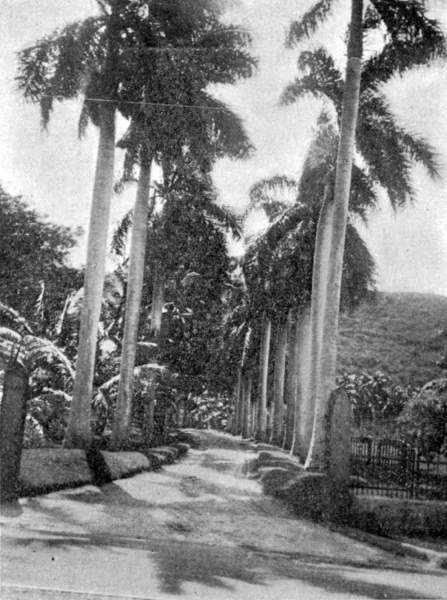
After a voyage (unusually calm for the China Sea) of four days from
Singapore, the S. S. "Bülow" slowly steamed among the islands at the
entrance and came to anchor just after sunset in the beautiful harbor of
Hongkong. There is really no city of Hongkong, though letters so
directed will reach their destination, and even the residents of the
city in whose harbor we were anchored would have spoken of living in
Hongkong. The name "Hongkong" belongs to the small island, ten miles
long by three wide, that lies about a mile from the mainland of China.
Along the north or land side of this island lies the city of Victoria,
with a population of 350,000, commonly known by the name of the entire
island, Hongkong.
Practically the whole island is occupied by mountains of a maximum
height of about 1800 feet, so that the town has only a narrow strip of
level ground along the beach and extends in scattered fashion to the
very top of the ridge.
As we came to anchor the twinkling lights of the streets and houses were
just beginning to appear, and in a little while, when the short tropical
twilight had changed to darkness, the shore line was a mass of lights
which gradually became more scattered toward the hill-tops, where often
a single light marked the location of some isolated residence. Across
the harbor another smaller group of lights showed the position of
Kowloon, a small seaport on the mainland and the southern terminus of
the Kowloon and Canton Railroad. On the water between the two towns,
really one great harbor, were thousands of lights, indicating the
position of invisible steamships, junks, tugs, launches and sampans.
Most of these lights were stationary, showing that the vessels to which
they belonged were at anchor, but some of them were in motion, and
hardly had we come slowly to a standstill and dropped anchor before we
were besieged by a swarm of launches and sampans all clamoring for
passengers to take ashore.
As is customary in the East, steamers usually anchor in the harbor at
Hongkong at some distance from shore, so that the larger hotels, as well
as Cook's Agency, have private launches to take passengers ashore. Since
it was rather late to see anything of the town most of the cabin
passengers preferred to remain on board for the night, and the view of
the lights of the harbor and town as seen from the ship was well worth
enjoying for one evening.
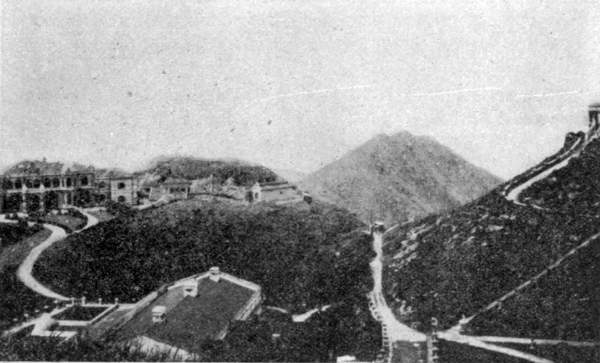
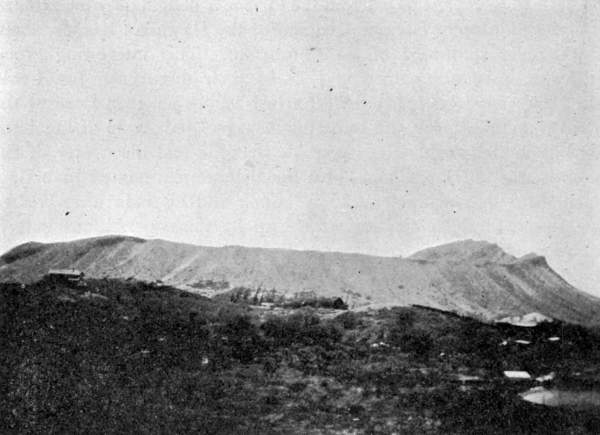
VIEW ON "THE PEAK"; GOVERNOR'S RESIDENCE IN THE LEFT
BACKGROUND.
The next morning we were able to see the meaning of the lights of the
night before. The business part of the town, with its crowded Chinese
sections and its fine municipal and office buildings, lies as a narrow
strip along the shore, while struggling up the mountain side are the
residences, churches, schools, etc. of the English and wealthy Chinese
residents. On this mountain side is also a most beautiful and
interesting botanical garden. On the highest point of "The Peak," as the
main peak of the range is called, is a weather observatory and signal
station, and from this point one of the most beautiful views in the
world may be obtained; to the south, the open China Sea, with numberless
green islands extending almost to the horizon; to the north, the
mainland of China, fringed with low mountains; between the mainland and
the island the long, narrow strait forming the harbors of Victoria and
Kowloon; at the foot of the mountain the densely crowded business
streets; and extending up the almost precipitous northern slopes of the
mountain the beautiful, often palatial homes of the wealthy residents.
Winding along the mountain sides a number of fine roads and paths give
access to these homes, but to reach the higher levels, especially, there
may be seen the cable tramway, going so straight up the side of the
mountain that it is almost alarming to look forward or back from the
open cars. The homes nearer the foot of the mountain are usually reached
by means of sedan chairs carried by two, three or even four coolies,
while in the level business section the usual means of travel are the
electric cars and the ever-ready rickishas. Horses are practically
unknown except for racing purposes; carts are pulled by Chinese coolies
instead of by horses, and merchandise is carried by coolies in baskets
or bales on the shoulders. It is an interesting though unpleasant sight
to see strings of Chinese men and women toiling up the steep sides of
the mountain, carrying stones, cement, window frames, timbers, and all
other material used in building the palaces in which the wealthy people
live. For a day of this back-breaking labor they are paid about what one
of their rich employers would give for one of his best cigars. Every
stick, stone and nail in all of these houses has been carried up all
these hundreds of feet on the backs of men and women, chiefly the
latter.
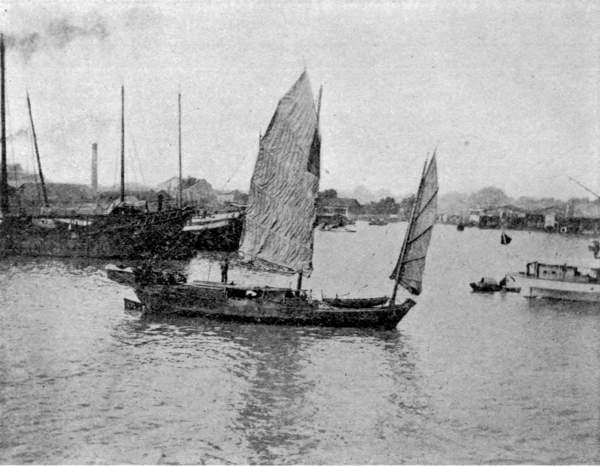
CHINESE JUNKS IN THE HARBOR OF CANTON.
In a beautiful little level valley between the bases of two of the
mountains is the play ground of Hongkong, known as "Happy Valley"; here
are tennis courts, a golf course, etc. overlooked on either side, rather
incongruously, by a Chinese and a Christian burial ground.
Having visited the various points of interest about Hongkong, which is
really a part of the British Empire (ceded by the Chinese in 1841)
though a vast majority of its residents are Chinese, I decided to have a
look at a real Chinese city, Canton, located about ninety miles up the
Canton River. As Canton happened to be in the throes of a revolution at
that time, people were flocking by the thousands from there to Hongkong.
Cook's Agency was warning people to keep away, and Hongkong papers had
as headlines "Serious Outlook in Canton"; but I did not expect ever to
have another chance to visit this typical Chinese city, so I boarded one
of the boats of the French line that left Hongkong late in the evening
for the run up the river. I learned later that one of these boats had
been "shot up" a few days before by the revolutionists, and that a
number of the passengers had been killed. However we were not molested,
and reached Canton about eight the next morning.
After daylight we were able to get an idea of the country on either bank
of the muddy river; it was low and marshy, every acre being planted in
rice. Occasionally, on a slight elevation, would be seen a pagoda-shaped
temple, standing lonely among the rice fields, where doubtless it had
stood for many centuries.
At frequent intervals we passed small native boats, some of them with
sails and loaded with goods, most of them rowed by one or more oars. It
was to be noticed that when there was only one oar it was being worked
vigorously by a woman, while a man sat comfortably in the stern and
steered. These people were evidently going from the crowded villages in
which they lived to work in the rice fields.
At Canton the river, which is there only a few hundred yards wide, was
jammed with craft of all kinds, including one or two small war vessels
and hundreds, probably thousands, of sampans. The latter carry
passengers and small quantities of freight; they are roofed over more or
less completely and serve as the homes of the owners' families, all the
members of which take a hand in the rowing.
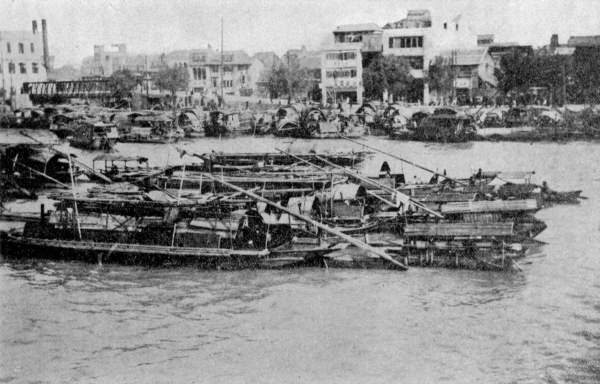
SAMPANS IN THE HARBOUR OF CANTON.
The foreign (mostly English and French) quarter of Canton is known as
"the Shameen" (meaning sand-bank), a small island in the river
connected with the city proper by a couple of bridges. It has
beautifully shaded streets and fine houses, and is utterly different
from the Chinese Canton. At the Shameen's one hotel, which charges the
modest rate of from four to eight dollars per day for very ordinary
service, I was told that conditions were "very uncertain" and that
nobody was allowed to enter the walled city after 9 P. M. without a
pass.
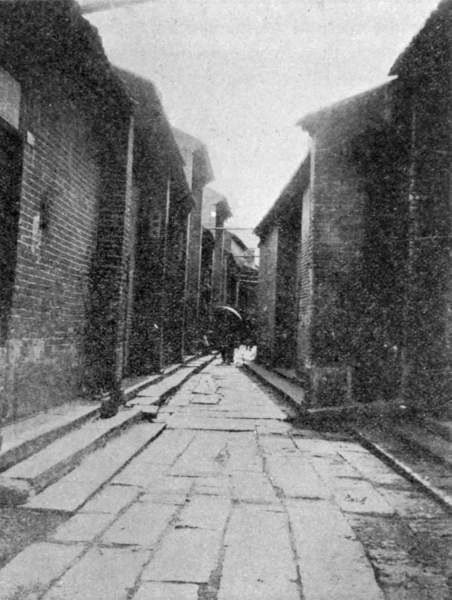
A WIDE STREET IN CANTON.
A guide having thrust his services upon me before I could get off the
boat, we left the Shameen, crossed one of the bridges and plunged into
the network of streets where, without a guide, a stranger would be lost
in a few minutes.
In a few of the streets outside of the walled city rickishas are the
usual means of travel, but inside the walls most of the streets are too
narrow for rickishas to pass one another, and paving of large flagstones
is too rough for wheels, so that the sedan chair is the only means of
locomotion except one's own legs. My self-appointed guide said he would
get chairs for seven dollars per day ($3.00 in American money) but I
told him I expected to walk and that if he wanted to go with me he would
have to do likewise; he immediately professed to think that walking was
the only way to go, so we agreed to see the town afoot. After we had
walked pretty briskly for three or four hours he inquired meekly, "Can
you walk this way all day?" People in the tropics are not usually fond
of walking, but Ping Nam was "game" and made no further remarks about my
method of locomotion. Some of the less frequented streets where there
were no sun-screens overhead were very hot, but in the busy streets the
sun was almost excluded by bamboo screens and by the walls of the houses
on each side, so that the heat was not nearly so oppressive as might be
expected in so terribly congested a city. Many of these streets were so
narrow that a tall man could touch the houses on each side with
outstretched hands.
On each side were stores of all sorts with open fronts with gay signs
and with gayly colored goods on display, making a picture of wonderful
fascination and everchanging interest.
Although we wandered for hour after hour through a perfect wilderness of
such streets we saw not a single white person; it seemed as though I
were the only Caucasian among the more than a million Asiatics, though
this, of course, was not actually the case.
In the busier streets the crowds filled the space from wall to wall, so
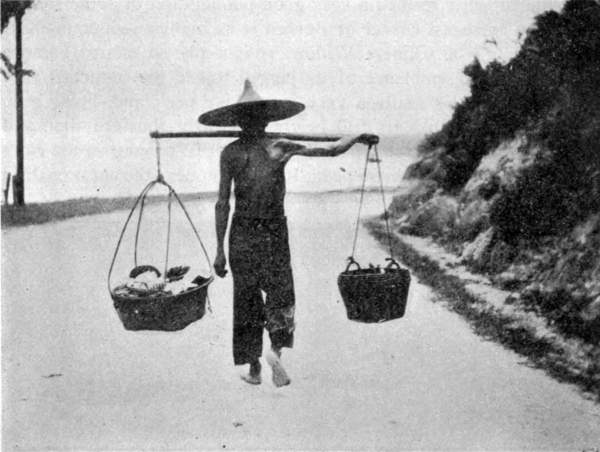
that when a string of coolies came along, bearing burdens in the usual
manner from a stick over the shoulder and humming the cheerful though
monotonous "get-out-of-the-way" tune, we had to step aside, close
against or into some store to let them pass; and when an occasional
chair came along it swept the entire traffic aside as a taxi might in a
crowded alley of an American city.
In spite of the density of the population the people all seemed happy
and contented; even the little children with faces covered with sores,
as was often the case, appeared cheerful, and ran and played like other
children.
In the stores the people could be watched at work of all kinds, from
blacksmithy to finest filigree silver work inlaid with the tiny colored
feathers of the brightly colored kingfisher; and from rough carpenter
work to the finest ivory carving for which the Chinese are famous. Of
course the amount they pay for some of this work of extreme skill is
ridiculously small, yet their living expenses are so small that they
are doubtless in better circumstances than many of the workers in our
larger cities.
The silk-weavers, working at their primitive looms in crowded rooms,
excite one's sympathy more than most of the other workers, though they
too seemed to be quite cheerful over their monotonous tasks.
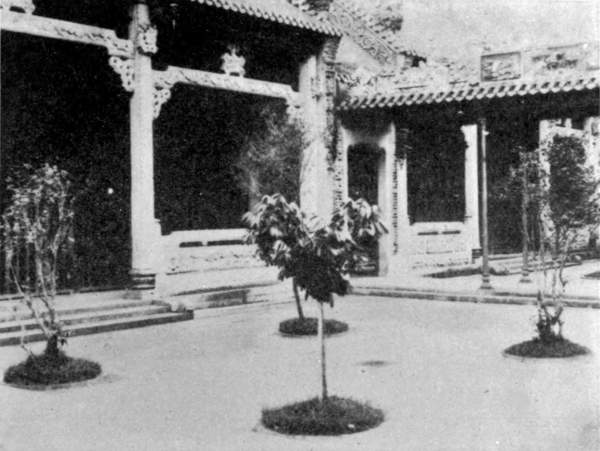
COURT OF AN ANCESTRAL TEMPLE IN CANTON.
Through these crowded streets we wandered, the sight of a white man and
a camera exciting some interest, though not a great deal. Canton is said
to have been the scene of more outrages of one sort or another than any
other city in the world, but in spite of the fact that a revolution was
supposed to be in progress we saw no signs of disorder. There were
soldiers and armed policemen everywhere, and groups of people were
frequently seen reading with interest proclamations posted at various
places; what the nature of the proclamations was I was, of course, not
able of myself to learn, and Ping Nam did not seem to care to enlighten
me, possibly thinking he might scare me out of town and thus lose his
job.
Occasionally stopping to watch some skilful artisan at work or to make
some small purchase, we went from place to place visiting temples and
other objects of especial interest. Some of these temples are centuries
old, others are comparatively new. Some are comparatively plain, others
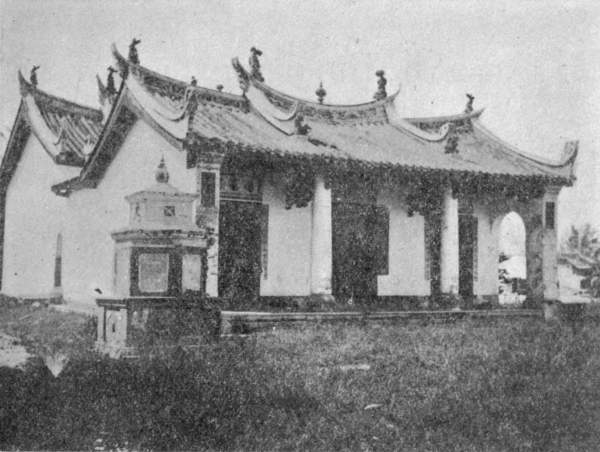
like the modern Chun-ka-chi ancestral temple, which is said to have cost
$750,000 "gold," are wonderfully ornate, with highly colored carvings
and cement mouldings. Others are of interest chiefly because of the
hideous images they contain; one of these has hundreds of these idols
and is hence known as the "Temple of the Five Hundred Genii."
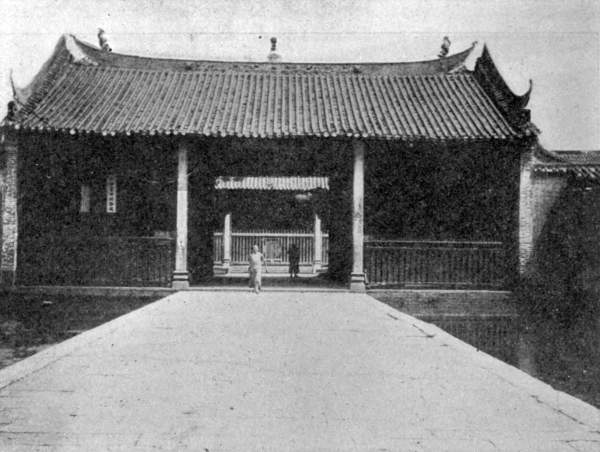
ENTRANCE OF THE "TEMPLE OF THE FIVE HUNDRED GENII,"
CANTON.
After visiting several of these temples and the picturesque flowery
pagoda we set out for the famous water clock that is said to have been
built more than thirteen hundred years ago. It is now located in a dark
little room in the top of an old house and is reached by a winding
flight of outside stone stairs. It consists of four large jars of water,
one above the other, so that the water may run slowly, at a definite
rate, from the upper to the lower jars, and gradually raise, in the
lowest jar, a float with an attached vertical scale that tells the time.
In the window visible from the street below signs are placed at
intervals that tell the time indicated by the clock.
From the water clock we visited the ancient "City of the Dead," a small
cemetery just outside one of the old city gates. These gates, some of
which are large and imposing, pierce the dilapidated wall at intervals.
The wall, about six miles in circumference, is surrounded by the remains
of a moat, now chiefly useful as an addition to the picturesque
landscape and as a breeding place for mosquitoes. The top of a city
gate, reached by a winding stone stairway from within, is a convenient
place from which to view the densely crowded roofs of the adjacent part
of the city.
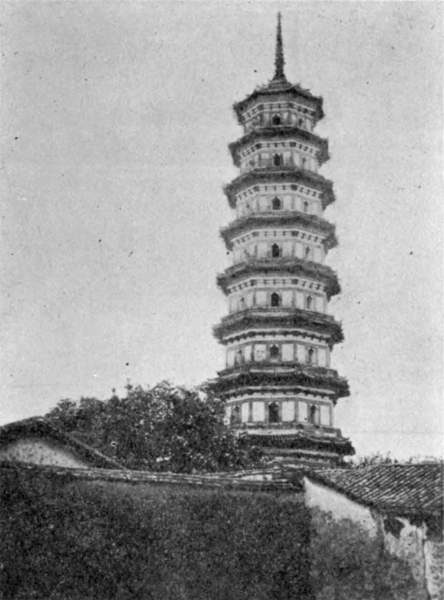
THE FLOWERY PAGODA, CANTON.
From the "City of the Dead" we made for the fairly wide street along the
river front; here we took rickishas, much to the relief of my tired
guide, to say nothing of my tired self, and were soon at the Canton
terminus of the K. & C. R. R. The station was thronged with people
waiting for the Kowloon express.
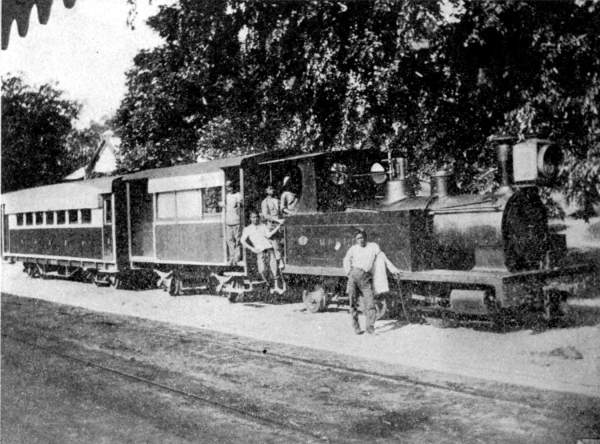
The road-bed of the K. & C. R. R. is excellent, and the cars and engine,
all of English make, made a very respectable appearance.
For nearly half of the distance to Kowloon I had my section of the one
first-class car to myself, as I was the only Caucasian on the train:
then an English civil engineer and his family came aboard and shared my
compartment for the rest of the way. The second- and third-class cars, of
which there were half a dozen or more, were crowded with natives, with
boxes and bundles of all sorts and sizes.
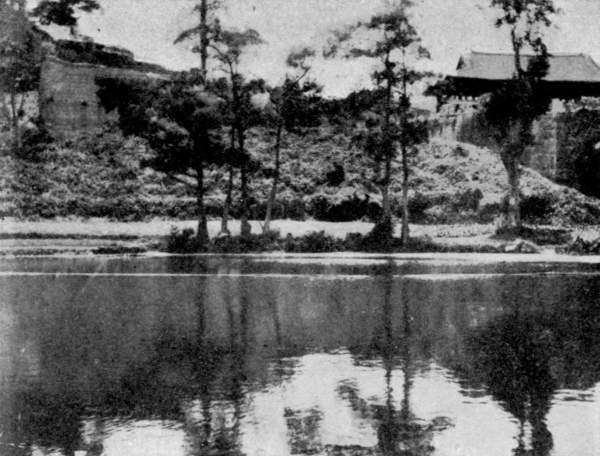
A CITY GATE AND PARTS OF THE WALL AND MOAT, AS SEEN
FROM THE "CITY OF THE DEAD," CANTON.
After making the run of about ninety miles in something less than three
hours we reached the ferry at Kowloon, and in a quarter of an hour more
we were again in Hongkong, as different from Canton as though it were on
the other side of the world instead of being only three hours away.