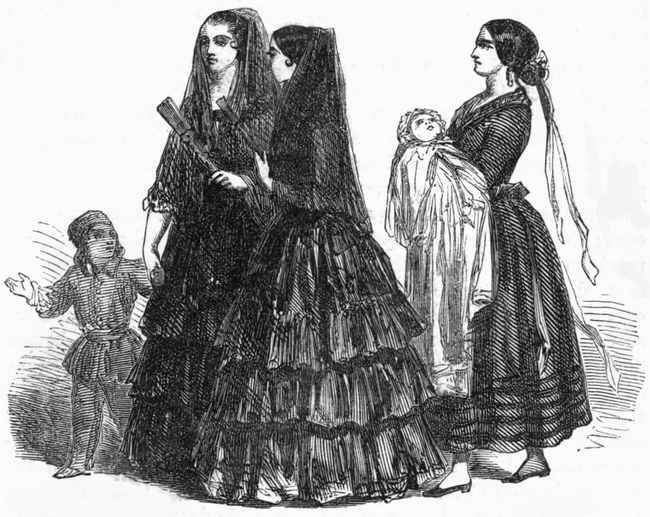
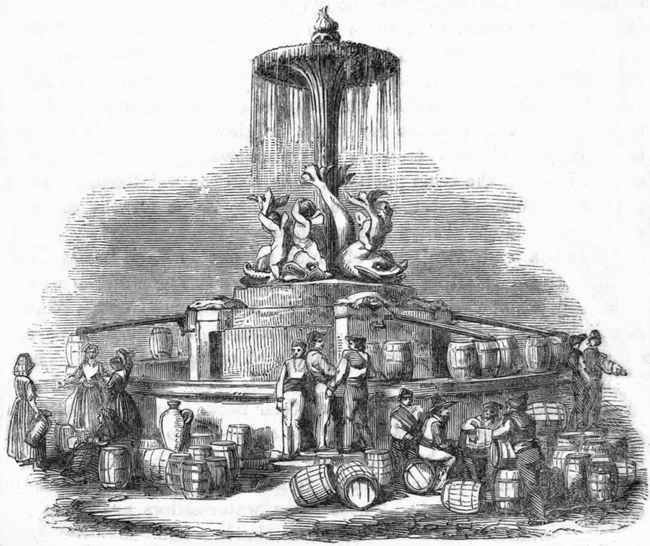
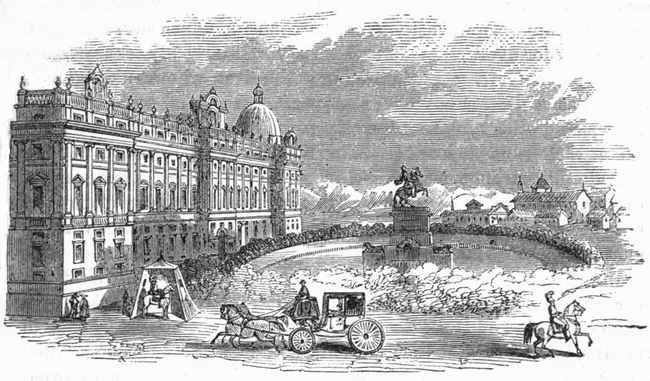
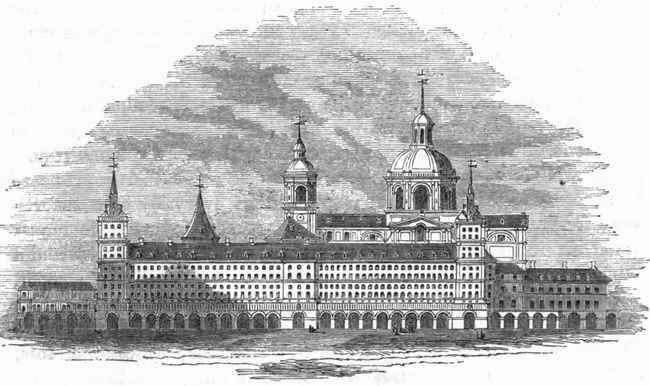
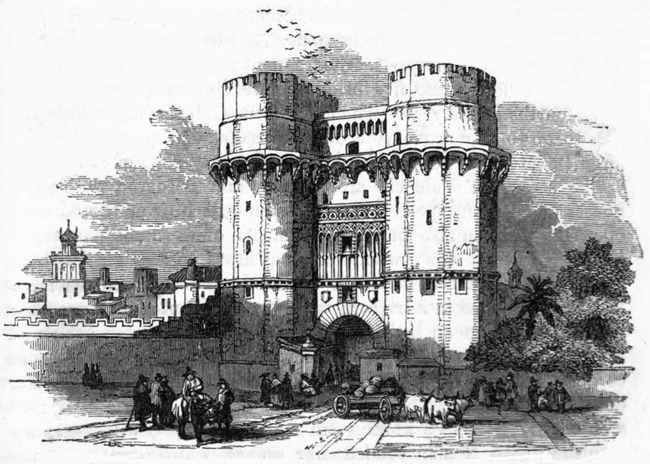
Procession of the Corpus Christi at Madrid—Aranjuez—A Patio—Ocaña and its
Environs—Tembleque and its Garters—A Night at Manzanares—Santa Cruz
Knives—The Puerto de los Perros—Colony of Carolina—Baylen—Jaen, its
Cathedral and its Majos—Granada—The Alameda—The Alhambra—The
Generalife—The Albaycin—Life at Granada—The Gitanos—The Carthusian
Convent—Santo Domingo—Ascent of the Mulhacen.
We were obliged to pass through Madrid again,
in order to take the diligence to Granada:
we could, it is true, have gone and waited
for it at Aranjuez, but we
should have then run the risk
of finding it full; we therefore
determined to return to
Madrid.
Our guide had taken care,
the evening before, to send
forward a mule, which was to
wait for us halfway along the
road, in order to take the
place of the one we set out with; for it is doubtful whether, without
this precaution, we should have been able to perform the journey
from Toledo to Madrid in a single day, owing to the excessive heat
we were exposed to along the dusty road, which affords you nowhere
the slightest shade, but runs through tracts of open and interminable
corn-fields.
We reached Illescas at about one o'clock, with no other incident
to talk of than that of being half-baked, if not quite so. We were
impatient to get away from a region which possessed nothing new
for us, unless passing through it in a contrary direction can be said
to add any novelty to the scene.
When we had alighted, my companion preferred to go to sleep;
while I, who was already pretty well accustomed to Spanish cookery,
began contesting the possession of my dinner with innumerable
swarms of flies. The landlady's daughter—a pretty little girl of
twelve or thirteen, with Arabian eyes—stood beside me, with a fan
in one hand and a little broom in the other, trying to keep off the
importunate insects, which returned to the charge more furiously
and more noisily than ever as soon as she flagged in the use of either
fan or broom. With this assistance I succeeded, however, in getting
into my mouth a few pieces somewhat free from flies; and when my
hunger was a little appeased I opened a conversation with my pretty
fly-flapper, which conversation was, however, kept within very
limited bounds by my ignorance of the Spanish language. Yet,
with the aid of my diamond dictionary, I succeeded in keeping up
the conversation tolerably well for a foreigner. She told me that
she could write and read all sorts of print, including even Latin;
and that, moreover, she played the pandero pretty well: I immediately
requested her to give me a sample of her last-named talent,
which she did with a very good grace, though much to the discomfort
of my friend, whom the rattling of the brass rings and the
hollow sound produced by the little musician's thumb on the ass's
skin at length awoke.
The fresh mule was now harnessed, as it was necessary to continue
our journey. In a heat of thirty degrees, it requires great moral
courage to leave a posada where we see before us several rows of
jars, pots, and alcarrazas, covered with beads of moisture. Spain is
the only place where a draught of water ever appeared to me real
voluptuousness: it is true that the water there is pure, limpid, and
of an exquisite taste. The interdiction of wine to Mahometans is a
law more easily obeyed than any other in such climates.
Thanks to the eloquent appeals our calesero never ceased making
to his mule, and to the pebbles which he continually threw with
great dexterity at her ears, we got on pretty well. Under trying
circumstances, he called her vieja, revieja (old, twice old), to which
injurious terms all mules appear, in general, particularly sensitive,
either because the said terms are always accompanied by a blow on
the back with the handle of the whip, or because they really are in
themselves very offensive. By the aid of these epithets, aptly applied
several times, we arrived at the gates of Madrid at about five
in the evening.
We were already acquainted with Madrid, and saw nothing new
in it, with the exception of the procession of the Corpus Christi:
this ceremony has, however, lost much of its former splendour, by
the suppression of the convents and religious fraternities; though it
still retains an appearance of great solemnity. The streets through
which the procession passes are strewed with fine sand, while
canvass tendidos, which reach from house to house, afford protection
from the sun and keep the air cool: the balconies are decorated with
flags and crowded with pretty women in full dress; so that, altogether,
the sight is one of the most charming that can well be
imagined. The perpetual motion of the fans, which open and shut,
tremble and flutter, like the wings of a butterfly about to settle
down somewhere; the movements of the elbows of the women,
wrapping themselves in their mantles and smoothing an ungraceful
wrinkle in their dress; the glances sent from one window to acquaintances
at another; the pretty inclination of the head, and the
graceful gesture that accompany the agur by which the señoras
reply to the salutations of the cavaliers; the picturesque crowd,
interspersed with Gallegos, Pasiegas, Valencians, Manolas, and
water-sellers, form a spectacle of the greatest animation and the
most charming gaiety. The Niños de la Cuna (foundlings), dressed
in their blue uniform, walk at the head of the procession. There
were but very few out of this long file of children who were endowed
with pretty faces; and Hymen himself, with all his conjugal
carelessness, would have been troubled to produce offspring uglier
than were these children of Love. Then follow the parochial banners,
the clergy, silver shrines, and, under a canopy of gold cloth,
the Corpus Dei, in a sun of diamonds of the most dazzling brilliancy.
The proverbial devoutness of the Spaniards appeared to me
greatly abated; for, with respect to it, one might well have fancied
himself in Paris at the time when it was considered fashionable
opposition not to kneel to the Host. The men hardly touched the
brim of their hats at the approach of the canopy. Catholic Spain
no longer exists. The Peninsula is now under the influence of
Voltairean and liberal ideas with respect to feudalism, the Inquisition,
and fanaticism. To demolish convents appears to her, at present,
the height of civilization.
One evening, as I was passing near the post-office at the corner of
the Calle de Carretas, I saw the crowd separate precipitately; and
then I perceived a brilliant galaxy of light coming up the Calle-Mayor.
It was the Host hastening in its carriage to the bedside of
some dying person; for the representatives of religion do not yet
go about on foot at Madrid. The people had fled, in order to avoid
the necessity of kneeling to the host as it passed. As we are speaking
of religious ceremonies, we must not forget to mention that in
Spain the cross on palls is not white, as in France, but of the colour
of brimstone. The Spaniards do not use hearses, but carry their
dead to the grave on biers.
Madrid was insupportable to us, and the two days that we were
obliged to stay there appeared, at least, two centuries. We could
think of nothing but orange-trees, lemon-trees, cachuchas, castanets,
and picturesque costumes, for every one related wonders to us about
Andalusia with that boastful magniloquence which the Spaniards
will never lose any more than the Gascons of France. At length
the long desired day arrived, for everything arrives at last, even the
day we are waiting for; and we left Madrid in a very comfortable
diligence, drawn by a troop of sturdy, close-cropped mules, with
shiny coats, and which trotted along at a dashing pace. The diligence
was lined with nankeen, and furnished with both roller and
green wooden blinds. It appeared to us the ne plus ultra of elegance,
after the abominable galleys, sillas volantes, and coaches, in which
we had been jolted up to that time; and it would have really
proved a very agreeable conveyance, had it not been for the furnace-like
heat which calcined us, in spite of the lightness of our dress
and the continual movement of our fans. The consequence was,
that our rolling stove resounded with a perpetual litany of "Oh,
dear! que calor! I am stifled! I am melting!" with numerous other
well-assorted exclamations. We bore our sufferings patiently, however,
and, with a little grumbling, tranquilly allowed the perspiration
to run, like a cascade, down our noses and temples; for, at the
end of our fatigues, we had in perspective Granada and the Alhambra,
the dream of every poet—Granada, whose name alone
makes the heaviest and dullest man in all the world break out into
exclamations of admiration, and dance on one leg for delight.
The environs of Madrid are dull, bare, and scorched up, though
less stony on this side than on the side leading to Guadarrama.
The country, which is rather uneven than hilly, presents, everywhere,
the same uniform appearance, only broken by a few villages,
all dust and chalk, scattered here and there throughout the
general aridity, and which would not be remarked, were it not
for the square tower of their churches. Spires are rarely met with
in Spain, the square tower being the usual form of steeple. Where
two roads meet, suspicious-looking crosses stretch forth their sinister
arms; from time to time, carts drawn by oxen pass by, with the
carter asleep under his cloak; and peasants on horseback, with a
fierce expression of countenance, and their carbines at the saddle-bows.
In the middle of the day the sky is of the colour of melting
lead, and the ground of a dusty grey, interspersed with mica, to
which the greatest distance hardly imparts a bluish tint. Not a
single cluster of trees, not a shrub, not a drop of water in the bed
of dried-up torrents is to be seen; nothing, in fact, is there to
relieve the eye, or to gratify the imagination. In order to find a
little shelter from the burning rays of the sun, you must follow the
narrow line of scanty blue shade afforded by the walls. We were,
it is true, in the middle of July, which is not exactly the time of
year for cool travelling in Spain; but it is our opinion that countries
ought to be visited in their most characteristic seasons. Spain
in summer, and Russia in winter.
We met with nothing worthy of any particular notice, until we
came to the royal residence (sitio real) of Aranjuez. Aranjuez is
a brick mansion with stone facings, presenting a white and red
appearance, and has high slate roofs, pavilions, and weathercocks,
which call to mind the style of architecture employed under
Henri IV. and Louis XIII.; the palace of Fontainebleau, or the
houses in the Place Royale at Paris. The Tagus, which is crossed
by a suspension-bridge, keeps vegetation fresh there, much to the
admiration of the Spaniards, and allows the trees of the north to
grow to full maturity. At Aranjuez are seen elms, ash-trees, birch-trees,
and aspens, which are as great curiosities there as Indian fig-trees,
aloes, and palms would appear in France. They pointed out
to us a gallery built on purpose to enable Godoy, the famous
Prince of Peace, to pass from his house to the castle. On leaving
the village, we observed to our left the Plaza de Toros, which is
of a decided monumental appearance.
While the mules were being changed, we ran to the market to lay
in a stock of oranges and to take ices, or rather lemon snow batter,
at one of those refreshment shops which are met with in the open
air, and which are as common in Spain as wine-shops are in France.
Instead of drinking pots of bad wine and goes of brandy, the peasants
and market-women take a bebida helada, which does not cost
more, and which does not, at all events, get into their heads to besot
their intellects. The absence of drunkenness renders the people of
the lower class much superior to the corresponding class in those
countries of ours, which we fancy to be civilized.
The name of Aranjuez, which is composed of two words, ara and
Jovis, tells us pretty plainly that this edifice is built on the site of an
ancient temple of Jupiter. We had not time to visit the interior
of it, but this we do not regret, for all palaces are alike. Such,
too, is the case with courtiers; originality is to be met with but
among the people, and the rabble only appear to have preserved
the privilege of being poetical.
The scenery from Aranjuez to Ocaña is picturesque, without, however,
being very remarkable. Hills of graceful form, well developed
by the light, rise on each side of the route, and when the eddies of
dust in which the diligence is running, like a god wrapped up in his
cloud, are cleared away by a favourable breath of air, they present
you with a very pleasant sight. The roads, though badly kept, are
in pretty good order, thanks to this wonderful climate, where it
hardly ever rains, and to the scarcity of vehicles, nearly all the
carrying being done by beasts of burden only.
We were to sup and sleep at Ocaña, in order to wait for the
correo real, so that by joining ourselves to it we might profit by
its escort, for we were about to enter La Mancha, infested at that
time by the bands of Palillos, Polichinelle, and other honest people
with whom a meeting would prove far from agreeable. We stopped
at an hotel of decent appearance, before which was a patio with
columns, and, over this patio, a superb tendido, of which the
cloth, now double, now single, formed designs and symmetrical
figures by its different shades of transparency. The name of the
maker, with his address at Barcelona, was written on it by this means
very legibly. Myrtles, pomegranates, and jasmines, planted in red
clay pots, enlivened and perfumed this sort of inner court, in which
reigned a clear, subdued kind of twilight full of mystery. The patio
is a delightful invention; it affords greater coolness and more space
than a room; you can walk about there, read, be alone or mix with
others. It is a neuter ground where people meet, and where, without
undergoing the tediousness of formal visits and introductions,
they end by becoming known to one another and by forming acquaintance;
and when, as at Granada or at Seville, the patio possesses a
jet of water or a fountain, nothing can be more delightful, especially
in a country where the thermometer always indicates a Senegambian
heat.
While waiting for our repast, we went to take a siesta: this is
a habit which you are compelled to follow in Spain, for the heat from
two to five o'clock is such as no Parisian can form an idea of. The
pavement burns, the iron knockers on the doors grow red-hot, a
shower of fire seems to be falling from the sky; the corn bursts from
its spikes, the ground cracks like over-heated porcelain, the grass-hoppers
make their corselets grate with more vivacity than ever,
and the little air which fans your face seems to be blown forth by
the brazen mouth of a large furnace; the shops are closed, and
all the gold in the world would not induce a tradesman to sell you
the slightest article. In the streets are to be seen dogs and Frenchmen
only, according to the popular saying, which is far from flattering
for us. The guides refuse to take you to the most insignificant
monument, even though you offer them Havannah cigars or a ticket
for a bull-fight, two most seductive things for a Spanish cicerone.
The only thing you can do is to sleep like the rest, and you very
soon make up your mind to do so; for what else can you do in the
midst of a nation fast asleep!
Our rooms, which were whitewashed, were scrupulously clean.
The insects of which we had heard such awful descriptions did not
yet make their appearance, and our sleep was troubled by no thousand-footed
nightmare.
At five o'clock, we rose to go and take a turn while waiting
for supper. Ocaña is not rich in monumental buildings, and its
best title to celebrity is the desperate attack made by Spanish troops
on a French redout during the war of invasion. The redout was
taken, but nearly the whole of the Spanish battalion was killed.
Each hero was interred on the spot where he fell. The ranks were
so well kept, in spite of a deluge of grape, that they can still be
traced by the regularity of the graves. Diamante has written a
piece called "The Hercules of Ocaña," produced, no doubt, for some
athletic champion of prodigious strength, like the Goliath of the
Olympic Circus. Our presence at Ocaña called this circumstance to
our memory.
The last of the harvest was being got in at an epoch when the
corn scarcely begins to assume its yellow tint in France, and the
sheaves were carried to large areas of beaten earth, where horses
and mules tread out the grain beneath their unshod hoofs. Both
mules and horses are harnessed to a sort of sledge, on which the
man superintending the operations stands upright in a posture of
proud and graceful ease. Much self-command and skill are required
to keep on this frail machine, as it is whisked along by three or four
horses which are ever being lashed most lustily. A painter of the
school of Leopold Robert would not fail to turn these scenes of
Biblical and primitive simplicity to great account. Fine swarthy
faces, sparkling eyes, Madonna-like features, costumes full of
character, brilliant light, azure and sun would not fail him here
any more than in Italy.
That evening the sky was of a milky blue colour, dashed with
rose; the fields appeared, as far as the eye could reach, like an
immense sheet of pale gold, where, here and there, you perceived
a cart, looking like a small island in an ocean of light, and drawn by
oxen which were almost hidden beneath the sheaves with which the
cart was loaded. The wild notion of a picture without shade,
which is so inherent to the Chinese, was realized here. All was
sun and light; and the deepest tint that appeared upon the scene
was of pearl grey.
At length we were summoned to a pretty good supper, or which,
at least, our appetites made us think so; it was served in a low room,
decorated with little paintings on glass, of somewhat curious Venetian
taste. After supper, as my companion, Eugène, and myself, were
but mediocre smokers, and as we could take but a very small part
in the conversation, on account of the necessity we were under of
saying everything we had to say in the two or three hundred words
with which we were acquainted, we withdrew to our rooms, greatly
discouraged at the different stories about robbers which we had
heard related at table, and which, as they were only half understood,
appeared all the more terrible to us.
We were forced to wait till two in the afternoon for the arrival of
the correo real, for it would not have been prudent to set out without
it. We had besides a special escort of four horsemen, armed with
blunderbusses, pistols, and large sabres. They were men of commanding
stature, with pointed hats, large red sashes, velvet breeches,
leather gaiters and characteristic features, encircled by enormous
black whiskers, all which made them look more like robbers than
guards and whom it was a cunning contrivance to take with you,
in order to avoid meeting them on the road.
Twenty soldiers huddled together in a galley, followed the correo
real. A galley is a two or four wheeled cart, without springs, and
having its bottom formed of an esparto network, instead of boards.
This short description will suffice to give an idea of the position of
these poor wretches, who were forced to stand, and who could only
keep themselves from falling by catching hold of the sides of the
cart. Add to this the rapidity at which we were going—four leagues
an hour—a stifling heat, with the sun darting down his rays perpendicularly,
and you will agree with me that it required a very
great stock of heroic goodhumour to think such a situation funny.
And yet these poor soldiers, scarcely covered by their ragged
uniforms, with their stomachs empty, with nothing to drink but the
heated water in their leathern bottles, and tossed about like mice
in a trap, did nothing but laugh and sing all along the road. The
sobriety and patience of the Spaniards in supporting fatigue are
something wonderful. In this respect they have remained Arabs.
It would be impossible to show more disregard for material life
than they do. But these soldiers, who were without bread and
shoes, had a guitar.
All that part of the kingdom of Toledo which we passed through
is frightfully arid, and announces the approach of La Mancha, the
country of Don Quixote, and the most desolate and sterile province
of Spain.
We soon passed La Guardia, a little insignificant market-town,
of the most miserable appearance. At Tembleque we bought a few
dozen garters for the use of some pretty legs at Paris; these garters,
of all colours, cerise, orange, and sky-blue, were ornamented with
gold or silver thread, and marked with various-lettered devices,
that would put to the blush the most gallant ones on the trumpets
bought at the fête of St. Cloud. Tembleque has the same reputation
for its garters as Châtellerault, in France, has for its pen-knives.
While we were bargaining for our garters, we heard by our side a
hoarse, discordant, menacing growl, like that of a mad dog. We
turned round quickly, but not without a certain amount of fear, for
we did not know how to speak to Spanish dogs, and then we perceived
that this growl came not from an animal, but from a man.
Never did nightmare, placing its knee on the chest of a delirious
patient, produce a more frightful monster. Quasimodo is a very
Phœbus by the side of it. A square forehead, two sunken eyes,
glaring with a savage fire, a nose so flat that its place was distinguished
only by the nostrils, with the lower jaw advancing
full two inches beyond the upper one—such, in a few words, is the
portrait of this scarecrow, the profile of which formed a concave
line, like those crescents on which the face of the moon is represented
in the almanack of Liege. The calling of this wretch consisted
in being without a nose, and in imitating dogs, a calling
which he exercised wonderfully well, for he was more noseless than
death himself, and made alone more uproar than all the inmates put
together of the Barrière du Combat at feeding-time.
Puerto Lapiche consists of a few tumbling-down huts, huddled
together on the declivity of a hill which is itself full of cracks and
chasms, and become so dry and rotten by the heat that it is continually
giving way and being torn asunder by the most curiously-shaped
rents. It represents aridity and desolation in its highest
degree. Everything is of the colour of cork and pumice-stone.
The fire of heaven seems to have passed over it; and the whole
scene is smothered by grey dust, as fine as powdered sandstone. This
wretchedness is so much the more heartrending as the lustre of an
implacable sky makes the whole poverty of the place most prominently
apparent. The cloudy melancholy of the north is nothing in
comparison with the luminous sadness of warm countries.
On beholding such wretched hovels, you feel yourself full of pity
for the robbers who are obliged to live by marauding in a country
where you might make a round of ten leagues and not find wherewithal
to cook an egg. The resources offered by the diligences and
galleys are really insufficient, and the poor brigands who vegetate in
La Mancha are often obliged to be contented with a supper composed
of a handful of those sweet acorns which were the delight of
Sancho Panza. What is it possible to take from people who have
neither money nor pockets, who live in houses of which the whole
furniture is composed of four bare walls, and whose only utensils
are a saucepan and an earthenware pitcher? To pillage such villages
appears to me one of the most lugubrious fancies which can
well enter the head of a robber out of work.
A little beyond Puerto Lapiche you enter La Mancha, where we
perceived to our right two or three windmills, which lay claim to
having victoriously sustained the shock of Don Quixote's lance, and
which, for the moment, were listlessly turning their fans with the
aid of an asthmatic breeze. The venta at which we stopped to
imbibe two or three jars of fresh water, also boasts of having entertained
the immortal hero of Cervantes.
We will not fatigue our readers with a description of our monotonous
route through a stony, flat, and dusty country, only enlivened,
at long intervals, with a few olive-trees, whose foliage is diseased
and of a bluish green; where nothing is seen but tawny, haggard,
mummified peasants, with scorched, rusty hats, short breeches, and
coarse gaiters of darkish cloth, carrying a tattered jacket on their
shoulders, and driving before them a mangy ass whose coat is white
with age, whose ears are enervated, and whose back is pitiful to
behold; and where you see at the entrance of the villages nothing
but half-naked children, as dark as mulattoes, and who view you
with wild and astonished looks as you pass by.
Dying of hunger, we arrived at Manzanares in the middle of the
night. The courier who preceded us, profiting by his right as first
comer and his acquaintance with the people of the hotel, had exhausted
all the provisions, which consisted, it is true, but of three or
four eggs and a piece of ham. We uttered the most piercing and
heart-rending cries, and declared that we would set fire to the house
and roast the landlady herself, if there were no other dish forthcoming.
This display of energy procured us, at about two in the morning,
some supper, to prepare which they had been obliged to wake up
half the town. We had a quarter of kid, eggs with tomato-sauce,
ham and goat's-milk cheese, with some pretty good white table-wine.
We all supped together in the yard by the light of three or four
brass lamps, very much like the funereal lamps of antiquity. The
flame of each lamp producing, through the caprices of the wind, fantastic
shades and lights, gave us the appearance of so many lamiæ
and ghouls tearing asunder pieces of disinterred children: and
that the repast might have a perfect appearance of magic, a tall
blind girl, guided by the noise, approached the table, and began
singing couplets to a plaintive and monotonous air, like a vague
sibylline incantation. On learning that we were French, she improvised,
in honour of us, some eulogical stanzas, which we rewarded
with a few reals.
Before getting into our conveyance, we went to take a turn in the
village; we were obliged to grope our way, it is true, but that was
better than remaining in the yard of the inn. We reached the
Market-place, not, however, without having stumbled over some one
sleeping in the open air. In the summer, the people generally sleep
in the street, some under their cloaks, and some beneath mule-cloths,
while others have a sack filled with chopped straw (these are sybarites);
and then again there are some who lie on the bare bosom of
their mother Cybele, with a stone for a pillow. The peasants who
had arrived in the night were asleep, pell-mell, in the midst of
curious vegetables and wild productions, or between the legs of their
mules and donkeys, where they were waiting for daylight, which
was soon to appear.
By the moon's faint light, we indistinctly perceived in the obscurity
a sort of embattled antique edifice, where, by the whiteness
of the plaster, we recognised the defences made during the last civil
war, and which time had not yet succeeded in harmonizing with the
main building. As a conscientious traveller, this is all we can say
of Manzanares.
We got into our conveyance again; sleep crept over us, and when
we again opened our eyes we were in the environs of Val-de-Peñas,
a town celebrated for its wine: the ground and hills, studded with
constellated stones, were of a red hue and singularly crude, and we
began to distinguish on the horizon ranges of mountains serrated
like saws, and whose outline was very plainly marked, in spite of
their great distance.
Val-de-Peñas possesses nothing above the common, and owes all
its reputation to its vineyards. Its name—the Valley of Stones—is
perfectly justified. We stopped here to breakfast, and, by an inspiration
from Heaven, I first of all took my own chocolate, and then
that intended for my companion, who had not yet risen; and, foreseeing
future famines, I crammed into my cup as many bunuelos (a
kind of small fritter) as it would hold, so as to make a sort of pretty
substantial porridge; for I had not yet learned the abstemiousness
of the camel, which, I did some time afterwards by dint of practising
abstinence worthy of an anchorite of the primitive times. I
was not then used to the climate, and I had brought from France a
most unnatural appetite, which inspired the natives of the country
with respectful astonishment.
In a few minutes we set off all in a hurry, for we were obliged to
keep close to the correo real, in order not to lose the advantage of
its protection. On leaning out of the vehicle to take a last survey of
Val-de-Peñas, I let my cap fall into the road: a muchacho of twelve
or fifteen years of age perceived this, and, in order to get a few
cuartos, picked it up, and began running after the diligence, which
was now at some distance from him; he overtook it, however,
though he was barefooted and running on a road paved with sharp-pointed
stones. I threw him a handful of sous, which certainly
made him the most opulent urchin in the whole place. I mention
this insignificant circumstance merely because it is characteristic of
the swiftness of the Spaniards, who are the best walkers in the
world, and the most active runners to be met with. We have
already had occasion to speak of those foot-postilions called zagales,
who follow carriages, going at full speed, for leagues together,
without appearing to be in the least fatigued, or without even perspiring.
At Santa Cruz we were offered for sale all sorts of small knives
and navajas: Santa Cruz and Albacete are renowned for this
fancy cutlery. These navajas, of Arabian and very characteristic
barbarous taste, have brass handles, which are cut through, and in
the perforations of which are seen red, green, and blue spangles.
Coarse enamel work, but cleanly executed, decorates the blades,
which are made in the form of a fish, and are always very sharp;
most of them bear some such motto as the following: Soy de
uno solo, "I belong to one only;" or Cuando esta vivora pica, no
hay remedio en la botica, "When this serpent stings, there is no
remedy in medicine." Sometimes the blade has three parallel lines
cut down it, the hollows of which are painted red, and then it
presents a truly formidable appearance. The length of these navajas
varies from three inches to three feet; a few majos (smart peasants)
have some which, when open, are as long as a sabre; the blade is
kept open in its place by a jointed spring, or a sliding ring. The
navaja is the favourite arm of the Spaniards, especially of the people
of the lower class; they handle it with wonderful dexterity, and
form moreover a shield by rolling their cape round their left arm.
This is an art which, like fencing, has its laws, and navaja-masters
are as numerous in Andalusia as fencing-masters are at Paris.
Every one who uses the navaja has his secret thrusts, and his particular
ways of striking: adepts, they say, can, on viewing a wound,
recognise the artiste who has inflicted it, as we recognise a painter
by his touch.
The undulations of the ground now began to be more marked and
more frequent—in fact, we did nothing but ascend and descend.
We were approaching the Sierra Morena, which forms the limits of
Andalusia. Behind that line of violet-coloured mountains lay
hidden the paradise of our dreams. The stones already began to
change into rocks, and the hills into towering mountains: thistles,
six or seven feet high, rose up on the sides of the road, like the
halberds of invisible soldiers. Though I have no pretensions to
being an ass, I am very fond of thistles (a taste which is common
both to myself and butterflies), and those I saw here surprised
me. The thistle is a superb plant, which can be most advantageously
studied for the production of ornamental designs. No piece of
Gothic architecture possesses cleaner or more delicately-cut arabesques
or foliage. From time to time we perceived in the neighbouring
fields large yellow-looking patches, as if sacks of chopped
straw had been emptied there; but this straw rose up in a cloud
when we approached, and noisily flew away. What we mistook for
straw was shoals of locusts, and there must have been millions of
them: this reminded one strongly of Egypt.
It was somewhere near this place that, for the first time in my
life, I really suffered from hunger. Ugolino in his tower could not
have felt more famished than I did, and I had not, like him, four
sons to devour. The reader, who has seen me swallow two cups
of chocolate at Val-de-Peñas, is perhaps astonished at this premature
hunger; but Spanish cups are not larger than a thimble, and do not
hold more than two or three spoonfuls. My melancholy was greatly
augmented at the venta, where we left our escort, on seeing a magnificent
omelet, intended for the soldiers' dinner, assume a golden hue
beneath a sunbeam that came down the chimney. I prowled about
it like a ravenous wolf, but it was too well guarded for me to carry
off. Luckily, however, a lady from Granada, who was in the
diligence with us, took pity on my martyrdom, and gave me a slice
of La Mancha ham cured in sugar, with a piece of bread which she
kept in reserve in one of the pockets of the vehicle. May this ham
be returned to her an hundredfold!
Not far from this venta, on the right hand side of the road, stood
some pillars, on which were seen three or four malefactors' heads—a
spectacle always adapted to tranquillize your mind, and which proves
that you are in a civilized country. The road kept rising, and assuming
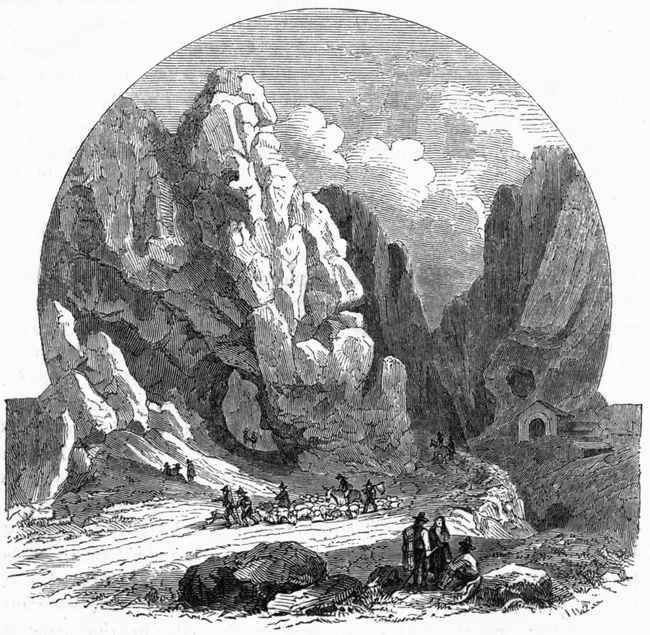
various zigzag forms. We were about to pass by the Puerto de
los Perros: this is a narrow defile—a breach, in fact, made in the
mountain by a torrent, which leaves just room enough for the road
by its side. The Puerto de los Perros (passage of dogs) is thus
named, because through it the vanquished Moors went out of Andalusia,
taking with them the happiness and civilization of Spain.
Spain, which stands in the same relation to Africa as Greece did to
Asia, is not fitted for European manners. The genius of the East is
apparent there in all its forms, and it is perhaps to be regretted
that Spain is not still Moorish and Mahometan.
It would be impossible to imagine anything more picturesque or
grand than this entrance to Andalusia. The defile is cut through
immense rocks of red marble, the gigantic layers of which rise one
above the other with a sort of architectural regularity. These
enormous blocks, with their large transversal fissures—those veins
of mountain marble, a sort of terrestrial subject, deprived of skin,
on which to study the anatomy of the globe—are of such proportions,
that they make the largest granite of Egypt appear microscopical
by their side. In the interstices are palm oaks and enormous cork-trees,
which do not appear larger there than do tufts of herb on
an ordinary-sized wall. On reaching the bottom of the defile, you
perceive that the vegetation increases in richness, and forms an impenetrable
thicket, through which you see, sparkling in different
places, the bright water of the torrent. The edge is so rugged on
the side of the road, that it has been judged prudent to place a
parapet along it, without which the diligence, which is always going
very fast, and which it is very difficult to drive, on account of the
frequent bends, might easily turn a somersault of some five or six
hundred feet.
It was in the Sierra Morena that the knight of the rueful countenance
accomplished, in imitation of Amadis on the rock, that
famous act of penance which consisted in tumbling about in his
shirt on the sharpest rocks, and that Sancho Panza, the positive
man, the representative of vulgar reason by the side of noble madness,
found Cardenio's portmanteau so well filled with ducats and
fine shirts. You cannot make a step in Spain without meeting with
something to remind you of Don Quixote; so truly national is the
work of Cervantes, and so true is it that these two personages
sum up in themselves the whole Spanish character—chivalrous
exaltation of mind, and an adventurous spirit joined to great good
practical sense, and a sort of goodnature full of finesse and causticity.
At Venta de Cardona where we changed mules, I saw a pretty
little child with a complexion of the most dazzling whiteness, lying
in his cradle, and resembling a wax Jesus in his manger. The
Spaniards, when they are not burnt by the sun, are in general exceedingly
fair.
As soon as the Sierra Morena is passed, the aspect of the country
undergoes a total change; it is like going all at once from Europe to
Africa; vipers, crawling to their nests, leave their oblique marks
on the fine gravel of the roads; and the aloe begins to brandish
its large thorny sabres at the sides of the ditches. These large fans
of thick, brawny, bluish-grey leaves immediately throw a different
appearance over the whole landscape. You feel that you are in a
new country; you understand that you have really quitted Paris;
but the difference in the climate, in the architecture, and in the costumes,
does not astonish you so much as the presence of the large
vegetables belonging to the torrid regions, and which we are only
accustomed to behold in hothouses, in France. The laurels, the
holm oaks, the cork, and the fig-trees, with their varnished and
metallic-looking foliage, have about them something free, robust, and
wild, which indicates a climate in which nature is more powerful
than man, and in which she can do without him.
Before us extended the fine country of Andalusia, unfolding itself
to our view, like an immense panorama. The scene possessed the
grandeur and appearance of the sea: chains of mountains, which
distance confounded with the sky itself, succeeded one another, with
the gentlest undulations, like long rows of billows of azure. Large
clouds of white vapour filled up the intervals; and here and there
the rays of the sun streaked with gold some of the nearer mountain-tops,
and made them sparkle with a thousand colours like a pigeon's
breast. Other ridges, curiously irregular, resembled those draperies
in ancient pictures which were yellow on one side and blue on the
other. The whole was inundated with a most dazzling and splendid
light, similar to that which must have illuminated the terrestrial
paradise. It streamed through this ocean of mountains like liquid
gold and silver, dashing a phosphorescent foam of spangles on every
obstacle it met with. The scene before us was much more vast
than the grandest perspectives of Martin, and infinitely more beautiful.
The infinite in things filled with light is sublime and stupendous
in a far different manner to the infinite in things smothered
in darkness.
While gazing on this wonderful picture, which varied in appearance
and presented us with fresh splendours at each turn of our wheels,
we saw appear on the horizon the pointed roofs of Carolina's symmetrical
pavilions, a sort of model village, or agricultural phalansterium,
formerly founded by the Count of Florida Blanca, and
peopled by him, at a great expense, with Germans and Swiss. This
village, built all of a sudden, and raised at the will of one man,
possesses that tedious regularity which is unknown in places which
rise gradually, and in obedience to the caprice of chance and time.
Everything has been done by line and rule: from the middle of
the place you can see the whole town; here is the market of
the Plaza de Toros; here is the church, and here is the house of
the alcade. All this is certainly very nice, but I prefer the most
wretched village which has taken its form at random. The
colony has not, however, succeeded; the Swiss became affected with
nostalgia and died off like flies, on merely hearing the bells sound;
the ringing of them was therefore obliged to be discontinued. They
did not all die, however, and the population of Carolina still preserves
traces of its German origin. We had a solid dinner at Carolina
served up with some excellent wine, and I was not obliged to
take double portions: we now no longer travelled with the courier,
as the roads are perfectly safe in these parts.
Aloe-trees, more and more African in size and shape, continued
to rise along the sides of the road, and towards the left a long garland
of flowers of the deepest rose-colour, glittering in a foliage of
emeralds, marked out all the sinuosities of the bed of a dried up
rivulet. Profiting by a halt made to change mules, my companion
ran and gathered an enormous bouquet of these flowers; they were
rose-bays of the greatest beauty and freshness. We might put to this
rivulet, with the name of which I am not acquainted, and which
perhaps has none, the same question that Monsieur Casimir Delavigne
puts to the Greek river—
"Eurotas, Eurotas, que font tes lauriers-roses?"
To the rose-bays succeeded, like a melancholy reflection after a
silvery burst of laughter, tall olive-trees whose pale leaves remind
you of the white foliage of the willows of the North, and which harmonize
admirably well with the ashy colour of the ground. These
leaves, which are of a grave, austere, and gentle tint, were most judiciously
chosen by the ancients, those skilful estimators of natural
evidence, as the symbol of peace and wisdom.
It was about four o'clock when we arrived at Baylen, famous for
the disastrous capitulation which is known by this name. We were
to pass the night there, and while waiting for supper we went to take
a stroll through the town and about the environs with the lady from
Granada, and a very pretty young girl who was going with her
father and mother to take sea-baths at Malaga; for the general
reserve of the Spaniards quickly gives way to polite and cordial
familiarity, as soon as they are certain that you are neither a commercial
traveller, nor a tight-rope dancer, nor a hawker of pomatum.
The church of Baylen, the construction of which does not date
much further back than the sixteenth century, astonished me
by its strange colour. Its stone and marble baked by the sun of
Spain, instead of turning black as such things do in our damp
climate, had assumed red hues of the most extraordinary vividness,
and which even inclined to saffron and purple, resembling in their
tints vine-leaves at the end of autumn. At the side of the church,
a palm-tree, the first I had ever seen in the open air, rose above a
little wall gilt by the reflection of the sun's burning rays, and
abruptly spread out its branches in the dark azure of the heavens.
This palm-tree—a sudden revelation from the East—thus met unexpectedly
at the corner of a street, produced a singular effect on me.
I expected, every instant, to see the profile of the camel's ostrich-like
neck appear in the glimmering light thrown out by the setting
sun, and the white bournous of the Arab float along the ranks of the
caravan.
Some rather picturesque ruins of ancient fortifications presented
to our view a tower, in a sufficiently good state of preservation to
allow us to ascend it by the aid of our hands and feet and the jutting
out of the stones. We were rewarded for our trouble by one
of the most magnificent sights it is possible to behold. The city of
Baylen, with its tiled roofs, its red church, and its white houses huddled
round the foot of the tower like a flock of goats, formed a charming
foreground: further on were immense corn-fields, undulating like
waves of gold, and right at the back, above several ranges of mountains,
the ridge of the Sierra Nevada glittered in the distance like a chain
of silver. Veins of snow, played on by the light, brightly sparkled
and sent forth prismatic flashes; while the sun, similar to a large
golden wheel, of which its disc was the nave, spread out its flaming
rays, like spokes, in a sky tinged with all the hues of the agate and
the advanturine.
The inn at which we were to pass the night was a large building
consisting but of one immense room, with a fireplace at each end,
a roof of timberwork, shiny and black with smoke, racks on each side
for horses, mules, and donkeys; and having, for the accommodation
of travellers, a few small lateral chambers, containing each a bed
formed of three planks placed on two trestles, and covered with
those pellicles of canvass, in which floated a few lumps of wool, and
which hotel-keepers, with the usual effrontery and sang froid which
characterize them, call mattresses; but this, however, did not hinder
us from snoring like Epimenides and the Seven Sleepers all together.
We set off very early in the morning to avoid the heat, and we
again saw the beautiful rose-bays, as resplendent as glory and as
blooming as love, which had enchanted us the evening before. The
Guadalquiver, with its troubled and yellowish waters, soon appeared
to bar our passage; we crossed it in a ferry-boat, and took the road
to Jaen. To our left was pointed out to us the tower of Torrequebradilla,
on which a sunbeam was playing, and we soon perceived
the strange outline of the city of Jaen, the capital of the province
of that name. An enormous mountain, of the colour of ochre, as
tawny as a lion's skin, variegated with stripes of red and brown,
and enveloped in clouds of light, rises abruptly in the middle of the
city; massive towers, and long, zigzag lines of fortification streak
its barren sides and give them a fantastic and picturesque appearance.
The Cathedral, an immense mass of architecture, which
seems, from a distance, to be larger than the town itself, rears its
head haughtily, like an artificial mountain by the side of the natural
one. This cathedral, which is of the Renaissance style of architecture,
and which boasts of possessing the true handkerchief in which
Saint Veronica took the impression of our Saviour's face, was built
by the duke of Medina Coeli. It is certainly a handsome building,
but we had imagined it, at a distance, to be both more antique and
more curious.
On our way from the Parador to the cathedral, I took care to
inspect the play-bills, and found that, the evening before, Mérope
had been played, and that that evening would be given "El Campanero
de San Pablo," por el illustrissimo señor don Jose Bouchardy;
or, in other words, "Le Sonneur de Saint Paul," by my
friend Bouchardy. To have your pieces played at Jaen, a barbarous
town, where the inhabitants never go out without a poniard in
their belt and a carabine on their shoulder, is certainly very flattering,
and very few of our contemporary geniuses are able to boast of
a like success. If we formerly borrowed a few chefs-d'œuvre of the
Spanish stage, we fully repay, at present, in vaudevilles and in melodramas,
the value of all we have taken.
On leaving the cathedral we returned, with the other travellers,
to the Parador, the appearance of which seemed to promise an excellent
repast; a café was attached to it, and it had quite the look of a
European and civilized establishment. Some one discovered, however,
on taking his place, that the bread was as hard as a mill-stone,
and asked for some other. But the hotel-keeper obstinately refused
to change it. During the quarrel, another person perceived that
the dishes had been warmed up, and must have already appeared
on the table some time back. Hereupon, every person present
began to utter the most plaintive cries and to insist on having a
perfectly fresh dinner that had never appeared before. And now
for the secret of this: the diligence which preceded us had been
stopped by the brigands of La Mancha, and the travellers, whom they
had carried off into the mountains, had not been able to partake of the
repast prepared for them by the hotel-keeper at Jaen. The latter,
in order not to be out of pocket, had kept the dishes, and served
them up again for us; but he was deceived in his expectations, for
we all left his house, and went elsewhere to satisfy our hunger.
The unlucky dinner was, no doubt, presented, for a third time, to
the next travellers.
We repaired to an obscure posada, where, after waiting a long
while, we obtained some cutlets, some eggs, and a salad, all served
up in chipped plates, accompanied by odd knives and forks, and
glasses, each of which belonged to a different set. The banquet was
very mediocre, but it was seasoned with so much laughter, and so
many jokes about the comic fury of the hotel-keeper when he saw
his company leave in procession, as well as about the fate of
the poor victims to whom he would not fail to re-present his emaciated
chickens, warmed up for the third time, as perfectly fresh,
that we were fully compensated, and even more than compensated,
for the poorness of our fare. As soon as the icy reserve of the
Spaniards once begins to wear away, they immediately indulge in an
infantine and naïve gaiety, full of charming sweetness. The least
thing makes them laugh till the tears run down their faces.
It was at Jaen that I saw more national and picturesque costumes
than anywhere else. The men were attired, for the most
part, in blue velvet breeches, adorned with silver filigrane buttons,
and Ronda gaiters embellished with aiglets and stitching, and
worked with arabesques on leather of a darker colour. It is considered
the height of elegance to button but the first two or three
buttons, at the top and bottom, so as to let the calf be seen.
Wide sashes of red or yellow silk, jackets of brown cloth variously
trimmed, blue or maroon cloaks, pointed hats with slouched brims,
ornamented with bands of velvet and silk tassels, complete the costume,
which is very similar to the ancient dress of Italian brigands:
others wore what is called a vestido de cazador (hunter's dress), which
is made entirely of buckskin of a tawny colour, and of green velvet.
Some women of the lower class had red cloaks and hoods, which
seemed to make the darker part of the crowd sparkle brightly, and
to bespangle it with scarlet. The fantastic style of dress, the swarthy
complexion, the energy depicted in the features, the fiery eyes, with
the calm and impassible attitude of these majos, more numerous
here than anywhere else, impart to the population of Jaen an
aspect more African than European: an illusion which is kept up
still more by the intense heat of the climate, the dazzling whiteness
of the houses, which are all whitewashed in the Arabian fashion, the
tawny colour of the ground, and the unchanging azure of the sky.
The following proverb on Jaen is in current use in Spain: "Ugly
town, bad people;" but no painter would ever admit it to be true.
But then, there as here, a handsome town in the eyes of most people
is a town laid out by rule and line, and furnished with a certain
number of lamps and tradesmen.
On leaving Jaen, you enter a valley which stretches as far as the
Vega de Granada. The beginning of it is arid; barren mountains
continually crumbling away through dryness scorch you, like burning
mirrors, with their canescent reverberation; the only sign of vegetation
is to be found in a few sickly-looking tufts of fennel. But soon
the valley becomes narrower and deeper; streams begin to flow, and
vegetation reappears, bringing with it shade and coolness. The Rio
of Jaen occupies the bottom of the valley, where it rushes rapidly
along between the stones and rocks which torment it and stop its
course at every instant. By it runs the road, which follows it in all
its sinuosities; for, in mountainous countries, the torrents are as yet
the most skilful engineers in tracing out routes, and the wisest thing
to do is to follow their directions.
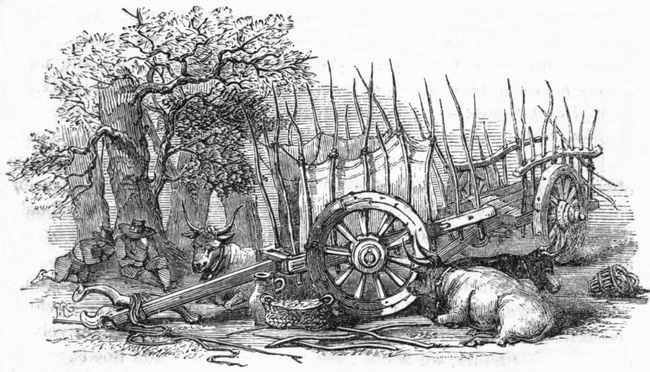
VEGA DE GRANADA.
A peasant's cottage at which we stopped to drink was surrounded
by two or three little gutters of running water, which emptied
themselves, at a short distance further on, into a cluster of pomegranate-trees,
myrtles, pistachio-trees, and others of every kind, in a
most extraordinarily flourishing condition. It was so long since we
had seen anything really green, that this wild and almost entirely
uncultivated garden appeared a little terrestrial paradise to us.
The young girl who brought us our beverage in one of those
delightful porous clay pots which keep the water so cool, was extremely
pretty; her eyes were long, reaching to beneath the temples,
and her mouth, which was as blooming and as red as a beautiful
pink, contrasted admirably with her tawny complexion. She wore
a flannel petticoat and velvet shoes, of which she appeared very
proud and careful. This style of beauty, which is frequently met
with in Granada, is evidently Moorish.
At one point, the valley becomes extremely narrow, and the rocks
project to such an extent, that they but just leave room enough for
the Rio. Formerly, vehicles were obliged to enter and proceed
along the very bed of the torrent, which it was somewhat perilous
for them to do, on account of the holes and stones at the bottom of
the river, and of the rising of the water, which, in winter, must be
considerable. In order to remedy this inconvenience, a viaduct,
similar to a railway tunnel, has been made right through one of the
rocks. This subterraneous passage, which is on a rather extensive
scale, was constructed only a few years back.
The valley soon widens again, however, and the road ceases to be
obstructed. Here my recollection fails me for several leagues.
Overcome by the heat, which the weather, inclining to storm, rendered
suffocating, I fell asleep; and when I awoke, night, which
comes on so suddenly in southern climates, enveloped everything,
and an awful wind was sweeping before it clouds of inflamed dust:
this wind must have been a very near relation of the African sirocco,
and I don't know how we escaped being stifled. The form of every
object disappeared in the fog of dust; and the sky, generally so
splendid during the summer night, resembled the vault of an oven:
it was impossible to see two paces before you. We entered Granada
at about two in the morning, and alighted at the Fonda del Comercio,
a soi-disant French hotel, where there were no sheets on the beds,
and where we slept on the tables in our clothes: but these trifling
tribulations produced little effect on us; for we were at Granada,
and, in a few hours, we should see the Alhambra and the Generalife.
Our first care was to request a cicerone to take us to a casa de
pupilos,—that is, a private house in which boarders are received,
for, as it was our intention to remain some time at Granada, the
mediocre hospitality of the Fonda del Comercio was far from calculated
to promote our comfort during a long sojourn. This cicerone, of
the name of Louis, was a Frenchman, and came from Farmoutiers in
Brie. He had deserted during the French invasion under Bonaparte,
and had lived at Granada for twenty years. He was the most
comical figure imaginable: his height—he was five feet eight—contrasted
most singularly with his little head, which was as wrinkled
as a shrivelled apple and about as large as your fist. Being deprived
of all communication with France, he had preserved his Brie jargon
in all its native purity, spoke like an Opéra Comique Jeannot, and
seemed to be perpetually reciting the words of Monsieur Etienne.
In spite of so long a sojourn, his thick head had refused to stock
itself with a single new idiom: he was hardly acquainted with the
most indispensable phrases. The only things Spanish he had about
him were the alpargatas, and the little Andalusian hat with its
turned-up brim. The fact, however, of being Spanish even to this
extent sorely vexed him, and he revenged himself by showering on
every Spaniard he met all sorts of injurious epithets—in his Brie
jargon, be it understood, for Master Louis had a particular dread of
hard blows, and took as much care of his skin as if it had been worth
something.
He took us to a very respectable house, in the Calle de Parragas,
near the Plazuela de San Antonio, and at a stone's throw from the
Carrera del Darro. The mistress of this boarding-house had lived
for a long time at Marseilles and spoke French, which circumstance
immediately induced us to take up our abode there, as our vocabulary
was still very limited.
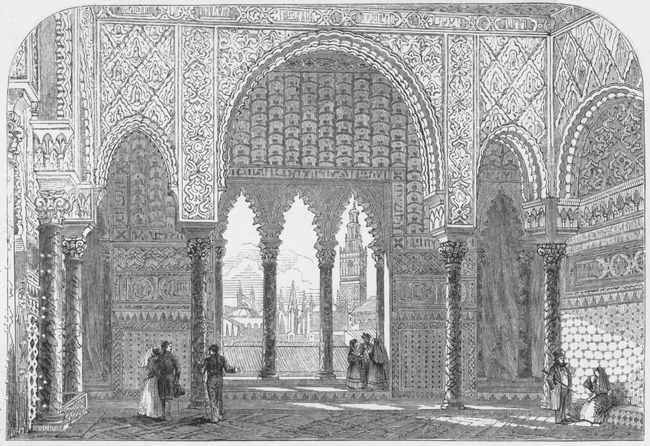
They put us into a room on the ground floor: this room was
whitewashed, and its entire furniture consisted of a rose of different
colours in the middle of the ceiling, but then it had the advantage
of opening into a patio, surrounded by white marble columns with
Moorish capitals, procured, no doubt, at the demolition of some
ancient Arabian palace. A little basin, with a jet of water in it,
dug in the middle of the court, kept the whole place cool; an immense
piece of esparto matting, which formed the tendido, let in a subdued
light, and made the ground, paved and marked out into compartments
with pebbles, glitter here and there, as if studded with shining
stars.
It was in the patio that we took our meals, read, and lived. We
used our room for hardly anything but to dress and sleep in. Were
it not for the patio, an architectural arrangement which reminds
you of the ancient Roman cavædium, the houses in Andalusia would
not be inhabitable. The sort of hall which precedes it is generally
paved with small pebble-stones of various colours, forming designs
in rough mosaic-work, now representing vases of flowers, now
soldiers and caltrops, or simply stating the time when the patio was
constructed.
From the top of our abode, which was surmounted by a kind of
mirador, we could perceive, above the summit of a hill standing
out boldly on the blue sky, and through groups of trees, the massive
towers of the Alhambra, clothed by the sun in deep red, fire-like
tints. The view was rendered complete by two large cypresses placed
in juxtaposition, and the dark points of which rose into the sky
above the walls of red. These cypresses are never lost sight of:
whether you are climbing the snow-streaked sides of the Mulhacen,
or wandering about the Vega or the Sierra de Elvira, they are always
to be perceived, dark and motionless in the mist of the blue or golden
vapour with which the roofs of the houses appear, at a distance, to
be enveloped.
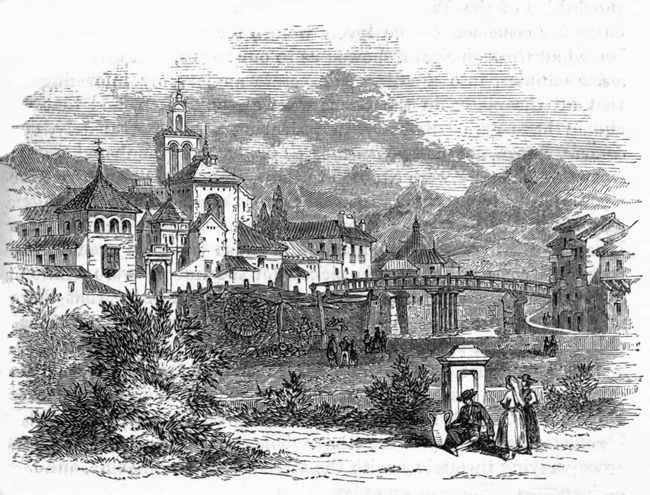
Granada is built on three hills, at the end of the plain of the Vega:
the Vermilion Towers—thus named on account of their colour (Torres
Bermejas), and which are asserted to be of Roman or even Phœnician
origin—occupy the first and the least elevated of these eminences;
the Alhambra, which is in itself an entire city, covers the second
and highest hill with its square towers, connected with one another
by lofty walls and immense substructures, which form an enclosure
containing gardens, woods, houses, and squares; the Albaycin is situated
on the third hillock, which is separated from the others by a
deep ravine choked with vegetation and full of cactuses, coloquintidas,
pistachio-trees, pomegranate-trees, rose-bays, and tufts of
flowers, and at the bottom of which flows the Darro, with the
rapidity of an Alpine torrent. The Darro, which has gold in its
stream, traverses the city now beneath the open sky, now under
bridges so long that they rather merit the name of vaults, and joins
itself in the Vega, at a little distance from the parade, to the Xenil
which is contented with containing silver. The course of the torrent
through the city is called Carrera del Darro, and a magnificent view
is obtained from the balconies of those houses which border it. The
Darro wears away its shores very much, and causes frequent slips
of earth; there exists, in consequence, an old couplet, sung by
children, which alludes to this mania for carrying everything away,
and accounts for it in a peculiar manner. The following are the
lines in question:—
"Darro tiene prometido
El casarse con Xenil
Y le ha de llevar en dote
Plaza Nueva y Zacatin,"
The gardens called Carmenes del Darro, and of which such charming
descriptions are to be found in Spanish and Moorish poetry,
are situated on the banks of the Carrera, on the same side as the
fountain of los Avellanos.
The city is thus divided into four quarters: the Antequerula,
which occupies the brow of the hill, or rather of the mountain, on
which the Alhambra is situated; the Alhambra and its appendix
the Generalife; the Albaycin, formerly a vast fortress, but now a
ruined and depopulated quarter; and Granada proper, which extends
into the plain round the cathedral, and the place of the Vivarambla,
which forms a separate quarter.
Such is the topographical aspect of Granada, traversed in its entire
width by the Darro, bordered by the Xenil, which washes the
alameda (parade), and sheltered by the Sierra Neveda, which you
perceive from the corner of every street, and which seems so near, in
consequence of the transparency of the air, that you fancy you can
touch it with your hand from the balcony or the mirador of your
house.
The general aspect of Granada greatly deceives the ideas you
may have formed. In spite of yourself—in spite of the numerous
deceptions you have already experienced—you cannot bring your
mind to believe that three or four hundred years, and streams of
matter-of-fact citizens have passed over the theatre of so many romantic
and chivalrous actions. You picture to yourself a half-Moorish,
half-Gothic city, where open-worked towers are mixed
with minarets, and where gables alternate with terraced roofs; you
expect to see houses sculptured and ornamented with coats of arms
and heroic devices, grotesque buildings, with their stories overlapping
one another, projecting joists, windows adorned with Persian
carpets and blue and white vases—in short, the reality of an opera
scene, representing some wonderful perspective of the Middle Ages.
The people you meet dressed in modern costumes, wearing broad-brimmed
hats and long frock-coats, involuntarily produce on you a
disagreeable effect, and appear more ridiculous than they really
are; for, after all, they cannot be expected to walk about, for the
sake of the local colouring, in the Moorish albornoz of the time of
Boabdil, or in the iron armour of the time of Ferdinand and Isabella
the Catholic. Like nearly all the citizens of every town in Spain,
they think it necessary for their honour to show that they are not
at all picturesque, and to prove, by the means of trousers and straps,
their progress in civilization. Such is the prevailing idea which
occupies their minds; they are afraid of appearing barbarous or
backward; and when you admire the wild beauty of their country,
they humbly beg you to excuse them for having no railways yet, and
for being without steam-engines in their manufactories. One of
these honest citizens, to whom I was extolling the charms of Granada,
replied, "It is the best lighted city in Andalusia. Just look at the
number of its lamps; but what a pity it is that they are not gas
ones!"
Granada is gay, smiling, animated, although much fallen from its
former splendour. The inhabitants are everywhere, and well merit
the name of a numerous population; the carriages are handsomer
and more plentiful than at Madrid. The sprightliness of the Andalusians
fills the streets with bustle and life—things unknown to the
grave Castilian, who, as he goes along, makes no more noise than
his shadow: this remark particularly applies to the Carrera del
Darro, the Zacatin, the Plaza Nueva, the Calle de los Gomeles,
which leads to the Alhambra, to the square before the theatre, to the
entrances to the parade, and to all the leading thoroughfares. The
rest of the city is intersected in all directions by inextricable lanes
of three or four feet in width, through which no vehicles can pass,
and which remind you of the Moorish streets of Algiers. The only
sound heard there is the noise made by the hoof of a donkey or a
mule, which strikes a light every now and then on the glittering
flints which pave the road, or the monotonous tinkling of a guitar
which some one is playing at the bottom of a yard.
The balconies, furnished with blinds and ornamented with shrubs
and vases of flowers, the vine-runners creeping from one window
to another, the rose-bays raising their blooming flowers above
the garden walls, the curious effect of the sun and shade, whose
fantastic frolics remind you of Decamps's pictures representing
Turkish villages, the women seated before the doors, the half-naked
children playing and rolling about at their sides, the donkeys going
backwards and forwards loaded with feathers and woollen tufts, give
these lanes, which are nearly always up-hill and sometimes intersected
with steps, a peculiar appearance which has a certain charm
about it, and which compensates—nay, more than compensates for
their want of regularity, by the novel and unlooked-for things you
see.
Victor Hugo, in his charming "Orientale," says of Granada,—
"Elle peint ses maisons de plus riches couleurs."
This is perfectly true. The houses of persons at all well off are
painted outside in the most fantastic manner with imitations of
architectural embellishments, sham cameos on grey grounds, and
false bas-reliefs. You have before you a medley of mouldings,
modillions, piers, urn-like vessels, volutes, medallions ornamented
with rose-coloured tufts, ovoloes, bits of embroidery, pot-bellied
cupids supporting all sorts of allegorical figures, on apple-green,
bright flesh-colour, or fawn-tinted backgrounds, all which, high
art tells us, argues bad taste carried to its utmost limits. At first,
you have some difficulty to bring yourself to look upon these illuminated
façades as real dwelling-houses. You fancy you are walking
among the scenery of a theatre. We had already seen houses
illuminated in this manner at Toledo, but they are very much behind
those of Granada in the extravagance of their decorations and the
strangeness of their colours. As for myself, I do not dislike this
fashion, which pleases the sight and forms a happy contrast with the
chalky colour of the whitewashed walls.
We just now mentioned the adoption by the upper classes of the
French style of dress; but the man of the people does not, luckily,
study Parisian fashions. He has still kept the pointed hat with a
velvet brim, adorned with silk tassels, or the one of stunted form with a
wide flap, like a turban, the jacket ornamented at the elbows, the cuffs,
and the collar, with embroidery, and pieces of cloth of all colours, and
which vaguely reminds you of the Turkish jackets, the red or yellow
sash, the breeches furnished with filigrane buttons, or with small
coins soldered to a shank, with the leather gaiters open up the side
to let the leg be seen; the whole being more striking, more gorgeous,
more flowered, more dazzling, more loaded with tinsel and gewgaws,
than the costume of any other province. You see also many other
costumes known by the name of vestido de cazador (hunter's dress),
made of Cordova leather and blue or green velvet, and ornamented
with aiglets. It is considered highly fashionable to carry a cane
(vara) or white stick, four feet long, slit up at the end, and on which
the person carrying it leans negligently when he stops to speak to
any one. No majo possessing the least respect for himself would
ever dare appear in public without a vara. Two handkerchiefs,
with their ends hanging out of the jacket pockets, a long navaja
stuck in the sash, not in front, but in the middle of the back, constitute
the height of elegance for these coxcombs of the people.
This costume so pleased my fancy, that my first care was to
order one. They took me to Don Juan Zafata, a person who had
a great reputation for national costumes, and who had as great a
hatred for black dress-coats and frock-coats as I have. Seeing that
my antipathy coincided with his own, he gave free course to his
sorrow, and poured into my breast his elegies on the decline of art.
With grief that found an echo in myself did he remind me of the
happy time when foreigners dressed in the French fashion would
have been hooted through the streets and pelted with orange-peel;
when the toreadores wore jackets embroidered with gold and silver,
which were worth more than five hundred piécettes; and when the
young men of good family had trimmings and aiglets of an enormous
price. "Alas! sir, the English are the only persons who buy
Spanish clothes now," said he, as he finished taking my measure.
This Señor Zapata was, with respect to his clothes, something like
Cardillac with respect to his jewels. He was always sorely grieved
at having to give them up to his customers. When he came to try
on my suit, he was so delighted with the splendid appearance of
the flower-pot he had embroidered in the middle of the back on the
brown cloth ground, that he broke out into exclamations of the
most frantic joy, and began to commit all sorts of extravagances.
But all at once the thought that he should have to leave this chef-d'œuvre
in my hands put a stop to his hilarity, and his features
suddenly became overcast. Under the pretext of making I know
not what alteration, he wrapped the garment up in a handkerchief,
gave it to his apprentice, for a Spanish tailor would think himself
dishonoured if he carried his own parcels, and casting at me a fierce,
ironical look, hurried away as if a thousand demons were pursuing
him. The next day he came back alone, and, taking from a leathern
purse the money I had paid him, he told me that it grieved him so
much to part with his jacket, that he preferred to return me my
duros. It was only after I had observed that this costume would
give the Parisians a great idea of his talent, and create him a reputation
in Paris, that he consented to let me have it.
The women have had the good taste not to discard the mantilla,
the most delicious style of head-dress for the display of Spanish
features; gracefully enveloped in their black lace, they go about the
streets and public walks, with nothing on their heads but the mantilla,
and a red pink at each temple, and glide along the walls, while
skilfully using their fans, with the most incomparable grace and
agility. A bonnet is a rare thing in Granada. The women of
fashion have, it is true, some jonquil, or poppy-coloured thing,
carefully put away in a bonnet-box, to be kept for grand occasions;
but such occasions, thank Heaven, are very rare, and the horrible
bonnets only see the light on the saint's day of the Queen, or at the
solemn sittings of the Lyceum. May our fashions never invade the
city of the caliphs, and may we never see realized the terrible
menace contained in the two words, "Modista Francesa," painted
in black at the entrance of a public square! Persons of a grave character
will, doubtless, think us very futile, and ridicule our grief
about the extinction of the picturesque, but then we are of opinion,
that patent leather boots and mackintoshes contribute very little to
civilization, and we even look upon civilization itself as a thing far
from desirable. It is a melancholy spectacle for a poet, an artist, and
a philosopher, to see both form and colour disappear from the world,
lines become confused, tints confounded, and the most disheartening
uniformity invade everything, under the pretext of I know not
what progress. When all things are alike, there will be no further
need for travelling, but, by a happy coincidence, that will be the
very time when railways will be in full activity. What will be the
good of making a long journey at the rate of ten leagues an hour,
to go and look at a number of streets lighted, like the Rue de la Paix,
with gas, and full of well-to-do citizens? We do not think that it
was for this that Nature modelled each country in a different shape,
supplied it with plants peculiar to itself, and peopled the world with
races dissimilar to each other in conformation, colour, and language.
It is giving a bad interpretation to the meaning for which the world
was created, to wish it to force the same livery on men of every
climate; and yet this is one of the errors of European civilization:
a coat with long narrow tails makes a man look much uglier than
any other costume would, and keeps him quite as barbarous. The
poor Turks of Sultan Mahmoud have certainly cut a fine figure since
the reform made in their old Asiatic costume, and the progress of
knowledge among them has been prodigious indeed!
In order to reach the parade, you must go along the Carrera del
Darro and cross the Plaza del Teatro, where there is a funereal
column raised to the memory of Joaquin Maïquez by Julian Romea,
Matilda Diez, and other dramatic artistes: the façade of the
Arsenal, a structure of bad taste, besmeared with yellow and decorated
with statues of grenadiers painted mouse-grey, looks on the
square.
The Alameda of Granada is certainly one of the most agreeable
places in the world; it is called the Saloon, a singular name for a
parade; fancy a long walk furnished with several rows of trees of
a verdancy unique in Spain, and terminating at each end by a
monumental fountain, the top basins of which support on their
shoulders aquatic gods, curious by their deformity, and delightfully
barbarous. These fountains, contrary to the custom of such constructions,
throw out the water in large sheets, which, evaporating
in the form of fine rain and mist, spreads around a most delicious
coolness. In the side walks run streams of crystalline transparency,
encased in beds of different coloured pebbles. A large parterre,
ornamented with jets of water and crowded with shrubs and flowers,
myrtles, roses, jasmines, with all the riches, in fact, of the Granadian
Flora, occupies the space between the Saloon and the Xenil,
and stretches as far as the bridge constructed by General Sebastiani
at the time of the French invasion. The Xenil runs from the
Sierra Neveda in its marble bed, through woods of laurel of the
most incomparable beauty. Glass and crystal form comparisons too
opaque and too thick to give a true idea of the purity of the
water which, but the evening before, was still flowing in sheets of
silver on the white shoulders of the Sierra Neveda. It is like a
torrent of diamonds in a state of fusion.
The fashionable world of Granada assemble on the Saloon, between
seven and eight in the evening; the carriages follow along the road,
but they are for the most part empty, as the Spaniards are very fond
of walking, and in spite of their pride, deign to use their own legs.
Nothing can be more charming than to see the young women and
young girls pass to and fro in little groups, dressed in their mantillas,
with their arms bare, real flowers in their hair, satin shoes on their
feet, and a fan in their hand, followed at some distance by
their friends and sweethearts, for, as we have already said, when
speaking of the Prado at Madrid, it is not customary in Spain
for the women to take the arms of the men. This habit of walking
alone gives them a bold, elegant, and free deportment unknown to
our women, who are always hanging to some arm or other. As
artists say, they carry themselves beautifully. This perpetual
separation of the men from the women, at least in public, already
smacks of the East.
A sight of which the people of the North can have no idea, is the
Alameda of Granada at sunset. The Sierra Neveda, whose denticulated
ridges face the city on this side, assumes the most unimaginable
hues. Its whole steep and rugged flank and all its peaks,
struck by the light, become of a rose-colour, dazzling to behold;
ideal, fabulous, shot with silver, and streaked with iris and opal-like
reflections, which would make the freshest tints on the artist's
palette appear thick and dirty: the hues of mother-of-pearl, the
transparency of the ruby, and veins of agate and advanturine that
would defy all the fairy jewellery of the "Thousand-and-one Nights,"
are to be seen there. The hollows, crevices, anfractuosities, and all
the places which the rays of the setting sun cannot reach are of a
blue colour which vies with the azure of the sky and sea, with the
lapis-lazuli and the sapphire; this contrast of hue between light
and shade produces a wonderful effect: the mountain seems to have
put on an immense robe of shot silk spangled and bordered with
silver; little by little, the bright colours disappear and turn to violet
mezzotintos, darkness invades the lower ridges, the light withdraws
towards the summit, and all the plain has long since been in
obscurity, while the silver diadem of the Sierra still shines out in
the serenity of the sky, beneath the parting kiss sent it by the sun.
The company take a turn or two more and then disperse, some
going to take sherbet or agraz at the café of Don Pedro Hurtado,
where you get the best ice in Granada, and others to the tertulia at
their friends' and acquaintances' houses.
This is the gayest and most lively part of the day at Granada.
The shops of the aguadores and sellers of ices in the open street are
illuminated by a multitude of lamps and lanterns; the street lamps
and the lights placed before the images of the madonnas vie in splendour
and number with the stars, and this is saying something: if it
happens to be moonlight, you can easily see to read the most microscopical
print. The light is blue instead of being yellow, and that
is all.
Thanks to the lady who had saved me from dying of hunger in
the diligence, and who introduced us to several of her friends,
we were soon well known in Granada. We led a delicious life
there. It would be impossible to receive a more cordial, frank, and
amiable welcome than we did; at the end of five or six days we
were on the most intimate terms with every one, and according to
the Spanish custom, we were always called by our Christian names;
at Granada I was Don Teofilo, my friend gloried in the appellation
of Don Eugenio, and we were both at liberty to designate the ladies
and young girls of the houses in which we were received, by the
familiar names of Carmen, Teresa, Gala, &c.; this familiarity clashes
in no way with the most polished manners and the most respectful
attention.
We went to tertulia every evening from eight o'clock till
twelve; to-day at one house, to-morrow at another. The tertulia is
held in the patio, surrounded by alabaster columns and ornamented
by a jet of water, the basin of which is encircled with pots of
flowers and boxes of shrubs, down whose leaves the water falls in
large beads. Five or six lamps are hung up along the walls: sofas,
and straw or cane-bottomed chairs furnish the galleries, with here
and there a guitar. The piano occupies one corner, and in another
stand card-tables. Every one, on entering, goes to pay his compliments
to the mistress and master of the house, who never fail to
offer you a cup of chocolate, that good taste tells you to refuse, and
a cigarette, which is sometimes accepted. When this duty is
over, you retire to a corner of the patio, and join the group which
has most attraction for you. The parents and old people play at
trecillo, the young men talk with the young girls, recite the octaves
and the decastichs they have composed during the day, and are
scolded and forced to do penance for the crimes they may have committed
the evening before; such, for instance, as having danced too
often with a pretty cousin, or cast too ardent a glance towards a
proscribed balcony, with numerous other peccadilloes. If, on the
contrary, they have been very good, they are rewarded for the rose
they have brought with the pink in the young girls' breast or hair,
and their squeeze of the hand is replied to by a gentle look and a
slight pressure of the fingers, when all go up into the balcony to
listen to the Retreat beaten by the troops. Love seems to be the
sole business of Granada. You have only to speak two or three
times to a young girl, and the entire city immediately declare you
to be novio and novia,—that is, affianced, and make a thousand
innocent jokes about the passion they have invented for you; which
jokes, innocent though they be, do not fail, however, to make you
somewhat uneasy, by bringing visions of conjugal life before your
eyes. All this gallantry is, however, more apparent than real; in
spite of languishing glances, burning looks, tender or impassioned
conversations, pretty little shortenings of your name, and the
querido (beloved) with which it is preceded, you must not conceive
any too flattering ideas. A Frenchman to whom a woman of the
world were to say the quarter of what a young Granadian girl says
to one of her numerous novios, without the least importance being
attached to it, would think himself already in Paradise; but he
would soon find his mistake, for if he became too bold, he would be
instantly called to order, and summoned to state his matrimonial
intentions before the nearest relatives. This honest liberty of language,
so far removed from the forced and artificial manners of the
nations of the north, is preferable to hypocrisy of speech, which
always hides, at bottom, some coarse thought or other. At Granada,
to pay attentions to a married woman seems quite extraordinary;
while nothing appears more natural there than to pay court to a
young girl. It is the contrary in France: no one ever addresses,
there, a word to young, unmarried ladies, and this is what so often
renders marriages unhappy. In Spain, a novio sees his novia two
or three times a day, speaks to her without witnesses, accompanies
her in her walks, and comes to talk with her in the evening through
the bars of the balcony, or the window of the ground-floor. He
thus has time to become acquainted with her, to study her character,
and does not buy, as the saying is, a pig in a poke.
When the conversation flags, one of the gentlemen takes down
a guitar, and, scratching the cords with his nails and keeping time
with the palm of his hand on the centre of the instrument, begins
to sing some gay Andalusian song or some comic couplet, interspersed
with Ay! and Ola! curiously modulated and productive of
a very singular effect. Then a lady sits down to the piano, and plays
a morceau from Bellini, who appears to be the favourite maestro of
the Spaniards, or sings a romance of Breton de los Herreros, the
great versifier of Madrid. The evening is terminated by a little
extempore ball, at which, alas! they dance neither jota, nor fandango,
nor bolero, these dances being abandoned to peasants,
servants, and gipsies; but they dance quadrilles, rigadoons,
and sometimes they waltz. At our request, however, two young
ladies of the house volunteered to execute the bolero one evening;
but, before they commenced, they took care to close the
door and windows of the patio, which are generally left open, so
afraid were they of being accused of bad taste and local colouring. In
general, the Spaniards grow angry on being spoken to of cachuchas,
castanets, majos, manolas, monks, smugglers, and bull-fights, though
they have, in reality, a great liking for all these things, so truly
national and characteristic. They ask you, with an air of apparent
vexation, if you do not think that they are as far advanced in civilization
as yourself? To such an extent has the deplorable mania of
imitating everything, French or English, penetrated everywhere!
At present, Spain represents the Voltaire-Touquet system and the
Constitutionnel of 1825; that is, it is hostile to all colouring and to
all poetry. Be it remembered, however, that we are only speaking
of the self-styled enlightened class inhabiting the cities.
As soon as the quadrilles are over, you take your leave by saying,
"A los pies de vd." to the lady of the house, and "Beso à vd. la
mano" to her husband; to which they reply, "Buenas noches," and
"Beso à vd. la suya:" and then again on the threshold, as a last
adieu, "Hasta mañana" (till to-morrow); which is an invitation to return.
In spite of their familiar ways, the people of even the lower
classes, the peasants and vagrants, make use towards one another of
the most exquisite urbanity, which forms a strong contrast with the
uncouthness of our own rabble. It is true that a stab might be the
result of an offensive expression, and this is certainly one way of
making all interlocutors use a good deal of circumspection. It is
worthy of remark that French politeness, formerly proverbial, has
disappeared since swords have ceased to be worn. The laws against
duelling will end by making us the rudest nation in the world.
On returning home, you meet, under the windows and balconies,
numbers of young gallants enveloped in their hooded cloaks, and
staying there to pelar la paba (pluck the turkey), that is, to talk
with their novias through the bars. These nocturnal conversations
often last till two or three o'clock in the morning, which is nothing
astonishing, since the Spaniards spend a part of the day in sleep.
You sometimes tumble also on a serenade composed of three or
four musicians, but more generally of the sighing swain only, who
sings couplets as he accompanies himself on the guitar, with his
sombrero drawn over his eyes, and his feet resting on a stone or a
step. Formerly two serenades in the same street would not have
been tolerated. The first comer claimed the right of remaining there
alone, and forbade every other guitar, except his own, to tinkle in
silence of the night. Such pretensions were maintained at the point
of the sword, or by the knife, unless the patrol happened to be
passing. In this case the two rivals coalesced, in order to charge
the patrol, with the understanding that they were to renew their
own private combat by and by. The susceptibility of serenaders
has greatly diminished, and every one can at present tranquilly
rascar el jamon (scrape the ham) under the window of his
mistress.
If the night is dark you must take care not to put your foot into
the stomach of some honourable hidalgo, rolled up in his mantle,
which serves him for garment, bed, and house. During the summer
nights the granite steps of the theatre are covered with a mass of
blackguards who have no other place to go to. Each of them has his
particular step, which serves as his apartment, where he is always sure
to be found. They sleep there under the blue vault of heaven, with
the stars for night lights, with no bugs to annoy them, and defy the
sting of the mosquito by the coriaceous nature of their tanned skin,
which is bronzed by the fiery sun of Andalusia, and certainly quite
as dark as that of the darkest mulattoes.
The following is, without much variation, the life we led. The
morning was devoted to visiting different parts of the city, to a
walk to the Alhambra or the Generalife; we then went, of necessity,
to call on the ladies at whose houses we had passed the previous
evening. When we called but twice a day they told us we
were ungrateful, and received us with so much kindness that we
came to the conclusion that we really were fierce savage beings, and
extremely negligent.
Our passion for the Alhambra was such that, not satisfied with
visiting it every day, we were desirous of altogether taking up our
abode there; not, however, in the neighbouring houses, which are let
at very high prices to the English, but in the palace itself; and,
thanks to the interest of our Granadian friends, the authorities,
without giving us formal permission, promised not to perceive us.
We remained there four days and four nights, which constituted,
without any doubt, the happiest moments of my existence.
In order to reach the Alhambra, we will pass, if you please,
through the square of the Vivarambla, where Gazal, the valiant
Moor, used to hunt the bull, and where the houses, with their
wooden balconies and miradores, present a vague appearance of so
many hen-coops. The fish-market occupies one corner of the square,
the middle of which forms an open space, surrounded with stone
seats, peopled with money-changers, vendors of alcarrazas, earthen
pots, water melons, mercery, ballads, knives, chaplets, and other
little articles that can be sold in the open air. The Zacatin, which
has preserved its picturesque name, connects the Vivarambla with
the Plaza Nueva. It is in this street, bordered by lateral lanes, and
covered with canvass tendidos, that all the commerce of Granada
moves and buzzes; hatters, tailors, and shoemakers, lacemen and
cloth merchants, occupy nearly all the shops, which possess as yet
nothing of the improvements of modern art, and remind you of the
old pillars of the Paris markets.
The Zacatin is always crowded. Now you meet a group of
students on a tour from Salamanca, playing the guitar, the tambourine,
castanets, and triangle, while they sing couplets full of fun
and animation; then again your eye encounters a gang of gipsy
women, with their blue flounced dresses studded with stars, their
long yellow shawls, their hair in disorder, and their necks encircled
with big coral or amber necklaces, or a file of donkeys loaded with
enormous jars, and driven by a peasant from the Vega, as sun-burnt
as an African.
The Zacatin leads into the Plaza Nueva, one side of which is taken
up by the splendid palace of the Chancellor, remarkable for its
columns of rustic order and the severe richness of its architecture.
As soon as you have crossed the place, you begin to ascend the Calle
de los Gomeres, at the end of which you find yourself on the limits
of the jurisdiction of the Alhambra, and face to face with the Puerta de
Granada, named Bib Leuxar by the Moors, with the Vermilion Towers
on its right, built, as the learned world declares, on Phœnician sub-structures,
and inhabited at present by basket-makers and potters.
Before proceeding further, we ought to warn our readers, who
may perhaps think our descriptions, though scrupulously exact,
beneath the idea they have formed of the Alhambra, that this palace
and fortress of the ancient Moorish kings is very far from presenting
the appearance lent to it by the imagination. We expected to see
terrace superposed on terrace, open-worked minarets, and rows of
boundless colonnades. But nothing of all this really exists: outside,
there are only to be seen large massive towers of the colour of
bricks or toasted bread, built at different epochs by Arabian princes;
and within, all you see is a suite of chambers and galleries, decorated
with extreme delicacy, but with nothing grand about them. Having
made these remarks, we will continue our route.
After having passed the Puerta de Granada, you find yourself
within the bounds of the fortress and under the jurisdiction of a
special governor. There are two routes marked out in a wood of
lofty trees. Let us take the one to the left, which leads to the fountain
of Charles the Fifth: it is the steeper of the two, but then
it is the shorter and the more picturesque. Water flows along
rapidly in small trenches paved with kelp, and spreads around the
bottom of the trees, which nearly all belong to species peculiar to the
north, and the verdancy of which is of such moisture as to be truly
delicious at so short a distance from Africa. The noise of the murmuring
water joins itself to the hoarse hum of a hundred thousand
grasshoppers or crickets, whose music never ceases, and which
forcibly reminds you, in spite of the coolness of the place, of southern
and torrid climes. Water springs forth everywhere; from beneath
the trunks of the trees and through the cracks in the old walls.
The hotter it is, the more abundant are the springs, for it is the
snow which supplies them. This mixture of water, snow, and fire,
renders the Granadian climate unparalleled throughout the world,
and makes Granada a real terrestrial paradise; without being Moors,
we might well have had applied to us, when we appeared oppressed
by deep melancholy, the Arabian saying—"He is thinking of
Granada."
At the end of the road, which continues to rise, you meet a
large monumental fountain, which serves as a shouldering-piece,
raised to the memory of the emperor Charles the Fifth: it is covered
with numerous devices, coats of arms, names of victories, imperial
eagles, mythological medallions, is of a heavy imposing richness, and
in the Romanic-German style. Two shields, bearing the arms of the
house of Mondejar, announce that Don Luis de Mendoza, marquis of
this title, raised the monument in honour of the red-bearded Cæsar.
This fountain, which is solidly constructed, supports the ascent which
leads to the Gate of Justice, through which you enter the Alhambra
proper.
The Gate of Justice was built by King Yusef Abul Hagiag, about
the year of our Lord 1348: it owes its name to the custom the Mussulmans
have of rendering justice on the threshold of their palaces;
this custom possesses the advantage of being very majestic, and of
allowing no one to enter the inner courts; for the maxim of Monsieur
Royer-Collard, which says that "Private life ought to be walled in,"
was invented ages ago by the inhabitants of the East—that country
of the sun, whence all light and wisdom come.
The name of tower might be given more properly than that of
gate to this construction of King Yusef Abul Hagiag; for it is in
reality a large square tower, rather high, and through which there
is a large hollow arch in the form of a heart, to which a hieroglyphic
key and hand, cut in two separate stones, impart a stern and cabalistic
air. The key is a symbol held in great veneration by the
Arabs, on account of a verse in the Koran beginning with the words
"He has opened," and of several other hermetic significations; the
hand is destined to destroy the influence of the Evil Eye, the jettatura,
like the little coral hands which they wear at Naples as pins
or watch appendages, to avert the power of sinister looks. There
was an ancient prediction which asserted that Granada would never
be taken until the hand had seized the key: it must be owned,
however, to the shame of the prophet, that the two hieroglyphics
are still in the same places; and that Boabdil, el rey chico, as he was
called on account of his small stature, uttered outside the walls of
conquered Granada the historical groan, suspiro del Moro, which
has given its name to a rock of the Sierra de Elvira.
This massive and embattled tower, glazed with orange and red
on a stiff sky-blue ground, and having behind it a whole abyss of
vegetation, with the city built on a precipice, while beyond it
are long ranges of mountains streaked with a thousand hues, like
those of African porphyry, forms a truly majestic and splendid
entrance to the Arabian palace. Under the gate is a guard-house,
and poor ragged soldiers now take their siesta in the same place
where the caliphs, seated on sofas of gold brocade, with their black
eyes motionless in their marble faces and their hands buried in the
folds of their silky beards, listened with a thoughtful and solemn air
to the complaints of the believers. An altar, surmounted by an
image of the Virgin, stands against the wall, as if to sanctify
at the very entrance this ancient abode of the worshippers of
Mahomet.
When you have passed through the gate, you enter a vast place
called the Plaza de las Algives, in the middle of which is a well
whose curb is surrounded by a sort of wooden shed covered with
esparto-work, where you can go, for a cuarto, and drink large glasses
of water as clear as a diamond, as cold as ice, and of the most delicious
taste. The towers of Quebrada, the Homenaga, the Armeria,
and of the Vela, whose bell announces the time at which the
water is distributed; and stone parapets on which you can lean, in
order to admire the wonderful view that stretches itself before you,
surround one side of the place; the other side is occupied by the
palace of Charles the Fifth, an immense monument of the Renaissance
which would be admired anywhere else, but which is wished
anywhere but here when you think that it covers a space once belonging
to a part of the Alhambra, that was pulled down on purpose
to make room for this heavy mass. This alcazar was designed, however,
by Alonzo Berruguete: the trophies, bas-reliefs, and medallions
on its façade have been executed with patience by a bold and spirited
hand: the circular court with its marble columns, where the
bull-fights, doubtless, took place, is certainly a magnificent piece of
architecture, but non erat hic locus.
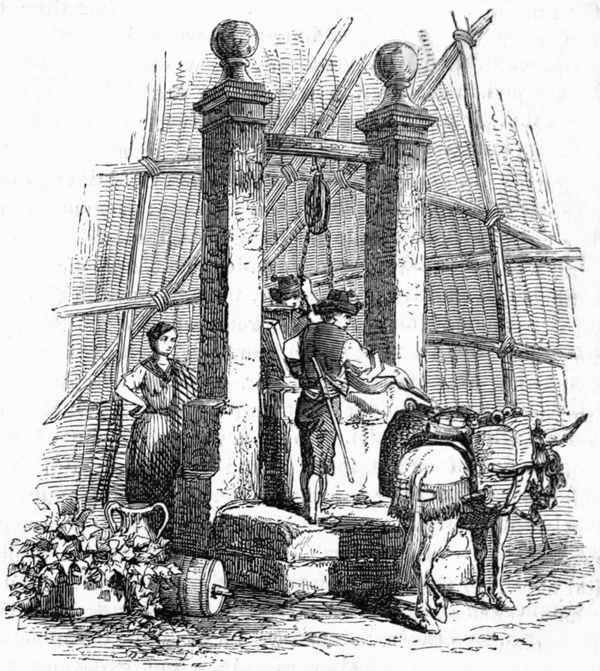
WELL DE LAS ALGIVES, ALHAMBRA.
You enter the Alhambra by a corridor running through an angle
of the palace of Charles the Fifth, and after a few windings you
arrive at a large court indifferently known by the names of Patio
de los Arrayanes (Court of Myrtles), of the Alberca (of the Reservoir),
or of the Mezouar, an Arabian word signifying a bath for
women.
On coming from these obscure passages into this large space inundated
with light, you feel an effect similar to that produced by a
diorama. It appears to you that an enchanter's wand has carried
you to the East of four or five centuries back. Time, which changes
all things in its progress, has in no way modified the aspect of these
places, where the apparition of one of the old Moorish sultans, and
of Tarfe the Moor in his white cloak, would not cause the least
surprise.
In the middle of the court there is a large reservoir three or four
feet deep, in the form of a parallelogram, bordered by two large beds
of myrtles and shrubs, and terminated at each end by a sort of
gallery, with slender columns supporting Moorish arches of very
delicate workmanship. Fountains, the over-abundant water of
which is conducted from the basins to the reservoir through a
marble gutter, are placed under each gallery, and complete the
symmetry of the decorations. To the left are the archives, and the
chamber where, to the shame of the Granadians, is stowed away,
among all sorts of rubbish, the magnificent vase of the Alhambra,
a monument of inestimable rareness, nearly four feet in height,
covered with ornaments and inscriptions, and fitted in itself to form
the glory of a museum, but which Spanish heedlessness allows to
lie uncared-for in an ignoble hole. One of the wings which form
the handles was broken off a little time back. On this side also are
passages leading to an ancient mosque, converted into a church
under the protection of St. Mary of the Alhambra, at the time of
the conquest. To the right are the rooms of the attendants, where
the head of some dark Andalusian servantmaid, looking out of a
narrow Moorish casement, now and then produces a very pleasing
Oriental effect. At the bottom, above the ugly roof of round tiles,
which have replaced the gilt tiles and cedar-beams of the Arabian
roof, rises majestically the tower of Comares, the embattlements of
which boldly shoot forth their vermilion denticulations into the
beautifully limpid vault of heaven. This tower contains the Hall
of Ambassadors, and communicates with the Patio de los Arrayanes
by a sort of antechamber called the Barca, on account of its form.
The antechamber of the Hall of Ambassadors is worthy of its
purpose; the nobleness of its arcades, the variety and interweavings of
its arabesques, the mosaic-work of its walls, the delicacy of its stuccoed
roof, furrowed like the stalactite ceiling of a grotto, painted blue,
green, and yellow, of which there are still some traces left, form a
whole of the most charming originality and strangeness.
On each side of the door leading to the Hall of Ambassadors, in
the jamb itself of the arcade, and above the coating of varnished
glass which decorates the lower part of the walls, and which is
divided into triangles of glaring colours, are two white marble
niches, looking like little chapels, and sculptured in a most delicate
manner. It was here that the ancient Moors used to leave their
slippers before entering, as a mark of deference, just as we take off
our hat in places we respect.
The Hall of Ambassadors, one of the largest of the Alhambra,
occupies all the interior of the tower of Comares. The roof, which
is cedar, is full of those mathematical combinations so familiar to
Arabian architects: all the pieces are placed so that their salient
or re-entering angles form a great variety of designs; the walls disappear
beneath a network of ornaments so close together, and so
inextricably interwoven, that they can be compared to nothing
more fitly than to several pieces of guipure placed one over another.
Gothic architecture, with its stone lacework, and its open-worked
roses, is nothing to this. Fish-knives, and paper embroidery
executed with a fly-press, like that which confectioners use to cover
their bonbons with, can alone give you an idea of it. One of the characteristics
of the Moorish style is that it offers very few projections or
profiles. All this ornamental work is executed on smooth surfaces,
and scarcely ever projects more than four or five inches; it resembles
a kind of tapestry worked on the wall itself. It has, too, one very distinguishing
feature, and this is, the employment of writing as a means
of decoration. It is true that Arabian writing, with its mysterious
forms and distortions, is admirably fitted for this use. The inscriptions,
which are nearly always suras of the Koran, or eulogiums on the
different princes who have built and decorated the halls, are placed
along the friezes, on the jambs of the doors, and round the arches of
the windows, and are interspersed with flowers, foliage, net-work, and
all the riches of Arabian calligraphy. Those in the Hall of Ambassadors
signify "Glory to God, power and riches to believers;" or
they sing the praises of Abu Nazar, who, "if he had been taken
alive into heaven, would have made the brightness of the stars and
planets pale"—a hyperbolical assertion, which seems to us rather too
oriental. Other rows of inscriptions are filled with eulogiums of
Abi Abd Allah, another sultan, who helped to build this part of
the palace. The windows are loaded with pieces of poetry in
honour of the limpidness of the waters of the reservoir, of the
blooming condition of the shrubs, and of the perfume of the flowers
that ornament the yard of the Mezouar, which is seen from the Hall
of Ambassadors through the door and columns of the gallery.
The loopholes, with their interior balconies at a great height from
the ground, and the roof of wood-work without any other ornaments
but the zigzags and the cross-work formed by the placing of the
timber, give the Hall of Ambassadors a severer aspect than the
other halls of the palace have, but which is more in harmony with
the purpose it was intended for. From the window at the back
there is a beautiful view over the ravine of the Darro.
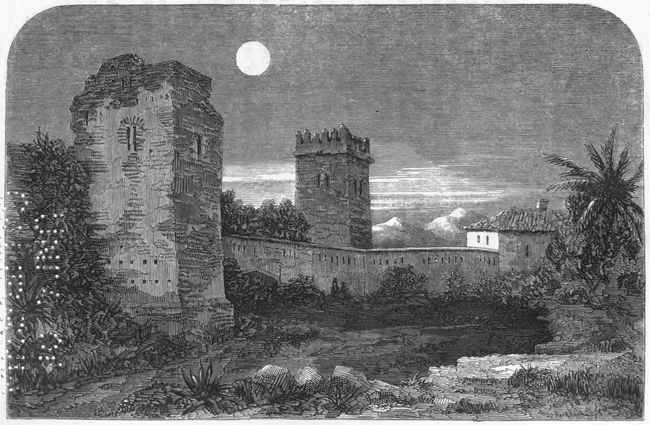
EXTERIOR OF THE ALHAMBRA.
Now that we have given this description, we think it our duty to
destroy another illusion. All these magnificent things are made
neither of marble nor of alabaster, nor even of stone, but simply of
plaster! This interferes very much with the ideas of fairy splendour
that the name alone of the Alhambra creates in the most positive
imaginations; but it is true, for all that. With the exception of
the columns, which are nearly all made of a single piece, and which
are hardly ever more than from six to eight feet in height, of a
few flag-stones, of the smaller basins of the fountains, and of the
little chapels where the slippers used to be left, there has not been a
single bit of marble employed in the construction of the Alhambra.
The same thing may be said of the Generalife: the Arabs surpassed
all other nations in the art of moulding, hardening, and carving
plaster, which acquired in their hands the firmness of stucco, without
having its disagreeable shiny appearance.
The greater part of these ornaments were made in casts, so that
they could be reproduced without any great trouble as often as
the symmetry of the place required it. Nothing would be easier
than to reproduce an exact likeness of any hall of the Alhambra; to
do this, it would suffice to take casts of all the ornaments contained
in it. Two arcades of the Hall of Justice, which had fallen down,
have been reconstructed by some Granadian workmen, in a manner
which leaves nothing to be desired. If we were anything of a
millionaire, one of our fancies would be to have a duplicate of the
Court of Lions in one of our parks.
On leaving the Hall of Ambassadors, you follow a passage of
modern structure, comparatively speaking, and you arrive at the
tocador, or dressing-room of the queen. This is a small pavilion
situated on the top of a tower, which formerly served the sultanas
for an oratory, whence you enjoy the sight of an admirable panorama.
At the entrance you perceive a slab of white marble, perforated
with small holes to allow the smoke of the perfumes that
were burnt beneath the floor to pass through. On the walls are still
seen some fantastic frescoes, executed by Bartholomew de Ragis,
Alonzo Perez, and Juan de la Fuente. On the frieze the ciphers of
Isabella and Philip V. are intertwined, one with another, together
with groups of Cupids. It is impossible to conceive anything more
coquettish or charming than this closet, suspended as it is, with its
little Moorish pillars, and its surbased arches, over an abyss of
azure, the bottom of which is studded with the house-tops of
Granada, and whither the breeze wafts the perfumes of the Generalife,
that enormous tuft of rose-bays blooming on the brow of the
neighbouring hills, and the plaintive cry of the peacocks walking on the
dismantled walls. How many hours have I not spent there, wrapped
in that serene melancholy so different from the melancholy of the north,
with one leg dangling over the precipice, and straining my eyes in order
to leave unexamined no form or contour of the picture that lay
before them, and which they will, doubtless, never see again. No pen
or pencil will ever be able to give a true idea of that brilliancy, of that
light, of that vividness of hues. The most commonplace tones
assume the appearance of jewels, and everything is on the same
scale. Towards the end of the day, when the sun is oblique, the
most inconceivable effects are produced: the mountains sparkle
like heaps of rubies, topazes and carbuncles; dust, which looks like
dust of gold, fills the intervals, and if, as is often the case in summer,
the labourers are burning stubble in the plain, the smoke, while
rising slowly towards the sky, borrows the most magical reflections
from the rays of the setting sun. I am surprised that Spanish
painters, have, in general, made their pictures so dark, and have
almost exclusively employed themselves in imitating Caravaggio and
the masters of the sombre school. The pictures of Decamps and
Marilhat, who only painted views of Asia or Africa, give a truer
idea of Spain than all the pictures fetched, at a great expense, from
the Peninsula.
We will traverse the garden of Lindaraja without stopping, for it
is nothing but an uncultivated piece of ground, strewed with rubbish,
and bristling with brushwood; we will therefore visit, for an
instant, the Bath-room of the Sultana, which is coated with square
pieces of mosaic-work of glazed clay, and bordered with filigree-work
that would make the most complicated madrepores blush.
A fountain is in the middle of the room, and two alcoves are
in the wall. It was here that the Moorish Sultanas used to come
to repose themselves on square pieces of golden cloth, after having
enjoyed the pleasure and luxury of an oriental bath. The galleries
or balconies, in which the singers and musicians used to be placed,
are still seen, and are at a height of about fifteen feet from the
ground. The baths themselves resemble large troughs, and each of
them is made out of one piece of white marble; they are placed in
little vaulted closets, lighted by open-worked stars or roses. For
fear of becoming irksome by repetition, we will not speak of the
Hall of Secrets, whose acoustic powers are productive of a very
curious effect, and the corners of whose walls are blackened by the
noses of those inquisitive persons who go and whisper, in one
corner, some impertinence that is faithfully carried to another; nor
of the Hall of the Nymphs, over the door of which is an excellent
bas-relief of Jupiter changed into a swan and caressing Leda, and
which said bas-relief is most extraordinarily free in its composition,
and very audacious in its execution; nor of the apartments of
Charles the Fifth, which are in a dreadful state of devastation, and
which possess nothing curious, with the exception of their roofs,
studded with the ambitious device of Non plus ultra; but we will go
direct to the Court of Lions, the most curious and best preserved
part of the Alhambra.
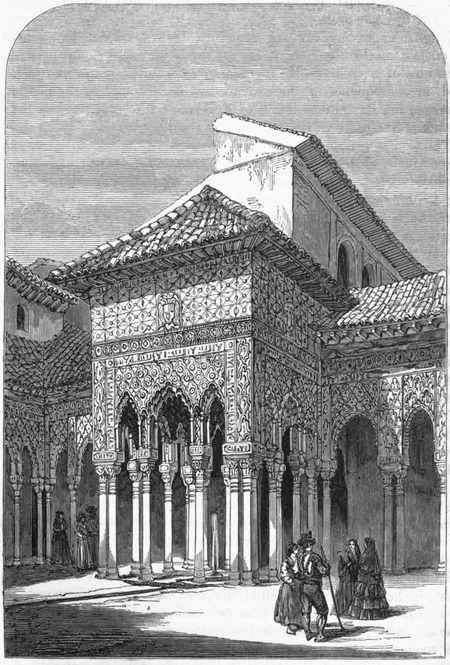
PAVILION OF THE COURT OF LIONS, ALHAMBRA.
English engravings and the numerous drawings which have been
published of the Court of Lions convey but a very incomplete and
false idea of it: nearly all of them fail to give the proper proportions,
and, in consequence of the over-loading necessitated by the fact of
representing the infinite details of Arabian architecture, suggest the
idea of a monument of much greater importance.
The Court of Lions is a hundred and twenty feet long, seventy-three
broad, while the galleries which surround it are not more than
twenty-two feet high. They are formed by a hundred and twenty-eight
columns of white marble placed in a symmetrical disorder of
four and four, and of three and three, together: these columns, the
capitals of which are full of work and still preserve traces of gold and
colour, support arches of extreme elegance and of quite a unique shape.
On entering, the Hall of Justice, the roof of which is a monument
of art of the most inestimable rarity and worth, immediately attracts
your attention, as it forms the back of the parallelogram. There
you see the only Arabian pictures, perhaps, which have come down
to us. One of them represents the Court of Lions itself, with the
fountain, which is very apparent, but gilt: some personages, whom
the oldness of the painting does not allow you to distinguish clearly,
seem to be engaged in a joust or passage of arms.
The subject of the other appears to be a sort of divan where the
Moorish kings of Granada are assembled, and whose white burnous,
olive-coloured faces, red mouths, and mysteriously dark eyes, are
still easily discernible. These paintings, as is asserted, are executed
on prepared leather, pasted on cedar panels, and serve to prove that
the precept of the Koran which forbids the likenesses of animated
beings being taken was not always scrupulously observed by the
Moors, even if the twelve lions of the fountain were not there to
confirm this assertion.
To the left, halfway up the gallery, is the Hall of the Two Sisters,
which is the fellow to the Hall of the Abencerrages. This name of
las Dos Hermanas is given it from two immense flagstones of white
Macael marble, equal in size and perfectly alike, which form part of
the pavement. The vaulted roof, or cupola, which the Spaniards
expressively call media naranja (half an orange), is a miracle of
work and patience. It is like a honeycomb, or the stalactites of a
grotto, or the bunches of soap-bubbles which children blow out
through a straw. The myriads of little vaults, of domes three or
four feet high which grow out of one another, crossing and intersecting
each other's edges, seem rather the effect of fortuitous crystallization
than the work of a human hand; the blue, red, and green
in the hollows of the mouldings are still nearly as bright as if they
had only just been put on. The walls, like those of the Hall of
Ambassadors, are covered, from the frieze to the height of a man,
with stucco-work of the most complicated and delicate description.
The bottom of the walls is coated with those square pieces of glazed
clay of which the black, yellow, and green angles, combined with the
white ground, form a mosaic-work. The middle of the apartment,
according to the invariable custom of the Arabs, whose habitations
seem to be nothing but large ornamented fountains, is occupied by a
basin and a jet of water. There are four fountains under the Gate
of Justice, a like number under the entrance-gate, and another in
the Hall of the Abencerrages, without counting the Taza de los
Leones, which, not satisfied with vomiting water through the mouths
of its twelve monsters, throws up another torrent towards the sky
out of the cap which surmounts it. All this water flows through
small trenches made in the flooring of the halls and the pavement of
the courts, to the foot of the Fountain of Lions, where it disappears
in a subterraneous conduit. This is certainly a kind of dwelling in
which you would never be annoyed by the dust, and it is a matter
of conjecture how these halls could be inhabited in the winter. The
large cedar doors were no doubt then shut, the marble floor was
perhaps covered with a thick carpet, and fires of fruit-stones and
odoriferous wood lighted in the braseros, and it was thus that the
return of the fine season was waited for, which is never long in
coming at Granada.
We will not describe the Hall of the Abencerrages, which is almost
similar to that of the Two Sisters, and contains nothing particular,
with the exception of its ancient door of wood arranged in lozenges,
which dates from the time of the Moors. At the Alcazar of Seville
there is another one made exactly in the same style.
The Taza de los Leones enjoys, in Arabian poetry, a wonderful
reputation, and no terms of praise are thought too high for these
superb animals: I must own, however, that it would be difficult to
find anything less resembling lions than these productions of African
fancy; the paws are mere wedges, similar to those bits of wood, of
hardly any shape, which are used to thrust into the bellies of paste-board
dogs to make them keep their equilibrium; the muzzles,
streaked with transversal lines, doubtless to represent the whiskers,
are exactly like the snout of a hippopotamus; and the eyes are
designed in so primitive a manner, that they remind you of the
shapeless attempts of children. Nevertheless, these twelve lions, if
we look upon them not as lions, but as chimeras, as a caprice in
ornamenting, produce, with the basins they support, a picturesque
effect full of elegance, which aids you to comprehend their reputation,
and the praises contained in the following Arabian inscription,
of twenty-four verses of twenty-two syllables each, engraved on the
sides of the basin into which the waters of the upper basin fall. We
ask our readers' pardon for the somewhat barbarous fidelity of the
translation:—
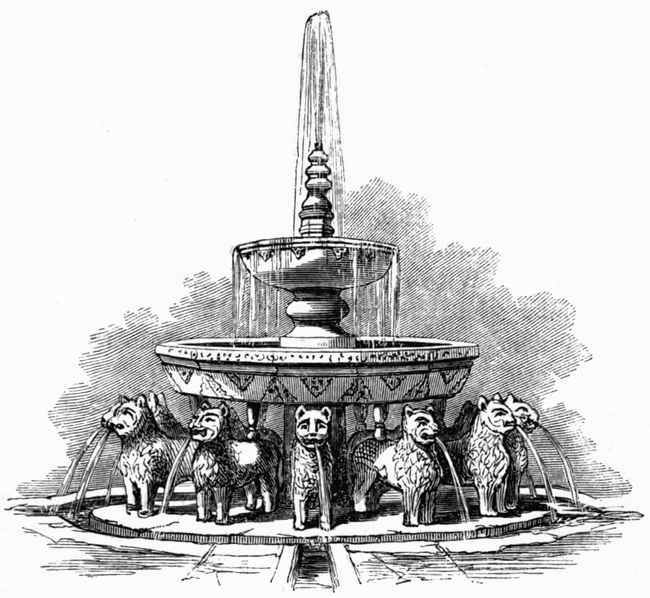
FOUNTAIN, COURT OF LIONS, ALHAMBRA.
"O you who gaze on the lions fixed to their places! remark that
they only require life to be perfect. And you to whom this Alcazar
and this kingdom fall as an inheritance, take them from the noble
hands who have governed them, without displeasure and without
resistance. May God preserve you for the work which you come
to perform, and protect you for ever from the revenge of your enemy!
Honour and glory be yours. O Mohammed! our king, endowed with
great virtues, by the aid of which you have conquered all! May
God never permit this fine garden, the image of your virtues, to have
a rival that surpasses it! The substance which tints the basin of
the fountain is like mother-of-pearl beneath the clear sparkling
water; the flowing stream resembles melting silver, for the limpidness
of the water and the whiteness of the stone have no equals;
they might be likened unto a drop of transparent essence on a
face of alabaster. It would be difficult to follow its course. Look
at the water and look at the basin, and you will not be able to distinguish
whether it is the water that is motionless or the marble
that ripples. Like the prisoner of love, whose visage is covered with
vexation and fear by the look of the envious, so is the jealous water
indignant at the stone, and the stone envious of the water. To this
inexhaustible stream may be compared the hand of our king, who is
as liberal and as generous as the lion is valiant and strong."
It was in the basin of the Fountain of Lions that the heads of
the thirty-six Abencerrages, whom the Zegris had drawn there by
stratagem, fell. The rest of the Abencerrages would have shared the
same fate, had it not been for the devotedness of a little page, who
ran at the risk of his life to warn them against entering the fatal
court. On having your attention directed to the bottom of the
basin, you perceive large reddish spots, an indelible accusation
left by the victims against their executioners. Unfortunately,
the erudite world declares that the Abencerrages and the Zegris
have never existed. With respect to this I am completely guided by
romances, popular traditions, and the novel of Monsieur de Châteaubriand,
and I firmly believe that these purple-looking marks are
blood and not rust.
We had established our head-quarters in the Court of Lions; our
furniture consisted of two mattresses, which we rolled up in a corner
in the day-time, of a brass lamp, of an earthenware jar, and of a few
bottles of sherry that we kept in a fountain to render the wine cool.
We slept one night in the Hall of the Two Sisters, and the next in
that of the Abencerrages, but it was not without some slight fear,
as I lay stretched on my cloak, that I looked at the white rays of
the moon, which appeared quite astonished at crossing the yellow
and flickering flame of a lamp, shoot through the openings of the
roof into the water of the basin and across the shining ground.
The popular traditions collected by Washington Irving in his
"Tales of the Alhambra," now came into my mind; the stories of
the "Headless Horse" and of the "Hairy Phantom," gravely related
by Father Echeverria, appeared to me very probable, above all, when
the light was out. The likelihood of the legends appears much
greater in the night-time, when these dark places are filled with
uncertain reflections, which give to all objects of a vague outline a
fantastic appearance: doubt is the son of the day, faith the daughter
of the night; and what astonishes me is, that St. Thomas believed in
our Saviour after having felt his wound. I am not sure that I myself
did not see the Abencerrages walking about in the moonlight, with
their heads under their arms, along the galleries; at all events, the
shadows of the columns assumed forms diabolically suspicious, and
the breeze, as it passed through the arcades, so resembled the
breathing of a human being, that it made you doubt.
One Sunday morning, about four or five o'clock, we felt ourselves,
while yet asleep, inundated on our mattresses with a fine and soaking
rain. This was owing to the conduits of the water-jets having opened
earlier than usual, in honour of a prince of Saxe Coburg, who was
come to view the Alhambra, and who, they said, was to marry the
young queen, as soon as she was of age.
We had scarcely time to rise and dress before the prince arrived,
with two or three persons of his suite. He was half mad with
rage. The keepers, in order to receive him in a proper manner, had
fitted to every fountain the most ridiculous pieces of mechanism and
hydraulic instruments imaginable. One of these inventions aimed,
by the means of a little white tin carriage and lead soldiers, which
were turned by the force of the water, at representing the journey
of the queen to Valencia. You may judge of the prince's satisfaction
at this ingenious and constitutional piece of refinement. The
Fray Gerundio, a satirical journal of Madrid, persecuted this poor
prince with marked animosity. It taxed him, among other crimes,
with haggling too much about the charges in his hotel bills, and
with having appeared at the theatre in the costume of a majo, with
a pointed hat on his head.
A party of Granadians came to spend the day at the Alhambra;
there were seven or eight young and pretty women, and five or six
cavaliers. They danced to the guitar, played at different games,
and sung in chorus, to a delightful air, a song by Fray Luis de
Leon, which has become very popular throughout Andalusia. As
the water-jets had stopped through having begun to shoot forth their
silver streams too early, and as the basins were dry, the giddy young
girls seated themselves in a round on the edge of the alabaster basin
of the Hall of the Two Sisters, so as to form a kind of flower-basket,
and, throwing back their pretty heads, again took up simultaneously
the burden of their song.
The Generalife is situated at a little distance from the Alhambra,
on a pass of the same mountain. Access is gained to it by a kind of
hollow road, that traverses the ravine of Los Molinos, which is
bordered with fig-trees, having enormous shiny leaves, with palm
oaks, pistachio-trees, laurels, and rock roses, of a remarkably
exuberant nature. The ground is composed of yellow sand teeming
with water, and of wonderful fecundity. Nothing is more
delightful than to follow this road, which appears as if it ran through
a virgin forest of America, to such an extent is it obstructed with
foliage and flowers, and such is the overwhelming perfume of the
aromatic plants you inhale there. Vines start through the cracks of
the crumbling walls, and from all their branches hang fantastic
runners, and leaves resembling Arabian ornaments in the beauty of
their form; the aloe opens its fan of azured blades, and the orange-tree
twists its knotty wood, and clings with its fang-like roots to
the rents in the steep sides of the ravine. Everything here
flourishes and blooms in luxuriant disorder, full of the most charming
effects of chance. A wandering jasmine-branch introduces a white
star among the scarlet flowers of the pomegranate-tree; and a laurel
shoots from one side of the road to the other to embrace a cactus, in
spite of its thorns. Nature, abandoned to herself, seems to pride
herself on her coquetry, and to wish to show how far even the most
exquisite and finished art always remains behind her.
After a quarter of an hour's walk, you come to the Generalife,
which is, so to say, nothing but the casa de campo, the country-house
of the Alhambra. The exterior of it, like that of all oriental buildings,
is very simple: large walls without windows, and surmounted by a
terrace with a gallery divided into arcades, the whole being crowned
with a small modern belvedere, constitute its architecture. Of the
Generalife nothing now remains but some arcades, and some large
panels of arabesques, unfortunately clogged with layers of whitewash,
which have been applied again and again with all the obstinacy
and despair of cleanliness. Little by little have the delicate sculptures
and the wonderful guilloches of these remains become filled
up, until they have at last disappeared. What is at present nothing
but a faintly-vermiculated wall, was formerly open lace-work, as fine
as those ivory leaves which the patience of the Chinese carves for
ladies' fans. The brush of the whitewasher has caused more chefs-d'œuvre
to disappear than the scythe of Time, if we may be allowed
to make use of this mythological expression. In a pretty well preserved
hall is a suite of smoky portraits of the kings of Spain, but
the only merit they possess is a chronological one.
The real charm of the Generalife consists in its gardens and its
waters. A canal, paved with marble, runs through the whole length
of the enclosure, and rolls its rapid and abundant waters beneath a
series of arcades of foliage, formed by twisting and curiously-cut
yews. Orange-trees and cypresses are planted on each side of it.
It was at the foot of one of these cypresses, which is of a prodigious
bulk, and which dates from the time of the Moors, that the favourite
of Boabdil, if we are to believe the legend, often proved that bolts
and bars are but slight guarantees for the virtue of sultanas. There
is one thing, at least, very certain, and that is, that the yew is very
thick, and very old.
The perspective is terminated by a porticoed gallery, ornamented
with jets of water and marble columns, like the patio of myrtles of
the Alhambra. The canal suddenly makes a turn, and you then
enter some other places embellished with pieces of water, and the
walls of which still preserve traces of the frescoes of the sixteenth
century, representing rustic pieces of architecture, and distant views.
In the midst of one of the basins, a gigantic rose-bay, of the most
incomparable beauty and splendour, is seen to bloom, like an
immense flower-basket. At the time when I saw it, it appeared like
an explosion of flowers, or the bouquet of a display of vegetable
fireworks; its aspect, too, is so blooming and luxuriant, so glaring,
if we may be allowed the expression, that it makes the hue of the
most vermilion rose appear insipid. Its lovely flowers, shot with all
the ardour of desire high up into the pure blue space of the heavens;
and its noble-looking leaves, shaped expressly by nature to form a
crown for the glorious deeds of heroism, and sprinkled by the spray
of the water-jets, sparkled like emeralds glittering in the sun.
Never did anything inspire me with a higher sentiment of the beautiful
than this rose-bay of the Generalife.
The water is brought to the gardens along a sort of steep acclivity,
bordered with little walls, forming on each side a kind of parapet,
that support trenches of large hollow tiles, through which the water
runs beneath the open sky with the most gay and lively murmur in
the world. On each footpace, well-supplied water-jets burst forth
from the middle of little basins, and shoot their crystal aigrettes into
the thick foliage of the wood of laurels, the branches of which cross
and recross one another above them. The mountain streams with
water on every side; at each step a spring starts forth, and you continually
hear at your side the murmuring of some rivulet, turned out
of its course, going to supply some fountain with water, or to carry
bloom and verdure to the foot of a tree. The Arabs have carried
the art of irrigation to the highest point; their hydraulic works
attest the most advanced state of civilization; these works still exist;
and it is to them that Granada owes the reputation it has of being
the Paradise of Spain, and the fact of its enjoying eternal spring in an
African temperature. An arm of the Darro has been turned out of
its course by the Arabs, and carried for more than two leagues along
the hill of the Alhambra.
From the Belvedere of the Generalife you can plainly perceive
the configuration of the Alhambra, with its line of reddish, half-demolished
towers, and its remaining pieces of wall, which rise and
descend according to the undulations of the mountain. The palace
of Charles the Fifth, which is not seen from the side of the city
stamps its square and heavy mass, which the sun gilds with a white
reflection, on the damask-like sides of the Sierra Neveda, whose white
ridges stand out on the horizon in a singular manner. The steeple of
Saint Mary's marks its Christian outline above the Moorish embattlements.
A few cypresses thrust their mournful leaves through
the cracks of the walls, surrounded by all this light and azure, like a
melancholy thought in the midst of a joyful fête. The slopes of the
hill running down towards the Darro, and the ravine of Los Molinos,
disappear beneath an ocean of verdure. It is one of the finest views
that can well be imagined.
On the other side, as if to form a contrast with so much verdancy,
rises an uncultivated, scorched up, tawny mountain, tinged with
dashes of red and yellow ochre; this mountain is called La Silla del
Moro, on account of a few remains of some buildings on its summit.
It was there that king Boabdil used to view the Arabian horsemen
jousting in the Vega with the Christian knights. The recollection
of the Moors is still vivid at Granada. You would think that they
had quitted the city but yesterday, and, if we may judge by what
remains of them, it is really a pity that they ever quitted it at all.
What southern Spain requires is African civilization, and not the
civilization of Europe, which is not suited to the heat of the climate
or to the passions it inspires. Constitutional mechanism can only
agree with the temperate zones; above a heat of eighty degrees
charters melt or blow up.
As we have now done with the Alhambra and the Generalife, we
will traverse the ravine of the Darro, and take a look as we go along
the road leading to Monte Sagrado, at the dens of the gitanos, who
are pretty numerous at Granada. This road is made through the
hill of the Albaycin, which overhangs on one side. Gigantic Indian
fig-trees, and enormous nopals raise their prickly heads, of the colour
of verdigris, along its impoverished and white-coloured slopes; under
the roots of these large unctuous plants, which seem to supply the
place of chevaux-de-frise and spiked fences, are dug in the living
rock, the dwellings of the gipsies. The entrance to these caverns is
whitewashed; a light cord on which hangs a piece of frayed-out
tapestry, serves as a door. It is there that the wild race swarms and
multiplies; there, children, whose skins are darker than Havannah
cigars, play in a state of nudity before the door, without any distinction
as to sex, and roll themselves in the dust while uttering sharp
and guttural cries. The gitanos are generally blacksmiths, mule-shearers,
veterinary doctors, and, above all, horse-dealers. They have
a thousand receipts for putting mettle and strength into the most
broken-winded and limping animals in the world: a gitano would
have made Rozinante gallop, and Sancho's ass would have caracoled
under their hands. Their real trade, however, is that of stealing.
The gitanas sell amulets, tell fortunes, and follow those
suspicious callings inherent to the women of their race. I saw
very few pretty ones, though their faces were remarkable both by
their type and character. Their swarthy complexion contrasts
strongly with the limpidness of their oriental eyes, the fire of which
is tempered by an indescribable and mysterious melancholy, only to
be compared to the look inspired by the recollection of a country
that is lost to us for ever, or of former grandeur. Their mouth,
which is rather thick and deeply coloured, reminds you of the
blooming nature of African mouths; the smallness of their forehead,
and the curved form of their nose, pronounce them to be of
the same origin with the tzigones of Wallachia and Bohemia, and
with all the children of that fantastic people which traversed, under
the generic name of Egyptians, the whole of the society of the Middle
Ages, and the enigmatical filiation of which century upon century
has not been able to interrupt. Nearly all of them possess so much
natural majesty and freedom in their deportment, and are so well
and firmly set, that in spite of their rags, their dirt, and their
misery, they seem to be conscious of the antiquity and purity of
their race, and ever to remember that it is free from all alloy, for
these gipsies never marry but among themselves, and those children
which are the offsprings of temporary unions are unmercifully cast
out of the tribe. One of the pretensions of the gitanos is that of
being good Castilians and good Catholics, but I think that, at bottom,
they are, to some extent, Arabs and Mahometans; they deny this
fact to the best of their power, from a remnant of fear for the Inquisition
which no longer exists. A few deserted and half-ruined
streets of the Albaycin are also inhabited by richer or less wandering
gipsies. In one of these streets, we perceived a little girl, about
eight years old, and entirely naked, dancing the zorongo on a painted
paving stone. Her sister, whose features were wan and emaciated,
and in whose citron-looking face sparkled eyes of fire, was crouched
beside her on the ground, with a guitar, from the strings of which
she drew forth a monotonous tinkle by running her thumb over
them, and producing music not unsimilar to the husky squeak of the
grasshopper. The mother, who was richly dressed, and whose neck
was loaded with glass beads, beat time with the end of a blue velvet
slipper, which she gazed on with great complacency. The wild
attitude, strange accoutrement, and extraordinary colour of this
group, would have made a subject for the pencil of Collot, or of Salvator
Rosa.
Monte Sagrado, which contains the grottoes of the martyrs who
were so miraculously discovered, offers nothing very interesting. It
is a convent with a rather ordinary-looking church, beneath which
the crypts are dug. These crypts have nothing about them capable
of producing any deep impression. They are composed of a complication
of small, straight, whitewashed corridors, from seven to
eight feet high. In recesses made for the purpose, altars, dressed
with more devotion than taste, have been raised. It is there that
the shrines and bones of the holy personages are locked up behind
the wire-work. I expected to see a subterraneous church, dark and
mysterious, nay, even dreadful-looking, with low pillars, and a
surbased roof, lighted by the uncertain reflection of a distant lamp,—something,
in fact, similar to the ancient catacombs, and great was
my surprise at the clean and tidy appearance of this whitewashed
crypt, lighted by ventholes like those of a cellar. We somewhat
superficial Catholics require something picturesque, in order to get
imbued with religious feeling. The devout man thinks little about
the effect of light and shade, or about the more or less learned proportions
of architecture; he knows, however, that, beneath that
altar of so mediocre a form, lie hidden the bones of the saint who
died for the sake of the faith which he professes, and that suffices for
him.
The Carthusian Convent, at present bereft of monks, like all
other convents in Spain, is an admirable edifice, and we cannot
regret too much that it has ever ceased to be used for its original purpose.
We have never been able to understand what harm could be
done by cenobites voluntarily cloistered in a prison, and passing
their lives in austerity and prayer, especially in a country like
Spain, where there is certainly no lack of ground.
You ascend by a double flight of steps to the doorway of the
church: it is surmounted by a white marble statue of St. Bruno, of
a rather handsome effect. The decorations of the church are singular,
and consist of plaster arabesques, truly wonderful by the variety and
richness of their subjects. It appears as if the architect had been
desirous of vying, in quite a different style, with the lightness and
complication of the lace-work of the Alhambra. There is not a place
as large as your hand, in this immense structure, which is not filled
with flowers, damask-work, leaves, and guilloches: it would be
enough to turn the head of any one who wanted to take an exact
sketch of it. The choir is lined with porphyry and costly marble.
A few mediocre pictures are hung up here and there along the walls,
and make you regret the space they hide. The cemetery is near the
church: according to the custom of the Carthusian friars, no tomb,
no cross, indicates the place where the departed brothers sleep; but
the cells surround the cemetery, and each one is provided with a
little garden. In a piece of ground planted with trees, which, no
doubt, formerly served as a promenade for the friars, my attention
was called to a kind of fish-pond, with a sloping stone edge, in which
were awkwardly crawling three or four dozen tortoises, that basked
in the sun and appeared quite happy at being henceforth in no
danger of the cook's art. The laws of the Carthusian brethren forbade
their ever eating meat, and the tortoise is looked on as a fish by
casuists. These tortoises were destined to supply the friars' table.
The revolution, however, saved them.
While we are about visiting the convents, we will enter, if you
please, the Monastery of San Juan de Dios. The cloister is one of
the most curious imaginable, and is constructed with frightfully bad
taste; the walls, painted in fresco, represent various fine actions of
the life of San Juan de Dios, framed with such grotesque and fantastic
ornaments as throw into the shade the most extravagant and
deformed productions of Japan and China. You behold sirens playing
the violin, she-monkeys at their toilet, chimerical fish in still
more chimerical waves, flowers which look like birds, birds which
look like flowers, lozenges of looking-glass, squares of earthenware,
love-knots—in a word, an endless pell-mell of all that is inextricable.
The church, which is luckily of another epoch, is gilt nearly all over.
The altar-screen, which is supported by pillars of the Solomonic
order, produces a rich and majestic effect. The sacristan, who
served as our guide, on seeing that we were French, questioned
us about our country, and asked if it were true, as was said at
Granada, that Nicholas, the Emperor of Russia, had invaded France
and taken possession of Paris: such was the latest news. These gross
absurdities were spread among the people by the partisans of Don
Carlos, in order to obtain credence for an absolutist reaction on the
part of the European powers, and to rally, by the hope of speedy
assistance, the drooping courage of the disorganized bands.
I saw in this church a sight that made a deep impression on me;
it was an old woman crawling on her knees from the door to the
altar: her arms were stretched out as stiff as stakes, in the form of
a cross, her head was thrown back, her upturned eyes allowed the
whites only of them to be seen, her lips were firmly closed, and her
face was shiny and of the colour of lead: this was ecstasy turned to
catalepsy. Never did Zurbaban execute anything more ascetic or
possessing more feverish ardour. She was accomplishing a penance
ordered by her confessor, and had still four more days of it to
undergo.
The Convent of San Geronimo, now transformed into barracks,
contains a Gothic cloister with two arteries of arcades of rare character
and beauty. The capitals of the columns are ornamented with
foliage and fantastic animals of the most capricious nature and
charming workmanship. The church, at present profaned and
deserted, exhibits the peculiarity of having all its ornaments and
architectural reliefs painted in imitation on grey grounds, like the roof
of the Bourse, instead of being executed in reality: here lies interred
Gonzalvo of Cordova, surnamed the great captain. His sword used
to be preserved there, but it was lately taken away and sold for a few
duras, the value of the silver which ornamented the handle. It is
thus that many objects, valuable as works of art or from associations,
have disappeared without any other profit to the thieves than the
pleasure of doing wrong. It appears to us that our revolution might
be imitated in something else but its stupid Vandalism. It is this
sentiment we all experience on visiting a tenantless convent, on beholding
so many ruins and such devastation, the utter loss of so many
chefs d'œuvre of every kind, and the long work of centuries destroyed
and swept away in an instant. No one has the power to prejudge
the future: I, however, doubt if it will restore what the past had
bequeathed us, and which we destroy as if we possessed wherewithal
to replace it. In addition to this something might be put on
one side, for the globe is not so covered with monuments that it is
necessary for us to raise new buildings on the ruins of the old ones.
With such reflections was my mind filled, as I wandered, in the
Antequerula, through the old convent of San Domingo. The chapel
was decorated with a profusion of all sorts of gewgaws, baubles, and
gilding. It was one mass of wreathed columns, volutes, scroll-work,
encrusted work of various coloured breccia, glass mosaics, checker-work
of mother-of-pearl, and burgau, bevilled mirrors, suns surrounded
by rays, transparencies, and all the most preposterous, misshapen,
ugly, and strange embellishments that the depraved taste of
the eighteenth century and the horror of straight lines could invent.
The library, which has been preserved, is almost exclusively composed
of folios and quartos bound in white vellum, with the titles written
on them in black or red ink. They consist, for the most part, of
theological treatises, casuistical dissertations, and other scholastic
productions, possessing but little attraction for the mere literary
man. A collection of pictures has been formed at the convent of
San Domingo, composed of works from the various monasteries that
were either abolished or suffered to go to ruin, but, with the exception
of some few fine heads of ascetics, and a few representations of
martyrs which seem to have been painted by the hangman himself,
from the proficiency in the art of torturing which they exhibit,
there is nothing remarkably good, which proves that the persons who
were guilty of these acts of pillage are excellent judges of paintings,
for they never fail to keep the best things for themselves. The
courtyards and cloisters are admirable, and are adorned with fountains,
orange-trees, and flowers.
How excellently are such places adapted for reverie, meditation,
and study, and what a pity is it that convents were ever inhabited
by monks, and not by poets! The gardens, left to themselves, have
assumed a wild, savage aspect; luxuriant vegetation has invaded the
walks, and Nature has regained possession of her own, planting a
tuft of flowers or grass in the place of every stone that has fallen
out. The most remarkable feature in these gardens is an alley of
enormous laurels, forming a covered walk which is paved with white
marble, and furnished, on each side, with a long seat of the same
material, with a slanting back. At certain distances from each
other, a number of small fountains maintain a refreshing coolness
beneath this thick vault of verdure, at the end of which you have a
splendid view of a portion of the Sierra Nevada, through a charming
Moorish mirador, which forms part of an old Arabic palace, enclosed
in the convent. This pavilion is said to have communicated, by
means of long subterranean galleries, with the Alhambra, which is
situated at some considerable distance. However, this is an idea
deeply rooted in the minds of the inhabitants of Granada, where the
least Moorish ruin is always presented with five or six leagues of
subterranean passages as well as a treasure, guarded by some spell
or other.
We often went to San Domingo to sit beneath the shade of the
laurels and bathe in a pool, near which, if the satirical songs are to
be believed, the monks used to lead no very reputable sort of life.
It is a remarkable fact, that the most Catholic countries are always
those in which the priests and monks are treated most cavalierly;
the Spanish songs and stories about the clergy rival, in licence, the
facetiæ of Rabelais and Beroalde de Verville, and to judge by the
manner in which all the ceremonies of the church are parodied in
the old pieces, one would hardly think that the Inquisition had ever
existed.
Talking of baths, I will here relate a little incident which proves
that the thermal art, carried to so high a degree of perfection by the
Arabs, has lost much of its former splendour in Granada. Our guide
took us to some baths that appeared very well managed, the rooms
being situated round a patio shaded by a covering of vine-leaves,
while a large reservoir of very limpid water occupied the greater
part of the patio. So far all was well; but of what do you think
the baths themselves were made? Of copper, zinc, stone, or
wood? Not a bit of it, you are wrong; I will tell you at once, for
you will never guess. They were enormous clay jars, like those
made to hold oil. These novel baths were about two-thirds buried
in the ground. Before potting ourselves in them we had the inside
covered with a clean cloth, a piece of precaution which struck the
attendant as something so extremely strange, and which astonished
him so profoundly, that we were obliged to repeat the order several
times before he would obey it. He explained this whim of ours to
his own satisfaction by shrugging his shoulders and shaking his head
in a commiserative manner as he pronounced in a low voice the one
word: Ingleses! There we sat, squatted down in our oil jars, with
our heads stuck out at the top, something like pheasants en terrine,
cutting rather grotesque figures. It was on this occasion that I
understood for the first time the story of Ali Baba and the Forty
Thieves, which had always struck me as being rather difficult to
believe, and had made me for an instant doubt the veracity of the
"Thousand-and-One Nights."
There are, also, in the Albaycin, some old Moorish baths, and a
pond covered over with a vaulted roof, pierced by a number of little
holes in the shape of stars, but they are not in working order, and
you can get nothing but cold water.
This is about all that is to be seen at Granada, during a stay of
some weeks. Public amusements are scarce. The theatre is closed
during the summer; the bull-fights do not take place at any fixed
periods; there are no clubs or establishments of this description,
and the Lyceum is the only place where it is possible to see the
French and other foreign papers. On certain days, there is a
meeting of the members, when they read papers on various subjects
as well as poetry, besides singing and playing pieces, generally written
by some young author of the company.
Every one employs his time, most conscientiously, in doing nothing.
Gallantry, cigarettes, the manufacture of quatrains and octaves, and
especially card-playing, are found sufficient to fill up a man's existence
very agreeably. In Granada you see nothing of that furious
restlessness, that necessity for action and change of place which torments
the people of the north. The Spanish struck me as being
very philosophical. They attach hardly any importance to material
life, and are totally indifferent about comfort. The thousand factitious
wants created by the civilization of northern countries, appear
to them puerile and troublesome refinements. Not having to protect
themselves continually against the climate, the advantages of
the English home have no attractions in their eyes. What do people,
who would cheerfully pay for a breeze or a draught of air, if they
could obtain such a thing, care whether or not the windows close
properly? Favoured by a beautiful sky, they have reduced human
existence to its simplest expression: this sobriety and moderation in
everything enables them to enjoy a large amount of liberty, a state
of extreme independence; they have time enough to live, which we
cannot say that we have. Spaniards cannot understand how a man
can labour first in order to rest afterwards. They very much prefer
pursuing an opposite course, and I think that by so doing, they show
their superior sense. A workman who has gained a few reals leaves
his work, throws his fine embroidered jacket over his shoulders, takes
his guitar and goes and dances or makes love to the majas of his
acquaintance, until he has not a single cuarto left; he then returns
to his employment. An Andalusian can live splendidly for three or
four sous a day; for this sum he can have the whitest bread, an
enormous slice of water-melon, and a small glass of aniseed, while
his lodging costs him nothing more than the trouble of spreading
his cloak upon the ground under some portico or the arch of some
bridge. As a general rule, Spaniards consider work as something
humiliating and unworthy of a freeman, which, in my opinion, is a
very natural and very reasonable idea, since Heaven wishing to
punish man for his disobedience, found no greater infliction than
the obliging him to gain his daily bread by the sweat of his brow.
Pleasures procured, as ours are, by dint of labour, fatigue, and mental
anxiety and perseverance strike Spaniards as being bought much
too dearly. Like all people who lead a simple life approaching a
state of nature, they possess a correctness of judgment which makes
them despise the artificial enjoyments of society. Any one coming
from Paris or London, those two whirlpools of devouring activity, of
feverish and unnaturally excited energy, is greatly surprised by the
mode of life of the people of Granada,—a mode of life that is all
leisure, filled up with conversation, siestas, promenades, music, and
dancing. The stranger is astonished at the happy calmness, the
tranquil dignity of the faces he sees around him. No one has that
busy look which is noticeable in the persons hurrying through the
streets of Paris. Every one strolls leisurely along, choosing the
shady side of the street, stopping to chat with his friends, and betraying
no desire to arrive at his destination in the shortest possible
time. The certitude of not being able to make money extinguishes
all ambition: there is no chance of a young man making a brilliant
career. The most adventurous among them go to Manilla or Havannah,
or enter the army, but on account of the piteous state of
the public finances, they sometimes wait for years without hearing
anything about pay. Convinced of the inutility of exertion, Spaniards
do not endeavour to make fortunes, for they know that such things
are quite out of the question; and they therefore pass their time in
a delightful state of idleness, favoured by the beauty of the country
and the heat of the climate.
I saw nothing of Spanish pride; nothing is so deceptive as the
reputation bestowed on individuals and nations. On the contrary,
I found them exceedingly simple-minded and good-natured; Spain
is the true country of equality, if not in words at least in deeds. The
poorest beggar lights his papelito at the puro of a powerful nobleman,
who allows him to do so, without the slightest affectation of
condescension; a marchioness will step, with a smile, over the bodies
of the ragged vagabonds who are slumbering across her threshold,
and, when travelling, will not make a face if compelled to drink out
of the same glass as the mayoral, the zagul, and the escopetero of the
diligence. Foreigners find great difficulty in accustoming themselves
to this familiarity, especially the English, who have their
letters brought upon salvers, and take them with tongs. An Englishman
travelling from Seville to Jeres, told his calesero to go and
get his dinner in the kitchen. The calesero, who, in his own mind,
thought he was honouring a heretic very highly by sitting down at
the same table with him, did not make the slightest remark, and concealed
his rage as carefully as the villain in a melodrama; but about
three or four leagues from Jeres, in the midst of a frightful desert,
full of quagmires and bushes, he threw the Englishman very neatly
out of the vehicle, shouting to him as he whipped on his horse:
"My lord, you did not think me worthy of sitting at your table, and
I, Don Jose Balbino Bustamente y Orozco, do not think you good
enough to sit on the seat in my calesin. Good evening!"
The servants, both male and female, are treated with a gentle
familiarity very different from our affected civility, which seems,
every moment, to remind them of the inferiority of their condition.
A short example will prove the truth of this assertion. We had
gone to a party given at the country-house of the Señora ——; in
the evening, there was a general desire to have a little dancing, but
there were a great many more ladies than gentlemen present. To
obviate this difficulty, the Señora —— sent for the gardener
and another servant, who danced the whole evening without the
least awkwardness, false bashfulness, or servile forwardness, but
just as if they had been on a perfect equality with the rest of
the company. They invited, in turn, the fairest and most
noble ladies present, and the latter complied with their request
in the most graceful manner possible. Our democrats are very far
from having attained this practical equality, and our most determined
Republicans would revolt at the idea of figuring in a quadrille,
opposite a peasant or a footman.
Of course, there are a great many exceptions to these remarks,
as there are to all other generalities. There are, doubtless, many
Spaniards who are active, laborious, and sensible to all the refinements
of life, but what I have said conveys the general impression
felt by a traveller after a stay of some little time,—an impression
which is often more correct than that of a native observer, who is
less struck by the novelty of the various circumstances.
As our curiosity was satisfied with regard to Granada and its
buildings, we resolved, from having had a view of the Sierra Nevada
at every turn we took, to become more intimately acquainted with
it, and endeavour to ascend the Mulhacen, which is the most elevated
point of the whole range. Our friends at first attempted to dissuade
us from this project, which was really attended with some little
danger, but, on seeing that our resolution was fixed, they recommended
us a huntsman named Alexandro Romero, as a person
thoroughly acquainted with the mountains, and possessing every
qualification to act as guide. He came and saw us at our casa de
pupilos, and his manly, frank physiognomy, immediately pre-possessed
us in his favour. He wore an old velvet waistcoat, a red
woollen sash, and white linen gaiters, like those of the Valencians,
which enabled you to see his clean-made, nervous legs, tanned like
Cordovan leather. Alpargatas of twisted rope served him for shoes,
while a little Andalusian hat, that had grown red from exposure to
the sun, a carbine and a powder-flask, slung across his shoulder,
completed his costume. He undertook to make all the necessary
preparations for our expedition, and promised to bring, at three o'clock,
the next morning, the four horses we required, one for my travelling
companion, one for myself, a third for a young German who had
joined our caravan, and a fourth for our servant, who was intrusted
with the direction of the culinary department. As for Romero he
was to walk. Our provisions consisted of a ham, some roast fowls,
some chocolate, bread, lemons, sugar, and a large leathern sack, called
a bota, filled with excellent Val-de-Peñas, which was the principal
article in the list.
At the appointed hour, the horses were before our house, while
Romero was hammering away at the door with the butt-end of his
carbine. Still scarcely awake, we mounted our steeds, and the procession
set forth, our guide running on beforehand to point out the
road. Although it was already light, the sun had not risen, and the
undulating outlines of the smaller hills, which we had passed,
were spread out all around us, cool, limpid and blue, like the waves
of an immovable ocean. In the distance, Granada had disappeared
beneath the vapourized atmosphere. When the fiery globe at last
appeared on the horizon, all the hill-tops were covered with a rosy
tint, like so many young girls at the sight of their lovers, and
appeared to experience a feeling of bashful confusion at the idea of
having been seen in their morning déshabille. The ridges of the
mountain are connected with the plain by gentle slopes, forming the
first table-land which is easily accessible. When we reached this
place, our guide decided that we should allow our horses a little
breathing time, give them something to eat, and breakfast ourselves.
We ensconced ourselves at the foot of a rock, near a little spring,
the water of which was as bright as a diamond, and sparkled
beneath the emerald-coloured grass. Romero, with all the dexterity
of an American savage, improvised a fire with a handful of brush-wood,
while Louis prepared some chocolate, which, with the addition
of a slice of ham and a draught of wine, composed our first meal in
the mountains. While our breakfast was cooking, a superb viper
passed beside us, and appeared surprised and dissatisfied at our
installing ourselves on his estate, a fact that he gave us to understand
by unpolitely hissing at us, for which he was rewarded by a
sturdy thrust with a sword-stick through the stomach. A little
bird, that had watched the proceedings very attentively, no sooner
saw the viper disabled, than it flew up with the feathers of its neck
standing on end, its eye all fire, and flapping its wings, and piping
in a strange state of exultation. Every time that any portion of the
venomous beast writhed convulsively, the bird shrunk back, soon
returning to the charge, however, and pecking the viper with its
beak, after which it would rise in the air three or four feet. I do
not know what the serpent could have done, during its lifetime, to
the bird, or what was the feeling of hatred we had gratified by
killing the viper, but it is certain that I never beheld such an
amount of delight.
We once again set out. From time to time we met a string of
little asses coming down from the higher parts of the mountains
with their load of snow, which they were carrying to Granada for
the day's consumption. The drivers saluted us, as they passed by,
with the time honoured "Vayan Ustedes con Dios," and we replied
by some joke about their merchandise, which would never accompany
them as far as the city, and which they would be obliged to sell to
the official who was entrusted with the duty of watering the public
streets.
We were always preceded by Romero, who leaped from stone to
stone with the agility of a chamois, and kept exclaiming, Bueno
camino (a good road). I should certainly very much like to know
what the worthy fellow would call a bad road, for, as far as I was
concerned, I could not perceive the slightest sign of any road at all.
To our right and left, as far as the eye could distinguish, yawned
delightful abysses, very blue, very azure and very vapoury, varying
in depth from fifteen hundred to two thousand feet, a difference,
however, about which we troubled our heads very little, for a few
dozen fathoms more or less made very little difference in the matter.
I recollect with a shudder a certain pass, three or four pistol-shots
long and two feet broad,—a sort of natural plank running between
two gulfs. As my horse headed the procession, I had to pass first
over this kind of tight-rope, which would have made the most
determined acrobats pause and reflect. At certain points there was
only just enough space for my horse's feet, and each of my legs was
dangling over a separate abyss. I sat motionless in my saddle, as
upright as if I had been balancing a chair on the end of my nose.
This pass, which took us a few minutes to traverse, struck me as
particularly long.
When I quietly reflect on this incredible ascent, I am lost in surprise,
as at the remembrance of some incoherent dream. We passed
over spots where a goat would have hesitated to set its foot, and
scaled precipices so steep that the ears of our horses touched our
chins. Our road lay between rocks and blocks of stone, which
threatened to fall down upon us every moment, and ran in zigzags
along the edge of the most frightful precipices. We took advantage
of every favourable opportunity, and although advancing slowly we
still advanced, gradually approaching the goal of our ambition,—namely,
the summit, that we had lost sight of since we had been in
the mountains, because each separate piece of table-land hides the
one above it.
Every time our horses stopped to take breath, we turned round in
our saddles to contemplate the immense panorama formed by the
circular canvas of the horizon. The mountain tops which lay below
us looked as if they had been marked out in a large map. The Vega
of Granada and all Andalusia presented the appearance of an azure
sea, in the midst of which a few white points that caught the rays of
the sun, represented the sails of the different vessels. The neighbouring
eminences that were completely bare, and cracked, and split
from top to bottom, were tinged in the shade with a green-ash
colour, Egyptian blue, lilac and pearl-grey, while in the sunshine
they assumed a most admirable and warm hue similar to that of
orange peel, tarnished gold or a lion's skin. Nothing gives you so
good an idea of a chaos, of a world still in the course of creation, as
a mountain range seen from its highest point. It seems as if a nation
of Titans had been endeavouring to build some sacrilegious Babel,
some prodigious Lylac or other; that they had heaped together all
the materials and commenced the gigantic terraces, when suddenly
the breath of some unknown being had, like a tempest, swept over
the temples and palaces they had begun, shaking their foundations
and levelling them with the ground. You might fancy yourself
amidst the remains of an antediluvian Babylon, a pre-Adamite city.
The enormous blocks, the Pharaoh-like masses, awake in your breast
thoughts of a race of giants that has now disappeared, so visibly is
the old age of the world written in deep wrinkles on the bald front
and rugged face of these millennial mountains.
We had reached the region inhabited by the eagles. Several times,
at a distance, we saw one of these noble birds perched upon a solitary
rock, with its eye turned towards the sun, and immersed in
that state of contemplative ecstasy which with animals replaces
thought. There was one of them floating at an immense height
above us, and seemingly motionless in the midst of a sea of light.
Romero could not resist the pleasure of sending him a visiting card
in the shape of a bullet. It carried away one of the large feathers
of his wing, but the eagle, nothing moved, continued on his way
with indescribable majesty, as if nothing had happened. The feather
whirled round and round for a long time before reaching the earth;
it was picked up by Romero, who stuck it in his hat.
Thin streaks of snow now began to show themselves, scattered here
and there, in the shade; the air became more rarified and the rocks
more steep and precipitous; soon afterwards, the snow appeared in
immense sheets and enormous heaps which the sun was no longer
strong enough to melt. We were above the sources of the Gruil,
which we perceived like a blue ribband frosted with silver, streaming
down with all possible speed in the direction of its beloved city.
The table-land on which we stood is about nine thousand feet above
the level of the sea, and is the highest spot in the range with the exception
of the peak of Veleta and the Mulhacen, which towers another
thousand feet towards the immeasurable height of heaven. On this
spot Romero decided that we should pass the night. The horses, who
were worn out with fatigue, were unsaddled; Louis and the guide
tore up a quantity of brushwood, roots, and juniper plants to make a
fire, for although in the plain the thermometer stood at thirty or
thirty-five degrees, there was a freshness on the heights we then
occupied, which we knew would settle down into intense cold as
soon as the sun had set. It was about five o'clock in the afternoon;
my companion and the young German determined to take advantage
of the daylight that remained, to scale alone and on foot the last
heights of the mountain. For my own part, I preferred stopping
behind; my soul was moved by the grand and sublime spectacle
before me, and I busied myself in scribbling in my pocket-book sundry
verses, which, if not well turned, had, at least, the merit of being the
only alexandrines composed at such an elevation. After my strophes
were finished, I manufactured some sorbets with snow, sugar, lemon
and brandy, for our dessert. Our encampment presented rather a
picturesque appearance; our saddles served us for seats, and our
cloaks for a carpet, while a large heap of snow protected us from the
wind. A fire of broom blazed brightly in the centre, and we fed it
by throwing in, from time to time, a fresh branch which shrivelled
up and hissed, darting out its sap in little streams of all colours.
Above us, the horses stretched forward their thin heads, with their
sad, gentle eyes, and caught an occasional puff of warmth.
Night was rapidly approaching. The least elevated mountains
were the first to sink into obscurity, and the light, like a fisherman
flying before the rising tide, leapt from peak to peak, retiring towards
the highest in order to escape from the shade which was advancing
from the valleys beneath and burying everything in its bluish waves.
The last ray which stopt on the summit of the Mulhacen hesitated
for an instant; then, spreading out its golden wings, winged its way
like some bird of flame into the depths of heaven and disappeared.
The obscurity was now complete, and the increased brilliancy of our
fire caused a number of grotesque shadows to dance about upon the
sides of the rocks. Eugene and the German had not returned, and I
began to grow anxious on their account; I feared that they might
have fallen down some precipice or been buried beneath some mass
of snow. Romero and Louis already requested me to sign a declaration
to the effect that they had neither murdered nor robbed the
two worthy gentlemen, and that, if the latter were dead, it was their
own fault.
Meanwhile, we tore our lungs to pieces by indulging in the most
shrill and savage cries, to let them know the position of our wig-wam,
in case they should not be able to perceive the fire. At last
the report of firearms, which was hurled back by all the echoes of
the mountains, told us that we had been heard, and that our companions
were but a short distance off—in fact, at the expiration of a
few minutes, they made their appearance, fatigued and worn out,
asserting that they had distinctly seen Africa on the other side of
the ocean; it is very possible they had done so, for the air of these
parts is so pure, that the eye can perceive objects at the distance of
thirty or forty leagues. We were all very merry at supper, and by
dint of playing the bagpipes with our skin of wine, we made it
almost as flat as the wallet of a Castilian beggar. It was agreed that
each of us should sit up in turn to attend the fire, an arrangement
which was faithfully carried out, but the circumference of our circle,
which was at first pretty considerable, kept becoming smaller and
smaller. Every hour the cold became more intense, and at last we
literally laid ourselves in the fire itself, so as to burn our shoes
and pantaloons. Louis gave vent to his feelings in loud exclamations;
he bewailed his gaspacho (cold garlic soup), his house, his bed,
and even his wife. He made himself a formal promise, by everything
he reverenced, never to be caught a second time attempting
an ascent; he asserted that mountains are far more interesting when
seen from below, and that a man must be a maniac to expose himself
to the chance of breaking every bone in his body a hundred thousand
times, and having his nose frozen off in the middle of the month of
August, in Andalusia, and in sight of Africa. All night long he
did nothing but grumble and groan in the same manner, and we
could not succeed in reducing him to silence. Romero said nothing,
and yet his dress was made of thin linen, and all that he had to
wrap round him was a narrow piece of cloth.
At last the dawn appeared; we were enveloped in a cloud, and
Romero advised us to begin our descent, if we wished to reach
Granada before night. When it was sufficiently light to enable us
to distinguish the various objects, I observed that Eugene was as
red as a lobster nicely boiled, and at the same moment he made an
analogous observation with respect to me, and did not feel himself
bound to conceal the fact. The young German and Louis were also
equally red; Romero alone had reserved his peculiar tint, which
resembled, by the way, that of a boot-top, and although his legs of
bronze were naked, they had not undergone the slightest alteration.
It was the biting cold and the rarefaction of the air that had turned
us this colour. Going up a mountain is nothing, because you look
at the objects above you, but coming down, with the awful depths
before your eyes, is quite a different matter. At first the thing
appeared impracticable, and Louis began screeching like a jay who
is being picked alive. However, we could not remain for ever on
the Mulhacen, which is as little adapted for the purpose of habitation
as any place in the known world, and so, with Romero at our
head, we began our descent. It would be impossible, without laying
ourselves open to the charge of exaggeration, to convey any notion
of the paths, or rather the absence of paths, by which our dare-devil
of a guide conducted us; never more break-neck obstacles crowded
together in the course marked out for any steeple-chase, and I entertain
strong doubts as to whether the feats of any "gentlemen riders"
ever outrivalled our exploits on the Mulhacen. The Montagnes
Russes were mild declivities in comparison to the precipices with
which we had to do. We were almost constantly standing up in
our stirrups, and leaning back over the cruppers of our horses, in
order to avoid performing an incessant succession of parabolas over
their heads. All the lines of perspective seem jumbled up together;
the streams appeared to be flowing up towards their source, the
rocks vacillated and staggered on their bases, and the most distant
objects appeared to be only two paces off; we had lost all feeling of
proportion, an effect which is very common in the mountains, where
the enormous size of the masses, and the vertical position of the
different ranges, do not allow of your judging distances in the ordinary
manner.
In spite of every difficulty we reached Granada without our
horses having even made one false step, only they had got but one
shoe left among them all. Andalusian horses—and ours were of
the most authentic description—cannot be equalled for mountain
travelling. They are so docile, so patient, and so intelligent, that
the best thing the rider can do is to throw the reins on their necks
and let them follow their own impulse.
We were impatiently expected, for our friends in the city had seen
our fire burning like a beacon on the table-land of Mulhacen. I
wanted to go and give an account of our perilous expedition to the
charming Senoras B——, but I was so fatigued that I fell asleep on
a chair, holding my stocking in my hand, and I did not wake before
ten o'clock the following morning, when I was still in the same
position. Some few days afterwards, we quitted Granada, sighing
quite as deeply as ever King Boabdil did.