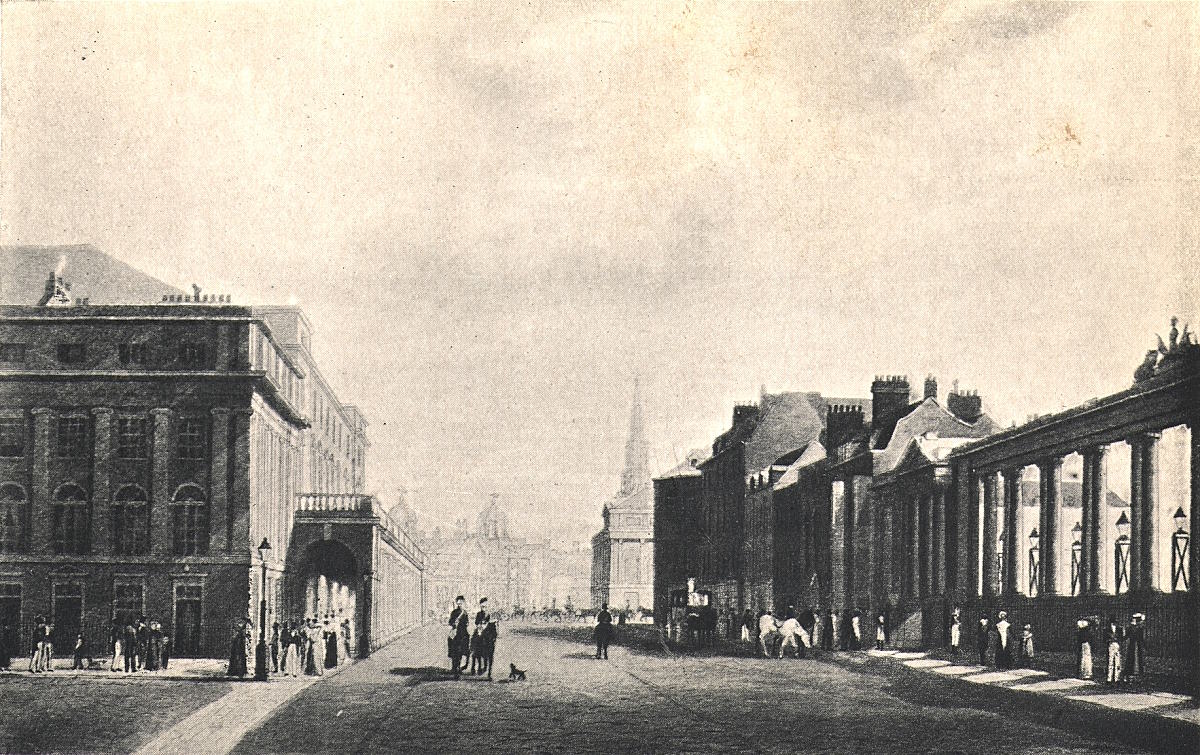
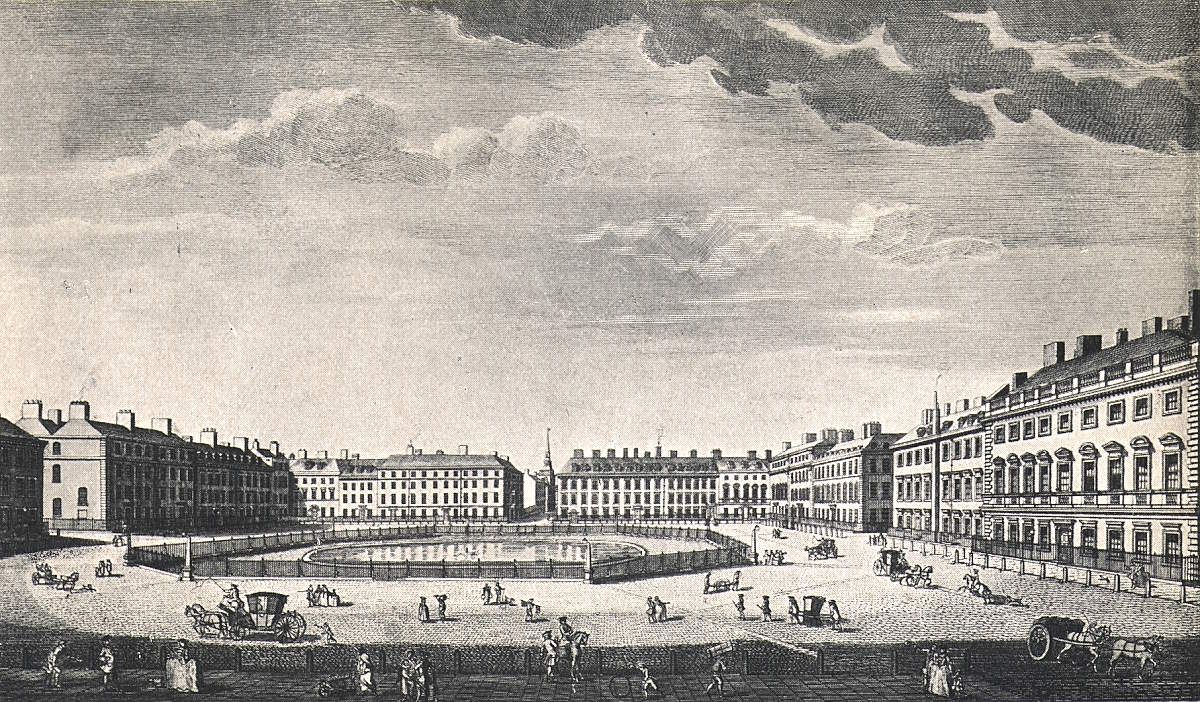
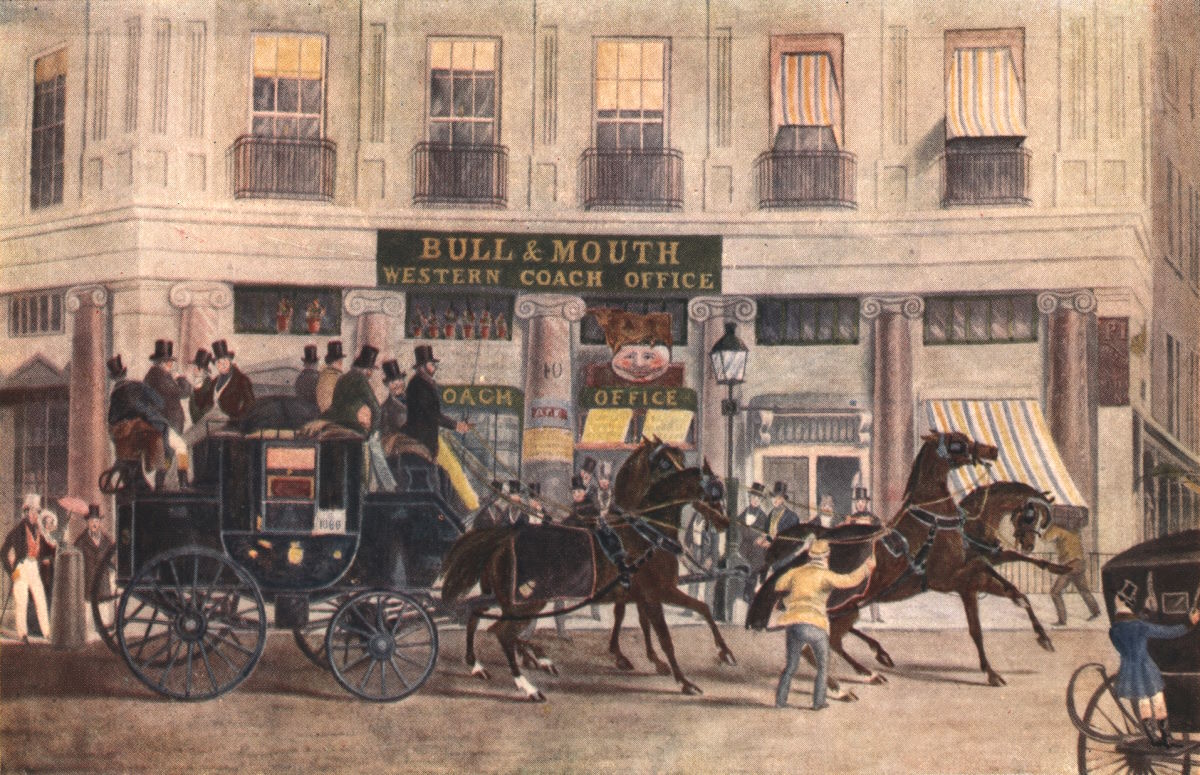
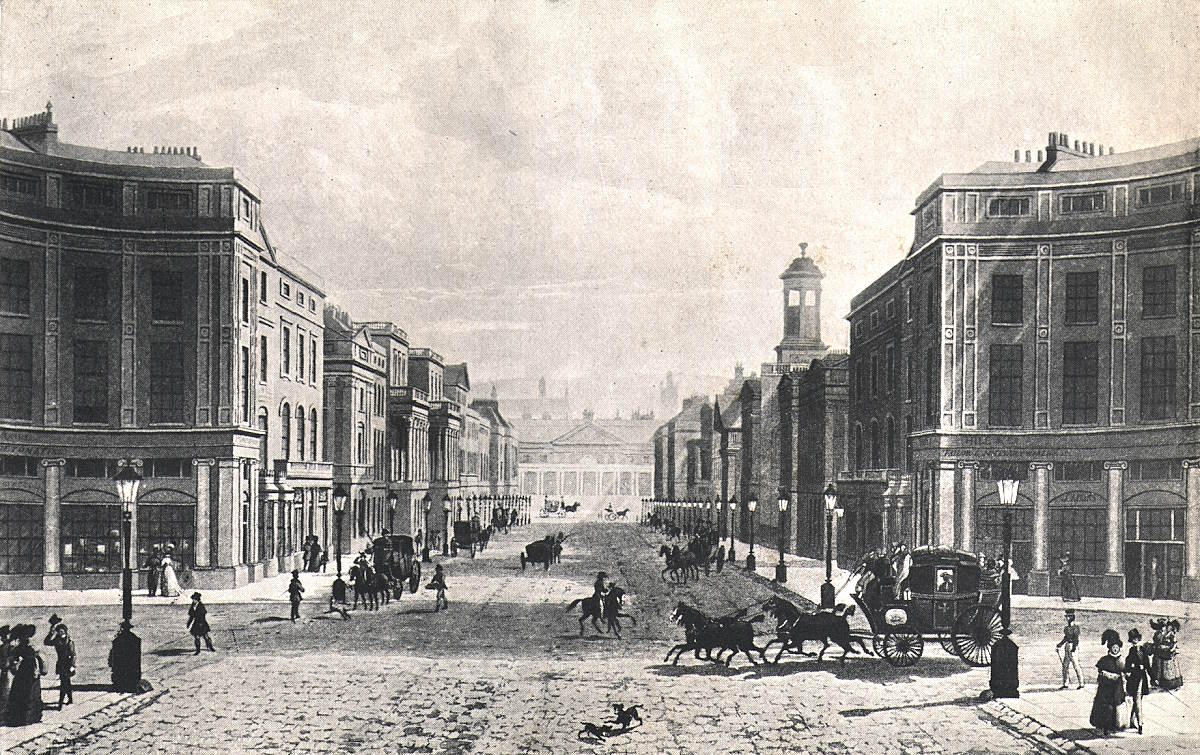
Old London vanishes, another London takes its place;
the interesting old spots associated with the leisurely
life and refinement of the century that has gone, are being
swept away one by one. In many ways we would welcome
a return of those dear old days, with their appreciation of
the belles lettres and the fine arts, and with all their oddities
and quaint customs, but they have gone for ever. They
played their part in the development of the national life:
to us they are but memories.
We owe no small debt of gratitude, however, to those
who—like the author—amidst all the changes that are
taking place, have tried to keep alive for us with pen and
pencil, a remembrance of a period so different from our
own. Especially, perhaps, will many of our American
cousins recognise this debt when in their migrations they
try to hunt up places of interest connected with their English
forbears.
Mr. Chancellor is most happy as he takes us round the
old streets and houses, and gives—as it were—almost personal
introductions to the quaint and interesting people
who inhabited them. His pages are sentient with living
personages, and as we read we forget the years that have
rolled away, while we enjoy the laugh and quip with the
interesting old characters which are met with at every turn
and corner.
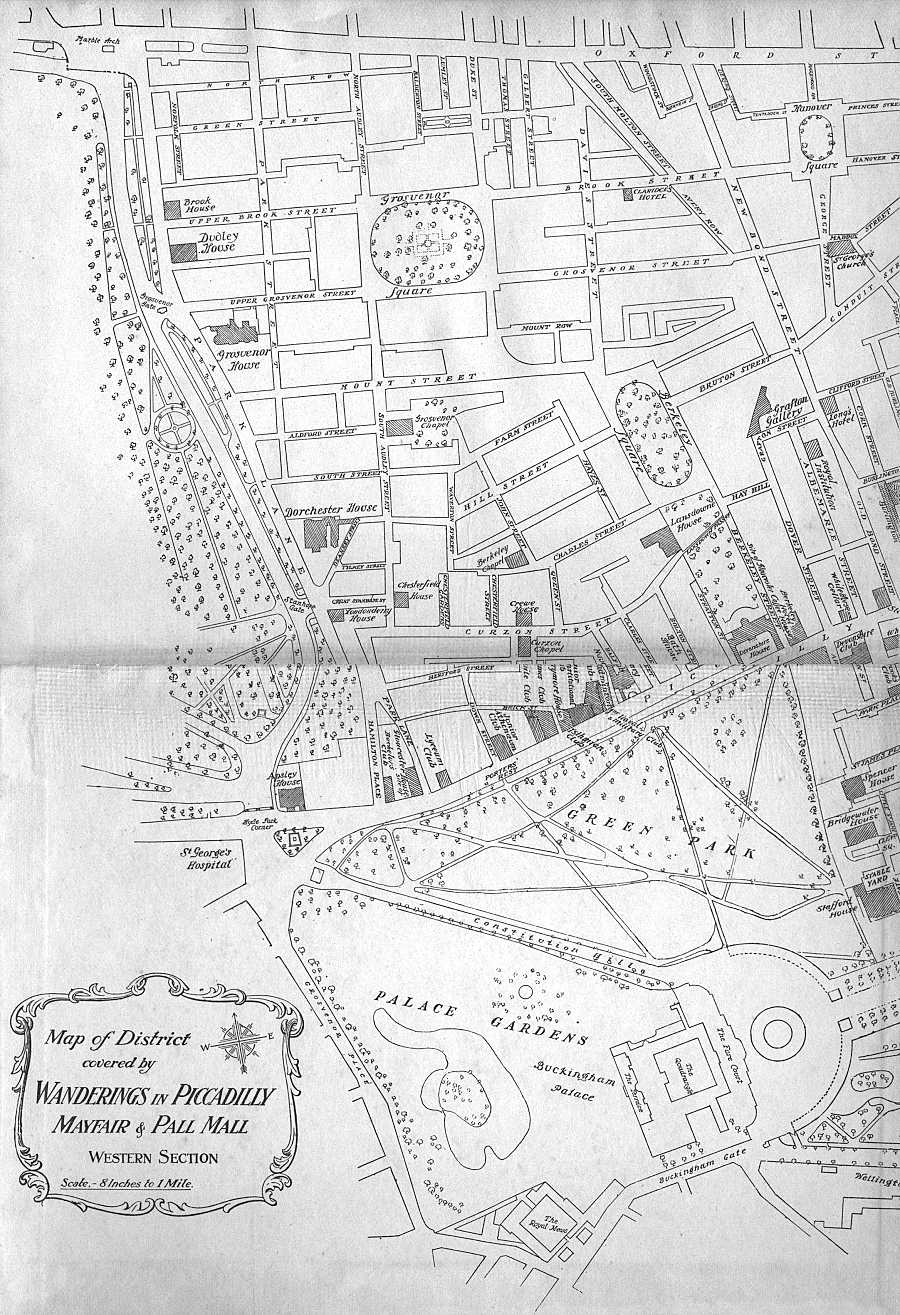
To begin one’s peregrinations at the corner of Bond Street
and Piccadilly seems at first sight a little arbitrary, but one
soon realises that in starting from “Stewart’s,” and keeping
within a half-mile radius of this centre, one is really covering
by far the most interesting portion of the West End; while
the old shop, which—during more than two centuries—has
given its name to this corner of Bond Street, and which,
as Mr. Chancellor declares, is to Americans one of the best
known spots in Europe, is in itself a most interesting link
with the past and present.
The Author, and the Publishers, acknowledge with thanks
their indebtedness to Edward Gardner, Esq., for kind permission
to reproduce six views of Old London from his
unique Collection of Drawings and Prints.
“A good little book for pilgrims, ‘more especially,’ as it states, ‘those from America,’
who wish to recognise the multitude of distinguished ghosts who crowd the district dealt
with.”—Graphic.
“Always readable and interesting. The chief attraction of the book, which, by the way,
is charmingly ‘got up,’ is to be found in the twenty plate illustrations of Old London
streets and houses. Four are successful reproductions in colour.”—Antiquarian.
“In this pretty little book ... these notes on the heart of the West End are
made to gyrate round Stewart’s Tea Rooms at the corner of Bond Street, called ‘Stewart’s
Corner.’ The publisher seems to have felt that to assume this shop to be the hub of the
best part of London is sufficiently remarkable to require explanation, so he writes:—‘To
begin one’s peregrinations at the corner of Bond Street and Piccadilly seems at
first sight a little arbitrary, but one soon realizes that in starting from “Stewart’s” and
keeping within a half-mile radius of this centre, one is really covering by far the most
interesting portion of the West End.’ The plates, which are mostly reproductions of
old prints, are singularly interesting (especially the coloured ones), and are themselves
worth the price of the book.”—Athenæum.
“Mr. Chancellor guides the reader round the old streets and houses, introducing him
personally, as it were, to the quaint and interesting people who inhabited them.”—The
Queen.
“A little book gathering up in a quite popular way some of the associations of the
district, with many illustrations of it as it appeared in the past.”—“Times” Literary
Supplement.
“The author of ‘The Squares of London’ has in a high degree the faculties of selection
and concentration, and in his hundred and fifty pages he has been able to tell us so much
and to tell it so well.”—Illustrated Sporting and Dramatic News.
“There is no lack of interest, past and present, in the district about which our author
discourses. Piccadilly is notorious for its ‘ghosts’; and St. James’s Street, Park Lane,
Grosvenor Square, Pall Mall, Albemarle Street, to name a few places at random, have
an abundant population of the same kind. This little volume, which is judiciously
illustrated, makes good reading.”—The Spectator.
“A pretty little book this, with charming illustrations of the West End in days of
old, four of them in colour. The pages are rich in brief anecdote, as well as topographical
details of interest.”—The Lady’s Pictorial.
“It is just the book for the Londoner who is always interested in the old spots that are
being swept away one by one; and the novice who knows nothing of the subject will be
fascinated by these pictures of former days.”—Methodist Times.
“Those who are interested in this class of literature will find Mr. Chancellor’s book
interesting, all the more so if they have some acquaintance with the English literature of
the last two centuries. The area covered is large, but there is no lack of interest, past
and present, in our author’s discoursings about it. The volume is judiciously
illustrated.”—Catholic Times.
“Pictures of St. James’s Street in George the Third’s reign, the palace at the foot in the
days of the Stuarts, Carlton House during the Regency, together with various old inns,
mansions, and other vanished buildings, combine to make an illustrated gallery of a
departed era.”—The Bookseller.
“Famous streets, famous buildings, famous men. Mr. Chancellor catalogues them in
an agreeable literary form, with plenty of notes and incidents and historic origins.”—The
Globe.
“Mr. Chancellor’s small volume is among the best. It has a real literary flavour, and
is full of reminiscences of times long past. The twenty illustrations of old London
(four of them in colour) are particularly well chosen.”—Publishers’ Circular.
“A compact memorial volume like this is of special value. We are conducted round
the fine old streets and famous houses, and are given almost personal introductions to the
famous and quaint folk who inhabited them.”—Christian Commonwealth.
“In hunting up places of interest connected with our forbears, the author has endeavoured,
and successfully, to keep alive for us a remembrance of a past period.”—Broad
Arrow.
“A pleasant sketch describing the West End of London in the eighteenth and the
early part of the nineteenth century, drawing a vivid picture of life in that part of London
at that time, and giving details concerning many famous buildings.”—Record.
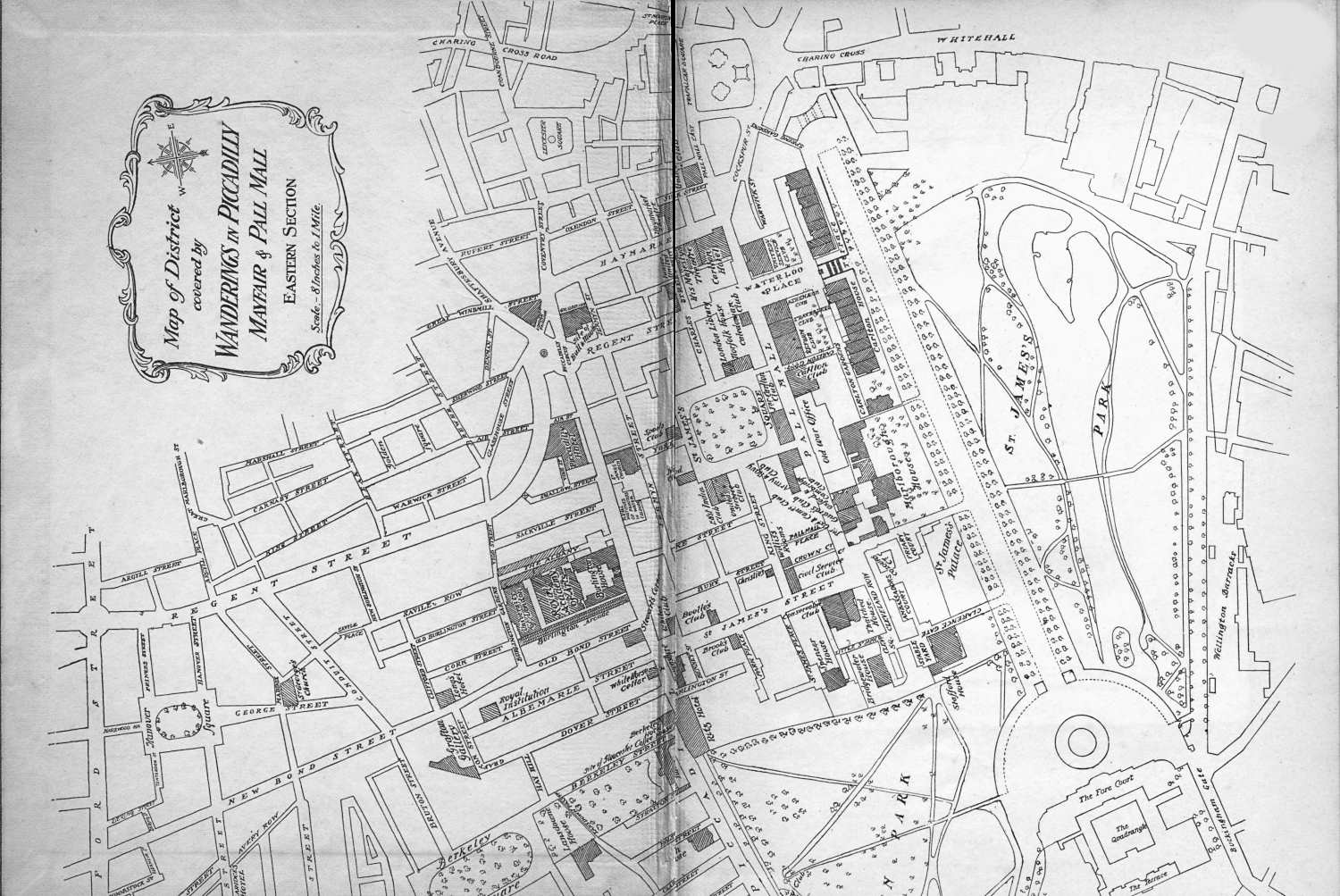
“This charming little work must needs be invaluable to all lovers of London, among
whom the author reckons our American cousins, for whose more especial benefit he has
given a map of the district in two parts, one representing the Eastern and the other the
Western limits of his rambles.”—Western Morning News.
“Mr. Chancellor recalls many historical facts about these old streets and houses,
re-peopling them with English men and women of long ago, telling anecdotes and gossiping
in pleasantest manner.”—Yorkshire Daily Post.
“There is much to be learned from these pages how these parts of London came to
be built, and why the streets bear various strange names, of which Maddox is one.”—Nottingham
Guardian.
“The author of ‘The Squares of London’ has undoubtedly done a great deal to keep
alive for us, with a ready and able pen, memories of the old London which are tending to
become less and less distinct with the march of time and the rush of new ideas.”—Huddersfield
Examiner.
“The book is full of delightful gossip regarding the clubs, theatres, and great houses
of past and present times.”—The Northern Whig.
“A capital and interesting book of its kind, full of pleasant reminiscences of the days
of the leisurely life and refinement of the century that has gone.”—Manchester Evening
News.
“The volume is well illustrated, and the reproductions from old prints and drawings of
mansions which have altogether disappeared—as, for instance, Northumberland House,
with its famous lion—are particularly interesting.”—Glasgow Herald.
“This admirable book is packed full of historical and biographical information, retailed
in the pleasantest possible manner.”—Liverpool Daily Courier.
“Mr. Chancellor is an excellent cicerone in describing for us the old streets and houses
and the quaint people who inhabited them.”—Yorkshire Herald.
“With this little book in his pocket (where it will hardly reveal itself), or on his table,
the visitor to London can add greatly to his enjoyment.”—Aberdeen Journal.
“A delightful little guide to the localities mentioned.”—Aberdeen Free Press.
“With this book in the coat pocket—to glance at in convenient corners—one could
spend some pleasant hours.”—Bolton Journal.
CHAPTER I.
PICCADILLY.
“By night or by day, whether noisy or stilly,
Whatever my mood is—I love Piccadilly.”
Locker-Lampson.
Dr. Johnson in one of his rhetorical flights said
that Charing Cross was practically the centre of the
universe. “I think,” he observed to Boswell, on a celebrated
occasion, “the full tide of human existence is at
Charing Cross.” Theodore Hook, on the other hand, considered
that that small area in St. James’s, bounded by
Piccadilly and Pall Mall, St. James’s Street and Waterloo
Place, was the acme of fashion, and contained within itself all
that was best worth cultivating in the Metropolis.
Like all generalizations, neither of these dicta will bear
the test of logical analysis. Hook’s favourite quarter has
undergone many a change, and its present-day equivalent is
more likely to be found in that larger area known to all the
world as Mayfair. Similarly, although much of the tide of
human existence still flows past the spot where Queen
Eleanor’s body rested for the last time, on its way to the
Abbey, that tide flows as fully and with as much noisy
vehemence past half a hundred other crowded spots in
London. It is probable, however, that at no one point
does it surge and rage (to carry on the metaphor), with
greater force than at the spot where Piccadilly and Bond
Street join. At this spot stands “Stewart’s”—famed
all the world over. I say “Stewart’s,” as I should say in
Venice, “Florian’s,” or in New York, “Delmonico’s”; for
there are certain famous establishments in all great cities
which require no more specific designation.
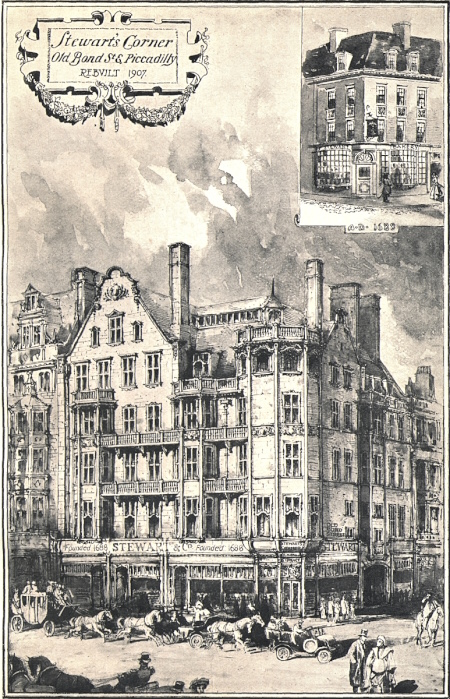
Who is there, indeed, that knows not Stewart’s? It has
been presiding over this corner for the last two hundred years
and more. It must be the oldest baker’s and confectioner’s
business in London, beside which even such ancient
houses as “Birch’s” or “Gunter’s” are comparatively
modern. To-day it bears upon its rebuilt front, the
date of its establishment—1688, and the massive foundations
and old brickwork, which were brought to light during the recent
rebuilding, fully support the theory that this was one of
the original buildings erected by Sir Thomas Bond on the
site of Clarendon House, when he laid out the street which
bears his name.
Let us take this shop, as characteristic of many others,
and try to recall what it may have witnessed in the lapse
of years. In its early days it was, no doubt, too much
occupied with its own affairs to take much note of great
personages or historic events; but after it had settled down,
so to speak, and had become, as it did, the purveyor of the
staff of life to the Coffee-houses that had sprung up around
it, it may be supposed to have given an eye, now and then,
to the interesting men and beautiful women who passed by,
or who made it a rendezvous while some of them waited
for those who were spending or making fortunes in the
gambling hells of St. James’s Street hard by.
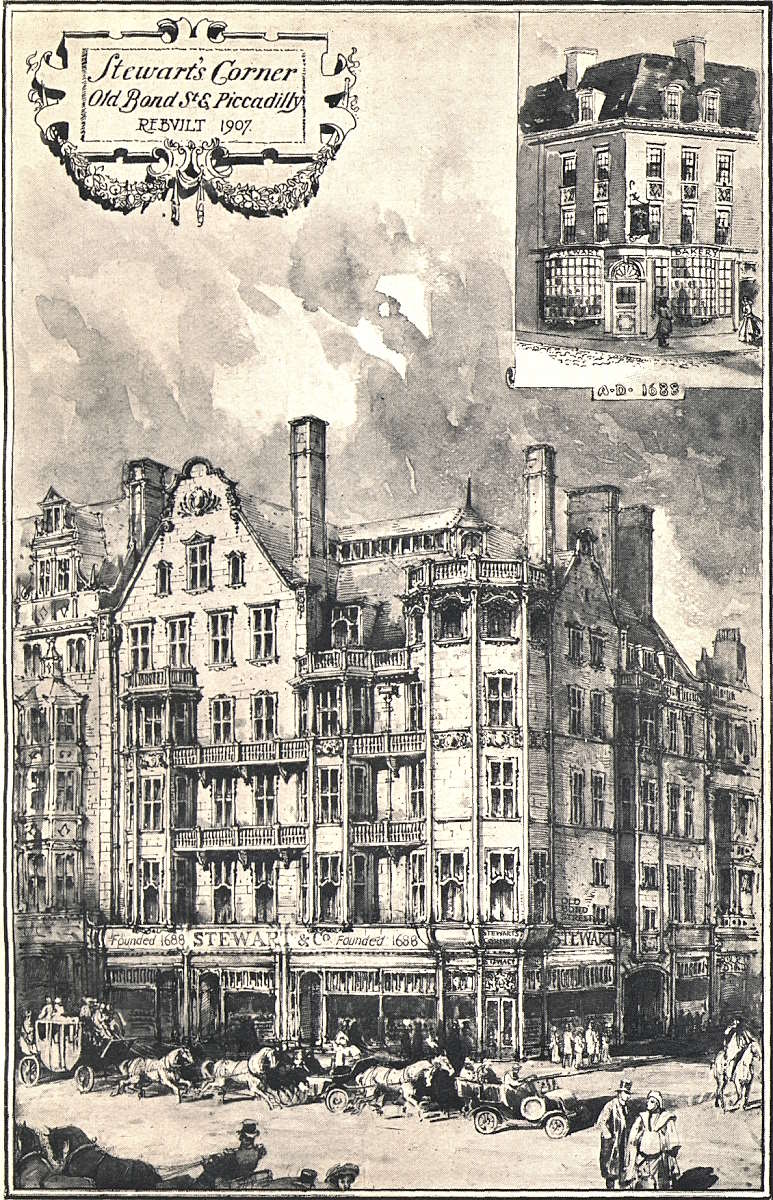
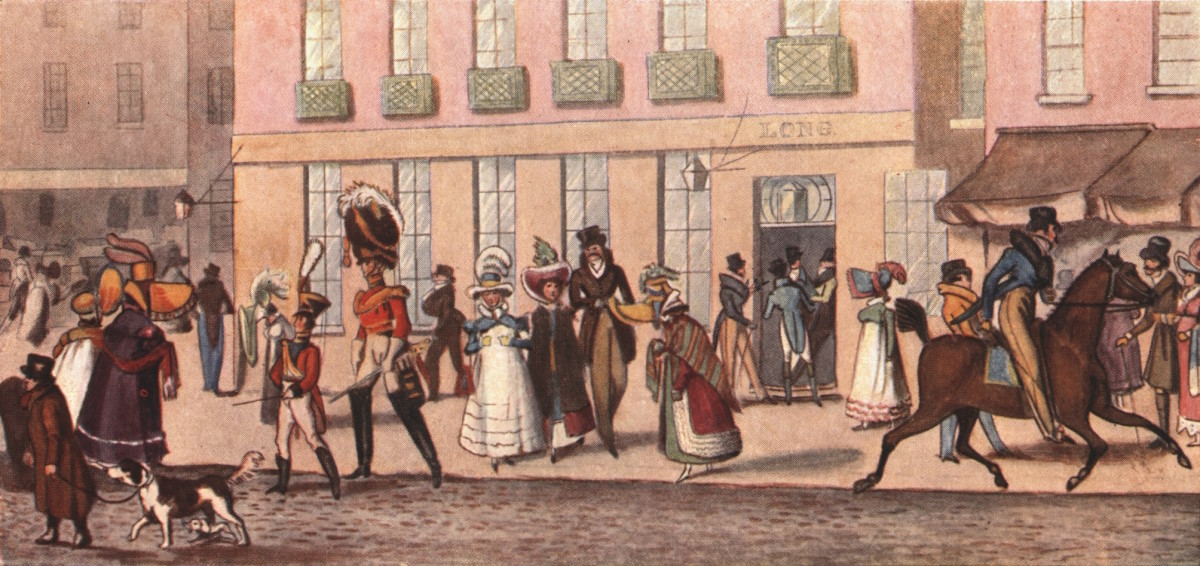
Stewart’s Corner
Old Bond Sᵗ & Piccadilly
REBVILT 1907.
The Augustan age is here! Can that little shrivelled
body limping along, having just come from its lodging in
Berkeley Street, contain the great mind of Alexander
Pope? Surely ’tis he, having but this moment penned
a letter to Martha Blount, or put the finishing touches to his
“Farewell to London.” He is probably on his way to visit
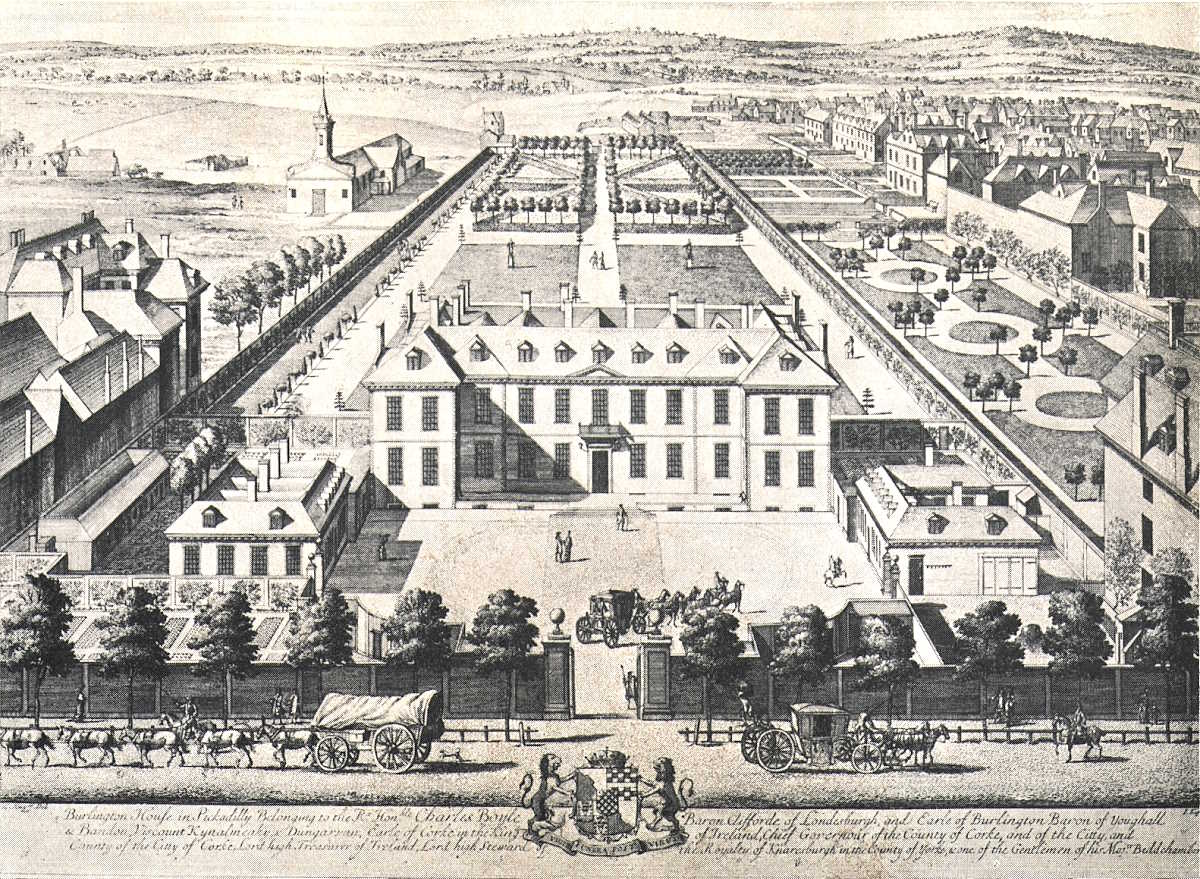
my lord Burlington, whose home (the precursor of the
later mansion built by his great grandson, and now known
by the massive buildings of the modern Burlington House),
is close by. Horace Walpole tells us that when asked why
he built his mansion so far out of town, the first Earl replied,
“Because he was determined to have no building beyond
him!” Credite posteri! but he meant, and should have
added, “to the north,” which is, in itself, wonderful enough
for us to realize now, for Clarendon House and Berkeley
House were already in existence to the west. Could it have
been Pope, who asked the question? It seems likely,
for we remember the anecdote of the irate gentleman who
being in the poet’s company and required to give a definition
of “a point of interrogation,” replied “that it was a little
crooked thing that asked questions!”
And then that fine looking man in the full bottomed
wig, can that be Mr. Addison of the Spectator, fresh from his
lodgings in the Haymarket hard by, and still glowing in the
reflected glory of “The Campaign?” None other. And
lo! here is the handsome face of his hero, who “taught
the doubtful battle where to rage,” as he hobbles along
(he will soon be off to Bath to try and cure his gout)—fit
indeed, monstrari digito, for other things besides his military
glory. He will not turn in at Stewart’s we may be
sure, for if the “tears of dotage” have not yet
begun to flow, at least he is learning to save his
money.
Here, too, comes jolly Dick Steele; he has just been
into a coffee house to pen a line of excuse to his “dearest
Prue,” in Kensington Square, and is on his way to a
jollification with some of his boon companions; forgetful
of his “Apology,” and hardly living up to the ethics of his
“Christian Hero.” Still with all his faults, a pleasanter
figure to meet than that dark-faced, dissatisfied-looking
man in clerical attire. That is the redoubtable Dean Swift
himself, one of the great geniuses, not only of his own day,
but of all time. He knows this part of the town as well
as he knows all the turns and twists of contemporary
politics; and has probably come from his rooms in Ryder
Street almost opposite. Wherever he is he will be penning
that famous “Journal to Stella,” or plotting and planning
with the heads of the Opposition—and there is no clearer
or more potent brain among them. If he goes into the
St. James’ Coffee House, or White’s Chocolate House, “the
most fashionable hell in London,” or trudges further east
to Willis’s, in Bow Street, be sure there will be plenty to
note his strange manner and call him “the mad parson!”
Perchance he may be taking the air to prepare himself for
that particular dinner with my Lord Abercorn when there
smoked upon the board the “fine fat haunch of venison,
that smelt rarely on one side,” which he mentions, with such
gusto, in his journal; or perhaps he is setting out on one
of his long rambles to Chelsea to dine with the Dean of
Carlisle, or to sup with Lord Mountjoy at Kensington
Gravel Pits.
An observant traveller who visited London about this
period, remarks that “Most of the streets are wonderfully
well lighted, for in front of each house hangs a lantern or
a large globe of glass, inside of which is placed a lamp which
burns all night.” The light which hung before “Stewart’s”
must have illuminated the face of many a “toast,” many
a “Macaroni,” as they came up Bond Street, and
sometimes that of one of those terrible “mohocks.”
My Lord Mohun, not yet dreaming of his sanguinary
and fatal encounter with his grace of Hamilton, but
sufficiently notorious for that mysterious affair when
Mountfort the player fell mortally wounded near his lodging
in Norfolk Street; the eccentric Duke of Wharton,
who once sent a bear to his tutor as an appropriate
concomitant to his “bearish conduct”; who, marrying
at sixteen, became a sort of Jacobite hero, and
showed by some of his writings in “The True
Briton,” what gifts he had squandered by a riotous
life; and who finally ended his career in a Bernardine Convent,
“the scorn and wonder of our days,” as Pope writes,
“a sad outcast of each church and state.” Hervey, the
“Sporus” of the same bitter pen, having dragged himself
for a space from the Court, of which he was so characteristic
an ornament, and from the company of the Princess who
secretly loved him. Perhaps he will to-morrow fight, behind
Arlington House, hard by, with Pulteney, who called him
“a thing below contempt.” That slip of the foot at the
critical moment saved the “thin-spun life,” and like so many
protagonists in such encounters, the whilom enemies
embrace, with more fervour on Pulteney’s part than
on that of “My Lord” who but bows in silence and
withdraws.
And then what a galaxy of beauty reflects the light from
that “lantern or large globe of glass!” Here is Lady Mary
Wortley Montagu, not very much affected by the virulent
lines of the “wicked wasp of Twickenham”; the lovely
Molly Lepel, who married Lord Hervey, and whom Lady
Suffolk loved so much; Mary Bellenden, afterwards Mrs.
Campbell, another of those maids of honour whom Gay
and Prior sung, and Swift and Arbuthnot undertook to
prove the best wives, although we remember that the
coachman at Leicester House solemnly forbade his son
ever to think of any of them in so tender a way! Here,
too, is Lady Mary Coke, who was used to almost regard herself
as a royal widow, on the death of Edward Duke of
York—for which “mealy faced boy” she had a “tendre”;
the Duchess of Queensberry, Prior’s “Kitty ever fair,”
whom Walpole thought looked “(by twilight) like a young
beauty of an old-fashioned century,” and who died in Savile
Row, in 1777, “of a surfeit of cherries.”
The list might be indefinitely extended, but “Anni
labuntur” and other centuries are hurrying us along, bringing
new faces in their train; George Selwyn with his witty talk
and mania for executions; he is off now, probably to see
John Rann, or “Sixteen-stringed Jack,” as he was called,
strung up at Tyburn tree—my Lord Pembroke accompanies
him, and the cronies chancing to meet a lot of young chimney
sweeps who beg for money, Selwyn suddenly addresses them
solemnly with the words “I have often heard of the
sovereignty of the people. I suppose your highnesses are in
Court mourning;” Charles James Fox, the most eminent
of those “sons of faro,” who having lost his last penny
and consoled himself by reading Homer in the small hours,
is thinking of a “passover” to the Continent, which, as
Selwyn says, will not be relished by the Jews; Lord March
may also be seen, the wicked “old Q” of many a notorious
story; and Hare—“the hare with many friends,” as his
acquaintances nick-named him; and then the dandies of
a later day; Alvanley, who succeeded Selwyn as a wit and
almost rivalled Brummell as a dandy; “Ball” Hughes
and “Teapot” Crawfurd; Lord Yarmouth and Prince
Esterhazy; Jack Lee, and the great Brummell himself,
who has cut the Regent and is thinking of bringing the old
king into fashion!
These, and how many others, have not passed by
that corner in Piccadilly where Stewart’s stands; they
are but the ghosts of the beauties and exquisites of a bygone
day that loiter there—for in this strenuous age no one
dawdles—all is hurry and confusion, and the idle stroller,
other than Thespian, is almost a thing of the past. Let us
for the moment try to imitate our forbears and “take a
walk down Piccadilly.”
What changes have not taken place in this street of
streets! It was known by the quaint name it still bears as
early as 1633, for Gerarde in his famous Herbal, mentions
“the wild bu-glosse,” that “grows about the drie ditch-bankes
about Pickadilla.” This is not the place to go into
the mysteries of nomenclature, and many have been the
theories as to the origin of the name; but that is probably
the correct solution which traces it to the ruffs called
Pickadils, worn by the gallants of James’s and Charles’s
time. Blount in his “Glossography” (1656) thus speaks
of the matter: “A Pickadil is that round hem, or the
several divisions set together about the skirt of a garment
or other thing; also a kind of stiff collar, made in fashion
of a band. Hence, perhaps, the famous ordinary near St.
James’s, called Pickadilly, took denomination, because it was
then the utmost, or skirt house of the suburbs, that way.”
Thus Blount, and I think we may leave it at that. We
shall return later on to the “famous ordinary,” which
was known as Pickadilla Hall, and was situated at the
north-east corner of the Haymarket: now we are on our
way west, like the wise men of old.[1]
ALBEMARLE
STREET.
The first tributary street we come to is
Albemarle Street, formed, at the same
time as Bond Street, about 1684, by
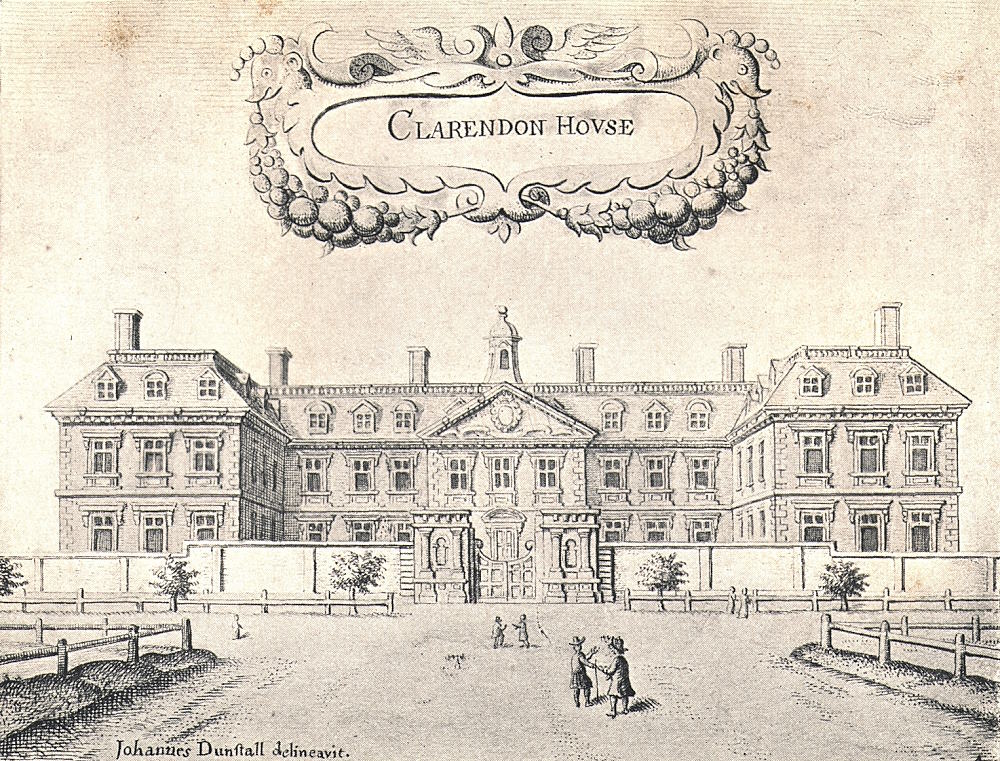
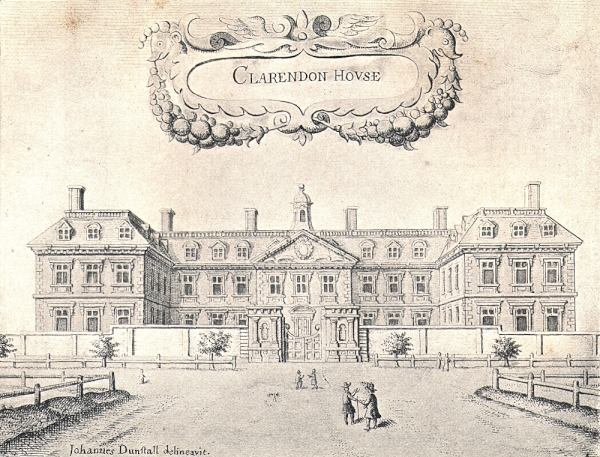
Sir Thomas Bond, on the site of Clarendon House,
which the great Lord Clarendon built from the designs
of Pratt, according to Evelyn, on ground which
had been granted him by Charles II., in 1664. The
Diarist had “never seen a nobler pile,” and he had every
opportunity for criticising it thoroughly as, on one occasion,
the Chancellor himself showed him all over it; and the
extant views of it fully confirm Evelyn’s enthusiasm. The
populace, however, saw in the great place the results of
bribery and corruption, and Dunkirk House, Holland House,
and Tangier House, were titles freely applied to it. On
Clarendon’s death, the house was sold (1675) to the second
duke of Albemarle (the son of the great Monk) for £26,000
(it had cost £40,000 originally). In consequence of extravagance
in all sorts of ways, however, its new owner was not
long able to keep it, and he in turn sold it, it is said, for
£20,000, to Sir Thomas Bond, who pulled it down and built
Albemarle Street (then called Albemarle Buildings), and
Bond Street on its site. Evelyn, on September 18th, 1683,
notes that he “walked to survey the sad demolition of
Clarendon House, that costly and only sumptuous palace of
the late Lord Chancellor Hyde,” “where,” he adds, “I
have often been so cheerful with him and sometimes so sad.”
Clarendon Hovse
(From a print of the period.)
Albemarle Street, “of excellent new buildings, inhabited by
persons of quality,” as the New View of London (1708)
describes it, has had some interesting inhabitants. Here, in
1712, Sir William Wyndham and his family escaped in their
night clothes from the fire that destroyed his house, for
which he had given £6,000, as he told Swift, when many rare
pictures and other valuables were destroyed; here, in
Lord Grantham’s house, lived for a time the Prince of
Wales, afterwards George II., until he moved to Leicester
House. Bishop Berkeley was lodging at Mr. Fox’s (an
apothecary’s) in this street, from 1724 to 1726, as he records
in his “Literary Relics,” and Sir Richard Mead, who formed
that fine collection of drawings subsequently added to the
Royal Collection, resided here in 1720.
Many years later the Duc de Nivernois was lodging in the
street, and here received on one occasion Gibbon “more as
a man of letters than as a man of fashion,” much to the
latter’s chagrin. Lord Bute, another minister who became,
as Clarendon had done, an object of popular hatred, was
living here in 1764; and there is a story told by Lord
Malmesbury, that when a Mr. Calvert asked in the House
of Commons “Where is Athens? What is become of
Lacedæmon?” some member of the Opposition called out
that “they had gone to Albemarle Street.”
It is obviously possible to do little more than mention the
names of some of the other distinguished residents in
Albemarle Street. Here lived Zoffany, the painter, who
executed, about this period, a portrait of Wilkes, “looking—no,
squinting—at his daughter,” as Walpole records:
Robert Adam, the architect of so many fine dwellings,
died here, in 1792, and his brother James two years later, at
No. 13; Charles James Fox was living here when Rogers
first knew him; Sir James Mackintosh was at No. 26, on
his return from India in 1811, and “Leonidas” Glover,
died in a house here, in 1785.
Albemarle Street has been noted for its hotels. Here was
Dorant’s, where Byron stayed, when he was publishing his
“Hours of Idleness”; and the famous Grillion’s, where
Louis XVIII. in exile held his Court.
The name of Byron brings us appropriately enough to No.
50, Albemarle Street—for here the great publishing firm of
Murray, so closely connected with his name, has been
settled since John Murray removed hither from Fleet Street,
in 1812.
The columnar façade of the Royal Institution, the work
of Vulliamy, forms a curiously solemn note in Albemarle
Street, but its importance as a great scientific centre
more than justifies its severe, almost melancholy,
appearance.
DOVER
STREET.
Dover Street, to which we come a few
steps further west, was built about 1686,
and was named after Henry Jermyn, Lord
Dover. He lived in a house which was subsequently
advertised for sale in the “Daily Journal” for January,
1727. It would appear that after his death his widow had
been residing here, for the notice indicates that the cause of
the sale was that lady’s decease. Mention is particularly
made of a beautiful staircase painted by Laguerre, as well
as “all manner of conveniences for a great family.” The
house was on the east side, and not far from it, Evelyn came
to dwell in 1699, having taken the lease of a residence on the
same side of the street. That mad Duke of Wharton whom
I have already mentioned, also lived in Dover Street,
“in a most sumptuous building, finely finished and furnished”;
so did the great Robert Harley, Earl of Oxford,
as well as his son, the second Earl, who married the heiress
of the Duke of Newcastle. Pope used to stay here as a
guest at this time; and as Arbuthnot was also living in the
same street these two friends would often, we are to suppose,
discuss that “half pint of claret” which the latter humorously
told Pope, he could still afford. Another of this
coterie, Bolingbroke, was wont to lodge at “Mr. Chetwynd’s,”
as Gay informs Swift, probably with a view to a
philosophic, albeit, a merry meeting there. Sir William
Wyndham was also a former resident; so was Miss Reynolds,
the sister of Sir Joshua, whom Johnson used to visit;
Lord King, the biographer of Locke; Archdeacon Coxe,
who wrote ponderous tomes about Sir Robert Walpole and
the House of Austria, and Nash, the architect, who built
the more imposing portion of Regent Street.
But the two most interesting houses were (for one has
disappeared, and its site is covered by a mushroom block of
red brick flats, and although the other still remains, it is
empty and will probably soon go the way of all old buildings)
Ashburnham House and Ely House.
The former, with its gateway and lodge designed by Robert
Adam in 1773, was the town house of the Earls of Ashburnham,
but others beside that family occasionally inhabited it,
and for a time it was the Russian Embassy; Prince Lieven
being the first ambassador residing here, and Pozzo di Borgo
the last.
Ely House, designed by Sir Robert Taylor, has been, since
1772, the town residence of the Bishops of Ely, and was
conveyed to that See in exchange for Ely Place, Holborn.
Dover Street has always been rather famous for its hotels,
and in this respect at least, its reputation is well sustained.
Le Telier’s was one of the older ones, and is notable as being
the house to which the Literary Club moved from Sackville
Street, before going into St. James’s Street.
THE WHITE
HORSE
CELLAR.
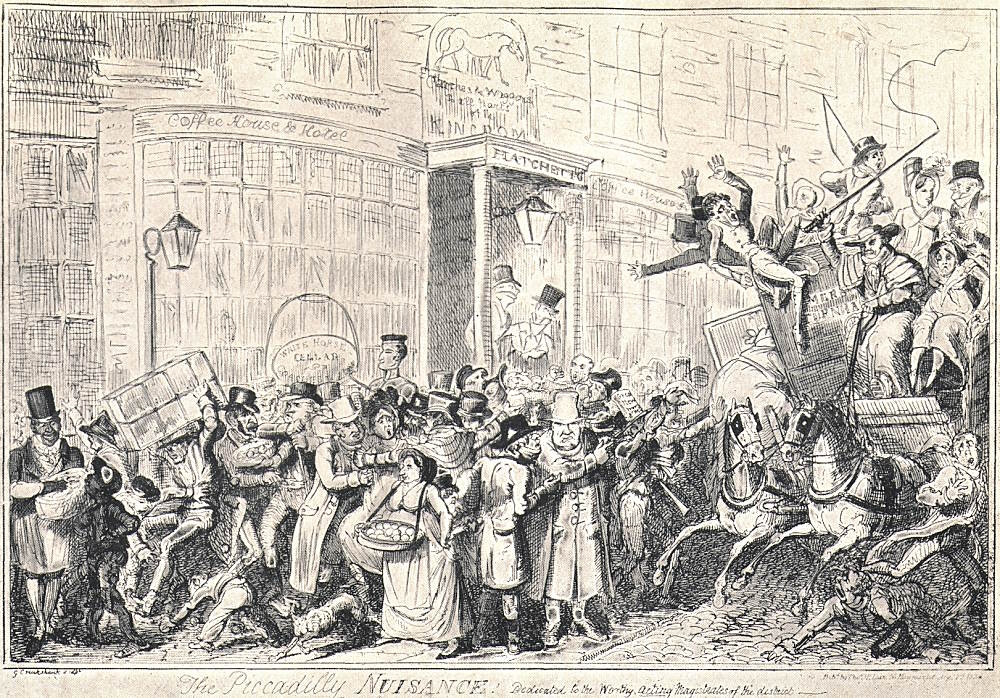
Just before we reach Berkeley Street, we
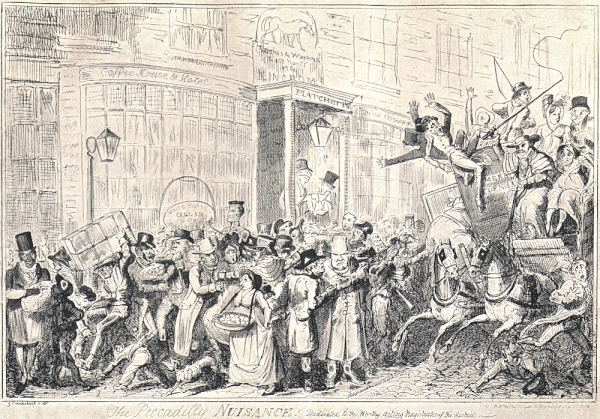
come to Hatchett’s Restaurant, the old “White
Horse Cellar,” so named from the emblem
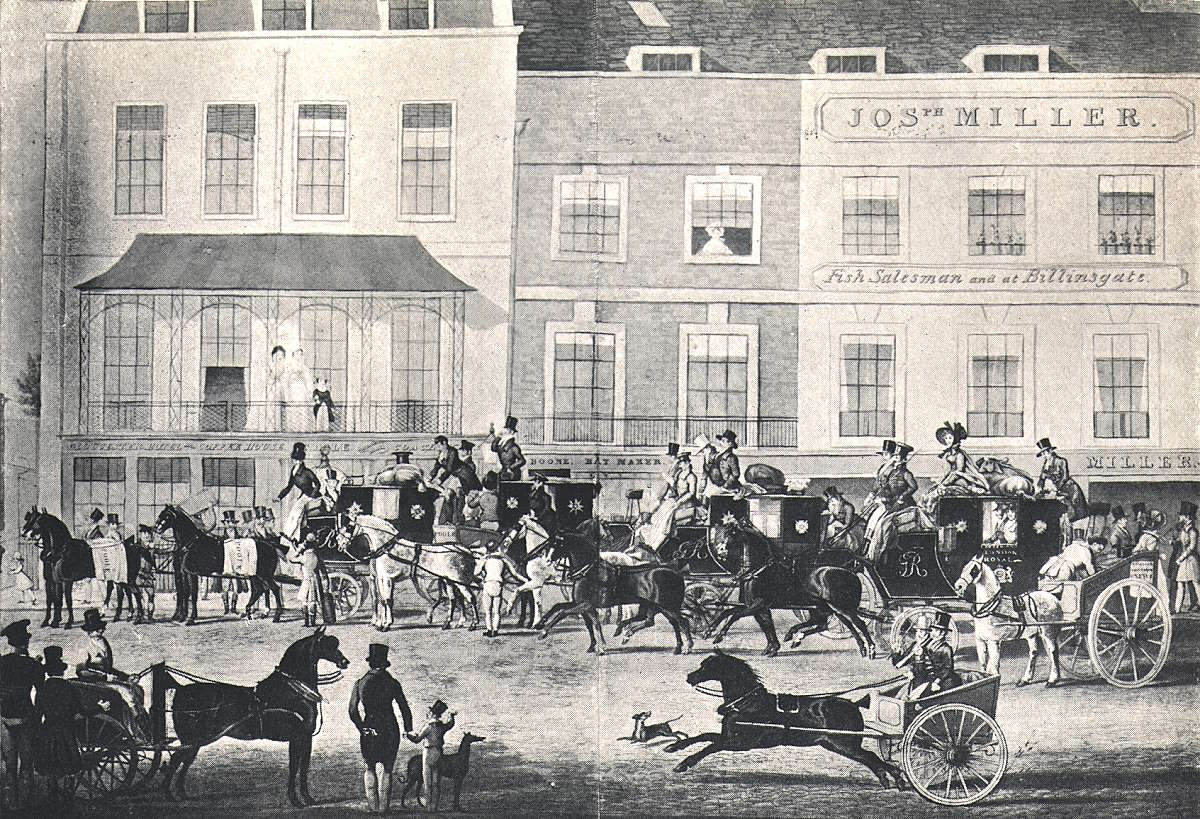
in the crest of the House of Hanover. The old original
“White Horse Cellar,” whence in the good old days the
coaches left on their way to the west, stood nearly opposite,
close to Arlington Street. As may be seen from old sporting
prints, the outside of the original house was covered on
particular occasions with oil lights of various colours—lights
which many a jaded traveller must have seen with
pleasure, and many a fresh one left with regret. One of
these occasions was the King’s birthday, when the coachmen
and guards donned new scarlet liveries, and even the
coaches were touched up. Sir Vincent Cotton, Capt. Probyn,
Lord Worcester and Sir Thomas Jones were among the
amateur whips who frequently handled the ribbons and
tooled their coaches down the intricacies of Piccadilly; and
we can quite believe Hazlitt when he says that “the finest
sight in the metropolis is the setting off of the mail coaches
from Piccadilly.”
THE WHITE HORSE CELLAR—HATCHETT’S RESTAURANT—PICCADILLY
(From a Drawing by George Cruikshank.)
How many of us would not have given a good round sum
to have seen Mr. Pickwick laboriously climb on to the top
of the vehicle which was to carry him to Bath, or Sam
Weller’s surprise when he observed the name of “Pickwick”
painted on the coach door; or “the young man of the
name of Guppy,” meeting Esther Summerson here on
her arrival in London one foggy afternoon in November;
or Jerry Hawthorn “fairly knocked up by all the excitement,
getting into the coach”—being one of six inside,
“what time his friends shake him by the hand, whilst the
Jews hang round with oranges, knives and sealing wax,
whilst the guard is closing the door.” All we can do is to
rehabilitate the scene of the former from Dickens’s pen;
and to imagine ourselves watching the latter in Cruickshank’s
drawing.
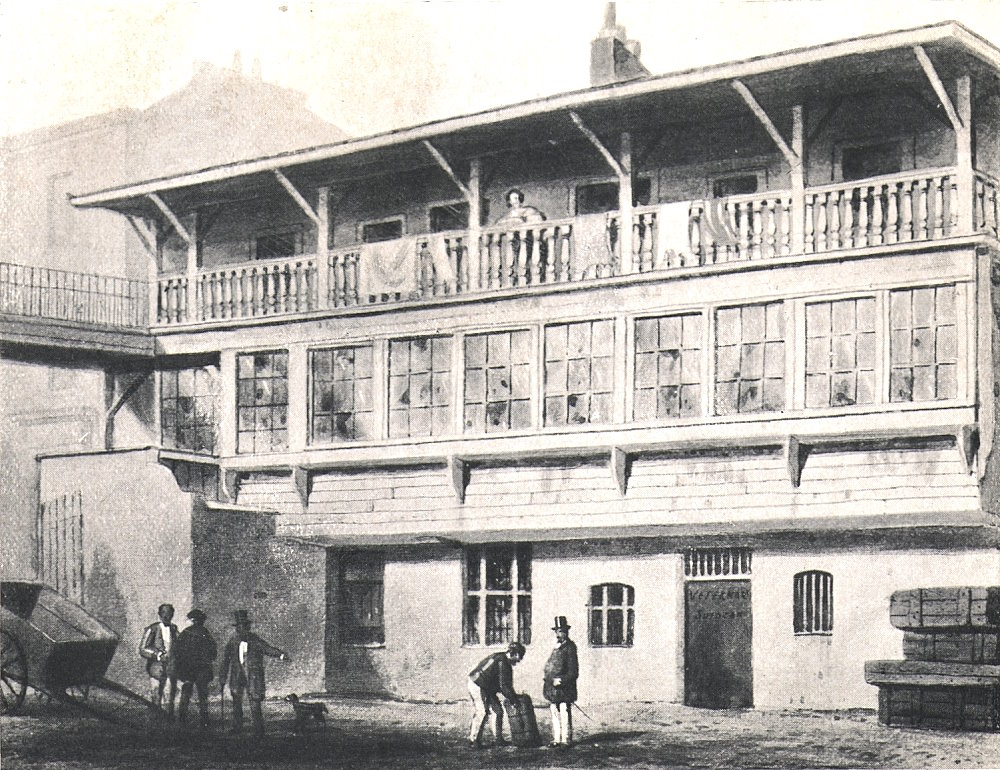
Another hostelry from which coaches departed on their
long journeys was the “Gloucester Coffee House,” kept
by one Dale, which stood where the Berkeley Hotel, formerly
known as the St. James’s Hotel, is now; and “The Green
Man and Still” was yet another house of call for the coaches
that went westward.
BERKELEY
STREET.
Berkeley Street, formerly known as Berkeley
Row, boasts one or two interesting residents in
the past. Here Cosway dwelt, and it was
here that he first attracted the notice of the Prince of Wales,
whose portrait he “drew in little” so often and so successfully.
In the same house, too, had previously lived Shackleton,
the portrait painter; and it was to a residence here
that Mr. Chaworth was carried after his duel with Lord
Byron (the great uncle of the Lord Byron), which took
place at the “Star and Garter,” in Pall Mall, over a dispute
as to the best way of preserving game. Lord Byron, the
survivor, underwent his trial in Westminster Hall, but was
acquitted, and a certain French traveller, M. Grosley, who
was present at the trial, saw his lordship a few days later
taking part in the debate on the Regency Bill, as if nothing
had happened.
DEVONSHIRE
HOUSE.
The long front of Devonshire House, with
its fine gates, which were originally at the
Duke’s place at Chiswick, now faces us. It
was erected from the designs of Kent, for the third Duke of
Devonshire, two years after Berkeley House had been burnt
down (in 1733). Its beautiful grounds are only divided from
those of Lansdowne House by Lansdowne Passage, a short
cut, sunk below the ground level, from Curzon Street to Hay
Hill. There are iron bars at each end of this passage, and
probably few people know why they were placed there. As
a matter of fact, they were put up in consequence of a
mounted highwayman in the eighteenth century, after having
got away from Piccadilly with some booty, riding his horse
through this passage and up the steps at the end. Thomas
Grenville is the authority for this anecdote, and the
robber was seen galloping past his residence in Bolton
Street.
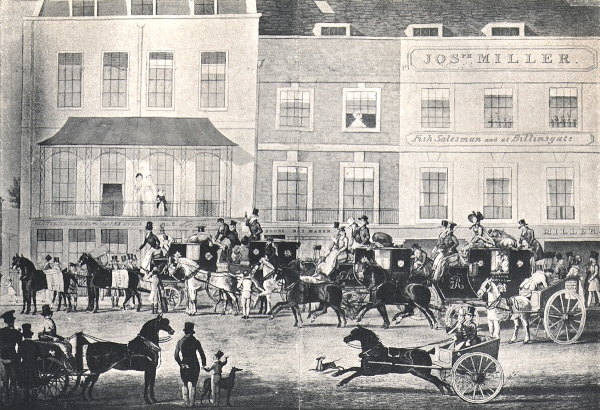
THE GLOUCESTER COFFEE HOUSE, PICCADILLY.
Devonshire House is one of the great houses of London,
and is full of Art treasures, a list of which alone would fill
a volume; particularly remarkable is the collection
of drawings by the old masters, which includes
the original “Liber Veritatis” of Claude de Lorraine;
and a superb collection of engravings by Marc Antonio—to
mention but these. In the library is the great Kemble
collection of old plays, including the first four folios of
Shakespeare’s works, &c., which the sixth Duke bought for
£2,000. What are they not worth now?
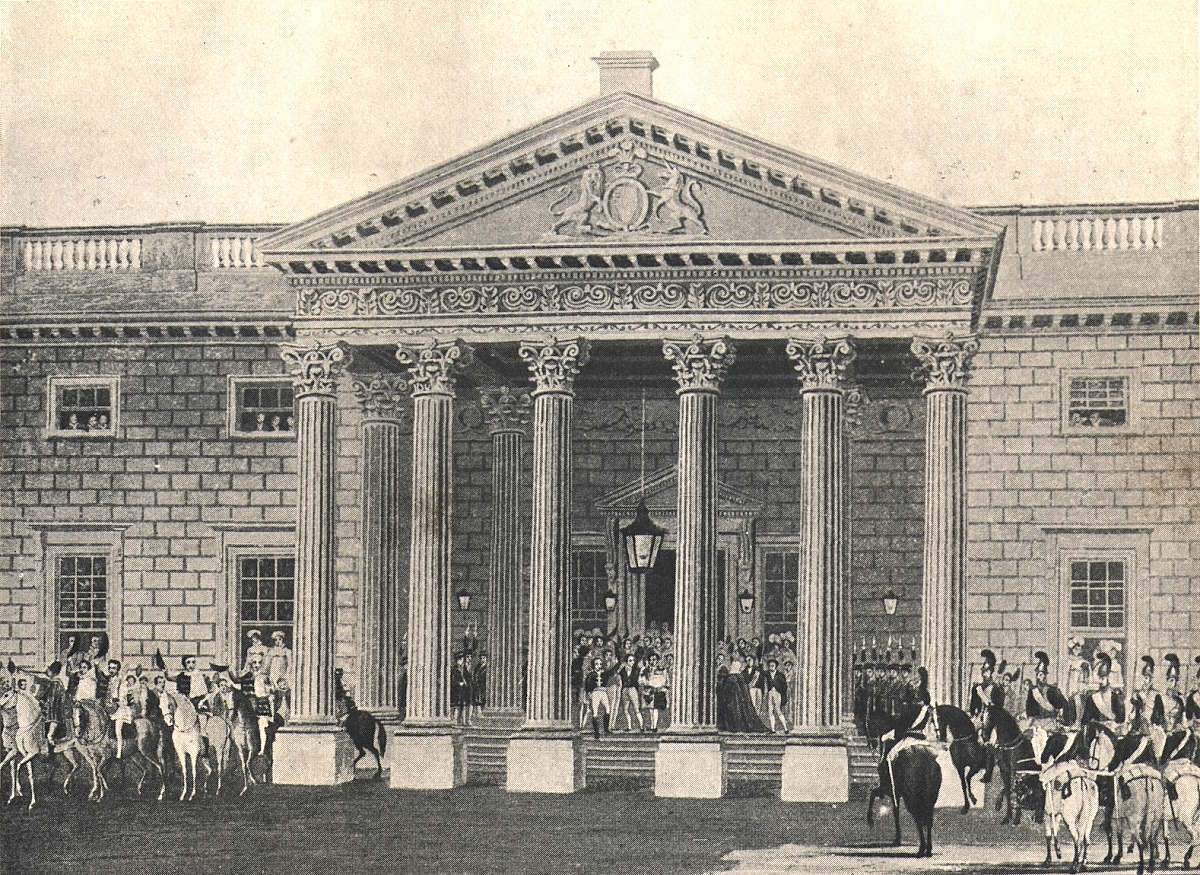
The portico replaced, in 1840, the old entrance which was
by a flight of steps on each side; and among the other
improvements made by the sixth Duke was the addition
of a fine marble staircase up which all the great ones of
several generations have passed, from the days when the
beautiful Duchess welcomed Fox here, and the Prince
Regent, “surrounded by the first Whig families in the
country,” stood to see the apotheosis of the “man of the
people” after the Westminster election, to days within
memory, when Dickens and his friends acted here for charity.
STRATTON
STREET.
Beyond Devonshire House is Stratton Street,
which is, of course, named after Lord Berkeley,
the hero of Stratton fight. Although there have been one
or two interesting people living in this street in the past, such
as Campbell, the poet, who was here in 1802; James Douglas,
the author of “Nenia Britannica”; and Lord Lynedoch,
who was second in command in the Peninsula, the
chief interest attaching to it is the fact that at No. 1,
which belonged to Coutts, the banker, and looks on to Piccadilly,
lived for many years, until her death quite recently,
the venerable Baroness Burdett-Coutts. The house next
door, No. 80, Piccadilly, with its old-fashioned front and
painted glass windows to the ground floor rooms, was for
many years the residence of her father, Sir Francis Burdett,
and it was from here that, in 1810, he was taken to the Tower.
For two days he successfully barricaded himself in the house,
but entrance being eventually forced, he was found, somewhat
theatrically, teaching one of his children Magna Charta.
The riots consequent on this incarceration are mentioned
at length in many of the letters and diaries of the period;
and the soldiers, for their share in suppressing them, were
termed “Piccadilly Butchers.”
The house next door (No. 81) stands on the site of the celebrated
Watier’s Club, established in 1807. Watier had been
cook to the Prince of Wales, and although his gastronomic
skill was unquestionable, and although Brummell was the
presiding genius (or, was it because of that fact?), the
club, which had been the ruin of many a member,
only existed for about 12 years, according to Gronow,
whose well-known story of its origin, may be repeated
here:—
“Upon one occasion some gentlemen of both White’s
and Brookes’s had the honour to dine with the Prince
Regent, and, during the conversation, the Prince inquired
what sort of dinner they got at their clubs, upon which Sir
Thomas Stepney, one of the guests, observed, ‘that their
dinners were always the same, the eternal joints or beefsteaks,
the boiled fowl with oyster sauce, and an apple-tart;
this is what we have at our clubs, and very monotonous
fare it is.’ The Prince, without further remark, rang
the bell for his cook, Watier, and in the presence of
those who dined at the Royal table, asked him whether
he would take a house and organize a dinner-club.
Watier assented, and named Madison, the Prince’s
page, manager, and Labourie, from the Royal kitchen,
the cook.”
It was here that once, on Brummell’s calling with a tragic
air to a waiter to bring a pistol, for he had been losing heavily,
one of the members, Bob Leigh, who proved to be mad,
said, “Mr. Brummell, if you really wish to put an end to
your existence, I am extremely happy to offer you the
means,” at the same time producing two loaded pistols
from his pockets and laying them on the table; and here,
too, Jack Bouverie threw his bowl of counters at the head
of Raikes who had been making some ill-timed jests at his
losses.
BOLTON
STREET.
Bolton Street here joins Piccadilly. Formed
in 1699, it was described by Hatton, a
few years later, as “the most westerly
street in London, between the road to Knightsbridge,
south, and the Fields, north.” Here both Martha and
Theresa Blount once lived, and were called the “Young
Ladies in Bolton Street” by their admirer, Pope. The
poet not only visited them here, but was also occasionally
the guest of the eccentric Earl of Peterborough, who lived
in the same street for fourteen years, from 1710. George
Grenville, also resided in Bolton Street, as did another
politician, Lord Melbourne; and at least three notable
ladies are connected with this vicinity, Fanny Burney
(Madame D’Arblay), who came to live in the street in 1818,
shortly after the death of General D’Arblay, and was visited
by Scott and Rogers and many another fashionable and
literary notabilities; Mrs. Delany, who lived in the adjoining
Bolton Row in 1753; and Mrs. Vesey, whose evening parties
probably kept the quieter denizens of the street awake
o’nights.
If, as is sometimes reported, Prince Charles Edward really
did pay a visit to London in 1760, and was present at the
Coronation, then he set out for the Abbey from a house in
Bolton Street, for here he is said to have lodged, without
even “the semblance of a kingly crown” about his
brows.
BATH
HOUSE.
When Horace Walpole, who loved not
his father’s old enemy, Lord Bath, wrote
on one occasion that “the grass grows just
before my Lord Bath’s door, whom nobody will visit,”
he indicated the large house still known as Bath House
which occupies much of the western side of Bolton Street,
and which was originally built by William Pulteney,
Earl of Bath, on whom so many bitter epigrams were
written, and whose parsimony was so notorious. As
an example of the former, I may remind the reader
of those lines “written on the Earl of Bath’s door in
Piccadilly,” by Sir Charles Hanbury Williams, which run
thus:
“Here dead to fame lives patriot Will,
His grave a lordly seat,
His title proves his epitaph,
His robes his winding sheet.”
As a proof of the latter, is extant the story that having
visited Holkham, and forgetting to tip the servants, a pang
of conscience spurred his lordship to send back a horseman
six miles, with half a crown. An even better illustration
of his ostentation and meanness combined is preserved by
George Colman, who relates that when driving through the
lodge gates of his country house, word would be given to
halt; the outriders repeated the order, the coachman
pulled up his four horses, and from the becoronetted
carriage, William Pulteney, Earl of Bath, Viscount Pulteney,
of Evington, Baron of Hedon, P.C., F.R.S., etc., etc., would
stretch forth his arm and drop into the palm of the curtseying
gatekeeper—a halfpenny!
After Lord Bath’s death, his brother and inheritor of his
vast fortune, occupied Bath House for three years, when he
also departing to the land of shades (Charon got but small
tips from these Adelphi it may be presumed), the place was
let to the Duke of Portland. In 1821, Alexander Baring
bought it and rebuilt the mansion. He was created Lord
Ashburton fourteen years later, and was the head of the great
banking house, which the Duc de Richelieu once said was the
sixth great power in Europe. Under the Ashburton
régime, Carlyle, who was more friendly with Lady Ashburton
than Mrs. Carlyle always approved of, was a frequent visitor
here. In our days it has been the town house of the millionaire
Baron Hirsch, and is now the residence of Sir
Julius Wernher, so that it would appear to have always been
associated with worldly riches and well-known names.
CLUBS OF
PICCADILLY.
At this point begins that remarkable
series of clubs for which Piccadilly is almost
as famous as Pall Mall; indeed, between the
United Empire Club at No. 84, and the Lyceum, at
No. 128, there are a good baker’s dozen of these “assemblies
of good fellows, meeting under certain conditions,”
as Dr. Johnson defined them. Those in this quarter of the
town are for the most part comparatively modern, and I
believe I am right in saying that not one of their names will
be found included in Timbs’ interesting work on “Clubs
and Club Life.” It would form but monotonous reading to
set them all down here, and I should be arrogating to myself
by doing so the functions of the compiler of Directories were
I to attempt it, but as we go along, one or two will require a
word chiefly from the fact of their inhabiting houses which
are otherwise interesting.
CLARGES
STREET.
Clarges Street, however, for a moment,
intervenes before we come to one of them.
It was formed between 1716 and 1718, by
Sir Walter Clarges, on ground adjoining Clarges House,
the residence of his father, Sir Thomas, who, it will be
remembered, was the brother-in-law of the great Duke of
Albemarle. Like all the streets in this neighbourhood, it is
connected with many a well-known name; Mrs. Delany,
the friend of George III. and Queen Charlotte; Miss
O’Neil, the beautiful actress, who nearly extinguished Mrs.
Charles Kemble, and created a furore by her rendering of
“Juliet” at the Dublin theatre; Edmund Kean, whom no one
could extinguish, and who is said to have kept a tame puma
in his house; the beautiful Emma Hart, better known as
Lady Hamilton; William Mitford, who wrote the story of
Grecian prowess, and was himself a Colonel of Militia; Mrs.
Carter, that learned lady, who introduced Epictetus to the
unlearned; and Lord Macaulay, who remembered everything,
and was called by Lord Melbourne “a book in
breeches,” highly to the amusement of Queen Victoria.
These are some of the great ones who have left their record
on the houses in Clarges Street.
HALF MOON
STREET.
Half Moon Street, close by, which takes
its name from an old inn with this sign,
one of the many public houses which at
one time congregated in this quarter, of which the “Hercules
Pillars,” the “Swan,” the “Golden Lion,” the “Horse
Shoe,” the “Barleymow,” and the “White Horse,” may be
mentioned—was formed about 1730. Boswell once lodged
here, and on his own shewing, gave admirable dinners,
“and some claret,” to such as Hume and Franklin; Garrick
and Oglethorpe. Madame D’Arblay’s last residence was
also here, over a linen-draper’s shop; and here, “in a little,
projecting window,” might once have been seen “all day
long, book in hand, with lively gestures and bright eyes,”
the poet Shelley; so that someone said he only wanted a
pan of water and some fresh turf “to look like a young lady’s
bird, hanging outside for air and song.” Here, too, it was,
while stepping into her carriage, that the notorious Lola
Montes, was arrested in 1849, on a charge of bigamy.
CAMBRIDGE
HOUSE.
For a moment a break in the succession
of tributary streets, gives us pause to
return to some of the more interesting
houses in Piccadilly itself; and one of the most noticeable
of these is that once known as Cambridge House,
but now as the Naval and Military or “In and Out” Club,
the latter colloquial designation having its simple origin in
the large “In” and “Out” directions for drivers, at its two
entrances. This fine house has had at least four names, for,
besides those given, it was originally known as Egremont
House, and later as Cholmondeley House. It took its first
title from the second Earl of Egremont, who died here in 1763
“of an apoplexy, which from his figure was reasonably to be
expected,” writes Lord Chesterfield. The third Earl, whom
Mrs. Delany thought “a pretty man,” and even Horace
Walpole allowed to be handsome, also lived here for a time.
The name of the house was changed to Cholmondeley House
when the first Marquis of Cholmondeley was residing here.
He had been Chamberlain to the Prince of Wales in 1795,
and was, after George IV.’s accession, Lord Steward of the
Household; he died in 1827, and some years later the old
Duke of Cambridge (father of the late Duke) came to reside
here, when the designation of the house was again changed
to that of its owner.
Many are the good stories told of His Royal Highness and
his habit (like Lord Dudley’s) of “thinking aloud,” particularly
in church—such as his audible remark, when the parson
had uttered the words “Let us pray,” of “By all means;”
his “No, no, I don’t mind tithes, but can’t stand half,”
when the clergyman had read the text as to the expediency
of giving half of one’s possessions to the poor; and his
common-sense view of the non-efficacy of a certain prayer
for rain: “No good—shan’t get rain while the wind’s in
this quarter;” and so on.
On his death in 1850, the Duke was succeeded in the occupancy
of the house by a man who was also the hero of many
excellent “mots”—Lord Palmerston.
“The frolicsome statesman, the man of the day
A laughing philosopher, gallant and gay,”
as Locker-Lampson called him. It is said that much of
Palmerston’s popularity was due to the splendid functions
which took place under Lady Palmerston’s auspices in this
fine mansion. At his death there was some idea of
pulling down the house to make room for a Roman Catholic
Cathedral, but happily the scheme fell to the ground, and
the place is, with some additions necessary to the club
which occupies it, in practically the same state as when
the royal Duke thought aloud in its chambers, or the
Prime Minister nonchalantly sauntered through its gates.
OTHER
PICCADILLY
CLUBS.
Passing the Junior Naval and Military Club
at No. 96, the Badminton at No. 100, and the
massive buildings of the Junior Constitutional,
representing Nos. 101 to 104, Piccadilly, we come to a beautiful
house, now the home of the Isthmian Club, which
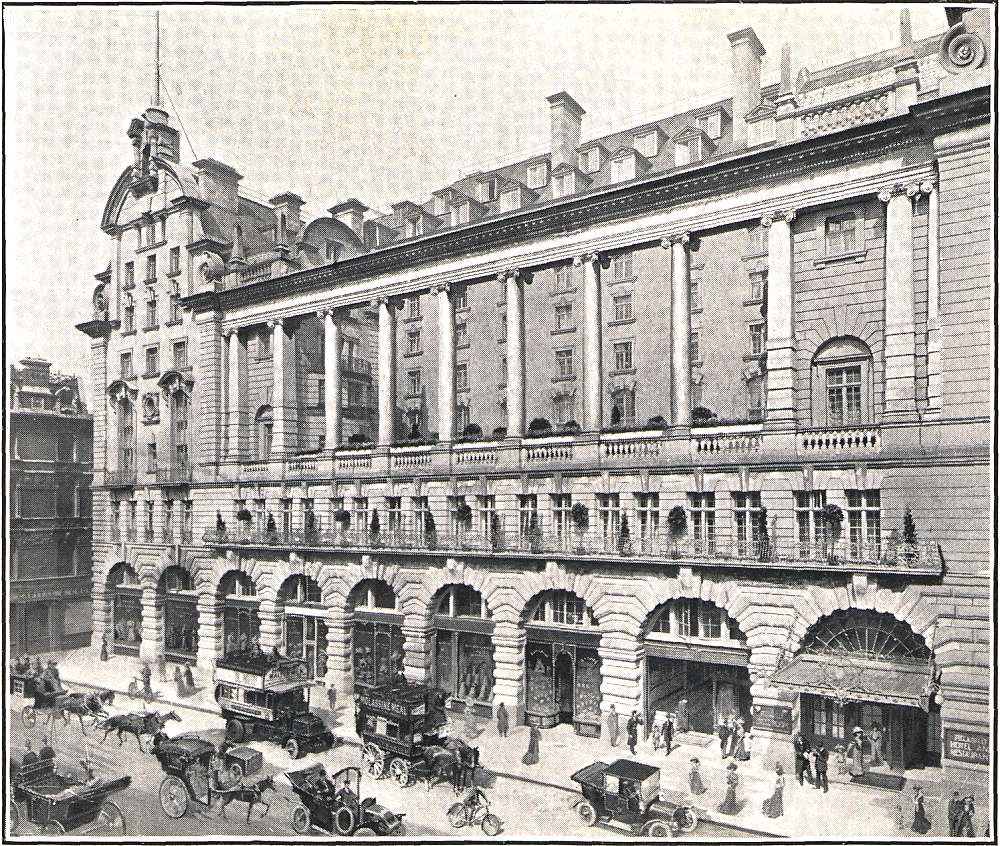
removed here from its premises opposite Berkeley Street,
now absorbed by the magnificent Ritz Hotel.
This residence, No. 95, was originally known as Barrymore
House, having been built in 1780, by Novosielski,
for the Earl of Barrymore, on a site once occupied by
the workshop of that Van Nost, who was responsible for
the statue of George I. formerly in Grosvenor Square. Lord
Barrymore was the eldest of those three brothers and one
sister, who earned for themselves the unflattering sobriquets
of Hellgate, Cripplegate, Newgate, and Billingsgate—the
second being in allusion to one of the brothers who was lame,
and the last, to the sister whose command of strong language
was “extensive and peculiar.” Gambling and general profligacy—by
the way “profligate” might have summed up
the whole family—brought Lord Barrymore to great distress,
and Raikes records in his Diary that when the peer
wished to give a dinner, he had perforce—à la Dick Steele—to
dress up the bailiffs, who were perpetually in the house,
in his own liveries and get them to wait at table!
It is hardly surprising to learn that the house was left
unfinished at the death of this unsavoury personage, and
subsequently Smirke added the porch. After a fire had
occurred here—the curious thing being that it did not happen
in Barrymore’s lifetime—the place was repaired and opened
as the “Old Pulteney Hotel,” and here it was that the
Emperor of Russia stayed, when the allied Sovereigns were
in this country in 1814.
After its day as an hotel, the Marquis of Hertford purchased
the house, and greatly improved, but practically
never occupied it. This was the third Lord Hertford, who
married that Maria Fagniani, about whose paternity
George Selwyn and Old Q. could never satisfactorily agree,
and who is so largely responsible for the magnificent
art collection which Sir Richard Wallace left to the
nation.
Next door, divided by a narrow passage, is No. 106,
which is now known as the “St. James’s Club.” Built on
the site of an old inn called “The Greyhound,” by
the sixth Earl of Coventry, “the grave young lord,” as
Walpole calls him—who, by the bye, married one of the
beautiful Gunnings, who killed herself, ’tis said, by trying
to improve the loveliness that Nature had given her. Here
he died in 1809; his successor to the title also lived here,
and, after his decease in 1831, it became the headquarters of
the “Coventry House Club” (or the “Ambassadors’”),
which was, however, closed in 1854. The house next door
is also a club—“The Savile”—one of the literary clubs of
modern London. In the old days, it was the home of the
famous Nathan Rothschild, who made a great coup over the
Battle of Waterloo, and once told Spohr that the only music
he cared for was the chink of money!
As we loiter along, the trees of the Green Park attract us,
and the gradual widening of the thoroughfare as we
approach Hyde Park Corner, an improvement made but a
few years since, gives an additional effect to the coup d’œil
that here presents itself. That curious object over there, a
sort of high shelf standing on two iron supports, has exercised
many a mind as to its uses. Perhaps not many people
are aware that the solution is to be found on a plate affixed
to the object itself, the words of which are as follows: “On
the suggestion of R. A. Slaney, Esq., who for 26 years represented
Shrewsbury in Parliament, this porters’ rest was
erected in 1861 by the Vestry of St. George, Hanover Square,
for the benefit of porters and others carrying burdens. As a
relic of a past period in London’s history it is hoped that the
people will aid in its preservation.” But we must return to
our bricks and mortar and the associations connected with
them.
DOWN
STREET.
Now we are at the corner of Down Street,
which leads directly to Mayfair; and here (in
No. 116, Piccadilly) is now the Junior Athenæum
Club, but known in earlier days as Hope House, which
H. T. Hope, the author of “Anastasius” and the creator of
“Deepdene,” at Dorking—built in 1848-9, at a cost of
£80,000.
When a stranger is brought to this point and shewn the
narrow way dividing the club from the adjoining houses,
and is told that it is Park Lane (see page 134) he probably,
being ignorant of locality, receives a shock, having in mind
the celebrity of this part of the town and the fine houses which
he has been taught to believe exist in it. But this narrow
street is technically the commencement of Park Lane, and
does much to account for the somewhat inappropriate title
by which this fashionable thoroughfare is known.
The tenuity of this connecting neck, between Piccadilly
and Park Lane proper (if I may so term it), is still more
accentuated by the huge block of flats now being erected on
the site of Gloucester House, until recently the well-known
residence of the late Duke of Cambridge. Formerly this was
the town house of that Lord Elgin who is famous as having
acquired the marvellous collection of antique marbles over
which poor Haydon was so enthusiastic, and here these
treasures of antiquity were for a time to be seen. The house
took its name from the Duke of Gloucester, who bought it in
1816, when he married his cousin the Princess Mary, one of
the many children of George III.
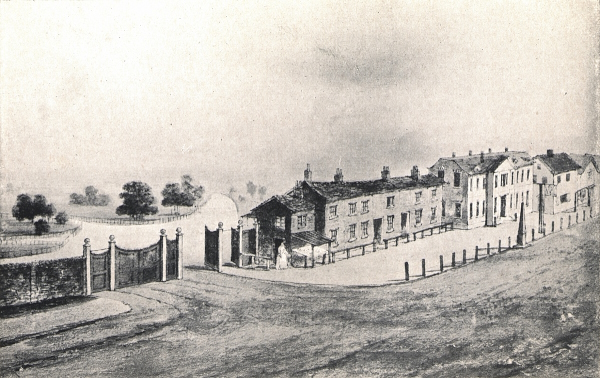
THE GATES OF HYDE PARK IN 1756.
(From a Drawing by Jones.)
When Gloucester House was still in existence the two
adjoining mansions, Nos. 138 and 139, stood out in the glory
of their stone façades, from the old brick house which
receded somewhat from the road, but now they in their turn
threaten to become dwarfed by the huge erection which
towers above them.
These two houses were originally one, and here lived that
“wicked old Q.”—the Duke of Queensberry, whose manner
of life was so notorious. Here the old profligate sat under
a sunshade in fine weather to ogle the girls who passed
by, and to send by his groom Radford, many an impertinent
message to the more attractive of them. Here this “Star of
Piccadilly” on one occasion, while engaging a running footman
(he was one of the last to keep this former appendage to
noble state), made the man put on his livery and run up and
down in front of the house, and finding him suitable, told him
so, when the rogue replied, “and your livery will suit me,”
and making a mock bow, bolted, and was seen no more!
It may be well, as we are now at the end of Piccadilly
proper (for, although the houses on the other side of
Hamilton Place, among which is that famous “No. 1,
London,” as someone once called Apsley House, where the
great Wellington lived, and put up the celebrated iron
shutters, now removed, are given in Directories as in Piccadilly,
they should more properly be considered as at Hyde
Park Corner), to end our perambulation at the house of one
who was so pre-eminently a Londoner as “Old Q.” I wish
we could have done so in better company, and inasmuch as
Lord Byron once resided at No. 139, then called, “13, Piccadilly
Terrace,” we do so, for although his lordship, apart
from his remarkable genius, was not a pattern of morality,
he compares well with the nobleman whose only redeeming
merits were that he was no fool and loved London as he
probably loved few things. When in town once in September,
a friend asked Lord Queensberry if he did not find
it empty. “Yes,” he replied, “but ’tis fuller than the
country;” and there is little doubt but that even in those
early days, no place could have been selected for anyone to
better enjoy the life of London than that spot where the tide
of humanity met, at the junction of Piccadilly and Park
Lane, with almost as full a force as we have seen it do at the
corner of Piccadilly and Old Bond Street, where Stewart’s,
hoary with antiquity (but to-day one of the most artistic
buildings in the neighbourhood), stands, and where those
keenest judges in the world—our American cousins—love to
foregather, on the spot that is perhaps better known to them
than any other in London.
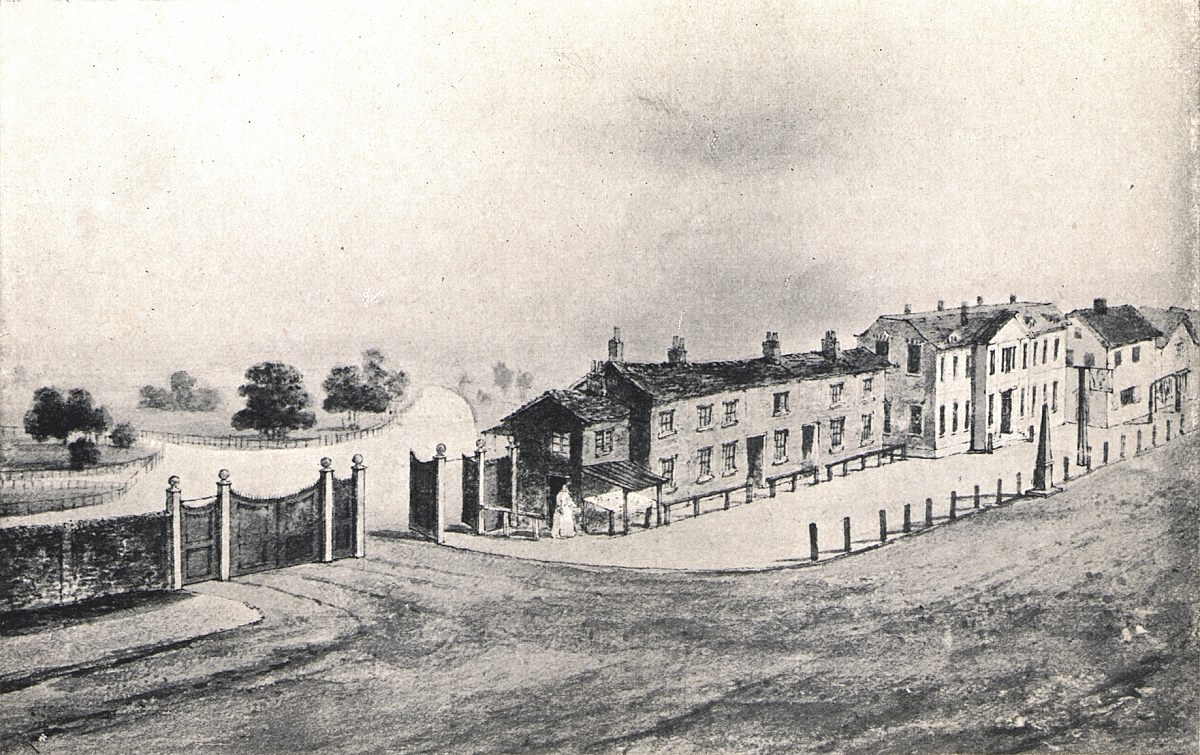
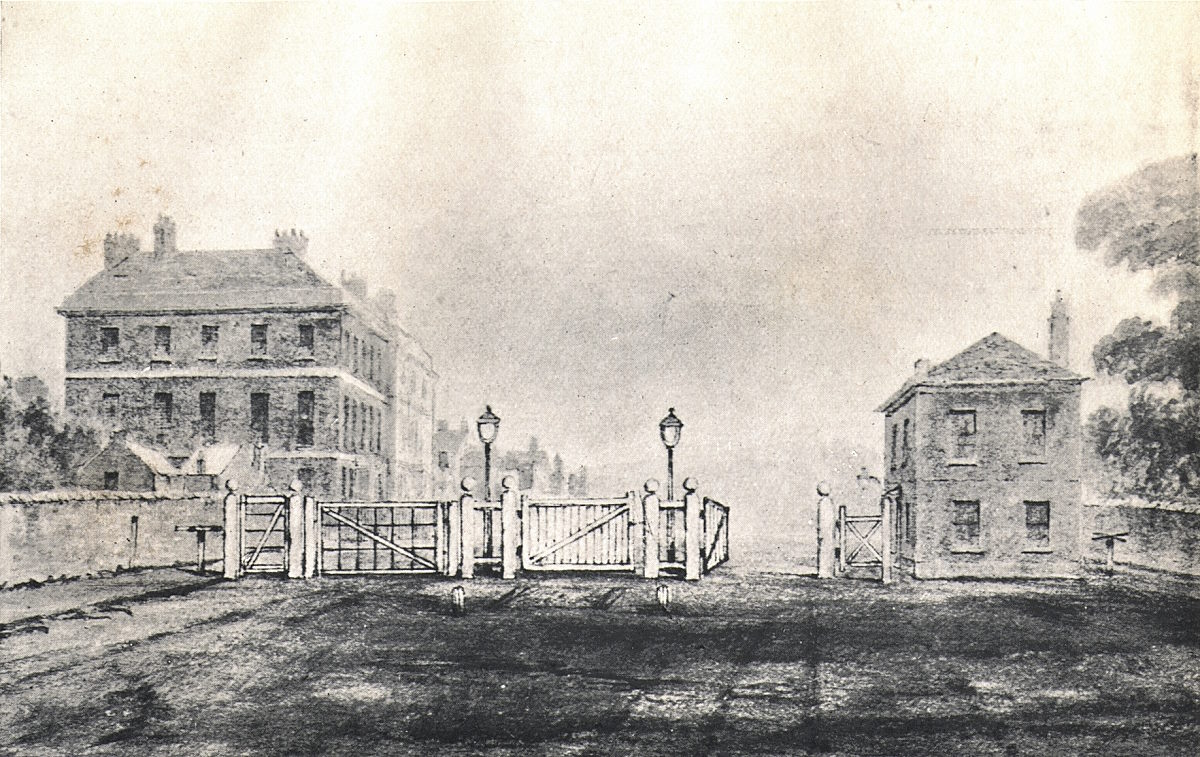
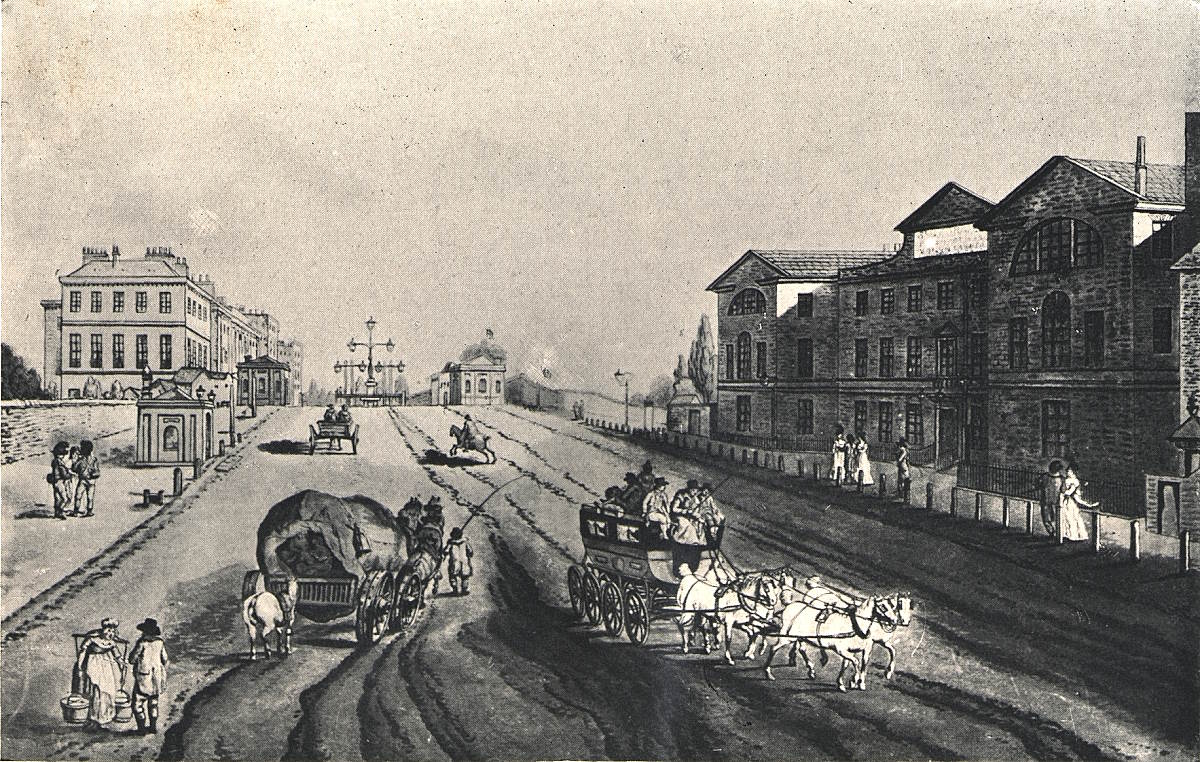
The Piccadilly Turnpike, which is such a feature in
contemporary prints of this part of the West End, was
removed in 1721 from the end of Berkeley Street to Hyde
Park Corner. It remained here till 1825, in October of
which year it was sold and removed.
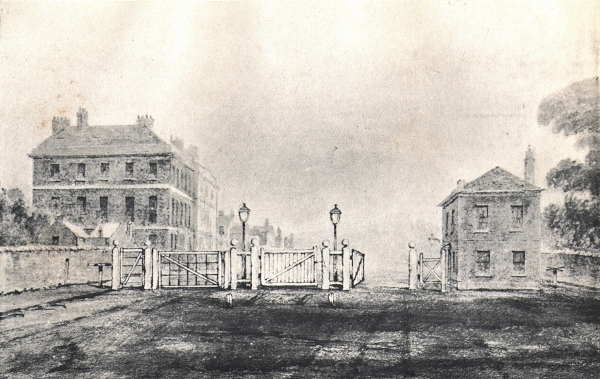
THE TURNPIKE AT HYDE PARK CORNER, 1706.
CHAPTER II.
ST. JAMES’S STREET AND PALL MALL.
“O bear me to the paths of fair Pall Mall,
Safe are thy pavements, grateful is thy smell.”
—Gay’s “Trivia.”
Can we do better, after the surfeit of bricks and mortar
which we have just undergone, than relax our jaded senses
and relieve our wearied eyes by loitering for a few moments
in the Green Park? See! it is just across the way, and a
convenient entrance helps to tempt our steps. It is not
extensive, but it is an oasis that many a Londoner—besides
Lord Beaconsfield, who loved to wander there, when he had
one of his rare opportunities—will seek with eagerness and
enjoy with a thankful heart.
THE
GREEN PARK.
When Piccadilly was “the way to Redinge,”
and before Buckingham House—the red-brick
precursor of the present Palace—had
risen on the site of Tart Hall, the site of the Green
Park was waste land, with here and there a little ditch,
and here and there a willow; and yet it has had “its scenes,
its joys and crimes,” in common with every square foot of
ground in the metropolis. We may be sure it felt the tread
of armed men in 1554, when Wyatt’s rebellion threatened to
upset the throne of “bloody Mary”; and a century later,
in 1643 to be precise, cannot we in imagination see the crowd
of men, women, and children streaming across it to give a
helping hand in the formation of those fortifications which
were to prevent a king from entering his capital? As to
its crimes, it is certain that there were plenty of those
committed when the guardianship of the peace was a very
different thing from what we pampered mortals are accustomed
to consider it. Why, the duels alone that were fought
here would make matter for a good-sized chapter. Beau
Fielding fights Sir Henry Colt, in 1696, and, they say, runs
him through the body before he has time to draw his sword,
but, nevertheless, gets disarmed himself; and “That thing
of silk, Sporus,” as I have already indicated, meets William
Pulteney here, some thirty years later, what time the Park
had become so favourite a place for such encounters that it
is specifically mentioned as “a rendezvous for duels,” in a
guide to London of the period.
Had Queen Caroline—that clever woman who managed
George II. and ruled the kingdom with Walpole—had her
way, a royal residence might now be actually in the Park.
She did build a library here, practically where Stafford House
now stands, but that is as far as she went. Her royal husband,
who, with his many faults, was a brave man, and
knew how to fight—and on foot, too, as he did at Dettingen—liked
reviews of all things, and used to have his troops
manœuvring about in the Park on all sorts of occasions.
One such review is mentioned in 1747, when “the regiment
(Sir Robert Rich’s Dragoons) made a very fine appearance,
and his Majesty was greatly pleased with them,” we are told.
The Duke of Cumberland’s Dragoons, which distinguished
themselves, or otherwise, according to the Stuart or Hanoverian
sympathies of the time, in “the ’45,” were out, for
the same picturesque reason, some days later. Then there
was that great celebration for the conclusion of the War
of Succession, when a huge temple was erected, and fireworks
blazed to the accompaniment of a military overture
written by the illustrious Handel himself.
Sir Robert Peel wanted to transform the Park into
something analogous to what we have seen occurring to the
Mall, but surely with less happy results; one of its very
charms lies in the fact that in the midst of Urbanism (to
coin a word) it remains rustic, in the very centre of conventionalism
it is unconventional. The great minister,
when advocating such an alteration, could little have supposed
that his death would be so closely connected with this
spot; but here it was that, riding down Constitution
Hill yonder, his horse threw him, on June 29th, 1850, and
three days later he was no more.
CONSTITUTION
HILL.
This Constitution Hill, about the origin of
which name no good explanation is forthcoming,
was in Strype’s day known simply
as the “Road to Kensington,” as may be seen on his
plan dated 1720.
Here it was that Charles II. was walking towards Hyde
Park when—according to Dr. King’s well-known anecdote—he
met the Duke of York in his coach, just as he was about
to cross Hyde Park Corner. The Duke, on being informed
that his Majesty was walking, immediately alighted, and
going up to the King told him he was surprised to find him
on foot and with so few attendants; intimating that Charles
was exposing himself to some danger. “No kind of danger,
James,” replied the Merry Monarch, “for I am sure no
man will kill me to make you king.” But the road has not
always been so safe for kingly heads, for here, it will be
remembered, the lunatic Oxford shot at Queen Victoria, as
she was driving, on June 10th, 1840.
The wall of Buckingham Palace grounds runs the entire
length of Constitution Hill, to which additional width is
just being given, and as we wend our steps across the Park,
at an angle, towards the little paved way that leads by
Stafford House, we can see the commencement of that great
memorial which will perpetuate in stone, as they are
enshrined in the hearts of the people, the virtuous life and
great qualities of Queen Victoria.
Stafford House lies in front of us, to the right. A wondrous
pile, it was originally built for that Duke of York
whose effigy stands on the top of the great pillar in Carlton
House Terrace. Although glorious within, externally—except
from its size—it is not imposing, and its plainness
gives point to the remark of some wit of the period that
it looked like a packing-case out of which Bridgewater
House, the graceful building on our left, had been taken.
When Fielding, as we have seen, fought with Colt, he did
so in sight of the windows of Cleveland House, which
originally stood close by, the ground having been given
by Charles II. to that Duchess of Cleveland who caused
him so much trouble, and who had a partiality for the Beau
who fought beneath her windows.
CLEVELAND
ROW.
Cleveland Row takes its name from old
Cleveland House, and forms the south side
of that most curious of “quadrates,”
Cleveland Square.
Theodore Hook once lived in the Row, at No. 5; so did
Lord Rodney and Sir Sidney Smith; Thomas Grenville,
of bibliophilic fame; and Lord Stowell, the great lawyer,
and brother of Lord Eldon. George Selwyn died at what
was then called, 1, Cleveland Court, in 1791; and Mason,
the poet, was residing here at a “Mr. Mennis’s” four and
twenty years earlier. Walpole and Townshend had their
memorable quarrel, parodied by Grey in his “Beggar’s
Opera,” in a room in one of the houses; while Lord Bute,
in 1761, moved a portion of the Foreign Office hither from
its former locale in the Cockpit at Westminster.
ST. JAMES’S
PLACE.
The houses that adjoin Bridgewater House
to the north are those of which the entrances
are in St. James’s Place and Arlington
Street. The most architecturally noticeable is the first
we see, Spencer House, in the making of which, the
talent of John Vardy, James Stuart, and M. H. Spong
was combined. A little further on is the house in which the
poet Rogers lived and gave those breakfasts and dinners
which have become historic. The contents were so carefully
selected and so rich, as treasures of art or literature, that
Byron used to say there was not a single object
which did “not bespeak an almost fastidious elegance
in the possessor;” and Moore, and Macaulay, and Burney,
and a hundred others who were guests here, have left confirmatory
praise. Here it was that Byron, invited to meet
Moore and Campbell (what a constellation!) would eat
nothing but potatoes mashed up in vinegar, and then, ’tis
said, went off later to a club in St. James’s Street and made a
hearty supper off beefsteaks! Here Chantry, the great
sculptor, told his host that it was he who, in the days of his
probation as a working carpenter, had made a certain piece
of furniture in the dining room; but there would be no
end to the recollections clustering about this house if I
did not place a curb on my pen. Other poets have lived
in St. James’s Place—Addison and Parnell, besides many
another well-known personality; Molly Lepel, and Sir John
Cope; Secretary Craggs, and Charles James Fox; “Perdita”
Robinson, and Sir Francis Burdett; Wilkes, the noisy
demagogue, and Warren Hastings, the great pro-consul.
ARLINGTON
STREET.
Arlington Street is hardly less interesting.
There is the home of the Cecils, where
one great Prime Minister, Lord Salisbury,
could once look across the street at the windows of
the house that had sheltered another—Sir Robert Walpole.
As the son of the latter once wrote to Montagu:
“Nothing can be more dignified than this position.” In the
past, as in the present, its houses have been the homes of the
illustrious. The street was formed in 1689, and was the
property of that Arlington who was one of the “A’s” of the
famous (or, shall we say, infamous?) “Cabal.” The
Duchess of Cleveland withdrew hither, after the death of
Charles had made Cleveland House too costly an abode;
the Duchess of Buckingham, wife of that Duke, castigated
in Dryden’s best-known lines, and daughter of Fairfax,
Cromwell’s henchman; Lady Mary Wortley Montagu,
who resided here with her father, the Duke of Kingston;
Pulteney, Earl of Bath—as if he could never get away from
his enemy, Sir Robert; and Henry Pelham, who lived at
No. 17, in the house built by Kent and now Lord Yarborough’s.
At No. 21 Lord Sefton gave his famous dinners
with Ude as chef in command; and Lord Wimborne’s house,
which is already dwarfed by the neighbouring “Ritz,” once
belonged to Lord Camden, then to the Duke of Beaufort,
and was subsequently sold to the Duke of Hamilton for
£60,000; while John Lothrop Motley was renting Lord
Yarborough’s house, from 1869-70, during his term of office
as United States Minister.
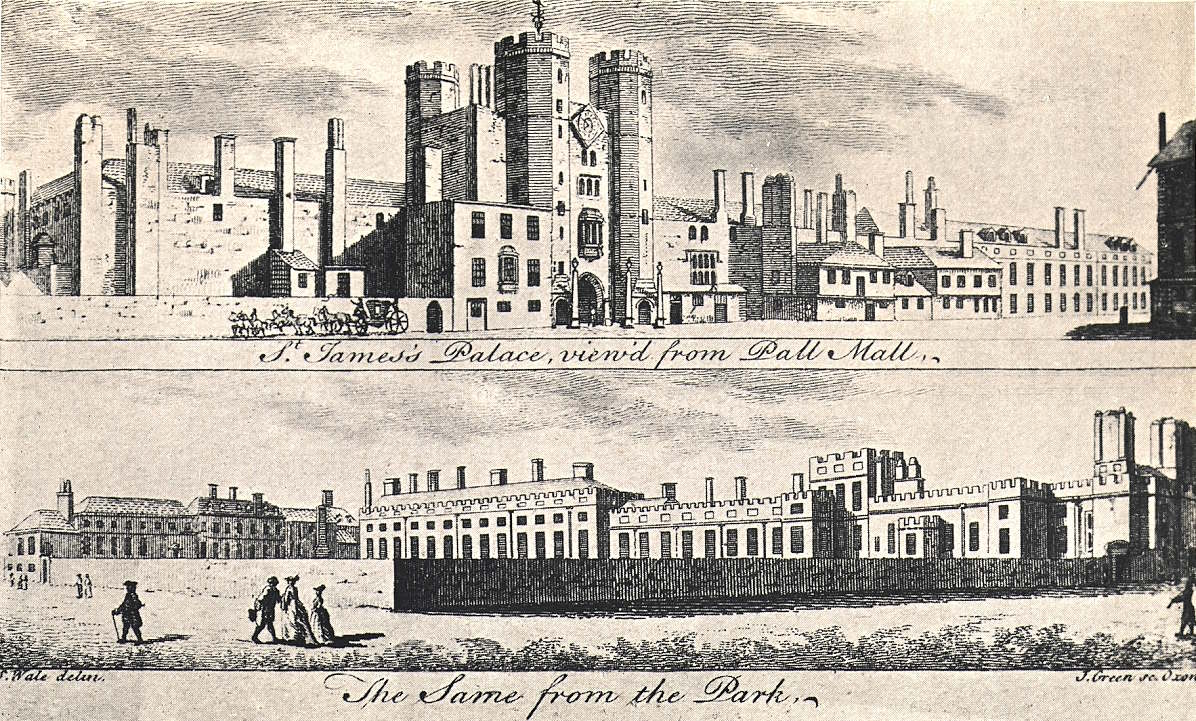
If we turn back into St. James’s Street and look down that
famous thoroughfare two things cannot fail to strike us—one,
the effective screen at the bottom formed by the picturesque
clock-tower of the Palace which dates from Henry
VIII.’s time; the other, the marked declivity in the ground,
which is only comparable with Ludgate Hill, in the East,
and is considerably steeper than any part of Piccadilly or
Knightsbridge, in the West.
ST. JAMES’S
STREET.
St. James’s Street is a street of memories, if
ever there was one in London; to mention all
the interesting people who have lodged in it
would make a very fair chapter; to record even the bare
outlines of the history of its clubs and coffee-houses would
form another. Appropriately is it named “St. James’s
Street,” for it is pre-eminently the thoroughfare of this aristocratic
quarter. Here may still be seen one or two old shops
that recall Georgian days, although the street is undergoing
such a metamorphosis of rebuilding that one never knows but
that some fine morning their familiar fronts may have disappeared;
here survive some of the most exclusive and best
known of the Clubs which are the particular characteristic
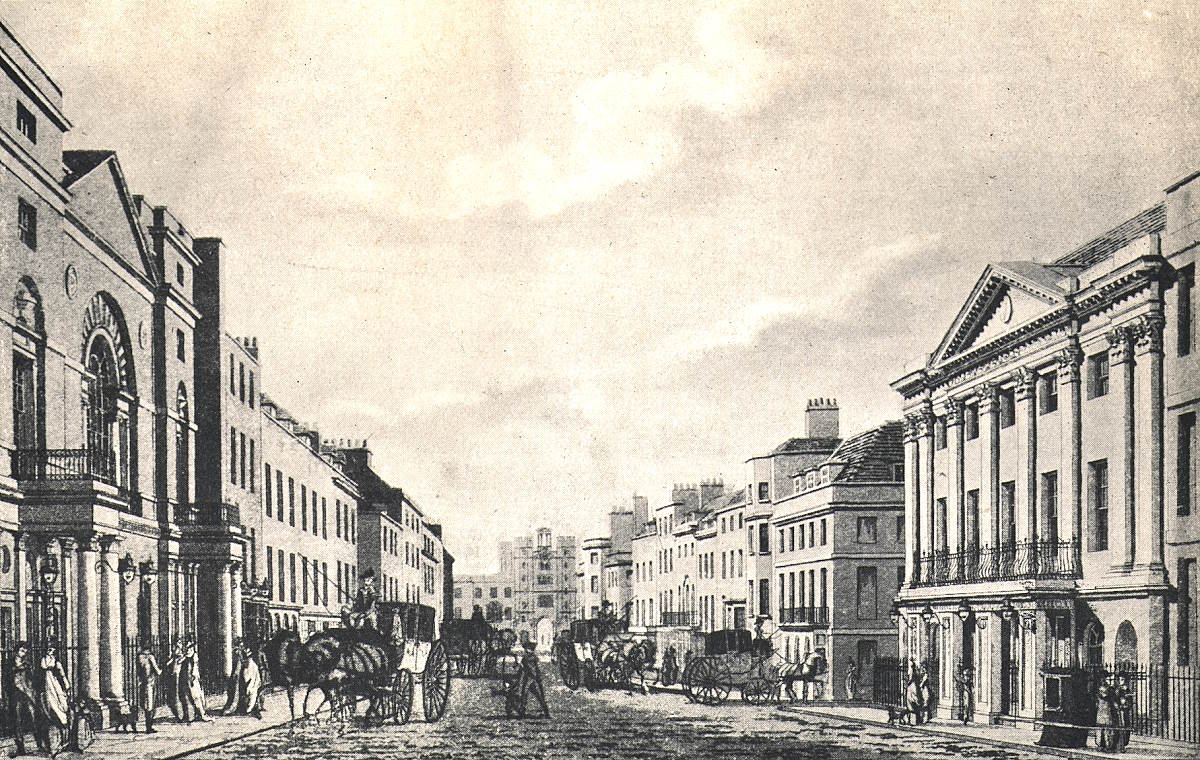
of this quarter; and the unchanged front of the Palace at
the lower end is such a dominating note in the picture, that,
looking down the street, when one of those mists so beloved
of Whistler give atmospheric mystery to the thoroughfare,
we may almost expect to see Charles II. sauntering through
its portals with Rochester or Sedley; or George II. driving
through its gates on his way to Kensington Palace or
Richmond Park.
The history of
“The dear old street of clubs and cribs,
As north and south it stretches,”
is one which, if its record were fully written, would be
found to have no little connection with the annals of the
country. Its position, its proximity to the Palace, its past
inhabitants, its famous club houses (where so much of the
history of the country was, and is, evolved,) all make for its
claim in this respect.
WHITE’S
CLUB.
On our left is the famous bow window
of “White’s,” where the dandies used to
assemble to quiz the ladies on their way to
the drawing-rooms. What a history has that club! It
has been written, and fills two large volumes, and the
“betting book” is a sight for gods and men—if not for
young men and maidens. In the old days they used to bet
on anything and everything, and there is the story of the man
who fell down in a fit, outside the club windows, and wagers
being immediately laid as to whether he was dead or not,
certain interested members solemnly objected to means
being taken to revive the unhappy individual—as it would
have affected the validity of the bets laid!
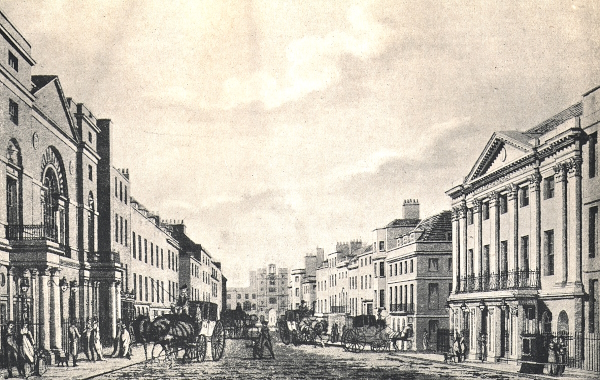
White’s Club. JAMES’S STREET IN THE REIGN OF GEORGE III Brooks’s Club.
It was by giving his arm to one then unknown to fame,
from the bottom of the street to the door of White’s, that
Brummell considered he had rendered a very important
service to a young man, and as it were, given him a splendid
set-off in life!
The origin of the club, for which, it will be remembered,
Horace Walpole once designed a coat of arms, was White’s
Chocolate House, which was established in 1698, just ten years
after Stewart’s Bakery, as we have seen, opened its doors at
the corner of Bond Street. White’s was then on the west side
of St. James’s Street, five doors from the bottom, and occupied
the one-time residence of that Countess of Northumberland,
who was such a “grande dame,” that her grand-daughter-in-law,
the Duchess of Somerset, is reported to have
never sat down in her presence without previously asking
her leave. It soon became a hot-bed of aristocratic gamesters.
Robert Harley never passed by without cursing it,
as the bane of half the nobility; Whitehead, in one of his
poems, does not hesitate to call it a den of thieves; and
although Chesterfield once wrote to his son that “a member
of a gaming club should be a cheat or he will soon be a
beggar,” that teacher of manners and morals practically
lived at White’s, not putting in practice, it is to be hoped,
what he taught by precept.
The Club was burnt down in 1733; but, phœnix-like,
sprang up again soon after, at Gaunt’s Coffee House, which
was next door to the St. James’s Coffee House near the south-west
corner of the street. Arthur, Mackreth, Martindale,
and Raggett, all names familiar to students of the social life
of the eighteenth century, were the successive proprietors of
White’s, after 1736, when the Chocolate House was formed
into a regular club. Nineteen years after that date it was
removed to the premises it now occupies and its present
outward appearance is due to alterations made nearly a
century later.
BOODLE’S
CLUB.
Boodle’s, another famous club, is almost
opposite, at No. 28, and was known formerly,
from its gastronomic reputation, as the
“Savoir Vivre.” The Club House was designed by
Adam for John Crunden, in 1765, and additions were
made to it in 1821. It was largely frequented by country
gentlemen, who knew probably how hard it was “to rival
Boodle’s dinners,” and it used to be said, in consequence,
that if a waiter came into the reading-room and called out,
“Sir John, your servant has come,” every other head was
mechanically turned in answer to the summons! Both
Gibbon and Wilberforce were members, as was that Sir Frank
Standish, caricatured by Gillray as “A Standing Dish at
Boodle’s.” Gillray, by the bye, lived next door, at No. 29,
where, in 1815, he committed suicide by throwing himself
from an upper window.
CROCKFORD’S
CLUB.
Opposite “White’s” is the Devonshire
Club, which occupies the site of the famous
Crockford’s, probably the most notorious
gaming house of its day. It took its name from
one Crockford, who had been a fish salesman in the
City, but, coming to the West, made an immense fortune
here. The house was built for him, in 1827, from the designs
of the Wyatts. The internal decorations were so lavish that
the ubiquitous Creevey describes the place as “magnificent,
and perfect in taste and beauty,” and adds that “it is said
by those who know the Palace of Versailles, to be even more
magnificent than that,” which certainly sounds like
thundering hyperbole! The great “Ude” catered for the
palates of Crockford’s habitués, and there is a story told of
the illustrious chef, during his connection with the club, to
the following effect:—Colonel Damer happening to enter
Crockford’s one evening to dine early, found Ude in a
towering rage, and asking the cause, was thus answered by
the infuriated cordon bleu:—“Monsieur le Colonel, did you
see that man who has just gone out? Well, he ordered a red
mullet for his dinner. I made him a delicious little sauce
with my own hands. The price of the mullet marked on the
carte was 2s.; I asked 6d. for the sauce. He refuses to pay
the 6d. The imbecile apparently believes that the red
mullets come out of the sea with my sauce in their pockets!”
Of such are the woes of genius! It was Ude, too, who, on
hearing of the last illness of his former patron the Duke of
York, exclaimed, “Ah! Mon pauvre Duc, how much you shall
miss me where you are gone!”
Wellington was a member of Crockford’s, though he never
played deeply; so was Theodore Hook, who, because his
doctor had once warned him against exposing himself to the
night air, had the following method of abiding by the medico’s
instructions:—“I therefore,” he said, “come up every day
to Crockford’s, or some other place to dinner, and I make
it a rule on no account to go home again till about four or
five o’clock in the morning!”
BROOKS’S
CLUB.
Another famous Club in St. James’s Street,
was Brooks’s, which was nearly opposite
the original White’s. Like so many of these clubs it took
its name from a former proprietor, although it was at first
merely a gaming club, formed by Almack.
Brooks, whom Tickell immortalises (if he could immortalise
anything) as
“Liberal Brooks, whose speculative skill,
Is hasty credit, and a distant bill,”
removed the club from its quarters in Pall Mall to its present
position, and opened it in 1778, but, unlike Crockford, he does
not appear to have made a fortune out of the concern.
The members included such great ones as Reynolds and
Burke and Garrick, Hume and Gibbon, Horace Walpole,
Sheridan, and Wilberforce. The latter has recorded his first
appearance here, thus: “Hardly knowing anyone, I joined,
from mere shyness, in play at the faro table, where George
Selwyn kept bank. A friend, who knew my inexperience and
regarded me as a victim decked out for sacrifice, called to me,
‘What, Wilberforce, is that you?’ Selwyn quite resented
the interference, and, turning to him, said, in his most
expressive tone, ‘Oh, sir, don’t interrupt Mr. Wilberforce;
he could not be better employed.’”
Apropos of Gibbons’ membership of Brooks’s, a curious
memento should still be among the treasures of some lucky
bibliophile, for, when Fox’s effects were sold, at his death,
in 1806, there was included among them the first volume of
Gibbon’s “Decline and Fall of the Roman Empire,” presented
by the writer to the great statesman who had written
the following words on one of the blank leaves:—
“The author, at Brooks’s, said there was no salvation for
this country until six heads of the principal persons in
administration were laid upon the table. Eleven days after,
this same gentleman accepted a place of lord of trade under
those very Ministers, and has acted with them ever since!”
There are no end to the anecdotes connected with
Brooks’s, and the famous or notorious people with whom
they are connected. Here is Roger Wilbraham, what time
honours were in the air, asking Sir Philip Francis, an absorbed
player, what he thought they would give him; and
the irate gamester, suddenly turning round and roaring out,
“A halter, and be d——d to you!”; here, it is said, the
Prince of Wales was a party to the hoax by which Sheridan
got elected in the very teeth of the redoubtable Selwyn;
here, at a later date, the brewer, Alderman Combe, losing
heavily to Brummell who patronisingly said he would
never in future drink any porter but his opponent’s, retorted
with “I wish every other blackguard would tell me the
same;” and here is the Duke of Devonshire partaking of
that broiled bladebone of mutton for which he had such a
passion, and which was regularly prepared for him at the
club!
OTHER
ST. JAMES’S
STREET
CLUBS.
Many other clubs which to-day are to be
found in this street, are descendants of
earlier institutions, while some have taken the
place of older ones; among the latter may be
named the Devonshire, and the New University, with
its noticeable buildings which Waterhouse designed:
the former are distinguished by their names alone; the “Cocoa
Tree,” the “Thatched House,” and “Arthur’s.” Built in
1825, on the site of the original Chocolate House, “Arthur’s”
took its name from that Arthur whose son-in-law, Mackreth,
eventually succeeded to its ownership.
It will be remembered that it was on the occasion of
one of the waiters here being convicted on a charge of
robbery, that Selwyn remarked: “What a horrid idea he will
give of us to the people in Newgate.” The Thatched
House Club, which grew out of the “Thatched House,”
where the Dilettanti Society and innumerable other
fraternities were wont to foregather, does not stand on the
site of the original clubhouse, which was till recently
occupied by the Civil Service Club at the corner of
King Street; but the name was formerly preserved in
“Thatched House Court,” which has long since passed
away.
ST. JAMES’S
STREET
CHOCOLATE
HOUSES.
Just as the St. James’s Chocolate House was
the resort of the Whigs in the Augustan age
so the Tory headquarters were at the “Cocoa
Tree,” which was metamorphosed into a club
some time in George II.’s reign, and was then noted
for high play. There is extant the story of one O’Birne,
an Irish gamester, who had won a round £100,000 at the
Cocoa Tree from a young man named Harvey. “You can
never pay me,” said the Irishman. “I can,” replied Harvey,
“my estate will sell for the debt.” “No,” said O’Birne,
“I will win ten thousand—you shall throw for the odd
ninety,” which, being done, Harvey, who would seem to have
hardly deserved his luck, won! Gibbon, and later Byron,
belonged to this club, and this reminds me that it was while
lodging in St. James’s Street that the latter awoke one
morning and found himself famous. An extraordinary
medallion portrait under glass commemorates the house
(No. 8) in which the author of “Childe Harold” lodged,
and it was from here that he set forth to deliver his maiden,
and only speech in the House of Lords.
Among other interesting residents of St. James’s Street
was Charles James Fox; and here Walpole saw his furniture
being carried off to satisfy his horde of creditors. To hark
back, we find Waller in a house on the west side, and Lord
Brouncker, the first President of the Royal Society, living
here; Pope at “my lodgings at Mr. Digby’s, next door to
ye Golden Bell, on ye second Terras in St. James’s Street;”
Wolfe, who wrote from here in 1758 to Pitt, desiring employment
in America; and Gibbon, who died 26 years later,
at No. 76, now part of the Conservative Club.
It was in this street that Dr. Johnson once did some shopping
with Boswell; calling at Wirgman’s toy-shop (at
No. 69, where Arthur’s is now) “to choose a pair of silver
buckles, as those he had were too small.”
KING
STREET.
King Street, through which we can see
the trees of St. James’s Square, must
not delay us, or we shall never get along,
but we may remember that from 1673, when it was
formed, to 1830, it was not a street proper at all, but merely
one of those exiguous courts, of which Crown Court, in Pall
Mall, is a survivor. There is one private house of interest
in King Street, for at No. 1c, as a memorial tablet commemorates,
Napoleon III., while yet only Prince Louis
Napoleon, resided for two years, 1838-40, after he had been
expelled from Switzerland. While living here he was
enrolled as a special constable during the Chartist riots;
and while here he also took part in that famous Eglinton
Tournament which required nothing to make it successful
but fine weather. It was from King Street that the future
Emperor started on his unsuccessful descent on Boulogne,
when it is said that he procured a tame eagle from Covent
Garden as a sort of political property, which was to be
released on his stepping on to French soil—a piece of
theatrical legerdemain that cost him the adherence of at
least one follower. I may remind the stranger that the
famous Willis’s Rooms, formerly Almack’s, that “Matrimonial
Bazaar,” as Lord William Pitt Lennox calls it, the
laws of which were as those of the Medes and Persians, as the
great Duke of Wellington once had reason to remember when
he was turned away from its doors, are still in King Street,
but turned to other uses, and that just opposite stands the
equally famous “Christie’s,” where old and new masters
are continually changing hands.
As we turn into Pall Mall, the picturesque buildings of St.
James’s Palace tempt us to loiter; but that is a subject
which once entered upon in this little book would lead me
into an endless maze of historical and topographical data,
and we must unwillingly pass by.
PALL MALL.
Here we are in the very heart of Clubland;
indeed, so long ago as 1849, when J. T. Smith
wrote his fascinating book on the Streets of London,
he speaks of this noble street as bidding fair to contain
in a short time nothing but club-palaces, as he very
properly terms them; and to-day (as Thackeray wrote):
“Extending down the street palace after palace rises
magnificent, and under their lofty roofs warriors and
lawyers, merchants and nobles, scholars and seamen, the
wealthy, the poor, the busy, the idle assemble.”
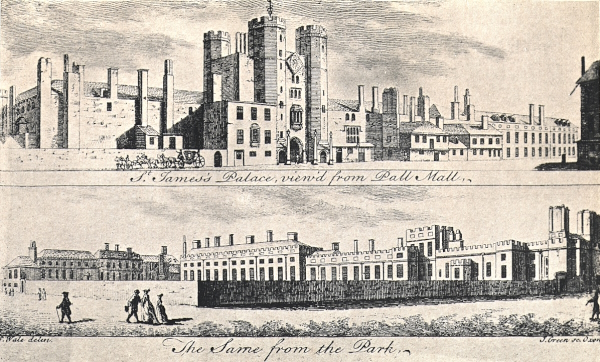
Sᵗ. James’s Palace, view’d from Pall Mall.
The Same from the Park.
THE CARLTON
AND REFORM
CLUBS.
Here are the two great political headquarters—the
Carlton, founded by the Duke
of Wellington and some of his supporters, and
built, so far as its premises here are concerned (for it was
originally housed in Charles Street close by), in 1836, from the
designs of Smirke; and the Reform, which, as its name
implies, was started to help the cause of the great Reform
Bill, in 1830. The present beautiful buildings of the
latter club were the work of Barry, and carry us in
imagination to that Farnese Palace at Rome from which
some features in its construction were borrowed. The
kitchens, as important adjuncts to a club as they are to
a college, were designed by the great Alexis Soyer.
Among the great successes of this admirable genius (who,
by the bye, had been, in turn, chef to Prince George of
Cambridge, Lord Ailsa, and Lord Panmure), was the great
banquet held on the occasion of Queen Victoria’s Coronation,
and the dinner given to Lord Palmerston, in 1850.
In the latter case a gastronomic triumph was particularly
appropriate, for “Pam” liked a good dinner as much as
any man, and, indeed, an opponent once had to confess that
“Lord Palmerston is redeemed from the last extremity of
political degradation by his cook!”
THE JUNIOR
CARLTON
CLUB.
Another great club in Pall Mall, the Junior
Carlton, is an off-shoot of the Carlton.
Formed in 1864, and originally located at
No. 14, Regent Street, the club moved to its present
quarters in 1867, when several small houses in St. James’s
Square and Pall Mall having been pulled down, it arose
on their site under the architectural wand of Brandon.
Some 20 years later, Adair House was demolished and the
club enlarged. Opposite the Junior Carlton, on the same
side of Pall Mall (the tiny George Street intervening), is the
Army and Navy Club, which has its chief front in the Square.
The building was erected by Parnell and Smith, in 1848-51,
and is modelled on the Palazzo Cornaro at Venice.
OTHER
PALL MALL
CLUBS.
Across the way, and next to the Reform,
is the unpretentious front of the Travellers’
Club, the idea of which originated with
Lord Castlereagh about the year 1814. Barry built
the present house in 1832. In view of its name, it is
interesting to know that one of its rules ordains that no one
is eligible as a member “who shall not have travelled out of
the British Islands to a distance of at least 500 miles from
London in a direct line.” When that rule was formed
travelling was a very different business from what it is to-day,
for now one can hardly overcome the results of a London
season without going this distance, and many people find it
necessary to go twice as far to keep their minds occupied and
their livers in order.
Talleyrand was an habitué of the Travellers’, and it was
here that he made his well-known reply to someone who
wondered how a certain great lady could, at her age, have
married, as she had done, a valet de chambre: “It was late
in the game” replied Talleyrand, who was playing whist at
the time. “At nine we don’t reckon honours.”
The Athenæum, at the corner of Waterloo Place, built in
1829, is a very learned club, and appropriately has the
finest club library in London. Its premises, which are
thoroughly classic, were designed by Decimus Burton. It
had been instituted five years previously by, among others,
Sir Thomas Lawrence, Wilson Croker, Sir Humphrey Davy,
and that Jekyll, whom George IV., when Prince of Wales,
insisted on Eldon’s making a Master in Chancery. I will
not again inflict the well-known anecdote on long-suffering
readers; but I may remind them that on one occasion the
hospitality of the Junior Army and Navy, on the other side
of Waterloo Place, was, during some cleaning process,
extended to the members of the Athenæum, many of whom
graced the church, and that soon after, the umbrella of one
of the service members mysteriously disappeared; whereupon
the irate soldier exclaimed, “Exactly, I knew what it
would be when we agreed to allow those d——d bishops to
come to our shop!”
Talking of shops reminds me that Hoby’s, the celebrated
bootmaker’s, was, till quite recently, opposite, at the corner
of John Street—the shortest thoroughfare, by the bye, in
London. The original Hoby was a great character, and said
what he liked to his customers, who were legion, and frequently
illustrious. He made the Duke of Wellington’s
boots, and always attributed the successes of that great leader
to this fact, and also, parenthetically, to the prayers which
he used to offer up on his behalf!
Two examples of Hoby’s way of talking to his clientèle are
extant; one, when Ensign Churchill complained of some boots
made to his order, and Hoby, putting on a mock serious
face, turned to an assistant and told him to put up the
shutters, as if the Ensign’s custom was withdrawn, there
was an end of the business; the other, when a nobleman
complained of his riding boots being uncomfortable when he
walked, whereupon Hoby told him that he had made the
boots for riding not for walking.
As we are wandering about Pall Mall in a somewhat
desultory manner, I make no excuse for turning back from
the Athenæum to the large building near by, which up to
quite recently, formed an inadequate home for the War
Office. That part of it which has a small courtyard in front,
in which stood the graceful statue of Sidney Herbert, was
rebuilt for the use of the Secretary of State for War; but the
most interesting portion is that known as Schomberg House,
which was erected in 1650, at the time when Pall Mall was
planted with elm trees. It took its name from that Duke of
Schomberg who was killed at the Battle of the Boyne, and
was much improved by the third and last Duke; but its
chief claim to notice lies in the fact that Gainsborough (as
Cosway had done before him) lived the last years of his life
here, and expired in the second floor room (which is now
indicated by a tablet), in 1788, with the well-known exclamation
on his lips: “We are all going to heaven, and Vandyck
is of the company.”
The house next door (to the west), now the Eagle Insurance
Office, is interesting from the fact that it stands on the one-time
residence of Nell Gwyn, the gardens of which stretched
to the Mall, and here took place that “familiar discourse
between the King and Mrs. Nellie, as they call an impudent
comedian, she looking out of her garden on a terrace, at the
top of the wall, and the King standing on the green walk
under it,” which Evelyn has thus recorded, and E. M. Ward,
R.A., perpetuated on canvas. This site is the only freehold
in Pall Mall, and the story goes that on Charles giving
“Mrs. Nellie” a lease of the place, she took the parchment
and threw it in his face, intimating at the same time
that nothing short of “freehold tenure” was good enough
for her.
The two adjoining houses have been, not long since, converted
into one, and now form the London residence of
T.R.H. the Prince and Princess Christian.
When the great “Sarah of Marlborough” was amazed by,
as she called them, her neighbour George’s “orange chests,”
she was in residence at the large red brick house, faced with
stone, which a grateful nation had presented to her husband
(although the Duchess always said it cost him £40,000 to
£50,000 out of his own pocket), and which had been erected
in 1709, on part of the pheasantry of St. James’s Park,
which had been leased by Queen Anne to her old favourite.
Here the great Duke, “with the tears of dotage” flowing
from his eyes, expired in 1722, and one of the great sights of
Pall Mall must have been that almost regal funeral which the
Duchess arranged herself, and in which figured that funeral-car
which she refused at a later date to lend to the Duchess
of Buckingham, because, as she said, no one was worthy to
be carried on what had borne the illustrious victor of Blenheim!
Some fifty years after her husband’s death, the indomitable
old “Sarah,” at the age of 84, was told that she
must be blistered or she would die, to which she replied
in angry tones, “I won’t be blistered and I won’t die.”
She died in the year 1774.
Marlborough House was subsequently purchased (in 1817)
by the Crown, as a residence for the Princess Charlotte and
Prince Leopold; and here, after the death of the Princess,
the widower lived for some years; so did Queen Adelaide
after the decease of William IV., and in 1850, the house was
settled on the Prince of Wales (now His Majesty the King);
but before he occupied it, its lower apartments had been used
for various art exhibitions. The entrance is anything but
imposing, and is rendered still more insignificant by the high
buildings of the Junior Oxford and Cambridge Club next
door, adjoining which are the Guards’ Club and the imposing
front of the Oxford and Cambridge itself, the latter of which
was built by Smirke in 1836.
On the north side of Pall Mall we get a glimpse of an
almost Georgian perspective if we look up the narrow Crown
Court, and can for the moment forget its new front and the
adjoining elaborate buildings which have been recently
erected facing Marlborough House. This Court is one of the
few survivors of many, and is shewn on old plans, which, on
the other hand, do not give Pall Mall Place (of later construction),
a little further east, which passes under one of the
windows of No. 51, once the famous headquarters of
Dodsley, the publisher. This house then rejoiced in that
sign of “Tully’s Head,” appearing on the titles of so many
of the best-known works of the eighteenth century which
the great Dodsley ushered into the world.
PALL MALL
TAVERNS.
Pall Mall has been in the past—for you
shall seek long enough for them now—noted
for its taverns. There was, for instance,
the “Queen’s Arms,” where the sanguinary duel
between the Duke of Hamilton and Lord Mohun was
planned; and the “Star and Garter” (the descendant of
which has but recently disappeared), where Lord Byron
killed Mr. Chaworth in 1765, and where the first Cricket
Club is said to have been founded in 1774, by Sir Horace
Mann (a Kent cricketer and Walpole’s correspondent), the
Duke of Dorset, and Lord Tankerville, of the Surrey and
Hants eleven, and others.
Then there was “Wood’s at the Pell Mell” mentioned by
Pepys, where, in 1662, Mr. Jermyn and Captain Howard
fought a duel; and the “Sugar Loaf,” the “Golden Pestle
and Mortar,” the “Golden Door,” and the “Barber’s Pole”—to
mention but these—were signs that might previously
have been seen here. The Coffee Houses numbered among
them the well-known “Smyrna” of early Georgian days,
and the “King’s Arms,” where the “Liberty” or “Rumpsteak
Club” met and concerted measures against Sir Robert
Walpole.
It was in Pall Mall, near the bottom of the Haymarket,
that Thynne was murdered at the instigation of Konigsmarck—a
brutal deed which may still be seen commemorated
on the tomb of the victim in Westminster Abbey; here, too,
the mail from France was robbed at half-past eight on
January 7th, 1786, almost in the very faces of the Palace
Guard, as Walpole relates with natural astonishment; and
here the Gordon Rioters were with difficulty prevented from
destroying that Schomberg House we have but recently
been gazing at.
If great people have left their mark on the street, some
curious individualities have also been connected with it.
Think of four women racing down Pall Mall for a prize, to
wit, “a holland smock, a cap, checked stockings, and laced
shoes!” Yet this is what was witnessed here in the year of
grace 1733. This appears to have been permitted by the long-suffering
authorities, but when one of the residents offered
“a laced hat” to be run for by five men, so great a disturbance
was created that the magistrates intervened.
During the earlier years of Charles II.’s reign, when
Catherine of Braganza came over to share his throne, if
nothing else, streets were named with some profusion after
that ill-treated lady; thus, as Piccadilly was then converted
into Portugal Street, so, for a time at least, Pall Mall
was known as Catherine Street. Its former, and present
better-known denomination is derived, as all the world is
aware, from the game of Pall Mall or Paille-Maille—from
Palla, a ball, and maglia, a mallet—a game somewhat
analogous to our croquet, which was once played in the
“Mall” close by.
CARLTON
HOUSE.
Although its name is redolent of Carolean
times, it is probable that few streets have
been so altered in outward appearance as
Pall Mall. The chief cause of this is undoubtedly
the favour it has found in the eyes of club promoters,
for it is the palatial buildings of these institutions
that have chiefly robbed the street of its old-world appearance.
But at its eastern extremity, the greatest alteration
is due to the demolition of Carlton House, which practically
occupied the centre of Waterloo Place at its southern end,
and extended east and west with its grounds, entrance court,
and screen, where Carlton House Terrace and the Duke of
York’s monument now exist.
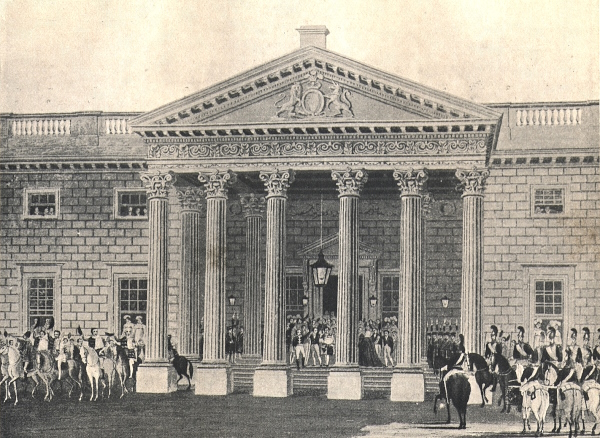
CARLTON HOUSE.
George IV. proclaimed King.
The history of Carlton House has not been written. It is
probably just as well that no one has attempted to record
the annals of that mansion, for what we know of it from the
innumerable memoirs and diaries of the period covering
the better part of George III.’s reign and the Regency,
is not particularly edifying.
Carlton House was built in 1709, by Lord Carlton,
or Carleton, as it was then spelt, on whose death, in 1725, the
house came into the possession of his nephew, the
Earl of Burlington. Kent laid out the gardens, which
extended from Spring Gardens to Marlborough House, at the
back of the entire length of Pall Mall, east and west. Lord
Burlington presented the house to his mother, who sold it,
in 1732, to Lord Chesterfield, purchasing on behalf of
Frederick, Prince of Wales. After that Prince’s death, his
widow resided here till her demise in 1772. Eleven years
later, George, Prince of Wales, came into possession, and
under his auspices, with the help of Holland, the architect,
the place was practically rebuilt, the brickwork being covered
with stone, a Corinthian portico added, and that celebrated
screen erected, of which Prince Hoare once wrote:
“Dear little columns, all in a row,
What do you do there?
Indeed, we don’t know!”
on the site of some houses which had previously hidden the
mansion from Pall Mall. (See Plates at pp. 64 and 76.)
Under its new master, Carlton House witnessed many
vicissitudes; now being the scene of the most lavish
entertainments; anon being practically shut up, when the
Prince could not persuade his Royal father to ask Parliament
for money to pay his perennial debts, and tried to force his
hand by an exhibition of erratic economy; at one time
teeming with the gay crowd that formed the Prince’s court,
when the great Whig families rallied around him, and the
beautiful Duchess of Devonshire—“the best bred woman
in Europe”—the Duchess of Rutland, Mrs. Fitzherbert,
and Mrs. Crewe of the “Buff and Blue” toast, “rained
influence”; at another time echoing to the merry wit of
Sheridan, the classical allusions of Fox, the broad stories
of Hanger, and even the rich tones of the great Sir Walter
himself as he joined in the vociferous cheering that greeted
the toast of “The Author of Waverley.”
If those walls could have related what they heard, many an
unedifying tale would have been told, but also the actual
truth of many an anecdote which tradition has handed down
to us. Did Brummell really tell the Prince to “ring the
bell,” and did his Royal Highness do so, and order “Mr.
Brummell’s carriage”? Did the Royal host become so
actually imbued with the idea that he had been present at
Waterloo, that he would frequently refer to the hero of that
day, with: “Was I not there, Duke?” to which Wellington
was wont to reply, with a bow and a grim smile, “I have
often heard you say so, Sir?” Did Sir Philip Francis on one
occasion go up to the entrance and, instead of ringing the
bell, knock loudly on the door with his stick; and did the
Prince Regent’s confidential friend, Colonel McMahon,
subsequently expostulate with, “Upon my word, Francis,
you must try and keep Sir Philip in order? Do you
know he has been knocking at the Prince’s door with
a stick, and making such a noise, because he was not
admitted, that we thought we should never get him
away?”
These, and how many other stories might we not substantiate
or otherwise with the help of that mural evidence!
“But the long pomp, the midnight masquerade,
With all the freaks of wanton wealth array’d,”
have passed away with Carlton House for ever, and in its
place we have the flight of stone steps leading to the Park,
down which a carriage had once rushed headlong but for
Mr. Gladstone’s restraining hand, and a stone Duke of York
gazing at the sky.
The Prince Regent, when he became George IV., thought
of connecting Carlton House with Marlborough House by a
great gallery running the length of Pall Mall, and dedicated
to the portraits of the Royal and notable persons of this
country. Had he done so, he would have anticipated the
National Portrait Gallery of to-day, and built a nobler
Valhalla; but Nash was allowed to demolish Carlton House
and cover its site with the great mansions and terraces which
now stand there.
The Princess Charlotte—the nation’s hope, so untimely cut
off—was born at Carlton House, but she is more closely connected
with Warwick House, which almost adjoined it on the
east side, and stood at the end of Warwick Street, which
still exists. The original Warwick House had been the
birthplace of that Sir Philip Warwick, whose memoirs of his
Royal master, Charles I., are frequently to be met with.
When the Princess Charlotte lived here with her governess,
Miss Knight, the latter states that the entrance was secured
by bars of iron on the inside, and that the Princess was
obliged to go through the court of Carlton House. The
same lady gives as dreary an account of the house, as
Fanny Burney did of Kew Palace; it was, she says, “an
old moderate-sized dwelling, at that time miserably out
of repair, and almost falling to ruins.” This was in 1813; in
the following year the Princess, worn out by petty restraints,
the coercive measures of the Prince Regent, and above all
her enforced separation from her mother, escaped from the
house and drove in a hackney cab to Queen Caroline’s then
residence in Connaught Place. Hither, however, she returned
at the urgent solicitations of Brougham and the Duke of
Sussex; and here, subsequently, occurred that scene between
the Regent and the Princess and her attendants which forms
the subject of a well-known caricature drawing.
It is difficult to pass by Charing Cross and its manifold
memories, but if we gave way to the temptation, we should
find fresh attractions in Whitehall and the Strand, and I
must unwillingly refrain from penetrating further east. The
Haymarket, which we are now going up, and Piccadilly east,
which we shall presently come to, are, however, both so full
of interest that I hope we shall find matter in these
“pastures new” to compensate us.
CHAPTER III.
THE HAYMARKET, ST. JAMES’S SQUARE, AND
PICCADILLY (EAST).
“A spacious street of great resort.”—Strype.
THE
HAYMARKET.
The Haymarket is one of those thoroughfares
whose names speak for themselves.
To-day, it is true, it has little the appearance
of that which its title indicates, and it is,
therefore, all the pleasanter to find its older uses recalled
in its present denomination. The curious thing is that
the St. James’s hay-market, which was held close by,
so early as the days of Elizabeth, should have survived
to so comparatively recently as the reign of William IV.; yet
it was not till 1830, that the Act was passed which removed
the market to the vicinity of Regent’s Park. That the
Haymarket was long an important thoroughfare is evidenced
by Strype, who calls it “a spacious street of great resort,
full of inns and places of entertainment, especially on the
west side.”
Let us first see what were the “inns” which clustered
here in such profusion that a solemn topographer should
have thought it necessary to specifically mention them. The
names of some of them have survived, and I find, appropriately
enough, “The Nag’s Head,” “The White Horse,”
“The Black Horse,” and “The Cock,” as well as “The
Phœnix” (that perennial fowl), “The Unicorn” (that
hardly less ubiquitous animal), and “The Blue Posts,” one of
the best known of them all. If we look at a plan of this
locality, dated 1755, we shall see that the west side of the
street was riddled with small alleys or yards, some of which
were part and parcel of the taverns that once congregated
here. Thus, nearly at the bottom, on the site of the Carlton
Hotel, was Phœnix Inn Yard; next to it, where His
Majesty’s Theatre now stands, the yard of “The White
Horse”; “The Cock” Yard was about half-way up, and
“The Nag’s Head” Yard next it. At the back of these,
approached from Pall Mall by two streets, known as St.
Alban’s, and Market Streets, was the St. James’s Market
itself, since replaced by an extension of Regent Street
and Waterloo Place. “Black Horse” Yard was nearly at
the top of the Haymarket, where the continuation of Jermyn
Street now runs, and practically on the site of the Piccadilly
Station of the Tube Railway; while where Charles
Street crosses the Haymarket on its western side was
formerly a small passage, known as Six Bell Alley.
“The Blue Posts” Tavern was at No. 59, and was long
a favourite resort. Otway mentions it in one of his plays;
so does Bishop Cartwright in his diary; and in contemporary
newspapers are accounts of those affrays which
so frequently disturbed the harmony of these places of
recreation.
“The Cock” was probably identical with the tavern bearing
this sign in Suffolk Street close by, which Pepys mentions,
and which it is likely had something to do with the origin
of the name of the adjacent Cockspur Street; while the
other taverns must have often afforded refreshment to the
various notable people, who once resided in the Haymarket.
One of the greatest of these, who we know loved to take
his ease at his inn, was Addison, who, while lodging in an
attic over a small shop here, wrote “The Campaign,” at
the request of the Government. One day, in after years,
a little deformed man with eloquent eyes, fired with
enthusiasm, brought a friend to this same attic, and mounting
the three pair of stairs, opened the door of the small
room, and exclaimed, “In this garret Addison wrote his
‘Campaign’”—it was Pope pointing out the workshop of
genius to Harte.
Among various past notable residents, Sir Samuel Garth
stands for physic in the Haymarket; his house, from
1699 to 1703, being the sixth door from the top, on
the east side; and histrionic art is well represented by
Mrs. Oldfield, who was residing close by, from 1714 to
1726. Garth was a poet besides being a physician, and in
the former rôle ridiculed apothecaries, about whom he must
have known more than most men, in his well-known “Dispensary,”
a poem which appeared in the year he came to
live here. Nance Oldfield, if not of blameless life, was
indisputably a great actress, and I believe the only one
who lies in the Abbey, where her remains were buried with
much pomp and circumstance.
Painting, as is appropriate in a street which to-day boasts
a number of well-known picture shops, is represented by
George Morland, who was born here in 1763. The inequality
of his work is characteristic of the ups and downs of his
reckless life; at one time he was producing masterpieces,
at another he was dashing off pot-boilers and tavern signs.
One wonders if among the latter was that sign which Broughton,
the pugilist, hung outside his public-house between
the Haymarket and Cockspur Street, and which represented
the champion boxer himself “in his habit as he lived.”
Nearly at the top of the street on the east side is an old
tobacconist’s shop (who does not know Fribourg’s?) which,
in appearance, carries us back to Georgian days, and shows
how much has been lost in picturesqueness by the modern
methods of shop-building. Wishart’s, another tobacconist’s,
which has, however, unfortunately disappeared, must have
looked very much then as Fribourg’s continues to do to-day.
But the Haymarket has undergone such a metamorphosis
that the latter is the only survival of a past day, if we except
the portico of the Haymarket Theatre; and now that a Tube
Railway Station has invaded the street, the last touch has
been given to it in the way of modernity.
It is, however, appropriate that the spot in which Nance
Oldfield once lived should be so associated with the “vagabonds”
as is this thoroughfare, for here are the Haymarket
Theatre, and His Majesty’s, which latter stands partly on
the site of that Haymarket Opera House, Queen’s Theatre,
King’s Theatre, and Her Majesty’s Theatre—to give it all its
various names—which most of us remember.
THE
HAYMARKET
THEATRE.
I will say a word about the Haymarket
Theatre first, because it still exists, and by
its porticoed front helps to recall the Haymarket
itself of earlier days.
The present theatre, as we shall see, followed an earlier
one which stood not actually on its site, but on ground
adjoining it, as may be seen from an old view of this
portion of the Haymarket.
This play-house was originally intended for use during
the summer, and in consequence of there being a more
important theatre then in existence (on the site of His
Majesty’s), it was known as “The Little Theatre in the
Haymarket.” Built at the not extravagant cost of £1,500,
by one John Potter, it was opened on December 29th, 1721,
by a French Company, who styled themselves “The Duke
of Montagu’s French Comedians.” Their initial piece does
not seem to have been a success; and later “The Female
Fop” (which Sandford says he wrote in a few weeks, when
but fifteen years of age), died a natural death after only a
few nights’ performance, although it served its purpose in
helping to inaugurate the new venture.
Some years later—to be precise, in 1735—the play-house
was taken by a company bearing the strange title of “The
Great Mogul’s Company,” and here Fielding’s “Pasquin”
and “Historical Register” were given. These plays never
pretended to be anything but satires, and it is interesting to
know that their performance occasioned the passing of
“The Licensing Act,” which first gave the Lord Chamberlain
that power of veto over plays, the exercise of which
has been the cause of so much heart-burning ever since;
and which, at the time, was the cause of many amusing
attempts at evasion, particularly by Theophilus Cibber, one
of the earlier managers, and Foote, whose invitation to the
public “to drink a dish of chocolate with him” could hardly
have misled even the most unsophisticated of country
cousins.
For three years from 1744, Macklin managed the theatre,
and was then succeeded by Foote, who continued to run the
house, off and on, for no less than thirty successful years.
With his “Devil on Two Sticks” he is said to have cleared
between three and four thousand pounds, of which, by the
bye, little or nothing was left at the end of the year.
Foote, indeed, had a remarkable aptitude for squandering
money, and the motto which he had placed in his carriage:
“Iterum, iterum, iterumque,” had a new significance given
it by his perpetually renewed attempts to replace the
money that had taken unto itself wings!
In 1766, a patent was passed for the establishment of a
new theatre here, for Foote; and in the following year it was
made a “Royal Theatre.” Just ten years later Foote sold
his interest in the house to the elder Colman, on the
apparently splendid terms of an annuity of £1,600, and
permission to play as often and when he liked to the extent of
a further £400 a year. But although one can understand
Dr. Johnson’s wonder as to what Colman was going to make
out of it, the arrangement turned out well for him, as Foote
died within a year, and played only three times.
Colman was succeeded in his management by his
son, whose first season commenced in 1790, and who,
fifteen years later, sold half his share to Messrs.
Morris and Winston. Later, the well-known Thomas
Dibdin took over the concern, and it was during his
management that, on August 15th, 1805, occurred a great
riot here, organised by members of the sartorial trade, who
took exception to the performance of a piece entitled “The
Tailors, a Tragedy for Warm Weather,” as reflecting on their
calling. To such a height, indeed, did matters come that
special constables and a company of the Life Guards were
requisitioned to assist the regular Bow Street officers.
Some years later—to be precise, in 1820—the present play-house,
whose historian is the well-known actor-manager,
Mr. Cyril Maude—was erected, from the designs of Nash,
at a cost of £18,000; the earlier theatre remained open
until the larger house was finished, when it closed, on
October 14th, 1820, with a performance of “King Lear.”
I may remind the reader that such great exponents of
the Thespian art, as Mrs. Abington, Miss Farren, Edwin,
Elliston, Bannister, Henderson, and “Gentleman Lewis”
have all acted at the original house; while the great names
of Macready, Webster, and Buckstone, besides Sothern,
the Bancrofts, Mr. Tree, and Mr. Cyril Maude in our own
days, are among those closely associated with the present
theatre.
It was of the Haymarket Theatre that the story is told
that that inveterate punster H. J. Byron was once asked (I
believe by Lady—then Mrs.—Bancroft) to give a motto to
be placed over the pay-office, when he immediately suggested
“So much for Booking ’em” as an appropriate heading!
SUFFOLK
STREET.
Suffolk Street, running partly behind the
play-house, is one of the older streets in
this neighbourhood, having been formed
in 1664, on the site once occupied by the town house of
the Earls of Suffolk. Although the present street is
relatively modern, its lines follow those of the older one.
At its Pall Mall eastern corner stands the United University
Club in its stately rebuilt magnificence, but the street is
connected more intimately with Art than Letters, being
the home of the Society of British Artists. Once it echoed
to the tread of Swift, when he came to visit Vanessa, who
for a time lodged here with her mother. Adam Smith
was a former resident, as was Moll Davis, for whom
the King furnished a house here, before her apotheosis
in St. James’s Square hard by, as Pepys tells us; and when
the Italian Corticelli had his town house here, frequented,
in the days of George I., for raffles and assignations, the
little thoroughfare must have presented a gay and gallant
sight, with which its present-day solemn respectability
cannot have much in common.
But perhaps Suffolk Street is chiefly interesting, particularly
just now, when Free Trade and Protection are
again rivals for our suffrages, as being the last home of
Richard Cobden; for here he died in lodgings, at No. 23,
on April 2nd, 1865. A memorial tablet marks the house
where the great Free Trader breathed his last, and whither
he had come only a few weeks previously.
THE OPERA
HOUSE, & HIS
MAJESTY’S
THEATRE.
On the other side of the Haymarket a very
important change has occurred, owing to the
demolition of the old theatre, and the erection
on its the present house, as well as the
building of the Carlton Hotel, which did away with the
colonnade, once the noticeable feature of this corner of the
Haymarket and Pall Mall.
This old play-house, which, as we have seen, went through
many changes of nomenclature, was the work of Sir
John Vanbrugh, who was backed by a sum of £30,000,
subscribed by 300 people, who had in return a
right of free entrance to any of the performances. The
lovely Lady Sunderland, Marlborough’s daughter, laid the
first stone, in 1703, the theatre being completed two
years later, when it was opened with a performance
of “The Indian Emperor,” by Dryden. Unfortunately,
however, Vanbrugh appears to have thought more of its
architectural beauties than its acoustic properties, for not
the combined management of Vanbrugh and Congreve (who
had joined the poet-architect in the concern), nor the acting
of the great Betterton and the company that came with
him from Lincoln’s Inn Fields, could make Dryden’s lines or
Vanbrugh’s conceits heard even by a tithe of the audience.
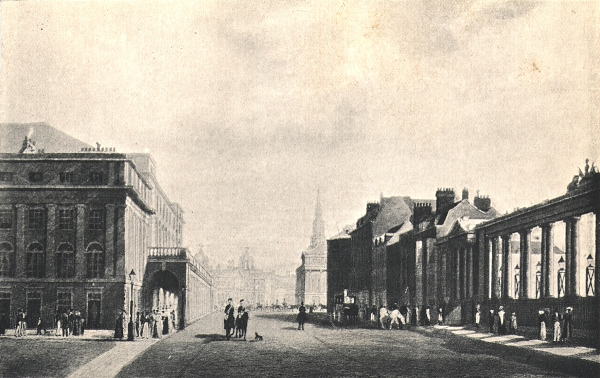
The Opera House Colonnade. PALL MALL EAST. Carlton House Screen.
Vanbrugh was succeeded in the management by Owen
MacSwiney, under whom an Opera Company, including
the famous Niccolini, gave a series of performances here.
A year later, Betterton, who had betaken himself to the
rival camp at Drury Lane, was lured back and engaged to
act for a month with a strong company supporting him.
After this the house was again given over to opera, and
Aaron Hill became manager, in 1710. He it was who made
overtures to Handel to write the lyrics of an opera, the result
being “Rinaldo,” which the master is said to have composed
in a couple of weeks.
In the following year Heidegger, whose name is to be
found in the “Dunciad,” and who was Master of the Revels
to George I.—fancy the solemn Hanoverian revelling!—became
manager.
From 1717 to 1720, no Italian operas were performed in
the Haymarket, but in the latter year a number of noblemen
and gentlemen combined to start a society chiefly
devoted to the performance of Handel’s works, although
Bononcini was also employed, hence arising that celebrated
feud between the adherents of “Tweedledum and
Tweedledee.”
There is on record another great feud between the partisans
of the two rival singers Cuzzoni and Faustina, which eventually
resulted in the former leaving this country, cheered,
if she could be, by some lines by Ambrose Phillips, who
termed her the “charmer of an idle age,” although the
management of the Opera House had not much reason to
echo this flattering sentiment.
Later, the opera having fallen into some financial difficulties,
Handel and Heidegger determined to carry it on
on their own responsibility. From this time, 1734, when
Handel’s partnership with Heidegger ended, to 1782, the
Opera House was the scene of all sorts of entertainments,
from Handel’s operas and Mlle. Hemel’s dancing, to the
ball given by the Knights of the Bath, in 1779, and the
masquerade of thirty years earlier, when George II. appeared
in an “old-fashioned English habit” (an excellent disguise),
and Miss Chudleigh, with next to nothing on, reminded
the scandalised Horace Walpole of Andromeda, rather
than the Iphigenia whom she was supposed to represent.
Some years after the alterations to the theatre, when
it was under the management of Gallini, a disastrous fire
occurred there, which practically destroyed it, but phœnix-like,
a new building quickly arose on its site, although many
people, Walpole among them, thought that it was a useless
expenditure, as the days of opera appeared to have departed
for ever. The new house was designed by Novosielski, and
Lord Buckinghamshire laid the first stone, in April, 1790,
it being completed in the following year. Later, Michael
Kelly and Storace managed it jointly when Sheridan and
Taylor were the lessees.
Although principally used either as a theatre or opera
house, an innovation was attempted, in 1787, by the introduction
of ballets, one of which, entitled “Bacchus and
Ariadne,” seems to have been anything but adapted
virginibus puerisque; and it was a question whether the
presentation of it or its withdrawal would cause the greater
indignation!
The names of Goold, the founder of the Union Club, and
Taylor, who was perennially in difficulties, Waters and
Ebers, Laporte and Lumley, under the last of whom that
great quartette composed of Taglioni, Grisi, Grehn, and
Cerito performed; and Smith and Mapleson, are among
those who figured at various times as impresarios here; while
the singers whose voices once echoed through that vast
auditorium were such as Jenny Lind and Sontag, Pasta and
Tietjens, Mario and Tamburini.
A second great fire, on December 6th, 1867, again
destroyed the building, which was subsequently re-erected
with its principal frontage in Pall Mall, at a great cost;
this in its turn we have seen disappear, and the new “His
Majesty’s Theatre” rise on its site, with its chief entrance in
the Haymarket, and a long frontage to Charles Street.
Luckily, the old arcade is embodied in the new building, and
here are still to be seen those dear little shops that look so
clean and prosperous and yet so diminutive—like a sort
of Tom Thumbs among business establishments!
At the north corner of Charles Street and Regent Street
is the Junior United Service Club, in which, report hath it,
that a certain part of the dining-room, frequented by the
older members, is known as “Rotten Row”; while across
Waterloo Place (or really the continuation of Regent Street)
is yet another Club—the Caledonian—housed in the former
residence of the late Lord Waterford.
ST. JAMES’S
SQUARE.
A few steps further and we are in the heart
of St. James’s Square. Here history and
legend will run away with us if I do not
restrain my pen, for every house has an interesting history;
each has been the abode of some famous personage.
Here, in the south-east corner, is the long front of Norfolk
House, the residence of the last six Dukes of Norfolk; behind
it still stands the old house, used principally as a lumber-room,
in which George III., and his brother, the Duke of York, were
born, what time the mansion was lent to Frederick, Prince
of Wales, by an accommodating Duke. The Bishop of
London’s official town residence, whither the Duke of
Hamilton, after his celebrated duel with Lord Mohun, was
carried, is next door, nestling between the ducal abode
and Lord Derby’s iron-balustraded mansion. Commerce
has invaded the Square, for, at the opposite corner, is a
Bank, and next to it Lord Falmouth’s house, which has
some old cannon as posts planted in the pavement before
it.
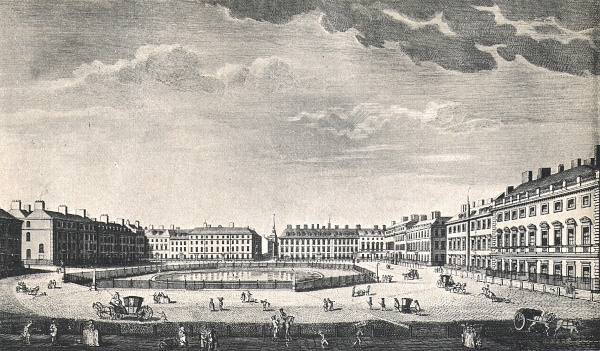
ST. JAMES’S SQUARE IN 1760.
In Lord Cowper’s, No. 4, is that magnificent room designed
by Lord Burlington, which is a wonder to those who see it
for the first time. This is one of the few houses in the Square
which has remained in the hands of a single family since
the Square was formed by Lord St. Alban’s, in Charles II.’s
day. Lord Strafford’s house is next door; and on the
other side it is flanked by Lord Bristol’s, another of the
houses to which one family has steadfastly adhered.
It is curious, having this in view, and remembering the
aristocratic traditions associated with the Square, to find
so many of the houses now turned to alien uses. Clubs—the
Windham, the Sports, the Portland, the Nimrod, the
East India, and the Army and Navy—occupy no less
than half a dozen of them; the London Library is housed in
a rebuilt structure on the site of the former residence of
Admiral, the Earl of Torrington; and an art gallery peers
out of the corner premises abutting on King Street.
Members of the great families of Sunderland, Portland,
Halifax, Legge, Hyde, Devonshire, etc., besides those I
have mentioned, have all resided here; so, too, did the
wonderful old Lady Newburgh, who remembered I don’t
know how many sovereigns, and was a friend of one of the
most unfortunate, Charles I.; the first Lord Palmerston,
who married an heiress under romantic circumstances;
Sir Allen Apsley, who was Treasurer to the Duke of York,
and who on one occasion received the future James II. as a
guest beneath his roof “for one night only,” as they say in
theatrical circles; Sir Cyril Wyche, who was a President
of the Royal Society; Sir John Duncombe, a former Chancellor
of the Exchequer; and Sir Charles Grandison; besides
Ambassadors from nearly all the courts of Europe.
No; it is to the past that we must turn to find even this
most select of Squares in its glory. When all the great
houses were standing—Cleveland House (now represented
by a huge and incongruous block of flats), Lord Jermyn’s
fine mansion, on the site of the Portland Club, and
Mr. Guinness’s residence, and Ossulston House, where the
Bank and Lord Falmouth’s now stand—an additional
distinction must have been given the Square, especially
when we remember the great and beautiful residents
who were then to be seen in its precincts.
The history of this Square is a particularly fascinating
one; but it can be but lightly touched on here.[2] As we have
seen, a king was born in its chief house, so, at a later day, a
queen was to be observed driving from another residence,
that of the notable Sir Philip Francis, to take her trial at
Westminster, and a curious print of the period shows Queen
Caroline in her carriage surrounded by a vast crowd leaving
No. 17, which house, together with its next door neighbour,
was subsequently to be demolished to make room for the
East India Club.
Another notable residence is No. 20, the only example in
the Square, but a fine one, of Robert Adam’s work. It was
for many years the home of the Watkin Williams Wynn
family, for one of whom it was built, in 1772, until recently,
when it passed into Lord Strathmore’s possession.
But not always have the residents been of noble birth or
irreproachable morals, and as we again emerge into Pall
Mall by the Army and Navy Club’s gorgeous buildings—the
work of Parnell, and standing on the spot where once the
famous Raggett, the proprietor of White’s, opened the
unsuccessful Union Club—we are reminded that in a small
house on part of its site once lived that Moll Davis, the
actress, whose singing of an old ballad attracted the questionable
attentions of Charles II. The footsteps of the Merry
Monarch must have often echoed in the Square, where the
siren dwelt, and where also lived so many of his friends and
acquaintances. Other footsteps have been heard here;
those of Johnson and Savage, who, cold and hungry, passed
a whole night wandering round the central garden with its
statue of King William III. (which was so unconscionable
a time in getting itself erected), while they settled the
affairs of the nation and dreamed of that immortality which
one, at least, was to attain.
By the bye, that open space, formerly a mere rubbish
heap, has seen many vicissitudes. Once it had a considerable
piece of water within its enclosure, and was octagonal in
shape; earlier still it was merely enclosed by posts and
rails in a most uncompromising square; to-day it is, to
use a much-loved 18th century word, an “umbrageous”
garden.
The present inhabitants would be sufficiently startled if
Mr. Brock were to suggest a display of fireworks there; but
in past days this was a regular concomitant to any great
public rejoicings, and many of the influential residents
interested themselves in these “feux d’artifice.” The victory
of the Boyne, the capture of Namur, the Peace of Ryswick
were some of the more notable occasions for, as contemporary
prints assure us, really remarkable efforts in pyrotechnic
display.
But we must quit St. James’s Square, with its historic
memories, its ghosts of the great and beautiful; its
houses built by the Brettinghams, Storys, Barebones, and
Friths, and decorated by the Adams, the Kauffmanns,
the Ciprianis, and the Amiconis of a past day; and to do
so let us retrace our steps to its north side, where York
Street will lead us into Jermyn Street.
JERMYN
STREET.
It is not difficult to trace the name of York
Street to the Duke of York, who afterwards
became an unpopular king; but it requires
some effort of the imagination to connect with Apple-tree
Yard, in the same street, that orchard of apple-trees for
which this spot was famous in the reign of Charles I.
When the Spanish Ambassador was living in St. James’s
Square, the chapel connected with the Embassy was situated
in York Street, and the building, with the arms of Castile
upon it, was standing till so recently as 1877.
Jermyn Street, into which we now turn, is famous. It is
as characteristically redolent of the West End as (say)
Leadenhall Street is of the East. All sorts and conditions
of interesting people have lived or lodged in it; Marlborough,
when yet John Churchill, and only a colonel; the Duchess
of Richmond, known to readers of De Grammont and
students of the later Carolean days, as La Belle Stuart; the
haughty Countess of Northumberland; Secretary Craggs
and Bishop Berkeley, and Lord Carteret; to say nothing
of Verelst, the painter, of whose vanity so many stories are
told by Walpole. The great Sir Isaac Newton, until he
went to Chelsea; Shenstone, when he could tear himself
away from his beloved “Leasowes”; and Gray, who, as
Johnson said, would go down to posterity with a thinner
volume under his arm than any of the great poets, also
resided in Jermyn Street. The latter lodged at Roberts’,
the hosiers, or Frisby’s, the oilman’s, as he found convenient
(paying not more than half a guinea a week for his
rooms), just as Bishop Berkeley had done at an earlier day
at Burdon’s, with its sign of “The Golden Globe.”
In the nineteenth century the street may have been
enlivened by the jokes of Sidney Smith or the gentle caroling
of Tom Moore, for they both sojourned here, the one at No.
81, in 1811, the other at No. 58, fourteen years later. But
a greater than either once stayed for a short space in the
street; for at one of the many hotels which have flourished
and faded here, the great Sir Walter remained for three
weeks, after his return from the Continent; and here he lay
in that waking dream which had but one dominant expression
in its dull monotony, the unconquerable desire to be
once again in his “ain hame,” and to hear the busy
Tweed rippling over its stones.
ST. JAMES’S
CHURCH.
In spite of much rebuilding there yet remains
one object here which will help to recall
us to the past—the Church of St. James’s,
which fronts both Jermyn Street and Piccadilly. It was
erected by Henry Jermyn, Earl of St. Albans, soon after
he had begun the development of his neighbouring property.
Wren had a hand in it, when it was commenced in 1680,
but he concentrated his efforts on the interior, which is extraordinarily
light and spacious. Grinling Gibbons was
responsible for the beautiful marble font and a portion
of the altar; and the organ was originally made for James II.
Its rectors have occasionally attained high preferment, no
less than three—Tenison, the first; Wake, the second, and
Secker, at a later date, reaching the Archbishopric.
Interesting things have happened in this church. Once the
minister was ordered not to lay the text on the cushion (as
was then the custom) of the Princess Anne, who used to
attend here when she was living at Berkeley House, nor “to
take any more notice of her than other people,” as old Sarah
of Marlborough indignantly records; but the rector refused
to do this without an order in writing, which the Crown did
not think it expedient to give; Defoe was scandalised at
the charges made here for a seat, “where it costs one almost
as dear as to see a play”; and in the churchyard Gibbon
once stumbled and sprained his foot, but he is careful to
particularise the time of the mishap, “between the hours of
one and two in the afternoon,” so that there need be no
shaking of heads. Gibbon, who was nothing if not
“genteel,” selected his church well, for Vanbrugh, in his
“Relapse,” makes Lord Foppington say that he always
attended St. James’s for “there’s much the best company!”
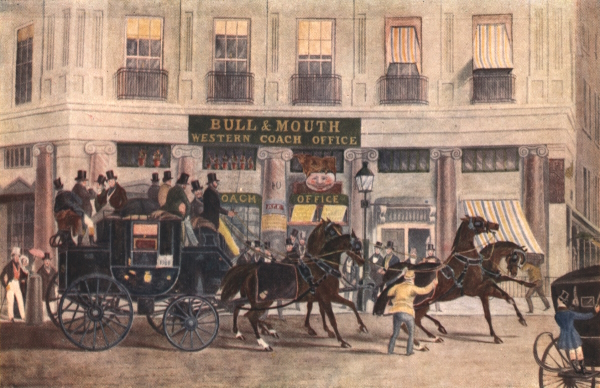
“THE BULL AND MOUTH,” PICCADILLY.
The church and the churchyard in which Gibbon slipped,
are so full of illustrious dead, that it would seem, indeed,
a difficult matter to pass through them without stumbling
against some “pointed clay.” Here lies Cotton, who shares
the fame of the “Compleat Angler” with his friend Walton;
Tom D’Urfey, who made up those “pills to purge melancholy”
which so many have found a pleasant enough
prescription; the artist Van der Velde, the royal marine
painter, who knew the trick of marine painting if anyone
did; Dahl and Haysman, the portraitists, and Harlowe,
who reproduced the trial scene of Queen Katherine. Mrs.
Delany was laid to rest here, so was Mark Akenside, who
died in Old Burlington Street; Dodsley, the great Pall
Mall bookseller; Gillray, who caricatured a whole
generation, and “Old Q,” who scandalised another, and so
on; while the great Chatham, and Chesterfield—that
“glass of fashion”—were both held at the font which Grinling
Gibbons had adorned.
PICCADILLY
CIRCUS.
If we continue westward along Jermyn
Street we shall come to St. James’s Street,
which we have already traversed, and if
eastward, to the Haymarket, which we have but recently
left; let us therefore go up the little passage by
the side of the church, and find ourselves in the full
bustle of that part of Piccadilly which we have till now
neglected.
Piccadilly Circus is one of the sights of London. It is
the starting-point of at least four great thoroughfares.
To the west lies Piccadilly; to the east, Coventry Street,
leading to Leicester Square; to the north-west runs Regent
Street; to the north-east, Shaftesbury Avenue; while
(lower) Regent Street, leading to Waterloo Place, lies south.
“That gentle hill which goeth
Down from the ‘County’ to the Palace gate,”
as Tom Hood called it, contained several other landmarks
which have disappeared, among them, the church on the
right hand going towards Pall Mall, and “The Bull and
Mouth,” at the top south-east corner, whence the “Age”
coach, tooled by the Duke of Beaufort, used to leave on its
journey westward. Later the “Bull and Mouth” was
known as “The Spread Eagle,” established in 1820, and now
it fulfils some part of its former rôle by being converted into
a railway receiving office.
Whether by day, when the flower girls sit around the base of
Gilbert’s “Cupid,” (a “cold pastoral” indeed, in his exposed
situation, aiming his arrow at the luggage on the cabs or
the passengers on the omnibuses as they pass and repass
his happy hunting-ground); or by night, as Yoshima
Markino would possibly prefer, when the lamps from the
Trocadero or the Criterion are dimly perceived through
a fog, or are almost indecently glaring in a clear sky (if
ever London has a clear sky above it), Piccadilly Circus
is a sight, I always think, to wonder at. It is a perpetual
eddy of many waters. If not unhasting, certainly unresting
are the passengers on those streams which flow in from
so many points and seek so many exits. Here the
denizens of Soho emerge to their farthest western limits;
here the West End, in electric broughams, comes to the
outskirts of its own country. Theatre and music-hall
are here “at grips” with their opposition entertainments.
Everything comes in time to Piccadilly Circus. The man
strolling out from the play in evening dress and crush hat
may be hailed by a friend in ulster and shooting boots, whose
hansom is the last stage of a journey from the Hebrides or
the Himalayas; the east and the west meet here on
common ground for that amusement which would seem to be
taken in anything but the sad spirit predicated of it by
Continental nations.
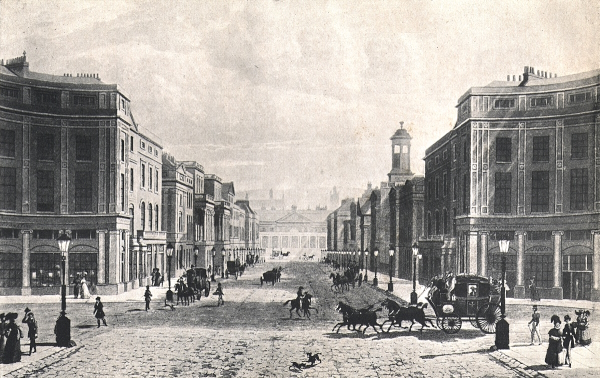
Site of LOWER REGENT STREET, FROM PICCADILLY CIRCUS, WITH
“Bull and Mouth.” CARLTON HOUSE AND SCREEN.
And then for the stranger there is such a pleasant commingling
of the old and the new at this point. The wilds
of Soho, with its historic Square, its streets that defy the
most exact logical definition, its church, its memories of
Dr. Manette and the sweet Lucy; Leicester Square where
once was a royal palace, and the homes of Reynolds, and
Hunter, and Hogarth, and our one and only Sir Isaac; and
where the Empire, and the Alhambra (awhile the home of
that most dreary Panopticon) compete nightly with all the
bravery of illumination and gigantic “chuckers out.”
In Regent Street, which had its genesis in the Prince
Regent’s desire for a fine thoroughfare between Carlton
House and his residence in Regent’s Park, and the making
of which did away with as much dirt and squalor as Shaftesbury
Avenue has attempted to do in our own day, Nash’s
magnificent sweep is now, alas! interrupted by Mr. Norman
Shaw’s splendid “Piccadilly Hotel,” the elevation of which
shows the design adopted for the rebuilding of the Quadrant.
The once famous colonnade has long since disappeared;
but in the Haymarket, the Theatre, and Fribourg’s delightful
old shop still show what it once looked like. And then with
these we have the dernier cri of His Majesty’s Theatre,
the Tube railway station, and the roar of the motor ’bus.
If we can but escape from these leviathans of the road, let
us beat a hasty retreat from beneath Cupid’s bended bow
and outstretched leg, and make our way back by Piccadilly
to Stewart’s corner, from whence we first started on our
perambulation.
At the Circus we are nearly on the site of that famous
gaming-house, known as Pickadilla Hall, of which the
earliest mention appears to have occurred in 1623, when
it was in the possession of one Robert Baker, whose widow
sold it to that somewhat notorious Colonel Panton, who was
associated with Titus Oates, and whose name survives in
Panton Street. He it was who built Panton Square, where
the Comedy Theatre now stands, in one of the houses of
which, in 1762, the Ambassador of Morocco cut off his
servant’s head because the latter had displeased his sable
Excellency in some trivial matter, with the result that the
resentful envoy and his retinue received a sound
thrashing from an infuriated mob which got wind of the
circumstance.
PICCADILLY
EAST.
Even in those early days a good deal of
trouble was taken to keep Piccadilly, that is,
as far as Sackville Street (for the remaining
portion was then known as Portugal Street or the “way
to Reading”), well paved, and free from contamination in
other ways, as Evelyn’s Diary and Burton’s Parliamentary
Journals attest.
By a plan, dated 1720, we can see that then, as now,
several small alleys led into, what in the plan is termed
German Street. There was on the south side Salter’s Court,
and—appropriately as being in the vicinity of Pickadilla
Hall—Fleece Yard; and Eagle Street and King’s Arms Yard
between St. James’s Church and Duke Street. On the
north side Shug Lane is given as on part of the site of Regent
Street, and leading to “Marybone Street”; Bear Alley, a
few steps further west, probably where stood “The White
Bear,” formerly known as the “Fleece” Inn, one of the
busiest of the old coaching houses, and dating from the
middle of the 17th century. Here West, the painter, stayed
on his arrival in London from America; and Luke Sulivan
and Chatelain, the engravers, both died, the latter only
having taken lodgings here on the previous night. And
Magget’s Lane is given beyond Air Street and close to
Swallow Street.
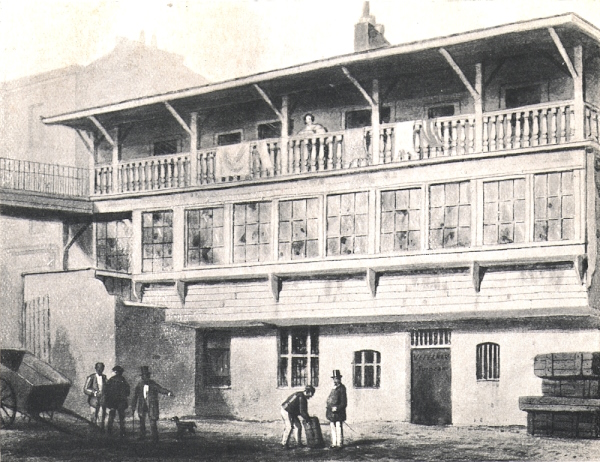
THE “WHITE BEAR” (FORMERLY THE “FLEECE” INN), PICCADILLY.
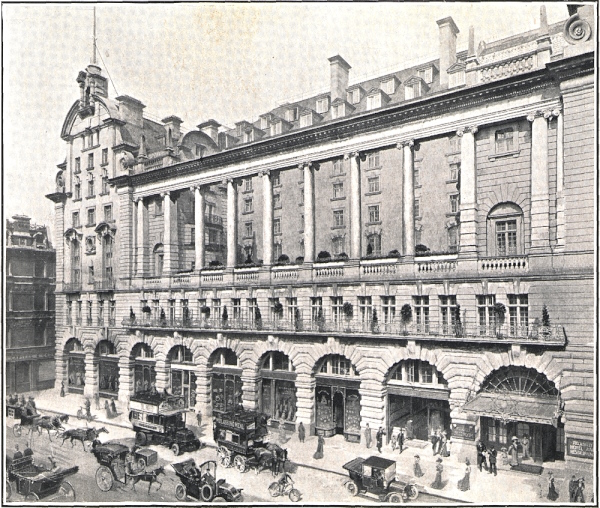
THE PICCADILLY HOTEL.
(Built on the site of St. James’s Hall)
The Arts have been, till recently, well represented in
Piccadilly, for nearly opposite to Burlington House, to which
we shall shortly come, is the building of the Institute of
Painters in Water Colours, and close by was, till the other
day, St. James’s Hall, where the best of good music was
unable to wean the public from their fireside or their theatre
stalls in sufficient numbers to make it pay; and so that
star-bedizened ceiling and orientally decorated Hall is no
more, but is now succeeded by the splendid front of the
new “Piccadilly Hotel,” the latest, and architecturally
the most interesting and original of the many fine hotels
that have sprung up in London during the last few years.
Indeed, “the Piccadilly,” as, I suppose, it will be familiarly
called, is, both inside and out, a remarkable example of
the palatial character which modern luxury seems to
demand in the building and management of latter-day
hotels. As I have said, some old land-marks had to make
way for it; but what’s not destroyed by Time’s devouring
hand?
QUARITCH’S.
Even Quaritch’s, the bookseller’s (now removed
to Grafton Street), known as well to
American and foreign bibliophiles as to ourselves, has been
turned to other uses! Who that loves books didn’t know
the great Quaritch and his top hat, as distinctive as Napoleon’s
grey coat or Wellington’s duck trousers? Indeed,
Quaritch was the Napoleon or Wellington, which you will, of
booksellers, and Sotheby’s his chosen field of battle, where
in great contests, he suffered no defeats. That hat, crushed
on his head, and so old that it was not to be easily recognised
as ever having been of silk, was one day placed beneath a
glass flower-cover by a daughter wrought to despair at the
inefficacy of repeated admonitions, and the conqueror
recognised at last that it had become merely a relic!
With the disappearance of St. James’s Hall and Quaritch’s,
Piccadilly would seem to be losing all touch with past
times, did not Hatchard’s Book Shop, Fores’ Print Shop,
Lincoln & Bennett’s, Denman’s,[3] and Stewart’s still remain
to crystallise in their well-known names those past days of
which, say what we will, we seem to be losing grip with every
succeeding year.
THE ALBANY,
PICCADILLY.
This fine old house, which has, since
1804, been divided into suites of apartments
for single men, was designed by Chambers.
In 1770, it was sold by the second Lord Holland
to Lord Melbourne, who subsequently exchanged it with the
Duke of York for Melbourne House, Whitehall. In Lord
Holland’s time it was called Piccadilly House, and a previous
mansion on the same site had been known as Sunderland
House.
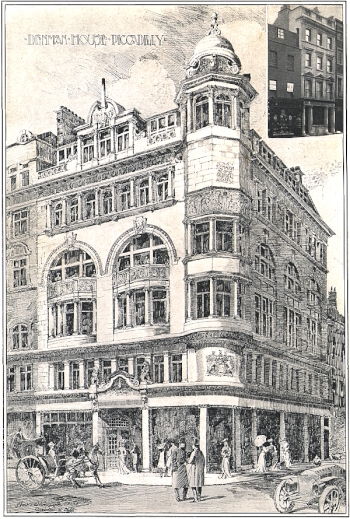
DENMAN HOUSE, PICCADILLY.
(The Vignette shows the old building, No. 20, rebuilt 1903).
It is altogether cloistral, and the curious covered passageway
running through from Piccadilly to Burlington Gardens,
from which suites of rooms are reached, helps to give it that
seclusion which Macaulay, one of its most notable inhabitants,
delighted in. It combined what he best liked—“a
college life at the West End of London.” The various suites
are numbered in blocks; thus, Macaulay’s was No. 1 E, on
the second floor, where the earlier volumes of the great history
were written; “Monk” Lewis lived in No. 61 K.;
George Canning at No. 5 A. Lord Byron and Lord Lytton
both had sets of chambers here, and the former enters in
his journal for March 28th, 1814, the fact that on that
day he took possession of the rooms, rented from Lord
Althorp for seven years. It was from here that he set
out to be married to Miss Milbanke on a fateful day for them
both, January 2nd, 1815. Lytton, at a later date, occupied
the same apartments, and wrote many of his novels here.
Lady Lytton once told a friend that she had heard from him
that he was here “with Solitude”; but, paying her lord and
master an unexpected visit, she found “Solitude” gowned
in white muslin and sitting on his knee!
BURLINGTON
HOUSE.
Close to Bond Street is shown on the plan of
1720 the large building of old Burlington House.
The illustration, taken from an old print of the
period, gives an excellent view of it, with its ample courtyard
in front and its extensive gardens behind. Think of the site
of this being at the time of the Restoration nothing but
pasture land! Pepys says that Denham, who wrote those
two immortal lines on the Thames, and who is said by De
Grammont to have poisoned his wife (who, if such a proceeding
could be justified, would seem to have given
her lord every reason, by her conduct with the Duke of
York), built the house. Denham does not appear to have
ever lived in it, however; its original occupier being the
first Earl of Burlington, and it was when once visiting
him here that Pepys, in endeavouring to seal a letter,
set his periwig on fire, as readers of his diary will
remember.
The glory of the mansion commenced with the third Earl
of Burlington, that munificent patron of art and practical
architect, whose praises Pope and Gay and Walpole were
never tired of singing. He it was who rebuilt the place
essentially as it is to-day, the chief portion of the design
being due, however, to Colin Campbell. The semi-circular
colonnade which originally flanked the house, as well as
the long wall, according to Ralph, the most expensive in
England, with its three entrances facing Piccadilly, were
taken down in 1868.
When, in process of time, the place came into the possession
of the Cavendishes, they sold it, in 1854, to the Government
for £140,000. For a time it seemed uncertain to what
purpose it would be relegated, and all sorts of suggestions
were made. Finally it was added to by new buildings in
Burlington Gardens, for the use of the University of London,
and by a new façade facing Piccadilly. Now-a-days several
learned Societies have their headquarters in portions of the
extensive buildings, but to “the man in the street”
Burlington House spells the Royal Academy, the council
of which obtained a lease of their building in 1866.
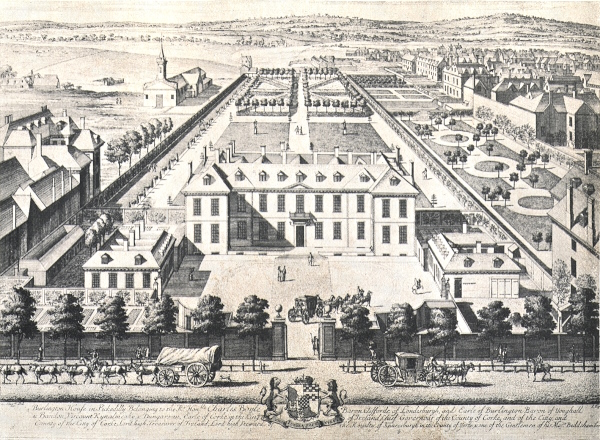
OLD BURLINGTON HOUSE AND GARDENS, PICCADILLY.
Now let us find our way back again to Piccadilly by the
easy route, especially in wet weather, of the Burlington Arcade—a
sort of Passage des Princes of London—designed for
Lord George Cavendish, in 1818, which tradition says was
originally intended as a covered court to prevent dirt and
rubbish from being thrown on the walks of Burlington House
gardens.
One could, of course, go loitering over reams of paper in
Piccadilly, for nearly every house or its site has had a history;
every stone has echoed the footsteps of the illustrious
and interesting for many a generation. All the great pageants
of London have passed between its shops and houses into the
night. And now, as we turn into the bustle of its chief
and richest artery, let us exclaim with Phil Porter:—“Farewell,
my dearest Piccadilly.”
CHAPTER IV.
BOND STREET.
“And now our Brothers Bond Street enter
Dear Street of London’s charms the centre.”
—Lytton.
BOND
STREET.
Bond Street is really as much the centre
of the charms of London to-day, as it was
when Lord Lytton wrote the lines quoted
above; if by charms we mean fine shops, about which
Lord Beaconsfield once waxed eloquent, and a segregation of
brilliant humanity; otherwise it is curious that a thoroughfare
of such importance should be at once so narrow and so
cut up by tributary streets, in some cases, wider than it is
itself, which make it crowded and inconvenient to a degree
only possible in a City as old and as relatively unchanged in
outline as London; for Bond Street, although not of any
great age, as we understand the word, would probably be
considered by those not so familiar as ourselves with
antiquity, as having a decent pedigree, for it dates from 1686,
and forms perhaps the most important portion of the scheme
of development associated with Sir Thomas Bond.
It occupies a part of the site of Clarendon House, and when
that mansion with its grounds of 300 acres was purchased by
Bond and others, the street was formed. The west side was
the first to be built, being then termed Albemarle Buildings,
from the Duke of Albemarle who sold Clarendon House to
Bond. Hatton described the street in its early days as
being “inhabited by the nobility and gentry.” You shall
seek long enough to-day before you find members of either
class represented among the inhabitants other than occasionally
in the various hotels in the street, or perhaps in
chambers above the shops, which is but a repetition of what
was the custom at an earlier day, when all sorts of illustrious
individuals gave as their addresses the upper parts of
business premises which, in the absence of numbers to houses
and shops, were sufficiently distinctive; thus, when we read
of (say) the “Duke of A., at Mr. Jones’s, hairdressers,” we are
not to assume that that capillary artist entertained noble
guests in his first floor front, other than in the light of lodgers
who paid handsomely for the privilege of being in a
fashionable street without having to keep up a fashionable
house. But, at first, private houses were as much de rigueur
in Bond Street as they are in Brook Street or Grosvenor
Street to-day, and one of the earliest titled inhabitants was
that Duke of St. Albans, the son of Charles II. and Nell
Gwynn, whose title would seem to have been a royal afterthought,
according to the well-known story, which tells us
that, on one occasion, his mother addressed him as “little
bastard,” when Charles, who overheard it, remonstrated
with her for the use of the term, whereupon Mistress
Eleanor, who probably used the ugly word for a sufficiently
good reason, replied that the child had no other name. This,
apparently, set the King a-thinking, with the result that
shortly afterwards, a patent of nobility was made out for the
boy. Although I can’t say in what year the Duke took up
his residence here (it was probably about 1720), he died in
1726, and an advertisement in The London Gazette in the
following year contains an intimation to the effect that his
Grace’s house was then for disposal, in consequence of his
decease.
The Court Guide is responsible for the names of other
inhabitants, and among them may be noted that Duke of
Kingston who married a painfully notorious wife—Miss
Chudleigh; and that Countess of Macclesfield who proved
such an unnatural mother to Savage, the poet.
In 1708, I find Lords Abingdon, Anglesea, and Coningsby
mentioned as living in Old Bond Street; some years later
the Countess of Gainsborough resided here; but the street
as a residential quarter is more interesting from the fact that
Laurence Sterne died, at what is the present No. 41, in 1768.
The man whose name was on everyone’s lips, and whose
extraordinary work was in everyone’s hands, departed to the
land of shades with only two hirelings to bid him Godspeed;
and one of these alien hands, that of John Macdonald,
a footman, has left the description of that last strange scene.
“About this time Mr. Sterne, the celebrated author, was
taken ill at the silk-bag shop in Old Bond Street.... I
went to Mr. Sterne’s lodgings; the mistress opened the door;
I inquired how he did. She told me to go up to the nurse;
I went into the room, and he was just a-dying. I waited ten
minutes; but in five he said, ‘Now it is come’! He put up
his hand as if to stop a blow, and died in a minute.”
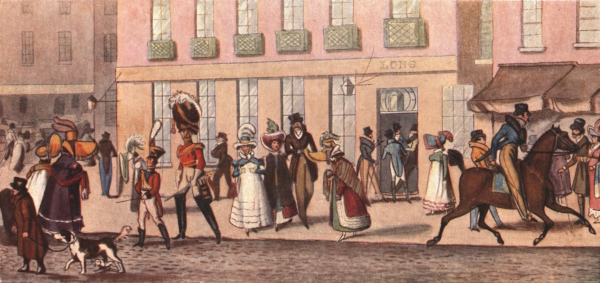
LONG’S HOTEL, BOND STREET.
The ubiquitous Boswell was lodging in Old Bond Street a
year after Sterne’s death, and Pascali Paoli, whose name
looms largely in Boswell’s “voluminous page,” had already
come here some eight years earlier. Gibbon, on his return
from Lausanne, also lodged in Bond Street, where he
writes: “While coaches were rattling through Bond Street,
I have passed many a solitary evening in my lodgings with
my books”; while half a century earlier Mrs. Loe, a friend
of Lady Wentworth’s, was residing here, in 1710, and we find
the old gossip visiting her and subsequently informing her
son that “she (Mrs. L.) had ten wax candles, six in one room
and fower in a very little one and very fynly furnished,” to
her ladyship’s evident astonishment.
At No. 24, the Artists’ Benevolent Institution was housed,
in 1814; but this particular building is more interesting still
from the fact that, in 1791, it was the residence—one of his
many in London—of Sir Thomas Lawrence; while Northcote,
the artist, at No. 2, in 1781, and Ozias Humphrey, the
miniature painter, at No. 13, in 1796, combine with
Lawrence, to represent Art here.
Bond Street, if to a lesser degree than some other thoroughfares
close by, has always been noted for its hotels, one
of the most famous being Long’s, at Nos. 15 and 16, rebuilt
and greatly enlarged in 1888, which was patronised by Sir
Walter Scott; and here he met Lord Byron for the last
time in 1815; and Stevens’s Hotel, two doors off, where
Byron was to be met with in the days when he affected to
live a fashionable life and consort with the “Dandies.”
Stevens’s was at No. 18, and, having been rebuilt in 1888, is
now a jewellers’; another hostelry has also disappeared
these 30 years—this was the Clarendon Hotel, at No. 169,
which occupied the former town residence of the Dukes of
Grafton, where at a later time the great Chatham once lived.
Old Bond Street, which begins at “Stewart’s Corner,”
runs into New Bond Street with nothing to mark their
division or to indicate that they form, except in name, anything
but one continuous thoroughfare. The latter was
not, however, formed till about 30 years after its prototype;
but it equals it in interest by reason of the illustrious ones
who have dwelt in it. Here, for instance, came in 1727, to
lodge with his cousin Lancelot, at a house then described
as “over against the Crown and Cushion,” the great Dean
of St. Patrick’s, whom we have met with in Piccadilly when
he was lodging in Pall Mall or Bury Street; here lived a few
years later that most delightful of garrulous memoir-writers,
Mrs. Delany, the friend of Fanny Burney and Queen
Charlotte and of how many others; Lord Coventry, who
married one of the beautiful Gunnings, was here, in 1732;
so was Lord Craven and Lord Abergavenny; later still
George Selwyn cut his jokes in the street and hurried by this
way to many a last scene at Tyburn, not far off in the Oxford
Road. Dr. Johnson’s ponderous form might have been seen
here, rolling along, as he touched all the posts he
passed.
Thomson, “who sang the seasons and their change,”
and used to lie abed so unconscionable a time o’mornings
also lived in New Bond Street, before he flitted to “ambrosial
Richmond.”
Not only have men of thought and fashion resided here,
but men of action, in the persons of Lord Nelson and Sir
Thomas Picton, have been represented. The former was
staying at No. 147, in 1797, and therewith a curious circumstance
is on record. After he had been created Duke of
Bronté, he was accustomed to make presents to his friends of
casks of Marsala, for which his estates in Sicily were celebrated.
Curiously enough, during some excavations next
door to Nelson’s one-time residence, a cask of this wine, in a
bricked-up cellar, was discovered. So rotten, however, had
the cask become, that on exposure to the air it fell to pieces.
Southey tells of the following incident which occurred
during Nelson’s sojourn here.
“One night, after a day of constant pain, Nelson retired
early to bed ... the family was soon disturbed by a
mob knocking loudly and violently at the door. The
news of Duncan’s victory had been made public, and the
house was not illuminated. But when the mob was told
that Admiral Nelson lay there in bed, badly wounded, the
foremost of them made answer, “You shall hear no more
from us to-night.”
Sir Thomas Picton, who fell at Waterloo, was living in
Bond Street at the same time that Nelson and Lady
Hamilton were there, and a few years later we find the redoubtable
Lord Camelford a resident at No. 148. His rooms
were so typical of those of a man about town of the day, that
Cruickshank introduced the interiors in his illustrations to
Pierce Egan’s “Tom and Jerry”; while the authors of the
“Rejected Addresses” have also left on record an enumeration
of the various lethal weapons that decorated the walls.
Lord Camelford was one of those fire-eaters who never
seem able to exist for any length of time without “entrance
to a quarrel.” He was known and feared throughout the
town, and few cared to tackle the man who was so ready to
seek an occasion for fighting, and so deadly in the field. It
is thus that the best stories told of him are those which relate
his encounters with strangers, one of which I will give, in the
words of Timbs, who collected much interesting data about
Lord Camelford’s career.
“Entering one evening the Prince of Wales’s Coffee-house
in Conduit Street, Lord Camelford sat down to read the
papers. Soon after came in a conceited fop, who seated
himself opposite his Lordship, and desired the waiter to
‘bring a pint of Madeira and a couple of wax candles and put
them into the next box.’ He then drew to himself Lord
Camelford’s candle and began to read. His Lordship glanced
at him indignantly and then continued reading. The waiter
announced commands completed, when the fop lounged
round into the box and began to read. Lord Camelford then,
mimicking the tone of the coxcomb, called for a pair of
snuffers, deliberately walked to the next box and snuffed out
both the candles, and returned to his seat. The coxcomb,
boiling with rage, roared out, ‘Waiter, who is this fellow that
dares thus to insult a gentleman? Who is he? What is
he? What do they call him?’ ‘Lord Camelford, sir,’
replied the waiter. ‘Who? Lord Camelford!’ returned
the fop, in a tone of voice scarcely audible, terror-struck at
his own impertinence. ‘Lord Camelford! What have I to
pay?’ On being told, he laid down the money and stole
away without daring to taste his Madeira!”
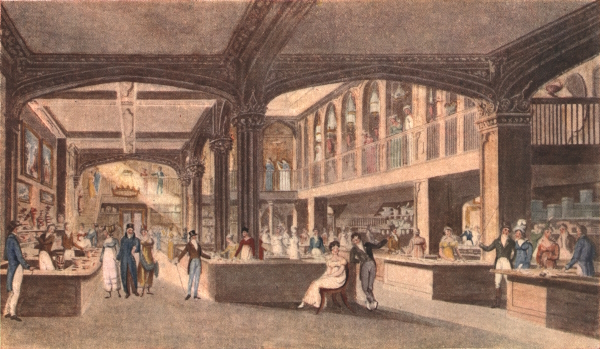
“THE WESTERN EXCHANGE,” BOND STREET.
It was while living in Bond Street that Lord Camelford
chose to ignore the general illuminations for the peace of
1801, and would allow no lights to shine in the windows of
his rooms. The result was that the mob attacked the house,
and proceeded to break all the windows, whereat the pugnacious
peer, undaunted, sallied forth with a thick stick, and
proceeded to lay about him to such good effect that it was
not till a considerable space of time had elapsed that he was
overpowered by numbers, and was, perforce, constrained to
retreat in an almost unrecognizable and wholly undignified
condition.
To-day Bond Street, Old and New, is as nearly a complete
street of shops as any in London; indeed, it is pre-eminently
the “street of beautiful shops,” as Mr. Meredith calls it, and
is, in this connection, known throughout the world. Anyone
walking down it would have to draw heavily on his
imagination, if he would try to realise that, as Bramston
writes:—“Pease, cabbages, and turnips once grew where
now stands New Bond Street ...”, so completely has
time metamorphosed this once rural spot into a promenade
of bricks and mortar, where the ends of the world seem to
have been ransacked to fill its marts with all the riches of
Nature and Art conceivable by the mind of man.
The shops of Bond Street have always been famous. In
the early years of the 19th century the so-called Western
Exchange was established there, but has long since disappeared.
Its size can be estimated by the illustration
here given, taken from an old coloured print of the
day.
But undeniably fashionable and central as is Bond Street,
the stranger will be struck at its exceeding tenuity, especially
in that part where Grafton Street joins it. Here, during the
season, one is accustomed to see carriages and carts in
apparently inextricable confusion, until the white glove of
authority is raised aloft and confusion ceases to be confounded.
Lord Beaconsfield, who knew and loved his London
thoroughly, once wrote that, “Those who know Bond
Street only in the blaze of fashionable hours can form
but an imperfect conception of its matutinal charm
when it is still shady and fresh, when there are no
carriages, rarely a cart, and passers-by gliding about on
real business.”
Should, then, we wish to feel “as in some Continental
city,” which the author of “Endymion” assures us is the
case, if we share Bond Street with the lark, we must join this
blythe spirit, before the late breakfasted “West End” surges
through its long vista.
One of the street’s former residents, we may be sure, never
did this, for, when the poet Thomson was lodging at a milliner’s
here, he, to use Mrs. Piozzi’s words, “seldom rose early
enough to see the sun do more than glisten on the opposite
windows of the streets.”
BURLINGTON
STREET AND
BURLINGTON
GARDENS.
Burlington Gardens, leading to Old Burlington
Street, and, by Vigo Street, to Regent
Street, is the first thoroughfare we come to on
the right after leaving Piccadilly. Old Burlington
Street has passed through no less than three changes
of name. In 1729 it was known as Nowell Street; four years
later it blossomed into Great Burlington Street; to-day this
adjective is, appropriately, discarded. It, of course, takes
its name from Lord Burlington, whose palace stood between
Burlington Gardens and Piccadilly, and whose grounds once
occupied the land where the street now runs. The West End
branch of the Bank of England is housed in Burlington
Gardens in the residence formerly known as Uxbridge House,
from the lesser title of that Marquis of Anglesea who once
owned it, and who died here, in 1854. Famous for his share
in the victory of Waterloo, one of his legs lies buried in the
little church adjoining the battle field, and the old soldier was
once surprised, on paying it a subsequent visit, to find the
resting place of his limb converted into a sort of shrine.
Uxbridge House was erected in 1790-2 by Vardy and
Bonami, and stood on the site of Queensbury House, where
Gay’s patron and patroness, who set up that great
monument to the poet, in Westminster Abbey, once
lived.
Another titled lady, whose connection with a poet has
alone caused her name to survive, resided in Burlington
Street, in the person of Lady Warwick, the widow of the great
Addison; and among other past inhabitants mention may
be made of Lord Hervey (Pope’s “Sporus” and “Lord
Fanny”); Mark Akenside, the poet-physician, who died
here in 1770; and Sir Joseph Banks, who took a house here
in the following year; Colonel Ligonier (whose portrait by
Reynolds is one of that Master’s memorable achievements),
and the Marquis Cornwallis, who resided at No. 29, where he
died in 1805.
Another great soldier is indirectly connected with the
street, for we find Wolfe writing to his mother and brother
who were at one time living here, although there is no evidence
to show that the hero of “The Heights of Abraham”
himself ever resided in Burlington Street. The “great”
Lady Cork—for I think she deserves the adjective—is,
however, closely associated with this street. That noble
patroness of literature, and last of the “blue stockings”—to
use the words in their best sense—died here, in 1840, and
Hayward has recorded the charm of her personality, her good
nature, and unusual gifts.
It is an interesting fact that in Burlington Street brass
door-plates bearing the names of private persons (of which
Lord Powis’s in Berkeley Square is the sole survivor) were
first used in London.
VIGO
STREET.
Vigo Street, which connects Burlington
Gardens with Regent Street, takes its name
from the sea-fight which occurred at Vigo Bay
in 1702. It was formerly known as Vigo Lane, which title
was originally applied to that portion of the thoroughfare
now known as Burlington Gardens, as well. The
change seems to have taken place subsequently to the
formation of Regent Street.
CLIFFORD
STREET.
A few steps further up Bond Street,
we come to Clifford Street, where Dr.
Addington, the father of Lord Sidmouth,
lived, at No. 7. Lord Sidmouth himself, who was, in consequence
of his father’s profession and also because he once
prescribed a soporific for George III., known as “the
Doctor,” also dwelt here, and was, at least on two occasions,
visited here by Lord Nelson. Bishop Hurd, known both
ecclesiastically and also for his edition of Horace, also once
resided close by, at No. 5; and Sir Arthur Wellesley was
staying at No. 14, in 1806; while the Prince of Orange, who
came to this country with the object of becoming engaged
to the Princess Charlotte—an object frustrated by the
Grand Duchess of Oldenburg, as well as by the
Princess’s almost open repugnance to the not very
prepossessing gentleman himself—lodged at his tailor’s,
at No. 8.
The street also once had its particular Coffee-house (as
what street in London in those days had not?), known as the
“Clifford Street Coffee-house,” which is chiefly interesting
from the fact that the “Debating Club,” of which “Conversation”
Sharp and Lord Charles Townshend were shining
lights, once had its headquarters here.
SAVILE
ROW.
Clifford Street leads into Savile Row,
named after Dorothy, the heiress of Savile,
Marquis of Halifax, and wife of the architect
Earl of Burlington. Here Lady Suffolk, Queen Caroline’s
“good Howard,” and most respectable of Royal mistresses,
lived, in a house she had purchased for £3,000, in 1735.
William Pitt and his brother were also residing in Savile
Row in 1781, and here died, under the pathetic circumstances
known to all the world, Richard Brinsley Sheridan,
at No. 17, whence he wrote to Rogers that agonizing letter
for assistance to prevent the bailiffs “putting the carpets out
of window,” as the dying man phrased it. A tablet indicates
the last home of “Sherry,” who had enlivened a generation
with his wit and astonished it by his surprising
gifts.
Among other residents at a later date, at No. 20, was
Bobus Smith, the brother of Sydney; and Grote, the historian
of Greece, who died, at No. 12, on June 18th, 1871.
Here Mrs. Grote gave those musical receptions at which the
voice of Jenny Lind and the recitals of Chopin and Thalberg
were to be heard. A memorial tablet now indicates Grote’s
residence here.
Sir Benjamin Brodie, the great surgeon, was at one time
living at No. 16, Savile Row, and Tierney, the politician,
drew his last breath at No. 11, in 1830.
CORK
STREET.
Cork Street, joining Clifford Street and
Burlington Gardens, was named after Richard
Boyle, Earl of Cork, and its chief feature was
the fine house, or, rather one should perhaps say, externally
fine house, for Walpole affirms that “all its beauty was
outside”—which Lord Burlington designed, in 1723, for
Field-Marshal Wade, on whose death, in 1748, it was sold by
public auction.
In Cork Street lived Dr. Arbuthnot, the friend of Pope and
Swift, and one of the three “Yahoos of T’witnam”; he
appears to have come here in 1729, and here he died six years
later. Another one-time resident was Mrs. Abigail Masham,
who replaced Sarah of Marlborough in the affections and
confidence of Queen Anne.
Cork Street has always been notable for its hotels, from
the time when Gibbon speaks of the Cork Street Hotel, to the
later days of the Burlington, where the Empire-builder,
Cecil Rhodes, was wont to put up.
CONDUIT
STREET.
Conduit Street can be reached from Savile
Row by one the quaintest little alleys
in the West End, called Savile Place, a tiny
thoroughfare which I never go through without expecting to
see a Sedan chair waiting at the other end, and a bewigged
and besworded gentleman or a hooped and patched lady
passing through on their way to it. If we followed them we
should find ourselves in the middle of Conduit Street, but, as
for my purpose it is more convenient to enter at its western
end, let us pass along Bond Street until we come to this its
largest tributary.
The width of Conduit Street is accounted for when we
know that it originally consisted of private houses, although
you shall seek long enough nowadays ere you find one that
has not been transformed into a business establishment of
some sort or another. The street was completed in 1713,
and takes its name from a conduit of water which stood in
what was then known as Conduit Mead, a field of 27 acres,
described in the vaguest of vague ways as lying between
Piccadilly and Paddington, and of which Lord Clarendon
had obtained in 1666 a lease of 99 years at the nominal rental
(oh! those rents of former days, are they not alone sufficient
to stamp that far-gone period as the “good old times”?) of
£8 per annum.
The Chapel of the Trinity, which had been built by Archbishop
Tenison, in 1716, and replaced the older wooden
chapel, once used by James II. on Hounslow Heath, when his
camp was pitched there, but subsequently brought hither
and left stranded in what now seems somewhat incongrous
surroundings, was standing so late as 1877; but its site has
now given place to one of the many tailors’ establishments
for which Conduit Street is noted. Evelyn, in an entry in
his diary for July 18th, 1691, mentions attending service at
the original chapel, then but newly arrived here from
Hounslow. One can with difficulty imagine the place surrounded
by those fields in which Carew Mildmay, according
to Pennant, remembered shooting woodcock, and before Lord
Burlington, the first to build here, had set about the development
of the property. When, however, houses were erected,
they soon found illustrious tenants. The Earls of Macclesfield
had their town residence at what is now No. 9 and
to-day the headquarters of the Royal Society of British
Architects, and other Societies. The notorious Duke of
Wharton was also living here, in 1725; so were Boswell and
Wilberforce at later dates. One wonders if it was in Conduit
Street that poor Sheridan was once found drunk, but, so far
as speech was concerned, anything but incapable, and when
asked by the Watch whom he might be, hiccuped out,
“William Wilberforce”! Delmé Redcliffe died in this
street; and at 36, resided Sir Walter Farquhar, the physician
whose name has come down to posterity chiefly through the
fame of one of his patients, the great William Pitt. Farquhar
was not the only doctor of note whose address was
in Conduit Street, for Sir Astley Cooper died here, at No. 39,
in 1841, and that Dr. Eliotson who once saved Thackeray’s life
(and to whom in consequence the novelist dedicated
“Pendennis”), lived at No. 37, a house doubly famous
(though since rebuilt), having been the residence of George
Canning, for a year, as a memorial tablet testifies. But the
chief interest in the street, lies in the fact that here, on
January 24th, 1749, was born Charles James Fox, perhaps
the most remarkable of all the remarkable men who made
the later years of George III.’s long reign memorable.
The street had, of course, its taverns or coffee-houses;
notably, “The Prince of Wales’s,” where David Williams
inaugurated the Royal Literary Fund, in 1772, the year in
which Boswell came to lodge here, and the scene of the last of
those quarrels which Lord Camelford was never tired of provoking.
This terrible fire-eater seems to have at last met
more than his match (at one time it was generally supposed
that he never would do so) in a Captain Best, and as the result
of a dispute about a lady of easy ethics named Simmons, the
two went away to the fields behind Holland House, and
fought the last duel in which Camelford was ever to take
part, in the year of grace 1804. His Lordship had at an
earlier date, wantonly insulted the great traveller Vancouver,
in the same street; and there was therefore a sort of poetic
justice in the coincidence that he should forfeit his life as the
result of one more dispute in this locality.
Another tavern in the street had also a gruesome notoriety,
for it was from “The Coach and Horses” that
Thurtell, the cold-blooded murderer of Weare, drove in that
gig, made famous by Carlyle’s celebrated allusion, to pick up
and drive into the country his “murdered man”—to apply
Keats’s magnificent anticipatory phrase.
MADDOX
STREET.
To the north of Conduit Street we come to
Maddox Street, one of those formed by the
Earl of Burlington as part of his building
development, in 1721. It takes its curious name from
that of the original ground landlord, Sir Benjamin Maddox,
who died in 1670.
GEORGE
STREET.
The chief thoroughfare running through
Maddox Street is George Street, connecting
Conduit Street with Hanover Square.
First named Great George Street in honour of King
George I., it was formed about 1719, and, apart from its
many past inhabitants of light and leading, is known all the
world over as containing that church of St. George’s,
Hanover Square, which has always been associated with the
weddings of fashion.
ST. GEORGE’S,
HANOVER
SQUARE.
It was one of the fifty churches which
were ordered to be erected in Queen Anne’s
reign, and was commenced during the last
year of her rule. It either took an unconscionable
time in building or its erection was delayed, for it was not
consecrated till 1724. James of Greenwich, as he is called,
was the architect, and even Ralph, who wrote a sort of
gossiping survey of London, and is so hypercritical that
hardly anything in the metropolis wholly pleases him, unreservedly
praises the elevation of its Corinthian portico and
its lofty clock-tower. The interior is not particularly
striking, but the marriage-registers are of the greatest
interest and importance. Here will be found the names of
the Duke of Kingston and Miss Chudleigh, who were married
in 1769, the lady already being the wife of Mr. Hervey, and
afterwards figuring in that celebrated bigamy case, about
which most of us have read or heard. Three years after this
wedding, we find the great miniature painter, Richard
Cosway’s name opposite that of Marion Hatfield, who, as
Mrs. Cosway, also made some mark as a painter of portraits
“in little.”
Twenty years later Sir William Hamilton leads to the altar
Emma Hart, whose name is as closely associated with the
fame of Nelson and the genius of Romney as with that of her
lawful lord; while at least one member of the Royal family
has been married in St. George’s; for here, in 1793, the Duke
of Sussex was united to Lady Augusta Murray, a marriage
rendered void by the Royal Marriage Act.
Among other names which may be picked out from an
almost inexhaustible list, are those of the Earl of Derby, who,
on the death of his first wife, married in somewhat indecent
haste, the beautiful and talented actress, Miss Farren, although
the actual ceremony was performed at his Lordship’s house
in Grosvenor Square; Mr. Heath, who was united here to the
notorious Lola Montes, for whose “beaux yeux,” a king of
Bavaria almost lost his throne; and Mr. Cross, who was
married, in 1880, to Miss Evans, known to all readers as
George Eliot.
George
Street,
Continued.
George Street, as well as Hanover Square,
has in latter days taken on itself a certain
business and commercial air, sadly at
variance with its past traditions, for where we now
find offices, and particularly dressmakers’ headquarters,
once dwelt people of fashion, and some of national importance.
For instance, No. 25, with its fine stone front,
erected for Earl Temple in 1864, and later the residence of
the Duchess of Buckingham, was, before its transformation
a smaller house in which lived successively John Copley,
the painter of the well-known “Death of Chatham,”
and other much engraved pictures, and his son, who
became Lord Chancellor Lyndhurst, and who died here
in 1863.
At No. 3, Madame de Stael stayed when on her visit to this
country, and here probably posed as untiringly as we know
she did at Lansdowne House. Admiral Hawke once lived
at No. 7, and next door, at No. 8, David Mallet, for whom is
claimed, in common with James Thomson, the authorship of
“Rule Britannia,” which was first written as a lyric in that
Masque which the joint authors produced for Frederick,
Prince of Wales.
Besides Copley, two other artists once resided in George
Street; Sir William Beechey and Sir Thomas Phillips;
neither perhaps in the first flight, but both untiring wielders
of the brush, and in their day successful portrait
painters.
Richard Brinsley Sheridan’s bright eyes and bardolphian
face must often have lighted up the street as he listened to the
chimes at midnight, at No. 9; and at an earlier day, the
somewhat solemn visage of Lord Chancellor Cowper was to
be seen here as he passed stately up the steps of No. 13, where
his wife may have been penning that valuable diary which
has come down to us. The list might be carried on interminably.
Only one or two more names, and we must hurry
into Hanover Square. The Earl of Albemarle and Lord
Stair, of George II.’s day, lived in this street; and in 1762, the
witty Lady Mary Wortley Montagu, who once, on someone’s
hinting that her hands were in need of ablution, replied,
“You should see my feet,” and whom Walpole described
ungallantly as “always a dirty little thing.” Who else can
I pick out? Sir Charles Clarges, in 1726; Colonel Francis
Charteris, three years later, and Lord Shelburne, in 1748.
These, and how many others, pass by like ghosts and carry
us back to “the snows of yesteryear!”
HANOVER
SQUARE.
As we look up George Street, the pleasant
green oasis of Hanover Square’s central
garden faces us, grouped round the great
statue of Pitt which Chantry designed, and which was
put up in 1831. There is no inscription on the base other
than the name and dates of birth and death; but Sydney
Smith, for once departing from his usual genial humour,
wrote a suggested epitaph for it, so galling and so bitter, that
it might have drawn the ghost of the “pilot that weathered
the storm” from the shades where such great spirits dwell,
and set it wandering with uneasy footsteps round its bronze
counterfeit!
The Square was formed between the years 1716 and 1720.
Being part of that great property which came to Harley,
second Earl of Oxford, through his marriage, in 1713, with
the Lady Henrietta Cavendish Holles, heiress of John, Duke
of Newcastle. It was at first intended to call it Oxford Square,
and only a loyal afterthought was responsible for its present
designation. Notwithstanding that it has almost entirely
lost that residential character with which it began
its fashionable career, there luckily survive some of the
original houses—Nos. 17 and 18 being cases in point—but
the majority have been rebuilt out of all knowledge.
To-day in these are found clubs, fashionable dressmakers,
learned societies, anything you will but private residents;
but in past times it held its own with any of the
West End squares in the celebrity and importance of its
inhabitants.
For instance, No. 13, known as Harewood House, which
until recently was associated with the Royal Agricultural
Society, was built by William Adam for the bibliophilic Duke
of Roxburgh. Its present name was given it when the Earl
of Harewood purchased it in 1795, and it remained in his
family for just upon a century. At what was formerly
numbered 15, but now 17, lived Mrs. Jordan, the beautiful
and talented actress who fascinated the Duke of Clarence,
afterwards William IV. Angelica Kauffmann was employed
to decorate the principal ceiling here, and marbles
from Italy were used in the formation of the beautiful
mantelpieces. Next door (now No. 18), where, in 1824,
Sir John Malcolm inaugurated the Oriental Club, was, from
1771, for ten years occupied by Lord Le Despenser, who, as
Sir Francis Dashwood, was one of the most notorious of that
band of Medmenham monks, whose “Hell Fire Club,” with
its orgies, in which John Wilkes was one of the protagonists,
was the scandal of the day. When the Oriental Club was
formed the house was rebuilt, in 1827, by the Wyatts, for its
accommodation.
Another important house in the Square was Downshire
House, built in 1793, and once the residence of Lord Hillsborough.
To-day it is a Bank; but in 1835 Prince Talleyrand
was living here, and its walls may have heard some of
the brilliant “mots” which this extraordinary man was wont
to enunciate in what Sydney Smith described as “gurgling,
not talking.” Yet another celebrated individual is associated
with the place, for, after Talleyrand’s departure,
Earl Grey, the hero of the great Reform Bill, lived here for a
time. Two doors off once resided Lord Palmerston; not the
“Pam” of the satirists and whilom Prime Minister, but his
father; while later the Duchess of Brunswick, sister of
George III., died in the same house in 1813.
If we can call “Lansdowne the polite,” as Pope terms
him, a poet, and Ambrose Phillips one (he does to some
extent deserve the title), then Hanover Square has been the
home of the muses; and indeed, since I can add the name
of Thomas Campbell, there should be no doubt about the
matter, for all three lived, and two of them died here; the
first in 1735, the second fourteen years later. The United Services
have also contributed their share of inhabitants, and
great ones at that, for not only Field-Marshal Lord Cobham,
to whom Pope dedicated his “Characters of Men,” but also
Lord Rodney, (who was the first to make use of that manœuvre
of “breaking the line,” which Nelson carried into such
deadly effect at Trafalgar), and Lord Anson, a hardly less
brilliant naval commander, all resided in the precincts
of the Square.
Perceval Pott is hardly remembered to-day, but in his time
he was a great surgeon; Sir James Clark, physician to the
late Queen Victoria, is better known, and as both these benefactors
to the ills of humanity lived in the Square, medicine
may be said to have been well represented here in the past.
Let me make an end of names with that of Mr. Hamilton,
whose “single speech,” so full of promise, is invariably
associated with him, and who once occupied a house here.
It was in Hanover Square that the fine building erected
by Sir John Gallini in 1771, was opened as the Hanover
Square Concert Rooms, where John Christian Bach gave for
eight years a series of concerts, and where later the “Ancient
Music Society,” and later still, the Philharmonic Society,
drew crowded audiences, and may be regarded as the first
serious and successful attempts to make classical music
popular in this country. In 1862 the rooms were enlarged
and redecorated, and, as the “Queen’s Concert Rooms”
held on gallantly for thirteen years, when they went the way
of all musical flesh in London!
Let us now return and cross Bond Street, and, casting an
eye up South Molton Street, where a stone on No. 36 indicates
that the thoroughfare was formed in 1721; and not
forgetting that the painter-poet and extraordinary visionary
William Blake was living there, at No. 17, in 1807, let us
wander up Brook Street.
BROOK
STREET.
With Brook Street we enter into the purlieus
of Mayfair, which stands for the West End, as
Whitechapel does for the East, in those points
of social habit characteristic of the two extreme quarters of
the town.
Like so many of the thoroughfares in this quarter of London,
Brook Street has gone through its second and third
baptism, for first it was called Little Brook Street, and later
Lower Brook Street. The stream once known as the Tyburn,
which followed in its course South Molton Lane, across Brook
Street, through the gardens of Lansdowne House to
Buckingham Palace, is responsible for the name of Brook
Street, but the pedestrian will need to pass over no bridges
now on his way to Pimlico.
Statesmen and doctors, musicians and painters, have all in
the past helped to give an interest to Brook Street, which
to-day must chiefly rely on its fashionable residents, with
here and there a stray politician, for what of interest it may
be said to possess. It is still undoubtedly a fine street, and
not a few of its houses help to carry us back to past days.
Once Edmund Burke lived in it, at what is now No. 72. The
great Handel’s spinet may have been heard through the open
windows of No. 57 as he tried, shall we say, the exquisite air
from “Rinaldo,” or gave the finishing touches to that
“Water music” which was to charm (if his ears ever could
be charmed by sweet sounds) his gracious Majesty King
George II. We had better not intrude too curiously into the
workshop of genius, or we might receive a shock, if we found
its master not intent on some inspired number from the
“Messiah,” but spoiling one of his few books (a presentation
copy, perchance, and oh! the feelings of the author), with
fingers greasy with muffins, or indulging in one of his gargantuan
feasts at which he alone was “de gompany.” It
would be like coming upon the great Beethoven, not in the
throes of the Ninth Symphony, or the “Waldstein”; but
hurling cups and saucers at his terrified maidservant!
Not far from Handel’s lodgings (on the wall of which,
by the bye, a tablet reposes) a painter, and an engraver plied
their quieter arts and laboured in their “unregarded hours,”
for here both Gerard Vandergucht and his artist son Benjamin
lived, and here were finished, with infinite pains, those
engravings in which the elder man reproduced the refinement
of Vandyck and the strength of Dobson. Thomas
Barker (Barker of Bath, as he is termed) also painted in
Brook Street; and the healing-art has been represented here
by such medical names to conjure disease with as Jenner and
Gull, Williams, Savory, and Broadbent. Sir Charles Bell,
who died here in 1832, and Lord Davey, who happily is still
with us, represent science; and Lord Lake, one of the famous
of those, who, as Carlyle put it, “get their living by
being killed”—the art of war.
Dear old Mrs. Delany, who was always young, and yet
makes us think of her as always old and charming, lived here;
and Sydney Smith, with whom we are for ever meeting (never
too often, however), cut his jokes, (in which was often hidden
so much genial philosophy), in Brook Street, among innumerable
other places in London; while readers of “Dombey and
Son” will remember that Cousin Feenix’s “dull and dreary”
residence was in this fashionable thoroughfare. Claridge’s
Hotel is in Brook Street, as most people know; but it looks
very different to-day to what it must have done when the
father of “Little Dorrit” stayed there on his return from
the Continent.
GROSVENOR
STREET.
By taking a short cut down Avery Row
we shall find ourselves in Grosvenor
Street, which was formed about 1726, and
was a later addition to that great building development
which was begun by Sir Richard Grosvenor in 1695. In
size and appearance it is analogous to Brook Street. If Lord
Balcarres lives in the former, have we not Earl Carrington in
the latter? If Brook Street can boast Lord Davey, cannot
Grosvenor Street glory in the presence of Queen Victoria’s
trusted physician, Sir James Reid; and till recently the
Right Hon. James Lowther, Speaker of the House of Commons,
and officially first of the untitled ones of England?
And in the past a similar comparison could be sustained. We
have noted some of the interesting residents of a bygone day
in Brook Street; let us glance for a moment at those who
once lived here. We can begin with a Prime Minister; for
Lord North, that amiable and somnolent first Minister of the
Crown, whose equanimity allowed him to peacefully doze
while the Opposition was successfully voting the overthrow
of his Government, lived here, in 1740; in the same year
Sir Paul Methuen, the ancestor of Lord Methuen, the distinguished
soldier of our own day, was residing here. Then
there is that Miss Lane, notorious if for nothing else, at least
for being the mistress of Frederick, Prince of Wales—the
“Fritz” of many a popular, and generally scurrilous, ballad.
A later period brings before us the figure of Lord Crewe;
and the Marquis Cornwallis, who was living in Grosvenor
Street for five years (1793-8) before he went to reside in
Grafton Street; and William Huskisson, whose tragic death
saddened the inauguration of the first railway line in
England. Samuel Whitehead was another old Parliamentary
hand who was living here in 1800, as was Sir Humphrey
Davy (at No. 28) eighteen years later, and before he removed
to his last residence in Park Street, on the other side of the
Square; and still later, that fashionable physician of the day,
Matthew Baillie, whose merits, Moore, and Rogers (who once
said that “bile and Baillie were his only companions”) were
never tired of advertising.
BRUTON
STREET.
As we return southwards again, by way of
Bond Street, we come to Bruton Street, which
faces Conduit Street, but was not formed
till nearly fifteen years after that thoroughfare.
As in most of the streets in this quarter there are several
fine old houses to be found here, two of them, Nos. 17 and 22,
being particularly noticeable. Here the great Duke of Argyle
and Greenwich drew his last breath, in 1743. Six years later
Horace Walpole came from Bolton Row to live here, many
years before he succeeded to that title which he affected to
consider such a weariness to the flesh.
But a greater than Walpole makes Bruton Street memorable,
for here, in the year in which George III. ascended the
throne, was residing William Pitt; so, too, some quarter of
a century later, was Sheridan before he went to one of many
subsequent residences in George Street, Whitehorse Street,
Queen Street, and Savile Row.
Indeed Bruton Street seems always to have been a
favourable resort of statesmen, and among lesser lights of the
political world—and few will find fault at being placed
among the smaller constellations by the side of such planets
as Sheridan and Pitt—we find living here at various times
Lord Hobhouse, Lord Granville, Lord Chancellor Cottenham,
and, perhaps another planet, George Canning, in 1809, after
he had left Maddox Street. Painting has been represented
by William Owen, R.A., who died here in 1825; and medicine,
by Sir Matthew Tierney, who was a resident in 1841.
GRAFTON
STREET.
As we approach the Piccadilly end of
Bond Street, only one more turning intervenes
before we stand again at Stewart’s
Corner; this is the small Grafton Street, forming as it
were a boundary to both Albemarle and Dover Streets,
which run into it. It takes its name from that Duke of
Grafton who lived in the family mansion at the corner of
Clarges Street, and who was associated with Lord Grantham
in 1735, in the purchase of the property through which it runs.
Not always has it borne even the title of a street, for once
it was known as “Ducking Pond Row,” which would seem
to indicate the vicinity of fields and one of those pieces of
water in which recalcitrant spouses, when the “scold’s
bridle” failed in effect, were solemnly placed in a “ducking
stool,” and lowered into watery depths until their powers of
“nagging” were deemed to have been thoroughly eradicated.
At a still later date, 1767 to wit, Grafton Street was known
as “Evans Row,” but its more euphonious title has long
since been restored to it. London knows it chiefly on
account of the Grafton Galleries which are situated at No. 7,
and which annually attract crowds of art lovers. The
celebrated Dilettanti Society and their fine collection of
portraits are now housed here. Several clubs, notably
the Turf, the Green Park Club, and the New Club, have
their headquarters in Grafton Street, the latter club in the
house, No. 4, in which Lord Brougham lived and died in
1848, after he had left Berkeley Square.
Another great statesman also once resided in Grafton Street,
in the person of Charles James Fox, who was here, in 1783,
before he moved to his temporary lodging at an hotel in
Berkeley Square, and afterwards to the house in which we
have met him in Clarges Street. When Mrs. Fitzherbert left
Upper Grosvenor Street she came to live in Grafton Street
in 1796; and among other notable inhabitants of the past,
the names of Admiral Earl Howe, who died here, at No. 11,
in 1799; Lord Stowell, at No. 16; the Marquis Cornwallis,
subsequently to his sojourn in Grosvenor-Street; and the
Right Honourable George Tierney, in 1809, occur to
me.
HAY HILL.
If we leave Grafton Street, where it turns
at right angles and continues without break
into Dover Street, we shall see on our right a
sharp declivity leading into Berkeley Square; this is Hay
Hill, named from a farm which once stood here—if one can
possibly imagine anything of the sort in this locality, unless
the trees in Lansdowne House gardens, which are seen at
the bottom of the hill, are sufficient to carry our minds to
anything so rural. The Tyburn flowed at the foot of Hay
Hill, as we have seen, and perhaps a water mill creaked
noisily where nowadays the hoofs of toiling horses grind
the pavement. In any case it seems to have been a desirable
possession, for I find that, in 1617, it was granted to
Hector Johnstone, who afforded help, probably of a
monetary character, to that unfortunate Elector Palatine
of Bohemia, whose father-in-law, our own pacific James I.,
was so dilatory in assisting.
At a later date, in Queen Anne’s day to wit, it was granted
to the Speaker of the House of Commons, who eventually
sold it, and gave the £200 which he thus obtained for it to
the poor. If proof were wanted of the sudden and immense
increase in the value of property in the West End, we have it
in the fact that, before 1759, the same estate was disposed
of by the Pomfret family, into whose possession it had come,
for the very respectable sum of £20,000 odd.
Hay Hill has its historical importance, for here the heads
of Sir Thomas Wyatt and three of his adherents were exposed
after the failure of the well-known attempt to unthrone
Queen Mary in 1554; and here George, Prince of
Wales, with the Duke of York, returning from one of their
frequent nightly revels, was held up by a highwayman,
and the combined resources of the heir to the throne and his
brother amounted to just half a crown!
BERKELEY
SQUARE.
At the bottom of Hay Hill, we are in
Berkeley Square, in many respects the most
interesting of London’s “quadrates,” as they
were once termed. It was formed on portions of the grounds
of Berkeley House, and Evelyn, the Diarist, helped to lay
out the estate, of which it is a part. Lansdowne House,
with its gardens, occupies the south side of the square.
This magnificent example of Adam’s work was erected for
Lord Bute, George III.’s unpopular Minister, but was sold by
him, in a yet unfinished state, to the Earl of Shelburne,
the ancestor of the Marquis of Lansdowne, who now
occupies it. It naturally dwarfs all the other houses
in the square, but many of these are also full of
interest.
At No. 6 lived the second Lord Chatham, and here William
Pitt sometimes stayed; close by, at No. 10, Sir Colin
Campbell lived and died; and next door to his residence
was the last of Horace Walpole’s homes in London, now
indicated by a tablet.
Other interesting people whose names have in the past
been connected with Berkeley Square include Colley Cibber,
and Charles James Fox; Lord Clive, who committed
suicide at No. 45, and Lord Brougham, who occupied in
turn two houses here; Lord and Lady Clermont, in whose
house the beautiful Duchess of Devonshire took refuge from
the Gordon Rioters, and Lady Anne Lindsay, who wrote
“Auld Robin Gray”; Lord Canterbury, once Speaker of
the House of Commons when Mr. Manners Sutton; and
Child, the banker, whose daughter ran away with Lord
Westmorland, and whose house, No. 38, now rebuilt, is the
residence of the Earl of Rosebery. In fact the
whole square is full of memories, social, historical, and
political, and clinging about almost every house are
recollections of the witty, the powerful, and the illustrious,
who have at one time or another dwelt within their
walls.
From Berkeley Square and its adjacent streets we enter
into that large district known as Mayfair, which in the
next chapter we shall have all our work cut out to even
superficially examine.
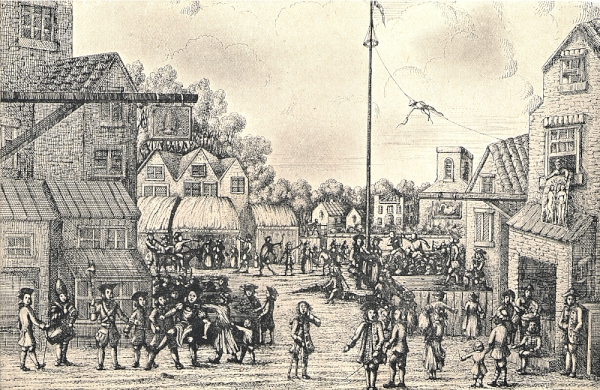
THE MAY FAIR IN 1716.
CHAPTER V.
MAYFAIR.
“Gay mansions with supper-rooms and dancing-rooms—
full
of light and music.”—Carlyle, “Sartor Resartus.”
Compared with London as a whole, Mayfair is quite a
small quarter; but regarded as a congeries of innumerable
streets, and two large squares, it is an extensive and intricate
area, and a summer’s day might well be exhausted before
we had investigated all the twists and turns of its maze-like
complexity.
It is true that its northern half has some sort of method
due to Sir Richard Grosvenor’s development of the great
Westminster property, of which Grosvenor Square is the
key-note; but its southern portion is, with here and there
an exception, wanting in logical form, and threatens, I fear,
to make the perambulation of it somewhat confusing to those
to whom London is a sort of terra incognita.
It will be well to take Grosvenor Square as our starting-point,
but before we set out a word must be said about the
name, which is generic to the whole area. It almost speaks
for itself; and is derived from that “Fair” formerly held
here during the first fortnight in May, and dating from the
time of James II. Unlike our conception of fairs, however,
this one was instituted specifically “for musick, showes,
drinking, gaming, raffling, lotteries, stage-plays, and drolls,”
and appears to have had nothing to do with the traffic and
barter with which we are accustomed to associate these fast
disappearing institutions. Nor was it merely the resort of
the profanum vulgus; the nobility and gentry, we are told,
made a point of frequenting it; and the fields in which it
was held,—for then all this part was occupied by meadows
and open ground—must have presented a gay appearance,
with its booths and shows, surrounded by a brilliantly
dressed throng, brought into still greater prominence by the
more soberly attired crowd which surrounded it.
The “May Fair” continued as a regular institution until
1708, when it was put a stop to, chiefly on account of the
disorders arising from it, and the questionable company
that attended its equally questionable exhibitions; but
partly on account, no doubt, of the erection of houses and
the formation of streets, which began about this time. It,
however, died hard, and was intermittently revived, in
gradually lessening form; prize-fighting, boxing, and bull-baiting
taking the place of “stage-plays and musick,” till
nearly the end of the 18th century, when it ceased altogether
to exist, and left only its name as evidence of its former
vitality.
DAVIES
STREET.
Before entering Grosvenor Square, Davies
Street has a particular interest in that it takes
its name from that Mary Davies, daughter of
Alexander Davies, of Ebury, who married Sir Thomas
Grosvenor, and through whom the bulk of this great
property came into the possession of the Westminster
family.
At its Oxford Street end, Davies Street practically forms
one with South Molton Lane, which at the beginning of the
18th century rejoiced in the not very euphonious designation
of Shug Lane. There is, however, little to delay us here,
unless we have a mind to glance into the modern church of
St. Anselm, designed by Messrs. Balfour and Thackeray
Turner, in the Byzantine style, and opened about eleven
years since. I may, however, remind the reader that “Joe”
Manton, the great gunmaker, carried on business at Nos. 24
and 25; and also that Tom Moore was living in the street,
in 1817.
Turning into Brook Street, let us enter Grosvenor
Square at its north-east corner.
GROSVENOR
SQUARE.
Grosvenor Square is the largest (it is
about six acres in extent) and, in some
respects, the most fashionable of London’s
“quadrates.” It was formed in 1695, by that great
builder Sir Richard Grosvenor, who employed Kent, the
celebrated landscape gardener, to lay out the central
enclosure, in which once stood the statue of George I. by
Van Nost. It was on this spot that the citizens of London,
when setting up those defences against the Royalists, in
1642, on which we found them engaged when we were
wandering in the Green Park, erected an earthwork, known
as Oliver’s Mound, from which we may probably infer the
personal superintendence of the future Protector, or at
least his rapidly growing influence.
As to-day nearly every house in Grosvenor Square is
occupied by some influential or notable individual, so in
the past has, practically, each been the home of an interesting
personality. The great Earl of Chesterfield was living
here in 1733, until he moved to the new mansion he had
erected for himself facing the Park, and here it was that
Johnson was “repulsed from his doors” or “waited in his
outward rooms.” Chesterfield, it will be remembered,
married the daughter (she was then termed the niece) of
that ill-favoured mistress of George I., Melusina de Schulemberg,
created by her royal admirer, Duchess of Kendal, who,
by the bye, also resided in the Square. The Marquis of
Rockingham, once for a short time Prime Minister, died
here in 1782, and Lord North, another Prime Minister,
just ten years later, after he had left his former residence in
Grosvenor Street, where we have already met with him.
Besides these two first ministers of the Crown, politics
have been represented by a number of other well-known
names, from which I can but pick out those of Lord Chancellor
Hardwicke, who was here for half a dozen years;
the Earl of Harrowby, at whose house—formerly No. 39,
but now 44—the Cato Street conspirators hoped to make
a holocaust of the entire Government; Lord Canning, in
1841, and another member of the same gifted family, Lord
Stratford de Redclyffe, who died here in 1880, and whose
effigy may be seen beside that of Lord Canning in the
Abbey. Thomas Raikes, who was called by the wits
“Phœbus Apollo,” because he rose in the east and set in
the west—an allusion to his dual connection with the City
and Mayfair—was one of Grosvenor Square’s past inhabitants
of interest. Raikes is now remembered by his diary, a
valuable record of his times, and his correspondence and
friendship with Wellington, but his brother Robert, the
initiator of Sunday Schools, carved out a name, aere perennius,
for himself, and by its reflected light Thomas is also
partially illuminated. That curious compound of genius
and eccentricity, William Beckford, who wrote “Vathek”
in three days and nights without intermission, and, what is
more, wrote it in French, also lived here, at No. 22. Here
was housed a portion of that extraordinary collection of
pictures, books, furniture, and bric-a-brac which came,
through the marriage of Miss Beckford with the Duke of
Hamilton, into the possession of the latter; and the dispersal
of which, in the eighties, was the sensation of the season,
and crowded Christie’s and Sotheby’s with a wondering and
envying throng.
Beckford used to be visited here by Lord Nelson and Lady
Hamilton, two of the very few people he would ever admit
to view the wonders of Fonthill, his Wiltshire seat, from
the doors of which fairy palace he once repulsed George IV.
himself. Apropos there is a story of a man forcing his way
into Fonthill by some subterfuge, and being entertained en
grand seigneur by the owner. When, however, the hour
for retiring came, Beckford led him to the front door, and
wished him good-night, adding that he had better be careful
of the bloodhounds. The wretched man then realised that
he was alone in a vast Park with no companions but his
host’s formidable guardians, and he is said to have passed
the night in the first tree he could climb.
A story is a story, but this one has carried us many a mile
from Grosvenor Square. One connected with the Square
itself, however, tells how Dr. Johnson once knocked down a
sturdy beggar in its precincts, what time probably the
great Cham of literature was on his way to visit his friends,
the Thrales, who lived here for a time, until the death of
Henry Thrale, in 1781. The town house of the Stanley
family was in this Square till 1832, when they removed to
St. James’s Square, and here Lord Derby married Miss
Farren, in 1797, in the same year in which John Wilkes,
who was then residing at No. 30 (now No. 35), died. Sir
Stamford Raffles, Lord Granville, Lord Shaftesbury, the
philanthropist, and Sir John Beaumont, are among the many
other notable people who have helped to shed lustre upon
Grosvenor Square. The Square has been twice renumbered,
with the exception of the east side, where the owners made
such successful efforts to preserve the original numbering
that even parochial authority gave way before them. Once,
at an earlier day, the inhabitants made an equally strenuous
but less defensible attempt to contest innovation; and it
was not till 1842, credite posteri, that the Square was lighted
with gas, it being the last important place in London to be so
illuminated.
NORTH AND
SOUTH
AUDLEY
STREETS.
At the north-west corner of the Square is
North Audley Street, taking its name from
Hugh Audley, while its continuation at the
south-west, where it finally debouches into
Curzon Street, is known as South Audley Street. Its
most important mansion, one of the most beautiful in London,
is Chesterfield House, facing Hyde Park through Stanhope
Street. It was built by the great Earl of Chesterfield in
1749, Ware being the architect. Although it still preserves
its fine courtyard, its fair proportions at the back, where
its gardens formerly extended down the better part of Curzon
Street, have been greatly curtailed by the erection of houses.
The mansion itself, however, with its wonderful drawing-room,
its library, where Lord Chesterfield lounged or wrote his
celebrated “Letters to his Son,” which Johnson criticised
so pithily and so severely—its marble staircase and Ionic
portico, both of which came from Canons, and gave the Earl
the opportunity for a mild jest about his “canonical pillars,”
still remain. In 1869, Mr. Magniac gave the enormous sum
of £175,000 for the place, and here housed his wonderful
collections; but these have gone the way (Christie’s way)
of all beautiful things, and to-day Lord Burton owns the
place.
But Chesterfield House is not the only fine mansion in
Audley Street, for, at No. 8, is Alington House, now Lord
Alington’s, but formerly known as Cambridge House, where,
in 1826, the Duke of York, brother of George IV. was living.
In another mansion, formerly called Bute House, once
lived during the earlier years of George III.’s reign, and
died in 1792, that Earl of Bute whose unpopularity I have
before mentioned, and whose intimate friendship with the
Princess Dowager of Wales (the widow of “Fritz,” and
mother of George III.) gave rise to so many ill-natured and
probably quite erroneous reports. Home, who wrote the
now forgotten tragedy of “Douglas,” and who was a close
friend of Lord Bute, was living in South Audley Street at the
same time. Home was naturally a gifted man, but was also
one of those who experienced the unhappy fate of being over-eulogized
by an uncritical generation, and Shakespeare’s
fame was deemed to totter before his work. What he is
now probably best remembered by is the famous reply of
Dr. Johnson, to whom one of Home’s admirers quoted with
enthusiasm his line: “Who rules o’er freemen should
himself be free.” “Why, sir,” replied Johnson, “one might
as well say: ‘Who kills fat oxen, should himself be fat!’”
Close to St. Mark’s church in North Audley Street,
lived, at various times, quite a bevy of notable ladies.
Maria Edgeworth was one of these, and Lady Suffolk
another, and Mary and Agnes Berry, before they went to reside
in Curzon Street, where we shall presently meet with
them.
All sorts and conditions of interesting people have resided
in South Audley Street. Regardless of chronology, let me set
down some of their names at random, commencing appropriately
with a great church dignitary, Archbishop Markham,
who died here in 1807; then, there was General Paoli,
the Corsican patriot; Sir William Jones, famous for his learning,
and Westmacott for his perpetuation in stone of many a
learned one; Lord John Russell, Prime Minister, reformer,
author, what you will; and Holcroft, whose name as a dramatist
is forgotten for ever; Queen Caroline, that injudicious but
badly used woman, who, on her arrival from Italy in 1820,
stayed at the house of Wood, who championed her cause;
Baron Bunsen, the clear-sighted diplomatist, and Louis
XVIII., that gastronomic monarch, and his brother,
Charles X., who, under the evil guidance of Prince Polignac,
lost a throne that had cost so many lives and so much money
to recover.
PARK
STREET.
Park Street runs parallel with Audley
Street. Formerly known as Hyde Park
Street, it was one of the later developments
of this part of the town, although it was formed
anterior to 1768, in which year the actress Nelly O’Brien is
stated to have died in it. A very different person also lived
here (in No. 113) at a later day, in the person of that Lydia
White, who, till the end of her life, delighted to gather around
her the lions of the day. One of the last of these to visit her
was Scott, who records in his diary that, on November 13th,
1826, he “found her extended on a couch, frightfully
swelled, unable to stir, rouged, jesting, and dying.” Harness,
writing to Dyce, at an earlier period, tells an anecdote
illustrating her readiness of repartee:—“At one of Miss
Lydia White’s small and most agreeable dinners in Park
Street, the company (most of them, except the hostess,
being Whigs) were discussing in rather a querulous strain
the desperate prospects of their party. ‘Yes,’ said Sydney
Smith, ‘we are in a most deplorable condition; we must do
something to help ourselves; I think we had better sacrifice
a Tory virgin.’ This was pointedly addressed to Lydia
White, who, at once catching and applying the allusion to
Iphigenia, answered, ‘I believe there is nothing the Whigs
would not do to raise the wind.’” This “really clever creature,”
as Sir Walter calls her, died at her house here in 1827.
Sir Humphrey Davy also came to live here, from Grosvenor
Street, in 1825, and remained a resident till his death, two
years after that of Miss Lydia; and Richard Ford, who made
a guide-book to Spain, a permanent work of literary charm,
was another of the street’s past notable inhabitants.
GREEN
STREET.
A few steps southward will bring us to Green
Street, in which stands Hampden House, now
the residence of the Duke of Abercorn.
No. 56 Green Street was formerly known as the “bow-window
house,” and here Miss Farren, who afterwards became
Countess of Derby, once resided, and gave those
suppers to “all the pleasantest people in London,” which
Hume, Walpole, and Lord Berwick have recorded. Sydney
Smith died in Green Street, at Miss Farren’s old house, in
1845, and here it was that he once told his doctor that he
felt so feeble that if anyone were to put a pin into his hand
he would not have strength enough to stick it into a Dissenter!
NORFOLK
STREET.
Between Green Street and Park Lane intervenes
the little Norfolk Street, at a house in
which Lord William Russell was barbarously
done to death by his valet in 1840. Here Lady Hesketh, the
friend of Cowper; Sir James Mackintosh; and, later, Lord
Overstone, the millionaire banker, resided.
UPPER BROOK
STREET.
A little further on is Upper Brook Street,
where once lived Lord George Gordon,
famous for his connection with the anti-Catholic
riots, which, had not George III. acted with
splendid promptitude, might have resulted in a holocaust
of London. Here also resided George Grenville, the statesman
and creator of that marvellous library which is, to-day,
one of the wonders of the British Museum; Mrs. Damer,
the talented friend of Horace Walpole, for whom she executed
the Eagle which once stood in the Tribune at Strawberry
Hill; and Hamilton, of “single speech” fame.
UPPER
GROSVENOR
STREET.
As Upper Brook Street joins the north side
of Grosvenor Square with Park Lane, so
Upper Grosvenor Street leads directly from
its southern side to that latter-day synonym for worldly
riches.
Here lived such notable people as Lord Erskine, the
great lawyer, Sir Robert Peel, and also Lord Crewe, who
appears to have moved hither from Grosvenor Street, or, as
we ought to say, Lower Grosvenor Street. But the chief
feature of the street is Grosvenor House, the well-known
residence of the Duke of Westminster, the fine screen and
gates of which, designed by Candy, were put up in 1842,
and form a curious break in the otherwise unbroken regularity
of the houses. I shall have something to say about
Grosvenor House, when we come to Park Lane; so that now
we need not interrupt our walk, which in a moment will
bring us to Mount Street, taking its name from
“Oliver’s Mound,” formerly in Grosvenor Square.
MOUNT
STREET.
Mount Street dates from about 1740, but
since then it has been wholly rebuilt with
red-brick structures, the majority of which
are now shops, with flats above them, and thus
preserves nothing of its earlier character, when such as Lady
Mary Coke, the compiler of a most valuable and delightful
diary, Fanny Burney (Madame D’Arblay), whose work in
the same direction is, known to all the world, and Sir Henry
Holland, who has also left us his reminiscences, lived in it.
From Mount Street we pass easily, by way of South
Audley Street, to that congeries of thoroughfares, which
lie between Berkeley Square and Park Lane.
ALDFORD
STREET.
If we take those on the east, we shall first
come to Aldford Street, which was known
for a century and a half (until 1886) as
Chapel Street. Much of the street has been rebuilt,
and therefore some of its intrinsic interest has disappeared,
notably the house in which Beau Brummell
once lived, and where he was wont to receive the Prince
Regent at those “petits soupers,” and at those wonderful
ceremonies of the toilet, the details of which Captain
Jesse has recorded with so much gusto. But a greater
than Brummell was once a resident in Aldford Street, for,
at No. 23, the poet Shelley was staying in the same year
(1813) in which we have encountered him in Half Moon
Street. Beyond this solitary celebrity, however, there is
nothing to delay our passing on to South Street, which runs
parallel to Aldford Street in a southerly direction.
SOUTH
STREET.
This street was formed about 1737, and
till nearly the middle of the 18th century,
the chapel attached to the Portuguese
Embassy (formerly at 74, South Audley Street), where
Garrick was married, was situated in it.
Brummell once lived here (at No. 24), and so did, in 1837,
Lord Melbourne (at No. 39), while among other names of
note connected with it mention may be made of Charles
James Fox, Lord and Lady Holland, and John Allen, so
indissolubly connected with the annals of Holland House;
Mademoiselle d’Este, the daughter of the Duke of Sussex;
the Duke of Orleans, better known as Philippe Egalité, and
Miss Florence Nightingale whose name is a household word
in two hemispheres.
DEANERY AND
TILNEY
STREETS.
Deanery Street passes by the side of
Dorchester House (which I must leave for
notice till we reach Park Lane) to Tilney
Street. The former, a small serpentining thoroughfare,
takes its name from the Dean and Chapter of Westminster,
who are the ground-landlords, and to whom Lord
Chesterfield made an amusing reference in his will. It was
first called “Dean and Chapter Street,” and was formed at
the same time as South Street.
Tilney Street is perhaps chiefly remembered as the residence
of Mrs. Fitzherbert, whose house was at the corner
facing Park Lane, the bow windows of which still indicate it.
Here it was that, in June, 1800, after their temporary
separation, Mrs. Fitzherbert and her husband, George, Prince
of Wales, were openly reconciled at a public breakfast, which
“proclaimed to the fashionable world of London that her
relations with the Prince were resumed on the old footing.”
Soame Jenyns also lived in Tilney Street, and died there
in 1787. Forgotten nowadays, he was in his time a prolific
writer, and his style was considered as a model of clearness
and ease. His epigram on Johnson is generally supposed
to have been the only ill-natured thing he ever produced;
here it is:—
“Here lies Sam Johnson. Reader, have a care;
Tread lightly, lest you wake a sleeping bear.
Religious, moral, generous, and humane
He was; but self-sufficient, proud and vain;
Fond of, and overbearing in, dispute;
A Christian and a scholar—but a brute!”
What would Miss Jenkins and Miss Pinkerton have said?
GREAT
STANHOPE
STREET.
At least two Prime Ministers have lived in
Great Stanhope Street—Lord Palmerston,
from 1814 to 1843, before he went to
Piccadilly; and Sir Robert Peel, for five years from
1820; while Lord Brougham is given as residing at No. 4, in
1834, in occupancy of which house he had been preceded,
respectively, by Lords Mansfield and Exeter.
To these may be added the names of two military veterans.
Lord Raglan, in 1853, and Viscount Hardinge, who died at
No. 15, three years later; as well as Colonel Barré, who
lived at No. 12, where he died, in 1802.
Before proceeding into Curzon Street, let us return by way
of South Audley Street, and turn into Waverton Street,
which forms the west side of a species of gridiron of thoroughfares,
of which Farm Street is the north side and
Charles Street the south.
FARM
STREET.
Farm Street is one of the thoroughfares
that took their names from their association
with those agricultural pursuits
which we have nowadays such difficulty in associating
with this fashionable neighbourhood. This
“common pasturage” and the “milk maids” formerly
connected with it, have been recently brought vividly to
mind by the action of the “milk ladies” of St. James’s Park,
the lineal descendants of those of Mayfair, who successfully
resisted an attempt to deprive them of their rights.
A Jesuit Church stands in Farm Street, that of the Immaculate
Conception, which, it is interesting to remember, was
the first regular church possessed by the Jesuits in London
after their expulsion from Somerset House and St. James’s
under Charles I.
JOHN
STREET.
John Street, laid out about 1730, running
at right angles, connects Farm Street with
Hill Street, and also possesses a church;
in this case the well-known Berkeley Chapel, built
about 1750, of which Sydney Smith and, later, Cary,
the translator of Dante, were former incumbents. The
chapel has been twice redecorated, in 1874 and 1895; and,
apart from its associations, is worth a visit, if only to see the
memorial window placed there to the memory of the late
Duke of Clarence.
HILL
STREET.
Hill Street, formed about 1742, probably
takes its name from some inequality of the
ground, more pronounced when all this part
was fields than now when building development has been
responsible for a generally levelling process.
Mrs. Montagu lived in Hill Street, while she was building
for herself the fine mansion in Portman Square, where she
covered the walls with birds’ feathers and “wanton Cupids,”
and once a year entertained the chimney-sweeps of the
district.
Another resident was that Admiral Byng, whose infamous
execution called forth a well-known sarcasm from Voltaire;
while others who lived here in the past were Lord Camden,
the great Lord Chief Justice; Lord Brougham, before
he received his title; the Earl of Malmesbury, whose four
volumes of entertaining memoirs record his diplomatic
experiences and successes at half the courts of Europe; and
Lords Lyttelton and Carlisle, both poets of distinctly minor
attainments. Other names might be added; but to be
exhaustive would be to hamper the wings of imagination.
HAYES
STREET.
Passing by Hayes Street, now used as mews
by the exigencies of fashion, and where, at
the corner, a public-house with its sign
bearing the inscription, “I am the only running
Footman,” will recall to our minds this former appendage
to fashionable state, of which “Old Q.” was the last to make
use, we come to Charles Street, thus named after Charles,
Earl of Falmouth, a brother of Lord Berkeley, the ground-landlord.
CHARLES
STREET.
This is the last of what I call “the gridiron,”
and is generally known as Charles
Street, Berkeley Square, from its entering
the square at its south-west corner.
Royalty in the person of William IV., when Duke of
Clarence, has been represented in this street; while Sydney
Smith, when he was incumbent of Berkeley Chapel close
by, was residing here, at No. 33, the house in which
the daughter of Lord Hervey was burnt to death,
in 1815. It was about the purchase of this house that
Smith once wrote “the lawyers discovered some flaw
in the title about the time of the Norman Conquest,
but, thinking the parties must have disappeared in
the quarrels of York and Lancaster, I waived the objection!”
Among other residents I find the names of Lord Ellenborough,
once Governor-General of India; Beau Brummell,
at No. 42, in 1792; Lady Grenville, after the death of her
husband, the Prime Minister; and Bulwer Lytton. The
latter, in 1839, fitted up his house in a most lavish style,
and one of the rooms was made to represent, as closely as
might be, one of the chambers in Pompeii. James
Smith, one of the authors of the “Rejected Addresses,”
has left an amusing account of a visit he once paid
here.
CURZON
STREET.
A few steps brings us into Curzon Street.
It is curious to notice the difference between
the two ends of this fashionable thoroughfare,
or rather it was till the Duke of Marlborough set
up his splendid mansion amidst the small shops and
public-houses which distinguish the eastern part, where
Bolton, Clarges, and Half Moon Streets dwindle away into
it, and Lansdowne Passage forms an exiguous connection
between it and Berkeley Street.
Once the street was known as Mayfair Row; its present
designation being derived from the family name of Lord
Howe, the owner of the property. If we except Sunderland
House, the Duke of Marlborough’s, (apropos of which the
story is told that Queen Victoria once informed the Duke
she had never been in Curzon Street, so prescribed are
frequently the peregrinations of sovereigns) the chief
mansion is Crewe House, the residence of the Earl of Crewe.
Until comparatively recently it was known as Wharncliffe
House, having been acquired by Mr. J. Stuart Wortley for
£12,000, in 1818, and continuing in his family (later ennobled
by the Barony of Wharncliffe) till its present owner bought
it at a very different figure. Originally, in 1708, Mr. Edward
Shepherd, who built Shepherd’s Market opposite, in 1735,
lived here; and, in 1750, it was purchased by Lord Carhampton
for £500, if one can possibly believe in the adequacy
of so small a sum to buy anything in such a neighbourhood!
So many illustrious people have lived and died in Curzon
Street that pages might easily be filled with their names;
but a few must here suffice, and appropriately, as living once at
No. 1, since demolished, I find that great actress, Madame
Vestris; and at No. 8, the celebrated Miss Berrys, who both
died here in 1852, and lie buried in Petersham churchyard.
Their house was once taken by Baron Bunsen, who records
moving into it in 1841. Sir Henry Holford, the surgeon,
who was one of those who gazed on the actual features of
Charles I. when that monarch’s coffin was opened, and who
left an interesting account of the circumstance, died at a
house in Curzon Street, in 1844; and at No. 19, Benjamin
Disraeli, Earl of Beaconsfield, drew his last breath, in 1882.
Other residents whose names may be set down were Lord
Marchmont, the friend of Pope; Mason, the poet; and
Francis Chantry, the sculptor, long before he became famous;
Lord Macartney, whose mission to China is to be found
recorded in a bulky volume, and who, according to Walpole,
occupied here a “charming house—cheap as old clothes,”
which once belonged to Lord Carteret.
Opposite Crewe House stands Curzon Chapel, or, as it is
as often called, Mayfair Chapel. The original structure
dated from 1730, but it was subsequently rebuilt, although
it is so plain and ugly that it could not possibly have been
improved by the process.
The chapel is notorious for those illegal marriages conducted
by the Rev. Alexander Keith, until the scandal was
put an end to here by his being unfrocked in 1742. But
this action on the part of a justly incensed church did not
deter him from carrying on the same practices at another
chapel, which he inaugurated close by. What the Church
was unable to do, the Law effected, and the subsequent
passing of the Marriage Act, in 1754, finally put a stop to
Mr. Keith’s illicit activity. It is said that when told that
the Bishops would stop his illegal marriages, he replied,
“Let them; and I’ll buy two or three acres of ground, and
by God, I’ll under-bury them all!”
Of those who took advantage of this short cut to wedlock
were the Duke of Chandos, who was married (if the word can
be permitted in such a connection) to Mrs. Anne Jeffrey, in
1744; Lord Strange and Lucy Smith, two years later;
Lord Kensington and Rachel Hill, in 1749; and Lord George
Bentinck and Mary Davies, in 1753.
The year before this last match, occurred the best-remembered
of these “splicings,” when the Duke of Hamilton was
wedded at half-past twelve o’clock at night to the beautiful
Elizabeth Gunning, who lived to be the wife of two and the
mother of four dukes. Horace Walpole has left a vivid
account of the ceremony, in which a ring torn
from a curtain replaced that circlet of gold which is
recognised as the more usual type of matrimonial
bondage.
HERTFORD
AND CHESTERFIELD
STREETS.
Hertford Street, formed about 1764, now
almost rivals Wimpole Street in the numbers
of the medical profession who reside
in it; but at an earlier day it was the home
of politicians, with here and there a soldier, and here and
there a poet; while it was in a house here that the Duke
of Cumberland, brother of George III., was married to Mrs.
Horton, in 1771.
Sheridan had one of his many residences here, at No. 10,
in 1793, and Lord Charlemont, whose wife’s name continues
(in booksellers’ catalogues) to be erroneously connected
with a notorious translation of Voltaire’s “Pucelle,”
was living in the street in 1766. So, too, were Lord Goderich,
and the Earl of Mornington, some years later; and, in
1792, died here General Burgoyne, whose surrender to the
American forces at Saratoga precipitated that independence
which the United States soon after obtained.
The first Earl of Liverpool, father of the Prime Minister,
died here in 1808; and Earl Grey was living in this street in
1799; while other politicians who have been former residents
were Robert Dundas and Charles Bathurst, Lord Langdale
and Bulwer Lytton, the last of whom lived at No. 36 from
1831 to 1834, and here wrote “Paul Clifford,” “The Last
Days of Pompeii,” “Rienzi,” “Alice,” and “Ernest Maltravers.”
Lord Sandwich, the well-known “Jemmy
Twitcher,” died at No. 11, in 1792, and “Capability
Brown,” the great landscape gardener, at another house here,
nine years earlier. But perhaps the street’s chief claim to
remembrance is the fact that Edward Jenner resided at
No. 14, for some years, from about the beginning of
1803. Contrary to expectation, his fees fell off on his setting
up here, and, together with the excessive rent he was obliged
to pay, and the additional expenses of London life, he found
it impossible to continue to reside here. A tablet now
marks the house where this benefactor to the human race
once fought his double fight against disease and poverty!
Chesterfield Street joins Chesterfield Gardens, which
stand on the site of the once ample grounds of Chesterfield
House. George Selwyn dates many of his letters from one
of the houses in this street; while Beau Brummell was
residing in another, No. 4, till 1810, and here he was visited
often enough by the Prince of Wales, who sometimes
remained so late that he was compelled, says Jesse, to insist
on Brummell giving him a quiet dinner, which not uncommonly
ended in a midnight debauch.
PARK LANE.
Park Lane stands alone among the streets
of London. In that it has only one side,
and looks directly into one of London’s
Parks, it might at first seem to have some analogy
to the western end of Piccadilly; but Piccadilly is made
up of clubs, with here and there a business establishment
and—except at Hyde Park Corner itself—private houses but
sparsely scattered down it; whereas Park Lane practically
consists of the mansions of the wealthy. So much so is this
the case, indeed, that it has latterly become synonymous
with worldly riches, and is now the objective at which
Socialistic and democratic stump orators level their sarcasms
from their convenient vantage ground within the
park railings; what time the law in helmet and
white gloves smiles tolerantly, and the plutocrats
lunch unmoved.
It will be well to start from its northern end, where it joins
Oxford Street, or the Tyburn Road, as it was once called,
for Park Lane used formerly to be known as Tyburn Lane,
and close by the Marble Arch—permanently at rest after its
journey from the front of Buckingham Palace—was Tyburn
Tree, where the end of innumerable malefactors drew crowds
of excited and unseemly witnesses.
It is somewhat anomalous that this “glass of fashion”
among streets should have been, so comparatively recently
as 1769, connected with such gruesome associations; but it
is also equally difficult to imagine it as the dreary, unkept
by-way which it was during the Augustan age, when millionaires
were not; and the petrol of the motor was not smelt
in the road.
GREAT
HOUSES OF
PARK LANE.
The first of the great mansions we come to is
Brook House, which stands at the corner of
Upper Brook Street. It was designed by
Wyatt, and was for many years the residence of
Lord Tweedmouth, and noted for the receptions held here,
when the Liberal Party indulged in its revels.
A step and we come to Dudley House, built by the late
Lord Dudley, and once the casket that contained many of
those wonders of art which this most princely of peers loved
to gather around him.
At the corner of Upper Grosvenor Street stands a sort of
magnificent temple dedicated to music and the fine arts.
This is the concert or ballroom which the late Duke of Westminster,
apparently regardless of architectural symmetry,
added to Grosvenor House, which is seen behind it. It
reminds me of nothing so much as a beautiful pearl which has
succeeded in emerging from the parent shell, but not wholly
detaching itself from the parental ligaments.
As we have seen, the entrance to Grosvenor House is in
Park Street; but I said nothing about the mansion then,
because it seems to belong, as does its vast garden extending
to Mount Street, to Park Lane. The residence, which
was known as Gloucester House, at the time when the Duke
of Gloucester, brother of George III., acquired it in 1761, is,
of course, one of the great, as differentiated from merely
large, houses of London, and it contains a collection of
pictures and works of art which a millionaire would have
to exhaust his fortune in purchasing, and which could
only be adequately described by a Waagen or a Smith.
Just beyond South Street stands what I suppose few
people, having regard to both its exterior and interior, will
deny to be the finest private residence in London—Dorchester
House, which was erected by Vulliamy, in the
Italian Renaissance style, for the late Mr. Holford. Surrounded
as it is by every conceivable kind of architectural experiment,
it may be deemed out of place; but, taken by itself, it is a
perfect reproduction on a lavish scale of those Italian palaces
to which the blue sky of the South forms the one necessary
background. The interior is commensurate, both in size and
detail, with its commanding exterior, and only the pen of
the late Mlle. de la Ramée (“Ouida”) could do justice to
the marble staircase. The art collection housed here is extraordinarily
fine, while the yearly exhibitions of Old
Masters at Burlington House are seldom without one or
more examples from among the masterpieces which hang
on the walls of Dorchester House.
It has frequently been let, sometimes as when the Shahzada
was there, for a short period; sometimes, as now, when
it has become the residence of the Hon. Whitelaw Reid, the
United States Ambassador, for a term of years. Its perfection
of taste and its rare and beautiful contents remind me
that, appropriately enough, the Marquis of Hertford, whose
name is indissolubly associated with such things, died here
in 1842.
At the south corner of Stanhope Street we come to the
last of the great houses of Park Lane—Londonderry House,
now the residence of the Marquis of Londonderry, but
formerly known as Holdernesse House, it having been erected
by the Wyatts in 1850, on the site of the former town house
of the Earls of Holdernesse.
Next door to Londonderry House is quite a small house
of somewhat elaborate design. This was built on the site
of another residence, by Mr. Whittaker Wright, whose name
is remembered in connection with a notorious trial a few
years since, and who, “immemor sepulcri,” as Horace says,
built a house which he was never destined to enjoy, somewhat
as in earlier days Baron Grant erected a palace in
Kensington which was demolished before it was occupied.
At this point Park Lane splits itself into two thoroughfares,
the smaller being Park Lane proper, and by its tenuity
giving some raison d’étre for its designation, the latter being
known as Hamilton Place, which takes its name from that
Hamilton who was Ranger of Hyde Park during the reign of
Charles II., and who erected a number of small houses here
in what was then but a cul de sac, on ground which formed
an integral part of the park itself.
HAMILTON
PLACE.
The houses in this street were rebuilt by
Adam in 1809, but it was not till about sixty
years later that the street was carried
through to Park Lane, and became its chief outlet into
Piccadilly.
The mansion (No. 1) at the corner of Piccadilly was built
by Lord Chancellor Eldon when he left Bedford Square, and
here he died in 1838. Next door was occupied, from 1810
to 1819, by the Duke of Bedford, who moved here from
Great Stanhope Street; while later residents include Earl
Gower, afterwards Duke of Sutherland, the Right Hon.
Thomas Grenville, and the Duke of Argyll.
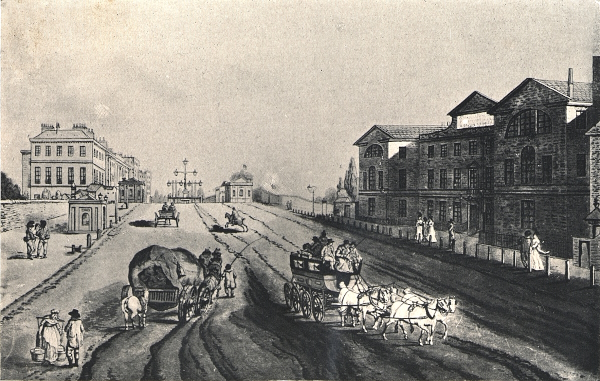
THE ENTRANCE TO PICCADILLY AT HYDE PARK CORNER, WITH ST. GEORGE’S HOSPITAL.
At No. 4, the great Duke of Wellington was living in 1814,
while yet Apsley House was in the occupation of his brother,
the Marquis Wellesley. Others who have lived here include
the Earl of Lucan, in 1810, and Lord Grenville, twelve years
later. In our own day it has been the town residence of the
Earl of Northbrook, the head of the Baring family and some
time Governor-General of India.
Mr. Leopold de Rothschild’s beautiful house (No. 5), which
looks directly on to the park and has a view up Park Lane, was,
from 1810 to 1825, the residence of the Earl of Buckinghamshire,
and many years later, of the Marquis Conyngham.
One of London’s rare if not always beautiful statues stands
at the junction of Park Lane and Hamilton Place. Utility
has been combined with decoration in this case, for it also
forms a fountain, presided over by the Muses of Tragedy,
Comedy, and History—not Farce, as might have been
expected, unless there be some subtly ironical meaning hidden
in the otherwise illogical collocation. Above stand, in
evident wonderment, Chaucer, Shakespeare, and Milton, in
marble, and on the summit Fame puffs industriously at her
trumpet. Thornycroft was responsible for this work, which
was erected in 1875, at the cost of £5,000, the money being
provided from the estate of an old lady who died intestate
and without heirs.
Before we finally quit Park Lane one or two of its former
interesting residents must receive a short word of notice.
Thus, at the corner of Upper Grosvenor Street—at that time
known as No. 1, Grosvenor Gate—Disraeli was living, from
1839 till 1873; and friend and brother novelist and
politician, Sir Edward Bulwer Lytton, was residing in 1842
at what was known as No. 1 Park Lane, during which period
“Zanoni” was published.
The names of Warren Hastings, Richard Sharp, and Lady
Palmerston are also connected, cum multis aliis, with this
famed street; and in one of those houses which look on to
the Lane, but which have their entrances in other streets—in
this case Seamore Place—lived the gorgeous Lady Blessington
(1832-6), after her departure from St. James’s Square
and before her final apotheosis in Kensington Gore. The
white-painted semi-circular front of her former residence
at the corner of Pitt’s Head Mews, may still be seen; and it
will not take a great stretch of the imagination to picture
that beautiful and talented woman surrounded by all that
extravagance and luxury could suggest, sitting upon its
balcony, and penning those short stories, or editing those
wonderful “books of beauty,” which formed the fashionable
literary pabulum of early Victorian days.
Within a radius of half a mile from Stewart’s corner of
Old Bond Street we have traversed that part of the
town which is associated pre-eminently with the fashionable,
and in a lesser degree with the literary and artistic, traditions
of two centuries of London life. Compared with the
innumerable memories which its stones evoke, the area
covered is a relatively small one, but had space here been
less restricted, one might have gone on wandering over
acres of paper while setting down the names of persons and
places, and lingering over the stories and anecdotes with
which they are connected.