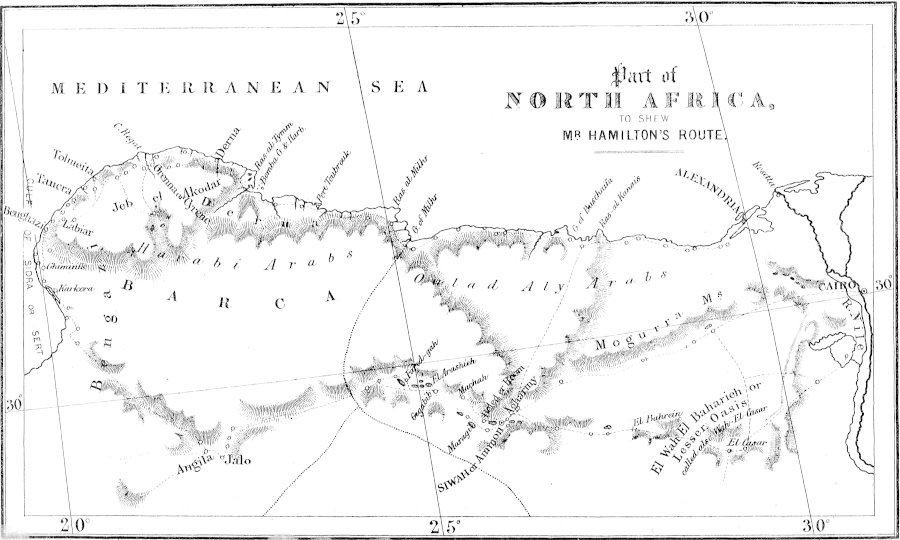
Encampment at Siwah. — Conference with the Sheikhs.
— Refuse to quit Siwah. — Attack on the tents. — Detained at Siwah.
— Incidents while Imprisoned. — Defensive Preparations. — A South
Wind blows Good Luck. — Manners, &c., of the People. — Their
Appearance and Dress. — An Industrious Race.
It was soon perfectly
night; the ground seemed to be cut up with ditches, and it was only
by keeping close to my guide, as he trotted along on his donkey,
that I could make out the road. After about half an hour, the guide
jumping off his donkey, said to me, “Now you are going up hill,”
and before I knew what I was doing, unable to see an inch before me
in the darkness, I found my horse clambering up what seemed to be
the face of a precipice; in about five minutes more, I found myself
riding among walls; presently, my guide stopping, began to call
out, “Yusuf! Yusuf!” and thus I found that instead of taking me to
my tent, he had brought me to the sheikh’s. After some delay a door
was opened; and a longer time elapsed before a flaring palm-branch
was brought to light me; and then I was conducted, through all sorts
of tortuous passages to a small room, where the sheikh and two
young men were seated on mats, before a blazing fire of olive wood.
He received me very cordially, told me that my tents were ready,
and that whatever I required I should get through him. I thanked
him and accepted his offers, giving him at the same time to
understand, that I would take nothing as a present, and that all I
required should be paid for. He said that the servant I had sent to
him had already told him this.
These preliminaries being settled, there was a pause, which he
broke after looking steadily at my head for some time, by saying,
“Where’s your hat?” I thought I had misunderstood, and begged he
would favour me by repeating his remark. He gravely reiterated,
“Where’s your hat?” After the hearty fit of laughter which so droll
a question as this seemed to me produced, I told him that, for the
moment, I did not keep such an elegant luxury in my establishment;
but this seemed to puzzle him sorely, for a hat was evidently, in
his eyes, one of the chief articles of the Christian faith. “Have
you brandy, wine, rosolio, tea?” I began to think that he was
making a mental inventory of the good things he meant to ask for,
though I afterwards found it was mere curiosity to find out whether
I was as abundantly supplied with these good things, as were my last
predecessors at Siwah.
This cross-examination began to tire me, so I took leave of him;
but before I retired he invited me to return in the morning,
promising then to provide me with a guide to see all the
curiosities of Siwah. I promised to come early, but explained that
by early I did not mean early as he understood it, for, when not
travelling, I do not rise till two hours after the sun. “Oh!” he
answered, “drunk with araki;” meaning, that I lay in bed to sleep
off the effects of the intemperance he gave me credit for; when I
assured him that I had never in my life been drunk. “Do you, then,
never drink wine or araki?” seemed to be the only solution for the
wonder which his experience could suggest. We parted very good
friends, and I proceeded to my tent. The night was still too dark
for anything but the fires to be visible, and it was only the next
morning that I obtained an idea of our position.
I was encamped on a very wide plain to the south of the town; to
the right was an extensive palm grove with a few clumps in front of
the principal plantation, the nearest about a hundred yards off;
behind and to the left rose some limestone rocks, and near them a
square building, the castle, in which a garrison was formerly
lodged. In front, the town rose like a lofty fortress, built on a conical rock,
entirely concealed by the houses, which, joining one another, seem
to form a single many-storied edifice. To the west of this, another
rock or gara, quarried with numerous caverns, rises to a
considerable height; on one side of the rock, and in the space
between it and the town proper, houses, in the ordinary style of
mud architecture, are built.
It was here that Yusuf’s house, the largest in the place, was
built, leaning against the hill, and I now proceeded there to
obtain the guide he had promised me. I was received in a room open
to the street, in which a large crowd was assembled. Yusuf
immediately began, in a tone very different to that of the
preceding evening, to tell me the old story: that the people did
not choose that I should enter their town, or see their wells,
which my incantations might dry up, and that they insisted upon my
immediate departure. In the room, seated round the walls, were
several stupid-looking men, who, he told me, were the sheikhs of
the place, over whom he had no authority—his influence being
confined to that part of the rock which he inhabited, since his
deposition some years before. He tried hard to render the decision
of the town council (the Mejlis) palatable to me by frequent
assurances, that the Siwyah have no sense. “No sense! no sense!” he
shouted into my ears, as if I had been deaf. “They must learn sense, or buy
it,” was my answer, “for since I am come here, you cannot treat me
in this way; it is contrary to the rights of hospitality and the
laws of your country. I am an Englishman. There is my passport, the
English sultan’s firman, better than ’Abd el Mejid’s or any other
in the world, more respected by Abbas Pacha and ’Abd el Mejid
himself than their own. I ask to enter no man’s house. I shall not
run away with your wives, nor eat your children; but I have a right
to go by every public path; to see all I want to see of the old
ruins in your country; and if you, the sheikhs, prevent me, you
must be prepared to take the consequences; and if any one insults
or molests me, he has only himself to blame for what may happen to
him.”
I had gone unarmed, but I now sent down to my tent for a pair of
revolvers, and after making Yusuf admire their construction, I had
them placed in the holsters of my saddle. “You ask me what is my
business here? I am a traveller from the west going to Cairo,
through the Sultan’s and Pacha’s dominions; you are their subjects.
Your own laws, the laws of Islam, give me full right to travel in
your country; the treaties with the Sultan guarantee me protection;
you are responsible to the Pacha, and he must answer to my country
for anything that befals me here.” I now mounted my horse and was
riding away, when the Mufti arrived, and I returned, at Yusuf’s
earnest request, to explain myself to him. He was an irresolute,
shuffling old man, apparently afraid to speak above a whisper, but
unable to deny the truth of what I said. Yusuf then returned to the
charge with shouts of “No sense! no sense!” in which he was joined
by all the sheikhs, who pretended to lament the ignorance and
stupidity of their rayahs, while the Mufti seemed very anxious to
get me into a religious discussion, which I was not foolish enough
to engage in. By this time the room was pretty full, all the great
men of the place, excepting two of the sheikhs and the Cadi, who
had refused to pollute their eyes with the sight of the Christian,
being assembled there. The street also in front was crowded with
the curious, who stared as if they never could see enough of me;
but they did not interrupt the discussion.
Seeing that the plea of stupidity did not turn me from my point,
they now changed their tone; and one of them, whose insolent air
had from the first been very offensive, gave me to understand that
I could not be allowed to defile their blessed country with my
presence, and that the best thing I could do would be to return
quietly to my tent, shut myself up there, and get camels as quickly
as possible to pursue my journey. “Four hawajahs came here from
Alexandria some years ago, we fired upon them, after
forbidding our
people to have any intercourse with them, and they went away next
morning, vowing vengeance indeed, but nothing came of it.” “I am
not a hawajah, and I do not mean to run away;” then, turning to the
Mufti, I added, “nor will there, I am sure, be any reason for me to
do so. I only want to see the old ruins of your country, and then,
without having done injury to any one, I shall pursue my journey.”
So we bandied about the same arguments for at least three hours,
when at last it was agreed that before going to Omen Beydah I
should wait till midday next day to give them time to persuade
their people not to molest me; and that my time might not be lost,
Yusuf was to send me in the morning a man to accompany me to a hot
well near the high hill, which lies to the south of the town. I had
now no doubt that I had carried my point, and returned to dine in
great spirits, persuaded that I had vanquished the opposition,
trusting to the well-known timidity and gentleness of the Egyptian
Fellah, and the activity Mehemet Ali had always displayed in
punishing violence offered to travellers. I found my cook, a black,
whom I had brought with me from Dernah, in a terrible fright, for
some of the people had told him, when he went into the town to buy
some provisions, that they were coming to rob me during the night.
I laughed at his fears, quoting to him the saying, ‘Forewarned,
forearmed.’
After dinner, I
was smoking my chibouque and marking in my note-book the little I
had observed or heard during the day, when three shots were fired,
the balls passing with a loud whistling through my tent just over
my head. At first I thought little of the incident, believing that
it was a rough joke meant to frighten me; so I merely looked at my
watch and noted the circumstance in my note-book. It was perfectly
dark, and from the door of my tent nothing was visible, nor should
I have thought more of it but for the violent barking of my dog,
which showed that it heard people, who were invisible to me. I sent
a servant, therefore, to Yusuf’s to acquaint him with what had
passed, and soon after he was gone, the firing recommenced. I now
began to think the affair more serious than I had supposed; I heard
one gun hang fire close to my tent, and, turning, saw its muzzle
pressed against the wall of the tent on the shadow of my head; I
therefore had all the lights put out, and went cautiously out to
get a view of my assailants. The night was so black that this was
impossible, but it also favoured my evasion; after counting eleven
volleys, which gave me grounds to suspect that there was a numerous
body of men in the date-trees to the right, I, with my servant,
went up to the sheikh Yusuf’s house, abandoning the tents to their
fate. Moving cautiously across the plain, which separated us
from the town, and
climbing the steep street which led to his house, we could still
see the fire of the enemy’s guns, and the more frequent flashes in
the pan, to which we probably owed our escape.
The servant whom I had sent there had returned, saying that he
could not make himself heard at Yusuf’s, but when we reached the
door a vigorous application of the butt-end of my rifle roused him;
having admitted me, I told him what had happened, adding, that I
should stay with him till morning. He immediately sent some of his
people to protect the tents, which they found had not been entered,
though there were seven shots in the one in which I had passed the
day, and one shot had passed immediately over the place where I was
reclining when the attack commenced; had I been sitting up instead
of lounging, it could not have missed me. By one of those strange
chances which one feels to be providential, I had just after sunset
ordered a larger tent to be pitched, in which to dine and sleep; I
had been all the morning in a small umbrella one, at which the
shots were principally aimed, and to this circumstance must my
escape be ascribed.
I spent the night in Yusuf’s house, and the next day he gave me
a small one, containing three rooms, opposite his own, in which to
stay as long as might be necessary. One of these rooms was built
on the roof, with a sort of terrace before it; we were standing
upon this, after viewing my intended abode, when our attention was
attracted to a large body of, perhaps, four or five hundred men,
most of them armed, who were in march with a flag, and several
camels against my tents. The rumour had been spread in the town
that the Christian was not dead, and the entire male population of
the Lifayah had gone against him, with camels to carry off the
spoil. They found the tents closed, and no appearance of any one
near them, but they thought I and my Frank servant were inside. It
was long before they ventured to approach, for the camel men, who
had come with me from Augila, had given a wonderful description of
the number and power of my arms; at last, some bolder than the
rest, went up and tore aside the curtain of the umbrella tent in
which I was supposed to be. Meanwhile, Yusuf had sent for some of
the sheikhs, and assuring them that anything stolen would have to
be replaced ten-fold by the town, he induced them to go to the
rescue of my baggage. This they succeeded in effecting, and
returned in a few hours to tell me that everything was safe, and to
ask for a certificate to that effect. I refused to take their word
for it, and at their urgent solicitation, accompanied by them,
I rode down to the
plain, which was now quite solitary. Everything was in strange
confusion, but nothing had been taken away.
Seeing the turn things had taken, I now determined to continue
my journey at once, promising myself to return to Siwah with an
escort from the Viceroy, as soon as I should arrive in Egypt. But
if the Sewiyah had given me so warm a reception, they had no wish
to lose the advantage of my company; and, therefore, by threats
prevented any of the Arabs, of whom great numbers were now in
Siwah, from hiring me camels. I then proposed to Yusuf to leave my
baggage in his charge, if he would procure me a sufficient number
of donkeys to mount my servants, and carry a few skins of water and
provisions; but he declared that, without camels, it was impossible
to cross the desert, and that if I attempted to get away at the
present moment, the people would follow and massacre my servants
and myself on the road. I waited, therefore, a day or two to see
what would turn up, nothing doubting that rather than keep the
Christian in their town, these zealous Moslemin would in a day or
two come to terms. In fact, on the third day of my imprisonment,
three of the sheikhs came and offered me camels to go away with,
but just before this the Mufti had sent privately to warn me, that
if I accepted the
offer, my caravan would be waylaid a few hours out of the
oasis.
I now wrote to Her Majesty’s Consul-General in Cairo,
acquainting him with the position I was in, and requesting
assistance, and Yusuf dispatched my letter by one of his slaves,
who was familiar with the country he had to traverse. I had
previously endeavoured to persuade a Bedawy to be my messenger, but
after bargaining for an exorbitant remuneration, he lost courage
and refused to take it. When, however, on the second day
afterwards, he missed the slave, he did not doubt I had sent him to
Cairo; and now, regretting the money he might have gained, he
revenged himself by telling the people that I had sent to bring
soldiers. On this the Mejlis assembled to deliberate; their first
proceeding was to come to Yusuf, to ask if it were true that I had
written to his Highness. He answered that he could tell them
nothing about it, and that they had better apply to me. The three
who had rescued the baggage, now, therefore, presented themselves,
and at Yusuf’s request I admitted them. In answer to their
questions I said that I was no way bound to satisfy their
curiosity, but that being a good-natured fellow, and my messenger
by this time a long way on his road, I consented to gratify them. I
had, indeed, written to tell how I had been attacked, and how I was imprisoned by
them in Sheikh Yusuf’s house, and that I had added, I should now
stay there till an answer was sent to me.
For the first fortnight that I was shut up in the cabin Yusuf
had given me, though unable to stir out, I found the time passed
quickly enough, as, besides that Yusuf and the people of his clan
came often to see me (so that my house was generally full), there
was every day something exciting, which afforded amusement. One
evening, for instance, some shots were fired into my house,
probably by way of keeping me on the qui vive rather than
with any murderous intention; another day, the whole of the Lifayah
assembled in arms, at the small village called the Manshieh,
determined at night to march upon my house, and so end the matter.
They were resolved to get rid of the Christian; and to encourage
themselves in their warlike resolutions, many of them bound
themselves “by the divorce,” to exterminate him, and the big
war-drum was put out into the sun to stretch the skin, and give it
a terror-inspiring tone. Next, a deputation of the sheikhs came to
me to offer peace and friendship, if I would only go away and tell
the Pacha that I had nothing to complain of. I explained to them
with infinite suavity, that this was out of the question. How could
I say that I had nothing to complain of? beside this, my letter
must be already in
Cairo, and having said in it that I should wait for an answer, I
could not, of course, go away till it came. I also reminded them of
their own frequent protestations, that they had no authority over
the people, and asked what security they could offer me that I
should not be attacked, as once intended, on the journey.
Negotiation proving ineffectual, they tried a new dodge. Yusuf was
cited before the Mejlis to answer for harbouring a Christian, and
men were posted in the narrow dark streets of the town to kill him
as he went, but the Mufti again sent him warning of the plot, which
Yusuf the more readily gave credence to, as his father had been
killed in this way.
Then again a fresh attack with arms was planned for the evening,
and this seemed so menacing that Yusuf put garrisons into the
largest houses in my neighbourhood, and came himself, with ten men,
to aid in defending mine. I was luckily well provided with arms,
and disposed everything to make what would probably have been a
successful resistance. At the advice of one of the principal men of
the place, and to prevent the chance of firing on our own friends
in the dark, the garrison was withdrawn from the surrounding
houses; their presence there, in case of a melée, would, I
confess, have been more alarming to me than the attack from below,
and being marched to the foot of the Garah, with much screaming but
fortunately no
bloodshed, they repulsed the Lifayah, who turned backwards when
they found preparations made to receive them. After this night
there was a regular patrol established in this part of the
town.
One evening, just before sunset, when seated with Yusuf on the
roof of my dwelling, four men, with guns, were seen on the rock
which overhangs the house. They were observed just as they were
creeping round a corner, by a servant who was bringing a chibouque,
our backs being turned to them; a cry was immediately raised,
people were dispatched to arrest them, and two were secured, the
others escaping. Yusuf had no power to do anything with them, he
being, in fact, as much a prisoner as myself; and was fain to
accept their explanation, that they had come to shoot crows, in
order to obtain their galls, with which to anoint the eyes of some
one who had an ophthalmia.
Other trivial annoyances, many of them so childish as to be
merely amusing, were with great ingenuity resorted to. The little
children used to assemble round my house, calling out, “Oh, Consul,
there is no God but God!” and singing songs which I suspect were
not altogether complimentary. Nosrani and Consul were the names I
was known by among the people when they spoke of me to one another.
I had declined the latter title, to which I had no
pretension; and
would not be called Hawadjah, which is the polite name generally
given to Franks in Egypt, even by the Government, in its
correspondence with the foreign Consuls, and which means a small
trader or pedlar; Yusuf, therefore, gave me the title of El Senhor,
which I have retained to this day. The people were forbidden to
sell me anything, and it was with no small difficulty that Yusuf
procured for me the very meagre fare with which I was fain to be
satisfied; a couple of tame fowls, some rice or lentils, butter and
dates, were the provision for four persons; and this scanty supply
cost, on an average, more than a guinea a-day. One of the wealthier
people sold me a goose one day, for which he was cited before the
Mejlis, and beaten, though his brother was one of the sheikhs.
Time wore on, and the twentieth day, on which I expected an
answer to my letter would arrive, had come and gone. Some Arabs
from the west brought a report that the Viceroy had been murdered,
and some of the sheikhs did not fail to come to me the next day to
see how I took the news. Of course, I made light of it, telling
them that if Abbas were dead, Said would be Viceroy, and that the
English Government, which does not die, would take as good care of
me under the one as under the other. When, however, a second report
to the same effect arrived, a few days afterwards, I acknowledge that I felt
less unconcern than I cared to show, for such an event, if true,
would have probably prolonged my detention, if it did not endanger
my life and that of my protector Yusuf, and my servants.
The time which I had calculated would bring an answer to my
letters (for I had found means to send a second letter on the
chance of the first having miscarried) had long past; and I had no
easy task to keep Yusuf and his friends in good spirits. They were
becoming very uneasy, for they had committed themselves both to the
Egyptian government and the Sewiyah; the first would render them
responsible for my safety, the second would never forgive the
protection afforded to the Christian. At length, one day, a hot
south wind arose, and blew with great violence during that and the
three following days; hereon a hundred and forty of the men, who
felt themselves most guilty, left Siwah for the Arab encampments on
the Okbah; for now they believed, most of them for the first time,
that something would come of my complaint, as a hot south wind in
Siwah, such as this, is regarded by them as the unfailing signal of
some coming calamity. One is almost tempted to think they must be a
remnant of the Psylli, who had escaped the general destruction of
their nation, and still dread their old enemy. Yusuf’s adjurations
and threats had had
no effect in persuading them that they would rue their inhospitable
conduct to a stranger, but this day of hot wind convinced them that
what he said was true.
From this time forward there were constant applications from the
sheikhs and principal people of the Lifayah, to see the Nosrani;
and those whom I admitted, came to protest that they had taken no
part in anything that had befallen me, charitably throwing the
blame on the others. Each, in fact, was the only innocent man in
the place; and all felt the tenderest affection for my person. Such
evidences of esteem and consideration were, of course, most
gratifying to my feelings, and made me the more regret that they
had put it out of my power to be serviceable to them; having
applied to the English Consul-General, and he, of course, to the
Viceroy, any decision in the matter now depended, not on me, but on
them.
Such scenes were not, however, my only amusements. During the
day I picked up some scraps of information about the manners and
superstitions of the country from my various visitors. From a
Fezyan Fikhi I got some quaint lessons in theological lore; and
from a Moghrabi treasure-seeker I heard a good deal of the
excavations which he had at different times made, not, however, to
seek the antiquities which he seems to have found, but the hidden
wealth, which,
judging from his appearance, I should say had escaped him. Every
evening after dinner, Sheikh Yusuf and a dozen of his friends used
to come, and sit with me for two or three hours. Their favourite
conversation turned upon the wickedness of the Lifayah, whom they
seemed to regard as the greatest monsters in the world; my guests
would tell how they had beaten their last governor, and killed
Yusuf’s father, and how they fired upon travellers. Then they would
expatiate with monkey-like chuckling on the exasperation which
their conduct would produce in the Pacha; what he would do to this
one, what to that—all subjects which my friends wore threadbare,
without ever seeming to tire of them. Sometimes the entertainment
was varied by stories which Yusuf told with great native humour; or
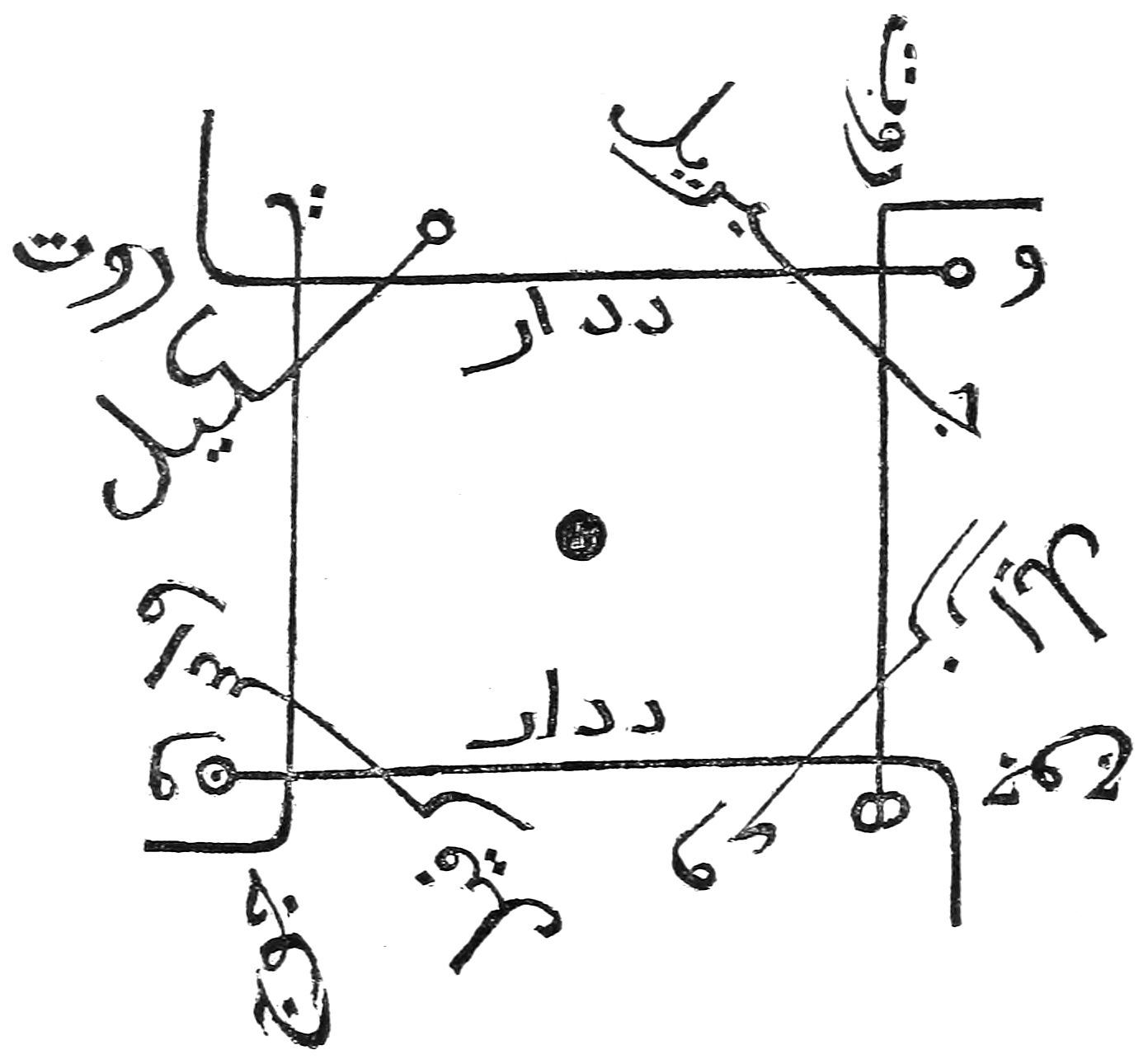
we killed time and tried to satisfy our impatience by practising
the method of divination called Derb-er-raml.
The stories I will spare the reader, who has had enough of Arab
tales in every shape, though I am sadly tempted to tell how the two
little donkeys were welded into a big one, or how the ass stuck in
the mud, and the hyæna ate him, notwithstanding his long horns.
The inhabitants of Siwah speak a dialect of the Berbery, and
only a very few of them know any word of Arabic; they are unquestionably an
Aboriginal people, probably the descendants of one of the Nomad
tribes, who inhabited the interior of Libya, and who may have
succeeded to the possession of the Oasis of Ammon, after the
extinction of the Roman power in this country. The entire
population consists of the inhabitants of Siwah Proper, which is
divided into east and west, and those of Agharmy, a small town
about two miles to the east, in all little more than four thousand
souls. The inhabitants of the eastern part of the town, my enemies,
are called Sharkyin, or Lifayah, and these are again subdivided
into three clans. The Westerns or Gharbyin are, in the same way,
composed of three clans, and each clan has two sheikhs; these, with
the Mufti and Cadi, form the Mejlis, presided over until his
deposition by Yusuf as Sheikh-el-Beled. Their own account of their
origin is, that, excepting three families of the old race, whose
genealogy goes back to the remotest times, the whole of them are
Arabs, Moghrabin, or Fellahs; none of whom have been settled here
for more than four generations. Judging from their features, I
should think that there must be a much greater mixture of the blood
of an older race; nor is it likely, if Arabic had been the original
language of the immense majority, that it should be now only known
to so few persons,
after this short lapse of time. Of the women there is hardly one
who understands anything but the Siwy Berbery.
They are a singularly ugly race, with dark-brown complexion, and
a truly bestial expression, but with no trace of the negro type,
while they are still further removed from the Arab and Copt. Their
fierce disposition makes them dreaded by the Arabs, who come to
Siwah to buy dates, and who are subjected during their stay there
to a most rigorous police. Those of the women whom I saw through my
telescope on the roofs of the houses, were not more agreeable in
appearance than the men; and even childhood is here devoid of the
engaging graces of its age.
The dress of the men is a long shirt with drawers; a skull-cap
of cotton, to which a milaya, such as is worn by the Egyptian
women, is added. The head-dress of the women is curious. The front
hair is plaited into twelve small braids, which hang straight over
the forehead; on each side is a similar short bunch, looking like
nothing but the cords of a mop, and round the head are wound two
long plaits brought from behind. Over this the milaya is thrown,
and a dark blue shirt completes the costume. They are kept very
strictly confined to the house, which the wealthier never leave,
and no respectable woman goes out excepting at night. These precautions
of the Siwy are said to be as efficacious as those of the Djin, who
kept his lady-love in a box; and the moral character of the Siwah
fair is such, that had he reigned here, Pheron would probably never
have recovered his eye-sight.
The men are notoriously bad, at the same time that they are
among the most fanatical Moslemin in Africa. In fact, I had good
reason to believe correct what was said to me of them:—“Every vice
and every indulgence is lawful (Hellal) to the Siwy. Nothing is
forbidden to them (Haram), but the presence of a Christian.” They
are divided into two schools, the followers of the Sunūsy, of whom
I shall have to speak later, and the Dirkawy, the ranters of Islam,
who derive their origin from a celebrated sheikh of Masrata, who
died a hundred years ago. Between the two orders the same affection
seems to exist as fable attributes to the Jesuits and Dominicans in
Christendom.
The Siwy are superstitious, though, perhaps, not more so than
the ignorant masses in all countries; nearly all the men have
amulets sewed to their caps, or hung round their necks; every house
is defended from the evil eye by an earthen pot well blackened in
the fire, which is built mouth downwards over the doorway, or at
one corner; and in addition to this charm, it is not uncommon to
see the leg bones of an ass projecting from some part of the
building: this struck me particularly, as this use of it was once a
superstitious practice in England. This and similar practices were
forbidden by the Council of London, held about the year 1075.
After saying so much in dispraise of the Siwy, I must add that,
compared with the people of Jalo and Augila, they are an
industrious race, paying great attention to the cultivation of
their palms and olive-trees, which they manure and tend with
infinite care. A great part of the soil is capable of producing
grain, and they possess extensive corn-fields; these being
cultivated entirely with the spade, demand much labour; the
consequence of which is, that the small population is unable to
bring even the near-lying grounds completely under crop. From this
cause several fertile oases dependent on Siwah are now abandoned.
Interspersed among their palm-groves they have abundance of vines,
apricots, and pomegranates, whose sweet though small fruit they
preserve all the winter. To manure their trees they employ a thorny
plant, which grows in great quantities in Maragah, called ’agul.
This they collect and bind into large bundles, three of which form
a donkey load; then, digging pits round the trees, they bury these
bundles in them, after which they water them regularly once in six days. All caravans
coming to Siwah are obliged to put up in a particular place, and
the manure thus collected, along with the produce of the ’agul
grounds, is sold every year by auction for the benefit of the
community.
![[Theta-like symbol]](https://openoldbooks.sgp1.digitaloceanspaces.com/books/wanderings-in-north-africa-by-james-hamilton/images/sym01.jpg) ), and the Ψ (
), and the Ψ (![[Psi-like symbol]](https://openoldbooks.sgp1.digitaloceanspaces.com/books/wanderings-in-north-africa-by-james-hamilton/images/sym02.jpg) ) look strange. Among the most
frequent are
) look strange. Among the most
frequent are ![[Symbol sequence]](https://openoldbooks.sgp1.digitaloceanspaces.com/books/wanderings-in-north-africa-by-james-hamilton/images/sym03.jpg) . The stones were doubtless thus marked in the
quarry where they were cut in the curve of the arch, and the
characters appear in a certain symmetry.
. The stones were doubtless thus marked in the
quarry where they were cut in the curve of the arch, and the
characters appear in a certain symmetry.
![[Symbol]](https://openoldbooks.sgp1.digitaloceanspaces.com/books/wanderings-in-north-africa-by-james-hamilton/images/sym04.jpg) ,
Δ∇, ΤΡΟ,
,
Δ∇, ΤΡΟ, ![[Symbol]](https://openoldbooks.sgp1.digitaloceanspaces.com/books/wanderings-in-north-africa-by-james-hamilton/images/sym05.jpg) ,
Π,
,
Π, ![[Symbols]](https://openoldbooks.sgp1.digitaloceanspaces.com/books/wanderings-in-north-africa-by-james-hamilton/images/sym06.jpg) ,
,
![[Symbols]](https://openoldbooks.sgp1.digitaloceanspaces.com/books/wanderings-in-north-africa-by-james-hamilton/images/sym07.jpg) , Κ
, Κ
![[+]](https://openoldbooks.sgp1.digitaloceanspaces.com/books/wanderings-in-north-africa-by-james-hamilton/images/sym08.jpg)
![[Symbol]](https://openoldbooks.sgp1.digitaloceanspaces.com/books/wanderings-in-north-africa-by-james-hamilton/images/sym09.jpg) , Ω,
, Ω, ![[Symbol]](https://openoldbooks.sgp1.digitaloceanspaces.com/books/wanderings-in-north-africa-by-james-hamilton/images/sym10.jpg) ,
, ![[Symbol]](https://openoldbooks.sgp1.digitaloceanspaces.com/books/wanderings-in-north-africa-by-james-hamilton/images/sym11.jpg) ,
, ![[Symbol]](https://openoldbooks.sgp1.digitaloceanspaces.com/books/wanderings-in-north-africa-by-james-hamilton/images/sym12.jpg) ,
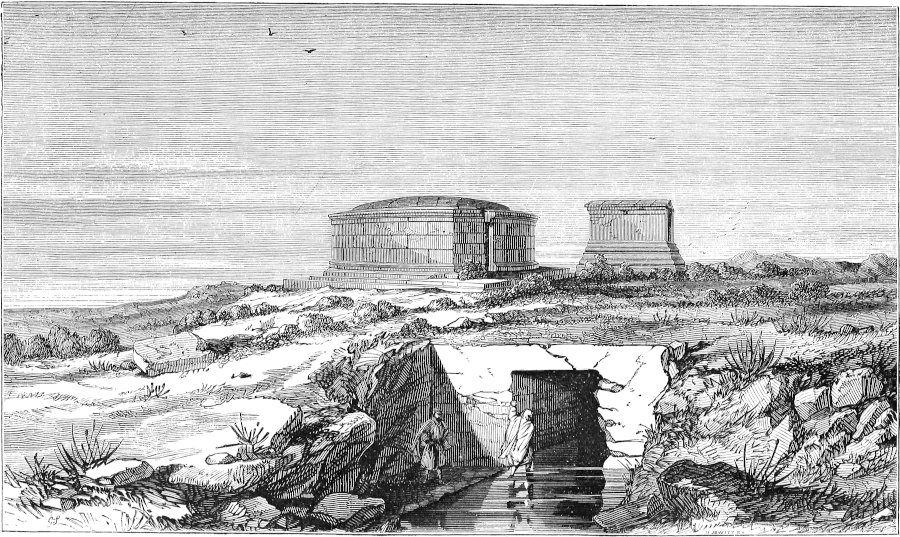
, ![[Symbol]](https://openoldbooks.sgp1.digitaloceanspaces.com/books/wanderings-in-north-africa-by-james-hamilton/images/sym13.jpg) , the last six being
apparently Libyan characters—a circumstance not to be wondered at,
if we consider that the aboriginal population of the country would
probably furnish a large contingent to the labouring classes. At
one end the walls are covered with Arabic inscriptions, recording
the visits of various Beys of Benghazi and other personages—a mark
of interest rarely met with in the East. The winter rains were
still collected in this reservoir; and when I was there at the end
of summer, notwithstanding the drought of the last years, there was
still a small supply of water remaining in one part of the vast
archway.
, the last six being
apparently Libyan characters—a circumstance not to be wondered at,
if we consider that the aboriginal population of the country would
probably furnish a large contingent to the labouring classes. At
one end the walls are covered with Arabic inscriptions, recording
the visits of various Beys of Benghazi and other personages—a mark
of interest rarely met with in the East. The winter rains were
still collected in this reservoir; and when I was there at the end
of summer, notwithstanding the drought of the last years, there was
still a small supply of water remaining in one part of the vast
archway.