Wanderings in New South Wales, Batavia, Pedir Coast, Singapore, and China, vol. II
Whole book · 24 sections
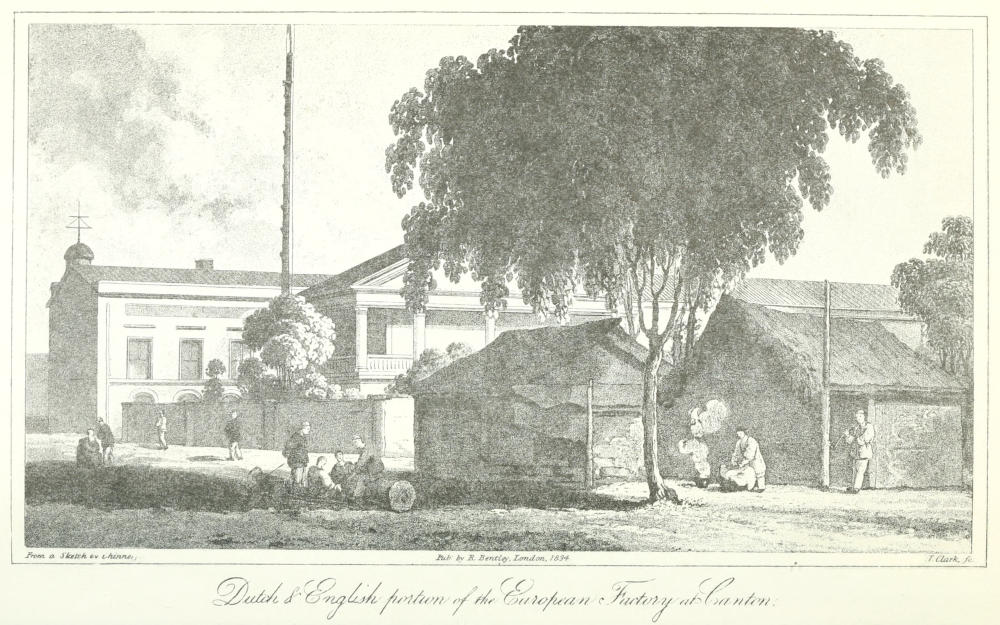
From a Sketch by Chinnery.Pub: by R. Bentley,
London, 1834.T. Clark, sc.
Dutch & English portion of the European Factory at Canton.
WANDERINGS IN
NEW SOUTH WALES, BATAVIA, PEDIR COAST, SINGAPORE,
AND CHINA; BEING
THE JOURNAL OF A NATURALIST IN THOSE COUNTRIES, DURING 1832, 1833, AND 1834.
BY
GEORGE BENNETT, Esq. F.L.S. FELLOW OF THE ROYAL COLLEGE OF SURGEONS, &c.
IN TWO VOLUMES.
VOL. II.
LONDON: RICHARD BENTLEY, NEW BURLINGTON STREET.
Publisher in Ordinary to his Majesty.
1834.
LONDON:
IBOTSON AND PALMER, SAVOY STREET, STRAND.
CONTENTS OF THE SECOND VOLUME.
CHAPTER I.
Pedir coast—Treaty with the Acheenese—Anarchy—Syed
Hussain’s claims—Trade in the Areka-nut—Visit to the
Village of Gingham—Negociation for the restoration of a
Penang brig—An amulet—Visit of the Rajahs to the
Queen—Gingham—Trade of the coast
Arrive at Singapore, and sail for China—The Lemma Islands—Their
inhabitants—Boats—Hong Kong Islands—Dr.
Abel’s visit to the shore—A pilot’s surprise—Cap, Sing,
Moon—Cum, Sing, Moon—Outlaw ships—Trade in opium—Researches
about the hills—Botanica productions—Macao—Its
streets—Vain endeavours to open a trade
with the Chinese ports—The Rev. C. Gutzlaff— Harbour
of Macao—Jealousy of the Chinese government—Fruit
Wang, hee canes—The Casa Garden—Cave of Camoens—Tributary
verses to that poet
Museum at Macao—Mr. Beale’s splendid aviary and gardens—The
Paradise bird—Natural history of this splendid
creature—Anecdotes—Superb magpie—Loris—Description
of the aviary
Leave Macao for Whampoa—Entrance to the Bocca Tigris—Country
about Chuen, pee—Scene at Whampoa—Approach
to Canton—The town and suburbs—The sailor’s
coffee-shop—Selling by weight—Dwarf orange trees—The
tea shrub—Visit to the celebrated Fa-tee gardens—Topics
of conversation—Exaggeration—Rambles in the suburbs—The
city gate—Manufactories—Sandal-wood
Visit to the Temple of Honan—Colossal figures—The priesthood—Votive
offerings—Mummery—Holy pigs—Their
corpulency—The hall of the factory—Duck-boats—Alabaster—Chinese
snake—Leave Canton and return to
Macao—Visit the Lappa Island—Hill-pines—Mass of
granite rocks—Their sonorous qualities—Tanka-boats—Chinese
burial-grounds—Cassilhas Bay—Manufacture of
ropes—Portuguese ladies at Macao—Origin of that name—Another
temple near Macao
The Jesuits’ church and college of San José—The gardens—Sail
from Macao for Singapore—Pass Pedro Blanco—Island
of Singapore—The town—Treaty for the cession of the
island to the British—Hills—Salubrity of the settlement—European
burial-ground—Vicinity of the settlement—Government
hill—Grand prospect—Commercial prosperity—New
roads
The Botanic Garden—The Croton tiglium—The true Camphor-tree—The
Malaleuca Kayu-puteh—Excursion into
the interior of the island—Botanical productions—Chinese
farms and plantations—Pepper harvest—Plantain-trees—Gambir
plantations—Boiling houses—Cultivation and preparation
of Gambir—Dense vegetation of the Jungles—Establishment
of a Chinese-planter
Excursion further inland—Dense forest—An extensive
swamp—Parasitical plants—Fungi—The pitcher plant—Return
to Singapore—The wild pine-apple—Use of that
plant—Manufactory of pearl sago—Visit to the Rajah of
Johore—Interview with his Highness—Excursion to St.
John’s Island—Pulo Panjang—Impenetrable jungle—New
Harbour—Agar-agar
Sail for England—Crowned Pigeons—Straits of Dryan—Banca
Straits—Zutphen Islands—Escape and re-capture of a
crowned pigeon—Death of one of those birds—Dissection—Pass
the Cape of Good Hope—Fine weather—The
trumpet weed—Volcanic rocks—St. Helena—Buttermilk
Point—James’s Town—Ficus Religiosa—Over-population
of James’s Town—Visit to the late residence of Napoleon
Tomb of Napoleon—The willows—Contrasted feelings of the
French and English visitors to Buonaparte’s grave—Fish—Sail
from St. Helena—Island of Ascension—Frigate birds—Shark,
Sucking, and Pilot Fish—The Sargasso weed—Condition
of the Crowned pigeons—A swallow captured
during migration—Temperature—Arrival at
Gravesend
Page 243, line 19, after island,
insert with passengers of the French nation.
WANDERINGS, &c. — CHAPTER I.
Pedir coast—Treaty with the Acheenese—Anarchy—Syed
Hussain’s claims—Trade in the Areka-nut—Visit to the
Village of Gingham—Negociation for the restoration of a
Penang brig—An amulet—Visit of the Rajahs to the
Queen—Gingham—Trade of the coast.
It is stated, that during the life of the former
rajah, Pedir was not a tributary district to the
territory of Acheen, but commanded the whole
line of coast to the eastward, and from that
circumstance the Betel-nut coast, which extends
to the eastward, and not to the westward of Pedir,
received the name of the Pedir coast: the old
rajah was also very expeditious in loading ships,
and took the goods in barter from the traffickers
at the fixed price, unless they were rated extravagantly
high.
I had an opportunity of obtaining a copy of
the treaty made with the Acheenese, by Sir
Stamford Raffles, and ratified by the Marquis of
Hastings, then Governor-General of India: it
was executed at a village near Pedir, which was
pointed out to me from the roadstead, the rajah of
Acheen being at that time obliged to reside there,
from political circumstances. I annex a copy of
the treaty,[1] the origin of which is stated in the
“Life and Public Services of Sir Stamford
Raffles,” by his widow. (4to. 1830, pp. 396,
397.) And in a letter from Sir Stamford to Sir
Robert Harry Inglis, he says the Acheen country
“at one period attracted more attention in Europe
than most eastern countries, but which has
long declined in importance.” “For the last
four years, (1819,) the country of Acheen had
been a prey to disorder and anarchy. A rich
merchant of Penang, Syed Hussain, patronized
by the late Mr. Petrie, taking advantage of the
unsettled state of the capital, set up claims to the
sovereignty; and, having expended an immense
sum in briberies and corruption, contrived, by
means of his superior naval force, and the advantage
of equipping his vessels from Penang, to
command the trade of the Acheenese ports, and
to invest one of his sons with the title of sultan.
The Penang government, taking part with this
side of the question, strongly recommended the
support of it by the supreme government, and a
force of a thousand men was actually applied for,
with proper equipments, in order to establish the
newly-created king thoroughly on his throne.
Captain Coombs, a protégé of Mr. Petrie’s, and
who had been employed as the agent of the
Penang government, was in Bengal at the time
of my arrival, and Lord Hastings asked my
opinion. I had no hesitation in giving it, as far
as it was then formed; and the supreme government
was induced to pause. I was subsequently
joined in a commission with Captain Coombs,
for the purpose of finally adjusting the question.
“After my arrival at Penang, I was informed
that Colonel Bannerman had protested against
my interference at Acheen, and had written in
such terms to the supreme government, that it
was incumbent on me to await the answer. I
complied with this request; and while the question
was pending, proceeded to this place, (Singapore,)
effected my object, and returned to
Penang in time to receive the further instructions
of the supreme government. These only
tended to confirm what I had formerly received,
and Captain Coombs and myself accordingly
proceeded to Acheen. We remained there
nearly seven weeks; during the early portion of
which, we were directly opposed in our politics;
but at length, after a paper war, which actually
occupies above a thousand pages of the Company’s
largest sized paper, he came round to
my opinion, and was satisfied, that in justice
and honour, there was but one course to pursue,
namely, supporting the cause of the legitimate
sovereign. The spurious claims set up by Syed
Hussain were proved to be unfounded, and it
was clear he had grossly deceived our government.
We therefore concluded a treaty, and
effected all the objects we required, namely, the
right of having a resident and establishment at
Acheen, and to exclude all foreign European
nations from having a fixed habitation. All that
we had then to do, was to require the governor
of Penang to restrict Syed Hussain from further
interference, and troops and equipments of course
became unnecessary.
“I never had a more disagreeable duty, and
consequently was highly satisfied to bring our
mission to so desirable a conclusion. It was an
object of great importance to take the right side
of the question; and had our government been
once committed on the other, and troops introduced,
we should soon have been so deeply involved,
that a worse than Candian war might
have been apprehended. In a country like
Acheen, by military operations, we had every
thing to lose, and nothing to gain.”
It was discovered, when too late, by the supercargo,
that the village of Pedir was the worst
place on the coast to procure either a quick dispatch
or a cheap cargo of the Areka-nut; for
the rajah is obliged to treat with merchants, to
supply the ship with the requisite quantity which
has been agreed upon: the other European vessels
had anchored at the village of “Gingham,”
about eight or nine miles further to the eastward.
At this place, the contracts are made
with merchants, not with the rajah; and the
merchants pay the rajah his dues. It is always
best to contract with the merchants, who can
supply it at a quicker and cheaper rate than the
rajahs, who must themselves apply at last to the
merchants; and the payment proceeding through
the hands of the rajah, or his ministers, the
latter take care that some remains behind for
their special use; and, at the termination of
the affair, the buyer will find that he is the
loser, not the seller. Sawang, Tellisomoy, and
other places on the coast, abound also in the
Betel-nut.[2]
Another error which was fallen into by not
being acquainted with the custom of the place, was
purchasing the nut by the pecul instead of the
laxar, by which much loss is sustained by the
buyer. The luxur or laxar is in weight one
pecul and thirty-five-hundredths of a pecul: it
consists of ten thousand nuts, and from ten to
twenty-five per cent., according to the bargain
previously made, is given over, for nuts which
may be rotten or otherwise damaged.
Several vessels, the Eleanor, Helen, Dania,
(Denmark ship,) and Peru, were lying in Gingham
roads, for cargoes of Areka-nut. I took an opportunity
of visiting the village of Gingham, proceeding
thither in the ship’s boat. The coast to the
eastward still maintained the same picturesque
character as about Pedir, except perhaps in some
parts where it was more densely wooded with
cocoa-nut and other trees close to the beach. We
passed a cluster of palm-leaved thatched, bamboo
huts, which was the village of Ilbu. The
village of Gingham was not visible from the
roadstead, being situated a short distance up a
river, and hidden by the dense foliage of various
kinds of trees growing about it. A short
distance further to the eastward, a cluster of
habitations formed the village of Buron; and
Sawang (or, as called by the Malays, Putukurra)
is several miles still further in the same direction.
I have before mentioned, that a Penang brig had
been seized by the Acheenese grab, the Nacodar
(or master) of which, having been accused of
trading in arms and ammunition, with one of the
rajahs upon the coast, at present at war with the
ruler of Acheen: many of the commanders of
vessels then on the coast were desirous of getting,
if possible, the vessel returned. She was the
property of several native merchants at Penang,
and had been chartered by an English merchant
there for the Pedir coast, first calling at the
Maldive islands for a cargo of dried fish.
A brother of the Acheenese rajah, named Pungarang
Ibrahim, a fine and handsome Malay, was
on board the grab; and to him application was
made for the restoration of the vessel. He had
a very intelligent Malabar native as an interpreter,
who spoke several European languages—English,
French, Spanish, &c.—fluently. The
question, whether or not the vessel was a
legal prize to the Acheenese government, was
discussed by the native party with considerable
force and eloquence. The Nacodar was
accused of having disposed of arms and ammunition,
under British colours, to the rajah
mudar of Sambalangang, against the treaty
concluded between the British and Acheenese
governments, the rajah of Sambalangang being
at war with the king of Acheen; and one of the
articles of the treaty states, that any British vessel
supplying an enemy of the rajah of Acheen
with arms and ammunition, is liable to confiscation;
and upon this article of the treaty, it was
contended that the brig was a legal capture.
The Pungarang[3] Ibrahim then produced the
original treaty, written in the Malay and English
languages, duly signed by the governor-general
of India, Sir Stamford Raffles, and Captain
Coombs.
The Nacodar stated, in his defence, that he
having given, and not sold, the arms and ammunition
in question, the brig was not liable to
the consequences of a breach of the treaty. The
discussion concluded by the rajah declaring,
that if the commanders would return in one or
two hours, they should receive his final decision,
as he would consult the old queen, who has
much power, upon the subject. When the commanders
returned on board the grab, the queen
was present, who was a fine old lady, and received
her European visitors in a very cordial
manner. The subject relative to the vessel was
then renewed: they were anxious to procure the
nacodar, (who had sought refuge on board one
of the ships,) and take him to Acheen, where,
most probably, his life would be sacrificed; or
the rajah offered to send him to Penang, in irons,
to be tried by the authorities at that place, if
any commanders of the vessels going to that port
would take charge of him.
In the renewed discussion of the subject, the
justice of the case appeared decidedly in favour
of the rajah’s party, as it was now ascertained
that a shot had been fired from the brig, which
had killed a man on board the grab.
The rajah summed up his final decision to
the following effect, through the medium of an
interpreter:—“Let the native Nacodar be sent
on board my vessel; I will not injure him; I
will make a solemn engagement with you to
that effect; but I intend sending him to the
settlement of Penang in chains, there to be dealt
with as the judges at that settlement may determine:
if the man has not done wrong, why is
he afraid to come on board? here are plenty of
Europeans.” And thus concluded an address
replete with excellent sense and sound discrimination—“I
appeal to your English laws
whether I have not decided justly, and according
to the treaty solemnly ratified between the
Sri Sultan Alla, Iddeen Jowhara, Allum, Shah,
Sultan of Acheen, and the British government?”
One of the commanders, who afterwards asked
the rajah to give up the vessel as a matter of
courtesy, received the following sensible reply—“Would
one of your men-of-war surrender a
prize which had been proved a legal capture?”
He then added, that the vessel should be
taken to Acheen, and when there, if found by
his brother, the rajah of Acheen, to be illegally
seized, she should be returned forthwith to
Penang, and the owners indemnified for her detention,
and any damage she might have sustained
while in their possession.[4]
The rajah is a fine and handsome young man,
of very pleasing manners, and an intelligent
countenance; his face was full, broad, and had
the true Malay characteristics; he had upon his
left arm a large seal, or amulet, of about two
inches in diameter, upon the stone of which
(called “Pungli” by the Malays) a sentence
of the Koran was engraved; he said it was intended
as a charm against his being injured;
“so the Acheenese believe,” he added, but did
not appear to place much faith himself in its
supposed powers.
The different rajahs came on an appointed
day from the different districts in the vicinity,
to Pedir, to pay their respects to the old queen
previous to her departing to Acheen in one of
the men-of-war, which she did on the evening
of the 20th of July, accompanied by the whole
of the Acheenese fleet.
Accompanied by Captain M’Alister, I visited
the village of “Gingham.” At the entrance of
the river, a bar, (similar to, I believe, the whole of
the rivers upon this coast,) on which usually rolls
a heavy surf, rendering its entrance somewhat
dangerous for boats; the river maintained a very
winding course even to the village: a number
of shrubs abounded in the water, and about the
banks, among which were the Acanthus ilicifolia,
and several others. The village of Gingham
is situated about a mile distant from the entrance
of the river; the thatched-houses, of which it is
composed, were partially concealed by the graceful
and elegant Bamboo, Eju, Cocoa, and Areka
palms. Having landed and ranged about the
village, I made inquiry of the native merchants,
who were the Moormen of Hindostan, many of
whom had been born in India, and others on
the coast, respecting the trade of the place,
which consists exclusively of the Betel-nut;
they informed me that they contracted with the
supercargoes of vessels[5] visiting the coast, paying
to the rajah a certain tribute. The export
is from forty to sixty thousand peculs annually,
during the months of May, June, July, and
some part of August. The total amount collected
upon the coast, the greatest portion of
which grows some distance inland, is computed
at or about eighty or ninety thousand peculs.
The number of vessels, of all classes, freighted
every year upon this coast during the season,
varies, and depends a great deal upon their size;
sometimes forty of all classes had been loaded,
but when a large Bombay Indiaman comes and
takes ten thousand peculs at one time, of course
it occasions a scarcity for the smaller ones; in
this case, therefore, although the number of
vessels loaded is not so great, the quantity exported
is pretty nearly the same.[6]
The cargo sent on board the ship in which I
visited Pedir, came not from the Pedir district
alone, but was brought (by contracts entered
into by the rajah of Pedir, with the native merchants
of those places) from Gingham, Sawang,
&c., and of course at an increased price. I
made inquiry, if a ship was brought next month,
(August,) whether they could load her with
Areka-nut, and what period of time they would
take to deliver six thousand peculs on board. The
reply was, that at this season a greater scarcity
of nut prevailed than usual, on account of internal
wars drawing away the men, and causing
a scarcity of hands to collect and shell it; my
informant, therefore, would not engage to deliver
any next month, but the following May
would engage to supply the quantity of six
thousand peculs in a week, receiving dollars,
cambrics, long cloths, opium, iron, &c., in exchange,
and delivering the Areka-nut at one
dollar the pecul; however, much depends on
the agreement of price between the contracting
parties at the time, and the greater or less demand
for the European and other goods brought
into the market.
There was an abundant supply of fish in the
fish-market at Gingham, consisting of very large
specimens of Acanthurus, or lancet-fish, Chœtodons,
Cyprinus, several species of the Perch
tribe, the Barracouta, Shark, as well as a number
of others, varying in form, size, and colour;
and it appeared from the collection exhibited,
that abundance was taken upon the coast.
On the evening of the 23d of July, we sailed
from “Pedir,” bound for Singapore and China,
having six thousand and eight peculs of Areka-nut
on board. The cargo was purchased for
five thousand four hundred and forty Spanish
dollars, forty peculs of iron, thirty kits of
Swedish steel, thirty peculs of lead, and three
chests of opium. Upon the iron a profit was
gained upon the invoice prices of 77½ per cent.;
upon the lead, 81½ per cent.; and upon the steel,
48 per cent. Upon the opium there was, as I
have before mentioned, but very little profit;
indeed, the price of a dollar and a-half per pecul
was too high for this article; but, unfortunately,
the speculation originated at Batavia, and being
the first ship chartered for the purpose from
thence, the parties were consequently ignorant
of the people and country, and of the kind of
merchandize most advantageous for barter.
From the number of ships requiring nut at the
same time, payment in dollars, and at an advanced
price, is sometimes the only means of
procuring a cargo, unless the vessel remained
so long as to be ruinous to the speculators.[7]
CHAPTER II.
Arrive at Singapore, and sail for China—The Lemma Islands—Their
inhabitants—Boats—Hong Kong Island—Dr.
Abel’s visit to the shore—A pilot’s surprise—Cap, sing,
Moon—Cum, sing, Moon—Outlaw ships—Trade in opium—Researches
about the hills—Botanical productions—Macao—Its
streets—Vain endeavours to open a trade
with the Chinese ports—The Rev. C. Gutzlaff—Harbour
of Macao—Jealousy of the Chinese government—Fruit—Wang,
hee canes—The Casa garden—Cave of Camoens—Tributary
verses to that poet.
After a long passage down the Straits of Malacca,
we arrived at Singapore on the 19th of
August, and sailed again on the 22d for China.
At daylight, on the 6th of September, we were
off the “Lemma Islands,” having previously
arrived in soundings on the 4th, and were frequently
visited by Comprador boats seeking for
employment. We took a pilot from one of them
to direct us to “Cap, sing, Moon.” The Lemma
Islands, like most of those about this part of the
China coast, are bold, rugged, and but very
scantily covered by vegetation; its geological
structure is principally coarse granite, approaching
to sienite, and quartz, which enters largely
into their composition.[8] The inhabitants of
these islands appear to be principally fishermen,
and their boats animated the waters around to
some distance, in great numbers: some were
of very large size, being probably of sixty or
seventy tons burden, and are inhabited by whole
families; the clatter of women, squalling of
children, and barking of dogs, could be heard
in concert, when in beating to windward we
came near any of them.
These slenderly constructed but admirable
boats, with their large mat sails, some having
one, two, or three masts, sail with rapidity:
they would often lower a small awkward punt,
and bring some fish on board for sale. The
women worked hard, and one would be often seen
with an infant at her back, with others running
after, seeking her protection, whilst she assisted
in the various occupations of the ship, in tacking
and hauling the ropes. They all had a dark,
wretched appearance, from the exposure to weather
and hardships of many descriptions. When
the weather is stormy, the vessels bring up under
lee of one of the numerous islands, grouped
about the coast. I have often seen them assembled,
from twenty to fifty, for the night, under
the lee of one of them, on the shore close to
which, some small miserable thatched huts, containing
numbers of wretched inmates, and small
patches of cultivated land were visible.
On the 10th we were off Hong Kong Island.
It is lofty, bold, and occasionally its barren
appearance is diversified by the verdure of the
ferns and other plants, which give some beauty
to the huge piles of rocks, towering towards the
heavens, in gently sloping as well as abrupt declivities.
At one part a small cascade fell from the
rocks above into the ocean abyss beneath, and
other places bore the appearance of mountain
torrents being formed during heavy rains.
Dr. Abel, who landed upon it, says, “I took
advantage of the first watering boat to visit the
shore, and made one of these mountains and the
waterfall the principal objects of my visit. This
mountain, the highest on the island, is, according
to Captain Ross, who has measured it, about
fifteen hundred feet above the level of the sea,
and is composed of trap approaching to basalt
in the compactness of its structure. In ascending
it, I followed the course of a delightful stream,
which rises near its summit, and found by its
side a number of interesting plants. The general
surface of the mountain, and indeed of every
part of the island of Hong Kong, that I was
able to visit, is remarkably barren, although in
the distance it appears fertile, from a fern which
I believe to be the Polypodium trichotomum of
Kœmpfer, which supplies the place of other
plants. I ascended about one thousand feet,
and returned by a path which passed over a
small hill, or rather mound, differing in structure
from all the rocks in its neighbourhood,
being composed of a very friable stone of a reddish
white colour, much resembling disintegrated
feltspar. On reaching the shore, I examined
the rocks by the waterfall, where they
are exposed in large surfaces, and found them
composed of basaltic trap, exhibiting in some
places a distinct stratification, in others a confused
columnar arrangement. It is also divided
into distinct, well-defined, rhomboidal masses,
separated from each other by very obvious seams,
in which I frequently found cubic crystals of
iron pyrites.”[9]
The further progress of the ship was extremely
tardy, from calms and adverse winds,
so that we did not reach the Cap, sing, moon
harbour, until the morning of the 12th, and
then, from calms, could not enter it, but anchored
outside. The Chinese pilot on board
was but of little service, and he was quite surprised
at the commander’s knowledge of the
islands, depth of water, &c., until he found out
that he derived it from the charts and Horsburgh’s
Directory. It was quite amusing, when
any difference of opinion existed between them,
to hear the pilot, in a pet, declare, “You look
at bookee, but you not alway savez a rightee;
bookee wrong, you wrongee sometime.”
A greater or lesser number of different species
of Libellula have been flying about the ship,
ever since we have been in soundings; and it
is said, that when a great number of these insects
are seen flying about the ship, a northerly
wind may be expected; but I seldom found the
assertion borne out by the fact, except its happening
four or five days after can be considered
a corroboration.
On the following day we entered the “Cap,
sing, moon,” for a short time: it is regarded as
a safe and is certainly a picturesque harbour,
but lately it has been left by many of the opium
ships for another, by some considered a safer
harbour, and called the “Cum, sing, moon,”
formed by different islands, and the main land
to the northward of Macao, and distant about
eighteen miles from that settlement. The
“Cap, sing, moon,” has some towering verdant
mountains, with fertile valleys, and little
thatched cottages of fishermen and others, peering
through a thicket of foliage. This is contrasted
at another part by barren hills, destitute
of any beauty, excepting what may be scantily
imparted by a few stunted shrubs or ferns.
Well may this be called a celestial empire,
wherein moons and stars condescend to take up
their local habitation. It is ludicrous to hear
the inhabitants talking of having intercourse
with the celestial people in the different moons,
“Where did you come from last?” “I came
from the other moon,” was a very common question
and answer.
On the 14th of September we sailed over to
the “Cum, sing, moon,”[10] and anchored at six
o’clock, P.M.; this possessed far more extensive
and picturesque beauties than the harbour we
had left.[11] The entrance is, however, difficult,
and even dangerous for strangers; yet, after
having been once, the same person could easily
take a ship in or out at any time without risk,
taking advantage of the tides. From the land
around this place not being so elevated as in the
rival harbour, the gusts that descend from the
gullies in stormy weather are not so violent, and
a ship is consequently not so liable to drive as
has been experienced during some severe typhoons,
which occurred a short time previous to
our arrival.
Many of those outlaw ships that trade in
opium, (one of the most important, although
prohibited, branches of commerce in the Chinese
empire,) remain either in this harbour, or that
of the “Cap, sing, moon,” during the season of
the year that typhoons are expected, and anchor
off the island of Lintin during the fine-weather
months. One part of this trade in opium is
carried on by the Chinese smuggling boats,
which take it from the European receiving ships
stationed here, or more properly speaking at
“Lintin,” (this being merely a temporary place
of refuge from typhoons).
By occasionally visiting the Hercules, one
of the receiving ships for opium, I was able to
observe, through the kindness of Mr. Parry, her
chief officer, how this extensive and lucrative
trade is conducted. The sales are effected in
Canton by the European merchants, and orders
sent down with the smuggling boats for the
delivery of the opium from the different ships;
the boats engaged in this occupation are armed
with spears, shields, and even fire-arms, to repel
any attack that may be made upon them by the
mandarin guard-boats. They are also manned
by a very brave and athletic crew; indeed
Chinese fight very well one against the other,
but cannot bring forward sufficient courage to
face Europeans, except the advantages are overpowering
on their side. These boats are provided
with sails, in addition to a number of oars and
rowers, and they pass through the water with
inconceivable rapidity. The mandarin boats,
having a weaker and less choice crew, can seldom
or ever overtake them; this, however,
may in part be explained from the fact of the
guard-boats, (the revenue cutters,) sent by the
Chinese government to cruize against smugglers,
coming alongside for a supply of the prohibited
drug, to smuggle it themselves into the
heart of the Chinese empire. Any thing can be
done by bribery in this country, and these boats
are often employed for smuggling cassia, treasure,
&c. on board European ships at Lintin, &c.;
indeed every smuggling boat that takes opium
from an opium ship, leaves a payment of one dollar
on each chest for the mandarins, and on the
opium returns being made up, the sum is regularly
paid to them; each boat leaves also a kum,
shaw, or present for the ship, of five dollars.
The chests of the drug are opened on board;
the balls or cakes are taken out, and immediately
deposited in small mat bags, brought by them
for the purpose, and sown up; being in that way
more convenient to smuggle than in large heavy
chests. There are three kinds of opium usually
sold in the English ships—the Malwa, Benares,
and Patna; a fourth, the Turkey opium, is confined
to American and other foreign vessels. The
Patna opium is in balls, packed in partitioned
cases, each chest containing forty balls. Old
opium fetches a higher price than new; the
former being solid, the latter soft and more
liable to run. The old chests, so termed, are
usually two years old when they come under
that denomination. The Malwa opium is in
rather flattened cakes. The prices of this drug
of course fluctuate very much: the consumption
in the Chinese Empire must be enormous, and
is entirely—not the least extraordinary part of
the affair—carried on by an illicit trade.[12]
The payments are usually made, if to any extent,
in Sycee silver, which is taken by weight,
no silver coinage being acknowledged by the
Chinese government. The Chinese purchasers
of the opium refine it by boiling, previous to
using it for smoking: the mandarins, besides
smoking, use it also in the form of tincture,
usually carrying a small bottle containing it
about them. The present Emperor of China has
been described as being totally incapacitated
from any business, through the excess to which
he has carried the debilitating practice of opium
smoking.
I took several opportunities of making herborisations
about the hills in this harbour; and
in so doing, fortunately, did not meet with any
molestation from the inhabitants. On landing,
usually upon a sandy beach, or rocks of granite,
shell-fish, and other marine animals, were very
scarce. The hills were covered, about the declivities,
with a large quantity of shrubs and
plants, and a variety of grasses: the summits
were usually barren, and covered with sand.
Two or three species of Melastoma were very
abundant; and one species, the quinquenervia,
was in full flower, being beautifully covered with
a profusion of large rose-coloured blossoms, forming
a contrast, by their brilliancy, to the dull, uninteresting
character of the vegetation around.
Several of the fern tribe were also abundant,
either by the borders of the rivulets, or strewed
over the declivities and summits of the hills.
Among them was the Gleichenia hermanni, Bluchnum,
Polypodium, &c.; as well as a Ficus, bearing
small red fruit, and other shrubs. In the
valleys, or any little irrigated spots, the cultivation
of rice was particularly attended to. The
fruit of the Melastoma (for several of the shrubs
were in fructification) yielded a dark bluish
juice, on which several coleopterous insects fed.
Two water snakes were caught upon the beach;
one of a bright yellow over the head and neck,
and of slender form. Among other botanical
specimens collected was a Rhus, Flemingia,
Rosa, Malva, Cereopsis, &c.
On the 1st of October I visited Macao. This
ancient colony of the Portuguese, in China, has
a very picturesque and romantic aspect on approaching
it from the sea: it is situated upon a
peninsula, and, from bearing some resemblance
to a mallet, has received the name Macao, which
in the Portuguese language signifies that instrument.
The white houses, rising one above the
other; the high mountains in the back-ground,
and about it; the castle, and monasteries, perched
on the elevated summits of some of the hills;
the numerous sacred edifices, elevating themselves
above the neighbouring houses, the most
conspicuous objects in all Roman Catholic countries,—all
contribute to the beauty of this little
city: it seemed, both from the roadstead and on
landing, a Portuguese town, to which the taste
and wealth of our native land had been added,
not the least cause of its neatness or beauty:
it contains also very agreeable society, both for
residents and strangers.
The streets of Macao are very narrow: this,
however, affords shelter to the pedestrian from
the fervent rays of the sun; they are likewise
ill-paved and very steep, the houses rising from
the Praya Grande on one side, and the inner
harbour on the other, terrace upon terrace, and
are constructed upon a very solid foundation of
rock: the pavement consists of smooth and rough
stones, without any attention having been given
to their relative sizes; so that a person taking
a short walk, may often expect to return with a
strained ancle.
The private residences of the Europeans are
very convenient, spacious, and more delightful
for their interior accommodation, than for any
exterior beauty.
Many vessels have been sent to the east coast
of China, by enterprising merchants of Canton,
to endeavour, if possible, to open a trade with
some of the Chinese ports on that coast. A
highly-talented gentleman, the Rev. C. Gutzlaff,
with whom I had the gratification of forming an
acquaintance, has often accompanied the vessels;
but the result has been a very limited degree of
success; the imbecility of the Chinese government
has been fully ascertained; and during
the last voyage, edicts were stuck about the village
off which the vessel had anchored, stating
that the foreign vessel had been driven away,
while she still remained at anchor within sight
of these very papers, endeavouring to carry on
some traffic with the inhabitants; but, from the
fear of the mandarins, it was effected but to a
very limited extent. It is stated that the embassy
of Lord Amherst is still mentioned by the
Chinese, who say that it was fully expected, from
the force he had with him, he would not have
suffered himself to be driven away, but would
have obliged the Chinese government to accede
to any terms he chose to propose.
The gentleman I have before mentioned, the
Rev. C. Gutzlaff, is well acquainted with several
dialects of the Chinese language, which he
speaks with such fluency, as to be, when disguised,
taken for a Chinese: he studies mankind,
and endeavours to spread the Christian
religion in a truly missionary spirit, so as to
conduce (which a pure religion necessarily must
do) to the happiness of the people: he also endeavours
to effect his benevolent purpose towards
them, by distributing tracts relating to the sciences
of astronomy, geography, &c. written in
the Chinese language; endeavouring, by an
admirable religious feeling of benevolence, to
promote the welfare of the people by spreading
a purer religion than they possess; at the same
time cultivating their minds in other branches of
knowledge, enabling them to receive more vividly
the impressions of the divine Spirit. Would that
all our missionaries followed the same plan! how
inestimable, then, should I consider their cause!
The inner harbour of Macao is spacious, and
capable of affording anchorage to a large number
of ships, safely sheltered from every gale; but
only twenty-five European vessels are permitted
to anchor, and those only which belong to the
Spanish or Portuguese nations; excepting in
case of distress, when a ship of any other European
power may require immediate repairs; but
even then there is much trouble and difficulty in
procuring the requisite permission: this proceeds
from the usual jealousy of the Chinese
government towards Europeans. Nearly two
centuries ago, or perhaps more, permission was
granted by the Chinese authorities for twenty-five
foreign vessels of the Portuguese and Spanish
nations to enter the harbour; and these are
always regarded by this extraordinarily blinded
people to be the very identical vessels which had
at that time received the original indulgence
from the imperial government.[13]
Fruit is neither particularly abundant nor excellent
in this part of China; the great variety
of oranges may be regarded the best, as also
the elegant scarlet Lit, chi (Dimocarpus litchi).
There is another fruit, of which also there are
several varieties—it is a Diospyrus,—(the Diospyrus
Kaki?[14]) or Chinese date plum. One of
the varieties known by the Chinese under the
name of Ngnow, sum, tzee, or bull’s heart
Diospyrus—(Ngnow signifying bull; sum, heart;
tzee, this particular fruit, the Diospyrus)—resembles,
in external appearance, a Tomata,
except in being of a larger size, and of a bright
red colour: when divided, it is found to contain
a yellowish semi-transparent pulp, not unlike
a plum either in flavour or appearance, and
contains several oblong brownish seeds. The
outer skin has an astringent property, which discolours
the steel of a knife when employed to
divide the fruit, which is not at all requisite for
the purpose. The other kind is much smaller,
oval, about the size of a date; being similar to
the former in colour; it is called by the Chinese
Kai, sum, tzee, or fowl’s heart Diospyrus: in
taste it closely resembles the mawkish sweetness
of a ripe date. I had only an opportunity of seeing
two of the varieties of this fruit, but there are
several other kinds.[15] The flat peach, or “Peen
to” (peen signifying flat, and to, peach) of the
Chinese, is a variety of the peach, appearing,
although in reality of a perfectly natural form,
to have had its flatness produced by artificial
means. The blossoms of the tree are double,
but fertile. The fruit is described as being of
an excellent flavour.
The canes, so much valued, and sold usually
at a high price, and known by the name of the
Wang, hee, (Wang signifying yellow, and hee,
root,) are said to be the root of the narrow-leaved
bamboo, which grows abundantly about Macao,
forming very pretty hedges or inclosures: these
are valuable and rare, on account of the sufficiently
straight descending roots being difficult
to procure; many trees must consequently
be destroyed before those particular roots of the
requisite length and straightness can be obtained.
The roots of this bamboo are very troublesome
when planted, more especially in a garden,
from spreading so far, and so much towards
the surface of the ground, as to tear up the
paths, &c.
I visited, in company with Mr. Fearon, the
Casa garden, in which is situated the principal
object of my visit—“Camoens’ Cave;” celebrated
as the spot where that distinguished
poet wrote the poem of the Lusiad. It is not
correct to call it a cave—it is merely masses of
granite rocks piled one over the other in that
extraordinary and romantic manner in which
that kind of rock is so often seen grouped; and this
forms a kind of archway, which has been denominated
a cave. Delightfully surrounded by umbrageous
trees, and shrubs overhanging the rocks,
the seclusion of the spot might well have been
chosen by one inclined to meditate and compose;
where all the objects around him would not fail to
excite the poetical imagination to a much higher
degree than could possibly be effected in the hurry
and bustle of society. A summer-house has been
erected upon these granite masses.
Some beautiful Latin verses (which I hope to
see engraved and placed on the spot) have been
written by J. Davies, Esq., who having kindly
favoured me with a copy, I with pleasure insert
them.
In cavernam, ubi Camoens fertur
carmen egregium composuisse.
Hic, in remotis sol ubi rupibus
Frondes per altas molliùs incidit,
Fervebat in pulchram camænam
Ingenium Camöentis ardens:
Signum et Poëtæ marmore lucido
Spirabat olim, carminibus sacrum,
Parvumque, quod vivens amavit,
Effigie decorabat antrum:
Sed jam vetustas, aut manus impia
Prostravit, Eheu!—Triste Silentium
Regnare nunc solum videtur
Per scopulos, virides et umbras!
At fama nobis restat, at inclytum
Restat Poëtæ nomen, at ingenî
Stat carmen exemplum perenne
Ærea nec monumenta quærit!
Sic usque virtus vincit, ad ultimos
Perducta fines temporis, exitus
Spernens sepulchrorumque inane,
Marmoris ac celerem ruinam!
The Casa gardens, in which the cave is situated,
are extensive, and have even now, in their
neglected state, sufficient beauty to be regarded
as the most retired, romantic, and beautiful spot
in Macao.
CHAPTER III.
Museum at Macao—Mr. Beale’s splendid aviary and gardens—The
Paradise bird—Natural history of this splendid
creature—Anecdotes—Superb magpie—Loris—Description
of the aviary.
A museum has been established at Macao, by
the English residents, and even now contains an
extensive and excellent collection of birds, beasts,
weapons, fossils, &c. from all parts of the world.
Several rooms are appropriated solely for this collection,
having a person to take charge of them,
and attend upon visitors. So little encouragement,
however, is given to natural science, and the
European merchants are so much absorbed in
mercantile affairs, that, on the dissolution of the
establishment of the Honourable East India Company,
this excellent nucleus for an extensive, valuable,
and, (with scientific arrangement,) useful
collection, will no doubt be broken up and dispersed.
The great object of attraction at Macao, (together
with the agreeable society of the English and
American ladies, and the beautiful specimens of
the fine arts to be seen in the painting room of the
celebrated Chinnery,) is the splendid aviary and
gardens of T. Beale, Esq. How pleasant it is
to see this gentleman (now resident for upwards
of forty years in China) devote his leisure moments
to the care and delight of the elegant and
brilliant productions of nature, both in the animal
as well as in the vegetable kingdom. On
entering the large doors, which open from a
narrow lane, the ear is saluted by various noises
proceeding from a number of caged birds, inhabiting
the verandah of the dwelling. The peculiar
notes of the Minas, the different screams
of Loris, parrots, and parroquets, the twitting of
the smaller birds, are variously heard vying with
each other in loudness; the occasional caw of
the ætherial Paradise Bird, or its resounding note
of whock, whock, whock, is also heard. The attention
of the visitor is diverted from the elegant
plumage of the birds to the beautiful flowers
of splendid tints in the garden before the verandah,
or placed in pots upon the balcony. This
garden proves attractive to the gay, but fickle
butterflies that flit about the flowers, as well as
to numerous wild birds. Individuals visiting
Macao are eager to view these splendid natural
objects; and the liberal owner readily affords this
gratification to the stranger no less than to his
friends.
The first, both for variety as well as the inconceivable
delicacy of its plumage and tints, of
which I intend to attempt a description, is that
“aërial creature” of fairy form, decked in nature’s
most delicate and beautiful colours, the
Paradise Bird. This is the common or Great
Bird of Paradise, the Paradisea apoda[16] of Linnæus,
the P. major of Shaw. The length of the bird
is usually two feet, measuring from the bill to
the tip of the side feathers. The specimen in the
possession of Mr. Beale, is a fine male, and was,
at the time I beheld him, arrayed in his full and
splendid plumage: he is enclosed in a large and
roomy cage, so as not, by confinement, to injure
in the slightest degree his delicate and elegant
feathers.
This beautiful creature has been in Mr.
Beale’s possession nine years, and was originally
procured from the island of Bouro, (one of the
Molucca group,) which is situated in about the
latitude of 3° 30′ south, and longitude 126° 30′
east. It was presented to Mr. Beale by Mr.
Bletterman.
In Valentin’s account of the Birds of Paradise,
(quoted in Forrest’s Voyage to New Guinea, &c.)
it is mentioned that the Portuguese first found
these birds on the island of Gilolo, the Papua
Islands, and New Guinea; and they were known
by the name of Passaros da sol, i.e. birds of
the sun. The inhabitants of Ternate call them
Manuco dewata, the bird of God. The accounts
of the bird having no legs, being constantly on
the wing, and in the air, on which it lived, are of
course perfectly fabulous: to support which account,
however, the legs of the birds were always
cut off, when the preserved specimens were offered
for sale. Another reason for cutting off
the legs is, that the birds are found to be more
easily preserved without them; besides, that the
Moors wanted the birds without legs, in order to
put them, in their mock fights, on their helmets,
as ornaments. The inhabitants of Aroo, however,
have offered the birds for sale with legs these
seventy or eighty years; and Pigafetta, shipmate
of Ferdinand Magelhaens, who had often seen
them, proved, about the year 1525, that they
were not without legs. There are several species
of these very elegant birds.
The Ternate people call them Burong Papua,
or Papua birds; sometimes Manuco dewata, and
likewise Soffu or Sioffu. The Amboyna natives
call them Manu, key, aroo, the bird of the
islands, Key and Aroo; because the natives of
the two last places bring them for sale to Banda
and Amboyna. At Aroo, the people call them
Fanaan. Properly, these birds are not found in
Key, which is fifty Dutch miles east of Banda;
but they are found at the Aroo islands (lying
fifteen Dutch miles further east than Key) during
the westerly or dry monsoon, and they return to
New Guinea as soon as the easterly or wet monsoon
sets in. They come always in a flock of thirty
or forty, and are led by a bird which the inhabitants
of Aroo call the King, distinct from the
Little King Bird of Paradise. This leader is
black, with red spots, and constantly flies higher
than the rest of the flock, which never forsake
him, but settle as soon as he settles; a circumstance
which occasions their ruin, when their
king alights on the ground; whence they are
not able to rise, on account of the singular structure
and disposition of their plumage. They
are likewise unable to fly with the wind, which
would destroy their loose plumage, but take their
flight constantly against it, cautious not to venture
out in hard-blowing weather, inasmuch as a
strong gale frequently obliges them to fall to
the ground. It is also stated, that in Aroo, these
birds settle on the highest trees, especially on a
species of small-leaved Waringa trees, that bear
red berries, on which they chiefly live. (Ficus
Benjamina? Hort. Malab. 3. f. 55. Rumph.
Amboyn. 3. f. 90.) The natives catch them with
birdlime[17] and in nooses, or shoot them with
blunt arrows; but though some are still alive,
when they fall into their hands, the catchers kill
them immediately; and often cut their legs off,
draw the entrails, dry and fumigate them with
sulphur, or smoke only.[18]
For the delicacy and harmony in the arrangement
of the colours in this bird, as well as its
remarkably light and delicate appearance, it
may well be named the Bird of the Sun, or of
Paradise, for it surpasses in beauty the whole of
the feathered creation, appearing more like a
celestial inhabitant than one of earth. Although
the bird has been nine years in Mr. Beale’s
aviary, yet it does not exhibit the appearance
of age, but is lively and healthy.
The neck of this bird is of a beautiful and
delicate canary yellow colour, blending gradually
into the fine chocolate colour of the other
parts of the body; the wings are very short,
and of a chocolate colour. Underneath them,
long, delicate, and gold-coloured feathers proceed
from the sides in two beautiful and graceful
tufts, extending far beyond the tail, which is
also short, of a chocolate colour, with two very
long shafts of the same hue proceeding from the
urupigium. At the base of the mandibles the delicate
plumage has during one time (according as
the rays of light are thrown upon it) the appearance
of fine black velvet, and at another a very
dark green, which contrasts admirably with the
bright emerald of the throat. There is nothing
abrupt or gaudy in the plumage of this bird; the
colours harmonize in the most elegant manner,
and the chasteness does not fail of exciting our
admiration. The mandibles are of a light blue;
irides bright yellow; and the feet of a lilac tint.
This elegant creature has a light, playful, and
graceful manner, with an arch and impudent
look; dances about when a visitor approaches
the cage, and seems delighted at being made an
object of admiration: its notes are very peculiar,
resembling the cawing of the raven, but its tones
are by far more varied.[19] During four months
of the year, from May to August, it moults.
It washes itself regularly twice daily, and after
having performed its ablutions, throws its delicate
feathers up nearly over the head, the quills
of which feathers have a peculiar structure, so
as to enable the bird to effect this object. Its food,
during confinement, is boiled rice, mixed up with
soft egg, together with plantains, and living insects
of the grasshopper tribe; these insects when
thrown to him, the bird contrives to catch in its
beak with great celerity; it will eat insects
in a living state, but will not touch them when
dead.
I observed the bird, previously to eating a
grasshopper, given him in an entire or unmutilated
state, place the insect upon the perch, keep it
firmly fixed with the claws, and, divesting it of the
legs, wings, &c., devour it, with the head always
placed first. The servant who attends upon him
to clean the cage, give him food, &c., strips off the
legs, wings, &c., of the insects when alive,
giving them to the bird as fast as he can devour
them. It rarely alights upon the ground, and
so proud is the creature of its elegant dress, that
it never permits a soil to remain upon it, and it
may frequently be seen spreading out its wings
and feathers, and regarding its splendid self in
every direction, to observe whether the whole of
its plumage is in an unsullied condition. It
does not suffer from the cold weather during the
winter season at Macao, though exposing the
elegant bird to the bleak northerly wind is
always very particularly avoided. Mr. Beale is
very desirous of procuring a living female specimen
of this bird, to endeavour, if possible,
to breed them in his aviary.[20]
The sounds uttered by this bird are very
peculiar; that which appears to be a note of
congratulation resembles somewhat the cawing
of a raven, but changes to a varied scale
in musical gradations, as he, hi, ho, haw, repeated
rapidly and frequently, as lively and
playfully he hops round and along his perch,
descending to the second perch to be admired,
and congratulate the stranger who has made
a visit to inspect him; he frequently raises his
voice, sending forth notes of such power as to be
heard at a long distance, and as it would scarcely
be supposed so delicate a bird could utter;
these notes are whock, whock, whock, whock,
uttered in a barking tone, the last being given
in a low note as a conclusion.
A drawing of the bird, of the natural size, was
made by a Chinese artist. This was taken one
morning to the original, who paid a compliment
to the artist, by considering it one of his
own species. The bird advanced stedfastly
towards the picture, uttering at the same time
its cawing congratulatory notes; it did not appear
excited by rage, but pecked gently at the
representation, jumping about the perch, knocking
its mandibles together with a clattering
noise, and cleaning them against the perch, as
if welcoming the arrival of a companion.
After the trial with the picture, a looking-glass
was brought, to see what effect it would
produce upon the bird, and the result was nearly
the same; he regarded the reflection of himself
most stedfastly in the mirror, never quitting it
during the time it remained before him. When
the glass was removed to the lower, from the
upper perch, he instantly followed, but would
not descend upon the floor of the cage when it
was placed so low.
It seemed impatient, hopping about without
withdrawing its gaze from the mirror, uttering
the usual cawing notes, but with evident surprise
that the reflected figure (or, as he seemed
to regard it, his opponent) imitated so closely
all his actions, and was as watchful as himself.
There was, however, on his part, no indication
of combativeness by any elevation of the feathers,
nor was any irritation displayed at not being
able to approach nearer to the supposed new
comer from his own native land. His attention
was directed to the mirror during the time it remained
before him, but when removed he went
quietly and composed himself upon the upper
perch, as if nothing had excited him.
One of the best opportunities of seeing this
splendid bird in all its beauty of action, as well
as display of plumage, is early in the morning,
when he makes his toilet; the beautiful
sub-alar plumage is then thrown out and cleaned
from any spot that may sully its purity, by being
passed gently through the bill; the short, chocolate-coloured
wings are extended to the utmost,
and he keeps them in a steady flapping motion,
as if in imitation of their use in flight, at the
same time raising up the delicate long feathers
over the back, which are spread in a chaste and
elegant manner, floating like films in the ambient
air. In this position the bird would remain
for a short time, seemingly proud of its heavenly
beauty, and in raptures of delight with its most
enchanting self; it will then assume various
attitudes, so as to regard its plumage in every
direction.
I never yet beheld a soil on its feathers. After
expanding the wings it would bring them together
so as to conceal the head, then, bending
it gracefully, it would inspect the state of its
plumage underneath. This action is repeated
in quick succession, uttering at the time its
croaking notes; it then pecks and cleans its
plumage in every part within reach, and throwing
out the elegant and delicate tuft of feathers
underneath the wings, seemingly with much
care, and with not a little pride, they are
cleaned in succession, if required, by throwing
them abroad, elevating, and passing them in
succession through the bill. Then, turning its
back to the spectator, the actions above-mentioned
are repeated, but not in so careful a
manner; elevating its tail and long shaft feathers,
it raises the delicate plumage of a similar character
to the sub-alar, forming a beautiful dorsal
crest, and, throwing its feathers up with much
grace, appears as proud as a lady dressed in her
full ball-dress. Having completed the toilet,
he utters the usual cawing notes, at the same
time looking archly at the spectators, as if
ready to receive all the admiration that it considers
its elegant form and display of plumage
demands; it then takes exercise by hopping in
a rapid, but graceful manner, from one end of the
upper perch to the other, and descends suddenly
upon the second perch, close to the bars of the
cage, looking out for the grasshoppers, which it
is accustomed to receive at this time.
Should any person place his finger into the cage
the bird darts at it rapidly; if it is inserted and
withdrawn quickly, the slightly-curved extremity
of the upper mandible causes the intruder to
receive a sharp peck, but if the finger is placed
quietly in the cage, close to the beak of the animal,
he grasps and thrusts it out, as if hinting
that he dislikes its intrusion.
His prehensile power in the feet is very
strong, and, still retaining his hold, the bird
will turn himself round upon the perch. He
delights to be sheltered from the glare of the
sun, as that luminary is a great source of annoyance
to him, if permitted to dart its fervent
rays directly upon the cage. The iris frequently
expanding and contracting, adds to the arch,
wicked look of this animated bird, as he throws
the head on one side to glance at visitors, uttering
the cawing notes, or barking aloud, to the astonishment
of the auditors, who regard the bird as
being in a very great rage at something or other
beyond their conception. Having concluded,
he jumps down to the lower perch in search of
donations of living grasshoppers, seemingly in
the most happy and good-humoured manner.
The bird is not at all ravenous in its habits of
feeding; but it eats rice leisurely, almost grain by
grain. Should any of the insects thrown into
his cage fall on the floor, he will not descend
to them, appearing to be fearful that in so doing
he should soil his delicate plumage; he therefore
seldom or ever descends, except to perform his
ablutions in the pan of water placed at the bottom
of the cage expressly for his use.
Near the “Paradise Bird,” in another large
cage, is the Superb Magpie, having all the
thievish propensities, with the usual saucy manner
of the tribe; its plumage is beautiful, the principal
colour being in splendid purple markings; the
bill is of an orange colour; like dogs and children,
it seems fond of being noticed; it welcomes
visitors by spreading its long and elegant tail, as
well as by raising and showing off its pretty
plumage to the best advantage, looking out
sharply for insects, and, at the same time, uttering
a peculiar noise which somewhat resembles
that which is heard from a monkey in distress.
When insects are given to this bird, he
is not so particular as his neighbour, but devours
them instantly entire, either dead or alive, looking
immediately afterwards for another supply.
The food given to it is boiled rice, grasshoppers,
&c. Like others of its tribe, it is fond of pilfering
and concealing whatever is heedlessly left
in its way, and it can carry off. To speak
phrenologically, its acquisitiveness is large, and
conscientiousness small.
Several beautiful Loris, from the islands of
the eastern Archipelago, clothed in brilliant and
gaudy plumage, are in the collection. Among
these are the Amboyna and Ternate Loris,
called Kustoree in the language of the natives;
the King parrot of New South Wales, (Platycercus
scapulatus,) and others of the parrot tribe
from different parts of the world. I observed an
Indian ring-neck parroquet, with its breast,
for the whole extent, bare of feathers; (in which
state it has been for five years and upwards, and
as the glands are destroyed they cannot be renewed;
the loss of plumage was attributed originally
to giving the creature salt meat;) its long
tail is quite perfect. This ridiculous-looking, half-fledged
production of the parrot tribe, gets upon
and clings to the bars of its cage on any person
approaching, and commences to exercise all its
power of language to amuse the visitor. There
are also some pretty Minas from Cochin China,
who imitate, in their peculiar voice, not only all
the sounds uttered by the birds around them, but
also the various cries of the Chinese, when vending
their wares about the streets; the imitation
is strictly correct.
From the lower garden,—which is filled with
choice flowering shrubs and plants,—an ascent of
a flight of steps brings the visitor to another garden
on a terrace, to which there is also an entrance
from the upper rooms of the dwelling-house:
here the large and magnificent aviary is situated.
Both in external appearance, and internal arrangement,
there is a display of much taste and
elegance, and every arrangement calculated to
ensure comfort to its numerous feathered inhabitants.
The aviary is forty feet in length by
twenty in breadth, and probably thirty or forty
feet high; it is divided into two portions,
having communications from one to the other,
usually left open, but capable of being closed,
if such a proceeding should be found necessary.
It is situated on one side of the house,
the windows of which look through the lattice-work
into the aviary: the whole of the aviary,
above and around, having a similar lattice
work of fine wire, surmounted by a dome at
one part of the summit. The whole construction
displays much neatness and taste, as well as
being admirably calculated for the object in
view; the wood-work, between the wire-lattice,
is very ornamental; the song of some of the
birds, with the bustle and twittering of others,
as they hop about, or take their flight from tree
to tree, has a very animating and pleasing effect
from the sitting-rooms of the house.
In the aviary large trees and various shrubs
are planted for the convenience of the inhabitants:
in the branches of the former, small
baskets, as nests, are placed for those birds whose
habits cause them to build in trees, and in those
places many of the present inhabitants of the
aviary have been born and reared. Near a tank,
constantly filled with water, a quantity of artificial
rock-work is constructed, forming an ornament
to the aviary as well as a place of
utility for the birds of that class who are accustomed
to such situations when at liberty, and
who breed in the crevices; every precaution is
likewise taken around the aviary to prevent the
ingress of rats, who, by getting in when it was
first constructed, caused much destruction among
the feathered tribe.
It may certainly be said, that all the pets look
full of life, and happy and contented in their situation;
they chirp, sing, wash, feed, are merry,
and, having abundance of room, their plumage
looks healthy and beautiful, so unlike the dirty
ragged appearance they soon exhibit when
kept in a close, confined place, which, in a short
period, brings on disease, and eventually death.
Here they can wash themselves every morning,
and they appear always eager to perform their
matinal ablutions; their unsullied plumage, the
song or twitter of delight with which they
reward their benefactor, show how happy and
contented they are in their confinement.
In the aviary are separate cages, erected for
the purpose of inclosing such of the males of any
of the species, as may have their combative
organs in too high a degree of excitement; the
punishment for such troublesome characters is,
therefore, in the first place, solitary confinement,
and should they not be reformed under that
treatment, they are finally dismissed the aviary
as incorrigibles.
It is delightful to visit the aviary at a very
early hour in the morning, when the whole of
the inhabitants are in the greatest confusion, the
servants busily engaged in cleaning the habitation,
and giving supplies of food to the colony;
the “plumy people” appear in the plenitude of
happiness, hopping from branch to branch, or
running along the ground, their little throats
strain with harmony: the soft cooing of the
numerous pigeon tribe is heard as well as the
quacking sounds of the duck tribe, who are not
gifted with any other more harmonious notes.
It is at this time that we can also observe the
querulous disposition of these animals. The
males of one and the same kind, or of different
species, endeavour to grasp all the supplies for
themselves, unmindful of the wants of others,
and will not permit their companions to perform
their ablutions without molestation, although
they may have themselves completed what they
required. I often observed the mandarin ducks
excite the drakes to attack other males or
females of the same species, as well as any other
kind of bird (not too powerful) in the aviary,
against whom the lady may have taken a dislike
from some cause or causes unknown to us: there
always appears to be one pair, who exercise a
tyranny over the others, not permitting them to
wash, eat, or drink, unless at the pleasure of
these little aristocrats.
As the shades of evening close in, the aviary
is again in a bustle, the birds setting themselves
in their various roosting places for the night,
and keeping up a continual chattering, until the
whole colony is buried in silence and hidden in
darkness. The Paradise Bird then sits tranquilly
upon his perch, and no more greets the stranger,
but stares in stupid amazement at the late visit.
The cages of this, and the other birds in the
verandah, are very carefully covered up at night
to protect them from cats, or any other midnight
prowlers.
It once happened, during a total eclipse of the
sun, as that luminary became overshadowed,
the “feathered colony,” if not in a consternation
at the event, was exceedingly puzzled at the
rapid and unusual termination of the day, and
all retired supperless to bed; they received,
however, a second surprise at the briefness of the
night, for before they could be well asleep, the
cocks crowed at the reappearance of the luminary,
and they again resumed their daily amusements
and occupations.
In the aviary, the beautiful Phasianus veneratus
of Temminck; the P. Reevesii of Gray,
now commonly known by the name of Reeves’s
Pheasant, was seen: it is the Chee Kai[21] of the
Chinese. The longest of the beautiful tail feathers
of this bird are six feet in length, and are placed
in the caps of the players, when acting military
characters: this I observed at Canton, where some
of the beautiful tail feathers (rather in a dirty
condition, like the actors themselves, who, in
their tawdry and dirty dresses, remind one of
chimney-sweepers in London on May-day) were
placed erect, on each side of their caps, as a decoration.
The Chinese do not venerate this bird,
as was first supposed, and which may have caused
Temminck to bestow upon it the specific name of
veneratus; but it is superstitiously believed that
the blood of this bird is possessed of poisonous
properties, and that the mandarins, when in expectation
of losing their rank, and being suddenly
put to death by order of the emperor,
preserve some of it, in a dried state, upon a
handkerchief, on sucking which they fall down
and instantly expire. I heard the male of this
bird, in the aviary, utter a very sweet, mild,
and harmonious, whistling note, as it strutted
about proudly, arrayed in its elegant plumage;
occasionally approaching near the wires of its
habitation, to let the visitors notice and admire
him. The ends of the longest feathers of the tail
in the living specimen were broken, although in
this place of confinement there is much extent
for his movements; but the feathers are too long
ever to expect them to be preserved perfect in
any confined place.
Mr. Beale first succeeded in procuring a living
male specimen of this elegant bird in 1808, and
kept it in a healthy state for thirteen years. After
its death, he endeavoured to procure others, but
did not succeed until the year 1831. Four specimens
were brought, from the interior of China,
to Mr. Beale’s aviary, and purchased for one
hundred and thirty dollars. These specimens
were those, I believe, subsequently taken to
England by Mr. Reeves. A female of this elegant
creature has not yet been procured, although
large offers have been made for one. Much difficulty
has been experienced in procuring from
the Chinese, female birds of the Reeves’s or
golden pheasants: many think it proceeds from
a desire of preventing the birds being bred; but
it may more correctly be attributable to the difficulty
of persuading the Chinese that the females
can at all be an object of attraction, or worthy
of purchase, from being deficient in the brilliant
plumage of the male birds; and it is probable
that they misunderstand the person who requests
females to be brought, and therefore male specimens
are usually brought in place of them. A
drawing of this bird was sent to England, by
Mr. Beale, in 1804; and on the death, before
mentioned, of the first living specimen ever seen
by Europeans in China, it was stuffed, and presented
to a gentleman belonging to the Dutch
Factory at Canton, who expressed a great desire
to send it to Holland, as it would materially
favour his interest at home: it was, therefore,
sent thither in 1817, or 1818, and was very
probably the specimen from which Temminck’s
description was given.
The golden, or painted pheasants, (Phasianus
pictus,) now so well known even at home, are
decked in elegant plumage: it can, however, be
no compliment to their harmonious blending of
colours, to call them painted, although the epithet
may be considered very applicable to their
general gaudy appearance. Their brilliant tints
excite more admiration in vulgar minds than the
delicate pencilling of the silver pheasant, or the
less gaudy but more elegant tinting of plumage
in the Reeves’s, or the ring-neck pheasants. The
painted pheasant is called Kum, kai,[22] or Kin, kai,
by the Chinese: the eggs of the bird are described
as being white, with brown spots. These
beautiful birds are brought from the districts of
Che, Kien, and Keang, nan.
The male of this bird, when courting the female,
or bullying the males, conceals the purple
feathers of the wings with the golden feathers of
the back, at the same time bringing those feathers,
seen like a hood upon the back of the
neck, forward, and concealing the bill; thus,
on whatever side the object of attack or courtship
may be, the hood is so brought as to hide
all but the sharp, bright eye. The attitudes of
this, as well as of others of the pheasant tribe,
are invariably graceful, whether upon the ground,
or perched upon the branches of a tree.
The silver, or pencilled pheasants, the Pah,
haan of the Chinese, were in fine plumage; and
among many other attractions in the collection,
was the Wow, wow, or blue pigeon, of New South
Wales, which has bred in the aviary. The present,
full-grown and fine specimens of that bird,
Mr. Beale told me, were the young of a pair
originally brought from Australia. They were
born and reared in the aviary, and the parents
died a short time since. There were also several
of the stabbed-breast pigeons, (Columba cruenta,)
from Manilla, whose breasts exhibited the exact
appearance of having received a wound; the
feathers, for a short distance, seeming to be
smeared with the blood which flowed from it.
What could have caused this very extraordinary
and exact resemblance?
Widow Birds are peculiar objects of attraction;
they are of a diminutive size, and their flight and
hopping motion, when jumping or flitting from
branch to branch, reminded one of the unsettled
disposition of widows in most countries.
So rapid were their evolutions, that at times it
was difficult for the eye to follow them. They
had certainly a beautiful appearance, arrayed in
their dark plumage, with a tinge of yellow over
the male. The male of the widow-bird is like
the female for four months of the year, about the
spring season.
There is a species of Tringa, or Turnstone,
which was lately brought by Captain Duran,
who presented it to Mr. Beale: it was caught
alive three hundred miles from the nearest land,
in lat. 15° north, and 169° east longitude.
Another beautiful bird, which merits some
notice, is that elegant creature, the Tragopan
satyrus, or horned Tragopan: it is the Tû, Xoû,
Nieu, of the Chinese, and may receive an
appropriate English name in the Medallion Pheasant,
from a beautiful membrane of resplendent
colours, (more or less brilliant, according to the
excitement the bird may be in at the time,)
which is displayed or contracted at the will of
the animal; at which time its purple horns are
also elevated: this appearance is usually observed
during the months of January to March, when
courting the female. In the contracted state it
has merely the appearance of a purple skin under
the lower mandible, and sometimes there is not
the slightest indication of the existence of any
membrane in that situation. The colours are
most brilliant, being principally purple, with
bright red and green spots; they are vivid and
dazzling, varying, as in the wattle of the turkey-cock,
according to the greater or lesser degree
of passion exhibited by the bird. It is supposed,
and no doubt correctly, that it is only to be found
in the male specimens of this bird, for a female
has not yet been seen. This beautiful appendage
is never perceived to descend, excepting during
the spring months or pairing season of the year.
The birds in Mr. Beale’s aviary were procured
from the Yun-nan province, bordering upon the
country of Thibet: he has not, however, succeeded
in his endeavours to obtain females of this
elegant bird. I have coloured drawings of this
bird in my possession, correctly executed by a
Chinese artist.[23]
The Mandarin Teal, or Een-yêong of the Chinese,
is also much and justly admired. The
plumage of the drake is remarkably elegant,
that of the female plain and undecorated. The
male bird, however, during four months of the
year, that is, from May to August, changes its
beautiful plumage, and bears a close resemblance,
at that time, to the female. This change is not
confined solely to the tints of the feathers,
but extends even to the epidermis of the mandibles.
This bird, unlike the tribe, generally
roosts in elevated situations, upon trees, high
rocks, or over the windows of the aviary.
These little creatures are regarded by the Chinese
as emblems of conjugal fidelity, and are
usually carried about in their marriage processions.
The following curious instance of fidelity was
mentioned to me, as having occurred in the
instance of two birds of this species:—A drake
was stolen one night, with some other birds, from
Mr. Beale’s aviary; the beautiful male was alone
taken; the poor duck, in spite of her quacks
during the distressing scene, was left behind.
The morning following the loss of her husband
the female was seen in a most disconsolate condition;
brooding in secret sorrow, she remained
in a retired part of the aviary, pondering over
the severe loss she had just sustained.
Whilst she was thus delivering her soul to
grief, a gay, prim drake, who had not long before
lost his dear duck, which had been accidentally
killed, trimmed his beautiful feathers, and, appearing
quite handsome, pitying the forlorn
condition of the bereaved, waddled towards
her; and, after devoting much of his time
and all his attention to the unfortunate female,
he offered her his protection, and made a thousand
promises to treat her with more kindness
and attention than her dear, dear, lost drake;
she, however, refused all his offers, having
made, in audible quacks, a solemn vow to live
and die a widow, if her mate did not return.
From the day she met with her loss, she
neglected her usual avocations; her plumage
became ragged and dirty; she was regardless of
her appearance; forsook her food, and usual
scenes of delight, where she loved to roam with
him, now absent, and to excite his brave spirit
to drive away all the rivals that might attempt
even to approach them. But those fleeting hours
of enjoyment had passed, perhaps never to
return; and no consolation that could be offered
by any of her tribe had the least effect. Every
endeavour was made to recover the lost bird, as
it was not expected that the beautiful creature
would be killed.
Some time had elapsed after the loss, when a
person, accidentally passing a hut, overheard
some Chinese of the lower class conversing together;
he understood sufficient of their language
to find out that they said, “It would be a pity to
kill so handsome a bird.”—“How, then,” said
another, “can we dispose of it?” The hut was
noted, as it was immediately suspected that the
lost Mandarin drake was the subject of the conversation.
A servant was sent, and, after some
trouble, recovered the long-lost drake by paying
four dollars for him. He was then brought back
to the aviary in one of the usual cane cages.
As soon as the bird recognized the aviary, he
expressed his joy by quacking vehemently and
flapping his wings. An interval of three weeks
had elapsed since he was taken away by force;
but when the forlorn duck heard the note of
her lost husband, she quacked, even to screaming,
with ecstacy, and flew as far as she
could in the aviary to greet him on his restoration.
Being let out from the cage, the drake
immediately entered the aviary—the unfortunate
couple were again united; they quacked, crossed
necks, bathed together, and then are supposed
to have related all their mutual hopes and fears
during the long separation.
One word more on the unfortunate widower,
who kindly offered consolation to the duck when
overwhelmed with grief: she in a most ungrateful
manner informed her drake of the impudent
and gallant proposals he made to her during his
absence;—it is merely supposition that she did
so; but at all events the result was, that the recovered
drake attacked the other, the day subsequent
to his return, pecked his eyes out, and inflicted
on him so many other injuries, as to occasion
his death in a few days. Thus did this unfortunate
drake meet with a premature and violent death
for his kindness and attention to a disconsolate
lady. It may perhaps be correctly written on
a tablet over his grave—“A victim to conjugal
fidelity.”
Several of the beautiful Nicobar pigeons are
also in the aviary, and are usually seen perched
upon the trees, even upon the loftiest branches.
They build their rude nests and rear their young
upon trees, similar to all the pigeon tribe. They
usually come down to feed upon the ground, but
return to their elevated situation to repose during
the night and most part of the day. Their plumage
is of a splendid bronze, and their shape
most graceful; but the long loose plumage pending
from the breast, which they seem to delight
in ruffling out, in some degree conceals their
beauteous form, as seen in others of the tribe
who have a smoother and more delicate plumage.
These birds inhabit Sumatra, Nicobar,
and other islands forming the eastern archipelago.[24]
Two elegant peacock pheasants from Cochin
China; the jungle cock and hen from Java; the
bright scarlet cardinal; the crested partridge
from the Malay peninsula; the pretty and delicate
Java sparrows; several of the Chinese
water-fowl; and numerous doves, adorn and
enliven this interesting place.[25]
A beautiful pink cockatoo, from the eastern
islands, attached to a hanging perch, is placed
near the aviary; and a large, elegant Persian
cat, with fur of a most delicate silky texture, is
seen attached by a long string to a tree. The
docile creature reposes during the fine sunny
weather upon the grass-plot in front of the
aviary. The two latter are removed into the
house at night, and placed in the garden during
fine and serene weather.
Upon a large tree, also, on the terrace, near
the aviary, is a fine female specimen of the
Ounderou monkey of Ceylon (Simia silenus et
leonina, Gm.) The fur of the animal is black,
with a large white mane falling over on each
side of the head. This specimen is nearly two
feet high, but does not walk in the erect position.
A house is placed for it in the branches of the
tree, and the animal is secured by a chain, with
a moveable ring, passing round a lofty bamboo,
which communicates with the tree; so that Jenny,
as the creature is called, can ascend or descend
from the tree, and range for a certain extent
through the branches, or for a short distance over
the ground, when she descends. She is not readily
attracted by strangers, unless they excite her alimentiveness
by displaying some food. Her appearance
is very ludicrous,—the black physiognomy
peering through the huge white mane, when she
is seen peeping from her kennel in the tree, exercising
her secretiveness by pretending, when
called, not to notice or understand, while, in
reality, her attention is directed towards the person
who may be addressing her. But, let some
fruit be displayed—rapid as thought she slides
down the bamboo, and is close to the object of
attraction. Do not imagine, stranger, that you
are the object of attraction—as in the plenitude
of your vanity you might;—no, she is paying
a devoted attention to your donations of oranges
or plantains, which having attained, she will soon
forsake your society to enjoy the proceeds of her
efforts upon the branches of the tree, far removed
from your reach.
One morning, when I was visiting Mr. Beale,
a bird had been just received, which was purchased
in Canton from a Mantchow Tartar:
it was a Pitta, and supposed to be the P. brachyura
of Gould, figured in his splendid illustrations
of the birds of the Himalaya mountains;
but, from the red abdomen and vent, it appeared
to accord more with the species called P.
erythrogastra of Temminck; it was in excellent
condition, very tame, feeding on insects, boiled
rice, &c. This specimen was mentioned as
having been procured from Tartary; but the
habitat of the first species is usually stated
in our works on Natural History to be Ceylon
and the Himalayas, and the second the Philippine
islands.
Much care is required when the aviary is
painted, to prevent the birds being injured,
not alone from their pecking it, but, from getting
the paint upon their feathers, as they eat it
when cleaning their soiled plumage; the aviary
is therefore painted as seldom as possible, and,
when done, the interior of the painted part is
lined with mats, until thoroughly dry.
The gardens around the dwelling-house display
the taste of Mr. Beale, (in spite of the frequent
destructive effects of the typhoons,) in
arrangement, as well as choice of rare and
valuable productions of the vegetable kingdom.
Among others may be mentioned the Laurus
Cassia, or China cinnamon, the leaves of which,
and every part of the tree, yield, on being
broken or rubbed, a most powerful and agreeable
fragrance. Here also is a beautiful species of
Nauclea, of the elevation of sixty or seventy
feet, and a circumference of two feet; it was of
straight growth, covered by a profusion of beautiful
flowers in corymbs, and was branchy only
at or near the summit. There were also some
young trees of Cookea punctata, which bears the
fruit called Whampee by the Chinese, and another
species of the same genus from Manilla,
which differed, however, materially from the
preceding, from the foliage having a very
strong taste and smell of aniseed: from this
peculiarity it has been named Cookea anisetta.
Besides a multitude of the Chrysanthemum
indica of different brilliant hues, in which China
is so prolific, both for the number, size, and
beauty of the varieties, Mr. Beale has a low
shrubby species from Japan, which bears a
profusion of small dark-red flowers. I saw a
beautiful drawing of one of the plants in full
bloom, but the plant itself, at the time of my
departure from Macao, had not entirely expanded
its flowers.[26] There is a flourishing
plant of the single Japanese Caucus,[27] numerous
varieties of the beautiful Chinese Camellias,
several species of Bauhinias from India,
and the Black Chilly plant also from India.
The fruit of this latter plant, before attaining
maturity, is perfectly black, or rather, as a true
black does not exist in the vegetable kingdom,
a purplish black, but when ripe it becomes red;
the stem, &c. of the plant has also a dark tinge.
Two species of Annona, indigenous to China,
and removed from its wild state in the vicinity
of Macao to this garden, particularly attracted
my notice; one is probably an undescribed
species; it is found growing upon the hills near
Macao. The tree was now both in fruit and
flower, the latter being very fragrant; the Chinese
name it the Hill Annona, or, in their language,
Shan, Ying, Chāo; the other species
is the A. uncata, called by the Chinese, Ying,
Chāo.
In a pond in the garden are some beautiful
specimens of the Golden Carp, (Cyprinus auratus,
Linn.) which inhabits the lakes of southern
China; the tail has a trifid form, the anal fins
become double, and they appear subject to
several variations, which, when depicted in
drawings, has caused many to regard them as
merely specimens, proceeding from the imagination
of the artist. At night the ponds are covered
with a gauze frame, to preserve the finned creatures
from nocturnal enemies; but with all the
precautions used, the kingfishers sometimes capture
them, and many had received injury, although
they escaped from those depredators.
A number of the Chinese varieties of oranges
are in the garden, including the Citrus nobilis,
or Mandarin orange, and numerous others.[28]
There were also several plants of a species of
Lycopodium, planted in pots, and kept well
watered; it is an elegant species, rising from
a stalk of about five inches in height, having
on the summit its peculiar foliage, sometimes
expanded and sometimes closed. This is
a very ornamental plant; it resembles the species
given me at Manilla, which I was told had been
procured from Mexico, where it is found growing
upon the rocks; and although kept for years
in a dried state, revives and expands its foliage
when placed in the water.[29]
There is a plantain-tree frequently seen growing
in the gardens, which is called Fāā, tsieu,
or red flowering plantain, by the Chinese.
The anthers appear fertile, but it is said not to
produce fruit; the flower proceeds from the
centre of the upper part of the stem, growing
erect, the scapes being of a crimson colour, frequently
tipped with yellow: this plant has a
very ornamental appearance in the gardens. I
remarked also, in several of the plants, that
many of the scapes become partially changed to
floral leaflets, and the others remain in their original
state.
The roots, or rather the creeping stem of the
Lien, wha, of the Chinese, (Nelumbium speciosum,)
are seen carried about for sale in the
streets of Macao and Canton, as well as in large
quantities in the bazaars. Although highly
esteemed by the Chinese, I do not admire it as
an esculent vegetable, being of a soft, pappy, and
tasteless flavour; the only gratification derived
from it is found in the growth of the plant and
elegance of its blossom. According to Dr. Abel,
the Chinese cultivate and prize it above all other
plants. “This splendid flower,” he says, “celebrated
for its beauty by the Chinese poets, and
ranked for its virtues among the plants which,
according to Chinese theology, enter into the
beverage of immortality, flourished in the greatest
vigour in the gardens of Tung, chow. Its tulip-like
blossoms of many petals, tinted with the
most delicate pink, hung over its fan-like leaves,
floated on the surface of the water, or rising on
long footstalks, of unequal height, bent them
into elegant curves, and shaded with graceful
festoons the plants beneath. Near Yuen-Ming-Yuen,
and under the walls of Pekin,” continues
Dr. Abel, “I saw it covering, with pink
and yellow blossoms, large tracts of land, and
could sympathise with the enthusiasm of the
Chinese bards, who have sung of the delight of
moonlight excursions on rivers, covered with the
flowering Lien, wha. Its seeds, in size and form,
like a small acorn without its cup, are eaten
green, or dried as nuts, and are often preserved
as sweetmeats; they have a nut-like flower. Its
roots, sometimes as thick as the arm, of a pale
green without, and whitish within, in a raw
state, are eaten as fruit, being juicy, and of a
sweetish and refreshing flavour, and when boiled
are served as vegetables. The leaves are said to
possess a strengthening quality; the seed vessel
to cure the colic, to facilitate parturition, and to
counteract the effects of poison.”[30]
The Arachis hypogæa, or ground nuts, are sold
in great abundance in the bazaars, and about
the streets of Macao and Canton, and are much
eaten by the Chinese, who also extract an oil from
the seeds for a variety of purposes.
Mr. Beale presented me with drawings by a
Chinese artist, of the plants from which the pith,
used in the manufacture of that kind of paper
known to Europeans under the denomination of
rice-paper, and that from which the fibre used
in the manufacture of the grass-cloth is procured.
I suspect that the fibre used for the
Manilla senimaya, or grass-cloth, is not produced
from the Musa textilis, as is commonly
supposed, which point has not, although often
asserted by writers, been actually decided; it is
more probably produced from a plant similar to
that used by the Chinese, which is Corchorus,
probably capsularis.
The following engraving is from the Chinese
drawing.
The pith plant is procured from Oan, nāām,
near the province of See, chuen, and is
named, in the language of the country, Toong
Shue,[31] and the following representation may convey
some idea of the shrub, and assist persons
visiting China to procure, if possible, specimens
in flower or fructification.
CORCHORUS CAPSULARIS.
The grass-cloth plant is produced in great
abundance, both in a wild and cultivated state,
in the provinces of Fo, kien, and Che, kien, and
is named by the Chinese Māā, Shūe.[32]
TOONG SHUE.
That curious plant, the Nepenthes distillatoria,
or monkey-cup of the Malays, is occasionally
found abundant near running streams, upon the
islands in the vicinity of Macao; the Chinese
name it the pig-basket grass, (Chu, long, tzo,[33])
from the appendages or pitchers of the leaves
having, when placed horizontally, some resemblance
to the form of the baskets in which the
pigs are carried to market. The Chinese avail
themselves of the well-known obstinacy of these
animals, and by that means succeed in getting
the beast into the narrow conveyance; by placing
the head of the animal close to the entrance of
the basket, and pulling the creature by the tail,
it enters immediately.
The dwarf trees are certainly one of the curiosities
of the vegetable kingdom in China,
being a joint production of nature and art: they
are very small, placed in pots of various kinds,
upon the backs of earthenware buffaloes, frogs,
towers, and rock-work, which constitutes the
Chinese taste in what these people would be
pleased to term “ornamental gardening.” The
plants have all the growth and appearance of an
antiquated tree, but of an exceedingly diminutive
size. Elms, bamboos, and other trees, are treated
in this manner, and are abundant in the nursery
gardens about Macao and Canton: they are produced
from young healthy branches, selected from
a large tree, which, being decorticated and covered
with a mixture of clay and chopped straw,
as soon as they give out roots, are cut off and
transplanted: the branches are then tied in the
various forms required, so as to oblige them to
grow in particular positions; and many other
methods are adopted to confine and prevent the
spreading of the root; the stems, or perhaps
they might then be termed trunks, are smeared
with sugar, and holes are bored in them, in
which sugar is also placed to attract the ants,
who, eating about it, give the trunk an appearance
of age. I saw at Mr. Beale’s a number of
dwarf trees, which have been in his possession
nearly forty years; and the only operation performed
to keep them in that peculiar and curious
state, is to clip the sprigs that may sprout out
too luxuriantly.
There is an infamous custom existing at Macao,
obliging Europeans, arriving or taking their departure
in Chinese boats, to pay several dollars to
the mandarins. Great blame is certainly attached
to the imbecility of the Portuguese government,
for permitting such proceedings to take place in
their city, and not far distant from the house of
the governors. It has been said, “if strangers
will resist the demand, the governor will support
them.” This is a miserable system of legislation,
and can only be construed into a fear of
the Chinese by the Macao government, which I
really believe is the truth. Strangers arriving
are beset by these pug-nosed, pig’s-eyed followers
of the mandarins, and find they are absolutely
forced to comply with their demands, except
they choose to be bullied and severely beaten
by a multitude, which has often taken place when
resistance has been made to their demands.
Why, if the governor has the power, does he not
overthrow the chop-house into the sea, and by
such active measures put a stop to the tax altogether?
It is certainly disagreeable, after a
long voyage, with ladies under your charge, to
be bullied by these scoundrels, very probably
some Portuguese soldiers and residents looking
on at the same time without offering any assistance.
It is not demanded of strangers at
Canton: why, therefore, is it at Macao? A demand
also is made separately for ladies landing;
and should a refusal take place, the unfortunate
Chinese boatmen are squeezed, to satisfy the
cupidity of the mandarins, or the ladies insulted.
Passengers and goods landing in European boats
are exempt from this imposition, as well as on
embarking; so that the tax is confined to Europeans
embarking or arriving in Chinese boats.
CHAPTER V.
Leave Macao for Whampoa—Entrance to the Bocca Tigris—Country
about Chuen, pee—Scene at Whampoa—Approach
to Canton—The town and suburbs—The sailor’s
coffee-shop—Selling by weight—Dwarf orange trees—The
tea shrub—Visit to the celebrated Fa-tee gardens—Topics
of conversation—Exaggeration—Rambles in the suburbs—The
city-gate—Manufactories—Sandal-wood.
On the 16th of October I left Macao for the
“Cum, sing, moon,” and the following morning
sailed in the Lady Hayes, Captain Hector, for
Whampoa, which afforded me an excellent
opportunity of viewing the scenery of the river.
We passed the island of Lintin, off which, (in the
roadstead, on the north-west side,) a number of
ships were lying at anchor. About ten P.M.
we anchored off Chuen, pee, for the night. On
the morning following, as soon as the tide was
favourable, we were again under weigh, and about
noon passed, with a light, but favourable breeze,
the Bocca Tigris, and entered the river. This
entrance to a very magnificent and extensive
stream, is capable of being very strongly fortified.
The Chinese have forts, mounting a great number
of cannon, erected on each side of the passage:
they excited some degree of interest in
our minds, as being those silenced by the broadside
of his Majesty’s ship Alceste, some years
since; a triumph of British firmness over Chinese
impudence.
The country about Chuen, pee had a picturesque
appearance; but although we hear so much related
about the Chinese cultivating every spot of
land, not leaving even the most barren spots
unoccupied, in few countries have I seen more
land left waste, much of which has an appearance
of fertility: the valleys certainly were
cultivated, and had an animated and pleasing
feature in the landscape from the vivid green of
the numerous plantations of what seemed to be
sugar-cane scattered about. But with this exception,
and the neat cottages nearly buried in
the foliage of the trees surrounding them, there
was no interesting view: the elevated land
was, principally bare, barren, and uncultivated.
On entering the river, the scenery was very
pleasing; the banks were low, and, for the most
part, under rice cultivation, which, still retaining
its green tinge, imparted a luxuriant and animating
beauty to the view. Small huts were
scattered about, over which the graceful bamboo
waved its towering stem; the high and wooded
hills arose in the distance of the back ground of
the landscape; and this, with boats passing about
the intersecting canals of the paddy-fields, formed
the principal feature of the country about the
Canton river to Whampoa, where we arrived in
the evening,[34] and left in a boat for Canton
(a distance of twelve miles) on the following
day.
The scene at Whampoa, with so large a number
of shipping collected together, was remarkably
animating; and at this season, there was a
noble addition of most of the ships of the Honourable
East India Company, the finest class of merchant-ships
in the world. On proceeding from
Whampoa to Canton, the banks of the river were
flat, and cultivated with wooded hills in the distance,
villages, pagodas,[35] which formed, in combination,
some very interesting scenery. As we
approached Canton, the bustle and multitude of
boats increased upon the river: these boats contained
whole families, who had been born and bred
in them. They could often be seen containing
the young sprawling infant, just able to walk, the
new-born infant, and the aged grandmother,
all reared in this confined space; but at the
same time, the people wore an appearance of
happiness and content upon their countenances,
in spite of their squalid misery. They keep
their boats, in a very neat and clean condition,
which certainly confers some degree of credit
upon the people. The flag-staffs and the
noble pile of buildings, forming the factories of
the different nations, appeared to our view;
and, arriving soon after, I called upon and remained
during my residence in Canton with
my friend, Mr. Whiteman.
Canton is generally said to possess but little, in
the confined spot allotted to the range of Europeans,
to interest the stranger. This may be partially
correct; but still the peculiar customs of the
people and the range of the suburbs may afford
many days of amusement, being novel, and
unlike what is seen in any other country in
the world. The range of factories or Hongs
belonging to different nations, having flag-staffs,
on which the national colours are hoisted
from sunrise to sunset, are fine buildings, more
especially those belonging to the English East
India Company, which are of greater extent
than the whole of the others. Several weeping
willows are planted about the open space
near the river, in front of the factories. The
English and Dutch hongs have neat gardens, laid
out for a promenade, in front of them; but the
open space before most of the others forms the
“quarter-deck,” where every evening the European
residents take their limited walk.
The weather in front of the factories is usually
at this season of the year sultry, but on entering
the alleys of the hongs, cold currents of air are
felt pouring down upon the just heated frame.
A sudden atmospherical change very frequently
occurs, which certainly cannot be regarded as
conducive to health, but, on the contrary, must
prove highly detrimental: from the little ill-effects
experienced from this by the residents, all
that can be said on the subject is, that they probably
get habituated to the frequent vicissitudes.
There are two broad paved streets,[36] filled with
shops, in which every description of manufactured
articles, both after European and China
patterns, can be purchased. Here are contained
a profusion of specimens of the arts, more particularly
those of ivory, tortoiseshell, and lacquered
ware,[37] tempting to the visitor, and which
soon cause him to return from Canton very deficient
in the dollars he had brought with him.
In front of one of the shops was a lacquered
board, upon which, in golden letters, was the
following attraction for Jack, who may be accidentally
rolling by the shop:—“The Sailor’s
Coffee Shop, Chan Lung, No. 10, New China
Street, where all kinds of silks and teas are
sold, and goods of every description for seamen.
Sailors! you are invited to try this shop, where
you will find honest dealing, and where you can
have ready made coffee and tea, but no samshoo.”
The rooms, for this purpose, were very neat,
with small couches for honest and sober Jack to
recline upon, some pamphlets and tracts to
amuse his mind as he sipped the decoction of
the Indian berry; the shop contained straw
hats, various portraits, and coarse articles of
Chinese manufacture, tempting him to purchase
for his friends and acquaintances at home; and
the owner appeared to be an intelligent man.
Eatables are seen carried about the streets in
great numbers, and of all descriptions. Dogs,
cats, rats, living and dead; with fowls, ducks,
and other kinds of poultry, as well as living eels,
carp, &c. in buckets of water: the latter are fed
and fattened in stews, and taken out for sale
when considered in a sufficiently prime state; the
fresh water fish are very insipid in taste.
Every thing living or dead, organic or inorganic,
is sold by weight in this celestial country,
whether it be fruit or ballast stones, oil or
vegetables, living dogs or pigs, cats or poultry,
they are all purchased by the catty. The dogs
and pussies are highly esteemed by the Chinese,
who convert them into delicious (according to
their organs of taste) bow-wow soup, and rich
pussy broth. A Chinese does not appear to have
any idea of measurement, for one was asked whether
we should have much wind—“Yes, plenty
catties of wind, by, by, come;” and when some
gentlemen were taking observations of the sun,
the Chinese observed upon them, that “they
were weighing the sun.” Eating shops are very
numerous in the suburbs of Canton, containing
an immense number of made dishes, and decorated
also with enormous fat pigs, varnished
over, and pendent from different parts of the
shops, together with varnished ducks and geese;
the latter birds are also dried and pressed,
and then have a curious appearance.
One evening I visited the celebrated Fa, tee
gardens, which are situated a short distance
up the river, and on the opposite side to that
upon which Canton is situated. On visiting
these nursery gardens I certainly expected to
have seen a splendid collection of Chinese plants
and flowers, but I was sadly disappointed; the
worst nursery garden in any of the provincial
towns in Great Britain, was far, very far beyond
any of these, both in size, extent, display of
flowering plants and shrubs, even of the boasted
flowers of China themselves. In how many of
the greenhouses at home are not the Azaleas,
Cammelias, Chrysanthemum, Hibiscus, &c. seen
in large and beautiful varieties, flourishing in
the highest state of perfection? Yes, and equal to
(except in a few novel varieties, which have not
yet survived the voyage home) the boasted display
in these wretched places, called “flower
gardens.”
A board at the entrance of one of them has
the following attractive notice painted upon it in
English:—“Aching has for sale, fruit trees,
flowering plants, and seeds of all kinds: Fa, tee
gardens, No. 2.” The gardens merely contained
some varieties of the Chrysanthemum, small
trees of the Finger Citron, with that curious
fruit tied upon them to look as if they were
growing from the tree; and a number of dwarf
orange trees of different varieties, laden with
green and ripe fruit.
The Chinese procure the dwarf orange trees,
laden with fruit, by selecting a branch of a larger
tree upon which there may be a good supply of
fruit: the cuticle being detached from one part of
the branch, is plastered over with a mixture of
clay and straw, until roots are given out, when the
branch is cut off, planted in a pot, and thus
forms a dwarf tree laden with fruit. Other
means are adopted to give the trunk and bark
an appearance of age, and these, with the dwarf
bamboos and other trees, must certainly be regarded
as the principal Chinese vegetable curiosities.
As far as gardening, or laying out a garden
is concerned, these people possess any thing
but the idea of beauty or true taste, neither
being in the least degree attended to in the
arrangement of their gardens; every thing bears
the semblance of being stiff, awkward, and perfectly
unnatural. To distort nature a Chinese
seems to consider the attainment of perfection.
At these gardens the different species and
varieties of the tea shrub, both in seeds and
young plants, can be procured. According to
Chinese botany there exist many varieties as
well as species of the tea shrub. The quality
of the tea does not only depend upon the
mode in which it is prepared, but also upon
the soil where it is cultivated. They make
a very minute distinction about the hills where
the tea is grown, in the same manner as we do
in regard to the vine. The Kwang Keun, fang
pao, a work on Chinese botany, in forty volumes,
treats largely upon the subject, and mentions
every hill where good tea grows. Fokien province
is the richest tea territory; but it grows
more or less in all the provinces, except the
northern ones. There are many species mentioned,
which had never come under the notice
of Europeans, and their flavour is highly extolled.
The writer of this work largely expatiates
upon the wonderful qualities possessed by
some trees, with all the vanity of a Chinese.
He treats upon the modes in which the tea shrub
is cultivated, and the crop gathered; but he
possesses too much learning to be a good botanist,
and quotes continually verses and the sayings
of the ancients to embellish the subject.
There is certainly, in the whole, more learning
than good sense. He also treats upon how the
seed is to be sown, how the leaves of the tea
shrub ought to be prepared, and in what manner
the shrub is to be pruned in order that it should
produce luxuriant foliage. He also enters upon
minute details, how the tea leaf is to be plucked,
and afterwards dried and packed. Though the
subject is trivial, it would require some study to
make this work intelligible to Europeans.
The Rev. C. Gutzlaff, having looked over
this botanical work in the Chinese language,
favoured me with the above brief opinion on it.
The Cycas revoluta (Fung, maee, cho, of the
Chinese) was planted in pots, and from being so
generally seen about the dwellings of the people,
I should consider was a favourite with them; a
number of dwarf elms, bamboos, and other trees,
with a number of varieties of Hibiscus, Althæa,
were Malva, were all these celebrated gardens
contained.
The principal topics of conversation, as the
space in front of the factories is traversed over
and over again by the foreigners, are opium,
Areka-nut, (erroneously called betel-nut,) pepper,
rattans, and cotton. The different reports that
have been set in motion, (gaining as they proceed
from mouth to mouth during the day,) are discussed
early in the morning: true, or untrue, is
immaterial; every body credits them, and they
serve pour passer le temps. If one person meets
another, a cool bow of acknowledgment is made,
and he passes on his way; or he may be doomed
to run the gauntlet, if any important event has
been started, with every one he meets, at the
corner of every hong, at the risk of being scorched
by the sun, or, if taken under shelter, exposed
to a chilling blast: as the day advances, he will
find the tale increased to such an extent, that the
person who heard it in the morning would hardly
recognize the bantling by the evening: the
three black crows is a mere trifle to some of
their inventions: one relates mutinies happening
on board an Indiaman, of the existence of
which even the commander was ignorant: a
slight illness of a lady at Macao, by the time it
reaches her husband at Canton, by passing from
individual to individual, becomes a dangerous
state, if not her actual decease; and at the time
the intelligence is communicated to her afflicted
husband, she is probably attending one of the gay
evening conversational parties at Macao, in which
one derives exceeding enjoyment, hearing the
ladies “discourse most eloquent music,” and
mildly pass over the personal defects or mental
faults of each other. One may very naturally
therefore ask, “if anything has been invented
this morning?” and if accuracy is requisite, how
the news arrived, whose authority, &c.
One person happened to say casually, of a
long-missing ship, “Perhaps she has been dismasted,
and put into Manilla, and that may
account for her detention:” in the evening, a
report was in circulation, and believed, that accounts
had that day been received of the missing
ship having safely arrived at Manilla, but that
she had lost all her masts. It is therefore dangerous
to make an observation; for should it not at
first be deemed sufficiently important, it will soon
be increased, both in intricacy and consequence,
as it passes the daily course. Any person, then,
who may visit China, will show his wisdom by preserving
silence as much as possible, and he will
be lauded by some for the space of a few days;
then he will rise in importance, and every body
will buzz and talk the most extraordinary things
about him; he will be a mystery, and all the
residents will be delighted with him, for he will
listen tranquilly, and in much of the conversation
he will hear far more than he will in any
way be inclined to believe. The trifling or casual
passing observations are usually—“What news?”
“None.” “Fine weather?”—“Yes.” “Warm?”
“Yes, exceedingly sultry.” “Is opium getting
up?”—“Have not heard. No arrivals?”
“None! Good morning.”
Taking rambles over the narrow streets of the
suburbs of Canton, filled with elegant shops,
strictly Chinese, with the various gilded signs,
I witnessed a very novel and agreeable sight to a
stranger: every thing assumed a different appearance
to that seen in any other country: the
narrow and crowded streets, hardly afford a passage
for two persons abreast, and the constant
passing and repassing of porters with their burdens,
bawling out to clear the way, is annoying to
passengers. The shops are fitted up in an elegant
style, and are, in many of the streets, exceedingly
spacious: the shoemakers’ shops are
filled with shoes, from those of the small-footed
woman decorated in a most tasteful and fanciful
manner, to the larger ones of the long-footed race.
The shops of tailors, sign-painters, apothecaries,
book and paper sellers, glass-blowers, &c. are
numerous; and eating-shops, filled with all
kinds of birds and beasts, cooked in their peculiar
manner, and afterwards varnished; and poulterers’
shops, with living and dead poultry of all
descriptions, were in some of the streets very
abundant.
On arriving at the large or principal gate
leading into the city, strangers are not permitted
to pass: there are also smaller wicket-gates,
leading into the city, at other parts, at which
persons are stationed to prevent foreigners from
passing: several mandarins would occasionally
be seen carried in their chairs, as well as
some of the superior class of Chinese small-eyed
beauties borne in a kind of sedan, upon the
shoulders of coolies. On entering any of the
shops, to see the process of manufacturing, every
attention was paid us by the Chinese: one that
attracted our attention, was the melting and manufacturing
the lead into thin plates, for lining tea-caddies,
chests, &c. This is effected by throwing
rapidly the molten lead between two flat stones,
upon the inner surfaces of each of which paper
was placed, pasted by its edges upon the stone:
as soon as the lead was thrown in, the upper stone
fell immediately upon the lower; (the process is
very simple;) the upper stone is then taken off,
and the sheet of lead removed. Their method
of glass-blowing, cotton-cleaning, and spangle-manufactory,
were also seen; and we were readily
permitted to view the various processes employed
without any interruption. A walk about the
streets of the suburbs I always found full of interest,
as throwing much light upon the peculiar customs
and manufactures of these extraordinary and
industrious people.
It is well known that sandal-wood is esteemed
by Europeans, on account of its being a valuable
article of merchandize to China: the Chinese
are particular, however, in their choice of the
wood; they prefer it when the pieces are about
the diameter of the arm,[38] straight, smooth, of a
dark colour, with a faint and agreeable smell,
not the rank odour that some of the wood possesses.
The yellow wood is inferior in the
market; and the very light yellow and white
woods are too young, and almost, if not
totally, unsaleable. The Chinese name for
it, is Tan-heong; (Taan, or Tan, being the
name given to that particular tree; and Heong,
scented wood;) and it sells from two and a half
to twenty dollars the pecul, according to the
quality of the wood. The usual size of the wood,
as an article of commerce in China, is of a diameter
of four or six inches, and a length of three
or four feet; from eight to twelve pieces of wood
of that size usually weighing a pecul. A piece
of sandal-wood, of the size just mentioned, is
considered the most acceptable offering that a
person can carry in his hand to present to the
idols in the temples: the large pieces are the
votive offering of a rich person, to burn on particular
occasions, such for instance as at the commencement
of the new year; small pieces are then
abundantly sold about the streets, for the lower
class of people to purchase, for burning before
the deities. “The Canton people,” said a Chinese
merchant, “do not burn so much sandal-wood
as those of the northern provinces, as in
the latter superstition reigns to a greater extent
than in the former.”[39]
In the plantations of this tree, belonging to
the Honourable East India Company, upon the
Coromandel coasts, it is not permitted to attain
a large size, but is cut down when of a growth
and quality calculated to render it available for
the China market. The wood is rasped by the
Chinese, made into pastiles, and in that form
burnt before the idols: the oil is said to be expressed
from the wood, and also to be extracted
by boiling or distillation. Sandal-wood oil is
highly esteemed, by some persons, in herpetic
eruptions.
The sandal-wood tree, (Sántalum) is placed in
the natural order Santalàceæ, class Tetrándria,
order Monogynia. There are several species,
but all have not wood possessed of fragrance.
Of those from which the scented wood is procured
I am acquainted with three species: two
have been described, one the Sántalum myrtifòlium,
found on the coast of Coromandel; and S.
Freycinetiànum, found at the Sandwich Islands;
the other, an undescribed species, at the New
Hebrides group; the latter appearing to have an
affinity to that found on the Coromandel shores.
The native names of the sandal-wood, in some
of the countries where it is found indigenous,
are as follow:—
Among the Malays, Jeendana. New Hebrides:
Island of Erromanga, Nassau; Island of Tanna,
Nebissi; Island of Annatom, Narti, niat. The
Marquesa group, Bua ahi. The Island of Oparo,
Turi, turi. At the Island of Tahiti (where it
has been found on the mountains, but is very
scarce) and Eimeo, Ahi. On the Malabar coast,
Chandana cotte. In the Island of Timor, Aikamenil.
In the Island of Amboyna, Ayasru. At
the Fidji group, Iarsé. At the Sandwich Islands,
Iliahi.
Different varieties of the sandal-wood are
likewise found in India, Eastern Archipelago,
(more particularly in the islands to the eastward,)
the Marquesas, Fidji, New Hebrides
groups, &c.; the Island of Juan Fernandez;
and have been occasionally found on the high
mountains of Tahiti, Eimeo, and Raivavae, or
High Island. Mr. Crawford observes, (Indian
Archipelago, vol. i. p. 419, 420,) respecting
sandal-wood, that it is “a native of the Indian
islands, and is found of three varieties, white,
yellow, and red; the two first being most
esteemed. From Java and Madura, eastward,
it is scattered in small quantities throughout the
different islands, improving in quantity and quality
as we move to the east, until we reach Timor,
whence the best and largest supply is obtained.”
And he observes:—“In the western countries,
where it either does not exist at all, or exists
in small quantity and of bad quality; it is universally
known by the Sanscrit name of Chandana,
from whence it may be fair to infer, that
its use was taught by the Hindûs when they propagated
their religion, in the ceremonies of which
it is frequently employed.”
The sandal-wood tree is most usually found
in hilly districts and rocky situations; and, when
growing on low land, is of a degenerated quality.
This latter circumstance is known to the
Chinese; for, at Singapore, a Chinese merchant
observed, that the sandal-wood found growing
on the rocky mountains contains the greatest
quantity of oil, and is of more value than that
which grows in low situations and rich soil, as
the latter is found to have degenerated. On
asking him from whence he derived his information,
he stated, “from Chinese books.” At
the Friendly Islands they use the wood for
scenting their cocoa-nut oil, and a piece of the
wood is considered a valuable present by the
chiefs; they procure it occasionally from the
Fidji Islands, and call it Ahi Fidji. The tree
will not thrive at Tongatabu. The species found
at the island of Erromanga (New Hebrides) has
ovate, entire, smooth, petioled leaves, of a light-green
colour above, whitish and distinctly veined
underneath; some of the leaves varied by being
pointed. It is a tree of irregular and slow
growth; it attains the height of about eight feet
without, and thirty feet with branches, and
about two feet in diameter. I always remarked,
however, that after attaining a moderate size, it
was invariably found rotten in the heart. Sandal-wood
is very heavy, sinks in water, and the
part of the tree which contains the essential oil
(according to Cartheuser, one pound of the wood
will yield two drachms of the oil) on which the
agreeable odour depends, is the heart, the other
portions of the tree being destitute of any fragrance:
this portion is surrounded by a lighter
wood of some thickness, denominated the sap,
which is carefully removed from the heart-wood.
Sandal-wood is sold by weight, and varies in
price, according to the size and quality, from
three to twenty dollars and upwards the pecul
(one hundred and thirty-three pounds.) When
young, the wood has a whitish colour, and possesses
but little fragrance; as it increases in
age it becomes of a yellowish colour, and when
old of a brownish red colour, and at that period
is most valued, from containing the greatest
quantity of that essential oil on which its fragrance
depends. It is considered that the wood
is never attacked by insects: this opinion is erroneous,
as I have seen the nidus of some species
formed in it.
At the Sandwich Islands, the tree is named
Iliahi, or Lauhala, signifying sweet wood, (lau,
wood; hala, sweet,) and when young the tree is
here of very elegant growth. At Wouhala (island
of Oahu) I observed numbers of the young trees,
some of which were covered by a profusion of
beautiful flowers of a dark-red colour: the flowers,
however, are often observed to differ in colour on
the same tree, and even on the same stalk; they
grow in clusters, some having the corolla externally
of a dark-red colour, and internally of
a dull yellow; others having it entirely of a
dark-red, and others again have the corolla
partly red and white externally; the young
leaves are of a dark-red colour, and give an
elegant appearance to the tree. This was not
observed in the species found at the island of
Erromanga; indeed, the species found at the
Sandwich Islands had a more handsome appearance
in its growth than that at Erromanga.
At the Sandwich Islands, two varieties of the
wood are observed by the natives, depending,
however, only on the age of the tree; the young
or white wood is called lau, keo, keo; (lau,
wood; keo, keo, white;) and the red wood,
lau, hula, hula; (lau, wood; hula, hula, red.)
As before stated, the wood, when taken from a
young tree, is white, containing but a small
quantity of oil; as the tree increases in growth,
the wood becomes of a yellowish colour, and the
oldest and best is of a brownish red colour:[40]
the different varieties of the wood depend, therefore,
on the age of the tree, and are of three
kinds, white, yellow, and red, of which the
yellow and red (from containing the largest
quantity of oil) are most esteemed in the Chinese
market, where the wood is principally used, the
expressed oil being mixed with pastiles, and
burned before their idols in the temples, as I
have before mentioned.
Indigenous to the Sandwich Islands is a species
of Myóporum, (M. tenuifòlium,) the heart
of which is fragrant; and, from having been
mistaken for sandal-wood, has received the name
of spurious sandal-wood from Europeans, and is
called Naiho, or Naihio, by the natives. The
heart contains a quantity of essential oil; but
the fragrance is not so agreeable as that derived
from the sandal-wood, and for that reason it is
not esteemed in the Chinese market; the heart
is also surrounded by a lighter wood, termed
the sap, as in the sandal-wood tree. An instance
of the resemblance this bears to the
sandal-wood, so as to deceive a common observer,
occurred during my visit to the island of
Oahu, (Sandwich Islands,) in December, 1829.
Two large pieces of the Naiho, deprived of the
sap, were collected for me, and had been placed
in the yard of a mercantile gentleman previously
to my taking them on board. At this time there
was some sandal-wood, of small size, weighing
in the yard, to be sent on board an American
ship about to sail for Canton. The supercargo,
who was superintending the weighing, seeing
these pieces, mistook them for sandal-wood;
and, anxious to secure two such large pieces
among the small kind which he had purchased,
placed them in the scales, and they were sent
on board with the rest, the person engaged in
weighing being also ignorant of the difference.
This circumstance was not discovered until some
time after the ship had sailed: engaged in other
pursuits, I had for some time forgotten my
wood; but on inquiring for it, its disappearance
was accounted for, after some time, by the cause
just related. I was informed that a cargo of this
wood was taken by an American ship to Canton;
and, on its arrival there, it was only considered
fit for fire-wood.
The name of a “spurious sandal-wood” is a
source of alarm to those who, engaged in purchasing
sandal-wood, are not able to judge of
the difference, or have only known the “spurious
kind” by name. An instance of this occurred
under my own observation. A vessel arrived
from the New Hebrides group at the Bay of
Islands, (New Zealand,) in July, 1829, having
on board some sandal-wood. This was purchased
by the commander of a ship lying at
that place; he had heard of the existence of a
spurious kind when at the Sandwich Islands, but
never having seen it, was unable to judge of the
difference. When the sandal-wood came on
board, it was found to consist of the white,
yellow, and red varieties, having been procured
from trees of different ages; that which was of
a whitish colour, and had less fragrance than
the other wood, was considered immediately to be
what he had heard of as spurious wood, and was
rejected, much to the annoyance of the owner,
who declared it was all sandal-wood. This supposed
spurious kind was laid aside, and was
finally delivered to the cook for fire-wood; and,
when burning, it diffused a delightful fragrance
over the ship. Some of it was landed amongst
the fire-wood from the same ship, at the Sandwich
Islands, much to the surprise of some of
the merchants, who thought that sandal-wood
must be very common on board when it was used
as fire-wood.
The Naiho (Myóporum tenuifòlium) attains
the height of fifteen to twenty feet, and a circumference
of three or four feet: the scented
wood differs, according to the age of the tree,
from a light-yellow to a reddish colour; the tree
is branchy.
CHAPTER VI.
Visit to the Temple of Honan—Colossal figures—The priesthood—Votive
offerings—Mummery—Holy pigs—Their
corpulency—The hall of the factory—Duck-boats—Alabaster—Chinese
snake—Leave Canton and return to
Macao—Visit the Lappa Island—Hill-pines—Mass of
granite rocks—Their sonorous qualities—Tanka-boats—Chinese
burial-grounds—Cassilhas Bay—Manufacture of
ropes—Portuguese ladies at Macao—Origin of that name—Another
temple near Macao.
I visited one evening the Temple of Honan,
situated a short distance on the opposite side of
the river to that on which the factories are built.
Having crossed, with my companions, in a boat,
we proceeded a little way down the river, and
landed at a dirty causeway near some timber-yards,
in which a quantity of fir-timber, of
China, of various dimensions, was piled with
an extreme degree of regularity. The entrance
to the temple or temples, and extensive grounds
about them, was close to the landing place; and
passing some miserable fruit and eating stalls adjoining,
we noticed a large, clean, open space,
planted with trees, and having in the centre a
broad pavement of granite, kept very clean. The
quietness that reigned within formed a pleasing
retreat from the noise and bustle without.
This paved way brought us to the first portico;
here we beheld, on huge granite pedestals,
a colossal figure on each side, placed
there to guard the entrance to the Temple of
Buddha; the one on the right in entering is
the warrior Chin, ke, and on the left is Ching,
Lung.[41] After passing these terrific, colossal
guards, we entered another somewhat similar
court to the first, also planted with trees, and a
granite foot-path, which led to one of the temples.
At this time the priesthood were assembled,
worshipping, chanting, striking gongs, arranged
in rows, and frequently performing the ko-tow,
in adoration of their gilded, senseless deity, of
which a number of small and colossal figures,
of the god Buddha, decorated a very handsome
temple.
The priesthood performed their devotions by
themselves, for there was not a Chinese present
at the worship; indeed the Chinese seem to have
but little regard for religion; they visit the temples
early in the morning to make their offerings
before the idols, and perform the usual religious
ceremonies at sunset, but apparently more as a
custom, than from any sincere religious devotion.
I have seen the parents visit the temples at an
early hour in the morning, bringing their family
to adore the idols with them, each carrying
tapers and offerings. The ceremony of prostration,
&c. was gone through in so mechanical
a manner, as to leave but little or no doubt in
the mind of the spectator, that it was observed
rather as a custom descended to them from their
forefathers, than as arising from any sense of
religious feeling towards a superior and benevolent
Deity.
During a visit I made in company with Mr.
Fearon to that picturesque and beautiful temple,[42]
which is a subject of so much admiration, from
its romantic situation, to all persons visiting
Macao;[43] a parent came with a lad six or seven
years old, and a tottering infant, with offerings,
which being arranged in one of the small temples
before the idol, the father performed the
ceremony of prostration; the lad followed the
example of his parent seemingly as a matter of
course; the young, unexpanded mind of the
infant did not understand the meaning of it,
but stared at us, and then at its parent; the
silence that prevailed corresponded with the
solemnity that reigned in this sacred, romantic
spot. I could not avoid reflecting at the time,
that this infant would be brought to go mechanically
through the pagan worship, to gaze on
the tinsel and gaudiness of the temple and the
gilded figure, before its mind had dawned; it
would awake in fetters, and follow implicitly the
custom of its forefathers, satisfied with their blind
superstition and pagan ignorance.
I must apologize for thus digressing, and
return to the chanting priests in the temple,
who, with shaven crowns, and arrayed in the
yellow robes of the priests of Buddha, appeared
to go through the mummery with devotion.
They had the lowering look of bigotry, which
constant habit had at last legibly written upon
their countenances. The priests were evidently,
in characteristic features, a distinct race from
the Chinese, and came at the introduction of the
Boodha religion into China, from some other
parts of Asia, probably the Birmah empire.
As soon as the mummery had ceased, the
priests all flocked out of the temple, adjourned
to their respective rooms, divested themselves
of their official robes, and the senseless figures
were left to themselves, with some lamps burning
before them; and the silence of the temple
was a type of that portentous spectre, superstition.
Another large and handsomely-adorned temple
was situated beyond this, as well as numerous
others, of smaller size, within the inclosure, all
kept in a very neat and clean state.
Being soon satiated with the sight of gilded
gods, and fanatical priests, mingled with all the
gaudy paraphernalia of superstition, we adjourned
to view the fat pigs which saluted us by their
effluvia some time before we attained their dwelling,—where
we beheld them luxuriating in a
bed of filth, having nothing to do but undergo
the laborious occupations of eating, drinking,
sleeping, and getting fat: before them were
sacred buckets, which had been probably filled
with food, but were now empty. They were
enormously fat, and seven or eight in number.
Some persons informed me that they were
kept until they died suffocated with fat; but
others said that they formed an annual sacrifice
to the gods, during the grand festivals.
These huge, filthy creatures, are so gross as
to cause the mouths of the Chinese who behold
them to water with delight, in anticipation of the
splendid dishes their carcases would afford, to
gratify their mortal appetites, exciting deep
regret that they are to be devoted as ideal feasts
only for immortals.
After wandering over this extensive inclosure,
in which we met with no hindrance or molestation,
I returned to Canton much gratified by the
visit.
The hall of the factory of the Honorable East
India Company, as well as the whole range of
buildings, is very elegant. At one end of the large
room in the building is a magnificent portrait of
his late majesty George the Fourth, by Sir Thomas
Lawrence; and opposite to it, an accurate
full-length portrait of Lord Amherst, by the same
artist. On ascending to the terrace, above the
building, a beautiful panoramic view of the city of
Canton is obtained. The winding river crowded
with boats; numerous pagodas, as far as the eye
could reach; a fine view of Whampoa, and some
of the shipping; the number of paddy fields in
the vicinity; interspersed with habitations and
plantations, with hills in the distance,—formed
a scene both novel and interesting. I afterwards
visited, in company with my friend, Mr. Whiteman,
the extensive tea hongs of Kingqua, and
other of the hong merchants, which are well
worthy the notice of a stranger.
Among the Chinese novelties to be seen in the
vicinity of Canton, but more especially about
Whampoa, are the duck-boats, used as residences
for the owners and their families, as well as
for their numerous feathered charge. The
fledged bipeds inhabit the hold of the boat, and
the human bipeds, or keepers, the upper accommodations
of the vessel. These boats are most
abundant about the rice-fields, near the river,
soon after the harvest has been gathered in,
as at that time the broad-billed animals glean the
fields, and have a better prospect of a supply of
food than at any other period. The owner of the
boat moves it about from place to place, according
to the opportunities that may be offered to
him of feeding his flock.
On the arrival of the boat at the appointed
spot, or one considered proper for feeding the
quacking tribe, a signal of a whistle causes the
flock to waddle in regular order from their domicile
across the board placed for their accommodation,
and then rambling about undergo the process
of feeding. When it is considered by their keeper
that they have gorged sufficiently, another signal
is made for the return of the birds: immediately
upon hearing it, they congregate and re-enter
the boat. The first duck that enters is rewarded
with some paddy, the last is whipped for being
dilatory; so that it is ludicrous to see the last
birds (knowing by sad experience the fate that
awaits them) making efforts en masse to fly over
the back of the others, to escape the chastisement
inflicted upon the ultimate duck.
A large quantity of a kind of alabaster or
gypsum is brought down from the northward in
large junks to Canton; it is called in the Chinese
language Shek, oo, and is used by them, as
well as by Europeans, in a pulverized state,
as a dentifrice: it is also employed and highly
esteemed by the Chinese as a tisan, for the purpose
of allaying the ardent thirst in fevers, and is considered
by them nourishing as well as cooling. It
is pulverized and used in the adulteration of
powdered sugar-candy, to which it bears in
appearance a very close resemblance; indeed, it
is (except by the taste) not easy to distinguish
one from the other.
Dr. Cox presented me with a specimen in spirits
of a very venomous snake, which is not uncommon
in China; this one had some time since bitten
a Chinese servant in the Dutch Hong, and occasioned
his death in a few hours. The head of the
reptile in this specimen had been cut off by the
Chinese who first arrived to the assistance of the
wounded man, who having bruised it, had applied
it as a poultice to the bitten part; from which a
query may arise, whether the poison mingled with
the mashed head, being applied to the bitten
part, may not have served to hasten the fatal termination.
This venomous reptile is called white and black
snake, from its colours; by the Chinese, Pak, y,
hak, (pak signifying white, and hak, black).
The largest size it has been seen to attain, has
been three feet. The colour of the reptile is a
bluish white, with black, circular, broad rings,
around the body. The head (which I had an
opportunity of examining in another and unmutilated
specimen) was broad, flattened, with ten
broad scales upon the upper and lateral parts;
and around the body, from one extremity to the
other, there were forty-nine circular rings. The
length of my specimen is nearly three feet.
The Chinese, just mentioned as having been
bitten by this reptile, was described to me
as being a stout, robust, and healthy man.
The part of his body wounded, was on and
about the little toe. He was bitten at eleven
P.M., and in the space of an hour was quite
senseless. Before this, he described the pain as
ascending rapidly up the body. It appears
that when first bitten, he thought his assailant
was a rat, and, kicking the reptile, he was rebitten;
and, altogether, was wounded three
times: he expired a little before four A.M.
This snake is said to be used by the Chinese as a
medicine, being dried, pulverized, and administered
as an internal remedy. During floods,
these reptiles are very commonly seen about the
houses, coming from the creeks up the drains
into the kitchens: they very probably inhabit
marshy places, and are often brought down during
the freshes of the river, among the weeds,
rushes, &c., and at that time may be descried
sporting and swimming about the multitude of
boats in the river. They are killed in numbers
by the boatmen. During the late floods which
prevailed at Canton, a number of these venomous
reptiles were destroyed.[44]
I availed myself of the kind offer of Mr. Davis,
and left Canton with him at daylight of the 28th
of October, in the Company’s yacht for Macao,
where, after a long, but agreeable passage, we
arrived on the evening of the next day.
During my further stay at Macao, I visited
one evening, in company with Mr. Davis, a place
called the Lappa,[45] situated on the opposite side
of the peninsula, upon which the city of Macao
is erected, in the inner harbour. The lofty hills
have a barren and uninteresting appearance;
and there is nothing attractive in the aspect of
that part of the country, until, on landing, a
pathway leads to a delightful, picturesque, and
fertile valley, smiling with the cultivated plantations
of rice, yams, sweet potatoes, and interspersed
by rural cottages, peeping through a
dense crowd of bamboo, pandanus, and plantain
trees. Near the beach was a cluster of wretched-looking
huts; but the features of the country, both
in its natural state, as well as improved by art,
were pleasing as we advanced further up this
pretty, sheltered valley.
The declivities of some of the hills on the
inner or sheltered side towards the valley, were
covered by the Hill pines, or Shan, tchong[46] of
the Chinese, the Pinus sinensis of botanists, of
which I collected a few specimens in a state of
fructification. Rivulets meandering through the
valley, irrigate and fertilize the soil; and their
banks are covered with a profusion of wild plants,
a number of ferns, Myrtus tomentosa, Sida, Urtica,
Melastoma quinquenervia, (or Kai, chee,
neem, of the Chinese,) and a multitude of others.
From the cultivated, we came upon a wilder,
more stony, and less beautiful part of the valley,
among scattered masses of granite rocks, about
which a wild and profuse vegetation was lavished.
At one part, my attention was directed to a
mass of granite rocks, appearing as if they had
been huddled together by some convulsion of
nature, and many of them were found to be
moveable, when trodden upon. Some of these
were described as being sonorous; and as they
were regarded as one of the Macao lions, they
were of course well worth seeing, if it was only
for the pleasure of relating to every one that you
had seen them. The first, and by far the most
sonorous, was partially excavated underneath;
and by striking it upon the upper part, a deep
sound like that of a church bell was produced.
The battered appearance of the stone above, bore
several proofs of how many visitors had made this
lion roar. Many of the other rocks were also
sonorous, but not so loud as the first; and from
their situations, (although moveable when trodden
upon,) it could not be seen whether they
were naturally excavated similar to the preceding.
The Lappa is a place to which the residents
of Macao resort, forming pic-nic parties
for the purposes of enjoying a change of scene
in their limited place of residence, and deriving
a gratification from the natural and cultivated
beauties of this pretty valley.
We returned late in a Tanka boat. These
boats, from their bearing some resemblance to a
section of an egg, are called egg-boats, or egg
people boats; tan signifying an egg, and ka,
people: they are principally navigated by women.
The egg-boat people, both males and
females, are only permitted to intermarry among
themselves. Some of the females have often a
little claim to personal beauty.
The Chinese burial-grounds are never inclosed,
and are usually seen situated on the slopes of the
hills. The graves never being opened a second
time, the burial-grounds take up a large quantity
of land. I believe the handsome and extensive
vaults are sometimes re-opened for the
interment of a second corpse: the graves of the
poorer class have merely a headstone, upon
which Chinese characters are engraved, giving
the name, family, &c. of the individual, whose
mortal clay reposes beneath.
One of the promenades in the vicinity of
Macao, is to a sandy bay, called Cassilha’s Bay,[47]
in which there was nothing to excite interest,
having merely barren hills about it, and a distant
view of islands. The only benefit derived
from a visit to it, is the exercise of walking.
I remarked some Chinese one morning near
Macao engaged in making some very durable
ropes from rattan: the process of manufacture
was but little different from that of hemp. The
rattans were split longitudinally, soaked, and
attached to a wheel, which one person was keeping
in motion, whilst another was binding the
split rattans together, adding others to the length
from a quantity he carried around his waist,
until the required length of the rope was completed.
The Portuguese ladies at Macao are, for the
most part, possessed of but few attractions. The
dark-eyed, beautiful damsels, the destroyers of
so many hearts in Lisbon, are here seldom to be
met with. The lower class may be seen covered
by their mantilla, walking at a funereal pace to
mass or confession; the only duties for which a
Portuguese female considers it worth while to
take exercise. The higher class are carried from
one street to another by negroes, in clumsy and
tawdry palankeens.
I have before observed that Macao signifies in
the Portuguese language a mallet, and the name
has been given to it from the resemblance of the
peninsula to that instrument; the sandy isthmus
which runs out, connecting the elevated spot
upon which Macao has been erected to the main
land, resembles the handle. At the distance of
about half-way across this sandy neck of land
the Chinese barrier is erected, beyond which no
European is suffered to pass.
The morning previous to my departure from
Macao, I visited another Chinese temple, situated
near the sandy isthmus. It had nothing
to recommend it for picturesque or romantic
beauty; its interior was more extensive than
the one I had previously visited. Passing
through the temple, numerous granite rocks
were scattered about the brow of a hill in their
natural state, and upon many of them were
Chinese inscriptions, probably moral sentences,
which the Chinese are so fond of teaching, but
never trouble themselves about practising. Near
the road side, and upon the summit of the hill,
on the brow of which the inscriptions on the
granite rocks just mentioned were remarked,
were several small cone-shaped buildings, resembling
somewhat the eastern Linguams. For
what purpose they had been erected, I could not
gain any information; there were three a short
distance apart, close to the road side, and
another of large size situated in a very conspicuous
spot upon the summit of a hill. The
Linguams, if they may be so named, are rather
more than five feet high, and constructed of
brick plastered over; in one the plaster had
fallen off, leaving the brick exposed, evidently
showing that not much attention was paid to
them. At the base of the cone was a small
square hole. The one situated upon the lofty
summit of a hill, looked like a white conical
land-mark; I did not ascend to examine it.
CHAPTER VII. — Comparative Statement of the Census taken on the 1st January, 1833.
The jesuits’ church and college of San José—The gardens—Sail
from Macao for Singapore—Pass Pedro Blanco—Island
of Singapore—The town—Treaty for the cession of the
island to the British—Hills—Salubrity of the settlement—European
burial-ground—Vicinity of the settlement—Government
hill—Grand prospect—Commercial prosperity—New
roads.
I visited also the jesuits’ church and college of
San José. On entering the gate a high flight
of granite steps leads up to the church; and,
turning off to the right, on gaining the ascent,
takes the visitor to the door, which leads him
into those portions of the building devoted to
the college residences of the professors, &c.; in
a long room were some small but well-executed
paintings of Portuguese famed in days of yore.
Among others the poet Camoens, and Alvares,
the discoverer of the Brazils, could be recognized.
The college was founded for a certain
number of Chinese students, who were to study
the Latin and Portuguese languages, so as to
prepare them to proceed as missionaries into the
interior provinces. They were sent to the provinces
of Quang, ton, Quang, shee, and Fookien;
this class was paid by the Macao Portuguese
government; they were limited to ten, and the
expense, defrayed by government, was twelve
rupees a month to the padres, for which they
were to provide the scholars with food, raiment,
and lodging. Portuguese students are now admitted
upon the foundation, the expenses being
paid by the parents, which amount to eight
dollars a month, the scholars having board and
lodging, but providing themselves with clothing.
The number of these is not limited; they are
instructed in Latin, Portuguese, Chinese, writing,
and other branches of education: the establishment
of the church, &c. is supported by the
government.
The gardens attached to the establishment
are kept in a very neat order, but present
little attraction in flowers, either for butterflies
or botanists. Among a number of vegetables
under cultivation in one of the gardens was the
Pe, tsai, (Pe, white; tsai, vegetable,) or kind of
cabbage, used in large quantities, and held in
high estimation by the Chinese.
The gardens attached to this institution were
planted upon terraces; in them a species of
Althæa with blue flowers, as well as another
species bearing very large and splendid yellow
blossoms; several large and apparently old trees
of the Ficus religiosa, and lofty Plumeria; that
beautiful species of Dracæna with dark red foliage
and stem; Crotons, with variegated foliage,
imparting beauty to the gardens, were all particularly
worthy of notice.
The church had nothing attractive in its internal
decorations, being fitted up in the usual
tawdry style of Roman Catholic churches, without
elegance or taste.
On the 13th of November I sailed from Macao
for Singapore, with fine weather, and the wind
from north-east to east-north-east. On the 19th,
Cape Varella was seen at noon, bearing north-west
about thirty miles distant, and with continued
breezes from the north-east and north-north-east:
saw Pulo Sapata at noon of the 20th,
the bearing being west half-south, about eighteen
miles distant. On the 22nd, after squally weather,
a hawk was for several mornings seen about the
ship, occasioning the fowls to make a great noise
at his presence; we were then in latitude 6° 34′
north, and longitude 106° 28′ east. On the 24th
at noon, Pulo Aor was in sight, bearing south-west
half-west; Pulo Pisang, west by south;
Pulo Tinian, west half-north by compass. All
these islands were elevated, and densely
wooded.
On the 26th we passed Pedro Blanco, a
reef of rocks some distance above the water,
and situated in about the centre of the straits;
a large number of birds, apparently terns, were
about them. I had much doubt in my mind,
whether the white appearance of the upper surface
of these rocks was the effect of the dung of
birds, but rather conjectured, in the absence of
ocular proof, that it was of a calcareous nature.
Observing a group of rocks not far distant
from the settlement of Singapore, exhibiting
the same white appearance on the surface
above water as the Pedro Blanco, I determined
to visit them for the purpose of examining their
structure; on the evening of the day on which
I observed it, I went out in a boat with some
friends, but a very heavy swell prevented the
attainment of my object at this time. The
Malays in the boat, when they heard what
I wished to ascertain, declared it to be produced
by the first-mentioned cause; but on the
following morning I succeeded in getting upon
it, when my previously formed opinion was confirmed,
by finding the upper surface calcareous,
at some parts more or less discoloured. The
formation of the rock was secondary, being of a
red sandstone, and in many specimens, which
I broke off, I observed a very minute line
of sandstone, running through the calcareous
substance; although other parts of this rock
were also calcareous, yet they had not a white
appearance, from being covered and discoloured
by marine conferva and minute crustaceous animals,
to such an extent as to entirely lose their
white appearance unless broken; and the marine
animals being constantly in the other rocks washed
by the sea, which the high and white rock was not,
caused a still further increase of marine weeds,
&c. upon them. I collected some excellent specimens,
showing the two different strata very distinctly.
About ten P.M. of the 26th, we anchored in
Singapore roads; and upon the following day I
landed and took up my residence, during my
stay at the settlement, with my friend Mr. Boustead.
The island of Singapore,[48] at the part on which
the settlement has been formed, has a very picturesque
and beautiful appearance, when seen
from the ships at anchor in the roads; and
does not prove less attractive to the stranger
on landing: the government hill, with its neat
bungalow and flag-staff, forms a prominent feature
in the view; and the undulating character
of the land, with the thickly-timbered country
in the distance, imparts a pleasing variety. Who
can regard this settlement, so very recently
established, yet now become a place of importance
by the enterprise of British merchants,
(almost unaided by any assistance from government,)
without feeling how just the conclusion
is, that commerce can elevate the most
barren and unproductive spot to a place of
high importance? Look at the magnificent
private mansions, warehouses, and the extent of
commerce, showing the present and increasing
wealth of this rising settlement. The town is
erected upon the banks of a salt-water creek,
more commonly named the Singapore river:
one side contains the warehouses, offices, stores,
&c. of the merchants and shopkeepers, as well
as the native streets, bazaars, &c. Opposite to
it is an extensive plain, adorned by several
elegant mansions; and beyond the Kampong
Glam,[49] and Malay town, with the residence of
the sultan of Johore and his followers: from him
the island was purchased by the British government,
for which he still receives the annual pension
which had been stipulated at the time.
Close to the creek, which has received the more
dignified appellation of the “Singapore river,”
wharfs extend from and opposite to the offices
and warehouses of the merchants. The two most
extensive and splendid buildings are those recently
erected by Messrs. Armstrong and Gemmil.
The Commercial Square contains some
very good buildings, used as offices, shops, and
residences; the most conspicuous of which, for
elegance, is the building used as offices and
warehouses by the firm of Rawson, Holdsworth,
and Co. The river, at the lower part of the settlement,
always presents an animated scene, from
the arrival and departure of native boats, with
fruit, vegetables, and live stock, as well as from
the number of neat sampans plying for hire, or
attending upon the commanders of vessels, who
employ them, in this sultry climate, in preference
to exposing their crews to a tropical sun:
many native boats lie waiting or delivering cargoes
of the various productions of the fertile
islands in the vicinity. At night, the flickering
and brilliant lights from the numerous boats
upon the river, make an animated appearance.
Rains are frequent at Singapore throughout
the year, but more especially during the months
of November, December, and January. The
principal buildings are constructed of bricks,
and roofed with red tiles; but many of the Chinese
dwellings and shops are constructed of
wood. The roads in the town, and also in the
vicinity of the settlement, are excellent, being of
a mixture of sand with a clay iron ore, which
make very durable roads. The markets at Singapore
are well supplied with all kinds of provision,
vegetables, and fruit; and considering
how little the island in itself produces, and that
the supplies are brought from Malacca and the
neighbouring islands, are sold at a very cheap
rate. The population of the settlement of Singapore
consists of nearly twenty thousand, exclusive
of the troops and convicts, (the troops being about
five hundred, and the convicts eight hundred in
number,) the majority of which is formed by
the Chinese.
1832.
1833.
Increase.
Decrease.
Mal.
Fem.
Mal.
Fem.
Mal.
Fem.
Mal.
Fem.
Europeans
83
22
91
28
8
6
—
—
Indo-Britons
67
27
56
40
—
13
11
—
Native Christians
274
146
167
133
—
—
107
13
Armenians
20
6
27
8
7
2
—
—
Jews
5
—
2
—
—
—
3
—
Arabs
61
3
96
—
35
—
—
3
Malays
3748
3467
3763
3368
15
—
—
99
Chinese
7149
613
7650
867
501
254
—
—
Natives of the Coast of Coromandel
1374
40
1762
57
388
17
—
—
Natives of Hindostan
408
121
389
116
—
—
19
5
Javanese
391
253
361
234
—
—
30
19
Bugis, Balinese &c. &c.
735
692
794
932
59
240
—
—
Caffries
7
1
23
14
16
13
—
—
Parsees
2
—
—
—
—
—
2
—
Total
14324
5391
15181
5797
1029
545
172
139
Females
5391
—
5797
—
545
—
139
—
Total Inhabitants
19715
—
20978
—
1574
—
311
—
Deduct decrease
311
Increase in 1833
1263
Singapore Chronicle, Feb. 7, 1833.
Respecting the first settlement of Singapore:
“In the first agreement,” says Crawford, “with
the native chief, the arrangement amounted to
little more than a permission for the formation
of a British factory and establishment, along
two miles of the northern shore, and inland to
the extent of the point-blank range of a cannon-shot.
There was, in reality, no territorial cession
giving a legal right of legislation. The
only law which could have existed was the Malay
code. The native chief was considered to be the
proprietor of the land, even within the bounds
of the British factory; and he was to be entitled,
in perpetuity, to one half of such duties of customs
as might hereafter be levied at the port.
In the progress of the settlement, these arrangements
were of course found highly inconvenient
and embarrassing, and were annulled by the
treaty I am about to describe.
“The island of Singapore belonged to the
Malayan principality of Johore, a state which
probably was never of much consequence, and
for the last century had been of none at all.
Sultan Mahomet, the last prince, died about the
year 1810, leaving no legitimate issue. No prince
of his family assumed the throne in immediate
succession to him, and the country was dismembered
among his principal officers. The Bind
hara (treasurer or first minister) took to himself
the territory of Pahang, on the eastern coast of
the Malay peninsula, and is now commonly designated
rajah of that place. The Tumangung,
or chief judge, seized upon the corresponding
territory, on the western side, with the adjacent
islands. This is the person from whom we received
the first grant of our factory. He informed
me,” continues Crawford, “that he had
settled in Singapore for the first time, in 1811,
a few months before our expedition passed
through the harbour, on its route to the capture
of Java.
“Sultan Mahomet had two illegitimate sons,
who were competitors for the throne, but the
claims of neither were attended to, and they
continued in a state of vagrancy and poverty
until the Dutch and English governments, for
their own purposes, thought it necessary to patronize
respectively one of the parties. One of
them, now acknowledged Sultan of Johore, and
who still resides in the island, came over to it a
short time after our first occupation, and was, in
due course, placed upon our pension list. It
was with this individual, and the inferior chief
already named, that a treaty for the cession of
the island was concluded in August, 1824.
They received for the sovereignty and fee-simple
of the island, as well as of all the seas, straits,
and islands lying within ten miles of its coasts,
the sum of sixty thousand Spanish dollars, with an
annuity of twenty-four thousand Spanish dollars
during their natural lives; and it was farther
guaranteed that they or their successors should
receive a donation of thirty-five thousand Spanish
dollars, should they be desirous at any time of
quitting the British territory and retiring into
their own dominions. Other articles of the
treaty provided that neither party should interfere
in the domestic quarrels of the other; that
their highnesses should receive at all times an
asylum and a hospitable reception at Singapore,
should they be distressed in their own dominions;
and that slavery, under whatever name
or modification, should have no existence within
the British territories.
“This last subject had been a source of great
annoyance, both to the native chiefs and to the
local administration. Their highnesses claimed
as slaves, not only their own retainers, but every
Malay, coming from whatever part of the state
of Johore. Their followers, where every one
else was free, and labour well rewarded, were
naturally impatient of this assumption; and the
disputes which arose were the frequent cause of
serious difficulties, both in maintaining the peace
of the settlement, and in the administration of
justice. At present slavery is totally unknown
in the island, for the treaty emancipated even
the retainers of the native chiefs.”[50]
I have quoted the foregoing extract to serve
as an explanation of the first treaty, and to
show how the possession of the island was permanently
obtained by the British, which will
be interesting to the many who may not have
had an opportunity of becoming acquainted with
the circumstances.
Besides the Government-hill, which rises in
picturesque beauty behind the plain, upon which
the settlement has been formed, there is an
elevated hill to the westward, known by the name
of Blackan Mattee,[51] on which there is a signal station,
removed from St. John’s Island. There are
other elevated hills clothed with lofty timber trees,
and rising inland, which bestow a picturesque character
upon the scenery of the coast; many of the
trees are found, on a nearer view, to be curious
in their growth, and some of them valuable for
their timber; on their elevated summits, ferns
of the genera Achrosticum, Asplenium, &c., or
several parasitical Orchideous plants, are seen
growing in profusion.
The settlement and island of Singapore is
considered very salubrious. The small-pox, however,
has lately been committing great and deadly
ravages among the native residents; of these,
however, there were none upon whom vaccination
had been performed. Many have been surprised
at the healthy state of Singapore as a residence,
when it is so near the equator, and the
town surrounded by swamps, and even built
upon a swamp; but I have had occasion to remark
more than once, that when the swamps result
from salt-water creeks, the miasmata producing
fever are not generated, as from freshwater
marshes, which usually abound in a very
profuse and rank vegetation; and Singapore
may be said to be entirely destitute of rivers,
the absence of which, however, is compensated
by numerous salt-water creeks about the coasts,
some of them extending inland for the distance
of several miles. There is no deficiency, however,
of good fresh water, which is procured
from rivulets and springs, abundant about the
island.
The European burial-ground is situated in
rather a conspicuous spot, on a part of the declivity
of the Government-hill; one part, is
planted with bamboos, which have a tasteful appearance,
and the gloomy nature of the spot
would be diminished if the fence of these trees
was continued the whole way round the cemetery.
On riding or driving in the vicinity of the
settlement, the character of the country and soil
appears well calculated for the cultivation of
coffee, sugar,[52] cotton, pepper, and other tropical
productions, as well as of the vine. But most
of the land is permitted to continue in a state
of primitive jungle, industry and cultivation
having been checked by the enormous quit-rents
imposed upon the purchasers, or tenants of land,
by the government. Until this ill-judged and
ill-advised measure is changed, the cultivation
of this beautiful island, now for the most part
covered by a continued forest, cannot advance.
At this season but few flowers decorated the
jungles, or sides of the roads; the one most commonly
seen was the Melastoma, or Singapore
rose, it principally animated the country by its
blossoms, and charmed the eye, fatigued by continually
gazing on the green foliage without
variety, although it gratified no other sense.
A pleasant evening drive, or promenade, is
obtained upon the winding road leading to the
Government-hill, which passes close by what
was formerly, and even still retains the name
of, the Botanic or Experimental Garden. Many
of the hedges on this road are formed by an
elegant small leaved bamboo, with its pendent
branches drooping in graceful tufts, the tree
itself not attaining the elevation usual with other
more useful but less ornamental species: this
bamboo forms a very beautiful, as well as compact
fence. On attaining the gentle and gradual
rise of the hill, the view that expands itself
is both extensive and grand; embracing a wide
portion of this splendid island, and causing feelings
of regret in the mind of the spectator, that
so much fertile land should be permitted to lie
waste. Turning our eyes in another direction
from the gloomy mass of forest scenery and undulating
land, extending to the horizon, a more
animated and pleasing scene is spread before us.
Neat white houses and elegant mansions are seen
on the open plain, or peeping above the dense
vegetation when constructed upon a gentle rising
hill. As far as the eye can reach over the tranquil
waters, small wooded islands stud the ocean, and
more distant, land indistinctly appears. The
river, or creek, is animated by numerous native
boats of all classes, passing and repassing, engaged
in various occupations, or lying tranquilly
at rest, like the sea-bird upon the waters, after
its toil is over.
In the roadstead the commercial prosperity of
the settlement is indicated by the large number
of ships of all classes, that there repose at
anchor upon the bosom of the green waters,
conveying merchandize to supply the wants
of nations far distant. Flags of various European
and eastern nations float in the breeze.
The peculiar Cochin Chinese, Siamese, and
Chinese junks, as well as the Bugis, and other
prows, clustered together, animate the waters
by their presence, showing to what a state
of commercial prosperity this juvenile settlement
has already attained. Long may it remain,
still increasing, nor have its bright hopes
crushed by party spirit or misgovernment, and
may it one day cause the tide of civilization to
flow over the immense extent of wilderness, inhabited
by savage tribes, known to us only as
the Malayan peninsula: such a day will doubtless
appear—civilization, commerce, and religion,
hand in hand, will be diffused amongst
these uncultivated people, for nothing is invincible
to perseverance and industry.
Excellent roads are forming in the vicinity of
the settlement, and there is one commenced
to extend directly across the island. The road-gangs
are composed of convicts from India, and
the plans are under the able superintendence of
Mr. Coleman, the colonial architect.
CHAPTER VIII.
Description of an Ungka ape—His habits—Anecdotes of
him—His death—Dissection.
Objects of natural history are frequently brought
in a great variety by the proas from the different
islands of the Eastern Archipelago. Prepared
birds of paradise, and living Loris, pink cockatoos,
and occasionally the magnificent, Crowned
or Dampier’s pigeons, as well as Rhinoceros
birds, may be often purchased. An orang-utan
was lately brought from Borneo to Singapore, by
a commander of a vessel, who sold it for seventy-five
dollars.
During a visit to Singapore, in 1830, I procured,
through the kindness of E. Boustead,
Esq., a male specimen of the Ungka ape, (Hylobates
syndactyla.) The animal had been recently
brought by a Malay lad, in a proa, from
the Menangkabau country, in the interior of
Sumatra. The Malays at Singapore always
called the creature Ungka; but I observe, in
the Linnean Transactions, it is called by Sir
Stamford Raffles, Siamang, and the Ungka is
therein described as a different animal; the same
as that under the name of Onko, in the splendid
work on the Mammalia, (vols. v. and vi.) by F.
Cuvier. The natives, however, at Singapore
denied this being the Siamang, at the same
time stating that the Siamang resembled it in
form, but differed in having the eyebrows and
hair around the face of a white colour.
The Hylobates syndactyla is described and
figured also in Dr. Horsfield’s Zoology of Java,
but the engraving does not give a correct idea
of the animal, nor have I as yet seen one that
does. Three beautiful drawings were taken for
me, from the specimen I possessed, after its death,
in different positions; and having preserved the
skeleton in the skin, its general appearance was
more natural than stuffed specimens usually
are; they were executed by the able pencil of
Charles Landseer, Esq.
On board the ship Sophia, during the
passage to England, ample opportunities were
afforded me to study this singularly interesting
little animal. Its measurement was as
follows:—From the os calcis to the vertex of the
head, two feet four inches; span of the arms,
four feet; length of the arm, from the axilla to
the termination of the fore-finger, one foot ten
and a half inches; length of the leg, from the
groin to the os calcis, eleven inches; length
from the xiphoid or ensiform cartilage to the
crest of the pubis, seven and a half inches.
The teeth are twelve in each jaw; four incisors,
two canine, and six molares. In the
upper jaw, the canine were placed widely apart
from the last incisor, giving an appearance as if
a tooth was deficient: this circumstance did not
occur in the lower jaw. The teeth were in a
very bad condition. In colour, the animal was
of a beautiful jet black, being covered with
coarse hair over the whole body. The face
has no hair, except on the sides, as whiskers,
and the hair stands forward from the forehead
over the eyes: there is very little beard. The
skin of the face is black; the arms are very
long, the radius and ulna being of greater length
than the os humeri: the hair on the arms runs
in one direction, viz. downwards; that on the
fore-arm, upwards; the hands are long and narrow,
fingers long and tapering; thumb short,
not reaching farther than the first joint of the
fore-finger; the palms of the hands and soles of
the feet are bare and black; the legs are short,
in proportion to the arms and body; the feet are
long, prehensile, and, when the animal is in a
sitting posture, are turned inwards, and the toes
are usually bent. The first and second toes are
united (except at the last joint) by a membrane.
From this circumstance, the animal has derived
its specific name. He invariably walks in the
erect posture, when on a level surface; and then
the arms either hang down, enabling him sometimes
to assist himself with his knuckles; or,
what is more usual, he keeps his arms uplifted,
in nearly an erect position, with the hands pendent,
ready to seize a rope, and climb up on the
approach of danger, or on the obtrusion of
strangers. He walks rather quick in the erect
posture, but with a waddling gait, and is soon
run down if, whilst pursued, he has no opportunity
of escaping by climbing.
On the foot are five toes, the great toe being
placed like the thumb of the hand: the form of
the foot is somewhat similar to that of the
hand, having an equal prehensile power; the
great toe has a capability of much extension outwards,
which enlarges the surface of the foot
when the animal walks. The toes are short;
the great toe is the longest. The eyes are close
together, with the irides of a hazel colour; the
upper eyelids have lashes, the lower have none.
The nose is confluent with the face, except at the
nostrils, which are a little elevated. The mouth
large, ears small, resembling the human, except
in being deficient in the pendent lobe. He has
nails on the fingers and toes, and has hard tubercles
on the tuberosities of the ischium, but is
destitute of a tail or even the rudiment of one.
His food is various: he preferred vegetable
diet, as rice, plantains, &c., and was ravenously
fond of carrots, of which we had some quantity
preserved on board. Although, when at dinner,
he would behave well, not intruding his paw
into our plates, having “acquired politeness,” as
Jack would say, by being on board, yet, when
the carrots appeared, all his decorum was lost,
in his eager desire for them; and it required some
exertion to keep him from attacking them “with
tooth and paw,” unmindful whether we wished
it or not, and against all the laws and regulations
of the table. A piece of carrot would draw
him from one end of the table to the other, over
which he would walk, without disturbing a single
article, although the ship was rolling at the
time; so admirably can these animals balance
themselves. This is well seen when they play
about the rigging of a ship at sea: often, when
springing from rope to rope, have I expected to
see him buffeting the waves, and as often did I
find that all my fears were groundless.
He would drink tea, coffee, or chocolate, but
neither wine nor spirits. Of animal food, he
prefers fowl; but a lizard having been caught
on board, it was placed before him, when he
seized the reptile instantly in his paw, and
greedily devoured it. He was also very fond
of sweetmeats, such as jams, jellies, dates,
&c.; and no child with the “sweetest tooth”
ever evinced more delight after “bons bons”
than did this little creature. Some manilla
sweet cakes that were on board he was always
eager to procure, and would not unfrequently
enter the cabin in which they were kept, and
endeavour to lift up the cover of the jar: he was
not less fond of onions, although their acridity
caused him to sneeze and loll out his tongue:
when he took one, he used to put it into his
mouth, and immediately eat it with great rapidity.
The first instance I observed of his attachment
to liberty, was soon after he had been presented
to me by Mr. Boustead. On entering the
yard in which he was tied up, one morning, I was
not well pleased at observing him busily engaged
in removing his belt, to which the cord or chain
was fixed, (which, as I afterwards understood,
had been loosened on purpose,) at the same time
whining, and uttering a peculiar squeaking
noise. As soon as he had succeeded in procuring
his liberty, he walked, in his usual erect
posture, towards some Malays, who were standing
near the place; and, after hugging the legs
of several of the party, without, however, permitting
them to take him in their arms, he went
to a Malay lad, who seemed to be the object of
his search; for, on meeting with him, he immediately
climbed into his arms; and hugged
him closely, having an expression, in both
the look and manner, of gratification at being
once again in the arms of him, who I now
understood was his former master. When this
lad sold the animal to Mr. Boustead, he was
tied up in the courtyard of that gentleman’s
house, and his screams to get loose used to be
a great annoyance to residents in the vicinity.
Several times he effected his escape, and would
then make for the water-side, the Malay lad
being usually on board the proa, in which he
had arrived from the Sumatra. He was never
re-taken until, having reached the water, he
could proceed no farther. The day previous
to sailing, I sent him on board. As the lad
that originally brought him could not be
found, a Malay servant to Mr. Boustead was
deputed to take charge of him. The animal was a
little troublesome at first, but afterwards became
quiet in the boat. On arriving on board, he
soon managed to make his escape, rewarding his
conductor with a bite, as a parting remembrance,
and ascended the rigging with such agility as to
excite the astonishment and admiration of the
crew. As the evening approached, the animal
came down on the deck, and was readily secured.
We found, however, in a day or two, that he was
so docile when at liberty, and so very much irritated
at being confined, that he was permitted to
range about the deck or rigging. We sailed
from Singapore for England with him, on the
18th of November 1830.
He usually, (on first coming on board,) after
taking exercise about the rigging, retired to rest
at sunset, on the maintop, coming on deck regularly
at daylight. This continued until our
arrival off the Cape, when experiencing a lower
temperature, he expressed an eager desire to
be taken to my arms, and to be permitted
to pass the night in my cabin, for which he
evinced such a decided partiality, that, on the
return of warm weather, he would not retire to
the maintop, but seemed to have a determination
to stay where he thought himself the most comfortable,
and which I, at last, after much crying
and solicitation from him, permitted.
He was not able to take up small objects with
facility, on account of the disproportion of the
size of the thumb to the fingers. The metacarpal
bone of the thumb has the mobility of
a first joint. The form of both the feet and
hands gives a great prehensile power, fitted for
the woods or forests, the natural habitat of these
animals, where it must be almost an impossibility
to capture an adult of the species alive.
Under the throat is a large black pouch, a continuation
of the common integument, very thinly
covered with hair, and not very visible when
undistended. It has a corrugated appearance,
extending from the under part of the chin to
the throat, is attached as low down as the upper
part of the sternum, and it is also attached above
to the symphysis of the lower jaw. The use of this
pouch has been a subject of much speculation:
having the animal for some time with me, sleeping
in the same apartment, I might be able to
form some opinion on the subject. Its use is
certainly not well known, though it is not improbable
that it may be an appendage to the organ of
voice. For often when irritated, I have observed
him inflate the pouch, uttering at the same time
a hollow barking noise,[53] for the production of
which the rushing of the air into the sac was
evidently an adjunct. The inflation of the pouch
was not, however, confined to anger; for when
pleased he would purse the mouth, drive the air
with an audible noise into the sac; when yawning,
it was also inflated; and in all instances,
(except when excited by anger,) he would gradually
empty the sac, as if he derived a pleasure
from it. When the sac has been distended, I
have often pressed on it, and forced the air contained
within it into the mouth, the animal not
evincing at the time any sign of its being an
annoyance to him. When uttering the barking
noise, the pouch is not inflated to the same extent
as when he yawns. It has been stated in
an American publication, that the use of the air
sac is for a swimming bladder. It may be said
in refutation, (if the assertion is not too absurd to
refute,) that Ungka never evinced any partiality
for swimming, although provided with such an
apparatus; but one day, thinking that a washing
would be beneficial to the beast’s coat, I placed
him in a large tub of water: he was much frightened
at his situation, and soon began to display
a marked hydrophobic symptom, but not the
least attempt was made to inflate the pouch, although
he was frequently submersed. This animal
is destitute of cheek pouches as a reservoir
for food.
When sleeping, he lies along, either on the side
or back, resting the head on the hands, and is
always desirous of retiring to rest at sunset; it was
at this time he would approach me uncalled for,
making a peculiar begging, chirping noise; an
indication that he wished to be taken into the
cabin to be put to bed. Before I admitted him
into my cabin, after having firmly stood against
his piteous beseeching tones and cries, he would
go up the rigging and take up his reposing place
for the night in the maintop. He would often
(I suppose from his approximation to civilization)
indulge in bed some time after sunrise, and
frequently when I awoke I have seen him lying
on his back, his long arms stretched out, and,
with eyes open, appearing as if buried in deep
reflection. At sunset, when he was desirous of
retiring to rest, he would approach his friends,
uttering his peculiar chirping note, a beseeching
sound, begging to be taken into their arms; his
request once acceded to, he was as adhesive as
Sinbad’s old man of the sea; any attempt to
remove him being followed by violent screams.
He could not endure disappointment, and, like
the human species, was always better pleased
when he had his own way; when refused or disappointed
at anything, he would display the
freaks of temper of a spoiled child; lie on the
deck, roll about, throw his arms and legs in
various attitudes and directions, dash every
thing aside that might be within his reach,
walk hurriedly, repeat the same scene over and
over again, and utter the guttural notes of ra,
ra; the employment of coercive measures during
the paroxysms reduced him in a short period
to a system of obedience, and the violence of his
temper by such means became in some degree
checked. Often has he reminded me of that
pest to society, a spoiled child, who may justly
be defined as papa’s pride, mamma’s darling,
the visitor’s terror, and an annoyance to all the
living animals, men and maid-servants, dogs, cats,
&c. in the house that it might be inhabiting.
When he came, at sunset, to be taken into my
arms, and was refused, he would fall into a paroxysm
of rage; but finding that unsuccessful,
and unattended to, he would mount the rigging,
and hanging over that part of the deck on
which I was walking, would suddenly drop himself
into my arms.[54]
The sounds he uttered were various: when
pleased at a recognition of his friends, he would
utter a peculiar squeaking, chirping note; when
irritated, a hollow, barking noise was produced;
but when very angry, and frightened, or when
chastised, the loud guttural sounds of ra, ra, ra,
invariably followed. When I approached him
for the first time in the morning, he greeted me
with his chirping notes, advancing his face at
the same time, as if intended for the purpose of
salutation; but I did not feel desirous of trying
the experiment, as I knew these animals were
not in the habit of kissing, and I well knew they
were in the habit of biting.
His look was grave, and manner mild, and he
was deficient in those mischievous tricks so peculiar
to the monkey tribe in general. In only
one instance did I experience any mischief from
him, and that was in his meddling with my inkstand:
he seemed to have an extraordinary penchant
for the black fluid—would drink the ink,
(by placing his finger in the inkstand, and then
sucking it,) and suck the pens, whenever an opportunity
offered of gratifying this morbid propensity:
his black coat did not suffer from
his dabbling in ink, unlike many of the human
species, who suffer both in constitution and apparel
from meddling too much with it.
There was a degree of intelligence in the animal,
beyond what is usually termed common instinct.
These little miniatures of men,[55] (as they
are satirically termed,) are said to possess more
sagacity than other animals, and to be a close
connecting link between the “powerful lord
of the creation,” and creatures of an inferior
genus. If it be true, as I have heard asserted,
that intelligence is written in legible characters
on the os frontis of the monkey tribe, I beg to
add, that mischief and cunning also beam in
their eye.
One instance of a very close approximation
to, if it may not be considered absolutely an
exercise of, the reasoning faculty, occurred
in this animal. Once or twice I lectured
him on taking away my soap continually from
the washing-place, which he would remove, for
his amusement, from that place, and leave it
about the cabin. One morning I was writing,
the ape being present in the cabin, when casting
my eyes towards him, I saw the little fellow
taking the soap. I watched him, without his
perceiving that I did so; and he occasionally
would cast a furtive glance towards the place
where I sat. I pretended to write; he seeing
me busily occupied, took the soap, and moved
away with it in his paw. When he had walked
half the length of the cabin, I spoke quietly,
without frightening him. The instant he found
I saw him, he walked back again, and deposited
the soap nearly in the same place from whence
he had taken it. There was certainly something
more than instinct in that action: he
evidently betrayed a consciousness of having
done wrong, both by his first and last actions;—and
what is reason if that is not an exercise
of it?
When he walks in the erect posture, he turns
the leg and foot outwards, which occasions him
to have a waddling gait and to seem bow-legged.
He would pace the deck, being held
by his long arm; and then had a resemblance
to a child just learning to step. The limbs,
from their muscular and strong prehensile power,
render the animal a fit inhabitant for the forest;
enabling him to spring from tree to tree with an
agility that we have frequently witnessed him
display about the rigging of the ship: he would
pass down the backstays, sometimes hanging by
his hands, at others walking down them in the
erect posture, like a rope-dancer, balancing himself
by his long arms; or he would spring from
one rope at a great distance to another, or would
drop from one above to another below.
Being aware of his inability to escape pursuit,
when running on a level surface, his first object,
when about to make an attack, was to secure a
rope, and swing towards the object he was desirous
of attacking; if defeated, he eluded pursuit
by climbing out of reach.
He has an awkward manner of drinking, by
which the liquid is much wasted: he first applies
his lips to the liquid, throwing the head up,
which in some degree may be attributed to the
prominency of the lower jaw: and if the vessel
in which the liquid is contained should be shallow,
he dips the paw into it, and holding it over
the mouth, lets the liquid drop in. I never
observed him lap with the tongue when drinking;
but when tea or coffee was given to him, the lingual
organ was carefully protruded for the
purpose of ascertaining its temperature. This
display of caution was not confined to this
species of ape, as I know of several others
which will do the same, when hot tea or coffee
is given to them; shaking their sapient head
violently, if they are heated by the liquid; but
still, undeterred, will wait patiently until the
hot liquid becomes sufficiently cool for bibulary
purposes.
He soon knew the name of Ungka, which had
been given to him, and would readily come to
those to whom he was attached when called by
that name. His mildness of disposition and
playfulness of manner made him a universal
favourite with all on board.
He was playful, but preferred children to
adults. He became particularly attached to a
little Papuan child (Elau, a native of Erromanga,
one of the New Hebrides group,) who was on
board, and whom it is not improbable he may have
in some degree considered as having an affinity
to his species. They were often seen sitting
near the capstan, the animal with his long arm
round her neck, lovingly eating biscuit together.
She would lead him about by his long arms,
like an elder leading a younger child: and it
was the height of the grotesque to witness him
running round the capstan, pursued by, or pursuing,
the child. He would waddle along, in
the erect posture, at a rapid pace, sometimes
aiding himself by his knuckles; but when
fatigued, he would spring aside, seize hold of
the first rope he came to, and, ascending a short
distance, regard himself as safe from pursuit.
In a playful manner he would roll on deck
with the child, as if in a mock combat, pushing
with his feet, (in which action he possessed great
muscular power,) entwining his long arms around
her, and pretending to bite; or, seizing a rope,
he would swing towards her, and, when efforts
were made to seize him, would elude the grasp
by swinging away; or he would, by way of
changing the plan of attack, drop suddenly on
her from the ropes aloft, and then engage in
various playful antics. He would play in a
similar manner with adults; but finding them
usually too strong and rough for him, he preferred
children, giving up his games with them,
if any adults joined in the sports at the same
time.
If, however, an attempt was made by the
child to play with him, when he had no inclination,
or after he had sustained some disappointment,
he usually made a slight impression with
his teeth on her arm, just sufficient to act as a
warning, or a sharp hint, that no liberties were
to be taken with his person; or, as the child
would say, “Ungka no like play now.” Not
unfrequently, a string being tied to his leg, the
child would amuse herself by dragging the
patient animal about the deck: this he would
good-naturedly bear for some time, thinking,
perhaps, it amused his little playmate; but finding
it last longer than he expected, he became
tired of that fun, in which he had no share,
except in being the sufferer; he would then
make endeavours to disengage himself and retire.
If he found his efforts fruitless, he would
quietly walk up to the child, make an impression
with his teeth, in a ratio of hardness according
to his treatment: that hint soon terminated the
sport, and procured him his liberty.
There were also on board the ship several
small monkeys, with whom Ungka was desirous
of forming interesting conversaziones, to introduce
a social character among the race, wile
away the tedious hours, which pass but tardily
in a ship, and dissipate the monotony of the
voyage: to this the little monkeys would not
accede; they treated him as an outcast, and all
cordially united to repel the approaches of the
“little man in black,” by chattering, and various
other hostile movements peculiar to them.
Ungka, thus repelled in his kind endeavours to
establish something like sociality amongst them,
determined in his own mind to annoy and punish
them for their impudence; so, the next time they
united, as before, in a body, on his approach,
he watched the opportunity, and when one was off
his guard, seized a rope, and, swinging towards
him, caught him by the tail, and hauled away upon
it, much to the annoyance of the owner, who had
no idea that such a retaliation was to take place; he
continued pulling upon it, as if determined to detach
it, until the agility and desperation of the
monkey, at being so treated, obliged him to relinquish
his hold. But it not unfrequently happened
that he made his way up the rigging,
dragging the monkey by the tail after him, and
thus made him follow his course most unwillingly.
If in his ascent he required both hands,
he would pass the tail of his captive into the
prehensile power of his foot. It was the most
grotesque scene imaginable, and will long remain
in the remembrance of those who witnessed it,
and was performed by Ungka with the most perfect
gravity of countenance, whilst the poor suffering
monkey grinned, chattered, twisted about,
making the most strenuous endeavours to escape
from his opponent’s grasp. His countenance,
at all times a figure of fun, now had terror added
to it, increasing the delineation of beauty; and
when the poor beast had been dragged some distance
up the rigging, Ungka, tired of his labour,
would suddenly let go his hold on the tail, when it
would require some skill on the part of the monkey
to seize a rope, to prevent his receiving a
compound fracture by a rapid descent on deck.
Ungka, having himself no caudal extremity,
knew well that he was perfectly free from any
retaliation on the part of his opponents.
As this mode of treatment was far from
being either amusing or instructive to the
monkeys, they assembled together in an executive
council, where it was determined, that in
future the “big black stranger,” who did not
accord with them in proportions, and who
demeaned himself by walking erect, wearing no
tail, and was in several other respects guilty of
unmonkey-like conduct, should be for the future
avoided and treated with contempt; and should
he again think proper to assault any of the body,
they should all unite, and punish him for his
violent conduct. Ungka, when again he made any
attempt to renew his amusement of pulling tails,
met with such a warm reception from all the little
creatures assembled, that he found it necessary
to give up tale bearing, and devote himself to
other pursuits. He had, however, such an inclination
to draw out tales, that being obliged
from “peculiar circumstances” to relinquish
those of the monkeys, he cultivated the friendship
of a little clean pig that ran about the deck, and,
taking his tail in hand, endeavoured, by frequent
pulling, to reduce it from a curled to
a straight form; but all his efforts were in vain,
although piggy did not express any ill-feeling at
his kind endeavours.
When dinner was announced by the steward,
and the captain and officers assembled in the
cuddy, then Ungka, considering himself as also
one of the mess, would be seen bending his
steps towards the cuddy, and entering took his
station, on a corner of the table, between the
captain and myself; there he remained waiting
for his share of the food, considering that we
were all in duty and humanity bound to supply
him with a sufficiency of provender. When from
any of his ludicrous actions at table we all burst
out in loud laughter, he would vent his indignation
at being made the subject of ridicule, by
uttering his peculiar hollow barking noise, at
the same time inflating the air sac, and regarding
the persons laughing with a most serious
look, until they had ceased, when he would
quietly resume his dinner.
The animal had an utter dislike to confinement,
and was of such a social disposition as
always to prefer company, to being left alone:
when shut up his rage was very violent, throwing
every thing about that was lying near,
or that he could move, in his place of confinement,
but becoming perfectly quiet when released.
When the animal was standing with his back
towards the spectator, his being tail-less, and
standing erect, gave him the appearance of a
little black hairy man; and such an object might
easily have been regarded by the superstitious
as one of the infernal imps.
When he walks, to use a nautical phrase,
“he sways the body,” and stepping at once on
the whole of the under surface of the foot, occasions
a pattering noise, like that which is heard
when a duck, or any aquatic bird, walks on the
deck of a ship.
When the weather is cold, he may be seen
huddled together, loses all his lively and playful
manner, sleeping much during the day, and giving
up all kind of exercise. Like the Lascars,
who, as long as the weather is hot, are capable of
any duty, but when they arrive in a northern
climate, exposed to the bleak winds, they
sink into a state of inaction, from which it is
almost impossible to rouse them; and many
perish, as much from the want of exercise as
from the effects of climate.[56] The return of
warm weather imparted life to the animal, his
activity returned, his spirits revived, and his
gambols and sportive gaiety were resumed.
Although every kindness was shown to him
by the officers and crew, and sweetmeats and
other niceties were given to him by them by
way of bribes, to engage his confidence and
good opinion, yet he would not permit himself
to be taken in the arms, or caressed familiarly
by any person on board during the voyage, except
by the commander, the third officer, and
myself; but with any of the children he would
readily gambol. It was a strange fact, that he
in particular avoided all those who wore large
bushy whiskers.
It was ludicrous to behold the terrified looks
of the animal, if his finger was taken towards a
cup of hot tea, as if to ascertain the temperature;
and his attempt at remonstrating on the impropriety
of such conduct, together with his half-suppressed
screams, were very diverting.
Among other amusements, he would frequently
hang from a rope by one arm; and, when in
a frolicsome humour, frisk about, with his eyes
shut, giving him the appearance of a person hanging,
and in the agonies of death.
When we spoke a ship at sea, his curiosity
seemed to be much excited by the novel object
near us, for he would invariably mount up the
rigging, at a height sufficient to command a
good view of the stranger, and sometimes take
up his position on the peak haulyards, just under
the flag, a signal, difficult no doubt for the
stranger to comprehend; there he would remain
gazing wistfully after the departing stranger,
until he was out of sight—“give one parting,
lingering look,” and then come down on the
deck again, and resume the sports from which
the stranger’s appearance had disturbed him.
When strangers came on board he approached
them with caution, and at such a distance, as he
considered consistent with his ideas of safety. To
the ladies he did not evince any partiality; we
had none on board by which we could judge
whether a few days or weeks of their powerful
fascinations would have any effect on him. The
only lady who had honoured him with her notice
was one who came on board from a ship we spoke
at sea; he evinced, however, no partiality to the
gentle sex, and would not permit her to caress
him: whether it was the bonnet, which was of
the calibre of 1828, or other portions of the lady’s
dress, that excited his indignation, I cannot say,
as the animal could not communicate his opinions;
whatever the cause might have been,
he was evidently not eager to become acquainted
with her, but would show a disposition
to bite if she attempted to caress him.
As she appeared at first timid of approaching
him, this show of warfare may have been occasioned
by it, and in some degree have made
the cunning brute keep up the feeling. I
was acquainted with a lady in Ceylon, who,
having been bitten by a cockatoo, always evinced
great terror at the approach of one which was
kept by her Ayah, or lady’s-maid, in the
house: the bird appeared aware of it, for, when
he saw the lady approach, he would flap his
wings, elevate his crest, shriek out, and at the
same time pretend to pursue her, at which she
ran away quite terrified.
When the poor animal lay on the bed of sickness,
from dysentery, produced by the cold, there
was as much inquiry after his health, by the
officers and crew, as if he had been of “human
form divine,” for he was a universal favourite
on board; and there was much regret when he
died—all his gambols and playful antics ceasing
for ever. His skin, properly stuffed and preserved
in its natural erect attitude, was kept to
be consigned, on our arrival in England, to one
of the glass-cases in the British Museum, where
he was eventually deposited.[57]
His death occurred as follows:—On the 19th
of March, 1831, we had reached the latitude
45° 41′ north, and longitude 24° 40′ west. The
animal seemed (although clothed in flannel, and
kept in my cabin) to suffer much from cold, and
was attacked by dysentery. He would prefer
going on the deck, in the cold air, with the
persons to whom he was attached, to remaining
in the warm cabin with those whom he did not
regard. On the 24th he became much worse,
his appetite gone, and he had a dislike of being
moved; the discharge from the bowels was
bilious, mixed with blood and mucus, sometimes
entirely of blood and mucus, with a putrescent
odour. The breath had a sickly smell, mouth
clammy, eyes dull and suffused; he drank a
little water occasionally, and sometimes a little tea.
I gave the usual remedies of calomel and opium,
as if I was treating dysentery in a human being,
and although I was obliged to put the medicine
down his throat myself, the animal made no resistance;
and on a renewal of the doses, did not
attempt to prevent it, as if aware that it was
intended for his benefit. He generally remained
with his head hanging on the breast, and limbs
huddled together; he would, however, when
yawning, inflate the pouch as usual.
On the 29th we were detained in the “chops
of the channel,” by prevailing easterly winds;
and he daily sank until the 31st of March, when
he died, in latitude 48° 36′ north, longitude
9° 1′ west.
On examination of the body soon after death,
the thoracic viscera were found perfectly healthy,
and differing from the orang-utan,[58] in being
subdivided on each side, the right lung having
three, and the left two lobes, as in the human
subject. The lungs were perfectly free from
tubercles; the spleen was healthy, of small size,
and lobulated at one extremity; the liver was
large and healthy; the difference in size between
that organ and the spleen was considerable, in
comparison with the relative proportions of those
organs in the human subject. Mr. Owen does
not remark, in the dissection of the orang-utan,
whether this difference of size in the two organs
exists also in that animal; the gall-bladder contained
a small quantity of dark, thick, and
viscid bile; several of the mesenteric glands
were enlarged, some being of a white, others of
a dark colour.
On laying open the duodenum, it was found
to contain a quantity of mucus, slightly tinged
with bile; the colon and cœcum were full of
liquid bilious fœces, mixed with mucus, and
several small ulcerated patches were seen on the
inner surface, and a dark spotted appearance at
other parts: the rectum also contained similar
fœces, but mixed with a curdy matter; and there
were several large patches of ulceration on the
inner coat,[59] more particularly near the termination
of the gut; the kidneys were healthy; on
the right the capsula renalis was large, but none
was seen on the left; the bladder was quite
empty, the inner surface scarcely moist. The
animal had been castrated, but the spermatic
cord terminated in the scrotum in two small oval
substances, rather larger than small peas; the
sacrum and os coccygis were similar to those
parts in the human subject.
The communication of the larynx was examined;
the epiglottis was only indicated by a
slight obtuse angular rising; the sacculi laryngis
were three-eighths of an inch in the long diameter,
one-eighth in the short; their margins
were well defined, continued forwards, below
the body of the os hyoides, into a membranous
sac, situated beneath the external thick one.[60]
This animal has one common sac, and thus
differs from the orang-utan, which has two. The
extremities of the bones of the animal were cartilaginous.
The Angola orang (Simia troglodytes, Linn.)
has been considered the most perfect of animals,
much more so than the Indian orang, (Simia
satyrus,) which has been called the orang-utan,
although both are very inferior to man in corporeal
powers and intelligence. When the Indian orang
is compelled to take flight from pressing danger,
he immediately falls down upon all fours, showing
clearly that this was the original position of
the animal.[61]
This assertion is correct according to my own
observation, as far as regards the orang-utan,
and many of the Gibbons, who maintain the erect
posture only for a short period; but I found the
Ungka ape of Sumatra, (Simia syndactyla,)
although, similar to the orang-utan, he would occasionally
aid himself by the knuckles when walking,
yet would maintain a more erect posture
than I have ever observed in the latter animal,
besides his general form of body and countenance
assimilating more to the human being than the
orang. I have seen the Ungka, when pursued,
continue to maintain the erect position for some
time, until through fatigue, or more probably
from terror, he would fall to the ground, becoming
an easy capture; but let the ropes of a
ship, or any trees, be within reach, he would then
avail himself of the powerful, prehensile, and
muscular power bestowed upon him by nature,
and whether over the rigging of the ship, or
the branches of the trees, he would then have
sufficient strength and agility to defy pursuit,
although he could not effect it on a level surface.
CHAPTER IX.
The Botanic Garden—The Croton tiglium—The true Camphor-tree—The
Malaleuca Kayu-puteh—Excursion into
the interior of the island—Botanical productions—Chinese
farms and plantations—Pepper harvest—Plantain-trees—Gambir
plantations—Boiling houses—Cultivation and preparation
of Gambir—Dense vegetation of the Jungles—Establishment
of a Chinese-planter.
The Botanic Garden will soon cease to exist.
Of the valuable trees it contained a few remain,
liable frequently to injury from the inroads
and depredations of cattle; and I understand
that its locality is to be disposed of in lots
for building. A large number of thriving nutmeg
and clove-trees laden with fruit, still remain;
and a few common tea-trees are seen flourishing,
occasionally covered by blossoms, and fruit;
several Bauhinias, among which the B. tomentosa
was conspicuous with its ornamental, delicate,
white blossoms and leguminous pods, as well as
the Gardenia, whose fragrant flowers diffused
a powerful scent around some time before the
shrub could be discerned; small plants of the
Champaca (Michelia suaveolens) were also seen,
but had not yet attained a sufficient elevation
to gratify by the agreeable appearance and odour
of its blossoms, which are so much the delight
of the Javanese women, and other native females,
who perfume and ornament themselves with its
flowers.
Among others which excite interest to those of
the medical profession was the Croton tiglium, at
that time both in fruit and flower; from the seeds of
this shrub the well-known and powerful purgative
Croton-oil is obtained; the true camphor-tree
(Dryabalanops Camphora of Colebrooke) from
Sumatra, which yields the medicinal camphor[62]
was also in the garden; this valuable tree was
in a very healthy and thriving condition, and
was nearly ten feet high; the Malaleuca Kayu-puteh,
from which the highly-valued cajeput, or,
correctly speaking, Kayu-puteh oil is obtained
by distillation from the leaves, attracted my attention,
and confirmed my previously formed
opinion, that a much larger quantity of this oil
might be obtained from the foliage of the Australian
Eucalypti-trees; more especially those
which have opposite, rounded, and whitish
leaves; the oil produced by them being in considerable
quantity. On taking and rubbing the
leaves of this Malaleuca it would be very difficult
to distinguish it in odour from those of the Eucalypti,
occasioned by the oil contained in them;
this valuable oil may therefore, at but little expense,
be distilled in any quantity in the colony
of New South Wales; the genuine oil cannot be
purchased at Singapore at a cheaper rate than
from two and a half to three dollars for a bottle,
which contains about a pint of the oil; but there
is a large quantity of an adulterated article very
generally sold by the natives at this settlement.
The tree, which I felt some interest in examining,
was about twelve feet high, branchy, and
was at this time both in flower and fruit; the
bark was smooth and velvety, and appeared to
be deciduous, similar in character to that which
I have remarked in the Malaleuca or tea-tree of
New South Wales.[63]
Across the creek, at the upper part of the
settlement and near the splendid and extensive
pile of buildings, the residence of E. Boustead,
Esq. is a wooden bridge, at present in a very
dilapidated state, and impassable for carriages,
which is a source of great inconvenience to ladies
and others who visit across the water. It is
reported that a new bridge is in contemplation,
to be erected a short distance above the site of
the old one; and it would be desirable, for the
convenience of the residents, that it should be
commenced and finished as speedily as possible.[64]
In company with Mr. Moor and Dr. Martin,
I made an excursion into the interior of the
island, for the purpose of viewing the plantations
of Gambir, Pepper, &c. as well as for the purpose
of investigating its natural productions. Most
of the residents, deeply engaged in mercantile
pursuits, find but little leisure or inclination to
explore the island, or ascertain its real capabilities,
or the picturesque scenery and fertile
soil it contains, their rambles being merely confined
to evening drives, or walks, in the immediate
vicinity of the settlement.
We went a short distance up the Singapore
river in a sampan; the banks abounded in
the dark green and rank mangrove trees, behind
which hills arose, and occasional native
dwellings. We did not proceed far before
we landed among some Malay houses, surrounded
with numerous palm, fruit, and flower
trees; among which the lofty Jack tree, with
its enormous fruit pending from the trunk or
larger branches, the feathered cocoa palm,
the erect Areka palm, a beautiful shrub of
Hibiscus rosa-chinensis covered by a profusion of
large flowers of a delicate nankin colour, and
several large trees of the Bixa orellana, or arnotto
of commerce, the Cashumpa of the Malays, (some
of whom occasionally used it as a dye,) were numerous.
One of these dwellings was a manufactory
for the refining of sago, and another a native
foundry for small cannon; the powerful fragrance
of the tube rose (Polianthes tuberosa) was diffused
around at the very curly hour of the morning we
arrived, when the sparkling dew-drops had not yet
forsaken the herbage, the sun not having yet the
power to cause their glistening and refreshing
decorations to vanish.
From this picturesque little spot we proceeded
through a jungle of lofty grasses and shrubs, with
elevated trees rising from the dense mass; a
sedge grass bearing a beautiful silvery inflorescence,
the Flemingea, Melastoma, different species
of Nauclea, and numerous ferns were seen;
of the latter, among other elegant species, was
the widely-spread Gleichenia Hermanni, attaining
the elevation amid the wilderness of six and
eight feet, and Blechnum, Polypodium, Lycopodium,
were mingled with others, adding to the
denseness of the vegetation. As the sun rose
and diffused its rays around, a great number
of butterflies, beetles, and other insects passed
away in enjoyment their short fleeting lives,
and revelled upon the sweets the flowers contained.
A lofty species of Pandanus, named
by the Malays Ninpuan, was very abundant
in moist situations; it rose with its long foliage
bending at the extremities, and as the tree
increased in elevation it bore a closer resemblance
to the growth of the palm tree, and
attained the height of forty and fifty feet. The
leaves of this tree bleaching about the Malay
houses, I found were used by them for a variety
of purposes, as coverings for their dwellings, and
the manufacture of coarse mats.
We often emerged from the pathways leading
through a wild country, upon neat cottages, surrounded
by plantations, inhabited and cultivated
by that industrious class of people, the Chinese.
A primary object of cultivation, I observed, was
the Gambir-shrub,[65] and the pepper-vine: the
former was cultivated and exported to a much
greater extent, until the Dutch government, by
heavy duties, prohibited its introduction into
Java, in order to encourage the cultivation and
exportation of it from their own settlement at
Rhio. Vegetables of different kinds, the sugar-cane,
&c. are also cultivated for the supply of
the Singapore market.
The situations selected by the Chinese in this
undulating country, for their farms and plantations
were upon, or close to the sloping hills;
and these places are selected for the Gambir and
pepper plantations, the lower land proving too
swampy. The pepper harvest had commenced,
and the vines had the appearance of being
very productive this season, being covered with
a profusion of clusters of the pepper-berries,
large, and of fine quality.[66] Some had even
attained maturity, having changed from a dark-green
to a vivid red. From the latter, the
berry being in a ripe state, the white pepper is
made; some of very excellent quality was shown
us by a Chinese planter who had prepared it.
Instead of the usual and tedious process of
drying the pepper in the sun after it has been
gathered, I observed the planters, after collecting
a large quantity together, steam it; by
which, the drying process is expedited, without,
it is said, the pepper losing any of its flavour by
the operation. At the various plantations I
visited, this process was found most generally
adopted, although a small quantity was in a
few instances laid out upon mats in the sun to
dry. The steaming process is almost invariably
adopted when the immediate demand for the
article is very great, as it was at this time, pepper
being in considerable demand at Singapore,
for the English market. It was stated to me,
that three thousand pepper-vines will produce
fifty peculs of pepper annually.
The pepper vines are planted in rows, a short
distance apart one from the other, and were, in
this instance, trailed up split pieces of dead
wood, which served as a prop to the vines; some
were tied to their support; but generally they
naturally attached themselves, by giving out fasciculi
of roots from the joints, at certain distances.
Plantain trees were occasionally seen in the
pepper plantations, probably for the certain
degree of shade and moisture they may have
afforded. It is said, that a pepper plantation
will not thrive unless it be near one of the Gambir
shrubs, or rather upon an estate where the
Gambir extract is prepared. This was considered
to result from the refuse leaves of the
Gambir, after boiling, being requisite as manure
for the vines. From my own observation, I ascertained
this not to be the precise reason of the
pepper-vines thriving better where Gambir-boiling
houses and plantations existed, but
from the Gambir leaves, after they had undergone
the boiling process in the manufacture of
the extract from them, being strewn thickly
over the surface of the ground between the vines,
for the purpose of preserving it in a cool and
moist state. This was the principal reason of its
being used, and, of course, the soil was finally
improved by it, as well as it would be by any
other dead vegetable matter. I did not observe
in even a solitary instance that it was used
about the roots of the vines, but, on the contrary,
it was kept cleared from them, the roots of the
vines having the earth hoed up about them,
leaving a circular space around, and ashes were
occasionally mingled with the earth about them,
as a manure.
The Gambir plantations were very numerous,
as well as those of pepper; and it surprises me,
that from the great and general demand for
the latter production, both in the China and
European markets, it is not an article of more
general cultivation. Some persons have asserted
that the soil of Singapore is not calculated
for the production of pepper; but if in the
numerous plantations I have seen, large clusters
of fine berries, excellent both in appearance and
flavour, is a sufficient denial of the assertion, I
can readily make it, and hope its cultivation will
be encouraged. Two or three thousand peculs
of pepper are collected annually at Singapore.
I had fortunately an opportunity of observing
at several of the Gambir boiling-houses, the process
of manufacturing that extract, from the
collecting of the prunings, the stripping of the
leaves, to the completion. The shrubs were
from five to seven feet high, with rather drooping
branches; the time of collecting, is when the
shrubs require pruning, which is usually every
six months; and the trees would be injured, if
not destroyed in value, were they not regularly
pruned. It is stated, that one shrub will exist
and produce the extract for twenty-five or thirty
years, if properly and regularly attended to:
every care is taken to keep the plantations free
from weeds.
I have observed, that the time of collecting the
leaves for the manufacture of the extract, was at
the time the shrubs required pruning. This, on
passing through a plantation, I had an opportunity
of witnessing. The too luxuriant branches
were cut off with a pruning knife, collected into
baskets, and then conveyed to the boiling-house,
which is erected in the midst of Gambir plantations,
the whole of which, at the period of
my visiting them, were in full operation; the
leaves are then stripped from the pruned branches
in the boiling-house, and afterwards placed into
the Qualie or cauldron; (which is made of bark,
with an iron bottom;) under this is an enormous
fire, which consumes a very large quantity
of wood; the leaves were frequently stirred,
and such additions of them made, as were required
by their diminution during the boiling process,
until the cauldron being entirely full they are
suffered to boil for some length of time together.
After thus remaining for several hours, the
leaves are removed from the cauldron, and placed
upon a large bark shoot near it; and the drainings
from them return into the vessel.
The leaves are usually boiled twice, and, after
being well washed upon the shoot, the washings
are thrown into the cauldron, so that none
of the extract may be lost. The leaves are
then consigned to their final destination, that
of being strewn over the soil of the pepper
plantations. The liquor remaining in the
cauldron, as well as the drainings, is reboiled,
and inspissated until it arrives at the consistence
of a very thick extract: it is then placed into
oblong moulds. At this time, it resembles very
much a very light yellowish-brown clay. After
remaining some time in the mould, it is taken
out, divided with a knife into pieces, subdivided
into small squares, and placed upon a
raised platform in the sun to dry. It becomes,
when hard and dry, of a very dark-brown colour,
displaying in the interior, on being fractured, a
light-yellowish brown.[67]
From my own observation, as well as from the
assertions of all the Chinese manufacturers of
this extract, whose boiling-houses were visited,
no sago was used in the preparation, although it
has been asserted by many writers, that the sago
is required to give consistence to the extract;
but a good extract ought certainly to have sufficient
density in itself without the addition of any
other substance.[68]
The flavour of the extract is very pleasant, having
at first the agreeable sweetish taste of the
liquorice-root, and afterwards a not unpleasant
astringent bitter flavour. The largest quantity of
this extract is consumed in Java; being used by
the Javanese in coarse dyes, as well as a masticatory.
The Dutch government encourage, to a
great extent, the cultivation of Gambir, at their
settlement of Rhio, on the Island of Bintang, as
they derive a large revenue from its importation
and extensive consumption in Java: a prohibitory
duty being also placed upon all Gambir produced
in foreign settlements, has still further caused
the increase, and still increasing, preparation of
it at Rhio. I am indebted to the kindness of a
mercantile gentleman at Singapore, who visited
and resided for some time at Rhio, for the
following observations upon the cultivation
and preparation of the Gambir at that settlement,
together with the quantity annually exported.
The island of Bintang contains about six thousand
Gambir plantations, the larger ones consisting
each of from eighty to a hundred thousand
trees; the smaller plantations, or, as named by
the Malays, gardens, contain from three to four
thousand. The shrubs are in full bearing, and
covered with foliage, ten months in the year;
but during December and January, the leaves
change to a yellow colour, and consequently are
then in an unfit state for producing the extract.
Of course, at some parts of the year, the Gambir
manufacturers have nothing to do, the shrubs not
being in a fit state for pruning; but if the demand
for the extract is very great, the rack-renters
will, even at the risk of destroying the
plantation, cut off the branches, and convert both
them and the leaves into extract. There are
at present upwards of eight hundred plantations
in Rhio, completely ruined by this system, which
took place in the month of April last, at which
time Gambir extract was in very great demand.
One boiling-house, or manufactory, is usually
attached to about every forty Gambir plantations.
It may be observed, that during the rainy season
the extract produced is of an inferior quality to
that which is made during hot, dry weather,
although the foliage being in greater proportion,
more extract is yielded by them.
During the wet season, vegetation is very rapid
in its progress on the shrubs: if stripped entirely
of their foliage, it is not an uncommon circumstance,
in the space of five days, to see them renewed,
and covered with verdure. The production
of Gambir, during the year 1829, amounted to
thirty-one thousand peculs; in 1830, it amounted
to thirty-five thousand peculs; in 1831, to forty-seven
thousand peculs; in 1832, to sixty-three
thousand peculs; and for the present year, 1833,
will amount to full seventy thousand peculs; and
each pecul, of one hundred and thirty-three
pounds, pays to the Dutch government the sum
of eight rupees, which, at seventy thousand peculs,
brings to them the large annual revenue of
five hundred and sixty thousand rupees.
It is surprising that no place has yet been found
in the Eastern Archipelago from whence Gambir
can be procured that can at all compete in quality
with that produced at Rhio. The island of Lingin
produces a quality next to that of Rhio; and
it is worthy of remark, that Rhio owes its good
name to Lingin, as the Gambir, the produce of
that island, was not held in any estimation, until
Rhio planters (Chinese) went to Lingin to acquire
the art of manufacturing it; and they also
brought with them the Gambir plants from that
place to Rhio, where it was found to thrive and
produce a better extract than at Lingin. A Gambir
plantation, after it has attained three years’
growth, may be considered capable of yielding
good extract, and will continue to do so, if properly
attended to, for the space of nine or ten years.
The Chinese, possessing plantations of Gambir
at Singapore, informed me, that twenty thousand
peculs were manufactured annually upon the
island; and some quantity of it was taken away
by the Borneo and other native vessels. There
are one hundred and fifty Gambir plantations
upon the island, not including a number of
plantations of young trees not yet producing the
extract: there are also about one hundred and
seventy plantations of the pepper-vine upon the
island.
At Rhio, as well as in Gambir manufactories
generally, the whole of the leaves, (and sometimes
even the stalks,) without any regard to
their selection, are used. It appears, also, that
when the qualie, or cauldron, is new, the extract
prepared in it becomes very dark, and is sold
only as a second quality at Rhio, and is almost
unsaleable in the Java market: after the cauldron,
however, has been in use for one or two
years, the extract manufactured in it becomes of
a much lighter colour. As the cauldrons are
made principally of bark, it must be some colouring
matter in it that is bestowed upon the extract;
from this circumstance the old cauldrons are held
more in estimation than the new. It appears that
the white kind made at Rhio, by the women in
their own houses, is not a regular article of commerce;
but is preferred by a few for its refined
appearance: it is prepared and brought into a
white state, by the extract being re-dissolved,
and passed through several washings, until the
sediment has become of a white colour, when it
is taken out, formed into cakes, and dried in the
sun. It is rarely used in comparison with the
other kinds of the Gambir extract.
As we left the plantations, and entered the
jungles, a dense vegetation surrounded us on
every side, except the small pathway which led
through it: the pathway, overshadowed by trees
and entwining plants, made our walk during the
heat of noon-day, in these situations, delightfully
cool and refreshing. The Sukun utan, or wild
bread-fruit trees, were very numerous in the
jungle; the forest trees, towering to a great elevation,
without a branch except at the summit, gave
them much the character of those of Australia,
but unlike them, in not having their foliage
dull and arid. Many birds were shot, of the
fly-catcher tribe, of handsome plumage; a beautiful
small black falcon, not more than four or
five inches in length, and some other small birds;
but the feathered tribe were far from numerous:
the swallow (not differing from our European
species) was abundant about the settlement of
Singapore; but I did not observe any in the interior
of the island.
About eight A.M. we arrived at the extensive
Gambir and pepper plantations, garden, orangery,
and neat habitation of a Chinese, who informed
us that he had been ten years upon the island.
We breakfasted at this place, a servant having
been previously sent on with provisions; but we
always found the Chinese planters eager to provide
us with any provisions they had. He supplied
our table, however, with some excellent oranges
from his garden: he has upwards of two hundred
orange trees, (which had been originally brought
from China,) of large size and in full bearing,
which brought him in a good annual income,
from the sale of the fruit in the Singapore market.
He said he had expended fifteen thousand
dollars upon the cultivation and improvement of
his farm.
Many Chinese are settled in the interior of
this island, upon land for which no quit-rent
having been paid, they render themselves liable to
lose the ground they have cleared and cultivated,
unless they pay the heavy sum demanded by the
government as quit-rent. However, I am not
aware of any such oppressive measures having
yet been resorted to by the government, and
hope the tax on the industry and general cultivation
of the land will be removed altogether;
and by bestowing small grants upon the settlers,
render the island a garden instead of a jungle—productive,
instead of barren.
Although I devoted much attention to the subject
of quit-rents, and collected much information
on the question, I do not consider that I
can do better than insert the following intelligent
remarks, which have been published
in the Singapore Chronicles of January 24th,
and February 7th, 1833. The subject is one
immediately connected with the welfare of the
island; and should the tax be rescinded,
which would encourage both emigration and
cultivation, we may expect to see the dense
forest give place to houses and plantations,
smiling with the animation such scenery would
occasion, encouraging industry, and adding to
the wealth of the settlement.
“We have already noticed, on one or two
previous occasions, the great prohibitions which
exist to the cultivation and consequent improvement
of this island, in the excessive quit-rents
which are required by government on all grants
of land, whether within the limits of the town,
or beyond it. The terms of this impost we have
already noticed, but we think the subject will not
suffer by our mentioning them again.
“Persons desirous of clearing and cultivating
waste and forest land, must make application to
the superintendent of lands, stating the district
and place where the land is situated; also the
description of land, whether hill or level land,
and also its extent. After due survey, the superintendent
will report the application to the chief
civil authority, who, if no objection exists, will
grant a permit to clear the land, which must be
effected within such time as may be determined.
The land being cleared, the holder of the permit
shall be entitled to a lease, subject to the following
limitation and provisions:—that the rate of
rent shall not exceed one dollar per acre, on the
first lease given, fifteen years being the duration;—that
the lease so granted shall be, at its
expiration exchanged, for a second lease for a future
term of fifteen years, at such rate as shall
be determined on, not exceeding three dollars
per acre;—that on the expiration of the second
lease, a third, for fifteen years, shall be granted,
at a rate not exceeding six dollars per acre;—that
on the expiration of the third lease, a fourth
shall be granted, at a rate not exceeding ten
dollars per acre.
“It shall be optional with the government, in
the event of the leaseholder refusing to accept a
lease at, or under the rates above specified, to
eject the holder and resume the land with all
buildings thereon. The rate of ten dollars per
acre, being declared to be the maximum of rent
demandable for lands occupied for cultivation,
and beyond the limits of the town of Singapore,
or any other town that may be hereafter established,
it shall be optional with leaseholders to
demand a permanent lease of nine hundred and
ninety-nine years at the rate of ten dollars per
acre, per annum.
“The foregoing rules, however, are applicable
only to lands beyond the limits of the town, and
occupied for agricultural purposes; those respecting
ground occupied within the limits of
the town, for the erection of buildings, being
different. For such ground, the rate of quit-rent
has been fixed, on regular leases for nine
hundred and ninety-nine years, at one dollar for
nine hundred and sixty-six feet, or in the proportion
of forty five dollars per acre.
“Such are the terms on which land is held
at this settlement, and which we declare to be
prohibitions to an extended cultivation and the
general improvement of the island. In the first
place, with regard to land beyond the limits of
the town, the rent, even on the first lease, cannot
be considered moderate, at a dollar an acre,
as the leaseholder must necessarily incur considerable
expense, at the commencement, in
clearing the land, which, for the most part, is
overgrown with jungle and forest. To repay
himself for this expenditure, and to render the
speculation worthy of his time and attention, the
ground must be made to yield productions calculated
to realize some profit. Those most likely
to do so, on this island, (from its hilly nature,)
are spices, and certain descriptions of fruit. But
many years must elapse before the trees will
bear, during which the leaseholder is involved
in a necessary and unavoidable expense, which
his undertaking may finally be unable to repay.
“The case may not be so applicable to lands
suitable for the cultivation of grain or vegetables,
which are speedily raised, and require but small
outlay, yet even these could not, from their
cheapness, realize a profit whenever the land
should become chargeable with a rent of ten
dollars an acre.
“The periodical leases, renewable after fifteen
years, seem to be considered by most as of little
value; they afford no security for fixed property
in the soil, as a grant on one of these leases is
liable to be resumed by government, ‘with all
buildings thereon,’ should the leaseholder or
his heirs not choose to comply with the terms of
the new lease. A permanent lease, on the contrary,
establishes the property in the leaseholder’s
family, and he is induced, through a certainty of
security for the future, to invest and risk more
means in endeavouring to render his land productive,
than he could prudently do, when the
lease is only periodical. But the excessive rate
of the present rent acts as a formidable prohibition
to many, who would, were the rent reduced,
be well disposed to invest property in agricultural
speculations on this island.
“The injurious effects of the present system
are but too apparent in the neglected and uncultivated
condition of that very great portion of
the island which is beyond the immediate influence
of the town and suburbs, and where deep
solitude and wild nature reign paramount. The
island of Singapore measures about fifty miles in
circumference, we believe; and yet a very small
portion of it is under cultivation, owing, in a
great degree, to the high rents required for
grants of land. The great depreciation of the
value of landed property is another palpably
injurious effect arising from the present system.
We could point out instances where landed property
has been sacrificed, at a great loss to the
owners, merely for the sake of getting rid of the
heavy burden of the quit-rent with which the
land is chargeable. One case to the point will
exhibit the matter in a still stronger light. We
know of a lot of twenty acres, mostly hill, well
situated, contiguous to the town, and under
cultivation; there is likewise a substantial dwelling-house,
in a commanding situation, which,
from its original cost, could not be rented under
forty dollars a month, at least: this sum, in
twelve months, amounts to four hundred and
eighty dollars; but the quit-rent, if a permanent
lease be taken out, would be two hundred dollars
a year, which leaves two hundred and eighty
dollars only to pay the interest of the money originally
spent on the property, exclusive of other
charges. This property is, however, to be disposed
of, at a sum amounting to about one-half
of what the owner expended in building on it;
yet, with such a reduction, and although the
ground is so eligibly situated, no purchasers can
be found, solely because the prospect of paying
two hundred dollars a year quit-rent, deters
those who are willing to purchase, while it makes
the owner anxious to part with the property at a
great sacrifice.
“We believe the local government is fully
sensible of the impolicy and ruinous consequences
of the present rate of rents; and we
understand that the present governor, Mr. Ibbetson,
even recommended a reduction, substituting
sicca rupees for dollars; but that the Court of
Directors would not hear of such a thing, and
insisted on a strict observance of all Mr. Fullerton’s
regulations, and an adoption of his principles.
We need scarcely add, the land-regulations,
now under review, were framed by the
latter gentleman.
“It seems to us, that this refusal to accede to
a most reasonable and wise measure, was dictated
more by infatuation than by any other
visible cause. Probably the directors imagine
this island contains an El Dorado, somewhere
in its unknown parts, from which they or their
successors in governing will derive, at some
future time, incalculable wealth, arising from
hidden mines of gold or tin. We wish them
success in this prospect; but we can assure
them, notwithstanding, they will find hereafter
that the best and most valuable treasure is to be
obtained by allowing the island to be freely cultivated,
under a liberal system of encouragement
to those who are inclined to commence agricultural
pursuits. If such were adopted, population
would soon increase in reality, and with it, private
wealth and public revenue; the latter
derived, both from an extended cultivation of
land, held under very moderate rents, and from
an extension of the revenue-farms, which must
naturally rise in value with an increase of population.
“The daily and common articles of food, for
which we are at present indebted to the neighbouring
states and islands, by becoming naturalized,
would be much cheaper than at present.
To the shipping this would prove a very great
advantage, as, at some seasons, the charge for
supplying ships is enormous; at all times,
indeed, it is much higher than at most other ports
in India. The plantations of cloves, nutmegs,
pepper, coffee, sugar, and rice, which could then
be raised throughout the island with advantage,
would moreover render it a far greater acquisition
to the British government than it is at present.
“We have hitherto treated this important
subject on grounds of justice to the settlement
itself, and advantage to the government. We
shall now argue by analogy. Our neighbours
at Rhio, profiting by the unwise and illiberal
system adopted here with regard to lands, have
rendered the island of Bintang (which we believe
is double the size of Singapore) a very valuable
and fertile possession. We have been given to
understand that no less than sixty thousand
peculs of pepper are annually raised on that
island; nearly the whole of which is under
cultivation by Chinese. Besides these productions,
raw dammer, wood oil, bark, and
timber, are obtained. The gambir is mostly
exported to Java, and the pepper to this port.
From these articles the Rhio government derive
a moderate revenue by means of farms.
“Here is an example set by a neighbouring
settlement, generally considered inferior to this,
which is well worthy of imitation; and if our
worthy rulers would only forego their anti-colonization,
and anti-improvement notions, even
before the present rapid strides of a reforming
age compel them to do so, they would do well
to cause this island to rival, or rather excel, Bintang
in its productions.”[69]
CHAPTER X.
Excursion further inland—Dense forest—An extensive
swamp—Parasitical plants—Fungi—The pitcher plant—Return
to Singapore—The wild Pine-apple—Use of that
plant—Manufactory of Pearl Sago—Visit to the Rajah of
Johore—Interview with his Highness—Excursion to St.
John’s Island—Pulo Panjang—Impenetrable jungle—New
Harbour—Agar-agar.
After breakfast we continued our excursion
much further inland, passing through several extensive
cleared spots, embellished by Gambir and
Pepper plantations; the residence of the proprietor,
or a Gambir boiling-house, appeared
amidst a thicket of plantain, jack, and other
trees. The grounds near the residences of the
planters were decorated by the crimson flowers
of the Hibiscus rosa chinensis,[70] the simple but
delicate Vinca rosea, or the perfumed jasmine
distributed its agreeable fragrance through the
ambient air, all of which seemed favourites
with the expatriated Chinese. Around these
cleared spots, a dense forest appeared mingled
with a profusion of rich vegetation, and a small,
narrow pathway would occasionally permit us
to penetrate into its recesses. Trees and shrubs,
of infinite variety, gave a rich and beautiful appearance
to the wilderness, and enabled me to
enrich my botanical collection with numerous
valuable specimens.
Occasionally, the noisy and mischievous monkeys
would be seen gambolling and springing
from tree to tree, keeping up a continual
chattering on our approach; a gun fired at them
produced great consternation among this ludicrous,
but active race; they bounded away
(although none had received injury) with great
rapidity, screaming dreadfully, and overwhelmed
with horror and dismay, as if they had instinctive
knowledge of our destructive powers. One
unfortunate monkey, the nearest to us, and the
one at whom the gun had been levelled, was so
frightened, (and certainly with good cause,)
although he had not received any injury, that in
springing away to a tree, at some distance, he
nearly missed it, and hung for a few minutes by
one arm, in an exposed and insecure situation,
upon a small twig, screaming most dreadfully.
The branches crashed as the monkey rapidly
made his retreat, as his companions had just
done before; and his screams were heard for
some time after he had buried himself in the
thick forest.
Upon many of the trees beautiful ferns of the
genera Achrosticum, Pteris, Polypodium, Scolopendrium,
&c., abounded, mingled with various
curious and elegant parasitical plants; and
upon the prostrate trunks of the dead trees,
which often lay across the forest, levelled by the
tempest or axe, differing varieties of fungi,
glowing in red, golden, or other colours, were
mingled with lichens.
On our arrival at an extensive swamp, in which,
however, the denseness and beauty of the forest
scenery had not in the slightest degree diminished,
the lofty trees and profuse tropical vegetation,
afforded, by their umbrageous coverings,
a cool and agreeable shelter from the fervour
of a noon-day tropical sun, and rendered the
excursion particularly pleasant. The only passage
over these swamps (which were occasioned
by numerous springs of very excellent fresh
water) was by the trunks of trees laid prostrate
on a cleared but very narrow space, which
would, perhaps, be called a pathway, and extended
for the distance of probably a mile.
Walking over these slippery, and often unsteady
bridges, rendered us often liable to some immersion
of our lower extremities.
About these swamps, partially immersed in
the crystal water, and partially entwining to
some height the slender trees in the vicinity, a
species of Nepenthes, or Pitcher plant, the
Moniet, manko, or Monkey-cup, of the Malays,
(because they suppose those creatures to use
them as drinking cups,) abounded; a large
cluster of small and colourless cups surrounded
the roots, as well as at certain parts of the stem.
The plant rose far above the stream, and entwined
itself around the trees in its vicinity,
even to the height of twelve feet. The termination
of the leaves had the cup-like appendages
of various sizes, filled with water, in which several
insects were immersed, the cups were ornamented
over their surface with striæ, and dots of a dark
red colour; sometimes those around the stems
would be colourless, but varied occasionally, by
being greenish and small, and also covered like
those at the extremity of the leaf, with dark-red
spots. I collected numerous specimens of this
curious and interesting plant.
The country had generally an undulating
character, and our peregrinations extended into
dense forests, in which, among the larger
productions of the vegetable kingdom, small,
delicate ferns were often abundantly seen, enjoying
the luxury of shade and moisture. Upon
extensive cleared tracts, covered by Gambir,
Pepper, and other plantations, the neat habitations
of the planters, surrounded by fruit-trees
and flowering shrubs, formed a pleasing variety,
from the grand and magnificent wildness of
nature, to the more cultivated improvements of
art—beautiful in contrast.
Although the weather had been remarkably
fine during the first part of the day, we experienced
a heavy shower of rain, which the
Malays accounted for by my having gathered
and carried in my hand a large quantity of the
Nepenthes, or Pitcher plants, which, they said
had occasioned the rain to fall.[71]
There are said to be about two thousand Chinese
inhabiting and cultivating the soil in the interior
of the island. They have neatly-constructed,
although not well-furnished habitations. They
offered us tea, (and it was poured out in the
usual Lilliputian cups,) fruits, rice cakes, and
more substantial articles of diet; indeed they
always appeared ready to give us the best they
had. After taking a rustic dinner, we returned
to the sampan by the same route we came.
On the road we observed a Malay lad collecting
some plants, as he informed us, for medicine:
those I examined consisted merely of several
grasses. He said it was for a patient suffering
under small-pox. The plants were to be boiled,
mixed with rice, and employed as an external
application to the body.
We rejoined our sampan at the Singapore
creek, and arrived at the town early in the
evening.
Early one morning I visited a plantation of a
Chinese, (in company with Mr. Lorrain and the
Rev. Mr. Darrah,) situated in the vicinity of the
settlement, for the purpose of witnessing the
preparation of the fibres from the leaves of the
Ananas, or wild pine apple, which fibres, after
being prepared by a very simple process,
are exported to China, and used in the
manufacture of linens, &c. The Chinese, who
prepared the leaves before us, said, he got one
rupee and a half the catty for the fibre; it was
in texture, when manufactured, very similar to
the New Zealand flax, of a fine quality, and there
is also some similarity in the manner in which it
is wrought. The leaves recently gathered (and
the longest and oldest are those which appear to
be selected for the purpose) are laid upon a
board, and the epidermis is removed by a broad
knife, not unlike in form to a shoemaker’s paring
knife; upon its removal from the upper surface
of the leaf, the long and beautiful fibres were
seen lying upon the lower and denser epidermis,
running in a longitudinal direction; the fasciculi
of fibres were then readily detached
either by the hand or by being raised with the
broad knife.
Some quantity of this material is annually
exported to China, and at Manilla a very delicate
and beautiful fabric is made from the fibres
of this plant. The aloes likewise yield a fine
fibre applicable for various manufactures.[72] I am
surprised that the New Zealand flax, the fibres
from the foliage of the pine-apple plant, and
others, are not used in our manufacturing kingdom,
where, there is no doubt, they would form
a valuable addition to our raw materials for use
in various novel manufactures, either by themselves
or in conjunction with other materials.
The first appearance of the pine-apple fibre
would not cause one to suppose it to be so remarkably
fine as it really is; but, by taking one
coarse fibre, it is found to be capable of being
subdivided into threads of such delicacy as to be
barely perceptible, and yet sufficiently strong for
any purposes.[73] This plantation abounded in
pepper plantations, as well as a great number of
various kinds of fruit trees.
Singapore is the principal, if not the only
place in the East, where the refining or manufacturing
of the pearl sago is carried on; the
process is said to be a recent one, and the invention
of the Chinese. According to Crawford,
it was first practised in Malacca about twenty
years ago, and was only introduced into Singapore
in 1824. I availed myself of the establishment
of many of the manufactories of this article,
in and about the settlement, to visit one,[74] in
which I found a number of Chinese, all of whom
were busily occupied in different stages of the
operation. The sago, or sagu, is imported in
large quantities into Singapore from Sumatra in
native boats, who bring it at all seasons of the
year; and a few days since eighteen proas of
different sizes arrived in the creek, laden with
this article alone in its raw state. The tree
from which the raw material is produced is
named Rumbiya by the Malays, and has been
too often described to render an account necessary
here.[75]
The raw sago is imported in cone-shaped
packages, each probably weighing about twenty
pounds; the mass is of rather soft consistence,
and of a dirty white colour, occasioned by
being mingled with several impurities, and the
whole is enveloped in the leaves of the Pandanus
tree.[76] It first undergoes several different
washings in large wooden tubs, being also
strained, after washing, through cloth-strainers.
When the raw material has undergone sufficient
ablutions, the masses which remain at the bottoms
of the vessels are collected, broken into
pieces, and placed upon platforms in the sun
to dry; being broken into still smaller pieces as
the drying proceeds.
As soon as the pieces are sufficiently, although
still not always thoroughly, dry, they are pounded
and sifted upon long benches, through sieves made
of the midrib of the leaves of the cocoa-nut palm,
and placed at certain distances in a longitudinal
direction, so as to cause the pulverised or rather
broken masses of sago to pass through it only of
the required size. Having been passed through
the sieve, a certain quantity at each time is
taken, placed into a large cloth, tied to cross
sticks, in the form of a bag, hanging by a cord
from the roof of the building; a Chinese is then
employed in shaking the bag backwards and
forwards, by aid of one of the longest crossed
sticks to which it is attached, occasionally shaking
up the sago powder; this is continued constantly
for about the space of ten minutes, when it is
turned out granulated. It is then placed in
small wooden hand tubs, looking beautifully and
delicately white, but still so soft as to break instantly,
with the slightest pressure, under the
fingers, and carried to several Chinese, whose
occupation is to make it undergo the drying
process in large iron pans over a fire. They are
constantly stirring it about when in the iron pan
with a wooden instrument; it is then resifted at
another bench and rebaked, after which it is
considered prepared. It is then of a fine pure
white colour, and being spread thinly over a
long and large bin, in the course of time it becomes
both harder and of a darker colour.
At this establishment there appeared to be
about fifteen or sixteen Chinese employed, and
they said six or seven peculs could be manufactured
in one day. The pearl, or refined sago,
is exported in large quantities to Europe, our
Indian empire, the Cape, &c. in wooden boxes,
each containing rather more than a pecul; ten
boxes containing nearly fifteen peculs. It is sold
at two and a half to three dollars the pecul,
which includes the expense of boxes. A piggery
is attached to this sago establishment, the inhabitants
of which must fare very well upon the
refuse of the sago washings.
One evening, accompanied by several gentlemen
resident in the settlement, I went to pay a
visit to the rajah of Johore. During a former
visit to this settlement, in 1830, I had an interview
with this exalted personage, of whom at
that time I penned the following description:—“Being
near the village of Kampong Glam, I observed
a poor-looking bungalow, surrounded by
high walls, exhibiting effects of age and climate.
Over the large gateway which opened into the
inclosure surrounding this dwelling were watch-towers.
On inquiry, I found this was the residence
of the rajah of Johore, who formerly included
Singapore in his dominions. The island
was purchased of him by the British government,
who now allow him an annual pension. He is
considered to have been formerly a leader of
pirates; and when we saw a brig he was building,
it naturally occurred to our minds whether
he was about to resort to his old practices. We
proposed visiting this personage; and, on arriving
at the gateway, were met by a peon, who,
after delivering our message to the rajah, requested
us to wait a few minutes, until his
Highness was ready. We did not wait long, for
the rajah soon appeared, and took his seat, in
lieu of a throne, upon the highest step of those
which led to his dwelling. His appearance was
remarkable: he appeared a man of about forty
years of age—teeth perfect, but quite black, from
the custom of chewing the betel constantly. His
head was large; and his shaven cranium afforded
an interesting phrenological treat. He
was deformed; not more than five feet in height,
of large body, and short, thick, and deformed
legs, scarcely able to support the ponderous
trunk. His neck was thick and short, and his
head habitually stooped; his face bloated, with
the lower lip projecting, and large eyes protruding,
one of them having a cataractal appearance.
He was dressed in a short pair of cotton
drawers, a sarong of cotton cloth came across
the shoulders in the form of a scarf, and tarnished,
embroidered slippers, and handkerchief
around the head, (having the upper part exposed,)
after the Malay fashion, completed the
attire of this singular creature.
“As much grace and dignity was displayed in
our reception as such a figure could show, and
chairs were placed by the attendants for our accommodation.
He waddled a short distance,
and, notwithstanding the exertion was so extraordinary
as to cause large drops of perspiration
to roll down his face, conferred a great honour
upon us by personally accompanying us to see a
tank he had just formed for fish, and with a
flight of steps, for the convenience of bathing.
After viewing this, he returned to his former
station, when he reseated himself, with a dignity
of look and manner surpassing all description;
and we took our departure, after a brief common-place
conversation.
“I remarked, that, on his approach, the natives
squatted down, as a mark of respect: a
custom similar to which prevails in several of the
Polynesian islands.”
The buildings of his highness and followers
were now in some degree improved, being surrounded
by a neat chunamed wall, and the entrance
was by a gateway of brick, which had
been only recently completed. Since my last
visit his highness had caused a house to be constructed
after the style of the European residents
at Singapore, and it was situated exterior to the
old boundary of his domain. We were ushered
into the new house, the rooms of which were
furnished after the English style, with wall-lamps,
bookcase, (minus books,) tables, chairs,
&c.; ascending to the upper room, chairs
were placed for our accommodation, and the
punka was caused to be moved to cool our frames.
When we were all seated, a yellow painted
armed-chair was placed at the head of the room,
as a regal seat for his highness; his prime
minister came to us, and, as we thought, seemed
puzzled for what so large a party of Europeans
could require an audience.
At last a messenger entered the room, and,
squatting down near the minister, whispered
something to him, which it seemed was a desire
that we should adjourn from this to the old
thatched residence of the Tuan rajah. We adjourned,
therefore; and, on arriving at the old
residence, the rajah, one of the greatest curiosities
of the human race perhaps ever seen,
waddled, bending with infirmities, and seated
his carcase in the aforesaid yellow chair, which
had been brought from the other house, and
placed in a suitable situation; and there, with
his corpulent body completely jammed between
the arms of the chair, received us in a most gracious
and condescending manner, if such a
figure really could look gracious or condescending.
The creature was tame, and both mentally
and physically more debilitated than when I
last saw him, in 1830: he appeared not even to
possess the intelligence of an orang-utan; he
was attired in a dirty sarong around his waist,
and a loose baju, or jacket, exposing the corpulency
of his delicate form. A Moorman’s cap
ornamented a small portion of his cranium; his
look was listless, and without any expression:
he appeared every moment to be in danger of an
attack of apoplexy. The gentlemen who spoke
the Malay language, on addressing him, received
a grunt, or his language was so unintelligible
that his minister was obliged to repeat
the answers. All the attendants sat down
upon their haunches in his presence, out of
respect.
On asking him his age, he replied (or rather
his minister for him) by demanding how old
we thought he was; we certainly thought he
had not yet attained the age of reason. We
were afterwards told his age was not exactly
known, but it was supposed the creature was
fifty. As but little could be made out of this
pitiable object of humanity, we released him
from what certainly must have been to him a
misery, by taking our leave. On viewing the
edifices in his enclosure, previous to departing,
we found the creature amused himself with
building. Besides the new residence and wall,
he was erecting a residence and wall for himself,
neat and extensive in construction, and in
something of a Chinese style of architecture.
This building was certainly wanting, for the old
thatched palace near it seemed ready to fall
about his ears.
Society at Singapore is extremely agreeable
to a visitor—for only as one can I judge of it.
Whether in intercourse among themselves they
are divided into the mechanical and aristocratical
party, I cannot say, having only heard a
whisper to that effect. I have found, during
two visits to the little settlement, unbounded
hospitality, and every attention to my scientific
inquiries, of course some taking more interest in
my researches than others.
At daylight one morning I set off, accompanied
by the Rev. Mr. Darrah, in a large sailing-boat,
belonging to my friend Mr. Boustead, on
an excursion to visit St. John’s Island, or Pulo
Sijang of the Malays, New Harbour, &c.; we
had but little wind, but contrived, with a numerous
Malay crew, to pull out soon to the first
island, and landed on a fine sandy beach. The
only inhabitant was an old Malay, whose small
thatched habitation was surrounded by cocoa-nut,
orange, guava, plantain, and other tropical
fruit-trees; and the beach was strewed with the
plants and bell-shaped purplish flowers of the
Ipomœa soladenella, or sea-side convolvulus,
which grew in very great profusion.
The Morinda citrifolia was here abundant,
as also among the islands forming the eastern
Archipelago, where it is used as props for the
pepper-vines, or planted as a shade for the
coffee-plants, and is named by the natives
Mangkudu.[77] The roots of this species are only
mentioned as being used as a dyeing material
in the eastern Archipelago. The Morinda is
indigenous also to the Philippine Islands, where
it is named in the Tagalo Tambungaso. The
natives of these islands, when a limb is fractured,
use the leaves of this shrub, anointed
with oil, to lay over the surface of the fractured
limb; and it is considered by them of benefit in
allaying the inflammatory action.
This shrub attains the height of ten or twelve
feet. At Tahiti, and most of the Polynesian
Islands, where it is also found indigenous, the
inner bark of the root is used for dyeing the native
cloth of a fine yellow colour: this is done
by infusing the bark in water, into which the
cloth intended to be dyed is afterwards placed,
and being suffered to remain for some hours, is
taken out and dried in the sun. At Tahiti the
shrub is called Nono, or Aari; at the Sandwich
Islands it is called Noni. The fruit is eaten at
some of the Polynesian Islands in seasons of
scarcity.
The island, which is elevated, was profusely covered
with various kinds of fruit-trees, growing
in wild luxuriance, mingled with several pretty
flowering shrubs and plants, but spreading about
in almost every direction. The pine-apple plants,
at this time in fruit, at different stages of advancement
towards maturity, and some decked
with their delicate blue flowers, were seen sometimes
mixed with rich vegetation, and at others
kept cleared.
On the summit of the island, the old signal
post, formed from the trunk of a tree, remained,
but the signal station had been removed to a
more elevated and convenient site upon the
hill, called Blackan Mattee. The view from
the summit of this elevated island, was both
extensive and beautiful; the small islands
near us were either covered by a wilderness
of wood, or else the jungle was cleared
away. The pine-apple plants, which grew in
natural profusion, formed extensive plantations,
and many of the poorer class of Malays obtained
a decent livelihood by taking them in
sampan loads, when ripe, for sale to Singapore.
The distant verdant islands also added
to the beauty of the landscape, and small boats,
gliding with a gentle zephyr over the glassy
surface of the water, or a thatched habitation,
nearly buried in a dense tropical vegetation,
gave an additional charm to the scene.
Having collected a few fine ripe pines, we resumed
our little voyage to Pulo Panjong, or Long
Island, on which the elevated mount, called
Blackan Mattee is situated; we refreshed ourselves
with some pines, but our Malays, I observed,
did not eat the pines until they had dipped them
previously in salt-water, by which they considered
the fruit was rendered more wholesome.
I did not relish following their example, nor
did I feel any ill-effects, from what many have
called my imprudence. The pines we gathered
contained a quantity of small brown flat seeds.
We landed on Pulo Panjong, among some
neat Malay houses, near a sandy beach. The
thatched houses, towering cocoa-palms, plantain
trees, with rude plantations of sugar-canes,
yams, &c., reminded me of many of the islands
forming the Polynesian Archipelago; and the
appearance of the half-naked Malays did not
tend in any degree to dissipate the reality of the
comparison, but rather tended to confirm it. A
kind of millet, called Sukue, (Pennisetum italicum,
Brown,) was also cultivated in small patches by the
Malays, and several magnificent trees of the Bombax
pentandrium, or silk cotton-tree, rose in towering
beauty, mingled with the cocoa-palm above,
the dwellings. Only a very small portion of this
island was cleared, the remainder forming an
almost impenetrable jungle, a refuge only for
monkeys and wild hogs. We found it very difficult
to penetrate the luxuriant and entangled
branches of the pine-apple plant, as we walked
from one part of the island to another to join
the boat, at a very short distance.
Having rejoined our boat, we passed through
the beautifully picturesque strait, commonly
named the New Harbour, one side of which is
formed by Pulo Panjong, or Long Island. The
land about this harbour possesses many sites
eminently calculated for beautiful European residences,
and plantations, where one could gaze
with delight, in peaceful retirement, upon the
tranquil scenes of nature, enjoying the refreshing
sea breezes, and be, at the same time, only
a short distance from the bustle of a commercial
town. This place would not be advisable as a
resort for shipping, the present roadstead being
by far preferable, as a ship would be delayed
entering this harbour or strait, by waiting for
a fair wind, and her departure also retarded
by a similar cause. We entering on one side,
and taking our departure from the other, passed
entirely through, having an excellent view of
the picturesque scenery of this lovely and pleasing
spot. We did not, from the extended
length of our excursion, return to Singapore
until about noon.
There is a plant very abundant about some
parts of Singapore, the Cassia alata, which may
be seen in profusion by the road-side, often
glowing with golden flowers; it is called G’ling
gang, or Pako, g’ling, glang, (Pako signifying
a tree,) by the Malays, who state that they use
it in several diseases of the skin by rubbing the
leaves of the plant upon the diseased surface.
Mr. Oxley (civil-surgeon at this settlement,)
informs me that he has used it with excellent
effect in that troublesome herpetic disease called
“ring-worm;” and his method of application
is by bruising the leaves, mixing them with salt
and lime-juice, and then using them as an external
application.[78]
A kind of white sea-weed, called Agar, agar,
is found on the reefs about Singapore, but the
best is procured from Malacca, where it is obtained
in great abundance about the “Water
islands,” in the vicinity of that settlement; and
after being collected it is picked and washed.
It is also brought to Singapore from Billiton,
Bouton, &c.; the weed from the former place
sells at three dollars and a-half the pecul, and
from the latter at three dollars the pecul. This
article is exported in large quantities to China,
where it is used for various purposes—as stiffening
linen, size for paper, &c. At Malacca and Singapore
the finer kind makes a beautiful transparent
jelly, which is of course perfectly tasteless,
unless mixed with rose-water, sugar, and
lime-juice, which render it an excellent preserve,
as well as an ornament for the dinner-table.
There is some trouble in refining it, as
it requires frequent boilings before it attains the
requisite transparency.
At Singapore I observed some filaments from
a plant, which was described as growing abundantly
at Malacca. These filaments display
much irritability on the application of warmth,
and will twist and turn about for a long period
afterwards. They are named Naga-pusing
by the Malays, which signifies “to turn or
twist round.” Each filament is covered with a
very minute pubescence. They appear to be
the awns probably of a species of Anthistiria.
They are used by the natives, in form of decoction,
as an external remedy in eruptive
diseases.
On the 24th of November, (Sunday,) three
shocks of an earthquake were experienced at the
island of Singapore; the first shock lasted three
minutes, and occasioned the lamps to swing,
chairs to rock, &c., commencing at twenty
minutes after eight, P.M. A slight shock was
again experienced at three A.M.; and another
very slight shock at five A.M. of the following
morning.
An earthquake, it seems, was felt in India, at
Ghazeepore, an account of which I copy from
the Bengal Hurkaru, of November 6th, 1833,
extracted from the Calcutta Courier:—
“Ghazeepore, August 27th, 1833.—On the
evening of the 26th of August, two distinct
shocks of an earthquake were sensibly felt here;
the first at eleven o’clock, the second at half-past
eleven. The former lasted about a minute, the
latter about two minutes, and was so serious
that the furniture in the houses began to rock,
and the doors to shake, as if done by some strong
man attempting to force them. The thermometer
had risen a good deal through the day,
which was closer and more sultry than usual.
The natives say there has been nothing of the
kind since 1820. It is worth remarking that,
in that year, an epidemic raged among the stud
horses, and carried off a great many. This year
(June 1833) the dreadful disease again broke out
among them, and carried off about fifty noble
steeds. The obituary also for Europeans fills a
much larger space than usual, particularly as
regards the children; and of cholera cases not
a few.”
In another paragraph in the same paper, is
another extract. “A letter from Monghyr reports
that, on the 26th ult. a smart shock of an
earthquake was felt a little before nine o’clock;
and that in the night of the following day a large
flight of locusts passed over the station: the
direction whence they came is not mentioned.
We understand that a flight of locusts was seen
at Jubalpore about a fortnight before.”
CHAPTER XI.
Sail for England—Crowned Pigeons—Straits of Dryan—Banca
Straits—Zutphen Islands—Escape and re-capture of a
crowned pigeon—Death of one of those birds—Dissection—Pass
the Cape of Good Hope—Fine weather—The
trumpet weed—Volcanic rocks—St. Helena—Buttermilk
Point—James’s Town—Ficus Religiosa—Over-population
of James’s Town—Visit to the late residence of Napoleon.
On the 15th of December, I sailed from Singapore
for England, having on board three
of those magnificent birds, the Crowned or
Dampier’s pigeons, the Columba coronata of
Linnæus, which I took under my care for my
friend, T. Rawson, Esq., of Dulwich. The
bird is nearly as large as a turkey; the body
is of a leaden hue; scapulars ferruginous,
with a white band on each wing: the head is
adorned with a crest of delicate and beautiful
feathers, expanded in a crescentic form, which,
although always erect, the bird has the power of
still further elevating and bringing down to the
base of the bill: the irides are bright red; feet
and legs speckled with black.
These birds inhabit the Eastern Archipelago,
and the present specimens had been brought
from the island of Ternate. I saw at Batavia
two living specimens, which had been just brought
in a vessel from Amboyna; but they were regarded
as a very delicate bird, and difficult to
keep alive; yet I observed, in a newspaper,
(April 15th, 1832,) that a pair of these birds had
been landed in England from the Kingsdown:
they had been brought from New Guinea. “It
was the mournful notes of this bird,” as therein
stated, “that greatly alarmed the crew of the
Bougainville, on landing at some of the Molucca
Islands, which they took to be the cries of distress
of the human species.” It was further stated,
that they had been presented to the Surrey Zoological
Gardens, by Captain Underwood.
“At Tomoguy,” says Captain Forrest, “I
bought three of the large crowned pigeons, very
well represented by Dampier. The Molucca people
call them Múlutu, and the Papuas Manipi. My
pigeons grew tame, and eat Indian corn called
Jaggon. They strike hard with their wings, on
which is a kind of horn. One of the three
escaped at Dory Harbour; (New Guinea;) the
other two I carried to Mindanao, where they
died.”[79]
We passed through the Straits of Dryan, with
a fine breeze from the north-east. On the morning
of the 20th, we spoke the Honourable Company’s
ship, Marquis of Huntley, about the entrance
of the Banca Straits, from China, bound
to the Cape, and England. We passed the
Banca Straits, and Lucepara Shoals, and entered
the Java Sea on the 22nd, having experienced
much rain during our passage from Singapore.
On the 26th, we passed the beautifully picturesque
and umbrageous Zutphen Islands; the
adjacent coast of Sumatra had also a rich wooded
appearance: the grand and majestic peaked
mountain of Rajah Bassa rose from the forest
land, towering to the clouds, and clothed in verdure,
but was sometimes concealed by the fleecy
mists which passed over it, as well as over the
lower land, discharging themselves in occasional
light and refreshing showers. The moisture
of the atmosphere occasioned a delightful fragrance
to visit us from the shore. The island of
Thwart-the-way was passed about eight A.M.;
and in the afternoon we were becalmed off the
lofty-peaked Crokatoa Island, which was densely
wooded from the base to the summit; and, from
the very close view we had, displayed a rich and
beautiful appearance.
On the 30th of December, we had the commencement
of the south-east trade, being then
in lat. 8° 49′ south, and long. 101° 20′ east. On
the 31st of December, I nearly lost one of the
Crowned pigeons, from some of the bamboos of the
cage in which they were confined having been
broken. This accident was not perceived at the
time it occurred: it was even fortunate that the
bird was seen to escape, and the cause discovered,
previously to the whole of them coming out.
The bird, now at liberty, got upon one of the
quarter-boats; and from the motion of the ship
throwing it occasionally nearly off its balance, I
was fearful every moment of seeing it meet with
a watery grave. As it stood upon the edge of
the boat, surveying the expansive ocean before
it, the bird seemed, as the vessel gave an occasional
lurch, to be in danger of falling into
the waves; or by mistaking the field of sea for a
large plain, might have plunged itself, unconsciously,
into destruction: fortunately, however,
the second officer of the ship succeeded in capturing
and returning it to the cage it had forsaken.
As the bird stood upon the boat, it had
a very graceful and elegant appearance, gazing
upon the wide view before it, with its beautiful
bright-red eyes, and delicate crest; uttering at
the same time, whilst gently bending its head,
the usual humming, mournful sounds, which resembled
those of a person suffering bodily torture.
The birds have a very healthy appearance,
and feed well upon paddy; and on some maize
being given to them some time afterwards, they
refused it, preferring the former grain. After this
accident occurring to their cage, to prevent a
recurrence, they were removed into an empty
and spacious turkey-coop, which, from its construction,
shelter them very well from the weather.
On the 15th of January, I had the misfortune
to lose one of the birds: they had all the semblance
of being in excellent health on the evening
previously; but when the decks were washing,
one was seen to run about the cage two or three
times, and then fell dead. This bird, I had observed
when it first came on board, had a film
over one of the eyes, (which diseased eye has
been preserved in spirits,) but it did not appear
at all to affect its general health.[80]
From the very sudden death of the bird, I felt
some degree of interest, in examining the body,
to ascertain the cause of so sudden a mortality;
fearing that the other birds might be affected in
a similar manner, and thus all my hopes of taking
them to England in a living state would be
frustrated.
On taking the dead bird from the cage, a
quantity of gruelly liquid was discharged gradually
from the bill: there were no external appearances
to account for the death of the creature:
the plumage was rubbed in some places; the
wing and tail feathers were broken, but not more
than may be expected from birds in a state of
confinement, although they had an abundance
of space in their coop to roam about.
On examining the interior of the bird, the
appearances of disease that presented themselves
were sufficiently clear to account for its
death: the skin, considering the size of the
body, was very thin; but this I believe to be
invariably the case in the pigeon tribe: the
bird was very muscular; but the pectoral more
particularly, as well as also the other muscles,
were extremely pallid, and could be readily
torn asunder, having a closer resemblance to
the muscles of a fish than to those of the feathered
tribe. On examining the crop, I observed
that it was, both in its external as well as its internal
appearance, very vascular: it was nearly
empty of food, having only a few grains of paddy
mingled with some quantity of mucus; some scattered
grains of paddy were also seen in the mouth
and gullet, so it appears the bird had died
whilst in the act of feeding. There was much
yellowish fat about the crop, as well as other
portions of the body.
Between the skull and the integuments, there
was much secretion of a serous fluid; but I could
observe no muscular apparatus for raising or depressing
the crest. But underneath the crest,
between the skull and the integuments, was
much fat; a thickening, as if of cellular membrane;
and glands secreting the elegant and
delicate feathers forming the crest.
The eyes and corresponding orbits were very
large; indeed, I may say remarkably so, considering
the size of the skull, the posterior portion
of which was very thick, and the brain of a
small size, in proportion to what would have
been expected from the external appearance of
the cranium.
The lungs were soft and readily broken, as
well as the liver, although neither of them had
an unhealthy colour in their external appearance.
Upon the under surface of the latter
organ, there was a small and nearly oval body,
in some degree resembling a clotted piece of
blood.
On tracing down the alimentary canal, no disease
or obstruction could be met with, until, on
arriving at the second stomach or gizzard, I
found it distended to the utmost with food, and
for rather more than an inch above the cardiac
orifice, the alimentary canal was also distended,
as if some cause prevented the natural passage of
the food; the intestines below the gizzard (except
at a very short distance from the pyloric
orifice, which was also distended with food) were
empty. Here, then, I was led to expect some
explanation of the cause of obstruction, which
had no doubt occasioned the death of the bird.
I laid open, with my scalpel, the slightly-distended
intestine just below or about the pyloric
orifice. The cause of the obstruction was made
evident, by the appearance of a polypus, which
came out, being situated just below the part which
was distended, evidently forming the cause of
obstruction to the passage of the digested food.
This polypus measured, in length, two inches and
six-eighths; and in its greatest breadth, three-eighths
of an inch. It was rounded at one end;
tapering almost to a point at the other. Part
was of a bright vermillion, and the remainder
of a dirty or yellowish white.
Upon a further examination of the interior of
this portion of the intestine, there was a thickening
of the villous coat, with much secretion of
mucus, and also of coagulable lymph. The
whole of the remainder of the alimentary canal
had its external coats very vascular.[81]
The specimen was a female, and, from the
similarity of plumage, the others must also be
females. The plumage accords with the description
given in our works of natural history
of this bird. Some bird-fanciers observe, that
they can distinguish male from female birds by
the sub-scapular feathers near the base; the
male birds having always an odd number—as
five, seven, nine, eleven; and the females always
an even number—as six, eight, twelve, &c.,
according to the species. But, examining, on
a subsequent occasion, a male specimen of this
bird, I found no difference of plumage, so as to
form a sexual distinction.
The two other birds are perfectly healthy in
appearance; but as the dead one was so in its
external appearance, it is difficult to judge of
their health, if suffering from an obstruction
similar to that just described.
We lost the south-east trade in south latitude
29°, and east longitude 39° 40′ east.
On the 4th of February, in the afternoon, the
high land about Cape Delgado was seen, bearing
north-north-east by compass about forty miles
distant. We sounded on the bank in seventy-three
fathoms, with a bottom of sand and broken
shells: the latitude, at noon, being 34° 57′
south, and longitude 22° 42′ east. On the 6th,
at six P.M., Cape L’Agulhas was seen bearing
north-north-west by compass, distant about ten
miles; and at noon, of the 7th, the Cape of
Good Hope was seen, bearing north-east, about
forty miles distant. We passed the Cape, with
a fine south-east wind, having experienced remarkably
fine weather during the whole of this
portion of our homeward voyage.
We had a continuation of fine weather and
strong south-east winds, which led us to hope
that it would carry us at once into the trade-wind,
and, by that means, expedite the passage;
but in this we were disappointed: for although
it carried us until the 14th, on that day in latitude
24° 56′ south, and longitude 4° 00′ east, we
had light and variable winds and calms; wind
varying from south-east to north-west, very light.
This continued until the evening of the 18th,
when, in latitude 21° 57′ south, and longitude
1° 5′ east, we had a fresh trade-breeze.
About nine A.M., when in latitude 23° 45′
south, and longitude 2° 50′ east, on the 16th of
February, having fine weather and calms, and
light airs from south-west, a large piece of the
Laminaria buccinalis, or trumpet-weed of the
Cape, measuring, probably, twelve or fourteen
feet in length, floated by the ship. It is one of
that species of the marine flora, which may justly
be considered as giants. This specimen appeared,
covered with various kinds of crustacea,
which made me regret I could not procure it.
The long, tuberous stalk was nearly stripped (I
suppose by the action of the waves) of its long,
flat, and expansive fronds. This is in favour of
the current, which is stated to set to the north-west,
between the Cape and St. Helena. We,
however, have not experienced any since the first
day we left the Cape, when we had on that day
sixteen miles of current during the twenty-four
hours.
On the following day, (17th,) another piece of
the same kind of weed was seen at a short distance
from the ship; and this was the last we
discerned, having seen two specimens, one in the
morning, the other in the afternoon of the previous
day. On the 17th, we were in latitude
22° 58′ south, and longitude 1° 56′ east. We
saw no more of the weed after this day.
From the 18th we experienced a very light
trade wind, so that we did not make the island
of St. Helena until the 23d at noon, when it was
seen bearing north-west-by-west by compass, and
distant about thirty miles. We drifted a short
distance to leeward during the night; we however
soon beat up, passed high, rugged, volcanic
rocks, towering and gloomy, descending in
abrupt precipices to the water’s edge; and
passed Buttermilk Point, about which every
ledge either was fortified by small batteries,
or by a solitary gun, on the sides of mountains
of a towering height. After opening this
point, the anchorage and town appears to the
view; and by 8 A.M. we had anchored off James’s
Town (February 24.)
The first approach to this island is far from
being attractive to the visitor, consisting of
lofty, sterile precipices, without a speck of verdure
to relieve the eye. The summits of the
highest around the island are occupied by signal
stations, and are almost in constant requisition,
from the number of vessels continually arriving at
this “Rock.” Small batteries, mounting several
guns, occupy every ledge of rock where defence
seems to be required; and in some places a solitary
gun is perched; so that the island is rendered
perfectly impregnable both by nature and
art. On advancing toward the anchorage, the
barren cliffs, which before alone met the eye, are
both varied and contrasted by mountains covered
with verdure, rising from the inland part of the
island, about which a few white houses are also
seen scattered.
The castellated building, called High Knowle,
has a pretty and picturesque effect, perched on
the summit of a very high eminence, and reminding
one of the castles in similar situations
seen on the picturesque banks of the Rhine.
James’s Town is a small, neat town, built in
a vale, or glen, which gradually recedes as it
proceeds inland; and the town is confined on
each side by volcanic cliffs of a great elevation,
and of the most barren aspect. The neat church
is readily distinguished by its tower; and the
green foliage of vegetation in the gardens adjoining
the houses charms the eye by the agreeable
contrast.
We landed, without inconvenience, at the steps
near the watering-place, on the left of the anchorage;
but it often happens that the surf and eddy
renders a landing extremely inconvenient, and
even dangerous. A broad causeway led to James’s
battery, heavily mounted with cannon, and situated
in front of the town. Here I observed
a grove of trees, the Ficus religiosa, whose presence
afforded an agreeable shade: it is a tree
usually seen planted in India about the Hindoo
temples, and held in veneration by the natives.
Passing through a gate, we entered the esplanade,
in which the government-house and
garden and the church are situated. The principal
streets and shops of the town, and some
very neat houses in the English style, attract the
attention of the visitor.
The extent of the town (from being built in a
narrow, receding valley) cannot be seen until
the ascent of the Longwood road is gained, when
it gradually opens,—and the barracks, hospital,
and houses, surrounded by neat gardens, in the
villa style of architecture, have a very pleasing
effect, more particularly by contrast, as the towering,
rugged rocks, on each side, are destitute
of any verdure.
Although buildings, language, manners, customs,
&c., are all English, yet the number
of black and tawny people gives a foreign
appearance to the place; nor was our surprise
lessened, by walking in the evening about
the town, to observe the incredible number
of children, of all the variety of tints between
white and black, playing about. It would excite
Malthus, after viewing the comparative sterility
of the island, and seeing its incapability of
providing for a surplus population, to rail against
such an astonishing increase of the human race.
Over-population is not the only complaint in
the town. The streets are not so well paved, and
the rugged stones impede the pleasure which the
stranger would derive from a walk, after he had
been for some time confined in the limited space
afforded by a ship. Of fruit, some large pears,
peaches, grapes, and figs, were abundant, and
could be purchased at very reasonable prices.
Excellent vegetables, consisting of carrots, turnips,
French-beans, cabbage, water-cresses, and
cucumbers, were to be readily procured, forming
refreshment to visitors after a protracted voyage,
and excellent stock for shipping.
The great object of attraction, however, to the
visitor, and the interest, both on the first appearance,
and on landing, is naturally directed
towards him who was an exile on this barren
rock—the hero of a
“——thousand thrones,
Who strew’d our earth with hostile bones.”
Formerly the ruler of kings, he died and reposes
in the place of his exile, affording a
lesson to posterity of the uncertainty which
hangs over human affairs;
“——it will teach
To after warriors more
Than high philosophy can preach,
And vainly preached before.”
The whole island may be viewed as the gigantic
mausoleum of him, whose ambition raised
him from a humble station to a palace, and,
at last consigned him to a miserable rock, laved
by the boisterous waves of the Atlantic, and
which now contains all that remains of his former
splendour and greatness.
“The desolator desolate!
The victor overthrown!
The arbiter of others’ fate
A suppliant for his own.”
The number of French vessels that arrive
every year at this island, almost solely for the
purpose of visiting and weeping over the grave
of him who formerly ruled France, and at one
time almost held the destiny of the world in his
grasp, is considerable. At this period of our
visit, several French vessels, consisting of a brig
of war, and others, were lying in the anchorage;
and on the road to Longwood, parties of the
crews of the several vessels were seen, and vehicles
and horses of all descriptions were in requisition
to convey the male, female, and infantile
arrivals of that nation, to visit the reposing
place of all that is mortal of “Le Grand
Napoléon,” and to see the residence, or rather
the prison, of the late emperor. To view this
place, in its present degraded state, used as
stables and barns, ought to cause an Englishman
to blush at the want both of the finer feelings
and generosity of his nation towards the departed
greatness of the ex-emperor, whose terror terminated
with his death. And who would not
feel for the visitors of a nation who idolize his
memory, when they view a spot, so sacred to
them, so degraded by us? What their sentiments
are at the time, none but those who feel
like them can imagine.
I cannot refrain from quoting an American
author, who makes the following observation
when on a visit to St. Helena. “Who has not
admired the power of genius that raised him to
his glory? Who did not feel some sympathy,
at least, in the depth of his fall? Who did not
commiserate him in the distance and desolateness
of his exile? And who, with the vivid impressions
of the wretchedness and discomfort of his
captivity, forced upon them by the scene in the
midst of which we now were, would not be disposed
to believe every charge of unkindness and
oppression that has been preferred against his
keepers? However different the state of the
establishment might have been when inhabited
by Napoleon, all the associations of a visitor,
with his situation during the time, take their
colour from what is seen; and the rooms should
have been preserved in the condition in which
they were left, or the whole should have been
razed to the ground.”
CHAPTER XII.
Tomb of Napoleon—The willows—Contrasted feelings of the
French and English visitors to Buonaparte’s grave—Fish—Sail
from St. Helena—Island of Ascension—Frigate birds—Shark
sucking a Pilot Fish—The Sargasso weed—Condition
of the Crowned pigeons—A swallow captured
during migration—Temperature—Arrival at Gravesend.
The day of our arrival we visited the place of
repose of the mortal remains of Napoleon. The
rising road towards Longwood was cut on the
surface of a lofty, barren hill, gradually ascending
as we advanced, which afforded a sterile
view, varied by a few scattered shrubs of Cactus,
Furze-bushes, and Frocoides, bestowing some
animation by their blossoms to the arid soil,
which barely seemed capable of affording them
nourishment. The varying view of the town and
shipping on the ascent, formed a picturesque
scene, and gave some interest to the monotonous
character of the country. On advancing,
the distant view of a cascade, which falls into a
small stream over a fresh-looking green sward,
and which supplies the shipping with that necessary
article of life, is a pleasing sight, the
water being conveyed to the landing-place at the
town by means of iron pipes.
The Briars is passed on the right, but much
altered in appearance since it was honoured by
being the temporary residence of the Corsican.
There are some plantations of mulberry-trees at
this place, for the purpose of introducing the
cultivation of silk on the island; but which, I
should suppose, will never succeed to any extent.
Before reaching the grave, the eye is charmed
by the deep glens, plantations, and neat houses.
The furze-bushes with their yellow blossoms, the
bramble, and other European plants, reminded
the voyager of home and all its endearing
charms. The hedges of the aloe, with its high
stem surmounted by clusters of flowers, together
with the carolling of the numerous birds from
all countries, which had been introduced and set
at liberty on the island, increased the delight
which had been already experienced.[82] The
pheasant and partridge have also been introduced,
and thrive well. At last, on arriving at
a more level road, the beautiful fertile vale was
seen, descending from Huyt’s Gate, but becoming,
as it advances towards the sea, a series of
deep, rugged and romantic ravines, destitute of
any vegetation, and varied by the different tints
afforded by the volcanic strata.
The grave of Napoleon, when descried from the
height above, has a pleasing aspect, and the view
of it from that situation is very picturesque. A
pathway leads to the place; and by a gradual
descent the visitor arrives at the tomb of Napoleon,
overshadowed by the weeping willows.
About the spot are gay hedges, brilliant with the
blossoms of the scarlet geraniums, the flowers of
a pretty Althæa, of a straw colour, and others.
The green-sward around the tomb gives a freshness
and beauty to this spot, consecrated by the
late ruler of thousands, who now reposes in the
solemn stillness of death, under the shade of his
chosen, mournful, but fast-perishing trees.
The willows show evident symptoms of age.
They seem to be getting more and more thin of
branches. Since a visit I made to this spot, in
February, 1831, another of the trees has perished,
although the trunk still remains erect in its
place. Thus, of five trees (the original number)
only three now remain: their age is about
thirty-five years; they were planted by Mr. Tarbut,
a resident at St. Helena, and former possessor
of the spot we were now visiting. A number
of slips from the old trees have been planted
on the opposite side of the grave, and being
in a flourishing condition[83] on the death of the
old trees, the stock will be perpetuated by the
young ones. There are also several cypresses
planted in the inclosure, with every appearance
of becoming handsome trees.
On entering a wicket-gate, a short path leads
to a paling, inclosing a green lawn, in which,
surrounded by a plain cast-iron railing, is the
vault in which the body of Napoleon, arrayed
in full uniform, is deposited, inclosed in four
coffins. The vault is extensive, and covered by
three plain Portland stones taken from the kitchen
of the new house at Longwood,[84] and cemented
together. An order from the town-major enables
strangers to enter the inclosure, procure
slips of the willow, and, one of the cast-iron
railings surrounding the vault being broken,
either accidentally or on purpose, the attendant
will permit visitors to enter and tread over him
now dead, who, when living, trod on the necks
of monarchs.
Should there be visitors of both the French
and English nations at the sepulchre of Napoleon,
it is interesting to observe the feelings produced
in the minds of both: the first regarding the
spot as both sacred and classic, by the presence
of the mortal remains of one, the former ruler of
their nation, and who, under the revolutionary
flag, had gained so many laurels, which it was
his fate to lose at Waterloo, against an allied army.
He then found himself a voluntary prisoner, on
board one of those British ships of war, which
had, under the proud banner of Britain, cleared
the ocean of his ships, and he at last died an
exile on the rock of St. Helena. This affords a
fine lesson to posterity, of a great genius, who
having elevated himself to be the ruler of
a powerful nation, fell, and died in captivity,
through his over-ambition. The French shed
tears on visiting the grave of their beloved emperor;
and the album, kept at the tomb for the
reception of the names and tributary effusions of
the visitors gives ample evidence of the feelings
which a visit to this spot produces in their minds,
and displays the characteristic fervor of the
nation.[85]
Such may be the feelings of the former; but the
majority of the English display a recklessness of
manner, or mere feelings of common curiosity,
on visiting a place so interesting. No one ought
to visit this spot without reflecting on the life of
him, whose sceptre fell from his grasp, and left
him to live and die an exile, attended only by a
faithful few,—all they asked was
——“To divide
Every peril he must brave;
Sharing by the hero’s side
His fall, his exile, and his grave.”
Close to the grave is the clear spring whence
the water for his use was procured, and on once
visiting the spot, he selected it as his resting-place,
should he die upon the island; a foreboding
realized not a very long time after.
On returning from our visit to the tomb, and
dining, we took a walk about the town, and entered
the small garden, kept in very neat order,
dignified by the name of Botanic Garden; it
affords a cool and agreeable promenade, but
contains nothing to excite the attention of any
one who had previously visited India.[86]
News having arrived at the island, of its having
been changed from the Honourable the East
India Company’s to the King’s government, much
speculation has been excited in consequence
both among the Company’s officers and residents.
As may be expected, on such a subject,
there is a great variety of opinions: the inhabitants
enjoy their own notions, none of which
will probably ever be realized. They are daily
in expectation of news from England on the
subject, to relieve them from suspense.
Fish is very abundant, and not confined, as I
formerly supposed, to albicore, mackarel, boneto,
and flying-fish; but they have a great number of
species, (it has been stated amounting to even so
many as a hundred and twenty,) consisting of
bream, perch, &c.; and many I tasted, were of
very excellent and delicate flavour.
On the afternoon of the following day, (25th,)
we sailed from St. Helena, and experienced between
that island and Ascension a light trade-wind,
which would occasionally freshen for a
short period. Early on the morning of the
4th of March, the Island of Ascension was
seen, bearing north-west-half-west, by compass
distant about twenty-five miles.[87] Our course
was steered, so as to pass close to the settlement.
The appearance of the island is sterile in the
extreme, seeming only calculated for the habitation
of the numerous oceanic birds which
hovered about the ship in great numbers. Volcanic
rocks, in rugged and mis-shapen masses,
terminating in abrupt precipices, or shelving
declivities, form the principal feature of the
island. And when the clouds which enveloped
the Green Mountain passed away, its verdant
character contrasted in a very beautiful manner
with the sterile rocks and mountains, red with
the tufa, or volcanic ash, beneath. Some
little white habitations, perched on the ledge
of one part of the lofty eminence, and distinctly
seen from the ship, had a very pretty
and pleasing effect, as a bright sun diffused its
rays over the scene, which for some time remained
clear from even a passing cloud.
A number of gannets were busily engaged in
fishing, and, from the shoals of flying-fish about,
must have enjoyed excellent sport. The frigate
birds, (Trachypetes aquila, Vieill.) on the contrary,
hovered over the vessel, viewing with
curiosity the expanded sails and progressive
motion of the ship, “walking the waters like
a thing of life,” regarding it, with their usual
indolence and aristocracy of manner, instead
of fishing like the other industrious birds about
them. From all the frigate-birds having white
abdomens, and being deficient in the red pouch,
I presume they were females. The bills of the
whole of those about the ship were of a dirty
white colour, although described in several works
of natural history as red.
On a former voyage, a female of the man-of-war
hawk (Trachypetes aquila) was shot off this
island from the deck of the ship, from the numbers
which hovered over the vessel. The bird,
when struck by the shot, made for the land; but
soon after, as if feeling that it would be unable
to reach it, returned, with a wavering flight,
towards the ship, and we felt confident that she
would come on board; approaching the ship, her
flight became lower and more unsteady, until
she fell dead into the water, quite close to the
ship, near the mizen chains, just as we were in
expectation that she would have fallen upon the
poop.
Numerous sea-swallows (Sterna hirundo, Linn.)
and brown boobies flew about the ship as we
approached nearer the land; the former fishing
in groups. After the toil of the day, they
return in small flocks to the island, usually about
the close of the evening, (as well as the gannets
and other birds that do not wander far from
the land,) reposing and breeding among the
ledges of the huge masses of sterile volcanic
rocks.[88]
The frigate birds, (or sea-hawks, as they are also
named,) are seldom or never seen far distant from
land: the male birds are black, and have a red
pouch; the females have a white breast, and
are destitute of the pouch. In procuring fish for
their food, these birds prefer seizing it from the
boobies and gannets, instead of catching it themselves.
To attain this object, the sea-hawk hovers
above the gannet, (which is the bird most
usually selected for attack,) and, darting rapidly
down, strikes him on the back of the head, causing
him to disgorge his prey, which is seized by
the hawk with an inconceivable rapidity before
it reaches the water, and afterwards soars aloft to
look out for another object of attack. It is
not an uncommon circumstance to observe a
single gannet selected from a flock, and come
out to be the subject of attack, as if he had
been called by the hawk in preference to the
others. The gannet, however, manœuvres to
avoid the blow, by darting about, lowering himself
from his elevation in the air at every dart,
and, raising his beak in a perpendicular direction;
by these means it eludes the blow of the
hawk from behind, and they frequently both
fall into the water together; the hawk only
having the advantage over the gannet when
hovering in the air, the latter escapes. At the
Island of Ascension, where these birds are common,
I was informed by Lieutenant M’Arthur,
(Marine Artillery,) that the method practised by
the hawks to oblige the gannet to disgorge their
prey, was tried by a gentleman who lately visited
the island: he had seen the attack of the hawk
on the gannet, and the successful result. When
he visited the part of the island named “The
Fair,” where these birds congregate in great
numbers, he struck some of them with a cane on
the back of the head, and the disgorgement of
the fish they had swallowed immediately took
place.
By three P.M. we were off the settlement, in the
roadstead of which an American ship, and several
British men-of-war, were lying at anchor. We
did not enter the roadstead, but, hoisting our ensign
and number, proceeded on our voyage, and
by the evening left the island far in the distance.
Having on a former voyage, in 1831, visited
and landed upon this island, I perhaps may be
excused for introducing the following account,
from observations made at that period:—
About noon (of the 10th of February, 1831)
we were off the settlement situated on the north-west
side of the island, and several neatly-constructed
houses appeared enlivening a little the
barren scene around. A transport (St. Croix)
was at anchor in the roads, having just arrived
with stores; a boat came off from the settlement,
with a book, in which the ship’s name, &c. was
inserted. I accompanied the commander on a
visit to the shore: the landing is sometimes
dangerous, on account of the surf; at this time
it was very easily effected. The landing-place
was on a flight of steps, at the extremity of a
wharf; a small crane was near, to assist boats in
approaching, and persons in landing. A delightful
trade breeze rendered the air cool, which
would otherwise have been intolerable, on account
of the reflection of the sun from the sand
and lava. The residences of the garrison, store-houses,
&c., were neat constructions, and had
been lately completed: many other buildings
were in progress. The island has now been fortified
at every part considered accessible; these
points being few, however, not many batteries
were required. The establishment consists of
marines and marine artillery, (about four hundred,)
under a commandant, Captain Bates.
The privates are masons, carpenters, quarrymen,
&c.; the houses are constructed by them, and,
in fact, they undertake all the laborious work.
This island is considered of great importance,
being directly in the track of our homeward-bound
shipping from the East Indies, &c., and
would, in the event of a war, have afforded a
rendezvous for the enemy’s cruizers.
I was informed that excellent soil was found
under the lava, at a depth of two feet: cultivation
of vegetables, &c. is at present confined to
the green mountain; the present object of fortifying
and erecting buildings on the island being
completed, cultivation will be more attended to.
The beach, at first thought to be composed of
sand, was found to consist of very small fragments
of shells: in some places they had become
(from some cause not readily accounted for)
firmly compacted together. These slabs were
formed of several layers, of which the size of the
fragments differs in each layer: they are used
for tomb-stones, steps of doors, and are broken
and burned for lime. Of the vegetable kingdom,
a species of Euphorbia only was growing, distributed
in small tufts, but not very abundantly,
about the rugged lava; it was at this time in flower:
this simple plant was, indeed, a beautiful object
amidst such barren scenes. There are three species
of butterflies on the island, of handsome colours.
A great acquisition to the island has been a
good supply of water: a shaft had just been
sunk upon one of the mountains, and several
tons of water had been raised daily. The only
inconvenience is their being obliged to bring the
water down by casks in carts; but iron pipes,
from England, are now being laid down, to
convey the water to the wharf, and the shipping
will be supplied by means of hoses. Moorings are
laid down in the roadstead. The turtle-ponds
were well stocked with turtles of large size,
varying from two to eight hundred weight each:
the price fixed, was fifty shillings each. We were
politely invited, and dined with the officers at
their mess. At a place called “The Fair,” the
birds named sea-swallows, as well as numerous
other aquatic birds, congregate; and the eggs of
the sea-swallows, which are of a dirty white,
with dark red spots, and about the size of crows’
eggs, are there collected at certain seasons of
the year, in thousands: several of these were
given to us, and found delicate and excellent
eating. It was dark before we went off to the
ship, and a heavy surf rendered the embarkation
very dangerous: no boats should attempt going
off after dark. A marine, named James, who was
a little intoxicated, fell into the water, and, being
overpowered by the violence of the surf and
the eddy, perished. After some difficulty, we
all re-embarked, and, getting safely on board,
resumed our voyage.
The island is considered generally healthy,
dysentery being the only disease experienced;
and the temperature of the air pleasant, being seldom
higher in the shade than 83°, the constant
trade-breeze tending to keep the atmosphere temperate.
Merchant-ships, in distress for supplies,
may here obtain them, the only extra charge made
by the government being the freight from England.
Fish can be procured in some quantity, and
a kind of conger eel, procured at this island, had,
when brought to the table, the bones of a lilac
colour.
We experienced a very light south-east trade-wind
for almost its whole limit, and lost it in lat.
00° 36′ north, and lon. 20° 40′ west. We afterwards
experienced calms and light airs, with
but little rain. On the 13th of March, in lat.
1° 23′ north, and lon. 22° 15′ west, several sail
were in sight, steering to the southward; and
about two P.M. we spoke the barque, Lord of the
Isles, last from Falmouth, bound to Calcutta:
she left Falmouth the 7th of February. A boat
was sent from the barque, bringing letters for
conveyance to England, and newspapers of
December and January, which afforded us some
knowledge of how the world was going on.
Sharks, accompanied by pilot-fish, and having
several of the Remora, or sucking-fish, attached
to them, were occasionally about the ship during
the calm weather.
Sharks are formidable from their muscular
strength and the numerous rows of teeth with
which their expansive and powerful jaws are
armed: they may be considered as the most destructive
and voracious of all the inhabitants of
the deep. Their stomachs, which are of enormous
capacity, are generally found filled with a
mixed collection of substances, some of which
seem calculated to try the strength of their digestive
powers. It does not appear that their
sense of smell always guides them in procuring
food, as paper, canvas, or indeed any thing
thrown overboard which they are capable of
swallowing, is greedily devoured by them. To
decide correctly on the habitat, or extent of
range, taken by any particular species, is difficult,
and requires a numerous collection of facts.
Frequent mistakes are made in this respect; as
in the instance of the Squalus cornubicus, or
porbeagle shark, whose habitat was supposed
to be confined to the British coasts, but which I
have since discovered has been found, although
rarely, inhabiting the coasts of New Zealand.
The teeth of sharks vary in different species.
Blumenbach observes, that “in most of the
sharks the mouth is furnished with very numerous
teeth, for the supply of such as may be lost.
The white shark has more than two hundred,
lying on each other in rows, almost like the
leaves of an artichoke. Those only which form
the front row have a perpendicular direction,
and are completely uncovered. Those of the
subsequent rows are, on the contrary, smaller,
have their points turned backwards, and are
covered by a kind of gum. These come through
the covering substance, and pass forward, when
any teeth of the front row are lost. It will be
understood, from this description, that the teeth
in question cannot have any fangs.”[89]
The shark, no doubt, sheds its teeth at certain
periods, and the posterior rows are to supply, in
succession, the places of those so lost, as, in a
number of jaws that I have examined of different
species, the second row may frequently be seen
in a perpendicular direction, advancing to supply
the place of the first. With respect to such
teeth having fangs, those of most species have
merely rudiments of them, excepting the squalus
cornubicus, or porbeagle shark, which has two
distinct fangs to every tooth, and they may be
seen in the second and third, as well as in the
first rows. The posterior rows having their points
turned backwards, prevent their prey, when
seized, from escaping. The teeth of the shark
are used by the Polynesian natives, fixed in rows,
as knives. They are attached also to their spears,
are used for cutting themselves on occasions of
joy or grief, and were employed, previously to
the introduction of European knives, for the ornamental
carving of their weapons, domestic
utensils, &c.
There is a species of shark at New Zealand
which I have heard named, by seamen, the
ground shark: the teeth procured from this species
differ from all others that I have seen; they
are long, rather curved inwards, flattened anteriorly,
sharp pointed, unserrated at the edges, and
have two rather long fangs. They are considered
rare at New Zealand, and the teeth are highly
valued by the natives, who wear them, with a
hole bored through them, as appendages to their
ears; they carve their green jasper stone also in
the form of these teeth, and wear them in a
similar manner: these teeth were so highly
prized by the natives, that to procure one was a
matter of difficulty. I for some time, since my
return to England, endeavoured to ascertain the
species to which these teeth belonged, but I was
unsuccessful, until lately examining the jaws of
the various species of sharks in the Museum of
the Royal College of Surgeons, in London, I
found it to be the Squalus cornubicus, or porbeagle
shark, which is thus noticed in the published
catalogue of the college:—
“No. 1832.—The skull, and part of the spine,
of a small Porbeagle shark. Squalus cornubicus.
Fig. Borlase’s History of Cornwall. Habitat.
The British seas.”
This species, from its magnitude when full
grown, has sometimes been confounded with the
squalus carcharias, or white shark.—Presented
by Dr. Leach, 1820.
The fore-teeth, near the symphysis, accorded
in every respect with the New Zealand specimens;
more posterior they became equilateral,
but were all unserrated at their edges.
The capture of one of these voracious animals
frequently beguiles a tedious hour during a long
voyage. Its struggles, when brought on deck,
are very great, but a few severe blows on the
nose soon disable it from further exertion. When
seizing any object, the animal turns on the side,
not (as is generally supposed) on the back. The
shark, judging by an European palate, is not
good eating: the fins and tail are very glutinous,
and are the portions most relished by the seamen;
when dried, they form an article of commerce
to China, where they are used in soups,
and considered as an excellent aphrodisiac. I
have seen several sharks and bonitos about the
ship at the same time, but I never observed the
former attempt to molest the latter. The shark
is eaten eagerly by the natives of the Polynesian
Islands, and I have often seen them feasting on
it in a raw state, when they gorge themselves to
such an excess as to occasion vomiting. It is
not an unfrequent source of illness among these
islanders, and they suffer so much in consequence,
as to lead them to suppose that their
dissolution is nigh; but they cannot be persuaded
that the eating of raw fish is the cause.
An emetic soon removes the symptoms, by removing
the cause; and the sufferer considers the
cure as almost miraculous.
Attending the shark, is seen that beautiful
little fish, the Gasterosteus ductor, or pilot-fish;
which first approaching the bait, returns as if to
give notice, when, immediately after, the shark
approaches and seizes it.[90] It is a curious circumstance
that this elegant little fish is seen in
attendance only upon the shark. After the shark
is hooked, the pilot-fish still swim about, and
for some time after he has been hauled on deck;
they then swim very near the surface of the
water, and at that time I have seen them taken
by a basket from the chains of the ship. When
the shark has been hooked and afterwards escapes,
he generally returns, and renews the attack
with increased ferocity, irritated perhaps by the
wound he has received.
On the 18th of March, 1831, during my former
voyage, in lat. 44° 56′ north, and long. 25° 10′
west; in the evening, two sharks of a very large
size were seen at a short distance from the ship.
A high dorsal fin, projecting from the water,
was at first only discernible, and had a resemblance
to a rock.[91] It was at first stationary, but
soon began to move steadily along, and then
occasionally the tail could be seen partially above
the water. I know not to what species to refer
it; one of the crew on board, who had been in
a whaler, said that it was what they named a
“bone shark” which is seen in numbers alongside
the ships when they are cutting up a whale.
He said, also, that he had seen them as large as
a twenty-barrel whale; that “the mouth resembled
the gill of a fish, and they are spotted
over the back.” Whether the latter part of this
account accorded with the actual appearance of
the fish, I was not sufficiently near to ascertain,
but it appeared correct with respect to its large
size.
The natives of the Polynesian islands have
such a dread of sharks as to worship some of
them as gods; not from any respect or love towards
them, but from fear. Ellis states, that,
“although they would not only kill, but eat certain
kinds of shark, the large blue sharks (Squalus
glaucus) were deified by them; and, rather than
attempt to destroy them, they would endeavour
to propitiate their favour by prayers and offerings.
Temples were erected, in which priests
officiated, and offerings were presented to the
deified monsters; while fishermen, and others
who were much at sea, sought their favour.
Many ludicrous legends were formerly in circulation
among the people, relative to the regard
paid by the sharks at sea to priests of their temples,
whom they were always said to recognize,
and never to injure. The principal motive,
however, by which the people appear to have
been influenced in their homage of these creatures,
was the same that operated on their minds
in reference to other acts of idolatry: it was the
principle of fear, and a desire to avoid destruction
in the event of being exposed to their anger
at sea.”[92]
In olden times sharks were considered to be
allied to the Leviathans of the deep, and afforded
then, as at the present day, amusement to passengers
traversing the ocean. The following
account of the capture of one of these voracious
animals, from Dr. Fryer’s “New Account of
India and Persia,” published in 1698, is
amusing:—
“Two of the lesser offspring of the great Leviathan
(the weather being calm, these sort of
them else not visible, being of no swift motion)
came sailing after us; our men, as eager of
them as they of their prey, hastened their engines
for to take them; which no sooner in the
water but each of them, guided by some half-a-dozen
delicately-coloured little fishes, which, for
their own safeguard, perform the office of pilots,
(they never offering to satisfy their hunger on
them,) who lead them to the baits; when they,
turning their bellies up, seize upon them on their
backs, hook themselves in the toils, beating the
sea into a breach, and not without a great many
hands are drawn over the sides of the ship;
which seen by the poor silly little fishes, (as
conscious of their error,) they swim to and again,
and hardly forsake the ship; but being within
board, the ship’s company, armed with hatchets,
presently divide the spoil. They are not scaly,
and therefore imagined to be a kind of whale,
being finned like them, with a great fin on their
backs, near their tails, (which dried, is used instead
of a slate,) of a darkish-grey colour on
their backs, lighter on their sides, and white
under their bellies; their snout on the same
plain with their mouths, but their mouth within
that a great way; the cause why they turn their
bellies when they take their prey. The mouth
of one of them extended, is two spans wide,
armed within with three tier of sharp-pointed
teeth on both jaws, so piercing that needles exceed
them not, and of such strength that a leg
or an arm, bone and all, is but an easy morsel;
wherefore called sharks by the seamen, on whom
they are bold enough to fasten and dismember,
if not shunned, when they wash themselves.
They are of a rank smell, and not good to eat
but by stout stomachs; of length they are ten,
sometimes fourteen feet.”
I shall now make a few observations on
muscular irritability, as exemplified by the
shark. That which is termed muscular irritability,
and which is met with to a great degree
in all cold-blooded animals, is well exemplified
in the shark, which perhaps possesses it to a
greater degree than other kinds of fish. I have
seen a shark transfixed with a harpoon after it
had been hooked, so as to cause the viscera to
protrude; it was hoisted on deck, when, after a
quarter of an hour had elapsed, the lower part
was separated from the upper; (which detached
lower portion for a long time displayed great
powers of vitality;) the head and upper portion
were afterwards thrown into the water, when the
pectoral fins were moved as in the action of
swimming. How long this irritability continued
I cannot say, (but from other instances that I
had seen, I should consider for a long period,)
as it soon went astern of the ship. I have frequently
seen the animal hauled on deck, the
whole of the viscera extracted, and the body otherwise
mangled when thrown overboard, swim for
some distance in this mutilated state. Again,
a shark has been hung up with the abdomen
ripped open, the whole of the viscera extracted,
and the head detached; yet symptoms of vitality,
or rather muscular irritability, remained
for three hours from the time of its removal from
the water; and this frequently occasions the
spectators to consider that the animal is in a
state of suffering. It is only in the cold-blooded
animals that we meet with it to such an extent;
in the warm-blooded animals it occurs, but in a
very slight degree.
Blumenbach, in his Manual of Natural History,
thus mentions the reproductive power and
independent vitality with reference to the Amphibia:—“The
extraordinary strength of the
reproductive power in several Amphibia, and
the astonishing facility with which the process
is carried on, depend, if I mistake not, on the
great magnitude of their nerves and the diminutive
proportion of their brain. The former
parts are, in consequence, less dependent on the
latter; hence the whole machine has less powers
of motion, and displays less sympathy; the
mode of existence is more simple, and approaches
more nearly to that of the vegetable
world than in the warm-blooded classes; but,
on the contrary, the parts possess a greater
individual independent vitality. Since, in consequence
of this latter endowment, stimuli
which operate on one part, or one system, do
not immediately affect the whole frame by sympathy,
as in warm-blooded animals, we are enabled
to explain the peculiar tenacity of life
which is displayed under various circumstances
in this class—viz. frogs still continue to jump
about after their heart has been torn out, and
turtles have lived for months after the removal
of the whole brain from the cranium. The long-continued
power of motion in parts which have
been cut off from the body, as in the tail of the
water-newt and blind-worm, may be explained
upon the same principles.”
The length of time that this irritability exists
in snakes, has given rise to the opinion of the
vulgar, that “if a snake is killed in the morning,
it will not die before sunset.” Among
numerous instances of irritability in the warm-blooded
class, shortly after death the heart may
be stimulated to perform its natural action, by
being punctured; and in a limb after amputation,
the muscles are excited to contract by a
scalpel being plunged into them.
The sucking-fish is commonly found adhering
to the body of the shark. It is placed, by
Cuvier, among the third order of fishes, or the
Malacoptérygiens subbrachiens, which is characterized
“Par des ventrales attachées sous les
pectorales, et dont le bassin est immédiatement
suspendu aux os de l’épaule.” Its generic character
is as follows:—Head furnished above with
a flat, ovate, transversely sulcated shield. Gill
membrane six-rayed. Body without scales.
When first removed from the water, the
colour of the fish of the common species was an
uniform grey or lavender, which soon changed
to a brownish colour; the tail was forked, or
rather crescent-shaped. The sucking-plate, of
an oval form, was situated on the upper part of
the head, and was composed of seventeen transverse
moveable cartilaginous plates, (but they
vary in number, according to the size of the
fish,) each armed with minute teeth directed
backwards; from which cause it was difficult to
detach the animal in a direction perpendicular
or backwards, but it was removed with facility
when drawn off in the direction of the head.
On inspecting the mouth I observed two rows
of teeth situated on the margin of each jaw, one
internal to the other, the outer row being larger
and stronger than the inner; and it is probable
that the inner row is intended, as in the shark,
to replace the front row, when lost from time or
accident. On the palate were also placed two
rows of very fine teeth, and the other parts of
the mouth were rough. I made several dried
preparations of the head of this fish, which well
displayed the form of the disk; and, by keeping
the mouth distended, the rows of teeth could be
distinctly seen and examined.
The fins are, two pectoral, two ventral, one
dorsal, and one anal; the whole of which are of
small size, in proportion to the body of the fish,
as well as the tail. The disproportion of the
size of the head, and the diminutive size of the
fins and tail, must consequently prevent its
swimming to any distance, for when swimming
its motion is very tardy, and apparently laborious.
Nature has, therefore, provided it with a
means of attaching itself to rocks, the bottoms
of ships, &c.
I have seen them attached more commonly to
the body of the Squalus carcharias, or white
shark, than to any other species: whether it is
that this species of shark is the most usually
met with, I cannot determine; but on a blue
shark, although accompanied by pilot-fish, I
never, in the few instances I have met with, saw
a Remora attached, although, in the other species,
I have always seen some attached: if
this, on further observation, is found to be the
fact, it may be probably accounted for by the
Squalus carcharias more frequently approaching
the land. The sucking-fish not being able to
swim any distance, must generally remain attached
to rocks, &c., and from them removes
itself to the shark as he approaches.
The sucking-plate enables these fish to change
their locality, by attaching themselves to the
stronger inhabitants of the deep, and precludes,
as on the rocks, the danger of their being
driven by tempests remote from their usual
food and rest. This fish is also destitute of an
air-bladder.
The Remora was supposed, by the ancients,
to have the power of arresting the progress
of a ship under full sail; and, by others, their
nourishment was supposed to be derived from
the body of the shark, or from any substance
to which it adhered: all these chimeras
have, however, been long since dispersed. Their
food has been found (from the examination of
the contents of the stomachs of the specimens
captured) to be minute marine insects, &c.
I have seen the Remora of a very large size.
During a visit to the island of Tongatabu, one
of the Friendly group, on August 1st, 1829, several
were brought on board for sale, by the
natives, which measured three feet and upwards
in length. They had taken them with a hook
and line. They were cooked, and found delicate
and well-tasted. During also our passage
through the straits of St. Bernardin to Manilla,
several, of a large size, were seen swimming
about the ship, but their movements were slow
and heavy.
The most usual size taken from the body of
a shark, is from six to twelve inches. The Indian
Remora is said to be found of the length of
two or three feet; and even, according to a
description quoted by Dr. Bloch, to extend
to seven feet. The usual number of divisions
on its shield is from twenty-two to twenty-four.
The power of adhesion is retained for a long
time, by this fish, after decapitation. I detached
one of them from the body of a shark,
decapitated it, and then applying the sucking-plate
to a smooth surface, found the power of
adhesion remained, and it continued for the
space of nearly twenty minutes. The body of
the animal, after the removal of the head, displayed
much muscular irritability on being
touched, and the pectoral and ventral fins moved
for a long time afterwards.
The pilot-fish, as I have before observed,
(Gasterosteus ductor,) is usually seen in company
with the shark, and with no other voracious
fish; it is of a beautiful azure colour,
girded around the body by broad bands of a
very dark blue. I have seldom seen them larger
than a foot in length, but in breadth some
exceed others. They have never been taken
when in company with the shark, but, on the
capture of that voracious animal, they hover
about him as long as he remains in the water;
and a very short time after he has been hauled
on board, they can sometimes be taken by a
basket from the chains, as they swim at that
time very superficially, and sometimes have
been known (but rarely) to take bait.
On the 18th, in latitude 2° 20′ north, and
longitude 25° 26′ west, we got the north-east
trade, far to the northward, being north-north-east,
moderate and fresh breezes,[93] and on the
7th of April, we lost the north-east trade in about
30° 31′ north, and longitude 44° 20′ west.
On the 1st of April, in latitude 23° 17′ north,
and longitude 42° 50′ west, several tropic birds
(Phaeton oethereus) were seen hovering over the
ship; this was considered a very unusual circumstance,
from the distance we then were from land.
The longest distance these birds have been seen
from land, has been stated to be three hundred
miles, but by the observations at noon we were
distant full one thousand miles from land; the
nearest being the northernmost island of the Cape
de Verd group. The distance at which birds
supposed not to wander far from land, are sometimes
seen, is surprising. Penguins have occasionally
been met with several hundred miles from
land, although they are commonly supposed not to
wander from it any considerable distance. An intelligent
lady informed me, that, during a voyage
from England to Batavia, in the ship Orynthia,
between the Cape and the latter place, a Penguin
was shot, being rather more than a foot in length,
and of a smooth slate colour over the body, with a
white breast, (as well as can be recollected at
a distant period,) the ship being then at a distance
of eight hundred miles from the Marion
or Crozette islands, with fine weather, nearly
calm at the time. This occurred on the 22nd of
October, 1831.
Captain Beechey also states, (Voyage to the
Pacific and Beering’s Strait, 8vo. vol. i. p. 16,)
which tends to confirm the above fact, that, “as
we approached the Falkland Islands from Rio Janeiro,
some Penguins were seen upon the water
in latitude 47° south, at a distance of three hundred
and forty miles from the nearest land; a
fact which either proves the common opinion
that this species never stray far from land to be
in error, or that some unknown land exists in
the vicinity.”
On the 31st of March, in latitude 22° north,
and longitude 41° west, the Sargasso weed was
first seen, a few pieces occasionally floating by
the ship. That these plants are produced within
the tropics, there can hardly be a question; but
at what depth they vegetate is still involved in
obscurity: neither is it clearly ascertained why
the banks of weed should always occur in the
same places. The supposition that they proceed
with the Gulf Stream from the Gulf of Mexico—whence
the original name of gulf weed—is
now exploded. This weed is considered to extend
between the eighteenth and twenty-second parallels
of north latitude, and the twenty-fifth and
fortieth meridians of west longitude.
Mr. Neill justly observes, that “the gulf
stream would convey them rather to the banks
of Newfoundland than to the latitudes in which
they usually occur; and it could not in any case
accumulate them to the south of the Azores.”[94]
Horsburgh, in his Directory, mentions the
range of the weed, as being first seen in latitude
24° or 25° north, and extending as far as latitude
40° or 42° north, but I regard the limits of its
range as depending much on the prevailing
winds blowing strong for some time in a particular
direction. On the 3rd of March, 1831,
I first saw the weed in latitude 20° 12′ north,
longitude 35° 39′ west. In latitude 24° 16′ north,
and longitude 36° 55′ west, large quantities of it
were passed, and in latitude 37° 53′ north, and
longitude 35° 32′ west, we left it.
During this voyage it was first observed, as I
have previously mentioned, on the 31st of March,
in latitude 22° north, and 41° west longitude;
and was seen in large quantities nearly the
whole distance. From the trade wind being
much to the northward, we were driven as
far to the westward as 44° 7′, still continuing
to have a quantity of weed about the ship; indeed
it rather increased than diminished, for
large masses were seen even thus far beyond the
usual limit assigned to it; on the 12th of April
extending to 38° 32′ north latitude, and 34° 30′
west longitude. The utmost western limit I had
an opportunity of observing it in being 44° 7′,
and the range of the temperature of the atmosphere
in its limits being maximum 76°, medium
70°, minimum 59°.
Of the genus Sargassum[95] there are numerous
species distributed over the globe; but the S. vulgare,
or Fucus natans, and other species, are also
described as having their habitat in the particular
range I have before mentioned; but I have not
been able to find more than one species, some
sprigs of which exhibit anomalies, but not specific
differences; for although apparently differing in
having the leaves broader, and not so serrated
at the edges, yet many of these were growing
from plants which had not such distinctions.
According to Greville, this genus, the most extensive
of the Fucoideæ, comprising above
seventy species, is nearly confined to the two
tropics, and examples rarely occur beyond the
forty-second degree in either hemisphere:—
“Flung from the rock on ocean’s foam to sail,
Where’er the surge may sweep, the tempests breath prevail;”
will only now be partly applicable to this weed,
as it is tolerably well ascertained to vegetate
floating on the water, each sprig becoming, as detached
by the violence of the waves, the contact of
ships, or other causes, a perfect and large plant.[96]
This species of the Sargassum, found in such
immense quantities, floating upon the surface of
the ocean, is of a fine yellow colour, lighter or
deeper in tint, being when very young of a
greenish yellow colour; it is very buoyant, occasioned
both by its lightness of structure and body
of water to support it, as well as by the number
of air vesicles with which it is profusely covered;
it has a handsome appearance when seen spread
out and swimming on the surface, or when just
taken out of the water. On drying, it first retains
the yellow, or greenish yellow, afterwards
becoming of a reddish brown colour, but turning
black, if exposed to the atmosphere when drying.
The leaves are long, narrow, scattered,
serrated at the edges in an irregular manner;
the stems are studded with numerous air-vesicles
in different stages of growth, spherical,
and attached by a short pedicle to the stem. In
many instances a young leaf would be seen
emerging from the air-vesicle, and in others
many of the leaves would have the air-vesicle
(instead of being, as usual, on the stems) at the
summit, forming a rounded termination to the
leaf; some of the vesicles would have a longer
and broader pedicle than usual, which assumed
the character of an embryo leaf just forming,
similar to what has been just mentioned as
occurring.[97] All the weed was more or less profusely
covered with parasitical confervæ, displaying
much delicacy and beauty.
I succeeded in capturing with the weed numerous
specimens of small crabs, and some even
of large size, small nereis, together with various
specimens of fish, the Syngnathus, or pipe-fish,
&c. The Scyllea pelagica was also abundant,
clinging to the plants; and also numerous small
sepiæ of a beautiful purplish colour.
In support of the opinion that the attachment
of the fuci to rocks is not absolutely necessary for
their nourishment, it has been observed of the fucus
nodosus, that “this and some other fuci have
no dependence on their root for nourishment, and
therefore, instead of being ramified, it is merely
a disc or button, by the adhesion of which, assisted,
perhaps, by atmospherical pressure, the
weed keeps an uncommonly firm hold of the rock
to which it is attached.” The air vesicles on a
plant of course render it more buoyant than those
destitute of them. I have found, that detaching
the air vesicles from a plant, and placing it in
shallow water, it sunk, but where the depth of
water was great, the bulk of water was in itself
sufficient to keep the weed afloat; the use of the
air vesicles is most probably intended for the purpose
of bringing some portion of the plant in contact
with atmospheric air, or by keeping the plant
to the surface of the water, to receive a greater
benefit from air and light, or to prevent the young
shoots or other parts of the plant being injured by
the violent action of the waves. We find in the
fucus buccinalis, or trumpet weed of the Cape, that
stem is hollow, accommodating itself in length
to the depth of water in which it grows; is
attached to the ground by ramified roots; the
stem terminating in a crown of broad leaves expanded
on the surface of the water, and kept in
that situation by a broad air bladder, in which the
stem terminates under the crown; it may aid the
plant also in maintaining itself against the force
of the waves in the exposed situations in which it
is usually found.
Air-bladders are not confined to sea weeds;
several plants growing in fresh water are similarly
provided. Of these, the Jussiæa tenella, found in
the rivers of Amboyna, is a remarkable example.
Along its stalk are many large oval tubercles,
full of air, and each of these is compounded of
many others, so that the injury which the plant
might sustain from foreign bodies striking against
it and breaking the bladders, is obviated.[98]
On the 8th of April we were in latitude 31°
34′ north, longitude 41° 27′ west. It has been
remarked, during the time the Crowned pigeons
have been on board the ship, that they do not
eat for five days, or a week, and then recommence
eating so much, that the man attending on
the poultry can hardly supply them with sufficient:
they continue thus to eat for the space of a
fortnight, or more, and then cease for a certain
period, as I have just before observed. At first
this was supposed very naturally to proceed from
illness; subsequent observation, however, decided
that it did not originate in such a cause.
They have not now eaten for three days, the
paddy placed in their trough still remaining untouched.
The birds have a healthy appearance
in plumage and general looks, and are in as
excellent, if not better condition, than when
they first came on board the ship at Singapore.
Paddy is the only food given them, as they
prefer it to all other kinds of grain that have
been tried.
I am not aware of the differences of plumage
in the males and females of these birds, but am
inclined to consider these male and female birds,
from one running after the other in sportive
wooing, and the mournful, cooing noise, proceeding
from only one of them. They are shy and
timid, fluttering about very much when any one
comes near, or attempts to touch them; they even
show this shyness towards the man who is accustomed
daily to supply them with food.
April 16th.—During the late prevailing strong
breezes and gales, with damp and rainy weather,
the birds have appeared well, only occasionally
fluttering by the heavy lurches of the vessel: that
has been prevented, for the most part, by bagging
being placed underneath their feet. The range
of temperature has not been lower than 55°;
medium 60°, and maximum 64°.
April 18th.—The pigeons, although they have
their feathers ruffled, and mope, from the change
of temperature and wet weather, do not appear
to suffer in health: they move often about the
coop, and eat as usual.
April 23rd.—In latitude 49° 35′ north, longitude
14° 8′ west: thermometer 53° to 55°. I had the
misfortune to lose another of the Crowned pigeons.
Yesterday the bird seemed healthy, the
eyes brilliant, and plumage unruffled; but this
morning it was found dead; so sudden does
death occur, without any previous indication
being given, among the feathered tribe.
From the 8th to the 16th of April we had
strong westerly winds and gales, coming on at
first, from north-north-west, veering to south-west
and south. On the 16th of April, we were in
latitude 44° 34′ north, longitude 25° 00′ west.
Early on the morning of the 28th, a swallow
(Hirundo rustica, Linn.) was seen flying about
the ship; and, having entered one of the stern
cabin windows, was readily taken. It appeared
quite exhausted, and made no efforts to escape,
until, having been confined for a short period of
time in one of the cabins, it flew out again on
the door being opened, but was soon recaptured.
It is probably the straggler of a flock migrating
to the northward, as they are usually considered
to arrive in England in April or May, earlier
or later, according to the mildness of the
season.
This bird may be considered to be detained
on its passage by easterly winds, similarly to ourselves.
It was in an excellent plump condition,
although now, no doubt, tired and hungry.
The little traveller is preserved alive, and permitted
to fly about one of the cabins. It became
in a short time after its capture, very tame, perching
on the head of the person in whose cabin it
had taken refuge, eating food also from the
mouth. The following morning, however, it flew
away.
In the evening several of the common swallow,
(Hirundo rustica, Linn.) and also, from a specimen
which I caught and examined, the martin
(Hirundo urbica, Linn.) were flying about the
ship, occasionally seeking refuge in the cuddy:
they appeared strong on the wing, in excellent
plumage, and plump condition. They no doubt
formed part of a flock migrating to the British
shores, where the latter are said to arrive about
the 16th of April; but the computation of the
time of their arrival cannot be mentioned with
any degree of certainty. Now their passage has
probably been retarded by the long prevalence
of easterly winds; and the cold, rainy weather,
may have caused the little emigrants to seek
refuge on board the ship. From calculation at
noon, we were in north latitude 50° 14′; north
and west longitude 12° 40′.
The swallow is found an inhabitant of the tropical
regions of the globe, visits the northern
climates during the warm months of the year,
and is regarded as the harbinger of summer;
emigrating, however, with its young, to a more
congenial climate on the approach of winter.
It is then that they are met with at sea,
perching, in an exhausted condition, on the rigging
and decks of ships. Being interrupted by
adverse winds, they waver in their course, spent
with famine and fatigue, until the ship affords
them a temporary resting-place; from which,
refreshed by a few hours’ rest, they renew their
flight. They are said to arrive in Africa about
the commencement of October, having performed
their fatiguing journey in the space of seven
days.
During a passage from England to New South
Wales, on the 27th of September, 1828, several
of these birds alighted in an exhausted condition
on the rigging and deck of the ship, and
were readily captured. We were at that time
in latitude 13° 40′ north, and longitude 23° 20′
west. They were the Hirundo rustica of Linnæus.
These birds emigrate from one tropical country
to another; and during a passage from Manilla to
Singapore, through the China sea, on the 20th of
October, 1830, for several days a number of these
birds were flying about the ship; and I am inclined
to suppose, derived at that period sustenance
from the flies which infested the ship, as
soon afterwards but few of those insects remained.
In the evening they would roost on the rigging;
and some even took refuge for the night in the
chief officer’s cabin, which opened upon the
deck, and were again set at liberty in the morning.
They became after a few days exhausted;
several were found dead, and others became so
tame from fatigue and hunger, as to be easily
caught, and would afterwards remain perched
on the hand, without making any effort to regain
their liberty. These were also of the species
Hirundo rustica of Linnæus, which is widely
distributed over the globe. We first observed
them in latitude 15° 29′ north, and longitude
117° 40′ east; and we lost them, most having
perished, in latitude 9° 30′ north, longitude
110° 45′ east, having been about the ship for
thirteen days.
The question that arises is, whether in the
latter instances they were emigrating, or had
been blown off the land by the westerly gales we
had experienced since leaving Manilla Bay. It
may be mentioned, that as we had at the same
time numerous other land birds about the ship,
the latter supposition is not improbable.
After having been detained for several days by
easterly winds, on the 29th of April we had fair
breezes,—the swallows then departed, perhaps
as glad as ourselves at having some chance
of terminating a long voyage. We made the
Scilly Islands on the 30th, and arrived at
Gravesend on the 5th of May, 1834.
APPENDIX.
THE COCOA-NUT TREE. — The names of the Cocoa-nut, and portions of the trees in different countries, where it is found indigenous.
(See Page 405, Vol. i.)
“The Indian’s nut alone
Is clothing, meat and trencher, drink and can,
Boat, cable, sail, and needle, all in one.”
Of all the trees, beautiful either in form, height,
or the splendid colour of their flowers, so
profusely scattered over the face of nature
in tropical climes, perhaps none has excited
more interest, both for its elegant and majestic
growth, as well as for its utility, than this palm,
producing fruit, shade, utensils, and numerous
other articles, to supply the wants of mankind.
These palms impart a grandeur to the tropical
landscape; their stems, towering to a great
elevation, are crowned at the summit by
elegant fronds of gigantic character; they overtop
the more diminutive trees, and excite the
admiration of the traveller by their elegant
and novel appearance, decorating the sea-coasts
of large continents, and waving their dark
plumes over the insignificant coral-reefs. The
cylindrical rough trunk[99] towers to an elevation
of one hundred feet, and the terminating crown
of feathered fronds gives to them an elegant appearance,
more so when seen loaded with fruit in
all its different stages, from the first bursting
of the spathe displaying the delicate white fruit
and minute flowers, to the huge, fully mature
nut, in bunches of from twenty to thirty, or
more, the ponderous burthen appearing to be
suspended on a very fragile stalk.
The fecundity of the palms is surprising; a
single spathe of the date is said to contain about
twelve thousand male flowers; Alfonsia amygdalina
has been computed to have two hundred
and seven thousand in a spathe, or six hundred
thousand upon a single individual, while every
bunch of the Seje-palm of the Orinoco bears
eight thousand fruit.[100] On the cocoa-palm, frequently
two or three hundred nuts may be
seen at one time, yielding an inexhaustible
supply for the use of man at all seasons of the
year.
This palm delights in, and grows with the
greatest luxuriance in the vicinity of the sea,
and is found in great perfection on the south
and west coasts of Ceylon; (giving a beautiful
appearance to those coasts;) those of Malabar
and Coromandel, on the Maldive and Laccadive
Islands; those of Polynesia, where it adorns
the small coral islands, as well as those of magnitude,
glowing in all the brilliancy and beauty
of tropical scenery. At Penang and Singapore
I remarked these palms to be comparatively
unproductive, and they are rarely seen cultivated
to any extent.
The Singalese have a curious tradition regarding
the original discovery of the cocoa-nut
tree, by a prince of the interior of the island of
Ceylon. About half-a-mile from Belligam, (a
fishing hamlet on the southern coast of Ceylon,
situated between the towns of Point de Galle
and Matura, in about 80° 20′ east longitude,
and 5° 30′ north latitude,) completely concealed
from view, whether approached by land or sea,
by the density of the cocoa-nut groves, is a large
rock of granite, to the left-hand on the road to
Galle, which at that particular spot is completely
overshadowed by umbrageous Jack,[101]Kettule,[102]
and cocoa-nut trees, and which displays the
gigantic representation of a former prince of the
interior, called “Kottah Rajah,” to the attention
of the traveller.
The figure, about sixteen or eighteen feet
in height, is sculptured in the solid rock;
and, according to the Singalese tradition, the
original discovery of the cocoa-nut tree is attributed
to a vision, which first communicated to
this highly-favoured rajah a knowledge of that
principal of all vegetable productions, which
omnipotent wisdom and munificence has so
liberally bestowed upon the sable portion of
mankind.
A Singalese king, or sovereign prince, as
the term “rajah” implies, of devout conduct
and character, became suddenly afflicted with a
cutaneous disease, which covered him with a
white scaly substance from head to foot, to so
great a degree as almost to deprive him of
human appearance: so very rapidly did the
loathsome distemper extend its malignant influence
over the rajah’s person, that sacrifices
were resorted to by his people, in the hope of
thereby appeasing the anger of the supposed
author of the rajah’s sufferings, the Maha Yaka,
or great demon.
The Kottah rajah (the image itself is now so
styled) objected to assist in person at any such
diabolical sacrifices, and however prejudiced his
people were in the belief of their eventual efficacy,
he himself preferred humbly to submit to
the decrees of that superior power from whom
alone the Maha Yaka could have derived dominion,
if he really possessed any, over the destinies
of mankind. At this period, the cocoa-nut
tree was not known in the interior of
Ceylon; and to this day its scarcity is remarked
by every traveller who visits the interior of the
late Kandyan territory.
The resigned, but suffering rajah, having,
with all due humility, paid his accustomed devotions,
and offered sweet-smelling flowers, according
to the Budhoo religion,[103] and repeated
the Budha-Sarana,[104] fell into a sound sleep,
which lasted for several days. During his
trance, he beheld a large expanse of water,
which he tasted, and found it both salt and
nauseous, although of a fine green[105] colour near,
and blue in the distance; having on its margin
immense groves of trees of a rare kind, such as
he had never before seen; for, instead of
branches in various directions, as other trees
had in his country, a tuft of large leaves, as
they then appeared to him to be, crowned the
lofty summit of each individual tree, which, to
an immense height, was totally divested of
branches or foliage.—This tradition is believed
by many eminent Tirinanses, or high priests, of
Budhoo, who attach to it great antiquity.
The Kottah rajah, having awakened from his
trance, felt his mind deeply impressed with the
unusual nature of his dreams; but, in the natural
excitement which the hope of his recovery
encouraged, he renewed his oblations and
prayers, believing that a display of omnipotent
mercy would be the result. A Cobra de capello,
the Naya of the Singalese, (Coluber naja,
Linn.) and sacred snake of the Budhists, shortly
afterwards approached, and, having expanded
its spectacle-marked hood, raised its head a
cubit above the ground, and observed the rajah
steadily for some moments; after which, the
animal, extending its blue forked tongue, and
thrice bowing its head, lapped water from the
leaf in which it had been reserved for the rajah’s
particular use. Having thrice repeated the
draught, the animal, still keeping its eyes fixed
on the rajah, gradually retired to the jungle.
This was conviction itself of Budhoo’s[106] favour.
Again the prince felt his eyelids grow weary;
but, in his then state of disease, he had determined
to occupy no place of shelter save that
which the shady Bogaha, (Ficus religiosa,) the
tree under which he reposed, afforded him. No
sooner had sleep a second time exerted its magic
influence, than his former vision recurred, with
the additional appearance of an aged man, whose
face bore the appearance of the moon in all its
splendour. It was Maha Sudona, the father of
the god Budhoo,[107] who stood before the astounded
rajah, and thus accosted him:—
“From ignorance of the sacredness of the
ground over which the god’s favourite tree casts
its honoured shade, thou once didst omit the
usual respect due to it from all created beings.
Its deeply-pointed leaf distinguishes it above all
other trees as sacred to Budhoo; and, under
another tree of the same heavenly character thou
now liest a mass of sores and ulcers, which the
impurity of the red water within the large and
small rivers of thy body, has, at the great deity’s
command, brought upon thee externally. But
since the snake, the kind snake, the shelterer of
the god Budhoo, when on earth, has thrice partaken
of thy drink, thou wilt derive health and
long life by obeying the commands which I now
bear thee. In that direction (pointing towards
the south) lies thy remedy. One hundred hours’
journey will bring thee to those trees, which thou
shalt see in reality, and taste their fruits to thy
benefit. But as on the top only it is produced,
by fire it must be obtained. The inside, partly
of transparent liquid, partly of innocent food,
must be thy sole diet, till thrice the Great Moon
(Maha Handah) has given and refused her light.
Disease will, at the expiration of that time, leave
thee; thou wilt be clean again; but forget not,
with the restoration of thy health, (the Singalese
language renders it, ‘the skin of thy flesh, renewed
by the fountains of thy life, being made
red again,’) sacrifices of sweet flowers and fruits,
with much thanksgiving, to that great Brahma
of all Brahmas,[108] to whom all other gods, and
even demons, pay homage, through whose mercy
and forgiveness of thy neglect and transgressions
thy bodily vigour will have been restored, and
the days of thy enjoyment in the splendour of
the mighty and flaming chief ruler[109] of the moon
prolonged.”
A sound, as of ten thousand tom-toms,[110] struck
at once seemed to the delighted rajah a manifestation
of the messenger’s authority. It reverberated
on his ear for hours together, after he had
awakened from his second trance; and, impressed
with a belief that the invisible powers
had thus intimated a disposition to take him
under their especial protection, and that, consequently,
it was his bounden duty to obey commands
so mysteriously conveyed, the rajah,
placing the palms of his hands across his forehead,
and bending to the ground, prayed for
strength to act in obedience to the Ossah Pollah
Dewyo, the ruler and creator of all gods and
demons, and of the flat world itself.
Having summoned his immediate followers from
the various resting-places, which they had constructed
with the branches and leaves of the
neighbouring trees, by way of temporary shelter,
the rajah repeated to them the prophetic words
of the divine messenger; and, having gone
through the ceremony of making a propitiatory
offering under the Bogaha-tree, of fruits, Betel-leaves,
(Piper-betel,) and flowers of sweet perfume,
he, attended by his retinue, proceeded in
a direct course through rivers and forests, and
over mountains immense, to the southward, as
directed by the Maha Sudona.
The one hundred hours’ journey having been
miraculously performed without any perceptible
fatigue, either to himself or attendants, the
anxiously anticipated view of that boundless expanse
of blue water, which, in his dream, had
appeared to him so beautiful, yet nauseous to
the taste, and on its margin immense groves of
trees, with tufts of leaves, (for the first time
plainly perceived to be large branches,) as his
visions had foretold, gratified his astonished, but
delighted sight. Beneath the branches, sheltered
from the vertical sun, hung large clusters
of fruit, much larger than he had ever seen in
his own country of the interior, of green, yellow,
and red[111] colours, and others apparently black.
There were no human beings on the coast;
but wild beasts, such as leopards, bears, sloths,
and elephants innumerable. To climb the cocoa-nut
tree, (the promised source of health,) was
then unknown, and considered beyond the power
of mortal man; but, as fire had been pointed
out as the means of obtaining its fruit, the rajah’s
followers procured two dry sticks, which having
prepared, by pointing the end of one, and making
a small hole in the middle of the other, for the
reception of the pointed stick, friction produced
fire, which was immediately increased, by the
application of dried leaves to the emitted flame.
Scarcely had an hour elapsed, after the fire
had been kindled that was to fell the pride of the
coast and the most valuable boon of nature to the
Indian world, ere, with a tremendous crash, it
became prostrate upon the earth, whence, from
its capacious and verdant crest, crept out creatures
innumerable: large blue scorpions, brown
and yellow centipedes, snakes of various hues,
from the Polonga to the less dreadful rat-snake;
blue, black, green, and yellow beetles; tarantulas,
and other spiders, of all sorts and sizes and
colours; whilst, running from branch to branch,
the detested rat seemed to imitate the motions
and equal in agility the beautiful tri-striped
squirrel, or lena of this paradise, (as the glad
rajah and his suite at that time considered it,) of
the universe.
The novel fruit was, at first with some difficulty,
opened; but the rajah’s superstitions were
more powerful than even the effects of hunger
itself. With awe, he approached the beach,
over which wave followed wave in quick succession;
whilst the surf beat with violence
against the roots of those stately trees, which
seemed to thrive best where no other tree of any
utility whatever could survive even a temporary
sprinkling from the briny spray.
Mute with astonishment at the vast expanse
of ocean, which he then for the first time approached,
the rajah bent to taste the liquid aliment.
It was as his vision prognosticated. Again
his wonder was increased; but his faith had kept
pace with it, in the full belief, that “ere the
great moon had thrice given and refused her
light,” he would be cleansed from his foul distemper;
and his disrespectful demeanor under
the sacred Bogaha, which had originally drawn
down upon him the anger of the “All-seeing,”[112]
be forgiven.
Having once commenced, the rajah and his
followers continued to live on the prescribed diet.
The former, in obedience to the commands of
Budhoo, by the Maha Sudona; and the latter,
from necessity, there being none of their accustomed
fruits, rice, or roots to be met with so near
the ocean. They found the water[113] within the
nuts sweet and delicious, and pure as crystal itself,
(of which mineral their country produced
abundant varieties,) whilst the fleshy part of it
was a cooling and satisfying food.
The prescribed time rolled on; and day after
day convinced the delighted followers of their
suffering prince, that truth came from above.
The rajah gradually lost the white and scaly
skin, which had enveloped him like the armour
of the great ant-eater of the interior;[114] whilst
the glow of heat which pervaded his extremities,
convinced him of the near approach of his promised
recovery. Thankful to his great preserver,
he omitted not to perform the duties which in
his visions had been dictated to him; and on
the first stone, which appeared durable and beyond
the reach of the sea, in token of his gratitude,
he, with the assistance of his followers,
carved on the granite rock (“which you now
see,” is added by the narrator) a gigantic statue
of himself; remarking, that its great height
would show the wonderful recovery he had experienced,
being a very little man in stature;
“for he had risen, by the blessing of the god
of all gods, to an undeserved height of happiness
and bodily vigour; the memorial of which would
thus be handed down to millions yet unborn.”
Numerous families, from the high[115] country
of the interior, soon afterwards emigrated to the
sea coast; for it had become an imperious duty
on the part of the rajah, on whom a miraculous
cure had been so unexpectedly wrought by the
fruit of the cocoa-nut tree, to give publicity to
the circumstances which originally introduced to
him and his followers a knowledge of that splendid
production; whilst the conviction of its
transcendent utility pointed out its propagation
as a never-failing source of individual advantage
and of progressive national prosperity.
This useful tree is of the Monoecious class,
order Hexandria, and is the Cocos[116] nucifera of
Linnæus: it is called Haari by the Tahitans,
Polgaha by the Singalese. The varieties of the
cocoa-nut are numerous at Tahiti, (one of the
Society Islands.) I am acquainted with six, each
having a distinct appellation by the natives. At
Ceylon, five varieties are indigenous; but are
seldom, if ever, found in the same plantation,
except it be in the vicinity of a Budhoo temple
of some importance. The first, or King cocoa-nut
may be well known to those who have resided
in Ceylon: its bright orange colour, and
somewhat oval shape, cannot fail to attract notice,
and is usually presented to respectable
Europeans, by the Modeliars, or by the priests,
as a compliment to those whose curiosity may
have induced a visit to the shrine of Budhoo.
This variety is the Tembili of the Singalese, and
they have of it three sub-varieties. The second
is of a similar colour to the preceding, but of a
more spherical shape. The third is of a pale
yellow, and rather heart-shaped: it is the Nawasi,
or edible husk, and has the peculiar quality,
that after the epidermis has been removed, the
inner rind turns to a pale red, and is edible.
The fourth is the common cocoa-nut, which is
in general use, and the one most known. The
fifth is a species of Maldivia, or dwarf cocoa-nut,
about the size of a turkey’s egg, which being
rare, is more esteemed as a curiosity than for
any peculiar good quality it possesses.
The elevation[117] this tree attains is from sixty
to one hundred feet, and a diameter of one or
two feet; its cylindrical stem, crowned on the
summit with numerous waving, plumy branches,
has a splendid effect, and forms an elegant object
of intertropical scenery: it is seen on the arid,
sandy shores, with its roots laved by the surges,
as well as in the rich valleys, overshadowing the
huts of the natives; but when this valuable tree
is found growing inland, they are inferior in size
to those on the sea-shore and about the dwellings
of natives. The Singalese have a saying, that
cocoa-nut trees do not thrive unless “you walk
amongst them, and talk amongst them.”[118]
The cocoa-nuts intended for planting are fully
ripe, and being taken down, are laid aside for
several days: they are then taken, and being
partially covered with earth, they are left
for two or three months; in which time a white,
spongy, sweet substance forms in the interior of
the nut; after which the white shoot (the rudiment
of the future tree) emerges from one of the
three holes, (which are seen at one end of the
nut, wisely provided by nature for this purpose,)
pierces the nut, and rising to the height of a few
inches, the foliaceous rudiments are distinctly
to be perceived;[119] the radicles emerge from the
other two orifices, in a direction opposite to the
shoot, and penetrate the ground. In the course
of four or five months, the plant will have attained
the height of sixteen or eighteen inches,
and have thrown out three or four foliaceous
branches. The Singalese plant their topes,[120] or
groves, with great regularity, the distance observed
between the plants being twelve or eighteen
feet. The cocoa-nuts are never planted until they
have sprouted, and the young plant even attained
the elevation of three feet or more; the natives,
therefore, usually keep the nuts intended for
planting about their houses, until they are considered
to be of growth sufficient to plant. At
the Island of Rótuma, South Pacific Ocean, I
have seen them ranged along in great numbers
before the huts, the young plants growing luxuriantly
from the nuts, but as yet unplanted. At
this island the cocoa-nut tree is planted abundantly,
and covers the island profusely, from the
margin of the beach to the summits of the hills,
giving a beautiful appearance to this small
but fertile island. In time of sickness the
natives often make use of the young cocoa-nut
trees as offerings to the supposed offended
spirits.
For the first three or four years, the young
plants are fenced, to protect them from the depredations
of hogs, &c. to whom the young,
delicate leaves would form a tempting morsel.
In five or six years, (if the tree is planted in a
healthy situation,) the tree will have attained an
elevation, probably, of eight feet; and at that
time the enormous size of its fronds are more
conspicuous than when the tree has obtained its
full elevation: it then usually commences to
bear fruit, and continues for sixty years to yield
it in abundance; but beyond that period, the
produce begins decreasing, until it ceases altogether.
The wood of this tree is used for various purposes:
among the Polynesians it is used for
spears, rafters for their huts, fences &c.; and it
also makes excellent charcoal. When the tree
has ceased to bear, it is most valuable, and is
imported into the European markets under the
name of porcupine wood. Among the Singalese
it is used for rafters, laths, shingles, chairs,
ladies’ work-boxes, &c.; but during the period
of its most abundant bearing, (considered to be
between ten and thirty-five years’ growth,) the
heart is of so soft and spongy a nature, that
it is merely used for fences, water-pipes, &c.
The fronds are from eighteen to twenty feet
long, and composed of a strong, tough stalk,
diminishing from the base, and has a number of
narrow leaflets[121] ranged on each side. The Singalese
split the fronds in halves, and plait the
leaflets neatly, so as to make excellent baskets;
and, under the denomination of cadjans, form
the usual covering of their huts, as well as the
European bungalows. Many of the natives’ huts
are constructed there, as well as in Polynesia,
almost entirely of materials derived from the
cocoa-nut tree.
The Tahitans also plait the branches (niau)
for screens, or a covering for the floors; for
similar purposes, and also as a thatch for the
huts, it is also used by the natives of the islands
of Rótuma, Tongatabu,[122] and other of the Polynesian
islands. The Tahitans call these screens
paua, and they also manufacture neat baskets,
one kind of which is called arairi, and another
kind of basket called oini; a shade for their
eyes, called tapo niau, is made of the plaited
leaves, and placed by the natives over the eyes
to protect them from the unpleasant solar reflection
from their sandy roads and beaches;
the yellow leaves (rau-para) are preferred for
the purpose, their colour being much admired.
The leaves were used in many of the religious
ceremonies of the Tahitans, and was also an
emblem of authority; it was sent by the chief
to his dependents when any requisition was
made: through the cocoa-nut leaf, tied to the
sacrifice, the god was supposed to enter; and
by the same road the evil spirits, who, it was
imagined, tormented those affected with diseases,
were driven out. Bunches or strings of
the leaflets were also suspended in the temple
on certain occasions, and answered the same
purpose as beads in Roman Catholic worship,
reminding the priest, or the worshipper, of the
order of his prayers.[123]
The heart, or very young foliaceous fronds of
this tree, is called the cabbage, which is an excellent
vegetable, either cooked or dressed, in
stews, hashes, or ragouts.[124] The Singalese use
the dried fronds as torches, both for themselves
during the dark nights, or to carry before the
carriages and palanquins of Europeans; they also
use the spathe for a similar purpose, as well as
for fuel; and at Rótuma and other Polynesian
islands it is also adopted for a like purpose. At
Tongatabu (one of the Friendly Islands) combs
are made by the women of the midrib of the
leaflets of the cocoa-nut tree, the upper part
being beautifully worked with the fibre of the
husk of the cocoa-nut, or Bulu; these combs,
from their neat and ornamental appearance,
were in great requisition during the time I
visited that interesting island, and all the women
were busily employed during the stay of the
ship in making these combs, which they readily
exchanged with the Papalangi[125] (foreign) officers
and crew for trifling articles. The combs were
stained by the bark of the Koka-tree, of a dark
reddish colour, intended as a rude imitation of
tortoiseshell.
There is one portion of this valuable tree
which attracts much the attention of the observer,—it
is a kind of net-work; when very
young it is delicate, beautifully white, and
transparent, and is seen at the bases of the young
fronds; but as the frond attains maturity, this
natural matting becomes coarser and tough, and
changes to a brown colour;[126] it may be stripped
off the tree in large pieces, which are used in
Ceylon as strainers, particularly for the toddy,
which is usually full of impurities when recently
taken from the tree, as its sweetness attracts insects
innumerable. In most countries which I
have visited, where this valuable tree is produced,
this portion of it is used for a similar purpose.
At the island of Tahiti (Otaheite) it is
called Aa; and besides being used as sieves
for straining arrow-root, cocoa-nut oil, &c., the
natives, when engaged in such occupations as
digging, fishing, &c., in order to save their
bark cloth, would join several portions of this
net-work together, and having a hole in the
centre, in a manner similar to their mat-garment,
called Tiabuta, wear it as an article of
apparel, merely for the time in which they may
be engaged in those occupations. It is certainly
a garment, neither to be admired for its flexibility
or firmness, but better calculated for fishermen,
or those occupied in the water, as it will
not be destroyed by wet, whereas their bark
cloth would be utterly destroyed in the water,
its substance resembling paper, both in strength
and appearance.[127]
This fibrous net-work must also act as a security
to the huge fronds, against the violence of
the winds; and a valuable precaution, by which
the sudden fall of the branch is prevented, which
otherwise might endanger the lives of those
passing under the trees; it is not uncommon to
see the dead branches hanging from the trees
perfectly dry, attached to the trunk only by this
tenacious substance, and even then it requires no
little muscular exertion to bring them down.
When a large bunch of the fruit is seen pending
from, apparently, so fragile a stalk, it seems
as if it were an impossibility that it could support
such a cluster; from twelve to twenty large
nuts, besides several small, unproductive nuts,
may be seen on each bunch, and in good situations
the tree will admit of the fruit being gathered
four or five times in the course of the
year. The state in which the fruit is most used
as an article of food, both meat and drink, is
the green or young cocoa-nut, (Oua of the Tahitans,
Koroomba of the Singalese,) at which
time it yields an abundance of a delicious, cooling
beverage, to which, sometimes, Madeira
wine, brandy, &c. is added. The water, beautifully
clear, has a sweetness, with a slight degree
of astringency which renders it very agreeable;
this liquid has been erroneously considered
by most persons as injurious, producing a
predisposition to dropsical complaints, and has
been considered among the Tahitans one of the
exciting causes of that prevalent disease amongst
them termed féfé or elephantiasis; but I have
recommended and adopted this cooling beverage
during my frequent and long visits to intertropical
countries, and have always found it the
most cooling and refreshing beverage during
my botanical and other excursions; but when
an immoderate quantity is drunk, I have known
a slight degree of strangury produced by it.
The ladies, however, who may fear taking it
internally, are informed that to the water
of the green cocoa-nut is ascribed that inestimable
property, to them, of clearing the
face of all wrinkles and imperfections whatever,
and imparting to it the rosy tints of youthful
days!
In Ceylon, house-plasterers use the water of
the green cocoa-nut, to which they attribute an
adhesive quality in their white and other washes,
in which Chunam[128] forms a chief ingredient for
the walls of houses, &c. &c.; and the shells of
the green cocoa-nut,[129] fixed on stakes, are used
as illumination lamps for roads, trees, &c. The
pulp in the interior of the young nut is very delicate,
easily removed from the shell with a
spoon, and may very well be named a vegetable
blanc mange; in this state it is called niaa by
the Tahitans, who use it as well as the natives
of other of the Polynesian Islands, in several
made dishes. After the fruit is suffered to remain
a short time longer, and the pulp becomes
firmer, the Tahitans change the name to Omato,
and the fully ripe nut is called Opaa; in this
state it is sometimes but seldom eaten, being
used principally for making oil, and contains a
small quantity of oily milk; it is in this state
the nuts are seen and sold in England. In
Ceylon, when the nut is fully ripe, it is denominated
by the Singalese Pol, or Curry cocoa-nut,
the kernel of which is reduced to a very
small size by an instrument called Hiromane;
(a circle of notched iron fastened to the raised
end of a piece of wood;) the kernel thus reduced
is placed in a cloth, and water being poured on
it, a white juice, which may with propriety be
termed “cocoa-nut milk,” is extracted by pressure,
and used invariably, either with or without
the grated kernel, in their various curries
and mulligatawnies.
I have never met with the water contained in
a cocoa-nut of a brackish taste, as has been asserted,
although the tree from which it had
been produced had its roots laved by the sprays
of the ocean. Mr. Finlayson[130] says, respecting
some plantations of cocoa-nut trees, which surrounded
a village situated on Pulo Condore, at
the extremity of a plain, that “although they
grow in great abundance, they are rather stunted
in the stem, and their fruit, as well as the fluid it
contains, has a peculiar and rather bitter
taste.”
The shells of the cocoa-nut, when fully ripe,
are of a tolerable thickness, and great hardness;
they are cut transversely, scraped, polished, and
mounted on silver, being edged also with the
same metal, and are preserved as goblets, more
for curiosity than utility; but the shell is also
used for cups, (elegantly carved,) lamps, ladles,
skimmers, spoons, &c.; they are used by the
Polynesians, as well as other natives, entire, for
containing their water, having two holes on the
summit. The interior of the nut is extracted
without breaking the shell, by filling it with
salt-water, after which it is buried for some time
in the sand, when the inside pulp becomes decayed,
and the shell is then well washed out.
The largest nuts are chosen for the purpose, and
are often seen highly polished, and of a fine black
colour. The cups of the natives are usually
made of sections of the cocoa-nut in that stage
of ripeness, when they are denominated by the
Tahitans Omutu; they are then scraped so thin
as to be nearly transparent, and are of a light-brown
colour. The shells will make good lamp-black,
and, reduced to charcoal and pulverized,
also an excellent dentifrice.
The flowers are insignificant when the magnitude
of the tree is considered, and are inclosed
in a thick, tough spathe, which, when either
opened artificially, or when seen just expanding
naturally, have a beautiful milk-white appearance.
The Tahitans call the flower Tiari, a
name applied generally to all flowers; and the
spathe is denominated Pa tiari; Pa signifying
a shell or any thing hard, sometimes applied to
the shell of the cocoa-nut; and the spathe is
thus considered the shell of the flowers. The
first appearance of these flowers on a tree of
moderate elevation (when they are well seen)
has an elegant effect—the cluster erect, drooping,
and delicately white. The taste of the
flowers is most powerfully astringent, and in
Ceylon is used medicinally in various debilitating
diseases, more particularly that distressing malady
in tropical climates—gonorrhœa. The
mode in which it is administered is the expressed
juice of the flower mixed with new milk,
and taken in small quantities not exceeding
a wine-glass full, but at regular periods, affords
almost immediate temporary relief, and, if persevered
in, effectual cure. It is from these flower
spathes, before the flowers have yet expanded, that
the delicious beverage, known to Europeans as
toddy or palm-wine is made;[131] it is called by the
Singalese Ra, and the Hindoo Portuguese Soura,
but is unknown to the natives of Polynesia,
although at some of the islands Europeans, who
have visited those parts of India where they had
seen the process of collecting it, had commenced
instructing the natives, who were delighted to
have a beverage possessing the stimulus of their
favourite rum.
To procure the toddy[132] the spathe is tied with
stripes of the milk-white leaves of the very young
branches, (which are much tougher and stronger
than the old ones,) to prevent its expansion;
it is cut a little transversely from the top, and
beaten either with the handle of the toddy knife
or a small piece of ebony or iron wood; this
process having been continued morning and
evening (at dawn of day, and just as the sun
declines below the horizon) for five or six successive
days, the under part of the spathe is
taken off, so as to permit of its being gradually
bent, when the Chandos or toddy-drawers, for
the purpose of keeping it in that position, attach
it to some neighbouring branch. After a farther
period of five days an earthen chatty or calabash
is hung to the spathe, so as to receive the toddy
that exudes, which is collected every morning
and evening, and the spathe cut a little every
day: the quantity collected varies much.
The toddy should be drunk at sunrise, when
it is a most delicious drink, having a slightly
stimulating effect, and acting as a gentle aperient,
a remedy admirably adapted for constipated
habits, particularly in those of delicate constitutions.
The Singalese prefer it after fermentation
has taken place, and with it they often intoxicate
themselves. Fermentation takes place in a few
hours after the toddy has been collected, and is
used by the bakers as yeast, the bread made with
it being remarkably light. Toddy is seldom or
never used by Europeans during the rainy season,
being then regarded highly unwholesome. I
have often found the toddy in Ceylon, and a
refreshing bath before or just on the eve of
sunrise, cooling, and it braces one up to go
through the heat of the day in that sultry, debilitating
climate.
The spirit known in India by the name of
arrack, or rack, is in several parts distilled
from rice; but in Ceylon, where this spirit is
named Pol, wakéré, it is distilled from toddy
after it has undergone fermentation and become
quite sour. One hundred gallons of toddy, it is
stated, will produce, by distillation, twenty-five
of arrack. Like all other spirits, when new, it is
regarded injurious to the constitution, but when
old, very wholesome. It is a favourite spirit
among the drinkers of that far-famed English
beverage, named punch.
Toddy, besides the foregoing uses, makes
excellent vinegar,[133] &c. The toddy-drawers are
a separate caste in Ceylon, called Chandos:
almost all the families of this class reside in the
neighbourhood of the sea-coast, where the trees
grow in the greatest luxuriance and abundance,
the whole line of coast between Point de Galle
and Colombo being thickly planted with them;
and the topes or groves are let at a stipulated
sum of rix-dollars by the month; and it is also
not uncommon for one or two families or more
to have a share in a single tree, affording them
sufficient for their favourite and universal food,
the currie.
Besides vinegar, arrack, &c., the toddy yields
abundance of jaggery or sugar. The toddy,
being collected in a calabash, as before mentioned,
in which a few pieces of the bark of the
Allghas (Hellenia Allughas, Linn.) had been
placed, a supply of sweet toddy is procured
mornings and evenings; but particular care is
required that the vessels be regularly changed,
and that none are employed unless they have been
well cleaned and dried. Eight gallons of sweet
toddy, boiled over a slow fire, yield two gallons
of a very luscious liquid, called Penni, or honey,
or jaggery, or sugar-water; which quantity,
being again boiled, a species of coarse brown
sugar, called jaggery, which is formed into
round cakes, and dried in the smoke of the huts;
and, in order to preserve it free from humidity,
each cake of jaggery is tied up in pieces of dried
banana leaves, separately, and kept in smoky
places, unless required for family use or the
market. Jaggery is exported from Ceylon to
various parts of India. In the interior a jaggery
is drawn from the Kittul tree, the Caryota urens
of Linnæus, and is considered to possess more
saccharine properties than that produced from
the Cocos nucifera. The jaggery-makers are
called in Ceylon Hakuroos, and are one of the
subdivisions of the second in rank of the Singalese
castes.
The rind or husk of the cocoa-nut[134] is very
fibrous, and, when ripe, is the Koya or Koir of
commerce. It is prepared by being soaked for
some months in water, washed, beaten to pieces,
and then laid in the sun to dry. This being
effected, it is again well beaten until the fibres
are so separated as to allow of their being worked
up like hemp, similar to which it is made up
in ropes of any size from the smallest cord to the
largest cable, but will not receive tar; it is rough
to handle, and has not so neat an appearance
about the rigging of shipping as that made from
hemp, but surpasses the latter in lightness and
elasticity, and even, it is said, durability; more
so if wetted frequently by salt-water. From its
elasticity it is valuable for cables, enabling a
ship to ride easier than with a hemp or even
chain cable. I was once on board a ship, in a
severe gale, when chain and hemp cables gave
way; and we, at last, most unexpectedly rode
the gale out with a small coir-cable. Among
the Polynesian islands, where this valuable tree
rears its elegant crest, the coir is used in the
manufacture of “sinnet,” some of which is beautifully
braided, and used by the natives for a
variety of useful purposes, and at Tahiti is called
Napé. At Tonga, (one of the Friendly Islands,)
the natives dye the “sinnet,” called Kafa, of
various colours, using it in tying the rafters of the
huts, &c. and it has a very ornamental appearance.
The rope for their canvas is all manufactured
from this substance. The husk, from
which the fibrous substance has not been separated,
is used in Ceylon in lieu of scrubbing-brushes
for the floor; and also brooms, mats, and
bags are manufactured from it. A quantity of
coir cordage, such as cables, hawsers, &c., is
exported annually from Ceylon to various parts
of the globe. At the Pulowat Islands, (Carolina
Group, South Pacific Ocean,) we purchased an
abundance of cordage, an inch and one and a
half inch in diameter, for merely pieces of iron
hoop.[135]
From the trunk of the cocoa-nut tree the
Tahitans extract a gummy substance, called by
them Pia, pia; it possesses no fragrant property,
but is used by the native females to spread over
their hair, in the same manner that they are accustomed
to use the viscid gum of the bread-fruit
tree.
Mariner mentions the charm at the Tonga
islands of Ta Niu, which consists in spinning a
cocoa-nut with the husk on, and judging, by the
direction of the upper part when again at rest,
of the object of inquiry, which is chiefly whether
a sick person will recover: for this purpose, the
nut being placed on the ground, a relation of the
sick person determines that if the nut, when
again at rest, points to such a quarter—the east
for example—the sick man will recover; he
then prays aloud to the patron god of the family,
that he will be pleased to direct the nut, so that
it may indicate the truth. The nut being next
spun, the result is attended to with confidence,
at least with a full conviction that it will truly
declare the intentions of the gods at the time.
The other occasions on which the spinning of
a cocoa-nut is used, are chiefly for amusement,
and then no prayer is made, and no degree of
credit is attached to the result. The women
often spin a cocoa-nut to decide some dispute at
a game.
Another valuable production of the cocoa-nut
is the oil, which is a valuable article of exportation
from Ceylon, and other parts of India,
Polynesia, &c. It is used in various articles of
domestic economy, besides being an excellent
burning oil, (for which it is much admired,
giving out neither smoke nor smell when burning,
and having a clear bright flame,) it has since
had an additional value, and more extended
use at home, by the discovery of its capability of
being manufactured into candles, rivalling wax
or spermaceti, at the same time without being
much higher in price than those of tallow. Soap
has also been manufactured from it; and it is
lavished by the Asiatics, Polynesians, and other
intertropical natives, over their persons, and at
Tongatabu, and other of the Polynesian islands,
is used scented with sandal-wood and odoriferous
flowers, giving a delightful fragrance to the
flowing tresses and elegant persons of the dark
beauties of those fascinating islands. In cold
weather, (similar to most of the vegetable oils,)
this oil becomes very hard, and requires to be
melted before it can be used for burning.
The singular method of making the oil is very
simple. The nut having been removed from the
shell, is boiled in water for a short period; it is
then pounded in a large mortar, taken out, and
pressed. The milk, as it is called, is then boiled
over a slow fire, when the oil floats on the top,
which being skimmed off, and afterwards boiled
by itself, two quarts of oil may be procured from
fourteen or fifteen cocoa-nuts. When fresh, the
oil is used in cookery, and has an excellent
flavour; the Singalese anoint their bodies with
it after bathing, and invariably use it for the sake
of giving a glossy and smooth appearance to the
hair, and it is in great requisition by both sexes.
The remains of the cocoa-nut, from which the
oil has been extracted, is called by the Singalese
Poonak, and the best Poonak is obtained when
the oil is extracted by pressure; it is an excellent
food for pigs, poultry, &c. This substance
is termed by the Tahitans Ota, and by the natives
of Tongatabu Efeniu, and they use it also
for fattening their pigs, poultry, &c. as also at
the other Polynesian islands.
At Tahiti they procure the Morii, or oil from
the nuts, by first grating the kernel, then depositing
it in the hollow trunk of a tree, or some
kind of hollow vessel, which is exposed to the
sun during the day. After a few days have
elapsed, the grated nut is heaped up in the
trough or vessel, leaving a space between the
heaps, the oil exuding drains into the hollow
spaces, from whence it is collected by the natives
into large bamboo canes; (containing each a
gallon, or more;) in this way it is sold for shipping,
or rather exchanged for axes, cotton, cloth,
or rum; but the indolence of the natives prevents
its being so important an article of traffic
as it might be in the South Seas.
Sometimes the Tahitans, after the oil ceases to
collect in the vessel, put the kernel into a bag,
and submit it to the action of pressure by a rude
lever press; but the oil thus obtained is considered
inferior to that procured by the heat of
the sun.
The Malabar method of extracting oil, is, by
dividing the kernel into two equal parts, which
are ranged on shelves made of laths of the Areka
palm, or split bamboo, spaces being left between
each lath of half an inch in width; under them
a charcoal fire is then made, and kept up for
about two or three days, in order to dry them.
After this process they are exposed to the sun on
mats, and when thoroughly dried (then called
Koppera) are placed in an oil press, or Siccoor.
The Malabars have a caste of oil pressers, called
the Waany caste.
At Colombo (island of Ceylon) there is a
government steam-engine, which was erected in
1815, for the purpose of extracting the oil from
the nut in much larger quantities, and with
greater facility than before. Ceylon furnishes
an abundance of cocoa-nut oil, much is used in
the colony, and a large quantity is also exported
to Europe. In Ceylon the average price is from
thirteen to fifteen pence per gallon.
There are medicinal properties attributed to
different parts of the cocoa-nut tree in Ceylon;
the root (the Tumu Haari of the natives of Tahiti)
is used by the native doctors, small pieces of it
being boiled with dried ginger and jaggery, and
the decoction given at stated regular periods,
and is considered highly efficacious in remittent
and intermittent fevers. When this decoction
is used as a gargle, it is mixed with the fresh
oil of the nut, and generally affords considerable
relief to the patient; and has good effect, it is
said, in cases where pustules have formed in the
mouth or tonsils. The expressed juice of the
leaves, mixed with the fresh oil of the nut, is
considered a sovereign remedy in hemorrhoids.
The expressed juice of the nut, used as an external
application, mixed with new milk, is regarded
by the Singalese as a good remedy for
ophthalmic complaints.
It has been asserted, I believe by Lord Valentia,
that cocoa-nut trees were injurious to the
air in the places where they grew. Dr. Davy
notices this in his excellent work on Ceylon,
and says, “Respecting the good effect of the
wind from the sea, there can be no doubt; and
almost as little can be entertained respecting the
ameliorating effect of cultivation, and the benefit
derived from the shade of cultivated trees. Unfortunate
would it be for the island, were the
notions of a noble traveller on this subject correct,
or were his suggestions, founded on these
notions, carried into execution; who, supposing
cocoa-nut trees to be injurious to the air, has
recommended the destruction of those fine groves
in the neighbourhood of Galle, with the idea
of improving the wholesomeness of a place already
remarkably wholesome. It was from notions
similar to this, not long after we had possession
of Trincomalie, that the majority of the
cocoa-nut trees at that place were cut down, to
the great detriment of the inhabitants, and to
the deterioration rather than the improvement
of the air. It is well established, and ought
never to be forgotten, that it is not shade that
is prejudicial in a hot climate; that it is not
vigorous healthy vegetation that is noxious; but
the accumulation of dead vegetable matter and
its putrefaction; and that whilst every means
are taken to prevent the latter, too much encouragement
cannot be given to promote the
former.”
It is interesting to see the natives ascend this
lofty palm, to gather its fruit: they simply fasten
a piece of bark round their feet, leaving between
them a space of a few inches; they then clasp the
tree, and ascend with great agility. In throwing
down the nuts, a whirling motion is usually
given to prevent their falling on the side, by
which they may be burst.
The natives of the island of Tahiti, in one of
their traditions, ascribe the origin of the cocoa-nut
to its having grown from the head of a man:
they have similar traditions for the origin of the
bread-fruit, yams, &c. &c.
There are other species of the cocoas. The
C. butyracea, a native of South America, the
C. guiniensis, aculeata, nypa, &c. &c. all of which
yield a fixed oil in use for various purposes.
Lionel Wafer, (1685,) when at the Island Cocoas,
southern Pacific Ocean, (latitude 5° 15′
north,) attributes injurious effects to an indiscriminate
use of the water of the cocoa-nut by some
of his crew, by which that beverage was found
unfit for a jollification; for he says, “Nor did
we spare the cocoa-nuts, eating what we would,
and drinking the milk; carried several hundreds
of them on board. Some or other of our men
went ashore every day; and one day, among the
rest, being minded to make themselves very
merry, they went ashore, and cut down a great
many cocoa-trees, from which they gathered the
fruit, and drew about twenty gallons of milk.
Then they all sat down, and drank healths to the
king, queen, &c. They drank an excessive
quantity; yet it did not end in drunkenness.
But, however, that sort of liquor had so chilled
and benumbed their nerves, that they could
neither go nor stand; nor could they return
on board the ship, without the help of those
who had not been partakers in the frolic; nor did
they recover it under four or five days’ time.”
The continued use of the water contained in
the young or green cocoa-nuts, is one of the
causes attributed, (although I am inclined to
consider it an erroneous opinion,) to produce
the scrotal enlargements, &c. so often seen among
natives of intertropical regions, more particularly
those resident on the coast.
In a letter published in the Sydney Herald,
of January 14th 1833, it is said, “The natives
of Tahiti alone, make forty or fifty tons of cocoa-nut
oil in the year, and all the other islands of
the groups make an equal proportion. They sell
it for calico, that costs about twopence-halfpenny
per yard in England, and receive a fathom for
four or five gallons. But the owners of vessels
from this colony, (New South Wales,) find something
more lucrative for their shipping than
sending them to the islands, and the natives are
discouraged at having no trade. The indigenous
arrow-root remains undug, and the cocoa-nuts
fall to the ground, and rot.” That the quantity
of oil mentioned in the foregoing extract could
be made, and even a much larger quantity, I do
not doubt; but that it would pay a vessel to proceed
from Sydney to the islands, I have my
doubts: indeed it has been tried, and found a
losing speculation,—native indolence causing
much delay to the vessel; as, at one time they
have a quantity of oil ready, at other times they
are too indolent to manufacture any. Sending a
vessel down, therefore, to the islands, is a risk,
and as such it is well known to several of the
Sydney merchants, although now and then good
cargoes have been returned. With industry,
however, those valuable and beautiful islands
could produce abundance of cocoa-nut oil, sugar,
arrow-root, and other articles of equal value;
but, under the present state of things, I have not
very sanguine hopes.
Cocoa-nut—Niu—Society, Friendly, and Fidge
Sandwich Islands, Rótuma, Annatom, Tanna, and
Immer, (New Hebrides group.) Society Islands
Tumu haari, root of the cocoa-nut tree; leaf
of the cocoa-palm, Niau; stalk in the centre
of the leaflet, Niu. (This part tied up in
bundles, forms excellent brooms for ships’ decks.)
The fallen unripe fruit, Poniu; cocoa-nut,
nearly ripe, Omato; unctuous part of the kernel,
Haro; coagulated, or old milk of the
nut, Utu; outward covering of the nut, Iri
Haari; the hard shell, Abu Haari. At the
Tonga Islands:—The plaited fronds, for thatching
houses, &c., Baula; husk of the cocoa-nut,
Bulu; a shell, husk, &c., Gnedji; cocoa-nut
shells, Gnedji niu; a kind of cocoa-nut, the
husk of which is eaten, Gnono-gnóno; a very
young cocoa-nut, Gnonu; large cocoa-nut shells,
for water, Hohoni; a cup, or cocoa-nut shell for
drinking out of, Ibu; the oil, emulsion of the
cocoa-nut, Loloi.
This palm is widely spread over tropical regions;
even a small islet just appearing above the
surface of the “great waters,” is usually decorated
by several, although yet uninhabited; the tough,
thick covering of the nut protects the germ whilst
it floats on the briny wave, borne by the currents
to a barren spot, on which it germinates, and, its
fruit falling, again springs up, until a magnificent
grove decorates the before-barren islet, delighting
the eye, and affording refreshment to the wearied
navigator. Ifelue Island, and numerous others
in the southern Pacific Ocean, are instances of
this wonderful provision of nature.
At the Marquesas and Washington Islands,
“the Tahunas, or priests, have a distinctive
dress, consisting of a cap, formed from a cocoa-nut
leaf. A part of the stem, six or eight inches
in length, is placed perpendicularly over the
forehead, and the leaflets still attached to it, are
passed round the head, on each side, and neatly
fastened together behind.
“Besides this article on the head, they wear
a cape of the same material. In this the stem
is split till within an inch or two of one of the
ends: it is then passed round the neck, so that
the extremities rest on each shoulder, and the
separated ends are tied together. The ribs running
through the leaflets being taken out, they
hang over the chest and back.
“These articles are usually worn by them on
ordinary occasions, and always when in discharge
of the services connected with their office.”[136]
At the same islands, one of their traditions
gives an account of the introduction of the cocoa-nut
tree. It is, “that a god, on a visit to them
from an island which they call Oatamaaua, finding
them destitute of this important tree, fetched
it to them in a stone canoe: the whole transaction
being described in a minute and equally
incredible manner.”[137]
Among the articles brought off to the ships for
barter at the Island of Tongatabu, were small calabashes,
(fruit of Melodinus scandens,) filled with
cocoa-nut oil perfumed by the sandal-wood, or
various sweet-scented flowers, indigenous to the
island. With this oil both the males and females
anoint the upper parts of the body very profusely,
giving a softness and glossiness to their
dark-brown skins, and preventing the fervid rays
of the sun from having any effect upon them,
exposed as their naked bodies are to its influence.
The Papuas of New Guinea “in general
wear a thin stuff that comes from the cocoa-nut
tree, and resembles a coarse kind of cloth, tied
forward round the middle, and up behind between
the thighs.”[138]
The outer coarse fibres of the husk of the
cocoa-nut, is made into a kind of rope, called
Talie, api, or fire-rope, by the Javanese: it retains
the fire for a long time, and is used in
Batavia for lighting cigars.
The sinnet, made from the inner fibre of the
husk of the cocoa-nut, can be procured in abundance
at the island of Tongatabu, and other
islands in the Polynesian Archipelago, where it is
used for canoes, binding the rafters of their
houses, and a variety of other purposes, both
ornamental and useful.
REMARKS ON THE MORBID APPETITE OF BREEDING EWES, IN SEVERAL PARTS OF THE COLONY OF NEW SOUTH WALES, MORE PARTICULARLY OBSERVED ABOUT THE MURRUMBIDGEE COUNTRY, OCCASIONED BY EATING EARTH IMPREGNATED WITH SOME ALKALINE SALTS.
(See Page 220, Vol. i.)
On account of the morbid appetite existing in the
sheep, which I am about to relate, their natural
innocent dispositions are changed; they become
carnivorous and savage; and it is difficult to drive
them away from the pits in which earth impregnated
with alkaline salts may be situated;
although, when taken to a fresh run, they proceed
feeding as usual, until this salt earth is again discovered,
when they became addicted to the
unnatural custom of devouring their lambs.
On discovering one of the pits, they rush to it
with the activity of deer, licking and gnawing
the earth with avidity.
Among breeding-ewes, eating the earth was
followed by their devouring the progeny of the
other ewes, when brought forth; and, on the shepherds
endeavouring to save the lambs just born
from their voracity, they would rush upon them,
biting their trowsers, and making strenuous
efforts to seize the lambs in the arms of the men.
The different places about the Murrumbidgee
country, where this took place, was shown me
during my visit to that part of the colony.
One place was a black bog earth, on which
marks of the tongues of the animals, at those
places where they had been licking, could
be distinctly seen; the second place was similar
to the first, and two others consisted of a reddish
clay.
The situations were about limestone ranges;
and it has been remarked, that the water holes, as
they are termed, (which when dry, are the places
frequented by the sheep, for the purpose of licking
and gnawing the earth,) after standing for
three or four days, acquire a peculiar sickly,
sweetish taste: and it is in these pools, after the
evaporation of the water, that the earth is situated,
so eagerly devoured by the breeding-ewes.
When driven away, they are seen licking their
mouths, as if enjoying the delicious treat of which
they had just partaken, making every endeavour
to return: and men were required to
be kept constantly on the watch, to prevent
them; but with every exertion it was almost
impossible to keep them off, for one flock advanced
as another was driven away, and the
people are soon tired out.[139]
After eating the earth, they do not feed on
the herbage in any regular manner; they are
restless, picking a bit of grass here and there,
according to the statement of the shepherds,
until, on the approach of evening, they feed in a
more regular manner.
Sometimes six or eight ewes may be seen running
to a particular spot on the pasturage, about
the roots of clumps of grass, and sometimes those
of fallen trees, licking and gnawing about the
spot, as if it had a similar earth to that found in
the water holes. They will burrow underneath
the bank, to get the saline earth, at those places
where it may be most moist.
This quality of the ground is supposed
by the shepherds to be more prevalent about
limestone ranges than any other geological
formation; but I cannot consider this as satisfactorily
proved. Although it has prevailed,
for the most part, in places at which the
limestone has formed the principal geological
character, yet there are other parts of the
country, where sheep have manifested a similar
morbid appetite, when no limestone has existed.
An ewe being missing about some limestone
ranges, was seen coming out of a small cavern,
in which she seemed to have found some of the
saline earth, as she had a quantity of earth about
the mouth; and the place was afterwards much
frequented by other ewes, until they were removed
from the spot.
The sufferers in the loss of lambs and ewes
from this morbid appetite of the latter, are principally
Messrs. Dutton, O’Brien, Warby, Hume,
Manton, &c., all having sheep-runs about the
Murrumbidgee country.
Mr. Dutton addressed a letter to the government
on the subject, with the intention of getting
his grant of land, if possible, changed to some
other part of the country. The following is an
extract from his letter, which clearly points
out the destructive effects produced among the
flocks, the most valuable stock of the settler in
this colony, and on which his prosperity greatly
depends.
“The disadvantages which I have thus to
detail to you, arise from the novel disease with
which the sheep are affected. It appeared after
the first lambing, and within four months from the
time of my occupation of the land in question. Its
unaccountable and destructive nature renders my
selection utterly useless. The nature of the disease,
as far as I have yet remarked, is as follows:—The
sheep, in the first place, devour the earth
ravenously, the pasture being at the same time
luxuriant, principally rib-grass, and other succulent
herbs; they become speedily emaciated,
from this unnatural diet, more particularly as
the lambing season advances, and when lambing
commences: the other ewes surround the one
lambing, and devour the young as they emerge
from the mother. The lambs saved through the
care of the shepherds become poverty stricken,
from the low condition of the mothers, and generally
die before they become a month old.
Thus, instead of having twelve hundred lambs
this season, as my regular increase, I do not
count four hundred; besides a very great decrease
from mortality in the maiden sheep, originally
purchased at high prices. The number of
shepherds required being at the same time thrice
beyond the proportion usual in the colony.”—November
1832.
The result was, that as the regulations of the
government could not permit the grant to be
changed, Mr. D. was obliged to sell it as a cattle-station,
and purchase land in a more favourable
part of the colony for his flocks.
In December he removed them, as a temporary
measure, to Yas Plains; some of the ewes
lambed after they had been removed, but the
morbid appetite had ceased with the exciting
cause, and the lambs were not attacked by the
other ewes.
At the Murrumbidgee country I saw one of
the little lambs, which had just been saved from
the ravenous ewes, and had its tail bitten off before
it was rescued. The circumstance was as
follows, which shows the mode of attack:—The
ewe was lambing, when six or eight others rushed
towards her, but were prevented from coming
near by the shepherds; they would not, however,
go away, but kept following; and as soon
as the ewe dropped her lamb (the shepherds
having been engaged for the moment in driving
away another party from another lambing ewe)
it was attacked, the tail was bitten, but they
were prevented from proceeding further by the
immediate return of the shepherds.
They also evince as much eagerness to devour
the “cleanings,” or after-birth, if not prevented;
but if the little animal has been licked clean by
the mother, and is dry, it may be placed in the
hurdles amongst the other ewes, without their
being attacked or injured. Thus showing that
the salt nature of the liquor amnii, which at
that time covers the young one, is the principal
exciting cause for this extraordinary propensity to
destroy, that appetite being excited by having
previously eaten the saline earth from the
“water holes.”
At the places where this destruction to the
hopes of the wool-grower takes place, the pasturage
is luxuriant; and the situations would be
selected, by a person ignorant of the before-mentioned
circumstances, as some of the finest
sheep-runs in the colony.
The mother will not devour her own progeny,
but will sometimes (which is not unfrequent in
maiden ewes) not take to the lambs, but forsake
them; until the shepherds hurdling the mother
and young one together, the mother at last acknowledges
her young.
It is not uncommon, however, for them to
follow other ewes, attack and devour the lambs
brought forth by them, in as ravenous a manner
as the others would have devoured their young.
The ewes will not even wait until the young
lamb is born, but when they see an ewe yearning,
will rush upon her, devour the young one
as it proceeds from the mother, and thus sometimes
half the lamb is devoured before it is
wholly born. Although the shepherds, by attention,
endeavour to avert the evil as much
as possible, yet when many ewes are lambing,
the number of shepherds attached to the
flocks are too small to enable them to attend to
every individual case.
It may be asked, Does not the usual impulse
of natural feeling induce the mother to prevent
the destruction of her offspring? In reply, it
may be said, That the poor, helpless, timid
creature bleats, but makes no effort to defend
her young one from the furious attacks of the
“mob.”
The poorest and leanest ewes are those remarked
as being most eager to devour the lambs
of others; they have been brought into that
miserable state, from having previously been
fine fat ewes, merely from the custom of devouring
the saline earth.
The head shepherd of Mr. Dutton’s flocks told
me that there was not a finer flock of sheep in
the country than those, previous to their devouring
the salt clay and earth; after which
they “fell off in condition,” until they became
in the miserable state in which I now saw them.
The following is another, among too many
instances of their voracity. An ewe had just
commenced lambing, was in labour, but no portion
of the young one had yet been born, when
from fifteen to twenty ewes were seen running
towards her; the shepherds perceiving this,
rescued the ewe, and remained near her until
she had done lambing; the other ewes kept at a
short distance, occasionally advancing to make
an attack upon the young one. The lamb was
brought forth, and when perfectly cleaned and
dry, was placed in the sheep-fold, in the evening
with the mother, as usual, but the other
ewes then took no notice either of the mother or
young one.
Although the breeding ewes suffer both in
health, and acquire this morbid appetite of devouring
the progeny of others, and their own
cleanings, yet rams, wethers, and ewes, not
breeding, fatten to an astonishing degree upon
the same pasturage, where breeding ewes had
become miserably lean, and died in numbers
from being in so low a condition. On one of
these spots, I saw a wether killed from a flock,
which was so fat as to render the meat almost
uneatable; and Mr. Manton, who, from the
cause before-mentioned, had been obliged to remove
all his breeding ewes from his pastures
about the Murrumbidgee, would, nevertheless,
send his rams and wethers on the luxuriant pasturage,
as the best place to fatten them; indeed,
all concurred that rams, wethers, and
even the ewes, if not breeding, thrive and fatten
upon that pasturage land about the Murrumbidgee
country, which proves so destructive to
breeding-ewes and their lambs.
Mr. Manton had sheep on the limestone
ranges, near the banks of the Murrumbidgee
river; they became impoverished, and acquired
the morbid appetite for devouring the young
lambs; but when he removed them to a granite
soil, in the vicinity of Yas Plains, they speedily
recovered their former good condition, and the
morbid appetite left them, more probably from
there being no “water holes” containing saline
earth about the place, than from the change of
strata; however, they never returned to the unnatural
practices, as was so frequent on the
sheep-runs at the former place.
At Jugiong, Mr. O’Brien suffered in the loss
of lambs from the same cause; but by occasionally
changing the pasturage, it was checked
in some degree; and although lambs were
sometimes lost, yet the destruction was much
lessened.
Even when the lambs are not devoured or destroyed
by the other ewes, yet from the miserable
condition of the mothers, the shepherds have
been obliged to remove the young from their
care, from inability to support them, when they
endeavour to rear them by hand as “pet lambs.”
If this were not done, the ewe would be more
weakened by having to nourish her offspring, so
that (as is known from experience) both ewe and
lamb would be lost.
In rearing lambs away from the mothers many
perish; and besides, the shepherds object to
raising pet lambs, if it could be avoided, because
they are seldom good sheep; when turned
out in the pasturage they become poverty
stricken, still looking for the fostering hand that
reared them.
At Narangullen a sheep-station, in the Murrumbidgee
country, near Guadarigby, before
the sheep discovered the spots in which the
saline earth was situated, they brought forth the
young in the usual manner, and the cleansings
(if the delivery happened during the night) were
found in the fold, and given as usual to the dogs;
but when the earth was discovered, the lambs
were attacked at birth, and the “cleansings”
were devoured, if not timely removed by the
shepherds.
At Darbylara (also situated on the banks of
the Murrumbidgee river) Mr. Warby, who has
a fine farm at that place, suffered such losses
among his flocks from this cause, that he was
obliged to sell those that remained; yet at
Brungul, a station about eight miles distant,
near the Tumat river, there was a small flock of
sheep which had not shown any of this morbid
appetite, and were in excellent condition.
On visiting Mr. Warby’s farm, the whole had
the appearance of being excellent pasturage,
and affording excellent sheep-runs; but about
the pastures there were several pools of brackish
water, to which the sheep resorted, and from
which it was found at last impossible to keep
them.
At this place again, although so destructive
to breeding-ewes, rams, wethers, and ewes, not
breeding, would fatten, and become in the finest
condition, upon the same pasturage.
The sheep at these places eagerly devour the
Azolla pinnata, which grows abundantly in the
whole of the ponds and rivulets.
At Guadarigby I remarked that the cattle,
after they had been turned out of the stock-yard,
invariably came licking the ground about the
huts. After some doubt as to the cause, it was
found that the water in which salt-meat had
been boiled, was thrown away about that place;
and this it was that attracted the cattle: they
would even attack one another to get at some
places, which had been more impregnated
with salt than another. This inclination of
animals for salt is by no means adduced as any
thing novel; it is not confined to those domesticated
among the herbaceous, but also among
the wild in that class of animals; for at Blowrin
Flat, in the Tumat country, a water hole,
nearly dry in some parts, and at others perfectly
so, and similar to those I had before seen
frequented by sheep, abounded in the tracks of
the kangaroo; and, on a closer examination, the
earth (which glittered in the sun, as if impregnated
with saline particles) was licked and
gnawed, as was done by sheep in other parts of
the country; but it would be difficult to know
whether similar results occurred with the breeding
females of the kangaroos.
At Lomebraes, (about thirty miles from Goulburn
Plains, on the road to Yas Plains,) the
farm of Mr. John Hume, I was also informed
that lambs and ewes had been lost, from similar
causes to those I have been relating. The water
of the river which runs through his farm in the
summer season, when the stream is low, is hard,
even so much so as to curdle the soap, and prevent
any washing with it; but in the winter
season, when the stream is increased, it becomes
softer.
It is curious that Mr. Warby mentioned that
a number of his cows had “slipped their calves,”
or miscarried, and thought it proceeded from
some poisonous herb they had eaten; but Mr.
Hume mentioned that his cows, which are accustomed
when breeding to devour the earth
impregnated with saline particles, “slip their
calves,” and he could attribute it to no other
cause. This occurred also at the farms of Gonnong,
Mut, mut, billy; and at all places where the
same propensity of licking and gnawing the
saline earth, and devouring the lambs, occurred
among the ewes, “slipping the calves” occurred
among the cows; but I heard nothing of
their devouring the young.
THE ALBATROSS.
(See page 45, vol. i.)
The Albatrosses are the largest of the oceanic
birds, and their generic character (Diomedea)
is thus defined:—Bill, very long, stout, edged,
compressed; upper mandible channelled on the
sides, and much hooked at the point; lower
mandible smooth and truncated at the extremity;
nostrils lateral, like short rolls and open in front;
feet short, with only three very long toes, entirely
webbed, but without any spur or toe
behind, not even the little nail that is seen
in the Petrel tribe; wings very long and narrow,
with the primary quills short, and the
secondaries long.
The known species are D. exulans, D. spadicea,
D. chlororynchus, D. fuliginosa; and
Cuvier also enumerates D. brachyura, Temm.,
D. melanophris, Temm.: for the two last species
I have not had an opportunity of referring
either to drawings or descriptions. There is a
species found in Bass’s Straits, of which the
description is as follows, copied from my journal
at the time: it was captured, during a voyage
from England to New South Wales:—
August 21st, 1832. Fine weather, wind from
north to north-east, fresh breezes. About one
o’clock, P.M., land (King’s Island, at the entrance
of Bass’s Strait) was announced from the
mast-head, and at the same time an Albatross
was captured with a hook and line from the
stern; immediately on seizing and swallowing
the bait, it again rose into the air, and by hauling
on the line, it was safely brought down (as
a boy would a kite) on the deck. Several
seized the bait, and flew up with it in a similar
manner, but this one alone was caught; the
hook slipping from the others, and the ship’s
way being too great from the stormy state
of the weather, to allow them much line to
enable them to hook themselves better or swallow
the bait. This one was the only specimen
of the species we captured.
I placed this specimen in one of the hen
coops; it fed heartily on large pieces of fat salt-pork,
beef, &c., but seemed to prefer the fattest
and most oily food. A great number of the
same species of Albatross were about the ship
at the same time, and when on the wing were
mistaken for the species spadicea or the chlororynchus.
On being placed in the hen-coop the
bird did not scream, make any noise, or flutter
about to regain its liberty, but quietly settled
itself, occasionally pecking with the sharp
crooked point of the upper mandible against
the rails of the coop, but did not continue this
for any length of time. It remained during the
whole time of its confinement always sitting
down, excepting once or twice (the first time it
was placed in the coop) walking the length of
its prison, and had a perfectly contented appearance.
The first two or three days, the bird
refused any meat that was given it, but that
being lean fresh meat, I do not think it was relished,
for soon after giving it a fine fat lump of
salt-pork it was eagerly devoured. In three days
it was very quiet and tame, pecked its feathers,
and seemed to be in good health, having
a lively, bright, and beautiful eye; it uttered
no cry when caught, nor has it done so during
its confinement. After entering the Straits,
these, and almost the whole of the oceanic birds
which had before been following the ship, had
forsaken us. I arrived with it safe at Sydney,
on the 25th; it survived until the 29th,
when it was found dead in the coop in the
afternoon, although it fed well in the morning.
The dimensions of the specimen (which
was a male) were as follows:—
Feet.
In.
Length from base of bill to the extremity of the tail
2
6
Length of the bill
4½
Depth of the base of the bill
1⅞
Length of the tail
9
Length of ditto, exserted from feathers of the urupigium
5
Length of the thigh
6½
Length of the tarsus
3
Length of the middle phalanges
5⅛
Breadth of the wings expanded
7
0
Breadth between the wings from the first joint
4
Length of the first joint of the wing
10
Length of the second joint of the wing
10⅛
Length of the third joint of the wing
4
Length of the fourth, or pen-feathers
1
4
Length of inner angle of eye to base of beak
1⅔
Breadth of the foot when expanded
5
First pen-feather the longest.
The following is the general description of
this species:—The head, neck, breast, and urupigium
of a snowy white colour; back, dark
lead colour, shaded off to a lighter tint towards
the neck; wing coverts, and upper part of the
wings and pen-feathers, brownish black; under
surface of the wings of a white colour, intermingled
with light brown, (forming a white
streak, extending the whole length on the under
surface,) except the pen-feathers which are the
same colour above as beneath; tail, dark lead
colour, of a lighter tint on the under surface;
irides, light brown; a black mark on the upper
and inner part around the eye, lightly shaded
off towards the base of the bill; eyelids black;
bill yellow, with the tips of the mandibles, especially
the upper one, of a reddish colour, shaded
with black; a black narrow membrane extends
around the base of the bill, forming a distinguishing
character in this species; feet bluish,
with the web of a bluish brown colour.
The dissection of this specimen was as follows:—The
pleura and peritoneum (similar to
all the other specimens examined) were found
inflated; muscles attached to the air-cells; liver
large; right lobe in length three inches and two
eighths, left two inches and three-eighths, soft,
and easily torn; gall bladder in length three
inches, and attached the whole of its length to
the stomach, and part of the duodenum, and was
filled with bile of a bright grass-green colour;
length of the first stomach three inches and
a half, longitudinal folds of the inner coat
throughout its whole length; a line of demarcation
marking the termination of the œsophagus
and commencement of the first stomach; length
of the second stomach or gizzard one inch, in
which were found some small beaks of a sepia;
length of the intestines, commencing from the
second stomach and terminating at the rectum,
six feet; the lower part of the rectum was distended
with fœces, white, and of a calcareous
deposition in appearance, some of which was
concreted, but readily broke like a soft calculus;
renal veins much distended; pancreas in length
three inches and two-eighths, very narrow at the
upper part, and attached by a cellular membrane
at that part to the gall bladder, and a portion of
the duodenum; it became larger in the middle,
and narrower (but not so narrow as at the first
part) at the termination; about four inches and
a half before the termination of the rectum
are two projections, one on each side; in the
upper part of the rectum the fœces were dark-coloured,
but at intervals were formed into hard
lumps. The bird, in its general internal appearance,
had not the healthy appearance of those
recently killed, which must be attributed to its
having been kept in a state of confinement.
The larger species of albatross arrives at the
length of three feet, and the wings, from point
to point, have a spread of from eight to fourteen
feet. I have heard it asserted that specimens
have been shot, and the wings, from point to
point, found measuring twenty feet, the plumage
of those birds being entirely white; but I have
never myself seen the spread of the wings greater
than fourteen feet. The bill is in the larger
species (the type of the genus) of a pale, dirty
yellow, the legs and feet flesh colour. The
ladies on board generally request the down of
these birds for tippets, &c.; and among the
New Zealand ladies it is used in small tufts for
adorning the ears, being placed in the lobes,
which are perforated for the purpose of receiving
these or other adornments to satisfy their vanity,
or command, if it be possible, public admiration.
In New Zealand the bones of the same birds are
frequently seen pending from the lobes of the
ears and round their necks in the form of whistles
and other ornaments. The Kamtschatdales are
said to capture these birds chiefly for the sake of
their bones, particularly those of the wing, which
they convert to various uses.
During a former voyage, on the 1st of January,
1829, I had an opportunity of examining a
specimen of the Diomedea fuliginosa, Sooty Albatross,
or quaker-bird, which was captured (by a
hook and line, and a piece of salt pork by way
of bait,) in latitude 39° 40′ south, and longitude
101° 5′ east. The wings, when expanded, measured
six feet eleven inches from point to point.
This was called Pio by some of the sailors on
board. The bill was of a beautiful shining
black, with a distinct white membrane passing
about two-thirds down the lower mandible; the
legs were naked, and, as well as the feet, of a
flesh colour; irides brown, and a circle of white
feathers surrounded the orbit; the head, neck,
throat, and back, were of a sooty colour; breast
and abdomen greyish; wing coverts of a light
grey; the pen-feathers of a light black; the tail
feathers above of a sooty, inferiorly of a light
grey colour; the feet had each three toes, united
by a web, slightly serrated at the edges; the
first toe had five, the second four, and the third
three phalanges.
On the 3rd of January another specimen was
caught in latitude 40° 34′ south, and longitude
107° 18′ east, which differed in plumage from
the preceding by having the sooty feathers on
the head and back intermixed with white, which
difference in plumage may have depended on
age, as the sex of both birds was the same,
being both males.
I have subsequently had opportunities of examining
numerous specimens, in many of which
there were slight differences of plumage, but
none particularly marking the sex, that I could
discover.
On the 5th of January, 1829, a specimen of
the species named Mollymawk by our sailors,
the mountain Albatross of the Americans, was
captured in latitude 40° 6′ south, and longitude
111° 49′ east. This I suspect only to be a young
specimen of the large wandering Albatross. The
bill was of a pale, dirty yellow; the head, neck,
breast, and abdomen, were of a delicate and beautiful
snowy whiteness; the back black, intermixed
with brown, changing to snowy whiteness near the
tail; tail feathers above black, underneath white;
vent white; irides brown; orbits surrounded by a
naked skin of a light bluish colour; black feathers
at the inner angle of the eye; legs and feet of a
flesh colour. The wings, when expanded, measured
five feet from point to point.
“And is that the Albatross? the bird mentioned
of such an extraordinary size? Well,
I thought it a much larger bird; but having
so often heard that travellers’ accounts are
exaggerated, I ought not to wonder at my
disappointment.”—These remarks are often
made by persons who make a voyage to sea for
the first time in their lives, and who have in
their ideas conjectured that flying fishes, dolphins,
albatrosses, &c. so far surpassed all other
objects of the creation, that I have scarcely
known an instance when such voyagers have not
been disappointed at the reality, and considered
all that has been related of them as marvellously
incorrect. It was during my first voyage I
watched eagerly from the stern of the vessel, for
the first time, the majestic sailing of the huge
Albatross in the air, seemingly enjoying the
stormy winds which were at that time pouring
their wrath upon our swift craft. It occasionally
would sweep the rising billows, washing itself
with the spray which broke from the conflicting
waves, seemed to delight in the tempest,
and looked to the superstitious seamen as if it
was hovering over the devoted ship, regarding
it, as the foaming billows dashed over its decks,
as nigh destruction, and the inmates soon
doomed to become its prey. It is a most interesting
sight to see these birds during stormy
weather flying with and against the wind, and
approaching so close to the ship, as if they were
about to alight, and seem “gayest of the gay”
in the midst of foaming waves and howling winds.
One of my amusements on board was fishing
for albatrosses, Cape petrels, or pigeons as they
are commonly termed, (from the supposed resemblance
of their flight and bill to that of a
pigeon,) with a hook and line, and a piece of fat
pork as a bait, and a quantity of spare line to
let out when the bird attacked my bait, so as to
allow for the sailing of the ship, and give him
time to hook himself as comfortably as possible,
or as securely as desired. Many a laugh, and
sapient gaze, and passing remark, have I had
from my fellow-passengers, at the nonsense and
folly of “fishing” for birds: I recollect having a
crowd of eager, idle gazers looking on to see
what success would attend this novel method
of sporting among the feathered creation:
the wind was light; and after some time spent
in expectation, as is customary with that humane
body, the fishers, fortune favoured me, for
a huge Albatross greedily seized my bait,
and hauling the ponderous bird for some distance
through the water, at last I landed
him safely on deck: the strain of the line
was very great, (with the ship not going above
two or three knots an hour through the water,)
and I was momentarily expecting it to give way.
On this gigantic bird arriving on deck, its
enormous size, and elegant, sleek plumage, was
exposed to the close gaze of all the before
disbelieving passengers, who flocked from cabin
and steerage to view the splendid prize, which
excited both their surprise and admiration, as it
lay on the deck, with expanded wings, and half
drowned from having been dragged some distance
through the water. Nothing more was afterwards
heard of the size of the bird being exaggerated;
and it proved for a long time after a subject
of conversation, all uniting in pronouncing it
an enormous and splendid production of the
feathered creation. A second specimen was
caught soon after: the first measured fourteen
feet from the extremity of one wing to that
of the other; and the second, ten feet four inches.
There was a slight difference of plumage in the
two birds; one having the upper part of the
head and back of a beautiful pencilled white;
while the upper part of the head and back of
the other was black. The skin, on dissecting
the birds, was found to contain a very large
quantity of oil, as is usual with the oceanic
birds. A cluster of cartilaginous tumors was
found attached to the web of the foot of one of
the birds. The pharynx and œsophagus are
capable of being distended to a very large size,
which enables the bird to swallow large pieces of
food entire.
At certain seasons of the year they retire to
breed on rocky islands, as the Crozettes, Marion
Islands, Tristan d’Acunha, &c. Captain Carmichael[140]
describes their manner of breeding,
as seen by himself on the Island of Tristan
d’Acunha:—“As we walked down the mountain
on our return,” he observes, “we passed among
flocks of Albatrosses, engaged in the process of
incubation, or tending their young. There are
four species of them that breed on the island,
none of which hatches more than one egg at a
time;—the Diomedea spadicea, exulans, chlororynchus,
and fuliginosa. The two former give
themselves no trouble in constructing their nest,
merely choosing a dry spot of ground, and giving
it a slight concavity, to prevent the egg from
rolling out of its place. The egg is white, very
large, and of a peculiar shape, being uncommonly
long in proportion to its diameter, and
equally thick, or nearly so, at both ends.
“The black Albatrosses (D. fuliginosa) are at
this season (January) gregarious, building their
nests close to each other. In the area of half an
acre I reckoned upwards of a hundred. They
are constructed of mud, raised five or six inches,
and slightly depressed at the top. At the time
we passed, the young birds were more than half
grown, and covered with a whitish down. There
was something extremely grotesque in the appearance
of these birds, standing, on their respective
hillocks, motionless like so many statues,
until we approached close to them, when they
set up the strangest clattering with their beaks,
and if we touched them, squirted on us a deluge
of fetid oily fluid from the stomach.
“The D. chlororynchus builds its solitary nest
in some sheltered corner, selecting, in particular,
the small drains that draw the water off the land
into the ravines. There it runs up its nest to
the height of ten or twelve inches, of a cylindrical
form, with a small ditch around the base.
A curious circumstance with regard to this bird
is, that when irritated, the feathers of its cheeks
are separated, so as to display a beautiful stripe
of naked orange skin, running from the corners
of the mouth towards the back of the head. All
these birds nourish their young by disgorging
the contents of their stomach. They are never
observed to carry any article of food in their bill:
those matters indeed, from which they derive
the chief part of their sustenance, the blubber of
dead whales, seals, and sea lions, would melt
away if carried in the bill to any distance. We
could not help admiring the utter unconsciousness
of danger displayed by them on our approach:
they never showed the least disposition
to move out of our way: even when kicked, or
pulled off their nests, they made not the smallest
show of resistance; but quietly returned to their
post, or stood still until we passed on.
“Their plumage is of the finest order, copious,
and without the slightest stain. They find great
difficulty in getting on wing, and must run
twenty or thirty yards along the ground with
expanded wings, before they can get fairly under
way. We had the curiosity to take one of them
by the point of the wings and fling it over the
rock; yet, though it had several hundred feet
of a clear fall, it never recovered itself, but
dropped down like a stone. On this account,
when not engaged with their young, they usually
rest upon the edge of the precipice, from which
they can launch at once into the air; and on entering
again upon that difficult part of our route, we
had to kick upwards of a dozen of them to the
right and left of us before we could get on.”
It is almost incredible the distance these birds
will fly: this has been repeatedly ascertained by
marking birds that had been captured, and then
suffering them again to be at liberty, watching
how long they remain constant about the ship:
they follow the vessels for the sake of the offal,
which is daily thrown overboard. Eight or
ten days before the pairing season, the male
Albatrosses come to the land, fix on a spot,
which they scrape clear, where the intention
is to form the nest; this being completed,
they fly away again to sea, and return a
few days afterwards, in company with the
females.
When the wind falls light, the Albatross fishers
are on the alert; it is then that all the hooks
and lines that can be procured on board are put
into requisition, and the steward receives frequent
solicitations for pieces of fat pork for bait;
some of these birds when hooked, before they
can be brought on board either manage to detach
themselves from the hook, or escape by its
breaking. It is laughable to see, when one is
hooked, with what eagerness he is followed by
the others, (while dragged through the water
by his capturers,) all eager to seize the bait,
they consider he is monopolizing; they pounce
down upon it, and look surprised to find themselves
quietly perched on the waves while the
other poor hooked bird, bait and all, is before
them in rapid progress towards being taken
on board.[141] Numerous eager gazers are all
ready assembled on the poop of the vessel to
receive the stranger; where, on its arrival, it
remains the patient, stupid-looking subject of a
hundred passing remarks: the ladies give their
due share of praise to its large bright eyes, fine
sleek and clean plumage; the expansion of
wings is duly measured, the bird, during the
time remaining sitting in a quiet manner, appearing
very sulky, and apparently unmindful
of all around, until a few practical jokes keep
its bright eyes on the alert against all personal
attacks. After having been admired and
pitied (as much as its situation may be considered
to require) by the fair sex, and having
satisfied the curiosity of both sexes, it is consigned
either to the anatomist to be dissected
and stuffed for the benefit of science, or to form
a skeleton to grace some of the museums in
England; or sometimes regains its liberty, with
a piece of ribbon tied around the neck, by which
it may be readily recognised should it continue
to follow the ship, which it usually does for a
long time after. Sometimes the passengers on
board will amuse themselves by firing with ball
at the poor bird as it follows the bait; one I saw
struck by the deadly shot, turned on its back,
dead, and, as the ship passed it, we could see
its companions fall upon it eager to make
it their prey. We were inclined to consider
this wanton act a useless destruction of bird-life;
but his companions seemed to regard it
only in the light of a fine, fat, oily prize.
These birds are sometimes very ravenous, and
even when foiled in several attempts to seize the
bait, by the passage of the ship through the water
being too rapid for them, they will persevere
as long as they seem to think there is any chance
of success.
In 1828, when dissecting the head of the
Albatross, I observed, imbedded in a bony cavity,
situated immediately over the orbit, a gland,
which was covered above by a dense fascia.
The cavity to which the gland corresponded was
of a semilunar form, and situated over each
orbit: at the anterior part of this cavity or depression
a small portion was left membranous,
excepting a minute orifice, permitting the passage
of what seemed to me to be an excretory
duct, but the course of which I lost soon after it
had penetrated this membrane. The floor of
the cavity was perforated by numerous minute
foramina, probably for the passage of nutritient
vessels to the substance of the gland. This
gland is found in most, if not in all, the aquatic
birds, but varies in them, both with respect to
exact situation or extent. On the dissection of
the common duck, I found it, not imbedded in
a bony cavity, but situated on a dense fascia,
slightly projecting over the superior and posterior
margins of the orbit. It is similarly situated
in the boobies and others. In the Cape
petrel (Procellaria Capensis) this gland is situated
partly in a narrow semilunar depression
over the orbit, and partly on a dense membrane,
continuous from the margin of this bony cavity,
extending from two orbital processes, serving to
complete the superior part of the orbit on which
the gland rested. A dense fascia covers the
glands, which fascia is not continuous over the
other part of the head, but binds the glands
firmly down in their situation.
In the gull tribe (Larus) it is situated in a
bony depression over the orbit, but more superficial
than in the Albatross, and extends over the
cranium, so as nearly, if not actually, to touch
the gland on the opposite side, and both extending
so as to cover the anterior part of the
cranium.
It is difficult to conjecture the use of this
gland, as those possessing it have also a lacrymal
gland in the usual situation. I could not observe
at this time, either in the Albatross, or any
other oceanic or aquatic bird, any excretory duct.
Cuvier, in his Comparative Anatomy, (vol. ii.
p. 440,) thus alludes to it: “Les oiseaux du
genre des canards, et d’autres oiseaux d’eaux et
de rivage, ont un corps glanduleux, dur, grenu,
qui occupe toute la partie supérieure de l’orbite
et se contourne en arrière pour suivre la courbure
de l’œil. Dans le morillon (Anas fuligula)
il est si large qu’il touche son correspondant par
dessus le crâne. Ce corps paroît tenir lieu de la
glande lacrymale: je n’en ai cependant pas encore
vu le canal excréteur.”
In July, 1832, during a passage to New South
Wales, a capture of an Albatross afforded me an
opportunity of again dissecting this gland, with
the view of ascertaining, if possible, whether an
excretory duct actually existed. I found the
gland of a hard granulated substance and pale
colour, consisting of numerous, distinct, minute
oval bodies, and on being cut it is found to be
abundantly nourished by blood-vessels; the
nerves supplying it came from the minute foramina
seen on the floor of the cavity, and are
distributed in and about the substance of the
gland. These glandular bodies are placed in
two rather semicircular depressions, (one over
each orbit,) to which the form of the gland corresponds,
accurately filling up those cavities,
and bound down firmly by a strong and dense
fascia: the distance between these cavities, or
depressions, (in the specimen now under examination)
was three-eighths of an inch; the
external margin of this cavity is very narrow,
partly cartilaginous, partly bony; the gland
does not project over the outer margin, a distance
of one-eighth of an inch being left beyond
it. Not finding any duct when I came to the
anterior portion of the gland, which was visible,
I commenced a further research, by laying open
the bony plate which covered the olfactory part
of the upper mandible, continuing the destruction
of this portion of the bill, on one side, to the
nostril. I then found that the gland was continued
for a short distance further, under the bone, towards
the nostril, situated rather above and anterior
to the nasal portion of the orbit. On pursuing
my dissection further, I found a nerve (a branch
of the fifth pair?) passing down the thin bony
plate, at the interior part of the upper mandible;
this I traced until it entered the skull,
and thus found it had no connexion with the
gland, as its first appearance led me to suspect;
but close to and under it was another appearance,
which could be distinctly traced, emerging
from the gland; it was about a line, or rather
more, in thickness, and, tracing its course, I
found it proceeded in a straight direction, and
then had an almost imperceptible inclination
upwards, until I lost it among the cellular substance
of the upper mandible, (to which it was
attached partially, if not entirely,) rather more
than an inch from the base of the bill; the
length of the duct, as far as traced, was one
inch and seven-eighths. I made a drawing of
the preparation.
An interesting subject next for inquiry is,
what this gland secretes, and what is its use in
that situation? which at present cannot be answered.
Some of these birds, when brought on board,
will throw up a quantity of fœtid oily fluid and
undigested food, becoming “sea-sick,” as it is
usually termed; such, however, is not invariably
the case, as numbers are brought on board
who are not guilty of such indecorous conduct,
but it always happens when any of the petrel
tribe are captured.
Although accustomed to dissect several of the
oceanic birds which were captured on board, still
I cannot refrain from making some remarks on
the cruelty of those who pass away a leisure
hour on board, by firing at them as they
fly about the ship. These little “indefatigables,”
as some are pleased to term them, are too
often doomed to become the subjects of this murderous
sport. Often and often, with broken
wings, they are left to linger on the wide expanse
of waters, unable to procure any food
but that which may accidentally pass them;
buffetted about by the waves, and helpless in
themselves, they linger out a miserable existence,
until death puts a period to their misery. It is
revolting to the feelings to see these beautiful
and perfectly innocent birds destroyed, solely to
gratify the inclination to destroy.
In latitude 36° 25′ south, longitude 5° 18′ west,
in July, 1832, the D. fuliginosa, or Sooty
Albatross, was first seen flying about the ship;
these breed in great numbers on the island of
Tristan d’Acunha. The greatest number I ever
saw of this species about the ship, was during
strong breezes on the 30th of July, which were
attributed to the vicinity of St. Paul’s and Amsterdam
Islands, about which islands I have
always remarked this species of Albatross to predominate:
there were a few resembling Chlororynchus
amongst them. We had seen the
fuliginosa very rarely since we had arrived at the
eastward of the Cape, four or five at the utmost
only being visible; the last two or three days
they have been more numerous, the large white
species having disappeared for some time; but
on approaching the islands before mentioned,
their numbers increased, although we did not
see the islands. As we approached towards
King’s Island, at the entrance of Bass’s Straits,
this species had forsaken us. These birds,
as well as all the Albatross genus, Cape
Petrels, and other birds, follow the ship during
the whole of the night, reposing for a
short period on the water, in which position
they have been passed close by ships, riding
like a duck on the water, but they seldom remain
long on the waves, usually alighting for
food, and soon resume their flight.
I directed my attention to observe whether
these birds followed the ship during the night,
and the result of those observations was a
decision in the affirmative, as marked birds
have been seen about the ship for days together,
when the strong gales have carried the vessel at
a daily rapid rate through the water. I have
seen, occasionally, the Cape Petrels and Albatrosses
flying near the stern of the vessel as late
as midnight; and it is not unusual to hear the
twittering note of the Stormy Petrel (Procellaria
pelagica,) under the stern during the
night.
Captain Beechey gives the following instance
of the Sooty Albatrosses confining their flight
within certain limits, and considers it may add
weight to the opinion, provided it were not accidental,
which future navigators might probably
ascertain.
“Off the River Plate, we fell in with the
Dusky Albatross, (Diomedia fuliginosa,) and as
we proceeded southward they became very numerous;
but on reaching the latitude of 51°
south, they all quitted us. We rounded the
Cape, and on regaining the same parallel of
51° south on the opposite side, they again came
round us, and accompanied the ship up the
Chili coast.”—Voyage to the Pacific and Beering’s
Strait, vol. i. p. 17.
The Albatross delights in food of an oily nature
when it can be procured; and on the islands
where they breed are often seen in flocks about
the carcase of a whale, sea-lion, seals, &c.,
which have been thrown dead on the rocks, and
there they seem to fatten and luxuriate on
their luscious repast; but when at sea, their
food consists of the Sepiæ, or cuttle-fish tribe,
Aplysiæ, or sea-hares, the spawn of fish, and
numerous other species of the Mollusca animals,
as Vellela, Salpa, Medusa, &c., and they follow
ships for the purpose of procuring the
remains of food which may be thrown from
them.
The gall-bladder in the Albatross is usually
found full of bile, of a fine grass-green colour,
which dries of a greenish-yellow colour, and is
perfectly applicable for water-colour drawing,
where such a tint may be required.
The usual size of the large white or Wandering
Albatross, (Diomedea exulans,) is as follows:—
Feet.
In.
The expanded wings
14
0
Length of the body
3
0
Length of the bill
0
7
Foot, when expanded
0
6
On the 18th of July 1832, in latitude 40° 12′
south, and longitude 27° 52′ east, the species of
Albatross called spadicea, was taken. The description
and measurement of this specimen, was
as follows:—It was called Nelly by our sailors.
The head, neck, and urupigum, white; back,
wing-coverts, pen-feathers and tail, brownish
black; under parts of the wings and tail, lighter
colour; the brownish black of the back is shaded
off towards the hinder part of the neck, and becomes
a plumbo-atro or lead-coloured black; the
first pen-feather is the longest, which differs from
the usual character in this genus; the pen-feathers
decrease gradatim from the first; irides
brownish; a black mark from half an inch before
the inner and upper part of the eyes, behind
and above the outer angle of the eyes; eyelids
black; the base of the upper mandible black, as
well as the termination of both mandibles; the
remainder of the mandibles of an olive green,
with delicate black tints; wings same length,
when closed, as the extremes of the tail; quills
of the pen-feathers white; skin dark-coloured; a
quantity of fine down between the skin and the
feathers; base of the feathers white; feet flesh-coloured,
with bluish tints; the circulation of
the venous and arterial system is beautifully seen
ramifying over the web; nails of the toes short,
and slightly covered outwards in one, and inwards
in the opposite foot; the cuticle of the
feet is readily abraded when it is placed on a
hard surface, even for a short period of time;
the web of the foot thick, and it is usual for
sailors to make purses, as they term them, by extracting
the phalanges, without injuring the web,
leaving the claws at the extremities.
The measurement of the specimen (which was
a male) was as follows:—
Feet.
In.
Length of the body, from base of bill to extremity of tail
2
4
Length of the bill
0
4
Depth of the base of the bill
0
1⅝
Length of the tail
0
8¼
Length of ditto, exserted from the feathers of the urupigum
Length of the inner angle of the eye to the base of the beak
0
1⅛
The structure of the mandible is much thinner
in this than in the large white species, and the
nostrils are not so elevated and twisted.
The dissection exhibited the following appearances.
The pleura and peritoneum were found
inflated; the abdominal viscera, except the liver,
were seen behind the latter; liver large; right
lobe longer and larger than the left; gall-bladder
two and one-eighth inches in length, narrow,
attached to the liver only by the biliary ducts;
stomach covered externally with much fat; the
interior consisted of numerous rather tortuous longitudinal
folds, and numerous papillæ covered
the internal surface, from which, on pressure, a
small quantity of a thick substance exuded,
leaving a gaping opening: the first stomach was
empty; the second stomach was lined with a
greenish substance, and contained only an undigested
beak of a cuttle fish; heart covered with
much fat; gall-bladder full of bile of a grass-green
colour; kidneys four-lobed, on one of the
lobes was a small diseased spot, of the size of a
pin’s head, from which some inky fluid could be
expressed. This lobe was easily broken, and
evidently diseased: it was the first lobe of the
right kidney; ureters long, terminating in the
cloaca.
The bill in this species differs from others of
the genus, in being more slender and delicate in
formation, more particularly when compared
with that enormous type of the genus the D.
exulans.
The interior of the mouth is of a white colour,
excepting near the edges of the mandibles, which
have a delicate pink tinge.
From the length of the bill in these birds
their bite is not severe, except when they seize
or strike with the hooked mandible, when the
impression is strong, but not so great as would
be expected from so large a bird.
On the 24th of July, 1832, in latitude 40° 32′
south, longitude 50° 45′ east, we captured the
species called chlororynchus.[143] It was taken by
getting its wing entangled in the line, (which
was out with a bait attached to it,) as it flew
under the stern; it was too old a bird to take
bait, but not so wise as to escape the line,
and avoid being entangled in it. On being
hauled on board, it became unusually vociferous,
and screamed for liberty in loud, hoarse,
discordant cries. When, in the gentlest manner
imaginable, we commenced measuring him,
he vehemently exclaimed against it, and was
declared by all on board a very noisy bird;
he was, probably, an old stager, perfectly well
aware of the fate that awaited him. He received
the usual share of commiseration from the ladies
when they understood he was to be dissected,
accompanied by a request for the down.
I now proceed to describe this specimen, commencing
with the dimensions, which may be
regarded as the usual size of this species. This
bird is doubtless the D. chlororynchus of Gmelin,
allowing the slight difference in the plumage to
be the result of age. Gmelin thus describes
it:—
“D. alba, rostro nigro, carina mandibulæ
superioris basique inferioris flava, capite grisco,
cenia, macula supra oculos caudaque obscuris,
dorso, alis maculaque inter rostrum et oculos
nigris. Irides fuscæ; nucha et uropygium alba;
pedes pallide ochroleuci, anterius cum membranâ
digitos connectente obscuri.”
Feet.
In.
Length of the body from the tip of the bill to extremity of the tail
2
5½
Length of the bill
0
4
Depth of the base of the bill
0
1¾
Length of the tail
0
8½
Length of the tail, exserted from feathers of the urupigium
0
3¾
Length of the thigh
0
6
Length of the tarsus
0
3
Length of the middle phalanges
0
4⅜
Breadth of wings expanded
6
4
Breadth between the wings from the first scapular joint
0
5
Length of the first joint
0
9
Length of the second joint
0
9¾
Length of the third joint
0
3¾
Length of the fourth joint, or pen-feathers
1
3
Length from the inner angle of the eye to the base of the beak
0
1
Breadth of the foot when expanded
0
5½
The plumage was clean, delicate, and very
handsome, particularly about the head. From
this bird I procured a small parasitical animal,
probably a Ricinus, which was found rather
numerous about its feathers, it is prettily marked
on each side, with a silvery appearance on the
back, when viewed through a microscope.
The upper surface of the wings, scapulars,
and back in this bird, was a brownish black;
the urupigium, white; the head, chin, and neck,
of a delicate grey, or blue grey. The back is
shaded off towards the neck, which becomes of
a soft and beautiful leaden colour, of more
light and delicate tints as it proceeds around
the front part of the neck, extending towards
the breast; eyelids black: the upper surface of
the tail was of a light black; shaded with white
in a very delicate and beautiful manner. At
first, this appearance was supposed only to be
the result of the different lights in which the
bird was occasionally placed; but subsequent
observations confirmed its being the marked colour.
On examining one of the tail-feathers
plucked from the bird, it was found delicately
tinted; the shaft diminishing gradually as it
proceeded from the quill to the extremity, until
it terminated in a very fine filament, projecting
one-eighth of an inch from the plume; this was
observed in the whole of the upper and large
tail-feathers. The plume as it came off on each
side from the base, terminated in a beautiful
downy appearance; tail-feathers underneath of
a lighter colour—vent (crissum) white, which
gives a light delicate appearance to the edge of
the feather.
The breast and abdomen are of a snow-white;
under surface of the wings, upper line along
the wing-bones, and a little below, brownish-black;
middle white, (excepting a few brown
feathers near the axilla,) forming a continuous
broad white line the whole length of the under
surface of the wings; lower feathers base white,
tips black, under surface of the pen-feathers
black; shafts white.
At the inferior part of the external angle of
the eye, around the margin of the lid, a narrow
white mark extends for the length of seven-eighths
of an inch. A diffused black-mark was
situated over, and extended to the inner angle
of the eye, terminating near the base of the bill
in lighter shades of the same colour, forming an
agreeable contrast with the delicate leaden hue
extending over the head and neck.
Bill blackish; upper surface horny, (shaded
with light black at some parts,) extending, of a
similar appearance, to the hooked process of the
upper mandible. At the lower part of the inferior
mandible, this horny appearance also extends
to within an inch of the tip. Irides brown;
the first pen-feather the longest; feet and legs
marbled, the web marbled blue, more at the
anterior edges, and between the second and
third toes; claws of the toes turned outwards,
(to the right.)
There is a very minute tubercle at the posterior,
and lower part of the tarsus, which is
considered by some as a rudiment of thumb,
and I suppose to be that alluded to by Lesson,
when he says of this genus, “pouce sans
ongles.”
The fœces of this specimen were of a reddish
purple colour, as if occasioned by his swallowing
some Aplysiæ; but the skeleton of a Loligo was
solely found in his stomach, the interior of
which, as well as the whole length of the intestinal
canal, was seen on dissection to be tinged
of a similar colour; but no remains of Aplysiæ
were to be found: could the colour, then, have
been produced by the Loligo? The second stomach
contained one perfect and one imperfect
beak of a sepia, both of small size. The gizzard
or second stomach is small in proportion to the
size of the bird.
The specimen was a female; the cluster of
ovaries of a yellowish colour, and situated just
above the superior lobes of the kidneys, were
distinctly seen.
This animal attacked furiously every thing
that was placed before it, screaming with its
trumpet-like voice at the same time. It always
made some impression with its beak when
the hooked end of the mandible came in contact
with the object attacked, but not without.
This bird, on being placed on the skylight of
the poop, tied by the leg, made one attempt to
regain its liberty; finding that attempt fruitless,
it never renewed it, but remained with
folded wings, apparently content, but appearing
to watch the approach of intruders with its large
brilliant eyes. When left alone, the bird remained
seated, perfectly quiet, pecking its feathers,
and looking as content and unconscious
of danger as when I have seen them resting tranquilly
on the water, undisturbed by the ship, as
it has passed quite close to them. I cannot,
however, consider its sight very acute, as,
although watching me, I found no difficulty at
any time in seizing him by the neck. Indeed
these, unlike the man-of-war bird, gannet, &c.,
do not require great acuteness of vision, as their
food is principally the sluggish mollusca, not fish,
as has been often asserted as serving them for
prey, this bird being regarded also, but I consider
erroneously, as one of the enemies of the
flying fish.
The Albatross does not require that acuteness
of vision requisite in the Tachypetes aquila, or
man-of-war hawk, which hovers to a great
height in the air, and then darts with rapidity
on its finny prey. The flight of the Albatross,
on the contrary, is low, and it frequently skims
the surface of the water, watching for the objects
which serve it for food, or the sepiæ, as they
leap from, or swim tardily near, the surface
of the ocean.
Sometimes the Albatrosses form a sea-dish, and
are eaten by the crew; but it is seldom they are
used for this purpose in the present day, although
formerly they were caught and esteemed for that
purpose, as a change to the miserable salt junk.
Captain Cook mentions, in his first voyage, the
method used to prepare the birds before cooking
them, and passes much commendation on the
dish. “The Albatrosses,” he observes, “we
skinned, and, having soaked them in salt water
until the morning, we parboiled them, then,
throwing away the liquor, stewed them in a very
little fresh water till they were tender, and
had them served up with savoury sauce: thus
dressed, the dish was universally commended,
and we ate of it very heartily, even when there
was fresh pork upon the table.”
I was not aware, until I perused the entertaining
“Fragments of Voyages and Travels,” by
Captain Hall, that the Albatross was ever found
so near the equator. “On the 24th of May,”
he writes, “the day before crossing the equator,
a number of those huge birds, the Albatrosses,
were seen soaring over the face of the waters,
and the flying fish, when rising into the air to
avoid their natural enemies, the dolphin and
bonito, were frequently caught by these poaching
birds, to the very reasonable disappointment
of the sporting fish below, on whose manor they
were trespassing. These intruders proceeded
not altogether with impunity, however, for we
hooked several of them, who, confident in their
own sagacity and strength of wing, swooped
eagerly at the baited hooks, towed far astern of
the ship, and were thus drawn on board, screaming
and flapping their wings in a very ridiculous
plight.”
On the 23d of July, 1832, in latitude 40° 16′
south, longitude 46° 45′ east, an Albatross was
hooked; and when about to haul it in, the line
(which was out its whole length) accidentally
slipped; the bird consequently swallowed hook,
bait, and a portion of the line; the remainder
hung out from his bill. He was seen about the
ship in the afternoon with a long portion of the
line pending from the beak. This morning he
was seen following the ship, but the length of
line which hung from his beak was now reduced
to very short dimensions: he had, probably by
gradually swallowing, thus reduced it. From
this bird being thus marked, we have ascertained
that he has followed the ship for two days; and
as we have been sailing at the rate of two hundred
miles per day, (from the irregular flight
of this bird, their actual flight may be correctly
quadrupled,) it has followed us in a direct line
four hundred miles. How long previously it had
been about the ship, or subsequently followed
it, we had no means of ascertaining, as the following
day none of the Albatrosses had a string
pending from the beak: our friend, no doubt,
having swallowed the whole of it.
Sometimes the bait would attract an Albatross,
cause him to alight, and shake it with his
beak; but, “putting on a knowing look,” he
eyed it again, perhaps suspicious of its appearance,
would refuse it, and fly off. Perhaps he
had had a good feast of cuttle-fish, and therefore,
being in a dainty mood, did not like the bit of
skinny pork that was offered for his acceptance.
These birds are the greatest part of their
existence on the wing; but there are other
of the oceanic birds which merely seek their food
during the day, returning to the land to roost at
night; but, from sometimes being blown away
by heavy gales, they are obliged to bear away for
the nearest port, and take refuge, much exhausted,
on the rigging of ships. The booby is one of
these; and from the circumstance of being
easily captured at night on the rigging, has
received its common name, whereas it is as much
gifted with sense as any of the oceanic tribe of
birds, which, at the best, is not an overplus; but
Nature, no doubt, has given them as much as
they require for their existence in this world.
So marked is the form of the superorbital depression
in aquatic birds, that I have no doubt,
judging from my limited series of observations,
the genus may be determined by it alone. So
marked is it in the Albatross genus, that from it
the skull of that bird may be easily recognized.
The Petrel tribe have it only half bony, the
membranous portion projecting from the outer
edge of the bone, which membranous portion is
usually found wanting in the prepared skulls of
those birds. In the Larus or gull tribe, the flatness
of the cavities, and their extending over the
anterior part of the skull, so as nearly, if not
actually, to touch, seems a distinguishing mark
in that genus. In the booby, duck, and some
others, there is no depression, although the gland
exists, being situated over the orbit, merely on a
membranous projection.
My brother, Mr. F. D. Bennett, exhibited, at
the meeting of the Zoological Society, on the
25th of June, 1833, a dried preparation of the
upper larynx and adjoining parts of the Albatross,
(Diomedea exulans, Linn.) for the purpose of demonstrating
the existence in that bird of an epiglottis;
and observed, “that the rima glottidis is
bounded by two elevated fleshy lips, which consist
of mucous membrane and some few muscular
fibres, and are armed with retroflexed spiculæ.
These lips are in perfect contact at the hinder
part of the glottis when it is closed, but diverge
near their anterior part, so as to leave a triangular
open space of about the size of a pea, the
edges of which are incapable of being approximated
to each other. In front of this triangular
aperture, and at some distance behind the tongue,
(to which it is connected by mucous membrane
and muscular fibres,) is an elevated substance of
a soft leathery texture, resembling that of the
epiglottis of Mammalia: its form is triangular,
the apex being inferior, and connected with the
tongue, and the base being elevated, and terminating
in three convex portions or lobes. The
middle one of these lobes is the largest; it is
free, and rests immediately over the triangular
orifice of the larynx just described, which, when
depressed, it is in size adapted to cover. In a
line continuous with the floor of the upper larynx
and penetrating beneath the epiglottis, is a cavity
or sac lined with mucous membrane.”
Having demonstrated these parts on the preparation
exhibited by him, he added that as it
had been the opinion of naturalists in all ages
that no bird possesses an epiglottis, the structure
which he had brought under the notice of the
Society appeared to him highly interesting. So
fixed was the opinion to which he had adverted,
that when Warren showed the existence in the
ostrich (Struthio Camelus, Linn.) of a structure
which he regarded as an epiglottis, the denomination
was generally rejected, even in this anomalous
bird, and the part was considered as a
mere elevation at the base of the tongue, a rudiment,
but without the function, of the organ.
In the Albatross, however, the function is that
of an epiglottis; and the size, though small, is
sufficient for the protection of that portion of the
rima glottidis which cannot be closed in the
manner usual in birds by the apposition of its
margins. With a peculiar structure of the glottis
there exists an apparatus equally peculiar in the
class, as a provision against the inconvenience
which might otherwise result from the deviation
from the normal structure.[144]
NOTES ON THE PLANTAIN AND BANANA TREES.
(See page 385, vol. i.)
If we regard the immense varieties of the
vegetable kingdom, their peculiar forms, large
and minute flowers of splendid tints, and
delicious fruits,—we find them all conduce to
the happiness and luxury of man—affording
him raiment, food, and adding to the comforts of
his existence.
When we contemplate the vegetable productions
of nature, we find that they impart a tranquillity
to the mind, which the animal kingdom,
ever slaves to conflicting passions, can never
produce;—when suffering from violent emotions,
an indescribable degree of repose is felt while
viewing the tranquil but beautiful scene of a
well-furnished garden, or the more magnificent
grandeur of forest scenery. A calmness is
produced, which, counteracting our more violent
passions, leads us back to our sober reason, and
to reflection.
Among the splendid, varied, and profuse vegetation,
with which tropical countries abound in
so infinite a degree, the magnificent, herbaceous
plant, the Plantain tree, usually attracts particular
notice; and, together with the cocoa and
other palms, are the productions of the vegetable
kingdom which adorn the picture of
the artist, when depicting the scenery of the
tropics. The broad leaves overhang gracefully
the succulent and huge stem of this plant;
whilst, just at their bases, huge clusters of fruit,
of yellow, red, and other colours, contrast harmoniously
with the shining, dark-green foliage.
The size this splendid plant usually attains is
eight feet; but I have seen them at the elevation
of twelve, and even fifteen feet, with a diameter
of stalk from one foot to two feet. The stem is
formed partly from the united petioles of the
leaves; and they are said to contain such a
quantity of spiral vessels, that they are capable of
being pulled out by handfuls, and are actually
collected, in the West Indies, and sold as tinder:
or, according to the quotation from “Decandolle’s
Organographie Végétale,” tom. i. p. 38,
“the top of the Plantain tree appears to be composed
almost entirely of spiral vessels, when cut
across; and so abundant are they, as to be collected
in handfuls, in the Antilles, and form a
kind of tinder.”
The number of threads capable of being drawn
from each convolution of these spiral vessels, is
from seven, as M. de la Chesnay has calculated
even to twenty-two. (Idem, p. 37.) The young
shoots of the Banana trees make an excellent
edible.
The threads procured from the stalks of some
species of this family are used for very fine and
delicate-textured linen and muslin. At Manilla
there is an extensive manufacture of muslins
and sinamaya, or grass cloth, from the coarsest
to the finest texture it is possible to manufacture,
and, sometimes it has been stated,
“made of fibres so fine, that they require to be
manufactured under water, because, if exposed
to the sun and air, they become too fragile to
work.”[145] The coarsest fibres of the same plant
form the Avaca, or Manilla hemp of commerce,
used in the manufacture of cordage. The species
of Musa is called M. textilis; but I do not consider
it at all accurately known: it forms plantations
at Manilla, but I could never see it during
my visit to that country.
Finlayson gives the following interesting information
respecting the wild Plantain tree,
found on the island of Pulo Ubi, off the southern
extremity of Cambodia.
“We had,” he says, “the good fortune to
find that splendid herbaceous plant in flower:
unlike, however, to that luscious and most delicious
fruit raised by the hand of man, the fruit
of the wild Plantain contains scarce any pulp
whatever. Its leathery sheath incloses numerous
series of large black seeds, attached to a pithy,
central stem, and immersed in a gummy substance
resembling birdlime.
“It appeared, by our systematic works, that
the seeds of this most useful plant have been but
rarely seen by botanists; hence doubts had been
expressed upon the subject. In none of the cultivated
varieties are there any seeds discoverable;
though, at times, we may observe minute black
points in the pulp, disposed in longitudinal rows.
These are, probably, the feeble traces of seeds
not yet quite extinguished by cultivation, the
black perisperm being the last to disappear.
The seeds were numerous, covered with a thick,
black, brittle shell, and as large as those of the
custard apple, but of a more irregular shape.
“There is no necessity to refer, as Willdenow
does, the origin of all the cultivated varieties,
and of all the species enumerated by botanists,
to the Musa troglodytarum, a native of the Molucca
Islands, as the parent stock. Our specimens
accorded with the descriptions given of
Musa sapientum. The seeds were in all respects
perfect, and apparently capable of propagating
the plant. Indeed, its existence on these islands,
so rarely frequented by man, and altogether unfit
for cultivation, can be accounted for on no
other principle than the fertility of the seeds.”[146]
It is, however, curious (and whether it depends
on the fertility of the soil, I will leave for
the decision of others) that the Fehi, or Wild
Plantain tree, (Musa Fehi,) which is found
growing so luxuriantly about the declivities
of the mountains, has no seeds in its fruit.
Sometimes a few straggling plants are found in
the romantic valleys of the beautiful island of Tahiti,
(and also others of the Polynesian Islands,)
propagating themselves by suckers: so dense
at some places have I seen them, that they appear
almost united into one mass. The fruit
produced from this species is large, full, of a
dark orange colour, (which contrasts harmoniously
with the very dark green colour of the
foliage,) containing a bright yellow pulp; and
although in a perfectly wild state, does not contain
any seeds: its taste, when perfectly ripe, is
sweetish, but with a roughness or astringency of
flavour, so that they are usually preferred roasted,
by which their flavour is evidently very much
improved. This species also yields, from the
trunk, a quantity of a dark, purplish juice, which
I did not find was used by the natives for any
purpose, but it may, probably, be applicable as
a dye.
At the Society Islands, the natives dry and
press the ripe fruit of the Banana, which forms
in that state an excellent sweetmeat, and might
be probably a profitable export to Sydney,
(N. S. Wales,) where it is now occasionally
seen when sent as a present to some resident at
that town.
It is related in Cook’s First Voyage, whilst in
Endeavour River, that a “party returned about
noon, with a few palm cabbages, and a bunch
or two of wild plantains; the plantains were
the smallest I had ever seen, and the pulp,
although it was well-tasted, was full of small
stones.”[147]
Captain King stated to me that he attempted
to find this tree during his stay at Endeavour
River, when he surveyed the Australian coasts,
but his researches were unsuccessful. In another
part of the same volume,[148] it is stated of the
Bananas, at Batavia—“There is one which
deserves the particular notice of the botanist,
because, contrary to the nature of its tribe,
it is full of seeds, and is therefore called Pisang
batu, or Pisang bidgie; it has, however, no
excellence to recommend it to the taste, but
the Malays use it as a remedy for the flux.”
Where grass or hay cannot be procured,
voyagers will find the succulent stem and leaves
of this plant, as well as the leaves of the Dracæna
terminalis, an excellent substitute, for feeding
goats and other animals.
THE INHABITANT OF THE NAUTILUS POMPILIUS.
(See page 399, vol. i.)
It was on the 24th of August, 1829, (calm and
fine weather, thermometer at noon 79°,) in
the evening, when the ship Sophia was lying at
anchor in Marakini Bay, on the south-west side
of the island of Erromanga, one of the New
Hebrides Group, Southern Pacific Ocean, that
something was seen floating on the surface of
the water, at some distance from the ship; to
many it appeared like a small dead tortoiseshell
cat, which would have been such an unusual
object to be seen in this part of the world, that
the boat which was alongside the ship at the
time, was sent for the purpose of ascertaining
the nature of the floating object.
On approaching near, it was observed to be
the shell-fish, commonly known by the name of
the Pearly Nautilus; (Nautilus pompilius;) it
was captured and brought on board, but the
shell was shattered from having been struck with
the boat-hook in capturing it, as the animal was
sinking, when the boat approached, and had it
not been so damaged would have escaped.
I extracted the fish in a perfect state, which
was firmly attached to each side of the upper
cavity of the shell. On being brought on board,
I observed it retract the tentacula still closer
than before, and this was the only sensation of
vitality it gave after being caught; I preserved
the soft parts immediately in spirits, after making
a rude pen and ink sketch of its form.
On breaking the lower part of the shell, the
chambers, or cavities, were found filled with
water.
The hood has been stated by Dr. Shaw
(Lectures, vol. ii. p. 165) “as being of a
pale reddish purple colour, with deeper spots
and variegations;” the colour, however, as it
appeared in this recent specimen, was of a dark
reddish brown, in fact, resembling the colour
produced by the Koka on the stained cloth of
the Tongatabu natives, intermingled with white.
We had fine weather—light winds and calms,
a day or two previous to this animal being
caught.
The representations of the animal in Dr.
Shaw’s works are not at all correct; that by
Rumphius is correct, as far as regards the description
of the external parts of the animal.
This species of Nautilus is stated to be called
Kika, lapia, and Krang modang, by the natives
of Amboyna; and Bia papeda, Bia cojin, by
the Malays.
This animal has, for a number of years, been
a desideratum of science; but some doubt existed
whether it might not have been captured with
the shell; and the collectors, not valuing the
animal, or being unaware of the value attached
to it by naturalists, may have extracted and
thrown it away.
The two following accounts confirm this supposition;
I place dependence upon the statements,
because at the time both persons were
ignorant of the form of the fish, and were also
unaware of its value: they knew it more from
the beautiful colours of its shell, than from any
other part connected with it.
An officer of his Majesty’s ship Ariadne informed
me that he caught the shell with the
animal within it, on a reef at the island of
Pemba, near Zanzibar, on the eastern coast of
Africa, at the time himself and several others,
belonging to the ship, were seeking for shells.
(This occurred in the year 1824.) The animal
was not floating upon the water, but was in a
hole on the reef; he does not recollect which
part of the shell was uppermost. The mantle
of the fish, like a thin membrane, covered the
shell, which was drawn in as soon as it was
touched, and the elegant shell was then displayed.
“I and others,” observed my informant,
“when it was first seen, did not notice
it, regarding the animal, as the membrane
enveloped the shell, merely as a piece of
blubber; but having touched it by accident, the
membranous covering was drawn in, and we
soon secured our beautiful prize.”
“The fish,” he further observed, “was a
large mass attached to the shell, which we soon
extracted and threw away, as we only wanted
to collect shells.”
The mantle was compared to what he had
subsequently seen covering the shells of the
Harps and Cowries.
These animals were not numerous, for this
was the only one collected during the time they
remained there, or on subsequent visits.
A section of the shell was afterwards made on
board, but none of the appearances, or whether
air or water was contained within, could be recollected.
A mate of a whaler, who had been shipwrecked
upon, and resided among the Fidgi
group of islands in the Southern Pacific, for
nearly three years, says he has seen the shell
of the Pearly Nautilus, containing the living
animal, floating on the water, near one of the
islands. He had only seen two, as they are not
commonly seen with the fish in them, although
the empty shells were very numerous among that
group of islands.
He stated, the first time he saw one, was
when in a canoe with some other shipwrecked
Europeans; it was then floating upon the surface
of the water, the mouth of the shell
uppermost. It was enveloped in the mantle,
which extended some distance upwards, and
over the whole of the shell; it had such an
appearance as to cause one of the men in the
canoe to say, “There is a large piece of blubber
upon the water:” on approaching it the animal
retracting the mantle, displayed the beautiful
striped shell, and sank before they could capture
it.
At Manilla, the shells of this species of Nautilus
are in great abundance; they are neatly
carved, the whole of the coloured part of the
shell being removed, and the portion exposed
appearing of a beautiful nacre, or mother-of-pearl,
with the raised white carved figures upon it,
which have a pretty effect. I could not procure
any with the soft parts, but was told by a
gentleman that he had seen them with the fish,
but it was always taken out and thrown away,
and the shell alone preserved.
One of the shells cut, and the aperture turned
downwards, forms the base; the keel of the
shell, with the aperture uppermost, is placed
upon it, forming a pretty vase of antique form,
and highly esteemed in Europe as ornaments for
the mantel-piece; they are sold at Manilla for
a few reals the pair.
The inhabitant of this beautiful shell, which I
brought safely to England, has been described
and dissected by my esteemed friend, R. Owen,
Esq., and published, with splendid engravings,
by the Curators of the Museum of the Royal
College of Surgeons in London.
ON THE HABITS OF THE VIVERRA MUSSUNGA, OR JAVA CAT.
(See page 438, vol. i.)
On the 14th of May 1833, I purchased one of
these animals from a native canoe, which came
off to the ship on the coast of Java: it is commonly
known among Europeans by the name of
the Java-cat, and is a native of Java, Sumatra,
and perhaps others of the eastern islands. This
specimen was young, and appeared very tame.
The native from whom I procured it, had it
inclosed in a bamboo cage, in which I also kept
it for a short time.
The colour of the back is blackish, intermingled
with shorter hairs, of a dirty-white; the
forehead and most of the face whitish, intermingled
with black; neck and abdomen of a
yellowish colour; the eyes are full and large, of
a yellowish-brown colour; pupil perpendicular,
becoming dilated at night. It resembles the cat,
in being more of a night than day animal.
It feeds on plantains and other fruit, and also
fowls’ bones. When busily engaged in picking
the wing-bone of a fowl, it growls most savagely
if disturbed in its repast; which well
shows the nature of the beast. “He eats only
plantain,” said the Javanese, from whom I purchased
it; but could the animal have spoken
for himself, he would have probably hinted that
“portions of the animals composing the feathery
kingdom” would also be acceptable, by way of
variety. It is tame and playful, like a kitten,
throwing itself on the back, playing with a bit of
string, making, at the same time, a low, whining
noise.
It utters a sharp, quick, squeaking noise, as
well as a low moaning, more particularly at
night, or when in want of food, or some water
to quench its thirst. The specimen is a male:
it was very playful, and climbed up my arm, by
aid of its claws, like a cat. When it drinks, it
laps like the dog or cat.
May 17th. This morning, the animal had
broken through and escaped from its cage during
the night, and was about some part of the ship.
May 18th. The whole of yesterday, the creature
was reported as “absent without leave;”
but early this morning he was found in the cabin
of the second officer, asleep upon a jacket. He
appears sufficiently tame to be left at liberty, so
I did not immure him in a cage again, but kept
a piece of long string attached to one of the hind
legs, so as to limit his extent of range, when I
found it necessary.
Whilst writing in my cabin, the animal was
either lying down quietly asleep, or else came to
see what I was about, thrusting its little sharp
snout among my papers, and amusing himself
by playing with my pens and pencils.
The animal is called Mussong, at Java,
and I found it was also known by the same name
among the natives on the north-east coast of
Sumatra: it licks and cleans its furry coat with
the tongue like the cat, especially after it has been
much handled; and seems also to possess the
caution and secretiveness of that tribe. It growls
savagely when disturbed or teazed. It lapped
some coffee one morning, but became sick soon
after.
It seems to be a fretful, impatient, little creature,
and when it does not get its wants gratified,
becomes “terribly out of temper,” or
rather gets into a temper which is of a bad
description. It then snaps ferociously at the
finger placed near it, but its young teeth can
make but little impression; it is in downright
earnest, however, for it bristles up and advances
its long whiskers, uttering a series of peevish
cries and growls.
It was lying upon the pillow of my bed one
morning, when I took the creature off, and
placed it upon as soft a place which had been
made up in the cabin on purpose for it; but this
would not do; it did not like the removal, and
there was no termination to its peevish, fretful
cries, until it was removed back to the old place,
where being deposited, after licking itself about
those parts of its furred coat that had been
ruffled by handling, it stretched itself, and laid
down quite contented.
The squeaking, discontented noise of the
creature during the night, when it is tied up,
is very annoying. I suppose the desire of making
nocturnal rambles, as is the nature of the
tribe, was the cause to which the cries were to
be attributed.
At last I used to give it fowl bones at night
to amuse itself, and being occupied in crunching
them, I was no more annoyed by its nocturnal
cries.
When fighting it uses the fore-paws, with extended
claws, biting at the same time, retreating
and advancing quickly, snapping, bristling
up its long whiskers, and appearing a fierce
object for one of the small animals of the
creation. It does not spring at the object of
attack like the cat, but jumps forward; it uses
the claws of the fore-feet more than those of the
hind, which, being both longer and sharper, are
more calculated for the purpose of defence, as
well as in climbing. It regards the object well
previously to attack, exercising the three prominent
organs in the feline race of caution,
secretiveness, and destruction; and then, with its
little angular mouth expanded, it pounces upon,
and firmly grasps its prey.
The little beast has a very morose looking
countenance, what some people skilled in physiognomy
would call a “sour, forbidding countenance;”
and, judging from what I have seen
of this tamed and young specimen, it must be,
in the wild state, a very savage animal.
Unlike the cat, when drinking it does not
care about wetting its feet, for it often places the
fore-paws in the water at the time.
It often plays with its long tail, as well
as with any thing that may be in the way,
similar to what we observe in kittens; and often
scratches against objects, growling at the same
time, as if practising for future defence.
It eats fowl readily, but not other kinds of
meat so well; it ate some pine-apple with much
avidity.
It will carry away a bone given to it into a
dark corner, growling and snapping at any one
that may attempt to take it away.
Sometimes, when left to itself, it utters such
loud squeaking cries, as to be heard all over
the ship. One day, at dinner time, (when the
animal was first on board,) a noise was heard,
from whence it proceeded, or from what, we
could not tell, until the mystery was explained
by the steward, who said it was “the foreign
cat.”
Like all animals, whether of the genus Homo,
or lower in the scale of creation, the Java Cat
does not like to be disturbed at meals. This
little ill-humoured quadruped is particularly
savage at that time, but, like the human race
in all its numerous varieties, when “feeding
time” is over, and it has had a sufficiency
of provender, it will remain quiet, and be
usually in a tolerable good-humour; but when
hungry, there is nothing but growling, whining,
screeching, grumbling, crying, until the appetite
is satisfied.
I gave the animal one morning a dead cockroach,
but after turning and twisting about, and
licking it for some time—perhaps it was not
hungry, it would not eat it.
When the creature is excessively annoyed, it
retires into some dark hole or corner, making a
spitting noise, and is very furious against any
one that may attempt to dislodge it from that
place, thus formed into a refuge for the ill-tempered.
When first set at liberty he was missing for one
or two days, having gone on a tour by way of
change of scene; he soon, however, returned
to his old quarters, ran about the cabins, and
when sleepy during the day would take to the
warmest and most comfortable situation the
cabins afforded; it was as fully domesticated
as a cat.
The Mussong runs about quite domesticated,
and climbs well, occasionally aiding itself by the
tail having a prehensile power.
He also runs about, particularly at night,
and in the morning is usually found quietly
asleep upon the softest bundle of clothes he can
meet with, in the cabin into which he has
introduced himself: he dislikes much to be
handled, or petted, or crammed, (unless he
crams himself, which he very often does,) and,
therefore, he is not to be recommended to that
variety of the human species called a “maiden
lady, of a certain age.”
At last I let the creature ramble about where
it pleased in the after part of the ship; it reposed
in the cabins, or any other place it liked.
It used to wander about like a cat, and come
at meal time for food, until the 14th of June,
when it was missing, and search being made
about its usual haunts, the animal was discovered
dead among some oakum in one of the
cabins.
When at Pedir, on the north-east coast of Sumatra,
I procured another young but larger specimen
than the preceding; it was purchased for half
a rupee. Although wild with strangers, with the
native from whom the animal was purchased it
was exceedingly domesticated. I have seen it
follow him like a cat along the pathway for some
distance, when he placed it out of his arms upon
the ground; the natives gave it the same name
here as at Java, Mussong.
These animals attain the size of our domestic
cats, living in their wild state upon the summits
of trees, eating the fruit, and also birds,
when they have caught them.
They eat sugar-cane, plantain, rice, and also
those troublesome insects the cockroaches.
When I placed this animal in my cabin it
remained very quiet, not making so much noise
as the last; but, a few days after, it became
so very vicious, not suffering any one to approach
or touch it, without spitting, growling,
and fighting so furiously, that I at last was
obliged to destroy it, preserving the skin in a
dried state for stuffing, and the body in spirits for
a future dissection.
LUMINOSITY OF THE OCEAN.
(See page 35, vol. i.)
Mr. F. D. Bennett, exhibited, at a meeting
of the Zoological Society, on the 25th of
June, 1833, several specimens of a species of
Pyrosoma, captured by him, on the 6th of September,
1832, at sea, in latitude 1° 41′ north,
longitude 11° 56′ west. Between 2 and 4 A.M.
the sea, having been two hours before less luminous
than usual, presented one mass of bright
phosphoric light, extending to a considerable distance
around the vessel. The extensive field of
bright luminous matter emitted so powerful a
light as to illuminate the sails, and to permit a
book of small print to be read with facility near
the windows of the stern cabins. Above this
luminous field numerous sea fowl were hovering
in search of their prey. The light appeared to
be entirely owing to the Pyrosomata.
Specimens taken from the sea and placed in a
vessel containing sea water, ceased altogether to
emit light, or emitted it but sparingly while they
remained at rest. On the water, however, being
agitated, or when one of the masses of animals
was taken into the hand, the whole became
instantly illuminated by myriads of bright dots,
much resembling in hue the points on the elytra
of a diamond beetle (Curculio imperialis, Fab.)
The Pyrosoma, thus enveloped throughout its
whole extent in a flame of bright phosphorescent
light gleaming with its peculiar hue, presented
a most splendid spectacle; the light shed by it
was sufficient to render objects distinctly visible
in every part of an otherwise dark room. If long
retained in the hand, or returned to a quiescent
state in the water, the luminous spots gradually
faded, and no light was visible until the animal
was again disturbed, when the illumination instantly
returned with all its vivid splendour.
After death it emitted no light.
The mass of Pyrosoma, of the usual cylindrical
form and gelatinous substance, was about
four inches in length and one and a half in
circumference. The tube, passing along its
middle, is described as being open at both ends;
the orifice at the broader extremity being much
better defined in its circular form, larger, and
more distinct than that of the opposite end.
The surface of the mass appeared to be studded
with numerous prominent, rigid, and pearly
tubercles intermingled with small specks of a
brown or red colour. In these latter the power
of emitting light appeared chiefly to be seated,
these being frequently bright, while the remainder
of the body exhibited only its natural white
or yellowish white hue; a hue which changed
after death into a red tinge. The brown specks,
when removed from the body, did not emit
light.[149]
TREATY BETWEEN THE BRITISH AND ACHEENESE GOVERNMENTS.
(See page 2, vol. ii.)
Treaty of friendship and alliance between the
Honourable English East India Company and
the kingdom of Acheen, concluded by the Honourable
Sir Thomas Stamford Raffles, Knight,
and Captain John Monckton Combs, agents to
the governor-general, in the name and on the
behalf of the Most Noble Francis Marquis of
Hastings, Knight of the most noble order of the
Garter, one of his Britannic Majesty’s most honourable
Privy Council, Governor-general in
Council of the British possessions in India, on
the one part, and his highness Sri, Sultan Alla
Iddeen Jowhara, Allum, Shah, king of Acheen, for
himself, his heirs, and successors, on the other.
In consideration of the long and uninterrupted
peace, amity, and good understanding, which
has subsisted between the Honourable English
East India Company and his highness’s ancestors,
the kings of Acheen, and in order to
perpetuate and improve their friendship, to the
advantage and prosperity of their mutual states
and subjects. It is hereby agreed and determined.
Article I.—There shall be a perpetual peace,
friendship and defensive alliance, between the
states, dominions, and subjects of the high
contracting parties, neither of whom shall give
any aid or assistance to the enemies of the
other.
Article II.—At the request of his highness,
the British government engages to require and
to use its influence to effect the removal of Syfful
Allum from his highness’s territories, and the
British government further engage to prohibit
him or any of his family, as far as they may be
subject to their authority, from doing or committing
in future any act or acts, tending to
prevent or impede the full re-establishment of
his highness’s authority. His highness the king
engaging himself to place at the disposal of the
supreme government of British India, such pension
or annuity, as it may, in its wisdom, deem
meet to recommend for the said Syfful Allum,
on the condition of his retiring to Penang, and
engaging to relinquish all claims to the sovereignty
of Acheen, within three months from the
date hereof.
Article III.—His highness the king grants
to the British government the free trade of all
his ports, and engages that the duties on merchandise,
levied at those ports, shall be fixed and
declared, and shall also be paid by the resident
merchant. His highness likewise engages not
to grant or authorize a monopoly of the produce
of his states by any person whatever.
Article IV.—His highness engages, whenever
the British Government may desire it, to
receive and protect an accredited agent of the
British government, with a suitable establishment,
who shall be permitted to reside at his
highness’s court, for the purpose of conducting
the affairs of the Honourable Company.
Article V.—In consideration of the injury
which might result to the British trade from
its exclusion from the ports of his highness’s
states, not at present subject to his authority,—his
highness agrees and consents that the ships
and vessels of Great Britain shall continue their
commercial intercourse with the ports of Acheen
and Tullasamoy, in the same manner as heretofore,
unless a temporary blockade of these ports,
or either of them, shall at any time be established
by and with the consent of the British government,
or resident authority.
It is clearly understood, however, by the contracting
parties, that no warlike stores or arms
of any kind shall be furnished, given, or sold, to
any of his highness’s rebellious subjects, by the
vessels so trading to the aforesaid ports, under
penalty of confiscation of ship and cargo.
Article VI.—His highness Sri, Sultan, Alla,
Iddeen, Jowhara, Allum, Shah, agrees, promises,
and engages himself, his heirs, and successors,
to exclude the subjects of every other European
power, and likewise all Americans, from a fixed
habitation or residence in his dominions; he also
engages not to enter into any negotiations, or to
conclude any treaty, with any power, prince, or
potentate whatsoever, unless with the knowledge
and consent of the British government.
Article VII.—His highness engages not to
permit the residence, in his dominions, of any
British subject to whom the resident agent shall
offer any objections.
Article VIII.—The British government
agrees to give and furnish to his highness, without
delay, all the arms and military stores which
are detailed in the paper appended to this treaty,
and signed by his highness. (Arms and military
stores; gunpowder, forty barrels; four hundred
muskets; grape and round shot; four hundred
musket balls, &c. &c.; cash, Spanish dollars,
fifty thousand.) The British government agrees
to advance to his highness the sum of money,
therein mentioned, as a temporary loan to be
repaid by his highness at his earliest convenience.
Article IX.—This treaty, consisting of nine
Articles, has this day been concluded, subject to
the ratification of the governor-general, within
six months from the date hereof; but it is to be
understood that the several provisions herein
contained may be carried into immediate effect,
without awaiting the said ratification.
Done at Sirduli, near Pedir, in the country
of Acheen, on the 22nd day of April, in the year
of our Lord, 1819; corresponding with the
year of the Hegira, 1234, and the 26th day of
Jemadil Akir.
(Company’s seal.)
Signed,
T. S. Raffles. (Seal.) John Monckton Combs. (Seal.)
[2] One of the merchants, a Moorman, named Mahomet
Monsour, engaged, if a ship was brought next season to
Sawang, (a village further to the eastward) to deliver on
board six thousand peculs of the Areka-nut in the space of
eight days.
[4] I understand that no arms or warlike stores are permitted
to be exported for Penang, or any other of our settlements
for this coast; if the Acheenese king requires any,
he sends a requisition to the government of Penang, who
supplies him at fifteen per cent. above the cost price, to
cover the expenses of freight, &c.
[5] Most of the country vessels that visit the coast have
native supercargoes, as they effect much better bargains
with the native merchants upon the coast than Europeans.
[6] I have before stated, that the heat generated by a cargo
of the Areka-nut is excessive. I recollect the carpenter of
a ship, when desirous of bending some wood, placing it under
the main hatch, among the nuts; in a few minutes it was
sufficiently steamed for its intended purpose; after a fortnight
or three weeks the heat is materially moderated.
[7] A number of vessels from Penang come for the nut at
this season, to take it to that settlement in time for the
Indiamen, who purchase it for the China market.
[10] The definition of this harbour in the Chinese language
is as follows:—
Kum,
Sing,
Moon,
Gold,
Star,
Gate.
“Gold Star” among the Chinese is the planet Mars, so that
this place is named Margate.
[11] White porpoises, slightly tinged with pink, are frequently
seen tumbling about in the “moons” and sea in the vicinity.
[12] At one time, during a rebellion in China, the emperor’s
troops lost courage, (which to us must appear a wonderful
event among Chinese,) and would not proceed against the
rebels: this called forth from the emperor the following public
rebuke:—“The emperor rebukes very sharply all the
governors of the Chih-sang provinces, from which authority
emanates, on account of their negligence in attending to the
state of the military under their jurisdiction. He makes particular
mention of the prevalent use of opium among the
Canton military, and of the misconduct of the Ho, nan troops
on their road to Fuh, keen.”—Canton Register, No. 13, 14,
16th Sept 1833.
[13] No individuals, except Portuguese, or naturalized Portuguese,
are permitted to be owners of houses at Macao.
[14] The name Kaki is said to be Japanese; this fruit is not
so named by the Chinese.
[15] I had models of the two kinds just mentioned, executed
with great accuracy by a Chinese. The imitations of the
fruit were modelled from clay, and accurately coloured afterwards
according to nature.
[16] It is curious that Linnæus, by bestowing upon this bird
the specific name of Apoda, or without feet, should have credited
the assertion that it was so.
[17] Made from the milky juice yielded by the trunk of the
Sukun, or bread-fruit tree.
[18] Forrest’s Voyage to New Guinea, &c., pp. 134-137.
[19] It has been stated, that during flight they cry like
starlings.
[20] Pigafetta says, in his relation of Magellan’s voyage
round the world, that in the island of Bachian, (one of the
Molucca islands,) a species of bird, of exquisite beauty, was
found, which the natives called “the bird of God,” saying it
came from Paradise.
[21] Kai usually expresses any birds of the gallinaceous tribe.
[22] In the common Canton dialect, Kum signifies gold; but
in the Mandarin dialect, Kin is the name for gold; so that
this bird is named both Kum, kai, and Kin, kai.
[23] The brilliancy of the Chinese colours for painting, &c.
has often been very highly extolled as being superior to the
European. What surprise must it create, then, when we are
informed that the colours used are of English manufacture,
and the Chinese artists are eager for, and anxiously inquire
after, them. This reminds me of the gross ignorance frequently
displayed by our countrymen in foreign countries,—purchasing
English articles abroad at a high price as foreign
manufacture, and as unattainable in their native land. It was
mentioned as a fact, that a person purchased an elegant London
clock in a shop at Canton, at a high price, to take to
England as a specimen of China manufacture. Do not we
see these follies committed by our countrymen almost every
day at Paris?
[24] In Griffiths’ Animal Kingdom, vol. viii. p. 275. Aves,
this bird is mentioned as being “distinguished by its brilliant
plumage; but it wants the elegant shape which distinguishes
the true Columbæ. It remains by preference generally on
the ground. It runs with great celerity, and constructs its
nest like a partridge. It never perches, except to pass the night.
Its cooing is hoarse and dull.”
[25] Sweet potatoes are recommended as a good sea-stock
for the purpose of feeding pigeons, birds of paradise, parrots,
&c., as a variety of food on board a ship, as those birds often
require fruit as a change of diet, which it is found impossible
to keep on board during a long voyage; this root, therefore,
given to them, either in a raw or boiled state, perfectly serves
as a substitute.
[26] Mr. Beale assured me that for four years he has been
endeavouring to get specimens of this shrub to England, but
as yet without success, they having all perished on the
passage.
[27] There were also some splendid large varieties of the
Hibiscus rosa chinensis, of different tints; and the beautiful
Hibiscus mutabilis changes its blossoms, after their expansion,
from a white to a beautiful rose colour. The celebrated
Mou-tan, or Peony, of China, I was told was merely a very
large and splendid variety of the Hibiscus rosa chinensis.
[28] Besides the unequalled living collection of birds, &c., in
the possession of this gentleman, his portfolios are stocked
with a large and valuable collection of beautiful and correct
drawings by Chinese artists, from nature, of birds, fish,
plants, &c. indigenous to China and the eastern islands.
[29] The specimen to which I allude is named by the
Spaniards Triste de Corazon, or Sorrow of the Heart; when
dried and kept in that state for any length of time, and
afterwards placed in water, (even after several years have
elapsed,) its foliage expands, and reassumes a partial verdant
appearance.
[31] I have several specimens of the pith, and one specimen
I saw, nearly an inch in diameter, was hollow in the centre.
[32] Mr. Beale is making great efforts to procure both seeds
and young plants, of the above-mentioned plants, and there
is some expectation of success.
[33] Chu, signifying pig; long, basket; and tzo, grass.
[34] We passed close to Tiger Island, with its lofty and
rounded summits of hills. There is a heavily-mounted stone
fort upon this island, but not in a commanding situation.
There is no appearance of cultivation upon the island; but it
is verdant from a quantity of fern-brake and numerous
stunted shrubs, &c. scattered about, which serve to give some
animation to it.
[35] Several pagodas are seen erected upon elevated situations
at certain distances up the river to Canton, and even
beyond. Looking from the terrace of the Honourable
East India Company’s factory, it was observed, that they
formed a line of watch-towers, and signals of lights from
them could pass with rapidity from one to the other, forming
excellent means of telegraphic communication, and, from
their extending at certain distances up the river as far
as the eye could reach, they are no doubt intended for that
purpose.
[37] There is another place much frequented by European
visitors, called “Carpenter Square,” which is confined for the
most part to upholsterers, trunkmakers, &c. Here the
camphor wood trunks are purchased, the majority of which,
sold to strangers as such, are merely made from common
wood, rubbed over with camphorated oil.
[38] If larger, but not rotten, in the heart, and also of good
quality, it will be cut into pieces of the above-mentioned
size, and rounded.
[39] The sandal-wood brought from the Bonin Islands, I am
informed, is of a very excellent quality.
[40] The wood is frequently buried, and the sap allowed to
rot off; and this is considered to improve its quality.
[41] See Notices concerning China, published at Malacca in
1823, p. 10.
[42] It was in the rooms of the chief priest at this temple
that Lord Amherst’s embassy was lodged.
[43] The situation of this temple is near the inner harbour
of Macao, and of a romantic and highly beautiful character.
An image of a lion decorates each side of the granite steps,
carved out of the same kind of stone, having a ball carved
in their mouths, every attempt to take out, which is found to
be in vain, puzzling many; (like the curious and elegant ivory
balls, carved one within the other;) there are also several
groups of figures beautifully carved in granite in basso relievo.
On entering, neat winding, and tastefully-executed granite
steps, lead from little temples to other recesses for idol
worship, amongst natural groups of granite rocks, piled one
upon the other, as if by the fabled giants of old during their
warfare; huge trees, bending in various fantastic forms,
overhang the temples, and cast a silence and gloom over this
place devoted to pagan worship,—a place, however, well
calculated to produce awe in the human mind, and to bind
either still closer the fetters of bigotry, or, if it had been
selected as the place of a truer worship, to cause the mind in
this retired spot to commune more closely with its Creator.
This spot, so beautiful, so delightful to behold, would form an
elegant and valuable embellishment for one of our English annuals.
I saw an accurate and delightful sketch of this religious
spot taken by Chinnery, and a painting, half-finished,
from that sketch, which even in that state reminded me of
the original. I hope that talented artist will complete and
send it home, so that an engraving may recall it to the memory
of those who have seen, but may be now remote from
its beauties.
[44] In September 1833, the floods of the river were so
great, as to cause a considerable loss of lives and property.
All business at Canton was transacted in boats, and the poorer
class of people suffered much distress through a great part of
China in consequence.
[45] “The Lappa, in Chinese, Tuy, meen, shan, is a small
island opposite to Macao, forming the western side of the
inner harbour. It affords room for a pleasant variety in walk
and scene occasionally.”—Morrisons Comp. to Angl. Chin.
Kalendar, 1832.
[46] Shan signifies hill; and tchong the pine tree.
[47] So named by the Portuguese, after a picturesque spot
of the same name, near the city of Lisbon.
[48] This island is of an elliptical form, and is said to be
about twenty-seven miles in its greatest length, and containing
an estimated area of about two hundred and seventy
square miles. The latitude of Singapore flag-staff is in 1° 17′
22″ north, and longitude 103° 51′ 45″ east.
Singapoor is derived from Sing-gah, signifying to call or
touch at, bait, stop by the way, and Poor, a village, (generally
fortified,) a town, &c. (Marsden’s Malay Dictionary.) It
is considered at this island, or rather at this part of the island
where the town is now situated, (the name, however, has
been given by Europeans to the whole island,) there was formerly
a village, inhabited principally by fishermen. The
Malays, who traded from the eastward to Malacca, and other
of the ports to the westward, touched at this place. Singa
also signifies a lion, (known by name only in the Malay
countries,) from which the name of the island has been (no
doubt erroneously) supposed to be derived.
[49] Kampong Glam, near Singapore, has its name derived,
it is said, from Kampong, signifying a village, and Glam, the
name of a particular kind of tree.
[50] Crawford’s Embassy to Siam and Cochin China, 4to.
pp. 565 to 567.
[51] Blackan Mattee is derived from the Malay word
“Blackan,” behind; and Mattee, dead or lost: it was supposed
to be so named, because the hill, when this place was
resorted to by pirates, concealed them from the view of the
settlement or village—the present town. The explanation,
however, of the name is not very satisfactory.
[52] The sugar-cane is cultivated to a very limited extent,
and the canes I inspected were of very fine size and quality;
they are only used, however, for edible purposes, no sugar
being as yet manufactured from them.
[53] When the barking noise was made, the lips were pursed
out, and the air driven into the sac, at the same time that
the sound was uttered, the lower jaw was also a little
protruded.
[54] The account of the orang-utan, given by Dr. Abel,
in the Narrative of a Journey in the Interior of China, accords
with the habits of this animal, and the comparison is
very interesting.
[55] “Hanno sailed from Sierra Leone southerly to the equinox,
where he discovered an island, not far from the African
coast, inhabited by a rough and hairy people, to take one of
whom, he used all possible means, but could not: only two
women, being encompassed by soldiers, were taken and carried
aboard; but being very savage, and barbarously wild,
could not be tamed, or brought to any complacency; so they
killed them, and carried their stuffed-up skins to Carthage,
where they were a long time gazed upon with great admiration.
This island, which Hanno then found, can be no other
but that which we call St. Thomas; and the hairy people
which he makes mention of were babeons, or baboons, which
Africa, in this place, breeds large, to the amazement of the
beholders.”—Ogilby’s America, p. 20.
[56] I have heard that the natives of Terra del Fuego,
who were lately brought to England, when they arrived in
the hot latitudes, would lie down and roll about the decks
of the ship which conveyed them from their native land,
exclaiming, “Why they had been brought into this fiery
country?”
[57] The ape and monkey tribe, although approaching so
near the human race in external appearance, as well as in its
omnivorous habits of diet, still differs materially in not being
able to sustain a change of climate; nor is it readily inured to
a cold climate, if a native of the tropical regions.
[58] The lungs in the orang-utan are entire on each side,
and not divided into lobes. See my friend Mr. Owen’s
Dissection of the Orang-utan, in No. I. of the Proceedings of
the Zoological Society of London.
[59] A portion of the ulcerated intestine has been deposited
in the Museum of the Royal College of Surgeons in
London.
[60] The larynx and appendages have been deposited in the
Museum of the Royal College of Surgeons in London.
[61] Lyell’s Principles of Geology, vol. ii. p. 15.
[62] The other Camphor-trees are principally of the genus
Laurus.
[63] See my observations on the Kayu-puteh-oil, vol. i. p. 166.
[64] Ladies visiting their friends on the opposite side of the
creek are obliged to stop the carriage on one side of the
bridge and walk across, at the risk of deranging their curls by
the breezes, or injuring the fairness of their complexions
by the fervent rays of a tropical sun. And besides, they must
have a conveyance in waiting on the opposite side to take them
to the place they may be desirous of visiting. When so much—in
splendid mansions and other improvements to the settlement—has
been done by private merchants, it is to be regretted
that a new bridge for the convenience of the settlement
has been so long deferred by the government.
[65] The Gambir extract has been sent to England to be
tried as a mordant for dying, or to be used in the tanning of
leather, the extract having been found to contain a very
large proportion of tannin. I know not what may have been
the result of the experiment.
[66] There are some, but very few pepper plantations upon
the island, without a Gambir boiling-house being near them;
but although those without the benefit of having the boiled
Gambir-leaves strewed over the soil, look well, still the
planters say, that the pepper produced by the vines, is
neither prolific, nor of so fine a quality.
[67] As, on a former occasion, I had some doubt whether the
shrub was monoecious or dioecious, I took another opportunity
of making my examinations; the result of which was,
that although a great many of the shrubs had male and female
flowers on separate trees, yet a few had both male and female
on the same tree.
[68] One Chinese proprietor of a Gambir manufactory said,
he could make half a pecul of the extract daily. The baskets
for packing the Gambir when ready for sale, are made from
a common kind of rattan, found in the jungle.
[69] Since the above was in the hands of the printer, I understand
that the Calcutta government have taken into consideration
the subject of quit-rents, and that more judicious
regulations have been instituted; so it may be hoped that
the rising prosperity of the settlement will no longer be impeded.
[70] The Malays at Singapore, in the employ of Europeans,
often use the flowers of this shrub for cleansing shoes, by
rubbing them with the petals of the flowers, which contain a
quantity of purplish black astringent juice. After rubbing
them over the shoes, they polish the latter by aid of a brush;
it certainly prevents the white dresses, usually worn in
eastern climates, from being sullied by the shoes, which often
happens when blacking has been used; this is probably the
cause of its being called the shoe-flower by Europeans.
[71] Rumphius says that the natives of Amboyna were unwilling
to bring him specimens of the plants from the mountains,
from the full persuasion, that if the appendages were
gathered and emptied of water, heavy rain would overtake
them before their return. In conformity with the same belief,
when suffering from a long drought, they pour the
water from all the appendages they can find, satisfied that
the ceremony will be followed by a change of weather. Such
belief is curiously contrasted with their notions of the medicinal
properties of the water contained in them, which they
believe an infallible specific for incontinence of urine.—Rumph.
cit. in Abel’s China, pp. 340, 341.
[72] “At Amboyna,” says Labillardiere, “the natives contrive
to procure threads from the bastard aloe, called Agave
vivipara: the master of the house went and cut a branch of
this plant, and resting it on its thigh in order to scrape it
with his large knife, and take off its pulp, he obtained from it
a fascicle of threads as long as the leaf, and as strong as
those of our best hemp.”
[73] From the expense attending labour, as well as its
scarcity in this settlement, the pine-apple fibre could not be
prepared at present under thirty-eight or forty dollars the
pecul; but in Penang, or other places, where labour is cheap,
and, as in the preparation of this article, women and children
may be employed, the expense attending it would hardly
exceed ten dollars per pecul.
[74] Situated at Teluk-ayer, (teluk, bay; and ayer, water).
[75] There is a very coarse granulated sago in large grains,
and of a dirty greyish colour, which is imported by the
native boats from Borneo, and is used at this settlement
during a scarcity of rice by the poorer class of people.
[76] In the list of imports published in the Singapore Chronicle,
the raw sago is usually designated as sago tamping, (tamping
signifying a package, from the raw sago, being always imported
wrapt in the leaves of the Pandanus tree;) it is imported
in this country by fleets of ten boats, or even more,
having to the amount of twenty thousand tampings or packages
on board; the packages vary in weight, some weighing
more and some less to the pecul.
[77] “In the language of the western countries of the Archipelago,
the tree is named according to the idiom of the pronunciation
of the people, Mangkudu, Bangkudu, or Wangkudu;
the three initial consonants in these cases being commutable
and very arbitrarily used.”—Crawford’s Indian
Archipelago.
[78] Sandal-wood oil is also regarded as a never-failing specific
for this very troublesome eruptive disease.—I am
inclined to consider that more efficacy is stated to be
possessed by the Cassia alata than can be justified by
actual experience, with regard to the ring-worm; for I have,
since writing the above, been informed that it had often been
tried upon cases at Singapore for nearly a month, without
any decidedly good effect resulting from its use, although
the disease had been evidently mitigated by its application:
it might certainly be more efficacious if used simply bruised,
without the addition of lime-juice and salt, which latter is
the mode of application adopted; but the addition of the
latter articles is regarded as tending to increase its efficacy
in the disease.
[80] At noon of the day the bird died, we were in lat.
22° 58′ south, long. 67° 0′ east.
[81] I have preserved the whole of the alimentary canal from
the œsophagus to the rectum, (including the distended gizzard
left unopened,) in an entire state in spirits. The liver,
ovaries, and trachea, I have also preserved in a similar manner,
and presented to the Royal College of Surgeons, in
London.
[82] Some of the fir-trees in the plantations we passed had
a very peculiar appearance, from the trunk and branches
being covered by a dark-red lichen, which gave them the
appearance of being painted.
[83] As the willows require much moisture, they are carefully
watered every morning and evening by the soldier who
attends and has charge of the place.
[84] Which is at present occupied by the governor, the
former residence, Plantation-house, being found in a very unhealthy
situation.
[85] After the revolution at Paris, in 1830, and the tri-coloured
banner had again waved over the towers of France, when the
first French ship arrived at St. Helena, with that revolutionary
standard at her gaff, her commander and crew visiting
the tomb, placed a tri-coloured cockade upon it, glorying
in “restoring to him his colours, under which he had so often
led the French nation to victory, and which ensign was again
the emblem of liberty to France.”
[86] The want of rain for the plantations appears to be much
needed; but next month heavy rain is expected to fall.
[87] A large gannet was seen flying about the ship on the
afternoon of the previous day, indicating a near approach to
land: we were at that time about ninety miles distant from
the island.
[88] Three lazy frigate-birds, too indolent to fish for themselves,
were seen, pursuing an unfortunate sea-swallow,
which had probably succeeded in capturing a fish. It is
usual for these birds to pursue the gannets, and others, when
returning from their fishing excursions, compelling them to
disgorge their fish.
[89] Blumenbach’s Comparative Anatomy, by Lawrence and
Coulson, page 76.
[90] The shark is more wary of taking the bait when unaccompanied
by the pilot-fish; it will then approach, and retire,
several times before it ventures to seize it; but when the
little pilot is in company it will first approach the bait, (the
shark waiting at some distance,) and return, as if to report;
when the shark advances and seizes the bait without hesitation:
this I have remarked in numerous instances.
[91] Being at first stationary, and of a dark colour, a ship
passing it rapidly might have considered it as one, and reported
accordingly, and such a circumstance has no doubt
caused many rocks to be laid down in the charts which have
actually no existence.
[92] In one of the fabulous legends of the natives of the
Island of Tahiti, their island is represented “as having been
a shark, originally from Raitea. Matarafau, in the east, was
the head; and a place near Faaa, on the west, was the tail;
the large lake Vaihiria was the ventricles or gills; while the
lofty Orehena, the highest mountain in the island, probably
six or seven thousand feet above the sea, was regarded as its
dorsal fin; and its ventral fin was Matavai.”—Ellis’s Polynesian
Researches, vol. i. page 167.
[93] I am informed by Mr. William Holderness, that in the
month of October, 1828, when on a voyage from Guayaquil
and Lima, in the brig Bolivar, E. Bransfield, R. N., commander,
having heard rumours of war in Europe, they touched at
Pernambuco, to ascertain its correctness, and left the next
day, carrying the south-east trade to about 12° north latitude.
After a few days calm, they got fine breezes from south-west,
which carried them across the usual limits of the north-east
trade, and then had nothing but light north-east winds until
they reached Gibraltar.
[94] Greville’s Algæ Britannicæ, 8vo.—The figure of the
Sargassum vulgare in this work is coloured far too dark, and
does not seem to have been done from a recent specimen.
[95] The generic name is derived from Sargaço, or Sargazo,
the Spanish name for the masses of sea-weed found floating
on the surface of the ocean.
[96] Greville’s Algæ Britannicæ, 8vo. 1830. Introd. p. xii.
[97] Osbeck mentions, that, if prepared with vinegar, it furnishes
an excellent pickle; and Rumphius, according to Mr.
Turner, relates, that, in the East, salads are made of it, as well
as other Algæ. It is also eaten in Chili.—Greville’s Algæ
Britannicæ, 8vo. 1830, p. 2.
[98] Vide Labillardiere’s Voyages, vol. i. p. 334.
[99] The fronds of the palms every year throw off those of
the year preceding, and it is the bases of the old fronds that
form the rough bark.
[103] Generally of Bignonia indica, Tabernæmontana, Jasminum
odoratum, and zeylanicum and luteum; Polyanthes
tuberosa, Nyctanthes arbor tristis, Michelia champaca,
Nerium odoratissimum, Mimosa arabica, and Lawsonia
inermis.
[104] In worship of Budhoo, and acknowledgment of his being
the Omniscient.
[105] A liberty is here taken with the tradition, blue and
green being synonymous in Singalese, (Nil-pata.)
[106] Supposed to be derived from a Tamul word, bodhi,
which signifies wisdom. The present object of Singalese
worship is the fourth Budhoo, called Goutama Budha Arkabandoo,
or descendant from the sun.
[107] Considered by many learned Indians an incarnation of
Vishnu, and his religion to be founded on that of Brahma.
[110] Native drums; of which there are four kinds, generally
made of jack-wood, and covered with deer-skin, from which
the hair has been previously removed. It is laid on in a wet
state, and dried in the sun.
[111] The Singalese language has no signification for brown,
reddish, orange-coloured, scarlet, or pink, which are all expressed
by the monosyllable “rat,” red.
[116] The Cocos is a name said to be taken from the Portuguese
coco, or coquin, the three holes at the end of the cocoa-nut
shell, giving it some resemblance to a monkey’s head.
[117] This palm is rarely, or never, seen growing straight; it
has usually, when full, or nearly full, grown, an inclination in
one direction or another.
[118] “The cocoa-nut tree, on the sea-shore, is certainly larger
and more productive than in the interior of Ceylon. In the
former situation it frequently grows to the height of one hundred
feet. Its flourishing most in this situation, and close to
the dwellings of the natives, is probably connected with the
circumstance, that its leaves, in a healthy state, contain a
very large portion of saline matter. The Singalese are well
aware of this: the washermen burn its leaves for the sake of
its alkaline ashes; and it is a common practice, in planting a
cocoa-nut, to put a little salt into the pit.”—Davy’s Ceylon,
4to. p. 355.
[119] The natives of Tonga give the cocoa-nut, when in
the act of germinating, the same appellation as the brain—“Uto.”
[120] A ludicrous mistake, I recollect, once occurred respecting
this word in one of the missionary letters sent to England;
it was mentioned that they preached to the natives in
topes of cocoa-nut trees: this, when it appeared in one of the
missionary journals, was printed thus:—“they preached to
the natives on tops of cocoa-nut trees!!”
[121] The midribs of the leaves, tied together, form good
brooms for the decks of ships.
Formerly it was not unusual for the Tahitan females to
produce abortion, by using a midrib of the cocoa-nut leaflets
as an instrument for the purpose; but this crime is now, I am
happy to say, very rare indeed, if practised at all, in the present
state of that splendid island.
[122] Baula, branches of cocoa-nut tree plaited, with which
the houses are thatched; they will last two or three years.
The matting for the floors, of similar plaited fronds, is called
Takapau, or rather a coarse kind of matting made from
the young leaves, only used for covering the floors of the
houses; and the screens Tatau, at Tonga Islands.
[124] The Singalese used the white young leaves in forming
ornaments, in a tasteful and elegant manner peculiar to
themselves, on the occasion of any festival, decorating
arches, &c., in various picturesque forms of crowns, flowers,
&c. &c.
[125] Papalangi was applied to any thing foreign; we were
Papalangis; our cloth was Gnatoo papalangi; our rum Kava
papalangi, &c.
[126] There is a kind of seam along the centre, exactly under
the stem of the leaf, from both sides of which long and
tough fibres, about the size of a bristle, regularly diverge in
an oblique direction; sometimes there appear to be two
layers of fibres, which cross each other, and the whole is
cemented with a still finer, fibrous, and adhesive substance.
The length and evenness of the threads, or fibres, the regular
manner in which they cross each other at oblique angles,
the extent of surface, and the thickness of the piece, corresponding
with that of coarse cotton cloth, the singular
manner in which the fibres are attached to each other,
cause this curious substance, woven in the loom of nature,
to present to the eye a remarkable resemblance to cloth
spun and woven by human ingenuity.—Ellis, vol. i. p. 53.
[131] The palm wine of Africa is procured in a similar manner,
but I believe from other species of palms.
[132] Formerly the toddy was supposed to be the sap of the
tree drawn from the branches. “The wine issues from the
top of the tree, and is procured thus:—They cut a branch,
binding it hard, and hang an earthen pot under the cut end,
which they empty every morning and evening.”—Fitch’s
Journey to India Overland, in 1583. (Kerr’s Collection of
Voyages, vol. vii. p. 476.)
[133] The vinegar is thus prepared:—The toddy is collected
in dry weather, put into jars, and well covered. After a
month the contents are strained, and replaced in the same
jars, with the addition of a little Chili pepper, (Capsicum frutescens,)
commonly called bird-pepper; a small piece of Ghorkah,
(fruit of the gamboge tree,) the red sort of which is to
be preferred, being most acid; and the pod of the horseradish
tree (Hyperanthera moringa). At the expiration of a
month or five weeks it becomes very excellent vinegar.
[138] Forrest’s Voyage to New Guinea, 4to. 1780, p. 96.
[139] It is said, if sheep have not bitter herbs in their pasturage,
they will not thrive.
[140] Description of the Island of Tristan d’Acunha, and its
Natural Productions.—Linnean Trans. vol. xii. 1818.
[141] These birds, when brought on board, seldom utter any
sound, and that which sometimes proceeds from them is a
raucous but not a loud sound. None of the oceanic birds
seem to have a very loud note, that of the tropic bird seems
the most shrill; the Storm Petrel, or “Mother Carey’s
chicken,” has a pleasing twittering note.
[142] The wing has four joints, of which the second is the
longest.
[143] It is difficult, indeed I should say impossible, to state
correctly the species of Albatross seen during flight, particularly
by the plumage, as, at one time, in a certain position,
the appearance is different from that which it assumes, almost
immediately afterwards, in another.
[144] Proceedings of the Zoological Society of London, June
25th, 1833.
[145] Abel’s Narrative of a Journey in China, &c. &c. 4to.
p. 251.
[146] Finlayson’s Journal of a Mission to Siam, &c. pp. 86, 87.