Wanderings in New South Wales, Batavia, Pedir Coast, Singapore, and China, vol. I
Whole book · 26 sections
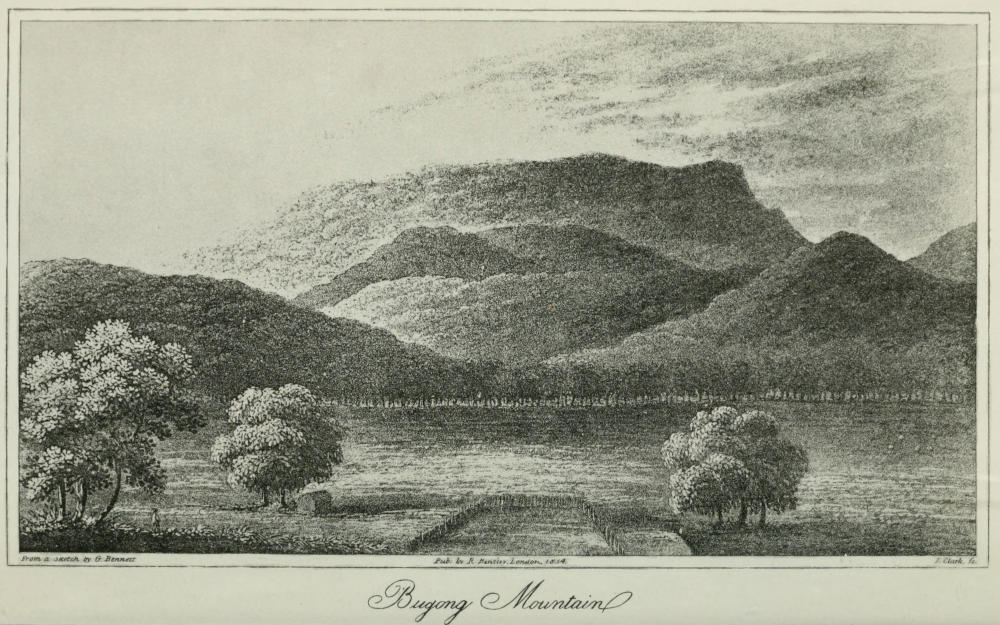
From a Sketch by G. Bennett.Pub: by R. Bentley,
London, 1834.T. Clark, sc.
Bugong Mountain
WANDERINGS IN
NEW SOUTH WALES, BATAVIA, PEDIR COAST, SINGAPORE,
AND CHINA; BEING
THE JOURNAL OF A NATURALIST IN THOSE COUNTRIES, DURING 1832, 1833, AND 1834.
BY
GEORGE BENNETT, Esq. F.L.S. FELLOW OF THE ROYAL COLLEGE OF SURGEONS, &c.
IN TWO VOLUMES.
VOL. I.
LONDON: RICHARD BENTLEY, NEW BURLINGTON STREET.
Publisher in Ordinary to his Majesty.
1834.
LONDON:
IBOTSON AND PALMER, PRINTERS, SAVOY STREET, STRAND.
PREFACE.
The Work now given to the Public is the result
of a series of recent excursions into the interior
of the Colony of New South Wales, at intervals
of disengagement from professional duties, and
at periods of the year best calculated for observations
in natural history. To this are added
a detail of such incidents as appeared to the
Author worthy of notice, while visiting Batavia,
Singapore, China, &c. on his return to England.
The writer in his narrative has limited himself
principally, if not entirely, to the notes taken at
the instant of observation, his object being to
relate facts in the order they occurred; and,
without regard to studied composition, to impart
the information he has been enabled to collect
in simple and unadorned language, avoiding, as
much as possible, the technicalities of science.
London, June, 1834.
CONTENTS OF THE FIRST VOLUME.
CHAPTER I.
Island of Porto Santo—Madeira—The Desertas Islands—Town
of Funchal—The Physalia, or Portuguese man of
war—Description of that animal—An experiment—Effects
of the Physalia’s sting—Method of preserving the
animal—Land in sight—Approach to the Cape Verd
Islands—Islands of Mayo and St. Jago—Anchor at Porto
Praya—The town—Famine—Novel method of Fishing—Tropical
trees and other plants—Valley of St. Trinidad—The
monkey bread-tree—Springs of water—Severe
drought—Negro Huts—Plantations—The gigantic boabab-tree—Residence
of Don F. Melo—The Orchilla weed—Date
palms—Leave the island
Enter the tropics—Flying fish—Luminosity of the ocean—Magnificent
scene—Phosphoric light—Interesting facts
in elucidation of that phenomenon—Albicores and Bonitos—A
colossal whale—Sea birds—Gigantic species of
Albatross—Description of those birds—Their manner of
flight
Sombre appearance of the Australian coast—Feelings of an
emigrant on approaching it—Improvement of Sydney—Fruits
produced in the colony—Extent of the town—Cultivation
of flowers and culinary vegetables—House-rent—The
streets—Parrots—Shops—Impolicy of continuing the
colony as a penal settlement—The theatre—Aspect of the
country in the vicinity of Sydney—The grass tree—Floral
beauties—Larva of a curious insect—The colonial museum—Visit
to Elizabeth Bay—Valuable botanical specimens
in the garden of the Honourable Alexander Macleay—New
Zealand flax—Articles manufactured from that
vegetable—Leave Sydney—Residence of Mr. M’Arthur—Forest
flowers—Acacias—Paramatta—Swallows
Road from Paramatta to Liverpool—Arrival at Raby Farm—The
opossum—Prisoners and free men—Advantage of
being sentenced to an iron gang—London pickpockets
converted into Shepherds—Suggestion with regard to the
convicts—Leave Raby—Mr. Jones’s farm—Cultivation of
the vine—Sameness of the forest scenery in Australia—Lose
our way—Journey resumed—Gloomy appearance of
the Australian vegetation—The tea tree—Colonial farms—Emu-ford—Blue
Mountain range—The Pilgrim Inn—View
from Lapstone Hill—Variety of flowering shrubs—A
beautiful garden—Road over the Blue Mountains—Picturesque
prospects—A mountain station—Bleak air of
the place—Our supper
Our journey resumed—The new road—Road-side flowers—Blackheath—The
pass through Mount Vittoria—Talent
and perseverance of Major Mitchell, the surveyor-general—Appearance
of an iron gang—Leave the Blue Mountain
range—Arrive at Collet’s Inn—Resume our journey towards
Dabee—New line of road—Aspect of the country—Arrival
at Mr. Walker’s farm—Residence of Mr. Dalhunty—Huge
mounds of clay—Blackman’s Crown—Gum-trees—Bush
travelling—Encamp for the night—Caution
to travellers—Cherry-tree Hill—A deserted station—Encampment
of Aborigines—The musk duck—Produce
of Mr. Cox’s dairy-farm—Mount Brace—Infanticide—Custom
of native women relative to their dead offspring—Native
practice of midwifery—Animal called the Cola—Belief
in the doctrine of metempsychosis
Cross the country to Goulbourn Plains—A road-gang
stockade—Splendid view—The old Bathurst road—Sidmouth
valley—Brisbane valley—Squash field—Bolam
Creek—Turril, turril—Gum resin—Swampy country—Mr.
Cowper’s farm—Anecdotes—Distant view of Goulburn
Plains—Mr. Bradley’s estate—Cross the plains—Hospitable
reception at Cardross—The Manna tree—Failure
in rearing the tulip tree
Appearance among the natives of a disease resembling the
small-pox—Origin and progress of that malady among the
aborigines—Medical investigations—Plan of treatment—Variety
of forms assumed by the disease—Its duration—The
critical period—Dr. Mair’s report
Bredalbane Plains—Forest country—Cockatoos and parrots—Peculiar
species of the lizard tribe—Medicinal trees—Bark
of the wattle trees—Mr. Manton’s farm—Picturesque
view—Yas Plains—Encampment of natives—Stringy bark,
or box tree—Use of that tree—Native method of cooking—The
Australian negro—Game—The flying squirrel—Human
chimney ornaments—Cloaks of opossum or kangaroo
skins—Barbarous ceremonies—Women not admitted
to the confidence of the males
Perch, and other fish—An elegant couple—Kangaroo dogs—Black
and white cockatoos—Vegetable productions—Mr.
O’Brien’s farm—Herds of cattle—Bush life—Proceed towards
the Murrumbidgee river—A bush track—Romantic
country—Arrive on the banks of the Murrumbidgee—Cross
the river—Swamp oaks, and other trees—Remarkable
caves—Return to Yas—Superstitious ceremonies—Crystal
used in the cure of diseases—Mode of employing
it
Leave Yas Plains for Sydney—Mr. Shelley’s farm—Splendid
new road—Mr. Barber’s farm—Shoalhaven gullies—Interesting
spot—Mr. Campbell’s farm—Journey resumed—Settlement
of Bong, Bong—Bargo Brush—Profusion of
flowering shrubs—View from the summit of Mount Prudhoe—The
cow pasture road—Farms of Mr. M’Arthur, and
Captain Coghill—Flowers—The white cedar—Government
hospital at Liverpool
Second Journey into the interior commenced—Land of
roses—The grape-vine—Foreign grain—Missionary rewards—Bargo
brush—Small species of Lobster—Another
species—Snakes—Leeches—Mr. Button’s farm—Proceed
on the journey to Gudarigby—Native plants—Magnificent
mountain view—Our repast—The laughing jackass—A
spacious cavern—Its interior—Black swans and other
birds
Native dogs—Their tenacity of life—Return to Yas Plains—The
Australian raspberry—Native cherry-tree—The summer
season—Tree hoppers—Their clamour—Gannets—Country
about the Tumat river—Bugolong—The Black
range—A storm—Vicinity of rivers—Native blacks—Their
costume and weapons—Wheat-fields—Destructive
birds—Winding course of the Murrumbidgee
Devoted attachment of Women—Remarkable instance of
this, exemplified in the tale of an Australian savage—Journey
resumed—Botanical productions—The Munne-munne
range—Luxuriant Plain—Mr. Warby’s farm—The
bell bird—Junction of the Murrumbidgee and Tumat
rivers—Native names of rivers—Soil—River cod—Aquatic
fowl—The Tumat country—Fertility of the plains—Assigned
servants—A mountainous range—The Murrumbidgee
Pine—Geological character of the vicinity—Mr.
Rose’s cattle station
Wooded hills—Base of the Bugong mountains—Multitudes
of the Bugong moths—Timber trees and granite rocks—Snow
mountains—Method of collecting the moths—Use
of these insects—Crows—Height of the Bugong
mountains—The aborigines—Dread of ridicule in the
females—Native fine arts—Lyre-bird of the colonists—Destruction
of kangaroos and emus—The station of Been—Sanguinary
skirmishes—A fertile plain—Cattle paths—Shrubs
on the banks of the Tumat
Kangaroo hunt—Ferocity of that animal—Use of its tendons—The
culinary parts—Haunts of the kangaroo—A death
struggle—Dissection of a kangaroo—Preservation of human
fat—Ascent of trees in pursuit of game—Parrots
and cockatoos—The emu—The native porcupine—Species
of ophthalmia, termed the blight—Leave the Tumat
country—Banks of the Murrumbidgee—Aborigines—Water
gum-tree—Kangaroo-rat—The fly-catcher—The
satin bird—Sheep stations—Colonial industry
Flocks of pelicans and grey parrots—Arrive at Jugiong—A
busy scene—The harvest—Quails and Hawks—Mr.
Hume’s farm—Domestic life among the settlers—Miss
my way in the forest—Mr. Reddal’s farm—Disease called
the Black Leg—Mr. Bradley’s residence at Lansdowne
Park—Drooping manna trees—Christmas festival—Mr. F.
M’Arthur’s farm—Aboriginal tribes—Native costume—Noisy
revelry—Wild ducks and pigeons—Spiders
Arrive at Wombat Brush—Animals called Wombat—Parched
country—Road-side houses—Colonial English—Column to
the memory of La Perouse—Death of Le Receveur—Sydney
police-office—The Bustard—Botanic garden—The
aborigines—King Bungaree—The castor-oil shrub—Diseases
of Australia—New Zealanders—Australian ladies—Prejudice
against travellers from Botany Bay—Anecdote—A
fishing excursion—Cephalopodous animals—Conclusion
of the author’s researches in this colony
Leave Sydney—Rottenest Island—Colonial prospects—Voyage
to Batavia—Prince’s Island—The Java coast—Anchor
in Batavia roads—The river—Alligators—Streets of
Batavia—M. Choulan’s tavern—Forests—Java ponies—A
veterinary monkey—Public buildings—The traveller’s tree—Celebrated
Javanese chief—Sketch of his life and actions—Exactions
of the Dutch government—The orang-utan—Society
in Batavia—Animals of Java—Doves—Dried
specimen of the hippocampus
Leave Batavia and anchor off Hoorn Island—Islands about
the Bengal Passage—Gingiong roads—Lofty aspect of the
land—The coast—The golden mountain—Island of Sumatra—Aspect
of the country—The lover’s leap—Village
of Pedir—Ships of the Acheenese Rajah—Visit to the
Rajah—Dense vegetation—Buffaloes—Ba Assan trees—Hall
of reception—Interview with his Highness—Commercial
negociations—Curiosity of the natives—The
Areka or Betel-nut—Flowering shrubs and plants—Rice-planting—Return
to the ship—A prohibition
Visit from the young Rajah—Native weapons—Costume—The
“trading minister” and his boy—Inspection of the
ship by the natives—Population of the Pedir district—Rambles
on the coast—King Crabs—Land crabs—Ova of
fish—Soldier crabs—Their food—The Rajah’s house—Cocoa-nut
water—Habitations in the Rajah’s inclosure—The
fort—The bazaar—Banks of the river—Plants—Native
fishing—Fruits—The country farther inland—Vegetation—The
Eju Palm—A fine plain
Country about Pedir—“White Lions”—The rajah’s habits—A
decision—Ornaments for the ear—Female curiosity—The
rajah’s horses—War between the rajah of Acheen
and the rajah of Trumong—A native’s account of the
quarrel—Purchase of betel-nut—The Areka-nut—Trade
in that article—Anecdote—A Chittagong brig—Dried fish—Beautiful
appearance of the Golden Mountain—Assemblage
of the mountains—Tornados—The fire king and his
demons—Yamora—Burial-ground—Large tree—Small
crabs—Game called Mein Achu—Leprosy—Party of natives—The
Viverra musanga—Applications for medicine—Rajah
of Putu—His retinue—Object of his visit
Island of Porto Santo—Madeira—The Desertas Islands—Town
of Funchal—The Physalia, or Portuguese man of
war—Description of that animal—An experiment—Effects
of the Physalia’s sting—Method of preserving the
animal—Land in sight—Approach to the Cape Verd
Islands—Islands of Mayo and St. Jago—Anchor at Porto
Praya—The town—Famine—Novel method of Fishing—Tropical
trees and other plants—Valley of St. Trinidad—The
monkey bread-tree—Springs of water—Severe
drought—Negro Huts—Plantations—The gigantic boabab-tree—Residence
of Don F. Melo—The Orchilla weed—Date
palms—Leave the island.
On the 15th of May 1832, the island of Porto
Santo, in latitude 35° 5′ north, longitude 16° 5′
west, was seen bearing south-west, half-south, at
the distance of forty miles from the ship “Brothers,”
Captain Towns, bound to New South
Wales, eleven days having elapsed since leaving
Plymouth, from whence we had taken our departure.
The appearance of the island, when we
had reached to within seven or eight miles of
it, was generally barren, varied by an occasional
verdant patch scattered over the rugged rocks,
which terminated in steep cliffs to the water’s
edge.
On the following morning at daylight, the
dark towering land of Madeira[1] was visible,
rising like a huge black mass from the blue
water. By eight A.M. we were in the passage
between the south-east side of Madeira and the
group of islands known as the Desertas, sailing,
with a light and agreeable breeze, from the eastward,
which enabled us to have an excellent view
both of the former islands and Madeira; and as
our progress seemed to be quicker than would
have been expected from our gentle zephyrs, we
were probably also aided by a current.[2]
The passage between the Desertas and Madeira
is considered to be about eleven miles across.
The Desertas stretch nearly north-north-west
and south-south-east, and may be five leagues
in extent; they have an abrupt, barren appearance,
with steep, rugged, perpendicular rocks
descending to the sea; on the largest island
there was some appearance of cultivation, and
the tufa, or red volcanic ash, imparts that colour
to several parts of the island; there is a high
pyramidal rock, resembling a needle or pillar,
situated about the north-west part of the group,
which at a distance is like a ship under sail.
By eight A.M. the heat of the sun had dissipated
the gloomy mist which had previously been
pending over and concealing the beautiful features
of the island of Madeira, and caused it to
burst forth in all its luxuriance and beauty; the
northern part of the island had a very sombre,
barren aspect, when compared with the fertility
of the southern; the plantations, glowing in
varied tints, interspersed with neat white villas
and small villages, gave much animation and
picturesque beauty to the scene.
Early in the morning is the time best calculated
to view the island clearly, as the sun,
gradually emerging from the dense masses
of clouds which have previously enveloped
the towering mountains, gilds their summits,
and, gradually spreading its rays over the fertile
declivities, enlivens and renders distinct the
splendid prospect afforded to the voyager. As
the sun, however, acquires a stronger power,
its proximity to a wide expanse of waters soon
causes a mist to arise by which the clearness of
the view from the sea is much obstructed.
As we approached, the town of Funchal opened
to our view, the white habitations rising like an
amphitheatre, and the hills around, covered by
the variegated tints of a luxuriant vegetation:
the whole appearance of the island was such, as
to be well calculated to excite the most agreeable
sensations of delight at any time, but more especially
after the eye has enjoyed for a time only
the prospect of sea and sky.
As it was not our intention to touch at this
island, in the course of the day we had passed
and left it far in the distance. We spoke off the
island one of Don Pedro’s blockading squadron;
it was a brig mounting eighteen guns, filled with
such a motley crew as one may expect to see in
a piratical craft. The spokesman informed us
that Don Pedro was with Admiral Sartorius, in
a large ship off the north side of the island: we
then parted; they wishing us “un bon voyage,”
and we, in return, hoped they might obtain
abundance of prize money, but which we hardly
supposed would ever be realized.
There are various objects well calculated to
excite interest to a naturalist during a long
voyage, and to furnish both amusement and instruction.
The splendid Physalia, or “Portuguese
man of war,”[3] is often seen floating by the
ship; the inflated, or bladder portion of this
molluscous animal, glowing in delicate crimson
tints, floats upon the waves, whilst the long tentaculæ
of a deep purple colour extend beneath,
as snares to capture its prey. It is oftentimes
amusing to see persons eager to secure the gaudy
prize; but they find, by painful experience,
that, like many other beautiful objects of the
creation, they possess hidden torments; for no
sooner have they grasped the tinted and curious
animal, than, encircling its long filiform appendages
over the hands and fingers of its capturer,
it inflicts such pungent pain by means of an acrid
fluid discharged from them, as to cause him to
drop the prize, and attend to the smarting occasioned
by it.
This beautiful molluscous animal inhabits the
tropical seas, and is also seen in high latitudes
during the summer months[4] of the year. When
first removed from the water, it excites the admiration
of the spectators by the elegant and
vivid colours with which it is adorned. These
tints, however, are as evanescent as they are
brilliant; and soon after this animal is taken
from its native element, the crest sinks; the
bright crimson, green, and purple tints lose their
brilliancy, and the beauty which had previously
excited so much admiration fades, and at last
totally vanishes. There are a number of species
of the genus;[5] but the one most commonly seen
is the Physalia pelagica of Lamarck, (Holothuria
physalis of Linn.) They are known to our seamen
as the “Portuguese men of war,” and
galére or frégate among the French, from having
some resemblance to a small vessel resting tranquilly
on the surface of the water during a calm,
at which time they are more readily discerned
than during strong breezes: they have also been
confounded by many persons unacquainted with
natural history with the Nautilus.
The figure of this species is somewhat ovate;
the upper portion resembles an inflated bladder,
rounded at one extremity, and with a beak-like
termination at the other. On the summit or
back is a crest or ridge, slightly elevated, sulcated,
and fringed at the edges: the whole of
this part of the animal is of a light blue, with
occasional streaks of delicate sea-green, and
tinged with brilliant crimson: this portion of the
animal is filled with air, and, although I have
heard it frequently asserted that the animal has
the voluntary power of collapsing the bladder on
the approach of tempestuous, or inflating it on a
return of fine weather, yet I do not credit the
remark, considering it is more probably a seaman’s
tale than the result of a naturalist’s observation.
On examination, no apparatus is
found by which such an effect could be produced;
and if it actually possesses such a power, why is
it not exercised in every moment of peril?—for,
when we approach the animal to capture it, or
when it is taken from the water, no such change
occurs; the bladder still remains inflated, and
can be preserved thus distended either in a
dried state or by placing it in alcohol. During
strong breezes, I have seen them floating on the
waves; but, from the ship passing at that
time rapidly through the water, they are then
more rarely observed. I have also seen them
thrown in tempestuous weather on the beach at
New South Wales, the bladder portion of the
animal still remaining inflated. From these,
and other reasons which might be adduced, the
assertion cannot be considered as the result of
actual observation. Situated at the under portion
of the animal is a mass of tentaculæ, some
short and thick, others long, filiform, and extending
to several yards in length: these seem
to consist of a chain of globules, filled with an
extremely acrid fluid: in colour, they are of a
beautiful purple, with an admixture of crimson;
and they are covered by a glutinous substance,
having a peculiar odour. The inflated membrane
is probably intended to keep the animal
buoyant on the water, by which it is readily enabled
to extend its long tentaculæ in search of prey,
or it may be designed as a locomotive agent,
aiding the animal in its progress over the “vast
bosom of the ocean,”—thus serving the purpose
of a sail. It is said that the appearance of the
Physalia near to the sea-coast is the indication
of an approaching tempest.[6]
Having captured a very fine specimen of this
animal on a former voyage in latitude 9° 0′
south, and longitude 12° 59′ west, and being
aware of the pungent property residing in the
tentaculæ, I was desirous of trying its effects on
myself, for the purpose of ascertaining from
personal experience the constitutional irritative
effects resulting from it. On taking hold of the
animal it raised its tentaculæ, and stung me on
the second and ring fingers. The sensation was
similar at first to that produced by the nettle;
but before a few minutes had elapsed, a violent
aching pain succeeded, affecting more severely
the joints of the fingers, the stinging sensation
at the same time continuing at the part first
touched by the acrid fluid. On cold water being
applied, with the intention of removing or lessening
the pain, it was found rather to increase
than diminish the effects. The irritation resulting
from the poisonous fluid emitted by the
animal extended upwards, increasing in extent
and severity, (apparently acting along the course
of the nerves,) and in the space of a quarter of
an hour, the effect in the fore-arm (more particularly
felt at the inner part) was very violent,
and at the elbow-joint still more so. It may
be worthy of remark, that when the joints became
affected the pain always increased. It
became at last almost unbearable, and was much
heightened on the affected arm being moved;
the pulse of that arm was also much accelerated,
and an unnatural heat was felt over its whole
surface. The pain extended to the shoulder-joint;
and on the pectoral muscle becoming
attacked by the same painful sensation, an oppression
of breathing was occasioned, which we
find similarly produced by rheumatism, when it
attacks that muscle; and it proved very distressing
during the time it remained. The
continuance of the pain was very severe for
nearly half an hour, after which it gradually
abated, but the after effects were felt during the
remainder of the day in a slight degree of numbness
and increased temperature of the arm.
About two hours after I had been stung, I
perceived that a vesicle had arisen on the spot;
and when children have been stung, I observed
that numerous small vesicles arose, similar to
those produced by the nettle. The intensity of
the effects produced depends on the size and consequent
power of the animal; and after it has
been for some time removed from the water, it
is found that the stinging property has diminished.
This irritative property, unattended,
however, by any of the constitutional effects,
remains for a long time in the tentaculæ, even
after they have been removed from the animal;
for on touching a handkerchief some weeks after
it had been used in wiping off some portions of
the tentaculæ, the stinging property was found to
have remained, although it had lost that virulent
quality, which produced on a recent application
such violent constitutional irritation.
This irritative secretion does not, however,
exist solely in this species of mollusca; several
of the medusæ have similar properties, which
may perhaps be considered as both offensive and
defensive; and it has been, and no doubt correctly,
supposed to be given to these animals as a
means of procuring their food, the benumbing
principle existing in the tentaculæ rendering
their prey when touched unable to escape. For
what purpose this acrid property is found existing
in the vegetable kingdom, it is difficult to decide,
and all that has yet been said on the subject
may be considered as merely hypothetical. For
instance, at the island of Singapore there is a
remarkable species of the order Fuci, usually
found growing in isolated patches upon coral
banks. Finlayson thus mentions it: “It is pinnated,
plumose, elegant, about a foot and a half
in length, and of a whitish colour. It is endued
with a property of stinging like nettles; the
sensation produced is more acute and more
penetrating, more instantaneous, but somewhat
more permanent. The hand is scarcely brought
into contact with it, before the wound is inflicted.
A small corrugated granular bag, filled with a
transparent fluid, would seem to be the organ by
which it produces this effect. These are no
sooner touched than they discharge the fluid
they contain. The plant soon loses this power
after being removed from the water.” This
plant seems, therefore, to possess an offensive
or defensive property analogous to that of the
Physalia, but for what purpose it would be difficult
to form an opinion.
The usual method adopted for the preservation
of this curious and beautiful mollusca is
by placing it in spirits; the form is thus well
preserved; but its vivid tints, the subject of so
much admiration, are totally lost. As it is with
the beautiful but evanescent colour of flowers,
no method has been discovered by which their
natural brilliancy can be preserved, and it is
impossible to retain that peculiar brightness
given only by life and health. I have preserved
the animal by detaching the tentacute from the
bladder; (on account of their being too soft and
perishable to enable them to be dried, en masse,
with any chance of success; their form only
being preserved well in spirits;) then permitting
the air to escape from the bladder, dried,
pressed, and afterwards gummed on paper, it
produces a good lateral view of the form of this
mollusca; the colours being afterwards artificially
renewed by the pencil, and the tentaculæ
underneath drawn and coloured, the tout ensemble
conveys an idea of the brilliant appearance
of the animal, as far as can be produced
by art. I have also kept the animal with the
bladder inflated, dried it in that state, and, by
afterwards colouring it, the appearance produced
is very excellent; but, it is only by repeated
trials that the best and most accurate methods
of preserving objects of natural history can be
discovered—the greatest difficulty existing, being
that of preserving them accurately in their natural
appearance.
We had the N. E. trade in lat. 28° N. and
long. 18° 11′ W. and at three P.M. of the 25th
made the “Northern Saddle Hill,” (N. W. hill,)
on the island of Sal, (Cape Verd group,) bearing
S. E. about six leagues distant.
The announcement of “land in sight,” and
the delightful sensations produced by it, can
only be appreciated by those who have for some
length of time been tossed about on the “deep,
deep sea,” for many a weary day, with nothing
but sea and sky to gaze upon. All hasten on
deck as soon as the land is stated to be visible;
at first its rather indistinct form, as it rises from
the horizon, does not excite so much interest;
but, on a nearer approach, the variously tinted
strata of the lofty mountains become visible, and
plantations, trees, shrubs, and neat habitations
cheer the eye; and, on landing, a profusion of
the floral beauties of the vegetable kingdom,
with butterflies vieing with them in splendour of
tints, or several species of the coleoptera tribe
decked in golden armour, meet the eye. But
the approach to the Cape Verd islands does not
possess these beauties in any profusion—barren
volcanic mountains, contrasted occasionally only
by a few others of a verdant character are seen
instead; even these become an agreeable prospect,
being a change from the monotony of a
ship, but a departure from them, after a few
days’ sojourn, is attended with but little if any
regret.
On the 26th, at daylight, we sailed with a
pleasant breeze between the island of Mayo and
that of St. Jago; the former distant about ten,
the latter about eighteen miles; the western side
of Mayo had a very sterile appearance; there
was not a tree or speck of verdure to be seen.
The lofty mountain of St. Antonio, on the island
of St. Jago, was visible; its declivities verdant,
but the peaked summit was for the most part
hidden by clouds. As we coasted along the
latter island, the feature of the coast was very
barren, although it was occasionally relieved
by a small verdant valley, diversified by some
miserable huts and a few stunted cocoa-nut trees.
In the afternoon we anchored at Porto Praya,[7]
about a quarter of a mile distant from the shore.
After dinner we paid a visit to the shore; the
landing-place is very inconvenient, and often
dangerous, from the surf, which at this time was
fortunately not high. After landing we had to
walk over a soft sandy road, varied only by
large stones coming in contact with our feet,
and assuring us of their presence by the pain
they occasioned. Several miserable date palms
and dusty plants of Aloe perfoliata (a few of the
latter being in flower) grew by the road side.
Then by a winding and steep ascent, covered by
loose stones, we arrived at the town, which is
built upon a table land of moderate elevation,
and on this side of the approach there is a battery
mounting twenty-one guns. From the descriptions
I had previously perused, the town appears
to have been much improved since they had been
written, but still it has nothing of interest to recommend
it; but the view of the bay and shipping
from the elevated site is very pretty. The Plaza
(in which the American consul resides, and where
there is a small church, which as yet cannot boast
of a steeple,) contains the best houses and stores,
where almost any supplies of foreign manufacture
can be purchased, but at exorbitant prices.
At the period of our visit, this, together with
the whole of the islands of the group were suffering
from a severe and long drought; this one,
from its fertility, and the irrigation that is capable
of being produced, as well as from imports,
is in a better condition than the others. At the
island of Fuego, more particularly, the inhabitants
were said to be dying daily in great
numbers, from famine. The island of St. Jago
alone is stated to have a population of 27,000
inhabitants.
I observed several boats engaged in fishing
near the ship, previous to our landing, and their
mode of capturing the finny tribe appeared to
me novel; they sprinkled something over the
water, like crumbs of bread, that attracted the
fish (which were five or six inches long) to the
surface in shoals; the fishermen then swept
amongst them a stick to which a number of
short lines and hooks were attached, and by aid
of this they usually brought up several fish at a
time. After the fish were caught, some women,
who were in the boat, were engaged in cleansing
and salting them.
Tired of the dull village, we descended from
the elevated site to a garden in which the
well was situated whence the supply of water of
excellent quality is procured for shipping. At
this spot the plantain, date, papaw, and cocoa-nut
trees, attracted the attention of those of our
party who had never before seen these magnificent
tropical trees. The sides of the paths
were adorned with the gay and handsome flowers
of the Poinciana pulcherrima, and the more elevated
lilac tree (Melia azedarack) profusely
covered with its long panicles of fragrant
flowers. As we rambled further into the scrubby
parts beyond this cultivated spot, cotton shrubs,
(Gossypium herbaceum,) the thorny Zizyphus and
mimosas were abundant. The Jatropha curcas
was used for hedges, and a handsome asclepias
(procera?) called bombadero by the Portuguese,
was abundant about this waste land, both in fruit
and flower: the flowers are succeeded by a large
somewhat oval fruit, containing a quantity of
pretty feathered seeds; the whole plant (like all
the family to which this belongs) abounds in a
viscid milky juice; the capsule of the pod is
elegantly veined, reminding the anatomist of the
veins displayed on the exterior of the heart.
On the following morning a small party was
formed for an excursion to the valley of St.
Trinidad, to gain some idea, if possible, of the
fertile portions of this apparently very sterile
island. This valley, it may be said, commences
soon after descending the table land on
which the town is situated. We diverged from
the direct road, for the purpose of visiting a
plantation about a mile and a half distant from
the town. The road was stony, and there was
nothing in the aspect of the country around to
relieve the eye; a few stunted Mimosæ, (occasionally
varied by a few of the same species of
large dimensions and great age,) some stunted
Zizyphi, and a few trailing plants of Convolvulus
soldanella, which, by its dark green leaves and
purplish flowers, contrasted in a beautiful manner
with the sterile brown soil of the scorched plains.
The plantation we visited was not yet in order;
it contained some flourishing coffee plants, with
cocoa, plantain, cashew-nut, and other tropical
trees; but the principal object of my visit was to
view a specimen of the Adansonia digitata, or
monkey bread tree, and its very peculiar appearance
and growth imparted much gratification;
it was about eighteen or twenty feet high, and
twenty-one feet in circumference. This tree was
in full foliage, and its bright green digitated
leaves imparted much animation to it. The tree
is surrounded to some depth by a spongy sap.
As subsequently at the valley I saw a much larger
specimen of this gigantic tree, but destitute of
foliage, I shall then return to its description,
and add a sketch. From this part of the island
I collected but few plants; Momordica senegalensis
grew wild about the fertile parts, as well as
Lotus jacobæus, Tribulus cistoides, Asclepias, (procera?)
and a very pretty convolvulus, with lilac
flowers, climbed over rocks and trees in good
soil.
From this place we proceeded to our destination.
The sun was fervent, but the inconvenience
was in some degree mitigated by a
delightful north-east trade breeze. We passed
over scorched plains, about which a few stunted
bushes of mimosa were scattered, and at other
places some wretched trees of Jatropha curcas.
In a small vale we passed a rivulet of delicious
water, at which several negresses were busily
engaged in washing linen. The springs of
water appear excellent, and there seems to be
no deficiency of it in the valleys; but the want
of rain is often severely felt: it was stated
to me, that during the previous twenty months
only half an inch has fallen on this island.
Continuing our journey, we passed several
negroes conveying their produce, consisting of
fruit, vegetables, orchilla weed, &c. to the town
for sale, upon asses, with panniers made from
bullocks’ hides. The animals seemed in excellent
condition, at which we were not a little
surprised, from what we had seen of the sterility
of the soil. A few cattle were also seen wandering
over the plains, where barely a speck
of verdure tinged the barren volcanic rocks, still
the animals were sleek, and in tolerable condition;
we therefore came to the conclusion that
they were turned out to feed, or, what was
much more likely, to view the country and fast
during the day, and driven home to feed at
night.
We pursued our dreary path, occasionally
passing a few negro huts, and refreshing ourselves
with some delicious goats’ milk. As we
came upon the fertile portion of this valley, the
change of scene was certainly most agreeable;
the brown-parched soil which we had been so
long previously alone regarding, now gave place
to the verdant plantations of sugar-cane, manioc,
and various European and tropical esculent
vegetables, which gave a rich and animated
character to the scene. The plantations were
also interspersed with a great variety of tropical
fruit trees, such as orange, lemon, guava
plantain, tamarind, custard apple, &c. The
tamarind trees were stunted, compared with the
luxuriant and elegant growth of those trees in
India; they were, however, laden with ripe
fruit, whose powerful acid soon set the teeth on
edge of such of our party as were induced to
partake of them.
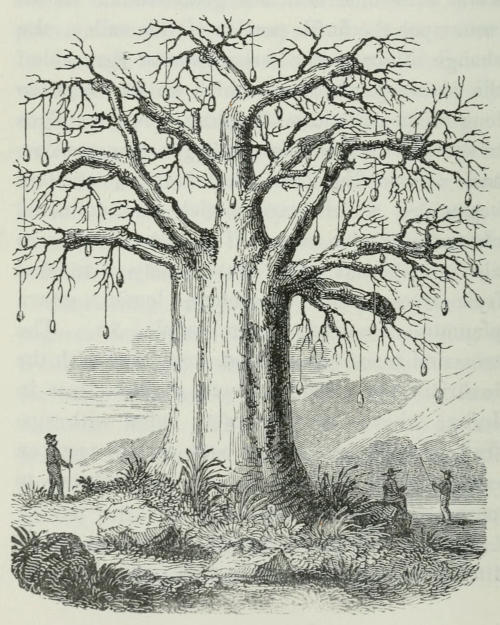
Several trees of the Boabab, or monkey bread-tree,
(Adansonia digitata,) were now seen, and
among them one was particularly conspicuous
from its size, as also from a resemblance to the
union of three trees. This tree was destitute
of foliage, but that loss was compensated by
the curious character it assumed, being covered
with fruit pending from a long, twisted, spongy
stalk, varying in length from one to two feet.
This tree measured forty feet in circumference,
and was about sixty feet high; the bark was
smooth, and of a greyish colour; the termination
of its larger branches is remarkable,
from being abruptly rounded, and from these
rounded extremities the smaller branches are
given off, as may be seen in the accompanying
drawing; this forms a very characteristic
feature in the tree. The fruit, on the
outer shell being broken, contained not the
yellow pulp usually mentioned, but a white
farinaceous substance enveloping the dark brown
seeds, of an agreeable acidulated taste. This
may proceed from the fruit being old. The fruit
is of an oval form, usually six inches in length,
and three or four in diameter; rough externally,
and, when mature, of a brownish yellow colour;
a dark red gum exuded from the outer part of
the fruit.[8]
Some of the farms and plantations were in
very fine and luxuriant condition, and this was
an enjoyment to us after the arid country we had
before seen, destitute almost of vegetation, and
covered with loose stones. Of the feathered
tribe, although not very numerous, a few were
shot by one of the party, among which were two
specimens of Halcyon senegalensis, and a fine
hawk; quails and Guinea fowls (Numida meleagris,
Linn.) were abundant, and several
of the former were also shot; the crow and
several species of Fringillæ were likewise seen.
In the afternoon we returned to the town.
The population consists for the most part of
mulattos and negroes: fruit, including plantains,
bananas, oranges, and pine-apples, was
abundant, but not yet fully in season.
Among the very few decent houses in this
paltry town, was one, the residence of a Don
F. Melo, (who speculates in orchilla weed,)
situated in the Plaza, which displays taste and
neatness both in the exterior and interior of its
arrangement: on the lower land, behind the
house, he has laid out with much labour an extensive
garden, well irrigated, and in which
European and tropical vegetables, fruits, and
elegant flowering plants, were thriving in
luxuriance, and sufficiently proved that even
in that sterile spot, industry and perseverance
could surmount almost any difficulty. At the
house of this gentleman, I had an opportunity
of seeing some excellent specimens of the
orchilla weed; this valuable production of the
vegetable kingdom is indigenous to this and
other islands of the group, as well as to Madeira,
the Canaries, and the coast of Barbary; it is the
Roccella tinctoria of botanists,[9] and is held in
high estimation for the purplish dye it yields,
and I believe, excepting the cochineal, is the
only dye that possesses a mordant in itself. This
lichen is of a gray colour, and those plants which
are of the darkest hue, long and strong, are
considered the best; it grows to a great length,
but is rarely obtained so, as the natives gather
it before it comes to any size, on account of its
high value.
The quantity collected in one year, among
the whole of this group of islands, was
537,600 lbs.; but sometimes a larger quantity
is obtained, when, not having much work upon
the plantations, the negroes can be employed
for the purpose.[10] It is found on the steep rocks in
the interior of the islands, and growing in the
crevices; the finest orchilla is collected at the
island of St. Antonio, where it grows in some
places so inaccessible as to be only procured
by lowering the gatherer down the cliffs by
ropes. This lichen is exported only to Lisbon,
there being an order from the Portuguese government
to that effect, but quantities were often
smuggled direct to some foreign port.[11]
Date palms were very numerous in the vicinity
of the town, but did not appear to attain any
high degree of perfection, or bear fruit, and
were used, for what they alone seemed fit, as
firewood.
The troops were decently clad, and consisted
of about five hundred, principally negroes and
mulattoes, officered by Europeans.
All arrangements having been completed, we
left the island in the evening, with a fine north-east
trade breeze.
CHAPTER II.
Enter the tropics—Flying fish—Luminosity of the ocean—Magnificent
scene—Phosphoric light—Interesting facts
in elucidation of that phenomenon—Albicores and Bonitos—A
colossal whale—Sea birds—Gigantic species of
albatross—Description of those birds—Their manner of
flight.
On the 31st of May we lost the north-east trade,
in 8° 40′ north, and longitude 23° west, after
which we experienced variable winds with torrents
of rain, until the 4th of June, when we
had the south-east trade in latitude 4° 38′ north,
and longitude 22° 49′ west, and crossed the
equator early on the morning of the 7th, in
longitude 27° 5′ west, being altogether only
thirty-two days from Plymouth, including our
delay at St. Jago.
On entering the tropics many animate objects
excite attention, among others the flying-fish;
it is surprising how many different opinions
have been formed on the subject of this fish; some
considering it seeks the air for sport or pastime,
whilst others regard it as only taking flight
when pursued, and thus decide its existence to
be a continued series of troubles and persecutions.
Between such opposite opinions, we can only form
our judgment from actual observation, and there
is one circumstance without any doubt resting
upon it; that the supposed war of extermination
exercised against them has not diminished their
numbers, for they are observed in as large “flocks”
at the present day, as navigators have related
of them former days; they must also have
had a long cessation of hostilities from the
time of birth, to enable them to arrive at maturity.
To say that these fish undergo persecution
more than any other living animals
of the creation, is absurd, for we may observe
the same principle throughout the whole of the
animated kingdom of nature.
On arriving in tropical regions, this curious
fish is seen, and affords some variety to the tedium
of a ship; the passengers amusing themselves by
watching its flight, and sometimes its “persecution,”
when pursued by bonitos, dolphins,
albicores, among the finny, and tropic birds,
boobies, gannets, &c. among the feathered tribe.
I have frequently derived both information and
amusement by watching the flight of these fish;
to observe them skim the surface of the water
for a great distance, sometimes before, and at
other times against the direction of the wind,
elevating themselves either to a short height
from the surface, or to five or six feet, and then,
diverging a little from their course, drop suddenly
into their proper element; sometimes
when their flight was not high above the water,
and it blew fresh, they would meet with an
elevated wave, which invariably buried them
beneath it, but they would often again start
from it and renew their flight.
I have never yet been able to see any percussion
of the pectoral fins during flight, although
such a high authority as Cuvier says, “the
animal beats the air during the leap, that is, it
alternately expands and closes its pectoral fins;”
and Dr. Abel also supports this opinion, and
says that it agrees with his experience; he has
repeatedly seen the motion of the fins during
flight, and as flight is only “swimming in air,”
it appears natural that those organs should be
used in the same manner in both elements.
But the structure of a fin is not that of a wing;
the pectoral fins or wings of the flying fish are
simply enlarged fins, capable of supporting,
perhaps, but not of propelling the animal in its
flight.[12]
In fish, the organ of motion for propelling
them through the water is the tail, and the fins
direct their course; in birds, on the contrary, the
wings are the organs of motion, and the tail the
rudder. The only use of the extended pectoral
fins in the fish is for the purpose of supporting
the animal in the air, like a parachute, after it
has leaped from the water by some power, which
is possessed by fish of much larger size, even
the whale. From the structure of the fin, I
cannot consider it at all calculated for repeated
percussions out of the water, although while in
that fluid it continues its natural action uninjured,
as it soon dries when brought into contact
with the air, and the delicacy of the membrane
between the rays would very readily become
injured, were the organ similarly exerted
in that medium.
The greatest length of time that I have seen
these volatile fish on the fin, has been thirty
seconds by the watch, and their longest flight,
mentioned by Captain Hall, has been two hundred
yards; but he thinks that subsequent observation
has extended the space. The most
usual height of flight, as seen above the surface
of the water, is from two to three feet; but I
have known them come on board at a height of
fourteen feet and upwards; and they have been
well-ascertained to come into the channels of
a line of battle ship, which is considered as
high as twenty feet and upwards.[13]
But it must not be supposed they have the
power of elevating themselves in the air, after
having left their native element; for on watching
them I have often seen them fall much
below the elevation at which they first rose
from the water, but never in any one instance
could I observe them raise themselves from the
height at which they first sprang, for I regard
the elevation they take to depend on the power
of the first spring or leap they make on leaving
their native element.
On the 6th of June, in latitude 1° 50′ north,
and longitude 25° 14′ west, a flying-fish was
brought me by one of the steerage passengers,
which had just “flown” on board over his head,
as he was standing near the fore-part of the
ship; being still alive when he brought it to
me, I hastened to place it in a bucket of
water, to ascertain whether it would attempt
to spring from it, and “take flight;” however,
I found it was too late, for after floating
about with its long pectoral fins half expanded,
as it remained near the surface of the water, it
continued alive for about the space of a minute,
and then died. They usually, from the violence
with which they come on board, receive some
injury against the spars, boats, or chains, sufficient
to destroy them; and therefore it will be
difficult to observe their true actions as when
performed in full vigour in their native element.
This specimen measured nine inches in length.
What excited my attention in this fish was
a species of anatifa attached by its peduncle
to the thorax. I regard as a very unusual
circumstance, the existence of an anatifa attached
to a living animal, particularly one of
such rapidity of motion as this fish is usually supposed
to be. The height at which this fish came
on board could not have been less than fourteen
feet from the surface of the water, and on the
windward side of the vessel.
The “flight” of these fish has been compared
to that of birds, so as to deceive the observer;
however, I cannot perceive any comparison, one
being an elegant, fearless, and independent
motion, whilst that of the fish is hurried, stiff,
and awkward, more like a creature requiring
support for a short period, and then its repeated
flights are merely another term for leaps. The
fish make a rustling noise, very audible when
they are near the ship, dart forward, or sometimes
take a curve to bring themselves before
the wind, and when fatigued fall suddenly into
the water. It is not uncommon to see them,
when pursued, drop exhausted, rise again almost
instantly, proceed a little further, again dipping
into the ocean, so continuing for some distance
until they are out of sight, so that we remain
in ignorance whether they have been captured
or have eluded pursuit.
The flying-fish swim in shoals, for on one day
they are seen rising about, and in the vicinity
of the ship, in great numbers; and on the day
following, or latter part of the same day, only a
few stragglers are seen. When disturbed by
the passage of the ship through the shoal, they
rise in numbers near the bows of the ship, and
the consternation seems to spread among those
far distant: the same may be observed when
dolphins and albicores are pursuing them. On
passing between the islands of Fuego and St.
Jago, (Cape Verd group,) in December, 1828,
I witnessed a number of bonito in pursuit of
flying-fish; the former springing several yards
out of the water, in eager chase, whilst large
shoals of the latter arose with an audible rustling
noise before their pursuers, and the chase continued
as far as we could see, a number of
victims no doubt being sacrificed to the voracity
of their hunters. Besides the finny enemies, they
had to encounter, as they rose from the water,
boobies, gannets, and tropic birds, which hovered
about, and in our view secured very many as
they sought refuge in the air. It was a novel
sight, and one not often witnessed during repeated
voyages, and afforded much amusement
and interest to those who beheld it.[14]
Occasionally our attention was excited during
the voyage, by the remarkable luminosity assumed
by the ocean in every direction, like
rolling masses of liquid fire, as the waves broke
and exhibited an appearance inconceivably
grand and beautiful. The phosphoric light,
given out by the ocean, exists to a more extensive
and brilliant degree in tropical regions,
although in high latitudes it is occasionally
visible, more especially during the warm months
of the year. The cause of it has excited much speculation
among naturalists; and although many
of the marine molluscous and crustaceous animals,
such as salpa, pyrosoma, cancer, several
medusæ have been found to occasion it, yet no
doubt debris, from dead animal matter, with
which sea water is usually loaded, is also often
one of the exciting causes.
As the ship sails with a strong breeze through
a luminous sea on a dark night, the effect produced
is then seen to the greatest advantage.
The wake of the vessel is one broad sheet of
phosphoric matter, so brilliant as to cast a dull,
pale light over the after-part of the ship; the
foaming surges, as they gracefully curl on each
side of the vessel’s prow, are similar to rolling
masses of liquid phosphorus; whilst in the distance,
even to the horizon, it seems an ocean of
fire, and the distant waves breaking, give out a
light of an inconceivable beauty and brilliancy:
in the combination, the effect produces sensations
of wonder and awe, and causes a reflection
to arise on the reason of its appearance, as to which
as yet no correct judgment has been formed, the
whole being overwhelmed with mere hypothesis.
Sometimes the luminosity is very visible without
any disturbance of the water, its surface
remaining smooth, unruffled even by a passing
zephyr; whilst on other occasions no light is
emitted unless the water is agitated by the winds,
or by the passage of some heavy body through
it. Perhaps the beauty of this luminous effect
is seen to the greatest advantage when the ship,
lying in a bay or harbour in tropical climates,
the water around has the resemblance of a sea
of milk. An opportunity was afforded me when
at Cavité, near Manilla, in 1830, of witnessing
for the first time this beautiful scene: as far as
the eye could reach over the extensive bay of
Manilla, the surface of the tranquil water was
one sheet of this dull, pale, phosphorescence;
and brilliant flashes were emitted instantly on
any heavy body being cast into the water, or
when fish sprang from it or swam about; the
ship seemed, on looking over its side, to be
anchored in a sea of liquid phosphorus, whilst
in the distance the resemblance was that of an
ocean of milk.
The night to which I allude, when this magnificent
appearance presented itself to my observation,
was exceedingly dark, which, by the contrast,
gave an increased sublimity to the scene;
the canopy of the heavens was dark and gloomy;
not even the glimmering of a star was to be
seen; while the sea of liquid fire cast a deadly
pale light over every part of the vessel, her
masts, yards, and hull; the fish meanwhile
sporting about in numbers, varying the scene
by the brilliant flashes they occasioned. It
would have formed, I thought at the time, a
sublime and beautiful subject for an artist, like
Martin, to execute with his judgment and pencil,
that is, if any artist could give the true effect
of such a scene, on which I must express some
doubts.
It must not be for a moment conceived that
the light described as brilliant, and like to a sea
of “liquid fire,” is of the same character as
the flashes produced by the volcano, or by
lightning, or meteors. No: it is the light
of phosphorus, as the matter truly is, pale,
dull, approaching to a white or very pale
yellow, casting a melancholy light on objects
around, only emitting flashes by collision. To
read by it is possible, but not agreeable; and,
on an attempt being made, it is almost always
found that the eyes will not endure the peculiar
light for any length of time, as headaches and
sickness are often occasioned by it. I have
frequently observed at Singapore, that, although
the tranquil water exhibits no particular luminosity,
yet when disturbed by the passage of a
boat, it gives out phosphoric matter, leaving a
brilliant line in the boat’s wake, and the blades
of the oars when raised from the water seem to
be dripping with liquid phosphorus.
Even between the tropics, the phosphoric
light is increased or diminished in its degree
of brilliancy, in a very slight difference of latitude;
on one day it would be seen to a most
magnificent extent, on the next it would be
perhaps merely a few luminous flashes. It
might proceed from the shoals of marine animals,
that caused the brilliancy to be less extensively
distributed over one part of the ocean
than another. That I am correct in asserting
that some of the animals which occasion the
phosphoric light, emitted by the ocean, do travel
in shoals, and are distributed in some latitudes
only in a very limited range, I insert two facts
which occurred during this voyage, and which
will no doubt be regarded as interesting.
On the 8th of June, being then in latitude 00°
30′ south, and longitude 27° 5′ west, having fine
weather and a fresh south-easterly trade wind,
and range of the thermometer being from 78° to
84°, late at night the mate of the watch came
and called me to witness a very unusual appearance
in the water, which he, on first seeing,
considered to be breakers. On arriving upon the
deck, this was found to be a very broad and
extensive sheet of phosphorescence, extending
in a direction from east to west as far as the eye
could reach; the luminosity was confined to the
range of animals in this shoal, for there was no
similar light in any other direction. I immediately
cast the towing net over the stern of the
ship as we approached nearer the luminous
streak, to ascertain the cause of this extraordinary
and so limited a phenomenon. The ship soon
cleaved through the brilliant mass, from which,
by the disturbance, strong flashes of light were
emitted; and the shoal (judging from the time
the vessel took in passing through the mass)
may have been a mile in breadth: the passage
of the vessel through them, increased the light
around to a far stronger degree, illuminating the
ship. On taking in the towing net, it was found
half filled with pyrosoma, (atlanticum?) which
shone with a beautiful pale greenish light, and
there was also a few small fish in the net at the
same time; after the mass had been passed
through, the light was still seen astern until it
became invisible in the distance, and the whole of
the ocean then became hidden in darkness as before
this took place. The scene was as novel as it
was beautiful and interesting, more so from having
ascertained, by capturing the luminous animals,
the cause of the phenomenon.
The second was not exactly similar to the preceding;
but, although also limited, was curious,
as occurring in a high latitude during the winter
season. It was on the 19th of August,[15] the
weather dark and gloomy, with light breezes
from north-north-east, in latitude 40° 30′ south,
and longitude 138° 3′ east, being then distant
about three hundred and sixty-eight miles from
King’s Island, (at the western entrance of Bass’s
Straits). It was about eight o’clock, P.M. when
the ship’s wake was perceived to be luminous,
and scintillations of the same light were also
abundant around. As this was unusual and had
not been seen before, and it occasionally also
appeared in larger or smaller detached masses
giving out a high degree of brilliancy: to ascertain
the cause, so unusual in high latitudes
during the winter season, I threw the towing
net overboard, and in twenty minutes succeeded
in capturing several pyrosoma, giving out their
usual pale green light; and it was no doubt
detached groups of these animals, that were the
occasion of the light in question. The beautiful
light given out by these molluscous animals soon
subsided, (being seen emitted from every part of
their bodies,) but by moving them about it could
be reproduced for some length of time after.
As long as the luminosity of the ocean was
visible, (which continued most part of the
night,) a number of Pyrosoma atlanticum, two
species of Phyllosoma, an animal apparently
allied to Leptocephalus, as well as several crustaceous
animals, all of which I had before considered
as inter-tropical species, were caught and
preserved. At half-past ten, P.M. the temperature
of the atmosphere on deck was 52°, and that
of the water 51½°. The luminosity of the water
gradually decreased during the night, and towards
morning was no longer seen, nor on any
subsequent night.[16]
Albicores,[17] bonitos, and even a colossal whale
close under the stern, beguiled a tedious hour,
until we arrived in latitudes where the various
species of albatross, cape petrel, and other
oceanic birds afforded a change from the “finny”
to the “feathered” tribe. We lost the south-east
trade on the 13th of June, in about 14° 30′
south, and long. 32° 14′. west. In lat. 30° 0′
south, and long. 24° 18′ west, on the 25th of
June, cape petrels[18] were first seen, and increased
in numbers as we proceeded, continuing about
the ship, in greater or less numbers, even to Port
Jackson; albatrosses were not seen until we arrived
in lat. 36° south, long. 5° 18′ west, when
several species of this bird were often about the
vessel.
Besides the sight of flying fish, sharks, dolphins,
and other deep-water fish; cape petrels,
albatrosses, and other oceanic birds, serve to
banish the sameness of a sea voyage, and that
ennui which lays its benumbing hand upon those
who have but few resources in themselves, and
looking for it in objects around, too often feel
disappointed. It is usually about the 29° of latitude,
and 26° of west longitude, that the gigantic
species of albatross is usually first seen,
as well as the smaller but not less elegant species
of the same bird. At first but few are seen,
but they increase in numbers as the vessel gets
into more southern latitudes; at some seasons
of the year they appear more numerous
than at others, which may be attributed to the
pairing time, which may keep them, at certain
seasons, nearer the rocky islets upon which they
breed or rear their young. The large white or
wandering albatross,[19] (Diomedia exulans,) the
type of the genus, excites much interest by its
majestic appearance, either when almost sweeping
the sides of the vessel with its huge pinions,
or when beheld a prisoner on the ship’s deck,
realizing the idea of the famed roc (allowing for
the brilliant and exaggerated descriptions usual
in all eastern nations) mentioned in the Arabian
Nights’ Entertainments.[20]
It is pleasing to observe this superb bird sailing
in the air in graceful and elegant movements,
seemingly excited by some invisible power, for
there is rarely any movement of the wings seen,
after the first and frequent impulses given, when
the creature elevates itself in the air; rising and
falling as if some concealed power guided its various
motions, without any muscular exertion of
its own; and then descending sweeps the air close
to the stern of the ship, with an independence of
manner, as if it were “monarch of all it surveyed.”
It is from the very little muscular exertion
used by these birds, that they are capable
of sustaining such long nights without
repose.
When these elegant birds are captured, and
brought on board, their sleek, delicate and clean
plumage is a subject of much admiration; and
the fine snow-white down which remains after
the removal of the outer feathers, is in requisition
among ladies for muffs, tippets, &c. The large
species of albatross measures from eight to fourteen
feet. I have even heard it asserted, that specimens
have been shot of this species, the expanded
wings of which measured twenty feet across; but
the greatest spread I have seen, has been fourteen
feet.[21] The immense distance these birds
are capable of flying, seems almost incredible,
although often ascertained by birds having
been caught, marked, and again set at liberty.
When seizing an object floating on the water,
they gradually descend with expanded or upraised
wings, or sometimes alight, and float
like a duck on the water, while devouring
their food; then, elevating themselves, they
skim the surface of the ocean with expanded
wings, giving frequent impulses, (as the great
length of their wings prevents their rising
with facility from a level surface,) as they
run along for some distance, until they again
soar in mid-air, and recommence their erratic
flights. It is interesting to view them during
boisterous weather, flying with, and even
against, the wind, seeming the “gayest of the
gay” in the midst of howling winds and foaming
waves.
To watch the flight of these birds used to
afford me much amusement;—commencing with
the difficulty experienced by them in elevating
themselves from the water. To effect this
object, they spread their long pinions to the utmost,
giving them repeated impulses as they run
along the surface of the water for some distance.
Having, by these exertions, raised themselves
above the wave, they ascend and descend, and
cleave the atmosphere in various directions, without
any apparent muscular exertion. How then,
it may be asked, do these birds execute such
movements? The whole surface of the body in
this, as well as, I believe, most, if not all, the
oceanic tribes, is covered by numerous air-cells,
capable of a voluntary inflation or diminution, by
means of a beautiful muscular apparatus. By
this power, the birds can raise or depress themselves
at will, and the tail, and great length
of the wing, enable them to steer in any
direction. Indeed, without some provision of
this kind, to save muscular exertion, it would
be impossible for these birds to undergo such
long flights without repose, as they have been
known to do; for the muscles appertaining to
the organs of flight, although large in these
birds, are evidently inadequate in power to the
long distances they have been known to fly,
and the immense length of time they remain on
the wing, without scarcely a moment’s cessation.
When several species of the albatross, as well
as petrels and other oceanic birds, are about the
ship at the same time, no combats have been seen
to take place between them; but on the death of
one, the others soon fall upon and devour it.
When one of this tribe of birds is captured and
brought upon the deck, it appears to be a very
muscular bird,—judging from its external form.
This deception is occasioned by the quantity of
down and feathers, with a very dense integument,
and the air-cells being often inflated in a slight
degree. When these are removed, the body of
the bird is found to be of a smaller size than
would have been supposed, and, comparatively
speaking, does not possess the muscular power,
which, from its long flights, our ideas might lead
us to suppose. I remarked that the albatross
would lower himself even to the water’s edge, and
elevate himself again without any apparent impulse;
nor could I observe any percussion of the
wings when the flight was directed against the
wind,—but then, of course, its progress was
tardy. Many, however, have differed with me
in considering that the birds never fly “dead
against the wind,” but in that manner, which
sailors term, “close to the wind,” and thus
make progress, aided by, when seemingly flying
against, the wind.[22]
The different species or varieties of the albatross,
are but little understood; in the course of a long
voyage but few opportunities occur to any person
acquainted with natural history to examine
specimens, and consequently our knowledge respecting
them is limited to a very few facts. It
is not in many instances that a new species can
be defined; age and sex often producing differences
which are frequently regarded as specific
characters. If persons, who may feel an interest,
or have studied this interesting science, would
note down the differences of plumage, size, and
sex, &c. of the birds captured, in course of time
a mass of information might be collected, which
would serve, in some degree, to determine the
different changes of plumage undergone by the
various species.[23]
On the 21st of August, the south end of King’s
Island was seen, bearing east-north-east, by
compass, at a distance of thirty miles. We entered
Bass’s Straits on the same night, and anchored
in Sydney Cove, Port Jackson, on the
morning of the 25th of August.
CHAPTER III.
Sombre appearance of the Australian coast—Feelings of an
emigrant on approaching it—Improvement of Sydney—Fruits
produced in the colony—Extent of the town—Cultivation
of flowers and culinary vegetables—House-rent—The
streets—Parrots—Shops—Impolicy of continuing the
colony as a penal settlement—The theatre—Aspect of the
country in the vicinity of Sydney—The grass tree—Floral
beauties—Larva of a curious insect—The colonial museum—Visit
to Elizabeth Bay—Valuable botanical specimens
in the garden of the Honourable Alexander Macleay—New
Zealand flax—Articles manufactured from that
vegetable—Leave Sydney—Residence of Mr. M’Arthur—Forest
flowers—Acacias—Paramatta—Swallows.
As we sailed by the Australian coast, its barren
aspect neither cheered or invited the stranger’s
eye; even where vegetation grew upon its shores,
it displayed so sombre an appearance as to impart
no animation to the scenery of the coast.
To an emigrant, one who has left the land of his
fathers, to rear his family and lay his bones in a
distant soil, the first view of this, his adopted
country, cannot excite in his bosom any emotions
of pleasurable gratification; despondency
succeeds the bright rays of hope, and he compares
with heartfelt regret the arid land before
him with the fertile country he has forsaken,
because it afforded not sustenance for himself
and family, and thus reluctantly caused him to
sever the affectionate ties that united him to dear
friends in his native land—the place of his
birth—the soil and habitation of his forefathers
for centuries.
One does not behold the graceful waving of
the cocoa palm, the broad and vivid green foliage
of the plantain, nor the beautiful luxuriance
of a tropical vegetation, which delight the vision
of the wearied voyager on a first approach to a
tropical region, where the soil teems with cultivation,
or a profuse natural vegetation extending
from the loftiest mountains even to the ocean’s
brink. But on landing and viewing the interior
of Australia, the wanderer, although seeing
much to confirm his first impressions, will also
view many parts of the country recalling to
his memory features resembling the land he
has left; and as industry gives him wealth and
independence, and he finds his family easily
maintained, he becomes reconciled to his choice,
and remains comparatively if not entirely happy.
Sydney was much improved and enlarged
since my last visit in 1829; provisions were
abundant and exceedingly cheap, the shipping
being supplied with fresh beef at one penny a
pound, and even less; vegetables are also very
abundant, except in the most arid of the summer
months; and fruit is, during the summer months,
plentiful, and a great portion of excellent quality,
consisting of several varieties of peaches, apricots,
apples, pears, water-melons, loquats, grapes,
plums, and strawberries, &c. Fruit of a superior
kind obtains a high price, but the common kinds
are very cheap; peaches for preserves or tarts
being hawked about the streets at a penny a
dozen. Gooseberries will not succeed in the
vicinity of Sydney, but this fruit has been produced
in the Argyle and Bathurst districts.
Grapes have lately been perfected in the colony
in great abundance, both as to size and flavour;
and much attention is now devoted by the colonists
to the cultivation of the vine; for which,
from its prolific and early bearing, the Australian
soil seems to be exceedingly well calculated.
Several enterprising individuals have introduced
the different species and varieties of vines
from Spain, France, Portugal, &c. &c. producing
grapes, valuable in the manufacture of wine, as
also for the dessert; and we may hope that the
time is not distant when grapes will abound in
Australia as they at present do at the Cape, and
that wine both for home-consumption and exportation
will be made from them. The immense
increase of grapes in the colony during the last
two or three years, leads one to suppose that the
above opinion will speedily be confirmed.
On making a circuit around the town of
Sydney, the metropolis of the Australian colony,
the extent of ground it occupies, the number of
buildings completed, as well as those erecting for
the increased and still increasing population, the
variety and neatness of the shops, excite the surprise
of a stranger, and still more of a person who
revisits the town after a brief absence, at the rapid
improvements that have taken place in this distant
colony in so short a period of time. The humble
wooden dwellings are fast giving place to neat
houses and cottages constructed of brick or sandstone;
but, as may be expected in all recently
established towns, there is much want of symmetry
in the construction of the buildings; and
on perambulating the streets, specimens of several
unknown orders of architecture are seen;
the cottage style, with neat verandas, is one
much adopted for private dwellings, and has a
neatness of external appearance, with which the
interior usually corresponds. Many have neat
gardens attached to them, in which, during the
summer season, the blooming rose, as well as the
pink, the stock, and other European flowers, impart
a beauty, and remind one of home; or, in
lieu of these gay vegetable productions, the industrious
housekeeper has caused the plot of ground
to be planted with peas, beans, cabbages, and
other culinary vegetables. The tree cabbage,
common on the European continent, but rarely
seen in England, I observed introduced in the
gardens; it thrives well in the colony.
House-rent is excessively high in the colony,
being one of the greatest expenses to a resident
in Sydney; it varies from sixty to two hundred
and fifty pounds annually. The streets being of
sandstone, the constant attrition of it by vehicles,
&c. produces, from its friability, much dust,
which occasions, during windy days, much annoyance;
from the same cause, the streets are
often out of repair, and the best material for
repairing them is a kind of flinty stone, brought
by ships from Hobart Town as ballast.
Parrots are, perhaps, of all the feathered tribe,
the most numerous in the colony; and different
species are lauded for speaking, whistling, and
other noisy accomplishments. No one can walk
the streets of Sydney or any of the villages of
the colony, or enter an inn or dwelling-house,
without seeing this class of birds hung about in
cages, and having his ears assailed by the
screeching, babbling, and whistling noises
which issue from their vocal organs: it is the
street music of the colony, and “pretty polly,”
“sweet polly,” are tender sounds which issue from
the exterior as well as interior of every dwelling.
These birds are evidently gifted with the bump
of talkativeness. It was once asserted, that
ladies kept the birds to converse with when
alone, which served a double purpose—that
of being to them both practice and amusement.
The best view of the town, shipping, and adjacent
country is that seen from the “rocks,”
and the prospect afforded from this elevated
situation is very fine. Shops of all kinds are
rapidly multiplying; and lately there have been
extensive emigrations of artisans of all descriptions
from every part of the united kingdom;
butchers, bakers, pastrycooks, provision merchants,
shoemakers, apothecaries, fancy-bread
bakers, booksellers, &c. &c. are numerous, and
have neat, and some even elegant shops; the
press sends forth their cards and circulars, and
large posting bills, printed in a neat and even
superior manner, equal to any similar production
in our country towns in England. Circulating
libraries and literary reading rooms are
now becoming numerous, for the Australians
are desirous of being a reading as well as a
thinking people, and are anxious to have the
permission of legislating for themselves; but
whilst the free and emancipist parties are each
desirous of gaining an ascendancy in colonial
affairs, it would certainly not be advisable to
grant the boon; both have their interests at
home, and the emancipists are a wealthy and
powerful body; and although I am not anxious
to enter into the political affairs of the
colony, I would, while on this subject, merely
wish to suggest the expediency, from the wealth
and importance of this part of the Australian
colony, to no longer use it as a penal settlement,
but encourage free emigration of labourers,
and send the convicts to a new colony, which
might be founded at the northern portion of the
extensive Australian territory; then there can
be no doubt that party spirit will in some degree
subside, and the colony will increase still more
in prosperity, being undivided by any party
feeling.
It is well known that free emigration is detested
by most of the convict party, and a
wealthy individual of this class once remarked,
“What have the free emigrants to do here? the
colony was founded for us, they have no right
here;” and that individual, from his wealth,
would probably be elected a member of a
future House of Assembly. The emigration
of wealthy settlers has been much retarded
by the government order, that no grants of
land are to be given, but only purchased; until
that order is repealed, no great increase of
settlers for agricultural purposes will take place;
one grant—but one grant only—ought to be
given to the emigrant on his arrival in the
colony as before; and those who may be desirous
of having an additional grant, may then
be able to effect it by purchase; the land sold
since the new order has been in operation, has
been principally, if not entirely, purchased by
those among the settlers who were desirous of
increasing the extent of their property, and
from the vicinity of the “selection” to their
former grant, can afford to give a higher price
for it, than the newly arrived settler, ignorant
of the quality of the land, and the district in
which it may be situated.
A theatre having been licensed by the governor,
and lately opened by a select company
of performers, I visited it one night to ascertain
the actual state of the drama in the
colony, as also to see the mingled society
which would be brought together by such a
novel place of amusement. On the night mentioned,
I visited it with a party of friends;
the evening’s entertainment was the “Heir
at Law,” and “Bombastes Furioso.” The interior
of the theatre (which was fitted up as a
temporary measure, in a large room of the
Royal Hotel[24]) is small, and is used only until
one more complete can be erected: considering
the disadvantages under which theatrical exhibitions
must labour in so young a colony, the
“tout ensemble” far exceeded what I had expected.
The pit and boxes (for there was no
gallery) might probably contain one hundred
and fifty persons. To speak of the performance
of Colman’s celebrated comedy, would be to say
it was beneath criticism; and the actors seemed
determined to “play the comedy” after a
manner of their own, substituting passages of
their own for those of the author, in defiance
of all dramatic rules.
The greatest novelty of the evening was a
young Australian actress, to whom the drama
was as much a novelty as she became to us
this evening; and consequently she had no medium
of comparison by which her judgment
could be directed. Her predominant fault was a
want of feeling. In the very affecting scene,
where poor Henry, long supposed to be lost,
returns to his beloved and disconsolate Caroline—he
was in ranting raptures, while she received
him in the most hard-hearted manner
that can be conceived, uttered the expressions
placed by the author into her mouth as a mere
matter of course; and, as the unfeeling creature
evidently showed that she neither felt nor
understood the sentiments uttered, it proved
no affecting scene either to actors or auditors.
However, “Advance Australia;” the lady and
the colony, we thought, are both young. As
for the rest of the corps, they too often mistook
indecency for wit, and probably by so doing
they pleased the majority of their audience; if
so, both parties would be satisfied. The pit
contained those usually seen in the galleries of
the theatre at home; and squabbles, threats,
and actual combats, served to amuse some, and
discipline others; and the various scenes and
expressions in both pit and boxes excited in our
minds any thing but an idea of the sublime and
beautiful. It may also be worthy of remark, as
a proof of the increasing morality of the colony,
that no one was stationed at the doors, as in our
depraved metropolis, warning you to “take care
of your pockets;” and that neither myself, or
any gentlemen in company, either in our ingress
or egress, had our pockets picked.
The domain and country in the immediate
vicinity of Sydney was assuming (in September)
a gay and brilliant aspect from the profusion of
flowering shrubs and plants strewed over the
arid soil; there was, however, a peculiar character
in the vegetation, the foliage of the trees
having a dry appearance, and being destitute of
the lustre so observable in those of other countries.
This want of lustre is attributed by that
justly celebrated botanist, Dr. Brown, to the
equal existence of cutaneous glands on both surfaces
of the leaf;[25] and another peculiarity is the
trees attaining a great elevation, with branches
only at the summit, and shedding their bark;
some of the trees being seen perfectly decorticated
and appearing in a smooth new bark,
whilst others have the outer bark not yet quite
thrown off, but hanging in long strips from
the trunk. These peculiarities, in combination
with others, convey to us different ideas from
those formed from the vegetation of other countries.
Among the beauties of the kingdom of Flora,
which are lavished so profusely in this colony,
the different species of the Banksia[26] genus (or
honeysuckle, as all the species are indiscriminately
termed by the colonists) would arrest
the attention of the stranger, by its peculiar
growth as well as remarkable flowers; the species
Banksia ericifolia was most profusely in bloom,
its erect tufts of orange-coloured flowers imparting
to it a lively appearance. That curious and
interesting tree the Xanthorrhœa,—yellow gum
or grass tree of the colonists,—would attract observation
from its peculiar growth, the trunk
being surmounted by long grassy foliage, from
the centre of which arises a long scape terminated
by a cylindrical spike, either crowded
with its small white flowers of sickly odour, or
with dark coloured angulated capsules, containing
small black seeds. The flowers of the several
species secrete a honey, which exudes at first
like dew-drops, and afterwards concretes into
an albumen, attracting multitudes of insects,
which soon deface the purity the flowers before
presented. The natives readily produce fire
by rubbing two pieces of the trunk of this tree
together.
This tree is found abundantly in several parts
of the colony, and there are already seven described
species. It is named “grass tree” by
the colonists from its long pendent grassy foliage,
and “yellow gum tree” from secreting a
quantity of yellowish gum.[27] It is a tree of
curious growth, and I have seen the species
called hastile from eight to ten feet high, and
the trunk sometimes surmounted by from two
to four heads; each bearing a flowering stem,
which rises from the centre of the foliage to the
length of six feet and upwards: it is round and
very light, combining lightness with strength,
and is used by the aborigines for making their
spears, fish gigs, &c. The scape terminates in
a cylindrical spike; the flowers are small, white,
and numerous; an albumen is secreted from
them of a sweet taste, which is eaten by the
natives and birds, and is also a source of attraction
to multitudes of ants and other insects;
the capsules are triangular, and contain three
flat black seeds in distinct cells.
It secretes a yellow gum, resembling very much
in appearance, though not in quality, the gamboge;
externally it has a dull yellow appearance,
but breaks with a bright yellow fracture,
and is often streaked internally with red. In
its natural state it has no fragrant smell, but
by the action of fire it diffuses an agreeable
odour, resembling that produced by frankincense,
instead of which, I believe, it has been
used in the Roman Catholic churches on the
continent. It exudes spontaneously from the
trunk, in very small globules, and is found in
very thin layers about the bases of the petioles
of the leaves, but may be melted into large
masses.
The resin (more commonly known as the
gum acaroides) is slightly bitter, pungent and
astringent, and has been used in dyspeptic, dysenteric,
and other cases; but not with such
success as to cause it to be admitted into our
materia medica.
The floral beauties were profusely lavished,
and the brilliancy and gaiety they impart to the
otherwise arid country during the full flowering
season, are to be equalled but by few countries.
The present season was later than usual, from
the coldness of the weather continuing for
a more advanced period of the year than had
been experienced for many years in New South
Wales. On our arrival the thermometer was
lower than we had experienced it in 41° south
latitude, or when passing the Cape during the
winter season. During the remainder of the
month of August, the range of the thermometer
was min. 45°, max. 58°.
Besides the Banksia,[28] or honeysuckles, the
Boronias, Epacris grandiflora, with its elegant
pendent blossoms, and two species of Kennedia,[29]
one bearing red and the other small blue flowers
entwined over the shrubs in their vicinity; the
other golden and fragrant flowers of the Acacias
(of which genus the colony possesses a large
number of indigenous species) gave an additional
beauty to the otherwise arid character of the
vegetation; the Xylomelum pyriforme, or wooden
pear-tree, so called from its exceedingly hard
woody fruits, is seen abundant in the vicinity
of Sydney, several are seen from thirty to
thirty-five feet in elevation, and two feet in circumference.
A splendid Bignonia overspread
the rocks, decked with its pendulous clusters of
tinted blossoms; and two large and parisitical
Dendrobiums, in full flower, adorned the rough
trunk of one of the eucalyptus tribe to which it
had attached itself for sustenance; and the different
species of Grevillea, Leptospermum, Pimelia,
Lambertia, Crowea, and a number of others,
added to the animated appearance of the soil.
On the north shore the shrubs and plants, now
in full flower, were more abundant; the arid
soil was brilliant with the variety of tints emanating
from them, combining to charm the eye
with their beauty, but were destitute of that
agreeable fragrance for which the flowers of
European climes are so highly esteemed.
On the Leptospermum I remarked an insect,
or rather the larva of some Coleopterous insect,
pending from a sprig and enclosed in a case of a
woven substance, strengthened externally by bits
of twigs; the insect to which this larva belongs
is unknown to me, nor have I been able to see it
described in any entomological work; the only
publication in which I have seen it mentioned, is
in the catalogue of the museum of the Royal
College of Surgeons in London, part 4, fasc. 1.
“Preparations of Natural History in Spirit,”
page 117, No. 438. “Larva of a Coleopterous
Insect in its Case.”
It attaches itself to the sprigs of shrubs, and,
like the caddis worms, protects itself by a habitation
from which it can protrude the anterior
part of its body, being attached internally to its
case by the tail, and by that means can feed and
change its locality at pleasure, bearing its case
with it, and re-attaching itself to any other
place that may suit its habits; thus I have had
them moving about in my room, attaching themselves
to one place, and then removing to
another; at first much to my surprise at their
power of mobility, until I saw it was effected by
the protrusion of the larva from its habitation.
The case is composed internally of a very tough
web, and the exterior is covered by bits of twigs
interwoven upon it in a perpendicular direction;
it suspends itself from the twig by a strong cluster
of filaments. I have found this larva enclosed
in its case of various sizes from three to six
inches; this has led me to conclude that, like
the caddis worms, they increase in size in the
larva state, enlarging their habitations as the
former ones become too small for the increased
size of their bodies. I found, by cutting one of
the cases open, that they readily repair any injury
their dwellings may have sustained, for a few
hours only having elapsed after I had made the
incision to view the contained larva, I found
the case restored as firmly as before.
In company with my friend, Mr. Lauga, I
visited the colonial museum, which is arranged
for the present in a small room, assigned for the
purpose, in the council-house, and which had
been recently established at Sydney: it forms an
excellent nucleus for a splendid collection, particularly
in a country so prolific in rare, valuable,
and beautiful specimens of natural productions.
For the present, the ornithological collection is
by far the best, both for the number, and being
beautifully stuffed and “set up” in attitudes, from
which it is evident that nature has been closely
studied. Specimens of the families Columbæ,
Psittaceæ,[30] Raptores, &c. are the most numerous.
There are also several of the mammalia,
and reptiles of the colony in the collection.
But, in a country where specimens could be
procured in the majority of instances in almost
any number, it would be of great interest to the
lover of science, as well as to the admirer of
nature, and also considerably increase the value
of the collection and the advancement of scientific
knowledge, if, besides among the birds, the
male and female specimens being preserved, any
showing the changes of plumage, which so frequently
occur in the feathered tribe from the
juvenile to the adult age; the nest and eggs,
together with the skeletons, or any remarkable
anatomical peculiarity, should also be preserved.
The same system may be adopted with
respect to other animals, reptiles, and insects,
arranged each under the separate families and
genera, so as, in a comparatively short period of
time, to form as valuable a collection of Australian
natural productions as has ever been collected
in any part of the world. Native weapons,
utensils, and other specimens of the arts, as existing
among the Aborigines, as well as the
skulls of the different tribes, and accurate drawings
of their peculiar cast of features, would be
a desirable addition. At the present time, such
might be procured without much difficulty; but
it is equally certain, as well as much to be regretted,
that the tribes in the settled parts of the
colony are fast decreasing, and many, if not all,
will, at no distant period, be known but by
name. Here, in a public museum, the remains
of the arts, &c. as existing among them, may be
preserved as lasting memorials of the former
races inhabiting the lands, when they had ceased
to exist.
The botanical productions of the colony may
also be kept in a dried state for reference, together
with specimens of the woods in different stages of
growth. Peculiarities in the economy of any of
the animals might be preserved as wet preparations,
and to the whole collection, systematically
arranged, as well as the scientific, (or hard names,
as the ladies call them,) let also the popular, colonial
and native names, be attached. The council
has liberally granted the sum of two hundred
pounds annually out of the colonial funds, for the
support of the museum; a hundred and thirty
pounds of which is a salary to the collector and
staffers of specimens of natural history for the
collection, and the remainder is expended for
cases, &c.; but encouragement should be held
out for donations, as is usual in other public collections.[31]
At all events, the commencement of
the public museum is excellent; and science, I
believe, is indebted for its institution to the
Honourable Alexander Macleay, colonial secretary;
and may he see it attain an importance
which no one can enjoy or appreciate more than
himself, who has devoted the leisure moments of a
long and arduous life engaged in other important
occupations, to the study of the natural
sciences.
In company with my friend, Lieutenant Breton,
R. N., I visited Elizabeth Bay, about two
miles distant from Sydney, and the property of
the Honourable Alexander Macleay. The situation
is beautiful, being in a retired bay or cove
of Port Jackson, and the garden and farm is
near the sea. This spot, naturally of the most
sterile description, has been rendered, at a great
expense and perseverance, in some degree productive
as a nursery for rare trees, shrubs, and
plants, from all parts of the world. We were
much gratified with the valuable and rare specimens
the garden contained, and surprised that a
spot possessed of no natural advantages should
have been rendered, comparatively, a little
paradise.
In the garden, a species of cactus was pointed
out to me by the gardener, Mr. Henderson,
which Mr. Macleay had brought some years
ago from Rio Janeiro: it had flowered at the
usual time, and they had changed into what had
the usual external form of the fruit. On making
a section of one, it had the usual fructual character,
although in an immature state. I was,
however, informed that the fruit never attained
maturity, but became as one of the branches,
blossoms being produced from it, which would
again produce fruit, and that fruit would not
ripen, but again produce flowers, so continuing
during the whole of the flowering season, without
ripening any fruit, having consequently a
curious anomaly of fruit producing flowers, instead
of flowers producing fruit. It has always,
during the time it has been planted in the garden,
exhibited this phenomenon, which was never
observed in the plant from which this was taken
at Rio. It must therefore be considered as a
curious anomaly in vegetation.
The greatest importer and manufacturer of
New Zealand flax[32] in the colony is Mr. Maclaren.
I visited his extensive establishment, which had
just been completed on the north shore near
Sydney, for the cleaning and manufacture of the
flax into rope. He has also establishments at
New Zealand, from whence he imports the flax,
exporting some to England, and manufacturing
the remainder into cordage for the use of the
colonial vessels. He has also a powerful hydraulic
press, for the purpose of compressing the
flax into bales for exportation. He manufactures
from this material a large quantity of whale
lines for the colonial whalers, who speak in high
terms of the quality of the rope, for that purpose.
The rope manufactured from this flax, takes the
tar readily, and the small lines are passed
through it previous to their being made into
rope of larger size.[33]
As I hope the time is not far distant when its
value will be more appreciated, and the prejudice,
at present so much against it, will have
diminished, I may perhaps be excused in giving
an account of this valuable plant from my own
observations during a visit to New Zealand.
This valuable plant is regarded by the natives
of New Zealand as sacred, but is probably an
object of veneration for its value in manufactures,
as it is neither employed in religious or
other ceremonies. It grows principally in moist,
marshy soil, but I have also observed it growing
on the declivities of hills. The leaves are
ensiform, of a bright green colour, with a rim of
orange along the margin: the foliage attains
the elevation of five to seven feet, and resembles
in mode of growth our water flags: the flower
stalk rises to the elevation of four or five feet
beyond the foliage, and bears a profusion of
liliaceous flowers of a reddish yellow colour,
succeeded by triangular capsules, filled with
numerous oblong, flattened, black seeds. The
leaves grow perfectly erect, but are figured incorrectly
in Cook’s first voyage, and other
works, as they are delineated bending towards
the ground, which from their rigidity they are,
unless broken, unable to do. The flax procured
from this plant is situated (unlike all other
kinds with which we are acquainted) in the
leaves, where the fibres run in a longitudinal
direction, covered by the epidermis. There are
several varieties of it indigenous to New Zealand,
from some of which the flax is procured
of much finer quality than others. I collected
much finer specimens of the flax from the vicinity
of the River Thames, New Zealand, than
from the Bay of Islands.
The flax is used by the natives of New Zealand
for a variety of purposes; from it they
manufacture very strong fishing-lines, and also
a variety of handsome and durable mats, which
are used both by males and females for clothing.
The method adopted by the natives of New
Zealand, for the separation of the fibre from the
other parts of the leaf, is as follows:—The
leaves, when full grown, are cut down, the most
perfect selected, and a lateral incision is made
with a shell on each side of the leaf, so as simply
to cut through the epidermis; the shell is then,
with a gentle pressure, drawn from one of the
incisions rapidly down the leaf, and is afterwards
repeated on the other side; by this, the
whole of the external epidermis is readily removed;
the internal epidermis, which is of
very thin texture, usually remains, but sometimes
it is in the greatest part removed together
with the external: the internal seems to unite
the fibres of the leaf more intimately together,
and if not cleaned from the flax when in a recent
state, is removed afterwards with great
difficulty; and when it is suffered to remain,
renders the flax less valuable as an article of
commerce.
In the preparation of the flax, as well as in
the manufacture of it into matting, the females
are employed, and custom renders them very
expert. Before, however, the flax is manufactured
into matting, it is previously soaked in
water, and afterwards beaten, by which it becomes
more pliable and soft. The plant is
named koradi by the natives; and when the
flax is prepared, it is named muka. This plant
alone would render New Zealand a valuable
colony to the British nation. At present the
flax is used in England only in the manufacture
of cordage, &c.; but if the best varieties, indigenous
to New Zealand, were selected, (for they
differ materially in the fineness of the fibre,)
and proper care and attention bestowed on the
cleaning, when in a recent state, it may, there
can be no doubt, be employed in the manufacture
of linen of very fine quality.
Previous to being used for cordage, Mr.
Maclaren has the flax well hackled, which materially
improves its quality and appearance:
could it be exported in this improved state, it
cannot be doubted that much of the prejudice
now existing against its use would be removed;
for the epidermis of the leaves being entirely
removed when the flax is well cleaned, the
fibres will, as a matter of course, unite closer
together, affording a united and stronger resistance;
but Mr. Maclaren informs me that
the expense attending the hackling in this colony
would not repay him at the price the material
at present obtains in England, or even were it
to advance to its former high price.
At present this gentleman cannot manufacture
cordage at a less price than a ship from England
could bring it out as stores, but still at a lower
rate than the Europe cordage sent out on freight
for sale; in the colony it is therefore cheaper to
colonial vessels, and is found very durable. It
has been used three years and upwards as
running gear for shipping, and highly approved
of; from the flax having been sent home in an
uncleaned state, it has been rendered almost
unsaleable, and gave an opportunity for those
prejudiced to depreciate its value. From the
natural indolence of the New Zealanders, it is
difficult to procure the flax from them in a
better dressed state, until some of them are
taught the art of hackling it, which would be
advisable to be done immediately. To attempt to
clean the flax from the epidermis in any but
during the recent state, is a labour of difficulty,
from its close connexion with the fibres, by
which a great loss in weight would necessarily
be sustained.
Captain P. P. King, R. N. (who may be considered
high authority,) when on the survey of
the Australian coast, used rope manufactured
from this flax, and he commends it highly for
running rigging. I was also informed by a
mercantile gentleman, that from its unclean
state (as well as from bending the fibres in
packing, by which the edges decaying, the
length of staple is diminished one-half) it has
become quite unsaleable at home, and the opposition
to it by the Riga flax importers tends
still more to crush it, the badly cleaned state of
the flax giving them a strong ground for its
condemnation.
On the 9th of September I left Sydney, with
the intention of calling on my friends in the
vicinity, and then proceeding into the interior
of the colony. I passed an agreeable day with
the amiable family of Major Lockyer, at his pretty
residence at the Field of Mars, near Kissing[34]
Point, and situated upon the banks of the Paramatta
creek or river.[35]
After an agreeable day’s sojourn I left for
Paramatta, calling at the “Vineyard,” the residence
of Hannibal M’Arthur, Esq. The habitation
was delightfully situated on the banks
of the Paramatta creek, or river. His gardens,
annexed to the house, were extensive, and
richly stored with many valuable shrubs and
plants, and a brilliant display of hyacinths,
anemones, jonquils, and other annuals, usually
the ornament of our gardens, brought forcibly
to our minds the recollection of our spring and
summer seasons at home. Salt provision becoming
an article of colonial export, Major
Lockyer, Mr. H. M’Arthur, and many other
gentlemen, settled in, and possessing large
estates in the colony, are profitably employed
in salting provision, both for the commissariat
department of the colony, as well as for exportation.
The Liverpool is preferred by some to
the salt of colonial manufacture, from its being
of a stronger quality.
The woods in the vicinity of the “Vineyard”
abounded with numerous plants of the Orchideæ
family, growing in a very barren soil. One of
these, that has received the colonial appellation
of “native hyacinth,” was just developing its beautiful
cærulean blossoms, and another its flowers
of a bright yellow, spotted internally with brown.
These latter Orchideæ are named “boyams,”[36]
having their bulbous roots filled with a viscid
mucilage, which renders them an article of food
among the aborigines: they are also sought after
by the colonial children, who are fond of collecting
and eating them; the little creatures would
readily recognize their favourite “boyams” among
the specimens I had collected. The Emu flowers,
(Richea glauca,) were now abundant, and in full
blossom; the colonial appellation has been given
from the emus feeding upon them, that is,
when emus were to be seen, for they have been
driven by encroaching settlements far into the interior
of the colony, and before long an emu will
be as great, if not a greater rarity, at Sydney
than in England, for in the latter country I am
happy to see they are endeavouring to, and I
hope will, succeed in breeding them.
The acacias (of the species floribunda and
fillifannilius) were abundant, and covered at this
season with a profusion of delicate golden
flowers, imparting to the otherwise sterile aspect
of the woods, a gay and animated appearance,
as well as diffusing a grateful fragrance around,
wafted by the gentle breezes to a still greater
distance; their drooping branches, thickly
studded with pending clusters of blossoms, decorated
the sides of the roads, gardens, barren
plains, and banks of rivers, being the only
trees that at one period of the season bestowed
some life to the usual uninteresting character of
the scenery, at some parts aided by other flowering
shrubs in full blossom, among which those
of the Epacridæ family were most profuse.
Paramatta is a pretty village situated in a
vale, and has some well-constructed public
buildings—as the government-house, orphan-school,
commissariat stores, female factory, &c.
The situation of the village renders it exceedingly
sultry during the summer months. The
government-house is well-situated, and the
building is of neat construction; the grounds
about it are well laid out, and it has become the
favourite residence of the present governor; and
when compared to the government-house at
Sydney, well merits his choice.
Swallows were numerous at this season of the
year, and were now busily engaged in constructing
their nests under the eves of houses;
the nests differ from those of the European
species, in having a bottle-shaped neck.
I had no opportunity of ascertaining whether
the species were the same; but from casual observation
I should think they were different.
When these little birds are not in the vicinity of
the dwellings of man, they construct their nests
in the hollow trunks of trees, or under overhanging
rocks, but always seem to prefer the
society or protection of the human race: many
are seen busily engaged in the construction of a
nest, forming a “co-operative society;” when
the nests are constructed in a situation about
the dwelling, where, being built of mud, the
appearance is unsightly, they are frequently
knocked down; but this will not deter the industrious
little creatures from re-building in the
same situations, until, being repeatedly destroyed,
they are obliged to seek for another place of
refuge.
CHAPTER IV.
Road from Paramatta to Liverpool—Dismal appearance of
the uncleared land—Liverpool—Arrival at Raby Farm—The
opossum—Prisoners and free men—Advantage of
being sentenced to an iron gang—London pickpockets
converted into shepherds—Suggestion with regard to the
convicts—Leave Raby—Mr. Jones’s farm—Cultivation of
the vine—Sameness of the forest scenery in Australia—Lose
our way—Journey resumed—Gloomy appearance of
the Australian vegetation—The tea tree—Colonial farms—Emu-ford—Blue
Mountain range—The Pilgrim Inn—View
from Lapstone Hill—Variety of flowering shrubs—A
beautiful garden—Road over the Blue Mountains—Picturesque
prospects—A mountain station—Bleak air of
the place—Our supper.
On the 13th of September, I proceeded from
Paramatta to Raby farm, near the cow pastures,
(distant twenty-one miles from Paramatta,) at
that time the residence of my friend Mr. Dutton.
The road from Paramatta to Liverpool was in
excellent condition, but the land on each side
was for the most part uncleared; and, being
covered by dense forest trees, had a very sombre
character. A few trees of the “green wattle,”
(acacia decurrens,) profusely covered by golden
blossoms, and occasionally a cleared verdant
space, alone gave anything like animation to the
scenery.
The uncleared land has a dismal appearance;
the huge blue gum, stringy bark, box, and iron
bark trees, (all of the Eucalyptus genus,) rose
from the thick bush which surrounded their
bases, to a great elevation. On arriving at the
small village of “Liverpool,” after a ride of
nine miles, but little cultivation appeared; the
forest-trees and brush still kept their place, except
that a few “runs” were becoming cleared.
“Liverpool” is only a scattered village, containing
some neat houses; the colonial hospital is a very
splendid building; and the church, which has
a tower and clock, is a small but neat brick
building.
After passing this neat little village, several
farms, with cleared and cultivated land about
them, were seen, affording some relief to the
dismal character of the Australian jungle. The
“green wattle” trees, loaded with blossoms,
were abundant, attracting numbers of beautiful
insects. This species of acacia is valued as well
for its beauty as for the utility of the bark in
tanning. It is of rapid growth, but seldom survives
more than four or five years.
I arrived at Raby at noon. This farm is the
property of W. Riley, Esq.; it is a large and
very valuable estate, principally used as a sheep-run;
and there are several fine breeds of these
very valuable animals. The estate also possesses
several acres of arable land, and much more
capable of cultivation for grain, &c. but not yet
used for that purpose.
Here I had an opportunity of seeing the common
opossum of this country, (phalangista vulpina,)
one a young female, and the other an old
male specimen,[37] (the “young feller” and “old
feller” of the blacks.) When the aborigines
observe marks of the animal’s claws upon the
bark of a tree, they ascend and search in the
hollows of the trunk, drag the creature from its
place of concealment, (where it remains during
the day, feeding at night,) and killing it, convert
its carcase into a meal to satisfy their appetites;
indeed, even when the blacks have been well fed
by the settlers, they seldom refrain from ascending
after an opossum, if they observe recent
tracks of one on the trunk of a tree, which their
keen vision soon enables them to do. The
stomachs of these animals were distended with
clover, grass, and the young leaves of the eucalypti
trees. The odour which emanated from
their bodies during dissection was of that camphorated
kind which might be expected to proceed
from their feeding on the foliage of those
trees which are well known to possess that peculiar
smell. The fur of the opossum is used at
Sydney by the hat-manufacturers, and may be
likewise valuable for other purposes; the natives
spin it, in their rude manner, into small cord,
from which they manufacture their bags called
netbuls.[38]
The opinion which appears generally to prevail,
that prisoners of the crown are placed in
the colony in a better situation than free men,
there is too much reason for regarding as correct.
They are well-fed and clothed, take good care to
be never overworked, and have an hospital, with
the best attendance, when sick. An assigned
servant or convict may be correctly defined as
an individual who is well fed and clothed—insolent
and indolent—and takes care that the little
work he has to perform is badly done. When sick,
which often proceeds from lying idle too long in
the sun, he walks to the hospital; and, from the
exertion, together with the thoughts of “bleeding,
blistering, and physic,” he soon recovers,
and returns to his master, to again undergo the
fatigue of doing little or nothing. One of these
characters applied for his ticket of leave, but
soon returned, wishing again to be employed by
his former master, if only for his food; at the
same time observing, that he was better off before,
in bondage, than he was now, partially
free—so his fellow servants persuaded him to
send the ticket back, and say, “it was all a
mistake.”
The following anecdote may serve to illustrate
the misery an iron gang occasions to spirit
drinkers. A convict was once weighed by his comrades,
and the weight at that time marked with
chalk upon the barn door. A short time after
this took place, he was sentenced for an offence to
an iron gang for six weeks. After the term of
his punishment had expired, and he returned to
his master, he was observed to be in a stouter
and more robust condition than before; his
comrades again weighed him, to see what he
had gained in flesh, if not in any moral benefit,
by his punishment; when it was ascertained he
had gained twenty pounds. As this man had,
when on the farm, been continually toping, and
as, when with the iron gang, he had no opportunity
of continuing his potations, that circumstance
may have occasioned his increased good
health and condition. This may be a hint,
therefore, to send all the sick whose illness may
arise principally from habitual drunkenness, instead
of an hospital, to an iron gang for a short
period.
The London pickpockets are considered to
make the best shepherds in the colony, as it suits
their naturally idle habits; the industrious labourer
cannot endure the very wearisome and
lazy employment of looking after sheep; the
petty larcener soon gets attached to his woolly
charges, and the sheep, no doubt, by a natural
instinct, to him; and thus the animals are
tended with some degree of care; but the regular
workman, detesting the occupation, (unless
incapacitated from a more active employment,
by age or accident,) seldom takes any
interest in the valuable property entrusted to
his care; the former are, therefore, to be preferred.
The shepherds, when tending their
flocks in the pasturage, wile away their leisure
time by manufacturing coarse but durable straw
hats.
There is, no doubt, much truth in the remark
I have heard in the colony, that some of
the lower orders contrive to get government
servants assigned to them, ostensibly for the purpose
of cultivating the soil, but in reality to
assist in plundering. This may also be inferred
from the very limited means they can otherwise
have for procuring a livelihood. As a veil to
such practices, and to lull any suspicion that
might be created, they dig, and plant a few
potatoes and other vegetables, in a small spot of
ground, laid out near their bark residence, as
a garden; and the crown prisoners are procured
ostensibly to assist in cultivating this “bit of
earth;” and thus the vegetable garden affords a
cloak to many crimes.
Convicts ought (if by transportation any punishment
is intended) to be sent, according to
the nature of their crimes, to the whole of our
colonies, whether in the East and West Indies,
coast of Africa, &c. &c. solely for the purpose of
being employed upon the public works, and free
emigration to be encouraged to Australia, Cape,
&c. on a very extended scale. The influence of
the emancipist class of the New South Wales
population is great, and they are also possessed
of great wealth. As wealth is one degree of
power, they must be regarded both as an influential
and powerful body. There is also that
system adopted, which is much to be regretted.
I allude to no distinction being made between
those banished for trivial offences, and those who
have committed deeper crimes. Many atrocious
characters are assigned to persons of the highest
respectability, well clothed and fed; and from
them often have I witnessed most unbounded insolence:
so that a stranger would imagine the
master to be under obligations to the servant, and
would be astonished when told that the servant
was a convicted felon.
On the 17th of September, I left Raby, in
company with Mr. Henry O’Brien, for the Yas
country, intending to visit several parts of the
Bathurst district by the way. Our mode of
travelling was on horseback. We passed
“Fleurs,” (formerly Baily Park,) the property
of R. Jones, Esq.: it is a neat farm, with extensive
sheep runs; and several suitable spots of
land were in progress of being laid out as vineyards.
The vine having now become an object
of cultivation over most parts of the colony, and
the prolific bearing of fruit[39] in a very short
period of time after the cuttings have been
planted evidently proves that the Australian soil
is extremely suitable for its cultivation.
From the sameness of the forest scenery in this
colony it is difficult even for one endowed with
a large development of locality in his cranium
to regain the right path, on making a deviation,
in however slight a degree, from it. As we, for
a short time, were in this predicament, it afforded
a practical instance of what I had only heard
before, as sometimes occurring: we, consequently,
did not arrive at “Erskine Park”
the residence of Mr. Campbell, until two P.M.,
who received us in the kindest manner: this was
an agreeable farm, and the view from the mount
near the house was extensive and beautiful.
After a short rest and refreshment, we resumed
our journey, passed a neat farm, belonging to the
Reverend Mr. Marsden, and, coming upon the
western road, crossed it, and, taking a bush path
for a distance of probably four or five miles,
passed the cottage and extensive farm belonging
to Captain P. P. King, R. N., and, two or three
miles further, arrived at a gate, which had near
it a board requesting persons passing to “shut
the gate, and oblige John Harris.” This, after
having attained with our horses the other side of
the gate, we acceded to, and, passing “Shute
Park,” the property of Dr. Harris, we arrived,
late in the evening, at Clydesdale, the farm of
Mr. Tompson, where we remained for the night,
heartily tired, after a sultry ride across the country
of thirty-five miles.
The great deficiency of animation in the Australian
vegetation, except when in flower, casts a
gloom over, rather than exhilarates the mind of
the traveller, producing none of those mental delights
which the liveliness of the vegetable kingdom,
combined with picturesque scenery, excites
in other countries. As the traveller journeys
through the Australian forests, there is a sameness,
which creates a degree of melancholy feeling,
excepting when the Angophora lanceolata,
or apple-tree[40] of the colonists is seen, when its
more verdant foliage and elegant growth imparts
some degree of animation and beauty, particularly
when contrasted with the other forest trees
about it. When we came upon a cultivated
spot, where the young wheat was springing up,
together with the lucerne fields, it formed a
smiling feature in the landscape, and a most
agreeable relief from the sameness of the bush of
New South Wales.
The Melaleuca, or tea-tree, was very abundant
in some parts of the forests, attaining the elevation
of thirty-five to forty feet, and a diameter of
nearly two feet: the bark is nearly as smooth as
velvet, and, like most of the Australian trees, is
deciduous: the wood is stated to be very durable,
and, the leaves being formerly used as a substitute
for tea, it still retains the name of “Tea-tree”
among the colonists. There is sometimes
much difficulty experienced, when travelling
through the wild Australian country, in finding
the habitation to which the traveller may be proceeding;
for, until he may be close upon it, or a
patch of cultivation peeping through a small
opening in the dense forest directs him to the
farm, as the cultivated land is usually near the
house, or, at all events, no great distance from
it, he may wander very far from his destined
resting place even after having been close to it
without its being visible. The remainder of the
estate is used as “runs” for sheep or cattle;
but in this country (Cumberland) there are but
few sheep-runs, as the proprietors of the estates
have, for the most part, “runs” from seventy to
two hundred miles inland, where the sheep have
better pasturage, and there is more facility for
washing the fleeces, during the shearing season.
About Clydesdale farm, as well as other estates
in the vicinity of this part of the country called
the “South Creek,” there are patches of a fine
red clay soil, which has been found very productive
when laid out as vineyards.
On the following morning we left Clydesdale,
retraced our path, came upon the western road,
and, continuing our journey, passed Penrith, and
arrived at Emu Ford, close to which a very
handsome and well-furnished inn has recently
been erected. Having crossed the Ford (a part
of the Nepean river) in a punt, we were on the
Emu plains. The appearance of these fertile
plains, situated at the base of the commencement
of the Blue Mountain range, was very beautiful.
The weather had been stormy and showery, but,
at this time, the squall having passed away, the
sun shone with brightness upon the green fields on
and about the Nepean river; and the neat houses,
scattered profusely about this charming spot,
produced a very pleasing landscape.
At this part of our journey, we were joined by
Mr. Edward Cox, of Mulgoa, who, travelling
partly in the same direction as ourselves, had
agreed to accompany us. We ascended “Lapstone
Hill,” where the road commenced over the
extensive Blue Mountain range, and soon after
arrived, in a heavy rain squall, at the Pilgrim
Inn, where we enjoyed, from the bleakness of
the weather, a blazing wood fire and an excellent
dinner. The view from Lapstone Hill, on gaining
its summit, was very splendid: a large extent
of country appeared from this elevated site: the
Nepean river was seen winding its course through
lands rich for pasturage, as well as in the cultivation
of grain. During the harvest season,
the prospect must be much increased both in
richness and beauty. The situation of Windsor
was pointed out; but a haze being over the distant
village, the houses were not distinguishable.
Regent Ville, the beautiful residence and farm of
Sir John Jamieson, was included in the view.
About this place there was a great variety of
flowering shrubs, among which the Dianella
cærulea, and a variety or species with white
flowers, were abundant; but the season (particularly
on this bleak range) was not yet sufficiently
advanced for Flora to distribute all her beauties,
without the bright sun to enliven them. The
rapidly advancing summer will, however, soon
strew the earth with a thicker carpeting of floral
beauties, which the earlier spring about Sydney
had already brought forth in such an infinite
profusion. It is difficult to eradicate from our
minds early impressions; thus we find those who
have been accustomed to regard plants from
foreign climes, nursed in the conservatories at
home, with a certain degree of veneration, even
here still retain their former feelings towards
them; until by a residence in a country where
they constantly meet the eye, and from their profusion,
become annoying weeds, early impressions
pass away, and they are regarded as valueless
because common. Thus we may say it is with
mankind, both in a civilized and savage state of
society; most things are estimated for their
rarity.
I recollect, when at the Cape, riding to Constantia;
on the road, flowers gay and magnificent
in colour, were passed, and I thought there
would be no termination either to their number
or variety. On arriving at that little paradise of
nectar, an invitation was given me to view the
garden. I accepted it with pleasure, thinking that
many rare specimens of the Cape Flora would
now be laid before me; but such an expectation,
was not, however, to be realized. The beautiful
and fragrant rose, the simple pink, or the
brilliantly coloured carnation, the sweet scented
scabious, the mignonette, and the Digitalis purpurea,
or Foxglove, (which latter having flowered
for the first time in that country was held
in very high estimation,) as well as many of
the hybrid productions so abundant in Europe,
were alone prized here; the others, so much
admired by the stranger, were regarded only as
weeds. All this, however, thought I, on reflection,
is perfectly natural; here, our plants
are rare, and theirs, worthless to them, are new
to us, and, consequently, nursed with care in the
green-houses at home. But a lady just arrived
from England at the Cape, could hardly be persuaded
that she might gather the flowers seen
growing in such profusion and beauty around,
and which she was accustomed to regard as
exotics at home.
The inns in the Australian colony are neat and
elegant, well supplied, and charges very moderate.
We left the “Pilgrim Inn” about three
o’clock, P.M., and proceeded on our journey
through an excellent road over the Blue Mountains,
which is formed upon a dividing ridge of
this mountainous range; on each side thick
forests, deep romantic glens, occasionally enlivened
by beautiful flowering shrubs, formed the
landscape scenery around us. After passing a
great number of “forest oaks,” (Casuarina torulosa,)
whose dark green filiform foliage had a
peculiar appearance, and “turpentine trees,”[41]
(Tristania albicans,) which lined the sides of the
road, and extended into the interior of the
forest, intermingled with other trees and shrubs,
we reached “Springwood,” at which place a
corporal’s guard was stationed, principally for the
purpose of escorting prisoners attached to the
iron gangs from one station to another.
As we made the gradual ascent of this mountainous
but excellent road, the scenery began to
develope itself, until the prospect before us had
assumed a romantic and in a high degree picturesque
appearance: there was a distant view of
the Appin, Windsor, and other districts, like a sea
of country in the distance; near us were wild
deep-wooded glens, to the bottom of which the
eye could not reach. On another side were
mountains heaped on mountains of various forms,
and for the most part densely wooded, all combining
to form a landscape of a grand and impressive
character. There was, however, a deficiency
of water in the view, an element which
adds so much to the natural beauties of all landscape
scenery; by its presence the picturesque
as well as fertile appearance of the country
would have been much increased. The atmosphere
upon this elevated range was colder and
bleaker than we had experienced on the low
land; it seemed as if we had been removed to
another climate, and the wind, which blew fresh,
was so piercingly cold, as the sunset approached,
as to render our warm cloaks of much service.
As we advanced on our journey, by the continued
gradual ascent, the cold increased; even the
shrubs had a stunted and miserable appearance,
which gave a desolate aspect to the country about
us, indicating a great difference of climate in this
spot in comparison with the lower part of the
range from whence we had departed only a few
hours before. The sunset brought a still keener
air, and with joy we hailed the bridge and habitations
of a station called the “Weather-boarded
Hut,” our place of rest for the night,
and a termination to our journey of thirty-six
miles this day. On hearing the tramping of
our horses, the door of a neat little inn (which
now supplied the place of a rude bark hut) was
opened for the travellers, and a blazing fire
cheered us by its appearance in this desolate-looking
spot.
It was not long before we were happy to find
ourselves seated in the warm room, and busy
preparations making for our supper, for which
we were prepared, as we found that “the keen
air is a marvellous provoker of appetites;” and
as, when seated snugly within this dwelling, we
heard the cold wintry blast, which in this elevated
region is felt through the greater part of
the year, passing in gusts, we congratulated ourselves
on the contrast we experienced in our
present comfortable situation. The “Weather-boarded
hut” is a military station for a serjeant’s
guard, placed to escort prisoners of road and iron
gangs, as they are removed from one station to
another. It was formerly very unhealthy for the
troops, occasioned by the bad construction of their
habitations, and the bleakness of situation; but
since more commodious dwellings have been
erected, fully capable of resisting the severity of
the weather, it has become more healthy.
We enjoyed a plentiful supper of tea, toast,
bacon, eggs, &c., but there was no milk; the
excellent reason given for its absence being the
death of the cow a few days previous, not that
I was surprised at the animal’s death, but only
how any living creature could subsist even for
a few days in such a place. When we asked
our attendant why he did not get another cow,
he replied, “Because it would not survive
long!” No wonder, thought I; for where in this
desolate place could sufficient provender be
found for the unfortunate beast to sustain life?
After seeing our horses fed, and placed in a
warm and comfortable stable, with a good bed
for the night, (for in the stables at the colonial
inns, horses require as much to be looked after
when travelling as at home, for ostlers are in
this country much of the same species, or perhaps
a worse genus, having similar peculating
habits,) we retired to our beds, and slept
soundly, in spite of the strong gusts of wind
which swept furiously by our little dwelling.
CHAPTER V.
Our journey resumed—The new road—Road-side flowers—Blackheath—The
pass through Mount Vittoria—Talent
and perseverance of Major Mitchell, the surveyor-general—Appearance
of an iron gang—Leave the Blue Mountain
range—Arrive at Collet’s Inn—Resume our journey towards
Dabee—New line of road—Aspect of the country—Arrival
at Mr. Walker’s farm—Residence of Mr. Dalhunty—Huge
mounds of clay—Blackman’s Crown—Gum-trees—Bush
travelling—Encamp for the night—Caution
to travellers—Cherry-tree Hill—A deserted station—Encampment
of Aborigines—The musk duck—Produce
of Mr. Cox’s dairy-farm—Mount Brace—Infanticide—Custom
of native women, relative to their dead offspring—Native
practice of midwifery—Animal called the Cola—Belief
in the doctrine of metempsychosis.
On the following morning, about seven A.M.,
after a good night’s repose and an excellent
breakfast, we resumed our journey; the air was
keen, but not so piercing as on the previous
evening, and the sun shone brilliantly. The
road we had passed, and the one we were still
upon, are excellent; the new road is a great
improvement. From what I had an opportunity
of occasionally seeing of the old one it must
have been wretched, and the great surprise was
how vehicles could have passed it in safety;
some parts, however, of a better character, were
incorporated with the new road.
As we proceeded flowers again began to deck
the road-sides, and the “Warratah or Tulip-tree”
(Telopea speciocissima) now made its appearance
in great abundance: the buds with
which it was covered were not yet, however, sufficiently
expanded to display the splendid crimson
hue of the blossoms, which make it, perhaps,
one of the most elegant and splendid flowering
shrubs indigenous to the colony. The Acacia
taxifolia was abundantly in flower, and diffused
a delightful fragrance. The scenery, as we
proceeded, increased rather than diminished
in its grand and romantic character. At one
place we passed a large quantity of a species of
Eucalyptus, called the “mountain ash” by the
colonists, and saw-pits had been erected near
the spot for the purpose of cutting it into
planks, it being much valued for shafts of gigs,
as well as for other purposes, in which the wood
can be better applied than any other kinds of
the colonial timber.
We passed an inn, erected on a spot not unappropriately
called “Blackheath,” and it was
truly a dismal, bleak-looking place. After
riding a distance of fourteen or fifteen miles, we
turned off to the new road, nearly completed,
but not yet thrown open to the public, passing
through Mount Vittoria, so as to avoid the steep
and stupendous pass of “Mount York.”[42] It
would be well worth the trouble of the traveller to
view both passes, by which he will be enabled to
judge of the value that must be attached to an
undertaking that ought to confer immortality on
its projector and engineer, Major Mitchell, the
surveyor-general of the colony. He will then appreciate
the immense labour that must have attended
the formation of a road through “Mount
Vittoria,” which was always considered impracticable
until the present highly-talented surveyor-general,
surmounting all the difficulties, against
both public and private opposition, showed what
talent and perseverance can attain, and how
superior minds can overcome the prejudices
of ignorant or self-interested individuals. He
has thus given to the colony a road, which,
considering its peculiar situation, is not at present,
nor perhaps ever will be, equalled.
Although not entirely completed, we were
enabled to pass over it on horseback; (by leading
our horses over one small unfinished portion
of it;) the descent is gradual, and the solid
rock of “Mount Vittoria” had been cut through
in the formation of the road, a most laborious
undertaking, as a great portion of it consisted
of a kind of freestone. A large iron gang was
still employed upon it, in order, as soon as possible,
to throw it open to the public, as forming
a portion of the splendid new line of road over
the Blue Mountain range to Bathurst.
The iron gang employed upon this pass was
just leaving for dinner when we passed, so we
availed ourselves of the opportunity to visit the
barracks, to see them mustered, and the messes
served out. The clothes of these men were in
bad condition, from the quarry work, in which
most of them were employed; but as far as
their personal state was concerned, they appeared
plump and thriving. The barrack was a
temporary stockade, in which the bark huts
were situated, and around these a barricade was
erected, outside which sentinels were stationed.
It was miserable to see these men in so degraded
a state, who, banished for crimes from their
native land, subject themselves to a second
punishment, when, by good conduct, they could
become, not only useful members of society, but
attain independent and comfortable circumstances
for life.
Having left the Blue Mountain range by this
splendid pass, the features of the country were
not found to be materially changed, excepting
the occasional appearance of granitic masses,
and several trees and plants not seen on the
Sydney side of the range. One species of
Banksia was very abundant, its foliage resembling
that of the rosemary, (B. rosmarinifolia?)
and the subgenus of the Eucalyptus with white
and opposite leaves, which contain a large quantity
of camphorated oil, was now abundantly
seen, as well as Lobelia, Gnapthalium, and other
flowering plants. At noon we arrived at Collet’s
inn, were we refreshed ourselves and horses,
after a long ride of twenty-two miles from the
“Weather-boarded Hut.”
About two P.M. we proceeded on our journey
to visit “Dabee,” an estate, the property of our
travelling companion, Mr. Edward Cox. The
road we had to pass was not of the most agreeable
description “either for man or horse,”
having a descent into deep vallies, and a corresponding
ascent up steep acclivities; but, fortunately
for travellers, Major Mitchell is again at
work with his gangs, and a road, in spite of all
obstacles, is rapidly progressing; avoiding all
the rough places we had now to pass, and also
affording a more direct as well as pleasing route.
To myself and fellow-traveller, the observation
of, “We shall soon pass over some of Major
Mitchell’s line of road,” was a certainty, as far
as it might be completed, that it would be good,
and the result always verified the correctness of
the opinion we formed on this subject.
The country around us abounded in granitic
masses, but its features were not interesting,
having the usual dismal character of the Australian
bush. We passed several rivulets, (or
creeks, as they are called by the colonists,) and
the little streams, similar to those seen meandering
through our fields at home, are in this
country dignified with other larger streams by
the appellation of rivers. Of the feathered creation,
loris, parrots, and white cockatoos, as also
the small green parrots with red heads (Psittacus
pusillus, Lath?) were seen in great numbers,
and flew away screaming on our approach. At
six P.M. we arrived at “Wallerowang,” the
farm of James Walker, Esq., (after a journey
of sixteen miles,) and were kindly received
by the persons in charge during the absence
of Mr. Brown, the overseer, and took up our
abode in the little cottage for the night. This
estate appears, as far as I could judge from
a casual view, to have few attractions from its
locality, or value from capability of cultivation.
The sheep are kept at a station called “Looe,”
which is nearly fifty miles further distant.
After an early breakfast on the next morning
(September 20th) we resumed our journey.
The atmosphere was cold, and the season was
considered by the settlers more backward than
usual this year. After riding six or seven miles
we reached “Cullen Bullen,” the farm and residence
of Robert Dalhunty, Esq. The situation
is picturesque, but the land was stated not to be
of an excellent description. The cottage (to
which a neat garden was attached) displayed
both in its exterior, as well as its interior adornments,
a degree of taste and neatness, which
was sufficient to acquaint the visitor that the
more gentle and amiable sex had secluded
themselves in this place. After an agreeable
but short stay, we continued our journey through
a very uninteresting country. During the
journey I observed the “black wattle-tree”
(Acacia melanoxylon) growing abundantly, sometimes
on the declivities of the hills, and also in
swampy situations. Several species of Acacias
were in flower, some merely small shrubs,
while others had attained the size of large trees;
but the whole being in full bloom, bestowed a
pleasing appearance upon the otherwise dull
scenery. These were as yet the only trees
which we had seen in full blossom, and indeed
every twig was so thickly studded with
fragrant flowers of golden hue, as almost to conceal
the foliage, proving sources of attraction to
a multitude of insects which revelled in the
sweets they contained.
Occasionally, among the trees or bushes, a
huge mound of clay, conical in form, would
attract the traveller’s attention; these were produced
by the labours of a species of Termite, indigenous
to the colony. I have seen the mounds
from four to five feet in elevation, and two or
three feet in diameter, firmly constructed of red
or white clay; they furnish persons, about to
erect a mud-hut, with an excellent material,
ready prepared for use; and then many of them,
together with myriads of their inhabitants, are
destroyed for the purpose.
About nine miles further, we arrived at a
steep hill, up which we were obliged to lead
our horses, and there was a corresponding steep
descent on the opposite side of the ridge; near
it was a lofty hill, surmounted by a bare mass
of sandstone, and called “Blackman’s Crown,”
by which name the ridge and pass is also
known. After passing the ridge and descent,
the road continues tolerably good, having
about it thickly wooded and brush country,
among which white, spotted gums, and box,
together with other varieties, or species of
Eucalypti abounded, with dwarf and other
Acacias, in full bloom, emu flowers, (Richea
glauca,) butter-cups, and asters, and among
them several purple and yellow flowering plants
of the Orchideæ family occasionally mingled.
The “spotted gum” is usually found in situations,
which, although in dry weather appearing
firm, in wet are boggy; this tree consequently
indicates by its presence the quality of the
soil. The “white gum” trees have a smooth
whitish bark, giving them an appearance as if
white-washed.
After travelling some distance, we ‘hobelled’
our horses, turned them out in some fine pasturage,
and set to work, after the bush fashion,
to prepare tea, as a refreshment; there being
no station between “Cullen Bullen” and
“Dabee:” our pocket-knives cut up the eatables
we had with us, sharpened sticks served
as a substitute for forks, and flat pieces of wood
made excellent spoons. Thus we enjoyed our
rustic meal; and it would be well for fastidious
people, who, having every luxury at their
command, are contented with nothing, to become
bush travellers in Australia for a short
period, in pursuit of health and contentment,
and there can be no doubt but they would return
better in both respects. Tea, sugar, a tin-pot,
and a blanket, are the requisites for a bush traveller,
other necessaries being left to Providence,
or to be supplied at the stations he may occasionally
meet with.
Ourselves and horses having had an agreeable
feed, we travelled on until about six P.M.,
when we “brought up” at the “Round Swamp,”
and encamped on a hill for the night: the horses
were hobbelled and turned out to graze, while we
occupied ourselves in collecting fuel, of which a
sufficient supply was soon procured from the
quantity of dried wood that was strewed about.
Having lighted our fire, chopped down several
small trees, forming with their branches a rude
hut, as a temporary shelter, and fern and small
shrubs made a rough but not uncomfortable
bed. The only drawback to the comfort of
sleeping in the bush is the fall of heavy rain;
we had a little during the night, but, fortunately,
it ceased before sufficient had fallen to
penetrate our leafy hut.
In choosing night encampments, it would be
well for travellers, if they have any regard
for their personal comfort, to be particularly
cautious to avoid making their dormitory upon
the nest of the red ant, which cannot endure
intrusion, and consequently will give them so
inhospitable a reception, as to oblige a speedy
decampment to take place, leaving painful mementos
of their formidable forceps. This happened
not to be our lot, and we enjoyed sound
repose (after our journey of thirty-three miles)
until towards the morning, when the chilness
of the air awoke us: the fire not having been
kept replenished was nearly extinguished, we,
however, soon made it blaze again by an addition
of fuel, and as the dawn of day was fast
approaching, we prepared tea,—that beverage
being always found most refreshing after a
fatiguing day’s journey, or before commencing
one,—previous to resuming our journey.
As day dawned we proceeded on our journey,
and arrived at a place called “Cherry-tree
Hill;” on one side of it there is a steep,
almost perpendicular descent, which drays passing
this road were formerly obliged to descend
at great risk; but it is now avoided by a lately
discovered route, nearly three miles further
round. The view, looking from this hill into
the luxuriant little valley beneath, was very
beautiful. Having led our horses down, we
passed through an open forest country, which
presented a more agreeable prospect than any I
had yet seen. About this part of the country I
remarked the Indigo shrub (Indigofera Australis)
abundant, and I was told that indigo of good quality
has been prepared from it at Bathurst. The
species of Eucalyptus, called “manna-tree” by the
colonists, (E. mannifera,) was now occasionally
seen, but the season was not yet sufficiently advanced
for its secretion, which is usually about
the months of December and January. The
Currijong-tree (Hibiscus heterophyllus?) was also
occasionally seen growing in a granite soil, and
more often in elevated than other situations: it
has a lively appearance, more especially contrasted
with the other trees around it; the bark
is rough, greyish, thick, and spongy, and the
wood is used by the aborigines for boats or
canoes. There are two species indigenous to
the colony; from the bark of one, if not of
both, the natives manufacture durable rope for
nets, &c., as the Polynesian islanders use the
bark of another species of Hibiscus (H. Tiliaceus)
for a similar purpose.
By nine A.M. we passed a deserted station,
formerly called, and still known as “Vincent’s
Station;” and by one P.M. arrived at “Dabee,”
which is pleasantly situated near the Cudgegong
river, which, I believe, empties itself into the
Macquarie. The situation of this farm is picturesque,
being nearly surrounded by high-wooded
and broken ranges of mountains. On
approaching the house, several of the aborigines
were seen encamped; we rode up to them, and
found an assemblage of several, of different ages
and sexes: the males were armed with spears,
clubs, and the “womera,” or “bomerang;”
this last is a peculiar weapon thrown by the
hand, and possesses the apparent anomalous
property of striking an object in the opposite
direction from that in which it is at first propelled.
In the “United Service Journal,” for June
1833, Mr. Wilkinson gives the following explanation
of this curious weapon:
“The Bommarang may be formed of any
tough, heavy wood, and is about three-eighths of
an inch thick in the middle, gradually tapering
off towards the extremities, and rounded on each
side from the centre until brought to an edge.
“Construction.—Let A B E be the arc of a
circle: the chord A D E = 18 inches: the
perpendicular B D = 7 inches: the width
B C = 3 inches. Thus constructed, the centre
of gravity will fall exactly on the edge of its
concave surface at C. When used as an offensive
weapon, it is usually thrown with the convex
side outwards; but when intended to return, it
is held in the reverse position; although it will
probably act in either direction, if properly
managed.
“For the latter purpose, however, it should
be thrown from the hand at a considerable elevation
(45°) with a sudden jerk, so as to combine
with the projectile force a rapid rotation
round its centre of gravity. The rotation acts
constantly in opposition to its line of flight; so
that if a similar rotation could be communicated
without any projectile force, the instrument
would move backwards: now, as the force with
which it is thrown is constantly diminishing
while the rotation continues, it must always
arrive at a certain point where these opposite
forces balance, or equalize each other. At that
moment the weapon would fall towards the
ground, were it not for its flat surface and rotatory
motion; but in consequence of the centre
of gravity being so placed that it will always
present its broad surface to the air, it cannot
descend perpendicularly, but slides down the inclined
plane, up which it has been thrown, in
consequence of the whirling motion continuing
after the projectile force has ceased; so that if
properly thrown, it will pass over the head of
the thrower, and often to a considerable distance
behind him. On the same principle, a hoop
thrown from the hand with a spinning-motion
inwards, will begin to return before it touches
the ground; and also the curious, though not
so familiar instance, of a ball fired from a
musket, the barrel of which has been bent to the
left, being carried at long distances considerably
to the right of the object aimed at, in consequence
of the rotation of the ball on its axis, caused by
the friction against the right side of the barrel
overcoming the projectile force, and thus carrying
it across the line of aim.
“The bommarang may be illustrated in a
room, by merely cutting a piece of card into the
same shape as the diagram; then holding it between
the finger and thumb of the left-hand, at
an inclination of about 45°, and striking one
corner with a piece of wood, it will advance
several feet and return to the spot from whence
it proceeded. I find, however, that this form is
not essential to produce a similar effect, although
the most convenient to throw from the hand.
Any thin, flat body of a semicircular or rectilinear
figure, will return in the same manner, if
a rotative motion be communicated to it, in conjunction
with the projectile force at a considerable
angle of elevation.”
Among this tribe was an old woman in mourning,
which was indicated by her face and breast
being painted in white stripes with pipe-clay.
The people composing the tribe were well-formed,
muscular, extremities well-proportioned,
but of slender form: the average height five feet
five or six inches; cheekbones prominent;
nose broad and flattened, with expansive nostrils;
mouth large; beard copious, and hair
long, black, and coarse; they seem as intelligent,
but not so fine a race as the Polynesians,
excepting those of the Papuan or Oceanic race, to
which they are evidently closely allied. Some physical
differences, however, ought to be expected
in a people inhabiting so sterile a country, compared
with those races inhabiting islands, perhaps
as fertile as any in the world. The males of this
tribe (similar to other parts of the colony) knock
out the front incisor tooth on arriving at the age
of puberty, and being admitted into the council
and society of men.
I had an opportunity of examining a male
stuffed specimen of the “musk duck,” which
had lately been shot in the Cudgegong river.
I felt desirous of procuring a recent specimen
for dissection, to ascertain from what gland the
musk was secreted, which diffuses so strong an
odour over the body of this bird, and its situation,
but did not succeed in securing one fit
for the purpose; I felt more desirous of deciding
the point, as those persons with whom I
had conversed on the subject, and who had seen
the bird in its recent state, were much divided
in opinion, and gave very contradictory accounts.
The bird is of an uniform dark
speckled colour over the whole body, except
upon the breast and abdomen, where it became
lighter; the bill is black and short, in
proportion to the size of the bird; the wings are
short, and inadequate for the purpose of flight,
but assist the animal as it runs over the water;
the second penfeather of the wings is the longest;
the tail is short, and consists of several very stiff
feathers. It is a shy bird, diving the instant it
is approached, and afterwards only elevates its
head above water to watch proceedings, disappearing
again on the least appearance of danger.
It requires a good marksman, as well as much
caution, to secure a shot even at the small mark
the head of this bird presents. The female is
said to be smaller than the male.
This estate is used by Mr. Cox principally as
a dairy-farm, and a quantity of cheeses are made
upon it, about which some of the men were at
this time employed. They had now sufficient
milk to make four cheeses, and expected soon to
increase to ten, daily. Mr. Cox informed me he
has made four tons of cheese on this farm in one
season, and expected, during the succeeding
one, to make nine or ten tons. The price of
this article of course varies at Sydney; but it
has been sold at forty-six pounds the ton.
Attached to the neat little habitation at this
farm is a garden, which contains strawberries
and gooseberry bushes in a thriving condition,
and was rendered gay by many of our European
flowering plants in full bloom.
The day after our arrival, (22d,) I ranged
about the farm, and was much pleased with its
situation. To procure an extensive view, I ascended
an elevated hill, distant about a mile
from the house, and known by the name of
“Mount Brace:” the view from it was extensive,
and of much picturesque beauty.—Plains,
(varied by wooded patches,) upon which herds of
cattle grazed or reposed;—spots of cultivated land,
green with the rising grain;—the distance terminating
to the horizon in mountains of a greater
or less degree of elevation and of varying forms,—peaked,
rounded, or tabular, more or less densely
wooded; and the Cudgegong river winding its
course amidst the tranquil scene, produced, in
the combination, a very pleasing landscape.
The ascent to “Mount Brace” was rugged, and
huge masses of sandstone, in which quartz pebbles
were strongly imbedded, projected in several
places as if about to be precipitated on the
plains beneath; the Liptomera acida, Exocarpus
cupressiforme, and the beautiful parasitical Loranthus
pended from an Eucalyptus were seen; and
other flowering shrubs, among which some small
and delicate plants (bearing pink flowers) of the
Orchideæ family were also profusely scattered
about the declivities. I returned from my walk
much gratified with the scenery.
It appears far from being an uncommon circumstance
for the females of the aboriginal tribes
about this and other districts in the colony, when
they experience much lingering suffering in
labour, to threaten the life of the poor infant
previous to birth; and when it takes place, keep
their word by destroying it. One instance was
mentioned to me as occurring at a station at
“Cuttabaloo,” (a hundred and twenty miles
from Dabee,) and near the Castlereagh or Big
River; (and I have since known several similar
occurrences;) the woman had, in this case, been
two days suffering from a severe and lingering
labour, during which, she often threatened the
poor unborn infant with death on its coming into
the world, using the expression of “pi, a, cobera!
(break its head!”[43]) and, on its birth, the
unfortunate baby was absolutely killed by its
unnatural parent.[44] This has occurred in a number
of instances when the children were half-castes,
and seems to be almost an invariable
custom among the Australian aborigines,—as it is
among the New Zealanders and natives of the
Polynesian Archipelago, to destroy the infants
produced by intercourse with Europeans, unless
the father resides constantly with the female, or
else may be near them at the time, to prevent
the commission of so horrid and unnatural an
act.
During a visit to the Murrumbidgee and
Tumat countries, as well as other parts of the
colony, I availed myself of every opportunity to
procure information regarding acts of infanticide,
as existing among the aborigines of this country.
I succeeded in ascertaining that infants were
frequently destroyed: sometimes the reason assigned
was some personal defect in the infant,[45]
(whence we may attribute the fact of a deformed
person being seldom seen among native tribes,)
or the mother not wishing to have the trouble of
carrying it about: the female children were
more frequently destroyed than the males. I
heard of a weak and sickly child having been
destroyed, and even eaten: the reason given
by the unnatural parents was, that they were
very hungry, and the child no use and much
trouble; one redeeming quality, however, was,
that they displayed a sense of shame when acknowledging
the fact, and gave the reason for
which they had committed so barbarous an act.
It is seldom they will confess having destroyed
their offspring: one, however, who had a child
by an European, acknowledged it readily; and
the reason given for the commission was its
being like a warragul, or native dog. This was
because the infant, like its papa, had a “carroty
poll,” and thus resembled, in colour, the hair of
the native dog, which is certainly not so handsome
as the dark black locks of the aboriginal tribes.
Although addicted to infanticide, they display,
in other instances, an extraordinary degree
of affection for their dead offspring, evidenced
by an act that almost exceeds credibility, had it
not so often been witnessed among the tribes in
the interior of the colony. I allude to the fact
of deceased children, from the earliest age to
even six or seven years, being placed in a
bag, made of kangaroo skin, and slung upon
the back of the mother, who, besides this additional
burden, carries her usual netbul, or
culy,[46] for provisions, &c. They carry them thus
for ten or twelve months, sleeping upon the mass
of mortal remains, which serves them for a pillow,
apparently unmindful of the horrid fœtor
which emanates from such a putrifying substance.
Habit must reconcile them to it, for a woman
carrying such a burden, may be “nosed” at
a long distance before seen; and a stranger, unacquainted
with this native custom, will see a
woman with a large pack upon her back, from
which such an odour proceeds, as to make him
doubt from what it can be produced. When the
body becomes dry, or only the bones left, the remains
are burnt, buried, or placed into a hollow
trunk or limb of a tree: in the latter instance covering
the opening carefully with stones, &c.
All the information that could be procured from
them respecting this disgusting custom, was,
“that they were afraid, if they buried them, the
Buckee, or devil-devil would take them away.”
When the adults among the aborigines die,
the body is consigned to the hollow trunk of a
tree, cave, or in the ground, according to circumstances,
and wood, stones, &c. are piled on the
entrance, or over the grave, so that, according
to the ideas of these poor, superstitious savages,
the Buckee may not be able to find them.
Even after the relation of this disgusting custom,
these people are more degraded by writers
than they really appear when seen in the interior,
uncontaminated by European vices, in
full native independence, hunters, but not tillers
of the soil, from having no natural productions
worthy of cultivation.[47]
The following is the practice of midwifery, as
I observed it among the native tribes, more
particularly those inhabiting the Yas, Murrumbidgee,
and Tumat countries.
When a female is in labour she leaves the
camp alone, and, should any assistance be required,
she calls another female to her. When
the child is born, the afterbirth, or placenta, is
separated from the navel-string, or umbilical
cord, by scraping or rudely cutting it with a
shell, and the cord is left pending to some
length from the abdomen of the infant. The
parent then taking some water into her mouth,
throws it over the child, rubbing the infant at
the same time with coarse grass; and this, I
suppose, they would call cleaning the little newborn
creature. The first flow of milk is not
given by the mother to the child, as they say it
would produce griping. The afterbirth is buried
by the mother, and soon taken up again and
burnt; it is only buried, however, if they are
not prepared to burn it immediately, but it is
usually destroyed on the same day or night on
which the woman has been delivered, although
I could not ascertain correctly whether they entertain
any such superstitious notions regarding
the placenta, as obtains among the New Zealand
females, yet by the care in burning it some such
idea no doubt exists among them.[48] If the
placenta is retained long after the birth of the
infant, they endeavour to excite uterine contraction,
by employing pressure on the lower
part of the abdomen over the region of the womb.
As soon as the child is born, the forehead of the
infant is compressed, by laying the child upon
its back and employing pressure with the foot;
I could not find out for what object this was
done, as the pressure was not repeated after the
day following the birth of the infant.
The labours are sometimes tedious, and the
suffering attending them severe; the presentations
are generally natural; when preternatural
labours occur, in most, if not in all such
cases, they prove fatal for want of assistance.[49]
After the delivery of the woman a belt of
opossum skin, called “Cumeel” (similar to that
worn by the males, when adults) is placed around
the abdomen, and is removed after being kept
on from twenty-four to forty-eight hours; the
day after delivery the woman goes to the river
for the purpose of ablution. Similar to most
native tribes, the females are married at a very
early age. I saw one in the Tumat country,
whom I regarded as a mere child, and was surprised
on being told that she had been married
for eight months.
At “Dabee” I had an opportunity of viewing
the native animal, called Koala or Cola,[50] and
it immediately occurred to me (this being the
first living specimen I had seen) how inaccurately
the published representations of the animal were
delineated, being probably, like most of the
drawings of Australian animals, as well as many
of other countries, taken from stuffed instead of
recent specimens. The very peculiar droll-looking
physiognomy of this little beast was entirely
lost in the mis-representation. This animal, the
Phascolartos genus of Blainville, was a young specimen,
and covered over the body with a fine grey
fur, having a reddish tinge, no tail, ears short and
erect, and covered with thick long fur of a light
greyish colour, eyes small, iredes brown, nose
naked and pointed, upper lip divided, upper jaw
projecting over the lower, hind feet like the opossum,
the thumb wanting the nail. This animal
laps when drinking, like a dog, and is very fond of
milk; it uses the fore-feet in laying hold of the
branches when eating the young leaves of the
gum trees, (Eucalypti). This specimen was a
male, and the noise it uttered was a peculiar
soft barking sound. It sleeps during the day,
running about to feed at night, but when
roused will also feed during the day in its present
state of confinement.
From many circumstances that have occurred,
there is some reason to think that the aborigines
of this country believe in the metempsychosis of
the departure of the soul of their brethren into
the bodies of certain animals; but as the notes
I collected did not satisfy my mind, so as to assert
this as a positive fact, I mention it, for others
to procure information on the subject. That
something like it exists, appears in some degree
certain. In one instance, a native, at Béran
plains, desired a European not to kill a Gúnar
which he was then chasing, but to catch it alive
as it was “him brother.” The animal, however,
was killed, at which the native was much displeased,
and would not eat any of it, but unceasingly
complained of the “tumbling down
him brother.”
CHAPTER VI.
Cross the country to Goulbourn Plains—A road-gang
stockade—Splendid view—The old Bathurst road—Sidmouth
valley—Brisbane valley—Squash field—Bolam
Creek—Turril, turril—Gum resin—Swampy country—Mr.
Cowper’s farm—Anecdotes—Distant view of Goulburn
Plains—Mr. Bradley’s estate—Cross the plains—Hospitable
reception at cardross—The Manna tree—Failure
in rearing the tulip tree.
On the 24th of September, after an agreeable
sojourn with Mr. E. Cox, and again accompanied
by Mr. O’Brien, we resumed our journey;
retracing our road to Wallerowang, and crossing
the country to Goulburn Plains. We arrived at
Wallerowang on the morning of the 28th, and,
after a short stay, proceeded on our journey,
taking a bush-road across the country; passed
“Honeysuckle Swamp,” (so called from abounding
in that species of Banksia, before mentioned
as rosmarinifolia,) about which the old
grass was on fire. The custom of setting the dry
grass on fire is very prevalent throughout the
colony, as the young grass shooting up soon after
affords fine feeding for cattle, &c.
After riding about seven miles,[51] we arrived
at a stockade, inhabited by a road-gang, employed
upon the new Bathurst road, having a very distant
view of the descent at Mount Vittoria, from which
the road we were upon was a continuation, and
a splendid view of mountain ranges and forest
scenery was now before us. We only proceeded
a few miles upon this excellent road, when we
turned off into a dull bush-path through a portion
of country which, from its want of animation,
became tiresome to man and beast; there
was nothing to excite the attention of either,
and the horses always appear to participate, with
ourselves, in the want of a lively character in
the country.
Emerging from this wild bushy track, we
came upon the old Bathurst road, and then the
country assumed a better appearance, being
thinly timbered, and herds of cattle gave some
animation to the scene, increasing the beauty of
the landscape. As we proceeded, the Fish River
was occasionally seen winding its course among
acacias, swamp oaks, and other trees, which
grew upon its banks, and the sight of a river in
this badly watered country, was always a pleasing
relief. We crossed this river, and deviating
from the main road arrived at “Sidmouth
Valley,” the neat farm and residence of Mr.
Lowe, by whom we were kindly received, and
remained for the night, after a journey this day
of twenty-two miles. A distant view of the Bathurst
Plains was obtained from this farm.
We left “Sidmouth Valley” early on the following
morning, through a good bush-road, and
arrived at a portion of thinly-timbered country,
having a character of park scenery, abounding
in fine herbage. This brought us almost immediately
upon a cattle station, the property of
Capt. P. P. King, R.N. There was no one in
the hut, so, after feeding our horses, we again
proceeded; and, after a four miles ride, arrived
at a cattle station, belonging to Mr. Scarvell,
called “Brisbane Valley,” although from its
quality and locality, “swamp” would have been
a more correct nomenclature. From this station
our road led by a bush-path between wooded
hills, and through miserable swamps famed for
the loss of an immense number of sheep, until
we arrived at a place called “Squashfield,” and
never was a more appropriate name bestowed
upon a locality; for although the vegetation,
springing up from the swamps, gave a fresh,
fertile, and even beautiful appearance to the
place, yet the moist, chilly, and raw atmosphere,
could excite no other ideas than those connected
with rheumatisms, catarrhs, and analogous diseases,
to which cold and damp will subject the
human frame. From the lateness of the hour
we took up our night’s lodging in the hut at this
station, where every thing was done to make us
as comfortable as possible. Squashfield was, for
the present, rented by Mr. Imlay, as a cattle
station.
This place is an extensive range of swampy
flats, of fertile appearance, which was the cause
of its being first selected as a sheep station, and
its bright features, when the young grass is
springing up, charmed many into severe losses;
for, not taking into calculation the quality of the
soil, or the adaptation of the place for a sheep-run,
numerous flocks were placed upon it, and the
result was, before any long period had elapsed,
the loss of the whole from rot; and yet, notwithstanding
these facts more sheep were subsequently
placed on the same spot, and, as might
have been expected, with similar results, from the
damp and swampy nature of the situation. Even
now the stock-keepers stated that cattle could not
remain about the place, but wander away to more
congenial pasturage in other parts of the country.
We rose at day light to continue our journey; a
hoar frost whitened the ground, and the atmosphere
was exceedingly cold and damp: even our
horses were impatient to leave this uncongenial
spot, having been left by themselves during the
night; for every animal, except those in confinement,
which had been collected together with
much trouble the previous day, were all reported
absent without leave on the following morning.
After a short journey, through a similar
swampy country, we arrived at a more elevated
and agreeable spot, when we stopped to take refreshments,
made a bush fire, prepared tea,
turning out our horses to graze in a fine pasturage.
Many of the Eucalypti trees[52] were
throwing off their dark brown and rough outer
bark, appearing in a new one, of a greyish colour.
The appearance of the trees, partially
denuded, with strips of brown crisped bark hanging
about their trunks and branches ready to fall,
being a general peculiarity of the trees of the
country, excites the attention of the stranger.
Our road led through a broken but picturesque
country, thinly timbered, and appeared good pasture
land. We crossed a small river, called the
Bingham, the country improving very much as
we proceeded, abounding in beautiful park
scenery, and the distant hills, rising one above
the other, both thinly, and, in some situations,
densely wooded, was an agreeable change to the
uninteresting sameness of the country through
which we had, for the most part, journeyed.
The species of Eucalyptus, termed “Box Tree,”
by the colonists, was most abundant: it has a
rough, scaly bark, differing in that particular from
most of the other species or varieties of the same
genus. On the elevated spots, the Exocarpus cupressiforme,
or native cherry-tree, was seen; but
the situation appeared uncongenial to its growth;
for, instead of the graceful and elegantly pending
branches, with delicate dark-green foliage, such as
this tree presents when growing in sheltered situations,
it now had a stunted, brown, and wretched
appearance. About noon, we arrived at Mr.
Murphy’s station at Bingham, being seventeen
miles from Squashfield.
The approach to marshy land is readily indicated
by the melody of the frog tribe, among
which, the peculiar sound uttered by that species
known by the name of the “bell frog,” is very
often heard: and indeed the name is not inapplicable
to the creature, the sound it produces,
being very similar to a sheep-bell. Detached
clumps of wire grass,[53] intermingled with
the brown-coloured sedge grass,[54] and at some
places reeds (Arundo phragmites? Linn.) also
point out those watery patches which are often
met by the traveller while journeying through
this country.
Birds were occasionally numerous, particularly
when near a river; but magpies and crows were
never found wanting in any part of the country,
abounding every where: the former the same
impudent, peculating race as at home. As for
the parrot tribe, enough may be seen in a day’s
ride to supply all the maiden ladies in Europe
with pollies sufficient to talk or scream them to
death in an inconceivably short period of time;
and the peculiar noise of the laughing or feathered
jackass, (Dacelo gigantea,) which increases
from a low to a loud thrilling gurgling laugh,
was often heard.
We continued our journey over a very beautiful
and romantic country, with distant thinly-wooded
mountains trending towards the Abercrombie
river, which was not far off, reminding me of
some of the splendid scenery of Devon. After
travelling about four miles, descending a steep
hill, we arrived on the banks of the river, which at
this part of its course was a rapid, but not broad
stream. Swamp oaks (Casurina paludosa) grew
abundantly on the banks, their dark foliage giving
a gloomy character to the scene.[55]
After crossing the river, (which, not having
been lately swollen by rains, was effected without
much difficulty,) we had to ascend a very steep
hill, which brought us to a gradually ascending
road over hills, having a remarkably beautiful,
verdant, and romantic appearance. The thinly-wooded
hills were thickly clothed with a bright
carpeting of verdure, imparting a cheerful feature
to the country, which was further increased by a
number of flowers scattered about, of various
tints; among which were the Gnapthalium, with
yellow, white, and pink blossoms; Emu flowers,
(Richea glauca,) and a great number of the
Orchideæ family; their blue, pink, and yellow
flowers rising a short distance above the surface
of the ground,—all afforded a pleasing variety
to the many natural beauties of this place.
As we ascended this road, the sloping declivities
of the hills in the vicinity, clothed with rich pasturage,
sufficiently wooded to give variety, with an
occasional glimpse of the “Abercrombie,” winding
its course between the lofty, smiling hills, increased,
as we proceeded, the beauty of the
prospect. Even the climate was changed: instead
of the damp, frosty, wintry climate we
had left only in the morning, we were suddenly
transported (a word obsolete in the colony) to
another region,—the weather fine—clear and
serene sky—the sun shining brilliantly upon the
smiling scene; birds carolling, seemed to sympathize
in our feelings; butterflies and other
brilliant insects sported over the gay flowers that
strewed our path, and the whole formed a scene
doubly felt by comparison with the uninteresting
country we had left.
After we attained the summit of this hilly ascent,
the road led through a more swampy and thickly-wooded
country; but that character did not continue
far, for we again approached an open forest
country, and a farm at Bolam[56] appeared situated
on an opposite hill to that over which the road
we were then traversing passed. On descending,
we crossed a rivulet or creek, (for the terms
are synonymous in this country,) called “Bolam
Creek;” and at five P.M., arrived at the neat
farm of Mr. James Hassell. We now reached
the Argyle country; and the contrast between
this and the portion of the Bathurst district,
through which we had passed, was much in favour
of the former. The distance of our journey
this day was twenty-eight miles; and our horses,
not lately having had good feeding, from the poorness
of the pasturage, we here gave them a day’s
rest; and although we had to regret the absence
of Mr. Hassell, we yet received every attention
from the persons left in charge.
We resumed our journey early on the morning
of the 30th; but the day turned out very
wet.
About Bolam Creek, flocks of wild ducks were
abundant. These birds were not so wild about
creeks as on large rivers. The barn-doors about
the farms (in imitation of a similar custom in the
“old country,”) were decorated by the brushes
and tails of that shepherds’ pest, the Dingo, or
native Australian dog, and other vermin belonging
to the colony. As we rode through the bush,
the moist atmosphere occasioned a strong aroma
to be diffused from the leaves of the gum-trees,
as well as from odoriferous flowers. The country
was of a picturesque character; and, after a distance
of twelve miles, we reached a station belonging
to Mr. Ellis, called “Turril, turril,”
where we remained an hour to refresh our horses.
I remarked the red gum in abundance on most
trees of the Eucalyptus genus: the red, spotted,
and white gum, iron, and stringy bark, manna,
box, and others, produced it profusely: it exudes
both spontaneously and in larger quantities, when
incisions have been made on the trunk, more
particularly after rain. It is seen in masses
upon the trunk; but its particles have so little
tenacity, that when in a concrete form any attempt
to detach them in one entire lump fails,
and it crumbles immediately into innumerable
minute fragments.
This gum resin has a strong astringent quality,
and is one of the varieties of the Kino of commerce,
(the other variety of Kino being brought
from Africa, and is produced by a tree of the
Pterocarpus genus.) When first it issues from
the tree, it is of the consistence of very thick
syrup, and immediately after rain may be seen
flowing from an incision or cleft in the tree very
abundantly, being then of a very beautiful light-red
colour, becoming of a dark shining red, and
hardening, by exposure to the air. The Angophora
lanceolata, or apple-tree of the colonists,
(a genus allied to that of Eucalyptus,) also yields
a dark-red astringent gum from its trunk and
branches.
After leaving Turril, turril, we proceeded
through a flat, swampy, and uninteresting country,
rendered still more tiresome by the drizzling
rain. Having passed “Stony Creek,” and descended
“Church Hill,” we were glad to obtain
shelter at the farm of Mingablah, the property of
Charles Cowper, Esq., after a journey of twenty-eight
miles. The soil about this part of the
country was of a fertile character, but stony;
abounding in the whinstone.
Much of the dull time during our confinement
to the house, from the heavy and continued rain,
was passed away by the amusing relations of the
overseer, who informed us he had, from a very
tender age, a “propensity” to keep living animals.
Since his arrival in this country, he had
succeeded in domesticating a large number of
parrots, who went in and out of the house, without
making any attempt to escape from his protecting
care. But one fatal day this pleasing domestic
scene was changed to one of a tragical nature;
for, at an unlucky hour, a stranger arrived, accompanied
by a big dog of a black colour. The
result proved that the dog had only one “propensity,”
and that, to speak phrenologically,
was “destructiveness.” So, availing himself of
the absence of those of human creation, and excited
by the aforesaid organ, and the dulness of the
times, he began to attack and speedily demolish
the frames of the pollies, scattered their limbs
and feathers about, and did not leave one survivor
to relate the tale. The horrid sight that met
the affectionate eyes of the owner on his return,
was his favourites, some with bowels protruding
from their natural cavity; others minus heads
and limbs; and all so damaged, as to have life
extinguished. The big black dog even then was
caught busily occupied in shaking about what
remained of those unfortunate feathered bipeds.
After this melancholy occurrence, he became
disheartened from having any more favourites,
and gave it to us as the cause why he had no curious
animals at this time to show us, but in my
opinion the relation was much more amusing
than the animals would have been: so their absence,
at least to us, was not a source of regret.
Although the rain still continued, we proceeded
on our journey the following morning,
being desirous of reaching Goulburn Plains,
(which was now only twenty miles distant.)
We passed through a swampy, thinly-wooded
country, and by noon arrived at “Tarlo,” on
the banks of the Cockbundoon river. Proceeding
several miles further, from the summit of a
hill near the road, we were gratified by a splendid
distant view of a portion of Goulburn Plains,
and the open forest land in its vicinity. We
passed through the township, which at present
contains only a few bark and wooden habitations.
This situation for the township not being originally
well chosen, it is the intention of government
to remove it to a more suitable part of the
plains.
We arrived in the evening at the prettily situated
dwelling-house and fine estate of J. Bradley,
Esq., called Lansdowne Park; from which there
is a fine prospect of a very picturesque portion of
the plains. This part of the country, (called
“Goulburn Plains” and “Mulwerry” by the
aborigines,) is a series of beautiful plains, clear
of timber, except where a few scattered clumps
of Banksia rosmarinifolia, or “honeysuckle,” are
seen, readily distinguished by its dark appearance,
contrasted by the lively carpeting of verdure
beneath and around them; hills of moderate
elevation, with sloping declivities, and wooded
on their summits, divide the plains, and give a
pleasing variety to the prospect; while distant
mountains, having a blue tinge, terminate the
view to the horizon: occasional patches of
land under cultivation with grain, innumerable
herds of cattle grazing, and flocks of sheep,
attended by their shepherds, gave animation to
the verdant plains, not yet browned by the
parching summer heats.
The following morning we crossed the plains,
through a still beautiful country, passing the
farms of Messrs. Howey, Rossi, and Moore, near
which the Wollandilly river flows in a fine
stream; after a ride of nine miles, the weather
being unfavourable, we sought shelter, and received
a kind reception at “Cardross,” the farm
of Mr. Kinghorne.
On the road, several of that elegant species of
the Eucalyptus, the E. mannifera, or manna-tree,
were seen, having just produced flower-buds;
but no manna was yet secreted from the trees.
Since leaving the Blue Mountain range, not a
single shrub of the Warratah or tulip-tree
(Telopea speciosissima) has been met with; and I
heard from several persons that the attempts as
yet made to rear it in the gardens in this part of
the colony had failed. From the splendid beauty
of its flowers, the introduction would be desirable,
as conducing much to the ornamental appearance
of the flower garden.
CHAPTER VII.
Appearance among the natives of a disease resembling the
small-pox—Origin and progress of that malady among the
aborigines—Medical investigations—Plan of treatment—Variety
of forms assumed by the disease—Its duration—The
critical period—Dr. Mair’s report.
About two years previous an eruptive febrile disease
made its appearance among the natives of
Wellington Valley, resembling the small-pox in
its principal characters. Some alarm was experienced
in consequence among the Europeans,
to whose children the disease had as yet been
fortunately unknown. About a year after I was
informed it prevailed among the aborigines at
the Lachlan, Burragorang, and Cox’s river,
and I remarked that several of the blacks
at Goulburn Plains, and also at other parts
of the colony, had pits on their faces, resembling
those produced by small-pox, and which,
they informed me, were caused by the disease
in question. The name that this disease is
known by among the aborigines is “Thunna,
thunna,” or “Túnna, tunna,” and they describe
it as being attended by sore-throat, head-ache,
and high febrile symptoms, upon the day previous
to the appearance of the eruptions; the latter
were described to me as commencing in a
similar manner, and passing through the same
stages as is usual in small-pox, covering the
face and all parts of the body, even to the
soles of the feet and palms of the hands: it was
also stated that adults were more covered with
eruptions, and suffered more severely from the
disease, than children, and the aggravation of
the symptoms caused much mortality among
them. Among the children it often occurred
that only a few scattered eruptions would appear,
and the febrile symptoms also assume a very
mild character. No deaths occurred in these
cases.
As far as our information at present extends,
it appears not to be an introduced disease, or at
least we have no facts to prove such being the
case. It is mentioned in “Tench’s Account of
the Colony of New South Wales, 1795,” that
several natives had marks resembling those left
by the eruptions of small-pox, and which I
have no doubt originated from the disease,
the subject of this chapter. Several old men
were marked by it; and I understand that
during the time it prevailed among the aborigines
at Wellington Valley, they did not regard
it as of foreign introduction; they considered
it contagious, and when one party
was attacked by this formidable disease, the
others deserted them, to avoid being infected.
None of the soldier’s children stationed at Wellington
Valley took the disorder, although the
blacks about the settlement were suffering from
it; the children never had had the small-pox,
but I could not be informed whether they had
been vaccinated.
This disease excited so much attention during
the time it prevailed,[57] that the government were
induced to send a medical gentleman into the
interior to report upon, and give his opinion regarding,
its nature. Dr. Mair, assistant-surgeon
of the thirty-ninth regiment, was deputed to
this office. A more judicious selection could not
have been made, although it may be regretted
that his arrival was too late to observe its progress
through the different stages, but he indefatigably
devoted himself to procure such information
as would place the nature of the disease
almost beyond a doubt. The result was a collection
of most interesting information upon its
progress, character, &c., although several interesting
points are still open for further medical
observation and inquiry. On my return to
Sydney, Dr. Mair kindly favoured me with a
copy of the report he made to the colonial government,
and I have availed myself of many
of his remarks, and have devoted a chapter to
the subject, regarding it as one interesting to
non-medical, as well as medical readers, as
the same disease, or at all events one very
closely allied to it, has been, and still too
often is, the cause of much domestic misery and
suffering.
As far back as the year 1789, says Dr. Mair
in his report, an eruptive disorder, resembling
the small-pox, broke out among the aborigines,
and proved extensively fatal: its marks are still
to be seen on the bodies of several of them of
very advanced age, corresponding in appearance
with the pits left by the small-pox. From that
distant period no similar disease had been observed
among them, till about the month of
August, 1830, when Mr. Brown, of Wallerowang,
first saw this eruptive malady in five
blacks, near the river Castlereagh, two in
the incipient, and three in more advanced
stages. He had, however, heard of its existence
among the tribes to the northward six months
before. One of these men was afterwards seen
by Mr. Brown with pits like those of small-pox,
on different parts of his body; and he ascertained
that the others had died of the disease.
Mr. Brown did not meet with any more cases
of the disease till the beginning of August, 1831,
when it manifested itself in three blacks, who
had been in close communication with some
others recently arrived from the Lachlan, and
who had but a short time recovered sufficiently
to be able to travel. These men stated that the
disease had been raging in their part of the
country, and that several had died of it. Some
of the Wallerowang blacks, convinced of its
contagious nature, had fled to Emu plains to
escape infection; three of the number having
afterwards returned were seized with it.
At Wellington Valley the same malady was
first remarked, (as near as could be ascertained,)
in October last year, (1830,) and continued to
affect the blacks in that vicinity to December.
The poor creatures blamed Captain Sturt for its
introduction,[58] were much alarmed about it, and
are represented as having anticipated some
grievous calamity; a great fire and flood were
predicted by one of their sages, which would
come from Mount Harris and destroy them.
From the testimony of George Clark, a convict,
who had resided with the native tribes, far in
the interior, for several years, and was lately
taken prisoner by the mounted police the disease
proceeded from the north-west coast, and
spared none of the tribes as far as Liverpool
Plains, attacking twenty and thirty at a time,
none escaping its fury. The king, or chief of
the tribe among whom Clark had been naturalized,
was first seized with it, and died, as had
been predicted by the kradjee, or physician and
soothsayer. He had previously been with a
tribe situated near the sea, and it is probable
may have seen the disease before, although he
disclaimed having any but supernatural knowledge
of it.
The plan of treatment followed in the case of
the king was immersion in cold water; four
persons of less note underwent the same, and
only one survived. The consequence was, that
other medicinal measures were thought of, and
the cold-bath was stigmatized and abandoned.
Scorching the hair from the head, and pricking
the pustules with a sharp-pointed fish bone,
then squeezing out the fluid contained in them
with the flat part of the instrument, was the
next mode of cure adopted by the kradjee; and
it is worthy of remark, that the operation suggested
itself to him from the observation that
the pustules burst spontaneously, and discharged
whitish matter, in the first case of recovery.
It is curious, observes Dr. Mair, that the
very same process was recommended by Avicenna,
the celebrated Arabian physician, who
flourished in the tenth century of the Christian
era, and gave the first complete history of the
small-pox, with this only difference, that the
learned author used a more elegant instrument,
a golden needle! and even in the present day
the same practice is approved of by the best
writers on the subject. The new method of
treatment was attended with happier results
than the old, only one out of six dying of the
malady; and if, continues Dr. Mair, instead
of entirely relinquishing the cold-bath, it had
still been employed with judicious caution, the
mortality might have been further reduced.
The kradjee, priest, soothsayer, or physician,
(for he appears to exercise the functions of each,)
goes through many superstitious ceremonies
to cure his patient, with rods of two or three
yards in length, which he fixes in the earth
in a crescentic form, and addresses with a
variety of gestures. The common people place
implicit faith in his predictions; and it is
asserted by Clark, that they sometimes bury
alive those whom in his medical capacity he
has abandoned. They believe the disease to
be infectious, but do not shun one another
on that account; they name it “Boulol.”
The Lachlan and Wellington Valley tribes call
it Thunna, thunna; and Dr. Mair also says
that he heard a most lugubrious dirge chaunted
at a Corrobera at Bathurst, commemorative of
this destructive epidemic, and judged accurately
of its nature from the melancholy note and solemn
manner of the pageant.
Dr. Mair continues to state in his report, that
the disease seems to have assumed a considerable
variety of forms in different individuals, but
from the concurrent testimony of all the observers
who were consulted, the following symptoms
may be considered as common to all of
them. For several successive days the patient
feels languid, indolent, and oppressed, loses his
appetite, suffers from head-ache, pain of chest
or stomach, increased heat of skin, and other
febrile symptoms. The usual duration of this
incipient stage appears to have been from two
to eight days. It was followed by an eruption
of small red spots, resembling flea-bites, which
generally commenced on the face, and gradually
spread more or less thickly over the head,
breast, and extremities; the tongue and lips
were likewise involved in the eruption, and the
soles of the feet have been particularly remarked
in many instances to be numerously studded
with it.
When the eruption had fully developed itself,
which generally occurred in twenty-four hours,
a remission was observed to take place in the
febrile symptoms, but the patient began to complain
much of pain in the throat, and could only
swallow liquids. The small red spots, or papulæ,
were converted into vesicles or pustules,
in periods, varying from three to seven or eight
days; the fluid contained in these vesicles or
pustules is represented by some as resembling
whey, by others milk, and by others to be
yellowish or straw-coloured, like the thin
pus of sores. It was likewise described as
bloody water. When at their height they were
about the size of a pea. One very intelligent
lady, who had witnessed its effects in several
of the blacks, informed me the eruption was very
like the cow-pock. The greater number of persons
who had watched its progress, and who
had likewise seen the small-pox in England,
pronounced it to be that disorder. Scabs formed
and fell off at different periods, in different
cases, according to the length of time occupied
by the maturation of the vesicles or pustules;
these were occasionally confluent on the nose
and cheeks, and frequently left permanent marks
or indentations on the skin.
Its usual duration is stated to have been
from a fortnight to three weeks in cases of restoration
to health; but even after the eruption
had entirely subsided, and the disease
might be considered over, the convalescents
were unable to walk for a long time, owing to
the tenderness of their feet, from which the cuticle
had entirely separated. In many cases the
other sequelæ of the disease were very distressing;
some lost their eye-sight, others had
abscesses in different parts of the body, or foul
and tedious ulcers, with great debility and emaciation.
Death was said to happen generally
among the Lachlan and Wellington Valley
blacks about the third day after the appearance
of the eruption; the tongue became
much swollen, and covered with livid spots,
the breathing greatly oppressed, and deglutition
impracticable. Secondary fever was seldom
observed, and when it occurred seemed
owing to cold; but the rarity of secondary fever
is easily explained by the early fatality of the
disease in the severe cases in which only it
could have been expected. Some were said to
have perished at the very onset of the malady,
before there was the slightest sign of eruption.
Among the tribes to the north-west of Liverpool
Plains, the disease seems to have approached
more nearly to the description of confluent
small-pox, as it is met with in Europe.
The eruption coalescing on the face, and being
followed in a day or two by salivation, (or as
Clark describes it, water pouring from the
mouth as they lay on the ground,) about the
10th or 12th day, a sort of convulsive or epileptic
fit took place, and afterwards the fluid from
the mouth was of a bloody appearance, and more
viscid, so as to be discharged with great difficulty.
This was considered the critical period, and
was speedily followed by death, unless the patient
soon after began to rally. The great difficulty
and danger of this disease, (the confluent small-pox,)
says Huxham, chiefly comes on at the
state or turn of the pox; for however easily
matters may have proceeded till this time, we
are now (viz. the 7th, 9th, or 11th day from the
eruption) very often surprised with a very shocking
change, and terrible symptoms. The salivation
and viscid discharge from the mouth
are particularly described by Sydenham, and
other eminent writers on this disease.
It has been remarked, by most of the eyewitnesses
of this epidemic, that it proved chiefly
fatal to adults and old people, seldom to children,
and that those who had suffered from
it at a former period, as indicated by the
marks on their skin, escaped it altogether, while
there were few other cases of exemption. Dr.
Mair proceeds to give, in his report, cases in
which some Europeans were attacked by it,
on which he has made some very excellent
observations, and I regret that my limits will
oblige me to exclude them from this work.
Dr. Mair observes, that he met with no opposition
on the part of the aborigines in his wishes
to extend to them the inestimable benefits of
vaccination; those who had not suffered from
the late epidemic, viewed their escape as accidental,
and while its frightful symptoms and
dire effects were yet fresh in their memories
they were willing to submit to a simple operation,
which, they were told, would henceforth protect
them against the disease. Dr. Mair thus concludes
his interesting and valuable report.
“1. The eruptive febrile disease, which lately
prevailed among the aborigines, was contagious,
or communicable from one person to another,
and capable of being propagated by inoculation.
“2. It approached more nearly in its symptoms
to the character of small-pox than any other
disease with which we are acquainted, particularly
to that species of small-pox described by
Staff-surgeon Marshall, as occurring in the Kandyan
provinces in 1819.[59]
“3. The mortality attending the disease varied
from one in three to one in five or six, but might
have been less if the persons labouring under it
had been sheltered from the weather, and attended
by physicians.
“4. Vaccination seemed to possess a controlling
power over it, as three blacks who had been
successfully vaccinated, although equally exposed
to the disease, escaped infection.
“5. It was not confined to the aborigines, but
in one instance attacked a European in the
form of secondary small-pox, and proved fatal to
a child with symptoms resembling confluent
small-pox.
“6. In several cases it occasioned blindness,
and left many of the poor blacks in a very debilitated
and helpless condition, with marks
which could not be distinguished from the pits
of small-pox on different parts of their bodies.
“7. It was never observed to attack any of the
aborigines a second time, and it spread alarm
and consternation among them.” Soon after
Dr. Mair’s report was sent in to the Colonial
Government, an official notice was published in
the “Sydney Gazette,” requesting parents to
have their children vaccinated.
CHAPTER VIII.
Bredalbane Plains—Forest country—Cockatoos and parrots—Peculiar
species of the lizard tribe—Medicinal trees—Bark
of the wattle trees—Mr. Manton’s farm—Picturesque
view—Yas plains—Encampment of natives—Stringy bark,
or box tree—Use of that plant—Native method of cooking—The
Australian negro—Game—The flying squirrel—Human
chimney ornaments—Cloaks of opossum or kangaroo
skins—Barbarous ceremonies—Women not admitted
to the confidence of the males.
On the 3rd of October we resumed our journey,
taking a bush path for a short distance, until
we emerged upon “Bredalbane Plains,” a great
portion of which is very swampy, and during
heavy rains overflown. Passing a cattle station,
the property of Mr. Chisholm, we had a view of
another plain, or more correctly marsh, (named
the third Bredalbane Plain,) abounding in reeds;
here several birds of the heron species, known by
the name of the “native companion,” (Ardea
antigone,) were pacing about, in search of food,
but rising with heavy flight on being disturbed.
After an agreeable ride of fourteen miles, we
arrived at “Mut, mut billy,” the farm of Mr.
Reddal; here we remained for the night.[60]
Proceeding on our journey the following
morning, we passed an interesting open forest
country, possessing some good land for cultivation,
and abundance of fine herbage for grazing.
Many of the situations appeared too
damp for sheep, but all, even to the mountain
ranges, had fine feeding for cattle. About
noon we arrived at “Gonnong,” a cattle station
belonging to Mr. Kennedy, of Appin.
Our route continued through a still beautiful
country, abounding in fine herbage, and for the
most part an open forest of much picturesque
beauty; blocks of granite, grouped in various
forms and of all dimensions, appeared elevating
themselves above the land, crowning the summits
of the hills, or protruding through the declivities.
Black and white cockatoos, (Psittacus funereus,
Lath. and P. galeritus Temm.,) with an infinite
variety of the parrot tribe, such as ground parrots,
(Psittacus formosus, Lath.) loris, (Psittacus
eximius, Shaw.) &c., enlivened the scene, for even
their discordant screams are cheering in the
depths of an Australian solitude; among them
also the “Rosehill parrot,” which, for beauty,
variety, and harmony of colours, is not to be
equalled by any of the other species, was abundant;
I picked up one of this species lying dead
on the road, still warm, in full and beautiful
plumage, and without any external wound to
account for its death. The more gentle “Bronze-winged
pigeons” (Columba chalcoptera) were
also very numerous, alighting on the road to
pick up food, unmindful of the near approach of
the horses. The plumage of this bird varies
from a beautiful fawn colour to a dark brown,
with several brown feathers near the bases of
the wings, from which cause it derives its colonial
appellation. Numerous magpies, crows,
and the smaller variety of birds of gay plumage,
also crossed our path, exciting the admiration
and attention of the traveller.
A peculiar, and, I believe, undescribed species
of the lizard tribe, of a black colour and repulsive
appearance, but perfectly harmless, was occasionally
seen; the tail is very short in proportion
to the length of the body, having the
appearance of a portion of it being accidentally
broken off, but on examination it is found to
be the natural formation; they crossed the road
before us, moving very slow, and did not display
any signs of timidity at our presence. This species
is said to be eaten by the aborigines.
After passing the Gap,[61] or opening in the
mountain range, through which the road to
Yas Plains leads, we continued for a few miles
through a still interesting country. About this
place several of the varieties or species of
Eucalyptus, which have opposite leaves of a
bluish green colour, their surface being sprinkled
thinly with a whitish powder, were very
abundant; it is from their foliage that the
largest quantity of the camphorated oil, which
so closely resembles the Caju puti, is produced.
Some contain it in such abundance as to
cover the hand with oil, when one of the leaves
is gently rubbed against it. I am informed that
the oil has been extracted in the colony for
medicinal purposes, and, I believe, will be found
possessed of similar properties to the Caju puti,
so highly esteemed in arthrodial rheumatism as
an embrocation. The oil known by the name of
Caju puti[62] oil is produced from the leaves of
a tree of the Melaleuca genus, of the species
M. leucadendron and M. Caju puti.
By five o’clock, P.M. we arrived, after a very
agreeable day’s journey, at the neat white cottage
of Mr. Rose, at Mundoona: we had made
a journey of twenty-nine miles this day, and
were now within a few miles of Yas Plains,
although they were not visible from this farm;
the fine stream of the Yas river flows through
the estate, only a short distance from the cottage.
Since leaving “Goulburn Plains,” we had occasionally
seen the “Green-wattle tree” still in
bloom; its bark is highly valued for the tanning
principle it abundantly contains; the bark of
another “Acacia,” called “black wattle” by the
colonists, also contains similar properties, but the
former bears the preference from producing a
stronger liquor, and from the latter imparting a
much deeper red tinge to the leather; the bark
is used in the tan pits macerated only in cold
water, but when there is time and requisite conveniences,
a decoction is made, by which a
stronger liquor is procured. The aborigines,
about the Illawarra district, and other parts of
the colony, stupify fish, by throwing the bark
of the “green-wattle tree” into the water.
I rode over to Yas Plains, to the farm of Mr.
Manton, (a son of the celebrated gunsmith,)
about four miles distant on the banks of the Yas
river, the house being constructed on an elevated
site, commands a fine picturesque view
of the extensive plains or downs of Yas, the
distant wooded hills, forest scenery, with the
Yas river slowly winding its course beneath.
This part of the colony appears valuable; the
country is for the most part open forest, with
luxuriant pasturage, and well watered, (an object
of much importance in this arid country,) combining
capabilities of cultivation and grazing land
with picturesque beauty. The “Plains,” or more
properly speaking, extensive downs, are destitute
of trees, affording abundance of pasturage for
sheep, &c., and the distance is terminated by
open forest country, most part of which has
already been granted or sold by government to
settlers.
Mr. Manton’s farm is delightfully situated,
having a fine stream of water running through
it, every facility for sheep-washing is afforded
him—a desideratum of the first importance in
this colony, where wool forms the staple article,
the settler’s main prop, and the cleaner it is
brought to market, of course a better price
can be obtained. The land about the farm,
(as must be expected from all large grants,)
is composed of good and bad portions, but the
former, I believe, preponderates.
The natives had just arrived in the paddock,
and established their temporary village or encampment;
their habitations were merely sheets
of bark, stripped from the trees in the vicinity,
and supported by props, the sheet of bark being
placed to windward, and shifted as might be required,
the fire for cooking purposes, &c., being
made in front. The aborigines are very expert
in stripping large and perfect sheets of bark from
the trees, and as this material is used by the colonists
for the covering of huts and other purposes,
the natives are often employed by them
to procure it. The bark of two species of the
Eucalyptus called “stringy bark” and “box-tree”
by the colonists, (more particularly the former,)
is preferred, as from them it is more readily
stripped in pieces of the large size usually required.
If the aborigines wanted to pass a
river, I observed them strip off sheets of bark
with great expedition, upon which they crossed,
paddling themselves with a piece of wood, sometimes
placing piles of mud at each end of the
rude bark to prevent the ingress of the water, if
there was any thing in it they wished to keep
dry: having all the services they require out of
the rudely constructed vessels, they desert and
leave them either to be carried down the stream
or rot on the banks, being aware that another
canoe of the same rude construction is always
ready when it may be required.
When the bark of the “stringy bark” (or,
according to its native name in this part of the
colony, Dether) is waved, it is rejected by the
stock-keepers, fencers, &c., as unserviceable,
the timber being then found twisted, and not
capable of being split into straight pieces for
paling, &c.; but when the fibres of the bark run
in a parallel direction, the wood of the tree is
also found to correspond, and the grain being
straight is readily split into rails, posts, or applied
to any other purpose that may be required
by the settler. The wood of the “box-tree”
(Eucalyptus marginata?) is considered very
durable for flooring boards, shingles, &c., and
the young trees for shafts of gigs; for the latter
purpose it is considered by many persons not to
be surpassed by any other kind of wood in the
colony.
The usual mode of cooking among the native
tribes, is by throwing the food upon the fire to
broil, or rather to get half-roasted, in which
state it is eaten; or a native oven is made in the
ground, similar to those in use among the New
Zealanders, and throughout the Polynesian
Archipelago.[63] The remarks made on the characteristic
features and intellectual capacities
of the aborigines, previously seen in the Bathurst
district, equally apply to those now seen in
this portion of the colony. I cannot consider
them so degraded a race as they have been represented.
Lesson, alluding to the Australian
negro, says, “To judge by his external appearance
and intellect, the native of New South
Wales would seem to have been degraded from
the true rank of man, and to approach the nature
of the brute.
“This race does not appear to differ in any
thing essential from the Oceanic race, of which
the Papuas alone form another somewhat distinct
branch; they have a similarity of form
and external character to the inhabitants of
New Britain, New Ireland, and very probably
those of New Caledonia. Poverty of soil and
rigour of climate must have exerted an influence
upon the race, and deteriorated it, and it is
from this source that the slight differences arise,
which seem to separate it from the African negro
race, with which, however, an attentive examination
shows it to be identical.” And he further
observes, “it is probable that the negroes
of New Holland have extended into the Australian
continent, by New Guinea and the eastern
islands, and that the migration has been made
from the coast of Africa by the great island of
Madagascar, which had itself, at a later period,
received men of other races.”
The races inhabiting, however, the land of
New South Wales and Van Dieman’s Land or
Tasmania, differ; the former, although possessing
the African features, have straight hair,
whilst those of the latter country are more
closely allied to the Papuans. As far as regards
their occasionally miserable appearance, (for
many are the reverse in the interior,) it may be
counted for by a dependence upon a precarious
supply of food. Having no natural fruits, they
subsist principally upon the produce of the
chase, having nothing to induce them to cultivate
the soil; they have no fixed habitations,
and consequently no villages; the different
tribes or families remove to those localities
where game may abound, and as too long a stay
in any situation would cause a scarcity of game,
they seldom remain in one spot longer than
three or four days. How different then they
are, in respect to country and climate, from those
races inhabiting the Polynesian Archipelago,
who live in a luxuriant and fertile country,
abounding in all the vegetables and fruits
of tropical countries, as well as having hogs,
fowls, &c.[64]
Polygamy is permitted among the Australian
aborigines: each takes as many wives as he
pleases, or can maintain, and can dismiss or
assign them over at pleasure; but many have
only one wife, not taking another until she
is dismissed. Some of the women of the interior
tribes have fine forms, tolerably handsome
features, and fine curled hair; the generality,
however, of both males and females, are
not conspicuous for personal beauty.
After wet weather they track game with
much facility, and from the late rains the
hunting expeditions had been very successful;
game was therefore abundant at the camp, which
consisted of opossums, flying squirrels, bandicoots,
snakes, &c. I purchased, for a small
piece of tobacco, the skin (the fur of which is
remarkably fine) of a very handsome light grey
flying squirrel, called by the natives Min, ugo,
(and also Bango and Berat.) It is surprising
the distance these animals “fly,” or spring,
aided by the membrane extending from the
sides between the fore and hind legs. The
little sugar squirrel has been known to leap a
distance of forty yards, from an elevation of
thirty feet to the butt of a tree, across a river.
One of the opossums among the game was
a female which had two large-sized young ones
in her pouch; the delicate morsels were at this
time broiling, unskinned, and undrawn, upon
the fire, whilst the “old mother” was lying yet
unflayed in the basket.
It was amusing to see with what rapidity and
expertness the animals were skinned and embowelled
by the blacks; the offal was thrown
to the dogs, but as such a waste on the part of
the natives does not often take place, we can
only presume it is when game, as it was at present,
is very abundant—the dogs are usually in
poor condition, from getting a very precarious
supply of provender: the liver being extracted,
and gall-bladder removed, a stick was thrust
through the animal, which was either thrown
upon the ashes to broil, or placed upon a wooden
spit before the fire to roast; whether the food
was removed from the fire cooked, or only half-dressed,
depended entirely on the state of their
appetites: the flesh of the animals at this time
preparing for dinner by our tawny friends
appeared delicate, and was no doubt excellent
eating, as the diet of the animals was in most
instances vegetable.
The natives are as dirty in general habits
as in cookery, and this unclean race were often
seen as “chimney ornaments” in the settlers’
habitations, placing themselves on each side of
the fire-place, or almost in the hearth, to get
warm, looking like a huge piece of charred
wood, and forming objects neither useful nor
ornamental; they have a great antipathy to any
thing like labour, (I do not mean to disparage the
race by this observation, for all uncultivated tribes
are similar in this respect,) and the only way to
get rid of them whenever they became troublesome,
was to set them to work.
Both sexes wear cloaks made from several
skins of the opossum, kangaroos, or other
animals joined together. In cold weather the
fur is worn turned inwards, making a warm
and comfortable garment; neither males nor
females appear to regard it as a covering required
for decency, but merely as a protection
against the inclemency of the weather, as it is
frequently thrown aside. The skins of either
the opossum or kangaroo are used for cloaks,
and are prepared, when recently taken from the
animal, by stretching them out upon the ground
with small wooden pegs, the inner side being
scraped with a shell, until they are rendered
perfectly clean and pliable. The skins when
dry are stitched neatly together, with thread
made from the long tendons of the muscles
about the tail of the kangaroo; (which when
dried are capable of being divided into threads
of almost any degree of fineness;) the needle
is formed of a piece of bone; and a number
of these skins sewn together form the cloaks
in general use. Among both males and females
many have a sort of tatauing, or ornamental
marks scratched upon the inner part of the
cloak, according to the taste of the owner.
Both sexes have the septum naris perforated,
in which a piece of straw, stick, or emu-bone is
worn, looking like what Jack would term a
“spritsail yard;” this practice is universal among
the whole of the tribes seen in the colony, and
is regarded as highly ornamental. I have before
alluded to the loss of an incisor tooth of
the upper jaw, observed among the adult male
natives; this, on inquiry, I found proceeded
from a custom existing among them, (which is
attended at the time with much ceremony,) of a
male, on attaining the age of manhood, having
to undergo this operation, receiving at the same
time the “cumeel,” or opossum-skin belt, after
which he is admitted into the society of men,
permitted to attend the corroberas, or consultations
when any marauding or war expedition is
in contemplation, or when the tribe is about to
remove from one part of the country to another:
previous to this, they are considered only fit
society for women, and associate principally with
them. A son of a chief at Yas Plains, who had
not yet undergone this ceremony, necessary for
his admission, attended one of their meetings:
on being discovered, he was obliged to leave the
assembly.
The females among the native tribes have little
confidence reposed in them by the opposite sex,
from fear that their secret plans and expeditions
might be divulged by them: when, therefore,
they form a plot to steal or kill cattle, they are
careful to conceal their schemes from the weaker
sex, and boys associate with them; for in instances
not a few, when plans for marauding
excursions have been overheard by the females,
the latter have betrayed them to the stock-keepers,
and thus frustrated their intentions. But
may not this proceed from the want of mutual
confidence between the parties? Among the
tribes a chieftain does not preserve an hereditary
rank, chiefs being chosen for superior bravery,
being the best hunter, or having a superior mind.[65]
Thus men in a state of nature choose their leaders;
and we may observe a similar order of
things among gregarious animals.
CHAPTER IX.
Perch, and other fish—An elegant couple—Kangaroo dogs—Black
and white cockatoos—Vegetable productions—Mr.
O’Brien’s farm—Herds of cattle—Bush life—Proceed towards
the Murrumbidgee river—A bush track—Romantic
country—Arrive on the banks of the Murrumbidgee—Cross
the river—Swamp oaks, and other trees—Remarkable
caves—Return to Yas—Superstitious ceremonies—Crystal
used in the cure of diseases—Mode of employing
it.
Large quantities of native perch are caught in
the Yas and Murrumbidgee rivers; their flavour
is delicious: their average length is nineteen
inches, and the weight from three to six pounds:
they have however been taken from two and
a half to three feet in length, and weighing
seventy pounds; and some even of the enormous
size of one hundred, and one hundred and twenty
pounds:[66] the breadth is great in proportion to
the length of the fish. Those I examined were
of a yellowish-green colour, covered with irregular
black spots, with a silvery abdomen. They
are named by the colonists, “river cod;” and
by the aborigines, “Mewuruk.”[67] In the stomach
of this fish I frequently found shell-fish, of
the genus Unio, in an entire state. The larger
kind of these shells the natives of the Tumat
country call “Nargun;” and the smaller, usually
found in rivulets or creeks, “Pindaquin, or
Bucki.” Occasionally half-digested masses of
green caterpillars, and other insects, were also
found in the stomach of this fish. In the Tumat
country, varieties of the “river cod,” are called
by the natives Bewuck, Mungee, &c. Another
fish of the family of perches is also caught in the
Yas, Murrumbidgee, and other large rivers in
the colony: it is called the “perch” by the colonists,
and “Kupé” by the natives. I preserved
a specimen, caught in the Murrumbidgee, measuring
seventeen inches in length, and six inches
at its greatest breadth, containing a fine roe:
twenty inches was the greatest length they had
as yet been taken in this river; but, like the
“river cod,” it increases more in breadth, in
proportion to its weight, than in length. The
colour of the Kupé was inclining to bronze; the
ends of the scales being black, gave to the fish a
checkered appearance.
Among the native inhabitants of the Yas district
was a pair of originals: the man was called
Daraga, and his lady the “beautiful Kitty of
Yas.” Neither of them had pretensions to beauty.
The lady had ornamented her delicate form (for
all the ladies are fond of adornments) with
two opossum tails, pendent in a graceful manner
from her greasy locks; pieces of tobacco-pipe,
mingled with coloured beads, adorned her neck;
an old, dirty, opossum-skin cloak was thrown over
the shoulders; a bundle of indescribable rags
around the waist; and a netbul or culy hanging
behind, (filled with a collection of “small deer,”
and other eatables, that would baffle all attempts
at description,) completed the toilette of this
angelic creature. Of her features I shall only
say, they were not such as painters represent
those of Venus: her mouth, for instance, had a
striking resemblance to the gaping entrance of a
Wombat’s burrow. The husband also had decorated
the locks of his cranium with opossum
tails, with the addition of grease and red ochre;
a tuft of beard ornamented his chin; and the
colour of his hide was barely discernible, from
the layers of mud and charcoal covering it:
he wore a “spritsail yard” through his “apology
for a nose;” the opossum-skin cloak covered
his shoulders; and the “cumeel,” or belt of
opossum-skin, girded the loins: the pipe was his
constant companion, as the love of tobacco
among those who have intercourse with Europeans,
is unbounded, and no more acceptable
present can be made them.
At meal times it was curious to observe the
conduct of this interesting couple and the kangaroo
dogs: it was evident that no good feeling
subsisted betwixt the parties: the dogs regarded
the former with an expression of anger, and the
opposite party looked both sulkily and anxiously
at the canine species;—the dogs appeared instinctively
to fear that the human creatures would devour
every morsel of the food, and that they should
be minus their share; whilst the latter seemed to
know, either by instinct or practical experience,
that large dogs bite tolerably hard when angry.
Black and white cockatoos had lately become
very numerous about this part of the country:
the former appeared to have been attracted by
some trees that had been felled when clearing a
spot of land for cultivation—as these birds visit
the dead or fallen trees to procure the larvæ of
insects that breed in them. I have seen, more
than once, small trees lying prostrate, occasioned
by the powerful bills of the large black
cockatoos, who, observing on the trunk, externally,
indications of a larva being within, have
diligently laboured to extract it; and should the
object of their search be situated (as often occurs)
far in, before they reach it, the trunk is so much
cut through, that the slightest puff’ of wind lays
it prostrate.[68]
Among some of the few vegetable productions
in use among the Australian blacks as food, is
the root of a species of bulrush, which they name
“Cormiork.” It grows abundantly on the banks
of the Yas, Murrumbidgee, Tumat, and other
rivers: the roots are eaten only when young:
they are prepared by being baked, and the
epidermis removed. Europeans who have partaken
of it, say it has an agreeable farinaceous
taste. The roots are collected in spring, when
the young plants have just commenced sprouting.
Among other farms about Yas Plains is “Mount
Lavinia,” the property of my late fellow-traveller,
Henry O’Brien, Esq., at whose place I
passed many agreeable days during my sojourn
at Yas. The house has been erected in a picturesque
situation, upon a hill of moderate elevation,
near the base of which the Yas river
winds its course: the effect, on the approach to
the house, is extremely pretty; the view from
the hill overlooks a good extent of picturesque
country, the greatest part is devoted to sheep
pasturage; and some portion of arable land is
alone wanting to make this spot still more charming.
From another hill, on the plains, a short
distance from that just mentioned, the view is
still more expansive, overlooking the extensive
verdant downs, surrounded in the distance by
thinly-wooded hills, terminated in the south-west
direction by distant blue mountains, near
which flows the fine stream of the Murrumbidgee.
The plains were animated by herds of cattle,
flocks of sheep, and troops of horses, grazing,
reposing, or exercising: the whole combination
of this beautiful scenery excited the most pleasing
sensations, which were heightened by its English
character, and cause the settler to reflect less
on the remoteness from home; when surrounded
by his family circle, and a few select friends—language,
manners, customs, being all in accordance
with his own “native land:” his farm once
under cultivation, and stocked, he feels but few,
if any wants. Above all, he has no anxious moments
about the future welfare of his children, as
there are few difficulties, in a new country, in providing
for them; and although many complain
of the “dulness of bush life,” it is seldom the case
with those who are practically acquainted with it,
for time rapidly passes away in the various enjoyments
of a rustic life, and the superintendence
of duties which the farm imposes on a
settler, each tending to advance his prosperity.
The farm produces the necessary daily supplies
for the tables; and the sale of the wool
gives a cash income for the purchase of other
articles, as wearing apparel, tea, sugar, agricultural
implements, &c.; Sydney is therefore
usually visited once annually to dispose of the
wool, or ship it to England, and to purchase any
supplies that may be required for the use of the
family or farm of the settler.
Early on the morning of the 11th of October,
in company with Mr. Manton, I left “Mount
Lavinia” to visit a part of the country about the
Murrumbidgee river, and fourteen or fifteen miles
distant from Yas. We crossed the extensive plains,
and entered a bush track leading through a fine
open forest country; some of the land was boggy,
but the most part consisted of open forest, with
rich pasturage, and was well circumstanced for the
several sheep and cattle stations we passed. From
the general excellent quality of land on and in
the vicinity of the Yas plains, as well as being
well watered, extensive purchases from the government
have been made by the settlers already
having grants here, and nearly the whole,
with water frontage, has been purchased; I am
inclined to think that this part of the colony will
prove the richest and most valuable of almost
any of the present known portions.
On approaching the Murrumbidgee river, the
character of the scenery increases in beauty,
assuming even a romantic appearance,—the
broken country adding to, rather than diminishing
the effect: the day was cloudless, with a
brilliant sun, so the prospect extended to a great
distance;—green sloping hills, thinly timbered,
only wanting the addition of mansions to the
natural lawns and parks to perfect the landscape;
flowers of great variety and gay colours strewed
the ground in the utmost profusion; the indigo
shrub (Indigofera australis) was also abundant in
flower, with numerous other flowering plants;
green natural fields decked the level land;
the songs of birds, and their increased numbers,
were sufficient to acquaint us that we were
approaching a river. The scene was of the most
animated description; in the distance long lines
of “swamp oaks,” (Casuarina palludosa,) readily
distinguished by their dark, peculiar appearance,
indicated to us the course of the river. Having
enjoyed the prospect from the elevation, we descended
a steep hill, proceeded through a luxuriant
pasturage, which was bounded by thinly-wooded
hills, carpeted with verdure, and soon arrived on
the bank of the Murrumbidgee stream, which
may be, at this part, forty or fifty yards wide. On
the opposite side of the river Mr. Manton possessed
a grant, which he had just commenced
to stock and cultivate: the locality appeared excellent
during the cool months, but liable to be
soon parched by the fervent summers.
Having hobbelled our horses, that eagerly fed
on the luxuriant grass surrounding them, we
crossed the river in a canoe which had been
scooped by Mr. Manton’s servants from the solid
trunk of a “water gum” tree, (Eucalyptus sp.)
and was capable of carrying four or six persons.
Arriving on its opposite side we were now
beyond the acknowledged limits of the colony,
although numerous cattle and sheep stations
extend to a great distance further. On the
banks of this fine stream, besides numerous
flowering shrubs, the elegant “swamp oaks”
towered to the elevation of fifty or sixty feet,
their dark filiform foliage giving them the character
of the larch: besides these, (which were
by far the most numerous,) there were some enormous
trees of the Eucalyptus genus, called “water
gum” by the colonists; they attain from ninety to
one hundred feet in height, with a diameter of from
six to eight feet; the wood is of a reddish colour,
and very hard: on account of the latter quality, it
is less frequently used, being difficult to cut. The
currijong (Hibiscus) also grew about the limestone
rocks in the vicinity, and was readily to be distinguished
from other trees by the lighter and
more vivid green of its foliage. A number of
European genera of plants indigenous to the
country, or at all events from their situations
giving reason to suppose so, grew in the vicinity
of this river; among others, the “sow
thistle,” (the young tops of which are eaten by the
natives just before the plant commences to blossom,)
a small red poppy, the crow-foot, a rumex
or dock (R. lancifolia?) geranium, and “shepherd’s
purse,” (Thlaspi bursa pastoris,) were
abundant, and they are seen very far in the
interior beyond this place.
Some caves have been lately found in the
limestone rocks about this selection; and since
the valuable discovery of fossil bones in those
at Wellington Valley, by Major Mitchell and
others, limestone caverns have become one of
the colonial lions; these, therefore, were pointed
out to me as objects of great curiosity; I found
them however very small, and they did not
repay the trouble of getting into them. They
resembled the small caves often seen in the
limestone quarries of Plymouth and Oreston,
in Devonshire, from which some valuable fossils
have been procured: stalactites of course
abounded, but neither fossils nor any red calcareous
earth, in which those remains have
usually been found deposited. Among a quantity
of dust were several loose bones, which had been
at first described to me as fossils, but which
were the breast bones and tibiæ of the emu, and
skulls, and other bones of dogs, which no doubt
had been placed there by the natives, for the
tibiæ of the emu (here called Béréban by the
blacks) had a hole at the upper and anterior
part; this perforation is made, as many of them
afterwards told me, to enable them more readily,
by admitting air, to suck out the rich
marrow from the lower end, which was broken
for that purpose. The extent of the cavern was
from fifteen to twenty feet; the entrance so narrow,
that the explorer could only enter feet
foremost, nor was it sufficiently large in the interior
to enable him to stand erect. About sunset
we returned to Yas, having a fine moonlight
night for our journey.
The aborigines have many superstitious ceremonies
connected with their practice of the
healing art, as we find among all primitive
nations; those persons who take upon themselves
the occupation to attend upon the sick or wounded,
unite the offices of priest, soothsayer, and
physician. The few medicines administered by
them are from the vegetable kingdom; they
also make use of a crystal for the cure of diseases,
not by administering it to the sick person,
but the physician employs its aid, to act upon
the superstitious mind of his patient; it is the
common quartz crystal, and is called by the natives,
in the vicinity of Sydney, Krardgee Kibba,
or Doctor Stone.[69] This name, borrowed from
the Europeans, is sometimes employed by the
Yas natives, but that by which it is characterized
by them and likewise by the natives of the Murrumbidgee
and Tumat countries, is “Merrúdagalle.”
The aborigines say they manufacture
it, but would not mention the ingredients of
which it is composed; this was a secret!! The
women are never permitted to look upon it, and
the priests impose upon their minds a belief,
that, should their curiosity prompt them so far,
they would instantly die.
These crystals are valued by them according
to their size, and it is not easy to procure a
large one from them. They are not only regarded
as a charm by which wounds and diseases
of the human frame can be cured, but they
advance another step, by declaring, that when
thrown at a person (accompanied, I suppose, by
certain incantations) it will have the power of
causing his death. This power, said by them to
be possessed by the stone, having been mentioned
one day by a native to a European settler,
the latter ridiculed it, and desired the
black to put it to the test by throwing it at him.
This, however, was refused, “he being good
man;” alluding to the European, “he no want
kill him;” and, after using every endeavour to
induce blackee to make the trial, he shuffled
out of the dilemma, by acknowledging “that
it would have no effect upon the white fellers.”
The following account of the manner in which
the crystal is used by the physician, may be
considered interesting. In the Tumat country,
a native black, named Golong, was suffering
from a spear wound, received a short time previous
in a skirmish with a hostile tribe; it was
in the evening, (for the stones are only used after
dark, as at that time their efficacy is considered
greater,) when a native of his tribe, named
Baramumbup, employed the crystal for the
purpose of healing the wound in the following
manner.
The patient was laid at a distance of twenty
or thirty yards from the encampment, after
which the physician commenced the examination
of the wound, which he sucked; then, without
spitting, he retired to a distance of ten or
fifteen yards from the invalid, muttered, or appeared
to mutter some prayer or invocation for
about a minute; on concluding, he placed the
crystal in his mouth, sucked it, and then, removing
the stone, spat upon the ground, and
trampled upon the discharged saliva, pressing it
with his feet firmly into the earth. This ceremony
was repeated several times on this and
subsequent evenings, until the patient’s recovery,
which, of course, was considered to have
been effected by the wonderful curative properties
resident in the crystal. On making inquiry,
why the physician is so careful in trampling
the saliva discharged from his mouth into the
ground, no satisfactory reason could be obtained,
a vague answer only being returned to the query;
but it is not improbable that they consider, by
this operation, they finally destroy the power of
the evil spirit, extracted by the operation, through
the virtues of the stone: some such reason for
this proceeding may be inferred from an observation
made to any European, who may be
present at this part of the ceremony, that “He
no come up again.”
A somewhat analogous custom exists among
the aboriginal tribes of Brazil, called “Guachos,”
as related by Spix and Martius in their
Brazilian Travels. (English Trans. 8vo. vol. ii.
page 77.) “Their Payés, or physicians, (called
in their language, Vunageneto,) are conjurers
and exorcists of the evil principle, which they
call Nanigogigo. Their cures of the sick are
very simple, and consist principally in fumigating,
or in sucking, the part affected; on
which the payé spits into a pit, as if he would
give back the evil principle, which he has sucked
out, to the earth, and bury it.”
CHAPTER X.
Leave Yas Plains for Sydney—Mr. Shelly’s farm—Splendid
new road—Mr. Barber’s farm—Shoalhaven gullies—Interesting
spot—Mr. Campbell’s farm—Journey resumed—Settlement
of Bong, Bong—Bargo Brush—Profusion of
flowering shrubs—View from the summit of Mount Prudhoe—The
cow pasture road—Farms of Mr. M’Arthur, and
Captain Coghill—Flowers—The white cedar—Government
hospital at Liverpool.
On the 13th of October, I left Yas Plains on
my return to Sydney,[70] retracing my route by
Gonnong, Mut, mut, billy, I arrived at Goulburn
Plains on the 14th. Resuming my journey
on the following morning, accompanied by
some friends, they carried me a different route
from that by which I arrived at the plains: the
road led over a rather hilly but open forest and
good pasture land, and, travelling a distance of
fifteen miles, (when close brush asserted its
triumph over the former fine country,) we arrived
at Mr. Shelly’s farm on the “Grampian
Hills.” Proceeding six miles beyond, we crossed
the splendid new road, forming a portion of the
great southern line: it was wide, yet unbeaten;
a dense forest bounding it on either side as far
as the eye could reach, the felled trees being
placed along, to point out the breadth of the
road. This did not appear requisite, as the thick
forest sufficiently indicated it.
At a short distance further on, we turned
off the more direct road, and arrived at Mr.
Barber’s farm, close to which commences the
extraordinary and extensive fissure, called the
“Shoalhaven Gullies,” extending through a
large tract of country to the sea coast. This
farm possesses natural beauties of a sublime
and romantic character; but the soil is principally
rocky, and does not seem to possess the valuable
requisites to a settler, that of arable land
and good sheep pasturage, in any quantity. To
a visitor, however, the romantic beauties of the
Gullies are sufficient objects of attraction; and,
accompanied by Mr. Hume, senior, I was taken,
at a very short distance from the house, to as
splendid a scene as has been perhaps yet discovered
in this interesting and peculiar country.
I much regret that time did not permit
me to make a closer examination of these gullies,
which appear to owe their existence to some sudden
convulsion of nature that had violently rent
the hills asunder; down the steep sides, a dense
vegetation concealed their depth, although the
eye could reach, unimpeded, sufficiently deep to
enable some idea to be formed of the profoundness
of these chasms. The largest and most extensive
gully, said to possess the most beautiful
scenery, was five miles distant.
The Shoalhaven river, which runs beneath,
was not visible, although its murmuring, broken
torrent could be heard. The wooded hills, varying
in denseness, some trees overhanging the abyss,
still further increased the sublimity of the scene;
and occasionally in the evenings, a small species
of kangaroo, called “rock kangaroo” by the
colonists, was seen skipping about the hills. To
a geologist, the examination of these localities
would be highly interesting, as there are several
caverns, in their limestone formations, with
indications of fossil remains. Highly gratified
by the view, I departed; and after leaving this
farm, crossed a small, insignificant rivulet:
this was the river (or, according to the colonial
vocabulary, “creek”) which empties
itself into the Shoalhaven Gullies; and its first
fall into them was at no further distance than a
hundred rods from this place. The first fall is
from a height of perhaps sixteen feet; and there
are several falls, altogether of about eighty feet,
until the stream reaches the first gully; when
in its progress, it receives tributary streams from
the westward, forming the Shoalhaven river,
which flows through these romantic glens, until it
terminates by discharging its waters into the
sea.
Our journey continued through a dull, uninteresting
country; and late in the evening
we arrived at “Wingelo,” the farm of Robert
Campbell, Esq., by whom we were received
with the kindest hospitality, and remained the
night, after travelling rather more than twenty
miles this day.
The next morning found us again “en route”
over a good road; but gloomy forests and brush
produced a dull scenery,[71] until, as we progressed,
it became enlivened by the gay blossoms of
Acacias, Patersonia, Daviesia, Pimelea; the long
spikes of the grass-tree, with tufts of white
flowers; and a few small and elegant trees of the
Eucalyptus corymbosa, which were profusely covered
with clusters of snowy blossoms. The large
forest trees in this country have very small roots
in proportion to their size and elevation, so much
so as to excite surprise how they are capable of
standing against the severe gusts of wind to
which they are frequently exposed; and yet for
trees to be uprooted by that cause is comparatively
rare,—showing that nature is always
correct in her work, however it may at first
appear to our judgment.
On approaching the settlement of “Bong,
Bong,” the wild forest had, in most places, given
way to a cleared, cultivated, and beautiful
country, forming a strong contrast to the gloomy
bush we passed not long before. The vivid
green of the fields of grain, in ear, but not yet
mature, gave promise of a plentiful harvest; and
clumps of trees, scattered about the pastures,
sufficient to shelter the cattle from the parching
heats of summer, added to the pleasing character
of the scenery. The neat cottages, to
which barns, stables, &c. were attached, sprinkled
over the landscape; the distant wooded hills;
and smiling fields, animated by cattle,—could
not fail of exciting pleasurable sensations, and
a favourable impression of this “land of promise,”
sufficient to banish the disappointment
which the dulness of many of the wild parts of
the country is too apt to produce.
Numerous small farms, with fields of grain,
pasturage land, abounding in cattle, horses, and
sheep; neatly fenced paddocks, (for hedges are
unknown,) continued more or less from this,
which is called the settlement, to the township of
“Bong, Bong,” a distance of five or six miles.
At one of the farms we passed, the overseer did
not appear to have yet received much benefit
from the “march of intellect;” for on a board
the following notice appeared:—No Thorrofaer
Hear.
Arriving at the Argyle Inn, in the township
of “Bong, Bong,” we thence proceeded, after
remaining sufficient time to refresh ourselves
and horses, intending to continue the night at
“Mittagong,” ten miles further on. The
weather was fine, but sultry; roads dusty,
scenery dull and uninteresting, until descending
to the valley in which the “Kangaroo or Cutter’s
Inn” is situated, (after ascending the Mittagong
range,) it was an agreeable change to behold
a prospect of cleared and cultivated land,
surrounded by dense forests, and ranges of densely-wooded
hills in the distance. There was a quantity
of land under cultivation for grain, pasturage,
&c., animated by herds of cattle and flocks of
sheep; and a windmill, made an excellent addition
to the landscape. Neat cottages, with
gardens, were scattered about; and, as it
was near sunset at the time we arrived, the
scene was still further increased in beauty. We
soon reached the neat and comfortable inn, to
which an excellent garden is attached, well
stocked with rose trees, in full bloom, pinks, and
other European flowering plants, as well as a
number of European fruit trees; many of which,
at this time, were profusely covered with snowy
blossoms.
At dawn the next day, we were again on our
journey: the morning proved delightfully cool
and agreeable, and nature seemed refreshed by
the night dews. A grateful fragrance emanated
from the plants and shrubs around, and the
birds, by their carolling, seemed to enjoy the
cool atmosphere. The remainder of the “Mittagong
range” was passed over, and a rugged
road led through “Bargo Brush,” which is a
dense forest, small portions only being occasionally
seen cleared, on which a farm or
inn is established. Adjoining, was usually a
garden and land under cultivation. Although,
for the most part, the dense and sombre forest
prevailed, yet often the soil beneath was spread
with a great number as well as variety of gay
and beautiful flowering shrubs, and plants;
among the most numerous of those at this
time, in full bloom, were Gnaphalium, Crowea,
Bossiea, Pomaderris, Patersonia, Persoonia,
Daviesia, Banksia, Hakea, Xylomelum, Pimelea,
&c. &c.
The new line of road we entered upon, was
broad, straight, and in excellent condition.
After travelling thirteen miles, we arrived at
“Lupton’s Inn,” and did not find early rising,
with a long morning’s ride, injuriously affect
our appetites. Having breakfasted, we again
proceeded over an excellent road, along which
were neat houses, with gardens gay with the
profusion of flowers, cleared patches of land
under cultivation with grain, or forest land,
animated by flowers; among them a beautiful
Clematis was conspicuous, covering the
bushes with a profusion of white blossoms, or
pendent in graceful festoons from the dead
trunk of a tree. Having crossed the “Bargo
River,” an inconsiderable stream, and passed
“Myrtle Creek,” which has several pretty
farms about it, we reached “Stonequarry
Creek,” which at this time was in a dangerous
state for vehicles, more particularly for heavily
laden drays, the road being much out of repair.
There are several farms about this place, and
some quantity of land under cultivation for
grain.[72]
We passed the new line of road over the
“Razor-back Mountain,” which was in an unfinished
state; and, at first, some doubt existed
whether this line would be completed, or
another adopted; but it has been decided to
finish it; for which purpose, road gangs were
about to be employed upon it. On attaining the
summit of Mount Prudhoe, an extensive and
beautiful panoramic view of Appin, the Cowpastures,
farms, together with cultivated and forest
lands, &c. was laid before us in one extensive
landscape. We descended by an excellent road,
passed through “Camden,” the property of
J. M’Arthur, Esq., came upon the Cowpasture
road, crossing the Nepean river by a good wooden
bridge, and arrived at Raby farm in the afternoon,
after a long ride of forty-three miles.
After occupying a few days in this vicinity, I
proceeded to Sydney.
During my stay at the Cowpastures, I visited
the fine farm at Kirkham, the residence of
Captain Coghill, and his amiable family: this
farm is valuable, consisting principally of rich
arable land; the Nepean river also running by
the estate, is a valuable acquisition for sheep-washing,
&c. The summer was more advanced
at this part of the country than further
in the interior. Strawberries and cream was not
an uncommon dish, and the fruit was very abundant
this season. Green peas were also in large
quantities, and the gardens bloomed with English,
and the more delicate, but evanescent
China varieties of roses, and in such profusion,
that one might have died of “roses in aromatic
pain.” Pinks, stocks, and other European
flowers, caused the atmosphere to teem with fragrance,
and charmed the eye. At some farms, the
beautiful rose-tree, covered with its carnation-tinted
blossoms, adorned the verandahs; the
white and pink Robinia was attractive from the
exquisite beauty imparted by its pendulous clusters
of blossoms and the ornamental growth of
the tree.
But another, combining beauty of growth with
fragrant flowers, must not be omitted: it is the
“white cedar” of the colony, and is indigenous
to this country, as well as most parts of
India: it is the Melia azedarach of botanists. The
tree is deciduous, and was now covered by pendulous
clusters of lilac-coloured blossoms, adding
to the beauty and fragrance of the gardens, its
lilac blossoms being elegantly contrasted by the
dark green glossy foliage: the fragrance of
the flowers so closely resembles those produced
by the tree known in England as the “lilac,”
that the same appellation is given to it in
this colony. In the evenings, and night more
especially, this tree may be known to exist in
the vicinity by the powerful fragrance it emits
for some distance.[73] The sweetbriar and quince
is often used about the farms as hedges for gardens,
&c., and the appearance they give is extremely
neat; the fragrance of the former is
very agreeable. The Cape and English mulberry
trees thrive well in the colony; the
former is said to bear fruit two or three times
annually, the latter only once.
In my way to Sydney, I availed myself of the
kindness of Dr. Hill, the colonial surgeon, to
visit the government hospital at Liverpool; it is
the finest in the colony, but in my opinion of too
large and expensive construction for the purpose
required. The wards were spacious, well ventilated,
and in excellent order, such indeed as
might be creditable to any of our metropolitan
hospitals. The patients receive every attention
and comfort that their situation may require.[74]
There are sometimes one hundred and fifty
in the hospital, but the wards are capable
of containing more. When it is considered
that patients come to this hospital from a distance
of two hundred miles, (that is, from the
Murrumbidgee country, and even beyond,) including
a large extent of district, a large building
may have been thought requisite; but the
more convenient and less expensive method
would have been, to have built two hospitals of
moderate size, one at Goulburn Plains, and the
other at Liverpool; for it was a sad mistake to
compel an invalid to travel a distance of two
hundred miles for medical assistance; and affords
a facility for many to feign sickness, that they
might have a journey down the country to see
their friends, causing much inconvenience to the
settler, who has no other means of ascertaining
the man’s complaint, but by taking him to this
distant hospital.
The scheming of the assigned servants is very
annoying to the settler: the men often feign
sickness, to be revenged upon their masters:
several instances of this kind I have seen at a
distance of one hundred and eighty-six, and two
hundred miles from Liverpool. When requested,
during my visit to the interior, to see these men,
some were ill, but unable to undergo the fatigue
of travelling so far to the hospital; others suddenly
got well, and went to their work, when
medical assistance was so near them: one
boasted, that by methods known to himself he
could produce appearances of disease so as to deceive
any medical practitioner; he had but just
returned from the Liverpool hospital, and was
always ill, his master informed me, during the
most busy times. The establishment of an hospital
at Goulburn Plains would obviate most
of this just cause of complaint made by the
settler.[75]
There is a lunatic asylum at Liverpool, which
I also inspected: there were several patients
of both sexes within its walls. The establishment
was small, and the building did not
appear to have been originally constructed for
the purpose for which it was used.
CHAPTER XI.
Second Journey into the interior commenced—Land of
roses—The grape vine—Foreign grain—Missionary rewards—Bargo
brush—Small species of Lobster—Another
species—Snakes—Leeches—Mr. Button’s farm—Proceed
on the journey to Gudarigby—Native plants—Magnificent
mountain view—Our repast—The laughing jackass—A
spacious cavern—Its interior—Black swans and other
birds.
On the 8th of November I left Sydney for Yas
Plains on a second visit to that interesting part
of the colony; again passed over the “Razor-back
Mountain,” upon which road gangs were
busily employed in finishing that line of road,—and
arrived in the afternoon at “Abbotsford,”
a very pretty farm belonging to Mr. Harper,
near “Stonequarry Creek:” it was in excellent
order; a large quantity of land was cultivated
with grain, having every prospect of a productive
harvest, the whole being in full ear, and
verging towards maturity. The neat garden in
front of the dwelling-house bloomed with a profusion
of roses; and at this season of the year so
abundant is this elegant and fragrant flower in
the colony, that we may term it a “Land of
Roses,” as well as a “land of promise;” pinks,
stocks, and other European flowers, gave an additional
beauty to the scene.
Some portions of land were laid out as vineyards;
much attention being now paid to the
cultivation of the vine in the colony. In the
garden a number of gooseberry bushes had been
planted, which were in flourishing condition,
and loaded with fruit: it was considered rare to
see them so productive near Sydney, although
they thrive and bear abundance of fruit in the
Argyle and Bathurst districts; but here it was
only one part of the garden that was favourable
to their growth, being that where the influence
of the sun was not too powerful during the hot
summers: care has also been taken to shelter
the bushes, by small sheets of bark placed upon
sticks at some elevation over them, giving a protection
above, but at the same time not covering
them so much as to cause any deprivation of
the vivifying influence of light or moderate solar
heat.
Mr. Harper has been trying a great variety of
foreign grain on different colonial soils; among
others the Leghorn wheat, the ears of which are
six inches in length, and from the straw the
Leghorn bonnets so well known to the fair sex
are manufactured.
Proceeding on my journey; between this farm
and Lupton’s Inn, I was accosted by a native
black, who asked me, whether “I white feller
parson,[76] for me want shilling;” but not being
of the clerical profession, I did not consider myself
liable to be placed under contribution, more
particularly upon the highway. It occurred to
me at the time, that he must have heard of the
five hundred pounds, granted annually from the
colonial funds for their conversion, and concluded
that all clergymen should bestow their shillings
on himself and comrades. We parted with this
conditional bargain, that if he brought me birds
and other animals, he should have shillings in
return.
Passing through “Bargo Brush,” the forest
was still gay with flowers, with the additional
beauty of the splendid proteacous shrub, called
the “Warratah” or “tulip tree” of the colonists,
which now displayed its brilliant crimson flowers.
I remained for the night at “Mittagong,” and
on the afternoon of the 10th arrived at “Arthursleigh,”
the extensive and beautiful farm,
the property of Hannibal M’Arthur, Esq.; I
passed here two very agreeable days in the society
of this gentleman and his friends. On
the 12th I arrived at “Goulbourn Plains,” and
on the evening of the 14th at “Yas Plains.”
The plains still retained their verdant appearance,
although down the country vegetation was
much parched. The river had fallen considerably
since my previous visit. In the river, besides
the quantity of fish there is a small and
new species of lobster, which is also procured in
large quantities from the muddy ponds on the Yas
Plains; they are delicious eating, and taken
readily by placing a piece of raw meat on a bent
pin: when one is felt at the bait, it is to be
dragged gently to the margin of the pond, (which
is very muddy, but not deep,) and taken on the
back by the hand: a number can thus be caught
in a short time. The aborigines call them “Murugonan.”
They burrow deep into the mud,
and the blacks capture them by thrusting the
hand into the holes, and dragging them out,
although they often extend to such a depth that
the whole length of the arm is inserted before
the animal is secured.[77] The ponds in which
the lobsters are taken are always full of water,
being supplied by springs: one of them was
about fifty yards in length by twenty in breadth,
but of no great depth at any part. They form
a chain along the plains during the dry season
of the year; but during heavy rains they unite
into a running stream, which empties itself into
the Yas river. It is only at the season, when
there is merely a chain of ponds or swamps,
with but little water, that the lobsters can be
caught with facility.
In the Murrumbidgee, Yas, Tumat, and other
large rivers, there is a different and larger species
of lobster which is frequently found in the
stomachs of the “river cod.” This kind is called
“Mungola” by the aborigines, and they are
captured, measuring a foot and a foot and a
half in length, and weighing three or four
pounds. I examined a small one, captured in
the Murrumbidgee at Jugiong; its dimensions
were as follow:—
Inch.
Length of the body
4
Length of the tail
4
Length of the claw
5½
Breadth of the body at the broadest part
2
Breadth of the claw
1⅜
Length of the anterior or external antennæ
7
The colour of the upper surface of the shield
was dark green, with reddish tinges on the sides,
the rings of the tail studded with short, thick
spines, and similar but smaller spines on the
sides of the shield: the spines and claws were
white: the legs having been pulled off by the
blacks, to prevent their escape during the time
they were employed in catching others. I could
not ascertain their colour. They are found
under the large stones in the river, and are
taken by the hand when the rivers are low.
The natives usually seek for them in the evening,
or at night by torchlight, and say it is
difficult to get them during the daylight.[78]
Snakes are numerous in various parts of the
colony. Those known among the colonists as
the “black and brown snakes,” are found about
the banks of the rivers, or in swampy situations:
the natives (they are not, however, the best authority
for the extent of danger a venomous
snake produces) say that its bite is not deadly,
but causes the person to feel sick and sleepy for
a short time, which passes off without producing
any further ill effects, even if no remedy be
applied.
It would be interesting to institute experiments,
so that the extent of danger attending
the bites of the venomous reptiles in the colony
might be ascertained with some degree of correctness.
As far as regards this snake, I am
well informed by persons who have been bitten,
that the effects are as above stated; but still it
would be interesting to know the degree of violence
the poison is capable of producing in each
of the venomous reptiles. I examined a “black
snake,” which had been just killed at the farm
of Gudarigby, upon a “flat” near the river: it
was of a shining, silvery, black colour above;
the abdomen being dark red: it measured three
feet and a half in length, and at its largest circumference,
three inches: it was a male specimen.
The stomach was filled with a quantity
of green frogs with golden spots; (the Rainette
dorée of Péron?) some having the appearance of
being just swallowed, whilst others were half digested:
there was also a mass of digested matter,
in which the remains of frogs could be distinctly
seen. This snake appears to be a species
of the genus “Acanthophis.” By the natives of
Yas, the black snake is called “Bulbuk.”
The “brown snake,” which I examined, is
also venomous, and, according to popular opinion,
the effect very dangerous upon the human
constitution. The specimen measured nearly
five feet in length, and five inches at its largest
circumference; the upper part of the body was
of a brown colour, (from which no doubt its
name is derived,) with a few light shades of
black; the abdomen was of a light, bluish black.
In the stomach were found several half-digested
lizards, and a quantity of worms, which in some
parts had even perforated the coats: on a further
examination, the lungs were also found perforated
by, and had attached to them, a number
of these worms, varying from one and a half to
two inches in length, and of a bright red colour:
I preserved them, together with the lungs, in
spirits, and sent them to the museum of the Royal
College of Surgeons, in London.[79]
There is another dangerous snake, called
“yellow snake” by the colonists, and “Jaruk”
by the Yas natives: it attains a large size, and
has the reputation of being very venomous,
the bite producing almost immediate death.[80]
The most deadly snake in appearance, and I believe
also in effect, is one of hideous aspect,
called by the colonists the “death adder,” and
by the Yas natives “Tammin,” from having a
small curved process at the extremity of the tail,
or, more correctly, the tail terminating suddenly
in a small curved extremity, bearing some resemblance
to a sting, it is considered by popular
rumour to inflict a deadly sting with it.
This hideous reptile is thick in proportion to
its length; the eye is vivid yellow, with a black
longitudinal pupil; the colour of the body is difficult
to be described, being a complication of
dull colours, with narrow, blackish bands, shaded
off into the colours which compose the back;
abdomen slightly tinged with red; head broad,
thick, and flattened. The specimen I examined
measured two feet two inches in length, and
five inches in circumference. It is, I believe, an
undescribed species.[81] A dog that was bitten by
one, died in less than an hour. The specimen I
examined was found coiled up near the banks of
the Murrumbidgee river; and being of a torpid
disposition, did not move when approached, but
quietly reposed in the pathway, with its head
turned beneath the belly.
The “diamond snake” is handsome, attains a
large size, and I believe is not considered venomous.
It is said, that when cattle are bitten
by a venomous snake, they resort immediately
to the water. A cow was found lying dead near
the river, at “Gudarigby,” during the time I
visited the farm, and from appearances the body
presented, the stock-keepers formed an opinion
that its death was produced by the bite of a
venomous snake.
Leeches are abundant in all the “water holes”
about this part of the colony, and are used for
medicinal purposes: they are of a black colour,
with longitudinal orange lines extending the
whole length of the body, the abdomen being of
a dark orange colour. They are in great demand
at Sydney, as few or none are found in its vicinity.
On the 19th of November I visited the farm
at “Gudarigby,” the property of W. H. Dutton,
Esq., in company with his brother, Mr. F. Dutton,
and Mr. Manton. We remained the first
night in the bark hut erected on Mr. Manton’s
farm. Snakes of the black and brown species
were numerous at this place, no doubt arising
from the location being close to the Murrumbidgee
river. We had sufficient proof of the
existence of these reptiles, from seeing several
which had recently been destroyed by the men
on the farm; one had dropped from the back
shed upon a man’s bed during the night, and
occasioned him to quit, and leave the reptile in
undisturbed possession for the remainder of the
night: in the morning, search was made, the
reptile discovered among the blankets, and
killed: it was a “black snake,” and measured
full three feet in length. The warm valley in
which the farm is situated, as well as its being
near the river, must make it an agreeable retreat
to the reptiles. We, however, slept through the
night without experiencing any visits from them,
although we often expected to feel their cold
bodies gliding over and awakening us, from
pleasant dreams to disagreeable realities.
The following morning we proceeded on the
journey to “Gudarigby,” over a hilly and
broken, but still romantic and beautiful country;
with a variety of flowering plants spread over the
luxuriant, verdant declivities and flats, casting
different hues over the soil; among them the
delicate and beautiful orchideous plant called
“fringed violet” by the colonists, the Thysanotus
junceus of botanists, was particularly abundant:
its elegant lilac-coloured flowers, in clusters of
from three to six upon the same stalk were
very conspicuous. The “native hyacinth,” and
others of the Orchideæ family, with white, dark
red, yellow, and pink flowers, were abundant.
After proceeding full six miles over a rich but
broken country, fertile flats, and limestone hills,
the declivities rich in herbage, but the summits
arid, rocky, and bare of verdure,—we arrived
at “Narrángullen,” a fine flat, abounding in
excellent pasturage, with thickly wooded hills.
This was formerly a sheep station, but deserted
from the great losses sustained by the sheep
devouring their lambs.[82]
From this place we passed up a gully, bounded
by lofty mountains, thinly-wooded, which brought
us to the almost perpendicular ascent of an elevated
mountain, which certainly gave me a
few ideas of what Nature’s roads may have
been in this colony before the formation of new
ones came into fashion. This I was told, was
one road to the farm, and the shortest, but there
was another for drays not so steep, but many
miles further round; by that one we proposed
returning as soon as the visit to the farm was
concluded. We led our horses, or rather they
scrambled up this steep acclivity, to the summit
of a ridge of mountains, from which the view
was magnificent; it seemed as if Nature had
sported with her superfluities in the formation
of this country; mountains over mountains
heaped: some were thinly and others densely
covered with timber; the tout ensemble formed
a splendid specimen of wild and romantic scenery.
About the elevated ridges, the black-wattle
acacias, in full bloom, were numerous,
and their fresh and verdant foliage was well
contrasted by the arid melancholy appearance
of the Eucalypti trees around. A descent more
gradual than the ascent, with the soil covered
by long thick grass, brought us to a well-watered
flat through which the Murrumbidgee
river, and large creek, flowed; and in this place
(completely surrounded by the river and creek,
and consequently rendered impassable during
floods produced by the rains) the farm was situated.
This place, secluded by lofty-wooded mountains,
and in a situation of great romantic beauty,
cannot be valuable except as a cattle run, for
which, from the abundance of grass and excellent
supply of water, a better selection could not
be made, but for sheep the situation is too moist.
After rather a laborious and fatiguing journey,
we enjoyed, in a neat and clean hut, some fine
river cod fish, tea, and delicious rich milk,
and our horses had, in this fine valley, excellent
grass. Among the feathered animals
which abound here, is the Dacelo gigantea,
Temm., better known to the colonists and
strangers by the appellation of “Laughing or
Feathered Jackass.”[83] Its peculiar gurgling
laugh, commencing from a low, and gradually
rising to a high and loud tone, is often heard
by the traveller in all parts of the colony, sending
forth its deafening noises whilst remaining
perched upon the lofty branch of a tree watching
for prey; it is respected by gardeners for destroying
grubs, &c. The natives at Yas call the
bird “Gogera,” or “Gogobera,” probably from
its peculiar note, which has some resemblance
to the sound of the word. It is said that one
seldom laughs without being accompanied by a
second, forming a very harmonious duet.
This bird, from its devouring mice and venomous
reptiles, deserves protection; (hawks also
destroy snakes in this colony.) A gentleman told
me that he was perfectly aware of the bird destroying
snakes, as he had often seen them carry
the reptiles to a tree, and break their heads to
pieces with their sharp strong beaks; he also
said he had known them destroy chickens soon
after they were hatched, and carry away eggs,
breaking the shell with their sharp beaks, to
get at their contents. One of these birds,
seen upon the branch of a tree near a river,
looking so stupid, and nodding as if asleep,
was shot, and it was then found that this peculiar
manner proceeded from having swallowed a
small snake, which had got into the stomach,
throat, and bill, but had not yet accommoded
itself in the former cavity.
It is not uncommon to see these birds fly up
with a long snake pending from their beak, the
bird holding the reptile by the neck, just behind
the head; but as the snake hangs down without
motion, and appears dead, it is probable that the
bird destroys them upon the ground before it
conveys them into the tree. From these circumstances,
although they may now and then
“make away” with an egg, or recently hatched
chicken, by mistake for other food, yet there
ought to be a prohibition against their being injured,
as the vermin destroyed by them amply
repay such trifling losses. This is the first bird
heard in the morning, and the last (among the
day-birds) at night; it rises with the dawn,
when the woods re-echo with its gurgling laugh;
at sunset they are again heard, and as that
glorious orb sinks in the westward, a last “good
night” is given in its peculiar tones to all within
hearing.
At this farm, close to the Murrumbidgee river,
and on the almost perpendicular side of a limestone
hill, which rises in the midst of this wooded
valley, the rocks partially scattered with herbage,
shrubs, and stunted casuarina-trees, is the entrance
to a spacious cavern; there are others
of smaller size sprinkled about different parts
of the same mass of limestone, but this seems
to be the most spacious; they were originally
pointed out by the natives to the overseer of
the farm, but were first explored by Mr. Dutton,
and some friends.
The day after our arrival we visited the cave,
taking materials to produce a light, by which
we might explore these recesses with more facility.
The approach to this cavern is through
a thick jungle of grass, reeds, veronica, fern
brake, (Pteris,) &c.: much caution is required,
more particularly when on horseback, on account
of the number of wombat burrows which
abound about the spot. A slight ascent brought
us to the spacious and lofty entrance into which
the horses were easily led, and conveniently
stabled; this may be truly said to form the
waiting-hall for admission into the two ranges
of chambers which branch off in different directions,
as seen in the accompanying diagram
of a supposed section.
GUDARIGBY CAVERNS.
A. Entrance to the great cavern.
B. Entrance to the lesser cavern.
C. The “Grand Hall” of the Cavern; lofty and most spacious.
D. Second Cavern, not extensive, but there are several small caverns above it.
E. Termination of the great cavern.
The entrance is probably about eighteen or
twenty feet broad, and thirty or forty feet high,
abounding in large stalactites, incrusting and
pending from all parts of the interior, as well as
separate masses like columns, supporting the roof.
Having made a fire and lighted our torches, we
entered the cavern to the right, [A in the diagram,]
and ascending over some loose earth,
entered a narrow vestibule, capable of admitting
only one person at a time; it was encrusted
above, and on all sides, by stalactites of various
forms which presented a glittering appearance,
as the light from the torches fell upon them. A
number of a small species of bat, disturbed by
our presence in their dark retreat, flew about,
and we captured many of them: several of their
skeletons pending from the rocks, indicated that
it afforded them a mausoleum, as well as a
retreat during life.
As we proceeded, the cavern became more
lofty and expansive; but although able, from
the elevation, to walk erect, we were obliged to
take care of occasional projections from the rocks
on each side. As the light from the torches fell
upon the white glittering fantastic forms of the
stalactites which hung from the roofs and covered
the sides, the effect was highly pleasing. We
came at last to a descent of fine loose earth, in
which some wombats had been burrowing, and
much care was necessary to avoid falling into
the gaping entrances. The descent having been
effected, we found ourselves in the most lofty,
beautiful, and spacious part of this extensive
cavern; we termed it the “grand hall:” immense
masses of stalactites, (to which fancied
resemblance of forms had occasioned the names
of the altar, organ-pipes, &c., to be given,)
had a beautiful appearance: enormous pending
stalactites adorned the lofty roof, and the whole
scene had by torchlight an inconceivably grand
and splendid effect. At several places the ground
upon which we walked gave a hollow sound
when struck, and masses of decomposed limestone
were abundantly mingled with a fine black
earth. Proceeding some distance further, we
arrived at the termination.[84]
After our return from exploring the great
cavern, we entered the smaller one; [B in the
diagram;] its extent is limited, but the stalactites
within were of great beauty and variety of
forms; my attention was here attracted by the
multitude of small bones mingled with dust,
which lay near and about the entrance of this
cavern; how they came in this situation merits
enquiry, for here alone did I observe them;
they appeared belonging to some animals of the
Rodentia family, consisting of skulls and other
portions of the skeleton, some, indeed nearly the
whole, were in a perfect condition: near the spot
I picked up a small mass of stalactite, which appeared
to have been broken off from some portion
of the cavern, but its exact position I could
not discover, in which small bones, similar to
those scattered about, were imbedded. The
specimen I preserved and sent to England.[85]
The atmosphere of the inner chamber of the
large cavern is at times so close and confined as
to produce sickness and violent head-ache, and
cause many to faint who visit it, but we experienced
no inconvenience, for although a hot wind
blew outside from the north-east in strong and
oppressive gusts, the inside of the cavern was
cool and agreeable. The length of the cavern
may, at a guess, be one hundred and twenty
yards, or even more; and the large entrance is
about sixty yards distant from the Murrumbidgee
river. The view, from the front of the cavern,
of the exterior country was beautiful: swallows’
nests, as well as the restless birds themselves,
were numerous; and the “Currijong-tree” was
also seen growing about the limestone ranges.
The swamp oaks, or “Plow’y,” of the aborigines
grew here in abundance, indicating by
their presence the course of the river.
The aborigines will not venture into the dark
recesses of the cavern for fear of the “dibbil-dibbil,”
as they express it. In a small cave
attached to this cavern a number of human
bones had recently been found, which it was
afterwards ascertained were those of a native
female, and had been deposited here, (in accordance
with a custom among the aborigines of
placing the bodies of deceased friends and relations
in caverns, hollow trunks of trees, &c.)
about twenty years before.
The black swans (Anas plutonia) were at certain
spots numerous about the river; they lay
several eggs of a light bluish tinge, but at this
season the young birds were seen in the river,
as also the young of the different species of
wild ducks, teal, &c., which are numerous in
the colony; although neither the young of the
black swans or ducks can yet fly, still nature
has provided them with a rapidity of motion in
the water which baffles pursuers: this excites
surprise in those who witness the manner these
little half-fledged creatures swim and dive, so
as effectually to avoid their numerous enemies.
A tyro, thinking it an easy task to capture them,
“as they cannot fly,” enters the river for the
purpose of taking some of the ducklings, but returns
exhausted after a fatiguing chase, without
procuring one to reward his trouble, marvelling,
as he directs his steps homeward, completely
crest-fallen, how the little imps could have
escaped.
CHAPTER XII.
Native dogs—Their tenacity of life—Return to Yas Plains—The
Australian raspberry—Native cherry-tree—The summer
season—Tree hoppers—Their clamour—Gannets—Country
about the Tumat river—Bugolong—The Black
range—A storm—Vicinity of rivers—Native blacks—Their
costume and weapons—Wheat-fields—Destructive
birds—Winding course of the Murrumbidgee.
Three dingos, or native dogs, (the “Warragul”
of the aborigines, Canis Australasiæ, Dem.[86])
were seen about the hills at “Gudarigby,” and
the howling of the kangaroo dogs during the
night, was the first indication of their prowling
about; they are the wolves of the colony, and
are perhaps unequalled for cunning. These
animals breed in the holes of rocks; a litter
was found near Yas Plains, which the discoverer
failed to destroy, thinking to return and catch
the mother also, and thus destroy the whole
family; but the “old lady” must have been
watching him, for on his returning a short time
after, he found all the little dingos had been
carried away, and he was never able, although
diligent search was made in the vicinity, to
discover their place of removal. The cunning
displayed by these animals, and the agony they
can endure, without evincing the usual effects of
pain, would seem almost incredible, had it not
been related by those on whose testimony every
dependence can be placed. The following are a
few among a number of extraordinary instances.
One had been beaten so severely that it was
supposed all the bones were broken, and it was
left for dead. After the person had walked some
distance, upon accidentally looking back, his
surprise was much excited by seeing “master
dingo” rise, shake himself, and march into the
bush, evading all pursuit.—One, supposed dead,
was brought into a hut, for the purpose of undergoing
“decortication;” at the commencement
of the skinning process upon the face, the only
perceptible movement was a slight quivering of
the lips, which was regarded at the time as
merely muscular irritability: the man, after
skinning a very small portion, left the hut to
sharpen his knife, and returning found the
animal sitting up, with the flayed integument
hanging over one side of the face.
Another instance was that of a settler, who,
returning from a sporting expedition, with six
kangaroo dogs, they met a dingo, which was
attacked by the dogs, and worried to such a
degree, that finding matters becoming serious,
and that the worst of the sport came to his share,
the cunning dingo pretended to be dead;—thinking
he had departed the way of all dogs, they
gave him a parting shake, and left him. Unfortunately
for the poor dingo, he was of an impatient
disposition, and was consequently premature in
his resurrection, for before the settler and his
dogs had gone any distance, he was seen to rise
and skulk away, but on account of the rough treatment
he had received, at a slow pace; the dogs
soon re-attacked him, when he was handled in a
manner that must have eventually prevented any
resuscitation taking place a second time.
These instances may account for the fact why
skeletons of the animals are not found in places
where they have been left supposed dead. I
have more than once been taken where one had
been killed, as I desired to have a skeleton; but
no remains of the beast were visible in the majority
of instances; and crows and hawks do not devour
animals, bones and all, in this country.[87] The following
anecdote proves that the “dingos,” although
cowards when chances are against them,
will, like the Chinese, stand battle when numbers
and chance of victory are on their side. A
native dog attacked a calf, which was driven by
a man having a kangaroo dog with him. The
hound immediately set upon the dingo, but
four more coming to the assistance of their
comrade, they tore the kangaroo dog very
severely; but the man, by aid of shouting and
sticks, drove them away, after much difficulty.
On the 26th of November I returned from
“Gudarigby” to Yas Plains, by a longer but
better road than that by which I came; passing
through a fine open forest and luxuriant pasture
land, the distance being eight or nine miles
further than by scrambling over the ranges. The
Rubus australis, or Australian raspberry, (char,
mut’h, mut’h of the Yas natives,) was abundant.
The fruit is small, devoid of flavour, but might,
perhaps, be improved by cultivation. It may
also be an interesting experiment to ascertain
how far the Exocarpus cupressiforme, or native
cherry-tree, may be made to produce a good
edible fruit by grafting or culture. The greatest
elevation I have seen this tree attain has been
thirty to forty feet, and a diameter of a foot
to a foot and a half: the fruit is insignificant,
and almost tasteless. There is another species
of Exocarpus abundant about Goulburn Plains,
and other parts of the colony, shrubby, seldom
attaining more than five or six feet elevation;
bearing a white, instead of a red fruit, as in the
other species just mentioned. The Eucalypti
trees were now covered with a profusion of white
blossoms, attracting multitudes of parroquets,
who revel in the sweets afforded by the nectaries.
As the summer season was now fully set in,
(December,) the previous silence of the woods
was broken by the incipient, shrill, chirping
noises which resounded over them, occasioned
by the male Tettigoniæ, or tree hoppers, emerging
from the larva into the winged state; the
cases the fly had left, being seen on almost every
tree or post. This genus is remarkable for the
instrument with which it cuts grooves in the
wood for the purpose of depositing its eggs. The
musical organs, or drums, only found in the
males, are not less interesting; and the best published
account respecting them is that by Reamur,
quoted in the very interesting work, entitled
“Insect Miscellanies.” The aborigines call these
insects “Galang, galang,” and formerly used
them as food; first stripping off the wings, they
ate them in the raw state; that is, as the native
blacks told me at Yas, “when no white feller
here, and black feller no get bread or yam.”
My notice was particularly directed by the natives
to the drums in the male insects, as the
means by which they produced their thrilling
sounds; at the same time adding, in their peculiar
English, “Old woman Galang, galang, no got, no
make a noise;” implying that the females do not
possess these musical instruments. There are
several species of this genus known in Australia.
During rain, these insects are silent; but recommence
their clamour on the reappearance
of fine weather. The native blacks at Goulburn
Plains told me that the manna produced by one
of the Eucalypti trees, (E. mannifera,) was the
excrement of this insect: this, probably, arose
in their minds, from these insects appearing on
the trees in the winged state, about the same
time that the manna is secreted.
Several gannets had lately been shot, about the
Murrumbidgee and Yas rivers, with plumage of
a brownish black colour, bills and legs black:
there was, also, a bird occasionally seen in this
part of the colony, bearing a close resemblance
to the swift, but only seen during the months of
February and March, frequenting spots where
the grass was on fire, to catch insects, &c.
The aborigines of Yas name it “Kriolon,” or
“Kriola.”
On the 7th of December, I left Yas for the
purpose of visiting the but little known country
about the Tumat river. The roads were in excellent
condition at this season, and the country
around resembled an extensive park. The grass
was luxuriant and verdant, having not yet been
parched by the summer heats; and travelling
was now very agreeable. After passing “Durramgullen,”
(a station belonging to Mr. Barber,)
and Bowning Hill, or Mountain,[88] (a conspicuous
object from all parts of the Yas Plains,) I arrived
at “Bugolong,” a cattle station, at the distance
of thirteen miles from Yas, belonging to Mr.
Hunt, but better known as “Carrol’s Station,”[89]
from the name of the overseer or stock-keeper in
charge.
I remained here a short time to refresh the
horse, as at this station there was abundance of
fine grass. The roads were now good; but in
the winter season, during wet weather, are almost
impassable. The country in its general appearance
is broken, but very picturesque;
abounding in grass, but in most parts too moist
for sheep, although excellent for cattle, which
fatten amazingly upon these “runs.” The
“Black range” of mountains was passed at the
“gap,” through which the road passes before
arriving at this station. The waters, flowing
from the east side of the “Black range,” fall
into the Yas, and those from the west into the
Murrumbidgee river; and the Yas empties or
unites itself with the Murrumbidgee only a short
distance from this station. I was soon again
on my journey, being desirous of reaching
“Jugiong” by the evening, from which I was
now distant eighteen miles.
Before I had proceeded many miles, some
heavy clouds which had collected from the westward,
poured down a deluge of rain, accompanied
by violent peals of thunder and vivid lightning:
the electric fluid burst with such crashing
sounds, that I expected to see the trees shattered
in ten thousand pieces by my side. Not having
encumbered myself with a cloak, I was fully exposed
to the pelting for nearly half an hour,
when wind, rain, and accompaniments subsiding,
the reappearance of the sun soon dissipated the
moisture from the ground, as also from myself;
and by the time I arrived at the end of my journey,
my apparel was as dry as when I set out.
Although this would have been in our English
climate an occurrence injurious to health, yet
here it is rare that any ill effects arise from it; the
same remark may equally apply to the custom of
sleeping in the bush at night when travelling,
from which no traveller has been known to sustain
injury. The road continued excellent as I
proceeded; but during the wet season is probably
(being similar to that before passed over) nearly
impassable. The feature of the country was open
forest, abounding in luxuriant grass: occasionally
a denser forest would vary the scene; the
hills were thinly wooded, and the declivities
carpeted with verdure.
At last, the gloomy appearance and peculiar
growth of the “swamp oaks” indicated the
vicinity of a creek, which emptied itself into the
Murrumbidgee river; and, on ascending the
hill near it, the ripe wheat field, and mud
hovel appeared; and large “swamp oaks,”
“water gum,” and other trees, directed my attention
to the situation where the Murrumbidgee
river flowed: this was the station named “Jugiong,”
the property of Henry O’Brien, Esq.;
and, descending the hill, I arrived at the dirty
hut of the station, my only place of rest for the
night, after a journey of thirty-six miles.
I found in this, as in other instances, more
animation and beauty in the vicinity of a river,
than in other portions of the land; imparting
cheerfulness to the traveller, as well as to the
whole animal creation. The numerous feathered
tribe welcome him with songs and chirpings,
rarely heard in the less watered and gloomy
places, so much abounding in the colony: a
livelier green is seen in the foliage of the trees;
pasturage and flowering shrubs cast a beauty
over the soil, and the journey about such places
is less fatiguing, because it is more interesting
and cheering. It was not long since that marked
trees alone guided the traveller to these stations;
whereas, now a well-beaten road, passable even
for gigs, has been formed, making travelling
upon it very agreeable.
On my arrival at this station, I found a number
of the native blacks collected about, all, even
the ladies, in a state of nudity, “naked, but
not ashamed:” some were busily employed in
making rude spears, by sharpening the point of
a long stick, which was afterwards hardened in
the fire: they were preparing to hunt their
“evening prey.” “Give them,” the men at
the stations observe, “ever so much bread or
meat, still they will hunt opossum and other
game.” The spears they used, were twelve or
fourteen feet in length. On a sunny day, when
there is little wind, the water clear, and comparatively
tranquil, the aborigines go on the
river in small bark canoes to spear fish, more
particularly about the rocky parts of the river,
and usually return with a large quantity: they
also spear the “water-mole,” (Ornithorynchus,)
if they observe any during the river excursion.
Nothing comes amiss to the blacks for food:
they may be said to devour “every living thing
that runs upon the surface of the earth, or in the
waters beneath.”
I was examining the fine muscular structure,
and the raised cicatrices, which were numerous
over the arms and chest, of one of the natives,
(and which he regarded as highly ornamental,)
when, puzzled to ascertain the meaning of my
curiosity, after I had finished, he whispered to
the stock-keeper, if “he white feller gentleman
ever see black feller before.” But as for procuring
an examination of their phrenological
organs, it was a labour of some difficulty, and
even danger; for they seemed to regard it
as witchcraft, or some magic ceremony: and
when they even did submit, they evinced much
fear, and preserved a very serious countenance
during the operation, as if dreading the result;
similar to young ladies, when under Deville’s
hands for the same purpose, their secretiveness
and caution being overcome in some degree,
by curiosity.[90]
The field of wheat at this station being just
ripe, a man was obliged to be almost constantly
on the watch, to prevent the “white cockatoos”
from attacking and destroying it. These
birds are named “Wagara,” or “Muruen,”
by the aborigines: they were not yet very
numerous, as the harvest was earlier than usual;
but last year, I was told, the season was later,
and the crops were nearly destroyed, for they
came in immense flocks; and although many
were killed, it did not deter the others from
attacking the grain. The reason given, why
they were not now so numerous, was, that the
young cockatoos were not sufficiently fledged to
leave the nest; so the reaper’s song might be,
“Fly not yet, little cockies;” for the old birds,
rearing their progeny in a way to provide themselves
with the necessaries of life, bring them in
multitudes to attack a field of corn or grain, and
are then so bold, as to be with great difficulty
frightened away, although the deaths of hundreds
may be the consequence; but, fortunately for
the settler, the harvest was this season in a more
forward state, and the little cockies not being in
“full feather,” there was comparatively but few
marauders.
The way “the mob” of these screaming and
destructive birds attack a field of grain, (or the
cobs of corn in a maize field,) is to fly against,
bear down the stalks with their weight, perch
upon the fallen ears, and speedily destroy them.[91]
Like all the parrot tribe, they construct no nest,
but lay their eggs in a hollow branch or “spout”
of a tree, clearing it of the rotten wood within,
except a small quantity at the bottom, on which
the eggs are laid, and the young ones afterwards
repose.
It was related to me, that formerly such multitudes
of parrots would beset a field of grain, as
to oblige a settler to employ a number of men
expressly to drive them away; and even then it
was done with difficulty. This is now rare:
which circumstance is not attributed to any depopulation
of the “Polly” tribe, but from cultivation
having become more extended; the parrot
population being now divided in flocks about
the different fields, when formerly they made
their formidable attacks upon one or two only,
and then in such numbers, that, left undisturbed
for only a few hours, it would suffice to destroy
the hopes of the settler, at all events for that
season. It was computed that thirty or forty
thousand of these birds were about the field at
one time; and from what I saw, I do not consider
the numbers were exaggerated. It is not
only ripe grain that suffers from them, but, when
it commences to vegetate, they assemble in immense
flocks, to root up and devour it. The
Loris are said to migrate from the Yas country in
the summer, returning in the winter season:
whether for food, or from what cause I could not
ascertain.
Near this station, (Jugiong,) the Murrumbidgee
river takes a peculiar winding course,
so as to form an extensive piece of excellent
grazing land, almost into an island. By standing
on the hill (marked A, in the following diagram,)
the river is seen flowing on each side,
after having made an extensive circuit.
A The Hill.
B Murrumbidgee River.
C Good grazing land.
D Jugiong Station.
CHAPTER XIII.
Devoted attachment of Women—Remarkable instance of this,
exemplified in the tale of an Australian savage—Journey
resumed—Botanical productions—The Munne-munne range—Luxuriant
plain—Mr. Warby’s farm—The bell bird—Junction
of the Murrumbidgee and Tumat rivers—Native
names of rivers—Soil—River cod—Aquatic fowl—The
Tumat country—Fertility of the plains—Assigned servants—A
mountainous range—The Murrumbidgee Pine—Geological
character of the vicinity—Mr. Rose’s cattle station.
How agreeable it is at all times to see a strong
feeling of attachment, more especially when
conspicuous in a female. Who has read that
beautiful tale, “Waverley,” and failed to admire
this feeling, so well displayed by Flora M’Ivor
towards her unfortunate brother! And other
instances, equally beautiful and correct, are scattered
over our literary productions, founded “on
o’er true tales.” It is met with, emanating from
the human heart, both in savage and civilized life;
and it is correctly stated by an elegant writer,
that “there is a latent intellectual force in woman,
capable of being called into action only by circumstances
of the deepest moment, and on occasions
of peculiar excitement:” and it is further
observed, that “she who complains the airs of
heaven visit her too roughly, will undergo, without
a murmur, more acute sufferings than man
may know: and the seeming heartless coquette,
who wins our contempt at the assembly, will
prove, in the hour of sorrow and affliction, a
benign and ‘ministering angel.’” Perhaps some
may feel disappointed when they find this
digression only introduces a brief tale of one
of that degraded race—an Australian savage,
in whom this feeling was strong, and which occurred
in this part of the colony—not in one of
that amiable and gentle variety of the sex who
grace the assemblies and parks, and form the
domestic happiness in our native land.
A female of one of the aboriginal tribes in
the Murrumbidgee country formed an attachment
and cohabited with a convict named Tallboy,
who, becoming a bush-ranger, was for a
long time sought after by the police for the many
atrocities he had committed, but always eluded
pursuit. This female concealed him with true
native ingenuity, and baffled his pursuers—she
would fish and hunt for him, whilst he
remained secluded in the retreat she chose.
She often visited the stock-keepers’ huts at the
different stations, and whatever provision she
received from them was immediately conveyed
to the unworthy object of her devoted attachment.
Although many knew she was privy to
his concealment, yet it was found impossible to
elude her vigilance, by following her, and thus discover
his retreat:—she evaded all attempts; and
seemed ever watchful for his safety, probably
knowing the fate that awaited him, if taken.
Neither promises of rewards—enough to excite
the cupidity of any individual, but one in whom a
higher feeling was paramount—nor threats could
induce her even to acknowledge she was acquainted
with his place of concealment, much
more betray it. Nay, it has occurred more than
once, when there was a fear of discovery, that
she has given voluntary information to the police
of having seen him thirty or fifty miles distant,
when, in fact, his place of concealment was
in the immediate neighbourhood. The brute,
however, manifested no kindred affection with
this female, but would frequently beat and ill-use
her.
Whilst she administered to him the refreshing
cup of kindness, he bestowed on her misery in
return. He had in one instance given way to
his natural brutish disposition, by ill-treating
the being who had done so much for him,—when
he was on the verge of discovery, indeed
had himself given up all hopes of escape,
when she again saved him, by engaging to
point out to the police his place of retreat, and
absolutely led them away, under that pretence,
in a contrary direction, affording her paramour
both time and opportunity to seek out a safer
asylum. When she arrived with the police at
the spot she had informed them he last was, he
of course was not there, and a strict search in
the vicinity was equally unsuccessful: she then
left them to continue their pursuit after the criminal,
pretending to know nothing further respecting
him or his place of concealment. At
last he was captured by venturing out too boldly
during her absence, was tried, condemned,
and expiated his offences on the scaffold at
Sydney.
She wished to follow him, on hearing he was
a prisoner; but that was impossible: so, reclaimed
by her tribe, she was obliged to become
an unwilling wife of one of the blacks. It is but
too well known in what degradation the female
sex are held among savage nations, so different
from the deference and respect so justly given
to that amiable and gentle portion of the creation
in civilized life. This unfortunate female
was ordered by her husband, whose word is law,
to follow him, at a time when she was rendered
incapable by illness:—on her hesitating, he
struck her with savage barbarity with his tomahawk
so severely over the head and legs, that
she fainted from loss of blood. She was found
lying on the ground, and taken to the house of
a settler residing on the banks of the Murrumbidgee
river, and every kindness and attention
shown her; but after lingering, suffering severe
mental and bodily anguish, she expired. There
is a son by this female and her convict paramour
about three years old, living with the tribe, who
are so attached to him, that for the present it
has been found difficult to get him away from
them, so that he may be brought up in a civilized
state of society.
On the following morning I left Jugiong, and
resumed my journey through a very interesting
portion of country. The banks of the Murrumbidgee
stream were adorned with large “swamp
oaks,” (Plow’y of the aborigines,) magnificent
water gum-trees, (Dad’ha and Yarra of the aborigines,)
and immense quantities of a species of
mallow, rising to the height of from two to six
feet, and which at this time was profusely in
flower, decorating the banks, mingled with other
flowering plants. This mallow is named “Cumban”
by the natives; and upon the banks, or in
the vicinity of the river, is a species of Urtica,
(“Cundalong” of the aborigines,) resembling the
European species, “butter-cups:” the small red
poppies, geranium, and other plants, similar to,
or closely allied to the European species, were
abundant. After riding a distance of seven miles,
“Cuney’s Station” was passed, situated at a
fertile spot, called “Kitagarary Creek.”
Passing by the Munne-munne range, the
scenery consisting of picturesque but broken
country, thinly wooded, abounding in rich pasturage,
the whole appeared a fine grazing land,
some parts being also well calculated for sheep—the
whole for cattle.
After leaving this range, an extensive, beautiful,
and luxuriant plain or flat, surrounded in
the distance by gradually-sloping verdant ranges
of hills, was entered upon: this flat was carpeted
by thick grass and gay flowers; and near
a small creek, a quantity of plants with pink
flowers, having at a distance some resemblance
to our well-known “red clover,” attracted my
attention: it seems to be of the natural family
Ameranthaceæ, probably of the genus Nissanthes.
Although the ground was strewed with flowering
shrubs and plants, but very few appeared peculiar
to this portion of the colony. The “kangaroo
grass” (Anthisteria australis) was the most
lofty and luxuriant among the native grasses,[92]
covering the soil, about which different species
of Eucalypti were scattered; among them the
“Box tree” of the colony, (Berre of the natives,)
“Bastard apple tree,” (Carbut of the natives,)
“Bastard box tree,” (Bargan of the aborigines,)
and “iron bark,” (“Mucker” of the natives,)
were most numerous. At this season they were
covered with a profusion of white blossoms, which
attracted flocks of parroquets, to sip, like the puny
humming-bird, nectar from the flowers. Occasionally
the “Green wattle,” or “Wundua”
of the natives, was seen loaded with its fragrant
yellow blossoms; and also a few trees of the
“Bum, billerang,” or Banksia rosmarinifolia.
I rode for a few miles through this fertile flat,
which continued undiminished in picturesque
beauty, until again the dark foliage of the
“Plow’y,” or swamp oaks, indicated the proximity
to the fine stream of the Murrumbidgee;
and, arriving at its banks, crossed to the farm of
Mr. Warby, called “Darbylara,” where I was
glad to rest after a long and sultry ride of thirty
miles. This farm, situated in a beautiful spot,
is close to the junction of the Tumat and Murrumbidgee
rivers.
On approaching the river, the feathered creation
in mingled harmony animated the scene;
the tinkling note of the “Bell-bird,” or “Gilbulla,”
of the natives was heard, a certain harbinger
of the vicinity of water; and these birds
were very numerous.[93] Perched on a lofty tree,
the “razor-grinder” bird of the colonists may
be heard uttering its peculiar sciz, scizaring
notes, which so closely resembles the noise of
the “razor-grinder’s machine,” as to render
its appellation well deserved. The bird first
commences with a rather prolonged whistling
note, which is succeeded by the peculiar grinding
notes, continued for some time without intermission,
resembling in some degree the noise
produced by the drums of the male Tettigoniæ,
whose dinning notes resound through the
woods during summer, almost to the exclusion
of all other harmonious or inharmonious sounds.
A Murrumbidgee River.
B Tumat River.
C Creek.
D Wheat paddock.
E Paddock.
F House.
G Stock yard.
b Pebbly bed of river.
c High Banks.
d High declivities of hills.
e Low reedy bank.
f Low banks.
g High banks.
I visited the spot, situated not many yards distant
from the house, at which the junction of the
Murrumbidgee with the Tumat river takes place.
Many persons consider the latter to have the more
direct course, and consequently to be the main
stream which is continued to the sea, (according
to the discovery of Captain Sturt,) and that the
Murrumbidgee empties itself into the Tumat.
Others differ from this opinion; but in point of
fact, both streams unite at this place, and form
one continuous river, as seen in the accompanying
diagram, the water supplied by each being
nearly of equal proportions. The Tumat river
(which I saw as high as Mr. Rose’s cattle station
at “Been,” and a distance of twelve or fourteen
miles beyond that station, making a distance
from the junction of forty or fifty miles) was
equal in breadth and depth of stream to the
Murrumbidgee, had numerous creeks emptying
their waters into it, and also swamps about
its banks, overflown during floods, and even
now absorbing a large quantity of water. Among
other creeks which empty themselves into the
Tumat is a fine stream, called by the aborigines
the “Been,” or “Gheek,” from which
the station has received its name. The Tumat
may probably rise from a mass of mountains to
the southward, divided from “Monaro” or
“Menero” Plains, by a lofty ridge of mountains.
Neither the origin of this, or the Murrumbidgee
river, however, is ascertained.
It was stated to me in this part of the colony,
that the natives call all large rivers Murrumbidgee,[94]
and I certainly heard it applied by
them equally to the Tumat and Murrumbidgee
streams; but I found they usually name the
river after the country through which it flows,
so that on demanding the name of the river at
different places, many names are bestowed upon
it: a person unaware of this circumstance is
surprised at the number of names the same
stream obtains. Thus, the Yas river at one part
is called “Gondaroo” by the natives, and this
occasioned many to suppose the correct name of
the Yas river was “Gondaroo,” until it was
ascertained that it received that appellation from
the portion of country of the same name through
which it passed; afterwards receiving the name
of “Yas,” or “Yar,” when flowing through
its plains: by the latter name, however, the
entire stream is known to Europeans, which is
a better method of nomenclature than that
adopted by the natives. The Tumat at Mr.
Warby’s farm was called “Bewuck,” and as a
variety of the “river cod” receives the same
native name, the river might either be named
after the number of the fish found in it, or the
fish from being found abundant in that particular
part of the river; for a very short distance
further up the stream, the aborigines bestow a
different name upon it from the country through
which it flows. I mention these circumstances,
hoping some future traveller may have opportunities
of further inquiry, confirming my statements
if correct, or refuting them should they
prove erroneous.
The sand in and about the banks of the Murrumbidgee
river has a glittering appearance,
which led many to report that gold dust
abounded; but those who made the assertion
have yet to learn “that it is not all gold that
glitters,” for on examination the glittering particles
are found to be merely talc. When a well
was about to be sunk, at a distance from three
to four hundred yards from the banks of this
river, opposite to, and not far distant from, Mr.
Warby’s farm, at a depth of thirteen feet, in an
alluvial soil, a quantity of charcoal was found,
and at a further depth of twenty feet more was
discovered.
Abundance of “river cod” was taken from
the river, and I had usually plenty of fine fish
as long as I remained in this or the Tumat
countries, in those parts adjacent to the fine
rivers. Aquatic fowl were not less abundant,
more especially the “Black duck,” or “Buddinbong,”
of the natives; a species of teal, the
“Towrodey” of the natives, and “Wood ducks,”
(which from their peculiar note the aborigines
name Ku-náruk, resembling the sound those
birds utter,) all afforded an excellent meal,
oftentimes even with the addition of green peas,
as most of the stations have small vegetable
gardens attached to them. The “Wild turkey”
of the colony, Kumbul of the natives,
(a species of bustard,) is occasionally seen
about this part of the country and Yas Plains,
but they are so very shy, as to render it difficult
to get within shot of them.
The following morning (December 9th) I proceeded
through the “Tumat country.” On leaving
Darbylara much swampy land was passed,
varied by plains and hills, abounding in pasturage,
in which the kangaroo-grass (Anthisteria
australis) grew to the height of four feet, and
numerous creeks emptying their waters into the
stream of the Tumat. The numerous lagoons
and flats, swamps or marshes, (for by all these
names they seem equally known,) had a fresh
green appearance, occasioned by the young
reeds springing up, which are greedily devoured
by cattle and horses, as in that stage of growth
they are sweet, and contain abundance of mucilage;
as they advance in growth, the verdure
they possessed is succeeded by arid brown stems,
surmounted by feathered blossoms, which wave
and bend with a rustling noise to the breeze
that sweeps by them. The road continued
through a pleasing country, abounding in vales
rich with vegetation, about which hills, thinly
scattered with trees, but densely clothed with
herbage, rose, of different forms and heights,
varied by the “Swamp oaks,” “Water gum,”
and other Eucalypti, which, by their greener
foliage, indicated the proximity and course of
the Tumat river; or a reedy swamp would be
seen near the banks of the stream, from which
often some large cranes, with lead-coloured
plumage, called “Gungaroo” by the natives,
would arise. After riding a distance of eight
miles, we arrived at a station named “Brungul,”
the property of a Mr. Keighern, and were refreshed
by some milk; indeed, the excellent
milk that can always be readily procured at
any of the stations in this luxuriant grazing part
of the colony is a great comfort, with the additional
ones of excellent butter, cheese, and
damper.[95]
The flats or plains near the stations are seen
animated by immense droves of cattle, revelling
in all the luxury furnished by a rich herbage.
This part of the colony may be correctly termed
a land flowing with milk, and even, we may say
occasionally, with honey, as the latter is sometimes
procured by the native blacks from the
hollow trunk of a tree; by watching the direction
in which the bees fly when proceeding
homeward, and following them, they thus discover
and rob the industrious insects of the “sweets of
their life.”[96]
I remarked with some degree of pleasure, that
although most of the stations are solely under
charge of assigned servants, (convict is an
obsolete word in the colony,) yet the huts are
clean and well arranged. The men in most instances
take care of the property entrusted to their
charge, and are surrounded by every comfort;
many of them (particularly those from the sister
kingdom) have frequently assured me they
never were so happy and well off before; and
regarded their transportation as a blessing from
Providence; and it certainly appeared to be a
delightful change to many of the poor fellows,
from the previous wretched lives they must have
passed, both from their “unvarnished tales,” as
well as what we know to be too true in unhappy
Ireland.[97]
Proceeding on my journey, the Tumat was
occasionally visible; the road often leading away
from it, to avoid the extensive reedy swamps
which abound close to its banks, in some places,
whilst in others fine meadow land, with profuse
and rich herbage, about which herds of cattle
were feeding, was seen. The trees near the
river, from being constantly refreshed by the
water, had a vividness of foliage, which enlivened
the prospect, and imparted a smiling appearance
to the country: travelling was excellent;
but the places now passed with so much
facility, are, during the heavy rains in winter,
overflown, and rendered nearly, if not totally
impassable.
After crossing several creeks, (emptying themselves
into the stream of the Tumat,) and riding
about eight or ten miles, I arrived at a mountainous
range, called “Mejungbury,” upon
which were growing large quantities of a species
of Callitrys, called the “Murrumbidgee pine”
by the colonists, from having been seen first
on the hills in the vicinity of that river: it
is named Kara by the aborigines. The timber
is described as close-grained and durable: the
native blacks use it for fish-spears, on account
of its lightness, which occasions it to float on
the surface of the water: the white and rather
fragrant gum-resin which exudes spontaneously
in tears or drops from the trunk, is also used
by them for several purposes; and the largest
tree I saw about this range was thirty-five feet
in elevation, and one to one and a half feet in
diameter.
The geological character of the range upon
which they grow, as far as I was capable of ascertaining,
consisted of granite and quartz: they
were readily distinguished from other trees on
the same range, by their dark-green foliage and
peculiar form. I collected several specimens
of the tree in a state of fructification. The
“Currijong-tree” was also occasionally seen
about the range: it is named “Bundine” by the
aborigines, who eat both the young roots and
shoots of the tree, and use the bark in the manufacture
of a small cordage, for nets, &c. Some
of the roots are described to be a foot in circumference,
like the stalk of a cabbage, consisting of
medullary and fibrous substance, having a sweetish
and agreeable taste.
A station situated in a fine fertile flat, called
“Bumboly,” the property of Mr. Shelly, was
next passed; and a few miles further brought
me to Mr. Rose’s cattle station, called “Been,”
located in a fertile, picturesque situation, surrounded
by verdant hills and wooded mountains;
the Tumat river and a fine creek running through
the estate: it is excellent in situation, and has
capabilities for a valuable farm. I remained
here a few days to examine this but little known
country, as also to observe the objects of natural
history, which abounded in the vicinity.
CHAPTER XIV.
Wooded hills—Base of the Bugong mountains—Multitudes
of the Bugong moths—Timber trees and granite rocks—Snow
mountains—Method of collecting the moths—Use
of these insects—Crows—Height of the Bugong
mountains—The aborigines—Dread of ridicule in the
females—Native fine arts—Lyre-bird of the colonists—Destruction
of kangaroos and emus—The station of Been—Sanguinary
skirmishes—A fertile plain—Cattle paths—Shrubs
on the banks of the Tumat.
Near this station is a lofty table-mountain,
rising above numerous wooded hills, varying
in their degrees of elevation, as seen in the
accompanying engraving: it forms the commencement
of a mountainous range, extending
in a south-west direction. It is named the
“Bugong Mountain,” from the circumstance
of multitudes of small moths, called Bugong
by the aborigines, congregating at certain
months of the year about masses of granite
on this and other parts of the range. The
months of November, December, and January,
are quite a season of festivity among the
native blacks, who assemble from far and near
to collect the Bugong; the bodies of these
insects, contain a quantity of oil, and they are
sought after as a luscious and fattening food.
I felt very desirous of investigating the places
where these insects were said to congregate in
such incredible quantities, and availed myself of
the earliest opportunity to do so.
I was prevented, by the unfavourable state of
the weather, from undertaking the journey until
the 12th of December, at dawn of which day,
accompanied by a stock-keeper and some of the
blacks, I commenced my excursion. The day
was fine; and by taking a circuitous path on
the declivities of the hills, we were able to ascend
on horseback.[98] After riding over the lower
ranges, we arrived a short distance above the
base of the Bugong Mountain, tethered the horses,
and ascended on foot, by a steep and rugged path,
which led us to the first summit of the mountain;
at this place, called Gúnundery by the natives,
enormous masses of granite rock, piled one
upon another, and situated on the verge of a
wooded precipice, excited our attention. An
extensive and romantic view was here obtained
of a distant, wooded, mountainous country.
This was the first place where, upon the smooth
sides or crevices of the granite blocks, the Bugong
moths congregated in such incredible multitudes;
but from the blacks having recently been
here, we found but few of the insects remaining.[99]
At one part of this group of granite rocks were
two pools, apparently hollowed naturally from the
solid stone, and filled with cool and clear water;
so, lighting a fire, we enjoyed a cup of tea previous
to re-commencing our further ascent.
On proceeding, we found the rise more gradual,
but unpleasant from the number of loose stones
and branches of trees strewed about: several of
the deserted bark huts of the natives (which
they had temporarily erected when engaged in
collecting and preparing the Bugong) were
scattered around. Shrubs and plants were
numerous[100] as we proceeded; but, with few exceptions,
did not differ from those seen in other
parts of the colony.
Near a small limpid stream, a species of Lycopodium
grew so dense as to form a carpet over
which we were able to walk. The timber trees
towered to so great an elevation, that the prospect
of the country we had anticipated was impeded.
At last we arrived at another peculiar
group of granite rocks, in enormous masses and of
various forms: this place, similar to the last,
formed the locality where the Bugong moths congregate,
and is called “Warrogong[101]” by the
natives: the remains of recent fires apprised
us that the aborigines had only recently left the
place for another of similar character a few miles
further distant.
Our native guides wished us to proceed and
join the tribe; but the day had so far advanced,
that it was thought more advisable to return, because
it was doubtful, as the blacks removed
from a place as soon as they had cleared it of the
insects, whether we should find them at the next
group, or removed to others still further distant.
From the result of my observations, it appears
that the insects are only found in such multitudes
on these insulated and peculiar masses
of granite; for about the other solitary granite
rocks, so profusely scattered over the range, I
did not observe a single moth, or even the remains
of one. Why they should be confined
only to these particular places, or for what purpose
they thus collect together, is not a less curious
than interesting subject of inquiry. Whether
it be for the purpose of emigrating, or any other
cause, our present knowledge cannot satisfactorily
answer.[102] The view from this second group was
open to the southward, and was a continued series
of densely-wooded ranges, differing in their degrees
of elevation. When standing on these
enormous masses of granite, I thought some of
the most distant mountains, in a south-west direction,
appeared, some covered and others streaked
with snow: I was correct; for the beautiful
clearness of the weather had afforded me a view
of the “Snow Mountains,” the existence of
which has been doubted by many. Whilst looking
at them, one of the blacks came near me,
and pointing in their direction, informed me, in
English, it was snow.[103]
The Bugong moths, as I have before observed,
collect on the surfaces and also in the crevices of
the masses of granite in incredible quantities: to
procure them with greater facility, the natives
make smothered fires underneath those rocks
about which they are collected, and suffocate
them with smoke, at the same time sweeping
them off frequently in bushels-full at a time.
After they have collected a large quantity, they
proceed to prepare them, which is done in the
following manner.
A circular space is cleared upon the ground,
of a size proportioned to the number of insects to
be prepared; on it a fire is lighted and kept
burning until the ground is considered to be sufficiently
heated, when, the fire being removed,
and the ashes cleared away, the moths are placed
upon the heated ground, and stirred about until
the down and wings are removed from them;
they are then placed on pieces of bark, and
winnowed to separate the dust and wings mixed
with the bodies: they are then eaten, or
placed into a wooden vessel called a “Walbun,
or Culibun,”[104] and pounded by a piece
of wood into masses or cakes resembling lumps
of fat, and may be compared in colour and
consistence to dough made from smutty wheat
mixed with fat. The bodies of the moths are
large, and filled with a yellowish oil, resembling
in taste a sweet nut. These masses (with which
the “Netbuls” or “Talabats” of the native
tribes are loaded, during the season of feasting
upon the “Bugong,”) will not keep above a
week, and seldom even for that time; but by
smoking they are able to preserve them for a
much longer period. The first time this diet is
used by the native tribes, violent vomiting and
other debilitating effects are produced; but
after a few days they become accustomed to its
use, and then thrive and fatten exceedingly
upon it.
These insects are held in such estimation
among the aborigines, that they assemble from
all parts of the country to collect them from
these mountains. It is not only the native
blacks that resort to the “Bugong,” but
crows also congregate for the same purpose.
The blacks (that is, the crows and aborigines)
do not agree about their respective shares,
so the stronger decides the point; for when
the crows (called “Arabul” by the natives)
enter the hollows of the rocks to feed upon
the insects, the natives stand at the entrance,
and kill them as they fly out, and afford them
an excellent meal, being fat from feeding upon
the rich Bugong. So eager are these feathered
blacks or Arabuls after this food, that they attack
it even when it is preparing by the natives; but
as the aborigines never consider any increase of
food a misfortune, they lay in wait for the Arabuls,
with waddies or clubs, kill them in great numbers,
and use them as food.
The Arabul is, I believe, not distinct from
the common crow found on the low lands, and
which is called “Gundagiar” or “Worgan” by
the natives: the distinction, according to native
report, is, that the “fat fellers,” or those who
feed on the Bugong, are called Arabul, and
the “poor fellers,” or those who pick up what
they can get on the low lands, are designated by
the latter names. About February and March
the former visit the lowland, having become in
fine plump condition from their luxurious feeding.
The assemblage of so many different tribes
of natives at this season about the same range,
and for similar objects, causes frequent skirmishes
to take place between them; and oftentimes
this particular place and season is appointed
to decide animosities by actual battles, and the
conquered party lose their supply of Bugong for
the season.
The height of the Bugong mountain may be
two thousand feet from its base, and upwards of
three thousand feet above the level of the sea.
The quantity of moths which may be collected
from one of the granite groups, it is calculated
would amount to at least five or six bushels.
The largest specimen I obtained measured seven-eighths
of an inch with the wings closed, the
length of the oily body being five-eighths of an
inch, and of proportionate circumference; the
expanded wings measured one inch and three
quarters across; the colour of the wings dark
brown, with two black ocellated spots upon the
upper ones; the body filled with yellow oil,
and covered with down.[105]
We returned by nearly the same route we
came: the descent was however much more
tedious than the ascent; but after slipping over
stones, stumbling over innumerable logs that
strewed the path, and a few other trifling mishaps,
we rejoined our horses, and arrived at the
station in the evening.
The aborigines manifested a strong desire to
see the new “white feller” who had come among
them, which it seemed was a rare occurrence in
this secluded place: they were all eager for
tobacco—some proof they were advancing towards
civilization. Both males and females were
in a state of nudity, wearing the opossum-skin
cloaks only as a protection from the weather;
and the septum naris had the usual perforation
and ornament through it. Some of the females
had tolerably pretty features, with dark hair, short,
and having a natural curl, not, however, in any
respect like the frizzled hair of the African negro,
or the spiral twist of that race so closely allied to
them—the Papuan, but that curled appearance
often seen in the hair of European races. Many
of the females wore the front teeth of the kangaroo
as ornaments attached to their hair, and
esteemed them for that purpose. The native
weapons are clubs, spears,[106] the bomerang, and
shields, which latter have rude ornaments carved
with the incisor tooth of a kangaroo upon them.
The numerals in the aboriginal language at this
place proceed as far as three. Thus: one, Metombul—two,
Bulla—three, Bulla metong; and
Biolong, which signifies any quantity.[107]
The dread of ridicule prevails to as extensive
a degree among the females of this savage as
among our more civilized races. One of the
naked Venuses at this place was induced some
time since by a European, during the absence of
her tribe, to array herself in drapery; a petticoat
was the portion of a lady’s dress selected,
but the garment was as often thrown over
the shoulders as around the waist. When the
tribe returned it happened to be the latter,
and they made most particular inquiries respecting
the reason that she was so clothed—and
whether she was ashamed to be naked, according
to the custom of her forefathers? So much
ridicule was levelled against her costume, that
being unable to parry their jokes, she threw
the garment aside, and never afterwards resumed
it; she then went about perfectly naked, innocent,
and unconscious of shame.
To express delight the natives utter a quick
or rapid succession of whistling sounds. They
have some idea of the fine arts, as I judged
from some rude sketches made by a native lad
in my presence. He took a piece of charcoal
and sketched some figures upon a sheet of bark,
which formed part of the roof of the low hut;
blackee called them “white fellers,” and seemed
much amused at the idea.
The “Native or Wood-pheasant,” or “Lyre
bird” of the colonists, the “Menura superba”
of naturalists, and the “Béleck, béleck,” and
“Balangara” of the aboriginal tribes, is abundant
about the mountain ranges, in all parts of
the colony; the tail of the male bird is very
elegant, but the remainder of the plumage in the
male, and the whole of that of the female, is
destitute of beauty. The tail of the male bears
a striking resemblance, in its graceful form, to
the harmonious lyre of the Greeks, from which
circumstance it has received the name of the
“Lyre bird” of Australia. The tail-feathers,
detached entire from the bird, are sought for by
collectors for their beauty, and are sold in the
shops of the zoological collectors at Sydney, in
pairs, formerly at a cheap rate, as the birds then
abounded in the mountain ranges of the Illawarra
district; but now that the bird, from its frequent
destruction, has become rare, these tails have
attained a price of from twenty to thirty shillings
the pair. About the ranges, however,
of the Tumat country, where they have been
seldom destroyed, they are seen more frequently;
at this season of the year, (December,) it has its
young; indeed this is the season that the young
of all the wild animals are produced in the
colony, and can consequently be procured with
facility.
It is much to be regretted that human beings
are so eager to destroy, even to extermination,
the races of animals useful or dangerous, which
may be found in a new country. In the settled
parts of the colony, the harmless kangaroos and
emus are rarely seen, when they might easily
be domesticated about the habitations. The
same remark applies to the lyre pheasant. Why
are they not domesticated, before, by extermination,
they are lost to us for ever?
The Lyre pheasant is a bird of heavy flight,
but swift of foot. On catching a glimpse of the
sportsman, it runs with rapidity; aided by the
wings in getting over logs of wood, rocks, or
any obstruction to its progress, it seldom flies
into trees, except to roost, and then rises only
from branch to branch: they build in old hollow
trunks of trees, which are lying upon the ground,
or in the holes of rocks; the nest is formed merely
of dried grass, or dried leaves, scraped together;
the female lays from twelve to sixteen eggs of a
white colour, with a few scattered light blue spots;
the young are difficult to catch, as they run with
rapidity, concealing themselves among the rocks
and bushes.
The “Lyre pheasant” on descending from
high trees, on which it perches, has been seen to
fly some distance; it is more often observed
during the early hours of the morning, and in
the evenings, than during the heat of the day.
Like all the gallinaceous tribe, it scratches about
the ground and roots of trees, to pick up seeds,
insects, &c. The aborigines decorate their
greasy locks, in addition to the emu feathers,
with the splendid tail-feathers of this bird when
they can procure them.
The station of “Been” is situated on an extensive
plain, or flat; is very wet during the
winter season, from the flooded state of the
Tumat river and adjoining creek; the soil, however,
is not usually swampy. The river running
down one part of the estate, and the “Been” or
“Gheek” flowing down in another direction,
(emptying itself into the Tumat,) gives the flat
a heart-shaped form. It is surrounded by lofty
mountains, small fertile flats and thinly-wooded
ranges, abounding in rich pasturage. Nature
has made it a beautiful spot, and it is capable of
much improvement from the labour of man.
The aborigines, among the tribes in this part of
the colony, having found out that by killing the
cattle of the settlers, they can procure a larger
supply of food with less trouble than by hunting,
have commenced spearing cattle; it was
this which formerly led to the sanguinary skirmishes
with the Bathurst natives, the stock-keepers
shooting the blacks, and they, in return,
murdering any Europeans who fell in their way,
the lives lost on both sides were numerous.
About ten or twelve miles from this station
there is a small fertile plain, or flat, called
“Blowrin;” it abounds in rich herbage, and
is surrounded by woody and verdant ranges of
hills, with the Tumat river flowing through it,
besides being irrigated by numerous rivulets. In
the vicinity of this plain, small mountain rills
would be seen gushing over the abrupt declivities
into the vales beneath, refreshing the
vegetation, so profuse about these spots. On
the rich grassy plain, the “sparkling cowslip”
was profusely scattered, and a multitude of other
flowers, vying with each other in beautiful tints,
adorning the soil.
The roads, or rather cattle-paths, to this plain,
led through defiles of hilly and picturesque
scenery; hills towered above us, clothed at some
parts densely, and at others thinly, with various
kinds of timber; a number of trickling streams
ran murmuring through the vales, their banks
covered with a luxuriant vegetation, while the
rich pasturage afforded abundance of food for
the herds of cattle located here, and for the
kangaroos and emus, which are numerous in
these valleys and ranges.
On the banks of the Tumat stream, shrubs of
the genus, Pomaderris, Westringia, Grevillea,
Veronica, and Acacia, were profusely in flower;
and the flax plant, (Linum Australis?) called
“Warruck” and “Brangara” by the natives,
grew luxuriantly about the flat, attaining the
height of from two to five feet, and the largest
circumference of stem, half an inch. This plant,
by cultivation, might form a valuable article of
commerce, and could be procured in any quantity.
The natives first pulling the bark from the
stem, remove the epidermis from the flax, and
dry it in the sun; they then manufacture it into
small cord by rolling upon the thigh; (a similar
method is adopted by the New Zealanders when
manufacturing their flax into twine;) it is afterwards
employed in the formation of nets, and
for a variety of other purposes.
CHAPTER XV.
Kangaroo hunt—Ferocity of that animal—Use of its tendons—The
culinary parts—Haunts of the kangaroo—A death
struggle—Dissection of a kangaroo—Preservation of human
fat—Ascent of trees in pursuit of game—Parrots
and cockatoos—The emu—The native porcupine—Species
of ophthalmia, termed the blight—Leave the Tumat
country—Banks of the Murrumbidgee—Aborigines—Water
gum-tree—Kangaroo rat—The fly-catcher—The
satin bird—Sheep stations—Colonial industry.
On arriving at the plain, having the dogs
with us, we started a kangaroo;[108] (the common
species, or Macropus major of Shaw; Kangurus
labiatus, Geoff.;) the dogs pursued, but we stopped
our horses, for a young kangaroo was lying
tranquilly upon the grass, apparently unconscious
of danger; the stock-keeper, who accompanied
me, alighted and secured it. To prevent
escape, he tied the hind legs, and then placed it
upon the ground; the animal, however, contrived
to make off, and we had some difficulty
in re-capturing it. Occupied with the young, we
forgot the old one, and, as the dogs returned
unsuccessful from the chase, it must have either
outrun them, or perished in the river which was
near; for when closely pursued, these animals
run towards a river, (when one is near,) and dash
into it without hesitation. Should the water be
deep, they instantly sink and perish; if shallow,
they remain in it, keeping their pursuers at bay.
The following anecdote was related to me
respecting an animal of this species. A man
went out to hunt kangaroos, and having started
a large male, the pursued animal took refuge
in a water-hole, sufficiently shallow to
enable him to keep his head and fore-paws
above water, and here awaited the attack of the
dog, which he soused fairly under water, when
he came within reach. Pat, (for the gentleman
was from the sister kingdom,) in a great
rage at the threatened death of the dog, would
have shot the kangaroo, but the gun missed
fire; he then entered the water-hole “to bate
the brains of the baste out” with the butt-end
of the gun; but the “baste,” not fancying to
be thus treated, turned from the soused and now
senseless dog to his more formidable adversary,
and a struggle took place, in which the man was
often thrust under water, and victory was promising
much in favour of the kangaroo, when some
of Pat’s companions fortunately coming to his
assistance, attacked and killed the animal with
clubs, and rescued him in almost an insensible
condition; on recovery he vowed not to hunt the
“big bastes again.” This circumstance occurred
some years since at Yas Plains, on its first
settlement, and when kangaroos were exceedingly
abundant. It is now a rare occurrence to
see one upon these plains. Happening to meet
the hero of the above tale, (I mean the man, not
the kangaroo,) I asked him how he felt when
the beast hugged him; he replied, “Not very
comfortable; he tumbled me about famously;
they are mighty strong bastes, and don’t seem
to like being meddled with.” Indeed, many
persons when alone are afraid to face a large
“old man” kangaroo. A man recently arrived
in the colony, was sent after cattle; he returned
in great terror, having, it appears, come suddenly
on the ranges upon a kangaroo, as
“large,” he said, “as a horse.” I asked him
the colour of the animal; he replied that he
did not recollect it; he only wished to get
away from the beast, and running down the
hill, was glad when he saw the animal warn’t
following him; it is probable when he went
down one part of the range, the animal, equally,
if not more frightened, descended another.
We passed over the ranges close to the stream
of the Tumat, a rugged route, at some parts
dangerous for horses, but the sure-footed animals
carried us safely over places which would have
astonished European horsemen.
After leaving Blowrin Plain, we saw several
kangaroos on the ranges; one was pursued, and
after a short chase overtaken and killed by the
dogs. It was a female of the common species,[109]
(the males of this species are called by the colonists
“foresters,” the females “flyers.”) The
weight of the animal was seventy-six pounds, but
many have been killed in the neighbouring
ranges weighing two hundred and twenty pounds:
this specimen was conveyed to Been, where I
dissected it.
We returned through a picturesque and fertile
country, watered by the Tumat river; many of
the Grey cockatoos, with red crests, known by
the native name of “Gang, gang,” were seen,
and a beautiful white hawk was quietly perched
upon the lofty dead trunk of a tree. The methods
employed by the natives to capture kangaroos,
is either driving them into a river and
killing them with spears; or on observing one
approaching, by remaining perfectly quiet, they
are mistaken by the animals for the charred
trunk of a tree, and fearlessly advancing, are
speared or killed by clubs.[110]
The tendons of the muscles about the tail of
the kangaroo, and those of the legs of the emu,
are converted into thread by the natives, who
manufacture from it a neat net ornament,
called “Bollombine.” One of these ornaments,
made for me by a native female, of the tendons
procured from the kangaroo, was executed
in the following manner:—The longest tendons
selected from the tail were laid in an extended
position to dry in the sun; they were afterwards
divided into threads; (when dry they are capable
of producing threads of considerable fineness;)
the cord intended for this ornament was
made by two of these threads being rolled upon
the thigh, additions being made until a sufficient
length was obtained for the purpose required,
usually extending to several yards. The
netting process is executed in a manner somewhat
similar to our own; the ornament, one
inch and a-half in breadth, extends like a fillet
around the front part of the head, being tied
behind by strings of the same material: it is
worn by males and females, and coloured with
red ochre or pipe-clay, according to the taste of
the wearer; the stock-keepers value the tendons
for whip-lashes, and say nothing can surpass
them for durability.
The part of the kangaroo most esteemed for
eating is the loins; and the tail, which abounds
in gelatine, furnishes an excellent and nourishing
soup; the hind legs are coarse, and usually fall
to the share of the dogs. The natives (if they can
be said to have a choice) give a preference to the
head. The flesh of the full-grown animal may
be compared to lean beef, and that of the young
to veal; they are destitute of fat, if we except a
little being occasionally seen between the muscles
and integuments of the tail. The colonial dish
called a steamer, consists of the flesh of this
animal dressed, with slices of ham. The liver,
when cooked, is crisp and dry, and is considered
a substitute for bread; but I cannot coincide in
this opinion.
While visiting the “Blowrin Flat,” on hunting
and other excursions, I frequently observed
marks upon the grass where kangaroos had been
herding; at one place the grass was beaten
down, and a quantity of their fur strewed about
the ground, an indication of their having been
recently engaged in active warfare, leaving behind
them, like the Kilkenny cats, only some
morsels of flue. Although we had many indications
of these animals having visited the flat,
we rarely saw them, except upon the ranges,
particularly those spots where, the grass having
been recently burnt, the young herbage was
springing up.[111] It is usual for kangaroos to frequent
the high land during the summer, seeking
the more sheltered situations during winter.
The females are not permitted to eat the flesh
of the kangaroo, for if they did (the selfish
males observe) “our dogs would die;” nor are
the women, it is said, allowed to eat the flesh
of the “Bandicoot” (called Kudjun, Mandu, or
Gorun, by the natives) until they have borne a
child.
The dying kangaroo would afford a subject
worthy of the inimitable pencil of Landseer, as
it lies prostrate on that ground, where, but a
few minutes before, it fed and gambolled, unconscious
of danger, moaning piteously under
the unmerciful fangs of the hounds: its eyes,
dim with tears, seeming to upbraid the hunter for
his cruelty. No one can behold the tragic scene
without feeling pangs of regret, as the dogs
worry the animal until the hunter dismounts,
and passing his knife across the creature’s throat,
the crimson stream flows, and the fixed glassy
eye indicates the termination of life.
One day, while hunting kangaroos over the
ranges, we started a female, reposing during the
heat of the day under a tree; she was soon seized
and destroyed by the dogs. A short distance
further on the same range, we came upon a large
male kangaroo, which bounding away, we had a
fine chase after him over stumps of trees, bushes,
loose wood, and rocks, and found these impediments,
over a naturally irregular ground, any
thing but safe; but the horse I rode was accustomed
to such places, and, being sure-footed,
he carried me safe over all difficulties in sufficient
time to witness the death-struggle. The kangaroo
had been arrested in his progress by the
hounds, on ascending a steep acclivity. When
descending a hill these animals make surprising
leaps, and bound with great speed also upon level
ground; but when ascending a hill they are soon
captured. The dogs had judiciously divided
their attack upon the large and now furious
animal, two having seized each a hind leg, and
firmly kept it down, as if instinctively knowing
the danger of its claws; another firmly grasped
the throat; the animal in return hugging him
between his fore-paws; the fourth made his
attacks upon any part where an opportunity
offered.
Although the kangaroos have so pretty and
innocent a physiognomy, yet when attacked, and
defending themselves in the “strife of death,”
they display a fierceness of disposition which
would not be supposed from their gentle nature.
The “old man,” as a full grown male is called
by the colonists, is really a formidable opponent
when at bay, either for man or dogs; and although
the engagement usually terminates against
the unfortunate animal, yet the struggle is often
violent and protracted before its death is accomplished.
The object of our chase stood erect,
braving the unequal contest, which he had endeavoured
to, but could not, avoid; the victory
was strongly disputed, and three of the hounds
being young, I doubt whether it would have
terminated in their favour, as they began to be
exhausted, when the overseer, dismounting, overturned
the animal, and keeping its hind legs
down with his utmost strength, the dogs attacked
the throat, and its existence was soon terminated.
The weight of this animal was one hundred
and sixty pounds. On the inner side of each
knee-joint I observed a collection of several
hundreds of worms,[112] long, thin, and of a white
colour, inclosed in a cyst of cellular membrane,
through which they could be seen. It was situated
external to the knee-joint. I dissected a cyst as
perfectly as possible, and placed them in spirits;
at the same time regretting that I had no means of
preserving the joint with the cyst attached entire.
Similar worms are said to exist in the stomach
and intestines of the animal. These cysts, I
understand, are not uncommon; some persons
have asserted that they have never killed a kangaroo
without them, whilst others declare they
are more common in males than in females,[113]
and are found in two kangaroos out of three.
When examining the body of the kangaroo
last killed, the attack of mosquitoes, horse-flies,
and others, nearly obliged us to abandon our
game, for portions of the animal were almost immediately
covered with white maggots, (the
“blow flies” in this country are viviparous,)[114]
and on the conclusion of my investigations, we
were glad to take our departure, and leave the
carcase to myriads of tormenting insects that
were fast increasing from all directions. I observed
the molar teeth of the two female kangaroos
had a layer of metallic substance incrusting
them, and could readily be knocked off; it resembles
the “golden teeth” often observed in
sheep and other herbaceous animals.[115]
The aborigines have a custom of preserving
human fat. I observed it among the Yas, Murrumbidgee,
and other tribes. They show it with
reluctance to Europeans. I could not ascertain
the motive with certainty. Some said it was as
a charm—others that it was used in the cure of
diseases: that it is applied to the latter purpose
I believe, from having seen it smeared over or
near the place at which a patient complained of
pain, or had received injury. The fat is not
taken from particular individuals, that from any
human body being considered equally efficacious.
The aborigines, when young, have the foot arched,
becoming flattened as they advance in years;[116]
and the children, as among all savage, and perhaps
even civilized, races, when able to provide
for themselves, are careless of parental
regard or protection.
It is surprising with what facility the natives
ascend, in pursuit of game, trees of large circumference,
without a branch to aid them except
near the summit, merely by making small notches
with their tomahawks upon the trunk, in which
the feet are placed. I even saw a female ascend
a lofty tree for the purpose of taking a nest of
the “Juliong,” or Rose Hill parrot, from the hollow
branch or “spout” of the tree: she brought
down in safety five full-fledged young ones. The
natives eat them, as they do all living things.
The eggs of this species of parrot are of a light
bluish colour, with small, pale, brown spots.
The young of all the parrot tribe were now abundant.
One evening a sound met my ears, resembling
the harmonious voices of swine at a
distance; but it appeared the noise proceeded
from a batch of young “Wagaras,” or cockatoos,
in an adjoining tree, which were either disturbed
by flying squirrels and opossums,[117] or, as a black
“feller” observed, “’pose got no supper, merry
hungry.”
The Emu, or New Holland cassowary, (Casuarius
Novæ Hollandiæ, Lath.) were abundant
about this part of the colony, more particularly
at a place not far distant, called “Naganbilly.”
It is, however, to be regretted, that the birds
are becoming rarer as settlements advance,
as they could be readily domesticated. The
same remark applies also to the kangaroo and
other animals, against whom a war of extermination
seems to have been declared. The
emu is principally valued for its oil. The natives
in this part of the colony call them
“Gorin,” and “Berebine.” The skin of a full-grown
bird produces six or seven quarts of oil,
clear, and of a beautiful bright yellow colour:
the method of extracting or “trying” the oil, is
to pluck the feathers, cut the skin into pieces,
and boil it; but the aborigines prefer the flesh
with the skin upon it, regarding it, as the Esquimaux
do the flesh of whales and seals, as a
highly luscious treat. The oil is excellent for
burning; it produces no disagreeable smell: it
is also considered a good liniment for sprains or
bruises in horses and cattle, either alone, or
when stronger stimulating properties are required,
mixed with turpentine.
The emu crops herbage like the cow or horse,
and possesses great keenness of vision. The
flesh is eaten by Europeans, and preferred by
some to the kangaroo: the rump part is considered
as delicate as fowl; the legs coarse like
beef, but still tender: the fibula bone of the leg
is used as an ornament by the natives. The
best time to hunt these birds is at an early hour
in the morning. They are swift of foot; but
when once the dogs get up to them, they are
speedily overthrown and dispatched. The formation
of their nest is simple: they usually select
a situation, in a scrub, upon the hills, where a
space is scraped similar to those formed by brooding
hens; sticks and leaves, which alone form
the nest, are left round the cleared place: here
the eggs are deposited without regard to regularity,
the number varying from nine to thirteen;
and it is a curious circumstance, that there is always
an odd number; some nests having been
discovered with nine, others with eleven, and
others again with thirteen. It is now ascertained
beyond doubt that the eggs are hatched by incubation.
They are of large size, and of a
beautiful bluish green colour.
Among other extraordinary animals furnished
to the naturalists in this interesting country, is
the Echidna, or “native porcupine,” the Nickobejan
and Jannocumbine of the natives. It inhabits
mountain ranges, burrowing with extraordinary
facility; and at this season (December)
produces its young. It forms a link between
Hystrix and Myrmecophaga, differing but little
in external characters from the genera Manis
and Myrmecophaga; a new genus has been therefore
formed for it—Echidna, in the order Edentata,
tribe Monotrema. It was named Myrmecophaga
aculeata, by Shaw; at the same time
that he considered the external character sufficiently
distinct to place it in a new genus. He
thus correctly describes the animal.
“The whole upper parts of the body and tail
are thickly coated with strong and sharp spines.
The snout is long and tubular, having only a
small rictus, or opening, at the tip, from whence
is protruded a long, lumbriciform tongue, as in
other ant-eaters. The nostrils are small, and
seated at the extremity of the snout: the eyes
are small and black, with a pale blue iris. It
burrows with great strength and celerity under
ground when disturbed; it will even burrow
under a pretty strong pavement, removing the
stones with its claws, or under the bottom of a wall.
During these exertions, its body is stretched or
lengthened to an uncommon degree, and appears
very different from the short or plump aspect
which it bears in its undisturbed state.”
At Goulburn Plains, the natives brought me a
young living specimen of this animal, which they
had just caught upon the ranges: they called it
“Jannocumbine,” and fed it upon ants and ants’
eggs. It was often taken to an ant-hill, to provide
itself with food: from being so young, it
had an unsteady walk, and was covered with
short sharp spines, projecting above the fur. On
expressing a fear to the natives of not being able
to keep it alive, they replied that “it would not
now die, as it had prickles on:” meaning, I
suppose, that it could feed and provide for itself,
not requiring the fostering care of its parents.
On asking whether it was a male or female, they
examined the hind feet for the spurs, and, seeing
them, declared it to be a male. It sleeps
during the day, running about and feeding at
night. Its movements are tardy, the principal
exertions being made when burrowing. When
touched upon the under surface, or uncovered
parts of its body, or when attacked by dogs, it
rolls, like the hedge-hog, into a spherical form,
the prickly coat forming a good defence against
the canine race, who have a decided aversion to
have their noses pricked. When attacked, it
has been known to burrow to a great depth in a
surprising short period of time. I do not think
that either this animal, from its coat not bearing
caresses, or the large lizard, called Guana, from
its repulsive form, will ever be admitted into the
nursery of favourite animals by the ladies of the
colony.
The Echidna is eaten by the natives, who declare
it to be “cobbong budgeree” (very good,)
“and, like pig, very fat.” Europeans who have
eaten of them, confirm this opinion, and observe
that they taste similar to a sucking pig. This
animal, when scratching, or rather cleaning
itself, uses only the hind claws, lying in different
positions, so as to enable it to reach the part of
the body to be operated upon. The animal is
pentadactyle, the two first claws of the hind feet
being long, the first the longest; that of the great
toe the shortest: they seem to have the power of
erecting their spines, and, rolling themselves into
a spherical form, making an excellent defence
against many of their enemies.
I consider there are two species of this genus
existing:—first, E. hystrix, Desm., or Spiny
Echidna, which is found on the mountain ranges
in the colony of New South Wales; and the
second, E. Setosa, Desm., or Bristly Echidna,
which is found more common in Van Dieman’s
Land. The first species attains a large size: it
is stated in our works of natural history as
being the size of a hedge-hog: my young specimen
was fully that. At “Newington,” the
residence of John Blaxland, Esq., I had an
opportunity of seeing a specimen full fourteen
inches long, and of proportionate circumference:
it fed upon milk and eggs, the eggs boiled
hard and chopped up small, with rice; its motion
was heavy and slow; it was of a perfectly
harmless disposition. When disturbed from its
place of retreat, it would feed during the day;
but was difficult to remove from the cask in
which it was placed, on account of its firmly
fixing itself at the bottom: it feeds, by thrusting
out the tongue, to which organ the food is attached,
and then withdrawing it. Mine moved
about, and drank milk at night, taking little
other food. After keeping it for nearly seven
months, I found it one morning dead.
There is an affection of the eye, which much
prevails at this season of the year in the interior
of the colony, attacking both European settlers
and natives, and is called by the colonists the
“blight:” it occurs only during the summer
season: the attack is sudden, no doubt proceeding
from the bite of a gnat, or some other insect.
I had an opportunity of witnessing a case of this
malady, which occurred in a native. The integuments
surrounding the orbit were puffed up so
much, as totally to close the eye, which was
found much inflamed, as in acute ophthalmia,
and attended with symptoms, in some degree
similar, with severe itching and pricking pain, as
if sand had been lodged in it, with a profuse
flow of tears. This disease seldom continues for
more than three days, even if no remedy be applied.
A spirit lotion has been found the most
beneficial application. Last summer every individual
at one of the farms was attacked by it in
both eyes, occasioning temporary blindness, and
much inconvenience was experienced from all
being attacked at the same period.[118]
On the 14th of December, I left the Tumat
country on my return to Yas. Day had just
dawned when I commenced my journey; the
sky was clear and serene; the rising sun gilded
the summits of the picturesque mountains; the
sparkling dew was not yet dispelled, and all nature
looked refreshed; the atmosphere was cool and
agreeable, and the birds chanted, as if to salute
the rising orb with their early melody; the dark
foliage of the swamp oaks, and a brighter vegetation,
would indicate the proximity of the
river, whose murmuring stream was occasionally
heard, although its waters were not seen. But
as the day advanced, it became more sultry;
vegetation drooped with excessive heat; the feathered
songsters ceased their carolling, and only
a few herons, magpies, (“Karo” of the aborigines,)
and crows, were visible. I arrived at
Darbylara late in the afternoon.
The banks of the Murrumbidgee were beautifully
picturesque. How delightful it is in this
country, so destitute of large streams, to sit under
the overshadowing branches of the Eucalypti,
near the river, watching the flights of wild fowl,
engaged in catching the fish, with which this river
abounds, or seeing the young amphibious blacks
amusing themselves by throwing stones into the
deep part of the stream, and diving in order to
catch them before they reach the bottom. In this
amusement, they displayed much activity, and
in nearly every instance succeeded in regaining
the stone before it reached the bottom. The
competition among them to catch it, was highly
amusing.
There were a number of the aborigines about
this farm, who made themselves occasionally
useful by grinding wheat, and other occupations;
but no dependence can be placed upon their industry
for they work when they please, and remain
idle when they like; the latter being of
most frequent occurrence; but they are encouraged
for their valuable assistance in finding
strayed cattle, as they track the beasts with an
accuracy seldom or never attained by a European.
The river’s banks abounded in trees of enormous
size, and were profusely embellished with
elegant flowers. I saw a species of the Eucalyptus,
called the “Water Gum,” full a hundred
feet in elevation, and six or seven feet in diameter.[119]
I also observed a swamp oak[120] growing from the
trunk of one of these trees, having quite a parasitical
character; the former being about twelve feet
high, and the latter full forty, both in a flourishing
condition. An animal, called “Water-rat”
by the colonists, and Biddunong by the aborigines,
burrowed in the banks; but I was not
able to procure a specimen. There are also two
species of the Kangaroo-rat found about this part
of the colony; one called “Cannamung,” and
the second, a larger species, called “Talbung” by
the blacks.
About the river’s banks an elegant species of fly-catcher,
“Birinberu” of the natives, was numerous,
burrowing for some distance in the sand,
where it lays its eggs, and produces young. It is
about the size of a lark, of beautiful and varied
plumage, migrating from this part of the country
in the winter, and returning in the summer to
build about its old haunts. I examined several of
the burrows, which were situated on a sandy flat,
near the river; the entrance was two inches and
a half at its broadest diameter, continuing of a
breadth seldom exceeding three inches, to the
length of three feet generally,—although some
were even longer,—terminating in a space from
six to eight inches broad, where the eggs are laid,
no nest was constructed, and, on examining the
first burrow, I found four young ones reposing
upon the bare sand. I covered the burrow as
well as possible, leaving the young ones to a
mother’s care, who soon returned to her progeny.
Other burrows contained from four to five white
nearly round eggs. The length of these birds
was ten inches from the beak to the two projecting
tail feathers, which last were usually an inch
and a half beyond the others: the irides were
of a beautiful bright-red colour.
There are several species of birds seen here
during the summer season, migrating in the
winter, and others returning in the winter, and
taking their departure in the summer. Observations
upon the migration of birds in this colony
would be interesting, as the accounts are often
contradictory. The elegant “satin-bird,” (Ptilinorynchus
of Temminck,) it is said, leaves the
Murrumbidgee country during summer, returning
in autumn: it is also mentioned, that the
aborigines never kill this bird.[121]
Cattle and sheep stations now extend for some
distance down the Murrumbidgee probably
as much as fifty miles. The following is
a list of them, commencing from below Mr.
Warby’s farm at Darbylara. At a distance of
two miles from Darbylara, proceeding down the
stream, is the
Miles.
Belonging to
1st Station,
“Minghee,”
Mr. Warby, sen.
2
beyond,
2d Station,
“Gundagiar,”
Mr. Hutchinson.
5
—
3d Station,
“Willeplumer,”
Mr. Stuckey.
4
—
4th Station,
“Kimo,”
Mr. Guise.
3
—
5th Station,
“Wadjego,”
Mrs. Jenkins.
4
—
6th Station,
“Nanghas,”
Mr. J. M’Arthur.
8
—
7th Station,
“Jabtre,”
Mr. Ellis.
2
—
8th Station,
“Wandubadjere,”
Mr. Thorn.
10
—
9th Station,
“Kubandere,”
Mr. Tompson.
10
—
10th Station,
“Billing billing,”
Mr. H. M’Arthur.
The natives’ names of that part of the country
where the stations are situated have been retained;
the distance in miles is nominal.
The family at Darbylara are generally industriously
employed in making butter and cheese,
which is taken to Sydney for sale: they possess
numerous herds of cattle, and the luxuriant pasturage
about the farm fattens and enables the
milch cows to furnish abundance of milk. From
the industry displayed by this family, they deserve
to realize an independence from their exertions.
Formerly flocks of sheep were kept about
the farm; but from great losses being sustained
among them, from a morbid propensity of destroying
their progeny, they were given up, and
more attention paid to this as a dairy farm, for
which purpose no land could be better selected.
CHAPTER XVI.
Flocks of pelicans and grey parrots—Arrive at Jugiong—A
busy scene—The harvest—Quails and Hawks—Mr.
Hume’s farm—Domestic life among the settlers—Miss
my way in the forest—Mr. Reddal’s farm—Disease called
the Black Leg—Mr. Bradley’s residence at Lansdowne
Park—Drooping manna trees—Christmas festival—Mr. F.
M’Arthur’s farm—Aboriginal tribes—Native costume—Noisy
revelry—Wild ducks and pigeons—Spiders.
On leaving Darbylara, I proceeded to Jugiong
by a different road from that by which I came,
keeping near the Murrumbidgee river during
the journey. Occasionally a flock of pelicans
(“Guligalle” of the natives) were seen: this
species has black and white plumage; the back
and upper part of the wings being black, the
remainder of the body white, with the bill and
legs of a yellowish colour. Black swans (“Guniock”
of the aborigines) were also seen; and
among others of the “plumy tribe” that enlivened
the scenery, were flocks of grey parrots,
and several other species of the same tribe; the
bell-bird, razor-grinder, and coach-whip birds,
were also occasionally seen or heard; the latter
well named from its peculiar note, which accurately
resembles the cracking of a whip. In the
vicinity of this noble stream the scenery was
beautiful; rich and luxuriant pasturage abounded,
and the country had a cheerful and animated
appearance. The river, during its course, occasionally
forms pretty cascades, by falling over
huge rocks that oppose its current.
After riding four miles, a station belonging to
Mr. Kennedy, called Kurongullen, gullen, was
seen on the opposite side of the river; about
a mile further distant, Mr. Lupton’s station of
Guberolong was passed; and a further ride of
eight miles, through a fertile picturesque country,
brought me to Bulbábuck, a station the
property of Mr. Henry O’Brien, where the men
were busily occupied in cutting some fine fields
of wheat. In the evening I reached Jugiong,
and on the following day (10th December) arrived
at Yas Plains.
This was the busy season with the settlers, being
both the wool and grain harvest. Shearing had
commenced some time before; but many who had
numerous flocks were still engaged in that profitable
occupation; the packing, sorting, screwing,
and sewing in bales, occupying much time;
wool being the staple article of the colony, and
forming the principal riches of the settler. It is
interesting for a stranger visiting the country at
this period to view the processes of washing and
shearing the animals—sorting, pressing, and
packing the wool;—to often hear the terms
of short and long staple wool, and to see
the specimens of it arranged in small locks,
showing the different degrees of fineness. If
the shearing season is deferred, various grass
seeds get into the wool, particularly those of the
Anthisteria Australis, or kangaroo grass, one of
the most abundant perhaps of the native grasses,
frequently not only injuring the fleece, but, aided
by its awns, penetrating even to the skin of the
sheep. The Australian climate is admirably calculated
for wool growing; the improvement of
the fleeces during the late years, and the assorting
of the wool by competent persons educated for
the purpose in Germany, have produced for it so
high a character in the London market, that the
quantity exported from the colony is now great,
and annually increasing: many of the settlers sell
their wool to buyers in the colony, who speculate
upon it, while others send it direct to agents
in England.
The golden harvest also increases the business
of the settler, usually occurring at the
same time with the wool season, and the fields
of grain around the scattered habitations render
the scenery extremely rich. The prospect
of the harvest this season was favourable both
for its abundance and quality, although in some
crops smut prevailed, the most were entirely
free from it. It is a curious circumstance that
self-sown wheat never smuts; that early sown is
said to have little or none, and the wheat never
smuts but when in blossom. I saw at one farm
an ear of wheat from one of the fields, one side of
which bore fine, healthy, and full grains, whilst
the opposite side was entirely destroyed by smut.
Wheat appears to suffer most. At one of the stations
in the Tumat country the wheat suffered from
smut, whilst barley and rye were perfectly free
from it; and finer crops of the latter grain had
never been seen. There are, I understand, many
kinds of wheat that never suffer from smut in the
colony; why are they not then sown in preference?
The plan of trying different kinds of
wheat and other grain, from various parts of the
world, is worthy of attention, and would no
doubt eventually confer much benefit, and
add to the resources of the colony. There
is a grain which the settlers have lately
commenced to cultivate, called the “skinless
oat,” said to be brought from China, that
yields greater returns than the usually cultivated
kind.
On riding through plains, &c. a number of
quails are usually started by the dogs, and numerous
eagle hawks, (Mollien of the natives,)
and others of the same rapacious tribe, hover
about for the purpose of darting upon the unfortunate
quails when started; these hawks will
also destroy and feed upon snakes, lizards, &c.
On the 23d of December I left Yas Plains for
Sydney; in the evening I arrived at “Lomebraes,”
or “Willowdalong,” the farm of Mr.
John Hume, after a journey of twenty-two miles.
This farm is situated close to a river, which I
was surprised to find was the “Lachlan.” At
this season it was merely a chain of shallow
ponds, abounding with weeds, and even in the
winter season, from the extent of the banks, it
cannot attain any magnitude; probably by aid
of tributary streams, it may in its course become
a river of more importance. About this country
the heat of the summer had not been so great as to
parch up the land, which still maintained its
verdure; but the utter want of variety in several
parts of the colony, produces a tedious vacuity
in the mind of the traveller when journeying
over it.
A pleasing object in domestic life among the
settlers was the number of healthy, blooming
children seen on the farms in the interior; their
little plump forms, with the prevailing flaxen hair,
cheerful and lively disposition, and rosy countenances,
sufficiently indicated that bush fare
did not disagree with them: living in the midst
of excellent milk, and other wholesome food, with
exercise, they are never cloyed by the trash usually
given to children in large towns. Sickness is also
rarer among the servants, from an inability to
become inebriated; but tobacco is quite a necessary
of life among them; few can undergo
any labour without it, and many have told me
that they would rather give up their rations than
be deprived of tobacco; consequently no gift is
more acceptable in the bush to a servant, for
any assistance he may render to the traveller,
than a present of tobacco, for money in the distant
parts of the colony, is comparatively useless,
and they care little or nothing about it.
On leaving “Lomebraes,” the morning following,
I proceeded some distance on my journey,
when thinking I could reach “Mut,
mut, billy,” sooner by taking a nearer cut
across the bush, I followed cattle-paths, until
I missed my way; no trifle in the bush of
New South Wales, where many, having lost
themselves in the mazes of a forest, have
perished. However, after chancing the direction,
I came to a settler’s hut, about three or four
miles distant from Mr. Reddal’s farm, at Mut,
mut, billy; I made inquiry of a man and woman,
who were at that time busily engaged in opening
a cow in the stock-yard, whether I was in the
right road; after answering my inquiry in the
affirmative, the man asked me if I had ever seen
the disease called the “black leg,” which prevailed
so much, and was still prevailing to some
extent among the cattle in the colony, informing
me that the cow had died of the disease, the
first instance of it in this part of the country.
I felt gratified at having an opportunity of
examining a case of this disease, of which I had
only previously heard an account; so alighting, I
entered the stock-yard, and examined the dead
animal. Every part of the internal viscera was in a
perfectly healthy condition, the stomach was distended
with food, and there was nothing in the
internal appearances exhibited to account for the
death of the animal; but upon the thigh of the
left hind leg, I perceived a swelling, and on the
skin being laid back from it, an extent of dark extravasated
blood was seen, and there was a
similar state of extravasation upon one side of
the neck: cutting through the fascia, the whole
of the muscles, which had the appearances just
mentioned, were found saturated with black
blood, even to the bone. I can make no better
comparison of its appearance than by saying it
seemed as if those parts of the body had been
severely beaten or mashed.
The animal I examined was a young cow;
(the disease is said to attack principally the
yearlings among cattle;) she had been perfectly
well the preceding evening, but was found
dead early in the morning; from the stomach
being found distended with food, it could not
have been long ill previous to its death. On
arriving at the farm of Mut, mut, billy, I mentioned
the circumstance to the overseer; he was
alarmed at the disease having occurred so near,
and expressed a fear of his cattle becoming attacked,
as the disease was considered contagious;
he asserted that none of his cattle had ever yet
been affected, although he had heard of numbers
dying in other districts from the disease.
It was a few days after this, when staying at
Goulburn Plains, that a gentleman arrived, who
mentioned his having seen a case of the disease
denominated the “black leg,” in the stock-yard
of the farm at Mut, mut, billy, that morning,
so from this circumstance the fears of the overseer,
respecting the extension of the disease,
were unfortunately realized. The Irish assigned
servants upon the estates where the disease has
occurred, mention that it is not uncommon in Ireland,
and is there considered contagious.[122] The
mode of treatment adopted for its cure in that
country is to bleed and rowel the cattle, and
change the pasturage: it has been asserted that
it was unknown in the colony until within the
last twelvemonth; but some declare that it has
existed, although not extensively, for a much
longer period. Dr. Gibson informed me that
the disease prevails principally among calves
and yearlings, the first marked symptoms being
a paralytic affection, the animal drawing the leg
after it; a swelling and tenderness are then experienced
about the affected parts, and usually a
fatal termination ensues in twelve hours; bleeding
relieves, and even has been known to cure
cattle thus affected, if resorted to in time; but
from the rapid progress of the disease, and
among a large number of cattle, it is seldom
observed until too late.
On the 24th of December I arrived at Lansdowne
Park, (or, in the language of the country,
“Bungee.”) Goulburn Plains, the residence
of Mr. Bradley; and although the days previous
had been sultry and oppressive, this was so cold
as to make it agreeable to see a large wood-fire
blazing on the parlour hearth, giving the close
of day the appearance of a Christmas-eve at
home, although in this country it was the height
of the summer season; but such atmospherical
changes occasionally take place in the colony.
The elegant drooping manna-trees (Eucalyptus
mannifera) were numerous, and at this
season secreted the peculiar saccharine mucilaginous
substance called manna, which, in greater
or less quantities, was lying upon the ground
beneath them, or upon their leaves, trunks, and
branches, in small white flakes, resembling bits
of starch. The taste of this secretion is sweet
and mucilaginous, having a greater or less aperient
effect on different individuals; it is quite a
sweetmeat, and seems to consist of mucilage,
sugar, and probably some magnesia: although it
readily acts as an aperient on some persons, upon
others it produces no effect; it does not dissolve
in the sun, but, on the contrary, becomes dryer
and of harder consistence, by exposure; rain
dissolves it, but more secretion of it takes place
after wet than during a continuance of dry
weather. Many of the colonists supposed the
manna was secreted from the leaves of the tree,
but from the foliage having a strong camphorated
taste and odour, which the manna has not in
the slightest degree, it was not probable; others
again supposed it to proceed from the nectaries of
the flowers, which are white, growing in clusters,
and give to the tree a beautiful appearance when
in bloom, attracting multitudes of parroquets.
This tree, similar to the other Eucalypti, secretes
a red gum, both spontaneously and in larger
quantities, on incisions being made on the trunk.
Birds and several insects feed upon the manna;
among others the “Galang, galang,” as they
are named in the language of the country, the
“locust” of the colonists, of which insects, as
I have before said, the aborigines declare it to
be the excrement.
The tree is called in the aboriginal language
“Bartoman,” and the manna is named “Cú
ningaban;” it is collected and eaten by the
natives. The growth of the tree, when young,
is graceful and elegant; the bark is covered
with a whitish powder, which readily rubs off
upon the fingers, and the bark underneath is
of a greyish colour; the bark of the “white
gum” (Eucalyptus species) resembles this
tree, but may be distinguished by not having
a black butt like the manna-tree. On
examining the tree to ascertain positively from
what part of it the manna was secreted, I found
in several that the manna exuded in a liquid
form in minute drops from the bark, and then
concreted; on some it had oozed out and had
concreted upon the trunk in large thin flakes;
it exuded about the consistence of syrup, and
in taste was sweet; when secreted from the
branches it falls from those above, upon the
leaves, &c. of others beneath, and upon the
ground, where, during a plentiful season, a
large quantity may be collected.
The rain that had fallen the day previous to
my examination of these trees, and the heat of the
sun causing a quantity of manna to exude from
them, its mode of secretion could be more readily
distinguished. It is usually secreted about the
commencement of December; but it depends on
the weather whether the secretion is in greater
or less quantity: this season it was abundant.
The manna trees had commenced during the
latter part of December, to throw off their outer
bark; their trunks, therefore, had a ragged appearance,
and the ground underneath was strewed
with dried crisped pieces which had fallen off,
leaving a smooth and handsome new bark in
their place. The black cockatoos (“Womberong,”
and “Bulowla”) were occasionally seen
in numbers, feeding upon the ripe cones of the
Banksia, or “honeysuckles;”[123] and the smaller chattering
parroquets were flying about, in hundreds,
and revelling among the Eucalypti trees, which
were now in flower; and, like to the humming-birds,
they were extracting honey from the nectaries
of the blossoms. On examining one that
had been shot, the beak was covered, and the
mouth filled, with honey, possessing the peculiar
camphorated smell of the leaves and flowers of
the tree, mingled with stamina; the stomach was
filled with a dark, thick honey, among which
some quantity of the stamina of the Eucalyptic
flowers were mingled. The Blue Mountain
parrot also sips the nectar from the flowers, as
well as from peaches, &c. The natives, when
they kill any of these birds, suck their beaks to
extract the honey with which the mouth is usually
filled, and also recover that collected in the
stomach.
The aborigines were now collecting about the
farms in expectation of a feast at the ensuing
Christmas festival. I went up to one who was
busily engaged in making an opossum-skin cloak:
he sewed the skins together with the fibres of the
bark of the “Stringy Bark” tree for thread, by
first perforating holes in it with a sharp piece of
bone, and then passing the thread through the
holes as he proceeded. I asked him some questions,
and then gave him a piece of tobacco: he
asked for two piece tobacco, because “I merry
busy, and you ask me much,” said blackee.
I visited “Northwood,” (distant about six
miles from the Plains,) the neat farm of Mr.
Francis M’Arthur, and afterwards rode across
the plains to Dr. Gibson’s farm, at Taranna,
which is situated near the “Soldier’s Flat;” this
latter place consists of several small farms, of
about a hundred acres each, which were granted
by government to the discharged veterans. There
were small bark huts erected upon the grants,
and several ripe fields of grain and vegetable
gardens about them.
The numerals among the aboriginal tribes
of Goulburn Plains are as follows. One,
Metong;—Two, Bulla;—Three, Bulla, metong;—Plenty,
Nerang and Gorong.
Christmas Day is regarded as a festival by
the blacks who live near the habitations of the
white men, it being customary at this period
for the settlers to distribute among them provisions
and spirits, with which they contrive to render
themselves perfectly happy. Several tribes had
formed their encampment on and about the Plains,
for the occasion, their huts had been speedily
erected, by collecting the branches of trees, and lying
over them sheets of bark, so placed as to form
a shelter to windward; the fire being made in
front. Some appeared in “native costume,”
with an extra daub of red ochre, and the “bolombine”
round the head; others wore tufts of
the yellow crest of the white cockatoo, pending
from their beards; but there were some who approximated
to civilized society in dress, being
arrayed in shirt, trowsers, and handkerchief;—and
when thus cleanly “rigged out” in European
finery, their personal appearance was
not unprepossessing,—not that I mean to say they
will bear away the palm for personal beauty.
Some of the “black fellers” had merely a
jacket, others only a shirt: the garments, however,
were merely put on for the occasion, to be
soon after laid aside, as they find clothing materially
obstruct them when engaged in hunting or
other expeditions. The putting on the European
garments serves merely to gratify their vanity,
making them look “like white feller,” as they
express it. Having observed, to one who petitioned
me for a pair of “inexpressibles,” to look
“like white feller,” that his father did not wear
breeches; he replied, “My fadder no see white
feller trowsers—if make a light (see) make get;
but no white feller sit down this place when my
fadder here.”
The “ladies” are conspicuous principally
for their head gear; glowing in grease and red
ochre, the ringlets of these “dark angels” were
decorated with opossum tails, the extremities of
other animals, and the incisor teeth of the kangaroo;
some had the “Cambun” (“Bolombine”
of the Tumat country,) or fillet daubed with pipe-clay
bound round the forehead: this ornament
is sometimes made from the stringy bark tree, as
well as from the tendons of the kangaroo’s tail:
lateral lines of pipe-clay ornamented the upper
part of their faces, breast, and arms. Both men
and women have raised cicatrices over the
breast, arms, and back; but the forms of these
personal decorations are various. They regarded
with a degree of awe, a keyed bugle, with which
a gentleman amused himself at this place: they
called it the Cobbong (large) whistle; and were
more pleased with the slow airs played upon it,
than those of a lively and quick movement.
On the evening of Christmas Day we adjourned
to the verandah: the scene was beautiful;
the heavy clouds, which had previously obscured
the heavens, had passed away: the sun,
about to set, cast a red glow over the beautiful
scenery of fields of golden grain; numerous herds
of cattle and flocks of sheep scattered over different
parts of the extensive plains; the elegant, drooping,
young manna trees, and the sombre foliage of
the Banksia, or honeysuckle; the picturesque
wooded hills, with declivities covered with verdure
to the plains beneath, and the farthest view terminated
by distant mountains, formed a splendid
prospect.
My attention was recalled from the enjoyment
of this tranquil scene, by the noisy revelry of the
blacks, whose approaches towards civilization
were manifested by their getting intoxicated.
The camp was now one scene of tumult and confusion:
the huts, of a weak and temporary construction,
were thrown down; the men, inebriated
with “bull,” were chasing the women and children
with sticks, who scampered away to escape
the punishment awarded to their mockery: numerous
curses, in English, proceeded from the
lips of the inebriated blacks, being terms more
expressive than any their limited language could
afford. As the men swore, the women screamed
and talked incessantly.
One of them came to me the following morning,
and said, “You ought give black feller
milliken, (milk,) bullock, and sheep, for white
feller come up here, drive away opossum and
kangaroo, and poor black feller get noting to
patta (eat,) merry, merry, get hungry,”—a
very true tale, thought I.
Kangaroo rats, called in the native language
“Kánaman,” were numerous about this place;
they are lively playful little animals, and when in
confinement will drink milk and eat manna with
avidity; their fur is as fine as that of the larger
species of kangaroo. It is said to be found abundantly
about the “Stringy Bark” ranges, forming
rude nests of the fibrous bark. At a beautiful
spot on the Wollondilly, not far distant from the
plains, and at a part of the river forming even at
this, the summer season, a fine sheet of water,
called “Karoa” by the natives,[124] the “Burriol,” or
musk ducks, with their young, the “Gunarung,”
or wood-ducks, as well as other kinds of waterfowl,
were seen in great numbers; and occasionally,
about the marshes, the native companion,
or Curaduck of the aborigines.
During this short excursion, a young black
was stung by a wasp, and although he no doubt
suffered severe pain, he yet disdained to utter a
cry or a groan; he threw himself upon the
ground, and rolled about, but no sound escaped
his lips.
The bronzed-winged pigeon, the “Obungalong”
in the aboriginal language, was abundant
at this season. It constructs, like the
pigeon tribe generally, a rude nest of sticks
upon the forked branches of a tree, and lays two
or more white eggs.
There is a spider which I frequently observed
about Yas Plains, and also at other parts of the
colony, which forms a den in the ground; the
opening is about an inch in diameter; over this
a lid is formed of web, incorporated with earth,
and a web hinge, accurately filling the external
aperture, which the animal can shut at pleasure.
I have heard of a person who was accustomed to
feed one of these insects; after feeding, it would
enter the habitation, and shut down the lid, by
drawing it close with one of its claws. It is
nearly impossible to discover their habitations
when the lid is closed, from its being so accurately
fitted to the aperture.
CHAPTER XVII.
Arrive at Wombat Brush—Animals called Wombat—Parched
country—Road-side houses—Colonial English—Column to
the memory of La Perouse—Death of Le Receveur—Sydney
police-office—The Bustard—Botanic garden—The
aborigines—King Dungaree—The castor-oil shrub—Diseases
of Australia—New Zealanders—Australian ladies—Prejudice
against travellers from Botany Bay—Anecdote—A
fishing excursion—Cephalopodous animals—Conclusion
of the author’s researches in this colony.
On the 30th of December I left Goulburn Plains,
and arrived the same evening at Arthursleigh.
On the day following I crossed the “Uringalle,”
(more commonly known by the name of “Paddy’s
river,”) and arrived at “Wombat Brush.” This
tract of forest land was so named from being
formerly frequented by a number of the animals
called “Wombat,” but which are now rarely or
never seen in the vicinity of the settlement, the
whole having been nearly destroyed. About the
Tumat and Murrumbidgee country I witnessed
numerous burrows; and certain marks of the
animals indicative of their presence; but they
can but seldom be seen, as they remain in the
burrows during the day, coming out to feed at
night.
One of these animals kept at “Been,” in the
Tumat country, alive and in a tame state, would
remain in its habitation until dark; it would
then come out, and seek for the keelers or milk
vessels; and should none be uncovered, would
contrive to get off the covers, bathe itself in the
milk, drinking at the same time. It would also
enter the little vegetable garden attached to the
station, in search of lettuces, to which it evinced
much partiality; if none could be found, it would
gnaw the cabbage-stalks, without touching the
foliage. Although numerous in the more distant
parts of the colony, they are difficult to procure,
from the great depth to which they burrow.
Having passed the “ploughed ground,” Bong
Bong, Mittagong range, &c. I continued, through
a country parched by the summer heats, or having
a burnt aspect, from the custom among the settlers
or natives, of setting fire to the dried grass.
The scorched and arid appearance of the land, as
my journey led towards Sydney, was wretched,
compared with the beautiful verdant plains and
ranges I had left in the Tumat, Murrumbidgee,
and Yas countries. The harvest was for the most
part reaped; a few scattered patches animated by
the verdure of the young maize springing up,
and the yellow flowers of the native “Jibbong,”
(Persoonia sp.,) with a few other flowering shrubs,
scattered about, was all that cheered the eye of
the traveller on the journey. I arrived at Sydney
on the 2nd of Jan. 1833.
The houses by the road side, on the approach
to Sydney from Liverpool, or Paramatta, are
very neat in their construction. A bark-hut near
the “metropolis” is daily becoming rarer; they
are speedily giving place to neat and even
elegant verandah cottages. There are certainly
an abundance of public-houses in the colony,
and the neat, clean appearance of the attendants,
as well as the interior of the inns, may vie with
those in the mother-country. The signs of the
taverns assume every variety, all but that of
Temperance.
It has often been mentioned by writers upon
the United States of America, that a purer and
more correct English is spoken in that country
than in the “old country,” where it is corrupted
by so many different provincial dialects. The
remark respecting the United States of America
will equally apply to Australia; for among
the native-born Australians, (descended from
European parents,) the English spoken is very
pure; and it is easy to recognize a person
from home or one born in the colony, no matter
of what class of society, from this circumstance.
On a spot near the entrance to Botany Bay,
(so named by Sir Joseph Banks, and “Sting
Ray Bay,” from the number of that fish captured
there by Captain Cook,) a neat column has
been erected by Mr. Joshua Thorp, (at that time
the government architect,) from a design by Mr.
Cookney, to the memory of La Perouse; the
expense of its erection being paid by a subscription
from the officers of the French discovery
ships, which visited the colony in 1824; the colonial
government supplying convict labourers.
It is situated on a little elevation not far from
the place at which Captain Cook landed. The
column is circular, standing on a pedestal, and
surmounted by a sphere. Its elevation may be
about fifteen feet. This was the last place whence
intelligence was received from the indefatigable
but unfortunate navigator. The inscriptions on
the pedestal are in English and French, and as
follow:—“This place, visited by Mons. de la
Perouse in 1788, is the last whence any accounts
of him were received. Erected in the name of
France by M.M. de Bougainville and Ducampier,
commanding the frigate La Thetis and the corvette
L’Esperance, lying in Port Jackson. An. 1825.”
About one hundred yards distant, inland from
this column, near a red gum tree, are interred
the remains of Pere le Receveur, one of the
naturalists attached to Perouse’s expedition, who
died at Botany Bay, in 1788. On the red-gum
tree was the following inscription, carved by one
of the officers attached to Bougainville’s expedition:—“Prés
de cet arbre. Reposent les
restes, Du P. Le Receveur. Visité en Mars, 1824.”
During the time that the French discovery ships,
La Thetis and L’Esperance, lay at Port Jackson,
this place was also visited by their commanders
and officers; and search having been made for
the exact spot where the remains of the naturalist
were deposited, some of his bones were
found, and over that spot a plain monument has
been erected to his memory: on it was placed
the following inscription:—“Hic jacet, Le
Receveur, Ex. F. F. Minoribus, Galliæ Sacerdos,
Physicus in Circumnavigatione Mundi Duce de
la Perouse. Obiit die 17 Feb. Anno 1788.”
The following account of the death of Le
Receveur is given in Philipp’s Voyage to Botany
Bay, &c. “During the stay of M. de la
Perouse in Botany Bay, Father Le Receveur,
who came out in the Astrolabe as a naturalist,
died. His death was occasioned by wounds,
which he received in the unfortunate rencontre at
the Navigator’s Island.” A slight monument
was erected to his memory. An inscription
was placed on it similar to the preceding.
The Sydney police office daily produces a
strange compound of characters; ludicrous scenes
and incidents furnish abundance of aliment for
the newspapers, who decorate many of the cases
brought before the magistrate in so facetious a
manner as to amuse their readers and sell the
papers. The number of newspapers published
in Sydney is very great, considering the small
town, and many of them are well and ably conducted.
The “Sydney Herald” is published
twice a week; the “Sydney Gazette” three
times; the “Sydney Monitor” twice; and there
are other smaller papers published weekly.
At Paramatta I saw two tame specimens of the
lesser Otis, or Bustard, the “Curlew” of the
colony, which is abundant in this country;
they were familiar with the man who was in the
habit of feeding them, but averse to approach
strangers. It is principally during the stillness
of night that the peculiar melancholy cry and
whistle of these birds are heard, seeming like
the harbinger of death. While sitting one night
by the bed-side of a young man, expiring from
a decline, I heard the note of the bird, unbroken
by any other sound; it came over my senses
like a knell summoning the departing spirit to
its last long home.[125]
Among the attractions which Sydney presents
to the visitor is the Botanic Garden, with its neat
and tastefully arranged walks; it is, however,
to be regretted, that this establishment, as a
“botanic garden,” is not encouraged, it being,
in fact, merely a government vegetable and fruit
garden. Such an establishment would be most
valuable as a nursery for the introduction
of trees, shrubs, or plants, estimable either
for timber, fruits, flowers, or dyes, and thus
add to the resources of the colony; by its
means how many valuable productions might be
introduced: at present exotics are almost entirely
confined to the gardens of a few intelligent
settlers. Still there are several trees and plants
introduced from New Zealand, the north-west,
and other parts of Australia, Cape, &c. A fine
healthy specimen of the “Adenanthos sericea”
has been successfully introduced, (which is correctly
figured in Labillardiere’s Plant. Nov.
Holl. Tab. 38,) which shows that shrubs, &c.
from King George’s Sound (to which place this
one is indigenous,) can be grown in perfection
at Port Jackson.
In a pond the pretty white flowers and dark
leaves of Damasonium ovatifolium were floating,
and may be often seen swimming on the surface
of the more tardy streams in the colony.
The New Zealand flax plant does not appear to
thrive well, nor has it yet flowered; the best plants
I have seen were at the “Vineyard,” the residence
of H. M’Arthur, Esq., who has planted it
in a moister soil. The Karaka tree, (Corynocarpus
lævigata,) of New Zealand, was in thriving condition,
having reached the elevation of from
six to nearly fourteen feet, and borne fruit.
The New Zealand species of Dracæna, (or Tee
of the natives of that country,) grows and
flowers well not only in these gardens, but is
frequently seen planted in front of the dwelling
houses in and about Sydney; as also that lofty
species of Araucaria, (A. excelsa,) commonly
known by the name of Norfolk Island pine.[126]
The Indian bamboo also grows very luxuriantly
in the gardens, and in that part of the domain
near the government house. The Callistachys ovata,
from King George’s Sound, was also in flower;
it is an elegant shrub, having a silvery pubescence
over the leaves, and bears handsome clusters
of yellow flowers. The Hibiscus splendens, from
Moreton Bay, was also in full bloom; its large
and elegant pink flowers being full five inches
in diameter. Numerous species of Eucalypti,
Banksia, &c. from the interior of the colony, as
also from Moreton Bay, and other portions of the
Australian coast, were in a thriving state; and a
species of Dracæna, bearing purple flowers, and
brought from Moreton Bay, was in blossom.
About Sydney, however, in January, the
beauty of the floral kingdom had in some degree
passed away: Melaleuca myrtifolia, Leptospermum,
Xanthorrea hastile, and other species; Calicoma
serratifolia; Gompholobium; Lambertia
formosa; Isopogon anethifolius; Enokelia major
and minor; Billardieria scandens; and a few
others still remaining, covered with blossoms, to
animate the scene with their varied tints and
brilliancy of appearance. The shrubs of the
Staphelia viridiflora were now in fruit; which,
when ripe, is of a purplish black colour, having
a sweetish taste, and is gathered and sold
in the shops under the popular name of “five
corners:” this name, no doubt, was applied
to it on account of the calyx projecting in five
points above the fruit. The gardens are laid out
in very neat order, and Mr. Richard Cunningham
having arrived from England with an appointment
as colonial botanist, it may be hoped
from his known talent and assiduity that the colony
will soon have a “Botanic Garden,” in lieu
of a repository for turnips and carrots.
The aborigines are often seen about Sydney;
but to me they appear, probably from their
vicious habits, a far worse-looking race than
those I had seen in the interior. The celebrated
King Bungaree had recently ended his mortal
career, as well as most of his tribe, none of them
ever having been induced to settle and cultivate
the soil for subsistence. It is related, that in the
time of the government of General Macquarie
there was an attempt made, by distributing seeds
among them, to induce the natives to cultivate
the ground: among the packets of seed sent for
distribution were some which contained fish-hooks;
these, together with the seeds, were given
by the governor to the sable monarch, King
Bungaree. Some time after the governor inquired
of him whether the seeds had yet come up—“Oh
berry well, berry well,” exclaimed Bungaree,
“all make come up berry well, except dem
fish-hooks, them no come up yet.”
The castor oil shrub (Ricinus communis) abounds
in the colony both in a wild and cultivated state,
thriving even in the most arid soils; yet the
oil is still imported and sold in the colony at a
high price, when by very little attention any
quantity could be expressed from the seeds, not
only for medicinal, but likewise for domestic
purposes; such as burning in lamps; for which
latter purpose it is used in some parts of South
America, as well as by the Javanese and others.
There are two methods employed to extract the
oil—coction and expression; the first is performed
by tying the seeds, previously decorticated
and bruised, in a bag, and then suspending
in boiling water until all the oil is extracted,
and, rising to the surface of the water, is
skimmed off.
This mode of preparation is still preferred by
many of the West Indian practitioners; but as
the oil is apt to get rancid when thus prepared,
it is now obtained, both at home and abroad, by
subjecting the seeds to the press in the same
manner as the almond. The oil obtained is
equal to one-fourth of the weight of the seeds
employed. The acrid principle is contained in
the cotyledons, and not in the embryon, nor in
the testa. It is of a volatile nature. Good
expressed castor oil is nearly inodorous and
insipid; but the best leaves a slight sensation of
acrimony in the throat after it is swallowed. It
is thick, viscid, transparent, and colourless, or
of a pale straw colour: that which is obtained
by coction has a brownish hue; and both kinds,
when they become rancid, thicken, deepen in
colour to reddish brown, and acquire a hot,
nauseous taste. It has all the chemical characters
of the other expressed oils, except that it is
heavier, and is very soluble in alcohol, and also
in sulphuric ether.[127]
Few diseases can be said to be produced by the
climate of Australia: dissipation and numerous
vices introduced from home have caused some
to prevail extensively in the populous town of
Sydney, but in the interior they are comparatively
few. A number of persons perish
from that fatal disease consumption; but I do
not regard it as produced by the climate, as it
invariably attacks persons from England, of dissipated
habits, or of employments uncongenial
to health. The vice of intemperance prevails extensively,
and renders the bills of mortality much
greater than could be supposed from the population
and acknowledged salubrity of the climate.
New Zealanders are now employed at Sydney
as labourers, and are much esteemed for their
steady and sober habits: they are also careful
of the money they earn:—as an instance, one
of them, who had just returned to Sydney from
a whaling voyage, on receiving his wages, placed
the amount in the hands of a gentleman, from
whom he drew occasionally, about ten shillings
at a time, to purchase clothes, or any other
necessary article.
The Australian ladies may compete for personal
beauty and elegance with any European,
although satirized as “corn-stalks” from the
slenderness of their forms. It is true their
reserve is great, but it proceeds from diffidence,
for in family intercourse they are both
animated and communicative. Their education,
from a deficiency of good schools, was formerly
much neglected, except they were sent to Europe
for that purpose; but now that cause of complaint
is removed by the establishment of several
respectable seminaries and teachers; so the high
degree of natural talent the Australian females
really possess may now be improved by proper
cultivation. Even among the male Australians
there is a taciturnity proceeding from natural
diffidence and reserve, not from any want of
mental resources: this led one of their more
lively countrymen to observe, “that they could
do every thing but speak.”
It has been said that formerly it was dangerous
in England to inform a fellow-traveller of having
just arrived from Botany Bay, as he will soon
shun your acquaintance; but visitors from that
country must, after the following anecdote, stand
a worse chance in the celestial empire. A ship
arriving at China from Australia, the commander,
when asked by the Chinese where
the ship came from, jocosely answered, “From
New South Wales, where all the English thieves
are sent.” The inhabitants of the empire,
taking the joke seriously, reported this and every
other ship which arrived from that country
to the mandarin as “ship from thiefo country:
one thiefo captain, three thiefo officers, twenty-five
thiefo crew.” And when the Hooghly arrived
with the late governor of New South
Wales, it was—“One thiefo viceroy of thiefo
country, with several thiefo attendants.” The
thiefo viceroy’s lady landing at Macao, was not
reported to the mandarin.
One afternoon, a party was formed for a fishing
excursion in Port Jackson: we took a seine
with us, and pulled out to a fine bay or cove,
called “Chowder Bay,” a picturesque little spot,
and not far distant in the harbour from the north
head at the entrance of Port Jackson. On the
seine being hauled, immense numbers of the
Balistes, more commonly known by the name of
“Leather Jackets,” from the great toughness of
their skins, of various sizes were obtained. This
fish is troublesome to hook-and-line fishermen,
from biting their hook into two parts. It was
probably this circumstance that caused the name
of File-fish to be conferred upon them. Their
flesh is not used by Europeans; but the blacks
eat them. Several sting-rays (Trygon pastinaca?
of Cuvier) were also caught, together with numerous
specimens of Diodon; Sygnathus, and
two species of Mullus; one was the Mullus barbatus,
Linn., of a bright-red colour, “Le Rouget”
of the French: this is the species said to be
so celebrated for the excellence of its flavour, as
well as the pleasure the Romans took in contemplating
the changes of colour it experienced while
dying.
The “Cat-fish,” (Silurus,) said to have the
power of stinging with the tentaculæ or feelers,
which pend from about the external part of the
mouth, large quantities of the Chœtodon fasciata,
or Banded Chœtodon, and several species
of bream, were caught in this and other coves
so numerous in the splendid harbour of Port
Jackson.
Several large cephalopodous animals, Loligo
of Lamarck, Les Calmars of Cuvier, were frequently
taken in the seine. If taken in the
hand alive, they would, with the succulent tentaculæ,
draw the fingers of the person holding
them towards their parrot-beaked mouths, and
inflict a severe bite: they also discharge, when
captured, a large quantity of thick black fluid,
a very minute proportion of which suffices to
render turbid a large quantity of water. Should
this black liquid fall upon linen clothes, it produces
a stain difficult, if at all possible, to be
removed. It is from this fluid that the material
known by the name of China or Indian ink, is
manufactured. The ancients were also accustomed
to use it as a writing ink, and esteemed
the flesh as a delicacy. Most of the eastern
natives, and those among the Polynesian islands,
partake of it, and esteem it as food: they may
be seen exposed for sale in the bazaars throughout
India.
Having brought my researches in this colony
to a conclusion for the present, I have to regret
the limited portion of time I was able to devote
to the investigation of its various natural productions,
&c., so numerous and interesting in all portions
of the great continent of Australia. The discoveries
already made have been numerous; and,
when it is considered that an immense tract of
country still remains unexplored, many treasures
in every department of natural history may yet be
looked for from this comparatively new and extraordinary
portion of the globe.
To the botanist and zoologist, objects of peculiar
interest are continually presenting themselves,
not previously described, or indeed known
in Europe. While a field of investigation might
be opened by the geologist, the cultivation of
which may be expected to repay his labours a
thousand fold.
CHAPTER XVIII.
Leave Sydney—Rottenest Island—Colonial prospects—Voyage
to Batavia—Prince’s Island—The Java coast—Anchor
in Batavia roads—The river—Alligators—Streets of
Batavia—M. Choulan’s tavern—Forests—Java ponies—A
veterinary monkey—Public buildings—The traveller’s tree—Celebrated
Javanese chief—Sketch of his life and actions—Exactions
of the Dutch government—The orang-utan—Society
in Batavia—Animals of Java—Doves—Dried
specimen of the hippocampus.
On the 14th of March I left Sydney, in the ship
“Sir Thomas Munro,” for Batavia, taking the
southern passage, the winds obliged us to pass
round Van Dieman’s Land. On the 22nd,
“Schouten’s Island” was seen bearing west by
south, and “St. Patrick’s Head,” north-west by
compass, about twenty-five miles distant; and
on the 23rd, Cape Pillar bore west by south-half-south;
and “Maria Island” north by west-half-west
by compass; distant about thirty miles.
We had to beat against strong westerly winds;
and at noon, of the 22nd of April, D’Entrecasteaux
Point bore east by north, distant about
twenty miles, and extreme of the land to the
northward, north-east by compass. The appearance
of the coast was sterile. On the 23rd, we
passed “Cape Leeuwin.” When first seen, it
had the appearance of a moderately high island,
the land connecting it with the main being low,
and not at that time visible from the deck.
On the 26th, we were off “Rottenest Island,”
which was of a moderate height, and most sterile
appearance. The main land was sandy and
scrubby: numerous fires were seen where land
was clearing. A boat came off as we were endeavouring
to beat into Gage’s roads, and came
alongside, with two gentlemen in her. They
could furnish us, however, with no news respecting
the Dutch war, to attain information respecting
which was the object of our wishing to
touch at this place. In reply to our inquiries
respecting the state of the new colony, they said
it was rapidly progressing. Of the settlements
at King George’s Sound and Port Augusta, the
latter was reported as succeeding better than the
former. There had been lately several arrivals
with live stock from Hobart Town, and a brig,
the “Dart,” from Sydney, was then standing
in for Gage’s roads with a cargo of provision and
live stock. Sheep at this period were selling
from thirty to forty shillings each; flour from
twenty to thirty pounds per ton; and potatoes
at the enormous price of twenty-five pounds per
ton. It was expected, however, that in the course
of another year the colony would be able to raise
produce sufficient for its consumption. No vessels
had been lost at Swan River since the first
year, and with common precautions it was considered
there was no risk.
At two P.M. we proceeded on our voyage to
Batavia. On the 13th of May we had the south-east
trade, in lat. 21° 15′ south, lon. 138° 13′ east.
On the 4th of May we crossed from 108° 13′ to
106° 58′ east longitude, (in a run of eight days
from Swan River,) being the track recommended
by Horsburg, to look for the “Trial Rocks,”
but did not see them.[128] On the 5th, several
tropic birds, of the roseate and white species,
were about the ship, although we were then
distant three hundred and seventy miles from
“Christmas Island,” which was the nearest
land.[129] On the 7th, boobies, frigate birds, and
white and rose-coloured tropic birds, indicated
the vicinity of “Christmas Island,” which was
seen about midnight, by the light of the moon,
bearing north-east by north, by compass, distant
twelve or fourteen miles. On the 10th we
were becalmed three or four miles off the south-west
side of “Clapp’s Island,” which was low,
densely wooded with cocoa-palms, and other
trees, even to the water’s edge: a heavy surf
rolled upon the sandy beach, and on reefs extending
from each extremity.
Early in the morning, on the 11th, we were
off the north-west side of “Prince’s Island,”
and the land wind brought with it a delicious
balmy fragrance; the extensive reef, running
out a long distance from the south-west point,
on which a heavy surf broke, was distinctly
seen. This island, low at one part, is high and
mountainous at another. It was late in the
afternoon before we had a clear view of its lofty
peaked mountain. The island was densely
wooded, having a picturesque and verdant appearance.
During the morning, which was
showery, we slowly coasted along the island, at
about four or five miles distant. As the weather
cleared up about noon, the scenery gratified the
eye with its varied tints, refreshed by the genial
showers, and recalled to my memory those gems
of the ocean distributed over the Polynesian Archipelago.
As we proceeded along the Java coast, having
the lofty Crokatoa Peak, and others of the adjacent
islands in view, light and variable winds
and calms, with adverse currents, rendered our
passage slow and tedious, and often obliged us
to anchor. We were, on these occasions, visited
by canoes, with fowls, eggs, turtle, &c. The
outline of this island is at some parts low, wooded,
and uninteresting; whilst at others, lofty mountains
rise one above the other, until the towering
“Mount Karang” terminates the view. The
varied tints of the vegetation, covering the
mountains from the margin of the sea to the
loftiest summits the eye could attain, had a
rich and beautiful appearance, as the setting sun
cast its rays over the landscape. Occasionally
the thatched Javanese habitations became visible,
peeping from beneath a canopy of wood. Most
Malay villages are buried amidst the foliage of
tropical fruit and other trees, which form a cool
and agreeable shelter; but such situations cannot
be regarded as conducive to health.
After a tedious passage since making the Island
of Java, we passed “Onrust Island,” which is
the marine depôt, where ships are hove down
and repaired; there are some neat buildings
erected upon it, with rows of trees before them,
in the usual Dutch style: but silence reigned;
there was no bustle; and the black countenances
of two sepoys were all the human beings visible.
We anchored in Batavia Roads on the 21st; and
the scene before us was a low wooded coast, lofty
mountains in the distance; a few tiled houses,
or native huts, scattered among the trees; and
an extensive jetty, which is erecting on each side
of the river: the town being built on a swamp,
and planted with trees, was entirely concealed
from the shipping in the roadstead.[130]
The following day we passed up the river, by
the boat being tracked: (the current running
down at a rapid rate, preventing boats being
pulled against it;) on each side an extensive
wooden jetty was erecting, a great portion
of which was now completed; it extended to
the bar at the river’s entrance, with a breakwater
in front, having a passage on each side
for boats. The expense of the construction of
this jetty is paid by a duty of five per cent. being
levied upon the amount of duties on all imported
goods. A number of native convicts were employed
in driving piles, &c. to complete this very
useful undertaking.
On arriving at the Custom House, our boat
was searched. Miserable houses lined the river
on either side; cocoa-nut palms, and other trees,
including the Thespesia populnea, were planted
about the dwellings; masses of filth, dead and
putrid bodies of dogs, hogs, and other animals,
float down the river, impeding the boats in
their passage: these carcases serve to feed the
numerous alligators (Buáya of the Javanese)
which infest the river in great numbers, but are
useful in removing the putrefying substances,
which would otherwise be destructive to health
in this sultry climate.
The alligators are held sacred by the Javanese,
who consequently never destroy them: indeed,
the good understanding seems mutual; for I observed
native convicts working up to the waist
in the water, not far from these voracious creatures,
(reposing like logs on the surface of the
water,) without fear or apprehension, injury from
them never being experienced. Some say the
alligators are too well fed with the offal and carcases
coming down the river; others, that the
reptiles have a respect for black skins; for should
a European enter the river like the natives, he
would be attacked by these formidable creatures.
I saw a number of these reptiles, one morning,
assembled about a dead buffalo, which had floated
down the river near the bar; from the size of
some of them, they must have survived several
generations.
We landed near a row of neat houses, having
trees planted in front, which conduced, in this
sultry climate, to afford an agreeable shelter
from the fervour of the sun: these buildings
were principally occupied as stores and offices by
the merchants. The streets of Batavia run for
the most part in a north and south direction;
are kept in neat order, regularly watered, and
planted with rows of trees in the Dutch style;
these formerly adorned the banks of canals,
which intersected the streets, rendering the city as
pestilential a place as could be met with between
the tropics. During the brief period the island
was under the British government, the canals
were filled up; the main stream of the “Grand
River,” and its tributaries, alone remaining.
The houses in the city are spacious, but only
used as offices and stores by merchants and
others, on account of the insalubrity of the city
during the night; having concluded business
by four or five o’clock, P.M. they drive to their
residences in the vicinity. On the afternoon of
my arrival I drove out with Mr. Vidal, (a mercantile
gentleman, resident in Batavia,) to
Moolenfleet, about two miles from the city,
passing on the road some mansions in the usual
style of Dutch architecture, having gardens before
them filled with various flowering shrubs
and plants, among which the Hibiscus rosa chinensis,
Poinciana pulcherrima, and Ixora, in
full blossom, were conspicuous from the brilliancy
of their colours.
We arrived at a tavern kept by a Monsieur
Choulan, pleasantly situated at this place, but
it is ill-conducted, (although the best and most
respectable,) the proprietor having realized a
fortune, does not consider it requisite to devote
any further attention on those by whom he
acquired it. Our after dinner display disappointed
me, from having heard and read so
much of the delicious fruits of Batavia, both for
flavour and variety; the dessert was miserable;
the Rambutan (fruit of the Nephelium echinatum)
or hairy fruit, (Rambut signifying hairy,) and
some Mangoosteens,[131] were good; the oranges
were insipid; and the “Sour-sop” (introduced
from the West Indies) was the best fruit upon the
table; indeed, I may observe with truth, that I
hardly tasted a good fruit during my stay at
Batavia, except the Pine-apple and Mangoosteen;
but it seems that fruits arrive at perfection in
particular districts of the Island of Java; there
being one in which Mangoosteens abound; at
another, where the land is cool and elevated,
pears, apples, and strawberries are produced:
every kind is cultivated about Batavia, but
none (excepting the pine-apple) attain excellence.
The little Java ponies excited my attention,
but these beautiful animals cannot endure much
fatigue; they are purchased from thirty to one hundred
and fifty Java rupees each; and if exported
there is an export duty of nearly two pounds each:
the residents are obliged to keep several of these
animals, as there are always some incapable of
duty from sickness. The Javanese consider
that by keeping a species of monkey in the
stable, the horses will not get sick, and should
they become indisposed, Jacko possesses powers
to cure them; the more valuable the monkey
employed for the purpose, the more readily will
the horses be cured, or the better will they be
preserved in health. The Lampong monkey
(brought from the Lampong Islands) is highly
esteemed for this purpose by the superstitious
Javanese for its qualities as a veterinary doctor.
A lad at one residence, who had charge of
the horses, threatened to leave his master’s service,
on some of the horses getting sick, unless
a monkey was procured for the stable; one of the
Lampong kind was consequently purchased to
attend upon the sick quadrupeds. Soon after
the monkey had been in attendance, the sick
horses began to recover, and in a short time
were declared fit for duty; thus proving (whatever
our grooms may think on the subject) that
a monkey of the veterinary doctor species is an
invaluable appendage to a stud of horses, and
ought to be imported and bred by the Zoological
Society for this express purpose.
An accident, however, occurred shortly after the
monkey had taken up his residence in the stable,
which placed him on the sick list, and made him
a subject of surgical care. Being tired of driving
away the flies which tormented his patients, he
sought for variety, and observing, in the horses’
tails, some grey hairs mingled with the black,
to prevent the animals looking older than they
really were, he began in the kindest manner
to pluck them out. A kick, which laid poor
Jacko prostrate at a distance, with a swollen
physiognomy and fractured fore-arm, was the
ungracious return made for this piece of service,
thus reversing the old saying of “one good
turn deserves another.”[132]
After dinner we drove round the vicinity,
passed Weltervreden,[133] where are the barracks
for the troops; the situation is considered salubrious.
There is also a fine building at this
place, used as the state-rooms for the governor,
and some part of it for government offices; opposite
to this building, in the centre of the square,
is a small column surmounted by a lion, erected
in commemoration of the battle of Waterloo. I
was much gratified during the drive with the
neat appearance of the houses, most of which
were surrounded by gardens, rendered both brilliant
and fragrant, by tropical trees and shrubs,
gay with the vivid colouring imparted by their
blossoms; and as evening closed, the powerful
and delicious odour of the tube-rose (which
bears the appellation of “Intriguer of the
night” among the Malays) communicated to us
the information that those simple white liliaceous
flowers were growing not far distant.[134]
In a few of the gardens I remarked that curious,
large herbaceous plant, called the “Traveller’s-tree;”
(from a refreshing stream of limpid
water gushing out from the stem when cut;)
it is rare, and not indigenous, I understand, to
Java. I recollect first seeing this tree at the Mauritius,
and think it was mentioned as having been
brought from Madagascar. The native houses
in the vicinity of Batavia are almost concealed
by the luxuriant foliage of Cocoa-nut, Banana,
Jack, and other tropical trees. A neat building
we passed, I was informed, was the “English
church,” and is under the direction of the Rev.
Mr. Medhurst. After extending our drive round
the “Kœnig,” or “King’s Plain,” we returned to
our hotel.
In the billiard-room, I remarked a Javanese
of diminutive stature, but stoutly formed, with
a noble intellectual head; his manner was free
and independent, but at the same time pleasing;
he was accompanied by a young lad, (his brother-in-law.)
This individual turned out to be
no other than the celebrated chief Santot, or (as
at present known by his assumed name) Ali
Bassa; he was a leader of the rebellious party
during the late insurrections, under Diepo
Nagoro, and by going over to the Dutch, was
the means of bringing the late Javanese war to
a favourable issue; since that time he has held
the rank of colonel in the Dutch service, with
the command of eight hundred native troops,
and had recently been sent on the expedition to
Padang, in Sumatra, where the Dutch are
making strenuous efforts to conquer and oppress
the natives.
Santot (or Panjerang Ali Bassa Pranredo
Dudjo) was attired in white trowsers, waistcoat,
and a coat of blue cloth with gilt buttons; he
wore also a turban, in the usual Javanese style;
his brother-in-law was dressed in a blue cloth
jacket and trowsers. The intellectual head, and
intelligent countenance of Santot would induce
one to regard him as a second Napoleon.
As I have just stated, he was one of the
leaders in the late rebellion, and made strenuous
exertions to expel the oppressors of his
country: this was nearly effected, when he attacked
a Monsieur de l’Eau,[135] then a lieutenant
commanding a small fortress in the interior of
Java, with a small garrison of only twenty
European soldiers, but who were well supplied
with arms and ammunition. Ali Bassa made
the attack with a strong force, but, after losing
fifty men, he forwarded a message to Lieutenant
de l’Eau, to the effect, that if he would come
alone to him, he would make conditions to surrender
himself to the Dutch government; Lieutenant
de l’Eau, with some confidence, ventured.
On being introduced, Ali Bassa, who was
seated on a mat, desired the lieutenant to sit
down by him; and the interview terminated by
Santot surrendering to him, on condition that
he should not be beheaded. Having entered
the Dutch service, he was sent, with the regiment
of native troops under his command, to
the seat of war in the island of Sumatra. The
cause of his return to Batavia was a suspicion
entertained by the resident at Padang, of his
being in secret correspondence with the enemy,
and the following stratagem was practised to convey
him as a prisoner to Batavia.
Santot was stationed at some distance from
Padang, with about eight hundred Javanese
troops; and because he was not attacked by the
natives at the time of the massacre, the Dutch
at Padang suspected he must have had some
knowledge of the preconcerted plan to destroy
the European force. The resident, afraid to
make any open charge against him, requested
he would proceed to Java, at the urgent solicitations
of the governor-general, to collect a large
force, and return to conquer Sumatra. Upon
this representation he was induced to embark on
board the government cruiser “Circe:” on landing
at Batavia he was received by the resident and
a guard of cavalry, and proceeded in the governor’s
carriage, as he naturally supposed, to have
an interview with his excellency; but instead of
it, he was conveyed to the common gaol, and
there confined in a dungeon, ignorant even of
the charges against him; and none of his friends
were permitted to visit him:—there he remained
for several days on suspicion. He was liberated
on its being represented to the governor-general
that the resident of Padang was misinformed.
It is said he is to return to Sumatra.
He seemed to enjoy the game of billiards, and
was an expert player. His brother-in-law, who
was second in command of the regiment, was at
one time near falling a victim to the strict discipline
Santot maintained in his army during the
rebellion. Having issued orders against cock-fighting
and every other species of gambling, on
going unexpectedly round the camp, he found
his brother-in-law with some other officers thus
engaged: he ordered them out to be shot; three
were instantly killed, and the brother-in-law was
saved by the ball carrying away his turban, and
producing a slight scalp wound, after which Santot
pardoned him. Santot is a graceful horseman.
The troops under his command consist of cavalry
and infantry; the former are described as being
a fine body of troops; they are dressed in the
Moorish costume, and armed with lances, sabres,
carbines, and pistols. His army consisted of five
thousand men.
Santot is not of noble family, although by his
talents he has elevated himself to the rank of a
prince of Java. He now holds the station and
receives the pay of a colonel in the Dutch service.
I saw some of his infantry, who were fine looking
soldiers, attired in green turbans, blue uniform
jacket and trowsers, and handkerchiefs round
their waists.
The exactions of the Dutch government upon
the natives have increased rather than diminished,
in spite of all the lessons they have received; and
the present system, if left unaltered, will eventually
cause the loss of Java, if not the whole of their settlements
in the eastern islands. At the present
time much discontent prevails at Macassar and
other places, which, together with the attempts
at aggrandizement in Sumatra, where a severer
opposition is experienced than could ever have
been expected, throws enough upon their hands
in this part of the world; and when the news
arrived of the late rupture in Holland, it was
fully expected by the Javanese that the English
would take the island; and the arrival in the
roads of a British man-of-war (the Curaçoa) was
almost hailed by them as a confirmation of the fact.
The government trembled for Java when the
news of war in Europe arrived; and the appearance
of our men-of-war, the Magicienne, Wolf,
&c. did not tend to allay their apprehensions. The
Dutch vessels were sent off to Sourabaya, and
remained there under the protection of the sloops
of war, Helden and Amphitrite; so there was
hardly a single Dutch vessel remaining in Batavia
roads, the English and American flags
almost alone waving. The government were
engaged in erecting two turf batteries on the
banks a short distance down the river, and
planted cannon upon them, and mercantile
affairs were almost suspended. It was expected
that an embargo would have been laid by the
Dutch on our ships in Batavia roads; but an
order issued on this subject had reference only
to their own vessels. The Calcutta and other
papers were at this time filled with false and
absurd statements relating to the Dutch force at
Batavia, and seemed most eager to point out,
even in the event of hostilities, in what manner
they could most easily invade British property.[136]
In consequence of the present unsettled state
of Holland, freights were difficult to be procured,
although a large quantity of produce
remained for shipment; but the owners were
afraid to ship until news of a more settled state
of European affairs arrived. Flour was scarce,
and maintained a high price at Batavia. Malay
boatmen are employed for ships’ boats in preference
to the crew of the vessels, as the boat has to
be tracked up the river, by which the Europeans
would suffer much exposure to the sun. The natives,
thus employed, are also spies of the custom-house,
and are ever on the watch, when unsuspected,
and ready to convey information of
any attempt to evade the duties.
At the residence of Mr. Davies I had an opportunity
of seeing a living specimen of the orang-utan,
which had been brought from Banjarmassing,
on the south coast of Borneo. The
animal was a male, and measured two feet four
inches in height, being the first specimen I had
seen alive. I was much pleased with its intellectual
appearance as compared with others of
the monkey tribe. He was seen to some disadvantage,
as he was suffering from a severe
cold; and not being found in the usual haunt,
was at last discovered in one of the beds, enveloped
in a sheet. When we uncovered him, he
regarded us with a piteous countenance, as if to
inform us he was indisposed,—his eyes were suffused
with tears, cough, and skin very hot and dry,
with a pulse at one hundred and twenty. (What
is the natural standard of the healthy pulse in
this animal?) He was evidently most desirous
of being wrapped up, and did not care to be
caressed by strangers, but turned his back upon
them, hiding his head and face. His usual place
of repose was on a mat in the verandah, but
feeling ill, he thought he might claim greater
indulgence, so took possession of one of the beds.
The large anterior mass of brain gave a high
degree of intelligence to the animal’s countenance,
although the face had not so much of
the human character as is seen in the Simia
syndactyla, or Ungka ape; but, concealing the
lower portion of the countenance, the upper part
and eyes beam with an intelligent expression.
I observe it can thrust forward the lips in imitation
of the action of kissing, but cannot give the
impulse to them: neither does it lap liquid
when in the act of drinking. When running
about it often exercises its destructive propensity
by destroying trees in the gardens of the houses
in the vicinity; and some of the owners not
evincing much partiality to the monkey tribe,
threatened to shoot the aggressor; so, to save
the life of the animal, a large bamboo cage was
constructed, in which he was confined, but,
born to freedom, he screamed with rage on being
placed in it, and, exerting his muscular power,
soon demolished the cage, and was then as quiet
as before, being perfectly docile when at liberty,
but savage under restraint.
He sometimes made himself a nest in a large
tree near the house, and, watching when any
one approached with fruit or eggs, would come
down and endeavour to steal them. He is fond
of coffee, and runs eagerly after the servants to
procure it. The natives are very fond of the
animal, and it appears more attached to them
than to Europeans. Not being found in Java,
it is regarded as a great curiosity; the natives
assigning to it a superior degree of intelligence.
The animal, having been presented to the commander
of a ship to take to Europe, the servants
declared, that it had overheard the conversation
of its being about to migrate, and always appeared
melancholy whenever this gentleman
visited the house; adding also, that it was the
cause of its present illness.
The engraving of this animal, in Dr. Abel’s
work on China, was immediately recognized by
the natives; and his interesting account accords
with the generally observed habits. Excepting
in intellectual development, I do not consider
the orang-utan so closely resembles the human
species as the Hylobates syndactyla, or Ungka
ape, which walks more erect; and, in its internal
anatomy, is more closely allied to the
human race.
Being desirous of gaining some information
respecting the usual height these animals attain,
I consulted several persons who had visited
Borneo, one of whom had been for some time a
prisoner in the interior: the greatest elevation
the animal had been seen was four feet three or
four inches; at first it was stated to be eight
feet, but, on further explanation, it was found the
animal had been measured with the arms elevated
above the head, which of course made a material
difference. Its most usual height is from two
and a half to three feet, when erect. These
animals can be procured with facility, at Borneo,
for one or two dollars; but, if not procured
young, little dependence can be placed on their
surviving, as they become so strongly attached
to their masters, that a separation will cause
them to pine and die. The animal at Mr.
Davis’s improved in health in a few days, but
never evinced any inclination to cultivate the
acquaintance of strangers; he was much attached
to a Malay female, and a little Malay boy, who
resided in the same house with him, and the
latter was his principal playmate.
Society in Batavia is a dead letter; bachelors
smoking and drinking parties are, in many instances,
common; ruining the health, and occasioning
the death of many, particularly strangers.
The cause of frequent mortality is, in
many instances, attributed to climate, that should
be laid to the charge of imprudence. From the
little I saw of the Batavian ladies, when returning
from church in their gay equipages, they
were not particularly attractive; the majority
were tinged with a dark hue, probably sun-burnt;
few can talk any language but Javanese and
Dutch; so there would be some difficulty for a
stranger to judge of their intellectual powers.
Bonnets not being fashionable in this country,
an excellent view was afforded of their attractions.
Some had four horses to their chariots, and
a number of black servants perched up behind,
according to the wealth or rank of the personage.
The Chinese are the principal artificers
of the place, the Javanese preferring a military
life; the Chinese are also the cultivators of the
plantations and manufacturers of sugar, &c.
Many of them may now be seen driving
about in their carriages, possessed of great
wealth, and owners of large estates, who arrived
not many years since, pennyless; several
large estates on the island are also owned by
British subjects resident in England, having
agents or superintendents here to look after
them.
Flowers, of delicious fragrance, are sold about
the streets, to adorn the dark forms of the
Javanese females, or lavish their fragrance upon
the fairer Batavians, who are extravagantly fond
of this article of luxury.
The animals of Java are very numerous, the
island being rich in zoological and botanical
productions; the small or Java rhinoceros is
numerous about Ceram, in the district of Bantam;
it is often shot, but all endeavours to procure
living specimens have as yet failed. Tigers
are also numerous, and consist of three species,
the Matchan Itum, or black tiger; the Matchan
Toetoel, or leopard; and the Matchan Loreng,
or royal striped tiger.
There are two species of doves seen in great
numbers about the habitations of the Javanese;
one being small, the other of a delicate cream colour,
with a narrow black semicircular mark
about the neck. The small species (which is most
esteemed) is called “Perkutut” by the Javanese,
and the larger one “Puter.” Conversing with
a Javanese about them, he appeared delighted
to give me some account of his pets; seeing them
attended with so much care I inquired the reason
of their being such favourites, in preference
to birds of far more beautiful plumage, so abundant
on this magnificent and fertile island? In
answer to my inquiry he informed me, that, “when
these birds are kept about the house, it will not
be destroyed by fire, or be liable to the depredations
of thieves:” as an instance of their having
this power, should I be sceptical on the subject,
he gravely assured me that during the heavy
rains in Feb. 1832, when most of the houses
were inundated, one was preserved from the
flood by this bird being within, the water flowed
round the habitation, but did not enter!
When the birds are kept in a state of confinement,
it is said by the Javanese, that they pass
small green stones, sometimes one every week,
and continuing for one or two years; these stones
are much esteemed, valued as high as thirty
and forty rupees each, and are set in rings, &c.
The stones, according to native information, are
always passed upon a Friday; (which is the Javanese
Sunday;) some set as high a value upon
their birds as fifty and one hundred rupees each.
The natives never eat them; a European, at one
time, shot some, and gave them to his Javanese
servant to eat, not being aware of their veneration
for them, but he would not touch them.
Every Friday they take the birds out of the
cages, wash them in rice-water, at the same time
administering some small pills, (composed of
such a multiplicity of medicinal ingredients,
that my Javanese informant said, it would take
too long a time to give me the names of the
whole,) otherwise the birds would not live; for if
they were not washed, and did not take the physic,
they would have small white worms in the corner
of the eyes and in the nostrils, which would soon
destroy them.
“Yesterday,” (Friday,) said my amusing
Malay informant, “I washed this bird, (the one
then before us,) and gave him his physic.” He
was so highly pleased at my taking an interest
in his birds, that he presented me with a pair of
the cream-coloured doves, which, he observed,
“Would speak like a clock, every hour.”[137] The
smaller species was the one, however, possessed
of the preserving qualities against fire and flood.
He apologized for not making me a present of
it, and gave, in my opinion, the best of reasons
that a married man could, which was—“his wife
would not let him part with it.”
I, however, so pleased my Malay friend, that
he regretted I was about to leave Batavia so
soon, as he would otherwise have shown me
some more curiosities, and given me plenty of
information on Javanese things, (probably, I
thought, of a similar stamp to the foregoing, that
is, more amusing than instructive). He brought
me a dried specimen of the Hippocampus, carefully
wrapped in paper; it was named Ecan
Kudu, or horse-fish, (Ecan, signifying a fish,
and Kudu, horse,) by the Malays, from its
being regarded by them as an excellent medicine
for horses; they place it (without being pounded,
or otherwise prepared) in the water, the horses
drink, and consider it an excellent tonic for
them.
I saw at Batavia a species of Gibbon, which is
indigenous to Java, and had just been purchased,
it was the Pithecus leuciscus, Desm., or Simia
leucisca, Schreb. The natives call it the white
ape, or Woa, woa, puteh; the fur being of a
light greyish colour; face and ears, black; no
tail; long arms; and a prehensile power of the
feet.
The Sumpitan, or blow-pipe, is an instrument
upwards of six feet long; with which the
Javanese propel small clay pellets from the
mouth with such force as to kill birds and other
animals; they are likewise used by the Javanese
in warfare, to shoot the small poisoned arrows,
(damhák,) which are about a foot in length,
armed at one extremity with pith, and are propelled
with surprising accuracy of aim.
CHAPTER XIX.
Leave Batavia and anchor off Hoorn Island—Islands about
the Bengal Passage—Gingiong roads—Lofty aspect of the
land—The coast—The golden mountain—Island of Sumatra—Aspect
of the country—The lover’s leap—Village
of Pedir—Ships of the Acheenese Rajah—Visit to the
Rajah—Dense vegetation—Buffaloes—Ba Assan trees—Hall
of reception—Interview with his Highness—Commercial
negociations—Curiosity of the natives—The
Areka or Betel-nut—Flowering shrubs and plants—Rice-planting—Return
to the ship—A prohibition.
At daylight, on the 2nd of June, I left Batavia
for the Pedir Coast, on the north-east part of the
large island of Sumatra; and, about noon,
it being calm, anchored off Hoorn Island, in
the Great Channel. This island is a mere
reef, or sand-bank, with trees of some elevation
upon it, which impart a higher aspect to it than
on landing it is in reality found to possess. The
passage, by the western coast of Sumatra, was
tedious; light and variable winds and calms
being very often experienced, although we kept
some hundred of miles from the coast;[138] it was,
therefore, not until the morning of the 28th of
June, that elevated land was seen, being the
islands about the “Bengal Passage,” which we
entered about half past ten o’clock, A.M., having
on one side the lofty wooded island of “Pulo
Brasse,”[139] and “Pulo Nancie,” and opposite to
them, the elevated island, rich in vegetation, of
“Pulo Way.” “Pulo Rondo” was also visible
in the distance.
Our progress through the passage was but
slow, with a moderate south wind; and a
strong westerly current considerably impeded
the vessel. On entering further in the passage,
we became more under the influence of
the high land, and the breeze diminished. The
weather was showery and unsettled, and the
ship anchored in the evening in “Gingiong
roads,” in eleven fathoms, about five or six miles
distant from the wooded coast.
The land had a lofty aspect, abounding in
profuse vegetation, and was possessed of much
romantic and picturesque beauty. Since we entered
the passage, and proceeded along the
coast, the mountains rose in peaked and various
fantastic groups, forming the back view of the
landscape; the low land, near the beach, was
covered with timber; hills rose gradually one
beyond another, terminated by lofty mountains,
towering in the distance; the whole covered by
a dense vegetation. At this time, the view was
occasionally impeded by fleecy clouds passing
over, giving afterwards an increased, animated
appearance to the scene, by the refreshing
showers they produced. At some distance from
the main land, straggling rocks were sometimes
seen, either rising solitary, or in clusters from
the ocean’s depths; some covered with a scanty
vegetation, whilst the bare summits and declivities
of others had a volcanic character: around
their bases, the breakers dashed furiously, and
the white foam raged against those rugged sides,
which had stood the violence of a thousand
tempests, serving as a place of refuge for boobies,
tropic, and other oceanic birds, which here congregate
and rear their progeny, free from molestation.
The coast, as we proceeded, maintained its
picturesque character, the high land being
clothed with timber, and the low coast trending
between the more elevated parts, of a somewhat
similar character to some portions of the island of
Java and other islands of the Indian Archipelago,
was profusely covered with vegetation. On
“Pulo Way,” several clear, and apparently cultivated
patches of land were visible, and smoke
of fires; but no habitations could be perceived.
Most of the island was a dense jungle, seeming
only calculated as a refuge for wild animals in
the midst of its wilderness of luxuriant vegetation.
The coast off which we had anchored this
evening, was, for the most part, low; except the
land being elevated as it rose from the “Point
Pedro,” but it was not of such a verdant character
as the mountainous coast we had previously
passed during the day. The low land, however,
abounded in trees; among which, the cocoa-nut
palm was both numerous and conspicuous.
The following morning, at sunrise, the atmosphere
was delightfully cool and refreshing; and
the land-breeze brought off with it a delicious
fragrance. At daylight, we weighed, passed
“Point Pedro,” and then the vessel sailed at a
distance only of three miles from the shore, in
from twelve to fourteen fathoms water, which
afforded an excellent view of the varying features
of the Acheenese coast, as we proceeded.
During the early part of the morning, the towering,
peaked summit of the “Golden Mountain”
was visible and perfectly clear; but as the day
advanced, it became capped with clouds: it was
elevated far above the mountains in the vicinity,
and seems situated some distance inland. The
west side of the mountain was clothed with wood
to the summit, and exhibits nothing in its aspect
from which the name of “Golden” could be
supposed to be derived; but, as the Malays term
it the “Gonnong Mas,” or Golden Mountain, it
has probably obtained the appellation from them
on account of gold having been found upon it;
and the English name is merely a translation of
the Malay. The eastern side of the mountain
has a similar densely wooded appearance from
the base to the summit, as just mentioned of the
western.
The morning was fine and clear; and as
we sailed along the high picturesque coast
of this portion (north-east) of the beautiful
island of Sumatra, with light and variable winds
from west-south-west to north-west, it was extremely
agreeable; but, at the same time often
caused me to feel regret that I could not revel
amidst the botanical and other natural productions
the coast and adjacent hills seemed to produce in
profusion. Besides the elevated “Golden Mountain,”
there were many of great height, some of
a saddle form, and the crateric summits of others
imparted additional importance to the beautiful
romantic scenery around them.
The hills became less wooded as we advanced
to the eastward, and lost much of their tropical
character. This peculiar feature of the
country was, however, occasionally resumed—a
sandy beach, upon which large trees were scattered,
with a few thatched habitations of the
natives, peeping from the dense foliage of the
trees which grew about, with the cocoa-nut
palms waving their feathered branches above
them—this again gave the tropical character to
our view; but the receding hills terminating in
mountainous country, now but thinly covered
with vegetation, varied the landscape, and it
possessed little to remind the stranger of inter-tropical
scenery.
It was soon after noonday, when we passed
the bluff point, named in the charts, the “Lover’s
Leap,” and the coast beyond maintained, for
some distance, similar features to that we had
passed, excepting some portions which had an
increase of picturesque beauty: the receding
hills were not so elevated; white cliffs, bare of
shrubs or any kind of vegetation, rose almost perpendicularly
from the beach about the “Lover’s
Leap;” but still further eastward, the coast
again abounded in trees. Hills rose above hills,
having, in part, a cleared appearance; but, in
general, vegetation was most abundant. Lofty
mountains formed the distant prospect; above
the whole of which, the “Golden Mountain”
reared its peaked summit, terminating the rich
and varied landscape in an extremely beautiful
manner.
From the few houses and canoes seen about
this part of the coast, there seems to be a paucity
of inhabitants, and no cultivation of the land
was visible. The natives, however, may live in
the fertile valleys, a short distance from the sea-coast,
and concealed from our view. The wind
and current being adverse, it was impossible for
the ship to make any progress, and we therefore
anchored about seven P.M. in twelve fathoms, a
few miles to the eastward of the “Lover’s Leap.”
The next day we proceeded along the coast,
the features of which were similar to that before
described; but beyond “Pedir Point,” the country
assumed a more populous and cultivated appearance:
cocoa-palms abounded on the beach;
thatched houses of the natives were numerous, and
canoes and larger boats were busily fishing; the
whole aspect of the coast was animated and picturesque.
From light winds and calms, and strong
adverse currents, we were often obliged to anchor,
and did not reach the anchorage off the village of
Pedir until the afternoon of the subsequent day
(the 1st of July).
The situation of “Pedir” is an extensive, fertile
flat, interspersed with low verdant hills,
and the distance terminating in lofty mountains,
covered most profusely with vegetation. The village
of “Pedir” (from which some extent of coast,
to the eastward, has been named by Europeans
the “Pedir Coast”) is situated a short distance up
a small and narrow river: the residence of the
rajah, and a portion of the village, could be distinguished
from the shipping in the roadstead.
The plain through which the river flows, and
upon the banks of which the village of Pedir is
situated, is an extensive flat, or, for the most
part, a series of marshes abounding in rice plantations,
and extending to some distance inland,
apparently terminated by a dense jungle and
ranges of mountains towering one above the
other; to the westward it becomes hilly, trending
out towards “Pedir Point;” and to the
eastward terminates in lofty mountains, at some
distance. This description is given from the appearance
of the country as seen from the anchorage.
The whole line of coast has a beautiful
and luxuriant character, abounding in cocoa-nut,
areka, and other palms; and beneath the trees
the thatched roofs of native houses are occasionally
seen.
Some vessels, belonging to the rajah of Acheen,
were at anchor off “Pedir;” and others, having
English colours flying, off the villages further
to the eastward. The ships belonging to the
Acheenese rajah were designated “men of war;”
but a “grab,” among the number, was the only
one originally the property of his highness, for
it had just conquered the barque, at whose peak
the Acheenese colours waved, but which had
been the property of the rajah of Trumong, who
resided on the west coast of Sumatra, and with
whom the Acheenese monarch was at war: the
remaining one under the Acheenese flag, was an
English brig, of Penang, last from the Maldive
Islands, with a cargo of dried fish: she was
seized for trading in arms and ammunition with a
rajah on the coast, who was at the time hostile
to the king of Acheen. I shall have occasion to
return to the latter affair at another part of this
work.
The vessels were rigged in the European style,
appeared of English build, and carried guns like
merchant ships. They hoisted a huge, broad,
red pennant, and the Acheenese ensign, the field
of which was red, the central ornaments of a
white colour.
Soon after we anchored, an old moorman came
off to the ship, from the rajah, and arrangements
were made to accompany him on shore the next
morning to pay our respects to his highness.
On the morning of the following day, I accompanied
Mr. Henry Fearon, (the supercargo), and
the commander, on a visit to the shore, to have
an interview with the rajah; one of his attendants
having previously been on board, bearing a multitude
of salaams from his highness, and intimating
that he would be happy to receive the
gentlemen arrived in the ship. At the entrance
of the river, we crossed the bar, upon which a
surf is continually breaking, more violently at low
water, or when the sea breeze blows fresh, than
at high water.[140] At this time there was comparatively
but little surf, so we passed without getting
wet. We then entered the small winding river,
which, although deep at some parts, suddenly
shoaled at others, except the channel was kept,
which usually had a sufficient draught of water
for light boats; but an inexperienced person had
better have a native to pilot him, which prevents
the annoyance of continually getting the boat
perched upon spits and sand-banks. The course
of the river is very serpentine; and after entering
it, the banks are covered with shrubs and
plants, forming a dense vegetation, among which
Acanthus ilicifolia, covered by a profusion of
cærulean blossoms and other flowering shrubs,
were numerous, as also the Achrosticum aureum,
and other ferns. Native houses appeared mingled
with the graceful, waving bamboo, cocoa
palms, plantains, and other trees.
After proceeding a short distance up the river,
we arrived at the small village of Pedir, which
is a collection of thatched Malay habitations.
Herds of buffaloes were refreshing themselves in
the stream, and had a strange appearance when
seen with only the head above water. The natives
informed us that alligators were numerous
in the river. We did not observe any during
the time we remained at Pedir; and from the
buffaloes not being attacked, it is probable they
are not numerous about the lower part of the
river. After bathing, the buffaloes not being
troubled with many of the projections called
hairs, had their hides covered with a thick coating
of blue mud, which preserved them from
the attacks of insects. Those on the banks, both
old and young, stood, with their ludicrous physiognomies,
staring at us as we passed them.
A number of the small humpbacked Bengal
breed of cattle were also observed feeding about
the plain.
On leaving the ship, arms had been placed in
the boat as a precautionary measure on this coast,
where the natives are reported to be oftentimes
unable to distinguish between meum and tuum;
but on landing they were left in the boat, and
our Jacks, not having the fear of the natives, or
of a reprimand from their commander, before
their eyes, took a morning’s walk about the village,
leaving the boat, together with our weapons,
under charge of a boy, which proved the precaution
was needless, as the arms, reposing at the
bottom of the boat, were in this instance equally
as effective as if they had been in the hands of
the men.
After landing, we were conducted through an
extensive bazaar, planted with several shady
trees, called Ba, assan, by the natives; the closeness
of their foliage and extending branches
affording an agreeable shelter from the fervour
of the sun’s rays: the market seemed well supplied.
We were conducted from this to the “Hall of
Reception” for strangers, which was a small
room, elevated a short distance above the ground,
opened on all sides, with an ornamental projecting
roof: the ascent to it was by a rude bamboo
ladder, like an approach to a hay-loft; but as the
rajah ascended by the same staircase, of course
we could not complain. On entering the room,
we found some chairs of European manufacture,
standing on four legs, but most of them minus
arms, backs, &c. In these we were requested to
seat ourselves until the rajah arrived. Some
coarse mats were also laid upon the floor in the
centre of the room—or perhaps cage would be
a better nomenclature than room, for it was more
like the latter than the former.
We waited patiently the arrival of the rajah
for some time, surrounded and gazed at by
several old, grave-looking, bearded Moormen,
who remained silent, as their organs of mastication
were almost incessantly engaged in chewing
the “betel,” their teeth being blackened, and
lips become of a brick-red colour, from the use
of this masticatory: it is said that it is a good
stomachic, causing the breath to be always
sweet; and the assertion may be correct, for the
breath of natives who are in the habit of chewing
the aromatic compound is agreeable; but the
discoloration of the teeth and mouth caused by its
use, gives a disagreeable appearance to those
who habituate themselves to it. Whilst delayed
by the rajah, we were regaled by the pure and
refreshing juice from some green cocoa-nuts: at
length his highness arrived.
He was a young man of very dark, but handsomely-formed
features, (darker by two shades
than the Malays,) about five feet five or six
inches in height, of slender form, and attired in
the usual native Sarong; a yellow silk Sandalong,
or sash, around the waist, in which a Kris,
of handsome manufacture, was placed; a close
Baju, or jacket, with plated buttons in front;
upon his head a turban of white cloth, without
any decorations; and gold bangles around his
wrists and ancles: his attendants were almost all
Moormen, or natives of Bengal and Madras;
many from the latter countries, and others, of
that extraction, born at this place. The rajah,
although born here, had the appearance of being
of Bengal parentage. The grave old gentlemen
around were the principal spokesmen on affairs
of business.
It was the object of Mr. Fearon to purchase a
cargo of Areka-nut[141] for the China market, for
which object he had brought dollars, opium,
iron, lead, and steel. Most of the bearded gentlemen
were traders in the Areka-nut; but a
tall, thin, elderly, and shrewd old man, was the
principal agent in the transactions between Mr.
Fearon and the rajah, for the latter, like most
rajahs, had but little to say on the affair, and
from being young, had merely to approve of
whatever was done. This agent, whom we designated
“Minister of the Board of Trade,”
proved to be uncle to the present rajah; this
circumstance accounted for his having so much
to do with the government affairs. After some
common-place conversation, the commercial
business was introduced; samples, or musters,
of the quality of the nuts were shown; and an
arrangement was entered into between the parties
for the delivery of three thousand peculs in
ten days, at the rate of one and a-half dollars the
pecul, iron, steel, lead, and dollars, being given
in exchange, at prices then agreed upon. This
contract was ratified by the old trading minister,
placing the right-hand of the supercargo into
that of the rajah, repeating, as they remained
with joined hands, the terms assented to; all
agreements are made in the name of the rajah,
and are written and signed by both parties.
They had abundance of opium, as much, they
informed us, as seven hundred chests unsold;
it had been purchased at seven hundred dollars
the chest, (the cost price at Batavia at this
time,) but the Areka-nut had been delivered in
exchange, at the rate of one dollar the pecul.[142]
After the commercial affairs had been settled,
the rajah, ministers, and merchants, accompanied
us about, and in the vicinity of the village, followed
by a nondescript rabble. My collecting
plants and insects amused some and puzzled
others, and all were desirous of ascertaining for
what purpose I required them; whether we had
any flowers in our country? whether they were
to feed animals? and the insects for birds on
board the ship? but when at last they were informed
I was a “curer of diseases,” they remained
perfectly satisfied that I collected them
for medicinal purposes, and without making
another inquiry on the subject, resumed their
almost perpetual conversation on the Areka or
betel-nut. On the way the rajah gathered a
plant, (Chenopodium family?) and giving it to
me, said it was medicinal, and called by the Malays
“Gunche, maju,” (signifying shirt-buttons,)
and the name was probably applied to it from the
elevated buds having some resemblance to them.
The plant is used by the natives in the form of
decoction, as an internal remedy for various
diseases; and, as far as I could understand them,
was possessed of emetic properties. It is a small
plant, and grows abundantly on the banks of
the Paddy fields, and on most of the waste land
about the village.
Among a profusion of other flowering shrubs
and plants was the Cassia occidentalis, (Bandram
of the natives,) several species of Solanum; the
pretty Vinca rosea, or rose periwinkle, Datura
fastuosa, the fruit of which the natives told me
would cause madness if eaten; it was named by
them Tropungo; several species of Convolvoli;
a species of Senecio, with a number of others,
wild and cultivated, some of which exhaled fragrant
odours; and a multitude of butterflies and
other insects, vieing with one another in brilliancy
and harmony of colours, flew about in
apparent enjoyment of the fervent tropical sun,
among the profusion of flowers which strewed
the ground. The Jatropha curcas, or Bánawa
of the natives, was planted, as well as the bamboo,
for fences; rice-fields were numerous, but this
being the dry season, the fields were dry, and
the harvest collected, the variety of succulent
and other plants that sprung up about them,
afforded excellent feeding for the numerous
herds of cattle rambling about.
During the rainy season, which occurs from
about November to nearly the termination of
the month of February, the planting of rice
takes place; the fields, for the most part dry at
the present time, are then overflown; the season
of the rice harvest usually occurs in April. The
country, although flat, had a pleasing fertile
aspect, and when the vivid green or golden
yellow of the rice plantation was added, its
beauty must be still further increased.
The rajah, his followers, and the merchants,
appear to be all Moormen, either natives of, or
descendants from, those born in Hindostan. The
bazaar trade appears for the most part also to
be monopolized by them; the Malays seem the
tillers of the soil, or subordinates, in other respects.
The Hindostanee natives, or their descendants,
are evidently the conquerors of the
coast, and of course the heads of government
are of that race. The rajah made Mr. Fearon
a present of a small bullock, cocoa-nuts, plantains,
sugar-canes, &c., and accepted an invitation
to visit the ship the day following, when it
would be requisite, from their professing the
Mahometan creed, that “all pigs should be
kept from grunting,” or getting an afternoon’s
liberty.[143] About noon, taking leave of the rajah
and his party, we returned on board.
At this place no canoes came off to the ship
with fish, fowls, fruit, &c., for sale; none but
those on business came to the ship, and Mr.
Fearon was advised by the rajah not to allow
any to do so. This appeared strange, as off the
other villages to the eastward of Pedir, goats,
fruit, fowls, yams, &c., were brought off for
sale; but we afterwards had good reason for
suspecting that some of the rajah’s followers were
desirous of supplying the ship, placing their
own prices on the articles, allowing a per centage
to his highness, and thus contrived to have
a prohibition placed on canoes coming alongside.
CHAPTER XX.
Visit from the young Rajah—Native weapons—Costume—The
“trading minister” and his boy—Inspection of the
ship by the natives—Population of the Pedir district—Rambles
on the coast—King Crabs—Land crabs—Ova
of fish—Soldier crabs—Their food—The Rajah’s
house—Cocoa-nut water—Habitations in the Rajah’s
inclosure—The fort—The bazaar—Banks of the river—Plants—Native
fishing—Fruits—The country farther
inland—Vegetation—The Eju Palm—A fine
plain.
On the afternoon of the following day we had
the honour of a visit from the young rajah; he
came off in one of the large native boats, seated
upon a platform on the stern, in the oriental
fashion. Having no state-boat he came in this,
which was merely one of the usual cargo, or
fishing boats, which are large and spacious,
with a small deck or platform at the after-part.
Many of the rowers were attired in scarlet
jackets, some having, and others being deficient
in sleeves, and all seemed to have dressed themselves
in their best apparel; all wore elegant
krisses, for the whole of the natives, whether of
the Malay or Hindostanee races, wear the Kris
or the Klawang, (a kind of short sword,) and
are seldom or never seen without: the manufacture
of these weapons varies both in the blades
and handles, and all the varieties are designated
by distinct native names; from the form of the
blades severe wounds must be caused by them,
and many of the natives wore scars obtained by
them in their private quarrels. The handles
were formed of whale’s teeth, or buffalo horn;
and the sheaths of various beautiful woods, of
which a kind of satin-wood seemed to have the
preference; the wood is said not to be luted
together (nor has it the appearance of being so)
in the construction of the sheath, but is hollowed
in an ingenious manner from a solid piece, and
is very liable to split with the least blow; they
are tastefully ornamented with a kind of tatauing,
or carving, performed with a small knife, into
which, after the carving is completed, some black
pigment is rubbed, which gives an increased
effect to the decoration. They place a high
value on the krisses and klawangs, and they are
usually ornamented with gold or silver, according
to the rank and wealth of the owner. The
cutting portion of the blade is formed of steel,
the remainder of iron; the temper of the weapons
is not good, being extremely brittle.
The rajah was attired in the same apparel
as on our interview yesterday, but his followers
formed, in dress, a motley group. There was a
fine looking lad, about fourteen years of age,
who came with the party; he was step-brother
to the rajah, or, as we were informed by a Moorman
who spoke some English, “one father, two
mothers, rajah, and this boy;” he was dressed
in a scarlet jacket, decorated with gold lace, a
handsome kris, and wore gold bangles around
his ancles. The young rajah ran about the
ship, seeming to enjoy all he beheld; mistook
the sow (who behaved remarkably well on this
occasion, neither grunting nor giving any indications
of the suspicious family to which she belonged,
but set upon her haunches gazing unmeaningly
at the visitors, who held her race in
abhorrence) for a kind of dog; and was delighted
with the turkies, which he had never
seen before. A pair of the birds were presented
to him, and also a sheep, at which he was much
gratified.
Our thin spare friend, the “trading minister,”
and also a train of attendants and merchants,
accompanied the rajah; the former antiquated
personage brought with him his son, a little boy
about four or five years old; he was a keen,
black-eyed little fellow, wore a Moorman’s cap
elegantly worked with gold lace, on his little
shaved cranium; a scarlet jacket and trowsers,
a number of gold and silver bangles about his
wrists and ancles, and an amulet or charm (which
consists of a sentence from the Koran, written
and placed in a case, to protect the wearer
from injury—the priests make a good harvest
in this kind of traffic, which appears to me strictly
analogous to the African fetishes) pended from
his neck; the dark diminutive creature chattered
incessantly, and was inquisitive about every
thing it saw; appeared devoid of fear, and was
quite tame, suffering itself to be handled with
impunity.
After all our sable visitors had concluded
their rambles over, and inspection of, the ship,
they were invited into the cuddy, seated
round the table, and cabin biscuit and cheese
were placed before them. They evinced some partiality
to the former, by devouring large quantities
themselves, and passing supplies to the
numerous attendants who could not feed at the
table; they could not be induced thus publicly
to taste wine or beer, being against
the Mahometan creed, but preferred cocoa-nut
water, which they said “is our wine
and beer;” but few would refuse either wine
or spirits in private.
I amused them with some drawings; among
others they recognized that of the Pearly Nautilus,
but said it was rarely procured at this
place, but was occasionally seen off the coast.
They named it “sea shrimp,” Udang laut;
(Udang, shrimp; and laut, sea;) they were not
acquainted with the Orang Utan, of which I
showed them an engraving, but immediately
knew that of the Hylobates syndactyla, or
“Ungka” ape, which, they observed, was found
in the woods of the interior of this island, but
was very difficult to capture alive.
The rajah having remained for some time on
board, retired with his attendants to the boat,
and returned on shore, under a salute of three
guns from the ship, which compliment he also
received on coming on board. The rajah of
Pedir is related to the king of Acheen, and the
territory is tributary to the Acheenese ruler.
The population of the Pedir district, (which does
not extend far along the coast, but to some distance
inland,) is stated to be 100,000, and has
several petty rajahs tributary to it; but they appear
all petty rajahs along this coast, paying
homage and tribute to the Acheenese king.
Often during the cool evenings, I amused
myself by wandering about the extensive beach
on this coast, to observe and collect such marine
productions as might be interesting; a great
number of dead shells strewed the beach, but
living shells, or those containing the soft parts,
were rare. Observing an antenna of some crustaceous
animal projecting from the moist sand,
left by the receding of the tide, I pulled it, and
drew out two fine king crabs, jointed together
by their under surfaces, and thus united burrow
in the sand; they are called “Ecan, mimi” by
the Javanese, and, on this coast, they are named
“Moi, moi.” The male is larger than the female;
they are eaten by the Javanese, but on this coast
they are not eaten, although the natives observe
the Chinese are fond of them.[144] The females lay
their eggs in the sand, after carrying them for
some time, and, in about the second month,
the young are produced; these animals are
perfectly harmless; they crawl rapidly, and
when touched draw the upper part of the shell
a little inwards; and, as they move, the long
antenna bears a resemblance to a tail. When
placed on the back, they find much difficulty in
regaining their natural position.
Land crabs[145] were numerous, as were also the
shells of the genera Cytherea, Tellina, Mactra,
Conus, Oliva, Cypræa, Harpa, Dolium, Murex,
Turbo, Nerita, and Dentalium; but although
this was an indication of the number about the
coast, yet but very few were procured in which
the living animals were found. Among these
was a number of the Venus, and small species of
Voluta: the latter buried themselves with rapidity
in the sand; the natives call them “Dunkin.”
Almost buried in a deep black mud,
among which the roots of mangrove trees
abounded, the trees having been cut down, I
found a number of white bodies growing from a
piece of rotten wood, and being each about an
inch in length,[146] and three-eighths of an inch
in breadth, containing a watery fluid, called
“Sepur” by the natives; they were not, however,
eaten or used for any purpose by them.
I preserved several specimens in spirits.
A great number of the Pagurii, hermit or soldier
crabs, of different sizes, were running about
the beach; two large specimens, that I found, had
each taken possession of the Dolium perdix, or
partridge shell, to which they were as firmly
attached as if in their natural habitation. The
crustaceous portion of these animals is of a beautiful
lilac colour, the softer parts yellow, and the
antennæ of a dark red colour; the natives call
them by the general name of “Sepo;” the
smaller kind inhabit Murices, Trochi, Neritæ,
Helices, Lymneæ, Cerethii, and other univalve
shells. In some instances I saw large shells of
Harpa, &c., inhabited by very small animals of
this kind, moving their heavy and cumbrous
dwelling slowly and with difficulty; there were
some of a red, and others of a sea-green colour,
but the larger were invariably of a beautiful
lilac. May not this change of colour depend
upon their age?
The Pagurii feed upon dead animals, fish, and
all kinds of offal, as well as vegetable matter,
such as skins of plantains, remains of cocoa nuts,
fruits, &c. I have often observed a number of
these creatures of various sizes congregated about
a dead and putrid fish, and it is ludicrous, on
disturbing them in the midst of their feast, to
see them marching away, jumbling and overturning
one another in the hurry, causing a
clattering noise to proceed from the collision of
their burrowed coverings; and should they not
be able to escape capture they draw themselves
closely into the shell, closing the aperture so
firmly, by crossing the claws over the entrance,
as to render it impossible to extract them without
breaking the shell to pieces. Thus secured,
they remain immoveable and apparently dead,
and may be kicked or thrown about, without
giving any indications of life; but danger passed,
they emerge partly from the shell as before, and
move briskly away. The natives use them occasionally,
but rarely, as food.
It is not an improbable supposition, that the
ova of these curious crustaceous animals are deposited
in the empty shells lying upon the beach;
and the changes these crustacea undergo is one
of the most interesting subjects of investigation
which could engage the attention of a practical
naturalist. It is a curious fact that, no matter
whatever form the univalve shell may have, the
posterior or soft parts of the animal inhabiting it
are accommodated to it; thus causing persons
not accustomed to observe the changes of natural
objects to regard this as the original inhabitant;
and it is oftentimes difficult to persuade them
of the reverse: the posterior portion of the
animal being naked, and the anterior crustaceous,
the former evidently requires some protection.
One morning (having previously received a
general invitation) I visited the rajah at his
habitation: the situation was an extensive plot
of ground, containing numerous houses in the
usual Malay style of building, being the residences
of the rajah, his wives, and attendants;
the whole enclosed by lofty waving bamboos,
forming a close and impenetrable fence; and the
interior planted with a number of fruit trees and
flowering shrubs. The entrance was by a gateway,
over which was a small room, in which his
highness receives visitors, or wiles away a leisure
hour in smoking, talking, or sleeping. I ascended
to it by a bamboo ladder, and found myself in a
cool but dirty room, containing a small bed, over
which a mat was laid; the curtains about it
seemed to have remained in ignorance, since
they came from the loom, of the application of
water. Some carved boxes, (one of which served
me for a seat,) a native shield, and a few other
trumpery articles, constituted the furniture of the
apartment. And here I was received in a cordial
manner by the rajah.
His highness was attired in a common Madras
cloth sarong and sandalong, which, like the curtains,
seemed never to have undergone ablution;
he wore, in lieu of a turban, the usual particoloured
Moorman’s cap or cupia, which merely
covered the top of his head. The personal
appearance of the rajah reminded me of the
tribe of animals they abhor for uncleanness—I
allude to the hog, of which he informed us there
were plenty wild, if we were desirous of hunting
them.
Cocoa-nut water was introduced, being the
usual beverage in the country, and proving both
wholesome and refreshing. The cocoa palm
abounds, and they have numerous varieties.
The Malay name for the nut is Kalapas; in the
Acheenese language the tree is called Ba, hu,
(ba signifying tree, and hu cocoa-nut,)—a ripe
nut, Hu, massa,—and a green one, Hu, mudar.[147]
This palm forms a beautiful and picturesque
object in the tropical landscape. In the Appendix
I purpose giving an account of this valuable,
ornamental, and useful palm, and the various
uses for which it is employed in the different
countries where it abounds.[148]
The habitations in the rajah’s inclosure were
raised from the ground, (which is the usual Malay
style of constructing houses,) and were ascended
by means of rude bamboo ladders. They are
formed, for the most part, of bamboo, and
thatched with palm leaves; but one of larger
size and neater style was the immediate residence
of the rajah and his wives; the young rajah
having, as we were informed, two concubines,
eighteen years of age each,—and a child, now
four years old, betrothed to him as his intended
wife. Near the habitations the cocoa, plantain,
orange, mango, and custard apple trees grew,
shading them by the grandeur and profusion of
their foliage. There was also a house (which
from the commencement, being now in frame,
appeared intended to be of some extent,) which
had been commenced by the old rajah not long
before his death; but the building was obliged
to be discontinued by the young rajah, on his
succession, from a want of the necessary funds
for its construction.
At one part of the inclosure a bamboo ladder
ascended to a little elevation, which brought us
to a plank, over which we passed into the fort
adjoining the residence of the rajah, and was
mounted with several large brass guns, most of
which had the arms of the East India Company
upon them. The fort was built of stone, elevated
about sixteen or eighteen feet from the
ground, covered over with a thatch of palm
leaves, and having a look-out house upon the
summit. There were lamps, which are lighted
after dark, and remain so during the night, a
sentinel being also stationed there. From some
large rents in the walls of the fort, it was evident
that the concussion of the guns, if fired off,
(which they had not yet been,) would bring the
whole fabric down about their ears: the minister
and “authorities” thought the same, and said
a stronger fort was to be built, when a sufficient
number of stones calculated for the purpose
could be collected.[149] Although abundance of
cocoa-nut water was given us to drink, yet
nothing was offered us to eat; by which I should
infer, they conceived white people lived, like
humming birds, upon suction.
On leaving the rajah’s place, my guides took
me again to the bazaar, where it appears to be
a custom to take strangers: this I attribute to
their Mahometan prejudices, of not being desirous
of receiving Christians under their roofs.
Here mats were placed, so that I might be
seated, and gazed at, like a curious animal, by
a large crowd of natives of all classes and orders,
who, from the eagerness they evinced, and the
crowds which assembled around us upon these
occasions, seemed to regard Europeans as curiosities.
However, instead of waiting to be gazed
at, I amused myself by wandering over the
bazaar, which was plentifully supplied with
sugar-canes, plantains, rice, cucumbers, dried
fish, sere, (the leaf of the piper betel,) the Areka
nut, or Pinong, cut up ready for mastication,
and a quantity of live stock, as small bullocks,
ducks, fowls, &c. &c.
From the bazaar I walked down by the banks
of the river, upon the raised paths which intersected
the numerous marshes, which now, during
the dry season, abounded in luxuriant grass and
other herbaceous plants, affording fine feeding
for the numerous bullocks (of the small hunch-backed
Bengal breed) and buffaloes, which roamed
about. During the rainy season the whole of
this flat is planted with rice, which, together
with the scattered picturesque habitations, and
groups of palms and other trees, form, by their
combination, a very pleasing landscape. Upon
the banks of the river was the Acrostic humaureum,
or “Ongpi” of the natives, as well as the “Ba,
jurugu,” or Acanthus ilicifolius, covered with
a profusion of blue flowers; and brilliant butterflies
and other insects flew about the rich vegetation,
which was so profusely strewed about.
Surrounding a hut near the river was the
“Sekar,” a species of Pandanus, the younger
leaves of which several women were engaged in
collecting: they are bleached by soaking in
water, and afterwards exposing them to the heat
of the sun. Being thus prepared, they manufacture
them into various kinds of coarse mats.
The Thespesia populnea, profusely covered
with its large yellow flowers, and called “Onseran”
by the natives, was very common about
their habitations, forming usually a portion of
the fence around their gardens. A leafless species
of the Euphorbiaceæ family, which they
named “Bugar,” was also growing plentifully
in the hedges: they did not use it medicinally,
but said, if the juice was taken internally, it
would produce violent pain and excessive vomiting.
Having arrived at a fisherman’s station,
we crossed over a creek in one of the large fishing
boats, in which the seine was very large,
and manufactured from the fibres of the trunk of
a palm, (which I shall hereafter have occasion
to mention,) this fibrous material is known by
the common name of “black coir;” it is strong,
elastic, and very durable.
A number of natives were fishing upon the
banks of the river with their peculiar hand-nets,
called “Gniap:” this net is of a similar appearance,
but of course smaller, to that used in the
“Sarambeau fishing rafts,” at Manilla, of which
there is a very correct figure in the Voyage of
La Perouse, 8vo. Engl. ed. vol. ii. p. 322. On
examining the contents of the baskets, which
were rudely formed from the spathe of the Areka
palm, they were found to contain only a few
small fish, prawns, and biongs, or crabs. On their
success, my native attendants informed me, the
fishermen depend for their daily meal. During
the rice and betel nut harvest, they earn their
subsistence by cutting and threshing the former,
and gathering and shelling the latter; but when
the season for those productions has passed, they
depend upon the fish caught with the hand-net,
as a subsistence for themselves and families.
I stood by one of them to see “a haul:”
after a short time had elapsed, the heavy net was
raised, and contained only a solitary fish and
a few crabs. The nets were baited with crabs’
claws, tied about different parts. On a marsh
near this spot a flock of two kinds of crane was
feeding; one species small and white, and named
“Ecuar,” the other much larger, of a greyish
colour, and named “Ngnar, ngnar,” by the
natives.
Fruit was at this season scarce, a few guavas,
plantains, and “jack,” was all that could be
procured; but during the season, mangoosteens,
a variety of plantains and bananas, oranges,
pine-apples, mangoes, and other tropical fruits,
could be procured in abundance. Having ranged
about the Pedir Rajah’s district, near the sea
coast, I returned on board in the evening with
the collection I had made.
Among the natives that occasionally came on
board with the cargo boats, as well as those seen
on shore, consisting of different races of Hindoostan,
Malays, &c. there were several with the
African features and hair; none of whom, however,
were well-formed or handsome men, but
still seemed to possess great muscular power.
They were of that African race designated the
“Black Arabs,” who are shipped as seamen on
board vessels at Bushire and other places in the
Persian Gulf. When I was looking at this
variety of the human race, one of the rajah’s
followers said he was the property of the rajah,
and he would sell him to me, if I wanted him.
As I did not require a specimen of that kind, I
declined this very obliging offer. The land and
sea breezes were for some days very regular, and
at others extremely irregular, varying also in
their degree of strength. The range of the
thermometer, during the short period I remained
on this coast, was from 79° to 88°.[150]
Early one morning, a party was formed, to
endeavour to obtain a view of the country further
inland. On landing at the village of Pedir, we
were met by the old trading minister, who accompanied
us. The houses of the natives were
constructed of bamboo, raised, like all the Malay
residences, upon strong posts, a short distance
from the ground, and the ascent to the rooms
above, was by bamboo ladders. The habitations
are covered with a thatch, formed from the
leaves of different kinds of palms; and the
dwellings are cool. This quality, so desirable in
sultry climates, is given to them by gardens surrounding
the habitations, filled with trees, imparting
a refreshing verdure; and from the
blossoms delightful odours were exhaled. Among
the more elevated kinds, were the graceful and
majestic cocoa-nut, and the straight Areka palm,
(Areka catechu,) surmounted by its tuft of dark-green
foliage, and its long pendent clusters of
orange-coloured fruit, of an oval form.
The Artocarpus incisa, or Jack-tree, the broad-leaved
plantain, the mango, orange, lime, and
occasionally, but rarely, the bread-fruit trees,
(A. integrifolia,) ornamented the garden. That
most elegant as well as largest of the gramineous
plants, the bamboo, (“Triang” of the natives,)
was abundant, as fences about many of the
dwellings, (as well as the Erythrina corollodendron,
or Mangkudu of the natives; the Jatropha
curcas, or “Bánawa” of the natives,[151]) and in
distinct clumps; the Piper betel trailed up some
of the trees, and the Abrus precatorius, (Anasagar
of the natives,) with its pods, containing small,
but beautiful crimson seeds, hung in festoons
from the bushes in the jungle, and a Diosma,
called Un grupuum by the natives, was abundant
and fragrant; the Manihot (Jatropha manihot)
was also seen; and although I was informed
the root was prepared and eaten, the
shrub did not seem to be extensively planted.
The Carambola-trees (Averrhoa carambola) were
numerous, and called Boslemang. A quantity of
the fruit was observed laid upon a raised bamboo
platform, spread out to dry in the sun, and the
natives appeared fond of eating them in a raw
state, as well as using them in many of their
curries, and other dishes.
About some of the native habitations, that
large and elegant palm, the Borossus gomutus of
Loureiro, the Saguerus pinnatus of the Batavian
Transactions, and the Cleophora of Gœrtner, was
planted: it is the “Anau” of the Sumatrans;
was called at this place “Eju” and “Doh” by
the Javanese: it is valued on account of excellent
toddy being extracted from it; but
more especially for the black fibres collected
from the trunk, about the bases of the petioles of
the fronds; which fibrous substance resembles
somewhat in its appearance, as well as elasticity,
horsehair; and it is highly esteemed for the
manufacture of rope used for their seines, vessels,
&c.; the very thick fibres, the natives say,
the Moormen resident here use as pens, and call
them “Puré Eju:” it is probably the same tree
from which the fibres, called Cabo-negro by the
Spaniards, are procured at Manilla, and from
which they also manufacture rope.
We continued our ramble over a fine plain,
terminated in the distance by palms: bamboos,
the broad-leaved plantain, and other elegant trees
were seen, ornamenting some lonely habitation,
the roof just appearing above the dense foliage.
This plain at one season of the year is covered
with rice-fields; but was now dried up: the
stubble of the former harvest remained, and the
whole was covered by an abundance of herbage,
affording feeding for herds of cattle. A number
of various species of Grylli were hopping about
the fields, and were caught by the native boys
for my entomological collection: they called
them, in the language of the country, “Daruar,”
and these insects are eaten by the natives.
CHAPTER XXI.
Country about Pedir—“White Lions”—The rajah’s habits—A
decision—Ornaments for the ear—Female curiosity—The
rajah’s horses—War between the rajah of Acheen
and the rajah of Trumong—A native’s account of the
quarrel—Purchase of betel-nut—The Areka-nut—Trade
in that article—Anecdote—A Chittagong brig—Dried fish—Beautiful
appearance of the Golden Mountain—Assemblage
of the mountains—Tornados—The fire king and his
demons—Yamora—Burial-ground—Large tree—Small
crabs—Game called Mein Achu—Leprosy—Party of natives—The
Viverra musanga—Applications for medicine—Rajah
of Putu—His retinue—Object of his visit.
The country about Pedir, as far as I had an opportunity
of seeing it, was very picturesque,
abounding in a luxuriant, natural vegetation,
as well as in a state of cultivation. The native
habitations are almost hidden by cocoa-nut,
plantain, areka, eju, jack, and other trees; fragrant
odours were exhaled from the multitude
of flowers which strewed the surface of the ground;
and a variety of profuse vegetation was spread
over the face of nature. The soil is rich, and
the numerous vegetables (among which the purple
and white yams are abundant) planted in
the gardens of the natives, are most prolific.[152]
The habitations, as I have before noticed, are
raised upon posts, which I should suppose, in
these marshy situations, are intended to guard
against the miasmata which must rise from the
surface of the ground after the rains, and to the
influence of which the inhabitants would be
much exposed, if their dwellings were not placed
on an elevated site. The plain is beautiful, and
the back-ground of the landscape is terminated
by mountains, varying in elevation, and extending
in a direction principally from east to west;[153]
sometimes covered by fleecy clouds, and at
others, glowing in the varying and beautiful
tints of a setting sun, which cast its expiring
rays, undimmed by a cloud, over the towering
masses.
After walking in the vicinity of the village,—for
our guides evinced no desire of taking us
further inland,—we were desired to enter a house
to rest ourselves: by an invitation to enter, is
only meant being seated in the verandah; for
we did not, or rather were not permitted to, intrude
ourselves into any other parts of the dwelling.
At this place cocoa-nut water was again
offered as a refreshment. We requested to be
taken further in the interior of the country; but,
although a refusal was never given, yet we found
we were invariably taken, by other paths, back
to the place from whence we came. We became
at last, from this and other circumstances, convinced
that our Moor friends were fearful of exposing
themselves to the krisses of the “Hill
people,” from whom they appear to have conquered
some portion of the country, establishing
themselves as traders.
We returned after a short ramble, and were
conducted into the bazaar, and seated with
a semicircle of the natives before us, all staring
quietly and decorously at the “white lions.”
From this place we adjourned to the fort,
near the rajah’s residence, where we waited
for the appearance of his highness, who had not
yet risen from his couch. The old minister gave
us some account of the rajah’s habits; one of
which was, that he lies in bed until three P.M.,
except when there is any particular business,
such as the arrival of a ship, to induce him to
rise earlier; and he does not retire to rest until
three A.M., after smoking a pipe of opium. The
old gentleman must have been guilty of an exaggeration,
when he stated that the rajah would
smoke a ball of opium in four days. His highness
is only eighteen years of age, and has not at present
the appearance of an opium smoker: it must
have been the quantity consumed by the rajah
and his numerous followers that was meant, the
whole of which was placed to the rajah’s account.
Pipes of opium were offered to us to regale ourselves,
but of course were refused.[154]
After some delay, the rajah came to visit us,
having just risen from his couch, unwashed, and
attired in unclean garments. He shook hands,
in the European manner, with the party; and
then, having but little to say, from want of some
other employment, he amused himself with my
insect boxes, and the insects placed in them transfixed
by pins: this led to an explanation of my
professional pursuits, and its collateral branches;
but as the subject was rather beyond his comprehension,
he became attracted from it to a
cloth cap worn by one of the party, about which
there was much discussion, the result of which
was, that the rajah and his followers came to the
important decision, that it would make a very
good pocket or case for containing betel-nut, and
the accompanying articles required to be used
with it. Being heartily tired, we were happy
to escape from the royal presence; and the boat
being ready, we returned on board.
All the women had the lobes of the ears enormously
distended, from wearing, when very
young, round pieces of wood, polished and ornamented,
or rolls of leaves in them: the richer
classes wear large ornaments of gold and silver:
the old women have the lobes hanging down to
a great length, but without ornament; that they
formerly had placed them in the lobes was evident
by the distended orifices, which, having
lost their elasticity, prevented their retention as
before. The poorer classes are content with
neatly polished and ornamented round pieces of
wood, or a roll of the plantain or some other
kind of leaf, as a substitute for those of gold and
silver worn by the higher and richer classes.
The lower class of females were usually attired
in cotton cloth sarongs, and the cabaya, passing
over the head, of a black colour, or other dark
patterns. As we passed their dwellings, they
came forth, with the usual feminine curiosity, to
view the strangers: indeed, we appeared to be as
much objects of curiosity among them, as I had
before been when landing upon many of the unfrequented
islands of the Polynesian Archipelago;
and the natives, that arrived in the boats
with Areka-nut, from the villages on the coast,
seemed to regard us as wonders, and surrounded
the entrance of the poop-cuddy at meal-times,
as if to satisfy themselves how such animals fed.
We had an offer of some of the rajah’s horses
to ride about the village: at first it was thought
that some dun cows, with horns cut off close to
the head, and a preternatural erection of the
ears, were the animals offered; but it appears
they were real ponies: if we had ridden them,
however, it must have been without any saddle
or bridle, for there were no articles of that description
to be procured at Pedir.
The barque at present at anchor in Pedir
roads, under the Acheenese flag, was captured
from the rajah of Trumong, on the west coast of
Sumatra, by the man-of-war grab belonging to
the rajah of Acheen: the cause of it was this:—the
Trumong rajah is tributary to the king, or
rajah, of Acheen: he had not paid tribute for
three years; and on its being demanded, the
Trumong rajah returned for answer, that he intended
paying it with iron balls; war was therefore
declared against this rebellious rajah, and
the barque was captured by the following stratagem:
the commander of his Acheenese majesty’s
grab fell in with the barque at sea, assured her
commander that all differences had been adjusted
between the two rajahs, and requested him to
come on board. The captain of the barque unsuspectingly
accepted the invitation, taking presents
with him. On stepping upon the deck of
the grab, himself, crew, and presents were detained,
and a boat, with a number of men well
armed, sent on board the barque; and having
secured the guns, hauled down the Trumong
rajah’s colours, and hoisted those of his Acheenese
majesty, the vessels will sail, in company, for
Acheen in a few days.
A Madras native, who spoke a little English,
amused us with his version of the affair. “I belong,
and barque belong, to the rajah of Trumong.
Acheen rajah and my rajah make war;
Trumong rajah plenty dollars, and go buy ships
at Pulo Penang, to fight rajah Acheen. Acheen
rajah very poor, one day buy ship, in a month
want sell, because very poor—Acheen rajah no
good, no pay Lascars—Trumong rajah, my king,
pay well, plenty dollars. My barque got seven
guns and twelve Lascar men. The grab send a
boat and ask ‘whose barque this?’ My captain
say, ‘rajah Trumong’s;’ then grab’s men take
prisoners, and say, ‘barque belong now to Acheen
rajah;’ so he pull down colours—our colours before
white and black—now Acheen colours red
and white.”
The quantity of betel-nut agreed for (three
thousand peculs) was sent on board; and a further
agreement entered into for three thousand
peculs more, to be delivered in a few days after.
Opium, at nine hundred dollars the chest, was
taken in part payment: this was a high price,
but netted to the sellers a profit of only ninety-five
Java rupees, or forty-seven dollars; from
the large quantity in the market at this place,
it was with the greatest difficulty it could be disposed
of even at that price: the dollars to be
given in addition must have been the principal
inducement, for opium had been purchased from
the Penang brig, “Calder Bux,” at seven hundred
and seventy dollars the chest; but we afterwards
found only one dollar the pecul, or rather
laxar, had been paid by that vessel, which will
account for their giving in barter a higher price
for the opium.
On the second agreement being made, the
rajah and suite came on board to ratify it, which,
after some disputes and discussions with all
parties, was effected by the supercargo of the
ship.
The principal article of exportation from this
coast is Areka-nut, and a small quantity of rice;
the latter, however, appeared of an inferior quality,
and one-and-a-half dollar a pecul was demanded
as the lowest price; the vessel would be
required to furnish bags for the rice, as there are
none manufactured on the coast, and a delay of
the vessel would be also required to procure it.
Areka-nut must, therefore, be regarded as the
principal article of trade, as it is to be purchased
cheap, and of a quality as excellent as
in any part of the Eastern islands, or Cochin
China.
The Areka palm is the Areka catechu of
botanists; it is a palm of elegant growth, rising
with a very erect and small stem to the height
of forty or even sixty feet, the summit terminating
in a tuft of dark-green foliage; the circumference
of the trunk is seldom more than
one-and-a-half to two feet, when of early growth
of dark-green, and when old of a dark-grey colour;
the circles formed by the clasping petioles
of the fronds being very visible upon it: the
tree bears fruit only once during the year, at
which period the tree, with its long bunches of
orange oval-shaped fruit, pendent from the
upper part of the trunk, contrasted by the dark-green
foliage, has a beautiful appearance. The
Areka-nut, when planted, takes three years to
arrive at a sufficient size to produce fruit; the
wood of this palm is used at this place for a variety
of purposes.
The fruit grows in long pendulous clusters,
each about the size of a small hen’s egg; the
external covering is thick, fibrous, covered by
an orange-coloured epidermis; and on the thick
fibrous husk being cleared away, the nut is discovered
surrounded by its own immediate epidermis,
which often proves difficult of removal. The nut
is conical, but varies in some, having an elevated
apex and small base, and others a large base
and very slightly elevated apex. One nut is the
natural produce of each fruit, although sometimes
double or triple nuts are found, anomalies
often met with in the vegetable kingdom.[155]
Many of the common drinking and baling
utensils in the boats are made from the spathe
of the Areka palm; and I have frequently seen
a vessel for holding water made from it, which
was not dissimilar to those made by the Australian
natives from the bark of the Eucalypti
trees; they use the flower spathe also for nailing
upon the bottoms of their boats. May,
June, and July, are the months for collecting
the nuts. They had loaded nine ships this
season; but forty vessels, of all sizes, have been
freighted in one season, for Pinang, &c., from
whence it is exported to China, Madras, and other
parts of continental India.
The nuts vary in size; their quality, however,
does not at all depend upon this property, but
upon their internal appearance when cut, intimating
the quantity of astringent matter contained
in them. If the white, or medullary
portion, which intersects the red or astringent
part be small, has assumed a bluish tinge,
and the astringent part is very red, the nut is
considered of good quality; but when the medullary
portion is in large quantity, the nut is
considered more mature, and not possessing so
much astringency, is not esteemed so valuable.
The quantity of nut produced on this coast is
stated to be eighty thousand peculs. When
there is no immediate demand for this article, it
is not shelled, but preserved in the husk, as it is
considered not to be so liable to be destroyed by
the worm in that state; but although this is the
opinion of the natives on the coast, yet I have
seen nuts destroyed totally by the worm while
in the husk, in the space of two months. The
produce of the first month, or month-and-a-half,
amounting usually to forty thousand peculs, the
natives informed us is exported; and the second
gathering, amounting to about the same quantity,
is consumed in the country. The nuts
were brought on board the ship in large boats,
(originally built and employed as fishing vessels,
except when required for this employment, they
are from three to four tons burthen each, and
are to be purchased for twenty or twenty-five
dollars,) in bulk, and Manilla mat-bags, and are
taken on board the ships in bulk. The quantity
of Areka-nut imported by the Chinese,
amounts to forty-five or forty-eight thousand
peculs annually, exclusive of that brought from
Cochin China, the amount of which is not
known; in 1832, from a failure of the usual
supply of nuts from Cochin China, forty-eight
thousand peculs, imported from other places,
sold so high as four dollars and three-quarters
the pecul; the price it usually fetches in the China
market is from two to three and three-quarter
dollars the pecul. The principal consumption
of the nut as a masticatory (in conjunction
with the leaf called betel, produced from a vine,
the Piper betel) is in the provinces of Quang, ton,
(Canton, of Europeans,) Quang, si, and Che,
keang, and may be seen, exposed for sale, on
little stalls about the suburbs of Canton, with the
other additional articles used in the preparation;
it is also used as a mordant for coarse dyes.
The Areka-nuts brought from Cochin China are
considered by the Chinese the best imported.
This may, however, arise from prejudice in
favour of the production of a country so nearly
allied to them, to that introduced by foreigners.
In the central provinces of Hoo, kwang, and Kang,
si, the nut is, after being bruised and pounded,
mixed with the green food of horses as a preventive
against a diarrhœa, to which that kind of food
sometimes subjects them. It was likewise mentioned
to me by a Chinese, that it is used as a
domestic medicine in the north of China, small
pieces being boiled; the decoction is administered
in various visceral affections.
A cargo of this article generates so much
heat as to raise the thermometer in the hold
forty degrees above that on the deck; and from
this circumstance, and the quantity of steam
generated, the crew are prevented from sleeping
between decks.
The Areka-nut is commonly known by the
very prevailing Malay name of Pinang, or
Pinong, but in the Acheenese language it is
called Pénu, and the tree Ba, penu; Ba, signifying
tree, is usually prefixed to the specific
name, as Un, signifying plant, is prefixed to the
name of a plant.
The ripe Areka-nut is called also Pénu, massa,
and the green Pénu, mudr; the Gambir, used
with the Betel, Gambé; the Betel-leaf, Ránu;
the Chunam, Gapu; the tobacco, Bákun.
The rajah of Pedir claims ten per cent. as a
duty levied in kind upon all the Areka-nut disposed
of to ships arriving in his territory; and,
besides this, his subjects are obliged to dispose of
the nuts to the ship, at the price he or his ministers
have agreed upon with the supercargo.[156]
The red colour, produced by chewing the
Betel-leaf, in combination with the Areka-nut,
lime, &c., is not produced by them when used
separately. The mastication of the “Betel” is
considered very wholesome by those who are in
the habit of using it: it may be so, but the black
appearance it gives to the teeth, although it is
said to be an excellent preserver of them, together
with the brick-red lips and mouth, give
any thing but an agreeable appearance.[157] Its use
certainly does not impart additional beauty to
the native females, who habituate themselves
to an equal extent to those of the opposite
sex.[158]
There was an old native of Madras, a Moorman,
forming one of the rajah’s attendants on
board, whose duty it was to visit ships, and
report their arrival to his highness, and also to
attend the ship daily to see the cargo taken on
board; this individual had one of his hands
rendered useless by a blow from a Klawang, or
Malay sword. Besides the scar resulting from
this wound, there was an unreduced dislocation
of the carpal extremity of the ulna, and a fracture
of the radius, which, being disunited, an
artificial joint had been formed: the cause of
this personal injury, he said, proceeded from an
attack made upon a vessel he was in, by one
belonging to the rajah of Acheen, in which
several people were killed. This individual,
being on board one morning, although professing
in external appearances the Mahometan creed,
expressed a desire of having a tumbler of the
stimulating beverage denominated “grog,” if
it could be administered without its being seen;
proving that his religious scruples were not so
strong in private as his veneration for public
opinion, or a fear of losing caste. A stiff glass of
grog was, therefore, prepared for him, which the
old withered disciple of Mahometanism regarded
with glittering eyes. There was also on board
another Mussulman, whose duty it was to take
account of the cargo as it came to the ship, and
report the quantity to the rajah; the sinner was
about to raise the glass to his mouth, exclaiming,
“What would the other man say if he was to
see me now?” when the old saying was verified,
of “there is many a slip between the cup and
the lip;” for the scribe was, at the same instant,
seen descending, and there was only time to
conceal the glass before he was close to him.
The old fellow stroked his whiskers, and began
seriously to talk about opium; and as the white
turbaned man saw him clear out from below, the
long-sought enjoyment was obliged to be postponed.
A Chittagong brig, commanded by a black
Portuguese, anchored in the roads, on the 10th
of July, from the Maldive islands, bound to Penang,
with a cargo of dried fish and some tortoiseshell,
which had been procured in exchange for
rice; his object was to dispose of his cargo in exchange
for dollars and Betel-nut at this place. The
dried fish was the Bonito cut into small pieces.
The Maldive natives prepare it in the following
manner:—A long slice is cut from each side of the
fish, and these again are divided into two parts, so
that each fish is divided into four pieces; it is then
boiled for a short time in salt water, after which
it is smoked and placed in the sun to dry; it
then becomes extremely hard, and resembles,
when broken, a piece of wood, having a reddish
appearance at the fractured parts: after it has
been soaked, it is used for curries and other
native dishes.
The “Golden Mountain” is a very conspicuous
and beautiful object from the anchorage;
but it ought to be mentioned, that, from this
position, two mountains are seen to the westward,
one towering to a peak, and densely
wooded, the other, anterior to it, is a lofty
rounded hill: the first is the one known to
Europeans as the “Golden Mountain;” the
second, or rounded mountain, is not named in
the charts, but it may be called the “Pedir
Mountain.” The “Golden Mountain” is called
by the natives Yamori, and the other Yamora;
the first the natives designate as the father, the
second the mother (probably of all the little
mountains about them).
The natives state, that once every year the
mountains come together, occasioning rain, thunder,
lightning, earthquakes, and violent storms;
the Urong Salle, or Fire King, then sits upon
the mountain, surrounded by hideous demons,
enjoying the noise and uproar occasioned by the
conflict of the elements; the winds blow in violent
tornados; the thunder is so loud as to occasion
the earth to tremble under the feet of the
terrified inhabitants: the rain causes tremendous
mountain torrents, inundating habitations
and plantations, carrying all before them in their
impetuous course, and spreading devastation
around. In the midst of this dreadful conflict
of the elements, the mountains meet with a
horrible crash. As the forked lightning plays
around them, the Urong Salle, or Fire King,
surrounded by his satellites, laughs and sports in
the scene; the mountains remain united for a
minute, when they again separate, regaining
their former position. No person dare ascend
the hill at any time, for there sits the Fire King
and his demons, and should any mortal cast his
eyes upon him, that instant he would be struck
with blindness.
Yamora is stated to be distant, inland from
Pedir, two days’ journey travelling on foot, and
Yamori is the same distance from the other
mountain; not, however, as the crow flies, but
it would take that period of time to reach it,
from the winding and difficulties of the road.
From this account there is every reason to suppose
that earthquakes and volcanic eruptions
are occasionally felt upon this coast. As far as
we could ascertain, there was no appearance of
a burning volcano existing in either of the mountains
just mentioned; they were both densely
clothed with vegetation, more especially the
“Golden Mountain.”
Near the banks of the river, a short distance up,
is an uninclosed native burial-ground; the graves
had a stone or piece of wood placed both at the
head and foot: there were several trees of Hibiscus
tiliaceus, Tamarindus Indica, and a very large one,
called Ba, Glumpong by the natives, (Sterculia
fœtida, Linn.) which was described by them as being
poisonous, producing violent vomiting and pains
in the head, if the fruit be eaten. I subsequently
saw it, planted about the fences in the village.
There were two of these fine, lofty, and spreading
trees in the burial-ground, and I procured specimens
both of the flowers and fruit: the former
grew in clusters upon erect spikes, with the corolla
of a dark red, mixed with yellowish green. They
have a handsome appearance, but diffuse so fœtid
a smell around, as soon to fill a room with the
exceedingly disagreeable effluvia. The fruit is
kidney-shaped; the trees were sixty or seventy
feet in height, and from eight to ten feet in circumference.
A piece of sandal wood, of good quality, was
brought off to the ship by one of the natives; he
stated that large quantities of it could be procured,
as the tree grew abundantly in the mountains.
He gave it the usual Indian appellation
of Chandana.[159]
In some brackish pools I collected several
small living species of the Cerethium; and about
the banks a great number of a small crab, remarkable
from one of the claws being greatly
disproportioned to the size of the other parts of
the animal, and entirely different in colour.
When I first beheld them, I mistook them for
small crabs running away with the claws of
larger ones. They are difficult to catch, from
the exceeding rapidity of their motions, and
escape, on the slightest movement or noise being
made, into their subterraneous dwellings in the
sand. The body and feet of the animal are
bluish black, with a few white marks across, and
the large claw is of a light or occasional darker
red colour. The natives call them Biong, po.
They are seen in great numbers about the pools,
but are not eaten by the natives. I procured
several specimens, which I preserved in spirits.
On being placed in strong rum, they survived
for the space of full three minutes; and if more
than one was placed in the same bottle, they
would fight and pull the claws off each other in
their death agonies.
Near the village, several boys were playing
a game with Areka-nuts, called Mein-achu, in
some degree resembling our game at marbles.
Four nuts were piled up in form of a pyramid,
twelve such forming a row; a nut was then
fillipped off with some degree of force against
the heaps, from a distance of about three yards.
If the thrower succeeds in destroying one of the
pyramids, he renews his throw at the others,
always at the distance where his nut remained,
until he misses, when the next player takes his
turn: the game thus continuing until all the
pyramids are thrown down.
I was much surprised a few days since, while
passing a house in the vicinity of the village, to
see apparently a European lad, of about six
years of age; and on examining him closer,
found his skin of a white colour, thinly scattered
over with small light-brown patches. On passing
the same house again, I made inquiry on the
subject, and then had an opportunity of seeing
two others, who were females,—one about sixteen
or eighteen years of age, the other an infant
just able to run about. They were described to
us as children of native Malay parents, of the
usual colour of their race; but we did not see
them, as they had gone a short distance into the
country. The children were named Ceté, Theté,
and Cebreté. They had a plump appearance;
flaxen hair, light-blue eyes; and the boy and
young woman were slightly covered with scattered
small brown patches; but the infant had
not a blemish on its integument. The natives
could give no reason for this variety; they
looked upon it as curious, but did not seem, as
far as I could ascertain, to regard it as a disease.
They have the flat nose of the Malay, but otherwise
would be considered the offspring of European
parents, the skin being in some degree
freckled. It ought certainly to be regarded as
a variety of, if not actually the disease called,
leprosy.[160]
I met several natives going into the interior;
they were all well armed with krisses, klawangs
or Malay swords, spears, and blunderbusses or
musquets; the country in the interior being described
as in a very unsettled state. Some of the
spears were about six feet long, resembling walking-staves,
covered above by a wooden sheath,
similar to the other part of the weapon, and ornamented
with rims of silver; the upper part, or
sheath, being taken off, displays the head of the
spear.
I purchased a specimen of the Viverra musanga,
similar to one I had before procured at Java, for
half a rupee; although very wild with strangers,
it was exceedingly domesticated with its master,
following him like a cat, as he walked along the
path: they called him, on this coast, as at Java,
“Mussang.”
This specimen was very little larger than one
I had before procured; but they attain, I was informed,
the size of our domestic cat, living, in the
wild state, upon the summits of the trees, eating
fruit, and catching birds as their food. The animal
is very fond of sugar-cane, plantain, rice, and
the flesh of fowls, and will also kill and eat those
troublesome insects, the cock-roaches. It, however,
became so very savage on board, that I was
obliged at last to destroy it.
I was frequently applied to by the natives,
when sick, to administer medicines to them.
There were several suffering from different kinds
of tumours; one, near the nose, I offered to
remove; but although the person promised to
come on board for the purpose, I afterwards heard
he was afraid, and altered his mind. Among
many patients was a little girl, belonging to a
Moorman, suffering from Diarrhœa mucosa: her
body had been rubbed entirely over with a mixture
of turmeric, sandal-wood, and oil, as a
remedy for the disease. The yellow appearance—the
usual indication of sickness—was not the
result, as may have been expected, of some
disease, but merely a daubing over the body of
the above-mentioned composition,—this being
the remedy for all diseases. The common Hindoo
application of cow-dung and turmeric is
frequent for external wounds or bruises, and
considered a very efficacious remedy. Cutaneous
diseases were very numerous, and the native
applications proved very inefficacious in removing
them.
I had an opportunity of seeing another rajah—the
rajah of Putu (a village and district not far
distant, on the sea coast). He was ill-looking
in person, and carried with him the appearance
of being addicted to opium-smoking. He was
attired in a sarong of a handsome pattern, the
borders of which were woven with gold threads.
These sarongs are the manufacture of the country,
and are sold at high prices. The rajah was
tall and young, and was attended by a numerous
retinue, attired in red cloth jackets ornamented
with gold lace, and handsome sarongs: others
could only wear a cotton baju, or jacket. They
were armed with spears, klawangs, krisses, and
old rusty blunderbusses. The object of his visit
to this place, was to pay his respects to the old
queen (grandmother of the present rajah) of
Acheen, who was residing at Pedir, and was
about to embark in a few days in the Acheenese
grab for Acheen, and was described as being an
excellent old lady.
NOTE.
(See page 13, vol. i.)
A method has since been mentioned to me, by which the
colours of the flowers of plants are well preserved. The process
was this:—The paper being first heated before the
fire, or in an oven, the plant recently gathered is placed
between the hot sheets, and pressed. It is requisite, however,
that the paper, in the same heated state, be renewed
at intervals, on account of the expressed juices from the
stalks and leaves fermenting, which might otherwise injure
the plants.
There is also a method of preserving plants in flower, by
which their natural form, as well as colours, can be preserved.
It consists in placing the plant in a jar, and pouring fine sand
upon it, until the whole plant is covered: it is then to be
placed, still kept in the jar, into an oven; after which, being
taken out, and the sand removed, the plant is found preserved
both in its form and colour.
FOOTNOTES
[1] Madeira signifies, in the Portuguese language, “woody;”
and the island was so named from the very wooded appearance
it had on its discovery.
[2] In summer, Horsburgh states that the north-east winds
prevail, and a south-west current sets through the channel,
between Madeira and the Desertas. The current along the
south side of Madeira and the Desertas mostly sets to the leeward
in strong gales; but at the conclusion of a gale, it sometimes
changes suddenly, and sets contrary to the wind.
[3] They are called “Guinea Ships” by the old navigators,
from their floating like a vessel on the water, and from having
very probably been first seen in great numbers about the
coast and gulf of Guinea.
[4] Mr. John Fuge, of Plymouth, informed me that he captured
a specimen of the Physalia pelagica, in the Catwater,
(Plymouth Sound,) a few years since, in the month of August;
it was floating upon the surface of the water, and
living when caught; he placed it in a glass globe of sea
water, and preserved it for three weeks. The only motion
he observed in the animal, was an occasional contraction and
elongation of the beaked end of the bladder portion of the
animal, and the tentaculæ were also drawn up and thrust
forward.
[5] Physalis tuberculosa, P. megalista, P. elongata, and P.
pelagica, are the species given by Lamarck. (Sur les
Animaux sans Vertèbres, tom. ii. p. 478.)
[6] On the 5th of April, 1834, in latitude 29° 17′ north, and
longitude 42° 57′ west, temperature of the atmosphere 68°
to 72°, I caught in my towing net a very fine specimen of
Physalis pelagica, adorned with the usual beautiful tints, but
not so vivid as I have usually seen them. The specimen was
the largest I had before witnessed. During the month of April,
1834, I observed specimens of this mollusca as far north as latitude
38° 32′ north, and longitude 34° 30′ west. The lowest
range of the thermometer being 58°, and highest 72°. In
March, 1831, I had seen them as far north as the latitude of the
Azores or Western Islands. Often when we had very strong
westerly winds, with a heavy sea running at the time, I saw
them; yet not, to use a nautical expression, “furling sail”
and sinking; this was sufficient to prove the absurdity of the
opinion that they collapse and sink during stormy breezes.
I have frequently seen them capsized by a wave, but almost
instantly after regain their natural position.
[7] “Praya” signifies, in the Portuguese language, “a
beach or shore.”
[8] “The largest tree in the world is the Adansonia or
Baobab tree, the trunk of which has been found with a
diameter of thirty feet; but its height is not in proportion.
It is emollient and mucilaginous in all its parts. The leaves
dried and reduced to powder constitute Lalo, a favourite
article with the Africans, which they mix daily with their
food, for the purpose of diminishing the excessive perspiration
to which they are subject in those climates; and even
Europeans find it serviceable in cases of diarrhœa, fevers,
and other maladies. The fruit is, perhaps, the most useful
part of the tree. Its pulp is slightly acid and agreeable, and
frequently eaten; while the juice is expressed from it, mixed
with sugar, and constitutes a drink which is valued as a
specific in putrid and pestilential fevers.”—Hooker’s Bot.
Mag. 2792.
“The dried pulp is mixed with water, and administered
in Egypt in dysentery. It is chiefly composed of a gum,
like gum senegal, a sugary matter, starch, and an acid, which
appears to be malic.”—Delile Cent. 12. Quoted in Lindley’s
Int. to the Nat. Syst. of Botany.
[9] (In June, 1831.) “Canary orchilla fetches in the London
market from 270l. to 290l. per ton, while that which is
brought from Madeira fetches only 140l., and Barbary not
more than from 30l. to 45l. The total quantity imported in
1829, amounted to 1,813 cwt. or 90½ tons.”—“Archil is
generally sold in the form of cakes, but sometimes in that of
moist pulp.”—M’Culloch’s Dict. of Commerce.
[10] At the time of our arrival a Portuguese brig was lying
in the bay, having a cargo of this weed on board, which was
estimated at a low calculation to be worth 30,000l.
[11] “The dyer’s lichen was first exported from the islands
of the Archipelago to Venice, Genoa, France, and England,
for the use of the dyers. Towards the commencement of
the last century it was discovered in the Canary Islands, and
was soon placed among the regalia of the Spanish crown.
This excited the attention of the Portuguese, who collected
it without restriction in the Cape de Verd Islands, Madeira,
Porto Santo, and the Azores. In the year 1730, the Jesuits
asked of King John V. the privilege of collecting the
Hervinha secca; but the crown took the advantage into its
own hands, and farmed the right of collecting it. At a later
period the lichen was ceded to the mercantile company of
Gram Pará and Maranhâo; and, lastly, in the year 1790, the
government again took this branch of commerce under its
own care, because it had declined considerably under the
bad management of the company. At present the exportation
is small; but more considerable, however, from the
Cape de Verd Isles.” (See I. Da Silva Feijó, in the Memorias
Economicas da Acad. de Lisboa, vol. v. 1815, p. 143.)—Spix
and Martius Travels in Brazil, vol. i. p. 125.
[12] Abel’s Voyage to, and journey into the interior of,
China. 4to. p. 6.
[13] Captain Basil Hall. See Fragments of Voyages and
Travels.
[14] It would be interesting, but at the same time difficult,
to ascertain where one particular species commences and
another terminates, and the extent of their range. In the
summer season they are found off the Cape of Good Hope,
Port Jackson, and even on the banks of Newfoundland; and
I have good authority for asserting that in the month of
August, in even more than one year, they have been seen
in Plymouth Sound.
[15] My journal remarks the atmosphere to have been very
chilly during the day, but much milder in the evening; the
range of the thermometer during the day being from 49°
to 56°.
[16] How will this accord with the geographical distribution
of the mollusca by Péron and Leseur? After studying the
Holothuria Medusæ, and other congeners of delicate and
changeable forms, they came to the conclusion that each
kind has its place of residence determined by the temperature
necessary to support its existence. Thus, for example,
they found the abode of Pyrosoma atlanticum to be
confined to one particular region of the Atlantic Ocean.—Voy.
aux Terres Aust. tom. 1, p. 492, quoted in Lyell’s
Principles of Geology, vol. ii. pp. 111, 112.
[17] Albicores, bonitos, and dolphins, often follow the ship
for several days in succession; we had occasion to note
an albicore that was marked on the back by some sharp instrument,
leaving a large sear by which it could readily be
recognized. It was first seen in 3° north latitude, and following
the ship to latitude 11° south, a distance of eight
hundred and forty miles.
[18] This petrel is said to be found from 24° to 60° south
latitude.
[19] Respecting the name given to this bird, it has been observed,
that the first Portuguese navigator called them, the
boobies, and other sea-birds, alcatros or alcatras. Dampier
applied this name to an actual kind; Grew changed it to
albitross, and Edwards into albatross. The French name
these birds mouton du cap. There are a number of species
enumerated; but it will require frequent and cautious observation
previous to the determination of a new one, as they
vary so much in plumage from sex and age.
[20] The condor is supposed by some to be the “Roc” of the
Arabian Nights.
[21] The other species I have seldom known to measure more
than eight feet across the expanded wings.
[22] This bird is evidently aided by its long wings as
well as tail in directing its flight: they are never seen to
soar to any great height, and are often observed to change
their course, by turning the wings and body in a lateral
direction, and oftentimes, when raising themselves, would
bend the last joint of the wings downwards.
[23] Cuvier enumerates five species; but at the same time
says, “On a observé divers albatrosses plus ou moins bruns
ou noirâtres, mais on n’a pu encore constater jusqu’à quel
point ils forment des variétés ou des espèces distinctes.”—Regne
Animal, tom. i. p. 555.
[24] The building was originally erected as a theatre, at a
very great expense, and after its completion the governor,
at that time General Darling, refused to grant a licence for
dramatic performances, in consequence of which it was fitted
up as a spacious hotel. On the present Governor, General
Burke, granting permission for theatrical entertainments, a
portion of the building has reverted to the original purpose
for which the whole had been erected.
[25] “It is at least certain that on this microscopic character
of the equal existence of cutaneous glands on both surfaces
of the leaf, depends that want of lustre which is so remarkable
in the forests of New Holland.”—Sketch of the Botany of
the Vicinity of Swan River, by R. Brown, Esq. F.R.S., published
in the Journal of the Royal Geographical Society of
London, vol. i. 1830, 1831.
[26] The dried cones of the Banksia are used by the aborigines
for retaining fire, as they will keep ignited for a considerable
length of time.
[27] The analysis of the chemical properties of this gum is
mentioned in Decandolle’s Organographie Végétale, tom i.
[28] I remarked that the wood of a species of Banksia, (I believe
dentata,) which was used for firewood, was of a beautiful
red colour, and when split in a longitudinal direction
displayed a curious interlaced appearance; it had an astringent
taste when chewed, staining the saliva of a dark reddish
colour, and I think it would be worth trying if a dye would
be furnished by it.
[29] The Kennedia is called the “woodbine” by some of the
shepherds in the colony, who use a decoction of its leaves as
a lotion for scabby sheep, and they declare it is a cure for
that disease; but their declarations of the curative properties
of the plant is not borne out by the experience of others,
who have found it quite useless as a remedy for that disease.
[30] Among the Psittaceæ tribe is the Psittacus Novæ Hollandiæ,
curious as being one of the parrot tribe, seen and
mentioned by Captain Cook, but is a very rare species in the
present known parts of the colony,—(it is, more correctly, a
species of cockatoo, and which, I believe, Mr. Vigors has; or
intends, to place in a new genus,)—and has not been seen
even in those portions of the colony visited by Cook. The
specimen in the collection, is one among a few of this species
that was seen at Wellington Valley a few years since, during
a prevailing drought, and since that period they have not been
seen in that or any other known part of the colony. I heard
at Yas Plains, that it was not uncommon at some seasons of
the year to observe birds, before unknown to the colonists,
appear, and soon after again disappear, and are, perhaps, never
seen again until years after, and often not at all.
[31] It would also be desirable to have the cases made in
such a manner, as to be opened if required, and a closer inspection
of the specimens obtained, which is often requisite
for scientific examinations. To George Macleay, Esq. the
museum is indebted for many valuable species of birds, which
he had collected during his arduous journey in the exploration
of the course of the Murrumbidge river, in the expedition
under Captain Sturt.
[32] Captain Cook observes, “Of this plant, there are two
sorts; the leaves of both resemble those of flags, but the
flowers are smaller, and their clusters more numerous: in
one kind, they are yellow; and in the other, a deep red.”
This plant is also indigenous to Norfolk Island, which, in
its vegetation, partakes more of New Zealand than the Australian
continent. Captain Cook observes, that at Norfolk
Island, “we observed many trees and plants, common at
New Zealand, and, in particular, the flax plant, which
is rather more luxuriant here than in any part of the
country.”
[33] Captain George Harris, R. N., C. B., and member for
Grimsby, in the present parliament, has recently been manufacturing
rope and cables of the phormium tenax, or New
Zealand flax; and instead of tar, substitutes a solution of
gum, or some such substance, (principally, we suspect, the
caoutchouc or Indian rubber,) by which, it is contended,
the rope is rendered stronger, more pliant, and less liable to
part in short bends, turns, or clinches, and being stronger,
smaller ropes than those now in use will answer for ships’
rigging; the consumption of hemp, of course, diminishes in
proportion—we say hemp, because the solution will also impart
to the hemp the qualities we have named. If, however,
a substitute is to be found for hemp and tar, we are rendered
independent of the Russian trade in these articles;—a most
desirable object, should the state of Europe at any time involve
us in a difference with that nation. The bogs and
rough ground of Ireland, all our African possessions and
West Indian islands, and New South Wales, are particularly
adapted to the culture of the phormium tenax. Captain
Harris was here on Monday, and superintended the making
of a 14½ inch cable, which is to be tried on his Majesty’s
ship Rainbow. A trial is also to be made of the relative
strength of the phormium tenax and hemp in this yard, in a
few days, for which a piece of 14½ inch cable has been expressly
manufactured. The price of hemp per ton is £38;
that of the phormium tenax £28. Of the experiments that
have been made at Woolwich, by order of the Admiralty, the
following are the results:—
T.
cwt.
lbs.
A 4½ inch rope of the old sort broke at a strain of
3
8
40
4 inch phormium, with the solution
5
10
0
4 inch bolt rope, Italian yarns, present sort
4
15
0
4 inch ditto, with the same yarns, with the preserving solution
6
8
56
4 inch common rope
5
7
56
4 inch hempen rope, with coal or mineral tar
3
7
56
4 inch phormium, with the solution
5
16
70
The strongest proof is thus given of its strength. Its
power, however, to resist wet, and its durability, are yet to
be ascertained.—Hampshire Telegraph.
[34] The following was mentioned to me as the origin of the
name given to this point. Governor Phillip, at an early
period of the colony, formed a pic-nic party to proceed up
the Paramatta river, and a person was sent on before to prepare
kangaroo steaks. They landed at this point, and
having regaled themselves, the gentlemen, following the
maxims of John Hunter, laid down upon the grass, and
aided digestion by falling asleep; the ladies finding themselves
deserted began to propose winning gloves, and therefore
kisses were taken, and on their awaking the forfeit was
demanded, and of course not refused. Before leaving the
place the governor wished some name to be bestowed upon
the point, and one of the ladies being requested to do so, in
consequence of the occurrence just mentioned, named it
“Kissing Point.”
[35] This creek, commonly called the Paramatta river, is a
creek or inlet of the sea from Port Jackson; the true river,
which is very small, falls into this creek at Paramatta.
[36]Boyams are the roots of different genera and species of
the Orchideæ family; some are called, by the colonists,
“double or single boyams,” according to the appearance of the
roots, and they all form an article of food among the aboriginal
tribes.
[37] The dimensions of the large specimen were as follows:
Feet.
Inch.
From the vertex of the head to the tip of the tail
2
3
Breadth across the shoulders
0
3
Length of the tail
0
11½
Breadth of the loins
0
3²⁄₈
Length of the fore-leg to the claws
0
6⅝
hind-leg to do.
0
7⅜
Length of the head to the snout
0
4
Length of the ear
0
2½
The tail is naked underneath from its extremity to within
five inches of the base, and is prehensile.
The colour of the male specimen was greyish; a short fine
fur covers the back, being also continuous of the same colour
to within four inches of the tail; after which the fur becomes
longer, more glossy, and of a black colour; the fur on the
abdomen was of a yellowish white colour; near the feet the
fur is short, of a dirty yellow colour, with brownish patches;
the colour is similar under the chin, throat, and angles of the
jaw; the upper part of the ears is nearly bare; the thumbs
of the hind feet have no claw, but the fore-feet are pentadactyle,
and armed with sharp claws; the four toes of the
hind-feet are also armed with claws, the first dividing into
two phalanges, each having a claw. The young specimen
differed from this only in having a yellowish tinge mixed with
the grey over the back, legs, and abdomen; angles of the jaw
and throat of a brownish yellow; the under portion about the
eyes and upper part of the head of a yellowish colour.
[38] The Hobart Town Colonist of Oct. 12, 1832, contains
the following paragraph respecting the capability of the
opossum fur being used in manufactures.
“We have been favoured with the sight of a pair of
mittens spun and knit by Mrs. M’Kenzie, of the Lower
Clyde, from the fur of the opossum. In texture and appearance
they very much resemble the best sort of Angola
mittens, but to us they appear of superior quality. The pair
that we saw are now in the possession of Mr. Gordon, of
Forcett, to whom they were presented by Mr. M’Kenzie.”
[39] Besides the vine, other fruit-tree cuttings blossom and
even bear fruit in a very short period of time. I saw a peach
cutting, in a garden near Sydney, about six inches long,
which had been planted only ten days, and was covered with
a profusion of blossoms.
[40] The box-tree of the colonists (Eucalyptus, sp.) is used
in the colony for the spokes and fellies of wheels, and the
“apple-tree” (Angophora lanceolata) for the naves.
[41] The “turpentine tree” attains the elevation of from
sixty to ninety feet, and a diameter of three feet.
[42] Mount York, according to Oxley, is 3,292 feet above
the level of the sea.
[43] “Pi” signifies “to hit or break,” and “cobera,” “head.”
[44] It has been stated frequently to me, that the females
destroying their offspring allege as a reason, that they are
too much trouble to carry about: however, it is well known,
that, as their children become older, they evince much attachment
towards them.
[45] This is not confined to the Australian natives, for it also
occurs in Polynesia. Spix and Martius also observe, in their
Travels in Brazil, (Eng. Trans. 8vo. vol. ii. p. 241,) “We did
not meet with any deformed persons or cripples among the
Indians; for which reason, some people believe that they put
them to death immediately after their birth.”
[46] “Netbul,” (the net-bag of the aborigines,) is a corrupted
native word; “culy” is one of the native appellations.
[47] Those philanthropic individuals who think to change the
habits of these savage tribes, expecting those who have lived
from the earliest period of their existence on the produce of
the chase, to abandon their wandering life, and settle down
to cultivate the soil—an employment to which they are quite
unaccustomed—can never have reflected how difficult, even
in our boasted civilized state, it is to change habits acquired
in early childhood. “Men,” observes Hartley, in his Essays
on Man, (page 190,) “are brought to any thing almost sooner
than to change their habit of life, especially when the change
is either inconvenient or made against the force of natural
inclination, or with the loss of accustomed indulgences. It
is,” he continues, “the most difficult of all things to convert
men from vicious habits to virtuous ones, as every one may
judge from what he feels in himself as well as from what he
sees in others.” “It is almost,” says Paley, after making
the above quotation in his Evidences of Christianity, “like
making men over again.”
[48] At New Zealand the placenta is named “fenua,” which
word signifies land. It is applied by the natives to the placenta,
from their supposing it to be the residence of the
child: on being discharged, it is immediately buried with
great care, as they have the superstitious idea that the priests,
if offended, would procure it; and, by praying over it, occasion
the death of both mother and child, by “praying them
to death,” to use their own expression.
[49] At New Zealand the women are attended, during labour,
by their husbands; but, if it is a difficult labour, they suppose
the spirits to be angry, and therefore send for the Tohunga,
or priest. On the arrival of the Tohunga, he strides over
and breathes on the woman, and then, retiring to a short distance,
sits down and prays to the spirits; if the labour terminates
favourably, it is looked upon as resulting from the
influence of the Tohunga in averting the anger of the spirits;
but should the termination be fatal, the priest is considered
to have incurred the displeasure of the spirits, and lost his
influence.
[50] This animal is called “Goribun” by the Yas natives.
[51] Distance of miles in travelling in the interior of the
colony is nominal, and the time occupied in riding the
distance is usually taken into consideration; some stages
seem often to be over and others under-calculated. “Shepherd’s
miles,” it is a saying in the colony, “are short, those of
stockmen long.”
[52] The different trees of the Eucalyptus genus are confused,
and require botanical arrangement: many, termed species,
are merely varieties; and the botanical characters of but
few species are accurately known.
[53] The “wire-grass” is said to indicate good soil, being
found growing in alluvial soil, in clumps, upon flats, swamps,
&c.
[54] Sedge-grass is used for thatching, as well as beds for the
sheep during shearing time, after they have been washed.
[55] The “swamp oak” bears much resemblance to the larch.
I know not why this and other species of the casuarina trees
have received the colonial appellation of “oaks,” as forest-oak,
swamp-oak, she oak, &c., as they have not the slightest
resemblance to that tree in external character, unless the
name may have been given from some similarity in the
wood.
[56] The granite soil at Bolam is said to injure the teeth of
the sheep, the teeth of young sheep being as much worn
down by it as in other soils is often seen in the old sheep.
[57] In February, 1833, the ship “Prince Regent” arrived
at Port Jackson, from England, with emigrants and a general
cargo; she was immediately placed under quarantine, on account
of the small-pox having occurred at two distinct
periods on board the vessel during the passage. The vessel
was not released from her unpleasant situation until the
commencement of March, having been, previous to her release,
thoroughly fumigated, and the clothes of all the infected
persons burnt and washed at the quarantine station,
before being admitted into the cove of Sydney.
[58] This is not uncommon among savage nations; the introduction
of dysentery at Otaheite, or Tahiti, was attributed
to Vancouver; and in Beechey’s interesting narrative we
are told that the Pitcairn islanders had imbibed similar notions
with regard to shipping calling at their island, of leaving
them a legacy of some disease. Mr. Hamilton Hume, (the
well-known Australian traveller,) who accompanied Captain
Sturt in his expedition to the northward, says the natives
were suffering severely from this eruptive malady, when
they arrived among them, and numbers had died, and many
more were still dying, from its virulence. The description of
the disease he gave me accords in most points with that
given by Dr. Mair.
[59] Quoted in Good’s Study of Medicine, vol. iii. page 82.
[60] We tasted some excellent ale which had been brewed
on the farm, and it was gratifying to find that so wholesome
a beverage could be made by the colonists. The hop thrives
well in this part of the colony, and I understand succeeds
even better on the farms at the Hunter’s River.
[61] This pass in the mountain range was discovered by
Mr. Hamilton Hume, (in the expedition made to the
south-west of Australia, by those enterprising travellers,
Messrs. Hovell and Hume,) and from which the important
discovery of Yas (or according to the aboriginal pronunciation,
Yar) Plains was made.
[62] Derived from two Malay words, Kayu puti, signifying
“white wood;” (Kayu, wood; puti, white). The mode of
preparing the oil is as follows:—“The leaves are collected
in a hot dry day, and put into thoroughly dry bags, in which,
nevertheless, they soon spontaneously heat and become moist,
as if macerated in water. They are then cut in pieces, infused
in water, and left to ferment for a night, after which
they are distilled. The quantity of oil they yield is very
small, scarcely more than three fluid drachms being obtained
from two bags of leaves.”—Rumphius.
“When newly drawn it is very limpid, pellucid, and volatile;
and Rumphius says, smells strongly of cardamoms,
but is more pleasant. On account of the high price of real
Caju puti oil, it is said to be often adulterated with oil of
turpentine, and coloured with resin of milfoil.”—Thompson’s
London Dispensary, 8vo. page 416.
[63] At New Zealand a pit is dug in the ground, in which
some stones are placed, and a fire lighted upon them, and
suffered to remain until they are well-heated; after the fire
is removed, water is thrown over the stones, and damp leaves
placed also upon them, which causes much steam to arise;
the meat, potatoes, &c., are then placed into this oven, enveloped
in leaves, and the whole entirely covered with earth;
it remains for nearly an hour, when the cooking process is
found to be completed.
[64] Among the Coroados Indians in the interior of Brazil,
“it is very common for several families to quit their abodes
and settle where new fruits are ripening, or where the chase
is more productive.”—Spix and Martius Travels in Brazil,
8vo. Eng. Trans. vol. ii. p. 248.
And why, we may ask, do the inhabitants of civilized
countries emigrate? It may be answered, to gain recompence
for their labour, and to be able to maintain themselves and
families. Yet we blame savages for acting upon the same
principle, their wants causing them to lead a wandering
life.
[65] It is also recorded of the Coroados Indians in the interior
of Brazil, according to Spix and Martius, “When they carry
on war, their leader is the best hunter, he who has killed
the greatest number of Enemies, Ounces, &c., and has the
greatest share of cunning. At home his commands are not
attended to—every body commands at home, according to
his own pleasure.”—Travels in Brazil, 8vo. Eng. Transl.
vol. ii. p. 245.
[66] This fish is of the family of perches, and probably the
same as described by the French naturalists, as a new genus,
under the name of Gryptes Brisbanii.
[67] The aborigines are expert fishermen; and I have seen
them capture a number of fish, when Europeans trying near
them have not had even a nibble. About the Fish river, the
aborigines have a novel manner of fishing—by placing a bait
at the end of a spear, when the water is clear, and on the
fish approaching, they transfix it with much expertness.
[68] The black cockatoo (of which at present there are only
two species known) feeds on the larvæ of insects, or seeds of
the Banksia, Hakea, and even those of the Xanthorrhœa,
or grass tree.
[69] “Krardgee,” signifying a person who attends on the
sick; and “kibba,” a stone.
[70] Yas Plains are distant one hundred and eighty-six miles
from Sydney.
[71] Forest scenery in Australia is of a very dull character:
with all my admiration of the vegetable kingdom, I could
find but very little that was interesting in their appearance,
unless flowering shrubs and plants were in profusion.
[72] The settlers in Australia, as in America, call wheat,
barley, &c. grain; and when Englishmen speak of corn-fields,
they consider he alludes to maize, which is alone called corn
in this country. This often leads to mistakes in conversation.
[73] It is the beautiful Neem tree of India; the root is stated
to be bitter and nauseous, and is used in North America as
anthelminthic.
[74] The patients are persons only under the employ of government,
or assigned servants of the settlers; for the latter
the master pays a shilling daily for a month, or as many days
less as the man may remain in the hospital; but should he
remain longer than a month, no further charge is made.
[75] Since the above was written, this inconvenience has
been obviated, by government establishing an hospital at
Goulburn Plains.
[76] The following is the definition of a clergyman, as once
given by one of the aborigines: “He, white feller, belonging
to Sunday, get up top o’ waddy, pile long corrobera all about
debbil debbil, and wear shirt over trowsel.”
The colour of the upper part of the body, in the large specimens,
was brownish green; the upper part of the claws
blueish green, occasionally mottled; under surface, whitish;
joints, red. The smaller specimens had the upper surface of
the body of a dark green colour, claws blueish green and
mottled: several of the females had a quantity of ova in the
usual situation.
[78] In March the season commences, at Sydney, for “cray-fish,”
which are caught in large quantities, and of enormous
size, about the sea-coast, and are hawked about the streets
at a cheap rate; therefore, in this colony, cray-fish abound
in the sea, and lobsters in the river.
[79] Both the black and brown snakes take to the water on
the appearance of danger; indeed they evidently procure
their food from the banks of streams, and may be considered
both land and water snakes.
[80] From the following paragraph, copied from the “Sydney
Herald” newspaper, the bite of this reptile does not prove so
immediately fatal as had been represented to me.
“The overseer of Mr. Cox, at Mulgoa, a few days since,
was bitten by a yellow snake. The piece was cut out, but
the unfortunate man still remains in a dangerous state.”—October
25th, 1832.
[81] There is a fine stuffed specimen of this reptile deposited
in the Colonial Museum, in which the colours are well retained.
[82] For an account of this unnatural fact, and the supposed
cause that produced it, see a separate account in the
Appendix, at the end of the second volume.
[83] This occasioned a lady at home to declare, that of all
the wonderful productions of Australia, she thought nothing
could equal the “feathered donkey.”
[84] From secondary limestone rocks on Yas Plains, about
one mile and a-half distant from the river, I collected large
masses of what appears to be fossil Rotularia.
[85] The fossil bones found in the cave at Wellington Valley
refer to eight species of animals, of the following genera:—
Dasyurus, or Thylacinus.
Hypsiprymnus, or Kangaroo Rat.
Phascolomys
one species.
Kangaroo
two, if not three species.
Elephant
one species.
Halmaturus
two species.
Of these eight species, four belong to animals unknown to
zoologists; viz.
Two species of Halmaturus.
One species of Hypsiprymnus.
One species of Elephant.
Kangaroo—three species not easily ascertained.
Dasyurus is doubtful, no head having been found.
Edinburgh Journal.
[86] But little doubt exists in the minds of naturalists that
this animal is not indigenous to Australia; its not being met
with in Van Dieman’s Land (when all the other genera
peculiar to Australia are found there) will rather tend to
confirm the hypothesis.
[87] The Australian dog never barks; and it is remarked by
Mr. Gardiner, in a work entitled the “Music of Nature,”
“that dogs in a state of nature never bark; they simply
whine, howl, and growl: this explosive noise is only found
among those which are domesticated. Sonnini speaks of the
shepherds’ dogs in the wilds of Egypt as not having this
faculty; and Columbus found the dogs which he had previously
carried to America, to have lost their propensity to
barking. The ancients were aware of this circumstance.
Isaiah compares the blind watchmen of Israel to these animals—‘they
are dumb, they cannot bark.’ But, on the contrary,
David compares the noise of his enemies to the dogs
round about the city. Hence the barking of a dog is an acquired
faculty—an effort to speak, which he derives from his
associating with man. It cannot be doubted, that dogs in
this country bark more, and fight less, than formerly. This
may be accounted for by the civilization of the lower orders,
who have gained a higher taste in their sports and pastimes,
than badger-baitings and dog-fights; and it may with truth
be asserted, that the march of intellect has had its influence
even upon the canine race, in destroying that natural ferocity
for war which (happily for the world) is now spent more in
words than in blows.”
[88] Upon this mountain, and some other parts of the hilly
country in the vicinity, but not, I believe, very common, is a
species of kangaroo rat; (“Narru” of the aborigines;) but
I was not sufficiently fortunate to procure a specimen.
[89] Most of the stations in the interior have the native
names of the place given them; but they are often better
known by the name of the stock-keepers in charge, as in the
above instance, to which many others might be added.
[90] When on one occasion the head of a native was under
examination, a gentleman present asked the wondering black,
“if he knew what was doing to his head?” Blackee answered
in the negative. “Why you will no more be able to
catch kangaroos or opossums.” No sooner was this said,
than the black started away in anger, seized and flourished
his spear, exclaiming, “What for you do that? What for
you do all the same that!” And the unfortunate manipulator
of savage craniums, as also his companion, began to be apprehensive,
that the practice of the science was in a high degree
dangerous among uncivilized beings.
On another occasion, the temporal muscle was found unusually
large in the head of a native black under investigation:
this was remarked by the phrenologist to a gentleman
who stood near him, at the same time squeezing it, and saying
to blackee, “Cobbong (large) this.” “Ah!” exclaimed the
black as he made off at a rapid pace, “me now see what you
want; you want patta,” (eat) and escaped as quickly as
possible from the ravenous cannibal appetite he supposed
the phrenologist to possess.
[91] The black cockatoo usually feeds on the trees; the
white species almost invariably upon the ground.
[92] The Murrumbidgee natives call grass by the general
name of “Narluk,” but they bestow different names on distinct
species. Those among the native blacks, who have pretensions
to an acquaintance with the English language, call
our hair grass.
[93] The plumage of this bird is green; legs and bill of an
orange colour, with an orange mark under the eye; irides
brown. Length of the male specimen seven inches and
a-half. Its food is insects.
[94] The following extract, from the introduction to “Tuckey’s
Unfortunate Expedition to explore the River Congo,” is
curious as coinciding, as regards another portion of the
globe, with the above remark.
“He named it” (alluding to Diego Cam) “the Congo, as
that was the name of the country through which it flowed;
but he afterwards found that the natives called it the Zaire,
two names which, since that time, have been used indiscriminately
by Europeans. It now appears that Zaire is the
general appellative for any great river, like the Nile in North
Africa, and the Ganges in Hindoostan; and that the native
name of the individual river in question is Moienzi enzaddi,
or the river which absorbs all other rivers.”—Introduction,
page xi.
[95] “Damper” is merely a cake of flour and water, or milk,
baked in the ashes; it is the usual mode of bread-making in
the bush; it is sweet, wholesome, and excellent eating.
[96] The Americans employ several well-known methods
to track bees to their hives. One of the most common,
though ingenious modes, is to place a piece of bee-bread on
a flat surface, a tile for instance, surrounding it with a circle
of wet white paint. The bee, whose habit it is always to
alight on the edge of any plane, has to travel through the
paint to reach the bee-bread. When, therefore, she flies off,
the observer can track her by the white on her body. The
same operation is repeated at another place, at some distance
from the first, and at right angles to the bee line just ascertained.
The position of the hive is thus easily determined, for
it lies in the angle made by the intersection of the bee lines.
Another method is described in the Philosophical Transactions
for 1721. The bee-hunter decoys, by a bait of honey,
some of the bees into his trap; and when he has secured as
many as he judges will suit his purpose, he encloses one in a
tube, and, letting it fly, marks its course by a pocket compass.
Departing to some distance, he liberates another, observes its
course, and in this manner determines the position of the
hive, upon the principle already detailed. These methods of
bee-hunting depend upon the insect’s habit of always flying
in a right line to its home. Those who have read Cooper’s
tale of the “Prairie,” must remember the character of the
bee-hunter, and the expression of “lining a bee to its hive.”—Insect
Architecture, pp. 145, 146.
[97] When travelling as a stranger in the most secluded
part of the colony, and sometimes obliged to seek refuge
for the night in a hut, of whom the person in charge and
those about him, were convicts, or having to depend upon
them for directions as to the road, having my watch and other
property with me, I never missed the most trifling article,
and always found them ready and willing to afford every
assistance: there are, of course, always exceptions among a
multitude; but I state the result of my own experience, after
travelling upwards of six hundred miles in the colony.
[98] A small species of Xanthorrhœa, or yellow gum tree,
called Modandara by the aborigines, was abundant on the
ranges. The bases of the young leaves of this plant are
eaten by the natives, and the taste is agreeable.
[99] Mr. Hamilton Hume informed me that the Bugong is
found also by the aborigines inhabiting the country about the
Snow Mountains, to the southward; forming their principal
food during the summer. These insects are said to ascend
from the lowland to the more elevated spots, only during the
summer season.
[100] Among the botanical specimens collected in this part of
the country, were Eryngium, resembling vesiculosum; Utricularia
dichotoma, (with blue, and also a variety with white
flowers,) in the swamps; Drosera peltata; and species
of the following genera:—Westringia; Grevillea; Croton;
Convolvulus; Leptospermum; Dillweynia; Malva; Linum;
Brownea; Davisea; Juncea; Loranthus; Cyperus;
Veronica; Senecio; Callytris; Centaurea; Sida, &c. &c.
[101] This second group was situated on a gradually declining
part of the mountain, in many parts densely wooded; but
from which we commanded a fine view of the continuous
range to a great distance.
[102] Captain Cook mentions, that at Thirsty Sound, on the
coast of New South Wales, he found an incredible number
of butterflies; so that, for the space of three or four acres,
the air was so crowded with them, that millions were to be
seen in every direction, at the same time that every branch
and twig was covered with others that were not upon the
wing: and Captain King observes, (Survey of the Coasts of
Australia, vol. i. p. 195,) “Here, (Cape Cleveland,) as well
as at every other place that we had landed upon within the
tropic, the air is ‘crowded’ with a species of butterfly, a
great many of which were taken. It is, doubtless, the same
species as that which Captain Cook remarks as so plentiful
in Thirsty Sound. The numbers seen by us were indeed
incredible; the stem of every grass tree, (Xanthorrhœa,)
which plant grows abundantly upon the hills, was covered
with them; and on their taking wing, the air appeared, as it
were, in perfect motion. It is a new species; and is described,
by my friend Mr. W. S. Macleay, under the name
of Euploea hamata.”
[103] The atmosphere, sultry on the plain below, was cold
upon this mountain, although the sun shone brilliantly. I
was told, that last year, in December, (one of the summer
months in the colony,) some snow fell, in a small quantity,
at this place.
[104] The “Walbun,” or “Culibun,” is usually made from
one of the knotty protuberances so commonly seen upon the
trunks of the large Eucalypti trees.
[105] When the natives about the Murrumbidgee river heard,
on my return, that I had visited the “Bugong Mountain,”
they expressed great delight, and wished to see what I had
collected. On showing them the few insects I had, they
recognized them instantly; but I thought there was a feeling
of disappointment at their curiosity only, not appetites, being
gratified by my little entomological collection.
[106] The spears are six to twelve feet long; the shorter are
made of reed pointed with hard wood; the longer are rude
sticks sharpened at the extremity. They use a throwing-stick,
similar to the one seen among the natives in the vicinity
of Sydney and other parts of the colony.
[107] According to Spix and Martius, “The Coroados Indians
in the interior of Brazil have their language, in respect
to numbers, very imperfect. They generally count only by
the joints of the finger, consequently only to three; every
greater number they express by the word ‘many.’ Their
calculation of time is equally simple—merely according to
the returning season of the ripening of the fruits, or according
to the phases of the moon,—of which latter, however, they
can express in words only the appearance, without any reference
to the cause.”—Travels in Brazil, 8vo. Eng. Transl.
vol. ii. p. 255.
[108] The natives name the kangaroo “Bundar and Wumbuen,”
but have separate names for each species. At Goulburn
Plains the red species is called “Eran and Warru;”
and, although the language of the different tribes vary in other
respects, there is often a similarity of the names of animals
among them, each having two or three distinctive appellations,
which may have been the cause of so much confusion existing
among this genus of the mammalia; for Mr. Ogilby, who
devoted much time and research to the marsupial quadrupeds
of Australia, correctly observes respecting the kangaroos,
“They are at present involved in the greatest confusion,
and are mentioned in catalogues in the most vague
and general, as often incorrect terms, without any distinguishing
marks. No department of Australian mammalogy
has given me so much trouble as the history of the kangaroos;
in none have I arrived at a less satisfactory conclusion.”
I only regret that the brief sojourn made in Australia,
would not permit me to investigate the subject to the extent
I desired. From what I observed there does not appear so
much difficulty to ascertain the different species, as has been
supposed.
[109] I was informed that a white kangaroo had been seen; it
was an Albino, with the usual pink eyes, and is extremely
rare.
[110] A ludicrous instance of this mistake once occurred
(and it may be said there is scarcely an individual who
has travelled in the bush but has made a similar mistake
although, perhaps, not to the same extent.) A settler
lost himself in the bush, and thinking he saw a native at a
distance, he hailed with the usual “Cu, he; cu, he,” (which
can be heard at a great distance, and is borrowed from the
natives,) until he made the woods resound; but receiving no
reply, he galloped up to the object, and then discovered it
was merely a charred stump of a tree; so this may be some
apology for the poor kangaroos.
[111] These animals, like the cattle, frequent those places
where the grass, having been recently burnt, they meet
with the sweet young herbage. This may account for our
finding them so numerous about those situations, in preference
to the plain, although the latter seemed to offer the
temptation of more luxuriant but coarser feeding.
[112] They are mentioned in the catalogue of the museum of
the London Royal College of Surgeons, “Preparations of
Natural History in Spirit,” Fasc. 1, part 4, p. 37, as a doubtful
species of Filaria. “Filaria Macropi majoris.”
[113] This assertion accords with my remarks, for I did not
observe these cysts in the females, but only in the male specimens
I dissected.
[114] The maggots can be produced alive from the parent fly
by pressure upon the lower part of the abdomen; the annoyance
of these flies is great during the summer season;
depositing their progeny upon every thing, even blankets.
Specimens of natural history, in the preparation of which
arsenical soap had been used, the larva of this fly has been deposited,
and found lying dead in clusters, from the effects of the
poison. This renders dissection so difficult during the hot season
of the year, and for some portions of the anatomy it is the only
time for examining them in the recent state. I have even seen
game “blown” a minute after it has been killed. During my
journey, a man at one of the stations complained to me of a
dull pain in his ear, and as if something was moving in it; he
first felt it after sleeping in a hut a few nights previous. By
pouring brine into the ear, a large white maggot crept out,
and afterwards some smaller ones. The ear being well washed
out, he suffered no more pain or inconvenience; no wound or
disease of the ear appeared to exist.
[115] On the surface of the tooth there is sometimes deposited
a substance termed the tartar of the teeth. It frequently
assumes a yellow colour, with a smooth surface, in the ox
and the sheep, and has been ignorantly considered as gold
derived from the pasture. It is merely a precipitation from
the saliva. Berzelius found it to consist of earthy phosphate,
79.0; mucus not yet decomposed, 12.5; peculiar salinary
matter, 1.0; and animal matter, soluble in muriatic
acid, 7.5 = 100.0.—An. Phil. vol. ii. p. 381.—Quoted in Fleming’s
Philosophy of Zoology, vol. ii. p. 166.
[116] It is remarked (in a pamphlet of a Journey of Discovery
to Port Philip, New South Wales, by Messrs. Hovel and
Hume, Sydney. 8vo. 1831, undertaken in 1824 and 1825,)
that “the impressions of the feet of the aboriginal natives
may be readily distinguished from those of Europeans, by the
narrowness of the heel, the comparative broadness of the
fore part of the foot, the shortness of the toe, and a peculiar
bend of the internal edge of the foot inwards, (a form very
probably incident to the method employed by these people
in climbing trees,) and the smallness of the entire impression,
compared with that of an European.”
[117] The common opossum is called by the aborigines, in this
part of the country, “Wille,” and “Wadjan;” the ring-tailed
opossum, “Bokare,” and “Kindine.”
[118] The men at one of the farms, when occupied in shearing,
complained of a small green-coloured fly annoying them exceedingly,
by flying about their eyes; so much so, as frequently
to oblige them to discontinue their labour: an itching
sensation of the eyes followed, and it seemed, to use their
own words, “as if they were about to have an attack of the
blight.”
[119] Alluding to large trees, I heard a person, who had fully
persuaded himself of the fact, endeavour to impress his
auditors with the belief that a tree existed upon the estate
of the Van Dieman’s Land Company nine hundred feet high!!!
This gigantic vegetable production would certainly beat
“Raffle’s flower,” or “Crawford’s root,” and must be very
valuable if only as a gigantic curiosity.
[120] An excellent ley for soap, is made from the “swamp
oak,” when burnt; and a ley is also procured at the island of
Tahiti, in the South Seas, from the Casuarina equisetifolia for
a similar purpose.
[121] The aborigines call our domestic fowls, as well as all
birds, by the general name of “Bújan.”
[122] The “black leg” is evidently the disease among the
cattle, known in Ireland as the “crippawn,” a kind of paralytic
affection of the limbs, which generally ends fatally;
the customary course is by bleeding, and changing them to
a drier pasture.
[123] Called honeysuckle by the colonists, because the flowers
secrete a quantity of honey, which is attractive to the natives,
and the numerous parroquets, when the trees are in bloom.
[124] The name of the native that accompanied me was
“Buru, birrima,” which he said he received from the name
of the place where he was born. This appears a common
method among the aborigines of bestowing names upon
persons, as well as from any personal defect. The native
name of Mr. Bradley’s farm is “Bungee,” and his little child
born there will usually be known by that name among the
aborigines.
[125] There is also at Batavia a bird which emits a melancholy
scream and whistle during the night; it is called by the
Javanese “Borong Matee,” or “Death bird,” and is regarded
by them, as well as by some of the European residents, as a
bird of ill-omen; and its note is supposed to indicate the
approaching death of some individual. I was informed, that
the decease of a gentleman at Batavia was indicated some
time before by one of these birds uttering its melancholy
screams, and hovering near the dwelling, and this was
mentioned by a European, who credited the superstitious
idea that these birds were ominous.
[126] Governor King, when at Norfolk Island, cut down one
which measured, after it was felled, two hundred and twenty-eight
feet long, and eleven feet in diameter.
[127] Thompson’s London Dispensatory. 8vo. p. 532.
[128] The Trial Rocks are thus mentioned in the “Lives and
Voyages of Drake, Cavendish, and Dampier,” published in
the Edinburgh Cabinet Library, page 448.
“Dampier intended once more to attempt New Holland in
about 20°. Here he found soundings at forty fathoms, but
did not see the land; and steered westward, to search for the
Trial Rocks, (so named from an English ship called the
Trial having been wrecked upon them many years before,)
which were supposed to lie in this parallel, and about eighty
leagues westward of the coast. But Captain Dampier was
sick, and unable to maintain perpetual watch himself, and the
officers inefficient and careless, so that this important point
was not ascertained.”
[129] These are certainly the most delicate and beautiful of
the oceanic birds; their peculiar shrill, raucous note indicates
their presence about the ship; hovering over the vessel, or
darting into the water in pursuit of prey, and as the sun
shines upon the chaste and elegant plumage of the white
species, or the rosy-tinted feathers of the red species, or
phœnicurus, their beauty is increased.
[130] Some ships, seeking freights, anchor outside the roads,
by which it seems the port charges are saved; and then anchor
in the roadstead, if they consider there is a sufficient
inducement for them to remain at this port.
[131] The “far-famed Mangoosteen” is certainly an agreeable
fruit, but still I cannot join the various writers who have
lavished such praises upon it—it may be want of taste in me;
and probably the fruit will still retain “its luscious qualities,
surpassing all other fruits in the world, combining the excellence
of the whole;” but I must candidly confess that I am
not so great an admirer of this or other tropical fruits, although
I at the same time allow many to have excellent
flavour, yet none can bear comparison with the delightful
acidulated European fruits; and the Mangoosteen is even,
in my opinion, beneath the orange or pine-apple, although
still a very agreeable fruit.
[132] At Singapore, observing one of these monkeys in a
stable, I inquired if Java horses were kept there; the answer
was in the affirmative; so Jacko was probably imported with
the horses to keep them in health.
[133] The Malay name for Weltervreden is “Pasārsānan,”
which signifies Monday market, (Pasār, market; sānan,
Monday.)
[134] This plant emits its fragrant smell powerfully after sunset,
and has been “observed in a sultry evening, after
thunder, when the atmosphere was highly charged with
electric fluid, to dart small sparks, or scintillations of lucid
flame, in great abundance from such of its flowers as were
fading.”—Edin. Philos. Journal, vol. iii. p. 415.
[135] This officer, now a captain in the army, and by all accounts
an excellent and brave soldier, I saw at the same
time at this hotel, where he at present resided; he appeared
attached to Santot, and they conversed much together; he
had lately returned from the Sumatran coast, having been
recently employed in the war in the interior of that island.
[136] The following paragraph appeared in one of the Calcutta
journals, and was copied into most of the India papers:—“A
passenger who came round from Batavia has favoured us with
the following intelligence relative to the Dutch squadron, &c.
In Batavia roads there were—one line-of-battle ship, mounting
sixty guns; three large frigates; four brigs and smaller
vessels of war, all well armed and manned. In the canal
there were—twenty gun-boats, mounting two long brass guns
each. All the troops were marching in from the interior,
and the fortifications were placed in a complete state of defence.
A large frigate was lying at Sourabaya, well manned
and armed. If the Dutch should determine on making reprisals,
a few days’ sail would take them to Lintin, where they
might seize British property to an immense amount.”
A very kind hint! deserving the thanks of the Dutch Government;
for the capture would have been easy, the loss of
British property great, being without a vessel of war to protect
them. This is the way British affairs are conducted in
the east.
[137] These doves when on board cooed, or, as the Malay said,
talked when the bells were struck, but as frequently cooed or
spoke out of the regular time, so they did not answer the purpose
of a clock!
[138] It is recommended (I was informed by some intelligent
persons at Singapore) for ships proceeding to the north-east
coast of Sumatra, at this season of the year, to take the passage
by the Straits of Banca and Malacca, by which the
voyage would rarely be protracted beyond ten or twelve
days. From the length of time we took to Pedir, by the
outside passage, there was evidently an error in taking it in
preference to the one recommended, by persons accustomed
to trade about those places.
[139] “Pulo,” in the Malay language, signifies island, but
Europeans frequently use the word Island before it.
[140] It is passable for light ships’ boats at half ebb, and even
at low water, at the latter time the boats occasionally grounding;
those heavily laden can only pass at high water.
[141] The fruit of the Areka palm is incorrectly called in
commerce “Betel-nut,” which has occasioned mistakes;
many writers considering it the fruit of the “Piper Betel,”
or Betel vine, the leaves of which are used with the Areka-nut
as a masticatory; but as the whole mixed together, and
eaten by the natives, constitutes what is called “chewing
the betel” by Europeans, the nut probably derived its
commercial appellation from that source. The confusion
existing between the Areka palm, producing the nuts, and
the Betel vine, by most writers, has caused me to insert this
explanatory note.
[142] A small investment of various articles of cutlery would
have no doubt met with a ready sale;—a set of excellent
razors, the cost price of which in London was thirty shillings,
was sold for twenty-five dollars, and other articles, of a good
quality, would have sold at equally good prices. A rifle gun,
case complete, was also sold for one hundred and fifty dollars;
and a pair of duelling pistols, of French manufacture, seventy-five
dollars.
[143] A “flock of the swinish breed” would prove efficacious
in clearing the decks of a ship of the Mahometan Malays,
who have a religious abhorrence of the pollution occasioned
by such company.
[144] The Chinese have several species indigenous to the
Celestial Empire.
[145] The general name for crab among the natives on this
coast is “Biong,” but all the various species have distinct
names given them.
[146] They are evidently the ova of some fish, but of what
genus it is as yet difficult to form an opinion.
[147] The language spoken by the aboriginal natives of this
country is the Acheenese, which is a dialect of the Malay.
A Javanese, however, could not understand the Acheenese
language. The people on the coast, nevertheless, mix the
Acheenese with other dialects of the Malay, and also with
some Hindoostanee words.
[149] The fort is also partly surrounded by a palisade of bamboos,
and a moat exterior to it, abounding on its banks with
a dense vegetation.
[150] During this month the weather was generally fine and
clear; a few days only being squally and unsettled weather,
with showers of rain.
[151] The Archeenese name for this tree, was Bánawa, or
Búnawa; and I afterwards ascertained that the castor-oil
tree had the same appellation given to it.
[152] Among which the Caladium costatum, or Berar of the
natives, was also seen planted; the root of which is eaten
by them, after it has been previously washed in water for
some time.
[153] The mountains behind Pedir range in various directions.
[154] We were informed, that a law had been made by the
late rajah, which still remained in force, that any native robbing,
or otherwise ill-using, a European in his territory,
should lose his right hand.
[155] New Betel nut will lose, during a voyage to China,
from eight to ten per cent.
[156] I understand that a large quantity of the Areka-nut is
grown upon the Pelew islands, and could be procured in
barter for tobacco, rum, and other articles; this was ascertained
by a vessel which visited those islands in 1830.
The natives of this group of islands also use it as a masticatory.
[157] It is also by a combination of substances that the
Otaheitans produce a red dye from the fruit of a species of
Ficus, called Matti, and the leaves of a species of Cordia,
called “Tou.”
[158] I have often seen on this coast, as well as in Java, small
bunches of the abortive fruit, taken from the spathe of the
Areka palm, placed as an ornament at the stern and bows of
the native boats.
[159] It was stated to me that sandal wood can be procured
at Acheen as well as other parts of the north-east coast, and
is sold by the large pecul or bar (which is equal to three
peculs) at twenty-four dollars the bar.
[160] It is mentioned in Labillardières Voyage, (Eng. Transl.
8vo. vol. i. p. 358,) that at Amboyna “I saw, on my return,
a white negro, a Papuan man by birth; he had light hair, his
skin was white, and marked with reddish freckles, like those
of the Europeans who have red hair; but he was not weak-sighted,
as is generally the case with other Albinos”.