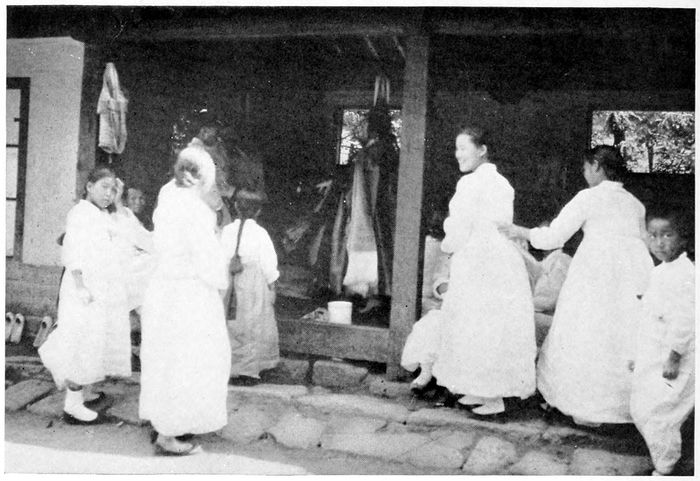
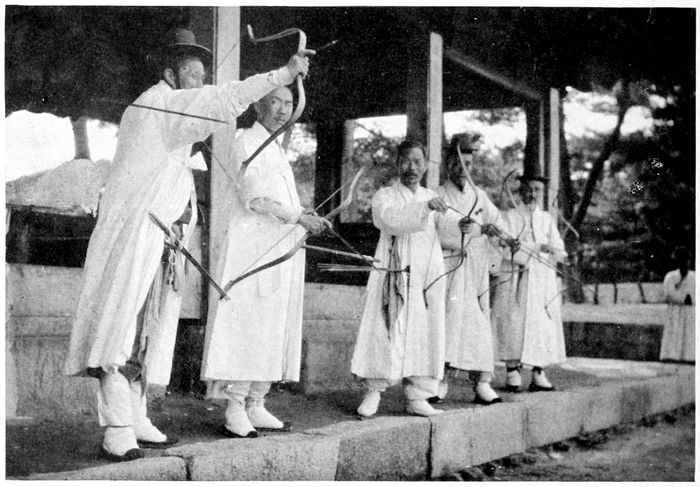
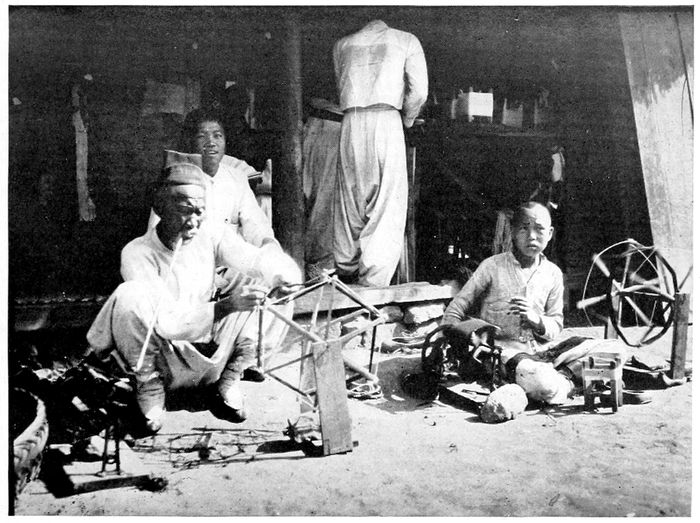
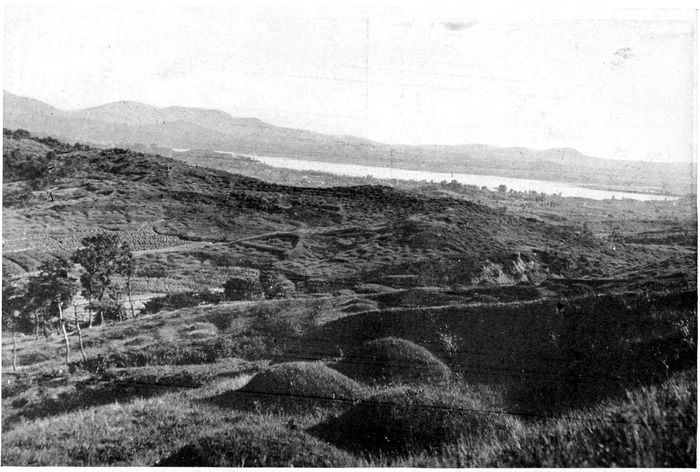
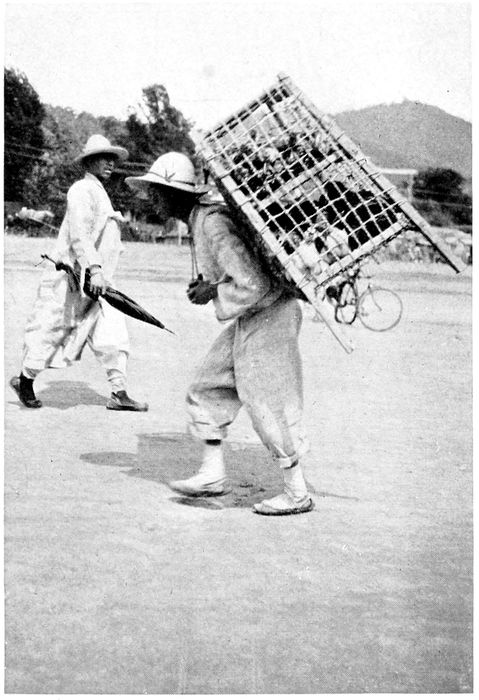
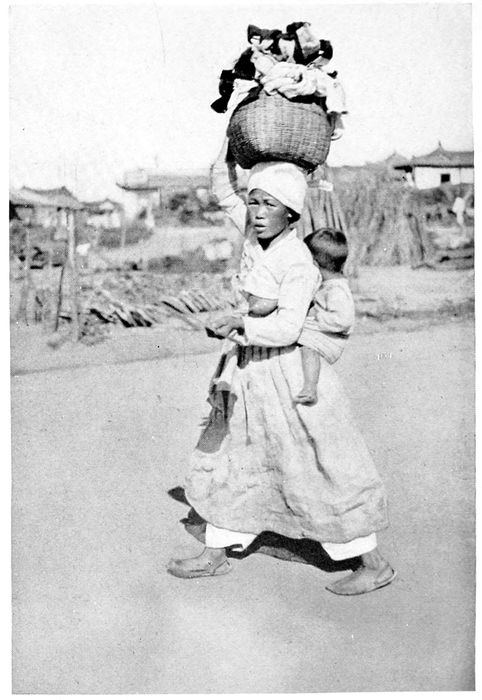
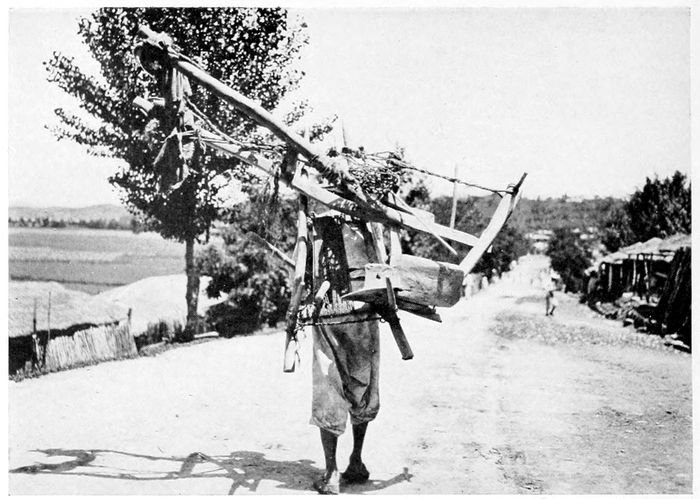
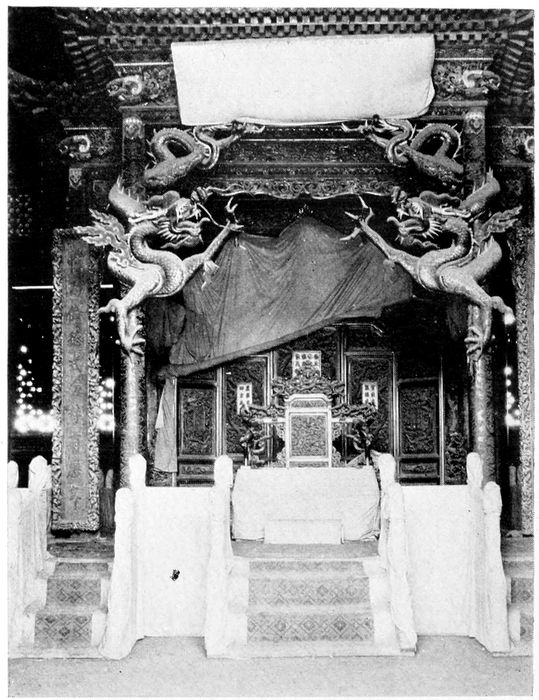
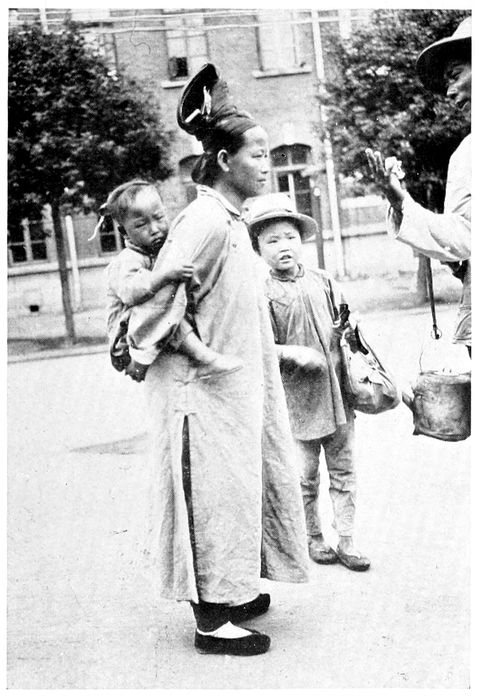
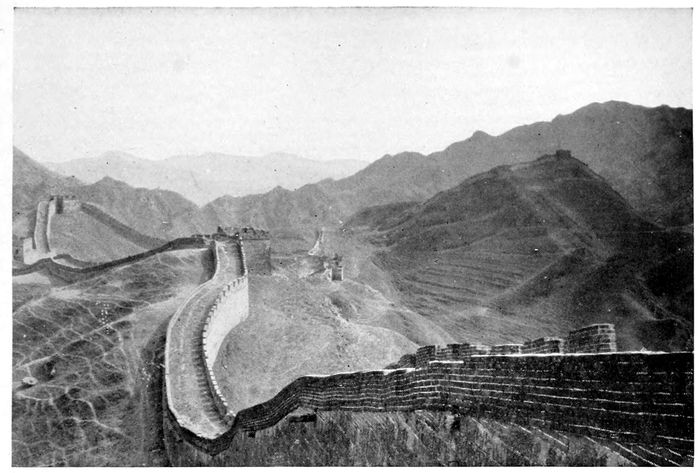
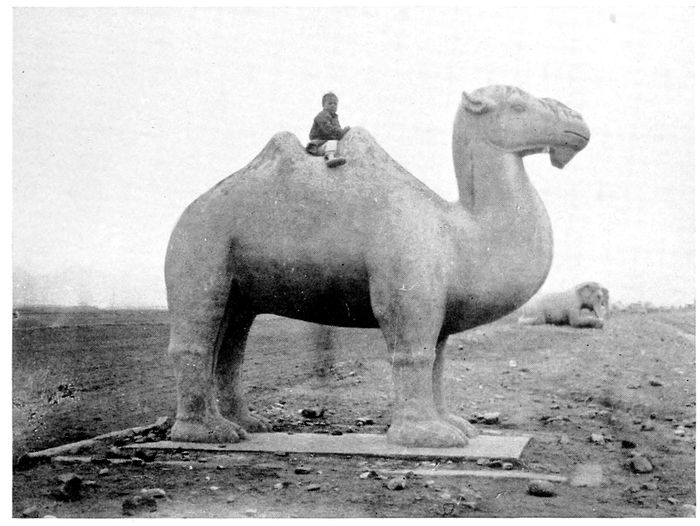
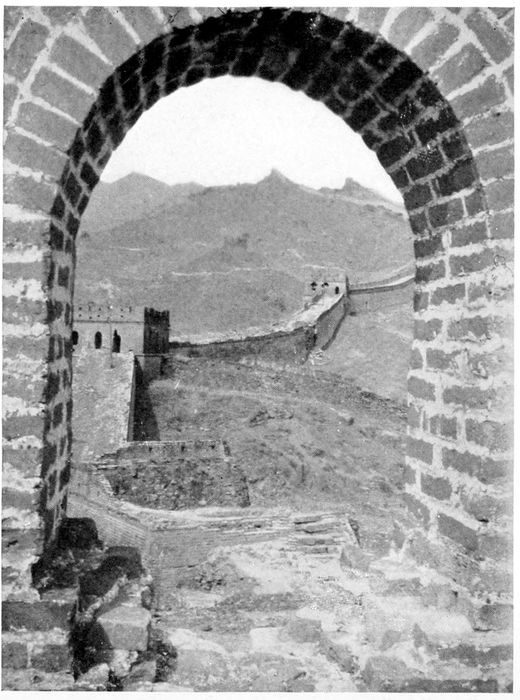
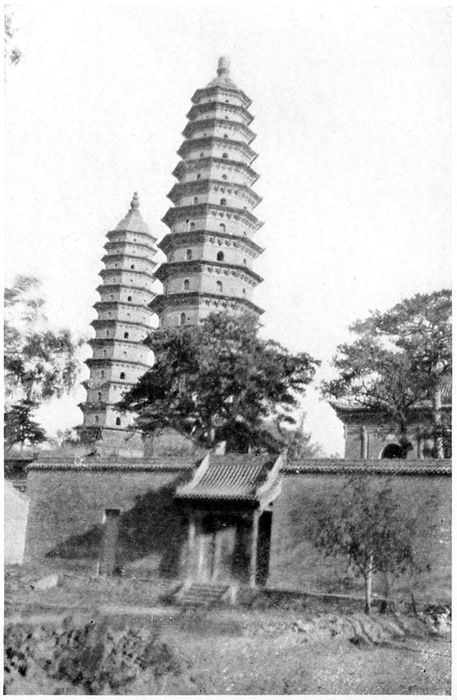
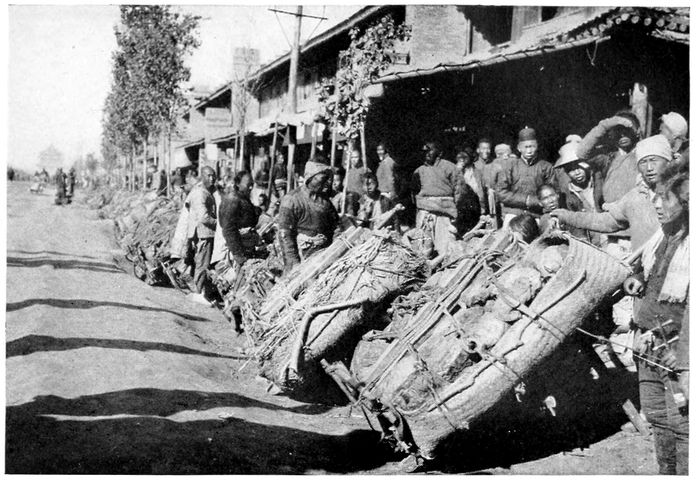
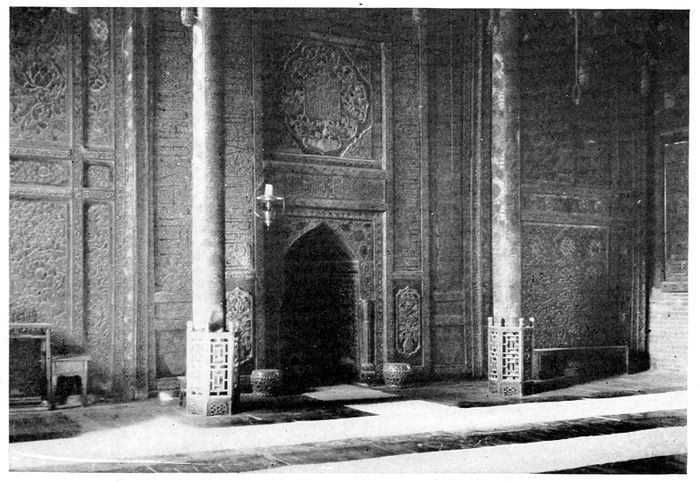
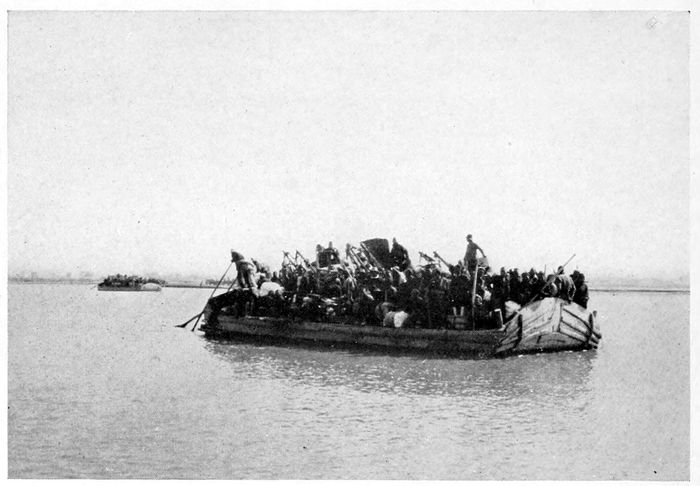
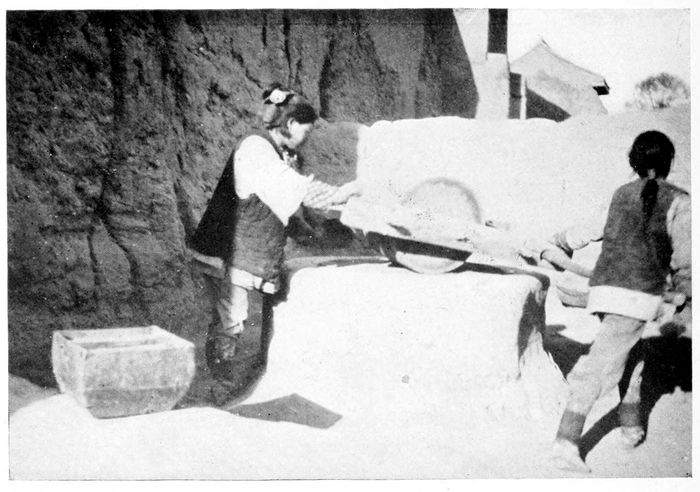
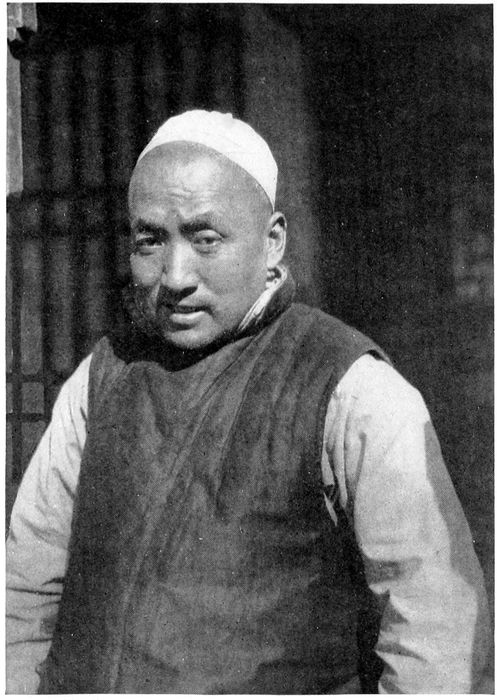
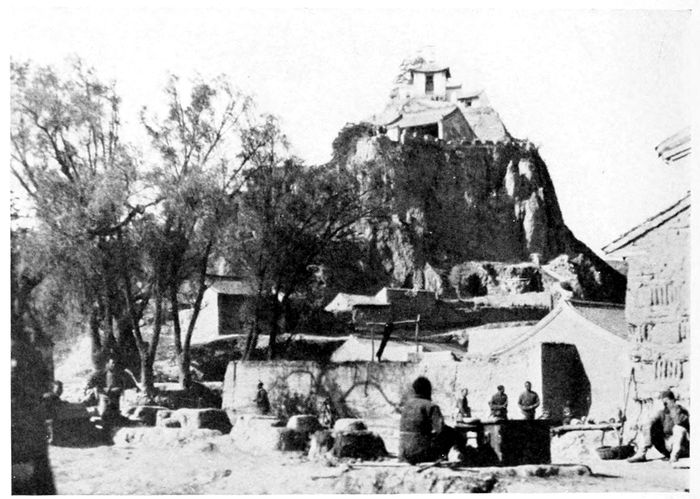
The cover image was created by the transcriber and is placed in the public domain.
WANDERING IN
NORTHERN CHINA
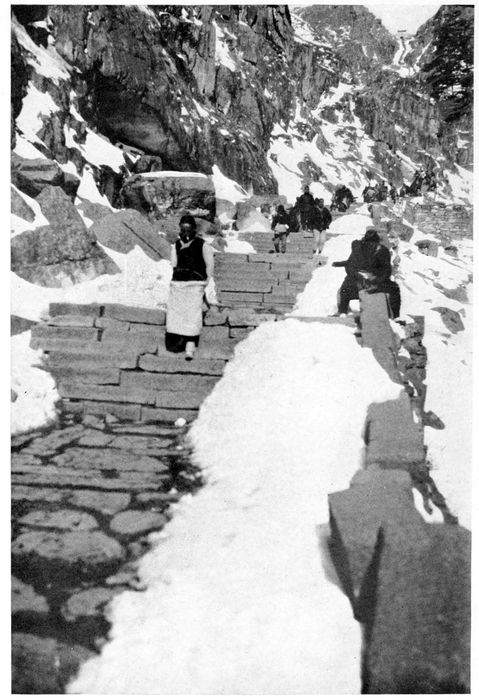
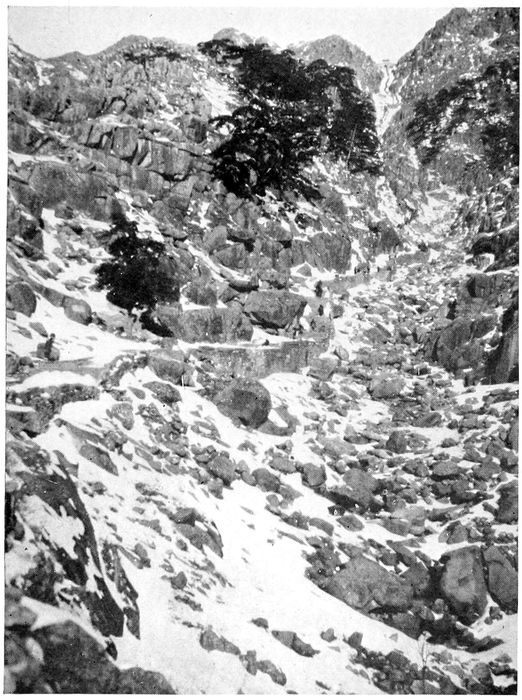
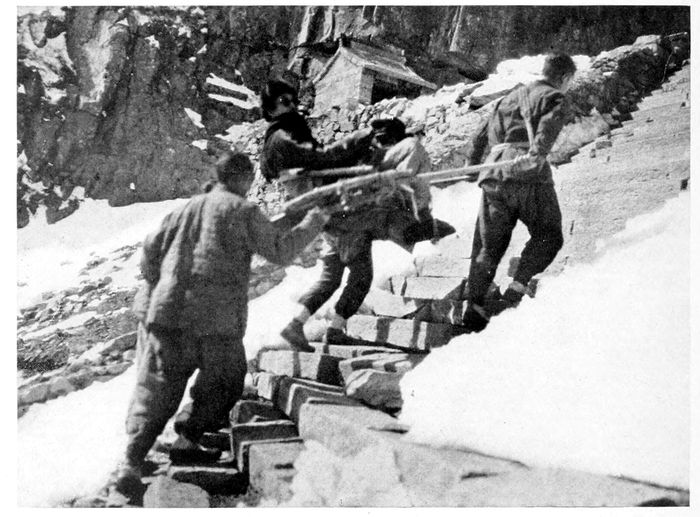
A constant stream of pilgrims, largely blue-clad coolies on foot, passed up and down the sacred stairway
BY
HARRY A. FRANCK
Author of “A Vagabond Journey Around the World,” “Roaming Through the West Indies,” “Vagabonding Down the Andes,” “Working North from Patagonia,” etc., etc.
ILLUSTRATED WITH 171 UNUSUAL
PHOTOGRAPHS BY THE AUTHOR
WITH A MAP SHOWING HIS ROUTE
THE CENTURY CO.
NEW YORK & LONDON
Copyright, 1923, by
The Century Co.
Printed in U. S. A.
To
KATHARINE LATTA FRANCK
WHO CHOSE THIS PARTICULAR WANDER-YEAR TO JOIN OUR FAMILY CIRCLE
FOREWORD
vii
There is no particular plan to this book. I found my interest turning
toward the Far East, and as I am not one of those fortunate persons
who can scamper through a country in a few weeks and know all about it,
I set out on a leisurely jaunt to wherever new clues to interest led me.
It merely happened that this will-o’-the-wisp drew me on through everything
that was once China, north of about the thirty-fourth parallel of
latitude. The man who spends a year or two in China and then attacks
the problem of telling all he saw, heard, felt, or smelled there is like the
small boy who was ordered by the teacher to write on two neat pages
all about his visit to the museum. It simply can’t be done. Hence I
have merely set down in the following pages, in the same leisurely
wandering way as I have traveled, the things that most interested me,
often things that others seem to have missed, or considered unimportant,
in the hope that some of them may also interest others. Impressions
are unlike statistics, however, in that they cannot be corrected to a
fraction, and I decline to be held responsible for the exact truth of
every presumption I have recorded. If I have fallen into the common
error of generalizing, I hereby apologize, for I know well that details
in local customs differ even between neighboring villages in China.
What I say can at most be true of the north, for as yet I know nothing
of southern China. On the other hand, there may be much repetition
of customs and the like, but that goes to show how unchanging is life
among the masses in China even as a republic.
Lafcadio Hearn said that the longer he remained in the East the less
he knew of what was going on in the Oriental mind. An “old China
hand” has put the same thing in more popular language: “You can
easily tell how long a man has been in China by how much he doesn’t
know about it. If he knows almost everything, he has just recently
arrived; if he is in doubt, he has been here a few years; if he admits
that he really knows nothing whatever about the Chinese people or
their probable future, you may take it for granted that he has been
out a very long time.”
But as I have said before, the “old-timer” will seldom sit down to
tell even what he has seen, and in many cases he has long since lost his
way through the woods because of the trees. Or he may have other and
viiimore important things to do. Hence it is up to those of us who have
nothing else on hand to pick up and preserve such crumbs of information
as we can; for surely to know as much of the truth about our
foreign neighbors as possible is important, above all in this new age.
In our own land there are many very false ideas about China; false
ideas that in some cases are due to deliberate Chinese propaganda
abroad. While I was out in the far interior I received a clipping outlining
the remarks of a Chinese lecturing through our Middle West,
and his résumé left the impression that bound feet and opium had all
but completely disappeared from China, and that in the matter of
schools and the like the “republic” is making enormous strides. No
sooner did the Lincheng affair attract the world’s attention than American
papers began to run yarns, visibly inspired, about the marvelous
advances which the Chinese have recently accomplished. Such men as
Alfred Sze are often mistaken in the United States as samples of China.
Unfortunately they are nothing of the kind; in fact, they are too often
hopelessly out of touch with their native land. There has been progress
in China, but nothing like the amount of it which we have been coaxed
or lulled into believing, and some of it is of a kind that raises serious
doubts as to its direction. For all the telephones, airplanes, and foreign
clothes in the coast cities, the great mass of the Chinese have been
affected barely at all by this urge toward modernity and Westernism—if
that is synonymous with progress. As some one has just put it, “the
Chinese still wear the pigtail on their minds, though they have largely
cut it off their heads.” How great must be the misinformation at home
which causes our late President to say that all China really needs is
more loans, thereby making himself, and by extension his nation, the
laughing-stock of any one with the rudiments of intelligence who has
spent an hour studying the situation on the spot. England is a little
better informed on the subject than we, because she is less idealistic,
more likely to look facts in the face instead of trying to make facts fit
preconceived notions of essential human perfection. China may need
more credits, but any fool knows that you should stop the hole in the
bottom of a tub before you pour more water into it. At times, too, it
is laughable to think of us children among nations worrying about this
one, thousands of years old, which has so often “come back,” and may
still be ambling her own way long after we have again disappeared
from the face of the earth.
Though it is impossible to leave out the omnipresent entirely, I
have said comparatively little about politics. My own interest in what
ixwe lump together under that word reaches only so far as it affects the
every-day life of the people, of the mudsill of society, toward which,
no doubt by some queer quirk in my make-up, I find my attention
habitually focusing. I have tried, therefore, to show in some detail
their lives, slowly changing perhaps yet little changed, and to let others
conclude whether “politics” has done all that it should for them. Besides,
the Far East swarms with writers on politics, men who have
been out here for years or decades and have given their attention almost
entirely to that popular subject; and even these disagree like doctors.
Some of us, I know, are frankly tired of politics, at least for a space,
important as they are; moreover, political changes are so rapid, especially
in the “never changing” East, that it is impossible to keep abreast
of the times in anything less than a daily newspaper.
At home there are numbers of young men, five or ten years out of
college, who can tell you just what is the matter with the world, and
exactly how to remedy it. I am more or less ready to agree with them
that the world is going to the dogs. What of it? You have only to
step outdoors on any clear night to see that there are hundreds of other
worlds, which may be arranging their lives in a more intelligent manner.
The most striking thing about these young political and sociological
geniuses sitting in their suburban gardens or their city flats is that
while they can toss off a recipe guaranteed to cure our own sick world
overnight, if only some one can get it down its throat, they seldom seem
to have influence enough in their own cozy little corner of it to drive out
one grafting ward-heeler. In other words, if you must know what is to
be the future of China, I regret that I have not been vouchsafed the gift
of prophecy and cannot tell you.
In the minor matter of Chinese words and names, I have deliberately
not tried to follow the usual Romanization, but rather to cause the
reader to pronounce them as nearly like what they are on the spot as is
possible with our mere twenty-six letters. Of course I could not follow
this rule entirely or I must have called the capital of China “Bay-jing,”
have spoken of the evacuation of “Shahn-doong,” and so on; so that in
the case of names already more or less familiar to the West I have used
the most modern and most widely accepted forms, as they have survived
on the ground. At that I cannot imagine what ailed the men who
Romanized the Chinese language, but that is another story.
One day, descending the hills toward Seoul, we heard a great jangling hubbub, and found two sorceresses in full swing in a native house, where people come to have their children “cured”
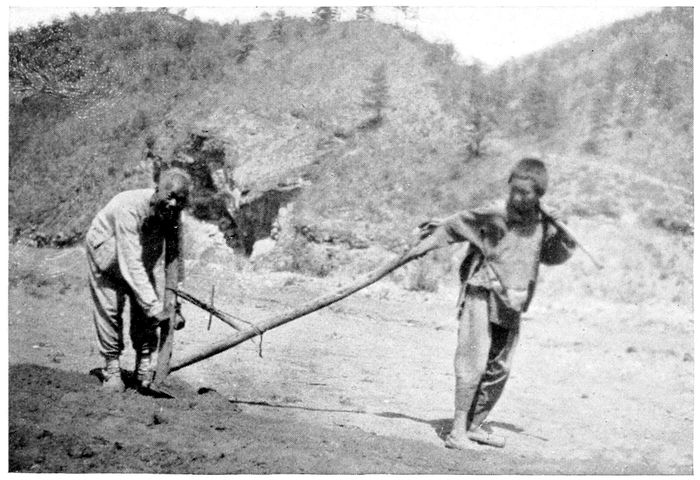
The plowman homeward wends his weary way—in Korean fashion, always carrying the plow and driving his unburdened ox or bull before him. One of the most common sights of Korea
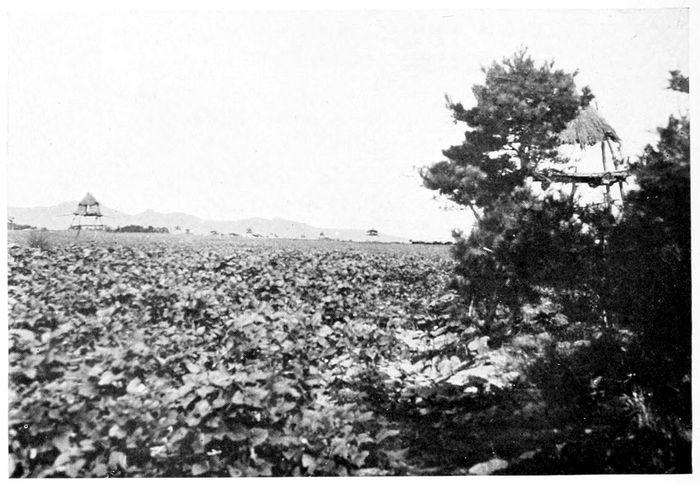
The biblical “watch-tower in a cucumber patch” is in evidence all over Korea in the summer, when crops begin to ripen. Whole families often sleep in them during this season, when they spring up all over the country, and often afford the only cool breeze
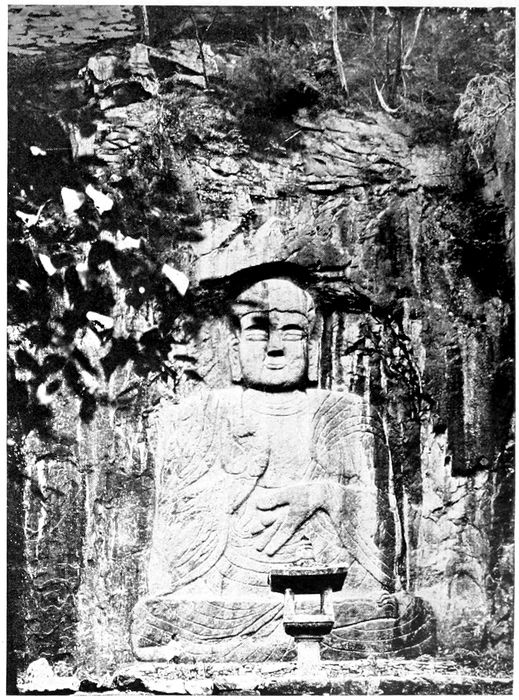
This great cliff-carved Buddha, fifty feet high and thirty broad, was done by Chinese artists centuries ago. Note my carrier, a full-sized man, squatting at the lower left-hand corner
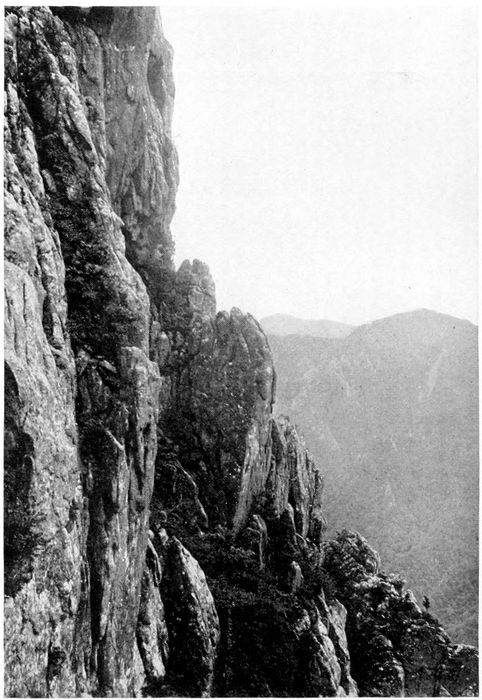
The camera can at best give only a suggestion of the sheer white rock walls of Shin Man-mul-cho, perhaps the most marvelous bit of scenery in the Far East
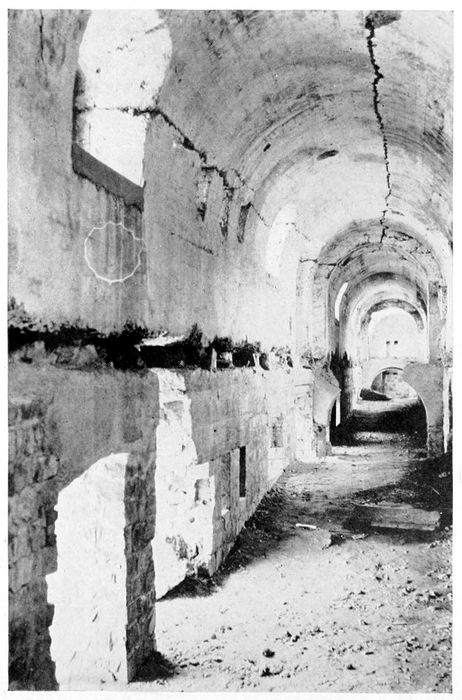
A ruined gallery in the famous North Fort of the Russians at Port Arthur. Hundreds of such war memorials are preserved by the Japanese on the sites of their first victory over the white race
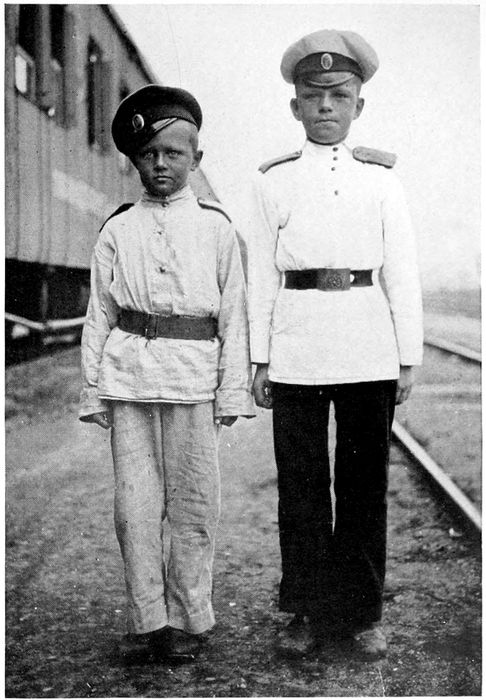
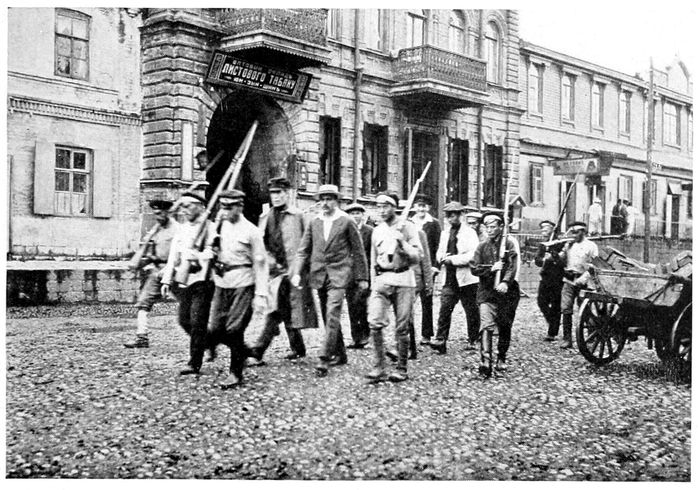
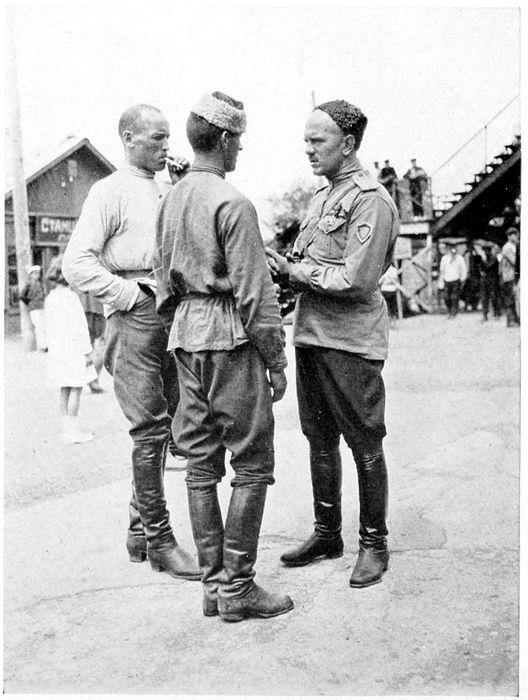
The Russian so loves a uniform, even after the land it represents has gone to pot, that even school-boys in Vladivostok usually wear them,—red bands, khaki, black trousers, purple epaulets
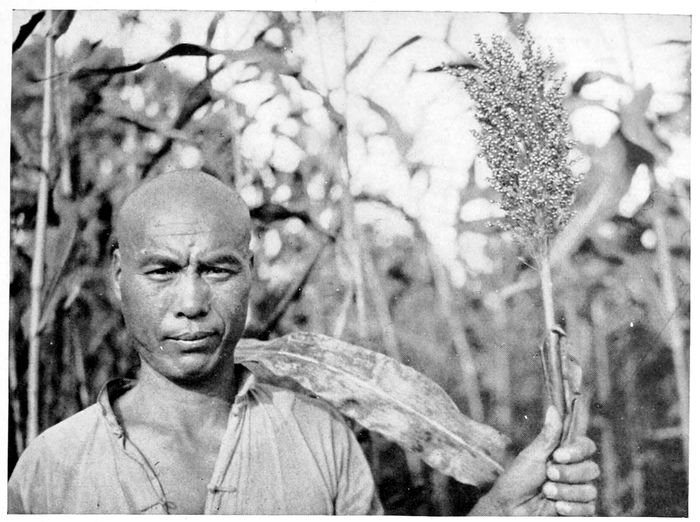
The grain of the kaoliang, one of the most important crops of North China. It grows from ten to fifteen feet high and makes the finest of hiding-places for bandits
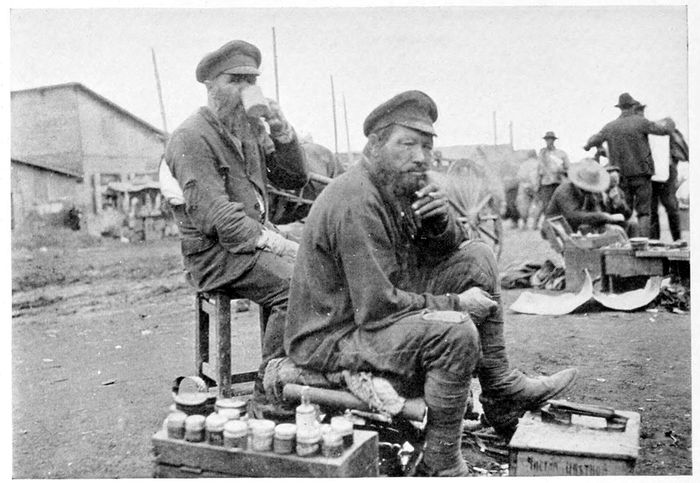
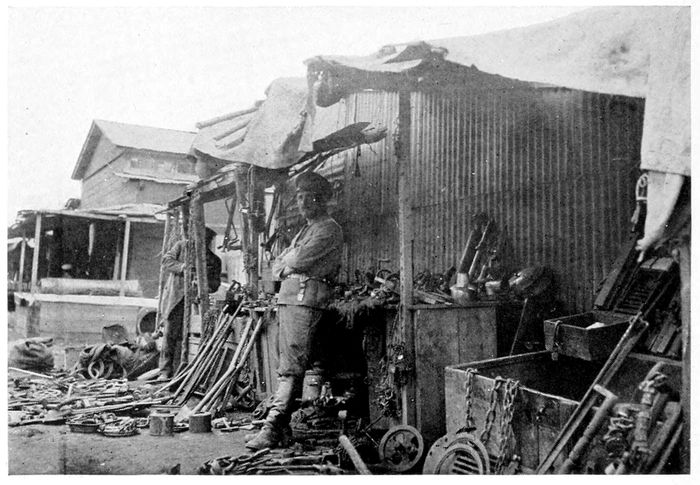
Scores of booths in Harbin, Manchuli, and Vladivostok, selling second-hand hardware of every description, suggest why the factories and trains of Bolshevik Russia have difficulty in running
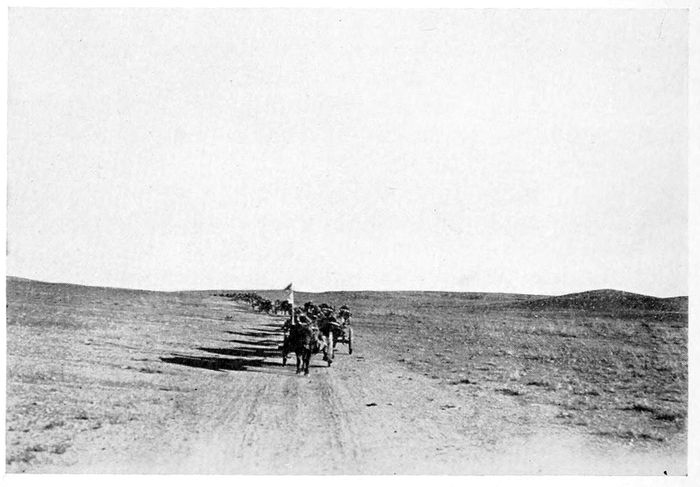
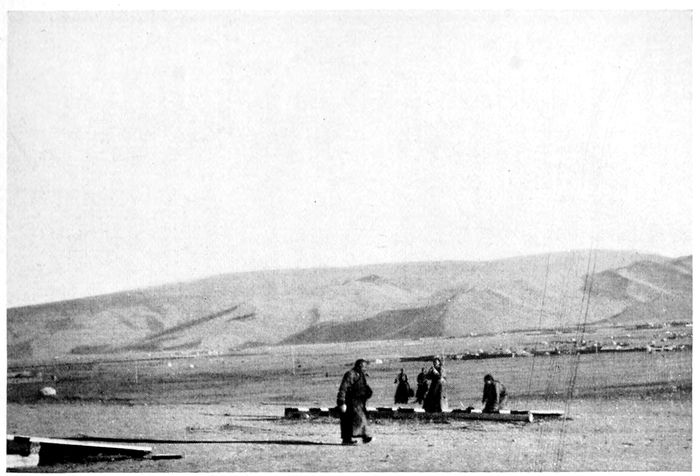
The frontier post of Ude, fifty miles beyond the uninhabited frontier between Inner and Outer Mongolia, where Mongol authorities examine passports and very often turn travelers back
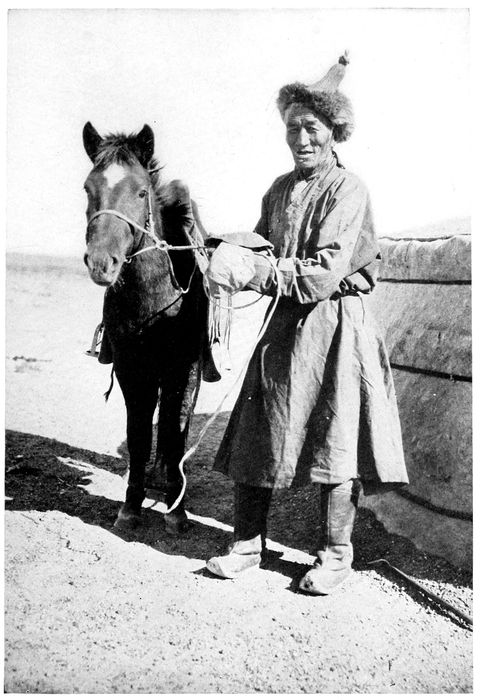
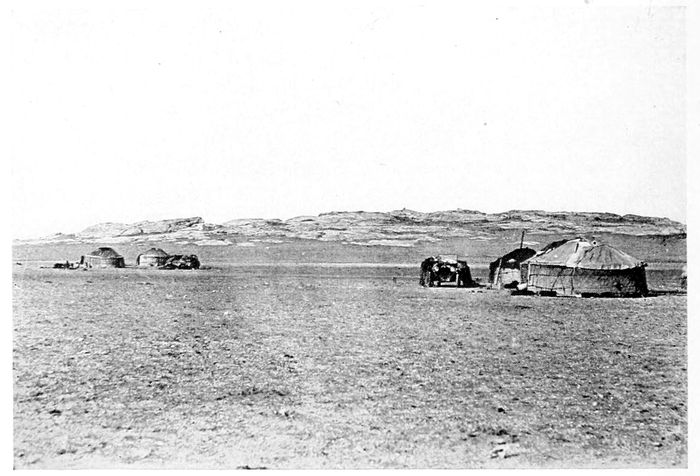
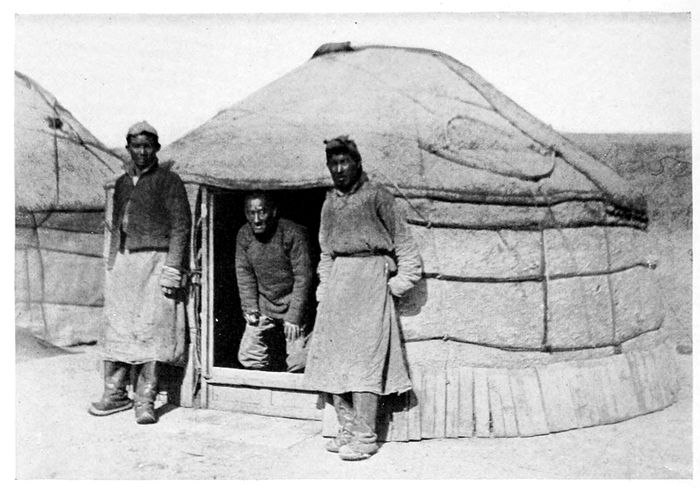
The Mongol of the Gobi lives in a yourt made of heavy felt over a light wooden framework, which can be taken down and packed in less than an hour when the spirit of the nomad strikes him
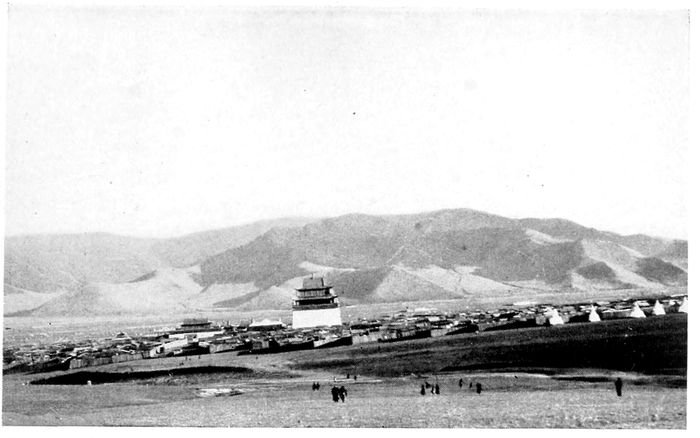
The upper town of Urga, entirely inhabited by lamas, has the temple of Ganden, containing a colossal standing Buddha, rising high above all else. It is in Tibetan style and much of its superstructure is covered with pure gold
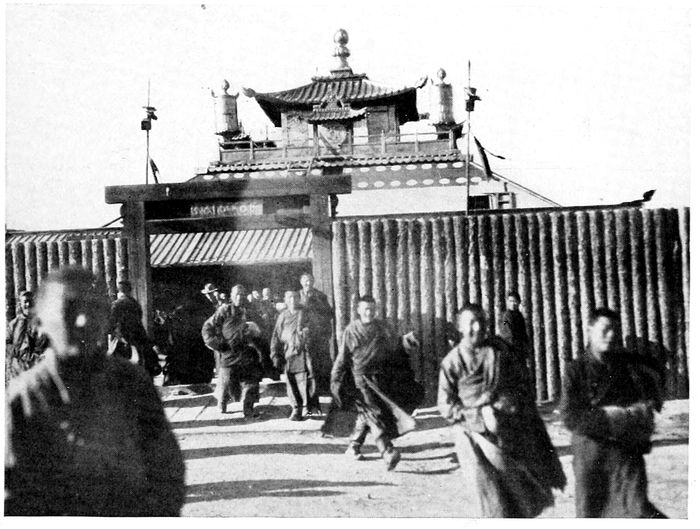
Red lamas leaving the “school” in which hundreds of them squat tightly together all day long, droning through their litany. They are of all ages, equally filthy and heavily booted. Over the gateway of the typical Urga palisade is a text in Tibetan, and the cylinders at the upper corners are covered with gleaming gold
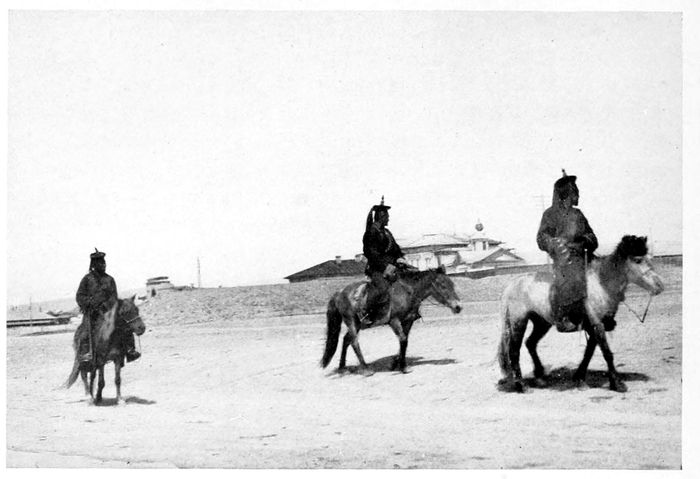
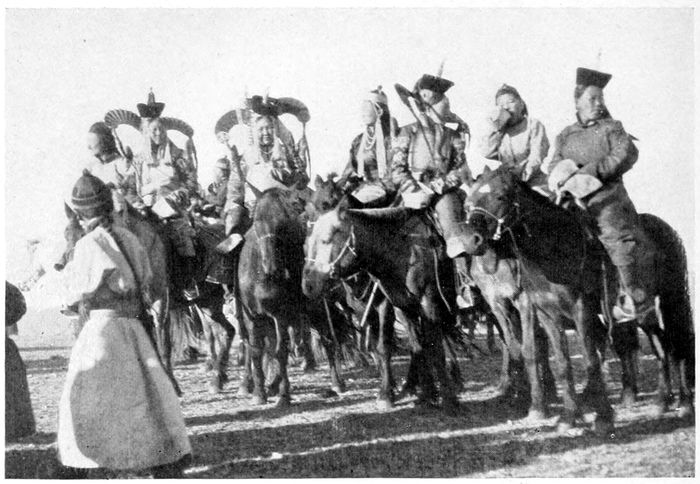
High class lamas, in their brilliant red or yellow robes, great ribbons streaming from their strange hats, are constantly riding in and out of Urga. Note the bent-knee style of horsemanship
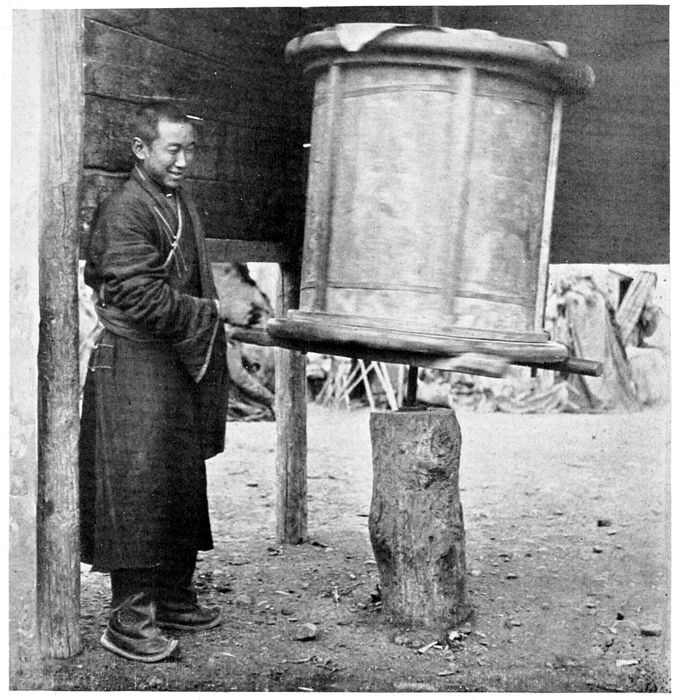
A youthful lama turning one of the myriad prayer-cylinders of Urga. Many written prayers are pasted inside, and each turn is equivalent to saying all of them
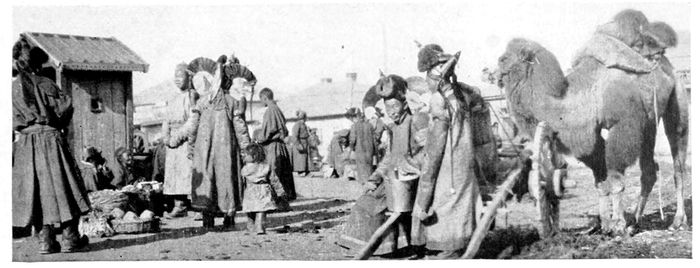
The market in front of Hansen’s house. The structure on the extreme left is not what it looks like, for they have no such in Urga, but it houses a prayer-cylinder
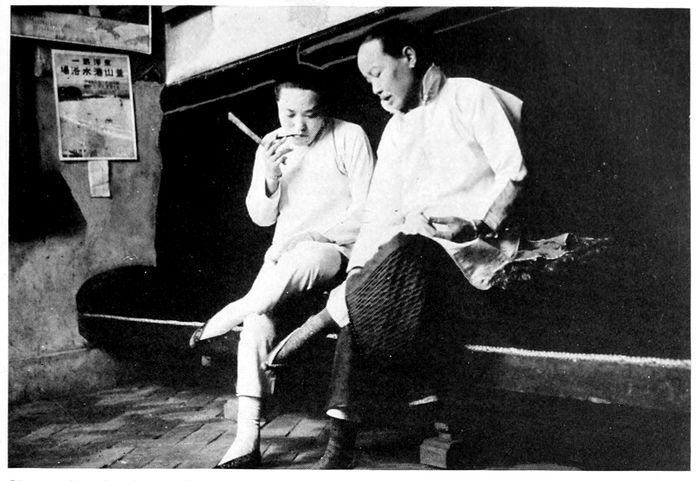
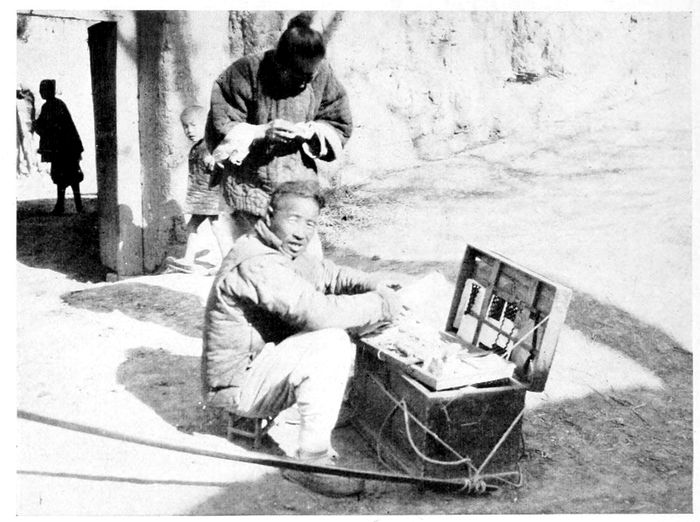
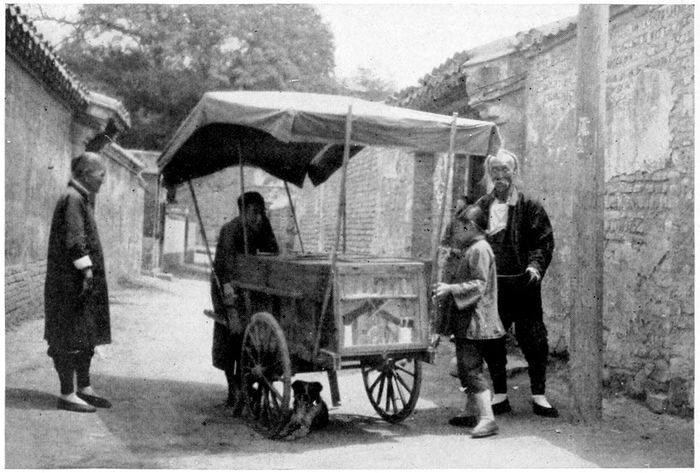
Women, whose crippled feet make going to the shops difficult, do much of their shopping from the two-boxes-on-a-pole type of merchant, constant processions of whom tramp the highways of China
Pious Mongol men and women worshiping before the residence of the “Living Buddha” of Urga, some by throwing themselves down scores of times on the prostrating-boards placed for that purpose, one by making many circuits of the place, now and again measuring his length on the ground
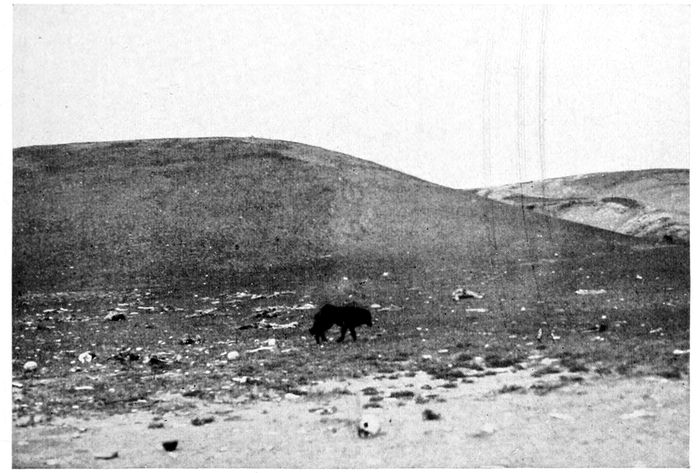
xviThe Mongols of Urga disposed of their dead by throwing the bodies out on the hillsides, where they are quickly devoured by the savage black dogs that roam everywhere
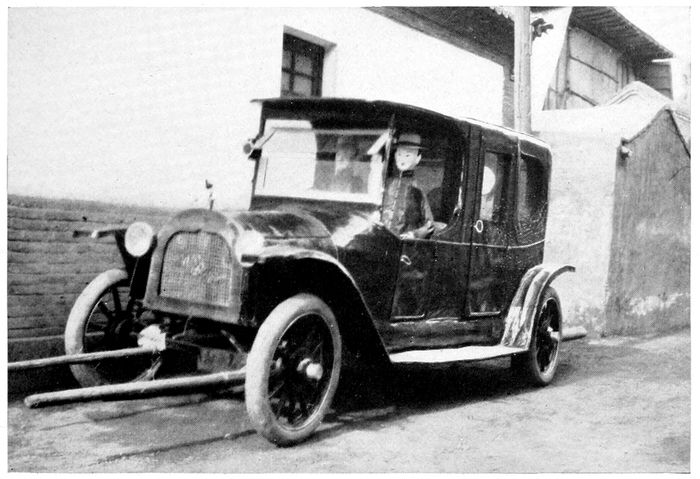
A rich man died in our street, and among other things burned at his grave, so that he would have them in after-life, were this “automobile” and two “chauffeurs”
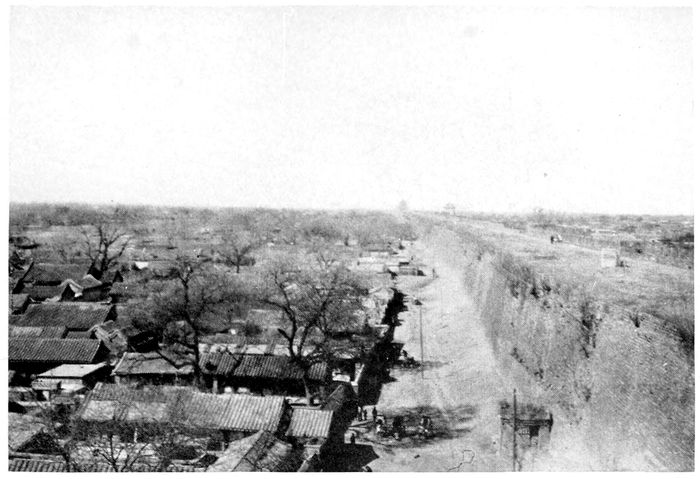
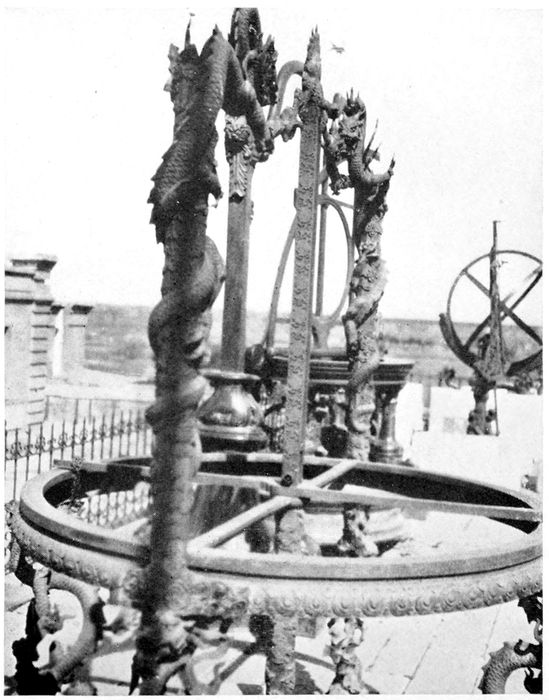
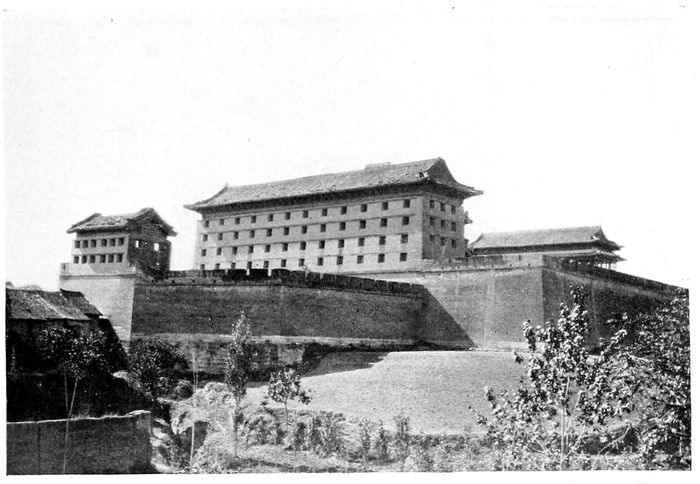
Just above us on the Tartar Wall were the ancient astronomical instruments looted by the Germans in 1900 and recently returned, in accordance with a clause in the Treaty of Versailles
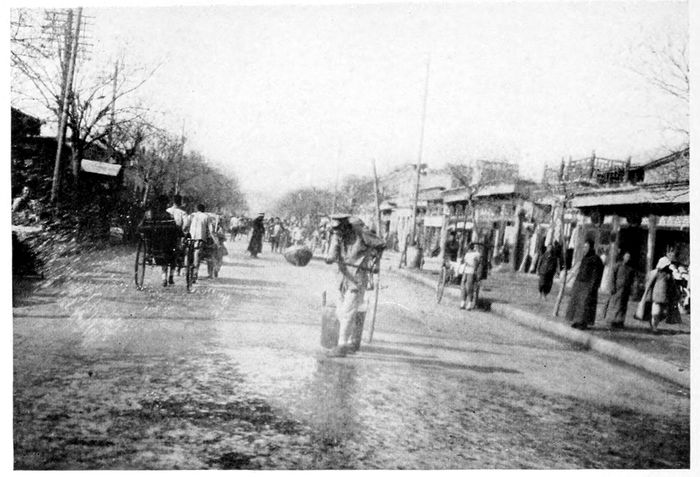
The street sprinklers of Peking work in pairs, with a bucket and a wooden dipper. This is the principal street of the Chinese City “outside Ch’ien-men”
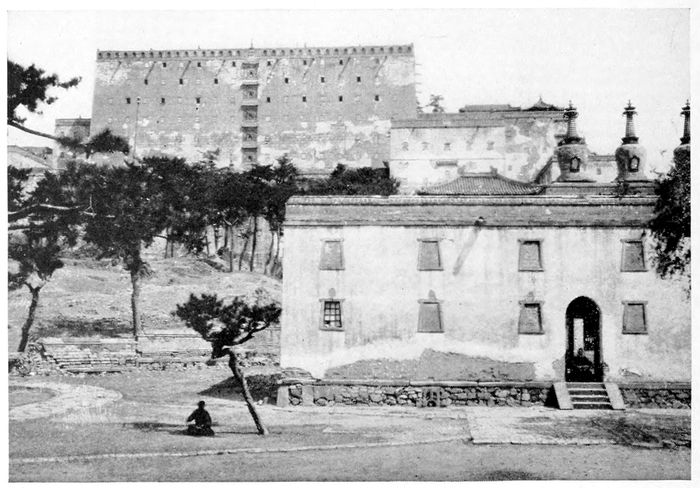
The Potalá of Jehol, said to be a copy, even in details, of that of Lhasa. The windows are false and the great building at the top is merely a roofless one enclosing the chief temple
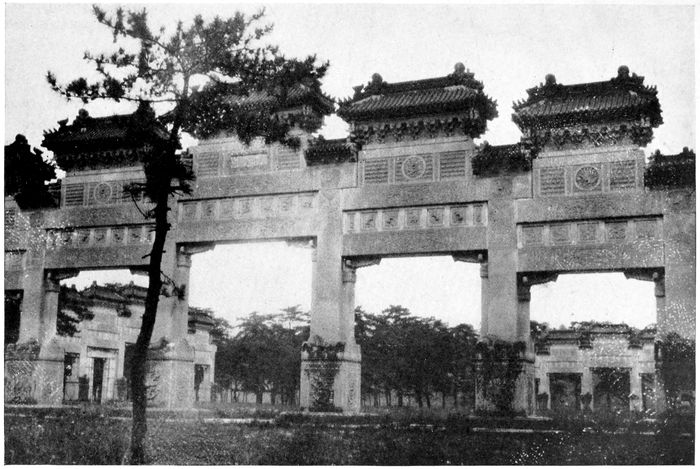
Behind Tung Ling the great forest reserve which once “protected” the tombs from the evil spirits that always come from the north was recently opened to settlers, and frontier conditions long since forgotten in the rest of China prevail
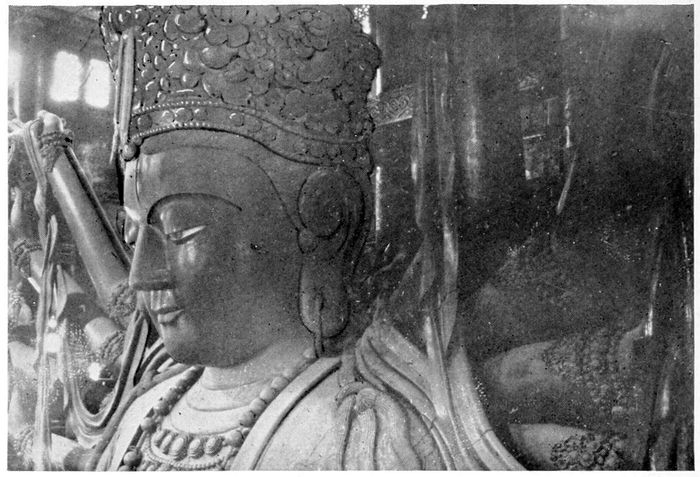
The face of the mammoth Buddha of Jehol, forty-three feet high and with forty-two hands. It fills a four-story building, and is the largest in China proper, being identical, according to the lamas, with those of Urga and Lhasa
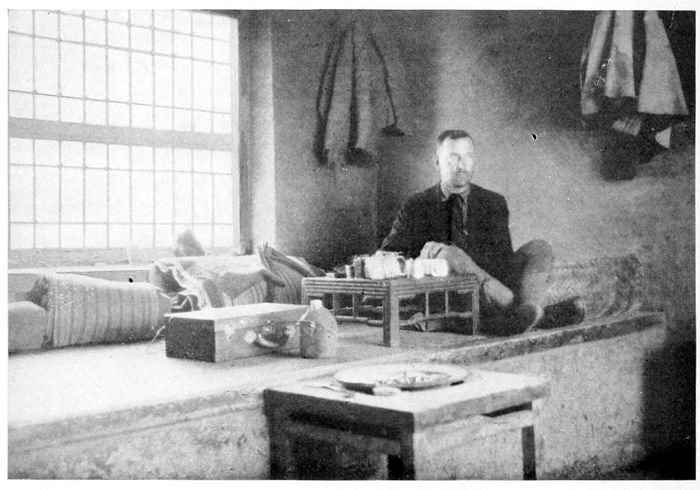
A Chinese inn, with its heated k’ang, may not be the last word in comfort, but it is many degrees in advance of the earth floors of Indian huts along the Andes
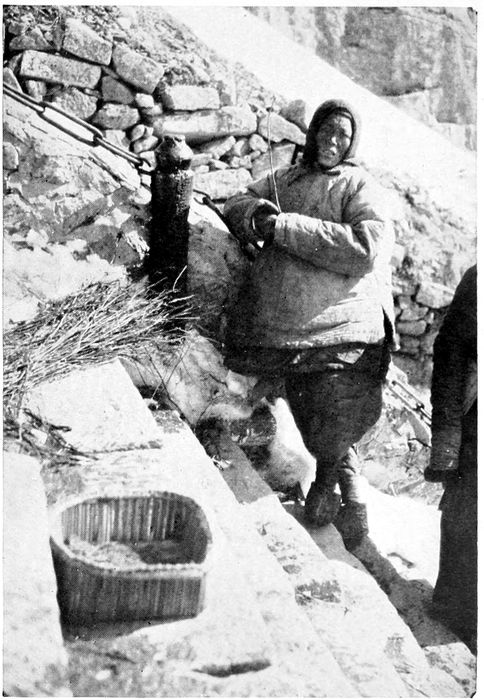
One of the countless beggar women who squat in the center of the stairway to Tai-shan, expecting every pilgrim to drop at least a “cash” into each basket
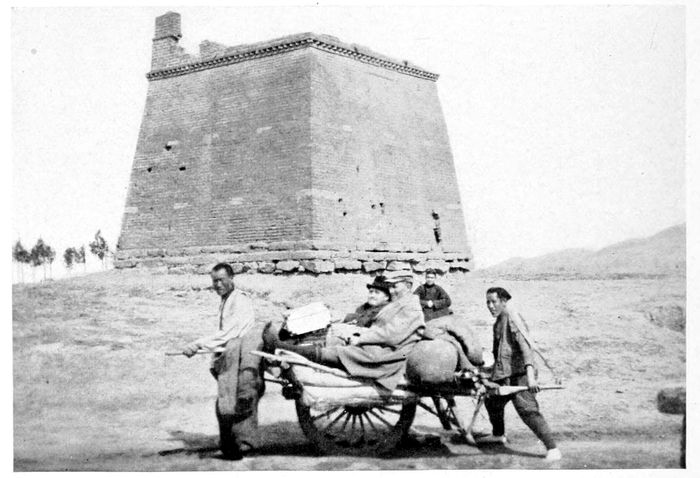
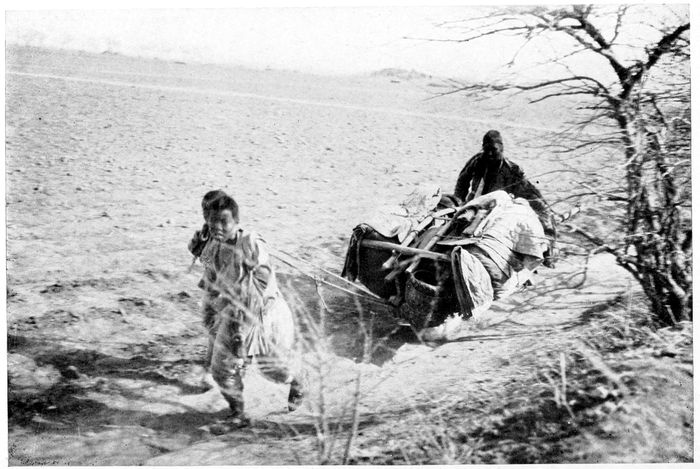
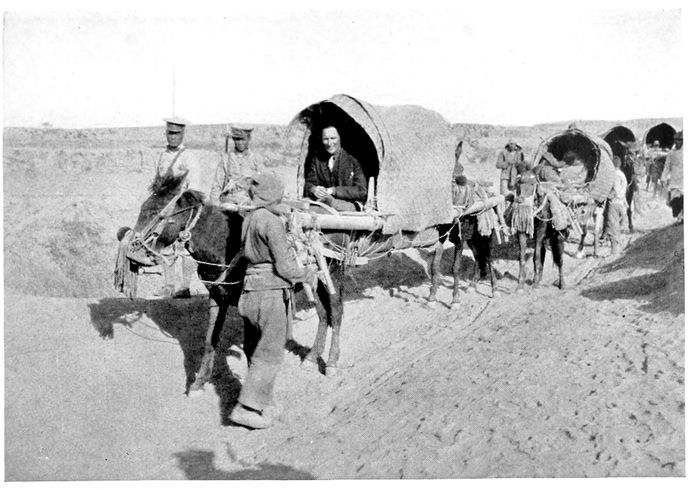
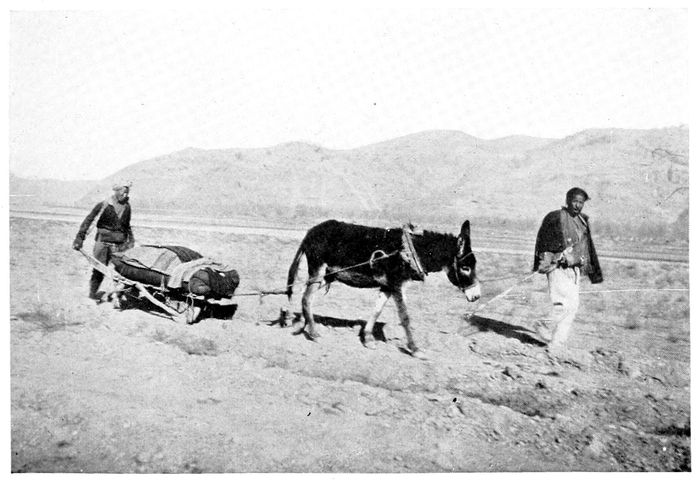
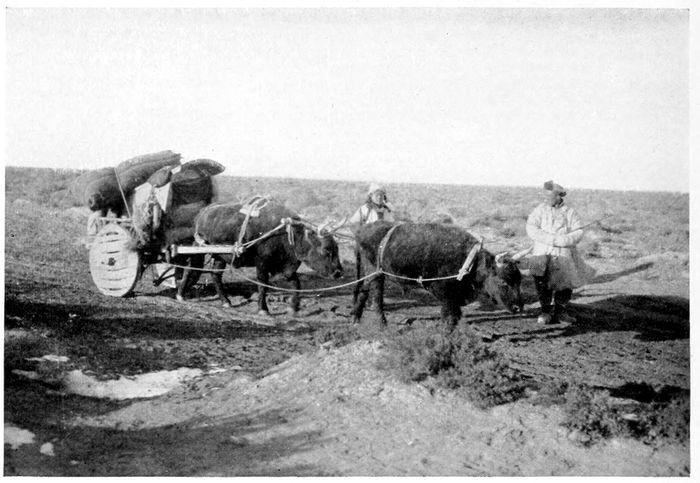
Off on an “itinerating” trip with an American missionary in Shantung, by a conveyance long in vogue there. Behind, one of the towers by which messages were sent, by smoke or fire, to all corners of the old Celestial Empire
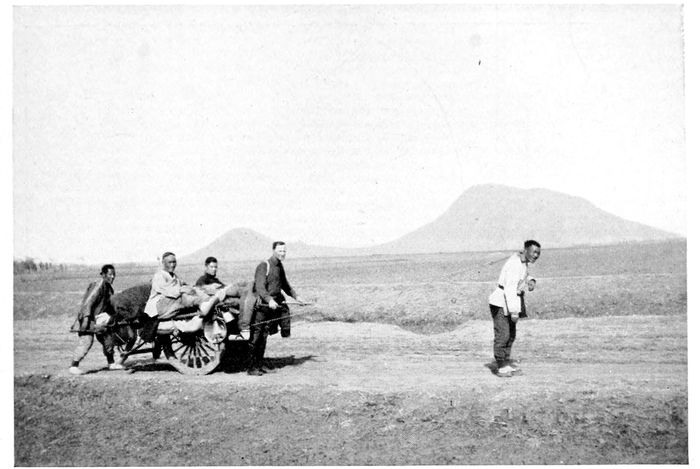
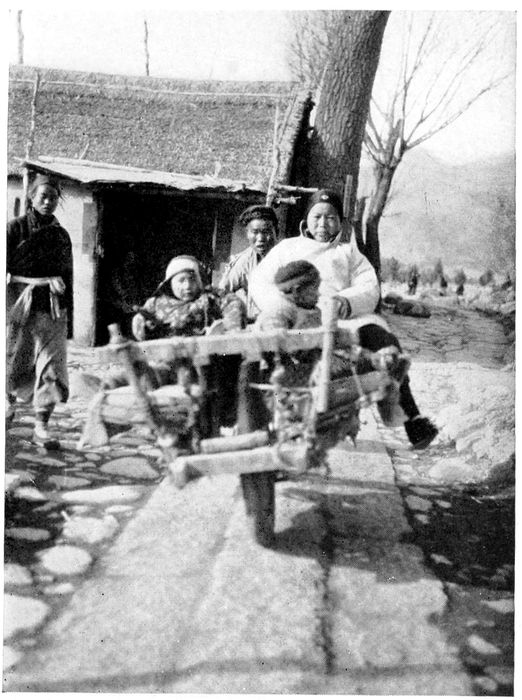
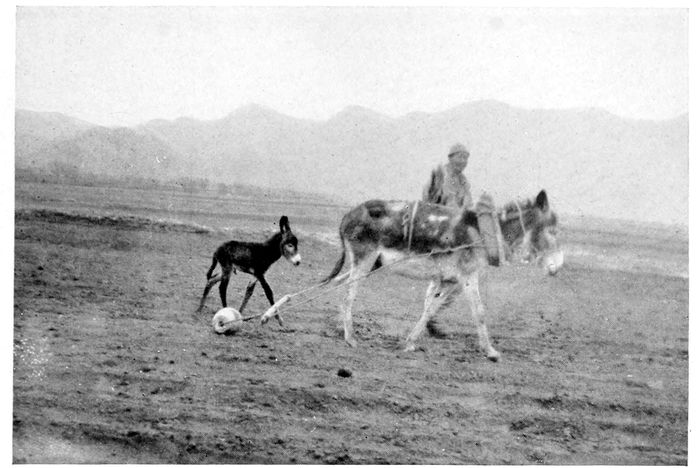
On the way home I changed places with one of our three wheelbarrow coolies, and found that the contrivance did not run so hard as I might otherwise have believed
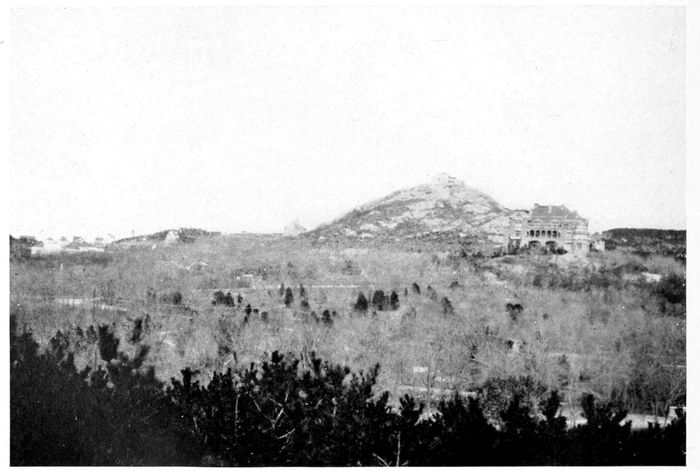
The governor’s mansion at Tsingtao, among hills carefully reforested by the Germans, followed by the Japanese, has now been returned to the Chinese after a quarter of a century of foreign rule
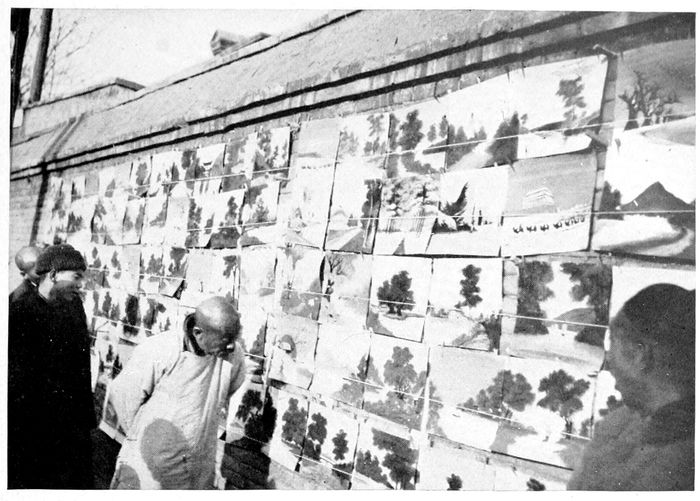
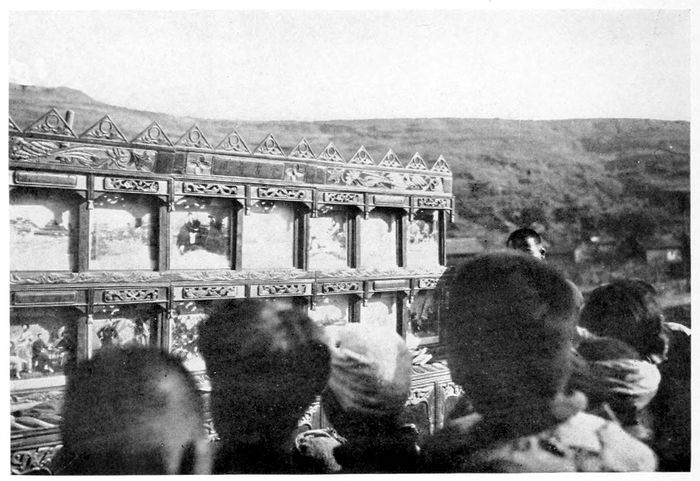
An illustrated lecture in China takes place outdoors in a village street, two men pushing brightly colored pictures along a two-row panel while they chant some ancient story
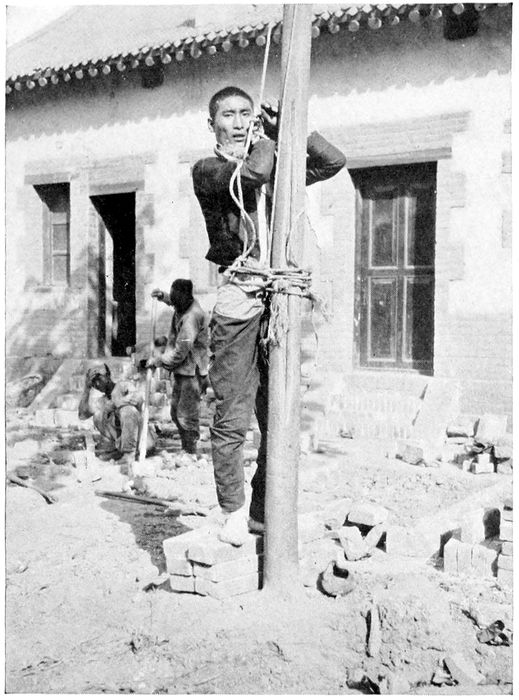
In the Protestant Mission compound of Honanfu the missionaries had tied up this thief to stew in the sun for a few days, rather than turn him over to the authorities, who would have lopped off his head
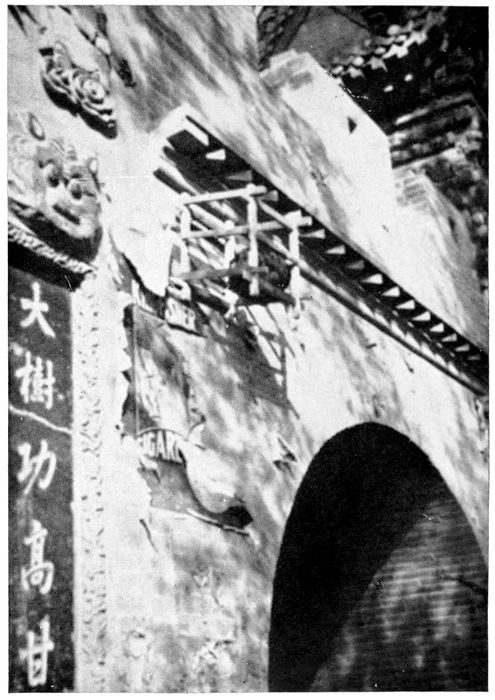
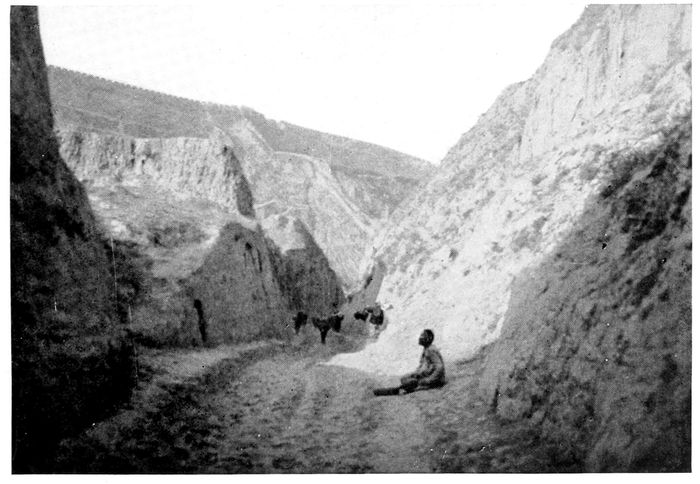
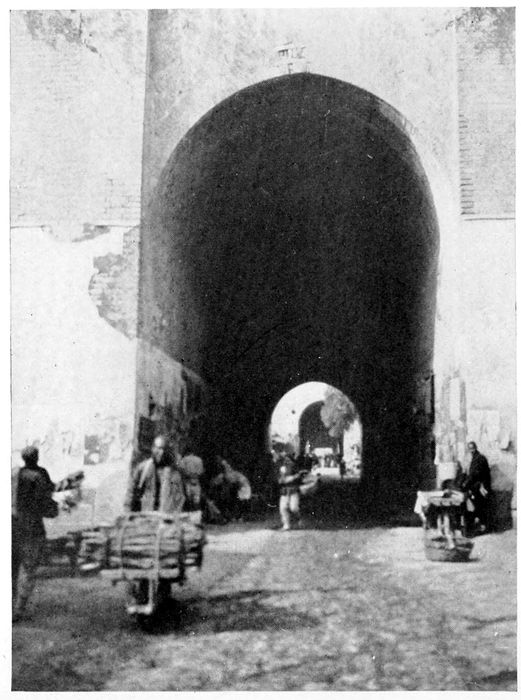
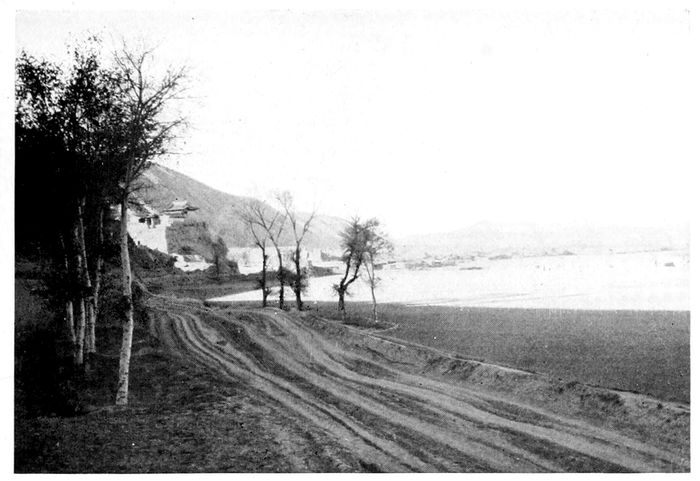
The road down into Shensi. Once through the great arch-gate that marks the provincial boundary, the road sinks down into the loess again, and beggars line the way into Tungkwan
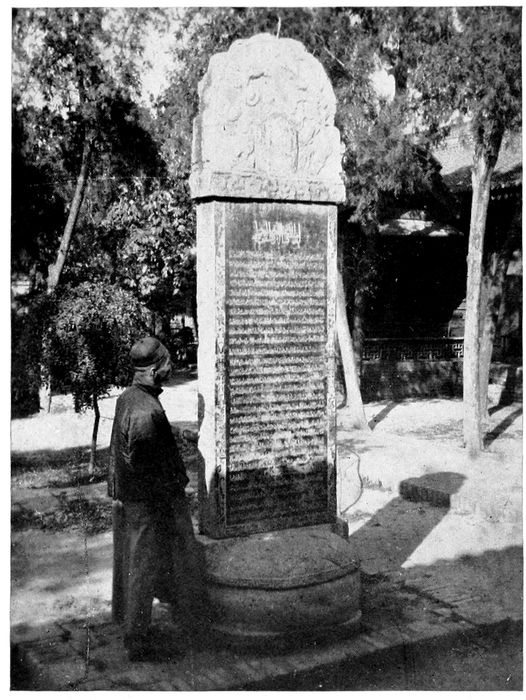
An old tablet in the compound of the chief mosque at Sian-fu, purely Chinese in form, except that the base has lost its likeness to a turtle and the writing is in Arabic
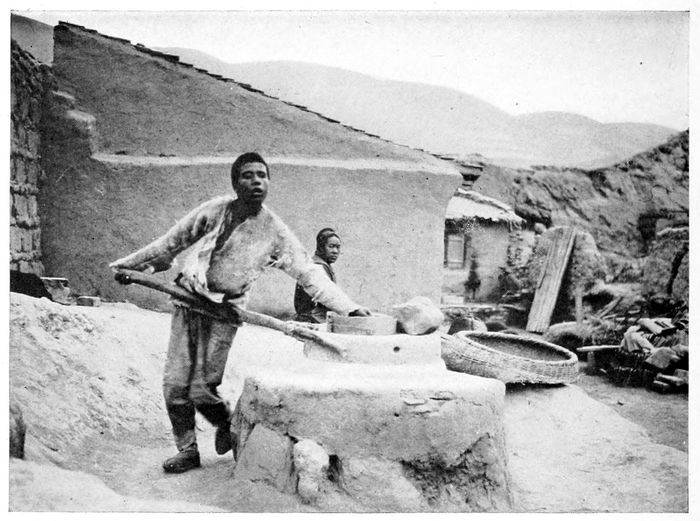
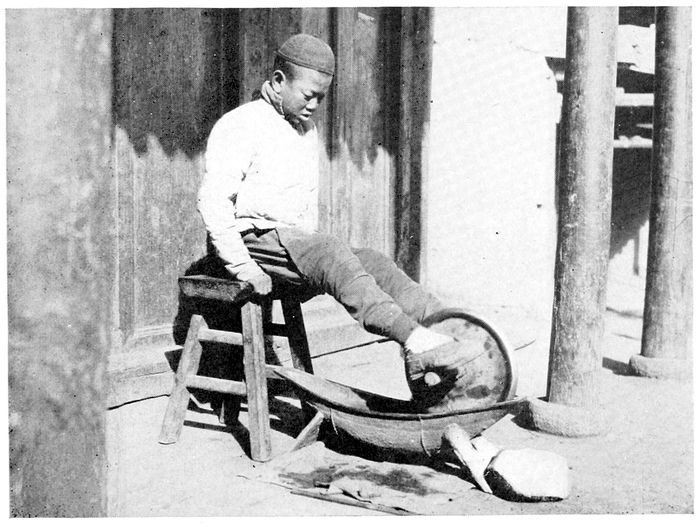
Samson and Delilah. This blind boy, grinding grain all day long, marches round and round his stone mill with the same high lifted feet and bobbing head of the late Caruso in the opera of that name
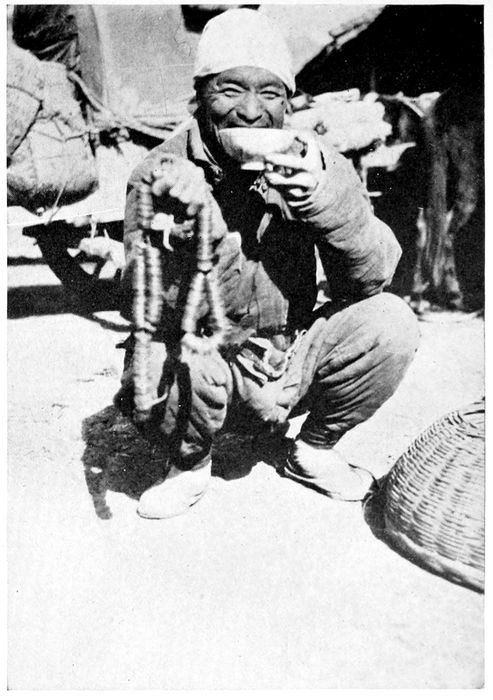
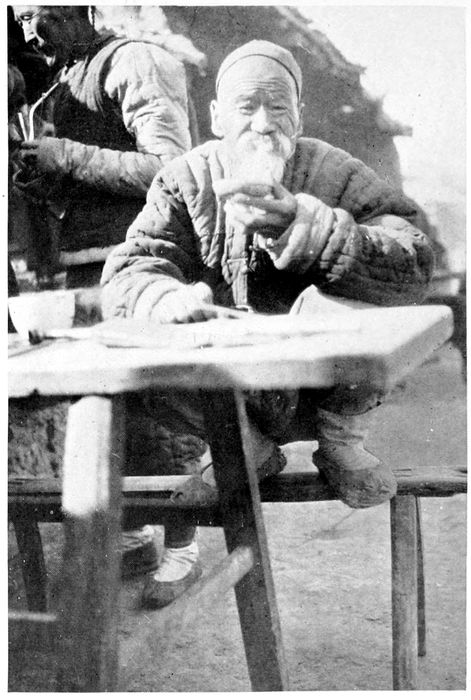
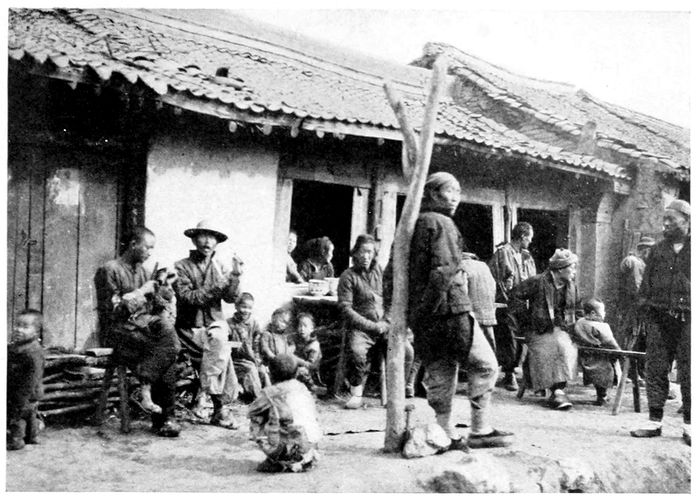
Our chief cartman eating dinner in his favorite posture, and holding in one hand the string of “cash,” one thousand strong and worth about an American quarter, which served him as money
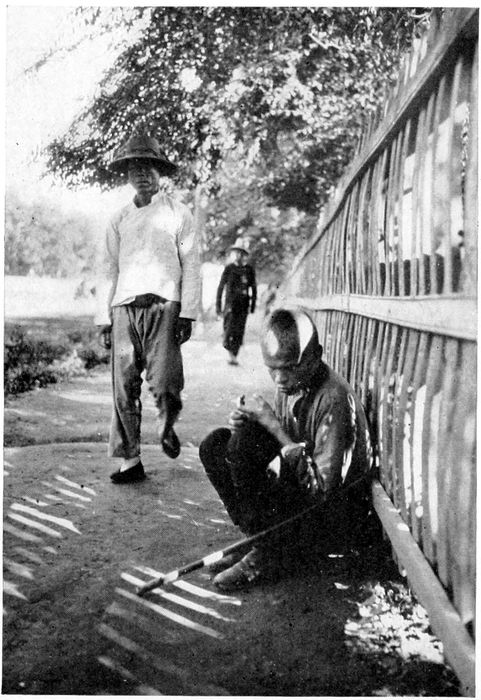
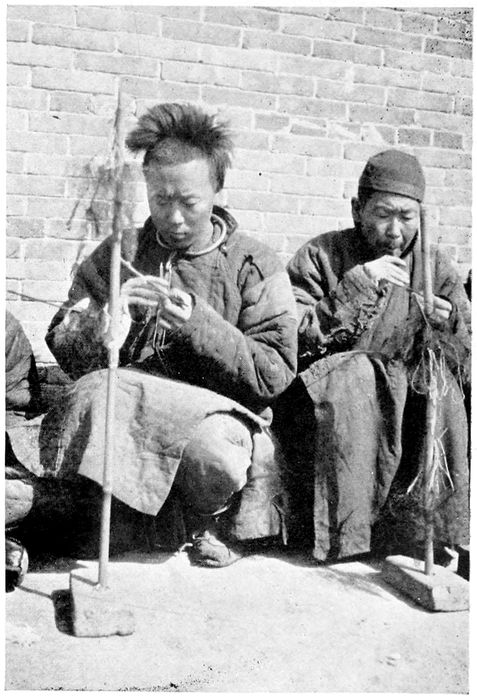
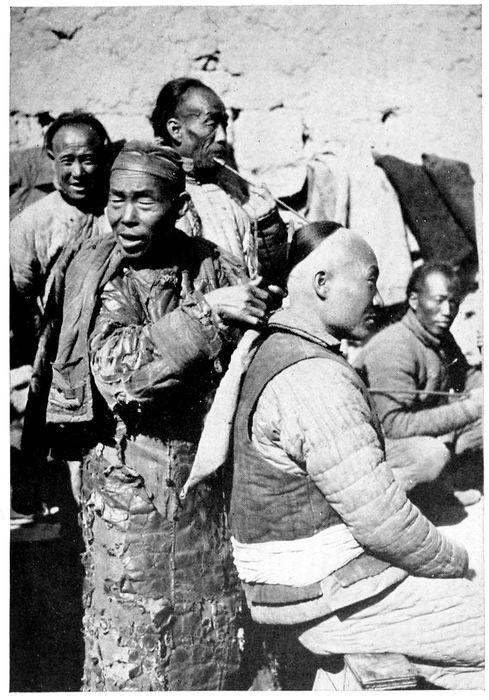
The Chinese coolie gets his hair dressed about once a month by the itinerant barber. This one is just in the act of adding a switch. Note the wooden comb at the back of the head
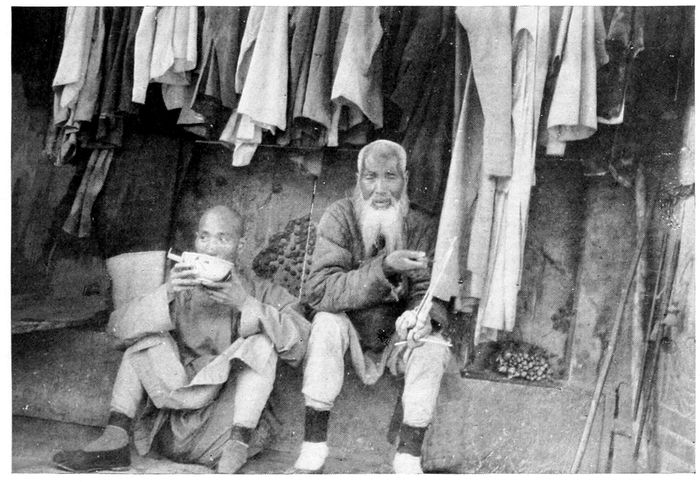
Two blind minstrels entertaining a village by singsonging interminable national ballads and legends, to which they keep time by beating together resonant sticks of hard wood
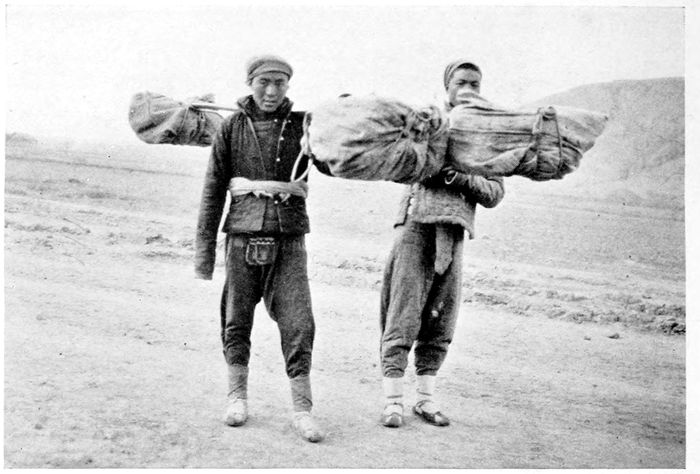
The “fast mail” of interior China is carried by a pair of coolies, in relays of about twenty miles each, made at a jog-trot with about eighty pounds of mail apiece. They travel night and day and get five or six American dollars a month
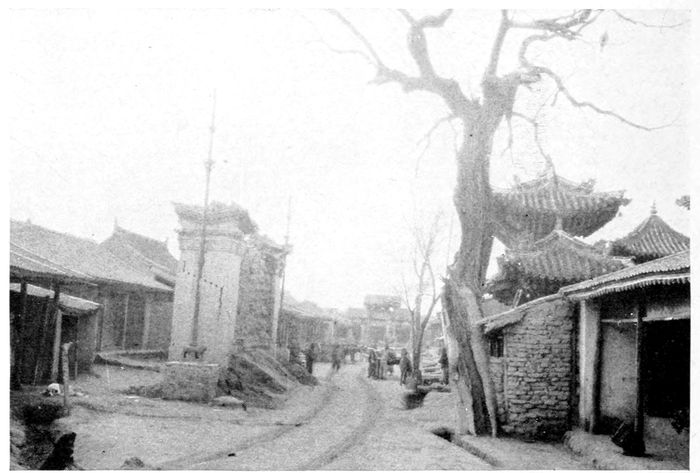
A bit of the main street of Taing-Ning, showing the damage wrought by the earthquake of two years before to the “devil screen” in front of the local magistrate’s yamen
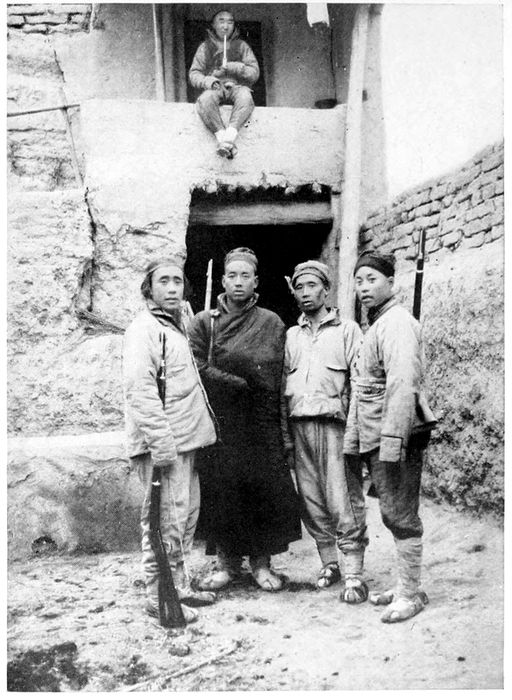
A local magistrate sent this squad of “soldiers” to escort us through the earthquake district, though whether for fear of bandits, out of mere respect for our high rank, or because the “soldiers” needed a few coppers which he could not give them himself, was not clear
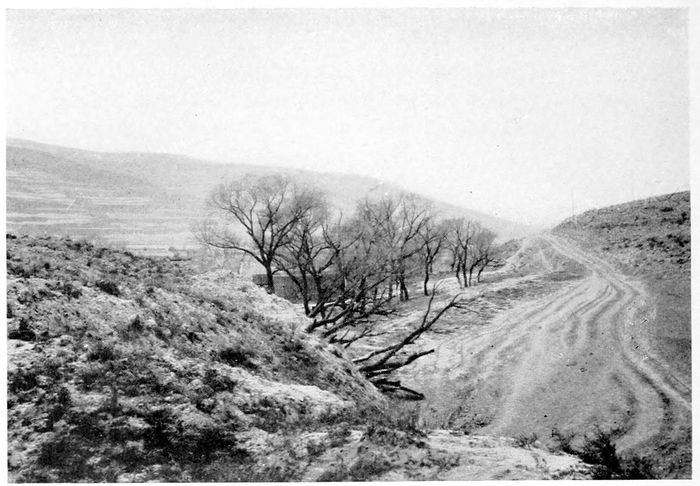
Where the “mountain walked” and overwhelmed the old tree-lined highway. In places this was covered hundreds of feet deep for miles, in others it had been carried bodily, trees and all, a quarter-mile or more away
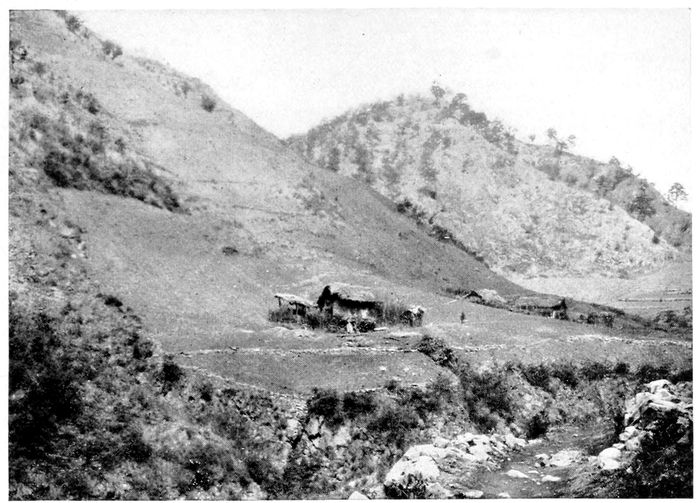
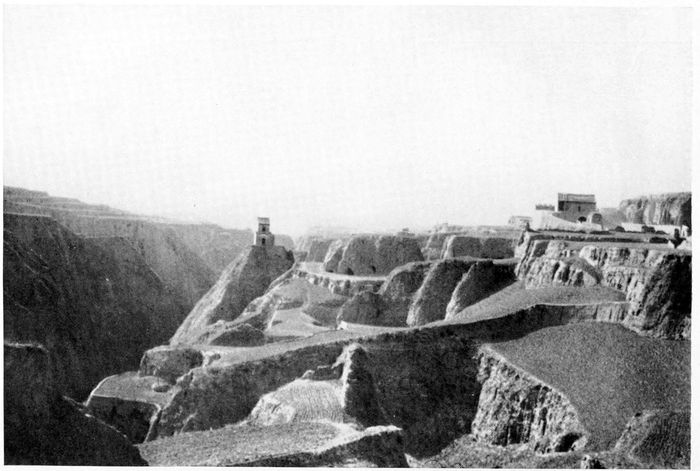
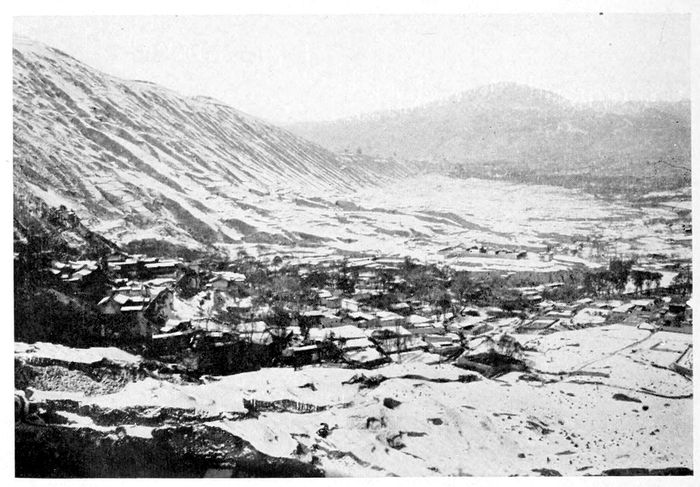
xxIn the earthquake district of western China whole terraced mountain-sides came down and covered whole villages. In the foreground is a typical Kansu farm
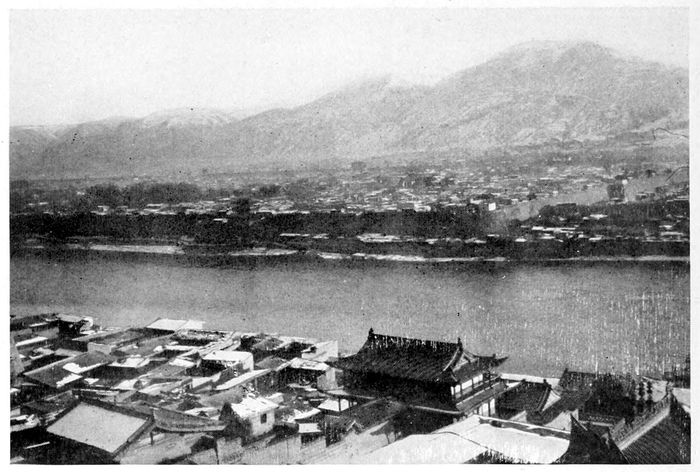
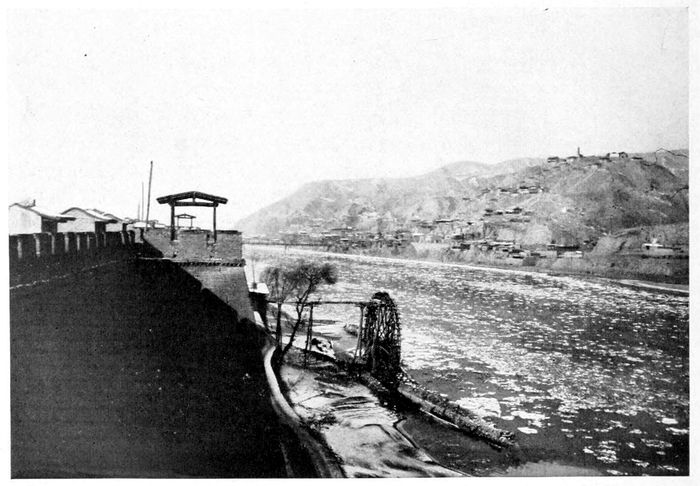
Looking down the valley of Lanchow, across several groups of temples at the base of the hills, to the four forts built against another Mohammedan rebellion
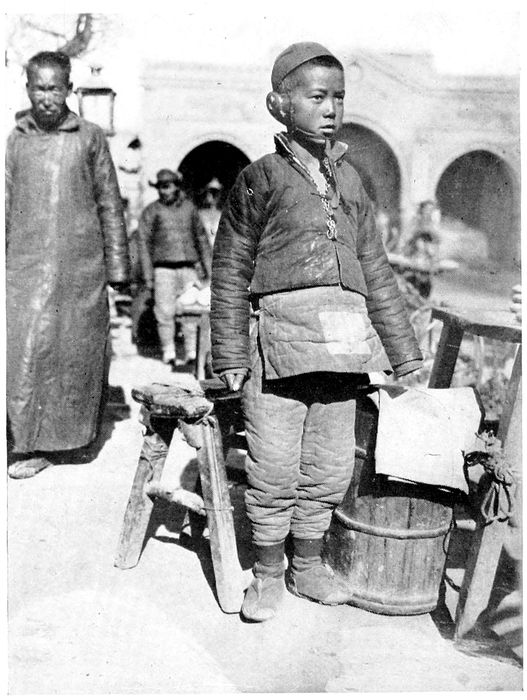
The Chinese protect their boys from evil spirits (the girls do not matter) by having a chain and padlock put about their necks at some religious ceremony, which deceives the spirits into believing that they belong to the temple. Earlaps embroidered in gay colors are widely used in Kansu in winter
A dead man on the way to his ancestral home for burial, a trip that may last for weeks. Over the heavy unpainted wooden coffin were brown bags of fodder for the animals, surmounted by the inevitable rooster
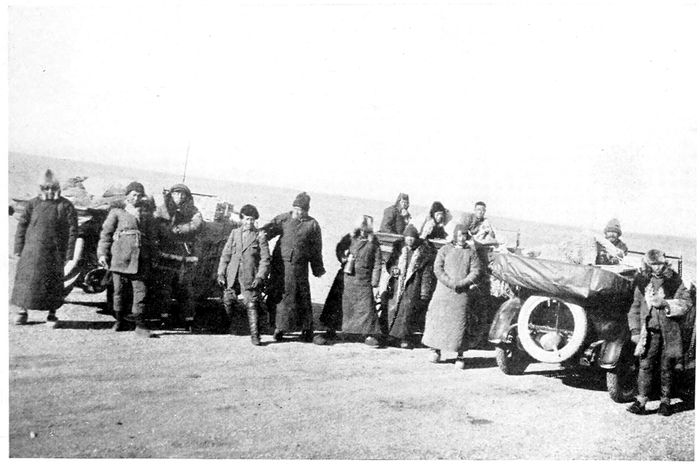
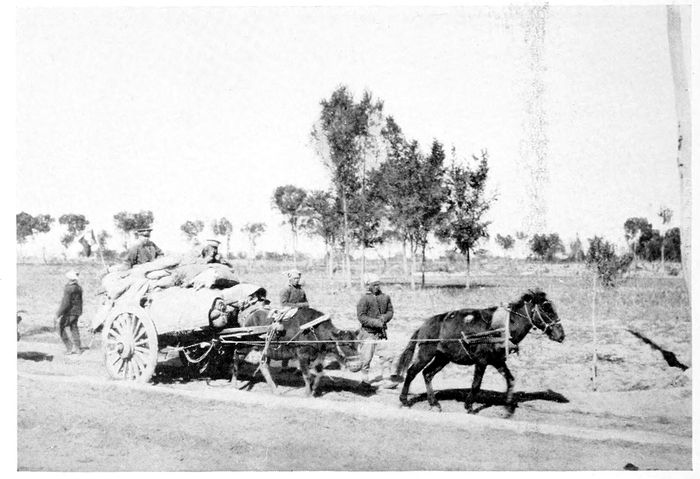
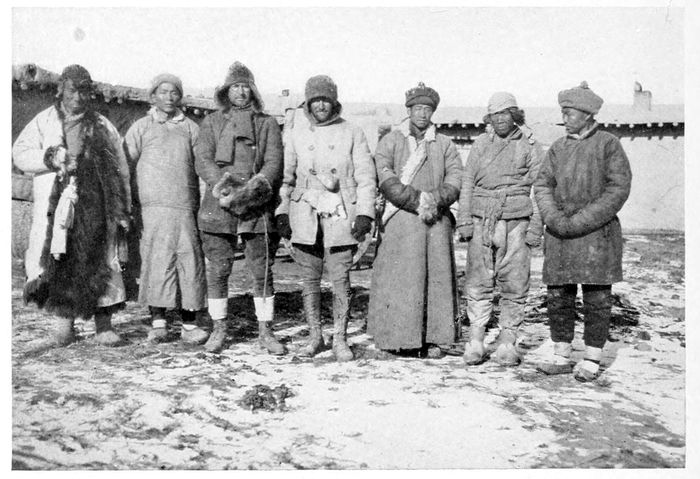
Our party on the return from Lanchow,—the major and myself flanked by our “boys” and cook respectively, these in turn by the two cart-drivers, with our alleged mafu, or groom for our riding animals, at the right
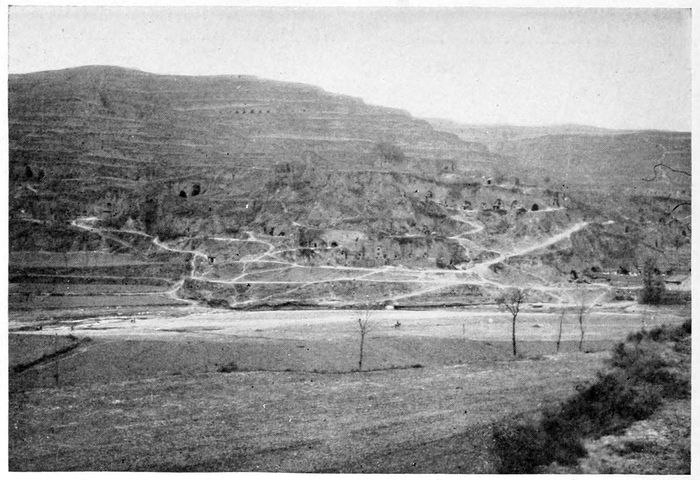
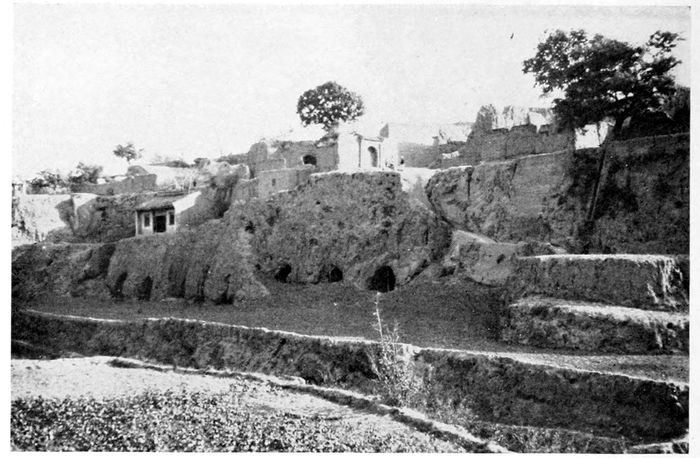
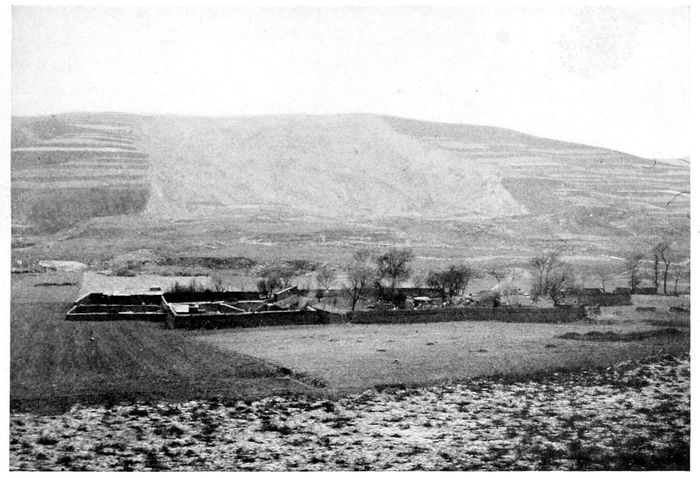
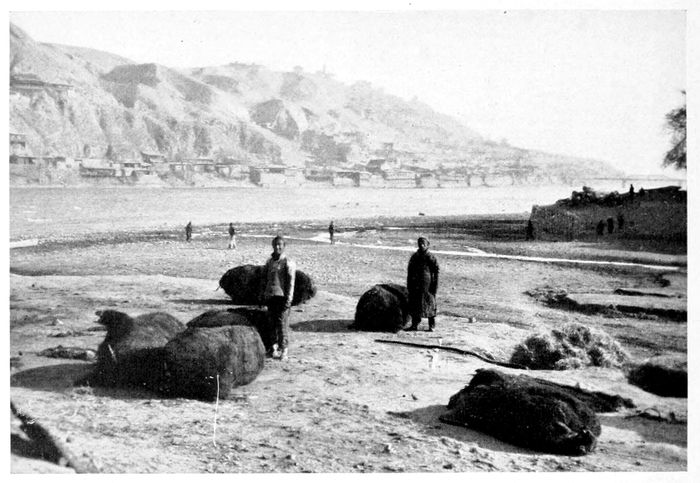
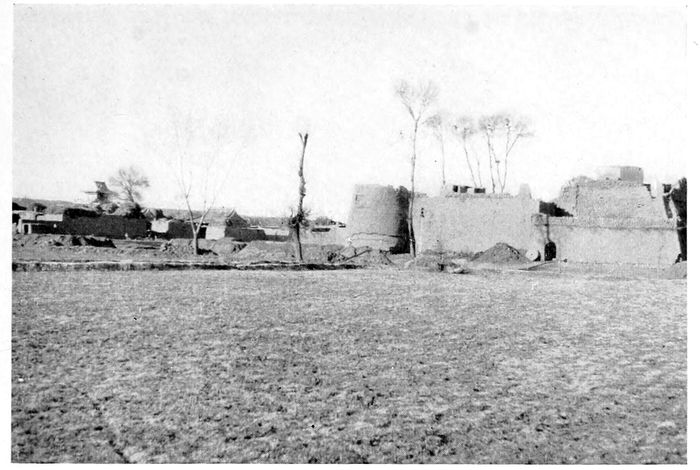
A typical farm hamlet of the Yellow River valley in the far west where some of the farm-yards are surrounded by mud walls so mighty that they look like great armories
The author gratefully acknowledges his indebtedness to Mr. Edwin S. Mills
of Peking, China, for the use of the pictures of Urga.
WANDERING IN
NORTHERN CHINA
CHAPTER I IN THE LAND WE CALL KOREA
3
The traveler from Japan to the peninsula still known to the
Western world as Korea has a sense of being wafted on
some magic carpet thousands of miles while he slept, a
sensation which the splendid steamers bridging the Straits
of Tsushima several times a day do not dispel. It is surprising how
different two lands separated only by a few hours on the sea can be.
A fortnight on a Nippon Yusen Kaisha liner and six weeks of wandering
from end to end of the Island Empire gave us a Japanese background
against which many of the problems of the Far East stood out
more clearly, but it did very little to prepare us for the physical aspects
of the “Cho-sen” over which the banner of the rising sun now waves.
Those who have listened to the long and heated controversy over the
adding of this large slice of mainland to the mikado’s realm must often
have heard the apologists’ assertion that the two peoples, Japanese and
Koreans, are so nearly alike as to be virtually the same. Perhaps they
are; but if so, all the outward evidences the casual visitor must depend
upon to form an opinion are deceiving. Superficially, at least, Japan
and Korea are as different as two Oriental lands and races could well
be. In landscape, customs, costumes, point of view, general characteristics,
even in the details of personal appearance, the two shores
of the Sea of Japan strike the new-comer as having very little in
common.
Perhaps the most outstanding feature of Korea, to any one newly
arrived from Japan, is her treelessness. The lack of forests is, with
the possible exception of exclamations of incredulity over her extraordinary
costumes, almost certain to be the subject of any Occidental’s
first paragraph of Korean notes. In our own case this denuded
4aspect of the peninsula was emphasized by the blazing, cloudless
sunshine that beat relentlessly down during all our first day of travel
northward to the old capital, and on many another to follow. The
bare and sun-scorched landscape suggested some victim of barbarian
cruelty, who, stripped of his garments, was being tortured to death
by slow roasting. Possibly we should have been prepared for this,
but we were not. We had heard much of the doings of Japan in
Korea; we knew something of the opera-bouffe hats of the men and
the startlingly short waists of the women, but no one had ever told
us of the curiously pure and molten sunshine of “Cho-sen,” of the
vividness of its shadows and the filtered transparency of its air, nor,
for that matter, of the incessant heat we must endure because chance
allotted us from June to August in what was once the Hermit Kingdom.
Trees as sparse as the hairs of a Korean beard stood out in lonely
isolation across the more or less flat lands of all that first day’s journey;
beyond these, usually rather near at hand, rose scarred and repulsive
hillsides as unsightly as the faces of those countless inhabitants along
the way who had been visited by the “honorable spirit” of smallpox.
It was not merely the barrenness of a naturally treeless country, a
barrenness as dreary as those upper reaches of the Andes to which real
vegetation never attains, but one which, like the denuded plains of
Spain, visibly complains of the wanton violence of man. To be sure,
many of the rocky hills that sometimes rose to be almost mountains
were here and there thinly covered with evergreen shrubs which might
some day be trees, and even forests. But these, travelers are informed
with what becomes tiresome persistency, were planted by the new
Government. The Japanese policy of reforestation, we were eventually
to know, has already done excellent things for Korea, and that not
merely, as those who resent the rape of the peninsula assert, where it
will attract the passing tourist’s eye, and it promises in time to accomplish
something worth while; but it is an unfortunate Japanese trait to
fear that good deeds will not speak loudly enough for themselves.
The reducing of a once well wooded land to its present nude state
is characteristic of the Korean, we were to learn, suggestive of his
general point of view. In the olden days the people were often driven
to the hills by their savage or demented rulers, and as the rigorous
winters that contrast with the tropical summers came on, they not only
burned the trees, but as roots make excellent charcoal they dug up
even these, leaving nothing that might by any chance sprout again.
To replant in better times, to take any serious thought for the morrow,
5would have been un-Korean. The Korean even of to-day who covets
the half-dozen cherries or plums on a limb does not usually take the
trouble to pick them; he breaks off the branch and goes his way
munching the fruit, with never a thought of next year. Translate this
improvidence, this almost complete lack of foresight, into all the
details of daily life, and the condition and the final fate of Korea
become understandable, in fact inevitable.
Woods survive to any great extent in Korea only in two places—about
royal tombs and up along the Yalu River which forms the
northern frontier. Elsewhere in the peninsula, with minor exceptions,
there are only groups of trees planted by foreign missionaries, and
rows of pine shrubs set out directly by the Japanese Government, or
by local authorities, school children, or private individuals, under
Japanese influence. This treelessness is not the unimportant detail
many may think; it is the wanton destruction of her forests of long
ago that gives the Korea of to-day her mainly mud houses, much of
her filth, dust, and swarming flies, and those devastating floods of the
rainy season which sweep roads, bridges, fields, and even villages before
them.
There were many other things which gave the Korean landscape
its strikingly un-Japanese aspect. Fewer people were working in the
larger and less garden-like fields; the village roofs thatched with rice-straw
had a flatter, smoother look than the homes of Japanese peasants;
the towns themselves seemed to huddle together as closely and
inconspicuously as possible, as if to escape, or join in resisting, the
rapacious tax-gatherers of the olden days that are not forgotten.
Koreans in white, their inevitable color, so rare in Japan, were everywhere,
though more often in the shade of villages or rare wayside trees
or huts than out in the baking sunshine. The suggestion forced itself
upon us that perhaps the fields were larger because the people could
not coax themselves to work alone. In Japan it had been unusual to
see more than a peasant and his wife in the same field; here work
seemed to be done almost entirely by gangs. In spite of the general
aridness of the landscape, there were many flooded rice-fields, and in
nearly all of them waded a soldier-like line of often a dozen laborers,
as many women as men among them. Much of the country showed no
signs of the languid hand of man, yet even in the drier sections scattered
rows of these peasants, their garments still almost snow-white
at a distance, gleamed forth in the otherwise mainly reddish landscape.
Similar groups stood in semicircles on earth threshing-floors flailing
6grain in a way that is familiar to the Western world, but which we
had never seen in Japan. Nor were there any reminders of the Island
Empire in the clusters of women kneeling at the edge of every bit of
a stream or mud-hole paddling clothes with a sort of cricket-bat.
The ways of life, the very architecture, were strangely reminiscent of
lands inhabited by negroes.
The most primitive of plows, drawn by bulls, dragged their way
to and fro in a field here and there. Along what passed for roads
others of these lumbering animals plodded almost hidden under loads
of new-cut grain or brushwood, at a pace which seemed to fit the languid
temperament of the country. In places a highway, constructed by
the new rulers, tried to preserve an unbroken march; but wherever a
bridge should have been they almost invariably pitched headlong down
into the bed of a stream as waterless as those of summer-time Spain.
Even the Japanese, we were to learn before leaving the peninsula, are
poor bridge-builders, while the Korean remains true to his natural
improvidence in constructing flimsy things of branches and earth, with
totally inadequate abutments, which the first dash of the rainy season
down the treeless hillsides converts into scattered masses of rubbish.
All the day long the scene varied little from these first few glimpses.
There was a certain rough beauty in the tawny hillsides and the broad
stretches of sun-flooded rice lands, but of a similarity that grew
monotonous, while the ways of the people, until opportunity should
come to see them in closer detail, were such as the fleeting tourist is
wont to sum up under the outworn word “picturesque” and quickly
lose from between the pages of memory. Korea has often been called
a land of villages, and in all the two hundred and eighty miles from
the southern point of the peninsula to Seoul there was little more than
a frequent succession of smooth-thatched, closely snuggled towns varying,
outwardly at least, only in size. Not until later on, and by more
primitive means of travel, were we to know of the remnants of bygone
civilization, the pine-grove tombs of royalty, the ruined palaces of
fallen dynasties, and the welter of modern problems with which the
peninsula teems.
The Korean wardrobe has so little in common with that of the
Occident, and includes so many startling absurdities, that it merits a
few words in detail, even though some of its more striking features
are fairly familiar to those interested in foreign lands. To begin with
the basis of all wardrobes, there is that ingenious contrivance with
7which the Korean gentleman protects his other garments from perspiration
during the blazing months of summer. A missionary who carried
home a set of these and offered them to any one in his native parish
who could identify them recorded forty-two guesses, all equally wide
of the mark, which was the simple phrase “summer underwear.” Out
of their environment these useful garments look more like primitive
bird-cages or light baskets than what they really are. In their entirety
they consist of a kind of waistcoat, a high collar of the Elizabethan
period, and cuffs so long as to be almost sleeves—all made of small
strips of ratan very loosely woven together. That they are effective
in allowing the free circulation of air, and at the same time preserve
the cloth garments from contact with the perspiring body, one is willing
to grant without the evidence of actual personal experience. Now and
again one runs across a Japanese petty official who, in an effort to
mitigate his midsummer sufferings, has adopted at least the cuffs;
but on the whole this ingenious contribution is likely to suffer the
common fate of never finding appreciation beyond its native habitat.
Over his ratan skin-protectors the Korean gentleman wears a kind
of waistcoat-shirt, trousers (if so commonplace a term may be used
for so uncommonplace a garment) which are more than voluminous
even in use and, when hung out to dry, suggest the mainsails of a
wind-jammer, and finally a turamaggie, an overcoat reaching to the
calves and tied together with a bow over the right breast. All these
articles are snow-white, and in summer are made of a vegetable fiber
so thin as to suggest starched cheese-cloth. The mainsail trousers are
fastened tightly about the ankles with a winding of cloth, which also
supports the carefully foot-shaped and curiously thick white socks,
which are thrust into low slippers cut well away at the instep, slippers
formerly of leather richly embroidered or otherwise decorated, but now
rapidly giving way to the white or reddish rubber ones made in Japan
which are ruining the feet of Korea. The crowning glory and
absurdity of this de rigueur costume, however, is the head-dress.
About the brow is bound, so tightly as to cause violent headaches when
first adopted and to leave lifelong marks, a black band about four
inches wide and reaching well up over the curve of the head. On top
of this sits a brimless cap shaped like a fez with an L-shaped indentation
in its front, and finally over all else reigns an uncollapsible
opera-hat. Both the hat and the cap beneath it are made of horsehair,
or cheap imitations thereof, and are so loosely woven and screen-like
in their transparency that facetious and unkindly foreigners are wont
8to refer to them as “fly-traps.” This term is as unwarranted as it is
offensive, for the one place in Korea which is free from flies in season
is the hat-protected crown of the adult Korean male. One need not
take the word of “old-timers,” but will find ample evidence in photographs
of a decade or more ago that the opera-bouffe contraption with
which the Korean gentleman tops himself off once had brim enough
to do duty almost as a real hat. Such utilitarian days are past, however;
perhaps it is that universal bugbear of the human family, the
high cost of living, which has reduced the brim to little more than a
ledge. The fact remains that a fly must walk with caution now in
making a circuit which in the good old days he might safely have
accomplished after sipping long and generously at the edge of a bowl
of sool. However, let there be no misapprehension, no uncalled for
sympathy under the impression that this shrinking has worked hardship
upon the wearer. The Korean hat was not designed to be a protection
for the head and a shade for the face. Its purpose in life is far more
serious and is concentrated on one single object,—to protect from evil
spirits the precious topknot which is the badge of full Korean manhood.
Hence its duty is not merely an outdoor one; wicked beings of the
invisible world have no compunction in taking unfair advantage of
their victims, so that to this day it is a common practice for the Korean
man to lay him down to sleep—on his bare papered floor, using a
hardwood brick as a pillow—with his precious top-hat still in place.
However, we have not yet completely garbed our yang-ban, our
gentleman of the Land of Morning Calm. His hat, being light, almost
ethereal, in fact, must be held in place, whether in sleep or in the
slightest breeze, for which purpose a black ribbon under the chin serves
the ordinary man and a string of amber beads his haughtier fellow-citizen.
Add to this the unfailing collapsible fan, and a pipe as long
and heavy as a cane, with a bowl the size of the end of the thumb,
and you may vizualize in his entirety the proud gentleman who sallies
forth from his mud hut and picks his way leisurely between the
mud-holes and offal-heaps of any town or city street. The fan is
rarely inactive, now dispensing a breeze to the copper-tinted face of
its owner, now shading it from the direct rays of a burning sun. The
pipe, bowl down, swings with the jaunty aggressiveness of an Englishman’s
“stick”; above all else the features remain fixed and unalterable
in their serenity, for in the code of the genuine Korean gentleman of
the old school there is no greater vulgarity than to show in public
either mirth, anger, curiosity, or annoyance. Nothing could be more
9specklessly white than this dignified apparition, for do not his servant-wives
spend their days, and no small portion of their nights, in
preparing his garments for the daily sortie and mingling with his
fellows? Behold him, then, as he joins the latter, in a shop-door or
on a shaded street-corner, where he squats with them in that fashion
which has caused a row of Korean males to be likened to penguins,
letting his spotless starched turamaggie spread out on the unswept
earth with a carelessness which seems a boast of his ability to command
unlimited female labor.
We must come back again, however, to the incredible hat, as the
eyes and the attention constantly will as long as one remains in Korea.
If the Japanese are commonplace and unoriginal in their head-dress,
certainly their newly captured fellow-subjects make up for it. Set
usually at a jaunty angle, whether by design, breeze, or cranial malformation,
a jauntiness enhanced by its scarcity of brim, the “fly-trap”
hat furnishes Korea half its picturesqueness. Graduates of modern
mission or Japanese government schools, self-complacent young men
who have been abroad, native Christian pastors, may wear the Panama
or the felt of the West above their otherwise national white garb, but
the “fly-trap” is still the prevailing head-dress throughout the length,
breadth, and social strata of the peninsula. Far and wide, in city or
village, in crowded marts or on lonely country roads, indoors or out,
awake or asleep, the high hat is seldom missing. It persists to the very
edge of the frontier, then disappears as suddenly as it had sprung up
at the other extremity of the country. After one has weathered the
first shock it does not look so greatly out of place on your city gentleman,
but I never learned to behold it with proper equanimity on the
heads of porters, plasterers, and peasants. Even the workman without
it, however, is still conspicuous. Tattered, soiled, and sun-scorched
men wandering across the country with a kind of tramp’s pack on
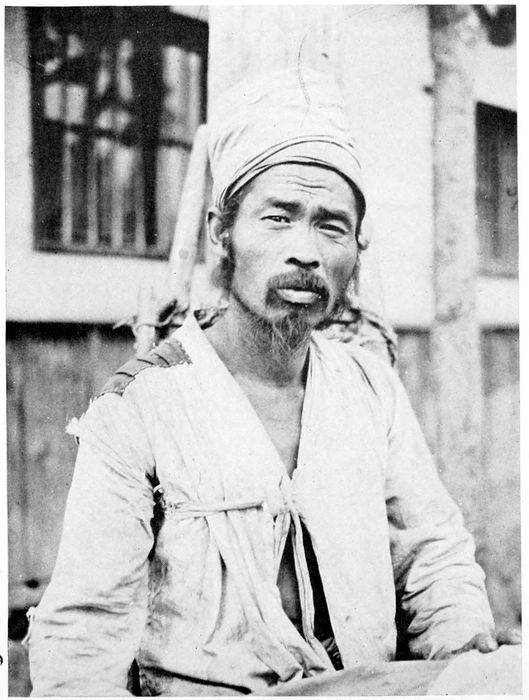
their backs wear the horsehair bird-cage on their heads; perhaps the
most incongruous sight of all is to behold a battered old man of the
rice-fields solemnly squatting on a garbage-heap in his mud hamlet,
with his opera hat perched on guard above his gray and scanty topknot.
Once or twice we caught a glimpse of the light-brown hat formerly
worn by all men about to be married, or to add a new wife to their
collection of servants; once the custom was wide-spread of painting
the hat white in sign of mourning, but to-day black is almost universal,
and an excellent foil to the otherwise white garb. Bridegrooms no
longer feel compelled publicly to announce their happy status, and there
10is another and more effective means of showing grief at bereavement,—a
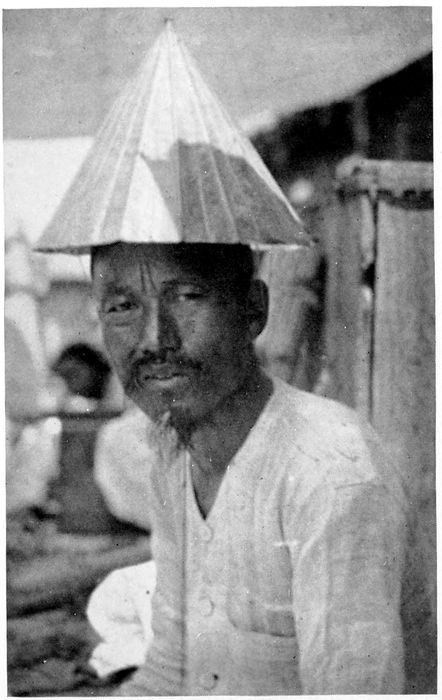
mourner’s hat like a large, finely woven, inverted basket with scalloped
edges, which completely hides the afflicted face of the wearer.
As he ambles along under this ample protection instead of blistering
beneath a horsehair cage, surely a feeling of gratitude toward the
departed relative must pervade the thoughts of the bereaved, particularly
as the Korean term of mourning lasts for three years. There is
a still more enormous, very coarsely woven, sunshade worn by peasants
in the midsummer months, while Buddhist priests, otherwise indistinguishable
from layman tramps and beggars, wear a smaller hat of
similar shape to that of the mourners, but raised on bamboo stilts well
above the head. The horsehair hat is costly, by Korean standards,
the better ones even by our own, and, being put together with glue,
is frail and perishable. Water is particularly fatal to it. Let the
first drop of a shower fall, therefore, and from within the garments of
every Korean man appears a hat-umbrella, a little cone-shaped cover
of oiled paper or silk, like a miniature Japanese parasol, which is
quickly opened and slipped over the precious hat. As to the rest of
the male garb, no damage is possible which cannot be repaired by the
return of sunshine or a few hours’ labor by the women at home. Thus
on a rainy day the black heads above white bodies characteristic of all
Korea turn to drenched cheese-cloth surmounted by oily yellow clowns’
caps.
It is fitting that the wardrobe of the insignificant sex should be
simpler, and more easily described. Except that anything in the way
of head-dress is denied them, lest they compete with the decorative
male, the garb of the Korean women is in the main a crude replica of
that of the men. All reasonably available evidence goes to show that
the women are never permitted the luxury of wickerwork undergarments.
Trousers, socks, and slippers are similar to those worn by
the male; above these is the thinnest and slightest of garments, which
barely covers the shoulders, and over the trousers is worn a white skirt
fastened well up above the floating ribs. In summer at least that is
all, except in a few old-fashioned communities, where a muffling white
cloak covering everything except the eyes and the feet is still occasionally
seen. That, I repeat, is all, and from our puritanical point of
view it is not enough. For the Korean woman insists that the waistline
is at the armpits, and makes no provision to have the upper and
lower garments contiguous, with the result that she displays to the
11public gaze exactly that portion of the torso which the women of most
nations take pains to conceal. Missionaries, who are as prone as the
rest of us to lose their native point of view through long contact with
other races, assure us that Korean women are extremely modest. In
general deportment the statement holds water; but a married lady of
Korea, marching down the main thoroughfare of one of our cities in
her native garb, would be granted anything but modesty. One might
fancy that the costume was prescribed by some lascivious tyrant of
olden days; those who have looked deeply into the matter, however,
assure us that it is due to the pride of motherhood. The fact remains
that, though the precept and example of Western nations have tended
to lengthen the upper garment among better-class women of the cities,
and particularly among those who have attended modern schools, the
great majority of the adult female sex in Korea still wear their breasts
outside their clothing. Sun-browned and leather-textured as the face,
the plumpness of matrons or the withered rags of age are almost always
in plain, not to say insistent, evidence. In fact neither the men nor
the women of the masses often succeed in making both garments meet;
males below the turamaggie class as habitually display their navels as
their wives do their bosoms.
White is as universally the color of Korean garments in winter as
in summer; the only difference is that they thicken from cheese-cloth
to cotton-padded ones as the cold season advances. The incongruous
sight of skaters in what looks like tropical garb, of whole towns of
people wading through the snow from which they are barely distinguishable,
provokes the wonder of winter visitors. The whiteness of
a Korean crowd can be duplicated nowhere on earth. Within the
lifetime of any one capable of reading these lines the glimpse of a
figure in dark or colored garments anywhere in the peninsula betrayed
it at once as that of a foreigner. The first record of any variation
from this rule was when, a decade ago, the upper classmen of a mission
school in Seoul agreed by resolution to adopt dark European trousers,
in order to spare their wives or mothers some of their incessant washing
and ironing.
The sounds of these two occupations are never silent in Korea.
Stand on an eminence above any town or city of the land, and to the
ears will be borne the similar yet easily distinguishable rat-a-tat-rat-a-tat
of a hundred housewives busy with one or the other of their two
principal duties. How they attain the snowy whiteness required by
their unaffectionate masters by paddling their garments at the edge
12of any mud-hole or trickle of sewage is one of the mysteries of the
East; yet not a roadside puddle or a hollowed rock but is turned into
a wash-tub, and never is the visible result outwardly anything but
spotless purity. In contrast to the dull plump-a-plump of washing
paddles is this falsetto tone of ironing, prolonged far into every night.
Nay, wake up at any hour and it will be strange if you do not catch
the sound of some distant housewife putting the finishing touches on
the garments in which her lord will strut forth into the world in the
morning. For in Korea the hot iron is not in vogue, except a tiny
one used along the sewed or pasted seams. Instead, the clothing is
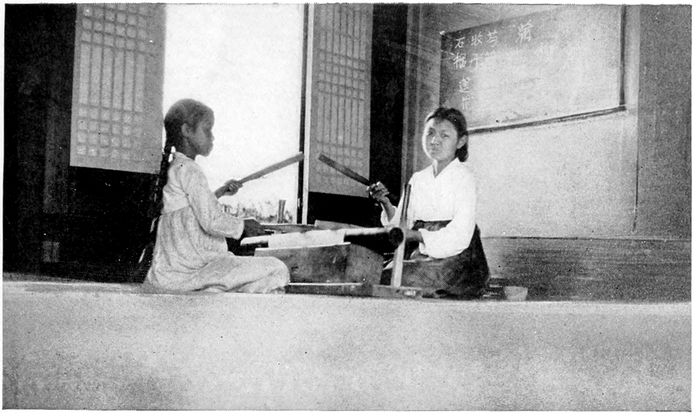
folded over a hardwood cylinder and beaten with two miniature
baseball-bats, beaten with an endless persistency that suggests an
unsuspected durability in the apparently flimsy material, and with a
rhythm that has grown almost musical with centuries of practice.
Children are often dressed in colors, and unmarried maidens may
wear garments of a green or bluish tinge; but all soon succumb to
the omnipresent white. Huge hats not unlike those of men in mourning
were once universally required for young women not yet sentenced
to the servitude of a husband, that their faces might not be disclosed
to the male sex. Missionaries by no means gray in the service recall
how half-acres of these basket-hats used to lie stacked up before native
churches on days of service. But the old order passes, even in the once
Hermit Kingdom, and one may travel far afield now and still perhaps
look in vain for any survival of this long prevalent custom. As in
Japan, the head-dress of the women of Korea is now a matter of
hair, in this case drawn smoothly and tightly down over the scalp, like
a cap of oily black velvet, and tied in a compact little knot behind,
decorated perhaps with a red cloth rosette and thrust through with
what looks almost like one of our new-fashioned nickel-plated lead-pencils.
The Koreans have never been reduced to any such crude expedient
as a bachelor-tax to keep up their marriage-rate. Until very recent
years all boys wore their hair in a long braid up to the day they took
a wife. Even now this custom survives in some outlying districts,
though none yielded more swiftly to the influx of foreign influence.
As long as a man wore a braid he was rated a minor; when he
approached manhood he became more and more a community butt,
and shame and ridicule rarely failed to drive him into an early marriage.
Girls, too, had powerful reasons for not long persisting in the dreadful
condition of maidenhood, not the least among which was the custom,
still widely practised, of burying the body of an unmarried woman in
the public highway, to the everlasting shame of her family to its
remotest branches. Moreover, a Korean woman is not given a name
of her own until she has borne a son, after which she is forever known
as “Mother of So-and-So.” Before that her title, even to her husband,
is “Yea!” or the slightly more honorable “Yea-bo!” which correspond
fairly closely to our affectionate “Heh!” or “Heh, you!”
CHINA AND JAPAN
13When the happy day comes that is to put an end to the ridicule
of his fellows and the shame of his parents, the youth transforms his
braid into a topknot, a tightly braided, twisted, and doubled mass of
hair an inch in diameter and about three inches high, standing bolt
upright in the center of his head, and transfixed with a nickeled or
silver ornament similar to that worn by the women. Unlike the cue
of the Chinese, forced upon them as a sign of alien subjection, the
topknot is the Korean’s badge of manhood, his proudest and most
precious possession. Thenceforth one of his most serious problems
in life is to protect it from the powers of evil. About his brow is
placed the painfully tight band that he is seldom again to be seen without
this side of the grave, and he sallies forth under his gleaming new
horsehair hat with the masterly air that befits a man of family cares
and advantages. To its wearers the Korean top-hat must have become,
as even the worst eyesores of human costume will with long use, a
thing of beauty; for though many are the men, and myriad the youths,
who now cut their hair in Western fashion, numbers even of these still
cling to the native hat, while shopkeepers with close-cropped heads,
or those whom the evil spirits have outwitted and left bald, may be
seen squatting among their wares virtually without clothing but with
the discredited head-gear precariously perched upon their bare heads.
Once in a dog’s age even now a country youth turns up at a government
or a mission school wearing the braid that not long ago was
universal among unmarried males, or, since early marriages are still in
vogue, with a topknot; but it is seldom that the end of the first week
does not find his fashion changed. Pseudo-pathetic stories still come
in from the outlying districts of mothers who wept their eyes red at
the cutting of a son’s braid, or of conservative old fathers wrathfully
driving from home youths who have sacrificed the topknot that stands
for manhood. But the shearing goes steadily on, and thus is passing
one of Korea’s most conspicuous idiosyncrasies. The bachelor braid
down the back yielded swiftly to foreign influence; a generation hence
the topknot, perhaps even the stovepipe screen that surmounts it, may
14be as unknown in the peninsula as the pre-Meiji male head-dress is
now in Japan.
If one takes heed not to carry the likeness too far, the Korean
might be described as a cross between the Japanese and the Chinese.
Some of his traits and customs resemble those of one or the other of
his immediate neighbors, but a still greater number seem to be peculiar
to himself alone. He builds his house, for example, somewhat like
those of Japan; he heats it somewhat after the fashion in China, yet in
neither case is the similarity more than approximate. Certainly he is
content with as few comforts as any race, with the possible exception
of the Chinese, that ever reached the degree of civilization to which
he once attained. This, of course, is partly due to the centuries of
atrocious misrule under which he lived, when it was unsafe for even
the wealthiest of men to attract the ravenous tax-gatherers, turned loose
upon the kingdom in rival bands by both king and court, by living in
anything more than a thatched mud hovel.
Thus it is that even the larger Korean cities are little more than
numerous clusters of such hovels, huddled together along haphazard
alleyways of dust or mud, except where the hand of the new rulers
of the peninsula, or of those Westerners who have been striving for
more than three decades to Christianize it, show themselves. The
typical Korean house, whether of country or town, is made of adobe
bricks or odds and ends of stone completely plastered over, inside and
out, with mud. Thus the walls remain, until they crumble or wash
away, for neither paint nor whitewash is used to disguise their milk-and-coffee
tint. Except in rare cases, or a few special localities, a
rice-straw roof covers them, a roof so smooth and almost glossy, so
low and nearly flat, that a village suggests a cluster of dead mushrooms.
The accepted shape of the dwelling is that of the half of a square,
though in its poorer form it may be merely a hut somewhat longer than
it is wide, and in the more pretentious cases it sometimes completes
the whole square. Whether it does or not, it must be wholly shut off
from the outside world, usually by a wall or screen of woven straw
as high as the eaves and enclosing a wholly untended dust-bin of a
yard between the two ells. The well built and spick and span servants’
houses erected by a missionary community near Seoul were unpopular
with the domestics because they looked off across a pretty valley to the
mountains, instead of being shut in by the customary mat-fence.
The outside of the half-square has no openings whatever, but
15presents to the world a perfectly blank face. The inside, on the other
hand, is little else than openings, across which may be pushed paper
walls or doors somewhat similar to those of Japan. Like the Japanese,
the Koreans are squatters rather than sitters, so that the three living-rooms
of the average dwelling are barely six feet high, and not much
more than that in their other dimensions. The floors are raised somewhat
above the level of the ground outside, and are made of stone
and mud, like the walls, covered with plaster, or sometimes wood,
and this in turn by a heavy, yellow-brown native paper of a consistency
between cardboard and oil-cloth. None of the thick soft mats of the
Japanese, nor of his cushions or padded quilts, soften life by night
or day in a Korean home. When sleep suggests itself, the inmates
merely stretch out on the floor on which they have been squatting,
thrust a convenient oak brick under their heads, and drift into slumber.
Rarely do they make any change of clothing at retiring or rising,
the men, as I have said before, often wearing their top-hats all night.
Shoes, or, more exactly, slippers, are dropped as the wearers come
indoors as unfailingly as in Japan on the ledge of polished wood which
forms a cross between a porch and a step along the front of the house.
To the Western eye the lack both of space and furniture is surprising.
In the center of the house, and usually wide open, is a kind of parlor
or sitting-room, at most ten or twelve feet long, flanked at either end
by two little living-rooms no longer than they are wide, and the house
nowhere has a width much greater than the height of the average
Western man. Eating, sleeping, the whole domestic life, in fact, is
carried on in a constant proximity exceeding that of our most crowded
tenements. It looks more like “playing house,” like a building meant
for children to amuse their dolls in, than like the actual lifelong residence
of human beings. This impression is enhanced by the miniature
furniture, usually as scarce as it is small. There are, of course, no
chairs, and no tables unless the little tray with six-inch legs on which
food is served be counted as one. If there is a student in the family,
or the father is engaged in business, there may be a little writing-desk
without legs set flat on the floor; probably there is a chang, or legless
chest of drawers, and one of the famous Korean chests, both more
than generously bound in brass, or even silver if the family is more
prosperous than the exterior of the building ever suggests. That is
usually about all, except perhaps a little sewing-machine run by hand,
and the few trinkets and inconspicuous odds and ends which the women
and children gather about them.
16In the ell, flanking one of the little square living-rooms, is the
kitchen, with earth floor and the crudest of stone-and-plaster stoves
and implements. Next to this, or perhaps across the dusty, sun-baked
yard in the other right-angled extension, is a rough store-room, which
commonly alternates in location with an indispensable chamber offering
much less privacy and convenience than a Westerner could wish.
The walls of the floored rooms are usually covered with plain paper,
white or cream-colored, though sometimes figured in a way that recalls
both Japan and China. In the yard sit half a dozen or more enormous
earthenware jars of the color of chocolate. In one or two of these
water is kept; others are filled with preserved or pickled food, particularly
the Korean’s favorite delicacy, kimshee, a kind of sauer-kraut of
cabbage and turnips generously treated with salt and time and rarely
missing from the native menu except in the hot months when it is
perforce out of season.
When it comes to heating his house the Korean takes complete
leave of his island neighbor and turns his face westward. Under the
stone floor runs a large flue, the entire length of the house, connected
with the kitchen at one end and springing out of the ground in the
form of a crude chimney or stovepipe at the other. None of this
shivering over a hibachi filled with a few glowing coals for the otherwise
comfort-scorning Korean; he will have his dwelling well heated
from end to end, not merely his k’ang, or stone bed, after the Chinese
fashion, but every nook and corner within doors. While the cooking
is going on he may lie on the papered floor and toast himself to his
heart’s content; or a bundle of brushwood—almost the only fuel left
him in his deforested land—thrust into the business end of the flue in
the morning and another at night makes winter a mere laughing matter.
It is an ingenious scheme, yet not without its drawbacks. In the
blazing summer-time, for instance, there is no way of shutting off the
kitchen heat, and the house-warming goes as merrily on as in January.
Not that the native seems to mind; he is as immune to a hot bed as
to a hard one. But many is the foreign itinerant missionary who,
having found lodging on a frosty night with hosts who would outdo
themselves in hospitality, has gratefully stretched out on a nicely
warmed floor and fallen luxuriously asleep—to awaken half an hour
later dripping with perspiration, and toss the night through in a vain
effort to shake off the nightmare impression of having brought up in
that very section of the after-world which all his earthly efforts had
been designed to avoid.
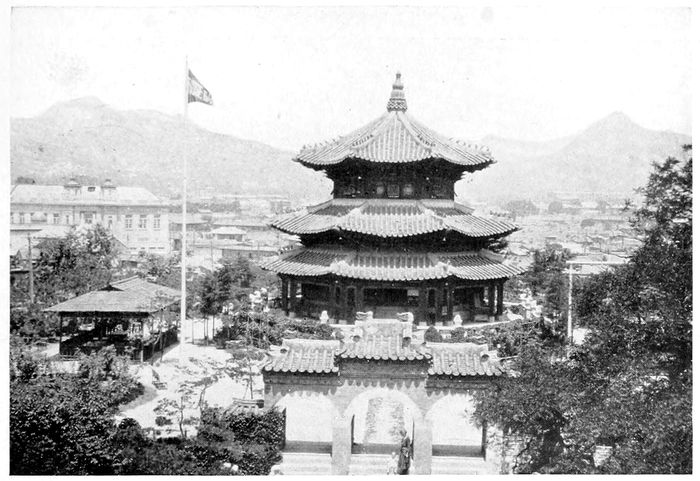
Our first view of Seoul, in which the former Temple of Heaven is now a smoking-room in a Japanese hotel garden
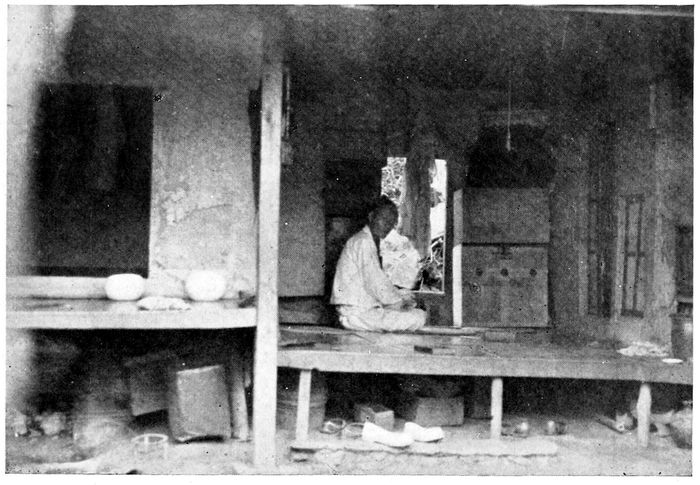
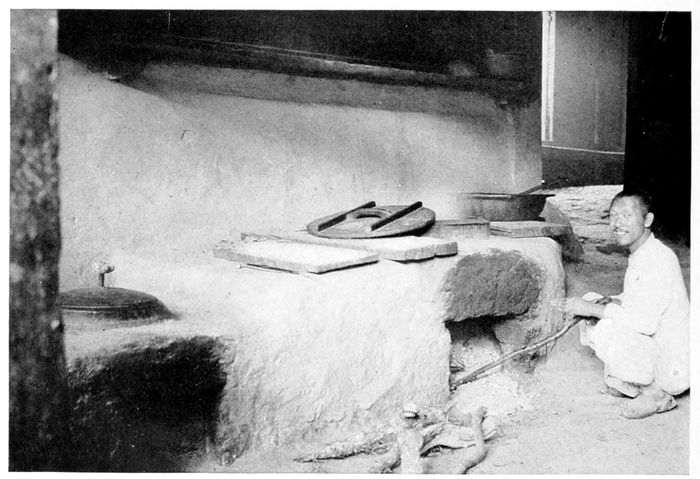
The interior of a Korean house
Close-up of a Korean “jicky-coon,” or street porter
At the first suggestion of rain the Korean pulls out a little oiled-paper umbrella that fits over his precious horsehair hat
17Like his neighbors, the Korean eats with chop-sticks, but he uses
a flat metal spoon with his rice. This grain is the basis of the better-class
meal, but is not so highly polished as in Japan; and it is too
costly for the common people, who replace it with cheaper grains,
especially millet. What may seem a hardship is really a blessing. The
poverty which denies them some of the refinements of the table imposes
upon the people of Korea a more healthful diet than that of their
island neighbors; in the mass they are more sturdily built; if all other
signs are insufficient one can usually distinguish a Korean from a
Japanese by the excellence of his teeth. Besides his beloved kimshee,
no Korean meal is complete without a pungent sauce made from beans
pressed together into what looks like a grindstone and then soaked in
brine, a sauce into which at least every other mouthful is dipped. Meat
is more often eaten than in Japan; fish, as generally. But tea is not
widely used; in its place the average Korean uses plain water, or the
water in which barley or millet has been cooked, or, best of all, sool,
cousin of the fiery sake or samshu of the neighboring lands. Then
come a dozen little side-dishes,—pickled vegetables, some strange, some
familiar to us, cucumbers cut up rind and all, green onions, and some
distant member of the celery family, all immersed in vinegar-and-oil
baths, slices of hot red peppers, tiny pieces of some hardy tuber, brittle
sheets of seaweed cooked in oil until they look as if they had been
varnished, a jet-black kind of lettuce, and other odds and ends for
which there are no equivalents in our language. Sugar is hardly used
at all, and the adaptable traveler who learns to be otherwise satisfied
with a native dinner usually rises to his feet with a longing for a bit
of chocolate or some similar delicacy.
It is curious how geographical names often persist in our languages
of the West long after they have become antiquated and even unknown
in the places to which we apply them. The name “Korea,” for instance,
means nothing to those who live in the peninsula we call by that term;
nor for that matter did the word “Korai” from which we took it ever
refer to more than a third of the country, and that long centuries ago.
Ever since they absorbed the former kingdom the Japanese have
striven to get the world to adopt the native name “Cho-sen” (the “s”
is soft), a word already legitimized by several hundred years of use.
But the world is notoriously backward in making such changes; perhaps
it is suspicious of the motives of Japan, and a bit resentful at her
attempt to render whole pages of our geographies out of date. Yet
18there is nothing mysterious or tricky in the wholesale alterations in
nomenclature which she has wrought in her new possession, though
there is often irksome annoyance. Every province, every city, almost
every slightest hamlet has been given a new name; but this has come
about as naturally as the Frenchman’s persistent obstinacy in calling a
horse a cheval. It is a mere matter of pronunciation. A given Chinese
ideograph stands, and has stood for centuries, for a given town or
village of Korea. The Korean looks at the character and pronounces
it, let us say, “Wonju”; the Japanese knows as well as we know the
word “cat” that the proper pronunciation is “Genshu”—and there you
are. It is hardly a dispute, but it is at least a new means of harassing
the traveler. If he is American or English, or even French or German,
for that matter, he will find that nearly all his fellow-countrymen
resident in the country, mainly missionaries, have lived there, or been
trained by those who have, since before the Japanese took possession,
and that they know only the Korean names. If he has a guide-book,
which is rather essential, it is almost certainly concocted by the new
rulers or under their influence, and insists on using the Japanese names.
So do the railway time-tables, all government documents, and the like.
Thus he discovers that it is almost impossible to talk with his own
people, at least on geographical matters.
“Have you ever been in Heijo?” he begins, with the purpose of
pumping a compatriot for information on that second city of the
peninsula.
“Never heard of it,” replies the old resident, with a puzzled air,
whereupon the new-comer gives him up as a hopeless recluse and goes
his way, perhaps to learn a few days later that this very man was for
ten years the most influential foreigner in that very city, but that to
him it has always been, and still is, “Ping Yang.” Thus it goes,
throughout the length and breadth of the peninsula, so that the man
who would mingle with both sides must know that “Kaijo” is
“Song-do,” that “Chemulpo” is “Jinsen,” that what the guide-book and
time-table call “Kanko” has always been “Ham-hung” to the missionaries,
that every last handful of huts in Korea is known by two separate
and distinct names, though the erratic slashes with a weazel-hair brush
which stands for it in the ridiculous calligraphy of the East never varies.
Long before his education has reached this fine point the traveler will
have completely forgotten his resentment at finding, as he rumbles into
it at the end of a long summer day, that the city he has known since
has early school-days as “Seoul” is now officially called “Keijo.”
19It doesn’t greatly matter, however, for the chances are that he has
always spoken of it as “Sool,” which is the native fire-water, instead
of using the proper pronunciation of “Sow-ohl”; and to learn the new
name is easier than to change the old. Our own impressions of what
was for more than five centuries the capital of Ch’ao-Hsien, the Land
of Morning Calm, and is still the seat of the Government-General of
Cho-sen, started at delight, sank very near to keen disappointment,
then gradually climbed to somewhere in the neighborhood of calm
enjoyment. Seen from afar, the jagged rows of mountain peaks that
surround it should quicken the pulse even of the jaded wanderer. The
promise that here at last he will find that spell of the ancient East
which romancers have enticed him to seek, in the face of his cold
better judgment, seems to rise in almost palpable waves from among
them. Then he descends at a railway station that might be found in
any prairie burg of our central West, and is bumped away by Ford
into a city that is flat and mean in its superficial aspect, commonplace
in form, and swirling with a fine brown dust. But next morning, or
within a day or two of random wandering, according to the pace at
which his moods are geared, interest reawakens from its lethargy,
and something akin to romance and youthful enthusiasm grows up out
of the details of the strange life about him.
There are, of course, almost no real streets, in the American sense,
in the Far East; hence only those wholly unfamiliar with that region
will be greatly surprised to find that the “many broad avenues” of
Seoul, emphasized by semi-propagandist scribblers, are rather few in
number and, with one or two exceptions, are sun-scorched stretches of
dust which the rainy season of July and August will turn to oozing
mud. But the eye will soon be caught by the queer little shops crowded
tightly together along most of them, particularly by the haphazard
byways that lead off from them into the maze of mushroom hovels
that make up the native city. From out of these dirty alleys comes
jogging now and then a gaudy red and gold palanquin in which squats
concealed some lady of quality, though these conveyances now are
almost confined to weddings and funerals; the miserable little mud
hovels disgorge haughty gentlemen in spotless white who would be
incredible did not the falsetto rat-a-tat of ironing and the groups of
women kneeling along the banks of every slightest stream explain them.
There is constant movement in the streets of Keijo, a movement that
might almost be called kaleidoscopic, were it not for the whiteness of
Korean dress; but it strikes one as rather an aimless movement, a
20leisurely if constant going to and fro that rarely seems to get anywhere.
Dignified yangbans, that still numerous class of Korea, and
especially of the capital, which in the olden days was rated just below
the nobility, strut past in their amber beads and their huge tortoise-shell
goggles as if they were really going somewhere; but if one takes the
trouble to follow them he will probably find them doubling back on
their tracks without having reached any objective. In the olden days
they could at least go to the government offices where they pretended
to do something for their salaries; since Japan has taken away their
sinecures without removing the pride that forbids them to work, there
is little else than this random strolling left for them to do.
In contrast to this numerous gentry, outdistanced by modern
changes, there are sweating coolies lugging this or that, bulls hidden
under mounds of brown-red brushwood from some far-off hillside,
sleek-haired women slinking by with an almost apologetic air, many
of them with the uncovered, sun-browned breasts somewhat less general
in the capital than elsewhere, here and there a Korean pony, cantankerous
with his full malehood, all streaming to and fro between an
unbroken gauntlet of languid shopkeepers in their fly-trap “household”
caps, of mangy dogs and dirty children. “Old-timers” will tell you that
this was not so long ago all there was to Seoul, except inside the several
big palace compounds, now so uninhabited; that walking, still much
in vogue among the Koreans, was for the overwhelming majority the
only means of getting about the city. Then there were no rickshaws,
not over-numerous even to-day after twelve years of wholly Japanese
rule; then none of the little dust- or mud-floored tram-cars, now so
crowded, bumped along the principal avenues; certainly no battered
and raucous-voiced automobiles scattered terror among the placid
foot-going population. It is not difficult to picture the comparative
silence of that bygone Seoul, with slipper-clad footsteps pattering noiselessly
through the dust, or the mild clumping of that cross between
the Dutch wooden shoe and the Japanese geta still worn in muddy
weather, punctuated now and then by the booming of a mammoth bell,
the mild hubbub of passing royalty surrounded by shrieking out-runners,
and the incessant accompaniment of the falsetto rat-a-tat of ironing.
With the definite coming of the Japanese much of that ancient Seoul
has departed. The great wall that enclosed the city has been largely
leveled, for the Koreans, according to their new rulers, can only fight
behind walls. Only a pair of the imposing city gates remain, and these
as mere monuments instead of entrances and exits. The Independence
21Arch built to celebrate the end of paying tribute to Peking stands
shabby, cracked, and blistered in a bed of sand in the ragged outskirts.
Rubbish and worse litter the dark, wooden-slatted enclosure in which
the mighty bell that once transmitted royal commands sits drunkenly
and dejected on the ground. Vagabonds build their nests beneath the
Oriental roof that shelters the stone-turtle monument of which the
city was once so proud; the magnificent Altar of Heaven has become
a garden ornament within the grounds of the principal hotel, and is
generously furnished with Japanese settees and capacious cuspidors
bearing the railway-hotel insignia. Of the three principal palaces one
is a mere wilderness of weeds and vacant-eyed edifices; another houses
the weak-minded remnant of the once royal family and has bequeathed
most of its grounds to museum, botanical, and zoölogical purposes;
the third, and most historic, is being completely hidden from the city
by a mammoth modern building designed to become the headquarters
of the Governor-General.
One might almost assume that a policy of blotting out the visible
reminders of the old independent Korea had been adopted by the new
rulers. Yet it is hardly that, I fancy, but mainly the utilitarian sense
of modern improvement which is showing such small respect for the
monuments of bygone Cho-sen. The Japanese are ardent in their
efforts to make Seoul a city in the modern sense—the modern Western
sense, I could have said, for their new structures are hardly copied
from Japan. Imposing buildings that might have been transported
from our own large cities are growing up for the housing of banks
and important firms and government offices. There is already one
genuinely asphalted street; new parks have been laid out where only
wilderness or rubbish heaps were before. Besides the big central one
there are adequate branch post-offices in every section of the city;
police stations at every turn keep a watchful eye out for new candidates
to the mammoth new penitentiary, built on the latest approved model,
out near the “Peking Pass.” After their lights the new rulers are
steadily improving the material aspect of the city, as of the whole
peninsula. It would be too much to expect them to improve certain
personal habits and domestic customs beyond the point which the
Japanese themselves have reached, so that some forms of uncleanliness
and undress, for instance, which a new American colony would quickly
be forced to eradicate, have been given no attention.
The new rulers once planned even greater changes in the old city.
They set about with the apparent intention of virtually moving it, or
22at least the commercial center of it, down nearer the River Han, in a
section they called Ryuzan. There they built the railway headquarters
and blocks of brick residences for the employees. A stone palace for
the mikado’s viceroy was erected, streets laid out, and improvements
impossible in the crowded portion of the city were projected. But
commerce has a way of choosing its own localities; the Koreans are
nothing if not conservative; local gossip has it that when Prince Ito
was taken down to see his new residence he remarked to his well
meaning subordinates that they might live down there in the swamp
if they wished, but that he for one would stay in town. The prince is
well known to have been no recluse and hermit who would deny himself
the soft pleasures of cities. In the end his choice proved wise, for it is
a rare rainy season that does not wipe out scores of native huts down
along the Han and encroach upon the unused and isolated palace he
rejected. The railway headquarters, residences, and school remain,
and trains halt for an exasperatingly long time at Ryuzan station, so
near that of Nandaimon to which most travelers are bound, almost as
if the officials would vent their pique at having their will thwarted; but
even the Japanese residents have preferred the old city. Along its
southern edge, under the brow of Nansan Hill, dwell and trade that
quarter of the fourth of a million of population which wears kimonos
and getas, and the stroller down “Honmachidori” and its adjacent
streets, narrow, crowded, busy, and colorful as a thoroughfare of old
Japan, could easily imagine himself back in the Island Empire, far from
the languid, white-clad throngs of the Land of Morning Calm.
CHAPTER II SOME KOREAN SCENES AND CUSTOMS
23
It was our good fortune to dwell out over the hills beyond Seoul
rather than in the hot and often breathless city itself. The half-hour
walk led up past the big granite Bible School, along a little
stream with its inevitable clothes-paddling women, flanked the
grave-mound of a little prince, then climbed steeply over another half-wooded
ridge from which stretched a wide-spreading mountainous
view, everywhere deep green except for the broad brown streak of the
River Han and here and there a mushroom patch of village. An
American mission college was building in a big hilly pine-grove that
owed its preservation to the tomb of a king’s concubine. Pines as
fantastic and sturdy as any in Japan stood out against the sky-line;
here and there a group of stinking chestnut-trees kept them company.
Before they were granted this semi-sacred site the missionaries from
our almost mythological land of “Mi-guk” had to agree not to build
anywhere overlooking the grave; they had already been asked to close
a path used as a short cut by students and an occasional faculty member,
because it ran along the brow of the hill above the tomb. To look
down upon a royal burial site is the height of disrespect in Korea,
hence they are all arranged after a fixed pattern designed to avoid this
sacrilege.
Out beyond the Todaimon, or East Gate, on the opposite side of the
city, is the tomb of a more famous queen; but we preferred what we
called our own, which is identical in form and size, and in a solitude
much less often broken. Besides, “ours” really contained the mortal
remains, while even the finger and a few bones which were all that
remained after the brutal assassination and burning of Korea’s last
queen were now buried elsewhere. Quite like ours are all the royal
graves scattered up and down the peninsula of Cho-sen, in the several
regions where succeeding dynasties built their capitals, flourished for
a while, and fell, so that leisurely to visit it was worth a hasty glimpse
of many others.
We could wander up over the pine-clad hill to the grave, for all the
24injunction against it; things are not so strict as all that in Korea,
unless something Japanese is involved. But it was more convenient,
and not merely more respectful, to approach the sanctuary from the
bottom. On a level space in the forest, wholly cleared of trees but
thick with grass, there was first of all the caretaker’s residence, a
high-walled compound set off in the edge of the woods to the left.
In a direct line down the center of the grassy rectangle stood first a
torii, a square arch made of three light tree-trunks painted red, the
upper crosspiece decorated with crude and fanciful carvings, a gateway
without contiguous fence or wall. The Koreans are sensitive about
the use of this symbolic entrance to their royal tombs; the caretaker
of the little prince’s tomb we passed on our way in or out of Seoul told
us one day, when we found that arch newly closed with barbed wire,
that we might still pass through the grounds, but not beneath the torii.
A hundred feet or more through this isolated entrance to her last
resting-place stood the concubine’s prayer-house, so to speak—a large
building by Korean standards, with a roof of highly colored tiles and
four flaring gable-peaks, along which sat as many rows of porcelain
monkeys to guard against evil spirits, as is the Korean custom.
Through the many holes that had been torn by time or inquisitive fingers
in the oily paper serving as glass between the slats of the many padlocked
doors, one could dimly make out a bare wooden floor, scattered
with dust and bits of rubbish, and a bare table-like altar on which, no
doubt, boiled rice and other foods are at certain intervals offered to the
spirit of the dead. It was plain that no such thoughtfulness had been
shown recently, for dust and dinginess and faded paint were the most
conspicuous features of the edifice, inside and out.
Two smaller but similar chapels flanked this main building, behind
which the grass-rug-ed ground rose gradually to the burial mound,
another hundred feet back and some ten feet high. In front of this
plain grass-covered hillock stood a huge stone lantern, like those in
Japanese temple grounds, in the opening of which the reverent or the
superstitious sometimes place offerings of rice. Directly behind this
graceful receptacle rose what we of the West would call a tombstone,
a high upright granite slab standing on a big stone turtle and carved
with Chinese ideographs briefly extolling the departed lady’s alleged
virtues. More fantastic still were the figures about the mound, duplicated
on either side. First came two large stone horses, such as might
be chiseled by some aspiring but untalented school-boy. Then a pair
of stone men, priests, or gods, recalling similar figures in the ruins
25of Tiahuanaco beyond Lake Titicaca, gazed at each other with a sort
of smirking, semi-skeptical benignity. Two lions, two rams, and two
mythological beasts, even more crudely fashioned than the rest, completed
the menagerie, all these last with their backs turned to the mound,
out of respect for the departed. Finally an ancient stone wall with
tiled roof threw a protective semicircle close about all this at the rear,
beyond which the rather thin pine forest, gnarled and bent with age,
climbed the hill-slopes across which only disrespectful mortals ever
pass.
About the only Korean thing which moves rapidly is a funeral, and
even this may have been a concession to the incessantly sweltering
summer. We met one rather frequently in the streets of Seoul,—a
barbarously decorated palanquin in blazing reds and yellows, borne
by eight or ten coolies in nondescript garb, who jog-trotted as if in
haste to be out of reach of the evil spirit that had laid low the inert
burden inside. If the latter had been a man of standing and sufficient
wealth, there were two palanquins, the second bearing the actual
remains, the first a false bier meant to deceive the wicked beings of
the invisible world. The rest of the procession was made up of priests
in fantastic robes and flaring head-dresses, leaning back at contented
ease in their rickshaws, and a varying string of relatives and perhaps
friends, most of them in sackcloth and on foot. Just where these
incongruously hurrying cortèges finally brought up we never learned to
a certainty until we ourselves moved out over the hills.
In a hollow not far from our suburban residence rose the ugly red
brick chimney of what we at first took to be a small factory, but
which turned out to be one of the several crematories in the outskirts
of Keijo. Across the valley below us, by the little dirt road that
wandered through the flooded rice-fields, came several funeral processions
a day, announcing themselves by the shrieking auditory distresses
which the Koreans regard as music. The unseemly pace may have
slackened somewhat by this time for it is nearly five miles around the
hills by the route that even man-drawn vehicles must follow; but the
clashing of colors was still in full evidence, standing out doubly distinct
against the velvety green of newly transplanted rice. Now and
again a procession halted entirely for a few moments, while the carriers
and pullers stretched themselves out in the road itself or along the
scanty roadside above the flooded fields. We drifted down one day to
one of them that was making an unusually long halt, and found the
26chief mourner, a lean old lady of viperous tongue, in a noisy altercation
with the carriers over the price of their services. But those who halted,
or indulged in such recriminations along the way were, no doubt, of the
class that could not pay for unchecked speed.
Several times, too, when whim took us to town over the high hill
from which an embracing view of Seoul was to be had, we saw processions
returning. Then they were quite different. The chief burden,
naturally, had been left behind, and the palanquins are collapsible, so
that mourners and carriers straggled homeward by the steep direct
route as the spirit moved them, the latter at least contentedly smoking
their long tiny pipes, and musing perhaps on the probability of soon
finding another victim. But the end and consummation of all this
gaudy parading to and fro remained to us only an ugly red brick
chimney, standing idle against its hilly background or emitting leisurely
strands of yellowish-black smoke, according to the demand for its
gruesome services.
Then one evening curiosity got the better of our dislike for
unpleasant scenes, and we strolled out to the uninviting hollow. In
it, a little above the level of the plain, sat a commonplace brick building
with half a dozen furnace-chambers not unlike those of a brick-kiln.
Several Koreans of low class, stripped to the waist, were languidly
working about it, now and then producing discordant noises, which was
their manner of humming a tune. Close before the principal building
stood a smaller one, from which rose the loud chanting of a single
voice that would have won no fame on the Western operatic stage.
This, we learned, belonged to the priest whose duty it was to give
each client the spiritual send-off to which he was entitled by the price
of admission to the furnaces. The cost of cremating a body, explained
one of the workmen, was twelve yen (nearly six dollars), but it included
an hour-long prayer by the priest. The latter was too steadily
engaged in his duties to be interrupted, but the cremators were openly
delighted at the attention of foreigners, and at the opportunity of
helping us make the most of what they called our “sight-see.” Into
the ears of the articulate member of our party, born in Korea, they
poured the details of their calling without reserve. That, inside the
rude straw-mat screen which stood between the house of prayer and
the door to the ovens, had come early in the afternoon, they explained,
but he was only a poor man and had to give precedence to his betters.
We peered over the top of the screen and saw a corpse completely
wrapped in straw and fastened to a board with ropes of similar
27material. Did we care to see what was left of the last job? one of the
coolies wished to know. It was time that was finished, anyway. He
led the way to the back of the furnaces, opened an iron door, and,
catching up a crude, heavy iron rake, hauled out half a peck of charred
bones and ashes. This, he explained, unnecessarily, as he turned up
one still glowing remnant of bone after another, was a rib, that was a
piece of what the man walked on, and so forth. It was a rich man,
he chattered on—to be rich in his eyes did not, of course, imply being
a millionaire—and he had been sent here all the way from Fusan.
The dead man’s relatives, he continued, as he carelessly raked the still
smoking débris into a tin pan and set it aside to cool, had paid him to
keep some of the ashes for them, instead of dumping them in the
common ash-heap. Rich people always did that. But it was time to
get that other fellow there out of the way, and go home to supper.
“What did he die of?” we asked, as the straw screen was thrown
aside and the planked corpse fully disclosed to view.
“Of a stomachache,” replied one of the two coolies, as they caught
up plank, straw wrapping, and all, and thrust the last “job” into the
furnace, then salvaged the plank with a dexterous twist and jerk. No
flames were visible in the depositing-chamber itself; the heat was
applied externally, so to speak, perhaps as a sort of survival of the
olden days when Korean dead were wrapped in a mat and left to bake
and fester in the sun. We were turning away, satisfied for a lifetime
with one “sight-see” of that kind, when a sound, so out of keeping with
the matter-of-fact tone of the workmen as to be startling, brought us
back again. Out of the semi-darkness had appeared a Korean of the
peasant or porter class, past forty, lean and sun-browned; and with a
wail that had in it something of an animal in extreme distress, he flung
himself at the furnace door as if he would have torn it open and
rescued the form it had for ever swallowed up. We had never suspected
the rank-and-file Korean capable of showing such poignant grief.
Nor was it seemly in one of his standing, evidently, for almost at his
second wail the three carriers who had brought the body rushed down
upon him and demanded forthwith the price of their services. Their
strident bargaining rose high above the dismal, discordant droning of
the so-much-a-yard prayers that had never once ceased during our stay.
The surly porters made it plain that there was no time for vain mourning
while the serious matter of their hire was unsettled.
“He was my older brother,” wept the man, “the last of my family.
Have I any one left? Not one. And now....”
28The unsatisfied carriers were still cruelly bullyragging him when we
left, and the sound of their quarreling voices, intermingled with the
never ending droning of the priest, came to us through the night after
we were well on our way home.
It is only the Buddhists who cremate by choice in Korea, and by
no means the majority of the people are of that faith. Many are mere
ancestor-worshipers, or placaters of evil spirits, or have a mixture of
several Oriental faiths and superstitions which they themselves could
not unravel. The non-Buddhists bury their dead, and thereby hangs,
as in China, a serious problem. For definitely circumscribed public
cemeteries will not do. The repose of the departed and the fortune
and happiness of his descendants depends upon the proper choice of a
burial-place, which is by no means a simple matter. It calls for the
services of sorceresses, necromancers, and other expensive professionals;
it may take much time; and the final indications may point to
a most unlikely and inconvenient spot. Green mounds, wholly unmarked
except in the rarest of cases, but each known to the descendants
whose most solemn duty it is to tend them, cover hundreds of great
hillsides throughout the peninsula, to the detriment of agriculture,
Korea’s main occupation. The Japanese took the Western utilitarian
point of view and ordered prescribed areas set aside for graveyards;
but this was one of the most hated of their reforms, and the right to
lay away their dead at least in private cemeteries has once more been
granted to the Koreans.
Tucked away in the pine-clad hills about us were several little
Buddhist monasteries. The last word is deceiving, however, for there
was hardly anything monasterial about these semi-isolated retreats.
In theory the Buddhist monks and priests of Korea live in celibacy;
in practice few even of their most devout coreligionists pretend to
believe that they do so. About the tile-roofed clusters of buildings,
varying mainly in pretentiousness from the thatched homes of laymen,
there was no dearth of women and children; and the monks were the
last in the world to deny themselves the pleasure of wandering to the
near-by city or up and down the country as the mood came upon them.
The brilliant saffron robe that distinguishes the followers of the Way
in central Asia, and adds so vividly to the picturesqueness of lands
farther west, is unknown in Korea. A shaven head in place of the
precious topknot is almost the monk’s only difference in appearance
from the ordinary layman; when whim or a sincere desire to tread
29in the path marked out by Gautama sends him out into the Korean
world, the distinguishing hat of woven ratan may be superimposed,
but even the symbolic pretense of a begging-bowl hardly marks him out
from his more toilsome fellow-countrymen. For a long period in the
history of Korea, Buddhist monks were rated lower in the social scale
than even the peasants of the fields, and this attitude toward them has
survived, perhaps unconsciously, in a marked lack of deference, almost
an indifference to them, except in their official capacity, or among an
unusually superstitious minority.
In these monasteries the principal living-room—to use the word very
loosely—is floored with the thick oily brownish paper universal in
private dwellings, and the scant furniture is of a similar type. Perhaps
one of the big half-oval drums that call such of the monks as happen
to be within hearing to their not very arduous duties swings from
the center of the low ceiling; about the walls may sit a few bronze
ornaments or figures of some significance which totally escapes the
uninformed visitor. Certainly Gautama himself would not recognize
the barbarous gaudiness, the crowds of fantastic figures which clutter
the adjoining temples, as having been inspired by his simple teachings.
Big golden Buddhas in the center, behind a kind of altar and offering-table
in one, are flanked on either side clear around the three walls of
the room with hybrid manikins of Chinese mythology and demonology,
often of human size, which would outdo the phantasmagoric imaginings
of any child in terror of the dark. Fourth wall is there none, but
only a long series of double doors, which first open and then lift up
to the horizontal, where they are supported by quaint Oriental substitutes
for hooks. If the discreet rattling of a few small coins succeeds
in accomplishing the complete opening of the doors, the more than dim
religious light of the musty interior gives way to the glaring radiance
of cloudless Korea, and a myriad of details that are otherwise only
suspected, if even that, make their appearance. One discovers, for
instance, that in addition to the score or more of large figures in the
gaudiest of greens, reds, and all possible clashings of colors there are
several times as many figurines, knee-high or less, interspersed among
them, as if these queer puppets had their human quota of offspring.
Like their adult companions, these little effigies wear expressions varying
all the way from that of terrorizing demons to a smirking gentleness
which suggests a well spent babyhood. Mere words, however, are
useless pigments with which to attempt to picture the color-splashed
paintings that cover the walls behind the row of stodgy standing
30figures. All the chaos of Oriental mythology seems to have been
thrown together here, in battle scenes, in court processions, in helter-skelter
throngs of human beings in garbs that were antiquated long
before the Christian era, all fleeing in terror from the mammoth central
figure of some wrathful monarch, his wildly bearded face painted
jet-black to suggest the horror that his countenance sheds upon all
beholders. Every feature of these silent temple denizens, be it noted,
are Chinese, not Korean; and history tells us that as late as the Boxer
Rebellion it was not so much the European troops as their black
auxiliaries who put terror into the hearts of the fleeing Celestials.
Gautama, the Buddha, as I have said, would puzzle in vain to find
the connection between the strange beings which clutter these Buddhist
temples and his own gentle doctrine. The medieval Christian, on the
other hand, should find himself perfectly at home in certain corners
of them, where are depicted such scenes as sinners fastened between
two planks in order to simplify the task of assistant devils nonchalantly
sawing them down the middle from crown to hips, in exactly the same
way that Oriental workmen turn logs into lumber to this day. Perhaps
the most surprising thing about these monasteries, to visitors from
Christian lands, is the complete lack of sanctity toward the objects
they worship which marks the outward behavior of the inmates. Casual
callers of other faiths, or of the absence thereof, are as freely admitted
to the most sacred corners as the monks themselves. The elaborate
genuflections and throaty chantings of a group of bonzes in full barbaric
regalia at the behest of a group of peasants come to lay offerings
of rice and copper coins before a favorite figure may be followed a
moment later by the tossing of a dirty altar-cloth or a dusty old rag
over the head of the same god to whom they have just been appealing
so grovelingly. Whatever their faults, there is always something
charming about the tolerance of Buddhists. No small number of
Christian missionaries in Korea spend their summer furloughs in the
monasteries of this gentle rival faith.
We struck out one Sunday afternoon over the high hill directly
north of us, to visit the famous White Buddha, carved and painted
on a great stream-washed rock cliff in the outskirts of the capital.
It needs much less of a climb beneath the blazing sun of midsummer
Korea to leave one drenched, but the view from the crest soon made
that a half-forgotten detail. Of the hills rolling away into mountains
on every hand, or the broad brown Han flecked with its rectangular
31junk-sails, little need be said; such scenes are commonplace in Cho-sen.
But the complete panorama of Keijo, erstwhile Seoul, beginning at the
very base of the perpendicular rock cliffs below us and stretching
from the “Peking Pass” to far beyond Todaimon Gate, from ill sited
Ryuzan to the section of old city wall along a mountain ridge which the
Japanese have permitted to stand, called for a longer breathing-spell.
Ancient Chinese-roofed palaces, efforts at modern buildings which
somehow still seem unacclimated, the mainly Japanese city to the south
of Shoro-dori—that broad street which distinctly separates Keijo into
two nearly equal portions—the acres of yellow-brown thatched Korean
huts of the northern half so compact as almost to seem a great hayfield,
all stand out with the clearness of an illuminated engraving. Most incongruous,
as well as most conspicuous, of all the details of the picture
are the homes and other structures of the Christian missionaries, of
red brick, and standing forth, if the time-worn comparison is legitimate
in such a connection, like sore thumbs. Statistics assert that of the
quarter of a million dwelling in Seoul only two hundred are Caucasians,
a statement which there is no good reason to question, but which nevertheless
seems strange from any such point of vantage above the city, for
the big twin-spired Catholic cathedral alone, on the commanding site it
has been true to form in choosing, seems to imply far more than that
number. It was not merely the sounds of washing and ironing coming
up to us in a great muffled chorus from the city below on this brilliant
Sunday afternoon, however, which reminded us that for all these
obvious edifices we were in no Christian country.
At the foot of the swift jungle-clad descent to the narrow suburb
along the northern highway our ears were suddenly assailed by a great
jangling hubbub. We crowded into the little courtyard of the square-forming
house from which the sounds arose, and found that we had
stumbled upon a sorceress performance. Numbers of men and children
and many women were jostling one another along the wall-less fronts
of two rooms on opposite sides of the yards, inside which the typical
native hocus-pocus was at its height. On the papered floor of each
room a sorceress was hopping, posturing, grimacing, and from time to
time shrieking, with an activity which at least could not leave her open
to the charge of physical laziness. I am no custodian of fancy-dress
ball costumes, hence I can do little more than appeal to the vivid
imaginations of those better fitted for the task to picture to themselves
the incredible regalia in which these two middle-aged females, with the
worldly wise faces, were swathed, though I can throw in the hint that
32they would not have suffered from cold six months thence, and that
head-dresses which seemed to have been built, and then improved upon
and built some more, about sections of stovepipe formed the crowning
feature of their make-up.
We gave our attention mainly to the older, more agile, and more
demoniacal of the pair. In one hand she swung incessantly a curved
knife half as long as herself, and in the other a big clumsy iron three-pronged
spear not unlike the one attributed to Father Neptune, one of
her principal objects evidently being to slash and prod and swing as
near the credulous beings who crowded about her as she could without
inflicting actual physical injury upon them. In one corner sat half a
dozen dejected-looking men picking at native musical instruments as
they howled, and seeming to resent that the despised sex occupied the
center of the stage. Several ordinarily dressed women stood or
squatted along the walls. These, it was explained to us, had sick
children and had come to have the malignant devils that had entered
their little bodies exorcised and driven out. From time to time the
sorceress called upon them to rise and join in the dance, particularly to
posture in the center of the room while she made wild lunges at them
with her two weapons. At other times they were ordered to kneel and
bow their heads to the mats before what seemed to be imaginary gods
or devils behind the displays of food set around the edges of the room.
Now and again they ate bits of this, and at certain rather regular
intervals the sorceress ceased her hopping, lunging, and posturing to
partake copiously of some native drink respectfully tendered her by
women of the house, or by those who had come to get the benefit of
her ministrations. Through it all the dejected male orchestra, squatted
on the floor in a corner, screeched incessantly some incredibly discordant
Korean conception of music.
Some of the figures, in the gaudiest of colors, surrounding the Golden Buddha in a Korean temple
The famous “White Buddha,” carved and painted in white, on a great boulder in the outskirts of Seoul
One day, descending the hills toward Seoul, we heard a great jangling hubbub, and found two sorceresses in full swing in a native house, where people come to have their children “cured”
The yang-ban, or loafing upper class of Korea, goes in for archery, which is about fitted to their temperament, speed, and initiative
33Half an hour or more after our arrival the sorceresses simultaneously
changed their costumes to something quite different but
equally fantastic, and after a deep drink and a long breath each they
sprang again into the fray. They had already been at it for hours and
might continue until dark. For these ceremonies seem to be rather of
a wholesale nature, to which come all those who happen that day to have
a devil to be exorcised, and the price of that service available. The
bystanders made themselves comfortably at home, as is commonly the
custom in the easy-going East, unawed by the great feats that were
taking place before their eyes. Children played in and out of the
throng; men, and some women too, placidly smoked their long tiny
pipes; the sturdy fellow who had brought the paraphernalia of the
sorceress calling slept babe-like on the box in which it had come, waiting
for the word to carry it away again. Apparently there was nothing to
be feared, except by the evil spirits which were being cast forth from
within their absent or present victims. For some of the women had
brought their ailing children in the flesh and were subjecting them to
the noisy balderdash in ways that should have increased rather than
diminished the demons of illness within them. How many mothers of
sick infants came to that day’s ceremony was only suggested by the
dozen or more present at one time. How many worldly-wise women
of Korea, some of the most famous of them blind or boasting some
other infirmity reputed to increase such powers, win their livelihood
and even lay up small fortunes as sorceresses, even the statistics-loving
Japanese overlords probably could not tell. One runs across them in
wayside villages, in little valleys hidden by brush and rocks out among
the hills all over the country—and in nearly every case there is a modern
hospital run by missionaries or the Government no great distance
away, sometimes, as here in Seoul, right on the road to the performance,
where ailing infants would be readily admitted, probably at less
cost than the fee of a sorceress.
The Japanese are so often accused of having no ideas of their own
that perhaps I am mistaken in believing that they did not copy from
some other nation their Railway School in Seoul. It is their own
impression that the idea originated with the general manager of the
Korean part of the South Manchuria Railway, and their opinion ought
at least to be worth those of passing strangers. The plan is to recruit
young boys after the usual six years of preliminary schooling and
gather them together into a kind of railway West Point, where future
employees of the railway shall be trained not merely in the immediate
and mechanical things of their calling, but in general citizenship, in
esprit de corps, in all those things which a body of men charged with so
important a job as running a great railway system should have and be.
There was already great eagerness to enter the school, though it was
only in its third year, since the future for which it prepares is not only
moderately bright but is definite and certain. At intervals competitive
examinations for admission are given. The latest one had been attended
by one thousand and eighty candidates, of whom a hundred and fifty
were admitted to the school. The Japanese officials asserted, and
seemed sincerely to believe, that, given equal preliminary training,
34Korean youths have equal opportunities for admission to the school and
for preferment in what lies beyond. But the bare fact that of the five
hundred and thirty-eight students only eighty were Koreans did not
make it easy to accept this statement without question. It would
scarcely be natural in any nation, let alone one of so tight a national
feeling as Japan, to let such prizes get to any extent out of the hands of
their own people.
The school is a big red-brick building, or compact cluster of them,
down at Ryuzan, where the railroad community lives in an orderly, well
built town of its own, and it has everything which even the most exacting
peoples of the West expect a school to have. The principal is not
a railroad man, but an M.A. and a famous pedagogue from Japan, and
the whole curriculum is laid out with the idea of giving the future
trainmen as broad a training as could possibly be of use to them in the
line of work toward which they are heading. All of them take, for
instance, six hours of English a week. They are taught the importance
of courtesy in its practical as well as its ethical aspects—a point which
seems to have been largely missed by the labor-union brotherhoods of
the West. To the strictly utilitarian Occident some of the things taught
would seem highly fanciful. We would hardly expect our engine-drivers
to take fencing, samurai style, as well as jiu-jitsu, however
handy these accomplishments might be in ridding their trains of hoboes.
But the Japanese idea is to develop health and physique and a well-rounded
personality as well as mere mechanical ability, the spirit of
fair-play, character and esprit de corps, as well as mere laborers’
qualities, that there may be a railway morale, as there is in most countries
an army and a navy morale. Thereby the founder of the school
hopes to avoid what he calls “labor-union madness,” and at the same
time to have men properly fitted to come into contact with the public;
not merely pullers of throttles and takers of tickets. The school, as I
have said, is barely three years of age, so that one could scarcely expect
any distinctly visible results of the policy as yet in the railway itself,
but the scheme strikes even the layman observer as at least one thing
Japanese well worth imitating.
When the Russians and the Japanese grappled with each other a
couple of decades ago, the railways of Korea, it will be recalled, were
not linked up with those of Manchuria, destined to be the chief battleground.
The little islanders pushed them quickly through, first in
hastily constructed emergency form for military use, and later in a more
finished manner. To this day they are straightening out curves and
35moving higher up from flooding areas that were ill chosen in war-time
haste, and here and there along the way lie bits of the old road-bed and
the abandoned abutments of a bridge that is gone. Like the railways
of Japan, those of Korea are government owned; but they are not
government operated. The South Manchuria Railway system, comprising
all the Treaty of Portsmouth transferred from the Russians to
their victors, has been given, as a private corporation, the complete
control of the lines in Cho-sen for a long term of years, so that both
comprise virtually one system, and operate as two trunk lines—from
Fusan to Mukden and from Dairen and Port Arthur to Changchun,
with their various branches. There is nothing of the Japanese model
about these railways; they are almost exact copies of those in the United
States, with standard gage, American cars with only minor hints of
European influence, even the deep-voiced whistle which so instantly
carries any wandering one of us back to his home-land. There is no
railroad in the world at which the carping traveler cannot now and then
find fault, but on few will he be harder put to it to find just cause for
grumbling often than on these two systems operated as one from
Dairen.
CHAPTER III JAPANESE AND MISSIONARIES IN KOREA
36
In Korea the traveler who has seen them at home gets a somewhat
corrected picture of the Japanese. It is as if they had put
their best and their worst foot forward there simultaneously, and
cause for high praise lies plainly side by side with reasons for
strong censure. Everyone in the peninsula seems to admit that materially
Korea is much better off for having been taken over, lock,
stock, and barrel, by Japan. Intrigues, the selling of offices, brigands,
few and virtually worthless police, catch-as-catch-can tax methods to
impoverish the people, a government so corrupt that there was not a
breath of hope left in the country or the hearts of its inhabitants—there
remained in all the peninsula of Cho-sen little but the most
primitive agriculture in an almost wholly deforested land when the
Japanese at length took upon themselves the task and the pleasure of
administering it. But like our involuntary wards of the West Indies
and elsewhere, the Koreans object to being forcibly improved, and it
is not, one comes to the conclusion, merely disgruntled, because dispossessed,
native politicians who are creating the continued growl of
dissatisfaction.
For all the admitted improvements they have brought, in spite of a
distinct change of policy now under a civil instead of a military government,
even the mere passer-by will scarcely fail to hear a long list of
Korean grievances against the Japanese, and he is not unlikely to see
some of these exemplified before his own eyes. The Japanese make so
free with the country, run the complaints; they treat it as something
picked up from the discard, with all signs of its former grandeur
obliterated, no memory even of a former existence. They always speak
of “Japan proper” when they mean their native islands, as if this great
peninsula, more than half as large as their Empire “proper” including
Formosa, and with seventeen million people who are distinctly not
Japanese, were a mere tatter on the garment itself. They change without
a by-your-leave not only the form of government but the very
names of the provinces; they interfere in the minutest matters of every-day
37life—require people to walk on the left side of the street, for
instance. Those who came when the country was first taken over did
anything, the complaints continue, took anything, that pleased their
fancy or appealed to their appetites, without payment, or at whatever
they chose to pay. A new governor chased this riffraff out of the
peninsula and a better class is now in evidence; but even these strike
the passing observer as “cockier,” more arrogant than the average in
Japan—and perhaps somewhat brighter.
One is quickly reminded of Poland under the Germans, from whom
it might easily be suspected that the Japanese copied almost verbatim
in their annexation of what was once Korea. Japanese get the cream
of mines, factories, and other concessions; the advantages given the
“Oriental Development Company,” in reality a semi-official, strictly
Japanese, concern, amount to a scandal. The monopoly bank does about
as it sees fit in rates and exchanges; wherever there is a chance for it
a Japanese always seems to get the preference over a Korean. Railwaymen,
policemen, even the “red caps” at stations, are nearly all Japanese;
at such places the Japanese rickshaw-men are given the best stands, with
their Korean competitors in the background. I was returning one night
from Gensan on the east coast, whence there had just been put on a
night train to Seoul, which for some reason had not been found worthy
of carrying a sleeper. About twenty minutes before train-time I started
through the platform gate, only to be stopped by the gateman, who
almost at the same instant promptly punched the ticket of a little man
in kimono and scraping wooden getas and let him pass. My training in
taking a back seat having been neglected, I pushed past the gateman
and followed the sandal-wearer across to the waiting train. From end
to end it was half full of Japanese passengers, most of them stretched
out on two double seats; and when, just before the train started, Korean
passengers were admitted to the platform, there was little left for them
to do but to squat on the floor or the arm of a seat here and there or
stand up all night.
I have seen a petty Japanese official keep a public autobus waiting
for half an hour while he played with his children or had a last cup of
tea with his neighbors. Railway stations are, with few exceptions,
miles from the towns they serve, though the line may run almost
directly through them. Possibly, as those in authority claim, this is
for protection, though I do not know from what; the disinterested
visitor finds himself agreeing with the Koreans that it is probably done
so that a Japanese town can grow up under more advantageous conditions
38than the old Korean city behind it, as has already happened in
many cases, and perhaps to help the Japanese owners of Fords, rickshaws,
and hotels. The Japanese hold up and examine mail, whether of
Koreans, missionaries, or foreigners in general, at the slightest provocation,
often, one suspects, out of mere curiosity. Korean youths who
wish to go to school in America or Europe are almost invariably refused
passports. Possibly a dozen are granted out of a thousand applications,
and it often takes as long as a year to get those. One group of students
who applied for permission to study industries abroad were told to
study them in Chinnampo instead. To appreciate the joke fully one
must have seen Chinnampo. In general the Koreans are virtually
prisoners within their own country, and even if they escape from it
they are not always safe. Koreans whose land has been taken away
from them by force have moved to Manchuria and become Chinese
citizens. Even if this prattle of “self-determination” means nothing so
far as nations are concerned, certainly the right of an individual to
choose his own allegiance should be axiomatic in this day and generation.
But the Japanese will not recognize the Chinese citizenship of a
Korean. Having taken the country, they claim possession of all its
people also, irrespective of their location or personal choice, and send
soldiers to round them up on the foreign soil of Manchuria, forcing
the Chinese to hold them in their jails, bringing them back to Korea
for trial, or shooting them on the spot.
Everywhere the Japanese stick together—another German trait; if
they did not know the ropes and have everything in their favor, including
the official language, say those who know both races well, the
Koreans would outdo them in almost any line. Personally I could not
sign so broad a statement, for though I have seen many indications that
the Koreans are of quicker and sharper intelligence than the Japanese,
they have other weaknesses which largely neutralize this advantage.
But the policy in Korea, even in these improved days, seems never to
be humanity and justice first, but Japan and the Japanese über alles—and
after that whatever may conveniently be added. Koreans of standing
say that Japan’s inability to overlook her petty interests for the
fulfilment of greater things is her greatest weakness, as her policy of
assimilation, of trying to make Koreans over into Japanese, which the
experience of Germany in Poland should have taught her not to attempt,
is her greatest mistake. The same dominating instinct which insists
that even a railway porter shall be Japanese, if one applicant among a
hundred is of that race, is manifest in all her political dealings, and this
39over-patriotism may prove her final undoing, where a bit less of it
might permit her to continue as an unconquered nation under a single
dynasty for another twenty-five hundred years.
Japan is eager to make Shintoists of the Koreans, to teach them
that ancient cult of the mikado as a direct descendant of the gods which
has been revived and repaired and strengthened during the last half-century
in Japan itself, that his “divine right” may survive even in an
age that is so completely in disagreement with such fallacies. Korean
school-children especially are subjected to this form of propaganda, so
similar to the German school- and pulpit-made Kultur of kaiserly days.
The requirement that their children in government schools shall not
merely salute the banner of the rising sun at frequent intervals, but
shall bow down daily in what is virtually worship, however much the
Japanese may deny it, before a picture of the mikado, is one of the
sorest points with the Koreans. A modicum of intelligence should tell
any people that such methods are out of date and much worse than
useless. The new Shinto shrines on hilltops all over Korea, with their
newly peeled torii before them, look like late and exceedingly weak
rivals of the Christian churches which dot the peninsula.
Until very recently all Japanese officials in Korea, including schoolteachers,
wore uniforms and carried swords! Picture to yourself how
much more handy the latter would be than a ferule. But Japanese
influence on the rising generation would be greater if there were not
such a discrepancy in the rights of schooling. With seventeen million
Koreans and less than three hundred and fifty thousand Japanese in
Korea, the 65,654 Korean children who find accommodations in government
schools represent something like one two-hundred-and-fiftieth of
the Korean population, while the 34,183 Japanese youngsters in school
are one tenth of the sons of Nippon in the peninsula. Yet the Government
still hampers to a certain extent private, and especially missionary,
schools. The Japanese have brought many improvements, say the
Koreans, but for whom?
Silk, tobacco, salt, gin-seng, to some extent beans, and in a certain
sense prostitution, are government monopolies in Korea. The Japanese
seem to bring immorality and “red lights” and disease wherever they
take root, and to adopt a callous, cynical attitude toward this matter
which marks them as closely related to the French in at least that one
point. Thirty years ago, say missionary doctors, before their war with
China brought the islanders to the peninsula in any great number, the
diseases of prostitution were virtually unknown in Korea; now they
40are widely prevalent. As is their custom, the Japanese have established
yoshiwaras in every city of any size, with Korean as well as
Japanese inmates—Chinese also in the zone they control in Manchuria—and
while these are not exactly government owned, the protection
accorded them, the official regulation of them, and the large income in
the form of taxes derived from them makes them virtually so.
A Japanese policeman in spotless white summer uniform and sword,
relieved by a blood-red cap-band which is said to be symbolical, is to be
found in any Korean gathering, even in the utmost corner of the
peninsula. The traveler will probably not be in Korea long before he
sees one or two such officers driving to prison a Korean with his arms
tightly bound with ropes, the loose ends of which serve as reins. This
is an old Oriental custom, but one feels that it could, to advantage,
yield to something a little more modern and reasonable, a bit less
conspicuous. In August, 1919, the police force under an army lieutenant-general
virtually independent of civil authority was replaced by a
gendarmerie or constabulary directly responsible to the new governor-general,
Baron Saito. The latter is widely admitted to be a superior
official, with the best of intentions and a high grade of ability. But
tales of oppression by subordinates, and cruelties by the police, persist
even under his comparatively beneficent rule. The time-honored excuse
that “excesses of police and gendarmes do not have the approval of
higher authorities” is out of date; if higher officials cannot curb those
under them, they are equally to blame. Baron Saito’s Government
seems to recognize this and has changed the formula to “It cannot be
true that the police still beat prisoners, for there is a law against it.”
Definite cases of persecution and torture still turn up from time to time,
but the victims are so cowed that they dare not report the matter to
higher authorities, and a fluent lie by the police involved settles an
investigation, since the word of a Japanese is always accepted over that
of a Korean. An American missionary who had reported many cases
of persecution to the present governor was asked to bring the next
victim in person. But when he suggested to a man who had sneaked in
to see him, badly cut up and mottled in black and blue from head to
foot, that he go and show himself to the governor-general, the fellow
all but fled at the bare suggestion. Word would be sure to get back to
the police of his own province, he insisted, and he would be manhandled
worse than ever when he went home. True, gendarmes who misbehave
are sometimes court-martialed, which sounds to the average civilian like
something dreadful, but those of us with a little military experience
know how often a court martial is a synonym for a whitewashing,
unless it is the sacred army itself which has been wronged.
The Korean method of ironing, the rhythmic rat-a-tat of which may be heard day and night almost anywhere in the peninsula
Winding thread before one of the many little machine-knit stocking factories in Ping Yang
The graves of Korea cover hundreds of her hillsides with their green mounds, usually unmarked, but carefully tended by the superstitious descendants
41It is not, of course, quite the same to a Korean to be beaten by the
police as it seems to us. Flogging has been practised in Korea as far
back as records go, and it is not unnatural that Japanese gendarmes
should consider this the only sure way of really reaching the intellect
or getting the truth out of some Koreans. But they failed to see that
while men punished in this time-honored way by their fellow-countrymen
might not feel particularly humiliated, might take it almost like a
son from his father, they would deeply resent being so treated by
Japanese aliens, little men whom they have always heartily despised.
Certainly some ugly stories are still afloat, and all indications point to
the probability that the torturing of prisoners—and of witnesses—still
goes on in the secrecy of some police stations, the perhaps real disapproval
of higher authorities notwithstanding. To say that the same
thing sometimes occurs in New York is not to make the practice any
less reprehensible.
Once convicted of a crime, it is another matter; but when a man is
suddenly arrested without warning and imprisoned for weeks, months
and sometimes more than a year without knowing what charge has been
made against him, without being allowed to get a word in or out of
prison, even to notify some one to communicate with his family or see
a lawyer, or to do anything but sit and await the good pleasure of his
jailers, which may include being bambooed for two hours daily, the
infliction of the “water cure,” the clamping of the fingers, the hanging
up by the thumbs, the forced squat, and many other ingenious tortures
which are guaranteed to leave no telltale marks on the body, it is not
a sign of civilization but a remnant of the barbarism from which Japan
tries hard to prove to the world that she has entirely recovered. Once
the police get a confession by such methods there is no going back on it,
we were told, no matter how innocent the sufferer really may be. His
case is turned over at once to the procurator, and only after he has been
twice condemned can he have counsel. The French system of considering
the accused guilty until he proves his innocence prevails, and
the chief of police has often been known to sit behind the judge and
virtually to give him his orders as to what is to be done with the prisoner
at the bar. Nine months in prison merely as a witness has been the
experience of many a Korean Christian. Interpreters, even in important
conspiracy cases, where it may be a matter of life and death,
42are reputed to mistranslate testimony in favor of Japanese or in favor
of conviction. There is a classic case of an American missionary
arrested during the independence movement on the charge of “harboring
prisoners,” simply because he did not drive out of his house convert
students whom he knew to be innocent and whom the police were eager
to torture. Though he was ill at the time, he was refused permission
to have a bed brought from his house to the bedless prison, was not
allowed even to send word of his whereabouts to his wife, was kept
incommunicado for fifteen days, during which he was grilled by a haughty
Japanese official who spoke to him only in “low talk,” such as one uses
to coolies, and after four trials his punishment was reduced from one
year’s imprisonment to a fine of a hundred yen.
Perhaps the most repulsive custom of the Japanese police in Korea,
from our Western point of view, is their indifference to domestic
privacy. They march even into school-girls’ dormitories or women’s
apartments with or without provocation; American missionary women
traveling in the interior have often been compelled to admit policemen
to their quarters at inns or in the homes of converts not only after they
have prepared for bed, but several times during the night, merely to
answer over and over again their silly “Who-are-you? How-old-you?
Where-you-come-from? Where-you-go?” questions.
The many reforms that have recently been introduced into Korea,
say its residents, would have been of far more credit to the Japanese
if they had thought of them before rather than after the independence
movement of March, 1919. The handling of that, by the way, was a
typical example of Japanese stupidity. The independence agitation
which broke out simultaneously all over the peninsula was merely a
demonstration to prove to the outside world that the Koreans had not
been so completely and successfully “Japalacked” (as the missionaries,
with no unbounded love for the little brown Prussians of the East, put
it) as the Japanese at the peace conference led the world to suppose.
Their city walls had been torn down; they had no weapons; the native
Christians, who were foremost among the agitators, had refused to have
anything to do with the demonstration until it was agreed that there
should be no violence. If the Japanese had acted with the jovial
moderation which their power over the peninsula made quite possible,
the movement would very likely have been nothing more serious than a
kind of lantern procession on a national scale. There is an anecdote
floating about the Far East to the effect that half a dozen British
“Tommies,” strolling down the street of a city in India, were met by a
43mob shouting the Hindu version of “Long live Gandhi!” They neither
raced back to the barracks for their rifles nor fell upon the crowd with
such weapons as they could snatch up; they merely began shouting with
the natives, “Long live Gandhi!” Within five minutes the demonstration
had broken up in peals of laughter at the antics of the soldiers and
their ludicrous Hindustani accent. Whether it is true or not, the story
illustrates a great weakness of the Japanese. Almost no nation is so
devoid of a sense of humor, as we use the phrase; that is, they are
wholly incapable of permitting anything but the greatest solemnity of
word or deed concerning their persons, their country, or their “sacred”
institutions.
Instead of treating the “Mansei” movement as more or less of a
joke, therefore, they acted with incredible childishness, as well as quite
unnecessary brutality. Groups of unarmed Koreans gathered on hills
overlooking the towns, shouted “Mansei!”—which is merely the Korean
form of the Japanese “Banzai!” or “Ten Thousand Years!” and means
something like “Long live Korea!”—then scattered. The silly police
ran hither and thither, distracted. The honor of their nation, the
luster of their military caste, the glory of their god-descended ruler
might have been at stake. They arrested sixty school-boys eight years
of age because some one among them had shouted the dreadful word,
and they kept them at the police station until ten o’clock at night. A
high official quizzed a roomful of little girls with such questions as how
they could expect liberty, and where they would get money to run the
Government, if they had it. When they answered, woman-like, “Oh,
we’d get it,” the Japanese on the platform foamed at the mouth and
devised ingenious ways of punishing the tots for their temerity. Brutalities
like ours in Haiti, and worse, were perpetrated on the population.
Students were beaten if they admitted they attended mission schools.
They were asked at ferry stations and other points of concentration
whether they were Christians, and if they replied in the affirmative
they were cut with swords and otherwise mishandled by soldiers and
police. If they denied the allegation, even though they were known to
be converts, they were not abused, the idea seeming to be to get them
to apostatize. Prisoners were tied together and driven on forced
marches of sometimes a hundred miles, sleeping on plank floors full of
cracks, with no food whatever on examination-day (otherwise known
as “torture-day”). Great gangs were marched into Ping Yang from the
country roundabout, many of them virtually unable to walk, and with
carts of dead ones behind. Women who had shouted “Mansei!” were
44taken to police stations, stripped, and marched around while the police
amused themselves by burning them with cigarettes. Whether or not
they were violated, they were subjected to every other form of indignity.
The Japanese claim that “not a few policemen and their families in
isolated stations were ruthlessly massacred,” and that they were therefore
provoked to harsh measures. But they neglect to give the exact
chronology of the affair, which indicates that they were the first to
adopt harsh measures, and that Korean violence was in retaliation for
their unnecessarily stern suppression of what probably would have
remained a bloodless demonstration. Thus all the complaints, dissatisfactions,
and grievances that had been repressed within the breasts of
the people of Cho-sen for ten long years broke out at last like the
cataract through a broken dike.
Those not friendly to them say that the Japanese police are cowardly
as well as bullies, citing such examples as a group of Americans
being mobbed only a few yards from one of the innumerable police
stations in Seoul during our stay there, without a single white uniform
appearing on the scene. Since the establishment of civil government
some Koreans have been made gendarmes and otherwise given positions
of authority, but as so often happens in such cases, many of
them are more cruel to their fellow-nationals, and more itching with
curiosity as to the doings of foreigners, than the Japanese themselves.
Up to the time of the “Mansei” movement the Japanese scorned to
study Korean and tried to force the Koreans to learn Japanese instead,
again aping the Germans in Poland. But they have learned the disadvantages
of using Korean interpreters and depending on native
stool-pigeons for information, so that now they offer five yen a month
in addition to the regular salary of those who have a workable knowledge
of the native tongue.
The Japanese learned considerable from the uprising of 1919, but
they still have something to learn. There are officials yet who advocate
fines and flogging for Koreans who refuse to hoist the flag of Japan on
national holidays. A modicum of common sense should teach any
people that a national flag is a symbol of patriotism the display of which
should be only an expression of free will, that patriotism can never be
forced into the hearts of a people, and that any false show of it is much
worse than worthless. Even shops which close as a sign of protest
against certain Japanese doings are compelled by the police to open
their doors. When the warship Mutsu anchored in the harbor of
Chemulpo, the port for Seoul, every visitor who went on board was
45compelled to salute the common sailor on sentry duty at the gang-plank,
who barked like an enraged bulldog at any one who did not perform
the ceremony with the deepest solemnity. Until they cure themselves,
or are cured, of this ridiculously Prussian point of view on
matters pertaining to their national life naturally the Japanese will not
be able to see that it is silly to speak of the “wickedness” of trying to
change, or even of talking of changing, a given form of government,
that as a matter of fact any form of government is no more sacred
than an old pair of shoes that has served the wearer moderately well.
We of the West should not forget, however, that the “white peril”
has been a much more actual thing to the Japanese than the “yellow
peril” ever was to us. Korea was not only a convenient spring-board
for Russia and the whole white world behind her, but it was a greater
source of danger to Japanese health than Cuba in its most yellow-feverish
days ever was to us. Old residents paint a distressing picture
of pre-Japanese Seoul—narrow streets plowed up into bullock-cart ruts,
no general means of transportation except one’s own feet, however
deep the mud, corpses of those dying of cholera left before any “rich”
man’s house, forcing him to bury them. The Korean royal family was
“liberally provided for” and left in possession of their palaces and their
titles in perpetuity on condition that they would not interfere in any
way with the new Government or the people of the peninsula. The sop
of titles of nobility was thrown to influential Koreans who were likely
to make trouble, and seventy-six new peers stepped forth from their
mud huts. The Japanese claim that they spend ten million dollars a
year on the occupation of Korea, that with its need of schools, roads,
trees, sanitation, and many other things the peninsula is a great burden
to them. “Though it is treason to say so now,” a high-placed Japanese
in Seoul assured me, “Korea will eventually get her independence, as
soon as she can stand on her own feet and protect herself—and us—from
the north.” Possibly this was mere prattle meant to throw me
off the scent, but I have met some Japanese intelligent enough sincerely
to believe in this eventual solution.
The American and European merchants in Korea think that the
Japanese did on the whole better than any one else could have done in
handling the situation, and that the Koreans cannot possibly govern
themselves. So, for that matter, do most of the missionaries. Russia
would have forced the Greek church upon the people, they say, but
would have left the lowest form of inefficient and unsanitary burlesque
46on government. They would virtually have encouraged the persistence
of ignorance and filth that made the Hermit Kingdom in every sense a
stench to the nostrils of the world and a land of but two classes of
people, the robbers and the robbed. “If Japan were to say to us to-morrow,
‘Here’s your country; run it yourselves,’” said a man who
was trained to become prime minister under the old régime, “there are
not bright men enough in it to form a cabinet.” The people have sometimes
been made to suffer, the merchants go on, in such matters, for
instance, as the taking of their land to build roads—for in old Korea as
in China to-day highways were mere trespassers on private domain;
but on the whole Japan has been no rougher than the United States or
England in the countries they have taken over.
The agitation of Koreans for independence, the foreign laymen in
the peninsula claim, emanates from self-seekers in foreign lands, and
from the young students of mission schools, “especially American mission
schools”; and the two “provisional governments,” one in the United
States, and one, which has been in existence since the annexation, in
Shanghai, do not at all represent the wishes of the Korean people as
a whole. As it is, they are ground between the two millstones of the
Japanese on the spot and these exiled governments, which send agents
to make life miserable for those who fear one or both of them may
some day come into power. Even the old politicians and office-holders
are content, if we are to believe the men of commerce, now that even
the Japanese have discovered that few military chiefs are of a type to
make successful colonial governors, and that their subordinates,
especially of the lower ranks, are almost always tactless, to say the
least. But business men have a tendency the world over to praise
anything that tends to keep “business as usual,” and one will probably
come nearest the truth by striking a balance between their impressions
and those of the missionaries, crediting the latter with somewhat more
sincere, because less self-seeking, motives.
Whatever his personal opinion on the usefulness of foreign missions,
no one with his eyes half open can set foot in Cho-sen without
being impressed by the Christian influence, or at least by the number of
missionaries, converts, and churches. He may be highly amused at
the many subdivisions of that faith, by reason not merely of minor
matters of creed and national lines but of such political cleavages as
that caused by our Civil War, so nearly obliterated at home, which
bewilder the natives like a countryman in a department-store with the
wide choices of salvation offered them by—to mention only some of the
47American varieties—the “Northern” Presbyterians and the “Southern”
Presbyterians, the “Northern” and the “Southern” Methodists, the
Kansas Baptists and the Oklahoma High Rollers, for all I know, all
guaranteed to give equal satisfaction. But the very intensity with which
native converts regard these arbitrary lines of division, much slighter
among the missionaries themselves, and the care which “Bible women”
and country pastors take to keep their charges from wandering into
any adjoining heretical sheepfold, is an evidence of the genuineness of
their new beliefs.
Whether or not Christianity is the one and only true faith, it seems
to be an established fact that it thrives under persecution. Protestant
mission work began in China in 1808, in Japan in 1859, but not until
about 1888 in Korea; yet there is to-day only a scattering of native
Christians in the two former countries as compared with the hordes of
them in Korea. Many towns, even Ping Yang, second city of the
peninsula, are almost more Christian than “pagan”; and the missionary
boast that Korea will be a Christian land within a generation or two
does not sound so wild as many another statement that drifts to the ear
of the naturally skeptical wanderer. There is some evidence to show
that this rapid progress is considerably due to those very Japanese who
are least eager for the Christian faith to spread. The law of Japan and
Korea grants absolute freedom of religious belief and practice, but even
the passing layman can plainly detect something very close to persecution
of Christians by some of the Japanese authorities in the peninsula,
though it be only unconscious and unintentional, which it probably is
not. While the Catholics have been there much longer, and have often
carried things with a high hand, it is the Protestants in particular, and
especially the American missionaries, who seem to have won most of
the Japanese ill will. This I believe to be almost more because of the
fact that they are Americans than because they are missionaries. As
Americans they just naturally resent the lack of human liberty, of
“self-determination,” to use the catchword of the hour, which Japanese
rule in Korea means. The opposite point of view is bred in their bones.
Though they never opened their lips on the subject, their mere unconscious
attitude, their negative lack of approval of the existing state
of things politically, cannot but seem to the Koreans an approval of
their own opposition to the Japanese. Obviously, the study of American
history, even of American literature, in the mission schools adds
to the discontent of young Koreans with the present status of what
was once their own country, even though the teachers lean over backward
48in the effort not to mix academic and political matters. In fact,
while the missionaries might deny it, it may be that the Koreans are
rallying in increasing numbers about the American sponsored churches
as much under the mistaken impression that the Americans are secretly
sympathetic to the throwing off of the alien yoke, even by violence if
necessary, as from the conviction that the American brands of salvation
are the only sure passwords at the celestial gates.
At any rate, the Japanese seem to have concluded that American
missionaries were behind the independence movement of 1919, and that
they are still not to be entirely trusted. Now, I am as certain as I am
of anything in this uncertain world that not a single American missionary
was in the conspiracy of the “Mansei” demonstration. A very
few may have known something about it, at least have felt in the air
that something was coming; but it was no business of theirs to turn
tattletales and run to warn a Government which had usurped since
most of them came to Korea and had not treated them with any notable
kindness, besides having what should have been an ample supply of its
own spies to pick up such information. But the Japanese have not our
way of thinking. They are ready enough to have the missionaries
render unto Cæsar what belongs to him by keeping out of politics, but
at the same time they seem to expect them to lend a hand to the extent
of passing on to the authorities any hints or rumors that may be of
use to them.
However, the independence demonstration and the unwise acts it
brought in its train have trailed off into history. The more intelligent
Japanese officials seem to have seen the light and acquitted the American
missionaries of any active and conscious part in it, and the new
governor-general and his immediate aids even sometimes call them into
conference to get their point of view on subjects in which they are
involved. But there is still an undercurrent of something akin to
persecution of the American churches. As in the case of the persistent
rumors of police floggings in spite of the new law forbidding them, it
is impossible to make certain whether this is due to deliberate disobedience
of orders by recalcitrant subordinates, to secret instructions
at variance with those made public, or to pure stupidity, of which the
Japanese have their liberal quota. In every mission town there is a
detective in charge of matters pertaining to missionaries. He attends
all services, comes hotfooting it whenever a foreigner stops even for
lunch at a mission, demanding information concerning him back to the
nth degree of absurdity, asks the future plans of the church almost
daily, and other stupid and impertinent questions. In some districts
the police still literally hound the church—demand lists of all contributors,
send spies to stand at the church door and take note of every
Korean who enters, burst noisily in during prayer, order new women
converts not to attend services. Even the missionaries strike one as
being rather afraid of the police, though this may merely be due to
their strenuous efforts to avoid giving further offense and to come more
than half-way toward established friendship with the political authorities;
it can easily be imagined how native pastors and the simple converts
are affected by a brutal attitude.
A chicken peddler in Seoul
A full load
The plowman homeward wends his weary way—in Korean fashion, always carrying the plow and driving his unburdened ox or bull before him; one of the most common sights of Korea
The biblical “watch-tower in a cucumber patch” is in evidence all over Korea in the summer, when crops begin to ripen. Whole families often sleep in them during this season, when they spring up all over the country, and often afford the only cool breeze
49Christian students in government schools often report that they
have secretly been ordered to quit the church. There seems to be little
doubt that the Japanese foster the student strikes which are increasingly
becoming the bane of mission schools, now with demands for a Korean
principal in place of an American who has grown gray in that position,
now that no teacher be hired who has not been educated in Japan or
Korea, or that there shall be no studying of the Bible in school—almost
prima facie evidence of Japanese influence. All this cuts both ways in
separating the Koreans and the foreigners. When the strikes reach the
point of demanding that laboratory or library equipment be improved,
notwithstanding that every tack in the school wall is due to American
charity toward the strikers, the ordinary human being finds himself
wishing that the missionaries would forget their unnatural patience and
boot the strikers down the front steps. Permits are required for everything
under the sun—to be pastor, to build a new church, even to solicit
contributions to mission hospitals. The Japanese meddle with hospitals,
schools, and churches in ways which even they could not possibly
believe are excusable. The missionaries have to submit to their dictation
as to curriculum; they even have to make their school year conform
to the Japanese custom and teach in July. Perhaps the greatest hardship
the missionaries have to endure is the constant dread that their sick
children will be carried off to Japanese isolation wards, on the pretext
that contagious diseases cannot be properly isolated in mission hospitals,
and there virtually killed by being given only Japanese food, lack of
beds, and treatment, while the parents may not even be allowed to see
them.
All books by foreigners must be fully printed before being submitted
to the police censor, who will not look at manuscript. Three
days before publication two copies of the finished book must be in his
50hands, and if any of the contents is considered objectionable the whole
edition is confiscated. Christian schools are often called out to meet
officials on Sunday, or teacher’s examinations are given on that day
with a frequency that could scarcely be coincidence. The requirement
that all children in government schools shall bow down before a picture
of the mikado in an attitude of worship is of course a constant thorn in
the side of the Christians. The authorities claim that American mission
students have no discipline, which is probably true from the Japanese
point of view, in that they are not told just what they should think and
do on every possible subject and occasion. In their published maps of
Korean towns the Japanese rarely give any signs of the existence of
Christian establishments, though these are often many years old and
the most prominent institutions in the place. On the other hand, when
their travels take them out of their own orbit the missionaries almost
always go to Korean hotels instead of patronizing the foreign ones
under Japanese management, but old custom and the high prices of the
latter could easily account for this without including a suggestion of
pique.
Personally I came to the conclusion that, while both are in evidence,
it is the thick-headedness of the rank-and-file Japanese more than
deliberate persecution which causes the continued friction between the
two peoples who are doing the most for the regeneration of Korea.
I might cite a typical case in point. Over near Gensan on the east coast
the missionaries have a private summer resort, half a hundred houses
and a beach, all enclosed within purchased grounds. But as the Japanese
are very insistent in matters which they conceive to involve the
equality of their race to the rest of the world, they refuse to let the
missionaries keep the townspeople off their beach. Now, the bathing
demeanor of the Japanese, innocent and proper though it may be to
those who like it, is decidedly not suited to a place where American
women and children come to spend their summers. So by dint of
coaxing and explaining their own peculiar point of view, the Americans
got the authorities at Gensan to post a notice that no one should bathe
on the missionary beach unless arrayed in proper swimming costume.
The Japanese of course are notoriously law-abiding. One afternoon
when I found time to join my family on that beach a big limousine
stood at the edge of the sand, and several dignified middle-aged men
who might have been bankers or lawyers from the city were disporting
themselves in perfectly respectable bathing-suits. But when I chanced
to glance about a little later, one of them stood within ten feet of us,
51stripped stark naked as he calmly and leisurely changed from swimming
to street costume, and two others were in the act of disrobing for the
same purpose. I feel sure that they had no intention whatever of
being offensive toward the dozen or more American women about them;
probably their limited minds really thought that they were complying
with both the letter and the spirit of the posted order and the desires of
those who inspired it by wearing bathing costumes while in the water,
and getting into and out of them on the open beach. When I addressed
them with an unmissionary vehemence that might have landed me in a
police station if they had chosen to make the most of it, they apologized
hastily for the unwitting offense and hurried off to the privacy of the
limousine. The Japanese in Korea are spending large sums in the
effort to make certain of the beaches of the peninsula popular with
foreigners, and quite likely some of these bankerly-looking gentlemen
were involved in the scheme; but none of them still have any clear
conception, probably, of why no beach can ever be popular with foreigners
as long as Japanese also have the right of admission to it.
Missionaries after all are only human beings, as they themselves
are the first to admit, and we do not expect the supernatural of them
even in such a matter as meekly accepting the abuse of what they more
or less regard as a usurping and alien political power over a people
the benefiting of whom they consider their life-work. Many of the
Americans in the mission field have been in Korea far longer than the
Japanese. Some have lived there so long, according to those foreigners
of another class who see them as dangers to their precious “business as
usual,” that “they think they own the country and can countenance no
changes in it, not even improvements. They used to do exactly as they
liked, and they hate the least suggestion of coercion.” We should
remember that the missionaries had the advantages of extraterritoriality
in Korea before the Japanese came, and they cannot but resent the loss
of it, the submitting to alien rulers whose ideas of everything, from
housing to justice, are so widely different from their own. Moreover,
though they readily admit that the Japanese are doing many things for
the good of the peninsula, they see them primarily as men with an ax
to grind.
It would be strange, if it were not long since commonplace, to see
how sharp national lines remain even among men who think they are
working above nationalities, how completely even men of strong ideals
succumb to their environment. The American missionaries in Japan
say that there is some reason for the Japanese to be suspicious of the
52American missionaries in Korea. They agree with the officials there,
who contend that those destined for mission work in the Korean field
should first have a year in Japan, that they may judge more fairly the
Japanese national point of view. Even those in Korea, after ten to
forty years’ residence there, cannot agree on many of the points
involved, so how can a mere passer-by be expected to get at the exact
truth of the matter? He can merely decide that there is some reason
on both sides, with perhaps a private opinion as to which one is most
inclined to tamper with the scales, and let it go at that. Friction is
gradually decreasing, as the Japanese and Americans become more able
to talk together—generally in Korean; and as there is no doubt that
Japan has the good of Cho-sen and its people at heart—as an integral
part of the Japanese Empire—constant improvement may confidently
be expected.
CHAPTER IV OFF THE BEATEN TRACK IN CHO-SEN
53
Perhaps it is because I was properly “Japalacked” that I was
able to wander at will about Korea by train, steamer, Ford,
rickshaw, and on foot without the annoyance of that constant
police supervision and the incessant showing of my passport
of which many other travelers have complained. Once, long ago, when
the Japanese were at war with Russia, I was arrested forty-eight times
during thirty-six days of wandering through Japan, and while the
experience was much more amusing than serious, there was nothing to
be gained by repeating it. So I took the trouble this time to satisfy
Japanese inquisitiveness at headquarters beforehand, and while I may
have been, and probably was, under more or less surveillance during
my six weeks in Korea, I am sure that many of my jaunts were known
so shortly in advance even to myself that no detective could have kept
constant track of me. Certainly no visible attempt was made to keep
me from going when and where I chose, and talking with whomever
I wished.
A missionary Ford carried me off once to the gaunt hills to the
east of Seoul. Even the “great roads” in the interior of Korea are
much like the caminos reales of Spanish America—“great” or “royal”
only in the name they bear. In places there are what the Japanese call
“highways,” but even these seldom have bridges worthy the name, some
being mere sod-covered logs, others dirt-and-branch foundations under
concrete, or nothing at all but the crudest of ferries. In the rainy
season whole treeless hillsides wash away and force traveling missionaries
to sell their Fords and walk home. Though the weather of
Korea is on the whole much better than that of Japan, the floods of
summer are naturally severe in a mountainous and deforested country.
In Seoul it rained incessantly day after day during much of July and
August, sometimes with barely half an hour of cloudy clearness from
dawn till dark. Many villages and some thirty miles of railroad were
under water, and countless bridges were made at least temporarily
impassable. Men waded waist-deep in the flooded rice-fields, raking
54out the duckweed with which these were covered, and which would
choke the rice when the water subsided. Clothing and shoes molded
overnight. In other parts of the country, such as Ping Yang district,
there was less rain than the peasants asked for, though the almost
tropical heat was everywhere and incessantly in evidence.
Even one of the most fair-minded of guide-book writers speaks of
the Koreans as “incredibly lazy”—proof that he saw much more of
the old capital and its vacant-minded yangbans than of the country
districts. If he had ever toiled for a day in the blazing rice-fields, even
driven a bull knee-deep in mud through them, or carried a “jiggy” load
along the narrow paths between them, he might have been of a different
opinion. In a land where agriculture is the national industry, where
four-fifths of the population still remain living among and tilling the
hills of their forefathers, their horizon bounded by their own narrow
valley and the nearest market town, there can scarcely be general
indolence. The Koreans in the mass are not lazy; but life means to
them something more than incessant exertion merely for exertion’s
sake, and they amble along even at work as if there were never any
hurry to do anything or get anywhere, quite the antithesis of the busy
little Japanese. With some such foot-note as this to one accusation
against them, it is easy to agree with the man who put it so well, that
the Koreans “are garrulous yet inarticulate, stolid yet excitable, frugal
yet improvident, lazy yet lashed by necessity to strenuous efforts.” A
childlike people on the whole, one is likely to conclude from weeks of
wandering among them, happy-go-lucky, with little tendency of laying
up for a rainy day, a trait in which they are widely at variance with
their present rulers.
In June the peasants were still spreading over the fields the decomposed
oak-leaves used as fertilizer, but by early July the transplanting
of rice began, soon to be followed by the weeding. Gangs pull
up the closely grown seedlings and tie them in bundles, which they
throw out across the fields to be planted with an expertness which
reminds one that their national pastime, at least in pre-Japanese days,
was stone-throwing. The earth-laden roots being much the heavier end,
the bundles unfailingly land upright just where the thrower chooses to
place them. A line of six to a dozen men and women move slowly
across each flooded field, replanting the grasses one by one, and everywhere
the green, low, flat country is dotted with hundreds of near-white
figures rooting in the soft, flooded earth. That no space may be wasted,
beans are often planted on the tops of the dikes between the paddy-fields.
55Frogs sing their lugubrious chorus far and wide, little realizing
the unwisdom of betraying themselves to the beautiful ibis which feed
upon them. At weeding-time whole villages join together in great
gangs, with drums, fifes, brass cans, and all manner of native noise-producers,
to make a festival of the task, singing as they weed. The
men, stripped to the waist and burned a permanent brown, display
leathery skins that glisten red-brown in the sunshine, like a well polished
russet shoe. Yet many a peasant uses a yellow fan as he works.
Where irrigation calls for the lifting of water from a ditch to the
fields, a man leisurely swings all day long an enormous wooden spoon
suspended in a little framework. If the work calls for shoveling, one
man holds the handle of the implement and two or three others lift it
by the ropes attached to the shaft, precisely like the people of the
Lebanon far across on the opposite edge of Asia. The Korean is famed
for his kindness to his bulls, almost his only draft-animals now that his
savage little stallion ponies have become so scarce, and it is the commonest
of sights to meet a peasant lugging his wooden plow on his own
broad back while the bull strolls lazily homeward before him.
Korea is a land of villages, not of cities, nor yet of isolated peasant
houses, so that the broad flooded country is usually unbroken clear to
the foot-hills of distant ranges, unless a town, its thatched roofs slicked
down to the women’s hair, intervenes. Here stands a stone monument
with a roof over it to commemorate the wife who died of grief for her
departed husband, or at least refused resolutely to remarry, a noble
example, by Oriental standards, to all her sex. Farther on several
upright granite slabs flanking the road announce themselves as erected
by grateful citizens in honor of departed magistrates, though the deep-cut
Chinese characters upon them usually express anything but the real
public sentiment toward these village looters. Babies suckling like
shotes mothers stretched out on the floors of open houses, babies eating
great green cucumbers, skin and all, babies wailing as one seldom
hears them in Japan, are among the most constant details of any Korean
village landscape. Among the fixed customs of the country is the
burning off of the hair over the soft spot of an infant’s head, and most
Koreans preserve this little round bald place throughout their lives.
In July lettuce and green onions are everywhere, adding a still
greener tinge to the landscape. Men sleep anywhere in the middle of
the day, on the narrow paddy dikes, at the roadside, in the road itself,
naked to the waist but with their ridiculous horsehair hats still in place.
You will find them still working at dusk, however, and before the mists
56begin to rise under the morning sun. Koreans of the masses never
seem to sleep, or to eat, all at once. The children have no fixed hours
of going to bed, nor beds to go to for that matter, so that they grow
up able to doze off anywhere at any time. Like the Japanese, the race
shows the effects of poor beds and piecemeal, catch-as-catch-can slumber.
One by one each member of the family lies down, still fully
clothed, on the brown-paper floor of the house as the whim strikes him,
and drifts away into more or less sound slumber, while all the domestic
life steps in and out among and over the sleepers. No matter at what
hour of the night one passes through a village some of its people will
be squatting on their porches or chattering inside. As crops approach
the ripening stage, little watch-towers, like thatched dove-cotes, rise high
on their pole legs all over the country, and by night he who comes
strolling along almost any road will hear some or all the family within
beating the little elevated shack with a stick or singing some weird old
song as a protection against the myriad evil spirits which roam the
darkness.
I have said that the national pastime of Korea was—for it seems
now almost to have died out—the throwing of stones. In Cho-sen this
game more or less took the place of jiu-jitsu in Japan, and in the olden
days whole villages lined up on opposite sides, led by their chief bullies
and most expert throwers, the women often piling up stones within
easy reach of the warriors, and the festivities did not end until several
were badly injured, if not actually killed. Koreans still have the reputation
of being the most accurate stone-throwers in the world, as more
than one unwelcome stranger has learned to his dismay during some
dispute with a group of villagers. Under the influence of both Japanese
and American residents this faculty is being turned to another account,
and Korean baseball teams have already beaten more than once the best
aggregations which our countrymen in the peninsula can muster.
One has moments of doubt in Korea about the accuracy of the
“survival of the fittest” theory. The Koreans are superior to their
rulers in mental quickness, certainly in physique, and probably in some
moral qualities. This straighter, stronger-looking race seem big men
beside the pushing little dwarfs who have subjected them—though I
found that the largest native socks and shoes were nearly two inches
too short for my own by no means oversize Caucasian foot. That they
are brighter, or at least of swifter mental processes, than the Japanese,
I am personally convinced by numerous little episodes within my own
57experience. There was the guide I had in the Diamond Mountains, for
instance, only to cite one of many similar examples. He was just an
ordinary jiggy-coom, a porter with the Korean carry-all on his back;
yet though neither of us knew a word of the same language, we had not
the least difficulty in exchanging all the thoughts we needed to during
a four-day journey, by signs and gestures. I have yet to see the
Japanese who would not have failed dismally under similar circumstances,
and not merely because gestures mean nothing to the people
of Japan. We arrived one evening at a temple-housed hotel run by the
government railways, and the Japanese in charge, though he had much
more education than my guide, and spoke considerable more or less
English, displayed his racial density to such a degree that I was forced
to call in the Korean carrier as an interpreter. Entirely in the language
of signs and a few monosyllabic place-names he caught the idea perfectly,
and passed it on, in one tenth the time I had already spent trying
to drive it through the skull of the son of Nippon.
But while many Koreans possess an alert mentality, this is often
offset by superstitions, prejudices, conceit, and the lack of initiative
and perseverance. They seem to have been slaves to clan or village
opinion for so long that they can seldom assert themselves individually.
They learn elementary things quickly, but they are prone to run out of
steam in the higher reaches. One gets the impression that they have
less self-control, that they are undisciplined, both by training and temperament,
compared to the Japanese. Unlike the Chinese, they will
fight upon slight provocation, which may be another proof of a lack of
self-control as well as of manliness. Such things as school strikes
against missionaries who have given them long and unselfish service to
the full extent of their resources indicate but little sense of gratitude.
Even their most friendly foreign teachers admit that almost any of
them will cheat at examinations if given the opportunity. Their cruelty,
or at least indifference to the suffering of others, is perhaps as much an
Oriental as merely a Korean trait. In the village just over the hills
from Seoul near which we made our Korean headquarters an old man
was found ill and half starved in a straw hut in the outskirts. If the
foreign gentry who pass that way almost every day take no notice of
him, the villagers evidently asked themselves, why should we? But
the first information the foreigners had of the invalid or his condition
was when our host happened one day to see him lying all but naked
beside a muddy stream, apparently trying to drink, his skin mere parchment
stretched tightly over his bones. The American gave the villagers
58a note to the mission hospital and paid some of them to carry the old
man there on an improvised stretcher. Next morning nothing had
been done. Called to account, the villagers explained that they had
decided not to take him to the hospital, because he would only die soon
anyway, and if they buried him themselves it would cost less, they
thought, than if the hospital did so and then made the village pay for it.
It seems to be Japanese policy to keep deformity out of sight, but
Korean instinct and custom work to the same end. The native teachers
of a mission school vociferously objected to admitting a particularly
brilliant candidate—because he had only one eye! “If this thing goes
on,” one of the teachers raged, “we’ll be nothing but a collection of
cripples,” and to illustrate the point he sprang up and humped himself
across the floor like a paralytic, with the dramatic effect at which the
Koreans are adepts. Whatever his opinion of the Japanese in that
respect, no one would accuse the Koreans of having no sense of humor,
though they are much more solemn of demeanor than the Chinese. An
American resident who carries a massive old watch that once belonged
to his grandfather drew it out one day as he was leaving a railway
station—whereupon a Korean boy wearing the jiggy of the porter’s calling
promptly backed up to the watch and solemnly asked if he should
transport it. There is less curiosity, or at least less child- or monkey-like
inquisitiveness about the Koreans than their immediate neighbors
either to the east or west display, more personal dignity, one feels, and
the stranger does not collect a following half as easily as even in Japan.
It is true, however, that villagers poke holes in the paper walls of any
inn-room housing foreigners, and missionary ladies are obliged to carry
a complete curtain-room with them on their travels in the interior.
Superstitions are still rife, for all the outside influence, and some of
them take quaint forms. As in Haiti, it is a common thing to have a
pedestrian dash across the road in front of a moving automobile just
as it seems to be upon him, the idea being to get rid of the evil spirit
which dogs his heels like his shadow, either by having it crushed beneath
the wheels or attaching itself to the motorist. In fact, there are many
little suggestions of the black man’s republic of the West Indies about
Korea—Napoleon beards, little pipes, thatched market-stalls and the
tiny transactions they are willing to make, the custom of sleeping peacefully
at the roadside or in the roadway wherever the whim overtakes
them, the same swing of the women carrying burdens on their heads, a
similar carelessness about exposure of the person.
59It is still an ordinary experience for a Korean bride to discover
when she enters her future home that she is only her husband’s “Number
3” wife—yet all the children she may bear him are considered as
belonging to Wife Number 1. Nine-tenths of the suspensions from the
church, at least among Protestant converts, are for concubinage; most
of the rest are for marrying “heathen.” I have already mentioned that
the missionaries insist that Korean women are very modest, particularly
as compared to their Japanese sisters. They seem not to consider the
public display of breasts immodest, for missionaries, just like ordinary
people, appear to get used to things which must at first have struck
them as “dreadful.” They do not like to have them photographed,
however; people at home would “misunderstand.” Women still come
to church flaunting this open proof of motherhood, just as men do in
their horsehair hats. Yet when Japanese women came into public baths
already occupied by Korean men there was so much talk that the
authorities were forced to modify a time-honored custom of Japan and
order a division of the tubs by sexes. Less than two decades ago no
Korean woman of the better class appeared on the streets even of Seoul
in the daytime, and servant-girls compelled to do so covered their faces.
After ten at night no men were expected to be abroad, for then the
women, usually in sedan chairs, with lantern-bearers and followers,
came out to pay their calls. In those days young men never smoked in
the presence of their elders—at least of the male persuasion. No decent
woman could read, but only sorceresses and keesang, the geisha of
Korea. To-day things are so changed in some circles that the sewing-woman
of a missionary family sent her girls to school first, saying that
the boys could take care of themselves; with the result that her daughter
became the wife of a vice-consul in Manchuria while her son was still
a jiggy-coom, waiting at the station for a job of carrying. Points of
view differ, of course, and what we of the West consider quite proper
may strike the Korean as highly immodest, as well as vice versa. I
remember once coming upon a group of Korean servants in a foreign
house all gazing with great curiosity at the cover of one of our cheap
high-priced magazines, decorated with a silly, but from our point of
view harmless, picture, after the stereotyped manner of our “popular”
illustrators, of a boy and girl kissing. The servant who had worked
longest for foreigners was explaining to his scandalized fellows that
they often did that, and held hands, too—which last dreadful vice he
demonstrated by taking a hand of one of the others, by the wrist!
60One should keep in mind, in considering the recent swift changes
in Korea, that it was closed to the outside world much longer, tighter,
and later than Japan. Yet the quaint old scholar’s cap is now as rare as
the old learning. The new generation seems to have lost the poise of
the old, and so far to have gotten nothing in its place. The rather
flippant youths of the new schools cannot read the classics—for there is
a splendid old Korean literature which is forbidden by the Japanese, so
that the younger generation is growing up without it—and thus far they
are not at home in the modern world that has so suddenly burst upon
the ancient peninsula. One of the demands of the thirty-three men who
signed the Korean “declaration of independence” a few years ago—the
finest types of Koreans, according to the missionaries, and the first
of whom were just being released, yellow and thin, when we were in
the country—was the freedom to study things Korean, including their
history. The idea of an education as the road to a government job and
a lifetime of loafing still carries over from the days that are gone.
Four fifths of the population is still reported illiterate, too, and even
of those eager to go to school hardly one in three can get inside one.
The rest can go to—well, to a Korean school of the old type, for
instance. Frowsy old men keep them privately, and a dozen or a score
of boys come at dawn, seven days a week, to squat on the floor of some
dark and miserable little room in a back alley, their slippers in a row
along the porch, and rock back and forth all day long shouting incessantly
in what would be a chorus if it were not also a chaos of
individual noises more often without than with meaning. Not until
night falls do they unfold their legs and stumble homeward, and all
the day through, as they “study,” the “teacher” in his special form of
horsehair hat dozes on his knees at the head of the room, and flies
beyond computation in numbers flit hour after hour from boy to boy.
The Japanese officials of Korea pay a bounty on flies by the pint, but
they do not seem to have done much toward wiping out their breeding-places.
Yet, one recalls, while gazing in upon one of these old-fashioned
schools, much of the civilization of Japan came from Korea—its
culture, writing, Buddhism, pottery—and its smallpox.
A Korean church service, too, is a sight worth going to church to
see. There are no seats, except perhaps a bench along one of the walls
near the pulpit, for the missionaries. All others sit or squat on the
floor, covered with straw matting, all in white except some of the
smaller children, mainly dressed in pink. Many of the men still wear
topknots, and some their “fly-trap” hats, for by Korean standards it is
61impolite to take these off except in one unmentionable place, where it is
imperative. The sunburned breasts of women are also somewhat in
evidence, though the great majority of the average congregation have
adopted Western styles now in both these particulars. There may be
a rare man in foreign dress, but even the native pastors almost all
wisely cling to the flowing native garb of snow-white grass-cloth, so
much more comfortable and becoming to Koreans. The men squat on
one side, the women on the other, with the children in front between
them, and seldom do they rise at all during the service, but merely bow
their heads to the floor to pray. Now and again they sing one of our
old familiar hymn tunes, with Korean words, in loud, metallic voices.
Dozens of children of from two to six wriggle and talk and race about.
From time to time a “Bible woman” squirms out of her place, picks up
a few of the eel-like urchins, and returns them to their respective
mothers, ordering them to be nursed forthwith, then wriggles back into
her place again. There may be quiet during the infant dinner-hour, but
the whole act is sure to be repeated several times before the service is
over and the snow-white throng pours out between two unnecessarily
stern-faced, sharp-eyed men in plain clothes whose habitat is the police
station.
There can be no doubt of the many difficulties of mission work in
a country where everything is so different from the home-land that an
expression sounding almost exactly like “Come on!” means “Stop!”
Among the dreadful stories one hears of missionary hardships is that of
a man still in the field, who in his early days wished to preach a sermon
on the text “Tam naji mara,” which is Korean for “Thou shalt not
covet.” But as his command of the language was still somewhat faulty,
he made the slight error of giving the text as “Dam naji mara.” Now
while “tam” means “to covet,” “dam” means “to sweat,” and when the
long service was over a little old Korean lady came up to say timidly to
the youthful pastor, “I loved your sermon, dear teacher, but please tell
me, how can we help sweating when it is so hot?”
Northward from Seoul by the railways which, broken only at the
Straits of Tsushima, reach from Tokyo to Peking and beyond, lies
much the same Korea as to the southward. Kaijo, or Song-do, reminds
one that the ancient rulers of Cho-sen knew how to pick beautiful
mountain sites for their capitals, for the landscape there rivals that
about Seoul, alias Keijo. The first unification of the whole peninsula
took place under the Korai—hence the name the West still uses—dynasty,
62which made its headquarters at Song-do and ruled for more
than four centuries. When it was overthrown by one of the king’s
generals, just a hundred years before the discovery of America, a new
capital was established at Seoul and an ancient name for the country
was restored—“Ch’ao Hsien,” roughly the “Land of Morning Calm.”
The Chinese still call it Koli. Remnants of the groundwork of what
must have been imposing buildings lie scattered to the west of the
present Kaijo, and a great wall still climbs along the side of the mountain
range that shuts it in. But the Song-do of to-day is little more
than a large and very compact vista of smooth thatched roofs close
beside the railway but an appreciable distance from the station. It has
an American mission school famous for the ginghams made by students
earning their way—un-Oriental as that may sound—in a factory in
charge of a man from South Carolina; and some of the old customs
have survived longer than in Seoul, the muffling from head to heels in
a white sheet, for instance, of some of the women who glide through
the narrow, unpaved streets.
Then, too, Kaijo is the center of the gin-seng industry of Korea.
The root of this plant is credited with miraculous curative powers by
the credulous Orientals and reaches prices verging on the fabulous.
Cases are scarcely rare of wealthy invalids, particularly Chinese, paying
as much as two hundred dollars for a single root no larger than a little
forked carrot at most three inches long, though it is the wild mountain-growing
species of this originally Manchurian weed that reaches such
heights; the cultivated variety is much less esteemed. Throughout the
Far East there is hardly a native drug-shop without its carefully hidden
supply of this precious tonic, which is said to have some real value for
old and weak persons, at least of the Orient; even Chinese physicians
admit that it is too heating for Westerners, already too hot by temperament,
according to their view. No doubt its celebrity is largely
due, like that of many another commodity, to its absurdly high price.
One might fancy that the growing of gin-seng would fit the Korean
temperament, for it takes seven years to mature, after which the land
must lie fallow, or at least free from the same crop, an equal length
of time. The fern-like plant dies in the sun; so for a considerable
distance along the way through Song-do district there are big brown
patches on the landscape which on closer inspection prove to be fields
of gin-seng in rows of little beds, each protected by reed or woven-leaf
mats forming a north wall and inclining slightly to the south. Here,
under the watchful eye of the government monopoly bureau, this delicate
63aristocrat of the vegetable kingdom is tended with far greater care
than the babies of Korea, and at last is hidden away in the form of
yellow-brown dried roots in the safest places known to native drug-venders.
Farther north are red uplands waving with corn and millet, and at
some of the stations mammoth bales of silk cocoons, the worms within
which are doomed to die a wriggling death in boiling water as their
precious houses are disentangled into skeins in the thatched huts among
which they will be scattered, the monopolistic eye of the alien government
upon them also. Heijo, which to Koreans and missionaries is
Ping Yang, has a somewhat less picturesque location than its two
principal successors as capitals, and it bristles now with smoking factory
chimneys. Indeed, it is quickly evident that this second city of
the peninsula is more industrious than Seoul. Knitting-machines clash
incessantly in hundreds of huts; yangbans and high hats and spotless
white garments seem conspicuously rare to the traveler still having
the capital in mind, and everywhere are evidences that here life has not
been for centuries a holiday broken only by occasional languishing in
government offices. Then, too, the eighteen thousand Chinese with
which official statistics credit Korea are somewhat concentrated in Ping
Yang and the north, and the Celestial adds to the industrious aspect of
any land. These bigger and more rational-looking men do much of the
hard work of Korea, such as stone-cutting and the building either of
Christian schools or temples to the ancient gods. The latter seem to be
losing some of their popularity in Ping Yang, for Christians are so
numerous that the clatter of bells for Wednesday night prayer-meetings
is as wide-spread as the sermons of Korean preachers are endless. Yet
it is barely fifty years since Ping Yang went down to the river in a body
and killed the foreigners who had dared to come in a Chinese junk into
the Forbidden Kingdom.
In this metropolis of the north even topknots are rare and clipped
heads the rule. It seems to be inevitable with the coming of Christianity
to lose the picturesque; but usually the crasser superstitions go with it,
and one should not, perhaps, regret the passing of anything which takes
these also. Besides, there remain the roofs peculiar to Ping Yang and
its region, with their high-flaring corners made of six to eight superimposed
tiles, now required by law in place of combustible thatch; and
the complicated cobweb of streets in the Korean section still teems with
the ancient weazel-hair brushes working from ink-slabs and sounds with
the busy, insistent, incessant rat-a-tat of ironing.
64It is striking how completely Korean Cho-sen remains to its very
borders. Even in Yuki, where the coasting-steamer that brought me
down from Vladivostok stopped to load logs, town and people were
quite the same in appearance, manner, and customs as in Seoul or Fusan—and
Japan had just as firm a grip. One might have suspected, from
the long array of flags out through the little frontier village, that nearly
all the inhabitants were Japanese, but it turned out that all shops, in
honor of some mikado-ordained holiday, had been required to put up
the rising—or is it the setting?—sun.
Seishin, a more important port farther southward along the coast,
is picturesquely placed among foot-hills, and even has a railway, though
this begins miles away behind it. There are no rickshaws for weak-legged
passengers either, though little hand-run flat-cars operate on a
tiny track, the spinning along on which on the edge of the bay by moonlight
is delightful. Few thatched roofs are to be seen along the isolated
little segment of the Korean Railways between Seishin and the garrisoned
border town of Kainei, but tiled, Chinese-looking houses set down
almost out of sight in patches of corn, and many mountains and tunnels,
though also some fair valleys. Big chimneys made of hollowed logs of
wood sprayed at the top by the fire that sometimes reaches them stand
high above every mud-stuccoed dwelling in this region. Even there the
landscape is almost treeless, except for a certain growth of small evergreens
in patches here and there, though it is not far beyond to the
great forests of the upper Yalu. Among them rises the rarely uncovered
head of the Ever-White Mountain, and there are genuine tigers of
Bengal and other game worthy the best sportsman’s skill in the wooded
labyrinth of mountains about it. Kainei itself is quite a large town
with many Japanese, thanks largely to the great barracks that seemed to
swarm with soldiers. Part of an unambitious wall crawling along the
foot of the hills not far north of it marks the ancient boundary between
Korea and Manchuria, and in this midsummer season the town was hot
beyond description in its pocket among the mountains. There were
many little straw-built watch-towers standing stork-legged at the edges
of the ripening crops, and up a hillside at the edge of town was a
pathetic little Shinto shrine trying to force its way into the life of the
people.
A village blacksmith of Korea. Note the bellows-pumper in his high hat at the rear
The interior of a native Korean school of the old type,—dark, dirty, swarming with flies, and loud with a constant chorus
In Kongo-san, the “Diamond Mountains” of eastern Korea
The monastery kitchen of Yu-jom-sa, typical of Korean cooking
65Much of the east coast of Korea is a mountainous wilderness,
culminating in one truly Alpine cluster which the Japanese, quite justly,
are striving to make better known to the outside world. If there is
anywhere in eastern Asia a more marvelous bit of scenery, or a finer
place in which to wander away a few summer days or weeks, than
Kongo-san, beginning to be known among foreigners as the Diamond
Mountains, I have overlooked it. One might enthuse for pages over
the cathedral spires, the colossal cliffs, the magnificent evergreen forests
clinging by incredible footholds to the gray rock even of mighty
precipices, and a hundred other unnamed beauties of this compact little
scenic paradise without giving more than a faint hint of the charms it
encloses.
From Gensan, railway terminus of the branch northeastward from
Seoul and principal port on the east coast, a small steamer hobbles
southward for half a day to a blistering little town called Chozen, swaps
passengers with a diminutive wharf, and hurries away again as if the
evil spirits of the mountains were after it. One can walk, rickshaw,
or Ford it to Onseiri, five miles inland, where the Japanese have built
a modern hotel lacking nothing but freedom from Japanese prices,
and where there are several Korean inns which house virtually all
visitors. Or, one may leave the train from Seoul long before reaching
Gensan, and cover the eighty-eight miles from Heiko to Choan-ji
Temple, one of the buildings of which the same Japanese have made
over into a pleasant little hostelry, by a highway that will carry even
full-grown automobiles whenever the rainy season does not suddenly
and bodily wipe out great sections of it. For that matter there are
sixty-four miles of a road similar in capacity and subject to the same
lapses along a beautiful coast-line from Gensan to Onseiri direct.
Everything so far mentioned, however, functions only in the summer
season, for from October onward Kongo-san is snow-bound and its
monks and simple mountaineers drift back into the bucolic existence
they and their forerunners enjoyed for centuries before the noisy,
hurrying outside world discovered their enchanted retreat.
If the Diamond Mountains were in China, chair-bearers would
humor the lazy in their indolence and carry them around the circuit
for a most inadequate compensation. Fortunately the Koreans are not
so ready to take up the burdens of others, with the result that Kongo-san
is spared the sight of the mere tourist, incapable of depending for
a few days on his own legs and head. A jiggy-coom, of whose intelligence
I have already spoken elsewhere, and whose sturdiness, unfailing
good cheer, and knowledge of the mountain paths were on a par with
his other good qualities, kept my indispensable belongings within constant
reach in spite of the swift pace circumstances forced me to set;
66otherwise my own feet paid the toll for whatever my eyes feasted upon.
In fact, we made the circuit in three days, and saw in four everything
that other visitors have considered worth making an exertion to see,
which is reputed to be a record. But I admit this not in pride, but in
contrition, for not to linger, to stroll, to camp for weeks hither and
yon among the towering peaks, beside the torrential ravines, away in
the scented recesses of the virgin forests of Kongo-san is to commit
a sacrilege and to deny oneself one of the good things of life.
There are trails that pant upward for hours more steeply than
any stairway built by man, revealing constantly changing vistas of
fantastically carved rock pinnacles, of combinations of mountain and
forest rarely seen even in the Alps, and, high enough up, glimpses of
the sea itself, down into which Kongo-san comes tumbling in mighty
cliffs, sheer as the walls of sky-scrapers. There are trails that wander
hour after hour down great rock gorges where streams too clear to be
described in words leap from pool to blue-green pool, and where the
world rears up on either side so swiftly that only an eagle could
escape from the ravine except by its natural exit. There are places
which only the feet of intrepid and ardent lovers of nature have ever
trodden, or, what is still better, ever will, and pinnacles of sharpened
rock from the all but unattainable points of which myriads of others
like them, yet each utterly different, stretch away in an endless forest
of white granite spires among which sunshine and rain and the often
swirling mists make new beauties each more beautiful than the last.
But we are wasting ink. The most expert weaver of words could
not spin a pattern that would be more than a faint and caricature-like
resemblance to the reality, even in some of the milder corners and
aspects of the Diamond Mountains. Let us acknowledge plain impossibility
at once therefore and see what hints can be conveyed by the
matter-of-fact pigments at our disposal.
It is about fifty miles around the base of Kongo-san and the whole
playground of nature covers only an area of seventy-five square miles,
but not even in the Andes has the builder of mountains so nearly outdone
himself within so limited a compass. A range over which no one
has yet found a way divides this into what is called the Inner and the
Outer Kongo, each with its endless variety of peerless scenic features.
In places the trails crawl along the face of granite precipices by causeways
or stairs of logs laid corduroy fashion and held in place by big
iron spikes driven into the solid rock. In others there are huge chains
by which to drag oneself to the top of some all but inaccessible summit
67that repays a hundredfold all the exertion of reaching it. Twice we
had to wade and swim Bambakudo (the “Cañon of Myriad Cascades”)
where man-built aids of chiseled rock or chained logs failed us, and
where no human legs would have been frog-like enough to carry us from
boulder to boulder across the foaming stream. To see the best of the
region needs often hands as well as feet, and there are many times when
the agility and steel nerves of the steeple-jack and the endurance of
the Marathon runner are indispensable to the man who cannot bear
the shame of turning back from an attempted undertaking.
If its delicious sylvan isolation and its marvelous scenery were all
Kongo-san had to offer, it would be well worthy of world-wide fame;
but to these are added about twoscore of Buddhist temples and monasteries
so old and so withdrawn from the world that they alone would
be worth climbing far to see. Ever since the introduction of Buddhism
into Korea, some four centuries after Christ, this chaotic cluster of
peaks and abysses has been a kind of holy land of that faith. Converted
kings outdid each other in aiding the priests and monks who
retired to this secluded region, sending workmen and sculptors to build
them temples and cloisters in many and strange places, to chisel images
of Buddha in isolated gorges on the faces of immense cliffs, ordering
the laymen roundabout the mountains to furnish the recluses sustenance
in perpetuity. Tradition has it that there were at one time a hundred
and eight separate religious establishments scattered among these compact
mountains; but it came to be the kingly custom toward the end
of the fifteenth century to persecute Buddhism, and many of the
retreats were burned or fell into ruin, while the rest cut themselves off
from the outside world as completely as possible. After they were
rediscovered, so to speak, some thirty years ago by, strangely enough,
an English woman, their almost utter solitude of centuries began to be
more and more broken by visitors of the nature-loving rather than the
purely pious turn of mind.
The largest of the temples of Kongo-san is Yu-jom-sa, in which we
spent the night following the perpendicular climb into the Inner Kongo,
and it is quite typical of the others. A log bridge led across the acrobatic
stream we had been trailing from near the summit, to a cluster of
a dozen or more buildings, widely varying in size but all in the rather
gaudy yet not unpleasing flare-roofed style common to Korean temples,
and more or less so to those of Japan and China. Built of wood
throughout, they had a dark and venerable aspect, even though they are
credited since their establishment with having been destroyed more than
68forty times by fire—an extremely common affliction to the monkish
residents of Kongo-san. Of the multicolored bogies and painted
wooden gods within the temples, of the colorful wall scenes which give
these background, even of the dainty pagoda rising slenderly as high
as the highest roof, with tinkling little bells at each corner of its
many stories, I need say nothing in particular, for these are things to
be found in any Korean sanctuary. What was less familiar were the
great kitchens from which the big establishment and its visitors are
fed, or the wooden trough that brings the finest of mountain water
down from miles away to a series of huge hollowed logs ranged closely
side by side on the slightly sloping space between the two clusters of
buildings. Those who wished to drink dipped with a quaint little
wooden dipper from the upper logs, those supplying the kitchen took
water from a little farther down; hands and faces were washed lower
still, and finally came the reservoirs in which kitchen utensils and the
like might be rinsed. To say that these descending orders of use were
strictly obeyed either by visitors or the monks themselves, however,
would be to overdraw any Korean picture.
Most of the temples and monasteries of Kongo-san supply food,
and many of them sleeping-quarters, to all who apply for them, as
there are neither inns nor the suggestion of shops or laymen venders
in the mountains. A novice met us at the temple end of the bridge
and assigned me a room, quite bare until it came time for boys to bring
the little table on which I was served in a squatting position, but with
the usual brown-paper floor of Korean dwellings. Cleanliness, at least
as far as anything came to my eyes, was quite general. We had arrived
before sunset, and there was time to see something of the daily life
of the place before it retired early for the night. Big piles of cord-wood
and brush in back courts testified to quite different weather than this
delightful August evening at many hundred feet elevation. Numbers
of the younger inmates were playing a medieval kind of cross between
tennis and handball when we came; on the edge of the graveled temple
terrace that served as court were two crude gymnastic turning-bars on
which some of the priests and novices did tolerably difficult feats. A
roar of laughter went up when, having been jokingly invited to join in
this sport, I had almost to duck my head to pass under the bars that
most of the others could only reach by jumping. They trotted out the
tallest man in the establishment, and roared again when he proved to
be several inches shorter than I; and I am sure I lost the reputation
for veracity among them because I asserted that, as people of my
country go, I am not particularly tall. There were many boys about
the place, but I saw no signs of women, though the recluses of Kongo-san
are reputed to obey their vows of celibacy much more in the breach
than in the observance. The yellow robe which makes the Buddhist
priest so picturesque a figure in some other lands had no counterpart
here, at least in their outdoor, every-day wear. They wore almost the
ordinary Korean male costume, in most cases of sackcloth, like men in
mourning, though there were some white and others with a bluish tint.
Heads of course were cropped, and there were no head-dresses of any
kind in evidence.
One of the monks of Yu-jom-sa
This great cliff-carved Buddha, fifty feet high and thirty broad, was done by Chinese artists centuries ago. Note my carrier, a full-sized man, squatting at the lower left-hand corner
The carved Buddhas of Sam-pul-gam, at the entrance to the gorge of the Inner Kongo, were chiseled by a famous Korean monk five hundred years ago
The camera can at best give only a suggestion of the sheer white rock walls of Shin Man-mul-cho, perhaps the most marvelous bit of scenery in the Far East
69The booming of a great bell struck by the end of a suspended log
called for gayer and more elaborate garments in which monks and
novices sat and rocked as they chanted through the evening service on
the papered floors of several of the main buildings. Meanwhile I had
been called back to my room and served supper. There must have been
at least twenty courses, or, rather, different dishes, to the meal, including
no meat, but with more examples of the really excellent performances
of the Korean cook than I had ever tasted elsewhere. Even tea
was served, though up to quite recent years Koreans never drank it.
Best of all, the attendants and idlers did not come to sit and watch me
eat, like some wild animal in a cage, but withdrew when I had been
served and did not intrude again until I lighted my evening cigar.
Then a group of us strolled down to the bridge across the brawling
stony river and chatted in the language of signs until night blotted
out the evergreen wooded mountains that pile up close on every hand
above this delightful refuge from the silly babble of the world.
It is true that a quartet of Japanese noisily smoked and gambled
most of the night away on the other side of a thin partition, but these
are afflictions against which Koreans have no effective weapons. My
attendants actually left the door open all night; but, oh, the unspeakable
hardness of a Korean floor serving as a bed! Breakfast was almost
as generous as the evening meal, yet as I recall it I paid, at a roundabout
suggestion from my hosts, only two or three yen for the full
accommodations of myself and guide.
Sometime during that morning we came upon the mightiest of the
carved Buddhas in the Diamond Mountains, in a wild and utterly
uninhabited ravine through which we were descending from another
slowly attained summit covered with reeking wet half-jungle. The
image was cut in deep relief on the face of a cliff, and is so mammoth
that my companion, squatting at a corner of it, looks like a fly-speck
70on the picture I took. At noon we were the guests of the score of
monks of Makayun-an, the largest of the cloisters, as Yu-jom-sa is of
the temples. A useless, perhaps, but certainly a gentle life these sturdy
white-clad fellows with the shaven heads lead at the sheer foot of
one of the most perpendicular peaks of the Inner Kongo. There are
other cloisters far more inaccessible, some which almost never see
visitors. One, I recall, on that afternoon down the magnificent Gorge
of the Thousand Cascades, was set so sheer on the vertical mountain-side
that a post, which seemed to be of iron and was surely a hundred
feet long, under a corner of the building was all that kept it from
pitching headlong into the abyss along which we scrambled our way
far below.
I have said enough, no doubt, but no visitor to the Diamond Mountains
should hurry back to drab reality until he has climbed by
finger-nails and eyelids into that maze of white granite crags, like a
hundred gigantic Woolworth Buildings designed by no earthly architect,
which the Koreans call Shin Man-mul-cho. It rained more or less all
the time we were risking our lives and all but bursting our lungs to
reach even some of the slighter elevations of this fairy-land, but it
would have been a strange offshoot of the human race who would
have considered a mere soaking and the day’s toil of a galley-slave a
high price to pay for the sights that were conferred upon us. My
coolie carrier himself, though he had been there more than once before,
was as averse to turning back, even long after it would have been
wisdom to do so, as was the bedraggled and ragged Westerner who
accompanied him.
Then, if there is time enough left after throwing away the tatters
to which any proper excursion into Kongo-san will reduce the stoutest
garments endurable there in summer, and the substitution of something
less exposing, one should have a glimpse of the Sea Kongo, where
islands that are like peaks of the fantastic mountains farther inland
dot the route over which ply in the summer season crude conveyances
that in real life are fishing-boats.
CHAPTER V UP AND DOWN MANCHURIA
71
The change from Korea to China is not merely abrupt, it is
instantaneous. In the exact middle of the big bridge over
the Yalu, across which rickshaws trot and pedestrians of all
degrees shuttle in two constant, almost silent-footed streams
on either side of rumbling trains, stand a Japanese guard and a
Chinese soldier, as strikingly unlike as two men of the same profession
and rather similar background could well be; and they are typical of
the wide differences in customs and costumes, in all the details, if not
the essentials, of life on the two shores of the famous river. White
gives way to blue denim as the garb of crowds and individuals—for
in China, as in Japan, the former is the color of mourning. Pigtails
take the place of topknots; tiny bound feet, which the traveler perhaps
has never before seen, instantly become general among women of all
ages and classes; uncovered breasts die out as suddenly as does the
silly horsehair pretense of a hat. Instead of stallions there are geldings;
wheelbarrows and oscillating shoulder-poles replace the back-rack
known as a jiggy; the Chinese sense of humor, or racial cheerfulness,
comes at once to the fore—there was more laughing in an hour in
Antung than in a day in Korea or a week in Japan. One could not
but be struck by the size of the Chinese as compared even with the
Koreans, to say nothing of the dwarfish Japanese, and by their more
common-sense air and dress—and at the same time by the horrible
sloughs of mud that passed for streets, the diseased beggars wallowing
up and down them, the truly putrid conditions of life in the native city.
There is a paved and well built Japanese fore-city about the railway
station, but even this was essentially Chinese in its human aspects, in
spite of the big mat-covered arena that had been hastily thrown up to
house the paunchy second-rate Japanese wrestlers who strutted the
streets in loin-cloths and fluttering kimonos. The low and ancient
“victorias,” that rattled to and from the station, jerked rather than
drawn by an emaciated horse or two streaked with mud and perspiration,
and loaded to the gunwales often with a full dozen Chinese besides
72the heartless driver, seemed strangely in keeping with the north bank
of the Yalu. All trains halt for an hour or more at Antung for the
lenient examination of baggage, so that there is time to see all this,
as well as the great log rafts floating down the river as its upper
reaches are denuded and their forests turned into Chinese coffins.
Nor will it be an unusual experience if the traveler is approached by
a Japanese gendarme asking to see his passport, to which the proper
reply of course is as gentle a reminder as is consistent with the brazen
courtesy and one’s individual temperament that China has not yet been
internationally recognized as a Japanese colony.
A few miles northward a serrated range rises close on the right,
and there are other groups of hills on the way to Mukden, two or
three of them strikingly crowned by ancient temples. But broad rolling
fields of corn and millet and kaoliang are the chief impression of this
ten-hour journey. There is an atmosphere reminiscent of pioneer
America in these broad reaches of Manchuria, so unlike the little
diked and flooded paddy-fields of Korea and Japan. Only rarely is
there a human being in sight, now and then a lone man in a pigtail
and blue denim hoeing corn, or plowing with a thin red ox or a cow.
The few houses are as miserable as the huts of Korea, otherwise quite
different, being plain and square, thatched with corn- or kaoliang-stalks
instead of the hair-smooth rice-straw, and without a suggestion of the
picturesque about them. In the midsummer season the landscape is a
deep, almost unbroken green, for the few houses are so low that they
are all but hidden among the tall crops, and there is the slightly denser
green of scrub timber on the constant succession of fair-sized hills.
Willows abound; in fact, it would not be difficult to imagine oneself
in the hillier parts of Pennsylvania, did not the visibly splendid fertility
of the country contrast so strongly with the lack of real houses or any
indication of prosperity and comfort. At length high terraced hills
become more populous; then the country grows deadly flat, with the
soya-bean, king of Manchurian products, lording it over all other crops
as one approaches Mukden.
The Russian name for the capital of China’s “Eastern Three
Provinces” bids fair to persist in Western speech, though to the
Japanese it is Hoten and the Chinese themselves now call it Feng-tien.
That constant fight for a livelihood, for bare escape from starvation,
which becomes in time an accepted feature of life in China, is in evidence
even this far north and east, for all the spaciousness of
Manchuria. There is a swarming of rickshaws like men set on the
73mark ready to race to any exit where there is the shadow of a promised
fare, blocking the way if one attempts to set out on foot, trailing the
stroller until walking ceases to be a pleasure. Carriages with a suggestion
of Russian ancestry completely surround the man who gives
the slightest hint that he may at some time want one, and escape is
hardly possible without the vigorous wielding of at least as deadly a
weapon as a cane, which leaves the average American handicapped.
Both rickshaw-men and drivers are deathly afraid of even the most
insignificant Japanese bell-boy, however, and as there is no way of
alighting in Mukden except from the west without passing through a
cordon of these, assistance may be had against the first fierce onslaught
of the over-numerous means of transportation. There are rows of
“Peking carts” also, ready to crowd half a dozen hardy and unhurried
travelers beneath their blue-denim hoods, and finally, if one chances
to be as fond of local odors as of local color, there are the horse-cars,
which may conceivably strike some of the more aged visitors from the
Occident as vaguely familiar. Just how many years back it is that
these same cars jogged up and down Third Avenue in medieval New
York I have not the requisite data to say, but they spent quite a
number of them earning their livelihood in Tokyo, and there are rumors
that their jaunt into the Orient has not yet reached its termination.
There is almost nothing Chinese, except these things and those
who patronize them, about the red-brick Japanese city with its wide,
often well paved streets in diagonal patterns, its typically Japanese
monuments and its little khaki-clad gendarmes in blood-red cap-bands,
where the traveler by train usually alights in Mukden. But Feng-tien
proper is quite thoroughly Chinese, when one does at last reach it by
one of the many available but all leisurely means of transportation.
There is not merely a massive inner wall surrounding what was the
capital of the Manchus before they spread over China and took up
their headquarters in Peking, but a mud wall of careless and irregular
shape encloses the entire city, down to the last suburb hovel, less as
a protection against earthly enemies than to shut out those omnipresent
evil spirits of the fervid Chinese imagination. Inside, there is what
Spanish Americans would call mucho movimiento, interminable movement,
a dodging to and fro of more rickshaws than there are taxicabs
in New York, a constant passing of myriads of men and boys, even of
women and girls, these often in the fantastic Manchu head-dress, an
ever moving multitude on business, pleasure, or nothing whatever bent.
Shops offering everything from steamed bread to rolls of copper coins,
74from red paper banners to pulverized deerhorns, line the way thickly,
in dense succession. Venders of anything which native Mukden is
in the habit of consuming, or of keeping unconsumed, weave their
way in and out of the throngs, the muddy side streets, the tight little
alleyways, announcing their wares by strange cries or mechanical noises
that have come to be accepted for what they purport to be. Yet for all
the bustle there is an atmosphere of Chinese calm. Shopkeepers may
be eager for trade, but they will not be hurried out of a fitting deportment
merely to please clients from the breathless West; hawkers move
through the streets and carry on their bargaining as if the commodity
we know as time had no appreciable value to them, though they keep
industriously at their allotted task of announcing and disposing of as
many of their wares as the fates decree. Above all the katydids or
crickets singing in their crude little woven-reed cages suspended before
house- and shop-door give a sense of bucolic calm that neutralizes any
hint of haste in the incessant swarming to and fro of every type of
Chinese.
Hawkers of this curious breed of Chinese singing-bird wander all
the streets of Feng-tien, a score or more of the little cages at the ends
of their shoulder-poles, one or two of the green insects, resembling
“grasshoppers,” in each cage, and beside them sprigs of grass to feed
upon until their support devolves upon a purchaser. We bought one
for the diminutive member of our family, cage and all for twenty
coppers, which seemed to be about a nickel, though it goes without
saying that both as strangers and foreigners we were no doubt grossly
swindled. Nor would the captive sing for us, at least long enough to
be worth the price, during the day or two we kept him, gay and
melodious as he and his companions were in Chinese captivity. Possibly
he missed the mellifluous odors of the native city and was
drooping with homesickness. When his little alien owner set him free
in the park of the Japanese city, there was no great hope that he would
enjoy his liberty long, for Chinese urchins were slinking about with
a furtive air and an alert demeanor which boded ill for singing insects—unless,
as we half suspected, those of China prefer to hang before
a shop and chant keepers and clients into harmonious understanding.
The mere “sights” of Mukden in the tourist sense all date back at
least three hundred years. There is the Manchu palace within the real
city wall, its many structures still impressive in their roofs of imperial
yellow tiles for all the dust-covered wrecks they are fast becoming
under caretakers interested only in the size of their gratuities. An
75hour’s churning by Mukden’s Russian type of carriage over what
the Chinese regard as a road is not too high a price to pay for a stroll
through the capacious grounds of the Pei-ling, or Northern Tombs,
where the second and last emperor to occupy the palaces in the city lies
with his consort under the usual artificial hillock behind elaborate
structures roofed also in imperial yellow. For though one is sure to
see as many tombs of the famous and infamous in China as cathedrals
in Europe, this is by no means the least imposing of them. It takes a
bit more courage to jolt out to Tung-ling, the Eastern Mausoleum, a
generation older and twice as far away; but there pine-clad hills and
rather gentle yet impressive scenery make up for the somewhat less
expansive tombs. Then, too, those whose interests are not entirely
in the past may wish to run out on the branch line to Fushun, where
the Japanese are taking out—by the use of economical Chinese muscle—vast
quantities of coal from an open cut that goes down into the
earth in steps, like a dry-dock prepared for some mammoth ship many
times larger than any sea has ever floated.
It was at Mukden that we first came into personal contact with the
swarms of soldiers—“coolies in uniform” might be a more exact term—with
which all China is cursed under its putative republican régime.
Chang Tso-lin, the war lord of Manchuria, had just been thwarted in
his plan to get control of Peking, and his troops in their muddy-gray
cotton uniforms were still pouring back into the city by the train-load.
Wagon-trains of ammunition, useful another year, were rumbling
through the narrow streets, hauled by dust-caked mules. Troops were
stowed away everywhere, in every big yard or semi-public compound,
in unsuspected corners, in barracks outside the town. Nowhere could
one open the eyes without seeing soldiers, lounging in unmilitary
attitude before guarded gates, lolling about the streets and bazaars
with the air of conquerors to whom nothing could be denied, drawn in
endless files through the Japanese city on their way to the railway
station stretched out at ease in rickshaws among their bed-stuffed
possessions and grasping in one hand the rifle with the butt of which
the great majority of them probably paid the perspiring coolies so
incessantly trotting back and forth with them. How much more
picturesque life would be with us if our soldiers mobilized in taxicabs,
and booted the driver out of the way if he dared to call attention to
the taximeter.
Scholarly-looking little Chang Tso-lin, in his ugly French-château
style of dwelling that seems so inexcusable an intruder among the
76graceful palaces of China, is an enigma, at least to those who have
merely met rather than learned to know him. How this outwardly
almost insignificant man can hold a great territory in the hollow of
his hand, baffling all the cross-currents of intrigue which sweep incessantly
up and down the “Eastern Three Provinces,” was a query worth
pondering. Virtually a bandit in his younger days, then a lieutenant
in the Japanese army during the war with Russia, Chang gathered
somewhere the power to rule which made him an autocrat over his
own people and won him even among many of the foreigners who
breathe the Manchurian atmosphere the reputation of being the
“strong man” of China. His methods are drastic and prompt; he is
said to depend more on intuition, on “hunches,” than on ordered
reflection. Keys to the leg-irons of serious criminals he kept in his
own possession, so that they could not buy off in the time-honored
Chinese fashion. Just before we reached Mukden two of his generals
had been detected in the not unprecedented Chinese feat of putting
into their own pockets a few cents a day from each soldier’s pay.
Chang had them up on the carpet only after he had undeniable proof
of their guilt, and there was nothing left for them to do but to confess
and plead for mercy. A curt order to have them taken to the execution-ground
beyond the outer city wall closed the incident. On the same
day two common soldiers who had indulged in looting in outlying
districts were found in the possession of the extraordinary sum of five
hundred dollars each, and for three days their bodies were left lying
out in front of the Chinese railway station as a hint to others whose
plans might be taking similar shape. Cynics, and those foreign residents
whose pet among the “strong men” of China is some one else,
lay such personal disasters to the simple fact that Chang himself did
not get his share of the “squeeze,” but the consensus of opinion seemed
to be otherwise.
Two ladies in the station waiting-room of Antung, just across the Yalu from Korea, proudly comparing the relative inadequacy of their crippled feet
The Japanese have made Dairen, southern terminus of Manchuria and once the Russian Dalny, one of the most modern cities of the Far East
A ruined gallery in the famous North Fort of the Russians at Port Arthur. Hundreds of such war memorials are preserved by the Japanese on the sites of their first victory over the white race
The empty Manchu throne of Mukden
77The centuries-old Chinese method of execution by the lopping off
of heads seems almost to have died out in modern militaristic China,
at least in the north, along with such punishments as the slicing or the
boxing up of those who win official displeasure. As condemned men
cross the bridge to the execution-ground at Mukden, they are politely
asked whether they wish to take morphine. Most of them “save face”
by refusing it and assuming an outward air of bravery and indifference,
perhaps even of gaiety. Sometimes as many as a score kneel on the
ground together, their arms tied behind them. A soldier, who gets
two “Mex” dollars for each man he despatches, walks down the line
and kills as many as he chooses, and when he tires of the sport another
soldier quickly takes his place. There are stories of men quarreling
violently because the first one killed more than his share. The rifle
barrel is placed behind the ear of each victim in prompt succession, the
other kneeling men gazing up the line to see when their turn is coming,
sometimes even laughing aloud at a bad shot, and as each man falls
on his face from the force of the discharge a guard yanks the body
out straight and cuts off the leg-irons. One might as well be in a
barber-shop so far as any atmosphere of life and death, as we of the
West understand it, goes at these frequent execution-parties at
Feng-tien.
It must take a certain nerve-control to serve under the “war lord
of Manchuria.” Hardly an hour after the two generals so radically
cured of grafting had joined their ancestors, another general was asked
to step into an automobile and go out to the execution-grounds with
two American visitors. There was something about his manner which
suggested that the general was under some great strain, but his companions,
familiar with despotic rulers only in popular fiction, did
not suspect until they reached their destination just why it was so
obviously an effort for him to keep his attention on a subject, or even
to swallow. But when he saw that there were no armed soldiers on
hand to receive him, and that he had really been sent for no other
purpose than to act as guide for the visitors, he thawed out so
thoroughly that the foreigners carried off a false impression of the
expansiveness which a Chinese gentleman displays to casual acquaintances.
Chang himself is evidently not without certain misgivings of a
personal nature. When another American, armed with a motion-picture
outfit and full credentials, was introduced into the war lord’s
residence by one of his most trusted officials, General Chang the
younger, his son and commander-in-chief of his armies, came to look
things over in person, and even then the father cautiously examined
the camera when he appeared, and a dozen of his personal body-guard—to
which, rumor has it, no one is eligible who has not killed at least
ten men—stood behind the camera-man with rifles loosely slung in the
crook of their elbows during the filming. Yet the younger general
reads, and to a certain extent speaks, English; his wife wears over
her ears the hair-puffs of the Western “flapper”; a graduate of
Columbia University is the official interpreter, several Chinese graduates
of West Point serve under him, and the general’s favorite car
78comes from Michigan’s best automobile factory—where it was fitted
with machine-gun emplacements and straps to keep the guards on the
running-boards from changing their minds in times of danger.
I passed through Mukden four times before my journeys in as
many directions from that focal point of Manchuria ended, and often
had news from there after we moved on, for the doings of Chang
Tso-lin were always of interest to the rest of China. To all intents
and purposes this forceful little Chinese had become the absolute ruler
of what was the home-land of the Manchus before they usurped the
throne at Peking, completely reversing the rôles of the two peoples as
they were played in 1644. The influx of Chinese after that date, when
the Great Wall ceased to be a barrier between the overcrowded regions
inside it and the vast open spaces of the nomad herdsmen beyond,
gradually turned these into tilled fields where cultivation had hitherto
been as strictly prohibited as had Chinese immigration, and finally
swamped the thinly inhabited region entirely. The Manchus conquered
China, and China began again in her time-honored way to
swallow up the conquerors, until to-day there is no such thing as a
Manchu nation, hardly a spoken remnant of the sonorous Manchu
language, no one resembling the fierce warriors and hardy horsemen
who put an end to the Ming dynasty such a little while ago. For it is
barely three centuries since the chief of the “Eastern Tartars” commanded
several learned persons of his nation to design a system of
writing Manchu, upon the model of that of the Mongols, and not
until two decades later that his successor ascended the dragon throne.
To-day one meets individuals all over China who consider themselves
Manchus, but they are hardly in any way distinguishable from the
Chinese among whom they have been completely assimilated. One may
travel the length and breadth of Manchuria now without realizing that
he is not in China “proper,” and particularly since the rise of its present
Chinese dictator it is much more fittingly known by its Chinese name of
“Eastern Three Provinces.”
Virtually, if not openly, independent under his rule, that vast
fertile region may possibly have a new future that will make it worthy
of still another name, devoid of any suggestion of dependency.
Mukden has its own foreign office; the incomes from the national salt
monopoly and the customs, from that portion of the railway to Peking
which lies north of the Great Wall, and from other similar sources
flow directly into Chang’s treasury. The latest report is that he is
making a good and, within Chinese limits, honest use of them. Mukden
79threatens to blossom out soon in widened and paved streets, to increase
her school facilities, to send the old horse-cars off again on their wanderings
and become the third city of China with electric tramways.
Incidentally there is talk of a system of conscription to give Chang’s
armies the full supply of hardy young men which this great granary of
them under his command is capable of supplying, which will be a line
of demarcation indeed from the haphazard, voluntary enlistments so
long and fixedly in vogue in China “proper.” There are those who
believe that provincial autonomy in place of the tightly centralized
form of government of imperial days is not merely the visible development
in modern “republican” China but the best thing that could happen
to the colossal old empire, and these are watching with interest what
they hope is the advancement of Manchuria under its approximately
independent rule. But political changes are often swift in what was
for so many centuries the unchangeable Middle Kingdom, and which
still calls itself by the old name, so that it would be worse than
boldness to prophesy whether another year will find Chang Tso-lin
the undisputed sovereign of a progressive and well administered
Northeastern China or merely another of those innumerable eliminated
politicians fattening into dotage over their ill gotten gains in the
safety-zones commonly known as foreign concessions.
As the traveler races north or southward from Mukden by the
excellent expresses of the South Manchurian Railway, well ballasted
and much of it already double-tracked, through towns lighted by
electricity and as spick and span as Japanese rule can make them, it
is hard to realize that when the present century began the home-land
of the Manchus was almost unknown to the outside world in anything
but name. Back behind these modern railway cities bulk the old
walled towns of China, and in the never distant background the mere
passenger glimpses the primitive methods of transportation and of life
in general that are in such sharp contrast to his immediate surroundings,
fitted with almost everything that civilization has mechanically to
offer. In the summer season kaoliang, a species of what our own
South knows as sorghum and which bears a considerable resemblance
to the Kaffir-corn widely cultivated in Haiti, covers the earth with its
deep green to the height of a horseman’s head, often as far as the
eye can see for hours at a time—and makes magnificent hiding for
bandits. The flatness of Manchuria at Mukden and to the north is
made up for by the splendid range of mountains that follows the railway
80not far off on the left all the way to Dairen, great tumbled hills
in which the mere tramper or the seeker after old temples and ancient
monasteries finds himself equally rewarded. But it was still my lot
for a time longer to stick rather closely to the lines of modern travel
and to commonplace, if comfortable, modern cities.
Dairen, which the Japanese have made of the Russian Dalny in
the leased portion of the Liaotung Peninsula that fell to them as the
spoils of war, has all the un-Chinese characteristics of such cities, to
enumerate which would merely be to describe in detail any one
of a hundred great ports and railway termini in Europe or, with certain
modifications, North America. May not therefore the broad
macadamed streets, the big brick and stone buildings, the great breakwaters,
the mammoth cranes on the docks, and all the rest of the signs
of what we call progress, so admirable but so unpicturesque, be taken
for granted? We liked Port Arthur, which the Japanese have redubbed
Ryojun, better. There life was more leisurely; old buildings constructed
by the Russians, streets that broke out every little while into
grass- and even weed-grown open spaces, the spaciousness of a place
which never grew to be the large busy city its founders planned, gave
it something of the atmosphere of an old town of England, or of our
South, somewhat off the track of present-day hasty and bustling
activity. Ryojun is the seat of government of the Japanese leased
territory, while Dairen is merely its metropolis. The old Port Arthur
and the new are separated by a rivulet emptying into the splendid
landlocked port, and by some hills, of which there are more than the
eye can count rolling and piling away across all the landscape of the
region. These are by far the most conspicuous features of Port
Arthur and vicinity, for there is scarcely a knoll among them that
does not bear on its summit a monument. Whether it is merely an
unconscious manifestation of their military spirit, strong and continual
as far back as history can trace them, or a deliberate parading of their
victory over a branch of the white man’s world, the Japanese have
marked every spot where a handful of their countrymen fell and have
preserved the ruins of every fort out of which the Russian defenders
were bombarded, so that the hilly landscape of all the region is littered
with mementos to the god of war. Nor is his day over in Port Arthur,
for a garrison commander sits ever on the alert against kodaking
tourists who would profane his stone-built playthings overlooking the
bay. Both at Port Arthur and at Dairen there are beaches that might
become the international resorts the Japanese are striving to make
them, could their sponsors ever learn that the rest of the world is not
so enamoured of the dwarfish Nipponese form in the nude as they
seem themselves to be.
A Manchu woman in her national head-dress, bargaining with a street vender of Mukden for a cup of tea
The Russian so loves a uniform, even after the land it represents has gone to pot, that even school-boys in Vladivostok usually wear them,—red bands, khaki, black trousers, purple epaulets
A common sight in Harbin,—a Russian refugee, in this case a blind boy, begging in the street of passing Chinese
A Russian in Harbin—evidently not a Bolshevik or he would be living in affluence in Russia
81Northward from Mukden there are also many reminders of
Japanese military prowess, besides the railway itself. Here the line
was being double-tracked, perhaps because the diversion of shipping,
by fair means and foul, from Vladivostok to Dairen was proving too
much for it. The Chinese workmen lived in semi-caves and reed-mat
huts, and left a bush or a small tree at the top of a slim pyramid of
earth here and there to show how deep they had dug for the new
grading. Dense green hills and the unpicturesque, widely scattered
huts of Manchuria broke the general landscape of endless fields of
beans closely planted, with kaoliang and millet, wheat and corn, demanding
their share of the broad open country. Cattle, horses, mules,
and donkeys were plentiful, and ungainly black pigs more so. Every
little while we passed a large walled town of which we in the West
know not even the name, and somewhere not far from each of them
was a new Japanese section including the railway station and rows of
trainmen’s houses, perhaps schools and a hospital. But for all the
advantages showered upon them the migrating Japanese plainly could
not compete hand to hand with the Chinese pouring up from the
crowded provinces across the Gulf of Chihli. They kept shop, ran
the railroad, filled all the higher positions in the enterprises, such as
mining, milling, and electric lighting, in which they are engaged, but
as actual producers from the soil itself, of overwhelming importance
in spacious, fertile, still rather thinly populated Manchuria, they were
visibly incapacitated.
CHAPTER VI THROUGH RUSSIANIZED CHINA
82
The changes which burst suddenly upon the traveler at
Changchun would be startling if he were not almost certain
to be prepared for them. Unless his memory is short or his
age brief he can scarcely be unaware of the fact that the
Treaty of Portsmouth on our own New England coast made Changchun
the meeting-place of that portion of the Chinese Eastern Railway
which remained to the Russians after their trouncing, and that long
section of it which their conquerors have made over into the South
Manchurian Railway. One steps from what is essentially an American
express-train upon the station platform, and from that into an express-train
that is European down to its most insignificant details. Cars of
the “Compagnie Internationale des Wagons-Lits” offer him the comfort
of their separate compartments, brilliantly lighted by frosted bulbs,
furnished even with thermometers, roomy with the five-foot gage of
Russian railways, on which trains use the right- rather than the left-hand
track. The heavy-stacked engine is as different from the one
across the platform still panting from its race northward as the densely
bearded Russian trainmen are from the alert little brown men of the
same calling. Suddenly there were Russians everywhere, and by no
means all of them were of a type to make one unduly proud of the
white race; some indeed were roustabouts and station hangers-on living
by petty graft upon uninformed travelers, such as the latter are never
subjected to on the Japanese railways of Manchuria. There was such
a mixture of Chinese, Japanese, and Russians at Changchun that one
could only surmise who was really in control. It was a Russian who
asked me for my passport—and who raised his hat, bowed low, and
retired with an almost subservient “Thank you” when I answered that
I was American. Booted and spurred Russians in khaki, in woolen
trousers and cotton smocks, in the best they could do in the way of an
individual uniform, their waists compressed to maidenly slenderness
by tight belts, strutted the platforms in long swords with an air that
said plainly that they would far rather die than have to work and
83not be able to strut about in uniform, boots, spurs, and sword.
European civilians of both sexes, tow-headed women and children,
mere Russian farmers, leaned on station barriers or made their way
to and from the third-class coaches. One type in particular was very
familiar,—the half-subservient, half-cocky, always vulgar Russian Jew,
much assured of himself now, since the new turn things have taken in
Russia, but still more or less openly despised by the non-Jewish
Russians. In our car was one of the most offensive of these fellows,
head of the opium ring of Harbin, who acted as if he had purchased
the earth from its original owners and was making it a personal
plaything.
The train made incredibly long stops at every station, but excellent
speed between them, though it burned wood and thereby saved us
from soot and cinders. I had a sense of being in an utterly foreign
land, many times more so than among the Japanese. For one thing
station names were in Chinese and Russian, equally illegible to those
of us who recognize a word only in Roman letters, while from
Yokohama to Changchun even the most insignificant stopping-place
announces itself in English. Hitherto at least the head trainman was
almost certain to have a smattering of my tongue; at worst I could
produce a few short but highly valuable phrases of Japanese; but
these black-bearded fellows were separated from me by an utterly
impenetrable linguistic wall. They might quite as well have been
Hottentots or Zulus as far as any possibility of communicating with
them either by spoken or written word went. Perhaps it was mainly
this sense of strangeness that made the air seem surcharged with
something ominous, something akin to hopeless political conditions.
But through it all the endless plains of corn and beans, millet and
wheat, beautiful in their deep green, spread as far as the eye could
reach in every direction, hour after hour, all afternoon long. The
plodding Chinese peasant, who is the mudsill of all the struggles of
rival empires to control this vast rich territory, was still toiling here
and there when the sun touched the flat western horizon. But at frequent
intervals Russian boys in soldierly caps came running out of
yellow brick farm-houses surrounded by a kind of Chinese wall.
Many more of them lived in villages, some of which might have been
lifted bodily out of European Russia. At these, Chinese and tow-headed
venders appeared on the off side of stations, until they were
chased away by policemen, offering live chickens, ducks, eggs by the
basketful. A wonderful land, Manchuria, whether for cultivating or
84merely for the grazing of stock; no wonder crowded Japan covets this
broad, half-wasted region, yet she has already shown that she would
exploit rather than people it.
Rain was pouring when we reached Harbin, and seemed to have
been for weeks. At least never in all my wanderings have I floundered
through worse sloughs of mud than in the droshke which lost itself in
the inky blackness and the downpour in what looked for a time like a
vain attempt to get me from the station to a hotel. By morning light
there seemed no particular reason for this, for though every street was
covered at least with slime, there were enough of them roughly stone-paved
to carry all the droshkes with which Harbin swarms. Perhaps
it was merely an example of the impracticability of the Russians, of
which I was to hear so many more before I moved on.
At Harbin, though still well inside China, the traveler finds himself
back in Europe. Unless his geography is proof against such deceptions,
he might easily believe that he had crossed the line into Russia and
brought up in one of its most typical cities. Streets, architecture,
customs, inhabitants are all on the Russian model. Instead of rickshaws
there are two types of carriages,—the droshke, of barouche
effect, drawn in most cases by two horses, the shaft animal under a
great arched pole and the off one with its head tied down to a level
with its knees and twisted well to the outside, thanks to some time-honored
Russian idea of style or efficiency; then there is the
amerikanka. The “American woman,” as foreign residents facetiously
translate the word, is a two-wheeled cart with a plain open box on top,
on a corner of which sits the driver, apparently wholly inured to the
jouncing with every step of the horse and every unevenness of the
road which the passenger or two beside him seldom gives evidence of
enjoying. But the amerikanka is ridiculously cheap by Western standards,
and the Russian who manipulates it is almost sure to be cheery
and pleasant, filled with naïve tales of what is and what he believes is
going on inside Russia proper, if one chances to have a companion who
can act as interpreter, and in any case a relief merely as a Caucasian
after months among squint-eyed Orientals. Already, however, the
motor-buses which probably have by this time driven most of the
leisurely Russian wielders of horse-whips out of business had begun
to appear on the streets of Harbin.
The houses have double windows, with a space of two or three
feet between the panes of glass; and great cylindrical stoves built into
the walls from floor to ceiling, preferably in a corner where they can
85bulge into two, and even four, rooms, are almost as universal as in
Russia. In a July heat which left one drenched after a short stroll,
even by moonlight, and which made the briefest interview in any of
Harbin’s dungeon-like, double-walled offices a kind of “third degree,”
it was hard to believe these evidences of long winters during which,
barely four months thence, it would often be forty below zero and the
wearing of furs indispensable. To its residents and to most of its
visitors Harbin, all Manchuria in fact, is a land of snow and ice and
bitter gales; to me, who happened to be there in the very climax of
the brief summer, it will always bring back memories of a climate
compared to which that of the tropics is mild and invigorating. Nor
can I remember meeting in all Japan such battalions of flies as helped
to make life miserable in summer-time Harbin, with its brief nights
and its interminable days.
I know at last why one’s hat is always snatched from him when
he enters a Russian-Jewish restaurant in New York. In Russia, and
equally in Harbin, it is an inexcusable discourtesy to go into an office,
even for the briefest instant, wearing, or carrying, hat or overcoat.
There are always flunkies waiting to take them away from you outside
the door, and obviously they expect to be remembered when you leave.
I am overcome with grief to think that, in my appalling ignorance, I
so long fancied one of the least beloved customs of our metropolis a
mere scheme to extort tips, instead of a transplanted refinement from
urbane Russia. Equally Russian is the Harbin practice of shaking
hands with the entire personnel, from proprietor to errand-boy, of
any shop one enters, however slight the purchase one has in view.
Indeed, the more genuinely well bred shake hands all around again
before they leave.
Several gaudy blue, green, and gold churches of the Russian
Orthodox faith rise in fantastic domes and puffed-out, cross-surmounted
spires above the general level of Harbin, and religious ceremonies
imported direct from pre-Bolshevik Moscow may be seen any day in
the week. Funerals, for instance, were of more than daily occurrence.
Most often they were those of impoverished refugees, and were brief
and inconspicuous; but there were frequent processions of the elaborate,
typically Russian character. I passed two such within half an hour
one noonday. The first was of the wife of the Russian station-master.
He had discharged a Chinese employee for negligence and “squeeze,”
and the latter had returned to kill him, his bullet accidentally striking
86the wife instead. The second was of the head of the Harbin
Gymnasium, or upper school, once a colonel and a man of great wealth
in Russia, now so impoverished that his wife and children, on foot
behind the hearse, as is the Russian custom, were almost in rags and
virtually barefoot. Mummers in fantastic costumes, including long,
light-colored robes, walked before and on either side of the deceased,
who were carried in canopied vehicles gay beyond anything western
Europe or the New World has to offer the dead, even the horses draped
from ears to fetlocks in flowing white coverlets fancifully embroidered.
But the most surprising, not to say repulsive, Russian feature of the
ceremony was the public display of the corpse. In each case the
heavy lid of the coffin was laid diagonally off to one side, and during
all the miles from church to cemetery, with several stops for the burning
of incense and priestly blessings on the way, the yellow face of the
departed rolled from side to side as the open hearse jolted over the
stony pavements.
It is an old saying that to scratch a Russian is to find a Tartar, but
I had taken this to be a mere figure of speech until I came to Harbin
and northern Manchuria, where the European and the Asiatic Orientals
live side by side. The Chinese and the Russians, one quickly realized
there, understand each other better than we of the real West can ever
hope to understand either. They have the same complicated Oriental
way of thinking, a similar point of view in such matters as “squeeze,”
not very dissimilar business methods. In a Russian department-store
of Harbin the purchaser gets two checks, one of which he pays at the
desk under the personal eye of the owner or manager, getting the other
stamped and presenting it, not to the clerk who served him, but to
another so far away that collusion between them would be difficult,
before he is finally handed his purchase. The mere loss of time on
both sides no more worries the Russian than it would the Chinese.
At every turn I found myself startled to recognize as another Russian
trait what I had fancied was characteristic merely of eastern Asia.
Every important house in Harbin had its private policeman, usually a
Russian ex-soldier, and wherever one attempted to enter a gate watchmen
and domestic hangers-on sprang up from all sides as thickly as
at the entrance to a Chinese residence or yamen. Perhaps the greatest
surprise was the discovery that the Russian uses the abacus or swan-pan
for doing his arithmetic, just like the people of Japan, Korea, and
China, except that with him the contrivance is much larger, as if his
heavier fingers needed wooden balls worthy of their strength. Mental
87arithmetic seemed to be as impossible to him as to a Chinese shopkeeper
or to the subjects of the mikado. On my first visit to a dining-car
on the C. E. R., it being two or three hours before dinner-time, I had
merely a glass of tea and some Russian form of pastry. The bill of
fare announced these as costing 15 and 45 sen respectively—Japanese
money is most widely used now in the Russianized zone of Manchuria.
The ikon-faced man at his desk in a corner of the car, his mammoth
black beard looking like a wig that had fallen from its place on his
utterly hairless head, solemnly picked up his counting-board, rattled
the balls back and forth for a full minute, and finally wrote down with
an air of intellectual triumph the total of the two items on my check
before him. No Westerner can ever hope to sandwich himself in
between two peoples who prefer the abacus to pencil and paper for their
arithmetical problems.
Yet the Russians are white men, and thereby hang certain problems
that are sure to thrust themselves upon the visitor to northern Manchuria
in the present days of Russian upheaval. It was a distinct
pleasure to find myself again where Westerners were not incessantly
stared at, even though it was useless to attempt to speak a word with
men and women who would have looked perfectly at home on the
streets of any large American city. But it was quite otherwise suddenly
to realize that some of the weaknesses of our Western civilization
are much more conspicuous, or at least more public, than similar flaws
in Oriental society. Neither China nor Japan are model lands in many
respects, but during all the time I had spent in the Far East I had not
seen a fraction of the open indecency, the unashamed vulgarity, the
deliberate flaunting of sexual wares that raged in the several conspicuous
café singing-halls of Harbin. It was almost a shock even to
see white women again in any number; to find them dressing and
behaving as no Japanese geisha, no singsong-girl of Korea or China,
would ever think of doing outside her semi-domestic circle, was more
impressive, more suggestive of the vices of our civilization, than the
average of us would have called to his attention during a lifetime of
Western residence. The contrast, added to a little knowledge of the
point of view of the Oriental as to the proper place of the sex appeal
in life, made such things stand out with the vividness of electric sign-boards.
As Westerners we might understand that Harbin, under
undefined economic conditions and somewhat chaotic government, with
overturned Russia pouring its vices and its hungers down into it, was
not a normal sample of the West; to the occasional fat, smug Chinese
88visitors to these blatant places, and through them to thousands of their
race, such parading of our vices could do more to give a false impression
of Western life and the Western character than a thousand decent
Occidentals, working for years to no other purpose, could correct.
Two decades ago, while I was wandering across Asia during the
Japanese-Russian War, an English-speaking Hindu expressed to me his
great astonishment that the white world should permit the yellow race
to show its superiority over even what seemed just then the most widely
disliked branch of the Caucasian family. He realized what at least the
untraveled bulk of the Occident does not to this day, that every sign
of weakness in any white nation, almost in any white individual, is
immediately applied by the average Oriental mind to the whole white
race. The effect of Japan’s victory over Russia, working like a leaven
through the masses of Asia for a score of years, was quite apparent
in certain general changes of attitude toward Westerners, some of them
fortunate, many of them quite the contrary. Now, with the second
catastrophe of Russia flooding Asia with new examples of Caucasian
weaknesses, of white men reduced to a lower level than Asia had ever
before seen them, one could not but feel that it behooves the Western
world in general to look to the impression Russians in China are making
for the Caucasian family as a whole, and to know what their treatment
is at the hands of the Chinese. For while we may recognize the
Russian as essentially an Oriental, really more closely allied to the
Chinese than to ourselves, the latter thinks of him entirely as a
Westerner, typical in his faults and his weaknesses of that other side
of the earth toward which the Oriental attitude is of growing importance.
I do not know whether or not the continued supremacy of the
white race is best for the world at large; but I have rather strong
personal opinions on that subject, and those who are like-minded would
do well to look into the question of the present-day conditions of
Russians in China, where at least the respect on which much of that
supremacy depends is being gradually eaten away.
Along all the principal thoroughfares of Harbin squatted scores of
white beggars, women and children among them, appealing to Chinese
as well as to European passers-by. In the market-places of this and
of other towns along the C. E. R. I saw many a Russian covered with
filth, sores, and a few tattered rags, a noisome receptacle of some kind
in his hands, wandering from stall to stall pleading with the sardonic
Chinese keepers to give him a half-rotten tomato or a putrid piece of
89meat. Barefooted refugee children roamed the streets, picking up
whatever they could find, including some of the nastiest of Chinese
habits. Former officers of the czar, and wives who were once the grace
of any drawing-room, speaking French with a faultless accent, lived in
miserable pens with only ragged cloth partitions between them and their
teeming neighbors, eating the poorest of Chinese coolie food, some of
them unable to go out unless they went barefoot. In the so-called
thieves’ market every conceivable kind of junk, from useful kitchen
utensils to useless bric-à-brac of Russian ancestry, was offered for sale;
any morning one might see several hundred Russian men and women
shuttling to and fro there, trying to sell an odd pair of boots, an all
but worn-out garment, a child’s toy, for the price of a handful of
potatoes or a measure of kaoliang, or attempting to exchange something
they had at last found they could do without for something their
fellow refugees still had that seemed to them indispensable.
The few Americans in Harbin at least were doing what they could
to relieve the needy Russians. But it was an even more complicated
task than we of the West would suppose, for here again the essential
Orientalism of the victims came out. Young men with fine faces, on
which the signs of semi-starvation were in plain evidence, would come
imploring any kind of assistance, any position that would give them
enough to buy bread. “Why,” they would cry, as if they were going
the utmost limit in describing their horrible state, “I will even work
with my hands!” But this was merely bluff; nothing could make your
typical Russian of the class which Bolshevism chased out of the country
debase himself to any such degree as that, starve, beg, or steal though
he must. With a plethora of hungry, yet still sturdy, Russians of both
sexes all about them, it was almost impossible for the American residents
to get servants, unless they took Chinese from the native city.
They could get innumerable teachers of Russian, almost none of whom
had any conception of how to teach, nor the persistence, patience, and
punctuality which that calling requires; but when it came to washing
dishes and mopping floors chances went begging in the very houses
which were being bombarded with frantic appeals for help against
incipient starvation. It was not merely that these former well-to-do
did not know how to work; they would do anything rather than learn.
Fifteen boys who worked their way across Siberia and were found
jobs by the Y. M. C. A. secretary of Harbin all ran away very shortly
afterward, taking with them money or clothing, or both, belonging to
their employers. One went home all the way across Siberia again to
90find his mother, discovered no trace of her, was caught by the “Red”
army, and finally turned up in Harbin once more with frozen feet and
looking like an old man, though he was only seventeen. This same
secretary had countless appeals for help and at the same time a job of
pumping water at his own house, but he was never able to make the
two meet. Time after time he offered some hungry young Russian
this task, which meant less than two hours’ work a day, at any time
of the day that the worker might choose, the salary to be all the food
he could eat and $7.50 “Mex” a month—a very liberal offer in China,
even for high-priced Harbin. Invariably each applicant for aid bowed
low at this offer, assured the secretary that he had saved his life,
thanked him in the deepest Russian manner possible, which might
include the kissing of the benefactor’s hands—and invariably never
turned up again. One case was so obviously deserving that the
secretary dug a good suit of clothes out of the bottom of his trunk,
had it dry-cleaned, and gave it to the poor fellow, along with the
pumping job, from which he discharged the Chinese boy who had
recently been filling it very satisfactorily—and the next day, when
his water ran out, he found that the man and the suit had gone to
Vladivostok.
American representatives of such organizations as the Red Cross,
who were spending money and energy for the betterment of Russian
refugees in Harbin, Kirin, and other towns of northern Manchuria,
could not get a man among all the big sturdy fellows they were feeding
to build a brick stove, to patch a roof, or to dig a trench for their own
benefit; Chinese laborers had to be called in to do all such “work with
the hands.” Indeed, the refugees expected their benefactors to hire
servants to sweep out and keep in order the buildings that had been
found for them. There were some well-to-do Russians in Harbin—more
C. E. R. officials than there were positions for them to fill lived
there in style, and a few families had escaped from Russia early enough
to have been able to bring much of their wealth with them, not to
mention others who had long been in business in Manchuria. But
these were the last people in Harbin to help their unfortunate compatriots.
They might flaunt their own comfort and extravagance in the
lean faces of the unfortunate; they were even known to “squeeze”
some of the poor devils among the refugees of the working-class who
found and accepted work; but they were as Oriental as the Chinese
in looking callously on while their own people starved about them, or
were succored by men from across the sea.
91For a time the Y. M. C. A. secretary helped young Russians to
immigrate to the United States under the guise of students, there being
some special ruling for these in spite of the new immigration restrictions;
but so many of them turned out to be men who had helped to
start the revolution in Russia and hoped to do the same in America
that the plan proved to be unwise. Those who succeeded in finding
tasks to the liking of the hand-sparing fugitives had their own troubles.
“Hire a Russian and you have to hire another man to watch him,”
was the consensus of opinion among all who had had that experience.
Russian ideas of honesty were frankly Oriental; moreover they were
idealists, dreamers, with no business sense, no conception of economics
or economies, no “go,” not a practical trait in their whole make-up,
unless they had some German, Swedish, or French blood in their veins,
which the few enterprising ones in Harbin did. For all that they
were a most likable people, childlike in their manners as well as their
irresponsibility, with nothing of the surliness of the Japanese, nor of
the Chinese love of ridicule. They gave one the feeling that they were
not fitted to cope with the practical every-day world, that they should
not be wandering about it without guardians and advisers. One soon
ceased to wonder that the trade of Harbin was almost exclusively in
the hands of the Jews and the Chinese; a few days in northern Manchuria
were enough to explain why the Jews are so powerful and so
hated in Russia, why it has been considered necessary to curb them,
almost enough to make clear the incredible success of Bolshevism over
common sense.
Distinctly a chip of the degenerate old régime was Harbin, inhabited
mainly by people whom nothing would drive to manual labor but who
were quite ready to spread intrigue and false propaganda against the
new rulers in their native land. The Bolsheviks, it seems generally
admitted, are at least sincere, wildly impractical as they are in their
ideas of human society; these refugees of Harbin, one felt, would be
just as bad as ever if once they got back into power, would have
learned nothing whatever, thanks to their incapability, their temperamental
ineptitude, from their bitter experiences. “Propaganda aside,”
said foreign residents who were in a position to know, and who certainly
were not friendly to the new order in Russia, “if the bulk of the
Russian people were able to vote between the old régime and the present
one they would choose the latter as the least of two evils”; and any
one who has made even a brief stay in the Russian metropolis of China
would probably be inclined to agree with that statement.
92The night life of Harbin, even passing over the vicious part of it,
was in great contrast to that of Japan and the adjoining lands I had
so far visited. Whatever else they might have to do without, the
Russian exiles plainly did not propose to deny themselves the gay
times, the mingling together in social concourse, the rivalry of dress
and public squandering of money, the joys of good music, which had
been so important a part of their life at home. Countless anecdotes
floated about Harbin of refugees dressing like lords though they had
not a crust left at home, of selling necessary things, even of spending
money that had been given to keep them from starvation, to get raiment
in which they were not ashamed to appear in the frequent social gatherings.
In the park of the Railway Club, to which members and their
families were admitted free and passing strangers at a goodly price
of admission, there was an immense crowd on the evening I spent there,
as there is almost any night of the week, so purely European a crowd
that it took a distinct mental exertion to realize that one was still in
China. Yet in all the big audience that stood and strolled about the
huge shell-shaped sounding-board, from within the mouth of which
a large orchestra gave an all-Tchaikowsky program that would have
been loudly applauded by music lovers anywhere, there was scarcely a
visible sign of straitened circumstances, to say nothing of poverty.
Ladies as well gowned as at the Paris races strolled with men faultlessly
garbed, by European standards, who swung their “sticks” with the
haughty grace of aristocrats to whom the lack of an adequate income
had never so much as occurred. Men and women sipping iced drinks
on the veranda of the club paid their checks and tipped their waiters
with as lavish an air as if the World War had never happened. Not a
few men were in a kind of combination smock and uniform, with collars
buttoning high about the neck; but these looked as much like an
exuberance of fashion as like subterfuges to save shirts or cover the
lack of them, just as their tightly belted waists were more of a fad than
an open admission of the meagerness of their suppers.
It was like such a concert in a Spanish-American plaza, yet in many
ways different. The hearers stood during the numbers and walked
between them, reversing the usual practice south of the Rio Grande.
There was endless hand-shaking; beards were not conspicuously
numerous and even mustaches were little in fashion, at least among the
younger men, but closely clipped, even shaved, heads seemed to be as
much the style as among the modern Chinese, who, now that they are
doing away with the pigtail, are doing so with such a vengeance that
93their scalps show white through the bristles. Short hair was not
uncommon among the women, too, though less as a fashion, it was said,
than because so many had had typhus during their fugitive days. It
was strange to see the women all wearing hats, quite aside from the
fact that they were almost all new ones; it was strange to see women
openly treated with respect, for that matter, and walking arm in arm
with their men; strangest of all was the queer feeling of mingling
again with thousands of white people, after months of never having seen
more than a dozen of them together. Not a few of the girls and young
women were more than good-looking, in form as well as face, a fact
which many of them seemed to take care not to conceal, for some of
the newest dresses were startlingly thin, and rolled stockings barely
covering the ankle were almost the rule among the younger set. But
Russians do not appear to be prudish about the display of the human
form; during July and August great numbers of both sexes, quite
of the decent class, bathe together perfectly naked in the muddy water
of Harbin’s uninspiring river.
I was introduced to princesses in simple but very appropriate garb,
to people with strange and with sad stories, to men who had run
away from Russia and left their wives to follow—if they could—to
women who had performed incredible feats and suffered unbelievable
hardships to escape from the blighted land or to join such unworthy
husbands, and who in some cases still retained their striking beauty and
in many their Russian charm. Yet numerous as were the fine faces in
the crowd, it hardly needed the experience of foreign residents to call
attention to the fact that in so many instances these looked proud and
impractical and—well, inefficient in the matter-of-fact things of life.
Now and then there passed through the throng that made respectful
way for them old generals still wearing their uniforms, blazing from
shoulder to shoulder with decorations, and the same haughty expression
of men expecting instant obedience as in their bygone days of power
and emoluments. I could not quite get the point of view on some
Russian prejudices. Not one of that race with whom I spoke during
my journey through northern Manchuria lost an opportunity to curse
the Jews, whom they always spoke of as synonymous with the new
régime in their native land. Yet the leader of this orchestra was a
Jew, and he not only got wild applause at the end of almost every
number, even from men who left off vilifying his people just long
enough to add to it in the heartiest fashion, but when he raised his
baton to start the first number the almost entirely Russian orchestra
94had given him a “rouser” instead, a sudden burst of music entirely
different from what they were about to play, which is considered in
Russian musical circles the highest honor that can be paid a musical
director.
Harbin consists of four towns, each with its individual name.
There is the old one where the Russians first settled when they built
the Chinese Eastern Railway, now almost deserted but for tillers of the
surrounding fields, a makeshift home for orphan refugees, and the like.
In Pristan, popularly called “Jew-town,” most of the business is carried
on, as well as the far-famed singing-halls. Up the hill from this and
separated from it by an open space in which Chinese executions take
place is the more commodious railroad town, with important offices,
the better-class residences, the garish Russian Orthodox churches which
rise like unnaturally gorgeous flowers above the rather drab general
level. Lastly, there is Fu-chia-tien, the Chinese city, a mile or more
away from the others, as completely Chinese as if there had never
been a Russian within a thousand versts of the place. There are many
rickshaws in Fu-chia-tien, but not one in all the other three towns, and
rarely indeed does a foreigner ride in one, though they are more comfortable
on the horrible streets than the droshke, and certainly more
so than the excruciating “American women.” The severed heads of
bandits hung in cages on several street corners in Chinese Harbin, and
many other such touching little details showed that the town clung
strictly to its own ways in spite of the many foreign examples so close
at hand.
Until the debacle of the czarist régime in Russia, the three Russian
towns of Harbin were entirely under their own rule. Even now, since
they have formally taken over the jurisdiction of them, the Chinese
still let the Russians largely alone in their municipal affairs, but they
are more and more prone to “butt in” and gratuitously assert their
authority, just as they have in the Chinese Eastern Railway. This now
has a Chinese as well as a Russian president and the whole category of
Chinese officials down to the last clerk, in addition to Russian duplicates
of the same in the greatly over-staffed offices. Some say the
Russian railway officials are deliberately selling out to the Chinese;
others claim that they are running this important link in world communication
into wreckage and bankruptcy while they and the Bolsheviks
quarrel, on paper and at a distance, as to whether it belongs to the
Russian Government or merely to the Russo-Asiatic Bank. Meanwhile
it staggers along under its top-heavy double staff, paying salaries to
95Chinese who do nothing and to many Russians who do not do much.
The latter, old officials cut off for years now from higher authority,
avow that they are merely administering the line for the benefit of the
czarist régime that appointed them, until such time as this shall recover
its rightful place in the world, but in practice they act as if the C. E. R.
were the private property of the little clique of reactionary Russians
who hold the power and wealth of Harbin. How public-spirited these
are is suggested by such actions as their refusing to transport, except
at full rates, food and clothing furnished by the Red Cross for the
relief of their compatriots in the various towns of northern Manchuria.
At Versailles in 1919 and again at the Washington Conference two
years later the Chinese delegates demanded the abrogation of extraterritorial
jurisdiction in China, as a derogation of her sovereign
status as a nation. The request was denied, but at the second gathering
it was decided to appoint a commission to examine on the spot the
assertion of the delegates that the administration of justice in the
former Celestial Empire has so far improved that foreign jurisdiction
may safely be abolished. Since then certain occurrences in China
which have not been testimonials in her favor have caused the commission
indefinitely to postpone its coming; but in the meanwhile there
is considerable evidence at hand in the treatment of the Russians by
the Chinese since the former were deprived of their extraterritorial
status.
It is probably not necessary to explain that extraterritoriality, as it
is familiarly called, consists, briefly, in the right—or is it privilege?—of
foreigners in China to be tried only by their own consuls or judges,
under the laws of their own countries. Eighty years ago, closely
following the Treaty of Nanking, which ended one of her “opium
wars” with China, England forced this concession upon the Chinese
Government, the Americans and the French quickly followed suit,
and soon there were very few foreign residents indeed who were not
protected by treaty from Chinese courts and prisons. This state of
affairs remained unbroken until about the time of the Washington
Conference, when China took advantage of conditions in Russia to
repudiate her treaty with the czarist Government, and the many thousands
of Russians in China suddenly found themselves on a par, legally,
with the Chinese themselves. A new treaty between China and
Germany, in which the latter either inadvertently or purposely left out
any mention of extraterritoriality, and lack of treaties with some of
96the other countries on which China declared war at the behest of the
Allies has left Germans, Austrians, Bulgarians, and some other nationalities
in the same boat with the Russians.
Since then life has not been quite the same in Harbin and the
other Russian towns of northern Manchuria. On one hand the change
has caused some just retribution. In the olden days Russians kicked
the Chinese about almost at will; now when a Chinese carriage driver
in Harbin gets a good excuse and opportunity, Russian heads are likely
to suffer. Russian railway-men used to throw Chinese passengers back
into third class or out on the platform, if they felt in the mood, even
though they held first-class tickets; now the minions of Chang Tso-lin
suddenly levy a new tax and Chinese soldiers go out and “beat up”
Russian farmers to such an extent in some cases that ships lie waiting
for cargo in Dairen while crops rot in the fields. Unfortunately things
do not often stop with mere retribution. The Chinese along the
C. E. R. seem sometimes to go out of their way to be insolent toward
any Westerner, to jostle and to annoy him without cause; taxes have
been levied on the property of foreigners other than Russian, and men
arrested in spite of treaties of extraterritoriality still in existence. An
Italian woman who complained that her purse had been stolen by a
Chinese pickpocket was taken to jail along with the thief, as openly as
was a Russian who tried to get back his fur coat, and the latter at
least was imprisoned for weeks. You cannot expect the garden variety
of Chinese soldier or policeman to recognize a difference in foreigners,
and in a town where 98 per cent of these are Russians we others have
to watch our steps. Perhaps this inability of their Chinese comrades
to distinguish between foreigners without and those still with extraterritorial
status is the reason that there are Russian police in Harbin,
splashing through its mud in their heavy boots as if they still had the
czar’s authority behind them—until the passing of some supercilious
Chinese official causes them to snap to attention and salute.
The grain of the kaoliang, one of the most important crops of North China. It grows from ten to fifteen feet high and makes the finest of hiding-places for bandits
A daily sight in Vladivostok,—a group of youths suspected of opinions contrary to those of the Government, rounded up and trotted off to prison
A refugee Russian priest, of whom there were many in Harbin
Types of this kind swarm along the Chinese Eastern Railway of Manchuria, many of them volunteers in the Chinese army or railway police
97Many examples of Chinese oppression of the Russians were common
knowledge in Harbin, some of them more serious than others. A
young Russian member of the Y. M. C. A. who was putting the shot in
a park of the residence town was arrested by the Chinese on the charge
of having a bomb in his possession. He spent some hours in jail,
finally to be released on bail, the police confiscating what the judge
agreed with them was an explosive agent of destruction. The association
secretary had to threaten to refer the matter to the American
consul before the “bomb” was returned, and when I left Harbin the
charge against the “bomb-thrower” had not been dismissed. Then
there was the sad case of another member aspiring to athletic prowess,
who, in throwing the javelin, hit a dog, though that was complicated by
the fact that the injured animal was of Japanese nationality, which
made the affair much more serious. Chang and his retainers may have
a justifiable scorn for those of us whose governments so habitually turn
the other cheek of late in cases of Chinese aggression, but there are
several thousand good reasons, all splendidly armed and equipped and
right on the spot, why he should respect Japan’s wishes, even if his
former lieutenancy and certain allegations of secret allegiances still frequently
heard have no weight with him.
These instances, I admit, are not such as nations should go to war
over, but they are just as good examples as are many far more serious
ones, which any foreign resident of Harbin can cite, of how misunderstandings
alone, if there were the very best will and desire to be just,
would make it impossible for foreigners to get justice in China once
their extraterritorial privileges were taken away from them. Nor was
it a particularly agreeable sight to see a line of Russian men and women
waiting for hours, if not for days, the good pleasure of haughty Chinese
officials and their gutter-snipe-like underlings in order to get passports
to go to another town, or out of the country. The court-room I visited
in Harbin was an ordinary brick and plaster building, but chasers of
evil spirits climbed its eaves, and dragons sat on the roof, their
antennæ waving in the wind. Many Russians were gathered, including
a huge lawyer in robes who suggested Gulliver in fear of his life when
he bowed and smirked before the diminutive almond-eyed officials. In
theory court opened at ten, but there had been fireworks in the Chinese
town the night before and his honor was still being patiently awaited
at noon. Out in front of the court was a string of bill-boards on which
cases were posted in tissue-paper sheets covered with Chinese characters,
reminding one that an interpreter to explain what the police had
against one would be indispensable under lost extraterritoriality.
The judge did come at last, a boyish-looking fellow who sat in
splendid, not to say haughty, isolation in his high chair, singsonging
something now and then in a half-audible falsetto, and still more often
hawking and spitting on the floor, though there were signs all over the
court-room forbidding it. On the desk before him was one tissue-paper
bordereau, as the French, who use similar loosely bound collections of
papers, would call it; but there were no signs of law-books, and the
judge seemed to get his precedents, and his opinions, too, one suspected,
98from the not too immaculate clerks and hangers-on who frequently
came up to whisper in his ear. Meanwhile a gray-bearded Russian
was standing respectfully before him at the rail, droning on and on in
his own tongue some sort of complaint, testimony, or defense. The
case was not a very serious one, it seemed, there being a mere matter
of two or three hundred dollars “Mex” involved; but without going
any farther into details, let me put it briefly that, though there was in
evidence all the machinery of justice which a visiting commission would
wish to see, I should very much have regretted the necessity of expecting
justice from this soggy-eyed Celestial youth, bending his ear to this
and that whisper from his unkempt, shifty-looking attendants.
I visited also the big prison down in Pristan, built by the Russians
but now taken over by the Chinese. There were two hundred and
seventy-seven Russian prisoners and one German in it, a dozen of
them women, among whom was a Jewish member of that sex who had
lived for years in “Noo Yoik,” and spoke her fluent English accordingly.
The same rules governed the prison as under the Russians, but
orders from higher up now came from Chinese, and inmates put their
hope, in cases where they had any left, in Chinese courts and officials.
Some of the guards were still Russian, but the majority were not,
and the sight of white men, clanking with enormous chains, chased
about the yard while they cleaned out toilets and did similar menial
tasks, by Chinese jailers who openly enjoyed their discomfiture, would
not have added to the joy of white nations. Nearly all the prisoners,
however, were in groups of six to a dozen in large cells that could be
dimly seen through a small slit in each door. Living conditions were
those of the old type of Russian prisons, with immense locks, and very
thick walls that made the July heat furnace-like; the food was mainly
kaoliang and other cheap, coarse grains; there were no shops, or regular
work of any kind, and only half an hour’s exercise a day in the open
air was allowed, even “in principle.” There were, of course, desperate
criminals among the rather pasty-faced but generally big brawny men
who peered out the door-slits with expressions uncannily like
caged lions and tigers, and from these China must protect herself and
those who dwell within her borders. But my American missionary
companion, who had lived for some time in Harbin and spoke Russian,
knew personally of several men for whose innocence the whole Caucasian
community could vouch, who were there merely out of Chinese
spite and whose trials had been, or would be, if they ever took place,
worse than travesties on justice. The worst hardship of all, according
99to the misguided lady from “Noo Yoik,” was that no one had the
least inkling, nor any possible way of finding out, when the Chinese
might deign to bring a prisoner to court and air the charges against
him.
Terms up to forty years were inflicted, but “long-timers” had the
privilege, at least in theory, of being transferred to the “model prison”
in Peking. Thus far no Russians had been executed, “because of the
impression this might make among foreign nations,” according to an
official Chinese statement. Of course once those nations give up their
extraterritorial rights it will not so much matter what impression is
made. Not long after our visit, however, when a thin and effeminate-looking
little Russian charged with half a dozen murders in the
pursuance of his calling as highway robber, and with whom I talked
“high-brow stuff” in his tiny private cell, walked calmly out of the
court-room and killed two or three of the policemen who pursued him,
the announcement was made that in his case at least, if he were ever
retaken, this policy would be rescinded. There is little doubt that this
particular “bad man” should be done away with; but when Chinese
soldiers get to shooting white men as one of their regular duties, what
little prestige our race retains in China will soon evaporate. For what
those many untraveled Westerners who feel that China should have
complete sovereignty within her borders do not realize is the primitive
mentality of the Chinese masses, which includes the soldiers, in such
matters as the natural fights of others and the assumption of a low
estate in those who are not outwardly honored and protected.
Though it is trespassing on the future to mention it here, I visited,
months later, that “model prison” of Peking. It is just that, a well
built, splendidly arranged penitentiary on the most modern, wheel-shaped
lines, out in the southwest corner of the Chinese city. The new
section recently built for foreigners—which had room for four times
as many inmates as had so far been collected—was quite all it should
be, with hot and cold baths, reasonable provisions for heating in winter,
a kitchen of its own where foreign food was prepared. The workshops
of the entire institution were large, airy, and light; there was a Russian
as well as a Chinese chapel in which Taoist, Confucianist, Mohammedan,
Christian, even Y. M. C. A. speakers appeared on Sundays; the régime
of the place was considerate and enlightened; as a prison, in fact, it
should make such a place as Sing Sing faint with shame. I saw other
“model prisons” in China, notably that in the capital of Shansi, which
has never had a representative from the outside world except a Turk
100who was caught peddling opium pills. But these few praiseworthy
institutions in the more enlightened centers, and toward which the eyes
of an investigating commission would, of course, be carefully directed,
are as nothing compared to the unspeakable holes all over China into
which prisoners are thrown, and where foreigners also would have the
privilege of moldering away while provincial authorities slept, if extraterritoriality
were abolished.
There is no Chinese code of laws; the fate of most prisoners
depends on the often poor judgment, the mood of the moment, the
devious political machinations, of the judge himself, not to mention
wide-spread bribery and Oriental intricacies of which even old residents
have only an inkling. Two separate codes, for foreigners and Chinese,
would certainly have to be introduced before extraterritoriality could
be surrendered. You cannot justly shoot or lop off the head of a
Westerner for stealing a suit of clothes or a sack of grain, however
necessary such drastic measures may be among a people desperate with
habitual semi-starvation and so inured to hardships that ordinary punishments
mean nothing, any more than you can justly arrest a foreign
merchant because his overcoat has been stolen, and keep him in jail for
weeks as a witness. In Chinese jurisprudence torture is a recognized
procedure, and false confessions forced thereby are considered legal
proof of guilt. Every prisoner is presumed to be guilty, and must
prove his innocence, rather than be convicted by the prosecution, no
strange point of view to Latin races, but a topsyturvy one to Anglo-Saxons.
Not the least disagreeable of Chinese practices is the “doctrine
of responsibility,” which means that in any group, be it village, family,
crew, or, if the present status were changed, assemblage of foreigners,
some one must be punished for the misdeeds of any individual member
of it, so that a perfectly innocent head may be lopped off to save the
trouble of hunting out the real criminal. Even though the Chinese
were to do their best to treat foreign prisoners justly, the very differences
in point of view, in customs, in diet even, would make it impossible.
The East and the West are so unlike that an American could die
of Chinese food and living conditions while his jailers were priding
themselves, in their ignorance of other lands, on giving him the best the
world affords. Of course Japan is an example of the abolishing of
extraterritoriality; but even there the foreigner by no means gets
Western justice, and for all the virtues and likable qualities of the
Celestial and the often disagreeable traits of the Nipponese, government
in Japan is ideal compared to the corrupt, chaotic travesty on it which
rules China.
One of the Russian churches in Harbin, a creamy gray, with green domes and golden crosses, with much gaudy trimming
A policeman of Vladivostok, where shaving is looked down upon
Two former officers in the czar’s army, now bootblacks in the “thieves’” market of Harbin—when they catch any one who can afford to be blacked
Scores of booths in Harbin, Manchuli, and Vladivostok, selling second-hand hardware of every description, suggest why the factories and trains of Bolshevik Russia have difficulty in running
101I traveled from end to end of the Chinese Eastern Railway, including
the extension of it from Pogranichnaya to Vladivostok, through
what was once, like Korea, Chinese territory. Endless steppes, flat as
a floor, covered as far as the eye could see with coarse grass, here and
there being hayed, was the general aspect north of the Sungari. Great
herds of cattle and sheep, carts drawn by six or eight horses over roads
which in the rainy season could not have been passable at all, millions
of acres of potential wheat-fields, a great granary of everything, including
sturdy youths for Chang Tso-lin’s armies, formed the outstanding
features of Hai-lung-chiang, northernmost and largest of China’s
provinces. South-bound freight-trains were not only crowded with
Chinese soldiers, gambling amid the chaotic messiness that surrounded
them in their roofed cars, but the uncovered flat-cars loaded with their
paraphernalia, with car-wheels and rusted machinery, were crowded
with Russian women and children sleeping on makeshift nests in sunshine
or heavy rain. There were cattle-cars with barefooted Russian
men tending them, little European box-cars fitted up as homes, sometimes
with a still aristocratic-looking young woman suckling a babe in
the center of it, impertinent Chinese soldiers looking on. There is no
way of computing how many pretty Russian girls, with nothing to live
on but the sale of their charms, there were along the C. E. R. from
Manchuli to Vladivostok, like the little end of the funnel down through
which the miseries of Russia had been oozing for years.
For all the rumors of degeneration of that line, however, the through
express was an excellent train, though even more leisurely than that on
the branch from Harbin southward, halting interminably at every station,
apparently to let the crew talk to the girls who decorated every
platform. It had all the comforts of compartment-divided sleeping-cars,
with Russian attendants; the dining-car, with its ikon and its
abacus, had a boarding-house table the entire length of it, and comely
young Russian waitresses, who rolled their socks.
When I awoke in the morning beyond Tsitsihar, the landscape was
silvery with white birches. Large and often pretty towns appeared
every now and then among the low green hills or on the broad prairies
of this most arctic of the “Eastern Three Provinces,” decidedly Russian
towns, with wide unpaved streets, discordantly colored half-Oriental
churches of the Greek Orthodox faith rising high above all else, against
102backgrounds that gave above all a sense of vast, wide-open spaces.
The Russians have about twelve square miles at each station, and a strip
of territory on either side of the railway, where they can rent land for
about eighty years, as against only eighteen for foreigners in the rest
of China, where none but Chinese can own land, with certain exceptions
in favor of missionaries. There were far more Russians than Chinese
at the stations of these frontier towns, reminiscent of those of the
Dakotas, where every one came down to see the daily train go through.
Most of the peasant women were barefoot; in town the girls all rolled
their stockings, or went without them entirely. But huge bearskin coats
and big fur caps hung out on lines, airing. Hot water was furnished at
all the important stations, and bushels of eggs, all manner of food,
especially just at this season most magnificent raspberries, were for sale
by robust Russian women, often in a substantial booth built for the
purpose. But long lines of Chinese soldiers with drawn bayonets still
slouched along every platform, besides no end of Russians in uniforms
of every swaggering description, as if the dregs of a dozen routed
armies had been scattered along the line. Many of these strutting
fellows wore swords, and some carried firearms, members evidently
of some sort of local or railway police, as the unarmed majority were
probably men who had no other garments left. The constant swashbuckling,
the incessant parading of deadly weapons, got on the nerves;
quite aside from the decided economic loss of so many men withdrawn
from production, there was an ominous something about these thousands
of young fellows, who had not been old enough to get into the
war, now strutting about in its aftermath as if looking for a chance to
make up for lost opportunities. The Russians saluted all Chinese
officials, even those in civilian dress, raising their hats to them
obsequiously if they themselves were not in uniform. At one station a
drunken Russian went around forcing Chinese ragamuffins to shake
hands with him.
All northern Manchuria was much troubled by bandits, hung-hu-tze,
or “red beards,” they were called, who had devastated far and wide,
even attacking the trains and station towns. There were at least a few
renegade Russians among some of the bands. The public shooting of
hung-hu-tze, in an open space between Pristan and the railway town,
was one of the frequent sights of Harbin. But the real curse of Manchuria,
as we were to find it of almost all China, were the soldiers.
The bandits often paid for what they took, but the soldiers looted openly
and carried off their plunder by the train-load within plain sight of
103every one. When they wished to move, away from the railroad, they
forced farmers to let their crops go to waste and furnish them transportation
for ten-day journeys, feeding the drivers and their animals
along the way, but leaving them to find their way home as best they
could. If there were no other carts to be had at the end of the ten
days, the old ones must go on, twenty, thirty days, and even more. One
man I heard of had been away a year, and still could not get back.
A few hundred hand-picked, well paid soldiers, perhaps with a few
Russians among them to give them starch, could, according to competent
opinion, put a stop to banditry in Manchuria. But such coolies
in uniform as swarm up and down the C. E. R. accomplish nothing to
that end, even when they are not in actual collusion with the bandits.
The hung-hu-tze rout whole barracks of them, and prey on the Chinese
and the Russian population alike. Yet the Government clings to the
fiction that they afford sufficient protection, and will not allow the
Russians to go armed, unless they hold some kind of military position
under the Chinese. Soldiers and bandits alike abuse all the inhabitants
of northern Manchuria, except the Japanese, who have their own
troops on the spot.
Manchuli, on the edge of Siberia and almost on the fiftieth parallel,
is a large, prairie-like town of much more Russian than Chinese aspect.
Many of its houses are built of logs, yet are not unhomelike; sod hovels
like caves half below and half above ground shelter some of the population,
among which were many down-and-outs. Cossacks in their big
caps, with curiously liquid eyes, roam the wide, if dusty, streets. Russians
and Chinese sit joking together; both ride the small sturdy horses
of the region; many of the Chinese wear the long, soft, black boots so
general among their neighbors, but there seemed to be very few mixtures
of the two races. Sturdy fellows indeed were these bearded
Caucasian farmers from the north and west, but for that matter the
far-northern Chinese, with enough to eat and room to live in, are big
and strong, too, real pioneers, used to a different environment than are
their overcrowded compatriots farther south, in touch with and more
sympathetic toward European civilization. Now and again one of the
Chinese spoke to me in Russian and, when I could not answer, announced
to his companions that I was a yang gwei, though without any
thought of insult in the term, Russians evidently being so numerous and
familiar that they are no longer ranked as “foreign devils.” A market-place
of scores of makeshift shanties was stocked with enough second-hand
hardware to supply half Manchuria. Like those in Harbin and,
104I found later, Vladivostok, these marts were crammed with everything
from railroad equipment to hinges, from factory machinery to crooked
nails, all more or less rusted, broken, and out of order. It was as if
every Russian who had fled before the “Reds” had torn loose and
brought with him anything he could lay his hands on, and here was
another explanation of why the factories and trains of Soviet Russia
have difficulty in running.
From Manchuli one can easily look across into Bolshevik territory;
but that was not China, and the traveler must turn back somewhere.
An ancient engine and the most rattletrap collection of cars that ever
masqueraded under the name of train was preparing to set out for
Chita, wretched-looking women and gaunt, hungry babies among the
passengers who occupied the dirty, miserably dilapidated compartments
that were lighted only by the candles travelers brought with them. Even
those of us for whom hardships have a certain zest could hardly regret
that the way lay back the comfortable way we had come.
From Mukden on to Peking one has a feeling of being in the real
China at last. Silver dollars take the place of convenient bank-notes;
the chaotic rough and tumble of Chinese crowds unchecked by foreign
discipline pervades stations and trains, both swarming with unsoldierly
men and boys in faded, ill fitting, gray cotton uniforms, who pack even
the dining-car to impassability; here and there a bullet-hole through
wall or window of the stuffy coupés into which the half-breed American-European
cars, with certain curious native characteristics, are
divided reminds one of recent history in the once Celestial Empire.
Endless fields, enormous seas, of kaoliang, enough to hide all the bandits
in China, flank the way. For that matter the towns as well as brigands
hide in it, for the slightly oval-roofed houses of stone and baked mud
are barely as high as this tall grain, and as the roofs themselves are
often covered with grass, places of considerable size easily escape the
eye entirely. In other seasons it is quite different, for once they are
denuded the fields are mere wind-swept stretches of bare earth protesting
against the habitual scarcity of moisture in North China by sending
frequent swirling clouds of dust to envelop any one and anything
within reach. Walled towns far from the stations that serve them,
iron-riveted cart-wheels hub-deep in the “roads” through which rural
transportation laboriously flounders its way, Chinese in long cloaks,
almost universally denim-blue in color, naked children and ragged,
diseased adults begging abjectly wherever the train halts, were but a
105few of the details that somehow we had always associated with China.
Even the towns hidden in the grain seemed to be overrun with soldiers,
yet about all pretentious properties were big stone walls that suggested
bandits in perpetuity. All these things we saw hazily, through a veil,
as it were, for some pseudo-genius has had the unhappy thought of
lining nearly all the railways of China with willow-trees, which flash
constantly past with exasperating persistence, combining with the inadequate
little windows of the stuffy compartments still further to
reduce the visibility.
At Shanhaikwan, where the Great Wall clambers down to the sea at
last, weary with its three thousand miles over the mountains, soldiers
were much less numerous than in towns not so important to the north
and south of it. For the warring factions had declared a neutral zone
on either side of the colossal ancient rampart, which had become again,
after nearly three centuries of no real importance, the dividing-line
between what threatens to be an independent Manchuria and China
proper. On the beach at Shanhaikwan, or neighboring Pei-tai-ho,
where half the foreign residents of North China spend the summer,
with turbaned Hindus, white and black soldiers of France, an Italian
gunboat, and other reminders of their protective home governments to
discount rumors of being in danger, the heat was still too scorching to
make an immediate entry into still hotter Peking inviting, though
August was well on the wane. Even a week later, when much of the
landscape was flooded with the brief rainy season, a cool breath of air
night or day was as rare as a Chinese field without a grave. Within
the Great Wall, beyond which seems to be considered outer darkness for
such purposes, these bare, untended mounds, without even the grass
which beautifies those of Korea, dotted the country like spatters of
raindrops on a placid yellow sea. As we neared Taku, at the mouth
of the river that gives Tientsin its importance and all but washes the
walls of Peking, higher, newer conical heaps of earth suggested that
many men of importance, or wealth, had recently been buried there.
But these turned out to be salt-fields, where the surface soil of a great
sea-flooded region is thrown up in mounds and rectangular heaps which
gradually wash down from earthy brown to the white piles that are
sacred to the government salt monopoly.
The traveler who lets his friends rush him about the foreign concession
of Tientsin by trolley or automobile will get an impression of
a comfortable Western community in an Oriental land, but he will carry
off very little idea of the real China, or even of the real Tientsin, which
106is a swarming Chinese city, none the less so for having had its wall
reduced to a street of boulevard width as a punishment for the Boxer
uprising. To those for whom commerce and modern efficiency are
everything of importance, the Concession at Tientsin is of more consequence
than a whole province of interior China, but I found myself
more interested in any one of the ten Mohammedan mosques within
the native city, or in the former home of Li Hung-chang, now a tomb
in which he is worshiped by his descendants quite like any other prominent
bygone Chinese from Confucius to Yuan Shih-kai, than in the
whole length of Victoria Road.
A foreign concession in China, while it serves its purpose of making
life more livable and business more possible to the foreign merchants
who inhabit it, is altogether too convenient a refuge for the Chinese
crooks who choose to make it one. How many of China’s ex-ministers
of finance or of communications, how many former office-holders of
every graft-collecting grade, have retired to the protection of foreign
jurisdiction at Tientsin alone, living in luxury on their loot of office,
and how much of this might have been recovered by the Chinese people
to whom it rightfully belongs were there no such safety-zones of easy
access, is suggested by the magnificent establishments many of these
rogues maintain there. Yet the gaunt human horses who toil past them
tugging at heavy carts piled high with imports and exports get barely
six cents a day in our money, which they wolf in scanty, unwholesome
food copper by copper as fast as their tally-sticks amount to one. As
mere passers-by we could not but be thankful that, after a brief following
of the example of other nations, the United States decided that
concessions on Chinese soil were not in keeping with our national policy.
The Russians and the Germans and the Austrians have lost theirs now,
as they have their extraterritoriality, and it would not be strange if this
recovery of sovereignty taken from them for the misdeeds of the
Boxers gives hope to the people of China of chasing us all out before
the century has grown much older. Where a bare score of Italians can
hold a large tract of Chinese territory under their jurisdiction, trafficking
in arms and munitions from it with the various factions that are
doing their best to make China a continual battle-field, and selling at
almost any price they wish to ask what is virtually the protection of
their flag to Chinese rascals, it is not to be wondered at if enmity
toward “foreign devils” in general does not show rapid strides toward
oblivion. Jealousies among the various nationalities which still keep
their holdings also make a queer story. Thus as many police forces
107and fire departments are maintained as there are concessions, and one
miserable little bridge connects the principal foreign quarter with the
rest of China, when getting together would make really efficient substitutions.
Tientsin is perhaps a pleasant dwelling-place for those who
like it, but we left it without regret one morning soon after our arrival
and by noon were rumbling along under the massive walls of Peking,
which was to be our home for the unprecedented length of nine months
that will not soon be forgotten.
CHAPTER VII SPEEDING ACROSS THE GOBI
108
In September, when the kaoliang has ripened to its purple-red,
there is added beauty to the eight-hour climb from Peking, by
leisurely Chinese train, through Nankow Pass and the Great Wall,
to Kalgan. Beyond that treeless, mountain-girdled city the railway
turns sharply westward, timidly keeping within the outer spur of
China’s mammoth rampart, and the traveler to the vast open world to
the north must abandon it for a more courageous form of transportation.
Down to the very doors of to-day the camel caravan, drifting along
for six weeks or two months, was the swiftest thing from Kalgan to
Urga, capital of Outer Mongolia, seven hundred miles away, unless it
was sometimes outsped by the forced relays of the Imperial Chinese
Post. But the ratio between time and distance has of late undergone
violent changes, even in such far-off stretches of the globe. Little more
than a decade back mankind was astonished to hear that a venturesome
motor-car had fought its way from Peking to Paris; five or six years
ago men of more commercial turn of mind took to following this
pioneer of swiftness across the Gobi; and to-day it is a rare week that
does not see several automobiles, always with room for one more
passenger, climb out of Kalgan on their way to Urga.
How some of these ever reach their destination is one of the
innumerable mysteries of the Orient. Our own expedition seemed
risky enough, yet it was a mere parlor-game compared to those we met
or overtook along the way. In the first place there were but four of us—the
Russian Jewish fur-merchant from Tientsin who owned the car,
his chauffeur of similar origin, and we two wandering Americans whom
chance had momentarily thrown together in the intricate byways of the
earth. What with our necessary baggage, the food and beds and arctic
garments it would have been foolhardy to reduce, and the cases of
gasolene that completed the ramparts which made each ascent to our
seats a mountaineering feat, I at least fancied we were heavily laden.
Yet we passed on the trail cars with eight or nine Chinese passengers,
and on a memorable morning one with eleven, besides all manner of
baggage, winter garments, and paraphernalia, somehow packed away in
them. They were often old and crippled cars, too, and no wonder,
while our own was fresh from the factory, with two gasolene-tanks, a
host of reinforcements and accessories, and the right-handed drive
befitting left-handed China. Like all those engaged in the Kalgan-to-Urga
traffic, it came from Detroit, though not of the breed one first
thinks of in that connection, but from the second most popular motor
tribe of that habitat. Those who should know say that this is the only
car sturdy and at the same time economical enough to endure life on
the Gobi Desert.
The human freight horses of Tientsin, who toil ten or more hours a day for twenty coppers, about six cents in our money
Part of the pass above Kalgan is so steep that no automobile can climb to the great Mongolian plateau unassisted
Some of the camel caravans we passed on the Gobi seemed endless. This one had thirty dozen loaded camels and more than a dozen outriders
But cattle caravans also cross the Gobi, drawing home-made two-wheeled carts, often with a flag, sometimes the stars and stripes, flying at the head
109We honked and snorted and sirened our way through the narrow,
dust-deep, crowded streets of Kalgan, as automobiles must in any
genuine Chinese city, now blocked completely by the deliberate foot-going
traffic, now by languid trains of ox-carts, and always quickly
surrounded by gaping and grinning Chinese, to whom a foreigner seems
always to remain a rare bird, however many of him may be seen daily.
Twice we were halted at ancient city gates by policemen with fixed
bayonets. They were somewhat more deferential to us, and more easily
satisfied with the credentials we chose to show, than toward our two
companions with their big red huchao, large as a newspaper page, by
means of which the local yamen had given them permission for their
journey. Russians are subject now to Chinese law, and Americans are
not, which at times makes a world of difference. Yet it was at one of
these same gates that an American resident of Kalgan was killed by one
of these same guards not long afterward for refusing to submit to an
illegal decree of the local overlord.
For about two hours beyond the outer gate we climbed a stony
river-bed, wide enough to have carried a stream with ships on its bosom,
but merely crisscrossed by a narrow brook bringing down silt from the
treeless mountains above. The city abandoned us with reluctance,
struggling along for a way in closely crowded shops and dwellings, then
straggling more and more until it dwindled to a single row of mud
houses on either side, finally to little clusters of huts strung together
like loose strings of beads, and breaking up at last into isolated hamlets
dug back cave-like into the cliffs of dry fantastic hills that rose yellow-brown
above and beyond us. The unpromising route was dense with
traffic,—long trains of camels haughtily treading past, strings of ox-carts
with the solid, heavily riveted wheels indigenous to China, patient-faced
mules and donkeys carefully picking their way through acres of
tumbled stones, throngs of cheery, unbelligerent Chinese in blue denims,
110mingled here and there with a more hardy, weather-beaten, hard-faced
Mongol, a stray soldier perhaps, with an ancient gun slung over his
sheepskin-clad shoulder, or a robust lama in filthy quilted garments
that had once been red or yellow. Whenever some of the many obstacles
brought us momentarily to a halt these religious tramps came to beg the
half-smoked cigarette from between our lips, to feel the car all over, as
if it were some new breed of horse, and to hint that a dollar or a dime
or a few coppers or even some remnants of food would be more or less
gratefully accepted.
Where the waterless river tumbles down from the high plateau
across which lies nearly all the route to Urga, the slope is too swift
even for the sturdiest of motors, wherefore the adaptable Chinese
villagers have found a new source of income. Before this steeper
section was reached, Chinese along the way began to wave appeals at us,
to point out their lean and hungry mules and horses, in some cases even
to climb up over our baggage rampart with harnesses in their hands,
begging the job of hauling us to the top. Three horses, a mule, and a
donkey were at length engaged, after the bargaining indispensable to
both races concerned in the transaction, hitched with long rope traces
to the front axle of our now silent car, and for more than an hour they
toiled upward under the discouragement of three shrieking Chinese
drivers and their cracking whips, at a pace which that one of us who
chose to walk easily outdistanced.
From the chaos of broken rocks where the animals were allowed to
abandon us stretched a tumbled brown world not unlike the upper
reaches of the Andes. Of road in the Western sense there had been
none from the start; there was even less now. Across pell-mell hillocks
with rarely a yard of level space between them, among rocks of every
jagged and broken form, we plowed for the rest of the morning. Cattle—curiously
effeminate-looking cattle, with long ungraceful horns—flocks
of sheep and goats intermingled, files of camels under varying
cargo, here and there a cluster of black pigs rooting more or less in
vain, marked a trail that might otherwise have been less easy to follow.
Men in cotton-padded clothing and sheepskins plodded beside their
animals, or tramped alone with a worn and faded roll of bed and
belongings on their backs; cheery, amused, seldom-washed people smiled
at us over the mud walls of their compounds; for some time big ruined
towers of what was, or was to have been, another Great Wall, stood at
brief intervals along the crest of the bare, yellow-brown ridge beside us.
Then came rolling stretches of grain, principally oats, most of it already
111harvested by the sickle and carry-on-the-back method, for all the vastness
of the cultivation, and lying in carefully spaced bundles in the
fields where it fell, or set up in long rows of closely crowded shocks
near the hard-earth threshing floors.
Bit by bit even this cultivation grew rare and scattered, and finally
died out entirely. By the time the speedometer registered eighty miles
from Kalgan we were spinning along, often at thirty miles an hour,
across high, brown, grass-covered plains, still somewhat uneven, but
with little more than a suggestion of hilliness remaining. Flocks of
sheep far off on the sloping sides of the horizon looked like patches of
daisies; veritable gusts of gray-blue birds of stately flight, suggestive
both of cranes and of wild geese, rose in deliberate haste before us and
floated away to the rear in a vain effort to outdistance us. Almost
frequently we passed long camel caravans, broken up into sections of a
dozen animals each, tied together by a sort of wooden marlinespike
thrust through their noses beneath the nostrils and attached by a cord
to the pack of the animal ahead, the first of each dozen led by a well
padded, skin-wrapped man who was more often Chinese than Mongol.
Some of these camel-trains seemed endless, with dozen after dozen of
the leisurely, soft-footed animals slowly turning their heads to gaze,
with a disdainful curiosity that suggested a world-weary professor
looking out from beneath his spectacles at incorrigible mankind, upon
this strange and impatiently hasty rival that sped breathlessly past them.
Now and again a beast shuffled sidewise away from us, uttering that
absurd little falsetto squeak which is the camel’s inadequate means of
protest at a cruel world; but most of them refused to be startled into
undignified activity by any such ridiculous apparition. Once on the
journey I counted a caravan bound for Urga which stretched from
horizon to horizon across the brown undulating world; and there were
thirty dozen camels bearing cargo, and a score of outriders to keep the
expedition in order.
We spent the night in a Chinese inn, mud-built and isolated, with
the usual stone kang, heatable and mat-covered, as bed and only furnishing.
It might have been quiet and restful but for over-zealous
watch-dogs and the arrival long after dark and the departure long
before dawn of two dilapidated cars with seventeen chattering Chinese
passengers. We, too, were off well before daylight, a half-moon lighting
the way as we spun across rolling, utterly treeless country with
nothing but short, scanty grass giving a touch of life to the brown-green
112landscape over which a cloudless sun at length poured its molten
gold. Even the confirmed tramp would have found this an unendurable
journey on foot; a motor-car in its prime was scarcely swift enough to
avoid monotony, to come often enough on flashes of interest to keep
the senses from sinking into slothfulness. Pedestrians and lone travelers
had long since disappeared; safety, both from possible violence
and from starvation, demanded banding together, and some form of
mount. The big shaggy black dogs of Mongolia, filthy in diet as those
of Central and South America, but several times more savage, roamed
wild across the plains. A woman abroad at sunrise, gathering the offal
left by a camping camel-train and tossing it with a bamboo pitchfork
over her shoulder into a basket on her back, was the only sign of life
for several miles. Such fuel, like the llama droppings of the Andean
highlands, is all that is to be had in this barren region.
There were striking reminders of the aborigines of the Andes among
the scattered inhabitants of this high plateau. Mongols, distinctive in
face, dress, manner, and physique from the Chinese, had the same
broad, stolid features to be found along the spine of South America,
though they were much more bold and independent of bearing, as if
they had never been cowed by alien races. The interiors of their rare
clusters of two or three huts recalled the Andes, too—the bare earth
for floor, a dozen woolly sheepskins as beds, an extra pair of boots, a
couple of aged pots as total belongings. Instead of heaped-up cobblestones
without mortar, however, these yourts were made of thick rugs
of felt fastened about a light wooden framework into a perfectly round
dwelling perhaps ten feet in diameter, the door, invariably facing the
south, so low that a man could barely enter upright on his knees.
Inside, at least under the wheel-like apex-support of the round and
sloping roof, even we Americans could sometimes stand erect—by
peering out through the opening for the escape of smoke and the
entrance of air in pleasant daytime weather, left by turning back the
uppermost strip of felt. At one such tent, where we halted to satisfy
a thirsty radiator, only a soil-matted old woman appeared and took to
feeling along the ground about it for the vessel that lay in plain sight.
She was stone-blind, it turned out, yet to all appearances quite satisfied
with life as she knew it, with only her miserable yourt and an uninviting
water-hole a few rods away. The Mongol is still a true nomad herdsman,
and his round, gray-white dwellings are easily transportable, so
that when one little hollow in the plain dries up he has only to pack
his house and wander along.
The Mongol would not be himself without his horse, though to us this would usually seem only a pony
Mongol authorities examining our papers, which Vilner is showing, at Ude. Robes blue, purple, dull red, etc. Biggest Chinaman on left
A group of Mongols and stray Chinese watching our arrival at the first yamen of Urga
113Once every two or three hours we passed a cluster of three or four
of these low, movable homes, always at a considerable distance off the
trail. There was still no road, yet we made good speed almost steadily.
Besides the often dim traces of other travelers there was the guidance
of a line of telegraph-poles, carrying two wires but as yet no messages.
In the days before the World War word could be flashed by this route
from Paris to Peking, even from London to Shanghai, in three minutes;
but retreating armies must have fuel even in a treeless desert. Mixed
flocks of sheep and goats, slate-colored goats mingled with those fat-tailed
sheep of Asia which waddled so ludicrously as they scampered
away from us, still found sustenance here and there under the protection
of a mounted shepherd or two. It was still too early autumn for
wolves, but bands of antelopes, like big pretty rabbits, loping gracefully
yet swiftly across the rolling plains, became more and more frequent
and immense as we sped northwestward. Before the journey ended,
great lines of these, like brown-gray heat-waves, sometimes undulated
along the whole horizon, and more than one herd of fifty to a hundred,
startled by the sudden appearance of our snorting black monster, all
but ran themselves off their legs in a mad dash to cross the trail in
front of us, instead of speeding away out of danger.
It was about noon of the second day that we gradually entered the
real Gobi Desert. Yet it was not a desert in the Sahara sense, of mere
shifting sand, but of hard sand and gravel mixed with clay, always
covered at least with the thinnest of grass, and often with tufts of a
grass-bushy sort, enough to keep even a desert from shifting and blowing.
Thus far the weather had been cool but glorious; but no sooner
had we come to the Gobi, where, as any teacher of geography can tell
you, it never rains, than the sky roofed itself over completely with
gray-black clouds and rain forced us to halt and contrive some means
of raising the top over our ramparts of baggage. Skeletons of cattle,
particularly of camels, became more than frequent, blanching into dust
closely beside the trail just where the end of their life’s labors had
overtaken them. Buzzards that looked more like eagles vied with the
wild black dogs in disposing quickly of the carcasses. Nor were the
modern rivals of the camel free from a like fate. Several skeletons of
automobiles caught our eye, and they were always scattered piece by
piece for some distance, as if they had disintegrated at full speed, or
their bones, too, had been picked clean and dragged hither and yon by
those savage dogs that roam the Mongolian plains. Floor-flat and wide
as it is, and almost as free from the “other fellow” as from “traffic
114cops,” this natural speedway of the Gobi has had a number of fatal
automobile accidents.
Unlike the Sahara, it is not merely the camel that can cross the Gobi.
Mules and horses make the journey, and the miles-long camel caravans
were rivaled by endless strings of ox-carts, the crudest of two-wheeled
contrivances, plodding along across the dry, brown world as if all
sense of time or destination had long since been cast aside as worthless
paraphernalia. Often, especially in the cold early mornings, we passed
caravans camped out, perhaps for a day or two, while their weary
animals browsed the stingy hillsides. A denim-blue tent backed by
scores or hundreds of bales of hides or wool, if the expedition was
China-bound, or boxes of food, cloth, liquor, and oil products, if Urga
was its destination, with perhaps more uptilted two-wheeled carts than
could have been counted during one of our average halts, usually completed
such a picture as we came upon it. At the sound of our unmuffled
engine tent-doors became alive with gaping, bullet-headed
Mongols, lower orders of whom, or their Chinese counterparts, came
to life from beneath what had seemed to be mere bundles of felt rags
and sheepskins on the cold hard ground, while the horses tethered about
the camp with three feet hobbled together after the Mongol fashion
made frantic and often successful efforts to escape from this new terror
descending upon them. The horses of the Gobi have not yet learned to
behold the automobile with equanimity, and our passing often sent
great herds of Mongolian ponies sweeping away in chaotic masses
across the plains in a stampede which the dozen outriders were powerless
to stem.
Twice during the second day we made out large compact clusters
of white buildings on the flank of distant ridges along the horizon—lamaseries
in which scores of Mongol monks pass their days in anything
but monasterial austerity. Once, when we had seen no other
living thing for hours, an old Mongol came loping across the desert on
a camel in the teeth of the cold, raging wind, a picturesque figure in the
still almost bright-red quilted cloak reaching to his ankles, and his
pagoda-shaped fur cap. When we called to him he halted and pulled
sharply at the reins attached to the perforated nose of his beast, which
thereupon knelt in instalments, front, back, then front again, and rose
to follow his dismounted master over to us. Our Russian companions,
who managed to make themselves understood in any language, though
actually speaking none but their own, passed the time of day in Mongol,
the one important word of which seems to be buyna, corresponding to
115the French il y a, but greatly outdoing it in service. The leathery face
of the old man was like a boot that had lain out in the elements for
years; the two teeth he showed suggested the fangs of a wolf; but his
smile was as kindly as that of an Iowa farmer, and while his thankfulness
for a cigarette was very briefly expressed, as becomes a nomad
scorning or unaware of the formalities of a politer world, there was
something distinctly manly in his every movement from the time we
first saw him until he mounted his kneeling camel again and rode away
into the vastness of the desert. For hours afterward there was nothing
to catch the attention, unless it was the compatriot beside me. He was
one of those American wanderers in the Orient who have never recrossed
the Pacific since coming out to help pacify the Philippines a
generation ago, and he still preferred a horse and “buggy” to these
new-fangled things fed by gasolene; he had not yet heard of scores of
facts and inventions which have become ancient history to us at home;
and he passed his idle hours in humming the songs that were popular
in our land twenty years back.
At length we ran out from under the great motionless canopy of
clouds into brilliant sunshine again, though even there the racing wind
was almost bitter cold. The Gobi, as I have said, is no Sahara, yet it
was beautiful in its many moods as the sea, stretching away in tawny
browns or cold bluish grays to infinity, or to scampering lines of
antelope along the far horizon. Beyond the mud-walled compound
enclosing the telegraph station of Ehr-lien the smooth, grass-tufted
desert gave way to a savage country of protruding rock-heaps, peaked
heaps of blackish stone outcropping everywhere, as if nature, too, built
prayer-piles, like the pious Mongols, who litter their landscapes with
conical piles of stones wherever they are available, as appeals to the
supernatural powers.
Nightfall found us midway between two mud-walled telegraph
stations, and shelter from the raging wind and the penetrating night
air of a more than four-thousand-foot elevation was highly desirable.
Two weather-blackened yourts broke the immensity about us, far off to
the right. One does not need to look for side-roads on the Gobi; we
made a bee-line for them across the plain. But the unsoaped occupants
were not willing to double up in one tent and rent us the other, for
which I was duly grateful when I had caught a glimpse inside the pen
that might have been assigned to us. Several miles farther on, a larger
group of nomad dwellings appeared, this time to the left across more
116broken country. By the time we had struggled near to the settlement
we were surrounded by Mongols and black dogs, several horses had
broken their tethers and were already mere specks on the horizon, and
even the camels reclining about the yourts had risen to protest in their
ridiculously childish falsetto against this unauthorized disturbance. This
time there were half a dozen tents, in much better repair and more
nearly resembling human dwellings. Moreover here there was a man
of importance to receive us. He was a lama, as his close-cropped head
and a kind of bath-robe gown, thickly quilted and still dully red for all
its unwashed age, told us; for the Mongol layman wears a cue and
more masculine garments, wore a cue in fact centuries before this
girlish head-dress was imposed upon the Chinese by their nomad
conquerors. But it required the linguistic lore of our Russian companions
to learn that he was also a princeling, a kind of tribal ruler
of a neighboring region, who had come on a visit to his friend, the
family head of this cluster of huts. He was a big brawny man, rather
handsome in his own racial style, with a wide, frank, fairly intelligent
face, pitted with smallpox. We were invited to enter his own hut,
which was round and low and made of thick gray felt, like all those on
the Gobi; but the earth floor was also carpeted with felt mats, and about
the circular walls were several small chests and other simple articles
of household use, not to mention saddles and bridles. The lama gave
orders briefly and to the point, more like a commander than a guest.
A sort of iron basket on legs was set up in the middle of the tent,
filled, by hand, with dried camel-dung, and was soon blazing so merrily
that the bitter night wind outside was more endurable than the temperature
inside the tent. I know no fuel which outdoes that of the Gobi
in quickness and intensity of heat. The Mongols, however, seemed to
be impervious to it. Though inured for many generations to the bitter
cold of their plateau, they crowded into the hut without removing a
single one of their heavy garments, tightly closed the little low door,
and squatted about the roasting iron cage with every evidence of keen
enjoyment. There is but slight differentiation by sex in Mongol dress,
and the men and women alike wore heavy, ungraceful trousers, huge
high boots of soft, pliable, black leather with pointed turned-up toes,
and a thick quilted garment covering all else from neck to calves, not to
mention uncouth fur head-dresses. Even in these desert yourts
the reddish faces and garments of the women are often set off by
elaborate and fanciful hair-dress and other ornaments; but if these
existed here they had been laid away, and the very girls stalked
117about in their oversize sock-stuffed boots like lumber-jacks in
midwinter.
Mongol tea was prepared over the fire-cage and served us in brass
bowls; but as the resident of Mongolia puts his salt in his tea rather
than on his food, and has other un-Western notions of how it should
be concocted, I did not insist on having my bowl refilled. I found my
mind frequently harking back to such nights as this on the high Andean
plateaus of South America, though there the travel itself had been quite
different. Here was the same bare, vegetationless earth round about,
the same complete ignorance of, or interest in, cleanliness, similar
crowded, comfortless huts, and much the same attitude toward life as
among the Indians of the Andes. But these plateau-dwellers were far
more hospitable, cheery of manner, and with a live human curiosity
which, though it caused them to finger monkey-like any of our possessions
they could reach, had a more agreeable effect on the spirits than
the sullen dullness of their American prototypes. Now and again, when
they became over-troublesome, the lama ordered them outside with a
commanding voice and manner which usually was effective at the third
or fourth repetition. Yet he, too, was not lacking in fingering curiosity,
of a slightly more controllable nature. While we ate we passed out
samples of our strange foreign food to the gaping, over-clad semicircle
about us. One of my canned cherries, dropped into a gnarled Mongol
palm, created a considerable commotion. What was it; and was it safe
in a Mongol stomach, even though this other kind of man ate it without
misgiving? It passed from hand to hand around the circle, each evidently
expressing his opinion of the risk involved, and the consensus
seemed to be that it was up to the original recipient to make the
venture. He licked cautiously at the fruit for some time after it had
been returned to the furrowed hollow of his hand. At length, reassured
by the two Russians and urged on by the lama, he bit gingerly into it—and
half sprang to his feet with the shock it seemed to give his tongue.
More reassurance finally induced him to eat it, and all went well until
the stone betrayed its existence, whereupon there was an instant demand
to know whether the presence of that foreign substance was normal, or
whether his evil spirit was playing new and perhaps destructive tricks
upon him. Considering the quantity of foreign substance the average
Mongol absorbs with his meals, there seemed to be something absurdly
incongruous about this lengthy performance. But then, we of the uninstructed
West know little of the myriad methods the teeming evil
spirits of the Orient devise to trap their victims.
118A bit of chocolate caused less flurry, though the semicircle around
which it disappeared unanimously pronounced it too sweet to be agreeable.
A cube of sugar was not a total stranger, and each of the gathering
asked the privilege of letting one melt on his tongue. When it came
to meat, even from tins, there was no mystery left; mutton and beef
form the almost exclusive diet of the Mongols, except for milk and
cheese in summer, and their salted tea. Not only are they true nomads,
but their pseudo-Buddhist religion teaches that it is wicked—or shall we
say dangerous?—to till the soil.
Though there is little formality in Mongol intercourse, I inadvertently
made one faux pas during the evening. Among those who
crowded into the overheated hut was what I at first took to be a handsome
youth, but who turned out to be, under the heavy, sexless garments
of Mongolia, a girl, perhaps of seventeen. When I offered her a tidbit
of some sort, she shrank back without accepting it, while the rest of
the semicircle looked at me with an expression of mingled wonder and
resentment, and a moment later she slipped out through the tightly
closed, knee-high door into the night. I should, it seemed, have been
more indirect in my methods, handing the donation to the old woman
or to one of the men of the family, and hinting that they might pass
it on. As it was, I had evidently boldly made an advance, and that
publicly, similar to handing my door-key to a chance lady acquaintance
in the West. The girl returned, later on, and indirectly accepted a few
knick-knacks, but it was evident as long as I remained that I was a
man on whom it behooved parents and husbands to keep a watchful eye.
The tin cans we emptied were, of course, considered great prizes,
to be quarreled over and at length allotted by the lama. The old woman
begged us to open others and somehow dispose of the food in them, in
order that she might still further increase her stock of kitchen utensils.
Her curiosity seemed to have reached almost a morbid growth, for
though we or the lama drove her several times out of the hut, she was
evidently bent on watching these curious beings from another world
disrobe. A ragged old man who proved to be the tribal shepherd was
equally hard to banish, though for a different reason. He had been
accustomed to sleep in the hut we occupied, and he resisted as long as
he dared, and quite justly, the demand of the lama that he sleep outside.
The lama won in the end, of course, and the shepherd curled up
grumblingly in a nest of quilted rags and sheepskins along the outer
wall, where his deep bark resounded in the desert stillness all through
the night. Heavy colds seem to be quite as common among these
119permanent denizens of the plateau as they were universal with the four
of us. The fire-cage was carried outside, but the thick heat remained,
in spite of which the lama called to a boy to pull the topmost layer of
felt down over the opening left in the top of yourts by day, hermetically
sealing the place. But he was right; before morning we would have
resented a pinhole in the felt walls. I had indulged in the luxury of
bringing an army cot with me, which excited not only the wonder but
the admiration of our host. The inventiveness which had produced
such a contraption seemed less surprising to him than the courage I
displayed in using it; he, said the lama, would be certain to fall off it
in the night and seriously injure himself. Instead he stripped to the
waist and lay down on a bundle of blankets and skins along the wall,
pulling a rough cover of camel’s hair over him. But this was not until
the formalities of his calling had been fulfilled. As we were turning in,
he called once more to the boy outside, who soon appeared with two
brass disks, loosely tied together. The lama squatted on his haunches,
clashed the disks once together with a resounding clang, then mumbled
for several minutes through his prayers. Then he sat for some time
staring from one to the other of us, as if wondering what breed of men
were these, who dared lie down for the night without having propitiated
the evil spirits which ride the darkness, until at length he blew out the
floating-wick lamp and lay down.
We were glad, indeed, to see the sun again next morning, when at
last it burst up like the exhaust from a puddling furnace over the low,
level horizon. Already we had bumped our way back to the “highway,”
as worthy of the name as the caminos reales, the “royal roads,” of
South America are of theirs, and had sped some distance along it. The
eyes suffered most in this glaring light and the incessant strong head
wind from which nothing short of entirely wrapping up the head could
protect them. The constant bumping and tossing made up for any lack
of exercise. Among myriad rock-heaps, natural and prayerful, we
crossed the frontier between Inner and Outer Mongolia, marked merely
by two huger stone-heaps on either side of the there sunken trail, the
summits connected by a wire from which hung tattered bits of cloth
prayers and various mementos of the pious, culminating in a weather-beaten
straw hat of Chinese make. That was all, except the immensity
of the desert, for the frontier-station was still about fifty miles distant.
Then the rock-heaps died out, and the earth as far as we could see it
was thickly covered with millions of little mounds, like untended
120Chinese graves, with hints of scanty tuft-grass on top of them. At
long intervals we passed a caravan, the dull-toned notes of the bell-camels
reaching our ears momentarily as we dashed past. The first
camel of one long train carried the American flag at his masthead, so to
speak, to warn would-be marauders that the hides and wool behind him
were under whatever protection our consuls and diplomats in the former
Chinese Empire have to offer. Otherwise the world about us was
mainly a confirmation of the fact that, while China proper estimates
the density of her population at two hundred and twenty-five to the
square mile, Mongolia’s is rated at two.
Were the world not so slow to accept geographical changes, even in
these days of the constant remaking of maps, we should long since have
ceased to distinguish between Mongolia and China “proper.” Though
the Chinese Republic claims, and to a certain extent maintains, the
loyalty of that strip of earth bordering her on the north and known as
Inner Mongolia, the vast region we call Outer Mongolia cast off Chinese
rule a decade ago. More exactly, it never was under Chinese rule,
at least in modern times, for barely had their kindred Manchus been
driven from the throne of China than the Mongols asserted their independence
from the new-formed republic. That was why we Americans
had looked forward with some misgiving to our arrival in Ude, which
occurred early on this third day. Ude consists of half a dozen yourts
and a new mud-walled telegraph station, a desolate spot, owing its location
to a near-by water-hole. But it is the place where the merits or
demerits of persons entering Outer Mongolia from China are passed
upon—passed upon by unpolished Mongols who have little knowledge
of, and less interest in, the way such things are handled at other
boundaries between the countries of the globe. The Russians had no
misgivings; while men of their race would not willingly have traveled
to Urga eighteen months before, they were now, as it were, among
their own people. But, for reasons which will in due time be apparent,
there is just now a certain lack of welcome in Mongolia toward Americans,
in which the British and certain other important nationalities
share. Less than a month before, two Englishmen in their own car
had been halted at Ude and refused admission to the land beyond,
eventually giving up lengthy and useless negotiations to have this
decision reversed, and returning to China. We had no “papers” calling
upon Mongolia to admit us. Our legation in Peking had only been able
to tell us that, if our passports were sent to the Chinese foreign office,
they would be returned—long afterward—with the information that,
121while Mongolia was still Chinese territory, it was in the hands of rebels—they
might even have called them bandits—and since the Chinese
Republic could not guarantee the safety of foreigners in that region,
they could not consent to our traveling there, even to the extent of
giving us a visé. The Mongols themselves have no accredited representative
in China, naturally, and while certain other agents in Peking
might have smoothed things over for us if they had wished, it is their
policy to pretend that they and those they represent have no real power
in Mongolia, apparently in the hope of keeping the world ignorant as
long as possible of their doings in that region. It is customary, therefore,
for those citizens of Western nations who wish to enter Outer
Mongolia to pick up their traps and go, regardless of legal permissions.
But all our misgivings of being turned back at Ude were worry
wasted. The Mongols have a reputation for instability in the conduct
of affairs of government, of stiff-necked severity at one moment and
great leniency in quite a similar matter the next; for after all they are
little more than adult children to whom government is a new and amusing
plaything. Moreover it may be that the letter and the bottle of
vodka which the chief of our party brought for the Ude functionary
had their effect; at any rate he not only did not demand our papers but
did not even ask to see us, so that by the time we had breakfasted on
our own food and local hot water in a yourt next to the official one we
were free to continue to Urga.
Ox-carts with a single telegraph-pole diagonally across them were
crawling northwestward in great trains; new poles and rolls of wire,
both from far off, lay here and there along the way near Ude, where we
ran into the Dane who had been all summer repairing the line which
retreating armies had left a wreck behind them. Within a week, he
promised—and his word proved good—messages would again be flashing
from Paris to Peking, as they had not in more than two years.
Mongols and Chinese now well trained for the task were replacing the
last of the thousands of missing poles which forced neglect or the
demands of military camp-fires had brought down, and their methods
were worth watching. Instead of the sharp spikes at the instep used
by our pole-climbers, the Mongols wore on each foot a semicircle of
iron about two feet long, with saw-teeth on the inside, which made their
climbing suggestive of some tropical spider, and must be taken off
whenever they walked from pole to pole. The Chinese, on the other
hand, used a method characteristic of their overcrowded, man-cheap
122country—each pole-climber had two coolie assistants, who carried a
ladder! Building, or even repairing, a telegraph-line across the Gobi
is no effeminate matter of nightly beds and full hot meals. The sole
national representative in Mongolia of this Danish enterprise had been
weeks at a time even without bread, while the less said in his presence
about bathing the greater the popularity of the speaker. Stern methods
are needed, too, to protect such exotic assets as telegraph-poles in an
utterly treeless and even bushless region. By the “law of the Living
Buddha,” as it is called in Mongolia, the cutting down of a telegraph-pole
is punishable with death. The Dane and his party had come across
a man so engaged not long before, and had tied him up and sent him
off to be judged by his fellows; but so effective has the law been that
the severed and useless end of a pole will lie until it rots away close
beside a trail along which pass hundreds of caravans and groups of
travelers to whom fuel is almost a matter of life or death.
For nearly a day’s journey beyond Ude the desert is so smooth
and hard that we could maintain a speed of fifty miles an hour for long
stretches, so smooth that riding the roadless plateau was almost like
falling through space. Sain-Usu, which is Mongol for “Good Water,”
welcomed us for half an hour in one of its three huts, and not far
beyond there rose deep-blue above the horizon the flattened peak that
marks the site of Tuerin. With such splendid going as nature furnished,
it seemed visibly to move toward us; yet the sun was low and
the night cold already biting into our bones when we dragged ourselves
to the ground before the telegraph station at its foot. This highest
point on the trans-Gobi journey, five thousand feet above the sea, is a
great fantastic heap of black rocks, many of them large as apartment-houses,
piled up one above the other, here as carefully as if by the
hand of man, there tossed together in such a pell-mell chaos as to
suggest that the Builder had suddenly taken a dislike to his task and
knocked it over with a disdainful sweep of the hand. On the further
slope lies a large lamasery, where travelers may sometimes find shelter,
but not food, for all the quantities of everything which the pious
nomads roundabout bring the loafing lamas. Otherwise there is nothing
whatever except the yellow-brown plains, sloping away to infinity in
every direction.
The last hundred and fifty miles were more like a prairie than a
desert, beautiful light-brown folds of earth, everywhere cut on a
generous pattern, rolling on and on farther than the advancing eye
could ever reach. There was a kind of prairie-dog, too, squatting on its
123haunches and gazing saucily upon us, or dashing for the gravel-banked
holes with which it had dotted the plain. These were marmots, of special
interest to our Russian companions, since their skins form one of the
most important items of export for the fur-traders of Mongolia. Mile
after mile they lined the way, whole colonies of them, some of the bluish
tint much sought after by dealers, most of them a beautiful gray-brown
which flashed for a moment in the brilliant sunshine as they dashed
gopher-like for their holes with an impertinent flip of their bushy tails.
At length women and children, and not merely men, began to
appear, riding on camels and horses; camps of hides and wool grew
almost numerous; there were more settlements along the way, though
all of them were still the round portable huts of the nomads. Great
flocks of what looked like plovers swirled up; big brown birds that
seemed a cross between hawk and vulture rode by on the wind; wild
ducks were so tame and numerous as to have tantalized a hunter. We
came out upon a rise with a magnificent view—the yellow foreground
fading to brown as the world rolled away before us, then a purplish
tint, increasing to a blue that grew ever darker, until the broken ridge
along the horizon far ahead blended into the strip of clouds hanging
motionless over it. Gradually mountains rose on every hand, the few
scrub evergreens along the crests of some of them being the first trees
or even brush we had seen since soon after leaving Kalgan. The cold
wind that had cut clear through us for days seemed to come forth from
the Siberian steppes beyond with renewed savage intensity. Before
long the crest-line of trees became a low but dense green forest, covering
all the upper portion of what we soon learned was the sacred mountain
of Urga, where all furred and feathered creatures are under the protection
of the “Living Buddha.” We entered ever deeper into a broad
valley, Mongols in their long cloaks becoming more and more numerous,
and more disagreeably sophisticated than the simple herdsmen with their
long poles and noose-lassos out on the open plain. There the broad-cheeked
nomads had been more friendly, had more manly dignity, than
the Chinese; here the manliness remained, but there was something
surly, almost savage about them, which we were quickly to learn was no
mere matter of outward appearances. There came a small river, actually
crossed by a bridge, a queer massive wooden bridge with what looked
like piles of railway-ties as pillars; and on down the valley a town
appeared, the towers of a radio-station rose from among the hills, a
long row of barrack-like buildings of a European type grew distinct—and
just then our troubles began.
CHAPTER VIII IN “RED” MONGOLIA
124
Across the broken valley at a gallop came two mounted men
who turned out to be Mongol soldiers, picturesque certainly,
but not otherwise particularly inviting. As they rode, they
waved their rifles wildly in the air, and were apparently
bellowing to us orders which the raging wind carried away before the
sounds reached us. When they drew near, their uniforms proved to be
the usual costume of the lower-class Mongol—heavy red knee-boots,
pagoda-like fur hats, and a faded, quilted kind of bath-robe gown
covering the rest of their iniquities; but on their chests and backs were
sewed two cloth patches a foot square on which were several upright
lines of Mongol writing, announcing their official capacity. But for
these we might easily have mistaken them for bandits, for both their
manner of riding down upon us and their air toward us when they had
arrived suggested that they had captured booty and prisoners for
ransom rather than that they had merely come to escort us to town.
One of them, it appeared from their actions, must get into the car
with us; the other would have to ride in with the horses. Like children
who very rarely have the chance of an automobile-ride, they quarreled
and argued for a long time, while the biting wind snapped and lashed
at us, as to which was entitled to the privilege, meanwhile flourishing
their aged rifles with a carelessness that made even such time-honored
weapons dangerous. At length one of them won the point and climbed
unceremoniously aboard, mopping his muddy feet on our robes, stretching
himself out at ease partly on our knees, partly on our most breakable
baggage, and poking us, perhaps unintentionally but none the less unpleasantly,
in the ribs with the business end of his loose-triggered
rifle, while the loser sourly turned away with the horses and the expression
of a six-year-old who had been deprived of his toys and driven
from the playground.
We forded half a dozen stony little streams, for the going had
become abominable in ratio as we approached Urga; we were waved
125hither and yon across the valley by other rifle-shaking, vainly shouting
soldiers, and finally brought up at an ordinary little round felt hut with
a smoking stovepipe protruding from its top. It must have been much
more comfortable inside this than out in the bitter wind, for those
within showed no haste in braving the outer temperature. Finally,
however, two or three Mongols crawled through the low door and
demanded our huchao, our Chinese permit to make the journey. There
was an interminable argument over this, mainly inside the yourt, which
we had not been invited to enter. Then two more bullying soldiers
with poorly controlled rifles tumbled into the car and ordered us to
drive on.
Before a yamen that might have been mistaken either for a run-down
temple or a well kept stable we were again halted and commanded
to dismount. This place, it turned out, was not yet Urga, but the
former Chinese merchant section of Mai-Mai-Ch’eng (“Buy-Sell-Town”)
some miles away from the sacred city, in which trading was
until recently forbidden. Here a veritable mob of soldiers and petty
officials poured out upon us, led by an exceedingly insolent youth in a
rich, silky, but much soiled light-blue gown topped off by a kind of archbishop’s
miter. He demanded our weapons. We dug them and the bit
of ammunition we carried out of our baggage, protesting in vain that
as this was all to be examined at the next yamen, and armed guards
were to conduct us there, this extra labor of disentangling our overloaded
car was unnecessary. But it was plain that there were at least
two motives for putting us to this gratuitous trouble: the insolent
Mongol youth did not wish to lose an opportunity to show his authority
to the full, particularly toward men of a race which seldom fell into
his hands; and the whole posse was eager to meddle with our belongings
as much as possible. They passed our revolvers and my companion’s
rifle from hand to hand, each trying his own method of manipulating
them. Fortunately—at the time we felt it was unfortunate—we had
not loaded them, or several tragedies might have ensued before their
curiosity was satisfied and we were allowed to conclude our journey.
Then the overbearing youth in charge decided that he must search our
persons for weapons, though we had given our word that we carried
none. The implied insult would not have mattered so much had not his
hands looked as if he had been handling Gobi fuel incessantly from
childhood without a pause even to wipe them, and had his manner been
less that of the protected bully venting an unaccountable spleen against
the whole white race. But cleanliness and common courtesy, we soon
126learned, are the two qualities most foreign to the crowd now ruling
Outer Mongolia.
The quarrel as to who should have the privilege of the automobile-ride
into Urga was at length decided in favor of all who could pile
themselves into and about the car and baggage. How the machine
escaped a broken back under the burden was a mystery which even
Detroit probably could not have explained. Then there came a delay
while the blue-gowned youth found and adjusted a fanciful pair of
goggles, in all likelihood filched from the baggage of some previous
victim, and without which of course the two- or three-mile ride ahead
would have been unendurable. We groaned away at last, rifles and our
own weapons covering us on every side, first through a half-ruined
town of mud alleys between endless palisades of upright logs of the
pine family, then across a stony, barren, wind-swept space with several
axle-cracking little streams to be forded. Between bumps we caught
glimpses of the several distinctly isolated sections of Urga, its golden
temples and black dogs, its one lofty building, and the Tibetan texts in
stone on the flank of its sacred mountain across the valley. Then we
were suddenly turned into a noisome back yard peopled with shoddy-clad
and unwashed soldiers and prisoners, the latter engaged in worse
than menial tasks under the bayonet-points of the former; the gate to
the outside world was closed and barred, and a new set of examiners
fell upon us.
If a gang of young East Side New York rowdies should suddenly
get the complete upper hand in the city, I can imagine them going
through the belongings of their victims along Fifth Avenue in quite
the same way as now befell our own. At a word from a superior who
would himself scarcely have inspired a lone lady with confidence on a
dark night, there sprang forward from all sides a dozen young men who
seemed to have been specially chosen for their gangster-like appearance.
In their shoddy uniforms of some nondescript dark color, they looked
like a cross between low-class Russians and the scum of the Mongolian
plains—which is about what they were, in other words Buriats. The
pleasure they took both in putting us to annoyance and in prying
minutely into our affairs quite evidently purged their task of any stigma
of labor. I have passed many frontiers in my day, but never have I
beheld an examination in the slightest degree approaching in thoroughness
this one. Every single article, large or small, in our valises,
bedding-bags, even our lunch-sacks, was picked out one by one, carefully,
127not to say stupidly, scrutinized, taken apart if that was physically
possible, and finally tossed into a heap on the filthy bare ground of the
yard. Clean linen must be completely unfolded, stared at minutely on
both sides, and crumpled up into a mess from which only a laundryman
could rescue it. We were not surprised that such articles aroused the
suspicion of the examiners; anything resembling clean linen was quite
evidently strange to them. Nor was there any intentional offense
meant, perhaps, in mixing our bread and our tooth-brushes with the
offal in the yard, for no conscious line of demarcation between these
seemed as yet to have been drawn in the minds of the examiners. They
did consciously resent our own higher plane of cleanliness, however,
when it was called to their attention. I was attempting to rescue my
dismembered sleeping-bag from a worse fate by picking it up from the
ground where it had been thrown after examination, when one of the
rowdies snatched it out of my hand and deliberately tossed it into an
especially choice source of contamination.
My shaving-stick was opened with extreme caution, as a possible
infernal machine. My safety-razor caused a considerable argument,
until a gang-chief ruled that it was not a deadly weapon. The man
who picked up an ordinary can of pork-and-beans tore off the label and
attempted to unscrew the top in his efforts to examine the contents, and
was with difficulty induced to spare me the labor of attacking it with a
can-opener. I rescued my exposed films just as they were about to be
unrolled, and came very near bodily injury for my interference before
our interpreter could get in touch with some one of authority and more
or less human intelligence. Thus it went, for more than an hour,
through every simplest article we had brought with us. Nor did a
single examination of each suffice; whenever anything unusual turned
up, which, thanks to the ignorance of the examiners, was often, all of
them must satisfy their monkey-like curiosity by thoroughly studying it.
It was not that we objected to having our baggage inspected, even with
unusual thoroughness—though legally we Americans were not subject
to any interference by the local authorities of Mongolia—but at least
it would have been a kindness to give the job to men who had some
inkling of the paraphernalia of civilization and some hazy notion of
why tooth-brushes and offal are not commonly mixed.
In the end they kept our weapons and cartridges, our American passports,
and all our papers, down to letters of introduction and scribbled
memoranda, which had not escaped their erratic attention. They
demanded that the tool-box be removed from the car and the spare tire
128opened, as possible hiding-places. That these were the only ones they
thought of was due to their ignorance of automobile mechanism. The
Russian Jews had more influence than we, however, and after long and
vociferous wrangling this order was rescinded. In contrast to the
deliberation with which they had been examining it, they insisted that
we snatch together our heaped-up property and thrust it pell-mell, filth
and all, back into our bags and valises. Long blanks must then be
filled out, in Russian, with our personal biographies. These went to an
inner office, while we still shivered like hopper-screens in the wintry
air outside; and at length a man came out to announce that they must
also keep my kodak and films. This required a complete reëxamination
of all my baggage, for my word as to the number of films I carried
could not of course be trusted. Finally we were taken into the sanctum
of the Okhrana or the Ghospolitakran, as it is variously called in popular
parlance—the “State’s Internal Guard” would perhaps answer as a
poor and inadequate translation in English. This is a genuinely Russian
form of secret service and espionage within the country, devised
under the czarist régime and continued by its receivers, the Bolsheviki,
who had recently imposed it upon Mongolia. The plain bare room of
European style contained a rough table and a few chairs, a surly
Mongol nearer twenty than thirty, in native garb except for a faded
slouch felt hat, who proved to be the ostensible head of the secret
service, and an older Russian “adviser” in grayish semi-uniform and
quite modern glasses. The “adviser” looked as if he had been familiar
with the common forms of courtesy in earlier days, but evidently he
had either forgotten them or dared not mix them with his “Red”
allegiance, for his behavior was as studiously uncivil as that of the
Mongol was naturally rude. We had stood for a long time, with empty
chairs plentiful, when the pair deigned to notice our existence. A
handsome, courteous little Buriat, greatly contrasting with the rest of
the crew, explained our cases at length, with special emphasis on the
seizure of my kodak. Uncouth soldiers, Mongol, Buriat, and Russian
indiscriminately, lounged in and out, most of them carelessly juggling
guns with fixed bayonets, glaring ominously at us from time to time,
and picking up and examining any of the official papers on the table
which happened to catch their fancy. It is said that there are no ranks
in the “Red” army; certainly there was no outward evidence of discipline
among the detachment of it in Urga, or among their apt Mongol
pupils.
The frontier post of Ude, fifty miles beyond the uninhabited frontier between Inner and Outer Mongolia, where Mongol authorities examine passports and very often turn travelers back
Chinese travelers on their way to Urga; it is unbelievable how many muffled Chinamen and their multifarious junk one Dodge will carry
The Mongol of the Gobi lives in a yourt made of heavy felt over a light wooden framework, which can be taken down and packed in less than an hour when the spirit of the nomad strikes him
Mongol women make the felt used as houses, mainly by pouring water on sheep’s wool
129A receipt, in Russian, was finally given us for our confiscated
belongings, and about four in the afternoon, ten hours since we had
eaten and five after our arrival, we were at last allowed to drag our
shivering frames away in quest of lodging. There are no hotels in
Urga, and visitors must appeal to the hospitality of one or another of
the stray Europeans living there, of whom, excepting of course the
numerous Russians, there seemed to be a single sample of each nationality.
I was just sitting down to a belated lunch in the home of Norway’s
handsome contribution to this international group when a red-clothed
native of the better class dropped in, hat and all. He was a
young man of unusual attainments for Mongolia, it seemed, educated
at the University of Irkutsk, speaking Russian perfectly, and famous
as the only Mongol known who spoke English. In the last accomplishment,
however, he had not advanced beyond the bashful stage, and
consented to display it only when there was no one to interpret his
Russian or his Mongol. He was attached to the foreign office, though
soon to leave for Moscow as a member of the Communist Congress
there; and he had come, mainly out of personal friendship for my host,
to warn me of trouble ahead. A telegram, he told the Norwegian in
Russian, had just been received from a station out on the Gobi, announcing
that two Americans in a motor-car carrying four persons
had killed a Mongol on their way to Urga. He had no intention of
making unkindly insinuations against me or my companion, he said,
but we were the only Americans who had arrived within a fortnight,
the only foreigners who had come within a week, and ours was the only
car that had reached Urga for two or three days, as well as the only
one in a long time with only four occupants. Moreover, we had carried
arms.
Absurd as the covert charge was—for our revolvers had lain unloaded
in our baggage throughout the trip—it was not wholly a laughing
matter. My compatriot had frequently fired his rifle at antelope along
the way, and there was a very slight possibility that a bullet had carried
too far. But worse almost than any question of guilt or innocence was
the possibility of becoming entangled in the intricacies of a Mongol
court of justice. Its point of view would be quite unlike that of our
Western judiciary; certainly haste would not be one of its attributes.
All at once the rights of extraterritoriality, to which I was legally
entitled in Urga even though forcibly deprived of them, seemed no
mere forced concession but the only way of being fairly judged in such
a predicament in a land and society so utterly alien to my own. Within
an hour or so, the Mongol thought, they would come to arrest us, and
130though he spoke optimistically of the final outcome, he could not
recommend even four or five days in prison as a pleasant week-end.
I had already heard something of Urga’s place of detention, the earth
cellar of the Okhrana where we had been examined, in which a score of
Russians and as many Mongols were even then huddled together, without
a suggestion of daylight, beds, blankets, human conveniences, or
anything that could honestly be called food, with nothing but the cold,
damp ground to lie on and a scanty bit of garbage to eat and drink.
Judging by the cavalier manner in which we had been treated as unaccused
and ostensibly free beings, it was not hard to imagine what
those rowdy soldiers about the place would do to us as prisoners. I
did all possible justice to the lunch before me, for at least if we were
to join the community in the icy cellar I wished to be partly filled up
and thawed out before beginning the experience.
A hasty council was convened of the few Americans—all visitors—and
the more Western Europeans in town. The seriousness with which
these treated the situation was anything but reassuring. Their patent
distrust and unexpressed dread of the sinister powers then ruling
Urga recalled stories of the terror that filled men’s lives in the worst
days of the French Revolution. It was plain that it was not a mere
matter of proving our innocence, if the authorities chose to make this
a “frame-up” to be rid of unwelcome visitors. In the end it was decided
that the best plan would be to forestall the authorities, to go at once
to the minister of justice before some of his less intelligent underlings
received and carried out the warrant for our arrest.
We reached him indirectly through his adviser, who was fortunately
a friend of my host. In the late afternoon light of his wholly European
study this polished and intelligent man in our ordinary garb looked
entirely like a Russian; it was not until next day that his more swarthy
tint and the quilted silk robe he wore to office showed him to be a
Buriat. He admitted that the telegram in question had been received,
and that the warrants would probably be ready within an hour or two—and
no doubt served, I reflected, in this leisurely moving world, just in
time to drag us out of our beds in the middle of the cold night. But
as I had taken the trouble to come and show myself, the Buriat went
on, and to explain my movements to his personal satisfaction, he would
suppress the warrants for the time being, if all four of us would
appear at the yamen of justice, with an efficient interpreter, in the
morning.
For all the absurdity of the whole affair there was a sense of relief
131in having gained at least a respite, and before dinner was over I had
almost forgotten the matter. But when I woke once during that otherwise
deathly still Urga night, the howling of two or three of her man-eating
dogs had a curiously ominous, almost terrorizing, sound. Only
a fortnight before, fifteen men, a former prime minister among them,
had been shot in a near-by gully and their bodies fed to these dogs, in
the cheery Urga fashion. Those had been Mongols, to be sure, but
a score of Russians were even then shivering out the night in the cellar-prison,
charged with a hand in the same conspiracy, and from thinking
of shooting Russians for treason to actually shooting a stray Caucasian
of another nationality for some other alleged crime would be no impossible
leap for these “Red”-led, self-satisfied nomads. I had to
remind myself several times what a fool I was before I turned over and
fell asleep again.
Few things are ever as serious the next morning as when they
happened the night before, and I could laugh at my midnight anxieties
when I sat down to breakfast. It took some time to get our scattered
party together, and a suitable interpreter was not easily picked up, so
that it was nearer eleven than ten by the time we found a Russian
speaking both English and Mongol and set out for the yamen. But we
need not have let a little thing like that worry us. Promptness is neither
customary nor welcome in Mongolia; moreover, there are no two timepieces
in anything like agreement in all Urga, so that an hour or two
one way or the other can always be excused, in the unlikely event of any
excuse being expected, on the ground of incompatibility of clocks.
What does an hour mean, anyway, in a land where time is merely a
vacuum? An American who was just then flirting with the Mongolian
Government for an important concession made an appointment with the
minister of foreign affairs for ten one morning, and was there on the
dot. When he had waited an hour and a half he beckoned to a sub-official
and asked whether the minister would be unable to see him that
morning, in which case he had other matters requiring his attention.
“Oh, yes,” replied the functionary, “he will see you; but it is not
yet ten o’clock.”
However, to come back to our own affairs; we made our way
across the stony, dusty, wind-howling open space between the business
and the official sections of the holy city in time to avoid any risk of
being charged with tardiness. The yamen of justice was a two-story
frame building mainly in European style, built by the Chinese when
132they held the suzerainty over Outer Mongolia, as the flaring roofs, sky-blue
façade, dragon-decorated brick screen against evil spirits, palings
of crossed sticks to the number of outriders due the prince who once
occupied it, and the like, told us without any necessity of inquiring.
Two typical Mongol soldiers, resembling Oriental rag dolls that had
lain out in the garden for weeks and then been lost for a few days in
the coal-bin, lumbered to their booted feet from a fantastic sentry-box
in order, as is the habit of their class nowadays, to impress us with
their equality and authority by gratuitously delaying us for a few
moments, and at last we reached our destination. This was one of the
barn-like rooms of the unpretentious building. Near the door rose to
the ceiling a big cylindrical Russian brick stove. Around the other
three sides of the room ran a raised platform, knee-high and a man’s
height in breadth. The reed matting and cushions covering it recalled
Japan, but there was nothing Japanese in the way in which the dozen
officials stepped upon it from the unswept floor in their heavy boots,
all more or less covered with the filth of the streets, and calmly tramped
about it or squatted on their haunches. All these functionaries were
dressed in Mongol fashion; that is, in long robes of dull red, blue,
green, purple, violet, or similar conspicuous color, half obliterated with
grease and dirt, topped off with some one of their many fantastic
national head-dresses. The latter were never removed, nor were we
foreigners expected to take off our hats. In fact there seem to be no
social politenesses among this rude nomad people. They neither shake
hands, unless they are meeting or aping foreigners, nor bow, like the
Chinese, nor use any other gestures of greeting or parting; they stalk
into foreigners’ houses in hats and boots; their whole conduct is as if
none of the little courtesies and formalities of more highly civilized
communities had ever occurred to them, which is probably the case.
The place had electric lights, and from one of the walls hung an
ancient European type of telephone, which was frequently jangling or
enduring the shrieks of one or another bureaucrat, but which never
seemed to bring or transmit any information. Most of the functionaries,
big sturdy men who would have looked more at home herding
cattle on the plains, squatted near little tables or desks, a foot high,
some smoking long pipes with tiny bowls and much silver decoration,
others rocking idly back and forth, while their greasy pigtails, swaying
to and fro, increased the soiled line they had already drawn down the
backs of their gowns. A few were working; that is, writing in their
national script, so different from Chinese, on long strips of cheap
133tissue-paper folded lengthwise and opening like an accordion. Their
pens were the camel’s-hair brushes common to the Far East, however,
of which each man carried two in a silver scabbard hanging from his
girdle; their ink was taken from a little flat stone on which they rubbed
their pens sidewise, and their writing-desks were thin squares of board
held on their left hands. A big dinner-bell in a corner of the room
served to call attendants, or to summon prisoners for the next case to
be tried. For justice was being dispensed, leisurely but steadily, all the
time we were there. In the center of the raised platform, opposite the
door and in the chief place of honor, squatted an imposing man who
might easily have been taken for an unusually burly Chinaman, in his
darker gown, his mandarin cap with a colored button, his oily cue, and
his rimless ear-piece glasses. He was fat, and he was fully aware of
his own importance in the Mongolian scheme of things. From time to
time a group of prisoners was brought in by one of the coal-bin
soldiers, always armed with a fixed bayonet. The accused, all ragged,
shivering, and visibly hungry, looking as if they had been living for
weeks in an underground dungeon and had been periodically beaten
half to death, were forced to kneel on the bare floor and bow their
heads down to it several times as an obeisance to the haughty judge.
If they failed to do so promptly, they were prodded or thumped to their
knees by the soldier. The trial consisted merely of the judge’s questioning
the cringing prisoner, during which his honor smoked, stretched
himself, and spat copiously on the floor in front of the kneeling culprits.
When he was done, he growled out something which may or may not
have been a sentence, and the prisoners were led away again. Of the
score or more tried while we were there none was released.
Meanwhile other business, such as our own, went serenely on along
the side platforms. Some of the scribes or officials wrote on their
little boards, some asked questions of an official nature, more chatted
and smoked as freely as if they were in a café. Curious individuals
dropped in now and then. There was, for instance, a little dried-up
Jew with long straggly red whiskers, and a furtive look in his eyes, as
if he had been the last survivor of a dozen pogroms. For more than
an hour he sat inconspicuously in a corner near the door, holding his
aged slouch-hat in his hands, ignored by the contemptuous Mongols,
lacking the courage to address them on whatever matter had brought
him.
Our own case moved as we would have had it, except in speed.
When testimony must be written down in Mongol script with a camel’s-hair
134brush on the poorest of paper and the least convenient of desks
by an official whose chief code of conduct is never to let any one or
anything hurry him under any circumstances, even a simple affair is
not quickly disposed of. There was a long argument as to how to turn
our extraordinary names into the native hieroglyphics; there were other
lengthy discussions during which I found ample time to study not only
the scene within the room but the big felt tent of fanciful decoration
with a mat-cloth door, in which the minister of justice lived out in the
back yard, a true Mongol nomad still, like many of his highly placed
fellows. The whole case should really have collapsed like a house of
cards, for another telegram had arrived which not merely reduced the
crime from the killing of a Mongol man to slightly wounding a Mongol
boy in the wrist, but showed that, by the records of our stopping-places,
we were at least a day’s travel away at the time; furthermore, the deed
had been done at short range with a revolver—on that point the information
was insistent—and the most cursory examination of our
pistols, in the hands of the secret service department, would have
demonstrated that they had not been fired on the way. In fact, it
looked rather doubtful whether even the slight crime alleged had been
committed; perhaps it was some boyish tale made up to gain sympathy
for a scratched wrist. Officially “the incident was closed” almost before
we reached the yamen; but that did not hinder us from being three
hours there, nor did it make it possible to have the thing written up in
its legal form and “deposited in the archives” forty-eight hours later,
when the clearing of our reputations was essential to the making of
certain other requests with which we were forced to trouble the
authorities.
CHAPTER IX HOLY URGA
135
The holy city of Urga squats out on what would be an
ordinary Mongolian plain were it not for the rows of hills
or low mountains which roll up on either side of it. The
landscape is the same yellow-brown, smooth as the fur of
the fox, the city, its wide shallow valley, and the rolling hills on the
right hand are as utterly devoid of trees or even a suggestion of brush,
as the Gobi. Only along the edge, and covering the upper portion, of
the range to the west and south, sacred to the “Living Buddha” whose
two palace compounds sit at the foot of it, is there any vegetation
except the thin brown grass of mountain heights. The soil does not
welcome it, for one thing. Even the forests capping the long low
sacred mountain, though planted centuries ago and strictly protected,
while dense enough, have attained little more than scrub growth. About
forty-five hundred feet above the sea and no great distance from the
Siberian border, Urga is no tropical haven. They tell me that in
summer its middays are sometimes uncomfortably hot; but though it
was only the middle of September when we arrived, all the clothing we
had brought with us was none too much to shut out the penetrating
mountain cold. Five days before, Peking had been sweltering; here
the entire population wore heavy quilted garments, from which hardly
a bare foot peered among the most poverty-stricken even on the days
when a brilliant sun in a glass-clear sky made delightful autumn
weather; before the month ended, howling gales of hail and snow swept
across the city and blotted out the surrounding hills, to leave them
covered with white as far as the eye could see.
The city is built in several towns or sections of distinctly different
characters, separated by bare, stony, wind-swept spaces. Besides the
old Chinese merchant town back up the valley, and the straggling buildings
which partly flank the nature-laid road to it, there is the official
town of yamens and the like, with two great temple compounds closely
allied to it, then the now main business and residential section where
virtually all non-Mongols live, and farther on, a little higher up the
136slope of the hills, a whole city completely given up to lamas, with the
great sanctuary of Ganden, only high building in Urga, bulking far
above it. Then, across the flat valley and several little streams, more
than a mile away against the background of the sacred mountain, is
the dwelling-place of Bogda-Han, the “Living Buddha,” flanked at
some distance by his summer palace on one side and on the other by
clusters of buildings housing the things and the men who serve him.
Lastly there are scores of yourts, the low round felt tents of Mongolia,
scattered at random outside the permanent city, particularly to the
north, the homes of true nomads who will not be without the comforts
of their portable houses even though they live in the holy national
capital.
For that matter, many of the dwellers in the city itself still cling
to the customs and architecture of the plains from which they came.
Mongol princes and saints, of whom there is a generous number in
Urga, cabinet ministers and judges, may have a rather Russian type
of frame house within their compounds, but the chances are that they
do their actual living in their felt tent beside it. The yourts are said
to be uncomfortably warm in summer, whence the tendency of those
who are wealthy by Mongol standards to copy European dwellings;
but when the first early frosts come they like the low crowded tent,
with its intense dung-fire heat, its sense of coziness, even the smell
of the sifting smoke of their pungent fuel, that has come down to
them from their hardy nomadic forefathers. The story is told of some
high-placed Mongol to whom fell a fine big room in one of the government
buildings of the expelled Chinese, who complained that it was as
bad as living outdoors and demanded either that another small low
room be built for him within it or that he be allowed to conduct his
official business in his tent.
Urga is as wholly made up of walled compounds as any Chinese
city; but here the walls, instead of being of stone or baked mud, are
of upright pine logs, bark and all, some ten feet high and set so tightly
together that only here and there can one peer through a crack. Between
these frowning palisades, broken for block after block only by
identical gates which are a cross between a wooden arch and a Japanese
torii with three uncurved crosspieces, and painted a dull red, run, not
streets, but haphazard passageways deep in dust, mud, or mere stony
soil, according as nature left them—grim defenseless lanes full of the
offal of man and beast, of putrid carcasses and gnawed bones, and
always overrun with groups of those surly, treacherous big black wild
137dogs of Urga, ready the instant they feel they have mustered sufficient
force to pounce upon and drag down the passer-by. Inside, the compounds
are bare and unswept yards, for filth means nothing to the
Mongol, and the planting of a flower or a shrub is far beyond his stage
of civilization. A house or two, even three, perhaps as many felt
tents, a tethered horse, a heap of dried dung fuel, and the inventory is
complete. A small stream, its banks heaped high with filth and garbage,
lined with foraging dogs and squatting Mongols, crossed by half a
dozen precarious bridges culminating in the red one sacred to the
“Living Buddha,” which is barred against every-day traffic, meanders
disconsolately through the gloomy town. For there is a gloominess, an
ominousness about Urga which even the great gleaming gold superstructures
of its many temples and shrines, so brilliant as to cow the
eye on days of clear sunshine, do not dispel.
A few streets of the central town, to which commerce is confined,
are flanked by shops of a hybrid Chinese-Russian character, the great
majority of which are inwardly establishments quite like those of
China, though often scanty of goods and with a discouraged air in these
days of oppressive rule. Then there are numerous open-air markets
more worth visiting for their picturesqueness than for their wares.
In one wide dusty space Mongolian ponies are put through their paces
for prospective purchasers; camels or oxen may be had near-by on
certain days; then, there are several blocks lined with displays of furs,
mainly of sheep and goats in this season, but now and then offering
wild pelts at reasonable figures. Shop after shop is filled from floor
to low shack roof with the gaudy boots worn indiscriminately by all
Mongols; little portable booths or stands overflowing with every manner
of silly and useful trinket, chaotic collections of second-hand hardware
spread on the ground, more or less itinerant purveyors of used garments
and of the heavy silver ornaments that go with Mongol dress,
each strive in their turn to attract and detain the stroller. Almost
all these merchants, from horse-dealers to hawkers of lama rosaries
and alleged photographs of the “Living Buddha,” are Chinese; the
Mongol is frankly a nomadic herdsman and scorns any other occupation.
Even in the purulent meat and vegetable market stretching along
the carrion-lined stream just outside our window there were but few
native venders. The more lowly members of the tribe might consent
to slash up and distribute the still bleeding carcasses of cattle and
sheep which Urga consumes in surprising daily quantities; even out
on the plains that is a necessary and respectable task. But as the
138Mongol considers it unholy to cultivate the ground, the huge carrots,
the turnips larger than cocoanuts, the squashes, potatoes, cabbage,
lettuce, kaoliang, millet, and corn-meal all came from the truck-gardens
of Chinese in inconspicuous hollows about the city and were sold only
by them. Millet and kaoliang and rock-salt were about the only non-flesh
wares appealing to the natives, anyway, for boiled meat, each
mouthful slashed off before the lips with a sheath-knife, as among the
gauchos of South America, is almost an exclusive diet with them the
year round.
There is the atmosphere of a frontier town about Urga, for all its
age and holiness and costly religious structures. Perhaps it is the great
prevalence of mounted people as much as the rough-and-ready style
of its architecture and streets which gives this feeling. The poor, and
most of the despised foreigners, may or must go on foot, but the true
Mongol, male or female, young or old, layman or lama, is by nature a
horseman. Even the women, in their incredibly heavy ornaments and
cumbersome garments, sit the tight little wooden saddles covered with
red cloth as if they were part of the jogging animal beneath them.
Children ride as easily and as soon as they can walk. Horsemen are
so numerous and so fundamental in the Mongol scheme of things that
the pedestrian has only secondary rights in the soft-footed streets of
Urga. It is not so much his natural rudeness, nor even his inbred scorn
for the horseless, which makes the Mongol so apt to ride down the
walker unless the latter sidesteps. Probably it has never occurred to
him, any more than to his horse, that all other movable beings should
not necessarily always make way for him.
Besides the omnipresent Mongol pony there are strings of haughty
camels from, or off again to, the desert; there are oxen and their crudest
of two-wheeled carts, and now and again a yak, or a cross between
this and the native cattle, identified mainly by its thick bushy tail. It
is not only this quaint long-haired animal from the roof of Asia which
reminds one of the close relationship between Mongolia and its distant
neighbor, Tibet. The lengthwise Tibetan script stands beside the
upright Mongolian on the façade of more than one building and on
many a monument; not a few of the friendly-looking, darker-tinted
natives of the lofty land behind the Himalayas, recognizable also by
their different garb, the right arm and shoulder protruding from the
cloak, may be met in the market-places; when the visitor begins to poke
his nose into religious matters he finds that Tibet is much closer to him
than he suspected.
139Though there are sights of an inanimate nature in Urga that are
well worth seeing, it is especially the unique and striking costumes of
her people which cause bitter resentment for the confiscation of a
camera. The Mongols are as fond of gaudy colors as the Andean
Indians, though somewhat less given to barbaric combinations of them.
Of a score of laymen often no two wear robes of the same hue; red,
purple, blue, green, and all the combinations and gradations between
them may be seen in any gathering outside religious circles. Men who
pride themselves on their liberality toward the outside world show a
fondness for ugly slouch-hats of a cheap quality that quickly fades
to a nondescript hue. But these are so few as to be conspicuous among
their orthodox fellows, who display a variety in head-dress which I
have not the energy to attempt to describe. Suffice it to say that these
are all striking, both in color and form, and that the overwhelming
favorite seems to be the pagoda-shaped thing with a ball, generally of
colored glass, on top, and side-wings of fur. This is common to both
laymen and lamas and is said to have been originally copied from a
sacred peak of central Asia.
But it would be unchivalrous to expect the men, even of an Oriental
race in which the women form the bottom layer of society, to outdo
the other sex in effective decoration of the cranium. Until I came to
Mongolia I had been laboring under the delusion that in my various
wanderings about the globe I had already run across the final word in
woman’s head-dress. I humbly apologize, and hereby bestow the leather
medal upon the ladies of Urga, without the least fear of ever again
having to modify my decision. In intricacy, ugliness, fearsomeness,
unportability, wastefulness, absurdity, not to say pure idiocy, their
contraption surely outdistances all competitors, at least in our own little
solar system.
It starts, so I have been assured by those of wider experience and
reputation for veracity, often at virtual baldness, which under the circumstances,
or under such a head-dress, is not surprising. Over this
goes a skull-cap of silver in elaborate designs, weighing, if the eye be
permitted to judge what the fingers may not touch, several pounds.
I am no ladies’ coiffeur, and I may be getting the cart before the horse,
but it is my strong impression that the hair comes next, most of it the
hair of some one else, naturally, or at least hair which has ceased to
derive its direct nourishment from its wearer. In color and texture,
too, it has a way of recalling the tail of a horse, though this may be
mere coincidence. First of all the hair forms a wig; then it flares out
140and is wound, in single strands that give it a cloth-like texture, round
and round two horns that are thin and flat but wider and longer than
those of the water-buffalo, which the lady with these appendages protruding
well beyond her shoulders considerably resembles. Across the
horns, front and back, at close intervals, run inch-wide bars of silver—replaced
by wood or other substitutes in poverty-stricken cases—while
from the ends, perhaps as a concession to the timid spectator who cannot
rid himself of the fear of being gored, are suspended braids or
cords reaching to the waist. A lady of reasonable tastes might conclude
that this is enough, but there are innumerable opportunities for
adding other silver and colored decorations, and naturally one needs
a hat over one’s hair, so that milady of Urga piles on top, at the jaunty
angle of a first-year sailor, one of the fur-sided, pagoda-shaped helmets
favored by the men, thereby crowning herself in a manner befitting the
rest of her costume. Let not the hasty reader get the impression that
this ponderous and deeply cogitated head-dress is confined to the consorts
of princes and saints, nor relegated to festive occasions and
popular hours. The old woman who sold half-decayed fruit opposite
our window wore the whole contraption, and all available evidence goes
to show that it is as seldom removed as is the fly-trap hat of the Korean
male. Indeed, it would be impossible to reconcile daily hair-dressing
with the early hours at which many a fully clad woman appears. One
easily surmises that this unbelievable millinery was copied from the
cattle that have been the Mongols’ constant and chief companions for
many centuries; but why hang the horns on the woman? Is it to keep
before the mind that she, too, is a dangerous creature, or is it a means
of training her in patience and the uncomplaining endurance of lifelong
impediments, like the crippled feet of the women of China?
In ordinary circles the rest of the female costume of Mongolia
would attract attention, but under the national head-dress it is almost
inconspicuous. It includes big puffed sleeves, for instance, not unlike
those of the Western world a generation ago, but filled with something
that makes them hard and solid, and lifts the puffs some six inches
above the shoulders. Unseemly exposure of the person is not a Mongol
fault. Though personal habits of an indescribable nature are constantly
in evidence among both sexes and all classes, there is never
anything even remotely reminiscent of the freedom of a bathing-beach
in more civilized lands. The woman’s thick, quilted, colorful jacket-gown
covers her from tonsils to instep; her long sleeves serve her,
Chinese fashion, as gloves; though it is known that she wears heavy
141lumber-jack trousers quite like those of her husband, even her trim
ankles, if she has them, are never in evidence, for she thrusts her feet
into the same mammoth boots which are universal beneath all ages,
ranks, callings, and degrees of sanctity.
The Mongol boot, as I may have said before, is knee-high, of soft
leather, usually red and most elaborately decorated, the toe turned up
like the prow of Cleopatra’s barge, and it is made much too large
for the foot, in order that many layers of thick socks may be worn in
wintry weather. The extraordinarily slow pace of life in Urga is
partly due, beyond a doubt, to the necessity of stalking about like a
hobbled prisoner in such boots; but then, they were never made for
walking, which is not a natural Mongol means of locomotion. The
favorite one is the single-foot pony, with a kind of Indian rawhide
reins, stirrups so short that the rider seems to be kneeling, and a tight
little red saddle. It is an old joke in Urga that a Mongol would
make an excellent cook—if he could ride about the kitchen on horseback.
As the women as well as the men ride astride, with the easy
abandon of born cowboys, it is perhaps as well that most of them cling
to their marvelous head-dress, for without it there is little to distinguish
between the sexes.
It is said that almost half the population of Urga are lamas.
Certainly there are thousands upon thousands of them, swarming
everywhere, in the market-town as well as in their own temple-topped
sections, sometimes on horseback, more often plodding through the
slovenly streets in their ponderous boots. Their round clipped heads,
in contrast to the long cues of laymen, are often bare in any weather.
It is visually evident, without asking questions, that they wear no
trousers under their long quilted robes, which are similar to those of
the marriageable men, yet easily distinguishable from them. Their
gowns, originally saffron-yellow or brick-red in color, are well suited
to the mahogany tint which the cold of high plateaus gives the Mongol
cheeks; but they are so invariably dulled by grease, filth, and rough
desert living as to suggest that this is considered the most holy and
fitting state for seekers after a pseudo-Nirvana. Cleanliness certainly
has no relation whatever to godliness in this unedifying religion of
creaking prayer-wheels and barbaric hubbub; laity and lamas alike
seem frankly to scorn it. Now and again one saw a prince who had
just donned his winter garments, or a group of high lamas rode by
in gleamingly new saffron or red robes, the yellow streamers from their
142high hats trailing behind them, clad in the most spotless of beautiful
silks. But there is evidently something unmanly about such a condition,
for those even of the highest class seem to make haste to reduce themselves
to the common dirty drab, as some of our youths “baptize” a
new pair of shoes. From high to low the Mongols are an unlaundered
people, like so many dwellers in semi-desert lands, apparently never
subjecting their clothing to any cleansing process—so filthy in fact that
even the Chinese call them dirty!
Yet these big brawny Mongols of the Gobi, beside whom the
Chinese look delicate and harmless, bring history home to the beholder
in a striking fashion. It was easy to imagine these fearless nomad
horsemen banding together under a Jenghiz Khan and sweeping down
upon the rich but weaker people to the southward; once in Mongolia,
that breeding-ground for many centuries of new virility for the human
race, as it were, it was no longer hard to understand why the timorous
but diligent Chinese should have spent such incredible toil to fling a
wall across their whole northern frontier, in the vain hope of shutting
themselves off from these dreaded barbarians, scorning civilization
but ever ready to loot it of its fruits. Now and again I met a prince—not
a pampered weakling of a run-down stock, like so many who bear
that title in the West, but big powerful fellows who could ride their
horses day after day like centaurs, sleep out on the open plain, and
master their great herds with the pole-and-noose lasso as easily as
any of their herdsmen subjects—handsome Mongol princes with a
truly regal poise and dignity, for all the countless grease-spots on their
silken gowns, whom one could readily picture in the rôle of another
Jenghiz Khan.
Speaking of those halcyon days of the Mongols seven centuries ago,
there seems to be but little differentiation in the minds of historians
between them and the Tartars; but in Mongolia to-day there is a wide
gulf between these two peoples. What is known as a Tartar in Urga
at least, where a few score of them dwell, is no longer a warrior but
has degenerated into a tradesman, a close bargainer wearing mainly
European garb, with a little velvet cap always on his head, topped
off by one of fur when he sallies forth into the street. He is a
Mohammedan, too, and the Mongol certainly is not. Once he seems to
have been at home in central Mongolia; now he lives far to the West,
scattered through the regions about Bokhara, Kashgar, and Samarkand.
In much greater numbers and influence in Urga to-day are two other
semi-Europeanized peoples,—the surly Kalmucks from western Mongolia
143and Sungaria, and the Buriats, Mongol by race but grown half
Russian during generations under the rule of the czars in an annexed
province, and by long intermixture with their more Caucasian fellow-subjects.
But though Urga so nearly coincides with that Karakoram which
was still the capital of Jenghiz Khan when his vast conquests ended,
one feels even there that the power of the Mongol is broken, that with
his debauching idolatry and his all but universal taint with one of the
most abhorred of diseases, he will never again have the initiative and
the energy to band together into a menace to more advanced civilizations.
He will do surprisingly well, in fact, if he succeeds in his new
attempt to govern himself. The traveler cannot but be struck by the
astonishing scarcity of children in Mongolia, especially if he has just
come from Japan and China, until he learns that fully a third of the
population of the country as a whole are lamas, and notes the prevalence
of missing noses among both sexes and all classes in the streets of
Urga. The most educated Mongol, in our Western sense, with whom
I came in contact declared that within a century his race will completely
have disappeared. While there is probably undue pessimism in so
flat a statement, there are many signs that the people which once subjugated
nearly all Asia and stopped only at the Danube in Europe is
to-day on the same swift downward path as the American Indian they
in so many ways resemble.
As befits a holy city, Urga is overrun with temples, shrines, monasteries,
and all the myriad paraphernalia of lamaism, that degenerate,
repulsive, yet picturesque offshoot of Buddhism, centered in Tibet but
clinging with a tenacious hold to all Mongolia. Take away everything
concerned with her religion, and the Mongol capital would shrink to a
mere filthy village. Most conspicuous of its structures is the shrine
or temple of Ganden, towering not only above the lama town about it
but over the whole city. A stony and sandy hollow separates this
monasterial section from the secular one, but when one has climbed
the further slope of this he finds himself wandering through just such
another maze of narrow, dunghill streets shut in by high wooden
palisades. Here it will be doubly wise to carry a heavy stick, for not
only are the savage black dogs that everywhere dot the landscape in
and about Urga particularly numerous and ravenous in this log-built
labyrinth, but they are accustomed to seeing only lamas in their dirty
robes, and foreign garb quickly attracts their unwelcome attention.
144At least in theory there are no women in lama-town, and as lamaism
is not a religion calling for congregations, even native laymen are conspicuous
in this section by their absence.
As the stroller comes out upon an open space on the summit of the
low, broad hillock, he finds before him not only the great central edifice
of Ganden, built in Tibetan fashion of a square stone wall many feet
thick, with deep window-embrasures of fortress-like size, topped by
three overhanging stories in wood, but also many lower yet no less
ornate buildings flanking and surrounding it. From these, in all likelihood,
proceed barbarous sounds of drum-beating, the hammering of big
brass disks, a cabalistic chanting, and yet more awe-inspiring noises
the source of which he cannot identify. Huge cylinders on the high
corners of Ganden, many of its absurd outer ornaments, and much
of the superstructure of the lower buildings are covered with gold,
upon which the cloudless sun gleams richly. If it is “school” or service
time, only a score or so of ragged, besmeared beggars, most or all of
them lamas, will be in sight, scattered along the outer walls or in the
gateways of the religious structures. One of the largest of these is
built like a mammoth Mongol tent, with a saucer-shaped roof, and
inside, if a lone Caucasian wanderer has the courage to march through
the gate and step into the open doorway in the face of hundreds of
scowling bullies in once-red robes—for the “orthodox” yellow of more
genuine Buddhism is much more rare in Urga—he will behold a
veritable sea of lamas, squatted back to back on wide low wooden
benches more or less covered with soiled cushions, in rows so close
together that a cat could scarcely squirm between them, and stretching
so far away in every direction that one must stoop low to see beneath
the idolatrous junk suspended from the low rafters, even as far as the
dais in the center of the building. Here sits what I suppose we would
call an abbot, leading the services or instructing the gathering in the
fine points of lamaism. For this is a kind of seminary, a lama university
to which sturdy red-robed males come from all over Mongolia
and beyond, to perfect themselves in the intricate hocus-pocus of their
faith, in which a bit of Buddhism is swamped by the grossest forms of
demonology and ridiculous superstitions. The students are of no fixed
age; burly men in the forties and sensual-faced old fellows who are
soon to feed the dogs are almost as numerous as impudent youths
already soiled and begrimed in true lama fashion. For hours at a time
this huge gathering rocks back and forth on its haunches, intoning
supplications under the lead of the abbot, sometimes chanting its litanies
to the accompaniment of a “music” so barbaric as to send shivers up
the unaccustomed spine, meanwhile moving the hands in distorted
gestures prescribed by the ritual. Their devotions consist mainly of the
endless repetition of the same brief prayers, mumbled over and over
until the monotony promises to drive the listening stranger to sleep or to
distraction. The notion is that this never ceasing iteration of the same
scant theme will withdraw the minds of the devotees from worldly
things and fix their attention on that nothingness which is the goal of
the seeker after Nirvana; it needs but a slight acquaintance with lamas,
however, to show that the real effect is to make them mere mumbling
automatons, with minds as narrow and as shallow as their monotonous
invocations.
The upper town of Urga, entirely inhabited by lamas, has the temple of Ganden, containing a colossal standing Buddha, rising high above all else. It is in Tibetan style and much of its superstructure is covered with pure gold
Red lamas leaving the “school” in which hundreds of them squat tightly together all day long, droning through their litany. They are of all ages, equally filthy and heavily booted. Over the gateway of the typical Urga palisade is a text in Tibetan, and the cylinders at the upper corners are covered with gleaming gold
High-class lamas, in their brilliant red or yellow robes, great ribbons streaming from their strange hats, are constantly riding in and out of Urga. Note the bent-knee style of horsemanship
A high lama dignitary on his travels, free from the gaze of the curious, and escorted by mounted lamas of the middle class
145From time to time the immense crowded gathering stops to eat and
drink, still squatted in their places, from bowls of tea and of some
such grain as millet, which are passed around among them. This is
“holy food,” and the young lower-class lamas who bring it growl
protests if the stranger comes too near them while they are carrying it.
Then the intonations begin again and go on hour after hour, as tediously
as such things can go only in the East, until at last “school” is dismissed
and red lamas pour forth through the door and gate like wine from a
punctured wine-skin, pausing a moment to take advantage of their first
escape into the open air in many hours, then stalking away in their
heavy oversize boots with that peculiar ball-and-chain gait of the walking
Mongol.
Nowhere on earth probably, unless it be in Tibet, is so great a
proportion of the population exclusively engaged in the unproductive
nonsense of saving its souls. Every first son becomes a lama; if a boy
recovers from any serious illness, the parents usually take the vow that
he, too, shall don the red or yellow robe; there are many other reasons,
among them the dread of labor, fear of hunger, hope of more promiscuous
favors from the weaker sex, which add to the crowded ranks of
lamas. No census is available, but in Urga almost every other person
one meets displays the clipped head and collarless gown, while conservative
estimators reckon that fully two fifths of the population of
all Mongolia live, in the name of religion, on the exertions of the rest.
Nor is it possible to conceive of a priesthood—to use the word loosely—more
deeply sunk in degradation. Not merely do the lamas live in
filth and sloth, engaged only in the pursuit of their own salvation, in no
way serving their fellow-men, but they are notorious libertines, moralless
panderers, in many cases beggars of the lowest type. The first
146lamas I ever saw were a pair who accosted us at a halt during our
climb out of Kalgan, powerful fellows big and sturdy enough to have
laughed at the most arduous labor, yet who begged even the sweepings
of our wayside lunch and picked up the cigar-butt I tossed away. In
Urga lamas bedraggled to the nth degree squatted day after day on
busy street-corners telling their beads and monotoning a brief prayer
incessantly from dawn to dusk for a few stray coppers and scraps
of food.
However, there are lamas of high as well as of low degree—Jenghiz
Khan himself, you may recall, was one. Several of the ministers
in the Mongolian cabinet were lamas; some are princes as well,
holding vast tracts of land and hundreds of slave-like subjects; among
a number who called upon my departing host during my stay I recall
a magnificent specimen of manhood who came to buy for his own use
all the best furnishings of the house, and a strong-featured older man
who brought a thousand silver dollars to make good the debt of a
scamp for whom he had gone surety out of mere friendship. Such
strict honesty is not customary among the Mongols, though they have
something like the Chinaman’s way of keeping promises; hence there
was not even the pressure of public opinion, certainly no fear of legal
action, to cause him to yield up for no value received what was perhaps
a considerable portion of his fortune.
Some of the lower orders of lamas engage in worldly occupations,
at least intermittently, to keep the wolf from the door; and those who
do not live in monasteries may enter into a sort of left-handed marriage,
though their wives are always known as “girls.” The higher ranks are
in theory celibates, but no such rule actually cramps their personal
desires, and the “Living Buddha” himself has led anything but a life
of lonely bachelorhood. Among the rank and file of red-robed roughnecks
much the same standard of sexual morals seems to prevail as that
reached by the lecherous touts of our large cities. It is said to be almost
the general practice to reward a lama who has “cured” a young woman
by means of his incanted gibberish by granting him the temporary boon
of her affections, and foreigners have had experiences in Mongolia
which indicate about the same indifference to lack of privacy in the
amorous adventures of wearers of the red or yellow robe that prevails
in some of their other personal habits.
There are no real schools in Mongolia except these choral gatherings
of lamas. In them they learn to read and write, not Mongolian
but Tibetan, the Latin of lamaism. The laymen boys of better-class
147families get their education, if at all, from private instructors, and in
rare cases reach universities over the Russian border. Women have,
of course, no need for other teaching than what their parents and husbands
can give them, though now and then a prince or a wealthy saint
hires tutors for his daughters.
However, to turn away from the retreating stream of lamas and
push onward, even an enumeration of the religious structures and trappings
about the great squat “university” would be wearisome. Most
amusing or imbecile of them all to the Westerner, according to his
mood, are the prayer-cylinders. Why these are more commonly called
“prayer-wheels” is a mystery, for they are invariably cylindrical in
shape, varying in size from the largest to the smallest sections of
sewer-pipe. How many hundreds of these there are, not only in
lama-town but everywhere in Urga, could be computed only by a man
of energy and patience. Endless rows of large ones, each covered by a
kind of sanctified guard-house, stretch along whole sides of the upper
town; they line several of the principal streets; there must be at least
one, that could better serve as outhouse, for every family in Urga.
The small ones are as flies in summer. Each of these upright wooden
cylinders contains thousands of prayers, all, if I am not misinformed,
the repetition of the same monotonous phrase, written in Tibetan
characters on scraps of tissue-paper,—Om mani padme hun, “The Jewel
is in the Lotus,” whatever that means. A kind of capstan furnishes
half a dozen protruding bars by which to turn the contrivance, and
every turn is equivalent to saying as many thousand prayers as the
cylinder contains. Every pious passer-by pauses to revolve one here
and there; pilgrims, or residents who have sallied forth especially for
that purpose, turn them all, one after the other, along the whole row
or, as far as is physically possible, throughout the whole town. Thus
the creak of prayer-cylinders is seldom silent, though they furnish a
great market for axle-grease. Around the lower massive stone walls
of Ganden shrine something like a hundred smaller cylinders are so
arranged that by a simple twist of the wrist all of them are turned at
once, releasing literally millions of prayers—a labor-saving device compared
to which the proudest invention of our industrial world is but
clumsy and wasteful.
Unlike the disciples of the truer and more kindly Buddhism to the
east and west, the surly lamas of Urga resent visits by strangers to
their sanctuaries, and prevent them entirely to the more holy ones.
148But there happened to be no higher official to forbid it when I stepped
through the deep stone door of towering Ganden into a cluttered and
musty interior, and the half-dozen young lamas of the garden variety
who at first moved toward me in a mass, with a manner almost as
threatening as might meet the intruder into a Mohammedan mosque,
were softened by a gesture which implied the eventual bestowal of a
silver ruble. Closely trailed by them I was permitted to make the
circuit of the ground floor, and study from feet to knees the colossal
figure of a standing Buddha which takes up almost all the space within
Urga’s most lofty building. Then they urged me toward the door, but
as I refused to part with the coveted coin for any such slight view they
conferred together for some time in hoarse whispers. Finally one was
sent to the outer entrance to make sure that none of the higher lamas
was likely to drop in unexpectedly, and while two clambered before
and three behind me I climbed a steep crude wooden stairway to the
second story. This brought me about to the hips of the statue. In
the semi-darkness of the building, filled to overflowing with hundreds
of small Buddhas, with silk banners and streamers in many colors, with
strings of paper prayers, with tawdry freaks of an unclean imagination
and all the drab and indecent mummeries of a religion of fear, it was
impossible to make out more than that the figure was of slight artistic
merit, and that it was completely covered with what had every appearance
of being real gold of considerable thickness. A third story on a
level with its chest had low doorways at the four corners which opened
upon a gallery overhung by one of the massive roofs and gave a far-reaching
view of all Urga and its vicinity. Here one might have
touched the massive ornamental lanterns, covered with gold, as were
parts of the cornices and many of the smaller decorations. Still another
half-perpendicular, makeshift stairway led to a higher gallery, carpeted
with the droppings of birds and admitting light enough to show that
the contents of the building were as soiled and unlaundered as the
gowns of my suspicious and worried companions. This was at the
level of the Buddha’s face, which resembled nothing so much as a very
young “flapper” given to overindulgence in rouge, almost a babyish
face, with bright crimson lips a yard long and an immature, affectionate
expression that did not in the least befit a being presiding over the
sullen and repulsive religion of Mongolia. Two sets of arms, one
raised and the other extended in a familiar Buddhist fashion, could be
made out in the gloom. Of the weight of actual gold covering the
figure from sandals to coiled-snake coiffure there was no means of
149judging, but I would have been prompt to accept it in lieu of any
income I could acquire in the course of a natural lifetime. One of the
lamas wished to know whether we had anything in the outside world
from which I came comparable to their four-story Buddha. Having in
mind only ecclesiastical constructions, I could think of nothing that
might be mentioned as a rival; but I might have told them of a statue
on an island in the harbor of our principal city which just about equals
this one in stature, without bringing in the fact that it is of tarnished
bronze instead of gleaming gold.
It is easier to believe the tales of the old Spanish conquistadores
after seeing Urga. If the capital of the Inca empire had half as many
“golden roofs and cornices scintillating in the sunshine,” it would have
been enough to arouse the cupidity of more saintly men than the followers
of Pizarro. Gaze across the holy city of Mongolia in almost
any direction, and a golden superstructure is almost certain to strike
the eye. The lower story is in every case made of materials less tempting
to the light-fingered, and palisades shut them in. But what burglar
would not give all the rest of his earthly chances for one short half-hour
of feverish, unmolested activity at any of those glittering second
stories? That of the holy of holies in the monasterial section to the
east of the official yamens, in particular, is of an elaborate massiveness
which suggests some unlimited source of the precious yellow metal,
and when the unclouded sun shines full upon it the eye can literally
not endure the sight. Gold, filth, and superstition—after we have seen
Urga even the least bigoted of us can understand more fully, if not
completely condone, the high-handedness of a Cortez in overthrowing
the heathen idols and burning the unholy temples of conquered
“Gentiles.”
Along the sloping brown hillside just behind lama-town stands a
row of whitewashed brick dagobas, the tombs of saints so holy that
their bodies were not disposed of in the customary Mongol fashion.
On the ledges of these, as on any projecting place inside the prayer-cylinder
sheds, and indeed anywhere on holy edifices where there is
room for them and it is permitted, worshipers have laid heaps of loose
stones, each representing some appeal to supposedly supernatural
forces. Of many another strange device in and about the mammoth
temple compounds, there are the prostrating-boards, slightly inclined
planks on short legs for the use of the pious during their extraordinary
genuflexions before venerated shrines. With that indifference to soiling
themselves for which the Mongols are conspicuous, however, the
150bare ground suffices most worshipers, and the boards do no great
amount of service. The orthodox prostration so closely resembles one
of the movements in great favor among our gymnasium instructors that
the sight of a group of devotees, women fully as often as men, repeating
it time after time in their ponderous boots and heavy garments
threatens to convulse the American, at least, with laughter. Though
there is no unison among the worshipers, each one performs the
ceremony with a fixed rhythm which could not be more exact if a
maltreated piano were pounding out the periods, so that the effect is
of individual perfection of movement but utter inability to synchronize
the group. The worshiper first stands at attention with his face to
the shrine, as nearly like a soldier as “the conformation of the body”—not
to mention the abundance of clothing—“will permit,” murmurs a
prayer several times over, then bows his trunk to the horizontal, places
his hands on the ground, straightens his legs to the rear, and lowers
himself to the prostrate, even his nose touching the earth. There he
remains a moment, then, flexing his arms until his rigid body rests on
hands and toes, he regains the original position by performing the same
movements in reverse order, repeating the exercise as long as piety,
the weight of his sins, or his dread of evil spirits suggests. I know
from experience that it is a genuine exercise even in gymnasium garb;
what it is in full Mongol attire, sometimes including even the feminine
head-dress, any vivid imagination can picture. No wonder the Mongols
are big and strong; and what call is there for our famous gymnastico-religious
organization ever to establish one of its Oriental branches
in Urga? It may be just as well, perhaps, for us dilettante gymnasts
of the West never to challenge a red-robed lama to bodily combat; for
I have seen more than one of them make a complete circuit of some
holy section of the city performing this prostration at every other step
forward, leaving off at the point where night overtook them, and returning
to start there again at dawn.
Except in Lhasa, and perhaps Rome, the worshiper in Urga has
an advantage seldom to be found on this earth; he may perform his
pious antics, not merely before silent shrines and motionless statues,
but before a living god in flesh and blood. It is a pleasant tramp for
any one with unatrophied legs across the valley to the dwelling-place
of the “Living Buddha.” A few small streams block his way, unless
he can hit upon the stepping-stone fords of the horseless lower classes.
151But if he is a Westerner, one of the mounted lamas who are constantly
jogging back and forth between the palace and the city may, out of
mere curiosity to see him at close range, or because all the native
benevolence of the nomad herdsman has not yet been steeped out of
him by superstition and the misbehavior of other outlanders, carry
him across on his crupper. Or, if the stroller is not in a mood for petty
adventures, he may take the causeway. This is a road wide as a
Western boulevard and perhaps half a mile long, raised on wooden
trestles which carry it across the slightly lower part of the valley;
but it runs, not from the section where foreigners lodge and carry on
such business as is possible under present conditions, but, being designed
merely for the use of the “Living Buddha” and his courtiers,
it connects his palaces with those of his late sainted brother, and with
the shrine topped by that most coveted golden superstructure to which
he sometimes comes to be worshiped. Apparently there is nothing
sacred about this roadway, however, for any one may use it, and a gang
of Chinese was engaged in replacing the logs covered with earth—which
spells bridge to the Oriental—of a section that had collapsed.
For that matter, it is Chinese workmen who repair, as they probably
originally built, the fantastic gates and the flaring tile roofs even within
the sacred palace precinct, but for which concession by his holiness
and the jealous preservers of his sanctity nothing probably would ever
get mended.
The low chaos of roofs within his principal compound, green,
yellow, blue, golden, a jumble of Chinese, Tibetan, Russian and hybrid
architecture, stands out against the little lines of trees along the foot
of the sacred mountains,—evergreen, white birch, and other species,
now red or yellow, like the omnipresent lamas, with early autumn. A
few guard-houses with a ragged armed Mongol or two lounging before
them surround the place, but these picturesque sentinels do not interfere
with the movements even of foreigners so long as they do not attempt
to enter the sacred precincts. On special occasions non-Mongols have
been permitted to pass the gates, but very, very few have ever entered
the presence or even the actual dwelling of the “Living Buddha” himself,
to whom even the highest of Mongols do not have free access.
The elaborate gates have the same demon guards, the same isolated wall
as a screen against evil spirits, and all the rest of the flummery common
to such structures in China and Korea. Some of the buildings within
the compound, however, might have been taken bodily from some
152cheap European, or at least Russian, town, while the confusion of the
whole scheme of structures would not awaken delight in the heart of
any real architect.
The “summer palace” of the human deity, a furlong away, being
more fully Tibetan, is less unpleasing to the eye. At about the same
distance from the main palace in the opposite direction is almost a town
of mainly modern buildings, housing the non-religious belongings and
the servants of the Mongol god. His stables contain many horses; his
garages have automobiles of a dozen different makes, European as well
as American, not to mention the usual proportion of Fords; a Delco
system lights his establishment; and most modern inventions are represented
in one form or another. The “Living Buddha” buys every
new contrivance the West has to offer, merely as playthings, in a vain
attempt to make a noticeable inroad in a burdensome income. A foreign
business man of Urga who has furnished much of it assured me that
he purchases on the average ten thousand dollars “Mex” worth of
assorted junk a day, things of every conceivable kind, which are
petulantly tossed aside when the owner and his swarms of satellites
tire of them. Many of the motor-cars rust away unused, though this
modern god does all his traveling to and from his various thrones by
automobile, and his chauffeur, a khaki-and-legging-clad Buriat, may
frequently be seen speeding about town on the only motor-cycle
in Urga.
In striking contrast to this modernity of his surroundings is the
attitude of the Mongols toward their living god. It is something which
we of the West can scarcely conceive, and which probably has no
precedent among even the most pietistic creeds of the Occident.
Second only to the Dalai-Lama of Lhasa in the hierarchy of lamaism,
Bogda-Han, to give him one of the many titles by which he is known
among Mongols, is worshiped by millions throughout a vast space of
central Asia. The attribution of deity with which they invest him is
due to the belief that he is a reincarnation of the original Buddha.
When a “Living Buddha” dies—of which more anon—the high council
of lamaism, by the consultation of certain sacred books and a deal of
hocus-pocus which saner mortals would not have the interest to follow,
determine where the body into which his soul has been reborn will be
found. At first blush it would seem that this must be a new-born babe;
but perhaps there is no nursery in the sacred palace, or no lamas of
sufficient experience in that line to take charge of a puling infant.
Therefore, by something corresponding to poetic license, the signs
point to a boy of about nine years of age, who will be found, say, on
such a corner of such streets in this or that city, doing so and so at a
specified hour. A cavalcade of high lamas travel to the place indicated,
which is more likely to be in Tibet than in Mongolia, capture the new
and unsuspecting Buddha, and carry him off to a life of deification. It
is commonly reputed in the outside world that each Buddha is quietly
done away with by what we might call his cardinals at the age of
eighteen, his body embalmed, and a new find installed in his place. A
Russian professor long resident in Urga has been to some pains to
prove that this is not true, that it is in fact mere nonsense; but he
admits the curious coincidence that all the “Living Buddhas” up to the
present one seem to have died at about eighteen years of age.
The market in front of Hansen’s house. The structure on the extreme left is not what it looks like, for they have no such in Urga but it houses a prayer-cylinder
A youthful lama turning one of the myriad prayer-cylinders of Urga. Many written prayers are pasted inside, and each turn is equivalent to saying all of them
Women, whose crippled feet make going to the shops difficult, do much of their shopping from the two-boxes-on-a-pole type of merchant, constant processions of whom tramp the highways of China
An itinerant blacksmith-shop, with the box-bellows worked by a stick handle widely used by craftsmen and cooks in China
153The present one played in unusual luck. To an even greater extent
than his predecessors he took advantage of his position to become the
Don Juan of Mongolia, and among his many light-o’-loves there was
one to whom he wished to stick—or who decided to stick to him.
Being a god is very convenient at times. This one calmly overruled
the time-honored law that lamas, and especially “Living Buddhas,” may
not marry—though of course this verb does not exactly fit the case—and
attached the minx to him for life. She seems to have some such
power over men as did the old Empress Dowager of China, an impression
borne out by her masterful face in such photographs of her as are
extant. Not only did she succeed in saving her paramour from the
usual fate in his youth, but she so strengthened his position that he is
still on his deified throne at an age variously reckoned at from fifty to
sixty. Some explain this survival in another way: there were, they
say, to have been a fixed number of reincarnations of the Buddha, of
which this is the last, after which, we are led to infer, the stainless soul
will pass into Nirvana; and of course a few years more or less of hanging
back from that blissful state can do no one any harm, least of all
in the Orient, where the sense of time is so nearly paralyzed. Even
among those who do not accept this view there are many who claim
that there will never be another “Living Buddha” in Mongolia, for
political rather than lamaistic reasons.
The fact is, probably, that while the masterfulness of his consort
had something to do with the survival of the present reincarnation, the
powerful clique about him has been willing to permit it because of his
weakness, which has prevented him from ever grasping any real
authority. Since his gallant youth he has been tainted with that dread
disease so wide-spread among the Mongols, which not only makes him
154a semi-invalid easily manipulated by the real power behind his pseudo-divinity,
but which left him some years ago stone-blind. Because he
is too sacred to be touched by impious hands, there was no way of
curing him, and now it is too late. Besides, the high lamas preferred
him sickly and supine rather than well and strong, not to mention the
almost complete ignorance among the Mongols of the real nature of
their well nigh universal ailment.
Perhaps his blindness increases his divinity in the minds of the
faithful, as a sightless witch often wins more followers than one with
all her senses intact. At any rate, Mongols of all classes treat their
living fetish with divine honors. Pilgrims come from all over central
Asia to prostrate themselves on the ground or the prayer-boards outside
his compound; on special days they are blessed, not by his actual appearance
in person—for visibility often breeds contempt, and the physical
labor of being a god should be reduced to a minimum—but by being
tapped on the heads with a contrivance in the hands of middle-class
lamas to which is attached a rope the other end of which is grasped,
hypothetically at least, by the “Living Buddha” seated on his throne
inside his central palace. So divine is he that notwithstanding his
infirmity the excretions of his body are collected in silver and gold
vessels, sealed, and sent out among the credulous as a cure for their
infirmities! Foreigners who have chanced to catch a glimpse of him
on his way to or from the city temples to pray for rain—he has, of
course, the latest and best thing in barometers—or some other ceremony,
describe him as being more cleanly dressed than is the Mongol custom,
but otherwise quite like any other lama of high class, plus a kind of
gold crown. Close inspection might reveal that this alleged pulchritude
is an exaggeration—I am skeptical of the possibility of combining
cleanliness and Mongol—but that has never been permitted a foreigner.
While no manifestos are issued commanding the foreigner to remain
within doors and avert his face, as was long the case when the emperor
of China made his annual journey to sacrifice to the Altar of Heaven
in Peking, armed guards as well as pious fanatics see to it that the
divine being is not too nearly approached during his passing to and
fro about Urga. No later ago than the month of my visit a group of
Americans in an automobile were halted on one side of the unmarked
route over which the “Living Buddha” was to return from the temple
where he was just then enthroned, and compelled to get out and walk
across it. As a special concession to the spirit of modernity, when the
insistent guards were reminded that the abandoned machine could not
155advance of its own will, they permitted the chauffeur to climb in again
and technically break the divine law by riding across the prospective
trail of the blind god.
Tibetan, as I have said, is the Latin of lamaism. Even in Peking,
where branch clusters of the faith exist, only two or three temples are
permitted, by special dispensation, to carry on their services in Mongolian,
and there is said to be only one in Asia where Chinese is used.
The great stone letters on the flank of the sacred mountain, visible as
far off as the eye can reach, are Tibetan characters. From Tibet come
numbers of lamas, and orders tending to keep the ritual more orthodox;
the Dalai-Lama himself once fled before foreign invaders to Urga.
Neither these seekers after Nirvana from Lhasa and vicinity nor the
traders from the more northern parts of Tibet make the journey now
by the direct overland route. Not only are there bleak mountains and
vast morasses, dreary despoblados without a sign of man for days,
and the fanatical Mohammedan province of Kansu to cross, but in these
settled times there are real dangers from bandits of several nationalities.
So the beaten trail of to-day, except for those Tibetan divinities who
come by sea, like any tourist, leads down through northern India and
across into central China, thence northward through the former
Celestial Empire, which still claims, if in vain, jurisdiction over all
Outer Mongolia.
There is nothing more pleasant than a stroll on a brilliant autumn
day across the golden-brown rolling plains about Urga, especially to
the north and east, where they roll ever higher until all the holy city,
to its most distant and isolated clusters of temples, lies spread out
before one. No suggestion of modern industry breaks the peaceful
quiet, which is enhanced by the law forbidding hunting or any other
interference with wild creatures within a circuit of about twelve miles
about the residence of Bogda-Han. Great flocks of pigeons fly up in
purple-blue clouds only when the stroller has almost walked them down;
less charming birds show a similar lack of fear of man; in the low
forest along the crest of the sacred mountain roam elk, wild pigs, deer,
bears, wolves, some say even moose and reindeer, not to mention many
smaller and more harmless animals. Yet there is something ominous
rather than tranquil and inviting about the scene as a whole; the
Elysian charm is sullied and broken by various repelling things, particularly
by the inhuman Mongol method of disposing of the dead.
This consists simply, except in rare cases of reputed gods or
demigods, of feeding the corpses of all to the dogs. There seems to be
156nothing corresponding to a funeral service. Foreign residents say that
formerly it was the custom to load the body on a two-wheeled cart and
drive pell-mell across the hillocks until it fell off, the driver not daring
to look back under penalty of having all the evil spirits which inhabited
the dead man enter his own body. Others say they have sometimes
seen a kind of procession of lamas and relatives follow the corpse to
the hills and stand some little distance off watching its consumption.
Certainly in the great majority of cases there is no more ceremony
involved than in tossing garbage on the nearest dump. There are no
fixed spots for depositing the bodies, but they are thrown hit or miss
on the outer edges of the town, often right beside the main trails and
especially in the shallow, verdureless gullies breaking up the wrinkled
brown country about it.
One must be on the ground early after a death to find enough of
the body left to recognize it as more than a broken skeleton. The big
black dogs, covered with long shaggy hair, which dot the landscape
everywhere in and about Urga, filling its streets with murderous-looking
eyes that keep the pedestrian on the constant qui vive, have
learned their task well from many generations of practice. The
rapidity with which they can reduce what was a sentient, moving being
the day before to a mere sprinkling of broken bones is astonishing.
This doubly endears these loathsome beasts to the Mongols, for they
believe that the more quickly a body is eaten the better man does
this prove the deceased to have been in life. It is especial good luck
and proof of unusual sanctity to see the body eaten by birds, but the
dogs rarely leave their feathered rivals an opportunity thus to bear
testimony to the character of the departed. The birds have their turn
after the dogs have given up hope of deriving further benefit from
their exertions, and finish off the job by cleaning out the skull and the
other morsels for which a bill is needed.
There is nothing either hidden or sacred about these graveless
graveyards. Any one may stroll through them, and find them quite
as abandoned as any city dump-heap. Dog-nests made of the ragged
quilted cloaks in which the bodies are carried out are the only conspicuous
feature, except the skulls which lie about everywhere. I wondered
at first that there were never any remains of the skeleton except widely
scattered and broken bones, until I beheld a dog pick up a rib and
carry it off to a comfortable spot on the hillside, there to sit down
on his haunches, break it in two, and gnaw the last scrap of nourishment
out of it. In the dry desert air the skulls quickly bleach snow-white
157and brittle; only here and there is one still “green” enough to be
gray in color, so solid as to pain the toe that kicks it across the plain.
These vast bone-yards are no place for the Westerner, living on his
over-refined food, to spend the hour before an appointment with his
dentist, for his envy of the full sets of perfect white teeth in almost
every skull may become overwhelming.
It seems to be the idea of these putative Buddhists, the Mongols,
and of their brethren, the Buriats and Kalmucks, who follow the same
custom, that, since all living creatures are brothers, the least a man
can do for his dumb fellow-beings is to bequeath them his useless body
as nourishment—and thereby, of course, win merit that will improve his
reincarnation. The Tibetans do likewise, except that they feed their
mountain eagles or condors as well as their dogs, and prepare the food
for the latter by mixing it with ground grain. Gruesome as the custom
is, there is a thoroughness and promptitude about it which greatly
outdoes the Christian mode of burial, a real and visible return of
“dust to dust.” I know of no other means of disposing of the dead
which gives the corpse so nearly its true value, none which leaves such
a true sense of the worthlessness of human remains. Between this
and the opposite extreme of an elaborate funeral followed by a showy
mausoleum I am not sure but that I prefer the Mongol method.
To the Mongols themselves there is no more sanctity about their
scattered bones than about any other form of rubbish. Shepherds or
others whose calling brings them there wander or sit about the skull-strewn
gullies quite as calmly as if they were in a field of daisies.
Relatives seldom if ever come to pick up any of the remains; sometimes
the rains wash broken bones down the gullies into the edge of town,
where they lie until they are covered up with silt and disappear. Most
of them simply disintegrate into the semi-desert soil about them. There
is never a sign that the Mongol riding by feels any distress at the
thought that some day these same surly black dogs that are tearing to
pieces the corpse at the roadside will do the same for him. The tops
of skulls, especially of higher lamas and men of standing, are sometimes
used as drinking-vessels, or as oil-receptacles in the temples, and
specially sainted thigh-bones make excellent whistles for use in
ritualistic uproars; otherwise no one seems to have thought of the
commercial possibilities of the bone-yards. Nor are these strange
people, who might punish with death the stranger who forced his way
into the presence of their living god, in the least sensitive about the
possession of their remains. A high lama dropped in upon my host
158one day and chanced to spy a skull-top that had just been presented
by some native admirer. He picked it up, looked it over carefully,
held it up to a light, and announced that the original owner had been
a very good man, proof of which was the condition of the zigzag joints
and the fact that the skull was so thin in one spot that the light showed
rosy red through it. Perhaps, he added, as he laid it back on the
bric-à-brac table and accepted a cigarette, it had been the skull of his
good old friend Lama So-and-so.
If I may hazard a guess, it is that this to us gruesome custom has
grown up among the Mongols because they are nomads. They cannot
carry the graves of their ancestors with them, whereas the dogs will
follow of their own accord. Their attitude toward these surly black
beasts without owners, which roam the plains as well as make every
street of Urga a gauntlet, bears out this impression. Though they are
as quick as we to beat them off with any weapon when they get too
aggressive, they deeply resent a serious injury to or the killing of one
of them by a frightened foreigner. Yet the tendency of any Westerner
would be to do just that; I know of few assignments that would give
me more satisfaction than to lead a regiment to Urga and exterminate
her swarming dogs. Most of them seem to have acquired the disease
most prevalent among those they feed upon, and one feels that the
slightest bite would prove fatal. Luckily they spend the day largely in
sleeping and making love, so that the streets are not always as dangerous
as they might be. But they easily gather in packs, and especially
at night or during the long hungry winters they are a distinct menace
not merely to women and children but to the hardiest men. They are
really cowards, these man-eating dogs of Mongolia, as the shrinking
look in their tigerish eyes when they are effectively threatened proves;
yet they are so accustomed to human flesh that man is to them natural
prey, and they seem to have developed a knowledge of human anatomy
which tells them where to attack most effectively, as well as what
tidbits to prefer when they are not especially hungry. Urga is full of
stories of the inability of these ugly beasts to await the natural end
of their predestined victims. A man making his way late at night
across the noisome market-place outside our window had been dragged
down and eaten during the past winter. By poetic justice, he was a
lama. In the outskirts just back of one of the temple compounds a
Buriat woman was pulled off her horse and devoured one cold winter
day before those looking on could come to her rescue. A year or so
before, a Russian colonel newly arrived dined late with friends, who
159asked him as he left whether they could not give him an escort, or at
least lend him a cudgel. No, indeed, replied the departing guest, a
Russian officer could not be afraid; besides, he had his sword. Next
morning the sword and a few buttons and rags were all that could be
found of the colonel.
CHAPTER X EVERY ONE HIS OWN DIPLOMAT
160
If I found time to see all Urga during my stay there it must have
been due to the fact that it is not, after all, a large city, for most
of my waking hours were of necessity spent in the various
yamens. First, every new-comer must have a passport to remain
in town; then we had to get permission from the war minister to carry
them before our guns could be returned to us; there were endless
negotiations involved in the matter of my confiscated kodak and films;
finally, to mention only the high spots, any one leaving the country
must have still another passport and fulfil numerous formalities. All
these things would still have left some of my eleven days in Urga free
if Mongol functionaries worked with even the deliberate speed of our
own. But nowhere in all the Orient itself, probably, is the Oriental
conception of time more fully developed, and when it came to shifting
from one official or yamen to another a question on which no one
wished to assume responsibility, these nomad herdsmen turned ink-daubers
could “pass the buck” in a way to make our most experienced
army officers green with envy.
Pious Mongol men and women worshiping before the residence of the “Living Buddha” of Urga, some by throwing themselves down scores of times on the prostrating-boards placed for that purpose, one by making many circuits of the place, now and again measuring his length on the ground
The Mongols of Urga dispose of their dead by throwing the bodies out on the hillsides, where they are quickly devoured by the savage black dogs that roam everywhere
Mongol women in full war-paint
Though it was still only September, our return from Urga was not unlike a polar expedition
161Every American is his own diplomat in Urga, where no nation
except Russia has official representatives, so that most of our dealings
were with cabinet members, especially with the minister of foreign
affairs. He was a typical high-class Mongol, with greasy cue and soiled
silk gown, whose qualifications for his office were that he spoke
Chinese, though those who know Urga politics say he is a man of
ability and the most powerful of the Mongols in the present Government.
The prime minister, though a lama and a saint not many
degrees below Bogda-Han himself, resembled all the others in appearance,
except of course for his missing cue and certain details of dress.
All the yamens were much like that of justice, to which we had the
first introduction. Scores of booted and quilt-robed functionaries
squatted on the cushioned platforms about the rooms of frame buildings
that would be described as European, though they were built by
the Chinese. An honest day’s work for any one of them seemed to be
the scratching full of upright words with a weazel-hair brush of a
two-foot strip of flimsy tissue-paper, the more careful copying of which
would constitute their next daily contribution. The fastening of a
portrait on the flimsiest of passports known to diplomatic circles, by
sewing it in with pink silk thread and securing the knot with a wax
seal many times heavier than all the rest of the document, left the
man who accomplished it a sensation similar to that of the famous
village smithy on his way to his night’s repose. The filing of a corresponding
caricature of the applicant in the national archives was usually
turned over to another functionary, in order to equalize the arduous
toil. Then, too, no member of the staff wished to miss anything of
interest. Every scrap of letter or document which we presented must
be carefully examined by the whole yamen force; if it was in Mongolian,
each one, from the assistant minister who would eventually take
it in to his chief down to the youth who prepared the sealing-wax and
wore over his eyes the black, bandit-like horsehair bandage which is
the Mongol substitute for eye-glasses, must read it from end to end,
which meant that we were forced to listen to the same meaningless song
a score of times, for the Mongol cannot read without singing the words
aloud. In my efforts to convince the Government of the harmlessness
of the snap-shotting I should do about town if they would be so kind
as to return my apparatus, I ran across some copies of the most
photographic of our monthly magazines, and carried them to the
yamens. These created unrivaled interest. All other work, slight as
it always was, invariably was abandoned forthwith, and the combined
force took to studying and discussing the pictures, their capped heads
crowded closely together. When, hours after our arrival, it came time
for the minister to give us his attention, he, too, must spend half the
afternoon looking at the magazines, and end by telling us to come
to-morrow when he could find time to make a decision. The advertisements
won fully as much and quite as serious attention as the genuine
photographs in the letter-press, which proved another cause for delay.
For I challenge any one to explain in English turned into Russian
and finally into Mongolian that there is really no curious race of dwarfs
in America in spite of the picture of a merry tot barely exceeding in
height the can of soup beside which he has stood for years in so many
of our national publications.
However, we came to know official Mongolia well, and to find
some of these functionaries pleasant and almost lovable fellows underneath
their curious garb and their atrophied sense of the value of
162time. Eventually, too, we got results from our endless squatting about
the yamens. Exactly a week after our arrival, when we had seen
almost every one in ostensible authority in Mongolia except Bogda-Han
himself, a soldier came to summon us to the Okhrana, and before the
afternoon was gone our guns and cartridges were actually returned to
us. True, the strap had been stolen from my companion’s rifle, and
we were “squeezed” again in veritable Chinese fashion in the payment
of the fees involved, as with our passports, by being forced to pay in
“Mex” dollars instead of the legal rubles and copecks; but we had
long since lost any inclination to trouble over trifles. Besides, the
lumps of silver in which Mongol government employees are intermittently
paid do not constitute large salaries. Permission to shoot
lead, however, was not the chief motive of my yamen-chasing; I wished
to turn my kodak on some of the curious types of Urga. The foreign
minister having at length given me verbal permission to do so, I
spent a morning in the office of the military staff—a dismal pair of
little rooms occupied by a dozen gloomy and shoddy-clad Russian men
and women dawdling over maps and translations—and finally interviewed
the chief of staff himself. He was a tall, aristocratic-looking
Russian who had been a major under the czar, but who held, of
course, no rank in the “Red” scheme of things, though a kind of
Cossack uniform flapped about his emaciated form and he occupied a
position which in other lands would have called for at least a colonel.
My hopes rose high, for here at last was a man with human intelligence
enough to know that my simple request did not mean treason to the
state. When the new supplication I was asked to write had been turned
into Russian, he took it personally to the war minister. The interview
was long, and though I was not invited to it myself, I knew that my
case was being thoroughly discussed, for the minister spent some time
in staring at me out of the window. Then the chief of staff returned
my request with an annotation by his ostensible superior that the war
department was quite willing to grant me the requested permission—if
the minister of foreign affairs would also do so! I thought the
struggle was won at last and that it was merely a question of awaiting
the final papers with Mongolian patience; for had not the foreign
minister already given such permission, if only by word of mouth?
I no longer took with a grain of salt, however, the statement of my
host that he had made twenty-one visits to the yamens for the simple
purpose of getting a permit to ship some of his own horses out of
the country.
163Two days after this appeal to the chief of staff a soldier met me
in the street and handed me a Mongol document. Every one having
promised me permission to use my kodak again, I called at once at the
Okhrana and asked that it be returned to me. The surly, slouch-hatted
churl at the head of that institution, after letting me stand the usual
half-hour without deigning to acknowledge my existence, looked at
me in a queer way and grumbled something about “to-morrow.”
Perhaps the document in my hand was not what I fancied it to be.
I went out to have it translated.
It is only by the exercise of the sternest self-control that I refrain
from quoting that remarkable paper in its entirety. Not that it ranks
high as a literary production, nor that it is intrinsically of any particular
interest; but there are probably few better specimens of that
frankness in diplomatic relations between nations which has been of
late so loudly demanded. Written on the usual long strip of tissue-paper
folded crosswise and opening like an accordion, it proved to
contain a yard or more of perpendicular Mongol script, authenticated
at both ends by the big square red stamp of an official seal. A lengthy
preamble led up to the statement that, “inasmuch as an individual
named S——, calling himself an American consul,” had during a visit
to Urga some months before been in conversation with those members
of a conspiracy against the People’s Government of Mongolia who had
since been executed for treason, he “had made to perish the good name
of the great American nation,” and therefore said Government could
no longer believe any American, verbally or in writing, wherefore
permission was refused me ... and so on, to the length of a treaty
of peace. However, a little résumé of recent Mongolian history and
politics is essential to the full understanding of this tidbit of amateur
diplomacy; for such it was, for all its ostensibly private nature, since
it was plain that it had been written in the hope that I would bring it
to the attention of our Government, with whom Outer Mongolia had
no regular means of communicating.
Soon after the revolution that made China nominally a republic,
Outer Mongolia broke the ties which had bound it rather loosely for
centuries to the Chinese Empire. The new Chinese Government had
other problems on its hands, and for several years nothing serious
was done to regain the allegiance of this vast territory, which had
declared its independence without being very strict in such matters as
completely expelling all Chinese officials. In 1917 there was organized
164in China under Japanese instructors an army-corps of twenty thousand
Chinese, who were to take the enemy ships interned in Shanghai,
sail for France, and win the war. But the armistice overtook these
preparations and left the question of what to do with the troops on
which so much training had been spent. Some genius at length suggested
that they be made a “Northeastern Defense Corps,” and half the
twenty thousand were sent to Urga under command of a general
popularly known in China as “Little Hsu,” one of those choice morsels
of humanity who had to his credit such actions as having a rival
assassinated in his garden after inviting him to luncheon. All testimony
seems agreed that these Chinese troops played havoc in Urga and
vicinity, particularly after China had deprived Russians of their
extraterritorial rights and after the “little worm” of a Russian consul
who had been instrumental in having the expedition sent had departed.
They began boldly looting and killing Russians as well as Mongols,
and it was but a slight shift from that to attacking foreigners still
entitled to extraterritorial privileges. Before matters grew serious
enough to prod the powers to action, however, word came that a White
Russian force was moving on Urga. “Little Hsu” ran away, leaving
General Chu in command. The latter planned to kill all the foreigners
left, according to his own assertion, then lost his nerve as the Russians
drew near, and fled before his army; and when next seen by any of his
intended victims he was basking in the hero-admiring smiles of foreign
ladies and their escorts at a dance in the principal hotel of Peking.
The Russians under Ungern, justly known as the “Mad Baron,”
entered Urga in October, 1920, and with the aid of Mongol troops
chased the disorganized Chinese corps over the southern border of
Outer Mongolia. It was then that the Paris-to-Peking telegraph line
ceased to function for lack of poles. Bleached Chinese skeletons still
lay scattered along the road to Kalgan when I made the journey to
Urga. Ungern was one of those products of generations of Russian
brutality who seem to find their keenest pleasure in bloodthirsty acts.
In Urga he grew more and more mad, indiscriminately killing Mongols
and Russians suspected of “Red” sympathies, and topping this off one
February day in 1921 by a general slaughter of the Jewish inhabitants.
Every Russian, he explained, hates a Jew; besides, the Bolshevik
régime with which he was at swords’ points was and is still mainly
in the hands of Jews, a fact not fully realized in our land because of
the muffling Jewish hand on our press, but which it is essential to keep
in mind in any study of present Russian problems. So deep was his
165hatred of these people that he refused to waste ammunition on them;
they were despatched instead by splitting open their skulls with sabers.
Foreigners still living in Urga describe the streets as shambles, strewn
everywhere with the corpses of Jewish men, women, and children, even
of babies with their brains oozing out amid the dust and rubbish. All
speak of the curious fact that many bodies lay for days where they had
fallen, without a dog’s coming near them, as if even these brutes had
been frightened by the madness of the baron—or had eaten to satiety.
As the soldiers reveling in the pogrom depended mainly on a hasty
glance to identify their victims, not a few foreigners whose physiognomy
was deceiving passed some very unpleasant moments. Such
sights as two Mongols and a white woman hanging from the same gatepost,
the woman a poor part-witted creature who maintained even in
death a ludicrous expression of inane hauteur, are still recalled by
the surviving foreign residents.
At length the Bolsheviks, having first, according to their own
assertions, pleaded with the Chinese for several months to join them
in the expedition and catch the “Mad Baron” between them, sent an
army into Mongolia. The personal amusements of the baron do not
seem to have had much weight in bringing about this decision, for the
“Reds” themselves have a well developed taste for flowing blood;
but they had begun to worry lest the Ungern group become the nucleus
of a “White” force large enough to jeopardize their own security.
Moreover, being true fanatics, they were eager to bring Mongolia the
dismal gospel of their strange faith. The “Reds” entered Urga in
July, 1921, and have been there ever since. In those notes for publication
with which governments of all colors attempt to fool their neighbors,
their own people, and even themselves, the present rulers of
Russia assure us that they have only a corporal’s guard in Urga, merely
as a protection against a new “White” gathering, and that the Mongols
rule themselves without outside interference. Even the handsome and
polished Jewish gentleman who under the title of Russian consul represents
the Soviet in Urga, will tell you in any one of half a dozen
languages, if you take the trouble to call at his perfectly consular
office adorned with a large signed portrait of Lenin in a building
flaunting a faded red flag, that he is only a lone foreigner in town,
like you, and that he has little influence with the Mongol Government.
But if he keeps from visibly smiling as he makes this assertion, it is a
sign that the urbanity which he displayed at the time of his expulsion
from the United States has improved rather than diminished.
166It is true that there are not more than two or three hundred Russian
Soviet soldiers in Urga. Having painted the town “Red,” and seen to
it that a Mongolian “People’s Government” of that color was installed,
no great force is needed to see that the ideas of Moscow are carried
out. The cabinet ministers ostensibly ruling the country are all
Mongols, but at their elbow, just out of sight, sits a Russian “adviser”
whose advice is never scorned with impunity. I still recall the scene
when a Russian subaltern from the military staff brought the foreign
minister a document that needed his signature to make it legal. As
the minister began perusing it, the expression on the face of the
subaltern said as plainly as if he had spoken the words, “Read it, you
old beggar, if you want to waste the time, but you will sign it whether
you wish to or not.” Thus the “advice” reaching Urga through the
telegrams from Moscow that pour in upon the “powerless” Russian
consul in a steady if slender stream seeps down through all grades of
the “People’s Government” of independent Mongolia.
It has been a long way around, but we have at last come back again
to that example of amateur diplomacy in which my simple prayer was
denied, and a backhanded fillip given incidentally to all citizens of “the
great American nation.” It is true, even as the document alleges,
that an American named S—— did come to Urga a few months before
my arrival, and he does not deny that he had conversation with some
of the fifteen Mongols, one of them the former prime minister, another
a saint high in the lama hierarchy, most of them as splendid fellows
as could be found in Mongolia, who were shot a fortnight before I
got there, on the charge of conspiring to overthrow the “People’s
Government.” That he “called himself an American consul” is not
surprising, in view of the fact that our State Department does also,
and pays him a salary accordingly. Nor is there any cause for astonishment
in the fact that he hobnobbed as much as possible with the most
polished Mongols with whom he could come in contact, if only to
avoid still greasier robes. In short, S—— is our consul at Kalgan, in
whose district all Mongolia is included. Neither China nor the United
States, nor in fact any nation except Soviet Russia, has ever recognized
the independence of Outer Mongolia. By the law of nations, therefore,
so far as any such thing exists, it is still a province of China and a
part of one of our Chinese consular districts, where Americans are
still entitled to extraterritorial rights and subject to trial only by their
own diplomatic or consular officers. Soon after his appointment S——
167hurried up to Urga to study the situation. The Mongols in power
evidently hoped that his visit was inspired by an intention on the part
of our Government to recognize their independence. When nothing
of the kind followed, they became more and more resentful. The
animosity of the “Reds,” who look upon the United States as the chief
of the “capitalistic nations” opposed to their sad scheme of things,
served to increase this feeling, at least with the “Red” Mongols just
now in the saddle; there are many evidences that among the Mongols
at large nothing has “made to perish the name of the great American
nation.” That any American consul would promise a minority group
in a foreign country that he would “put them in touch with the enemy
of our people on the east” (by which was meant the Chinese in general
and Chang Tso-lin in particular) “and give his assistance in the liquidation
of the existing People’s Government of Mongolia and the
restoration of the old régime,” as was charged in the reply to my
request, is as silly as that document itself.
But enough of politics, which to my simple mind is usually a bore.
I might add, however, as a personal chuckle, that my case came
perilously near causing a ministerial crisis and overturning the Mongol
cabinet. Not that this is anything to boast of in these days when
cabinets almost daily stump their toes on this or that insignificant pebble
and sprawl headlong; but it was some satisfaction to know that, if I
could not snap-shot Urga, at least I could put it in an uproar. The
cabinet, it seems, deeply resented the action of the upstart Okhrana,
both in replying to me direct and in reversing the decision of the
ministers, and the question of resigning en bloc as a protest was, I
am creditably informed, debated long and vigorously. I could not of
course, even as an unofficial representative of the slandered American
nation, take such an attack as the Okhrana document lying down. I
replied to it sternly, therefore, in proper diplomatic form, addressing
myself to the foreign minister, who received my reply in due humility.
But my hope that by thus again stirring things up I might still succeed
in being the cause of a national crisis did not, according to the latest
reports from Urga, materialize.
There can be no other reason than pique or pure ignorance for
refusing any one permission to take photographs in Urga. It has no
fortresses or works of defense surrounded with secrecy; as far as the
presence of Soviet soldiers and “advisers” is concerned, the lens could
catch nothing that could not be told as effectively in words. Simple,
168rather brute-faced young Russians in shoddy gray uniforms with a
red star sewed upon them were about the only outward evidences of
Bolshevik occupation. Here or there one or two of them stood on
guard with fixed bayonets which they were even more careless than
the average soldier in flourishing about unoffending ribs. Others, off
duty, prowled about singly or in small groups in quest of anything
appealing to their rudimental appetites which might turn up. Out
toward the wireless station erected by the Chinese, where the Russian
soldiers used the war-ruined office of an American mining company
as barracks, detachments of fifty to a hundred of them might be met
marching in close ranks at a funeral pace and singing in chorus, a
rather engaging custom inherited from czarist days. It was evident,
not merely from their appearance but by the way any suggestion of
authority went quickly to their heads, that almost all these uncouth
youths were of the peasant or the lowest city class. Though I had
business in the Okhrana several times a day during all my stay in
Urga, never once was I permitted to enter it, even when officially
summoned, until whatever dull-faced soldier happened to be on guard
at the door had halted me long enough to emphasize his authority and
his dislike of the class which still dared to wear white collars. What
was worse, as in every case of evil example copied by still lower strata
of society, was the studied rudeness, the childish yet overbearing
insolence of the Mongol soldiers, who were much more numerous, in
their efforts to outdo in “redness” their Russian models.
It was common rumor that there were many “radishes” among the
Russians stationed in Urga, which would account for the exceptions
to the general rule of simple, plebeian faces among the soldiers as well
as among those in more important positions. A “radish,” obviously,
is a man who is red on the outside but white within, and the term has
of late years become one of every-day speech in Russia. Many former
officers of the czar, many a member of the old aristocracy whom one
would least expect to find backing the new proletarian doctrine, have
no other means of earning their bread than to accept some small position
under the Bolsheviks and pretend to be in sympathy with their program.
How many of these there are in Russia and adjoining lands who will
turn upon their present rulers when they show definite signs of falling
is a question not without interest to the outside world, but one which
no casual visitor can answer. It is said, also, that men are very glad
to be assigned to duty in Urga, where there is at least plenty to eat,
in contrast to Russia where nearly every one is more or less starving.
169Yet there are Russian civilians even in Urga who know the pangs of
hunger. Such utter poverty and abject beggary as may be seen in
Harbin or Vladivostok among refugees from the Bolshevik régime are
not found in this bucolic land of comparative plenty, but barefoot
children and the leanest faces were never those of the Mongols. I
recall in particular the widow of an official wantonly killed by the
“Mad Baron,” a young woman who might have been charming under
happier circumstances, who dwelt with her lanky little daughter in
a kind of two-room hut occupied by at least half a dozen other persons,
and who shivered past our window every morning and evening to and
from some sort of physical toil that had already given her the hands
of a peasant woman.
Far be it from me to condemn any honest attempt to work out a
new and better form of government, for certainly I should pin no blue
ribbons on any which so far exist. But even a few days in Urga under
“Red” rule could scarcely fail to convince any one not hopelessly
prejudiced in its favor that the “Red” system does not improve human
felicity, which after all, though that fact seems almost completely to
have been lost sight of the world over, is the only justification for
any government. Bad as opposing systems may be, this one was
patently worse, if only because it brings the dregs and sediment of
society to the top and submerges the purer liquid. It places the
ignorant over the more or less instructed, the rude and the malevolent
over those who are at least polished enough to be somewhat tolerant;
it brings to the surface the residue of savagery in the human race
and immerses many of the improvements that have been accomplished
by long centuries of effort. I was particularly struck by this aspect
of things on the evening when I attended the weekly Spektakl with
which European Urga is permitted to attempt to amuse itself. That,
like the government which sponsored it, was as if the stokers had come
up and taken possession of the cabin and insisted on using only the
meager talents to be found in their own ranks, though those who had
given their best efforts for generations to providing better entertainment
still tarried in the obscure corners into which the irruption had
driven them.
While they might as easily have led these childlike people of the
Gobi toward better things, the “Reds” seem only to have improved
the natural cussedness of those Mongols upon whom they have had any
influence whatever. The two races have, to be sure, many qualities
more or less in common, and a history which dovetails here and there.
170The Mongols under Jenghiz Khan defeated the Russians, destroyed
Kieff, and made almost all Russia tributary to them. Out on the edge
of Urga stands a long row of European barracks built by the Russians
in czarist days as a part of their program of training a great Mongol
army. In other words, it has been give-and-take between these neighboring
races for centuries, and, shading together as they do through
the intermediate Buriats and Kalmucks, they seem much more closely
allied than Europe and Asia in general. In fact, seeing the two side
by side, one was more and more struck with how Oriental are the
Russians. They are Oriental, for instance, in their cruelty, and while
they can perhaps teach little of that quality to a people who until
yesterday placed condemned criminals in stout boxes and left them out
among the skulls and dogs to die, they have certainly done nothing to
soften their innate barbarism. Surely it is no worse to cut open the
body of an executed felon in quest of some organ of fancied medicinal
value than to sentence two of the most cultivated and charming young
Russian ladies in Urga to serve the “Red” army in Siberia for five
years in punishment for the atrocious crime committed by one of them
in being the wife of a “White” officer—for “serving” a “Red” army
in this sense means something quite different from sewing on buttons
by day, something which makes a five-year term easily a life sentence.
Though they were on the whole surly now toward strangers in
general and Caucasians in particular, one felt instinctively that this was
not natural Mongol behavior. For they are a simple people, close to
nature, a race with lovable traits for all their obvious faults. Three
years ago, say those who knew it then, Urga was as free as air, a
delightful place to visit, for all its filth and superstition. Hardly a
Mongol but had a smile and a cheery, jocular greeting for any one,
of whatever race, be it only at a chance meeting in the street. If now
the atmosphere of the whole place kept the nerves taut, it was rather
because of things that had recently been imposed upon them from the
outside, things which they might or might not wish, but which they
have no choice but to accept. In the olden days the visitor to Urga
came and went, carried on business or loafed, and never met the
slightest interference with his personal freedom. Now, though the
European colony may stroll at sunset a few times back and forth
along the noisome stream oozing past the market-place, no one may go
out at night without imminent danger of spending the rest of it in
clammy durance. This rule, added to the double windows of most
171houses, covered with wooden shutters, Russian fashion, gives the nights
a deathly silence, only occasionally broken by the barking of foraging
dogs, hoarse-voiced as if they all had heavy colds from sleeping outdoors.
A humorous touch may soften this general atmosphere of
apprehension, for the “Red” and Mongol idea seems to be that only
those who sneak noiselessly along the dark streets can be bent on mischief,
and the small non-Russian foreign colony have found it efficacious
in returning from their dinner-parties to sing and whoop at the tops of
their voices to convince prowling soldiers that they are innocent of any
evil intent.
It is risky now even to use the word Guspadin, a kind of Russian
“Mr.,” before any name, in any language; one is expected to say
Tavarish, meaning comrade. When they first came, the “Reds” showed
every intention of introducing the same communism in Mongolia as in
Russia. They demanded all title-deeds of real property, announcing
that they would rent everything of the kind for thirty years to the
highest bidder, no matter who the owner might be. The agents of
foreign firms replied that the titles to their company buildings were on
file with their legations at Peking, or at the home offices in America or
Europe, or gave some other plausible answer, and, though copies of
them were demanded, these were returned later with the information
that they were of no use. Mongols and Russians, however, have in
many cases been made communists willy-nilly, and some have already
been stripped even of personal property. Those who have been in
both places say that interference with peaceful pursuits is worse in
Urga than it ever was in Soviet Russia. Merchants are particularly
bitter, because while business is growing steadily better in Russia since
the decree legalizing it, here it is being taxed to death. It is difficult to
get a frank statement from the mistrusting Chinese merchants, who
make up a majority of the trading class; but it is hard to believe that
they are any more satisfied with the often confiscatory as well as
burdensome methods of the “Red” authorities than are the disheartened
foreigners. Every import or export, for instance, must pay a very high
duty based on the retail selling price. Fines for technicalities and the
often unavoidable breaking of some silly rule are the order of the day,
while on top of the cost comes the wasted time and effort caused by the
inexperience of the Mongols in matters of government. A caravan of
sixty camels bringing in or taking out bales of marmot skins must
halt for two or three days while every skin is counted and the bales
made up again. When an Anglo-American branch got in a shipment of
172cigarettes, every one of the ninety-eight packages in each of the seventy-two
cases had to be counted. Why they did not count each cigarette
remains a mystery. The same rule applies to bricks of tea, cakes of
chocolate, and the most minute of articles.
Not long after their arrival the “Reds” passed a law making the
Russian silver ruble legal tender on a par with the “Mex” dollar and
requiring every one to accept it as such. When an American firm
protested that this meant a loss of 40 per cent on prices, and refused to
comply, it was heavily fined. Moreover, the fine was paid, legal rights
of extraterritoriality notwithstanding. It is small wonder that foreign
stock is scarce in Urga and that important firms are closing their
branches there. So far as I was able to find, the “Reds” had introduced
only one reform worth while: they had decreed that Mongol
women must give up their extravagant head-dress, saying that the silver
with which it is heavy could be used to better purpose. Some twoscore
head-dresses were seized, but even Bolsheviks learn in time that feminine
fashions cannot be decreed by lawmakers; they returned the confiscated
contrivances later, and the custom remains. In fact, all the “Reds” in
Urga have not done as much for the handful of the human race there
as have three brave Swedish girls who are fighting alone the most wide-spread
of Mongolia’s physical diseases with missionary zeal and without
making any noise about it.
Whatever other forms of violence the Soviet has used in its efforts
to make neighboring Mongolia a first convert and a nation after its own
heart, it has not dared openly attack the “Living Buddha.” The
fanatical Mongols would almost certainly kill all foreigners in the country,
irrespective of nationality, if their blind god were molested; though
the rumor is rife that the “Reds” have threatened to deal with him as
with the former prime minister if he uses his influence against them.
Outwardly they try as hard to keep up the fiction that he is the head
of the Mongol Government as they do to convince the world that they
have no real hand in the latter. The official bulletin, only newspaper
in Urga, in announcing the execution of the fifteen alleged conspirators,
called attention to the law which decrees that those who try to change
the form of government shall be cut up in small pieces, their immediate
family banished two thousand versts from the capital, all their property
confiscated, and all their relatives sent as slaves to distant princes.
There are many such slaves in Mongolia, by the way; Bogda-Han has
thousands of them, just as he has of cattle. But, added the official
organ, the family and the property of these fifteen were not molested,
173by order of the “Living Buddha!” It is true that the title Bogda-Han
means emperor, but he was long since shorn of any temporal power, not
to mention the fact that he is said to have no sympathy whatever for
the “Reds” or any of their works.
It is common belief that the Chinese will never return to power in
Urga. A recent despatch from a Japanese source asserting that Moscow
has declared Mongolia a federated state of Russia has not been
confirmed, but it might as well be that in name as well as in fact. As
I write, a story comes through that the “Living Buddha” is asking
China to take charge of the country once more, but that again is from
a Chinese source. The hard, cold facts in political matters are difficult
to find in such a double-faced realm as the Orient. But the future of
Mongolia will be worth watching, as will the apparent tendency of the
Soviet to continue the imperialistic thrust toward the south and east
which it inherited from the czarist régime.
As if they wished to make up for their earlier harshness, the “Reds”
made my departure from Urga extremely easy. Perhaps I should see
a less flattering motive in their leniency. In any case my baggage was
barely opened and shut again, though most travelers find departing a
more trying ordeal than arrival, and ordinarily every line of writing
leaving the country is rigidly censored. The only unpleasantness that
befell us was the failure of the greasy Mongol holding the official seal
to reach the Okhrana before noon, though we had been there ready to
start since eight. Booted soldiers again rode with us to the far outskirts
of the city, halting us at various yamens, so that the sun was well
started on its decline before our papers were examined at the last yourt,
and we were free to reach if possible the first distant stopping-place
before nightfall. Not until the next afternoon, however, when the
frontier outpost of Ude passed us without comment, did that sense of
apprehension which seems just now to hang like a cloud over Outer
Mongolia give way to one of relief and confidence of the future.
Long caravans that we had passed a fortnight before were still
laboriously making their way toward Urga. Men all but unrecognizable
as such under their many sheepskin garments still squatted at trenches
dug in the desert, coaxing wind-shielded fires to blaze, or bowed their
fur-clad heads to the bitterly cold wind sweeping at express speed down
out of the north; and we drove for nearly a hundred miles through
fields of snow and ice, though September was not yet gone when we
stumbled down the pass into Kalgan.
CHAPTER XI AT HOME UNDER THE TARTAR WALL
174
It is obvious that this chapter should be written by the head of the
house. But any husband, at least of the United States of America,
will understand perfectly what I mean when I say that persuasion
is often useless and coercion out of date. The housekeeping sex
will have to bear with me, therefore, while I do my masculine best with
a subject that is manifestly far beyond my humble qualifications. Whatever
the other faults I display in the process, I shall try not to be reticent
in such matters as the wages of servants and the price of eggs, which I
conceive to be those near the housekeeper’s heart the world over.
Neither of Peking’s modern hotels, not so much as to mention the
dozen others which are now and then astonished by the arrival of a
foreign client, was the place for a boy just reaching the running, shouting,
and breaking age to spend eight or nine months, even if his parents
had not grown to abhor the very advantages of hotel life. So we turned
our attention to the renting of a house. In Peking one does not simply
buy a morning paper, check off a hundred possibilities, and make the
rounds of them. There is an English-speaking, more or less daily newspaper,
two or three of them, in fact; but very few families could live in
the available houses which they call to the reader’s attention. Nor are
there renting agents, or many invitations to the houseless, at least recognizable
to Westerners, to be seen along the streets. One must depend
rather on chance hints, above all on asking one’s friends to ask their
friends, which is not wholly satisfactory for new arrivals with at most
a few letters of introduction and a foolish, perhaps, but ineradicable
tendency to cause the rest of mankind as little annoyance as possible.
We soon learned, however, that some things are quite proper in Peking
which are deeply frowned upon elsewhere, and vice versa.
But at least house-hunting in the Chinese capital is not at all the
physical labor that apartment-hunting is, for instance, in New York.
One steps into the nearest of the rickshaws which swoop down like
hungry sparrows upon every possible fare and is borne silently away
to the very doors of possible dwelling-places. It is almost always a
175disappointment to prospective residents, this first rapid survey of Peking
outside the Legation Quarter, yet at the same time fascinating to all but
the most querulous. The narrow, unpaved hutungs are so uneven, if
not actually muddy or swirling with dust; they offer so many offenses to
the eye, and to the nose; unwashed beggars, runny-nosed children, the
first close view of one’s future neighbors, are seldom pleasing even to
those most avid of local color. Almost any one with American training
will be appalled by the lowness and the apparent crowding together of
the houses. The thought of living not merely on the ground floor but
literally on the ground itself, since Peking houses have no cellars and
rarely even a single step to be mounted, may seem unthinkable. The
total absence of front yards, of grass, of even the suggestion of a sidewalk,
nothing but blank walls of bluish-gray mud bricks, here and there
half tumbled in, patched perhaps for the time being with old straw mats
or mere rubbish, close on either hand as far as the eye can see, is likely
to bring a sinking to the new-comer’s heart.
But he is not long in realizing that China is preëminently the Land
of Walls, and that what the streets and the alley-like hutungs lose by
being crowded between their mud-made barriers the dwellings along them
gain in space and privacy within. Once the heavy door-leaves, bright
red in color, with a few big black characters on them calling poetically
for blessings upon the inmates, growl shut behind him, he finds the sense
of unpleasant proximity was a mere delusion. A short tiled passageway
leads, almost certainly at right angles, into the first court, from which
another, very likely with a different direction, that evil spirits may be
completely nonplussed, opens upon a second, and beyond this, perhaps
through a big ornamental gateway with brilliant flare-eared roof, there
may be a third and even a fourth courtyard; though this would imply
that the ordinary house-hunter might better discreetly withdraw before
the matter of price comes up. Usually the brick walls and the tiled roofs
of the separate buildings about these courts are of that same blue gray
that makes Peking so much more drab than the imagination had pictured
it, for all its innumerable palaces, temples, and monuments. But the
eaves and the cornices, the doors and the passageways, with their red
and green and sky-blue decorations of Chinese motif, the bright blues
and reds of the rafter-ends and corbels under the slant of the roofs,
the white-papered lattices of the windows, make up for this. Probably,
too, there is a venerable old tree rising out of somewhere high above the
place; and almost always, winter or summer, there is that bright blue sky
overhead which makes Peking so delightful a home. What usually
176troubles the foreigner longest is the lowness of the houses. A child
could throw a cat over any of them; they have no basements, no garrets,
nothing but the low room or two of each building, generally without even
a ceiling, but only the roof-beams, papered or whitewashed, sometimes
painted with dragons and other things Chinese.
I have been speaking, of course, of Chinese houses. There are
many two- and even three-story dwellings in Peking; there are big compounds
full of houses that might have been shipped intact from Massachusetts;
but we could see no reason for coming all the way to China just
to live inside a little walled-in duplicate of England or America. So we
roamed the hutungs. According to treaty all Westerners in Peking still
live within the Legation Quarter. But the foreign community has long
since outgrown such limited accommodations. Chinese with houses to
rent, merchants with goods to sell, every caste and variety of Pekingese
who covets some of the contents of foreigners’ plump purses, is glad to
overlook this fiction in practice, so that brass name-plates in Roman
letters, and flagpoles flaunting various Western colors, are widely
scattered within the Tartar City. We found them clustered most thickly
in the southeastern, or at least the eastern, part of it, thinning out toward
the northwest; but foreigners live even inside the Yellow Wall, as the
Chinese call the Imperial City. There seemed to be few if any in the
broad Chinese City south of the Tartar Wall, or outside that mighty
barrier at all, except for the little suburban community far out at the
race-course.
Our home in Peking was close under the great East Wall of the Tartar City
The indispensable staff of Peking housekeeping consists of (left to right) ama, rickshaw man, “boy,” coolie, and cook
A chat with neighbors on the way to the daily stroll on the wall
Street venders were constantly crying their wares in our quarter
177I had gone to Mongolia before we found what we wanted, and
therefore can claim no credit either in the quest, the furnishing, or
the selection of that numerous personnel without which no foreigner’s
household in Peking seems to function. It had been a long search, with
certain hitches that would not have occurred across the Pacific. Legally
no foreigner can own real estate in Peking unless he is a missionary.
Many do, but that is by using Chinese as dummy owners. Some old
Chinese houses as yet untouched by foreign hands tempted us to try
ours at recreating them in as charming a way as some of our friends
had done. But the eight or nine months we could be at home in Peking
were already running away, and the process of making livable such old
ancestral mansions, where courtyard rambles after courtyard, but where
former glories have faded with years of disrepair, would have taken too
large a slice out of our time. To rent a house even from the Chinese
landlord who had renovated and improved it purposely for the occupancy
of foreigners was a complicated process. First of all there was the
inevitable bargaining, the landlord starting at perhaps twice what he
would accept and the renter at half what he was prepared to pay; for it
is still a rare Chinese, even in a city as familiar with foreigners as is
Peking, who can honestly name his price at the beginning and stick to it.
Nor were these dickerings direct, even though my wife and our prospective
landlord might have a language in common. Go-betweens must
“save face” on either side in case the deal fell through. The houses for
rent by Chinese were never furnished; they usually lacked running
water, sewers, bath-tubs, electric light, and similar Western idiosyncrasies,
though in cases where the owner had in mind renting to
foreigners preparations might have been made to introduce these improvements.
But unless he was sure of getting a foreign occupant the
landlord did not purpose to go to all this trouble perhaps for nothing;
in most cases his proposition was that the renter put in these things
at his own expense, with the doubtful probability of having his rent
reduced accordingly.
If the two parties did finally come to terms, the inexperienced renter
was likely to faint at the revelation of what still lay before him. First
he must pay three months’ rent in advance, which did not at all mean
that he would not have to pay again before the three months were up.
This payment would cover the first and the last months of the occupancy,
and the other third of the sum no month at all. It went as cumshaw or
“squeeze” to every one concerned in the deal—except of course the man
who paid it—to be divided among all those who had in any way taken
part—the “boy” of an acquaintance who had pointed out the house, the
caretaker who had opened the door, the servant across the street who
knew the name of the landlord, the man who had fetched said landlord,
on up through all the go-betweens to the landlord himself. Even the
most generous of us hesitates to give tips of a hundred or a hundred
and fifty dollars, though it be only “Mex.” Then the papers in the case
must be sent to the legation of the foreigner involved, which in due time
would do to them whatever is customarily done, and pass them on to the
Chinese police. In Peking some officials work with unusual promptitude
(for China), so that the documents might be complete and back in the
hands of the landlord with a celerity that would be vertiginous in the
interior of the country—that is, with good luck, so every one told us,
within three or four months!
Then all at once there appeared a little Chinese house just about our
size, which an American missionary had recently civilized and was ready
178to rent in the offhand fashion of our native land. For a week, coolies—bowed
under assorted articles of furniture picked up at auction sales,
bargained for piece by piece out in the maelstrom of the Chinese City,
in shops scattered elsewhere, and as a last resort made to order by
Chinese craftsmen of adaptable ability and very reasonable demands—wandered
up the little hutung to our new home. A carpenter produced
from a scanty suggestion a four-posted crib with brilliant dragons climbing
each post; another stray artist covered the face of the nursery wardrobe
with a marvelous blue forest through which China’s most famous
actor, in his usual rôle of a willowy lady, strolled with a green deer;
most of the furnishings were purely Chinese, adapted as far as possible
to foreign use, and our chief regret was that this could be only a
temporary, and must therefore be an inexpensive, abode, in which we
could not indulge in the real beauties of Chinese trappings. As it was,
something between seven and eight hundred dollars had melted away before
we were done, and still no one would have mistaken the place for a
prince’s palace. But they were only “Mex” dollars, as is always the case
when one uses the word in China, and there was a chance that some one
might give us back a few of them when the time came to abandon Peking
and push on. Besides, either of the hotels would have taken the dollars
and not left us even the furniture.
By the time I returned from Urga we were ready to move in. Our
Peking home is out in the very eastern edge of the Tartar City, so close
under the East Wall that sunrise is always a little later with us than in
the capital as a whole. It is not easily found, for it opens off a narrow
hutung of its own, a nameless little lane running head on into the mighty
wall, without another foreigner for several minutes’ walk in any direction,
and—since we are to cast aside reticence for the information of
other householders—the rent is seventy-five dollars “Mex” a month, with
no Oriental jokers in the lease. Before I have occasion to mention them
again, let me say that, though their value varies daily, the dollars of
China averaged a hundred and eighty-seven to a hundred of our own
during our winter in Peking. Wherever the words “dollar” or “cent”
appear hereafter in these pages they are of this cheaper variety.
It was a great change from the carefully tended Legation Quarter,
with its macadamed streets and tree-bordered sidewalks, its wide gateways
with vistas of one great power after another—though one comes
to wonder whether in China of to-day these powers are greater than they
are impotent—to cross Great Hata-men Street and strike off into the
maze of hutungs to the east of it. But there the joy of a real home was
179impressed upon us; we were living as we had long planned, in a Chinese
house among Chinese neighbors in Peking, the spell of the old capital,
of the real China, weaving itself all about us. Outwardly the place
would not be inviting to American tastes. But once a quick, light tapping
of the door-ring brings a “boy” to swing back the heavy halves
of the poetic red door we enter a very world of our own, completely
shut off from all but the sounds, and occasionally the smells, of the
teeming Chinese world about us. Its voices may drift over to us, but
what does it know of us within?
A Chinese house turned out to be a very pleasant place to live in.
There was pleasure even in having no stairs to climb, especially after
being on the top floor of a hotel where the elevator too often bore the
sign “No currency”; the delightful feeling of being at home as soon as
the red doors closed behind us was more real than we had ever felt it in
any of our Western abodes. Ours is a simple dwelling, to be sure, as
befits mere rolling stones. It has only one court, perhaps thirty feet
square, paved with gray mud bricks and surrounded by four separate
little low-browed houses of two rooms each, their roofs of curved tile
slanting down in a protective way, as if presaging hot summers or bitter
winters. Their bare backs are turned to the neighbors who crowd us
on every side, and their windows all face the court, take up all four
sides of it, in fact, for on the inside there are nothing but windows. At
the top these are lattices covered with the flimsy white paper so general
in China, easily renewed and much more adequate against heat or cold
than one would think; but foreign influence has put real glass in the
lower panes. One is not long in discovering that in Peking the main
house always faces south. If the compound is on the north side of the
street the best rooms are at the far back of it; if it is on the south side
they back up against the street wall, and so on. This most important
building almost always has a low wide porch, like ours, with a pergola-roof
over which plants rooted in the unpaved strips of earth along the
sides of the court can clamber. In summer it is the Peking custom to
have the courtyard covered by a pêng, a huge reed mat on pole legs, high
enough above the whole establishment to shade it without cutting off the
breeze—and always rented, by the way, from the pêng-gild, which
refuses to sell. But summer was waning when we moved in, and for
eight or nine months a year it would be a sacrilege to shut out the
brilliant blue sky that tents Peking, often without the tiniest rent in it
for weeks at a time. Even when the dry cold of a Peking winter was
at its sharpest we never regretted the separation of our little houses
180which necessitated crossing the court and having another glimpse of
that unsullied blue sky and a breath of the outdoor air whenever we
went from one room to another.
The collecting of the requisite staff of servants was the mildest task
of all. In Peking, as in all China, human beings swarm so thickly that
the mere rumor of a desire for services is enough to bring many fold of
applicants. The wise thing for the new-comer is to hire his servants
through the servants of his friends, or in some such linked-up way.
They will no doubt have to pay their informants a certain “squeeze”
for the job, but one is protected from fly-by-night domestics whose antecedents
and family roots are unknown; though compared with the opportunities
which Chinese servants have for fleecing foreign employers
they are honesty personified. A staff thus recommended to us lined up
for inspection. There was an engaging-looking little cook nearing
middle life, a round-faced, too youthful “boy,” who, having once served
in a Japanese hotel and learned unpleasant habits, soon departed in favor
of a man from the interior of the province, and a tall, handsome Shantung
coolie. Then there came a wrinkled old rickshaw-man, one of the
swiftest runners in Peking for all his age, and finally, after more careful
picking, we chose the only feminine member of the staff, an ama for
the most important task of all,—pursuing the younger generation. Then,
with a dose of interpreted orders, we were off.
For on one point we were adamant: we would not have an English-speaking
servant in the house. Chinese domestics who have even a
smattering of the language of their employers, we had already noted,
are likely to be impudent, to be experts in the matter of “squeeze,” and
to demand what in Peking are fabulous wages. Life is much simpler,
too, when one can talk freely without being understood by the servants.
But the really important motive was that we wished to learn Chinese,
above all to have the son who had lost his second birthday in crossing
the Pacific learn it, and not the atrocious Pidgin-English which constitutes
the linguistic lore of so many “boys” and amas. Looking back
upon it we can testify that there is no more direct road to a speaking
knowledge of even the Chinese language than living in the unbroken
midst of it.
Down in the Legation Quarter people pay their servants two or three
times what is customary in the rest of Peking, to say nothing of the
“rake-off” which careless auditing and boastful living give them. Our
new staff named their own wages, but they named them on an uninflated
181basis, so that both sides were satisfied. All except the ama considered
ten dollars a month a suitable return for their services, though the
rickshaw-man, of course, had to have eight more for the use of his
shining carriage, housed just within the outer door. The woman stood
out for fourteen, something more than the average in that quarter, but
she proved well worth it, for not only was hers the most responsible job
but the many other tasks that fall to an ama’s lot made her specially
valuable. Besides their wages, Chinese servants get nothing, legitimately,
except the k’ang they sleep on in their cramped quarters, a basket of
coal-balls now and then in the colder months, and sometimes a garment
used exclusively in their employer’s service. Their food is their own
affair. Thus our staff of five cost us sixty-two “Mex,” or, to put it
into American money, about thirty-five dollars gold a month. In addition
to this they expected cash presents at our Christmas, their New
Year, and when we should break up housekeeping, totaling approximately
an extra month’s wages.
Chinese servants have their faults, but when these are all summed
up I doubt whether they exceed those of domestics even in Europe, to
say nothing of our own land. Certainly life runs more smoothly under
their ministrations than the most willing and efficient of “hired girls”
can make it. Whether it is their natural temperament or merely a
pride of their calling, a surly face or manner, the faintest breath of
impudence or “back talk,” even when the lady of the house has been
alone with them for weeks at a time, have been as unknown in our
circle as has a protest against any task assigned them. They have their
own ways of doing things, but even these we have succeeded in changing
where it was essential to do so. The division of work is left to them,
for this is a matter in which one quickly finds it wise not to attempt to
interfere. If any of them has ever felt that he was being imposed upon
by the others, it was settled among themselves, and the matter never
came to our ears. There are no such things as afternoons off among
Peking servants; like their fellows, ours work, or at least are on call,
twenty-four hours a day, seven days a week. Once in a while the “boy”
or the coolie interrupts our evening reading for an instant by asking
permission to go out, but we have never known them to be missing
when next they are wanted. The rickshaw-man asked perhaps three or
four times during the winter to go and have something done to his
vehicle, but only in a few cases of misunderstanding was he not on hand
when we wished him to trot away with us, until with the coming of the
Chinese New Year he decided that he had held a steady job long enough.
182The ama has two small daughters, not to mention a husband and the
inevitable mother-in-law, at her home not half an hour away, yet though
she has never been discouraged in doing so I doubt whether she has
gone to see them a dozen times during the winter, and whenever she
does she brings back some gay and not always inexpensive Chinese toy
to her appreciative charge, as if to make up for the presumption of
leaving him. It is really more than that, of course, like the constant
kindnesses of all the servants toward him, for nowhere could a small
boy be more royally treated than among the child-loving Chinese.
Though we have never gone deeply into the matter, the work of
each servant seems to be definitely fixed by custom. The rickshaw-man
sweeps the court in the morning, unless he is busy with his chief duty,
and keeps an ear on the door-knocker. The “boy” combines the lighter
tasks of butler and chambermaid, and in general acts as a buffer
between us and the outside world. The coolie does most of the rough
labor, including the floors, the stoves, the washing, both of dishes and
clothing, and the ironing, producing dress-shirts that would make the
best steam-laundries in the United States blush with shame, if they were
capable of any such display of emotion, and pressing even feminine
evening frills with the deft hand of a French maid. In the time left
over from her chief duty the ama does much of the sewing and many
of those little odds and ends which in other lands make up the drudgery
of a housewife. Since a daughter joined us in the spring she has
performed her augmented task with the same ever cheerful efficiency.
The cook is more of a free lance, with very definite duties, including
a daily trip to market. In China as a whole the tsoa-fan-ti and the
mistress have a frequent meeting over his account-book, but in Peking
there is a wide-spread custom euphonistically known as “boarding with
the cook.” It simplifies the task of keeping him in hand, especially for
a tai-tai speaking a very limited amount of Chinese, to set a fixed price
for the day’s food and leave the rest to the Celestial kitchen. We
adopted this custom, and have found it not only satisfactory but as
economical as our friends report the other method to be. For Rachel
and myself we dole out a dollar a day each, and half as much for the
youngster. This includes everything that comes to the table except the
morning bottle of milk and those nefarious products of France and
Italy in similar containers with which I or our guests choose to flout
our constitutions and that of our native land. The spenders among the
foreign colony of Peking will undoubtedly, if it ever comes to their
183attention, sneer at the paucity of this sum; perhaps those who have
deigned to accept our hospitality will say, “I thought so.” But I have
promised to be frank. We are simple people, with tastes which do not
daily require such viands as are commonly symbolized as quail on toast.
As a matter of fact we often do have just that, for there is probably
no capital in the world where game is more plentiful and cheaper than
in the Peking markets. Certainly we never go hungry, and what that
cook can do for a whole day with a sum that would not leave enough
for a tip after a single luncheon in a very modest New York restaurant
would give an American the false impression that the high cost of living
has never come to China.
We live mainly on Chinese products, augmented by such foreign
delicacies as cocoa, coffee, canned milk, imported butter, spices, jam,
bacon, and the like, all furnished out of the cook’s stipend. Eggs, I
believe, reached the height of an American cent each during midwinter;
a chicken of moderate size costs from fifty to sixty coppers, which is
not more than sixteen cents in real money. The far-famed Peking
duck, which dot with white the moat just over the wall from us, would
be a more serious acquisition, being in great demand among Chinese
epicures; but squab, plump and tender, sells for the equivalent of a
nickel each, and the succession of snipe, pigeons, partridge, pheasants,
and wild duck that have graced our board would be luxuries to a war
profiteer at home. Vegetables are plentiful in Peking, but the choice
of meat is limited. Pork, beloved by all Chinese, foreigners eschew as
a matter of course; if they have not seen what Chinese pigs feed on
they are sure to have heard. Peking beef has the reputation of being
the flesh of animals that have outlived their usefulness as beasts of
burden rather than of those raised for food. Now and again, as the
hungry militarists have boosted octroi duties at the city gates, the sheep
butchers have gone on strike, which is particularly a hardship to
Peking’s large Mohammedan population. But fowl, wild and tame, is
always on hand to make up for any such catastrophe. We found
Chinese corn meal and millet and a native brown but excellent cream
of wheat preferable to the breakfast cereals from across the Pacific.
Chinese pears, and especially the big golden persimmons which last
almost all winter, are no poor substitutes for the California oranges
sold in at least one foreign-goods grocery at three for a dollar. Now
and then “Ta-shih-fu” takes a flier in desserts. Like all Peking chefs
he prefers to make a thing which is fearful and wonderful to behold but
which is a trial of temper and skill to the guest who has first to cut
184into it. There is that infamous “Peking dust,” a wall of glacéd fruits
enclosing a mound of grated chestnuts of exactly the consistency,
though by no means the splendid taste, of sawdust, and doted on,
unfortunately, by that member of the family with most influence in the
kitchen. Sometimes dinner is topped off with a pastry-and-cake basket,
handle and all, full of custard and nuts. But all such weaknesses are
amply made up for by the fact that pies worthy of the proudest New
England housewife often come from the kitchen, usually labeled in the
white of an egg with poetic Chinese characters. These literary effusions
are seldom missing on any formal dessert, if there is space to get them
in; when our first national holiday came there appeared a brave pink
and green iced cake with the greeting “Thanksgiver Day” written
boldly across it.
Our cook is noteworthy among his tribe in that he can prepare a
Chinese as well as a foreign meal, and two or three times a week this
wholly different but no less enjoyable repast adorns our table, chop-sticks
and all. In general he is given a free rein in selection, so long
as he has a certain balance in menu, and using his excellent Chinese
judgment he dines us almost too well, and no doubt, in the time-honored
Chinese way, pockets the coppers left over. We do not know that our
cook “squeezes” a cent, but if he does not he should be drummed out of
the Chinese cooks’ union, if there is such a thing. For it is taken for
granted by all foreigners in China that their cooks believe a certain
legitimate “squeeze” is attached to the job, and though it takes an
American housewife some time to reconcile herself to it, old foreign
residents would be much put out to find that the rule is not general.
Popular tradition has it that all cooks put into their own pockets a
certain percentage of all money given them to spend; 5 per cent seems
to be the accepted amount among foreigners in Peking, except in the
Legation Quarter, where there are no definite limits. There are
innumerable anecdotes illustrating this custom. Missionary cooks,
boasting themselves Christians, have laid up small fortunes on their
eight or ten “Mex” dollars a month. I know of one who, from the
day his service began, made it an invariable rule to take six coppers for
every person he cooked for during the day, and he now owns two
modern houses which he rents to foreigners.
We have often wondered just how much our cook manages to lay
aside. There is no way of finding out, for the Chinese market-man is
ever faithful to his own people in any controversy with the “outside
barbarian,” and the custom is so perfectly legitimate in the cookly mind
185that no pricking of conscience ever sullies the frank and smiling face
of the king of our kitchen. In overcrowded China it has been the
practice for centuries to fee any one who brings a job or a client, and
even if the foreigner went to market himself he would not save the
“rake-off”; in fact he would probably lose money. For the market-man
does not quote a foreigner the price to which a Chinese cook will
finally bring him down, and no grocer is going to tell his client when he
pays his monthly bill that 5 per cent of it will go to his cook as soon as
he comes in when there are no telltale foreigners looking on. Yet
supernatural as the Chinese are in slicing off a “cash” or a copper where
even a French eye could not possibly detect any such protuberance, we
do not see how our cook can have made a fortune on the leavings.
Including his six dollars for kitchen fuel he has eighty-one dollars a
month to feed us on when I am at home. When we go out to dinner
of course he is not the loser; extra money for invited guests gives him
a trifle more leeway; possibly he sells a tin can or a bottle now and then
to the constantly passing peddlers, though we have never seen any
evidence of stooping to such methods. Yet his wages have never been
higher than with us, at least since his youthful days as a retainer in
the Manchu court, and, for all that, he has educated two of his four
boys into fine, upstanding, well dressed young men with enough English
to take important positions with foreign firms; the third is already well
along the same road, and no doubt the youngest, who romps about all
day in a neighboring hutung, will be similarly provided. We have never
quite reconciled those grown sons to our little cook, still well on the
sunny side of middle age; but in China, of course, the generations
succeed themselves swiftly. We may be wronging him in assuming that
he does not spend on us all we give him for that purpose, and if so I
apologize. If we are not, he certainly is welcome to all he has kept, for
he has served us for eight months in an unobtrusive, efficient, and most
agreeable manner.
Chinese of standing have let us into a few of the secrets of life
among house servants. Most cooks, at least for foreigners, are not
Peking men, it seems, but come in from the country. Having no family
to support in the capital, those earning ten dollars a month, eating leftovers—though
few Chinese servants care for foreign food—and spending
perhaps two dollars a month of their own, can send home about a
hundred dollars a year. Those with families in Peking have to devise
methods for augmenting their wages; therefore they do not consider
those methods dishonest. One might ask, why not pay the man a living
186wage to begin with and then expect him to be honest? Alas, centuries
of the other plan have made that contrary to the Chinese way of thinking.
The moment you pay a servant more than the market price he
takes you for a gullible victim or a millionaire and “squeezes” all the
more. It is the Chinese system, and many a foreigner has broken his
head against it in vain.
A genuine cook to foreigners owes it to his dignity to have an
apprentice assistant, just as he must ride to and from market in a
rickshaw. Not long after we settled down, “Ta-shih-fu” asked permission
to bring into the kitchen his younger brother, whose profession
of torturing a Chinese violin seemed to be in ever decreasing demand.
There he has remained month after month, learning the rudiments of
foreign cooking, until he has gathered sufficient audacity to go and
cook for foreigners himself, thereby making his future secure. But
never has it been so much as hinted that we should pay him anything;
his wageless standing is perfectly in keeping with the Chinese scheme
of things, and no one would be more surprised than he or his brother
if we offered him money.
Whatever we can say for our cook we can testify that the “boy”
who has been with us since the second month is honest even in the
Western sense. He is, we hasten to admit, different from the rank and
file of “boys” to foreigners in Peking; no doubt they would dub him
“queer.” He comes from somewhere ’way down the province, well off
the railroad, and seems deliberately to refuse to learn the tricks of the
capital. Down there he has a wife of seventeen, perhaps forced upon
him by his parents in the customary Chinese manner; at least he has
never shown any desire to go home, not even at New Year’s. But then,
he is past forty. His service is so constant that we have sometimes
urged him to go out more often, but he replies with a smile that he has
few friends in Peking and nowhere to go. Once or twice a month he
calls in a passing barber, and perhaps he has stepped out half a dozen
times during the winter on a brief personal errand—except that, as
regularly as fortnightly pay-day comes round, he goes to send a letter
home. The extent to which Chinese families pool their incomes, with
some grandfather or mother-in-law as treasurer, would take almost any
American’s breath away. We have many a time caught this extraordinary
“boy” carefully avoiding chances to “squeeze,” passing on to the
other servants buying errands assigned him, lest we suspect him of
taking a commission. Once a tourist couple dropped in for tea, and
187having traveled too fast to orientalize the point of view of their native
Chicago, surreptitiously slipped a silver dollar into the “boy’s” palm as
he opened the door at their departure. He did not faint; hence we
might never have known of that social blunder if the “boy” had not
rushed back as soon as the door was closed, his outstretched hand offering
us the coin. I warned you he was queer; I am not sure but that
the normal “boy” of Peking would not consider him downright crazy.
But honesty and diligence, alas, are not always sufficient in this miserable
world. When we move on we despair of finding this “boy” another
place more than any of the others, for his stock of self-confidence is as
scanty as his integrity is unusual.
The normal Peking “boy,” particularly if he knows some English,
is usually the general factotum of a foreign household. Many foreigners
never speak to their other servants but transmit all orders
through the “boy,” or, if the staff is large, through “number one boy.”
Some of the older and more experienced of these take on the efficiency
and the manner of old English butlers; they can arrange anything, from
a dinner-party on Christmas to a picnic out at the Temple of Heaven
by moonlight, at a mere hint from their socially busy mistresses. But
we much prefer our type of “boy.” Though they may succeed in keeping
their own employers in ignorance of that fact, the observant guest
can hardly fail to see that these efficient head servants grow scornful
toward their subordinates and often despise foreigners in general and
the family they serve in particular. Obviously their “squeeze” increases
with their importance and their opportunities. Some of them
make fortunes out of the peddlers and shopkeepers whose patronage
they recommend, and positions under them are not had for the mere
asking. The “boy” of an American official in Peking came to his
mistress one day and insisted on giving her a present worth easily his
year’s salary, saying he had become a Christian and hence was “ashamed
for the much money” he had been given by those who sold things to the
family and to their many tourist guests—and begged her to accept this
customary percentage on his winnings. How the t’ing-ch’ai, or topmost
“boy” in a foreign legation, makes use of his opportunities is a story
worth telling, but that would be trespassing into the realms of high
finance.
The long, handsome Shantung coolie, who laundered dress-shirts
and pressed georgette evening-gowns with such amazing skill, turned
out to be a contrast to the “boy,” and was destined to depart suddenly
188about the middle of January. At first the tai-tai used to “call the coal,”
but Wang had gradually taken over the task and was getting it for as
low a price as she—I am sure I am not doing Wang an injury by mentioning
his name, any more than I should by specifying an American
called Smith. The coal, however, seemed to burn up faster and faster,
and each alleged ton piled against the wall of the little back court at
the front of our compound looked smaller. One day we questioned its
size, and Wang promptly guaranteed to make it last the month out.
That would have been physically impossible, yet last it did. Other
suspicious little things began to gather about the tall handsome coolie.
None of them were definite, however, and Wang might be with us yet
but for the other servants, though I fancy he would have hanged himself
alone in time. A whisper from the ama caused Rachel to “call” the
next ton herself, and to borrow scales from an American friend down
the hutung. It was a cold evening when the ton arrived, but we persisted
in watching it unloaded, weighed, and carried in. But why were
there not sixteen sacks, as the silky Chinese dealer just outside Hata-men
had promised, and why did twelve sacks total five hundred chin
more than a ton? It took us until next day to find out.
The scales, of course, being Chinese, consisted of a mere stick with
marks on it; but for the same reason it would have been impossible for
them to be as simple and straightforward as they looked. All such
scales have two loops by which to suspend them, and Wang assured us
that both of these were used at once. That was all. Even the lady
down the street who had been using them all winter did not know the
difference. When at last we learned the Chinese trick of the scales the
missing four bags were easily accounted for; and a little more trouble,
mainly for the benefit of foreign residents in general, brought the blackened
cart-driver over to confess that Wang had intercepted him just
around the corner from us and sold the four bags to a little coal-yard
almost behind our bedrooms—the same one, of course, from which he
had bought back enough to fulfil his guarantee. The night before,
Wang having asked permission to go out and get his hair cut, or something
of the sort, we had been startled to have all the other servants
irrupt upon us over our evening lamp, smiling nervously, but saying
through the cook as spokesman that they could not endure our being
misled about the missing man any longer. He was keeping bad company
nights, they announced with visible unwillingness; he often brought
in friends to sleep on their already crowded k’ang; coppers were sticking
189to his fingers in a way which apparently even a cooks’ union could
not approve.
Chinese servants are not in the habit of tattling against one another
to their masters, and things must have come to a pretty pass to bring
about this unusual scene. But we waited until we had other proof that
it was not merely a case of spite; then we spoke gently to Wang as he
was stirring the fire in my office next afternoon. There were four bags
of coal missing from the ton of the night before, we confided to him,
and as we did not wish to have the police mixed up in so small a matter
we wondered if perhaps he could trace them. Then we went out to tea.
That evening found us without a coolie; he had folded up his bed and
departed, and he has never been back to claim the three or four days’
wages due him.
Wang is a handsome youth, to Chinese eyes, and naturally he needed
more money than his older stick-at-home colleagues. Besides, he did
more hard work than all the others. If he had come to me privately
and whispered his troubles, I think I should have been tempted to give
him a monthly bonus, if he could have convinced me that the other
servants would not hear of it, rather than see him depart; for never
again in this imperfect world do I hope to display such gleaming shirt-bosoms
as Wang furnished me. The ama promptly introduced her husband
as coolie, and he has proved satisfactory, besides being under a
watchful eye that completely belies the accepted notions of the position
of wives in the Chinese scheme of things. But stiff shirts go to a
professional laundry now, and though a new front costs there just one-tenth
what it would in New York, they have lost that final touch of
perfection, of youth and genius, which Wang put upon them.
But on the whole our Peking servants are good, as human beings
the world over go, for all the Wangs among them. I shall have forgotten
their faults long before I forget the motherly care they have
taken of my family during my long absences, the tasteful little presents
they gave my wife on her birthday when I was not there to give her
any myself, and the grandfatherly way they have with our small son.
I should be sorry, however, if I have given the false impression that
living is on the whole much cheaper for the foreigner in Peking than
at home, thereby causing our no doubt overworked State Department to
be bombarded with ten-dollar bills and demands for passports. Whether
it is because low prices tempt one to spend more than one could if they
were high, or that the absurd cost of certain necessary things physically
190or mentally imported from the Western world mount up faster than
seems possible, we find that we are spending quite as much in Peking as
we did in New York, and we do not play bridge or the races.
The Chinese way of housekeeping, as we have pieced it together
from bits of information picked up among our native acquaintances, is
quite different from that of foreign residents. According to them,
middle-class Chinese families usually have two servants—an ama and a
cook. The ama does the washing and all the general housework, at least
in the women’s apartments. Obviously the Chinese would be horrified
beyond speech at the goings-on in foreigners’ houses; the “boy” of our
white-haired compatriot down the hutung, for instance, lays out her
most intimate garments when he judges it is time for her to change!
Such an ama receives from one to two dollars a month, and a “present”
of two or three dollars at each of the four principal Chinese holidays.
Servants in native families are also given their rice, the monthly rice
allowance for the whole household being fixed and the domestics eating
the poorest quality. But they must have more income, and that is
where gambling comes in. Much of this goes on in the average Chinese
home, even among the women and their feminine guests in the afternoons.
For every dollar staked ten cents is set aside by custom as
cumshaw for the servants. Cigarettes sold at eight coppers a package
around the corner cost the family and its guests ten, and so on. But
gambling is the important thing. Servants in wealthy or political families,
where high stakes are the rule, may get as much as a hundred
dollars a month. A trustworthy Chinese informant told us that the
one question always asked him by a prospective servant is some form
of, “Is there gambling?” Where there is not, it is hard to get and
keep good servants. In these days of comparative poverty in Peking
those who cannot find places with foreigners, or have not the courage
and adaptability such positions require, often have a hard time of it.
It would not be just, as well as being a sad blow to his pride, to
mention Li Hsien-sheng among our servants. Mr. Li is our Chinese
teacher. By our own choice he, too, speaks no English, so that our
introduction to the language is by the method by which children learn
one. He comes for an hour every afternoon, and carries away a ten-dollar
bill at the end of each month. Yet he is something of a scholar,
even if, like all his colleagues we have so far tried, not much of a
teacher. However, I must not be too severe toward those numerous
men of Peking who eke out a livelihood by guiding the barbarian within
191its gates into the mysteries of their strange tongue. At least they earn
all they are paid, and if one learns to use them mainly as a dictionary,
the result may be more worth while than at first seems possible. Nor
is this the place to express my opinions, harsh or genial, on the incredible
Chinese language. Suffice it for the moment to say that we
both soon found ourselves able to express our simple desires to the
servants without calling in some more experienced friend, and by midwinter
could make ourselves understood to merchants keenly eager to
understand us. The more diligent, stay-at-home, and mentally alert
member of the family quickly left me in the linguistic background, but
even she cannot keep pace with “Ha-li,” as the Chinese call my son
and namesake. Though his third birthday is still ahead of him, he is
already the family authority on tones and similar bugbears of the adult
student of the Celestial vernacular, and I should hesitate to pit myself
against him even in a test of vocabulary. I can only plead that it is
an unfair advantage in acquiring a new language not to be able to
speak any other when the acquisition begins.
Besides, what chance does an overworked father have compared to
the opportunities of childhood? When “Ha-li” is not up on the wall
discussing with the guardians who live there whatever he and they have
in common, or chatting in Chinese with playmates whose mother-tongue
may be that of anywhere from Brittany to Odessa, he is listening to
the voices of the world outside our compound as they drift over to us.
He has already picked up more hawkers’ cries than an adult ear can
distinguish, and totes his basket about the courtyard shouting his wares,
hand to ear in the Peking venders’ fashion, in tones so exactly those
of the original outside that we often wonder what that original thinks
of his echo. Daylight brings a never ending succession of these hawkers,
from the cereal-man so early in the morning that surely no one
could have the appetite to call him in, to the seller of sweetmeats so late
at night that none but habitually hungry people could still be thinking
of food. Our neighbors probably do some cooking of their own, but
they save much fuel by patronizing these itinerant restaurants, the more
sumptuous of them push-carts of a very Chinese type, most of them
mere baskets oscillating from shoulder-poles. The people about us seem
to have no fixed meal-hours, if indeed they keep any track of time at all.
They eat one by one as appetite moves them or as coppers are available,
and as surely as we leave home we will see a child or two, a woman, or
some other solitary member of a large family squatted in the dirty little
hutung beside their door engrossed in the contents of a bowl that has
192been rented, chop-sticks and all, from the vender who waits so patiently
for the transaction to be completed that he does not seem to realize
he is waiting.
Some of the street cries are almost musical, even to our Western
ears; some hawkers use instruments to spare their voices. The barber
twangs what looks like a gigantic pair of tweezers; the knife- and
scissor-sharpener blows a long horn or clashes together half a dozen
heavy steel pieces carried only for that purpose; the toy-and-candy man
has his gong, the china-riveter his swinging bells, the blind man his reed
pipe, or his big brass disk, and his long tapping cane, and the water-seller
has, of course, his squeaking wheelbarrow. The croak of the
oil-man suggests some superannuated frog; the jolly old fellow who
peddles Chinese wine from a beautiful copper urn has a succession of
hoarse shouts that never vary; the cabbage-man, the peanut-man, the
delicatessen wagon, so to speak, even the rag-picking women, all have
their own cries, distinctive, yet unintelligible until one has learned them
by rote rather than by meaning, as Peking did generations ago. Even
we dull-eared adults know nearly all of them now, and are conscious
of something missing if they fail to come at the usual hour, which is a
rare lapse indeed. One fellow sings what might almost be a bar from
some Italian opera. He is the gramophone-man, carrying his box and
his big tin horn, and offering to play his well worn Chinese records for
those families that have the coppers to spend on mere entertainment.
The seller of fritters also comes near being a singer, with a lilting
refrain that stays with one long after he has passed. But all in all the
cries are disappointing. Though some start off as music, even though
it be of the falsetto kind beloved of the Chinese, they almost invariably
bring up somewhere in a sudden raucous shout that spoils them. Perhaps,
as even some foreign enthusiasts insist, our Western ears are
tuned only to the simplicity of Western music; our scale of eight tones
may be crude as compared with the twenty-five gradations of the
Chinese. But I doubt it. I have tried to imagine that haunting street-cry
which trills through the opera “Louise” ending in a shrill shout.
Surely its lyric quality would not thus be improved. Yet all this does
not mean that our Peking cries are displeasing. Their fascination is
something subtle, and we shall be sorry to move on again out of their
orbit.
At Chinese New Year the streets of Peking were gay with all manner of things for sale, such as these brilliantly colored paintings of native artists
A rich man died in our street; and among other things burned at his grave, so that he would have them in after life, were this “automobile” and two “chauffeurs”
A neighbor who gave his birds a daily airing
Just above us on the Tartar Wall were the ancient astronomical instruments looted by the Germans in 1900 and recently returned, in accordance with a clause in the Treaty of Versailles
193There may be a gauntlet a block long of merry but habitually unwashed
children, chanting their incessant “Ee mao ch’ien! Ee mao
ch’ien!” (“One dime money!”) as often as they catch sight of us, and
the daily beggar of our section, with his “Lao yea tai-tai! Lao yea
tai-tai!” (“Old gentleman lady!”) that wheezes down the scale in so
persuasive a manner, is frequently out-shouted by his poaching rivals;
but once the gate of the nearest wall-ramp is locked behind us by the
keeper who jogs down at the tinkling of his little bell we are as free
from such annoyances as from the dust and the forgotten garbage along
the hutungs. For the Chinese are not allowed on the wall. That is,
the great rank and file are not, and those of the better class who care
that much for physical exercise are few, so that the top of the great
Tartar Wall is almost a foreigners’ private promenade. None of our
servants, not even those born in Peking, had ever been admitted to it
until they appeared at the foot of our ramp with “Ha-li” as a passport.
For that matter nearly all those wonderful monuments which even the
three-day tourist has visited are closed to them, either by rule or by
the high cost of admission. Scandalous, no doubt, from the Western
democratic point of view; pathetic when we imbue our servants with
our own feelings. But it never seems to have occurred to them that it
is unjust—if it is. For to throw open the wall to the general public of
Peking for a single week would make it an impassable stretch of filth,
sleeping beggars, and jostling coolies; and in a month even what is left
of its parapets would have been thrown down for the building of new
hovels inside it or out.
When we came at the end of summer the top of the wall was a
jungle, in places almost impassable, gay with morning-glories and other
flowers, a broad hayfield even in its least fertile portions. By December
hay-makers and fuel-gatherers had made it a wind-swept concourse
almost fit for an automobile race, half a dozen cars abreast, except for
that short piece of it between Hata-men and the gate by which the
emperor once came and went, where it is in the hands of the foreign
legations below. On the brilliant spring Sunday not long ago that I
made the circuit of the wall this autumn’s harvest was already promised
in the delicate green that was spreading along it, as it was across the
great tree-topped city it encloses. That stroll of twelve or thirteen miles
is almost a complete course in Chinese life and history, at least of recent
centuries; but what lies outside our immediate neighborhood is another
story. From that bit of the wall just above us which is our principal
playground there is enough of interest within plain view, from the courtyards
of our neighbors below to the distant range of the Western Hills
half enclosing the plain of Peking, to make it a loafer’s paradise. The
streets down below may seem mere miserable lanes to those of us from
194the West, and the dwelling-places drab and uninspiring; but inside the
compounds trees are general, so that Peking from aloft is pleasantly,
almost thickly, wooded. Every city, from incessantly grumbling New
York to the hillside town with its church- and cow-bells, has a voice of
its own, and that of Peking resembles no other I have ever heard. It is
made up mainly of street-cries, from venders, rickshaw-men asking
right of way, from shouting carriage out-runners, never completely
blending together but still retaining a certain individuality, so that from
the top of her wall Peking sounds like the tail-end of some great football
game, with the victorious rooters still sporadically shouting their
pæans of glee as they disperse to the four points of the compass.
CHAPTER XII JOGGING ABOUT PEKING
195
There are various ways of getting about Peking, even though
it lacks the principal one of most large cities in other lands;
but of them all I like best riding “Hwei-Hwei.” He is the
robust, shaggy-red little Chinese pony I brought back from
one of my trips into the interior, and if he has not yet learned to look
with equanimity upon a scrap of paper or a wheedling beggar that
suddenly springs up at him, at least he can pass an automobile now
without filling the timid hearts of all Chinese within gunshot with
speechless panic. “Hwei-Hwei” and I have jogged together all over
Peking and its surroundings, nosing our way through the hutungs and
prancing down the broad streets of the Chinese as well as the Tartar
City, exploring every sunken road and meandering path within reasonable
distance outside the walls. I am under the impression that this is
improper. Though the élite among the foreign residents play polo on
the French drill-field and scamper over the broken landscape about the
capital on Sunday afternoon paper-chases, even canter solemnly up and
down the new cinder track at the edge of the Legation Quarter, each
followed at a respectful distance by the mafu who will presently walk
the blanketed and almost shaven native imitations of thoroughbreds
slowly up and down before some improvised stable, I gather from the
glances that are thrown sharply upon us that mere sight-seeing on
horseback is not in accordance with the Peking social code. I am
heartbroken, naturally, at the thought of infringing that vital document;
but the opportunity of indulging in a luxury I have never before
dared even to consider has outweighed even that consideration.
The truth of the matter is that keeping a riding-horse is a luxury
even in Peking. “Hwei-Hwei’s” complete care and nourishment cost
just twice what one human servant does; yet the reflection that this is,
after all, only “Mex” and only relative has so far been sufficient to
stifle the grumblings of a troublesome conscience. I suppose, too, there
is a certain subconscious complacency in looking down, even from
“Hwei-Hwei’s” height, upon the throngs with which we mingle in places
196where perhaps no other foreigner, and surely no Chinese, has ever
before intruded on horseback. Certainly I must confess that I find
pleasure in watching the continuous succession of acrobatic feats with
which Pekingese of all ages and degrees remove themselves from the
immediate vicinity the instant it is borne in upon them that they are
mingling with an animal that I can guarantee not to hurt an infant
thrown under his very hoofs.
Outdoor fairs, seasonal markets, temples without number, corners
unknown even to our Chinese teacher, have “Hwei-Hwei” and I explored
together. But there is a line beyond which his advantages over
Peking’s more common means of transportation cease. Even if it is
possible to park him outside those ugly buildings in which China’s
Parliament flings ink-wells at itself and refuses to draft a constitution
even after it has voted itself a daily bonus for attending the sessions,
he can scarcely expect admittance to the Forbidden City, or ask an
evening hostess to find accommodations for him. When “Hwei-Hwei”
must remain at home there are various substitutes, but only one of
them is really feasible. Sedan-chairs, in these modern days, are only
for brides and mourners, or the emperor himself; there are jolting
Peking-carts which it would be infantile yet exactly descriptive to dub
“peek-out” carts; mule-litters like gaily decorated cupboards on shafts
come in at least from the northeast; on the moats outside the walls
there are boats in summer and sleds in winter—except when the men
laying up ice in mat- and mud-covered mounds along them deprive their
fellow-coolies of this simple source of income; bicycles are not unknown;
curious little one-horse carriages with shutters, and an outrunner
who clings on behind whenever a corner or a crowd does not
bring him running ahead to lead the horse or to shout the road clear,
are still the favorite equipage of old-fashioned families of means. But
none of these things ply the streets for hire; if they did they would be
beneath the dignity of foreigners, and probably of many Chinese unconsciously
under their influence. Ordinary mortals cannot call an
automobile every time they wish to go around the corner, even if their
nerves are proof against the madness of Chinese chauffeurs. Promoted
only yesterday from the abject position of coolies, these conceive that
they always have the right of way over anything they could best in a
collision—an impression in which they are abetted by the police who,
with outstretched hand, gaze only at the machine, like men fascinated,
as it dashes drunkenly past through the maelstrom of pedestrians and
other helpless forms of traffic—and, evidently gaining “face” thereby,
197they delight to make life a constant misery to the passenger by the
incessant use of those atrocious horns that seem especially to be exported
to China. So it boils down to the omnipresent rickshaw.
We often wondered how many rickshaws there are in Peking, until
at length the metropolitan police reported that they had registered
41,553 such vehicles, of which 4,788 are private. Even if this really
includes all those within the gates, there are thousands more in the
dozen villages clustered close outside them, whence men run to places
many miles distant. We still wonder how Peking got about in the
imperial days before an American missionary in Japan, wishing to give
his invalid wife a daily airing, invented the rickshaw. As late as the
beginning of the present century, old residents tell us, this vehicle was
unknown in the capital. To-day it is the most numerous, or at least
the most conspicuous, thing in Peking.
Who but a man gone mad on the matter of speed would not prefer
the rickshaw to the automobile after all? Silent on its pneumatic tires
and the soft-shod feet of the runner, it is the most nearly like sitting
at home in an arm-chair of any form of transportation. There is no
formality about it; even the man who does not keep one for his exclusive
use scarcely needs to call one, for it is a strange corner of Peking where
a rickshaw is not already waiting whenever he steps out. Once in a
rickshaw one can leave it to the runner to arrive at the right place, and
turn the mind to the streets and their doings. It is not merely “Ha-li”
who is so fond of “widin’ man,” though he is the only one of us who
shouts aloud at each donkey and big stone “pup dog” we pass, especially
at the camels as they stride noiselessly by along the wall or through a
city gate, whenever we ride hither and yon about busy yet good-natured
Peking.
The police go on to say that from sixty to seventy thousand rickshaw
coolies earn an average of a hundred coppers a day, of which about
seventy are for themselves and their families after deducting the rent
of the vehicle. That means a daily income of nearly twenty cents in
real money, which is high in Peking. An official inquiry, by the way,
reported during the winter that the minimum on which a Chinese adult
could support life in the capital is $1.87 “Mex” a month! One particularly
cold winter, foreigners, especially women, almost ceased to
patronize rickshaws, not so much for their own sake as for that of the
poor fellows who sat outside waiting for them, and sometimes froze to
death. It devolved upon the police to call their attention to the fact
that death by starvation is even more painful, and is likely to include
198the dependents also. I suppose that same omniscient body could say
how many persons starve to death in Peking each winter; at any rate
they once announced how many hundreds of free coffins they had been
called upon to provide since cold weather set in.
Perhaps the constant sight of starvation more or less close upon
their heels is the reason that Peking rickshaw-men are such excellent
runners. They never slow down to a walk, as the much better paid
ones of Japan, for instance, do on the slightest provocation. If the
trot from our corner to Hsi-Chi-men station, diagonally across the
Tartar City, is too much for one of them he turns his fare over to an
unoccupied colleague when he is exhausted rather than disgrace himself
by walking. Yet I have almost never seen a well built rickshaw-man in
Peking. Their ribs show plainly through their leathery skins, and they
are conspicuously flat-chested, in contrast to the men all about China
who carry burdens over their shoulders. The belief that rickshaw-runners
die young and often is wide-spread, especially in lands that
have never seen one. The only personal testimony I can offer on the
subject is that during this year in the Orient I have never seen, or
heard of, a man dying in the shafts, and that there are many jobs in
China that I would quickly refuse in favor of drawing a rickshaw.
Certainly many runners, not to mention the vehicles themselves, reach
a ripe old age in Peking; and there is evidence that they do not take up
the profession late in life.
Some one once wrote asking us to send a copy of the child labor
laws of China. When we had recovered from the resultant hysterics I
went out to photograph some of the smallest specimens of rickshaw-runners
along Great Hata-men Street for the benefit of the inquirer.
Unfortunately a good example and photographic conditions never have
coincided. I do not wish to be charged with exaggeration, and hence I
will not assert that I have seen two boys of six or a single one of eight
trotting about town with a big fat sample of the Chinese race lolling at
his ease behind them; but I have no hesitancy in reporting that male
children of eight and ten respectively may often be seen thus engaged.
Perhaps these are house-servants or their offspring, or even members of
the family itself, forced into service; more than once I have been sure
of a facial resemblance between the perspiring youngsters and the unsoaped
old lady who was urging them on. Often a small boy runs
behind, pushing, who is hardly as tall as the hub of the wheel, but
perhaps that is a form of apprenticeship. Recently there has been
some agitation against employing rickshaw pullers under eighteen,
199though apparently only among foreigners. The Chinese of the rank
and file bargain for their rides as they stump along, pretending they
will walk rather than pay more than they are offering, and naturally
they wish to be surrounded by as many clamoring competitors as possible.
If the lowest bidder chances to be a child just heavy enough to
keep the passenger from toppling over backward, or an old man who
looks as if he had been unwisely rescued from the potter’s field, bu yao
gin—it does not matter, for the average Chinese hardly distinguishes
between real speed and a steady jogging up and down almost in the
same spot.
In contrast to these sorry dregs of the profession are the haughty
men in the prime of life who run on a monthly wage for foreigners, or
for Chinese of wealth and official position, some of them in livery and
with clanging bells and blazing lamps that attest their importance. The
tall youth who runs with a physically light-weight young lady of our
acquaintance always calls a rickshaw when he wishes to go out on a
personal errand. Well fed and not overworked, these private human
trotters are often marvels of speed and endurance. I would like nothing
better than to enter our wrinkled old la-che-ti in an Olympic marathon—though
foreigners who have tried that sort of test find that the men
cannot run without their vehicle, which is so balanced as to help lift
them off the ground. Like the runners, the rickshaws of Peking range
all the way from filthy half-wrecks to rickshaw-limousines. The former
are due both to the Chinese blindness to uncleanliness and to the fact
that, human fares lacking, they are ready to accept any form of freight,
be it even the bleeding carcass of a hog. The vehicle looking tolerable,
however, most of us pick our rickshaw-men exactly as we would a
horse, except that age is fairly apparent without examining the teeth.
Slavery is a dreadful institution, but if millions of the human draft-animals
of China were slaves they would at least be sure of a place to
sleep and something fit to eat. Yet they are a cheerful, good-hearted,
likable lot of fellows, these swarming rickshaw-runners of Peking,
amusing in their primitive ways. However much they may arouse
sympathy, for instance, there is no surer means of being involved in a
noisy dispute than by overpaying them. Find out the legal fare and
pay it, and the chances are that your runner will accept it without a
word and rate you a person of experience and understanding, for all
your strange race. The louder and longer you wish him to dance and
shout about you, the more you should overpay him. A soft-hearted old
lady arriving in Peking almost directly from America and wishing to
200be just toward the man who drew her from Ch’ien-men Station to the
principal hotel handed him a silver dollar. It took three men from the
hotel to rescue her from the frenzied runner and kick him dollarless
outside the grounds.
The fact is that rickshaws are too numerous in Peking and their
fares too low. Even foreign residents grow flabby from so habitually
jumping into one rather than walking a block or two, though I confess
it is easier to do so than to endure the endless gauntlet of persistent
shouting, and even subtle ridicule in the case of “foreign devils” supposedly
ignorant of the language, which every well dressed pedestrian
must run. Hard-hearted men assert that the oversupply is due to the
laziness of the runners also, that coolies would rather wander about with
a rickshaw than work all day at some steady labor. What will become
of them when the street-cars arrive, for which the French were long
ago granted a much-opposed franchise, is a question which men of
higher intelligence than the runners themselves cannot answer. Yet
they are coming; cement poles are already creeping into the Tartar City
from the northwest, and rails are being piled up before the Forbidden
City; unless Mukden outstrips her, Peking will be the first to follow
foreign-influenced Tientsin and Shanghai by desecrating her streets
with the ugliness and clamor of electric tramways. We are glad to
have known the inimitable Chinese capital before they came.
The slowness of her man-drawn carriages and the dead flatness of
Peking give an exaggerated impression of its size; everything seems
farther away than it really is. In my school-days we used to hear
wild tales about this being the largest city in the world. Perhaps it has
a million inhabitants, though eight hundred and fifty thousand seems
nearer the mark. There is no “squeeze” to be had out of a census,
however, and guesses will probably continue to be the only available
information on that point for years to come. A one-story city with the
courtyard habit, to say nothing of enormous palaces and monuments
that scarcely shelter a human being each, and of big vacant spaces even
inside its principal wall, can hardly vie with New York and London,
however like rats many of its people may live. In what we foreigners
call the Chinese City there is a maze of shops and dwellings outside
the three south gates of the capital proper, human warrens here and
there, swarming sidewalk markets by night as well as crowded rows of
booths by day; but vast graveyards, cultivated fields, even great unoccupied
areas take up much of this secondary enclosure, not to mention
201the huge domains of the Temples of Heaven and of Agriculture,
playgrounds now of those with the price of admission, with tea and
soda-water and pumpkin seeds served almost on the very spot where the
Son of Heaven so long held his annual vigil.
Distressing are many of the noble monuments that make Peking
justly famed the world over, not merely because of the ruins they are
becoming under an anarchistic republican régime, but by reason of
the rabble that is permitted to overrun and defile so many of them.
Ragged beggars masquerading as caretakers beset the visitor in almost
all of them; foreigners, or Chinese with money but without influence,
may still be required to pay their way into Pei-Hai and the Summer
Palace, but once inside they find themselves jostled and gaped upon by
loafing soldiers and ill-mannered roustabouts whom the gate-keepers
have not the power or the moral courage to exclude. How long before
imperial Peking will be but another Baalbek or Nineveh, for all the
busy streets that surround it, is another subject for guessing.
We found few soldiers in Peking, however, compared with such
places as Mukden, and those are still curbed in a way that would bring
gasps of astonishment from their fellows in the provinces. Before the
Boxer days Peking had no police force in the Western sense; to-day
the little stations are as numerous as in Japan, while the white-legginged
gendarmes under a Norwegian general stroll the principal streets in
pairs, with drawn bayonets and an eye especially to the protection of
foreigners. We have tried in vain to impress upon our friends at home
that Peking is safer than any city we know of in our own land. A lone
woman not even speaking the language, and bespangled with jewels if
you like, can go anywhere in Peking, whether on foot or with a rickshaw
coolie picked up at random, at any hour of the day or night, without the
ghost of a chance of being molested, to say nothing of running any real
danger. They are a curious people, the Chinese. They will often
starve with riches within easy grasp rather than screw up their courage
to an act of violence, as they will display the cheerfulness of contentment
far beyond the point where Westerners would have even a transparent
mask of it left. There is something uncanny, if we ever paused
to think of it, in being so well protected by a police force whose meager
wages are many months in arrears; and the petty graft they inflict upon
foreign residents may almost be justified. Their task is greatly lightened,
of course, by the pacifist temperament of the Chinese; but
criminal, even violent, characters cannot be lacking even in Peking.
Punishments are still drastic, after the Chinese custom. Out toward
202Tungchow and over beside the outer wall of the Temple of Heaven
groups of men are frequently shot, and they are by no means all
assassins. When the invasion from beyond the Great Wall was being
repelled last spring and bullets were singing across our corner of the
city, the police were instructed to punish with summary execution
anything suggestive of looting. A Chinese of some standing, friendly
with several foreigners of our acquaintance, went up broad Hata-men
Street to borrow a few dollars from an exchange-shop that had often
favored him with small loans. The proprietor happened to be out, and
the youth in charge did not know the client. “Oh, that’s all right,” the
borrower assured him; “your master always lets me have small sums
when I need them, and I am in a hurry.” He picked up a few dollars,
jotted the amount down on a slip of paper, and started away. The
youth shouted, the police came running up, and although the proprietor
appeared at that moment and identified the prisoner as an old friend
who had acted in no way improperly, a headless corpse was left lying in
the dust before the shop.
There are incredible contrasts, too, among the scenes past which the
pony and I jog on our afternoon jaunts. Legation guards of half a
dozen nationalities play their boyish games almost across the street from
rag-pickers who are scarcely distinguishable from the garbage-heaps
out of which they somehow claw a livelihood. Along “Piccadilly,” as
foreigners call what is “Square Handkerchief Alley” to the Chinese,
we can easily imagine ourselves in the days of Kublai Khan; and around
the corner from it the Wai-chiao-pu is a more modern foreign office,
outwardly at least, than London, Washington, or Paris can muster.
Beneath the “Four P’ai-lous” motor-cars speed north and south while
barbaric funeral processions crawl under them from the west between
two long rows of squealing pigs, resenting the cords that bind their four
legs together and the discourtesy with which they are tumbled about by
sellers and purchasers. City gates like mammoth office buildings tower
above long vistas of lowly human dwellings; lotuses bloom on the lake
of the Winter Palace, and the visitor thither is pursued by all but naked
mendicants—yao-fan-ti (want-rice-ers) the Chinese call them in their
kinder language. Sumptuous private cars stand before most modern
buildings, and Peking street-sprinklers, consisting of two men and a
bucket, with a long-handled wooden dipper, attempt to lay the dust
about them. We remember these sprinklers only too well, “Hwei-Hwei”
and I, for during the winter the sprinkling turned to ice almost as it
fell, and our progress was a kind of equestrian fox-trot. But for them,
203and the water-carriers whose screeching wheelbarrows drip so incessantly,
Peking streets would be easy going the year round, for the whole
winter’s snow has been but a napkin or two that faded away almost as
it fell. Nor have I ever known a genuine Peking dust-storm, though I
have seen the air and the heavens, the inmost recesses of my garments
and my food, even the contents of locked trunks, filled with those flying
particles of her own filth and her surrounding semi-desert which the
capital of Kublai Khan has always charged against the distant Gobi.
Old residents tell us that this season’s dust-storms have been unusually
rare, but my family was vouchsafed one of the first magnitude during
my absence. A welcome wind blew all one hot spring night, and only
in the morning was it discovered that it had carried volumes of dust
with it, so that the sleepers looked as if they had been traveling across
Nevada for a week without so much as a wet cloth available, and everything
from hair to mattress-covers had to be washed at once, which
was particularly difficult with the blowing dust obscuring the sun for
several days to come.
Often our way through a city gate or along a narrow street is made
disagreeable by passing wheelbarrows filled to over-slopping with the
night-soil of the city—sewers being as great a luxury as running water
in most Peking households. This is dried along the outside of the city
walls and distributed among the vegetable-gardens which, protected
from the north by rows of tall reed wind-breaks, take up much of the
land immediately outside the city. It goes without saying that the use
of chloride of lime is as fixed a habit in the kitchens of foreign residents
as boiling our drinking-water. The Chinese cannot understand why
Westerners persist in wasting the richest substitute for potash, spending
money to have it destroyed instead of gaining money by selling it.
Sometimes the foreigners are converted to the Chinese point of view;
I know at least one American mission school which supports two of its
girls on what it contributes to the fertility of the neighboring fields.
But it is not difficult to forget all such drawbacks when one looks
down upon Peking from her mammoth wall or the lonely eminence
called Coal Hill. Obviously “Hwei-Hwei” cannot climb Mei-shan; it is
bad enough to have outside barbarians of the human kind looking down
upon the golden-yellow roofs of the Forbidden City. This is not
especially forbidden now, with more than half of it open to the ticket-buyer,
and the rest hardly free from intruding politicians and their
protégés. But there still hovers an atmosphere of mystery, of something
204mildly akin to the Arabian Nights or the Middle Ages, about the
northern end of the enclosure, within the moat in which coolies gather
submerged hay and set up fish-traps, and above which tourists shriek
their delights from Peking’s lone hill, even from airplanes. For, sadly
shrunken as it is, the imperial Manchu dynasty still holds forth within.
China is, I believe, the only republic on earth with an emperor. It
was stipulated in the agreement of 1912 between the imperial court and
the republican party that the emperor should keep his title, his imperial
abode, and certain other privileges, should receive a large annual allowance
from the Government for the upkeep of his court and household,
and should “always be treated by the Republican Government with the
courtesy and respect which would be accorded to a foreign sovereign
on Chinese soil.” Thus the young man who, as a child, abdicated the
dragon throne can still go and sit on it any afternoon that it pleases his
fancy to do so. Perhaps no such caprices come into his head, for if we
are to believe his English tutor he is wise, as well as regally polished,
beyond his years, and does not really consider himself emperor. He
has lived in the imperial palace of the Forbidden City ever since he
was actually Manchu sovereign of China, however, and is still accorded
imperial honors there. Any one who rises early enough may meet
Manchu courtiers in ceremonial dress, a trifle shabby, their red-tassel-covered
hats still not entirely out of place in modern Peking, jogging
homeward on their lean ponies from an imperial audience at the unearthly
hour at which these have been held in China for centuries.
Most Chinese have several different names, and emperors are no
exception to this rule. There is a “milk name” during infancy, a hao,
or familiar name by which one is afterward known to one’s intimates,
a school name, a business name, finally, but not lastly, in the case of an
emperor, a throne name or dynastic title. But though the present
occupant of the Forbidden City has such a name, to wit: Hsuan T’ung,
even this cannot be freely used; you cannot call a man to the billiard-table
by his dynastic title. The names by which we know former
emperors of China are really their “reign titles” and not personal
patronymics. This left the present head of the Ch’ing dynasty handicapped,
for, not being a real sovereign in spite of his legally imperial
title, and unable to have a reign title at least until he is dead, there was
no name by which he could be properly and generally called, whether to
dinner or to an audience. Being a sensible young man, of modern
rather than reactionary tendencies and by no means hostile to foreign
influence, noting moreover that not only do foreigners who remain
205long in China have a Chinese name but that Western sovereigns have
personal appellations, he decided to take a foreign name. The fact
that his foreign tutor is an Englishman may or may not account for the
fact that he has chosen to be called “Henry.”
Those who have seen him describe “Emperor Henry” as a tall,
slender young man who is still growing, with the Chinese calligraphy of
an artist and some of the poetic gifts of his imperial ancestor known as
Ch’ien Lung. Not merely does he wield a wicked brush in both the
classic and the modern colloquial Chinese, now and then having a poem
published under an assumed name in a Peking paper, but he writes a
very legible English with pen or pencil. His English speech is described
as slow but correct, with a strong British accent. He reads newspapers
voraciously and is said to be unusually well abreast of the times, both
at home and abroad, for his years. His greatest single blow to date
against tyrannical conservatism, however, and the mightiest example of
his progressive tendencies occurred last spring at one fell swoop—he
had his cue cut off. The three imperial dowagers and his two distinguished
old Chinese or Manchu tutors tore what was left of their
own hair in vain. “Henry” was determined to be up-to-date even if he
is confined in one end of the once Forbidden City. The result is that
for the first time in nearly three hundred years there is hardly a pigtail
left within the Purple Wall, though the two old tutors, as a silent
protest against what they consider an act of disloyalty to the traditions
of “his Majesty’s” house, still wear their cues.
During last winter “Henry” turned sixteen, and it was high time
he took unto himself a wife—two of them, in fact. He is reputed not
to have wanted two—possibly he is not so ultra-modern as we have been
led to suppose—but his retinue insisted. Number one wife would have
too many duties to be able to perform them all alone; besides, what
would the neighbors say? So they chose him two pretty Manchu girls
several months his junior and set the date for the wedding. But
“Henry” has a mind of his own, and if he could not go out and pick
a bride on his own initiative he could at least exercise the sovereign
rights of any citizen of a republic and choose between the two candidates
allowed him. Thus it came about that the girl named by the high
Manchu officials to be “empress” became merely the first concubine, and
vice versa. Some time during the seven weeks of ceremonies between
the betrothal rites and the actual marriage “Henry” conferred upon the
lady of his choice the name of “Elizabeth.”
The wedding itself took place between the end of November and
206the dawn of December, according to our Western calendar. By republican
permission the streets between the lady’s home, out near the
Anting-men, and the East Gate of the Forbidden City were covered
from curb to curb with “golden sands”—which in Peking means merely
the earth we use in a child’s sand-box. At three in the morning the
principal bride set out along this in a chair covered with imperial yellow
brocade and carried by sixteen bearers, with a body-guard of eunuchs
from the palace. The procession was no longer and hardly more
elaborate than those that may be seen along Peking streets on any day
auspicious for weddings; some of the impoverished Manchu and Mongol
nobles, members of the imperial clan, and former officials of the
old empire looked, in fact, a trifle more shabby under the specially
erected bright lights along the route than do the wedding guests of a
wealthy Chinese merchant. But there were some unusual features.
The sedan-chair had a golden roof, on each corner of which was a
phenix, a design that predominated in all the flags, banners, and mammoth
“umbrellas” carried by the hired attendants. Instead of the
familiar Chinese wedding “music” produced by long, harsh-voiced
trumpets, there were two foreign-style bands, one of them lent by the
President of the republic. These played over and over, not in concord
one with the other, “Marching through Georgia,” “Suwanee River,”
and “When Johnny Comes Marching Home.” It was a memorable
night for Peking.
The chief escorts sent by the emperor to receive his favorite bride
rode horses and wore mandarin costume, including the official cap with
a peacock plume and buttons of every former rank. Promptly at four
in the morning the Phenix Chair, followed by a series of yellow-covered
litters containing the ceremonial robes of its occupant, passed through
the Gate of Propitious Destiny into the central and most sacred portion
of the imperial precincts. Foreign as well as Chinese guests had been
admitted as far as the large open space before this, which is used as a
parade-ground for the imperial guard and as a place of reception for
the camel caravans which still, even in these republican days, bring
“tribute” from beyond the Great Wall to the Manchu emperor. With
the moon just dropping out of sight in the west the scene was of a
pageantry which has almost disappeared from our modern commonplace
world.
What took place beyond the gate that swallowed up the “empress”
ordinary people know only by hearsay. This has it that the bride, having
been carried over fire—pans filled with glowing coals—as old
207Chinese custom decrees, was set down at the foot of the throne and
greeted by the emperor and his first concubine, after which he and all
those of the male gender except the eunuchs immediately retired. The
concubine had merely walked in without ceremony twenty-four hours
before, one of her first duties being to welcome the real bride at her
arrival. Gossip has it that she did not make the requisite number of
kowtows to her more fortunate rival and that “Elizabeth” took this so
to heart that she shut herself up from the emperor for some time. No
sane person will vouch for the truth of Peking rumors, however,
imperial or otherwise. The fact remains that “Henry” and “Elizabeth”
were duly married, the clinching rite being the ceremonial drinking
together of the nuptial cup, and the latest report is that they are all three
living moderately happily, at least, this long afterward.
An American girl is tutoring the “empress” in English and Western
ways, as she did before her marriage, and the emperor continues to
grow, mentally if not physically, under his cued and uncued tutelage.
Even the first concubine is said to be fond of learning, and the two no
doubt comment on their similarity of tastes with “our” husband. There
is probably less friction between the two young ladies than their Western
sisters may fancy, now that relative grades are inevitably fixed—with
reservations depending on the birth of a son; the most powerful
woman in Chinese history, the dowager who long ruled the country
under the puppets Tung Chih and Kuang Hsii, was, it is well for the
two young ladies to remember, only a concubine. Court etiquette prevents
conflicts in their demands upon the husband. By a rule said to
be centuries old the emperor is entitled to the company of his empress
six times a month, of the first concubine ten, and of the second concubine
fifteen, in reverse ratio, of course, to the social demands upon
them. “Henry” should by the rules of the game have chosen his second
concubine before this, but like all those to whom the Chinese owe
money he has not been paid his allowance for years, and there may be
excellent reason for putting off this addition to his cozy little household.
It is what school-girls call “thrilling” to think of him toasting his toes
alternately with his two brides, perhaps of dissimilar temperaments as
well as mental and physical charms, and still having every other evening
left free for the pursuit of his studies.
Misfortune, of course, does not spare even throneless sovereigns.
Fire has just destroyed much of that portion of the Forbidden City
which the head of the abdicated Manchu dynasty had left him, and has
208given a hint of life within those mysterious precincts. Though the
conflagration broke out before midnight nothing worth while was done
to curb it until two in the morning. Most of the courtiers have always
lived within the Purple Wall and had never seen a disaster of such
magnitude, so that when they saw the palace buildings in flames the
whole court, including “Henry” and “Elizabeth,” some stories have it,
were seized with nothing more effective than frenzied excitement.
Partly for fear of looting, partly because no orders were given by their
superior officers to break an ancient rule, the guards refused to open
the gates to the two Chinese and one foreign fire brigades that offered
their assistance. After a lengthy conference these were admitted, but
by this time the fire was so far advanced that only by cutting down
many old trees and leveling some of the smaller buildings was it finally
brought under control at seven in the morning. Even the Chinese
admit that almost all the effective work was done by the foreigners;
whatever their excellencies the Celestials do not shine during
emergencies.
Many priceless treasures, and the portraits of many former emperors,
were destroyed. The official report had it first that the fire was
caused by the bursting of a boiler in the palace electric-light plant, but
the more probable truth has since leaked out. The latest assertion is
that it was deliberately set by palace eunuchs, disgruntled over the
failure to receive their allowances, or to cover up their thefts of imperial
treasures. The time was close drawing near for the annual inspection
of these when the conflagration occurred. Looking about the next day
“Henry” found many precious things gone even from places which the
fire did not reach, and incidentally, the story runs, he discovered a plot
against his own life. Cynics wonder that the new régime has not hired
some one to do away with him long before this. Various eunuchs were
handed over to the police, some with bits of loot upon them, but
“unfortunately,” to quote one Chinese paper, “the emperor no longer
has the power to order their heads off.” When he demanded the arrest
of some of the chief eunuchs, however, he found they were under the
protection of two old imperial concubines—of Hsien Feng, consort of
the famous dowager, and of Tung Chih, her son, respectively, who have
been dead sixty-three and forty-eight years! So “Henry” and his two
brides ran away to his father, who has a “palace” outside the west wall
of the city, and refused to come back until all the eunuchs were discharged.
This may have alarmed the old concubines, as the newspapers
put it; certainly it frightened the republicans, with no president in
office and the country threshing about for want of a head; pressure
came from somewhere, the eunuchs went, and “Henry” came back.
Preparing for a devil-dance at the lama temple in Peking
The devil-dancers are usually Chinese street-urchins hired for the occasion by the languid Mongol lamas of Peking
The street-sprinklers of Peking work in pairs, with a bucket and a wooden dipper. This is the principal street of the Chinese City “outside Ch’ien-men”
The Forbidden City is for the most part no longer that, but open in more than half its extent to the ticket-buying public
209The palace eunuch system has always been pernicious and one of
the main causes of the fall of the many imperial houses that have ruled
China. These have been served by eunuchs ever since the Chou
dynasty, more than three thousand years ago. The dynasty might
change, but the eunuchs, who were the palace servants and often the
confidants of the other inmates, mainly women, stayed on and carried
all the vices of the old court over into the new. Each new dynasty
began with a hardy, outdoor ruler, but as his successors, thanks to the
silly “Son of Heaven” idea, were practically imprisoned for life within
the palace among women and eunuchs, they were bound to become
weeds in the enervating atmosphere. Thus almost all dynasties petered
out within two or three centuries, and in the closing years the eunuchs
often became masters; it is well known that Tzu Hsi, the notorious
old “Empress” Dowager, who governed China for forty years, was
herself ruled by a favorite eunuch, who started life as a shoemaker’s
apprentice—though some doubt has always been expressed about his
real eunuchhood. He is believed to be more responsible than any other
single person for the Boxer uprising, but the only punishment meted
out to him was that his wealth, in gold bars said to be worth several
millions, was discovered by the French troops upon the occupation of
Peking and—no one has ever heard of it since.
Avarice is the chief weakness of the eunuch tribe; and the official
who could afford to get a powerful palace servant on his side was sure
of preferment, and in time this system made China officially rotten
to the core. Masters of intrigue and selfishness, they had to be
“greased” from the outer gate to the throne-room even by those who
wished to give the emperor himself a “present.” Each palace occupant
was allowed the number of eunuchs which suited his rank, the total
number being three thousand. They came mainly from Hokienfu, a
small city about two hundred miles due south of Peking, where it was
the custom for parents to make eunuchs of many of their boys, just as
they bound the feet of their girls, for they could place them to still
better advantage than a mere girl and thereby improve their own incomes.
When “Henry” made this new break with antiquity, however,
it was found that there were but 1430 palace eunuchs left, all, it is said,
over thirty years old. Orders were also issued to all Mongol and
Manchu nobles and princes forbidding the employment of eunuchs, and
it is hoped that hereafter no native of Hokienfu will get himself
210mutilated for the sake of a palace job. Unlike bound feet, the system
was, of course, by no means confined to China. The papal choir was
made up of eunuchs, long since driven by public opinion from the
Italian stage, at least as late as the beginning of the present century,
and they are still employed as the keepers of harems in Mohammedan
countries, being part and parcel of polygamy. Transportation to their
homes, temporary lodgings, and a bit of money was allowed those whom
this lad of sixteen at last cleared out of the Forbidden City, and it was
a picturesque sight to see them leaving the palace with their tawdry
belongings, quarreling to the last with the men sent to pay them off.
Perhaps that is the end of them in China; but it is the land of compromise,
and already the old and crippled eunuchs have been taken back
into the palace until they die.
There are people who believe that “Henry” may again be a real
emperor of China, that he has proved himself so strong by some of
his recent actions as to suggest that had he been born twenty years
earlier China would not now be trying to pose as a republic. Even as
modern a young man as our Chinese teacher thinks that a constitutional
monarchy is the only feasible relief from the present anarchistic chaos
of theoretical republicanism. He puts at ten years, others at from a
generation to a century, the time required under such a restraining form
of government to prepare for a real republic. Who knows? Perhaps
even if the monarchy returns it will not be “Henry” who will head it;
soothsayers have been making strange prophecies recently about an
entirely new emperor to come out of the provinces. Besides, “Henry”
is a Manchu, and China has reverted after nearly three centuries to
the misrule of her own people. But he is already on the spot, sitting
on the vacant throne as it were, and that is seldom a disadvantage.
One of the first obligations of the foreigner coming to China for
any length of time is to get a Chinese name. In other countries the
people do the best they can, vocally and stelographically, to reproduce
the names we already possess; even Japan, by using one of her modern
scripts, can write all the but the more L-ish Western patronymics so
that they read noticeably like the original. But the Chinese have always
insisted that the outside barbarian adapt himself to Chinese ways, rather
than the topsyturvy reverse. Besides, Chinese is a monosyllabic language,
and naturally any stranger who comes to the country must be
translated into words of one syllable. Unfortunately, even syllables
are limited among the ideographs available to the Celestial brush-wielder,
211and names which to our notion are obviously of one become
polysyllabic, to say the least, before the Chinese translator gets through
with them. The result is that they seldom bear even a family resemblance
to the original, and the foreigner who can recognize his own
Chinese name, whether written or spoken, is already in a fair way to
become an accomplished Oriental philologist.
Let me take my own name as an example. Except that it may be
racially misleading, I have always considered it quite a tolerable name,
not particularly difficult to pronounce, or to remember, by those who
choose to do so, and unquestionably monosyllabic. Yet the Chinese
scholar to whom it was submitted divided it at once into three syllables,
like an expert taking apart an instrument one had always believed to
be of one piece and returned it as “Feh Lan-kuh.” The first character
stands for “extravagance,” but all the sting is taken out of that false
and unjust start by the other two, which mean “orchid” and “self-control”
respectively. Only three names are allowed in Chinese; therefore
my given names in my own language were crowded into the discard.
To the Chinese I am “Feh Hsien-sheng”—Mr. Extravagance;
if they wish to go further and find out what particular form my wastefulness
takes they respectfully inquire my honorable ming-tze, and are
informed that my unworthy personal names are “Lan-kuh,” the Orchid
with Self-control. The trouble is that almost any foreigner whose
name begins with an F, or even with a Ph, is also Mr. Feh. There
are a dozen of them within gunshot of us, surely a thousand in China,
most of whose English names are not in the least like our own.
A few lucky mortals have names that can be put into Chinese just
as they stand, not only leaving them audibly recognizable to their compatriots
but saving their given names from the scrap-heap. There is
Mr. Fay, of course, Mr. Howe and Mr. May, and obviously Mr. Lee
is orally at home anywhere in China, whether the scholarly see him as
a “pear” or “clear dawn.” On the other hand there are names that
cannot possibly be put into Chinese even faintly resembling themselves,—Messrs.
Smith and Jones, for instance. It is quite as necessary to
know the Chinese name of the friend you wish to find in China as to
be able to speak Chinese; more so, in fact, for while the Celestials are
the antithesis of their island neighbors in the rapidity with which they
grasp an idea from signs and motions, it is difficult, unless some outstanding
personal characteristic is involved, to express a proper name
by a gesture. You may go up and down a Chinese city in which he has
lived for twenty years shouting for your dear old schoolmate Kelly,
212shepherding a flock of Chinese in the general direction of heaven now,
and never find a trace of him unless chance puts you on the track of his
new appellation. Luckily there are but a hundred or so family names
in all China, and as many characters fit to be used as such, so that one
may soon become fairly expert at guessing.
One must have a Chinese name, not only because one would otherwise
be unmentionable, on respectful occasions, even to one’s own servants,
but because a plentiful supply of visiting-cards is absolutely indispensable.
Fortunately these can be had in China at a fraction of what
they cost at home; because not only are cards exchanged on the slightest
provocation, but one of those hastily printed scraps of paper is just as
important and just as final anywhere within the once Celestial Empire
as in South America. Without a card a millionaire in evening-dress
is a mere coolie; with one the most disreputable foreign tramp who
ever seeped back into the interior from the treaty-ports is a gentleman
fit to dine with a Tuchun.
In the olden days of not so long ago Chinese name-cards were red,
the color for happiness. To have a white card meant that one’s father
or mother had died within the past three years; those mourning the
recent loss of a grandparent had yellow or blue ones. The size of the
card determined the importance of the one whose name it bore, or vice
versa, so that the card of a viceroy or a generalissimo was of the size of
a sheet of foolscap, a blood-red splash that could be seen half a mile
away. Colors and size both cost money, however; moreover China
has become, in name at least, a republic. White cards are now in quite
general use, therefore, and though they still vary in size, I have never
been handed one larger than a coat-pocket. Some remain red on one
side and white on the other, especially among the formal and the
wealthy; the ultra-modern have their English name on one side and
Chinese on the other, like foreign residents. The custom of using both
sides seems to be an old one. Often the formal or “business” name
appears on the front, sometimes with the rank or calling, while on the
back, in much smaller characters, are the hao and the yuan-ch’i, the
name used only by intimates, and the ancestral birthplace—which even
the father of the man represented may never have seen. Not a few
Chinese use two different cards. One of them bears the characters
meaning, “This is only a friendly exchange-card”; in other words, it
has no import in serious or business matters. If a Tuchun graciously
gives you his “exchange-card” that does not mean that you can use it
213to give orders to his soldiers or borrow money in his name at a bank,
though his official card may still have almost the potency of the signet-ring
of a king in the days of ruffles and feathers.
A play modeled more or less on Chinese lines which went the round
of the English-speaking world some years ago has familiarized us with
some of the peculiarities of the Chinese theater—or, from their point
of view, with those of our own. At least those of us who had the
pleasure of attending that performance know that on the Chinese stage
a banner held aloft by two coolies at opposite ends of it stands for a
city gate, and that when a man has been histrionically killed he gets up,
wipes his nose, and saunters off the stage, quite as invisible to the audience
as are the property-men incessantly wandering about among the
actors with the ultra-bored expression of men more completely surfeited
with things theatrical than all the first-nighters and dramatic
critics of Christendom rolled into one. But the Chinese stage has
other points which were not included in that delightful effigy of it,
partly because to make it too Chinese would have been the surest way
to drive away any Western audience, partly because invention advances
day by day. I enjoy the casual, lackadaisical, “invisible” property-men
of the Chinese theater, but I find the man with the thermos bottle still
more beguiling. For “props,” dressed not in black, as the imported
version of Celestial theatrical life would have us believe, but in the
hit-or-miss costume of the Chinese laboring-class, with blue denims
very much the favorite, is after all at home in the theater and soon becomes
even to the foreign eye as natural a part of the decorations as
does the omnipresent coolie in or out of doors. I wonder if their property-men
are not really invisible to the Chinese, for do they not always
have servants and attendants flocking incessantly about them anywhere,
everywhere, on the most solemn as well as the most trivial occasions?
But I have never quite gotten used to the thermos-bottle man and able
to look upon him with complete equanimity. He is no theater employee,
but the personal servant of this or that important actor, which
actor often does not remain more than an hour or two at a time in one
theater; hence, at least in Peking in the winter season, the man who
brings his master his indispensable tea at the climax of every histrionic
flight wears overcoat, fur or knitted cap, and all the rest of the midwinter
equipment, so that, bursting suddenly but casually in upon a
court ceremony or a battle scene set in the color-splashed days to which
214Chinese dramas hark back, he suggests an experienced and unexcitable
arctic explorer come to succor with the latest contrivance a group of
Martians enjoying an equatorial holiday.
The thermos bottle was, of course, unknown to those actors of some
generations or centuries back who refused to be deprived even for
the length of a scene of the national beverage, and at the same time
wished to impress upon the audience, itself engaged in satisfying the
inner man quite as freely as if seated at home, that they, for all the
low rank of players, were just as important, thereby establishing a
custom that is all but universal on the Chinese stage. Old-fashioned
actors, or those less generously subsidized by the box-office, also have
their tea at the end of every crisis; but it is brought, not in the latest
triumph of science and by a personal retainer, but by one of the
omnipresent “props,” by a disengaged “super,” or by one of the beggarly
loafers that seem always to be hanging about behind the scenes—if
they can be called such—of a Chinese theater. They, too, sip the
uninebriating cup held up to them while half turning their backs or
holding an edge of their always voluminous costumes over a corner of
the mouth, a conventional pretense which is supposed to make the act
invisible to the audience, and which so far as outward appearances go
seems actually to do so. Besides, why should an act as general and
almost as continuous among the Chinese as breathing attract the attention
of a generation that has probably associated it with every dramatic
climax since the oldest man among them first paid an admission fee?
If so slight a thing as this brought inattention to the play, what would
not the orchestra accomplish in the way of distracting from the plaudits
due the actors, scattered as it is about the stage itself, maltreating its
strange instruments or refraining therefrom in the most casual manner,
to light a cigarette, to scratch itself, to ply a toothpick, or strolling
individually on or off, in any garb at any moment of the afternoon or
evening that happens to suit the individual fancy.
There is a theater in the heart of the Tartar City completely Westernized
in architecture and general arrangements, yet where perfectly
Chinese plays are given; but the foreigner who wishes to get the complete
atmosphere must go “outside Ch’ien-men” into the Chinese City.
For after all it is the audience and what takes place in front of the
stage as much as what goes forward upon it that repays the Westerner
for visiting a Chinese theater. In this busiest part of Peking, among
the blocks where the singsong-girls ply their popular trade, are scattered
many genuinely native playhouses, and farther on there are numerous
215makeshift ones hastily thrown together of boards, mats, and sheet-iron,
stretching beyond the T’ien-ch’iao, the “Heavenly Bridge” with its
swarming outdoor markets, across which emperors were carried for
centuries to the near-by Temple of Heaven. Out there one may hear
much of the play and more of the “music” than he cares to, while
merely riding past in the afternoon—for genuine Peking theaters are
in full swing from about noon until long after midnight.
Perhaps on the whole the visitor will get the most for his money
at any of those playhouses lost in the maze of narrow streets not far
outside Ch’ien-men, without earning the ill will of his rickshaw-man by
driving him ’way out to the Heavenly Bridge. Here he will find himself,
though perhaps not without Chinese help, entering what looks
much like a warehouse or a wholesale establishment, a roofed court
overcrowded with crude, narrow, painfully upright benches black with
time and the food and drinks that have been spilled upon them for
generations from the little shelves protruding along the back of each
for the use of the row behind. The foreigner is so far out of the
orbit of his kind in one of these establishments that, though the Legation
Quarter is barely a hop, skip, and jump away, just beyond the mammoth
Tartar wall, and those two of the Peking railway stations out of which
emerge almost all foreign visitors to the capital are still nearer, he
will probably not be seated before what looks like a coolie comes to ask
his name, preferably to get his card, explaining, if there is any common
denominator of words in which to do so, that every wai-guo-ren who
enters the place must be reported at once, so that a policeman may be
sent to protect him. Yet it is years since a foreigner has needed individual
police protection anywhere within the Chinese City half as
much as the unpaid gendarme who will keep an eye upon him throughout
the performance needs the tip which he will not refuse if it is
properly forced upon him.
Strictly speaking the foreign visitor does not find himself a seat,
any more than he discovers the theater without help. He is, ipso facto,
a “possessor of money,” and nowhere that he stirs in China, least of
all in a theater, are there lacking men eager to take as much of that
commodity away as can be bluffed or wheedled out of him. Hence the
conspicuous new-comer is beset from the very entrance by a flock of
men in the all too familiar garb of unwashed coolies, each eager to
lead him to some different section of the house. If he is easily led he
will find himself installed before he knows it in a rickety chair in one
of the little pretenses of boxes around the narrow balcony, the only
216part of the house where women spectators may sit. The prices are
higher up there, and the inevitable rake-off of his guide correspondingly
larger. If he is wise he will insist upon remaining in the pit, not too
near the uproarious orchestra and not so close to the back as to interfere
with the throwing arms of the towel-men. When at last he has settled
down as the protégé of a man who seems suddenly to grow superciliously
patronizing toward him the moment he is sure of keeping him
in his own section, and has apparently made lifelong enemies of all
the others who tried to seat him elsewhere, he becomes at once the prey
of the innumerable hawkers of this and that who wallow and shout
their way through the audience quite irrespective of a possible interest
in the stage. Perhaps it occurs to him that he bought no ticket, and
was asked for none at the door. No one does as he enters the purely
Chinese theater. By the time each auditor has adjusted himself as
well as his bodily bulk will permit to the impossible seats behind the
tippy shelves, a man comes to sell him a ticket and to take it up with
one and the same motion. Prices are not high, sixty to eighty coppers
at most, including the percentage that is almost sure to be added out
of respect for his alien condition; even in the Westernized theater
within the Tartar City a seat anywhere in the pit or parquet rarely
reaches the height of a “Mex” dollar. Then a man who thinks he
chose his seat for him must also have his “squeeze,” but this by no
means amounts to the sum subtracted by the old ladies who pose as
ushers in the theaters of Paris. Long before these formalities are
concluded, simultaneously with his sitting down, in fact, the countless
dispensers of food and drink are taking his patronage for granted. A
tea-cup sadly in need of an hour’s scouring with sand is placed top
down on the unwashed seat-back before him, soon to be followed by a
tea-pot the spout of which, if he is observant, he has probably seen
some unsoaped neighbor sucking a moment before, now refilled with
boiling water. Little dishes of shriveled native peanuts, of pumpkin-seeds,
of half a dozen similar delicacies which he has often seen along
the outdoor markets and in the baskets of street-hawkers without ever
having felt a desire to make a closer acquaintance with them, probably
also a joint of sugar-cane, will likewise be set in front of him before
he can say his Chinese name, unless he waves all these things aside with
a very imperative gesture. None of the hawkers catch the meaning of
this at once, at least outwardly, and when they finally do their resentment
often reaches the point of what sounds unpleasantly like more
or less subtle vituperation. Whoever heard of going to a theater without
217sipping tea and cracking pumpkin-seeds? Why does this wealthy
barbarian come and occupy a seat if he is going to cheat the men who
supply that part of the house out of their rightful and time-honored
selling privileges?
By and by one may be able to turn one’s attention to the stage,
though one has certainly not been unconscious of it, auricularly at least,
since entering the door. The stage is nothing but a raised platform
with a low railing on all four sides, such as might have been the auction-place
in the days when the building was perhaps the warehouse it looks
as if it must have been. Whatever serve as dressing-rooms at the rear,
which according to the space there cannot be much, are separated from
the stage by an alleyway across which the exiting and entering players
hop. The antics on the stage are in no noticeable way different from
those at the Westernized Peking theaters regularly patronized by foreigners.
The masks and wigs and terrifying costumes are probably
cruder, less splendid, and worse adjusted; the lean and bathless coolies
who come on at frequent intervals in orderless groups undisguised as
soldiers, courtiers, and who-knows-what are if anything a trifle more
abject and bovine; there may not appear a single thermos bottle during
the whole evening, though there will be as incessant a consumption of
what passes for tea among the great mass of the Chinese. Certainly
there will be no scenery in the Western sense, though there may be a
few curtains half shutting off the inadequate dressing-room space, and
some pretenses of city gates, thrones, and the like improvised on the
spur of the moment by the bored property-men out of strips of cloth
and half-broken chairs. The conventionalized things which take the
place of scenery, the strange whips carried by those who are supposed
to be mounted, and the something which tells the audience that the
bearer is riding in a boat are somewhat the worse for wear, while the
cushions which “Props” disdainfully throws out in front of the stars
when it is time for them to kneel are almost slippery with the grease of
generations. But the tumbling and the juggling which imply that one
of the frequent battles is going on will be quite the same, except that
it will not be so well done, as inside the main city, and the uproar will
be just as constant and if anything a trifle more deafening.
One theater outside Ch’ien-men has only female players; but they
appear in the same rôles, in exactly the same time-honored plays, as
the all-men casts in other theaters, and act as nearly as possible in the
same way, equally dreadful even in the atrocious falsetto which is the
Chinese actor’s specialty, as noises from the pit of the stomach are of
218those of Japan. There may be many a guttural “Hao!” from the men
in the audience for the juggling feats of the stars, winning their battles
thus after the time-honored manner of stage generals or emperors;
perhaps even greater signs of approval for some fine point skilfully
rounded in the old familiar themes, which escapes the foreigner entirely;
but there is never a suggestion of the thought of sex, not a hint, except
in their general appearance, that the players are women and not men.
Some of the unwashed girls who fill out the cast, looking like nothing
so much as kitchen wenches in odds and ends of old finery, are quite
as clever acrobats, in battle-scene tumbling at least, as the men at
other places, though they get less a month than a Broadway chorus-girl
spends on chewinggum in a week.
It will be an imperturbable foreign visitor, however, who can keep
his attention fixed on the stage long enough to note all this at once.
The goings-on in the audience will probably prove more comprehensible,
certainly more amusing. Without going into endless detail it may
suffice to say that the climax of all those things which a Chinese audience
does and a Western one does not is the demand for hot towels
during the performance. One or two towel-men stand over a steaming
tub in a far corner; as many as a dozen others are scattered about
the hall, though their presence may not be suspected by the inexperienced
until the bombardment of towels begins, about the end of the
first round of pumpkin-seeds. All at once the air overhead is crisscrossed
with flying white objects, which on closer attention prove to
be bundles of hot, wet towels tightly rolled together. A man near the
tub is throwing them to a colleague somewhere out in the house, who
relays them on to others dispersed about, these doling them out along
the rows of spectators, collecting them again after they have been used—not
to give the ears a respite from the ceaseless uproar but to deceive
the face and hands with the ghost of a washing—bundling them together
once more to start them hurtling back high over head to the point
of origin. The most expert venders of double-jointed Philadelphia
peanuts at our national games cannot equal Chinese towel-men in the
number of throws and the narrow margins of safety without injury to
a spectator. Evidently the towel-service is included in the price of
admission, unless the hawkers and the section guards band together
to supply their clients this apparent necessity. Therefore the foreigner
who gracefully declines this gracious attention, after noting that the
returned towels are merely immersed and wrung out again as a bundle
and once more sent the rounds, does not win the ill will that would
219accrue to him if there were a copper or two of cumshaw involved, and
does no other damage than to block the wheels of progress long enough
for information concerning his strange conduct to be relayed back to the
tub-men and commented upon at least throughout the section he makes
conspicuous by his presence.
The bombardment of towels goes on periodically from early afternoon
until early morning, like all the rest of the performance. Where
one play ends another begins with barely the interval of a sip of tea,
and though some spectators are constantly coming and going, like the
casual members of the orchestra and the undisguised “supers,” the
endurance of the mass of them is phenomenal. Some time between
five and seven o’clock many spectators vary their incessant munching
and sipping by ordering a full meal from the runners of the adjoining
tea-house, and the click of chop-sticks may now and then be heard above
the louder clamor. But the spectacle, both on and off the stage, goes
unconcernedly on.
It would require much more Chinese than I can so far understand
to catch any of the dialogue—if that is the word for it—of a typical
Chinese play. The inexperienced Westerner will seldom have the
faintest idea what it is all about, or even who the characters stand for,
so unintelligible to him are the signs and symbols by which the native
spectator recognizes them and their doings. For that matter the average
Chinese would not understand much unless he had imbibed all these
old stories almost with his mother’s milk. The old, poetic, and often
obsolete words in which the Chinese actor speaks—or rather “sings,”
to use the misleading Chinese term—would be obscure enough in a sane
and ordinary tone of voice; in his successful imitation of ungreased
machinery his actual speech is probably of little more import to the
hearers than are the words of an Italian opera to a Chicago audience.
Like the Japanese the Chinese prefer to hear the same old historical
themes and see the same old pageants over and over again, however,
or at most to have new variations upon them, generation after century.
Hence even the illiterate can often follow a play word by word without
understanding a line of it. We have discovered that by having our
teacher tell us the story beforehand we can guess the meaning of a considerable
part of the action, thereby finding the Chinese theater much
less of a bore than most foreigners report it. To every people its own
ways; certainly the attempt to ape Western theatricals which was put on
during the winter by a club of native élite, with traveled young Chinese
of both sexes prancing about the stage in frock-coats and scanty gowns,
220not to mention bobbed hair, was more terrible than anything genuine
Chinese actors ever perpetrate. Personally I have even become reconciled
to Chinese “music”—in the olden days plays were given outdoors,
hence the deafening quality of this—and in certain moods even to enjoy
it, briefly, as one sometimes enjoys a crush in the subway or a rough-and-tumble
mingling with the Broadway throng; and we have both
grown very fond of seeing, if not of listening to, Mei Lan-fang.
Mr. Mei—whose family character means “peach blossom” and who
is related to us to the extent of including an orchid in his given name—is
China’s most famous and most popular actor. Like his father and
grandfather before him he plays only female rôles, and while even his
falsettos may grate on a Western ear, many is the foreigner who pursues
him from theater to theater merely to watch his graceful movements, his
inimitable dancing or simply the manipulation of his beautiful hands.
Scrawl the three characters by which he is known on the bill-board or
the newspaper space of any theater, inside Ch’ien-men or out, anywhere
in China for that matter, though he has no need to tour the
provinces, and the man in the box-office has only to order any suggestion
of vacant space filled with chairs and lean back in perfect contentment.
Mei Lan-fang carries his own troupe, like a Spanish matador
his cuadrilla, even his own orchestra, and the arrangement of Chinese
performances is such that he can play in several theaters on the same
night, from eleven to midnight inside the Tartar City perhaps, where
the doors close ridiculously early, the rest of the night among the
better establishments outside the main wall. Seldom does he deign to
appear earlier than that, unless at some special matinée in the Forbidden
City or at the presidential palace, and he is under no necessity of
appearing every night merely to keep the wolf from his door. By
Chinese standards his income rivals that of any opera singer.
The Chinese are fond of complications of character in their plays,
and some of Mr. Mei’s greatest successes are as a man playing a girl
who in turn disguises herself as a man; but there is never a moment
in which the basic femininity of the part does not stand clearly forth
in the hands of this consummate artist. I had the pleasure of spending
an afternoon with him once. His house out in the heart of the Chinese
City is outwardly commonplace; but the touch of the genuinely artistic
temperament is nowhere missing inside the door. The delicate, almost
white-faced man still in his twenties, sometimes looking as if he had
barely reached them, proved to be one of the most gracious and at the
same time most unobtrusive hosts I have ever met. His manner had
221not a suggestion of the financially successful, the popular idol, as it
would manifest itself in the West. He was as simple, as unassuming,
as wholly untheatrical as are the objects of Chinese art on which he
spends his surplus wealth and time inconspicuous with real distinction.
Among his treasures were many thin-paper volumes of classics, of old
plays, some of them several centuries old, with annotations in the
margins by bygone but not forgotten actors indicating tones, gestures,
movements down to the crooking of a little finger. Mr. Mei makes
much use of these, though not for slavish imitation. His entourage
includes a scholar of standing whose task it is to weave new stories
about the old themes, and from them the actor evolves new dances—which
is not the word, but let it stand—and new ways of entertaining
his crowded audiences without losing touch with the distant centuries
to which they prefer to be transported within the theater. Mei Lan-fang
does not drink tea on the stage. It is an arrogance of the profession
to which his famous family never descended. Nor, one notes, do
property-men trip unnecessarily about under his feet when he is performing.
I have Mr. Mei’s word for it that the throat does not suffer
from the constant unnatural tasks put upon it by his profession; but
only from a man of such self-evident truthfulness could I believe it.
Certainly there was nothing in his soft home-side speech to belie that
surprising statement, as there was nothing in his modest manner to
suggest that wherever he plays the streets are filled as far at least as
the eye can see by night with waiting rickshaws.
Russians have occupied the extreme northeast corner of the Tartar
City for centuries. Away back in the reign of K’ang Hsi, to whom
all those of the white race were indeed outside barbarians, an army of
the czar was defeated in what is now Siberia, and the captives brought
to Peking were made into a defense corps after the style of the Manchu-“bannermen.”
Gradually the Manchu warriors disappeared from the
enclosure that once housed them only, as they grew weak and flabby
and penniless under imperial corruption and sold out family by family
to the Chinese, until to-day the Tartar City is that merely in name and
in memory. But the Russians remain just where the victorious emperor
assigned them. Two garish Greek Orthodox structures thrust
their domes and spires aloft from within the large walled area which
makes that corner of the city somewhat less of an open space given
over to garbage-heaps, rag-pickers, and prowling dogs than are the other
three. The Son of Heaven was graciously moved to permit his Russian
222bannermen to have their own religious teachers, and the Orthodox
priests sent from Russia became not only missionaries to the surrounding
“heathen” but the unofficial diplomatic agents of the czar. In time,
when the powers saw fit to disabuse the occupant of the dragon throne
of the impression that all the rest of the earth was tributary to him,
the Russians also established their official minister in the Legation
Quarter, with pompous buildings and another Orthodox church within
a big compound. To-day, by consent of the Chinese, representatives
of the old czarist régime still informally occupy this, while the unrecognized
envoy of the Soviet finds his own accommodations, like any other
tourist. But the establishment in the further corner of the city survives,
boasting not merely a bishop but an archbishop, and numbering
by the hundred the Chinese converts clustered in that section.
A Russian church service with a mainly Chinese congregation is
worth going some distance to see. Nowadays the converts hardly outnumber
their fellow-worshipers, so many are the destitute Russian
refugees who have drifted to that distant northeast corner of Peking.
They live thick as prisoners in the stone-walled cells of the old monastery
where once only Orthodox monks recited their prayers,—frail
women and underfed children as well as men bearing a whole library
of strange stories on their gaunt faces. Groups of refugees who came
too late or have not influence enough to find room in the cells live packed
together in stone cellars, some still wearing the remnants of czarist uniforms,
or of the various “White” armies that have gone to pieces before
the advancing “Reds,” some still unrecovered from war-time
wounds and sundry hardships.
The orchestra which enlivens the nights of the more fortunate foreigners
in the frock-coat section of the city huddle together here on
improvised beds that would hardly be recognized as such; in these ill
smelling dungeons there are men who have not garments enough, even
if they had the spirit left, to go forth and look for some possible way
out of their present sad dilemma.
But one’s sympathy for the dispossessed Russians in China always
soon comes to a frayed edge. Their scorn of manual labor even as an
alternative to starvation, the unregenerate selfishness of their exiled
fellow-countrymen in more fortunate circumstances, their lack of
practicality, of plain common sense from the Western point of view,
in a word their Orientalism, so out of keeping with their Caucasian
exterior, tend to turn compassion to mere condolences which in time
fade out to indifference. Perhaps any of us suddenly come down as
223a nation, like a proud sky-scraper unexpectedly collapsing into a chaotic
heap of débris, would find ourselves bewildered out of ordinary human
intelligence; but it is hard to avoid the impression that these individual
weaknesses were there before the debacle, and that they are incurable,
at least in the existing generation. A few such enterprises as printing,
binding, and leather tanning have been started in the former monastery,
but it was noticeable that almost all the actual work was being done
by Chinese. Sturdy, even though possibly hungry, young men loafed
about their cells and cellars complaining that they could not hire some
one to rebuild their simple brick bathing-vat and cooking-stove. Chinese
officials, especially of the petty grade, have not been over-kind
to the groups of refugees that have fallen into their hands; but they
rank at least on a par with the Russian archbishop of Peking, who considers
the northeast corner of the city his personal property and demands
the abject servility of the Middle Ages toward his exalted person
from those of his fellow-countrymen whom he graciously admits to
floor-space there in the shadow of his own spacious episcopal residence.
These ostentatious forms of Christianity seem much more in keeping
with the Chinese temperament than the austere Protestantism of innumerable
sects, which has dotted Peking, as it has all China, with its
schools, churches, hospitals, and missions pure and simple. It is not
at all hard to find resemblances between the services of the Russians
and those in the lama temple a little west of them, in any joss-burning
Chinese place of worship, or for that matter between these and high
mass at Pei-t’ang to the northwest of the Forbidden City. The Catholics,
too, go back for centuries in the life of Peking, to Verbiest and
his fellow-Jesuits who served the Sons of Heaven in secular, as well
as their subjects in religious, ways.
In the Boxer days Pei-t’ang was scarcely second to the British legation
as a place of refuge against the bloodthirsty besiegers; on Easter
Sunday, at least, it rivals even in mere picturesqueness any temple in
the capital. Red silk interspersed with Maltese crosses in imperial yellow
wrapped the pillars; artificial flowers—where real ones are so cheap
and so plentiful—added to the Oriental garishness of the interior; the
mingled scent of incense and crowded Chinese made the scene impressive
not merely to the sight. Mats on the floor held more worshipers
than did the benches. The women sat on one side, the flaring white
head-dresses of the nuns forming a broad front border to the sea of
smooth, oily Chinese coiffures. Near the center hundreds of “orphan”
boys in khaki made a great yellow patch. In front, at the foot of the
224choir-stalls backed by the gorgeous altar, the assemblage was gay with
French and Belgian officers in full bemedaled uniform, with a scattering
of European women—there are other Catholic churches in Peking that
are not so far away for most foreigners—their prie-dieus conspicuous in
rich silk covers. Even the raised place at one side, theoretically reserved
for Caucasians, was crowded with Chinese, hardly a dozen more
of whom could have been driven into the church with knouts or
bayonets. Yellow faces, high above any casual glance, peered from
behind the pipes of the big organ. Chinese acolytes in red wandered
to and fro, swinging censers; the music, while not unendurable, was
screechy enough to prove the unseen choir of the same race, boys echoing
men, with the organ filling in the interstices. Children ran wild
among the rather orderless throng; some of the congregation stood
throughout the service; large numbers of Chinese men kept their caps
on. But a thousand Chinese fervently crossing themselves at the
requisite signals from the altar, where two Chinese priests in colorful
robes worthy at least a bishop functioned on either side of the white-haired
European in archiepiscopal regalia, had about it something no
less striking than anything Buddhism has to offer. On week-days old
Chinese women, just such bent, shrouded figures as may be seen in any
cathedral of Europe, come from the maze of hutungs about Pei-t’ang
to bow their heads in silent prayer in its perpetual twilight, with gaudy
saints and images of here and there a somewhat Chinese cast of countenance
looking down upon them.
Preparations for the Chinese New Year began on the twenty-third
of the twelfth moon with the burning of the kitchen god still to be
found in nearly every home. Some of our neighbors, especially those
whom lack of a courtyard drove out into the hutung for this ceremony,
did it half furtively, as if they were pretending, at least when foreigners
looked on, that this was only an ordinary wad of waste-paper.
But we knew that before he was torn down incense had been burned
before the flimsy, smoke-dulled god, with a little straw or kaoliang for
the horse that is shown waiting for him, and even our neighbors admitted
that they stuck a bit of something sweet on his lips before sending
him to heaven, by the fire route, to report on the actions of the
family during the year. A little opium serves this purpose still better,
or best of all is to dip the whole half-penny lithograph in native wine
just before the burning, that the god may be too drowsy or too drunk
to tell the truth when he reaches headquarters.
Mei Lan-fang, most famous of Chinese actors, who, like his father and grandfather before him, plays only female parts
In the vast compound of the Altar of Heaven
Over the wall from our house, boats plied on the moat separating us from the Chinese City
Just outside the Tartar Wall of Peking the night-soil of the city, brought in wheelbarrows, is dried for use as fertilizer
225It is a seven-day journey to the Chinese heaven and back, so that
people have a little respite from the irksome surveillance of the god
of the kitchen. During that week there was a furor of house-cleaning,
as the Chinese misunderstand the term; the well-to-do renewed their
paper windows; those who could afford it went so far as to have the
wooden parts freshly painted. Especially on the last day of the year
much shaving, washing, and bathing went on; the baths outside the
southern gates of the Tartar City were crowded as they never are at
ordinary times, when a two-to-ten copper bath once a month is considered
ample. All that last day, too, the chop-a-chop of food, especially
of meat dumplings, being prepared for the many guests of the following
days, when such work would be taboo, sounded from every house
that was not a poor man’s home indeed. Faded old scraps of paper
came down everywhere and bright new ones went up, particularly those
long upright red slips opposite each door, bearing the four familiar
characters for K’ai men chien hsi—“Open door see happiness.” Some
of these were put up by the householders themselves, some by poor
neighbors who hoped for a slight remembrance from the inmates. One
saw them all over China for months afterward. The most miserable little
hovels far outside the walls put up new paper gods that made brilliant
splashes on doors and mud façades. Perhaps the saddest thing
about the Chinese New Year is that all debts are expected to be paid
before it breaks, which was particularly hard on what is still recognized
abroad as the Chinese Government, months in arrears with every one
except its Tuchuns and high employees of special influence. Two men
at least I saw next day wandering about with a lantern, a pretense that
it is still night and dunning still permissible.
New Year’s day is everybody’s birthday in China; so there is a
double reason for new clothes appearing everywhere. Even beggars
and rag-pickers seemed to have them, or at least well washed and
mended ones, and the populace presented such a sight of approximate
cleanliness as it will not until another year rolls by and compels it to
change again. A new kitchen god, gaudy on its thin paper, is put up
during the first hours of the new year, with a little shrine, and firecrackers
and incense welcome him. Firecrackers, indeed, were the
most conspicuous part of the celebration. They boomed all night,
close under our back walls and all over the city; even “Ha-li” was
restless with the incessant uproar. This was partly in honor of the
kitchen gods, but largely to frighten off the evil spirits lurking about
to contaminate the new year at the start. Among the Chinese there
226was no attempt to sleep that night; even our ama asked permission
to go home, and said that she would sit up all night, eating meat dumplings
from about two in the morning until daybreak—yet she is a woman
of unusual common sense for China, with the utmost scorn for those
who still bind their feet.
For the first five days of the new year women are supposed not
to leave home or to enter that of another, though in Peking many disobey
at least the first half of this ancient rule. The men, on the other
hand, go out early and often, not only on the first but on the succeeding
days, to call upon all their friends, particularly on the mother-in-law
who reigns over each household, to give greetings, and incidentally
to fill themselves beyond nature’s intention with meat dumplings. Our
teacher was still weary from this ordeal when he again reported for
duty. Rachel, however, was strictly enjoined by the ama not to call
on a neighbor at whose house she had attended a wedding during the
winter; it would be even worse form than not to have a mother-in-law
present to receive those who called upon us. As in France, New Year’s
is the time for giving presents; no sooner had we distributed a dozen
silver dollars in red envelopes among the servants than they despatched
the ama to get us presents,—food dainties for us adults, toys for
“Ha-li.” Of all the celebration, however, perhaps the detail that looked
strangest was to see the shops closed, long row after row of them blank-faced
with board shutters where we had never seen them before.
Drums and firecrackers sounded inside—some say that gambling goes
on apace—whether to scare off devils or merely for the joy of making
a noise; probably both motives existed, depending on the individual
temperament. Foreigners sometimes accuse the Chinese of laziness
because they take as much as a week’s rest at New Year’s, as if this
were anything compared with our fifty-two and more holidays a year.
Besides, even the shops are in few cases really closed; trust any Chinese
merchant not to miss a possible stroke of business. There is
almost always a peep-hole, if you know where to look for it, and one
man inside who will make a special exception in favor of any one who
finds it. Merchants can send their goods to the fairs, anyway; these
spring up everywhere, especially in temple grounds, in and outside the
city, where every one comes to burn joss-sticks by the bundle, until
many a huge urn before the gods runs over with ashes. These are
the gayest of markets, with peep-shows, acrobats, coolies, posing for
the day as sword-swallowers, story-tellers, and musicians, with amateur
and professional theatrical performances indoors and out, with every
227conceivable gambling device, men, women, and children crowded around
them, with all manner of playthings for sale,—singing “diavolo” tops
reaching almost the size of drums, pink bottles of chianti-shape which
reward the blower with a peculiar noise, clusters of toy windmills on
one handle that spin in chorus as the holder rides homeward in his
rickshaw or his Peking cart, kites of every description, some fully man-size,
of bird, beetle, airplane shape. There are no age-limits among
the Chinese in the use of New Year’s toys; even solemn old men fly
kites all over the city at this season, among the swirls of pigeons following
their whistle-bearing leader about the cloudless heavens.
All this went on for a week or more, though with diminishing
ardor; for some soon tire of so long a holiday, and many would starve
if they celebrated it all, so that gradually men went back to work,
though not a few stuck it out. We hardly noticed a lack of rickshaws
even on the first day, and the calls of street-hawkers never completely
died out. If our servants went out more than usual we missed none
of their usual services, and certainly the cook must have found the
markets open. The real New Year’s duty of every Chinese, of course,
is to go home, though it be across ten provinces, to put paper “cash,”
such as flutter along the route of every funeral, on the graves of his
ancestors, and to prepare them special food, preferably duck or chicken,
of which they can eat only the “flavor,” leaving three guesses as to what
becomes of the rest. Many do go home, but in modern days it is surprising
how many find this imperative journey quite impossible. At
length the celebration petered out, though crowded carts of people in
their best garments could be seen plodding toward the temples outside
our East Wall up to the last, and Peking settled down to its industrious
seven days a week again.
With the republic, China officially adopted the Western calendar,
as Japan did long ago; but the masses cling to the old one, with its
animal names for the twelve years that are constantly recurring. Like
Christianity, the new calendar is considered something foreign, which
is quite enough, even leaving the tenacity of old custom aside, to condemn
it among many Chinese; and even in official circles the lunar New
Year is celebrated more thoroughly than the other. The result is that
no government employee has to come to office on the foreign New Year,
and no one does on the old one, when even cabinet members go to their
ancestral homes or on a spree to Tientsin or Shanghai. Nor is the
cult of cyclical animals by any means dead among the Chinese. Almost
over our head on the East Wall stand the famous astronomical instruments,
228some of them made by Verbiest himself, which the Germans carried
off in 1900 and very recently returned in accordance with a clause
in the Treaty of Versailles; and just beyond them is an old temple, the
occupants of which include among their duties the annual task of compiling
the popular almanac. One may see original or reprinted copies
of this everywhere in China, for it is indispensable to the fortuneteller,
the geomancer, and all their innumerable ilk, if not to the mass
of the people themselves. Here are set forth the lucky and unlucky
days for marriages or funerals, for washing the hair, for beginning a
new building, for every act of importance in the Chinese daily life.
Without it how could match-makers know whether or not the birth-years
of possible brides and grooms conflict? Obviously if one was
born in the year of the rabbit and the other in that of the dog, or in
the years of the tiger and the sheep respectively, the result of an alliance
would be a sorry household.
This year the almanac concocted by our priestly neighbors has a pig
as “running title” from cover to cover, as well as the frequent recurrence
of this motif throughout its pages. For this is the Year of
the Pig, which began on our own February 16, and for twelve moons—this
year there does not happen to be an intercalary thirteenth—the
millions of Mohammedan Chinese must express themselves on that subject
by using some such subterfuge as “Black Sheep.” Moreover, it
is the end of a cycle of Cathay, the pig being the last of the twelve
cyclical animals which pass five times to make such a cycle. This, it
seems, presages the worst year of the whole sixty, and the soothsayers
enlivened this New Year’s with the most pessimistic predictions. According
to the street-side necromancers, who make their livelihood, such
as it is, by telling the fortunes of individuals or of nations, much
calamity is due China before this Year of the Pig is done. Millions,
perhaps, will die of war, pestilence, or famine, or a combination of
these—one fellow went so far as to assure his listeners that three
fourths of the population of Peking will be wiped out. Great disasters
are promised all over the country, particularly in the province of
Shensi, which must suffer especially for the privilege of being the
birthplace of the next emperor, whom the necromancers assert is already
approaching man’s estate there. It is hopeless, therefore, runs
the gossip, to expect a settlement of China’s crying difficulties during
the twelvemonth of the Pig—some of us wonder if the foreign legations
have been imbued with the same spirit. That is the evil of superstitions
particularly in a land where the majority is still influenced by
229them; the mere fact that large numbers of people believe all this market-stall
nonsense causes at least a psychological depression, and probably
increases the likelihood of the beliefs being realized.
However, these popular oracles go on, after this year conditions
will rapidly improve, and it is almost certain that with the new cycle
will come a return to order and prosperity. Every friend of China
sincerely hopes so, for she certainly needs just that very badly, whether
she deserves it or not. No doubt the next cycle of sixty years will
bring something of the sort, even though it is difficult to think of
China’s calamities abruptly ceasing with this inauspicious porcine year.
There are good as well as unkind things to be said of the Chinese
lunar calendar. It is easy, for instance, to tell the time of their month
merely by glancing at the sky on any unclouded evening, and no one
need ask what day the moon will be full. By the old system of reckoning
the Chinese have a whole list of dates fixing changes of weather,
and if one year’s experience is a fair test these are more accurate than
the prophecies of our highest salaried weather men. Some weeks after
the lunar New Year comes the “Stirring of the Insects”; the “Corn
Rain” is set for one of the first days of the third moon—that is, late
in our April; there are the fixed days of “Sprouting Seeds,” the “Small
Heat” and the “Great Heat,” the “Hoar Frost,” the “Cold Dew,” the
“Slight Snow” and the “Great Snow”—though the last rarely reaches
Peking—and so on around the eternal cycle again. But “Pure Brightness,”
otherwise known as Arbor day now, on which the president himself
came to plant trees almost next door to us, has come and gone;
pengs are springing up everywhere, shading the courtyards, forming
whole new roofs and fronts over the better shops, and implying that
it is time we were moving on, for the “Great Heat” is no misnomer in
Peking.
CHAPTER XIII A JOURNEY TO JEHOL
230
The Great Wall at its greatest, thirty-odd miles northwest of
Peking, with the Ming Tombs thrown in, is well worth the
journey, both by train and foot and by airplane—the one in
two days and the other in as many hours. There is a
Trappist monastery within reach of the capital, and the Western Hills
are full of interest to the tramper; in fact merely to name the excursions
which the visitor to Peking should not on any reasonable account miss
would be to draw up a long list. But there is one of these that had a
particular attraction, because it is farther away, over a difficult road
devoid of any of the aids of modern times, so ill of repute that certainly
not one foreigner in a thousand who comes to Peking ever dreams
of really attempting that journey. To cap the climax the Wai-chiao-pu
gave official notice just as I was preparing to start that no more permissions
to visit that area would be given to foreigners, because it was
overrun with bandits. Obviously the antidote of too much comfort
and civilization in Peking was the trip to Jehol.
Those who are wise make the outward journey by way of Tung
Ling, the Eastern Tombs, thereby doubling the reward. This means
that the first stage is to Tungchow, by train or almost any known form
of transportation, twelve miles east of the capital, of which it was for
centuries the “port.” For it lies on the river that joins the Grand
Canal at Tientsin, and the tribute grain from the south was transferred
here to narrower canals that brought it to the imperial granaries now
falling into ruin almost within a stone’s throw of our Peking home. I
might have been disappointed to find the donkeys that had been engaged
for me unavailable until next morning if it had not been my good
fortune to spend the intervening time with the venerable author of
“Chinese Characteristics” and “Village Life in China.” Tungchow
itself has nothing unusual to show the visitor of to-day, unless it is
that rounded corner of its half-ruined wall. This is a sign of infamy,
for it means that some one within was once guilty of the, particularly
231in China, unpardonable crime of patricide. The city which merits four
such corners was by imperial law razed to the ground.
Long before dawn, early as that is on the first day of May, the
three donkeys reported for duty. They were smaller and leaner than
I had hoped, of course, but their owner and driver, deeply pock-marked
and already showing the cataract that will in time blind his remaining
eye, turned out to be all that a much more exacting traveler could have
asked, and a real companion to boot. I wish I could say as much for
the “boy” I brought with me from Peking; truth must prevail, however,
at all costs. My journey to Jehol was made at a later date than those
longer ones subsequently to be chronicled; I had already been eight
months in China, entertaining a teacher an hour a day during nearly
half that period, and it seemed high time to depend on my own meager
knowledge of Mandarin, to make this a kind of test for similar, but
more extensive, experiences to come. I had deliberately refused those
applicants with a smattering of English, therefore, and hired this single
servant for his alleged familiarity with foreign ways, particularly of
the kitchen. He might have known even less of what we understand
by the word “cleanliness,” for the depths of ignorance in that respect
are bottomless in China, and his familiarity was rather of the sort which
too indulgent missionaries produce among Chinese of his class. Were
the trip to be repeated I would depend upon k’an-lü-di, my companionable
“watch-donkey-er” from Tungchow, to do the swearing and bring
me boiled water at the inns, and do the rest myself. But at least the
“boy” spoke only the tongue of Peking, and from Tungchow back to
the capital I had the advantage of hearing not a word of any other
except from the two British families in Jehol itself.
We were crossing the river by chaotic poled ferry by the time the
sun was fully up, and jogging away across a floor-flat, fertile plain,
intensely cultivated yet almost desert brown, like so much of northern
China except at the height of summer, before the first of the many
towns along the way was fully astir. It was manure strewing time,
and the season when the peasants of Chihli patiently break up the too
dry clods of earth covering their little fields by beating them with the
back of a Homeric hoe or dragging a stone roller over them by boy-,
man-, or donkey-power. Others were hoeing the winter wheat, growing
in rows two feet apart, but with kaoliang already sprouting like beans
or radishes between them, which it was hard to realize would be above
a horseman’s head by August. Green onions enough to have fed a
modern army went balancing by from the shoulder-poles of coolies
232passing in both directions. It is as incomprehensible to the mere Westerner
why identical produce must change places all over China as it
was to understand why onions grown at least to boy’s estate would not
be better in a perpetually hungry land than these tiny bulbless ones.
But the scent of young onions was seldom absent during our first two
days, on which we ran the gauntlet every few hours of a market-town
green from end to end with them. Next in number were the coolies
carrying two low flat baskets with open-work covers through which
could be seen hundreds of fluffy, peeping chicks being peddled about
the country. The rare trees were decked out in new leaves; far as
the eye could strain itself the brown, sea-flat earth was being prodded
to do its best for countless, already sun-browned tillers.
At the unprepossessing country town where we spent the night my
“boy” came in with a horrified look on his face to report that the
innkeeper wanted sixty coppers, which is fully fifteen cents in real
money, for the two good-sized rooms, new and well papered, extraordinarily
clean for China, which the three of us occupied. A chicken, too,
cost a hundred coppers, whereas in Peking it was only seventy! I gave
outward evidence of horror at this incredible state of affairs, lest the
opposite bring the impression that the customary “squeeze” might be
doubled with impunity, and then advised payment rather than a dispute
on this, our first day out. Perhaps it was the painful price of chickens
that made the town willing to consume some of the things it does,
though I believe the same omnivorous tendency prevails throughout
this overpeopled country. The squeamish, by the way, should skip the
next few lines; but one cannot always be nice and still tell the truth
about China.
A camel bound to Peking with a train of his fellows had died just
in front of our inn. The townsman to whom the carcass had evidently
been sold made a deep cut in the throat and then with his several
helpers proceeded to dismember it. When I stepped out into the street
again soon after dark everything except the head, the tail, and the four
great padded feet, cut off at the knees, had been sold as food to the
villagers. The hide and these odds and ends were evidently to yield
their portion of nourishment also, for they were carried into a
neighboring kitchen, while two other men went on disentangling the
heaped-up intestines, carefully preserving their contents as fertilizer
and to all appearances planning to use the entrails themselves as food.
There was double excitement in the town that evening, triple, counting
the foreigner, a date to be long remembered. Down the road a
233little way from the disgusting front of the inn there was a theatrical
performance, not of flesh-and-blood actors, but what might be called
a shadow-show. Stage “music” in the Chinese sense was drawing the
whole town, less the camel carvers, thither; women hurried slowly
through the dust on their crippled feet; the younger generation, with
the usual Chinese redundancy of boys, swarmed; staid old men took
their own chairs—that is, wooden saw-horses six inches wide—with
them. The theater, which had been thrown up that afternoon in a
corner of the highway, was little more than a crude platform on poles,
partly walled and roofed with pieces of cloth. But it was a complete
stage, almost better than a real one, in fact, for there was about it a
certain hazy atmosphere of romance that is impossible in the matter-of-fact
presence of mere human actors. There were even actual fights on
horseback, which the real stage can only pretend by symbols to give;
thrones, city gates, battles, petitioners, men shaking their spears and
themselves with rage at one another, all the scenes with which the
theater-goer in Peking is familiar, and more, were there. Nor was
speech lacking; these shadowy personages expressed themselves in the
same classical falsetto as do Mei Lan-fang and his colleagues.
When I had mingled for a time with the audience that crowded a
whole section of the moon-flooded roadway, interspersed with the inevitable
hawkers of everything consumable under the circumstances, I
went around behind the scenes to see how these results were achieved
with such slight apparatus. You can always look behind the scenes
in China without arousing a protest, though you may not be any the
wiser for doing so. A flock of boys were hanging about on the pole
structure, wholly open at the back, the three showmen appearing to be
quite unconscious of them so long as they did not physically cramp
their elbows. These men produced their results with a black curtain,
three kerosene lamps a foot or more back of it, and a confusion of
little colored figures hanging on either side in what might be called the
wings. Wearing as bored an expression as any property-man on a
real Chinese stage, the showmen picked these figures down as they were
needed and flourished them along between the lights and the curtain.
To each figure was attached a handle long enough to keep the hand of
the holder out of sight from the audience, and as the gaudy, flimsy
little manikins dashed and pranced and waddled to and fro, according
to their individual temperaments and their momentary emotions, the
bored manipulators poured forth the story in the awful voice of the
Chinese actor. That was all; yet the whole town stood or sat enthralled
234by the performance, and I could hear the falsetto far away in the
moonlight until I fell asleep.
Beyond Manchow next afternoon cultivation thinned out and bare
mountains grew up on the horizon, while round stones of all sizes
became incessant underfoot. Walking had really been easier than
bestriding my little white donkey, but I had soon found it sympathy
wasted to try to make life easier for him. Your Chinese donkeyteer
does not believe in letting his animals grow fat with ease, and never
did I look around a moment after slipping off the padded back of my
hip-high mount that his owner was not already swinging his toes along
one or the other side of him. The other two donkeys, bearing our
belongings and my “boy” respectively, had, of course, even less respite.
Incredible little beasts! Subsisting on a little of nothing and still able
to jog incessantly and indefinitely on under loads of almost their own
weight, they are the true helpmeets of the industrious, ill fed Chinese
countryman.
The usual time from Tungchow to Malanyü is three days, but we
had gotten an excellent start each morning and a bit of pressure induced
the k’an-lü-di to push on past what most travelers to the Eastern Tombs
make their second stopping-place. A gate in the mountains that might
almost have been cut by hand rather than by the river that even in this
dry season filled all of it except a stony bank, crowded now with cattle
and flocks of goats making their way westward, let us out at sunset upon
an enormous plain completely enclosed in an amphitheater of high hills.
Across this, through the evergreen trees that thickened farther on into
an immense forest, we saw far ahead the first tomb of Tung Ling, a
golden-yellow roof standing well above the highest tree-tops. For
nearly two hours we plodded on among venerable pines that in China
at least were thick enough to merit the name of forest, amid scents
that are all too rare in that denuded land, foot-travelers to and from
the various tomb-guarding villages growing numerous and then thinning
out again before we sighted at last the dim lights and aroused the
barking dogs of Malanyü. The yard of its best inn was noisy with
eating animals, tinkling mule-bells, and the drivers, dogs, and roosters
that always make night hideous in such a place, while the best room
facing it would hardly be mistaken in any Western land for a human
habitation. But that is what the traveler in China expects in almost
any town off the railroads where there are no foreigners to offer him
235hospitality. At least, if accommodations are not princely, neither are
the charges.
While the donkeys drowsed through a well earned but unexpected
holiday, I spent half the morning, with the “boy” trailing me, chasing
the man who could open the tomb doors for me. Even with two
tissue-paper documents daubed with red characters from men of standing
in Peking local permission was not easily forthcoming. First there
was a hot and dusty ten-li walk to the little garrison town of Malanchen
on the very edge of intramural China, where the commander commonly
reputed to be stationed in Malanyü read and retained my letters, offered
tea, and at length sent a soldier back to the city with us with orders to
run to earth the chief keeper of the tombs. He was not easily found
and he in turn had to run to earth several subordinates, each of whom
lived far up labyrinthian alleyways in the utmost corners of town,
and when at length we shook off the throng that kicks up the dust at
the heels of any foreigner so bold as to step off the beaten path of his
fellows in China, there was still an hour’s tramp back through the thin
evergreen forest to the tombs themselves.
Though it should be funereal, Tung Ling is one of the most delightful
spots in North China, almost atoning for the wastefulness of
its two hundred square miles given over to nine tombs. The soughing
of the breeze and the singing of the few birds in the scattered but extensive
evergreen forest were joys that one almost forgets in this bare
land; for China there were comparatively few people within the enclosure,
though trail-roads wandered away in all directions among the
trees, with donkey-bells tinkling off into the distance; it was particularly
a joy to leave even the trails and walk on grass again, strolling
at random on and on, to climb the hills, though this is technically
forbidden, since the living commonalty should not look down upon the
illustrious dead. Whatever they may not have done for their subjects
the Sons of Heaven were experts in choosing their last resting-places.
There was no roaming at will, however, until I had shaken off the
procession of keepers and hangers-on whose duty, curiosity, or suspicion
did not begin to flag until well on in the afternoon. It is a serious
matter to protect an emperor and his consorts even centuries after
their death. Every one of the nine tombs of Tung Ling has a walled
town in which its guardians and their families, all Manchus, of course,
live to the number certainly of several hundred each, if not of more
than a thousand. Their support devolves upon the Chinese people,
236through the Government which guarantees, even though it does not fulfil
its promises, the upkeep of the tombs, as well as of the survivors, of
the Ch’ing dynasty. Before each tomb, which is no mere mausoleum
in the Occidental sense but an enclosure many acres in extent, quite
aside from the great wooded tract surrounding it, where half a dozen
great buildings and a flock of small ones have ample elbow-room, stands
a keepers’ lodge. From this, blackened with the smoke of generations
of cooking and tea-brewing, emerge as many as a dozen idlers whose
sole duty in life is to see that no unauthorized disturbance troubles the
royal dead within. No one of these guards is intrusted with power
enough to open the tomb alone; there are things inside that would bring
pilferers several Chinese fortunes. When the authorized visitor—or,
one very strongly suspects, any other capable of clinking silver—appears,
shouts arise in the lodge and its vicinity until at length men
enough are awakened from their perpetual siestas to make entrance
possible. This requires from four to six, sometimes more, bunches of
mammoth keys, each of which is in the personal keeping of a single
individual or, since man must sleep, a pair of them. When at length
the whole unshaven group is assembled, a pair of ordinary coolies is
also needed to bring a step-ladder, since the tomb doors are trebly
secured with enormous padlocks at top and bottom in addition to the
great bolts operated through the ordinary keyholes. The keys of
Chinese tombs, by the way, do not turn; they merely push open the
crude yet complicated locks. There are often several such doors to be
passed, so that the time required to gain admission is much more than
the average visitor cares to spend inside.
Fortunately there is really nothing to be gained by having oneself
let into more than two of the nine tombs of Tung Ling. The others are
so much like these that a passing glimpse is enough. After all, it is
the great wooded amphitheater itself, backed by the magnificent sky-line
of mountains, and the exterior vista of the tombs, towering in imperial
yellow high above not only the towns of their guardians but the enclosing
forest itself, that is worth coming so far to see. Besides, by the time
one has distributed fees among all the hangers-on of two tombs, and
satisfied the flock of attendants who have insisted on coming all the way
from town with him, there is another good reason for being content
with the exteriors of the others.
The oldest and the newest are most worth admission, the beginning
and the end of the Manchu dynasty as far as Lung Ling is concerned.
K’ang Hsi, second of the Ch’ing line, has a fitting mausoleum, its
237approach flanked by mammoth stone figures not unlike those of the
Mings, and the softening hand of time has added much, for it is just
two centuries since the occupant went in quest of his ancestors. But
the most magnificent of the Eastern Tombs, perhaps the finest one in
all tomb-ridden China, is more than the world at large would have
awarded the notorious old lady who lives within, for she is none other
than Tsu Hsi or Tai Ho, known to the West as the Empress Dowager,
moving spirit of the Boxer uprising and the greatest single cause of
the downfall of the Manchu dynasty. Within the spirit chamber of
K’ang Hsi there are five chairs draped in imperial yellow silk, for his
four concubines stick by him even in death; but it is quite what one
would expect to find the famous Dowager alone in all her glory. For
while she had a husband once, who is also buried at Tung Ling, he
was of small importance by the time she relieved China of her earthly
presence, three years before the downfall of the Manchus, whatever
he may have been as Emperor half a century before. Even starting
as a mere concubine, Tsu Hsi needed no husband to make herself an
empress in fact if not in name. An identical tomb, which the caretakers
asserted is that of her sister, stands close beside that of Tai Ho, with
a low wall between them; but in her magnificent throne-room there is
no suggestion of rivalry. Of the richness of this interior, its walls and
ceilings decorated in many colors with innumerable figures large and
tiny of the most intricate form, great bronze dragons climbing the huge
pillars; of a thousand details, artistic withal, which mean nothing to
us of the West but much to the Chinese, words would give but little
impression.
I had a note of introduction to the head-man of the Manchu village
that watches over the Dowager’s tomb. Within its brick wall the populous
hamlet was much like any other Chinese town of like size, rather
overrun with pigs and children, crumbling away here and there with
poverty or inattention, careless in sanitary matters. Few heads of
many times greater cities of the Occident, however, could have received
a chance visitor with the perfect grace, the prodigal-son cordiality quite
devoid of any hint of dissimulation, of the Manchu with whom I was
soon sitting at a little foot-high k’ang table laden with Chinese dainties,
sipping tea and struggling to express in my scanty mandarin a few
thoughts above the eating and sleeping level. As luck would have it
the family, which with its ramifications seemed to number at least a
hundred, with children for every month as far back as months go, was
celebrating the birthday of the mother-in-law. In China only those
238who have reached a respectful old age commemorate their individual
birthdays—and they receive many toys among their presents. Over
the outer entrance to the rambling collection of houses hung two immense
flags, not the dragon banner of the Manchus but the five-bar one
of the Chinese Republic. Back in the innermost courtyard the old lady,
of a charming yet authoritative manner which attested to long years
of efficient rule over the household, was surrounded by all the female
members of the family, decked out in their holiday best. The finest
silks covered them from neck to ankles—trousers, like bound feet, are
for Chinese women—the elaborate Manchu head-dress was made more
so by immense and tiny flowers added to it in honor of the occasion,
and the faces of the young women were painted with white and red,
as formal occasions demand, until they looked like enameled masks.
Several of these were evidently the wives of my polished host, and when
I asked permission to photograph one of them alone for the details of
the gala costume there was no hesitation as to which one it should be:
though she was probably the youngest of them all, and for that reason
almost obsequious toward the others, she had born her master a son,
who must also be included in the picture. Women and men were constantly
coming to bend the knee or kowtow to the lady of the occasion,
according to their rank. The men with few exceptions wore
the complete Manchu court costume, including the inverted-bowl
straw hat covered with loose red cords, with various individual
decorations. When I at last succeeded in taking my leave without
causing a sense of discourtesy, my host insisted that my “boy” carry
away for me, in honor of the felicitous occasion, a big box of dien-hsin,
assorted Chinese cakes that lasted all three of us the rest of the outward
journey.
There seems to be no ill feeling between the two peoples populating
Tung Ling and the vicinity, if indeed they themselves recognize any real
dividing-line. In large numbers congregated together one could see a
difference between the Manchus and the Chinese; the keepers of the
Eastern Tombs were slightly larger, stronger-looking men, a trifle less
abject in their manner, than the people about them, a kind of half-way
type between the Chinese and the Mongols. The older and poorer of
them still wore their cues; the rest had sacrificed to the republic a
badge of nationality the origin of which is lost in the prehistoric mists,
as the subjected Chinese adopted it three centuries ago at the behest
of their Manchu conquerors.
239Early next morning we left the inn laboring under the impression
that we were returning to Peking, skirted the garrison town by unfrequented
paths, and were soon outside the Great Wall, one of the passes
of which Malanchen straddles and guards. I had warned my companions
not to mention the final goal of our journey, lest the newly
promulgated order be cited as an excuse for turning me back, which
would also mean the abrupt ending of their jobs. Apparently they succeeded
in performing the un-Chinese feat of keeping their mouths shut,
for no one came to interfere with my plans. The wall at Malanchen
was grass-grown, smaller, and in greater disrepair than at Nankow
Pass, where most foreigners see it, even less imposing than where it
descends to the sea at Shanhaikwan. Geographically we had passed
from China proper into Inner Mongolia, and as if to mark the change
the soft level going turned almost instantly to stony uplands that became
foot-hills, swelling into veritable mountains so suddenly that all six of
us were panting for breath on all but perpendicular slopes scarcely an
hour after setting out across the plain now far below. For centuries
these mountain ranges behind Tung Ling were an imperial reserve,
densely forested and inviolate, meant to preserve the feng-shui of the
Eastern Tombs, to protect them from evil influences, which in China
always come from the north. The republic, however, opened this great
uninhabited region to settlers, with the result that here there may still
be seen sights utterly unknown in the rest of China, pioneering conditions
completely out of place in that densely populated, intensively
cultivated land, and at the same time a demonstration of what must
have happened many centuries ago on an infinitely larger scale to make
North China the dust-blown, denuded area it is to-day.
Settlers poured in from the overpopulated country to the south as
air rushes to fill a vacuum. An efficient Government would have seen
that the windfall was exploited to the best advantage; in the absence
of one it was ruthlessly looted. Precious as are trees and wood in China
these great forests hardly a hundred miles from Peking were wiped out
as wantonly as those of southern Brazil, as those of virgin Cuba lying in
the path of advancing cane-fields. Half-burned trunks littered the hillsides;
acres of fire-blackened stumps, wood that might have been turned
into lumber enough to supply several provinces felled and left to rot
or burn where it lay, men grubbing at slopes that had never before
known the hoe were things that could not be reconciled with China.
Alpine valleys filled with pink blossoms, of which cued coolies wore a
240cluster behind each ear, untainted mountain streams purling down
across the trail, provided here and there with solid timber bridges
instead of mats and branches sagging under their covering of loose
earth, seemed as out of place in this part of the world as did the
pungent scent of burning woodland that carried me back to a rural
childhood. It was the most delightful day’s tramp in North China, and
hardly once did I think of evicting my one-eyed companion from the
white donkey.
But it was China after all, with many of its national characteristics.
Streams of friendly, cheerful coolies climbed the defiles with their
earthly possessions, consisting of a grub-ax and a few rags, ready for
any task offered them, or in lieu of it prepared to gather a bundle of
brush and carry it to a market many miles away; they realized that
already this new land is so thickly peopled that it has no real openings
for them. To see a line of men and boys, elbow to elbow, scratching
one of these stony, thin-soiled, more than half-perpendicular hillsides,
made the crowding of population a more living problem than a shelf of
books could. There were a few pioneer shacks of split rails, but with
unlimited logs and mighty boulders everywhere this imported generation
of mountaineers built their huts mainly of mud, at best of unshaped
stones and sticks. Burnt-log stockades surrounded many of these new
homes, for you cannot break the Chinese of their habit of building walls
merely by transplanting them to where walls are entirely unneeded.
The Chinese birthright of the most laborious forms of labor still prevailed.
Plows were home-made affairs drawn by a boy, a woman, or a
donkey, and were so crude and small that the man who held them was
bent double as he shuffled along. Thousands of roughly squared timbers
nearly twice the size of a railroad-tie lay blackening and rotting
along the trail, and every little while we met a man with two of these
roped to his back picking his way down slopes rougher and steeper than
any stairway disrupted by an earthquake. Goiter was more prevalent
and reached more loathsome proportions in all this region than I have
ever seen it elsewhere. New territory, new homes, new opportunities,
all was as new as a new world, except the people, as soil- and custom-incrusted
as if they had lived here a thousand years. The thought persisted
that these beautiful mountains should have been left clothed in
their magnificent forests instead of being enslaved to what can scarcely
be called agriculture. At most they offer steep little strips of very
stony patches, and the population these support is hardly worth the
trees it has displaced. Human beings grubbing out an existence which
hardly seems worth the effort may be seen anywhere in China; such
primeval forests as have so recklessly been reduced to charred rubbish
and clumps of trees only on the most inaccessible peaks and ridges
behind Tung Ling are rare and precious there.
For three thousand miles the Great Wall clambers over the mountains between China and Mongolia
One of the mammoth stone figures flanking the road to the Ming Tombs of North China, each of a single piece of granite
Another glimpse of the Great Wall
The twin pagodas of Taiyüan, capital of Shansi Province
241Toward the end of the afternoon a kind of cart-road grew up
underfoot and carried us over the steepest and last ridge of the day to
Hsin Lung Shan. “New Dragon Mountain” is a brand-new pioneer
city in the heart of the former reserve, Chinese in its main features, but
so fresh and even clean that one might easily have doubted its nationality.
The inn itself had not found time to convert its yard into a
slough or a dust-bin or its rooms into crumbling, musty mud dens. Imposing
shops lined the principal streets; the chief official, with whom
I exchanged calls of respect, was a man of culture as well as authority—and
he seemed to have had no special orders concerning foreigners.
Great masses of white clouds drifted through the streets when we
set out next morning along the stony river that gives Hsin Lung Shan
its setting, and were responsible for a curious illusion. The sun had
evidently just topped the mountain ridge close above the town, and the
single irregular row of trees that had survived at the crest showed one
after the other through a little rift in the moving fog that covered
everything else, so that it looked exactly as if the sun itself were
having a procession of trees across its surface. A fairly broad valley
of palpably fertile virgin soil lasted all the morning and somewhat
reconciled one to the destruction of the forests. Here it was less stony,
or better picked up, and supported rather a numerous population in
reasonable style. The mist continued to play queer pranks until it had
been burned away by what remained a blazing, despotic sun. Field
boundaries of stone, also of single logs laid end to end, warned the road
against trespassing. There were stone-heaps in great number, but no
graves to interfere with the husbandman. Four prisoners tied together
with ropes and flanked by two policemen in the usual black uniform
plodded past toward the new city, implying that this virgin region is
after all no sinless Eden. Twice that morning we met strings of camels
stepping softly westward, though how they crossed the ranges that shut
in the valley on all sides was a mystery which their surly drivers, so
unlike the simple, almost obsequious settlers, except in their avoidance
of soap and water, would not pause to answer. Many a camel-train
stalking with supercilious mien past our Peking home goes on to Jehol,
but they take the direct route worn deep with centuries of traffic. In
242this May-time the beasts were ugly with the loss of great wads of hair
which made them much worse than moth-eaten, and the drivers had
tied networks of string about their necks to keep them from dropping,
or being pilfered of, this most valuable of their fur.
The valley narrowed at last and pushed us up over another high
range, the third stiff climb of the trip, from the top of which labyrinthian
views blue with haze but brilliant with sunshine spread to infinity in
both directions. But the land had evidently been reclaimed earlier here,
so that there were fewer and fewer pioneering conditions, which on the
third day died out entirely. A miserable mountain inn offered me its
principal room that evening, though it took up more than half the building
reserved for travelers, a flock of evicted coolies picking up their
soiled packs and crowding together somewhere else without the hint of
a protest. I do not know how much they paid for lodging, but it could
not have been any fortune, since the landlord was so eager to replace
a dozen of them, with prospects of more to come, by a lone foreigner
whose bill hardly amounted to twelve American cents. Woven cornstalk
fences increased as the smell of newly cleared land diminished.
Twenty-four hours of valley brought us to another steep ling, from
the top of which rows of blue ranges faded away on the distant horizon
behind. The population had been longer established here and was made
up of born mountaineers, simple yet self-sufficient, like mountaineers
the world over. Goiter was almost universal, and nearly every one was
deeply pitted with smallpox, so that there was rarely a good-looking
face of either sex. Round granaries made of wickerwork, of the
height of a tall man, lined with mud plaster and thatched with straw,
sat in every yard. All memories of the royal forest had disappeared by
the third afternoon, and the familiar old China, stony, bare, blowing
with dust or reeking with mud, again surrounded us, though ranges of
jagged peaks kept us fairly close company.
Rain began to fall, putting terror into the heart of my “boy,” convinced
like most Chinese, at least of the north, that he was merely a
pillar of salt—or is it sugar? But the donkey-man was made of sterner
stuff. A positive word was always enough to make him push on, and
it was quite immaterial whether the “boy” followed or flung himself
over a precipice. This time, however, the shower became a deluge that
showed no signs of abating. All the region had fled for shelter. One
wrinkled coolie had monopolized a little wayside shrine, in which he
sat in the cramped posture of the Buddha, literally in the lap of the
gods, serenely smoking his pipe until they chose to let him go on again.
243By the time we were soaked through it was evident that we also must
take refuge, and give up the hope of cutting the record from Malanyü
to Jehol down to three days.
The only stopping-place available was a peasant home that offered
accommodations to passing coolies. It boasted the name of Hsiao Pai
Shu, but then, every spot in China where human beings dwell has a
name, and this one after all meant nothing more than “Little White
Tree.” If it had been called “Unworthy Human Pigsty” there would
have been less reason to quarrel with the man who named it. There
was a kind of k’ang in one of the three mud stables, but to have demanded
that would have been to drive even my own men out and leave
nothing but the bare earth for a score of fellow-refugees to sleep on.
I won the whole race of outside barbarians a new reputation, therefore,
by setting my cot on the ground at the foot of the k’ang and leaving
that free for all the coolies who could crowd upon it. But I paid for
my heroism through other senses than those of smell and hearing, for
not the slightest movement did I make, not a possession did I withdraw
from my baggage, that half a hundred eyes did not delve into the
utmost depths of my personal privacy. No Westerner who has not
himself had the experience can conceive of the ingenuous meddling
which a crowd of low-caste Chinese can inflict upon him; but it is
ingenuous after all, and those few naïve remarks of which I caught
the meaning made me deeply regret that I was incapable of understanding
the respectful chatter that constantly called attention to my
innumerable extraordinary idiosyncrasies.
At Hsi-nan-tze, still sixty li from Jehol, a police soldier was sent
running for more than a mile after me to ask for my card. It was
early, and evidently the town had been slow in waking up to the fact
that a foreigner was passing through. Plainly this was an unusual
occurrence, but there was no suggestion of detaining me, either here
or at the village where we made the usual breakfast-lunch stop from
ten to eleven, in which a similar courteous request was made. A
visiting-card, as I have said before, has a weight in China out of all
keeping with the ease with which any one can have it printed. The
fourth hard climb of the trip, up a trench-like trail slippery as new
ice from the rain of the day before and almost impassable with pack-animals
sprawling and sliding under ungainly burdens, uncovered such
a panorama of wrinkled blue mountain ranges entirely around the
horizon as even the perpetual wanderer seldom sees equaled. Then
we descended among bare foot-hills and plodded the last half-day down
244a wide sandy and stony river valley, with one poled ferry and several
wadings across the swollen yellow rivulet which wandered along it.
Several earth-and-branch bridges had been partly carried away and
were being repaired in the same time-honored, inadequate style; that
is, the huge baskets filled with stones that served as almost continuous
pillars were having more branches and kaoliang-stalks laid across them
and covered with treacherous loose earth. No other nation has the
genius of the Chinese for doing some things in the worst way. There
was a continual procession, for instance, of carts heavily loaded with
grain and drawn by five to seven mules each, the wickedly exhausted
animals staggering through the deep sand and the deeper rivulet panting
as if they were in the final throes. The Lwan Ho on which the grain is
shipped to the coast washes the edge of Jehol, and the boats could as
easily tie up at the very foot of the warehouses; but the carters’ gild
required them to anchor twenty-five li down the stream! Not even our
own labor-unions could exhibit anything to outrival this sacrificing of
the general good to the selfishness of a group.
Jehol is a compact, unwalled town lying prettily up the slope of a
hollow between two foot-hills, brightened by a few spring-green trees
here and there above its low gray roofs and surrounded on all sides by
beautiful broken ranges. The region is famous for curious natural
features, the most striking of which is the “Clothes’ Beater,” a mammoth
rock looking precisely like that aid to the Chinese washerwomen
who squat at the edges of streams or mud-holes, or an Irishman’s
shillalah, standing bolt upright on its smaller, handle end, and visible
more than a day’s travel away in almost any direction. But while the
scenery is magnificent and the town busy and prosperous, the fame of
Jehol is due to the imperial summer palaces and the lama temples that
grew up about them, as did the town itself. This whole territory,
originally Mongol, was given as the dowry of a Mongol wife to a
Manchu emperor of China. K’ang Hsi, who died just two hundred
years ago, was the first of the Ch’ing dynasty to visit the region, of
which he grew very fond. He hunted throughout it, riding also on an
ass—the cost of keeping which is said to have been paid regularly out
of the imperial treasury until the revolution! Yung Cheng, who succeeded
him, met here the mother of his own successor, the famous
Ch’ien Lung, who was born at Jehol. Perhaps I should say the alleged
mother, for there has always been a strong suspicion that the brilliant
Ch’ien Lung was really a Chinese boy switched at birth for a girl born
245to the empress or concubine in question. At any rate the bare, half-ruined
cottage in which he is recorded to have been born is still standing
in the wooded hills beyond the imperial summer palace.
This is enclosed within a great wall on a minor scale which clambers
over the hills as easily as it stalks across broad flatlands, several miles
in extent and still in almost perfect repair. The same can by no means
be said, however, of the former palaces inside it. Time, the elements,
and particularly the wanton hand of man have reduced them to the
saddest state among all the decaying remains of imperial China. The
simpler structures near the gates, no doubt built for minor retainers
and servants, are occupied by the “Tartar General” and his far-famed
“I-Chün” troops, semi-autonomous rulers of this “special area,” and
have been more or less kept up accordingly. But the erstwhile palaces
scattered beyond the immense half-wooded meadows behind these, to
which a soldier guide conducts the few “distinguished visitors” who
have credentials, influence, or assurance enough to pass the gates, are
synonymous with the word “dilapidation.” A single building has remained
comparatively intact, because it is made of solid bronze. Structures
that must in their heyday have equaled except in size anything
in Peking are mere tumbled ruins of rotten timbers, collapsed roofs,
and broken tiles still bearing their glorious Chinese colors. Some of
the mammoth gods with which the place seems once to have been
overpopulated have survived almost intact in more durable shelters,
like the remnants of a fallen dynasty that had their refuges carefully
chosen long before the catastrophe came. Others were less fortunate,
or foresighted, and, left out in the open by fallen roofs, they are
gruesome testimonials that the most brilliant and the most terrifying
alike of Chinese gods are but statues of mud. A striking pagoda still
stands high above all else except the higher hills within the enclosure,
but only the foolhardy climb it now, and the great cluster of temples
which seem once to have risen among the venerable evergreens about
it have corrupted almost beyond the possibility of identification. A
carved stone, in the front rank among Chinese tablets, one whole face
of it covered with a Tibetan text, is the only thing that stands erect and
defiant against the forces of destruction.
Great numbers of the magnificent old trees that once made the parks
a forest have been recklessly destroyed, but the velvety stretches of
grass survive, and on this graze the descendants of deer brought here
long before America had thought of throwing off European allegiance.
No one was agreed on the number that dot the enclosure, for statistics
246are not at home in China; but the average of the guesses was about
seven hundred, of which I certainly saw half in my stroll through the
grounds. There must surely be some powerful superstition as well as
mere orders against their destruction, in a land where even dead camels
are consumed with such apparent relish. There is a shallow lake
within the palace wall, on which some of the sturdier emperors are
reputed to have tried their amateur skill at paddling and poling, but
one suspects that they spent more time on the little island with its
artificial rock hillocks and soughing pine-trees overlooking it. There
is a warm spot in this lake which never freezes over, it is said, whence
the name Jehol, which means “Hot River,” and, thanks to the often
inexplicable Romanization of Chinese which has come down to us from
an earlier generation of foreign residents, is pronounced “Jay-hole”
by tourists and uncorrected bookworms; others do their best to approximate
two guttural Chinese noises which might somewhat better
have been spelled “Ruh-Hur.”
The dozen or more great temples scattered along the valley across
the river from the palace grounds are still occupied by a few lamas
and are in a somewhat better state of preservation. Ch’ien Lung built
most of them, beginning just beneath his birthplace and stretching on
into the hills, whence delightful views of Jehol and all its region may
be had for the climbing. The emperors who summered out here beyond
the Great Wall were Manchus, kin to the race of Kublai Khan, and
the temples are not Chinese but Mongol, which means a world of
difference in spite of many similarities. Lamas who still claim to be
Mongol, and who certainly are not purely Chinese either in features
or manner, dawdle through their useless lives in them, making out as
best they can without the imperial aid that disappeared with the revolution,
including such sums as they can wheedle or bluff out of the
baker’s half-dozen of foreign visitors a year, including anything, in
fact, this side of actual work. In their halcyon days these temples
must have been more than impressive; they are still that in their decline.
In the “Temple of the 508 Buddhas” that number of life-size wooden
images gilded to look like well aged golden statues stretch away down
dark aisle after dim musty passageway to approximate infinity. There
are fat and merry, thin and esthetic, sour and licentious, imposing and
silly Buddhas among these 508 yellow-robed figures seated with their
spirit-tablets and incense-bowls before them; every vice and virtue,
every mental, moral, and physical characteristic of the human race is
247depicted here as exactly as the art and the breadth of experience with
mankind of the Oriental artificers made possible. There is a temple
filled with similar figures near Peking, but it is small compared with that
of Jehol. Mammoth gold dragons gambol up and down the golden roof
of another sanctuary; one entire building is taken up by a gigantic
female Buddha riding a dog-like monster; figures that would terrify
a nervous child out of its wits glare out from many a half-lighted
interior; a man whose tastes and training ran that way could easily
find material for a whole fat volume on Tibetan-Mongol art and lamaism
within this stretch of a mile or two along the Lwan Ho. The tallest
of the temples contains a standing Buddha several stories high, with
forty-two hands, each bearing a different gift—whether for mankind
as a whole or merely for the lamas was not clear. The figure, said to
be made of a single tree-trunk, is larger than that which so often
startles tourists at the Lama Temple in Peking, and it is identical,
according to the reasonably intelligent chief guardian, with those of
Urga and Lhasa. The face is of the same maidenly simplicity as that
in the Mongol capital, but the edifice was much less filled to semi-suffocation
with the almost gruesome paraphernalia which makes the
ascent of Ganden like a peep into the barbaric heart of the Tibetan-Mongol
religion.
The climax, however, of the sights about Jehol, at least to the
average Westerner, is the Potalá, said to be an exact copy, on a smaller
scale, of that great heap of buildings in Lhasa which so few white
men have seen. It stands just over the river from the palace grounds,
a striking feature in a notable landscape. There must be a dozen structures
in all, so close one above another as to seem, until one is among
them, joined together into one mammoth pile covering a whole hillock.
In general color they are pinkish, except where the plaster has fallen
off, with the huge square structure at the top a dull, weather-worn red.
This is in appearance five stories high, with as many large superimposed
shrines and long rows of false windows on the face of it; and, the
visitor finds at last, when a dozen lamas with as many bunches of
medieval keys have escorted him to the summit of the long climb, it is
roofless, a mere wall surrounding the most sacred of the temples.
Within, if the seekers after cumshaw who constantly surrounded and
kept their eyes upon me are truthful, two services a day have been held
without a break since Ch’ien Lung built the Potalá a century and a half
ago. Two of the older, half-dignified lamas claimed to have been in
Lhasa, and they asserted that even in its minor decorations this was
248an exact replica of the chief temple of the Dalai Lama, pointing out
the spots where he stood or sat during ceremonies in the original. The
holy of holies, which opened at the gleam of small silver, may indeed be
the equal, except in size, to anything in Lhasa; with its remarkable
tapestries, its enamel pagoda, golden Buddhas of every size, and all the
sacred paraphernalia of lamaism, there is an impressiveness about it
that is in keeping with what the imagination pictures the mysterious
Tibetan capital to be.
Two emperors of China died at Jehol, and the court fled here when
the Allies entered Peking in 1860, as that of the Dowager and her
favorite eunuch did to Sian-fu in 1900. Hsien Feng, half-forgotten
husband of that notorious old virago of Boxer days, was the second
Hoang-ti to die here, just as our Civil War was beginning, and no
emperor has ever come to Jehol since the son who succeeded him at
four years of age fled a place of such sad memories and evil spirits.
Thus the once favorite summer home of the Manchu emperors, tossed
aside like a plaything of a petulant child with too many toys, has fallen
into the decay in which the rare visitor of to-day finds it.
If there is one thing more than another that arouses my ire it is to
be mistaken for a person of importance; yet that is exactly what happened
to me in Jehol. Perhaps any foreigner so far off the foreign
trail, particularly after he and his kind had been specifically warned
to keep away, would have been considered somebody, but to make
matters worse I had been officially requested, just as I was leaving
Peking, to allow myself to be called a special investigator of the antiopium
league. I should not be expected, it was explained, to do anything
more than bear the title; no one would dare actually to investigate
the mountain recesses beyond Jehol in which every one knows the stuff
is grown, let alone a new-comer who could not tell a poppy-sprout from
a radish. But the League of Nations wanted to be told that a foreigner
had been sent to visit each suspected district, and as no one else seemed
to be going that way my name would fill the dotted line as well as any
other.
The three p’ai-lous of Hsi Ling, the Western Tombs
In Shansi four men often work at as many windlasses over a single well to irrigate the fields
Prisoners grinding grain in the “model prison” of Taiyüan
249That would have been the end of the matter if Peking had not
notified Jehol that the honorable investigator was coming. When I
arrived, therefore, long after my mind had purged itself of any thought
of my putative official capacity, I was startled to find that Jehol insisted
on taking me seriously, even in the face of the scantiness of my wardrobe
and the donkeyness of my escort. A day or two before, the official
Chinese investigator also had come, by the direct route, with a fat
English-speaking secretary and suitable retinue, in chaotze gay with
red pompoms between mules important with jingling bells. He would
remain a month or so, though also taking care not to be caught by the
inhospitable poppy-growing peasants or their military beneficiaries and
protectors up in the hills. We could both make our reports just as
well without risking our lives, without ever coming to China, for that
matter, so far as any real results through the League of Nations is concerned,
so long as one of the nations bulking largest in that league
continues to supply China with opium from her principal colony by a
roundabout, oval-eyed route, though every poppy-plant in the erstwhile
Middle Kingdom were uprooted.
But there is centuries-old precedent for feasting all “censors” or
special investigators sent out from Peking, and this serious part of
the affair Jehol did not overlook. My distinguished Chinese colleague
and I had already met across the board before blood-red invitations a
foot long confirmed the verbal rumor that we were to be honored with
a feast by the “Tartar General” himself. Delightful little Mi Ta-shuai,
with his chin-tickling mustache-ends and the inherent good nature that
bubbles out even through his formal demeanor, is no more a Tartar
than I am a Turk; he is an exact picture of a Chinese mandarin of the
T’ang dynasty, in somewhat modernized garb. But the ruler of the
special extramural district of Jehol has borne that title for centuries,
just as his troops continue to be considered the native I-Chün, though
they come chiefly now from Anhwei and Honan. Three of the four
brand-new rickshaws that had just introduced that innovation into Jehol
delivered the three male foreigners in town at the gate of honor of the
former summer palace, more jolted than seriously hurt after all, and the
eight or ten most distinguished Chinese officials joined us in one of
the score of long low buildings through which the entrance to almost
any yamen of importance stretches on and on, like a half-lighted tunnel.
The feast—but why go into unnecessary details? A Chinese feast
is just what the name implies, with variations of no importance according
to the latitude and the ability of the feaster’s cooks to give it such
hints of foreign ways as their master may be able to specify. Suffice
it to say that we gathered soon after four in the afternoon and were
gone again by seven, that much more food was carried out again than
was consumed by a company that did not rise needing a bedtime snack,
and that I had no assistance whatever from the other two representatives
of the Western world in replying to the toasts that were incessantly
250poured into our slender glasses, though they hailed respectively
from Ireland and Scotland. There were several men worth talking
with in the general’s suite, too, and all in all my official capacity was
more endurable than it might have been suspected as we jolted homeward
between unbroken lines of peering yellow faces eager for a closer
glimpse of Jehol’s distinguished foreign guest.
The “Tartar General” insisted on sending two mounted troopers
of the I-Chün with me on the way back to Peking. There was something
in the bandit stories, it seemed, and though they were operating
well to the north, the scent of a possible foreign hostage might give
their legs double speed. No doubt the general knew as well as I that
two lone Chinese soldiers, even of his unusually soldierly I-Chün, would
be more likely to add two rifles to the arsenal of any respectable gang
of brigands than to protect me from them, and he certainly knew that
such escorts expect to live on the traveler’s bounty for at least twice
as many days as they accompany him; but it would have been unseemly,
of course, to let a special agent of the League of Nations, nebulous as
that body may be to the mind of a Chinese militarist, depart without
suitable honors.
The best way back to Peking would have been to float down the
Lwan Ho, with its striking cliffs and gorges, to the railway, well north
of Tientsin. But low waters made this trip uncertain, and boatmen
were too busy with grain to give a lone traveler much attention. I
turned regretfully back, therefore, along the direct main route, worn
with centuries of travel, by the feet of man and his beasts, though never
aided by his hands. The scent of lilacs, white and of the more usual
color, filled the air as we left the city. Inconspicuous on the white
donkey or on foot beside the troopers astride good horses and beneath
their big straw hats, I scarcely caught the eye of travelers drowsing in
the mule-litters that passed so often, to say nothing of attracting bandits
out of the north. We crossed two passes and forded the Lwan Ho on
the first day and on the morning of the second sighted a high cragged
range stretching from infinity to infinity across the horizon ahead, with
little unnatural-looking promontories, like knobs on a casting, dotting
it at frequent intervals. They were the towers of the Great Wall, it
turned out, climbing like a chamois from one lofty peak to another,
but it was blazing noon before we passed through it at the much-walled
town of Kupehkow. Coolies carrying down to Jehol brushwood and
even roots had passed us all the first day; naked children were everywhere;
251men, and once or twice, unless my eyes deceived me, women,
stripped to the waist toiled in the dry fields, sometimes waded knee-deep
in the liquid mud of little patches that in another month would be pale
green with rice. Graves grew numerous again inside the Great Wall;
half-ruined yentai, “smoke-platforms” from the tops of which news
was sent from the capital in olden days, towered above us at regular
intervals; the peddlers of fluffy chicks and coolies carrying green onions
to market once more appeared; and the caricature of a road became
almost a procession of travelers in both directions.
It was an atrocious road nearly all the way, plodding along sandy,
stony river-beds except where it clambered laboriously over another
mountain ridge, the sun beating ruthlessly down upon us from its rising
to its setting. Babies with shaved heads apparently impervious to its
rays rooted in the dirt with the black pigs, or stood on sturdy legs
suckling even more soil-incrusted mothers. There ought to be very few
weeds in China; the whole family is incessantly after them, just as
every usable form of filth is promptly gathered. The most common
sight in China is of men and boys, sometimes women and girls, wandering
the roads and trails with a fork or shovel with which to toss the
droppings of animals into a basket over their shoulders, whence it will
later be spread on the fields. Each night we put into an inn-yard, where
the best available room was quickly assigned me; my cot and a foot-high
table were set on the oiled cloth with which I covered the k’ang,
and after as nearly a bath as can be had in a basin of hot water there
was nothing left to do but to wait patiently for whatever supper my
not too adaptable “boy” chose to serve me. The escort had reduced
itself to one soldier at the first relief, and at noon on the third day it
disappeared entirely. At length the stony sand changed to the fertile
plain of Peking, though the road was nothing to boast of up to the last,
and while rain and two splittings of my little party at forks of the route
all but spoiled my schedule, the afternoon of the fourth day saw us
filing through one of the eastern gates of the Tartar City.
CHAPTER XIV A JAUNT INTO PEACEFUL SHANSI
252
It is a simple matter to visit Hsi Ling, the Western Tomb, where
all the Manchu emperors not at Tung Ling are buried. A short
branch of the Peking-Hankow line sets the traveler down, four
leisurely hours from the capital, within strolling distance of the
newest of them, housing the remains of the hapless Kuang Hsü. This
is quite as extensive and sumptuous as if the imprisoned puppet had
been a real ruler, but it is still glaringly new, the trees that will some
day form a forest about it barely head-high, for it is only fifteen years
since this effigy of an emperor and the powerful Dowager who manipulated
him simultaneously made way for the present occupant of the
Forbidden City. No doubt he is glad to be so far away from the
oppressive old lady at last.
Bare hills lie between the older tombs, their roofs of imperial yellow
hidden in venerable evergreen forests that seem to know nothing of
bustling modern times. Yung Cheng, third Manchu emperor of China,
sent men to choose this spot for him in 1730. When his successor,
Ch’ien Lung, came to die, however, he expressed a preference for the
Eastern Tombs, saying that if he, too, were buried in the west it might
become a habit and the first two emperors of the dynasty would remain
in gloomy solitude. He instructed his successors to alternate between
the two places, and all of them did so except Tao Kuang, who refused
to be separated from his father even in death. Five emperors, three
dowager-empresses, many fei, or imperial concubines—whose tombs
are blue rather than yellow, because they never had royal title—and
a host of princesses in clusters within single tombs, lie scattered
through the forests of Hsi Ling. Like all royal burial-places in China
the site backs up against the mountains, here the Hsi Shan, the Western
Hills, which stretch far to the north and south in rugged, clear-cut
ranges close behind the tombs. Delightful paths wander through the
evergreen woods, where here and there ill fed Manchus forage for
firewood to keep the kettles boiling in their dilapidated caretakers’
villages. There are crowds of loafers guarding each tomb, as at Tung
253Ling, quick enough to offer a visitor the ceremonious cup of tea under
conditions, invisible to them, which force him to decline it, but too
lazy to open all the doors even when their unsoaped palms are crossed
with silver, to say nothing of lifting a hand to repair the ravages of
time or to cut the weeds and grass that grow everywhere between the
flagstones. After all, it is better that way; any suggestion of real care
would be out of keeping with the pastoral Chinese setting, and there
are sheep and goats enough to keep the places from becoming impassable
jungles.
One may spend all day roaming from forest-buried tomb to mountain-backed
mausoleum; the most mammoth solid stone monuments on
turtle bases I have ever seen in China stand side by side in the main
entrance pavilion—the exit of most visitors; and the other sides of this
square are formed by three p’ai-lous, any of which is almost the equal
of the famous single one at the Ming Tombs. But I prefer Tung
Ling to its more accessible alternative, if only because its caretakers
see too few tourists to acquire the manner of street-urchins.
I stopped off at Paoting, long the capital of Chihli Province and
recently the unofficial capital of North China, to see Tsao Kun. But
his secretary brought word that the problems of China had given him a
headache which had sent him to bed—it was at the height of one of
the bandit outrages against foreigners. Those who know this illiterate
sword-shaker and how much he cares about China as distinguished
from his own gains, will appreciate the unconscious humor of the
answer. Before his yamen stood viceregal poles, of cement instead
of wood, a hint perhaps of the fancied permanence of his position.
Besides this manipulator of the puppets of Peking there is nothing
especially worth seeing in Paoting. A few superficial improvements,
such as a new garden for the town to stroll and gamble in, to impress
the people with their lord’s importance and his love for them, are all
that distinguish this from any large old Chinese walled city.
The chief impression of the broad flatlands of Chihli in May is
the windlassing of water for irrigation out of wells dotting the landscape
everywhere, by a man or two with bare brown torso or by a
blindfolded mule. The railway cuts ruthlessly across graveyards, perhaps
because if it did not it could find no place to run at all; old sunken
roads have been turned into gardens, and new ones are wearing themselves
down into the pulverous soil. The narrow-gage line that strikes
westward from Shihkiachuang into Shansi climbs all morning the bed
254of a clear little river harnessed for work in many little straw-built
mills on the banks or astride the channels into which the crowded people
have divided it. There is plenty of stone here. Whole towns are
made entirely of it; little fields that can produce at most a peck of wheat
are held up by stone walls at least as extensive as they. Crows and
other destructive birds are as numerous and ravenous as the human
population, who paint scarecrows crudely on the stone walls of the
terraces, and hang up straw ones that look ludicrously like Taoist
priests. Perhaps these are more effective over such evil spirits than
laymen scarecrows. In the mountains well-sweeps instead of windlasses
aid the irrigators. Seen on a level these terraced hills looked
horribly dry and arid, a dreary yellow and brown. But that is the
face of the terraces; from above, the fields are countless patches of
spring green, so that the effect from the constantly rising train was
like those street-signs that change face completely when they are seen
at a new angle.
No longer ago than the time of the Mings, history says, the mountains
between Chihli and Shansi were so covered with trees that “birds
could not fly through them.” To-day there is not a sprig of wood left,
and the patient peasants till every terraced peak to the very top.
Faintly the passenger can make out to the north, through occasional
openings in the ranges close at hand, one of the five sacred mountains
of China, the Wu-t’ai-shan. The whole cluster is shaped like a maple-leaf
and resembles the Diamond Mountains of Korea, if not in scenic
splendors at least in the temples and monasteries scattered among them.
For many centuries that region has been a Buddhist sanctuary, both of
the black-robed Chinese monks and the yellow-robed lamas, even the
latter more often natives of Chihli or Shansi than Mongols or Tibetans.
Emperors used to come to Wu-t’ai-shan, and the Dalai Lama himself
was once there.
Beyond the summit of the line, one of the famous passes of China,
the narrow but efficient train snaked its way downward through many
tunnels, past busy villages and towns of stone, between long irregular
rows of cave-dwellings dug in the porous hills, with many a striking
view up terraced gorges which unwooded centuries have given fantastic
formations. On the whole it was a dreary landscape, but the train was
good. These side-lines are better than the principal railroads of China
because they are still under foreign management. Frenchmen and
Belgians operate this one to the Shansi capital, not merely by giving
255orders from a central office but by riding the trains to see that these
orders are obeyed. No dead-heads escaped the sharp eyes of the European
inspectors who examined tickets at frequent intervals; the Chinese
employees took care not to honor the rules in the breach instead
of in the observance. One third-class coach had a compartment marked
“Dames seules.” On the main lines this would have been filled with
anything but members of the sex for which it was reserved; here the
man who dared sit down in it was speedily invited to move on.
A Chinese train, on the trunk-lines subject to the Ministry of Communications,
is China in petto,—crowded confusion in the third class
that makes up nearly all of it, the second only fairly filled, the first
almost empty, except for the pass-holders, influential loafers, and important
nonentities who congregate there. Petty anarchy reigns, and
“squeeze” rears its slimy head everywhere. The passenger is taxed
for the loading of his checked baggage, and then virtually required to
tip the porters who load it. It is common knowledge that station-masters
consider their salaries their least important source of income.
Particularly are the trains, like the country, overrun with useless soldiers.
They pack the better coaches until the legitimate traveler often
can barely find standing-room; they stretch out everywhere, like a
Chinese type of hobo, on the floors of the passageways as well as of
the compartments; they fill the so-called dining-car to impassability,
lying among their noisome bundles on the tables, the seats, the floors,
even about the kitchen stove, like sewage that has seeped in through
every opening. In theory they have their generals’ permission to
travel, and pay half-fare; in practice the soldier who has a ticket at all,
let alone one of the class in which he is traveling, is the exception.
They not only ride on their uniforms but rent these out to hucksters
and coolies who wish to make a journey. Whole flocks of railway
officials in pompous garb come through the trains, but exert themselves
only against the uninfluential. Soldiers without tickets are
sometimes gently instructed to go back into third class, but no one has
the moral courage to insist that they do so, and they ride on hour after
hour, sometimes day after day. Police with a brass wheel on their
arms are in constant evidence, yet control at the stations is almost unknown.
Those getting on, and swarms of coolies hoping for a job of
carrying baggage, sweep like a tidal wave into the trains before those
getting off can escape; the battle for places is a screaming riot. In
winter a car never gets comfortably warm before the overdressed Chinese
throw open the windows. The cheap joker who mutilated the
256standardized sign to read, “Passengers are requested to report to the
Traffic Manager any cases of cleanliness that come to their notice,”
replaced an impossible task by a very easy one. The train that is on
time is something to write home about, though now and then one sticks
surprisingly close to schedule.
At Peking and the principal terminals the traveler often finds every
compartment “Reserved.” Officially this cannot in most cases be done,
but any one who knows the ropes can “fix it up,” merely for a tip
to the fixer. Door after door down the corridor bears such signs as
“Chi Wan-tao and Party,” or “Reserved, Member of Parliament,” and
even foreign women may be left to stand in the passageway. Later,
if the traveler is sharp eyed enough to see one of these doors unlocked,
he will find one or two fat Chinese stretched out in the two seats which
placards announce “shall be occupied by eight persons,” and unless he
is by nature aggressive this condition may continue during the whole
twenty-four-hour journey. At the end of the overcrowded train there
is very likely to be a private car surrounded by a respectful throng
of soldiers and railway police, which one learns upon inquiry is occupied,
to give a single example, by a “minister” to some provincial city,
who is “more higher than a station-master.” A sample of the Chinese
way of doing things is the announcement in a time-table in French that
has appeared in the foreign-language newspapers daily for years that
certain “expresses” on one of the most important lines carry first-class,
sleeping-, and dining-cars, whereas the best accommodations the unsuspecting
traveler who takes this statement seriously can discover is
two or three second-class compartments with two bare wooden benches
and not a suggestion of heat. The only salvation of the civilized
traveler is the daily and biweekly expresses respectively on the two
lines between Peking and central China, on which, thanks to foreign
pressure, neither passes, uniforms, nor influence can take the place of
tickets. Even on these, rumor has it, the militarist overlords have
of late found ways to accommodate their henchmen without producing
actual money.
It is a relief, therefore, to get off on one of these side-lines which
the Chinese do not yet pretend to have taken over, and which are still
run like railroads. Shansi has her soldiers, too, but they do not spend
their time riding in and out of the province. The simple expedient of
requiring every coolie baggage-carrier to pay six coppers for a platform-ticket
before he can pass the gates makes an astonishing improvement
in the life of the traveler on this sprightly Taiyüanfu line; at
the frontier two of the governor’s “model police” board the train in
spotless khaki and with soldierly bearing escort it on into the capital.
A few of the 508 Buddhas in one of the lama temples of Jehol
The youngest, but most important—since she has borne him a son—of the wives of a Manchu chief of one of the tomb-tending towns of Tung Ling
Interior of the notorious Empress Dowager’s tomb at Tung Ling, with her cloth-covered chair of state and colors to dazzle the stoutest eye
The Potalá of Jehol, said to be a copy, even in details, of that of Lhasa; the windows are false and the great building at the top is merely a roofless one enclosing the chief temple
257Long before the end of the journey the traveler is reminded that
Shansi is one of the world’s greatest deposits of coal, perhaps of iron.
From the train could be seen coal-mines, mere surface diggings, but
producing splendid anthracite in big chunks large as a strong man
could lift. One of these broken in two made a donkey-load, two gave
a mule his quota, and long trains of these animals picked their ways
down the treeless defiles. Here and there a string of coolies, each
with a lump of coal on his back, trailed over the steeper hills. A European
who made a diligent investigation of the question reported that
the province of Shansi alone has coal enough to supply the world for
a thousand years. Thus far it has scarcely begun to be exploited, in
the real sense of the word, like so many of the great natural resources,
other than agricultural, of China. For one thing, some of the old
superstitions that made delving in the earth so unpopular still prevail.
Evil spirits guarding these hidden treasures will wreak vengeance on
the men who dare to disturb them—and, what is worse, on the entire
community. Dragons are still known to spit death-dealing fire upon
those who dig too deeply for coal; in other words, there have been
cases of fire-damp explosions. According to popular Chinese fancy,
dragons, snakes, and tortoises produce pearls, and many of the miners
themselves still think that coal will grow again in an empty shaft
within thirty years, and iron and gold in longer periods.
We came out in mid-afternoon upon the broad plain of Shansi,
“West of the Mountains,” two or three thousand feet above sea-level
and thickly dotted everywhere with toiling peasants. Here the windlassing
of water for irrigation again seemed to be the chief occupation,
and this time there were often four men at as many handles over a
single well-drum. Yütze swarmed with travelers, for there nearly
all the traffic for the south of the province leaves the train, or enters
it to return to the capital, toward which the railroad turns as much
north as westward. Less than an hour later the twin pagodas of
Taiyüanfu rose close at hand on the ridged landscape, and we were set
down well outside the walls of the Shansi capital.
The police stopped every traveler at the city gate to ask his name,
his errand, and other pertinent questions. But there was a courteous
atmosphere about the interrogatory which made it seem the precaution
of a careful ruler rather than the espionage of a tyrant. Inside, the
258streets were on the whole in better condition, modern improvements
in general more numerous, than in most provincial capitals. Yet somehow
this was not yet the model city much hearing about it had caused
the imagination to picture. The pace of life, too, was noticeably slow,
surprisingly so for the capital of one of China’s most important provinces,
almost the cradle of the Chinese race and for centuries the home
of its great bankers. What was perhaps most exasperating of all to
the passing traveler was to find the rickshaw-men the poorest in China,
so slow and so untrained for their tasks that it was almost faster and
certainly more comfortable to walk. Possibly the altitude of nearly
three thousand feet was the explanation, though not the excuse, of
their snail-like habits, and their awkwardness could be largely due to
the fact that many of them are peasants from the surrounding villages
who make rickshaw-pulling a slack-time avocation instead of a profession.
But the impression survived that they were merely outstanding
examples of the provincial leisureliness of life back here behind
the mountains. Residents did not seem to realize that their rickshaw-runners
resemble lame turtles, any more than they were aware of the
incessant unnecessary racket they create. Custom or some local ordinance
has fitted the right shaft of all Taiyüan rickshaws with a kind of
automobile horn, and not merely do the runners blow these beyond all
reason when in action but amuse themselves like the adult children they
are by constant honking while waiting or wandering for fares, so that
night and day are an unbroken charivari.
Taiyüan—its name means “great plain,” and the “fu” so often
tacked on to the names of second-grade Chinese cities is as out-of-date
now as the word “yamen,” though both survive in popular speech—and
the province it governs still retain some of the traits and customs
of olden times, long ago abandoned, if not forgotten, in other provinces.
Though there is a good modern police force, night-watchmen of the old
régime go their rounds every two hours beating a gong to warn thieves
of their coming. Surely the origin of this aged custom, whatever tradition
may allege, is rooted in the inherent timidity, not to call it
cowardice, of the Chinese. Pushed beyond a certain point they can
die more easily than Westerners; but the fear of a mere slap, the sight
of a stick that would not frighten a normal American boy, is terrifying
to the great mass of them. Naturally the night-watchman would rather
warn the thieves to move on, or to lay aside their activities until he
has passed, than to come to blows with them. A thousand Chinese
staring fixedly with their little monkey-like eyes were likely to surround
259the foreigner who does, or has about him, anything suggestive
of the unusual, though foreign residents are neither rare nor new. No
one has ever succeeded in sounding the depths of Chinese curiosity.
When I called inopportunely on the fellow-countryman who was destined
to become my host in Taiyüan, he left a class of Y. M. C. A.
students of university age, long used to foreigners and their ways, in
charge of one of their number while he stepped out to have a word
with me; and seven of the fifteen young men left the class and followed
him down-stairs to see what he was doing.
The foreign atmosphere of Taiyüan is almost entirely British. Such
American missionaries as work in this province are not stationed in
the capital, and England assigned the indemnity exacted for the killing
of a large group of her nationals here in Boxer days to education in
the province, as we did for the whole country. For ten years Shansi
youths were distributed among English universities and technical
schools, and now that the preparatory school in which they were
groomed for the journey has reverted to the Chinese and become the
University of Taiyüan, there are many returned students among the
faculty and in important official positions, some of them with English
wives. The good and the trivial points of British university life came
back with them. They seem to have lost, for instance, the Chinese
virtue of early rising. Taiyüan labors under the handicap of three
kinds of time,—“railway,” “gun,” and “university” time. The last
is considerably slower than either the station clock or the governor’s
noon-gun, and rumor has it that it gradually became so because the
curriculum included a number of eight-o’clock classes which certain of
the most influential faculty members could never quite reach.
Yen Hsi-shan, both military and civil governor of Shansi, is known
in China as the “model governor.” The mere fact that he has held
his position ever since the revolution, while the rest of the country has
been like a seething mass, a boiling kettle, of officials of all grades, in
which the scum has all too often come to the top, is enough to have
given him that title. But he has done more than that to warrant it.
Under his rule a number of motor roads have radiated from the capital,
and now carry a considerable motor-bus traffic. It is true that these
roads are largely due to American famine relief funds under missionary
management, and that the principal highway runs about two hundred li
northward exactly to the governor’s native village. But they are unusually
well kept roads for China, with guards enough to keep the
260sharp-wheeled carts off them, and a species of peon caminero at regular
distances whose permanent task it is to keep them in repair. Besides,
a branch of that north road goes on, as a kind of afterthought, to a
gate of the inner Great Wall, which crosses northern Shansi. Governor
Yen has done much toward the establishment of village schools, with
the accent wisely on primary and general instead of higher and class
education; he has made a certain amount of schooling compulsory for
both sexes, though even he would scarcely assert that such an innovation
is already effective throughout the province, for after all Shansi
is still China. He has actually and visibly taken the beggars off the
streets of Taiyüan; and has established a school of trades for them.
He has improved outdoor recreation facilities for the people, and
has had erected in conspicuous places about town, and in the province,
long boards bearing the thousand characters which he thinks every one
should learn to read and, if possible, to write. Bandits have been unknown
in Shansi for years; the opium which it used to grow more
widely than any other province has almost if not completely disappeared.
Both these curses of China have been chased over the provincial
boundaries. Taiyüan boasts a beginning of an opium-consumers’
refuge, with free keep and treatment for the indigent. Just
beyond it, to be sure, there is what the Japanese call a yoshiwara, an
officially protected restricted district two by four blocks large, with five
hundred women; but every one of the identical courtyards within is in
a condition to suggest unusually good sanitary conditions, and a high
wall surrounds the entire district, so that no one can be in doubt as to
what he is entering. The governor, by the way, was a student in Japan
for four years, and both he and his policies bear various reminders of
that fact.
Behind Tung Ling the great forest reserve which once “protected” the tombs from the evil spirits that always come from the north was recently opened to settlers, and frontier conditions long since forgotten in the rest of China prevail
Much of the plowing in the newly opened tract is done in this primitive fashion
The face of the mammoth Buddha of Jehol, forty-three feet high and with forty-two hands. It fills a four-story building, and is the largest in China proper, being identical, according to the lamas, with those of Urga and Lhasa
A Chinese inn, with its heated k’ang, may not be the last word in comfort, but it is many degrees in advance of the earth floors of Indian huts along the Andes
261The governor received me one Sunday morning, with his civil secretary,
the British-educated dean of the engineering department of the
university, as interpreter. It seemed almost strange to walk so peacefully
into his yamen through the same now rather tumble-down entrance
at which more than twoscore foreigners were massacred by
Boxer-influenced mobs in 1900. The governor prides himself on being
a plain man and does not believe in surrounding himself with magnificence
or formality. With the single exception of the “Christian General,”
Feng Yü-hsiang, he has retained, at least in his audiences with
foreigners, fewer of the useless, time-squandering forms of old-fashioned
Chinese etiquette than any of the high officials I have met in
China. Yet the essential Chinese courtesies were still there; there
was no suggestion of a general surrender to Western bruskness. A
solid-looking man, in physical as well as the other sense, with a somewhat
genial face sunburned with evidence of his personal attention to
his outdoor activities, met us with no appreciable delay in a semi-private
part of the yamen that was tasteful in the Chinese sense, yet which
made no efforts at magnificence in the hope of increasing the impression
of the occupant’s importance. Rather a man of plain common sense
and perseverance than of brilliancy, a brief acquaintance with the
governor suggested; and Heaven knows China needs this type just now
much more than the other. His garments were of cotton, not silk, and
the simplicity of life this symbolizes has its effect upon his subordinates,
at least in his presence. Officials having an audience with him usually
also put on cotton clothing for the occasion, lest the governor say, as
he has more than once: “Ah, I see you are making lots of money out
of your post. Now, there is a famine down in the southwest corner
of the province, and ...” He talked freely, yet certainly not boastfully,
of his various policies, plain, common-sense policies, like the
man himself, but which do not suggest themselves to the Chinese as
readily as one might expect. Later I had opportunity to compare
actual results with verbal intentions.
His laws against opium and bound feet would be better enforced,
Yen Hsi-shan’s friendly critics agree, if the officials under him were
really in favor of such reforms. One man alone cannot cure a whole
province, larger than most of our States, of the bad habits of generations.
At first the governor was very assiduous on these points.
Traffickers in, as well as growers of, the drug were fined and imprisoned,
and life made as miserable as possible for those who persisted
in consuming it. Inspectors examined the feet of women and assessed
a fine of five dollars a year against those who had not unbound them,
or who bound those of their daughters. Not a severe penalty from
the Western point of view; but this is much money to the average
Chinese countryman, and bound feet are most persistent in the rural
districts. But the governor’s lee high (severity) is dying out, the
people say, and little girls with bound feet may be seen near and even
in Taiyüan. The stoutest reformer would be likely to lose heart before
the unrivaled passive resistance of the Chinese against even their own
best welfare; it needs unbroken generations of radicals to get permanent
results. At least the pigtail has virtually disappeared from
Shansi!
The “model governor” comes fairly near being a practical man in
262the Occidental sense. The forty automobiles in the government garages
include huge streetcar-like buses that make good use of his new roads,
and trucks that are run mainly by steam. Gasolene is expensive in
Shansi, and coal is cheap. Much of the city is taken up by what
resembles immense barracks, and the public is chased many blocks
roundabout by the long mud walls enclosing them. But if this gives
the appearance of a ruler who considers the capital his private property,
it makes possible a great normal school for all the province, where
handcrafts are given proper attention, up-to-date soldiers’ workshops,
in which everything needed by the army is made, a model prison, and
other spacious institutions on quite modern lines. Besides, there was
evidently ample room inside the city. The old wall of Taiyüan is in a
ruinous state, and any one can climb it, almost anywhere inside and with
no great difficulty from without, as if the governor realized that such
picturesque defenses are useless against modern attacks, and feels able
to cope in the open with the bandits against which city walls still offer
a certain amount of protection in many parts of China. There are lakes
and broad sheep pastures, and many acres of cultivated fields, within the
walls, and only one suburb of any size outside them, without a single
smoking chimney except those of the big extramural arsenal standing
forth against the distant low hills that half surround Taiyüan. In fact,
one whole corner of the city is used as a rifle-range, with the ruined
wall as a back-stop, and the soldiers still find plenty of room to throw
their dummy hand-grenades and practise their modified goose-step. All
this hardly means a prosperous city, were it not for the practical activities
of a good governor. His soldiers, by the way, get six “Mex”
dollars a month, which is the rate throughout most of China, and his
“snappy” model police nine; but unlike so many of his colleagues
Governor Yen actually pays his troops, which is one of the great secrets
of his success. Unpaid soldiers not only do not drive brigands over
the frontier, but they are prone to sell them ammunition and even to
join them.
It was evident that the governor’s progressive administration includes
one particular pet scheme, which he is working out as rapidly
as possible, quite ready to admit that it takes time to make changes in
China. He is gradually introducing a village military system, a kind of
National Guard on a provincial scale. Instead of having military parasites
from other provinces come to exploit the people or turn bandits
among them, he is organizing militia companies for local protection.
The chief advantages he expects are that it will thus be easier to maintain
263peace and repel outside invaders, as village soldiers will naturally
do their best to protect their own homes; it should eliminate the danger
of becoming an offensive force against neighboring provinces, since
these soldiers are not riffraff and loafers recruited wherever they can
be had but ordinary citizens with proper occupations, who will not care
to sacrifice their peaceful living for the sake of a few ambitious militarists;
and it does not take them away from their fields or their usual
tasks, except for brief periods of training each year. It is not exactly
an original plan, at least to the world at large, but self-evident things
are not always so to the Chinese, and Governor Yen may be on the
track of the very thing to wipe out rapacious militarism and its twin
sister, banditry.
The mass of the people of Shansi are convinced that the governor
loves them like a father, which is a very essential thing in China even
for a virtual dictator, if he wishes to hold out. Yet Yen is a rich man,
one of the richest men in China, some say, and he was not born that
way. Only the uninformed masses think that he sacrifices everything
to their welfare. Any land with China’s pressure of population, family
system, and centuries-old, almost universal political corruption from
top to bottom would need at least a demigod of which to make a ruler
who actually thought of nothing but the public good. Yen Hsi-shan, it
is said almost openly, has kept his position so long largely by preserving
a strict neutrality even in the payment of “squeeze” toward those high
up who might have taken his job away from him. It is almost publicly
known that he gave one million two hundred thousand dollars each to
Chang Tso-lin and Tsao Kun in the “Anfu” days as “military assistance.”
But at least he has made the province he has ruled for twelve
unbroken years a better place to live in; his worst enemies do not
hesitate to admit that. Perhaps he is, as many Chinese who use their
minds assert, a great governor only as a small hill is a mountain on a
flat plain; the fact remains that he has some ideas and the will to carry
them out, ideas which, if introduced into the other provinces would
put the people of China in a much better position to solve some of those
pressing problems that seem to be driving them to national destruction.
With a score of Governors Yen the dismantled old Celestial Empire
might still be no paradise, but the anxious visitor can sweep the country
almost in vain for a glimpse of any other force that promises prompt
and effectual resistance to the misfortunes that threaten to overwhelm
her entirely.
All up and down the province the happy results of good rule are
264apparent. Village girls, like the boys who come to the various barrack-institutions
in the capital, are taught what they are really likely to need
in the life that in all probability lies before them, not the often useless
stuff of an ideal but imaginary life, to which even American mission
schools are somewhat prone. There are still such adversities as famine
in Shansi Province, and numbers of its men migrate northward to
Mongolia and Manchuria in search of the livelihood their ancestral
homes deny them. But even a civil and military governor combined
cannot make rain fall. More than one Tuchun of other provinces still
thinks he can, and leads his people in processions to the temples of the
god of rain, or helps them to plant that delinquent deity, in a brand-new
coat of paint as a counter-inducement, out in the blazing sunshine, in
the hope that he will think better of the cruel neglect of his duties. One
suspects, however, that Governor Yen’s more up-to-date methods are
likelier in the end to bring real results. But, alas! safety and modern
improvements are not what most beguile the random wanderer with a
strong penchant for the picturesque, and a longer stay in the “model
province” promised little to make up for the exciting things that might
still be in store for me in other parts of the country.
CHAPTER XV RAMBLES IN THE PROVINCE OF CONFUCIUS
265
The chief impression of the long all-day journey from
Peking to Tzinan in early spring is of graves. All sizes of
them, from mere haycocks to veritable haystacks, take up
almost more of the fields than they leave to cultivation, so
that the deadly flat landscape, drearily dry brown at this season, looks
as if it were broken out with smallpox. In Chihli Province there had
been no real snow all winter; but from about the time we entered
Shantung onward the shrinking remnants of a recent modest fall of it
varied slightly the bare yellowish monotony spread out under a cloudless
sky.
The old walled city of Teh-chow was the first place of importance
over the boundary, and there was nothing visibly different about that
from a hundred other walled cities of China. At one end of the long
graveled station platform sat an old coffin, and lying on top of it was
the stone that had marked its first grave and was needed now for the
new one somewhere else. The Chinese are coming to be more easily
persuaded by the clink of silver that their ancestors will endure removal,
when a railway or a growing mission station or an industrial plant finds
it imperative to have more room. A policeman quite as up to date as
those of Peking was driving up and down the platform two men who
seemed to have known some prosperity before this misfortune overtook
them. Ropes tied to their outside arms furnished the driver his reins,
and about their necks hung by cords big wooden placards detailing their
crimes. The officer saw to it that they forced their way into every
group, so that there could be no excuse for any one, in or outside the
long crowded train, not to recognize them as rascals, before he drove
them back to wherever they waited until the next train called them
forth again. It was an anachronism, this ancient mode of punishment
amid such modern surroundings; but what would be the effect if our
own absconding bankers and sneak-thieves were similarly paraded from
suburbs to railroad station, pausing for any one who cared to read?
It would at least make their faces more familiar to those who might
266benefit in future by such knowledge. But on second thought our press
serves us the same purpose, without physical exertion to criminals or
policemen.
At Teh-chow the ancient and the modern means of transportation
between the Yang Tse and Peking part company. All the way from
Tientsin, the railroad which, about a decade back, brought Shanghai
within thirty-six hours of the capital is within rifle-shot of the Grand
Canal that Kublai Khan merely reconstructed six hundred and fifty
years ago. Before we realized that maps and modern conditions are
not counterparts in the China of to-day, we had a pleasant dream of
houseboating from Peking to the Yang Tse, when it came time for us
to move southward. Intuition should have sufficed, but we only learned
from inquiry that, since the tribute grain which once came yearly to
Peking by hundreds of junks could now come by other means, if any
one still gave Peking tribute, the Grand Canal has silted up for long
distances, to say nothing of the bandit nests through which it runs in
these days of the self-styled republic. Once the railroad meets and
crosses it again, at the southern boundary of the province; otherwise
the two routes are never in agreement below Teh-chow.
The capital of Shantung Province announces itself by its smokestacks
about the time the rumbling of the long German-built bridge
across the Yellow River awakens the traveler to the fact that the day’s
ordeal is over. Flour-mills account for most of these spirals of smoke
where ten or fifteen years ago little more than graves grew. Tzinan is
an exception to the general rule of Chinese treaty-ports, in that it was
opened to foreign trade in 1906 by desire from within rather than
pressure from without. The Germans, and after them the Japanese,
have built up a fore-city of broad, almost-paved streets, lined by modern
buildings that here and there approach the imposing, on the space
turned over to the growth of foreign enterprise by the Chinese themselves.
Japanese hospitals and schools, buildings that carry the thoughts
back to the bridge-heads on the Rhine, here and there a contribution
by some other nationality, give quite a manly air to this modern section
of Shang-Pu, with its railway stations. But if one’s mind has that
queer and no doubt reprehensible quirk which makes the picturesque
more interesting than standardized efficiency, the wheelbarrows are
strong competitors for the attention. In Peking and the north these are
less used, and not at all for passengers. In Tzinan they carry a much
larger proportion of the population than do the rickshaws. For while
the latter are numerous also, their capacity is limited, and there seems
267to be no exact high-water mark to the number of persons a barrow-man
can crowd upon the two cushions flanking his high wooden wheel, with
its guards doing duty as seat-backs. Especially when the factory workers
are going to or from their mud huts, eight or ten, and even twelve, pairs
of little misshapen feet hang over the sides of these patient vehicles,
still barely bending the sturdy back of the human packhorse in the
shafts. Men ride in them, too, sometimes a pair or a group of coolies
whom it would be impossible to distinguish from the man whom they
are, one must assume, paying to do their walking for them. A wheelbarrow
trip costs but a half or two thirds as much as the same journey
by rickshaw; the mere matter of greater speed or comfort is not, of
course, of any importance to the rank-and-file Chinese; and the invariable
ungreased squeaking of the conveyance, which announces its
coming as far off as could a trolley-bell, may easily be soothing music
to a people who enter Chinese theaters without compulsion.
The main stream of squeaks ambles its way into the old native city,
doubly surrounded by two rambling walls. There the recent snow had
left what passes for streets ankle-deep in mud, except perhaps for a
few short stretches paved centuries ago with huge slabs of stone so
rounded off now that a rickshaw can scarcely make wheelbarrow speed
over them, and which at best are only somewhat less thickly covered
with paste-like slime. Foreigners who have lived there half a century
say they can see improvements in the native life of old Tzinan, but the
new-comer will have to take most of this on faith, and is not likely to
carry off many impressions essentially different from those he has had
or will have inside the walls of any well populated Chinese city.
Merchants in black lounge in skullcaps in constantly repeated little
booth-shops on either hand, outwardly indifferent to custom as they
sip their tea from handleless cups, smoke their tiny pipes with the
often yard-long stems, play chess, checkers, cards, or dice, all of an
Oriental kind. Immediate attention comes, however, when a possible
client pauses in what would be the doorway if there were a front wall,
quadrupled, quintupled if the pauser is astonishingly a foreigner. Here
and there several people stand before a counter, and two or three times
as many behind it. Street venders paddle through the mud, stridently
announcing themselves. Roofless shops on the corners, and everywhere
else that there is a bit of space to crowd in, sell steaming balls of dough,
bowls of watery chopped-up meat, China’s kind of macaroni, served
with worn chop-sticks and accompanied, perhaps, by a constant refrain
designed to draw, rather than to drive off, more customers. Beggars in
268costumes which could not have possibly reached such a state without
deliberate aid splash along beside the stranger’s rickshaw at a speed to
prove health and strength, crying incessantly, “Ta Lao Yea! Ta Lao
Yea!” “Great Old Excellency!” in the vain hope that the Chinese
compliment of granting old age where it is still not physically due will
bring perhaps even silver from the outside barbarian who is in reality
still disgustingly youthful. Glimpses at irregular intervals down side
streets that are merely poorer examples of the same thing, with more
makeshift booths and fewer large shops, more strident venders and
fewer hopeful beggars. Once or twice the big weather-beaten gateway
to a yamen, with coolies made into soldiers by the superimposing of a
faded uniform padded with cotton leaning on their rifles and eying the
passing throng with the air of bad boys who are far too seldom spanked.
Less shopkeeping and more miserable dwelling farther out, women and
girls standing or hobbling about in the mud on their little deformed
feet, everywhere a plethora of boys, nowhere a person who could be
called clean, almost everything and every one dirty as a pigsty. Then
the street shifts a block before it passes out the farther gate—for evil
spirits would make short shrift of a city with a straight passage clear
through it—and the stranger finds himself in the outskirts, between the
great and the outer wall, with a picturesque glimpse along the former
of women washing clothes in the tree-lined moat, and ragged boys are
pushing his rickshaw from behind over a bridging hump in the stone
and mud-slough road in the hope of being tossed a copper.
The upper half of the ascent of Tai-shan is by a stone stairway which ends at the “South Gate of Heaven,” here seen in the upper right-hand corner
One of the countless beggar women who squat in the center of the stairway to Tai-shan, expecting every pilgrim to drop at least a “cash” into each basket
Wash-day in the moat outside the city wall of Tzinan, capital of Shantung
A traveler by chair nearing the top of Tai-shan, most sacred of the five holy peaks of China
269With the example of decent dwellings and habits in plain sight about
them in as well as outside the walls, this plodding through filthy streets
between dismal mud dens seems to remain wholly satisfactory even to
those visibly able to improve their conditions if they chose. Rows of
modern two-story stone houses of the missionaries stand on two sides
of the city, and with all the efforts of these enigmatical men and women
from across the Pacific to jounce China out of her old ruts, it would
have been curious to find how slight effect such patent examples have on
the daily living of those in constant contact with them, even to the
extent of a little increased effort for cleanliness and convenience—if
one had not already seen China elsewhere. Just around the corner from
the well equipped hospital manned by Americans and English, the
Chinese medicine-shops continue to sell powdered fossils for curing
diseased eyes, dried frog’s liver for kidney troubles, deer horns ground
up into remedies for other ailments, and to send inquirers to native
medicine-men who know the hundred and some spots on the human
body where sickness can be let out by puncturing with a needle. The
mission university with its big campus backed by a splendid landscape
and reached by a hole cut specially for it in the main city wall continues
to look utterly incongruous in its setting of ignorance and filth. The
turnstile of a mission museum filled with graphic illustrations of China’s
errors and the simple cures for them records hundreds of thousands of
visitors from all the surrounding region and beyond during the pilgrim
season alone, yet the callers seem to carry nothing home with them
except the honor of having climbed the sacred mountain and worshiped
at the shrine of the famous sage a little farther southward. Graphic
proofs that deforestation has brought in its train devastating floods,
that it contributes to the aridity of the soil on which even the snow,
for lack of shade, evaporates before it sinks in, that it is mainly
responsible for the locusts which birds might make way with if there
were trees for birds to live in, has barely caused the planting of a few
shrubs here and there on the mountains that roll up at the edge of the
plain on which Tzinan is built—and these will be hacked down and
carried off for fuel at the first good opportunity. The people of Shantung’s
capital seem to regard as their chief civic asset the big spring
that boils up in three mounds of water in the heart of the city and forms
a great lake within the walls, through the reedy channels of which they
are poled on pleasure-barges, set with tables for their favorite sport of
eating, out to island temples where gaudy gods still gaze down upon
worshipers unable to recognize the sardonic smirks on their color-daubed
wooden faces.
South of Tzinan there are low mountains or high hills, bare except
for temples and patches of snow that glistened in the moonlight. These
culminate in fame, if not in height, in Tai-shan, most sacred of the holy
peaks of China, two hours below the provincial capital. I had purposely
timed my journey to Shantung so that I could climb Tai-shan
with the pilgrims who flock to it during the fortnight following the
Chinese New Year. Though he might have been extremely nasty at
that season, the weather god evidently approved my plans, for it would
be impossible to picture more perfect conditions for making this far-famed
excursion than that brilliant first day of March according to our
Western calendar.
Even in Peking those who should have been better informed had led
me to expect strenuous opposition to my refusal of chair-bearers. There
was nothing of the kind, though I seemed to feel an atmosphere of
270mingled surprise and prophecy that I should deeply regret it before the
day was done, when I asked merely for a coolie to carry my odds and
ends. The ability of almost any foreigner in China to afford servants
for all his menial tasks gives the great mass of the Chinese the impression
that he has no physical endurance of his own, but only untold
riches. The coolie who set off with me at sunrise was well chosen, for
not only was he all that a coolie and a guide and “boy” combined should
be, but he was so quick-witted and so free from the worst crudities of
the Shantung dialect that we conversed almost freely on almost any
subject in spite of the scantiness of my Mandarin vocabulary.
The way lay first across a stony plain sloping gently upward, with
the compact mass of rocky mountains so close in the cloudless atmosphere
that one might easily have been deceived about the exertions that
lay ahead, had not common fame more than corrected any such error.
Pilgrims were already converging from both directions upon the partly
stone-paved route leading out of the north gate of Taianfu, surrounded
by its time-blackened walls, and within an hour we were all passing in
a single stream through the first great archway. I-T’ien-Men—“First
Heaven Gate”—the Chinese call it, and over it hangs an inscription
announcing in the brevity of Chinese characters that Confucius took
this path when he climbed Tai-shan—enough to make it the accepted
one even if there were other feasible ascents. Stone steps soon begin
to hint at the obstacle race ahead, though this early they are merely in
isolated half-dozens scattered up the gradually more sloping road
floored with big irregular stones worn smooth by uncounted millions
of feet. Already the beggars who decorate the entire ascent were raising
their insistent clamor, and shops and temples and tea-houses and
itinerant venders formed an almost unbroken wall on either side.
Higher up there were increasingly open stretches looking off across the
steep tumbled gorge we were climbing, to the swift rocky mountain-sides
that shut us in. Here and there a cluster of rugged, misshapen
pines gave as dainty a retreat as if we had been in Japan, but the
general lack of cleanliness alone distinctly informed us that we were
not. These clumps were rare, too, even on China’s most sacred mountain,
otherwise almost entirely of stone, with hardly a patch of earth
big enough for the planting of a flower-bed.
This did not make it infertile for its inhabitants, however; rather
the contrary. My coolie companion, to whom the ascent was an old,
old story, put the number of beggars that lined it at one thousand; but
that certainly was over-modest. Surely there were several times that
271number from bottom to top, and just as many from top to bottom. They
sat in the center of the great stairs, so that chair-bearers passed one on
either side of them, and those who were carried up passed directly over
their heads. The top of each little cluster of stairs seemed to be the
exclusive territory of one mendicant, or, in the great majority of cases,
of one whole family of them, and not one did I see poaching even for
an instant on his fellows’ preserves. Just as often as the half-dozen
steps were surmounted a beggar was certain to be found squatting in the
middle of the topmost, his woven-reed scoop lying invitingly beside him.
Where the merely sloping stretches between these steps were more than
ten or twelve feet long other beggars were regularly spaced along them;
and higher up, where the ascent was all stairs, there was one, or a
family group, about every sixth step.
Sleeker, fatter, more contented-looking beggars I cannot recall
having seen anywhere on earth. Red-cheeked children, boys seeming
to predominate, were the chief stock in trade, though there were a few
adults who were visibly in sad states of health. During the pilgrim
season, I was told, hundreds of peasants leave their little farms in
charge of one member of the family and the rest establish themselves
somewhere along the ascent to Tai-shan, until the spring grows so warm
that their other occupation requires their presence at home again. On
one side or the other of the climb, seldom more than a few feet from
their squatting-place, each group had a makeshift dwelling,—a hut of
rocks and grass-mats, sometimes a natural grotto covered over with
whatever was available, generally only high enough for the adults on
all fours, but carpeted with mountain hay and better than the average
homes along Peking hutungs. Mountain water, magnificent air, a far-reaching
view across the plain below, if that means anything to them,
made the dismal mud dwellings of most Chinese, within the reeking
gloom of city, town, or compound walls, nothing to be compared with
this life of perfect leisure in such a vantage-place.
There might have been one serious drawback to all this,—like the
“horrible example” of the temperance lecturer, the exhibits could not
be kept in proper condition to make the best appeal. The whole mendicant
army on Tai-shan, except the small minority that was really ailing,
looked so well fed and well slept that only an unusually charitable or
exceedingly unobserving Westerner would have yielded to their pleas.
He might have been inclined instead to thump the well padded ribs of
the woman who here and there, at his approach, stripped suddenly
naked the plump youngster she held in her lap, hastily trying to hide its
272thick warm i-shang behind her—for there was still a distinct bite in the
air even on this southern slope of the mountain with a brilliant sun
beating down upon it. But the visible prosperity of the mendicants
seemed to matter little, for the Chinese pilgrims who made up the
now almost constant stream of humanity toiling skyward had evidently
some superstition that their pilgrimage would not be effective if they
did not succor all who needed it along the way, and most of them were
taking no chances on passing by a deserving case merely because it
looked better nourished and housed than they did themselves. Those
who gave confined their gifts almost exclusively to brass “cash”; but
there were many scoops an inch or two deep in these cheap coins, occasionally
with a real copper standing conspicuously out among them,
though the recipients sneaked off to their lairs now and then to hide
their gleanings. A whole scoopful of “cash” would not resemble riches
to an American “panhandler”; to Chinese of the lower class, however,
the pickings of most of the mendicants on Tai-shan, if that day was
an average, would seem almost an income of luxury.
About nine o’clock the descending peasants and coolies had also
grown to a constant stream, so that rules of the road—or, more exactly
by this time, of the stairway—had to be more or less strictly obeyed if
progress was to be made either up or down. There were no pilgrim
costumes, such as the Japanese climbing Koya-san, for instance, so
commonly wear, though frequent groups of coolies carried triangular
flags bearing a few characters, touches of color that livened somewhat
the almost invariable blue of the every-day garments of the masses.
Unfailingly good-natured, the coolie pilgrims had neither a suggestion
of the rowdiness of our popular excursions nor of the rather belligerent
self-complacency of their island neighbors to the east. Except for two
little Japanese professors from Manchuria, who conversed with me in
English and German respectively and with the Chinese by characters
scrawled on scraps of paper, I was the only foreigner making the ascent
that day. The sight of me on foot did not arouse more than the usual
gaping to which any Westerner outside the restricted orbits of his kind
is subject anywhere in China—until my coolie made one of his often
repeated answers to the question as to what had become of my chair.
Even the little Japanese climbed on foot for an hour or more, their
chairs trailing behind them, and only a few of the haughtiest and fattest
Chinese declined to get out and stretch their legs at all. But that a
man not only ostensibly of the wealthy class, but a weak “outside
barbarian” into the bargain, should be so foolish as to risk getting
himself stranded by undertaking a journey which naturally he could
not finish unassisted, changed the mere gaping to excitement. It was
all very well, I gathered from such of their remarks and gestures as I
could understand, for even a foreigner to win whatever merit was given
such beings by making as much of the journey as he could on foot, but
he most certainly should have brought along a chair to rescue him
when he could no longer climb.
A priest of the Temple of Confucius
The grave of Confucius is noted for its simplicity
The sanctum of the Temple of Confucius, with the statue and spirit-tablet of the sage, before which millions of Chinese burn joss-sticks annually
273The chairs, by the way, were really not worthy of that name. Instead
of the sentry-box-like sedan used in many parts of China to this
day, with a carrier or two, or even three, in front and as many behind,
these were merely a kind of pole-and-rope hammock, mildly resembling
a crude, low rustic arm-chair, in which the carried sat facing forward
with his feet hanging over before him, grazing the heads of the incessant
beggars in the middle of the ascent, while his rarely more than
two carriers walked on either side of him, bearing the contrivance
sidewise. Every little distance, when the straps over their outside
shoulders became painful, they shifted simultaneously by swinging
themselves and the chair around with a swift, almost automatic motion,
and continued to toil upward. This was as near as the facts corresponded
to the tales so often told of the breath-taking dangers of
chairing it up Tai-shan, where, according to the most imaginative
tellers, the carriers “just toss you off into space” whenever they change
positions. Ever since I first heard this yarn I had pictured thousands
of feet of sheer abyss directly beneath the trembling chair-rider, whereas
I doubt if he would at any time have dropped more than six or eight
feet, exclusive of what he might have rolled, in the unheard-of event of
the bearers’ spilling him.
A little spill would have served the riders right anyway, for most
of them were larger and better nourished than the coolies who bore
them, needed in fact just such reducing exercises as walking up Tai-shan;
and any really two-legged mortal can make the ascent considerably
sooner on foot than by chair. On this day at least the carried were
decidedly the aristocratic minority, for there was by no means one of
them to each hundred of the foot-travelers who shuttled past in two
often long unbroken lines. To win full merit for the pilgrimage,
evidently, it should be made under the pilgrim’s own steam, though
there seems to be no harm in getting a little assistance by the way.
Thus most of the women who were painfully toiling upward on their
bound feet had each a coolie walking beside her to sustain her faltering
274steps and give her a boost every now and then by the hand in one of
her armpits.
One by one we came to “Flying Clouds Hall,” to the “Ten Thousand
Genii Hall,” where the Emperor Kao-Tsu paused to receive
homage during his ascent in 595 A.D., to the “Horse Stopping Place,”
and finally to Hui-Ma-Ling, the “Horse Turning Back Peak,” where
even an emperor was forced to dismount and resort to some other means
of locomotion. All these “halls” were Chinese temples, quite commonplace
except for their location, filled with dusty, gaudy wooden gods
before whom pilgrims burned joss-sticks by the bundle, heaping the
big iron urns with ashes, and with the clamor of begging priests, beating
gongs, shrieking their demands, calling upon all passers-by to try their
fortune-telling or invest in their tissue-paper prayers. In the courtyards
of many of them, too, and on the landing outside all, were
venders of tea and dough-balls and other delicacies of the Chinese
cuisine, some having permanent establishments with home-made tables
and sawhorse benches, most of them men who carried their stock in
trade on a pole over their shoulders. The general stoniness of the
mountain broke out here and there in mighty boulders and rock-faced
cliffs, on which inscriptions had been carved centuries ago in characters
sometimes the height of a man. There were fixed resting-places at
which not only chair-coolies but my own companion insisted on stopping,
though his load was next to nothing. It had only been a lunch-basket
and some extra clothing to begin with, and at the bottom of the
first cluster of stairs he had hired a boy to carry most of that. At
Ch’ung T’ien Men, for instance, approximately half-way up, as its
name suggests, there were two or three temples and as many tea-houses,
a terrace from which one could gloat over the ascent that already lay
below, and a view of the flat plain stretching away interminably from
the foot of the mountain; and my failure to stop there for refreshments
caused as great astonishment among the custom-shackled throng as
did my strange Western garb.
At this point the road descends rather sharply for a furlong or more
through a ravine, across which the rest of the climb stands in plainest
sight, like a stairway to the sky, a ladder rather, for it seems almost
perpendicular, and disappearing high above through the archway of a
big red structure famed throughout China as the Nan-T’ien-Men—the
“South Gate of Heaven.” This furlong is a relief, not only from
incessant climbing but from beggars, none of whom are so needy as to
choose a station on this damp and shaded slope. They soon began
275again, however, interminable and insistent as before, at the bottom of
the remaining ascent. Some one with more taste for statistics than for
scenery has computed that there are six thousand steps on this final
stairway to Tai-shan, and no one who has made this upper half of the
journey by his own exertions will accuse him of exaggeration. But it
is not, as common repute would have it, impossible on foot, either
because of the steepness of the stairs, the precarious steps, or the danger
that beggars or carriers will push one off into space for not contributing
the orthodox amount—all of which one may hear from the lips of
educated Chinese as well as foreigners even in Peking. The stone steps
are uneven, from six inches to a foot wide, the average perhaps eight
inches, and some of them are worn to a distinct slope. When they are
wet with melting snow, as many things were that day on the upper part
of the mountain, only the foolish would set their feet down carelessly
upon them, but that could not constitute a worthy reason for intrusting
one’s health to a pair of panting coolies who would double the time of
the ascent. The beggars, I had gravely been told by a Chinese lady who
had lived abroad in several embassies, would simply not allow me to
pass if I did not contribute, and as a last resort they would take my
offerings by force, so commanding do they become on the mountain at
New Year’s time. They were certainly numerous and sturdy enough to
have named their own contributions, and there was no visible force that
might have curbed them. But they were Chinese—in other words,
timid, passive, submissive, in spite of their blustering manner. In
regular succession as often as half a dozen steps were surmounted they
raised their voices in what might have been mistaken for demands that
could not be refused; but just as often their seeming ferocity oozed
quickly away into a meek and helpless, and withal a cheerful, resignation
as soon as I passed without contributing. One or two, who were
women, snatched at my coat-tail or legs, but the hint of a menacing
gesture quickly freed me from their noisome attentions, and most of
them seemed to be too well fed and contented to rise and run beside me,
wailing the “Great Old Excellency!” so familiar in Peking and most
other cities of the North. From the plain to the Gate of Heaven the
adult mendicants at least seemed to think it exertion enough to squat
beside the little fire almost every group had built in the center of its
step, and depend on voice and manner—and of course, most valuable
of all, ancient custom—for their gleanings. Indeed, one wise old fellow
had resorted to absent treatment, remaining in his kennel across the
rocky ravine nearly a hundred yards from his scoop on the stairway,
276beating a gong and shouting to attract attention, and no doubt strolling
over now and then to carry home the wealth that rained upon him,
which his colleagues made no attempt to appropriate.
The “Clouds Stepping Bridge” was the last break in the sheer
ascent, which thereafter marched straight up to the southern Gate of
Heaven, dense blue from top to bottom with cautious coolies picking
their way up or down. Sometimes there was a very old man, half
carried by his sons; now and then a limp, white-faced fellow whose
exertions had been too much for him came down in the chair he had
scorned to take, or could not afford, when he set out. Even on this
upper stretch of the journey the stairway was broken by landings, and
on these even the sturdiest paused for breath more and more frequently
as the red archway slowly descended to meet us. Youths loitered about
the steepest places and lent a hand to those who looked likely to reward
their efforts, unless one drove them off with scornful gestures. Near
the top a great iron chain was set in the rock as a kind of hand-rail but
was hardly needed by any whose legs had not deserted them. When
at last, a trifle more than four hours after setting out from the railway
station, I marched in through the archway, it occurred to me that,
beggars, pilgrims, and stairs aside, the climb had been very similar to
that up the steeper side of Mount Washington, in New Hampshire, both
in the amount of exertion required and the rockiness of the landscape.
A cold wind swept across the summit, in disconcerting contrast to
the burning sunshine below the gateway, calling instantly for all the
garments my two carriers had brought for me. The climbing was not
yet done; in fact it is a good half-mile from the Nan-T’ien-Men to the
Taoist temple which crowns the mountain. But this is by a winding,
leisurely road passing through several temples in which pilgrims were
performing the feats for which they had come. The courtyards of
these, neglected by the sun, were littered with heaps of dirty snow, with
the ashes of myriad sticks of incense, with the débris of firecrackers
and tissue-paper prayers, and as temples they were nothing out of the
ordinary, duplicated by hundreds all over China, but famous for their
location and the special potencies their gods derive from it. Coolies
and peasants made up at least three fourths of the throng kowtowing
here, faces touching the ground, burning incense there, lighting big
bunches of firecrackers for the edification of some sleepy-eyed god over
yonder, rubbing a glass-smooth stone monument from which some form
of blessing seems to be extracted by friction; but there were many men
277of the well-to-do and the ostensibly educated classes among them. The
scarcity of women and children made each temple compound seem a
congress of adult males, and the mixture of Fourth of July boyishness
and fishwife credulity with which these men solemnly carried out their
superstitious antics would have seemed even more out of place but for
their girlish cues and their generally simple, almost childlike manners.
Out on the rock knoll before the highest temple, marked with a stone
shaft here and there and swept now by wintry winds out of keeping
with the unbroken brilliancy of the day, a few stone-cut characters
announce that “Confucius stood here and felt the smallness of the
world below.” A wide expanse unfolds on every side, with only the
heavens above. One can make out Tzinan, and faintly the Hoang Ho,
then a lake of considerable size, and the railway stretching like a hair
on the glass into infinity in either direction—a brown world rolling
away in a myriad of peaks and knobs and salients of what looks like a
boiling landscape suddenly struck solid. I have nowhere been able to
find why Tai-shan is a sacred mountain, but it was already so twenty-five
hundred years before the Christian era began; perhaps its great
sanctity had its start among the largely plain-dwelling Chinese simply
because of the comprehensive view of the world below from its summit
when there is nowhere the hint of a rag of cloud and only the haziness
of great distances limits the power of the eye.
There was a surprising change in the human element of the scene
when I descended early in the afternoon. Where there had been crowd
after crowd two hours before, in every temple courtyard, in every
refreshment-shop, where the great stairway had seemed carpeted from
top to bottom with shimmering dark-blue, there were now only scattered
individuals, and most of these were lolling or squatting inside the
buildings. What had become of the vast throng so suddenly was a
mystery; as nearly as I could make out from my guide’s answer they
had gone home again. Taoist priests in their black bonnet-caps were
enjoying siestas along the stone verandas on the sunny side of their
courtyards; worshipers, in so far as they remained at all, were sipping
tea and wielding chop-sticks, or doing nothing whatever, in the den-like
places where their patronage had been so vociferously solicited in the
morning. The completest change of all had come over the beggars.
Their shallow baskets, barely sprinkled now with “cash,” lay in constant
succession in the center of the stairway as before, but in the
whole descent I doubt whether as many as a dozen mendicants were
there in person to make a vocal appeal. Perhaps the rules of their union
278forbade labor at this hour—which reminds me that the medical mission
school in Tzinan can rarely get the bodies of beggars for dissection,
numerous as they are in life, because the beggars’ gild insists on giving
them honorable burial—and the corpses of criminals, readily furnished
by the Government, are useless in the study of the brain, because the
modern substitute for the headsman’s sword in China is an officer who
steps up and blows the back of the culprit’s head off with a revolver.
The general desertion of their stations looked, however, more like the
contented retirement of craftsmen whose wants were amply satisfied by
a part-day’s exertion. They sat off the trail against sunny rocks or
beneath an occasional evergreen, or about the mouths of their huts and
caves, gossiping, quarreling, scratching, and otherwise heartily enjoying
themselves, especially sleeping in their grass-floored nests, scorning to
exert themselves even to the extent of a pleading word or glance at
likely passers-by. Their untended baskets were plea enough, if charity
was still abroad—and evidently honor is no less among beggars than
among thieves, for no one seemed in the least concerned lest some one
else appropriate the coins meant for him.
We passed now and then a few descending pedestrians, and two or
three going down in chairs. Those who have tried it say that there is
the exhilaration of dancing in the descent of Tai-shan in these misnamed
contrivances, especially down this upper half of it. For though the
stairway is continuous here, it is frequently and regularly broken by
landings, and the technique of the chair-bearers, handed down perhaps
from remote antiquity, is to trot down each cluster of stairs, then
saunter slowly across the landing, perhaps shifting shoulders upon it,
before jogging suddenly down the next flight. So the descent is like
a rhythmic dropping through space, something suggestive of waltzing
by airplane, soothing or terrifying, according to the nerve adjustment
of the rider. A few belated pilgrims, mainly women on their pitiful
feet, were still laboring upward; but the way was almost clear, and two
hours below the summit found us strolling away down the last gentle
slope between old cypresses. Once, before we entered the square-walled
town of Taian, my companion dragged me aside into a temple
to “see something good see,” and one of those mixtures of rowdy and
beggar which so many Chinese priests become unlocked a kind of chapel
containing an ugly gilded statue that pretended to have human arms
and legs, the latter crossed in Buddhist repose. The story has it that a
monk sat on this table until he starved himself to death as a short cut to
Nirvana, but the thing was a mere dressed-up mummified corpse
279arranged to mulct credulous coolies of their precious coppers. It was
an outbreak of barbarism worthy the Catholicism of Latin America and
many times more surprising in a land which, whatever else it has to be
ashamed of, is not particularly given to this form of savagery.
Inside the walled city, too, I came upon the first deliberate obscenities
I had so far seen in the Middle Kingdom. A great fair was in full
swing in the grounds of a temple, and among the large colored photographs
which several story-tellers inserted in the double-panel screens
they had set up to illustrate their chanted tales, were quite a number
depicting such things as women nude to the waist. A slight breach
indeed in many another land; but in China, where the subject of sex
so rarely receives public recognition, it meant almost an open parading
of immorality. But New Year’s season seems to bring a relaxation even
of morals, and especially does gambling, quite publicly and without
distinction as to age or sex, rage throughout China during that fortnight,
as it did not at scores of places within these temple grounds.
They were vast, and shaded by magnificent old trees, with a wall as
mighty as that of the city itself surrounding them, and still with room
to spare, though all the hawkers, traders, and money-changers for
many li roundabout seemed to be gathered there. At one end stood a
mighty hall, famed for its four colossal wooden statues, which still did
not reach the lofty beams of the roof nor seem cramped within the
walls on which ancient frescos were still moderately well preserved.
Here, as everywhere that a wooden god is housed in this holy land of
China, stood begging priests and a receptacle heaped with “cash” and
coppers flung at it by passing pilgrims. The latter are no doubt the
principal source of income of Taianfu, yet prosperity seemed more at
home there than in the great majority of China’s smaller cities. Time
was when the people knew prosperity would depart at the building of
the American Methodist Mission just outside the walls, but both the
mission and the prosperity seem to increase rather than to languish.
When the Germans, something more than a decade ago, built that
portion of the Tientsin-Pukow Railway which runs through Shantung,
they naturally planned to have it touch Chufou, sacred to Confucius.
But their surveyors insisted that the line must cut across the long
cypress avenue between his temple and his grave, and rather than
permit such a desecration Chufou did without the railroad. Perhaps it
is fitting, anyway, that those who come to honor the great sage should
bump by “Peking cart” the twenty li between the station, a short two
280hours south of Tai-shan, and the town; for did not Confucius himself
suffer in some such contraption while vainly hawking his wisdom to and
fro through the land we now know as China? At least, sinologues
assure us that the cart antedates Confucius, and certainly there has
been no notable improvement in it since its first appearance, for that
would be un-Chinese. Tucked away inside by a solicitous seeker after
gratuities who had furnished several pillows by the simple method of
stripping a few hotel beds, one expects a “Peking cart” to ride rather
well—until the first jolt disabuses him. There may be roads smooth
enough to make such traveling comfortable, but they do not grow in
China. How many times one side or the other of the vehicle deliberately
reached over and severely thumped me here, there, or elsewhere during
that six miles across a fertile sea-flat plain which should have been as
easy-riding as the labyrinthian road should have been direct I have no
means of computing. I do recall, however, wishing a thousand times
that the mule who tossed with me would be a little less deliberate and
have it over with, only to thank fortune a second later when something,
anything brought him to a momentary halt.
If Confucius could return to the old town he would certainly be
disappointed—or am I imbuing him with a modern point of view to
which he could not attain even by reincarnation? Judging by the effect
several hundred centuries of his philosophy have had on his countrymen,
I doubt on second thought whether he would lose any sleep over
the insignificant fact that before he could reach his own compound he
would have to wade at least calf-deep in oozy black mud for a mile or
so, between mud hovels at which our pigs would curl their tails in
wrath, stared upon by a redundancy of people to whom his native soil
seems preferred as covering to cotton or wool. At worst he would
probably quickly forget it, once inside his own private domain, especially
if the thought of the streets and of “Peking carts” were not embittered
by the necessity of returning to the station. The wall of Chufou has
a circuit of four miles, and a third of the area within is taken up by
the temple of Confucius and the residence of his lineal descendant.
One steps directly from an unspeakable street into the vast enclosure,
broken up by wall behind wall and building behind building in the style
common to Chinese construction. First comes a forest of tile roofs,
each covering a single turtle-supported stone shaft set up by this or that
Chinese emperor. There are several rows of these, with perhaps a
dozen in a row, larger and many times better built than the home of the
281average living Chinese. Above them, as through all the subdivisions
of the great enclosure, rise old cypress-trees affording the sylvan
pleasures of shade, the singing of birds, and the murmur of swaying
branches. In the principal courtyard the stump of a pagoda-tree reputed
to have been planted by the sage himself is preserved under a
little glass-sided temple, a miniature of those in the outer yard. This
is popularly believed to take on new life through another sprout as often
as one dies, thus bridging all the centuries between the planter and
present-day China, and certainly a large old tree of the same variety
now leans forth from what seems to be the same root. Beyond is an
open temple of kiosk shape where Confucius sat under a plum-tree and
taught—even in winter no doubt, for he was probably as impervious
to cold and discomfort as are the Chinese of to-day in their cotton-padded
garments.
The great main temple about which all else centers has often been
described in detail, so that all who read of such things should know
that it is a hundred and thirty-five by eighty-four feet in area and
seventy-eight high, with a portico upheld by nine far-famed stone
pillars intricately carved with dragons. What seems to be less widely
known is the impressive simplicity of that great structure, especially
of the interior, dimly yet amply lighted through paper windows, and as
strikingly free from the cluttering of painted idols which crowd most
Chinese temples as is the whole enclosure from beggars and sycophant
priests. A seated statue of the sage, ten feet high, occupies an alcove
in the center of the room, facing the great doors. He wears the ancient
scholar costume, culminating in a head-dress from which our mortarboard
cap might have been derived, being a flat thing some two feet
long, with ropes strung with beads, hanging well down over his face,
which greatly resemble the warnings that our railroads hang on either
side of low bridges as a caution to their brakemen to duck their heads.
Above the alcove a slab of wood bearing four characters boldly announces
Confucius the “Master Exemplar of All Ages”; before it
stands the spirit tablet, the table on which sacrificial food is offered,
and a great iron urn filled with the ashes of countless joss-sticks. On
the right and left are the images of the “twelve disciples” of Confucius,
a number which seems to have been purposely reached, by including
the “boob” among his pupils and the commentator on his Classics who
lived during the Sung dynasty—something like adorning the tombstone
of Shakspere with the name of some professor who had edited a school
282edition of his works. Yet spaciousness on either hand, and upward to
the old painted beams supporting the tile roof, is the impression likely
to stay longest with the visitor from the West.
The original temple was built on this spot in 478 B.C., and to realize
how slightly Chinese worship of the illustrious dead has changed during
all the centuries since, one has only to drop into the former home of
Li Hung-chang in Tientsin and note how similar in all its details is
the temple in which his spirit tablet is enthroned. With each renovation
there came an increase in size, until the shrine of Confucius became
the vast cypress-shaded enclosure it is to-day. Many priests are
attached to it, but they spend their time in learning the elaborate ritual
and intricate forms of ceremony used during the spring and autumn
festivals, so that regular and frequent worship, as we who live in
Christian lands understand it, is scarcely practised. At stated periods
the lineal descendant of Confucius comes to burn incense and offer food
before the statue, as every Chinese son is expected to do before the
graves of his ancestors. Pilgrims, too, come in great numbers, especially
at certain seasons; but there is nothing similar to the daily mass or the
weekly service of our churches.
Behind this main temple—which means on the cold north side of it,
since every properly constructed Chinese temple faces south—is a
smaller, much more severely simple hall containing the spirit tablet of
Mrs. Confucius, though just which one is not specified. A spirit tablet,
by the way, is a varnished or painted piece of wood a foot or two high,
narrow and thin, bearing in three carved and usually gilded characters
the posthumous name under which the deceased is honored, and set
upright in the place sacred to him. At one side are two other temples,
of the parents of Confucius, identically arranged. That is, the father
is represented by a statue, in scholar’s costume, and the mother by a
mere tablet, in a building following as meekly after that of her lord
and master as does the Chinese wife in the flesh to this day. Why not
statues of the wife and mother also, I asked the first man of learning
willing to strain his understanding to catch my mispronounced meaning,
though almost certain what the answer would be. It would be improper,
he explained, politely, as to one with the ignorance of a new-born child,
indecent, to speak plainly, to have a female statue, particularly in a
sacred place. Given the ramshackle, filthy condition of a very large
number of Chinese temples, the care with which all these were kept up
was striking. But even these were not fleckless, especially those of the
wife and the mother, where everything was covered with dust and the
283bare resounding chambers had a lonely air, as if very few ever took the
trouble to come and burn incense to mere females.
I might, with a little effort or foresight, have come to Chufou
properly introduced to meet the present head of the Kung family, which
is the one we know by the name Confucius. But he is a mere boy—the
prince who long held that position having recently died—and was certain
to be in no manner different from a million other Chinese youths of
the well-to-do class. Besides, though he passes as the seventy-fourth
descendant in direct male line from the sage, he is in plain fact nothing
of the sort. For the Confucius family, like many others in China,
illustrious or commonplace, has now and then been forced to adopt a
son to keep the line unbroken; even if a generation is not entirely sterile
mere daughters are wasted effort in preserving a Chinese lineage. T’ai
Tsung, nearly fifteen centuries after the death of the sage, bestowed
posthumous honors upon the descendants of Confucius for the past
forty-four generations, and exempted those to come from taxation, a
privilege they still enjoy.
It is some two miles from the town itself to the grave of Confucius,
by a worn-out avenue of ancient and bedraggled cypresses. “Those
with letters of introduction, or persons of distinction,” explains the
nearest approach to a guide-book of this region that is to be had, “are
the only ones admitted; but others may be by tipping the guardian.”
As if any one could possibly have gotten this far afield in China without
knowing as much! The custodian was an unsoaped, one-eyed coolie
who lay in wait just inside the first ornamental gateway, before which
a pair of stone tigers, two lin (sacred animals unknown to natural
history), and stone statues of two gigantic gentlemen known as Weng
and Chung, stood on guard. A tablet over this, or one of the other
several entrances we passed on the half-mile walk that remained to the
grave itself, announced it the “Tomb of the All-Accomplished and Most
Saintly Prince Wen Hsüan,” a posthumous title by which the sage
would scarcely recognize himself. There were fields to be crossed,
sometimes along ways lined by trees, a landscape covered far and wide
with ordinary graves, a small stream, finally a locked and bolted gateway
through a temple-like building, before our walk ended. But when it
did it was at a last resting-place that even the Western world would
have approved, perhaps have envied. Venerable old trees whispering
with last year’s dead leaves rose above the secluded spot, yet not so
thickly as to cut off the arch of the blue heavens or to more than filter
the brilliant sunshine. Birds flitted here and there. It was such a spot
284as could scarcely be found in any Occidental cemetery, for not even the
formality of granite tombstones or graveled walks between the graves
was there to mar the sylvan charm. Stones there were, a single plain
slab before each of the three mounds, but with only three characters in
the old rounded script on each of them, and the softening hand of time,
perhaps of centuries, to bring them into harmony with the scene, they
seemed as naturally in place as did the old trees stretching their arms
above them. Cone-shaped, as is the custom in China, but many times
larger than the graves strewn by millions throughout the land, the
mounds were simple hillocks, covered now with winter-brown grass.
The slightly larger one, the characters on its stone in gold instead of
red, was of the sage himself; that on the east covered the remains of his
only son, while before the main mound rose a third that caused dispute
among the several hangers-on who had accompanied me, so that I have
no certain means of knowing whether it is that of the sage’s brother,
his father, or his grandson.
Kung Fu-tze, as he is known in his native land, was born some
twelve miles eastward from Chufou, in the village of Ni-San, now
under the rule of bandits, and has been dead only a little more than
twenty-four hundred years. In those days the small states that eventually
coagulated into what we know as China were separate principalities,
of which modern Shantung alone contained four, Confucius being
a native of the one called Lu. He was already teaching at twenty-two,
and studied much history. It is hard to avoid the suspicion that there
was not much of anything more exciting to do for a young man wading
the streets of Chufou twenty-five centuries ago; hence undue credit
should not be given this particular youth for frequenting libraries rather
than pool-rooms. A few decades of his life seem to have passed without
anything particularly worth recording; but what are a few decades in
China? Whatever else he passed this time at, there is no question that
the studious young man was doing everything in his power, short of
overstepping the easy marital laws of Lu, to beget him a son, in which
he eventually succeeded. At length he emerges again from obscurity
“at the early age of fifty-five,” as a chief city magistrate. The elections
seem to have run his way, for we behold him soon afterward the acting
minister of state—that unsatisfactory prefix probably being due to the
fact, if one may judge by the politics of present-day China, that his
appointment was not confirmed by Parliament. As such he “put an
end to all crime,” evidently a simple little matter in those days, perhaps
because “squeeze” was not included. But the old prince of Lu died
285and the new one abandoned himself to sensual pleasures, and at length
Confucius quit the job and went on the road. Once it broke out, he
seems to have had as serious a case of wanderlust as any ordinary
mortal, for he rambled for thirteen years, looking in vain—so at least
he told the story to sympathetic listeners—for a prince who would
follow his advice and set up a model administration. The briefest
reflection will remind the most thoughtless how times have changed in
this matter of reformers since then.
If it were not improper to be critical toward so venerable an old
gentleman, one might voice the suspicion that Confucius did not suffer
severely from lack of self-confidence, for he repeatedly stated that he
would produce a faultless administration and do away with all crime
within three years in the domain of any prince who would hire him.
Alas, if only he were back, be it only in the principality of Lu! No
present member of the human race, unless perhaps a “practical politician,”
will have the cynicism to suppose that the offer of this wandering
Luluite was not eagerly competed for from the eight points of the
Chinese compass. Yet the truth is far worse than that: he found no
takers whatever! What was left for him, then, but to come back home
and write a book? In fact, during those last three years of his life in
Chufou he wrote five books, bringing himself unquestionably into the
class with almost any of our modern novelists, though he succeeded in
gathering about him only three thousand disciples. Population was
scarcer in China twenty-five hundred years ago, of course, and publicity
hardly a science at all. However, whatever he lacked in numbers he
made up in quality, for no fewer than seventy-two of this handful
became “proficient in the six departments of learning.” From these he
chose ten as “master disciples,” granting them whatever passed for
sheepskins in those days “for attainment in Virtue, Literature,
Eloquence, and—and Politics!”
It is chiefly through these chosen followers, who wrote his “Discourses
and Dialogues,” that Confucius became famous—and, like
Christ, greatly misconstrued—and laid the foundation of China’s ethical
and political life. But he could scarcely have had more than an inkling
of the fame that was to accrue to him in later centuries, for his honors
have been mainly posthumous, and it was not until twelve hundred and
seventeen years after his death that he was made the “Prince of
Literary Enlightenment!” Why, then, this hectic eagerness of modern
man to attain to fame even before the sod has closed over him? I
wonder, too, if the great sage would swell with pride at his achievements
286if he could come back and wander again through the grave-strewn,
soiled and hungry, wickedly overpopulated, politically chaotic China of
to-day. Surely he could not plead innocence of helping to bring about
her present woes, for one of the most famous of his dictums, which
have had so much influence on Chinese life for many centuries, runs
“He who is not in office has no concerns with plans for the administration
of its duties.” Where can be found, in so few words, the explanation
of what is mainly wrong with the ancient empire which so
erroneously now calls itself a republic?
Personally I should have preferred to Chufou the birthplace of
Mencius, some thirty miles still farther southward, for there hills rise
above the plain, growing larger beyond. Tsowhsien is a more enterprising
town, too, with an electric light plant that had just been
installed by an American company, and less of the air of making an
easy living out of pilgrims than either Taianfu or the home of Confucius.
Perhaps it has to thank the lesser fame of Mencius for this
more manly attitude, for though he is reckoned second, or at worst
third, among China’s sages, not one person in ten, even in his native
province of Shantung, seemed to know where he lived and died. Pilgrims
do come to Tsowhsien, for it is on the direct line of places of
pilgrimage through this holy land of China; but Mencius has only dozens
or scores of visitors where Confucius has thousands.
The green roof of his chief temple rises among the trees within
easy sight from the railway. If the rest of the land somewhat neglects
him, his native town bears him constantly in mind, and any street urchin
can point out the monument marking the spot where he traded his shoes
for a book, or where other typical escapades are immortalized in stone
slabs, in spite of the fact that centuries of a swarming population have
left them sad, slum-like spots. Chinese celebrities have, of course, an
advantage over those of the Occident in being kept before the attention
of posterity. Public monuments and dwelling-house museums are all
very well, but how much more certain of constant attention Shakspere
or Washington would be had they direct male descendants, overlooking
an adoption now and then, whose main business in life it would be,
generation after generation, to worship at the shrine of these illustrious
ancestors and see to it that the things sacred to their memories grow
and prosper.
The present head of the Meng family—for the name of the chief
successor of Confucius was really Meng Tse—is a man in middle life,
who dwells inside a big high-walled compound across the street from
287that enclosing the temples; and he evidently bears a striking resemblance
to less fame-pursued Chinese of his class, for information reached us
that he was just then busily engaged in feasting some friends. Except
that it is considerably smaller and less imposing, the temple grounds of
Mencius are quite similar to those of his more famous forerunner.
Aged cypresses and the marks of time give it dignity and a certain
charm; the statue of the sage wears the same bead-veiled scholar’s
head-dress, and a costume as exactly similar as if it had been copied by
a Chinese tailor; behind him is the meeker temple of his consort, containing
only her spirit tablet; at one side are the smaller but almost
identical shrines of his parents. If there is anything unique about the
place it must be the birds nesting in the tall trees in the unoccupied back
of the compound, beautifully graceful white birds that resemble both
cranes and herons, yet do not seem to be exactly either. The information
that they are found nowhere else in China was disputed by some
of those who heard it.
CHAPTER XVI “ITINERATING” IN SHANTUNG
288
The day was delightful, fleckless and summery as if it had
been three months later, and we should willingly have
lingered longer among the cypress-sighing shades of Mencius,
had it not been beyond the power of man to shake off
the influx of childish soldiers, street urchins of all ages, and every
inquisitive male of Tsowhsien who caught sight of us in time, that
had burst through the opened gate and swirled about us like molten
scoriæ wherever we moved. My companion, I have neglected to mention,
was a robust American missionary with headquarters away down
in the southern corner of Shantung, who was kind enough to initiate
me into the devout sport of “itinerating.” From the home of Mencius
we were to strike out across country by wheelbarrow. To the man who,
before the present century began, had already grown to recognize that
as his chief means of locomotion, there was far less thrill in the thought
of wheelbarrowing than there would have been in the unusual experience
of taking a street-car; but to me it was something entirely new in
the field of travel. The passenger wheelbarrows of Shantung are of
two kinds,—small and large, city and country, short or long distance,
according to the individual choice of dividing line. In town they are
merely two cushioned, straight-backed benches on either side of the
high wooden wheel, on which six or eight crippled women may ride
comfortably, sitting sidewise. But for cross-country work a larger,
sturdier breed is used, with room for several hundredweight of baggage
and a pair of the owners thereof stretched out upon it, feet forward,
like a sultan on his divan. In town one man usually bears the whole
burden; out in the country there must be at least another tugging at a
rope ahead—unless one be wealthy enough to replace him with a donkey
or an ox—besides the fellow gasping between the back handles, with
the woven strap between them over his shoulders. For a very long trip,
say twenty to thirty miles in a day, it is considered more humane, or at
least more certain, to have a third man between the front shafts or
handles which the country variety possesses.
Making two Chinese elders of a Shantung village over into Presbyterians
Messrs. Kung and Meng, two of the many descendants of Confucius in Shantung flanking one of those of Mencius
Some of the worst cases still out of bed in the American leper-home of Tenghsien, Shantung, were still full of laughter
Off on an “itinerating” trip with an American missionary in Shantung, by a conveyance long in vogue there. Behind, one of the towers by which messages were sent, by smoke or fire, to all corners of the old Celestial Empire
289In the good old days, only a few years ago, in fact, the usual wages
for a barrow-man in rural Shantung were five cents a day—and he
saved money on that. Now things have reached a pretty pass, for each
man may expect as much as thirty cents, though actually to demand
that would almost rank him among the profiteers, the radicals, the undesirable
element of the working-classes, and to pitch one’s demands too
high in China is likely apt to result in losing one’s job to the three
hundred and sixty-five other men who are eagerly waiting to snatch it.
To be sure, these wages are not so dreadful as they seem, for they are
in “Mex,” and nowadays the use of the wheelbarrow is included.
Perhaps it was because we generously paid this highest price that
our two men bowled along as rapidly as a “Peking cart,” and many times
more smoothly, so evenly in spite of the broken foot-path along the
pretense of a road we followed that one could read as easily as on any
train. But their best possible speed seems to be a characteristic of most
of the barrow-men of Shantung, as does a constant cheerfulness that
is always breaking out in broad smiles or laughter at the slightest
provocation, as if their joy at having another chance to exercise their
magnificent calling could not be contained. Unless the passenger is so
inexperienced and squeamish that the gasping of his human draft-animal
just behind him prickles his conscience, the wheelbarrow of the country
variety comes close to being China’s most comfortable form of land
travel. It has little of the cruel bumping and vicious jolting of a two-wheeled
cart; there is far less labor involved in reclining on an improvised
divan than in bestriding an animal; even a rubber-tired rickshaw
is given to sudden protests at the inequalities of the surface of
China. Besides, two rickshaws can rarely travel side by side, whereas
the men stretched out on either flank of a barrow-wheel may discuss
religion, philosophy, and the natural equality of man without once
straining the ears or losing a word. One might go further and praise
the exclusiveness, the sense of Cleopatran luxury, the freedom of route
which makes the barrow so much preferable to a train packed with
undisciplined soldiers and as many of the common, ticket-buying variety
of unbathed Celestials as can crowd into the space these putative
defenders of the country graciously leave unoccupied. The train makes
more speed, perhaps; but what is so out of keeping with the spirit of
China as haste? The minor circumstance that there must be mutual
agreement between the two passengers on a wheelbarrow as to when
to ride and when to walk might conceivably be a disadvantage, but there
is no reason it should be if the one more given to walking will bear in
290mind the plumpness of his companion and its proper preservation. From
the distance of the Western world the impression may arise that the
barrow-men must consider these fellows, whom they wheel about like
the latest pair of twins, rather weak and sorry members of the human
family. But this is merely another way of saying that the Occidental
can quickly lose his way in the labyrinth of the Chinese mind. The
reaction of the sweating coolies seemed to be, not, “I wish this overfed
pair of loafers would get off and walk a while,” but a kind of pride at
being associated with men of such wealth and standing, mingled with
the feeling, built up through many generations, that naturally persons
of finer clay should not bemean themselves by tramping like a coolie,
and topped off with the impression that if the gentlemen call a halt and
take to their feet it is because the wheeling is not entirely satisfactory,
which quickly brings in its train the dread that one of those three
hundred and sixty-five other men eagerly waiting for such a job will
get it next time.
We passed two of the “telegraph” towers of old-time China that
afternoon, square-cut stone and mud structures large as a two-story
house, from the now crumbling and grass-grown tops of which news
and orders were sent from end to end of the Middle Kingdom. Fires
were the signals by night and a dense black column of smoke from
burning wolf’s dung by day. Particularly were they used when more
troops were needed at the capital, and the story runs that one emperor
who flashed forth the call for a general mobilization just because his
favorite concubine wished to see the discomfiture on the faces of the
exasperated soldiers shortly afterward found his rôle in the hands of
one of the eager understudies. Cues are still no abnormality in China
as a whole, but one is struck by their almost universal retention in
Shantung. The Manchus, it is said, ordered cues to be worn not so
much because they had worn them for centuries themselves as in order
to be able to tell a man from a woman, if some of their rather effeminate
new subjects chose to disguise themselves, for both sexes had long hair
up to that time. It seems that when orders were given, after the overthrow
of the Ch’ing dynasty, that this badge of Manchu servitude be
removed, the execution depended largely upon the provincial and local
authorities. In some places men were given the choice between losing
their pigtails or their heads, and they had less difficulty in deciding upon
the relative value of these two adornments than might have been the
case had the question been left to an impartial committee. But the
military ruler of Shantung during the first years of the republic was a
291monarchist who had no use for this new republican stuff, and who did
what he could to return the emperor to the throne; therefore the people
under him dared in few cases to remove what amounted to a badge of
loyalty. Now that a decade has passed and the making of hair-nets has
become one of the principal industries of the province, when even the
boy “emperor” in Peking has adopted the Western hair-cut, one would
think that the masculine braid would disappear. But personal beauty
is a matter of taste, and the Chinese mind is famous for the number
of cogs in that section of it devoted to the preserving of established
customs—as China goes, the wearing of a cue can scarcely be called an
old one—and on the subject of barbering the country seems at present
to be about at a status quo.
It was the sixteenth day of the first moon, our March 3, the last
big holiday of the Chinese New Year’s season. Thus, though we had
seen endless streams of people, the men as nearly spotless as they would
ever be during this Year of the Pig, the women in their gayest garments,
which in most cases meant blue or red silk jackets above bright
red trousers tapering down to tiny white baby-shoes, ears and glossy
oiled hair adorned with their most precious trinkets, the children dolled
up like the principal actors in a Chinese drama—though, I say, we had
seen many thousand of these pouring into Tenghsien for one of the
chief celebrations of the year, there were no people whatever working
in the fields, which this far south were quite ready for the first spring
tilling. Besides, much of the land in this region is given over to winter
wheat, planted in October and now just beginning to tinge with green
the vast yellowish brown of the typical North China landscape. When
at length we had been wheeled, like a load of bricks, to the gateway of
Chung-Hsin-Tien, we paused and dismounted, for it is a gross breach
of Chinese etiquette to ride into or through a town where you have
friends—or to speak from a vehicle or the back of an animal to a
friend on foot. A remnant of this point of view, members of the
A.E.F. will recall, survives in American army regulations.
“Middle-Heart-Inn” was for centuries a place of great importance,
being the half-way stopping-place of all travel on the old Peking-to-Shanghai
route. Then the railroad came, a decade ago, passing it by
without even naming a station in its honor, and it sank to the large
miserable village within a long, rambling, broken mud wall which we
found it. Moreover, it had been struck by hail the autumn before and
the crops just outside its wall had suffered more severely than anywhere
292else in the devastated area. One was in luck, I gathered, not to
have been caught out in that storm without an umbrella. The country
people of all that region solemnly assert that the hailstones were as large
as tea-pots, and American missionaries bravely run the risk of being
charged with perjury by asserting that they saw with their own eyes
some as big as grape-fruit. One of the stork-heron birds from the
compound of Mencius was struck dead, and several severe injuries to
people were reported.
My companion still had left a few hundred dollars from what had
been given him for distribution among famine sufferers, and our first
act after installing ourselves in the mud hut that served as a mission
station and partaking of the heavy repast which a few of the faithful
had insisted on providing—and on clashing chop-sticks with us over—was
to set out on a visiting tour among those pointed out by the chief
local Christians as in urgent need of assistance. I was struck with the
thoroughness with which my companion prepared for the coming distribution.
He refused to give any aid whatever to cases which he could
not personally inspect, and he had lived in China long enough to know
most of the tricks of the unworthy. Anywhere in the United States,
not even excluding the “poor white” and negro communities of the
South, the entire population of Chung-Hsin-Tien would have seemed
at a glance to need the assistance of charity. But in China one must
be ragged and dirty and possessionless and hungry-looking indeed to
stand out visibly from the millions always more or less in the same
predicament. Hut after hut we entered to find not a Mexican dollar’s
worth of anything within it. A bit of crumpled straw or a few rags
of what had once been cotton-padded garments served in most cases
as bed, sometimes on a small k’ang that could be heated—had there been
anything to heat it with—more often on the earth floor itself. Then
there might be from two to half a dozen mud-ware jars and shallow
baskets in which the family habitually kept its possessions, and possibly
one or two peasant’s tools. That was all, in sight at least; and the people
had had no warning that a benefactor was coming. It seemed to be
taken for granted that my companion would consider every one a deceptive
rascal until he had personally proved himself to the contrary, and
not only were there no protests against our entering every hovel, but
invitations to do so, in spite of the breach in Chinese domestic customs
involved.
We felt into every jar and basket, prodded into every corner and
nest of rags, to make sure that the family did not have more than the
293handful of grain they admitted. In no case, I believe, was any deception
discovered, but my conscientious companion not only continued
until darkness fell that Saturday evening, but violated his religious
scruples by spending much of the Sabbath afternoon at the same task.
Sometimes it was an old man living alone, with literally nothing but a
few handfuls of chaff and the hulls of beans to feed upon. More often
there was a wife and several children to share such splendid provisions.
Not a few lived in yin-tse instead of huts,—holes cut in the ground and
roofed over with sticks, straw, and mud, with a crude ladder or notched
pole by which we descended through a small opening to the dark interior.
The missionary was particularly scrupulous in entering all of these, for
they often serve as the rendezvous of gamblers, and he trusted to his
experienced eyes to make fairly sure that a cave was not this, but
actually a poor man’s dwelling. There was a similar hole in the ground,
though uncovered and with earth steps leading down to it, in the yard
of the local “mission,” for in the winter it is more comfortable to hold
school or gossip in such a place, out of reach of the wind, yet in the
sunshine, than in the dreary, unheated mud huts.
Sometimes only the woman and the children were at home, and the
only decent way to inquire of her about her husband, according to
Chinese etiquette, was to refer to him indirectly as her wai-tou or
nan-ren, her “outside” or her “male person.” Perhaps he had gone
to Manchuria, with the millions of coolies who set out for there soon
after the Chinese New Year, their belongings in a soiled quilt roll.
Compared with densely populated Shantung, where ten villages within
five square miles is nothing unusual, the “Eastern Three Provinces”
are sparsely peopled and wages are correspondingly high. From Chefoo
to Dairen the poorest steamers cross in a day, and the railroads offer
reduced rates to migrating coolies—furnishing them open freight-cars
for their journeys. But there is more snow than work in Manchuria
during the winter; moreover, any Chinese with a proper respect for his
ancestors will return to his home among their graves at least for the
beginning of the new year, so that much time and some wages are lost
in traveling to and fro. Sometimes the “outside” was working in
another part of the province. There is, of course, no slavery in China;
so long-civilized a land would not tolerate such an institution. But
many of the “gentry” and landowners of Shantung, and of other
provinces, no doubt, profit by the excess of population by paying a man
five “Mex” dollars a year and his food for his labor, and making no
provision whatever for his family.
294But there was no real famine in Chung-Hsin-Tien, my companion
concluded. No one was actually starving—though how some of them
kept from doing so on their visible means of support was beyond me.
Under-nourishment was common; the only plentiful thing in town was
children, especially boys, perhaps because of the custom of even the
poorest of keeping the girls out of sight. For nature seems to take
revenge on the Chinese for their ardent desire for male offspring.
How often the traveler who has the audacity to pursue his questions
far enough—for Chinese friends do not greet one another with inquiries
as to the health of their respective families—will finally unearth the
shamefaced answer, “All girls.” Some had sold their land—a mou,
or about the sixth of an acre, at fourteen dollars “Mex” perhaps—to
carry them over the winter, some their last household goods that would
bring a copper; one man who was so far above the lower level as to have
no hope of outside assistance answered my joking query as to the price
of the most likable of his small sons with a quick, “Take him along!”
But none had been reduced to the final necessity of tearing down their
miserable houses in order to sell the few sticks of wood in them; hence
there were deserving, but not urgent, cases.
The native helper had filled a huge sheet of red paper with the names
and particulars of each family visited, to the dictation of my companion,
who divided them into first-, second-, and third-class cases. The first
were the most needy—the utterly possessionless, they would have
seemed to Americans at home—who would be given “full assistance,”
that is, a “Mex” dollar or two a month per person until the next harvest
began to come in. Second class were those who still had something
left—a few pounds of corn meal, a chair that might be sold, a job at
a few coppers a day—and they would be helped accordingly. To be
inscribed third was proof of comparative affluence; it meant that the
family had a goat or a pig, perhaps even a donkey; that one of their
jars was still half full of corn or millet or kaoliang, or that they had
been caught in the act of smoking tobacco or of having a little handful
of the weed in the house, prima facie evidence that they were really
not suffering from hunger. To these, small distributions would be
made if there was anything left over from the more needy cases. The
two impressions, aside from the definition of the word “poverty” in
China, which this canvassing left with me were, first, the unfailing
cheerfulness, the hair-trigger smile and ready laughter, of even the
most miserably destitute, and their tenacious clinging to custom in spite
of misfortunes. It seemed never to have suggested itself to the poorest
295family in town that it might be well to limit the number of children
it brought into the world to share its perpetual nothing; and mothers
who did not have a pot or a whole garment to their names still somehow
found cloths with which to bind their daughters’ feet. From their point
of view of course this last effort was genuine parental sacrifice; for to
leave the girl with whole feet would mean almost certain starvation
without a husband instead of only partial starvation with one.
Itinerating missionaries in China can scarcely avoid living up to the
biblical injunction to “suffer little children to come unto” them. For
their first appearance at the edge of town is the signal for a flocking
from all directions, not merely of all the boys and as many of the girls
as are not restrained, but of a generous collection of men of all ages,
and even some of the boldest women. Chinese and Western courtesy
are diametrically opposed in some of their characteristics, and perhaps
there is no wider gulf between them than the conception of proper
behavior toward strangers. We consider it rude to stare; the Chinese
consider it almost an insult not to stare. Like the young ladies of
Spanish America, who would take it as much more than a slight on
their beauty not to be ogled so brazenly that it becomes almost indecency
by the young men lined up on either side of their promenade, so the
Chinese high official or man of wealth would be seriously hurt by a
failure of the populace to flock about him wherever he appears in public.
Simple villagers cannot of course be expected to know that Westerners
do not consider this attention so essential, and to that is added the most
inquisitive temperament among the races of mankind, a curiosity which,
though it is no exaggeration to dub it monkey-like, is probably proof
of a higher grade of intelligence than that of more stolid and indifferent
peoples. But it is a form of intelligence with which most travelers
from the West, I believe, would very willingly dispense, for to be stared
at unbrokenly hour after hour by a motionless throng becomes at times
the most exasperating of experiences.
It is not of course to the advantage of a missionary to drive off the
crowds that gather about him, for he has come to China mainly for
the purpose of addressing crowds, and every tendency toward exclusiveness
is so much set-back in his chosen work. Naturally, too, it is not
fitting in the guest of an itinerating missionary to throw cups of tea or
mud bricks in the faces of the compact mob through which may be
scattered some of his host’s converts, however strong the temptation
may become. During all our stay in Chung-Hsin-Tien, therefore, we
296were like kings at a levée—if we are to believe that kings were ever so
thickly attended during the exchanging of their nighties for their
breeches. There was a gate to the mission yard, and a padlock that
fitted it; but the picking of that even from the outside seemed to be the
easiest thing the town did. Besides, the yard was invaded so closely
on our heels that nothing would have been gained by locking the gate.
The door of the mud house that usually served as church, as well as
for the sleeping-room of the local pastor and ourselves, was no barrier
to the advance. Long before the preliminary tea was poured for us
there was a compact wall of humanity drawn so tightly about us that
we could barely move our elbows, and the sea of fixedly staring faces
stretched away to infinity out through the yard. Now and then an
undercurrent of discontent at inequality of proximity surged through
the multitude, to break against our ribs or toss smaller urchins in
between our legs and over our knees. When at length it came time
to open our cots and sleeping-bags, there was still a large audience to
such disrobing as we cared to do under such conditions, and it was an
hour or two afterward before the most privileged characters had been
convinced that they, too, should retire. Nor were we by any means
out of bed next morning when there appeared the vanguard of the
throng that was to wall us in all that day. It was hard somehow to
understand just why a town which often saw foreigners still came to
stand by the hour watching with the fixed eyes of a statue our every
slightest movement, be it only the tying of a shoe-lace or the buttoning
of a coat.
A large number of those about us bore famous names. Many a
Chinese village is made up almost exclusively of persons having the
same surname and the same ancestors, and Chung-Hsin-Tien, being no
great distance from the birthplace of either, contains many descendants
of both Confucius and Mencius. There was Meng the shopkeeper and
Kung the cook, both Christians, right within the mission compound, and
it was easy to find in any small crowd others bearing those illustrious
names. Once I came upon a Mencius squatting in the dirt at the corner
nearest the gate, shoveling away with worn chop-sticks a cracked bowlful
of some uninviting food, and so ignorant that he fled in dismay when I
suggested a photograph, refusing to have his soul thus taken from him.
A little farther up the street a Confucius sold peanuts in little heaps
at a copper each. Missionaries in this region say that those bearing
the two famous names are so numerous that the difficulty of making
converts is increased, because they are so proud of their ancestry that
297they will seldom risk the stigma attached to changing to a “foreign”
faith. Yet there was a Confucius from this very town who was now
a Presbyterian preacher, and the two names appear rather frequently
on the church registers of southern Shantung.
Of late years at least it is not unduly easy to become an accepted
Christian there. My companion spent half that Sunday morning in
putting a dozen candidates through a long catechism, and permitted only
two of them to join the church at once, baptizing them—from a tea-cup—at
the morning service. It was fully as easy, too, to get out of the
church as to get into it; one of the hardest and most important tasks of
the missionaries is to see that backsliders are dropped from membership.
Almost before we had entered the hole in the mud wall that passed for
a city gate a rather addle-pated old man had appeared, hugging his well-worn
Bible under his arm; and as long as we remained he hovered close
about us, grinning at us upon the slightest provocation, as if to say,
“We are brethren, far above this common herd.” He was about the
first convert in the region—and one of the chief thorns in the flesh of
the itinerator. For the latter had been forced to drop him from the
church rolls years before because he had taken a concubine, and there
was still no prospect of his being granted forgiveness, even though he
had advanced the ingenious argument that he had been compelled to
the act by his mother, lest the family graveyards be left without
attendants. Yet he continued his church-going as religiously as if he
were one of the principal deacons. Perhaps it was just retribution that
he still had no son, in spite of his lapse from the tight missionary way.
I confess that I did not quite follow the reasoning which made it quite
all right to admit the concubine herself to church membership, but I
have always been dense on theological niceties.
The day was delightful, and services were held out in the yard.
Perhaps twoscore men and half as many women, not to mention a
veritable flock of children, crowded together on the narrow little benches
taken from the mud-hut church, or stood behind them. I could not but
admire the endurance of the missionary, and silently congratulate him
on the sturdiness inherited from his “Pennsylvania Dutch” ancestors.
For it can scarcely be a mere mental relaxation to talk incessantly,
earnestly, and energetically for an hour in a tongue as foreign as the
southern Shantung dialect, while Chinese urchins by the dozen, from
seatless-trousered infancy to devilish early youth, seemed to be doing
their utmost to make life about them unbearable; and when even the
adults frequently displayed habits that are not usual in our own church
298gatherings. Or, if this is not enough to try any man’s strength and
patience, there was the frequent torture of listening to the horrible
imitation of our hymns perpetrated, with missionary connivance, by the
congregation. Evidently no Chinese can “hold” a tune, but he can
do almost anything else to it which a vivid imagination can picture.
Why their own “music” cannot be adapted to religious purposes to
better advantage is one of those innumerable questions which flock
about the traveler in China like mosquitos in a swamp.
Evening services of almost as strenuous a nature, and many personal
conferences on religious or financial matters, plumply filled out the day,
and early next morning, when the last clinging convert had been shaken
off without the suggestion of violence that would have planted a little
nucleus of discontent in the community, we were away again by wheelbarrow.
I am in no position to testify as to how strictly the few
Christians of Chung-Hsin-Tien lived up to their faith in every-day life,
but they, and no small number of their as unwashed and ragged fellow-townsmen,
missed mighty little of the vaudeville performance which the
appearance of a foreigner or two in almost any Chinese town seems
to be considered by the inhabitants. This time we had three barrow-men,
one of them a first-class candidate for famine relief funds, whose
insistent smile at this unexpected windfall of a job was less surprising
than the mulish endurance he somehow got out of a chaff and bean-hull
diet. Less brute strength is required, however, in the handling of a
Chinese wheelbarrow than appearances suggest. During the afternoon
I changed places for a bit with the coolie between the front handles,
and while I would not care to adopt barrowing as a profession while
some less confining source of livelihood remains to me, the thing ran,
on the level at least, more like a perambulator than the most optimistic
could have imagined. The Chinese are adepts in the art of balancing,
and the wheelbarrow, like the rickshaw and the “Peking cart,” is so
adjusted as to call for less exertion than the sight of it suggests. Ups
and downs, sand or soft earth, sheer edges of “road,” and the passing of
many similar vehicles where there is no room to pass, however, make
an all-day journey no mere excursion even to a team of three barrow-men.
Women and children were scratching about here and there in the
fields; the men were bringing manure in two big baskets fixed on a
barrow, such as carry the night-soil of Peking out through the city
gates, and were piling it in little mounds differing from the myriad
299graves only in size. The New Year season was visibly over, and the
incessant working-days had come again. Somehow the name “Shantung”
had always called up the picture of a half-wild region, in spite
of the protests of reason; I found it instead very thoroughly tamed, as
befits one of the most populous regions on the globe—tamed at least in
the agricultural sense. When it came to such afflictions as bandits,
officials, and the Yellow River there is still much taming to be done
in the province of Confucius.
We passed almost incessantly through villages. High on the tops
of the smooth, bare hills that grew up as we advanced were rings of
what seemed to be stone, refuges built at the time of the Taiping
Rebellion, which came to a standstill in this very region. They were
only walls, with perhaps still a well inside, though the suspicion was
growing that bandits were finding a new use for them. Once we passed
close on the left an isolated stony peak that is as sacred as Tai-Shan,
though much less famous. Thousands of country people climb it,
especially in the New Year season, either as their only penance excursion,
or as a part of their pilgrimage through all the holy land of China.
It is a rough and uninviting climb, but nowhere is filial devotion more
generously rewarded, if we are to believe the faithful. Therefore one
may on almost any day see the son of an ailing father, dressed only in
his Chinese trousers, holding his hands with palms together in front
of him, a stick of burning incense between them, marching to the top
of the mountain without once taking his eyes off the rising thread of
smoke before him. A crowd follows close behind, and one of these
carries the clothing of the devotee, whose father is certain to recover
under this treatment—unless one of several hundred little incidents
occur to make the penance useless.
That night, in the mission-owned mud hut of another unlaundered
town, my companion preached a long sermon full of energy to a congregation
of five, one of whom was part-witted, two often asleep, and another
merely one of our barrow-men. Only the village “doctor,” whose
training consisted of a year as coolie in a mission hospital, kept his
attention strictly on the business in hand, as should be expected of the
chief, even though somewhat fragile, pillar of Christendom in the region.
There had been an audience of goodly size for such a locality in the
early part of the evening. Not only was the hut crowded with the
score it would hold, but at least twice as many more blocked the open
door or flattened their noses against the single dirty window. But a
few rifle-shots had suddenly sounded somewhere off toward the hills.
300Bandits had raided, looted, and kidnapped in this town several times
during the year just over; and though there was no sudden exodus—for
the Chinese must “save face” under all circumstances—the audience
melted steadily away until only the five remained. The itinerating
missionary, however, must never let outside influences affect even the
tone of the message he is ever seeking to deliver. Whatever his benefits
to the field he is cultivating—and a wide experience is needed to acquire
any certain knowledge on this subject—he at least still has some of the
hardships of early missionary days, which his thousands of well housed
colleagues, even in China, only know by hearsay.
Tenghsien seemed to be far enough south to be tinged with the
problems and customs of southern China. Its dialect was audibly at
variance with that of Peking, even to an ear of slight Chinese training.
On the wall of the vault-like passage through the southern city gate
hung several time-blackened wooden crates containing the shoes of
former magistrates. It is one of the politenesses of the region to stop
a departing magistrate at the gate and remove his footwear, as a way
of saying, “We hate so badly to see you leave that we will do everything
within our power to prevent your going.” How careful such an official
may be to make sure that the ceremony is not omitted in his case, even
though he has to detail the shoe-pilferers, or whether or not he slips on
the oldest footwear in his possession that morning, are of course unauthorized
peeps behind the scenery such as tend to take all the poetry
out of life. We dropped in at the local pawnshop, with which my host
was on good terms rather out of policy than necessity, but it was nothing
now but a huge compound of empty buildings, crowded together in
almost labyrinthian turmoil. The pawnshop is one of the most important
institutions in any Chinese community, with many curious little
idiosyncrasies unknown to our own displayers of the golden balls, but it
can scarcely be expected to continue to function where, between grasping
officials and bandits frequently sweeping in from the hills, neither
the ticketed articles nor the cash on hand can be kept from disappearing.
The throwing out of sick babies seemed to be a fixed habit in
Tenghsien, though one seldom hears of such cases farther north.
Millions of Chinese parents believe that if a child dies before the age
of six or seven it is because it was really no child at all, but only an
evil spirit masquerading as one; and unless it is gotten rid of in time,
woe betide the other children of the family, already born or to come.
It is preferable apparently that it be eaten by dogs, but above all it
301must not die in the house. The missionaries of Tenghsien have grown
to take this custom as a matter of course. If in their movements about
town they came upon a discarded baby still alive, they did what they
could to relieve its sufferings, but they did not “register” surprise.
The Chinese merely passed by on the farther side of the street. To
touch an abandoned child would be to invite the evil spirit to your
own house, unless it proved, by getting well, to be merely a sick child,
and no Chinese is brave enough to run any such risk as that. Not long
before my arrival, the mission “Bible woman” had found a girl of two
thrown out on a pile of filth, and even she had dared do nothing more
than sit and fan the flies off it, until it died. The missionaries, however,
have come to be looked upon as immune from these evil spirits. More
than one garbage-heap baby graces the mission kindergarten, and a man
of some standing now in the town carries on his face the teeth-marks
of the dog to which he was abandoned. It is not all mere superstition
either, the missionaries assert, but dread of responsibility, hatred of
initiative, often mere selfishness, masquerading as such. Many Chinese
may actually fear that the river spirit will get them if they save a
drowning person, but many others are merely afraid of wetting their
clothes.
The Western and the Chinese mind may be similar in construction,
but they certainly do not work alike. Let the missionaries take a girl
for a year’s training, for instance, or for the temporary relief of her
parents, and they are sure to be informed when the period is over that
it is their duty to care for her the rest of her life. As it is contrary
to the Chinese idea of politeness to mind one’s own business, so their
gratitude seems to be of a different brand from ours. Something akin
to that feeling is no doubt now and then felt, in otherwise unoccupied
moments, for the men and women from overseas who spend their lives
trying to instil into Chinese youth such wisdom and right living as they
themselves possess; yet rarely does the passing visitor get a hint of anything
more than superficial politeness toward the benefactors, and the
assumption that they are somehow making a fine thing, financially or
materially, out of their labors—otherwise why would they continue
them?
Sometimes Tenghsien buries its children, like those of its paupers
who do not belong to the beggars’ gild, in such shallow, careless graves
that the dogs habitually dig them up again. These surly brutes sat
licking their chops here and there on the outskirts of town, among
discolored rags of what had once been cotton-padded clothing scattered
302about little mussed-up holes in the ground. Lepers were treated with
a similar policy of abandonment, or “let the foreigners do something
about it if they must.” The same American woman who had the
highest record for rescuing babies from the garbage-heap had built the
only leper-home in Shantung, if not in northwest China, a mile or two
outside Tenghsien. As far as the Chinese are concerned lepers run
about the country as freely as any one else. They may not be exactly
popular—for the people know the horrors of the disease and easily
recognize its symptoms—but they can scarcely be avoided. The thirty
or more men and boys, who had been gathered together in a two-story
brick building many times more splendid than the homes any of them
had known before, had that same cheerful, seldom complaining, easily
smiling demeanor of the Chinese coolie under any misfortune. Only a
few were bedridden, for the greater resistance to disease for which the
Chinese are famous seems to spare them some of the more horrible
ravages of leprosy. But on one point they were losing their cheery
patience. For months they had submitted weekly to injections of
chaulmugra oil without any visible signs of improvement. The treatment
is painful; they all admitted it, and one fat-faced boy of fourteen
was pointed out as “tearing the walls apart with his screams” when it
was administered to him. But his quick retort to the charge seemed
to be the consensus of opinion: “Oh, please let us live without the needle
and go to heaven in peace when our time comes!” Such efforts were
being made to build a similar refuge for women—who of course always
come second in China—that even the men sufferers were asked to
contribute the few coppers they could live without—and when it is
finally built, through missionary effort, it will pay taxes to the local
authorities, like many other mission institutions.
Under more auspicious circumstances I should have struck off into
that labyrinth of mountains occupying the southeastern part of Shantung.
But it might have meant a very much longer stay than I cared
to make. For years now the mountainous parts of the province have
been overrun more or less continuously by what we call bandits. The
Chinese call them “hung-hu-tze” (“red beards,” a term evidently originating
in Manchuria, where bearded men from the north seem to have
been the first raiders, and to have suggested a clever disguise for native
rascals) or “tu-fei” (which means something like “local badness coming
out of the ground”). But under any name they are a thorn in the side
of their fellow-men. In Peking, where the so-called Central Government
303still decorates foreign passports with separate visés for each province,
five at a time, even though the provincial authorities rarely look at them,
conditions were admitted with a frankness which other Governments
might copy to advantage. I had been given permission to travel freely
in Shantung—“except in the areas of Tungchowfu, Linchengchow,
Tsaochowfu, Yenchowfu, and the regions controlled by the Kiao
Taoyin.” In other words, one could go anywhere, so long as one kept
within sprinting distance of the two railway lines. As a matter of fact,
much of the information of the Central Government was out of date;
places it excepted were now peaceful, and others it did not mention
were infested with brigands. Yenchowfu, for instance, showed no
more ominous signs when I passed through it than any other sleepy old
walled town; and the world at large knows how safe the railways themselves
were just about this season. Had there been any good reason to
run the risk, the chances are that I could have gone anywhere in Shantung
without anything serious happening to me; on the other hand, I
might have been carried off before I got well into the foot-hills.
The mountainous sections in which the brigands were operating most
freely are merely poorer, less populous parts of the crowded province,
where there is little to be seen except smaller editions of what may be
found within easier reach elsewhere. Now and then they had entered
Tenghsien, the station of my “itinerating” companion; only recently
they had posted a warning on the mission gate in Yihsien, reached by
a branch-line a little farther south, that unless some large sum of cash
was forthcoming within a hundred days the place would be burned.
The women and children had been sent to safer stations, and outposts
of agricultural and evangelistic work had been temporarily abandoned.
It was near Lincheng, the very junction of the Yihsien line, and the next
large town south of Tenghsien, that a score of foreign passengers were
to be taken from the most important express in China a few weeks later
and carried off into these same hills. The brigands, in fact, hard pressed
for a way out of their difficulties, debated the wisdom of taking the
missionaries of Tenghsien and neighboring stations as the lever they
needed against the authorities. It is more in keeping with justice that
they finally decided to hold up the express instead and be sure of
hostages with wealth and influence enough to assure the world’s taking
notice of them, for the missionaries have lived for years in constant
danger of such a raid, while most of the passengers were well fed
individuals who had left home mainly in quest of experience.
When Tenghsien came to be altogether too closely pressed by
304bandits, the authorities fell back upon a scheme to drive them away
without bloodshed. The Boxers, it will be recalled, had their origin
in southern Shantung, and the method by which they fancied they made
themselves immune to injury by their foes is still widely believed there.
The authorities therefore, or private individuals with the initiative
needed, called in some countrymen with stout faith in the efficacy of
this form of protection and paid magicians two dollars each to make
them “immune.” This is accomplished by various forms of hocus-pocus,
in which the swallowing of bits of paper with certain characters
written on them, and the wearing of similar charms, are the chief
features. Not only did the countrymen believe that this made them
proof against bullets, swords, and bayonets, but, what made the investment
really useful, the brigands also believe it. When care had been
taken to have word of the ceremonies reach the bandit camps, the
“immune” persons were placed in front of the government troops, who
moved slowly but steadily out into the hills. The outlaws knew the
futility of wasting precious ammunition on men whom it would be
impossible to injure; hence they gracefully retreated as far from town
as the authorities chose to drive them. There was, of course, the slight
danger that some skeptic among the bandits would doubt the efficacy of
the charm. But the Chinese are much more given to swallowing their
popular beliefs whole than to investigating their worth, and in the case
of an unforeseen accident the evidence would be plain, not that the
hocus-pocus is ineffectual, but that it was badly performed.
Not far below Tenghsien the railway crosses the old bed of the
Yellow River, that greatest of Chinese vagrants. As far back as history
is recorded this has changed its mind every few centuries and decided
to go somewhere else. It is not a believer in the old adage that as you
make your bed so you should lie in it, for the Hoang Ho has the custom,
not usual even among rivers, of piling up its course until it flows some
twenty feet above the surrounding country, puny mankind meanwhile
striving feverishly to confine it by dikes which cannot in the end keep
pace with the growth of silt between them. No Chinese can be expected
to be comfortable on so elevated a bed, much less a river, and when
things become altogether too unbearable the Hoang Ho suddenly
abandons its course and makes a new one overnight. The last great
change of this kind was in the middle of the past century, when,
swinging on a pivot near Kaifeng, one of China’s many old-time capitals,
it struck northeastward across Shantung to the gulf of Chihli, though
it had formerly emptied into the Yellow Sea hundreds of miles farther
south, barely touching Shantung at all. Shantung did not want it, but
it had no choice in the matter. The provinces which had been so
suddenly relieved of so violent an enemy, and at the same time presented
with a large strip of land where land is so badly needed, certainly
were not going to help, nor even permit, if it could be avoided, restoration
to the old bed. Besides, there are both historical and visible evidences
that Shantung had harbored the unwelcome visitor more than once
before, that the two mountainous parts of the province were probably
once islands, and that the Yellow River, washing back and forth between
them, has built up the level and more fertile parts of the country.
Similar things happened in many parts of the world, but in most cases
the job was finished before man appeared, whereas in China it is still
going on. The result is that man finds himself very much in the way
during the process.
On the way home I changed places with one of our three wheelbarrow coolies, and found that the contrivance did not run so hard as I might otherwise have believed
The men who use the roads of China make no protest at their being dug up every spring and turned into fields
Sons are a great asset to the wheelbarrowing coolies of Shantung
305Chinese history is full of accounts of the struggle to keep the
Hoang Ho within limits. Some emperors are famous chiefly for their
struggles against it. For centuries the “squeeze” connected with the
building of dikes, or even their maintenance, has been one of the richest
perquisites of certain official positions. Perhaps this is why the latest
task of wrestling with the Yellow River has been given to an American
firm established in China. Two years ago the river broke through its
dikes again, though this time within a hundred miles of its mouth, and
inundated what to crowded Shantung is an immense area, destroying
many villages and withdrawing the land about them from cultivation.
Several walled cities, too, were in great peril, particularly Litsing,
situated in a bend of the river, and below it; for here as in its former
course to the south the stream has gradually silted itself higher and
higher, until one crossing it anywhere along its lower reaches must climb
thirty or forty feet to the top of the dike from the land side, to descend
only ten or twelve to the river. In flood season the waters washed at
the walls of Litsing, which in time they must have undermined and
broken, drowning out the city. Famine relief funds improved the lot
of those who had been driven from their homes, some of whom built
new shelters on the broad tops of the dikes, while others scattered,
particularly to Manchuria. The dead and the living between them so
crowd the land in Shantung that if one patch is taken away there is no
other room for those who live upon it. Bids were asked for the task
of retaming the river, to be paid for jointly from relief funds and by
the province; the American firm offered to do the work at just one
306fourth the price asked by Chinese contractors, and having secured itself
against the common misfortune of those working for Chinese Governments
by insisting on monthly prepayments, tackled a job that was old
when Confucius was a boy.
Clumsy native boats, bringing down rock for the work, as well as
coolies and supplies, will carry one from Tzinan to the scene of operations
in a day or two; but the more hasty American way is by automobile
from Choutsun, two hours east of the capital on the Shantung railway.
What is known in China as a motor-road, that is, a raised causeway
made entirely of soft yellowish earth, which cuts up into ever deeper
ruts, growing impassable with much rain, its steep sides gradually
crumbling away until the barely two-car width is reduced to the point
when passing is impossible for much of the distance, runs northward
to the river, where cars take to the top of the dike. The workmen,
strange as it may seem, are not so numerous as the company would like,
and recruiting has to be carried on at considerable distances. The proverbial
Chinese distrust of the “outside barbarian” has something to do
with this; perhaps fear of bringing down upon their heads the wrath of
the river gods for interfering with him may deter others; naturally in
this season of the lunar New Year many had gone back to their ancestral
graves. To put into American dollars and cents the wages paid would
be to give a false impression of penuriousness on the part of the company;
suffice it to say, therefore, that they are much higher than the
average of wages in Shantung, that millet and rice and other essentials
are furnished at cost to the employees, thereby saving them from heartless
exploitation by their fellow-countrymen of the merchant class, and
that reeds and other materials are supplied for covering their lodging-places.
These are neither more nor less than holes dug in the earth;
but mud dwellings, whether above or below the ground, have been the
lot of Chinese coolies for many centuries, at least since the forests were
turned into fuel and coffins, and these have the advantage that they can
be moved in a few hours with a shovel as the work advances.
Here several thousand coolies already, with two or three times as
many to come, it is expected, are engaged in straightening out a great
crook in the river. The methods are of course those of the Orient,
where many men with shovels and baskets, swarming like trains of leaf-cutting
ants over the scene of activities, are more economical than
snorting steam-shovels and endless strings of rattling freight-cars. In
the early spring, when mountains of broken ice from up the river joined
that which had covered the flooded region during the short winter, the
307sight was one worth coming many li to see. But that was gone now,
even in the middle of March, and the task of taking a kink out of
“China’s Sorrow” is on the high road to completion. The plan is to
teach the river the way it should go, and then let it scour out its
own channel. Western initiative and ingenuity, however, probably can
no more cure permanently the vagrancy of the Hoang Ho than did the
ancient emperors, and corrective measures will have to be applied to
the incorrigible vagabond among rivers at least for centuries to come.
CHAPTER XVII EASTWARD TO TSINGTAO
308
A splendid task for some scholar of unlimited patience and
a mathematical turn of mind would be to count the graves in
China and compute how many sadly needed acres they withdraw
from cultivation. He might offer a thesis on the subject,
in exchange for the right to wear the letters “Ph.D.” Unfortunately
he could not complete the task in a mere lifetime, or just a century or
two, but the undertaking might be handed down, Chinese fashion, from
father to son, until data were forthcoming that might in time make an
impression even on the Celestial mind. This worshiping of ancestors
is all very well, if only the living could also be given a fair deal. The
constant sight of undernourished multitudes grubbing out a scant escape
from starvation in the interstices between the sacred mounds of earth
littering almost every Chinese landscape recalls the story of Bridget
tearfully refusing Pat a taste before he died of the roasting pork that
smelled so good to him, because it was all needed for the wake.
Reflections of this simple nature were inclined to crowd out all other
impressions during another of my cross-country jaunts in Shantung,
this time northward to an ancient city still popularly called Loa-An.
For the way led through Lin-tze, also walled, aged, and dreaming of
the past, which in the days of Confucius was in the heart of the kingdom
of Chi, as the home of the sage was in that of the neighboring one of
Lu. For miles about it, therefore, the princes of Chi lie buried, not
under the mere cones of earth of ordinary ancestors, but beneath hillocks
and hills, and what sometimes seem across the floor-flat country to be
almost mountains. Some are still so respected that the groves of mainly
evergreen trees about them, beautifying the usual bare nudity of Chinese
graves, have survived to this day, and one or two are guarded at a
respectful distance by a standing stone giant who recalls those of Egypt
or of the southern shores of Lake Titicaca. Then there are many
lesser lights, such as always cluster about a court, and innumerable areas
are sacred to other ancient families, the mounds graduated in size and
state of repair from the principal one of the collection at the back to
309the small ones so far out in front that the peasants dare to cultivate
close about them. Remnants of tissue-paper “money” donated to the
dead all over China at the New Year still fluttered from the peak of
many a mound, some of which dated so far back, perhaps, that live
servants and domestic animals were buried in them, instead of the flimsy
paper substitutes for these that are burned at modern funerals, along
with papier-mâché automobiles containing a pair of painted chauffeurs
and a concubine or two; but more than anything else, even of the sense
of antiquity, one was impressed by the endlessness, the uncountability
of the grave-mounds of all sizes.
Draft-animals, if only a cow or a donkey, or the two hitched together,
were drawing crude but effective plows and what American farmers call
a “drag,” on which the driver stands, raising clouds of dust behind him.
But the dodging of graves seemed to be the most serious task of all,
far as we rode northward, and one could fancy the undernourished
peasants, suddenly struck with Western seeing in place of blind custom,
deciding that it is high time these aged mounds are leveled off, or at
least planted over. Possibly that miracle will some day come to pass,
and China will by a turn of her hand increase her productive land by
several provinces, without extending her boundaries or robbing her
neighbors of an acre.
This time I used still another of Shantung’s many modes of locomotion,—a
bicycle. It has its advantages in a flat country where the
roads are often narrow paths, and where a vehicle that cannot be lifted
about by hand now and then is limited in its range. But when it chances
that a raging head wind blows both going and coming, and the contrivance
between one’s aching legs emanates from a Chicago mail-order
house, there are certain things to envy the traveler by wheelbarrow.
In a way the season was poorly chosen, too, for though the day was
cloudless and warm, plowing was on, and while the Chinese peasant
leaves unmolested the graves that dot his little field, he often plows up
the road. Thus a route which at best was an alternating between the
bottom of a ditch deep in dust and a precariously narrow and by no
means continuous path often on the sheer edge of it, frequently became
a trackless field, plowed by draft-animals or chopped up with the clumsy,
sledge-heavy adz-hoe still used in China. Rye and barley, and above
all peanuts, were to be the principal crops wherever winter wheat was
not already showing its tender green. One does not at first thought
closely associate the two, but peanuts and missionaries are likely to
lie side by side on the floor of the Chinese coolie’s mental granary.
310The Chinese had a peanut before the missionaries came, and still cultivate
it to a certain extent. But it is so tiny and dry that it looks more
like the end of a pea-pod, with a pea or two left in it, that has survived
several winters in a very dry place—and the taste does not dispel this
illusion. American missionaries brought the much more profitable
variety from Georgia in an effort to improve the conditions of Shantung,
and to-day the American peanuts grown in China probably run into
millions of bushels, dotting every market-place and producing oil enough
to supply the world with peanut-butter.
Loa-An is no longer officially known by that name, and thereby
hangs a typically Chinese tale. Soon after the establishment of what
passes in the outside world for a republic, it was decreed that deeds of
land-holdings must be registered again, though this had been done quite
recently under the Manchus. The registry fee was to be a dollar and
twenty cents, of which 70 per cent was to go to the Government and
the rest to the local magistrate. Now, a dollar and twenty cents, even
in “Mex,” is a lot of money to a Shantung peasant, with the tiny parcel
of land which the custom of dividing among the sons of each generation
has left him, and a decade ago it was still more so. Moreover, the
magistrate should have known that in China government decrees are not
necessarily meant to be carried out, at least beyond the point of individual
discretion. But he was of the aggressive type of official, sadly
needed perhaps but not always successful in China, and his insistence
on having the order obeyed to the letter reached the point where he
helped to carry it out in person. The wrath of the country-side increased.
One day when the magistrate was some forty li out of town
in the interest of thorough collections and an honest return of them
from his constables, a band of peasants fell upon him and chopped him
to death with their hoe-hooks.
Soldiers were hurried to Loa-An, where they oppressed the population
for months in the time-honored Chinese way, and finally lopped off
eight heads. None of these had been the leading spirits in the assassination,
nor perhaps had any real part in it at all, but they had been
the easiest to catch; and, their duty ended, according to Chinese lights,
the soldiers withdrew. But the Government saw fit to inflict a heinous
punishment on the city of Loa-An itself, for the crime of permitting
such a crime within its district. Loa-An means “Rejoicing and Peace,”
as nearly as it can be translated; it was ordered henceforth to call itself
Gwang-Rao. Does this mean “Bunch of Rascals,” or something of the
sort, as we of the West might suppose? It does not; it means FarReaching
311Forgiveness, for, as I have already had occasion to remark,
the Chinese mind may have been originally built on the same specifications
as our own, but its manner of functioning has grown quite different
during the many centuries that separate us. For one thing, it refuses
to jar itself by sudden readjustments, and Gwang-Rao is still spoken of
as Lao-An in ninety cases out of a hundred.
As is so often the case throughout China, much of the population
and the business of Lao-An have gathered outside the city walls, where
there are certain advantages which the American suburbanite will understand.
Inside, there is that atmosphere of an old ladies’ home which
one feels in an aged New England village off the trail of modern progress—though
certainly in outward appearance there are no two things
more dissimilar than a New England village and a Chinese walled town.
An immense pond or lake takes up a whole corner of the enclosure,
licking away at the inner base of the crumbling wall. In its prime this
was almost majestic, higher than anything within it, broad enough for
a “Peking cart” to drive comfortably upon it, the crenelated parapets
armed with small cannon of curious casting which now lie rusting away
wherever chance has rolled them. There are other open spaces within
the walls, some cultivated, some merely idle, but the town itself is
compact enough, with one long trough of dust or mud as a main street,
lined by baked-earth houses of one form or another, enlivened only by
an occasional hawker marking his leisurely progress by some Chinese
species of noise, or a long unlaundered family group enjoying the
brilliant sunshine of early spring.
Outside it is different,—movement, crowding, an uproar of wide-open
shops and transient venders, all noisily contending for patronage,
dwellings that are almost imposing in their milieu, and, in the outskirts,
a large Presbyterian school and mission under an unusually trusted
Chinese pastor. His board beds may not have been the last word in
comfort, but they were many times nearer that than a passing guest
could have found in all the rest of the district. The auditing, counseling,
and moral sustenance for which the white-haired missionary I had
accompanied made his annual visit to Lao-An, with a brief service by
the honored visitor and a few moments in the unheated school-rooms,
where full outdoor garb was in order, left us time to go to prison before
we faced the head wind again. It was typical probably of most local
limbos in Shantung, unless the weekly services which the pastor had
been allowed to give there for a year now had remodeled the moral
outlook of the prisoners as completely as he believed: cells that were
312larger than the average inmate had at home, and not overcrowded, by
Chinese standards, tolerable food and plenty of sunshine, a certain semi-freedom
at times in the yards, and in contrast iron fetters about the
neck, waist, and ankles in most cases, with clanking chains connecting
them. The prisoners got five coppers a day to feed themselves—more
than a whole American cent! Yet they lived well, according to the
pastor, and could save money. Three coppers paid for a catty (a pound
and a third) of millet, and the grain hong saw to it that they got good
measure. What average Shantung countryman is sure of a catty of
millet a day? Besides, they were paid for their work. The young and
spry could earn as much as ten coppers daily making hair-nets, and the
older ones, with their more clumsy fingers, half as much weaving dee-tze—girdles,
I suppose we would call them, though the Chinese use twice
as many of them about their ankles as around their waists. Then Loa-An
gets great quantities of a rush the size of a lead-pencil from nearer
the mouth of the Yellow River, and from these are fashioned baskets
and scoops, and shallow basins for the feeding of animals, buckets for
use at wells, winnowing pans, and, strangest of all, a thick winter shoe
that looks like an infant Roman galley.
All the romance of hair-nets is not limited to the tresses they confine.
Shantung, and to a lesser degree some neighboring provinces, has known
some of it. Until Europe went mad, hair-nets were made mainly in
France. America, callous upstart, continued to demand them even
though the guns were thundering. Some of the materials had always
come from China, though the French were much given to the use of
horsehair; now it occurred to some genius that the Chinese might be
taught to make them on the spot. A small town in Shantung became
the center of the new industry; later it gravitated naturally to Chefoo.
Every one took to turning discarded cues and combings into nets;
children learned to tie them; coolies forced their clumsy fingers to it
when nothing else offered; in mission churches women pinned the things
to one another’s backs and went on tying the little knots while they
listened to the sermon. The making of hair-nets kept many from
starvation in famine days, even though the wholesalers took advantage
of the situation and paid the hungry toilers as little as possible. Even
in the best of times the workers make no fortune. They are paid by
the gross of nets; women and children working at odd times can earn
from five to ten coppers a day; those who are skilled and put in all their
time at it make from thirty-five to fifty coppers—ten to thirteen cents
313gold—when the nets are selling at their highest, five to seven dollars
“Mex” a gross. Just now they were down to half that, and with a great
oversupply of nets on the market and fashion turning toward the double-strand
net, the makers were getting hardly three American cents a dozen.
Many wholesalers, on the other hand, have quickly gotten rich out
of hair-nets. There is a barber, for instance, who is known to have laid
up ten thousand dollars in three or four years, a great fortune in China
even to men far above the lowly barber caste. But the newly rich are
not so kindly treated where class lines are still rather sharply drawn and
precedent especially tenacious. His envious neighbors overwhelmed
their former hair-cutter with lawsuits, the most common and effective
form of Chinese community persecution; though he turned his money
into land he can neither live on nor rent it, so virulent is the prejudice
against him. With the coming of hair-nets the bicycle trade boomed.
This was the only quick way of getting about the country, and the
buyers could carry thousands of nets back with them. The Germans
of Tsingtao had good Fahrräder to offer at reasonable prices, and made
the most of their opportunity. Then came a slump in the trade, hints
of the reasons for which in time reached the wholesalers, if not the
makers. American girls had taken to bobbing their hair! But this fad
had begun to die out again, and already the people of overcrowded Shantung
were feeling the effect of this in fuller bowls of rice.
In wandering about Shantung I was constantly coming across coolies
who had been to France. One could generally tell them at a glance,
from some remnant of uniform, or their way of wearing what they had
chosen when that wore out, perhaps by a certain air of something that
was not exactly what we popularly dub “freshness,” yet which was more
or less distantly related to it. Besides, they seldom waited long on the
chance of recognition, but greeted the foreigner with the self-confidence
of familiarity and proceeded to impress their fellow-countrymen who
had been denied their advantages, and who never failed to gather about
in as great a circle as the community afforded.
The British and, to some extent, the French, took large numbers of
coolies overseas for work behind the lines, mainly from Shantung and
southern China. Some three hundred thousand went from this northern
province, at first slowly and with misgivings, then more eagerly, as
propaganda and the reports of those who had gone ahead filtered out
through the villages. The French made some arrangement whereby
their recruits seem to have been much lower paid, yet to have come
home more contented, than those with the British. The latter offered
314them ten Chinese dollars a month in France and an equal amount to
their families at home, with of course transportation, food, and clothing.
This was so high that at first the coolies would not believe it; these wily
foreigners must have something else up their sleeves, they told one
another, putting them out in front of the soldiers perhaps, for it was a
rare coolie who had ever earned half the amount so glibly offered. But
the incredible turned out to be true. Several towns were designated as
district headquarters; foreign residents, usually missionaries, were asked
to take charge in them, and once a month the nearest of kin of the absent
workmen came in and got their ten dollars, in coin. At Weihsien ninety
thousand were paid monthly for several years, for the coolies of the
labor battalions were not returned until 1920, after the carrying of troops
had been completed. Up to that time the Chinese with the British had
been quite satisfied. But when they came to draw what they had saved
during their years abroad there was an uproar. In the contract made
with them “Mex” dollars were specified; there was no mention of
francs. But in France they were of course paid in the money of the
country, and the amounts they chose to lay aside were credited to them
in francs. By the time they came to draw their savings the franc had
crashed. Being from China they should have been wiser on the vagaries
of exchange than the American “doughboy”; but they insisted that the
British had promised to pay them in the dollars of their home-land, and
raised such a hullabaloo that the matter reached the honor of being
discussed in Parliament, though that was its loftiest attainment. The
resentment at what was considered a raw deal by tricky foreigners has
somewhat died out in Shantung now, and many a man would willingly
go abroad for the British again; but the few wise or lucky coolies who
turned their francs back into dollars as they saved them, and then
meddled with the exchange in those glorious days when the gold dollar
went down to about eighty cents “Mex,” are still the envy of their
comrades. In an almost entirely illiterate throng, thousands of miles
from home and all its exchange-shops and customs, and filled from childhood
with suspicion of their fellow-men, it is easy to guess about how
many took advantage of this opportunity.
One suspects that it was from the highest point of honor attained
by this painful subject that there originated an attempt to soften the
resentment that only resulted in increasing it. Legislative bodies the
world over have a reputation for bone-headedness. One day word was
sent out over Shantung and beyond that if coolies who had been to
France for the British would report back to the centers where they
315had been discharged and paid they would learn something to their
advantage. Aha, ting hao! they are going to give us all the money they
promised after all, said the coolies, and began to flock in from all
directions, often from considerable distances. Some came overland all
the way from Tientsin, not being able to afford the railroad. When
they arrived they were each given a nice brass medal to hang about their
necks, with a likeness of their grateful ex-employer, King Georgie, on
one side and words of similar sentiment on the other. Any one with
thirty cents’ worth of understanding of the psychology of the Chinese
coolie could have told the thoughtful originators of this idea that an
extra cumshaw of a dollar or two would have won his everlasting
gratitude far more than a medal graced with the vapid faces of all the
kings of Christendom—and probably have cost less money. But textbooks
on psychology, particularly of far-off “heathen” lands, are not
required in a politician’s education. At first some of the coolies thought
the things were gold, and raced to the exchange-shops accordingly.
When these reported that the gaudy gifts were not even coin at all,
men drifted out to mission compounds to inquire what they were good
for.... “Is it worth anything?” “Well, I’ll give it to you for fifteen
coppers.”
Coppers, by the way, are the general medium of exchange in Shantung.
Silver dollars pass, though silver fractions of them do not, and
bank-notes even of the province have only a limited acceptance. Except
in large towns or transactions, every one pays in coppers, the division
being the diao. In olden days this meant a thousand “cash” on a string.
Now it means forty-nine coppers in most regions. How this decided
change came about is only another of the queer stories with which
monetary matters bristle in China. One day the Manchu dynasty
decided it could get plenty of money to pay its grumbling troops merely
by decreeing that thenceforth a diao would be five hundred, not a thousand,
“cash.” Every one would be compelled to accept the new rating,
on penalty of severe punishment, and the surplus five hundred “cash”
would accrue to the Government. As late as the beginning of the
present century the brass “cash” was the only money used in the interior
of Shantung; in those days my missionary friends had taken an extra
wheelbarrow with them to carry their change. Then in 1902 the copper
began to be minted. Ten “cash” make a copper; fifty coppers therefore
should make a modern diao; but in most places one of them goes to some
one, identity unknown but strongly suspected, as the inevitable “squeeze”
of all Chinese transactions.
316Probably a majority of the third-class tickets sold on the Tientsin-Pukow
line in Shantung are paid for from clothfuls of coppers handed
in at the window, the cloth and any excess coins being returned with the
ticket. The foreigner who produces a silver dollar when only a few
cents are needed will be deluged with a shower of huge coppers sufficient
to fill an overcoat pocket. The general run of prices and wages in
Shantung is suggested by some of those paid by my missionary companion.
Master masons were receiving fifty-four coppers a day, their
helpers thirty-six—a copper being approximately half a farthing or the
fourth of an American cent. In the good old days of a decade or more
back they were satisfied with fifteen and ten respectively, though the
copper was then worth 50 per cent more than at present. Country
pastors are paid twenty Chinese dollars a month, those in towns all the
way from that to forty, “Bible women” eight dollars, “evangelists”
(unordained preachers who also work on their farms) receive eleven,
teachers from eighteen to forty, and native doctors fifty.
At Weihsien “Peking carts” are the almost exclusive means of
transportation, though forty miles west a similar town has only wheelbarrows.
This important half-way station between Tzinan and Tsingtao
lies in the heart of what was thirty centuries ago the kingdom of
Wei, and the landscape on either side of it is littered with monuments
and graves. Shantung is much given to elaborately carved stone
p’ai-lous, or p’ai-fangs, as they are more often called in that province,
and these imposing memorial arches to virtuous widows or officials more
or less willingly honored naturally outlast the mainly wooden ones in
Peking and vicinity. Stone horses completely saddled and bridled,
stirrups hanging ready for instant use, stood with other less familiar
animals before some of the graves, awaiting their riders these many
centuries; and groves of evergreens, some of them overtopped by the
four reddish upright poles bearing a kind of ship’s crow’s-nest which
means that the principal deceased of the group some time in the bygone
ages passed the examinations for the highest rank of Chinese scholar,
were a little more frequent about them than is general in northern China,
though there were still far too many of the one and too few of the other.
Weihsien is really two distinct cities, each surrounded by a massive
stone wall, with a sandy-bedded river between them. But the farther
one was not walled until the days of the Taiping Rebellion, and it is
still regarded as a suburb of the other. Thanks to spring rain and
water-carriers, the streets of both were rivers of mud in which a mule-cart
317was almost indispensable even for the shortest distance, and an
ordeal into the bargain. Weihsien had indeed recently imported her
first rickshaws, but all three of them were without rubber tires or
experienced runners, which made the first jaunts in them by a few of
the town dandies an experience to be remembered rather than to be
repeated or recommended, and the fear was expressed that these evidences
of modern progress would be withdrawn for lack of appreciation.
However, the new autobus line to Chefoo starts from Weihsien, and
motor-cars have become almost familiar sights to those who have come
out to see them at the edge of the suburb, beyond which they cannot
penetrate. There should long since have been a branch railway to
Chefoo. Ocean communication with that important silk and hair-net
center is irregular and uncertain—except from Dairen over in Japanese-controlled
Manchuria. But so long as they held the Shantung Railway
the Japanese would not permit this extension, lest Chefoo become a
serious rival to their beloved Dairen. So the usual raised dirt highway
has been built, with frequent guarded barriers to keep others off it,
and along this the few still movable contrivances of all sizes and makes
which were bought second-hand from the Japanese before they evacuated
Shantung stagger in a daily service scheduled to make the journey in a
day and a half, with the brick bed of a Chinese inn to break it. The line
is under railway management, but one glimpse of the once gasolene-driven
wrecks that litter the yard at Weihsien should convince the most
foolhardy that to ride behind a Chinese chauffeur is more risky than
behind the worst locomotive driver in the Orient. Chefoo, by the way,
is unknown to the Chinese; they call it Yentai. Just what misunderstanding
on the part of early sailors led to the name by which it is
known to all foreigners, including the Japanese, seems never to have
been fully cleared up.
When Tzinan was voluntarily opened to trade in 1906, Weihsien,
as well as Choutsun farther west, was also designated as a “port”; but
though the Chinese laid out “foreign settlements” in them no one came
to settle. A stray German or two is all that the city has to offer in this
line, except the missionaries. The Catholics have an imposing church
building just outside the walls, and there is an important mission school
established by one of the pioneers among American Presbyterians in
China, far outside the town, where the bitter hostility of those earlier
days drove him. When the school was first founded, pupils had to be
paid to attend; to-day there are waiting lists at fifty-eight dollars a year—a
great deal of money, let it be kept in mind, in Shantung—of which
318twenty-five dollars pays a year’s board. Millet or kaoliang in a kind
of gruel seemed to be the chief diet. Then there was the pickled tuber
resembling a turnip that is constantly munched all over Shantung, and
which does away with any desire to salt the other food. There were
flocks of timid high-school girls in their neat trousers, though missionary
influence tends to introduce the skirt, which is surely mistaken
zeal for mere change. The trousers are more convenient, more becoming,
and certainly many times more modest than the unstable garb of
our modern maidens of the West. Formerly many Shantung women
of the better class, influenced perhaps by the Manchus, who once had
walled towns of bannermen in all this region, wore a skirt over their
trousers when they appeared in public, and older missionary ladies can
still remember the polite greeting when they reached the home of a
Chinese hostess: “Well, take off your skirt and stay a while.”
The large church of the Weihsien mission was well filled at Thursday
evening prayer-meeting and packed at the principal Sunday service.
Chinese pastors officiated on both occasions. Though the weather was
still distinctly cold, no provision for heating the building was made, and
one could only guess what it must be in midwinter. Gradually the
stone floor congealed the feet and removed them completely from the
realms of sensation, but the Chinese, in their full outdoor garb, caps
and all, seemed to be as comfortable as they ever have any need to be.
Uncovering the head had become so nearly a dead letter that even the
two or three American missionaries in their overcoats usually kept their
hats on, even when they rose to pray in fluent Chinese. The feminine
portion of the congregation occupied the back part of the church, the
boys the front and center, graduating back to youths and men behind
and on either side; when prayers were offered all rose to their feet
instead of kneeling, and the less said of the bold and stentorian
“singing” of hymns the better.
A few weeks before my visit the Shantung Railway had been turned
over to the Chinese, in accordance with the agreement reached at the
Washington Conference. But to go back to the beginning: you will recall
that two German missionaries were killed in Shantung in 1897 and
that Germany quickly made this a pretext for demanding the lease of
Kiaochow Bay, and the concession for a railroad from there to the
capital of the province. Though it was a generation since the Chinese
Government had been able to still popular uproar against such diabolic
contrivances only by buying out the first railway in China, running a
319few miles out of Shanghai, and shipping it over to Formosa, there was
bitter opposition to this one, ostensibly from the superstitious masses,
though it is known now that officials and some of the gentry urged the
people on. In fact, the building of the Shantung Railway was very
largely responsible for the “Boxer” uprising, which had its beginning,
as I have said before, in mountainous southern Shantung. The exasperation
was partly due to pure superstition, partly to real grievances
which the Germans unwittingly perpetrated. They cut through the hill
south of Weihsien which had brought the town all its good luck for
centuries, and thereby destroyed its beneficence. This matter of feng-shui,
of placating the spirits of wind and water, is of the highest
importance, and there seems to be no fixed rule in dealing with them.
For instance, there is another peak, west of Weihsien, through the top
of which a slot quite like a railway cutting was gashed centuries ago at
great labor, in order to neutralize the bad luck it brought the town.
When they first came the Germans had to depend upon interpreters,
and these of course were true Chinese. They would stroll out when
they were off duty, or when no one was watching, and drive a survey
stake in the top of a grave, perhaps miles from the projected route of
the railroad; and a day or two later they would offer to get the stake
removed and leave the grave unmolested if the descendants could raise
money enough to “bribe the Germans.” When a railroad is surveyed
its proposed turns are marked as sharp angles first and the curve is
traced inside this later. The interpreters collected handsomely also
from farmers for getting the Germans to remove stakes on the points
of these angles—where the railroad had never thought of trespassing.
In spite of both passive and active opposition the Germans pushed the
line rapidly inland; many Chinese Christians free from the popular
superstitions or sustained by the missionaries took contracts to prepare
the way by sections, and early in the present century locomotives snorted
into Tzinanfu.
The line still bears many marks of its original nationality. It is a
direct descendant of the railways of Germany—excellently built, with
stone ballast in exact military alignment along flanking paths of exactly
such a width, iron ties of the reversed trough shape, light rails and
fourteen-ton bridges—European rolling stock is not heavy by our
standards—well-built stations, service buildings, and grade-markers, still
here and there bearing a German name, in spite of eight years of
Japanese occupancy, the whole railway still lined for much of its length
by the quick-growing acacia-trees which the Germans expected to furnish
320supports for their mines. Now that the Chinese have returned, one
frequently runs across a station-master who speaks German but no
English.
It is said that there was more graft under the Germans than under
their successors. German inspectors were conspicuous; Japanese ones
blended more or less into the general racial landscape. In German days
unrecorded telegrams sped along from station to station, “Inspector
coming to-day,” and certain customs were temporarily suspended. On
other days passengers often got on without tickets, crossed the hand
of the Chinese guard with silver, and the latter gave the high sign to
the gateman at the disembarking station, dividing the spoils with him
at the first convenient opportunity. Whatever their other faults, the
Japanese know how to run a railroad, and under them this sort of thing
is reputed to have disappeared. Their influence was still distinctly in
evidence. The people are said to have liked the Germans better than
their successors because, among other things, they were not so strict—which
speaks loudly indeed for Japanese sternness. Part of this strictness
was the insistence on order instead of the free-for-all methods so
loved by the Chinese. The Germans allowed huckstering at the trains;
the Japanese licensed and curbed it. They introduced the innovation of
standing in line for tickets, instead of the riot in vogue on all purely
Chinese railways. It is said that it took the butt of many a rifle and
the flat of many a sword to convince the coolies that they should drop
back to the end of a cue when there was plenty of room at the front, but
as they became more familiar with the language the Japanese, like the
Germans before them, got their results with less violence. Foreigners,
especially their somewhat kindred island neighbors, can discipline the
Chinese as they never could themselves. The weakest thing in China is
discipline, and there is not moral fiber enough in the country—or there
is too much gentleness in the Chinese temperament, whichever way you
choose to put it—to cure such things from within.
A private carriage, Shantung style
Shackled prisoners of Lao-an making hair nets for the American market
School-girls in the American mission school at Weihsien, Shantung
The governor’s mansion at Tsingtao, among hills carefully reforested by the Germans, followed by the Japanese, has now been returned to the Chinese after a quarter of a century of foreign rule
321Foreign residents, including some missionaries, were already complaining
of a deterioration of the Shantung Railway under Chinese
management. To one who had just come from the other railways of
China this seemed rather exaggerated cynicism, for it certainly was
superior to those others in many ways, though possibly these were relics
of German and Japanese times, which were gradually dying out under
the new régime. The almost praiseworthy cleanliness of at least the
higher class cars may have been merely a memento of earlier days; also
perhaps the brief, businesslike stops at stations. There were “red-caps”
instead of the tidal wave of ragged ruffians who fight pitched battles for
one’s baggage elsewhere; and the platforms were free from loafers,
stragglers, beggars, and false passengers among whom the actual traveler
is so completely swallowed up at the average Chinese station that he
often despairs of getting on board at all. But with more than half the
new personnel in the higher grades graduates of American colleges,
some of them with real railroad experience, it hardly seems that the line
can go entirely to rack and ruin, nor that it is being made the complete
pawn of hungry politicians utterly devoid of ability which some rumors
have it.
Until the line is paid for, five to fifteen years hence, there will be a
Japanese traffic manager and chief accountant. But there has been sent
down to Tsingtao from the Ministry of Communications in Peking an
English-speaking superintendent who is notably fitted for the post, and
one is struck by the above-the-average of the personnel all along the
line. All its telegrams, by the way, are sent in English, which is a
hardship on station-masters who spent years learning German. But for
telegraphic purposes Chinese characters have to be reduced to numbers
which often run into four, if not five, figures, and it is much simpler
to wire “Hold six at Fangtze” than to beat out on the keys “5674 8762
9085 4356,” and run the added risk of the code-book being misplaced at
either end. It can scarcely be expected that the change from Japanese
to Chinese management will be made without a hitch; for one thing,
men had to be brought from all the five government railways of China,
on all of which, having been first built and operated under different
nationalities, rules and practices vary. We would scarcely expect the
theoretical “All-American” football team to display perfect team-work
if suddenly brought together for a game. Then there is the usual
percentage of bone-headedness to be reckoned. On the eve of the
Chinese New Year an engineer eager to spend that day at home, but
having no orders which gave him a right of way, coupled his locomotive
in front of another drawing a freight-train and double-headed westward.
Now the folly of running thirty-five-ton American locomotives across
fourteen-ton bridges is bad enough; when two of them dash madly
out upon one it is not strange if something serious happens. What
was left of the two fine big engines still lay on either side of the
central pier when we crept across a temporary bridge nearly a month
later; but that particular driver will probably prove of much more
use to the line as an example to his fellows than he ever was at a
throttle.
322Foreigners in general, as is widely known, have long been called by
Chinese in ugly moods “yang gwei,” which we have more or less correctly
translated as “foreign devil.” This particular “yang” really
means ocean, and a “gwei” is a spirit of the dead, quite possibly, though
not necessarily, a devil in the Western sense. Thus small Chinese are
not so far amiss as they sound to the uninformed when they run after
foreigners shouting, “Yang Gwei! Yang Gwei! Give me money!”
For the spirit of the dead is sometimes benevolent, and even small
urchins would scarcely expect charity in return for knowingly uncomplimentary
titles. But there is no doubt what the people of Shantung
mean by their popular expression for the Japanese, “hsiao gwei,”
or “little devil.” Nor need one inquire often or listen hard to get hints
of why there is much actual hatred of the efficient islanders, quite aside
from the theoretical dislike built up by rumor and propaganda. When
the Japanese held it one could not buy tickets on the Shantung Railway
with Chinese money; there were exchange-shops on the road to all stations
of importance, where it took a “Mex” dollar, and sometimes some
coppers in addition, to buy a yen, though the honest exchange was
always considerably in favor of the dollar. Shippers may not have had
to bribe the station-master to get a car for which they had already paid
the official fees, as often happens on Chinese railroads, but they might
be perfectly sure that Japanese shippers would always get cars first. It
is against Chinese law to melt up current money; the Japanese bought
and melted all the brass “cash” in Shantung. There has been much
outcry from them in recent years about race equality, yet the Japanese
look down upon the Chinese far more than any Californian does upon
the sons of Nippon, more than any American does upon our negroes;
and apparently the more military and brutal part of the occupation in
Shantung was always on the lookout for opportunities to show this
supposed superiority forcibly. It may be that the better class, or the
non-militaristic party, or the Japanese people in general, thoroughly
agreed with the terms of the Washington agreement and were glad to
prove the national good will by evacuating Shantung; but if so they
should have made greater efforts to curb the spirit of bad boys driven
out of the playground which prevailed on the spot. Before they left,
the disgruntled among the Japanese occupants slashed up the velvet
seat-cushions of first-class coaches, just as the Germans did in the cars
they were forced to turn over to the Allies; they carried off indispensable
fittings; they left cars and locomotives as far as possible from where
they were most needed; during the last months they avoided making
323even imperative repairs. They deliberately flooded the mines at Fangtze;
they turned on the faucets in buildings belonging to the railroad, so that
they were swimming-pools by the time the Chinese occupants appeared;
they carried away, ruined, or wantonly destroyed furnishings, walls,
windows; out at the agricultural experiment station on the flanks of
Lao-shan they carefully mixed into one useless mess the several kinds of
cotton-seed that were to be planted in the spring. An American-trained
expert who drifted into my compartment as we neared Tsingtao
asserted that more than a dozen bridges had already been found with
serious cracks in them filled with putty and painted over. In Japanese
days, even those unfriendly to them admit, trains were so exactly on
time that clocks could be set by them. The new superintendent explained
the growing tendency to be late as due to these wanton hamperings
and the necessity of crawling across bridges in bad condition, or
too light for the present rolling-stock, and he was preparing a slower
schedule to be used until the line had been strengthened throughout.
This English-speaking, straightforward official would probably strike
any fair-minded observer as an unusually trustworthy Chinese, but he
did not mention also the difficulties of making his people believe in the
importance of keeping to any exact schedule.
Gradually, as it approaches Kiaochow Bay, the train picks up more
and more Japanese, the women and children, and a few of the men, in
their chilly national dress, with scraping wooden getas and blue noses.
The country continues flat and fertile, given over mainly to graves, as
far as the old walled town of Kiaochow, forty-five miles by rail from
Tsingtao just across the bay. Though this ancient city was well within
the hundred li periphery beyond high tide that was leased to the Germans,
it remained under Chinese rule, much like the cities of Colon and
Panama within the Canal Zone. Then hills grow up on the horizon,
and soon rise to a labyrinth of low mountains, the most striking of them
across the bay, distant ones to the southeast capped with snow. Wild
geese and bustards within easy reach tempt the sportsman. The train
more than half encircles the big bay, close on the left, visibly a magnificent
harbor, even though larger ships must wait at the entrance for high
tide. Bit by bit the many little things which mark a Chinese landscape
die out; factories, warehouses, big modern buildings, many of them still
flying the rising sun, grow more continuous on either hand, and by the
time one’s journey is ended, whether he descend at the Harbor Station
or at the terminal, there is little left to remind him that he is still in
China.
324In the days of the Germans Tsingtao was generally admitted to be
the model city of the Far East. The Japanese have greatly extended
and in certain ways improved it. There could scarcely be a greater
contrast within one country than that between this modern European
city, with broad macadamized streets and ample sidewalks, block after
block of two- and three-story buildings of brick and stone, rolling away
over a series of small hills which subside at last along waterfronts that
would not be out of place on the Mediterranean, and the flat, low,
heavily walled, dismal collections of baked-mud hovels, broken by
narrow, reeking lanes, which are typical of China. For even the Japanese
have built in their conception of the European model, rather than in
the frail style of their home-land, so that one may wander through
street after street and get few hints of the Orient except the people who
pass to and fro in them. Least Chinese of all, perhaps, are the splendid
motor-roads darting off into the country in all directions, and the wide-spread
growth of trees upon the hills as far as the eye can see.
It is said that Germans are gradually returning now to Tsingtao, but
the little cloven-footed people from the east are much more in evidence.
The largely Japanese shops are a trifle mean and small in comparison
with the general scheme of things, and boldly demand Japanese money
still, as though there had been no change in the status of Tsingtao
merely because their troops and officials have sailed away. On the other
hand, one might travel far to see another institution as splendid as the
Japanese Middle School out among the hills below the governor’s residence,
and many another of their establishments is equally as near what
it should be. By the terms of the treaty the Japanese are permitted to
retain their educational, mission, and similar institutions, and naturally
their nationals retain full rights of residence and commerce. Other
residents charge them with a certain underhandedness in stretching
these rights, and point to block after block of big new residences that
have never been occupied, asserting they were built merely that the
Japanese might hold that much more land.
The coming of the Japanese in 1914 seems to have brought much
the same advantages and misfortunes which they carried to Korea and
Manchuria. Under the Germans life had been comfortable, a trifle
strict perhaps, sharply divided by caste lines that made it impossible
for the wife of an officer to meet the wife of a merchant; but the fact
is that the German penetration into Shantung was more of a commercial
than of a military nature. Though there are still mighty guns pointing
seaward above the concrete underground forts which they dug in the
325surrounding hills, and which show vivid evidences of the Japanese
bombardment, Tsingtao was never a Port Arthur or a Gibraltar. The
Germans strove rather for the good will of the Chinese, that they might
above all sell them more goods. Yet their national efficiency never
failed them, and reforms which they felt essential were carried through
with as nice a balance as could be preserved between complacency and
insistence. There was the matter of squeaking wheelbarrows, for instance.
No barrow-man of Shantung would feel that his apparatus was
functioning properly unless it emitted a constant screech that can be
heard at least a furlong away; to have it cease would give him much the
same sensation as the motorist has when he hears a knocking under the
hood of his engine. But the incessant screaking got on the nerves of
the Germans in general and on those of the governor’s wife in particular.
Sein Excellenz, her husband, gave orders that, beginning on
the morning of September 16, wheelbarrows should no longer squeak
within German leased territory. Old residents, American missionaries
among them, held their sides; who ever heard of changing a time-honored
custom of the Chinese, especially by a mere proclamation? But
the Germans did more than command; they sent out inconspicuous
propaganda, giving reasons, appealing to common sense and good will.
On the morning of the sixteenth a missionary group was sitting at
breakfast, vaguely conscious that something had happened, that things
were not exactly what they hitherto always had been. One of them
finally stepped to the window, then raised her hands to her ears. The
others quickly followed suit. Had they all suddenly gone deaf? The
same endless line of wheelbarrows was trundling along the street outside,
but not the smallest infant of a squeak was sounding; they passed
as silently as a company of wheelbarrowing ghosts; and to this day
Shantung’s principal means of transportation is mute within the territory
just returned to China after a quarter of a century of alien
adoption.
The methods of the Japanese were quite as coercive, without the
softening propaganda. The military party was in full control, and not
even Western missionaries were permitted for a moment to forget it.
The Japanese closed the American Presbyterian mission school on the
charge of “spreading propaganda”; and they continued to collect taxes
on it during all the years they used it as a police station. They built
several blocks of semi-official brothels under the very eaves of the
native church established by this same mission, and by the terms of the
treaty of evacuation these are allowed to remain, for Japanese “enterprises”
326in Tsingtao must not be molested. If it were an isolated case,
one might believe that the site was chosen merely for its convenient
situation; but the yoshiwaras of Korea and Manchuria also show a
strong tendency to elbow mission property and American residences
with what looks much like the cynicism of the military clique. Japanese
gendarmes and soldiers pursued mission “Bible women” until in many
cases they had to give up their labors; they made it unsafe for Chinese
school-girls to remain in the mission dormitories; they showed the same
barbarian disrespect for privacy which one so often heard charged
against them in Korea. Let the wife of a missionary neglect to lock
the kitchen door, even at noon, and she would probably find a pair of
Japanese gendarmes standing in her bedroom when she looked up.
They never gave any reasons for their intrusions; they merely implied
by their attitude that they were the rulers of Tsingtao and that it was
no one’s business where they went, or when. The Japanese—or the
Germans either, for that matter—would not allow American physicians
to practise within the territory, not even to attend fellow-Americans
who were of the same mission or might be in the same house with them.
The missionaries, and even their wives, were summoned to court on
every possible pretext, and allowed to stand two or three hours among
beggars and prostitutes before they were called upon to stand at attention
before the haughty judge and testify. The American consul never
officially admitted the right of the Japanese to bring Americans before
their courts, contending that they enjoyed extraterritoriality in Tsingtao
quite as well as in the rest of China; but for some reason he personally
advised his countrymen to obey Japanese summonses. Multiply these
few and restricted cases of petty persecution by some very large number
and it will be clearer why the residents of the Kiaochow territory,
except the Japanese themselves, were so pleased to see the rising sun
replaced one morning in December by the five-color banner of China,
even though they are ready to admit that many excellent things came
from Japan.
From the distance of Peking we had heard that Tsingtao was
virtually in the hands of bandits; on the ground, there proved to be
no truth in this rumor. Things had been really much worse in that
respect under Japanese occupation, though they need not have been.
There seems to be little doubt that the Japanese tolerated bandits in
Shantung, perhaps helped to recruit them and sold them arms. Scores
of little hints to this effect reached the ears of even the least suspicious
327residents of the occupied zone. They appear to be able to cite indefinitely
cases similar to that of the mission cook, trustworthy beyond
all question, who was approached by a Japanese with the promise of
an easy life and a large income if he would turn bandit. Guns could
be rented, I was assured, from Japanese gendarmes at two dollars a
night by any one who wished to create a little disorder; the bandits
were often allowed to wear red hat-bands (the distinguishing mark of
Japanese soldiers and gendarmes everywhere) and to take refuge in
railway or other Japanese property where Chinese soldiers could not
pursue them. Whether or not they were actually in the pay of the
nation to whom disorder in China is always an advantage, there is little
room for doubt that they were unofficially aided and abetted.
The military part of the occupation left Shantung in an angry
mood; the Japanese hoped to the last that complications would arise
that would give them an excuse to remain, and they were not beyond
doing their bit to create them. It is the old story of the two opposing
factors in the political life of Japan, which her apologists make the
most of when they have to explain actions strangely at variance with
professions. The ministers of war and the navy are responsible directly
to the mikado, not to the premier, as in other lands; hence the Foreign
Office may be openly flouted by the military clique. Moreover, these
ministers must be a general and an admiral respectively; in other words,
there is not the soothing effect of civilian control over the war-dogs
which is quite general elsewhere. A bulldog is an excellent defense,
but it is an unwise home which allows the bulldog to take command
of things.
Conditions became fantastic during the last few weeks of Japanese
occupation. The bandits had their headquarters only twenty miles
from Tsingtao, by excellent motor-road, up in the foot-hills of the
beautiful Lao-Shan range. They raided the neighborhood at will, and
went to town to see the movies whenever the spirit moved them. All
they had to do was to stroll down to the Japanese police-box at the
edge of the leased territory and telephone a garage in Tsingtao to send
them a car. They rode or strutted through the streets like the proverbial
walking arsenal; what was worse, they wore uniforms which made
them indistinguishable from Chinese soldiers. Once they invited the
Chamber of Commerce to ask them to dinner, the Japanese knowing
so well about it in advance that they had their secret police among the
first arrivals, and instructed that body that the payment of one hundred
thousand dollars, the appointment of their chief as garrison commander
328and of one thousand of their number as a police force, were
essential to the immunity of Tsingtao from their devastations. Then
they picked up the local deputy of the provincial Tuchun and the president
of the Chamber of Commerce as hostages and motored back to
their headquarters with them.
In the end, apparently, they were given a certain sum of money
and more or less official standing, as is the custom in China, the land
of compromise. But by the time I reached Tsingtao they had been
moved to Fangtze, far outside the former leasehold, and the city was
well policed by the men in black uniforms and white leggings with
which Peking is so familiar. Hand-picked and trained by a European,
these constitute one of the best bodies in China, and they had been
scattered along the entire line of the Shantung Railway, poorly equipped
at first, but armed now, one and all, with brand-new rifles from China’s
government arsenals. The ordinary cotton-clad, ill disciplined Chinese
soldier was very little in evidence. Now and then a group of them try
to board the trains without tickets to the great detriment of this line
also; but station-masters have a way of appealing to their good nature,
if not to their patriotism, with the strong argument that unless the line
pays for itself within five years the Japanese will come back, and
then....
Bismarck Strasse became Ryojun Machi and in its turn will no
doubt be this or that Ta Chieh, perhaps without even the concession of
naming it in Roman letters which the Japanese granted to the West.
The contrast between the blue sea and the clean red roofs may grow
more and more dim under slack Chinese rule, and Tsingtao may sink
back into the slough from which Germany rescued it. But it is not
likely, for the Chinese are on their metal. True, there is already the
curse of useless politicians and military pressure in the highest offices,
but a Yale graduate in forestry is in charge of continuing the good
work of the Germans and the Japanese in spreading the gospel of
reforestation, and other branches of the new Government are in equally
competent and progressive hands. There is great need in China for
officials to take up economics as a part of government, especially to
establish some continuity of plan which will carry on in spite of the
disruptions of political changes; and ready-made Tsingtao is an excellent
place for them to begin to practise. The people may reassert
their centuries of training and pilfer all the trees, as some were already
beginning to carry off the brushwood contrary to rules, as they cut
even the trees about their graves when hard pressed, for only their
329Confucianism stands guard over the few groves that are left in the
land. Or they may, as some of the enthusiastic young officials of the
former leased territory announce, make Tsingtao more important than
either Tientsin or Shanghai, by pushing new railways back into the
interior beyond Tzinan and draining even the Yang Tze of its natural
carrying-power. More likely the future will be somewhere between
these two extremes, with a certain Chinese indifference to small comforts
and strict cleanliness somewhat marring in the eyes of the West
a port which in the main will retain much that it has learned during
its quarter of a century of sterner foreign tutelage.
CHAPTER XVIII IN BANDIT-RIDDEN HONAN
330
One of our military attachés at Peking purposed to see China’s
Far West before the cycle of duties called him home to a regiment,
and he consented to have company. At least if it
chanced to please the bandits who were just then using that
means to coerce the incoherent Government to add us to their growing
collection of foreign hostages, there would be some advantage in
companionship.
The major had business in Honan before I could leave Peking, and
took the newly captured cook with him, leaving the “boy,” Chang, who
maltreated considerable English and was to be our most important link
with the outside world, to wait with me for the next biweekly express.
Below the junction for Shansi, where daylight overtook us, the landscape
was still as flat as about Peking; but there were more trees,
bushy as the mango, though thinner of foliage, many trees, indeed, for
China. Though it was already late October, the leaves had hardly begun
to turn, and that brilliant sunshine and utter cloudlessness which is one
of the greatest charms of dry, denuded North China so many days each
year made it seem still almost midsummer. The broad, fenceless fields
swarmed with people, mainly engaged, as far as a passing glimpse
could tell, in picking cotton and threshing peanuts. The cotton was in
some places so thin that even the frugal Chinese apparently did not find
it worth gathering, while the best of it, on plants scarcely knee-high,
was nothing to exhibit at a fair. Women gone cotton-picking had the
advantage of trousers, but this was more than offset by the bound feet
on which they hobbled from bush to bush. In contrast to those long
two-bushel bags the negroes drag behind them through the fertile
cotton-fields of our South, a kind of newsboy’s sack at the waist, or a
pocketed apron, seemed to be quite large enough here.
It was hard to distinguish the many heaps of peanuts from the still
more numerous graves. With enough of this baseball and circus delicacy
within one sweep of the eye to satisfy a ravenous city on the Fourth
of July, there came back to mind the touching story of the fond American
331mother who sent her dear son in China a box of peanuts for
Christmas, so that he might for a little while be reminded of home.
Even small children were helping to pull them, and to pile the nuts in
grave-like mounds of careless cone shape. Of the graves themselves
there was literally no end, until the landscape for long stretches seemed
to grow nothing else. Yet the land was a veritable market-garden, so
great is the individual care of Chinese fields in all their processes. Here
and there, in place of the far more common tilling by hand, was a plow,
drawn by two or three mules; but naturally you cannot plow to advantage
if you must dodge grandfather’s grave every trip across a short
field, after that great-grandfather’s, and then that of the father before
him, back to more than remote generations. If only the old gentlemen
would consent to lie in a row, or even in a companionable cluster, or
to be laid away in a real graveyard where the little cones of earth might
perhaps be kept green even in China, instead of being rare, rain-gashed
heaps of dried mud as hallowed as a pile of peanuts!
Yet sometimes there is a hint of reverence, rather than of mere
superstition, about a collection of half a dozen of these untended
mounds drifting through the centuries with no other evidence of care
than the slender shade of a single tree bent over them, like some faithful
old servant still respectfully waiting to do their bidding. A suggestion
of this comes now and then even to the disapproving foreigner, aghast
at the wicked wastefulness of China’s burial methods; and certainly the
peasant himself, the only one after all whom it greatly concerns, develops
no spirit of criticism, no thought of revolt. A plow being in
most cases inconvenient among his ancestral mounds, he digs away
about them by hand year after year, generation after generation, as
those same ancestors did century after century. Naked to the waist
even in these late autumn days, his body burned to the hue of old
polished mahogany, he never disturbs them, and rarely if ever mends
them.
There were still reminders of the summer’s crops,—sweet potatoes,
onions, lettuce, cabbages, carrots; but there was little if any evidence
of the house-high kaoliang that stretches for unbroken miles across
more northern China, all the north, indeed, of this province of Chihli.
Country-women hobbling slowly and painfully about on their crippled
feet were everywhere, even the most ugly, weather-beaten, and work-worn
of them boasting this fancied form of beauty. Blindfolded
donkeys and mules marched patiently round and round hither and yon
across the landscape, some about ancient well-curbs, lifting by great
332wooden wheels water for the irrigation ditches that are so widely needed
in this deforested, rain-stingy land, others rotating big stone rollers for
the hulling or grinding of wheat. Brick-kilns, which the Chinese seal
up for long periods with their contents, stood forth like rudely chiseled
monuments or artificial hillocks. The earth was worn away around
everything, walls, trees, roadsides, monuments, those great slabs of
stone, top-heavy with carved dragons, that may be seen anywhere; for
great portions of China are half-desert, dry as dust, of a moistureless
brown soil ready to wash or blow away at the least provocation, and
slavishly dependent upon irrigation. Chinese farming methods, too,
increase this erosion. Everywhere men were cutting off the top layer
of soil and screening the earth into many little mounds that stretched in
long rows across the sunken fields. Later they “spread this between
the wheat,” if I understood Chang’s laborious explanation; that is, they
use it as a kind of fertilizer, sometimes mixed with the droppings of
animals gleaned along the roads, as well as for the building of the
many little low field-dikes.
Barely over the boundary of Honan, where it thrusts itself in a
point that recalls the “gerrymandering” of the West into the two provinces
bounding it on the north, is Changte, burial-place of Yuan Shih-kai.
A tomb evidently rivaling those of the most powerful emperors,
certainly larger and more sumptuous than that of Mencius not far east
of here in Shantung, rises among great trees within easy sight from
the train. But it is not covered in imperial yellow, for the new dynasty
that the occupant hoped to found, and which, if numerous examples in
Chinese history still mean anything, would have been the more natural
development, failed to materialize, less because of wide-spread republican
sentiment, one suspects, than for lack of tact, among the virtues
of political sagacity, in the make-up of what might have been the
founder.
Yuan Shih-kai is the father, so to speak, of the curse of swarming
soldiers that now overrun China. For it was he who first saw in Korea,
when he was a mere officer of the Manchus, the first Western-style
soldiers, and who coaxed the Government to start what has become the
present military misfortune of China. There were “soldiers” everywhere
now—in China one must use the word with a grain of salt, for
to put a simple country youth or a mere coolie into a faded gray cotton
uniform and hand him something resembling a weapon does not make
a real warrior, as the sight of rows of men standing at “present arms”
333and at the same time staring back over their shoulders at a strolling
foreigner suggested. These artless, slouch-shouldered fellows lounged
with fixed bayonets along the graveled platform of every station; they
packed the trains to overflowing; they were drilling in companies and
battalions, once or twice, it seemed, in whole regiments, on bare, dusty
fields along the way. Had the half of them been genuine soldiers there
should not have been a bandit within a month’s march in any direction.
At Chengchow next morning the head of a man, his long hair carefully
wrapped about it, as if that were much more precious than what
had been his neck, lay a yard from his trunk, hands and feet rudely
tied with ropes, out on the bare space before the station. Perhaps he
had really deserved this frequent, casual Chinese fate, and was not the
simple coolie substituted for influential or unattainable criminals which
his appearance somehow suggested. The curious strolled over to see
him, but the eating-stalls just in front lost none of their custom or their
cheerfulness; by noon the body was gone, and dogs had licked up the
great patch of blood that had spread between head and trunk.
The major had already gone westward, and it was not until months
later that I visited Kaifeng, capital of Honan, long after the “Christian
General” had been transferred from there to Peking. Fu Hsi lived
there a little matter of 4775 years ago and not only ruled the Chinese
but, if we are to believe all we hear, taught them to fish with nets—the
Yellow River being but a supernatural stone’s throw away—to rear
domestic animals, to use the lute and lyre, in a way, one suspects, that
has not changed since, and spent the leisure time left him in instituting
laws of marriage and inventing a system of writing by using pictures
as symbols. No doubt he played some antediluvian species of golf and
lectured on the necessity of large families also, but early history is often
careless in preserving “human interest” details. What we do know is
that Kaifeng was the capital of China under the Sung dynasty, from
960 A.D. until the court was captured by the Kins nearly two centuries
later, a brother of the emperor escaping to Nanking and setting himself
up in his place, and remained a kind of capital of the Kins until
they were finally overthrown by their fellow-Tartars, the Mongols.
Since then the city has apparently been content with its provincial status.
Its wall encloses a mammoth space, much greater than that of
Taiyüan, for instance, but with great open spaces within it. Lakes
before the “dragon throne” in the center of the enclosure, though in the
West they would more probably be called ponds, give the site mildly a
suggestion of Peking. In a far corner the tieh-tah, or “iron pagoda,”
334is worth coming to see, though the only iron visible about it is the
Buddhas in relief peering out of each opening up its thirteen stories.
Of a beautiful glazed color of reddish brown with imperial yellow
specking it, one might also call it the world’s largest porcelain. The
keeper insisted that it was two thousand years old, but I fear tradition
uncorrected by the printed page had deceived him as to the date of the
Buddhist invasion of China, to which her pagodas are due.
There was a busy, almost a pleasant atmosphere about Kaifeng,
with its moderately wide streets, and rickshaw-men almost as fast as
those of Peking; though squeaking wheelbarrows for all manner of
freight, with women on tiny feet sometimes straining in front of them,
were numerous. Feng Yü-hsiang, China’s far-famed Methodist,
cleaned up Kaifeng in the Christian sense during the six months he
was ruler of Honan there. He drove out prostitutes; the extraordinary
sight of soldiers sprinkling chloride of lime with their own fair hands
wherever it was needed was but one of many such during his days.
The only scandal that seemed to hover about his memory was an inordinate
love for ice-cream, which reduced him to the point of sending
a soldier for his share on those Sundays when he could not dine with
the American missionaries in person. But Feng was evidently too good
a Tuchun of Honan to suit his master Wu Pei-fu. The fellow who
has taken his place has merely the outward honors of the office; Wu
gives him his orders in everything of importance, and has his own
auditors on the spot. Meanwhile the figurehead enjoys his opium, his
singsong-girls, and his prestige, while the city slips back into the habits
of which Feng attempted to cure it, and soldiers now and then run
amuck in it. A thousand mere boys drill a month or two in compounds
recently walled for them in the very outskirt where the missionaries
built in the hope of an un-Chinese bit of quiet now and then, and pass
on into the ever-swelling armies to make room for as many of their
fellows. Bugles blare seven days a week long before the June hour
of dawn, and all day long the recruits do their worst to sing scraps of
Western music as they march.
The chief interest in Kaifeng to the traveler in quest of the unusual,
however, is its Jews. The Chinese call them “Yu-t’ai,” which undoubtedly
is derived from “Judea,” though whether by word of mouth or
merely geographically is not clear. They came many generations ago,
just when or why neither their neighbors nor they themselves seem to
know. To-day they consist of “seven names and eight families”; that is,
there are eight Jewish families who have between them seven family
335names, every one, as I have mentioned before, being compelled by circumstances
over which he has no control to adopt one of the hundred
and some Chinese surnames when he settles in China. Some doubt
whether there are a hundred individuals left; the present head of the
clan put the number at “one or two hundred.” They seem to have lost
every vestige of Jewish identity, except the name they are all known
by, which persistently survives. All those I saw looked less Jewish
than do some of the Chinese; certainly their features would not definitely
distinguish them from their neighbors, though the “head Jew”
boasts that several persons have come to take his photograph “because
he has such a big nose.” I ran this man Chao to earth for a somewhat
similar purpose, and found him and his son keeping a little shop in a
slovenly part of town, stripped to the waist and otherwise conducting
themselves quite like Chinese a bit above the coolie class. Their home
behind had not an un-Chinese hint about it—unless it was a large photograph
of the father and son with a very Russian Jew from New York
between them, which occupied a conspicuous place. But they were if
anything more friendly, more bubbling over with excitement at a visit
from a foreigner and the awe this inspired among their crowding
neighbors, than pure Chinese of their class would have been. The
merry little father, it seems, has twice been in jail charged with murder,
if that really means anything concerning a man’s character in China;
the fact that he had gotten out again suggested that there could scarcely
have been much evidence against him, for the Jews of Kaifeng are
not wealthy.
They intermarry with the Chinese, and some have even taken up
Chinese idol-worship; the rite most insisted upon by orthodox Jewry
has not been practised for generations. Formerly they had what they
called a synagogue, but about fifty years ago this was completely destroyed,
and does not seem to have been kept in repair even until then.
There has been no attempt to restore it, and a stone tablet that stood
within it is all that is left. On this last relic is engraved a sketch of
Hebrew history and the names of the patriarchs. Once it bore also
the names of the principal Jewish families in Kaifeng, but these were
obliterated in order to throw off the scent those who tried some decades
ago to persecute them. This tablet, by the way, is now in the compound
of the Kaifeng mission of the Canadian Episcopal Church. No one in
Kaifeng, as far as is known, can read Hebrew, and the clan seems
long ago to have lost any interest in Judaism. Several portions of
Hebrew scriptures have been found on the streets for sale, evidently
336as mere curios. The chief Jew proposed one day, in a talkative mood,
that he order all the Jews to become Christian and join the church of
the American missionary with whom he was speaking—because he had
had a quarrel with the pastor of the other church.
The father of two likely-looking Jewish lads who attend the American
mission school is a silversmith and has some means, but as a group
the Jews of Kaifeng have not yet developed any Chinese Rothschilds
or Guggenheims; nor is the wealth of the city in their control. In
other words they seem to have become completely “un-Jewed,” if the
expression be allowed, which is their chief claim to interest. For the
Chinese, I believe, are the only people in the world who have completely
broken the racial tradition of the Jews for remaining a distinct
race. The slow and patient sons of Han have blotted out the marks
that have identified the sons of Abraham for thousands of years, as they
have pacifically assimilated race after race that has come into close contact
with them, and it should occasion no great surprise if the Jewish
colony of Kaifeng were entirely lost within another generation.
Soldiers were particularly numerous on the “Lunghai” line west
from Chengchow, for this led to the headquarters of China’s just then
most powerful general, Wu Pei-fu. Chang and I fell to talking with
some of them in the crowded third-class coach. They were all volunteers—except
perhaps as hunger and its allies coerce—enlisted for
three years, new soldiers drawing, in theory, six “Mex” dollars a
month, old ones, for what our own call a “second hitch,” eight. But
in practice none of those with whom we spoke had ever been paid more
than three such dollars during a single “moon,” at least, as they put it,
“in time of peace.” It would be no great wonder if some of those off
now on a furlough to their homes with only that amount to their names
should be cogitating some violent means of improving that penurious
condition of affairs.
One might become an officer within a year, they said, if one proved
to be a good soldier, particularly if one were a friend of some friend
of the general, or had money to scatter in the right quarter. Company
officers seemed to receive about as much as our enlisted men do, with
the privilege of buying their own food and clothing; but there are,
as every one who has passed a bit of time in present-day China knows,
other means by which they, and to a large extent the soldiers under
them, often appreciably increase their official stipend.
Chinese farming methods include a stone roller, drawn by man, boy, or beast, to break up the clods of dry earth
Kaifeng, capital of Honan Province, has among its population some two hundred Chinese Jews, descendants of immigrants of centuries ago
A cave-built blacksmith and carpenter shop in Kwanyintang, where the Lunghai railway ends at present in favor of more laborious means of transportation
An illustrated lecture in China takes place outdoors in a village street, two men pushing brightly colored pictures along a two-row panel while they chant some ancient story
337Disarmament, I reflected, is like those long and complicated cures
for virulent diseases that are so easily caught. When what we somewhat
mistakenly call the most civilized nations of the world set the
example of war, of mighty military forces, the infection cannot but
spread to what seem to us the more backward races. Like a pebble
tossed into a pool, the bright idea is taken up by race after race, country
after province, until by the time the advanced nations are on the verge
of bankruptcy and ready to quit for a while they must keep the thing
up as a protection against the peoples of color and of strange faiths
who have been stirred up by their example. In China there is an added
complication. Soldiery, and banditry, too, are there largely a phase
of the problem of unemployment. If China has the four hundred
million inhabitants popularly attributed to her, any one who has traveled
even in the less crowded northern provinces has seen that at least
a hundred million of them must be perpetually hovering about the
brink of starvation. An ambitious politician, or a general who refuses
to lose his perquisites as such, himself imbued with the centuries-old
dread of becoming one of the hungry, inarticulate masses, gathers
about him all the soldiers he can recruit and find any means of keeping
in his service. Most of these are simple, boyish fellows gleaned from
the farms and villages before they have really taken root in the complicated
society and industry of China. If they are discharged, if they
are not paid, if the overthrow of their leader makes them fugitives,
there is nothing much left for them to do but to turn bandits. Many
have served alternately as soldiers and as brigands for years; many
know no other trade, and, though they did, it is little less difficult to
find an opening in the crowded, ill paid ranks of China’s workmen
than to perform the venerable trick of passing a camel through the eye
of a needle.
Thus the same men who, as soldiers, force helpless villagers to
make up their arrears in pay, find it no great leap, as bandits, to the
torturing of rich Chinese who fall into their hands, until their victims
have subscribed enough to drive starvation once more into the background.
Raids on towns, invitations to chambers of commerce to save
the community from the torch and looting by raising so many thousands
of dollars, are the order of the day in many parts of China; and
testimony is almost unanimous that most Chinese soldiers are as bad
as the bandits. In fact, there are towns which pay the tu-fei fixed
sums not only for promising not to loot them but to keep the soldiers
from doing so. After all, is there any great difference between the
flock of generals or provincial dictators misgoverning various regions
338of China as they see fit, by the use of their private armies, and another
leader, who in his day may also have been a general and quite possibly
will be one again, whose followers are referred to as bandits rather
than soldiers? Often the only real distinction is that the one is strong
enough to force recognition from the so-called Central Government,
and the other is not, though they may be equally scornful of its commands
and desires. How faint is the line of demarcation, even in the
minds of the most successful Chinese generals, is shown by the opinion
of almost all of them that when a force is defeated in one of the skirmishes
of China’s almost constant, if unacknowledged, civil war the
victor should take over most of the defeated troops and save himself
the job of having later to clear them out of his region as bandits.
China, it is evident, will never get rid of her bandits until she has
industries to absorb them, and her excess soldiers also. The latter are
commonly “disbanded” merely by some other force coming into the
territory they have been holding and driving them out, instead of surrounding
and disarming them. Thus when they are forced to turn to
brigandage they retain guns, ammunition, and uniforms; and they are
helped by every one, including the soldiers. Understandings grow up
between the two forces; the bandits bury money exacted from their
victims and pass the word on to the soldiers, who pretend to have a
great battle against the outlaws, but really dig up the money and bury
ammunition in place of it. One can scarcely expect Chinese coolies to
risk their lives, or even their skins, merely because they have been
enlisted as soldiers. Moreover, banditry has been more or less continuous
in China for many centuries. It is a rare play on the Chinese
stage in which there is not some reference to the danger of falling into
the hands of bandits; brigand chiefs are the heroes of many an old
tale, just as they are in the popular legends of Spain; more than one
dynasty was founded by some powerful outlaw who outfought his
rivals. With industries to absorb the rank and file, who can say how
many of the generals and chieftains themselves would not find a better
field for their abilities, and a better way to free themselves from the
dread of falling below the hunger line, as “captains of industry”?
I overtook the major at the headquarters of Wu Pei-fu, with whom
he had been an observer during his struggle against the lord of Manchuria
a few months before. It took an hour by rickshaw to reach the
place from the station, along the most atrocious caricatures of roads I
had yet seen, even in China. The route lay through the walled town
339of Honanfu, better known to history as Loyang. Kuang Wu Ti made
Loyang his capital shortly before the Christian era, when rebels drove
him out of its predecessor, Changan, in what is to-day Shansi. It is a
neglected part of China that has not been the capital at one time or
another. This one was still the real seat of power not only of Honan
Province but of a large portion of the putative republic. Inconsistently
it was more miserably unkempt, more overrun with visible human
misery, than any Chinese city I had yet come across, possibly because
it was thus far the most southerly. Dust and the beggars squatting and
rolling in it were all but indistinguishable until the latter were cringing
almost under the runner’s feet, beggars as covered with filth as any in
India, exhibiting great open sores, men so diseased that they spent their
unoccupied moments in picking themselves to pieces.
We came at length through clouds of swirling dust to a score of
great modern barracks, housing the division with which its now powerful
commander has served since his lieutenant days. A formidable
series of sentries and functionaries admitted me gradually through a
massive gate, across a much flower-bedecked courtyard, through a
voluminous anteroom, and finally into the official waiting-room. Three
foreigners, who happened all to be Americans, and a baker’s dozen of
Chinese were waiting. The major and a politically-minded youth temporarily
released from Harvard, who was to accompany us on the outward
journey, had just returned from the manœuvers at which the
general spends his days on horseback, riding off daily at seven and
returning at five, without taking food during that time. But many
of the Chinese had been in the waiting-room since morning; indeed,
it would have been easy to suspect that callers sometimes have the
privilege of waiting overnight, for in the four corners stood as many
large beds, canopied, but wooden-floored in the hard Chinese style.
A long table occupied the center of the room; several more or less
easy-chairs leaned against the wall. Nothing is more discourteous in
China than to fail to keep a caller supplied with tea, and several orderlies,
taking the leaves out of a familiar tin can in a corner behind a
bed and transferring them to the pot in hands that showed no visible
signs of recent soaping, kept the little handleless cup before each of
us constantly filled and steaming.
Toward sunset there was a stir among the retainers about the anteroom
and court yard, half-whispers of “Ta-ren lai-la” (the great man
has come) from the Chinese visitors, and a few moments later we
foreigners were asked to lead the way across another flowery court to
340a somewhat more sumptuous apartment. A young man in a gown of
beautifully figured gray silk, of handsome and strikingly alert features,
and speaking almost perfect English, had taken charge of details with
the air of an accomplished, yet exceedingly cautious, master of ceremony.
At least a score of persons drifted in, all Chinese except the
four of us, but from all points of the compass,—politicians down from
Peking for a conference, or looking for a chance to get there; correspondents
of half a dozen native papers and foreign news services,
some widely traveled and speaking English or French fluently; one
or two from far southern China who could only converse with their
fellow-countrymen through an interpreter or a mutually familiar foreign
tongue; and a scattering of men of purely Chinese manners to
whom a polyglot gathering was evidently a new experience. The assemblage
suggested a king’s levée, with the added touch of costumes ranging
all the way from the entirely Occidental to the very Oriental.
While we chatted, Wu Pei Fu slipped in among us almost unnoticed—for
an instant,—until the silence of respect of the Chinese for any one
who has reached power fell with a suddenness that was startling. The
general had laid off his uncomfortable uniform and leather footwear,
and was dressed in the long silken gown and cloth shoes of his native
land. Small almost to the point of being tiny, he had undoubtedly
“personality”; there was something about his vivacious manner and
quite evident mental alertness which quickly set him above many of the
larger and more stately men in the room. Even the “peanut” shape of
his close-cropped head, so frequent in China, seemed to be but an
added touch of slenderness; the hands, ladylike yet with closely trimmed
nails, were an index to his whole appearance, which might have been
summed up in the words “dapper yet strong.” His face was unusually
vivid for a Chinese of his type, perhaps because he spends so much
time out in the sun, particularly because of the extraordinary brilliance
of his eyes, which fairly radiated during the frequent smiles that disclosed
a small fortune in gold. Nothing, unless it was the rather stringy
black mustache that fell untrimmed over the corners of a firm and
slightly sensuous mouth, resembled in the least the oily enigmatical
Chinese of our popular fiction. Though we knew him to be fifty, he
could more easily have passed for thirty-five, and he spoke with what
even I could recognize as the rather slovenly Shantung accent.
At a slight wave of his hand the gathering sat down at two large
round tables set for a Chinese meal, the general apologizing to us foreigners
for not placing us at his table, with the explanation that he had
341serious business to talk over with other visitors, evidently the politicians
down from Peking. Politics, say those who know Wu as well
as an Occidental can know a Chinese, partly bore and partly perplex
him; he feels wholly at home only in military matters, but the plane
to which his success as a general has raised him makes escape from
political affairs impossible. They may be right, or they may never
have plumbed below the surface of an unquestionably clever Oriental.
The meal progressed like any informal Chinese dinner. Flocks of servants
in and out of uniform brought bowl after bowl of the favorite
foods of China, from which we fished with our carved ivory chop-sticks
in competition with the rest of the circle. As one of the favorite
sports of Japanese and Russians, as well as of the Chinese, waxed
stronger and left us from the West completely outdistanced, even the
staid gentlemen from rural parts, quite evidently unaccustomed to
“outside barbarians,” mellowed and grew chatty, in an improvised
language made up of gestures, monosyllables, and occasional appeals
to the correspondents who spoke English or French. That sport is
known in China as gam-bay, and consists of nothing more than tossing
off at a gulp, whenever the head of the table gives the signal for a
toast, the little porcelain cupful of samshu, sake, or vodka, as the case
may be, which servants constantly replenish, then showing the empty
inverted cup to one’s fellow-guests about the table. It may be a simple
little pastime for those whose gullet has been galvanized by suitable
training. But, for a simple person who has never outgrown in
some matters a rather puritanical boyhood, it is apt quickly to result
in embarrassment at the impossibility of proving enjoyment of hospitality
in a way that will be fully understood. From time to time, of
course, wet hot towels were passed to the guests, and when appetites
flagged at last there came the bowls of lukewarm water in which the
Chinese all too audibly rinse their mouths after eating. Our declining
both these forms of ablution caused more or less wonder among the
swarming servants and orderlies, according to their previous acquaintance
with Westerners. Low as most prices are in China, this presumably
daily hospitality to his flocks of visitors must make an impression
on the never too plentiful funds of any Chinese general in these penurious
days. But nothing is so dear to the Chinese heart as food, nothing
rated really genuine without a feast attached; and to fail in the first
rule of deportment would be a proof of waning fortune and a serious
loss of “face.”
It was out in the waiting-room again that we had anything like a
342personal chat with the general. His tenacious fellow-countrymen having
been deftly shaken off one by one, he joined us four Americans
about the long, green baize table on which so many hundred gallons
of tea a year are impersonally dispensed. His manner was a mingled
hint of relief at having at last reduced his callers to those who certainly
could not have come to buttonhole him for political preferment,
of that respectful cordiality which Chinese in high places usually show
toward any and all Westerners, whatever they may really feel toward
the West, and of a suggestion of expansiveness apparently due to that
fondness for gam-bay-ing which his friends sometimes fear may eventually
be his undoing. Through his polished and cautious young interpreter
he explained that he had come to us last that he might give us
more time and attention, and from this auspicious beginning the conversation
ran on through the fixed cycle of Chinese courtesies, we assuring
him that we had come expressly to pay him our respects, he replying
something to the effect that America has always been China’s greatest
and most sincere friend, and so on for many rounds. But there was
never a moment in which it was not evident that the general took all
this buncombe and froth no more seriously than we; he was not only
“democratic” in the way that has become so widely the fashion of late
years, but he was plainly supplied with a reasonable fund of common
sense, even though it might have Oriental trimmings. Wu Pei Fu is a
man of larger background than many of those who have forced their
way to the front in modern China, being what corresponds there to a
bachelor of arts, as well as a military graduate with a long practical
experience in military service. But the powers of evasion inborn in
all Chinese do not seem to have suffered seriously from these rude
contacts. Though we chatted for some time, nothing really worth recalling
issued from the general’s lips, parted through it all by a toothpick,
except the astonishing statement that there will be no more civil war
in China and that the country will probably be unified within three
years, after which he expects to be sent to the United States as an
official representative. It may easily be that he considered these remarks
mere after-dinner chat and expected us to take them as such.
As we bumped back to our lodgings on the other side of the walled
city in an asthmatic Ford which the general insisted on furnishing us,
I regretted that some of us had not had the courage to ask some direct
questions on the subject which just then could not but have troubled
his dreams.
343Briefly, banditry had about reached its pinnacle in this very province
where the super-Tuchun held forth—under his very nose, so to speak.
Two nights before, a large force of outlaws had entered the walled
city of Honanfu, barely two miles from the great barracks housing his
division, and, after warning the four thousand soldiers in town not to
attempt resistance, had killed one of the principal merchants, evidently
because he had refused to pay them tribute, and then had thoroughly
looted his establishment and calmly returned to their rendezvous. On
the very day of our visit the Protestant missionaries living and working
in a great compound outside the walls had received unofficial, indirect
word from Wu that they must thenceforth live within the walled town,
as he could not otherwise guarantee their safety.
But these were local matters. What was threatening the general
with complete loss of “face,” throughout China and even abroad, was
the kidnapping of foreigners from his very region of the country. The
bandits seemed to show somewhat of a preference for missionaries,
perhaps because they were most available, possibly, as one of them
assured his worried friends, because the Lord was purposely offering
the apostles this splendid opportunity to convert the wicked. There was
no robbery involved, no demand for a money ransom, no more hardships
for the captives than were naturally unavoidable in the circumstances.
They were allowed to communicate frankly with their friends
at frequent intervals; they were made as comfortable as the circumstances
of being dragged from hiding-place to hiding-place permitted,
though this did not spare them the acquisition of such ills as dysentery
and pneumonia during their forced wanderings. The bandits presented
one demand and one only,—that Wu Pei-fu, of the Central Government,
should enlist them as a part of the army and give them a section
of the country to garrison, and to tax! In other words, foreigners
whom duty or pleasure took into the interior of China were to be made
the pawns in a local political quarrel in which they had neither part
nor interest. With all the grievances that exist between different factions
in the troubled republic, there would be ample opportunity for
every Occidental venturing beyond the sea-coast to get an intimate
acquaintance with bandits and their lairs, particularly if this clever
little scheme succeeded and won imitators.
There were strong suspicions that high officers of the Honan armies,
if not Wu Pei-fu himself, were winking at the bandits and their activities,
either because these paid in a share of their loot or for other reasons
344too intricate for the simple Western mind to follow. But this
impression, while justly taking the super-Tuchun to task for not adopting
a vigorous policy against the bandits, for using his influence to
coerce Peking while failing lamentably to rule that portion of the
country within gunshot of his barracks’ door, it did not, generally for
lack of personal knowledge, take due account of the territory in which
the brigands were operating. In the pell-mell, tumbled mountains of
western Honan they might circle in and out while a whole modern
army rarely caught a glimpse of them. Bombing airplanes might be
an effective argument, but Chinese armies are poorly supplied with
such modern luxuries, and there was the safety of the foreign captives
to be considered. In other words, the bandits held the best hand, and
about all even a virtual dictator to the Central Government could do
was to enter into negotiations with them as if they were a legal and
responsible opposing faction.
This, at last, is precisely what Wu did. Though it was not until
weeks after our visit to his headquarters, the loss of “face” involved
when nearly a dozen foreigners of half as many nationalities, including
women and children, had been carried off in his own province, added
to slow but moderately stern and concerted measures by the legations
involved, not merely toward the fictional Central Government but
against Wu Pei-fu himself, forced him at last into effective action.
One of the main troubles is that Wu and all his ilk, thanks largely to
the supineness of foreign governments which should impress the opposite
point of view upon the hit-or-miss rulers of present-day China, have
on hand a bigger game, too often of a personal nature, than the rescuing
of a few foreigners serving the brigands as pawns in their own little
schemes. A loud and certain voice from abroad, as was proved in this
case, would probably greatly reduce banditry even in Honan, the centuries-old
home of outlawry, and certainly would make the carrying
off of innocent foreigners as hostages a less simple and commonplace
matter. Government, however, even when it is not ludicrously misinformed
on the simplest phases of the situation in China, seems to be
much more interested in issuing ten-dollar passports and collecting
income taxes from its nationals abroad than of lending them the protection
these should involve.
In the Protestant mission compound of Honanfu the missionaries had tied up this thief to stew in the sun for a few days, rather than turn him over to the authorities, who would have lopped off his head
Over a city gate in western Honan two crated heads of bandits were festering in the sun and feeding swarms of flies
A village in the loess country, which breaks up into fantastic formations as the stoneless soil is worn away by the rains and blown away by the winds
345In this case all the foreign captives were released, gradually, within
a week after the legations began to show real signs of life, not greatly
the worse for wear, and with an absorbing after-dinner topic to last
them for years to come. But it was easy to guess what splendid arguments
stray foreigners are to prove in domestic Chinese controversies,
of which they may be as supremely ignorant as uninterested, during
perhaps years to come, now that this little scheme of the bandits had
been crowned with such signal success. It is easier still to see how
much bolder they will grow in gathering such arguments, how much
rougher, when it serves their purposes, in the use of them, and how
much the self-seeking militarists of China will care how far the acknowledged
outlaws go in the matter, so long as a wishy-washy policy,
supremely ignorant of the first rules of Chinese psychology, continues
to represent the Western world in this matter.
Just what argument had been brought to bear on the brigands
remained for several days a more or less profound secret; but the “old
China hand” had his suspicions, which turned out to be fully justified.
He suspected that temporizing, compromising, and weakly yielding had
been the consecutive orders of the moves, for long experience has
taught him the more outstanding features of the Chinese character.
When it could no longer be concealed, word seeped up out of Honan
that virtually all the demands of the bandits had been granted in full.
Their chieftains were given high rank and official titles, and the men
themselves were incorporated into the “national army,” whatever that
means, any world agreements toward disarmament notwithstanding. Not
only that, but their organizations had been left intact and given a corner
of the province to rule, particularly to “tax,” instead of at least being
split up among other organizations in which some slight curb might be
put upon their activities. The Chinese populations involved protested,
in so far as they dared, but of course in vain. That is another misfortune
of the supine policy of foreign governments, that the law-abiding
Chinese masses suffer all the more accordingly. But, after all, perhaps
they are more or less responsible for the low state of authority in present-day
China, and subject to a corresponding discount of sympathy.
Months later down in Yencheng, the center of the foreigner-capturing
brigandage of Honan, I picked up a few details of their
calling. Though the outside world hears much more of it, there is
hardly, so far, one foreigner carried off by bandits to a thousand
Chinese. The usual method is to attack a village and take a man of
standing, or his son of fifteen or so, for ransom; but rather than run
the dangers of dragging the captive about with them, the outlaws often
hand him over to some resident of a neighboring village, perhaps only
a woman, with the threat to burn the house and kill its occupants if the
hostage is not there when they return for him. Many a helpless family
346is thus left stranded between the devil and the deep sea. Occasionally
girls are taken, but the girl or woman who is kept overnight loses her
reputation and is not worth ransoming. Therefore they are either
returned after negotiations lasting a few hours, or are kept as camp
property. When they are after money or material advancement, Chinese
brigands do not mistreat women; these suffer more when soldiers run
amuck and loot a town. Like banditry, this is old Chinese history;
in the days of Kublai Khan, of whom we hear such romantic stories,
Mongol Buddhist priests or lamas were given an iron ticket from the
emperor which gave them the right to enter any house in China, drive
out the men, and install themselves in their place. For a fortnight a
year during the Mongol dynasty, popular Chinese history records that
the country was given over to promiscuous debauchery; bearing these
things in mind one is surprised at the comparative lack of abuse of
women by Chinese malefactors.
On the way from the Peking-Hankow main line to Honanfu there
had been much of that clay-sandy earth called loess, and in the rambling
half-day from there to the rail-head there was more of it. Cultivation,
rain, wind breaking this down to varying levels, leave fantastic forms
of earth as striking as the rocks of Namur, precarious cliffs in which
are cut cave-dwellings, shrines, even temples; indeed, for long stretches
there were few other kinds of buildings. Hundreds of little fields, one
could see even from the jolting train, were gradually but irretrievably
wearing away to a common level that would eventually make cultivation
out of the question. A doubly uncertain world this, where one’s home
is a hole in the cliff-side that may any day slough off, where one must
always walk cautiously along the edge of either field or veranda, lest it
at any moment drop from under. We passed through many tunnels,
always thankful to find them stone-faced. How this soil ever succeeds
in holding together even as long as it does was one of the mysteries that
beguiled all that morning’s journey.
At the scattered town of Kwanyintang the railway abandoned us to
our own devices. Fortunately the Tuchun of Honan Province, China’s
far-famed “Christian General,” did not. All the way from Kaifeng,
where the major had gone to visit him, he had sent one of his aides to
smooth the way for us. This handsome and intelligent fellow, still in
his quilted silky-gray uniform, had once been a lieutenant-colonel but
had given up his rank in order to work for social welfare among the
soldiers. He carried several bundles of Chinese pamphlets in hectic
347covers, which turned out to be translations of various books of the
Bible, to be distributed among the country people. What distinguished
him still more from the mass of China’s swarming soldiers was the fact
that he insisted on paying his fare. Had not this idiosyncrasy of the
“Christian General’s” troops already been familiar to the officials of
the Lunghai Railway, it is quite possible that we should have seen a
pair of them faint away with astonishment at the door of our unupholstered
compartment.
In the far reaches of China there is a comradeship among all foreigners—perhaps
the word “European” or “Caucasian” would be more
exact—stronger than that between fellow-countrymen in many parts of
the world. Let a rumor drift to a traveler’s ears that there is a wai-guo-ren
in town, or indeed within reasonable striking distance of his
route, and he feels it as much his duty to call, quite irrespective of the
stranger’s particular nationality, as the latter does immediately to offer
him hospitality. There was nothing unusual, therefore, in the fact that
we were met at the present end of the line by an Armenian, a Greek,
and a Rumanian, all members of this Belgian-French railway concession,
who at once turned their office over to us as a lodging. Nor was
there any reason to be surprised when a Russian Jew, who had just
ridden down from Chinese Turkestan in record time, turned up there
hoping to sell us his horses. He was true to his race, however, when
the question of price came up, and we were not seriously tempted to
alter our original plan to leave Kwanyintang in mule-litters.
It is proof that our aide from Kaifeng was something more than
Christian that he had the expedition we required gathered, signed, and
sealed before nightfall. The usual system in such cases is to leave the
whole matter to some responsible innkeeper. He sets the price, engages
mules and whatever conveyances are necessary, and assumes responsibility
for the proper carrying out of the contract. In this case, as is
also usual, he came bringing a great sheet of flimsy paper daubed with
Chinese characters in red—the contract in question—and decorated
with several red “chops,” the personal seals of responsible residents of
the town, which serve as a cross between recommendations and sureties.
He had also come to ask for three fourths of the sum agreed upon,
which was sixteen “Mex” dollars per litter for the journey of 280 li
to the first town over the Honan-Shensi border. Ten Chinese li, it may
be as well to specify once for all, make approximately three miles,
though in practice there are “small li” and “large li,” in mountainous
country two or three times as many li going as coming, or vice versa,
348and occasionally a complete unintelligence as to road measurements.
The innkeeper must have expected that we had taken the trouble to
inform ourselves and were aware that at most only half the amount
involved is advanced, but the Chinese never risk losing an opportunity
to profit by the possible ignorance of a foreigner. When we declined
even to pay the customary half until we could inspect the mules next
morning, we ran some risk of undoing all the labor of our more than
Christian aide; for the sons of Han hate even more to make the slightest
rebate on custom than they do not to be able to overreach it a few points.
Had we been Chinese, probably negotiations would have halted then
and there until the money was forthcoming; but foreigners still have
some of their old prestige and reputation in the Chinese Republic.
Our precaution really was hardly worth the trouble, for the night
was too black when we began to load to tell a mule from a corpse or
a litter from a lumber-pile. A Chinese mule-litter consists of two pieces
of telegraph-pole some ten feet long, which are fastened together at
either end with a crosspiece that sets into a pack-saddle, and beneath
which are two straddling wooden legs to keep the contrivance high
enough off the ground when the two animals are taken from beneath it.
Between the two poles is looped a network of ropes covered with a
straw mat, with sag enough in them to hold the traveler’s baggage and
leave him room to spread his bedding and to sit or stretch out at full
length upon it. Over all this there is an arched roof of straw matting,
not dissimilar in appearance to that of a “prairie-schooner.” My own
custom of living on the country during my travels had become so fixed
that I had still not adjusted myself to the major’s notions of a proper
equipment. We had two army-trunks, one of them very full of canned
foods. Folding cots, bedding-rolls, spare garments sufficient even for
the wintry weather we expected before the journey was over, and a
small mule-load of merely personal conveniences were enough to render
speechless a wanderer long accustomed to carry all his possessions on
his own back. When to all this was added a “boy” and a cook, and all
the equipment necessary for them to function in a fitting manner, I felt
more as if I had again joined the army than as though we were merely
setting off on a little personal jaunt. It will not be unduly anticipating,
perhaps, if I mention now that, while my companion sometimes realized
he was not living at home, and solicitous persons back in Peking fancied
we were roughing it, memory of many another cross-country tramp
made this one seem to me like traveling in extreme luxury; and the
worst of it is that I thoroughly enjoyed the change.
CHAPTER XIX WESTWARD THROUGH LOESS CAÑONS
349
We were off at six, with the night still black about us. But
that did not mean that we actually got started so early,
for it would be a strange Chinese journey that began
without a hitch. This time it was one of the mules which
we had been unable to examine in the darkness. He turned out to be
small, gaunt, and ratty, and long before we had passed through
straggling Kwanyintang he became so lame and wabbly that there
seemed no possibility of his even lasting out the day. Fortunately we
were in a position to have our desires heeded. By order of his chief,
our aide from Kaifeng had instructed the local commander to furnish
us an escort of ten soldiers. We were quite familiar with the ancient
jest that having a guard of Chinese soldiers is worse than falling into
the hands of bandits; but at least, if they did not succeed in outsprinting
the brigands in case of an attack, they could assure them that
we were not worth the robbing or holding for ransom. Besides, were
we not out mainly if not exclusively for experience? Now the escort
proved its worth at the very outset; for even though it may have little
influence over large bands of outlaws, such a Chinese guard is useful in
prodding simple citizens into prompt action when those they are escorting
express a wish. Ours was barely mentioned to the lieutenant in
charge of the detail when he slipped off into the darkness as if he
meant to make it so “snappy” that even Americans would applaud.
That did not prevent the sun from peering with a red and swollen face
up over the uneven pile of tile roofs to the southeast of us before he
gave any sign of continued existence. But when he did come back there
came with him a larger, sturdier mule than any of those already in our
service, with its old-fashioned owner—who still wore a cue, which was
turning iron-gray—ambling a bit sullenly, we thought, beside him. The
transfer was made, and we were soon off in earnest, in a cavalcade that
left the throngs of passers-by invariably staring after us.
The lieutenant, it gradually transpired, having found the innkeeper
350who had contracted to furnish us transportation unable to replace the
ailing animal at once, had calmly commandeered the first likely one he
came upon. This being the chief worldly asset of the helpless owner,
he had been forced to come along, to set off on a week’s journey on
extremely short notice. Being mere Americans, we could not see why
one of the other drivers, of whom there was one to each litter, could
not have been intrusted with this extra mule, particularly as they all
lived in the same town and were under bond, so to speak, through the
innkeeper. But one soon learns that it is far the best plan to let the
Chinese get their results in their own time-honored way, and not to
peep too much behind the scenes, nor conclude that what is absurd, or
unjust, or even cruel to the Western mind is necessarily so to the people
of the Middle Kingdom. Each litter and pair of mules, we found in
time, without openly showing curiosity, belonged to one man, either the
driver who plodded all day long in the dust beside it, constantly quickening
the pace of his two animals with an explosive “Ta! Ta!” and a
few choice Chinese “cuss-words” which there is no call to add to our
Western stock, or to a man who stayed at home and hired some one to
muleteer for him. Naturally our declining the lame mule and the
substitution of another divided the sum that was paid for that litter,
and there was bad blood evident between the two men who trotted beside
it as long as the journey lasted.
A summery autumn spread over the land, and the ten soldiers who
deployed on either side of us soon asked permission to toss their cotton-padded
overcoats into the litters. Their low cloth shoes and wrapped
trouser-legs, Chinese fashion, were well suited to tramping, especially
in the flour-like loess. Besides his fairly modern Mauser rifle and at
most a dozen cartridges, each seemed to have a few small personal
possessions tucked away about his person, and one middle-aged fellow
with a face worthy a “hard-boiled” American “top sergeant” of the old
school carried a hooded falcon seated on his crooked arm for the whole
thirty sometimes hot and often laborious miles. Merely another example,
we supposed, of the Chinese fear of trusting one’s belongings
out of sight. Except for one long and somewhat stony ridge, the loess
formation was unbroken, and dust swirled to the ears at every step.
Beggars, often in a horrible state, rolled in it at the roadside, not only
in the towns but at most unlikely spots in the open country. Surely
their gleanings could not have totaled even a modest meal a day, and it
was this working of such unlikely territory which impressed one particularly
with the depths of Chinese poverty.
351Of the pitilessness of it we had had an impressive example before
leaving Kwanyintang. In a dust-deep gutter beside its most densely
thronged thoroughfare lay, the afternoon before, a boy of perhaps
sixteen, a single filthy rag covering him merely from shoulders to navel,
several immense surfaces of his exposed body eaten away by some
loathsome disease. Evidently he was writhing in real pain instead of
more or less pretending it for sympathy’s sake, as did so many of his
rivals along the way, for several men had paused to talk with him, and
that is an extraordinary mark of solicitude in China toward roadside
mendicants. But evidently no one did anything else for him; for as
we rode by the spot before daylight next morning, while the night was
still bitter cold, there he still lay in the same all but naked state,
powdered over with dust, and evidently dead—at least we sincerely
hoped so. The poverty of China is so general, and native charity and
compassion so slight—for even the minority who are above suffering
cannot but be more or less constantly obsessed with the dread of themselves
falling into beggary—that even what we would call “very deserving
cases” must put forth great efforts to attract attention to their
needs. Some of these are so ingenious as to be humorous, as well as
pathetic, which may be intentional, for no one on earth enjoys humor
more or responds to it more quickly than a Chinese. In one of the deep
loess cañons through which we passed, a man whose feet seemed to have
rotted away knelt close up against the precipitous earth wall in a spot
which gave him just room enough to keep from under the hoofs of
animals and the feet of pedestrians passing in such constant droves that
he seemed to be bathing in dust. Through this rose his raucous voice
in the monotonous sameness of some phrase of distress, accompanied
by the ringing of a hand-bell. At regular intervals of at most thirty
seconds he ended these sounds by fetching his head down with a terrific
wallop on a big stone that lay in the road before him. Pausing to
wonder why he did not crack his skull, I gradually became aware of
the fact that he always struck the bell in his right hand into the dust in
exact synchronization with the blow of his head, thereby of course
cleverly increasing the apparent thud and at the same time inconspicuously
breaking the blow. But, for all that, his forehead was almost
raw with the constant pounding, and the exercise alone must have
proved a real day’s work before the day was done. Yet the passing
throng, being itself by no means affluent, seldom gave him more than a
casual glance. The wicker farm scoop that lay beside him had barely
half a dozen “cash” scattered about it, and this was typical of all the
352roadside beggars we passed for days to come. Whenever one of us
tossed a copper into such a receptacle amazement overcame even the
bystanders; for a copper is worth ten whole “cash,” though it is about
the equivalent of one fourth of an American cent!
For the first few miles there was an endless string of coolies carrying
bags of cement and of flour, and less evident supplies for the railway
construction-camps farther on. A tunnel a mile long was nearing completion,
and grading and cutting continued for some distance. Within
a year, optimistic officials hoped, trains would be running to the Shensi
border, and in two or three would reach at last the famous old western
capital, Sian-fu. Then there were quantities of cotton coming in from
the west, and every other imaginable thing bobbing at the ends of those
springy poles across coolie shoulders which are so often miscalled
bamboos, since they are more nearly hickory, polished and varnished to
a mahogany brown. Itinerant craftsmen of every sort, peddlers of
anything there is a chance of selling, portable restaurants for the feeding
of all this multitude, hundreds of jogging coolies carrying their
beds and their few belongings on their quest for work, all use this pole
for bearing their burdens, so that the vista as far as the eye can reach
was like a river of undulating men and things. Much of the way lay
high, and gave us splendid views off across mountainous country fantastically
broken as only loess can break, terraced on a hundred different
levels, ever falling away at the edges, a world, as it were, that was
wearing out. Or again the road, which never for an instant was worthy
of any such name, would plunge into one of the chasms it had worn
for itself during centuries of plodding through this friable soil, chasms
a hundred, two hundred, in places surely three hundred feet deep, which
might continue for many miles before there came another glimpse of the
surrounding country. To walk in these is like shuffling through a
cement-factory; let the least breath of wind blow, and one heartily
longed again for a gas-mask. The walls being absolutely sheer and the
sunken roads very rarely wider than a single cart, let one of these get
ahead of us and we must inhale and swallow its dust for many weary li;
while the tasks of passing those constantly appearing from the opposite
direction required the patience and the profanity of a Chinese muleteer.
Of the joys of fetching up in one of these endless channels at the rear
of a camel caravan, probably at least a hundred strong, and many times
more famous for raising dust than speed, no mention shall be permitted
to sully the pages of what aims to be the veracious story of a perfectly
respectable journey.
I take my turn at leading our procession of mule litters and let my companions swallow its dust for a while
The road down into Shensi. Once through the great arch-gate that marks the provincial boundary, the road sinks down into the loess again, and beggars line the way into Tungkwan
Hwa-shan, one of the five sacred mountains of China
An example of Chinese military transportation
353However, we were by no means confined to the bottoms of the
cañons. A mule-litter, we quickly discovered, resembles many another
contrivance in this imperfect world, in that it has both its advantages
and its drawbacks. Shaped like a bath-tub, it might perhaps be quite
cozy could one merely make it up as a bed and crawl into it. But when
it is already half filled with such odds and ends as steamer-trunks and
bedding-rolls, there is only a limited space left for the mere passenger.
Moreover, the straw mattings are neither sun- nor dust-proof, and while
one may in time and with patience learn either to sleep or to read in a
litter, in spite of the camel-like motion varied by a sudden disconcerting
lurch every quarter-hour or so, when the plodding driver outside
concludes that the poles need leveling on one or the other mule, the
average traveler is more apt to pass his time drowsily gazing at the
plethora of red pompons and trappings on his lead-mule and listening
to the monotonous tinkling of his bell. Litter-riding is an art that must
be learned. As the rolling motion is prone quickly to unbalance the
contrivance, proper bestowal of the body is closely akin to tight-rope
walking. If one be of a restless disposition and accustomed to change
the lower leg for the upper at certain intervals, one must not let the
attention grow drowsy; if one persists in the reprehensible habit of
smoking, then in laying down the pipe in the right hand great care must
be exercised that the can of tobacco be at the same instant deposited
with the left, lest the excess of weight prove fatal. In all our journey
my own litter turned over upon me but once, and that was in an inn-yard
where assistance was at hand to drag me out from under the
trunks, cots, suit-cases, and what not under which the mishap buried
me; but if there were ten consecutive minutes when I did not expect it
to do so, they were probably during the many times that I was not
inside it. We met in the west foreigners of long Chinese experience
who did all their traveling in litters, some indeed who lined and carpeted
theirs with felt, put a stove inside, and journeyed for weeks at a
time, even in the depths of winter, reading many volumes during the
journey. But while we are quite ready to admit without controversy
the comfort of a mule-litter as compared with a “Peking cart,” I for one
found the finest thing about it the fact that one could get out and walk.
This we did early and often, and thereby frequently kept out of the
dust-swirling cañons entirely for long stretches. For the constant
procession of coolies plodding up and down this route had worn at
least one, and often as many as half a dozen, hard smooth paths along
354the brink of the chasm, paths undulating and meandering just enough
to be delightful. From them we could look far down the sheer cliffs,
seldom fifteen feet apart, upon the endless mule-trains, broken here and
there by cumbersome two-wheeled carts, ox or horse drawn, or by a
disdainfully leisurely string of camels, all so tiny with the depth sometimes
that they seemed a procession of children’s toys. At the same
time we enjoyed a brilliant sunshine—often too brilliant, in fact, though
October was all but gone—now and then a delicious breeze, and views
of the life of the region and landscapes frequently approaching the
magnificent, all of which were unknown to the man who was drowsing
or attempting to read in his litter far below. The average speed of our
conveyances, though they were the swiftest things in the defiles, was
scarcely equal to a reasonable walking pace, so that we could here and
there wander a bit from the straight and narrow paths for a glimpse of
something that seemed worth the deviation.
There were places, for instance, where rows of old earthenware jars
were set up in ridges of earth and filled with water, often carried from
long distances, for the watering of passing animals—trust the people
of cruelly crowded China not to overlook any chance to pick up a few
stray “cash.” The latter, by the way, were now almost the only money
seen, and passing coolies carried a string of them looped over a shoulder
or some other convenient projection. Sometimes a row of enormous
bowls formed a wall, shutting off a compound, instead of the commonplace
structure of yellowish dried mud so generally serving that purpose.
Naked children swarming everywhere and men with bronzed torsos
bared to the waist working in the fields seemed to give the calendar the
lie. Blindfolded animals plodding an endless round, a pair of men, or
a man and his crippled wife, manipulating a big, crude windlass, brought
up water from the field-wells scattered hither and yon, and unsuspected,
if the superstructures were lacking, until one had all but stumbled into
them. The vagaries of the loess soil were often fantastic, sometimes
incredible. Extremely friable, wholly unstratified, yet surprisingly
solid, too, its contrasts were a constant astonishment. There were
villages in which it had split and gashed and fallen away into some
adjoining rivulet cañon to such an extent that the mud houses seemed
to be strewn helter-skelter among a forest of cathedral-spires and Gothic
roofs, perched at every possible height and dozing serenely on perpendicular
chips of earth which it seemed impossible that the first slight
breath of mind should not precipitate in a mere cloud of yellow dust
into the terrifying chasm below. Its persistence in standing long after
355it must surely have fallen was one of the wonders of the sunken roads.
Here a great slice of it, split wholly free from the main precipice and
seeming to hang like a curling wave a hundred feet or more directly
above our passing litters, gave every appearance of being on the very
point of breaking and burying a score of travelers beneath it, yet somehow
it never did, at least in our presence. Innumerable such catastrophes
must have come to pass during the long centuries in which
this “national road” had become a cañon; but the Chinese way, no
doubt, had been for the survivors to plod calmly on over the collapsing
earth before the dust had settled, secure in the knowledge that if their
own particular godlets held them in favor they were free from similar
danger, while, if they were not, precautions were mere wasted breath.
Many a time the paths we followed along the crests seemed to have
reached the day when they must spill down the face of the precipice, yet
they always carried us safely past. Of cave-dwellings cut far back into
these cliffs there was no end, by far a majority of the population having
only such homes. But what perhaps was most startling of all the
astounding caprices of this strange soil was to come, in a stroll across
what gave every appearance of being a flat unbroken field, suddenly
upon a great square hole in the ground, fifty or more feet in length and
breadth, and as many deep, which was nothing more nor less than a
family courtyard. Farm-implements and domestic animals littered its
floor; into its side walls, sheer and exact as those of a box, were cut a
dozen caves, high arched but with the usual small doors in each mud-bricked
front—the dwelling-places of the numerous family, probably
of three generations. There was nothing about such a farm-yard
different from the ordinary ones all over China, except that the high
mud wall surrounding it is the solid earth, with an inconspicuous tunnel
often of considerable length connecting it with the outside world. Let
this fall in, and there is not a ladder in rural China long enough to
bring the hole-dwellers to the surface, on which lie their hard earth
threshing-floor and their fields.
The threshing-floors were everywhere busy at this season, beating
out the last of the grain with flails or rolling it out with huge stone
rollers drawn by languidly ambling animals. Whole families took
part in the operation, the more than half-naked children teasing the
leisurely beasts to keep on the move; the women, who generally knelt
to spare their crippled feet, pawing about through the straw and now
and then even helping the men to toss the grain up into the chaff-clearing
wind. About the edges of every floor were stacks of hay and straw,
356all plastered over with a kind of clay roof, as seems to be the fashion
in Honan.
But the prize sight of all was the terraced fields. I had seen some
in the Inca lands of South America that seemed remarkable examples
of human persistence, but they are mere children’s pastimes compared
with these of western China. Those in the Andes are faced with stout
stone walls and run only part-way up an occasional hillside, or bring a
too steep valley under cultivation. Here a most remarkable series of
terraces, of thirty, forty, even fifty levels, rose to the very summit of
every mountain we saw not only for days but for weeks, covering it
completely with low steps of endless giant stairways. Yet here stone
is unknown; the facing of each field is merely the loess itself, constantly
crumbling away upon the field next below. Geologists are more or less
agreed, I believe, that the loess regions of North China, covering a
quarter of a million square miles, are due to the destruction of the
forests centuries ago, a destruction so complete that even the roots were
grubbed out for fuel, so that a soil which with its natural share of
rainfall and vegetation was all that man could wish has become a
powder-like earth ready to break down and fly away at the first breath
of wind. If they are right, what a splendid justice it would be to send
those who are doing their best to deforest our own fair land to struggle
for existence with the hordes of China, where the pressure of population
has driven the farmer not only to the very crest of arid mountains but
into every tiniest depression in the soil! Absolutely treeless, with never
a suggestion even of brush or grass, these loess regions were everywhere
for day after day the same bare yellow brown, beautiful enough in the
changing phases from sunrise to sunset, but of a monotony that wearies
the eye for all the extraordinary forms in which the ages have cast it.
In spring and summer perhaps, when the terraces are waving with
crops, there may be green enough. But it was hard to believe it in this
autumn season, when even the rare remnants of a cotton or a corn field
have the same shriveled, moistureless, yellow-brown hue as all the
far-spreading and tumbled landscape.
But walking always became a perspiring form of locomotion long
before noon, and some convenient cañon-mouth or a stretch where the
road came to the surface for a breathing-spell found us climbing into
our litters. From then on until toward evening our view of the world
about us was likely to be confined to the triangular bit of it visible
between the red pompons on the lead-mule’s back and the straw roof
357of the litter, often still further reduced by the walls of the narrow
ditch which so frequently was the road nearly all day long. Through
this we saw more, however, than might be expected. A camel-train, or
one of many mule-drawn soldiers’ wagons, loomed up out of a dust-fog
so thick that collisions were narrowly averted in spite of our slow
speed. Loess soil would not be so bad, at least so far as the traveler is
concerned, if only it would lie still, instead of insisting on exploring
the innermost recesses of any one or anything with which it comes in
contact. Let a breath of air sweep down the road—which was certainly
no unusual experience—and we could barely see the next litter before
us. Then there was nothing to do but cover the face with a handkerchief
and lie listening to the endless dingle-dingle of the little mule-bells
and the slight creak of the swaying litter, broken frequently by
the “mule-train coughing in the dust”—cough the weary animals did,
indeed—and now and again by the vociferous “Ta! Ta!” of the drivers
whose footsteps made no sound in the powdered earth, or a long-drawn
“Trrrrrrrrrrr!” when they wished to bring the animals to a halt. An
old and very experienced traveler is authority for the assertion that
the road from Honan to Sian-fu is perhaps the most trying bit of
cart-road in China, and, strong as such language is, we were inclined to
agree with him. Yet it is a journey I would not have missed for several
times its many minor discomforts.
Sometimes the road escaped from the cañon for several miles, and
then there was sure to be plenty to catch the eye. Perhaps it was a
little house, temple, or dove-cote at the top of a high slender pillar of
earth, for rain and wind may have washed the world away from about
it and left an unbelievably frail support. Soldiers we were constantly
meeting in great numbers; occasionally we passed large groups of
recruits not yet furnished with weapons, simple-faced boys who might
much better have been left in their native cave-villages to till the
terraced mountains than to add still more to China’s most serious
problem. But this draining of the country districts of able-bodied
young men goes merrily on all over the republic—and the training of
eventual bandits seems to have no end. Our own escort and long files of
their armed fellows bound in the opposite direction now and then
showed themselves on the sheer edge of the cliffs high above us, they
and their guns silhouetted against the cloudless sky. We constantly
met veritable crowds of travelers, mainly pedestrians. Endless strings
of coolies came and went, their beds and tools and all their earthly
belongings in blue denim rolls on their backs, or balancing from the
358swaying pole over their shoulders. I often caught myself wondering
why they could not all stay where they were and save themselves all this
laborious shuttling back and forth, so exactly alike were the long files
of them plodding eastward and going west. There were very few
women travelers; compared with the great throngs of men there were
almost none, and they were always riding, naturally, since the most they
could do otherwise would be to hobble a few hundred yards an hour on
their dwarfed feet. Sometimes one of them loomed up out of the dust
astride a donkey, always with a man prodding the animal on from
behind, his easy stride seeming to emphasize the helplessness of the
crippled legs tapering down to all but useless little feet on either side of
the biblical animal. Children, swarming everywhere, were rarely on
the move along the road, though occasionally we passed the cart or litter
of a better-to-do Chinese carrying his family with him. But even if the
heavy cloth front door of his conveyance was not closed, we rarely
caught more than a glimpse of the peering faces of women and children
tucked away behind the man and the driver in what must have been
extremely tight quarters.
Several times widows in white or sackcloth passed, usually seated
alone Turkish fashion on an uncovered cart, as if to make their grief
as conspicuous as possible. Some of them were surprisingly young;
generally their faces were completely covered; and invariably they
rocked back and forth on their haunches and wailed at the tops of their
voices, whether in passing through a town or out in the open country,
at least whenever there was any one except their plodding driver to
hear them. This public display of grief seemed to be a custom of
Honan; at least, we seldom if ever saw it farther west. One morning
while we were still walking we heard a choral wailing from afar off,
and at length came upon the mother, wife, son of six, and baby of a man
who had just died, all squatting together on the outdoor threshing-floor
at the edge of their village, and all of them, including even the infant,
pouring forth their sorrow to the four winds. A pathetic, almost
touching scene it was to me—until I chanced to glance back just in
time to see the old woman pinch the boy in a very sensitive spot, and
thereby redouble the wailing which the sight of a passing foreigner had
almost silenced.
Once in a while a bride passed, conspicuous in all her finery, and
looking as if she, too, could easily weep the length of her tedious
journey, did custom permit it. Then there was the wheelbarrow-brigade,
in some ways the most interesting part of all the endless
359procession. The thought of a man wheelbarrowing a heavy load clear
across a province or even farther had a mixture of the pitiable and
the ludicrous about it—something reminiscent of a nonsensical election-bet.
Yet it is doubtful whether any man in all our broad land, with
the possible exception of champion athletes at the climax of their
exertions, perform such grueling labors as do these Chinese wheelbarrow-men,
who passed us in veritable regiments, sometimes in close
unbroken file for a mile at a time. Given the weight of the big clumsy,
creaking contrivances themselves, an incredibly heavy and often awkward
load, a “road” which no untraveled Westerner would recognize
as such, with steep hills, cañons ankle-deep in dust, and the constant
struggle for right of way on the crowded caricature of a thoroughfare,
and it was no wonder that the man straining at the handles, with the
stout strap from them passing over his shoulders, all but invariably
resembled a marathon runner at the end of his greatest contest. In
northwest China the tui-chu is not a passenger vehicle, as in some parts
of the country; but this ceaseless one-wheeled cavalcade carried almost
everything except human beings. The luckiest seemed to be those
whose bulky load was merely cotton; the heaviest burdens, with rare
exceptions, were evidently the two to four black-brown bags of wheat,
a bit smaller in circumference than our two-bushel sack, but nearly
twice as long.
All possible manner of aids had been enlisted by the sweating men
at the handles, though the great majority toiled onward without assistance.
Sometimes another man, perhaps a donkey, once in a while a
mule, an aged horse, a small ox, pulled in front of the wheelbarrow.
More than one man had pressed his son and heir into service, and boys
of all ages added their by no means insignificant bit to the drudgery.
The detailed picture still stays with me of one child who could not have
been more than six, his little bronzed body completely naked except for
the red or blue diamond-shaped stomacher which most Chinese consider
indispensable to health, steadily tugging away for all he was worth at
the rope over his bare shoulder. He and his brawny father behind were
plainly many toilsome days away both from home and their destination,
yet on the child’s face there was not a suggestion of protest, but more
than a hint of joy at this splendid opportunity to see the world. Indeed,
the generally contented, not to say joyful, attitude toward their arduous
fragment of life of these slaves of the wheelbarrow, of the coolies, of
the toiling masses of China in general, is one of the astonishments, and
delights, of Chinese travel. Possibly these men were paid the equivalent
360of fifteen American cents a day for their cart-horse exertions, furnishing
their own food and lodging on the way; yet a surly face was as rare
as a lazy body, and laughter always burst forth upon the slightest
provocation. Those who pulled in front, I noticed, no matter how
young or how weak, were never reproved or admonished to greater
exertions from behind; it seemed to be as natural for them to do their
unflagging best as for water to run downhill, and the thought of their
slacking or of being capable of more never appeared even to suggest
itself to the man at the handles.
Twice, possibly three times, I saw a woman tugging at a wheelbarrow
rope, but in each case the load was light and the distance
evidently short; it must have been, in fact, for she could not have
struggled far on the little goat-like feet and muscleless legs which time-honored
custom had left her. I suppose the several brilliant Western
“authorities” that are at the moment engaged in “interpreting” China
to us would cite as another proof of the ascendancy of esthetic over
material things in the Chinese mind the fact that, though her unhampered
labor is very necessary to him, the Chinese peasant and coolie
still insists on having his wife beautified at the sacrifice of her physical
usefulness. On the threshing-floor or in the cotton-fields the women
could be worked to somewhat better advantage than on the road, and
there one saw more of them. For they could do most of this work
kneeling, and nearly all of them, even girls of eleven or twelve, wore
thick knee-pads, not unlike the shin-guards of a football-player, to
soften a bit the hard lot that had befallen them. In the towns one
often saw wives or servants crawling about the dirty earth floors on
their knees in the performance of their household duties.
The cotton-fields, by the way, were almost endless, though not much
else could be said in their favor. The plants, from six inches to a foot
high, were of a dead-dry brown, of the same color as all the landscape
to the summit of the terraced mountains, and the miserable little bolls
that remained did not seem worth even the trouble of such poverty-stricken
pickers as here and there still wandered about in search of them.
There had been no rain all summer in this region, they told us, and
unless some fell within the next two months and saved the winter
wheat, there would be another famine as serious as that of 1920.
Coal is plentiful and cheap in Shensi, and comes to market in Sian-fu in wheelbarrows, there to await purchasers
The holy of holies of the principal Sian-fu mosque has a simplicity in striking contrast to the demon-crowded interiors of purely Chinese temples
Our carts crossing a branch of the Yellow River fifty li west of the Shensi capital
Women and girls do much of the grinding of grain with the familiar stone roller of China, in spite of their bound feet
361The first night out of Kwanyintang we slept in the house from which
a Greek, and ate in the house from which a Frenchman, both officials
of the advancing railway, had been taken by bandits a few weeks before.
They were still in captivity among the mountains somewhere to the
southwest, the nucleus of the considerable little party of foreigners by
whose unwilling assistance the brigands eventually won their way into
the national army. In fact we slept on unfurnished beds and were
offered unnecessary apologies by our polished French host and Japanese
hostess at dinner because of the looting that had taken place at the
time his predecessor was carried off. There was still a certain atmosphere
of suppressed dread among the few foreign residents, for none
of them was sure how soon he might become the next victim; but mankind
quickly learns to live without discomfort under many unpleasant
circumstances.
Our soldier escort changed each day, and we were entertained each
evening with the long “face-saving” process that took place before the
detail could accept the gratuity we offered them. The struggle, which
we turned over to Chang as more finely versed in Chinese etiquette
than we, was particularly arduous on that first evening, for the commander
of the detachment was a real lieutenant, and instead of the
thirty-two vociferous and violent refusals which seemed to be required
of a mere sergeant or corporal before he accepted what he really had no
intention in the world of declining, the lieutenant was still pushing
back the detested silver with fine effect when we lost count and went
inside. Three Mexican dollars distributed among ten men for a hot
and arduous thirty-mile tramp for the possible protection of a pair of
unknown foreigners might not strike one of our own “doughboys” as
anything to write home about; but for men whose daily pay was nothing
like their share of this sum, and who draw their pay much more often
in theory than in practice, the major’s insistence that they “have a good
feed on us” could not really have sounded so immoral to them as they
pretended.
The second afternoon was still fairly young when we reached the
large walled town of what its residents, at least, called Lüngbau. The
escort was to stop here, but the sergeant in command thought he could
get permission to go on with us another twenty li, or get the next detail
to start at once, if we would let him go into town and see the commander,
while we continued around the edge of it, as most through
travel does in passing crowded walled cities. Near one of the farther
gates a soldier sent by the local commandant overtook us. His chief,
he said, could not send a detail on such short notice, and he did not
362think it wise for us to go on without one. Bandits had been very active
in the immediate region ahead and might even have heard of the
“important” foreigners and be looking for them.
All this moved us little, for both the major and I knew from long
experience that it is always the next stage of the journey that is perilous
for the traveler, never the one in which he actually is. Besides, ten
straggling, poorly equipped soldiers of the Chinese type would scarcely
prevent the bandits from adding us to their collection if they really
meant to do so. But we were reckoning without our muleteers. They
had already expressed a desire to stop in Lüngbau; the report from the
commandant made them doubly anxious to stay. We were pooh-poohing
their fears and deciding to order a new start when, following the eye
of one of them, I glanced up at the city gate close beside us. It was
a picturesque little portal, but that mere fact would not of course have
drawn the attention of a Chinese muleteer. What had aroused his
interest was two frail crates, thrown hastily together of narrow strips
of wood, fastened to the face of the gate on either side just above the
arch, and each containing a human head. I had often read of such
dainty decorations on Chinese city gates, on those indeed of our medieval
ancestors; but they had always seemed far away and long ago, something
pertaining to the “good old days,” which a prosaic modern wanderer
would never have the privilege of seeing. To come upon them,
therefore, in the present year of grace and in the full light of the
ordinary, every-day life about us, tacked up against two torn posters
depicting the delights and excellencies of a widely known brand of
cigarettes, was—well, was at least a pleasant reminder that the picturesque
customs of old China had not yet all gone into the discard, that
even the modern wanderer, if he wander long and far enough, may
still once in a blue moon come upon some of those little details linking
the phonographed, sewing-machined world of to-day with the cave-man,
which he has so often envied the travelers of bygone centuries.
These two bandits, explained the soldier messenger, prompted now
and then by the solicitous crowd that always gathers in China about
any suggestion of a controversy, or of a foreigner, had been caught four
days before in the very town where we must spend the night, if we
persisted in pushing on. I suppose the crated heads were what any
ladylike person would have called a “gruesome sight,” but I fear they
struck me merely as interesting. In China one quickly and unconsciously
gets a sense of the cheapness of human life, so that things
which would ruin a night’s sleep at home are forgotten around the next
363corner. The heads each lay on one ear in the bottom of their open-work
crates, half grinning down upon passers-by. Having a southern
exposure, they had already greatly profited by the three or four days
they had been separated from their original, evidently rather youthful,
possessors to disguise their identity. They were yellow, not the mere
yellow of the Chinese, who so far north are scarcely yellow at all, but
of the yellow of a pile of crude sulphur, of a ripe lemon; and they were
in that state in which even the most careless housewife would quickly
send a cut of meat out to be buried—deep. Moreover—and all the
writers on head-adorned gates I had ever read had never given me a
hint of this little detail—they were swarming with flies, which seemed
to consider this a particularly luscious feast.
We yielded to the reluctance of our muleteers and turned back to
a near-by inn. The sun was still high enough for a stroll through the
extramural suburb, often the most crowded part of a Chinese town,
then across Lüngbau itself, and around a half-circuit of its broad wall,
from which we could look down into many of what in other lands
would have been domestic secrets. We saw by chance, for instance,
that the big sturdy man who had followed us into the inn-yard on his
knees, because he had carelessly frozen his feet off one night, had a
big family with whom to share the remnant of a roast leg of lamb we
had given him. Somewhere among the crowded bazaars some one
succeeded in telling us that bandits were worse in this region because
it was fairly rich and they could live on the country; but the teeming life
of Chinese streets certainly flowed on its even way in complete indifference
to those heads upon the gate and to the dangers they stood for.
What was still more to the point, there was time to take a leisurely view
of the silky-brown terraced mountains that bounded the southern
horizon, and to watch the unclouded sun sink into a fiery furnace
behind them.
But for that more or less forced stop at Lüngbau we should have
ended the mule-litter stage of our journey late on the third day. However,
that might have interfered with the major’s extraordinary success
as a hunter, which was not a commonplace, vulgar matter of quantity,
but of a finesse that even a Buddhist could have applauded. We had
waded through a considerable mountain pass—at least this wearing
down of roads into cañons sometimes appreciably shortens a climb—and
had come down a steep incline to the broad flat shores of the
Yellow River. Castor oil in its native state grew head-high for some
distance along the deep sandy trail; but what roused our genuine interest
364was the fact that the lowland, half a mile wide, between us and the
river, was swarming with magnificent wild ducks, and probably geese.
The major snatched the shot-gun which some trusting sky-pilot in
Peking had unwisely lent him for the journey, and strode out into a
forty-acre field literally covered with the birds. Now and again a great
flock of them rose and circled in a great curtain across the lower sky,
but this mattered little, for there were always more where those came
from; in fact, had they all risen at once, the air could scarcely have
contained them.
Nothing of course could be more reprehensible, more dastardly, in
fact, than to breathe a breath of criticism upon the marksmanship of
a host, as it were, who has risen so high in the profession in which
marksmanship is so essential; and fortunately there is not the slightest
occasion to do so. For surely the failure to make a perfect score can
honestly be accounted for by the fact that the weapon used was already
doing service long before our forefathers began to laugh at the idiot
who fancied that some day some one would invent a “horseless carriage.”
If birds will have the decency to stay where they are until the hunter
can step on their tails before firing, such a contrivance leaves nothing
to be desired. But wild ducks and geese, even in so rarely hunted a
paradise as the Yellow River valley, are not especially cordial to
strangers; one might, indeed, almost charge them with aloofness.
However, the major did fire at last, both barrels at once, so that
at least there would not be a second recoil to embitter his disappointment,
and in spite of the fact that he had not succeeded in getting quite near
enough to his quarry to make it really worth while to throw the weapon
itself after them. Strangely enough, one of the birds gave every evidence
of having been struck, or else of having had the scare of its life.
For instead of following its myriad fellows into the now teeming air
it ran erratically along the ground, with the major and Chang, and, I
believe, two or three of the muleteers, possibly even the cook, in hot
pursuit. The most fleet-footed of this throng—I chanced at that
moment to be hovering between turning and not turning over with my
litter, and hence can give no trustworthy testimony on the subject—at
length laid hands upon the fugitive. If it had been struck, the shot,
naturally, had not penetrated the thick feathers; perhaps it had careened
off its lightly clad skull and left it a hazy view of the situation until
it was for ever too late. At any rate, the major has the distinction
of having captured in perfect health a magnificent specimen of the wild
365duck family, larger than any domestic one and beautiful as a pheasant—with
a shot-gun!
One of the soldiers carried it the rest of the morning, as another
had carried his hooded falcon the day before. Our entourage attempted
to convince us that such birds were not fit to eat, but its superiority to
a Thanksgiving turkey when it appeared before us again next day
suggested that they may merely have been offering, Chinese fashion,
to throw it away for us.
CHAPTER XX ON TO SIAN-FU
366
Early on the fourth day we climbed up out of a great road
cañon to a mammoth stone archway that marks the boundary
between Honan and Shensi provinces, and immediately pitched
down again into another chasm of equal depth. Nor was there
any improvement in the fragile soil, in the endless lines of coolies going
and coming, or in the mangy beggars who squatted, loudly lamenting,
in the dust here and there along the sunken road all the way into
strongly walled Tungkwan. This important outpost of Shensi Province
lies just over the Honan border, on the Hoang Ho, yellow river indeed
here at this shallow season, across which one may see the loess hills of
the province of Shansi, just then suffering acutely from drouth. The
world had worn away from about the massive wall that surrounds the
town, as it does from about even a mud shrine in the loess country, so
that we had to climb again, rather stiffly, to reach the imposing city
gate that admitted us.
In strict duty, no doubt, the soldiers straggling about it should have
demanded our passports, which the Wai-chiao-pu in Peking, whose
privilege it is to look after “outside-country people,” had smeared with
half an acre of red-ink-stamped characters purporting to be permission
to visit five specified provinces, after which they must, officially at least,
be returned to Peking for further desecration. But all the soldiers said
was “Pien-tze,” and the Chinese visiting-cards we produced in answer
to that laconic request were evidently all they wanted as proof of our
identity. Since the major’s name chances to begin with Ph, forcing
him also to pass as Mr. Fei in Chinese, we were at once taken for
brothers, even in the face of decided facial proof to the contrary, and
passed on our way unquestioned.
The native pastor of the Fu-ying-tong, as the Chinese call a
Protestant mission, was not in town. But in the interior of China
any Caucasian passes at face value, at least until he has definitely been
proved a counterfeit, and we were soon installed in several dusty,
slightly furnished rooms of the rambling, temple-like compound, while
367Chang and the cook explored the kitchen with the caretaker. Had we
arrived an hour earlier we might perhaps have gone on at once and
reached Sian-fu that same night. For, strange as it sounded, there
was a motor-bus line running more or less daily half-way across “Hidden
Shensi,” from Tungkwan to the capital. But the buses started early
in the morning; moreover, with all our dunnage we should probably
need a special car, and there was just then none in town. If we really
wished to go on next day, it would be best, they told us, if the major
in his official capacity should wire the Tuchun at Sian-fu, to whom this
little venture in less sluggish transportation personally belonged.
Meanwhile, there was the matter of settling with our muleteers, and
deciding how much cumshaw—without which no transaction in China
is considered properly closed—we cared to give them. Tungkwan, too,
was large and interesting enough, with a wall which clambered for a
long way along the crest of a ridge high above us; but there is much
sameness to most Chinese cities, and this one seemed to offer nothing
unique. But at least there was something of that quality in a leisurely
half-day for the ablutions, razor-wieldings, resorting, and repose of
which we were in arrears.
It did indeed require a special car for all our expedition, and even
at that I was forced to banish to the running-board the chauffeur’s
assistant, who habitually fills out the front seat of any public conveyance
of this sort in China. His duties seemed to be to crank the car, to
attend the wants of a perpetually parched radiator, to tinker with the
engine whenever there was the slightest chance to do so, and in general
to help the imported chauffeur to reduce the exiled vehicle from a
movable to an immovable object as soon as possible. The driver had
been brought all the way from Tientsin to grace Shensi’s new enterprise,
having been chosen evidently because of what he did not know about
automobile engines and their proper manipulation, and therefore sure
to be free from prejudice. If we understood rightly, the conveyance
had been carried piecemeal through the loess cañons on mule-back, and
no doubt some of the parts had been assigned tasks for which they
had never been trained. But it is axiomatic that nothing short of total
dissolution will prevent a Ford truck from functioning, and less than
two hours after this one had been requested to start we were staggering
in spasmodic jerks out through the western city gate.
It is 290 li from Tungkwan to Sian-fu, almost exactly the same
distance as we had made in mule-litters in more than three days; so that
though we never attained breathless speed the journey felt rapid by
368comparison. Once through the massive stone archway that separated
city from country, the going did not at first seem to be appreciably
better than the alleged road behind us; one gasped at the temerity of
any one, especially the timid Chinese, actually setting out on so ideal a
route for an obstacle race with the expectation of really reaching a
destination nearly a hundred miles away. But in time we came to
realize that it was what the Chinese consider an unusually fine road.
Loess had for the most part given way to a somewhat more cohesive
soil, and there were no real cañons. When he was Tuchun of the
province, the “Christian general” had built, mainly with soldier labor—the
two words seem incompatible in China—this raised highway beside
the old haphazard route all the way from the frontier to the capital.
His intentions had been excellent; but his funds were limited, the soil
available contains not a hint of stone or gravel, and public coöperation
was of course wholly lacking. The general had done his best to replace
this last un-Chinese asset by board signs set up at frequent intervals
along the way, with a warning that the highroad was reserved for automobiles
only, and that any other use of it would be severely punished.
His successor had evidently tried to keep in force this unprecedented
interference with Chinese freedom of individual action, and his authority
was certainly considerable, as witness the fact that only here and there
had the sign-boards even yet been turned into fuel. But the Tuchun
could scarcely be expected to patrol the famous highway personally,
and even at that he could not have kept an eye on all parts of it at once.
Therefore it was much more densely thronged than the typical Chinese
road down below it. Donkeys, mules, pack-cattle, rickshaws—these
often run the eighty-seven miles in less than two and a half days, and
make the round trip in five, at a cost to the passenger of about two
American dollars—innumerable wheelbarrows, especially coolies in
never ending procession, prefer to ignore the sign-boards, if indeed even
the slight minority who can read them consider the prohibition as really
meant. Worst of all, whole regiments of the Tuchun’s own soldiers
were moving eastward, evidently in order to be more immediately available
to their real commander-in-chief, Wu Pei-fu, and more than half
the carts that carried these and their helter-skelter paraphernalia were
themselves frankly disobeying the placarded order. These sharp-tired,
two-wheeled contrivances are magnificently designed for ruining a road,
particularly one built merely of earth, in the shortest possible time, and
the result of the trespassing of even the few thousand we passed during
the one day can readily be imagined. Then there were many spots where
the Chinese genius for never repairing anything until repair is absolutely
unavoidable manifested itself, and here and there some farmer had
frankly chopped the highway in two to make a passage for his irrigation-ditch,
a privilege as time-honored as China’s written language.
An old tablet in the compound of the chief mosque at Sian-fu, purely Chinese in form, except that the base has lost its likeness to a turtle and the writing is in Arabic
This famous old portrait of Confucius, cut on black stone, in Sian-fu, is said to be the most authentic one in existence
A large town of cave-dwellers in the loess country, and the terraced fields which support it
Samson and Delilah? This blind boy, grinding grain all day long, marches round and round his stone mill with the same high lifted feet and bobbing head of the late Caruso in the opera of that name
369There was a certain satisfaction in seeing Nemesis, in the form of
our staggering, stuttering truck and the regular bus we sometimes
passed, sometimes dropped behind, overtake these lawbreakers whom
neither authority nor public opinion was able to curb. There are few
automobiles in Shensi Province, probably never more than ten, and few
of the throng along even its most nearly modern road are in a frame
of mind to meet one without what the “movie” world calls “registering
astonishment.” Most of them register a very exaggerated form of it,
which not only affects all the muscles of the body but often manifests
itself even in their domestic animals. With their creaking wheelbarrows
and a heavy head wind to hamper their hearing, many permitted us
almost to step on their heels before they showed any inclination to
give us the right of way; but this selfish attitude was more than offset
by the alacrity with which they did so when once their minds were
made up. At times the road immediately ahead was so crowded with
coolies and mule-drivers fleeing wild-eyed at cross-purposes that we
were forced to pause and even to halt until the atmosphere had cleared
itself sufficiently to make out the ruts again. The conventional line of
action was to abandon wheelbarrow, animals, or pole-slung burdens at
once and to go, quite irrespective of destination. The road being from
six to ten feet above the surrounding country, barely wide enough in
most places for one car to run comfortably, with sheer sides and often
a deep trench on either hand, the punishment which overtook many of
the trespassers almost fitted the crime.
The coolies invariably grinned broadly or laughed aloud at their own
discomfiture, with that quick and genuine sense of humor which transforms
their rude, comfortless lives into a kind of perpetual game and
makes them, for all their many less agreeable qualities, almost lovable.
The few travelers of the haughtier classes, however, strove to preserve
the dignified deportment due their high standing, even in the face of this
ridiculous contrivance of inhuman speed from the barbarous outside
world. But they did not always succeed in upholding all the precepts
of Confucius. Among scores, probably hundreds, who performed
extraordinary feats of agility for our beguilement during that day, the
prize should be awarded to a man we passed less than two hours out
of Tungkwan. He was unusually well dressed, as if of the wealthier
370merchant class, and was also bound westward, seated high above his
stout mule on the pile of bedding and baggage in cloth saddle-bags
which the well-to-do Chinese long-distance traveler carries between
himself and his saddle. The mule under him was jogging comfortably
along on the edge of his own side of the road—which in most of China
is the left—though not on his own road, leaving us room to pass without
more than the hazard to which the brink-loving chauffeur habitually
put us. The animal showed every evidence of self-control and the
ability to handle the situation without mishap, but he reckoned without
his merely human master. We were perhaps ten yards behind them
when the man’s ears and brain coördinated and he looked around. His
first impulse was evidently to snatch the reins and attempt to better
the already perfect behavior of his mount, but the un-Confucian speed
with which we were lessening the already slight distance between us
confirmed him in the impression that it would be safer to dismount
with all seemly haste and leave the animal to its own fate. Without
losing an iota of his poise or dignity, or even his position for that
matter, the haughty gentleman calmly slipped off his high seat on the
ostensibly safe side, still in the right-angled attitude of a sitting person—and
admirably maintained that pose until he disappeared, seat first,
into a cross between a swamp and a lake which unfortunately bordered
the road at that particular place. The chauffeur and I had the exclusive
benefit of this portion of the performance; the rest was reserved for
those bouncing on our baggage in the truck itself. When the major
first became aware of the existence of the haughty trespasser, it was
in the form of a mere head, topped by a dripping Chinese skull-cap,
protruding from the body of water alongside, and his last view of him
as he receded into the horizon was of a water-gushing figure clinging to
the edge of the road and shaking his open hand after the disappearing
truck in the gesture which the Chinese substitute for shaking the fist,
while the mule stood just where he had been abandoned, patiently
awaiting the good will of his temperamental master.
With the end of October it had turned distinctly colder, which was
fortunate; for the heat of Honan would have made the exertions often
required of us much less of a pastime than they were. Though it had
been smilingly new when it reached the province three months before,
our poor old truck resembled some maltreated, ill fed donkey which even
its heartless Chinese owner must soon turn out to die, yet which faithfully
toiled on to the very best of its ability. So long as it hobbled
371along beneath him, the alleged chauffeur had not a worry in the world;
but whenever the slightest hill or sand a bit deeper than usual brought
us to a halt he was as helpless as a Hottentot with an airplane. Having
roared the engine almost out from under its hood, as the only antidote
suggesting itself to him, he sat supinely back in his seat, at the end of
his resources, and waited for some one else to do something about it.
Luckily there are always plenty of coolies within call on any important
route in China; but their natural timidity increased in the presence of
the strange snorting monster that most of them had only seen hastily
from a distance, and it required the force of example to get them to
approach and exert themselves. Thus it came about that, though we
had paid rather generously for the transporting of our expedition from
the boundary to the capital of the province, we furnished the motive-power
ourselves for a considerable fraction of the journey.
For one short distance there were a few rocks and trees; but we were
soon in swirling loess again, dust so thick that it covered our faces as
with a white mask. Now and again we passed a high-walled town,
usually through the inevitable extramural suburb, a long line of ramshackle
mud huts, with men crowded together under the thatch awnings,
eating all manner of strange and unsavory-looking native dishes. Even
in the rare cases when we entered the city itself there was nothing much
more imposing. All morning long Hwa-shan, second only to Tai-shan
among the five sacred mountains of China, walled off the southern
horizon with its series of jagged ranges, shaped not unlike a mammoth
sleeping elephant, their sunless northern slopes like a great perpendicular
wall of beautiful blue-gray color, topped by a wonderfully fantastic sky-line.
About 2200 B.C. an early emperor of what was China in those
days, with this region as a nucleus, used to go to Hwa-shan to offer
sacrifices and to give audiences to his subjects, and the range has been
sacred in Chinese eyes ever since.
One might have fancied that a world war was on again, so often
were we held up by endless east-bound trains of soldiers, most of them
lounging in straw-roofed carts of two wheels, red banners with white
characters flying. It was noticeable that no one but the soldiers had
horses, of which most of China has been drained by her swarming,
autonomous militarists. Companies, even battalions, were busily drilling
here and there; two or three times we passed large military camps
in tents of wigwam shape, with a modernity about them that looked
incongruous against such backgrounds as a great medieval, anachronistic
city wall blackened by the centuries. Twice we passed mule-carts
372laboring east or westward with the mails; all day long a distorted line
of telegraph-poles bearing a sagging wire or two stretched haphazard
into the distance.
The country grew a bit more rolling, with even less suggestion of
loess, as we neared Sian-fu. For miles the way was lined with countless
graves, ranging from dilapidated little cones of mud to immense mounds.
Bygone glories lay all over the landscape, monument upon turtle-borne
monument, so much more important from the Chinese point of view
than passable roads. At length the great east gate of Shensi’s capital
rose above the horizon, like some huge isolated apartment-house, and
just as the last daylight of October flickered out we roared our jerky
way up its broad main street to our destination.
To say that I was disappointed in Sian-fu would be somewhat overstating
the case. But as nearly as I can recall the preconceived picture,
always so swiftly melting away in the glaring sunshine of reality, I
expected something more “wild and woolly,” something a bit less like
an abridged edition of Peking. Surely the city that was for centuries
the chief Manchu stronghold of the west, almost their second capital,
which had welcomed the cantankerous old dowager fleeing before the
justifiable wrath of the Western world, which had seen such cruel and
unnecessary bloodshed during the birth of the republic, which had so
often been the outpost on the edge of a great Mohammedan rebellion,
might at least have had some faint thrill, some little hint of hidden
danger, left to cheer up the jaded wanderer. Instead, there was the
same flat, placid city partly within and partly without a mighty stone
wall, swarming with the harmless pullulations of petty traders, cheerfully
enduring all the time-honored discomforts of China, quite like
those which lie scattered like unto the sands of the sea in number over
all the vast land that so long gave Peking its undivided allegiance.
One stepped out of the big post-office compound where most English-speaking
foreigners find hospitality, upon that surprisingly broad main
street, to find it paved with something that has long since lost the
smoothness essential to comfortable rickshaw riding, and lined for much
of its length with houses unusual in northern China, being of two
stories. Along this one may come upon wood-turners quite like those
of Damascus in their methods—a little shallow, frontless shop, a kind
of Indian bow with a loose string for lathe, a sometimes toe-supported
chisel. Perhaps a householder would find more interesting the long
rows of wheelbarrows, filled with huge chunks of that splendid anthracite
373so abundant and so cheap in northwestern China, backed up against
the curb and patiently awaiting purchasers. But at the big bell-tower
marking the center of the city this broad street contracts to squeeze
its way through the resounding, dungeon-like arch, and never again
regains its lost breath. Here the paving is of big flagstones, worn so
convex that riding is not merely uncomfortable but well nigh impossible,
except to those who are inured by generations of such experiences, or
to whom the loss of “face” would be fatal. Others, at least new-comers,
may rather welcome this unspoken invitation to dismount and
stroll. For though there may be nothing in it not to be seen in a
hundred other places in China, “sights” are as compact in this busiest
street of Sian-fu as if they had purposely been gathered together here
as into a museum.
This main thoroughfare, and the one crossing it at right angles
beneath the bell-tower, cut the Shensi capital into its definite quarters.
The one on the right hand, as one comes in from the east, is, or rather
was, the Manchu city, given over now largely to great open spaces; for
here hundreds of the then ruling class jumped into wells or otherwise
violently did away with themselves, or were violently done away with,
to a number popularly estimated at more than five thousand, when China
last threw off an alien yoke and announced itself a republic. Mere
mud walls, with the brick or stone facings gone to serve in some other
capacity, mark most of the compounds of what were perhaps for
centuries Manchu palaces. Of the palaces themselves there are few
traces; dust and bare earth are much more in evidence, though trees
have survived to an extent almost suggestive of Peking. Beyond this,
filling the northwest quarter, is the Mohammedan section, much more
crowded and with few open spaces—with none, perhaps, except they be
public or private courtyards. There are towns in western China where
Moslems must live outside the walls; but Sian-fu has been more
charitable toward her unabsorbable minority, and even during the great
rebellion they retained their intramural quarter, suffering little more
than constant surveillance, and no doubt occasional reviling. Whether
or not they would be driven back into it again if the worshipers of
Allah chose to live in some other part of town matters not, for custom
is as strong a bond with them as with their fellow-Chinese, and whatever
is Moslem about Sian-fu will be found in this quarter, at least
when bedtime comes. Here are all the mosques; here are women who
have scarcely stepped outside their compounds in a generation, not even
with covered faces; from here set forth each morning the water-carriers,
374the muleteers, the common porters who profess the faith of Medina.
Outwardly the stroller through this quarter may find it scarcely at all
different from that Chinese half of the city which lies to the south of
its main thoroughfare. He may note that the skullcaps of men and
boys are more likely to be white than black, that he sees only the most
poverty-stricken class of women, and not many of those, that many
of the passers-by have liquid black eyes and a very trifle more self-assertion,
a slightly less lamb-like expression than the common run of
Chinese. Possibly it will occur to him, too, that more of the little
mutton-shop restaurants wide-opening on the pulsating main street are
on the north side of it, and that the men who tend and patronize them
also favor white skullcaps and have something intangibly redolent of
the Near East in features and manners. But his eye is likely to be
caught by more conspicuous things along the stone-hard thoroughfare,—big
whitish loaves of bread nearly two feet in diameter and only two
or three inches thick, the splashes of color of myriad heaps of ripe
persimmons, an occasional woman with natural feet, relics not of
Mohammedan but of Manchu custom. There live half a million people
within the city walls and as many more in the environs, say unofficial
guessers, and about one in ten of these are Moslems and a bare two
thousand Manchus, the latter now mainly servants and recognizable to
the others by their Peking dialect and the somewhat different dress of
the women.
I picked up a man of standing in the Moslem faith one morning and
strolled out to the chief mosque. Outwardly there was nothing to
distinguish it from any Chinese compound, enclosing perhaps a temple,
to judge by the typical tile roofs and the tree-tops rising above it.
Indeed, the courtyard itself, beautiful with its old trees and buildings,
filled with the twitter of birds, which seemed to make it a kind of
sanctuary, restful and peace-loving in atmosphere, would not easily have
been recognized as containing anything but the usual promiscuous mixture
of the Buddhist, Taoist, and Confucian beliefs. There were the
same wooden tablets bearing two or three big Chinese characters leaning
out from under the eaves; the same curious little figures adorned the
upturned gables; there had been a genuinely Chinese indifference about
cleaning up after the birds. But closer inspection brought out the
underlying Mohammedanism. Not far from the entrance stood a big
stone tablet, purely Chinese in form, even to the top-heavy dragon
carvings; but the text that covered it was not Chinese but Arabic. Here
375and there were other stone-cut bits of that same tongue; “Yalabi” the
not inhospitable group that had gathered about me called it, though one
or two murmured something sounding like “Toorkee.” The beautiful
little three-story tower of pillar-borne roofs turned out to be the minaret
from which a Chinese muezzin singsongs the faithful to prayer. Certainly
it was leaving Chinese custom behind to be required, however
courteously, to leave my shoes at the door of the mosque itself before I
could step through the cloth-hung opening of a building which up to
that moment might have been anywhere in China. But inside we had
at last left China entirely behind. Not a suggestion was to be seen of
those myriad fantastic and demoniacal figures which clutter up the
interior of Chinese temples; the Koran’s prohibition of graven images
had been obeyed to the letter, and the final sanctuary itself, where the
men of Sian-fu’s northwest quarter gather each Friday to turn their
faces westward toward Mecca and pray, was as severely beautiful in
its Arabic style as if it had been directly copied from the Alhambra.
The Islamites of China, or at least of Sian-fu, seem to have lost
that fierce inhospitality toward the unbeliever which makes it impossible
for those not of the faith even to enter many a famous mosque farther
west. Centuries of dwelling among them has given even the intolerant
Mussulmans much of the tolerance, or at least of the easy-going, almost
indifferent attitude, toward their religious paraphernalia, which is so
characteristic of the Chinese. There was no objection, so long as I
removed my shoes, to my wandering at will in every part of the mosque,
to stepping within the niche in the west wall which takes on much
of the sanctity of Mecca, not even to my photographing it. The
Chinese Moslems, indeed, seem never to have heard of the Prophet’s
implied injunction against permitting one’s likeness to be transferred
to paper; any refusal to stand before my kodak among the group that
trailed me about the compound was probably due to mere Chinese superstitions,
coupled with that dread of giving their fellow-men the faintest
opening for ridicule which is one of the strongest traits in the Chinese
character. For these fellows were essentially Chinese, for all their
religion, their swarthier complexions and more Semitic noses; even the
few among them whose features would not have been conspicuous in a
throng of Turks or Arabs had all the little mannerisms, and to all
appearances the identical point of view, except in their alien faith, of
their fellow-countrymen.
Though there is no intermarriage between the Chinese Mohammedans
and their neighbors, the blood that runs in their veins is largely
376the same. When the militant faith of Islam swept in upon China from
the west, at the time when it was spreading in all directions, and was
halted in our own only by the activity of Charles Martel in France, the
surest way of escaping the sword was to embrace the new faith; and no
one moves more quickly under the inspiration of fear than the Chinese.
Then, too, the conquerors needed wives, or at least women, and took
them from among the conquered. Perhaps its greatest gains were during
the inflow of trade following the victories of Kublai Khan. For a long
time it was, and probably still is, the custom to adopt Chinese children
into Mohammedan homes. Thus the Turkish or Arabic features of the
invaders have been greatly modified, and even the few who have a trace
of these left seem to be greatly outnumbered by the purely Chinese
descendants of those who embraced the faith under compulsion, so that
even within a mosque compound it is often only by inference, or the
catching of some slight detail of custom or costume, that the stranger
can recognize a “Hwei-Hwei.” Foreigners resident where the Mohammedans
are numerous claim to be able to tell one at sight, if only by a
faintly more stiff-necked attitude toward the rest of the world, a drawing
of the line, beyond which he refuses to be imposed upon, just a trifle
closer to his own rights than do his pacific Chinese fellows. Step
into a temple at any time, and you will receive nothing but profound
courtesies from the Chinese, however unwelcome you may be at that
moment, say these experienced Westerners; enter a mosque when a
service is in progress, however, and while the customary outward politenesses
may not be lacking, the atmosphere will be charged with something
that says as distinctly as a placard, “This is not the time to call.”
I had a little hint of this myself just before taking my departure. A
high dignitary, what we might call a bishop, wearing a strange blue
costume and supported as he tottered along by two lesser officials, issued
from an inner court on his way to perform some ceremony in a private
family. My request to photograph him was declined, not discourteously,
but very definitely and very promptly, as if, being a hadji who had made
the pilgrimage to Mecca, he was well aware of the ban which the
Prophet put on the making of likenesses, whatever might be the general
ignorance of it about him; and something gave me the feeling that if I
had attempted to act contrary to his wishes the smiling group of his
coreligionists about me would have found some unviolent Chinese way
of preventing me.
The non-believers among whom they live have, of course, other
terms than “Hwei-Hwei” for the Moslem minority, some of them so
377far from complimentary as to be out of usage in any but the lowest
society. One of the less unkindly ones is “Pu-chih-jew-roe-ren,” the
don’t-eat-meat people. The Mohammedans have a name or two for
themselves and their religion so respectful and self-complacent that their
fellows decline to use them, so that the middle ground of “Hwei-Hwei”
is the one on which the two sections of the community commonly meet.
This term means something roughly corresponding to “the associated
people,” the single character for hwei meaning, approximately, “association.”
The Y. M. C. A. which functioned—under a boyhood friend of
the major, from Maine, it turned out—in the quarter of Sian-fu opposite
to that of the mosques was known as the “Ching-Nien-Hwei,” which
is quite the same as our own abbreviation, except that our third letter,
with all that it stands for, is left out. This does not of course mean
that the religious element is lacking in the organization as it exists in
Sian-fu—quite the contrary seemed to be the case; but to stroll into the
purely Chinese compound, with its Chinese buildings, its board placards
covered with only Chinese characters, was also not to realize at once
that one had entered the precincts of another alien religion. The
“Hwei-Hwei” establishments looked outwardly pure Chinese partly
because of the fear of persecution in the past; the “Ching-Nien-Hwei,”
I believe I am safe in saying, did so mainly because it had been forced
to house itself in such quarters as it found attainable.
It would, by the way, be unfair to the score of men and women,
a few of them our fellow-countrymen, who are giving their best efforts
to educational, medical, and, not disproportionately, I trust, to denominational
matters in the several Christian missions scattered in and about
the Shensi capital, not to make mention of them, even though they may
not vie, in the minds of those of us from the West, in picturesqueness
and local color with the mutton-sellers in the market-place. They live
unmolested, even befriended now by most of the rank and file and by
nearly all the higher officials, and in a comfort befitting modest human
beings; but the time is not so far distant as to be by any means forgotten
when they came nearly all to being martyrs to their cause. The
man who stood all night to his neck in a pond, holding his baby girl in
his arms while the rest of his family was murdered by the mob that
circled for hours around him, is still there at his post, with a new
family to certify that he still has faith in those to whom he has chosen
to give his life’s work. Lest neither side forget entirely, however, there
is a modern brick Memorial School in the western suburbs, with its
bronze tablet in memory of the victims,—one mother, one young man,
378and six children ranging from eight to fifteen. It was no antiforeign
feeling, in the accepted use of that phrase, which gave the missionaries
of Sian-fu their most dreadful experience; that is, they were not
attacked either as missionaries or as Westerners. The revolution that
was to bring the republic had come; the hated Manchus were fair prey
at last; and while some of the rougher element no doubt took full advantage
of their sudden brief opportunity, there was honestly no distinction
in the minds of the uneducated masses between Manchus and any other
“outside-country people.”
The temple of Confucius out near the south wall was as peaceful,
as soothing a spot as could have been come upon within sound of human
voices, with that aloofness from the world so befitting the philosophy
of the great sage. But here, too, there was something beneath the
surface not inherent in the ancient architecture or the rook-encircled
tree-tops. A modern touch had been introduced; one suspected the
hand, or at least the influence, of Feng Yü Hsiang, the “Christian
General,” who had only lately ceased to be Tuchun of Shensi to become
that of Honan. Feng’s penchant for anything, ancient or ultra-modern,
which will bring the results he seeks is well known. The Confucian
Hall had several walls covered with very up-to-date placards in colors,
ranging all the way from illustrations of the awful depredations of the
fly—it was hard to imagine the Chinese worrying about a little thing
like that—to the graphically pictured assassination of Cæsar and such
scenes as the Nativity; for Confucius, of course, has nothing of the
intolerance conspicuous in Christianity or Mohammedanism. In another
section there were portraits of many famous foreigners, Washington,
Lincoln, and Franklin being the only Americans among some forty.
There is surely nothing reprehensible, though something more than
incongruous, in trying to make Confucius a modern teacher and his
temple a place of propaganda against the merely physical ills.
So near the temple of Confucius as to be dully audible from it
all day long is the famous “Forest of Monuments.” Centuries ago,
you will remember, a Chinese emperor ordered all the classical books
to be burned. In order that such a catastrophe should never be possible
again, all the important texts in those classics, gathered together from
odd volumes that had escaped the flames, or from the memories of old
scholars, were carved on scores of stone monuments—hundreds, I
believe one might safely say, after wandering through the several long
temple-sheds or shed-temples in which they stand close together in long
379rows. There all day long, from the end of the New Year’s debauch
of loafing until the New Year comes around again, stand dozens of men
taking rubbings of the famous texts. The head-high monuments are
covered over with big sheets of what is almost tissue-paper, and coolies
and boys, perhaps not one among whom can read a single character
of the many thousands about them, pound and pound with wooden
mallets until copies, covered with a kind of lamp-black except where the
indented characters have left them white, are ready to be added to the
stock of shopkeepers near the entrance to the grounds. The consumption
of these flimsy facsimiles throughout the Far East is evidently
enormous, for the dullish rap-a-rap of many mallets is seldom if ever
silent from sun to sun.
Off by itself in a conspicuous spot stands the Nestorian Tablet,
most famous of them all, at least to those from the Western world.
For on it is carved the story of the first coming of Christianity to China,
long before even the Jesuits included that land in their field of operations.
To the ignorant Occidental eye it looks quite like any other
turtle-borne stone carved with upright rows of intricate characters,
except that above them there is cut a well defined Greek cross. The
Nestorian Tablet, I believe, was not considered much of a find when it
was first dug up out of a field in the neighborhood of Sian-fu; but
the fame of that jet-black slab has since grown so great that the not
over-distinct characters are likely to become even less so with the
constant taking of rubbings.
No less ebony black is the stone at the far rear of the same compound
on which a few thin white lines sketch what is widely reputed
to be the only authentic portrait of Confucius. The austere simplicity
of the execution and the not unkindly severity of the portrayed face
are at once a contrast and a rebuke to the silly gaudiness of demonology
that clutters almost all Chinese temples. Then, before Sian-fu can be
left behind, there are the famous stone horses, mere bas-reliefs of
galloping steeds done centuries ago, yet so full of life and action as
to be the despair of any living sculptor. These race low along the
outdoor wall of a corridor in the local museum, and imperfectly now,
for a vandal all but destroyed them. He was a Frenchman, and the
love of art was so strong within him that he resolved to steal the
famous horses of Sian-fu and carry them off to his native land. The
big stone slabs were impossible to transport entire; the art-loving Gaul
broke each of them into several pieces, of course with the connivance
of bribed Chinese, and the carts bearing them were already many miles
380on their way when they were overtaken. It is such little adventures
as this, justly distributed throughout China, which make it strange
that “outside-country people” are so generally treated with respect by
nearly all the four hundred million, and only very rarely as “foreign
devils.”
Perhaps the major would have been detected through his incognito
of a man on a purely personal jaunt anyway, but it was that wire from
Tungkwan concerning motor transportation that gave the game away
entirely. We had barely begun to deplore with our host in Sian-fu the
difficulties of filling portable zinc bath-tubs with hot water that must
be purchased and carried in from the outside, when two Chinese officials
called. One was merely a magistrate, but the other was high up
in the “foreign office” of the province, as well as no less fluent in our
tongue than in his own. He had come at once to pay his respects, to
welcome us to the province, and to bring the startling information
that we were expected to lodge in some yamen or palace which the
Tuchun’s soldiers had spent all day in preparing in a manner befitting
the American military official who was unexpectedly honoring Shensi
with his presence. I was not grieved that the delicate task of declining
these accommodations fell upon the major’s broad shoulders. We
could not, of course, put the Tuchun to any such trouble; we were
already installed in the capacious dwelling of the postal commissioner,
who not only was British but had innumerable other qualifications to
recommend him, who was keeping bachelor hall and was entitled to
company, who was a very old friend—the major did have, I believe,
a note of introduction to him—and who from time immemorial had
been the accepted host of any visitor to Sian-fu whose native tongue
was English and whose evolution had passed the eat-with-your-knife
stage. There was no necessity of divulging such further facts as the
fear that even the Tuchun’s ideas of supreme hospitality would probably
include wooden-floored beds, unswept corners, and a perpetual
crowding by curious and irrepressible retainers, and that civilized
toilet-facilities, effective heating-arrangements, and freedom to come
and go without formality were quite as sure to be lacking. The chief
emissary, being versed in foreign ways, probably knew that all these
thoughts were none the less existent for remaining unspoken, and
accepted our declination in what seemed to be good spirit after far
less than half the usual number of repetitions required by full-blooded
Chinese courtesy.
381But that did not prevent us from being overwhelmed with official
formalities during our stay in Sian-fu. Formality is fully as sturdy
and omnipresent a crone in China as in Latin America. It would have
been the height of discourtesy, of course, not to make a formal call
upon the Tuchun soon after our arrival; this, in the case of so distinguished
a visitor as the major, a fellow in arms, had to be returned;
there was old precedent for giving us an official feast, which could only
properly be reciprocated by getting our host to invite the Tuchun to
an elaborate luncheon; the civil governor and the corpulent head of
the “foreign office” must at least be honored with a call, which we must
be prepared to have retaliated; it would have been discourteous not to
return the kindness of our first two callers, even though the magistrate
was so low in rank that we could not remain with him more than five
minutes; each group of missionaries in town expected us to dinner,
or lunch, or tea, or, if worse came to worst, to breakfast; the Chamber
of Commerce and other bodies of important citizens expected speeches—fortunately
some engagements hopelessly conflicted—and, not to go
particularly into details, there was a complete round of farewell calls
that could not under any circumstances be omitted. Looking back
upon it, I am amazed to realize that we spent only three full days in
Sian-fu, and even at that managed to see most of its worth-while
“sights”; and that we left it still in tolerably good health in spite of
the fact that we accomplished as many as five incredibly heavy meals,
not to call them “banquets,” in a single day.
This feat was made possible by the fact that Chinese feasts come
at about eleven in the morning or four in the afternoon. Thus we could
stagger away from either of these just in time to sit down with a
deceptive smirk of pleasure at the repast prepared by some of the foreign
groups with a special view to assuaging our ravenous road appetites.
In anything concerned with the Tuchun at least, we were obliged
to save “face” both for him and for ourselves by bumping about town
in a “Peking cart” such as all Sian-fu residents of standing regard as
one of their most indispensable possessions. In fact, the Tuchun sent
his own for us. There were two of them, gleamingly new, but nicely
graded as to caste in details invisible to us, yet as plainly publishing
to the Chinese the distinction between a great foreign official like the
major and a mere traveler like myself as if their blue cloth sides had
been daubed with red characters. A huge, well groomed mule drew
each of them; they were upholstered, padded, and cushioned not only
within but on the sort of veranda where those of lower caste may sit,
382while the two wheels were magnificent examples of that universal
to-hell-with-the-public attitude of China which dictates great sharp
iron-toothed tires that would destroy any road in record time, yet
which have absolutely no justification except swank—and perhaps the
fear of skidding on wet corners during the three-mile-an-hour dashes
about town.
In calling upon a Chinese official one first sends one’s Chinese card
over by a retainer, in order that the great man may be prepared. Within
half an hour or so one may follow, presenting another card to some
underling who will be found waiting where, in the case of a Tuchun,
one might otherwise be casually run through with the naked bayonets
which the swarms of soldiers about such a place so generously display.
The underling disappears for some time, because the great man is sure
to hold forth in the far interior of the flock of buildings filling his long
compound, where he could be reached only with difficulty by an unauthorized
visitor, even though he knew its devious passages well. In
time he returns, and marching before the visitors and holding their
cards above his head spread out fan fashion, names to the rear, like a
hand at poker, he conducts the way. Gradually more important functionaries
take up his task, until the callers are invited to seat themselves
in a sort of ante-guest-room by a man who may even be of high
enough rank to dare to open conversation with them. This anteroom
is usually furnished with a platform built into one wall and upholstered
into a divan littered with red cushions, with a somewhat raised space,
or a foot-high table, in the center. Tuchuns, however, even of the far
interior, have in most cases adopted a foreign style in this as in military
uniforms, and one finds oneself instead in a larger and very commonplace
room furnished with a long, cloth-laid table surrounded by
chairs, with at most a Chinese scroll or two on the walls as the only
hints of local color. But a flock of servants and orderlies, setting a
little handleless cup of tea before each guest and under no circumstances
permitting him to empty it, keep him reminded of his latitude
and longitude. If he is of any importance, he is also furnished a
cigarette—by having a single one laid on the cloth in front of him—which,
if he shows any tendency to consume it, some one lights for
him before he realizes it. If he is a man of extraordinarily high rank,
such as a military attaché from “Mei-guo” on the other side of the
earth, the principal flunky offers him a cigar. This invariably is of
some sad Manila brand—the Chinese word for cigar is “Lüüsung-yen,”
or “Philippine tobacco”—this time in the box, and usually a full box,
383whether in the hope that he will not be so bold as to disturb the symmetry
of the precious contents or because cigar-smokers are so rare
in China that the box seldom loses its pristine fullness. At length the
great man himself appears from behind a blue cloth door reverently
lifted by several soldiers; there is a general uprising about the table;
the host and his guests each fervently shake hands with themselves and
bow times innumerable, like automatons hinged only at the waist; and
at a graceful gesture of the Tuchun’s hand the gathering finally subsides
into the chairs and proceeds to converse on things of no importance
as fluently as the guests’ command of Chinese or the ministrations
of an interpreter permit. If the call is nothing more than that, it ends
in the anteroom where it began. After another long series of bows
the guests are accompanied to the door, and as much beyond it as befits
their rank. This is one of the most delicate points of Chinese etiquette,
the one on which the foreigner, at least if he is newly established in
the country, is most apt to stumble. For there is an intricate gradation
of ranks in society even in “republican” China, with many factors
modifying each under different circumstances; and not to see one’s
guest far enough is as serious a social blunder as to accompany him
beyond the point to which his caste entitles him. In a Tuchun’s yamen—in
theory they call such a place gung-shu, or “people’s house,” since
the rise of the republic—there may be nearly a dozen doors or openings
of some sort between the inner depths and the front p’ai-lou, and
at each of them courtesy requires much “you first” stuff and pretended
protests from the guest against his host’s going any farther, so that
when the final leave-taking is far out on the threshold of the last gate,
as in the case of an official representative of great America, a glance
at a watch is likely to be startling when one finally does at last break
away.
Our first call on the Tuchun of Shensi was at his military headquarters
in the ex-Manchu quarter of town. Here his predecessor,
Feng Yü Hsiang, had turned the largest available open space within
the city walls into a drill-field with long rows of modern brick barracks.
On the big stone-and-mud wall enclosing all this there were
painted at frequent intervals huge Chinese characters. But these are
not the shoe and tobacco advertisements the resemblance to a baseball-field
might lead the uninformed stranger to conclude; they are some
of those moral precepts with which the “Christian General” is famous
for surrounding his soldiers. Much of the material for wall and barracks,
by the way, was said to have come from the palaces in which the
384Dowager Empress of sinister memory lived with her pet eunuch during
the year following her flight from Peking in 1900. The former
military governor saw no good reason to keep up this imperial establishment
under a republican régime, and now there remains but little
more than a field scattered with broken stones where less than a year
before our visit there had been something mildly resembling the Forbidden
City in Peking. Speaking of the crafty old shrew in question,
we no longer wondered so much at her cantankerous disposition when
we realized that she rode all the way from Peking to Sian-fu in a
“Peking cart,” eating the dust of the loess cañons, and spending her
nights at the odoriferous inns along the way, some of which still boast
of that fact by their names or decorations.
The Tuchun’s dinner in the major’s honor was an exact replica,
except in location, of the call of respect we had made the day before—up
to the time when we had begun to take our departure on that occasion.
This time the whole party began about five o’clock to drift toward
the “banquet-hall” at another end of the compound, with as much contention
at every portal along the way as if each had been a dead-line
upon which a nest of machine-guns had its muzzles trained. The guests
included all the foreigners in town—that is, adults of the male gender—even
to a Japanese official who had come to collect an indemnity from
the province for the killing of a stray cotton merchant from Nippon;
and the flock of Chinese officials mingled with them lacked no one
worth while in the political circles of Sian-fu. The three provincial
military chieftains with whom we dined during our western journey
all go in for foreign-style dinners on official occasions, and attain their
intentions in this respect as far as local information and the extraneous
learning of their cooks can carry them. The result is an entertaining
gustatory hybrid resembling its alien parent perhaps a bit more than
its Chinese. Of the irrepressible swarming of persistent flies over all
the sumptuousness of that lengthy table I really should have said nothing,
for it is surely not the duty of a Tuchun to squander his military
genius against such insignificant enemies. That the soldiers flocking
almost as thickly about us should have passed slices of bread in their
hands instead of using a plate was as genuinely Chinese as were their
several other minor faux pas, and merely improved the local color. At
least the great Oriental institution of gam-bay-ing held its unaltered
own, even in the presence of half a dozen Protestant missionaries and
a chief guest of honor who lamentably failed to hold up his end of
that pastime.
The east gate of Sian-fu, by which we entered the capital of Shensi, rises like an apartment-house above the flat horizon
All manner of aids to the man behind the wheelbarrow are used in his long journey in bringing wheat to market, some of them not very economical
The western gate of Sian-fu, through which we continued our journey to Kansu
A “Hwei-Hwei,” or Chinese Mohammedan, keeper of an outdoor restaurant
385The privacy of the military governor—and therefore usually the
dictator—of a Chinese province must indeed be slight. When he has
guests, swarms of soldiers and servants crowd every doorway and fill
every window with staring faces, if, indeed, they do not flock into the
room itself. Every joke, every slightest scrap of information picked
up from the conversation is instantly, and often more or less audibly,
passed out into the yard and relayed to the last coolie within the compound.
Most Tuchuns have the reputation of double-dealing to feather
their own nests; how on earth they ever succeed in privately arranging
any of their little deals is a mystery, for there must surely always be
some underling about to listen to the conversation. This is not eavesdropping
but the frank presence of servants and the like, even of mere
strangers struck with curiosity, in situations where the worst bred ignoramus
in the Western world would never dream of intruding; and as
the Chinese desire for privacy is as slight as their sense of it, such
intrusions are not only seldom rebuked but probably in many cases not
even noticed. Even a private home is little more respected than a
public office. When the Tuchun came to lunch with us his soldiers
poured into the house of our host, crowding the doorway of dining-room
or parlor and, as we ate or chatted, fingering their Lugers, unconsciously
perhaps, but as if they were expecting us at any moment
to attempt the assassination of their chief.
Shensi’s ruler at the time of our visit had been civil governor of the
province under the “Christian General.” Upon his own accession to
chief power he retained, and apparently honestly attempted to keep up,
many of the reforms and policies of his predecessor, though he made
no profession of Christianity. Feng, for instance, had abolished the
“red light” district and actually driven the inmates out of the province,
a very unusual and to most of the population an incomprehensible
action. Several times the Sian-fu chief of police had petitioned the
new Tuchun to allow these places to be reëstablished, because they
brought large increases to the provincial treasury—to say nothing, of
course, of the liberal “squeeze” to all officials concerned. His refusal
was still apparently genuine at the time of our visit. But pity the poor
officials of present-day China who wish to be honest and progressive,
and perhaps even moral in the Western sense; a Tuchun must at least
have money to pay his troops, must he not? When Feng took over the
province of Shensi it had been for some time under the rule of a
former bandit, who had followed an honored precedent in collecting
all land and other possible taxes for years in advance. This left the
386new Tuchun the rather scanty likin taxes and a few minor sources of
income on which to run his government and keep his troops up to their
unusually high efficiency. It could not be done; and after he had
appealed to the Christian missionaries to show him any possible means
to avoid resorting to that extreme, Feng fell back upon the lucrative
tax on opium exported from his province or passing through from
Kansu beyond, however illegal such traffic is and whatever his personal
feelings toward it were. A mere local detail this; but it is symbolical
of hundreds of problems facing those who really wish to work for the
future betterment of China, and it is not difficult to guess what happens
in the case of the many more weak or indifferent men who have attained
to some degree of power, with still no vision beyond the universal
corruption which sank its roots deep into Chinese society in the old
imperial days.
CHAPTER XXI ONWARD THROUGH SHENSI
387
Our good British host of Sian-fu conceived the nefarious project
of sending us on to Lanchow in “Peking carts”; but the
few unavoidable churnings in those of the Tuchun had
firmly convinced us that anything else was preferable. Anything
else boiled down to a single choice,—the transformation of pack-mules
in the postal service into riding-animals by the simple expedient
of disguising them as such with the American army saddles and bridles
we had brought with us. For militarists had drained the provinces of
horses; good riding-mules could be bought, if at all, only for a fortune,
and could not be hired for so long and hazardous a journey under any
circumstances. We took two carts also, it is true, a “large” and a
“small” one in Chinese parlance, though the difference in size was not
great and the three mules of the one hardly better than the two of
the other. But these were for the baggage and our two servants.
An inventory of the whole expedition may be mildly of interest, not
so much for the information of other travelers as to show that the most
modest of foreigners can scarcely escape a princely retinue when they
travel in the interior of China. The “large” cart exacted forty-four
dollars; the small one twenty-seven dollars; each pack-mule sixteen
dollars, with a dollar “tea-money” at the end (specified in the contract).
This included a driver for each cart, a mafu, or groom, on foot to
attend to the riding-animals—for most of the way, it turned out, we
had two of them—all self-sustaining, except their mere lodging at
inns and, of course, a certain inevitable “squeeze” through understandings
with innkeepers. For a journey of fifteen hundred li, or four
hundred and fifty miles, the sum total did not seem excessive, particularly
as it was merely in “Mex” and but little more than half what it
would have been in American currency. The trip, we learned, was
usually divided into eighteen stages and could scarcely be made with
such an outfit in less than sixteen days. We took the precaution of
promising a dollar a day cumshaw to each of the cart-drivers for every
day they bettered the ordinary schedule.
388Fifty li beyond Sian-fu the alleged road went down into the broad
river-bed of the Wei, a sturdy tributary of the Hoang Ho and in certain
seasons several times wider than it was now. Far out at the edge
of the water was gathered a mighty multitude waiting for the very
inadequate ferry to set them across to the large walled town of Sienyang
on the further shore. A typical Chinese ferry is a marvelous example
of the worst way to cross a river, and this one was no exception to the
rule. Out in the sand close alongside the still broad stream there were
densely crowded together, in all the disorder of which the Chinese,
who are adepts at it, are capable, carts piled high with all sorts of
awkward cargo, mules, donkeys, and a few old hacks of horses, all
under cumbersome packs, laden wheelbarrows by the score, and coolies
without number, each carrying with him a donkey-load of something
or other. All this assortment, not to mention dozens of mere Chinese
travelers of less good-natured mien than the coolies, and all sorts of
journeying odds and ends scattered through the throng, was lying in
wait for one of three clumsy, home-made barges which at long intervals
poled and singsonged themselves from shore to shore. Wherever a
Chinese crowd gathers there quickly flock those eager to minister to
its wants, so that out here on the bare sand there had sprung up several
straw-mat restaurants, a shoemaker’s hasty establishment, a blacksmith-shop,
which could have been packed up entire in five minutes and carried
off over the smithy’s shoulder, for those who wished to take
advantage of the delay by having a horse shod or some unavoidable
repair done, while the hawkers of everything hawkable to such customers
struggled through the chaotic mob chanting their wares in all
the tones from diphtheritic hoarseness to the shrillest of falsettos.
Then of course there were the inevitable beggars, young and old, sickly
and sturdy, slinking in and out through every possible opening.
It would have been un-Chinese to take turns or conform to any
other system that might have made easier the task in hand, so that when
the first of the three craft, more overloaded than any American “trolley”
in the rush hour, began to show signs of where it purposed to land,
there was a helter-skelter in that direction which resulted in many personal
discomfitures. Luckily foreigners are usually given a wide berth
in such stampedes; whether it is out of sheer respect or merely due
to some old tradition of one of these strange-looking “outside-country
people” suddenly “making his hand into a ball” and chastising in an
unprecedented manner those who were so unfortunate as to jostle him,
there is almost always alacrity and generally respectful cheerfulness
389in giving one of them full right of way. Personally we might not have
taken advantage of this attitude and made chaos more chaotic by demanding
first place; but Chang, like any Chinese in the service of a
foreigner, could not resist impressing that fact upon his fellow-countrymen;
and before we realized it he had somehow forced our expedition
to the front at the spot where the boat at last concluded to ground.
For it would not have been conventional to prepare a place where the
craft might actually land, any more than it would have been for it to
carry a real gang-plank in place of the two warped and writhing slabs
that were at length disentangled from the welter of everything on board
and slid over the side. For one thing, a real gang-plank could probably
not have survived some band of thieves for a single night; for
another, how could the swarms of tattered men hanging about either
shore earn their meager food if carts and wheelbarrows could be gotten
aboard without their assistance? Had there been any suggestion of
authority to keep the one throng back far enough for the other to disembark,
the boat’s stay might at least have been cut in half. But China
is preëminently the land of individual rather than communal liberty,
and there ensued something superior by many times to any college
rush. That a few who wished to disembark had been swept back again
upon the boat, and vice versa, was of course no unusual experience.
When at last comparative quiet began to settle down about us, and the
half-dozen polemen at the stern took up their weird chantey, we found
that while we ourselves and most of our animals were on board none of
our carts had won the mêlée. Carts could not get on board under their
own natural motive-power, but, having been unhitched, they must be
bodily lifted and shouldered up the crazy substitutes for gang-planks.
Though the opposite shore was a stone-paved road close under the
city wall, landing facilities were far worse than where we had embarked.
For one thing, the craft grounded fully ten feet from shore
and could not be coaxed to move in either direction until all the coolies,
who made up three fourths of the passenger-list, had been driven overboard,
packs and all, and left to scramble as best they could up the
stone facing of the bank. Many of them were carrying cotton in loose
bundles or in high cone-shaped baskets, and now and then in their
shrieking, disorganized struggles a boll or two of the precious stuff
fell into the muddy water. The dismay at such a disaster, though only
on the part of the owner or carrier, who screamed with excitement until
he had rescued the threatened bit of property, was not merely both
absurd and pathetic, but a striking commentary on the poverty of
390China’s great masses. Eventually the boat was poled close enough to
what should and could easily have been a stone runway so that the
frightened animals could be forced to walk the teetering plank without
more than two or three of them falling overboard, and some two hours
after we had reached the river our own carts were manhandled ashore
from a following boat and our expedition was once more organized.
Thousands of people, and probably at least hundreds of carts, cross
the Wei at Sienyang every day in the year, and have done so for centuries;
yet the several simple little improvements that would make the
crossing a brisk matter of routine have evidently never been thought
of—except by critical foreigners—much less ever attempted. No Chinese
concerned would feel really happy if the thing were not done in
the very hardest possible way consistent with its being accomplished at
all; that would make him feel out of touch with his worshiped ancestors.
Besides, whom do you expect to make those improvements? Not the
local authorities, for they probably get more “squeeze” under the present
system; not the boatmen, for the longer the boat is in loading the
fewer times they will have to pole it across; not, certainly, the flocks
of hangers-on who find in the difficulties of embarking and disembarking
their only source of livelihood; and surely not the passenger, for
his only interest is to get across, not to make it easier for other people,
for whose weal or woe he has a Chinaman’s supreme indifference.
Beyond Sienyang the whole dust-hazy landscape was covered as far
as the eye could see with graves, not the little conical spatters of earth
to be seen in myriads all over China, but immense mounds by the score,
some of them veritable mountains—and nowhere a touch of any color
but the yellow brown of rainless autumn. Once perhaps there had
been small forests about these tombs, but at most now there was left
a rare broken stone horse of clumsy workmanship and perhaps the
remnants of a few other more or less mythological beasts. What noble
beings had been worthy the heavy task of piling these great hills over
their mortal remains, or when they had graced the earth, no one along
the way could tell us. Once or twice a day we passed a huge oblong
old bell of elaborate design that had once hung in a temple, and was
now rusting away in some moistureless mud-hole, like the abandoned
sugar-kettles which litter several islands of the West Indies. Perhaps
the temples themselves had fallen entirely away again into the dust
from which even holy edifices are constructed in the loess country, and
left these abandoned bells as the only remembrance of their former
391existence. Sometimes one of these had been rescued, whether out of
piety, superstition, or some lucrative inspiration, and hung in the one
and only tree of which an occasional larger village boasted.
On the second midday we lunched in a cave, and paid even for the
water drunk by the mules, as well as their chopped straw and beans;
or at least their owners did. In fact, cave dwellings had become almost
universal, and were to remain so for many days to come; villages,
whole towns of caves, stretched in row after row up the face of great
loess cliffs, like the terraced fields that covered every foot of the mountainous
world from river-bottom to the crest of the farthest visible
range. In all this tumbled expanse often the only touch of color was
the persimmons, like big orange-tinted tomatoes—persimmons by the
ox-cart-load; wheelbarrows creaking under their double straw boxes
of persimmons; baskets of them hanging from the shoulder-poles of
jogging coolies; wandering persimmon-sellers everywhere singing their
merits; millions of them for sale, millions more being dried in the sun.
Even the dust which covered everything and everybody without distinction
could not disguise the persimmons’ splash of color, nor hamper
the natives from wolfing them entire as often as their worldly wealth
warranted the acquisition of one. Dust and skin aside, we also found
them the best thing late autumn had to offer—a drink, a lunch, and a
dessert all in one.
We crawled out of our sleeping-bags at five each morning and were
off at six, except on the few days when we varied that program by
making it an hour earlier. With the sun so low that it only overtook
us some twenty li away, those daily departures were not only dark but
increasingly cold. For though men working in the fields were still
sometimes stripped to the waist, at least when the cloudless sun was
high, as late as the tenth of November, any suggestion of shadow or
of night air became more tinged with serious meaning as the earth
underfoot rose higher and higher above sea-level. The roads for the
most part were still cañons, sometimes mightier cañons than we had
even yet seen; at others they clambered over loess ridges and hills,
gashing themselves deeply into these wherever time, traffic, and soil
coincided sufficiently to do so. In strict speech there were no roads
at all, as there seldom are anywhere in China; not that they were merely
atrocious routes of transportation, but because the Chinese scheme of
things does not make provision even for a place on which to build a
road. Every foot of territory pays a land-tax; the unfortunate landholder
on whose property the public chooses to trespass in its strenuous
392struggles to get itself and its produce from one place to another must
pay for that which belongs to him only in name. The result is that a
road is a homeless orphan, welcome nowhere, driven from field to field,
and ruthlessly done away with by plow or shovel whenever an opportunity
offers. The attempts of each of China’s myriad tillers of the soil
to chase the un-public highway off his own precious little patches of
earth, added to the fact that a driver has only a limited control over
the wanderings of his lead-mule, and has no training in directness and
time-saving himself, make the average Chinese road the most incredible
example of aimless wandering on the face of the earth. There are
no fences in this land of walls; the Chinese walls in his home, his
towns, his country, but never his fields, which would seem to need it
most. For traffic has not the slightest consideration for the damage
it may do. It marches serenely over newly planted grain or ripening
crops whenever there is the least incentive to do so, and the only redress
of the owner is some such feeble protest as digging traverse trenches
at frequent intervals along the edge of his land in the usually vain hope
that carts will be obliged to keep outside them, or to take advantage
of some favorable season of slight travel to uproot the pesky road and
throw it away entirely.
There were defiles so narrow through the great loess cañons that
carts could not have passed a sedan-chair; and through these came such
a constant train of traffic that it is strange the lighter west-bound travel
moved at all. Ponderous two-wheeled carts, weighing several times
as much as our farm-wagons, drawn by six or seven mules, were not
uncommon. All had at least three animals, one in the shafts—and many
of these shaft-mules were splendid specimens of mulehood—the rest in
front in pairs or trios, with perhaps a lone lead-mule setting the pace.
Rope traces running through a large iron ring suspended from each
of the shafts attached all the animals directly to the axle. A Chinese
shaft-mule’s life is no sinecure. At every incessant bump and lurch
of the massive cart he is similarly jolted by the two cumbersome logs
that imprison him; if the cart overturns he must go with it; and all day
long his head is held painfully erect, not by a mere bit, but by a rawhide
thong between his upper lip and the gums. The other animals get
off little more cheaply, and with the wicked loads of wheat in long
slender bags which endlessly poured in past us from the west, the
gasping of the animals as they toiled in the deep sand-like loess, particularly
when the cañon led steeply upward over the high ridges which
393here and there cut across the route, was like the death-rattle of beasts
suddenly stricken down.
Under each axle of these carts hung a long bell of cylinder shape,
and the dull booming of scores of these could be heard for miles before
or behind them. Apparently these wheat-trains traveled day and night.
We met them at dawn with all the signs of having already been on the
road for hours; all through the night the booming of passing carts could
be heard by any one who cared to lie awake; very rarely did we come
upon them halted long enough even to feed the jaded animals. There
were at least two men on every load, one, whom we suspected to be the
driver off duty, stretched out at full length and apparently sleeping as
soundly as if the jolting, careening sacks of wheat were a sailor’s hammock.
There was really nothing strange in this; the Chinese are trained
from birth to sleep under all manner of catch-as-catch-can conditions.
With the loess soil constantly swirling about under the least disturbing
circumstances, and with a high wind often blowing, the Chinese on
their carts, as well as those astride or afoot for that matter, looked
ludicrously like an endless procession of clowns with flour-powdered
faces, or of mimes wearing death-masks.
Here and there the file was broken by some more leisurely conveyance,—a
cart with an ox in the shafts and perhaps a steer and a donkey
in front, sometimes with still more incongruous combinations. The
narrow cañons were often so congested with beast-drawn traffic that
the hundreds of wheelbarrows had to join the pole-shouldering coolies
and other pedestrians on the paths along the cliffs high above. These
tui-chu (push-carts), as the Chinese call them, had every manner of
aid, from a child to a donkey, which we had seen in use in the wheelbarrow
brigades east of Sian-fu, and one ingenious fellow had rigged
up a large sail over his load and was creaking along nicely before the
strong west wind. I never ceased to wonder where the never ending
stream of coolies was coming and going from and to, and why. Their
toilsome tramps to change places, bag and baggage, seemed a mere
waste of effort, like carrying sand from one river-bed to another.
The coolies of Shensi, or at least most of those we saw in that
province, seem to long to be mistaken for scholars—an honor, of course,
which would bring joy to any Chinese heart, in contrast to the insult
it would often convey in some other lands. Some clever salesman had
profited by this strange Celestial longing by selling to more than half
the coolies we met a huge pair of rimless spectacles made of plain
plate-glass, and of course of no optical value whatever. Had they been
394in the form of goggles, one might have concluded that they were merely
a protection from the dust, but there was nothing about them that
could by any stretch even of a coolie imagination be considered anything
but ornamental.
Cues have appreciably decreased in China since the fall of the alien
dynasty which required them as a badge of submission; but once a
custom is established among the conservative Chinese it is harder to
eradicate than ragweed, however uncomplimentary may have been its
origin. It may be a slight exaggeration to say that every other man
we met on our western trip wore a cue, but certainly there is still
wound about coolie heads material enough for all the hair-nets that
America can consume in another century. Old men, though only a
tiny gray braid may be left them, would, it is said, “rather lose their
heads than their tails.” In this west country boys are as likely to be
adorned with them as not; in any busy street the itinerant hair-dresser
may be seen combing out the long black tresses of his coolie clients,
calmly seated out of doors even in the depths of winter, and often adding
a switch for good measure. Among upper-class Chinese the cue has
largely disappeared, but with the masses it is as common a feature in
many provinces as the long pipes protruding from the backs of coolie
necks when not in use.
A corpse journeying to its ancestral home between two pole-joined
mules, the white rooster demanded by ancient custom sitting on top
of the ponderous coffin in a little wicker cage, was one of the infrequent,
though not rare, sights of the journey. Sometimes we met a long file
of black pigs moving slowly eastward under the impulse of several
patient men, one marching in front unarmed, the rest with very long
but rather harmless whips, and all singing to coax on their charges.
It was an addition to my slight knowledge of natural history to learn
that hogs are moved by music; but there is no telling what Chinese
music may accomplish until it has been tried. We rode, of course, or
rested our cramped legs by walking, up out of the cañons as much as
possible. Here the variance in the point at which a man or a mule
registers dizziness sometimes led to serious differences of opinion between
ourselves and our mounts. Along most of the cliffs high above
the sunken roads there are several paths, some of them already appreciably
wearing down toward the ultimate common level, others narrow
ridges of a rather harder streak of earth with barely room on them
for two feet at a time. Invariably, whenever there was a choice in
paths, the mule would choose the one closest to the edge of the road
395chasm, the very edge of it, if possible, often with a sheer drop of a
hundred feet or more directly under the off stirrup—and the loess soil
everywhere seeming ready to collapse at any moment. Sometimes a
path worked its way out on the face of the cliff before one noticed,
to where it would have been as impossible to dismount as to turn about,
and the helpless rider could only prayerfully intrust his future to the
mule, wholly free apparently from any suggestion of the trepidation
which ran in hot sprays up the human spine. Certainly a mule has no
worry-bacteria in his system—and probably has fewer troubles in a
lifetime than almost any other living creature, which should be food
for reflection to worrying humanity. Once I had the hair-lifting experience
of seeing most of the rear end of the major’s mule just in front
of me go over the cliff with a crumbling bit of path, but the animal
never for a moment lost his mulish poise, nor hesitated when the next
chance offered to take the most edgy of the paths again.
On the evening of the second day out of Sian-fu our muleteers
respectfully sent word that they would like us to start “ten li earlier”
next morning, “because the road went up-stairs.” That was one of the
contrasts between Chinese mule-drivers and those, for instance, of
South America. Here they were always ready to start at any hour
we named, and sometimes asked us to advance it. We accordingly got
up three miles earlier, and before the day was done congratulated ourselves
on having done so. All morning the road, freeing itself from
loess cañons and taking to river-valleys and ever higher plains, ascended
at so gradual a pace that we hardly realized we were rising unless we
glanced back at the lower and lower world behind. But just beyond the
village where we made our usual hour-and-a-half noonday halt, the earth
surged up like some tidal wave suddenly commanded to stand still.
The road did indeed go up-stairs; nothing could have been a more
exact description of its zigzagging course, which at length, hours after
we had left the village, brought us in straggling formation to the
summit, four thousand feet above it, then plunged even more swiftly
down into the bed of a slight stream which trickled away through a
region of huge rocks and a formation for a time more solid than pure
loess. But this was only a brief and imperfect respite. The crumbling
soil soon monopolized the landscape again, and for many days afterward
filled our eyes and nostrils with its stifling and all-penetrating
dust. Peculiar sights, indeed, the loess often gives. Fertile enough
with sufficient water, one might easily have concluded that not a drop
396of rain had ever fallen here. Mud would have meant more prosperity,
but when it does rain these already ankle-deep roads at the bottoms
of the great cañons must surely be in close proximity to the infernal
regions.
Any suggestion of this was spared us, however, as we were denied
any hint of the great transformation that spring brings to the loess
country, turning it from the delicate light brown that is as unbroken
during the autumn and winter as the blue of the cloudless sky overhead
to a vernal green which those who have seen it say is seldom surpassed
in beautiful landscapes. Such loess cliffs as no words can describe
became commonplace, almost unnoticed sights along the way,
cliffs falling gradually from sky to abyss so far below as almost to
seem bottomless. All the population for long distances burrowed in
human rabbit-warrens dug in these cliffs, row above row of caves, like
cities of ten- or twelve-story cliff-dwellings. Many of the caves proved
at close sight to be ruined and abandoned; usually these were fallen in,
with a great round hole in the roof. Of course the former inhabitants
had dug a new home elsewhere—unless they were buried in the old
one—and the population was not so dense as the myriad holes in the
mountain-sides suggested. There was a great difference, too, in the
grades of dwellings even among such unlikely homes as these. A cave
could be as noisome a hut as any hovel out on a plain; sometimes a
mere hole in the cliff looked like nothing in particular, until a closer
glance showed it to be the entrance to a long passageway leading to
several courts that were surrounded by a dozen or more arched cave-dwellings,
perhaps all well below the level of the sunken road. Sometimes
the proud family had even gone to the trouble of putting an
elaborate inscription over the doorway, and had fitted it with wooden
sills. But this was unusual, for with such slight exceptions literally
everything was made of the quickly crumbling earth,—the “devil
screen” across the way from the entrance (though this very important
feature of Chinese architecture was rare in the west), the wall filling
up the great arch of the cave, with a small door cut in it, even the
k’ang, or stone-hard family bed, inside.
Thus everything, walls, houses, cliffs, terraced hillsides, even the
dreary cave-dwellers themselves, had the selfsame monotonous color,
and in all the autumn landscape there was nothing to break it, to give
it the faintest contrast. A sad place surely was this for man to live,
like an aged world that was wearing out and would soon be fit only
to be discarded. Indeed, the process of dissolution was going on under
397our very eyes. There were often places where the road had very
recently dropped away into a mammoth cañon so deep that to peer
over the brink was to catch the breath in what might easily have been
a spasm of dizziness; yet heavily laden carts still shrieked and lashed
their way along the sheer edge of it, and all the miscellaneous traffic
passing the spot where the next crumbling might carry it to perdition
gave it no more attention than Chinese give to the open, unprotected,
curbless wells that abound all over China like gopher-holes in our western
prairies.
A world wearing away, and apparently there is no cure for it. The
trees which might have held it together with their roots, to say nothing
of the rain they would bring, were completely grubbed out centuries
ago by those very ancestors whom the wretched modern inhabitants
so highly honor. Those short-sighted forebears were all for the past,
or at best for what was to them the present; and their living descendants
have no choice but to follow the same short-sighted course, for the
present is an unremitting struggle for mere existence now, and the
future surely holds out little promise. To repair the fatal tree-wastefulness
of their revered ancestors would require something like forcing
every man in China to plant a tree a week, promptly lopping off the
head of any one who cuts one down, and keeping this up as long as
their ancestors took to grub out the forests that once graced the land;
that is, for hundreds, if not thousands, of years.
We think we know something of poverty and physical suffering in
America, but in crowded, despoiled China we realize our ignorance.
Here are perhaps the lowest forms of human beings, creatures in the
image of man who are not merely akin to beasts but a kind of living
offal. Nor are the dregs of the population to be found in this more
roomy western part of the country; there the poorest might be called
a middle class, though they are so poor that they burrow in caves and
are out long before dawn and late into the night with basket and
wicker shovel wandering the roads ready to fight for the droppings of
passing animals. Perhaps there are some of them who take life by the
forelock and force it more or less to do their bidding. But though
here and there were what we would call “tough-looking characters,”
even they seemed to be harmless, at least where foreigners were concerned.
We hear much in these days of the anarchy of China, and in
so far as a responsible, effective government goes the word is not ill
chosen. Yet there is a cohesion, a momentum in Chinese society, in
398the great masses that populate the land, which makes a failure of formal
government mainly a surface manifestation, with often scarcely a
ripple disturbing the even flow of life in general, as it has gone on
for centuries and perhaps will for centuries to come. In all west
Shensi we saw hardly a soldier, and almost as little of any other coercive
force; yet though there may not have been any bandits left in the
province, as its Tuchun boldly asserted, nothing would have been easier
than for any group of these thousands upon thousands of sturdy coolies
for ever plodding to and fro, or the village crowds which gathered in
the inn-yards to watch us eat modest noonday lunches which must have
seemed to them princely, to fall upon a few stray foreigners lost in the
great sea of Chinese humanity and despoil them of what in this land
of utter poverty was their great riches. Not only was there no suggestion
of such a thought, not only did they show us all the respect
which the most haughty participant in extraterritoriality could demand;
they were frankly friendly, neither out of fear nor hope of favor.
Given the slightest provocation and they invariably smiled; the men,
that is; the cripple-footed women never, and small wonder. Behind
us lay a constant trail of childlike comment on our appearance, and
especially on the stirrups of our army saddles. The Chinese are so
minutely conservative that even to wrap a patch of leather about
something which they have always hitherto seen without it is to arouse
amazement. Often this amazement expressed itself in a burst of
laughter, but never once was there anything about its unforced heartiness
which could have been taken for ridicule. Possibly they did find
covert ways to make fun at our expense; they nearly always called us
moo-sha, for instance, which means missionary. But there was every
reason to believe that this startling error was due to pure honest ignorance,
perhaps once in a while to a desire to be complimentary; never,
I feel sure, was there a deliberate attempt even to be unkindly.
The major likened the rank and file, the coolies at least, to our
Southern negroes, with whom his army experience had given him a
considerable acquaintance. There is a certain similarity of temperament;
one might, indeed, follow up the thought and find a resemblance
between the more morose, yet still Chinese, non-laboring classes and the
mulatto or lighter types of negro, who so often have an air of brooding
over their intermediate state of heredity. But one could easily carry
the thought too far. There is much the same easy-going view of life—laughter
easily provoked, often in the face of things which seem rather
to call for tears; but beyond that the two races part company. The
399negro still loves his African leisure; if there is any one on earth without
a trace of laziness in his make-up, surely it is the Chinese workman—though
this be due merely to centuries of bitter competition for existence.
Nor do the poorest of our cabin-dwelling blacks suffer anything
like the poverty of the toilsome masses of China; even those of Haiti
do not approach it. There are worse places in China, but even in this
comparatively thinly populated northwest thousands of people quite
willing to toil from sun to sun at anything promising them the slightest
remuneration live under conditions in which it would literally be illegal
to keep pigs in any well governed section of the Occident. You can
always get men to do anything do-able, on short notice, in China; there
is such an enormous surplus of them. If there is a little stream across
the trail, there are sure to be men waiting to set those who are shod
across it for a brass “cash” or two; if there is a load too cumbersome
or too heavy for a donkey or a pack-mule, you can easily pick up men
to carry it. Most of us have the comforting impression that, being
inured to them for countless generations, they do not feel their hardships
and sufferings as we should. No doubt they do not, for if they
did it would be beyond human power to produce that cheerful atmosphere,
as wholly devoid of surliness as of melancholy, with which they
seem to surround their bitter lives.
It was one of the surprises of our journey that feathered game was
more than abundant where every other thing, down to the last grass-blade
and the tiniest bit of offal, is laboriously gathered and fully
utilized, where hunger drives into the pot everything that can possibly
be made quasi-edible. Wild ducks and geese all but obscured the sun
along every important river-valley; partridge, quail, and beautiful
pheasants covering many a bushy slope, often even the planted fields
themselves, as thickly as sparrows a barn-yard, were to be had almost
for the shooting. Cliff-sides blue with pigeons, the air filled with
drapery-like swirls of them, ceased in time even to draw the attention.
Were the major less sensitive to the difference between this and big
game stalking, I might mention that single shot which brought down
eight of these silky-blue birds; though that, to be sure, was before the
attempt to coerce a recalcitrant mule with the butt of a not too young
and sturdy—not to say borrowed—shot-gun resulted so disastrously.
There seldom was a time during all our long journey out through the
west that a little exertion could not add wild fowl to our canned larder;
yet, as far as we were ever able to discover, the hungry people of that
region made no attempt to kill or capture them—nor to destroy the
400swarms of magpies, crows, sparrows, and rooks which it was hard to
believe left anything of the crops for the men and beasts who toiled
to raise them. The laws had nothing to say on the subject; we saw it
proved that there is no prejudice against such food when it can be had,
and granted that guns are rare and ammunition too expensive for a
Chinese peasant, certainly the race has given proof enough of ingenuity
and of accomplishing under difficulties to warrant astonishment at the
apparent indifference to what in many regions is the most valuable
product still ungathered.
Every few hours we came upon a walled city. I never broke myself
of the feeling that romance and the picturesqueness of the Middle Ages
were sure to be found within them, a welcome relief from the sordid,
filthy monotony outside. Yet invariably, when we had made our way
through the long dusty suburb, crowded with outdoor eating-places and
miserable shops full of everything to a coolie’s taste, with the din of the
eager shouting of wares in our ears, and had passed through the big
frowning gate towering above the massive old crenelated wall, we found
the same filthy, uneven earth streets lined by the same miserable shops, in
fact, shops often poorer and less energetic, conservative old establishments
which had grown effete, while the comparative new-comers outside
the walls still had the activity of youth. Black swine wandering
at will, pariah dogs covered with great open sores, human beings in
little better condition, were as common to the enclosed town as to the
suburbs. Often the city itself seemed half deserted, with as many
ruins and open spaces as occupied mud-dwellings, though its extramural
outskirts might be densely crowded. Many towns were so poor
and uninviting that our cartmen drove around them—always on the
south side, we noticed, close beside the walls—and stopped at inns outside.
There was at least one advantage in this, and perhaps one disadvantage.
Though the city gates are in theory opened “when the chicken
first sing,” as Chang put it, they might still be closed as late as six, and
thus hold up our departure until we could rout out several sleepy soldiers
with candle-lanterns, present visiting-cards to prove our rights to
extra attention, and perhaps not be on our way again until the eastern
horizon began to pale. On the other hand, there was, of course, whatever
danger existed that bandits coming upon us in the night would
have us at their mercy outside the walls. Yet I confess to having ridden
through those outwardly mysterious old walled towns whenever it was
reasonably possible, and to going for a stroll within them when we
lodged outside, always in quest of that romantic something that seemed
sure to be found there, yet never was.
In the Mohammedan section of Sian-fu there are men who, but for their Chinese garb and habits, might pass for Turks in Damascus or Constantinople
Our chief cartman eating dinner in his favorite posture, and holding in one hand the string of “cash,” one thousand strong and worth about an American quarter, which served him as money
A bit of cliff-dwelling town in the loess country, where any other color than a yellowish brown is extremely rare
A corner of a wayside village, topped by a temple
401The smaller towns and hamlets that lay scattered along the way,
and often thickly over the surrounding country, were also monotonously
alike, always filthy and miserable, a few women in crippled feet hobbling
about the doors of their caves or mud huts, numerous children
with running noses and bare buttocks making the most of the dismal
world about them, usually a group of the older men squatting in a circle
in a sunny corner out of the wind and gambling for brass “cash” with
small cards bearing no resemblance to our own. Throughout China
it seems to be the convenient custom to dress small children in trousers
cut out at the seat, so that they need no attention; and in this northwest
country, at least, the people believe in hardening their offspring
by exposure. In the depths of winter both boys and girls, between
about five and ten, wear nothing but a ragged jacket of quilted cotton
reaching barely to the waist, and wander disconsolately about with the
lower half of the body naked, chapped, and begrimed, like the mittenless
hands of the otherwise fully dressed adults. Undoubtedly this
Spartan treatment makes those who survive less susceptible to cold,
which is an important asset in the life of the Chinese masses.
If something caused one of us to halt a moment in town or village,
all the community that had no possessions requiring a watchful eye
quickly flocked closely about us,—dogs, boys, youths, men of all ages,
and very young girls, though never, of course, the women. Did we
chance to scribble in our note-books or fill a pipe, the crowding all but
pinned our elbows to our sides. In larger towns or places where
market-day had brought a throng, the dust raised by the dense crowd
encircling us became a menace to the lungs. Fortunately timidity
equals curiosity in such a gathering. Sometimes when suffocation
seemed imminent I have sprung suddenly to my feet with a shout,
and a kick or a blow that purposely fell short, and the stampede that
ensued would wholly clear the vicinity for a hundred yards around
in scarcely the time it takes to draw a long breath. It might be that
two or three of the dispersed throng were men of higher caste, the
town’s most important merchants or its scholars, and these, being more
fearful of “losing face” before the common herd than of having an
injury done them by the dubious stranger from another world, would
retreat to a lesser distance with as leisurely dignity as their legs would
permit, and stand there with an expression which seemed to say, “I
dare you to maltreat a great man like me as if he were a common coolie,
402though I admit that I will retreat if you attempt to do so.” Then, the
atmosphere having been cleared and one’s elbows freed from pressure,
one had only to smile, implying that it had all been a joke, to have the
crowd instantly roar with laughter at its own discomfiture—and soon
close in again as tightly as ever.
Especially exasperating to the photographer is this tendency of the
Chinese quickly to crowd about any one or anything unusual, for it is
often impossible to get far enough away to get them in focus. My old
trick of looking sidewise into the finder and pretending to photograph
something else at right angles to the real victim was also not so effective
as among the stolid, solemn, incurious Indians of the Andes. For if
the instantly gathering crowd did not cut off the light or obscure the
subject, the latter was almost sure to dash forward for a close view
of the kodak. More than once, in trying to catch some street scene,
I have pretended to be interested elsewhere until all the floating population
in the vicinity was packed about me, then, dashing suddenly
through the throng, I have sprinted to the spot previously chosen and
snapped the shutter; yet in almost every such case there are at least
several blurred objects in the foreground of the picture which in real
life were Chinese youths or men who led the throng that pursued me.
Pinchow was the largest town we saw in western Shensi, evidently
a place of bygone glories, for a great wall climbing the crest of a high
hill surrounded it, and just beyond stood the largest pagoda we had
seen in the province. Terraces and caves were piled high, like mammoth
walls, on two sides of it, and the road by which traffic from the
east descends had been one of the steepest of all the journey, a dust-swirling
gully down a mountain-side reëchoing from top to bottom
with the panting, as if in death-throes, of the hundreds of mules still
bearing eastward wicked cart-loads of wheat. It was in Pinchow, too,
that we were forced to drive a sleeping coolie out of one miserable
room and hang a saddle-cloth across the door of another in order to
find accommodations in a miserable ruin of an inn, where Chang and
the cook had to do their best over a little fire of dung and twigs out
in the bare, wind-swept yard. By this time the nights had grown bitter
cold, and the broken paper windows of a room did not need an open
door to aid them.
Here, too, things came to a head with the owner of our riding-mules.
Evidently the man who contracts for the carrying of the mails
out of Sian-fu had agreed to furnish us animals and had accepted the
advance on them first, and had turned his attention to getting the animals
403afterward. For the first man who accompanied them turned out
to be a mere coolie, without money even to buy them food; and when
he was overtaken by the owner himself on the evening of the second
day, the latter had the unwillingness of one who had been forced to
do something against his will. He had with him, in a long sock-like
purse worn inside his quilted garments, most of the silver dollars we
had paid in advance, the contractor having kept the rest as his commission
or “squeeze.” But he hated to transform those dollars into
food for his mules, and he was constantly hinting that he should be
allowed to take the animals and go home. Just why was not apparent,
since we were paying him more than he habitually got for the same
journey with loads of mail weighing half again what we did, and which
never got off and walked; and of course he had always plodded on
foot after his mules just as he was doing now.
It was still black night and we were about to leave Pinchow behind
when this fellow suddenly fell on his knees in the yard before us, and,
bowing to the earth, like a suppliant before a Chinese emperor, implored
us to let him go home, for he was losing money on the journey and so
on. The average American, I fancy, does not like to be prayed to;
in fact his reaction is likely to be what ours was, such a mixture of
disgust and anger at such degraded nonsense as to make it difficult to
keep from administering a kick. Yet there was a hint of the pathetic
about the fellow—until we reflected that of the dollar a day he was
getting for each mule he was paying out only a hundred “cash” or so
to feed him. He could not spend more on them, he wailed, because
he had a family of twenty to feed and clothe. Chinese families, however,
are elastic institutions, and we advised him to let a few of his
useless dependents starve and feed the mules, who were doing the work.
For if he did not give them a reasonable amount, we warned him, we
would feed them, and take the cost of it out of what was to be paid
him at the end of the journey. This was not a completely effective cure,
but at least it substantially increased the share which the animals had
in the reward of their labor.
For many li beyond Pinchow we followed the valley of the King Ho,
walled with cliff-dwellers on either side as far as the eye could see.
There were persimmon orchards in the rich flatlands close to the stream,
the last of the fruit being picked from pole-and-vine ladders, and acres
of it drying in the sun by day, with reed-mat covers over them to keep
off the night frosts, and little cave-shaped watch-houses near-by to
protect them from the omnipresent crop-thieves. Some of the cliffs
404above us were of sandstone, and the caves dug in these were much
smaller than those in the loess. Once we passed a big temple carved in
the sandstone mountain-side, with huge colored Buddhas smirking at
us from the foot of it farther on; and in two or three places the river
crowded our side of the valley so closely that the road had dug itself
in along the face of the cliff. Donkeys each carrying two huge lumps
of what looked like magnificent anthracite coal began to clutter the way,
for some of the best of Shensi’s many mines are in this vicinity. Small
wonder the traffic of centuries had worn cañons in the soft loess;
we passed places that day and the next where cart-wheels had worn
gullies axle-deep in solid rock. Let a cart get caught in one of these,
and not a wheel of the long procession could move until some means
had been devised to drag it out again. Jang-wu—to spell it as it
sounded—was a once high-walled and important city which both man
and nature seemed to have decided to scrap. It appeared to be mainly
Mohammedan, with a mournful, surly atmosphere, and was mostly
deserted, except perhaps on market-days, the loess worn away in mammoth
moats on both sides of its half-ruined wall, and all about it
myriads of graves. Then one morning, almost unexpectedly, we found
that we had left the province of Shensi behind us.
CHAPTER XXII CHINA’S FAR WEST
405
From the moment that it enters the province of Kansu, the
most westerly of China proper, the ancient route from Sian-fu
to Lanchow is lined by huge old willows, supplanted here and
there by a sturdy poplar. A heritage from some far-seeing
ruler of the province under the old dynasty, these flank with four rows,
and occasionally with six, the wide strip of land on which a road might
long since have been built, had it not been in China. But though there
seems to be some strong sentiment, probably with fear as its main ingredient,
against cutting them down, not a few of the trees are missing;
and the many more that stand with their roots indecently exposed
explain what befell those that are gone. For how can a tree live to ripe
old age in a loess region where the earth is constantly dropping away
or blowing out from under it?
Yet this unusual bit of Chinese forethought arouses a grateful feeling
in the passing traveler. In cloudless summer the shade must be a
godsend; and though the November sun was so welcome that travelers
had already worn paths along the edge of the winter wheat on the south
side of the shaded route, the long rows of waving branches were a joy
merely to look upon in a region where one may journey for days at a
time without catching sight of another tree, or even the slightest living
thing of the vegetable kingdom, as far as the eye can reach on either
hand. Magpies and crows build great stick nests in these branches,
but it was noticeable that boys who will struggle for the possession of
a twig or the most unseemly substitute for fuel on the ground below
never climb up after the abandoned nests that would make such a fine
haul. The reason is probably simple: they are afraid; for while his
Western contemporary is constantly risking his neck in hazardous feats
which have no economic value, the Chinese boy displays that timidity
which habitually remains with him as a man, even in the face of material
rewards for a bit of courage.
We found it 430 li from Sian-fu to the border, and crossed it at the
village of Yao-tien early on the fifth morning. By this time we were
406up on the plateau which, gradually rolling higher and higher, culminates
in the lofty land of Tibet; and though here it may not be more than
three or four thousand feet above the sea, this was enough to give
appreciable aid to advancing winter. All that day there was a wind fit
to blow us off the map, with every promise of a snow-storm to come,
and everywhere women and children, and not a few men, were out
gleaning the little dead willow branches as they fell, almost in showers.
With the sun gone it was bitter cold now, and we were forced to walk
almost as much as we rode. It was on this fifth day that we met two
Russian Jews with long beards, and a string of carts the first of which
flew a makeshift white flag bearing some Chinese characters and the
assertion, “Belong Americun firm from New Jork.” Possibly, the misspelling
aside, it did, but in these days allegiances are often quickly
made by those foreigners in China who would otherwise lose their
rights of extraterritoriality and the greater protection for their persons
and their belongings which goes with it.
Some sage has asserted, in the face of ample proof to the contrary,
that it never rains but it pours, and on that day at least we were inclined
to agree with him. For barely an hour afterward, while we sat eating
a cold lunch on the cold k’ang of a miserable little inn, with only hot
tea to improve the situation, two more foreigners walked in upon us.
They were big sturdy Catholic priests, Hollanders and twin brothers,
also in great forests of beards, and wearing cassock-like Chinese gowns
that showed signs of long and arduous travel. One had been for thirty
years, and the other for three, in Sinkiang, or Chinese Turkestan, and
having been ordered to another post in northern China, they had set
out in August and been already three months on the road. The natural
route to their new station would have been northward from Lanchow,
down or along the Yellow River, but bandits were said to be so active
along it that they had struck eastward instead. It would be unjust to
assume another reason which may not have existed; but personally,
if I had lived for thirty years, or even for three, in Sinkiang, I should
have gone a little out of my way, bandits or no bandits, to travel on railways
and see at least Peking and get a little bit in touch again with
the Western world before burying myself once more in the far interior
of China. The animation of the padres during our brief conversation
in English and French and an occasional word of Chinese proved that
they had not grown indifferent to Caucasian intercourse for all their
long exile; indeed, they somewhat resembled in manner college boys
who have just reached home after a freshman year without vacations.
407The new pope, they said, and we had confirmations of the statement on
our western trip, was filling all the posts in a large area of central
Asia with German priests, and moving the former incumbents, among
whom Belgians predominate, to less strategic positions.
In all the sixteen days between the capitals of Shensi and Kansu
we did not, unless my memory fails me, meet another traveling foreigner;
hence our astonishment at seeing four in one morning. There
was, indeed, appreciably less native travel in the new province, though
great chunks of coal were still coming out on donkey-back, and wheelbarrows
were creaking under all sorts of loads, particularly of huge
pears for which the province is famous, and which, persimmons growing
rare, constituted our chief dessert all the rest of the journey.
Several wandering trails that kept us out of the chasm—though on
the plain above the unhampered wind threatened at any moment to lift
us from the saddle—came to agreement at last with the road, and we
went down a mighty descent, which toward the end was rudely stone-paved,
into the populous town of Kingchow. Here the earthquake of
two years before, greater reminders of which we were to see farther
on, had among other feats neatly broken in two both a high hill and
the temple that stood upon it, so that a score of heathen idols in intense
discordant colors and devilish postures stood out only half protected
from the cold windy world. A church steeple rather incongruously
broke the sky-line of the lower town, and in the neat compound beneath
it we found hospitality for the first time with those Scandinavian-American
missionaries scattered all along our western route. The
sturdy couple—sturdiness is an all but necessary asset for inland China
mission-fields—who had been cultivating this not too promising human
garden since the days of their youth, had had their share of adversities;
but the one that came most nearly shaking their faith had happened
within the last two years. After decades of struggle with contributors
at home and workmen and contractors on the spot, they had at last
reached the proud day when their imposing black brick church was not
only completed but relieved of its mortgage. While his wife and coworker
superintended important operations in the kitchen and dining-room,
the pastor sat down to write the glorious news to his religious
constituents in America. “At last, dear brethren,” he began, “our
church, center of a vast district that has no other, is fin——” “Brrrrum!”
came a sudden roaring and cracking of walls and ceiling, apparently
even of the ground itself, while pictures swung to and fro from their
pegs, and the furniture danced a sort of improvised Virginia reel. It
408was all over before the missionaries had wholly realized that a great
earthquake had occurred, but when they went out to look at it the new
church was cracked and split and broken, an all but useless ruin.
The threat of snow was gone next morning, which was calm and
bright, with hardly a breeze where the raging wind had been. The
route lay up a river valley all the way to Pingliang, and fully half the
populace along the way, it seemed, was out sweeping up with their
crude bundle-of-sticks brooms the last vestige of leaves and twigs from
under the willow-trees. In this all but fuel-less land there is an added
meaning to the old adage beginning with something about an ill wind.
There were countless half-ruined mud-wall compounds along the valley,
from the edge of which sprang the inevitable piles of terraced fields.
Strings of donkeys, each with two huge yellow-brown glazed jars filled
with smaller ones in straw, looked at a little distance like some curious
type of land-crab. We had scarcely seen a soldier since leaving Sian-fu,
but now we began meeting long lines of them again, whole armies, at
least as the word is used in China, moving eastward in carts, on horses,
and on mules, and once or twice on long strings of camels. They were
dark, rather surly-looking fellows, I fancied, though this may have been
only fancy, or the effect of an outdoor life on men with the higher
bridged noses that suggested a considerable strain of Arab blood. In
Shensi Moslems are not recruited as soldiers; but in Kansu, the stronghold
of the Chinese Mohammedans, there are many thousands of them
in uniform; and here they marched freely over the winter wheat, an
inch high, with that complete indifference to the rights of the laborious
peasants along the way which is typical of bandits and soldiers alike
throughout China.
Yet our hosts of the night before had assured us that the soldiers
of Kansu were well disciplined; for instance, they cited, they always
took off their hats when they entered a church—perhaps, I reflected,
as they would expect us to take off our shoes in their places of worship—and
let down their cues. For it is as great a discourtesy to come
indoors with the cue tied around the head as it is in the old-fashioned
parts of China to speak to an equal or a superior without removing the
eye-glasses.
The Chinese coolie gets his hair dressed about once a month by the itinerant barber. This one is just in the act of adding a switch. Note the wooden comb at the back of the head
An old countryman having dinner at an outdoor restaurant in town on market day has his own way of using chairs or benches
A Chinese soldier and his mount, not to mention his worldly possessions
Mongol women on a joy-ride
409The town where we made our midday halt was denim blue with
market-day. There were big, upstanding six-foot men whom America
would hardly have recognized as Chinese; and some of them, from
back in the hills, though they had heard of white people before, had
never seen them. These and their hardy, red-cheeked boys timidly
crowded nearer and nearer the knock-kneed table which Chang had
somehow found and placed for us in a wind-sheltered, sun-flooded corner
of the inn-yard, retreating in a pell-mell mass if we rose to our feet
or looked fixedly at them. In China market-day is usually a fixed
institution, frequently recurring in most towns. Then the wooden-box
bellows with a stick handle manipulated by a boy or a coolie, which
is indispensable to craftsman or cook reduced to a mainly dung fuel,
may be heard thumping by scores or hundreds along the thronged street.
The shallow eating-shops, which thrust their customers out of doors
to squat on raised strips of board or on their own haunches, steaming
bowl and chop-sticks in hand, are so busy that they almost cease to
shout for clients. The outdoor hair-dressers for men may sometimes
not move their portable paraphernalia from a chosen spot all day long,
and take in what to them is a small fortune, though their charges would
by no means keep an American barber in soap. Wielding a razor suggestive
of a carpenter’s draw-shave, a wooden comb which the maker
across the way saws out by hand with a dozen or a score of others from
a single round block, and carrying a most scanty supply of other essentials,
they all but transform the hirsute countrymen who fall into their
hands. For they are not satisfied with mere shaving as we understand
it, but wipe out everything the broad blade encounters—down the upper
cheek, a stray hair on the nose, the eyebrows, the hair itself, leaving the
victim a striking resemblance to a boiled onion, unless he calls a halt
with the information that he still considers the cue essential to his
beauty and well-being. Even then, they say, the barber sometimes
talks him out of the old-fashioned notion—though it is hardly that in
Kansu—and he joins the growing ranks of Chinese men, who, having
recognized the pigtail as a badge of servitude rather than an honorable
adornment, go as far to the opposite extreme as is consistent with a
whole—no, often a sadly gashed—scalp. But if the client’s taste is
not to be changed by preaching or example, the last rite is the combing
out of his often magnificent black tresses, reduced of course in area
to about the size of a saucer, and the making of them into a braid
which may perhaps not be undone again for two or three moons.
But our carts perhaps are creaking out again through the inn-yard
gate, and we must ride after them, leaving the hundred other scenes
of market-day for some other place, for they are constantly repeated
everywhere. Caves and terraces and cañon roads continue; the afternoon
is June-like, the leaves of the willows and rare poplars hardly
410beginning to turn, though November is stepping on. Down in the river
valley the soil is somewhat harder, so that for a little time we move
without being enveloped in a cloud of dust; but the air is so dry that
cigars and lips suffer. Passing coolies carry their money in strings
of “cash,” a thousand to each string, broken up into hundreds by knots
and the ends tied together to make carrying easy. We would hardly
call it that, however, if in addition to already mighty burdens we had
to plod our way across a thirsty country with ten pounds of money
worth less than an American quarter; for in this region the exchange
averaged twenty-three hundred “cash” to the “Mex” dollar. This does
not, of course, reduce the perforated brass coin of China to anything
like the low estate of the Russian ruble or the German mark, but those
are of paper and may be printed in any denomination, while the “cash”
always remains the single coin, both in weight and bulk. I do not recall
offhand any commodity that represents the value of a “cash”; I might
say it is worth about one peanut, but that would be true only in China,
and only in certain regions during the most plentiful peanut season,
certainly never in America, for it takes fully forty “cash” to make
an American cent. Perhaps a match comes most nearly being an even
exchange, and then the wonder comes up that they do not use those
instead, and save weight and some of the difficulties of reckoning, and
always have something of real immediate value as well as a nominal
and fictitious one. But your Chinese coolie, once out of gunshot of
the big cities at least, and even the merchants up to a surprising grade,
prefers his money in “cash,” irrespective of weight and all its other
drawbacks.
In Peking and the treaty-ports small transactions are usually in
coppers, which are worth a whole fourth of an American cent each;
and silver ten-, twenty-, and fifty-cent pieces, unknown and unacceptable
in Shensi and Kansu, are as frequent there as the “Mex” dollar of
which they are fractions. It is no uncommon thing, indeed, for Peking
coolies to accept bank-notes, if they are sure of the giver and if the
issuing bank is not Chinese but foreign, with a local branch. But, after
all, a copper is not much lighter than ten “cash,” and less convenient,
having no hole for stringing, and next above that in the west comes
the dollar, which is more than many a coolie ever owns at one time,
and may turn out to be false anyway; while, as to bank-notes, they
are no more current in the interior than Confederate shinplasters are
in New York. Our own funds, by the way, we carried in the form of
letters of credit issued by the Chinese post-office in Peking and payable
411by the postal commissioner at the several large cities we visited, in
which he was either a foreigner or the graduate of a foreign school.
But even our cartmen, who were well above the coolie status, lugged
strings of “cash,” usually about their persons, and every morning and
every noon they unfailingly engaged in a loud and heated controversy
with the innkeeper and all his functionaries, down to the ragged fellow
who drew water, over the amount that should be transferred from the
traveling strings to those that remained behind. Only in a few cases
was there a grooved measuring-board to obviate the laborious task of
counting the miserable bits of poor brass one by one. For of course
no one could take it for granted that there were a hundred “cash”
between each knot; and usually he would have been swindled if he did.
Aside from the all but universal Chinese custom of short-changing
wherever it is possible, in many regions accepted fictions in money
matters reign, so that in one town a “hundred cash” is really only
ninety, and if you are informed that six walnuts cost a copper you
hand over nine “cash”; and perhaps in the next place a string of “cash”
is nominally a thousand but really nine hundred and forty, and “nine
coppers is ten coppers here, master, only if it is in ‘cash’ it is nine
and then a little bit, and so....” And so, while we might have been
able to get along without Chang, or the cook either, for that matter,
so far as mere eating and the like go, he became indispensable in saving
us from insanity in the handling of money.
Pingliang was the largest city on our route between Sian-fu and
Lanchow. In a way it was the most picturesque, too; at least there
were few such pictures as that down its swarming, shop- and hawker-crowded
thoroughfare seen through the outer gate with the inner one
in the middle distance. I reached it somewhat ahead of the others,
and as I was worming my way through the second barrier, leading my
mule and showing every evidence of having been on the road for a
week, a man in the human stream bound in the same direction addressed
me. It was not until his second remark that I realized that
he was speaking English, and even then I took him to be some inn-runner
who was trying to induce me to patronize his miserable establishment.
We had looked forward to being spared that fate in Pingliang,
for several sets of Protestant missionaries had made us promise
to look up their co-workers there. I replied, therefore, still giving my
attention to the picturesque chaos about me rather than to the speaker,
that I expected to stop with foreigners at the Fu-ying-tong. How
412should I have known that I, suddenly bursting into town in the guise
of anything but a reputable person, was informing a total stranger
that I expected him to take me in as a guest as soon I could find his
house? For it was the first time in my life that I had met a foreigner
parading the streets in Chinese garb; besides, the Swedish-American
head of the Protestant work in Pingliang happens to be of a physical
size not inclined to make him conspicuous in a Chinese crowd.
Before the days of the republic, I learned later, when in spite of
my barbarism we were comfortably installed in his home with the glorious
prospect of a hot bath in the offing, he had sported even a blond
pigtail, like many of the inland missionaries. I need hardly add that
this was removed when, on rare occasions, he visited the “home church”
in Ruggles Street, Boston. His son also wore native garb and, being
born in Pingliang, could not be distinguished from a Chinaman in the
dark, as a native policeman once discovered to his discomfiture. On
second thought, when one had recovered from the slight shock involved,
of course native dress is the thing to wear in such cases. For one thing,
it is many times more economical than foreign garb, which would have
to be individually imported. Chinese clothing is much better adapted
to Chinese living conditions; and not the least of the advantages in
cities of the interior where only two or three foreigners live is that
they can go about their business unnoticed in the throng, instead of
becoming the center of a gaping, jostling mob whenever they halt for
a moment.
I cannot, naturally, give any testimony as to the efficacy or value of
the missionary work of a host of barely twenty-four hours, though I
can speak very highly of his hospitality and of the spick and span
efficiency of whatever we saw in his two compounds. In one the church
was reached through the hospital, which seemed a fitting and sensible
arrangement. Pingliang is not well supplied with curative facilities,
and naturally the mission hospital is overworked to a point where even
charitable foreigners unconsciously grow more or less callous to mere
human suffering. Chinese strolling into the place in what to us seemed
horrible conditions were such commonplace sights to those who had
spent a generation among them that they showed little more feeling
over them than over a cut finger. “Oh, been in a fight, I suppose,”
was the sum total reply to my anxious inquiry about a man whose face
and chest were cut into ribbons and who seemed to be half groping,
half stumbling his way toward the hospital. With beggars of both
sexes and all ages wandering the town and sleeping out of doors all
413winter in a few fluttering rags that expose far more skin than they
cover, their cadaverous faces blue yellow with starvation, it is hardly
to be expected that a young man born amid such scenes should lose
much sleep over them.
Pingliang, I discovered in a stroll about its wall, is not so large as
the first impression suggests, being long and narrow, with nearly all
its movement in that busy main street by which we passed through it.
The suburbs were so crowded, we found, because no Mohammedan is
allowed to live within the walls. The soldiers of the local dictator had
just been paid, and many of them were sauntering about town with
six or eight strings of “cash” over their shoulders, pricing this and
that. One had a full ten thousand looped about his neck, a veritable
millstone, yet his weighty wealth only amounted to about $2.30 in real
money. I have said that interior China has no paper money; hence I
must apologize for the oversight. For there are paper “cash” by the
millions. Boys were stamping them out of great sheets of a kind of
tissue-paper, piled twenty or more thick, so that each blow of the die
accomplished something worth while; and great cylinders of the finished
coins, still loosely held together, hung shivering in the breeze
along the busiest street of Pingliang. But this is dead man’s money,
to be burned at his grave along with paper horses and servants and
perhaps a “Peking cart” of the same material, so that he shall not find
himself penniless and unattended in the next world. The mere living
must be content with solid brass.
The soldiers, we noticed, actually paid for what they purchased.
Not until they got a day or two out of town, our hosts said, did they
dare give only what they chose or drop the word “pay” from their
vocabulary entirely. In theory Pingliang and its district are governed
from Lanchow, as the latter is from Peking. But the local general had
his own soldiers and obeyed the Tuchun ten days westward about as
absolutely as the Tuchun did the alleged Central Government. Lanchow
had sent out orders to stop the growing of opium. The dictator
of Pingliang passed the order on, in the form of a public proclamation,
and at a same time issued secret instructions—in so far as anything
can be secret in China—to his district rulers to encourage the
planting of poppies, to compel it if necessary, since he needed the
money to be derived from the traffic. An honest mandarin in Kingchow,
refusing to obey secret instructions, effectively put an end to the
planting in his district—and barely escaped in the night across the
river and through the mountains to Lanchow, disguised as a coolie.
414In a region west of Pingliang, we learned when we reached it, the
orders from opposite directions had been so nicely balanced that no
one dared either to plant or not to plant, whereupon nature took upon
itself the decision and grew nothing. Yet in these very regions poor
peasants have been put in cages and left to starve because they dared
to let the poppy beautify their fields, and perhaps the very next year
some neighbor was prodded into chronic invalidism by soldiers’ bayonets
because he had not planted poppies. Thus things go on throughout
a large part of China, and opium is probably produced in fully as
large quantities as ever, all the noisy demonstrations of burning, in a
few of the larger cities, piles of opium-pipes and confiscated opium to
the contrary notwithstanding. One large section of Kansu through
which we passed was threatened with a famine because Shensi grew
opium on the fields where she should grow wheat, and then offered such
high prices for Kansu wheat that it all flowed eastward, as we had
seen, and left the region that grew it to starve. But China’s many
autonomous military rulers must have money, for without money they
cannot keep soldiers, and without soldiers they cannot hold sway over
their chosen territories; and of all their few scanty sources of revenue
the tax on opium is the most remunerative. Naturally few if any of
them openly permit the planting of poppies or openly tax the product.
Has not China’s Government guaranteed to suppress the opium traffic,
and must not even an all but independent Tuchun of the far interior
take care what rumors reach that outside country from which protest
and pressure and sometimes even military intervention come? The
Chinese temperament is always for finesse as compared with boldness
or force. In each provincial capital, and in other large centers, there is
an Anti-Opium Office, the ostensible business of which is to stamp
out the traffic. But the head of it is either appointed by the military
ruler or subject to his influence; and if the latter issues secret orders
undermining his public proclamations, the Anti-Opium Office collects
the taxes and sets them down as fines, and there you are. There are,
in fact, many districts where opium taxes are collected for years in
advance, and as they are high the peasants have no choice but to plant
poppies to recoup themselves.
A day’s journey beyond Pingliang there is a range 2350 meters
high, crossed by roads so steep that one marvels how the clumsy two-wheeled
carts get over it. Were the animals not hitched in tandem they
never would, and even if we had not by this time made concessions to
415what at first strikes most Westerners as the “idiotic” Chinese way of
doing their hauling, we must certainly have done so here. Pheasants
almost as tame as chickens fed in the kind of heather and brown grass
covering the lower slopes by which we approached. Terraces and caves
had for a time died out; sure-footed men came down sheer paths with
bundles of dry brush that would be an unusual and a welcome addition
to the straw and dung fuel of the region. The range itself was made
up of bare hills without a sign of bush or tree except the rows of now
somewhat stunted willows which still escorted the wildly zigzagging
road. There were many short cuts, heart breaking if your mule was
so small or so tired that the carrying of the empty saddle up such a
slope seemed work enough for him. On foot it was a stiff climb of
some two hours’ duration which brought back memories of my Andean
days that were not unpleasant. But here there was a constant sense
of security, not to say of self-indulgence, in the knowledge that I was
closely followed by ample food and a cook, and best of all, by a bed.
Donkey-loads of joss-sticks in two big square packs to each animal
carefully picked their way down from the summit. The view from
this showed a gashed and gnarled, a haphazard and truly chaotic world,
monotonously yet beautifully light brown in color, to the faint edges
of the far horizon. Over the top, coolies carrying whole chests of
drawers on the ends of their balancing poles came swinging up the
swift descent almost as if it were level ground. Once or twice before
we had met the “fast mail” hurrying eastward, and now we came upon
it again, jog-trotting over the mountains. Two men in the early prime
of physical life, with a bundle of mail-bags at each end of the poles
over their shoulders and a square glass lantern lashed on somewhere,
are all this consists of in interior China. They carry some eighty
pounds each in relays of twenty to thirty miles made at surprisingly
good speed and on the second day return with a similar load, all for
ten or twelve dollars “Mex” a month, depending on their length of
service. Few postal systems are more reliable than that of China;
and even though its high officials are mainly Europeans (this time the
word is not meant to include Americans) no small credit should be
given to the poorly paid coolies who are the chief links in the service in
many parts of the country. Letters mailed in Peking a week after
we left there were awaiting us when we reached Lanchow—for the
coolie “fast mail” travels night and day; and the loss of anything
posted is perhaps the rarest complaint heard even from those foreign
residents who have developed into chronic grumblers against anything
416Chinese. Other mail-matter, up to a limited weight, may also be sent
by letter-post, at increased postage; the bulk of it goes by long trains
of pack-mules, such as we had already several times passed, at an
average of twenty-five to thirty miles a day.
There were a few patches of snow, and a region somewhat more
prosperous-looking, in the Chinese sense, over the range, with a more
solid, reddish soil, though all was dreary brown and utterly bare with
autumn now. Cattle, horses, mules, donkeys, fat-tailed sheep, goats,
pigs, and chickens, not to mention blue clouds of pigeons, were everywhere.
Yet the people seemed to live as miserably as ever, wholly
without cleanliness, comfort, or plenty; and before long we found ourselves
surrounded again by broken, swirling loess. Such regions confirmed
the theory that man is made of dust; the children looked as if
they had just been finished, and not yet polished off.
The dreariness, the dismal lifelong existence of the great mass of
Chinese seemed only emphasized by such scenes as a pair of blind
minstrels entertaining a village by beating together resonant sticks and
singsonging endless national ballads or ancient legends. Nothing whatever
of the myriad simple enjoyments of more fortunate peoples, not
even grass to sit on and trees to sit under, lightens their bare-earth-dwelling
lot. Yet few peoples show themselves more contented with
what they have, perhaps because discontent increases with possessions
and possibilities. Lofty philosophers there are who, though nothing
could induce them to spend a night out of reach of a hot bath, commend
to us the contentment with little, the patience under deficiencies,
of the Chinese. These are virtues, no doubt, up to a certain point;
beyond it the traveler far afield in China comes to the conclusion they
become a curse, and the Chinese surely have in many things passed
this limit.
Two blind minstrels entertaining a village by singsonging interminable national ballads and legends, to which they keep time by beating together resonant sticks of hard wood
The boys and girls of western China are “toughened” by wearing nothing below the waist and only one ragged garment above it, even in midwinter
The “fast mail” of interior China is carried by a pair of coolies, in relays of about twenty miles each, made at a jog-trot with about eighty pounds of mail apiece. They travel night and day and get five or six American dollars a month
A bit of the main street of Taing-Ning, showing the damage wrought by the earthquake of two years before to the “devil screen” in front of the local magistrate’s yamen
417We came at length to Long-te, surrounded by a big mud wall, but
with little except ruins inside. There were great mud buildings spilled
into heaps of broken earth, threshing-floors where men and women were
tossing grain and chaff into the wind, open fields, many straw-stacks,
ponds frozen over, all within the walls, and still plenty of room for the
shrunken population. For the earthquake had been serious here. The
big city gates were wracked and twisted, sometimes split from top to
bottom, in one case overthrown entirely. Mat and cloth tents and makeshift
canvas buildings occupied what had evidently once been the business
street, and here a market-fair was in full confusion. Some of the
toughest, dirtiest coolies I had yet seen were packed in a soiled-blue
squirming mass, which seemed to be mainly Moslem, about an improvised
gambling-table. Two dice in a porcelain box, which was overturned in
a saucer that was twirled, constituted the game. It might have been
swift if the evil-eyed promoters had not always waited a long time for
more stakes to be laid on the squared and numbered table before lifting
the box. Each of these had his coolie valet behind him, who alternately
held a cup of tea or the mouthpiece of a long pipe to the lips of his
master, who kept both eyes and fingers on the absorbing business in
hand. There were grooved “cash” measuring-boards—such as our
coolie at home used in washing clothes—to obviate the counting of the
money, mainly mere brass, yet totaling large stakes for Chinese countrymen
of the poorest class. How intent they were on the whims of fate
was shown by the astonishing fact that I stood for several moments
packed in with them, without the least notice being taken of me; which
did not hinder a mighty mob of men and boys gathering at my heels
and raising a great cloud of dust close behind me all over town.
Having won the toss during my absence—so severely honest were my
companions—I found myself installed, when I reached it, in the star
room of Long-te’s best inn. That is, most of my possessions were
heaped about the uneven earth floor, and the thigh-high platform
covered with a thin reed mat which the Chinese call a k’ang, of a mud
room perhaps eight by fourteen feet in size. Chang was always busy
enough with other matters to have it understood that we make our own
beds. Such inn rooms are made entirely of mud,—walls, k’ang, and
all, except for the soot-blackened beams and thatch above. Sometimes
they are so small that an army cot would not go even lengthwise on
the k’ang, which was usually too narrow to take two, either crosswise
or side by side. The Chinese, of course, sleep on the k’ang itself, which
is heated, at least in theory, by a crude flue beneath it; but the foreigner
with a prejudice against stone-hard beds and, in warmer weather, against
those myriad little bedfellows of which the sons of Han seem almost
fond, will find a folding cot easily worth its weight in gold on a trip
of any length into the interior. It may cost him more for lodging, for
half a dozen Chinese could find plenty of room on a k’ang that would
barely hold his cot and leave him space to undress and get into it; but as
the rent of the whole room will probably not exceed ten cents gold,
unless his “boy” lets the innkeeper succumb to his natural inclination
to double or treble it out of respect for “rich” foreigners, he may find
the extravagance worth the privacy. Even in their homes the overwhelming
418majority of Chinese sleep packed together on just such a
more or less heated mud platform, so that a cot would be to them not
a luxury but a senseless nuisance.
The procedure night after night hardly varied in the slightest degree.
When we had driven into an inn yard and Chang had found rooms or
caves opening off it which he considered fit to house his “masters,” the
carts were unhitched and all but our heavier belongings unloaded. The
mules had their unfailing roll in the dust, raising mighty clouds of it
that penetrated even the k’ang mats, rose and shook themselves surprisingly
clean—so effective for them is this substitute for a showerbath
which was denied us—and fell to munching their well earned
chopped straw and dried peas in their broad, shallow wicker baskets
or in the mud mangers. The cartmen perhaps dust themselves with a
horsetail or some rooster-feathers mounted on a stick, and take up the
important question of getting their own food. This is indeed important
even if it consists only of a bowl or two of some cheap native cookery,
since with the rare exception of a lump of hot dough or a copper-worth
of something else from peddler or shop along the way, and a scanty
mid-morning lunch, they have not eaten since the night before. Meanwhile
shrieks of “Gwan-shih-ti!” rend the air. The gwan-shih-ti—if a
slightly varied pronunciation is easier, “John-dirty” will do quite as
well, and be so exactly descriptive as to be no tax whatever on the
memory—is the male maid of all work about a Chinese inn, though his
title is somewhat more honorable than either his duties or his income.
Chang needs the gwan-shih-ti at once to build fires under our k’angs,
to bring water, to tell the cook where he can do his cooking, to bring us
a pair of those narrow wooden saw-horses which pass for chairs in rural
China to sit on outdoors if there is still daylight enough to read by,
to do a hundred other errands “quai-quai!” that is, instantly if not
sooner, which is the way Chang learned during his Peking service that
foreigners always expected to be served. Meanwhile there are reëchoing
screams of “Gwan-shih-ti!” from the muleteers, who want this or that,
shrieks of “Gwan-shih-ti!” from the innkeeper himself, who has a few
errands with which to keep him out of mischief, again perhaps from
other newly arrived travelers, who want to know where in —— in the
already crowded inn they are going to sleep, until one might imagine
that the poor fellow would get flustered, even in spite of being Chinese.
By this time “Gwan-shih-ti” has probably succeeded in coaxing the
straw and dung poked into the k’ang flues to burn; and we have begun
bitterly to regret asking to have the k’ang lighted. For any Chinese inn
419in winter is an absolute refutation of the old theory that wherever there
is smoke there is fire. How often have we not groped our way into
our mud-built lodgings resolved to make up our beds at last or die in
the attempt, only to come gasping and clawing into the open air a
moment later—and yet have waited in vain for the slightest suggestion
of warmth to mitigate all this suffering. K’ang-flues seldom have any
vent except the wide-open mouths for the feeding of fuel inside the
room itself, and the volume of smoke that can pour forth from them
is out of all keeping with either time or combustibles. Yet the Chinese
seem content to go on for centuries more in this time-dishonored way,
though they need go no farther afield than Korea to copy an example
of heating the floor from the kitchen and letting the smoke out of
chimneys at the other end of the house, without loss of fuel and without
turning their homes into soot-dripping smoke-houses.
Eventually we drove out enough smoke to come in and make our
beds. To what had seemed an impenetrable sleeping-bag from Maine
I had been obliged to add a sheepskin lining in Pingliang, and under or
over this went every coat and blanket, and even my odds and ends of
clothing, for barely did the sun set when the mountain cold came down
like a blast direct from the north pole. Long before supper was ready it
was often so bitter, in contrast to an almost hot day, that we were tempted
to get into bed at once; and on the homeward trip we did, eating off our
coverlets. But barely were we settled in such cases than Chang took
all the joy out of life by appearing with the wash-basin forced upon us
by the leader of the “Third Asiatic Expedition”—then in winter quarters
in Peking, where such primitive things are not needed—and the canvas
bucket of hot water, whereupon “face” at least required us to crawl out
and perform ablutions enough to deceive ourselves into thinking that we
had removed all that day’s dust and grime.
Or, perhaps, thanks to our recommendable habit of starting every
morning without fail well before daylight, we arrived while the sun was
still high enough above the horizon to see something of the native life
of the town. We did not need to go out looking for this; it came to us,
in all its impurity. Chinese clad in dirty blue and in every stage of
undress came with trays of disgusting cooked chickens with their heads
fast under one wing and their straddling legs still intact, with boiled
sweet potatoes and steaming white balls of dough, with slabs of roasted
pork and scores of other native favorites, all equally innocent of even
the knowledge that hygiene and cleanliness exist. Not even the
Parisians buy as much of their food already cooked as do the Chinese,
420and there was always great wonder shown that we did not fall upon
these tempting delicacies at once, at least to bridge over the vacuum
until our own curious viands should be ready. The varied conditions
under which these were prepared we surmised rather than knew, for
we religiously spared our feelings and our appetites by never unnecessarily
intruding upon the cook’s domain. The natives did, however,
whenever it was possible, and no doubt set down such attempts to
approach cleanliness as Chang and the cook actually observed out of
our sight to the incredible idiosyncrasies, not so much of foreigners—for
some of them had seen Russian refugees eat—as of men of incomputable
wealth, which the mere sight of our belongings, or even
of our beds, showed us to be. As a matter of fact, we lived largely
on the country, and might have done so entirely had we been content
with a simpler diet. Chickens, eggs, the principal vegetables, fruits,
sugar, and the like could always be had, on the out-journey at least,
every two or three days, and now and then there were local specialties
in addition. But such delicacies as jam, butter, cheese, chocolate, coffee,
cocoa, and their kindred could only be had from our steamer-trunks on
the tail-end of the carts, while our bread supply depended on foresight
and the kindness of the rare foreigners along the way.
It is not a bad idea to bring along a few simple picture-books on
such a journey. The boys who drift into the inn-yards are invariably
keenly interested in any hints of the strange “outside-country” from
which you come, and sometimes quite sharp-witted; so that not only will
they get pleasure and instruction out of the pictures, but the traveler
will learn many Chinese words from them, which will be of use perhaps
some day if he ever finds himself stranded without a “boy” in some
town that happens to speak the same dialect. However, all tales as to
its narrow limits notwithstanding, we found Mandarin, or Pekingese,
or whatever it is that one soon picks up a bit of in the capital, as
generally understood on all this journey as could be expected of what
was no doubt our atrocious pronunciation. Peasants and local coolies
sometimes shook their heads, either because they could not understand
us or thought we were speaking some foreign tongue and refused to try;
but anything like a real knowledge of the general language, or that
very similar one of the masses of Peking, would have been quite
sufficient in any of the provinces we visited.
At last supper would be announced, with whosoever’s k’ang that
showed any signs of heat as a dining-table, and six-inch-wide saw-horses
as chairs. By this time the mountain cold would be like ice-packs
421applied to the marrow of the bones—if that is anatomically possible—and
unless we watched the door, if there was one, all manner of Chinese
odds and ends, even ladies so consumed by curiosity as sometimes to
forget the stern rules of their sex, would gradually replace it by a bank
of gaping faces, the boldest of which might even find some poor excuse
to come clear inside. Perhaps the police would arrive, though this was
rare, with two or three huge and gaily decorated paper lanterns, to ask
for our visiting-cards and bow their way ceremoniously out again into
the weirdly flickering night. Then one last brief sortie with a toothbrush
and into our luxurious beds, perhaps to read and smoke a bit
by the American lantern that we succeeded in getting and keeping oil
enough to use one night out of three. For however much we paid for
oil, it never seemed to be real kerosene, and the Chinese genius for flimsy
constructions had evolved in place of a can a slightly baked mud jug that
broke at the least lurching of a cart and even seeped through upon the
back of the mafu who was finally sentenced to carry it. Sleep always
came long before the end of a cigar, however, and never have I enjoyed
more sound and satisfying slumber than on most of those Kansu nights,
in spite of legs, accustomed to another form of travel, aching from ten
or twelve hours in the saddle, and though one might hear the mules just
outside munching their hard peas off and on all through the night.
The drivers always got up between two and three o’clock to feed them,
and then one might hear the steady rump! rump! of the chopping of
straw as one man fed it to the big hinged knife everywhere used for
this purpose, and another manipulated the knife itself. Sometimes
this wicked implement has other uses, as in one village along our route
where the peasants captured a bandit and, not caring to make the long
journey to the hsien seat, with the risk of his escape or rescue, had
calmly beheaded him with a straw-knife.
But all supreme pleasures have an untimely end, and before the
delicious night seemed well begun Chang would come to light the
lantern, or the candle, or the string wick floating in the half of a
broken mud saucer of thick native oil which Chinese inns furnish, and
to break the bitter news that it was five o’clock—or four, as the case
might be. Stifling our curses as becomes married men who should at
least have reached years of discretion and self-control, we would crawl
from the tropical luxuriance of our sleeping-bags into the arctic iceberg
of early morning with a pretense of bravery that deceived neither ourselves
nor each other, and lose more breath than time in getting inside
our icy daytime garments. A hot breakfast larger than the full daily
422consumption of all but the wealthiest Chinese, however, always brought
about a great change in our spirits. In and about the yard would rise
noisy disputes in which could be heard endless repetitions of the word
“ch’ien,” which means money, or, more exactly, brass “cash,” and when
at length these had subsided our expedition would trail away again into
the darkness. As nearly as I made out, we paid between one and two
hundred coppers a night as our share of the inn expenditures, which
included our alleged rooms, heat, and light, k’ang space somewhere for
our retinue, and various and sundry other charges exclusive of food
for the mules and their attendants, which was not our affair. But I defy
any Occidental to make head or tail of the intricacies of paying a bill at a
Chinese inn. There seemed to be a “straw charge” on our merely human
part of the bill, and each kettle of water was so many coppers, and we
were expected to pay for the right to let the carts stand all night in the
inn-yard; or at least Chang informed us that gentlemen always did and
seemed on the verge of tears that might have resulted in loss of “face”
for him and loss of our chief link with the outside world for us when we
opened for discussion the fact that our contract with the muleteers required
them to pay everything having to do with their part of the expedition.
Nor was that all, by any means; for the Chinese seem to like
nothing better than the utmost complications in money matters. Perhaps
this is because so many of them depend for their livelihood on the odd
coppers and “cash” that are chipped off in the process of making impossible
adjustments in the chaos of exchange and incompatible coins and
intricate charges, modified by vociferous bargainings, which are never
alike in two parts of the country. Possibly it is merely because they love
complexities and gratuitous difficulties for their own sake—as their
language, for example, suggests, especially in its written form—and
which have grown up during the hundred centuries of social intercourse
that lie behind them.
CHAPTER XXIII WHERE THE FISH WAGGED HIS TAIL
423
Whatever the dreadful hardships of our journey, they
would have been increased by at least one had the loess
country been as dry and arid as it looked, and thus compelled
us to travel by camel-train. For, all trite humor
about the ship-like motion of that worthy animal aside, he is an
objectionable companion because he is an inveterate and incorrigible
night-hawk. Or perhaps that word approaches the slanderous when
applied to him, for the cause of his night-hawking is quite the opposite
of that of his human prototype. The camel prowls about in the small
hours because he can eat only by day and, given that unusual idiosyncrasy,
must work by night. Frequently the beginning of our day’s
journey was broken by a long camel-train looming up out of the first
thin white light of dawn, the dull bells gently booming, each “string”
of six or eight or ten camels led by a bearded man of red-brown, slightly
surly features that often looked more Arabic than Chinese. This impression
was increased by long white sheep- or goatskin cloaks, turned
wool in, surmounted by what seemed to be turbans, though at closer
sight and in the full light of day these last proved to be the dirty-white
skullcaps of felt to which the Chinese Mohammedans are largely
addicted, perhaps wound round with a soiled towel of cheap crash that
is often the traveling coolie’s only concession to the worship of soap
and water. One must take care, however, not to consider white caps
and “Hwei-Hwei” as synonymous. For many a Mohammedan wears
black, quite like his fellow-Chinese, while a wide white band about the
cap is a sign, not of belief in the Prophet of Medina, but of mourning
for father or grandfather. But, to come back to the camels: it would
have required no great strain on the imagination to fancy oneself in
Arabia as these endless lines of silent-footed beasts stalked disdainfully
past in the half-lighted defiles, though one would have been forced to
overlook such minor details as their two humps instead of one. Often
we heard the muffled booming of their bells as they went by in the night;
but by day they were seldom seen, unless it was kneeling in crowded
424contentment in an inn-yard or sauntering packless about some hillside
thinly dotted with dead-brown tufts of coarse grass, under the care of
a cat-napping driver or two.
A wide valley we had been following for some time narrowed until
it drove the road high up above the river, whence it came down again
into another fertile vale containing many graves and the city of Tsin-ching.
There was an unusual animation about Tsin-ching. For though
it had been more nearly destroyed by the earthquake than Long-te and
other gloomy collections of ruins that lay behind us, it had many brand-new
buildings, and great gangs of men and boys were rebuilding the
city wall, quite irrespective of the fact that it was what should have
been a quiet Sunday afternoon. Custom, fear of bandits, of another
Mohammedan rebellion, of evil spirits, perhaps of cold winds, and no
doubt the laudable desire of the authorities for an opportunity to make
some “squeeze” that will be understood by many of our own city
dwellers, seem to be the principal causes of this anachronistic repair
of city walls; and the strongest of all these, probably, is custom. This
one might have inferred from the fact that this one was being rebuilt
exactly in the style in vogue centuries ago, with the crenelated top all
the several miles around it pierced by thousands of little loopholes convenient
in medieval warfare. But in China there is still some practical
value to a city wall if it has gates that can be locked and is not so
badly ruined that any one with a little diligence can find a place to
climb over it. For it is a real protection against bandit raids if they
are not too strong, against tough characters in general, and it is not
without its use in those quarrels between towns which sometimes become
serious. Besides, Tsin-ching seemed to be a kind of anti-Mohammedan
stronghold, for there were few Moslems in town—the prevalence of
pigs would have told us that, even if the human inhabitants had not—and
who can tell when the next Islamite rebellion will sweep over Kansu?
The only foreigners in Tsin-ching or for many miles around were
two Swedish ladies, one of them from Minnesota, who had recently
established a mission station. They had not yet made any converts,
but they had brought about a kinder and more tolerant feeling toward
themselves, and toward “outside barbarians” in general, by which they
hoped in time to profit. One of the richest and most significant men
in town, who began as a declared and ruthless enemy, had sneaked over
a few weeks before to let the detested missionaries of the despised sex
cure him of an injury which neither the herbs of the local druggist
nor the hocus-pocus of the local priests had helped, and, though he
425scarcely showed gratitude in the Western sense, rumors of the miracle
had begun to have their influence. One of the difficulties these missionary
ladies, like the few others we met on our journey, had to
contend with was that the Chinese women with whom they tried to come
in contact, especially in outlying districts, fled at sight of them because
they took them to be men. This was largely due to their unbound feet
and their skirts in place of ladylike trousers, but, quite aside from these
details, there was, indeed, a wide difference both in appearance and
manner between these big, vigorous Nordics and the tame little Chinese
women.
Exchange-shops with their huge wooden “cash” signs out in front
were more than numerous in Tsin-ching, and perhaps they were all
needed. There a Mexican dollar was worth 2500 “cash,” but more or
less in theory, since both the silver dollar and the brass coins with
square holes in them had largely disappeared from circulation. In place
of the former there were taels—irregular lumps of silver requiring a
pair—or two—of scales for any transaction in which they were involved—and
“Lanchow coppers.” Between these two extremes, as
formerly between the silver dollar and the “cash,” there was nothing;
and if the American, with his convenient little silver coins of fixed
value, his unquestioned paper money, and his check-book, will pause a
moment to visualize just what this means, he will understand why doing
business is a complicated process, and why the streets seem to swarm
with exchange-shops in such communities. Fortunately prices—and
certainly wages—were low in Tsin-ching. The missionary ladies, who
were their own architects, contractors, and bosses in the construction
of their mission, had formerly paid their workmen 500 “cash” a day;
but recently, food prices having gone up, this had been changed to 310
“cash” and food. It amounted to about the same thing for the ladies,
since the two native meals furnished the gangs cost approximately two
hundred “cash” a day per man, but they could buy and prepare the food
in quantity at considerably less than the men themselves must otherwise
have paid in native restaurants, where meals were less sanitary and
nourishing. Native bosses got 400 “cash” a day, with food. Skilled
carpenters, who need not have been ashamed of the samples of their
work which we saw, were on a salary rather than a mere wage basis,
as befits their higher caste; that is, they received, besides their food,
10,000 “cash” a month, in other words, fully two American dollars!
Correspondingly, the ladies could buy chickens for the equivalent of our
nickel, a leg of lamb for little more, and many other things in proportion.
426On the other hand, they had the task of counting their “cash,” for every
string of a thousand was almost sure to be short, perhaps to have only
ninety-two or so to the hundred; and even if it was not they had to be
sure of that fact before paying the string to some carpenter who might
otherwise return half an hour later with visible proof that he had been
underpaid. Then recently their troubles had been appreciably increased
by the influx of “Lanchow coppers.”
Though the proper place for airing that scandal might be Lanchow
itself, there were so many evidences of it before we reached there that
clarity requires an earlier mention of it. As in other countries of poor
transportation facilities and sluggish circulation, the back-waters of
China are in many cases chronically short on coins, particularly on small
change, for their interminable transactions. The Tuchun of Kansu,
hoping to remedy this difficulty—and incidentally further to obviate the
possibility of eventually leaving the province a poorer man than he
entered it—hit upon what was to him perhaps a highly original scheme.
He called in the “cash” and the rather scarce coppers in circulation,
had them melted and mixed, and reissued them as new coin. This
would not have been so bad, so atrocious, in fact, if he had actually
minted the stuff into money. But what he did do was to give men
all over the district the right—at 20,000 “cash” royalty a day, gossip
whispered—to resmelt the current coins in their little dung-fire, box-bellows
forges, mix in great quantities of sand, and pour the molten
result into crude molds, from which issued such a caricature of a coin
as has scarcely circulated in the civilized world since the last find of
Roman money disappeared into the museums. They are light as glass,
give out the ring of a hat-check, are barely legible, vary greatly in
design and lettering, with misspelled attempts at English on one side
of several styles of them, and are so hopelessly mixed with dross,
according to experts, that the bit of metal in them can never again be
reclaimed. At first they were made as single coppers, worth ten “cash”
each; but when it was discovered that the cost of making a coin was
three “cash,” the double copper, or twenty-“cash” piece, was substituted,
though with but slight changes either in size or other details.
How a Chinese general, steeped as it were in the intricacies of
exchange and familiar since childhood with the daily fluctuations of
the money he used, could have overlooked the certainty of a swift decline
in value of such alleged coins is hard to understand. Perhaps he
realized all this, but lost no sleep over it so long as he got his own
427rake-off in real money. At any rate, whereas a “good” or “red” copper
was valued in Kansu at two hundred or less to the Mexican dollar,
and the new ones announce themselves to be worth the same, the latter
had already fallen to about seven thousand to the dollar in the exchange-shops
of Tsin-ching. Even if this rate had been uniform throughout
the province, the situation might have been endurable. But not only
did it wildly fluctuate every day, almost every hour; it varied greatly
between towns only a few miles apart, with an upward tendency as one
approached Lanchow, where the Tuchun’s power was at its height.
Long before the borders of the province were reached this oozed away
entirely, at least in so far as his experiments in currency and finance
went. His autonomous subordinate in Pingliang had refused point-blank
to allow the new coinage to enter his district; Liangchow and
most other large towns had followed suit, and only within a certain
limited area around the provincial capital itself had the Tuchun succeeded
in imposing this substitute for what elsewhere was still “red”
coppers and stringable “cash.” Where he actually ruled, it meant a
heavy fine or a prison sentence to refuse to accept the miserable stuff;
but he had little or no influence over the value set upon it by the money-changers.
Any one with even a bowing acquaintance with the science
of finance need not be told what disasters this condition of affairs
brought upon shopkeepers and business men, especially upon those
whose stocks were more or less imported from the outside world.
One of the amusing points of the affair was that Liangchow and
Pingliang and many another town and district that would not use the
stuff themselves were manufacturing vast quantities of the spurious
coins and shipping them to Lanchow, without, of course, paying the
Tuchun his “rake-off.” It is hard even for the Chinese to outwit the
Chinese, and no sooner had the daily royalty rate been set than most
coineries within the Tuchun’s influence put on two shifts and worked
twenty-four hours a day. Moreover, it is no great task to counterfeit
miserable counterfeits, and almost any little cave-village in the loess
hills could mold coins to its heart’s content, so long as it could get the
bit of copper and brass needed. Transporting the stuff was in itself a
problem worthy an expert. “Cash” can at least be strung and hung
round the neck, but to carry enough of this new stuff for his immediate
wants would have taxed the endurance of any pedestrian above the coolie
class. In fact it was a serious matter to others than pedestrians. Every
little while we met some traveler, usually a merchant, no doubt, mounted
on a mule and followed by a donkey sagging under the weight and noisy
428with the falsetto rattling of “Lanchow coppers”; and it was no uncommon
thing to pass long lines of coolies with big bundles of the new coins
oscillating at the ends of their shoulder-poles, jogging eastward, as if
the false currency were spreading, like a plague. Indeed the towns
toward the end of our outward journey sounded like brass check
factories perpetually in the act of taking stock. The latest rumor, as
we neared the capital of the province, was that the Tuchun had decided
to coin dollars also; “and then,” as a merchant sadly put it, “we will have
no money at all left.” However, the harassed people might have cheered
themselves up with the hope that the day may come when Lanchow’s
despised coppers will be worth their weight in gold among numismatists,
for coins cast in a mold are a rarity in this day and generation.
In a moment of good-hearted thoughtlessness the major sent his card
and our respects to the magistrate of Tsin-ching, who was of course of
too low rank actually to be called upon. The latter acknowledged the
high honor paid him by sending an official to ask whether he could do
anything for us, and though we assured him that there was no way in
which our contentment with the world could possibly be improved, we
found next morning that he had detailed four soldiers to accompany us.
Whether this was out of sheer respect for our rank, from actual fear
that bandits might attack us, or because the soldiers needed the few
coppers which we might, and which he could or would not, give them,
was not clear; but we rather suspected the last-named motive. They
were a cheery and picturesque detail. No two of them had two garments
that were uniform; their rifles bore a resemblance to some harmless
substitute for a weapon, hand-made by some very clumsy youth half
a century ago, and habitually misused ever since. In place of the usual
strap, each had a string by which to hang the gun over his shoulder,
and the bore was such that the cartridges, if there were any, must have
been of just about the right diameter for our shot-gun. One of these
merry protectors was so filled with song, of a strictly Chinese nature,
that had he waited a bit longer to abandon me and give his precious
protection to some other part of our straggling expedition he would
certainly have had impressed upon him the rights and privileges of
extraterritoriality. At the noonday halt we told this escort that, while
they were men of whom any army might be proud, we could not dream
of putting them to the task of tramping through the earthquake country
ahead merely to defend our unworthy selves; moreover, we mentioned,
we should be glad to give them at once the little present that they would
get at nightfall if they continued. This last was evidently a strong
429argument, for we had the satisfaction of seeing them accept the suggestion
with thanks and alacrity.
In many parts of Kansu, we learned before we left it, there was
much the same old story of the inert weight of military pressure as
elsewhere in China. The soldiers in many districts were not paid, but
were allowed to shift for themselves upon the population. In theory
this escort of ours received four thousand “cash” a month! But they
depended much more upon such windfalls as ourselves, upon catching
their own people gambling or trafficking in opium and confiscating their
belongings, or upon foraging pure and simple among the helpless
country people. Those groups which had strength and audacity enough
called upon chambers of commerce and similar organizations for “loans”
without interest—and of course without principal, so far as the lenders
are concerned; others wandered the country until they found similar
openings to which their strength was equal.
Even before we reached Tsin-ching there had been many signs of
the great earthquake that had befallen this district; but in a land naturally
so split and gashed and broken beyond repair many of these had
passed almost unnoticed. Beyond that battered town, however, the
chaotic world on every hand impressed upon us all day long that we
were in the heart of the earthquake district, in so far at least as the
main route to Lanchow passes through it. Even worse damage was
done, people said, in districts off the road, but what we saw was enough
to make it clear that the big fish which sits bolt upright and holds the
earth between its fore fins had wagged his tail at the wickedness of
mankind to excellent advantage. This cause of the tragedy and the
Chinese cosmogony it involves were, by the way, firmly and unquestioningly
believed not only by our cart-drivers, who were in every-day
matters paragons of common sense, but by more than one Chinese of
much higher caste. Only Chang, who claimed to be so fervent a
Christian as not even to believe in “squeeze,” laughed at this view of
the catastrophe; and he could not give any other reasonable explanation
for it.
Evidently such things had happened before in this part of the world,
for not only does the broken and fissured loess country require some
such interpretation but often pieces of old roof-tile protruded from the
cliff-sides of the sunken roads a hundred feet or more below the
surface. But this was the first quake within the memory of living
inhabitants, and apparently within their traditions, though the region,
430and the inhabitants, too, for that matter, have been trembling ever since.
The catastrophe came suddenly, without the slightest warning, at 7:30
in the evening of December 16, 1920, and had taken its appalling toll
and gone almost before the survivors could catch their breath. Six
hundred thousand people at least lost their lives; the official figures are
one million, but the Chinese are prone to exaggerate, just as the Mohammedans
habitually refuse to give accurate information in anything
resembling a census. How many were injured is suggested by the fact
that earthquake victims were still wandering into the hospital at Pingliang
when we were there almost two years later. But cave-dwelling,
especially in so frail a soil as this, is admirably designed to make an
earthquake effective, and there is no computing how many were simply
buried alive without any actual physical injury being done them.
The missionaries as well as the Chinese of Kansu assert that the
earthquake was a blessing in disguise—some of them even recognize in
it a direct interference from heaven with earthly designs; for a General
Ma and three hundred Mohammedan leaders were killed in a mosque in
which, say their antagonists, they were preparing for another great
Moslem rebellion, to begin the very next day. Some went so far as
to say that an army of many thousand men, ready to begin its work
at dawn, was buried hundreds of feet deep in a great ravine in which
it was encamped. These things may not be strictly true, but there
seems to be little doubt that, but for the earthquake, there would have
been a Mohammedan uprising very shortly afterward. Since the great
Chinese Moslem rebellion of 1862, in which eighty thousand non-Moslems
are reputed to have been slaughtered, and in which certainly
large cities and great districts were so devastated that they have not
recovered to this day, there have been three smaller revolts against
Chinese rule, so that although Kansu may not recall her earlier earthquakes
she has by no means forgotten the terrors which this one is
credited with having averted.
The more pietistic of the missionaries make much of the belief that,
while many thousands of the wicked followers of the false prophet were
buried in their caves or dashed to pieces in their ravines, not a Christian
was killed. One by one, it was said, they straggled into the mission
stations with stories of the untold damage that had taken place all about
them, but weeping reverently at the miracle by which they and theirs
had in every case escaped injury and even property loss. Without a
discount for the unconscious exaggerations of overworked and over-pious
apostles, such a fact would not be absolute and final proof of
431wrath of God against the Moslems for having picked the wrong faith,
for while there are several million of them in the province, the number
of Christians would not entirely preclude the possibility of their having
been spared by mere chance rather than by divine intercession. In
Pingliang, for instance, after thirty years’ work there are fifty baptized
Christians; in another district two hundred converts are claimed among
two hundred thousand families.
In the stiff, short climb through a ruined world an hour or two out
of Tsin-ching, trees that had once shaded the road were hanging so
precariously over great abysses that even this fuel-starved people did
not dare to try to cut them. Here and there great pieces of the road,
big willows, poplars, and all, had been pitched pell-mell over the edge.
Yet villages still lived on lumps of earth half broken off from the rest
of the world and ready to collapse into mighty chasms below. The
mountains had indeed “walked,” as the complicated yet sometimes
childishly simple Chinese language has it. Whole sides of terraced
peaks had slipped off and carried the road intact, trees and all, half
a mile away, had bottled up deep-green unnatural lakes at the bottom
of great holes in the loess earth—to become what; a future menace or
mere salt?—unless released by the hand of man. Sometimes half a
dozen mountains had all danced together and left the brown loess
churned up as if it had been boiled, with a new self-made “road” and
the telegraph-wire on new poles stretching away across it, yet without
the suggestion of an inhabitant, nothing but a deathly stillness for long
distances, rarely broken perhaps by a magpie whose gay manners were
utterly out of keeping with the desolate scene. Farther to the north,
they say, one may still see shocks of harvested grain rotted in the fields,
where the population was entirely killed off and none has come to take
its place. Sometimes only half the terraced mountain-side had come
down to overwhelm the tree-lined highway, or to bury a village as
deeply as beneath the sea, the other half still supporting an uninjured
hamlet below, as if nothing whatever had happened to disturb this quiet,
bucolic existence. Ends of the mud walls of former villages protruding
from the yellow chaos were often the only suggestion that
human beings had once lived and bred and died there. Sometimes the
wide road bordered by its venerable willows ended suddenly against
a mighty bank of convulsed earth where the mountain had piled high
over it, the new route clambering away over the débris with that
indifference of youth to the experiences of old age that keeps the
world moving onward instead of crouched at the roadside weeping over
432its disasters. In several places hundred-yard pieces of the old haphazard
highway, twenty yards wide, had been gently picked up and set
at right angles to its former course, without so much as a crack in its
dozen mule-paths and the narrow strips of turf between them.
Up over this broken and wrecked world came toward noon twenty
coolies trotting under heavy loads of antlers oscillating from their pole-burdened
shoulders. Wapiti and other deer are still found in the high
mountains of Kansu, but the Chinese demand for their horns, preferably
in the velvet, as medicine, is sure to exterminate them as completely
as wanton destruction has the forests, probably pine and hemlock,
that once covered all these tamed and terraced ranges. There is
something strikingly un-Western, something akin to our own medieval
ancestors, about the Chinese temperament in such matters, when they
will continue century after century to pay fabulous prices—a good pair
of elk-horns in the velvet will bring as much as fifty dollars gold in
the large cities—for something of entirely imaginary value, without ever
thinking of attempting to find out whether it is really good for anything
or not. Their forebears thought so, and that settles the question. If
once a custom can get a place with the Chinese, it need have little
worry about holding its position, no matter how inefficient, useless, or
even harmful it may become.
Well on in the afternoon we came upon a beautiful blue-green lake
imprisoned in a ravine, miles long and with a side arm of unknown
length, all in a barren brown world without any other form of water.
One might have fancied that the people roundabout would have been
delighted to have it, and thank the earthquake for blocking the tiny
stream that had formed it; but what do the people of Kansu know of
the beauty of water, or of its usefulness, beyond what is required for
their own and their animals’ gullets? So, with the help of American
relief funds, they had cut a great gap through the fallen hill at the
head of the lake—how queer that Kansu had to be paid by people on
the other side of the earth for repairing their own land!—to assure
themselves against being flooded out by such unnatural lakes when they
rise above their barriers or seep away through the loose loess soil.
We spent that night at the upper end of this lake in Tsing-kiang-yi,
the town worst treated by the earthquake of any along the way. It
was split into many fantastic forms, and threshing-floors had grown up
in what were merely mighty earthquake cracks. This did not keep the
inhabitants, however, from enjoying life in the orthodox Chinese
433fashion. A theatrical troupe had come to set up a makeshift stage of
poles and matting on six-foot legs in a corner of a filthy open lot
overhanging the mighty gorge into which much of the town had disappeared
two years before, and most of Tsing-kiang-yi and the surrounding
country stood crowded together in front of it. There is a
difference only in degree between the theatrical performances given on
such outdoor contrivances at country fairs and on village market-days
and those in the most imposing theaters in Peking. The same nerve-racking
“music” is torn off in hundred-yard strips by men at one side
of the stage, who conduct themselves as freely all through the performance
as if they were peanut-sellers in the market-place. There are
the same more or less mythological beings in astonishing costumes,
somewhat more soiled, surmounted by masked or painted faces, and
these in turn by strange creations in wigs and head-dresses poorly joined
to the wearers, who saunter out at intervals from the partly concealing
mat dressing-room behind the stage proper and screech for long periods
in the selfsame distressing falsetto with which Chinese theater-goers
everywhere allow themselves to be tortured. The same property-man
wanders incessantly about the stage, setting it to rights or bringing
anything needed, like a nonchalant coolie at work in a coal-yard; the
same unwashed ragamuffins, carelessly stuffed into absurd and multicolored
garments which make them generals, gods, court attendants, or
anything else the play may call for, are herded on and off in the wooden
manner of “supers” the world over. Small boys—not to mention full-grown
ones—clamber about the hasty structure in their eagerness to
make the most of one of the rare treats of a dismal lifetime, even
sitting in the edges of the stage itself, to the annoyance apparently only
of a stray foreigner with his own queer notions of stage propriety.
Down below, the standing audience may not behave with what the
Western world would call rapt attention, but it has its own restless,
free-for-all way of showing its delight.
In Chinese villages theatrical performances are usually a community
undertaking, a way of spending the accumulated funds of this or that
communal scheme, which it would of course be foolish to squander in
building schools or cleaning the streets. Sometimes it is a treat offered
by or forced from some prominent citizen, sometimes a sort of fine
exacted from a neighboring village with which there has been a quarrel.
That Chinese “actors” wandering through the provinces do not live in
steam-heated hotels or ride in Pullman cars need scarcely be emphasized;
indeed there is a strong suspicion from as far away as the outer edge
434of the audience that time and opportunity and inclination to remove the
evidences of long cart-road travel very, very seldom coincide. But
then, back in the interior players are still rated almost in the coolie class,
however much they may suggest the romance of life to gaping yokels.
We actually saw a man mending the road next day; that is, he was
chopping out pieces of sandstone from between deep ruts in a very narrow
gully, though he may merely have been gathering them for his own
use. It had been a crisp, brilliant morning, more pleasant to walk than to
ride, white smoke rising from a mud town across a great gorge ahead
that would otherwise probably never have been distinguished from the
brown-yellow hillside on which it hung. Perhaps a distant mule-bell
faintly reached the ear, a pair of coolies on the sky-line caught the eye,
and that might be all for long distances except the tumbled verdureless
immensity. That day we clambered over a two-thousand-meter pass,
then caught a great crack in the earth, along the high edge of which
the road went until mid-afternoon, prosperous hills on either hand, and
tilted farm-yards surrounded by high mud walls, into which we could
look down as from an airplane. The earth had grown harder, a bit less
friable than pure loess, though still without a suggestion of stone, and
casting itself if anything in still more fantastic formations. Boys herding
sheep or goats, and muleteers plodding behind their animals, sang
on far-away mountain-sides snatches of song that sounded more Western
than Chinese. Always a chaotic world of impossibly sculptured
cliffs and incredible hollows unrolled itself before us. Now and again
the road crawled across some great earth bridge, in constructing which
the hand of man had taken no part, over a vast chasm but an insignificant
stream; in some places it had fallen away into another of those breathless
abysses, to skirt along the sheer edge of which seemed foolhardy
even on foot. Yet all manner of Chinese travel, our own carts included,
toiled serenely over these spots, apparently quite oblivious of the fact
that the outer wheels more than once dropped to the hub down the side
of the mighty precipice. Now and again surely some one must have
gone over it with a piece of the crumbling road; perhaps the others
burned a little joss at the nearest ruined mud temple and dropped a
few “cash” into the big bronze kettle-gong the old beggar priest so
constantly beats out in front of it, but certainly they did nothing else
to be spared a similar fate on their next journey.
However, it is not true that the Chinese are utterly incapable of
learning by experience. In this earthquake country, where living in
435caves proved so disastrous, they had certainly come out of them. But
they were conservative in architecture as in other things, and the new
mud huts, set as far out from the dreaded mountain-sides as possible,
wherever inhabitants remained, were built in exactly the same shape as
the caves, with an arched mud roof and the general appearance of having
been dug out of the mountain and carried to the new setting. Such
innovations will no doubt continue to be erected in this region until a
new generation has forgotten and prefers to tempt fate again rather
than go to the extra labor of building houses where it is so much easier
to dig them.
Speaking of building, a very false impression prevails in the Western
world as to Chinese structures. Because of their scores of centuries
of existence and their tendency to cling to old things, many of us have
assumed that the Chinese people build for posterity. Quite the contrary
is the case. The Chinese, one is constantly being impressed, have
their chief interest in their ancestors, or themselves, not in their
descendants. Their coffins are made of mighty slabs of wood that have
much to do with the crime of deforestation; they may not only spend all
they have for the funeral of a father but often bankrupt themselves for
a generation. But their houses are the cheapest possible structures,
almost wholly made of the earth of the fields—the only material left, to
be sure, in many regions. Mud bricks, mud and straw walls, mud
k’angs in place of bed, chair, divan, and table—even the roof-tiles are
merely a better baked form of mud. Nor is it only the humble homes
that are reduced to this material. The dwellings of men of wealth, the
palaces of the bygone dynasties, the very Temple of Heaven in Peking,
the Great Wall itself, are impermanent structures largely put together
with wet earth which is a sad substitute indeed for cement. It is as if,
having an unlimited supply of dirt-cheap labor and a great paucity of
good materials, the Chinese find something reprehensible in building too
solidly, a waste of valuable substance as against inexpensive toil, perhaps
a feeling that to build too well to-day will be unjust to those who will
want work to-morrow. This point of view pervades everything, from
imperial palaces to the tiniest of children’s toys, from temples and
pagodas to water-jars and mud jugs; almost all of them are flimsy or
easily destructible, whether by use, time, or the elements. The result
is that the country from beginning to end is in a constant state of half-ruin
or dismal disrepair, for the average life of most structures is so
short that while one is being built up again another is sure to have
fallen down.
436In contrast to the endless processions of wheat-wagons and the like
of a few days before, we met only two carts from dawn to sunset, and
not many foot-travelers. Back in the crowded loess cañons it had been
a pleasure to watch the expertness with which our chief cartman manipulated
his loosely joined mules and awkward conveyance, taking
advantage of every little break in the line of traffic, of every hesitation
on the part of others to forge ahead, and keeping almost at our heels
when such a feat seemed impossible. Here where travel was light his
expertness was still needed to escape the many pitfalls of the road, and
still the carts came close to keeping the pace we set. This was not
breathless, to be sure; ninety li a day almost as regularly as the days
dawned—and walled cities or at least large villages seemed to have been
exactly spaced to accommodate travel at that rate. Our cartmen might
have done their best, anyway, but the promise of a dollar cumshaw each
for every day gained on the regular schedule assured it. This obviated
arguments, worry, and a dozen other possible difficulties, and if our
drivers insisted that it was better to spend the night at such a town
rather than attempt to push on to the next we could take their word for
it, which of itself was quite worth the extra money. In striking contrast
to one of the serious drawbacks to cross-country travel in South America
one could depend upon most road information. Ask almost any one
how many li it was to such a place, and the answer usually was not only
quick but fairly accurate. The finest thing about the Chinese li is that
you need not worry about crossing a mountain or any other piece of
unusually bad going; the li are shortened accordingly, and so many
hours of steady plodding will bring you to your destination irrespective
of conditions along the way.
Our road at length went down into the great cañon-bed of a little
meandering stream that spent its days, and its nights, too, no doubt, in
carrying away the cliffs which towered high above it, as they fell in
clouds of dust and dissolved into silt. A few hours along this brought
us to the rather striking town of Houei-ning, in a wide spot of the river
valley with hills piling high above it close on every side. These and
two distinct city walls enclosed what were virtually two towns, one
somewhat more open and seeming to harbor an unusual number of
religious edifices, the other crowded, with very narrow streets, still
further darkened by many fantastic old wooden p’ai-lous. There were
suggestions that the first was the Mohammedan quarter. Houei-ning
was also repairing its walls, had indeed built a big new gate, and was
now topping off the inner and principal defense with cream-colored
brick parapets, loopholes and all. Pure mud was the only mortar, except
between the topmost bricks, and the “masons” were small boys and
old men. Boys barely eight years old were carrying great loads of
bricks; those of ten or twelve had already been graduated into bricklayers.
Almost all of them had glowing red cheeks, but their faces and
hands were worse chapped than any one has ever seen, perhaps, outside
China, where long sleeves are the poor substitutes for gloves or mittens,
and hands toughened, not to say split and blackened, by exposure not
only endure greater cold but water several degrees hotter than can
our own.
This begging old ragamuffin is a Taoist priest
A local magistrate sent this squad of “soldiers” to escort us through the earthquake district, though whether for fear of bandits, out of mere respect for our high rank, or because the “soldiers” needed a few coppers which he could not give them himself, was not clear
Where the “mountain walked” and overwhelmed the old tree-lined highway. In places this was covered hundreds of feet deep for miles; in others it had been carried bodily, trees and all, a quarter-mile or more away
In the earthquake district of western China whole terraced mountain-sides came down and covered whole villages. In the foreground is a typical Kansu farm
437Badly hit by the earthquake, Houei-ning was still full of cracks and
chasms and ruins, and the “roads” leading down into or out of it seemed
in many cases to drop into pitfalls and sometimes entirely to lose themselves,
or at least their sense of direction. There were many times as
many dead as living inhabitants. The almost golden-yellow landscape
of the verdureless mountain slopes about the town were more thickly
covered with graves than I could remember ever having seen before,
either in China or Korea; the myriads of little conical mounds suggested
spatters of raindrops on a rolling, golden sea. High in the hills close
above were what seemed to be a plethora of temples and monasteries,
while all the landscape bristled with stone monuments, most of them on
the backs of turtles, the rest handsome old ornamental arches of carved
stone, all more or less cracked and ruined. Houei-ning must have had
something of a history in bygone centuries, like so many now sleepy old
towns of China.
Now it seemed to be the big market for those crude forked sticks
which do duty as pitchforks among the Chinese. All this region made a
four-tined one, with a wooden crosspiece let into and tied to the tines
and the end of the handle with tough grass, but Houei-ning evidently
had a monopoly on those grown in the form of a two-pronged implement.
In Honan perfect three-tined ones were grown in abundance, as
rose-bushes and the like are trained into fantastic shapes in Japan. The
flimsiness of construction which everywhere impresses itself upon the
traveler in China is nowhere more noticeable than in such peasants’
tools,—rakes a mere bamboo pole with one end split, spread, and bent
over in the form of teeth; woven-wicker buckets for use at open holes
in the fields that do service as wells; little bent-willow shovels for the
countless thousands of boys and men, and not a few women and girls,
who wander the roads with their baskets—for gathering the droppings of
animals seems to be the favorite outdoor sport of China; it is a lonely
438trail and a depopulated region indeed where these are left to mingle with
the soil. It was in Houei-ning, too, that we saw offered for sale guns
that must have been old when the Manchu dynasty began, guns slender
as a lance, eight feet or more long, with tiny butts apparently meant to
be used against the thumb instead of the shoulder, and some contraption
for firing that probably antedated the flint-lock by many decades. A
fetching touch of color that increased as the weather grew more bitingly
cold were the earlaps worn by nearly every one. In Kansu these are
almost always home-made and hand-embroidered in gaily colored designs
of birds, flowers, and the like, with much less violation of artistic
standards than one would expect.
All through this region a custom wide-spread in China was very
generally practised. That is, almost all boys from perhaps four to
twelve years of age wore round their necks an iron chain big enough to
restrain an enraged bulldog, and usually fastened together with a large
native-forged padlock, though there would have been no difficulty in
lifting off the whole contraption. The object of this adornment is to
protect the precious male offspring from ill luck—here, perhaps, to keep
the big fish from wagging his tail again. If parents have any reason to
suspect that evil spirits are on the trail of a son, they hasten to a temple
and put him in pawn to an idol, as it were; that is, they have a priest
hang a chain, with much hocus-pocus, about his neck, thereby deceiving
the powers of evil into believing that he is not their son at all but that
he belongs to the temple. In a way this is true, for before he can be
“redeemed” again by the parents the priest, who keeps the key of the
padlock, must be generously rewarded. Let a boy fall ill, and no time
is lost in evoking this sure protection; especially if one dies, his surviving
or later-born brother is chained at once. The constant efforts of
evil spirits to do injury to a family through the still unmarried sons, of
whom ancestor-worship requires posterity, is one of the greatest banes
of Chinese existence. Not the least uncommon of the tricks resorted
to for the discomfiture of these unseen enemies is to give the boy a
girl’s name, for naturally no evil spirit is going to waste his time in
trying to injure a mere female.
The city gates of Houei-ning do not open until six, after which we
went down again into labyrinthian loess gullies, across a broad fertile
valley, and finally into a river cañon. Nothing could have been more
dull than the long morning through this dreary chasm, in utter silence
except for our own noises, and a rare donkey-boy singing his way along
439the top of the cliff far above. But, as if to make up for this dismal
stretch, the road clambered early in the afternoon to the summit of a
high ridge, with perhaps the most marvelous series of vistas of all our
journey. There were crazy-shaped fields at every possible height,
ragged little hollows that looked exactly like shell-holes, even their tiny
bottoms carefully cultivated, threshing-floors throwing up grain like
bursts of shrapnel, clusters of farm buildings of the identical color of all
the landscape, and always surrounded by high mud walls, a wildly
chaotic yet completely tamed land, utterly bare brown, turned golden by
the brightest of suns and the clearest of air, with only the faintest purple
haze on the far edges of the horizon. The trail had taken again to one
of the pell-mell slopes of a mighty stream-worn crack in the earth and
worked its way in and out along the haphazard face of this, across
natural earth bridges, over jutting spurs and perpendicular ridges, into
pockets where, cut off from the breeze but still in the brilliant sunshine,
it was almost uncomfortably warm, and gradually carried us higher and
higher on a ridge that swung more and more to the south. The miserable
half-ruined mud village in which we found lodging was so high that to
step out into the night was like diving into ice-water. Yet we kept to
the ridge for hours more next morning before the road abandoned it at
last and plunged headlong down into a big valley supporting the ancient
town of Ngan-ting. An unusually huge wall of irregular shape, with
very fancy high gates, surrounded the same crowds of staring, dirty
people, of filthy-nosed, half-naked children and crippled women, all
huddled together in the cold shadows instead of spreading out in the
sunshine of the open world all about them. Ngan-ting seemed to be an
important garrison town, through which we passed just in time to
become entangled in some manœver resembling formal guard-mount,
amid the barbaric blaring of many Chinese bugles. Our carts meanwhile
had scorned the town and were on their way down the widest
river valley yet. Along this the avenue of trees, some of their trunks
scarred with pictorial obscenities, kept up in a half-hearted way; but
scrub-poplar and sometimes almost branchless trunks were poor substitutes
for the magnificent old willows farther east. Many of these had
been cut down in this region, as huge stumps on a level with the earth
showed. Apparently there is nothing that so exasperates the Chinese
as the sight of a live tree; it would look so much better shaped as a
coffin or turned into temple doors.
Suddenly, just beyond Ngan-ting, both sexes and all ages took to
making yarn, in the Andean style of twirling a bobbin as they wandered
440about, and to knitting, not merely caps and stockings, but whole suits.
We had once or twice been shocked some days earlier at the sight of a
camel-driver calmly twiddling his knitting-needles as he strode or rode
along, a pastime bad enough in talkative old ladies and tea-party guests
who decline to waste their time, and certainly far beneath the dignity
of the great male sex! But some missionary, it seemed, had started
the craze—for a generation or so ago knitting was as unknown in China
as real peanuts or the weaving of woolen clothing—and had neglected
to explain its proper segregation. There had been no rain in all this
region for a whole year, they said, and we had been advised to buy
rain-water only of the Mohammedans, even if they forced us to pay
high for it, since that to be had from the mere Chinese might be rank
poison even after boiling. Somewhere along the way I had seen a blind
youth marching round and round one of those two-stone grist-mills to
be found all over China, and most often operated by a blindfolded
donkey. His short hair where cues were still the fashion, and a not
unattractive young woman watching him from a near-by doorway with
an expression that might easily have been taken for a satisfied leer,
naturally called up the memory of Samson and Delilah. Indeed, the
fellow swung his head from side to side and lifted his feet unnecessarily
high at every step in a way to prove that the late Caruso had learned
at least one stage trick from real life. But the Philistines in this case
were only the filth and lack of care which leave so many Chinese children
sightless. There was a little blind boy of five that morning, for instance,
carrying a baby brother of two, each wearing a single rag; and the baby
was telling the boy where to step, though he afterward ran a bit alone
and made the threshing-floor without mishap through many pitfalls.
In the account of his travels in China a decade ago Professor Ross
has a chapter entitled, “Unbinding the Women of China.” One of the
professor’s finest traits, however, is over-optimism. Foot-binding most
certainly showed no signs of dying out in any of the territory through
which we passed in our two months’ journey out into the northwest. A
group of little girls from six to eight years old toddling along the road
on crippled feet, yet carrying heavy baskets and driven, like calves to
market, by a sour-faced old woman whose own feet still seemed to pain
her at every step, was no unusual sight. One might easily have fancied
they were to be offered for sale—girls can be bought for a mere song
in this region. How often we passed a child in her early teens astride
a donkey urged on by a man on foot, her little tapering legs ending in
441mere knots, her face so whitened and rouged that she looked like some
inanimate and over-decorated doll! Only another bride, or concubine,
on her way to the home of a husband or a master she had never seen.
Girls certainly not yet ten years old were already shuffling about house-
and threshing-floors in their football knee-pads; little girls dismally
crying in some mud pen to which they had been banished because they
could not suppress such signs of pain from their newly bound feet, or
hobbling a few yards along the road with set lips, emphasized the
fact that there are far worse fates even than being born a boy in
China.
Crippled feet would be bad enough in comfort and warmth and with
plenty of servants to save steps, as probably most Westerners fancy
Chinese women have who are thus “beautified.” But if there is any
decrease in foot-binding at all, it is among the well-to-do, the wealthy
in large cities who might sit perpetually in cushions and spare their little
feet. Your peasant and countryman is most insistent that the old
custom be kept up; he would sneer with scorn at the thought of taking
a wife with natural feet; he sternly insists that his daughters’ feet be
bound. Stumping about their filthy huts, shivering with mountain cold,
probably never washing all over once in a lifetime, it is astonishing that
these country women do not all die of gangrene or something of the
sort. How they keep such feet warm, when they cannot move rapidly,
when they ride sometimes all day in a cold so bitter that even we were
forced to get off and walk at frequent intervals, is a question I have
never yet heard answered. Perhaps the foot becomes a kind of hoof,
devoid of feeling and incapable of freezing.
At first thought one might fancy that at least a few mothers who
had suffered all their lives would spare their daughters similar misery.
For, they have told missionary women, their bound feet hurt whenever
they walk, and generally they have pains also in the legs and the back as
long as they live. Knowing how serious a mere broken arch may be,
it is not hard for us to imagine what it must mean to have the arch
doubled back upon itself by turning the toes under and squeezing the
heel up to meet them, and then insisting that the victim walk. But even
if the mothers were devoid of that wide-spread human cussedness
which makes misery love company, even if the father did not absolutely
insist, there is the economic question. Girls must have husbands—“or
they will starve,” as even experienced Peking amas put it. There is no
provision in the Chinese scheme of family for old maids. But granting
that all these insuperable difficulties have been overcome, there is the
442girl herself with whom to reckon. If she has reached the age—six to
seven—when the binding should begin, and it has not begun, she is
likely to commence by insisting, and to advance to weeping and tearing
her hair unless the oversight is corrected. In other words, girls cry if
their feet are not bound; and they certainly cry if they are, so that there
is apparently no escape from tears. You would hardly expect a modest
American school-girl willingly to consent to mingle with her companions
if she were obliged to wear trousers, or to cut her hair boy fashion;
and in China “face,” the fear of ridicule and public opinion, is much
stronger than in the United States, and customs and precedents are far
more solidly intrenched. Naturally the Chinese girl would rather face
a little suffering—for at her age she probably has only a hazy idea of
the length of the ordeal and the severity of the pain involved—than to
be made fun of all her life for her “boy’s feet,” and, worse still, to lose
all chance of getting a husband, which she has been taught to think is
the most dreadful, in fact the most unsurvivable, fate that can befall
her. Once in a while some poor orphan girl is so “neglected” that no
one takes the trouble to bind her feet; and she becomes the village
slattern and a horrible example to all “decent” girls. For of course she
cannot get a husband; she will be unusually fortunate if some one gives
her a job as a barn-yard drudge.
Our hostess at one of the mission stations knew a girl whose feet
had not been bound but who turned out to be very pretty. One day an
important official happened to see her as he was passing through the
district. “What a pity,” he said, “that her feet are not bound, for if
they were I would take her as a concubine.”
“Oh, do not let that stand in the way of your desire, your Excellency,”
cried the enchanted mother; “give me a year and I will have
her ready for you.”
“But you cannot bind her feet in a year,” replied the official.
“Only leave it to me, your Excellency, and I shall not fail you,”
persisted the mother.
A year later the girl took the proud position that had been offered
her, as concubine to what, to the simple country people, was a very great
man; but to this day, though she still keeps her precarious place, she
cannot walk a step. For instead of starting gradually, by bending the
toes under and wrapping them in wet cloths that shrink, then tying them
down more tightly and beginning to draw up the heel the following year,
and so on, this mother was working against time. So she literally cut
much of the flesh off the girl’s feet, broke nearly every bone in them,
443and by the time the year was up she had made her as helpless a cripple
as any mandarin could have wanted for a plaything.
The best style of bound feet, it seems, have the bones broken.
Exacting men ask if this has been done, and show worth-while approval
at an affirmative answer. Feet seem to vary in size and style by
localities. In some places on our western trip they were so small that
no real foot remained; the leg tapered down without a break to the end,
almost as if it had been cut off at the ankle. In fact we often wondered
if it would not have been much simpler and far less painful to amputate
the feet entirely. In other places the big toe was left, and with it something
of the shape of a foot. But under this the tiny shoe was generally
fitted with a miniature heel, often red in better-to-do cases, which made
walking next to impossible. With no give and take of the leg-muscles,
these of course soon dry up, so that the leg resembles a tapering wooden
stump and the gait bears out the likeness. Foot-binding is certainly a
wonderful scheme to keep the women from gadding about; and in a
land where they are seldom expected to leave the compound in which
they are delivered to the husband—or mother-in-law—this no doubt is
considered a great asset. Earlier writers have told of districts in which
the feet are no longer bound because of the sad experiences of fleeing
women who could not keep up with their men-folks at the time of the
great Mohammedan rebellion. But we never saw any such districts.
Probably the experiences have been forgotten, and custom has reasserted
itself. The Mohammedans, by the way, are just as bad as the
mere Chinese in this matter of foot-binding; if I remember rightly, the
Koran has nothing to say against it.
As far as we noticed, the missionaries in the northwest did not seem
to be making any great effort to reduce this most atrocious of Chinese
customs. Some of them appeared to be more eager to save souls than
soles, though in general they were men and women of sound common
sense, with their own feet on the ground rather than with their heads
lost in the clouds. Suffering and misery, immorality and wicked superstitions
are so general in China that the mere crippling of the feet soon
becomes but one of many possible points of attack. Christian converts
are not allowed to bind their feet; if they are already bound, they are
expected, in theory at least, to unbind them, though this in the case of
older women is not always possible. Girls with bound feet are refused
admission to most, if not all, Christian schools; and a few of the best
government institutions are commencing to follow suit. The best argument
of all against the practice is the plain economic one. If you bind
444your daughter’s feet she cannot marry within the church, the missionaries
tell a convert, for Christian boys will not have her. As available
husbands of that point of view increase, the girls are of course more
and more willing to run the risk of not having themselves adorned with
lily feet. But, to be frank, Christianity is not rapidly increasing, and
bound feet seem to be as prevalent, at least in northern China, as ever,
except in Peking and a few coast cities, where it is against the law, in
Manchuria, where it is contrary to custom, in the rather small and
scattered Christian communities, and among a few of the more
progressive families in the larger cities.
Custom is not only a curiously tenacious weed but often a quick-growing
one. I was impressed with the latter thought one morning
when, in riding into a town of some size, I caught sight of a woman
with natural feet, such as I had not seen perhaps for a week; and the
first flash to cross my mind might have been expressed in some such
exclamation as, “My, but isn’t she ugly!” The abnormal type is always
ugly, and if, in a mere week, a foreigner can become so accustomed to
the normal Chinese woman, who tapers down like a sharpened stake,
that an uncrippled one strikes him, even momentarily, as a kind of
monstrosity, it is easy to understand why the Chinese have come in
many centuries to consider this alteration of the human form both an
improvement and a necessity. Nor is the custom so universally injurious
to the health as the rest of the world naturally supposes. Women with
cheeks bright red without the aid of rouge, yet with the tiniest of feet,
were no more unusual in Kansu than the filthy, old, and totally unattractive
ones who scuttled away into their holes as if they were in
imminent danger when two harmless foreigners rode by on travel-weary
pack-mules.
Beyond “Dry Straw Hotel”—most Chinese place names are quaint
and simple if you translate them—where we made the noonday halt on
the next to the last day of the journey, the hills were no longer
terraced, perhaps because they were too steep, but lay piled up in a
thousand folds and wrinkles that made them even more beautiful.
Wheat was flowing the other way now, toward Lanchow, mainly on
donkeys. There was much stone in the soil of the great plain across
which we jogged with a growing sensation of eagerness that afternoon,
and to the left, hazy under the low sun, the beginning of the high
ranges bordering Tibet. Large towns were frequent, though there was
no decrease in dirt and poverty.
Kansu earlaps are very gaily embroidered in colored designs of birds, flowers, and the like. Pipes are smaller than their “ivory” mouthpieces
It is a common sight in some parts of Kansu to see men knitting, and still more so to meet little girls whose feet are already beginning to be bound
The village scholar displays his wisdom by reading where all can see him—through spectacles of pure plate-glass
A Kirghiz in the streets of Lanchow, where many races of central Asia meet
445Toward sunset we were accosted at the beginning of a defile by two
Chinese on sleigh-bell-jingling horses, one of whom handed us a letter.
It was from the chief Protestant missionary of Lanchow, a friend of
the major’s, to whom he had written from Sian-fu announcing our
coming. Rapidly as we had traveled, the coolie-borne fast mail had so
far outstripped us that here was the reply, welcoming us to the city
and regretting that, since we were to arrive on a Sunday, services made
it impossible for the writer to come out and meet us in person. To be
met thirty miles out by a host, even by proxy, struck us as real hospitality;
and the fact that the messengers had no difficulty in identifying
us is all that need be said as to the scarcity of Caucasian travelers in
Kansu. Even had they missed us among the labyrinthian paths and
gullies, they would not have gone far before some one would have told
them that the two foreigners had already passed. In all the sixteen
days we saw on the road two pairs of Russian Jews and two Dutch
Catholic priests, and had spent the night with two sets of missionaries
and dined with a third. One of the messengers was to return to Lanchow
post-haste with news of our arrival, and the other was to serve
us as guide. They do some things in a regal fashion in the far interior
of China.
The last town in which we were forced to pass a night was a
miserable collection of filth and half-baked mud, though rich in grain,
stacks covering the flat roofs and surrounding the hard-earth floors on
which it was still being threshed; though two brand-new temples gleamed
forth from the general ugliness. All next morning a half-witted road,
evidently bent on outdoing itself as a fitting climax of the journey,
wandered along a wide river valley cut up everywhere not only by the
meandering stream itself but by hundreds of irrigation ditches. All
these were frozen over more or less solidly, with the result that progress
was a constant struggle with our mules, already jaded with fatigue and
fright and covered with icicles when we climbed at last to the bank
and made our way through almost continuous villages by a narrow road.
Even here irrigation ditches still made trouble, and strings of carts and
camels reduced progress materially, though this did not greatly matter,
since there was no difficulty in keeping up with our carts that had been
obliged to continue along the river bottom. Pure loess had disappeared
some days before, but the soil was merely a bit more solid along the
road that had been deliberately cut through a hill beyond which I came
out sooner than I had expected upon the Yellow River, here racing
swiftly through a deep rocky gorge and rather gray than yellow in
446color. Extraordinary activity had broken out in the large town forty li
from the end of our journey, for hundreds of men were building a real
embankment, hauling stone from far up the river-bed, and preparing
to throw a bridge across the tributary down which we had come. But
the enterprise, it turned out, was not the complete nullification of the
opinion we had formed of the Chinese inability to accomplish public
works, for it was being done with American relief funds under the
supervision of the host who was awaiting us.
Tobacco grew all along the last fertile miles of the journey, and the
increasing population busied itself in stripping leaves instead of winnowing
grain. These were carried home in two-man litters made of
matting, while the stripped stalks evidently served as fuel. For some
reason, which no one could explain to us, many of the fields were still
covered with the grown plants, shriveled and brown from the early
winter frosts, and in many cases covered with a kind of straw cap.
Then the road thought better of the short respite it had given us and
plunged uphill through another genuine loess cañon, where cliffs seemed
ready to fall in clouds of dust and camel-trains crowded. Out of this
we broke an hour or more later upon a far-reaching view of the wide,
open plain walled by mountains, across which, still twenty li distant, lay
the capital of China’s westernmost province.
CHAPTER XXIV IN MOHAMMEDAN CHINA
447
High up above the plain of Lanchow, on the topmost hillock
of the partly terraced mountains that bound it on the south,
stands a new pagoda. It was built by the wife of the
former Tuchun, but as neither he nor she, nor her particular
brand of Buddhism, were popular favorites, the people say that
their prosperity departed on the day it was completed. Conspicuous as
it is from many li away, no one seems to visit it. At least there was
not another footstep in the snow that had fallen some days before when
I climbed to it one morning, and its three stories, open to all the world,
showed not a single recent human trace. The mere fact that it took
three hours of steady and not easy climbing, first by a mountain trail to
some distant village, then at random up and across terraces where the
feet floundered in snow and loose earth, could hardly have accounted
for this abandonment; for no holy place in the Orient is too difficult of
access for an occasional zealot. No, the pagoda of the Tuchun’s wife
was plainly not a welcome addition to the landscape.
It was unsurpassed, however, for its bird’s-eye view of Lanchow
and its environs; though, to be sure, a steam-heated lounging-room
would have improved it at this season. While the capital of China’s
most western province is on the thirty-sixth parallel, like Memphis,
Tennessee, it is five thousand feet above sea-level, and the wind-swept
pagoda was much more so. The snow had now laid the dust that swirled
so easily when we rode into the city, but it had not fallen deep enough
to hide any important features of the great oval plain stretching from
the foot of this southern barrier to the Yellow River, beyond which the
world piled itself up again in what would have been the familiar brown,
utterly barren tumbled hills of northwestern China but for its light
mantle of winter white. The plain was not a mighty checker-board, for
the myriad divisions into which the little low mud barriers between its
fields marked it were altogether too numerous and fantastic in shape.
But as a whole it gave that impression, or, still more exactly, it resembled
a mammoth pane of glass that had been shattered into many
448more than a thousand pieces, and then laid together again on a flat
surface by some artist in Chinese puzzles.
When we had first ridden across this oasis many slender, misformed
trees caught the eye, but from this height these barely relieved the vast
expanse of an appearance of total treelessness. On that day we had
noticed many fields of gray, a color so out of keeping with an autumn
Kansu landscape that we were eager with curiosity until we found that
acres after acres had been carefully covered, apparently by hand, with
small stones. This was a method of keeping the precious moisture in
the ground, which, our host explained, was common to all this region;
when the fields are tilled or planted the stones are merely raked away
from a small space at a time and then quickly replaced. We resolved
to tell the next group of New England farmers we met that there are
people who purposely cover their fields with stones.
The snow of course had obliterated these mere variations in color,
though it had not disguised the fact that by far the greater part of this
fertile flat-land was wasted in graves. Under the thin white layer
thousands upon thousands of the little cones of earth that serve as
tombstones to the garden variety of Chinese looked like peas, or, let
us say, mustard-seeds under a sheet, while the p’ai-lous and stone
monuments scattered among these would of themselves have filled a very
large graveyard. The huge barracks which had oozed and absorbed
soldiers incessantly when we passed it lay half-way or more toward
the eastern end of the plain, where we had descended upon it out of the
last loess cañon. In the other direction, the eye, sweeping hastily
across Lanchow itself, hurdling several clusters of temples and many
nondescript heaps of mud buildings, fell at length upon the four big
round forts erected on the crests of the ridge shutting in the valley on
the southwest, against the next Mohammedan rebellion. During the
several uprisings of the Moslem Chinese Lanchow itself has never been
taken, but it was at least once so long and closely besieged that cannibalism
is said to have flourished within its walls. After the last revolt the
defenders saw the wisdom of fortifying this high ridge, from which the
city had been so easily bombarded, and which is the last barrier between
it and Hochow, the “Mohammedan capital,” only two hundred li away.
An ahong, or Chinese Mohammedan mullah of Lanchow
Mohammedan school-girls, whose garments were a riot of color
A glimpse of Lanchow, capital of China’s westernmost province, from across the Yellow River
Looking down the valley of Lanchow, across several groups of temples at the base of the hills, to the four forts built against another Mohammedan rebellion
449From the height of the despised pagoda the several walls of Lanchow,
enclosing even its extensive suburbs, look like the graphic design
on some large scale of relief-map of an over-ambitious draftsman; for
not even those of Peking have as many sections and certainly no such
angular afterthoughts. But the city lies well out on the further edge of
the valley, as close as possible to the Yellow River, and to get anything
more than a general view of it one must come down again from the
pagoda. The south gate, nearest this, is the one by which all luck
comes into the city, so that no coffin or corpse is ever allowed to pass
through it. High up over the portal itself, in the most conspicuous
place, is one of those huge wooden placards with a few large characters,
bringing to any one who can read them the astonishing information,
“Ten thousand li of Golden Soup.” This has no reference, as the first
dozen incredibly naked and gaunt yellow beggars to accost the stranger
will show, to any unusual abundance of nourishment; it is merely a
poetic reference to the river close under the north wall, which one with
a poet’s license might find golden, and which easily covers the distance
mentioned in its vagrancy from the highlands of Tibet to the gulf of
Chihli. Nor is it any great stretch of the imagination to call it soup,
here in Lanchow, where every one, rich or poor, native or foreign,
drinks it every day of his life.
Within the gate one plunges into the chaos of any large Chinese
city. Outside the brilliant sunshine floods everything; within is mud
and ice and gloom, and only rarely, in the narrow streets, the briefest
glimpse of the low winter sun. The Yellow River is incessantly being
carried to its consumers in two-bucket lots over the shoulders of tireless
coolies, and these perpetually slop street, alley, and noisome lanes with
delightful impartiality. The chief north gate of Lanchow, paved at a
slight slope with big slabs of stone rounded off by the centuries, is
impassable for animals and carts, and almost for pedestrians, during
midwinter; for the water-carriers find it their easiest entrance and keep
the pavement constantly sheeted with new ice. With Peking in mind
the almost total absence of rickshaws would be astounding, had they
not already been half forgotten in the long journey across the province
in which they are virtually unknown. Bright red “Peking carts” hooded
with the omnipresent blue denim and drawn by big sleek mules jolt the
well-to-do about town. Officials still use the gaily colored sedan-chairs
of viceregal days; some inhabitants bestride native ponies or occasionally
a donkey; but the great rank and file, of course, ride shanks’
mare. The streets offer myriad Chinese sights, sounds, and smells,
yet little that may not be seen, heard, and smelled in other Chinese
cities, so alike have the centuries left this wide-spread race, so different
is the land of Confucius from its neighbor, India, where districts a
hundred miles apart are often quite diverse. The Chinese themselves
assert that “every ten li has new customs,” but they refer to minor
450inconspicuous things which easily escape the attention of the most
leisurely traveler.
Lanchow already boasted the rudiments of electric light and telephone
systems which may in time improve beyond the exclusive,
embryonic stage. Far more prominent were walking corpses who
crawled into garbage-barrels by night and begged by day—before the
winter was over Lanchow was throwing these into open trenches in the
outskirts as they starved to death—precious padlocked boys, and the
dull thump-thump of feng-hsiang, “wind-boxes” serving as bellows for
cooks and craftsmen along every important street. The better-class
women wore their feet only half bound, which was at least the beginning
of an improvement. Manchu girls, we were informed, could be
bought for eight ounces of silver each, which would be less than six
American dollars; but there were no outward signs whatever of the
profligacy which this appalling depreciation in human flesh must surely
have abetted, for superficial decorum in some matters is the most
outstanding of Chinese traits.
Many shops had closed, residents told us, because of the dreadful
condition of the local currency. To our Western eyes there seemed
plenty of them left, and the rattling of the “coppers” which had been
forced upon the district made the narrow soggy streets sound like endless
chain-lockers overwhelmed by an unprecedented run of business.
The former Tuchun had printed paper notes and compelled the people
to accept them at par, but the moment he left these had dropped to
eight cents on the dollar and were gone now to the limbo of such
things. The silver dollar was so rare as almost to be out of circulation,
and besides the miserable molded brass and sand impositions of the
present lord of the province—or of as much of it as he could reach
with his own soldiers—there was nothing whatever but the tael, so that
every one handling money must have scales in which to weigh out the
irregular chunks of silver, throwing in bits of it resembling buck-shot
to make the balance exact. Even then, of course, there were innumerable
opportunities for disputes, for it would not be Chinese to
have one system of weights, or scales which agreed, or which there was
no easy way of manipulating according to whether the owner was buying
or selling; and silver of course varies greatly in purity. Thus the
people of Lanchow were able to indulge to their hearts’ content in the
beloved Chinese pastime of squabbling over money matters, but it was
a mystery how merchants could carry on at all.
Truly the money problem is fantastic in this western country. Our
451host had to send two hundred taels (about $143 in U. S. currency) to
pay a week’s wages to the workmen who were building, with the remnant
of American earthquake-relief funds, the bridge forty li to the
eastward, and as the money had to be in “Lanchow coppers” it required
eight pack-mules to get it there. When the great ditch for draining the
largest lake we had seen in the earthquake district was being dug,
seven tons of “cash” were required on every pay-day for the three
thousand workmen.
However, what did all this matter to a mere visitor who could
spend his time idly strolling the town? As in Sian-fu, access to its
great wall was forbidden; but unlike my experience there, where a
lieutenant-colonel and a large military escort was furnished me with
the Tuchun’s permission to make the circuit of it, which “face” therefore
obliged me to do on horseback, Lanchow’s entire “foreign office,” in
the person of a gentleman of delightfully uncertain English, made the
stroll with me on a brilliant Sunday morning. Half a dozen temples
rose in artistic little open-work structures above the general level, two or
three of them the minarets of mosques from which at certain hours
sounded the voice of the muezzin, hardly to be distinguished from
those of street-hawkers. Dyers had enlivened the scene with great
strips of drying cloth, overwhelmingly coolie blue in color; on some of
the roofs sat huge jars filled with some local delicacy made of pickled
vegetables. We were high enough to look across the crest of the ridge
on which stand the round forts against revolting Moslems, and to see
these apparently unoccupied, though surrounded by a wilderness of
cone-topped graves as far as the eye could be certain of what it saw.
At regular intervals we passed the little stone and mud houses to be
found on any important Chinese city wall, each with two or three
soldiers napping or amusing themselves within. Whistling pigeons,
familiar even to the residents of Peking, filled the transparent air with
a wailing sound, ebbing or increasing as the flocks behind the whistlers
circled back and forth over the city, now flashing white and almost
invisible, now suddenly changing again to the blue of shimmering silk
as the whole swirl of birds turned their backs upon us. The whistle is
a feather-weight one of cylindrical shape, and is fastened to the pigeon
in such a way that the wind, rushing through it as he flies, makes him
and his few whistle-bearing companions a perpetual orchestra. The
Chinese purpose in all this seems to be partly musical and partly to
gather other pigeons, which flock about the whistlers like children about
452the Pied Piper. Perhaps the birds are eventually used as food, but
this seems rather to be an example of that Chinese love for feathered
pets which so often sends staid old gentlemen out for a stroll, cage in
hand, in order to give birdie an airing.
A score or more of big gates tower above the general level of the
several-walled city. In the northern and more Mohammedan section
we looked down upon a great sheet of blood-pink ice, covering a pond
where the Moslems are for ever washing newly slaughtered sheep.
The circuit brought us at length to the northern wall, which falls sheer
into the Yellow River. The American bridge thrown across this a
decade ago, the only one in the west, or, I believe, with the exception of
the two on the railways south from Peking, throughout the whole
rambling course of “China’s Sorrow,” still looks incongruous against
the background of the old walled city or of the heaped-up suburb
terminating in a golden-brown pagoda on the further bank. Now and
then a train of camels or a herd of wild half-yak come streaming
across it, increasing the incongruity. Huddled together in that little
perpendicular outskirt at the northern end of the bridge are several
mosques and a Moslem school, temples dedicated to Confucius, Lao-tze,
and Buddha, nearly a dozen of them piled up the hill at regular intervals
as stations on the pilgrimage to the pagoda; and not far beyond these
is a memorial hospital bearing the family name of the best known brand
of American condensed milk! Not that this is all, of course, for there
are also gambling-dens and assorted shops, inn-yards dusty with rolling
mules, craftsmen busily engaged in the din of their trades, peddlers of
everything shrieking their wares, water-carriers slopping the steep
streets with ice, and higher up among the beautiful bare hills that vary
with every mood of the unclouded sun one can trace the ruined walls of
what was once a Tartar city, long before Lanchow itself was founded
many centuries ago. To-day three thousand soldiers were escorting a
bright new sedan-chair out along this further bank to meet an emissary
of Wu Pei-fu who had journeyed to Lanchow by the northern route,
and banners of many colors waved in the breeze that brought the
snorting of many bugles to our ears.
Rafts made of blown-up goatskins and a wooden framework come
floating down the Yellow River to Lanchow, bringing wheat from the
borders of Tibet and travelers from Sining; often a whole stack of hay
or straw, which seems to be sitting serenely on the surface of the water
itself, glides past. Vegetable oils from hundreds of miles up the stream
are landed at the low spot near Lanchow’s picturesque camel-back bridge
453in big bullock- or half-yak hides, still covered with their long hair,
which on land quiver at a touch, like living animals. Down in the
perpetual shadow of the north wall one of the goatskin rafts on which
Kansu does much of its down-stream traveling in warmer seasons was
being tied together for a belated trip, and a cluster or two of logs from
the Tibetan slopes was being readjusted before continuing its long cold
journey, which would not end until the winter was over, to the coffin-shops
of eastern China. A great wooden water-wheel at the edge of
the river added another medieval touch to the scene; and at length our
stroll was brought to a temporary halt at the locked and soldier-guarded
gate beyond which the city wall belongs to the Tuchun’s private grounds.
I had already seen these, with their rows of barracks, their gardens and
artificial-stone grottos, the two pet Kansu wapiti that bugled so fiercely
when a foreigner paused to look at them, and the score of buildings
that eventually gave way to the main entrance, with its huge devil-screen
and gaudy painted demons, opening on the swarming second-hand
market.
In the long open space before the Tuchun’s “yamen”—as they still
call it in Lanchow, for all China’s conversion to republicanism—there
stand to this day the four high poles, daubed with red and each bearing
a kind of seaman’s “crow’s-nest,” which were the symbols of the Manchu
viceroy who ruled northwestern China in the old imperial days. From
these the military governor still flies four great banners, and it would
not be difficult to forget that any change of régime has come over this
distant province. The rectangle of public domain between the entrance
to the yamen and its farthest devil-screen outpost is the busiest market-place
of Lanchow, and swarms from dawn to sunset with as dense a
throng of ragamuffins as can be found in one collection anywhere in
northern China. For it is made up of the buyers and sellers of all
manner of second-hand junk, stuff which in America would be entirely
thrown away, of the owners and the clients of outdoor portable restaurants
in which the whole menu does not cost more than two or three
real cents, of all the odds and ends of Chinese society, among whom
Lanchow’s incredibly starved and ragged beggars and her rafts of
thieves probably predominate.
Both these latter callings are banded together into gilds, as in most
of China. Our host had known well the former head of the thieves’
gild, not because he made a practice of keeping such company, or had
any hope of bringing him into the Christian fold, but because all owners
454of important property found it essential to their peace and prosperity
to come to some understanding with him. Though he was strictly
Chinese, this clever old rascal had been the accepted ruler even of the
Mohammedan “three-hand men,” who flourish in great numbers, and
who now obeyed the not yet widely advertised chieftain who had
recently inherited his power and unfailing emoluments. Among the
Moslem Chinese in particular there is as much pride in belonging to
this adventurous calling as to any which the country has to offer, though
in the nature of the case this pride may not be as freely shouted from
the housetops. Mohammedan children are given long and careful training
for it, and the fathers in whose footsteps they usually follow show
a justifiable delight in any extraordinary professional feat accomplished
by their offspring. It is not difficult to understand, therefore, why
persons of property find it better to make an agreement with the thieves
through their chief than to depend for protection upon officials and
police not very distantly related to them. I need scarcely go into details
as to how the members of this romantic gild are not only induced to let
certain properties alone but to protect them against any outsider, any
“scab” thief who does not belong to the union. A single example will
be quite sufficient. The innkeeper who held the contract for carrying
the government mails in and out of Lanchow paid fifteen dollars a
month to the head of the thieves’ gild—through the police at their main
station!—and these mails were never molested even in the most desolate
parts of the country.
One little tale, too, will suffice to show how expert thieves belonging
to the union must become before they can look for praise within their
own ranks. If at any instant during the telling the suspicion of
exaggeration should raise its head, let it be borne in mind that the host
from whom I have it is both a Britisher and a missionary of the highest
standing, and the son of a highly respected gentleman to whom the same
statements may be equally applied.
A thief who was approaching old age decided to mend his ways
before the time came to meet Allah face to face. He opened a mutton-shop
on one of the less frequented streets. Next door to him was the
large compound of a very wealthy Chinese merchant. One day, as he
was separating the carcass of a fat-tailed sheep into its component parts,
the ex-thief noticed several young Mohammedans grouped closely together
across the way and furtively eying the rich man’s gateway. He
recognized these fellows at once as belonging to the organization from
455which he had recently resigned, and their movements were a plain
indication to a man of his experience that they were planning to rob
his wealthy neighbor that very night. When he closed shop, therefore,
he asked permission of the gate-keeper to speak with the prospective
victim, whom he told all he knew, even of his own experience in his
former profession.
“But what shall I do?” demanded the man of wealth, as one suddenly
stricken might ask for expert advice from a gray-haired lawyer or a
septuagenarian physician.
“That is easy,” replied the ex-thief. “The simplest way of breaking
into your compound is for a small and supple man to crawl under your
gate, where you have not recently taken the trouble to do any repairing.
Hide yourself in the darkness beside this, and when the man’s head
appears inside put a brick under his chin and go away.”
The merchant conducted himself exactly as his expert neighbor had
advised. When the thieves outside found it impossible to rescue their
bricked comrade, and dared wait no longer, they severed his body at
the neck and carried it away. In the morning the rich man came to the
mutton-shop early and in great agitation.
“See what a pretty plight you have got me into!” he cried. “When
I came out to the gate before daylight to see if there was anything the
gateman should not see, what did I find but the head of a man, and the
blood that had flowed from him when he lost it! Now the police——”
“Do not distress yourself, sir,” replied the mutton-seller. “I will
take care of the head, and when your k’an-men-ti speaks to me about
the blood, as he is sure to do, I will tell him a newly killed sheep was
left there by mistake. As to the gang starting any inquiries about their
lost companion, that is the last thing they would dare or wish to do.”
All went as the ex-thief had outlined it, but that afternoon, as he
was drumming on his chopping-block with a cleaver in the hope of
attracting customers for the last morsels of mutton, whom should he
see across the way but the same band of ruffians, minus, of course, one
of those who had gathered the day before. Their heads were together
again, but this time their furtive glances seemed to be turned not so
much toward the rich man’s gate as upon the mutton-seller.
“Aha!” thought the latter, for he was inordinately clever in reading
the gestures and glances of his former brethren-in-arms, “they suspect
me of thwarting their plans and have decided to kill me.”
Therefore that night, when it was time for him to stretch out on his
456k’ang, he placed upon it, instead, a sheepskin that he had blown full of
air and covered it over with some old clothes. Then he hid himself
in the darkness outside.
It was exactly as he had suspected. Hardly had he begun to long
for a cigarette when several forms slunk past him and entered his hovel.
There came the dull sounds of as many blows as each thrust his knife
into the sheepskin, followed by an escape of air resembling the pouring
forth of blood; then the assassins disappeared again into the night.
Next day, after the briskness of trade had been succeeded by the
apathy of the first Chinese meal-hour—for no profession which works
by night can be expected to get up early—the former thief saw the
same group huddled together across the way, staring at him as at a
ghost. At length they straggled over to him, with a contrite and
respectful, not to say admiring, air, and a spokesman addressed him
with the highest honorifics of which such unschooled fellows are
capable.
“Oh, Great Teacher,” he said, “we recognize in you, our revered
Elder Brother, a very clever man, a man much more clever than ourselves.
Will you not, therefore, become our leader, for with your
cleverness and our agility how could we fail in any undertaking?”
“Your agility!” sneered the mutton-seller, meanwhile insultingly
continuing his work. “Where have you picked up that false impression?
I don’t believe you know the first rudiments of your profession, that you
can even climb through the open window of a foreign devil and escape
with his watch and wallet without being heard. I, forsooth, become the
leader of a gang of clumsy, untrained louts who cannot so much as
move a brick with their Adam’s apple! Away with you!”
Lanchow has been called the meeting-place of central Asia. This
seemed to us something of an exaggeration, for to be worthy of such a
title surely a city must have something more to show than sporadic
examples of Oriental tribes and customs all but lost in a great sea of
Chinese. But, for one thing, they told us, this was not the season of
great markets, to which even princes of Tibet were attracted, and which
brought samples of almost everything in the human line that the elder
brother among continents has to offer. As it was, I ran across Tibetans,
Mongols, Buriats, Kirghiz, and several other individuals who plainly
belonged to none of these divisions, merely in strolling the streets.
Then there were of course Russian refugees, and Cossacks, and single
chance visitors from far-off countries not often represented, such as we
457Americans, for instance. Two or three Russian officers of the old
régime were in the employ of the Tuchun, who had fished them from
the stream that had been spasmodically flowing down through Kansu for
the past four years, and who strutted the soft streets of Lanchow in all
the glory of their pre-war uniforms and their disdainful, rather childlike
demeanor. Our host and his fellow-missionaries, the active little
Belgian who had grown more than gray in superintending the salt
monopoly in two provinces, the densely bearded Catholic priest of
similar origin, the over-conscientious, English-speaking postal commissioner
from Canton, the Tuchun himself, and all the higher officials
were constantly being appealed to in behalf of poverty-stricken aristocrats
or of pitiful cases of suffering among mere ordinary human beings
who had drifted down from the northwest and hoped to better their lot
by pushing on to Peking or Shanghai. Just what impression such cases
made on the Tuchun, who probably distinguished almost as little between
different kinds of Caucasians as do the rank and file of Chinese, the
handful of foreign residents were never quite sure; but they did know
that he often gave money to Russian refugees—though their real benefactor
was the Belgian salt official—and that the provincial Government
furnished transportation to the next province for those incapable of
making their own way. In fact, almost the only important duty of the
“foreign office,” who had discoursed to me more or less in my own
tongue on the unworthiness of Lanchow from its wall, was to adjust
matters between muleteers and cartmen who did not feel that the
Government should force them to carry penniless foreign devils—though
of course they did not openly speak of them as such—for the
mere pittance it offered.
One morning while we were still at breakfast, a little hollow-eyed
foreigner in a strange uniform was brought in by the gate-keeper. He
was a Polish captain who had once before escaped capture in some brush
with the Soviet troops by making his way overland through Asia and
back to Poland, only to be forced to repeat the experience. At least,
that was what we gathered from a long conversation, in which we could
not muster among us more than scattered single words that were
mutually understood, and during which both sides were forced to resort
mainly to gestures and intuitions. The captain and his wife, he said,
were living in a Chinese inn, without money and with no other clothes
than those they were wearing. That same day word drifted to our ears
of a Russian lady who was offering for sale the carriage and horses in
which she had reached Lanchow, and which might possibly do for our
458return journey. I found her a frail, visibly suffering woman probably
still really in the thirties, speaking perfect French, and by no means
stripped of that air of distinction which generations of well supplied
leisure give. She was living in the mud room of an ordinary Chinese
inn, facing upon the usual barnyard-and-worse courtyard, and evidently
found it difficult even to pay for these accommodations, for the Chinese
about the place had a surliness which could scarcely have been due to
anything but disappointments in the matter of money. Her husband, a
general once high in the czar’s armies, had, during the journey, died of
typhus in the very coach that she was offering for sale. There was
still with her an adult son in a shock of pale yellow hair, whose manner
suggested more haughtiness than ordinary horse sense; and half a dozen
Cossacks—at least she called them that—were left from the retinue with
which the general had begun his flight. It was not uninteresting to see
how these sturdy, peasant-faced fellows in worn and badly assorted
civilian clothing snapped to attention when the general’s widow
addressed them, and fell over one another in carrying out her order to
show me carriage, harness, and horses. But the horses were not visibly
different from the Chinese ponies for sale in the gully below the
“thieves’ market”; the harness was more massive and intricately Russian
than in good preservation; and the carriage would have taken first prize
at any American fair as an example of the impossible contrivances
which “furriners” inexplicably build for themselves. It was four-wheeled,
which alone would have barred it from continuing any further
eastward and aroused astonishment that it had been dragged this far;
it had all those Russian conveniences which to any other race seem
quite the opposite, such as a great yoke over the off horse and a roof
which, if it had been repainted some brighter color, would not have
looked greatly out of place on a Chinese temple; while the seats had
been taken out by the roots, so that the interior of the coach was nothing
but a bare wooden floor some six feet long and four wide. Two of us
could stretch out on this, with our bedding under us, very comfortably,
the lady said, as she and the general had done. The local Government
was furnishing “Peking carts” for her party, but she was too ill to
travel in those and was holding out for a mule-litter, hoping meanwhile
to get together a little money for the long journey still ahead by selling
her personal rolling-stock. I regretted that by no stretch of the imagination
could we see ourselves making our way back to civilization spread
out on the floor of what looked painfully like a hearse and which most
certainly could not have been operated on the hundreds of miles of no
459roads that lay before us without a plentiful supply of Russian profanity.
Fully a thousand such cases a year, said our host, pass through
Lanchow; but, like the scattered samples of central Asia to be seen in
the streets, they are as nothing in the old familiar thronging Chinese
crowd, in filthy quilted garments, hands thrust in sleeves in lieu of
mittens, and cold, bluish running noses. It was hard to realize the fact,
when some reddish-bearded Moslem, wholly free from Chinese features
yet wearing Chinese uniform, came down from those distant regions
and directed attention to it, that, far west as Lanchow is, China stretches
for many weeks’ travel still farther westward, in a great tongue of land
which at length opens out into the broad reaches of Sinkiang, or Chinese
Turkestan, even though her assertion of total suzerainty of Mongolia
and Tibet be disallowed.
The people of Lanchow struck me as less courteous than those of
Peking, but still by no means deliberately unkind to foreigners. They
seemed to be but slightly informed on anything more than their own
immediate problems, at which of course there was no reason to wonder.
For the whole vast province has no newspaper except one flimsy sheet
of “official lies” spasmodically published in Lanchow; no students are
sent abroad from this province, “because,” to quote a Chinese, “officials
are more interested in filling their pockets”; and the “heathen” schools
even in the provincial capital are so bad, in spite of some recent improvements,
that missionaries feel they must have Christian schools for
their converts, quite aside from any question of mere religious faith.
There is no discipline left in Chinese schools since the revolution, they
assert, and every one, from Tuchun to servants, is more avid for
“squeeze” than before the republic was established. On the other hand,
the overwhelming majority of the population knows nothing more of
the word “republic” than its pronunciation, and “voting” is so frankly
a farce that ballot-boxes are calmly filled by order of the authorities
days before and brought to “polling-places” from which soldiers exclude
all citizens on “election day”; or the boxes are stuffed then and there by
the soldiers, under orders from headquarters. Though the respect for
foreigners or the fear of them is still so great among the rank and file
that the little Belgian chief of the Salt Gabelle had more than once
confiscated whole camel-caravans of smuggled salt which he came upon
in his travels, it was not so easy to make officials honor either foreign
rights or treaties. The Belgian, for instance, had deposited in the
official bank six hundred thousand dollars income from the salt
monopoly, which is designated by treaty for use in paying off China’s
460foreign indebtedness—and the next thing he knew it had been replaced
with promissory notes of the provincial Government; in other words,
with worthless paper. Peking has no real power in these back provinces,
and even if provincial officials cannot connive with bank employees
to their hearts’ content, all the Tuchun, or some Mohammedan general,
or any official with audacity enough, has to do is to ask Peking to
instruct the “salt man” to give them money, and neither he nor Peking
can refuse. In a way China is more militaristic to-day than ever Germany
was, but the Chinese are not a fighting race, depending rather
upon the subtleties of graft and “squeeze” than upon force. Were they
not so docile and passive and so lacking in community spirit, it would
not be so easy for military governors, almost always coming from other
provinces than the one they rule, to get rich quickly by all manner of
tricks and then go home, or, if their peculations have been too notorious,
to some foreign concession in the coast cities, where even a strong
Central Government could not touch them.
There are few outward signs of disagreement between the two
divisions of Lanchow’s population, but old residents say that the feeling
is far deeper than appears to the casual observer. The Mohammedans
also have much of the Chinese temperament, or at least of the Chinese
outward attitude, and are inclined to temporize longer before they will
fight than do their brethren farther west. They are particularly gentle
when they are in a minority, as they are in many towns even of Kansu.
But they are more progressive, more interested in outside news, than
the mere Chinese, and they stick together, like most minorities. I heard
of only one Christian convert from among them, and even the missionaries
were not at all sure of him. After a long period of repression the
Chinese Mohammedans have to a large extent shaken off the Chinese
yoke in Kansu and, being better fighters, there is little doubt that they
will win still more from their former oppressors, who are hopelessly
divided. Already not only the orthodox headquarters of Hochow but
other districts are virtually self-governing, and certain Mohammedan
generals rule their sections much as they see fit. The “Hwei-Hwei”
have long felt that the province of Kansu is their special domain and
that they should be allowed to govern it, either as a part of China with
a Tuchun of their own faith, as an independent state, or by joining
hands with Sinkiang, its congenial neighbor on the west. During one
of their rebellions Yakub Beg ruled the Chinese Mohammedans for ten
years, until he was put down by troops sent from Peking. In the
461opinion, at least, of most foreign residents, the Chinese have been stupid
in their handling of the Kansu problem, so that whereas, by just and
generous treatment when they were powerful, they might have had a
strong Moslem province as a more or less autonomous buffer-state on
the west, yet still loyal to the rest of the country, now that they are weak
they may easily lose a large part of the Mohammedan region.
Yet though one listens one is not so easily convinced. There comes
to mind the unfailing suppression of “Hwei-Hwei” rebellions in the
past, lighted up by the knowledge, sure to be picked up by any inquiring
traveler, that there is much internal friction, not to say combustion,
among the Moslems of Kansu themselves. Were they as strictly united
as they pretend to be, they could probably now throw off the Chinese
yoke entirely. But there are “Turk,” Arab, and Mongol “Hwei-Hwei,”
not to mention the still greater number perhaps of purely Chinese
Mohammedans, many of whom were “converted” during the rebellions
of the last sixty years; some still adhere strictly to the Koran, while
new sects hold later traditions or have incorporated elements of
Buddhism and Christianity. In fact, all the big Mohammedan rebellions
have been due to Chinese interference in “Hwei-Hwei” sect quarrels;
that of 1895–96 began over the dispute as to whether or not a man
under forty should be allowed to grow a beard! It is the old story of
the champion of a beaten wife being fallen upon by both husband and
consort. The day may not be far distant, whatever the casual traveler
may conclude, when the world will wake up to find on its breakfast-table
the news of the founding of a new Moslem nation, in which
Chinese features will be in the majority. Meanwhile the “Hwei-Hwei”
keep in form by fighting each other and by drubbing the Tibetan tribes
along the Kansu border, from whom much of the metal was taken that
has reappeared in the miserable “money” which the people have had
forced upon them.
Turks and Arabs can talk with many of the Chinese Moslems without
difficulty; which is the chief reason that our host was asked in 1914
by his home Government to sit where he was and keep his eyes and ears
open instead of hotfooting it for Flanders. Mysterious delegations of
Germans and Ottomans were constantly passing through Kansu while
the war was on, and there are certain indications that their aborted plans
were bold and carefully laid. But all that is over now, and such interesting
similarities of tongue have become again merely of philological
interest.
Up to the time of the republic even Mohammedans high in the
462government service could only live in the suburbs of Lanchow—whence
its many walls. But to-day there is a more tolerant spirit on both sides,
at least in every-day, peace-time intercourse. Some of the more reasonable
and educated “Hwei-Hwei” make friendships irrespective of
faith. There was “Mr. Donkey,” for instance, who was one of our
host’s most frequent visitors, though he never sat down at his table.
Like so many of his coreligionists, he bore the family name of “Ma,”
which is derived from Mohammed, but which also is the Chinese word
for “horse”; and, there being a distinct stratum of humor in our host’s
make-up in spite of his calling, he had taken a slight liberty with natural
history when his Moslem friend asked for the English version of his
name. The joke had long since been shared with the victim, but he
was still likely to startle foreigners to whom he was being introduced by
displaying his entire knowledge of the English language at one fell
swoop with, “Sir, I am Mr. Donkey.”
“Mr. Donkey” and a certain Taoist priest were bosom friends and
were given to periodic sprees, in which they were now and then joined
by a “Living Buddha.” Occasionally this convivial trio had irrupted
into the mission compound during the small hours, in the hope that their
good friend of still another faith might for once forget his little
idiosyncrasies of doctrine and join them. Once news had come to the
ears of our host that a “Britisher” had been confined in the Chinese
jail; and, being the chief example, if not the official representative, of
the British nation in Kansu, he could not of course permit this violation
of extraterritoriality to continue. He demanded the immediate release
of the prisoner, which his good friend the provincial governor granted
at once—and turned over to him an Afghan. What was more natural
than that he should have sent this fellow-national, for whom he had
made himself responsible, to stay with “Mr. Donkey,” a fellow-Moslem?
Being a good host, Mr. Ma promptly brought out a bottle of whisky,
whereupon the Afghan, being a good Mohammedan who still took his
Koran literally, walloped him severely on the jaw. The Chinese Moslems
are more easy-going in these little matters. Many of them drink,
and smoke not only tobacco but opium. The one rule to which they
cling most fiercely—though even that, it is said, many of them will
break if there are no coreligionists to tell on them—is the prohibition
against eating pork. They never speak of a pig by its real name unless
they are volubly cursing or shriveling up an enemy with an impromptu
description of his family tree. If there is no avoiding mention of the
unclean creature in polite intercourse, it is referred to as a “black
463sheep.” When the Moslem population of a Kansu town is in the
majority, no one in it is allowed to keep or bring in pigs, which naturally
tends to a further decrease of the minority. Chinese may eat in a
Mohammedan’s house, but the latter cannot accept a return invitation,
for fear not so much of being purposely insulted by being offered pork,
as of being fed in dishes which have at some time or other been contaminated
with pork or lard. The Chinese, when things come to the
point where it is worth the risk, tell the “Hwei-Hwei” that their dislike
of pork is merely a dread of eating their ancestors; and then the knives
come out.
“Mr. Donkey” took me to an important mosque in which posters,
depicting the Kaaba and similar scenes, and covered with Arabic text,
had been pasted in and about the prayer niche. Pilgrims had brought
them from Mecca, and the last little “Hwei-Hwei” in the group about
me knew what these symbols represented. Yet in all our journey
through the northwest I never saw a man bowing down in prayer toward
Mecca, though others tell me that this was mere accident. Certainly no
such accident would continue throughout a two months’ trip among the
Moslems of the Near East. Only once, too, did I see a woman veiled;
her face was completely covered with a thin black cloth, a curiously
embroidered old-fashioned skirt hid what were no doubt her bound feet;
and a small boy was seated close behind her on the donkey she rode,
which a man on foot was urging across the country at unusual speed.
There are Mohammedan as well as Christian schools in Lanchow, and
they seem to rival each other in some of their superiorities to those of
the Chinese, though the Moslem ones copy these in hours and uproar.
I have seen Moslem children gathering before the sun was above the
horizon, and have come upon roomfuls of boys loudly chanting in
Chinese, though there was no evidence of a teacher still in attendance,
when darkness was creeping over the mosque that raised its flare-roofed
minaret above them. A certain amount of “Alabi” is taught in “Hwei-Hwei”
schools, and any man who can read the Koran—which it is
forbidden to have translated—is highly honored as an ahong, though
many know only the sounds of the words they are reading and not their
meaning.
“Hwei-Hwei” and Chinese customs are particularly at variance in
the matter of burials. The former believe in a decent interment for all,
while the Chinese see no reason why the bodies of mere girls and
unmarried women should not simply be thrown out on a garbage-heap
or into some convenient gully. Among the non-Moslems actual difficulties
464are often placed in the way of the proper burial of a still-born
child or of a mother dying in childbirth, even if the family is willing
to go to the expense and trouble. Yet the Chinese consider the “Hwei-Hwei”
custom of disposing of their dead the height of barbarism,
particularly in the case of male parents. In each mosque is kept one
elaborately decorated coffin—without a bottom. When a “Hwei-Hwei”
dies the body is bathed at the home, swathed in white cloth on which
are written Arabic characters, carried to the grave in the coffin—and
buried without it. Naturally such a custom is shocking to a people who
are addicted to ancestor-worship and whose massive coffins are the chief
cause of an advance of deforestation that is already well beyond the
Tibetan frontier. In fact, though wolf, dog, otter, lynx, squirrel, fox,
bear, leopard and snow-leopard, deer, and several other skins come
down in considerable quantities from Tibet into Kansu and flow on into
the rest of China, probably the Chinese resentment at England for
abetting the Tibetans in throwing off the rule of Peking is due as much
as anything to the fear of the rank and file that their forests will cease
to furnish the coffins without which no genuine Chinese can either live
or die. During the fighting in Shensi Province in 1911, it was a very
common thing to see strings of pack-mules each carrying a frozen
“Hwei-Hwei” corpse on either side, wending their way back to Hochow,
the Chinese Mecca; but once the corpse has been taken home for burial
there seems to be none of the Chinese desire to preserve it as long as
possible.
At a genuine “Hwei-Hwei” wedding every one comes on horseback
to the bride’s home for the ceremony by an ahong, and then the whole
cavalcade gallops back to the house of the groom. There is said to be
less infant mortality among the Mohammedans than among their neighbors,
not only because girls are perhaps a little less unwelcome, but
because of the greater consumption of mutton and milk. “Hwei-Hwei”
boys of fifteen often turn muleteers and tramp twenty to thirty miles
a day over the mountains and spend much of the night feeding their
animals, months on end, while they steadily grow into sturdy men to
whom almost any hardship is not even recognized as such.
A Kansu vista near Lanchow, where the hills are no longer terraced, but where towns are numerous and much alike
This method of grinding up red peppers and the like is wide-spread in China. Both through and wheel are of solid iron
Oil is floated down the Yellow River to Lanchow in whole ox-hides that quiver at a touch as if they were alive
The Yellow River at Lanchow, with a water-wheel and the American bridge which is the only one that crosses it in the west
465The dinner given in our honor by the “copper”-making Tuchun of
Kansu was in most points a repetition of that in Sian-fu. This time,
in addition to the invitations on red cards, there was sent around a list
of the guests, written in Chinese, of course, on a long sheet of similar
color, which we were expected to sign in Chinese after our names. If
one is not able to come—or perhaps if he finds some of the other guests
not to his liking—he makes an appropriate mark in lieu of signing.
When the hour for the dinner approached, messengers came to remind
us to come; perhaps I should say to warn us not to be late or absent,
for this was plainly a custom of viceregal days which still survived out
here in the far west. In those days a visit to this same yamen was an
event to cable home about, quite different from dropping in to see a
military governor who from the Chinese point of view was extremely
“democratic.” The man who hoped to live to boast of having been
received by a viceroy got into his best dress about the middle of the
night and appeared at the yamen toward four in the morning, when he
might possibly be admitted to the semi-imperial presence within an hour
or two, since viceroys more or less followed the custom in audiences of
the court at Peking; or he might have the pleasure of waiting most of
the day, and perhaps of coming back again next morning to see another
sunrise. If, when at last he was received, he was of high enough rank
to be asked to take a chair or its viceregal equivalent, he sat gingerly on
the extreme edge of it, like one who knows how reprehensible it is to
dare to draw breath in so sacred a presence. But those same old viceroys
knew how to rule the Chinese, and their modern successors seem
to come most nearly succeeding at the same task when they adopt viceregal
methods, for all their up-to-date uniforms in place of flowing
Ch’ing dynasty costumes. Then, there was an exact unbroken line of
responsibility all the way from the viceroy clear down to the village
elder, and things that were ordered done usually occurred, and vice
versa. But we all know what a long row there is to hoe between
autocracy and anything approaching real democracy.
Long lines of soldiers presented arms as we passed through the
various compounds of the yamen in the wake of our visiting-cards, held
high aloft as usual. At length there came the period of innumerable
waist-hinged bows, attended by the difficulty, now so familiar in China,
as to whether hats or caps should be lifted or left undisturbed. For
by Chinese custom it is bad form to uncover the head before guests or
hosts, even indoors, while the European style is not only quite the
opposite but is here and there followed by Chinese who consider themselves
progressive, though one can never be sure when or where such
alien manners, perhaps including the unsanitary hand-shake, will break
out. After the preliminary formalities in the every-day guest-room, we
streamed away through the compound of the bugling wapiti and across
the now barren garden to a huge room on the edge of the city wall and
466overlooking the Yellow River. Not only was this open and cold but its
walls were mainly of glass, which did not improve the temperature. It
was not easy to find our places by the red place-cards bearing merely
our Chinese names, but when we did we found that America had been
signally honored. For on the Tuchun’s left, which is nearest the heart
in Chinese custom, sat the major, while a Mongol prince who ruled a
tribe in the Kokonor region of Tibet had been relegated to his less
important right hand. However, the prince, who was also a lama, and
according to some uncertain authorities a “Living Buddha,” cast far into
the shade not only the major, but the Tuchun himself, this time in a
black gown instead of uniform, to say nothing of the civil governor—in
practice merely an underling of the military ruler of any Chinese
province and as pale a moon as a vice-president in the shadow of the
White House. For his Highness, or whatever familiar title he answered
to, wore a brilliant saffron jacket embroidered with dragons, a cap of
similar color with a large pink tourmaline—perhaps, for I am no expert
in colored stones—a purple skirt, and dull-red Mongol boots! With
him had come a princely suite, one member of which, swarthy as a
mulatto and with a curiously eagle-like eye, stood between his master
and the Tuchun and acted as interpreter. But the prince was anything
but talkative, possibly because he was not garrulous by temperament,
perhaps because he shared the common dislike of hearing his remarks
relayed in a foreign tongue, but most likely for the reason that his
attention was fully taken up with the intricacies of what purported to be
a foreign meal. The strange eating-tools were evidently quite new to
him; but he had the wisdom of common sense as well as the unexcitability
of Mongol princes, and by watching the Tuchun at one end of the
table and the civil governor at the other he came off very well indeed.
How deep was his wisdom is shown by the fact that whenever he was
in doubt he merely “passed.” Perhaps he really did not smoke or drink,
as he stated with a word and a gesture, but there could hardly have
been any religious motives for refusing half the countless courses,
beginning with sharks’ fins—no simple luxury this far from the coast—and
ending with macaroons, which he plainly avoided as another unknown,
and therefore possibly dangerous, form of food.
How the soldier servants, to whom a boy picked up from the dump-heap
brought things from the kitchen, handled not only slices of
bread but the eating end of forks and spoons without any apparent
consciousness of the absence of manicurists in Lanchow need not of
course be mentioned. Besides the lama-prince there were Protestant
467missionaries, a Catholic or two, ordinary Buddhists, Taoists, and
Confucianists, probably fetishists pure and simple as well as mere
pagans, and certainly there were Mohammedans among the soldiers
swarming within and about the room, though not, of course, among
the guests. Conversation never rose above the gossip plane, and glancing
along the table I realized that one possible reason for this, besides
custom at semi-public Tuchuns’ dinners, was the fact that there were
eight different mother-tongues among the bare score of men about the
festive board.
Night had fallen before the servants had cut up the fruit and distributed
it piecemeal, and had snatched away from any unwary guest
the cigar laid before him a moment before, slipping it deftly up their
sleeves, and we were at length in a position to bid Lanchow an official
farewell. The final scene was not without its picturesqueness. When
the last polite controversy on precedent at the many yamen gateways
and the final bows had subsided, the blue embroidered night turned to
a whirlpool of big oval Chinese lanterns, as the chair-bearers gathered
in the outer courtyard prepared to take up their masters and trot. Each
chair was tilted forward until its owner had doubled himself into it,
his cushions were adjusted by ostensibly loving hands, and the curtain
which formed the front wall closed upon him. The chief of his
carriers shouted out orders that were repeated as well as executed by
the others, and each group shouldered its burden in turn and jogged
away into the night, its big paper lanterns swinging gently to and fro.
Even the Belgian representative of the salt administration was attended
by soldiers as well as his four chair-bearers, for high officials cannot
overlook the matter of “face” in China merely because they chance to
be foreigners. The Mongol lama-prince, like one who deeply scorned
any such effeminate form of locomotion, mounted the red-saddled horse
led up by one of his rather poorly mounted escort, which clattered away
over the flagstones behind him, bugles blowing and scattered groups of
soldiers presenting arms, while we simple Americans wandered out and
away on foot.
CHAPTER XXV TRAILING THE YELLOW RIVER HOMEWARD
468
The saddest part of seeing Lanchow was not that we had
taken twenty-seven days to reach it, but that it would require
fully that amount of time to undo again what we had
done. The usual way of returning from the Kansu capital
to Peking is simply to float down the Hoang Ho on goatskin rafts to
where one can easily reach the advancing Suiyuan railway. We had
hoped to do this, but we were prepared for the news that it was impossible
so late in the season. November was nearing its last lap, and
while the river at Lanchow was still open, big chunks of ice already
drifting down it from the Tibetan highlands helped to confirm the
general opinion that it would be frozen solid in its broader and more
sluggish reaches farther north, where we would be left virtually
stranded.
We each bought a stout Kansu pony, therefore, and a less lively
one for the alleged mafu who was willing to leave the employ of our
host and return to his family graves near Tientsin—if we would pay
him to do so. Mafus usually walk by day and tend their masters’
horses by night, but we concluded to be generous, and as a result we
acquired a troublesome companion rather than a useful servant; for
the one thing which the Chinese coolie cannot stand is prosperity.
Then we hired two carts, quite like those that had brought our belongings
from Sian-fu, which agreed for a consideration of one hundred
taels to set us down in Paotouchen in time, with good luck in trains,
for us to spend Christmas with our families in Peking. We again set
our plans to outspeed the usual schedule if possible, by dangling before
the drivers a gratuity of a whole round dollar each for every day they
made up.
This did not spare us from getting a late start, however, though
that did not worry us so much as it would have before we had learned
from experience that a delay in the first get-away is no proof that the
days that follow will be similarly blighted. The unavoidable formalities
of the last moment, such as the cartmen’s vociferous leave-taking
469of the inn that had housed them, made up mainly of shrieks of
“Ch’ien!”—which, as I have said before, is the Chinese notion of how
the word “money” should be pronounced—were further complicated
by the task of getting rid of a man of unknown antecedents whom our
experienced host caught surreptitiously slipping his baggage into one
of the carts. He merely wished the pleasure of our company, he
wailed, kneeling before us in the by no means carpeted street, and he
would walk every step of the whole journey. Perhaps he would, but
we should have been foolish to harbor in our midst a man who might
be in league with the bandits, particularly after the Tuchun had taken
the trouble to wire the Mohammedan generals along the way asking
for guarantees of our safety. Besides, our expedition was quite unwieldy
enough as it was. Thus it was almost nine o’clock when we
streamed out across the incongruous American bridge and, striking
northward along the edge of the river and that of the suburb which
piles into the air behind it, were soon lost among an endless series of
bare brown hills.
The homeward trip by the northern route was quite different from
that by which we had come. Instead of passing several walled cities
almost every day, there were often only two or three dreary little hamlets
from dawn till dark, and for days at a time nothing whatever but
the single mud compound or two where travelers stopped at noon and
at night. There was almost no loess, but instead desolate desert hills
or broad plateaus with few suggestions of even summer-time vegetation
either on them or on the more or less distant ranges that shut
them in. Without loess, there were of course few sunken roads—none
worthy the name to any one who had seen the other route—and no
cave-dwellings, but in place of them wind-swept mud hovels, sometimes
enclosed within high walled compounds.
The hovels were particularly numerous on the first afternoon in the
almost rich grain district that succeeded the first stretch of semi-desert—endless
mud-walled compounds that looked like the ramparts
of small cities, yet housing only a single family, though in China this
may include as many as two score individuals of four, and even of five,
generations. Most of the fields were covered with the moisture-protecting
layer of stones. These are changed once in a generation,
we heard, and the custom becomes more prevalent farther west, where
the land grows ever drier until it merges into the Gobi Desert. Groups
of peasants were still winnowing grain in the breeze on their threshing-floors,
and everywhere sparrows enough to eat it all as fast as it was
470separated from the chaff made the air vociferous with their twittering.
We plodded all day and well on into the moonlight across what finally
became almost an uninhabited waste; and next day we climbed to an
altitude of nearly eight thousand feet through stony, dreary mountains
without people, except for one little surface coal-mine, and a rare
shepherd, without vegetation except for little bunches of brown tuft-grass.
Always there was a new wrinkled mountain range growing up
ahead and another slipping away behind, though these usually flanked
the broad river valley instead of crossing our trail.
We were always well on our way by sunrise, with two hours or
more of walking behind us, for it was too bitter cold then to ride; and
sunset often found us still in the saddle. On Thanksgiving day, for
instance, we were up at four and off at five, for there was a stretch
of ninety li without a single human habitation to be crossed before we
could even make our noonday halt. A high wind and heavy clouds
made riding for long distances impossible, and there was little indeed
to keep us in a cheerful mood. A crumpled range of mountains lightly
topped with newly fallen snow beautified the left-hand horizon; now
and again a group of Gobi antelopes sped away like winged creatures
through the kind of sage-brush that recalled Arizona or Nevada, their
white flags seeming a saucy defiance to us; and in mid-morning we
passed through the Great Wall. It was fortunate that our map showed
this, for we might easily have mistaken it for the mud enclosure of
rather an extensive field and never have given it a second glance. Instead
of the mammoth stone barrier to be seen near Peking, it was a
mere ridge of packed earth, perhaps eight feet high and as many wide
at the base, with broad gaps in it here and there, through which wander
the modern trails. The contractors evidently had something of a
sinecure out here in the west where the emperor could not keep an
eye upon them.
For miles before we reached the wall the sage-brush plain was piled
everywhere with Chinese graves of all sizes, some of them completely
covered over with drifted sand; but beyond it there was not a single
artificial mound of earth, as if there were no use in being buried at all
unless one could find a resting-place within the Great Wall. The
vastness of the brown uninhabited world was particularly impressive
in the absolutely dead silence which lasted for long periods, unbroken
even by the chirping of a stray bird. One might have been in some
“death valley,” yet only water seemed to be wanting in what might
otherwise have been excellent farming country.
471Evidently this lack was increasing, for there were only abandoned
ruins left of what had once been a town, big temple and all, at the end
of the ninety li. There was one hole in the sandy earth, at which all
trails converged, and shepherds, cartmen, and miscellaneous travelers
were constantly using the cloth bucket on a stick with which crude
troughs about it were filled, and where great flocks of sheep disputed
with horses, cattle, mules, and donkeys; but this only water for many
miles in any direction was evidently growing insufficient for the demands
made upon it. We had a frozen luncheon in the lee of a ruin,
from which we could look across a vast section of the plain, dotted
in the foreground with the grazing camels of a great caravan that had
pitched its tents and piled its cargo within easy distance of the well,
to where the yellowish brown turned to purple and rolled up into the
wrinkled, snow-topped range that shut off the world on the west. All
that afternoon there was the same silent, rolling landscape, which ended
at last, just in time, as bitter cold night was settling down, at a single
mud compound in a little hollow of the great solitude.
The next day, in contrast, was absolutely cloudless, and so were
nearly all those of December. We rambled for more than twelve hours
across a lifeless wilderness where a human being was a sight to remember
and in which two rabbits were the only visible representatives of
the rest of the animal kingdom. Deep sand, here and there alternating
with a sort of sage-brush, made the progress of our carts exasperatingly
slow—until I suddenly discovered the ease and pleasure of reading on
horseback, with the result that I devoured every book we had with us
and memorized a primer of the Chinese language before the journey
ended. Yet two inns just rightly spaced greeted our eyes at noon and
at nightfall, as two others did on several similarly unpeopled days. It
hardly seemed possible that these had grown up so accurately by mere
chance, especially as there was no natural feature to attract and sustain
them, and sometimes water had to be brought thirty li or more on
donkey-back, so that it cost us twelve coppers each to wash our faces
and hands. In every case in which we asked, the proprietor was the
son or grandson, born right here in the wilderness, of malefactors or
political prisoners who had been sentenced by the Manchu dynasty to
keep these inns at certain specified points along this old imperial
highway.
On the sixth day north of Lanchow we reached the great sand-dunes
which make what might almost be a possible automobile trail impossible
472even for Chinese carts. Great ridges of pure sand, everywhere given a
corrugated surface by the winds that had piled them up during the
centuries, stretch from some unknown distance back in the country,
perhaps clear from the foot-hills of the western ranges, down to the
very edge of the Yellow River. We might easily have fancied ourselves
in the midst of the Sahara as we waded for three hours, much
more on foot than on horseback, across this effective barrier to wheeled
traffic, had it not been for the sight of the Hoang Ho sweeping around
it in a half-circle so far below as to look like a mere brook, and the
tumbled masses of mountains beyond, culminating in a cone that has
smoked uninterruptedly, we were assured, for more then seven centuries.
Boats that seemed from this height mere boys’ rafts rather
than cumbersome barges capable of carrying two loaded carts glided
up and down the stream amid myriad floating chunks of ice; but we
strained our eyes in vain to make out, even through this brilliant, moistureless
air, anything resembling our own outfit. Beyond the dunes we
came down upon a cluster of mud compounds, most of them prepared
to pose as inns if the opportunity offered, and just then unusually
crowded with west-bound travelers. These were almost all soldiers,
Mohammedan in faith and in many cases so Turkish of features that
with their big reddish beards they seemed to be actors wearing masks
above their cotton-padded Chinese uniforms. They were the escort
of a new governor on his way to Eastern Turkestan, and the expedition
was so large that though we came upon the vanguard, accompanying
some veritable houses on wheels, early in the morning, we passed the
last straggling carts and horsemen toward sunset.
This extraordinary demand upon the ferrying facilities brought
upon us the dreadful experience of being separated from our commissary
and forced to shift for ourselves. The rights of extraterritoriality
are one thing, and the joy which Chinese soldiers sometimes
take in putting a foreigner to annoyance and delay even without reason
when so good an opportunity offers is quite another. The major had
known of a colleague who, traveling in Manchuria, had been deliberately
held on a river-bank for forty-eight hours because soldiers crossing
to his side insisted on sending the boats back empty rather than
delay one or two of them long enough for the “outside barbarian” to
get his carts on board. With neither of us in evidence, and without
even one of the major’s cards in his pocket, no doubt Chang was finding
it impossible to prove that ours was an expedition of foreigners
473and therefore in a hurry, whatever might otherwise have been the
attitude of these more western Moslems in Chinese uniforms.
When our usual lunch-hour was long past, and still no word came
from the rest of our party, we mustered Chinese enough to get chopped
straw and peas put before our horses, and eventually to obtain for
ourselves a bowl of plain rice boiled and served under conditions and
amid surroundings that had best not be specifically described, lest the
major’s still unsullied reputation be seriously injured. Then we suddenly
realized that it was already three o’clock, that the only place
where we could possibly spend a night without our cots and our cook
was still forty li away, and that this was a walled city where the gates
probably closed at sunset. The result was the most speed we had attained
since the spasmodic truck had dropped us in Sian-fu more than
a month before. In fact, even the several goatskin rafts plying from
town to town along an open stretch of the river could hardly keep up
with us.
It was a curiously sudden change to a rich wide valley from the
barren unpeopled wastes that lay behind us; yet the only real difference
was irrigation. This had been brought to the western Hoang Ho centuries
ago by the Jesuits, who had introduced a complete system, still
functioning, with great sluices—ornamented in Chinese fashion with
fancy water-gates and bridges showing the heads and tails of great
fish in stone. What the good fathers probably did not introduce was
the custom of turning all the roads into irrigation ditches and making
travel virtually impossible whenever the peasants along the way chose
to do so; for that one may see just outside the walls of Peking, and
listen in vain for any law or even effectual protest against it. Clusters
of trees that were almost numerous rose from in and about farm compounds,
which grew so frequent before the day was done as to form
nearly a continuous town, and every little while we passed a new, or
a very well preserved, temple, high above each of which stood two
slender and magnificent poplars that recalled the “pencil minarets”
of Cairo.
But we had no time to spare for mere sight-seeing, nor even for
debating the social effects of Jesuit foresight. For fast as we urged
our horses on, the sun seemed to outdistance us without effort, like
some runner of unlimited speed and endurance and a weakness for
practical joking sauntering easily along just in front of his breathless
competitors. The so-called roads, too, abetted this red-faced humorist;
474for they would of course instantly have lost their certificates of
Chinese nationality if they had marched straight forward even when
the goal was plainly in sight, so that they wound and twisted incessantly
here on the flat valley just as they had in their random wandering
across the uninhabited rolling plains behind us, just as a Chinese
road will always and everywhere, though there is no more reason for
it than for putting mustard on apple-pie. Even the accuracy in distances
that had hitherto been almost praiseworthy had suddenly disappeared,
as if still further to worry us. For it seemed at least a
dozen times that the same answer was given to our question as to how
far we still had to go, though we spaced this at considerable intervals;
and the very best we could do, even at the risk of having to give our
animals a day’s rest, was to hold our own.
We arrived at length, however, just as dusk was spreading, to
find the gates of Chungwei still open and the sense of direction among
its inhabitants so much better than outside the walls that we brought
up before the home of the only foreigners in town without mishap
and without delay. Fortunately this couple were Americans, in fact,
the most American of all the missionaries we met on our western trip,
so that there was no more embarrassment on our side than hesitation
on the other when we walked in upon them to say, “Here we are, with
nothing but the clothes we stand in; please take care of us.” It is a
long cry, of course, from auxiliary work among American soldiers in
Europe to the establishing of a mission in a town of far western China
where foreigners had never lived before, so that we rather flattered
ourselves that we, the first visitors this new station had ever known,
were almost as welcome as we were made.
Chungwei is an ancient and more or less honorable town which
claims eight thousand families within its walls, among whom only
three merchants, without families, were Mohammedans. The city has
no north gate because there is no more China north of it, the so-called
Great Wall being almost within rifle-shot, and beyond that lies Mongolia.
The broad plain on which it flourishes is shut in by mountains
and sand-dunes, but is divided by the Yellow River, from which all
the prosperity of the region comes. For in the autumn, after the harvest,
the top layer of soil is cut up everywhere into big mud bricks, held
together by the roots of the crops, and of these all buildings, even
walls, fences, and most furniture, are made, and still there are always
great piles of them left over. Then the river is let in upon the land
and covers it once more with a rich silt that produces splendid rice—certainly
475there was no suggestion of a rice country on a cloudy December
day with a high wind blowing—wheat and linseed in abundance,
millet, kaoliang, buckwheat, potatoes as large as if they had come from
America, cabbage enough to keep the population from starving if there
were nothing else, magnificent grapes and peaches, and what our host
assured us were the finest walnuts in China. In other words, all
Chungwei needed to be a land of plenty and comfort, and possibly
even of cleanliness, was to be somehow broken of the apparently unbreakable
Chinese habit of bringing into the world, in the madness for
male offspring, every possible mouth which the land can feed, with an
instant increase to take up the slack offered by such improvements as
the irrigation projects of the Jesuits.
We were luxuriating in the extraordinary experience of lying abed
after daylight when there came a scratching on one of the paper windows
of the dining-room where we had been accommodated, and we
heard with astonishment Chang’s mellifluous voice murmuring, “Masters,
what time like start this morning?” Our missing caravan had
finally overcome the difficulties of the river passage and had reached
Chungwei about two in the morning. Perhaps it was not so entirely
out of sympathy for our weary employees as we fancied that we set
ten o’clock as the hour of departure and turned over for another nap.
Our host very seriously doubted whether we could keep to our
schedule and make Ningsia in four days, particularly with so late a
start. But we had little difficulty in doing so, thanks mainly to the
fact that the weather had turned bitter cold. For the peasants all
along the cultivated part of the river valley had recently opened the
irrigation sluices for the customary autumn flooding, and had it not
chanced that thick ice formed a day or two ahead of us on all the
streams thus created, we should have been at least a week in covering
the four hundred and fifty li, as carts coming in from the northeast
reported they had been. Even where the alleged road itself had not
been frankly used as an irrigation ditch, it wandered and dodged and
side-stepped in a sincere but more or less vain effort to keep out of the
diked bare fields which in summer cover with green all this rich brown
valley from sand-dunes to river. Now there were vast skating-rinks
everywhere, doubly troublesome when they were half thawed in the
early afternoons. By picking a roundabout way we could have skated
much of the way home. But the crowded population of the valley took
no advantage of the recreation offered them. Probably there was not a
476pair of skates in the province, certainly not unless they had been
brought by a foreigner or some student returned from abroad; and
Kansu sends no students overseas. Once in a while we saw a group
of children timidly sliding on the ice, with the awkwardness and
limited range of Mr. Pickwick, the boys often barefoot, the little girls
in their bound feet usually only looking wistfully on. Now and again
such road as remained jumped by an arched earth bridgelet over a
larger irrigation ditch with an axle-cracking jolt, only to wallow on
again through ice and half-frozen mud.
As if all this were not bad enough, the peasants here and there
were felling big trees squarely across the road, and letting travel drag
its way around them as best they could, or wait until the trunk had
been sawed up. The traveler in rural China is constantly being reminded
that he is an unwelcome trespasser on private domain.
Before we left Lanchow we had been warned that the road would
“change gage” at Chungwei, and a day or two before we reached it
our cartmen came to ask whether they should fit their carts with other
axles there. That of course we recognized as a gentle hint for added
cumshaw, which we met with innocent faces and the information
that they might reduce their carts to one wheel, or increase them to
six, with one under each animal, so far as we were concerned, as long
as they made the hundred and some li a day which our schedule demanded.
One of them, I believe, did change axles, for I recall that
it was only the old opium-smoker with the three ill fed animals whose
cart could never reach the two ruts at once. These were made by
ox-carts peculiar to this region, their two wheels seven feet high and
out of all proportion to the little load of chunk coal or bundles of
straw which they carried in the small box between them. In places
these cumbersome vehicles monopolized the road, but they were always
quick to give us the right of way, even to the extent of climbing high
banks or backing into ditches from which it could not always have
been easy to extricate themselves. This seemed to be as much due to
the natural good nature of the rustic drivers as to a certain fear, not
so much of foreigners, since in this part of the journey we were
usually so muffled as not to be easily recognized as such, as of an
expedition whose equipment showed that it was not of local origin.
One is constantly getting little hints that the Chinese feeling toward
“outside-country” people may almost as easily exist toward those from
another province, even another village, as toward those from foreign
lands. Sometimes there were whole trains of these ostrich-legged carts
477crawling together across the uneven country—twenty-two of them in
the caravan I counted one morning soon after sunrise, and they were
carrying, among them all, about what an American farmer would
consider one good load of straw. For some reason these contrivances
do not shriek their ignorance of axle-grease anything like so loudly as
they should, but instead are almost musical. For beneath the axle
of each cart hangs a long bell, of scalloped bottom much like those in
Chinese temples, with a clapper in the form of a baseball-bat hanging
so far down that only its extreme upper edge strikes the bell, while the
lower end gathers some of its impetus by bouncing off every hummock
in the middle of the “road.”
Remnants of the Great Wall frequently appeared, and once the
road passed through a half-ruined arch of it, one side still covered
with the yellow bricks that had formerly made this gateway at least
rather an imposing structure. Walnut and Chinese date-trees, willows
and pencil-like poplars, all leafless now and showing their big stick
nests of crows and magpies like some sort of tumor, clustered by the
dozen about the farm-houses and were scattered here and there across
the broad valley; but there were by no means enough of them, and
the mountains above were totally bare. Many of the high-walled farm-yards
looked at some little distance like great feudal castles, but on
closer view the walls always proved to be merely of dried mud, with
nothing but the usual dreary misery inside. Sometimes two or three
score of these family dwellings were in sight at once, their flat roofs
invariably piled high with bundles of wheat or straw, with corn and
kaoliang stalks; but there was never any suggestion of comfortable
prosperity about the interior or the inmates. Children in a single
quilted rag, chapped and begrimed beyond belief on faces and hands
and from the waist down, still huddled in sunny corners or ran halfheartedly
about at some unimaginative game or other. When the
weather is quite too bitter to be borne, they squat or lie upon the more
or less heated k’angs indoors, to the injury of their growth and health.
The American memorial hospital in Lanchow, by the way, treats many
cases of cancer of the hips caused by burns from sleeping on these
Chinese mud-brick beds.
The Chinese persistence in maintaining the highest possible birthrate
in proportion to the available nourishment, and the constant subdivisions
of agricultural holdings among the multiplying sons of succeeding
generations, makes comfortable prosperity out of the question,
whatever the fertility of the soil, the industry of the cultivators, or
478even such improvements as those introduced by the sixteenth-century
Jesuits. There is much prattle of education as a cure. If by education
is understood, among other things, the teaching that it is unwise, not
to say criminal, for even the most poverty-stricken, the lame, the halt,
and the blind, the mentally defective and the morally perverted, to
marry as early and as often as possible, that there shall be no lack of
sons to worship at the family mud-heaps, then it is sadly needed. But
is it possible to educate, even to the point required for a republican
form of government to function at all, a people whose entire time,
strength, and energy are constantly required to keep it from slipping
over the brink of starvation, even though that education come from
some outside source and be widely adjusted to the problem in hand?
At this season there was no work to be done in the fields, and little
anywhere else except the gathering of twigs and dried grass for fuel,
or roadway droppings for use in the spring. Hence it was naturally
the time for the dedicating of temples and worshiping within them.
The attitude of the Chinese toward their gods has been excellently
summed up as “respectful neglect”; but the treatment accorded them
varies greatly in different regions. There is no means of computing
how many religious edifices we passed on our way to Lanchow that
were falling or had fallen into decay, that had been abandoned entirely
except for a beggar or two posing as priests, or had become
noisome dens in which thieves divide their booty and vagrants scatter
their filth; that the traveler may see in almost any part of China. But
the people in this far western valley of the Yellow River were above
the average in piety, treating their gods with much more respect than
neglect, perhaps because their good offices are so constantly needed
to keep back from one side or the other the sand or the water that
would mean quick ruin. At any rate, temples, field-shrines, monasteries,
and numerous lesser signs of superstitions were so plentiful
that the valley might have been mistaken for holy ground; and not only
were those in a state of repair by no means common in China, but new
ones were growing up. Early one afternoon we began to meet, first
men and women, the latter all astride donkeys or packed into carts,
in their gayest raiment and an unusually frolicsome mood, and then
dozens of youths carrying furled banners; and at length the auditory
tortures of Chinese “music” were wafted more and more painfully to
our ears as our animals brought us nearer the focal uproar. A bright
little temple, newly built back near the foot-hills, across which a sanddune
seemed to be creeping, was being dedicated; and every village,
479every cluster of farm compounds for many li roundabout had come
in person to bring their respects and to share in whatever benefits
might accrue. It was a Taoist temple, according to Chang, but as he
said something later about a statue of Buddha, and as a Confucian
scroll was plainly in evidence, no doubt the new building conformed
to the general Chinese rule of seating the three spiritual leaders of the
race harmoniously side by side, with Buddha, the foreigner, courteously
granted the central place of honor. The banners, it seemed,
gay with colors and Chinese characters, were brought either to bless
or to be blessed, after which they were carried back to their respective
villages oozing a kind of deputy godliness. Inside, energetic young
men were beating drums and shooting firecrackers to scare off devils—the
timid Chinese are always exorcising evil spirits, but never tackle
the real ones of graft, banditry, filth, the over-production of children,
and all their other real ailments. Long after we had turned the ridge
that shut off this corner of the valley, the charivari of droning priests
and misused instruments drifted to our hearing.
The days had grown so short that we were forced to use both ends
of the nights to piece them out. But for a week or more this was
no great hardship, as a brilliant moon lighted both morning and
evening and gave the landscape touches that were unknown to it by day.
Under the rising or the setting sun the wrinkled ranges of rich-brown
mountains wrapped the horizon in velvets of constantly varying shades.
I recall particularly the heaped-up mass just across the river from
an unusually picturesque walled town which we came upon just as the
day was fading out, and the tint of old red wine, blending momentarily
until it became the purple of the grape itself, seemed a masterpiece
which even nature seldom attains. But the town, though it
awakened again that hope of the romantic within its walls, was so
miserable a den of broken stone “lions” and ruined former grandeur,
of comfortless people staring like monkeys at merely strolling strangers,
that we were only too glad to accept the hospitality of an inn outside
the walls.
Beyond this there lay forty li of rolling half sand, utterly uninhabited,
then another broad fertile valley with the same oversupply of
big mud bricks and Jesuit irrigation works, or more modern but less
effective imitations of them. Here there were even more skating-rinks,
and incredible clouds of blue pigeons, from which the major
easily gathered all the fowl we needed to vary our diet to the end
480of the trip, though much to the dismay of Chang, who whispered in
my ear the horrible information that “they home-side pigeon.” The li
suddenly grew longer, as they have a habit of doing unexpectedly, so
that it was well after dark when we reached Yeh-shih-pu, a “Hwei-Hwei”
town where we could not even have our own bacon for breakfast,
because the innkeeper would not admit our cook to his kitchen
until he had promised to bear in mind his religious scruples. Such
mishaps, added to the fact that every article of food containing the
slightest moisture was habitually frozen solid, made our repasts less
Cleopatran than they might have been. Cold chicken or pigeon with
little sheets of ice dropping from between the muscles as the famished
traveler tears them apart may not be so bad, but the big Lanchow
pears gained nothing by coming to the table as hard as stones, and
certainly there is no call to praise the taste of frozen hard-boiled eggs,
if they have any. Yet most such dainties, the pears in particular, were
far worse if they were thawed out before serving.
It seemed almost summer again on the brilliant afternoon without
wind when an almost good road picked us up and staggered erratically
toward Ningsia. Perhaps there was some slight excuse for its vagaries,
for much of the plain was covered with ice-fields thickly grown with
tall reeds, which were being gathered and carried to town on every
type of conveyance from coolie shoulders to giant-wheeled ox-carts.
Among the constant processions of travelers in both directions Mohammedans
appeared to be in the majority, with white felt skullcaps, or
dirty “Turkish” towels worn like turbans, greatly predominating over
any other form of head-gear. From a distance the city wall seemed
merely a glorified example of those about farm compounds; and high
above it, high in fact above the city gates, towered two pagodas against
the distant horizon of the inevitable crumpled range of low mountains
or high hills, hazy with shade along the base, bright with a slight fall
of snow along the top, where the low winter sun could still strike
them.
The Chinese protect their boys from evil spirits (the girls do not matter) by having a chain and padlock put about their necks at some religious ceremony, which deceives the spirits into believing that they belong to the temple. Earlaps embroidered in gay colors are widely used in Kansu in winter
Many of the faces seen in western China hardly seem Chinese
A dead man on the way to his ancestral home for burial, a trip that may last for weeks. Over the heavy unpainted wooden coffin were brown bags of fodder for the animals, surmounted by the inevitable rooster
Our party on the return from Lanchow—the major and myself flanked by our “boys” and cook respectively, these in turn by the two cart-drivers, with our alleged mafu, or groom for our riding animals, at the right
481There was nothing really unusual about Ningsia, except perhaps
its distance from any other city. The only foreigners we found there—a
Scandinavian lady and a Belgian priest who maintained one of the
mightiest beards in captivity, bitterly rival propagandists of Christianity—both
assured us that the people of Ningsia were a “bad lot,”
but we had no personal experiences to bear out the statement. Of
the forty-five thousand reputed to dwell within the walls, a generous
third were Moslems, as in Kansu as a whole, but as usual they were
credited with a more industrious, aggressive character than the others,
and a more united front in spite of internal disagreements. The
Mohammedan general, who ruled the place, nephew of the powerful
Moslem Ma Fu-hsiang, looked and acted quite like any other Chinese
official, perhaps because the percentage of Moslem blood that runs in
his veins is the same as the proportion of people of that faith in the
city and the province. His yamen and his extensive barracks were
noticeably spick and span for China, and his soldiers seemed to be
well drilled and disciplined, thanks perhaps to the Russian officer
or two who were giving the general the benefit of their training. But
there was much recent building all about the town; even two elaborate
wooden p’ai-lous were in course of construction. These fantastic
memorial street arches are without number in China, but it is a rare
experience to see new ones under construction, or to find old ones
undergoing repairs, for that matter.
Chinese, Manchus, Mongols, “and all the thieves and rascals from
four directions,” to quote the hirsute Belgian, make up the rest of the
population. Mutton-shops and sheepskins were naturally in considerable
evidence, though there was no lack of black pigs to be seen from
the wall. A slight yet conspicuous detail that we had not seen elsewhere
was slats or small poles set upright at close intervals in front
of many business houses, evidently as a protection against thieves,
which would bear out, I suppose, the assertion as to the make-up of the
population. “Lanchow coppers” had quickly died out and were virtually
forgotten by the time we reached Ningsia, though in theory its
ruler was subordinate to the provincial Tuchun; and “cash” was again
everywhere in evidence. A half-circuit of the city wall showed much
vacant space, and even some farming, within it. Of the two pagodas
standing like lighthouses above the surrounding country, one proved to
be far outside the city, toward the wrinkled mountain range beyond
which lies the ancient capital of Ala-shan. Many-sided but plain-faced,
certainly of no great age, they seemed as high as the Washington
Monument, though this may have been an exaggeration of the imagination,
and beneath each of them stood a temple covering a great reclining
Buddha.
We spent a whole day in Ningsia, the only one without travel between
Lanchow and Peking, and could not see how we should have
gained much by staying longer—unless perhaps for years, so that to
our superficial impression would be added the detailed experience of
482the “old-timer.” Nor was our attention entirely given to mere sight-seeing
and calls of respect. There were our three horses to be shod—though
the timid Chinese blacksmiths who wander the streets, shop
in hand, refuse to risk their precious lives at the rear end of the most
harmless of such animals, even though they are tied hand and foot
to stout stanchions. Any American worth his salt at the same trade
would shoe any quadruped in China single-handed, behind as well as
before, and he certainly would not leave the long, all but untrimmed
hoofs which help to make the Chinese pony famous for stumbling,
though he would of course throw the first hammer within reach at the
man who proposed to pay him only twice as much for one shoe as
his Chinese colleague gets for four. Then there was the task of getting
rid of our opium-smoking driver without either violently breaking
our contract with him or showing undue harshness. For, after all,
he had kept up with the other cartman, who was as faultless a driver as
one could ask for; and there had been times when his silly grin of
doped contentment with life made up somewhat for the sogginess of
his intellect during most of the journey. But we were tired of seeing
his shaft-horse do all the work, while the two starved mules out in
front only now and then staggered taut their rope traces; we were tired
of furnishing opium pills for eating and smoking with money that
should have been spent in food for beast and man; and we were particularly
weary of wondering every time we got out of sight of our
caravan whether the “old man” and his miserable animals had at last
failed us.
When it came to a showdown his elimination proved simple and
easy. Perhaps the pace of the past ten days had cured him of any
desire to keep it up for twelve or thirteen more, over worse going.
He had told Chang one night that he might shoot him if he wished,
but that he could not go a step farther, though this had proved to be
a mere figure of speech. Perhaps there were other arguments, of a
monetary nature, such as a commission for selling his part of the
contract to some one else; for even jobs are bought and sold in China.
But of this we knew nothing, and cared less. For he agreed without
argument to resign in favor of the new cartman whom his companion
brought in, and thanked us profusely for the cumshaw which no doubt
quickly went up in fumes.
The new driver, like the one that was left, called our destination
home, and had been waiting for sixteen days for a paying chance to
return there. Except for a slightly less cheery temperament, he was
483no less excellent a cartman than the other, though only a hired driver;
while his companion owned not merely his outfit but an inn at the end
of our trail. In the company of such fellows as these, one is struck
with the sturdiness of the Chinese character. All about them were
moral pitfalls, of which their opium-aged colleague was a striking
example. They, too, and millions more like them, could easily get the
poppy’s deadly juice and smoke themselves away from their at best
dismal reality into the land of beautiful dreams; in fact, most of those
whose duty it should be to remove this particular temptation do all
they can, short of reducing their own “squeeze” from it, to make the
wicked stuff available; yet they had never succumbed to it. Nor is the
sturdiness of the Chinese coolie confined to the negative virtues. There
was Chang, for instance, born a tiller of the soil in cruelly crowded
Shantung, with a bare three years’ elementary schooling, who had
taught himself to read, and to write a goodly number of characters,
who in a few years as a foreign servant had acquired powers that to
his simple parents probably seemed supernatural, who in his two
months with us had so improved in poise and the ability to command
the respect of his fellow-men that a trained scholar of many generations
of similar experiences could scarcely have outdone him, either
in deportment or the actual business in hand, when he was called upon
to act as interpreter between us and the Mohammedan general, the very
thought of meeting whom face to face would probably have set him
trembling a few years before. Best of all, he had not let his rise in
the world make him ashamed to do the most menial task that came
to hand, on the ground that he was no longer a coolie, which is the
stumbling-block over which rising young China is so apt to come a
cropper. Chang and our cart-drivers were, of course, only individual
instances; but I like to think of them—believe, in fact, that I can
rightly think of them—as typical of millions of their class, as proofs
that, given anything like a decent opportunity, the Chinese coolie can
rise to a genuinely higher plane just as well as the American farmer
can. If such is the case, it is not too much to hope that China may in
time, even though it be centuries distant, advance to real democracy,
that the name “republic” by which she now styles herself may some
day become a reality and not merely a mockery and a catchword.
But to come back to Ningsia, which is still a long way from democracy
of even the present imperfect type. Yet more important than
matters of horseshoeing and the moral repair of our caravan was the
484question of a bath, which was eventually settled more or less in our
favor by the placing of two large tin cans of warm water in our respective
rooms. These were in Ningsia’s best hotel; in fact, the best hotel
we graced during all our western journey, though that still does not
bring it to the forefront of the world’s hostelries. Probably the main
reason for its preëminence was the simple fact that it was quite new,
and hence had never had an opportunity to grow filthy and unrepaired.
Perhaps the Mohammedan proprietor—or should I call him
“manager,” since it was several times confided to us that the real owner
was Ningsia’s Moslem general?—had something to do with it, for he
was so incessantly on the job that we could not push aside the cloth
door across the street portal without finding him bowing us his respects
behind it, though always without any violation of his Islamite dignity
and certainly with no acknowledgment of inferiority. We might have
taken only one of the identical rooms at either end of the unoccupied
hall backing the long narrow courtyard, but one of the advantages of
roughing it is that whenever the least possible excuse offers one can
be extravagant without a twinge of conscience.
The most remarkable feature, perhaps, about the establishment was
that it had no earth floors, but that courtyard, hall, and even our rooms
were paved in brick. The k’angs were so new that their straw mats
were almost inviting; the flue was of some modern improved type
which actually gave out more heat than smoke and there was a little
baked-mud coal-stove in addition. This detail was important, for the
almost summer weather in which we had reached the city had modified
the instant we passed through its gate and had disappeared entirely
by sunset. I trust it will not unduly shock Western readers to be told
that an ox-cart-load of the splendid anthracite coal in huge lumps
which is so plentiful in northwestern China sold in this region for about
an American dollar, for in that case I should not even dare to mention
another kind of coal, evidently of an unusually oily composition, which
may be lighted with a match and burns anywhere—on the brick or
earth floor, in shallow pans built for that purpose, in an old wash-basin—without
smoke enough to be worth mentioning and with a sturdy
heat that makes a little of it highly effective. But mankind is never
satisfied with his blessings; even missionaries complained that in the
good old days a cart-load of coal cost less than half what the wicked
profiteers owning ox-carts were now demanding.
CHAPTER XXVI COMPLETING THE CIRCLE
485
We might as well have indulged in an extra nap next morning
instead of being as exacting as usual on the hour of
departure, for the city gate was still closed when we
reached it. The rooster that all Chinese inns maintain
for the benefit of their watchless clients had already “sung”; but on
those moonlight mornings such a timepiece could easily be regarded
as out of order, which is no doubt the reason we not only had to
waken the soldiers in the little guard-house but that there was a further
delay of nearly half an hour while one of them wandered away
into the city to get the key, evidently ensconced under the pillow of
some other guardian of Ningsia’s safety. All we lacked to make the
third act of “La Bohème” complete was a light fall of snow and a
more Parisian atmosphere, for not only was there a brazier over which
the soldiers warmed their hands, and a collection of countrymen with
produce waiting to enter as soon as the gate was opened, but we had,
though we did not then suspect it, our Mimi with us.
Our new cartman, it seemed, had come from Paotou accompanied
by another cart, and its driver had already found a fare for the return
trip when this expedition and ours were thrown together in the back
yard of the Moslem inn. In fact, the other might have started a week
before had his client not been afraid to travel alone through a region
with a bad reputation for bandits and thieves. Wholly unknown to us,
therefore, we were to constitute the escort of this timid person, of
whose existence we were still completely ignorant. We did notice that
a third cart left the inn close behind us, and that it trailed us all the
way to the gate, but there was nothing suspicious in some other traveler’s
happening to pick the same ill chosen hour of departure as we,
nor in his setting out in the same direction. Our first hint that something
might be suspected was the sight of the third cart still following
on our heels through the gate, as if it belonged to our party and was
therefore free from paying the twenty coppers required of every native
conveyance.
486All that morning it stuck to us across a great plain with much ice,
here and there covered with tall reeds. There was no doubt that it had
invited itself to join us; the only questions remaining were its destination
and who it was that lay ensconced behind its heavy blue cloth front
door. These mysteries were solved at the noonday halt. A well
dressed boy had already appeared on the front platform beside the
driver, and the instant the cart drew up in the yard of the inn we had
chosen out stepped a Chinese lady still well short of the age when
scandal ceases to wag its tongues about members of the attractive sex.
She was the wife of a silk merchant of Paotou, we gathered in a
roundabout way; the youth was her nephew or something of the sort;
and she had evidently joined us for the whole fortnight that remained
of our journey.
We both admit that we are not utterly devoid of sympathy or
chivalry, but somehow it did strike us that the lady might have gone to
the formality of letting us know, at least indirectly, that she was going
to grace our expedition. But they do things differently in China; and
perhaps this was a less scandalous way than frankly to make the
acquaintance of unrelated male traveling companions.
The three carts never once broke ranks that afternoon as we
plodded on across the plain, with another great lighthouse pagoda and
more ox-cart caravans with seven-foot wheels. The whole Yellow
River valley seemed to have been flooded a bare week ahead of us, and
while this no doubt would be repaid many fold in the spring, it would
have made traveling a sad experience if everything had not been frozen
over. As it was, our cartmen did much wandering in the rather vain
hope of avoiding icy roads, for, old as she is, China apparently has
never learned to put calks on her horseshoes. We had a hundred li to
make that day, which did not seem difficult in the light of the fact that
we had once covered a hundred and forty on this leg of the journey,
but the li were stretching perceptibly, and what with the zigzagging
and the delay at the city gate we were still well short of our goal when
night fell. The moon was rising later now, so that we had to feel
our way across the plain in utter darkness, for even by day the “road”
was often only faintly marked. The stillness of this great valley at
night was impressive—and fortunate, for the only thing to guide us
was the sound of our carts ahead, silent underfoot but with a constant
thumping of the heavy wheels on the loosely fitting axles.
At that the carts got out of our hearing, and for a long time we
rode on at random, keeping as straightforward a course as possible,
487until finally we were lucky enough to see rising close before us out
of the night an imposing gateway of the walled town of Ping-lo. Our
chief impression of this is that if it had as much paving as it has
ornamental street arches there would be fewer streets to wade and
stumble through, hence less temptation to curse the stupidity of such
inhabitants as were faintly visible for not being able to put us on the
track of our carts. We found our way at last, however, to the inn-yard
where they were already unhitched—to discover that the trousered
lady had followed us even there. It had not mattered so much at the
midday halt, but with several inns to choose from we were tempted
to protest when she clung to us even by night, taking indeed the very
next room to us, with a thin mud wall between. We did protest, in
fact, though for other reasons than any real fear of being “compromised,”
of hearing Peking whisper over its bridge-tables and its cocktails
at the club, “What’s this about the major and that fellow bringing
a Chinese girl along with them, eh?” While we never got a monosyllable
out of her ourselves, the lady had in a high degree that fault
more or less unjustly charged against all her sex; and as she slept
most of the day, after the fashion of Chinese travelers, to whom the
horrors of a “Peking cart” seem to be like the rocking of a cradle, it
was natural that she needed to relieve herself by chattering all night,
with the youth or innkeepers’ wives as the not unwilling listeners.
Now, the Chinese language is anything but musical, and the voices of
Chinese women are evidently trained to sound as much as possible like
the tightening brakes of a freight-train on a swift down grade, so that
even in our most charitable moods we could scarcely have lain silently
bewailing the departure of our hitherto splendid slumber for more
than the two or three hours we did without attempting to do something
about it. The vigorous application of a boot-heel to the mud partition,
and a few terse remarks that were probably none the less clear for being
only partly couched in Chinese, had a desirable effect, which was made
more or less permanent by having Chang explain next day to the third
driver, who passed the information on through the youth to the feminine
part of our aggregation, certain rules of conduct that were essential
to a continued membership in it.
In the middle of the next afternoon irrigation suddenly ended, and
a stony, barren plain, rising into foot-hills on the left, grew up ahead.
Some time during the following day we crossed the unmarked boundary
between Kansu and Inner Mongolia and left the Mohammedan
province behind. From the town where we spent one of those nights
488there is a short cut through the Ordos that takes but half the time
required to follow clear around the right-angled bend of the Yellow
River, but even if one is sure of being able to cross the river at both
ends of that trail there is nothing but an uninhabited desert wilderness
between, where a single well is worthy a name on the map, and which
is practicable only to camel-caravans. Thus there was nothing to do
but let the Hoang Ho force us farther and farther westward, though
our goal lay to the east, now by stony roads, now through half-days
of the drifted sand of genuine deserts, or by river bars spreading out
in great masses of ice which it was not always possible to pass without
making a great detour. There was a very good reason why we could
not float down the Yellow River, or skate or ice-boat either, for not
only was it often frozen over completely for long distances but the
ice lay in broken chunks a foot or two thick and so packed together
that they sometimes were piled high up on the shore. There were
days during which we never sighted the river, though we were always
following it; at other times we spent midday or night right on its
banks, with it the only water available.
Such a place was the one we reached unusually early one afternoon.
In spite of its three-barrel name of Hou-gway-tze it consisted of a
single cluster of mud buildings, which took all prizes for their filthy
condition. Moreover, every room was packed with more coolies than
could crowd together on the k’angs, and several of them were suffering
from what might easily have been malignant diseases or dangerous
illnesses. It looked as if we would have to commandeer one room
by driving the coolies out of it—and then take our lady in with us.
But General Ma, the uncle, Mohammedan ruler of all this western district,
had very recently built a new inn, with high crenelated walls of
bright yellow mud and a generally inviting appearance, a furlong or two
beyond the unspeakable hovels that had evidently for centuries been
the only housing for travelers at this point. Our cartmen seemed to
take it for granted that we would not be admitted to the new compound,
for it was not only strictly Mohammedan but had really been built to
house soldiers. It took Chang less than five minutes, however, to
assure the man in charge that we would not cook or eat pork on the
premises, and to talk a soldier out of the only one of the rooms that
did not have its k’ang crowded. Evidently the hope of being given a
few coppers in the morning, in which he was, of course, not disappointed,
or the privilege, unless he was Mohammedan, of disposing of
some of the scraps left over from our meals and perhaps of getting
489an empty tin can or two was reward enough for him. Where our
feminine companion spent the night is still a mystery, for though she
promptly followed us to the new inn we saw nothing of her after her
descent from the cart until she crawled out of it again the next noon
fifty li farther on.
There was time for a stroll before the sun withdrew its genial
companionship. Great masses of crumpled mountains, treeless and
velvet-brown, lay just across the river, which here was partly open,
with a current of perhaps five miles an hour. No wonder it had to
turn out for so mighty a barrier, and double the journey that was
left us. On our side of the stream stretches of tall, light-yellow bunchgrass
and a kind of sage, of slightly purplish tinge under the sinking
sun, were broken by long rows of sand-dunes. In the morning the
north sides of these were white with hoar-frost and helped a bit to
light the way for us before daylight. Files of coolies who might easily
have been bandits—we wondered if many of them were not brigands
who had turned in their weapons and disbanded for the winter—were
constantly appearing out of the brush and hillocks of this and the other
uninhabited deserts beyond. Many of them wore a kind of makeshift
turban of pure unspun wool, and all were dressed for cold weather,
often in combinations of skin coats and cotton-padded garments that
made them picturesque figures. How many hundreds of these we
passed on our journey northward there is no way of computing, nor of
knowing whether they were followers of some bandit chieftain who
would take to the road again in the region ahead, which had been so
harassed of late, as soon as the weather made banditry pleasant and
travelers plentiful once more. Perhaps they were all what the few
we spoke with claimed to be,—men who had taken rafts down the river,
or coolies who had worked in Mongolia or Manchuria during the
summer and were now walking a thousand miles or more back to their
homes, as men do by the millions in overcrowded China.
We were constantly meeting these hardy fellows far from any other
evidences of human existence. Long lines of them, bundled up in all
they possessed, emerged from the darkness of early morning, one or
two perhaps singing in a mixture of minors and falsettos that recalled
the songs of the country people of Venezuela. Occasionally a straggler
limped past far out on the dreary plain; but with few exceptions they
kept the pace, and the cheerful countenances of perfect contentment.
We always came upon a group of them at the single lonely huts that
were often the only possible stopping-places during the whole day,
490sitting in a sunny corner sheltered from the wind at noon, perhaps
stripped to the waist and diligently searching the seams of their thick
padded garments, or already stretched out on the crowded k’angs where
we halted for the night; for they seemed to prefer to travel in the
darkness of morning rather than of evening. Probably, too, they had
in mind the sharp competition for k’ang space, if not also for food and
fuel, and the necessity of arriving early if they would be sure of accommodations
at these only shelters for forty or fifty li in either direction.
The fixed price of lodging for a coolie in these inns seemed to be
five coppers; then there was five “cash” or a copper for hot water for
their tea, and not more, probably, for each of their two meals than for
lodging; so that the innkeeper got about the equivalent of one to three
American cents from each guest, depending on whether he stopped
at noon or overnight, and the total expenditure of each coolie perhaps
averaged four cents a day, besides the bit of food some carried with
them. Now and again they no doubt cut down this extravagant figure
by skipping a meal or, like the several score we saw streaming away
from a temple early one morning, finding shelter at a lower price. Many
of these coolies hardly looked Chinese at all, though it might be difficult
to decide what other blood had modified their features. In fact,
the northern Chinese, especially outside the larger cities, with their
strong bodies and sturdy faces, bear little resemblance to the common
Western conception of the sly, slender, pigtailed Celestial; I doubt very
much whether the American boy whose only acquaintance with the race
has been through the “movies” or a rare laundryman from Kwangtung
in the far south would have recognized as Chinese our chief driver,
with his strong, almost Roman nose, his leather-dark complexion, and
his attributes of a real man even in the Occidental sense.
Though one seldom finds the doubtful joys of chewing tobacco
appreciated outside the confines of the Western hemisphere north of
the Rio Grande, it was something of a surprise to discover how many
Chinese do not even smoke it. Probably the chief reason is that they
cannot afford it, though ten cigarettes in gaily decorated packages can
be bought for the equivalent of two cents. This would have accounted
for the fact that so many of these coolie groups were abstainers. Those
who did smoke used the little pipes with long stems, of about the
capacity of half a hazelnut shell, familiar to Korea and Japan as well
as to China; and their pale tobacco of the texture of fine hay was so
mild as hardly to seem to Western taste derived from the dreadful
weed at all. Whenever I distributed a few pinches of a brand widely
491known in the United States the result was a series of sudden coughing
spells and the laughing admission that Mei-guo yen is painfully strong.
Our cartmen, however, who alternately smoked a larger pipe with a
porcelain stem of the size of a policeman’s club, either came to prefer
the taste of American tobacco or found it more economical to ask for
an occasional pinch from my can than to untie their own strings of
“cash.” Several large corporations, all, I believe, British or American,
are expending great efforts and vast sums to teach the Chinese the
highest possible consumption of cigarettes; and their wares and their
“advertising vandalism,” as a more serious-minded traveler has justly
called it, are to be found even in the villages and along the main roads
of the far interior. But they are hampered by the problem of how to
produce a cigarette that can be sold at prices the consumer can afford
to pay, even though the wages in their Chinese factories are in keeping
with those elsewhere in the country. The fact that the revenue-stamp,
which represents so large a proportion of the American’s smoking expenditures,
is missing still does not solve the difficulty. Like opium,
tobacco was brought to—not to say imposed upon—the Chinese from
outside, and not many centuries ago. The weed has not been known
in China as long as it has in Europe, to say nothing of America. Long
after Sir Walter Raleigh frightened his admirers by causing smoke
to issue from his nostrils tobacco was brought to Japan by the Portuguese
or the Dutch; from there it crossed to Korea, drifting naturally
into Manchuria, and the Manchus introduced it into China along with
the cue in 1644.
Scrub trees rose above the tall light-yellow clumps of tough grass
during most of the day beyond the general’s inn. Pheasants flew up
here and there in large flocks. Once we passed a Mongol rounding
up a herd of shaggy, half-wild ponies. We should have known him by
his bent-knee yet cowboy-perfect riding in spite of his Chinese sheepskin
dress, by his full-blooded, red face, “like a brewer’s drayman in—England,”
as some one has put it, even if he had not been unable to
understand Chang when we found the road suddenly missing where the
river had licked away the side of a hill to which it formerly clung.
Now and then we met a Mongol riding a camel at a trot across the
bushy country, and a large scattered group or two of these animals were
browsing on the tough yellow grass as if it were delicious. Our horses
invariably showed fright at a close view of a camel, perhaps because
they could not bear the sight of such ungainly ugliness, for certainly
492the two-humped beasts never gave the least indication either of the
desire or of the ability to harm their more graceful rivals in the
business of transportation.
Tungkou on the further side of a large bay formed by the Hoang
Ho was a town of some importance, evidently a principal port during
the season of river traffic, for huge boats built of hand-hewn planks and
divided into several partitioned compartments were drawn up in considerable
number on the shore. There were half a dozen new fortresses,
some of two stories, or with a kind of cupola from which the
coming of enemies, such as a force of bandits, could be seen some distance
off; and many of the large compounds of the town were also
freshly built of the same straw and yellow mud, though there was
nothing new or clean about the old familiar, staring, easily laughing
inhabitants. In certain moods, such as come at the ends of many long
days of hard travel, there is a feeling of loneliness, of indescribable
depression, in being long gazed at by multitudes, as if one were a wild
beast, or a circus clown. The telegraph line of two wires which serves
this region jumped the river at Tungkou in one mighty leap between
double and reinforced poles on the two banks and plunged on into a
Sahara of high drifted sand-ridges, over which we found our way with
difficulty during the first hours of the next morning.
Then for several days irrigation took the place of desert again, and
we passed towns that claimed to be entirely Catholic. After the
Mohammedan rebellion a certain order of that faith began work in
the almost unpeopled region along this northwesternmost elbow of the
Yellow River, copying the irrigation systems of their Jesuit forerunners
of centuries before a bit farther south and building up town after town
in which none but Catholic converts are really welcomed. As the broad
river valley was barely used at all before the priests came, except for
grazing, and was but lightly populated, there can scarcely be any criticism
of them on that score. San-shun-gung and Poronor were perhaps
the most important of the dozen or more of these towns through
which we passed, and which appeared with great regularity every forty
li, sometimes every twenty. The first named was walled, rather recently
and with mud bricks, perhaps because it was the seat of the
bishop, whose residence close to the large church, with a belfry building
distinct from it, might have looked less imposing in other surroundings
than the usual low, mud-built Chinese village. Services were in full
swing, with most of the inhabitants audibly in attendance and the
streets deserted, when we passed through this place early one morning;
493but Poronor of the Mongol name was a noonday halt and we had
opportunity there for a chat with the local ruler. He was a Belgian
priest, as in the other larger towns, and bourgmestre, too, as he called
it; for the priest is always the town mayor and chief authority, though
there may also be a Chinese or Mongol “mandarin.” While we were
being entertained with wine and cigars in his laboratory-office—for he
took account of the bodily as well as the political and spiritual ailments
of his converts—a large group of Mohammedan soldiers left a procession
of them that was straggling down from the northeast and gathered
in the yard, to peer in at us through the glass windows. They were
pestering him to death, the priest said, new groups coming every day
to ask him to furnish them carts and animals, and naturally drivers,
in which to continue their journey. He had done so several times, but
was now refusing the request; and nothing could be better proof of the
real authority of the foreign priests of that distant Yellow River valley
than the fact that the soldiers did not take transportation facilities by
force when he declined to furnish them.
On the other hand, any criminal whom the bourgmestre wished to
be rid of was turned over to the Mohammedan commanders. The converts
were almost exclusively Chinese; for there were naturally no
converted Moslems, and only a few Mongol Catholics, who lived in two
small villages back toward the hills. In one town where we spent the
night the priest was for the moment absent, but this did not hinder us
from getting a fairly clear view of his establishment. The large windows
of glass—so unusual in western China—along the inner side of
the church and the priest’s study disclosed rather bare rooms, the
former with a few lithographed saints and benches or kneeling-boards
some six inches high and wide, the latter with a rough Chinese-made
easy-chair and table and the indispensable paraphernalia of the priestly
calling, including a score of rather dog-eared books. Barely had we
entered the compound than a flock of boys swooped noisily down upon
us. They were “orphans” of the little mud school in a corner of the
enclosure, or sons of the townspeople; and they were rather poor witnesses
to the advantages of Catholic training, at least in deportment.
For not only were they undisciplined but very decidedly “fresh,” and
certainly there had been no improvement over “heathen” Chinese children
in the matter of wiping their noses and using soap and water.
While they were crowded about us the priest’s native assistant appeared
and put us through the usual autobiographical catechism required of
any lone foreigner surrounded by Chinese, then reciprocated with
494shreds of information expressed in scattered words of Chinese, French,
and Latin. Finally he led the way toward, but not into, the schoolroom,
for the flock of unwiped noses surged pell-mell ahead of us
and when we entered they were all kneeling in their places on tiny
benches similar to those in the church, with their forearms on their
home-made desks, chanting at the tops of their voices and at express
speed some Latin invocation which probably had about as little meaning
to them as it had to us. The assistant proudly announced himself the
teacher and displayed his few treasures of learning, among which
a religious book printed in Latin and Chinese on opposite pages was
plainly the most revered. When at length he was moved to silence the
chanted uproar, and we pronounced a few of the Latin words at his
request, he gave extravagant signs of delight, much as a great scientist
might if a colleague unexpectedly confirmed some fine point on which
his own experiments had focused themselves.
Bound and unbound feet were about equally in evidence in these
Catholic towns, as if in such minor matters as this and the use of
handkerchiefs converts might do as they saw fit. Nor could we see any
appreciable advance in living conditions, though the school-girls of
Poronor, in their bright red trousers and jackets, were a picturesque
touch which made up somewhat for the annoyance of eating in the
presence of as mighty a mob audience as in regions never blessed with
Christianity. Chang reported, too, that people along the way told him
that the Catholic Chinese were heartily disliked, because they were not
only unusually dishonest and rather haughty, but because they might
do any mean trick that suggested itself, and the priests invariably upheld
them, even to using their influence in resultant lawsuits.
The broad valley between hazy and even invisible mountain ranges
on one side and, on the other, a river which we hardly saw during the
last week of the journey was sometimes a sea of yellow grass high as
a horseman’s head and sometimes a big bare plain deliberately cut up
by irrigation ditches so wide that there was often no crossing them
without many miles of detour. There were times when a compass
seemed necessary, so uncertain was the course of the meandering
“road,” which even the experienced carters now and again lost completely.
Travel was slight, and every few miles a herdsmen’s hut all
but hidden in the tall grass was the only sign of population. Thousands
of acres of these uncultivated plains had been dug up and burned over,
probably by men who make their living by gathering marmot skins,
495though there were no visible evidences of these gopher-like animals,
which retire to their holes for the winter. Snow fell during the night
that we spent in Hoang-yang-muto—“Antelope Woods,” so named, no
doubt, because there is not a tree and certainly not a “yellow sheep”
to be seen for many miles roundabout, and all the next morning our
horses were hampered by great balls of snow and earth that formed
beneath their hoofs, and which we were forced to remove ourselves,
for our brave mafu avoided any unnecessary familiarity with his
charges. But by the middle of the afternoon the landscape had resumed
its brown-yellow coloring and never lost it again during the
journey.
Not long after the Catholics disappeared, big Mongol lamaseries
began to rise every few hours above the horizon. These were much
more pretentious than anything else between Ningsia and Paotou, the
big main building always two and sometimes three stories high and
constructed of good modern brick. From a distance they looked like
ugly summer hotels that had been foisted upon the simple country,
but a nearer view always showed the dozen or more big windows in
each wall to be mere bricked-up pretenses of the openings they resembled.
Evidently the “Living Buddhas” who graced these establishments
had attempted to copy what they considered to be the glories of
Shanghai or Tientsin, but could not rid themselves of the notion that
a proper dwelling must be as stuffy as a Mongol felt tent. Even the
clusters of white houses about these poor imitations of modern Italian
villas bore false windows, and only the turnip-shaped dagobas had
anything suggestive of the picturesque about them. Swarms of dirty
lamas in yellow, red, and purple robes, big stout fellows of every age
from boy novices to those whose already almost visible skulls would
soon be the playthings of dogs, poured forth from these places if we
rode in among the buildings, from which sometimes came ritual noises
that were a mixture of the terrifying and the childishly ridiculous.
Nor was there any lack of women about these monasteries, in quantities
of gaudy jewelry and with real feet.
The plain had been unbroken for days as far as the eye could see,
giving the impression that the country was tilted and that we were
for ever riding uphill, when a low mountain rose above the horizon
at dawn on Friday which we barely reached by sunset on Saturday.
All Sunday we plodded close along the foot of this, here and there
passing a cluster of huts within a compound more often than not in
ruins, but with the assertion in big characters whitewashed on their
496mud walls that they were “hotels.” Once or twice we stopped at
Mongol or Chinese inns, but most of them were still “Hwei-Hwei,”
which did not matter so much after the cook hit upon the happy expedient
of telling the proprietors that the bacon he served us for breakfast
was “American salt beef.”
Though we had expected it almost any day on this journey northward,
it was not until this last Sunday night of the trip that we could
not get a room to ourselves. The isolated inn at which darkness overtook
us consisted of one huge room surely a hundred feet long, with
an alleyway from door to “kitchen” and a narrow lateral passage to the
end walls, otherwise completely taken up by the four k’angs thus
divided. These were already crowded with scores of coolies, ox-cart
drivers, and similar travelers much more interesting to look upon than
as bedfellows. Luckily there was one paper window in a far corner,
and there we gave orders to have the last ten feet of the k’ang swept,
the walls dusted, and a blanket and the reed mat we did not need hung
up as curtains. If there were drawbacks to this improvised chamber,
such as listening to the eating, sleeping, and drinking noises of our
fellow-guests, the place at least was warm, thanks not only to the
bodily heat of the several scores of men but to as roaring a fire as poor
fuel could produce in the mud cook-stove that passed its surplus warmth
into the flues beneath the general beds. For the last few days inn
“kitchens” had been fitted with an immense shallow iron kettle set
permanently into the adobe stove, and from this any one who wanted
boiled water dipped it. About such inconveniences our cook competed
with the flocking coolies who prepared their own humble fare, but it
rarely needed even the commanding word of Chang to impress them
with the fact that such great personages as ourselves naturally should
have precedence over the mere garden variety of mankind.
Possibly the anxious reader is wondering how our lady companion
met the trying situation of the total lack of privacy on that Sunday
night. But there was no such problem. For when we had stepped
forth into the darkness at the usual hour on the eighth morning out of
Ningsia, the “tai-tai’s” cart was still sitting on its tail, thills in air,
with a care-free something about it that should have made our own
battered and road-weary wains envious. To our inquiry came the
response, with more than a hint at our having been so unjust, that our
pace was too swift for the lady, that rather than continue to get up
every day long before daylight and ride often until after dark, with
never a chance of getting out of her cart except at the noonday halt,
she preferred to run the risk of being robbed or ill treated, even
killed, by bandits, for she could endure it no longer. We refrained
from making the obvious reply that, as far as our moderately tenacious
memories informed us, we had never even suggested that she try to
keep a foreigner’s pace; and thus we had parted, without an embrace,
or even a kind word. Indeed, she had never spoken to us during all
that intimate week, though I had caught her once or twice exchanging
smiles with the major.
A typical farm hamlet of the Yellow River valley in the far west where some of the farm-yards are surrounded by mud walls so mighty that they look like great armories
The usual kitchen and heating-plant of a Chinese inn, and the kind on which our cook competed with hungry coolies in preparing our dinners
The midwinter third-class coach in which I returned to Peking
No wonder I was mistaken for a Bolshevik and caused family tears when I turned up in Peking from the west
497Hers was not the only complaint at our speed. The cook, who
always sat huddled, nose in collar and hands in sleeves, on the front
platform of one of the carts, a striking contrast to the cheery, well
washed, and often-shaved driver beside him, confided to Chang one
morning that he would not make this trip again, not even if we offered
him a hundred dollars a month. As that is from five to twenty times
the pay of a Chinese cook, even though he was speaking only in “Mex,”
it may be surmised how bitterly he must have suffered during the
journey. It never seemed to occur to him, however, that he would
suffer less from cold, at least, if he would now and then get off and
walk, like all the rest of us. Chang, on the other hand, prided himself
on being a “coolie” able to endure anything, as well as having no “face”
to lose, and though he visibly showed wear from his constant two
months’ service under all conditions, he very seldom failed to produce
not only whatever we asked for but a smiling countenance and a cheerful
disposition in addition. It is considered bad form in China to show
any human interest in one’s servants; in fact, it is usually unwise, as in
much of the Orient, and likely to result in deterioration both of deportment
and service. With Chang it was fairly safe, however, and I
frequently indulged myself to the extent of inquiring whether he and
the cook had a comfortable place to sleep. His unvarying reply was
the smiling assertion, “Oh, I can sleep anywhere, master”; and the only
night on the journey that I actually saw his quarters was this one
in the crowded coolie inn. This he spent on a corner of the k’ang
opposite our improvised chamber, where he could keep one eye on our
belongings and the other on any of our fellow-guests overcome by
curiosity to see how these wealthy and exclusive persons from some
other world slept on the folding platforms they carried with them—as
if the k’ang itself were not good enough for any one.
We covered a hundred and twenty li on Monday, across a stony
half-desert, never far from the base of the crumpled range that stuck
498persistently beside us on the left. White Mongol lamaseries clustered
here and there well off the road in less accessible places, such as half-way
up the face of the mountain wall. Now and again a Mongol high
lama and his followers, all in brilliant yellow or a slightly dulled red,
rode by with the motionless motion of good horsemen, on sturdy, sweating
ponies. Ox-cart-wheels were again small and were usually solid
disks of wood, and numbers of them were leisurely bringing in from
the rail-head boxes and bales, marked with such names as Hamburg
and Shanghai. Once we passed one of the crudest of these conveyances,
drawn by two small, gaunt red oxen and driven by a man and
a boy, with no other cargo than a dead man on his way to his ancestral
home for burial. Over the massive coffin, which left room for nothing
else beside it, was thrown a big brown bag or two of fodder, and beside
this stood the inevitable rooster, in a willow-withe cage. It was not the
pure white cock required by Chinese custom, however, but one almost
as red as the big brilliant paper label, daubed with black characters, on
the front of the coffin. Probably this was the best color available, for
we could not recall having seen white fowls for many days, and no
doubt the gods in charge of the souls thus kept united with every Chinese
corpse take the difficulties of such a situation duly into consideration.
Besides, there were evidences that the journey before the dead
man was a long one; perhaps his ancestral home was away down in
Shantung, in which case, at this rate of travel, the cock might be
bleached to an approximate white by the time the expedition reached
its destination.
We finished the last seventy-five li on the run, and reached Paotou
in time for a late lunch. Towns grew more and more frequent as we
neared the city; the mountains closed in and began to push the Hoang
Ho southward; a constant stream of traffic, of camels, cattle, donkeys,
mules, horsemen, and pedestrians, grew up and increased in volume;
our mafu climbed the steps of a little shrine in the wide dusty hollow
that passed for a road to offer his thanks for his safe arrival—or for
aid in avoiding work and gathering “squeeze” along the way; and at
last the first suggestion of a city since Ningsia, twelve days behind,
grew up out of the dust-haze ahead. Across the utterly treeless plain
a poor makeshift wall climbed away up a barren hill colored with great
patches of dyed cotton cloth drying in the sun. Some of this, which
here and there brightened the town itself, was lama cloth, of saffron
or maroon, contrasting with the blue so universally favored by the
Chinese coolie. Perfect weather continued, but dust was thick as a
499London fog when we passed through the simple gate that separated
an extensive suburb from the city proper, a gate on which hung the
dried head of a bandit and inside which soldiers politely demanded
some proof of our identity, such as a visiting-card, perhaps in order
to be sure that we were real foreigners and not mere Russians, whom
they might bully to their hearts’ content. For the last week of our
journey there had been much talk of bandits. Earlier in the autumn
many trips out from Paotou had been abandoned for fear of them;
two or three times nervous innkeepers announced that tu-fei had been
in their very courtyards a night or two ahead of us; several rumors
that they were operating in the immediate vicinity reached our ears
as we made our way placidly homeward; but that dried head on the
gate was the only visible proof we ever had of their existence.
Paotouchen proved to be mainly a new town, built up by a constantly
increasing population as the advance of the Suiyuan railway
improves its importance as a trading-center. It is hilly enough so that
we could see only portions of it at a time, and even those had nothing
particularly new to offer. Moslems were here and there in evidence;
Mongols rode silently through the soft earth streets; furs and sheepskins
were a bit more numerous than the other wares, comprising
everything sold in northern China, with which the principal thoroughfare
was lined. Big shops, women with the tiniest of feet, extensive
courtyards, some gaudy architecture, singsong-girls and the noisy hotel
parties that go with them, and all the other attributes of a Chinese city,
as distinguished from a village, even though the village be walled and
populous, were to be seen in Paotouchen.
But the automobile that used to carry passengers from there to
the rail-head was not, so that we had to make a new arrangement with
our cartmen to finish the journey. We were off again quite as usual,
therefore, at five in the morning for a twenty-third day of travel;
though, including stops, we had been less than twenty-one full days on
the road from Lanchow, which is seldom bettered. The eastern city
gate, unimposing as the opposite one by which we had entered, and
not even similarly decorated, opened without great delay at sight of the
major’s card, and we struck away across another great plain, fertile,
no doubt, but dismally bare except for the few clumps of leafless trees
about the mud farm-houses. It was inevitable that a fantastic range
should appear close on the left as the darkness faded, and follow us all
the rest of the day. A few miles out of Paotou, before daylight, in
fact, we found ourselves riding parallel to a railway embankment.
500This was some ten feet high, but quite new and made only of the soft
local soil without a suggestion of stone in it, and struck in company
with a lone telegraph-wire due eastward across the flat country, quite
unaccustomed to such directness. It was easy to imagine what would
happen to the embankment when the rains came, to say nothing of the
temporary track down on the floor of the plain, which we came upon
only seven or eight miles out, with a work-train already using it.
For there was the usual refrain of anything or any one connected with
the Chinese Government: money was not available to build bridges
across the gaps in the embankment and finish the line properly, and
it was only in this imperfect form that the Suiyuan railway reached
Paotou barely a month behind us.
The first station was still sixty li east of it, however, when we
returned to civilization, by a bad road full of stones, now between
mud field-walls that tried in vain to confine it, now zigzagging across
the bare fields. We passed through one large dilapidated town, high
above which a striking peak stood out from the range, with a lama
temple that looked like some elaborate tourist-resort part-way up it.
Then the road became more and more crowded with travel, with
sometimes ten or a dozen “Peking carts” in a row taking passengers
to the train; but it still skated occasionally across a patch of ice before
we came at last, soon after noon, to a lone station congested with
travelers, goods, and halted caravans. Acres covered with huge chunks
of coal were the most conspicuous of the exports awaiting transportation
at that season, but it was easy to see how badly a railway out of
Paotou was needed.
There was, of course, a free-for-all mêlée about the ticket-window,
with no attempt by the several men strutting around in new police
uniforms to bring a suggestion of order; but we were duly installed
in the daily freight and third-class train when it rambled away an
hour or so after our arrival. All the expedition was still with us except
the two carts and their drivers. For the least reward we could give
the pleasant-mannered Kansu ponies that had carried us, except when
we walked beside them, 770 miles in three weeks, was a journey to
Peking, even though we found when it was too late that their transportation
would be higher than the fare charged a mere human passenger
in the highest class available, and their accommodations an open
car in which boulders of coal might at any moment come down and do
them serious injury. Taking the horses meant, of course, that we had
to be accessories before the fact in inflicting upon Chihli Province our
501putative mafu; and naturally the cook and Chang must be returned to
the place where we had picked them up.
We had covered, we found, when a train seat gave a chance for
figuring, 4400 li between the two railways, in other words 1320 miles,
all in the saddle except the scant hundred by mule-litter. The hardy
Chinese passengers on all sides of us were so warmly dressed in their
cotton-padded and sheepskin garments that they kept the windows wide
open, even though the car was innocent of so much as the makings of
a fire. Our feet in particular suffered, as those of foreigners usually
do in North China in winter, and called our attention more closely to
the contrivances which the Chinese use to keep theirs warm. Leather
there was none, except in a rare pair of Mongol boots, large enough
for a dozen woolen socks inside. Felt, often in four thicknesses, sometimes
in six, was the material of most shoes; one old man at a cold
wayside station had on a pair of Greek tragedy buskins that looked
like two hams cut open to admit the feet.
That evening we reached Kweihwa, otherwise known as Suiyuan,
just in time to transfer to the newly scheduled express to Peking.
The major considered it suitable to the dignity of his calling to travel
second class—there being no first on this line—and therefore had the
pleasure of sitting up all night between two hard wooden bench-backs.
Having myself no “face” to lose, I found the third-class coaches big
and box-car-like, with plenty of room between the narrow benches
along the walls to spread my cot and make my bed as usual. The car
was full of men stretched out on the floor, the benches, or their saddlebag
beds, but the small iron stove in the center of it did little to change
it from a foreign to a Chinese bedroom—for night is the one part of
the twenty-four hours when artificial heat is in great demand in wintertime
China.
In the cold morning hours I found Mongols, Chinese who had
turned Mongols and lamas, women of that race ugly with dirt and
jewelry, surly-looking Mohammedans with long red-tinged chin-whiskers
and features that seemed almost of exaggerated Jewish type, and
every variety of the ordinary Chinese of both sexes, all among my
traveling-companions or those who got on or off during the day.
Sometimes the distinction was not certain, for in their many raids upon
the ancient empire the Mongols carried off so many Chinese women
that the northern Chinese and the Mongols often look much alike.
We were struck with the fact that there was much less pleasing simplicity
here than among the timid country people far from such modern
502things as railroads. The Great Wall, now quite imposing, stretched
for hour after hour along the base of the mountain range still on our
left; but the Hoang Ho was gone, having turned abruptly southward
not far from where we had taken the train, to keep that course to
Tungkwan, hundreds of miles away, where we had entered the province
of Shensi. Kalgan, already familiar, appeared in the early afternoon,
then in due season Nankou Pass, with the best known and most
striking section of China’s great artificial barrier, and soon after dark
of the shortest, yet in some ways the longest, day of the year our
respective families might have been dimly seen striving to identify
us beneath the long failure to shave which our hasty home-coming had
imposed upon us, as the express discharged its multitude at Hsi-chi-men
on the far northwestern corner of Peking.
TRANSCRIBER’S NOTES
Silently corrected typographical errors and variations in spelling.
Retained anachronistic, non-standard, and uncertain spellings as printed.