That afternoon when Adam returned to camp sore
in body and spent in force, yet with strangely tranquil
soul, there was an old Indian waiting for him. Genie had
gone back long before Adam, and she sat on the sand,
evidently having difficult but enjoyable conversation with
the visitor.
At sight of his hard, craggy, bronze face, serried and
seamed with the lines of years, it seemed that a bolt shot
back in Adam’s heart, opening a long-closed door.
“Charley Jim!” he ejaculated, in startled gladness.
“How, Eagle!” His deep voice, the familiar yet forgotten
name, the lean brown hand, confirmed Adam’s
sight.
“Chief, the white man has not forgotten his Indian
friend,” replied Adam.
“Eagle no same boy like mescal stalk. Heap big!
Many moon! Snows on the mountain!” said Charley
Jim, with a gleam of a smile breaking the bronze face.
His fingers touched the white hair over Adam’s temples.
Pathos and dignity marked the action.
“Boy no more, Charley Jim,” returned Adam. “Eagle
has his white feathers now!”
Genie burst into a trill of laughter.
“You funny old people! You make me feel old, too,”
she protested, and she ran away.
Charley Jim’s somber eyes followed her, then returned
to question Adam.
“She same girl here—long time—sick man’s girl?” And
he made signs to show the height of a child and the weakness
of a man’s lungs.
“Yes, chief. He her father. Dead. Mother dead, too,”
replied Adam, and he pointed to the two green graves
across the stream.
“Ugh! No live good. No get well.... Eagle, sick
man have brother—him dead. Jim find ’um. Him
dig gold—no water—dead.... Jim find ’um heap
bones.”
It was thus Adam heard the story of the tragedy of
Genie’s uncle. Charley Jim told it more clearly, though
just as briefly, in his own tongue. Moons before he had
found a prospector’s pack and then a pile of rags and
bones half buried in the sand over in a valley beyond the
Cottonwood Mountains. He recognized the man’s pack
as belonging to the brother of the sick man, Linwood, both
of whom he knew. Adam could trust an Indian’s memory.
Genie’s uncle had come to the not rare end of a wandering
prospector’s life. The old desert tragedy—thirst! All
at once Adam’s eyes seemed to burn blind with a red dim
veil, and his tongue clove to the roof of his mouth, and
through his body passed a cold shudder, and he had
strange vision of himself staggering blindly in a circle,
plunging madly for the false mirage. The haunting plague
passed away. Adam turned to examine the few pack
articles Charley Jim had brought for possible identification
of the dead. One of these, a silver belt buckle of
odd design, oxidized and tarnished, might possibly be remembered
by Genie. Adam called her, placed it in her
hands.
“Genie, did you ever see that?” he asked.
“Yes,” she replied, with a start of recognition. “It was
my father’s. He gave it to my uncle.”
Adam nodded to the Indian. “Chief, you were right.”
“Oh, Wanny—it means he’s found my uncle—dead!”
exclaimed Genie, in awe.
“Yes, Genie,” replied Adam, with a hand of sympathy
upon her shoulder. “We know now. He’ll never come
back.”
With the buckle in her hands the girl slowly walked
toward the graves of her parents.
Charley Jim mounted his pony to ride away.
“Chief—tell me of Oella,” said Adam.
The Indian gazed down upon Adam with somber eyes.
Then his lean, sinewy hand swept up with stately and
eloquent gesture to be pressed over his heart.
“Oella dead,” he replied, sonorously, and then he looked
beyond Adam, out across the lonesome land, beyond the
ranges, perhaps to the realm of his red gods. Adam read
the Indian gesture. Oella had died of a broken heart.
* * * * *
He stood there at the edge of the oasis, stricken mute,
as his old Indian friend turned to go back across the valley
to the Coahuila encampment. A broken heart! That
superb Indian maiden, so lithe and tall and strong, so
tranquil, so sure—serene of soul as the steady light of her
midnight eyes—dead of a broken heart! She had loved
him—a man alien to her race—a wanderer and a stranger
within her gates, and when he had gone away life became
unendurable. Another mystery of the lonely, gray, melancholy
wastelands! Adam quivered there in the grip of
it all.
* * * * *
Later when he returned to Genie it was to say, simply,
“My dear, as soon as I can find my burros we pack for
the long trail.”
“No!” she exclaimed, with lighting eyes.
“Yes. I shall take you out to find you a home.”
“Honest Injun?” she blazed at him, springing erect.
“Genie, I would not tease about that. We know your
uncle is dead. The time to go has come. We’ll start at
sunrise.”
Forgotten were Genie’s dreams of yesterday! A day at
her time of life meant change, growth, oblivion for what
had been. With a cry of wondering delight she flung
herself upon Adam, leaped and climbed to the great height
of his face, and there, like a bird, she pecked at him with
cool, sweet lips, and clung to him in an ecstasy.
“Don’t!... Still a child, Genie,” he said, huskily, as
he disengaged himself from her wild embrace. He meant
that she was not still a child. It amazed him and hurt
him to see her radiance at the thought of leaving the desert
oasis which had been home for so long. Fickleness of
youth! Yesterday she had wanted to live there forever;
to-day the enchantments of new life, people, places, called
alluringly. It was what Adam had expected. It was
what he wanted for her. How clear had been his vision
of the future! How truly, the moment he had fought
down his selfish desires, had he read her innocent heart!
His own swelled with gladness, numbing out the pang.
For him, some little meed of praise! Not little was it to
have conquered self—not little was it to have builded the
happiness of an orphan!
Adam’s burros had grown gray in their years of idle,
contented life at the oasis. Like the road runners, they
enjoyed the proximity of camp; and he found them shaggy
and fat, half asleep while they grazed. He drove them
back to the shade of the cottonwoods, where Genie, seeing
this last and immutable proof of forthcoming departure,
began to dance over the sand in wild glee.
“Genie, you’ll do well to save some of your nimbleness,”
admonished Adam. “We’ll have a load. You’ve
got to climb the mountain and walk till I can buy another
burro.”
“Oh, Wanny, I’ll fly!” she cried.
“Humph! I rather think you will fly the very first
time a young fellow sees you—a big girl in those ragged
boy’s clothes.”
Then Adam thrilled anew with the sweetness, the wonder
of her. His cold heart warmed to the core. How he
would live in the hope and happiness and love that surely
must be awaiting this girl! His mention of a young fellow
suddenly rendered Genie amazed, shy, bewildered.
“But—but—Wanny—you—you won’t let any yo-young
fellow see me this way!” she pleaded.
“How can I help it? You just wouldn’t sew and make
dresses. Now you’re in for it. We’ll meet a lot of lads.... And,
Genie, just the other day you didn’t care how I
saw you.”
“Oh, but you’re different! You’re my dad, my brother,
old Taquitch, and everything.”
“Thank you. That makes me feel a little better.”
Suddenly she turned her dark eyes upon him, piercing
now and dilating with thought.
“Wanny! Are you sorry to leave?”
“Yes,” he replied, sadly.
“Then I’ll stay, if you want me—ever—always,” she
said, very low. The golden flush paled on her cheek.
She was a child, yet on the verge of womanhood.
“Genie, I’m sorry, but I’m glad, too. What I want most
is to see you settled in a happy home, with a guardian,
young friends about you—all you want.”
She appeared sober now, and Adam gathered that she
had thought more seriously than he had given her credit for.
“Wanny, you’re good, and your goodness makes you
see all that for me. But a guardian—a happy home—all I
want!... I’ll be poor. I’ll have to work for a living.
I won’t have you!”
Then suddenly she seemed about to weep. Her beautiful
eyes dimmed. But Adam startled her out of her weakness.
“Poor! Well, Genie Linwood, you’ve got a surprise in
store for you.”
Wherewith he led her to the door of the hut and, tearing
up the old wagon boards that had served as a floor, he
dug in the sand underneath and dragged forth bag after
bag, which he dropped at her feet with sodden, heavy
thumps.
“Gold, Genie! Gold! Yours!... You’ll be rich....
All this was dug by your father. I don’t know how much,
but it’s a fortune.... Now what do you say?”
The rapture Adam had anticipated did not manifest
itself. Genie seemed glad, certainly, but the significance
of the gold did not really strike her.
“And you never told me!... Well, by the great horn
spoon, I’m rich!... Wanny, will you be my guardian?”
“I will, till I can find you one,” he replied, stoutly.
“Oh, never look for one—then I will have all I want!”
* * * * *
The last sunlight, the last starlight night, the last sunrise
for Adam and Genie at the oasis, were beautiful memories
of the past.
Adam, driving the burros along the dim old Indian
trail, meditated on the inevitableness of the end of all
things. For nearly three years he had seen that trail every
few days and always he had speculated on the distant time
when he would climb it with Genie. That hour had struck.
Genie, with the light feet of an Indian, was behind him,
now chattering like a magpie and then significantly silent.
She had her bright face turned to the enchanting adventures
of the calling future; she was turning her back upon
the only home she could remember.
“Look, Genie, how gray and dry the canyon is,” said
Adam, hoping to divert her. “Just a little water in that
white wash, and you know it never reaches the valley.
It sinks in the sand.... Now look way above you—high
over the foothills. See those gleams of white—those
streaks of black.... Snow, Genie, and the pines and
spruces!”
They camped at the edge of the spruces and pines. How
sweet and cool and damp the air to desert dwellers! The
wind sang through the trees with different tone. Adam,
unpacking the burros, turned them loose, sure of their
delight in the rich green grass. Genie, tired out with the
long climb, fell upon one of the open packs to rest.
With his rifle Adam strode away among the scattered
pines and clumps of spruce. The smell of this forest
almost choked him, yet it seemed he could not smell and
breathe enough. The dark-green, spear-pointed spruces
and the brown-barked pines, so lofty and spreading, intoxicated
his desert eyes. He looked and reveled, forgetting
the gun in his hands, until his aimless steps frightened deer
from right before him. Then, to shoot was habit, the
result of which was regret. These deer were tame, not
like the wary, telescope-eyed mountain sheep; and Adam,
after his first exultant thrill—the old recurrent thrill from
out the past—gazed down with sorrow at the sleek, beautiful
deer he had slain. What dual character he had—what
contrast of thrill and pang, of blood and brain, of desert
and civilization, of physical and spiritual, of nature and—But
he did not know what!
He laughed later, and Genie laughed, too, at how ravenous
he was at supper, how delicious the venison tasted,
how good it was to eat.
“Guess I’ll give myself up as a bad job,” he told her.
“Wanny, for me you’ll always be Taquitch, giant of the
desert and god of the clouds.”
“Ah! You’ll forget me in ten days after you meet him!”
replied Adam, somewhat bitterly.
Genie could only stare her amaze.
“Forgive me, child. I don’t mean that. I know you’ll
never forget me.... But you’ve been my—my little girl
so long that it hurts to think of your being some other
man’s.”
Then he was to see the marvel of Genie’s first blush.
* * * * *
It was well that Adam had thought to pack extra blankets
for Genie. She had never felt the nip of frost. And
when night settled down black, with the wind rising, she
needed to be warmly wrapped. Adam liked the keen air,
and also the feel of the camp-fire heat upon his outstretched
palms.
Next morning the sky was overcast with broken, scudding
clouds, and a shrill wind tossed the tips of the pines.
Genie crawled out of her blankets to her first experience of
winter. When she dipped her hands into the water she
squealed and jerked them out. Then at Adam’s bantering
laughter she bravely dashed into the ordeal of bathing
face and hands with that icy water.
Adam did not have any particular objective point in
mind. He felt strangely content to let circumstances of
travel or chance or his old wandering instinct guide him.
They traveled leisurely through the foothills on the
western side of the Sierra Madres, finding easy trails
and good camp sites, and meeting Indians by the way.
Six days out from the desert they reached a wagon
road, and that led down to a beautiful country of soft
velvety-green hills and narrow, pleasant valleys where
clumps of live oaks grew, and here and there nestled a
ranch.
So they traveled on. The country grew less rugged and
some of it appeared to belong to great ranches, once the
homes of the Spanish grandees. Late one afternoon travel
brought them within sight of Santa Ysabel. Adam turned
off the main road, in search of a place to camp, and, passing
between two beautiful hills, came upon a little valley, all
green with live oaks and brown with tilled ground. He
saw horses, cattle, and finally a farmhouse, low and
picturesque, of the vine-covered adobe style peculiar to a
country first inhabited by the Spanish.
Adam went toward the house, which was mostly concealed
by vines and oaks, and presently happened upon a
scene that seldom gladdened the eyes of a desert wanderer.
On a green plot under the trees several children stopped
their play to stare at Adam, and one ran to the open door.
There were white pigeons flying about the roof, and gray
rabbits in the grass, and ducks wading in the brook. Adam
heard the cackle of hens and the bray of a burro. A column
of blue smoke lazily rose upward from a gray, adobe,
fire-blackened oven.
Before Adam got to the door a woman appeared there,
with the child at her skirts. She was middle-aged and
stout, evidently a hard-working rancher’s wife. She had
a brown face, rather serious, but kind, Adam thought.
And he looked keenly, because he was now getting into
the civilized country that he expected would become Genie’s
home.
“Good evening, ma’am!” he said. “Will you let me
camp out there by the oaks?”
“How d’ye do, stranger,” she replied. “Yes, you’re welcome.
But you’re only a mile or so from Santa Ysabel.
There’s a good inn.”
“Time enough to go there to-morrow or next day,” replied
Adam. “You see, ma’am, I’m not alone. I’ve a
young girl with me. We’re from the desert. And I want
her to have some—some decent clothes before I take her
where there are people.”
The woman laughed pleasantly.
“Your daughter?” she asked, with interest.
“No relation,” replied Adam. “I—I was a friend of
her mother, who died out on the desert.”
“Stranger, you’re welcome to my house overnight.”
“Thank you, but I’d rather not trouble you. We’ll be
very comfortable. It’s a nice place to camp.”
“Come far?” asked the woman, whose honest blue eyes
were taking stock of Adam.
“Yes, far for Genie. We’ve been about ten days coming
over the mountains.”
“Reckon you’d like some milk and eggs for supper?”
“Well, now, ma’am, if you only knew how I would like
some,” returned Adam, heartily. “And poor Genie, who
has fared so long on desert grub, she’d surely appreciate
your kindness.”
“I’ll fetch some over, or send it by my boy,” she said.
Adam returned thoughtfully to the little grove where he
had elected to camp. This woman’s kindness, the glint of
sympathy in her eyes, brought him up short with the certitude
that they were the very virtues he was looking for
in the person to whom he intended to trust Genie. It
behooved him from now on to go keenly at the task of
finding that person. It would not be easy. For the present
he meant to hide any hint of Genie’s small fortune, and had
cautioned her to that end.
Genie appeared tired and glad to sit on the green grassy
bank. “I’ll help—in a little while,” she said. “Isn’t this
a pretty place? Oh, the grass feels so cool and smells so
sweet!... Wanny, who’d you see at the house?”
“Some youngsters and a nice woman,” replied Adam.
It was on his tongue to tell Genie about the milk and eggs
for supper, but in the interest of a surprise he kept silent.
Sunset had passed when Adam got the packs spread,
the fire built, and supper under way.
At length the supper appeared to be about ready, except
for the milk and eggs that had been promised. Adam set
the pot and pan aside at the edge of the fire, and went off
in search of some wood that would be needed later. He
packed a big log of dead oak back to camp, bending under
its weight.
When he looked up he saw a handsome, stalwart lad,
bareheaded and in shirt sleeves, standing just beyond the
fire, holding out with brown muscular arms a big pan of
milk. The milk was spilling over the edges. And on
one of his fingers hung a small bucket full of eggs. He
had to balance himself carefully while he stooped to deposit
the bucket of eggs on the ground.
“Hey, Johnnie, where’ll I put the milk?” he called,
cheerily.
Adam was astounded, and suddenly tickled to see Genie
trying to hide behind one of the packs. She succeeded
in hiding all but her head, which at the moment wore an
old cap that made her look more than ever like a boy.
“My name’s not Johnnie,” she flashed, with spirit.
The lad appeared nonplused, probably more at the tone
of voice than the speech. Then he laughed. Adam liked
the sound of that laugh, its ring, its heartiness.
“Sammy, then.... Come get this milk,” called the boy.
Genie maintained silence, but she glared over the top
of the pack.
“Look here, bub,” the lad went on, plaintively, “I can’t
stand this way all night. Mother wants the pan....
Boy, are you deaf?... Say, bub, I won’t eat you.”
“How dare you call me bub!” cried Genie, hotly.
“Well, I’ll be doggoned!” exclaimed the young fellow.
“Listen to the kid!... I’ll call you worse than bub in a
minute. Hurry, bubbie!”
Genie made a quick movement that whirled her around,
with her cap flying off, and then she got to her knees.
Thus, with face disclosed and blazing eyes, and curls no
boy ever had, she presented a vastly different aspect.
“I’m no boy! I—I’m a—a lady!” she declared, with
angry, trembling voice of outraged dignity.
“What!” gasped the lad. Then, in his amaze and horror,
he dropped the pan of milk, that splashed all over, nearly
drowning the fire.
“Hello! What’s the trouble?” asked Adam, genially,
appearing from the oaks.
“I—I—spilled the milk—mother sent,” he replied, in
confusion.
“That’s too bad! No wonder, such a lot of milk!...
What’s your name?”
“It’s Eugene—sir—Eugene Blair.”
“Well, that’s queer—Eugene Blair.... My name’s
Wansfell, and I’m glad to meet you,” said Adam, offering
his hand. “Now let me make you acquainted with Miss
Eugenie Linwood.”
The only acknowledgment Genie gave to her first introduction
was a slow sinking down behind the pack. Her
expression delighted Adam. As for the young man—he
appeared to be about twenty years old—he was overcome
with embarrassment.
“Glad to—to know you Miss—Miss Linwood,” he
gulped. “Please ex-excuse me. Mother never said—there
was a—a girl.... And you looked so—I took you for
a boy.”
“That’s all right, son,” put in Adam, kindly. “Genie
did look like a boy. So I’ve been telling her.”
“Now—if you’ll excuse me I’ll run back after more
milk,” said the lad, hurriedly, and, grasping up the pan,
he ran away.
“Well, Miss Know-it-all,” said Adam, banteringly,
“what did I tell you? Didn’t I tell you we’d meet some
nice young fellow?”
“He—he didn’t see me—all of me,” replied Genie,
tragically.
“What? Why, a fellow with eyes like his could see
right through that pack!” declared Adam.
“He called me bub!” suddenly exclaimed Genie, her tone
changing from one of tragic woe to one of tragic resentment.
“Bub!... The—the first boy I ever met in my
whole life!”
“Why shouldn’t he call you bub?” queried Adam.
“There’s no harm in that. And when he discovered his
mistake he apologized like a little man.”
“I hate him!” flashed Genie. “I’d starve to death before
I’d eat his eggs and milk.” With that she flounced off
into the clump of oaks.
Adam was seeing Genie in a new light. It amused him
greatly, yet he could not help but look ruefully after her,
somewhat uncertain. Feminine reactions were unknown
quantities. Genie reminded him wonderfully of girls he
had known when he was seventeen.
Presently young Blair returned with more milk, and
also considerably more self-possession. Not seeing Genie,
he evidently took the hint and quickly left.
“Come over after supper,” called Adam, after him.
“All right,” he replied, and then was gone.
Very shortly then Adam had supper prepared, to which
he cheerfully invited Genie. She came reluctantly, with
furtive eyes on the green beyond camp, and sat down to
fold her feet under her, after the manner of an Indian.
Adam, without any comment, served her supper, not omitting
a generous quantity of fragrant fried eggs and
a brimming cupful of creamy milk. Wherewith Genie
utterly forgot, or magnificently disdained, any recollection
of what she had said. She even asked for more.
But she was vastly removed from the gay and lightsome
Genie.
“What’d you ask him back here for?” she demanded.
“I want to talk to him. Don’t you?” replied Adam,
innocently.
“Me!... When he called me bub?”
“Genie, be sensible. They’re nice people. I think I’ll
camp here a day or so. We’ll rest up, and that’ll give me
time to look around.”
“Look around!... What’ll become of me?” wailed
Genie, miserably.
“You can watch camp. I dare say young Blair will forget
your rudeness and be nice to you.”
Then Genie glared with terrible eyes upon Adam, and
she seemed between tears and rage.
“I—I never—never knew—you could be like this.”
“Like what? Genie, I declare, I’m half ashamed of
you! Nothing has happened. Only this lad mistook you
for a boy. Anyone would think the world had come to
an end. All because you woke up and found out you had
on boy’s clothes. Well, you’ve got to take your medicine
now. You would wear them. You never minded me.
You didn’t care how I saw you!”
“I don’t care how he saw me or sees me, either, so
there,” declared Genie, enigmatically.
“Oh! Well, what’s wrong, then?” queried Adam, more
curious than ever.
“I—he—it—it was what he called me,” replied Genie,
confusedly.
Adam gazed at her downcast face with speculative eyes,
intuitively feeling that she had not told the whole truth.
He had anticipated trouble with this spirited young wild
creature from the desert, once they got into civilization.
“Genie, I’ve been mostly in fun. Now I’m serious....
I want you to be perfectly natural and nice with these
Blairs, or anyone else we meet.”
Manifestly she took that seriously enough. Without
another word she dragged her blankets and canvas away
from the firelight, and at the edge of the gathering gloom
under the oaks she made her bed and crawled into it.
A little while after dark, young Blair presented himself
at Adam’s fire, and took a seat to which he was invited.
“I suppose you folks are ranching it?” asked Adam, by
way of opening conversation.
“It’s hardly a ranch, though we have hopes,” replied
Blair. “Mother and I run the farm. My father’s not—he’s
away.”
“Looks like good soil. Plenty of water and fine grass,”
observed Adam.
“Best farming country all around—these valleys,” declared
the lad, warming to enthusiasm. “Ranchers taking
it all up. Only a few valleys left. There’s one just below
this—about a hundred acres—if I could only get that!...
But no such luck for me.”
“You can never tell,” replied Adam, in his quiet way.
“You say ranchers are coming in?”
“Yes. San Diego is growing fast. People are buying
out the Mexicans and Indians up in these hills. In a few
years any rancher with one of these valleys will be rich.”
“How much land do you own?”
“My mother bought this little farm here—ten acres—and
the valley, which was about ninety. But my father—we
lost the valley. And we manage to live here.”
Adam’s quick sympathy divined that something pertaining
to the lad’s father was bitter and unhappy. He questioned
further about the farm, what they raised, where they
marketed it, how many cattle, horses, chickens, ducks they
had. In half an hour Adam knew the boy and liked him.
“You’re pretty well educated for a farmer boy,” remarked
Adam.
“I went to school till I was sixteen. We’re from Indiana—Vincennes.
Father got the gold fever. We came West.
Mother and I took to a surer way of living.”
“You like ranching, then?”
“Gee! but I’d love to be a real rancher! There’s not
only money in cattle and horses, on a big scale, but it’s
such a fine life. Outdoors all the time!... Oh, well, I
do have the outdoors as much as anybody. But for mother
and the kids—I’d like to do better by them.”
“I saw the youngsters and I’d like to get acquainted.
Tell me about them.”
“Nothing much to tell. They’re like little Indians.
Tommy’s three, Betty’s four, Hal’s five. He was a baby
when we came West. The trip was too hard on him.
He’s been delicate. But he’s slowly getting stronger.”
“Well! You’ve a fine family. How are you going to
educate them?”
“That’s our problem. Mother and I must do our best—until—maybe
we can send them to school at San Diego.”
“When your ship comes in?”
“Yes; I’m always hoping for that. But first I’d like my
ship to start out, so it can come back loaded.”
The lad laughed. He was imaginative, full of fire and
pathos, yet clear headed and courageous, neither blind to
the handicap under which he labored nor morose at his
fetters.
“Yes, if a man waits for his ship to come in—sometimes
it never comes,” said Adam.
“I suppose you’ll be on your way to town early?” asked
Blair, as he rose.
“Guess I’ll not break camp to-morrow. Genie is tired.
And I won’t mind a little rest. Hope we’ll see you again.”
“Thank you. Good night.”
* * * * *
When he was gone, Adam took to pacing along the edge
of the oaks. In the light of the camp fire he saw the gleam
of Genie’s wide-open eyes. She had heard every word of
Adam’s conversation with young Blair. He felt a great
sympathy for Genie. Like a child, she was face to face
with new life, new sensations, poignant and bewildering.
How might he best help her?
* * * * *
Next morning, when Adam returned from a look around,
he discovered Genie up, puttering at the camp fire. She
greeted him with undue cheerfulness. She was making a
heroic effort to show that this situation was perfectly
natural. She did pretty well, but Adam’s keen eyes and
sense gathered that Genie felt herself on the verge of great
and tremendous events.
After breakfast Adam asked Genie to accompany him
to the farmhouse. She went, but the free, lithe step
wanted something of its old grace. Adam espied the
children in the yard, and now he took cognizance of them.
Tommy was a ragged, tousle-headed, chubby little rascal,
ruddy cheeked and blue eyed. Betty resembled the lad,
Eugene, having his fine dark eyes and open countenance.
Hal was the largest, a red-headed, freckle-faced imp if
Adam ever saw one. They regarded the newcomers with
considerable interest. Genie approached them and offered
to swing Betty, who was sitting in a clumsy little hammock-like
affair made of barrel staves. And Adam, seeing the
children’s mother at the door, went that way.
“Good morning, Mrs. Blair!” he said. “We’ve come
over to chat a bit and see your youngsters.”
She greeted them smilingly, and came out wiping her
hands on her apron. “Goodness knows we’re glad to have
you. Gene has gone to work. Won’t you sit on the bench
here?...”
Then she espied Genie. “For land’s sake! That your
girl in the boy’s clothes? Gene told me what a dunce he’d
been.... Oh, she’s pretty! What shiny hair!”
“That’s Genie. I want you to meet her—and then, Mrs.
Blair, perhaps you can give an old desert codger a little
advice,” said Adam.
He called Genie, and she came readily, though not without
shyness. Despite her garb and its rents, Adam could
not but feel proud of her. Mrs. Blair’s kindliness quickly
put the girl at ease. After a little talk, in which Genie’s
part augured well for the impression she was to make
upon people, Adam bade her play with the children.
“No wonder Gene spilled the milk!” ejaculated Mrs.
Blair.
“Why?” queried Adam.
“The girl’s more than pretty. Never saw such hair.
And her eyes! They’re not the color of hair and eyes
I know.”
“That’s the desert’s work, Mrs. Blair. On the desert
nature makes color, as well as life, more vivid, more
intense.”
“And this Genie—isn’t it odd—her name is like my
boy Gene’s—she’s no relation of yours?”
Briefly then Adam related Genie’s story and the circumstances
of his association with her.
“Laws-a-me! Poor child!... And now she has no
people—no home—not a friend in the world but you?”
“Not one. It’s pretty sad, Mrs. Blair.”
“Sad? It’s worse than that.... Strikes me, though,
Mr. Wansfell, you must be family and friends and all
to that girl.... And let a mother tell you what a noble
thing you’ve done—to give three years of your life to
an orphan!”
“What I did was good for me. Better than anything I
ever did before,” replied Adam, earnestly. “I’d go on if
it were possible. But Genie needs a home, young people,
work, to learn and live her life. And I—I must go back
to the desert.”
“Ah! So that’s it!” exclaimed the woman, nodding.
“My husband spoke just like you do. He took to the
desert—sold my farm to get money to work his gold claims.
Always he had to go back to the desert.... And now
he’ll never come home again.”
“Yes, the desert claims many men. But I could and
would sacrifice whatever the desert means to me, for
Genie’s sake, if it—if there was not a reason which makes
that impossible.”
“And now you’re hunting a home for her?”
“Yes.”
“She’s well educated, you said?”
“Her mother was a school-teacher.”
“Then she could teach children.... Things work out
strangely in life, don’t they? My Betty might be left
alone. Any girl may become an orphan.”
“Now, Mrs. Blair, will you be so kind as to take Genie,
or go with us into town, and help us get some clothes
for her? A few simple dresses and things she needs. I’d
be helpless. And Genie knows so little. She ought to
have a woman go with her.”
“Indeed she shall have,” declared Mrs. Blair. “I’ll be
only too glad to go. I need some things——” Then she
struck her forehead with a plump hand. “I’ve a better
idea. There’s not much to be bought in the store at Santa
Ysabel. But my neighbor up the valley—his name is Hunt—he
has a granddaughter. They’re city folks. They’ve
been somebody once. This granddaughter is older than
Genie—she’s more of a woman’s figure—and I heard
her say only the other day that she brought a lot of
outgrown dresses with her and didn’t know what to do
with them. All her clothes are fine—not like you
buy out here.... I’ll take Genie over there right this
minute!”
Mrs. Blair got up and began to untie her apron. Kindliness
beamed upon her countenance and she seemed to have
acquired a more thoughtful eye.
“You’re good indeed,” said Adam, gratefully. “I thank
you. It will be so much nicer for Genie. She dreaded
this matter of clothes. You can tell Miss Hunt I’d be
glad to pay——”
“Shucks! She wouldn’t take your money. She’s quality,
I told you. And her name’s not Hunt. That’s her grandfather’s
name. I don’t know what hers is—except he calls
her Ruth.”
Ruth! The sudden mention of that name seemed to
Adam like a stab. What a queer, inexplicable sensation
followed it!
“I’ll be right out,” declared Mrs. Blair, bustling into
the house.
Adam called Genie to him and explained what was to
happen. She grew radiant.
“Oh, Wanny, then I won’t have to go into a town—to be
laughed at—and I can get—get dressed like—like a lady—before
he sees me again!” she exclaimed, breathlessly.
“He? Who’s that, Genie?” inquired Adam, dryly,
though he knew he could guess very well.
Genie might have lived on the desert, like a shy, lonely,
wild creature, but she was eternally feminine enough to
bite her tongue at the slip she had made, and to blush
charmingly.
Then Mrs. Blair bustled out again, in sunbonnet and
shawl, and with the alacrity of excitement she led Genie
away through the grove of oaks toward the other end of
the valley.
Adam returned to camp, much relieved and pleased, yet
finding suddenly that a grave, pondering mood had come
upon him. In the still noon hour, when the sun was hot
and the flies buzzed lazily, Adam would surely have
succumbed to drowsiness had he not been vociferously
hailed by some one. He sat up to hear one of the little
Blairs call, “Say, my maw wants you to eat with us.”
Adam lumbered up and, trying to accommodate his giant
steps to those of the urchin, finally reached the house. He
heard Mrs. Blair in the kitchen. Then something swift
and white rushed upon Adam from somewhere.
“Look!” it cried, in ecstatic tones, and pirouetted before
his dazzled eyes.
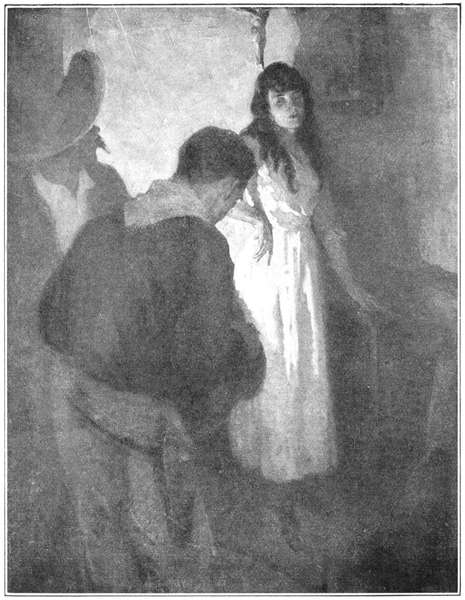
Genie! In a white dress, white slippers—all white, even
to the rapt, beautiful, strangely transformed face! It
was a Genie he could not recognize. Yet, however her
dark gold-glinting tresses were brushed and arranged, he
would have known their rare, rich color. And the eyes
were Genie’s—vivid like the heart of a magenta cactus
flower, unutterably and terribly expressive of happiness.
But all else—the girl’s height and form and movement—had
acquired something subtly feminine. The essence of
woman breathed from her.
“Oh, Wanny, I’ve a whole bundle of dresses!” she cried,
rapturously. “And I put this on to please you.”
“Pleased!... Dear girl, I’m—I’m full of joy for you—overcome
for myself,” exclaimed Adam. How, in that
moment, he blessed the nameless spirit which had come
to him the day Genie’s fate and future hung in the balance!
What a victory for him to remember—seen now in the
light of Genie’s lovely face!
Then Mrs. Blair bustled in. Easy indeed was it to
see how the happiness of others affected her. “It’s good
we have dinner at noon,” she said, as she put dish after
dish upon the table, “else we’d had to do with little. Sit
at table, folks.... Children, you must wait. We’ve
company.... Gene, come to dinner.”
Adam found himself opposite Genie, who had suddenly
seemed to lose her intensity, though not her glow. She
had softened. The fierce joy had gone. Adam, watching
her, received from her presence a thrill of expectancy, and
realized that at least one of her sensations of the moment
was being conveyed to him. Then Eugene entered. His
face shone. He had wet his hair and brushed it and put
on a coat. If something new and strange was happening
to Genie, it had already happened to Eugene Blair.
“Folks, help yourselves and help each other,” said Mrs.
Blair.
Adam was ready for that. What a happy dinner! He
ate with the relish of a desert man long used to sour dough
and bacon, but he had keen ears for Mrs. Blair’s chatter
and eyes for Genie and Eugene. The mother, too, had a
steady and thoughtful gaze for the young couple, and her
mind was apparently upon weightier matters than her
speech indicated.
“Well, folks,” said Mrs. Blair, presently, “if you’ve all
had enough, I’ll call the children.”
Eugene arose with alacrity. “Let’s go outdoors,” he
said, stealing a shy look at Genie. She seemed to move in
a trance. Adam went out, too, and found himself under
the oaks. The very air was potent with the expectancy
that Adam had sensed in the house. Something was about
to happen. It puzzled him. Yet he liked the suspense.
But he was nonplused. The young couple did not present
a riddle. All the same, the instant Adam felt convinced
of this he looked at them and lost his conviction. They did
present a riddle. He had not seen any other lad and girl
together for many years, but somehow he wagered to himself
that if he had seen a thousand couples, this one would
stand out strikingly.
Then Mrs. Blair appeared. She had the look of a woman
to whom decision had come. The hospitality, the kindly
interest in Genie, the happiness in seeing others made
happy, were in abeyance to a strong, serious emotion.
“Mr. Wansfell, if you’ll consent I’ll give Genie a home
here with me,” she said.
“Consent!... I—I gladly do that,” he replied, with
strong agitation. “You are a—a good woman, Mrs. Blair.
I am overwhelmed with gladness for Genie—for her luck....
It’s so sudden—so unexpected.”
“Some things happen that way,” she replied. “They
just come about. I took to Genie right off. So did my
boy. I asked him—when we got back from our neighbor’s—if
it would not be a good idea to keep Genie. We are
poor. It’s one more to feed and clothe. But she can help.
And she’ll teach the children. That means a great deal
to me and Gene.... He would be glad, he said. So I
thought it over—and I’ve decided. We’ve your consent....
Now, Genie, will you stay and have a home with us?”
“Oh, I’ll—I’ll be so happy! I’ll try so—so hard!”
faltered Genie.
“Then—it’s settled. My dear girl, we’ll try to make you
happy,” declared Mrs. Blair, and, sitting beside Genie, she
embraced her.
Adam’s happiness was so acute it seemed pain. But was
his feeling all happiness? What had Genie’s quick look
meant—the intense soul-searching flash she gave him when
Mrs. Blair had said it was all settled? Genie’s desert eyes
saw separation from the man who had been savior, father,
brother. One flash of eyes—then she was again lost in
this immense and heart-numbing idea of a home. Adam
saw Eugene look at her as his mother enfolded her. And
Adam’s heart suddenly lifted to exaltation. Youth to
youth! The wonderful, the calling, the divine! The lad’s
look was soulful, absorbing, full of strange, deep melancholy,
full of dreamy, distant, unconscious enchantment.
What had seemed mysterious was now as clear as the sunlight.
By some happy chance of life the homeless Genie
had been guided to a good woman and a noble lad. Goodness
was the commonest quality in the hearts of women;
and nobility, in youth at least, flowered in the breast of
every man.
And while Eugene thus gazed at Genie she lifted her
eyelids, so heavy with their dreams, and met his gaze.
Suddenly she sweetly, strangely blushed and looked away,
at Adam, through him to the beyond. She seemed full of
a vague, dreaming sweetness of life; a faint smile played
round her lips; her face lost its scarlet wave for pearly
whiteness; and tears splashed down upon her listless hands.
The moment, with all it revealed to Adam, swiftly passed.
“Gene, take her and show her the horses,” said Mrs.
Blair. “She said she loved horses. Show her all around.
We’ll let the work go by to-day.”
* * * * *
Mrs. Blair talked awhile with Adam, asking to know
more about Genie, and confiding her own practical plans.
Then she bustled off to look after the children, who had
been forgotten.
Adam was left to the happiest and most grateful reflections
of his life. Much good must come for him, for his
lonely hours, when once more the wastelands claimed him;
but that was the only thought he gave himself. Lounging
back on the old rustic bench, he gave himself up to a growing
delight of anticipation. These good Blairs did not
dream that in offering Genie a home out of the kindliness
of their hearts they had touched prosperity. They were
poor. But Genie was rich. They meant to share with the
orphan their little; they had no thought of anything Genie
might share with them. Adam decided that he would buy
the ninety acres, and the hundred in the valley beyond it;
and horses, cattle, all the stock and implements for a fine
ranch. Genie, innocent and bewildered child that she
was, had utterly forgotten her bags of gold. On the next
day, or soon, Adam meant to borrow Gene’s horse and
buggy and drive to Santa Ysabel and then to San Diego.
He must find some good investment for the rest of Genie’s
gold, and a good bank, and some capable and reliable
person to look after her affairs. How like a fairy story
it would seem to Genie! What amazement and delight
it would occasion Mrs. Blair! And as for the lad, no gold
could enhance Genie’s charm for him. Gene would love
Genie! Adam had seen it written in their unconscious
eyes. And Gene would have the working of the beautiful
ranch his eager heart had longed for. For the first time
Adam realized the worth of gold. Here it would be a
golden harvest.
Dreaming thus, Adam was only faintly aware of voices
and footsteps that drew nearer; and suddenly he seemed
transfixed and thrilling, his gaze on a face he knew, the
face on the miniature he carried—the lovely face of Ruth
Virey.