Jim had a very clear idea that the city of
New York, with its thousands of sharp-eyed
policemen, was no place for him. His four
friends, however, were better acquainted
with it and they now proposed to work their
way down town before daylight, to hiding
places they said they knew of. They urged
him to come with them but he responded:
“Too many of us together, all in House
of Refuge grey jackets. We’d better scatter.
I’m for the country!”
Then it was “Good-bye, Jim!” all around,
and “O! If you haven’t done it!”—“You’re
the best kind of fellow!”—“Hope we’ll see
you again, some day.”
“Not in the House of Refuge,” said Jim.
“I won’t let them catch me. Now you’re
out, keep out, but I tell you what, boys, we
haven’t anything to say against any of those
officers.”
So they all said, and they were off, working
their stealthy way along among the huge
piles of lumber. How the rest got out of
the lumber yard, Jim never knew, but he
found a gap in its high, picket fence,
squeezed through it, and found himself in
an open street. It was pretty well lighted,
except for the fog, and Jim saw something,
at once, that made him shiver, a little.
“Just what I was afraid of!” he said. “I
must wait till he moves on. He might pick
me up, any way, for being here at this time
o’ night.”
He did not know that the policeman he
saw, standing under the lamp at the street
corner, was already warned and was on the
lookout for five boys who had escaped from
Randall’s Island. He was a real danger,
therefore, and Jim did well to wait patiently
until the officer marched away into the mist.
Jim went forward, then, and his main idea
was to get as far away as possible from the
water-front.
“Hullo!” he exclaimed at the end of many
minutes of brisk walking. “What’s this?”
Before him seemed to be a vast hollow,
and the street he was on ran right across it,
without any buildings on either side.
“New street,” he said. “It’s the new
part of the city.—There!—That’s the rap
of a policeman’s club on the sidewalk. My
only chance is to hide!”
Down he went, over the wall-like side of
that new street, clinging with toes and fingers
to rough projections. In a moment more
he was at the bottom, crouching close and
looking up while a man in a blue uniform
strolled slowly along the sidewalk.
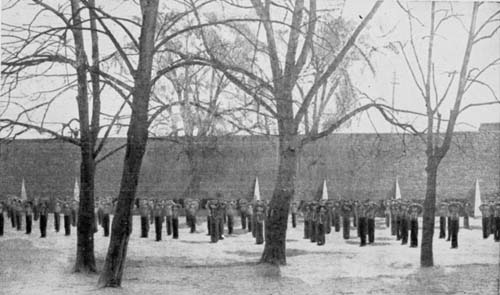
“It isn’t as high as the wall around the
parade-ground,” thought Jim. “That’s too
smooth to climb.—I hope the other fellows’ll
get away, now they’re out. It wasn’t just
right for me to let ’em out, but I couldn’t
help it. It’d be awful if all the boys in the
House got away! I don’t belong there,
though. But what can I do? Where on
earth can I go?—Anyhow, I must keep hid
till daylight.”
It was cold, it was foggy, and his heart
sank within him as he crept slowly along the
base of the wall, on a kind of exploring expedition.
It was dreary waiting, but the
time did wear away and the fog cleared when
the sun rose.
People were arising, also, and Rodney Nelson
was among those who were up and
dressed very early. He had business on his
hands, now, and he stepped right out of his
own room and across the entry, into what
he was beginning to call “the store.” It
did indeed contain a great deal of counter
and some shelving, but nothing as yet, that
looked like a stock of goods.
“We’ll have some, I guess,” said Rodney.
“I’ll go out and take a look at the garden.
Nothing has sprouted yet, but lettuce and
radishes, but it’s going to be the bulliest
kind of garden.”
Downstairs he went, and his mother was
busy around the stove when he passed
through the kitchen. Somebody seemed to
be calling him, around the corner of the
house. He heard a loud:
“Ba a-a-beh?” like a question.
“Guess he’d like some breakfast,” said
Rodney, as he stepped forward.
There was Billy, looking down from the
edge of the sidewalk, but it was not the
goat that gave Rodney such a start of surprise.
Right before him stood a boy of
about his own age and size, dressed from
head to foot in dark, grey cloth. He seemed
a healthy enough boy, but just now his face
was very pale. He had been standing, for
Rodney had seen him, close to the wall, where
the house came against it, as if he were hiding.
On the sidewalk above, and less than a
hundred yards away, a policeman was walking
leisurely along toward the Nelson place.
“Hullo!” said Rodney. “Who are you?
What are you down here for?”
It was all right to question him, but the
stranger’s face flushed suddenly and he
breathed a long, choking kind of breath,
before he exclaimed:
“I say, were you ever in prison?” His
voice had a husky, despairing tone.
“No, I never was!” replied Rodney, with
strong emphasis. “Was you?”
“Yes, I was,” came promptly back. “My
name’s Jim Harris, and I didn’t do a thing.
Didn’t steal a cent. But I’ve been in the
House of Refuge for a good deal more’n a
year——”
“And you got out?” shouted Rodney, enthusiastically.
“Hurrah!”
“I got out last night,” said Jim, “and
they’re after me, now——”
“Rodney!” exclaimed an excited voice
behind him. “Don’t you let them get him!
I saw him, from our house, and I came over
to tell you. If you do let them get him!”
“Of course I won’t, Millie,” said Rodney,
“but he must come right into the house.
They’d know him, right away, by his rig.”
Millie was thinking with all her might, and
her eyes were dancing their liveliest.
“Rod!” she said. “Take him in! Get
him something to eat. I’ll go and get some
of Tom’s old clothes. Mother’d let him have
’em all, before she’d see him sent to prison
again. O, dear me! It was awful! And
he didn’t do anything to be sent there for,
either.”
“I guess it was awful——” said Rodney,
but she interrupted him:
“I’ll be back as quick as I can. Besides,
I want to know how he got out. He must
be real hungry——” and away she went.
“Come on, Jim,” said Rodney. “You’ll
be safe, in our house. I’m glad you didn’t
do it, though. Tell you what, if it had been
me, I’d ha’ broke loose. How’d you ever
manage to do it? Tell us——”
“I will,” said Jim, as he followed his new
friend, but a sudden change had come over
him.
His step was light and springy, and his
face was bright with new hope. He had
watched there in the raw, chilly morning
until he had grown almost desperate. Not
that he had wished himself back in the House
of Refuge, but that he had felt very tired,
very hungry, and altogether uncertain what
to do next, or where to go.
“Mother!” shouted Rodney, with a sort
of effort not to shout quite so loud:
“He’s from Randall’s Island! He got
away last night, and the cops are after him.
Millie’s going to bring him some of Tom’s
clothes——”
“Rodney!” she exclaimed. “Why, how
did he get here?—~Now, you keep still
and let him tell me all about it.”
That was precisely what Rod was very
willing to do, and Jim was glad enough to
tell them everything.
“O, Rod!” said his mother. “What if it
had been you!—His uncle ought to be
put there, himself,—and what could his
aunt have been thinking of——”
“’Twasn’t her fault,” said Jim, “and the
money was really gone. Somebody took it,
but I didn’t, and Uncle John may not have
been so much to blame. He never liked me
anyhow——”
“He ought not to have sent you to jail,”
said Mrs. Nelson, positively. “And I suppose
they treated you awfully. Did they
flog you much?”
“No, they didn’t,” said Jim. “They never
flog anybody. It’s the best place in the
world for loads of those boys. They get a
chance to learn something and they have to
behave themselves. What I mean is that I
didn’t do anything to go there for, and I
didn’t belong there. They’re the best kind
of men for the boys that ought to be there.”
He really came up with a good deal of energy
to the defence of the House of Refuge
and its management, but he was tremendously
in earnest in his assertion that he would not
go back there again. He had hardly completed
his wonderful story of escape, before
the door of the kitchen opened, half stealthily,
and they heard the voice of Mrs. Kirby:
“Go right in, Millie. Don’t say a word.
Don’t speak about him. Somebody else
might be there and hear you. Don’t you run
any risk of anybody’s knowing what they’re
for. If they don’t fit him, I can alter them——”
“Come right in, Mrs. Kirby,” called out
Mrs. Nelson, but Millie was in first, with her
arms full of coats, trousers and other matters,
that had nothing grey about them.
“That’s the checker!” shouted Rod.
“That old blue. It’s patched, some, but
it’ll do first-rate. He won’t look like the
same fellow. Come on, Jim. Come into
the front room and put ’em on. Mother,
you tell ’em just how it was.—Guess the
cops won’t get him out of our house.”
There was plainly no danger that anybody
now in it would help them, and Jim’s
possible peril from anybody else was certainly
very much less when, a few minutes
later, he came back into the kitchen. Mrs.
Nelson had, meantime, been telling his story,
as he told it, with sympathetic additions of
her own.
“It fits him!” shouted Millie, but her
mother exclaimed:
“Rodney! What did you put on him
that old red necktie for?”
“Guess there isn’t anything like it on
Randall’s Island,” said Rodney. “All he’s
got to do, now, is to keep still till they stop
hunting for him.”
“They’re hunting, everywhere, just now,”
remarked Jim. “I wish I knew what had
become of those other fellows.”
“Just you come and eat your breakfast,”
said Mrs. Nelson. “Don’t mind them——”
“We must go home,” said Millie, “and I
can’t come right back. I’ve a lot of type-setting
to do——”
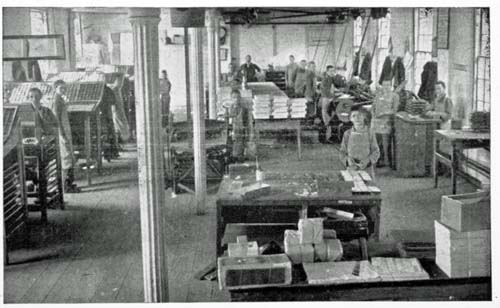
“I can set type,” said Jim. “I was in the
printing office, all the while.”
“That’s it!” exclaimed Mrs. Kirby.
“Come right over, after breakfast. The last
place they’d look into would be Mr. Kirby’s
office. You can earn something, too.”