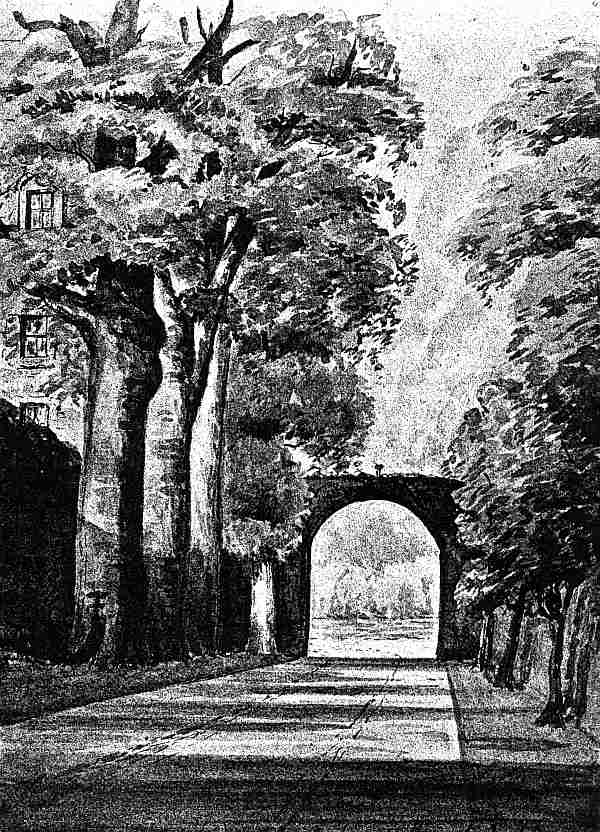
WALK I.
WALKS NEAR EDINBURGH.
Bruntisfield—St. Margaret's Convent—Canaan Lane—
Hermitage of Braid—Morton Hall—Dreghorn—Colinton—
Craiglockhart—Craighouse—Merchiston Castle—The Wryteshouses.

At the outset of these walks, I must pause and explain to my
imaginary companions where we are going, and what we are going to
see. Let them not raise their hopes too high! I am taking them
neither to the dark and mysterious wynds of the Old Town, nor to
the beautiful and distant glen of the Esk, nor farther afield, to
Linlithgow's "lonely bower." My sphere is a humbler one. The Old
Town of Edinburgh has been so much and so ably written upon, that it
can only be from idleness that any one is ignorant of its history.
Roslin, Hawthornden, Dalkeith, Linlithgow, have each their separate
guide-books, with every detail most fully given. But extending round
Edinburgh, at a distance of from three to five miles, are a number of
curious old places, and remains of antiquity, of which the traditions
are gradually dying away. The great extension of the town of late
years has swept away the memory of some; others, from having changed
owners at short intervals, have lost the recollections of their
former days; others, again, can only have their history unravelled by
a diligent search through scarce, and sometimes voluminous works.
To collect some of these stories and out-of-the-way facts together
has been my object; and if those who have neither time nor money for
more distant expeditions will accompany me on an afternoon ramble, I
think they will find much to interest them. I have avoided statistics
of any kind,—they are the dry bones of description, and can easily
be looked up if they are wanted,—and I have limited myself to the
desultory information, which would naturally be poured forth in the
course of a walk. The first one begins very much within the suburbs,
but, as one writes most readily of what one knows best, I begin with
my own home.
Bruntisfield is the last of the old houses in the immediate vicinity
of Edinburgh which is still inhabited by its owners. Merchiston
Castle and the Grange are let; the Wryteshouse has long disappeared;
but Bruntisfield, in spite of recent additions and alterations,
still preserves much of the character of the semi-fortified mansion,
with protecting outworks, which centuries ago frowned over the
Boroughmuir. Its antiquity is even more apparent inside than outside,
from the thickness of the walls, the diversities of the levels, and
the steep little turret stairs.
The earliest owners of Bruntisfield appear to have been the Lauders
of Haltoun (or Hatton, as it is called now). In 1452 we find James
II. granting a charter to his consort, Queen Marie, "for the very
sincere affection which he bears towards her," of the lands of
Haltoun, the Plat, Weschal, Nortoun, Broumysfelde (Bruntisfield), the
North Row of Rathow, and the rents of Gogar, belonging to the king
by the forfeiture of the late "William de Laudre of Haltoun." The
Lauders seem to have been shortly after restored, for in 1490 King
James IV. granted a charter to "Sir Alexander Lawdre of Haltoun of
the lands of Broumsfield." The same Sir Alexander, seven years later
(1497), assigned "Brounisfeld, with its mansion-house, garden and
herbarium (or park), to his son Alexander Lawder," who in James IV.'s
confirmation of the charter (1506) is quaintly styled "the king's
familiar," and who held these lands of his father by the yearly
payment of a red rose. Bruntisfield appears to have been considered
a suitable appanage for the heir-apparent of Haltoun, for in August
1586 we find James VI. confirming a charter of Sir William Lauder
granting these lands to his eldest son Alexander.
Soon after this (in 1603) Bruntisfield passed away from the Lauders,
being sold by Alexander Lauder to John Fairlie, probably a cadet of
the family of Braid.[1]
He apparently altered and added to the house, as it would seem from the
date 1605, which with the initials I. F.—E. W., is over some of
the windows. The original house was of much older date, as we have
evidence that a mansion-house stood here in 1457.
In 1695 William Fairlie sold Bruntisfield to George Warrender,
afterwards Lord Provost of Edinburgh, and created a baronet in 1715.
His family was of French extraction,—his ancestor, a De Warende,
having come from Picardy in the train of Mary of Guise. By degrees he
acquired other lands lying contiguous to Bruntisfield, by purchase
from Rigg of Riggsland, Biggar of Whitehouse, and Dick of Grange; and
these form the property of Bruntisfield as it now stands.
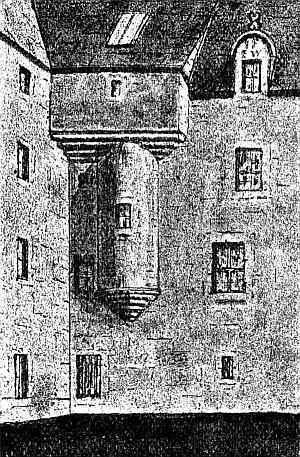
Bruntisfield House.
The Lauders of Haltoun became extinct in the 17th century, and their
representation devolved on the Maitland family by the marriage of
Elizabeth Lauder, the heiress of Haltoun, with Charles, fourth Earl
of Lauderdale. That descent we have inherited through my father's
mother, Lady Julian Maitland; so that, after a lapse of nearly three
hundred years, the descendants of the original possessors inhabit the
old house again.
After the purchase of Bruntisfield by George Warrender, it remained
for nearly a hundred years in possession of the younger branch
of the family, which came to an end in 1820 by the death of Hugh
Warrender, an old bachelor, who was Crown Agent for Scotland.[2]
He was succeeded by his cousin, my grand-uncle, the Right Hon. Sir
George Warrender, M.P., who on taking possession discovered the
existence of a secret room. The house was then thickly covered with
ivy. Lee, the Royal Academician, and an architect that Sir George
had brought down from London with him, were the first to suspect its
existence, from finding more windows outside than they could account
for. The old woman who had charge of the house denied for a long
time any knowledge of such a room; but, frightened by Sir George's
threats, she at length showed them the narrow entrance, that was
concealed behind a piece of tapestry. This was torn down, and the
door forced open, and a room was found, just as it had been left by
some former occupant,—the ashes still in the grate. Whether, as one
story said, it had been used as a hiding-place in troubled times,—or
whether, according to another legend, it had been the room of a
dearly loved child of the house, after whose death it had been
hurriedly shut up, never to be entered again by the broken-hearted
parents,—there are now no means of knowing; but the blood-stains on
the floor point to some darker tragedy, and a tradition still lingers
that, not long after the discovery of the room, a skeleton was found
buried below the windows. It is still known as the Ghost-room, though
nothing has been seen, at any rate for many years.
The newly-built houses which now closely surround Bruntisfield have
swept away two curious landmarks of the past. One was the mound of
earth on which James IV. stood to review his army, preparatory to
the expedition which ended so disastrously at Flodden.[3]
The other was a flat, moss-grown stone which lay in the park, almost hidden
by the grass and daisies growing round it. On it was carved a skull,
surmounted by a winged hour-glass and a mutilated scroll; and below
it a shield bearing a saltier, and the initials M. I. R. and the date
1645. "The M.," says Wilson in his Reminiscences of Old Edinburgh,
"surmounted the shield, indicative of the standing of the deceased as
a Master of Arts, and so telling of a scholar and a gentleman, who
slept there apart from his kin, a victim to that last and most fatal
visitation of the plague." When that part of the park was built over,
the stone was carefully removed from its ancient site, and placed in
safety against a wall in the garden of Bruntisfield, where, though
much obliterated by weather, its carvings can still be traced.
Once outside the gate of Bruntisfield, we find ourselves on the
Links, but there is little of their former country wildness left
about them now. Houses hem them closely in on every side. The
straight paths, formal rows of young trees, and stiff plots of
shrubbery, give them the look of a suburban common. The occasional
golf-player, a rare sight now, seems like a ghost of the past still
lingering in his old haunts. Let us call back the past as it was two
hundred and fifty years ago, and what a different scene is here!
Before us lies an open, undulating muirland, covered with whin and
broom, and in the more sheltered hollows grow thickets of thorn and
natural oak. This is the great Boroughmuir, which stretches far away
to the hills of Braid, and in more remote times formed part of the
ancient forest of Drumselch. A long winding loch lies between us and
the town, in the low ground which future generations were to call the
Meadows. Its placid waters and reed-fringed shores are the haunts of
innumerable wild-fowl. The moor is bare and desolate, but here and
there rises a stern, grey tower, half fortress, half dwelling-house,
with a few humble cottages clustering round it for protection and
defence. Such is the Wryteshouse, the ancient home of the Napiers,
its walls enriched with quaint carvings and inscriptions, which
crowns the gently rising ground at the south-west corner of the
loch. The evening breeze no longer brings us the sweet sound of
St. Catherine's vesper bell, for long before the day whose story
is unrolled before us the tide of the Reformation had swept wildly
through the land; but the shattered walls still remain to bear
witness to the piety of an elder generation. St. Roque's Chapel is in
ruins, but the victims of the plague still find a last resting-place
near the shrine of their patron saint.
Such, then, was the Boroughmuir two hundred and fifty years ago, the
great gathering ground on which so many troops had assembled before
marching against the Southron, and on which so many skirmishes had
taken place in the civil wars that rent the country in Queen Mary's
time; but it requires an effort of the imagination to realize it all now!
The house opposite Bruntisfield was formerly the residence of
Dr. Gillis, the Roman Catholic Bishop of Edinburgh, whose remains rest
in the vaults of St. Margaret's Convent, a few yards farther south,
on the opposite side of the road. The late Mr. Hope Scott and his
first wife (Sir Walter Scott's grand-daughter) are buried there also.
This was the first religious house built in Scotland since the
Reformation. It was founded in 1835, and belongs to the Ursuline
order. Though much of the building is new, part remains of the old
mansion of Whitehouse, where Principal Robertson lived while writing
his history of Charles V. Before that even it had been the scene of
literary work, for John Home is said to have written part of the
tragedy of "Douglas" at Whitehouse.[4]
Two other convents existed on the Boroughmuir before the Reformation.
They are now so completely swept away, that the only memory left of
them is a much-corrupted form of their names. The Pleasance and the
Sciennes, standing not very far from each other, at the south-eastern
end of the Meadows, mark the spot where once stood the convents
of St. Mary of Placentia and St. Catherine of Sienna. The latter
belonged to the Dominican order. It was founded in the 15th century
by Marjory, second wife of William, third Earl of Orkney and first
Earl of Caithness, but most of the building was erected some years
later at the expense of Lady Janet Hepburn, eldest daughter of
Patrick, first Earl of Bothwell, and widow of George, fourth Lord
Seton, who fell at Flodden. She survived her husband forty-five
years, and spent the greater part of that time (after her son came
of age) at the convent of St. Catherine. The papal bull by which
the foundation was confirmed is dated 1517. In 1547 the convent was
dispersed. Up to within the last few years, a small portion of the
original building still survived.[5]
Proceeding to the bottom of the Whitehouse Loan, we now turn to
the right, and then again sharp to the left, and find ourselves in
Canaan Lane; a name which recalls the Covenanting times, when the Old
Testament was the source of most names of either places or persons.
This is a very biblical neighbourhood. Canaan Lodge, Mount Hebron,
Eden Bank, the Land of Goshen, are among the names which surround
us. The only one of these houses to which any interest is attached
is Canaan Lodge, where once lived Dr. Gregory, whose name is widely
known in every nursery. To complete the biblical illusion, the little
stream—now pent between walls, and hardly more than a ditch—which
takes its rise in Craiglockhart Hill and flows eastwards, is the
Jordan Burn. On the other side lies Egypt, not many years ago a quiet
country farm, now built over.
On leaving Canaan Lane, we again turn to the left, and soon find
ourselves crossing the Suburban Railway. Two roads offer themselves,
both leading southwards, and uniting about a mile and a quarter
farther on. The eastmost of the two, though the oldest and steepest,
is the most picturesque, so we will follow it.
After crossing the brow of the hill, a shady glen opens to our left,
with a carriage drive leading into it, along the banks of the little
stream. This is the Hermitage of Braid, a curious old place, and,
till you explore its deep and narrow valley, it is impossible to
realize its extreme seclusion. The banks are so steep, and descend so
abruptly, that the beeches and sycamores, which appear like scrubby
bushes from the neighbouring fields, are in reality forest trees
rising from the sides of the burn. So closely are their branching
tops entwined, that few rays of sunlight can straggle down to the
dim green twilight beneath. The house is small and square, with
pepper-box turrets at the four corners, and was built about the
year 1780. The first owners of Braid of whom we hear, were the
Fairlies.[6]
During the Reformation, the Laird of Braid was one of
the earliest who received its doctrines, and was a personal friend
and zealous defender of John Knox. In the 17th century Braid belonged
to the Dicks of Craighouse. From them it passed to the Browns of
Gorgie, and finally, at the end of the last century, it was bought,
together with the neighbouring property of Craighouse, by Charles
Gordon of Cluny. He married Miss Trotter of Morton Hall, and was
the father of Colonel John Gordon, and of three daughters,—Jacky,
afterwards Lady Stair,—Charlotte, Lady Johnstone of Westerhall,—and
Mary, who died unmarried. The two elder were very beautiful and very
wild. There are innumerable references to Miss Jacky in contemporary
letters and memoirs. The adventures of her stormy youth scandalized
even the free-spoken and easy-going people of her time, and will
hardly bear repetition now. She eventually married John, seventh
Earl of Stair, in 1804, but the marriage was an unhappy one, and
Lord Stair made use of a notorious Colonel Dalzell to rid himself
of his wife. The plot succeeded, and they were divorced; but when
she discovered the shameful artifice that had been practised, the
horror of it sent an already excitable mind off its balance, and for
years Lady Stair was kept under restraint at her brother's house
of the Hermitage. The tradition still lingers, that at nightfall
passers-by along this lonely road were often startled by her screams.
She recovered her senses some years before her death, and passed
the remainder of her life in Edinburgh, an altered woman in every
respect, and died there in 1847, and is buried on the north side of
St. Cuthbert's Churchyard.
Of late years the Hermitage has been usually let, and at present
is the residence of Mr. Skelton, to whom we owe so many valuable
historical works.
On the opposite side of the road is the pond belonging to the Morton
Hall Curling Club. A few hundred yards farther up the hill, and
passing on our left the road which leads to Liberton, we reach the
highest point, where the road is cut through the solid rock which
forms the westmost spur of the Braid Hills. From here, on a bright
spring day, when the distance is cleared by a north-west wind, the
view is most beautiful. Edinburgh and the sea lie at our feet; and
beyond, the eye travels westward, from the fertile shores of Fife, to
where the Ochils rise behind the wooded crest of Corstorphine, and
then melt away into the far-off Perthshire hills, that stand above
Loch Katrine, and guard the entrance to the Highlands. Far in the
west a distant blue peak fading into the sky is Ben Lomond; and, on a
very clear day, we may just see the shadow of the Cobbler behind it.
Nearer to us is the rocky outline of the Dalmahoy hills, and between
us and them stretches a fair expanse of woodland and pasture, which
gradually sweeps up to where the Pentlands shut out the view to the south-west.
Just before reaching the lodge of Morton Hall, we pass the
Buckstone on our left,—a large rocky fragment, on which the
proprietor of the barony of Penicuik,
That fair dome, where suit is paid
By blast of bugle free,[7]
is bound by his tenure to sit and wind three
blasts of a horn when the king shall come to hunt on the Boroughmuir.
Hence the crest of the Clerks of Penicuik—a demi-forester
proper, winding a horn, with the motto, "Free for a blast."
Morton Hall stands to our left, with its winding drives, its woods
and sheltered gardens, lying open to every gleam of the sun, and
protected from the cold north winds by the high ground of the park
behind. In the reign of James III. it belonged to the St. Clairs
of Roslin. It became the property of the Trotters, an ancient
Berwickshire family, about 1641, and now belongs to Colonel Trotter
of the Grenadier Guards. John Trotter, the second in possession
of Morton Hall, was a great loyalist, and was fined £500 in 1645
by Parliament, for assisting Montrose. The house, which was built
towards the end of the 17th century, is a comfortable square stone
building, and has in it some very fine tapestry representing the
story of Perseus and Andromeda. At different places in the park occur
those curious whinstone monoliths, of which a line once extended
across the country, from the Pentlands to the Esk. On the south
side of the Braid Hills, within the park, is a small natural sheet
of water, which lies in a hollow that was called of old Elve's or
Elf Kirk, denoting a place where the fairies assembled. A little
distance below this, nearer Morton Hall (says the Rev. Mr. Whyte
in his account of Liberton Parish), is a piece of ground called
Kilmorton. The name tells us that here stood a Cella, or religious
house; but no tradition survives concerning it, nor are any remains
of it to be seen.
Returning to the high road, on the opposite side stands Comiston, a
small place which derives its name from the Camus stone, once the
marchstone of its eastern boundary. This was a huge monolith which
stood on the brow of the hill at Fairmilehead, and which, within the
memory of the last generation, was barbarously broken up to make
road-metal. Like other Camus or Cambus stones (from the celtic
Cam, crooked) in different parts of the country, it had probably
been set up as a landmark, or as a memorial of some contract between
great chiefs.[8]
At Fairmilehead, where formerly stood a toll, four roads meet.
The one to the left leads past Morton House, and along the sunny
park-wall of Morton Hall, to the Burdiehouse road. Part of Morton
House is very old. Like Morton Hall, the property belonged in
James III.'s time to Sir Oliver Sinclair of Roslin. His successors
possessed both places for many years. From them Morton House passed
to the Riggs, cadets of the family of Rigg of Carberry. It now
belongs to Colonel Trotter, but it is generally let, and it was here
that Dr. Hill Burton, the historian, died in 1881.
Our way lies to the right, and yet, the road stretching straight in
front of us,—how sorely does it tempt the wanderer on! Past Hillend,
where the three ways part, and along the upper road under the
shoulder of Cairketton,—and so on to where the shadows play beneath
the high beech avenues of Woodhouselee,—till he turns at last to
reach the wooded opening of Glencorse, and sees before him that wild,
lonely loch, beneath whose silvery waters lies the ruined chapel of
St. Catherine of the Hopes. Let him wander up the solitary haunts of
Logan Water, till the path ends, the last tree is left behind, and he
finds himself in an amphitheatre of hills. They stand around him in
silent majesty, while the lengthening shadows creep up their steep,
grassy sides. The sky is blue and cloudless overhead,—the whispering
wind is all but hushed in this sheltered spot,—not a sound is heard
but the far-off bleat of a sheep, or the crow of a grouse on the
moors beyond,—and then, in the solemn peacefulness of this place,
let him realize if he can that a city, with its turmoil, its din, and
its busy crowd, lies little more than an hour's ride from him!
But to-day we must not stray so far; and, before leaving
Fairmilehead, let us turn for a moment to the recollections of a
prehistoric age, of which the land on which we stand is full. It
is certain that this was the site of a Roman town (the name Morton
meaning "the great city," from Mhor, the Celtic "great"),
to which a road led from Teviotdale, and proceeded to Cramond, an important
Roman station on the Forth. To preserve the memory of the ancient
Roman road, the present one was formed on its line for nearly a mile,
by direction of Sir John Clerk of Penicuik, one of the most learned
antiquarians of his day. Tradition says a great battle took place
here between the Romans and the Picts. The Roman army was encamped
on the Gallachlaw (the wooded rising ground to the east), and traces
of their entrenchments can still be seen along the west approach to
Morton Hall. The Pictish king was killed, and buried beneath a huge
tumulus, now, alas! destroyed, but in which remains of men and weapons
were found.
Countless years have rolled
Since their last shout of battle died away,[9]
and now all that remains to tell the tale of
how this ancient people fought and struggled, is the massive, unhewn
Battle-stone, lichen-covered and weather-stained, which stands a
silent witness to the past. Behind it still rise the mighty hills,
whose name of Pentland recalls the Pechts or Picts, who so long ago
sought refuge in their fastnesses from the foreign invader.
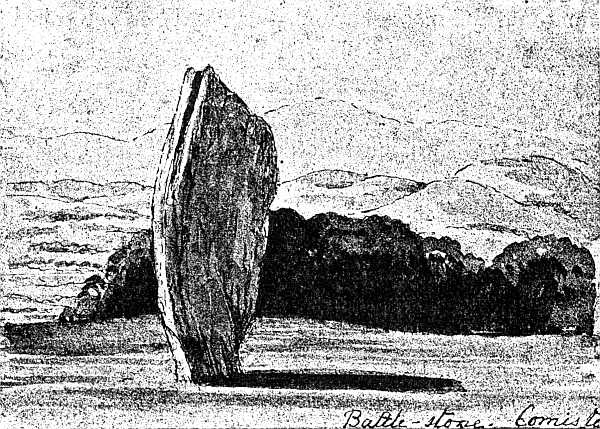
Battle-stone Comiston.
The Battle-stone, Kelstane or Caiystone, as it is variously called,
stands on the right of the road, about a hundred yards west of
Fairmilehead. It is a monolith of red sandstone, standing seven feet
high, and reaching nearly as far below the ground. Near its base
are still distinctly visible the mark of seven cup excavations, of
the usual form, arranged in a row like those of the cromlech at Bonnington.
Passing the steep narrow lane to the left, which leads to
Swanston,—a hill farm of Colonel Trotter's on the slope of
Cairketton,—whose low, thatched, white cottages make a charming
study for the artist, we reach the picturesque tiled roofs of the
Hunter's Tryst. This was long ago a comfortable little ale-house.
Persons still alive remember when it was kept by two respectable
old women, who cooked a capital dinner. In former days it was the
custom for citizens of Edinburgh to shut up their places of business
early on Saturdays, and go out into the country to dine about four
or five o'clock at one of these little inns. The Hunter's Tryst was
a favourite resort. The Six-Feet Club used to meet here from time
to time. It was an athletic society, to which Sir Walter Scott and
the Ettrick Shepherd belonged.[10]
We now pass the entrance-gate of Dreghorn, and, turning to the left,
skirt the park. This is a pretty place standing at the foot of the
Howden Glen, and with the Redford Burn running through it. Though
the house is modern in appearance, part of it was begun in the 17th
century by Sir William Murray, Master of the Works to Charles II. He
married the daughter of Sir James Foulis of Colinton, to whose family
most of the surrounding land then belonged. Since then Dreghorn
has passed through many hands, and now belongs to Mr. Macfie. In
1720, when the property of Mr. George Home of Kelloe, a young man
came as tutor to the family, whose name—David Malloch or
Mallet,—would mean as little to us now as it did to those who
only saw in him the struggling pedagogue, had it not been for the one
ballad, which, written as he wandered up the banks of the Redford
Burn, has from that day been enshrined in every collection of ballad literature:—
'Twas at the silent, solemn hour
When night and morning meet,
In glided Margaret's grimly ghost,
And stood at William's feet.
Her face was like an April morn,
Clad in a wintry cloud;
And clay-cold was her lily hand,
That held her sable shroud.
So run the first two verses of "William and Margaret." The opening
lines were put into Mallet's head by the fragment of an old ballad
spoken by "Merrythought" in Fletcher's play of "The Knight of the
Burning Pestle;" but the poem itself commemorates an unhappy affair
much talked of at the time.
The inscription on a tablet in honour of General Gordon, which we
see as we pass the keeper's house, was put up by Mr. Macfie. He also
raised the slender monument, supported by four clustered columns, a
few yards farther on. It bears an inscription on one side in memory
of the Covenanters (who, in 1666, were encamped here previous to the
battle of Rullion Green), and on the other side some lines which
refer to the ancient Roman camp which stood close by. The road
now makes a steep descent, and crosses the burn by a picturesque,
ivy-hung bridge, which, with the castellated gate-house beside it,
and the wooded banks overhanging the stream, form a charming
picture. Though so near the hills, this is a most sheltered spot, and
the first snowdrops and the earliest green buds on the hawthorn may
generally be found here.
To our right, close to the burn, lies Redford House; and those
colossal stone carvings which adorn the stable-wall were once part of
the pediment of the old Infirmary in Edinburgh, and were removed here
by Mr. Macfie when that was pulled down. A few yards farther on, as
we reach Colinton, the road branches to the right and left. That
to the left leads, by many winding turns, to Bonally and the wild
hill-country beyond. Originally a farmhouse, the late Lord Cockburn
transformed Bonally in 1845 into its present form, and laid out the
charming garden with its quaint laurel hedges and smooth-shaven lawns
sloping down to the burn. Passing through the little wood behind it,
we can reach a track which leads over the shoulder of the hill into
Glencorse, close to the remains of a Roman camp; and which, though
rather boggy in wet weather, is quite rideable, and from which the
views are lovely beyond words.
The other houses about Colinton are hardly more than villas, standing
in their own grounds, and with no particular interest attached to
them, so we will return to where we branched off, and take the
road to the right which passes the gate of Colinton House. This
was originally known as Hales (from the Celtic Hales, a mound or
hillock).[11]
Ethelred, the son of Malcolm Canmore, granted it to the monks of
Dunfermline, but it seems to have been an uncertain possession,
as later it was taken away, and given to the canons of Holyrood,
and transferred from them in 1445 to the canons of St. Anthony at
Leith. After the Reformation, it was bought by James Foulis, the
Clerk-Register, a man of very ancient family—his ancestor
having come from France in the reign of Malcolm Canmore. The old
manor-house, of which the ruins still remain in the park, was the
home of the Foulis; but there is no authority for the supernatural
interest with which Mrs. Oliphant has chosen to invest it in her
story of The Open Door. The present house was built by Sir William
Forbes of Pitsligo, who bought Colinton in 1800 from Sir James
Foulis. After his death, it passed into the hands of the Speaker
Abercromby, first Viscount Dunfermline, to whose grand-daughter, the
Hon. Mrs. Trotter, it now belongs. The high, steep bank overhanging
the Water of Leith, with the little village nestling at its foot, is
very picturesque; but the pride of the place lies in its magnificent
cedars, and the tall old holly hedges in the garden.
Leaving Colinton behind us on the left, we proceed along
the shady, beech-bordered road that leads to Craiglockhart, and soon pass the
Hydropathic Establishment. To the north, sloping down to the Water
of Leith, is a very old place—Redhall. Edward I. of England is
said to have been here in 1298. It belonged to the ancient family
of Otterburn of Redhall, which became extinct in the 17th century.
The heiress, Anne Otterburn, married Sir James Hamilton (of the
Priestfield family), and it was he who defended Redhall against
Cromwell in 1650. The castle was besieged by ten companies of the
Coldstream Guards (then known as General Monk's Regiment), which
eventually carried it by storm. The only vestiges left of the
old castle are the red stones of which it was built (which have
been largely used in the modern walls of the park), and a large
memorial stone bearing the arms of the Otterburn family, very finely
sculptured.[12]
The place now belongs to Mr. David Chalmers.
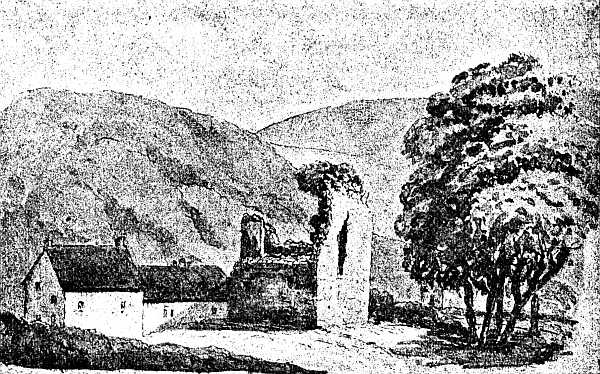
Craiglockhart Tower.
We now see the two hills of Craiglockhart on our right. The name is
probably derived from Craig-lochard (the high craig by the loch),
an appropriate enough name in the old days, when its rocky sides were
reflected in the great Loch of Corstorphine, which then extended to
its foot. The steep face of the eastern hill is thickly wooded and
ivy-grown, and traces may still be seen of the winding paths and
shady bowers which made it once a beautiful pleasure-ground. These
were laid out about the beginning of the century by a Dr. Munro,[13]
but neglect and forgetfulness has turned them to a wilderness.
No traditions remain to tell when or by whom the old tower was built,
of which we can still see the ruins nestling in the shelter of the
red-roofed farm buildings. The history of much of this neighbourhood
seems lost in the mists of forgetfulness. Half a mile farther on,
where the Union Canal comes close to the road on the left, we look
across it and see a solitary gate-pillar standing in a field. This,
and a curious old pillar sundial on the opposite side of the road,
are all that remain of the ancient mansion of Meggetland, which,
in the early part of the 18th century, belonged to a family named
Sievewright; but of what it was like, what was its history, and why
it was destroyed, there is no trace or record.
We are fast returning to our original starting-point; but, before
making our way back by Merchiston Castle, let us turn aside for one
moment at Myreside, and, taking the road to the right, in a few
minutes we reach the old mansion of Craighouse. This curious old
place stands on the eastern slope of Craiglockhart Hill, and is
approached by a venerable lime avenue. An air of mysterious antiquity
hangs over the house, which, with its massive walls, and small,
many-paned windows,[14]
looks as if it had been the scene of more than one romantic tale.
Could its walls speak, we might know the truth of that weird story
(which so often has made me shudder as I gazed at them) of the
unhappy Lady of Craighouse, who, overcome with grief and misery at
the loss of an adored husband, shut herself up here, and spent the
remainder of her life in a room all hung with black, into which the
light of heaven was never permitted to enter! The lapse of years has
dimmed all recollection of her name and previous history; and equally
unknown is the mysterious S. C. P., whose initials, with the date
1565, are carved on the lintel of the entrance door. There is one
story said to be connected with Craighouse, which I have heard all
my life, and have read in collections of Scottish traditional tales,
which I should have liked to relate here,—that of the deadly
quarrel between Moubray of Barnbougle and the sons of the murdered
Bruntfield of Craighouse,—but on attempting to verify it from
ancient histories and MSS. in the Advocates' Library, I found, to my
disappointment, that it was a romance resting on the slenderest
foundations, and in no way connected with Craighouse.
During the reign of James VI., this place belonged to a younger
branch of the Kincaids of that ilk in Stirlingshire. John Kincaid,
the laird's eldest son, got into great trouble in 1600, by forcibly
carrying off a young and beautiful widow, named Isabel Hutcheon, who
was living at the time in the house of a peaceful citizen, by the
water of Leith. John Kincaid, helped by an armed party of friends
and relations, took her to Craighouse, but, fortunately for her, the
king happened at that very time to be riding across the neighbouring
fields. Hearing her screams, he sent Lord Mar and Sir John Ramsay
to see what was happening. They threatened to set Craighouse on
fire, unless Mistress Hutcheon was at once released, which was done.
Kincaid was tried for this outrage, and fined 2,500 marks, payable to
the Treasurer. He was also ordered to deliver up his brown horse to
the king.[15]
Soon after this, Craighouse passed into the possession
of a historically well-known man, Sir William Dick of Braid, Knight,
who in his own person experienced greater alterations of fortune than
usually befall one single individual. Lord Provost of Edinburgh in
the time of Charles I., and so wealthy, that the value of his
money and landed estates has been computed at no less than £226,000
sterling, which is nearly equal to two millions of money at the
present time,—he yet died in the debtors' prison. During the civil
war he was alternately plucked by either party, who took from
him, by forced loans, not less than £180,000 in hard cash. Going
to London with his family, in hopes of recovering this money from
Parliament, he was arrested for some small debts incurred there; and
the remainder of his property being locked up in lands and bonds,
and not readily to be got at, he was thrown into prison, where he
died December 19, 1655,—a strange and sad end for one who, not long
before, had been the richest commoner in the kingdom. Craighouse
and Braid, with other of his possessions, were swallowed up by the
mortgages upon them. Craighouse has passed through many hands since,
and eventually, like the Hermitage, was bought by the Gordons of Cluny.
Returning to Myreside, we continue our walk due east, along a road
bordered by villas, till we find ourselves passing on the left the
narrow postern door, guarded by the lions couchant
that surmount the pillars on either side. Behind it stands Merchiston. This very
ancient castle, built no one knows when or by whom, has for centuries
belonged to the illustrious family of Napier, they having acquired
it in 1438. Their most famous son, John Napier, the inventor of
logarithms, was born here in 1550. His father, Sir Alexander, who was
only sixteen years old at the time of his birth, was later Master
of the Mint to James VI. His mother was Janet, only daughter of Sir
Francis Bothwell, and sister to Adam, Bishop of Orkney. John Napier
pursued his studies and researches at Merchiston. He was supposed by
the vulgar to be deeply versed in magic, and to possess a familiar
spirit in the shape of a jet-black cock. The story goes that once,
when some petty thefts had been committed in the castle, of which one
of the servants was suspected, Napier brought them all up the winding
stair into a darkened room, where the cock was placed. He commanded
them to stroke its back, declaring it would crow at the touch of the
guilty person. During the whole ceremony the cock remained silent,
but afterwards the hand of the culprit was found to be free from the
soot with which the bird's feathers had been liberally sprinkled.
Napier was also believed to possess the power of discovering
hidden treasure. Among the Merchiston papers still exists a
curious contract, dated July 1594, between him and Robert Logan of
Restalrig, which sets forth: "Forasmuch as there were old reports and
appearances that a sum of money was hid within Logan's house of Fast
Castle, John Napier should do his utmost diligence to work and seek
out the same." For his reward he was to have a third of the discovered
treasure. "This singular contract," says Wilson, "acquires a peculiar
interest when we remember the reported discovery of hidden treasure,
with which the preliminary steps of the Gowrie conspiracy were
effected;" Logan of Restalrig being deeply implicated in that plot,
though nothing of his share in it was known at the time.
The true fruit of Napier's years of toil and study appeared in 1614,
when he produced his book of logarithms, which he dedicated to Prince
Charles (afterwards Charles I.), and which rapidly made his name
famous over Europe. He died at Merchiston in 1617, and was succeeded
by his eldest son, Archibald. This was the first Lord Napier. He
married Montrose's sister, and for some years he acted as tutor to
his illustrious brother-in-law, who was left fatherless very young.
It was his son, the second Lord Napier, who was Montrose's faithful
companion and friend. He married Lady Elizabeth Erskine, and when he
passed into the exile from which he never returned, she remained for
some time at his castle of Merchiston, and was here when Montrose
was executed. From here she sent the faithful servant, who at the
dead of night stole to the unhallowed spot on the Boroughmuir where
the mutilated trunk of the dead hero had been hastily buried. He
carefully and reverently extracted the heart; and, wrapping it in the
piece of fine linen, which to this day is treasured in the Napier
charter-chest, he brought it to his mistress, who had it skilfully
embalmed. It was then enclosed in a steel box made of the blade of
Montrose's sword, and preserved as a precious relic. Montrose had
always felt a deep affection for his nephew and his wife, and had
promised at his death to leave his heart to Lady Napier, and so the
pledge was redeemed. The adventures through which the heart passed
afterwards, and the marvellous manner in which it was more than
once lost and recovered, would fill volumes. A most interesting
account is given of it in the appendix to Napier's Life of
Montrose. Thirlestane on the Ettrick, which came later by marriage
into the family, is now the home of the Napiers, and Merchiston has
been for many years let as a school. An old pear-tree in front is
still pointed out as having been planted by Queen Mary; and a quaint
little panelled closet is called her bedroom.
A few yards farther brings us to the main road, which runs by the
west side of Bruntisfield Links, and out by Morningside. A curious
relic is preserved on the crest of the hill to the south, between the
turnings to Church Hill and to Newbattle Terrace. This is the block
of red sandstone in which the flagstaff of the royal standard was
planted, when King James IV. mustered his army on the Boroughmuir in 1513.
Highest and midmost was descried
The royal banner, floating wide;
The staff, a pine tree strong and straight,
Pitched deeply in a massive stone,
Which still in memory is shown.[16]
It is now called the Bore-stone, or Hare-stane, and is
preserved from injury by being securely fastened on the top of the
wall, while its history is inscribed on a bronze tablet beneath.
After this brief divergence, we turn to the left, and find ourselves
in a few minutes back on Bruntisfield Links, where our pilgrimage
to-day began. Before ending this chapter, it might be worth while to
give the true ghost-story of the Wryteshouses, as so many different
versions have been told of it.
Towards the middle of the last century, the Wryteshouses was rented
for a year by General Robertson of Lawers, while his own house in
Perthshire was undergoing some alterations. He had at the time a
black servant, who was given a room near his master's. The first
morning, the man came scared and trembling to General Robertson, and
said he could not stay another night in the house, for that, after he
had fallen asleep, he had been roused by a noise, and saw a headless
lady, with a child in her arms, walking up and down the room. General
Robertson treated the story with ridicule, and the man was persuaded
to sleep in the same room the following night. Next morning he again
came, entreating to be allowed to go away altogether, rather than
to suffer such terrors. The General would not listen to him, and
would neither let him go away, nor even change his room. The man got
thinner and more miserable-looking every day, and was quite out of
health when, by the end of the year, they returned to Lawers.
Many years passed. General Robertson died, and was succeeded by his
niece, Mrs. Williamson (whose husband, Lord Balgray, was a Lord of
Session). She was one day visited at Lawers by a friend, to whose
family the Wryteshouses belonged. This lady asked her if, during the
twelvemonth they had spent there, any of the family had heard or seen
anything extraordinary. Mrs. Williamson, in answer, told her the
story of the black servant. The lady was much interested, and asked
whether he was still alive, and if it would be possible to hear him
tell the story himself. Mrs. Williamson replied, that was quite easy,
as, though now an old man, he was living close by, in a cottage that
had been given him. She sent for him, and he repeated his story,
and said the year he had spent at the Wryteshouses had been one of
terror and misery, as, to the very last night of his stay, the lady
had walked backwards and forwards in his room, with the child in her
arms. Mrs. Williamson's visitor made him describe exactly the room he
had inhabited, and then told him that, in making some alterations in
that very room, they had lately discovered a large closet, which they
had broken open. Inside they found a box containing the skeletons of
a woman and a little child. The box was too short, so the woman's
head had been cut off, and placed beside her. In the same closet was
also found a chest full of MS. papers. One of these papers appeared
to be a sort of confession, written by an ancestor of the family;
who said that his elder brother (the owner of the property) had been
ordered abroad to the wars, leaving his wife and child to the care
and guardianship of the younger brother. He never returned, and the
writer owned to having murdered both mother and child, setting about
a report that they had died, and by these means possessed himself of
the inheritance.[17]
The Wryteshouses,—Wrychtishousis,—or Wrightshouses, as it is
variously spelt, was pulled down in 1800 to make room for Gillespie's
Hospital, a very ugly edifice built in accordance with the will of
James Gillespie, who had amassed a large fortune as a tobacconist.
The ancient family of Napier of the Wryteshouses has long been
extinct. They were in no way related to the Napiers of Merchiston,
but probably were a branch of Kilmahew, whose estates lay in the
Lennox. The arms of the two families indicate this connection, both
having a bend azure; on which Kilmahew bore three crescents,
and Wryteshouses a crescent between two mullets. The Napiers of
Merchiston bear arms quite distinct from either, a saltier engrailed,
cantonned with four roses.[18]
WALK II.
St. Roque—The Grange—Blackford—Liberton—St. Catherine's
Well—Gilmerton—The Burnt Grange—The Drum—Moredun—The Inch.

We begin to-day's walk at the bottom of the Whitehouse Loan, turning
to the left into the ancient thoroughfare which led of old from the
Linton Road to St. Giles's Grange, and is still called the Grange
Loan. A villa bearing the name of St. Roque, which we pass on the
right, recalls memories of the chapel which once stood here.[19]
It was of great antiquity, and it is uncertain when exactly, or by
whom, it was founded, but from early days it was a dependency of St.
Cuthbert's. Being dedicated to the saint whose help was implored for
protection from the plague, a cemetery gradually grew round it, where
those who died of that dreadful malady were buried. In 1532 we find
that the Provost and bailies, "moved by devotion for the honour of
God, and his Blessed Mother Virgin Marie, and the holy confessor
Sanct Rok," granted four acres of land in the Boroughmuir to Sir
John Young, the then chaplain, so that he and his successors might
offer prayers for the souls of those who lay buried round, and that
they might also keep the walls and windows in repair.[20]
After the Reformation the performance of divine service was left off,
and the building, with the land attached to it, granted to private
persons; but for some time longer people continued to be buried
there. The fanaticism of the time spared the chapel, and, though
gradually mouldering to decay, its ruins remained safe and unharmed
till the beginning of this century, when they were swept away by the
vandalism of a retired tradesman, who thought they encumbered the
grounds of his villa!
Before turning down Blackford Avenue, which opens to our right, a
hundred yards farther on, let us glance for a moment at that curious
old house, the Grange,—or, as its title more correctly stands, St.
Giles's Grange. This was once the farm belonging to the cathedral
church of St. Giles, in the pre-Reformation days, when each church
and abbey had broad lands attached to it. In the 17th century the
Grange was among the large possessions of Sir William Dick; and in
the wreck of his fortunes, it was preserved to his third son William
by the liberality and wealth of the latter's wife, Janet M'Math. She
had inherited great riches from her own family, of whom she was the
last survivor, as well as from her first husband, Thomas Bannatyne.
Much of this money she devoted to the needs of her second husband's
family, even paying the bill of poor Sir William's funeral expenses.
Her descendant, Sir Thomas Dick Lauder (who also represents a younger
branch of Lauder of the Bass), is the present possessor of the Grange.
When Prince Charles held his court at Holyrood, he visited the
Grange, and presented the family with the thistle from his bonnet,
which is still preserved by them with great care. Robertson, the
historian, spent the last years of his life here, where he died in
1793. Parts of the house are very old, but it has been a good deal
added to, at different times. It is said to be haunted by a ghost in
the form of a miser, who rolls a sack of gold coins about the older
parts of the building. The tradition is, that if any of the family
were to see him, they would become possessed of the treasure.
Till within the last few years, the most picturesque cottages
imaginable stood close to the gate of the Grange. Their whitewashed
walls, overhung with masses of ivy,—their thatched roofs and
irregular gables,—their curious outside stairs, and the air of
antiquity that overshadowed them, made them dear to every artist's
soul; and no scene in the vicinity of Edinburgh was more often drawn
or painted. Now, alas! the mania for so-called improvement, which is
the curse of the present day, has swept them away; and the Grange,
like any other villa, is enclosed by a prim stone wall, ending in the
most modern of lodges.
A little farther along the loaning is the Penny Well, which was
restored a few years ago; but as yet I have not succeeded in
discovering anything of its history or traditions. Somewhere near
here there formerly existed a holy well, to which the nuns of the
convent of St. Catherine of Sienna used to resort; but I do not
know if it can be identified with the Penny Well. The Lovers' Loan
runs along the western boundary of the garden of the Grange, in a
northerly direction, till it almost reaches the Meadows. Not so
many years ago it was a shady, secluded walk,—now it is only a
path between high walls; and though some of the hawthorn bushes at
the northern end still survive, they have been clipped and cut in,
till they have lost all remembrance of their old luxuriance. It
is probable that this is the remains of one of the old paths that
intersected the Boroughmuir, to which we occasionally find reference
in old charters.
A little west of the Grange, Blackford Avenue branches off to the
south. Till the making of the Suburban Railway gave a great impetus
of progress to this part of Edinburgh, it was a quiet country road,
shaded with trees on either side, and leading to the gateway of
Blackford House. The charming description that Sir Thomas Dick Lauder
gives of this place in his Scottish Rivers describes so exactly
what it was early this century, and what it remained up to within a
few years ago, that I cannot refrain from quoting it.
"The house was old, and not very large, and in no very remarkable
style of architecture; but what there was of it—and there were a
good many small rooms in it—might be said to be very rambling.
There was something so venerable in the very air of its front,
that no one could lift its brass knocker without a certain feeling
of respectful awe. It was covered with the richest jessamines and
roses, and the gravel circle before the door was always kept in a
state of the most exact tidiness. On the south side of the premises
there was a high and steep bank of shaven turf, with a pretty little
parterre flower-garden between its base and the house, and a broad
terrace walk at top, that stretched along under some noble trees,
close to the boundary of the place in that direction. The fruit and
vegetable garden, which had some variegated hollies of goodly size
in it, occupied the gently sloping ground at some little distance in
front of the house, and beyond this there was, and we think we may
say is, a fine open grove of old and well-grown trees.... There
we find, seated in her arm-chair, but springing from it in a moment
to meet us half-way across the room, an old lady of a handsome,
dignified countenance, lighted up with clear, black, benevolent
eyes, and of a tall and commanding figure, though modified by a
very slight bend.... Those who did not know her so well as we did,
might have supposed her to have been but a little above seventy
years of age only, from the freshness and vigour she displayed; we,
who were aware that in her younger days she had flirted with our
father, knew that she had seen ninety years. But oh, how green and
vigorous her old age was, both in body and mind! and how fresh and
warm were all her affections!... How interesting were the old stories
that she told! how easily were they narrated in the purest Scottish
vernacular, and how perfectly did she bring back and vivify people,
of whom we had heard much, but whom we had not lived early enough to
know personally!"
The old friend whom Sir Thomas describes so touchingly was Miss Menie
Trotter, one of the last of the race of old Scotch ladies, so clever,
so original, almost to eccentricity, so idiomatic and plain-spoken
in their expressions, and yet such perfect gentlewomen. She was
the sister of the laird of Morton Hall, and, though but slenderly
endowed, her liberality and charitableness to her poorer neighbours
was unbounded.[21]
All her life she was a very active woman. Every
morning she bathed in the Jordan, which then ran pure and sparkling
through her garden, and afterwards she walked all over Blackford Hill
before breakfast. Ten miles at a stretch was nothing to her within a
few years of her death, which happened when she was above ninety.
The railway has shorn the old place of many of its attractions;
and the road now runs past it, and gradually mounts up to the red
sandstone gateway which leads to Blackford Hill. The hill, which
formerly belonged to Morton Hall, was bought by the town of Edinburgh
in 1884, to form a great public park, chiefly by the exertions of Sir
George Harrison, the then Lord Provost. Though no longer a lonely and
sequestered spot, the wind blows as freshly over the hill, the view
is as beautiful, and the whins and thorn trees grow as freely as when
Sir Walter wrote his never-to-be-forgotten lines, which rise unbidden
to the traveller's thoughts, as he slowly and wearily climbs to the
highest rocky point—
Blackford! on whose uncultured breast,
Among the broom, and thorn, and whin,
A truant boy, I sought the nest,
Or listed, as I lay at rest,
While rose on breezes thin
The murmur of the city crowd;
And from his steeple jangling loud,
Saint Giles's mingling din.
Now from the summit to the plain,
Waves all the hill with yellow grain;
And o'er the landscape as I look,
Nought do I see unchanged remain,
Save the rude cliffs and chiming brook.
To me they make a heavy moan,
Of early friendships past and gone.[22]
Leaving the hill behind us to the west, we pass through the farm of
West Liberton Mains, and, after turning to the right, soon emerge on
the old coach road which led from Edinburgh to Peebles and Biggar,
and all the wide stretch of country between them.
Liberton crowns the hill in front of us,
and when we see its modern-looking church, and the trim villas
that surround it, it is difficult to realize what an old place it
is. The name is supposed to be a corruption of leper-tun, as of
old a hospital for lepers existed here, every vestige of which has
disappeared. The earliest mention of this place occurs in charters
of David I. between 1124 and 1153, some of which were witnessed by
Macbeth, Baron of Liberton. It was he who granted titles and lands to
the chapel, which was then subordinate to the church of St. Cuthbert.
By a later charter of King David's (1143-47), Liberton was granted
to the canons of Holyrood, who retained it till the Reformation.
There were three subordinate chapels,—St. Margaret's, near
the Balm Well of St. Catherine; the Blessed Virgin's Chapel at
Niddrie; and the little hunting-chapel built by James V. at the
Bridgend near The Inch. Since the 16th century the barony of Upper
Liberton has belonged to the Littles, and it is now in possession
of their direct descendant and representative, Mr. Gordon Gilmour
of Craigmillar. The old house of Liberton stands to the west of
the village. An avenue of lime trees leads down to it, on one side
of which stands the dovecot, in old days the distinctive privilege
of the lord of the barony. Additions to the house, early in this
century, have spoiled it externally, but inside it is very curious.
The walls are of immense thickness, the windows are small and
numerous, and over them, as well as over most of the doors and
fireplaces, there are massive arches of red sandstone. The hole is
still visible in the wall of the turret staircase, which, commanding
the outer door, enabled the inhabitants to fire unseen on their
assailants. Over one of the windows is the date 1695, but the house
is far older, and is known to have been in possession of the Littles
in 1570. The tower, hard by, though ruined and deserted, still lifts
its head proudly over the humble sheds and farm-buildings at its
side, and "far o'er the Forth, looks to the north," across the deep
and lonely valley in front of it, as it did in the old days, when it
was the terror of the surrounding country.
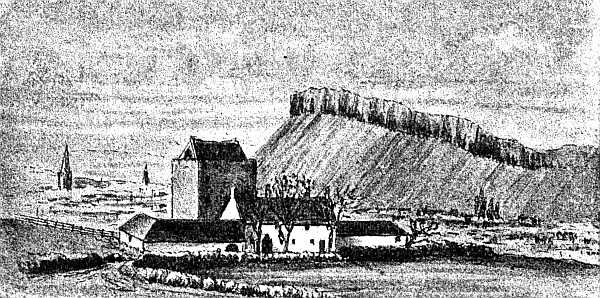
Liberton Tower.
In a hedge near the cross road, which leads back from Liberton House
to the village, grows the wormwood (Artemisia vulgaris),
with its deeply-cut, silver-lined leaves, and curious, aromatic smell. It is
the only place in the neighbourhood of Edinburgh where I have noticed
it growing. When we reach the main road again, we turn to the right,
and, passing the large reservoir that the Edinburgh Water Company
have lately built, we soon reach the east lodge of Morton Hall. On
the opposite side of the road is a small place, St. Catherine's, in
the garden of which still stands the famous Balm Well, to which in
former days so many pilgrimages were made. The water of the spring is
covered with a film of petroleum; and however frequently the film is
removed, it always returns. In old days the well was much resorted
to for the curing of cutaneous distempers. It owes its origin to the
following miracle. St. Catherine had a commission from St. Margaret,
the queen of Malcolm Canmore, to bring her some holy oil from Mount
Sinai. At this very place she happened by accident to lose a few
drops, and on her earnest supplication the well appeared.
When James VI. was in Scotland in 1617, he went to visit it, and
ordered that it should be fenced in with stones from bottom to top,
and that a door and staircase should be made for it, so that it
might be more easy of access. The royal commands being immediately
obeyed, the well was greatly adorned, and remained so till 1650, when
Cromwell's soldiers almost totally destroyed it. It was repaired
again after the Restoration. St. Catherine was buried in a chapel
adjoining the well, which was pulled down in the last century. It
was observed that the man who pulled it down never prospered again.
There are still remains of the old stonework to be seen; and now, as
then, a black, oily substance floats on the top of the water, but the
well is only visited in these days as a curiosity, and not with the
trusting faith that its miracle-working powers excited of old.
When we reach the blacksmith's shop at the corner, our way turns
to the left, and we leave the road we have hitherto followed, to
pursue its course to the shale-works and coal-pits of Straiton and
Loanhead. The thick white smoke drifting along the rising ground
to the south of us comes from the limekilns of Burdiehouse, which
are surrounded by a labyrinth of caves, out of which the limestone
has been quarried. Fossils of curious plants and fishes are found
there in great quantities. It is said that the name Burdiehouse is a
corruption of "Bordeaux," and that the place was so called by some of
Queen Mary's French attendants who settled there.
Taking the next turn to the right, we cross the small burn, and climb
the steep hill to Gilmerton, passing the old Place or Manor House,
which stands within gates at the west end of the village. This was
the dower house of the ladies of Newbyth. Mrs. Baird, the mother of
the famous general, Sir David Baird, of Mrs. Wauchope of Niddrie,
and of Lady Haddo, lived here at the end of the last century. Some
cottages a little farther on bear the pretty and romantic name of
Laverock Hall. In former days the inhabitants of Gilmerton had a bad
reputation as a lawless and turbulent set. Cut-throat Lane, the name
of the road where we again turn to the left, just before reaching the
railway arch, is suggestive of days when highway robberies were more
common than now. Before the Glencorse railway was made, this was a
desolate, lonely spot, and the rough, overgrown hedges on either side
might easily have concealed a dangerous ambush.
When we reach the end of Cut-throat Lane, before turning northwards,
on the way back to Edinburgh, let us pause for a moment; for down
in the hollow to the south is a cottage which deserves more than
a passing mention. Five centuries have elapsed since the terrible
tragedy took place which turned the name of Gilmerton Grange to
Burndale, or the Burnt Grange; and, whether we read the story in the
quaint, unadorned language of The Memorie of the Somervilles, or
with the charm of Sir Walter's verse[23]
thrown round it, it alike fills the mind with horror. The tale may be
briefly told as follows:—
In the reign of David II., the lands of Gilmerton in Midlothian, and
of Edmonstone in Clydesdale, belonged to Sir John Herring or Heron,
a brave and gallant knight who had fought side by side with Sir
Alexander Ramsay of Dalhousie against the English. Sir John had two
daughters, Margaret and Giles; the elder of whom he intended to marry
to his brother's son, Patrick, and to make them heirs to the greater
part of his estate. His intentions were frustrated in a most unhappy
manner. Margaret was very beautiful, and of a melancholy and devout
disposition. She observed strictly all the rites and ceremonies of
the Church, and for that purpose was in the habit of frequenting
the Abbey of Newbattle, about three miles off. There she made the
acquaintance of a young Cistercian monk, who, under a specious
pretext of holiness, insinuated himself into her confidence, and
then took advantage of the ascendancy he gained over her, to ensnare
and betray her. Fearing that this intrigue should be detected, he
arranged to meet her at the little farm called the Grange, a short
distance from Gilmerton, on the road leading to Newbattle. The
surrounding country was then thickly wooded, and he thought they
would be more secure from observation there than at her father's
house, or at the Abbey. The mistress of the Grange, a young and
dissolute widow, was the more willing to lend herself to this plan,
as she was also carrying on an intrigue with another monk of
Newbattle. In spite of the secrecy with which these meetings were
conducted, suspicions arose from the undue familiarity subsisting
between a lady of rank, and one so beneath her in condition, and of
such doubtful character, as the mistress of the Grange, and rumours
came to Sir John's ears. Being a man of violent and irritable temper,
he threatened his daughter with nothing less than death, should she
ever resort to the Grange again. She promised compliance with his
wishes; but that very night she stole out in the darkness to meet the
monk once more, and to warn him of her father's suspicions. Sir John
missed her, and, discovering that her chamber was empty, proceeded
to the Grange, accompanied by two servants. Finding the doors shut,
and no answer made to his demands, in a fit of rage, he took a torch
from his servant's hand and set fire to the thatch. A high wind was
blowing, the flames rapidly spread, and in a short time the building,
with every one in it, was burned to the ground. Eight or nine persons
perished, including Margaret Herring and the two monks.
For this cruel act, which was aggravated into sacrilege by the fact
of two of the victims being Churchmen, Sir John had to fly from
the country, while his estate was forfeited to the king. His near
neighbour and friend, Sir Walter Somerville of Carnwarth, undertook
to intercede for his pardon. He represented to the Abbot of Newbattle
how scandalous the lives of the two monks had been, even before their
acquaintance with that unhappy lady, and how their villainies had
thrown the greatest reproach on the order to which they belonged.
Finally, he prevailed upon the Abbot and the fraternity to listen to
an accommodation, provided he could move the Bishop of St. Andrews to
procure the absolution of the Church.
In the meantime, Sir John, with his remaining daughter, Giles, a
beautiful girl of eighteen, came secretly and dwelt at Sir Walter's
castle of Cowthally. Sir Walter, who was a widower at the time,
fell in love with Giles, and made a bargain with her father, that,
if he procured his pardon from the king, he should marry her, and
that half the lands of Gilmerton should be settled on him and his
wife, and the heirs of the marriage, or any other marriage, past or
to come, irredeemably for ever. The matter was arranged at last by
Somerville's exertions in the following manner:—
"That Sir John should make over for him and his the merk land of the
Grange, where the murder was committed, to, and in favour of the
Abbey of Newbattle, claiming no right therein, neither in property,
superiority, nor vassalage in all time coming; and, further, that the
said Sir John should, bareheaded and bare-legged, in sackcloth,
crave absolution at the Bishop and Abbot's hands, and stand in the
same manner at the principal door of St. Catherine's Chapel every
Sabbath and holy day for one year, and paying forty pennies at every
time to the poor of the parish, and one hundred merks Scots to the
monks of Newbattle to pray for the souls of those that died through
his transgression." These conditions were accepted and performed by
Sir John, whereupon he had his pardon from the king, was restored to
his estate, and had absolution from the Church.
These events happened in 1375, and it was owing to them that the
house of Somerville first acquired lands in Midlothian. For years
afterwards Cowthally in Lanarkshire remained their principal
residence; and it was not till 1584 that Hugh, the eighth Lord
Somerville, began the house of the Drum[24]
(the gate of which we pass on the right on our way northwards to
Gilmerton), from the design of John Milne, the king's master-mason.
It was finished the following year; but the pleasure of Lord
Somerville in his new home was sadly marred by the melancholy event
which took place there four years later, on a hot July morning
in 1589, and which is related as follows in The Memorie of the
Somervilles:—
"The Lord Somerville having come from Cowthally early in the morning,
in regard the weather was hot, he had ridden hard to be at the Drum
by ten o'clock, which having done, he laid him down to rest." The
servant, with his two sons, William Master of Somerville, and John
his brother, went with the horses to ane shot of land, called the
Pretty Shot, directly opposite the front of the house, where there
was some meadow grass for grazing the horses, and willows to shadow
themselves from the heat. They had not long continued in this place,
when the Master of Somerville, after some little rest, awaking from
his sleep, and finding his pistols that lay hard by him, wet with
dew, he began to rub and dry them, when unhappily one of them went
off the ratch (lock), being lying on his knee and the muzzle turned
sideways. The ball struck his brother John directly in the head, and
killed him outright, so that his sorrowful brother never had one word
from him, albeit he begged it with many tears. A lamentable case,
and much to be pitied. Two brave young gentlemen so nearly related,
and dearly loving one another; who, besides their being brethren by
birth, were entirely so in affection, communicating all their affairs
and designs to one another, wherein they were never known to differ
in the least.[25] ...
"The father, hearing the shot, leapt from his bed (being then in
the chamber of dais), to the south light, and, seeing his son and
servants all in a cluster, cried aloud to know the matter; but,
receiving no answer, he suspected some mischief, and thereupon flew
hastily down the stair, and went directly to the place where they
were, which the gentlemen observing, they advised the Master to
take him to a horse, until his father's passion and fury should be
over; which, at length, upon their earnest entreaty he did, taking
his direct way to Smeaton, where his lady-mother then lived, by
Smeaton Ford. The father being come upon the place, first hears the
lamentation of the servants, and then sees the sad spectacle of his
son, all bloody and breathless, with his head laid upon a cloak,
whereon he falls himself and cries aloud, 'My son, my son, dead or
alive? dead or alive?' embracing him all the time, which he continued
for some space, and thereby giving time for his eldest son to escape.
At length, finding no motion in his dear son, all in a fury he arises
and cries aloud, 'Where is that murderer? Who has done the deed?'
Staring wildly about, and missing the Master, he cries out 'Oh
heavens, and is it he? Must I be bereft of two sons in one day? Yes,
it must be so; and he shall have no other judge or executioner but
myself and these hands.' And with that immediately mounts his horse,
commanding two of his servants to attend him, making protestation in
the meantime that they should both go to the grave together. But God
was more merciful, for by this time the Master was past Smeaton Ford,
and before his father came that length, he was at Fallside House, out
of all danger....
"Coming now a little to himself, he (Lord Somerville) began much
to condemn this unwarrantable attempt of his upon second thoughts.
Before he came back, the sad object of his sorrow was removed to
the place of Drum, and the corpse decently handled by the ladies of
Edmonston, Woolmet, and Sheriffhall, near neighbours, for in less
than one hour the report went over all the country. Yea, before the
king rose from dinner, he had notice of it, being then in Holyrood
house, with the circumstance of the father's following the other son
with intention to kill him; for which the king within three days
thereafter (the Lord Somerville coming to wait upon his majesty),
reproved him by saying, 'he was a madman, that having lost one son by
so sudden an accident, should needs wilfully destroy another himself,
in whom, as he was certainly informed, there was neither malice nor
design, but a great misfortune, occasioned by unwary handling of the
pistol, which should have rather been a matter of regret and sorrow
to him, that the like had happened in his family, than that he should
have sought after revenge. Therefore he commanded him to send for
his eldest son, and be reconciled to him, for he knew he was a sober
youth, and the very thought of his misfortune would afflict him
enough, albeit he were not discountenanced by him.'"[26]
The Master never held up his head again, "and now, as formerly, by
his affable and obliging carriage, he had procured the epithet of
the Good Master of Somerville, so from henceforth he might have been
called the Sad and Sorrowful Brother; for it was observed from the
very moment of that unhappy accident, until his death, which fell out
about three years thereafter, he never enjoyed a comfortable hour,
but was still sad and melancholy."
In January 1592, the Master died from the effects of a fever, acting
on a low and broken spirit; and with him perished all the hope and
expectation of the house of Cowthally. Well might their ancient
retainer, as the corpse passed the outer gate, smite on his breast
and cry aloud, "This day the head is clean taken off the house of
Cowthally, as you would strike off the head of a sybba!"[27]
The extravagance of Gilbert, the succeeding Lord Somerville,
dissipated all the family property in Lanarkshire; and the lands of
Gilmerton and the Drum remained the sole possession of a family which
was now so poor that the head of it dropped his ancient title and
held it in abeyance.
The house of the Drum, which had been burnt soon after its
completion, then rebuilt in greater splendour, and again burnt in
1629, was left in a ruinous state till 1730-40, when James, the
thirteenth Lord Somerville, pulled it down, and built an entirely new
house, from Adam's designs. This Lord Somerville revived the title
and restored the fortunes of the family. He was assisted in this by
his own wise and prudent conduct, and by the advantages he gained
from two rich marriages. He was an ardent Hanoverian; therefore,
when in 1745 Prince Charles was holding his court at Holyrood, with
a strong army in possession of the capital, Lord Somerville felt
his position at the Drum, only four miles from Edinburgh, was an
unpleasant one.
One night, when the family were at supper, word was brought in that
the Highlanders were seen advancing up the avenue. All were in
consternation. The plate was instantly thrown out of the window into
the grass, which luckily was high; and Lady Somerville entrusted
a casket of diamonds to her step-daughter, Anne (afterwards Mrs.
Burges), with directions to conceal them. Miss Somerville ran out of
the house into the deer-park, and, making a hole at the root of a
tree, buried the diamonds, and crept back to the house unperceived.
In the meantime, Lord and Lady Somerville had locked themselves into
a closet in one of the garrets, and effectually concealed themselves.
The Highlanders, about forty in number, broke into the house, and,
not finding Lord Somerville, contented themselves with feasting on
whatever they could get in the kitchen and cellars, and then carried
off everything movable of any value. By this time a servant had
escaped to the village of Gilmerton, and roused the inhabitants,
who sallied forth to Lord Somerville's rescue. Half-way between the
village and the house they met the Highlanders. A bloody conflict
ensued, in which three of the former and five of the latter were
killed. It ended in the Highlanders relinquishing their booty and
beating a retreat. Next day the Prince, with his usual generosity,
and out of respect for Lord Somerville's high character, sent an
officer's guard to protect him.
Eight months later, when the royal cause was defeated and lost, Lady
Somerville bethought herself of her diamonds. Her step-daughter
readily undertook to restore them, but when she went into the park,
she found it by no means so easy a task as she expected. There were
hundreds of trees growing there, and in the hurry and agitation of
the moment, she had not observed exactly beneath which she had hidden
them. She was afraid to confide her difficulties to her father, and
did not think it advisable to trust in any of the servants. Finally
she told her brother, and night after night the two went into the
wood and hunted for the lost diamonds. At last, after much anxiety,
they came upon them lying safely in the earth, the casket having
completely mouldered away.[28]
In the year 1800, John, fifteenth Lord Somerville, sold the Drum
to Mr. More Nisbett, to whose family it now belongs. The house was
originally intended by Adams to have another wing; but the death of
James, Lord Somerville, putting an end to the works, the eastern wing
was never built.
We now leave the Drum on our right and proceed northwards on the main
road leading from Newbattle to Edinburgh. After passing through the
village of Gilmerton, we descend a long hill, and, looking over the
wall to our left, perceive the venerable sycamores and chestnuts, and
the high holly hedges, which hide the house of Moredun.
This place, which is of great antiquity, was originally known as
Goodtrees,—corrupted by the vulgar to Gutters,—and formed part
of the great Somerville property. During the minority of John,
fifth Lord Somerville, these lands were alienated by his uncle and
guardian, Sir John of Quathquan, who contrived to get a fresh grant
from James IV., and had them settled on himself and his heirs,
the Cambusnethan branch of the family. The story of how they were
recovered is a curious instance of how frequently designing persons
outwit themselves.
John, the third Laird of Cambusnethan, married, as his second wife,
Katherine Murray,[29]
a beautiful and very ambitious woman, who had been the latest of
James V.'s many favourites. After his death, she lived at Crichton
Castle with her uncle, the Earl of Bothwell, till her marriage in
1552. Her husband settled the lands of Goodtrees and the rest of his
property in Midlothian on her as a jointure, and on her eldest son
after her. Not content with this ample provision, she coveted the
lands of Cambusnethan also, though they were the rightful inheritance
of her step-son, James, the Laird with the Velvet Eye (so called
because, having lost an eye by a musket-shot, he ever after wore a
patch of black velvet). Determined to lose no chance of ousting her
step-son, she thought to secure the support of the head of the family
by proposing an alliance between Lord Somerville's second daughter
and her own son John. She accordingly went to Cowthally, and unfolded
her plans to Lord Somerville, showing him the charters relating to
the lands in Midlothian, which proved that her son was at any rate
heir to a very considerable property. Lord Somerville asked for two
days to consider the matter, and consulted his cousin, John Maitland,
the future Chancellor, who was then living at Cowthally in a sort of
honourable captivity. The latter told him that the lady's proposal,
as far as Cambusnethan was concerned, was a very dishonourable one,
and could bring no blessing with it, but that it might be worth while
to see the papers, as the Lothian lands alone would be sufficient to
make John Somerville a suitable son-in-law. He offered to look the
papers carefully over, which, having done, he returned them to the
Lady of Cambusnethan, who departed rejoicing, and thinking that she
had enlisted Lord Somerville on her side. He and John Maitland escorted
her four miles on her way, and then went hunting.
During the sport Maitland asked his cousin, as if in joke, whether
the lands of Gilmerton, Goodtrees, and the Drum had not once belonged
to the elder branch of the family, and what he would bestow on
the person who would show him the way to recover them. To this
Lord Somerville said, smiling, "Cousin, the bargain should soon
be made, if once I saw the man that made the offer." Whereupon
Maitland informed him that, on going over the papers, he had found
informalities in the deed of gift, which made the whole transaction
void, and he showed Lord Somerville a copy he had made of the paper.
He craved as his reward the white horse Lord Somerville was riding.
This the latter gladly gave him, together with a silk and silver
purse full of gold pieces. The purse was a much-treasured relic,
having been made by Lord Somerville's mother, Janet Maitland.
Lord Somerville and Maitland at once proceeded to Edinburgh, where
the former commenced a plea to recover the lands; but it was not till
eight years later (in 1578), that it was finally decided in favour of
Hugh, the succeeding Lord Somerville. It would not have been settled
then, had not Lord Somerville, aware of Morton's avaricious nature,
gone himself to the Regent to crave that his plea might be heard
in the Inner House, to which opposition had hitherto been made by
Cambusnethan and his party. On leaving the room, Lord Somerville drew
out his purse, as if to take a piece of money for the door-keeper,
and left it lying negligently on the table. He went quickly
down-stairs, and took no notice of the Regent's crying, "My lord, you
have forgotten your purse!" By the time he came to the outer porch,
one of Morton's attendants overtook him, saying the Regent desired he
would return and breakfast with him. Lord Somerville knew his cause
was as good as won, and so it proved; for, having been called and
debated on, judgment was given in his favour on the 11th May 1578,
and the lands in Midlothian returned to the head of the family, after
having been for fourscore years in possession of the younger branch.
Goodtrees shared the fate of most of the Somerville property, and was
sold in the 17th century. For many years it belonged to the Stewarts
of Coltness. Sir James Stewart, the celebrated writer on political
economy, was born here in 1713. His faithful devotion to the exiled
royal family cost him many years in a foreign land (he being one of
those who was excepted in the Act of Indemnity); and it was not till
1767 that he returned home, and soon afterwards obtained a complete
pardon. Goodtrees next passed into the Moncrieff family, and early
this century was bought by Mr. Anderson. By this time its name had
been changed to Moredun, which it still retains.
In the field to our right there is a very curious cave which runs
parallel with the road. It was dug out of the soft sandstone rock in
the last century by a man named George Paterson. He finished it in
1724, after five years' hard work, and it formed a complete dwelling
with several apartments. Paterson lived there with his family for
several years, and pursued there his calling as a blacksmith. He died
in it about the year 1735, and since then it has been preserved and
visited as a curiosity. The following inscription was made on it by
Pennycuick the poet:—
Upon the earth thrives villainy and woe,
But happiness and I do dwell below;
My hands hew'd out this rock into a cell,
Wherein, from din of life, I safely dwell.
On Jacob's pillow nightly lies my head;
My house when living, and my grave when dead.
Inscribe upon it when I'm dead and gone,
I liv'd and died within my mother's womb!
The little hamlet of Stennis or Stenhouse
lies away to the left of us, concealed in the wooded hollow at the
bottom of the hill. The road which leads to it diverges to the left
after we cross the Burdiehouse burn. We mount the slope beyond, and
find a beautiful and wide-stretching view spread out before us. To
our right is Kingston Grange, which used to be called Sunnyside, when
it belonged to the Inglis of Cramond; before that, it was called
Craigs. When the late Mr. Hay of Duns Castle bought this place, he
changed its name to its present one, in honour of his illustrious
ancestor, Viscount Kingston, whose branch of the Seton family he
represented. Within the last two years Kingston Grange has been
bought by Mr. Gordon Gilmour, and thrown into the Inch property.
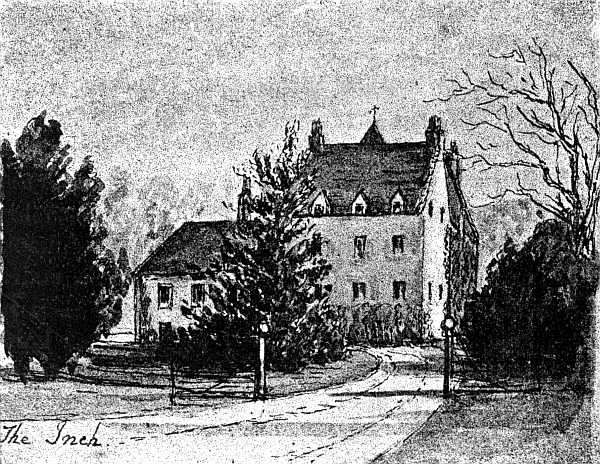
The Inch.
We are now fast nearing the end of to-day's walk, and the last
interesting spot that we pass is the Inch. The gate is near the
bottom of the hill, and a winding drive leads to the curious old
house. As its name denotes, it was formerly an island rising out of
the lake, which in old days filled the whole of the low ground now
drained by the Braid Burn. It used to be called "The King's Inch,"
and a room at the top of the house is still known as "The King's
Room." Like many other old Scotch houses, it has the reputation of
being haunted; though of late years, at any late, nothing ghostly has
been seen. The oldest date on the house is 1617, and the initials of
the Winram family, to whom it formerly belonged, are over some of
the windows. They were a loyal and gallant race, descended from
the Winrams of Woolston, or Wiston, in Clydesdale, and, though now
extinct, in old days they held great possessions. The Inch, Nether
Liberton, and part of Upper Liberton called them lord. They appear
to have succeeded the Forresters of Corstorphine in the barony of
Nether Liberton, and to have also acquired lands from the monks
of Holyrood, who in remote times possessed a mill here. George
Winram, a Lord of Session, under the title of Lord Liberton, was an
adherent of Montrose's. He was also one of the Commissioners sent by
the Scottish Parliament in 1649 to Charles II. in Holland; and in
1650 he returned, bearing letters from the king to the Parliament
and the General Assembly, prior to his coronation in Scotland. His
son, Colonel Winram, was lieutenant-governor of Edinburgh Castle,
under the Duke of Gordon, during the protracted siege it underwent
in 1688-89. It was to him that Lord Dundee wished its defence
entrusted, when he urged the Duke to repair to the Highlands. On the
capitulation of the Castle, Colonel Winram was kept a close prisoner
for some time, in spite of the terms of surrender. After him, we hear
no more of the family.
The Inch was acquired by the Gilmours in 1660, the same year in which
they bought Craigmillar; and by the marriage in the last century
of the daughter of Sir Alexander Gilmour with William Little of
Liberton, these adjoining properties were eventually united, and now
belong to the representative of both families, Mr. Gordon Gilmour
of the Grenadier Guards. An addition was made to the house at the
beginning of this century, when several carved and lettered stones
were inserted in the walls, which had formed part of the town house
of the Little family in Liberton Wynd. It had been pulled down
to make way for George IV. Bridge. At the north-east corner of
the park, at the place still called the Bridgend, there formerly
stood a little hunting-chapel, built by James V. in 1502. It has
completely disappeared. In the Inch itself are some interesting
sporting pictures, brought here by the late Mr. Little Gilmour. He
died in 1887, the last survivor of the old Melton set, but from the
dining-room walls still look down the portraits of "Vingt-un," and
other celebrities of the palmy days of Leicestershire.
WALK III.
Cameron Toll—Prestonfield—Peffer Mill—Craigmillar—Edmonstone—
Niddrie—Duddingston—St. Leonards.
He walketh, he walketh, pedestrious soul!
By the Porto called Bello, and the Cameron Toll.
These lines were written long ago, by old Mr. Lloyd, on one of his
visits to his son-in-law at Niddrie, and described the direction of
his daily walks. They will apply equally well to us to-day, for we
leave Edinburgh by what used to be the Cameron Toll; and, letting the
main road pursue its way south to Dalkeith,—to be rejoined by us
later on,—we turn to the left and skirt The Cameron. This place is
being rapidly built over, but it is still possible to trace the lines
of the crooked-nosed promontory, which here stretched into the
long-vanished lake, and from which the estate acquired its name.
A little farther east we see Prestonfield standing on the
gently-rising ground between us and Arthur Seat. Originally known
as Priestfield, and granted by James IV. in 1510 to Walter Chapman,
the first Edinburgh printer, it very soon after passed into that
branch of the Hamilton family that were ancestors of the Earls of
Haddington. Sir Alexander Hamilton of Priestfield, brother to the
first earl, sold the property to his neighbour, Sir Robert Murray of
Cameron. A few years later, in 1679, both places were brought by Sir
James Dick, Lord Provost of Edinburgh, who joined to them additional
lands acquired from the Prestons of Craigmillar. He changed the name
of the whole property to Prestonfield, and built the present house in
1687; the former one having been burnt down by the students of the
College of Edinburgh, in an antipapist riot a few years before. The
present owner of Prestonfield, Sir Robert Dick Cunyngham, is a direct
descendant of Sir James Dick.
Some rather amusing verses were written in 1759 by Dr. Benjamin
Franklin, after a visit here. They seem worth quoting, and run as
follows:—
Joys of Prestonfield, adieu!
Late found, soon lost, but still we'll view
Th' engaging scene—oft to these eyes
Shall the pleasing vision rise.
Hearts that warm towards a friend,
Kindness on kindness without end,
Easy converse, sprightly wit,
These we found in dame and knight.
Cheerful meals, balmy rest,
Beds that never bugs molest,
Neatness and sweetness all around,
These—at Prestonfield we found.
Hear, O Heaven! a stranger's prayer!
Bless the hospitable pair!
Bless the sweet bairns, and very soon,
Give these a brother, those a son![30]
It is interesting to add that the hopes expressed in the last verse
were fulfilled two years later by the birth of Sir William.
The place has been constantly let during the present century, and a
curious and unexplained occurrence happened here in 1830, when it was
rented by the Dowager Lady Gifford (grandmother to the present Lord
Gifford), who was anxious to be near Edinburgh for the education of
her sons. Lady Gifford's daughters, the Hon. Mrs. Holland and the
Hon. Jane Gifford, were girls at the time. Their schoolroom was over
the front door, which has a covered portico, under which carriages
drive up. One morning, about eight o'clock, the girls were in the
schoolroom before breakfast, when Mrs. Holland happened to look out
of the window, and called her sister's attention to a carriage, which
she saw some way off turning into the avenue. As it came nearer, they
saw it was a large black carriage, drawn by two coal-black horses;
the servants on the box, as well as the people inside, were dressed
in deep mourning. The girls wondered who could be arriving at such
an early hour; and, afraid of being seen, they crouched down behind
the window-sill as the carriage drove up, and watched it disappear
beneath the portico. After waiting some time, they heard no bell,
nor any sounds of an arrival, nor did the carriage drive away again.
One of the girls went down to see what was happening. No carriage
was there, neither had any one heard or seen such a thing. The girls
naturally took it as an omen of evil, either to themselves or to the
owners of Prestonfield, but no calamity in either family followed
this appearance, nor do I believe has it been seen since. The mystery
has never been explained in any way, but both Mrs. Holland and Miss
Gifford are perfectly positive as to what they saw.
The garden is very quaint, and the situation of the
house, with the hill and the loch behind it, must always make it a pretty place.
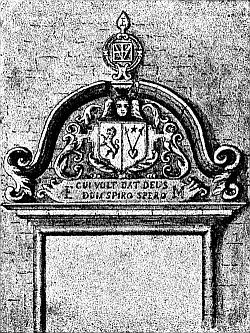
Doorway at Peffer Mill.
A little farther east, we come to a curious old house,—Peffer
Mill,—which neither time nor modern improvements seem to have
touched, since Sir Walter Scott picked it out as the house of Jeanie
Deans's unsuccessful suitor, and called it Dumbiedykes. It was built
in 1636, by one of the Edgar family, whose arms,[31]
impaled with those of his wife, a Pearson of Balmadies, are still to
be seen over the principal door. Above are their initials entwined,
and below, the two mottoes, Cui vult dat Deus and
Dum spiro spero.
It is now the property of Mr. Gordon Gilmour. Two curious old sundials
are built into the walls of the house. The word Peffer,
which is not an uncommon name for a burn in Scotland, means, I believe, "the
dark and muddy stream." Tradition says that a subterranean passage
formerly existed between this house and Craigmillar; and the opening
leading into it from the castle is still shown, though the passage
itself has long been choked up.
A ghastly incident took place here in 1728. A Musselburgh woman
called Maggie Dickson was hanged in Edinburgh. Her friends, who were
conveying her remains back to Musselburgh in a cart, stopped to rest
and refresh themselves at the ale-house that then stood at Peffer
Mill. While they were in the inn, a country wright had the curiosity
to look at the coffin, to compare the Edinburgh workmanship in that
line with his own. While doing so, he heard a strange noise inside,
and having speedily given the alarm to her friends in the hostelry,
they were astonished, as well as terrified, on rushing out, to find
her sitting upright in the coffin, the lid of which had not been
screwed down. The woman quite recovered, lived for many years, and
had several children, but she was known for the rest of her life as
"Half-hangit Maggie Dickson."[32]
We now cross the Suburban Railway, and at the next turn leave the
high road to pursue its way towards Musselburgh, while we climb the
hill to Craigmillar. This ancient fortress occupies a commanding
position on a rocky height, and surveys the country on every side.
Existing from remote ages, its history is closely interwoven with
that of Edinburgh and the royal race that ruled there; and its
name is linked with undying memories of much that has perished for
ever. Craigmillar possesses one marked distinction from every other
strong place of a similar kind,—such as Edinburgh or Stirling.
Though constantly a royal residence, it always remained private
property, and for several hundred years was held by the same family.
It presents the features of the dwelling-house of a great noble,
combined with those of a powerful and almost impregnable fortress.
The square donjon-keep in the centre is surrounded by an external
wall, defended at the corners by round towers, and enclosing a
considerable area. Beyond this extended further fortifications,
which, as more peaceful times approached, were converted into
additional lodgings for retainers and horses. The castle was burnt
and plundered by the English in 1554, and probably a good deal of the
existing building was erected, or at any rate restored, after that time.
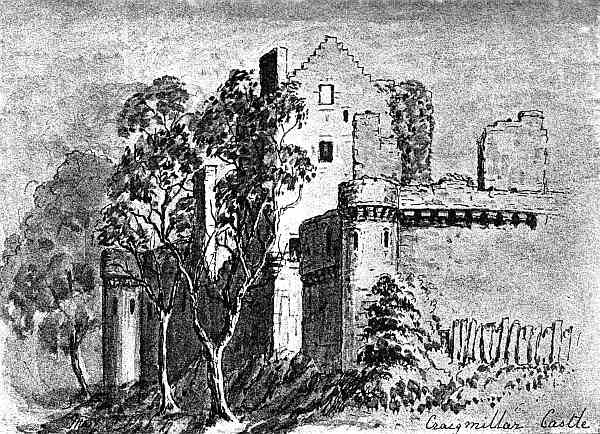
Craigmillar Castle.
"On the boundary wall," says Sir Walter Scott, "may be seen the
arms of Cockburn of Ormiston, Congalton of Congalton, Moubray of
Barnbougle, and Otterburn of Redford, allies of the Prestons of
Craigmillar. In one corner of the court, over a portal arch, are
the arms of the family,—three unicorns' heads couped, with a
cheesepress, and a barrel or tun,—a wretched rebus to express their
name of Preston." In every direction may be seen the shield with the
unicorns' heads. Over the principal doorway it is carried in the
fashion called by the Italians, Scudo pendente,
and esteemed more honourable than when carried square. High above it are the
royal arms,—the lion rampant, with the crown above. This was to show that
in time of war, or during any troubles or commotions, the castle
belonged to the king. The sculptured fragment alluded to by Sir
Walter Scott bears the date 1510, but long ere this the Prestons had
been lords of Craigmillar. Passing over the dim and misty figures
of William Fitz Henry and John de Capella, we find that Sir Simon
Preston acquired the lands of Craigmillar from William de Capella in
1374; and from that date down to 1660, they remained in the Preston
family.[33]
The last of this ancient line was Gentleman of the Bedchamber to
James VI., and was raised to the peerage as Lord Dingwall. His
only daughter became Duchess of Ormonde. In 1660 Sir John Gilmour
bought the property, and, as it is now in possession of his direct
descendant, Craigmillar has only belonged to two families during over
five hundred years.
Many are the royal memories connected with this venerable pile. In
1479, John, Earl of Mar, younger brother of James III., was placed
here as a State prisoner, on the charge of having conspired with
his brother Albany against the king. Mar was a gay, gallant knight,
with none of the king's fondness for architecture and poetry, but
delighting in hunting and warlike exercises. Whether he was guilty
was never quite proved, but the accusation which was brought by his
enemies, of dealing with wizards, and using magical arts to shorten
the king's life, added tenfold weight to the charges against him. The
end of this handsome and unfortunate prince is wrapped in obscurity.
The popular belief was, that he was put to death by opening his
veins in a warm bath; but Drummond of Hawthornden relates, on
good authority, that, being ill of a fever, he was removed from
Craigmillar to his lodgings in the Canongate, and that, having been
bled by his physicians, he tore the bandages from his arm in a fit of
delirium, and died from the consequent loss of blood.
The next royal visitor to Craigmillar was James V. He was brought
here as a boy, while the plague was raging in Edinburgh, and
he seems to have preserved pleasant memories of the sport he
enjoyed in the surrounding forests, for he afterwards built the
little hunting-chapel at the Bridge-end, which now has completely
disappeared.
But it is round his daughter's—Queen Mary's—name that most of
the memories of the past entwine themselves. Here she came—the bright
young queen—on her first return from France, with the flower of
Scotland's chivalry gathered round her, and never a presentiment of
the sorrows to come, or the treachery that was to lurk in her path.
These were Craigmillar's gayest, happiest days. Each morning saw the
brilliant cavalcade setting forth for the sport, which the queen,
like all her race, loved so well, while at night the vaulted halls
resounded with music and with mirth.
A few years later, and how changed was the scene! Mary came here in
December 1566, a few months after the birth of her child, ill in
health, weary and dispirited in mind, and realizing to the utmost
what a poor, craven wretch was the husband she had chosen. "The
queen," writes De Croc, the French Ambassador, to the Archbishop of
Glasgow,[34]
"is for the present at Craigmillar, about a league distant from this
city. She is in the hands of the physicians; and I do assure you, is
not at all well, and I do believe the principal part of her disease
to consist of a deep grief and sorrow. Nor does it seem possible to
make her forget the same. Still she repeats these words—'I
could wish to be dead!'" While she was thus looking sadly before
her, those around her were preparing a terrible future. Moray,
Lethington, Bothwell, Huntly, and Argyle proposed a divorce to her,
and even, it is said, hinted darkly at some simpler way of getting
rid of Darnley, without prejudice to the little prince. The queen
forbade anything to be done, by which any spot might be laid on
her honour; and then, unknown to her, the fatal bond which proved
Darnley's death-warrant was drawn up here by Sir James Balfour, one
of Bothwell's most unscrupulous adherents, and signed by the
nobles.[35]
After this, Queen Mary was never at Craigmillar again, and there is
little historic interest connected with the castle in later days. The
chapel, which lies to the east of the main building, is now roofless
and ruinous. It was built by Sir John Gilmour, who obtained special
permission from James VII. for the purpose. The Gilmours added to
Craigmillar, and continued living there, till well into the 18th
century, its last inhabitants being two old ladies, daughters of
Sir John Gilmour. Since their death, it has been forsaken, but
fortunately the castle is in good hands, and the present owner
preserves the ruins with the greatest care. The lifelong friendship
that subsisted between the late Mr. Little Gilmour and Mr. Stirling
Crawford was the origin of the latter's St. Leger winner of 1875
being named Craigmillar.
We now go westwards along a steep and narrow lane at the back of the
castle, and join the high road at a spot still called "Petty France."
It was here that some of Queen Mary's French attendants lived, while
their mistress held her court in the castle above. A few yards
farther south, we pass a venerable plane-tree, one of the largest in
the country, which has always been known as "Queen Mary's Tree," from
the tradition that she planted it herself.
We are now once more on the old Dalkeith road, which was formerly
a much more important thoroughfare than now, as it was one of the
main coach-roads to London, running south over Soultra and through
Coldstream and Wooler to Newcastle. The gate of Edmonstone stands at
the top of the steep hill before us, and, as our way turns to the
left very soon after passing the lodge and crossing the brow of the
hill, we skirt its park-wall for some way.
This place originally belonged to the Edmonstones of that Ilk, who
are now represented by the Edmonstones of Duntreath. They were near
neighbours and hereditary enemies of the Wauchopes of Niddrie, and
many were the frays that occurred between them. We find a curious
mention of Edmonstone in the witch-trials which took place before
James VI. in 1590. Agnes Sampson, "the Wyse Wyfe of Keyth" (whom
Archbishop Spottiswoode describes as "a most remarkable woman, not
of the base and ignorant sort of witches, but matron-like, grave and
settled in her answers"), confessed, amongst other things, that,
having been sent for to heal the old Lady Edmonstone, she told the
gentlewomen her daughters that she would disclose to them that night
whether their mother would recover or not. She bade them meet her
in the garden after supper, between five and six. Having gone into
the garden herself, she summoned the devil to appear, calling him
by the name of "Elva." Thereupon he leaped over the stone wall in
the likeness of a dog, and came so near her that she was afraid, and
charged him "By the law he lived under, not to come nearer, but to
answer her." She then asked if the lady would live or not; and, he
said "No." In his turn he asked where the gentlewomen, the lady's
daughters, were; and, being informed they were to meet Agnes in the
garden, said he would have one of them. "It shall not be so," said
the Wyse Wyfe; and he retired howling, and hid himself in the well.
There he remained till after supper. When the young gentlewomen
descended to the garden, the dog appeared suddenly out of the well
and terrified them. He seized the Lady Torsenze, and tried to drag
her into the well, and would have drowned her, had not Agnes and the
other ladies caught hold of her firmly, and with all their might
drawn her away. Then with a howl the dog disappeared, and Agnes told
the gentlewomen that she could not help the lady, "in respect that
her prayer stopped, and that she was sorry for it."[36]
For this, and for other things which she confessed, Agnes Sampson was
condemned to be hanged and burnt in 1592.
In 1626, Edmonstone was sold to James Rait, whose grand-daughter and
heiress married John Wauchope, second son of the Laird of Niddrie.
Charles I. was in Scotland, and happened to be present at this John
Wauchope's christening in 1633. He took a beautiful gold and enamel
chain from his neck and put it round that of the child; and it is
still carefully preserved at Edmonstone. Sir John Don Wauchope, the
present possessor of the property, is a direct descendant of John
Wauchope and Miss Rait. Parts of the house are known to be at least
four hundred years old, but at the end of the last century it was
partly burnt, and afterwards restored and added to. In throwing out
a window in the library, the workmen came on a niche containing the
skeleton of a man. The shoes of the figure appeared to be perfect
when the niche was opened, but on exposure to the air, they crumbled
into dust.
We now find ourselves on the steep ridge known as Edmonstone Edge, on
which the Scots pitched their camp before the battle of Pinkie in
1547. To our right lies Woolmet, now only a farm, but once the
property of the Edmonstones of Woolmet, cadets of the Edmonstones
of that Ilk. After descending the hill we see to our left one of
the oldest and most interesting places in Midlothian. The old
house of Niddrie Marischal is hidden among the trees, and beyond
it stretches a wilderness of shady walks, high holly hedges, and
velvety bowling-greens, through which wanders the Burdiehouse burn,
here full of trout, which have been the sport and amusement of
many generations. The Wauchopes are undoubtedly the oldest family
in the county. It is not known when they acquired Niddrie, and the
difficulty of tracing their origin is aggravated by the loss of their
more ancient muniments. "The family of Niddrie Marischal," say the
MS. notes written by William Wauchope in 1700, "was forfaulted in
James II.'s time, for making an inroad into England, so that by that
means most of the old charters and evidents were lost." The house was
burnt in Queen Mary's time, and the few charters that survived that
disaster were mostly destroyed when the English came to Scotland in
Cromwell's time. The tradition in the family is that Niddrie[37]
was granted to the Wauchopes by Malcolm Canmore. Mackenzie, in his
Lives of Eminent Scotsmen, says they came from France in his reign
about the year 1062. The first to whom a charter appears is Gilbert
Wauchope, who had a charter of "the lands of Niddery" from Robert
III. (1390-1406). From him the present laird, Colonel Wauchope of the
Black Watch, is the seventeenth in direct succession.
Always a true and loyal race, the Wauchopes remained faithful to
the old religion, and supported Queen Mary's cause to the end.
The sad fate of young Niddrie, and the circumstances which led to
the destruction of the ancient castle in 1596 by the Edmonstones,
hereditary enemies of the Wauchopes, are well-known.[38]
Nearly a hundred years later, the adherence of the family to the
cause of James VII. proved the ruin of the chapel, which had been
founded by Archibald Wauchope in 1502, and dedicated to the Blessed
Virgin, and, as we have elsewhere said, was subordinate to the church
of Liberton. A mob from Edinburgh first wrecked the Chapel-Royal of
Holyrood, and then came out to Niddrie, and demolished this chapel also.
When the year 1745 brought Prince Charles to this country to make his
gallant attempt to win back his father's throne, the Laird of Niddrie
collected a considerable sum of money for the royal cause. The prince
was encamped at Duddingston, but, as some of the enemy's troops lay
between that village and Niddrie, it was difficult to convey the
money to him. The plan the laird adopted was this: he sent his son
(my great-great-grandfather), a boy about six years old, in charge of
his tutor, with a large basket of fruit as a present to the prince.
The money was carefully concealed at the bottom of the basket. The
boy passed through the enemy's lines in safety, they suspecting
nothing, and reached the royal camp, where he delivered the money
into the prince's own hands. A few days afterwards, as the prince was
marching out with his troops, he perceived the boy walking with his
tutor on the farther side of a hedge. He stopped and said, "Is that
the young Laird of Niddrie?" and, desiring the tutor to lift him over
the hedge, he took him up in his arms and gave him his blessing.
This was not the only time that the Laird of Niddrie sent supplies
to his royal master, for, on another occasion, the money was
successfully taken to the prince by one of the Yetholm tenants, a man
named Thomson, who packed the coins in a load of hay, and succeeded
in crossing the country undiscovered. As a reward for his courage and
loyalty, the laird gave him his farm rent free from that time.
The laird's own family were of divided opinions. His wife, a Hume,
Lord Kimmerghame's daughter, was a Whig, like all her family. She
had a cousin, a Sandilands, in the Hanoverian army. He was wounded
at Prestonpans. She went out secretly and brought him back from the
field of battle; and, unknown to her husband, lodged him in some safe
place, and attended him till he was better.
When all hope of the royal cause was lost, the Wauchopes appear to
have reconciled themselves to the reigning family, and the young
Laird fought at Minden in the British army. It is to this that Sir
Walter Scott alludes:
Come, stately Niddrie, auld and true,
Girt with the sword that Minden knew.
We have o'er few such lairds as you.
He was a singularly handsome man, and there is a fine portrait
of him in his old age, by Raeburn, at Niddrie.
Another link with the old Jacobite days lasted well into this
century, in the person of Lucky Brown, who lived at one of the
lodges. She had been Mrs. Wauchope's nurse, and was a Cumberland
woman by birth. In the '45, she was living near Carlisle with her
father, and when Prince Charles passed their house on his march
south, they had breakfast laid out for him on the "louping-on stane."
He stopped and breakfasted there. A few months later, when the
Hanoverians fastened the heads of the executed Jacobites over the
gates of Carlisle, Lucky Brown and another young woman got a ladder,
and went in the dead of the night, and took down every head, carried
them away in their aprons, and buried them. My aunt, Lady John
Scott, remembers Lucky Brown quite well, and she has often heard her
grandfather tell the story of his expedition to the prince's camp.
It is a curious thing that when that laird of Niddrie succeeded to
the property in the last century, the workers in the coal-mines were
still in a state of slavery. They were bought and sold with the pits,
and they and their families were in bondage for ever. Mrs. Wauchope's
aunt, Miss Johnstone of Hilton, "Aunt Soph," who was always a great
deal at Niddrie, used to sing "The Coalbearer's Lamentation," a song
sung by these people.
When I was engaged a coal-bearer to be,
When I was engaged a coal-bearer to be,
Through all the coal-pits,
I maun wear the dron brats.[39]
If my heart it should break,
I can never won free!
The house has been very much altered and added to at different
times. The original castle stood a little to the eastward. After
its destruction in 1596, the present house was built by Sir Francis
Wauchope, "Young Niddrie's" son, but it has been very much
altered and modernized since. The King's Room, where Charles I.
slept, has completely disappeared, the floor having been taken out
to heighten the hall below. There used to be a ghost called Jenny
Traill, which haunted a room up a little steep stair near the roof.
She was supposed to have killed herself there, but I have never heard
of her appearance of late years.
In very old days, a large and thriving village clustered on both
sides of the stream, round the old keep of Niddrie. At one time it
contained three hundred families, three breweries, and fourteen
houses that sold liquor. That has long been swept away. A few houses
still remain at the north-east corner of the park, where Niddrie Mill
formerly stood. My aunt remembered a family named Simon that lived
here. They had been from father to son bakers to the Wauchopes for
nearly five hundred years; but they died out in the time of Colonel
Wauchope's father.
Four important roads meet at this spot,—the one from Edinburgh,
the one from Musselburgh, the one by which we have just travelled
from Edmonstone, and the one to Portobello, which we now follow. We
are fast approaching the sea, but, as to-day's walk is already long
enough, we shall leave Portobello to be described to-morrow; and,
taking the first turn to the left, we very soon find ourselves facing
the gates of Duddingston House. The crowned antelopes that surmount
the gate-pillars show that this is Abercorn property. It is a flat,
uninteresting park, well-wooded, with a summer-house like a Grecian
temple, forming a point-de-vue from the house,
which was built in 1768 after designs by Sir William Chambers, and cost £30,000.
The original owners of Duddingston, after the Reformation had
dispossessed the monks of Kelso, were a family named Thomson, created
later Baronets of Nova Scotia, and now extinct. In 1674 it became
the property of the Duke of Lauderdale, and after his death, his
duchess continued to live there. It was then that the lawsuit took
place between her and Sir James Dick, respecting the swans which she
had placed on Duddingston Loch, and which he, as owner of the loch,
had shut up. The duchess won her point at last, with the help of the
Duke of Hamilton, who, as keeper of the King's Park, interfered on
her behalf. Duddingston passed as pin-money to her daughter (by her
first marriage), Elizabeth Tollemache, who married the first Duke
of Argyle. She lived here constantly, and her son, the famous Duke
of Argyle and Greenwich, was brought up here. In 1745 the place was
sold to the Abercorns, who still possess it. They have not lived here
for many years, and now it is always let. Prior to the purchase of
Sandringham, there was some idea of its being bought for the Prince
of Wales, but the plan came to nothing.
The road we are following skirts the park, and after crossing the
Braid Burn, which runs out of an ornamental piece of water just above
us, we come to some substantial and comfortable-looking villas
surrounded with shrubberies and gardens. The road in front of us
leads to Piershill, but we take the one to the left, and soon reach
the other entrance to Duddingston House. Here formerly stood a
thorn-tree of great age and immense size. It was called "Queen Mary's
Tree," though it was known to have existed as far back as the reign
of Alexander I. (1107), when it was one of the landmarks of the
property on which it grew. A storm in 1840 tore it up by the roots.
We now see the little village of Duddingston,
nestling between the hill and the loch. The church stands on a rocky
knowe just above the water, and two narrow roads (for streets we
can hardly call them), bordered with houses, gardens, and orchards
thrown together in picturesque confusion, make up the rest of the
village. The house in which Prince Charles and his staff slept before
Prestonpans lies a little back from the main road, while his army was
encamped on the sunny slopes behind, which rise without a break to
the edge of Dunsappie. As we pass the church, we see the "louping-on
stane," so necessary in the days when our forefathers invariably
rode everywhere. The "jougs" still hang close by on the wall behind.
Though rusty now, they were once the terror and the punishment of
wrong-doers, who stood there, as in a pillory, with the iron collar
firmly clasped round the offender's neck.
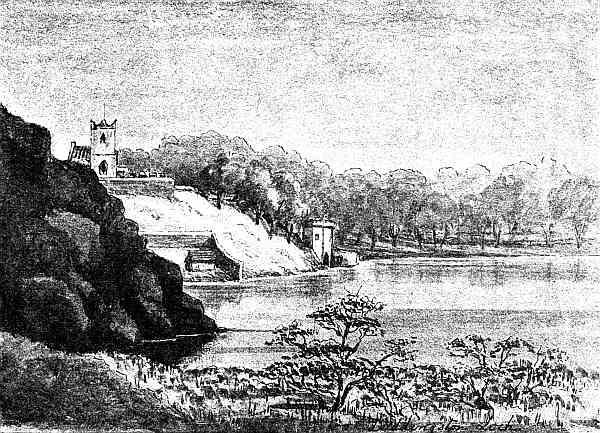
The church, which is of great antiquity, belonged to the Tironensian
Monks of Kelso.[40]
Twice since the Reformation has its pulpit been filled by very
remarkable men, who have each left a memory behind,—the one
by his pen, the other by his brush. The first, Robert Monteith (so
much better known as Mentet de Salmonet), had a curious and romantic
story. He was the son of a poor fisherman on the Forth, above Alloa;
but, having shown much quickness and aptitude for learning, he was
educated for the ministry, and eventually, in 1630, obtained the
living of Duddingston.
The care of this small parish gave little scope to a bold, restless
nature like Monteith's. The intriguing spirit that possessed him
wearied of the petty incidents of his daily life, and, in an hour of
idleness, the flame of an absorbing passion was lit in his breast
by the beautiful eyes of Lady Hamilton of Priestfield.[41]
Sir James was absent in England, Monteith was a daring and unscrupulous
lover, and used every art to win her affection, in which at last he
succeeded. It is easy to imagine the hours of stolen happiness that
followed,—how, in the soft summer twilight, Monteith would unmoor
the boat which lay hidden in the deep shadows below the church, and
steal noiselessly across the loch to where his love was waiting.
Many a moonlight evening must the two have wandered hand in hand
between the high clipped hedges, and lingered in the shady bowers of
Priestfield; but to dreams like these there is generally a bitter
wakening, and when Sir James returned, rumour was not slow to tell
him why his lady's eyes now turned coldly from him, and gazed ever
over the blue waters to Duddingston. Monteith had to fly. What was
Lady Hamilton's fate,—we do not know; but, as in the history of
the family she is set down as having had a long life, and borne her
husband many children, we can infer that he forgave her, and that
years brought forgetfulness in their train.[42]
This love was the turning-point of Monteith's life. He never saw his
native land again, but in the new one that adopted him he won honours
and fortune far above the lot of the Scottish minister. He abjured
the Protestant faith, and became secretary to Cardinal de Retz,
who bestowed on him a canonry in Nôtre Dame. When first soliciting
the Cardinal's favour, the latter asked him to which branch of the
Monteith family he belonged. With ready wit he answered, "To the
Monteiths of Salmon-net," alluding to his father's occupation. The
Cardinal replied he did not know the name, but had no doubt it was an
ancient and illustrious family; and as Monteith or Mentet de Salmonet
he was hereafter known. He was remarkable for the elegance and purity
with which he spoke the French language; but to us he is best known
by his folio work, Historie des Troubles de la
Grande Bretagne depuis l'an 1633 jusques 1649, which he published in 1661,
and dedicated to the Cardinal-Coadjutor.
Nearly two centuries after Monteith's time, John Thomson, the famous
painter, was minister of Duddingston. He was born near Girvan in
1778, and in 1805 was given the living of Duddingston, where he spent
the remaining thirty-five years of his life. From his boyhood he had
been devoted to art. Nasmyth was his master, but he greatly formed
his style on that of Claude Lorraine. Like him, he possessed, in an
unusual degree, the art of pictorial composition. His chiaroscuro
was bold and effective, his colouring agreeable, and an undefinable
charm is given to his pictures by the poetical suggestiveness that
underlies them. His works are greatly valued. Two very fine examples
hang in the Scottish National Gallery. Thomson was a great friend of
Sir Walter Scott, for whom he painted the picture of Fast Castle, now
at Abbotsford. He formed one of the brilliant circle which was then
the glory of Edinburgh.
Leaving Duddingston, we enter the Queen's Park, and, struggling with
difficulty up the steep, rocky pass, called Windygoul (where even on
the calmest day gusts are always eddying), we see before and above us
the grand basaltic columns known as "Samson's Ribs." To the left,
down the slope, are the Wells o' Wearie, often celebrated in
song;[43]
and before us lies St. Leonards, so imperishably associated with
The Heart of Midlothian, that a cottage used to be pointed out
as that of "Douce Davie Deans." Now even that has disappeared, in the
wilderness of new houses that has completely changed St. Leonards.
The eastern side of the crags, being within the boundary of the park,
alone retains its original character.
It was here that, in 1596, a bloody murder was committed. On the 22nd
of December, James Carmichael, the Laird of Carmichael's second son,
surprised and slew Stephen Bruntfield, the Captain of Tantallon.
History does not relate what cause or provocation there was for this
crime; but it did not long go unavenged, for the following March,
Adam Bruntfield, younger brother of the murdered man,
challenged Carmichael, and, having procured a licence from the king,
fought with him in single combat on Barnbougle Links, before five
thousand spectators. The lists were erected under the superintendence
of several of the nobles of James VI.'s court. The Duke of Lennox,
Sir James Sandilands, the Laird of Buccleuch, and Lord St. Clair
acted as judges. The combatants were curiously arrayed,—the one
in blue taffety, the other in red satin. Carmichael was a strong,
powerful man, and at the first encounter he wounded his adversary,
who was much younger, and of a mean stature; but, to the surprise of
every one, Bruntfield immediately after struck Carmichael on the neck
and slew him. He was taken back to Edinburgh in triumph, while his
antagonist was borne in dead.[45]
With this curious instance of the troubled times in which our
forefathers lived, we shall end this walk, having returned to
Edinburgh very nearly at the spot from which we started.
WALK IV.
St. Margaret's Well—St. Anthony's Chapel—Muschat's Cairn—Jock's Lodge—
Portobello—Restalrig.

T o-day's walk must be a short one, for, with the sea in front of
us, and the rapidly increasing boundaries of Leith and Portobello
on either side, there only remains a small space to be explored.
Let us start from the Holyrood entrance to the Queen's Park, and
walk towards St. Margaret's Loch. The iron-barred gate, which
apparently leads to a vault in the hill-side to our right, guards
the curious old well of St. Margaret. If we go close to the bars,
in a few minutes our eyes become accustomed to the darkness, and we
can clearly see the venerable arches, with the central pillar which
supports the richly groined roof. A stone ledge runs round seven
sides of the building, a little above the level of the water, which
always flows there, clear and icy cold. The well formerly stood in a
picturesque situation near the church of Restalrig, and very probably
was the original fountain of St. Triduan, to which pilgrimages were
made.[46]
An ancient elder-tree with twisted branches overshadowed it; a tiny
thatched cottage stood hard by; and the spot was the most sheltered
and peaceful that could be imagined. When the North British Railway
threatened to bury this curious well beneath its embankment, and
eventually destroy it (as it destroyed the beautiful and venerable
Collegiate Church of the Holy Trinity), Dr. Laing and other
enlightened and energetic antiquarians of the day made a successful
attempt to move the whole structure to the Queen's Park, where it was
erected over what was known of old as St. David's or the Rood Well.
It is now in safety, and presents its original appearance, though
deprived of its former picturesque surroundings.
A little farther on, a steep path winds away up to St. Anthony's
Chapel, passing the stone from which gushes the famous wishing-well.
This well is mentioned in the beautiful and pathetic ballad of "The
Marchioness of Douglas," which begins,
Oh, waly, waly up yon bank,
An' waly, waly down yon brae.[47]
These melancholy lines were the lament of Lady Barbara Erskine, wife
of the second Marquis of Douglas. Her husband deserted her in
consequence of the base (and unfounded) scandal poured into his ear
by his chamberlain, Lowrie. This man had formerly been refused by
Lady Barbara; and, though he had since married Mariote Weir, the
heiress of Blackwood, he hated Lady Barbara for her rejection of his
suit, and tried to revenge himself as described in the ballad. Lord
Mar took his daughter home, but Lowrie's treachery being discovered,
Lady Douglas's fame was cleared. Her lord received her back, but too
late for her happiness. Though the ballad mentions three children,
only one son lived to grow up. He was the gallant young Lord Angus,
who fell at Steinkirk in his twenty-first year, at the head of his
regiment, the 26th Cameronians.
St. Anthony's Chapel, just above us, was also a hermitage, and
tradition says that, besides being founded for the guardianship
of the holy well, it was also a spot for watching vessels, the
duties on which were part of the revenue of the Abbey of Holyrood.
At night a light was hung in the tower to guide mariners in their
progress up the Forth. The whole of this part of the Queen's Park
is so beautifully and faithfully described in the account of Jeanie
Deans's midnight meeting with the outlaw Robertson, that every
other description must seem superfluous and uncalled for. In spite
of the lapse of years since The Heart of Midlothian was written,
the features of the spot have little changed. Muschat's Cairn still
raises its ill-omened heap of stones close to the Jock's Lodge gate
of the Park. The unhappy woman who was murdered here in 1720 was the
wife of Nicol Muschat of Boghall, a surgeon, and a man of infamous
character. His wife's only crime was that she loved him, and that he
was tired of her. He tried various means of getting rid of her, and
both he and one of his profligate associates, Campbell of Burnbank,
made several ineffectual attempts to murder her. At last Muschat
persuaded his wife to take a solitary evening walk with him towards
Duddingston, and at this spot he cut her throat. She was found next
morning quite dead, and covered with wounds received in the struggle.
For this murder Muschat was hanged in the Grassmarket the following
January, but, to mark the horror that his crime inspired, a cairn was
raised on the spot where the bloody deed took place.
We now leave the park and pass the little roadside station of St.
Margaret's, where the Queen always gets out of the train when
she goes to Holyrood. To our right, on the slope of the hill, is
Parson's Green, a small place, hardly more than a villa. A curious
traditionary rhyme prevails among the children in this district,
which they chant incessantly, whenever a lady passes them on
horseback—
Ladybird, can't see
Twenty minutes past three.
What the origin or the sense of these words is, I have never found
any one to tell me, and it is curious that it is only on this side of
Edinburgh that they are in common use.
We are now in the hamlet of Jock's Lodge. There is a vague tradition
that the original Jock was a beggar, who built himself a hut on the
lonely path that led to the Figgate Muir; but he must have lived
very long ago, for in 1650, when Cromwell besieged Edinburgh, the
place had already got the name. "The enemy," says Nicol, "placed
their whole horse in and about Restalrig, the foot at that place
called Jockis' Lodge, and the cannon at the foot of Salisbury hill."
A toll-bar formerly stood where the road divides; that to the right
leads to Duddingston, the other road, which we follow, runs past
Piershill Barracks. On this spot there originally stood a villa,
occupied by a Colonel Piers, who commanded a troop of horse in
Edinburgh about the middle of the last century, and who gave his name
to the house. It was pulled down in 1793, and the present barracks
built in its place.
After passing them, and crossing the railway, we perceive a gigantic
tomb, standing in a field to the left, which immediately strikes
the beholder with a feeling of astonishment. Built in a classic
style that recalls the sunny skies of Italy, and enriched with a
beautifully carved marble frieze, representing the Song of Miriam,
and the destruction of the Egyptians in the Red Sea, it seems
singularly out of place in the neglected corner of a large grass
field, with weeds and nettles growing round it. It covers the remains
of the late Mr. William Miller of Craigentinnie, a great antiquarian,
and the owner of a fine library. His father, another William Miller,
was a wealthy seedsman in Edinburgh during the last century. It was
at his shop in the Canongate that Prince Charles's army procured five
hundred shovels for trenching purposes in 1745. By his own exertions,
and those of his father before him, he accumulated a large fortune,
part of which he laid out on the lands of Craigentinnie. He was a
member of the Society of Friends, and was well known for his charity
and benevolence. About 1780, when in his ninetieth year, he married
an Englishwoman who was nearly fifty. They went to London, and then
to Paris, from whence they returned with a son and heir, the late Mr.
Miller. It was often thought that he was a suppositious child, and
some people believed him to be really a woman, from his weak voice,
slight figure, and absence of beard. Be this as it may, no one but
those immediately interested in him were allowed to touch his body
after death, and, as by his own commands he lies in a grave dug forty
feet deep beneath this massive monument, his secret lies buried with
him. His large fortune was for some years the subject of a lawsuit,
but eventually it passed into the hands of a distant relation, the
late Mr. Christie Miller, M.P.
The land on either side of us once formed part of the Figgate Muir,
through which flowed the Figgate Burn, as the lower reaches of the
Braid Burn were called. It was a wild, desolate expanse, covered with
whins and heather, and bordered by a broad, sandy beach. The
Fishwives' Causeway, which ran across it, was a remnant of one of the
roads formed by Queen Mary, soon after her return from France, for
the improvement and civilization of her more barbarous kingdom. It
is said to have been made on the site of an old Roman road. It was
formerly the favourite way for the fishwives to carry their wares
into Edinburgh, and they remained faithful to it long after the
present road was made.
As we reach the sea, Portobello lies to our right. It has been called
the Brighton of Edinburgh; and, with the adjoining village of Joppa,
it presents a labyrinth of villas and lodging-houses, which in the
summer-time are generally full. The origin of the name is that the
first house built here was erected in 1742 by an old seaman, who had
served under Admiral Vernon, and who called his house Portobello
Hut, in honour of the triumph of the British flag at Portobello, in
the West Indies. By degrees more houses sprung up round this humble
cottage, and the discovery of a bed of clay by the Figgate Burn
started the manufacture of Portobello ware. This pottery, which has
not been made for many years, was almost identical with that made at
Prestonpans and Bo'ness, and resembles very rude Staffordshire. The
earthenware was coarse, and the colouring crude, but the Toby-jugs
and figures were often well modelled. Specimens can still be picked
up, but they are more often objects of curiosity than of beauty.
We shall not explore Portobello further, but turn to the left, and
follow the road that runs parallel to the railway to Leith. On one
side of us is the sea, breaking on a narrow, shingly beach; and
beyond, there is nothing to stop the eye till it reaches the distant
shores of Fife, but the rugged outline of Inchkeith, with its lines
of fortification gleaming white in the sunlight. Before we have gone
very far, we see a level crossing and a signal-box on the railway
beside us; and, taking advantage of our privileges as pedestrians,
we pass safely and unquestioned through the narrow posterns, while
it might require some persuasion to get the heavy gates unlocked and
opened for a carriage to enter them. We now find ourselves following
a straight path leading across the flat green meadows, which stretch
far away on either side, their expanse being only broken by narrow
watercourses. With the level rays of the afternoon sun glancing
over them, gilding the tips of the grass, and imparting an air of
Dutch-like prosperity and peace, it comes upon one rather as a shock
to be told that these quiet pastures are the great sewage farm of
Edinburgh, an experiment on a large scale which has turned out
successfully. We presently come to high walls, behind which stands
the old house of Craigentinnie, long the inheritance of the Nisbets,
a younger branch of the Nisbets of Dean. As we have already said, it
was bought in the last century by the father of the late Mr. William
Miller. The latter added greatly to the house, and built steep roofs
and turrets in the style of a French château, which has altered it
very much from the old Scotch house that originally stood there.
We now come to the little village of Restalrig, or Lestalric, as
it used always to be called. For centuries it was famous all over
Scotland as the burial-place of the blessed virgin St. Triduana. "She
is said," writes Dr. Laing, "to have come from Achaia in the 4th
century in company with St. Regulus, and to have died at Restalrig in
the year 510, in the reign of Eugenius III., the 8th of October being
held as her festival day. Although no precise date can be assigned
when a church or chapel was first erected and dedicated to this
saint, whose bones for many centuries were held in high veneration,
or when it first became the parish church of Leith, we can trace it
back at least to the 12th century."[48]
St. Triduana's name is unknown in the Roman breviary, but tradition
says that, with two companions, she devoted herself to a recluse life
at Roscoby. Her great beauty attracted the attentions of Nectan, a
Pictish chief; and she fled to Dunfallad in Athole to escape him. His
emissaries still pursued her, and as she discovered it was her eyes
which had entranced him, she plucked them out and sent them to him
transfixed on a thorn.[49]
She then withdrew to Restalrig, where
she died. Henceforward she became the patron saint of those whose
eyesight was defective, and many a pilgrimage was made to her well.
She was frequently painted carrying her own eyes on a salver, or on
the point of a sword.
The church, which in its restored form we should hardly recognise
as being of great antiquity, was erected into a collegiate church by
James III. in honour of the Holy Trinity, and was endowed by the two
succeeding monarchs. James V. placed here a dean, nine prebendaries,
and two singing boys. It was John Sinclair, Dean of Restalrig,
that married Queen Mary to Lord Darnley in Holyrood Chapel in July
1564. By that time the building itself had suffered sadly from the
effects of the Reformation. It was demolished by order of the General
Assembly in 1560, and many of the stones were taken to build the new
port or gate just inside the Netherbow, which was erected during the
siege of the Castle of Edinburgh in 1571. We have no description,
plan, or representation to furnish us with any idea of what the
collegiate church was like. Such ruins as remained were restored in
1836; and the eastern window and wall of the present church formed
part of the old chancel. The huge mound resembling a mausoleum,
which stands on the south side, though generally called the family
vault of the Logans, was undoubtedly attached to the church, either
as a chapter-house, or as St. Triduan's Chapel. It has internally a
beautiful groined roof, springing from a single pillar in the
centre. Of late years it has certainly been used as a burial-place,
and some of the Logans, as well as the Balmerinos, their successors,
lie here. Among them is "Lady Janet Ker, Lady Restalrig, quha
departed this life 17th May 1526." The tomb now belongs to Lord
Bute; and Wilson in his Reminiscences quotes an incident told him
by Charles Sharpe respecting it, which shows how often political
animosity outlives the grave:—"Application was made to him (Lord
Bute) to allow Miss Hay, whom I well knew,—daughter of Hay of
Restalrig, Prince Charles's forfeited secretary,—to be buried in the
vault. This was refused; and she lies outside the door. May the earth
lie light on her! old lady, kind and venerable." In the last century
Restalrig churchyard was a favourite resting-place of the non-juring
Scottish Episcopalians, as the burial service was then forbidden to
be read in the city burial grounds. Several bishops of the Scottish
Church lie here.
After leaving the church, we turn first north, then
eastwards, along a road running between very high walls; and pass a tall
gloomy-looking villa called Marionville. It was built in the last
century by the Misses Ramsay, whose milliner's shop was on the east
side of the old Lyon Close. There they made a fortune, out of which
they built Marionville. It was locally known as "Lappet Ha'," in
derision of their profession. In later years it was the residence
of Captain Macrae, whose unfortunate duel (in 1790) with Sir George
Ramsay of Bamff on Musselburgh Links, and its fatal consequences,
made him an exile for the remainder of his life.[50]
Beyond Marionville a road to the right leads to a small sheet of water
called Lochend.
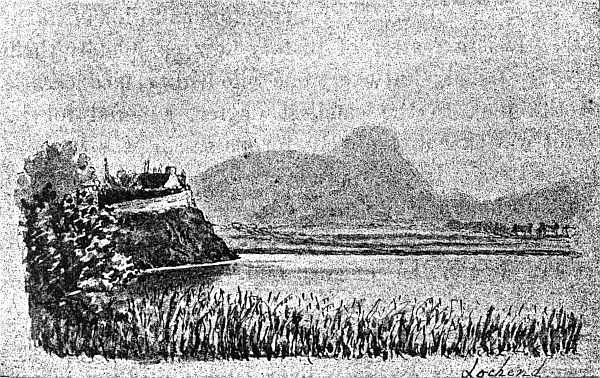
Lochend.
The modern villa, standing among trees immediately behind
Craigentinnie, is now called Restalrig House, but the old castle
of the Logans crowned the rocky bank which rises abruptly from
Lochend; and parts of it may still be distinguished in the more
recent building which has been engrafted on it. These powerful barons
possessed Restalrig from the 14th century. They came to an end with
Robert Logan, who was mysteriously mixed up in the Gowrie Conspiracy.
He had before that been deeply involved in the treasonable projects
of Francis, Earl of Bothwell; but his share in the Gowrie Conspiracy
remained unknown till nine years after his death, when the
correspondence between him and Lord Gowrie was discovered in the
possession of Sprot, a notary at Eyemouth. Their intentions had
been, after seizing the king's person at Gowrie House, to hurry him
into a boat on the Tay, and carry him by sea to Logan's inaccessible
fortress of Fast Castle (which he had acquired by marriage with
the heiress, a Home), and there await the decision of the other
conspirators as to his ultimate fate. It is a matter of history how
completely their schemes failed; but every one who had been concerned
in the plot, to the smallest degree, suffered for it. Sprot was
executed merely for possessing the treasonable letters. Logan's dead
bones were brought into court, to have the following sentence passed
on them: "That the memory and dignity of the said umqle Robert Logan
be extinct and abolisheit, his arms riven and deleted from all books
of arms, and his goods escheated."[51]
The lands of Restalrig next passed into the hands of the
Elphinstones, Lords Balmerino. They lost them from too faithful a
devotion to their exiled king. The Hays followed them in acquisition
and forfeiture, and now the property is all broken up.
We are now close to the outskirts of Leith, so we will turn back and
take the first road to the right, which soon brings us out on the
London Road, not far from Abbeyhill.
WALK V.
Corstorphine—The Cat-Stane—Gogar—Hatton—Saughton Hall—Dalry.
Our walk to-day takes us in an entirely different direction, and to
fields as yet unexplored. With our faces to the setting sun, we leave
Edinburgh by the great west road, which for the first few miles is
so cramped and hemmed in by modern houses that all recollections of
the past are effaced. By degrees, as we pass Murrayfield, the villas
grow fewer, the gardens and parks which lie on the hill slopes to
our right get larger, but there is a sadly short interval of green
fields and hedgerows, before we enter the rapidly growing village of
Corstorphine, which threatens soon to lose its identity, and become a
mere suburb of Edinburgh. How changed since the day when
On Ravelston cliffs, and on Clermiston Lee
Died away the wild war-notes of bonnie Dundee.
Clermiston Lee still rises steep and bare behind the village, but the
old castle of the Foresters, which then stood below it, has vanished;
only a few stones remaining to show where it once was. Gone, too, is
their town house in Forester's Wynd,—gone is their very name! The
proud and ancient title of Lord Forester of Corstorphine has passed
by inheritance to an English earl, and is merged in the higher
honours of Verulam. The tombs alone of the old knights remain in the
beautiful church, which, altered and mutilated as it is, still bears
traces of its past glory.
The first Forester who possessed Corstorphine was Sir Adam. He was
a gallant knight, who fought by the side of the Douglas at Homildon
Hill, and fell a captive into Hotspur's hands. He was ransomed, but
three years later (1405) he died at Corstorphine, full of years and
honours. His son, Sir John, was Great Chamberlain of Scotland, and
Master of the Household to James I. In his time the church was built
(1444), and erected into a collegiate foundation, with a provost,
four prebendaries, and two singing boys. It has been conjectured that
one of the first provosts was the "Gentill Rowll," whom Dunbar, in
his beautiful "Lament of the Makaris," bemoans as one of those whom
Death "has tane out of this countrie."
He has tane Rowll of Abirdeen
And gentill Rowll of Corstorphyne;
Twa bettir fallowis did no man sie,
Timor mortis conturbat me.
His name is embalmed with those of other poets of his day, Chaucer,
Wyntoun, Blind Harry, Barbour; but it is doubtful if a line of his
writings has come down to us.[52]
When we enter the old church where he officiated, we shall be sadly
disappointed. The requirements of a Presbyterian place of worship
have altered it so much from its original form, that we must shut
our eyes, and throw our minds back into former days, before we can
picture it, or even understand it at all. What is now the porch was
then the chancel, but the altar-tombs have been spared, with their
recumbent effigies.
"Two of the altar-tombs," to quote Wilson's vivid
description, "occupy arched recesses in the chancel, one of them being
the monument of Sir John Forester, the founder of the collegiate church,
and his lady, apparently a St. Clair of Orkney, judging from the arms
impaled with the Foresters' on one of the sculptured shields. The
knight and lady are in armour and dress of the fifteenth century, and
the latter clasps her breviary in her hands. In the other monument,
supposed to represent the son of the founder and his wife, the lady's
hands are meekly crossed over her breast. The supposed Crusader
lies apart on his altar-tomb in the south transept, with his dog
at his feet. He is traditionally affirmed to be Bernard, Lord of
Aubigny, who died at the castle of Corstorphine, while on an embassy
to the court of James IV. in 1508; but the monument is of older
date, and the shield bears the Foresters' own heraldic hunting horns
stringed."[53]
One shield impaled with Forester bears the fesse cheque
of Stuart,—perhaps for Marion Stewart, Lady Dalswinton, wife of
the second Sir John Forester.
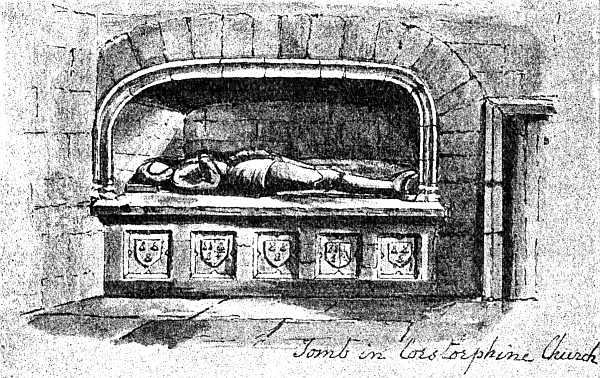
Tomb in Corstorphine Church.
The church is built in the form of a cross, and part of the roof is
still covered with the old grey flagstones. A small square belfry
tower at the west end is surmounted by a short octagonal spire, with
richly ornamented string mouldings. In the pre-Reformation days,
the provostry of Corstorphine was a lucrative and much sought after
office. In the beginning of the sixteenth century it was held by the
Robert Cairncross who bears an unenviable reputation in Buchanan's
history, by the manner in which he obtained the Abbey of Holyrood,
without subjecting himself to the law against simony. Having
ascertained that the abbot was at the point of death, he wagered a
considerable sum with the king that he would not be offered the
first vacant benefice, and lost his bet by being appointed Abbot of Holyrood.
Putting on one side such wild legends as derive the name of
Corstorphine from Croix d'or fin, the golden cross
presented to the church by some mythical French noble, it seems far more probable
that the village was called after the "Cross of Torphin;" though of that
there are now no traces left. Probably it was erected by the same
Torphin who gave his name to one of the outlying spurs of Pentland,
which is still called Torphin Hill, and stands in Colinton parish.
Tradition says he was an archdeacon of Lothian, but his name carries
one back to the early Saxon invaders of the land. In old days a loch
stretched over what now is fertile plain; and the Water of Leith,
which ran out of it, was deep enough for the Lords Forrester to
bring their provisions up from Edinburgh by boat to their castle of
Corstorphine, which stood close to the north-west corner of the loch.
At this castle a terrible crime was committed in August 1679. George,
the first Lord Forester, had no son, and, to prevent the extinction
of the family name, he resigned his honours into Charles II.'s hands,
and obtained a fresh patent in favour of his daughter Jean and her
husband, James Baillie of Torwoodhead, who accordingly succeeded as
second Lord Forester. This nobleman's first wife had died childless,
it is said, heart-broken at the neglect and indignities she suffered
at his hands. He was a second time a widower,—having married a
daughter of the old Cavalier general, Patrick Ruthven, Earl of
Forth and Brentford, by whom he had five children, all of whom bore
their mother's name of Ruthven,—when popular rumour accused him of
carrying on an intrigue with the beautiful Christian Nimmo,[54]
the wife of a merchant in Edinburgh. She was a great deal younger than
himself, and a niece of his first wife's. This near relationship
greatly increased the scandal, which was aggravated by Lord
Forester having always professed to be a religious man, and a rigid
Presbyterian. Mrs. Nimmo, besides being a very beautiful woman, was
of a violent and impulsive nature. She was believed always to carry a
sword under her petticoats,[55]
and so was not a person to be treated lightly, especially by those
who reflected what blood ran in her veins,—a Mrs. Bedford, who
had murdered her husband a few years before, being her cousin-german.
She was also related to the unhappy Lady Warriston, who suffered
death for the same crime in 1600. Lord Forester's passion for
her appears to have cooled; and, shutting his eyes to possible
consequences, he permitted himself in one of his carouses to speak
more than lightly of her. This came to her ears, and, seized with
fury, she went at once to his castle at Corstorphine. He was absent
when she arrived, drinking at a tavern in the village. She sent for
him, and met him in the garden, close to the old dovecot, where a
violent altercation took place between them. In the midst of it,
she snatched the sword from his side, ran him through the body,
and killed him.
"The inhabitants of the village," writes Charles Sharpe, "still
relate some circumstances of the murder, not recorded by
Fountainhall. Mrs. Nimmo, attended by her maid, had gone from
Edinburgh to the castle of Corstorphine." After the murder, "she
took refuge in a garret of the castle, but was discovered by one of
her slippers, which dropped through a crevice in the floor. It need
hardly be added that, till lately, the inhabitants of the village
were greatly annoyed, of a moonlight night, by the appearance of a
woman clothed in white, with a bloody sword in her hand, wandering
and waiting near the pigeon-house." She was seized and brought before
the sheriff in Edinburgh. She confessed her crime, but pleaded that
Lord Forester, being ferocious and intoxicated with drink, had drawn
his sword; that, to save herself, she had snatched it from him, and
that in the struggle he had fallen upon it, and so killed himself. In
spite of this defence, sentence of death was passed upon her, which
she contrived to have postponed for two months, under a false pretext
of her condition. During this interval she escaped one evening from
the Tolbooth, disguised as a man, but she was recaptured next day
at Fala Mill, and beheaded at the Market Cross on the 12th November
1679. At her execution she appeared dressed in deep mourning, with a
long veil, which, before laying her head on the block, she took off,
and replaced with a white taffeta hood. She met her fate with great
courage.[56]
It was said at the time that, in spite of his professed
Presbyterianism, a dispensation from the Pope to marry Mrs. Nimmo was
found among Lord Forester's papers, and that his delay in using it
had caused her fury.
By the terms of the patent, the barony and lands of Corstorphine
passed to Lord Forester's nephew, William Baillie, his mother having
been Lilias, youngest daughter of the first baron. He became third
Lord Forester, and in his line the title has since remained.
The fertile pastures that surround Corstorphine provided our
forefathers with that favourite delicacy, known as Corstorphine
cream. It was a variety of the old Scottish dish called "Hattit Kit,"
and much resembled it.[57]
About a quarter of a mile to the west of Corstorphine,
the high road divides in two,—the branch to the right making its way by
Linlithgow to the north; the other leading straight on, and reaching Glasgow
eventually. Though it is out of the direction of this walk, and we
shall have to retrace our steps to this point, we would pray our
kind companions to go with us as far along the first-named road as
the bridge which crosses the Almond near Kirkliston, and joins the
counties of West and Midlothian. It is not more than a mile and a
half off, and, just before reaching it, we turn aside, along a rough
cart track leading into a field. This field lies in the angle between
the Almond and the impetuous little Gogar Burn, which we have crossed
without noticing; and about the centre, on slightly rising ground,
stands the object of our search—the end of our pilgrimage. To you
it is but a rude, shapeless block of stone, too stunted and lumpy to
have any appearance of dignity, and not more venerable or
ancient-looking than any other time-worn, moss-grown fragment. But
to us who know, it is eloquent with a thousand voices! This is the
Cat-Stane, the most northerly monument of that intruding race by
which Pict and Gael alike were driven back to their native hills.
Beneath this massive stone has slept for centuries the grandfather
of Hengist and Horsa. "In oc tumulo jacit Vetta f. Victi." So its
mutilated inscription was read years ago by the learned Edward
Lhwyd,—and so does its latest interpreter, Sir James Simpson,
read it also.
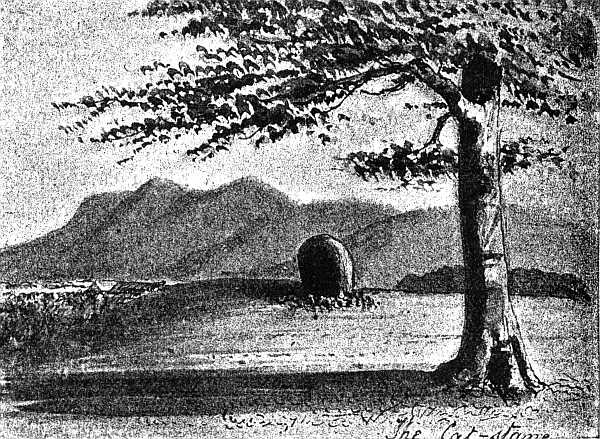
The Cat-stane.
The Venerable Bede, in describing the invasion of England by the
German tribes in the time of Vortigern, states that their "leaders
were two brothers, Hengist and Horsa, who were the sons of Victgils,
whose father was Vetta, whose father was Victa, whose father was
Woden." So the genealogy runs, and in this all the old chroniclers
are agreed; and here undoubtedly lies a Vetta, the son of Victa,
neither of them common names among the Saxons. We may ask ourselves
what brought the Saxon chief so far from his native shores, and to
a land where his race did not take root? But we have the authority
of Nennius for saying that the Saxons occupied for a short period
various regions beyond the Mare Frisicum (the Firth of Forth),
and Ammianus Marcellinus tells us that, two generations before the
invasion of Hengist and Horsa, a Saxon host was leagued with the
other races of Scotland, the Picts, Scots, and Attacots, against
their common enemy, the Romans, and fought with a Roman army under
Theodosius. The battle probably took place near this spot, for it
must have been fought somewhere between the two Roman walls, and this
place is included in that tract of country. The vulgar name of the
monument, the Cat-Stane, points to this hypothesis, the name being
clearly derived from the British Cad, the Scoto-Irish Cath, the
Welsh Cat, all meaning "battle."[58]
When Mr. Lhwyd visited the spot in 1688, the sculptured stone was
surrounded by large stones laid lengthways, this one only being set
on end.
Beside this venerable monument, how modern appears everything else
that we have looked at! What changes it has seen! And yet here it
stands, little altered by the centuries that have passed over it. One
deed of violence it was a witness of, which we must not forget to
mention. On this very spot, in April 1567, Queen Mary was seized, on
her way from Stirling to Edinburgh, by a troop consisting of eight
hundred spears, commanded by Lord Bothwell. They surrounded her
attendants, and, taking possession by force of the Queen's person,
hurried her off on the fatal journey to Dunbar.
Returning now to the point where we left the Glasgow road, we pursue
it for a mile, and then see on our right some beautiful hammered-iron
gates. These are the lost gates of Caroline Park, whose forsaken
gate pillars we shall see to-morrow. They now defend the entrance to
Gogar House, a curious old mansion with winding stairs, which stands
in a sheltered position near the Gogar Burn. It was once a much
more important place. It possessed two villages, Nether Gogar and
Gogar Stone. One has disappeared, the other dwindled down to a few
houses. It had a church whose priest was one of the prebendaries of
Corstorphine. Only a small portion is still extant, and that is used
as a burial ground. In the 14th century Gogar was given by King
Robert Bruce to his faithful companion, Sir Alexander Seton. He
was one of those who signed the famous letter to the Pope in 1330,
asserting the independence of their country, and vowing that, so
long as a hundred of them remained alive, they would never submit to
the king of England.[59]
After him Gogar belonged to many different families, including the
Logans of Restalrig, and the Erskines, a younger branch of Mar.
At the end of the last century it was bought by the Ramsays of Barnton.
We now turn to the left and pass Millburn Tower and Gogar Station,
and then, crossing the Union Canal, we finally emerge on the other
great west road that leaves Edinburgh and runs past Dalmahoy to
Midcalder. Dalmahoy, and even Riccarton (of which we see the woods
to the west of us), are too far out of the range of our walks to
explore; but, though Hatton is even farther off, we must make a
passing allusion to that curious old place. It is almost the only
house left in this part of Scotland which preserves untouched the
characteristics of the time when it was built, the latter half of the
17th century. Part of the house is the original tower of the Lauders
of Haltoun,[60]
and dates from the 14th century, but it was completely altered
and remodelled, when Charles Maitland, afterwards fourth Earl
of Lauderdale (who married the heiress) built the present house. It
stands back in a flagged court, closed by iron gates. On the garden
side the ground falls rapidly away, so that a terraced wall bounds
the courtyard on this side, and is supported at the corners by
curious old-fashioned pavilions with steep roofs, and doors opening
into the garden below. Everywhere may be seen the coronets and
crossed L's of the Lauderdales, who made this one of their principal
seats, till it was sold in 1792 by the eighth earl. He was my
great-grandfather; and a curious story is handed down of his father's
residence at Hatton. That Lord Lauderdale kept a pack of harriers
with which he was very fond of hunting. Time after time these hounds
put up a very large hare in the park, which, after a good run,
invariably succeeded in eluding them, and always disappeared near a
cottage, inhabited by a solitary old woman, popularly believed to be
a witch. His huntsman told him that hare would never be caught, as
he was sure it was the witch herself, but Lord Lauderdale would not
believe him. At last, one day, just as the hare was making off as
usual, the leading hound got near enough, and seized it by the leg;
but, not having sufficient hold, the hare got away and disappeared in
the cottage. Lord Lauderdale, who was close up, jumped off his horse
and went into the cottage, where he found no hare, but only the old
woman sitting by the fire, groaning and rubbing her leg. She had been
quite well that morning, but made some excuse to Lord Lauderdale
about having hurt herself. He knew better, and so did every one else.
When Lord Lauderdale sold Hatton, it was bought by the Davidsons of
Muirhouse, who cut down the beautiful lime avenue of great length,
which formerly led up to the house. In their turn, they sold it to
the present Lord Morton, then Lord Aberdour, in 1872.
After this digression, we return to our walk, and continue our way
towards Edinburgh. It is a flat, uninteresting, highly cultivated
country through which we are passing. Away to our right, but quite
out of sight, is the deep valley of the Water of Leith, which runs
past Currie and Colinton. Near it stands the curious old house of
Baberton, where Charles X. resided for a short time, when, after
the Revolution of 1830, he found a refuge in Scotland. Just before
reaching Saughton, we cross the Water of Leith, which is permanently
spoilt and discoloured by the mills farther up. The beautiful old
bridge lies a hundred yards to the left, and to reach Saughton
Hall we have to cross it. It has three arches supported by massive
piers, and on a square panel is the date 1670, when it was probably
repaired. It is of great age.
Saughton Hall is the old seat of the Bairds of Saughton, now
represented by Sir James Gardiner Baird, whose grandfather let it,
early in this century, to the proprietors of a private lunatic
asylum. To fit it for their use, it has been so added to, and the
place so altered, that little of its original form remains.
We next pass the little village of Gorgie, with its tan
works, and find ourselves in the outskirts of Edinburgh. The suburb by which we
enter the town is called Dalry, a name of Celtic origin, from dal,
a vale, and righ, the king. The earliest mention of this property
is in the time of Robert I., who granted a charter of the lands of
Dalry to William Bisset. The Bissets were a powerful and important
family in those days. In the 16th century, Dalry became the property
of the Chiesly family, wealthy burgesses of Edinburgh.
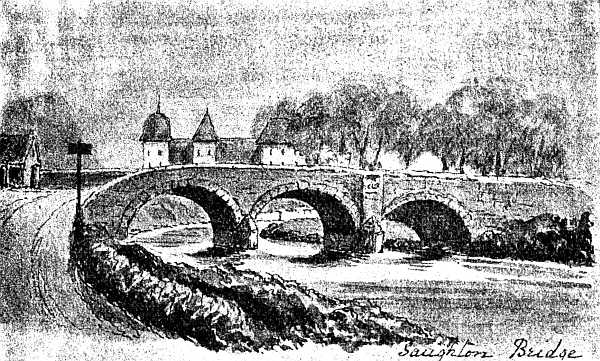
Saughton Bridge.
On Easter Sunday, March 31, 1689, the Lord President, Sir George
Lockhart of Carnwath, was shot dead by John Chiesly of Dalry. The
motives for this dreadful deed were those of private ill-feeling.
Chiesly, who was on bad terms with his wife, swore to be revenged on
the Lord President for assigning to her a small aliment (only £93 a
year) out of his estates. He was a man of violent and ungovernable
passions. Six months before the murder, he told Sir James Stewart in
London that he was "determined to go to Scotland before Candlemas,
and kill the President." "The very imagination of such a thing," said
Sir James, "is a sin before God." "Leave God and me alone," was the
fierce answer; "we have many things to reckon betwixt us, and we will
reckon this too!" The Lord President was warned of these threats,
but took no notice. Chiesly dogged him home from church that Easter
Sunday, and shot him in the back as he went into his own house,
in the Old Bank Close. Lady Lockhart was confined to her bed with
illness, but, on hearing the pistol-shot, she sprang up and rushed
forward in her night-dress, just in time to see her husband carried
in, and laid on two chairs, where he instantly expired. Chiesly,
being caught red-handed, was sentenced to death next day by the Lord
Provost. He was dragged on a hurdle to the Cross, where his right
hand was struck off while still alive. Then he was hanged in chains
at the Gallowlee, and his right hand was nailed on the West Port. It
was said that his relations and servants came at dead of night and
carried off his body, and buried it near his house of Dalry, which
for long after was alleged to be haunted. It is a curious fact "that
on repairing the garden-wall at a later period," says Wilson, "an old
stone seat, which stood in a recess of the wall, had to be removed,
and underneath was found a skeleton entire, except the bones of the
right hand—without doubt the remains of the assassin, that had
secretly been brought hither from the Gallowlee."
His daughter Rachel married the Honourable James Erskine, Lord
Grange, and was the unhappy Lady Grange, whose story is well known.
After twenty years of quarrels and unhappiness, her husband had her
secretly conveyed to the Hebrides, where, first in one island, then
in another, she lingered out in captivity and solitude the remaining
seventeen years of her most wretched life. Lord Grange was involved
in Jacobite plots, and it is believed that his wife's threat of
betraying him to the Government was what finally decided him in
shutting her up where she could not hurt him.
The old house of the Chieslys still exists. It is a curious old
place with small projecting towers crowned with ogee roofs; but it
is almost concealed among the humbler tenements which thickly cover
that part of the estate, and is now a training school for Scottish
Episcopalian teachers. From the Chieslys, Dalry passed to Sir
Alexander Brand, who owned the neighbouring property of Brandfield
in the district of Fountainbridge. His house there has quite
disappeared, but its name is preserved in Brandfield Place, which is
built on its site. In later times Dalry belonged to the Kirkpatricks
of Allisland, and then to the Walkers, in whose possession it is now.
WALK VI. — INDEX.
Warriston—Caroline Park—Muirhouse—Lauriston Castle—Cramond—
Braehead—Cammo—Barnton—Craigcrook—Ravelston.
To-day we come to our last walk, which will take us past several
curious and interesting places. There is no more imposing and
majestic way for the traveller to approach or leave Edinburgh,
than the Queensferry Road, which is our choice to-day. The broad,
well-engineered road sweeps with an easy curve over the Dean Bridge,
passes the handsome stone houses of Buckingham Terrace, and in a
few moments more emerges into open country, without any of the
intervening hovels which generally encumber the outskirts of a
great town. We diverge from the main road at Comely Bank, and then
turn due north towards Granton. To our left hand is the property
of Craigleith, on which stands the massive pile of St. Cuthbert's
Poorhouse. It is far over-topped and outshone by its neighbour on
the opposite side of the road, Fettes College, founded in 1863 in
accordance with the will of Sir William Fettes, Lord Provost of
Edinburgh, to whom the estate of Comely Bank belonged. Bryce was
the architect, and at some future period, when the surrounding
plantations have grown up, it will look very well, but its solitary
position, at the top of an exposed ridge, gives it a bare and
comfortless appearance.
No old legends linger about either of these places, but about a
mile and a half to the east of us stands a house whose history is
too noticeable to overlook, though in the course of to-day's walk
we do not actually pass it. This is Warriston House, which stands
on a gentle eminence beyond the Botanical Gardens. It belonged once
to the family of Kincaid, cadets of the Kincaids of that Ilk in
Stirlingshire, and in 1600 it was the scene of a dreadful tragedy.
John Kincaid of Warriston was married to a beautiful woman, much
younger than himself, Jean Livingston, the daughter of the Laird
of Dunipace. Owing to some alleged ill-treatment, she conceived a
deadly hatred of her husband, which was fomented and encouraged by
her nurse. The lady was induced to tamper with a young man named
Robert Weir, a servant of her father's at Dunipace, and at last she
persuaded him to become her instrument. Early one morning, in July
1600, Weir came to Warriston, and being secretly admitted to the
laird's chamber, he fell upon him and beat him to death with his
fists. He then fled. The lady and the nurse remained at home, and
seem to have taken no steps to evade the punishment of their crime.
They were both seized, taken before the magistrates, and condemned to
death. In the interval between the sentence and the execution, Lady
Warriston, who was only twenty-one, was brought by the offices of a
pious clergyman to a state of repentance and resignation to her fate.
The case is reported in a curious old pamphlet called "Memorial of
the Conversion of Jean Livingston (Lady Warriston), with an account
of her carriage at her execution," which was reprinted by Charles
Sharpe. She stated that on Weir assaulting her husband, she went to
the hall, and waited till the deed was done. She thought she still
heard the pitiful cries uttered by her husband while struggling with
his murderer. Afterwards, by way of dissembling, she tried to weep,
but not a tear could she shed. She could only regard her approaching
death as a just punishment of her offence.
Her relations do not seem to have shown much grief at her fate, but
for their own sakes they made interest to obtain that her execution
should be as little public as possible. It was arranged that while
the nurse was being burnt on the Castle-hill at four in the morning,
and thus attracting the attention of any that should be about at that
early hour, the lady should be taken to the Girth Cross, at the east
end of the town, and should there be beheaded by the Maiden.
According to the contemporary pamphlet: "The whole way, as she went
to the place of execution, she behaved herself so cheerfully, as if
she had been going to a wedding and not to her death. When she came
to the scaffold, and was carried up upon it, she looked up to the
Maiden, with two longsome looks, for she had never seen it before.
This I may say of her, to which all that saw her will bear record,
that her only countenance moved, although she had not spoken a word.
For there appeared such majesty in her countenance and visage, such
a heavenly courage in her gesture, that many said, 'That woman is
ravished with a higher spirit than man or woman.'" She then calmly
resigned herself to her fate. A melancholy end for one so young!
It shows the horror in which her deed was held at the time, that
in the ballad of "The Laird of Warriston," the Enemy of Mankind is
introduced as appearing to her, and tempting her to this awful crime.
Four years later, her accomplice, Weir, was taken and broken on the
wheel, a punishment hardly ever before inflicted in Scotland.[61]
We now return to our actual walk, and soon find ourselves facing the
lodge-gates of Caroline Park, or Roystoun, as it was called before it
became the property of John, Duke of Argyle.
Though many years have passed since I last saw Caroline
Park, how vividly it rises before me, with its curious, steep-pitched roof, and
the carved inscription below it, telling how George, Lord Tarbat, had
erected this little cottage (tuguriolum) in 1685.
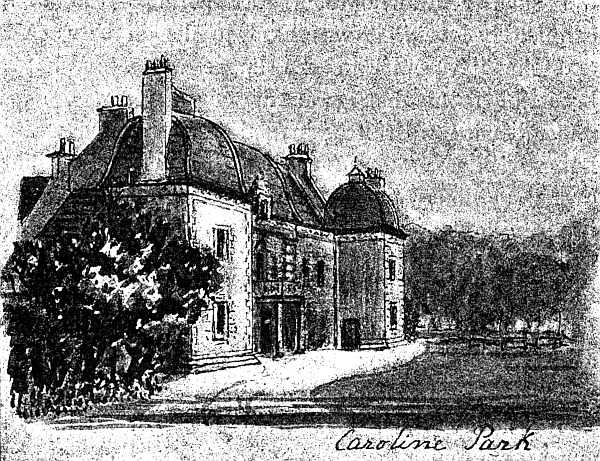
Caroline Park.
When you entered the door, you passed through an outer hall into
the courtyard, round which the house was built. The flagstones
which paved it were green and damp-stained; but a little path of
well-worn bricks, with a wooden roof supported on pillars (to shield
one from the weather), led straight across to the low, matted hall,
with its further door opening on the sea-view, and its framed
diagrams of yacht-flags and signals, which recalled the days of
the Lufra and the Flower o' Yarrow. A door to the right led
to the great staircase, which was bordered by the most beautiful iron
trellis-work, hammered into flowers and arabesques, that it was ever
my good fortune to see. Up-stairs, owing to the house being only
one room thick, and being built in a complete square round the
courtyard, all the rooms opened into one another, though by an
ingenious arrangement of staircases it was possible to get to each
suite separately. Heude, a pupil of Verrio, had painted the ceilings,
and though the "Diana and Endymion" in the smaller drawing-room was
perhaps the more exquisitely lovely, it was hard to decide between
it and the "Aurora" in the larger room. What a beautiful room that
great drawing-room was, as I remember it! with its panelled walls
painted white, hung with portraits of the exiled Stuart kings, and
over the chimney-piece and above the doors landscapes in grisaille
let into the walls. There were a good many of these in the house.
They were principally foreign scenes, but there was a curious view of
Edinburgh, painted before the North Loch was drained and while the
New Town was still unthought of, which is now preserved at Dalkeith.
When my aunt, Lady John Scott, lived here, a curious circumstance
sometimes occurred in this room. The first time she remembered its
happening, she was sitting alone about eleven o'clock one evening.
Suddenly the window at the end of the room, close to the door opening
into the dining-room, was violently burst open, and a cannon-ball
(apparently) bounded in, falling heavily on the floor and rolling
forwards. It rebounded three times, and seemed to come as far as the
screen half-way up the room, and stop there. My aunt rang violently,
but when the servants came nothing could be seen, the window was shut
and uninjured, and everything as usual. Every effort was made to find
out what had caused this noise, but in vain; and as there were no
rooms above this part of the house, it was the more unaccountable.
I remember, in January 1879, when we, as children, were spending a
fortnight there alone with our German governess, that she heard the
same sound one evening, and was so terrified, that she would never
sit alone in that room at night again. This time the cannon-ball
seemed to roll right up to where she was sitting by the fire. The two
maid-servants who were always left in the house constantly heard it,
but got used to it, and did not mind. Nothing was ever seen, and it
could never be accounted for in any way.
To the east of the house, under the trees, where the first daffodils
flowered each spring, was an ancient moss-grown well, out of which,
tradition said, the "Green Ladye" rose at midnight, and rang the
alarm bell in the courtyard. Many a time have I heard that bell
toll mournfully, when every one in the house was in their beds, and
there was not a breath of wind to sway it. On the same side of the
house, but close to where the railway now runs through the park, lay
formerly a large flat stone. The story went that above two hundred
years ago, a foreign vessel came into the Forth, and drifted on to
the low rocks and sand close to Caroline Park. The crew were stricken
with the plague, and in a day or two the captain and the men were all
found dead. A very deep pit was dug on this spot, and the crew were
buried together in one large grave. The captain was buried alone on
the top of the others, about three or four feet below the surface of
the ground, and the large flat stone was laid above them all. When
Lord and Lady John Scott were living at Caroline Park, they had a
great wish to know if there was any truth in this wild legend, so
they moved the stone and dug beneath it. A few feet down they came
on the entire bones of one man, and a few feet farther they found a
great mass of bones all thrown together into one deep grave. They
put everything back carefully, as it had been before, and replaced
the stone on the top. Before leaving Caroline Park that year to go
to England, Lord John begged Mr. Howkins, the Granton engineer,
to see that during the making of the railway (then in progress)
neither grave nor stone should be touched. Unfortunately, none of his
directions were attended to, and when he returned, he found the grave
cut away, and the stone propped up against the park wall, so that of
this curious spot, nothing is left but the empty tale.
There are beautiful old stone gate-pillars to the
sea-entrance, with ducal coronets surmounting the carved finials; but the
hammered iron gates, which corresponded with the staircases inside the house,
have long been removed, and their places filled by common wooden doors.
They were taken away early in this century by a well-known judge, and
they now ornament the lodge of Gogar, where we saw them yesterday.
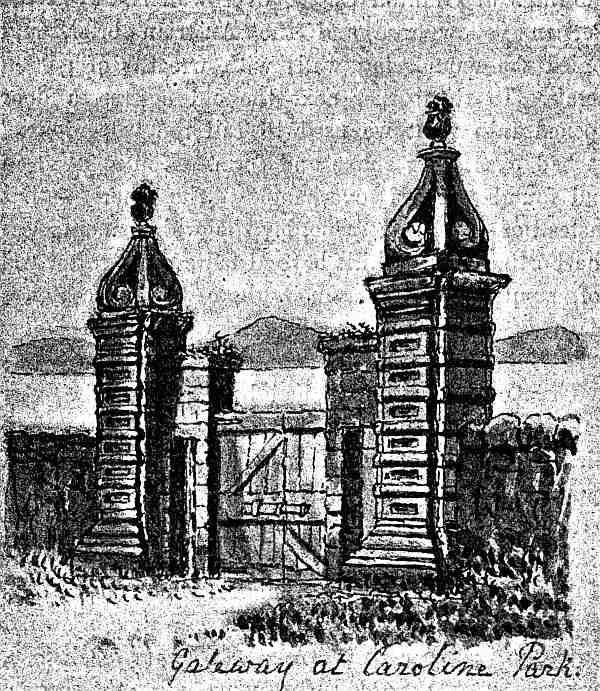
Gateway at Caroline Park.
To the west of the place lay the garden, the most enchanting tangle
of flowers, fruit-trees, and shady bowers. Everything in it seemed to
grow to greater perfection, and to bloom earlier than elsewhere, it
was so sheltered and so sunny. Peaches and apricots ripened on the
walls, and the beds were full of every old-fashioned, sweet-scented
flower. Beyond it rose the ruins of Granton Castle, over which
strayed the Persian yellow rose and the Austrian briar, and veiled
the mouldering walls with wreaths of golden petals. In the corner
next the old fig-tree, a door opened into what we used to call the
"opera-box." It had exactly its shape and form. You stepped in and
found yourself overhanging the shore,—but instead of a painted
scene, lay the wide panorama of the Forth, with the hills beyond
fading into softer and softer purple; and for music, there was the
ceaseless plash of the waves on the rocks far down below us.
The "opera-box" itself had been part of the outer buildings of the
old castle. This once belonged to Sir Thomas Hope of Craighall,
the famous lawyer of Charles I.'s time, who made it his principal
residence. After his death in 1646, it passed through many different
hands, including various members of the Hope family, till it was
bought in 1740 by John, Duke of Argyle and Greenwich, who had
acquired Roystoun the year before from Sir James Mackenzie, grandson
of the Lord Tarbat who built the house. The Duke threw the two places
together, and called them Caroline Park, out of compliment to his
royal mistress, the queen of George II. At his death, the property
passed, by the marriage of his daughter Caroline, to the ducal
family of Buccleuch, who now possess it. The prosperity of the
neighbouring port of Granton has proved the destruction of Caroline
Park. Warehouses and other buildings press closely upon it, and the
beautiful old house itself has been turned into the offices of a
printing-ink manufactory.
Leaving it behind us, we turn along a road which leads
westwards from the lodge, and, passing a little place called Granton House,
we soon reach Muirhouse. Griffins surmount the gate-pillars which open on
to a broad and fine avenue, at the end of which stand the ruins of
the old royal hunting-lodge, and a finely wooded park slopes down to
the sea. This barony was granted by King Robert Bruce to Sir William
Oliphant of Aberdalgy. Previously it had been royal property. The
last Oliphant that possessed Muirhouse, or the Murrows, as it was
then called, was Sir James Oliphant of Newton (born in 1612), who
in a drunken fit stabbed his own mother with a sword, so that she
died. This dreadful event obliged him to fly into Ireland, where he
died in great penury and wretchedness.[62]
All his property was sold. Muirhouse now belongs to the Davidson
family, who acquired it in 1776.
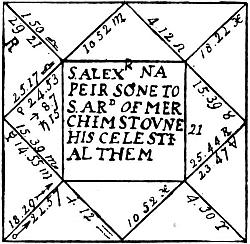
Carved Stone at Lauriston Castle.
A little to the south-west of Muirhouse, we pass Drylaw, a place that
once belonged to a younger branch of the Foresters of Corstorphine,
and then come to the village of Davidson's Mains, or Muttonhole,
hole, as it used to be called. The east gate of Barnton faces us,
but we shall describe that place later, and, turning to the right
along the park wall, we soon see the towers of Lauriston rising
between us and the sea. The castle appears to have been built about
the end of the 16th century, as over two of the windows we can still
see the letters S. A. N. and D. E. M. They are the initials of Sir
Archibald Napier and his second wife, Dame Elizabeth Mowbray. They
acquired Lauriston from the Foresters in the latter half of the
sixteenth century. One of the windows near the roof has a kind of
stone shelf at its base, intended to hold a beacon, which could be
seen simultaneously from the castles of Merchiston and Barnbougle,
the former homes of its master and mistress. At Sir Archibald's
death in 1608, Lauriston passed to his younger son, Sir Alexander.
He has left a trace of his tenure in the Celestial Theme, which is
cut on a stone nineteen inches square, and is still preserved here.
It was probably calculated for him by his more celebrated brother,
John Napier, the inventor of Logarithms, who was deeply versed in
astrology. After his death, Lauriston passed away from the Napiers,
and in 1683 came into the hands of the family with which its name is
most closely associated. John Law, the great financier, succeeded his
father here in 1688.[63]
The history of the famous Comptroller-General, whose fertile brain
evolved the Mississippi Scheme, is too well-known to repeat here;
but it is only just to his memory to say that he was no ordinary
speculator. He believed as firmly in the reality of these golden
dreams as the most enthusiastic of his followers; and his system
appears to have been founded on a real intention to extend the
commerce and improve the credit of France. It was against his
wish, and in opposition to his advice, that the fatal edict was
promulgated, which, by lowering the value of the bank-note, brought
about the downfall of public credit; and in the crash that followed
Law lost everything, including the large private fortune he had
inherited from his father. The end of his life was a sad one, for he
died at Venice in great poverty in 1729, at the comparatively early
age of fifty-seven. It is a touching trait of his character, that,
even in the height of his power and prosperity, his thoughts still
fondly turned to his distant Lauriston. Archibald, Duke of Argyle,
then Lord Islay, relates that, going to wait upon him by appointment,
he found the antechambers filled with persons of the highest
quality in France. Being by special order admitted to Law's private
apartments, he found him writing what, from the number and the rank
of those left to await his leisure, he took to be most important
despatches. On saying this to his old friend, to his amusement he
learnt that Law was only writing to his gardener at Lauriston, and
giving him directions to plant cabbages in a particular spot. This
was at a time when he stood at a giddy height, which few subjects
have ever reached. He was the object of the adulation, almost the
worship of the whole nation. After his death, and that of his only
son, Lauriston Castle passed to his brother William and to his
descendants, who were all in the French service.[64]
William Law's son was Baron de Lauriston and Governor of Pondicherry.
His grandson was Napoleon's distinguished general, Alexander, Marquis
de Lauriston (born 1768, died 1828). He served in most of Napoleon's
campaigns, and was sent on important embassies to London and St.
Petersburg. After the Restoration he reconciled himself to the royal
family, and was given various posts at court, and finally was created
Maréchal de France in 1823. His son Auguste was an almost equally
distinguished officer. When hardly more than a boy, he served in the
Imperial campaigns from 1808-1814. He carried on the line of the
family in France, where they still exist, and are known by their
French title. Their Scottish home was sold early in this century to
Mr. Allan, a banker in Edinburgh. It has since belonged to Lord
Rutherfurd, and is now the property of Mr. Macknight Crawford.
A little farther west we see before us the woods which surround
Cramond House, or Nether Cramond, as it was formerly called. This has
always been a remarkable place. The early British fort on the Amon
(Caer-Amon, hence Cramond) became later an important Roman military
station. On the opposite side of the river, in the park of Dalmeny,
there can still be seen the figure of an eagle, rudely carved on the
Hunter's Craig, a rock close to the sea, which has remained there
since the days of the Roman occupation. In the 12th century Robert
Avenel, who had received these lands from David I., granted them to
the bishopric of Dunkeld, and for many years this was the bishop's
principal residence south of the Forth. Hence it was sometimes called
Bishop's Cramond, to distinguish it from Cramond Regis (King's
Cramond), which stood where Barnton stands now. A ruined tower close
to the modern house of Cramond is all that is left of the bishop's
palace. It is a small building about twenty-four feet square and
forty feet high. About 1624 this property was acquired by the Inglis
family, to whose descendant, Colonel Inglis Craigie Halket, it now
belongs. The last of the direct line was Anne, Lady Torphichen, who
spent all the latter years of her life here. She was very fond of the
place, and kept it up beautifully till her death in 1849. Chopin, the
famous Polish musician, once stayed with her at Cramond, and I
have often heard his visit, his playing, and his delight in the
woods of Dalmeny described by a relation of mine, who as a girl
lived much with Lady Torphichen. In front of the house stands a very
elaborate sundial, bearing thirty-three gnomons. One of the faces is
dated 1732, and it bears the names of Sir Rob. Dickson, for whom
it was made, and Ach. Handasyde, the maker. He was a native of
Musselburgh, or "Conchi Polensis," as it is more classically termed
on his tombstone in Inveresk churchyard. There is a legend that this
dial was brought here from Lauriston Castle, where it originally stood.
A little farther up the Almond in a sheltered nook stands Braehead,
which has been in the Howieson Crawfurd family since their ancestor
received it from James V. That king, on one of his solitary,
adventurous expeditions, was attacked on Cramond Bridge by some
gipsies. A poor man who was threshing corn in a barn close by,
hearing the scuffle, and seeing one man defending himself against
four or five, went to the king's help, and, laying about him lustily
with his flail, soon dispersed the assailants. He then took the king
into the barn, and brought him a towel and water, with which to
wash the blood from his face, and finally escorted him a little way
towards Edinburgh, in case he should be again attacked. On the way,
James asked him who and what he was. The labourer answered that his
name was John Howieson, and that he was a bondsman on the farm of
Braehead (which belonged to the king). James then asked him if there
was any wish he particularly desired to have gratified; and Howieson
confessed he should be the happiest man in Scotland, were he but
proprietor of the farm on which he wrought as a labourer. He then
asked the king in turn who he was; to which James replied, as
usual, that he was the Goodman of Ballengeich, a poor man who had a
small appointment about the palace; and he added that if Howieson
would come to see him the following Sunday, he would endeavour to
repay his opportune assistance.
Howieson accordingly presented himself at Holyrood the following
Sunday, and inquired for the Goodman of Ballengeich. The king had
given orders he should be admitted, and received him in the same
disguise he had formerly worn. He then, preserving the character of
an inferior officer of the household, conducted Howieson through the
different apartments, and was amused by his wonder and his remarks.
At length he offered to show him the king. "But how," asked the
countryman, "am I to know his Grace from the nobles who will be all
about him?" "Easily," replied his companion; "all the rest will be
uncovered, the king alone will wear his hat or bonnet."
So saying, King James led him into a great hall, which was filled
by the nobility and officers of the crown. Howieson was a little
frightened, and drew close to his conductor, but was still unable to
distinguish the king. "I told you you should know him by his wearing
his hat," said his companion. Then said the man, "It must be either
you or me, for all but us two are bareheaded." The king laughed
heartily, and revealed himself, and then rewarded his deliverer with
the farm of Braehead, which he gave him as a free gift, on condition
that John Howieson or his successors should be ready to present a
basin and ewer, for the king to wash his hands, whenever his Majesty
should come to Holyrood Palace or should pass by the bridge of
Cramond. Accordingly, in 1822, when George IV. came to Scotland,
Howieson of Braehead appeared at Holyrood and offered his Majesty
water from a silver ewer.[65]
The old bridge of Cramond is little used now. It stands a hundred
yards lower down the water than the new bridge, over which the road
runs to Queensferry. The woods of Dalmeny sweep down the river-side,
but above the bridge Craigie Hall claims one bank, and Cammo the
other. Cammo, or New Saughton, as it used to be called, belonged
to the Watsons, and then passed by the marriage of the last of the
family to the Earls of Morton. It was sold a few years ago. When the
Queen paid her first visit to Scotland in 1842, the young heiress of
Saughton rode out at the head of her tenantry to meet her and escort
her to Edinburgh. Two years later she became Lady Aberdour, and was
mother to the present Lord Morton.
We are now on the Queensferry Road once more, and turning eastwards,
with our faces towards Edinburgh, we continue to skirt the wall of
Barnton. This place, which now belongs to Sir James Gibson Maitland,
is formed of two properties thrown together. The present house was
originally Cramond Regis, where there had been a royal hunting-seat.
The house was built in 1640 by Sir John Smith of Grotthill, who
was Lord Provost of Edinburgh. He sold the place, and it passed
through several hands before being bought in the last century by
Mr. Ramsay, a banker in Edinburgh. He also bought Barnton. The site
of the old house is near the lodge at Davidson's Mains, and not far
from where the gardens now are. It belonged in 1507 to Sir Robert
Barton, the master-skipper of the Great Michael, a famous ship,
built by James V. He was afterwards Comptroller of the Exchequer,
Lord High Treasurer (1529), and Master of the Mint. In 1580, Barnton
was sold to James Elphinston, first Lord Balmerino, in whose family
it continued till 1688. The fine pillar sundial that still exists
here was put up by the father of the Lord Balmerino of the '45.[66]
At the end of the last century, Barnton belonged to Wilhelmina, Lady
Glenorchy, to whom it was left by her husband. She spent many years
of her pious and blameless life at this place, but in 1786, shortly
before her death, she sold it to Mr. Ramsay. He lived here while he
was altering and improving the house of Cramond Regis, and when that
was finished, the old house of Barnton was pulled down, and its name
usurped by its younger rival.
Mr. Ramsay's grandson was the well-known M. F. H. He was fond of all
kinds of sport, and with his friend, Captain Barclay of Urie, horsed
and drove the "Defiance" coach to and from Aberdeen. Lanercost, the
best horse he ever owned, keeps his memory green on the turf. His
only son succeeded him, at whose death Barnton passed to his nearest
relations, the Gibson Maitlands. They have preferred living at
Sauchie, their own place in Stirlingshire, and Barnton has been let
for many years.
We now find ourselves back at Davidson's Mains; but, instead of going
straight home to Edinburgh by Blackhall, we turn abruptly to the
right, along a quiet country road, which winds along the base of the
Corstorphine Hills. About half a mile farther on, we pass the gate of
Craigcrook, a pretty little place which seems sheltered from every
harsh wind in the lap of these wooded heights. For many years it was
the home of Francis, Lord Jeffrey, the critic, the "immortal Jeffrey"
of Lord Byron's bitter lines,[67]
who settled here in 1815. Over the outer gate of the courtyard there
is a stone, with the date 1621, and a shield which bears traces
of the arms of the Adamsons, early owners of Craigcrook. In the
sixteenth century, William Adamson was one of the largest proprietors
on this side of Edinburgh. His property extended from Craigleith
to Cammo. He was slain, with his kinsman, Alexander Napier of
Merchiston, at the battle of Pinkie in 1547. Craigcrook now forms
part of the Strachan Mortification, the lands having been left for
charitable purposes by Mr. Strachan, Writer to the Signet, who died in 1719.
As we turn again to the right, our attention is attracted by the
romantic and fairy-like scene, which is only divided from us by a
low wall. A miniature lake lies embosomed in the woods, and on its
eastern side rise beetling crags, crowned with Scotch firs. Ivy,
in some places, hangs down the face of the cliff, and here and
there a dislodged block of stone has given foothold to broom and
bramble bushes. Few winds can ruffle that little lake, it lies in so
sheltered a spot, and on a sunny afternoon, it smilingly reflects
each crevice and ivy-trail in the rocks above it. In the 16th century
a quarry was worked here, but many, many years must have passed since
the hand of man last profaned this lovely spot, and nature has swept
all trace of his work away. It lies in the grounds of Ravelston, a
pretty old place, which stands on an eminence to our left. The old
house is a little to the west of the present one, and nearer the
road. Over the entrance is the inscription, "G. F. Ne quid nimis,
1622. J. B." This is probably the date of its erection, and the
initials are those of George Foulis, and Janet Bannatyne his wife.
The Foulis owned Ravelston for many years. The last of the family
took the name of Primrose from his grandmother, the heiress of
Dunipace, and was the gallant Sir Archibald Primrose, who suffered
for his king at Carlisle, in 1746.[68]
His lands were forfeited, but Ravelston had been sold some time
before, and had been acquired in 1726 by Mr. Keith, a relation of
the Earl Marischal. His grandson, who built the present house,
was knighted by George IV. on his visit to this country, and made
Knight Marischal of Scotland. A near relationship subsisted between
Sir Walter Scott and the Ravelston family, his grandmother, Mrs.
Rutherford, and old Mrs. Keith having been sisters;[69]
and in his letters and memoir we find constant references to
Ravelston. It now belongs to Miss Murray Gartshore, whose father
bought it from his nephew, Sir Patrick Keith Murray. The well-known
song, "Hark the voice of joy and singing," was written by the late
Mrs. Murray Gartshore, who sang beautifully, and wrote several very
pretty things. There used to be a beautiful avenue of walnut-trees
near the house, but they have all been either cut or blown down.
Ravelston brings us almost to the end of our pilgrimage. Either the
road straight before us, or that to the right through Murrayfield,
will quickly take us back to Edinburgh. Let us linger a few moments
before we part, and, turning round, let us climb the steep path that
leads over the shoulder of the hill to the village of Corstorphine.
As breathless and exhausted we reach the top, we sink gratefully on
the seat, which long has been known as "Rest and be thankful," and
let our eyes and thoughts stray over the beautiful scene. Before us
lies Edinburgh, with its castle and its spires,—beyond is the sea
and distant Lammermuirs. Over all the golden light of evening is
shining, and the fir-trees throw long shadows at our feet. From this
spot we can see most of the places to which our weary steps have
wandered in turn; and as we sit here in peace, may the recollections
of the past, which I have striven to reawaken, touch each place, as
it rises in your memory, with a ray of gold as bright as that which
the setting sun throws o'er them now!
The book is completed and closed like the day,
And the hand that has written it, lays it away!
A.
Aberdour, Lady, heiress of New Saughton, 162.
Abbeyhill, 125.
Adamson, William, owned Craigcrook, killed at Pinkie, 164, 165.
Almond, The, 135, 160.
Angus, Lord, killed at Steinkirk, son of the Marchioness of Douglas, 114.
Argyle and Greenwich, John, Duke of, 97,
148, 154.
B.
Baberton, curious old house, inhabited by Charles X. of France, 141.
Baird of Newbyth, 54.
Baird of Saughton, 141.
Ballads—
The Marchioness of Douglas, 110, note.
The Paddo's Sang, 105, note.
The Two Brothers, 60, note.
The Water o' Wearie's Well, 104, note.
Balm Well at Liberton, 52, 53.
Barnbougle, Moubray of, 34, 80,
156.
Barnton, 156, 162-164.
—— now joined to Cramond Regis, 163.
Battle at the Cat-Stane, 137.
—— at Morton, between the Picts and the Romans, 25, 26.
Battle-stone at Comiston, illustration, 26.
Biblical names in Morningside, 19.
Blackford Avenue, 44, 46.
Blackford Hill, now a public park, 49, 50.
Blackford House, description of, by Sir T. Dick Lauder, 47, 48.
Bonally, 30.
Bore-stone, where the Royal Standard was planted by James IV. in 1513, 39.
Boroughmuir, extent of, 16, 17, 22.
—— James IV. mustered his army there in 1513, 17, 39.
Bothwell, James, Earl of, signed the bond at Craigmillar, 86.
—— —— seized Queen Mary by the Bridge of Almond, 138.
Bothwell, Francis, Earl of, 92, note, 123.
Braehead, on the Almond, 160.
—— granted by James V. to John Howieson, 160-162.
Braid Burn, 20, 71, 97.
Braid, Hermitage of, 19-21.
Braid, Hills of, 16, 23.
—— view from, 22.
Brand of Brandfield, 144.
Brounisfield, see Bruntisfield, 10-16.
Brede, Fairlie of, see Fairlie, 20.
Brown of Gorgie, also owners of Braid, 20.
Bruntfield, Adam, duel with James Carmichael, 106, 107.
Bruntfield, Stephen, Captain of Tantallon, killed by James Carmichael, 106.
Bruntisfield, 10-16.
—— description of house, 10.
—— Lauders, earliest owners of, 11.
—— sold to John Fairlie 1603, 11.
—— sold to George Warrender 1695, 12.
—— ghost-room discovered, 14, 15.
—— curious tombstone in the park, 15.
—— verses on, 13, 14, note.
—— illustrations of, frontispiece, 12.
Bruntisfield Links, 16, 39.
Buckstone, tenure of Penicuik, 22.
Burdiehouse, caves at, 53.
—— derivation of name, 53.
C.
Canaan Lane, 19.
Canaan Lodge, belonged to Dr. Gregory, 19.
Cambusnethan, Lairds of, younger branch of the Somerville family, 66-69.
Cambusnethan, Lairds of, held Goodtrees for fourscore years, 66-69.
Cameron, The, 75, 76.
Cameron Toll, 75.
Cammo, formerly New Saughton, 162, 165.
Carmichael, James, murdered Stephen Bruntfield, 106.
—— —— killed in a duel by Adam Bruntfield, 107.
Carmichael, Katherine, the beautiful wife of John, third Laird of Cambusnethan, 66, note.
Caroline Park, originally Roystoun, 148-155.
—— —— built by George, Lord Tarbat, 148.
—— —— description of, 148-150.
—— —— garden of, 153.
—— —— gates of hammered iron now at Gogar, 138,
152, 153.
—— —— Green Ladye's Well, 151.
—— —— plague-stricken crew buried in the park, 151, 152.
—— —— illustrations of, 149, 153.
Cat-Stane, 135-138.
—— ancient battle fought here, 137.
—— Queen Mary seized here by Bothwell and hurried to Dunbar, 138.
—— illustration, 136.
Chapman, Walter, first Edinburgh printer, granted Priestfield by James IV., 75.
Charles I., present at John Wauchope's christening, 89.
—— —— slept at Niddrie, 96.
Charles, Prince, encamped at Duddingston, 93, 98.
—— —— interview with the young Laird of Niddrie, 93.
—— —— given breakfast by Lucky Brown, 94.
—— —— visited the Grange, 45.
—— —— his courtesy to Lord Somerville, 64, 65.
Charles X. of France lived at Baberton, 141.
Chopin, the composer, at Cramond House, 159.
Chiesly of Dalry, 142-144.
—— John, shot the Lord President, Sir George Lockhart, 142, 143.
Clerk of Penicuik, their tenure of the barony, 22.
—— —— Sir John, learned antiquary, 25.
Clermiston Lee, 127.
Coal-miners at Niddrie, formerly serfs, 95.
Cockburn, Lord, built Bonally in 1845, 30.
Colinton, 30, 31.
Comely Bank, 145, 146.
Comiston, 23, 24.
Convent of St. Margaret, 17.
—— —— St. Mary of Placentia, 18.
—— —— St. Catherine of Sienna, 17,
18, 46.
Corstorphine, 127-135, 167.
—— altar tombs at, 130, 131,
illustration, 130.
—— collegiate church, 128-131.
—— Lords Forester of, 72, 127-134,
155, 156.
—— Loch of, 32, 131.
—— murder of Lord Forester by Mrs. Nimmo, 130.
Craigentinnie, formerly owned by Nisbets, 119.
—— added to by Mr. William Miller, 117, 119.
—— tomb at, 116, 117.
Craigcrook, 164, 165.
—— inhabited by Francis, Lord Jeffrey, 164.
Craighouse, curious old house, 34-36.
—— abduction thither of Isabel Hutcheon by John Kincaid, 35.
—— Sir William Dick, owner of, 35, 36.
—— Kincaids, previous owners, 35.
Craiglockhart, 31, 32,
33, 34.
—— —— illustration, 32.
Craigmillar Castle, 80-87.
—— —— burned and plundered by the English in 1554, 80.
—— —— bought in 1660 by Sir John Gilmour, 84,
86, 87.
—— —— James V. lived here as a boy, 85.
—— —— Earl of Mar's imprisonment, 84.
—— —— Prestons, owners of, from 1374-1660, 83, 84.
—— —— Queen Mary's stay here, 85-87.
—— —— St. Leger winner of 1875 named after castle, 87.
—— —— illustration of, 81.
Cramond Bridge, James V. attacked here, 160.
—— —— old and new bridge, 162.
Cramond House, alias Nether Cramond or Bishop's Cramond, 159, 160.
—— —— Chopin stayed here, 159, 160.
—— —— ancient sundial, 160.
Cramond Regis or King's Cramond, now Barnton, 163, 164.
Cromwell's siege of Redhall, 31.
D.
Dalry, 142-144.
—— Chiesly of, 142-144.
Dalzell, Colonel, concerned in the story of Lady Stair, 21.
Davidson's Mains, formerly Muttonhole, 155, 163, 164.
Davidson of Muirhouse, 141, 155.
Dick, owners of Braid, Craighouse, and the Grange, 12, 20,
35, 45.
—— Sir James bought Priestfield and changed its name to Prestonfield, 76,
97.
—— Sir William, his riches and melancholy end, 35,
36, 45.
Dick Cunyngham of Prestonfield, 76.
Douglas, Marchioness of, ballad on, 110, note.
—— —— real story of, 110-114.
Drum, The, 58-66.
—— —— built by Hugh, eighth Lord Somerville, in 1584, 58.
—— —— burnt and rebuilt, 63.
—— —— attacked by Highlanders in 1745, 64, 65.
—— —— scene of the Somerville tragedy, 58-63.
Drumselch, ancient forest of, 16, 58.
Drylaw, 155.
Duddingston House, 96, 97.
—— loch, illustration, 99.
—— village, 98-103, 115.
—— jougs at, 98.
—— Robert Monteith, minister of, 101-103.
—— John Thomson, the painter, minister of, 103.
—— Prince Charles encamped here, 98.
Dunbar, his "Lament of the Makaris," 128.
E.
Edgar family, built Peffer Mill, and their arms, 78.
Edmonstone, 87-89.
—— encounter here between the Wyse Wyfe of Keyth and the Devil,
88, 89.
Egypt, Farm of, 19.
Elphinstone, Lords Balmerino owned Barnton, 163.
—— owned Restalrig, 124.
Elve's Kirk, in the Park of Morton Hall, 23.
Erskine, Lady Elizabeth, wife of the second Lord Napier, 38.
F.
Fairlie of Brede, and their arms, 20, and note.
Fairlie of Bruntisfield, and their arms, 11,
and note, 12.
Fairmilehead, prehistoric remains, 24.
Fettes College, 145, 146.
Figgate Muir, 117, 118.
Fishwives' Causeway near Portobello, 118.
Forester of Corstorphine, 127-134.
—— owned the Inch and part of Liberton, 72.
—— owned Drylaw and Lauriston, 155, 156.
Foulis of Ravelston, 165.
Foulis of Colinton, 30, 31.
Franklin, Benjamin, his lines on Prestonfield, 76.
G.
Gillis, Dr., Roman Catholic Bishop of Edinburgh, 17.
Gilmerton, 54.
—— Grange, or Burndale, its tragic story, 54-58.
Gilmour family, 51, 70-73, 79,
84, 86, 87.
Glenorchy, Lady, lived at Barnton, 163.
Gogar Burn, 135, 138.
Gogar House, its hammered iron gates, 138.
Goodtrees, or Gutters, now Moredun, 66-69.
—— the Somerville lawsuit concerning it, 66-69.
Gordon of Cluny, 20, 36.
—— Miss Jacky, afterwards Lady Stair, 20, 21.
Gorgie, 20, 142.
Gowrie Conspiracy, 37, 123, 124.
Grange, Lady, her unhappy fate, 144.
Granton Castle, 154.
"Green Ladye," at Caroline Park, 151, 152.
H.
Haddington, Earls of, 75, 101, note.
Half-hangit Maggie Dickson, 79.
Haltoun, now Hatton, belonged to the Lauder family, 11, 139.
—— rebuilt by Charles, fourth Earl of Lauderdale, 139.
Haltoun, now Hatton, story of the witch and the harriers, 140, 141.
Hamilton of Priestfield, 31, 75,
101, 102.
—— Lady, Anne Hepburn, a famous beauty, her intrigue with Robert Monteith,
101, 102.
Hay of Restalrig, Prince Charles's secretary, 122.
Hepburn, Lady Janet, widow of George, fourth Lord Seton, 18.
Hepburn of Waughton, Sir Patrick, father of Lady Hamilton, 101, note.
Heron, or Herring, Sir John, murder committed by, 55-58.
—— Giles, marries Sir Walter Somerville, 57.
Home, John, author of "Douglas," 17, 18.
Hope, Sir Thomas of Craighill, lived at Granton Castle, 154.
Howden Glen, 28.
Howieson, John, saves James V.'s life at Cramond Bridge, 160-162.
Howieson Crawfurd family, still possess Braehead, 160.
Hunter's Tryst, 27.
Hutcheon, Isabel, her abduction by John Kincaid, 35.
I.
Inch, The, 51, 70-73.
—— illustration, 71.
James II. grants Bruntisfield to his Consort, 11.
James III. erects Collegiate Church at Restalrig, 121.
James IV. grants Bruntisfield to Sir Alexander Lauder, 11.
—— musters his army on the Boroughmuir, 15,
39, 43, note.
James V., early days at Craigmillar, 85.
—— builds the chapel at the Bridgend, 51,
73, 85.
—— adventure at Cramond Bridge, 160-162.
James VI. punishes John Kincaid for his abduction of Isabel Hutcheon, 35.
James VII. gave permission to Sir John Gilmour to build a chapel at Craigmillar, 86.
Jeffrey, Francis, Lord, the famous critic, 164.
Jenny Traill, the ghost at Niddrie, 96.
Jock's Lodge, 114, 116.
Johnstone of Hilton, Miss Sophy, "Aunt Soph," 95.
Jougs still existing at Duddingston, 98.
Jordan, The, 19.
K.
Keith of Ravelston, 166.
Kincaid of Craighouse, 35.
Kincaid of Warriston, murdered by his wife, 146-148.
Kingston Grange, formerly Sunnyside, 70.
Kirkliston, 135.
L.
Lauderdale, Charles, fourth Earl of, married Elizabeth Lauder, heiress of Haltoun,
12, 139.
—— eighth Earl, sells Haltoun, 140.
Lauderdale, Duke of, left Duddingston to his wife, 97.
Lauder of Haltoun, first possessors of Bruntisfield, 10, 11.
—— arms of, 139, note.
Lauder, Sir Thomas Dick, owner of the Grange, 45.
—— the late Sir Thomas Dick Lauder's description of Blackford House,
47, 48.
Law of Lauriston, the famous financier, 157, 158.
—— —— French descendants of the family, 158.
—— —— arms of, 158, note.
Lauriston Castle, 156-158, 160.
—— carved stone at, illustration, 156.
Lee, the Royal Academician, helps to discover secret room at Bruntisfield, 14.
Leith, Water of, 141.
Lestalric, old name for Restalrig, q. v., 120-125.
Liberton, 21, 50-52.
—— owned by the Littles, 51.
—— derivation of name, 50.
—— subordinate chapels, 50.
—— Tower, illustration, 51.
Little of Liberton, 51, 72, 73.
Lloyd, Mr., lines written by, 75.
Lochend, 123, illustration, 123.
Logan of Restalrig, 20, 37, 122-124.
—— arms of, 124, note.
—— Robert Logan, concerned in the Gowrie conspiracy, 37, 123.
—— his bond with John Napier, 37.
Lowrie of Blackwood, his false accusation of the Marchioness of Douglas, 114.
Lucky Brown, her loyalty, 94, 95.
M.
Macrae, Captain, his duel with Sir George Ramsay, 122, 123.
Maitland, see Lauderdale.
—— Lady Julian, 12.
—— John, afterwards the Chancellor; his advice to Lord Somerville,
67, 68.
—— Janet, Lady Somerville, 68.
Malloch or Mallet, David, the poet, 28, 29.
Mar, John, Earl of, imprisoned at Craigmillar, 84.
Marionville, called in derision Lappet Ha', 122.
Mary, Queen, at Craigmillar, 85-87.
—— married to Darnley by the Dean of Restalrig, 121.
—— seized by Bothwell near the Cat-Stane, 138.
—— roads made by, 118.
—— tree planted by, 87.
Meggetland, 33.
Mentet de Salmonet, see Robert Monteith, 102.
Merchiston Castle, 36-39.
Miller, William, of Craigentinnie, 116, 117,
119.
—— his tomb, 116.
Monteith, Robert, minister of Duddingston, his romantic story, 101-103.
—— became secretary to Cardinal de Retz, 102.
Montrose, the heart of, 38, 39.
Morton, prehistoric remains at, 25.
Morton Hall, 22-24.
Moredun, formerly Goodtrees or Gutters, 66-69.
Moubray of Barnbougle, 34, 80, 156.
Muirhouse, or The Murrows, 155.
Munro, Dr., anecdote of, 33, note.
Murray, Katherine, second wife of the Laird of Cambusnethan, 66, 67.
Murrayfield, 127, 167.
Muschat's Cairn, murder at, 114, 115.
Muttonhole, now Davidson's Mains, 155, 156.
Myreside, 33.
N.
Napier of Merchiston, 36-39, 156, 165.
—— arms of, 42.
—— John, the inventor of logarithms, 36-38.
—— Lady, wife of the second Lord, 38.
—— Sir Alexander, his Celestial Theme, 156.
Napier of Wryteshouses, 16, 42.
—— arms of, 42.
Nether Cramond, or Cramond House, 159.
Nether Liberton, 72.
Newbattle Abbey, intrigues of two of the monks, 55-58.
Niddrie Marischal, 90-96.
—— origin of name, 90, note.
—— ghost at, 96.
—— chapel at, 50, 92.
Nimmo, Mrs., murders Lord Forester, 132, 133.
—— —— her execution, 134.
Nisbet of Craigentinnie, 119.
O.
Oliphant of Newton, Sir James, killed his mother, 155.
Otterburn of Redford, 83.
Otterburn of Redhall, their arms, 31, 32, note.
P.
Paddo's Sang, The, 105, note.
Parson's Green, 115.
Paterson, George, curious cave excavated by him near Moredun, 69,
70.
Pearson of Balmadies, their arms, 78, and note.
Peffer Mill, original of "Dumbiedykes," 78.
—— story of Half-hangit Maggie Dickson, 79.
—— doorway at, illustration, 78.
Penicuik, tenure of barony, 22.
Penny Well, 46.
Petty France, 87.
Piershill, 98, 116.
Pleasance, The, 18.
Portobello, 75, 118.
—— pottery made here, 118.
Prestonfield, formerly Priestfield, 75-78.
—— ghost-story, 77, 78.
Preston of Craigmillar, 75, 83, 84.
—— arms of, 83.
Primrose, Sir Archibald, 166.
—— Lady, entertained Flora Macdonald, 166.
Q.
Queen's Park, The, 103, 109-115.
Queensferry Road, 145, 162.
R.
Ramsay of Barnton, 139, 163, 164.
Ramsay, Allan, Author of "The Gentle Shepherd," 27, note.
Ravelston, 165, 166.
Redford Burn, 28.
Redford House, 29.
Redhall, besieged by the Coldstream Guards, 31.
Restalrig, formerly Lestalric, 120-124.
—— church of, 121, 122.
—— castle of the Logans, 123.
Rigg of Morton, 24.
Rigg of Riggsland, 12.
Robertson, Principal, the historian, 17, 45.
Robertson of Lawers, General, 40.
Rowll, Provost of Corstorphine, an early Scotch poet, 128, 129.
Roystoun, now Caroline Park, 148-155.
S.
St. Anthony's Chapel, 110, 114.
—— Well, 110.
St. Catherine of the Hopes, 24.
St. Catherine of Sienna, 17, 18,
46, 57.
St. Catherine's Well, 52, 53.
St. Clair of Roslin, earliest owners of Morton Hall, 23, 24.
St. David's Well, 110.
St. Giles's Grange, 43-46.
St. Leonards, 104-106.
St. Margaret's Convent, 17.
—— Well, 109, 110.
St. Mary of Placentia, 18.
St. Roque's Chapel, 17, 43, 44.
St. Triduana, her legend, 120, 121.
Sampson, Agnes, a witch, 87-89.
Saughton Hall, 141, 142.
Saughton, old bridge at, 141, 142,
illustration, 142.
—— New, now Cammo, 162.
Sciennes, The, 18.
Scott, Mr. and Mrs. Hope, buried at St. Margaret's Convent, 17.
Scott, Lady John, her residence at Caroline Park, 150-152.
—— —— her examination of the mound at Bruntisfield,
15, note.
Seton, Sir Alexander, given Gogar by King Robert Bruce, 139.
Six Feet Club, The, 27.
Somerville family, 54-69.
—— Sir Walter acquires the lands of Gilmerton, 57.
—— tragedy, 58, 63.
—— of Cambusnethan, 66-69.
—— James, thirteenth Lord, rebuilt the Drum, 63.
—— Lady, story of her diamonds, 64, 65.
—— lawsuit, 67, 69.
Stair, Jacky, Countess of, her melancholy story, 20, 21.
Stennis, or Stenhouse, 70.
Stewart, Sir James, of Goodtrees, 69.
Sunnyside, now Kingston Grange, 70.
T.
Thomson, John, the painter, minister of Duddingston, 103.
Torphin, Cross of, 131, 137, note.
Torphichen, Anne, Lady, heiress of Cramond, 159.
Trotter of Morton Hall, 20, 23,
24, 27.
Trotter, Miss Menie, 47-49.
V.
Velvet Eye, the Laird with the, 66, note, 67.
Verulam, Earl of, represents Lord Forester of Corstorphine, 128.
Vetta, the son of Victa, who is buried beneath the Cat-Stane, 136, 137.
W.
Warrender, formerly De Warende of Picardy, 12.
—— Sir George, first Baronet, acquired Bruntisfield 1695, 12.
—— Hugh, last of younger branch, died 1820, 13.
—— Right Honourable Sir George, M.P., discovered secret room, 14.
Warriston House, 146.
Warriston, Lady, murdered her husband, 146.
—— —— her execution, 147, 148.
Wauchope of Niddrie, 90-96.
—— Archibald, young Niddrie, 91, 92.
—— their loyalty to the Jacobite cause, 93, 94.
—— list given by William Wauchope of ancient families already extinct in 1700,
20, note.
Wauchope of Edmonstone, 89.
—— John, his christening, 89.
Whitehouse, now St. Margaret's Convent, 17, 18.
Whitehouse Loan, 18, 43.
Weir, accomplice in the murder of the Laird of Warriston, broken on the wheel, 146-148.
Well of St. Anthony, 110.
—— St. Catherine, 52, 53.
—— St. David, now St. Margaret's, 110.
—— Green Ladye's, at Caroline Park, 151.
Wells o' Wearie, 103.
—— ballads on, 104, 106, note.
Williamson of Lawers, Mrs., 40, 41.
Windygoul, 103.
Winram of the Inch, 71, 72.
Woolmet, 62, 90.
Wryteshouses, 16, 40-42.
—— ghost story of, 40, 41.
MORRISON AND GIBB, PRINTERS, EDINBURGH.
OPEN-AIR BOOKS.
How to Catch Trout. By Three Anglers.
Illustrated, 1s. & 2s. 'The aim of this book is to give, within
the smallest space possible, such practical information and advice
as will enable the beginner, without further instruction, to attain
moderate proficiency in the use of every legitimate lure.'
'A delightful little book, and one of great value to
Anglers.'—Scotsman.
'The advice given is always sound.'—Field.
'The most practical and instructive work of its kind in the
literature of angling.'—Dundee Advertiser.
'A well-written and thoroughly practical little book.'—Land and Water.
How to Know Grasses by the Leaves.
By A. N. M'Alpine, B.Sc., with a Preface
by Robert Wallace, F.R.S., etc., Professor of Agriculture, Edinburgh.
Illustrated. 3s. 6d. net.
Timbers, and How to Know Them.
By Dr. Robert Hartig. Translated from
the German by William Somerville, D.Œc.,
B.Sc., etc. Illustrated.
On the Links; being Golfing Stories by
Various Hands. With Shakespeare on Golf. By A
Novice. Also two Rhymes on Golf by Andrew
Lang. Fcap. 8vo, 1s.
The Art Of Golf. By Sir W. G. Simpson,
Bart. In 1 vol. demy 8vo, with twenty plates from instantaneous
photographs of Professional Players, chiefly by A. F. Macfie, Esq. Price 15s.
'He has devoted himself for years with exemplary
zeal to the collecting of everything which a true golfer would
like to know about the royal game, and the result of his labour is
worthy of the highest commendation.... The prominent feature of the
volume is the set of illustrations. For the first time, by means of
instantaneous photography, are produced on paper the movements made
by players with a classical style in the process of striking a golf
ball.'—Scotsman.
The History Of Curling.
By John Kerr, M.A. This volume has been
prepared under the authority of the Royal Caledonian Curling Club,
and has been compiled from official sources. Illustrated. Demy 8vo,
10s. 6d. Royal 8vo, 31s. 6d.
'The book is one of high value. It represents much work of learning
and inquiry into an obscure subject, and it illustrates the
character of the Scot and the social history of Scotland in a manner
that is not the less instructive for being pleasing as well as
scholarly.'—Scotsman.
Modern Horsemanship. Three Schools of Riding.
An Original Method of Teaching the Art by means of Pictures from
the Life. By Edward L. Anderson. New
Edition, re-written and re-arranged. Demy 8vo, 21s. With 40 Moment-Photographs.
On Horse-Breaking. By Robert Moreton.
Second Edition, 1s.
A Year in the Fields.
By John Watson. Fcap. 8vo, 1s.
'A charming little work. A lover of life in the open air will read
the book with unqualified pleasure.'—Scotsman.
Iona. With Illustrations.
By the Duke of Argyll. Fcap. 8vo, 1s.
Walks near Edinburgh. By Margaret Warrender.
With Illustrations by the Author. Ex.-fcap. 8vo.
The Gamekeeper's Manual;
being an Epitome of the Game Laws of England and Scotland, and of the
Gun Licences and Wild Birds Acts. By Alexander
Porter, Chief-Constable of Roxburghshire. Second edition, crown 8vo, 3s.
'A concise and valuable epitome to the Game Laws, specially addressed
to those engaged in protecting game.'—Scotsman.
EDINBURGH: DAVID DOUGLAS.
LITTLE BROWN BOOKS.
Foolscap 8vo. Sixpence each.
The Religion Of Humanity: An Address
delivered at the Church Congress, Manchester, October 1888, by the
Right Hon. Arthur J. Balfour, M.P., LL.D., etc., 6d.
'We have called the pamphlet a sermon because it is one, though the
fitting text, "The fool hath said in his heart, There is no God,"
is courteously omitted; and we venture to say that of all who will
read it, not one per cent. ever read or heard one more convincing or
intellectually more delightful.'—Spectator.
[A large type edition of this may also be had in cloth at 5s.]
Fishin' Jimmy, by A. T. Slosson.
6d. 'A choice story from America.'
'A story from which, in its simplicity and pathos, we may all learn
lessons of wisdom and charity.'—Freeman.
'A pathetic but pretty little story, telling the simple life of
one possessed of a profound veneration for all things heavenly,
yet viewing them with the fearless questioning eyes of the
child.'—Literary World.
'Macs' in Galloway. By Patrick Dudgeon. 6d.
Rab and his Friends. By Dr. John Brown. 6d.
Marjorie Fleming. By Dr. John Brown. 6d.
Our Dogs. By Dr. John Brown. 6d.
'With Brains, Sir.' By Dr. John Brown. 6d.
Minchmoor. By Dr. John Brown. 6d.
Jeems the Door-Keeper. By Dr. John Brown. 6d.
The Enterkin. By Dr. John Brown. 6d.
Plain Words on Health. By Dr. John Brown. 6d.
Something about a Well: with more of Our Dogs.
By Dr. John Brown. 6d.
WORKS BY DR. JOHN BROWN.
Horæ Subsecivæ. 3 Vols. 22s. 6d.
Vol. I. Locke and Sydenham. Fifth Edition, with Portrait by James Faed. Crown 8vo, 7s. 6d.
Vol. II. Rab and his Friends. Thirteenth Edition. Crown 8vo, 7s. 6d.
Vol. III. John Leech. Fifth Edition, with Portrait by George Reid, R.S.A. Crown 8vo, 7s. 6d.
Rab and his Friends. With India-proof Portrait of the Author
after Faed, and seven Illustrations after Sir G. Harvey, Sir Noel
Paton, Mrs. Blackburn, and G. Reid, R.S.A. Demy 4to, cloth, 9s.
Marjorie Fleming: A Sketch. Being a Paper entitled 'Pet
Marjorie; A Story of a Child's Life fifty years ago.' New Edition,
with Illustrations by Warwick Brookes. Demy 4to, 7s. 6d. and 6s.
Rab and his Friends. Cheap Illustrated Edition. Square 12mo.
ornamental wrapper, 1s.
EDINBURGH: DAVID DOUGLAS.
Transcriber's Notes:
Antiquated spellings have been preserved.
The illustrations have been moved so that they do not break up
paragraphs and so that they are next to the text they illustrate.
In the INDEX, a
page number "25" was added after:
"—— —— Sir John, learned antiquary,".