IMPORTANCE OF PHYSICAL EXERCISES. — GENERAL DIRECTIONS. — TRAINING. — POSITION. — EXTENSION MOTIONS. — THE INDIAN CLUB EXERCISE.
Education may be divided into two parts, physical and
mental. Of the former, Exercises or Gymnastics are the
most extensive and the earliest portion.
Their extent is learnt by an enumeration of them, viz.,
Walking, Running, Leaping, Vaulting, Pole-leaping, Balancing,
Skating, Carrying, Climbing, and Swimming. We have added
Throwing the Discus; and, in a course of British Exercises,
we think Rowing, Sailing, Riding, and Driving, would be very
improperly omitted.
The object of these Exercises is to strengthen the muscular
system, by subjecting it to a regular process of training, and to
teach the means of employing it most advantageously. The
expediency of their early acquisition is rendered evident by the
first tendency of youth being directed to them, by the rapid
progress made in them, and by the delight derived from them,
at a period when the body is incapable, with real or solid advantage,
of higher acquirements.
Their general utility will be questioned only by those who
are not aware that the health and vigour of all the bodily organs
depend on the proportioned exercise of each. In active exertion,
the member exercised swells with the more frequent and
more copious flow of blood, and heat is developed in it with
greater abundance; and if we repeat the same motions many
times after intervals of repose, all the muscles exercised become
permanently developed; a perfection of action ensues in the
member exercised, which it did not previously possess, any deformity
by which it is affected is corrected, and strength and
activity are acquired. That man, therefore, gains the most
strength who engages in muscular exercises that require the
application of much power, but which are sufficiently separated
by intervals of repose.
It must be remembered, however, that, in exercising particular
muscles only, the others become weak. The strength of
Marshal Saxe was sufficiently great to stop a chariot drawn at
speed by four horses, by merely seizing the wheel: he bent
pieces of silver with his fingers, made them into boats as he
would with paper, and presented them to the ladies. Count
Orloff, a Russian general, broke the shoe of a carriage horse in
the same manner; and there are innumerable examples of
similar feats of extraordinary strength.
Active exercises, at the same time, confer beauty of form;
and they even contribute to impart an elegant air and graceful
manners. If the exercise of a limb be continued for some time,
the member swells, a painful sensation is experienced, which is
termed lassitude, and a difficulty of contraction, which is the
result of it. If the motion has been excessive, and the organic
elements in the member have been acted upon beyond all physiological
laws, inflammation would take place, and its functions
be performed with great difficulty, if at all.
Such are the effects of exercise on the locomotive system, to
all the functions of animated beings, so long as they are exercised
with moderation, equality, and at due intervals, working
for their own preservation. Of course, the general effect of
active exercises is marked in proportion to the number of parts
that share in the motion, or are brought into energetic action.
In general exercise, the increase of organic action is not confined
solely to the parts which are the seat of muscular contraction,
but is repeated throughout all parts of the economy,
and influences all the functions.
Thus, as to the vital or nutritive system, exercises taken when
digestion is not going on, excite the digestive faculty: taken
during its progress, they disorder that function. The arterial
and venous circulations become more rapid by active exercise,
which concludes by giving greater force to the tissue of the
heart. It is the same with respiration and calorification. The
same takes place with regard to nutrition, a function which exercise
increases, not only in the muscles in movement, as we
have just seen, but also in the bones, ligaments, vessels, and
nerves.
By inducing cutaneous exhalation, it promotes the expulsion
of injurious agents, produces a fresh colour in persons who may
have become pale through a sedentary life, and, to a certain extent,
renders the human constitution, by means of habit, proof
against the action of surrounding objects. The local effects of
excessive action, or those which take place in the members
themselves, are, as before observed, inflammation of the muscles,
rheumatism, like that arising from cold, and inflammation of the
serous articular membranes. The general effects of excessive
exercise may, in the same manner as all physical and moral
stimulants, exhaust the vital faculties too quickly, communicate
too much rigidity to the fibres, render the vessels varicose, bring
on chronic rheumatism, destroy the freshness of the skin, blight
the flower of youth, and produce old age and death before the
time ordained by nature.
Ancient writers inform us that it was a rare thing to meet
with athletes, who, having signalized themselves from their
earliest youth in gymnastic combats, were of so excellent a constitution
as to be able, when they had reached a more advanced
age, to acquire the same honours on contending for the prize
with grown men. Aristotle assures us, that amongst the conquerors
in the Olympic Games, not more than two or three at
the most could be found to whom nature had granted such an
advantage.
In relation to the mental or thinking system, “every movement,”
says Cabanis, “becomes in its turn the principle or
occasion of new impressions, of which the frequent repetition
and the varied character must increase more and more the circle
of our judgments, or tend unceasingly to rectify them. It hence
follows that labour, giving to this word the most general signification,
cannot but have an influence infinitely useful on the
habits of the understanding, and consequently also on those of
the will.” This argument is evidently applicable to varied exercise.
On the contrary, “the great division of labour, so favourable
to the perfecting of the arts, contracts more and more the
understanding of workmen.” Exercises, moreover, inspire confidence
in difficult situations, and suggest resources in danger.
Their consequent influence upon the moral conduct of man is
such, that, by a courage which is well founded, because it springs
from a perfect knowledge of his own powers, he is often enabled
to render the most important services to others.
Although the direct effect of exercise is not only to confer
power on the muscular and other organs, but to multiply external
impressions, and to occupy with them all the senses at
once; still minds thus disposed, in general occupy themselves
rather with objects of imagination and sentiment, than with
those which demand more complicated operation. The sense of
muscular power impresses determinations which, carrying man
perpetually out of himself, scarcely permit him to dwell upon
impressions transmitted to his brain. The only action of that
organ, during these exercises, seems to be limited to ordering
the movements.
Hence, exercise, especially taken in the open air, amidst new
and varied objects of sight, is not favourable to reflection—to
labours which demand the assemblage and concentration of all
the powers of the mind. It is, on the contrary, in the absence
of external impressions, that we become more capable of seizing
many relations, and of following a long train of purely abstract
reasoning. As life spent chiefly in active muscular exercises
would leave in a state of repose those central organs that are
subservient to the moral qualities and intellectual faculties, I
agree with Seneca and Camper, in proscribing all such exercises,
or such degrees of exercise, as would exhaust the mind,
and render man incapable of aptitude in science, polite literature,
and art.
The cultivation of bodily strength, in preference to every
thing else, would establish only the right of the strongest, as it
is found to exist in the origin of society. To cultivate the
faculties of the mind exclusively, would produce only the weakness
of sentiment or excess of passion. There is, for every individual,
a means of making all these dispositions act in harmony;
and the due blending of physical and moral education alone can
produce it. Let it be remembered that young persons will
much more easily be withdrawn from the application they ought
to pay to the study of the sciences, by insipid recreations and
trifling games, than by the fatiguing exercises necessary for their
developement and the preservation of their health, which, however,
habit soon renders easy and delightful. To what vices
do not a sedentary life and the practice of gaming give rise?—whilst
well-regulated exercises excite ambition to excel, and
energy in the performance of every duty.
The philosophers of antiquity, such as Aristotle and Plato,
regarded gymnastic exercises as of vast importance, and considered
a state defective and badly organized where these exercises
were not instituted. Colleges, called Gymnasia, were therefore
established everywhere, and superintended by distinguished
masters. Accordingly, the illustrious men of the Grecian and
Roman republics, even those who shone in literature and the
fine arts, received the same physical education. The gymnastic
exercises which are here recommended are not intended to produce
athletes, but to strengthen the human constitution. One
exercise gives solidity, another address; and we may even say
that the various kinds of exercise are sometimes opposed to
each other. The strongest peasant is far from being the best
runner; and the most vigorous dancer would probably be deficient
in strength. There is, however, a mean to be found in
the disposition of every individual to preserve both skill and
strength, and this is what ought to be sought. For this purpose,
it will suffice to practise young persons a few hours every
day, sometimes at one exercise, and sometimes at another.
It only remains for us to give a few directions as to the time,
place, and circumstances of exercise. The best time for the
elementary exercises is when the air is cool, as, even in summer,
it is early in the morning, or after the sun has declined; and
they should never immediately follow a meal. The best place
for these elementary exercises is a smooth grass-plat, or a firm
sandy sea-beach. Chasms, stones, and stakes, are always dangerous.
At the commencement, the coat and all unnecessary
clothes should be laid aside; and all hard or sharp things should
be taken from the pockets of the remaining dress. A very light
covering on the head, as a straw hat, is best; the shirt-collar
should be open, the breast being either exposed or thinly
covered; the waistband of the trousers should not be tight, and
the boots or shoes should have no iron about them.
As sudden transitions are always bad, exercise should begin
gently, and should terminate in the same manner. The left
hand and arm being commonly weaker than the right, they
should be exercised till they become as strong. This custom is
advantageous, not only for all military and mechanical gymnastic
exercises, but also for all their operations. The being cooled
too quickly is injurious. Therefore, drinking when very hot, or
lying down on the cold ground, should be carefully avoided.
No exertion should be carried to excess, as that only exhausts
and enfeebles the body. Therefore, whenever the gymnast feels
tired, or falls behind his usual mark, he should resume his
clothes, and walk home. The moment exercise is finished, the
clothes should always be put on, and the usual precautions
adopted to prevent taking cold.
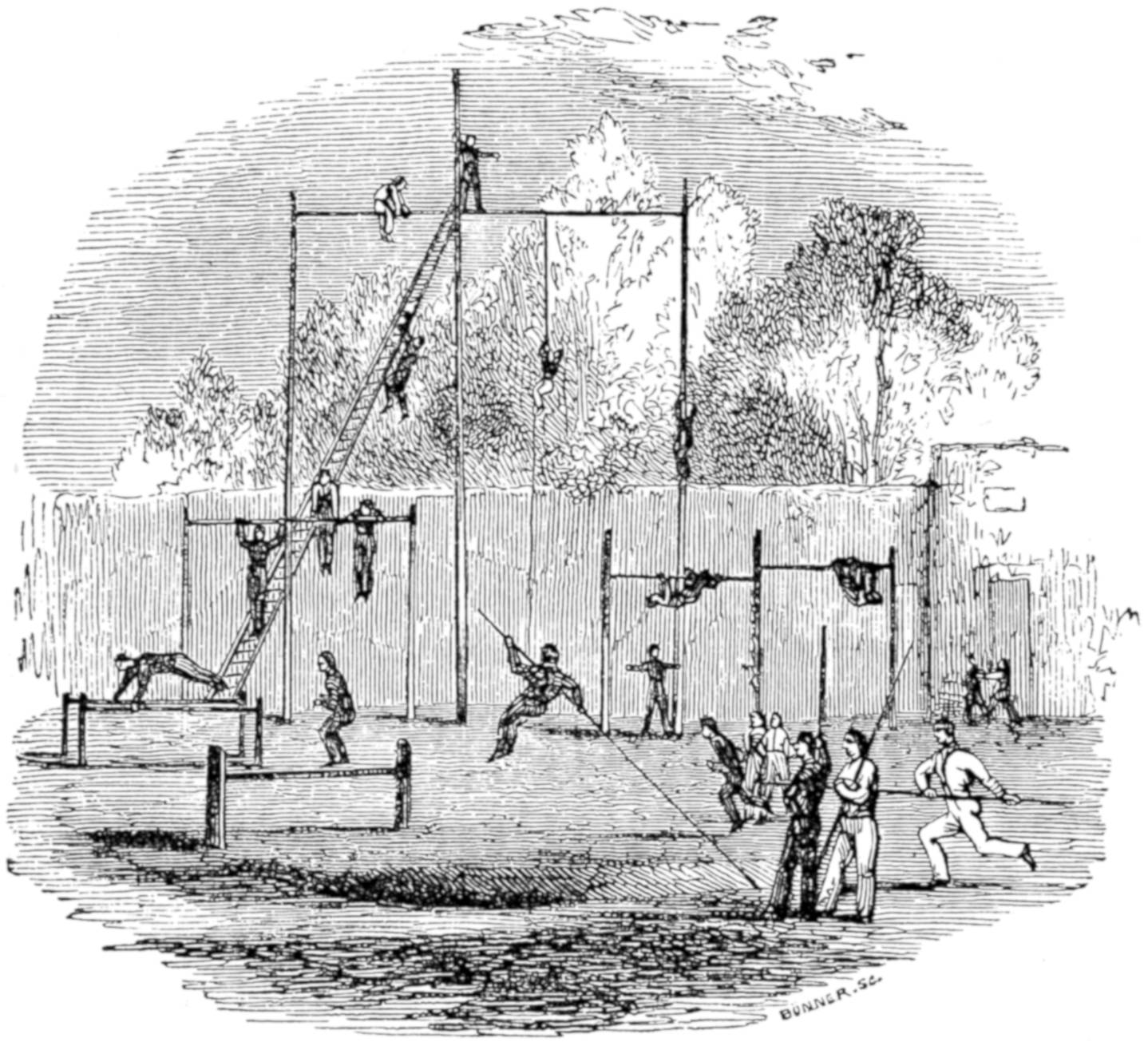
The necessary fittings-up of an exercising ground are a leaping
stand, a vaulting horse, a balancing bar, a climbing stand,
with ladders, poles, and ropes, which may be seen united as
simply and economically as possible, in a subsequent sketch—(Plate
XVIII. Climbing.)
In most exercises, a belt or cincture is of utility; and it seems,
in all ages, to have been naturally employed. The weakest
savage, who could not follow others in the course without panting,
would find, by placing his hand over his abdomen, and
supporting the liver and other organs which descend into that
cavity, that he was aided in running, and breathed more easily;
and thence he would make for himself a belt. United in societies,
men would still preserve their belt, though it might not
seem particularly advantageous, except to those whose active
mode of life approached a primitive state, such as travellers,
couriers, and porters.
The Greeks put on their belts before they commenced
wrestling; and many physicians, both ancient and modern,
recommend the use of belts, as being to the whole of the body,
and to the parts over which they are placed, what the exterior
sheaths or aponeuroses are to the muscles—bands which embrace
and keep firm the parts over which they are placed. The
common belt has leathern straps, and buckles to fasten it, an
iron ring and a pocket. A double cincture for wrestling forms
a very strong girth, which is put on by pupils who are very
strong, when they wrestle. These belts may be made of different
sizes, for youths of different ages: of five or six inches
for tall youths and men, and of eight or ten inches for wrestlers.
Their length is in proportion to the size of the person who uses
them. These belts are very useful in strengthening the abdominal
region in running and leaping. Riders, also, should furnish
themselves with belts before getting on horseback, to prevent
too violent motion of the viscera of the abdomen, and the disorders
which may result from it. The use, indeed, of belts will
by degrees prove their utility, and they will probably be worn
even externally, without reference to physical exercises. They
deserve this the more, because they give an air of lightness and
elegance to the shape, and develope the chest.
The most useful thing in existence is dangerous, if improperly
applied. In very young persons, the chest and abdomen have
been compressed by fastening the belt too tight, or making it
too wide; and disorders of digestion and respiration have consequently
been caused by pushing in the false ribs. This is an
imprudence that should be avoided. If the belt be too low, it
may press too much on the lower part of the belly; if too high,
it may disorder the chest. It must therefore be placed on the
loins, so as to pass over the navel; and, as said before, it must
not be too tight. Having given these ideas of the utility of
belts, and the manner of using them, it remains only to explain
the triple use of those adopted for exercises: 1st, they fulfil, by
their size and other circumstances, all the conditions which
render them useful; 2nd, a pocket serves to inclose the articles
that may be wanted, according to the class of exercises performing;
3rd, an iron ring is intended to suspend, by means of
hooks, any thing we wish to carry, so as to leave the hands at
liberty.
This is important in relation to various exercises to be described.
The art of training for athletic exercises, or laborious
exertions, consists in purifying the body and strengthening its
powers, by certain processes, which are now to be described.
The advantages of it, however, are not confined to pedestrians,
wrestlers, or pugilists; they extend to every one: for, were
training generally introduced, instead of medicine, for the prevention
and cure of diseases, its beneficial consequences would
assuredly prolong life, and promote its happiness. Every physiologist
knows that all the parts which compose the human
body—solids as well as liquids—are successively absorbed and
deposited. Hence ensues a perpetual renovation of them, regulated
by the nature of our food and general habits. The health
of all the parts, and the soundness of their structure, depend
on this perpetual absorption and renovation. Now, nothing so
effectually as exercise excites at once absorption and secretion.
It accordingly promotes all the vital functions without hurrying
them, renovates all the parts, and preserves them apt and fit
for their offices.
It follows, then, that health, vigour, and activity, chiefly depend
upon exercise and regimen; or, in other words, upon the
observance of those rules which constitute the theory of training.
The effect has accordingly corresponded with the cause assigned
in this view of the subject, in every instance where it has been
adopted; and, although not commonly resorted to as the means
of restoring invalids to health, there is every reason to believe
that it would prove effectual in curing many obstinate diseases,
such as bilious complaints, obesity, gout, and rheumatism.
The Ancients entertained this opinion. They were, says a
popular writer on medicine, by no means unacquainted with or
inattentive to these instruments of medicine, although modern
practitioners appear to have no idea of removing disease, or restoring
health, but by pouring drugs into the stomach. Heroditus
is said to have been the first who applied the exercises
and regimen of the Gymnasium to the removal of disease, or
the maintenance of health. Among the Romans, Asclepiades
carried this so far, that he is said, by Celsus, almost to have
banished the use of internal remedies from his practice. He was
the inventor of various modes of exercise and gestation, in Rome.
In his own person, he afforded an excellent example of the
wisdom of his rules, and the propriety of his regimen. Pliny
tells us that, in early life, he made a public profession, that he
would agree to forfeit all pretensions to the name of a physician,
should he ever suffer from sickness, or die but of old age; and,
what is extraordinary, he fulfilled his promise, for he lived upwards
of a century, and at last was killed by a fall down stairs.
As to the locomotive system, modern experience sufficiently
proves that exercise is the most powerful strengthener of the
muscles, and of every part on which activity depends. In its
operation on the vital system, training always appears to benefit
the state of the lungs. Indeed, one of its most striking effects
is to improve the wind: that is, to enable a man to draw a larger
inspiration, and to hold his breath longer. As to the intellectual
system, Sir J. Sinclair observes, that, by training, the mental
faculties are also improved; the attention being more ready,
and the perception more acute, owing probably to the clearness
of the stomach, and better digestion.
It must, therefore, be admitted, that the most beneficial consequences
to general health arise from training. The simplicity
of the rules for it is assuredly a great recommendation to a trial
of the experiment. The whole process may be resolved into
the following principles:—1st, the evacuating, which cleanses
the stomach and intestines; 2nd, the sweating, which takes off
the superfluities of fat and humours; 3rd, the daily course of
exercise, which improves the wind and strengthens the muscles;
and, lastly, the regimen, which nourishes and invigorates the
body. To those who are to engage in corporeal exercises beyond
their ordinary powers, it is indispensably necessary. Pedestrians,
therefore, who are matched either against others or
against time, and pugilists who engage to fight, must undergo
the training process before they contend. The issue of the
contest, if their powers be nearly equal, will, in a great measure,
depend upon their relative condition, as effected by training, at
the hour of trial.
Training was known to the ancients, who paid much attention
to the means of augmenting corporeal vigour and activity.
Accordingly, among the Greeks and Romans, certain rules of
exercise and regimen were prescribed to the candidates for
gymnastic celebrity. We are assured, that, among the Greeks,
previously to the solemn contests at the public games, the
strictest temperance, sobriety, and regularity in living, were indispensably
requisite. The candidates were, at the same time,
subjected to daily exercise in the Gymnasium, which continued
during ten months, and which, with the prescribed regimen,
constituted the preparatory training adopted by the athletæ of
Greece. Among the Romans, the exercises of the palæstra
degenerated from the rank of a liberal art, and became a profession,
which was embraced only by the lowest of mankind;
the exhibitions of the gladiators being bloody and ferocious
spectacles, which evinced the barbarous taste of the people.
The combatants, however, were regularly trained by proper
exercise, and a strict observance of regimen. Pure and salubrious
air was deemed a chief requisite. Accordingly, the principal
schools of their athletæ were established at Capua and Ravenna,
the most healthy places in Italy; and previous to entering on
this regimen, the men were subjected to the evacuating process,
by means of emetics, which they preferred to purgatives.
In the more early stages of training, their diet consisted of
dried figs, new cheese, and boiled grain. Afterwards animal
food was introduced as a part of the athletic regimen, and pork
was preferred to any other. Galen, indeed, asserts, that pork
contains more real nutriment than flesh of any other kind,
which is used as food by man. This fact, he adds, is decidedly
proved by the example of the athletæ, who, if they live but for
one day on any other kind of food, find their vigour manifestly
impaired the next. The preference given to pork by the ancients,
however, does not correspond with the practice of modern
trainers, who entirely reject it; but in the manner of preparing
the food, they exactly agree—roasting or broiling being by both
preferred to boiling, and bread unfermented to that prepared by
leaven. A very small quantity of liquid was allowed to the
athletæ, and this was principally water. They exercised in the
open air, and became familiarized by habit to every change of
the weather, the vicissitudes of which soon ceased to affect
them.
To exercise their patience, and accustom them to bear pain
without flinching, they were occasionally flogged on the back
with the branches of a kind of rhododendron, till the blood
flowed. By diminishing the quantity of the circulating liquid,
this rough kind of cupping was also considered salutary! as obviating
the tendency to plethora or redundancy of blood, to
which they were peculiarly liable—a proof, if true, of the nourishing
qualities of their food.
When the daily exercises of the athletæ were finished, they
were refreshed by immersion in a tepid bath, where the perspiration
and sordes—scurf, pustules, or filthy adhesions—were
carefully removed from the surface of the body by the use of
the strygil.[1] The skin was then diligently rubbed dry, and
again anointed with oil. If thirsty, they were permitted to
drink a small quantity of warm water. They then took their
principal repast, after which they used no more exercise that
day. They occasionally also went into the cold bath in the
morning. They were permitted to sleep as many hours as they
chose; and great increase of vigour, as well as of bulk, was
supposed to be derived from long-continued and sound repose.[2]
The sexual intercourse was strictly prohibited.
The manner of training among the ancients bears some resemblance
to that practised by the moderns. Perhaps it is
because their mode of living and general habits were somewhat
different from those of the present age, that a difference of
treatment is now required to produce the same effects. The
great object of training for running or boxing matches, is to
increase the muscular strength, and to improve the free action
of the lungs, or wind, of the person subjected to the process.
Seeing that the human body is so capable of being altered and
renovated, it is not surprising that the art of training should be
carried to a degree of perfection almost incredible; and that, by
certain processes, the muscular power, the breath (or wind), and
the courage of man, should be so greatly improved as to enable
him to perform the most severe or laborious undertakings.
That such effects have been produced is unquestionable: they
are fully exemplified in the astonishing exploits of our most
celebrated pedestrians and pugilists, which are the infallible results
of such preparatory discipline. The skilful trainer attends
to the state of the bowels, the lungs, and the skin; and he uses
such means as will reduce the fat, and at the same time invigorate
the muscular fibre. The patient is purged by drastic medicines;
he is sweated by walking under a load of clothes, and by
lying between feather beds; and his limbs are roughly rubbed.
His diet is beef or mutton: his drink strong ale. He is gradually
inured to exercise, by repeated trials in walking and running.
By extenuating the fat, emptying the cellular substance, hardening
the muscular fibre, and improving the breath, a man of the
ordinary frame may be made to fight for one hour, with the utmost
exertion of strength and courage, or to go over one hundred
miles in twenty-four hours.
The most effectual process for training appears to be that
practised by Captain Barclay, which has not only been sanctioned
by professional men, but has met with the unqualified approbation
of amateurs. We are here, therefore, almost entirely indebted
to it for details. According to this method, the pedestrian,
who may be supposed in tolerable condition, enters upon
his training with a regular course of physic, which consists of
three doses. Glauber’s salts are generally preferred; and from
one ounce and a half to two ounces are taken each time, with
an interval of four days between each dose. After having gone
through the course of physic, he commences his regular exercise,
which is gradually increased as he proceeds in the training.
When the object in view is the accomplishment of a pedestrian
match, his regular exercise may be from twenty to twenty-four
miles a day. He must rise at five in the morning, run half
a mile at the top of his speed up-hill, and then walk six miles
at a moderate pace, coming in about seven to breakfast, which
should consist of beef-steaks or mutton-chops under-done, with
stale bread and old beer. After breakfast, he must again walk
six miles at a moderate pace, and at twelve lie down in bed,
without his clothes, for half an hour. On getting up, he must
walk four miles, and return by four to dinner, which should also
be beef-steaks or mutton-chops, with bread and beer, as at
breakfast. Immediately after dinner, he must resume his exercise,
by running half a mile at the top of his speed, and walking
six miles at a moderate pace. He takes no more exercise for
that day, but retires to bed about eight; and next morning he
proceeds in the same manner.
Animal diet, it will be observed, is, according to this system,
alone prescribed, and beef and mutton are preferred. All fat
and greasy substances are prohibited, as they induce bile, and
consequently injure the stomach. The lean of meat contains
more nourishment than the fat; and, in every case, the most
substantial food is preferable to any other kind. Fresh meat is
the most wholesome and nourishing. Salt, spiceries, and all
kinds of seasonings, with the exception of vinegar, are prohibited.
The lean, then, of fat beef cooked in steaks, with very
little salt, is the best; and it should be rather under-done than
otherwise. Mutton, being reckoned easy of digestion, may be
occasionally given, to vary the diet and gratify the taste. The
legs of fowls are also esteemed.
It is preferable to have the meat broiled, as much of its nutritive
quality is lost by roasting or boiling. It ought to be dressed
so as to remain tender and juicy; for it is by these means that
it will be easily digested, and afford most nourishment. Biscuit
and stale bread are the only preparations of vegetable matter
which are permitted to be given; and every thing inducing
flatulency must be carefully avoided. In general, the quantity
of aliment is not limited by the trainer, but left entirely to the
discretion of the pedestrian, whose appetite should regulate him
in this respect.
With respect to liquors, they must be always taken cold; and
home-brewed beer, old, but not bottled, is the best. A little
red wine, however, may be given to those who are not fond of
malt liquor; but never more than half a pint after dinner. It is
an established rule to avoid liquids as much as possible; and no
more liquor of any kind is allowed to be taken than is requisite
to quench the thirst.
After having gone on in this regular course for three or four
weeks, the pedestrian must take a four-mile sweat, which is produced
by running four miles in flannel, at the top of his speed.
Immediately on returning, a hot liquor is prescribed, in order to
promote the perspiration; and of this he must drink one English
pint. It is termed the sweating liquor, and is composed of one
ounce of carraway seed, half an ounce of coriander seed, one
ounce of root-liquorice, and half an ounce of sugar-candy, mixed
with two bottles of cyder, and boiled down to one-half. He is
then put to bed in his flannels, and, being covered with six or
eight pair of blankets, and a feather bed, must remain in this
state from twenty-five to thirty minutes, when he is taken out,
and rubbed perfectly dry. Being then well wrapt in his great
coat, he walks out gently for two miles, and returns to breakfast,
which, on such occasions, should consist of a roasted fowl.
He afterwards proceeds with his usual exercise.
These sweats are continued weekly, till within a few days of
the performance of the match; or, in other words, he must
undergo three or four of these operations. If the stomach of
the pedestrian be foul, an emetic or two must be given about a
week before the conclusion of the training. He is now supposed
to be in the highest condition.
Besides his usual or regular exercise, a person under training
ought to employ himself, in the intervals, in every kind of exertion
which tends to activity, such as golf, cricket, bowls, throwing
quoits, &c., so that, during the whole day, both body and
mind may be constantly occupied. Although the chief parts of
the system depend upon sweating, exercise, and feeding, yet the
object to be obtained by the pedestrian would be defeated, if
these were not adjusted each to the other, and to his constitution.
The trainer, before he proceeds to apply his theory, should
make himself acquainted with the constitution and habits of his
patient, that he maybe able to judge how far he can, with safety,
carry on the different parts of the process. The nature of the
patient’s disposition should also be known, that every cause of
irritation may be avoided; for, as it requires great patience and
perseverance to undergo training, every expedient to sooth and
encourage the mind should be adopted.
The skilful trainer will, moreover, constantly study the progress
of his art, by observing the effect of its processes, separately
and in combination. If a man retain his health and spirits
during the process, improve in wind, and increase in strength,
it is certain that the object aimed at will be obtained; but, if
otherwise, it is to be apprehended that some defect exists,
through the unskilfulness or mismanagement of the trainer,
which ought instantly to be remedied by such alterations as the
circumstances of the case may demand. It is evident, therefore,
that in many instances the trainer must be guided by his
judgment, and that no fixed rules of management can, with
absolute certainty, be depended upon, for producing an invariable
and determinate result. In general, however, it may be
calculated, that the known rules are adequate to the purpose, if
the pedestrian strictly adhere to them, and the trainer bestow a
moderate degree of attention to his state and condition during
the progress of training.
It is impossible to fix any precise period for the completion
of the training process, as it depends upon the previous condition
of the pedestrian; but from two to three months, in most
cases, will be sufficient, especially if he be in tolerable condition
at the commencement, and possessed of sufficient perseverance
and courage to submit cheerfully to the privations and hardships
to which he must unavoidably be subjected. The criterion by
which it may be known whether a man is in good condition—or,
what is the same thing, whether he has been properly trained—is
the state of the skin, which becomes smooth, elastic, and well-coloured,
or transparent. The flesh is also firm; and the person
trained feels himself light, and full of spirits. In the progress
of the training, his condition may also be ascertained by the
effect of the sweats, which cease to reduce his weight; and by
the manner in which he performs one mile at the top of his
speed. It is as difficult to run a mile at the top of one’s speed
as to walk a hundred; and therefore, if he performs this short
distance well, it may be concluded that his condition is perfect,
or that he has derived all the advantages which can possibly result
from the training process.
A few words may be here added on the comparative strength
of different races of men. In order to procure some exact results
on this point, Peron took with him on his voyage an instrument
called a dynamometer, so constructed as to indicate
on a dial-plate the relative force of individuals submitted to experiment.
He directed his attention to the strength of the arms
and of the loins, making trial with several individuals of each of
the races among whom he then was, viz., twelve natives of Van
Diemen’s Land, seventeen of New Holland, fifty-six of the Island
of Timor, seventeen Frenchmen belonging to the expedition, and
fourteen Englishmen in the colony of New South Wales. The
following numbers express the mean result in each case, but all
the details are given in a tabular form in the original:—
| |
Strength
of the Arms. |
Strength
of the Loins. |
| Kilogrammes. |
Myriagrammes. |
| 1. Van Diemen’s Land |
50.6 |
|
| 2. New Holland |
50.8 |
10.2 |
| 3. Timor |
58.7 |
11.6 |
| 4. French |
69.2 |
15.2 |
| 5. English |
71.4 |
16.3 |
The highest numbers in the first and second class were, respectively,
60 and 62; the lowest in the English trials 63, and
the highest 83, for the strength of the arms. In the power of
the loins, the highest among the New Hollanders was 13; the
lowest of the English 12.7, and the highest 21.3. “These results,”
observes Mr. Lawrence, “offer the best answer to declamations
on the degeneracy of civilized man. The attribute
of superior physical strength, so boldly assumed by the eulogists
of the savage state, has never been questioned or doubted.
Although we have been consoled for this supposed inferiority by
an enumeration of the many precious benefits derived from
civilization, it has always been felt as a somewhat degrading disadvantage.
Bodily strength is a concomitant of good health,
which is produced and supported by a regular supply of wholesome
and nutritious food, and by active occupation. The industrious
and well-fed middle classes of a civilized community
may, therefore, be reasonably expected to surpass, in this endowment,
the miserable savages, who are never well-fed, and
too frequently depressed by absolute want and all other privations.
Before entering into a detail of exercises, it is necessary to
attend to what is termed position.—A standing position is the
action by which we keep ourselves up. Indeed, this state, in
which the body appears in repose, is itself an exercise, for it
consists in a continued effort of many muscles; and the explanation
we shall give of it will much facilitate that of walking.
Every one has observed that during sleep, or a fainting fit,
the head inclines forward and falls upon the breast. In this
case, it is in accordance with the laws of gravity; for the
head, resting upon the vertebræ which support it at a point
of its basis which is nearer the posterior than anterior part,
cannot remain in an upright position in standing, except by
an effort of the muscles at the back of the neck: it is the
cessation of this effort that causes it to fall forward. The
body also is unable to remain straight without fatigue. The
vertebral column being placed behind, all the viscera or parts
contained by the chest and belly are suspended in front of
it, and would force it to bend forward unless strong muscular
fibres held it back. A proof of this may be seen in pregnant
and dropsical women, who are compelled, in consequence of the
anterior part of the body being heavier than usual, to keep
the vertebral column more fixed, and even thrown backward.
The same observation may be made with regard to the pelvis,
basin, or lowest part of the trunk, which by its conformation
would bend upon the thighs, if not kept back by the great
mass of muscular fibres that form the hips. In front of the
thighs, again, are the muscles which, by keeping the kneepan
in position, are the means of preventing the leg from bending.
Lastly, the muscles forming the calves, by contracting, are the
means of preventing the leg from bending upon the foot.
Such is the general mechanism of the standing position. It
is, therefore, as we observed, a concurrence of efforts: almost
all the extending muscles are in a state of contraction all the
time that this position is maintained, and the consequence is,
a fatigue which cannot be endured for any great length of time.
Hence we see persons in a standing position rest the weight of
their body, first on one foot, then on another, for the purpose
of procuring momentary ease to certain muscles. For this
reason, also, standing still is more fatiguing than walking, in
which the muscles are alternately contracted and extended.
A question of importance on this subject is, what position of
the feet affords the greatest solidity in standing? We will not
enter into a detail of the numerous controversies by which some
have defended or repudiated the position with the toes turned
forward or outward: it will be sufficient to state the fact, that
the larger the base of support, the firmer and more solid will
the position be, and to adopt, as a fundamental one, the
military position, which has been found practically the best by
those who have nothing else to do but to walk. The equal
squareness of the shoulders and body to the front, is the first
great principle of position. The heels must be in a line, and
closed; the knees straight; the toes turned out, with the
feet forming an angle of sixty degrees; the arms hanging
close to the body; the elbows turned in, and close to the
sides; the hands open to the front, with the view of preserving
the elbow in the position above described; the little
fingers lightly touching the clothing of the limbs, with the
thumb close to the forefinger; the belly rather drawn in, and
the breast advanced, but without constraint; the body upright,
but inclining forward, so that the weight of it may principally
bear upon the fore part of the feet; the head erect, and the eyes
straight to the front—(as in Plate I. fig. 1.)
To these brief directions I must add, that, in standing, the
whole figure should be in such a position that the ear, shoulder,
haunch, knee, and ankle are all in a line; that it must be
stretched as much as possible, by raising the back of the head,
drawing in the chin, straightening the spine, rising on the hips,
and extending the legs; that the object of keeping the back
thus straight is to allow of standing longer without fatigue; that
it is important to expand the chest, and to throw the shoulders
back, with the shoulder-blades, or scapulæ, quite flat behind;
and that though, in military instructions, the body is thus inclined
forward in standing without arms, yet when these are
assumed, the body is immediately thrown about two inches
backward, into a nearly perpendicular position. This position,
therefore, will be modified in walking, and especially in ordinary
walking; but it is an excellent fundamental position, and it
cannot be too accurately acquired.
This is the amount of the drill-sergeant’s instructions as to
position, though this last part is omitted in the Manual describing
the Field Exercise and Evolutions of the Army.
In order to supple the figure, open the chest, and give freedom
to the muscles, the first three movements of the extension
motions, as laid down for the sword exercise, are ordered to be
practised. It is indeed, observed, that too many methods cannot
be used to improve the carriage, and banish a rustic air;
but that the greatest care must be taken not to throw the
body backward instead of forward, as being contrary to every
true principle of movement. I accordingly here introduce these
extension motions, adding the fourth and fifth, and prefixing to
each the respective word of command, in order that they may
be the more distinctly and accurately executed.
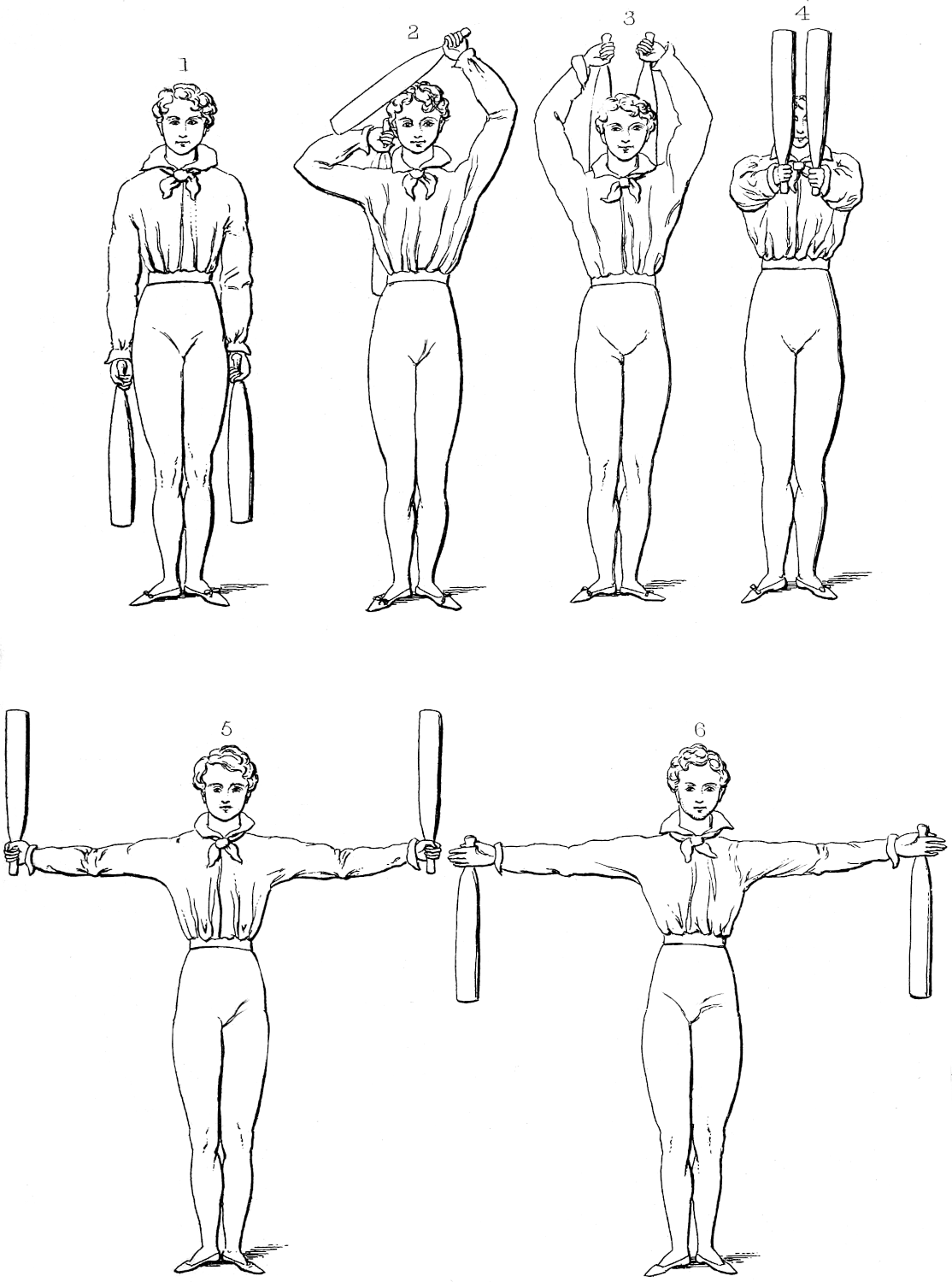
Plate I
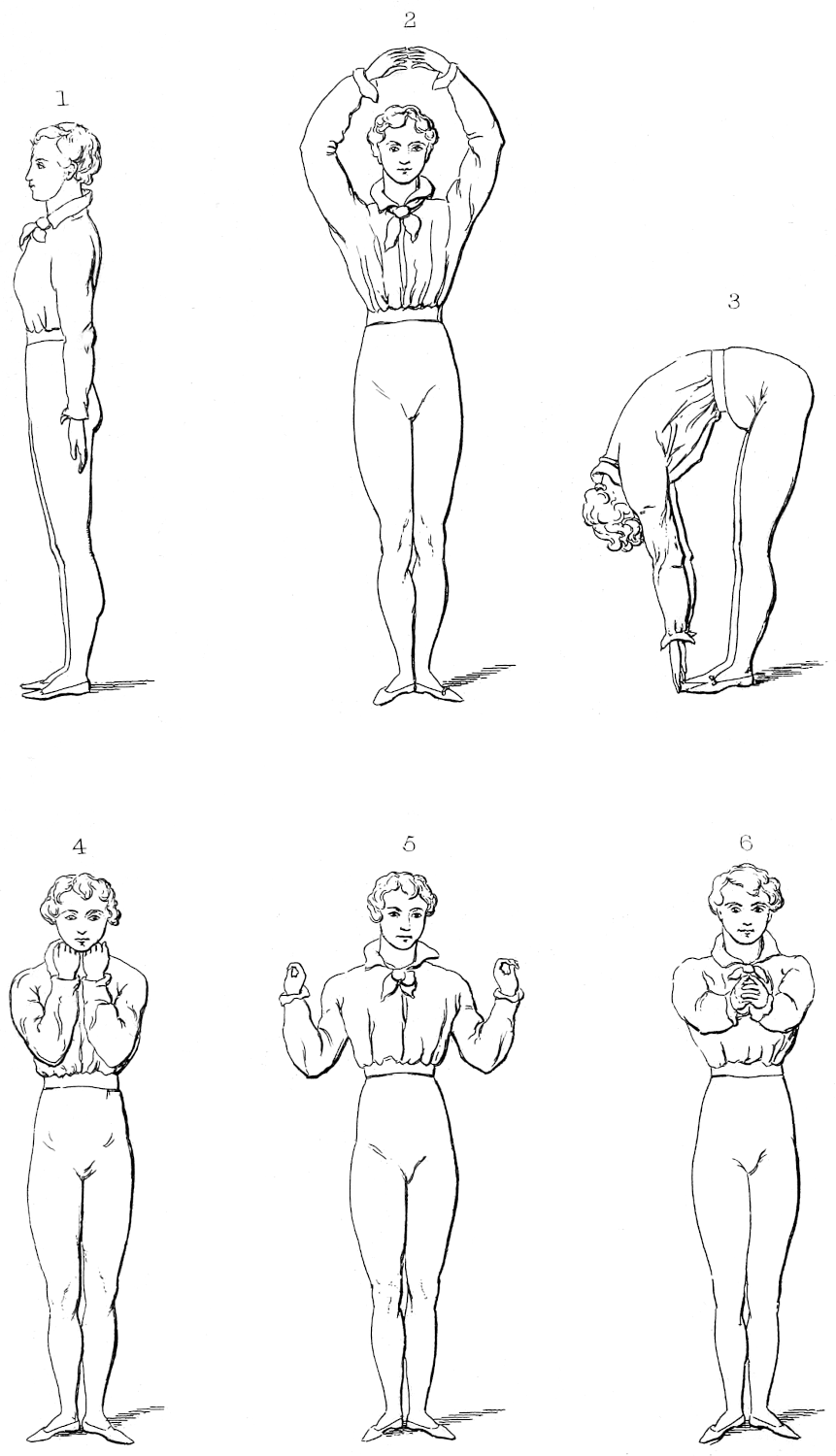
Extension Motions.
Attention.—The body is to be erect, the heels close together,
and the hands hanging down on each side. First Extension
motion.—This serves as a caution, and the motions tend to expand
the chest, raise the head, throw back the shoulders, and
strengthen the muscles of the back.
One—Bring the hands and arms to the front, the fingers
lightly touching at the points, and the nails downwards; then
raise them in a circular direction well above the head, the ends
of the fingers still touching, the thumbs pointing to the rear,
the elbows pressed back, and shoulders kept down. (Plate I.
fig. 2.)
Two—Separate and extend the arms and fingers, forcing
them obliquely back, till they come extended on a line with the
shoulders; and as they fall gradually from thence to the original
position of Attention, endeavour, as much as possible, to elevate
the neck and chest. These two motions should be frequently
practised, with the head turned as much as possible to
the right or left, and the body kept square to the front: this
tends very materially to supple the neck, &c.
Three—Turn the palms of the hands to the front, pressing
back the thumbs with the arms extended, and raise them to the
rear, till they meet above the head; the fingers pointing upwards,
with the ends of the thumbs touching.
Four—Keep the arms and knees straight, and bend over from
the hips till the hands touch the feet, the head being brought
down in the same direction. (Plate I. fig. 3.)
Five—With the arms flexible and easy from the shoulders,
raise the body gradually, so as to resume the position of Attention.
The whole should be done very gradually, so as to feel
the exertion of the muscles throughout. To these extension
motions, drill-sergeants, in their instructions, add the following:
One—the forearms are bent upon the arms upward and toward
the body, having the elbows depressed, the shut hands
touching on the little-finger sides, and the knuckles upward, the
latter being raised as high as the chin, and at the distance of
about a foot before it. (Plate I. fig. 4.)
Two—While the arms are thrown forcibly backward, the fore-arms
are as much as possible bent upon the arms, and the
palmar sides of the wrists are turned forward and outward
(Plate I. fig. 5.) The two motions are to be repeatedly and
rather quickly performed. A modification of the same movement
is performed as a separate extension motion, but may be
given in continuation, with the numbers following these, as
words of command.
Three—The arms are extended at full length in front, on a
level with the shoulder, the palms of the hands in contact.
(Plate I. fig. 6.)
Four—Thus extended, and the palms retaining their vertical
position, the arms are thrown forcibly backward, so that the
backs of the hands may approach each other as nearly as possible.
These motions, also, are to be repeatedly and rather
quickly performed. Another extension motion, similarly added,
consists in swinging the right arm in a circle, in which, beginning
from the pendent position, the arm is carried upward in
front, by the side of the head, and downward behind, the object
being in the latter part of this course to throw it as directly
backward as possible. The same is then done with the left arm.
Lastly, both arms are thus exercised together. These motions
are performed quickly.
THE PORTION ADOPTED IN THE ARMY.
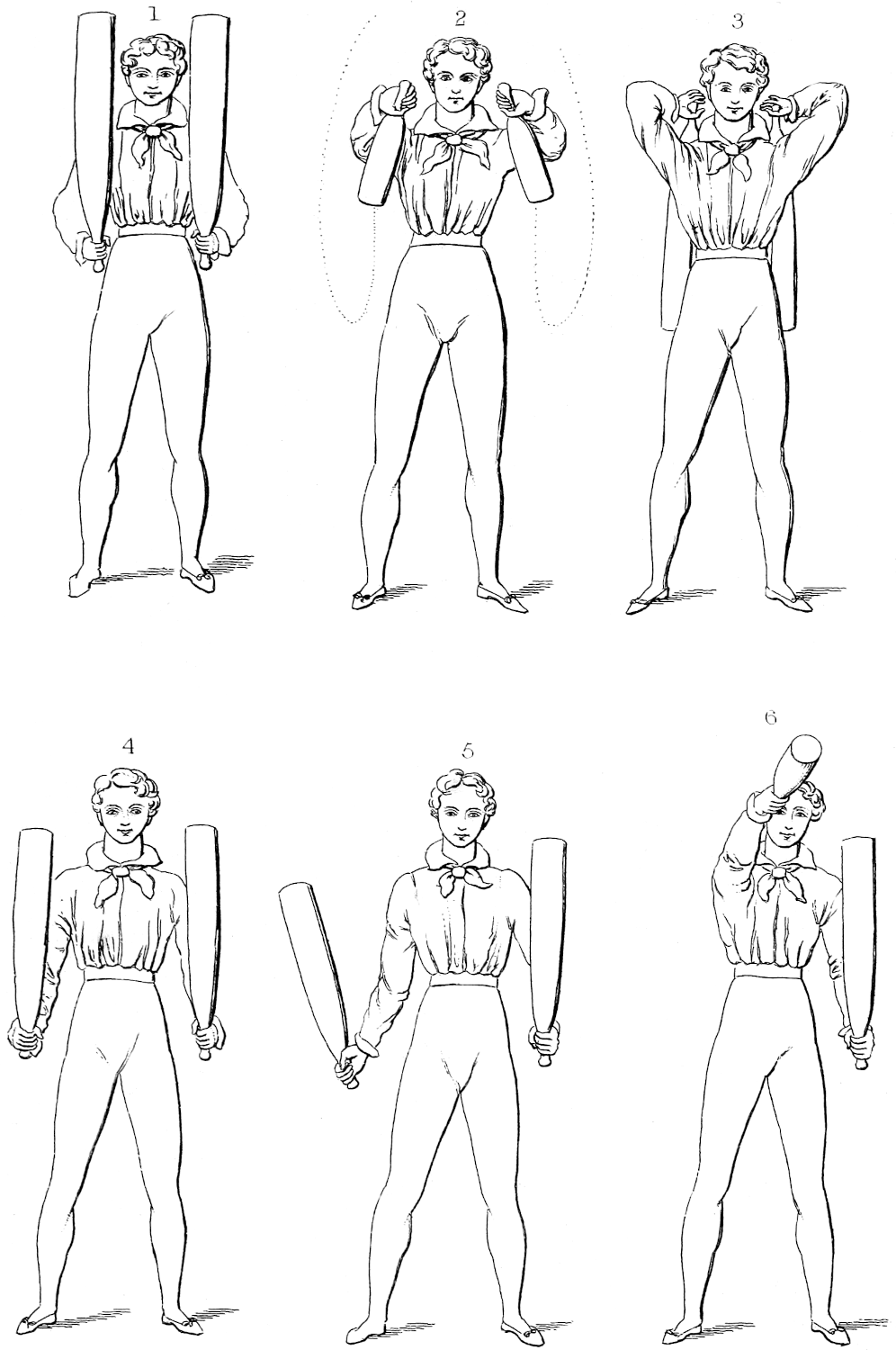
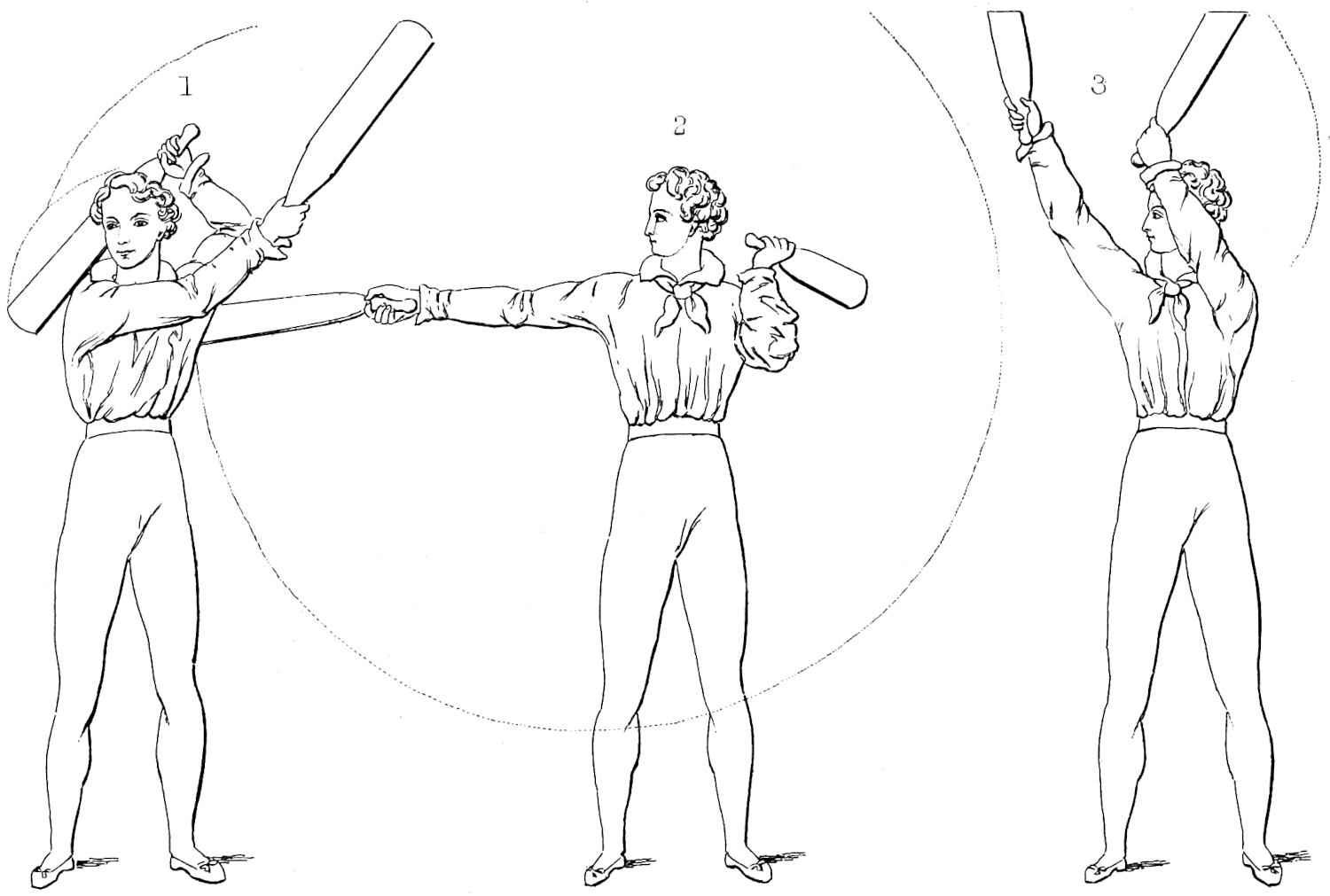
1st. A club is held by the handle, pendent on each side
(Plate II. fig. 1);—that in the right hand is carried over the
head and left shoulder, until it hangs perpendicularly on the
right side of the spine (Plate II. fig. 2); that in the left hand
is carried over the former, in exactly the opposite direction
(Plate II. fig. 2), until it hangs on the opposite side; holding
both clubs still pendent, the hands are raised somewhat
higher than the head (Plate II. fig. 3); with the clubs in the
same position, both arms are extended outward and backward
(Plate II. fig. 6); they are lastly dropped into the first position.
All this is done slowly.
Plate II
Indian Club Exercise.
Plate III
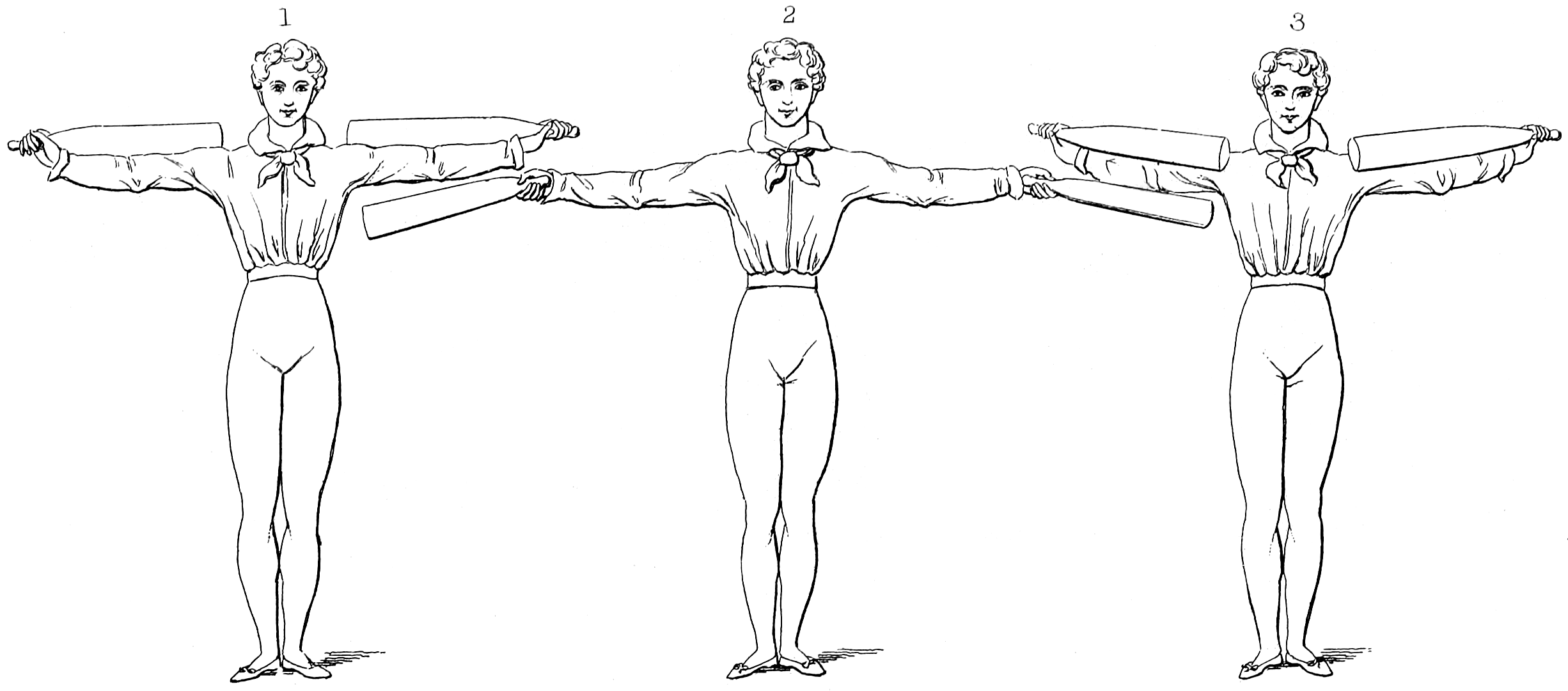
Indian Club Exercise.
Plate IV
Indian Club Exercise.
2nd. Commencing from the same position, the ends of both
clubs are swung upward until they are held, vertically and side
by side, at arm’s length in front of the body, the hands being as
high as the shoulders (Plate II. fig. 4); they are next carried
in the same position, at arm’s length, and on the same level, as
far backward as possible (Plate II. fig. 5); each is then dropped
backward until it hangs vertically downward (Plate II. fig. 6);
and this exercise ends as the first. Previous, however, to
dropping the clubs backward, it greatly improves this exercise,
by a turn of the wrist upward and backward, to carry the clubs
into a horizontal position behind the shoulders, so that, if long
enough, their ends would touch (Plate III. fig. 1); next, by a
turn of the wrist outward and downward, to carry them horizontally
outward (Plate III. fig. 2); then by a turn of the wrist
upward and forward, to carry them into a horizontal position
before the breast (Plate III. fig. 3); again to carry them horizontally
outward; and finally to drop them backward as already
explained; and thence to the first position. All this is also
done slowly.
3rd. The clubs are to be swung by the sides, first separately,
and then together, exactly as the hands were in the last
extension motion.
THE NEW AND MORE BEAUTIFUL PORTION NOW ADDED
FROM THE INDIAN PRACTICE.
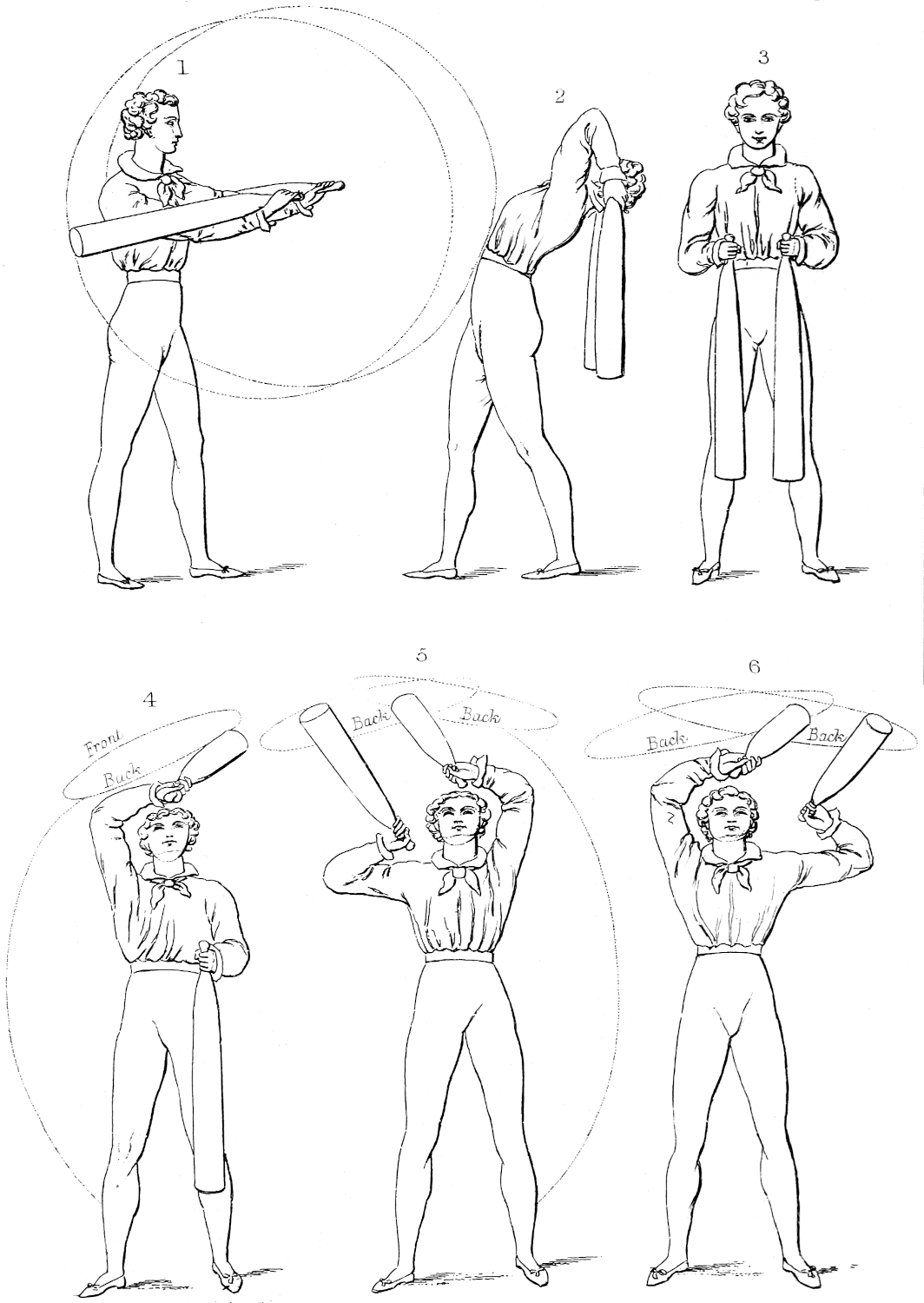
1st. A club is held forward and upright in each hand, the
fore-arm being placed horizontally, by the haunch on each side
(Plate IV. fig. 1); both are thrown in a
circle upward, forward,
and, by a turn of the wrist, downward and backward, so as to
strike under the arms (Plate IV. fig. 2); by an opposite movement,
both are thrown back again in a similar circle, till they
swing over the shoulders (Plate IV. fig. 3); and this movement
is continued as long as agreeable.
2nd. The clubs are held obliquely upward in each hand,
lying on the front of the arms (Plate IV. fig. 4); that in the
right hand is allowed to fall backward (Plate IV. fig. 5), and
swings downward, forward to the extent of the arm, and as high
as the head (Plate IV. fig. 6); the moment this club begins to
return from this point, in precisely the same direction, to the
front of the arm, that in the left hand is allowed to drop backward,
and to perform the advancing portion of this course in
the time that the other performs the returning portion, so that
each is at the same time swinging in an opposite direction.
3rd. From either of the first positions now given, the clubs are,
by a turn of the body and extension of the arms, thrown upwards
and laterally (Plate V. fig. 1);—make, at the extent
of the arms, and in front of the figure, a circle in which they
sweep downward by the feet and upward over the head (Plate
V. fig. 2), and fall in a more limited curve towards the side
on which they began (Plate V. fig. 3), in such a manner
that the outer one forming a circle around the shoulder and the
inner one round the head, (both passing swiftly through the
position in the last figure of the first exercise,) they return to
the first position;—this is repeated to the other side;—and so
on alternately.
4th. Beginning from either first position, the body being
turned laterally,—for example, to the left, the club in the right
hand is thrown upward in that direction at the full extent of the
arm (Plate VI. fig. 1), and makes the large circle in front and
curve behind as in the last exercise (Plate VI. fig. 2), while the
club in the left hand makes at the same time a smaller circle in
front of the head and behind the shoulders (Plate VI. figs. 1,
2, and 3), until crossing each other before the head (rather on
the right side), their movements are exactly reversed, the club
in the right hand performing the small circle round the head,
while that in the left performs the large one,—and these continue
to be repeated to each side alternately.
Plate V
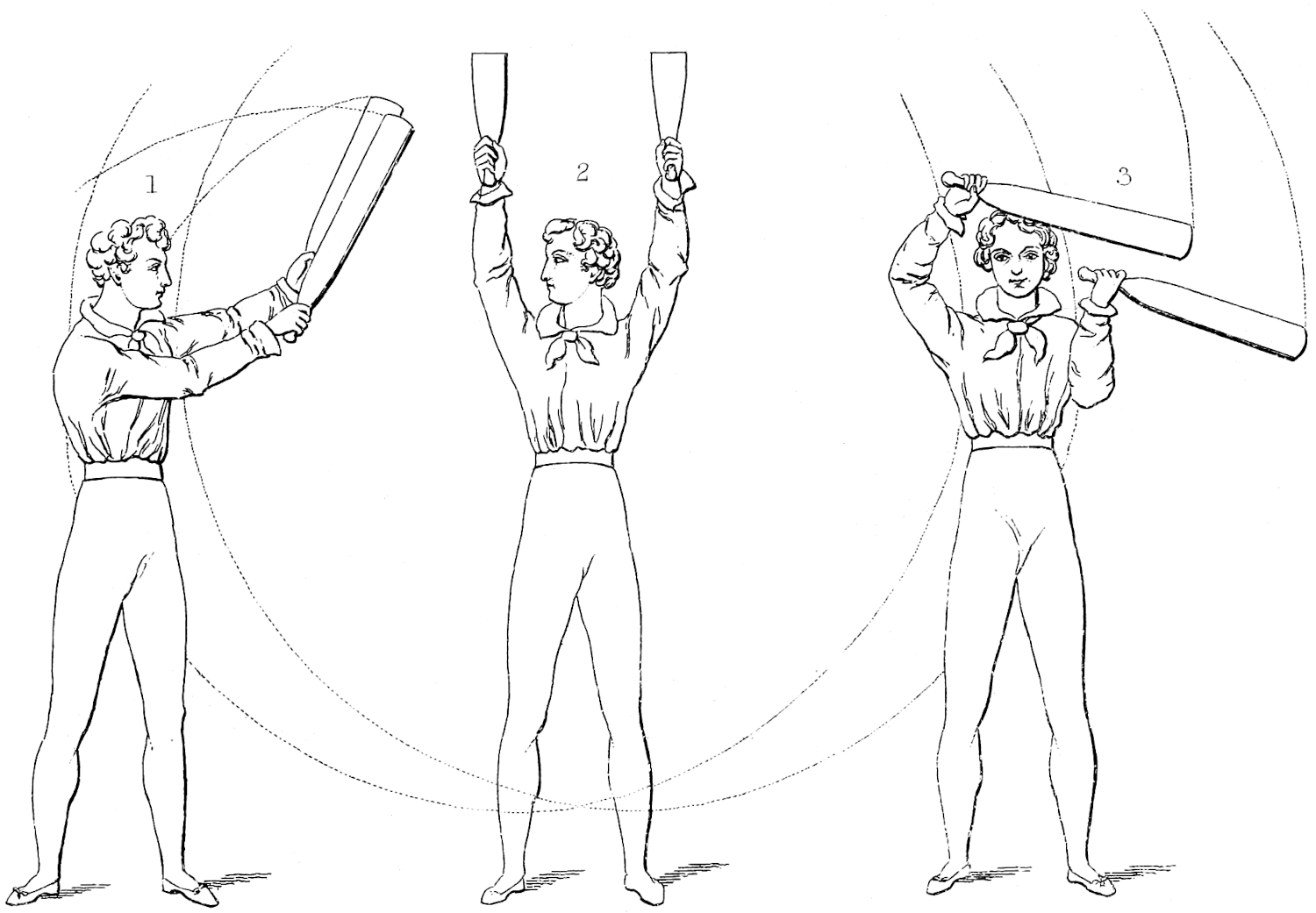
Indian Club Exercise.
Plate VI
Indian Club Exercise.
Plate VII
Indian Club Exercise.
5th. The clubs being in either first position, the body is
turned to one side—the left for example, and the clubs being
thrown out in the same direction, make each, by a turn of the
wrist, a circle three times on the outer side of the outstretched
arms (Plate VII. fig. 1):—when completing the third circle, the
clubs are thrown higher to the same side, sweeping together in
the large circle in front, as in the second exercise, the body
similarly turning to the right; but, instead of forming the smaller
curve behind, both are thrown over the back (Plate VII. fig. 2);—from
this position the clubs are thrown in front, which is now
toward the opposite side, and the same movements are reversed;—and
so it proceeds alternately to each side.
6th. In this exercise, the clubs are reversed, both being pendent
in front, but the ends of their handles being upward on the
thumb sides of the hands. (Pl VII. fig. 3.) The exercise consists
chiefly in describing with the ends of the clubs two circles
placed obliquely to each other over the head. For this purpose,
the club in the right hand is, in a sweep to that side, first elevated
behind the head, and thence passing to the left (Plate VII.
fig. 4), the front, the right (Plate VII. fig. 5) behind, (where its
continuation is indicated in fig. 5, and completed in fig. 6),
thus forms its circle;— meanwhile the club in the left hand,
commencing when that in the right was behind the head, has
passed on the back of its circle to the right, (Plate VII. fig. 5,)
while that in the right hand has passed on the front of its circle
to the same side (Plate VII. fig. 5, the parts performed in both
being marked by complete lines, and the parts to be done merely
indicated);—and they continue, that in the right hand by the
back, and that in the left hand by the front, toward the left
side (Plate VII. fig. 6), and so on at pleasure, circling over the
head.
[Although but two-thirds of the body, viz., from the loins
upward, are called into operation in this exercise, its importance
must be estimated by the fact that they are precisely those
requiring constant artificial practice, being naturally most
exempted from exertion. As an adjunct to Training, there
is nothing in the whole round of gymnastic performances that
will be found of more essential service than this exercise with
the Indian clubs. It demands but little muscular exertion, and
such as it does require calls chiefly upon that portion of the
system which it finds in a state of comparative repose.]
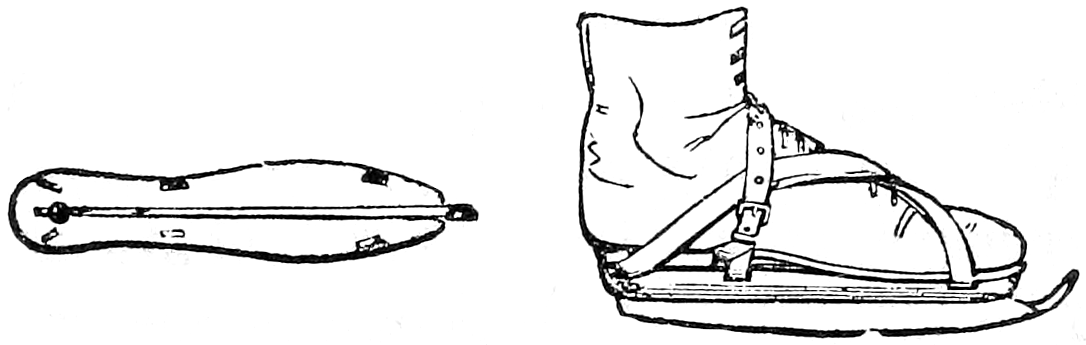
LOCOMOTIVE EXERCISES. — THE BALANCE STEP. — 1.—WITHOUT GAINING GROUND. — 2.—GAINING GROUND BY THE WORD “FORWARD.” — WALKING. — GENERAL MECHANISM OF WALKING. — THE SLOW WALK, OR MARCH. — THE MODERATE AND THE QUICK PACE. — THE MODERATE PACE. — THE QUICK PACE. — SLOW STEP. — QUICK STEP. — DOUBLE MARCH. — FEATS IN WALKING. — RUNNING. — POSITION IN RUNNING. — ACTION IN RUNNING. — RESPIRATION. — MODERATE RUNNING. — RAPID RUNNING. — FEATS IN RUNNING. — EFFECTS OF RUNNING. — LEAPING. — THE HIGH LEAP. — Feats in High Leaping. — THE LONG LEAP. — Feats in Long Leaping. — THE DEEP LEAP. — THE DEEP LEAP BACKWARDS, FROM A REST ON THE HANDS. — VAULTING. — OBLIQUE VAULTING. — STRAIGHT-FORWARD VAULTING. — LEAPING WITH A POLE. — THE HIGH LEAP WITH A POLE. — THE LONG LEAP WITH A POLE. — THE DEEP LEAP WITH A POLE. — BALANCING. — POSITION AND ACTION IN BALANCING. — TURNS IN BALANCING. — CARRYING WEIGHT. — THROWING THE DISCUS. — CLIMBING. — KINDS OF CLIMBING. — SKATING. — CONSTRUCTION OF THE SKATE. — DRESS OF THE SKATER. — PRELIMINARY AND GENERAL DIRECTIONS. — THE ORDINARY RUN, OR INSIDE EDGE FORWARD. — THE FORWARD ROLL, OR OUTSIDE EDGE. — FIGURE OF THREE, OR INSIDE EDGE BACKWARDS. — OUTSIDE EDGE BACKWARDS. — DANGERS IN SKATING. — TREATMENT RECOMMENDED IN THE CASE OF DROWNED PERSONS.
In Walking, the position is nearly the same as that already
described under the head Position.
The head should be upright, easy, and capable of free motion,
right, left, up, or down, without affecting the body. The body
must be kept erect and square to the front, having the breast
projected, and the stomach retracted, though not so as to injure
either freedom of respiration or ease of attitude. The shoulders
should be kept moderately and equally back and low; and the
arms should hang unconstrainedly by the sides. The balance
on the limbs must be perfect. The knees straight, and the
toes turned out as described, the weight of the body should
be thrown forward, as this facilitates progression. The military
position in walking does not essentially differ from this, except
in points that exclusively regard the soldier; as that the head
be kept well up, and straight to the front, and the eyes not
turned to the right or left; the arms and hands kept perfectly
steady by the sides, and on no account suffered to move or
vibrate: care, however, being taken that the hand does not
cling to the thigh, or partake in the least degree of the movement
of the limb.
The object of this is to teach the free movement of the limbs,
preserving at the same time perfect squareness of the shoulders,
with the utmost steadiness of body; and no labour is spared
to attain this first and most essential object, which forms, indeed,
the very foundation of good walking. The instructor
must be careful that a habit be not contracted of drooping or
throwing back a shoulder at these motions, which are intended
practically to show the true principles of walking, and that
steadiness of body is compatible with perfect freedom in the
limbs.
To insure precision, the military words of command are
prefixed.
Caution—Balance step without gaining ground, commencing
with the left foot. The left foot is brought gently forward with
the toe at the proper angle to the left, the foot about three
inches from the ground, the left heel in line with the toe of the
right foot.
Rear—When steady, the left foot is brought gently back
(without a jerk), the left knee a little bent, the left toe brought
close to the right heel. The left foot in this position will not
be so flat as to the front, as the toe will be a little depressed.
Front—When steady, the word Front will be given as above,
and repeated to the Rear three or four times.
Halt—To prevent fatigue, the word Halt will be given, when
the left foot, either advanced, or to the rear, will be brought to
the right. The instructor will afterwards cause the balance to be
made on the left foot, advancing and retiring the right in the
same manner.
Front—On the word Front, the left foot is brought gently to
the front, without a jerk; the knee gradually straightened as
the foot is brought forward, the toe turned out a little to the
left, and remaining about three inches from the ground. This
posture is continued for a few seconds only in the first instance,
till practice gives steadiness in the position.
Forward—On this word of command, the left foot is brought
to the ground, at about thirty inches from heel to heel, while
the right foot is raised at the same moment, and continues extended
to the rear. The body remains upright, but inclining
forward; the head erect, and neither turned to the right nor
left.
Front—On the word Front, the right foot is brought forward,
and so on.
Of all exercises, this is the most simple and easy. The
weight of the body rests on one foot, while the other is advanced;
it is then thrown upon the advanced foot, while the
other is brought forward; and so on in succession. In this
mode of progression, the slowness and equal distribution of
motion is such, that many muscles are employed in a greater or
less degree; each acts in unison with the rest; and the whole
remains compact and united. Hence, the time of its movements
may be quicker or slower, without deranging the union
of the parts, or the equilibrium of the whole. It is owing to
these circumstances, that walking displays so much of the
character of the walker,—that it is light and gay in women and
children, steady and grave in men and elderly persons, irregular
in the nervous and irritable, measured in the affected and
formal, brisk in the sanguine, heavy in the phlegmatic, and
proud or humble, bold or timid, &c., in strict correspondence
with individual character.
The utility of walking exceeds that of all other modes of progression.
While the able pedestrian is independent of stage
coaches and hired horses, he alone fully enjoys the scenes
through which he passes, and is free to dispose of his time as he
pleases. To counterbalance these advantages, greater fatigue
is doubtless attendant on walking: but this fatigue is really the
result of previous inactivity; for daily exercise, gradually increased,
by rendering walking more easy and agreeable, and
inducing its more frequent practice, diminishes fatigue in such
a degree, that very great distances may be accomplished with
pleasure, instead of painful exertion.
Moderate walking exercises the most agreeable influence over
all the functions. In relation to health, walking accelerates
respiration and circulation, increases the temperature and
cutaneous exhalation, and excites appetite and healthful nutrition.
Hence, as an anonymous writer observes, the true
pedestrian, after a walk of twenty miles, comes in to breakfast
with freshness on his countenance, healthy blood coursing in
every vein, and vigour in every limb, while the indolent and inactive
man, having painfully crept over a mile or two, returns
to a dinner which he cannot digest. In all individuals, walking
is indispensably joined with the exercise of one or more of the
external senses. It receives from the cerebral faculties a
powerful influence, by which it is either accelerated or prolonged.
Walking upon soft even ground, at a moderate pace, is an exercise
that may be taken without inconvenience, and even with
advantage, after a meal. It is adapted for convalescents, who
are not yet allowed to take stronger exercise. A firm, yet easy
and graceful walk, is by no means common. There are few
men who walk well if they have not learnt to regulate their
motions by the lessons of a master, and this instruction is still
more necessary for ladies. Having, now, therefore, taken a
general view of the character and utility of walking, I subjoin
some more particular remarks on the
For the purpose of walking, we first bear upon one leg the
weight of the body, which pressed equally on both. The other
leg is then raised, and the foot quits the ground by rising from
the heel to the point. For that purpose, the leg must be bent
upon the thigh, and the thigh upon the pelvis: the foot is then
carried straight forward, at a sufficient height to clear the ground
without grazing it. To render it possible, however, to move
this foot, the haunch, which rested with its weight upon the
thigh, must turn forward and out. As soon as, by this movement,
this foot has passed the other, it must be extended on the
leg, and the leg upon the thigh, and in this manner, by the
lengthening of the whole member, and without being drawn
back, it reaches the ground at a distance in advance of the other
foot, which is more considerable according to the length of the
step, and it is placed so softly on the ground as not to jerk or
shake the body in the slightest degree. As soon as the foot
which has been placed on the ground becomes firm, the weight
of the body is transported to the limb on that side, and the
other foot, by a similar mechanism, is brought forward in its
turn. In all walking, the most important circumstance is, that
the body incline forward, and that the movement of the leg
and thigh spring from the haunch, and be free and natural.
Viewed in this way, the feet have been well compared to the
spokes of a wheel: the weight of the body falling upon them
alternately.
This exercise puts in action the extensors and flexors of the
thighs and legs, a great number of the muscles of the trunk,
and more or less those of the shoulder, according to the rapidity
of the pace, and the greater or less degree of projection communicated
to the arm, which, in this exercise, acts as a balancer
of the body, the motion being exactly the reverse of that
of the corresponding leg. It draws the fluids more into the
inferior than superior members: it gives but little strength
to the latter. Walking may be performed in three different
times,—slow, moderate, or quick—which somewhat modify its
action.
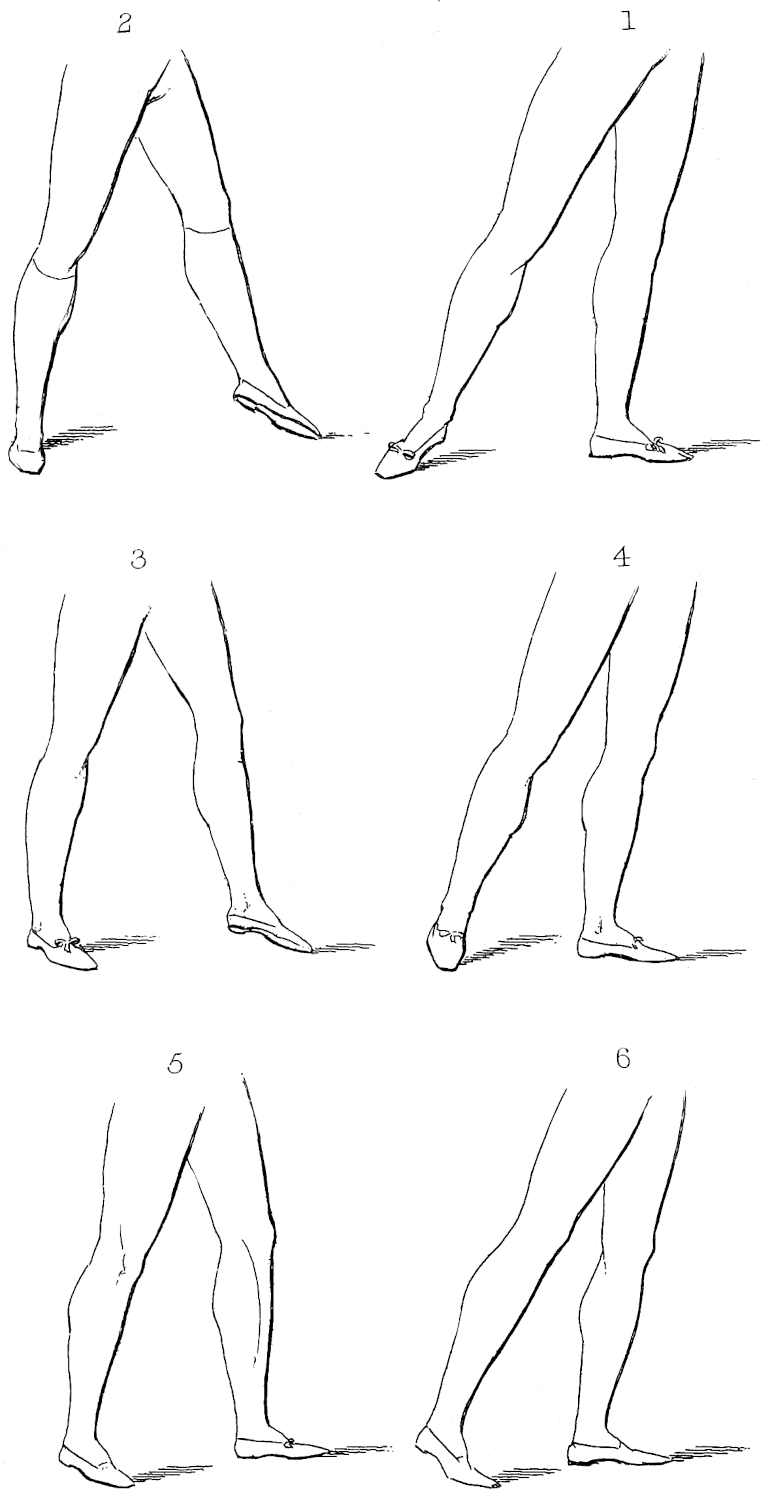
In the march, the weight of the body is advanced from the
heel to the instep, and the toes are turned out. This being
done, one foot, the left for instance, is advanced, with the knee
straight, and the toe inclined to the ground, which, without
being drawn back, it touches before the heel, in such a manner,
however, that the sole, at the conclusion of the step, is nearly
parallel with the ground, which it next touches with its outer
edge; the right foot is then immediately raised from the inner
edge of the toe, and similarly advanced, inclined, and brought
to the ground; and so on in succession. (Plate VIII. figs. 1
and 2.) Thus, in the march, the toe externally first touches,
and internally last leaves the ground; and so marked is this
tendency, that, in the stage step, which is meant to be especially
dignified,—as the posterior foot acquires an awkward flexure
when the weight has been thrown on the anterior,—in order to
correct this, the former is for an instant extended, its toe even
turned backwards and outwards, and its tip internally alone
rested on the ground, previous to its being in its turn advanced.
Thus the toe’s first touching and last leaving the ground, is
peculiarly marked in this grandest form of the march. This
pace should be practised until it can be firmly and gracefully
performed.
These will be best understood by a reference to the pace
which we have just described; the principal difference between
them being as to the advance of the weight of the body, the
turning out of the toes, and the part of the foot which first
touches and last leaves the ground. We shall find that the
times of these two paces require a further advance of the weight,
and suffer successively less and less of turning out the toes, and
of this extended touching with the toe, and covering the ground
with the foot.
Plate VIII
Walking.
Here the weight of the body is advanced from the heel to the
ball of the foot; the toes are less turned out; and it is no longer
the toe, but the ball of the foot, which first touches and last
leaves the ground; its outer edge, or the ball of the little toe,
first breaking the descent of the foot, and its inner edge, or the
ball of the great toe, last projecting the weight—(Plate VIII.
figs. 3 and 4). Thus, in this step, less of the foot may be said
actively to cover the ground; and this adoption of nearer and
stronger points of support and action is essential to the increased
quickness and exertion of the pace.
The mechanism of this pace has not been sufficiently attended
to. People pass from the march to the quick pace they know
not how; and hence all the awkwardness and embarrassment of
their walk when their pace becomes moderate, and the misery
they endure when this pace has to be performed by them, unaccompanied,
up the middle of a long and well-lighted room,
where the eyes of a brilliant assembly are exclusively directed to
them. Let those who have felt this but attend to what we have
here said: the motion of the arms and of every other part depends
on it.
Here, the weight of the body is advanced from the heel to
the toes; the toes are least turned out; and still nearer and
stronger points of support and action are chosen. The outer
edge of the heel first touches the ground, and the sole of the
foot projects the weight.
These are essential to the increased quickness of this pace—(Plate
VIII. figs. 5 and 6); and it is important to remark, as
to all these paces, that the weight is successively more thrown
forward, and the toes are successively less turned out. In the
grandest form of the march, the toes, as we have seen, are, in
the posterior foot, though but for a moment, even thrown backwards;
in the moderate pace, they have an intermediate direction;
and in the quick pace, they are thrown more directly forward,
as in the six figures of Plate VIII.
It is this direction of the toes, and still more the nearer and
stronger points of support and action, namely, the heel and sole
of the foot, which are essential to the quick pace so universally
practised, but which, together with the great inclination of the
body, being ridiculously transferred to the moderate pace, make
unfortunate people look so awkward, as we shall now explain.
The time of the moderate pace is, as it were, filled up by the
more complicated process of the step—by the gradual and easy
breaking of the descent of the foot on its outer edge, or the ball
of the little toe, by the deliberate positing of the foot, by its
equally gradual and easy projection from its inner edge, or the
ball of the great toe. The quick pace, if its time be lengthened,
has no such filling up: the man stumps at once down on his
heel, and could rise instantly from his sole, but finds that, to
fill up his time, he must pause an instant; he feels he should do
something, and does not know what; his hands suffer the same
momentary paralysis as his feet; he gradually becomes confused
and embarrassed: deeply sensible of this, he at last exhibits it
externally; a smile or a titter arises, though people do not well
know at what, but, in short, the man has walked like a clown,
because the mechanism of his step has not filled up its time, or
answered its purpose.
I trust that the mechanism and time of the three paces are
here simply, clearly, and impressively described. The following
is the more imperfect, but still useful, military description, with
its words of command:—
March.—On the word March, the left foot is carried thirty
inches to the front, and, without being drawn back, is placed
softly on the ground, so as not to jerk or shake the body:
seventy-five of these steps to be taken in a minute. (The recruit
is ordered to be carefully trained, and thoroughly instructed in
this step, as an essential foundation for arriving at accuracy in
the paces of more celerity. This is the slowest step at which
troops are to move.)
The cadence of the slow pace having become perfectly habitual,
a quick time is next taught, which is 108 steps in a minute, each
of thirty inches, making 270 feet in a minute.
Quick March.—The command Quick March being given with
a pause between them, the word Quick is to be considered as a
caution, and the whole to remain perfectly steady. On the word
March, the whole move off, conforming to the directions already
given. (This pace is applied generally to all movements by large
as well as small bodies of troops; and therefore the recruit is
trained and thoroughly instructed in this essential part of his
duty.)
The directions for the march apply, in a great degree, to this
step, which is 150 steps in a minute, each of thirty-six inches,
making 450 feet in a minute.
Double March.—On the word Double March, the whole step
off together with the left feet, keeping the head erect, and the
shoulders square to the front; the knees are a little bent; the
body is more advanced than in the other marches; the arms
hang with ease down the outside of the thighs. The person
marching is carefully habituated to the full pace of thirty-six
inches, otherwise he gets into the habit of a short trot, which
defeats the obvious advantages of this degree of march. In the
army, great advantage attends the constant use of the plummet;
and the several lengths swinging the times of the different
marches in a minute, are as follow:—
| |
In. |
Hun. |
| Slow time |
75 |
steps in the |
minute |
24, |
96 |
| Quick time |
108 |
„ |
„ |
12, |
03 |
| Double march |
150 |
„ |
„ |
6, |
26 |
A musket ball, suspended by a string which is not subject to
stretch, and on which are marked the different required lengths,
answers the above purpose, may be easily acquired, and is
directed to be frequently compared with an accurate standard in
the adjutant’s possession. The length of the plummet is to be
measured from the point of suspension to the centre of the ball.
In practising all these paces, the pupils should also be accustomed
to march upon a narrow plane, where there is room for
only one foot, upon rough uneven ground, and on soft ground
which yields to the foot.
Walking exercises a greater influence over the economy when
it takes place on inclined planes than on a flat surface. In
ascending, the effort is made in a direction directly opposed to
the general tendency of heavy bodies: the body is strongly bent,
the upper part of the trunk in advance; the action of the posterior
and anterior muscles of the thigh is considerable; and circulation
and respiration are speedily accelerated by the violence
of the muscular contractions. In descending, on the contrary,
effort is requisite to keep up the body, which tends to obey the
laws of gravitation; and to moderate the tendency of gravity to
project forward in the centre, the body is thrown back, the sacro-spinal
mass, and the posterior muscles of the neck, are strongly
contracted, the knees bent, and the steps much shorter. Men
with long flat feet, and the heel bone little projecting, are bad
walkers.
The power of walking great distances without fatigue is an
important matter, in which the English have of late excelled.
A good walker will do six miles an hour, for one hour, on a good
road.[3] If in perfect training, he may even do twelve miles in
two hours. Eighteen miles in three hours is a much more
doubtful affair, though some are said to have achieved it.
A Cork paper, of recent date, describes a match of ten miles
in 120 minutes, on the Mallow and Fermoy road, by Captain
John T. G. Campbell, of the 91st (Argyleshire) Regiment, accoutred
in heavy marching order of a private soldier, viz., with
knapsack and kit, great-coat and mess-tin, musket, bayonet,
and sixty rounds of ball cartridge: total, fifty pounds’ weight.
Heavy bets were pending on the issue. The captain started at
eight o’clock, A.M., and performed this undertaking in the short
time of 107 minutes and a quarter, thus winning the match, and
having twelve minutes and three quarters to spare.
At the rate of five miles an hour, pedestrians of the first class
will do forty miles in eight hours, and perhaps fifty in ten.[4] At
the rate of four miles an hour, a man may walk any length of
time. Robert Skipper walked 1000 miles in 1000 successive
half-hours, on the same ground Captain Barclay walked 1000
miles in 1000 successive hours.
In the art of walking quickly, the circumstance perhaps most
important is, to keep the knees somewhat bent and springy.
“Running,” says one of our gymnasiarchs, “only differs from
walking by the rapidity of the movement.” This is quite incorrect.
Running is precisely intermediate to walking and leaping;
and, in order to pass into it from walking, the motion must
be changed. A series of leaps from each foot alternately must
be performed, in order to constitute it; the foot which is left
behind quits the ground before the foot in advance is firmly
fixed, so that the centre of gravity remains uncertain in passing
from one leg to the other, which forms a series of leaps, and
renders a fall a common occurrence.
The upper part of the body is slightly inclined forward; the
head slightly thrown backward, to counteract the gravity forward:
the breast is freely projected; the shoulders are steady,
to give a fixed point to the auxiliary muscles of respiration: the
upper parts of the arms are kept near the sides; the elbows are
bent, and each forms an acute angle; the hands are shut, with
the nails turned inwards; and the whole arms move but slightly,
in order that the muscles of respiration on the chest may be as
little as possible disturbed, and follow only the impulse communicated
by other parts—(Plate IX. fig. 1). There exists,
in fact, during the whole time of running, a strong and permanent
contraction of the muscles of the shoulder and arm, which,
though very violent, is less serviceable to the extended movements,
than to keep the chest immoveable, toward which the
arms are brought close, the flexors and adductors of which are
especially contracted.
At every step, the knees are stretched out; the legs kept as
straight as possible; the feet almost graze the ground; the
tread is neither with the mere balls of the toes, nor with the
whole sole of the foot; and the spring is made rapidly from one
foot to the other, so that they pass each other with great velocity—(Plate
IX. fig. 2).
But the abdominal members are not the only ones in motion,
although it is in them that the greatest developement takes
place. Throughout the whole time of running, a strong and
permanent contraction of the muscles of the shoulder, arm, and
forearm takes place: this, though very violent, is less for the
purpose of aiding motion than of preserving the immobility of
the thorax, which is pressed upon the whole thoracic member,
whose flexors and adductors are strongly contracted. The degree
of velocity, however, must be proportioned to the length of
the steps. Too slow and long, as well as too quick and short,
steps, may be equally injurious.
Plate IX
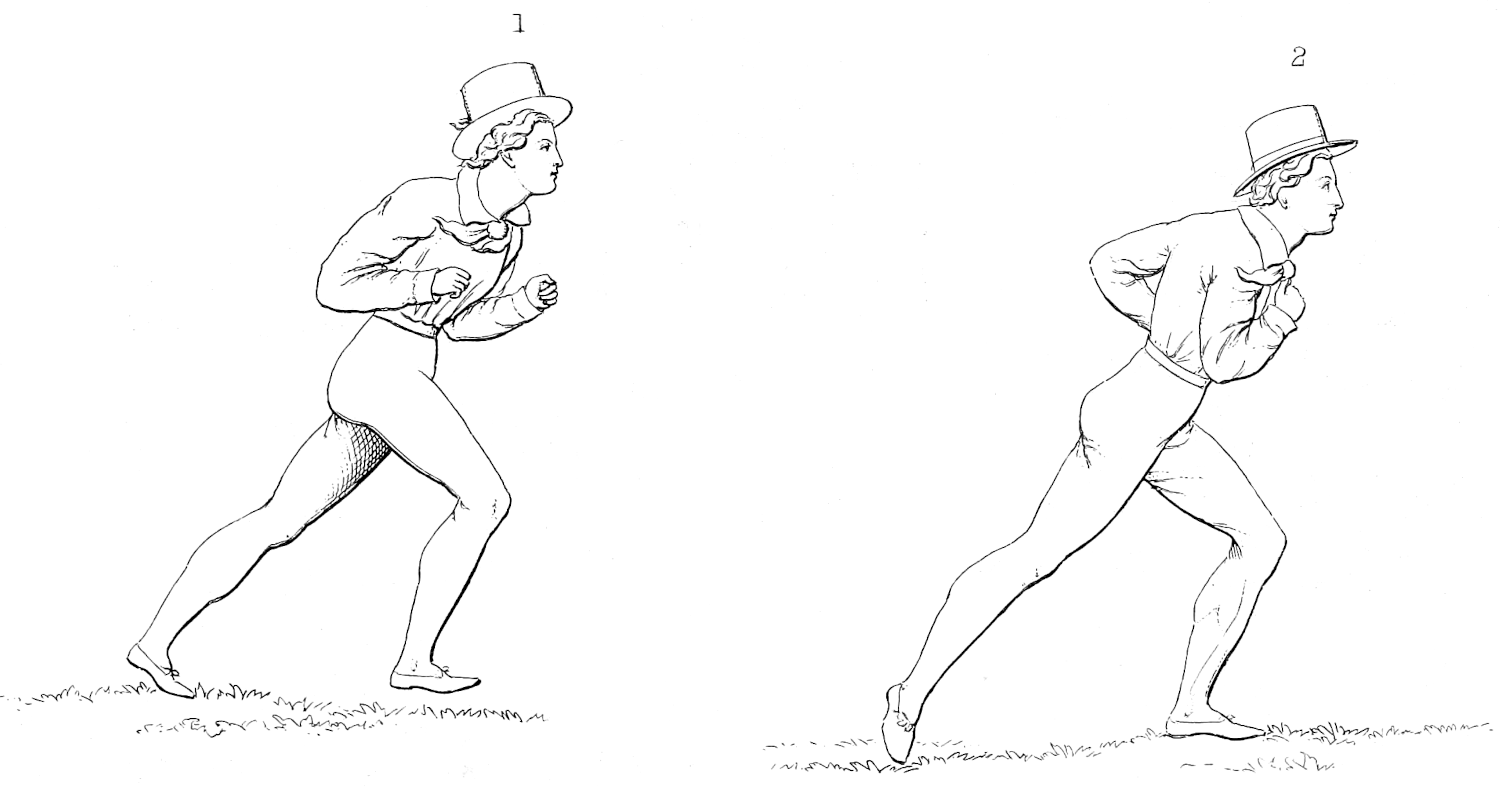
Running.
Speed, and still more duration in running, are in proportion
to the developement of the lungs, and consequently the volume
of oxygen and blood which they can combine in their parenchyma
at each respiratory movement. Thus, of two men, one having
the abdominal members developed, and the other possessing
good lungs, the former will run with the greatest speed for a
short distance, but if the distance be considerable, he will soon
be gained upon by the latter. A runner, after performing a certain
space, is seized with a difficulty of breathing, long before
the repetition of the contractions has produced fatigue in the
abdominal members. To excel, therefore, in running, requires,
like walking and dancing, a peculiar exercise. As the muscular
contractions depend, for their principle of excitement, on the
respiration, the chest should be firmly fixed, so as both to facilitate
this, and to serve as a point of support for the efforts of
the lower members. The best runners are those who have the
best wind, and keep the breast dilated for the longest time.
During the whole time of running, long inspirations and slow
expirations are of the greatest importance; and young persons
cannot be too early accustomed to them. To facilitate respiration
towards the end of the race, the upper part of the body
may be leant a little forward. Running should cease as soon as
the breath becomes very short, and a strong perspiration takes
place.
This is performed gently and in equal time, and may be extended
to a considerable space. In practising this pace, it is
necessary to fix the distance to be run; and this should always
be proportioned to the age and strength of the runners. This
exercise, more than all others, requires to be proceeded with in
a progressive manner. If, at the first trial, you run too fast or
too long a time, it may produce spitting of blood and headache,
or aneurisms of the heart and principal vessels, especially if the
weather be dry and cold.
A moderately cool day may accordingly be chosen, a distance
of three hundred feet measured, and the runners placed in a line
at one end. They may then start, trot at the rate of about seven
feet in a second to the opposite end, turn, and continue until
they reach the spot whence they started. Frequent repetition
of this is sufficient at first. Afterwards, they may run over this
space, two, three, or four times without stopping; and the exercise
may then be limited to this. It may, on subsequent days,
be extended to five, six, and seven times the distance.
Fatigue is then generally quite removed; and the run may
either be continued farther, or the runners, if neither heated nor
winded, may accelerate their pace. They may next attempt a
mile in ten minutes; and repeat this, till, being gradually less
and less heated, they can either extend the distance, or diminish
the time, in any measured proportion. At this pace, six miles
may afterwards be run in an hour.
This is best applied to a short space in a little time. Three
hundred feet upon an open plain will not generally be found too
great. At each end of this, a cross line may be drawn, and the
runners may arrange themselves on one line, while the umpire
is placed at the other. On the latter giving the signal, the
running commences, and he who first passes him gains the race.
It is extremely useful always to run beyond the line at a gentler
pace, as it gradually lowers the actions of the respiratory and
circulating systems.
Running is more easy on a level surface, but should be practised
on ground of every variety: upon long, square, and circular
plots of ground. The pupils should be accustomed to turn
promptly out of the direct line—a faculty not possessed by animals,
and exceedingly useful when pursued. They should also
run up hill, and particularly down, as it is dangerous unless frequently
practised.
The practice of running may be carried to a great degree of
perfection.
A quarter of a mile in a minute is good running; and a mile
in four minutes, at four starts, is excellent.
The mile was perhaps never run in four minutes, but it has
been done in four minutes and a half.[5]
A mile in five minutes is good running. Two miles in ten
minutes is oftener failed in than accomplished. Four miles in
twenty is said to puzzle the cleverest.
Ten miles an hour is done by all the best runners. Fifteen
miles in an hour and a half has never perhaps been done.
It is reported that West ran forty miles in five hours and a
half. This, it is said, was done by one individual in four hours
and three quarters, or less.
As to great distances, Rainer failed in two attempts to accomplish
100 miles in eighteen hours. West is said to have accomplished
this.
In running, the mass of our organs is agitated by violent and
constant shocks, which succeed with rapidity; but the abdominal
members are not the only ones in motion, although they are
those in which the developement is most considerable. Running
developes not only the abdominal members, but has a strong
influence upon the respiratory parts. This exercise is particularly
suited to young persons, especially those of a lymphatic
temperament. It should not, however, be practised after meals.
Leaping consists principally in the sudden straightening of
the articulations, performed by a strong and instantaneous contraction
of the extensors, by which the body is rapidly projected
from the ground.
The leaping-stand consists of two moveable posts, above six
feet high, having, above the second foot from the ground, holes
bored through them, at the distance of an inch from each other;
two iron pins to be placed in the holes at any height; a cord, at
least ten feet long, passed over these pins, and kept straight by
two sand-bags at its ends; and weights upon the feet of the
posts, to prevent them from falling—(Plate X. fig. 1). The
leap over the cord is made from the side of the stand towards
which the heads of the pegs are turned; so that, if the feet touch
the cord, it will easily and instantly fall.
In all kinds of leaping, it is of great importance to draw in
and retain the breath at the moment of the greatest effort, as it
gives the chest more solidity to support the rest of the members,
impels the blood into the muscular parts, and increases their
strength. The hands, also, should be shut, and the arms pendent.
The extent of the leap in height, or horizontally, is proportioned
to the power employed, and the practice acquired. As it is performed
with facility only in proportion to the strength exerted,
and the elasticity and suppleness of the articulations and muscles
of the lower extremities, much exercise is necessary to attain
that degree of perfection which lessens all obstacles, and supplies
the means of clearing them without danger. Lightness and firmness
are the qualities necessary for leaping: every thing should
be done to acquire these two qualifications, for without them
leaping is neither graceful nor safe.
Without a Run.
In this, the legs and feet are closed; the knees are bent till
the calves nearly touch the thighs; the upper part of the body,
kept straight, is inclined a little forward; and the arms thrown
in the direction of the leap, which increases the impulse, preserves
the balance, and may be useful in a fall. (Plate X.
fig. 1.)
Plate X
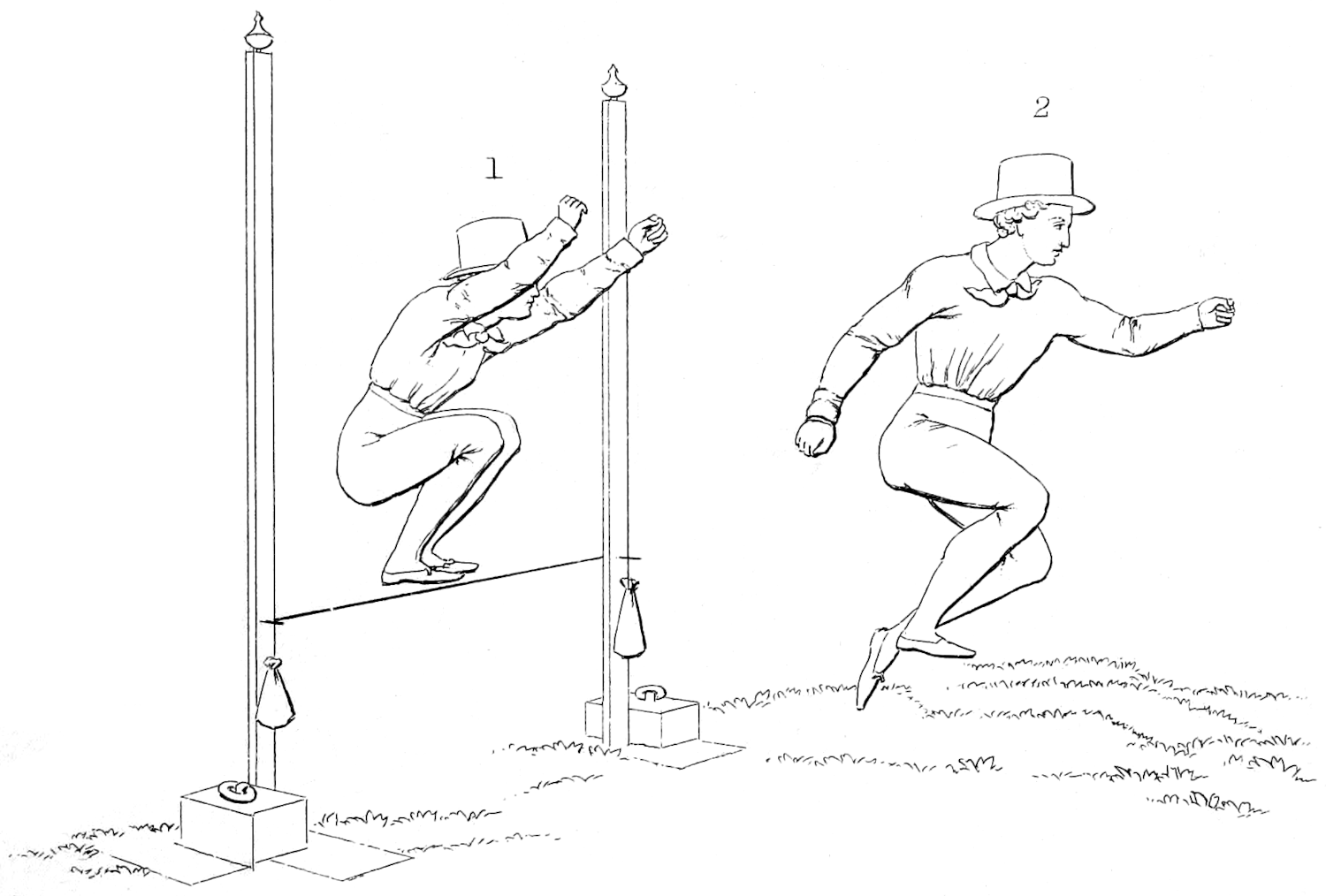
Leaping.
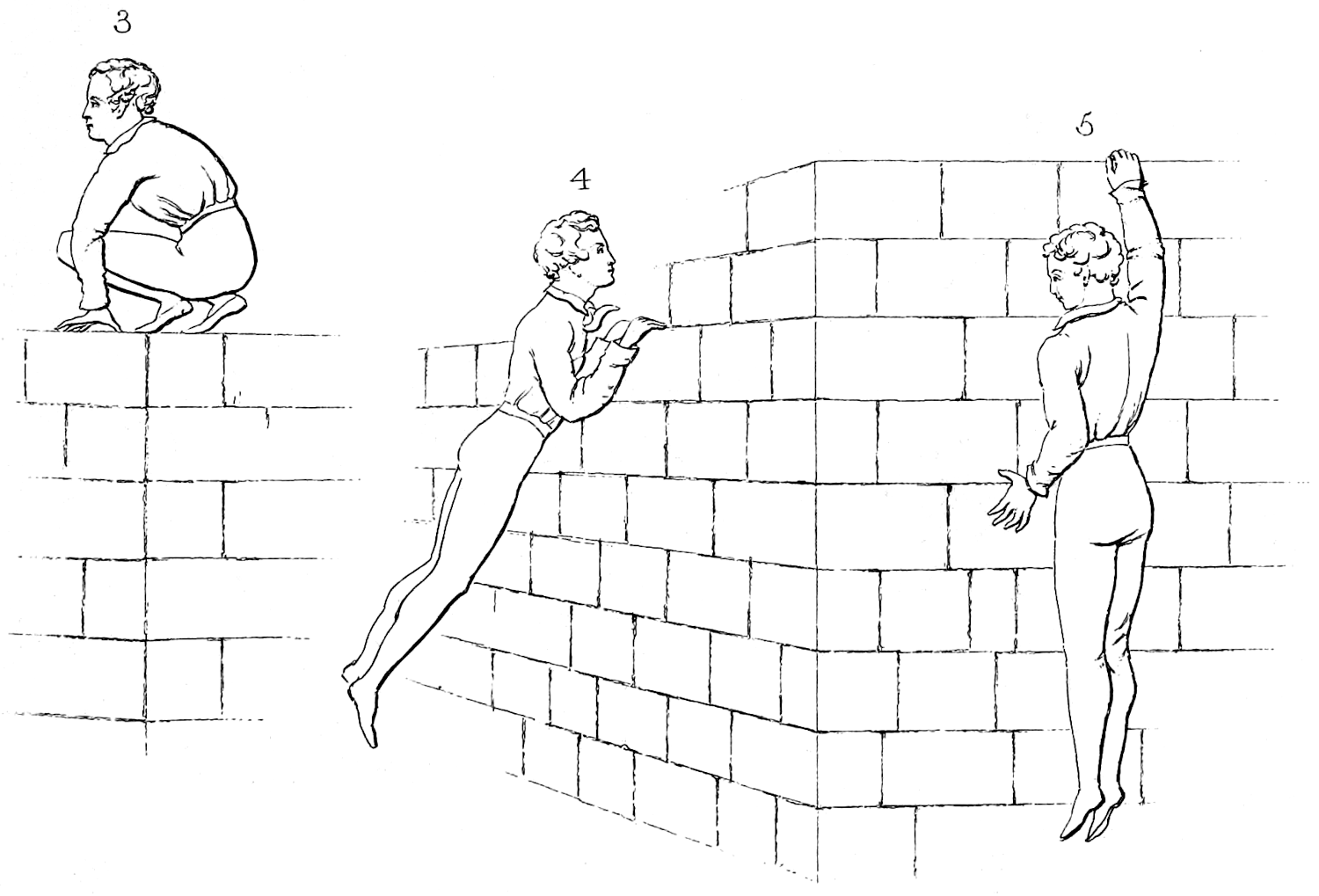
Leaping.
The vertebral column, and consequently the whole of the
trunk, being thus bent forward, a strong contraction of the
muscles preserves this bending till the moment when the leap
takes place; then, by sudden contraction of the extensors, the
body stretches out like a bow when the string breaks, is thus
jerked forward, and remains suspended a longer or shorter time
in the air.
In descending, the person should be rather inclined forward;
and the fall should take place on the fore part of the feet,
bending the knees and haunches, to deaden the shock and
descent; for, the direct descent in this leap, if not thus broken,
would send its shock from the heels to the spine and head, and
might occasion injury. To perpendicularity in this leap, should
be added lightness, so that scarcely any noise from the leap
should be heard.
This leap, without a run, may be practised at the height,—
- 1. Of the knees.
- 2. Of the middle of the thighs.
- 3. Of the hips.
- 4. Of the lower ribs.
With a Run.
The run preceding the leap should never exceed ten paces,
the distance between the point of springing and the cord being
equal to half the cord’s height from the ground. The view of
the leaper should be directed first to the spot whence he is to
spring; and, the moment he has reached that, to the cord,
accustoming himself to spring from either foot, and from both
feet.
The instant the spring is made, or (if it be made with one
foot) immediately after, the feet should be closed, and the knees
drawn forcibly towards the chin. Throughout, flexibility and
skill, not violent exertion, should be displayed. This leap, with
a run, may be practised at the height,—
- 1. Of the hips.
- 2. Of the lower ribs.
- 3. Of the pit of the stomach.
- 4. Of the breast.
- 5. Of the chin.
- 6. Of the eyes.
- 7. Of the crown of the head.
A good high leaper will clear five feet; a first-rate one, five
and a half; and an extraordinary one, six feet. Ireland is mentioned
as having cleared an extended cord at the height of
fourteen feet. Another man, it is said, jumped to the height
of seventeen feet, which was three times the height of his own
body.[6]
Without a Run.
This is generally performed upon straight firm ground, on
which there are marks, or parallel lines, at equal distances.
The first of these lines is the place to leap from. The leapers
succeed each other, and clear a greater number of lines according
to their strength and skill. Here the feet are closed; the
whole weight rests upon the balls of the toes; and the body is
inclined forward. Both arms are then swung forward,—backward,—then
drawn strongly forward,—and at the same instant
the limbs, having been bent, are extended with the utmost
possible force.
In performing this leap, the hands and body must be bent
forward, especially at the end of the movement, when the
leaper alights. On level ground twelve feet is a good standing
leap; and fourteen is one of comparatively rare occurrence.
With a Run.
This leap is best executed with a run; and we have therefore
dwelt less upon the former. Here, also, the body must be
inclined forward.
The run should be made over a piece of firm, and not slippery
ground, to the extent of ten, fifteen, or twenty paces;
should consist of small steps, increasing in quickness as they
approach the point of springing; and these should be so calculated
as to bring upon the point that foot with which the leaper
is accustomed to spring. The spring, as here implied, should
be performed with one foot, and the arms thrown forcibly towards
the place proposed to be reached. The height as well as
the length of the leap, must be calculated; for the leap is
shortened by not springing a proper height. (Plate X. fig. 2.)
In the descent, the feet are closed, the knees bent, the upper
part of the body inclined forward, and the toes first touch the
ground, at which moment, a light spring, and afterwards some
short steps, are made, in order to avoid any sudden check.
In a much extended leap, however, alighting on the toes is
impossible. A sort of horizontal swing is then achieved, by
which the leaper’s head is little higher than his feet, and his
whole figure is almost parallel with the ground; and, in this
case, to alight on the toes is impossible. Care must here be
taken not to throw the feet so much forward as to cause the
leaper to fall backward at the moment of descent. The ground
must be cleared, or the leap is imperfect and unfair.
This leap may be practised at,—
- 1. Double the length of the body.
- 2. Twice and a half that length.
- 3. Three times that length.
On level ground, twenty feet is a first-rate leap; twenty-one
is extraordinary; and twenty-two is very rarely accomplished.[7]
With a run and a leap, on a slightly inclined plane, twenty-three
feet have been done.
Of the various kinds of leaps, the first or simple leap, which
is produced principally by the extension of the abdominal members,
which impel the body either straight upwards, in the
vertical leap, or obliquely upwards and forwards, in the horizontal
or rather parabolic leap, requires, in addition to the
contraction of the abdominal members, especially if the leap be
executed with the feet close together, a violent action of the
muscles of the abdomen, upper parts of the back, anterior parts
of the loins, and of the thorax and shoulders.
This may be made either with or without the hands. In
either way, to avoid the shock, the body must be kept in a bent
position, and the fall be upon the balls of the toes. When the
hands are used, the leaper places them in front of the feet; and
during the descent, the weight of the body is checked by the
former, and passes in a diminished state to the latter; so that
the shock is obviated.
A flight of steps serves the purpose of this exercise. The
leaper ascends a certain number; leaps from the side; gradually
increases the number; and, by practising progressively higher,
finds it easy to leap from heights which at first appalled him.
He afterwards combines the long and deep leaps. For this
purpose, a rivulet, which has one bank high and the opposite
one low, is very favourable. Children can easily take a leap of
nine feet in descending.
This exercise is first performed from platforms of various
heights, and from walls of various elevations. The object is to
lessen the shock that the legs and body experience in reaching
the ground at a depth of more than six or seven feet, and to
diminish the distance if possible, at the same time that it
diminishes the violence and velocity of the fall. All this is
easily managed by observing the following rules.
Suppose the pupil placed upon a platform of four or six feet
in height, he must first examine the place he is about to leap
to, so as to select the most favourable part, free from stones and
other obstacles. He will then approach the extremity of the
platform, with his back towards it, and bend his body, placing
his hands in the position shown in Plate X. fig. 3. Having
taken up this position securely, he will lean his head a little
forward, raise his toes from the platform, and remain for an
instant supported by the arms. The body then begins to extend,
and the legs to lengthen downward and backwards; the
arms follow this movement, bend, and support the body by the
hands, which have a secure resting-place on the edge of the
platform, as in Plate X. fig. 4. This descending movement is
executed as slowly as possible: the arms stretch out to their
utmost length, till the body is sustained by the last phalanx of
the fingers, or touches the ground with the feet. If it does not
reach the ground, the pupil drops gently down on the tips of his
toes, bends himself, and recovers his upright position.
There is another mode of descending, when the last resting-place
for the hands is the top of a counterfort, or prop on a
wall without a counterfort. This consists (see Plate X. fig. 3)
in seizing the last hold with the right hand for instance, and in
hanging firmly by that hand, whilst the left, being at liberty, is
lowered and pushes back the body from the projecting stones in
the walls, to prevent injury in the descent. The impulse thus
given is, however, very trifling, and solely to avoid hurt, without
increasing the violence of the fall, which ought to be facilitated
on reaching the ground by the rules already given. By these
means, the height of a wall is relatively diminished, for a man
who hangs suspended by his arms, has six feet less to drop than
he who has his feet where he might put his hands.
The down leap, unless gradually practised, may produce
ruptures of the diaphragm. When, however, the elevation from
which the leap is taken is gradually increased, the eye becomes
accustomed to measure the most extensive distances fearlessly,
at the same time that by practice the abdominal members learn
to bend properly under the weight of the trunk, and thereby
preserve the organs contained in it from serious injuries. In
this kind of leap, the shocks will be diminished by retaining the
air in the chest, which may be done by closing the glottis.
Persons who have long toes, powerful calves, and prominent
heels, are the best adapted for leaping.
In vaulting, by a spring of the feet, the body is raised, and by
leaning the hands upon a fixed object, it at the same time receives,
in oblique vaulting, a swing which facilitates the action.
As the inclination thus given to the body depends not merely
on the feet, but on the hands, we have the power to guide the
body in any direction.
This exercise is conveniently practised on the vaulting bar,
which rests upon two or three posts. It may be performed with
or without running. The beginner may at first be allowed a
run of a few paces, ending in a preparatory spring; and he may
afterwards be allowed only a spring.
To mount, the vaulter must place himself in front of the bar;
make a preparatory spring with the feet close; fix at that moment
both hands upon the bar; heave himself up, and swing
the right leg over. The body, supported by the hands, may
then easily descend into the riding position. To dismount, the
vaulter, supported by the hands, must extend the feet, make a
little swing forward, and a greater one backward, so as to heave
both feet behind over the bar, and spring to the ground with
them close.
To do this he must first clearly define to himself the place
where he intends to fall. Then, having placed both hands
upon the bar, he should first bend and then extend the joints,
so as to raise the body with all his strength, and throw his legs,
kept close, high over the bar. (Plate XI. fig. 1.) When the
right hand (if he vault to the right) quits the bar, the left remains,
the feet reach the ground on the opposite side, and he
falls on both feet, with the knees projected, and the hands
ready, if necessary, to break the fall.
Plate XI
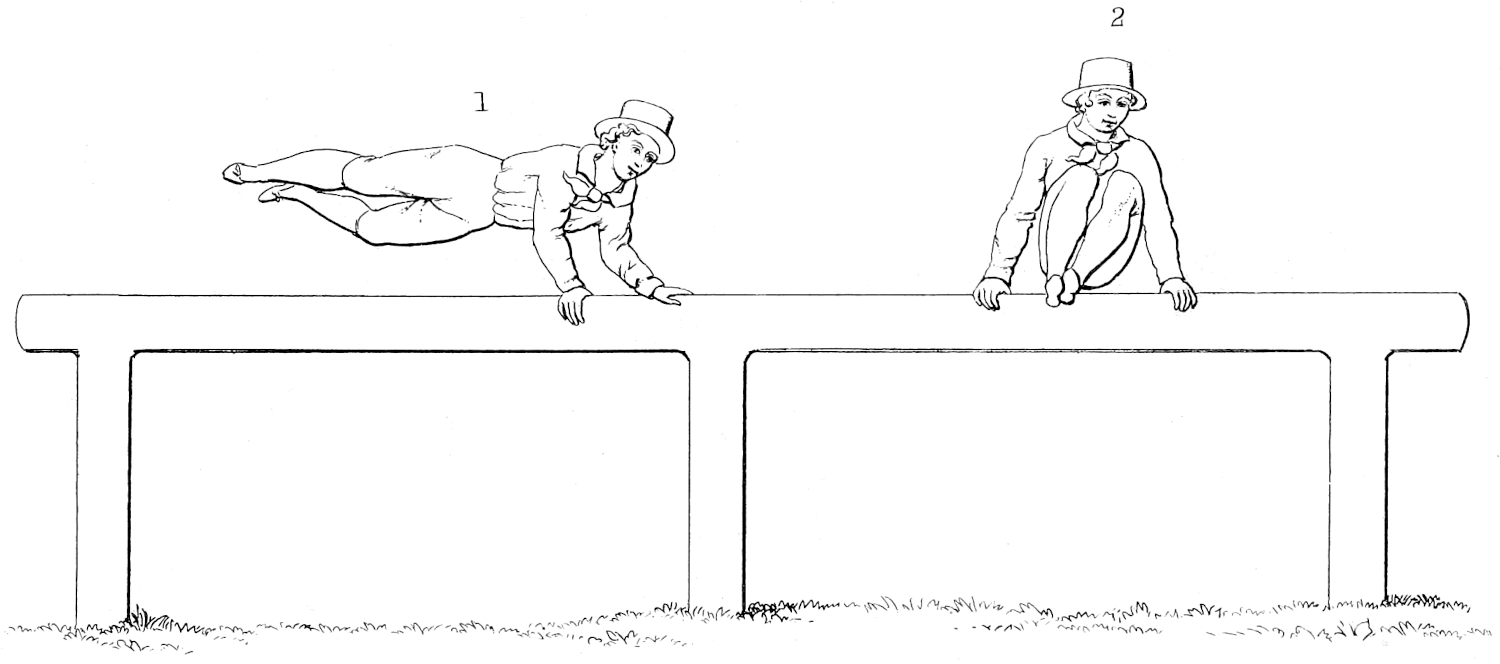
Vaulting.
In vaulting to the right, the left foot passes in the space
which was between both the hands, the right hand quits the bar,
and the left guides the body in the descent. In vaulting to the
left, the right foot passes in the space which was between both
hands, the left hand quits the bar, and the right guides the body
in its descent. As, however, it is difficult for beginners to vault
either way, this is not to be attempted until after sufficient
practice in the way which may be easiest. The vaulter may
then, with a preparatory spring, try the following heights,—
- 1. That of the pit of the stomach.
- 2. That of a middling-sized horse.
- 3. His own height or more.
For this purpose, both hands must be placed at such distance
on the bar as to give room for the feet between them; the body
should be forcibly raised; the knees drawn up towards the
breast; and the feet brought between the hands, without moving
them from their place. (Plate XI. fig. 2.) This should be
practised until it can be done easily.
This straight-forward vault may have three different terminations.
When the feet are in the space between the hands, the
vaulter may stand upright. He may pass his feet to the opposite
side, whilst he seats himself. He may continue the leap
over the seat, through the arms, letting both hands go at once
after the legs have passed.
This is a union of leaping and vaulting, in which the vaulter,
instead of supporting himself upon a fixed object, carries with
him a pole, which he applies to whatever spot he chooses. In
supporting the body by a pole during the leap, a great deal also
depends upon balancing, as well as on the strength of the arms
and legs.
The pole prescribed for this exercise is the planed stem of
a straight-grown fir, from seven to ten feet long, and about two
inches thick at the bottom. Such a pole naturally diminishes
towards the top; and it is better to plane off the lower end a
little. Care must be taken that it be sufficiently strong; such
as make a crackling noise during the leap should be immediately
thrown aside.
The learner, supposed to be already expert in leaping and
vaulting, may at first place himself before a small ditch, with a
pole, which he holds in such a manner, that the right hand be
about the height of the head, and the left about that of the hips,
and in this case he must fix it in the ditch. (See Plate XII.
fig. 1.) He must then, by making a spring with his left foot,
endeavour to rest the weight of his body upon the pole, and,
thus supported, swing himself to the opposite bank. In this
swing, he passes his body by the right of the pole, making, at
the same time, a turn, so that, at the descent, his face is
directed to the place whence he leaped. The faults usually
committed by the beginner, consist in his trusting to the pole
the whole weight of the body; and in losing the necessary
purchase by keeping at too great a distance from it.
This leap cannot be made with proper force and facility unless
the fixing of the pole in the ground and the spring are made
exactly at the same moment. To acquire this, the learner should
place himself at the distance of a moderate pace in front of the
ditch; raise the left foot and the pole together; plant both together,
the former in the spot whence he intends making the
spring, and the latter in the ditch; then instantly swing himself
round the pole, to the opposite bank. As soon as he can
easily take the proper position and balance, he may endeavour
to swing his legs higher; and in proportion as he becomes more
expert, he must place his hands higher up the pole, in order to
have a greater swing. He must afterwards make a previous
run of two, three, or four paces, gradually increasing in velocity;
and always taking care that the springing foot and the pole
come to the ground at the same moment. When this difficulty
is overcome, he may practise the exercise over the leaping-stand.
In leaping over the cord, the learner must take the pole in both
hands; make a rather quick run; conclude this with the spring,
and planting the pole at the same moment; raise rapidly his
whole body, by means of this spring and a powerful support on
the pole, and swing over the cord; turning his body so that,
at the descent, his face is directed to the place whence he
sprung. This is a general description of the high leap; but it
is necessary to explain the parts into which it may be divided,
as follows,—
1. In the handling the pole (Plate XII. fig. 1), it is immaterial,
as to the lower hand, whether the thumb or the little
finger be uppermost: the upper hand must have the thumb
upward. The position of the upper hand is regulated by that
of the lower one: as this advances higher up, the former must
be proportionally raised. The lower hand then must be placed
at a height proportionate to that of the leap: thus, if the latter
be six feet, the lower hand must be at least from five and a half
to six feet from the lower end of the pole. The leaper is, after
a little practice, enabled to seize the pole in the proper way,
from a mere glance at the leap.
2. The preparatory run of from twelve to fifteen paces is
accelerated as the leaper approaches the cord. Upon this run
principally depend the facility and the success of the leap. As
the spring can take place only with one foot, and as this must
arrive correctly at the springing place, it is necessary that the
order of the steps should be arranged so as to effect this object.
If the leaper should be obliged to correct himself by making a
few steps, either longer or shorter, just before making the spring,
the leap is rendered difficult.
3. The fixing of the pole in the ground, and the spring, must
take place at the same instant, because by that means the upper
and lower members operate together, no power is lost, and the
swing is performed with the greatest facility. The place of the
pole, however, varies with the height of the leaps; in leaps of
about four feet, the distance of one foot from the cord is sufficient;
in higher leaps, it should be from one and a half to two
feet. The best plan is to have a small pit dug in front of the
cord (see Plate XII. figs. 2 and 3), and to remove the stand
from it, as the height of the leap increases; or the stand may
remain at a foot and a half from the pit, and the learner be
taught to make all the leaps from it. The spring is made with
one foot, at the distance of two, three, four, or five feet from
the plant of the pole. If the leaper keep the left hand lowest,
he must spring with the left foot, and vice versâ.
4. The swing upward is effected by the force of the spring,
the support of the lower, and the pull of the upper hand; but
principally by the propulsion of the run, which being suddenly
modified by the fixing of the pole, has its horizontal
direction changed into a slanting ascent, and carries the body of
the leaper over the cord. The leaper must carefully observe
that the spring of the foot, and the plant of the pole, be in the
direction of the preparatory run.
5. The turning of the body during the swinging upward, is
necessary. When the leaper is going to spring, he has his face
turned towards the object of the leap, as in Plate XII. fig. 1;
but as his feet swing, his body turns round the pole. When his
feet have passed over the other side of the cord, the head is still
considerably on this side: the leaper then appears as in fig. 2.
Speedily, the middle of his body is on the other side of the
cord, and he begins the descent, as in fig. 3. It would be impossible
to descend in this position otherwise than with his face
directed to the place where the leap was commenced.
6. The quitting of the pole during the leap is effected by
giving it a push with one hand, at the moment of greatest
height, and this causes it to fall on the inner side of the cord.
7. The carrying of the pole over the cord is more difficult.
The leaper must then raise the pole a little from the ground at
the moment of beginning the descent, and instantly elevate the
lower part of it with the lowest hand, and depress the upper
part with the other; the consequence being, that, at the descent,
the lower end of the pole will point upward, and the upper end
downward. This should be practised first in low leaps.
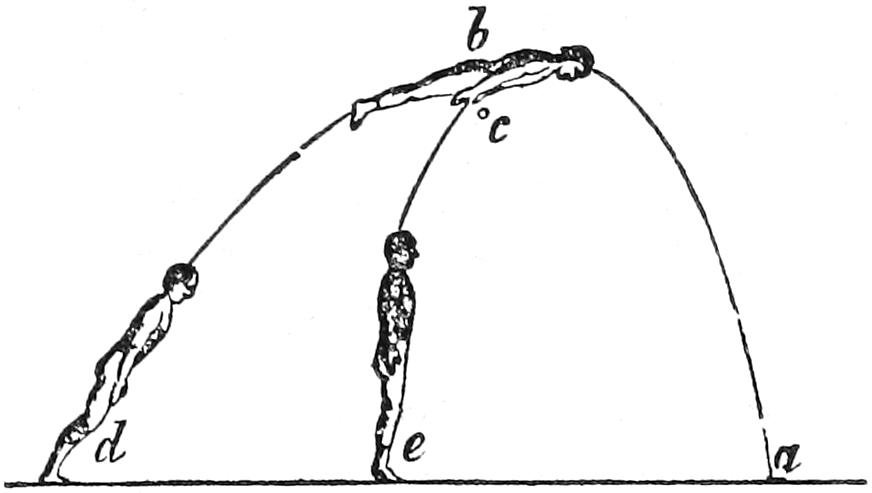
8. The descent depends entirely upon the manner in which
the leap is made: if the leap be perfect, the descent will be so.
The usual fault in descending is, that the leaper, having passed
the cord, falls to the ground almost perpendicularly instead of
obliquely. In the annexed figure, a is the place whence the
spring is made, c the section of the cord, b the position of the
leaper over it, d his right, and e his wrong descent. The latter
is faulty because it throws him so much out of balance, that in
order not to fall backward, he must run backward to d. If, on
the contrary, he descends in proper balance to the ground, he
moves not an inch from the spot where his feet alight; and this
complete rest following the descent is the sign of a perfect leap.
The descent, as already explained, must take place upon the
balls of the toes, and with a sinking of the knees. The position
of the body is sufficiently explained by Plate XII. figs. 1, 2,
and 3; but many learn to swing the legs so well as to raise them,
during the highest part of the leap, considerably above the head.
Order of exercises in the high leap, to be very gradually attempted:—
- 1. The height of the hips.
- 2. That of the pit of the stomach.
- 3. That of the chin.
- 4. That of the crown of the head.
- 5. That of the points of the fingers—that
is, as high as the latter can
reach.
In performing these leaps, the pole is parted with. As many
more may form a repetition of the preceding, with this difference,
that the leaper carries the pole over with him. A similar number
may repeat the first, except that the leaper, between the
spring and descent, makes a complete turn round the pole, so
as again to bring his face in the direction of the leap. This enlarged
turn is rendered easier by leaping a little higher than the
cord requires.
This leap is the most useful, being applicable almost everywhere;
and particularly in a country intersected with small
rivers, ditches, &c. It should be first practised over a ditch
about three feet deep, eight feet broad at one end, and about
twenty-one feet at the other, and of any convenient length. In
this exercise, the pole should be rather stronger and longer than
in the preceding one—depending, however, on the length of the
leap, and the height of the bank it is made from. The usual
length is from ten to thirteen feet.
The handling of the pole is the same as in the high leap. The
preparatory run is rapid, in proportion to the length of the leap.
The spring takes place as in the preceding exercise. The swing
is also the same, except that the curve of the leap is wider. The
turning of the body may likewise be similar, but it is convenient
to make only a quarter turn. In the descent, the hand presses
more upon the pole; and the feet are stretched out to reach the
opposite bank, as in Plate XIII. fig. 1, in which the leaper is
descending. Another method of leaping a river, is to force the
body up so high by the pressure of the hands (of which one rests
upon the end of the pole, or very near it), as to swing over the
top of the pole, and allow it to pass between the legs when descending.
(Plate XIII. fig. 2.)
Plate XII
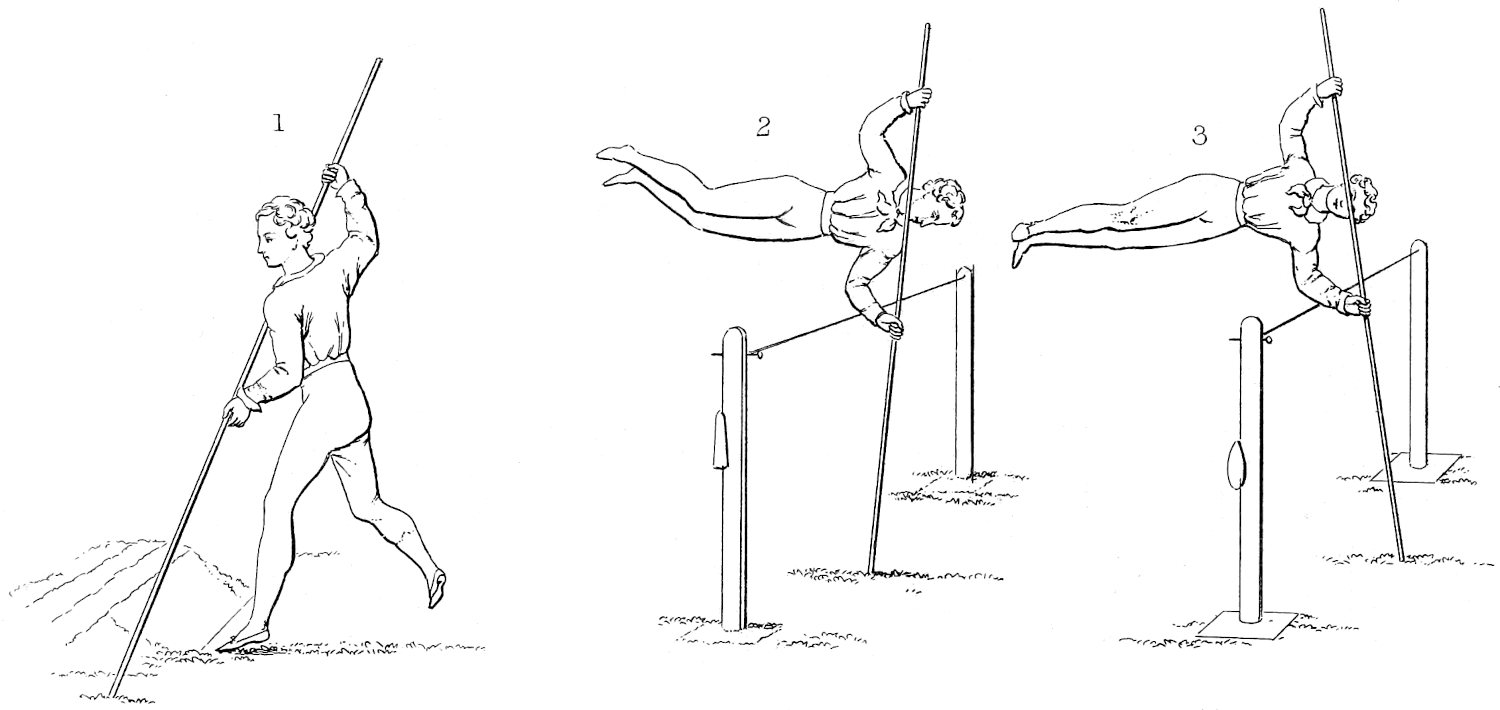
Pole Leaping.
Plate XIII
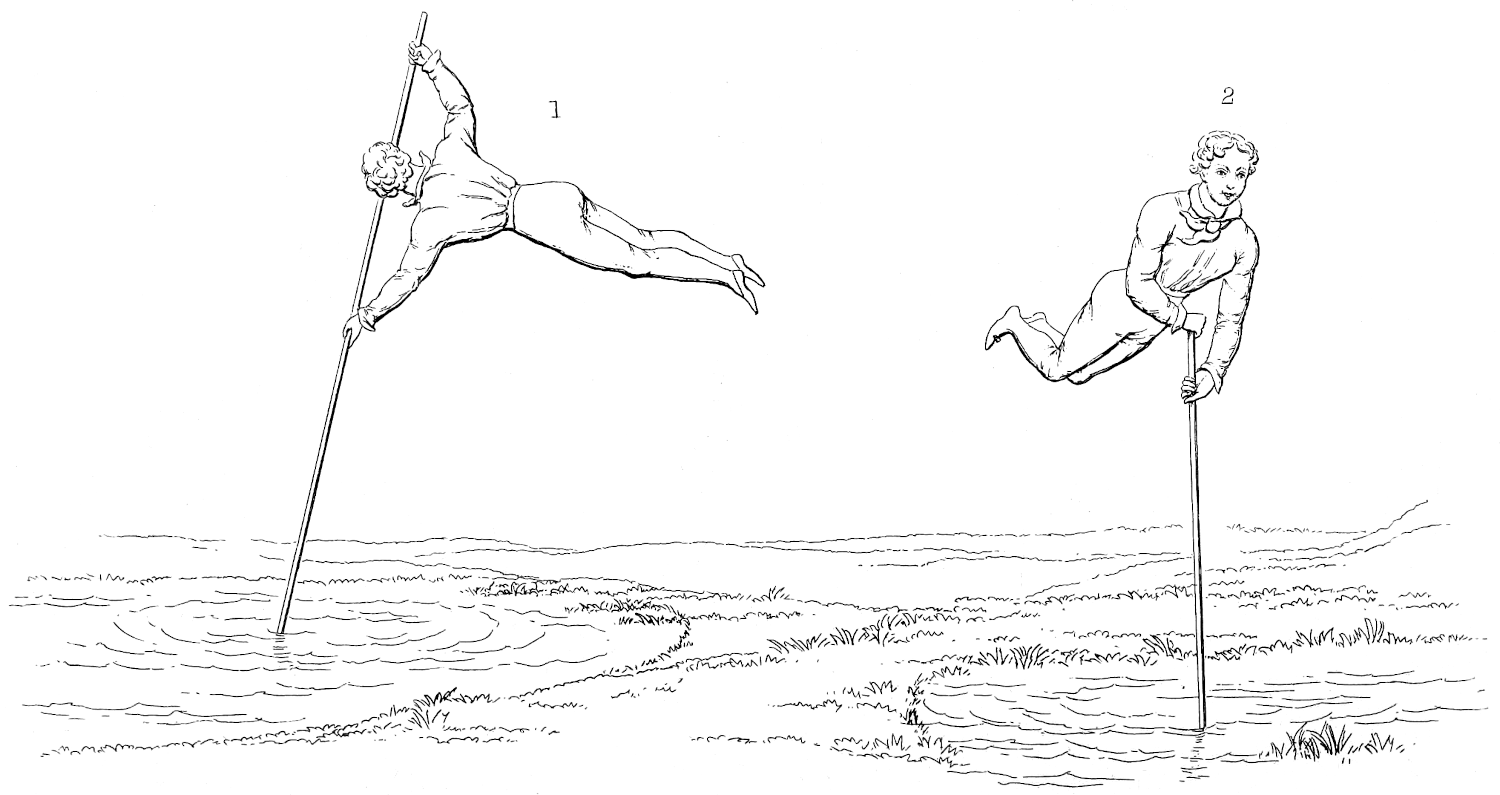
Pole Leaping.
Try the following:—
- 1. The leap of two lengths of the
body.
- 2. That of three lengths of the body.
- 3. That of four lengths of the body.
- 4. Persons of equal strength try to
outleap one another.
The lengths of 18, 20, 22, and 24 feet are frequently done by
practised leapers.
Here neither the preparatory run nor the spring occur: there
is nothing which requires the exertion of the lower members.
The use of the hands and arms, however, is peculiarly requisite,
as well as a little of the art of balancing. The leaper fixes the
pole, at a convenient distance from the place where he stands,
in a chasm, ditch, or river, having one bank high, and the opposite
one low. Seizing it with both hands in the usual way, he
slips along it lower and lower; the whole weight of his body, at
last, resting upon it. Thus, if the depth is considerable, as two
lengths of the body, he may slide so far down upon it, that his
head appears slanting downward. In this position, he makes a
slight push against the bank, or merely quits it, with his feet,
which he swings by the side of the pole to the opposite bank.
Here, also, the descent is performed upon the balls of the toes,
with bending of the knees. The principal advantage in this leap
lies in the art of supporting the body, without tottering; and
for this purpose, it is absolutely necessary that the feet should
be stretched out far from each other, in an angular form, otherwise
the balance might be lost. The best way of practising this
in an exercise ground, is by a flight of steps.
To the exercise of the abdominal members, these leaps unite
a strong action of the muscles of the thorax, arms, and fore-arms,
and even of those of the palms of the hand. The body is
only half impelled by the abdominal members; but this impulse
is rendered complete by considerable effort on the part of the
thoracic members. The latter, in the vertical leap, being supported
by the narrow and moveable base afforded by the pole,
assist greatly in raising the body, and even keep it a moment
suspended for the legs to pass over (if the object to be cleared
is very high) before it allows the body to obey the force of
gravity which carries it down.
This exercise communicates what is termed great lightness to
the body, and great suppleness—that is to say, great relative
strength of the abdominal members; and it also developes the
superior members. It is good for lymphatic temperaments and
young persons, but it should not be indulged in immediately
after meals. It may occasion accidents of the brain and spinal
marrow, unless all the articulations are bent on returning to the
ground.
Balancing is the art of preserving the stability of the body
upon a narrow or a moving surface. The balancing bar consists
of a round and tapering pole, supported horizontally, about three
feet from the ground, by upright posts, one at its thicker extremity,
and another about the middle, between the parts of
which it may be raised or lowered by means of an iron peg
passing through holes in their sides. The unsupported end of
the bar wavers, of course, when stepped upon—(Plate XIV.)
The upper surface of the bar being smooth in dry weather,
the soles of the shoes should be damped; the ground about the
bar should consist of sand, and the exercises be cautiously performed.
Plate XIV
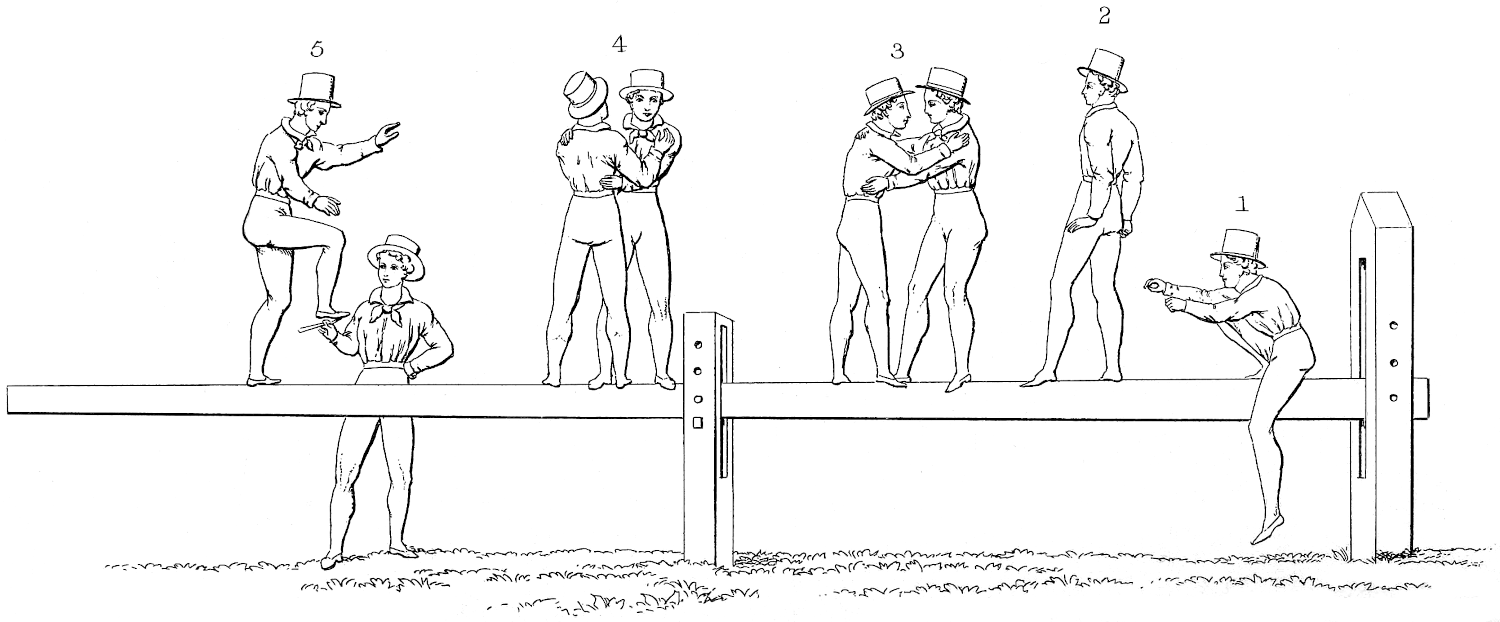
Balancing.
In this exercise, the head should be held up, the body erect,
the shoulders back, the arms extended, the hands shut, and the
feet turned outwards. At first, the balancer may be assisted
along the bar; but he must gradually receive less and less aid,
till at last the assistant only remains by his side.
The pole may be mounted either from the ground or from the
riding position on the beam. In the latter case, the balancer
may raise the right foot, place it flat on the beam, with the heel
near the upper part of the thigh, and rise on the point of the
foot, carrying the weight of the body before him. (Plate XIV.
fig. 1.)
In this case, the beam must not be touched with the hands;
the left leg must hang perpendicularly, with the toe towards the
ground, and the arms be stretched forward. After keeping the
balance for some minutes in this position, he must stretch the
left leg out before him, place his heel on the middle of the beam,
with the toe well turned outward, and transfer the weight of
the body from the point of the right foot to the left heel—(Plate
XIV. fig. 2). These steps he must perform alternately,
till he reaches the end of the beam.
When the balancer is able to walk firmly and in good position
along the bar, and to spring off whenever he may lose his
balance, he may attempt to turn round, first at the broad, then
at the narrow end, and to return. He may next try to go
backward.
In accomplishing this, it is no longer the heel, but the tip of
the toes, which receives the weight; the leg which hangs being
stretched backward, with the hip, knee, and heel forming a right
angle, till the toes, by a transverse motion, are so placed on the
middle of the beam, that the balancer can safely transfer to them
the whole weight of the body.
To acquire the art of passing an obstacle placed laterally, two
balancers may pass each other thus:—They must hold one another
fast by the arms, advance breast to breast, place each his
right foot close forward to that of his comrade, across the bar
(Plate XIV. fig. 3), and turn completely round each other, by
each stepping with his left foot round the right one of the other,
as in Plate XIV. fig. 4.
To acquire the art of passing an obstacle placed inferiorly, a
large stone may be laid upon the bar, or a stick may be held
before the balancer, about the height of the knee. (Plate XIV.
fig. 5.)
To pass over men placed upon a beam, the pupil or pupils
who are astride in front lie down on the beam, which they grasp
firmly by passing their arms round it. The pupil a (fig. 1, Plate
XV.) having to pass to the point on the beam marked b, places
his hands on the waistband of his comrade c: he then leans
upon his arms, and raises his body to pass forward over his
comrade, opening his legs widely, so as not to touch him, till he
places himself astride at c. He then extends his hands and
arms for a second movement, places them at b, and leans the
body well forward, as shown in fig. 2, Plate XV. Being thus
placed, he makes the last movement, raises his body upon the
arms to pass over his comrade’s head without touching it, which
is the chief rule of this exercise, and places himself astride upon
the beam at b, moving his hands immediately, and extending
them to rest at d. This movement being finished, he continues
advancing astride, along the beam, over the others, if there be
any; raises himself to an upright position, and lies down in his
turn on the beam. This last attitude requires some care, because
the head must incline either to the right or left of the
beam, as shown in the plates, and the pupil must hold tight
to the beam with the arms and thighs, which requires both skill
and strength.
The pupil may also pass as shown in fig. 3, Plate XV. This
method is very easy for the person passing, and indeed more so
than any other; but it is necessary that the pupil who is in the
position b should have learnt to raise himself up on the beam,
or know how to advance along it underneath, in a reversed
position.
Plate XV
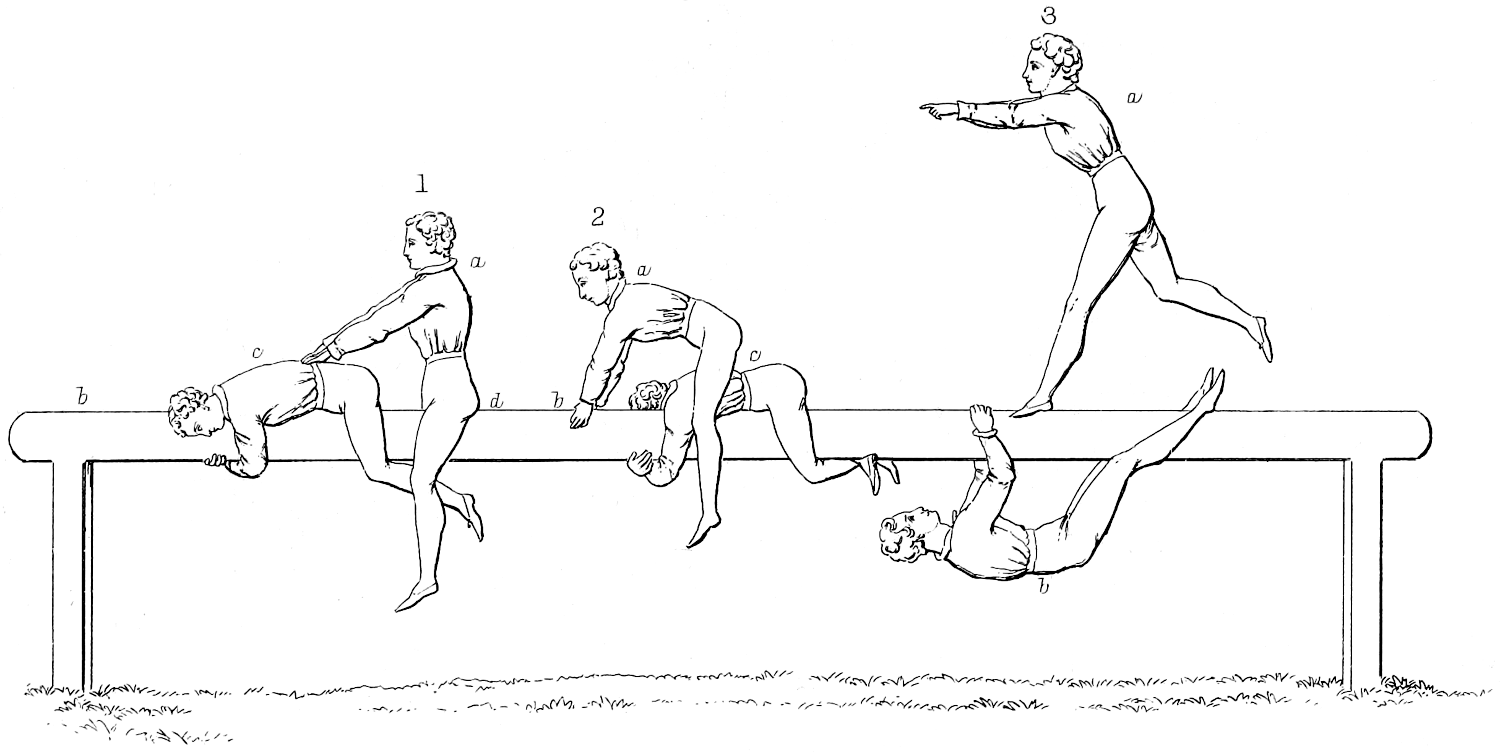
Balancing.
It is impossible for any one who has not seen the carnivals of
Venice, and other towns in Italy, to form an idea of all the
difficulties that have been surmounted in the art of equilibrium.
To acquire the art of carrying any body, the balancer may at
first walk along the bar with his hands folded across his breast,
instead of using them to balance himself; and he may afterwards
carry bodies of various magnitudes.
To this notice of the rules by which the art of Balancing may
be best acquired, it will not be out of place to subjoin a slight
outline of its importance to all who desire to arrive at excellence
in any of the Manly Exercises. Motion—the source of them
all—if not absolutely dependent for existence upon equilibrium,
without it would be but the infancy of action—movement
tottering, uncertain, powerless. The first effort of locomotion—the
walk, without it, possesses neither force nor decision: in
the same ratio that a higher degree of muscular exertion is demanded,
increases the value and importance of the art which
teaches how best to apply the vital energies to its service.
What a wise economy is to the social, this art is to the physical
system: both serve to augment our resources, by instructing us
so to husband them that the term “necessity” be not known to
our vocabulary.
While in every instance equilibrium adds greatly to physical
power, in many it stands altogether in its stead. To the most
casual observer of our usual sports it will be manifest that this
is the case in Skating;—the more attentive and competent will
have little difficulty in tracing its effects in Leaping, Vaulting,
Swimming, and through almost the whole catalogue. It is to
the later writers on horsemanship that we are indebted for the
knowledge of its vital service to the equestrian. The truth of
their theory is proved by the fact that, where formerly scarce a
tithe of a hunting-field was found to ride to hounds, now
nine-tenths are ordinarily to be seen in good places.
————Scouring along,
In pleasing hurry and confusion toss’d,
Happy the man, who with unrivall’d speed
Can pass his fellows.
The power of raising and carrying weight is of great importance
in a general view. Many advantages will be derived from
it; for besides strengthening the locomotive muscles, upon
which all our physical operations depend, it will fortify also all
the system and all the organs. All persons, moreover, may
find themselves under the necessity of raising and carrying a
wounded or fainting person, and may be glad to have cultivated
and acquired the power necessary to perform such an act.
In accustoming young persons to carry burdens, they should
be taught to support what is on the back first with one hand
and then with the other: by these means the muscles are equally
exercised on each side, and acquire an equal developement.
These burdens, however, must not exceed their strength; and
they should be taught not to carry on one side in preference,
for fear of deforming the limbs. There are several modes of
supporting weights, and of trying the amount of power possessed
for this kind of exercise.
Fig. 1, Plate XVI. represents one method. It consists in
loading the shoulders with sacks full of articles whose weight
is previously known. The position of the arms and hands is such
that the pupil can support a great weight: but in this way he
can walk but very slowly; and it is therefore, so far, disadvantageous.
Plate XVI
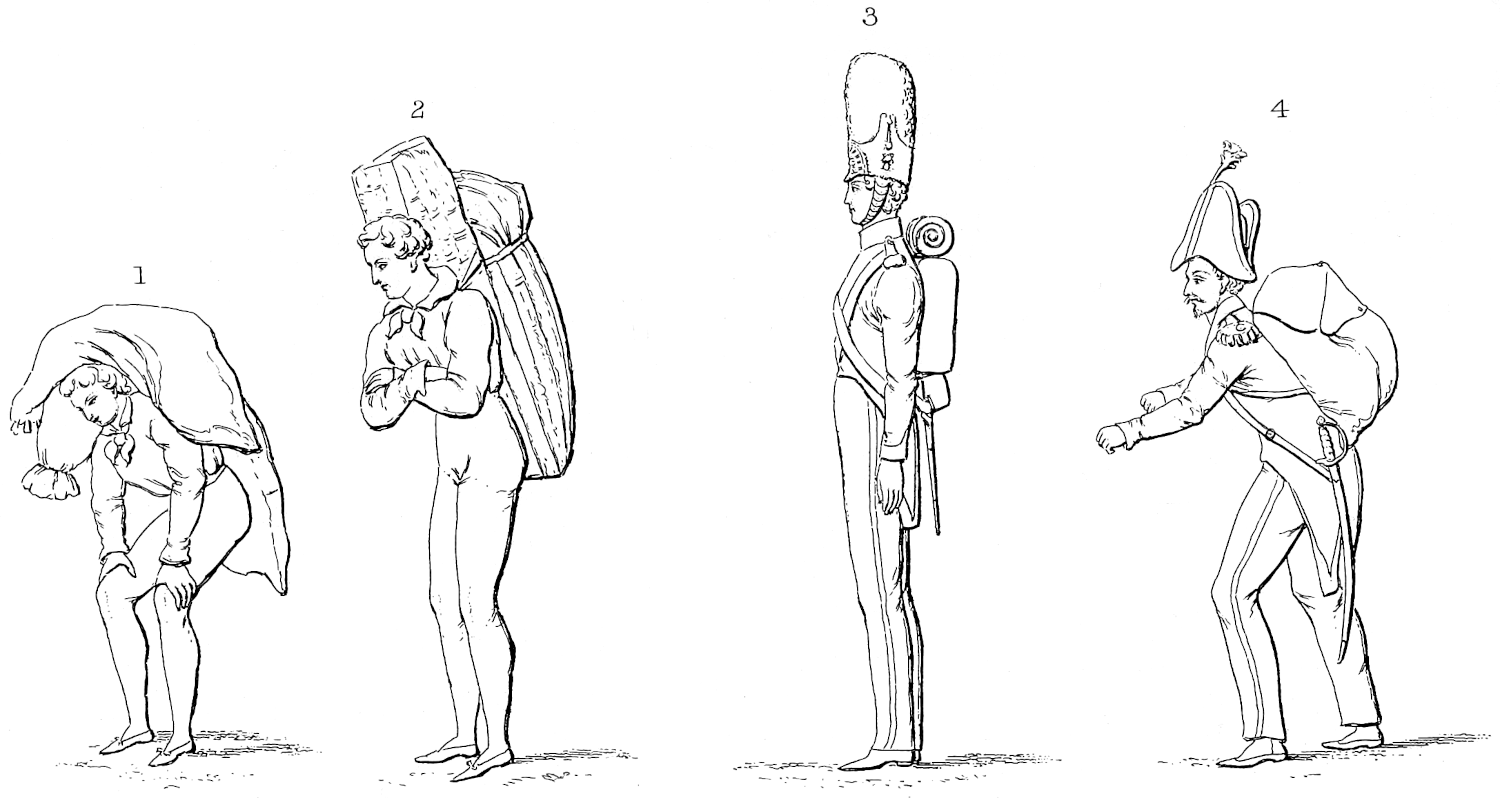
Carrying Weight.
Fig. 2, in the same plate, supports a weight by means of a
hod. This is filled with balls or stones, of which the weight is
known.
The form of the weight is of consequence. A soldier now
carries with ease a knapsack full of articles, and additional
weight above it, because the flat shape that has been lately
adopted fits the body, and lies close to the back, as in fig. 3,
and the centre of gravity is thus very little deranged. But if
the knapsack were of the old shape, very projecting and very
round, as in fig. 4, the soldier would be forced to incline his
body forward, and would not be able to carry as great a weight,
nor march as long a time, in consequence of fatigue. It is for
this reason, among others, desirable to extend the knowledge of
the most simple rules of mechanics, because these rules are
serviceable in avoiding many dangers, and diminishing the
fatigue and the efforts that vacillation in the movements produces.
We may make use of a hook to bear boxes or bags in
addition, with the weights marked, and thus learn the carrier’s
strength.
Milo, says history, first carried a calf immediately after its
birth, and continued to do so every day till it had reached its
full size. It was said by this means that he was able to carry
even the ox itself, and afterwards throw it on the ground and
kill it with his fist.
Augustus the Second, King of Poland, carried a man upon
his hand.
A man named Roussel, a labourer in the environs of Lisle,
who on a smaller scale (being but four feet ten inches in height),
was formed exactly like the Farnese Hercules, raised on his
shoulders a weight of eighteen hundred pounds. He cleared a
circle six feet in height with very little spring and one hundred-weight
in each hand. When seated on the ground, he rose up
without aid, carrying two men on his arms. Equally astonishing
in the strength of his loins, he took up two hundred-weight
leaning backwards over a chair. “I have seen this remarkable
man,” says Friedlander: “the whole of his family are very
strong: his sister and brother are equally remarkable in this
point.” It is very striking to find in him the characteristic
traits with which antiquity depicted the ideal of bodily strength.
In the Encyclopædia of Krumtz, vol. lxxii., we find instances
of some men similar to Roussel, who lived at the commencement
of the last century. A man named Eckenberg raised a
cannon of two thousand five hundred pounds weight; and two
strong men were unable to take from him a stick that he held
between his teeth.
In number 446 of the Bibliotheque Britannique, is to be
found a report of some trials made by a Mr. Shulze, in his
manufactory, of the strength of men of different heights.
These trials show what influence an elevated stature has upon
the vertical height to which a man can raise any weight. A
short man is, in his turn, capable of employing more force in
another direction.
Among the Greeks, throwing the discus did not form part of
the games till the eighteenth Olympiad. This exercise consisted
in throwing, as far as possible, a mass of wood or stone, but
more commonly of iron or copper, of a lenticular form. From
the testimony of ancient authors, there was no mark or butt
fixed, except the spot where the discus thrown by the strongest
of the discoboli alighted. Mercuriali has handed down to
us three engravings, in which the discus is not of the same shape.
The first engraving represents four discoboli in the act of throwing
with the right hand a discus which is as thick at the circumference
as at the centre, which has been bored. The second represents
the statue of a discobolus holding a discus apparently of
a spherical form, in the left hand. The third shows the arm of
an athlete with a flat discus. The discus in the last two engravings
now mentioned, covers the greater part of the front of
the forearm; and all that the ancients have written respecting
this instrument, tends to show that it was of enormous size and
weight. Homer tells us, that the athletes threw the discus
either up into the air merely as a prelude to accustom their arms
to it, or horizontally when they were striving for the prize.
Plate XVII
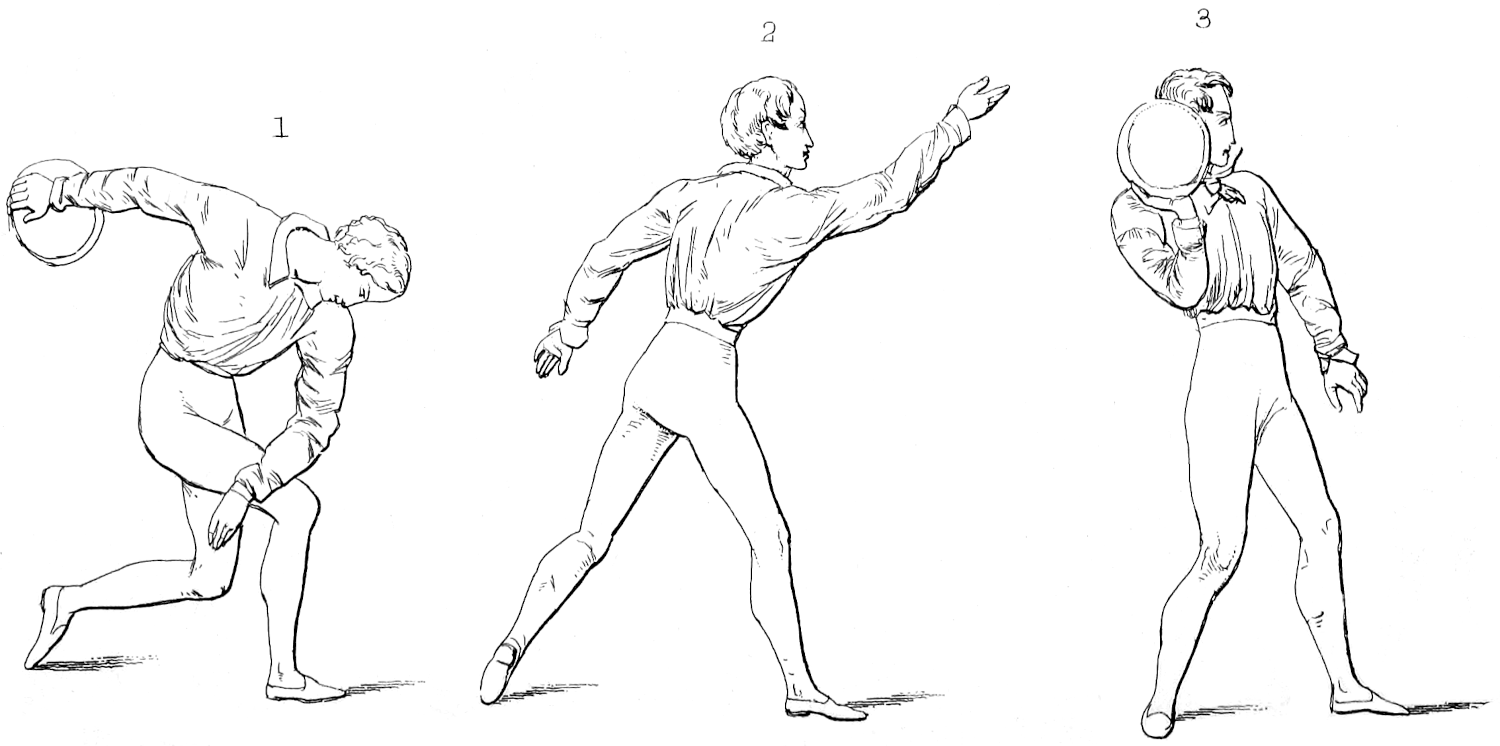
Throwing the Discus.
To perform this exercise properly, the thrower should not
only balance the discus well on the right arm, (supposing it to
be on that arm, as in Plate XVII. fig. 1); but at the moment
it leaves the hand, he should throw the whole of the right side
forward, so that the impulse may be assisted by the weight of
the whole body.—(Plate XVII. fig. 2.) This exercise very
much strengthens the body, and developes, in a particular manner,
the limb by which the discus is thrown. It may be usefully
employed in cases where it is desirable to remedy weakness in
either of the arms; and it is well calculated to bring up the
power of the left arm to that of the right. The modern quoit
differs from the ancient discus only in this, that the instrument
so called is much smaller than the discus, that its use is a mere
idle pastime, and that the object is always to throw it as close as
possible to a fixed mark, requiring more skill than strength.
It is evident that the discus may be heaved from above the
shoulder as well as flung from below.—(See Plate XVII. fig. 3.)
No exercises can excel these for the acquirement of power.
They ought to be much practised with both hands. A man of
moderate strength will throw a pound weight of lead a distance
of 140 feet, or thereabouts.
| Silex 1½ |
126 |
feet. |
| Ditto ¼ |
145 |
| Brick ½ |
160 |
Climbing is the art of transporting the body in any direction,
by the aid, in general, both of the hands and feet. The climbing-stand
consists of two strong poles, about fifteen feet high,
and from fifteen to twenty-five feet distant, which are firmly
fixed in the ground, and support a beam strongly fastened to
them. One pole is two inches and a half in diameter; the
other, which serves as a mast, should be considerably thicker;
and both serve the purpose of climbing. To the beam are attached
other implements of climbing: viz. a ladder, an inclined
board, a mast, an inclined pole, a horizontal bar, a rope ladder,
an upright, an inclined, and a level rope.—(Plate XVIII.)
Climbing on fixed bodies should first be practised.
The Ladder.
Exercises on the ladder may be practised in the following
ways:—
- 1. By ascending and descending as
usual.
- 2. With one hand, carrying something
in the other.
- 3. Without using the hands.
- 4. Passing another on the front of
the ladder, or swinging to the back,
to let another pass.
The Inclined Board.
This should be rather rough, about two feet broad, and two
inches thick. To climb it, it is necessary to seize both sides
with the hands, and to place the feet flat in the middle, the inclination
of the board being diminished with the progress of
the pupil.
At first, it may form with the ground an angle of about
thirty degrees; and the climber should not go more than half-way
up. This angle may gradually be augmented to a right
angle, or the direction of the board may be made perpendicular.
When the board is thus little or not at all inclined, the body
must be much curved inward, and the legs thrust up, so that the
higher one is nearly even with the hand. In descending, small
and quick steps are necessary.
Plate XVIII
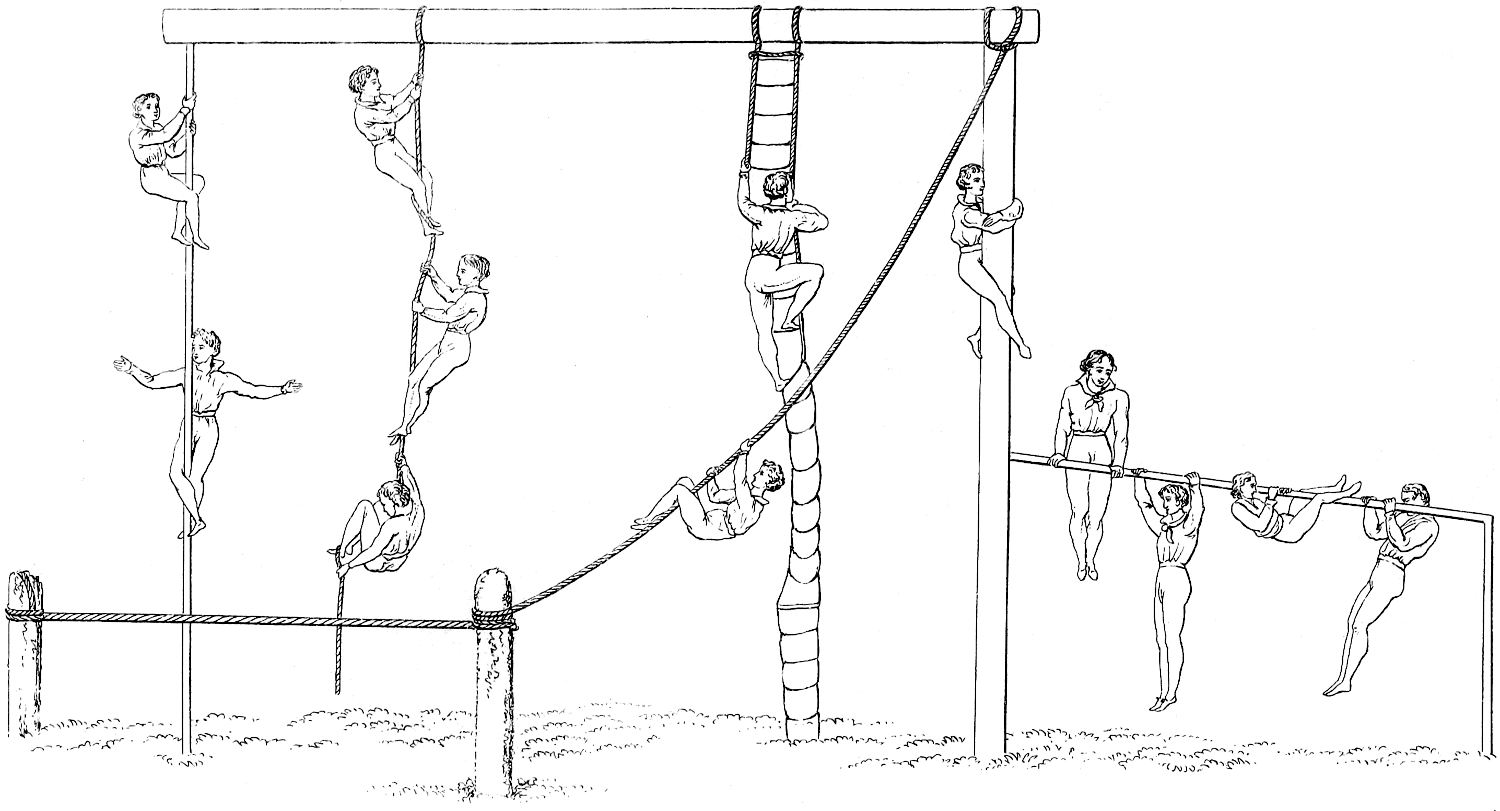
Climbing.
The Upright Pole.
The upright pole should be about two inches and a half in
diameter, perfectly smooth and free from splinters.
The position of the climber is shown in Plate XVIII. fig. 1,
where nothing touches the pole except the feet, legs, knees, and
hands. He grasps as high as possible with both hands, raises
himself by bending the body and drawing his legs up the pole,
holds fast by them, extends the body, again grasps higher up
with his hands, and continues the same use of the legs and
arms. The descent is performed by sliding down with the legs,
and scarcely touching with the hands, as in Plate XVIII. fig. 2.
The Mast.
This is more difficult, as it cannot be grasped with the hands;
and it consequently should not be practised until the climber is
expert in the previous exercises. The position of the legs is
the same as for the pole; but, instead of grasping the mast, the
climber lays hold of his left arm with his right hand, or the reverse,
and clings to the mast with the whole body, as in Plate
XVIII. fig. 3.
The Slant Pole.
This must be at least three inches thick; and as, in this exercise,
the hands bear more of the weight than in climbing the
upright pole, it should not be attempted until expertness in the
other is acquired.
The Horizontal, or Slightly Inclined Bar.
This may be about two inches wide at top, from ten to fifteen
feet long, and supported by two posts, respectively six and seven
feet high. The climber must grasp with both hands as high a
part of the bar as he can reach, and, with arms extended, support
his own weight as long as possible. He must next endeavour
to bend the elbows so much, that one shoulder remains
close under the bar, as seen in Pl XVIII. fig. 4. Or he may
place both hands on the same side, and draw himself up so far
as to see over it, keeping the legs and feet close and extended.
He may then hang with his hands fixed on both sides, near
to each other, having the elbows much bent, the upper parts of
the arms close to the body, and one shoulder close under the
bar; may lower the head backwards, and may, at the same time,
raise the feet to touch each other over the bar.—(Pl XVIII.
fig. 5.) In the last position, he may move the hands one before
the other, forward or backward, and may either slide the feet
along the bar, or alternately change them like the hands, and
retain a similar hold.
Hanging also by the hands alone, as in Pl XVIII. fig. 6, he
moves them either forward or backward, keeping the arms firm,
and the feet close and extended. Or he may place himself in
front of the bar, hanging by both hands, and move laterally.
Being likewise in front of the bar, with his hands resting upon
it, as in Pl XVIII. fig. 7, he may move along the bar either to
the right or left. In the position of Pl XVIII. fig. 5, the
climber may endeavour to sit upon the bar, for instance, on the
right side, by taking hold with the right knee-joint, grasping
firmly with the right hand, and bringing the left armpit over
the bar. The riding position is thus easily obtained. From the
riding position, he may, by supporting himself with one thigh,
turn towards the front of the bar, allowing the leg of the other
side to hang down; and he may then very easily move along the
bar sideways, by raising his body with his hands placed laterally
on the bar.
The Rope Ladder.
This should have several rundles to spread it out, and ought,
in all respects, to be so constructed, as not to twist and entangle.
The only difficulty here is that, as it hangs perpendicularly,
and is flexible, its steps are liable to be pushed forward,
and in that case, the body is thrown into an oblique position,
and the whole weight falls on the hands. To prevent this, the
climber must keep the body stretched out and upright.—(Plate
XVIII. fig. 8.)
The Upright Rope.
In this exercise, the securing the rope may be effected in
various ways. In the first method, shown in Pl XVIII.
fig. 9, the hands and feet alone are employed. The feet are
crossed; the rope passes between them, and is held fast by
their pressure; the hands then grasp higher; the feet are
drawn up; they are again applied to the rope; and the
same process is repeated. In the second, which is the sailor’s
method, shown at Pl XVIII. fig. 10, the rope passes from the
hands, generally along the right thigh, just above the knee;
winds round the inside of the thigh, under the knee-joint, over
the outside of the leg, and across the instep, whence it hangs
loose; and the climber, by treading with the left foot upon that
part of the rope where it crosses the right one, is firmly supported.
This mode of climbing requires the right leg and foot
to be so managed that the rope keeps its proper winding whenever
it is quitted by the left foot. In descending, to prevent
injury, the hands must be lowered alternately.
To rest upon the upright rope, shown in Pl XVIII. fig. 11,
the climber must swing the right foot round the rope, so as to
wind it three or four times round the leg; must turn it, by
means of the left foot, once or twice round the right one, of
which the toes are to be bent upwards; and must tread firmly
with the left foot upon the last winding. Or, to obtain a more
perfect rest he may lower his hands along the rope, as in Figure
11, hold with the right hand, stoop, grasp with the left the
part of the rope below the feet, raise it and himself again, and
wind it round his shoulders, &c., until he is firmly supported.
The Oblique Rope.
The climber must fix himself to the rope, as in Pl XVIII.
fig. 12, and advance the hands along it, as already directed.
The feet may move along the rope alternately; or one leg,
hanging over the rope, may slide along it; or, which is best,
the sole of one foot may be laid upon the rope, and the other
leg across its instep, so that the friction is not felt.
The Level Rope.
This may have its ends fastened to posts of equal heights;
and the same exercises may be performed upon it.
Climbing Trees.
In attempting this exercise, the kind of the wood and strength
of the branches must be considered. Summer is the best time
for practising it, as withered branches are then most easily
discerned; and even then it is best to climb low trees, until
some experience is acquired. As the surface of branches is
smooth, or moist and slippery, the hands must never for a
moment be relaxed.
Skating is the art of balancing the body, while, by the impulse
of each foot alternately, it moves rapidly upon the ice.
The wood of the skate should be slightly hollowed, so as to
adapt it to the ball of the foot; and, as the heel of the boot
must be thick enough to admit the peg, it may be well to lower
the wood of the skate corresponding to the heel, so as to permit
the foot to regain that degree of horizontal position which it
would otherwise lose by the height of the heel; for the more of
the foot that is in contact with the skate, the more firmly will
these be attached. As the tread of the skate should correspond,
as nearly as possible, with that of the foot, the wood should be
of the same length as the boot or shoe; the irons of good steel,
and well secured in the wood.
These should pass beyond the screw at the heel, nearly as far
as the wood itself; but the bow of the iron should not project
much beyond the tread.
If the skate project much beyond the wood, the whole foot,
and more especially its hind part, must be raised considerably
from the ice when the front or bow of the skate is brought to
bear upon it; and, as the skater depends upon this part for the
power of his stroke, it is evident that that must be greatly diminished
by the general distance of the foot from the ice. In short,
if the skate be too long, the stroke will be feeble, and the back
of the leg painfully cramped: if it be too short, the footing will
be proportionally unsteady and tottering.
As the position of the person in the act of skating is never
vertical, and is sometimes very much inclined, and as considerable
exertion of the muscles of the leg is requisite to keep the
ankle stiff, this ought to be relieved by the lowness of the skates.
Seeing, then, that the closer the foot is to the ice, the less is
the strain on the ankle, it is clear that the foot ought to be
brought as near to the ice as possible, without danger of bringing
the sole of the shoe in contact with it, while traversing on
the edge of the skate. The best height is about three-quarters
of an inch, and the iron about a quarter of an inch thick.
The grooved or fluted skate, if ever useful, is of service only
to boys, or very light persons, whose weight is not sufficient to
catch the ice in a hard frost. It certainly should never be used
by a person who is heavier than a boy of thirteen or fourteen
years of age usually is, because the sharp edge too easily cuts
into the ice, and prevents figuring. Fluted skates, indeed, are
even dangerous: for the snow or ice cuttings are apt to collect
and consolidate in the grooves, till the skater is raised from the
edge of his skate, and thrown.
In the general inclination of the foot in skating, no edge can
have greater power than that of rectangular shape: the tendency
of its action is downwards, cutting through rather than
sliding on the surface; and greater hold than this is unnecessary.
The irons of skates should be kept well and sharply ground.
This ought to be done across the stone, so as to give the bottom
of the skate so slight a concavity as to be imperceptible, which
insures an edge whose angle is not greater than right. Care
must be taken that one edge is not higher than the other; so
that, when the skate is placed upon an even surface, it may
stand quite perpendicularly. The wear of the iron not being
great with a beginner, one grinding will generally last him
through an ordinary winter’s skating on clean ice.
The bottom of the iron should be a little curved; for, if perfectly
straight, it would be capable of describing only a straight
line, whereas the skater’s progress must be circular, because, in
order to bring the edge to bear, the body must be inclined, and
inclination can be preserved only in circular motion. This curve
of the iron should be part of a circle, whose radius is about two
feet. That shape enables the skater to turn his toe or heel outwards
or inwards with facility.
A screw would have a firmer hold than a mere peg in the hole
of the boot; but, as it is less easily removed, skaters generally
prefer the peg. The skater should be careful not to bore a
larger hole in the heel than is sufficient to admit the peg. The
more simple the fastenings of the skate the better. The two
straps—namely, the cross strap over the toe, and the heel strap—cannot
be improved, unless perhaps by passing one strap through
the three bores, and so making it serve for both.
Before going on the ice, the young skater must learn to tie
on the skates, and may also learn to walk with them easily in a
room, balancing alternately on each foot.
A skater’s dress should be as close and unincumbered as
possible. Large skirts get entangled with his own limbs, or
those of the persons who pass near him; and all fulness of
dress is exposed to the wind. Loose trousers, frocks, and more
especially great-coats, must be avoided; and indeed, by wearing
additional under-clothing, they can always be dispensed with.
As the exercise of skating produces perspiration, flannel next
the chest, shoulders, and loins, is necessary to avoid the evils
produced by sudden chills in cold weather. The best dress is
what is called a dress-coat, buttoned, tight pantaloons, and
laced boots (having the heel no higher than is necessary for the
peg), which hold the foot tightly and steadily in its place, as
well as give the best support to the ankle; for it is of no use to
draw the straps of the skate hard, if the boot or shoe be loose.
Either very rough or very smooth ice should be avoided. The
person who for the first time attempts to skate, must not trust
to a stick. He may make a friend’s hand his support, if he
require one; but that should be soon relinquished, in order to
balance himself. He will probably scramble about for half an
hour or so, till he begins to find out where the edge of his
skate is.
The beginner must be fearless, but not violent; nor even in
a hurry. He should not let his feet get far apart, and keep his
heels still nearer together. He must keep the ankle of the foot
on the ice quite firm; not attempting to gain the edge of the
skate by bending it, because the right mode of getting to either
edge is by the inclination of the whole body in the direction
required; and this inclination should be made fearlessly and
decisively.
The leg which is on the ice should be kept perfectly straight;
for, though the knee must be somewhat bent at the time of
striking, it must be straightened as quickly as possible without
any jerk. The leg which is off the ice should also be kept
straight, though not stiff, having an easy but slight play, the
toe pointing downwards, and the heel within from six to twelve
inches of the other.
The learner must not look down at the ice, nor at his feet, to
see how they perform. He may at first incline his body a little
forward, for safety, but hold his head up, and see where he
goes, his person erect, and his face rather elevated than otherwise.
When once off, he must bring both feet up together, and
strike again, as soon as he finds himself steady enough, rarely
allowing both feet to be on the ice together. The position of
the arms should be easy and varied; one being always more
raised than the other, this elevation being alternate, and the
change corresponding with that of the legs; that is, the right
arm being raised as the right leg is put down, and vice versâ,
so that the arm and leg of the same side may not be raised together.
The face must be always turned in the direction of the line
intended to be described. Hence, in backward skating, the
head will be inclined much over the shoulder; in forward
skating, but slightly. All sudden and violent action must be
avoided. Stopping may be caused by slightly bending the
knees, drawing the feet together, inclining the body forward,
and pressing on the heels. It may also be caused by turning
short to the right or left, the foot on the side to which we turn
being rather more advanced, and supporting part of the weight.
The first attempt of the beginner is to walk, and this walk
shortly becomes a sliding gait, done entirely on the inside edge
of the skate.
The first impulse is to be gained by pressing the inside edge
of one skate against the ice, and advancing with the opposite
foot. To effect this, the beginner must bring the feet nearly
together, turn the left somewhat out, place the right a little in
advance and at right angles with it, lean forward with the right
shoulder, and at the same time move the right foot onwards,
and press sharply, or strike the ice with the inside edge of the
left skate,—care being taken instantly to throw the weight on
the right foot. (Plate XIX. fig. 1.) While thus in motion,
the skater must bring up the left foot nearly to a level with
the other, and may for the present proceed a short way on both
feet.
He must next place the left foot in advance in its turn, bring
the left shoulder forward, inclining to that side, strike from the
inside edge of the right skate, and proceed as before.
Finally, this motion has only to be repeated on each foot
alternately, gradually keeping the foot from which he struck
longer off the ice, till he has gained sufficient command of
himself to keep it off altogether, and is able to strike directly
from one to the other, without at any time having them both on
the ice together. Having practised this till he has gained some
degree of firmness and power, and a command of his balance,
he may proceed to
This is commonly reckoned the first step to figure skating, as,
when it is once effected, the rest follows with ease. The impulse
is gained in the same manner as for the ordinary run;
but, to get on the outside edge of the right foot, the moment
that foot is in motion, the skater must advance the left
shoulder, throw the right arm back, look over the right
shoulder, and incline the whole person boldly and decisively on
that side, keeping the left foot suspended behind. (Plate XIX.
fig. 2.)
As he proceeds, he must bring the left foot past the inside of
the right, with a slight jerk, which produces an opposing balance
of the body; the right foot must quickly press, first on the
outside of the heel, then on the inside, or its toe; the left foot
must be placed down in front, before it is removed more than
about eight or ten inches from the other foot; and, by striking
outside to the left, giving at the same moment a strong push
with the inside of the right toe, the skater passes from right to
left, inclining to the left side, in the same manner as he did to
the right. He then continues to change from left to right, and
from right to left, in the same manner. At first he should not
remain long upon one leg, nor scruple occasionally to put the
other down to assist; and throughout he must keep himself
erect, leaning most on the heel.
The Dutch travelling roll is done on the outside edge forward,
in the manner just represented, except that there is
described a small segment of a very large circle, thus:
diverging from the straight line no more than is requisite to
keep the skate on its edge.
The cross roll or figure 8 is also done on the outside edge
forward. This is only the completion of the circle on the outside
edge; and it is performed by crossing the legs, and striking
from the outside instead of the inside edge. In order to do
this, as the skater draws to the close of the stroke on his right
leg, he must throw the left quite across it, which will cause him
to press hard on the outside of the right skate, from which he
must immediately strike, at the same time throwing back the
left arm, and looking over the left shoulder, to bring him well
upon the outside of that skate. By completing the circle in
this manner on each leg, the 8 is formed:
each circle being small, complete, and well-formed, before the
foot is changed.
The Mercury figure is merely the outside and inside forward
succeeding each other on the same leg alternately, by which a
serpentine line is described, thus:
This is skated with the force and rapidity gained by a run.
When the run is complete, and the skater on the outside edge,
his person becomes quiescent, in the attitude of Mercury, having
the right arm advanced and much raised, the face turned
over the right shoulder, and the left foot off the ice, a short
distance behind the other, turned out and pointed.
This figure is formed by turning from the outside edge forward
to the inside edge backward on the same foot. The head
of the 3 is formed like the half circle, on the heel of the outside
edge; but when the half circle is complete, the skater
leans suddenly forward, and rests on the same toe inside, and a
backward motion, making the tail of the 3, is the consequence.
The figure described by the right leg should be nearly in the
form of No. 1; and on the left leg should be reversed, and
resemble No. 2.
At first, the skater should not throw himself quite so hard as
hitherto on the outside forward, in order that he may be able
the more easily to change to the inside back. He may also be
for some time contented with much less than a semicircle before
he turns. Having done this, and brought the left leg
nearly up to the other, he must not pass it on in advance, as
he would to complete a circle, but throw it gently off sidewise,
at the same moment turning the face from the right to the left
shoulder, and giving the whole person a slight inclination to the
left side. These motions throw the skater upon the inside of
his skate; but as the first impulse should still retain most of its
force, he continues to move on the inside back, in a direction
so little different, that his first impulse loses little by the change.
(Plate XIX. fig. 1.)
Plate XIX
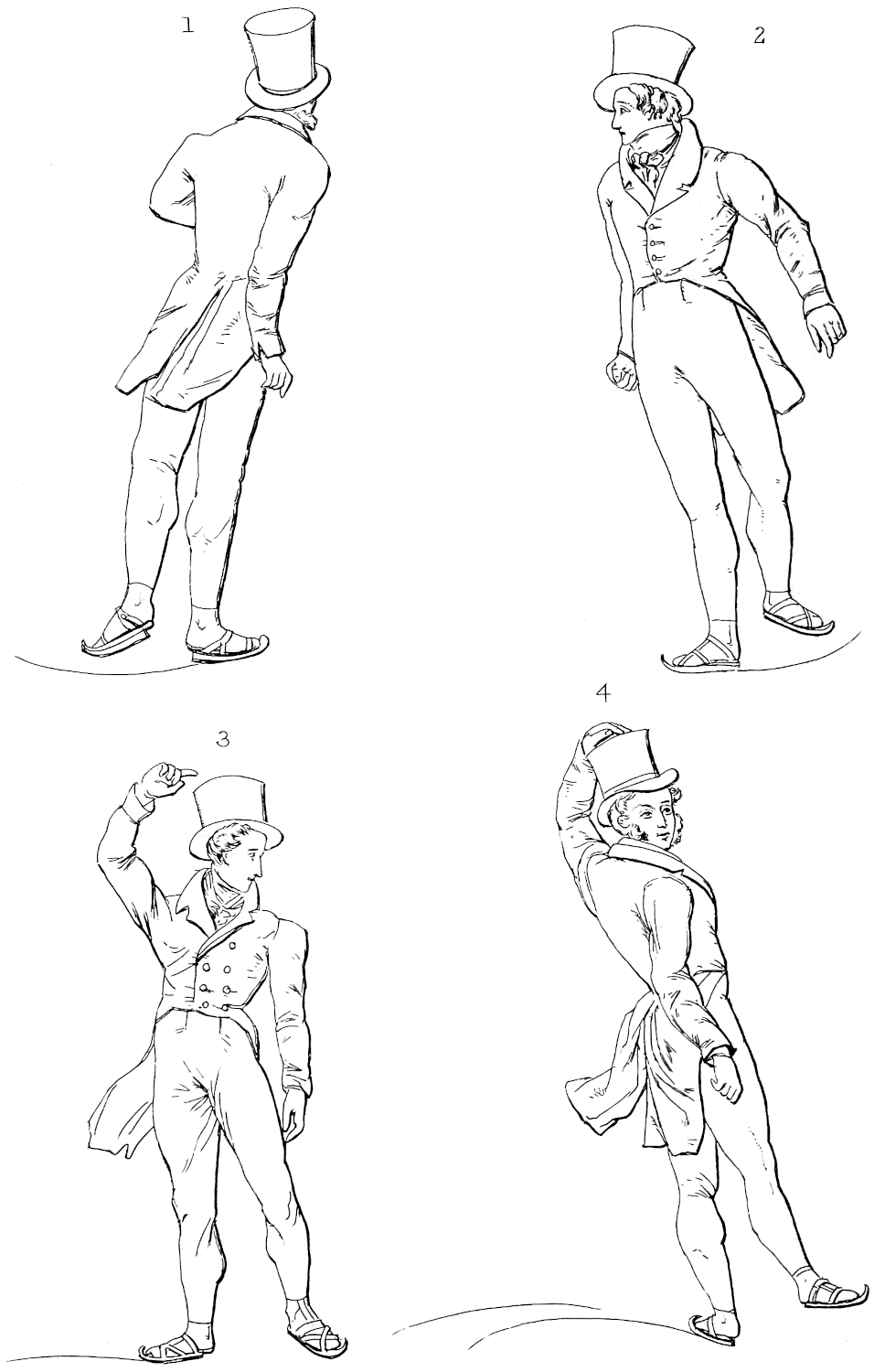
Skating.
If unable to change the edge by this method, the skater may
assist himself by slightly and gently swinging the arm and leg
outward, so as to incline the person to a rotatory motion. This
swing, however, must be corrected as soon as the object is
attained; and it must generally be observed that the change
from edge to edge is to be effected merely by the inclination of
the body, not by swinging.
When the skater is able to join the ends of the 3, so as to
form one side of a circle, then, by striking off in the same manner,
and completing another 3, with the left leg, the combination
of the two 3’s will form an 8. In the first attempts, the 3
should not be made above two feet long, which he will acquire
the power of doing almost imperceptibly. He may then
gradually extend the size as he advances in the art.
Though, in this section, backward skating is spoken of, the
term refers to the skate only, which in such case moves heel
foremost, but the person of the skater moves sidewise, the face
being always turned in the direction in which he is proceeding.
Here the skater, having completed the 3, and being carried
on by the first impulse, still continues his progress in the same
direction, but on the other foot, putting it down on its outside
edge, and continuing to go backwards slowly.
To accomplish this, the skater, after making the 3, and
placing the outside edge of his left foot on the ice, should at
once turn his face over the right shoulder, raise his right foot
from the ice, and throw back his right arm and shoulder. (Plate
XIX. fig. 2.) If, for awhile, he is unable readily to raise that foot
which has made the 3, and leave himself on the outside of the other
skate, he may keep both down for some distance, putting himself,
however, in attitude of being on the outside only of one skate,
and gradually lifting the other off the ice as he acquires ability.
When finishing any figure, this use of both feet backward
has great convenience and beauty.
Before venturing on the outside backward, the skater ought
to take care that the ice is clear of stones, reeds, &c., and also
be certain of the good quality of his irons. When going with
great force backward, the course may be deflected, so as to stop
by degrees; and, when moving slowly, the suspended foot may
be put down in a cross direction to the path.
Such are the four movements of which alone the skate is
capable: namely, the inside edge forward; the outside forward;
the inside back; and the outside back; in which has
been seen how the impulse for the first two is gained, and how
the third flows from the second, and the fourth from the third.
By the combination of these elements of skating, and the variations
with which they succeed each other, are formed all the
evolutions in this art.
The Double Three is that combination in which the skates
are brought from the inside back of the first three, to the
outside forward of the second. Here the skater, after having
completed one 3, and being on the inside back, must bring the
whole of the left side forward, particularly the leg, till it is
thrown almost across the right, on which he is skating. This
action brings him once more to the outside forward, from which
he again turns to the inside back. While he is still in motion
on the second inside back of the right leg, he must strike on
the left, and repeat the same on that.
It is at first enough to do two 3’s perfectly and smoothly. Their
number from one impulse may be increased as the skater gains
steadiness and skill; the art of accomplishing this being to
touch as lightly as possible on each side of the skate successively,
so that the first impulse may be preserved and made the most of.
The Back Roll is a means of moving from one foot to another.
Suppose the skater to have put himself on the outside edge
back of the left leg, with considerable impulse, by means of
the 3 performed on the right,—not bearing hard on the edge, for
the object is to change it, and take up the motion on the right
foot,—this is effected by throwing the left arm and shoulder
back, and turning the face to look over them; when, having
brought the inside of his left skate to bear on the ice, he must
immediately strike from it to the outside back of the other, by
pressing it into the ice as forcibly as he can at the toe. Having
thus been brought to the backward roll on the right foot, he
repeats the same with it.
The Back Cross Roll is done by changing the balance of the
body, to move from one foot to the other, in the same manner
as for the back roll. The stroke is from the outside instead of
the inside edge of the skate; the edge on which he is skating
not being changed, but the right foot, which is off the ice, being
crossed at the back of the left, and put down, and the stroke
taken at the same moment, from the outside edge of the left
skate, at the toe. As in the back roll of both forms, the strokes
are but feeble, the skater may, from time to time, renew his
impulse as he finds occasion, by commencing anew with the 3.
The large outside backward roll is attained by a run, when
the skater, having gained all the impulse he can, strikes on the
outside forward of the right leg, turns the 3, and immediately
put down the left on the outside back. He then, without further
effort, flies rapidly over the ice; the left arm being raised,
the head turned over the right shoulder, and the right foot
turned out and pointed.
It must be evident, that the elements described may be combined
and varied infinitely. Hence waltz and quadrille skating,
&c., which may be described as combinations of 3’s, outside
backwards, &c. These are left to the judgment of the skater,
and his skill in the art.
In the North it is common to travel in skates on the gulfs
and rivers; and, with a favourable wind, they go faster than
vessels. It is a kind of flight, for they only touch the ground
in a very slight thin line. As to feats in skating, we are told,
that the Frieslander, who is generally a skilful skater, often
goes for a long time at the rate of fifteen miles an hour. In
1801, two young women, going thirty miles in two hours, won
the prize in a skating race at Groningen. In 1821, a Lincolnshire
man, for a wager of 100 guineas, skated one mile within
two seconds of three minutes.
If the chest be irritable, it is neither salutary nor easy to
skate against the wind. In countries where these exercises are
general, inflammations of the chest are very common in winter.
Skating sometimes exposes to much danger. If the skater find
that he cannot get away from rotten ice, he must crawl over it
on his hands and knees, in order to reduce his weight on the
supporting points. If he fall on it at length, he must roll away
from it towards ice more firm. If he fall into a hole, he must
extend his arms horizontally over the edges of the unbroken
ice, and only tread water, till a ladder or a plank is pushed
towards him, or a rope is thrown for his hold.
Cautions.—1. Lose no time. 2. Avoid all rough usage. 3. Never hold the
body up by the feet. 4. Nor roll the body on casks. 5. Nor rub the body
with salt or spirits. 6. Nor inject tobacco-smoke or infusion of tobacco.
Restorative means if apparently drowned.—Send quickly for
medical assistance; but do not delay the following means.
I. Convey the body carefully, with the head and shoulders supported in a
raised position, to the nearest house.
II. Strip the body, and rub it dry; then wrap it in hot blankets, and place
it in a warm bed in a warm chamber.
III. Wipe and cleanse the mouth and nostrils.
IV. In order to restore the natural warmth of the body:
1. Move a heated covered warming-pan over the back and spine.
2. Put bladders or bottles of hot water, or heated bricks, to the pit of the
stomach, the arm-pits, between the thighs, and to the soles of the feet.
3. Foment the body with hot flannels; but, if possible,
4. Immerse the body in a warm bath, as hot as the hand can bear without
pain, as this is preferable to the other means for restoring warmth.
5. Rub the body briskly with the hand; do not, however, suspend the use
of the other means at the same time.
V. In order to restore breathing, introduce the pipe of a common bellows
(where the apparatus of the Society is not at hand) into one nostril, carefully
closing the other and the mouth: at the same time draw downwards and
push gently backwards the upper part of the windpipe, to allow a more free
admission of air: blow the bellows gently in order to inflate the lungs, till the
breast be a little raised: the mouth and nostrils should then be set free, and
a moderate pressure should be made with the hand upon the chest. Repeat
this process till life appears.
VI. Electricity should be employed early by a medical assistant.
VII. Inject into the stomach, by means of an elastic tube and syringe, half
a pint of warm brandy and water, or wine and water.
VIII. Apply sal-volatile or hartshorn to the nostrils.
If apparently dead from intense cold.—Rub the body with snow,
ice, or cold water. Restore warmth by slow degrees; and after some time,
if necessary, employ the means recommended for the drowned. In these
accidents, it is highly dangerous to apply heat too early.
AQUATIC EXERCISES — SWIMMING. — PREPARATORY INSTRUCTIONS AS TO ATTITUDE AND ACTION IN SWIMMING. — PLACE AND TIME OF SWIMMING. — PROCEDURE WHEN IN THE WATER, AND USUAL MODE OF FRONT SWIMMING. — UPRIGHT SWIMMING. — BACK SWIMMING. — FLOATING. — SIDE SWIMMING. — PLUNGING. — DIVING. — THRUSTING. — SPRINGING. — ONE-ARM SWIMMING. — FEATS IN SWIMMING. — ROWING. — RIVER ROWING, [9] WITH TWO SCULLS. — SEA-ROWING, OR ROWING IN A GALLEY ON THE RIVER. — SAILING. — BOATS, ETC. — COURSES, ETC. — GETTING UNDER WAY. — BEFORE THE WIND. [34] With the Main Boom over to Starboard. [35] — BRINGING THE VESSEL WITH THE WIND ON THE LARBOARD BEAM. [44] — CLOSE-HAULING THE VESSEL. [50] — TACKING. [53] — REEFING, TAKING IN SAIL, ETC. — PASSING OTHER VESSELS. — BRINGING THE VESSEL INTO HARBOUR. — DESCRIPTION OF PLATE XXXI. — PLATE XXXII. fig. 1. — PLATE XXXII. fig. 2. — PLATE XXXIII. fig. 1. — PLATE XXXIII. fig. 2.
Swimming, considered with regard to the movements that
it requires, is useful in promoting great muscular strength;
but the good effects are not solely the result of the exercise
that the muscles receive, but partly of the medium in which
the body is moved. Both the considerable increase of general
force, and the tranquillizing of the nervous system produced
by swimming, arise chiefly from this, that the movements, in
consequence of the cold and dense medium in which they take
place, occasion no loss.[8] It is easy to conceive of what utility
swimming must be, where the very high state of the atmospheric
temperature requires inactivity in consequence of the
excessive loss caused by the slightest movement. It then
becomes an exceedingly valuable resource, the only one, indeed,
by which muscular weakness can be remedied, and the
energy of the vital functions maintained. We must therefore
regard swimming as one of the most beneficial exercises that
can be taken in summer.
Plate XX
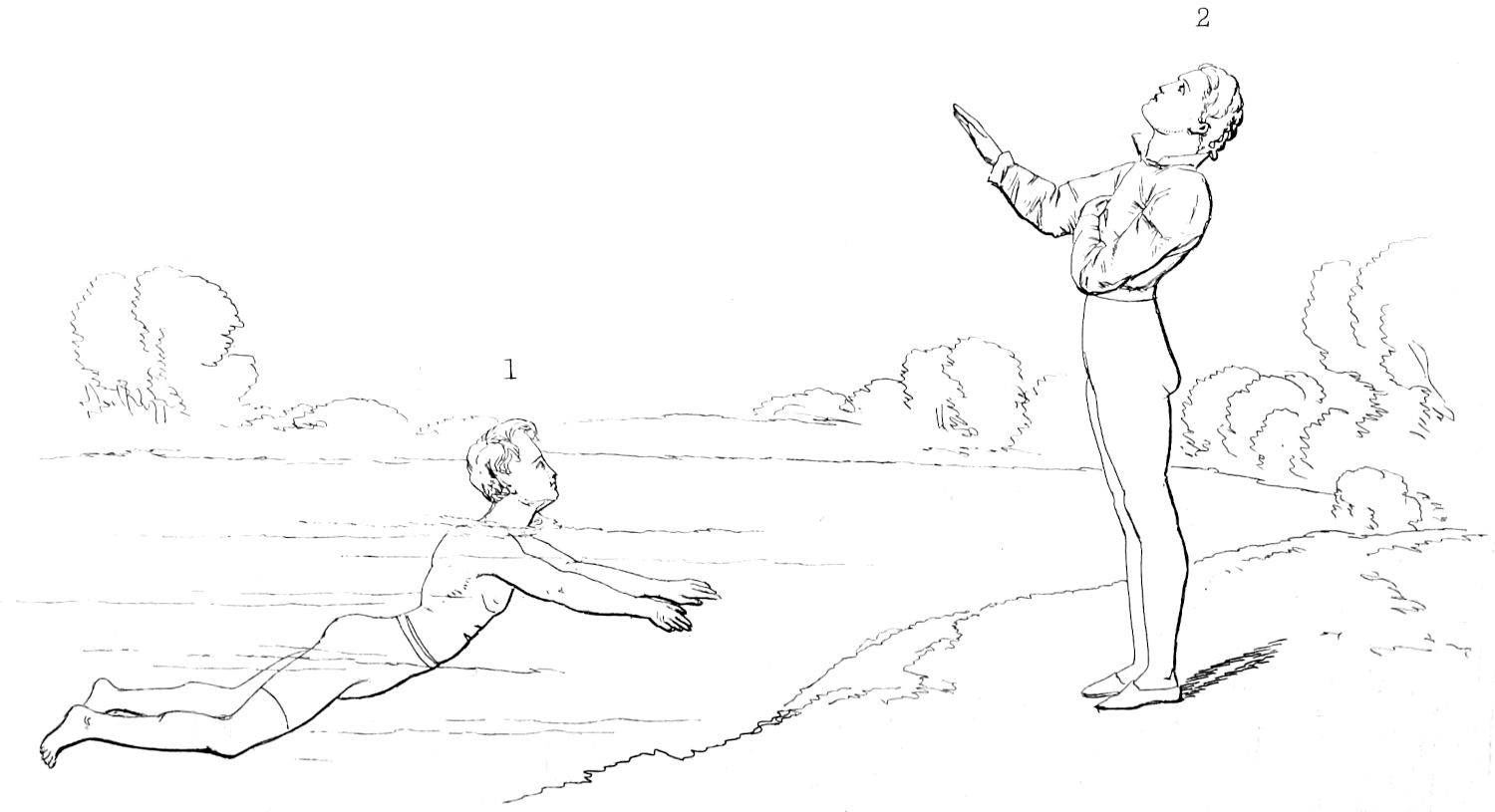
Swimming—Attitude.
The ancients, particularly the Athenians, regarded swimming
as indispensable; and when they wished to designate a man
who was fit for nothing, they used to say, “he cannot even
swim,” or “he can neither read nor swim.” At many seaports,
the art of swimming is almost indispensable; and the sailors’
children are as familiar with the water as with the air. Copenhagen
is perhaps the only place where sailors are trained by
rules of art; and there, this exercise is more general and in
greater perfection than elsewhere. It may here be observed,
that it is not fear alone that prevents a man swimming. Swimming
is an art that must be learnt; and fear is only an obstacle
to the learning.
As it is on the movements of the limbs, and a certain attitude
of the body, that the power of swimming depends, its first
principles may evidently be acquired out of the water.
Attitude.
The head must be drawn back, and the chin elevated, the
breast projected, and the back hollowed and kept steady. (Plate
XX. figs. 1 and 2.) The head can scarcely be thrown too
much back, or the back too much hollowed. Those who do
otherwise, swim with their feet near the surface of the water,
instead of having them two or three feet deep.
Action of the Hands.
In the proper position of the hands, the fingers must be kept
close, with the thumbs by the edge of the fore-fingers; and the
hands made concave on the inside, though not so much as to
diminish their size and power in swimming. The hands, thus
formed, should be placed just before the breast, the wrist
touching it, and the fingers pointing forward. (Plate XXI.
fig. 1.)
The first elevation is formed by raising the ends of the
fingers three or four inches higher than the rest of the hands.
The second, by raising the outer edge of the hand two or three
inches higher than the inner edge.
The formation of the hands, their first position, and their
two modes of elevation, being clearly understood, the forward
stroke is next made, by projecting them in that direction
to their utmost extent, employing therein their first elevation,
in order to produce buoyancy, but taking care the fingers
do not break the surface of the water. (Plate XXI. fig. 2.)
In the outward stroke of the hands, the second elevation
must be employed; and, in it, they must sweep downward and
outward as low as, but at a distance from, the hips, both laterally
and anteriorly. (Plate XXI. figs. 3 and 4.)
The retraction of the hands is effected by bringing the arms
closer to the sides, bending the elbow joints upwards and the
wrists downwards, so that the hands hang down, while the
arms are raising them to the first position, the action of the
hands being gentle and easy. In the three movements just
described, one arm may be exercised at a time, until each is
accustomed to the action.
Action of the Feet.
In drawing up the legs, the knees must be inclined inward,
and the soles of the feet outward. (Plate XXII. fig. 1.) The
throwing out the feet should be to the extent of the legs,
as widely from each other as possible. (Plate XXII. fig. 2.)
The bringing down the legs must be done briskly, until
they come close together. In drawing up the legs, there is
a loss of power; in throwing out the legs, there is a gain
equal to that loss; and in bringing down the legs, there is an
evident gain.
Plate XXI
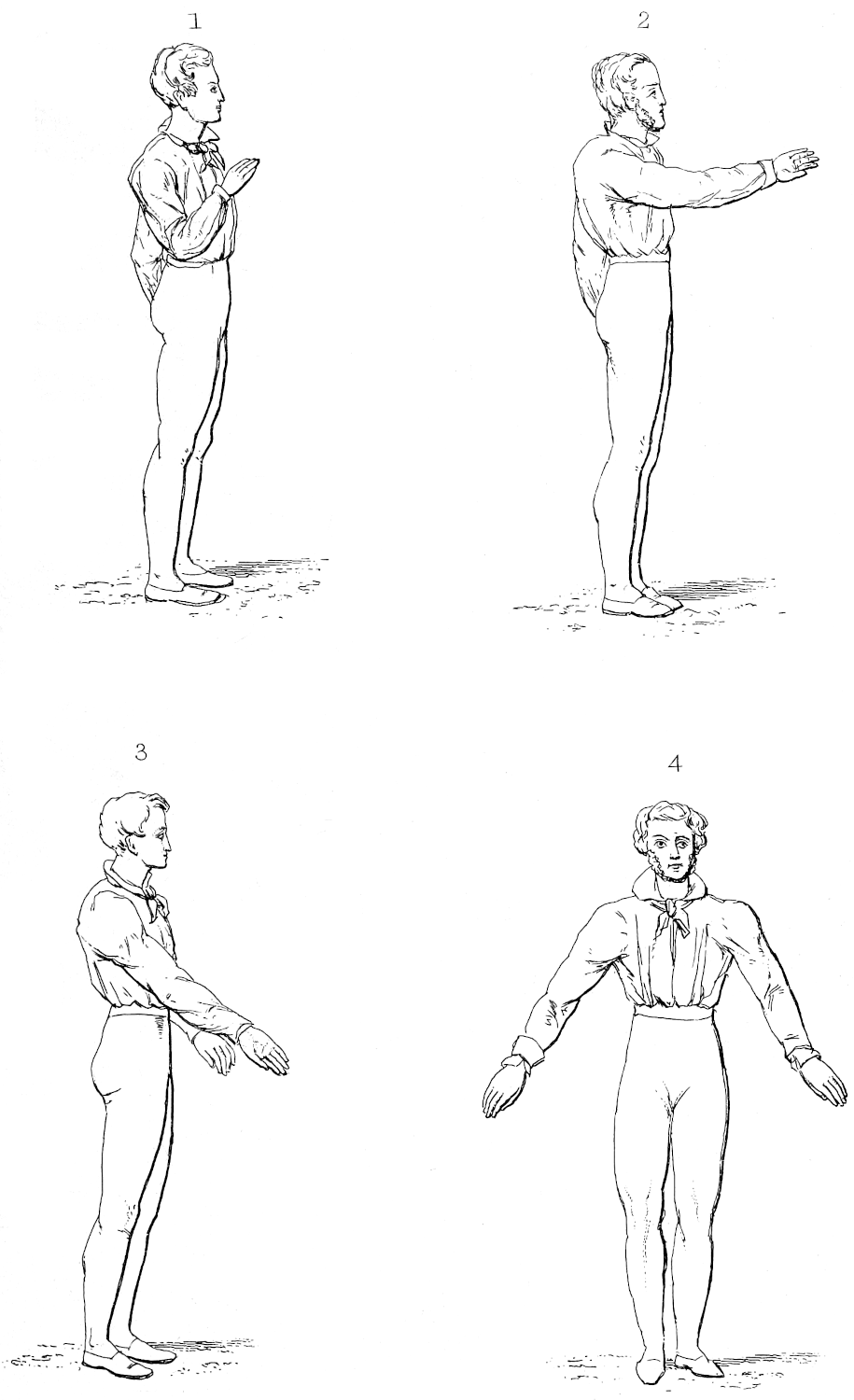
Swimming—Action of the Hands.
Plate XXII
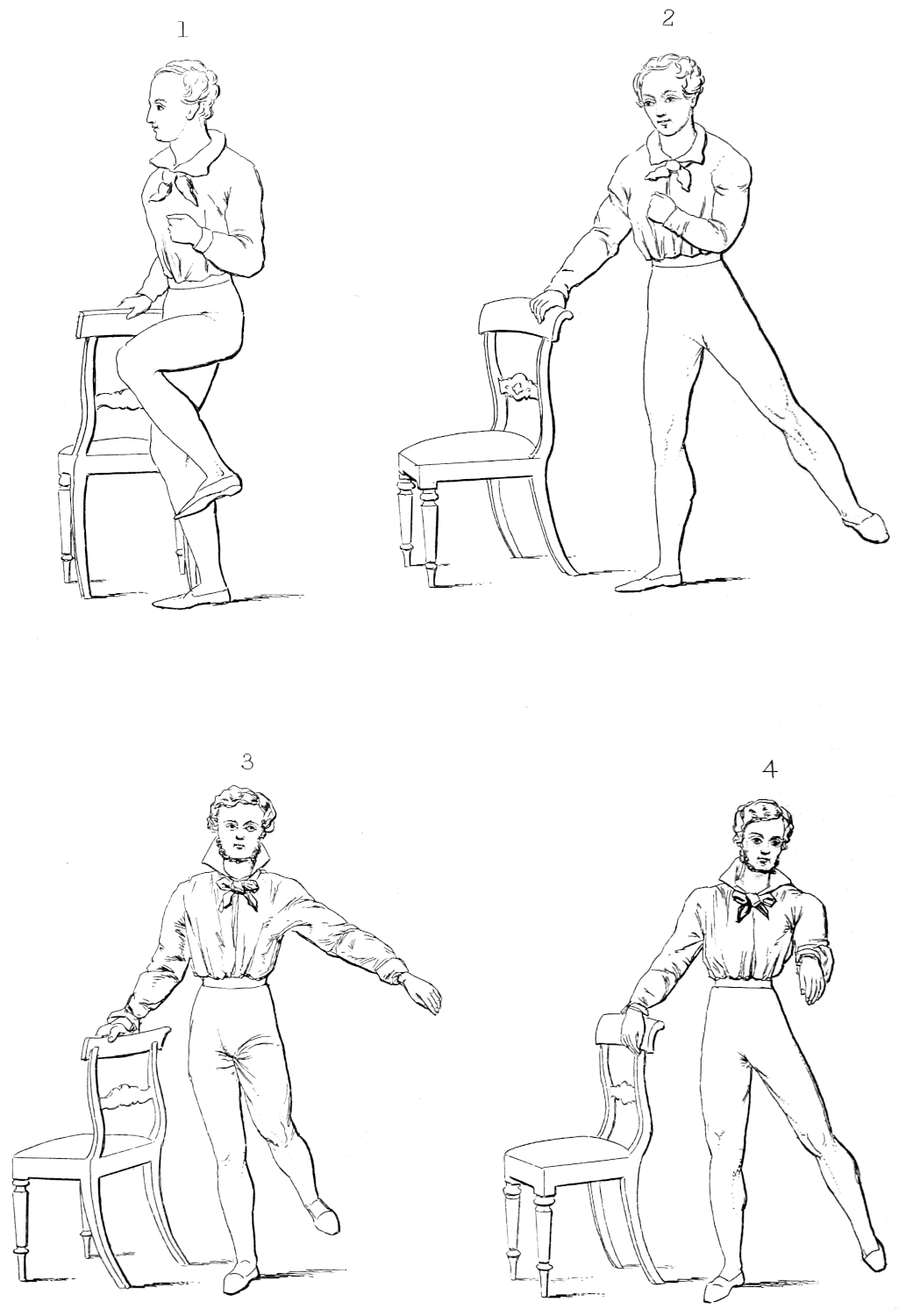
Swimming—Action of the Feet.
The arms and legs should act alternately; the arms descending
while the legs are rising—(Plate XXII. fig. 3); and, oppositely,
the arms rising while the legs are descending. (Plate
XXII. fig. 4.) Thus the action of both is unceasingly interchanged;
and, until great facility in this interchange is effected,
no one can swim smoothly, or keep the body in one continued
progressive motion. In practising the action of the
legs, one hand may rest on the top of a chair, while the
opposite leg is exercised. When both the arms and the legs
are separately accustomed to the action, the arm and leg of
the same side may be exercised together.
Place.
Of all places for swimming, the sea is the best; running
waters next; and ponds the worst. In these a particular
spot should be chosen, where there is not much stream, and
which is known to be safe.
The swimmer should make sure that the bottom is not out
of his depth; and, on this subject, he cannot be too cautious
when he has no one with him who knows the place. If
capable of diving, he should ascertain if the water be sufficiently
deep for that purpose, otherwise, he may injure himself
against the bottom. The bottom should be of gravel, or
smooth stones, and free from holes, so that he may be in
no danger of sinking in the mud or wounding the feet. Of
weeds he must beware; for if his feet get entangled among
them, no aid, even if near, may be able to extricate him.
Time.
The best season of the year for swimming is during the
months of May, June, July, and August. Morning before
breakfast—that is to say, from seven till eight o’clock—is the
time. In the evening, the hair is not perfectly dried, and coryza
is sometimes the consequence. Bathing during rain is bad, for
it chills the water, and, by wetting the clothes, endangers catching
cold. In practising swimming during those hours of the
day when the heat of the sun is felt most sensibly, if the hair
be thick, it should be kept constantly wet; if the head be bald,
it must be covered with a handkerchief, and frequently wetted.
It is advisable not to enter the water before digestion is
finished. The danger in this case arises less from the violent
movements which generally disorder digestion, than from the
impression produced by the medium in which these movements
are executed. It is not less so when very hot, or quite cold.
It is wrong to enter the water in a perspiration, however trifling
it may be. After violent exercises, it is better to wash and employ
friction than to bathe. Persons of plethoric temperament,
who are subject to periodical evacuations, such as hemorrhoids,
or even to cutaneous eruptions, will do well to abstain from
swimming during the appearance of these affections.
Dress.
Every swimmer should use short drawers, and might, in particular
places, use canvass slippers. It is even of great importance
to be able to swim in jacket and trousers.
Aids.
The aid of the hand is much preferable to corks or bladders,
because it can be withdrawn gradually and insensibly. With
this view, a grown-up person may take the learner in his arms,
carry him into the water breast high, place him nearly flat upon
it, support him by one hand under the breast, and direct him as
to attitude and action. If the support of the hand be very gradually
withdrawn, the swimmer will, in the course of the first
ten days, find it quite unnecessary. When the aid of the hand
cannot be obtained, inflated membranes or corks may be employed.
The only argument for their use is, that attitude and
action may be perfected while the body is thus supported; and
that, with some contrivance, they also may gradually be laid
aside, though by no means so easily as the hand.
The best mode of employing corks is to choose a piece about
a foot long, and six or seven inches broad; to fasten a band
across the middle of it; to place it on the back, so that the
upper end may come between the shoulder-blades, where the
edge may be rounded; and to tie the band over the breast.
Over this, several other pieces of cork, each smaller than the
preceding, may be fixed, so that, as the swimmer improves, he
may leave them off one by one. Even with all these aids, the
young swimmer should never venture out of his depth, if he
cannot swim without them.
Cramp.
As to cramp, those chiefly are liable to it who plunge into the
water when they are heated, who remain in it till they are benumbed
with cold, or who exhaust themselves by violent exercise.
Persons subject to this affection must be careful with
regard to the selection of the place where they bathe, if they
are not sufficiently skilful in swimming to vary their attitudes,
and dispense instantly with the use of the limb attacked by
cramp. Even when this does occur, the skilful swimmer knows
how to reach the shore by the aid of the limbs which are unaffected,
while the uninstructed one is liable to be drowned.
If attacked in this way in the leg, the swimmer must strike
out the limb with all his strength, thrusting the heel downward
and drawing the toes upward, notwithstanding the momentary
pain it may occasion; or he may immediately turn flat on his
back, and jerk out the affected limb in the air, taking care not
to elevate it so high as greatly to disturb the balance of the
body. If this does not succeed, he must paddle ashore with his
hands, or keep himself afloat by their aid, until assistance reach
him. Should he even be unable to float on his back, he must
put himself in the upright position, and keep his head above the
surface by merely striking the water downward with his hands
at the hips, without any assistance from the legs.
Entering the Water.
Instructors should never force young swimmers reluctantly to
leap into the water. It would be advisable for delicate persons,
especially when they intend to plunge in, to put a little cotton
steeped in oil, and afterwards pressed, in their ears, before
entering the water. This precaution will prevent irritation of
the organ of hearing. In entering, the head should be wetted
first, either by plunging in head foremost, or by pouring water
on it, in order to prevent the pressure of the water driving up
the blood into it too quickly, and increasing congestion. The
swimmer should next advance, by a clear shelving shore or
bank, where he has ascertained the depth by plumbing or otherwise,
till the water reaches his breast; should turn towards the
place of entrance; and, having inflated his breast, lay it upon
the water, suffering that to rise to his chin, the lips being closed.
Buoyancy in the Water.
The head alone is specifically heavier than salt water. Even
the legs and arms are specifically lighter; and the trunk is still
more so. Thus the body cannot sink in salt water, even if the
lungs were filled, except owing to the excessive specific gravity
of the head.
Not only the head, but the legs and arms, are specifically
heavier than fresh water; but still the hollowness of the trunk
renders the body altogether too light to sink wholly under water,
so that some part remains above until the lungs become filled.
In general, when the human body is immersed, one-eleventh of
its weight remains above the surface in fresh water, and one-tenth
in salt water.
In salt water, therefore, a person throwing himself on his
back, and extending his arms, may easily lie so as to keep his
mouth and nostrils free for breathing; and, by a small motion
of the hand, may prevent turning, if he perceive any tendency
to it. In fresh water, a man cannot long continue in that situation,
except by the action of his hands; and if no such action
be employed, the legs and lower part of the body will gradually
sink into an upright position, the hollow of the breast keeping
the head uppermost. If, however, in this position, the head be
kept upright above the shoulders, as in standing on the ground,
the immersion, owing to the weight of the part of the head out
of the water, will reach above the mouth and nostrils, perhaps a
little above the eyes. On the contrary, in the same position, if
the head be leaned back, so that the face is turned upwards, the
back part of the head has its weight supported by the water, and
the face will rise an inch higher at every inspiration, and will
sink as much at every expiration, but never so low that the water
can come over the mouth.
For all these reasons, though the impetus given by the fall of
the body into water occasions its sinking to a depth proportioned
to the force of the descent, its natural buoyancy soon impels it
again to the surface, where, after a few oscillations up and down,
it settles with the head free.
Unfortunately, ignorant people stretch the arms out to grasp
at anything or nothing, and thereby keep the head under; for
the arms and head, together exceeding in weight one-tenth of
the body, cannot remain above the surface at the same time.
The buoyancy of the trunk, then and then only, occasions the
head and shoulders to sink, the ridge of the bent back becoming
the portion exposed; and, in this attitude, water is swallowed,
by which the specific gravity is increased, and the body settles
to the bottom. It is, therefore, most important to the safety of
the inexperienced to be firmly convinced that the body naturally
floats.
To satisfy the beginner of the truth of this, Dr. Franklin advises
him to choose a place where clear water deepens gradually,
to walk into it till it is up to his breast, to turn his face to the
shore, and to throw an egg into the water between him and it—so
deep that he cannot fetch it up but by diving. To encourage
him to take it up, he must reflect that his progress will be from
deep to shallow water, and that at any time he may, by bringing
his legs under him, and standing on the bottom, raise his head
far above the water. He must then plunge under it, having his
eyes open, before as well as after going under; throw himself
towards the egg, and endeavour, by the action of his hands and
feet against the water, to get forward till within reach of it. In
this attempt, he will find that the water brings him up against
his inclination, that it is not so easy to sink as he imagined, and
that he cannot, but by force, get down to the egg. Thus he feels
the power of water to support him, and learns to confide in that
power; while his endeavours to overcome it, and reach the egg,
teach him the manner of acting on the water with his feet and
hands, as he afterwards must in swimming, in order to support
his head higher above the water, or to go forward through it.
If, then, any person, however unacquainted with swimming,
will hold himself perfectly still and upright, as if standing with
his head somewhat thrown back so as to rest on the surface, his
face will remain above the water, and he will enjoy full freedom
of breathing. To do this most effectually, the head must be so
far thrown back that the chin is higher than the forehead, the
breast inflated, the back quite hollow, and the hands and arms
kept under water. If these directions be carefully observed, the
face will float above the water, and the body will settle in a diagonal
direction. (Plate XXIII. fig. 1.)
In this case, the only difficulty is to preserve the balance of
the body. This is secured, as described by Bernardi, by extending
the arms laterally under the surface of the water, with the
legs separated, the one to the front and the other behind: thus
presenting resistance to any tendency of the body to incline to
either side, forward or backward. This posture may be preserved
any length of time. (Plate XXIII. fig. 2.)
The Abbé Paul Moccia, who lived in Naples in 1760, perceived,
at the age of fifty, that he could never entirely cover
himself in the water. He weighed three hundred pounds (Italian
weight), but being very fat, he lost at least thirty pounds in the
water. Robertson had just made his experiments on the specific
weight of man; and everybody was then occupied with the Abbé,
who could walk in the water with nearly half his body out of it.
Plate XXIII
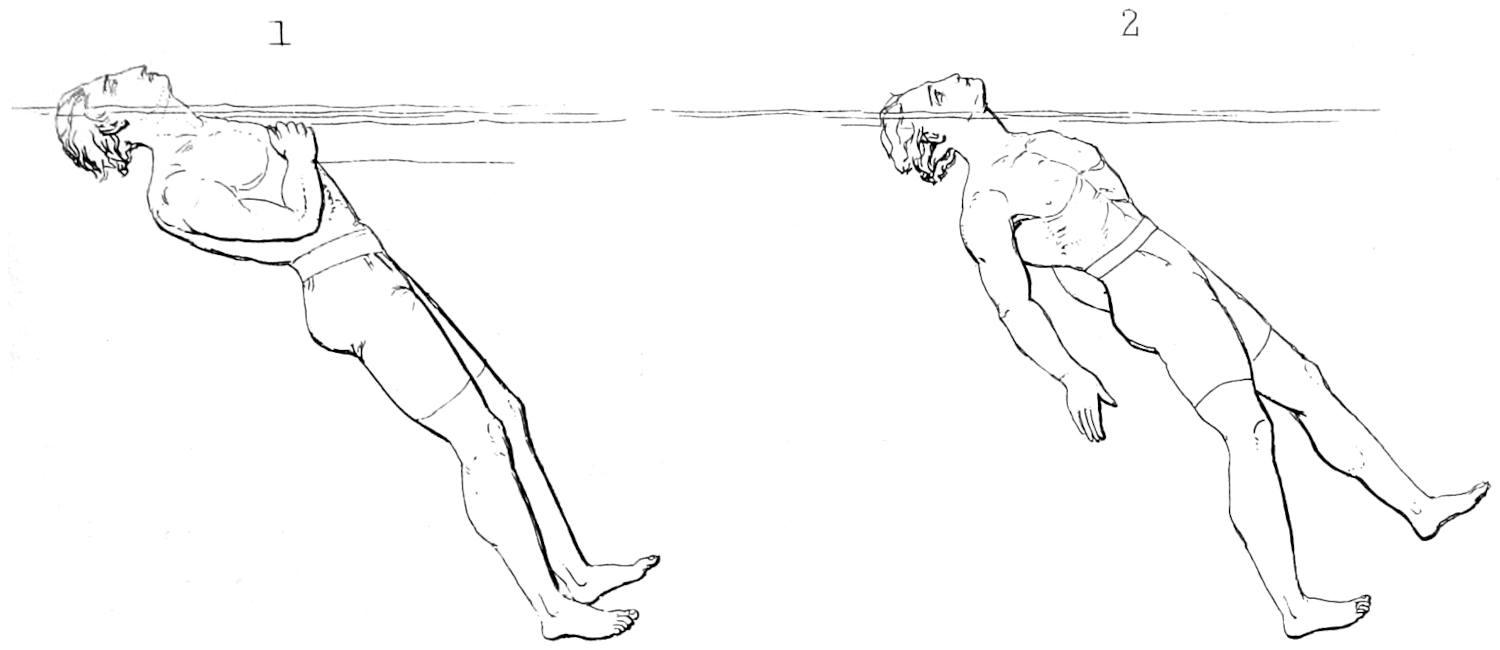
Swimming—Buoyancy in Water.
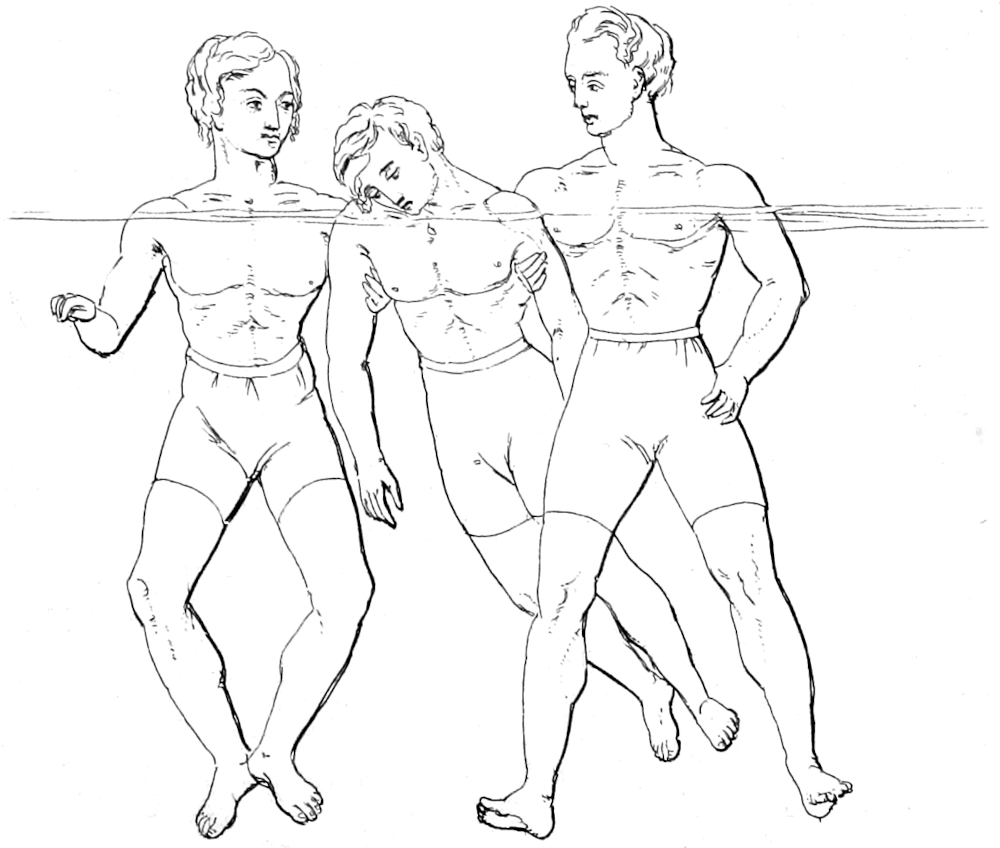
Swimming—Treading Water.
Attitude and Action in the Water.
The swimmer having, by all the preceding means, acquired
confidence, may now practise the instructions already given on
attitude and action in swimming: or he may first proceed with
the system of Bernardi, which immediately follows. As the
former have already been given in ample detail, there is nothing
new here to be added respecting them, except that, while the
attitude is correct, the limbs must be exercised calmly, and free
from all hurry and trepidation, the breath being held, and the
breast kept inflated, while a few strokes are made. In swimming
in the usual way, there is, first, extension, flexion, abduction
and adduction of the members; secondly, almost constant
dilation of the chest, to diminish the mobility of the point of
attachment of the muscles which are inserted in the elastic sides
of this cavity, and to render the body specifically lighter; thirdly,
constant action of the muscles of the back part of the neck, to
raise the head, which is relatively very heavy, and to allow the
air free entrance to the lungs.
Respiration in Swimming.
If the breath is drawn at the moment when the swimmer
strikes out with the legs, instead of when the body is elevated
by the hands descending towards the hips, the head partially
sinks, the face is driven against the water, and the mouth becomes
filled. If, on the contrary, the breath is drawn when the
body is elevated by the hands descending towards the hips, when
the progress of the body forward consequently ceases, when the
face is no longer driven against the water, but is elevated above
the surface,—then, not only cannot the water enter, but if the
mouth were at other times even with, or partly under the surface,
no water could enter it, as the air, at such times, driven
outward between the lips, would effectually prevent it. The
breath should accordingly be expired while the body, at the
next stroke, is sent forward by the action of the legs.
Coming out of the Water.
Too much fatigue in the water weakens the strength and presence
of mind necessary to avoid accidents. A person who is
fatigued, and remains there without motion, soon becomes weak
and chilly. As soon as he feels fatigued, chill, or numbed, he
should quit the water, and dry and dress himself as quickly as
possible. Friction, previous to dressing, drives the blood over
every part of the body, creates an agreeable glow, and
strengthens the joints and muscles.
Bernardi’s System.
The principal reasons given by Bernardi for recommending the
upright position in swimming are—its conformity to the accustomed
movement of the limbs; the freedom it gives to the
hands and arms, by which any impediment may be removed, or
any offered aid readily laid hold of; vision all around; a much
greater facility of breathing; and lastly, that much less of the
body is exposed to the risk of being laid hold of by persons
struggling in the water.
The less we alter our method of advancing in the water from
what is habitual to us on shore, the more easy do we find a
continued exercise of it. The most important consequence of
this is, that, though a person swimming in an upright posture
advances more slowly, he is able to continue his course much
longer; and certainly nothing can be more beneficial to a swimmer
than whatever tends to husband his strength, and to enable
him to remain long in the water with safety.
Bernardi’s primary object is to enable the pupil to float in
an upright posture, and to feel confidence in the buoyancy
of his body. He accordingly supports the pupil under the
shoulders until he floats tranquilly with the head and part of
the neck above the surface, the arms being stretched out horizontally
under water. From time to time, the supporting arm
is removed, but again restored, so as never to suffer the head
to sink, which would disturb the growing confidence, and give
rise to efforts destructive of the success of the lesson. In this
early stage, the unsteadiness of the body is the chief difficulty
to be overcome.
The head is the great regulator of our movements in water.
Its smallest inclination to either side instantly operates on the
whole body; and, if not corrected, throws it into a horizontal
posture. The pupil must, therefore, restore any disturbance of
equilibrium by a cautious movement of the head alone in an
opposite direction. This first lesson being familiarized by practice,
he is taught the use of the legs and arms for balancing the
body in the water. One leg being stretched forward, the other
backward, and the arms laterally, he soon finds himself steadily
sustained, and independent of further aid in floating.
When these first steps have been gained, the sweeping semicircular
motion of the arms is shown. This is practised slowly,
without motion forwards, until attained with precision. After
this, a slight inclination of the body from the upright position
occasions its advancing. The motion of striking with the legs
is added in the same measured manner; so that the pupil is not
perplexed by the acquisition of more than one thing at a time.
In this method, the motions of both arms and legs differ from
those we have so carefully described, only in so far as they are
modified by a more upright position. It is optional, therefore, with
the reader, to practise either method. The general principles of
both are now before him.
The upright position a little inclined backwards, (which, like
every other change of posture, must be done deliberately, by
the corresponding movement of the head,) reversing in this case
the motion of the arms, and striking the flat part of the foot
down and a little forward, gives the motion backward, which is
performed with greater ease than when the body is laid horizontally
on the back. According to this system, Bernardi says,
a swimmer ought at every stroke to urge himself forward a distance
equal to the length of his body. A good swimmer ought
to make about three miles an hour. A good day’s journey may
thus be achieved, if the strength be used with due discretion,
and the swimmer be familiar with the various means by which
it may be recruited.
Of Bernardi’s successful practice, he says, “Having been appointed
to instruct the youths of the Royal Naval Academy of
Naples in the art of swimming, a trial of the proficiency of the
pupils took place, under the inspection of a number of people
assembled on the shore for that purpose, on the tenth day of
their instruction. A twelve-oared boat attended the progress of
the pupils, from motives of precaution. They swam so far out
in the bay, that at length the heads of the young men could
with difficulty be discerned with the naked eye; and the Major
General of Marine, Forteguerri, for whose inspection the exhibition
was intended, expressed serious apprehensions for their
safety. Upon their return to the shore, the young men, however,
assured him that they felt so little exhausted as to be
willing immediately to repeat the exertion.” An official report
on the subject has also been drawn up by commission (appointed
by the Neapolitan government), after devoting a month to the
investigation of Bernardi’s plan; and it states as follows:
“1st. It has been established by the experience of more than
a hundred persons of different bodily constitutions, that the
human body is lighter than water, and consequently will float
by nature; but that the art of swimming must be acquired, to
render that privilege useful.
“2dly. That Bernardi’s system is new, in so far as it is
founded on the principle of husbanding the strength, and rendering
the power of recruiting it easy. The speed, according
to the new method, is no doubt diminished; but security is
much more important than speed; and the new plan is not
exclusive of the old, when occasions require great effort.
“3dly. That the new method is sooner learnt than the old,
to the extent of advancing a pupil in one day as far as a month’s
instruction on the old plan.”
Treading Water.
This differs little from the system just described. As in it,
the position is upright; but progression is obtained by the action
of the legs alone. There is little power in this method of swimming:
but it may be very useful in rescuing drowning persons.
The arms should be folded across, below the breast, or compressed
against the hips, and the legs employed as in front
swimming, except as to time and extent. They should perform
their action in half the usual time, or two strokes should be
taken in the time of one; because, acting perpendicularly, each
stroke would otherwise raise the swimmer too much, and he
would sink too low between the strokes, were they not quickly
to follow each other. They should also work in about two-thirds
of the usual space, preserving the upper or stronger, and
omitting the lower or weaker, part of the stroke.
There is, however, another mode of treading water, in which
the thighs are separated, and the legs slightly bent, or curved
together, as in a half-sitting posture. Here the legs are used
alternately, so that, while one remains more contracted, the
other, less so, describes a circle. By this method, the swimmer
does not seem to hop in the water, but remains nearly at the
same height. Pl XXIII. f. 3 represents both these methods,
and shows their peculiar adaptation to relieve drowning persons.
In swimming on the back, the action of the thoracic member
is weaker, because the swimmer can support himself on the
water without their assistance. The muscular contractions take
place principally in the muscles of the abdominal members, and in
those of the anterior part of the neck. Though little calculated
for progression, it is the easiest of all methods, because, much
of the head being immersed, little effort is required for support.
For this purpose, the swimmer must lie down gently upon the
water; the body extended; the head kept in a line with it, so
that the back and much of the upper part of the head may be
immersed; the head and breast must remain perfectly unagitated
by the action of the legs; the hand laid on the thighs (Plate
XXIV. fig. 1), and the legs employed as in front swimming,
care being taken that the knees do not rise out of the water.—(Plate
XXIV. fig. 2.) The arms may, however, be used in
various ways in swimming on the back.
In the method called winging, the arms are extended till in a
line with each other; they must then be struck down to the
thighs, with the palms turned in that direction, and the thumbs
inclining downward to increase the buoyancy, (Plate XXIV.
fig. 3); the palms must then be moved edgewise, and the arms
elevated as before (Plate XXIV. fig. 4); and so on, repeating
the same actions. The legs should throughout make one
stroke as the arms are struck down, and another as they are
elevated. The other mode, called finning, differs from this only
in the stroke of the arms being shorter, and made in the same
time as that of the legs.
In back swimming, the body should be extended after each
stroke, and long pauses made between these. The act of passing
from front to back, or back to front swimming, must always be
performed immediately after throwing out the feet. To turn
from the breast to the back, the legs must be raised forward, and
the head thrown backward, until the body is in a right position.
To turn from the back to the breast, the legs must be dropped,
and the body thrown forward on the breast.
Floating is properly a transition from swimming on the back.
To effect it, it is necessary, while the legs are gently exercising,
to extend the arms as far as possible beyond the head, equidistant
from, and parallel with its sides, but never rising above
the surface; to immerse the head rather deeply, and elevate
the chin more than the forehead; to inflate the chest while
taking this position, and so to keep it as much as possible; and
to cease the action of the legs, and put the feet together. (Plate
XXV. fig. 1.) The swimmer will thus be able to float, rising
a little with every inspiration, and falling with every expiration.
Should the feet descend, the loins may be hollowed.
Plate XXIV
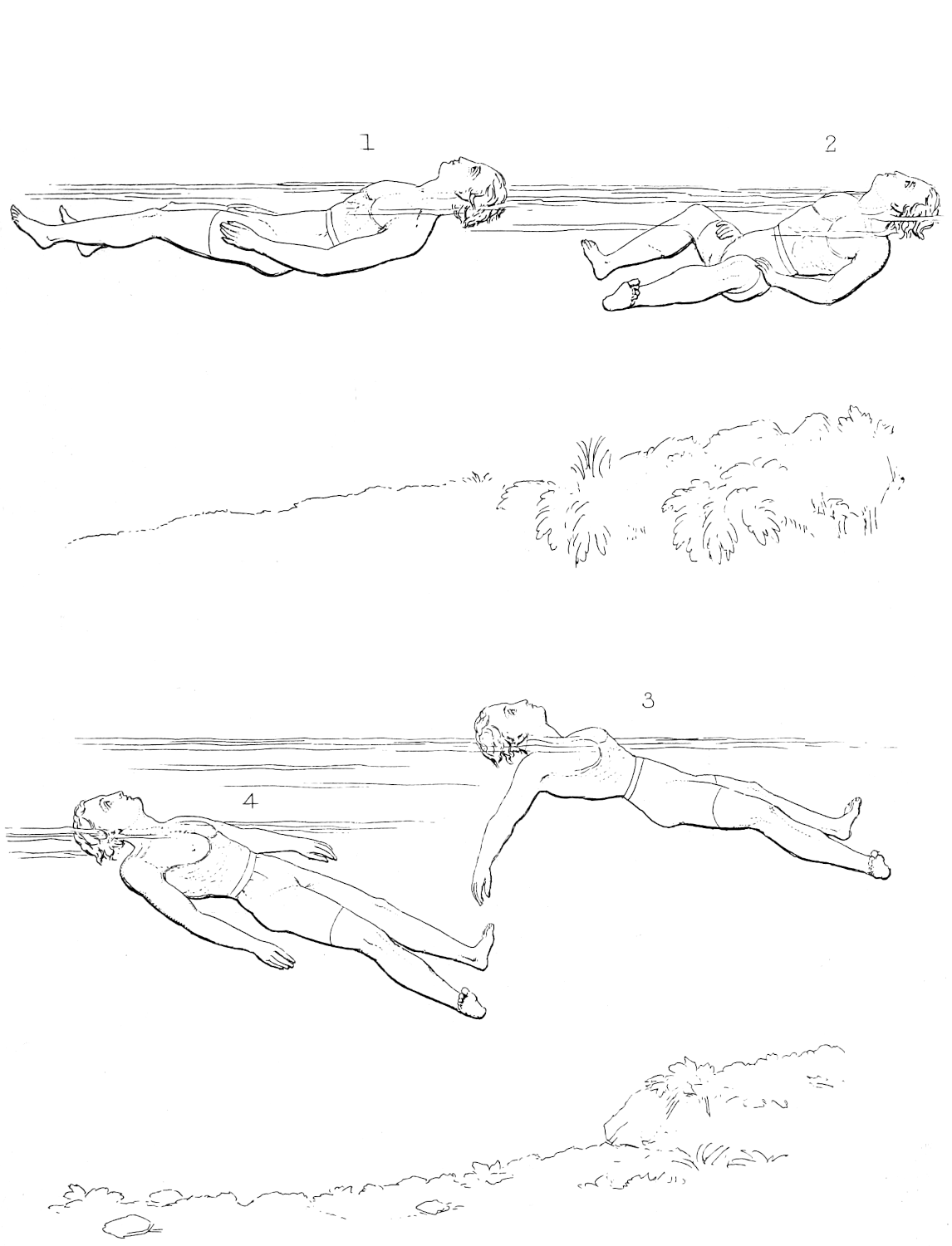
Swimming—Back Swimming.
For this purpose, the body may be turned either upon the
right or left side: the feet must perform their usual motions:
the arms also require peculiar guidance. In lowering the
left, and elevating the right side, the swimmer must strike
forward with the left hand, and sidewise with the right; the
back of the latter being front instead of upward, and the thumb
side of the hand downward to serve as an oar. In turning on
the right side, the swimmer must strike out with the right hand,
and use the left as an oar. In both cases, the lower arm
stretches itself out quickly, at the same time that the feet are
striking; and the upper arm strikes at the same time that the
feet are impelling, the hand of the latter arm beginning its
stroke on a level with the head. While this hand is again
brought forward, and the feet are contracted, the lower hand is
drawn back towards the breast, rather to sustain than to impel,
(Plate XXV. fig. 2.) As side swimming presents to the water
a smaller surface than front swimming, it is preferable when
rapidity is necessary. But, though generally adopted when it
is required to pass over a short distance with rapidity, it is
much more fatiguing than the preceding methods.
In the leap to plunge, the legs must be kept together, the
arms close, and the plunge made either with the feet or the
head foremost. With the feet foremost they must be kept
together, and the body inclined backwards. With the head
foremost, the methods vary.
In the deep plunge, which is used where it is known that
there is depth of water, the swimmer has his arms outstretched,
his knees bent, and his body leant forwards (Plate XXVI.
fig. 1,) till the head descends nearly to the feet, when the spine
and knees are extended. This plunge may be made without
the slightest noise. When the swimmer rises to the surface,
he must not open his mouth before previously repelling the
water.
In the flat plunge, which is used in shallow water, or where
the depth is unknown, and which can be made only from a
small height, the swimmer must fling himself forwards, in order
to extend the line of the plunge as much as possible under
the surface of the water; and, as soon as he touches it, he
must keep his head up, his back hollow, and his hands stretched
forward, flat and inclined upward. He will thus dart forwards
a considerable way close under the surface, so that his head
will reach it before the impulse ceases to operate. (Plate
XXVI. fig. 2.)
The swimmer may prepare for diving by taking a slow and
full inspiration, letting himself sink gently into the water,
and expelling the breath by degrees, when the heart begins
to beat strongly. In order to descend in diving, the head
must be bent forward upon the breast; the back made round;
and the legs thrown out with greater vigour than usual; but
the arms and hands, instead of being struck forward as in
swimming, must move rather backward, or come out lower,
and pass more behind. (Plate XXVII. fig. 1.) The eyes
should, meanwhile, be kept open, as, if the water be clear, it
enables the diver to ascertain its depth, and see whatever lies at
the bottom; and, when he has obtained a perpendicular position,
he should extend his hands like feelers.
To move forward, the head must be raised, and the back
straightened a little. Still, in swimming between top and bottom,
the head must be kept a little downward, and the feet be
thrown out a little higher than when swimming on the surface
(Plate XXVII. fig. 2); and if the swimmer thinks that he approaches
too near the surface, he must press the palms upwards.
To ascend, the chin must be held up, the back made concave,
the hands struck out high, and brought briskly down. (Plate
XXVII. fig. 3.)
Plate XXVI
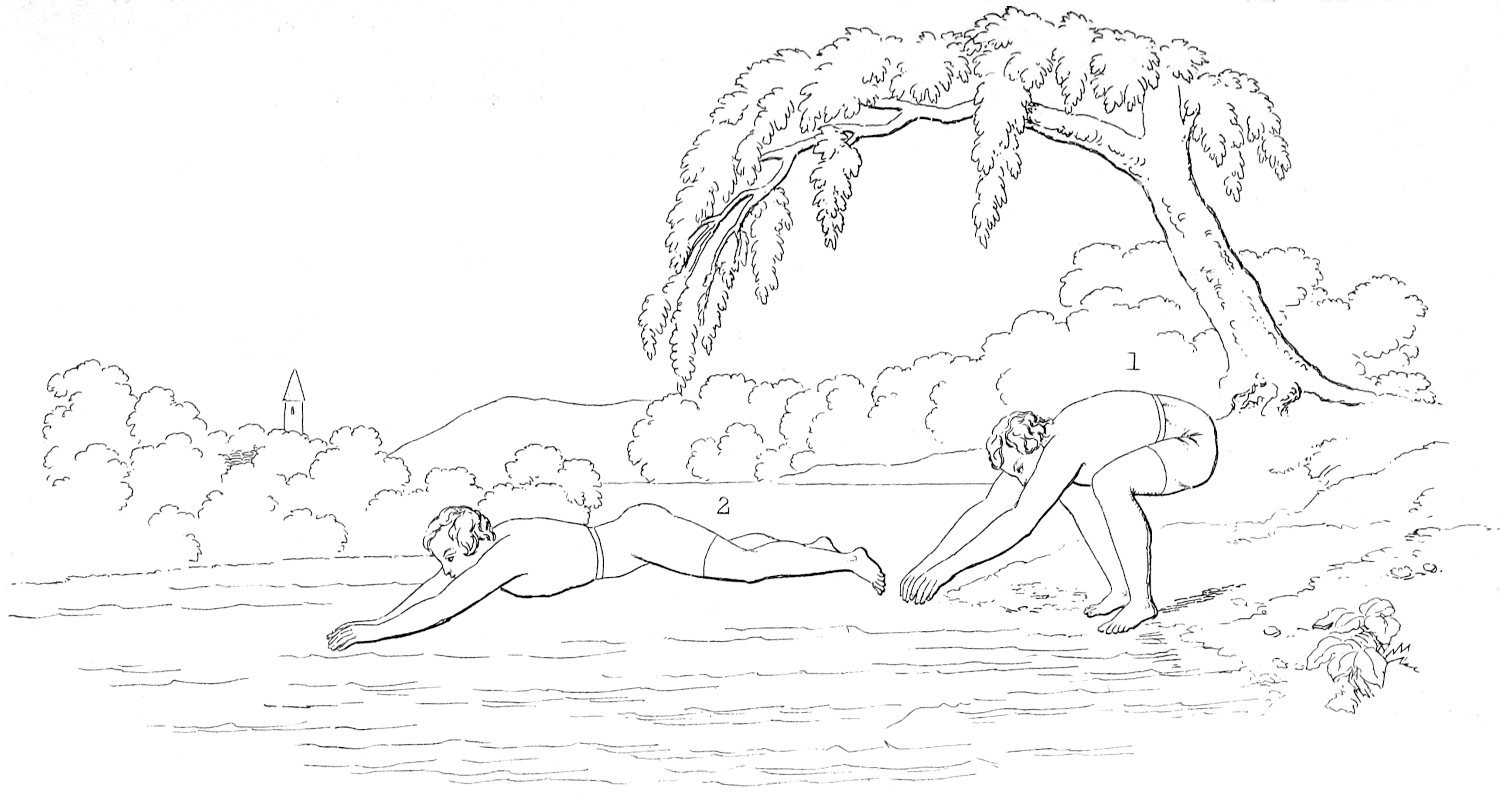
Plunging
Plate XXVII
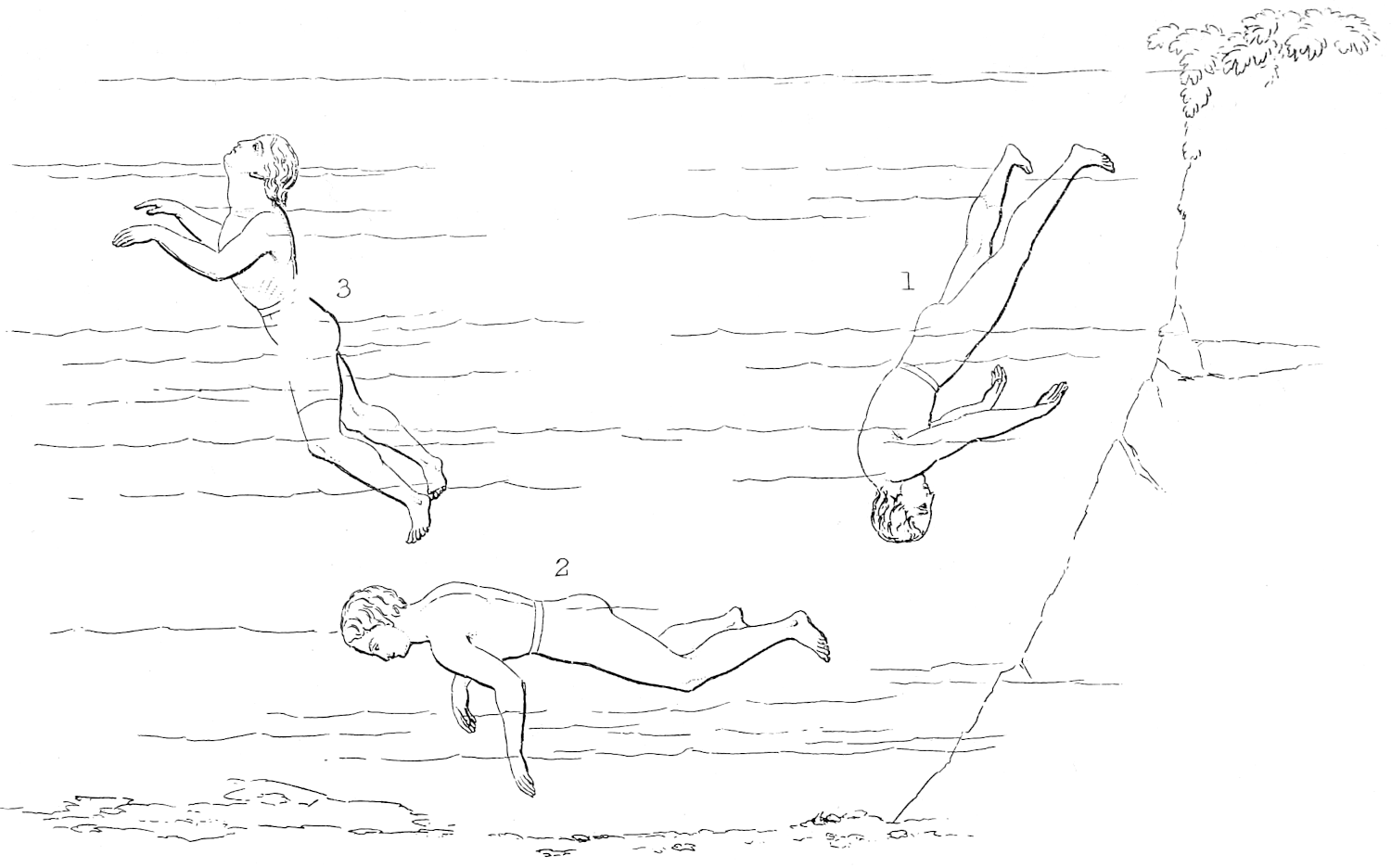
Swimming—Diving.
Plate XXVIII
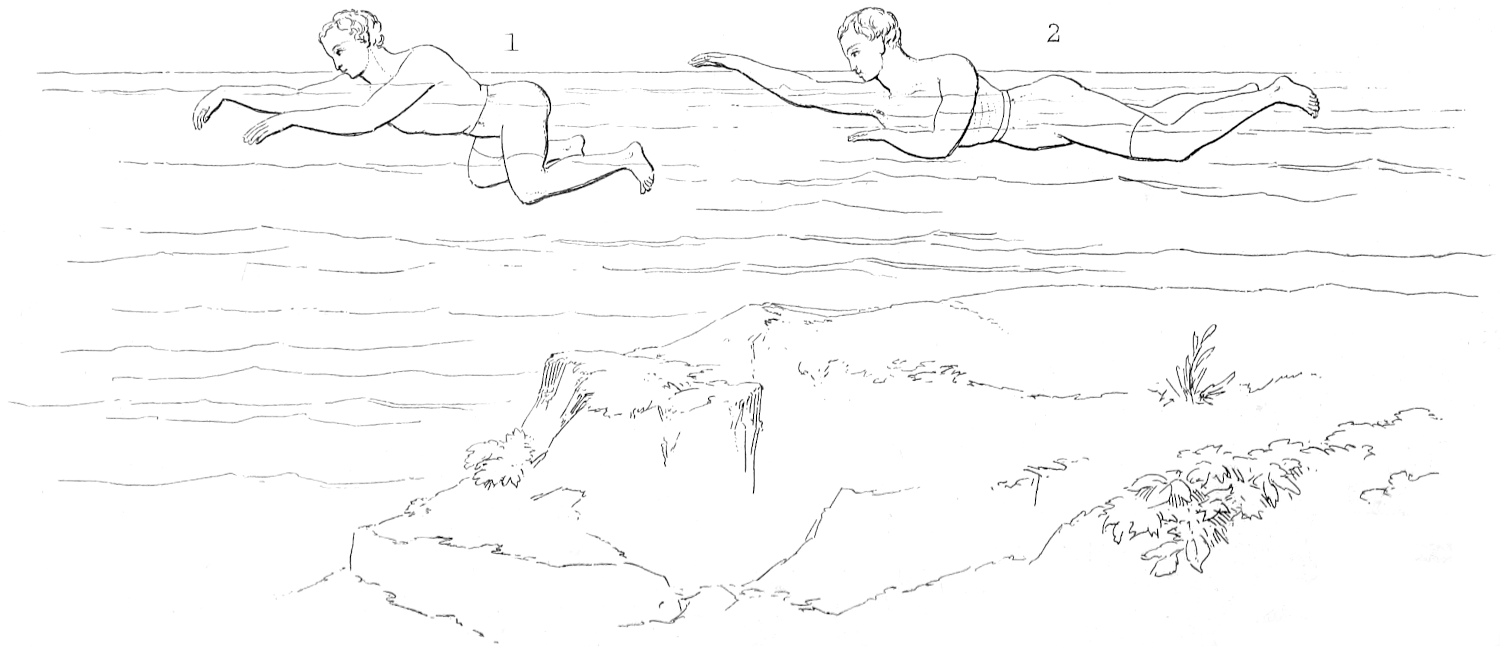
Swimming—Thrusting.
This is a transition from front swimming, in which the attitude
and motions of the feet are still the same, but those of the
hands very different. One arm, the right for instance, is lifted
entirely out of the water, thrust forward as much as possible,
and, when at the utmost stretch, let fall, with the hand hollowed,
into the water, which it grasps or pulls towards the swimmer in
its return transversely towards the opposite arm-pit. While the
right arm is thus stretched forth, the left, with the hand expanded,
describes a small circle to sustain the body (Plate
XXVIII. fig. 1); and, while the right arm pulls towards the
swimmer, the left, in a widely-described circle, is carried rapidly
under the breast, towards the hip. (Plate XXVIII. fig. 2.)
When the left arm has completed these movements, it, in its
turn, is lifted from the water, stretched forward, and pulled
back,—the right arm describing first the smaller, then the larger
circle. The feet make their movements during the describing
of the larger circle. The thrust requires much practice; but,
when well acquired, it not only relieves the swimmer, but enables
him to make great advance in the water, and is applicable
to cases where rapidity is required for a short distance.
Some swimmers, at every stroke, raise not only their neck and
shoulders, but breast and body, out of the water. This, when
habitual, exhausts without any useful purpose. As an occasional
effort, however, it maybe useful in seizing objects above;
and it may then best be performed by the swimmer drawing his
feet as close as possible under his body, stretching his hands
forward, and, with both feet and hands, striking the water
strongly, so as to throw himself out of it as high as the hips.
Here the swimmer must be more erect than usual, hold his
head more backward, and use the legs and arm more quickly
and powerfully. The arm, at its full extent, must be struck out
rather across the body, and brought down before, and the breast
kept inflated. This mode of swimming is best adapted for
assisting persons who are drowning, and should be frequently
practised—the learner carrying first under, then over the water,
a weight of a few pounds.
In assisting drowning persons, however, great care should be
taken to avoid being caught hold of by them. They should be
approached from behind, and driven before, or drawn after the
swimmer to the shore, by the intervention, if possible, of anything
that may be at hand, and if nothing be at hand, by means
of their hair; and they should, if possible, be got on their backs.
Should they attempt to seize the swimmer, he must cast them
loose immediately; and, if seized, drop them to the bottom,
when they will endeavour to rise to the surface.
Two swimmers treading water may assist a drowning person
by seizing him, one under each arm, and carrying him along
with his head above water, and his body and limbs stretched
out and motionless.
Men have been known to swim in their clothes a distance of
4000 feet.
Others have performed 2200 feet in twenty-nine minutes.
Some learn to dive and bring out of the water burdens as
heavy as a man.
[This art, however, has made little if any progress from the
earliest records that we possess of it. Leander’s feat of passing
from Abydos to Sestos was the crack performance of antiquity;
and it was the ultra achievement of Lord Byron, probably one
of the best swimmers of our day.—Ed. Fifth Edition.]
THE BOAT.
It may be laid down as a general rule, that, in calm weather,
a light and sharp boat is preferable; and, in rough weather, a
heavier and broader one. The learner, however, should not at
first begin in too light a boat, nor should he practise in rough
weather, until he gets acquainted with its management.
TO LEAVE THE LANDING-PLACE.
To leave the shore, the rower should, with the boat-hook,
shove the boat off, head upon tide, or opposite to the current.
To leave stairs, the rower must either shove the boat off with
the boat-hook, or place the blade of the scull forward, and perform
what the London watermen call belaying the boat’s head
out from the shore, accordingly as there is deep or shallow
water.
This being done, the rower sits down to his sculls. These
he puts in the rullocks, and turns the concave front, or filling of
the scull, towards the stern of the boat.
THE SEAT.
The rower must sit a-midships on the thwart or seat of the
boat, else she will heel to the side on which he is sitting, and
much of his labour will be lost. He should sit with ease to
himself, having his feet on the middle of the stretcher, and his
legs not quite extended; but his knees, as he rows, should be
brought down, and his legs stretched.
THE PULL.
The rower should make long strokes in a heavy boat, and
shorter and quicker strokes in a light boat. At the beginning
of the pull, he must, in general, bend his body till his head is
over his knees, and extend his arms as far aft as convenient,
that the blades of the sculls may be thrown correspondingly forward.
Plate XXIX. f. 1. With regard to the back in particular,
some think that, if a short distance is to be rowed, it should be
bent; and that, if a long distance, it is less fatiguing to keep it
straight. When the arms are extended as far aft, and the blades
of the sculls as far forward as convenient—which must never be
so far as to jam in the rullocks—(Plate XXIX. f. 1) the rower
must dip the sculls into the water, and pull towards him, by at
once bending the arms and the body.
When in the middle of the pull, if the sculls are not short
enough, or even if the head and body are slightly turned, one of
the hands will go higher than the other; and, as the right is
generally the stronger, it may go above, and the left below. It
is often found difficult to keep one hand clear of the other in
pulling a pair of sculls. This is so much the case, indeed, that
the inexperienced frequently suffer more from the knocking
and rubbing of the backs and sides of the hands against each
other, than from the friction of the handles of the oars in the
palms of the hands. This may be easily obviated by attending
to the following advice:—
Having seated yourself in the centre of the thwart, with your
feet close together against the centre of the stretcher, ship your
sculls, but, before pulling a stroke, move your body three or
four inches to the right hand, and still retain your feet in the
centre: thus you will be sitting rather obliquely; this will throw
your right shoulder more forward, and consequently the right
hand; and thus the hands will work perfectly clear of each other.
This rule, however, must be modified by the circumstances of
river-rowing. A waterman writes us as follows:—“As to carrying
one hand above the other, my way is, that if, for instance,
I go from Greenwich to Blackwall against tide, I keep down on
the Greenwich side, in general look toward the shore, and having
my face over the left shoulder, my right hand is then above.
If I go from Greenwich to London, my face is turned over the
right shoulder, and the left hand is then uppermost.”
Plate XXIX
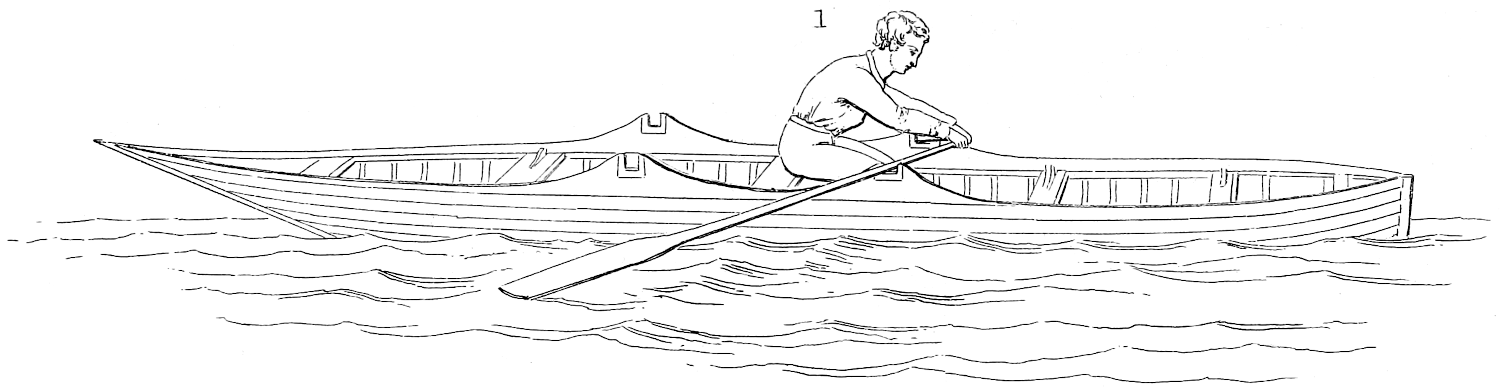
Beginning of the Pull.
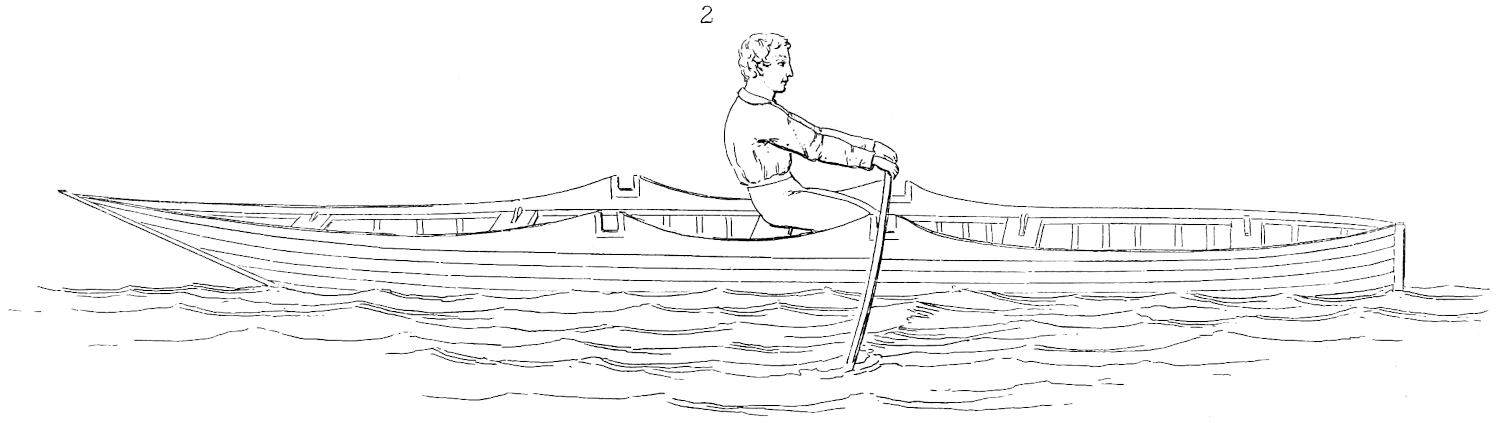
Middle of the Pull.
Plate XXX
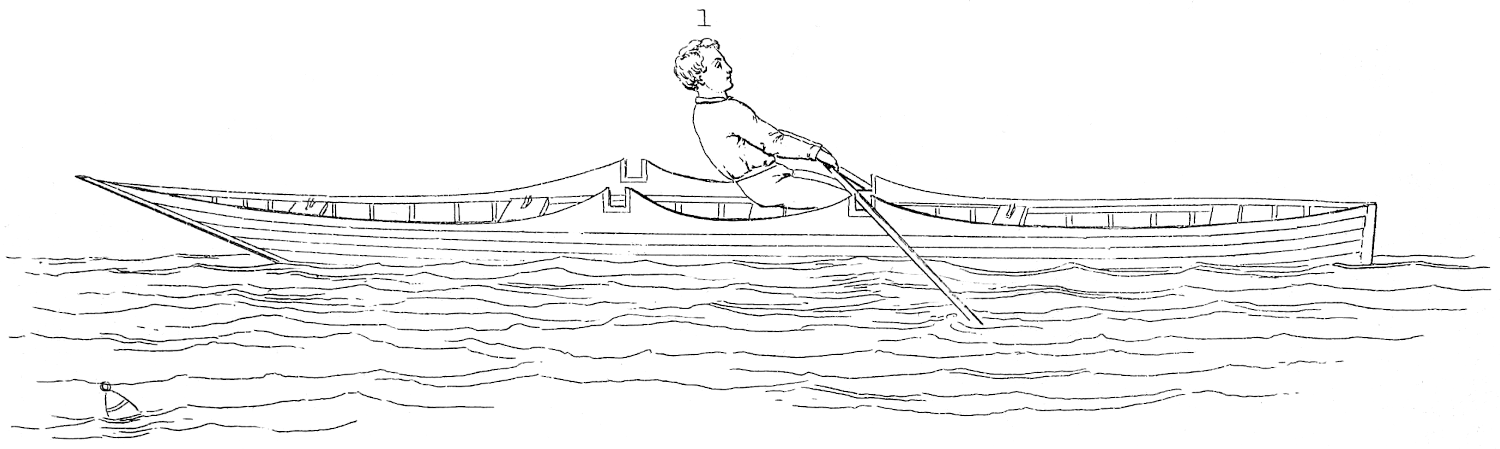
End of the Pull.
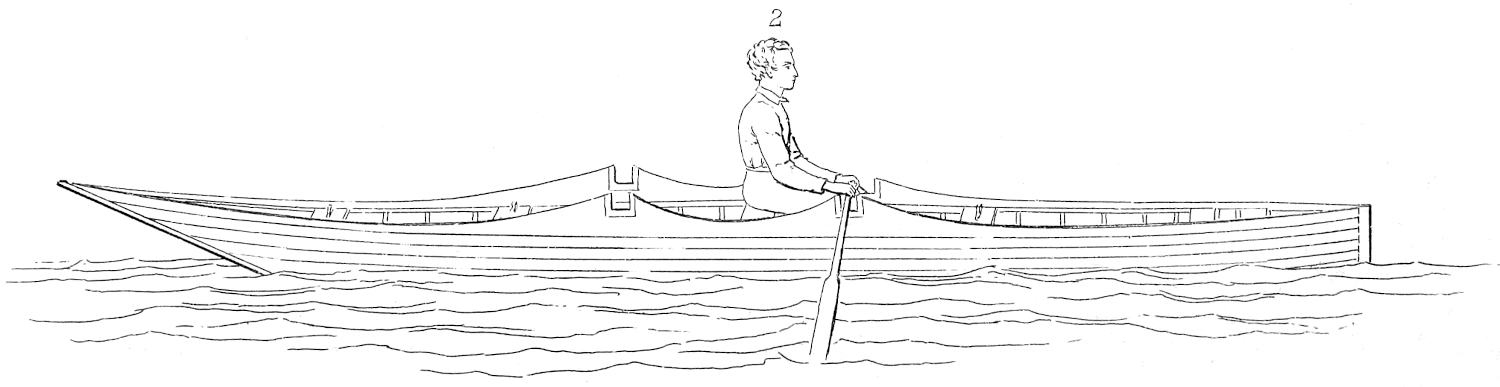
Return of the Sculls.
(The usual position in the middle of the pull is shown in
Plate XXIX. fig. 2.)
The end of the pull must not take place till the elbows have
approached the tops of the hips, the hands are brought towards
the chest, and the body is thrown well back. There would be
a loss of power, however, if the hands were brought too near
the chest; and the body should not be thrown further back than
it may easily and quickly recover its first position for the next
stroke.—(Plate XXX.) As the water is being delivered from
the sculls, the elbows sink, the wrists are bent up, and the backs
of the hands are turned towards the fore-arms, in order to
feather the sculls.—(Plate XXX. fig. 1.)
In the return of the sculls, the hands must remain turned up
until the sculls are put into the water.—(Plate XXX. f. 2.) In the
middle of the return, if the sculls are not short, or if the head
and body be turned, one of the hands also goes higher than the
other.
As to the degree of the immersion of the sculls.—In the middle
of the pull, the blades must be covered by the water. The
learner in general dips them very deep; but that ought to be
avoided, especially in calm weather. In the whole of the return,
the tips should, in calm weather, be two or three inches above
the water; and, in rough weather, they should be higher, in
order to clear it, as represented in the preceding Plates. The
head ought throughout to be very moveable—first to one side,
then to the other, but generally turned towards the shore when
against the tide. The same movements have only to be repeated,
throughout the course.
THE TIDE OR CURRENT.
In river-rowing, when the tide or current is with the rower,
a learner should in general take the middle of the stream. In
rowing with the tide, however, watermen generally cut off the
points, in order to keep a straight course. When the tide or
current is against the rower, he should take the sides, preferring
that side on which, owing to the course of the river, the current
is least. As there is an eddy under the points, watermen generally,
when rounding them, shoot the water to the next point,
and so on.
TO TURN.
Back water with one scull, by putting the one on the side
you wish to turn to into the water, with its concave front or
filling towards you, and pushing against it; and at the same
time pull strongly with the other scull, until the boat’s head is
turned round.
MEETING OR PASSING.
In meeting, the boat which comes with the tide must get out
of the way. In this case, both boats, if close, lay the blades of
their sculls flat on the water, lift them out of the rullocks, and
let them drift alongside. Each replaces them when the other
has passed. In passing a boat, the rower who passes must take
the outside, unless there is ample room within, and must also
keep clear of the other’s sculls or oars. If one boat is crossing
the water, and another coming with the tide, the one coming
with tide must keep astern of the other, and have a good look-out
ahead.
TO LAND.
Give the boat its proper direction, and keep its head inclining
towards the tide, and its stern will turn up or down, as the tide
runs; unship the sculls by the manœuvre directed above; but,
instead of letting them drift alongside, lay them in the boat, the
blades forward and the looms aft; seize the headfast; jump
ashore; and take two half-hitches round the post or ring.
In launching a boat from the sea-beach, when it is rough,
and there is a heavy surf, the two bowmen must get into the
boat with their oars run out; and the other rowers follow the
boat quickly in her descent; but they should not jump in till
she is quite afloat, lest their weight might fix her on the beach,
and she might ship a sea.
It may happen, that immediately on the boat floating, a sea
shall take the bow (before the rowers are sufficiently prepared
with their oars to keep her head out), and place her broadside
to the waves. In this situation, the boat is in danger of being
swamped, and the lives of those on board are in peril. When
thus situated, it is best for two of the rowers to go near the bow
of the boat, and immediately force each his boat-hook or oar
on the ground, on the shore side of the boat, as the most
effectual, safe, and expeditious method of bringing her head
again to the sea. Should there be more than a usual swell, both
the rowers and the sitter, or steersman, cannot be too particular
in keeping, throughout, the head of the boat to the swell, as
lying broadside to a heavy sea is extremely dangerous.
In rowing, each man has in general a single oar, and sits on
the opposite side of the galley from the rullock through which
his oar passes. The oar must consequently cross the boat, and
be held on its opposite side, so as to clear the back of the man
before.
It should be neither held nor pulled obliquely to the side by
twisting the body, as is practised by many, because the muscles
in that case act disadvantageously, and are sooner fatigued. The
stroke must be longer in sea than in river rowing. The oar
must be thrown out with a heave, caused by the simultaneous
extension of the body and the arms. It is still more essential
to feather in sea than in river rowing.
The oar must be drawn back with great power, caused by the
simultaneous contraction of the body and arms; time with
the other rowers being accurately kept, and distinctly marked.
When the oars are delivered from the water, the time, until
they go into it again, may be counted, one, two, three,—when
they pass through the water. This time is kept by the strokesman,
or sternmost man of the rowers.
In landing, the word is, “in bow,” when the bowman or
foremost man gets the boat-hook ready to clear away for the
shore, or the stairs. The next word is from the coxswain,
“rowed off all,” or “well rowed;” when all the oars are laid
in, with the blades forward, and the boat is made fast.
In landing on the sea-beach, when there is a surf, the rowers
may watch for a smooth, and then give good way ashore, when
the bowman should instantly jump out with the headfast or
penter, and pull her up, to avoid shipping a sea. The distances
run in this way are very great. We have known four men, in
a short galley, row thirty miles in four hours, namely, from
Dover to eight miles below Calais, or abreast of Gravelines, on
the opposite coast. In such a row, a London waterman would
have no skin left on his hands; and a member of the Funny
Club would, we suppose, have no hands left on his arms!
Cutters, owing to their excellent sailing qualities, are much
employed as packets[10], revenue cruisers, smugglers, privateers,
and in all cases requiring despatch. The boats commonly employed
in parties of pleasure, &c., are also cutters.
On the size of these vessels, however, it is necessary to remark,
that a cutter under one hundred tons is sufficiently
handy; but, when the size is equal to that of the larger yachts,
a strong crew is necessary, as the spars are very heavy, and a
number of men requisite to set or shorten sail. As a single-masted
vessel, in the event of springing a spar, becomes helpless,
even large cutters are used only in short voyages, or on the
coast; for, in case of accident, they can always manage to reach
some harbour or anchorage to repair any damage they may
sustain. The peculiar qualities of beating well to windward,
and working on short tacks, adapt cutters peculiarly for Channel
cruising.
Although, some years back, large cutters were confined principally
to the navy and revenue, the Royal Yacht Squadron, in
theirs, have exceeded these not only in size, but in beauty and
sailing qualities. Some of the finest and fastest cutters in the
world are the property of this national club; and two of them,
the Alarm (Mr. Weld’s), and the Arundel[11], (the Duke of Norfolk’s),
measure 193 and 188 tons. The inconvenient size, however,
of a cutter’s boom and mainsail has caused the very general introduction
of a ketch rig, which, by the addition of a mizen, permits
the boom to be dispensed with, and reduces the mainsail
considerably. This rig, indeed, when the mizen stands well, is
elegant; and, if a vessel is short-handed, it is very handy. As
cutter-rigged vessels, instead of a regular mainsail, with its
boom and gaff, have sometimes a mere spritsail, it is necessary
we should observe, that the inferior convenience and safety of
these preclude our noticing them here. It is also necessary
that we should explain why, in the sequel, we do not even refer
to lugger-rigged vessels.
Luggers are more difficult to work or manœuvre; they require
a greater number of men; their spars are so heavy that
they require all hands to move them: their decks are inevitably
lumbered with spars, &c.; their canvass gets rotted from exposure;
and their expense is much greater than that of cutters.
They generally have two sets of lugs—large ones, which require
dipping every time they tack, and small working lugs, which do
not require dipping, the tack coming to the foot of the mast.
The latter are generally used, except in making long reaches
across the Channel, &c. A lugger, moreover, is seldom fit to
be altered to any thing but a schooner, not having breadth
enough for one mast, which, after all, is the best for beauty and
speed.
Sailing men, indeed, are now so perfectly aware of the inferior
speed of luggers, that we never see a lugger or schooner enter
against a cutter at all near its tonnage. At sea, luggers would
have a better chance; though even there many would prefer
cutters, except in foul weather and a long reach. In short,
these vessels suit only a few noblemen and gentlemen who have
enough of patriotic ambition to desire to look like smugglers,
enough of delicacy to disregard the being thought dirty lubbers
by their own men—some of whom are not dirty from mere taste
or choice, and enough of penetration not to discover, that on
their landing with filthy clothes and tarry hands, every old
sailor grins or laughs at their imagining, that it was they, and
not the man at the helm, who had kept the canvass from cracking,
or the sticks from going over the side. Our descriptions
apply, therefore, to cutters alone; and the Plates at the end of
this article illustrate the various parts therein referred to.
Upon the Thames, the sailing clubs comprise the Royal
Sailing Society, the Royal Thames Yacht Club, the Loyal
Victoria Yacht Club, the Clarence, British, Royal Yacht, and
several minor associations. Several cups and prizes are
annually given during the season; and the spirited contests
between the beautiful small craft which form these fancy fleets,
are highly interesting. The sailing matches on the river are of
two sorts—one above, and the other below the bridges. The
smaller yachts, of from six to twenty-six tons, are commonly
entered for the former, and a larger class for the latter, which
take place between Greenwich and Gravesend. These national
amusements appear to be rapidly gaining the first place among
fashionable recreations, and now occupy the season, from the
period when hunting ends, till shooting begins.
The Royal Yacht Squadron has nearly six hundred persons
on its lists, of which above one hundred are members, and
about four hundred and fifty honorary members. The number
of yachts is one hundred and nine[12];
of which eighty-seven are
cutters, ten schooners, three brigs, four yawls, two ships, two
ketches, and one lugger. The greater part of these vessels
hail from Cowes or Southampton. The shipping belonging
to the club amounts to 7250 tons. Now, a vessel of one
hundred tons seldom perhaps stands the owner in less than
from five to six thousand pounds, varying from that to ten,
according to the profusion of ornamental parts, the internal
fittings, and other contingencies. At this rate, the shipping
of the club would have cost more than three millions and
a half of money: but it is impossible to speak decisively on
this point, as the first cost of the yachts varies much, and the
numerous styles of rig are attended with expenses so widely
different. At a moderate computation, each vessel belonging
to the club carries ten men on an average: this gives the total
number employed 1090. During the summer months, then,
while regattas are celebrated, it may be said that the Royal
Yacht Squadron alone employs more than 1100 men. These, with
some few exceptions, are discharged on the approach of winter,
and the yachts are laid up for the season, retaining the master
and one man in pay. The crews thus discharged obtain employment
in merchant-vessels, or otherwise, during the winter;
and in the middle of spring, are generally re-shipped in the
yachts in which they have previously served. On these conditions,
active and industrious men of good character are generally
sure of employment in the club; and many members
justly pride themselves on the high discipline, manly bearing,
and crack appearance of their crews. The situation of master,
in particular, is one of much responsibility, and is on all accounts
respectably filled. In some of the largest craft, junior
officers of the navy are found to accept this office. The sailing
regulations of the Royal Yacht Squadron are as follow;
First—Members entering their yachts must send the names
of them to the secretary one week previous to the day of sailing,
and pay two guineas entrance at the same time.
Second—All vessels starting or entering must be the bonâ fide
property of members, as well as their spars, sails, boats, &c.
Third—Each member is allowed to enter one vessel only for
all prizes given by the club.
Fourth—Cutters may carry four sails only, viz., mainsail,
foresail, jib, and gaff top-sail; yawls, luggers, schooners, and
all other vessels, in like proportion. No booming out allowed.
Fifth—No trimming with ballast, or shifting of ballast allowed;
and all vessels to keep their platforms down, and bulkheads
standing.
Sixth—Vessels on the larboard tack must invariably give way
to those on the starboard tack; and in all cases where a doubt
of the possibility of the vessel on the larboard tack weathering
the one on the starboard tack shall exist, the vessel on the
larboard tack shall give way; or, if the other vessel keep her
course, and run into her, the owner of the vessel on the larboard
tack shall be compelled to pay all damages, and forfeit
his claim to the prize.
Seventh—Vessels running on shore shall be allowed to use
their own anchors and boats actually on board to get them off,
afterwards weighing anchor and hoisting the boat in; but, upon
receiving assistance from any other vessel or vessels, boats, or
anchors, shall forfeit all claim to the prize.
Eighth—That nothing but the hand-line be used for sounding.
Ninth—Any deviation from these rules shall subject the
aggressor to forfeit all claim to the prize.
Tenth—If any objection be made with regard to the sailing
of any other vessel in the race, such objection must be made to
the stewards, within one hour after the vessel making the objection
arrive at the starting-post.
Eleventh—No vessel shall be allowed to take in ballast, or
take out, for twenty-four hours previous to starting; and no
ballast shall be thrown overboard.
Twelfth—Vessels shall start from moorings laid down at a
cable-length distance, with their sails set; and every vessel not
exceeding one hundred tons shall carry a boat not less than
ten feet long; and vessels exceeding one hundred tons, a boat
not less than fourteen feet long.
Thirteenth—There shall be a member, or honorary member,
on board each vessel.
Fourteenth—The time of starting may be altered by the
stewards; and all disputes that may arise are to be decided by
them, or such persons as they shall appoint.
The Northern Yacht Club is a highly interesting society,
although its plan is not so extensive as that of the Royal Club.
It contains about three hundred and fifty members. The documents
for 1830 comprise ninety-two in the Scottish, and ninety
in the Irish division, with fifty-two honorary members, in addition
to ninety-three members of the Cork Yacht Club, who
are also entered on the honorary lists. It had, in 1830, sixty
yachts, not equal in proportion to the tonnage of the Cowes
Club, as smaller vessels are admitted. Many R. Y. S. men are
found in the Northern Club. There are many fine vessels in
this club. Cutters, as usual, excel in number.
At the lowest computation, the number of vessels at present
employed for pleasure in this country cannot be less than from
three to four hundred, ranging in bulk from ten to three hundred
and fifty tons. These are variously distributed along our
shores, carrying their opulence into every port and harbour.
But there is another advantage arising from yacht clubs—namely,
that national spirit, which, to a maritime people, is
above all in worth. The yacht clubs keep alive this feeling in
an eminent degree.
Even in describing the elementary nautical operations which
such boats require, it is necessary to lay down a position for the
HARBOUR, direction for the
WIND, and trip for the VESSEL.
Let us suppose, then, that the mouth of the harbour lies
towards the south; that the wind blows from the north, with
a little inclination to east, and that we wish first to sail due
south to get out of the harbour, next direct our course eastward,
then return westward till we get abreast the mouth of the
harbour, and lastly, northward, to enter the harbour and come
to our moorings.
These courses will, with variations in the force of the wind,
illustrate every common and useful manœuvre.
Ship[13]
the tiller.[14]
Set the mainsail[15];
hoist the throat[16] nearly close up; and
half hoist the peak.[17]
Bend[18] and haul the jib out to the bowsprit end.
Bowse the bobstay[19]
and bowsprit shrouds[20] well taut.
Hoist the jib, and bowse it well up.
Get the topmast stay[21], backstays[22], and rigging[23] well
taut.
Hoist the foresail ready to cast[24] her when the moorings
are let go.
Send a hand to the helm.[25]
Overhaul the main-sheet[26],
and the lee[27] runner and
tackle[28];
lower the throat, and hoist the peak of the mainsail taut[29] up.
Hoist the gaff topsail[30],
keeping the tack[31] to
windward[32] of
the peak halyards[33], and hauling the slack of the sheet out
before you hoist the sail taut up.
Set the tack, and heave the sheet well taut.
In managing the helm, be careful not to jibe the mainsail.
When a vessel is going large[36], the helmsman should always
place himself on the weather side of the tiller, or the side opposite
to that which the main boom is over, as his view of the vessel’s
head will then be unobstructed by the sails. The boat now
running before the wind, haul the tack of mainsail up. If the
wind come dead aft, you may flatten aft the jib and foresail
sheets[37],
or haul the foresail down to prevent chafing. If
the wind come at all round on the starboard quarter[38], slack
off the boom guy[39]; haul in the main-sheet till you get the
boom a-midships[40],
or nearly so; port[41] the helm, and jibe the
mainsail; slack off the main-sheet again, and hook the guy on
the larboard side; haul taut the starboard runner and tackle,
and overhaul the larboard one; the same with the topping-lift[42];
hoist the head sails[43], and shift the sheets over.
N.B. If you are obliged to jibe as above, you must, in the
following directions for bringing the wind on your beam, read
larboard for starboard, and vice versâ.
Supposing that you have not jibed, starboard the helm
a little, and let the vessel spring her luff[45] with her head
to the northward. Slack the boom guy, and haul in the
main-sheet. Haul aft[46]
the jib-sheet, and bowline[47] the foresail.
If she come up fast, port the helm[48] a little, and meet her,
then right[49] it when she lays her proper course.
Hook and haul taut the lee runner and tackle. You will now
find it necessary to carry the helm a little a-port or a-weather.
If, instead of directing our course eastward, we had preferred
doing so westward, we must have jibed previous to bringing
the wind on the beam, and then the preceding operations would
necessarily have been, to a corresponding extent, reversed.
To haul the vessel to the wind, ease the helm down[51] a little.
Haul in the main-sheet upon the proper mark. Bowse the foresheet,
and haul the jib-sheet well aft. Bowse the runner and
tackle well taut.
The vessel is now on the wind, plies to windward, or is
close-hauled.[52]
Being now apt to gripe, or come up into the wind with a
sudden jerk, now and again, she wall carry her helm more or
less a-weather. The helmsman must watch the weather-leach
of the mainsail, to prevent the vessel getting her head in the
wind.
Having got abreast or opposite the mouth of the harbour,
haul the fore bowline. “Ready about.”[54] Put your helm up,
or to windward a little, and let the vessel go rather off the wind,
to get good way on her; then gently down or to leeward with
it, which is announced by the helmsman calling “Helm’s a-lee.”
Let fly the jib-sheet: this takes off the balance of wind from
her head, and acts in concert with the helm in sweeping her
stern to leeward, or rather in allowing her head to come quicker
up into the wind.
The man who attends the jib-sheet must carefully gather in
the slack[55] of the one opposite to that which he let go. When
the jib comes over the larboard side of the stay[56], haul the larboard
jib-sheet well aft. When the mainsail is filled, let draw
the foresail.[57] Right the helm, and shift over the tack of the
mainsail.
One hand should attend the main-sheet, to gather in the
slack till the boom is a-midships, and then ease it off as the
sail fills, and the vessel lays over to port. When the vessel is
in stays, and it is doubtful whether she will come round, or, in
order to make her come round when she gathers stern-way,
shift the helm to the opposite side. She is now about upon
the starboard tack.
Haul the fore-sheet up to windward; bowline it there, and
heave her to. Keep the tiller shipped, and lash it a-lee. In gaff
topsail; lower the halyards; and haul down. Send a hand aloft
to unbend the sheet from the sail, and make it fast to the main
halyard bolt; and unlash the gaff topsail, and send it down.
Lower the main halyards and peak to the second reef cringle,
and reef the mainsail.
Hook the reef tackle[58]
to the first earing[59]; haul upon it till
the cringle[60] is close down upon the boom; and belay the tackle.
Pass a small gasket[61] through the tack and the first reef cringle,
and lash the two firmly together, taking care to gather in snug
the luff of the sail, so that the leach rope belonging to it forms a
sort of snake near the mast. Haul up the tack, and bowse upon
the weather peak line, keeping the other part fast a-midships of
the boom. This will hold the belly of the sail partly to windward,
and make it easier to tie the reef-points. Observe to
keep the foot-rope outside and under the sail.
Let one man jump upon the boom to tie the outer points so
far that the rest can be tied on board. Let go the tack and
peak line, always keeping the ends of this fast under the boom.
Hoist the sail taut up; and set taut the tack tackle. Shift the
jib to No. 2. Overhaul the jib purchase; let go the outhaul;
haul the jib down; unhook the tack; unbend the sheets; and
send the sail down below.
You have now got one reef in the mainsail. If it come on
to blow harder, and you want a second reef, lower the sail, and
haul on the peak line as before; nipper the first reef-earing so
as to hold it a short time; let go the reef tackle, and unhook it
from the earing, which make fast with its lanyard round the
boom.
You have now got the tackle to use for the second reef. Proceed
as for the first reef. Shift the jib to No. 3, and proceed
as before. If third, the same, after rigging the bowsprit. Take
the fid[62] or bolt out of the heel of the bowsprit, and rig the
bowsprit in about one fid hole. Haul taut the topmast stay and
bowsprit rigging. Bend and set the small jib in the same way
as any other.
You may want to stow the mainsail, set the trysail, and make
her otherwise snug in proportion. Sway away upon the top
rope; lift the mast a little to let the man unfid it; and lower
topmast down in the slings. Lower the fore halyards, and reef
the foresail. Gather the luff of the sail up; make the foremost
reef-earing cringle fast to the tack; shift the sheet from
the clue of the sail to the after reef cringle; and tie the points.
If the weather is very heavy, haul down the stay-sail, and tend
the vessel with a tackle upon the weather jib-sheet.
When it comes fine weather again, make sail in precisely the
reverse order to that in which you shorten it. Continue to
tack in the wind’s eye till you are to windward of the harbour.
All vessels sailing before the wind keep out of the way of
those upon the wind. In the river Thames, vessels which sail
with the larboard tack aboard, keep away for those with the
starboard tack aboard.
Lower and haul down the gaff topsail. Let go the jib tack
or outhaul[63]; lower the jib; and pull on the down-hauler, to
bring the traveller in. Haul the tack of the mainsail up; and
lower the peak. Down foresail.
Let a small boat run away the wrap to the quay. Lower, and
stow the mainsail. Unbend the jib, and stow it below if dry
and not immediately wanted, and hook the halyards to the
traveller, close in by the stem. If otherwise, hoist upon the
halyards, and let it hang to dry if it require it, or stop it up
and down the foremost shroud. Haul the vessel to the moorings,
and moor properly, putting fenders over to keep her from
the quay.
Fig. 1.
The mariner’s compass.
Fig. 2.
Plan of the deck, with the bowsprit rigged out, &c.
- 1. Bowsprit.
- 2. 2. Bowsprit shrouds.
- 3. Stem head.
- 4. Bowsprit bitts.
- 5. Fore hatchway.
- 6. Windlass and bitts.
- 7. Fore-sheet horse.
- 8. Place of the mast.
- 9. 9. Channels.
- 10. Main hatchway.
- 11. Companion and binnacle.
- 12. Tiller.
- 13. Cabin skylight.
- 14. Rudder-head and case.
- 15. Taffrail.
Pleasure boat, cutter-rigged, lying at anchor; foresail and
mainsail bent and stowed.
- 1. Vane and spindle.
- 2. Truck.
- 3. Topmast.
- 4. Cap.
- 5. Trussel trees.
- 6. Lower mast.
- 7. 7. Cross trees.
- 8. Bowsprit.
- 9. Gaff, with mainsail furled.
- 10. Main boom.
- 11. Tiller.
- 12. Rudder.
- 13. Stem.
- 14. 14. Topmast shrouds.
- 15. Topmast backstay.
- 16. Topmast stay.
- 17. Runner and tackle.
- 18. Traveller.
- 19. Channel.
- 20. Forestay with the foresail furled to it.
- 21. Bobstay.
- 22. Topping-lifts.
- 23. Topping-lift blocks.
- 24. Main-sheet.
- 25. 25. Peak halyards.
- 26. Jib halyards.
- 27. Cable.
- 28. Fore-sheet.
The vessel going down the harbour with all sails set, steering
south, before a light breeze.
- 1. Gaff topsail.
- 2. Foresail.
- 3. Mainsail.
- 4. Tack tricing line.
- 5. Peak line, or signal halyards.
- 6. 7. 8. The 1st, 2nd, and 3rd reefs.
- 9. 9. 9. Reef-earings.
- 10. 10. 10. Cringles.
- 11. Balance reef.
- 12. Anchor stock.
- 13. Windlass.
- 14. Foresheet horse.
- 15. Main hatch.
- 16. Companion and binnacle.
The vessel outside the harbour, steering east, with a smart
breeze on the larboard beam.
- 1. Jib.
- 2. Foresail.
- 3. Anchor.
- 4. Eyebolt of the bowsprit shrouds.
The vessel trying for the harbour in a heavy gale, close to the
wind as she can lay, on the starboard tack, under a reefed mainsail
and foresail, bowsprit reefed, and topmast lowered.
Plate XXXII
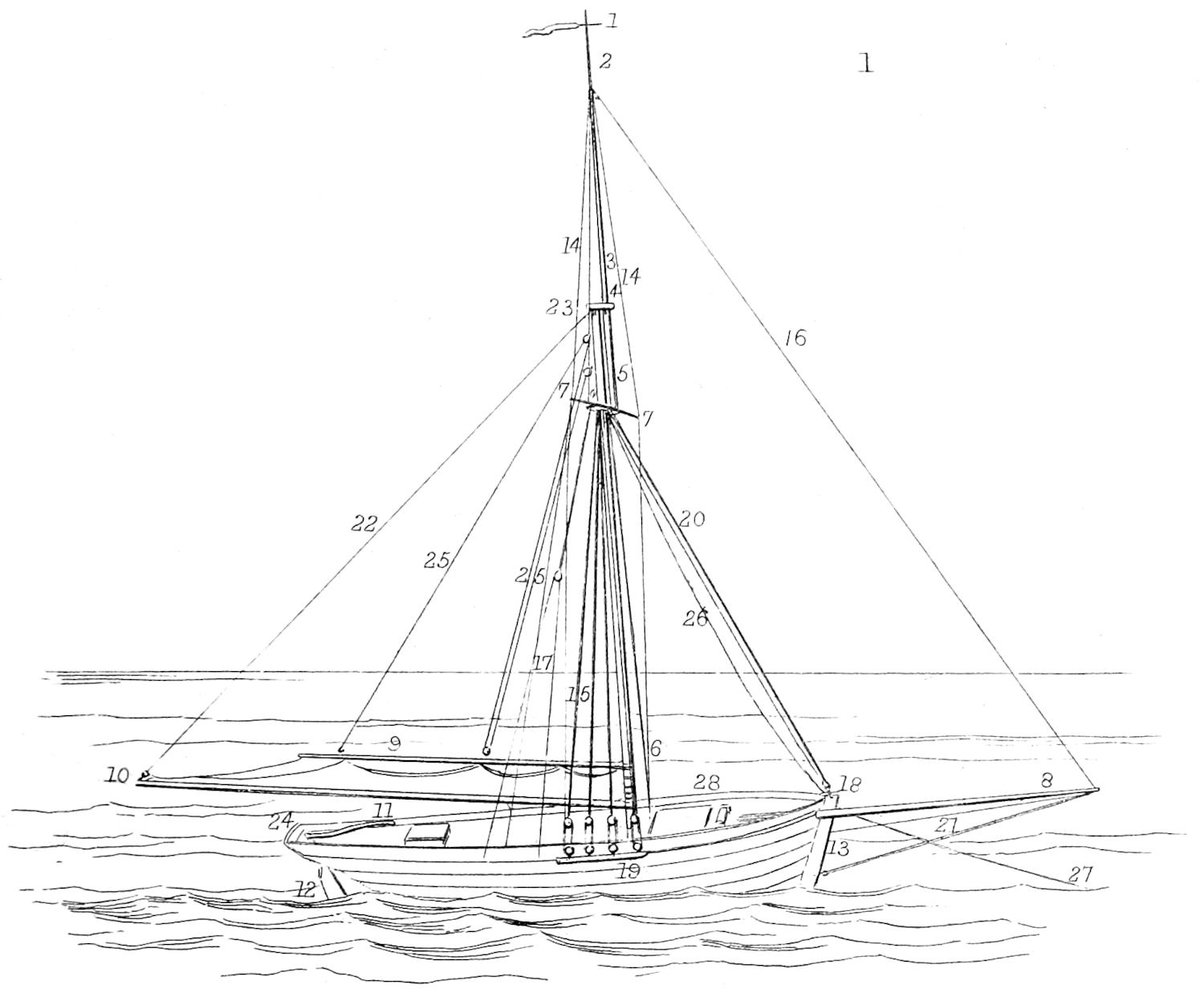
Parts in Pleasure Boat at Anchor.
Boat before a light breeze.
Plate XXXIII
Boat with a breeze on the larboard beam.
Boat close to the wind on the Starboard tack.
RIDING. — THE HORSE AND EQUIPMENTS. — MOUNTING AND DISMOUNTING. — THE SEAT. — THE BALANCE. — THE REIN-HOLD. — THE CORRESPONDENCE. — THE ACTION. — THE HAND. — THE GUIDANCE OR AIDS. — Aids of the Hand. — The five Positions when one Rein is held in each Hand. — The five Positions when the Reins are held in one Hand. — The Twistings of the Bridle Hand. — Aids of the Body. — Aids of the Legs. — ANIMATIONS, SOOTHINGS, AND CORRECTIONS. — THE WALK. — Turns in the Walk. — Stops in the Walk. — Going Backward in the Walk. — THE TROT. — Kinds of Trot. — The Trot in particular. — Turns, Stops, &c. in the Trot. — ROAD RIDING. — THE GALLOP. — The Canter in particular. — Turns, Changes, Stops, &c. in the Gallop. — LEAPING. — Standing Leap. — Flying Leap. — CRITICAL SITUATIONS. — Stumbling. — Rearing. — Kicking. — Plunging. — Shying. — Restiveness. — TREATMENT OF THE HORSE. — DRIVING. — THE ROADS. — CARRIAGES. — COACH-HORSES. — HARNESS. — RELATIVE PLACES OF HORSES. — COACHMEN. — MOUNTING AND DISMOUNTING. — THE SEAT. — STARTING. — THE PACES. — THE TIME. — THE WHIP. — THOROUGHFARES, PASSING, &c. — ASCENDING AND DESCENDING. — THE TURNINGS. — THE RANKS IN TOWN. — STOPS. — ACCIDENTS, &c. TO HORSES. — ACCIDENTS TO COACHES, &c. — OBSTRUCTIONS, OFFENCES, AND INJURIES.
The general art of riding, sometimes called manège riding, to
distinguish it from its modifications in road-riding, hunting,
racing, &c., teaches us to place every part of the body so that it
can act upon the horse in every emergency, shows the effect of
all the aids or modes of guiding him, and enables us to render
him obedient to the slightest touch. By never suffering the
ascendancy to be transferred to the horse, by in general preventing
him from making all his speed, and by exhausting him
the sooner the more he exerts himself without permission, it
bestows upon the rider perfect security.
An intimate knowledge of this method is necessary even to
our abandoning it when convenient, to our adopting the styles,
afterwards to be described, for more extended and rapid paces,
or for long continued riding, to our suffering the horse to take
more or less of ascendancy, and to our, when necessary, easily
recovering that superiority of the hand, of which those who are
ignorant of this fundamental method are less capable.
The recent practice has been to carry the foot rather more
forward than is represented in our Plates, approaching in this
respect, to the ancient position, as seen in the Elgin marbles, &c.
A Parisian bit, which is attached to the mouth of the horse,
without a headstall, has been lately used. It is, however, applicable
only to horses, on account of its being retained in the
mouth by means of the side tusks, which mares do not possess.
It is composed of a semicircular bar of iron, which goes under
the chin, to which its concavity applies; while a short bar, firmly
attached to one of its ends, passes nearly half-way through the
mouth. Through the other end of the semicircle is a hole, into
which, when the bit is on, must be screwed a bolt, similar to the
one just described. These two bolts, it is easily understood,
pass behind the tusks, and nearly meet in the centre of the
mouth.[64]
Plates XXXIV., XXXV. f. 1 give better ideas of the horse and
his equipments than the longest and most detailed description.
The reader will therefore examine them in succession. We have
here only to add those circumstances as to the equipment of the
horse, which could not be communicated by that otherwise
briefer and more impressive method.
The shoes of a horse have much to do with his, and consequently
with his rider’s, comfort. It is therefore important to
know that he is properly shod. To effect this, the shoe should
be fitted to the foot, and not the foot to the shoe.
Plate XXXIV
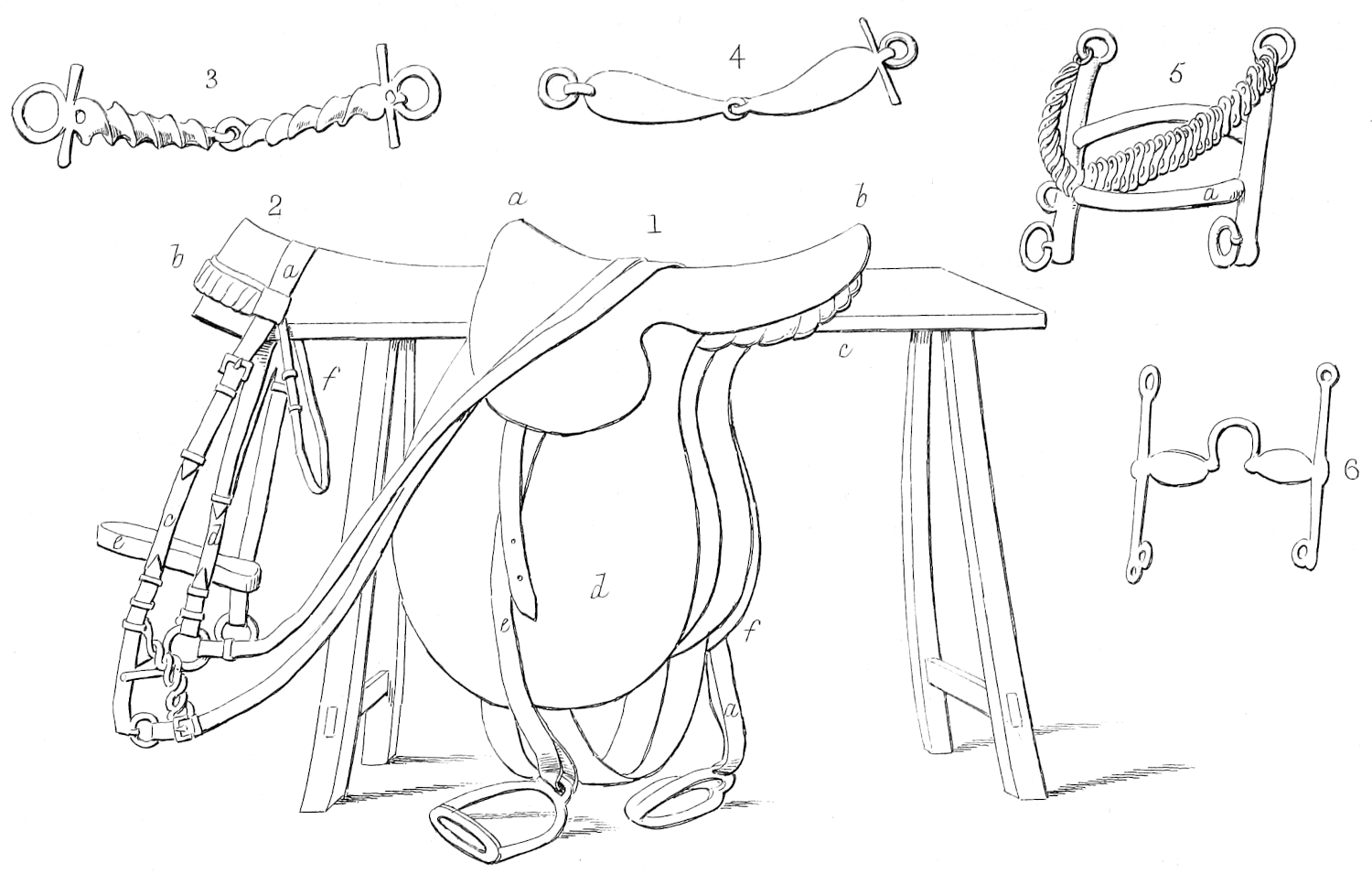
Horse Equipments.
Plate XXXV
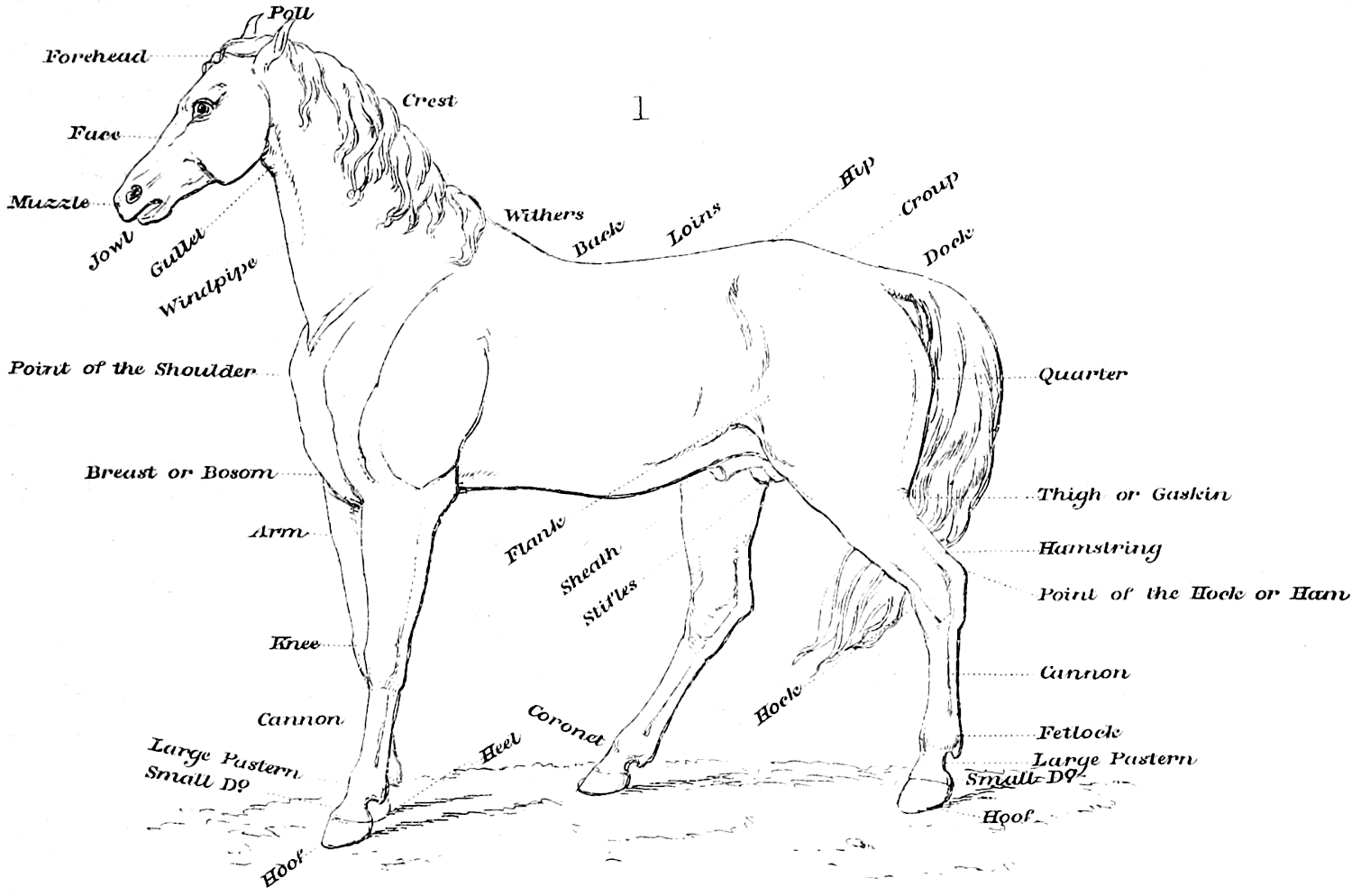
The Parts of the Horse.
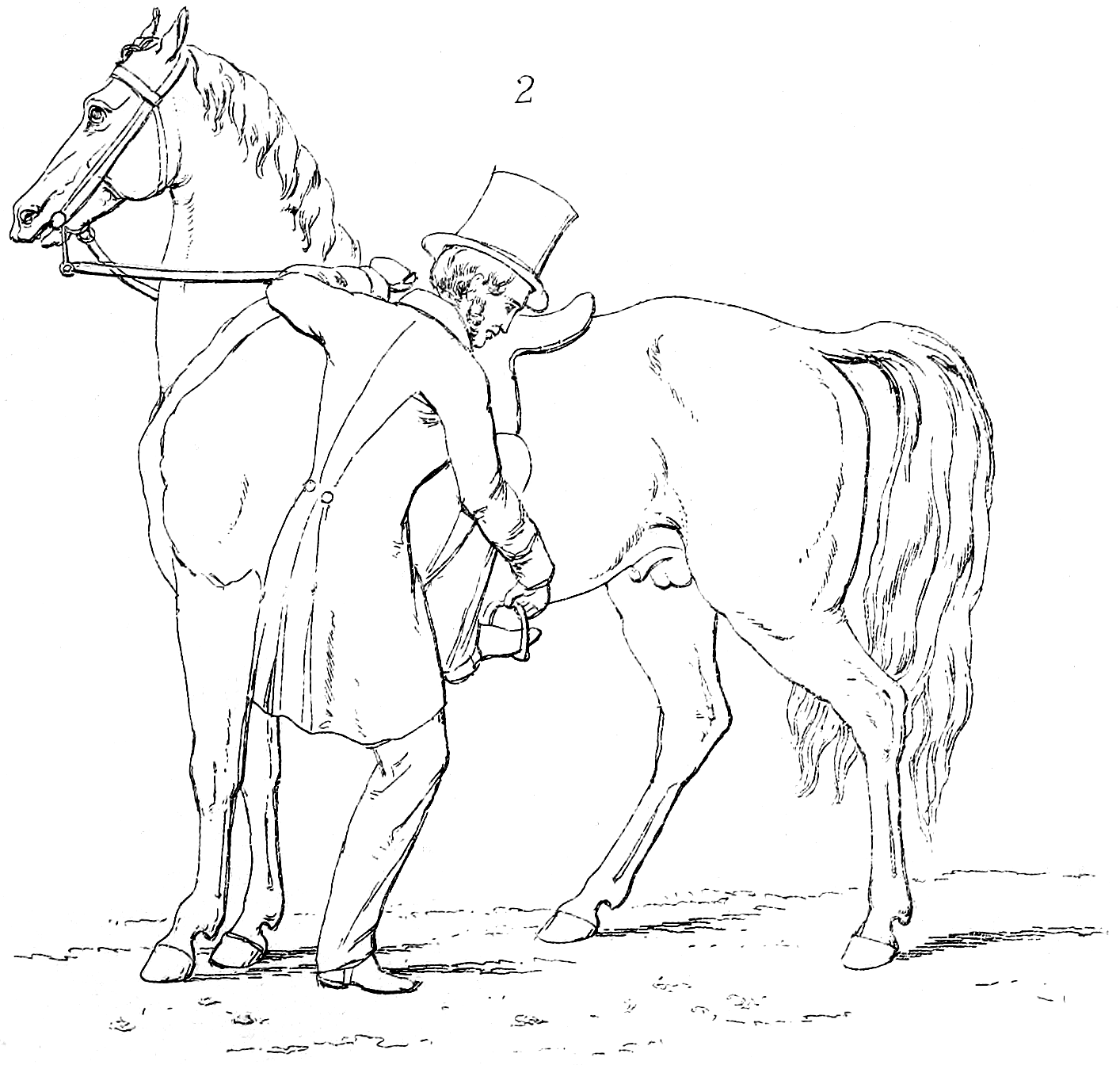
First View of Mounting.
Neither heel nor frog should be pared more than merely to
take off what is ragged; for no reproduction takes place here,
as in the case of the hoof. Farriers ruin nearly all horses by
doing otherwise. Indeed, they are not to be trusted with this
operation, which, after shoeing, any gentleman may perform
with his pocket-knife. The sole of the foot must not be hollowed
out, but only the outer wall pared flat or even with the
sole, and most at the toe. Nor, above all things, ought the
farrier’s finishing rasp all round the edge of the horn immediately
above the shoe to be permitted. Neither ought nails to
be driven far backward towards the heel, where the horn is softer
and more sensible, especially at the inner quarter. When a
horse has a high heel, the foot, except the frog, may be pared
flat, but not hollowed out or opened. When a horse has a low
heel, the foot should be pared only at the toes.
It is common to allow the fore part or toe of the hoof to grow
long, thereby throwing the horse much on his heels. This position
is unnatural, because, were the horse in a state of nature,
without shoes, the toe, from constant contact with the ground,
would be worn down to its proper level with the heel. This
growth, then, of the fore part of the hoof, by throwing him on
his heels, renders them tender, and causes lameness: while the
foot, not being flat on the ground, also strains the ligaments of
the fetlock joint. These evils may be obviated by doing as
nature directs—by cutting away the toe to the proper level with
the heel, so as to allow the foot to bear flat upon the ground.
When a horse has a short pastern, he should have a short shoe,
because a long one would compel him to bring his heel more
backward than the unpliableness of his pastern would easily
admit.
The saddle should be proportioned to the size of the horse.
Before, the bearings should be clear of the plate bone; behind,
they should not extend further than within four inches of the
hips; and their pressure should be equal on every part intended
to be touched. The closer the saddle then comes the better, if
neither the weight of the rider nor settling of the panel can
possibly injure the withers or chine. Before mounting, the
rider should examine whether the saddle, girths, straps, bits,
bridle, &c., are all good and well fixed.
When the saddle is on the horse, the lowest part of the seat
should rather be behind its centre, as it is there that the weight
of the body should fall, and by that means the thighs can keep
their proper position. The best test of the adaptation of the
seat is, when the rider, without stirrups or effort, easily falls into
his proper place in the saddle.
Stirrups should not be used until the pupil is capable of riding
without them. Their proper length is when the upper edge of
the horizontal bar reaches a finger’s breadth below the inner
ankle-bone. When the feet are in the stirrups, the heels should
be about two inches lower than the toes. No more than the
natural weight of the limbs should be thrown upon them. It is
by an accurate position, and an easy play of the ankle and instep,
that the stirrup is retained, so as to slip neither forward
nor backward, even if the toe be raised for a moment.
The position on horseback with stirrups differs from that
without them only in this, that the thigh being, by the stirrup,
relieved from the weight of the leg and foot, the knee is slightly
bent, and rather before the lines which these form in the position
without stirrups. In hussar riding, hunting, &c., the breadth
of four fingers should intervene between the fork and the saddle
when the rider stands up.
Spurs should never be used but by an accomplished rider.
When it is necessary to employ them, they should be applied a
few inches behind the girth, as low as possible, and with the
lightest touch capable of producing the effect.
As to the bridle, in order to give the greatest possible ease to
the snaffle, a large and polished bit is necessary. Most bits are
too small and long, bend back over the bars of the horse’s jaw,
work like pincers, and cut his mouth.
To give the greatest degree of severity, the bit, while hot, is
twisted into a spiral form, so as to present to the jaw a rough
and sharp surface, capable of pressing the bars or lips with
greater or less severity. The degrees of punishment which this
bit is capable of inflicting are generally sufficient for all the purposes
of correction. It is therefore best to ride with a snaffle,
and to use a curb only occasionally when absolutely necessary.
In all cases, the rider should observe that the horse is furnished
with a bit proper for him. If too light, it may have the effect
already described. If too heavy, it may incline him to carry the
head low, or to rest upon the hand, which jockeys call “making
use of a fifth leg.” The simplest and most useful of the curb
kind is the Weymouth bit, which consists of a strong plain
mouth-piece of uniform thickness, without any upset, but merely
a curve forwards, to give ease to the tongue.
The centre of the reins should be accurately marked; and,
when both reins are held in one hand, and the near rein has to
pass under the little finger, and over the fore-finger, on the outside
of the off-rein, the latter should be held about half an inch
shorter, and the centre should be brought proportionally towards
the left. In adjusting the bridle on the horse’s head, the headstall,
parallel to and above the cheekbone, must have its length
so regulated as to permit the mouth-piece of the curb to rest on
the bars, an inch above the lower tushes in horses, and about
two inches above the corner teeth in mares, which have no
tushes. The nose-band, lying under the snaffle headstall, must
be buckled so loosely that a finger can pass freely under it and
over the horse’s nose. The bit of the snaffle must be higher,
but not so much so as to wrinkle the corner of the mouth. The
throat-lash must be buckled rather loose. The mane is usually
cut close under the headstall; the finger clears any part of the
foretop interfering with it; and the remainder, when combed
smooth, is put either over or under the front.
If the rider uses a curb, he should make it a rule to hook on
the chain himself; for the quietest horse may bring his rider
into danger, if the curb hurt him. The curb-chain must pass
under the snaffle. The rider should, therefore, put his right
hand under the snaffle reins to take hold of the curb-chain, and
introducing two fingers of his left within the cheek of the bit,
and aiding these with his thumb, take hold of the curb hook. The
end links of the curb-chain being in his right hand, he should
turn the chain to the right and under, or as he would a screw, till
every link lies flat and smooth, and then, without losing a half
turn, put that link on the hook which appears to be neither
tight nor slack. The finger should pass between the horse’s
jaw and curb, which in this case hangs down upon his under
lip. It is necessary also to see how it operates. If the branch
has liberty to move forty-five degrees, or to a right angle, it is
the degree which is in general best. If, however, one link of
the chain confine it to thirty-five degrees, and if one link lower
give it fifty-five degrees, then the manner of the horse’s carrying
his head must determine which is most proper: if the horse
naturally carry his nose high, the branch may have fifty-five, if
he bring his nose in, he should have thirty-five degrees. If
there be a chain-strap, it must be placed so high on the branch,
that when passed through the ring in the curb-chain, it may be
buckled tight enough to prevent the horse lodging the branch
on his teeth.
When a horse’s head is steady, when he is light in hand, can
obey its motions with ease, and stop readily, the bit is properly
adjusted. On the contrary, if he open his mouth as if gagged,
writhe his jaws, draw his tongue above the mouth-piece, or
thrust it out sidewise; if he fear the impression of the bit, have
no appuy, toss his head up and down, carry it low, and endeavour
to force the hand, or refuse to go forward, or run backward,
the bit is not properly adjusted.
In mounting, the rider,—presenting himself rather before the
horse’s shoulder, with his left breast towards that shoulder,
and with his whip or switch in his left hand,—takes, with the
right hand, the snaffle reins in the centre;—introduces the little
finger of the left hand between them from before, the back of
that hand being towards the horse’s head;—places the left
hand below the right on the neck of the horse, about twelve
inches from the saddle;—draws with the right hand the reins
through the left, and shortens them, till the left has a light and
equal feeling of both reins on the horse’s mouth;—throws, with
the right hand, the reins to the off side;—takes, with the same
hand, a lock of the mane, brings it through the left hand, and
turns it round the left thumb:—and closes the left hand firmly
on the mane and reins.
Plate XXXVI
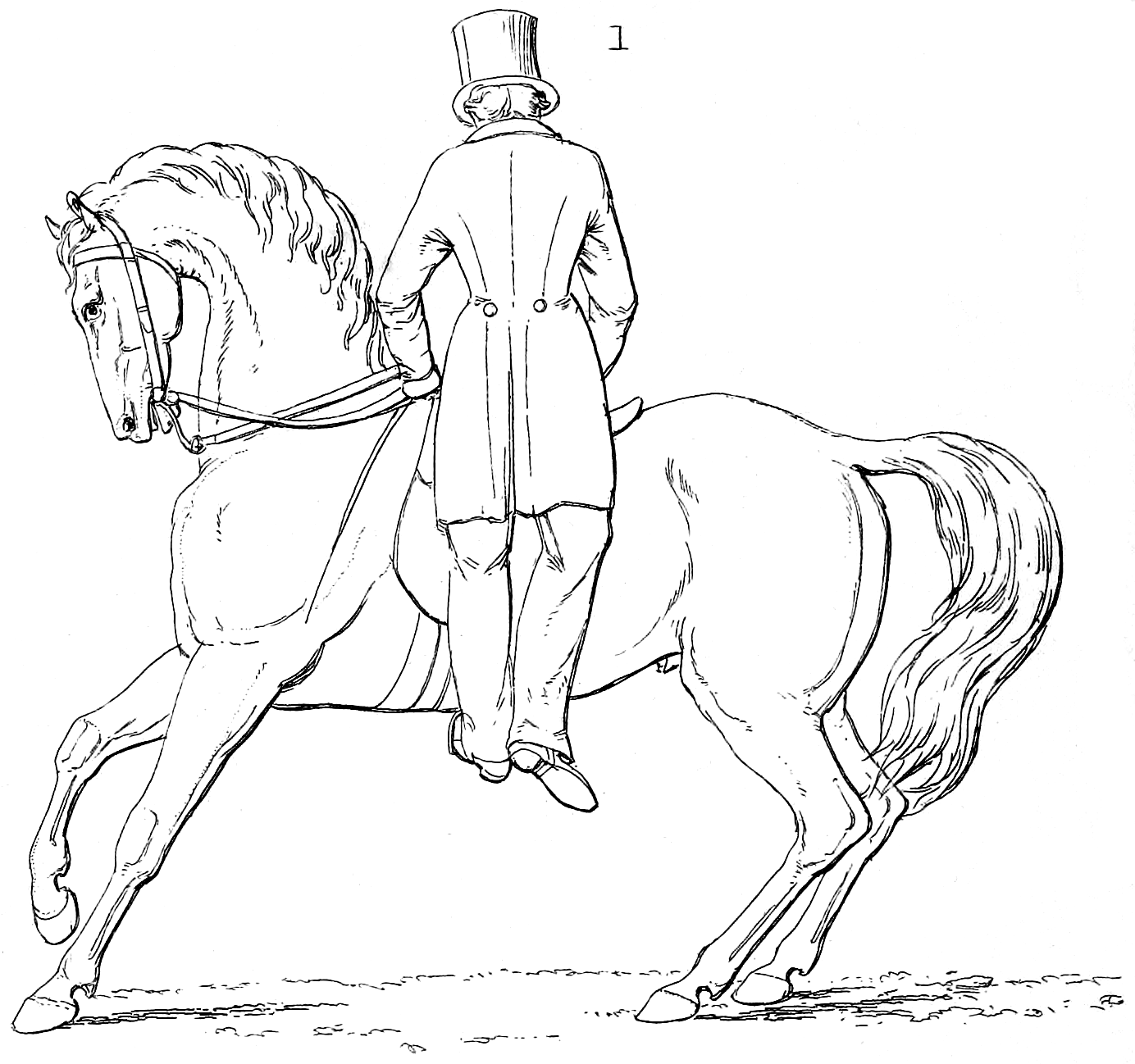
Second View of Mounting.
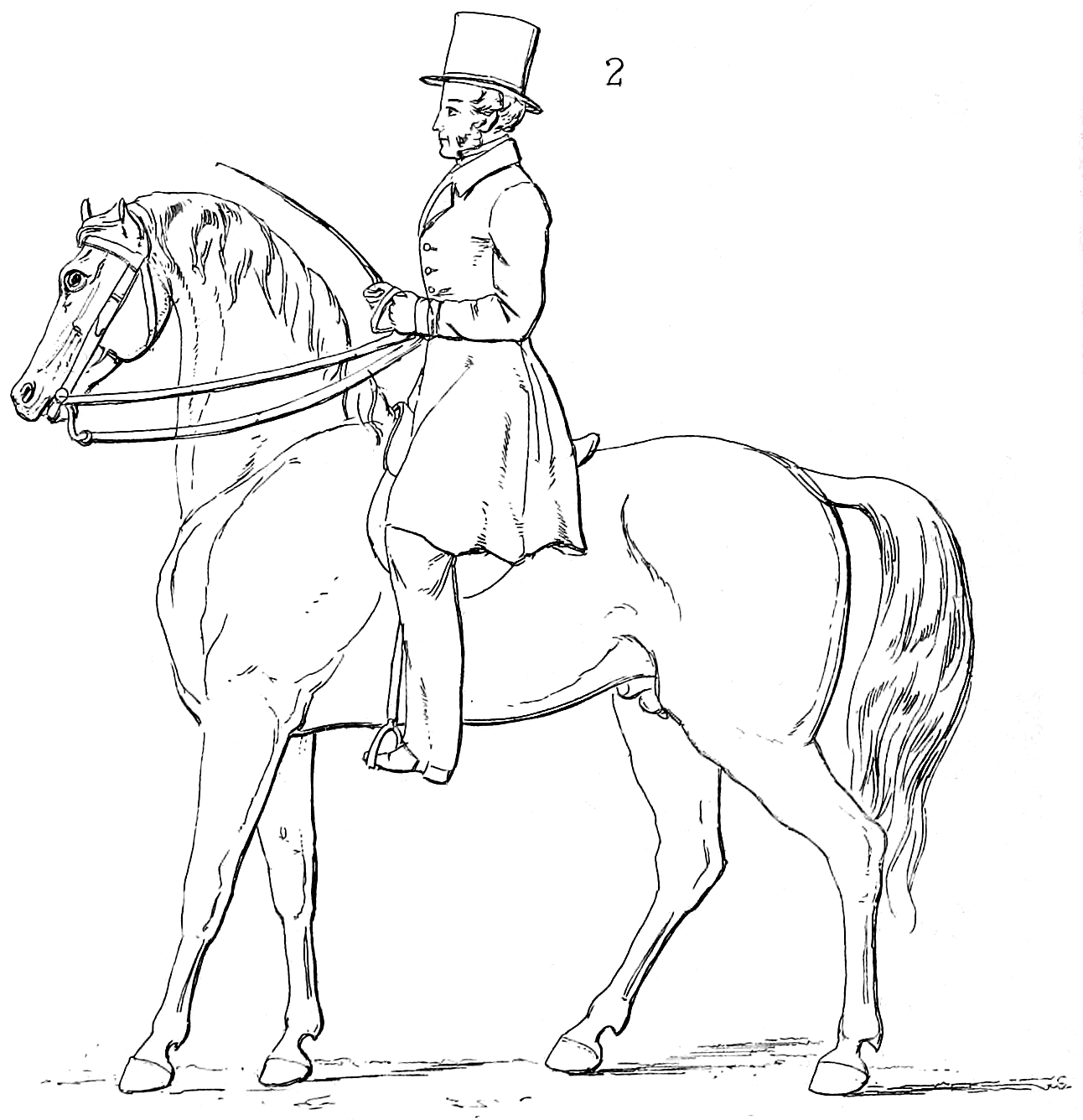
The Seat.
The right hand, after quitting the mane, lays hold of the left
stirrup, the fingers being behind, and the thumb in front of it;—the
left foot is raised and put into the stirrup as far as the
ball of it, Pl XXXV f 2 the right foot is then moved until the
rider’s face is turned to the side of the horse, and looking across
the saddle; while the right hand is placed on the cantle, the
left knee against the saddle on the surcingle, with the left heel
drawn back, to avoid touching the horse’s side with the toe;—by
a spring of the right foot from the instep, not by any pull
with the right hand, the rider raises himself in the stirrup, the
knees firm against the saddle, the heels together, but drawn
back a little, and the body erect, and partially supported by the
right hand Pl XXXVI f 1 the right hand moves from the cantle to
the pommel, and supports the body;—the right leg at the same
time passes clearly over the horse’s quarters to the off side;—the
right knee closes on the saddle; the body comes gently into
it;—the left hand quits the mane, and the right the pommel.
The left, or bridle hand, with the wrist rounded outwards,
is placed opposite the centre of the body, and at three
inches’ distance from it;—the right hand is dropped by the side
of the thigh;—the stirrup is taken instantly with the right foot,
without the help of hand or eye;—the clothes are adjusted;—and
the whip is exchanged from the left hand to the right,
being held with the lash upwards, but inclining a little towards
the left ear of the horse, and never leaving the right hand,
except while mounting or dismounting,—(Plate XXXVI. f. 2.)
The horse is to be accustomed to stand till the rider request
him to move. The habit of unsteadiness is acquired from
grooms, who, on going out to water and exercise, throw themselves
over a horse from some elevation, and give a kick to the
animal even before being fairly upon it. If a groom attend at
mounting, he ought not to be suffered to touch the reins, but
only that part of the bridle which comes down the cheek.
In dismounting, the whip is to be returned into the left
hand;—the right hand takes hold of the rein above the left;—the
right foot quits the stirrup;—the left hand slides forward
on the rein, to about twelve inches from the saddle, feeling
the horse’s mouth very lightly;—the right hand, dropping the
reins to the off side, takes a lock of the mane, brings it through
the left, and twists it round the left thumb;—the fingers of the
left hand close on it;—the right hand is placed on the pommel;
the body being kept erect. The body is supported with the
right hand and left foot;—the right leg is, without touching
the horse’s hind-quarters or the saddle, brought gently to the
near side, with the heels close, care being take not to bend the
right knee, lest the spur should touch the horse;—the right
hand passes at the same time to the cantle, to preserve the
balance, as in the act of mounting;—the body is gently lowered
until the right toe touches the ground;—resting on the right
foot, the left stirrup is quitted, and the left foot placed in line
with the horse’s hoofs;—the hands remaining as in the former
motion. Both hands then quit their holds of the mane and
cantle;—and the right hand lays hold of the snaffle rein near
the ring of the bit.
In mounting without stirrups,—after taking up the reins,
instead of seizing the mane, the rider lays hold of the pommel
and cantle, and, by a spring of both legs from the insteps,
raises the body to the centre of the saddle. By a second spring
of both arms, the right leg is carried over the horse, and the
rider enters his proper seat by closing the knees on the saddle,
and sliding gently into it.
In dismounting without stirrups, on either side of the horse,
the rider throws the weight of the body on the hands placed on
the pommel, and, by a spring, raises the body out of the saddle
before the leg is brought over the horse.
The seat must be understood in an extended sense as the
disposition of the various parts of the body, in conformity with
the action of the horse; and its effect is the rider’s being firm
in the saddle, when he might be otherwise thrown forward over
the horse’s head, or backward over his tail.
The fundamental seat is that intermediate one of which all
others are modifications, and in which the rider sits when the
horse is going straight forward, without any bend in his position.
In describing this, it is first necessary to consider the
rider’s relation to the horse.—He must sit on that part of the
animal’s body which, as he springs in his paces, is the centre of
motion: from which, of course, any weight would be most
difficultly shaken. The place of this seat is that part of the
saddle into which the rider’s body would naturally slide were he
to ride without stirrups. This seat is to be preserved only by
a proper balance of his body, and its adaptation to even the
most violent counteractions of the horse. Turf jockeys necessarily
sit further back, that they may employ the pulls.
It is necessary to consider the horseman in various parts, and
to explain their different functions: 1st, the lower part, as being
here the principal one, namely, the thighs, with the legs as
dependent on them; 2dly, the upper part, namely, the body,
with the arms dependent on it. The thighs, from the fork to
the knees, are commonly called the immovable parts, and upon
them the whole attitude depends. They must not wriggle or
roll, so as either to disturb the horse, or render the seat loose;
but they may be relaxed when the horse hesitates to advance.
The legs occasionally strengthen the hold of the thighs by a grasp
with the calves; and they likewise aid, support, and chastise the
horse. The body, from the fork upwards, must always be in a
situation to take the corresponding motion, and preserve the
balance. The position of the arms is dependent on that of the
body, but they also exercise new functions.
As a good seat is the basis of all excellence in riding, we shall
consider these parts in detail.
In relation to the thighs, the rider, sitting in the middle of
the saddle, must rest chiefly upon their division, vulgarly called
the fork, and very slightly upon the hips. The thighs, turned
inward, must rest flat upon the sides of the saddle, without
grasping; for the rider’s weight gives sufficient hold, and the
pressure of the thighs on the saddle would only lift him above
it. The knees must be stretched down and kept back, so as to
place the thighs several degrees short of a perpendicular; but
no gripe must be made with them, unless there be danger of
losing all other hold. If the thighs are upon their inner or flat
side in the saddle, both the legs and the feet will be turned as
they ought to be. Thus turned, they must be on a line parallel
to that of the rider’s body, and hang near the horse’s sides, but
must not touch; yet they may give an additional hold to the
seat, when necessary, and the calves must act in support of the
aids of the hands. The heels are to be sunk, and the toes to
be raised, and as near the horse as the heels, which prevents the
heel touching the horse.
As to the body.—The head must be firm, yet free. The
shoulders thrown back, and kept square, so that no pull of
the bridle may bring them forward. The chest must be advanced,
and the small of the back bent a little forward.
The upper parts of the arms must hang perpendicularly from
the shoulders, the lower parts at right angles with the upper, so
as to form a horizontal line from the elbow to the little finger.
The elbows must be lightly closed to the hips, and, without
stiffness, kept steady, or they destroy the hand. The wrist must
be rounded a little outwards. The hands should be about three
inches from the body, and from the pommel of the saddle, and
from four to six inches apart; the thumbs and knuckles pointing
towards each other, and the finger nails towards the body.[65]
When the rider is in the proper position on horseback without
stirrups, his nose, breast, knee, and instep are nearly in a
line; and, with stirrups, his nose, breast, knee, and toe, are in
a line.—(Pl XXXVI.) The man and the horse throughout are to
be of a piece. When the horse is at liberty, or disunited, as
it is termed, the rider sits at his ease; and, as he collects and
unites his horse, so he collects and unites himself. There must,
however, be no stiffness of manner, more than in sitting on
a chair; for it is ease and elegance which distinguish the
gentleman.
The balance in riding preserves the body from that inclination
to one side or the other which even the ordinary paces of the
horse, in the trot or gallop, would otherwise occasion. It accompanies
and corresponds with every motion of the animal,
without any employment of strength, and consequently, the
rider sits so firmly that nothing can move his seat. His skill
consists essentially in balancing himself on the horse in such a
manner as not to fetter the animal’s movements. To illustrate
this, if the horse work straight and upright on his legs, the
body must be in the same upright direction: as the horse moves
into a trot, the body must be inclined a little more back; in the
gallop, also in leaping, or in any violent movements, the body
must chiefly be kept back; and, when the horse bends and
leans, as he does when on a circle, or trotting briskly round a
corner, the body must lean similarly, or the balance will be
lost. Throughout the whole, the figure must be pliant to every
action of the horse; for the balance can be maintained only by
as many different positions as he is capable of working in.
To help his balance, the rider must never take the slightest
assistance from the reins. Whatever the position of the body,
the hand must be fixed, and the reins of such a length as to
feel and support the horse, but never to hold on. To acquire
the balance, the practice on circles, or the longe, is useful;
working equally to both hands, and not using stirrups till the
pupil has acquired the balance without them. Experience
proves that the body, if in the manège seat and fundamental
position, almost involuntarily takes the corresponding motion,
whether the horse stumbles, rears, springs forward, or kicks.
There are various methods of holding the reins, according
to the style of riding, the design of the rider, and the propensities
of horses.
In holding the snaffle-reins separately, one rein passes into
each hand, between the third and fourth fingers, and out of it
over the fore-finger, where it is held down by the thumb.—(Pl
XXXVII f. 1.) When afterwards further advanced, the
reins are held in the left hand, as at first taken up; the left
rein passing under the little finger, and the right under the
third finger, both lying smooth through the hand, the superfluous
rein hanging over the first joint of the fore-finger, and
the thumb being placed upon it.[66]
—(Plate XXXVII. fig. 2.)
Riders should not throw their right shoulders back, as they
are apt to do, when they first take the reins in one hand. The
right arm should hang by the side, with the hand by the side of
the thigh; or, if holding the whip, it may be kept a little lower
than the left, in order not to obstruct the operation of the
bridle.
We have already said, that we think it best to ride with the
snaffle alone, and use the curb only occasionally. In this case,
the curb reins may have a slide upon them, and may hang on
the pommel of the saddle, or the horse’s neck. When the rider,
however, holds the curb as well as the snaffle, having both, as
is most usual, in the left hand,—while the curb reins are placed
as above described of the snaffle reins, the snaffle reins are placed
within them; that is, the left snaffle rein enters under the
second, and the right under the first finger, and both pass up
through the hand, and out of it, over the fore-finger, precisely
as do the curb reins, except that they lie at first above, then
within, and lastly, under them.—(Plate XXXVII. fig. 4.)
Plate XXXVII
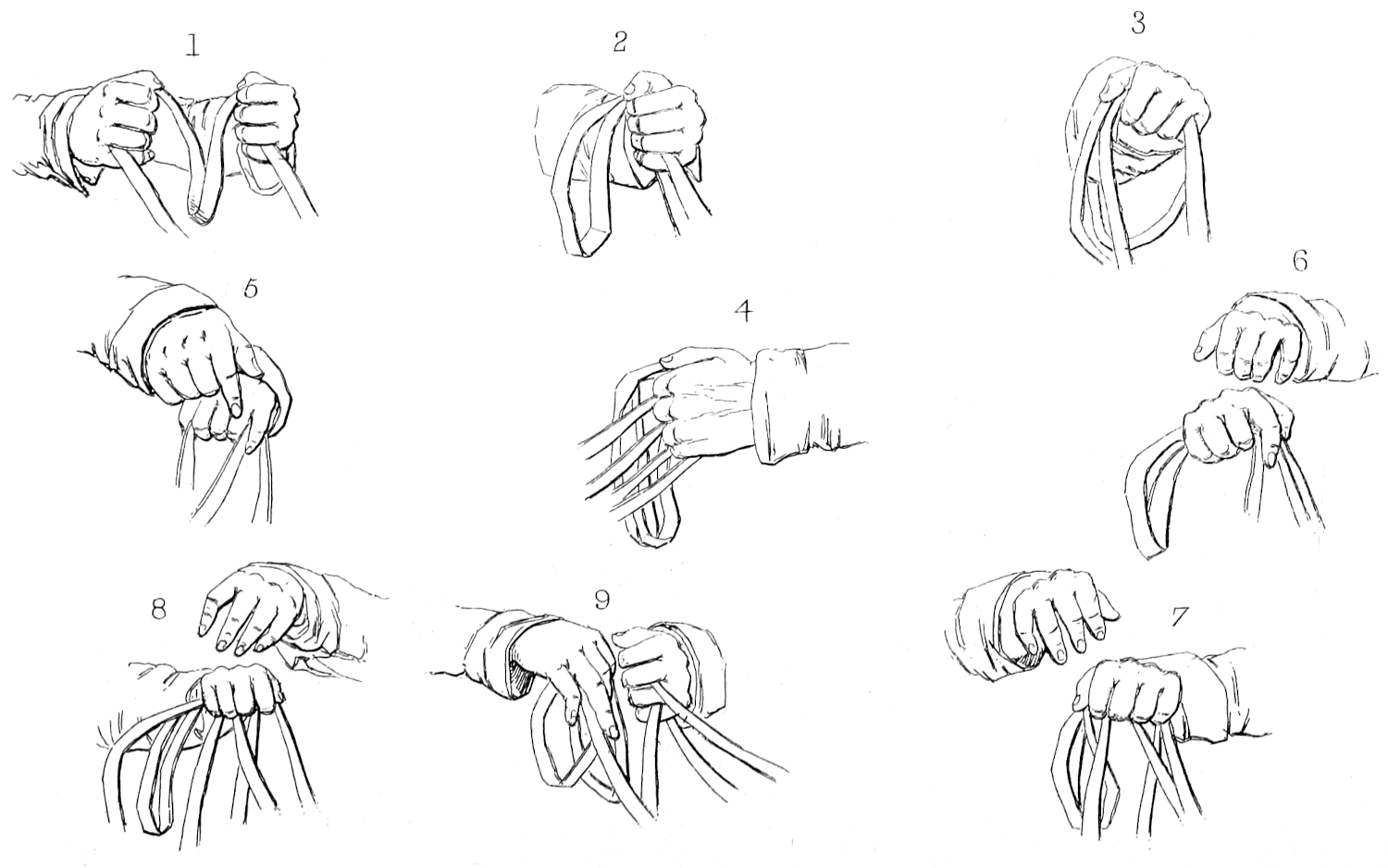
The Rein-hold.
Shifting the reins should be done expertly, without stopping
the horse, altering the pace, breaking the time, or looking to
the hands. When the snaffle reins are held in one hand, the
method of shifting from the left hand is as follows:—Turn the
thumbs towards each other; carry the right hand over the left;
in place of the little finger of the left hand, put the fore-finger
of the right hand downwards between the reins; lay the reins
smoothly down through the right hand, and place the thumb
upon the left rein between the first and second joint of the
fore-finger.—(Pl XXXVII. f. 5.) To shift them again into the
left hand, it is only necessary to carry the left hand over the
right; to put the little finger of the left hand downwards between
the right and left reins; to place them smoothly upward
through the hand, and to let the ends hang over the fore-finger,
as at first.—(Plate XXXVII. fig. 6.)
When both curb and snaffle reins are held in the usual
method, we shift them into the right hand in a similar manner,
by turning the thumbs toward each other; carrying the right
hand over the left; putting the fore-finger of the right hand
into the place of the little finger of the left; the second finger
of the right into the place of the third finger of the left; and
the third finger of the right into the place of the second finger
of the left; and laying the reins smoothly down through the
right hand.— (Pl XXXVII. f. 7) When we shift the reins
again to the left hand, we put the fingers of the left hand into
the places we took them from, and turn the reins smoothly
upward through the hand, and over the fore-finger.—(Plate
XXXVII. fig. 8.)
Separating the reins is sometimes necessary. When a horse
refuses obedience to one hand, we use two. It is seldom, however,
necessary to take more than one rein in the right hand;
and this is the right rein of the snaffle only. For this purpose,
the rider turns the back of his right hand upwards, puts the
first three fingers over the snaffle rein, receives it between his
little and third fingers, lets the superfluous end hang over the
fore-finger, with the thumb upwards, as he does the bridle hand.
(Plate XXXVII. fig. 9.)
Adjusting the reins is shortening or lengthening them, wholly
or partially, as occasion may require. To adjust the whole, we
take the superfluous reins that hang over the fore-finger of the
left hand into the right, so that with that hand we support the
horse, and feel every step he takes; and we then open the
fingers of the left hand so as to slip it up and down the reins
smoothly and freely, and thereby adjust them to our pleasure.
To shorten the curb rein, and lengthen the snaffle, we take in
the right hand the centre of the curb rein, that hangs over the
fore-finger, slip the whole of the reins too long, pass the left
hand down them, and feel with the fingers whether both the
curb reins are of equal length, before we grasp with the left
hand, or quit with the right. Similarly, we shorten the snaffle,
and lengthen the curb, by taking in the right hand the centre of
the snaffle that hangs over the fore-finger, and proceeding in the
same way.
When any single rein wants shortening, we apply the right
hand to that part which hangs over the fore-finger, and draw it
tighter. When the reins are separate, or occupy both hands,
and want adjusting, we bring the hands together to assist each
other; remembering that the inner hand, or that which supports
the attitude the horse works in, is not to depart from its situation,
so as to occasion any disorder, but that the outer hand is
to be brought to the inner, for the purpose of adjusting them.
To have a correct notion of the manner in which the hand
operates on the horse’s mouth, it must be understood that the
reins, being held as described, are collected to such definite
length, that bracing the muscles of the hand would rein the
horse back, and easing them permit him freely to advance; the
hand, for preserving a medium effect on the mouth, being only
half shut, and the knuckles near the wrist nearly open. The
hand, then, being connected to the reins, the reins to the bit,
the bit operating in the curb on the bars, and in the snaffle on
the lips, the rider cannot move the hand, and scarcely even a
finger, without the horse’s mouth being more or less affected.
This is called the CORRESPONDENCE.
If, moreover, the hand be held steady, as the horse advances
in the trot, the fingers will feel, by the contraction of the reins,
a slight tug, occasioned by the cadence of every step; and this
tug, by means of the correspondence, is reciprocally felt in the
horse’s mouth. This is called the APPUY.
While this relation is preserved between the hand and mouth,
the horse is in perfect obedience to the rider, and the hand
directs him, in any position or action, with such ease, that the
horse seems to work by the will of the rider rather than by the
power of his hand. This is called the SUPPORT.
Now, the correspondence or effective communication between
the hand and mouth,—the appuy, or strength of the operation
in the mouth,—the support, or aid, the hand gives in the position
or action,—are always maintained in the manège and all
united paces. Without these, a horse is under no immediate
control, as in the extended gallop, or at full speed, where it may
require a hundred yards to pull before we can stop him.
The degree of correspondence, appuy, and support, depends,
in horses otherwise similar, on the relative situation of the hand.
The act of raising the rider’s hand increases his power; and
this, raising the horse’s head, diminishes his power. The depressing
of the rider’s hand, on the contrary, diminishes his
power; and this, depressing the horse’s head, increases his power.
On these depend the unitedness or disunitedness in the action of
the horse.
A writer on this subject (Beranger, we believe) gives the following
useful illustration:—“If a garter were placed across the
pupil’s forehead, and a person behind him held the two ends in
a horizontal direction, the pupil, if he stood quite upright, could
not pull at the person’s hand, nor endure the person’s hand to
pull at him, without falling or running backwards.” This is the
situation of a horse when united.
Accordingly, when the pupil felt the hand severe, or expected
it to pull, he would guard against it by bending the body, projecting
the head, and planting one foot behind. This is the
situation of a horse when disunited, or defending himself against
the heaviness of the hand. Hence the perpetual pull of a timid
rider, or a heavy insensible hand, cannot keep a horse united,
because the horse cannot then bear its severity. Thus heavy
hands make hard-mouthed horses; and hence it is in this condition
that we generally find horses, for the best broke become
so, if ridden a few times by an ignorant horseman. In such
cases, the horse makes the rider support the weight both of his
head and neck, or goes on his shoulders, and is apt to stumble.
If, then, the appuy be heavy, from the head being carried too
low, and the horse not sufficiently united, the rider must raise
the hand, and let the fingers, by moving, rather invite than
compel the head, or more properly the neck, to rise, for the
object is to bring in the head by raising the neck, the legs at
the same time pressing the haunches under. By these means,
the horse will be united, and the appuy will be lightened. Should
the hand, however, be too confining to the horse when united,
he may become so balanced on his haunches that he can neither
disunite himself nor advance one step; and, should the rider
then press him without yielding or dropping the hand, he would
compel him to rear.
Such are the two extremes, where the horse is disunited, and
where he is too much united. The intermediate effect of the
hand and heel must be acquired by practice.
To a masterly hand, firmness, gentleness, and lightness, are
very properly described as being essentially necessary.
Firmness of the hand does not, however, do more than correspond
exactly with the feeling in the horse’s mouth, unless
the horse attempts to get the ascendancy, to abandon that delicate
correspondence producing the appuy, and keeping him
under the strictest obedience, and to make a dull or insensible
pull on the hand. To frustrate these attempts, the hand is kept
firm, and the fingers braced; and, should the horse plant his
head low to endure this, the fingers are moved, the reins shaken,
&c., to raise the head and divert him from his purpose; or, if
this be unavailing, the hand is yielded that the reins may become
slack, and a snatch is given in an upward direction, which will
not only make him raise his head, but will deter him from putting
it down again.
Gentleness of the hand relaxes a little of its firmness, and
mitigates the feeling between the hand and the horse’s mouth,
without passing, however, from one extreme to another. Lightness
of the hand lessens still more the feeling between the rider’s
hand and the horse’s mouth, and consists in a slight alternate
feeling and easing of the bridle, regulated by the motion of the
horse; for, if the appuy were always in the same degree, it
would heat the mouth, dull the feeling, and render the horse’s
bars callous. The rider must also distinguish whether the horse
washes to disengage himself from restriction, or wants a momentary
liberty to cough, to move if cramped, to dislodge a
fly, &c.
The curb, if used, requires always a light hand to manage it;
and the horse should never be put to do any thing in a curb at
which he is not perfectly ready. The curb is adapted for acting
in a direct line only: the snaffle should be used in all other
cases. Still, as to all these qualities, the transitions must be
gradual. Were the rider, passing over that degree of restraint
which is derived from the easy or gentle hand, to go at once
from a firm to a slack one, he would deprive his horse of the
support he trusted to, and precipitate him on his shoulders. On
the contrary, were he to pass from the slack to the tight rein all
at once, he would give a violent shock to the horse’s mouth.
All the operations of the hand, then, should be firm, gentle,
and light; and in these, the fingers and wrist alone must act.
Certain liberties called descents of the hand, are also taken with
well-bred horses. These are made three different ways:—by
advancing the arm a little, but not the shoulder, still keeping
the usual length of rein, or by dropping the knuckles directly
and at once upon the horse’s neck;—by taking the reins in
the right hand, about four fingers’ breadth above the left, and
letting them slide through the left, dropping the right hand at
the same time upon the horse’s neck;—and by taking the end
of the reins in the right hand, quitting them entirely with the
left, and letting the end of them fall upon the horse’s neck.
These graceful freedoms must never be used but with great
caution, when the horse is quite together, and in hand; and
the rider, by throwing back his body, must counterbalance the
weight of the horse upon his haunches.
There are still minuter rules belonging to this head; for instance,
both snaffle reins being in one hand, and that in the
first position,—if we open the first and second fingers, we
slacken the right rein;—if we open the little finger, we slacken
the left rein;—if we shut the hand entirely, and immediately
open it again, we lessen the tension of both reins. By these
methods, we may relieve and freshen the two bars in which the
feeling and appuy resides. So also in the second descent of the
hand. While the right hand holds the reins, we may slide the
left hand up and down these in that degree of appuy which belongs
to the easy and slack hand: during which the horse will endeavour
to preserve that mutual sensation between the mouth and
the hand, which makes him submit with pleasure to constraint.
By this play of the rein and movement of the bit to avoid
pressure in one continued way, the horse’s head is kept high,
and his neck and crest are raised.
The modes of guiding the horse are called aids, because they
not only direct, but assist him to execute. They also check
him in acting contrarily. These aids are certain positions of
the hand, body, legs, and sometimes of the switch or whip. The
hand is so far the principal of these, that the others are sometimes
called accompaniments, as only giving power and efficacy
to the hand.
A horse can move four different ways—forward, to the right,
to the left, and backward; but he cannot perform these motions
unless the hand of the rider makes four corresponding motions.
There are accordingly five different positions for the hand, including
the general one from which the other four proceed.
In the first position, the reins pass up between the third and
fourth fingers of each hand, their ends are thrown over the
fore-fingers, the thumbs are closed on them, and the fingers are
shut:—the hands being held as already described in treating
of the seat. The second position consists of a slight relaxation
of the preceding, and permits the horse to advance. The third
position shortens the right rein rather upward, and turns the
horse to the right. The fourth position shortens the left rein
rather upward, and turns the horse to the left; and the fifth
position shortens both reins, and stops or reins the horse
backwards.
The aids of the hand, as forming these positions, when the
reins are held in one hand, may be very simply given by a
little extending, or bending the wrist, to make the horse advance,
or go backward,—and by slightly carrying the hand to the
right or to the left, and in both cases rather upward, to make
the horse turn in these directions.
Several modifications of the rules already given occur. We
do not, however, approve of these positions, as they, in a great
measure, reverse and destroy the natural aids of the hand, by
leaving the right rein slack in the turn to the right, and the
left rein slack in the turn to the left. Indeed, they could not
possibly be obeyed by the horse, were it not that, on this point,
he seems to have more understanding than his rider, and draws
his conclusions as to the latter’s intentions, not from the inconsistent
action of his hand, but from the more natural accompanying
aids of his body and legs. Fortunately, however, these
twistings of the bridle hand, though always taught, are, we
believe, rarely practised.
We give these positions here, only in compliance with custom.
In the first position the under surface of the fore-arm and
hand forms a horizontal line from the elbow to the joint of the
little finger; the elbow is lightly closed to the hips; the wrist
is rounded; the knuckles are kept directly above the neck of
the horse, the hand being at three inches from the body, and as
much from the pommel of the saddle; the nails are turned
towards the body, the little finger being nearer to it than the
others; the reins, in entering the hand, are separated by the
little finger; and the thumb is placed flat upon them as they
pass out over the fore-finger.
In the second position the hand is yielded to the horse by
turning the nails downward, so as to carry the thumb nearer
the body, and the little finger further from it, yet somewhat
obliquely, for the thumb passes nearly into the place where the
knuckles were in the first position, the nails being now directly
above the horse’s neck. This permits the horse to advance.
In the third position the hand, leaving the first, is turned
upside down, so that the thumb is carried out to the left, and
the little finger brought into the right. This carries the operation
of the reins nearly three inches more to the right, by which
the left reins press the neck, the right reins are slack, and the
horse is turned to the right.
In the fourth position the hand, leaving the first, the back is
turned upward, so that the little finger is carried out to the left,
and the thumb brought in to the right. This carries the operation
of the reins to the left, by which the right reins press the
neck, the left reins are slack, and the horse is turned to the left.
In the fifth position, quitting the first, the wrist is rounded,
the nails turned upwards, and the knuckles towards the horse’s
neck. This stops him, or compels him to go backward.
These aids, however, when the reins are held in one hand,
are not so effective as those where the reins are separate.
To aid the second position of the hand, and cause the horse
to advance, the body may be thrown a little forward, but not
so as to press heavily on his fore-parts. To aid the third and
fourth positions of the hand, a mere turn of the body is sufficient.—Thus,
in entering an angle, it is only necessary to turn the
body imperceptibly toward the corner, just as if the rider intended
to go into it himself; his body then turning to the right or
left, his hand must necessarily turn likewise, and the leg of the
side on which he turns will infallibly press against the horse,
and aid him. In coming out of a corner, it is only necessary to
turn the body again, the hand will follow it, and the other leg,
approaching the horse, will put his croupe into the corner, in
such a manner that it will follow the shoulders, and be upon the
same line.—The same motion of the body is likewise necessary
to turn entirely to the right or left. To aid the fifth position
of the hand, and make the horse go backward, the body must
be thrown gently back, and the hand will go with it.
To aid the second position of the hand, and make the horse
advance, the legs must be closed. Even when a horse stands
still, the legs held near him will keep him on the watch, and
with the slightest upward motion of the bridle, he will raise his
head and show his forehead to advantage. To aid the third
position of the hand, and turn to the right, the right leg must
determine the croupe to the left, and facilitate the action of the
shoulder, which the hand had turned to the right. To aid the
fourth position of the hand, and turn to the left, the left leg
must determine the croupe to the right. In making a change
to the right, the left leg confines the croupe, so that it must
follow the shoulders. In changing again to the left, the right
leg acts similarly. To aid the fifth position of the hand, and
stop the horse, while he is held in, the legs must be gently
brought to the sides.
The aids of the legs have their degrees progressively increasing,
thus:—the leg being brought nearer the side is the
lightest; placing the leg further back, with the toe turned out,
is the next; a touch with the calf of the leg, is the third; a
stroke with it, having the toe kept up firmly, that the muscles
of the leg may be hard, is the fourth; and the strongest is the
scratch, which, when the legs are laid on hard without effect, is
given by dropping the toe, when, if the spur be properly placed,
the rowel will scratch the horse’s side, and this is succeeded by
giving the spur sharply. Aids with the whip are also used to
give greater effect to the heel. These are gentle taps on the
hind quarters, and sometimes on the shoulders. When given
on the near side, the hand is either applied behind the back,
with the whip held by the fingers like a pen, the lash being
downwards, or across the bridle-hand before, the whip being
held with the lash upwards.
Animations proceed from the hand, the leg, the whip, or the
tongue; those of the hand and of the legs have been described
among the aids. Animations of the whip are mild taps to
quicken the horse, or, if the lash is upwards, switching it in the
air. Those of the leg and whip threaten punishment; and
accordingly, with sluggish horses, both may be necessary. The
animation of the tongue is produced by placing the tongue flat
against the roof of the mouth, and suddenly displacing the
posterior part of it by drawing the air laterally between
it and the palate. This noise is animating to the horse;
but, if too much continued, or too frequent, its effect is
destroyed.
Soothings are the reverse of animations, and are used to
dispel the fears of horses, and to give them confidence. The
voice soothes by soft and mild tones; the hand, by gentle
patting, or stroking: the body and legs, by relinquishing all
unnecessary firmness, and sitting easy. A horseman should
have perfect command of his temper, as well as invincible
patience and perseverance, to make the horse comprehend and
perform. He must demand but little the first time; he will
be more readily obeyed the next; and he may increase his
demands as the horse improves in habit and temper.
Corrections are given either with the spurs or switch, or by
keeping the horse in a greater degree of subjection. In these
a good horseman endeavours rather to work upon the mind
than the body of the horse. The corrections which render a
horse most obedient, and yet dishearten him least, are not
severe, but rather oppose him by restraint, and make him do
directly the contrary. If, for example, he do not go off readily,
or if he be sluggish, make him go sidewise, sometimes to one
hand, sometimes the other, then drive him forward.—If he go
forward too fast, moderate the aids, and make him go backward
more or less according to his conduct.—If he be disorderly
and turbulent, walk him straight forward, with head in and
croupe out.
When correction is given with the whip, it should be with
strength; the lash being upwards, the arm lifted high, and the
whip applied behind the girths round the belly: or it may be
given forward, over the shoulders, between the fore-legs.
Should the horse kick at the application of the whip to his
flank or quarter, the rider must instantly apply it smartly, and
must repeat it more sharply, should he kick at that. By this,
he may be made sensible of his fault.
To give a horse both spurs properly, the rider must change
the posture of his legs, and, bending his knee, strike him with
them at once, quickly and firmly. Some horses disregard the
whip, but fly at the spurs; others disregard the spurs, and are
terrified at the whip; the rider consequently will apply that
which is most likely to produce the desired effect. When,
however, the whip or spurs are applied two or three times
sharply to restive horses without effect, the rider must desist,
and try other methods.
The rider should not suffer his horse to move till his clothes
are adjusted, and whip shifted, when, collecting his reins, and
taking one in his right hand, he must close his legs, to induce
the horse to move slowly forward in the walk. If he wish to
increase the pace, the pressure of the knees must be increased.
When the horse moves, the legs must resume their former position,—the
hands remain perfectly steady,—and the body yield
to the movement.
As to character, the walk is the pace performed with the least
exertion; only one leg at a time being off the ground, and
three on. In this pace, accordingly, four distinct beats are
marked, as each foot comes to the ground in the following
order:—first the off fore foot, next the near hind foot, then
the near fore foot, and lastly, the off hind foot.[67]
The perfection of the walk consists in its being an animated
quick step, measuring exact distances, and marking a regular
time, by putting the feet flat to the ground. Its excellence
depends on that uniting of the horse which supports his head
and raises his feet, without shortening or retarding the step;
and that animation which quickens the step and sharpens the
beats without altering the time or the action.
In performance, if the rider do not support the horse sufficiently,
his head will be low, and his walk slovenly: if he
support him too much, he will shorten his step so that he cannot
walk freely. If the rider do not animate him, he will not exert
himself: if he animate him too much, he will trot. If the
horse trot when the rider designs him to walk, he will find
either his hand or the degree of animation communicated by
the whip, tongue, legs, or bracing of the body, too high, and
this he must instantly modify, as well as check the horse.
(Plate XXXVIII. fig 1.)
PLATE XXXVIII
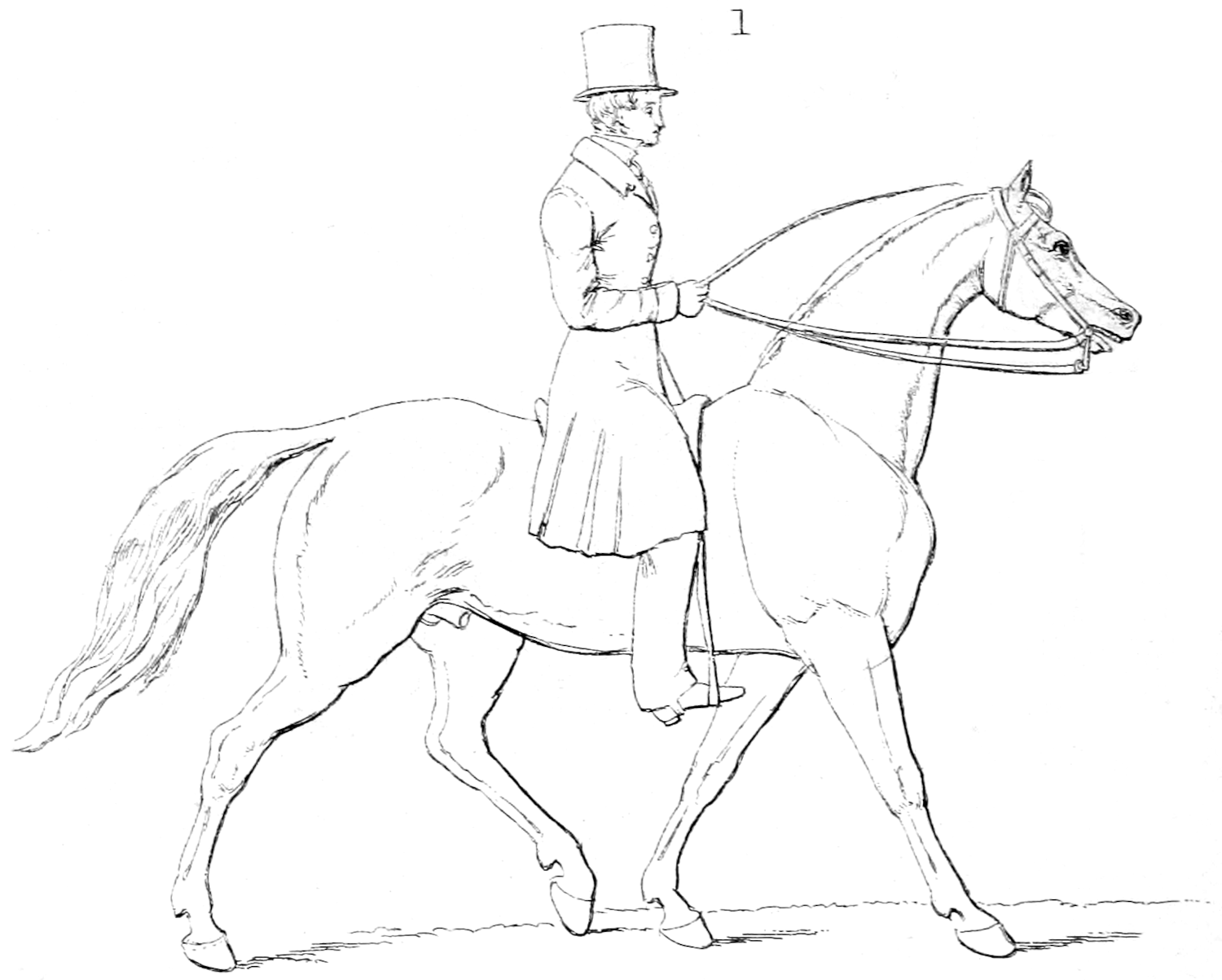
The Walk.
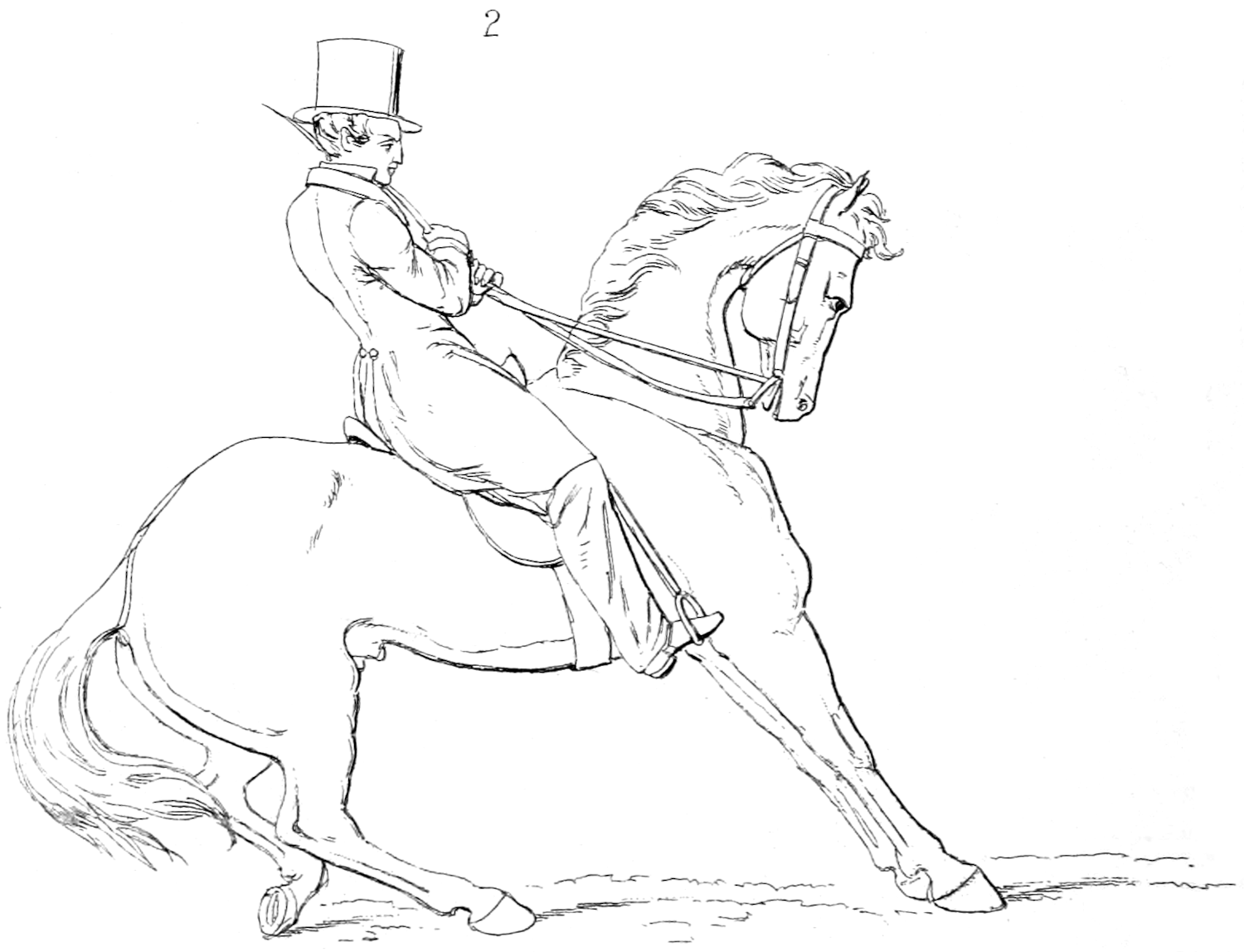
The Stop.
Turns in general should be made slowly; and all the aids
should combine in producing them.
In performance, the hand to which we turn, or inner hand, is
to be a little below the outer one, and the inner rein held with
double the force of the outer one, which is to be exerted by the
little finger pulling gently upwards and towards the body,
while the outer hand retains a steady hold of the outer rein.
At the same time, the legs, by a slight pressure with the calves,
must support the horse, keep him up to the bridle, make him
bring his haunches under him, and obey the leading rein. The
pressure of the inward leg alone would make him throw his
haunches too much outwards. All this is to be done in proportion
to the effect meant to be produced; and great precision
and delicacy are required in the execution.
Wheels may also be briefly noticed here. A horse may wheel
or turn on his own ground, on three pivots,—on his centre, on
his fore feet, and on his hind feet. In all these, the hand
directs all before the horseman, and the heel all behind him. In
wheeling on centres, the hand and heel operate together—the
hand leading the shoulder round—the leg directing the croupe,
by which means, in going about, the fore feet describe one half-circle,
and the hind feet another. Here the aids of the hand,
body, and legs, must exactly correspond; and the degree of
appuy must be merely such as will carry its aid into effect; for,
if the appuy is too weak, the horse will advance over his ground,
and if too strong, he will retire from it.
On terminating the wheel or quarter circle, the about or
half-circle, or the about and about, or whole circle, the hand,
the body, and leg, must instantly resume their proper position.
The wheel on the fore, and that on the hind feet, are still more
rarely of use in common practice.
Horses and horsemen generally stop by a gradual cessation of
action, in a time and distance which depend on circumstances.
As to character, however, the stop, when properly performed,
is an instant cessation of advance, without any previous indication.
When the stop is properly performed, it shows the great
superiority of the rider’s hand over the horse. It confirms him
in obedience, unites him, supples the haunches, and bends the
houghs. Much mischief, however, may occur from a too frequent
or injudicious practice of it. The perfection of the stop
consists in the action ceasing at the finish of a cadence, without
breaking the previous time; and in the horse being so balanced
on his haunches, and so animated, that, with liberty given, he
can advance with the same rapidity as before.
In performance, the time to be seized is when the first part of
the cadence is coming to the ground; so that its finish completes
the stop. If this is not done, the cadence will be broken,
and the stop rendered irregular. At such a moment, the stop
is performed by the rider bracing his arms to his body, holding
both reins equally and firmly, drawing the fingers towards the
body, closing for an instant both legs, to press the horse up to
the bridle, and throwing the body back, with precisely such
strength of all the muscles as is proportioned to the effect; all
this being done at the same instant, and making but one motion.
If the rider do not close his legs, the horse may not bring his
haunches under, the stop will be on the shoulders, and its effect
will be destroyed.
If, in stopping, a horse toss up his nose, or force the hand, the
bridle hand must be kept low and firm, no liberty must be
given, his neck must be pressed with the right hand till he has
brought down his nose, and immediately all his bridle may be
given him. (Plate XXXVIII. fig. 2.) If the horse has
not readily obeyed, he should be made to go backwards, as a
proper punishment for the fault.
The action of the horse when he goes backward is to bend
his haunches, to have always one of his hinder legs under his
belly, on which to rest and balance himself, and to push his
croupe backward. In performance, the horse’s head must be
steady and right, his body gathered up under him, he must be
upon his haunches, and his feet be even. To aid him in this,
there should be an equal and steady feeling of both reins; the
hand must be held centrically, and kept from rising, with the
knuckles a little down, inviting the horse to back; the body
bent a little forward, with the belly drawn in; and the legs
gently pressing the sides of the horse, in order to keep him up
to the bridle, and to prevent him from swerving.
The instant he yields to the hand, the body and hand yield to
the horse, that he may recover his balance; and he may then
be pressed to back again. If either the deviation of the hand
from its centrical situation, or any other cause, make the croupe
go off the line in an opposite direction, the heel must support
and direct him. Thus, should the croupe traverse to the right,
the right leg must direct; and, to assist, the hand must be
carried a little to the right; but this must be done with delicacy,
lest the croupe be thrown too much to the left. Here the hand
and the heel change their functions; the hand compels the
action, and the heel directs it.
As to the character of the trot, when we urge the horse to
proceed faster than he can by moving one leg after the other
in the walk, we oblige him to take up two at a time in the trot.
Here the off fore-foot and the near hind-foot give one beat;
and the near fore-foot and the off hind-foot give another; so
that there are two legs crosswise off the ground, and two legs
on; the beats being sharp and quick, in proportion to the degree
of animation and extension.
The perfection of the trot consists in its suppleness, giving
the horse a free use of his limbs; in its union, distributing his
labour more equally, his fore legs having more to sustain than
the hind, especially when he is disunited, or on the shoulders;
and in its action, which should be true and equal, the liberty
of the fore-quarters not exceeding the hind, nor the hind the
fore—the knee being up, the haunches bent, springy, and pliant,
the step measuring exact distances, and marking a regular time.
In the trot, there is a leading foot, either right or left, by which
the corresponding side is a little more advanced than the other.
This leading with either foot is valuable, as, in horses that have
not been thus suppled, if chance or fatigue makes them change
their leg for that which they are not accustomed to, the action
is stiff, confined, and irregular.
There are three kinds of trot—the extended, the supple, and
the even.
In the extended trot, the horse steps out without retaining
himself, being quite straight, and going directly forwards.
In the supple trot, at every motion he bends and plays the
joints of his shoulders, knees, and feet.
In the even trot, he makes all his limbs and joints move so
equally and exactly, that his limbs never cover more ground one
than the other, nor at one time more than at another.
These three kinds of trot depend upon each other. We cannot
pass a horse to the supple trot without having first worked
him to the extended trot; and we can never arrive at the even
and equal trot without having practised the supple. To pass
from the extended to the supple trot, the horse must be gently
and by degrees held in. When, by exercise, he has attained
sufficient suppleness to manage his limbs readily, he must
insensibly be held in more and more, till he is led to the equal
trot.
In performance the rider must apply, for an instant,
both legs to his horse’s sides; and at the same time raise the
fore hand by drawing the lower finger on each side rather
upwards and towards the body, avoiding all jerks or sudden
motions.
During the trot he must sit close to the saddle, preserving
his seat by the balance of his body, and not by the pressure of
the knees; he must neither rise nor stand in the stirrups; his
body must incline a little backwards; the whole figure must
partake of and accompany the movements of the horse; and
he must keep the hands up in their proper situation, steady and
pliant, preserving a due correspondence, and just appuy. If
the action be too rapid, it must be checked by strengthening
the hand. If the action be too slow, it may be quickened by
easing the fingers, and giving more animation.
To give more animation, and encourage the horse to put his
foot out freely, the rider must support his fore hand up, and
his haunches under, by a touch of the fingers, the excitement
of the tongue, the switch of the whip, or the application of the
legs, varied so as not to lose their effect. If the action be not
sufficiently united, that also must be corrected.
To unite the horse, the reins must be collected, and the
head raised. By bringing his haunches under him, he may
be pressed up to the bridle by the aid of the legs; care being
taken that this is not done hastily or violently. He must
not, however, be confined in the hand, in expectation of
raising him, and fixing his head in a proper place, as by this
means his bars and mouth would soon grow callous.
The most certain sign of a horse’s trotting well is, that
when, in his trot, the rider presses him a little, he offers to
gallop. If the horse gallop when he ought not, the waist
should be pushed forwards toward the pommel of the saddle,
and a bend or hollow at the same time be made in the loins.
As to turns, seeing that the operations directed to be performed
at the walk are to be practised in the trot, nothing
further need be said of them. As stops are required to coincide
with cadences, it must be observed, that the first part of the
cadence in the trot is performed by the two feet that lead; and
that the conclusion of the cadence is performed by the two feet
that follow, and this should complete the stop. The rider should
occasionally alter the measure of the action, by strengthening
the hand, and at the same time keeping up a sufficient degree
of animation to prevent the horse from stopping. He may then
give him liberty, and proceed with the same spirit as before.
He may make a stop; and may even rein him back two or
three steps; in both cases keeping him so united and animated
that the instant the hand gives him liberty he advances as
rapidly as before. (Plate XXXIX. fig 1.)
Road riding is here introduced, because the trot is its most
appropriate pace.
The difference between manège and road riding, consists
chiefly in a shorter seat and a shorter stirrup being used in the
latter. A certain freedom and ease are also admissible. These,
however, must not exceed propriety, lead to neglect of the
horse, or risk security. The hand should keep its situation and
property, though the body be turned to any extreme for the
purpose of viewing or conversing; and the body must not, by
any freedom it takes, throw itself out of balance, or take
liberties when it cannot be done with safety.
When the trot is extended to an unpleasant roughness, the
jolting may be eased by rising upward and slightly forward in
the stirrups. The faster the horse trots, the easier it is to rise;
for it is the action of the horse, and not any effort of the rider,
that must raise him. The foot he leads with determines that
which the rider must rise to; and, if the horse change his foot,
he must change with him. He must accordingly rise and fall
with the leading foot, rising when the leading foot is in the air,
and falling when it comes to the ground. The rise and fall of
the body are to be smooth, and as regular as the beats of the
feet.
Plate XXXIX
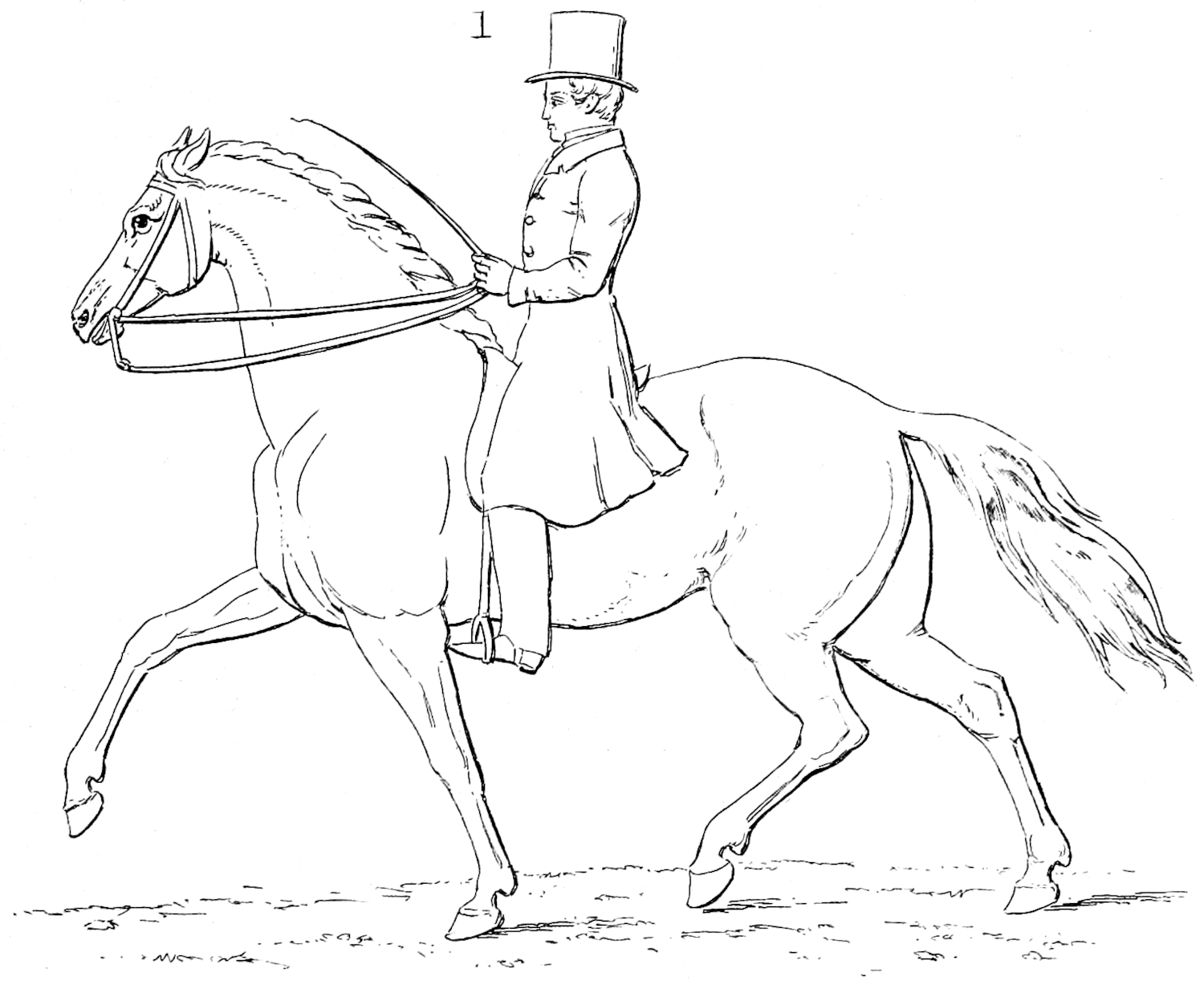
The Trot.
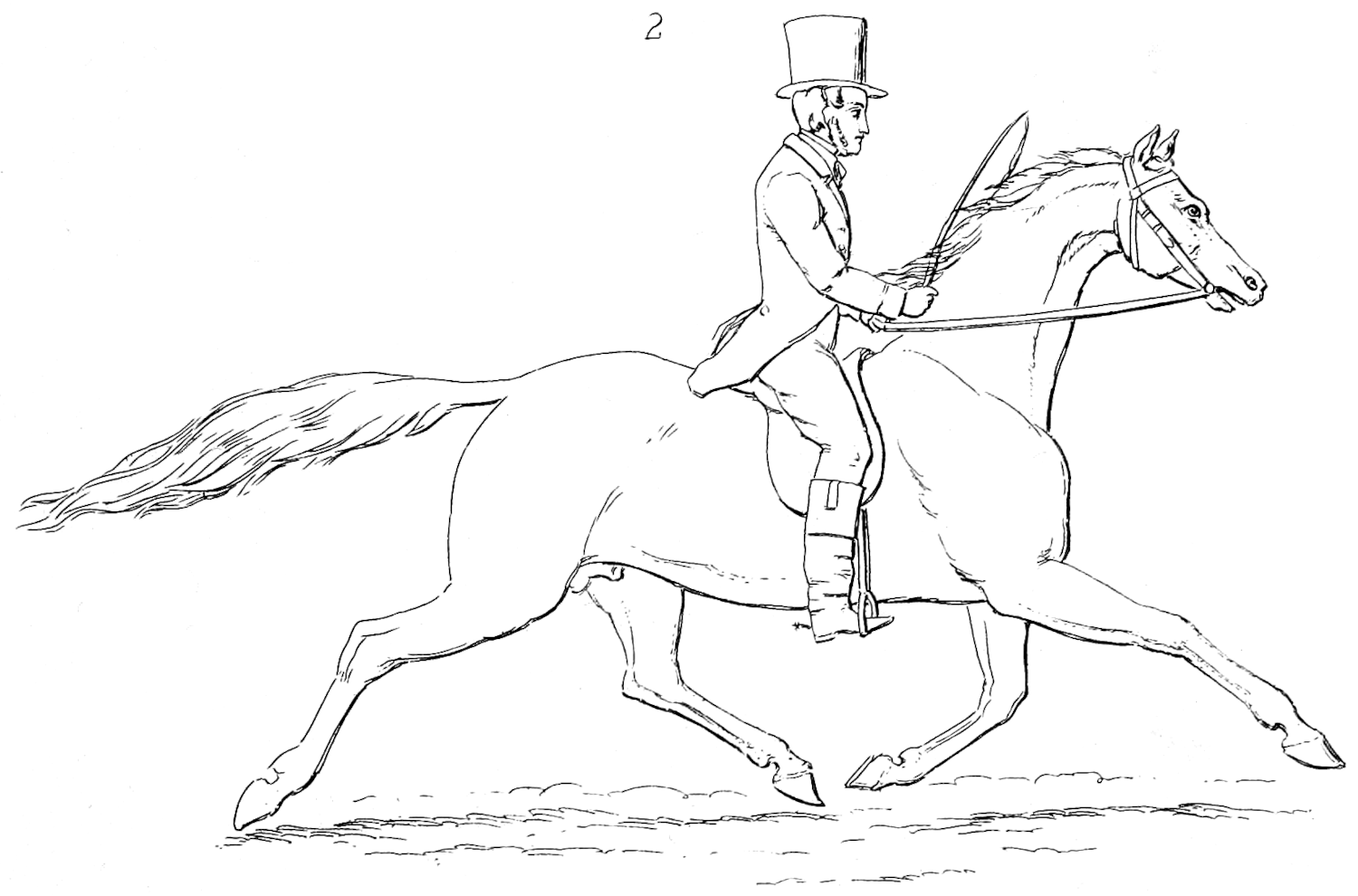
Road Riding.
Though this is called rising in the stirrups, no great stress or
dependence is to be put on them. Such improper use of the
stirrups causes many persons to be thrown, by the horse shying
or suddenly turning round. The rising of the body must not
be accompanied by any motion of the arms, or lifting of the
shoulders. The hand is to be held steady as well as low, to
prevent galloping (which the forwardness of the haunches
would render inevitable if the hand were either eased or lifted),
and the reins should be of that precise length which preserves
as much correspondence as possible between the hand and
mouth. The steadiness of the hand is also necessary for the
support of the horse.
The slight inclination of the body permitted in road riding
must not occasion any roundness in the back, which is invariably
to be hollow, not only for appearance sake but for safety. The
action of the body likewise must not cause the legs to move or
press the horse, which might cause him to gallop. In trotting,
the rider must pay the greatest attention to correct every propensity
to lift, hitch, overrate, or gallop; and, whenever he
feels these propensities, he must check them with the greatest
nicety, in order not to retard the horse’s speed. (Pl XXXIX. f. 2
illustrates the Seat, &c., in Road Riding.[68])
As to the character of the gallop, when we press a horse in
the trot beyond his capacity, or animate him with the legs while
we raise or retain him with the hand, we compel him to lift his
two fore-feet after each other, which commences the gallop.
The near fore-foot is first raised from the ground; then the off
fore-foot, which, however, passes the other, and they come to
the ground in the same order, the near fore-foot making one
beat, and the off fore-foot another, that being the most advanced
or leading foot. The hind feet follow in the same manner; the
near hind-foot marking a third beat, and the off hind-foot
passing forward, and marking a fourth beat. Thus, when this
pace is united and true, the feet mark a regular, sharp, and
quick time of one, two, three, four. The perfection of the gallop
consists in the suppleness of the limbs, the union of the
horse, the justness of the action, and the regularity of the
time.
The gallop is of three kinds—that of the racer, that of the
hunter, and that of the pleasure horse, commonly called the
canter. The last of these is by far the most difficult, as it requires
skill to fore-shorten and throw the horse on his haunches.
In the gallop, as in the trot, there is a leading foot. On a
straight line, it is immaterial with which fore-leg the horse
leads, provided the hind-leg of the same side follows it. But to
lead always with the same leg is injurious. In galloping to the
right, the horse must lead with the inward or off fore-leg, followed
by the off hind-leg. This action is termed true or united.—(Plate
XL. [69] shows this in the canter.) In galloping to
the left, he must lead with the inward or near fore-leg, followed
by the near hind-leg. This also is termed true or united.[70]
Plate XL
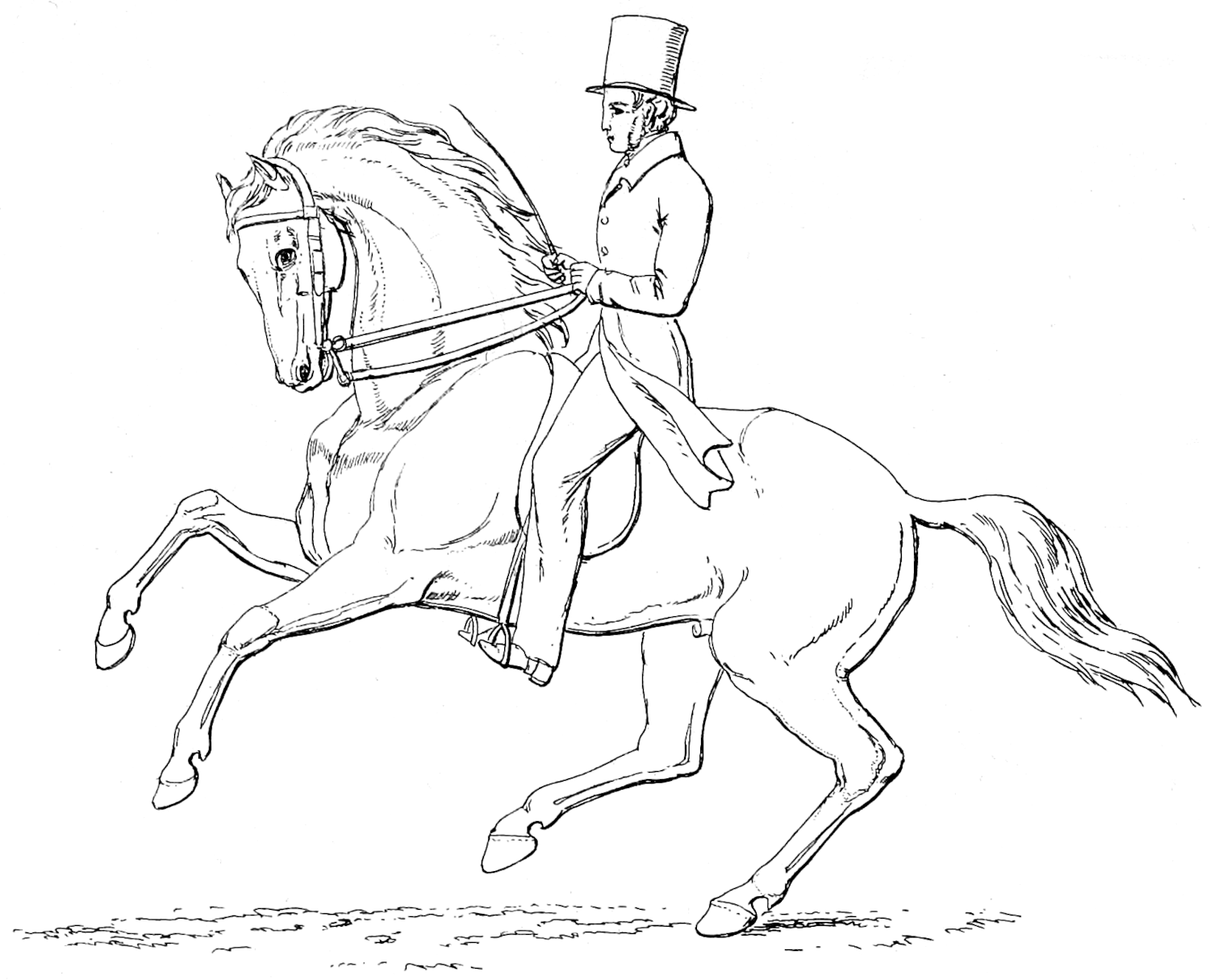
The Canter.
To put the horse to the canter from rest at any spot, or from
any pace, he must be pressed with the legs, or animated with
the tongue, and at the same time, by a motion of the fingers, and
a little raising of the hand, be invited to raise the fore-legs. If
he do not obey this, the animation must be increased, and the
hand kept more firm, to prevent his trotting; and this will constrain
him to raise his fore-legs together. It is also necessary
to direct the foot he is to lead with. That of course is the inner,
which he will readily take by putting the croupe in, by means
of the opposite thigh, thereby enabling him to advance the
inner side.
As the position of the horse renders necessary a corresponding
position of the horseman, it will readily be seen that whichever
side the horse leads with, the rider’s thigh on that side
must be rather more turned in towards the saddle, and the hip
on that side brought more forward, and consequently that the
other thigh must be a little turned outward, and the hip brought
backward; and all this more or less in proportion to the position
of the horse. This turn of the hip effects a turn of the body.
The hands are carried with it, and at the same time kept up, rather
above than below the elbow, and quite steady, that the cadence
of every step, and the support given by the hand, may be
felt. The rider’s head is of course to be directed to the horse’s
nose, his eye glancing on the ground the horse’s fore-feet go over.
If the horse strike off with the wrong leg, false or disunited,
the rider, at the first corner, must endeavour, by an additional
feeling of the inward rein, and application of the outward leg,
to make him change, and lead with the proper one. When he
leads with the proper leg, the hand must resume its usual position,
the rider bending him a little inwards by shortening the
inward rein; the fingers slackened, if necessary, to let him
advance; but the hand kept up, and every cadence felt of the
fore-feet coming to the ground.
There is far more skill displayed in keeping up an animated
action in the canter, at the rate of three miles an hour, than in
the gallop, at that of twelve or fifteen. If the animation fail,
or the action be not supported by the hand, the horse will
break into a trot, particularly as the gallop is shortened or
united. If the action is felt to be declining, it must be corrected
instantly, by an animating touch of the fingers, the leg,
or the tongue. The hand first discovers this declension, and is
the first to correct it.
When the rider can put his horse off to either hand with the
proper leg, and support the action, he must particularly attend
to its truth and union, and try to raise it to the highest animation,
riding sometimes rapidly, sometimes slowly, yet always
united.
When the gallop is disunited and extended to speed, even
though the horse is supple and just on his legs, it loses its harmony
and regularity of time. The fore-legs then measure less
space from each other, and so do the hind-legs, which makes
the beats quicker in each, and leaves a space between the beats
of the fore-legs and the beats of the hind. In these gallops, it
would be highly imprudent to circle or turn, but on a very large
scale.
In turning the horse to the right and left, at a canter, his
fore-hand must be raised with the leading rein, and the haunches
pressed forward and under him: at the same time, the outward
rein must assist to steady him, and a pressure of the calf of
the outward leg keep the haunches from falling too much out.
If he is turned suddenly with the inward rein only, without
lifting the fore-hand, or applying the outward leg, he must turn
on his shoulders, lose power to halt on his haunches, and being
twisted round unprepared, will change to the outer leg.
In changing, the operation must be performed smoothly and
evenly at the same instant; so that, at the finish of the cadence,
the body, hands, thighs, and legs of the rider are reversed, for
the horse to commence his next cadence with the contrary
leg.
In stopping in the gallop, the rider must seize the time when
the horse’s fore-feet are coming to the ground, which is the
beginning of the cadence: and he must take care that the hind
feet, coming up to their exact distance, and finishing the cadence,
complete the stop: leaving the horse so balanced that he can
readily set off again with the same rapidity as before. Besides
seizing the exact time, a due degree of power must thus be
exerted, conformably to the readiness, obedience, union, or
rapidity of the action; for, should the power be deficient, the
stop would not be properly effected; and if it be excessive, the
horse will be overbalanced on his haunches, and compelled consequently
to move his feet after the cadence is finished. Till
horses are ready and obedient to the stop, it should not be
attempted in violent and rapid gallops; nor even then if they
are weak, or the rider heavy.—In these cases, the double arret
is used.
The double arret is the stop completed in two cadences of the
gallop, which is far less distressing both to man and horse.
The body being gently thrown back, will not make the action
instantaneously cease; but the obedience of the horse makes
the effort which checks half his career in the first cadence; and,
the body still being kept back, he completes it in the second.
However, till practised and made obedient to the stop, he will
not easily perform the double arret; for, in the first instance,
he must be taught to stop by compulsion; and it is only when
practice has brought him to obedience, that he readily stops at
the easy throwing back of the body.
The half stop is a pause in the gallop, or the action suspended
for half a second, and then resumed again. Here the body is
thrown back less determinately, lest we should so overbalance
the horse that he cannot readily set off again after the finish of
the cadence, which no sooner occurs than the body is brought
forward, to permit the action to go on. Thus the half stop is
only a pause in the gallop, and it is mostly used to effect a
change from the right leg to the left, or the opposite. The
cadence of the stop should be no shorter than the readiness and
obedience of the horse will admit; the half stop not quite so
short; and the two arrets still more moderate.
The moveable bar for leaping should be ten feet in length,
which will admit of two horses leaping abreast; at first from
one to two feet high; and never very high.
As to the seat, it should be again observed that stirrups are
no security in any situation on horseback; and those who cannot
forbear pressing a weight on them, had better have none
when learning to leap. An accurate balance must prevent all disturbance
of the seat; for the slightest, whether the rider is thrown
up from the saddle, or his body falls forward, or he gets out
of balance, is as disgraceful as falling to the ground. He should
sit so close as to carry a shilling under each thigh just above
the knee, one in each stirrup under the toe, and one under his
breech.
When any action of the horse tends to lift the rider from the
saddle, stirrups cannot keep him down. Bearing on the stirrup,
indeed, must lift the rider from the saddle, and would even
loosen any hold he might take with the thighs or legs. Nothing
but the weight of the body can press to the saddle. When the
action is violent, however, the pressure of the thighs may be
employed to hold it down; and, when the hold of the thighs is
not sufficient, the legs may take a deeper, and stronger hold.
Leaps are taken standing or flying; the first being most difficult
to sit, though always practised first, because the slow and steady
leaping of a properly managed horse gives the rider time and
recollection, and the riding-master an opportunity to direct, and
to prevent accidents.
Plate XLI
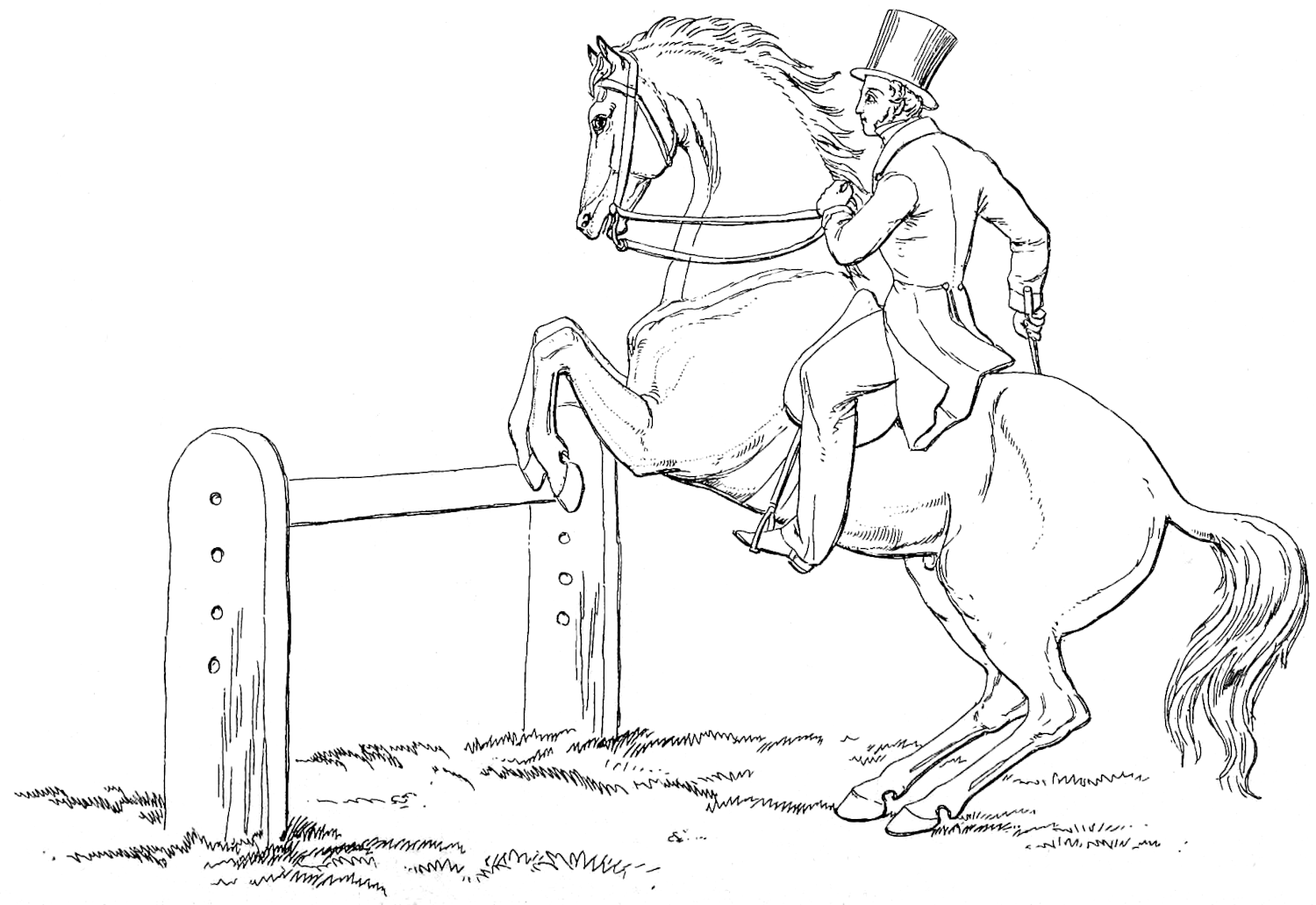
The Rise in Leaping
Plate XLII
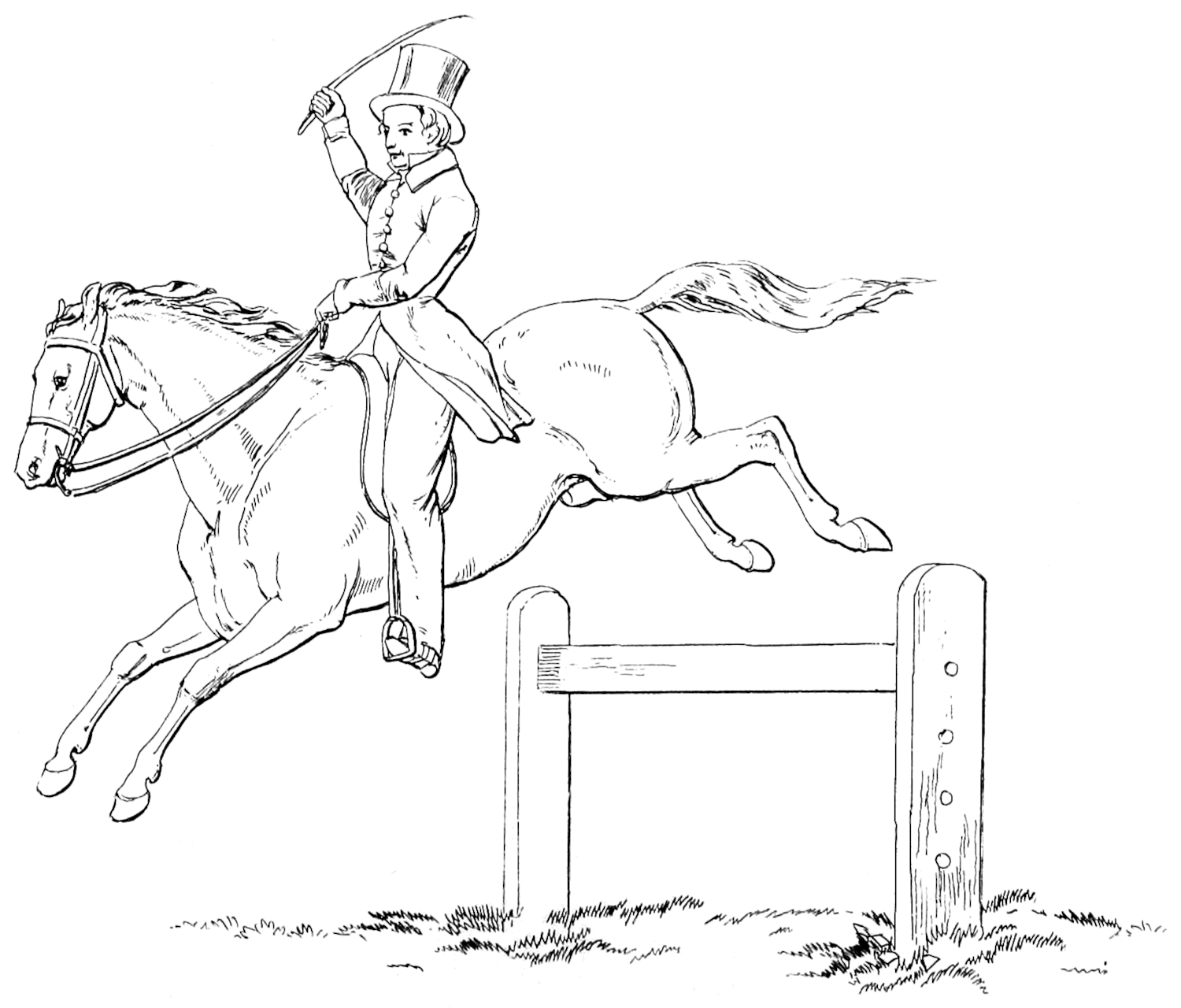
The Fall in Leaping
In the standing leap, the horse first shortens, and then extends
himself. Readiness in the hand of the rider is therefore
requisite to give the appropriate aids. These, if well timed,
assist the horse: if otherwise, they check or embarrass him, and
endanger both the animal and his rider. (Plates XLI. XLII.
illustrate the Leap.)
The rider must therefore, by a ready and fearless yielding of
the bridle, leave the horse at liberty to extend himself, preserving
his own equilibrium only by leaning forward, as the horse rises,
and backward as he alights. When he is brought to the bar,
the body is to be upright. The legs are to be applied to his
sides with such firmness as to keep the rider down to the saddle,
and in such a manner—viz., perpendicularly from the knee—that
the action of the body shall not loosen or disturb them.
The toes must be pulled up, to make the muscles firm, and to
prevent the spur from approaching too near the horse; and, if
necessary, they may be turned out a little to strengthen the
hold. The hand must be kept in the centre, and quite low;
and the reins not too short, but just by the pressure of the
fingers to feel the horse’s mouth. When at the bar, the pressure
of the legs and fingers will invite the horse to rise; and, as
he rises, the body comes forward and preserves its perpendicular.
The back must then be kept in, and the head firm.
As the horse springs from his hind legs, and proceeds in the
leap, the rider must slip his buttock under him, and let his body
go freely back, keeping his hands down, legs close, and body
back, till the horse’s hind legs have come to the ground. The
propriety of applying the legs to hold firm in the saddle is obvious.
The hand being kept low is essential; and the bad consequences
of raising it are numerous, as confining the horse,
preventing the body going back, throwing the rider forward, &c.
The body coming forward to preserve its perpendicular as the
horse rises before, prevents the weight of the rider from hanging
on his mouth, and checking his leap, if not pulling him over
backwards. The back being hollow when the spring forward is
made, the body will of itself fall backward, if the hand be not
raised to prevent it; and the head being firm may prevent a
wrench of the neck, or a bite of the tongue. Slipping the breech
under gives the body more liberty to lean back, and prevents
the shock of the horse’s feet meeting the ground, from throwing
it forward.
While the seat is thus maintained, the hand must not be neglected.
In riding up to a leap, the rider should yield the bridle
to the horse, guiding him straight to the bar at an animated pace;
halt him with a light hand, and upon his haunches; when he
rises, only feel the reins to prevent their becoming slack; when
he springs forward, yield the hand without reserve; and, when
his hind feet come to the ground, again firmly collect him, resume
his usual position, and move on at the former pace. If the
horse be too much collected previous to his leap, he will bound,
or buck over, as it is called. If not sufficiently collected or animated,
he will probably not clear the leap. The degree in which
a horse should be collected and animated depends on the temperament
of the animal, and must be left to the judgment of
the rider.
The flying leap is distinguished from the standing leap by its
being made from any pace without a previous halt; and although
the action is quicker, it is much easier. The pace, however, at
which the rider goes at a flying leap, should always be moderate,
in order that the horse may not rise too soon or too late.
A horse who rises too far from the bar seldom clears his leap,
and risks straining by the effort to cover it; one who rises too
near is likely to strike his knees against it, and throw his rider,
or hurt himself. If a horse be indolent, and require animation,
it is better to rouse his apathy by the spur just before his head
is turned towards the leap, than while he is running at it. If he
leap willingly, let him take his own pace to it, and he will spring
from his proper distance, and give himself due velocity. Twelve
yards from the leap, the rider may turn his horse to it in a trot;
he will strike into a gallop; and, by a stroke or two before he
springs, increase his velocity, if he perceive that the height he
has to cover requires that exertion.
The seat in the flying leap is exactly the same as in the standing
one; but, as the horse keeps a more horizontal position, it
is easier. The rider, however, must not bring his body forward
at the raising of the fore legs, because the spring from the hind
legs immediately follows, and the body not only might not get
back in time, but, if the horse did not come fair, or refused to
take his leap, and checked himself, the body, if forward, might
cause the rider to tumble over his head. He should therefore
keep his body upright; take hold with his legs; keep his hand
down; and, as the horse springs forward, his body is sure to
take the corresponding action of leaning back, particularly if he,
at the instant, slip his breech under him, and bring his waist
forward with an exertion proportioned to the spring the horse
makes. He must also take care not to bring his body upright,
nor slacken the hold with his legs, till after the hind feet have
come to the ground.
In this leap, the horse requires but little support or assistance
from the hand till he is coming to the ground, when the hand
aids in bringing the body upright, and in supporting the horse.
The assisting and lifting a horse over leaps may be done only
by experienced riders, and even by them only when he leaps
freely and determinedly. Whips should not be used when the
rider first practises leaping.
When a horse is addicted to stumbling, rearing, kicking and
bolting, plunging, shying and restiveness, the seat is maintained
as in leaps; and the arms are held firm to the body, the hands
kept up, and the reins separate, rather short than otherwise.
By these means, the horse’s head being raised, he can with less
ease either rear or kick, because, for such purposes, he must
have his head at liberty. It is fortunate that horses which rear
high seldom kick, and vice versâ.
On these occasions, the first operation of the rider is to separate
the reins, &c. The body must be kept upright, but flexible,
to repel every effort the horse may make; the balance must be
preserved by the muscles of the thighs; the legs are to be kept
near the horse, but not to grasp till absolutely necessary. When
he lifts his fore legs, the breech must be thrust out behind, by
which the rider is prepared if he rears. As the fore feet come
to the ground, the breech must be slipped under, which prepares
for his kicking or springing forward; the legs being then in a
situation to grasp, and the hands to keep a firm hold. In all
displays of vice, the rider should first see that the saddle or
girths do not pinch the horse, that the bit does not hurt his lips
by being too high in his mouth, &c.
By the rider pressing his legs to the horse’s flanks, and keeping
up his head, he may be made to go light on his fore legs;
and the same should be done if he actually stumble, so as to
afford him instant assistance. Hence it is evident that the bridle
should be of such length in the hand, that, in case of stumbling,
the rider may be thus able to raise the horse’s head by the
strength of his arms and the weight of his body thrown backward.
If the rein be too long, it is evident that, in effecting
this manœuvre, the rider is in danger of falling backward as the
horse rises. By thus pressing the legs to the horse’s sides, he
may be made to keep his haunches under him in going down
hill, or may be helped on the side of a bank.
The principal danger in rearing is the hazard of the horse’s
falling backwards. When, therefore, he rises straight up, the
rider must throw his body forward, giving him all the bridle.
The weight of the body will oblige him to come down; and the
moment that his fore feet are near the ground, and before he
touches it, both the spurs must be given him as firmly and as
quickly as possible.
Another mode of subduing him is, whenever the rider is aware
of the horse’s disposition to rear, to have the reins separated;
and the instant he perceives him going to rise, to slack one hand
and bend him with the other, keeping the hand low. This compels
him to move a hind leg, and being thrown off his balance,
he necessarily comes down with his fore feet. He should then
be twisted round two or three times, to convince him of the
rider’s superiority, which confuses, baffles, and deters him from
rearing to any dangerous height. To break horses of this dangerous
vice, it has been sometimes expedient to leap from them,
and pull them backwards. This so frightens them that they are
wary of giving the opportunity again. It is, however, an expedient
to be attempted only at a particular crisis, and by persons
perfectly collected, active, and agile.[71]
Horses apt to kick, either when they go forward or stand still,
must be kept much together, or held in closely. When this is
attempted, the hands, though fixed, must not pull at the horse,
if he does not attempt to force the hand, and get his head, but
leave him at liberty to go forward. If, however, he attempt to
get his head down, which would enable him to kick with such
violence as to throw himself, he may have the head confined up.
This disarms him, and he makes a bolt from all-fours.
When a horse kicks, the rider must throw the body backward.
It is an effective punishment to twist him round a few times for
this fault. If this is done towards his weak or unprepared side
(for every horse has a favourite side), astonishment and confusion
will deter him from farther contention. In case of bolting, the
rider must not exert one continued pull, but make repeated pulls
until the horse obeys. Horses accustomed to be allowed to bear
on the bit would not understand the steady pull as a signal to
desist; and some would so throw up their heads as to deprive
the rider of all power without dropping his hand, when the horse
would drop his head. In that case, a second pull would find his
mouth, and thus speedily his progress might be stopped.
In plunging, a horse gets his head down, cringes his tail between
his quarters, sets his back up, swells his body to burst his
girths, and, in this position, kicks and plunges till his breath
can be held no longer—that is, till he makes six or eight plunges.
To sit these is to cure them; and to do this, the rider must take
a firm hold with his legs, and be mindful that the horse, in
getting his head down, does not pull him forward. There is no
danger of his rearing; and therefore the rider has only to keep
his body back, and hold firmly with his hands, to prevent him
throwing himself down.
When a horse, either by shying or restiveness, springs to one
side, or turns short round, the rider’s security depends on strict
conformity to the rules already laid down, as to not bearing on
the stirrups; keeping the legs near to the horse, to be ready on
these sudden and unexpected occasions to lay hold; and yielding
the body to go with him.
When a horse is about to fly to one side, he may be stopped
by his rider’s leg being pressed on the side he would fly to, and
by keeping his head high and straight forward, so as to prevent
his looking towards the object he starts at, unless indeed it be
something you desire to accustom him to the sight of, and then,
whether you keep his face to it throughout, or avert it at first,
and turn it gently towards it at last, great steadiness is necessary.
When he curvets irregularly, and twists himself to and
fro, his head should be turned to one side, or both alternately,
without permitting him to move out of the track; and the rider’s
leg should be pressed against the opposite side. In this case,
he cannot spring on one side, because the pressure of the leg
prevents him, nor will he spring to the other, because his head
is turned that way, and a horse never starts to the side to which
he looks.
Moreover, he will not fly back from anything, but go forward,
if both legs be pressed against his sides. Thus he may be made
to pass a carriage or other object in a narrow road; and here
perseverance is especially necessary when the object is just
reached, or partly passed, for if in the habit of going back and
turning round when frightened, he will certainly do so when, if,
by the hands slackening and legs failing to press, he discovers
that you are irresolute; and this he would probably do at the
most dangerous moment, when there was scarcely room for
him to turn, and the wheels might take him in the rear. To
touch his curb rein at such a moment would add to the confusion
and danger.
The horse generally commences his attack by stopping, turning
short round, mostly to the right hand, as taking the rider
to the greatest disadvantage. He expects the rider will oppose
the opposite hand, designedly attacks the weakest, and is so
prepared against its efforts that it is vain to attempt them. It
must be the rider’s rule never to contend with the horse on that
point on which he is prepared to resist.
Instead, therefore, of attempting to prevent the horse with
his left hand, the rider must attack him with his right, turn him
completely round, so that his head is again presented the right
way, and then apply the whip. If he turns round again, the
rider must still attack his unguarded side, turn him two or three
times, and let the heel and spur, if necessary, assist the hand,
before he can arm or defend himself against it.
If he still refuse to go the right way, the rider must take care
that he go no other, and immediately change his attack, turning
him about and reining him backward, which the horse is easily
compelled to do when he sets himself against going forward. In
these contests, the rider must be collected, and have an eye to
the surrounding objects; for restive horses try their utmost to
place their riders in awkward situations, by sidling to other
horses, carriages, the foot-pavement, the houses, &c.
In this case, the rider, instead of pulling him from the wall,
must bend his head to it, by which his side next the wall is rendered
concave, and his utmost endeavours to do injury are prevented.
The instant, therefore, that the rider perceives his horse
sidling to any object, he must turn his head to that object, and
back him from it.
There are some horses who fix themselves like stocks, setting
all endeavours to move them at defiance. There, happily, their
defence can in no way endanger the rider. It must, however,
be converted to punishment. Let them stand, make no attempt
to move them, and in a short space—frequently less than a
minute—they will move of themselves.
When these various defences, however, are not powerfully set
up, the general rule is to push the horse forward; and, for this
purpose, at first to make use of the switch, as it alarms him
least, for the spurs surprise a horse, abate his courage, and are
likely to make him restive. Indeed, the application of the whip
or spurs, except to shift the croupe, or give efficacy to the hands,
is of little use; and to repeat either, to make a restive horse go
forward, is certainly wrong. When passion possesses the rider,
it prevents that concord and unity taking place which ever should
subsist between the rider and his horse. He should always be
disposed to amity, and never suffer the most obstinate resistance
of the horse to put him out of temper. If the contest does not
demand his utmost exertion of strength, he should be able to
hum a tune, or converse with the same composure and indifference
as though his horse were all obedience. By these means,
the instant a horse finds himself foiled, he desists, having no
provocation to contend farther, and is abashed at his own weakness.
It is the absence of passion which, added to cool observation,
makes the English the best riders and drivers in the
world.
Stables are generally too dark and too hot. They should be
kept quite cool, though without any draughts.
“A way,” says De Beranger, in Helps and Hints, “of making
the most of your horses, is to rise early in the summer, in order
to do half your day’s work before the heat of the day; for lying
by the whole of the rest of the day, not only affords a traveller
time and opportunity for examining what is worthy of being
seen, but enables him to start with horses quite fresh, and to
finish the remaining stage after sunset: not only will your horses
go through their task with less labour in the cool of the evening,
but you will find them travel more freely towards a resting-place,
which darkness leads them to expect.”
A horse ought not to be ridden a stage while in physic, nor on
the day of its coming off. If he be pushed at first setting out
on a journey, or be compelled to make long stages, or be deprived
of his customary baits, he gets jaded, and every additional
mile adds to his uneasiness. Moreover, at setting out in the
morning, a well-kept horse is necessarily full of food, and consequently,
until his great gut be properly emptied, brisk action
occasions uneasiness or pain, which causes restlessness.
“When I travel on horseback,” says the same writer, “I make
it a rule to walk every seventh mile, be the roads ever so level:
it affords a wonderful relief both to man and horse, and, instead
of producing a loss of time, helps you on. When you dismount
for such ends, always slacken your girths, slightly lift up the
saddle to let a little air under it, and teach your horse (what he
soon will learn) to walk briskly by your side, and keep the step
with you, taking care to hold either of the reins lightly in your
hand, and without shifting it over the horse’s head. Your steed
will soon give you demonstrations of his gratitude, for he will
be full of affectionate playfulness as he jogs along at your side,
only to be rivalled by his willingness to let you mount after you
have tightened the girths again. I need hardly tell you not to
put your arm or wrist through a rein whilst walking or running
by the side of a horse, for it is replete with danger. A good run
with one hand on the horse’s withers is pleasant, and greatly
removes the stiffness of the joints so frequently occasioned by
much riding; but the reins should be held between the fingers
only, and rather loosely.”
Hence, it follows that, although expedition be indispensable,
the horse ought not to be put on his best pace at first, but considerably
within it. Even this pace should be for a short space
only; the reins should be loosened; the mouth played with;
and if he do not evacuate, the pace may be repeated once more,—unless,
indeed, he sweat much with the first, which is a sign
of weakness, or that his dung is hard, and he requires purging.
While on the journey, the rider should be less attentive to
his horse’s nice carriage of himself, than to his own encouragement
of him, and keeping him in good humour. Though generally
he should raise his horse’s head, yet when he flags in
consequence of a long day or hard work, he may indulge
him with bearing a little more upon the bit than he would in
taking a mere airing exercise, or afternoon’s canter in the Park.
Keeping company with some other horseman facilitates a stage,
by the emulation it excites; so that a dull animal, which one
can scarcely get seven miles an hour from, will do nine or ten
without fatigue when in company.
In road-riding, a picker is indispensable both in winter and
summer. In winter, it is necessary to relieve the sole when
snow accumulates there. When, however, the traveller knows
that snow is on the ground, he may avoid the trouble of dismounting,
by previously ordering his horse’s soles to be payed
over with tar, or with tallow having no salt in it. At all times,
when the roads have received fresh dressings, a picker is indispensable,
because a loose stone is very liable to lodge in the
hollow of the foot, and is dangerously driven backwards between
the frog and the shoe, at every step the horse takes.
Pace and length of stage must be adapted to the heat of the
weather in summer, and to the depth of the roads in winter;
both seasons having the effect of knocking up the horse. In
either case, a cordial promptly administered recovers him for
the prosecution of his journey. The cordial readiest provided,
and which should be kept at hand by the provident traveller, is
in the form of a ball, and composed of aniseeds, ginger, carraway,
of each, powdered, half an ounce, and mixed up with treacle
and meal to the proper consistence. But good ale or porter,
from one pint to a quart, made warm, operates sooner, and,
upon emergency, is nearly as readily obtained as the ball.
Walking a horse the last mile, especially of a long stage, is
a practice highly beneficial. As, upon setting out, we should
not go off at the quickest pace, so upon coming in, we should
not dash into our quarters with the perspiration streaming from
each pore, in the mild season, nor covered over with dirt, in
consequence of the pace, in wet weather. Even in winter, the
perspiration flies from a strong horse, if in condition, upon
coming in more sheltered places, and the practices he is then
subjected to are commonly of such a nature as to cause disease
in one way or another, in embryo, if not immediately.
The rider is greatly to be blamed who stands quietly by, or
hides himself in the parlour, while his horse is brought in hot,
stripped of every thing, and led about to cool, in the draught of a
gateway, or has the dirt washed off by plunging him in a horse-trough
or pond, or his legs brushed in cold water in the open
yard, while pailfulls, at the same time, are thrown over them;
the consequence of all which is cough or colic, bad eyes, swelled
legs, or inflammation of some vital part, which deprives the
animal of life.
The horse should have a large and comfortable stall, and
without any door behind him, a draught from which, by blowing
up his coat, might expose him to cold. On coming in, after
being coaxed to stale, he should undergo (in winter-time in
doors) a wisping all over with straw, beginning at the head,
and proceeding to the neck and fore-quarters. His eyes,
nostrils, &c., should also be cleansed with a sponge, and his
ears rubbed. He should, at the same time, have before him
a lock of sweet hay, in his rack, or a prickle, or the hand; and
the rider should see whether he eats or not, whether he enjoys
the wisping, and whether he chiefly evince a desire to lie
down or a craving for food.
The girths having been already loosened, but the saddle still
remaining on his back, his head should be turned to the
rack, and his hind-quarters, legs, and belly, sheath and fork,
wisped, and his feet picked clean and washed. After this, the
saddle should be removed by sliding it back over the croupe;
and the dressing be extended to the withers, back, and so completely
all over the carcass, until it is dry. The saddle should
be hung out, with the inside toward the sun; and when the
pannels have been duly aired and dried, they should be slightly
beaten and well brushed.
If the horse refuse the first proffer of hay, the rider may conclude
that he has been pushed too much, as to time or length.
If he still refuse his food, though the dressing be finished, he
may be assured that his stomach is disordered, and he must be
cordialled. In winter, a warm mash of malt is most eligible;
but, if not at hand, a bran mash with an admixture of oatmeal,
and a quart of good ale, may be given. In summer, a cordial
ball will restore the tone of his stomach, without increasing the
heat of his body so much as a mash would. If he is not aged,
nor inured to cordialling, a small pail of stout water-gruel,
almost cold, excels all other cordials, and supersedes the necessity
of watering; he will take his supper an hour or so afterwards,
with a relish.
The traveller ought to look to every particular himself.—In
the next place, let him see that his horse gets his allowance of
corn, that it be good, and that it contain no indications of having
been in a manger before; for, in that case, he must wait by
him until all the food is devoured. Dry food is alone proper to
travel upon, and oats are the best; much hay being apt to
engender flatulencies. When, however, a very long stage is to
be taken, or it is cold, dreary, wet, or windy, a handful of
crushed beans sustains him admirably, staying by him, and imparting
vigour for a long time. The horse should not be denied
water often; though too much at one time should not be
given, nor, without its being chilled, any immediately after
being fed.
His feet and shoes should be looked to, to ascertain if
aught require repair, in order that it may be furnished as
soon as he has recovered from his fatigue.—His limbs, moreover,
should be examined all over, for cracks, pricked foot, &c.,
and the body, for saddle-galls, &c. Now, as ever, his dunging
should be looked to. Even if in full condition, having been
well and regularly fed, and as regularly worked, he will contract
a tendency to constipation; the least ill consequence of which
is defective pace, or short step, arising from more laboured
action. As the inconvenience may be suffered to last, he sweats
immoderately at the least extra exertion, his eyes lose their
wonted brightness, his mouth becomes hot, and his manner is
languid. All these evils may be prevented by timely physicking,
whenever the dung is seen to fall upon the ground without the
pellets breaking. Even a little green food, or a day’s mashing
with bran, thin oatmeal gruel, and the like, will soften the dung
considerably. It must be remembered that these things are
to be undertaken on blank days, when the traveller is certain
the horse will not be ridden a stage. The following allowance
per week is generally enough to keep a horse in good condition:—
| |
Oats. |
Beans. |
Hay. |
| For a horse of from 14½ to 16 hands |
1 |
¾ |
bushel; |
2 |
|
quarterns; |
1 |
¼ |
truss. |
| For a horse under 14½ hands |
1 |
½ |
bushel; |
1 |
½ |
quartern; |
1 |
|
truss. |
Among the ancients, for more than one thousand years, the
greatest honour that could be bestowed upon a man was a
sprig of the wild olive tree entwined round his brow, for having
gained a victory in the chariot-race at the Olympic games of
Greece. This sprig of olive, moreover, was accompanied by
other marks of distinction: the wearer of it was not only
honoured with statues and inscriptions during his life-time, but
the immortal Pindar, or some other great poet, was called upon
to hand his name down to posterity in an ode. The Olympic
games were revived, as a religious ceremony, by Iphitus, an
Elean, about nine hundred years before Christ. They were
celebrated near Olympia, in the territory of Elis. Horse and
chariot races were considered their noblest sports. No one was
there prevented from driving his own chariot; and kings were
often seen contending against kings.
The Greeks were the most enlightened of the ancients, and
their taste in the arts has never been even rivalled. What they
did, therefore, on this occasion, could not be considered as in
bad taste; and, when we remember that the celebration of
these pastimes outlived the laws, customs, and liberty of their
country, we need not say more in their vindication. The
honours of victory were not even confined to the brave and
skilful man who won the race: even the horses were crowned
amidst the applauses of the spectators; and in one race, where
forty chariots were broken, the victorious one was preserved
in the temple of Apollo. Such being the havoc among the competitors,
it is not wonderful that Ovid should say, that the
honour of contending for the Olympic prize was almost equal to
the winning of it.
Sophocles modestly speaks of ten starting at the same time
in the race; but Pindar, availing himself, perhaps, of poetic
licence, makes the number forty. Four horses driven abreast
was the usual number. The length[72] of the course on which
they ran did not exceed an English mile, and as they had to
make twenty-two turnings round the two pillars—generally,
we may suppose, at full speed—it is not difficult to imagine
what dreadful accidents must have happened.
Nothing indeed but the form of chariot used could have ensured
safety to any one. From the representations on ancient
coins, it appears to have been very low, and only on two wheels,
somewhat resembling our curricle. It had of course no springs;
and, as there was no seat for the charioteer, much of his
skill consisted in preserving his balance, and keeping upon
his legs.
According to Pausanias, the following was the method of
starting:—The chariots entered the course according to order,
previously settled by lot, and drew up in a line. They started
at a signal given, and to him who passed the pillar at the top of
the course twelve times, and that at the bottom ten times, in
the neatest manner, without touching it, or overturning his
chariot, was the reward given.—As, however, it was the aim of
every one who started to make for this pillar, as to a centre, we
can easily imagine the confusion there must have been in forty,
twenty, or even ten chariots, all rushing to one given point,
amidst the clanging of trumpets, &c.
The following translation of a description of a chariot-race,
from the Electra of Sophocles, is worthy of a place.
“When on the sacred day, in order next
Came on the contest of the rapid car,
As o’er the Phocian plain the orient sun
Shot his impurpled beams, the Pythic course
Orestes enter’d, circled with a troop
Of charioteers, his bold antagonists.
One from Achaia came; from Sparta one;
Two from the Lybian shores, well practised each
To rule the whirling car: with these the fifth,
Orestes, vaunting his Thessalian mares:
Ætolia sent a sixth, with youthful steeds
In native gold arrayed: the next in rank
From fair Magnesia sprang: of Thrace the eighth
His snow-white coursers from Thesprotia drove:
From heaven-built Athens the ninth hero came:
A huge Bœotian the tenth chariot filled.
These, when the judges of the games by lot
Had fix’d their order, and arranged their cars,
All, at the trumpet’s signal, all at once
Burst from the barrier; all together cheer’d
Their fiery steeds, and shook the floating reins.
Soon with the din of rattling cars was filled
The sounding hippodrome, and clouds of dust
Ascending, tainted the fresh breath of morn.
Now mix’d and press’d together, on they drove,
Nor spared the smarting lash; impatient each
To clear his chariot, and outstrip the throng
Of dashing axles, and short-blowing steeds,
They panted on each other’s necks, and threw
On each contiguous yoke the milky foam.
“But to the pillar as he nearer drew,
Orestes, reining-in the nearmost steed,
While in a larger scope, with loosen’d reins,
And lash’d up to their speed, the others flew,
Turn’d swift around the goal his grazing wheel.
“As yet erect, upon their whirling orbs
Roll’d every chariot, till the hard-mouth’d steeds
That drew the Thracian car, unmaster’d, broke
With violence away, and turning short,
(When o’er the hippodrome with winged speed
They had completed now the seventh career),
Dash’d their wild foreheads ’gainst the Lybian car.
From this one luckless chance a train of
ills
Succeeding, rudely on each other fell
Horses and charioteers, and soon was fill’d
With wrecks of shatter’d cars the Phocian plain.
“This seen, the Athenian, with consummate art,
His course obliquely veer’d, and, steering wide
With steady rein, the wild commotion pass’d
Of tumbling chariots and tumultuous steeds.
Next, and, though last, yet full of confidence
And hopes of victory, Orestes came;
But when he saw of his antagonists
Him only now remaining, to his mares
Anxious he raised his stimulating voice.
And now with equal fronts abreast they drove,
Now with alternate momentary pride
Beyond each other push’d their stretching steeds.
“Erect Orestes, and erect his car,
Through all the number’d courses now had stood;
But luckless in the last, as round the goal
The wheeling courser turn’d, the hither rein
Imprudent he relax’d, and on the stone
The shatter’d axle dashing, from the wheels
Fell headlong; hamper’d in the tangling reins
The frighted mares flew diverse o’er the course.
“The throng’d assembly, when they saw the chief
Hurl’d from his chariot, with compassion moved,
His youth deplored; deplored him, glorious late
For mighty deeds, now doom’d to mighty woes;
Now dragg’d along the dust, his feet in air:
Till, hasting to his aid, and scarce at length
The frantic mares restraining, from the reins
The charioteers released him, and convey’d,
With wounds and gore disfigured, to his friends.
The just Amphictyons on the Athenian steeds
The Delphic laurel solemnly conferr’d.”
In a political view, these games were productive of local
advantages; for, being sacred to Jupiter, they protected the
inhabitants of Elis against all the calamities of war. In an
economical point of view, they were of general use; for, as
Greece was generally short of horses, nothing was so likely to
encourage the breeding of them as the emulation thus raised
among the different states. The circulation of money also was
not a trifling consideration; for the olive crown was obtained
at great expense. By these games being celebrated at the
beginning of every fifth year, the Greeks settled their chronology
and dates; and as they lasted a thousand years, a great
part of the traditional history of Greece rests upon their base.
That the honour of the prize was above all price, the following
anecdote shows:—A Spartan having gained the victory at the
Olympic games with much difficulty, was asked what he should
profit by it? “I shall have the honour,” said he, “of being
posted before my king in battle.” As a further proof of the
value and the moral effect of these contentions for honour, it is
stated that, when a conqueror returned to his native city, he
made his entry through a breach in the wall—by which was
implied that cities inhabited by such men had no need of walls.
A senator of Rome, indeed, says Gibbon, “or even a citizen,
conscious of his dignity, would have blushed to expose his
person or his horses in a Roman circus. There, the reins were
abandoned to servile hands; and, if the profits of a favourite
charioteer sometimes exceeded those of an advocate, they were
considered as the effect of popular extravagance, and the high
wages of a disgraceful profession.” The Romans, with more
pride, were far less intellectual than the Greeks; but it must
still be borne in mind, that, inconsistently enough, the interest
taken in the charioteers of Rome shook the very foundation
of the government.
In modern times, notwithstanding the sneers directed against
gentlemen-coachmen and driving-clubs, it is to them chiefly
that this country is indebted for the present excellent state of
the roads, and for safe and expeditious travelling. The taste
for driving produced, between men of property and those
connected with the road, an intercourse which has been productive
of the best results. Road-makers, and those who
have the care of roads, if they have not acted under the
immediate direction of these amateur drivers, have been greatly
benefited by their advice—doubly valuable, as proceeding
from knowledge of what a road ought to be. The intercourse
also that has lately been carried on between proprietors of
inns and of coaches, and gentlemen fond of driving, has
greatly tended to direct the attention of the former to the
accommodation and comfort of travellers. The improvement
in carriages—stage-coaches more especially—would never have
arrived at its present height, but for the attention and suggestions
of such persons.
Moreover, the notice taken by gentlemen of coachmen,
who are at once skilful and who conduct themselves well, has
worked the reformation which has been of late years witnessed
in that useful part of society.
Gentleman-driving, however, has received a check, very few
four-in-hands being visible. The B. D. C., or Benson Driving
Club, which now holds its rendezvous at the Black Dog, Bedfont,
is the only survivor of those numerous driving associations
whose processions used, some twenty years ago, to be
among the most imposing, as well as peculiar spectacles in and
about the metropolis.[73]
The excellence of our present mail-coach work reflects the
highest credit on the state of our roads. The hills on great
roads are now cut triangularly, so that drivers ascend nearly all
of them in a trot. Coachmen have found out that they are
gainers here, as, in the trot, every horse does his share, whereas,
very few teams are all at work together when walking.
As, however, dreadful accidents have occurred to coaches when
descending hills, a very simple expedient has been suggested,
by which these accidents may be avoided. It is merely a strip
of gravel, or broken stone, about one yard wide, and four
or five inches deep, left on the near side of the hill, and
never suffered to bind or diminish. This would afford that
additional friction (technically called a bite) to the two near-side
wheels, so that the necessity of a drag-chain (never to be
trusted) would be done away with, and even in case of a hame-strap
or pole-chain giving way, one wheel-horse would be able
to hold back a coach, however heavily laden. No inconvenience
to the road, it is observed, could arise from this precaution, as
carriages ascending the hills would never be required to touch
the loose gravel, it not being on their side of the road. This
has been objected to, because some of the loose stones might
find their way into the middle of the road. But, admitting
this might be the case, a trifling attention on the part of the
surveyor would obviate the objection. A man might be employed
every second or third day to rake these stones back again.
At the same time, it is obvious that the neat appearance of a
road is not to be put in the scale against the limbs and lives of
the people.—Some more permanent contrivance than loose
stones even might be found.
Of carriages, those with two wheels are the cheapest, lightest,
and most expeditious; but, however sure-footed the horse, and
however skilful the driver, they are comparatively dangerous
vehicles.
As to gentlemen’s carriages, in this country, it has justly been
observed, that the view at Hyde Park Corner, on any fine afternoon,
in the height of the London season, is enough to confound
any foreigner, from whatever part of the world he may come. He
may there see what no other country can show him. Let him
only sit on the rail, near the statue, and in the space of two
hours he will see a thousand well-appointed equipages pass before
him to the Mall, in all the pomp of aristocratic pride, in which
the horses themselves appear to partake. The stream of equipages
of all kinds, barouches, chariots, cabriolets, &c., and
almost all got up “regardless of expense,” flows on unbroken
until it is half-past seven, and people at last begin to think of
what they still call dinner. Seneca tells us that such a blaze
of splendour was once to be seen on the Appian Way. It might
be so—it is now to be seen nowhere but in London.
As to stage-coaches, their form seems to have arrived at
perfection. It combines prodigious strength with almost incredible
lightness; many of them not weighing more than about
18 cwt., and being kept so much nearer the ground than formerly,
they are of course considerably safer. Nothing, indeed,
can be more favourable to safety than the build of modern
coaches. The boots being let down between the springs, keep
the load, and consequently the centre of gravity, low; the
wheels of many of them are secured by patent boxes; and in
every part of them the best materials are used. The cost of
coaches of this description is from £130 to £150; but they are
generally hired from the maker at 2½d. to 3d. per mile.
It is said to be the intention of Government[74] to substitute
light carriages with two horses for the present mail-coaches
drawn by four. On this, a writer in the Quarterly Review observes,
that when the mail-coach of the present day starts from
London for Edinburgh, a man may safely bet a hundred to one
that she arrives to her time; but let a light two-horse vehicle
set out on the same errand, and the betting would strangely
alter. It is quite a mistaken notion that a carriage is less
liable to accidents for being light. On the contrary, she is more
liable to them than one that is laden in proportion to her sustaining
powders. In the latter case, she runs steadily along,
and is but little disturbed by any obstacle or jerk she may
meet on the road: in the former, she is constantly on
“the jump,” as coachmen call it, and her iron parts are very
liable to snap.
It may in this place be observed, that no stage-coach should
be permitted to travel the road with wheels secured only by the
common linchpin. It is in consequence of this that innumerable
accidents have happened to coaches from wheels coming
off; and in these improving and fast times, such chances should
not be allowed to exist. It may not be uninteresting to the
uninitiated to learn from the same clever and experienced writer
how a coach is worked. Suppose a number of persons to enter
into a contract to horse a coach eighty miles, each proprietor
having twenty miles; in which case he is said to cover both
sides of the ground, or to and fro. At the expiration of twenty-eight
days a settlement takes place, and if the gross earnings of
the coach be £10 per mile, there will be £800 to divide between
the four proprietors, after the following charges have been deducted,
viz., tolls, duty to government, mileage (or hire of the
coach to the coach-makers), two coachmen’s wages, porters’
wages, rent or charge of booking-offices at each end, and washing
the coaches. These charges may amount to £150, which
leaves £650 to keep eighty horses, and to pay the horse-keepers
for a period of twenty-eight days, or nearly £160 to each proprietor
for the expenses of his twenty horses, being £2 per week
per horse. Thus it appears that a fast coach properly appointed
cannot pay, unless its gross receipts amount to £10 per double
mile; and that even then the proprietor’s profits depend on the
luck he has with his stock.
A great change has lately taken place as to the English
coach-horse; and this is the foundation of many other accompanying
changes. Fifty years ago, the putting a thorough-bred
horse into harness would have been deemed preposterous. In
the carriages of gentlemen, the long-tailed black, or Cleveland
bay—each one remove from the cart-horse—was the prevailing
sort; and six miles an hour was the extent of the pace. Now,
however, this clumsy-barrelled, cloddy-shouldered, round-legged
animal, something between a coach and a dray horse, as fat as
an ox, and, with all his prancing at first starting, not capable of
more than six miles an hour, and rendered useless by a day’s
hard work, is no more seen; and, instead of him, we find a
horse as tall, deep-chested, rising in the withers, slanting in
the shoulders, flat in the legs, with more strength, and with
treble the speed.
The animal formerly in use cost from 30l. to 50l.— Two hundred
guineas is now an every-day price for a cabriolet horse; and
150 guineas for a coach-horse, for a private gentleman’s work.
A pair of handsome coach-horses, fit for London, and well
broken and bitted, cannot be purchased under 200 guineas;
and even job-masters often give much more for them to let out
to their customers. The origin of this superior kind of coach-horse
is still, however, the Cleveland bay, confined principally
to Yorkshire and Durham, with perhaps Lincolnshire on one
side, and Northumberland on the other, but difficult to be met
with pure in either county. Cleveland indeed, and the Vale of
Pickering, in the East Riding of Yorkshire, are the best breeding
counties in England for coach-horses, hunters, and hackneys.
When the Cleveland mare is crossed by a three-fourth or
thorough-bred horse of sufficient substance and height, the produce
is the coach-horse most in repute, with his arched crest
and high action. From the same mare and the thorough-bred
of sufficient height, but not of so much substance, we obtain
the four-in-hand, and superior curricle horse. From less
height and more substance, we derive the hunter, and better
sort of hackney. From the half-bred, we have the machiner,
the poster, and the common carriage-horse.
The best coach-horse is a tall, strong, over-sized hunter. The
hackney has many of the qualities of the hunter on a small scale.
There is some deception, however, even as to the best of these
improved coach-horses. They prance nobly through the streets,
and they are capable of more work than the old clumsy, sluggish
breed, but still they have not the endurance that is desirable;
and a pair of poor post-horses, at the end of the second day,
would beat them hollow.
In this carriage-horse, the bending of the upper joints, and
the consequent high lifting of the feet, are deemed an excellence,
because they add to the grandeur of his appearance; but this is
necessarily accompanied by much wear and tear of the legs and
feet, the effect of which is very soon apparent. The most desirable
points in the coach-horse are—substance well placed, a
deep and well-proportioned body, bone under the knee, and
sound, open, tough feet.
One part of the old system, however, remains—namely, that
although little horses, well bred, are the fashion, large horses
are still employed in heavy work. It must indeed be so. Horses
draw by their weight, and not by the force of their muscles,
although these, by carrying forward the centre of gravity, assist
the application of that weight. It is the weight of the animal
which produces the draught, and the power of the muscles serves
to direct it. The hind feet form the fulcrum of the lever by
which this weight acts against a load, and the power exerted is
in proportion to the length of the lever, if the weight remains
the same. Large animals, therefore, draw more than small ones,
though they may have less muscular power, and are unable to
carry weight so well. Nothing can better show that horses draw
by their weight than the frequent occurrence that a horse is unable
to draw a cart out of a slough until a sack of corn is thrown
on his back, when he has little difficulty in doing it. Thus it is,
that what are technically called lobbing-goers take more weight
with them than horses of better action.
As the application of the weight or force proceeds from the
fulcrum formed by the hind feet, good hind legs and well-spread
gaskins are essential points in a coach-horse. We even sometimes
see that a waggon-horse, when brought to pull, will not
touch the ground at all with his fore feet. Another reason why
little horses are unfit for heavy work is, that they will seldom
walk and draw at the same time; for if they walk, they catch at
their collars, and do but little. They never take anything like
an even share of draught.
By calculations as to the mean strength of animals, it appears
that a horse drawing horizontally, and at the rate of two miles
and a half in an hour, can work for eight hours in succession
against a resistance of 200 pounds. If that pace be quadrupled,
he finds an eighth part of the time sufficient. Thus we can
pretty nearly measure a horse’s power in harness. Whether
we are carrying supposed improvement too far, and sacrificing
strength and endurance to speed, is a question not difficult to
be resolved.
A horse at a pull is enabled, by the power and direction of
his muscles, to throw a certain weight against the collar. If he
walk four miles in the hour, part of the muscular energy is expended
in the act of walking; and consequently, the power of
drawing must be proportionally diminished. If he trot eight
miles in the hour, more of that energy is expended in the trot,
and less remains for the draught; but the draught continues the
same, and, to enable him to accomplish his work, he must exert
his energies in a degree so severe and cruel, that it must speedily
wear him out. Hence, there is no truth so easily proved, or so
painfully felt by the postmaster, as that it is the pace that kills.
Moreover, many a horse used on our public roads is unable to
employ all his natural power, or to throw his weight into the
collar, in consequence of being tender-footed, or lame. Being
bought, however, at little price, he is worked on the brutal principle
that he may be “whipped sound!”—and so he is apparently.
At first he sadly halts; but, urged by the torture of the
lash, he acquires a peculiar mode of going. The faulty limb
keeps pace with the others, but no stress or labour is thrown
upon it; and he gradually contrives to make the sound limbs
perform among them all the duties of the unsound one. Thus
he is barbarously “whipped sound,” and cruelty is for the time
undeservedly rewarded. After all, however, what is done? Three
legs are made to do that which was almost too much for four.
Of course, they are most injuriously strained, and quickly worn
out; the general power of the animal is rapidly exhausted; and,
at no remote time, death releases him from his merciless persecutors.
Happily, art is doing what humanity refuses. Railroads are
rendering draught comparatively easy. An instance has been
described of the power of a horse when assisted by art, as exhibited
near Croydon. The Surrey iron railway being completed,
a wager was laid that a common horse could draw thirty-six tons
for six miles along the road, drawing his weight from a dead pull,
and turning it round the occasional windings of the road. A
numerous party assembled near Merstham to see this. Twelve
waggons loaded with stones, each waggon weighing above three
tons, were chained together, and a horse taken promiscuously
from a timber cart, was yoked to the train. He started from a
house near Merstham, and drew the chain of waggons with apparent
ease almost to the turnpike at Croydon, a distance of six
miles, in one hour and forty-one minutes, which is nearly at the
rate of four miles an hour. In the course of the journey he
stopped four times, to show that it was not by any advantage of
descent that his power was facilitated; and, after each stoppage,
he again drew off the chain of waggons with great ease. A person
who had wagered on the power of the horse then desired that
four more loaded waggons should be added to the cavalcade,
and with these the same horse set off again with undiminished
pace. Still further to show the effect of the railway in facilitating
motion, the attending workmen, to the number of fifty,
were directed to mount on the waggons, and the horse proceeded
without the least distress. Indeed, there appeared to be scarcely
any limit to the power of his draught. After this trial, the
waggons were taken to the weighing-machine, and it appeared
that the whole weight was as follows:—
| |
tons. |
cwt. |
qrs. |
| 12 |
waggons first linked together |
38 |
4 |
2 |
| 4 |
ditto, afterwards attached |
13 |
2 |
0 |
| |
Supposed weight of fifty labourers |
4 |
0 |
0 |
| |
55 |
6 |
2 |
It is fortunate for breeders of horses that a perfect form is not
necessary to a good coach-horse. Some of those, indeed, which
the London dealers sell at high prices for gentlemen’s work, are
such brutes, when out of harness, that no man would ride them
for their worth. The strong and lengthy shoulder, with well-bent
hind legs, are not absolutely necessary; and a good head
and tail, with a little high action, are all that is essential.
The following are useful hints for purchasers of coach-horses:
No gentleman should purchase a horse without a good trial of
his mouth and temper. To be perfect in the first respect, he
should be what is called on the road “a cheek horse,”—that is,
should require very little curb, should always be at play with his
bit. and yet not afraid of it, and should have each side of his
mouth alike. To a gentleman’s leader, a good mouth is most
essential, and then, the higher his courage, the safer he is to
drive. With stage-coach horses, mouth is not of so much consequence,
because they are always running home, and there is
no turning and twisting, as in gentlemen’s work, which is often
in a crowd. A whistle, or a click with the tongue, should make
a gentleman’s leader spring to his collar in an instant: one that
requires the whip should be discharged.
With wheel horses which are steady, and hold well, a coachman
may almost set his leaders at defiance; but if they are
otherwise, danger is at hand. It is not a bad plan to purchase
wheelers out of coaches, after they have been about six months
in regular work. For from sixty to eighty guineas, the best of
any man’s stock may be picked; and a sound, well-broke coach-horse
is not dear at that price. The coach-horses of gentlemen
should be high in flesh, as it enhances their appearance, and is
no obstacle to pace. A sound five-year-old horse, with good legs
and feet, and driven only in harness, will last, on an average,
from six to ten years in gentlemen’s work, and will afterwards
be very useful for other purposes.
The average price of horses for fast stages is about 23l. Fancy
teams, and those working out of London, may be rated considerably
higher; but, taking a hundred miles of ground, well horsed,
this is about the mark. The average period of each horse’s service
does not exceed four years in a fast coach—perhaps scarcely
so much. In a slow one, it may extend to seven. In both cases,
horses are supposed to be put to the work at five or six years old.
The price named as the average may appear a low one; but
blemished horses find their way into coaches, as do those of bad
temper, &c. As no labour, while it lasts, is harder than that of
coach-horses in fast work, it is wrong to purchase those which
are infirm, as many proprietors do. Generally speaking, such
horses are out of their work half their time, and are certain to
die in their owner’s debt. As the roads now are, blind horses
are less objectionable than infirm ones. A blind horse that goes
up to his bit is both pleasanter and safer to drive than one with
good eyes that hangs away from his work. Blind horses, however,
work best in the night.
A horse cannot be called a coach-horse unless he has good legs
and feet. As a wheel-horse, he is never to be depended upon
down hill, if he has not sound limbs. He cannot resist weight,
if he be weak in his joints. To bad legs and feet are owing
numerous accidents to coaches, many of which the public hear
nothing of. If horses, on the contrary, have good legs and feet,
they will last, even in the fastest work, many years, provided
they are shod with care, and well looked after. Proprietors of
coaches have at length found out that it is their interest to be
humane and liberal to their horses, because the hay and corn
market is not so expensive as the horse market. They have,
therefore, one horse in four always at rest; in other words, each
horse lies still on the fourth day. Generally considered, perhaps,
no animal toiling solely for the profit of man, leads so
comfortable a life as the English coach-horse: he is sumptuously
fed, kindly treated, and if he does suffer a little in his work, he
has mostly twenty-three hours in the twenty-four of perfect ease;
he is now almost a stranger to the lash, nor do we ever see him
with a broken skin. No horse lives so high as a coach-horse.
Hunters, in the hunting season, do not eat the quantity of corn
that coach-horses do; for the former are feverish after their
work, which is not the case with the latter, as they become
accustomed to this almost daily excitement. In the language of
the road, the coach-horse’s stomach is the measure of his corn—he
is fed ad libitum[75].
The effect of this is that he soon gathers
flesh, even in this severe work,—for there is none more severe
while it lasts; and good flesh is no obstacle to speed, but the
contrary.
It is not found, however, that (barring contagious diseases)
where their owners are good judges of condition, coach-horses
are much subject to disease. After a hot summer, coach-horses
are most liable to derangement; and the month of October is
the worst in the year for them, in consequence of it being their
moulting season. Coach-horses, indeed, are certain to sweat
three days out of four, which keeps their blood pure, and renders
almost unnecessary medicine, of which, in general, they
have but a small portion—perhaps less than they should have.
It is a mistake, however, that fleshy horses cannot go fast in
harness; they are more powerful in draught than thin ones; and,
having only themselves to carry, flesh does not injure their legs,
as in riding. In a fast coach, then, a horse ought not to work
more than four days without rest, as he becomes leg-weary, and
wears out the sooner; and he becomes also too highly excited.
A horse a mile, reckoning only one side of the ground, is about
the proportion. Thus we may suppose that ten horses work
the coach up and down a ten-mile stage, which gives eight at
work, and two at rest. Every horse, then, rests the fourth day.
In slow, heavy work, however, coach-horses will do their ground
every day, barring accidents or illness.
In slow work, the average duration of coaching stock may be
from six to seven years, provided they are at first fresh, and firm
on their legs. In fast work, their time may be from three to
four years, or scarcely perhaps so much. Coach proprietors on
a large scale should have a break for their young horses,
previous to going into regular work. The practice of putting a
young horse unaccustomed to harness into a coach laden with
passengers is most reprehensible; and when injury is sustained
by it, it should be visited by the severest penalties the law can
inflict.
In the manufacture of harness we have arrived at a degree of
perfection, to which the invention of the patent shining leather
has mainly contributed. A handsome horse well harnessed is a
noble sight; yet in no country, except England, is the art of
putting a horse into harness at all understood. If, however,
our road horses were put to their coaches in the loose awkward
fashion of the continental people, we could not travel at the
rate we do. It is the command given over the coach-horse that
enables us to do it.
In regard to mails, it should be observed that the proprietors
who horse them are not sufficiently attentive to the state of the
harness on the ground worked by night; whereas it should in
reality be the best. If anything break by daylight, it is instantly
observed; but it is not so in the night, as lamp-light is
uncertain and treacherous. In speaking of particulars, it may
be observed, that bearing-reins are a relief to the arm of the
driver, but by no means to the horses. Indeed, they materially
lessen the power of horses in drawing, become insufferable to
them in a long journey, and fatigue them much sooner than
they would otherwise be. Not only do these reins by no means
serve to keep horses up; but they prevent their rising after
having fallen.
When a wheel-horse has the habit of throwing up his head,
which greatly annoys the mouth of the leader before him, a
nose-martingale should be used. This, however, is rarely sufficient.
Indeed, it is a bad custom to run the leader’s reins
through terrets over the heads of the wheelers; for then every
movement which the wheelers make with their heads, acts
powerfully on the mouths of the leaders, whether they be good
or bad. If the former, it is sometimes attended with danger:
thus, a wheeler throws up his head, suddenly and powerfully
shortens the rein of the leader, who is checked, and as the
wheeler goes on, he brings the bar with force against the hocks
of the leader, which instantly flies forward, and mischief ensues.
This, perhaps, does not last long; but one evil only takes
the place of another: leaders soon learn to be, from custom,
equally heedless of this check and of their driver’s hand: and
their mouths become steeled by the constant tossing of the
wheeler’s heads. It is thus that we sometimes hear of leaders
choosing their own road in spite of the best efforts of good
coachmen; and so it will always be till terrets are totally
abolished. This may easily be done by conducting the leader’s
rein through the rosette in which the wheeler’s outside bearing-rein,
of which we have just disapproved, at present passes, and
thus supersede the terret.
Terrets, however, are supposed to look well, and to have the
advantage of keeping the head steady. To obviate their disadvantages,
therefore, in some measure, rollers are placed in the
bottom of each terret, over which the rein passes. This, in
some degree, obviates the evil, as the rein no longer holds in the
terret, but slides easily, giving the wheeler’s head more freedom.
In all kinds of work, a tool-box is a necessary appendage to the
coach. It should contain a strong screw-wrench, wheel and
spring clips, a spring shackle or two, with bolts and nuts, and
two chains—one for a trace, and the other shorter, with a ring
at one end and hook at the other, in case of a tug giving way.
In his pocket the coachman should have a short strap with a
buckle at each end, as in case of almost any part of the reins,
or indeed most parts of the harness breaking, it comes into use
in a moment.
The following are interesting extracts on this subject, from
an article in a late number of the Quarterly Review; and the
work quoted and referred to in the article is intitled Bubbles
from the Brunnens of Nassau. “With regard to the management
of horses in harness, perhaps the most striking feature to
English eyes is, that the Germans intrust these sensible animals
with the free use of their eyes. ‘As soon as, getting tired, or,
as we are often apt to term it, lazy, they see the postilion
threaten them with his whip, they know perfectly well the
limits of his patience, and that after eight, ten, or twelve threats,
there will come a blow. As they travel along, one eye is always
shrewdly watching the driver; the moment he begins his slow
operation of lighting his pipe, they immediately slacken their
pace, knowing as well as Archimedes could have proved, that he
cannot strike fire and them at the same time: every movement
in the carriage they remark; and to any accurate observer
who meets a German vehicle, it must often be perfectly
evident that the poor horses know and feel, even better
than himself, that they are drawing a coachman, three bulky
baronesses, their man and their maid, and that to do this on a
hot summer’s day is no joke.’
“Now, what is our method? ‘In order to break-in the
animal to draught, we put a collar round his neck, a crupper
under his tail, a pad on his back, a strap round his belly, with
traces at his sides; and, lest he should see that, though these
things tickle and pinch, they have not power to do more, the
poor intelligent creature is blinded with blinkers, and in this
fearful state of ignorance, with a groom or two at his head,
and another at his side, he is, without his knowledge, fixed
to the pole and splinter-bar of a carriage. If he kick, even
at a fly, he suddenly receives a heavy punishment which he
does not comprehend; something has struck him, and has hurt
him severely; but, as fear magnifies all danger, so, for aught
we know or care, he may fancy that the splinter-bar which has
cut him is some hostile animal, and expects, when the pole
bumps against his legs, to be again assailed in that direction.
Admitting that in time he gets accustomed to these phenomena—becoming,
what we term, steady in harness, still, to the last
hour of his existence, he does not clearly understand what it is
that is hampering him, or what is that rattling noise which
is always at his heels;—the sudden sting of the whip is a
pain with which he gets but too well acquainted, yet the unde
derivatur of the sensation he cannot explain—he neither knows
when it is coming, nor what it comes from. If any trifling
accident or even irregularity occurs—if any little harmless strap
which ought to rest upon his back happens to fall to his side,
the unfortunate animal, deprived of his eyesight, the natural
lanterns of the mind, is instantly alarmed; and, though from
constant heavy draught he may literally, without metaphor, be
on his last legs, yet if his blinkers should happen to fall off, the
sight of his own dozing master, of his own pretty mistress, and
of his own fine yellow chariot in motion, would scare him so
dreadfully, that off he would probably start, and the more they
all pursued him the faster would he fly!’”
PLATE XLIII
Four Horse Harness.
DESCRIPTION OF PLATE XLIII.
- 1. Face-strap.
- 2. Terret for the leader’s rein.
- 3. Leader’s rein.
- 4. Head-piece.
- 5. Hame-strap.
- 6. Bearing-rein hook.
- 7. Winker.
- 8. Cheek-strap.
- 9. Nose-strap.
- 10. Rosette.
- 11. Throat-lash.
- 12. Bearing-rein roller.
- 13. Front piece, or fore-top.
- 14. Bearing-rein.
- 15. Hames.
- 16. Hame-tug.
- 17. Collar.
- 18. Hame-terret.
- 19. Wheeler’s rein.
- 20. Crupper.
- 21. Pad.
- 22. Terret for wheeler’s rein.
- 23. Belly-band.
- 24. Trace-bearer.
- 25. Trace-buckle.
- 26. Trace.
- 27. False belly-band.
- 28. Bit.
- 29. Swivel-hook.
- 30. Pole-hook.
- 31. Pole-chain.
- 32. Pole.
- 33. Shackle or swing-bars.
- 34. Tug.
- 35. Splinter-bar.
In placing horses in a team, we speak of near and off horses.
The term of “near” is probably a borrowed one. In a waggon,
the near horse is the one which is nearest the driver, who
always walks with the horses to his right hand; and the other,
running abreast of him, is called the off or far horse, because
he is the farthest from the driver. This term indeed does not
refer to coaching so well as to waggoning, as the coachman
does not walk by the side of his horses; but many of the terms
of coachmanship are drawn from the same source, and the expression
“near” horse seems to be among the number.
The word “near” having been thus made use of in its original
acceptation, has, in some counties, gradually superseded
the word left, in contradistinction to right; as we hear occasionally
of the “near side of the road,” the “near wheel of
a carriage,” the “near leg of a horse;” in short, it is substituted
for the word left. Or the term may have arisen intermediately
from this: that on the first introduction of carriages into this
country there was no driving on the box, but on the saddle, and
that hence the term “near” was used to distinguish the saddle-horse,
and the term “off,” of course, the other horse. These
terms were afterwards applied to the road, where, in meeting
carriages, according to the adage, “If you go to the left,
you are sure to go right;—if you go to the right you are
wrong.”
Wheel-horses have the hardest place, as they are at work up
hill and down. Nevertheless, if favour be shown, it must be to
the leaders, because a tired wheeler may be dragged home; but,
in the road phrase, if a leader cuts it, you are planted. It is a
rule always to put the freest leader on the near side, as he is
better in hand than on the other. If a leader be weak, and
cannot take his bar, the wheeler that follows him must be tied
up, and this will place him by the side of his partner. Leaders
should be fast trotters for fast coaches; for, if they gallop, the
bars are never at rest, and consequently much of the draught is
lost in the angles described. To a coach-horse in fast work,
wind is almost as essential as to a hunter. Many high-blowers,
however, keep their time very well, with a little attention on
the part of the driver. If he see them distressed, he ought to
keep them off their collar, and let them only carry their harness
for a hundred yards or so, when they will recover, if their condition
be good. They work best as night-horses; and, if driven
in the heat of the sun, they ought to be out of the throat-lash.
Indeed, a leader should never be throat-lashed in very hot
weather, if he can be driven without it. Many horses pull, and
are unpleasant in it, but go temperately out of it.
In coach-horses, temper is much to be regarded. Some contend
that a horse should never know his place,—should go
either wheeler or leader, and on either side. If, however, a
horse working constantly in a coach prefer any place, he should
have it, and he will generally pay for the indulgence. Some
horses, indeed, care not where they are put—working equally
well or ill in all places. As to the mode of putting young
horses in harness, the best way is to put one, for the first time,
with only one other, which ought to be steady, good-collared,
and quick. A great deal of room should be given his head,
and he should be driven at the cheek of an easy bit, with his
pole-piece rather slack. There is great want of judgment in
throat-lashing a young horse—either wheeler or leader.
Many horses go perfectly quiet as leaders, that would never
go as wheelers, because they will not bear being confined by
the pole-piece. All ought to have their sides frequently changed,
particularly young ones. As to horses’ mouths, some will not
bear a curb-chain at all, while the bars and chins of others are
so hard, that it is difficult to make an impression upon them;
the latter being most prevalent.
It is difficult, however, to handle a coach-horse, particularly
a leader, whose mouth is very tender. A snaffle is not safe, as,
in case of his dropping or bolting, it has not sufficient power to
catch him up quickly, at such a distance from the driver’s hand.
Fora gig-horse, it may occasionally answer. The usual plan
then is to “cheek him,” as it is technically called, that is, to
put his coupling-rein to the cheek instead of the bottom of the
bit. Should this be severe for him, and he swing his head too
much towards his partner, his draught-rein should be put down
to the bit, which will bring him straight. He should have
liberty in his bearing-rein, and his curb-chain should not be
tight. A check-rein to a nose-martingale is often of service in
this case, as it keeps his head steady, and makes him face his
work. Such horses in general work more pleasantly out of the
throat-lash.
Horses with very hard mouths require the bit with double
port, the Chiffney bit, or the plan of putting the curb-chain
over the tongue instead of under the chin, which in some prevents
what is termed a dead mouth. Letting out the head of
the bridle in the middle of a stage, has also considerable effect,
as causing the bit and curb-chain to take hold in a fresh place.
A check-rein likewise is sometimes put to the middle link
of the curb-chain, to retain the bit in the middle of the
mouth, and to keep it alive, as it is termed. In hard pullers,
moreover, putting the bearing-rein to the top, and the coupling-rein
to the lowest loop in the bit, creates a counter-action, not
only making the bit more severe, but keeping the mouth in
play. A hard puller is generally safest, and more in place before
the bars than at wheel; for, with a good pair of wheel-horses,
leaders are soon checked, and he pulls less with a free
than with a slack partner.
A coach-horse, if obedient to the hand, cannot well carry his
head too high, while a horse that goes with his head down has a
mean appearance in harness. The horse, however, that carries
his head higher than his partner, should have his coupling-rein
uppermost. A coach-horse should not be broken in a fast
coach, as in fast work there is no time to try his temper, and
to humour him. By being put at first into quick work, many
horses get into a habit of cantering, and never trot well afterwards.
A kicking wheel-horse should be put on the near side, where
he is less liable to be touched by any thing that might annoy him;
for, on the off side, throwing the reins on his back, or touching
his tail when getting any thing out of the boot, may set him off,
and cause mischief.—A kicking leader should have a ring on the
reins, for many accidents arise by a leader’s getting a rein under
his tail, owing to the want of this. With first-rate coachmen,
however, this precaution is the less essential, that they generally
have their horses better in hand. With horses very fresh in
condition it sometimes happens, especially in a turn, that a
wheeler kicks over his trace, and an accident is sometimes the
consequence. A light hip-strap prevents this, by taking the
trace up with him when he rises. In London, this is particularly
useful; for, when horses are turning short, or in a crowd, they
frequently have their traces slack, and therefore more easily
kicked over. The hip-strap looks slow, but it is safe.
Of late years, a superior class of men form our coachmen; and
for this we are mainly indebted, first, to the driving clubs, and
the notice taken of coachmen by men of fortune; and, secondly,
to the boxes being placed on springs. The latter renders it a
common practice for passengers to pay an extra shilling for the
box-place, whereas formerly a man would have given something
to be any where else. We are told that good coachmen are becoming,
in proportion to their number, more scarce every year,
because, owing to the fine state of the roads, the condition of
the cattle, and the improved method of road-work, coach-horses
are so above their work, that the assistance of the driver
is seldom required. When in town, says a writer in the Sporting
Magazine, “I sometimes take a peep at the mails coming
up to the Gloucester Coffee-house; and such a set of spoons
are, I should hope, difficult to be found: they are all legs and
wings; not one of them has his horses in hand; and they sit
on their boxes—as if they were sitting on something else.”
Certain it is that coach-work in perfection is not to be seen
a hundred miles from the metropolis—seldom so far. The
build of coaches, the manufacture of harness, and the stamp and
condition of horses are greatly inferior in the northern counties;
and as to the coachmen, few that at all deserve the appellation.
There are few things in which knowledge of an art without
execution is of less value than in driving four-in-hand; for,
although a coachman may have knowledge, it is possible that,
from natural awkwardness, he may be unable to put it into
practical effect with a neat and appropriate movement of his
arms and hands; and seldom is a certain propriety and neatness
more required than in handling the reins and whip. To
make a man a good driver, there is one requisite, and that is,
what are called on the roads “hands”—a nice faculty of touch.
No man with a hard, heavy hand can ever make a good horseman
or driver. Neither will a nervous man ever be safe on a
coach-box, for presence of mind and strong nerve are there very
often called into action.
The air and manner of a coachman have been cleverly described
by some periodical writers. Let us, say they, suppose
the horses put to their coach, all ready for a start—the reins
thrown across the off wheel-horse’s loins, with the ends hanging
upon the middle terret of his pad, and the whip thrown across
the backs of the wheelers.—The coachman makes his appearance.
If he be a coachman, a judge will immediately perceive
it; for, as a certain philosopher observes, “every situation in
life serves for formation of character,” and none more so than
a coachman’s. I was going to say—only let a judge see him
come out of his office, pulling on his glove; but this I will say—let
one see him walk round his horses, alter a coupling-rein,
take up his whip and reins, and mount his box, and he will at
once pronounce him a neat, or an awkward one.—The moment
he has got his seat and made his start, you are struck with the
perfect mastership of his art—the hand just over his left thigh,
the arm without constraint, steady, and with a holding command,
that keeps his horses like clockwork, yet, to a superficial
observer, with reins quite loose. So firm and compact
is he, that you seldom observe any shifting, except perhaps to
take a shorter purchase for a run down hill, which he accomplishes
with confidence and skill untinctured with imprudence.
In a coachman, temper is also one of the essentials to a
good workman.—We are told of a great artist, that, having four
“rum ones” to deal with, and being unable to make them work
to please him, he threw the reins on the footboard, and exclaimed,
“Now, d—n your eyes, divide it among you, for I will
be troubled with you no longer.” The impertinences of passengers
sometimes increase this irritability. In steam-vessels,
they adopt the plan of writing in large letters on the wheel
which directs the helm, “Do not talk to the helmsman.” It
would be as well in some coaches to have the same rule adopted—“Do
not babble to the coachman.”
It is not possible to obtain a better idea of a good coachman
than from the following account of one who is said to be the
first coachman in England for bad horses. “Having all his
life had moderate horses—some strong and heavy, some light
and blood-like, old hunters, old posters,—most of the teams
going and returning,—their work at the utmost stretch, always
overpowering,—having also had always, besides difference in
character, weak horses to nurse,—this ordeal has worn him
down to a pattern of patience. With these, and great weight
upon severe ground, he is steady, easy, very economical in
thong and cord, very light-handed and sometimes playful.—I
observed him closely, and discovered from his remarks, as well
as from what I saw, that his great secret of keeping his nags in
any thing like condition, and preserving them when apparently
worn out, is by putting them properly together, by constantly
shifting their situations, and by the use of check-reins with remarkable
judgment—by which means he brings their powers
as near to equality as possible, besides preventing the evil of
boring. Indeed, his horses all go light and airy; and though
at times his hold of necessity becomes powerful, yet, generally
speaking, he takes his load without a severe strain upon his
arms.—I own it is this particular knack which always wins me.
Both in driving and riding, give me the man who can accomplish
his object with a light hand.”
The duty of a coachman is apt to injure the eyes—particularly
in cold blowing weather. He must keep his eye forward; and
it is found that the sight cannot be fixed upon any thing beyond
the head of the wheel-horses (not so far as this, in short
men,) without raising the eyelids, and consequently exposing
the eyes to the weather. Six parts of cold spring water, to one
of brandy, is a good lotion when the eyes suffer from this
cause.—Coachmen should also preserve their feet and bodies
from cold. In very cold weather, the chin should be protected
by a shawl, and the knees by thick cloth knee-caps. In very
severe weather, the breast should be protected; for which purpose
hare-skins are now manufactured, and are getting into use
on the road.
A coachman ought not to drive more than seventy miles a
day; and, if this is done at two starts, so much the better.
The wearing of the frame, under daily excitement, must tend to
produce premature old age, and to shorten life; and this excitement
must be very considerable when a man drives a fast coach
eighty or a hundred miles a day without a stop—particularly if
his coach be strongly opposed. Coachmen who wish to keep
themselves light, take walking exercise in their hours of rest
from road-work.
As to amateur coachmen, it has been observed, that if a diet
were formed, before whom gentlemen-coachmen were to be
examined previous to their being considered safe, it would not
be amiss if they were put to the test of having the harness of
four horses taken to pieces, strap from strap, and then requested
to put it together again in the presence of the judges. There
would be no hesitation in pronouncing him safe who succeeded
in this, as his experience on the road must have been considerable.
How these amateurs are trusted with the reins, coachmen
are now obliged to be careful, owing to the speed of coaches,
and the improved breed and condition of coach-horses. Hence,
we see fewer amateurs at work than formerly. It would indeed
be highly culpable in a coachman to trust the lives of passengers
and his master’s property to any one whom he did not
know to be safe, or even without reflecting that a man may be a
very safe coachman with horses he knows, and a very unsafe
one on some roads with horses to which he is a stranger.
To gentlemen who wish to drive, and are really capable of
doing so, the following is recommended as not a very bad way
of doing business:—“When travelling with a coachman I do
not know,” says an amateur, “I always adopt the following
plan—that is, if I wish to work. In the first place, I never got
upon a coach-box yet with any thing like half-pay about me;
such as a black handkerchief around my neck, or in blue pantaloons;
neither do I think I ever shall. I always take care to
have a good deal of drag about me:—a neat pair of boots, and
knee-caps, if cold weather: a good drab surtout—if not a
poodle; a benjamin or two about the coach, and a little of the
spot about the neck. For the first mile, I always observe a
strict silence, unless broken by coachee; but at this time he
generally runs mute. He is perhaps but just awake, or is considering
about his way-bill—reckoning his passengers, thinking
what he has to do on the road, and, if a workman, looking over
his team to see if all is right. Leave him alone for a short time,
and when his mind is at ease, he will look you over as you sit
beside him. He will begin with your boots, proceeding upwards
to the crown of your hat, and if he like you, and you
make a remark or two that please him, and show you to be a
judge of the art, the first time he stops he will say—‘Now, sir,
have you got your driving gloves on; would you like to take
’em?’—I am here alluding to country work, and not to the
roads near London.”
Coachmen’s expenses on the road being heavy, should be
taken into consideration by passengers. They have their horse-keepers
to pay every week, or they will not do their best for
them; and the wear and tear of their clothes is a heavy tax on
their pockets. They are satisfied, however, with one shilling
under, and two shillings for anything over, thirty miles; and
they are well entitled to that sum—more especially when we
recollect that they are liable to have empty coaches. No man,
certainly, should give them less than a shilling, and if he often
travel the same road, his money is not ill bestowed. In respectable
coaches, no great difference is now made between the
fees given by in and outside passengers, as it often happens that
the latter are best able to pay.
Guards on mail coaches are necessary appendages to the
establishment; and, that they may be equal to their duty, they
go only moderate distances—as from sixty to eighty miles,
when they are relieved by others. Those on the long stages,
however, are imposed upon by their masters; and, by being
made to do more than they are equal to—many of them two
nights up for one in bed, are half their time asleep. Some go
from London to Exeter, Shrewsbury, and other places equally
distant, without stopping more than three quarters of an hour
on the road, which, in bad weather, is hard enough. Indeed, it
is wonderful how with their means they always contrive to live.
Guards are by no means useless appendages to stage coaches;
for no coach, running a long distance and in the night, should
be without one; but such guards should be provided with fire-arms
in good repair. Setting aside the idea of highway robbery,
it is impossible that, in the night, a coachman can see
to the luggage on his coach,—nor indeed, can the guard, if he
be asleep, and asleep he must be a great part of his time, if
worked in the way above stated. He should not go more than
one hundred miles, and he should be paid by the proprietors.
But if the public should not be left to pay an armed guard, it
is monstrous that they should pay an unarmed one. As to
mail-guards, government allows them only a mere pittance of
a few shillings a week, leaving the public to pay them;
whereas the public have nothing to do with them, and it is the
most impudent imposition that these servants of government
should be paid by persons travelling. That they carry fire-arms
is true; but it is to protect the letter-bags—property
which government is paid to protect—that they would use
these arms, and not on account of passengers. Strictly speaking,
they have nothing to do with the passengers, nor their luggage;
their sole duty being to protect the mail. As, therefore,
government is paid for carrying the mails, government, and
not the public, should pay the persons who actually do protect
them.
Before getting upon the box, a coachman should walk round
his horses’ heads, to see that his curb-chains and coupling reins
are right, and, above all, that the tongues of his billet-buckles
are secure in their holes. Many accidents have arisen from
the want of this precaution. No man is a safe coachman
who does not see to these things. Of mounting and dismounting,
there is nothing particular to be said; except that, in the former,
the reins are to be taken in the right hand, and transferred to
the left as soon as the seat is reached.
The driver should sit in the middle of the box, quite straight
towards his horses, rather upright or backward, than forward,
with his knees nearly straight, and with his feet together, toward
the edge of the footboard. With the exception of a pliant
motion of his loins, on any jolting of the coach, his body
should be quite at rest, and particularly so when he hits a
horse. Independently of appearance, a firm seat on a box
is very necessary for safety to a coachman and his passengers,
for a trifle will otherwise displace him.
Before starting, four horses should stand clear, or at their
proper length from each other. They should have some notice—a
click, or a whistle given them to move. If the whip is
used, the wheelers should be touched, as generally the ablest
horses.
It is with coach-horses as with mankind—that where the
physical strength is in the governed, they must be humoured a
little. When starting, the coachman must not pull at their
heads, but feel their mouths lightly, or they may bolt, throw
themselves down, or break through their harness. If they are
old, and the stage commences with a descent, they should be
allowed to go a couple of hundred yards before they are put to
their usual pace. A young horse should be started very quietly,
making the old horse take collar first. This is especially necessary
if the young one is inclined to be hot, as it will prevent
his plunging.
A young horse should first be started in a wide space, so that
he may get off without a check. If he be alarmed, and inclined
to bounce, he should not be held hard, and still less stopped;
for, if so, he may not like, particularly if high mettled, to start
again. The old horse will prevent his running far. If a young
horse be shy of his collar, he should not at first be pressed to
it; as he may thereby take a dislike to it, and become a jibber.
A young horse, when first put to a coach, should be turned to
the pole very carefully, to prevent its touching his hind quarter,
which might make him kick. When he has been driven long
enough to be steady, he should be taken up in his bearing-rein,
put down lower on his bit, and driven in a wide circle, or figure
eight—keeping the inner horse well up to his collar and bit.
In breaking, he should be frequently stopped, but not held
after being pulled up, as, if high mettled, it will make him
restless, and if dull, he does not require it. If, on the contrary,
a young horse is heavy, and not ready to start when the command
is given, he should be whipped till he answer it.
These, in driving, must always be a walk or a trot—never
a canter, which, owing to the draught, would be equally injurious
to the horse and to the carriage. Either of these
paces, moreover, should be suited to the nature of the road.
Rapid driving, on the stones especially, exposes a carriage to
injury, both from shocks against others, and from those which
attend its own motion. However, it is sometimes for a moment
necessary, in order to get out of the way of carts, waggons, &c.
In public coaches, the pace is often too rapid; and, should
any passenger plead for the horses, on the score of the excessive
heat, the coachman with the utmost sang froid replies that he
must keep his time, although the probability sometimes is, that
one or more of them may drop, by which considerable time
may be lost, as well as reduction in force ensue for the rest of
the stage. Horses should be more frequently watered during
hot weather than they generally are; increased perspiration
renders it necessary.
However well pleased thoughtless people may be at going at
an accelerated rate, it is certainly hard that other passengers
should be obliged to hazard their existence at the pleasure of a
reckless driver, who, in answer to all remonstrance, coolly
answers, he must “keep his time.” Something should certainly
be done to prevent the cantering system[76]; for no coach, be it
ever so well built, can preserve its equilibrium so well when the
horses are in the canter or gallop, as when in the trot. At the
same time, it is to be borne in mind, that, at the rate our
coaches now travel, some slight degree of it may sometimes be
unavoidable, owing to horses trotting so variably, and its being
very difficult to obtain teams every individual of which shall be
able to trot through the distance at the required rate.
In driving four-in-hand, it is not every man who knows when
a coach-horse is at work, as a horse may keep a tight trace, and
yet be doing little. There is, however, an increased tension of
the horse’s frame when taking weight with him, which is the
surest test, and which never escapes a quick and experienced
eye. As already observed, those called lobbing-goers take greater
weight with them than horses of finer action, provided they are
equally close workers. Heavy draught shortens the stride of
horses, after they have been a few years at work.
In short distances, to know precisely at what time it is necessary
to start, to arrive at any place at a certain hour, the driver
has only to ascertain the distance, and to regulate the pace by
the following table:—
| 4 |
miles an hour, |
1 mile in |
15 |
|
minutes. |
| 5 |
ditto |
ditto |
12 |
|
ditto |
| 6 |
ditto |
ditto |
10 |
|
ditto |
| 7 |
ditto |
ditto |
8 |
½ |
ditto |
| 8 |
ditto |
ditto |
7 |
½ |
ditto |
| 9 |
ditto |
ditto |
6 |
½ |
ditto |
| 10 |
ditto |
ditto |
6 |
|
ditto |
In the streets of London, ten minutes at least, in every hour,
must be allowed for stoppages.
“We are too apt,” said the late Lord Erskine, “to consider
animals under the domination of man in no view but that of
property. We should never forget that the animal over which
we exercise our power has all the organs which render it susceptible
of pleasure and pain. It sees, it hears, it smells, it tastes,
it feels with acuteness. How mercifully, then, ought we to exercise
the dominion intrusted to our care!”
Speaking to coach-horses from the box is now considered
slow, but it is not without its effect. Whipping, however, is
sometimes indispensable. The manufacture of four-horse whips
has arrived at great perfection, and affords employment to many
hundred hands.
Refined management of the whip is not of many years’ birth;
and even now there are but few who execute this effectually and
with grace. There are as many ways of whipping coach-horses,
says a clever writer in the Sporting Magazine, as there are horses
in the coach; and, as there is a right and a wrong way of doing
most things, a young beginner may observe the following directions,
beginning with the wheel-horses:—
Before a coachman hits a wheel-horse, he should twist his
thong three times round the crop of his whip, holding the crop
at that moment somewhat horizontally, by which means the
thong will twist towards the thin end of the crop, when the
thong, being doubled, will not exceed the length of a pair-horse
thong, and in some measure resemble it. Being double renders
it of course more severe, as it falls more heavily on the horse;
and by the two ends of the thong not being spread, but close
together at the time of the blow, it falls with increased force.
When the off-side wheeler is struck, the coachman’s right arm
should be put out from his body in the same position in which
he presents it to his tailor to measure him for a coat, but the
blow should proceed entirely from the wrist. The part on which
the horse should be struck is about four inches behind his false
belly-band, or somewhere near the short rib on his right side.
The stinging part of the blow is then felt under the belly; and,
unless he is quite beaten, or of a sulky and bad disposition, he
seldom fails to answer it. If he do not answer it here, he must
be struck before the belly-band, when the blow falls just behind
the fore-arm, on a part on which the skin is very thin. In hitting
a near-wheeler, the coachman brings his right hand exactly opposite
to his face, and, turning the crop three times around, as
before directed, he lets the thong fall sharply across the horse’s
loins three times in succession, if he do not answer sooner,—observing
that, after the third blow, he draws the thong obliquely
across the horse’s back, by which means his arm returns to a
state of rest, and the crop falls gently across his reins, just about
his left hand, the crop pointing a little upwards to prevent the
thong getting under or touching the near wheel-horse’s tail.
Should the latter be the case, if the driver lower his crop, the
thong will almost always get released; but should it not, he must
let the thong loose, and draw it out from the point. When it
comes up from the tail, let the coachman throw back his crop a
little to his right hand, and the point of the thong will fall across
his fingers, when he catches it, and puts it back into his hand.
It must be observed, that, in striking the near wheel horse, the
wrist only, as in sword exercise, is at work: the body must be
quite at rest; and, after the whip is brought to bear, the arm
must be quiet also, until the third blow is struck.
There is only one other method of hitting a wheel-horse, which
is called pointing him. This is done by hitting him with the
point of the thong, when loose, just behind his shoulders, but it
is not considered neat execution. If there should be a free leader
before the bars it causes him to fret, and is only to be had recourse
to in emergencies—as, for instance, in turning round a
corner, or into a gateway, when a leader is to be hit, and before
the coachman can recover his thong a wheel-horse requires
whipping also.
If a wheel-horse show symptoms of vice, as a disposition to
kick, &c., or, in short, if he refuse to answer either of the other
calls upon his exertions, a blow with the double thong on his
ears generally brings him to his senses. Without great necessity,
however, it is very reprehensible to strike a coach-horse
over the ears, the parts being very sensible.
It is generally supposed it is in whipping a leader that neatness
of execution is more especially displayed. It is, however,
quite a mistake to suppose that it is in the power of a coachman
to punish a leader with the single, as he can a wheel-horse with
the double thong. No doubt, however, the blow from the loose
thong falls very sharp, as it falls on a tender part—the inside of
the thigh.
As the off-leader presents himself more fully to the right hand
of the coachman than his partner does, the horse that is the less
free of the two is generally put on that side. There are but two
ways of hitting an off-leader: one, by letting the thong fall gently
over his neck, or just behind his pad, when his driver merely
wishes to refresh his memory, and let him know that he has a
whip in his hand; and the other, when he wants to hit him
sharply, by striking him with the point of the thong just under
his bar. The hard hitters of the old school never conceived they
had done the latter effectually, unless they struck their horse
twice at least, if not three times, the last stroke always ending
in a draw.
As this word “draw” is peculiar to the road, it must be explained
to such as may not exactly comprehend it. Suppose a
coachman to hit his off-leader three times. The first two blows
are given, as it were, under-handed—that is to say, the hand is
lowered so as to admit of the thong going under the bar the first
two strokes. When the third or last is given, the point of the
elbow is thrown outwards, so as to incline the thong inwards,
which brings it up to the coachman’s hand after the stroke, it
generally falling across his breast, which would not be the case
were it not for the draw. Another advantage also attends the
draw: a thong so thrown very seldom hangs in the bars, and
nothing is more uncoachman-like than to hit a leader above his
bar. A horse’s mouth should always be felt before his coachman
hits him.
Hitting the near leader with neatness and effect is the most
difficult part of the use of the whip. There are two ways of
doing it: one, by two common strokes and the draw; and the
other by a sort of back-handed stroke, which is a very neat one,
and sufficiently severe, but it does not bring the thong so immediately
up to the coachman’s hand as the drawn stroke does. In
the back-handed stroke, the wrist describes an exact figure of
eight, and the arm cannot be kept, as before, quite still. In the
other method of hitting, the coachman’s arm is brought about
opposite his chin, the first two blows proceeding from the wrist
alone; but in the third, or the draw, the hand descends, the
elbow is thrown outwards, and by two jerks of the arm, which it
is difficult to describe on paper, the draw is effected, and the
thong comes, as before stated, across the coachman’s breast, so
as to enable him to catch it instantly.
There is one other way of hitting a leader; and that is, by
what is called the chop. This is done by throwing out the right
arm rather forward, and with it, of course, the thong, and then
bringing it back sharply with the wrist inclined downwards. The
thong falls severely on the horse’s thigh, and comes up to the
hand again, as in the draw. This is a very useful blow in a
narrow confined place, or when it is necessary to lose no time
before a leader is hit; and, when neatly done, has a very workman-like
appearance. This blow generally falls above the bar,
particularly if a horse is not at work at the time.
It has been said that leaders should always be hit under their
bar. This, however, cannot always be done; for if a horse hang
back from his collar, his bar is so low that it may be difficult to
get under it. In this case, however, the blow is made to tell
smartly, as it is in the coachman’s power to throw his whip into
the flank, which is a very sensible part. When a leader is well
up to his collar, he always can, and always should, be hit under
his bar.
Should the point of the thong catch, or, as they say on the
road, “get hanged,” in the bars or the pole-pieces—neither of
which it will do when properly drawn after the last stroke, as
the inclination of the hand in the act of drawing enables it to
clear them—no violence should be used to loosen it, or a broken
crop will be the consequence. On the contrary, the arm should
be thrown forward, and the thong lightly moved, when in a
minute or two it will shake out. If it be fast between the eye
of the main bar and the pole-hook, the leaders should be eased
a little, and it will get released. Sometimes, however, on a wet
day, a thong will lap round some of these things so fast as to
make it necessary for the guard or some person to get down to
untie it. This is technically called having a bite. The double
thong will also sometimes hitch in the ends of the wheelers’
traces, as also in the point of the false belly-band. To obviate
this, in gentlemen’s harness, these parts are always covered, or
piped, as it is called.
A free leader should not be hit in a short turn, or he may
break his bar, perhaps the pole-hook, or even the main-bar.
Neither should leaders be hit in going over a small bridge which
is much raised, or when the pole points upwards, as their draught
on the end of it may snap it in the futchels. Some drivers perpetually
whip or fan their horses, which first irritates and afterwards
injures them, by rendering them insensible to the proper
aids or correction. It must be observed that the whip should
never be used but in case of necessity. Indeed, one of the best
proofs of a good coachman is to see his right arm still; and
although, for the safety of his coach, he ought to be able to
punish a horse when he requires punishment, yet he should, on
all accounts, be as sparing of it as he can. Horses may be
whipped till they become callous to whipping, and therefore
slow. In the condition in which coach-horses are now kept, a
pound of Nottingham whipcord will last a good coachman his
lifetime. The very act of throwing the point of the thong over
the leaders’ heads, or letting it fall on their backs, as a fisherman
throws his fly upon the stream, will set half the coach-horses
in England, in these days, into a gallop.
The driver should avoid passing through the great thoroughfares,
and prefer the widest of the less frequented streets which
run parallel to them. In London, he should never go into the
City through the Strand, Fleet-street, and Cheapside, between
twelve and five o’clock, if he can possibly avoid it, as these
streets are then crowded with every kind of vehicle. He should
also avoid going into the City about mid-day, on Mondays and
Fridays, on account of the droves of oxen passing through the
principal streets.
The middle of the road is safest, especially for a loaded coach,
except under peculiar circumstances.
In driving four horses, to keep them well in hand is a most
material point, both as regards their work and for the safety of
the coach. The track made by a coach in descending a hill
shows whether the horses are properly held together or not.
Accidents from horses taking fright, and bolting across the road,
happen only to clumsy fellows, of whom the list is considerable.
The rules for passing and meeting carriages on the road have
already been given, yet there are times when they need not be
strictly adhered to, and a little accommodation becomes expedient.
Thus, if one coachman has the hill in his favour—that is,
if he be going down, and a loaded coach be coming up at the
same time—he who is descending, if he can do it with safety,
ought to give the hardest side of the road to the other coachman.
As to narrow spaces, it is evident that where the bars can go
the coach can go, as they are wider than the wheels; and consequently,
if they are cleared, all is safe. The swing-bar is an
excellent invention, as a horse works in it from either shoulder,
and therefore quite at his ease. A sharp and experienced driver
may calculate exactly the space sufficient to pass between two
bodies at rest, and may therefore pass with confidence and at
ease. As, however, in streets, he must meet many carriages
driven by inexperienced or intoxicated fellows, who do not for a
moment move in any direct line, he should allow them ample
room, and proceed with the utmost caution. A driver must be
incessantly on the look-out, must watch every vehicle that approaches,
and give it more room than it may seem to require.
In going up hill, it is in general best to trot up at first, and
to walk afterwards. In going down hill, it is best to keep the
wheelers tight in hand, to let the leaders just clear the bars,
and to come gently down. In the latter case, a turn of the
reins of the wheel-horses may be made round the little finger.
(Plate XLIV. fig. 4.)
Although, however, it may be necessary to catch up wheel-horses,
and make them hold back their coach down hill, there is
nothing in which a light finger is more essential to safety. The
manner in which some persons haul at horses’ mouths, when
descending with a load, considerably adds to the difficulty, by
trying the strength of the tackle. But this is not all: these
persons should be aware that all this force employed on their
horses’ mouths is so much added to the pressure of the coach;
in proportion to it is that pressure increased. The horses are
then drawing by their heads!
The objections to a locked wheel, with a top-heavy load, have
already been stated. If, however, with a heavy load, and upon
a smooth hard road, a wheel must be locked, it should be that
next a ditch, or other dangerous part. In going down hill, a
coach always strikes on the side on which the wheel is not locked.
The coachman should therefore keep as much as possible on that
side of the road on which the wheel is locked: by crossing the
road, if he meet or have to pass any thing, the coach will not
strike; and by holding that way, at any time, it will prevent overturning.
The coach naturally strikes in a direct line from the
perch-bolt.
The generality of passengers know not the danger of galloping
a coach, with three tons’ weight in and out, down hill, at the
rate of twelve or fifteen miles an hour, with no wheel locked,
the whole resistance of the wheel-horses depending on a small
leather strap and buckle at the top of the hames,—these coachmen
deeming it beneath their dignity to drive with breechings.
Even thus, however, accidents would be much less frequent if
coachmen took the precaution of pulling up their horses short,
when on the point of descending. In night-work, this is doubly
useful, because it often happens that a pole-chain is unhooked,
or a hame-strap gets loose, without being discernible by lamp or
moonlight.
Plate XLIV
The Rein-hold in Driving
“With wheel-horses that will hold back at all, I will be
bound,” says a clever writer and experienced coachman, “to
take a loaded coach down most of the hills now met with on
our great roads, without a drag-chain, provided I am allowed to
pull up my horses at the top, and let them take it quietly the
first hundred yards. This, it may be said, would be losing time,
but, on the contrary, time would be gained by it; for, as soon
as I perceived I was master of my coach, I should let her go,
and by letting my horses loose at the bottom, I could spring
them into a gallop, and cheat them out of half the hill, if there
were one (as frequently happens) on the next portion of road.
This advantage, it must be recollected, cannot be taken if the
chain be to be put on; and I have therefore in my favour all the
time required to put the chain on, and to take it off again.”
There are, however, some horses which no man can make to
hold a loaded coach down hill. Of this description are, first,
the stiff-necked one, as he is called, who turns his head away
from his partner, and shoulders the pole; and, secondly, one
who, when he feels the weight pressing upon him, begins to
canter and jump, as coachmen term it; with these holding
back properly is out of the question. With such cattle, the
drag-chain must be had recourse to; as well as when there is
the least reason to suspect the soundness of the harness. All
this confirms the necessity of checking the force of a coach
before descending a steep hill, and indeed in some cases—as
with bad holders—before coming upon a slight descent. The
term which coachmen have for this species of road, is “pushing
ground;” and if the fall be long, it is astonishing how the
pressure of a loaded coach upon wheel horses is increased before
getting to the bottom of it, and how difficult it would be,
with wheelers not of the very best stamp, to pull up short, if
any accident should happen.
Young coachmen, in descending a hill, should take care that
their leaders do not draw on the end of the pole, which many
free ones do when they find the coach coming quickly after
them; for this not only increases the pressure of the coach on
the wheelers, but, should either of them stumble, it must assist
in bringing him down. The following good and characteristic
directions were given by a very experienced coachman, to a
gentleman who undertook to take his coach a journey for him,
but who, although he knew the road well, had never driven on it
before. “That middle twelve miles of ground,” said he, “is a
punisher, and you must mind what you are at with this load.
You have two hills to go down, and three to go up, in the first
seven miles. Don’t stop to put the chain on, as they’ll hold
well, and the tackle is good; and don’t let them walk up the
hills, for they are bad hands at that—you will lose a horse’s
draught by it, and perhaps get hung up on one of them. You
must take fifty minutes to do the first seven miles, and good
work too. When you get at the top of the last hill, get down
and put your near leader to the cheek, and they’ll toddle you
over the last five miles in half an hour, with all the pleasure
alive.”
The following observations on this subject from the number
of the Quarterly Review already quoted, are too interesting to
be omitted here.
“Many years have elapsed,” he says, “since I first observed
that, somehow or other, the horses on the continent manage to
pull a heavy carriage up a steep hill, or even along a dead level,
with greater ease to themselves than our English horses. If any
unprejudiced person would only attentively remark with what
little apparent fatigue three small ill-conditioned horses will
draw, not only his own carriage, but very often that huge over-grown
vehicle the French diligence, or the German eilwagen, I
think he would agree with me; but the whole equipment is so
unsightly—the rope harness is so rude—the horses without
blinkers look so wild—there is so much bluster with the postilion—that,
far from paying any compliment to the turn-out, one is
very much disposed at once to condemn the whole thing, and,
not caring a straw whether such horses be fatigued or not, to
make no other remark than that in England one would have
travelled at nearly twice the rate with one-tenth of the noise.
But neither the rate nor the noise is the point—our superiority
in the former, and our inferiority in the latter, cannot be doubted.
The thing to account for is, how such small, weak horses do
actually manage to draw a heavy carriage up hill with so much
ease to themselves. Now, in English, French, and German
harness, there exists, as it were, three degrees of comparison as
to the manner in which the head of the horse is treated; for, in
England, it is elevated, or borne up, by what we call the bearing-rein,—in
France it is left as Nature placed it (there being to
common French harness no bearing-rein),—and, in Germany,
the head is tied down to the lower extremity of the collar, or else
the collar is so made that the animal is by it deprived of the
power of raising his head. Now, passing over for a moment the
French method, which is, in fact, the state of nature, let us for
a moment consider which is better—to bear a horse’s head up,
as in England, or to pull it downwards, as in Germany.”
Evidently fired with a favourite theme, he thus proceeds:—“In
a state of nature, the wild horse, as every body knows (?),
has two distinct gaits or attitudes. If man, or any still wilder
beast, come suddenly upon him, up goes his head; and as he
first stalks and then trots gently away—with ears erect, snorting
with his nose, and proudly snuffing up the air, as if exulting in
his freedom—as one fore-leg darts before the other, we have
before us a picture of doubt, astonishment, and hesitation, all of
which feelings seem to rein him, like a troop-horse, on his
haunches; but, attempt to pursue him, and the moment he
defies you—the moment, determining to escape, he shakes his
head, and lays himself to his work—how completely does he
alter his attitude! That instant down goes his head, and from
his ears to the tip of his tail there is in his vertebræ an undulating
action which seems to propel him, which works him along,
and which, it is evident, you could not deprive him of without
materially diminishing his speed. Now, in harness, the horse
has naturally the same two gaits or attitudes, and it is quite
true that he can start away with a carriage either in the one or
the other; but the means by which he succeeds in this effort—the
physical powers which he calls into action, are essentially
different:—in the one case he works by his muscles, and in
the other by his own dead, or rather living, weight. In order to
grind corn, if any man were to erect a steam-engine over a fine,
strong, running stream, we should all say to him, ‘Why do you
not allow your wheel to be turned by cold water instead of hot?
Why do you not avail yourself of the weight of the water, instead
of expending your capital in converting it into the power
of steam? In short, why do you not use the simple resource
which Nature has presented ready-made to your hand?’ In
the same way, the German might say to us, ‘We acknowledge
a horse can drag a carriage by the power of his muscles, but
why do you not allow him to drag it by his weight?’
“Let any one observe a pair of English post-horses dragging
a heavy weight up a hill, and he will at once see that the poor
creatures are working by their muscles, and that it is by sheer
strength that the resistance is overcome: but how can it be
otherwise; their heads are higher than nature intended them to
be, even in walking in a state of liberty, carrying no weight but
themselves: the balance of their bodies is therefore absolutely
turned against, instead of leaning in favour of their draught;
and if my reader will but pass his hands down the back sinews of
our stage-coach or post-chaise horses, he will soon feel (though
not so keenly as they do), what is the cruel and fatal consequence.
It is true, that in ascending a very steep hill an
English postilion will occasionally unhook his bearing-reins;
but the jaded creatures, trained for years to work in a false
attitude, cannot in one moment get themselves into the scientific
position which the German horses are habitually encouraged to
adopt. Besides this, we are so sharp with our horses,—we keep
them so constantly on the qui vive, or, as we term it, in hand,
that we are always driving them from the use of their weight to
the application of their sinews. That the figure and attitude of
a horse working by his sinews are infinitely prouder than when
he is working by his weight, (there may exist, however, false
pride among horses as well as men), I most readily admit; and
therefore, for carriages of luxury, where the weight bears little
proportion to the powers of the noble animals employed, I acknowledge
that the sinews are more than sufficient; but, to
bear up the head of a poor horse at plough, or at any slow,
heavy work, is, I conceive, a barbarous error, which ought not
to be persisted in.
“Whether there is most of the horse in a German, or of the
German in a horse, is a nice point, on which people might argue
a great deal: but the broad fact really is, that Germans live on
more amicable terms with their horses, and understand their
dispositions infinitely better, than the English; in short, they
treat them as horses, while we act towards them and drill them
as if they were men; and, in case any reader should doubt that
Germans are better horse-masters than we are, I beg to remind
him of what is perfectly well known to the British army,—namely,
that in the Peninsular war the cavalry horses of the
German Legion were absolutely fat, while those of our regiments
were skin, and bone.”
These must be regulated by the ground. A good driver
avoids all quick and sharp turnings. In town, it is much better
to drive on a little further, where another street may allow the
ample room requisite in turning. If a carriage do not pass
quite across a channel without turning, the perch must be
twisted according to the descent, because one wheel falls as that
at the opposite angle rises. By such a wrench, especially when
going fast, the main or perch bolt is frequently broken, and
every part strained.
A loaded coach should never be turned short, even at a slow
pace, for the coach is never safe when there is not an even
bearing on the transom beds. If turned short, at a quick pace,
the higher and looser part of a coach must go over, because all
bodies put in motion by one power will proceed in a straight
line, unless compelled to change their course by some force
impressed. Hence a horse at full speed is with difficulty turned
to right or left; and, if he turn suddenly, and of his own accord,
he puts his rider’s horsemanship to the test. So with a coach,
a sudden turn to one side the road allows the body to swag
towards the other, and the centre of gravity is lost.
In a turn, a coachman must point his leaders well, that is,
take proper ground for them to make the turn, and let his
wheelers follow them. Moreover, as wheel-horses are always
in haste to make the turn, the driver must shoot them out on
the opposite side, just as he has pointed his leaders. Thus, if
the turn be to the right, he must catch up his near wheel rein,
and hit his off wheel-horse; and vice versâ. This will keep the
head of the pole (which he should have his eye upon) just between
the leaders, and the wheelers will follow, as if they were
running on a straight road. This will also secure him against
danger, by clearing his coach of posts, gutters, &c. No man
can make a neat turn with four horses, unless he shoot his
wheelers, at the same time that he points his leaders. In turning,
the wheelers must rather be kept up, and the leaders be
tight in hand, to avoid the corner; for, if the wheelers flag, and
the leaders draw, the carriage must be brought against it.
These must never be broken, either in driving through crowded
streets, or in setting down at crowded places. As to admitting
others into the rank, every driver should do as he would be
done by.
It is a good plan to use horses to stop by notice, as it may
prevent accidents. In pulling up, the driver must pull the reins
equally, but rather those of the wheelers first. If this is attended
with difficulty, take the wheelers’ reins in the right hand, and
pull till they hang well on the breeching, or on the pole chains,
thus increasing the leaders’ draught so much that they will
easily be pulled up.
When a young coach-horse is stopped, it should be very
gradually—allowing at least ten yards to do it in; for, if it be
attempted to stop him short, he will resist. A careful driver will
never keep his carriage standing in a great thoroughfare; but
when obliged to stop in a crowded street, the driver should, if
possible, avoid the spot where another carriage is stopping;
should choose as much as possible the widest part of the street;
and draw up close to the curb.
There is no part of stage-coach economy in which greater
alteration has been made than in changing horses. Unless
business is to be transacted—as taking fares for passengers,
setting down, getting out parcels, &c.—the average with fast
coaches is three minutes for each change.
A cantering leader, or one that frets, is generally mismanaged
by young coachmen. They are apt to pull him back, and endeavour
to get him to trot, by the bit, which generally fails, or
makes him even worse, by bringing him back on his bar. The
right way is to pull him back by his harness; that is, to keep
the wheelers back, so that he may feel his collar and bit at the
same time.
A horse that kicks ought to be taken very short in his pole-piece,
and gagged; and, when he begins to kick, he should be
whipped on the ears—a punishment which should never be
inflicted but for vice.—Hallooing to a horse when he kicks, has
sometimes an effect. A hot leader is sometimes benefited
by mopping. An experienced driver says, “I once bought a
capital coach-horse for twenty-six pounds, because no one could
drive him: and, as he had broken two carriages, he was the
terror of the neighbourhood. I mopped him, and could drive
him with the greatest safety, either leader or at wheel.”
In the case of a horse falling, a periodical writer, replying
to another, states, “In one of his letters on ‘the Road,’ he
says, ‘If the coachman be driving with the short wheel rein,
and a horse fall beyond recovery, he had better open his hand,
and let the reins fall out, than run the risk of being pulled off
the box.’ With all due deference to such authority, I cannot
subscribe to this, as it frequently happens that a horse falls, is
dragged along the ground for a short distance, and recovers
himself the moment the coach stops, and then starts off at full
gallop, the other horses following his example. Now, if coachee
has opened his fist, and let the reins tumble out, and the
above occurrence should take place, I would certainly rather
be on the top of Cheviot than on the top of the said coach,
as the catastrophe would not be very difficult to foretell.”
On many horses, hot weather has a singular effect; and,
therefore, it often happens that a good winter horse is an
indifferent summer one. Coach-horses are subject to many
accidents, of which one is peculiar to them—namely, fracture
of the legs in trotting on level ground.[77] Fractures of the
foot in draught-horses and others are common; but fractures
of the leg in coach-horses when trotting over level ground,
are probably caused by over-tension of the limb in the act
of drawing. It is said that a coach-horse’s leg is more frequently
broken, when, with a heavy load behind him, he
snatches at his collar in a turn of the road.
They are also subject to an affection known by the appellation
of the lick, which greatly injures their condition. In this state
they lick each other’s skins, and gnaw their halters to pieces.
This probably proceeds from the state of the stomach, caused
by the excitement of high feeding and work. It may be removed
by opening or alterative medicines.
They are likewise subject to a kind of vertigo, which on
the road is called megrims. This, of which the immediate
cause is temporary pressure on the brain, is often brought
on by running in the face of a hot sun; and, therefore, horses
subject to megrims ought to work at night. The attack appears
to come on suddenly, though a snatching motion of the
head is sometimes observed to precede it. If not immediately
pulled up, the horse thus affected drops. Such horses should
have attention paid to the state of their bowels, and have frequent
antimonial alteratives. What is called “a megrim horse”
is always dangerous, especially near a precipice or ditch, as,
when seized, he rolls away from his partner, and, of course,
takes him with him.
A necessary precaution in a gig is—never to sit with the feet
under the body, but always to have one, if not both, out before
it. “I had a passenger by the side of me,” says the driver who
gives this caution, “who was sitting with his feet under his
belly, and who was consequently thrown with much violence
into the road. I had five miles further to drive him, during
which he took care to have his feet before him.”
In stage-coaches, accidents no doubt occur, and no one will
assert that the proprietors guard against them to the utmost of
their power. The great competition, however, which they have
to encounter, is a strong stimulant to their exertions on this
score. In some respects, also, the increase of pace has become
the traveller’s security: coaches and harness must be of the
best quality; horses fresh and sound; coachmen of skill and
respectability can alone be employed; and to this increased
pace is owing the improvement in these men’s character.
They have not time now for drinking, and they come in collision
with a class of persons superior to those who formerly
were stage-coach passengers, by whose example it has been
impossible for them not to profit. A coachman drunk on his
box is now a rarity—a coachman quite sober was, but a few
years ago, still more so. On the whole, however, travelling by
public conveyance was never so secure as it is at the present
time. Axle-trees and springs do not often break now; and if
proprietors go to the expense, their wheels are made secure
against coming off.
The worst accidents, and those which, with the present structure
of coaches, can never be entirely provided against, arise
from broken axle-trees, and wheels coming off on the road. The
guard, therefore, in whose department this lies, ought to examine
the axle-tree every time it is fresh greased. He should also remove
it once in ten days, put a string through the bolt that
receives the linch-pin, and hang it up and cleanse it; and he
should then strike it with a hammer, when, if uncracked and
sound, it will ring like a bell—the coachman attending to take
care that it be again properly screwed on.
Reins also break, though rarely, except in those parts which
run through the terrets, the rings of the throat-lash, or in the
billets; and attention to these would make all safe, as far as
accidents from this cause are concerned.
Accidents happen also from want of attention to the security
of the bridles. The throat-lash, therefore—particularly of the
wheelers—should be as tight as can be allowed without injuring
respiration. There otherwise is always danger of the bridle being
pulled off. Accidents, moreover, happen from galloping coach-horses
down hill, or on even ground. If, indeed, a casualty then
happen, it must be a bad one. The goodness of a road is no
preservative against it: on the contrary, it is possible that if a
coach begin to swing, it may go over from the very circumstance
of the road being so level and so smooth that there is nothing
on its surface to hold the wheels to the ground. If, moreover,
there be two horses at wheel whose stride in their gallop differs
much as to extent, the unequal draught invariably sets the coach
rolling, and, unless the pace moderate, the fore-wheel passing
over even a small stone, may, under such circumstances, cause
the coach to upset. In respect to lateral motion, however, much
depends upon the build of the carriage. In galloping coach-horses,
if the leaders lead off with two legs, the motion of the
coach is considerably truer, and the swing-bars are also much
more at rest, than when each horse uses the same leg.
It appears, then, that accidents to coaches are chiefly to be
attributed either to the want of proper skill and care in the
servants employed, or to what is still less pardonable, inattention
on the part of their masters. Road-coachmen, fortunately,
are well aware that the law looks sharply after them; and that
for neglect proved against them, they are equally answerable to
their employers, as these are to the public.
“If I were to go upon the road,” says an amateur, “I would
be a night coachman through a well-inhabited country. For six
months of the year, it is undoubtedly the pleasanter service;
and I never found any difference between taking rest by day or
by night.” It is, however, calculated only for a man in the prime
of his days, as all his energies are required. The night coachman
ought to know his line of road well. He must take rest
regularly, or he will be sure to become drowsy, if he do not go
to sleep. He must also keep himself sober; keep a tight hand
on his horses; keep the middle of the road; and be sure to
keep time.
The night coachman must cast his eye well forward, and get
out of the way of carts and waggons in time. Although, by
looking perpendicularly from his box or at the hedges, if there
be any, he may always see if he be in the road, yet if he cannot
throw his eye some way before his leaders’ heads, he is going at
random. He will often get close to things he may meet in the
road before he is aware of them; and therefore, as I have already
said, it is essential that he should be wide awake, and have his
horses well in hand.
Chains and springs on the bars are good things for night-work,
as they prevent the leaders’ traces coming off. A narrow
road, sufficiently wide, of course, for carriages to pass with convenience—with
no ditch on the side—is much the best for night-work.
Unless when the moon is very bright, a dark night is in
favour of safe travelling. When it is what coachmen term
“a clear dark,” the lamps give much better light than when
the darkness approaches to grey. In very wide roads, particularly
where there are no hedges to confine them, lamplight is
both weak and deceiving; and moonlight is often glimmering
and doubtful, particularly when clouds are passing rapidly.
Lamplight is treacherous, both in fogs and when horses are
going at a moderate pace, with the wind just behind them; for
then the steam arising from their bodies follows them, and necessarily
obstructs the light. Sometimes, from driven rain or
snow, a coachman can scarcely open his eyes so as to see the
road to the extent of the light given by the lamps, in which case
a tight hand on the horses is especially necessary.
A heavy fog is the only thing which baffles the skill and intrepidity
of our night coachmen. In this case, lamps are of no
avail as to showing light forward; and, in the worst cases, the
only use that can be made of them is for the guard to hold one
in his hand behind the coach, by which he will be able to see
whether the horses are in the road or not. Lamps, however, are
always useful in case of accidents; and, except in very clear
moonlight, a night coach should never travel without them.
Accidents often occur from coachmen neglecting to light their
lamps in going into a town. It often happens that, when a coach
comes down the road in the morning, there may be no obstruction
in the streets; but rubbish from buildings, stones, or many
other things, may be thrown out by the time it comes up again
at night. When an accident happens to a coach, presence of
mind is much required. Outside passengers should never think
of quitting by jumping, from the fore part, at least, until she
falls to the ground. From the box, indeed, a man may get over
the roof into the guard’s seat, and thence descend.
Among the various contrivances for dragging wheels, we may
mention a very ingenious one by Mr. Rapson. The drag is
applied to the nave of the wheel, with a chain attached, which
is fastened to the breeching, a small pin on each side going into
the bar of the drag. If one of these pins be taken out, the
wheel will be dragged, and if both are withdrawn, the wheels
are both acted upon during the descent, by the breech bearing
against the horse.
In the first of these diagrams we have a representation of the
break attached to the wheel, but inoperative, the jointed circle
separating the chain, c, and bolt, b, from the nave. In the
second figure, the entire frame a, b, c, is seen in direct collision
with the nave, and by its friction retarding the locked
wheel. This, however, does not occur till the breeching of the
harness is drawn tight by the pressure of the carriage upon it.
By the 1st Geo. I. c. 57, drivers of hackney coaches are to
give way to gentlemen’s carriages, under a penalty of 10s.
If a carriage be obstructed by disorderly persons, the driver
should take out his pocket-book, and let the persons guilty of
this see that he is taking a note of their number; and he should
then coolly tell them that he will summon them if they do not
immediately clear the way.
If a carriage be injured by another running against it, the
driver should ascertain whose carriage has done the mischief,
and let his coachmaker give an estimate of the charge for repairing
it; but, before he has it done, he should let the person
who injured it see the mischief, and pay the charge; or, as is the
custom, let the repair be made by the coachmaker of the party
who committed the injury.
THE TURF.
It is singular that no portion of our domestic annals should
be so obscure as that which relates to the early history of our
first of National Sports. In the remotest ages of civilization (so
far at least as any existing records carry us back), a taste for
horse-racing was fostered and promoted as a social engine
peculiarly adapted to rural and political purposes. The Greeks—the
wisest and most polished people that the world has ever
seen—carried their estimate of its importance so far, that their
chiefs not only took part in the sports of the hippodrome, but
acted as officials in the regulation of its details. Philip of
Macedon thought it not unbecoming the imperial crown, that
he who wore it should discharge the office of judge at the
Pythian Games, and his son repaid in gold every line written
by Pindar in honour of the chaplet of wild olive.[78] The verse
of Pindar, and the prose of Pausanias, have immortalized the
names of Olympia and Elis. The latter has left us the minutest
particulars of the economy of racing in his day. He describes
the Olympian Hippodrome at Elis, and all its gorgeous display
of splendid embellishments and ingenious machinery, with a
care and prodigality of narrative that give assurance of the
importance which attached to the matter delineated. Of the
perfection to which, in that era, the science of the course had
attained, we need no better proof than the classification observed
in the Olympic Games—where horses were matched
according to their ages, and prizes instituted for races between
mares only (called Calpe). It is needless, however, to encumber
our subject with ancient lore, by continuing these classic references.
Enough has, perhaps, been already adduced to establish
this point—that we possess more knowledge of the condition of
racing three thousand years ago, than we do of the state it was
in three hundred years since in our native land.
But because we are in possession of such scanty materials, it
by no means follows that the little we do know should be withheld.
The reader will therefore have the courtesy to look back
with me to the tenth century, and I promise to bring him again
into the nineteenth with all convenient speed. As far back,
then, as the reign of Athelstan (925), we read that a present of
“running horses” was sent to that monarch from France, the
gift of Hugh Capet. As nothing however is known of the
character of those animals, we will pass on to the reign of
William, which affords better data. At that period a nobleman
(the Earl of Shrewsbury) appears to have imported several
Spanish horses for his own use. Now, as the Moors had had
a footing in Spain for several centuries prior to the Norman
conquest, there is little doubt that the blood of the Barb was, in
the eleventh century, extensively diffused through that country,
and that a highly improved breed of the horse was at the time
extant there. Here we have a reasonable era from which to
date an amelioration of the indigenous race in our island. A
little more than a century later, in the reign of Henry the Second
(1154), we come to, as far as I have been able to discover, the
earliest mention of racing to be found in our national records.
This refers to a barbarous sort of running practised upon the
plain now occupied by Smithfield, which does not appear to
have been subjected to any regulations of time or method.
Smithfield, indeed, was then the great horse-mart, and very
probably the contests, exalted by their chronicler (Fitzstephen
the monk), to Olympic honours, were nothing more than exhibitions,
by rival horse-croupers, of the mettle, speed, and
action of their respective “palfreys, hackneys, and charging-steeds.”
Still, that horse-racing was about this time a popular pastime,
and one in which the nobles of the land were wont to take
pride, is fully established by the allusions to it that abound in
the many metrical legends, yet in existence, composed in honour
of Richard of the Lion Heart. These preserve the names of
the coursers, and speak of them as being valued at sums that,
allowing for the difference in the worth of money, quite exceed
any prices known in our day. The domestic troubles which
marked the reign of John, and the succession of wars in which
we were subsequently engaged, probably interrupted the progress
of this sport materially—at all events, we do not find any
of our sovereigns giving their countenance to it from Richard
to the bluff Harry. Henry VIII. was constitutionally disposed
for manly occupations and amusements—of his moral tendencies
we speak not. We have it on the authority of Challoner that
he was much disposed to improve the breed of horses, for
which purpose he imported various descriptions from Spain and
Turkey. Fortune, too, enabled his daughter Elizabeth to do
much for our native breed; the destruction of the Spanish
Armada having supplied us with many barbs and Spanish-bred
horses, their descendants, found in the vessels of that fleet which
fell into the hands of Lord Howard of Effingham.
We now come to her successor, James I.,[79] who must be
considered as the founder of legitimate racing in this country.
He introduced the first Arab into England of which we have
any knowledge—that purchased by Mr. Markham, and known
as the Markham Arabian. The training system, which has
now reached such perfection, was then practised in its various
divisions of physic, work, sweating, and the etcetera of stable
economy; and the weight to be carried for public prizes arranged
by authority. The Roodee, at Chester, was an established course
in this reign, one of the prizes being a silver bell, of the value
of ten pounds or thereabouts, run for in five-mile heats. Similar
prizes were also given at Theobald’s on Enfield Chase, at
Croydon, and Gatherly, in Yorkshire, whence the popular term
“bearing the bell,” no doubt, had its origin. His unfortunate
son Charles I. had little opportunity of forwarding the social
concerns of himself or others. In his reign, however, the first
races on record at Newmarket were held, and, by a singular
fatality, to Newmarket was he borne a prisoner to the parliamentary
forces. The “civil dudgeon” of the Protectorate of course
was not friendly to the amusements of the turf, but, though suspended,
they were not lost sight of. Mr. Place, the stud-master
to Oliver Cromwell, imported the celebrated horse known as the
White Turk. He was also the owner of some very capital
mares, one of which, during the search after Cromwell’s property
at the Restoration, he saved from destruction by hiding
in a vault, whence she took the name of the “Coffin Mare.”
With the Restoration came the palmy days of the Turf.
Regular meetings were established at Newmarket, and various
other parts of England; silver cups and bowls of the value of one
hundred pounds were presented as royal gifts, and, more than all,
the light of royal favour shone upon it in shape of Charles the
Debonair and Mistress Eleanor Gwynne. William III. had no
taste for racing, and died by a fall from his horse. Prince
George of Denmark, on the other hand, was warmly attached
to the Turf, and promoted its interest by every means in his
power. We are indebted for many royal plates to his influence
with his consort Queen Anne. George I. was no sportsman; in
his reign, however, the alteration in the royal plates took place,
by which a sum of one hundred guineas was substituted in their
stead. Shortly after George II. ascended the throne, arose a
morbid yearning after legislating for the Turf. Some of the
acts enacted were mischievous; very many were very silly; one
was good:—“That no plate or prize of a less value than £50
should be run for, under a penalty of £200.” It was during
this reign that the Darley and Godolphin Arabians were brought
into this country,—two horses from whom have descended all
the most celebrated racers that adorn the annals of our turf.
This is the period at which the genealogy of our unrivalled
thorough-bred horse then, was naturalized, and it is the date
whence I think it most convenient to begin my notice of English
racing.
Even a notice so confined as this is beset with obscurities
that few would conceive possible. As an instance, I will adduce
the case of an old and well-informed inhabitant of Epsom,
who some years ago published a very clever history of that
place. He starts somewhere about the Conquest, and never
halts for want of materials as he goes on, till he comes to the
great stumbling-block, concerning which he shall speak for
himself:—“When the races on Epsom Downs were first held
periodically, we have not been able to trace; but we find that
from the year 1730 they have been annually held in the months
of May or June, and about six weeks previous to which the
hunters’ stakes are occasionally run for on the Epsom race
course, at one of which, in 1730, the famous horse Madcap won
the prize, and proved the best plate-horse in England.”
To return, however, to the reign of George II., though we
find little bearing on the business of the Turf to be gleaned from
its records, it introduces us to the great forefathers of our
thorough blood, and stirs one of the most interesting questions
in our domestic natural history—the problem of the seed or
origin of the English thorough-bred horse. A brief search
through the stud-book will convince the inquirer that, almost
without exception, our great racers were and are descendants
of the Darley and Godolphin Arabians: I use the latter term
merely because its conventionality now identifies those celebrated
animals. They were both, as has been stated, imported in this
reign: the question that I would here investigate applies
equally to each, but, for the sake of simplifying it, I will treat
it with reference to the latter only. “That he was a genuine
Arabian,” says the stud-book, “his excellence as a sire is deemed
sufficient proof;” a little further on we read, “It is remarkable
that there is not a superior horse now on the Turf without a
cross of the Godolphin Arabian, neither has there been for
several years past.” The probable date of his arrival in this
country was 1725, or thereabouts. Hundreds of Arabs had
preceded him as sires, their introduction for that purpose having
been a very general speculation from the time of Charles I.
That the indigenous island breed had thereby been rendered
good service, there can be no doubt; but that the Turf derived
any signal advantages from the importations is more than
problematical.
Are our celebrated strains of racing blood derived at all from
an Arab source, and, if so descended, are they excellent consequently,
or of accident? As regards the first moiety of the inquiry,
a work has just appeared in Paris, the production of a
gentleman of some literary celebrity[80], relating to the genealogy
of the horse so long known to us as the Godolphin Arabian.
His statements go to show that he was a pure Barb, presented,
with seven others, by the Bey of Tunis to Louis XV., about the
year 1731. All the portraits I have ever seen of him certainly
go to strengthen this reading of his descent, and proclaim him
not of Asiatic origin. The date is an erroneous one, as he was
a sire in England in the year in which he is said to have reached
France; but we must be content with very vague data in all that
concerns our subject a century ago. As to the second division
of the question, after-time must furnish the means of replying
to it, if it be ever answered. My bias is to a belief that there
exist families of the horse in the East possessed of a perfection
infinitely surpassing any generically inherited. This I have attempted
to demonstrate in a work upon which I am at present
engaged, some portion of which has been already published.[81]
The fact (of which I was made conscious by authority beyond
question) that the Imaum of Muscat, one of the most powerful
sovereign princes of India, expended ten years of active search,
backed by the enormous bribe of ten thousand pounds, before
he could procure a descendant of a line sufficiently pure to present
to King George IV., seems to establish the truth of the
theory to which I profess being inclined. All that we learn from
our knowledge of the almost religious veneration with which the
genealogy of the horse is treated in the East, goes to the like
confirmation. “It is remarkable that there is not a superior
horse now on the turf without a cross of the Godolphin Arabian,”
I leave the reader to interpret as his own reflections may lead
him.
Shall I venture, at the hazard of pursuing my theory “ultra
fines,” to offer one more example in support of it? That no
structural organization available to the eye, no individual excellence
in the parents, influence, in our raising stock, the performances
of their offspring, are truisms taught by every stud in
the kingdom. All that exist among us, descended from the great
forefather of the Turf, are capable of producing offspring of equal
pretension, as regards the root from which they are sprung.
Far different was the result in relation to the importations of
Eastern blood contemporary with the Godolphin, and the same
it has been with all more recently introduced. Enough, at all
events, has been adduced, if not to prove my position, to warrant
me, at least, in its assumption, as well as for offering it to the
consideration of those who hold the subject to which it relates
of sufficient interest to engage their attention.
From such speculations on the origin of the British racehorse,
we will turn to the annals of his exploits,—a theme more
generally attractive, though intrinsically less important. Here,
to begin with the early worthies of the turf, all is as obscure as
is the genealogical problem with which we have been already
engaged. Of the performances of Childers, detailed, as they are,
with all apparent microscopic observations of the seconds’ hand,
I am convinced that we know rather worse than nothing. In a
recent work of more than an ordinary character on the subject
to which it addresses itself (Lawrence’s History of the Horse),
Childers—Flying Childers, as he was designated par excellence—is
stated to have been a chestnut, whereas he was a rich bay with
four white legs. The same slovenly style, no doubt, attaches to
the records of the early performances, as well as to the more
recent attempts of equestrian historians. Again, the only criterion
by which we can estimate them is, when we can refer to a
timed race, because, knowing little of the principals, we cannot
be supposed to have a better knowledge of the pretensions of
their contemporaries. Now, even in our day, when all the
appliances for chronometrical accuracy are so vastly improved
and multiplied, we rarely hear of the time of a race being kept
at all, even accidentally: it is never done by authority, or on a
principle deserving of confidence.
We know that the taste, in the middle of the last century, inclined
to long distances, and repeated exertion—six and eight-mile
heats being events of constant recurrence; and yet we are
required to believe that there existed at and previous to that
time a flight of speed unknown to our degenerate days. Moreover,
by far the greater portion of the early racers were undersized,
Galloways as the old Calendars have them in every page;
and stride is, save in rare exceptions, indispensable to a high
degree of swiftness. In the absence of any actual data as to
speed, worthy being confided in, it may not be inconvenient to
relate a performance of one of the first-class horses of that
period; and, by contrasting it with a match against time, done
by a contemporary hackney, some deduction may be drawn of the
qualities of the racers of that era.
Gimcrack, a grey horse bred in 1760, by Cripple out of Miss
Elliot, was considered one of the best of his day. In consequence
of his superiority, he was sent to France, where he was matched
for a large sum to do a certain distance against time. Whatever
it was, he was the winner, having accomplished twenty-three
miles in fifty-five minutes. This was probably in 1770. In 1778,
a foundered hackney, aged twenty-two, belonging to a Mr.
Hanks, did twenty-two miles within the hour, upon the high
road in the neighbourhood of London. Gimcrack carried eight
stone: the weight on the hackney is not given, but there is no
reason for believing it less than eight stone; so that one of the
best race-horses of that day could only beat a broken-down hack
a mile and five minutes in an hour!
It is a conventional fallacy to attribute to past days virtues
superior to those in which were live. Every thing, from the seasons
to the flavour of home-brewed, was better, if we credit the
popular voice, “in the good old times.” To examine the application
of this rule to the matter before us, I may perhaps be
permitted to borrow a leaf out of my own book, seeing that I
could scarce make my argument stronger in any other form of
words.
“After a careful examination of all the best authorities bearing
upon the condition of the Turf in that so emphatically called its
palmiest era—the middle of the last century—I find nothing to
warrant the belief that, as a species, the contemporaries of King
Herod, Imperator, Eclipse, Florizel, and Highflyer, possessed
either speed, power, or symmetry, unknown to the racer of our
day. At the very date to which this extraordinary excellence is
ascribed, we find the degeneracy of that particular breed the
subject of legislative consideration; and in 1740 that an Act of
Parliament was passed, denouncing the Turf as the cause of the
growing debasement of the breed of horses all over the kingdom,
and fixing the weights to be carried in all plates and
matches at ten stone for five-year-olds, eleven stone for six, and
twelve stone for seven-year-olds and upwards, on pain of a
penalty of £200, and forfeiture of the horse. It is true that
this Act was repealed soon afterwards, through the intervention,
as it was believed, of the Duke of Cumberland; nevertheless it
is manifest that there must have existed strong grounds for complaint
against the system of breeding and racing before the consideration
of its economy would be made a subject of Parliamentary
interference. Let us turn to the weights carried by
two-year-olds fifty years ago, and those common to the present
period,—the former averaging from six stone to six stone six
pounds, the latter from eight stone five pounds to eight stone
seven pounds, and what evidence of degeneracy does that furnish?”
Racing, wherever we meet it existing as a popular sport,
is the growth of a root indigenous to England. All the appliances
of civilization are carried to a higher degree of perfection
among us, in the present day, than at any former period of our
history: the Turf, and all its materiel, it cannot be doubted, has
attained a comparative condition of excellence.
In a nation peculiarly attached to rural sports, that, as matter
of course, becomes entitled to the place of honour which diffuses
the greatest portion of enjoyment to the greatest number of
people. In this view, racing is well entitled to the pre-eminence
which it has so long claimed, and had conceded to it; but it
prefers demands of a higher nature than its mere pleasurable
results. In a political sense, it is an engine of no mean importance.
A state must benefit largely from an agency which
exhibits its nobles promoting, at great individual cost, a sport in
which all classes can participate equally with themselves, and
which brings together all the divisions of society for one end
and purpose—social recreation. Where shall we seek the great
moral of England’s power and station?—In the wealth which
commerce pours upon her shares?—In her wooden walls?—In
the skill, learning, and valour of her sons? We can scarce study
it in a more impressive page than that yearly spread before us
at the great popular re-unions of Epsom, Ascot, and Doncaster.
Let such as love such lore, then, search after it where the examination
will surely reward their industry: we will take it up,
abstractedly, as a pastime, and in that character look into the
nature and influence of its present economy.
As a treasury of art, an assembly of learning, ingenuity, and
pleasure, our metropolis has many rivals—some superiors: in
our rural life we stand alone. Mainly this has been brought
about by—is the consequence of—a general taste for field sports.
Whether the cause of morality is served by horse-racing, it is not
our province to inquire. An inelegant but most apropos salt-water
axiom says, “every man to his post, and the cook to the
fore-sheet.” Mankind, since the creation, has set its face against
all work and no play, and will do so to the end of the chapter.
We are of the disciples of Democritus; and, feeling in the vein,
will just touch in here, merely in outline, a faint sketch of a
Derby Day.
Perhaps, with one exception alone, none of the realities of
life come up to the anticipations of them; and what, you ask, is
that singular deviation from the general rule?—It is a Derby
Day. Imagine a conglomeration of two millions of souls stirred
to its penetralia, shaken from its propriety, morally earthquaked,
because of the necessity which annually requires that a certain
portion of the mass (say a fortieth) should rendezvous in a
neighbourhood where certain horses are to contend some two
minutes and sundry seconds for certain monies, and you arrive
at a general idea of something by no means in the ordinary
course. The scene of this commotion is London, the majority
of the actors automata that make yearly one solitary diversion
(in both the word’s interpretations) from the regular cycles of
their orbits. But such a Saturnalia demands a word anent its
note of preparation.
As soon as the month dawns, big with the catastrophe of
Epsom Races, straightway from Belgrave Square to Shoreditch,
from the Regent’s Park to uttermost Rotherhithe, forth the
sackage goes that guts, from garret to cellar, every Pantechnicon,
Bazaar, and Repository of all and singular the wheeled conveniences
and inconveniences peculiar to each. Anon the horse, in
all its infinite gradations, is had in requisition, from Newman’s
choicest specimens of blood, that devour the Surrey highways,
to the living quadrupedal skeleton redeemed from the knacker’s
knife at the last Smithfield show for fifteen shillings, and a
“drop o’ summut for luck.” The day arrives, and lo! a mighty
chain of carriages, “in linked grumbling long drawn out,” extends
from the Elephant and Castle to the merry Downs of
Epsom, whitherwards we will suppose thy anxious way hath at
length been achieved. The moisture of travel encumbereth thy
brow: searchest thou for thy best Bandana to relieve thee of
the damp? Luckless wight!—
“——That handkerchief
Did an Egyptian from thy pocket prig.”
Is not the tide of humanity at the flood of spring? Ten deep
do vehicles of all kinds, definite and undefinable, line the course.
Opposite and around the stand all is high-bred and aristocratic:
lower down, leading for Tattenham’s classic corner, you haply
take your curious path. What lots of pretty girls you encounter
as you go!—each so lady-like and bien mise, you would never
dream of their metropolitan whereabouts, were it not for those
awful mortalities that cluster around them; brothers, cousins,
lovers it may be—pale shadows that haunt the glimpses of
Bow Church—horrible illusions from Ludgate Hill and the
Ward of Cheap, with prickly frills to their linen, swallow tails
to their coats, green velvet waistcoats, or, still more shocking,
similar habiliments of black satin, whereon the indecent chain
of Mosaic grins ghastly, like the gilding on a coffin!—faugh!
Drawing near to the lines, hark! from glass coach, britscha,
jarvey, phaeton, proceed various sounds of discontent.—“Cold
chickens, veal pie, lobsters and no salt.”—“Half-a-dozen bottles
is all very fine, and never no corkscrew.”—“Sir, I’ll set that
right if you’ll only accommodate us with the loan of a glass;
really it’s too provoking.”... Ascend the hill, approach the
Ring, and hear what sums are jeopardied on the coming event!—enough
to purchase half-a-score of German principalities; but
the warren is open, and thither you are borne by the countless
thousands who throng for a glance of the coursers on whom
hang the hopes and fears of all.
No spot can be better adapted for the purpose to which it is
assigned than the so well-known warren; but all that nature
has done man takes especial care to frustrate. Instead of its
cool quiet alleys being kept for the tranquil preparation of
animals peculiarly disposed to excitement (their most dangerous
foe at a moment when the entire possession of every faculty is
of such vital consequence), every “dingle, nook, and bosky
bourn” is invaded by a horde of ravenous, sight-seeing cockneys,
of all beasts of prey the most reckless and perverse. Amid this
restless crowd of babbling, cigar-smoking untameables, the
process of saddling is effected, and, with graceful steps, the
fiery-footed adversaries depart for the lists.
You reach the place of starting, and what awaits you there?
Order, decorum, and all fitting arrangement for the important
essay of which it is the arena? A second chaos!—all the
human elements thrown together in a moral whirlpool. A score
of men in buckram suits (blue linsey-wolsey), attempting to
dispose of twice as many thousands—something like barring
the gates of a beleagured town with boiled carrots! They draw
together for the start—infinitely the most influential point in
the great game to be played. Here all is confusion worse confounded:
the multitude opens its thousand throats of brass; the
steeds are frantic; the jockeys (born and bred devils from their
cradle) practise every conceivable stratagem ever hatched in
Fiendom; and there stands one nervous old man to front the
pitiless pelting, and produce from such materials a result with
which all are to be satisfied. “They are off!” and the old
gentleman, in his agony, pronounces “go,” and the fatal signal
has gone forth. Over the hill, adown the fall, there is a
meteoric flash, as though a rainbow had borrowed the wings of
the lightning, and all is over!
The Derby is decided—the steeds turned round—the jockeys
approach the scales—Holy Mother of Moses! has it entered the
heart of man (even an Irishman) to conceive the tearing and
swearing, the howling and screeching, that instant rends the
empyrean! Quick as thought a circle of bludgeons and
constables is formed, into which the horses as they arrive are
received, and against which a roaring ocean of humanity is
dashing as fiercely as the vexed Atlantic. Look towards the
grand stand—behold whole acres of countenances uplifted to
the sky, wedged as closely as a crate of French eggs, and
resembling nothing as yet discovered but a monstrous dish of
opened oysters! The round earth is shaken, and echo gives up
the ghost—the thunder hides its diminished head, as with the
bellowings of ten thousand volcanos myriads of furious lungs
crash forth, “Who has won?” Thus whilom did I sing of
this scene; and with better experience, save in the episodes of
flying voltigeurs, men “with never no back-bones at all, only
a slip of gristle to hold head and heels together,” and epicures
in cutlery, “who swallow knives and forks for all the world like
gingerbread nuts,” I can add nothing to the beau ideal of a
Derby Day.
How little can they, who first give existence to a principle,
foresee how it will operate, and what may be its results. The
pastime of horse-racing, fostered and promoted simply as a
channel of amusement by the gay and thoughtless Charles,
called into being the strongest impulse of man’s nature—emulation,
and thus entailed upon this country a race of the
noblest of all existing animals, of a character apparently superior
to that originally destined by nature. This may be an
erroneous theory, but as yet we are unacquainted with any
variety of the horse comparable to the artificial stock known as
our thorough-blood. The very general efforts that were made
from that period by the nobles and great landed proprietors to
improve by lavish outlay, and all the appliances which it can command,
the best strains of the recently imported Oriental blood,
towards the middle of the last century, seem to have carried the
race-horse as a species as near to perfection as his generic
organization will admit. True, every year produced some few
infinitely superior to their contemporaries, but they were phenomena,—indebted
to no individuality of parentage for their
excellence, and unpossessed of the faculty of endowing their
descendants with similar gifts. As a race, when opposed to
the indigenous horse of any quarter of the earth, the English
thorough-blood is universally victorious; among the various
families into which it is divided at home, no constant succession
of superiority has ever discovered itself.
I am aware that those who only take a superficial view of the
economy of our racing system will at once pronounce against
this position. They will adduce the sons and daughters of
King Herod, Eclipse, and Highflyer; in our day, of Sultan and
Emilius, as far surpassing the ordinary run of their contemporaries.
But they do not bear in mind that not only did and
does the progeny of these justly celebrated sires greatly outnumber
that of their less favoured brothers, but that the best
mares of their respective eras were and are exclusively put to
them. Not to travel beyond our own day for proofs, did excellence
ensure its like, what chance would have remained to
those who now and then breed a solitary nomination against
the gigantic studs of Hampton Court, Riddlesworth, or Underly?
To confine the question to the present year (1838), we had
evidence that not all the wealth, skilful training, Sybarite care
and treatment of the best of England’s blood could produce
a match for the son of one of our indifferent racers,—the
despised of an Irish tenth-rate stable,—the wonderful and the
basely-abused Harkaway.[82] I may be told that he was defeated
here, and by second-raters, too,—but under what circumstances?
With ordinary care, without having been subjected to actual
ill-treatment, at weight for age there was nothing of the year
in England that could have stood any chance with him.
From these premises the deduction at which we arrive bearing
upon the economy of the turf, its nature and influence is twofold,
and admits of a very brief solution,—the first being that
the day is long passed since the means of winning upon the
race-course were to be obtained by breeding; the second, that
the vast advantages still to be derived from a proper application
of our thorough-blood is most strangely neglected. Mr. Bowes
began his racing career by breeding a winner of the Derby,
while the late Duke of Leeds, the most extensive breeder of
blood stock in the north, toiled in vain for the Leger till he
won it with a colt bought from the tail of the plough. Lord
George Bentinck, the best winner on the turf of modern days, if
the Calendar be any criterion, regards breeding racers as an
expedient no man in his senses should dream of, and, acting
upon his theory, has put money in his purse. A first-class racer,
a colt of extraordinary promise, are each productions of chance-medley,
only to be come at by being secured where and when
they can be found.
But if the Turf be thus restricted in further profiting, save as
matter of hazard, by the means which securely ministered to the
success of its first speculators, it furnishes materials from which
may be moulded other distinct races, as valuable, each in its
province, as the flying family of the modern race-course, now
the sole representatives of our thorough-blood. The ragged
regiment of cock-tails will, it is devoutly to be hoped, speedily
be disbanded; the day soon arrive when no gentleman shall be
seen bestriding the mongrel of a base-bred hackney, scarce
worthy the shafts of a costermonger’s trap. And first, as is befitting,
such reform must commence with its next of kin—The
Field. Shall this, assuredly the second—nay, the twin-sport
of racing, in the esteem of Englishmen, long continue dependent
upon chance for a supply of horses for its service? Impossible;
the period cannot be far distant in which the British thorough-bred
hunter will be as distinct a race, and of as high renown, as
his progenitors were the pride of the Turf.
HUNTING.
As the whole object of the Manly Exercises is not accomplished
in the attainment and practice of them, it was thought convenient
that the business of their details should be succeeded
by a partial notice of some of those sports of which they form
the elementary process, and which may be regarded as their
ultimate “end and aim.” It has been well said by my talented
friend, Nimrod, that all the writing in the world will not make
a sportsman. The pen of Pindar, and the pencil of Grant,
indeed, exhibit him in all perfection to our admiration; but,
could they both write for the education of the student whose
ambition is Olympic fame, they would not insure success. Like
the poet, he must be born, in a manner, to his cunning.
The Exercises, upon which Mr. Walker has written, admitted
of being inculcated by methodical rules, and acquired by a
systematic routine of practice. An acquaintance with them will be
found of service to youth, whatever the destination of its manhood
may be; while they are essential to the formation of a
frame and character fitted for the maturity likely to be devoted
to the wear and tear of our hardy Rural Sports. Driving and
Yachting, though neither of them strictly coming within the
pale of a course of physical exercises, still are not out of place
in a practical book devoted to the science of manly recreations,
because each is governed by certain rules, which may be taught
and acquired. It is not so with the subjects constituting the
matter on which we are at present engaged. A man may out-study
Zoroaster without being one whit the better qualified for
winning a fifty-pound plate, hitting off the line of a fox that
has been headed, or bringing down his woodcock in cover;
these are arts which, being decimated, leave one part to theory
and nine in favour of practice. For this cause I have made my
Article on the Turf of a character more suited to the purposes of
the general reader than those of the visionary theorist, who may
fondly hope to meet, on page traced by mortal hands, a recipe
for breeding, training, and managing an embryo winner of Derby
or Leger. The Chase, however, admits of a certain code of
general maxims: it has, if not limits, at all events courses better
defined than those of the Turf, and to the application of them
by practical men of modern experience we will at once proceed.
Assuming that a tolerable proficiency in horsemanship has
been attained before the young disciple of Diana ventures to
show at all with hounds, he will do well to dedicate the first
of his novitiate to hare-hunting, whether his future destination
be that of a M. F. H., or merely a partaker of the “light
from heaven,” dispensed by the “noble science.” As this little
treatise addresses itself more particularly to the latter, it will
be sufficient to point out what should be his aim in his early
lessons. Of these, the most essential to the formation of a good
sportsman, and the only one that will enable any man to live
to the end of a severe run, is, that he cultivate the faculty of a
quick eye to hounds. With harriers he will constantly have
practice in this task: the perpetual doubles to which nine
hares out of ten, when chased, resort, will soon convince him
of the necessity of keeping a wary look out for the line towards
which the leading hounds incline. He will have little difficulty
in deciding with which portion of the pack, or with which individual
of it, the scent is, if he only observe closely when there
is any indication of a check. The instant a hound catches the
scent, he will see him drop his tail horizontally, and spring to
the front, the one who has lost it elevating his, as if engaged
in questing. Keeping his look-out always upon the leaders, and
leaving the body of the pack to follow a similar system, he
turns his horse as he sees the chase lean, and thus is going at
his ease inside the circle, around which others can hardly live
at the best their nags can accomplish. When a huntsman is
coming past with hounds,—particularly at check in a lane or
road,—get out of his way all you can; the narrower the pass the
greater the necessity that you give room, or hounds must break
over the fence, and so run the risk of putting up, or crossing the
line of, another hare: moreover, horses on such occasions are
apt to strike out at hounds, and it is far from pleasant to be
constituted by such a casualty “the observed of all observers.”
In the matter of riding at fences, with harriers you will be
more enabled to suit your practice to the individual case than
when you come to ride alongside fox-hounds. With the
former, when any thing very cramp crosses your line, you may
“look before you leap,” and this is no bad maxim, whoever
may choose to sneer at it. Let this too be an axiom from
which you never depart, as far as regards the hounds: when
you are out with the jolly dogs, “hear and see, and say nothing”—so
shall you earn golden opinions from the field in
general, and prevent much out-pouring of wrath from the officials
in particular. It will serve you to bear in mind that in
almost every difficulty of ground a horse can serve himself
better than you can assist him. I do not mean to say that in
heavy, deep galloping you should not hold him together, and if
there be a furrow or path at hand, that you should not give him
the advantage of it. But in woodlands, for instance, where young
timber has been felled, and the surface is covered with live stubs,
give him his head: let him pick his own way; never touch his
mouth with the bridle to guide him, and you will find how
rarely he will give a chance away. Thus in a rabbit warren the
difficulty is doubled by the nervous man who attempts to steer
his horse. The biped is looking at one hole, the quadruped at
another, and being diverted from the spot where he intended to
place his foot, puts it in where it was meant that he should
not. Still, however, you may attempt it: never charge ground
of this nature without using the precaution of slacking your
pace. I remember a well-known bruising rider, who thought
it impossible that he could be hurt, once trying the experiment
over a warren in the neighbourhood of Whitchurch, in Shropshire,
and being assured of the affirmative in the first hundred
yards by the fracture of his collar-bone, and the dislocation of a
shoulder.
With the common run of fences, where the grip is from you,
go faster at them than when it lies on the side you take off from.
When they consist of live thorns and quicks newly laid down,
take them, whenever the chance presents itself, aslant, rising
where the top of the thorn is laid, as being the least capable of
holding your horse’s knees, should they catch in rising at it.
In your noviciate it is hardly necessary to offer you any advice
as to water. As a general rule, however, it may as well be said
here as elsewhere that, in brook-jumping, pace comes first and
then judgment. With a powerful impetus you get over; should
your horse blunder, somehow—if with a fall at the other side,
no matter: less speed enables you to pick your ground better,
but it throws all the odds on the side of a cold-bath, should the
span be wider than you calculated on, or the bank be soft, and
let you in. Never take hold of your horse’s head till you feel
that he is safely landed; if there is a scramble for it, and you
pull at him but an ounce, it may turn the beam of his equipoise,
and in you go together.
Young hands are prone to think that it is necessary to the
acquisition of the reputation of a sportsman that they show in
front throughout a run. Indeed I might have said this idea
seems to hold with many who ought to be wiser. The sooner
the youthful Nimrod discards this fallacy the better. The
chances are so multiplied and various against a good run that it
is next to a miracle how a real clipper ever occurs. From foil,
to which ground is every where exposed, down to an infant of
three years old that heads your quarry, on every side you are
beset with risk, even with a scent. Without it your difficulty
becomes almost an impossibility, and that is the time when
over-riding, more fatal than all other obstacles put together, is
to be seen in its superlative degree. There is your hard-rider,
par excellence, who will be first: the leader pulls up at a check—the
nuisance passes him, even with hounds at fault, without
a moment’s care for the mischief he must do the chase, or what
he may do himself. Let such as this teach you that which you
should avoid: acquire in youth the way you should go, and in
your maturity you will not depart from it.
We now come to the matriculation of the “noble science,”
and consider the quondam novice entered to fox-hunting. It
would be bootless here to offer any eulogy upon a sport admitted,
by authorities allowing no question, to be, in a political as well as
a social view, a powerful moral engine. In a letter now before
me, which I lately received from a gallant general, himself a
master of fox-hounds, he ascribes to a taste for the chase that
characteristic manly daring which distinguishes the officers of
our service from those of any other. Of all field sports its
claims are the most general upon the properties of manhood.
The tiger-hunts of the East may appeal more directly to the
courage, but with activity and physical endurance they have
little or nothing to do. But see the qualities that must combine
to form the accomplished fox-hunter. He must be bold,
ready, decisive, capable of commanding and sustaining great
bodily exertion: he must join unity of purpose to promptness
of action; capability of foreseeing events, that he may best turn
them to advantage, with a frame and a spirit alike competent
to meet and oppose undauntedly difficulties and dangers, how and
when they may assail him. I would not have it supposed that
I claim for the chase a higher station for enterprise than any
other of the adventurous occupations in which we find mankind
employed. It would be absurd for an instant, for example, to
compare it with that most exciting and magnificent of all the
daring offices to which man has ever addressed himself—the
South Sea fishing. But as a sport,—an act to which pleasure
alone induces him, fox-hunting has nothing at all bearing comparison
with it in modern days. To the present fashion of its
details we will now turn our consideration.
I do not think it necessary here to enter into any foreign
matter, such as the nature and economy of the establishment
with which the field may be taken with reference to the country
hunted, or the number of days weekly to be devoted to its
business. We will suppose our young Nimrod has completed
all such arrangements in a convenient fashion, and proceed to
the res gestæ for which he has made preparation. In this hard-riding
era, it is regarded as a dashing style of going to cover, by
your aspiring tyro, to approach it as the crow would fly. If he
must go thither across country, let him, at all events, avoid
passing through, or riding too near any of the covers likely to
be drawn during the day. If they hold a good fox, it is sure
notice for him to quit, for he is ever on the qui vive. The result
is, should the hounds be thrown in, they come upon a scent
some hours old—crawl upon it over probably the cream of the
country, never come on terms with him; and a capital day’s
sport is lost to a whole field by a selfish half-hour’s lark.
Arrived at the place of meeting, he should not address himself
to the master, if he hunt his own hounds; or, in the other case,
to the huntsman, notwithstanding he may be on familiar terms
with them, beyond the mere exchange of a passing civility.
Even then, a man, bent upon showing a good day’s sport, has
his mind sufficiently engaged on the business before him. He is
consulting temporary causes, by which to be directed as to the
particular cover to begin with, and how it is to be drawn. The
point of wind, the nature of the day, the weather of the preceding
week,—all must be weighed, and brought to assist his
judgment. A fox well found is always the most likely to be
well accounted for.
But if conversation with the master or huntsman be inconvenient
before hounds are thrown off, afterwards it becomes a
positive impertinence. It is no excuse for doing so that they
are not actually engaged at the moment. A huntsman, having
drawn without a find, is probably waiting for some of his
hounds; at the same time he is debating with himself what
cover he shall next try, and how to get to it, as the wind may
affect the best lying in it for his fox. He has also observed how
his hounds have behaved, and has orders to give to a whip as to
the conduct of some one prone to riot; or that a particular
corner of the cover about being drawn shall be carefully watched.
In short, success or failure are dependent on his management;
and how can he deliberate if he is to stand a general catechism?
If it be a large cover, keep within hearing of the hounds and
huntsman. This can only be effected by being down wind, and
should be done without any reference to the distance round,
which it may impose. Of course, it is not intended that a man
should take any thing he can avoid out of his horse by galloping
round a cover, but let him keep on steadily opposite the hounds,
taking heed that he does not get so far forward as to endanger
heading back the fox, and so spoiling his own and his neighbours’
sport. This I only recommend where covers are very
large, and even then it may not be the best system. In all cases
where it is practicable, I never throw a chance away by losing
sight of hounds. I remember, some years ago, meeting Sir
Richard Puleston at Cresford village, whence we trotted to a
wood that skirts the high road to Chester. As we jogged forward,
a friend overtook me, accosting me with, “You need not
hurry yourself, for they’ll find nothing where they’re going: it
has been beaten within an hour by a party of coursers, who have
left nothing alive on four legs within it, you may rely.” In ten
minutes, the pack and field were streaming, best pace, after a
fox found in that same coppice, away for Shavington, over a
country like the cream of Leicestershire or Northampton.
In fox-hunting, depend solely upon yourself, and keep with
the pack. Even in going from cover to cover, be with them.
Circumstances frequently arise which induce a huntsman to
abandon trying a place upon which he may have previously
fixed; and how often has a fox jumped out of a hedge-row in
the centre of a pack trotting industriously away to look for a
chance probably half a dozen miles off! In windy weather,
when hounds are in cover, unless you draw it with them, it is
two to one you never get away at all, and ten to one against a
good start. I have had some experience of horses in my day,
and have ever found, that, of all ways of beating them, the
surest is that of trying to catch hounds. Laying aside the excitement
and energy produced by the music, alongside of which
they go sailing away in wild delight, it must be remembered that
the pace of fox-hounds with a scent is equal to the best, if not
superior, that any first-class hunter possesses. What sort of a
nag then is it, that you can expect to catch them with ten
minutes’ law? In calm weather, also, the danger of losing sight
of hounds is by no means to be disregarded. There are some
days (those which invariably carry the best scent) when hounds
will find, and fly away like magic, not one in the pack attempting
to throw tongue. Here, if the cover be large, unless you have
them in your eye, the odds are you never get away; and see
what you lose—the excellence of the scent has stopped the cry:
the faster hounds go, the less they say about it.
When in a large cover, with hounds unavoidably out of sight,
depend upon your ear much rather than upon the movements of
others. You will constantly find men riding straight on end,
merely because the hounds were running so when they entered,
while very probably the fox has turned short, and is already
away, with the pack at his brush, in an opposite direction. With
a little patience and attention, your ear will soon come to the
knack of detecting the line of hounds in cover: it is well worth
your while to take pains to acquire this art. When you have
learnt it, you will speedily find out the advantage it will confer
upon your horse, and yourself too. It is by no means easy to
lay down rules for that which so mainly depends upon circumstances;
but it may be convenient to offer a few examples, upon
which you may found a system for general application. Suppose,
for instance, you have had a burst with your fox, and he
has reached a large cover, in which there are strong earths, or
beyond which lies a country too open for a blown fox to set his
head for. If the earths are open, in he goes, and there is an
end of him; if stopped, he turns, or leans to the right or left.
During this time, brief as it maybe, you have eased your horse;
he gets his wind (a minute, in many cases, will put him right
after a very quick thing), and you are fresh, while your hard
rider has been going best pace beyond the hounds, and comes
toiling after you in vain. These points of practice, however, require
good judgment, and great promptness of action. You
must know well how to distinguish between a cry that grows
faint and fainter, as a failing scent leads to a final check, and
one that, from a crash, at once becomes almost wholly lost, as
the pack flies to their fox with a view, or a scent breast-high.
You will, no doubt, at the commencement of your career, hear
a great deal about the influence the wind has upon the line of
chase. Do not take all such theory for gospel. I have tried my
hand at a few systems of the kind, but only found one that admitted
general adoption. When a fox, on being found, takes up
wind at first, do not ride, though the pace be first-rate, so as to
take much out of your horse. Foxes constantly, after going a
mile or so up wind, turn and head back. This will let you in
with a good start, and a fresh nag; and even should the chase
hold on up wind, you run little risk of being thrown out, as you
will have the cry to guide you, and the puff in, to enable you to
get to them when the first brush is over.
One good effect of the hard riding of modern days is, that
hounds are much less meddled with by strangers than they used
to be when first I remember fox-hunting. Indeed, I am not
sure that too much etiquette does not now exist upon that
point. The total disappearance of the thong to the hunting-whip
seems like carrying a good thing rather too far. A fox
breaks probably under your horse’s nose: out comes the pack,
none of the servants are at hand, and they run a field or two
from the cover before any one stops them, or their own mettle
allows them to turn: one crack of your whip would have saved
all that. One thing you can do without your thong, but you
should be very careful how you do it. I allude to hallooing a
fox away. Never attempt to lift up your voice till he is evidently
bent on going, and then give him at least a field’s law,
or the odds are, back he goes, perhaps into the hounds’ mouths.
When he is gone, then clap your hand behind your ear, and
give the “Tally-ho—away!” to the best of the lungs that are
in you. Should he merely show for a moment outside, and
then pop in again, give a “Tally-ho—back!” that it maybe
known where he was seen, as well as that he is not away.
Another service in this latter halloo is, that all the points where
it is likely he will try to break will be left clear for him. If a
fox is seen crossing a ride or path, in cover, in front of you,
pull up; and if hounds are at check, tally him, as it will serve
as a guide to the huntsman.
In drawing a cover you may give this signal, should any fox
cross you, but if you have run him in, be awake not to tally any
but the hunted one, or you will have few thanks for your
trouble. A little experience will easily teach you the difference
between one just unkennelled and that which has stood any
time before hounds. Not only will the former be sleek and
unstained, but the method of going be very dissimilar. A fresh
fox bounds off, throwing his hind legs clear from him, and his
whole frame, from the tip of his nose to that of his brush, as
straight as an arrow; if hunted, and at all blown or beaten,
his action is laboured, like that of a rocking-horse, his back is
curved, his brush drooping, and the ears thrown back, all the
fire for which when found his eye is so remarkable, quenched,
and exchanged for an air of cunning and subdued resolution.
I am far from any design of counselling you to interfere with
the business of a pack of fox-hounds that you may be either in
the habit of hunting with, or one that you may merely meet by
accident occasionally. Still there are instances in which to
withhold all assistance would be to put the chance of sport in
jeopardy, and in which the true lover of the chase ought to act
first and think afterwards. Should any casualty, for example,
so find you that, with hounds at fault, you catch a halloo that
the huntsman does not or cannot hear, contrive so to place
yourself between the halloo and the hounds that you may be
heard by huntsman or pack, and so lead them on the line that
the halloo proceeds from. I repeat, however, that these and
similar aids must be offered with due discretion. The halloo
may be a false one—true, but had you gone to make inquiries,
you, too, would have been out of hearing—the points of fox-hunting
require temporary and local adaptation, and a headpiece
to direct all. Mere physical endowments will never make
an accomplished fox-hunter—combined with judgment they are
very excellent subsidiaries: for him who would shine in the
chase
“Orandum est, ut sit mens sana in corpore sano.”
In riding to hounds it will essentially serve you if you bear
in mind what ninety-nine out of a hundred seem never to give
a thought to, namely, that the pack only acts pro tanto upon
the line of country which a fox is likely to take. Independent
of the point which it is assumed he will make for, he has a
hundred other things to avoid, as well as the enemies baying on
his trail. He settles his point, but he must also get to it
unseen. Unless beaten and all but run into, he will give a wide
berth to any thing like the habitation of man as well as man
himself. Thus, by keeping your eye well before you, there is
a chance that the turn hounds will take may be so far anticipated,
that you avoid riding outside of their circle. It has been
well said that when hounds are running, a man ought to consider
what, under the circumstances in which things happen to be, be
would do were he the fox. I cannot offer you better counsel.
By adopting such a principle you will be enabled to foresee a
check should you detect any thing in the line that the chase is
taking, however far ahead—and if you have a knowledge of the
country, you will calculate such chances almost to a certainty.
In a district with which you are acquainted, the line a fox takes
when found, will enable you to judge whether he has been
before hunted, and if he has, the odds are he runs the same
again. Even in cover you may fairly assume that he is accustomed
to be stirred by the ring he takes, the points he tries, the
gaps he uses in the fences, and similar observations, which
should be the business on which you are intent from the moment
the hounds are thrown in.
More than once it has been my good fortune to secure a
clipping run for a sporting field by keeping a clear look-out
upon the matter at issue, and nothing else, when a long series of
covers drawn blank, and such dampers, have sent one-half of
the morning’s muster home, while the other had taken to the
dernier ressort of cigars and gossip. As an instance of this,
several years ago, with the Shropshire, when Mr. Cresset Pelham
had them, we had been at it from the hour of meeting till past
three, in November too, and no luck. Having trotted on to our
last hope for the day, it was tried, and pronounced—blank!
Already twilight had commenced, the huntsman outside the
cover was blowing his horn, the pack mustered, and home was
the order of march. I had watched the gathering with care;
and, as we were already trotting from the side of the spinny, it
struck me that an old and favourite bitch was missing. I called
the huntsman’s attention to it. There was a pause—a faint
wimple was heard in the still valley—anon it opened into a
cry, “Hark to it!”—the pack flew to the challenge—there was
a mighty crash: in a minute a fox broke away in sight of every
man who had had the patience to await the last throw on the
dice. A burst of twenty minutes was the result, without a pull
from best pace; and we turned him up in the open just as the
parish lantern gave us notice to look out for squalls.
There exists, in some masters of hounds, a disposition to keep
back such men as, when hounds are in chase, follow them
through the covers they take in their line. It is not my desire
to inculcate disobedience to the powers that be; but certainly I
cannot second that principle, either with reference to those who
adopt it, or those to whom it is intended to apply. When a
hunted fox has reached a cover, not only is it the best way to
cheer hounds to him, that they should not feel themselves alone,
but also the noise made by men following them is the most
likely way to make a fresh fox break, without any of the stragglers
getting on him. I have seen a fox crawl into cover dead
beat, and already in the mouths of the pack. The huntsman
and a whip followed them—the “whoo-whoop” was given—the
master and the rest of the field waited on the outside. They
remained in patience till ten minutes had elapsed. “Surely,”
said an old hand at last, “they are doing more than baying him
with all that cry. Hark! it has got to the opposite side of the
wood:—by heavens! they’re away with a fresh fox.” And so
they were; and they killed him at the end of forty minutes
without a check, and without a sight of them ever being caught,
save by the servants, who had followed to lift the fox that had
crawled dead beat into the cover.
I have thus attempted to sketch, for the young disciple of the
“noble science,” a slight code of maxims of general application.
For the principles of practice to direct him in the constantly
occurring cases, which admit of no rule save that arising out of
individual circumstances, he must rely upon himself. Under
this general head of Hunting, I have not thought it necessary
to enter upon any varieties of the chase, save those of the fox
and the hare. Stag-hunting, as a rural sport, is limited to a
very few districts; and for its pursuit requires only a knowledge
of horsemanship, and a quick eye to a country. Fox-hunting
and hare-hunting I have treated with reference only to the points
of practice which apply to the convenience of those who select
them as appliances of recreation. This work, in its nature, is
rudimentary, it professes to deal with the elements of our manly
exercises, and so far to treat of our national sports of Racing,
Hunting, and Shooting. Its office is to instruct the beginner,
leaving the higher classes to volumes of more pretension.
With this view of its purpose, I have brought the subject
of the Chase to the limit which I designed for it. It is a truly
manly—a noble sport. Long may it be cherished and fostered
in our land! The qualities which it calls into action are those
which confer honour on manhood,—courage, promptness, activity,
and decision. Surely these are rare properties in which
to exercise a youth, and these the Chase will engender and
nourish: while to such as require that a moral attach to every
occupation of life, it has this to recommend it, that, in riding to
hounds, this great truth is hourly inculcated—“Honesty is the
best policy.”
SHOOTING.
It is my purpose, in the present chapter, as in the two preceding,
to offer, as companion to the system of exercises described
in the first part of this work, certain practical rules upon another
of those popular field sports, a knowledge of which has in all
ages been considered, in this country, part of a gentleman’s
education. The perfection to which we have attained in the
manufacture of all the implements connected with this branch
of sporting, would make a dissertation on the materiel of shooting
a piece of useless information to those for whose service these
notices are intended. Instead, therefore, of filling these pages
with elaborate instructions for selecting his guns, gun-cases,
flasks, belts, and the whole catalogue of shooting gear, I present
my reader with one solitary golden maxim, which will ensure
to him the possession of a perfect apparatus, and that eventually
on the most economical terms: Let him go, for every article of
his equipment, to the most celebrated artist in the item of which
he has need. It is true that, compared with the scale of prices
in the provinces, the charges of the first-rate London gunmakers
are startling things upon paper, and so are those made
by coachmakers of the same class. Indeed, the same may be
said of the rate of demand common to the leading dealers of
the metropolis; but he will find that finis coronat opus. An economical
friend of mine, who was recently quartered in Ireland,
ordered, of one of the most respectable firms in Dublin, a travelling
chariot, the price, with the usual et ceteras, being two
hundred and fifty pounds: here it would have cost him three
hundred, or three hundred and twenty. Just as it was completed,
he was ordered home; and his new bargain broke down
with him fourteen times between Liverpool and London. As a
contrast to this: An old sporting associate, never particularly
distinguished for his thrift, recently showed me a pair of shooting
shoes, for which he paid Hoby two guineas, that he has had in
constant work for sixteen years! No record has been preserved
of the number of times they have had new bottoms. The only
perishable portions of these cordwaining phenomena, however,
are their soles: their bodies appear to be immortal.
To return to the appointments of the young aspirant to the
honours of the trigger. Although I set out with supposing him
equipped with the best double detonator that money can procure
from a maker of known character, and all other mechanical
appliances for the field, a proper management and judicious
arrangement of them is by no means to be similarly obtained.
Upon the condition of those mechanical aids his success depends,
quite as much as the adroitness to which he may arrive in
the use of them. Whether that department be in the hands of
a gamekeeper fully competent to all its details, or there be an
actual necessity for the master’s eye to direct it, a knowledge of
the most approved means will be found equally essential. Proficiency
in any art or science requires an intimacy with the whole
machinery of its economy. It was this conviction that made an
emperor a labourer in a dockyard, and should induce every
sportsman to acquaint himself with the minutest particulars
bearing upon his craft. To this end I will give a few rules, derived
as well from personal experience as from some of the most
approved authorities on the subject that have appeared in print.
Gun-cleaning.—Use cold water for the purpose of cleansing
the barrel, and finish by pouring in boiling water, taking care to
stop the touch-hole. Shake it up and down well, and drain it
from the muzzle, which will clear the chamber. The hot water
greatly aids the process of drying,—one of the most important
parts of gun-washing. After the washing is concluded, by
looking down the barrel with the touch-hole open, you will be
enabled to see into the chamber, and ascertain whether it be
effectually cleared out or otherwise. The foulness of the barrel
of course must be the criterion by which the person employed
in cleaning it will be decided. Should it require to be scoured,
to remove powder encrusted on its sides, very fine sand and hot
water should be used, and care taken to rinse it out thoroughly,
at the last, with boiling water, to clear the chamber of anything
that may have been driven into it by the washing-rod. The
material in ordinary use for gun-cleaning is tow, to which there
is the objection that particles are apt to become detached from
it, and lodge in the chambers. To prevent any chance of this
kind, I would recommend the substitution of cloth, which will
be found to answer the purpose quite as well, being at the same
time free from all such hazard. It is a bad habit to fall into,
that of laying by your gun loaded: let the charge be drawn
after the day’s work. If you have had but a few shots, the less
trouble there will be in the cleaning: a mere hot-water rinse,
and a good drying, will be enough. Should your gun contain
an old charge when you go out, do not put your faith in it: the
odds are all in favour of its hanging fire. Squib it off, first drawing
the shot, and load again while the barrels are warm; probe
your touch-holes; wipe your locks within and without; and if you
cannot command success afterwards, you will have the satisfaction
of knowing that you have taken the best course to ensure it.
Every time you load, observe whether your touch-hole be
free: it is but a moment’s occupation, and a certain security
against a monstrous annoyance—missing fire, probably at one of
your best chances during the day. In all cases of hanging or
missing fire, the seat of disease is the touch-hole or chamber,
if your cap has exploded: to these apply the remedy. I speak
only with reference to detonators, as they have now become so
very universal: of course when a flint gun is used, the mischief
may be caused by a faulty flint. Your last act should be, when
the day’s sport is over, before you enter the house, to let down
the springs of your locks: the less stress you keep upon them,
the more power and elasticity they will retain. This is the plan
to make one lock wear out the best Damascus barrel.
Powder.—The names of most of the great manufacturers of
gunpowder are now sufficient guarantee for the excellence of
the article bearing their signatures. Purchase your supply from
any respectable house, and you will be secure that it is genuine:
beyond the label you need not seek. Your care, then, must be
to preserve the original strength, by putting it into canisters
closely corked and sealed, after first having carefully dried it,—a
process for which Colonel Hawker gives this excellent recipe:
“Your powder should always be properly dried, in order to do
which make two or three plates very hot before the fire, and
(first taking care to wipe them well, lest any particle of cinder
should adhere to them) keep constantly shifting the powder from
one to the other, without allowing it to remain sufficiently long
in either to cool the plate. The powder will then be more
effectually aired, and more expeditiously dried, than by the
more common means of using only one plate, which the powder,
by lying on it, soon makes cold, and therefore the plate requires
to be two or three times heated.” Nothing can be added
to this, save the admonition that the operation be performed at
such a distance from the fire as to prevent the possibility of a
spark or cinder reaching you. The surest way is to dry your
powder in one room, and to heat your plates in another.
Shot.—Here is a division of my subject
much less easily disposed
of than the last. The selection of shot is a question upon
which many of the best authorities are at issue. Some deal
with it only in reference to the game for which it is intended;
others consider it merely as having relation to the length and
diameter of the barrel for which it is required. I recommend
the middle course,—medio tutissimus ibis. Colonel Hawker tells
us that “it is not so much the magnitude of the pellet, as the
force with which it is driven, that does the execution.” No one
can accord more cheerful fealty than I do to the generality of
that first-rate sportsman’s opinions; but I cannot allow my admiration
to dazzle my common sense, or to subscribe to this
hypothesis. With a swan-drop, you break the leg of wild-boar
or red-deer; but could any force known to the science of projectiles
accomplish it with a grain of number 9, or dust-shot?
The rule should be, to suit your number to your game—the exception,
to your gun and its calibre. Taking the average size
at which fowling-pieces are now made, and the general character
of English sporting, I have no hesitation in saying that there
are very few instances in which number 7 will not be found
to answer the purposes of a day’s shooting. It is not the power
to penetrate that fills the bag. Many a bird carries off a quarter
of an ounce of lead in his body; but break his wing, and what
can he do then? The advocate of small shot urges the increased
space which it covers, and consequently the increased chances in
favour of its hitting; but to hit your bird, and to bring him
down, are two very different things. Catch him anywhere with
a good-sized pellet, and the odds are that he comes to bag; stuff
him with dust, and he flies away with a whole charge, unless it
has encountered a vital part. It is to be remembered that I am
not here addressing my observations to first-rate masters of the
trigger,—to such professors as Ross, Sutton, or Osbaldiston.
I have not deemed it necessary to go into the relative merits of
shot upon such minute niceties as the increased rotatory motion
of the larger pellets, and the like. In an epitomised treatise like
this, the length of my design only extends to offering the best
general hints that suggest themselves to me, as applicable to the
service of the novice. To such, then, I say, in all ordinary cases,
make use of number 7: never go higher, for a jack-snipe
will often fly away with the full of a charger of number 9 in
his body. If, however, your sport lies exclusively in thick woodlands,
or where only very long shots are likely to be had, supply
yourself with numbers 2 or 3; but at the same time take care
to provide a long and heavy gun, that will throw them even, and
not in lumps and clusters.
Percussion Caps.—Detonating guns have now been so
long in general use, that the familiarity thus produced with the
various properties and kinds of fulminating powders, ensures
the very general perfection to which these invaluable auxiliaries
of the shooter have attained. They are to be had, of an almost
uniform excellence, at all the respectable gunmakers in town
and country.
Wadding.—Here again is a matter on which you will find a
vast variety of opinion. Some get rid of it altogether by adopting
the new system of cartridges. Upon this point I do not
wish to offer any of the results of my own limited experience.
I have shot with these, and with average success—a low average
I admit, for I have no pretensions to the name of a crack. They
are, however, worth the experiment of a trial, though I am disposed
to believe the success or failure of it will much depend
upon the accidental properties and effects of the materials submitted
to the test. To return to the sort of wadding which may
best serve those who still adhere to the old system of mere
powder and shot. After enumerating the various claims of paper,
hat, card, and leather, Colonel Hawker gives the preference to
punched pasteboard,—the thickness to increase in the ratio of
the diameter of the barrel. The best that have ever come under
my notice are Cherry’s prepared waddings, suited to every calibre.
They are manufactured from felt which has undergone a process
that prevents the accumulation of damp after firing, and are to
be procured at any gunmaker’s for the cost of the materials in
ordinary use. These I do recommend, and I am sure those who
accord them a trial will have no reason to regret it. They cover
the powder effectually, and offer but little resistance to the shot,
which is all that is required of wadding. Mr. Cherry would improve
upon his invention by piercing the waddings intended to
cover the shot, as it would facilitate the operation of loading, while
the shooter made the distinction by carrying those for the powder
in his left-hand pocket, and those for the shot in his right.
The Powder-flask.—It is strange that, among the many
ingenious improvements effected in the implements of the
shooter, the powder-flask, certainly the most important of all,
should have been left in its present dangerous condition. I am
aware that an attempt, and a praiseworthy one, was made some
years ago by Mr. Egg, to reduce the chances of accident which
the present construction of the flask involves; but I ask why
has not some contrivance, without any of the old leaven in it,
been suggested and effected? In the shot-belt the charger is
wholly detached—where no risk, at all events, would follow,
were it otherwise—whereas, when loading with powder, the
charger, with the flask attached, is introduced into the muzzle
of the gun, so that should it, by any accident, become ignited,
an explosion (and most probably a fatal one) of the whole ensues
as matter of consequence. However, to deal with it as you
find it, with proper precaution, when you fill your charger let
back the spring gradually, that no chance may be given away in
the event of a bit of flint, or any substance that might throw out
a spark, being struck by it. Never lose sight of the material
which your flask contains. Let nothing induce you to fire with
it in your hand. If a chance shot offer while you are loading a
discharged barrel, throw it behind you, if there is not time to
return it to your pocket.
Loading.—I have not thought it necessary to occupy any of
my limited space with the shot-belt, because it is so simple, and
at the same time so excellent in construction, that the merest
novice cannot be astray in the use of it. Not so is it with the
important office—that of loading your gun aright, although it is
impossible to lay down any rules for it applicable to every case.
Experience alone will enable you so to proportion your charge
that you shall come at the full powers of which your gun is
capable. The gauge, the length, the weight—all must be taken
into account, and provided for. For the ordinary run of fowling-pieces,
the following is a fair proportion:—A shot-charger that
holds an ounce and a half of shot may be filled to the brim with
powder, which wall serve to load with, as also to prime: the
same measure filled up with shot will constitute your charge of
lead. By these proportions, you can thus regulate the chargers
of your belts and flasks. Against this system it is contended,
by the ultra-particular, that it is a bad one in reference to powder,
which is manufactured without regard to weight, only the projectile
force being considered. These are minutiæ, however, into
which I do not desire to introduce the learner. He will have
enough to do with the more immediate affairs of preparing his
nerves, forming a judgment upon sight and distance, and laying
a foundation upon a basis of right principle and prompt performance,
without which he will have little business upon that
arena to which I am about to introduce him, after a long but
still a necessary preface.
Shooting. The Field.—Unless where some positive
mental or physical prohibition exists, a certain degree of excellence
and dexterity in every art and science is open to such as
seek with care and perseverance. Thus, although, from natural
causes, every man cannot aspire to the honour of becoming a
crack shot, there is scarcely any that may not acquire the art of
shooting tolerably well. The sooner the essay is made, the
better the chance of its success; and as my pupil is supposed to
be in this condition, I proceed, without further introduction, to
offer such practical rules and maxims as may best serve to promote
the end he should have in view—that of becoming cautious
in the management, and steady in the use of his gun.
The first step, assuming the learner to be a complete novice,
will be to acquire the proper mode of putting his gun to his
shoulder, and of bringing the sight to bear upon a particular
object,—the latter only to be rightly accomplished with the
breech and sight on a level. Having attained this preliminary,
let him take a flint gun, with a piece of wood substituted for the
flint, and practise at the object so situated, always remembering
to pull the trigger the moment the sight is on the mark—a precaution
he will find the vast advantage of as he comes to apply
it to flying shots. After a practice so conducted till the eye
ceases to flinch when the trigger is drawn, he may begin to load
with half charges, and continue to practise at his object, occasionally,
without his knowledge, small charges of shot being
added, so that he shall strike his mark without the nervous excitement
of feeling that he is making the attempt.
The great point—that of steadiness combined with self-confidence—being
arrived at, he may now try his hand at small birds;
but even after he has become adroit at these, he has still another
ordeal to go through. This is the tremour at the springing of
game, whether a pack of grouse, a covey of partridges, or a solitary
cock-pheasant, which, indeed, often makes as startling a
flight as either. In this case, it will serve him greatly to return
to the system he began with, and learn to cover his game without
the nervous apprehension of a miss. While at this practice,
he may begin to use himself to cover with both eyes open, the
advantage of which he will soon discover when he comes to quick
shooting.
Being tolerably au fait at these points of practice (for perfection
can only result from long experience, whence come skill
and judgment), it will be necessary that he bear in mind those
rules for rightly effecting his purpose when his game is moving.
He must shoot before an object that crosses his point of sight;
high for a bird rising in its flight, or skimming the surface; between
the ears of hares or rabbits running in a straight line from
him,—being guided, of course, in every case, by the distance
between him and the mark at which he aims. For example, if a
bird range forty yards from him, calculating the ordinary velocity
of its speed of wing, he may safely aim six inches before it.
No fixed rules, however, can be laid down, where the casualties
of powder, a dull or lively-shooting gun, high winds, and fifty
other et ceteras, are opposed to a system. One principle he
may always adopt with success, and that is, to fix his eyes on
the mark he has selected, and fire the instant the gun is brought
to bear upon it. It is very difficult to say at what distance a
bird may be which can be called a fair shot, because it rests with
so many contingencies. Forty yards are generally considered
as point-blank range, but it will often be found easier to bring
down game at fifty than at thirty yards. The wind, as in cross
shots, and various operating causes—all the result of temporary
accident—must be taken into account. You will always have a
better chance to kill long cross shots than those approaching or
flying from you. It is very hard to do execution upon birds
with a stern-chaser, and in coming towards you they present a
surface off which shot is very apt to glance without penetrating.
I have said nothing about the hold of his gun most convenient
for the learner to accustom himself to, because, in whatever
manner it may be put into his hands at first, he is sure, ultimately,
to adopt a style of his own, arising from natural causes,
or habits almost as forcible. The nearer it is placed to the
guard, the less risk is run should a barrel burst. The grasp of
the stock more forward affords the greatest facility in bringing
the gun to bear upon its object, and more firmness of position.
While I am on the mechanical portion of the young shooter’s
acquirements, or rather things to be acquired, I do not think a
better opportunity can be chosen to introduce a few hints upon
a more advanced state of practice, albeit some may, at the time
of perusing them, be unfit to receive what may be termed
finishing lessons. When you are about taking a cross shot at a
long range, fire well before it, from one to three feet, according
to the speed with which the bird is flying, and let your gun be
thrown above the object. The same rule must direct you in
firing at hares or rabbits, whether it be a cross shot or one in a
right line. It is a most mischievous practice, as far as regards
your day’s sport, to make much noise in the field, however
strong the provocation from the disobedience of your dogs, or
any cause whatever. Should your pointers prove incorrigible,
I would rather recommend you, when they have sprung a covey,
to cause them to be taken up, and then walk yourself as near as
you can to the spot where you saw it drop. Should the birds
rise singly or by the brace, continue to beat and shoot while you
think one remains: it will be time enough to look after the slain
(that cannot abscond) when you make sure of the living. This
plan may also be successfully adopted when there is not scent
enough to prevent the staunchest dogs from running in upon
their game. In marking your covey down, remember they cannot
fall so long as they continue to skim: they cannot alight till
they stop themselves, and prepare for the pitch, by a flapping of
the wings.
I should not advise you to begin beating for partridges, even
in September, before nine o’clock, and then desist from it at
noon. From three till dusk is the golden division of the day, at
that season, for the partridge-shooter. If your ground happen
to lie in the vicinity of manors that have been shot over during
the day, you will be certain to meet the remnants of scattered
coveys, of all chances the most sure to fill your game-bag. With
pheasants, however, when they are to be sought in strong covers
particularly, your system must be almost reversed. As the day
advances, these birds resort to the thickest and strongest lying
that the woodlands frequented by them afford. When beating,
in the early morning, after rain, you will generally find them in
the skirts of covers, or in the hedgerows adjacent. In such
cases, always contrive to place yourself between them and the
strong old woods: to these they are certain to fly,—instinct
teaching them that there they are most sheltered and secure.
In battue-shooting, all you have to attend to is the situation of
the best opens, and such sides of the covers intended to be
beaten, as the direction of the wind, and the ordinary resort of
the game, point out as the most judicious stations; but when
about to engage in a single-handed day’s sport, you will require
a more skilful disposition, and closer attention to the manner of
your tactics. In this latter case, your best assistant will be a
steady old pointer: one that will range near you, work round
every piece of copse and underwood, and poke into every nook
and crevice; well broke he must be, so as to fall at shot, and
crouch down on bringing in his birds.
In a treatise such as this, it would be impossible to give even
the briefest epitome of directions for the various classes of game
and wild-fowl shooting. Before, however, I close my address to
the young disciple of the trigger, I will offer him a few familiar
hints on a division of his craft neither the least in importance or
interest,—namely, his relation to his best ally and friend, the
dog. I am not going to suggest the species best suited to
general shooting, as so very much depends upon the country to
be hunted, and the chance that may direct selection; but whether
pointer, setter, or spaniel, you will find your account in making
such as you intend for coadjutors in the field your ordinary associates
and companions. Try the experiment by committing one
puppy of a litter entirely to the breaker, and retaining another
(when the general rudiments of his education have been acquired)
constantly with yourself, and at every opportunity subjected
to gentle but firm discipline, and you will soon discover
which is the better plan. Adopt the same system with a perfectly-made
hunter—a master of his business; and you will soon
find out the difference of being served by one who, from habit,
will be enabled to understand your looks, and another who, at
best, will have to puzzle out your wishes, or require to have them
announced at the hazard of flushing half the game in the parish.
With this parting word on the social economy of shooting,
closes the last of those notices of our Field Sports which the
publisher thought it convenient to appear in this volume, and
the treatment of which he confided to me. If his purpose has
been fulfilled, my desire will be accomplished,—the wish to
please being our unity of design. The little talent the writer
possesses, at all events will not have failed from lack of anxiety
to accomplish his task: what is writ is writ,—
“Would it were worthier!”