JOHN BURROUGHS — NEW YORK PUBLISHED BY HURD AND HOUGHTON
Second Edition, corrected, enlarged, and illustrated
Cambridge: The Riverside Press
1877
Entered according to Act of Congress, in the year 1871, by John Burroughs,
In the Office of the Librarian of Congress, at Washington.
Copyright, 1876,
By John Burroughs.
The Riverside Press, Cambridge:
STEREOTYPED AND PRINTED BY
H. O. HOUGHTON AND COMPANY.
PUBLISHERS’ NOTE TO SECOND EDITION.
In issuing a second and revised edition of Wake-Robin,
the author has added a chapter on The Bluebird,
and otherwise enlarged and corrected the text
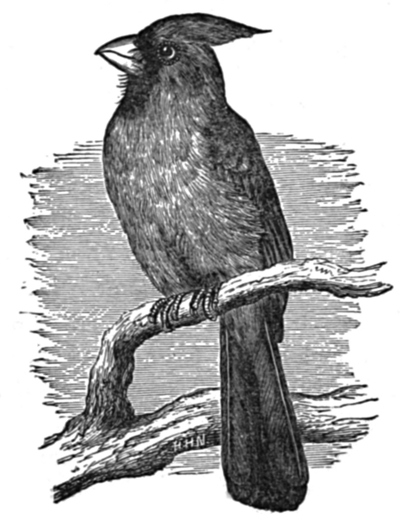
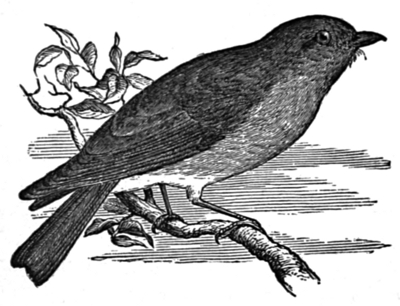
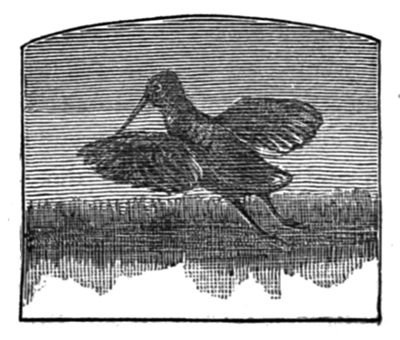
here and there. The illustrations are kindly furnished
by Prof. Baird, and are taken from the “History
of North American Birds,” by himself, Dr.
Brewer, and Mr. Ridgeway, and published by Little,
Brown, & Co.,—the most complete work on our
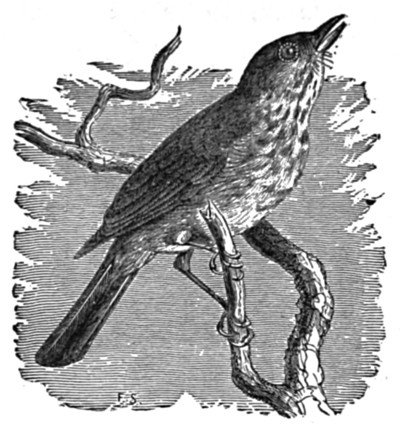
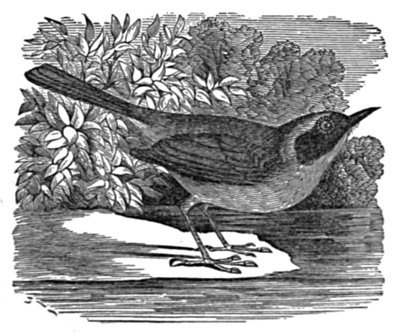
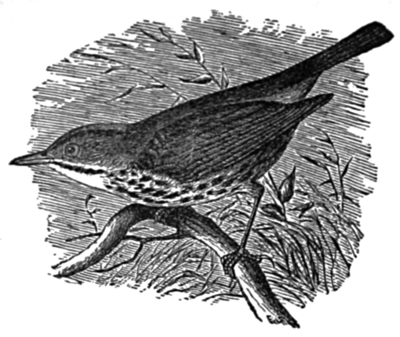
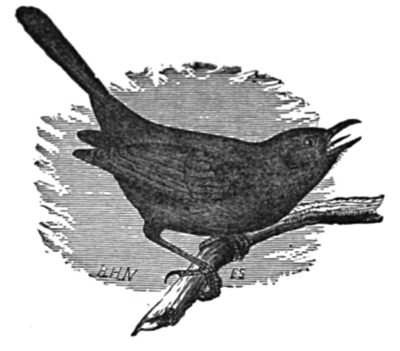
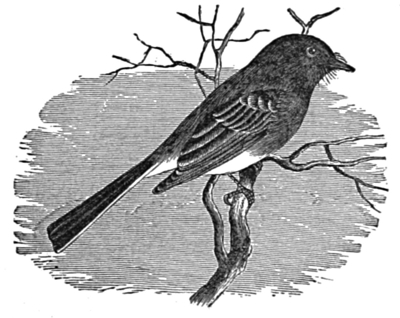
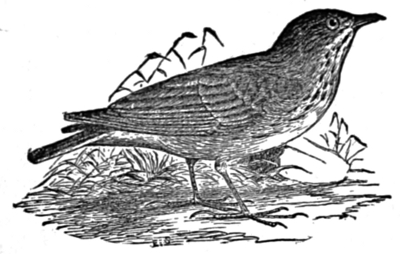
birds that has yet appeared. The hermit-thrush represented
is the Western hermit (Turdus ustulatis),
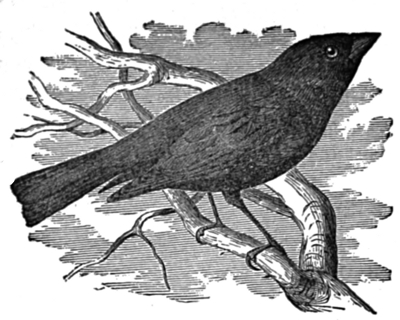
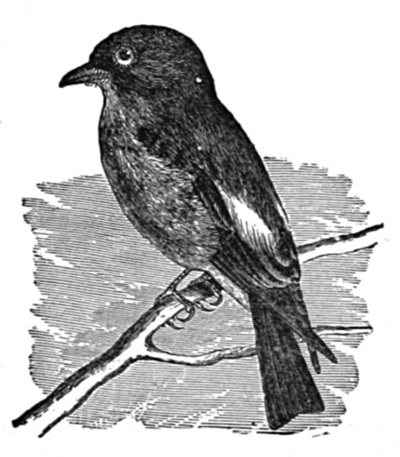
and we have been obliged to substitute the black fly-catcher
(Saponis nigricans) for the pewee, and the
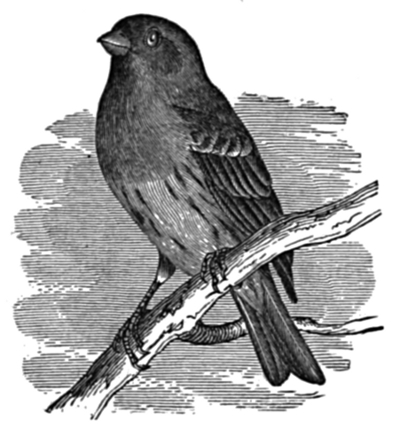
house finch (Corpodacus frontalis) for the purple
finch; but the difference is hardly appreciable in an
uncolored engraving.
November, 1876.
PREFACE.
This is mainly a book about the Birds, or more
properly an invitation to the study of Ornithology,
and the purpose of the author will be carried out in
proportion as it awakens and stimulates the interest
of the reader in this branch of Natural History.
Though written less in the spirit of exact science
than with the freedom of love and old acquaintance,
yet I have in no instance taken liberties with facts, or
allowed my imagination to influence me to the extent
of giving a false impression or a wrong coloring. I
have reaped my harvest more in the woods than in
the study; what I offer, in fact, is a careful and conscientious
record of actual observations and experiences,
and is true as it stands written, every word of
it. But what has interested me most in Ornithology,
is the pursuit, the chase, the discovery; that part of
it which is akin to hunting, fishing, and wild sports,
and which I could carry with me in my eye and ear,
wherever I went.
I cannot answer with much confidence the poet’s
inquiry,
“Hast thou named all the birds without a gun?”
but I have done what I could to bring home the
“earth and the sky” with the sparrow I heard “singing
at dawn on the alder bough.” In other words,
I have tried to present a live bird,—a bird in the
woods or the fields,—with the atmosphere and associations
of the place, and not merely a stuffed and
labeled specimen.
A more specific title for the volume would have
suited me better, but not being able to satisfy myself
in this direction, I cast about for a word thoroughly
in the atmosphere and spirit of the book, which I
hope I have found in “Wake-Robin”—the common
name of the white Trillium, which blooms in all our
woods, and which marks the arrival of all the birds.
Spring in our northern climate may fairly be said
to extend from the middle of March to the middle of
June. At least, the vernal tide continues to rise
until the latter date, and it is not till after the summer
solstice that the shoots and twigs begin to harden
and turn to wood, or the grass to lose any of its freshness
and succulency.
It is this period that marks the return of the birds,—one
or two of the more hardy or half-domesticated
species, like the song-sparrow and the bluebird, usually
arriving in March, while the rarer and more
brilliant wood-birds bring up the procession in June.
But each stage of the advancing season gives prominence
to certain species, as to certain flowers. The
dandelion tells me when to look for the swallow, the
dog-toothed violet when to expect the wood-thrush,
and when I have found the wake-robin in bloom I
know the season is fairly inaugurated. With me this
flower is associated, not merely with the awakening
of Robin, for he has been awake some weeks, but
with the universal awakening and rehabilitation of
nature.
Yet the coming and going of the birds is more or
less a mystery and a surprise. We go out in the
morning, and no thrush or vireo is to be heard; we
go out again, and every tree and grove is musical;
yet again, and all is silent. Who saw them come?
Who saw them depart?
This pert little winter-wren, for instance, darting
in and out the fence, diving under the rubbish here
and coming up yards away,—how does he manage
with those little circular wings to compass degrees
and zones, and arrive always in the nick of time?
Last August I saw him in the remotest wilds of the
Adirondacs, impatient and inquisitive as usual; a few
weeks later, on the Potomac, I was greeted by the
same hardy little busybody. Does he travel by easy
stages from bush to bush and from wood to wood?
or has that compact little body force and courage to
brave the night and the upper air, and so achieve
leagues at one pull?
And yonder bluebird with the earth tinge on his
breast and the sky tinge on his back,—did he come
down out of heaven on that bright March morning
when he told us so softly and plaintively that if we
pleased, spring had come? Indeed, there is nothing
in the return of the birds more curious and suggestive
than in the first appearance, or rumors of the appearance,
of this little blue-coat. The bird at first seems
a mere wandering voice in the air; one hears its call
or carol on some bright March morning, but is uncertain
of its source or direction; it falls like a drop
of rain when no cloud is visible; one looks and listens,
but to no purpose. The weather changes, perhaps
a cold snap with snow comes on, and it may be
a week before I hear the note again, and this time or
the next perchance see the bird sitting on a stake in
the fence lifting his wing as he calls cheerily to his
mate. Its notes now become daily more frequent;
the birds multiply, and, flitting from point to point,
call and warble more confidently and gleefully.
Their boldness increases till one sees them hovering
with a saucy, inquiring air about barns and out-buildings,
peeping into dove-cotes, and stable windows,
inspecting knot-holes and pump-trees, intent
only on a place to nest. They wage war against
robins and wrens, pick quarrels with swallows, and
seem to deliberate for days over the policy of taking
forcible possession of one of the mud-houses of the
latter. But as the season advances they drift more
into the background. Schemes of conquest which
they at first seemed bent upon are abandoned, and
they settle down very quietly in their old quarters in
remote stumpy fields.
Not long after the bluebird comes the robin, sometimes
in March, but in most of the Northern States
April is the month of the robin. In large numbers
they scour the fields and groves. You hear their
piping in the meadow, in the pasture, on the hill-side.
Walk in the woods, and the dry leaves rustle with
the whir of their wings, the air is vocal with their
cheery call. In excess of joy and vivacity, they run,
leap, scream, chase each other through the air, diving
and sweeping among the trees with perilous rapidity.
In that free, fascinating, half-work and half-play
pursuit,—sugar-making,—a pursuit which still lingers
in many parts of New York, as in New England,
the robin is one’s constant companion. When the
day is sunny and the ground bare, you meet him at
all points and hear him at all hours. At sunset, on
the tops of the tall maples, with look heavenward,
and in a spirit of utter abandonment, he carols his
simple strain. And sitting thus amid the stark, silent
trees, above the wet, cold earth, with the chill of
winter still in the air, there is no fitter or sweeter
songster in the whole round year. It is in keeping
with the scene and the occasion. How round and
genuine the notes are, and how eagerly our ears
drink them in! The first utterance, and the spell of
winter is thoroughly broken, and the remembrance
of it afar off.
Robin is one of the most native and democratic of
our birds; he is one of the family, and seems much
nearer to us than those rare, exotic visitants, as the
orchard starling or rose-breasted grossbeak, with
their distant, high-bred ways. Hardy, noisy, frolicsome,
neighborly and domestic in his habits, strong
of wing and bold in spirit, he is the pioneer of the
thrush family, and well worthy of the finer artists
whose coming he heralds and in a measure prepares
us for.
I could wish Robin less native and plebeian in one
respect,—the building of his nest. Its coarse material
and rough masonry are creditable neither to his
skill as a workman nor to his taste as an artist. I
am the more forcibly reminded of his deficiency in
this respect from observing yonder humming-bird’s
nest, which is a marvel of fitness and adaptation, a
proper setting for this winged gem,—the body of it
composed of a white, felt-like substance, probably the
down of some plant or the wool of some worm, and
toned down in keeping with the branch on which it
sits by minute tree-lichens, woven together by threads
as fine and frail as gossamer. From Robin’s good
looks and musical turn we might reasonably predict
a domicile of equal fitness and elegance. At least I
demand of him as clean and handsome a nest as the
king-bird’s, whose harsh jingle, compared with Robin’s
evening melody, is as the clatter of pots and kettles
beside the tone of a flute. I love his note and
ways better even than those of the orchard starling
or the Baltimore oriole; yet his nest, compared with
theirs, is a half-subterranean hut contrasted with a
Roman villa. There is something courtly and poetical
in a pensile nest. Next to a castle in the air is a
dwelling suspended to the slender branch of a tall
tree, swayed and rocked forever by the wind. Why
need wings be afraid of falling? Why build only
where boys can climb? After all, we must set it
down to the account of Robin’s democratic turn; he
is no aristocrat, but one of the people; and therefore
we should expect stability in his workmanship, rather
than elegance.
Another April bird, which makes her appearance
sometimes earlier and sometimes later than Robin,
and whose memory I fondly cherish, is the Phœbe-bird
(Muscicapa nunciola), the pioneer of the fly-catchers.
In the inland farming districts, I used to
notice her, on some bright morning about Easter-day,
proclaiming her arrival with much variety of
motion and attitude, from the peak of the barn or
hay-shed. As yet, you may have heard only the
plaintive, homesick note of the bluebird, or the faint
trill of the song-sparrow; and Phœbe’s clear, vivacious
assurance of her veritable bodily presence
among us again is welcomed by all ears. At agreeable
intervals in her lay she describes a circle or an
ellipse in the air, ostensibly prospecting for insects,
but really, I suspect, as an artistic flourish, thrown
in to make up in some way for the deficiency of her
musical performance. If plainness of dress indicates
powers of song, as it usually does, then Phœbe ought
to be unrivaled in musical ability, for surely that
ashen-gray suit is the superlative of plainness; and
that form, likewise, would hardly pass for a “perfect
figure” of a bird. The reasonableness of her coming,
however, and her civil, neighborly ways, shall
make up for all deficiencies in song and plumage.
After a few weeks Phœbe is seldom seen, except as
she darts from her moss-covered nest beneath some
bridge or shelving cliff.
Another April comer, who arrives shortly after
Robin-redbreast, with whom he associates both at this
season and in the autumn, is the gold-winged woodpecker,
alias “high-hole,” alias “flicker,” alias
“yarup.” He is an old favorite of my boyhood, and
his note to me means very much. He announces his
arrival by a long, loud call, repeated from the dry
branch of some tree, or a stake in the fence—a
thoroughly melodious April sound. I think how
Solomon finished that beautiful description of spring,
“And the voice of the turtle is heard in the land,”
and see that a description of spring in this farming
country, to be equally characteristic, should culminate
in like manner,—“And the call of the high-hole
comes up from the wood.”
It is a loud, strong, sonorous call, and does not
seem to imply an answer, but rather to subserve some
purpose of love or music. It is “Yarup’s” proclamation
of peace and good-will to all. On looking at the
matter closely, I perceive that most birds, not denominated
songsters, have, in the spring, some note or
sound or call that hints of a song, and answers imperfectly
the end of beauty and art. As a “livelier iris
changes on the burnished dove,” and the fancy of the
young man turns lightly to thoughts of his pretty
cousin, so the same renewing spirit touches the “silent
singers,” and they are no longer dumb; faintly
they lisp the first syllables of the marvelous tale.
Witness the clear, sweet whistle of the gray-crested
titmouse,—the soft, nasal piping of the nuthatch,—the
amorous, vivacious warble of the bluebird,—the
long, rich note of the meadow-lark,—the whistle of
the quail,—the drumming of the partridge,—the
animation and loquacity of the swallows, and the like.
Even the hen has a homely, contented carol; and I
credit the owls with a desire to fill the night with
music. All birds are incipient or would-be songsters
in the spring. I find corroborative evidence of this
even in the crowing of the cock. The flowering of
the maple is not so obvious as that of the magnolia;
nevertheless, there is actual inflorescence.
Few writers award any song to that familiar little
sparrow, the Socialis; yet who that has observed him
sitting by the way-side, and repeating, with devout attitude,
that fine sliding chant, does not recognize the
neglect? Who has heard the snow-bird sing? Yet
he has a lisping warble very savory to the ear. I
have heard him indulge in it even in February.
Even the cow-bunting feels the musical tendency,
and aspires to its expression, with the rest. Perched
upon the topmost branch beside his mate or mates,—for
he is quite a polygamist, and usually has two or
three demure little ladies in faded black beside him,—generally
in the early part of the day, he seems
literally to vomit up his notes. Apparently with
much labor and effort, they gargle and blubber up
out of him, falling on the ear with a peculiar subtile
ring, as of turning water from a glass bottle, and not
without a certain pleasing cadence.
Neither is the common woodpecker entirely insensible
to the wooing of the spring, and, like the partridge,
testifies his appreciation of melody after quite
a primitive fashion. Passing through the woods, on
some clear, still morning in March, while the metallic
ring and tension of winter are still in the earth and
air, the silence is suddenly broken by long, resonant
hammering upon a dry limb or stub. It is Downy
beating a reveille to spring. In the utter stillness
and amid the rigid forms we listen with pleasure; and
as it comes to my ear oftener at this season than at
any other, I freely exonerate the author of it from
the imputation of any gastronomic motives, and credit
him with a genuine musical performance.
It is to be expected, therefore, that “Yellow-hammer”
will respond to the general tendency, and contribute
his part to the spring chorus. His April call
is his finest touch, his most musical expression.
I recall an ancient maple standing sentry to a large
sugar-bush, that, year after year, afforded protection
to a brood of yellow-hammers in its decayed heart.
A week or two before the nesting seemed actually to
have begun, three or four of these birds might be
seen, on almost any bright morning, gamboling and
courting amid its decayed branches. Sometimes you
would hear only a gentle, persuasive cooing, or a
quiet, confidential chattering,—then that long, loud
call, taken up by first one, then another, as they sat
about upon the naked limbs,—anon, a sort of wild,
rollicking laughter, intermingled with various cries,
yelps, and squeals, as if some incident had excited
their mirth and ridicule. Whether this social hilarity
and boisterousness is in celebration of the pairing or
mating ceremony, or whether it is only a sort of annual
“house-warming” common among high-holes
on resuming their summer quarters, is a question
upon which I reserve my judgment.
Unlike most of his kinsmen, the golden-wing prefers
the fields and the borders of the forest to the
deeper seclusion of the woods, and hence, contrary to
the habit of his tribe, obtains most of his subsistence
from the ground, probing it for ants and crickets.
He is not quite satisfied with being a woodpecker.
He courts the society of the robin and the finches,
abandons the trees for the meadow, and feeds eagerly
upon berries and grain. What may be the final upshot
of this course of living is a question worthy the
attention of Darwin. Will his taking to the ground
and his pedestrian feats result in lengthening his legs,
his feeding upon berries and grains subdue his tints
and soften his voice, and his associating with Robin
put a song into his heart?
Indeed, what would be more interesting than the
history of our birds for the last two or three centuries?
There can be no doubt that the presence of man has
exerted a very marked and friendly influence upon
them, since they so multiply in his society. The birds
of California, it is said, were mostly silent till after its
settlement, and I doubt if the Indians heard the wood-thrush
as we hear him. Where did the bobolink
disport himself before there were meadows in the
North and rice fields in the South? Was he the same
blithe, merry-hearted beau then as now? And the
sparrow, the lark, and the goldfinch, birds that seem
so indigenous to the open fields and so averse to the
woods,—we cannot conceive of their existence in a
vast wilderness and without man.
But to return. The song-sparrow, that universal
favorite and firstling of the spring, comes before
April, and its simple strain gladdens all hearts.
May is the month of the swallows and the orioles.
There are many other distinguished arrivals, indeed
nine tenths of the birds are here by the last week in
May, yet the swallows and orioles are the most conspicuous.
The bright plumage of the latter seems
really like an arrival from the tropics. I see them
flash through the blossoming trees, and all the forenoon
hear their incessant warbling and wooing. The
swallows dive and chatter about the barn, or squeak
and build beneath the eaves; the partridge drums in
the fresh sprouting woods; the long, tender note of
the meadow-lark comes up from the meadow; and at
sunset, from every marsh and pond come the ten
thousand voices of the hylas. May is the transition
month, and exists to connect April and June, the
root with the flower.
With June the cup is full, our hearts are satisfied,
there is no more to be desired. The perfection of
the season, among other things, has brought the perfection
of the song and plumage of the birds. The
master artists are all here; and the expectations
excited by the robin and the song-sparrow are fully
justified. The thrushes have all come; and I sit
down upon the first rock, with hands full of the pink
azalea, to listen. With me, the cuckoo does not arrive
till June; and often the goldfinch, the king-bird,
the scarlet tanager delay their coming till then. In
the meadows the bobolink is in all his glory; in the
high pastures the field-sparrow sings his breezy vesper-hymn;
and the woods are unfolding to the music
of the thrushes.
The cuckoo is one of the most solitary birds of our
forests, and is strangely tame and quiet, appearing
equally untouched by joy or grief, fear or anger.
Something remote seems ever weighing upon his
mind. His note or call is as of one lost or wandering,
and to the farmer is prophetic of rain. Amid
the general joy and the sweet assurance of things, I
love to listen to the strange clairvoyant call. Heard
a quarter of a mile away, from out the depths of the
forest, there is something peculiarly weird and monkish
about it. Wordsworth’s lines upon the European
species apply equally well to ours:—
“O blithe new-comer! I have heard, I hear thee and rejoice: O cuckoo! shall I call thee bird? Or but a wandering voice?
“While I am lying on the grass, Thy loud note smites my ear! From hill to hill it seems to pass, At once far off and near!
“Thrice welcome, darling of the spring! Even yet thou art to me No bird, but an invisible thing, A voice, a mystery.”
The black-billed is the only species found in my
locality, the yellow-billed abounds farther south.
Their note or call is nearly the same. The former
sometimes suggests the voice of a turkey. The call
of the latter may be suggested thus: k-k-k-k-k-kow,
kow, kow-ow, kow-ow.
The yellow-billed will take up his stand in a tree,
and explore its branches till he has caught every
worm. He sits on a twig, and with a peculiar swaying
movement of his head examines the surrounding
foliage. When he discovers his prey, he leaps upon
it in a fluttering manner.
In June the black-billed makes a tour through the
orchard and garden, regaling himself upon the
canker-worms. At this time he is one of the tamest
of birds, and will allow you to approach within a
few yards of him. I have even come within a few
feet of one without seeming to excite his fear or suspicion.
He is quite unsophisticated, or else royally
indifferent.
The plumage of the cuckoo is a rich glossy brown,
and is unrivaled in beauty by any other neutral tint
with which I am acquainted. It is also remarkable
for its firmness and fineness.
Notwithstanding the disparity in size and color,
the black-billed species has certain peculiarities that
remind one of the passenger-pigeon. His eye, with
its red circle, the shape of his head, and his motions
on alighting and taking flight, quickly suggest the
resemblance; though in grace and speed, when on
the wing, he is far inferior. His tail seems disproportionately
long, like that of the red-thrush, and
his flight among the trees is very still, contrasting
strongly with the honest clatter of the robin or
pigeon.
Have you heard the song of the field-sparrow?
If you have lived in a pastoral country with broad
upland pastures, you could hardly have missed him.
Wilson, I believe, calls him the grass-finch, and was
evidently unacquainted with his powers of song.
The two white lateral quills in his tail, and his habit
of running and skulking a few yards in advance of
you as you walk through the fields, are sufficient to
identify him. Not in meadows or orchards, but in
high, breezy pasture-grounds, will you look for him.
His song is most noticeable after sundown, when
other birds are silent; for which reason he has been
aptly called the vesper-sparrow. The farmer following
his team from the field at dusk catches his sweetest
strain. His song is not so brisk and varied as
that of the song-sparrow, being softer and wilder,
sweeter and more plaintive. Add the best parts of
the lay of the latter to the sweet vibrating chant of
the wood-sparrow, and you have the evening hymn
of the vesper-bird,—the poet of the plain, unadorned
pastures. Go to those broad, smooth, uplying
fields where the cattle and sheep are grazing,
and sit down in the twilight on one of those warm,
clean stones, and listen to this song. On every side,
near and remote, from out the short grass which the
herds are cropping, the strain rises. Two or three
long, silver notes of peace and rest, ending in some
subdued trills and quavers, constitute each separate
song. Often you will catch only one or two of the
bars, the breeze having blown the minor part away.
Such unambitious, quiet, unconscious melody! It is
one of the most characteristic sounds in Nature.
The grass, the stones, the stubble, the furrow, the
quiet herds, and the warm twilight among the hills,
are all subtilely expressed in this song; this is what
they are at last capable of.
The female builds a plain nest in the open field,
without so much as a bush or thistle or tuft of grass
to protect it or mark its site; you may step upon it
or the cattle may tread it into the ground. But the
danger from this source, I presume, the bird considers
less than that from another. Skunks and foxes
have a very impertinent curiosity, as Finchie well
knows,—and a bank or hedge, or a rank growth of
grass or thistles, that might promise protection and
cover to mouse or bird, these cunning rogues would
be apt to explore most thoroughly. The partridge is
undoubtedly acquainted with the same process of reasoning;
for, like the vesper-bird, she, too, nests in
open, unprotected places, avoiding all show of concealment,—coming
from the tangled and almost impenetrable
parts of the forest, to the clean, open
woods, where she can command all the approaches
and fly with equal ease in any direction.
Another favorite sparrow, but little noticed, is the
wood or bush sparrow, usually called by the ornithologists
Spizella pusilla. Its size and form is that of
the socialis, but is less distinctly marked, being of a
duller redder tinge. He prefers remote bushy
heathery fields, where his song is one of the sweetest
to be heard. It is sometimes very noticeable, especially
early in spring. I remember sitting one
bright day in the still leafless April woods, when one
of these birds struck up a few rods from me, repeating
its lay at short intervals for nearly an hour. It
was a perfect piece of wood-music, and was of course
all the more noticeable for being projected upon such
a broad unoccupied page of silence. Its song is like
the words, fe-o, fe-o, fe-o, few, few, few, fee fee fee,
uttered at first high and leisurely, but running very
rapidly toward the close, which is low and soft.
Still keeping among the unrecognized, the white-eyed
vireo, or fly-catcher, deserves particular mention.
The song of this bird is not particularly sweet
and soft; on the contrary, it is a little hard and shrill,
like that of the indigo-bird or oriole; but for brightness,
volubility, execution, and power of imitation,
he is unsurpassed by any of our northern birds. His
ordinary note is forcible and emphatic, but, as stated,
not especially musical: Chick-a-re’r-chick, he seems
to say, hiding himself in the low, dense undergrowth,
and eluding your most vigilant search, as if playing
some part in a game. But in July or August, if you
are on good terms with the sylvan deities, you may
listen to a far more rare and artistic performance.
Your first impression will be that that cluster of
azalea, or that clump of swamp-huckleberry, conceals
three or four different songsters, each vying with the
others to lead the chorus. Such a medley of notes,
snatched from half the songsters of the field and forest,
and uttered with the utmost clearness and rapidity,
I am sure you cannot hear short of the haunts
of the genuine mocking-bird. If not fully and accurately
repeated, there are at least suggested the notes
of the robin, wren, cat-bird, high-hole, goldfinch, and
song-sparrow. The pip, pip, of the last is produced
so accurately that I verily believe it would deceive
the bird herself;—and the whole uttered in such
rapid succession that it seems as if the movement
that gives the concluding note of one strain must
form the first note of the next. The effect is very
rich, and, to my ear, entirely unique. The performer
is very careful not to reveal himself in the mean
time; yet there is a conscious air about the strain
that impresses me with the idea that my presence is
understood and my attention courted. A tone of
pride and glee, and, occasionally, of bantering jocoseness,
is discernible. I believe it is only rarely, and
when he is sure of his audience, that he displays
his parts in this manner. You are to look for him,
not in tall trees or deep forests, but in low, dense
shrubbery about wet places, where there are plenty
of gnats and mosquitoes.
The winter-wren is another marvelous songster, in
speaking of whom it is difficult to avoid superlatives.
He is not so conscious of his powers and so ambitious
of effect as the white-eyed fly-catcher, yet you will not
be less astonished and delighted on hearing him. He
possesses the fluency and copiousness for which the
wrens are noted, and besides these qualities, and
what is rarely found conjoined with them, a wild,
sweet, rhythmical cadence that holds you entranced.
I shall not soon forget that perfect June day, when,
loitering in a low, ancient hemlock wood, in whose
cathedral aisles the coolness and freshness seems perennial,
the silence was suddenly broken by a strain
so rapid and gushing, and touched with such a wild,
sylvan plaintiveness, that I listened in amazement.
And so shy and coy was the little minstrel, that I
came twice to the woods before I was sure to whom
I was listening. In summer he is one of those birds
of the deep northern forests, that, like the speckled
Canada warbler and the hermit-thrush, only the privileged
ones hear.
The distribution of plants in a given locality is not
more marked and defined than that of the birds. Show
a botanist a landscape, and he will tell you where to
look for the lady’s-slipper, the columbine, or the
harebell. On the same principles the ornithologist
will direct you where to look for the greenlets, the
wood-sparrow, or the chewink. In adjoining counties,
in the same latitude, and equally inland, but
possessing a different geological formation and different
forest-timber, you will observe quite a different
class of birds. In a land of the beech and sugar-maple
I do not find the same songsters that I know
where thrive the oak, chestnut, and laurel. In going
from a district of the Old Red Sandstone to where I
walk upon the old Plutonic Rock, not fifty miles distant,
I miss in the woods the veery, the hermit-thrush,
the chestnut-sided warbler, the blue-backed
warbler, the green-backed warbler, the black and yellow
warbler, and many others, and find in their stead
the wood-thrush, the chewink, the redstart, the yellow-throat,
the yellow-breasted fly-catcher, the white-eyed
fly-catcher, the quail, and the turtle-dove.
In my neighborhood here in the Highlands the
distribution is very marked. South of the village I
invariably find one species of birds, north of it another.
In only one locality, full of azalea and swamp-huckleberry,
I am always sure of finding the hooded
warbler. In a dense undergrowth of spice-bush,
witch-hazel, and alder, I meet the worm-eating warbler.
In a remote clearing, covered with heath and
fern, with here and there a chestnut and an oak, I go
to hear in July the wood-sparrow, and returning by
a stumpy, shallow pond, I am sure to find the water-thrush.
Only one locality within my range seems to possess
attractions for all comers. Here one may study
almost the entire ornithology of the State. It is a
rocky piece of ground, long ago cleared, but now fast
relapsing into the wildness and freedom of nature,
and marked by those half-cultivated, half-wild features
which birds and boys love. It is bounded on
two sides by the village and highway, crossed at various
points by carriage-roads, and threaded in all directions
by paths and by-ways, along which soldiers,
laborers, and truant school-boys are passing at all
hours of the day. It is so far escaping from the axe
and the bush-hook as to have opened communication
with the forest and mountain beyond by straggling
lines of cedar, laurel, and blackberry. The ground
is mainly occupied with cedar and chestnut, with an
undergrowth, in many places, of heath and bramble.
The chief feature, however, is a dense growth in the
centre, consisting of dogwood, water-beech, swamp-ash,
alder, spice-bush, hazel, etc., with a net-work of
smilax and frost-grape. A little zigzag stream, the
draining of a swamp beyond, which passes through
this tangle-wood, accounts for many of its features
and productions, if not for its entire existence. Birds
that are not attracted by the heath or the cedar and
chestnut, are sure to find some excuse for visiting this
miscellaneous growth in the centre. Most of the
common birds literally throng this idle-wild; and I
have met here many of the rarer species, such as the
great-crested fly-catcher, the solitary warbler, the
blue-winged swamp-warbler, the worm-eating warbler,
the fox-sparrow, etc. The absence of all birds of
prey, and the great number of flies and insects, both
the result of proximity to the village, are considerations
which no hawk-fearing, peace-loving minstrel
passes over lightly; hence the popularity of the resort.
But the crowning glory of all these robins, fly-catchers,
and warblers is the wood-thrush. More
abundant than all other birds, except the robin and
cat-bird, he greets you from every rock and shrub.
Shy and reserved when he first makes his appearance
in May, before the end of June he is tame and familiar,
and sings on the tree over your head, or on the
rock a few paces in advance. A pair even built their
nest and reared their brood within ten or twelve feet
of the piazza of a large summer-house in the vicinity.
But when the guests commenced to arrive and the
piazza to be thronged with gay crowds, I noticed
something like dread and foreboding in the manner
of the mother-bird; and from her still, quiet ways,
and habit of sitting long and silently within a few
feet of the precious charge, it seemed as if the dear
creature had resolved, if possible, to avoid all observation.
If we take the quality of melody as the test, the
wood-thrush, hermit-thrush, and the veery-thrush,
stand at the head of our list of songsters.
The mocking-bird undoubtedly possesses the greatest
range of mere talent, the most varied executive
ability, and never fails to surprise and delight one
anew at each hearing; but being mostly an imitator,
he never approaches the serene beauty and sublimity
of the hermit-thrush. The word that best expresses
my feelings, on hearing the mocking-bird, is admiration,
though the first emotion is one of surprise and
incredulity. That so many and such various notes
should proceed from one throat is a marvel, and we
regard the performance with feelings akin to those
we experience on witnessing the astounding feats of
the athlete or gymnast,—and this, notwithstanding
many of the notes imitated have all the freshness
and sweetness of the originals. The emotions excited
by the songs of these thrushes belong to a higher
order, springing as they do from our deepest sense of
the beauty and harmony of the world.
The wood-thrush is worthy of all, and more than
all, the praises he has received; and considering the
number of his appreciative listeners, it is not a little
surprising that his relative and equal, the hermit-thrush,
should have received so little notice. Both
the great ornithologists, Wilson and Audubon, are
lavish in their praises of the former, but have little or
nothing to say of the song of the latter. Audubon
says it is sometimes agreeable, but evidently has never
heard it. Nuttall, I am glad to find, is more discriminating,
and does the bird fuller justice.
It is quite a rare bird, of very shy and secluded
habits, being found in the Middle and Eastern States,
during the period of song, only in the deepest and
most remote forests, usually in damp and swampy
localities. On this account the people in the Adirondac
region call it the “Swamp Angel.” Its being
so much of a recluse accounts for the comparative ignorance
that prevails in regard to it.
The cast of its song is very much like that of the
wood-thrush, and a good observer might easily confound
the two. But hear them together and the difference
is quite marked: the song of the hermit is in
a higher key, and is more wild and ethereal. His
instrument is a silver horn which he winds in the
most solitary places. The song of the wood-thrush
is more golden and leisurely. Its tone comes near to
that of some rare stringed instrument. One feels
that perhaps the wood-thrush has more compass and
power, if he would only let himself out, but on the
whole he comes a little short of the pure, serene,
hymn-like strain of the hermit.
Yet those who have heard only the wood-thrush
may well place him first on the list. He is truly a
royal minstrel, and considering his liberal distribution
throughout our Atlantic seaboard, perhaps contributes
more than any other bird to our sylvan melody.
One may object that he spends a little too
much time in tuning his instrument, yet his careless
and uncertain touches reveal its rare compass and
power.
He is the only songster of my acquaintance, excepting
the canary, that displays different degrees of
proficiency in the exercise of his musical gifts. Not
long since, while walking one Sunday in the edge of
an orchard adjoining a wood, I heard one that so obviously
and unmistakably surpassed all his rivals,
that my companion, though slow to notice such
things, remarked it wonderingly; and with one accord
we paused to listen to so rare a performer. It
was not different in quality so much as in quantity.
Such a flood of it! Such copiousness! Such long,
trilling, accelerating preludes! Such sudden, ecstatic
overtures, would have intoxicated the dullest ear.
He was really without a compeer—a master-artist.
Twice afterward I was conscious of having heard the
same bird.
The wood-thrush is the handsomest species of this
family. In grace and elegance of manner he has no
equal. Such a gentle, high-bred air, and such inimitable
ease and composure in his flight and movement!
He is a poet in very word and deed. His
carriage is music to the eye. His performance of
the commonest act, as catching a beetle, or picking
a worm from the mud, pleases like a stroke of wit or
eloquence. Was he a prince in the olden time, and
do the regal grace and mien still adhere to him in his
transformation? What a finely proportioned form!
How plain, yet rich his color,—the bright russet of
his back, the clear white of his breast, with the distinct
heart-shaped spots! It may be objected to
Robin that he is noisy and demonstrative; he hurries
away or rises to a branch with an angry note, and
flirts his wings in ill-bred suspicion. The mavis, or
red-thrush, sneaks and skulks like a culprit, hiding in
the densest alders; the cat-bird is a coquette and a
flirt, as well as a sort of female Paul Pry; and the
chewink shows his inhospitality by espying your
movements like a Japanese. The wood-thrush has
none of these under-bred traits. He regards me
unsuspiciously, or avoids me with a noble reserve,—or,
if I am quiet and incurious, graciously hops toward
me, as if to pay his respects, or to make my acquaintance.
I have passed under his nest within a
few feet of his mate and brood, when he sat near by
on a branch eying me sharply, but without opening
his beak; but the moment I raised my hand toward
his defenseless household his anger and indignation
were beautiful to behold.
What a noble pride he has! Late one October,
after his mates and companions had long since gone
south, I noticed one for several successive days in the
dense part of this next-door wood, flitting noiselessly
about, very grave and silent, as if doing penance for
some violation of the code of honor. By many gentle,
indirect approaches, I perceived that part of his
tail-feathers were undeveloped. The sylvan prince
could not think of returning to court in this plight,
and so, amid the falling leaves and cold rains of
autumn, was patiently biding his time.
The soft, mellow flute of the veery fills a place in
the chorus of the woods that the song of the vesper-sparrow
fills in the chorus of the fields. It has the
nightingale’s habit of singing in the twilight, as
indeed have all our thrushes. Walk out toward the
forest in the warm twilight of a June day, and when
fifty rods distant you will hear their soft, reverberating
notes, rising from a dozen different throats.
It is one of the simplest strains to be heard,—as
simple as the curve in form, delighting from the pure
element of harmony and beauty it contains, and not
from any novel or fantastic modulation of it,—thus
contrasting strongly with such rollicking, hilarious
songsters as the bobolink, in whom we are chiefly
pleased with the tintinnabulation, the verbal and labial
excellence, and the evident conceit and delight of
the performer.
I hardly know whether I am more pleased or annoyed
with the cat-bird. Perhaps she is a little too
common, and her part in the general chorus a little
too conspicuous. If you are listening for the note of
another bird, she is sure to be prompted to the most
loud and protracted singing, drowning all other
sounds; if you sit quietly down to observe a favorite
or study a new-comer, her curiosity knows no
bounds, and you are scanned and ridiculed from
every point of observation. Yet I would not miss
her; I would only subordinate her a little, make her
less conspicuous.
She is the parodist of the woods, and there is ever
a mischievous, bantering, half-ironical undertone in
her lay, as if she were conscious of mimicking and
disconcerting some envied songster. Ambitious of
song, practicing and rehearsing in private, she yet
seems the least sincere and genuine of the sylvan
minstrels, as if she had taken up music only to be in
the fashion, or not to be outdone by the robins and
thrushes. In other words, she seems to sing from
some outward motive, and not from inward joyousness.
She is a good versifier, but not a great poet.
Vigorous, rapid, copious, not without fine touches,
but destitute of any high, serene melody, her performance,
like that of Thoreau’s squirrel, always implies
a spectator.
There is a certain air and polish about her strain,
however, like that in the vivacious conversation of a
well-bred lady of the world, that commands respect.
Her maternal instinct, also, is very strong, and that
simple structure of dead twigs and dry grass is the
centre of much anxious solicitude. Not long since,
while strolling through the woods, my attention was
attracted to a small densely grown swamp, hedged in
with eglantine, brambles, and the everlasting smilax,
from which proceeded loud cries of distress and alarm,
indicating that some terrible calamity was threatening
my sombre-colored minstrel. On effecting an entrance,
which, however, was not accomplished till I
had doffed coat and hat, so as to diminish the surface
exposed to the thorns and brambles, and looking
around me from a square yard of terra firma, I found
myself the spectator of a loathsome, yet fascinating
scene. Three or four yards from me was the nest,
beneath which, in long festoons, rested a huge black
snake; a bird two thirds grown, was slowly disappearing
between his expanded jaws. As he seemed
unconscious of my presence, I quietly observed the
proceedings. By slow degrees he compassed the bird
about with his elastic mouth; his head flattened, his
neck writhed and swelled, and two or three undulatory
movements of his glistening body finished the
work. Then, he cautiously raised himself up, his
tongue flaming from his mouth the while, curved over
the nest, and, with wavy, subtle motions, explored
the interior. I can conceive of nothing more overpoweringly
terrible to an unsuspecting family of
birds than the sudden appearance above their domicile
of the head and neck of this arch-enemy. It is
enough to petrify the blood in their veins. Not finding
the object of his search, he came streaming down
from the nest to a lower limb, and commenced extending
his researches in other directions, sliding
stealthily through the branches, bent on capturing
one of the parent birds. That a legless, wingless
creature should move with such ease and rapidity
where only birds and squirrels are considered at
home, lifting himself up, letting himself down, running
out on the yielding boughs, and traversing with
marvelous celerity the whole length and breadth of
the thicket, was truly surprising. One thinks of the
great myth, of the Tempter and the “cause of all our
woe,” and wonders if the Arch One is not now playing
off some of his pranks before him. Whether we
call it snake or devil matters little. I could but admire
his terrible beauty, however; his black, shining
folds, his easy, gliding movement, head erect, eyes
glistening, tongue playing like subtle flame, and the
invisible means of his almost winged locomotion.
The parent birds, in the mean while, kept up the
most agonizing cry,—at times fluttering furiously
about their pursuer, and actually laying hold of his
tail with their beaks and claws. On being thus attacked,
the snake would suddenly double upon himself
and follow his own body back, thus executing a
strategic movement that at first seemed almost to
paralyze his victim and place her within his grasp.
Not quite, however. Before his jaws could close
upon the coveted prize the bird would tear herself
away, and, apparently faint and sobbing, retire to a
higher branch. His reputed powers of fascination
availed him little, though it is possible that a frailer
and less combative bird might have been held by the
fatal spell. Presently, as he came gliding down the
slender body of a leaning alder, his attention was attracted
by a slight movement of my arm; eying me
an instant, with that crouching, utter, motionless gaze
which I believe only snakes and devils can assume,
he turned quickly,—a feat which necessitated something
like crawling over his own body,—and glided
off through the branches, evidently recognizing in me
a representative of the ancient parties he once so cunningly
ruined. A few moments after, as he lay carelessly
disposed in the top of a rank alder, trying to
look as much like a crooked branch as his supple,
shining form would admit, the old vengeance overtook
him. I exercised my prerogative, and a well-directed
missile, in the shape of a stone, brought him
looping and writhing to the ground. After I had
completed his downfall and quiet had been partially
restored, a half-fledged member of the bereaved
household came out from his hiding-place, and, jumping
upon a decayed branch, chirped vigorously, no
doubt in celebration of the victory.
Till the middle of July there is a general equilibrium;
the tide stands poised; the holiday-spirit is
unabated. But as the harvest ripens beneath the
long, hot days, the melody gradually ceases. The
young are out of the nest and must be cared for, and
the moulting season is at hand. After the cricket
has commenced to drone his monotonous refrain beneath
your window, you will not, till another season,
hear the wood-thrush in all his matchless eloquence.
The bobolink has become careworn and fretful, and
blurts out snatches of his song between his scolding
and upbraiding, as you approach the vicinity of his
nest, oscillating between anxiety for his brood and
solicitude for his musical reputation. Some of the
sparrows still sing, and occasionally across the hot
fields, from a tall tree in the edge of the forest, comes
the rich note of the scarlet tanager. This tropical-colored
bird loves the hottest weather, and I hear him
even in dog-days.
The remainder of the summer is the carnival of
the swallows and fly-catchers. Flies and insects, to
any amount, are to be had for the catching; and the
opportunity is well improved. See that sombre,
ashen-colored pewee on yonder branch. A true
sportsman he, who never takes his game at rest, but
always on the wing. You vagrant fly, you purblind
moth, beware how you come within his range! Observe
his attitude, the curious movement of his head,
his “eye in a fine frenzy rolling, glancing from heaven
to earth, from earth to heaven.”
His sight is microscopic and his aim sure. Quick
as thought he has seized his victim and is back to his
perch. There is no strife, no pursuit,—one fell
swoop and the matter is ended. That little sparrow,
as you will observe, is less skilled. It is the Socialis,
and he finds his subsistence properly in various seeds
and the larvæ of insects, though he occasionally has
higher aspirations, and seeks to emulate the pewee,
commencing and ending his career as a fly-catcher by
an awkward chase after a beetle or “miller.” He is
hunting around in the grass now, I suspect, with the
desire to indulge this favorite whim. There!—the
opportunity is afforded him. Away goes a little
cream-colored meadow-moth in the most tortuous
course he is capable of, and away goes Socialis in
pursuit. The contest is quite comical, though I dare
say it is serious enough to the moth. The chase continues
for a few yards, when there is a sudden rushing
to cover in the grass,—then a taking to wing again,
when the search has become too close, and the moth
has recovered his wind. Socialis chirps angrily, and
is determined not to be beaten. Keeping, with the
slightest effort, upon the heels of the fugitive, he is
ever on the point of halting to snap him up, but never
quite does it,—and so, between disappointment and
expectation, is soon disgusted, and returns to pursue
his more legitimate means of subsistence.
In striking contrast to this serio-comic strife of the
sparrow and the moth, is the pigeon-hawk’s pursuit
of the sparrow or the goldfinch. It is a race of surprising
speed and agility. It is a test of wing and
wind. Every muscle is taxed, and every nerve
strained. Such cries of terror and consternation on
the part of the bird, tacking to the right and left, and
making the most desperate efforts to escape, and such
silent determination on the part of the hawk, pressing
the bird so closely, flashing and turning and timing
his movements with those of the pursued as accurately
and as inexorably as if the two constituted one body,
excite feelings of the deepest concern. You mount
the fence or rush out of your way to see the issue.
The only salvation for the bird is to adopt the tactics
of the moth, seeking instantly the cover of some tree,
bush, or hedge, where its smaller size enables it to
move about more rapidly. These pirates are aware
of this, and therefore prefer to take their prey by one
fell swoop. You may see one of them prowling
through an orchard, with the yellow-birds hovering
about him, crying, Pi-ty, pi-ty, in the most desponding
tone; yet he seems not to regard them, knowing,
as do they, that in the close branches they are as safe
as if in a wall of adamant.
August is the month of the high sailing hawks.
The hen-hawk is the most noticeable. He likes the
haze and calm of these long, warm days. He is a
bird of leisure, and seems always at his ease. How
beautiful and majestic are his movements! So self-poised
and easy, such an entire absence of haste, such
a magnificent amplitude of circles and spirals, such a
haughty, imperial grace, and, occasionally, such daring
aërial evolutions!
With slow, leisurely movement, rarely vibrating
his pinions, he mounts and mounts in an ascending
spiral till he appears a mere speck against the summer
sky; then, if the mood seizes him, with wings
half-closed, like a bent bow, he will cleave the air
almost perpendicularly, as if intent on dashing himself
to pieces against the earth; but on nearing the
ground, he suddenly mounts again on broad, expanded
wing, as if rebounding upon the air, and sails
leisurely away. It is the sublimest feat of the season.
One holds his breath till he sees him rise
again.
If inclined to a more gradual and less precipitous
descent, he fixes his eye on some distant point in the
earth beneath him, and thither bends his course. He
is still almost meteoric in his speed and boldness.
You see his path down the heavens, straight as a
line; if near, you hear the rush of his wings; his
shadow hurtles across the fields, and in an instant
you see him quietly perched upon some low tree or
decayed stub in a swamp or meadow, with reminiscences
of frogs and mice stirring in his maw.
When the south wind blows, it is a study to see
three or four of these air-kings at the head of the
valley far up toward the mountain, balancing and oscillating
upon the strong current: now quite stationary,
except a slight tremulous motion like the poise
of a rope-dancer, then rising and falling in long undulations,
and seeming to resign themselves passively
to the wind; or, again, sailing high and level far
above the mountain’s peak, no bluster and haste, but,
as stated, occasionally a terrible earnestness and
speed. Fire at one as he sails overhead, and, unless
wounded badly he will not change his course or gait.
His flight is a perfect picture of repose in motion.
It strikes the eye as more surprising than the flight
of the pigeon and swallow even, in that the effort put
forth is so uniform and delicate as to escape observation,
giving to the movement an air of buoyancy and
perpetuity, the effluence of power rather than the conscious
application of it.
The calmness and dignity of this hawk, when attacked
by crows or the king-bird, are well worthy of
him. He seldom deigns to notice his noisy and furious
antagonists, but deliberately wheels about in
that aërial spiral, and mounts and mounts till his
pursuers grow dizzy and return to earth again. It is
quite original, this mode of getting rid of an unworthy
opponent, rising to heights where the braggart is
dazed and bewildered and loses his reckoning! I am
not sure but it is worthy of imitation.
But summer wanes, and autumn approaches. The
songsters of the seed-time are silent at the reaping of
the harvest. Other minstrels take up the strain. It
is the heyday of insect life. The day is canopied
with musical sound. All the songs of the spring and
summer appear to be floating, softened and refined,
in the upper air. The birds in a new, but less holiday
suit, turn their faces southward. The swallows
flock and go; the bobolinks flock and go; silently
and unobserved, the thrushes go. Autumn arrives,
bringing finches, warblers, sparrows and kinglets from
the North. Silently the procession passes. Yonder
hawk, sailing peacefully away till he is lost in the
horizon, is a symbol of the closing season and the departing
birds.
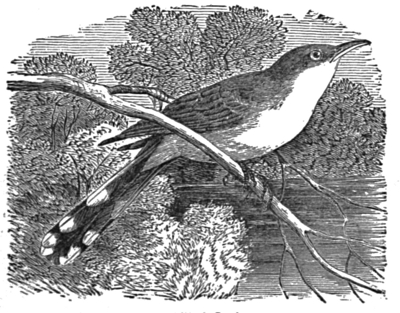
Yellow-billed Cuckoo.
Cat-bird.
IN THE HEMLOCKS.
Most people receive with incredulity a statement
of the number of birds that annually visit our climate.
Very few even are aware of half the number
that spend the summer in their own immediate vicinity.
We little suspect, when we walk in the woods,
whose privacy we are intruding upon,—what rare
and elegant visitants from Mexico, from Central and
South America, and from the islands of the sea, are
holding their reunions in the branches over our
heads, or pursuing their pleasure on the ground before
us.
I recall the altogether admirable and shining family
which Thoreau dreamed he saw in the upper
chambers of Spaulding’s woods, which Spaulding did
not know lived there, and which were not put out
when Spaulding, whistling, drove his team through
their lower halls. They did not go into society in
the village; they were quite well; they had sons and
daughters; they neither wove nor spun; there was a
sound as of suppressed hilarity.
I take it for granted that the forester was only
saying a pretty thing of the birds, though I have observed
that it does sometimes annoy them when
Spaulding’s cart rumbles through their house. Generally,
however, they are as unconscious of Spaulding
as Spaulding is of them.
Walking the other day in an old hemlock wood, I
counted over forty varieties of these summer visitants,
many of them common to other woods in the
vicinity, but quite a number peculiar to these ancient
solitudes, and not a few that are rare in any locality.
It is quite unusual to find so large a number abiding
in one forest,—and that not a large one,—most of
them nesting and spending the summer there. Many
of those I observed commonly pass this season much
farther north. But the geographical distribution of
birds is rather a climatical one. The same temperature,
though under different parallels, usually attracts
the same birds; difference in altitude being equivalent
to the difference in latitude. A given height
above the sea level under the parallel of thirty degrees
may have the same climate as places under
that of thirty-five degrees, and similar Flora and
Fauna. At the head-waters of the Delaware, where
I write, the latitude is that of Boston, but the region
has a much greater elevation, and hence a climate
that compares better with the northern part of the
State and of New England. Half a day’s drive to
the southeast brings me down into quite a different
temperature, with an older geological formation, different
forest-timber, and different birds;—even with
different mammals. Neither the little gray rabbit
nor the little gray fox is found in my locality, but the
great northern hare and the red fox. In the last
century a colony of beavers dwelt here, though the
oldest inhabitant cannot now point to even the traditional
site of their dams. The ancient hemlocks,
whither I propose to take the reader, are rich in
many things beside birds. Indeed, their wealth in
this respect is owing mainly, no doubt, to their rank
vegetable growths, their fruitful swamps, and their
dark, sheltered retreats.
Their history is of an heroic cast. Ravished and
torn by the tanner in his thirst for bark, preyed upon
by the lumberman, assaulted and beaten back by the
settler, still their spirit has never been broken, their
energies never paralyzed. Not many years ago a
public highway passed through them, but it was at
no time a tolerable road; trees fell across it, mud
and limbs choked it up, till finally travelers took the
hint and went around; and now, walking along its
deserted course, I see only the foot-prints of coons,
foxes, and squirrels.
Nature loves such woods, and places her own seal
upon them. Here she shows me what can be done
with ferns and mosses and lichens. The soil is marrowy
and full of innumerable forests. Standing in
these fragrant aisles, I feel the strength of the vegetable
kingdom and am awed by the deep and inscrutable
processes of life going on so silently about
me.
No hostile forms with axe or spud now visit these
solitudes. The cows have half-hidden ways through
them, and know where the best browsing is to be
had. In spring the farmer repairs to their bordering
of maples to make sugar; in July and August women
and boys from all the country about penetrate the
old Bark-peelings for raspberries and blackberries;
and I know a youth who wonderingly follows their
languid stream casting for trout.
In like spirit, alert and buoyant, on this bright
June morning go I also to reap my harvest,—pursuing
a sweet more delectable than sugar, fruit more
savory than berries, and game for another palate than
that tickled by trout.
June, of all the months, the student of ornithology
can least afford to lose. Most birds are nesting
then, and in full song and plumage. And what is a
bird without its song? Do we not wait for the
stranger to speak? It seems to me that I do not
know a bird till I have heard its voice; then I come
nearer it at once, and it possesses a human interest
to me. I have met the gray-cheeked thrush (Turdus
aliciæ) in the woods, and held him in my hand;
still I do not know him. The silence of the cedar-bird
throws a mystery about him which neither his
good looks nor his petty larcenies in cherry time can
dispel. A bird’s song contains a clew to its life, and
establishes a sympathy, an understanding, between
itself and the listener.
I descend a steep hill, and approach the hemlocks
through a large sugar-bush. When twenty rods distant,
I hear all along the line of the forest the incessant
warble of the red-eyed fly-catcher (Vireosylvia
olivacea), cheerful and happy as the merry whistle of
a school-boy. He is one of our most common and
widely distributed birds. Approach any forest at
any hour of the day, in any kind of weather, from
May to August, in any of the Middle or Eastern districts,
and the chances are that the first note you hear
will be his. Rain or shine, before noon or after, in
the deep forest or in the village grove,—when it is
too hot for the thrushes or too cold and windy for
the warblers,—it is never out of time or place for
this little minstrel to indulge his cheerful strain. In
the deep wilds of the Adirondac, where few birds
are seen and fewer heard, his note was almost constantly
in my ear. Always busy, making it a point
never to suspend for one moment his occupation to indulge
his musical taste, his lay is that of industry and
contentment. There is nothing plaintive or especially
musical in his performance, but the sentiment expressed
is eminently that of cheerfulness. Indeed,
the songs of most birds have some human significance,
which, I think, is the source of the delight we
take in them. The song of the bobolink to me expresses
hilarity; the song-sparrow’s, faith; the bluebird’s,
love; the cat-bird’s, pride; the white-eyed fly-catcher’s,
self-consciousness; that of the hermit-thrush,
spiritual-serenity; while there is something military
in the call of the robin.
The vireosylvia is classed among the fly-catchers
by some writers, but is much more of a worm-eater,
and has few of the traits or habits of the Muscicapa
or the true Sylvia. He resembles somewhat the
warbling vireo (Vireo gilvus), and the two birds are
often confounded by careless observers. Both warble
in the same cheerful strain, but the latter more
continuously and rapidly. The red-eye is a larger,
slimmer bird, with a faint bluish crown, and a light
line over the eye. His movements are peculiar.
You may see him hopping among the limbs, exploring
the under side of the leaves, peering to the right
and left, now flitting a few feet, now hopping as
many, and warbling incessantly, occasionally in a
subdued tone, which sounds from a very indefinite
distance. When he has found a worm to his liking,
he turns lengthwise of the limb, and bruises its head
with his beak before devouring it.
As I enter the woods the slate-colored snow-bird
(Fringilla Hudsonia) starts up before me and chirps
sharply. His protest when thus disturbed is almost
metallic in its sharpness. He breeds here, and is not
esteemed a snow-bird at all, as he disappears at the
near approach of winter, and returns again in spring,
like the song-sparrow, and is not in any way associated
with the cold and the snow. So different are
the habits of birds in different localities. Even the
crow does not winter here, and is seldom seen after
December or before March.
The snow-bird, or “black chipping-bird,” as it is
known among the farmers, is the finest architect of
any of the ground-builders known to me. The site
of its nest is usually some low bank by the roadside
near a wood. In a slight excavation, with a partially
concealed entrance, the exquisite structure is placed.
Horse and cow hair are plentifully used, imparting to
the interior of the nest great symmetry and firmness
as well as softness.
Passing down through the maple arches, barely
pausing to observe the antics of a trio of squirrels,—two
gray ones and a black one,—I cross an ancient
brush fence and am fairly within the old hemlocks,
and in one of the most primitive, undisturbed
nooks. In the deep moss I tread as with muffled
feet, and the pupils of my eyes dilate in the dim, almost
religious light. The irreverent red squirrels,
however, run and snicker at my approach, or mock
the solitude with their ridiculous chattering and frisking.
This nook is the chosen haunt of the winter-wren.
This is the only place and these the only woods in
which I find him in this vicinity. His voice fills
these dim aisles, as if aided by some marvelous
sounding-board. Indeed, his song is very strong for
so small a bird and unites in a remarkable degree
brilliancy and plaintiveness. I think of a tremulous
vibrating tongue of silver. You may know it is the
song of a wren, from its gushing lyrical character:
but you must needs look sharp to see the little minstrel,
especially while in the act of singing. He is
nearly the color of the ground and the leaves; he
never ascends the tall trees, but keeps low, flitting
from stump to stump and from root to root, dodging
in and out of his hiding-places, and watching all intruders
with a suspicious eye. He has a very pert,
almost comical look. His tail stands more than perpendicular:
it points straight toward his head. He
is the least ostentatious singer I know of. He does
not strike an attitude, and lift up his head in preparation,
and, as it were, clear his throat; but sits there
on a log and pours out his music, looking straight before
him, or even down at the ground. As a songster,
he has but few superiors. I do not hear him
after the first week in July.
While sitting on this soft-cushioned log, tasting
the pungent acidulous wood-sorrel (Oxalis acetellosa),
the blossoms of which, large and pink-veined, rise
everywhere above the moss, a rufous-colored bird
flies quickly past, and, alighting on a low limb a few
rods off, salutes me with “Whew! Whew!” or
“Whoit! Whoit!” almost as you would whistle for
your dog. I see by his impulsive, graceful movements,
and his dimly speckled breast, that it is a
thrush. Presently he utters a few soft, mellow, flute-like
notes, one of the most simple expressions of melody
to be heard, and scuds away, and I see it is the
veery, or Wilson’s thrush. He is the least of the
thrushes in size, being about that of the common
bluebird, and he may be distinguished from his relatives
by the dimness of the spots upon his breast.
The wood-thrush has very clear, distinct oval spots
on a white ground; in the hermit, the spots run more
into lines, on a ground of a faint bluish-white; in
veery, the marks are almost obsolete, and a few rods
off his breast presents only a dull yellowish appearance.
To get a good view of him you have only to
sit down in his haunts, as in such cases he seems
equally anxious to get a good view of you.
From those tall hemlocks proceeds a very fine
insect-like warble, and occasionally I see a spray
tremble, or catch the flit of a wing. I watch and
watch till my head grows dizzy and my neck is in
danger of permanent displacement, and still do not
get a good view. Presently the bird darts, or, as it
seems, falls down a few feet in pursuit of a fly or a
moth, and I see the whole of it, but in the dim light
am undecided. It is for such emergencies that I have
brought my gun. A bird in the hand is worth half
a dozen in the bush, even for ornithological purposes;
and no sure and rapid progress can be made in the
study without taking life, without procuring specimens.
This bird is a warbler, plainly enough, from
his habits and manner; but what kind of warbler?
Look on him and name him: a deep orange or flame-colored
throat and breast; the same color showing
also in a line over the eye and in his crown; back
variegated black and white. The female is less
marked and brilliant. The orange-throated warbler
would seem to be his right name, his characteristic
cognomen; but no, he is doomed to wear the name
of some discoverer, perhaps the first who robbed his
nest or rifled him of his mate,—Blackburn; hence,
Blackburnian warbler. The burn seems appropriate
enough, for in these dark evergreens his throat and
breast show like flame. He has a very fine warble,
suggesting that of the redstart, but not especially
musical. I find him in no other woods in this vicinity.
I am attracted by another warble in the same
locality, and experience a like difficulty in getting a
good view of the author of it. It is quite a noticeable
strain, sharp and sibilant, and sounds well amid the
old trees. In the upland woods of beech and maple
it is a more familiar sound than in these solitudes.
On taking the bird in hand, one cannot help exclaiming,
“How beautiful!” So tiny and elegant, the
smallest of the warblers; a delicate blue-back, with
a slight bronze-colored triangular spot between the
shoulders; upper mandible black; lower mandible
yellow as gold; throat yellow, becoming a dark
bronze on the breast. Blue yellow-back he is called,
though the yellow is much nearer a bronze. He is
remarkably delicate and beautiful,—the handsomest
as he is the smallest of the warblers known to me.
It is never without surprise that I find amid these
rugged, savage aspects of Nature creatures so fairy
and delicate. But such is the law. Go to the sea
or climb the mountain, and with the ruggedest and
the savagest you will find likewise the fairest and the
most delicate. The greatness and the minuteness of
Nature pass all understanding.
Ever since I entered the woods, even while listening
to the lesser songsters, or contemplating the silent
forms about me, a strain has reached my ears from
out the depths of the forest that to me is the finest
sound in nature,—the song of the hermit-thrush. I
often hear him thus a long way off, sometimes over a
quarter of a mile away, when only the stronger and
more perfect parts of his music reach me; and
through the general chorus of wrens and warblers
I detect this sound rising pure and serene, as if a
spirit from some remote height were slowly chanting
a divine accompaniment. This song appeals to the
sentiment of the beautiful in me, and suggests a serene
religious beatitude as no other sound in nature
does. It is perhaps more of an evening than a morning
hymn, though I hear it at all hours of the day.
It is very simple, and I can hardly tell the secret of
its charm. “O spheral, spheral!” he seems to say;
“O holy, holy! O clear away, clear away! O clear
up, clear up!” interspersed with the finest trills and
the most delicate preludes. It is not a proud, gorgeous
strain, like the tanager’s or the grossbeak’s;
suggests no passion or emotion,—nothing personal,—but
seems to be the voice of that calm sweet solemnity
one attains to in his best moments. It realizes
a peace and a deep solemn joy that only the
finest souls may know. A few nights ago I ascended
a mountain to see the world by moonlight; and when
near the summit the hermit commenced his evening
hymn a few rods from me. Listening to this strain on
the lone mountain, with the full moon just rounded
from the horizon, the pomp of your cities and the
pride of your civilization seemed trivial and cheap.
I have seldom known two of these birds to be singing
at the same time in the same locality, rivaling
each other, like the wood-thrush or the veery. Shooting
one from a tree, I have observed another take up
the strain from almost the identical perch in less than
ten minutes afterward. Later in the day when I
had penetrated the heart of the old “Barkpeeling,” I
came suddenly upon one singing from a low stump,
and for a wonder he did not seem alarmed, but lifted
up his divine voice as if his privacy was undisturbed.
I open his beak and find the inside yellow as gold.
I was prepared to find it inlaid with pearls and diamonds,
or to see an angel issue from it.
He is not much in the books. Indeed, I am acquainted
with scarcely any writer on ornithology
whose head is not muddled on the subject of our
three prevailing song-thrushes, confounding either
their figures or their songs. A writer in the “Atlantic”[1]
gravely tells us the wood-thrush is sometimes
called the hermit, and then, after describing
the song of the hermit with great beauty and correctness,
coolly ascribes it to the veery! The new
Cyclopædia, fresh from the study of Audubon, says
the hermit’s song consists of a single plaintive note,
and that the veery’s resembles that of the wood-thrush!
These observations deserve to be preserved
with that of the author of “Out-door Papers,” who
tells us the trill of the hair-bird (Fringillia socialis)
is produced by the bird fluttering its wings upon its
sides! The hermit-thrush may be easily identified
by his color; his back being a clear olive-brown becoming
rufous on his rump and tail. A quill from his
wing placed beside one from his tail on a dark ground
presents quite a marked contrast.
I walk along the old road, and note the tracks in
the thin layer of mud. When do these creatures
travel here? I have never yet chanced to meet one.
Here a partridge has set its foot; there, a woodcock;
here, a squirrel or mink: there, a skunk; there, a
fox. What a clear, nervous track reynard makes!
how easy to distinguish it from that of a little dog,—it
is so sharply cut and defined! A dog’s track is
coarse and clumsy beside it. There is as much wildness
in the track of an animal as in its voice. Is a
deer’s track like a sheep’s or a goat’s? What winged-footed
fleetness and agility may be inferred from the
sharp, braided track of the gray squirrel upon the
new snow! Ah! in nature is the best discipline.
How wood-life sharpens the senses, giving a new
power to the eye, the ear, the nose! And are not
the rarest and most exquisite songsters wood-birds?
Everywhere in these solitudes I am greeted with
the pensive, almost pathetic note of the wood-pewee.
The pewees are the true fly-catchers, and are easily
identified. They are very characteristic birds, have
strong family traits, and pugnacious dispositions.
They are the least attractive or elegant birds of our
fields or forest. Sharp-shouldered, big-headed, short-legged,
of no particular color, of little elegance in
flight or movement, with a disagreeable flirt of the
tail, always quarreling with their neighbors and with
one another, no birds are so little calculated to excite
pleasurable emotions in the beholder, or to become
objects of human interest and affection. The king-bird
is the best dressed member of the family, but he
is a braggart; and, though always snubbing his
neighbors, is an arrant coward, and shows the white
feather at the slightest display of pluck in his antagonist.
I have seen him turn tail to a swallow, and
have known the little pewee in question to whip him
beautifully. From the great-crested to the little
green fly-catcher, their ways and general habits are
the same. Slow in flying from point to point, they
yet have a wonderful quickness, and snap up the
fleetest insects with little apparent effort. There is a
constant play of quick, nervous movements underneath
their outer show of calmness and stolidity.
They do not scour the limbs and trees like the warblers,
but, perched upon the middle branches, wait,
like true hunters, for the game to come along.
There is often a very audible snap of the beak as
they seize their prey.
The wood-pewee, the prevailing species in this locality,
arrests your attention by his sweet, pathetic
cry. There is room for it also in the deep woods, as
well as for the more prolonged and elevated strains.
Its relative, the phœbe-bird, builds an exquisite
nest of moss on the side of some shelving cliff or
overhanging rock. The other day, passing by a
ledge near the top of a mountain in a singularly desolate
locality, my eye rested upon one of these structures,
looking precisely as if it grew there, so in
keeping was it with the mossy character of the rock,
and I have had a growing affection for the bird ever
since. The rock seemed to love the nest and to
claim it as its own. I said, what a lesson in architecture
is here! Here is a house that was built, but
with such loving care and such beautiful adaptation
of the means to the end, that it looks like a product
of nature. The same wise economy is noticeable in
the nests of all birds. No bird would paint its
house white or red, or add aught for show.
At one point in the grayest, most shaggy part of
the woods, I come suddenly upon a brood of screech-owls,
full grown, sitting together upon a dry, moss-draped
limb, but a few feet from the ground. I
pause within four or five yards of them and am looking
about me, when my eye alights upon these gray,
motionless figures. They sit perfectly upright, some
with their backs and some with their breasts toward
me, but every head turned squarely in my direction.
Their eyes are closed to a mere black line; through
this crack they are watching me, evidently thinking
themselves unobserved. The spectacle is weird and
grotesque, and suggests something impish and uncanny.
It is a new effect, the night side of the
woods by daylight. After observing them a moment
I take a single step toward them, when, quick as
thought, their eyes fly wide open, their attitude is
changed, they bend, some this way, some that, and,
instinct with life and motion, stare wildly around
them. Another step, and they all take flight but
one, which stoops low on the branch, and with the
look of a frightened cat regards me for a few seconds
over its shoulder. They fly swiftly and softly, and
disperse through the trees. I shoot one, which is of
a tawny red tint, like that figured by Wilson, who
mistook a young bird for an old one. The old birds
are a beautiful ashen-gray mottled with black. In
the present instance, they were sitting on the branch
with the young.
Coming to a drier and less mossy place in the
woods, I am amused with the golden-crowned thrush,—which,
however, is no thrush at all, but a warbler,
the Sciurus aurocapillus. He walks on the ground
ahead of me with such an easy gliding motion, and
with such an unconscious, preoccupied air, jerking his
head like a hen or a partridge, now hurrying, now
slackening his pace, that I pause to observe him. If
I sit down, he pauses to observe me, and extends his
pretty rumblings on all sides, apparently very much
engrossed with his own affairs, but never losing sight
of me. But few of the birds are walkers, most being
hoppers, like the robin.
Satisfied that I have no hostile intentions, the
pretty pedestrian mounts a limb a few feet from the
ground, and gives me the benefit of one of his musical
performances, a sort of accelerating chant. Commencing
in a very low key, which makes him seem
at a very uncertain distance, he grows louder and
louder, till his body quakes and his chant runs into a
shriek, ringing in my ear with a peculiar sharpness.
This lay may be represented thus: “Teacher teacher,
TEACHER, TEACHER, TEACHER!”—the accent
on the first syllable and each word uttered with
increased force and shrillness. No writer with whom
I am acquainted gives him credit for more musical
ability than is displayed in this strain. Yet in this
the half is not told. He has a far rarer song, which
he reserves for some nymph whom he meets in the
air. Mounting by easy flights to the top of the tallest
tree, he launches into the air with a sort of suspended,
hovering flight, like certain of the finches,
and bursts into a perfect ecstasy of song,—clear,
ringing, copious, rivaling the goldfinch’s in vivacity,
and the linnet’s in melody. This strain is one of the
rarest bits of bird-melody to be heard, and is oftenest
indulged in late in the afternoon or after sundown.
Over the woods, hid from view, the ecstatic singer
warbles his finest strain. In this song you instantly
detect his relationship to the water-wagtail (Sciurus
noveboracensis)—erroneously called water-thrush,—whose
song is likewise a sudden burst, full and ringing,
and with a tone of youthful joyousness in it, as
if the bird had just had some unexpected good fortune.
For nearly two years this strain of the pretty
walker was little more than a disembodied voice to
me, and I was puzzled by it as Thoreau by his mysterious
night-warbler, which, by the way, I suspect
was no new bird at all, but one he was otherwise
familiar with. The little bird himself seems disposed
to keep the matter a secret, and improves every opportunity
to repeat before you his shrill, accelerating
lay, as if this were quite enough and all he laid
claim to. Still, I trust I am betraying no confidence
in making the matter public here. I think this is
preëminently his love-song, as I hear it oftenest
about the mating season. I have caught half-suppressed
bursts of it from two males chasing each
other with fearful speed through the forest.
Turning to the left from the old road, I wander
over soft logs and gray yielding débris, across the
little trout brook, until I emerge in the overgrown
“Barkpeeling,”—pausing now and then on the way
to admire a small, solitary white flower which rises
above the moss, with radical, heart-shaped leaves, and
a blossom precisely like the liverwort except in color,
but which is not put down in my botany,—or to observe
the ferns, of which I count six varieties, some
gigantic ones nearly shoulder-high.
At the foot of a rough, scraggy yellow birch, on a
bank of club-moss, so richly inlaid with partridge-berry
and curious shining leaves,—with here and
there in the bordering a spire of the false wintergreen
(Pyrola rotundifolia) strung with faint pink flowers
and exhaling the breath of a May orchard,—that it
looks too costly a couch for such an idler, I recline to
note what transpires. The sun is just past the meridian,
and the afternoon chorus is not yet in full
tune. Most birds sing with the greatest spirit and
vivacity in the forenoon, though there are occasional
bursts later in the day, in which nearly all voices
join; while it is not till the twilight that the full
power and solemnity of the thrush’s hymn is felt.
My attention is soon arrested by a pair of humming-birds,
the ruby-throated, disporting themselves
in a low bush a few yards from me. The female
takes shelter amid the branches, and squeaks exultingly
as the male, circling above, dives down as if to
dislodge her. Seeing me, he drops like a feather on
a slender twig, and in a moment both are gone.
Then, as if by a preconcerted signal, the throats are
all atune. I lie on my back with eyes half-closed,
and analyze the chorus of warblers, thrushes, finches,
and fly-catchers; while, soaring above all, a little
withdrawn and alone, rises the divine soprano of the
hermit. That richly modulated warble proceeding
from the top of yonder birch, and which unpracticed
ears would mistake for the voice of the scarlet tanager,
comes from that rare visitant, the rose-breasted grossbeak.
It is a strong, vivacious strain, a bright noon-day
song, full of health and assurance, indicating fine
talents in the performer, but not genius. As I come
up under the tree he casts his eye down at me, but
continues his song. This bird is said to be quite common
in the Northwest, but he is rare in the Eastern
districts. His beak is disproportionately large and
heavy, like a huge nose, which slightly mars his good
looks; but Nature has made it up to him in a blush
rose upon his breast, and the most delicate of pink
linings to the under side of his wings. His back is
variegated black and white, and when flying low the
white shows conspicuously. If he passed over your
head, you would note the delicate flush under his
wings.
That bit of bright scarlet on yonder dead hemlock,
glowing like a live coal against the dark background,
seeming almost too brilliant for the severe northern
climate, is his relative, the scarlet tanager. I occasionally
meet him in the deep hemlocks, and know
no stronger contrast in nature. I almost fear he will
kindle the dry limb on which he alights. He is quite
a solitary bird, and in this section seems to prefer the
high, remote woods, even going quite to the mountain’s
top. Indeed, the event of my last visit to the
mountain was meeting one of these brilliant creatures
near the summit, in full song. The breeze carried
the notes far and wide. He seemed to enjoy the elevation,
and I imagined his song had more scope and
freedom than usual. When he had flown far down
the mountain-side, the breeze still brought me his
finest notes. In plumage he is the most brilliant bird
we have. The bluebird is not entirely blue; nor will
the indigo-bird bear a close inspection, nor the goldfinch,
nor the summer redbird. But the tanager loses
nothing by a near view; the deep scarlet of his body
and the black of his wings and tail are quite perfect.
This is his holiday suit; in the fall he becomes a dull
yellowish-green,—the color of the female the whole
season.
One of the leading songsters in this choir of the
old Barkpeeling is the purple finch or linnet. He
sits somewhat apart, usually on a dead hemlock, and
warbles most exquisitely. He is one of our finest
songsters, and stands at the head of the finches, as
the hermit at the head of the thrushes. His song
approaches an ecstasy, and, with the exception of the
winter-wren’s, is the most rapid and copious strain to
be heard in these woods. It is quite destitute of the
trills and the liquid, silvery, bubbling notes that characterize
the wren’s; but there runs through it a
round, richly modulated whistle, very sweet and very
pleasing. The call of the robin is brought in at a
certain point with marked effect, and, throughout,
the variety is so great and the strain so rapid that
the impression is as of two or three birds singing at
the same time. He is not common here, and I only
find him in these or similar woods. His color is peculiar,
and looks as if it might have been imparted
by dipping a brown bird in diluted pokeberry juice.
Two or three more dippings would have made the
purple complete. The female is the color of the
song-sparrow, a little larger, with heavier beak, and
tail much more forked.
In a little opening quite free from brush and trees,
I step down to bathe my hands in the brook, when a
small, light slate-colored bird flutters out of the bank,
not three feet from my head, as I stoop down, and,
as if severely lamed or injured, flutters through the
grass and into the nearest bush. As I do not follow,
but remain near the nest, she chips sharply, which
brings the male, and I see it is the speckled Canada
warbler. I find no authority in the books for this
bird to build upon the ground, yet here is the nest,
made chiefly of dry grass, set in a slight excavation
in the bank, not two feet from the water, and looking
a little perilous to anything but ducklings or sandpipers.
There are two young birds and one little
speckled egg, just pipped. But how is this? what
mystery is here? One nestling is much larger than
the other, monopolizes most of the nest, and lifts its
open mouth far above that of its companion, though
obviously both are of the same age, not more than a
day old. Ah! I see; the old trick of the cow-bunting,
with a stinging human significance. Taking the
interloper by the nape of the neck, I deliberately
drop it into the water, but not without a pang, as I
see its naked form, convulsed with chills, float down
stream. Cruel? So is Nature cruel. I take one
life to save two. In less than two days this pot-bellied
intruder would have caused the death of the
two rightful occupants of the nest; so I step in and
turn things into their proper channel again.
It is a singular freak of Nature, this instinct which
prompts one bird to lay its eggs in the nests of others,
and thus shirk the responsibility of rearing its own
young. The cow-buntings always resort to this cunning
trick; and when one reflects upon their numbers
it is evident that these little tragedies are quite frequent.
In Europe the parallel case is that of the
cuckoo, and occasionally our own cuckoo imposes
upon a robin or a thrush in the same manner. The
cow-bunting seems to have no conscience about the
matter, and, so far as I have observed, invariably
selects the nest of a bird smaller than itself. Its egg
is usually the first to hatch; its young overreaches all
the rest when food is brought; it grows with great
rapidity, spreads and fills the nest, and the starved
and crowded occupants soon perish, when the parent
bird removes their dead bodies, giving its whole
energy and care to the foster-child.
The warblers and smaller fly-catchers are generally
the sufferers, though I sometimes see the slate-colored
snow-bird unconsciously duped in like manner;
and the other day, in a tall tree in the woods, I
discovered the black-throated green-backed warbler
devoting itself to this dusky, overgrown foundling.
An old farmer to whom I pointed out the fact was
much surprised that such things should happen in his
woods without his knowledge.
These birds may be seen prowling through all
parts of the woods at this season, watching for an
opportunity to steal their egg into some nest. One
day while sitting on a log I saw one moving by
short flights through the trees and gradually nearing
the ground. Its movements were hurried and
stealthy. About fifty yards from me it disappeared
behind some low brush and had evidently alighted
upon the ground.
After waiting a few moments I cautiously walked
in the direction. When about half-way I accidentally
made a slight noise, when the bird flew up, and seeing
me hurried off out of the woods. Arrived at the
place, I found a simple nest of dry grass and leaves
partially concealed under a prostrate branch. I took
it to be the nest of a sparrow. There were three
eggs in the nest and one lying about a foot below it
as if it had been rolled out, as of course it had. It
suggested the thought that perhaps when the cow-bird
finds the full complement of eggs in a nest, it
throws out one and deposits its own instead. I re-visited
the nest a few days afterward and found an
egg again cast out, but none had been put in its place.
The nest had been abandoned by its owner and the
eggs were stale.
In all cases where I have found this egg, I have
observed both male and female of the cow-bird lingering
near, the former uttering his peculiar liquid, glassy
note from the tops of the trees.
In July the young, which have been reared in the
same neighborhood, and which are now of a dull fawn
color, begin to collect in small flocks, which grow to
be quite large in autumn.
The speckled Canada is a very superior warbler,
having a lively, animated strain, reminding you of
certain parts of the canary’s though quite broken and
incomplete; the bird, the while hopping amid the
branches with increased liveliness, and indulging in
fine sibilant chirps, too happy to keep silent.
His manners are quite marked. He has a habit of
courtesying when he discovers you, which is very
pretty. In form he is an elegant bird, somewhat
slender, his back of a bluish lead-color becoming
nearly black on his crown; the under part of his
body, from his throat down, is of a light, delicate yellow,
with a belt of black dots across his breast. He
has a fine eye, surrounded by a light-yellow ring.
The parent birds are much disturbed by my presence,
and keep up a loud emphatic chirping, which
attracts the attention of their sympathetic neighbors,
and one after another they come to see what has happened.
The chestnut-sided and the Blackburnian
come in company. The black and yellow warbler
pauses a moment and hastens away; the Maryland
yellow-throat peeps shyly from the lower bushes and
utters his “Fip! fip!” in sympathy; the wood-pewee
comes straight to the tree overhead, and the
red-eyed vireo lingers and lingers, eying me with a
curious, innocent look, evidently much puzzled. But
all disappear again, one by one, apparently without a
word of condolence or encouragement to the distressed
pair. I have often noticed among birds this
show of sympathy,—if indeed it be sympathy, and
not merely curiosity, or desire to be forewarned of
the approach of a common danger.
An hour afterward I approach the place, find all
still, and the mother-bird upon the nest. As I draw
near she seems to sit closer, her eyes growing large
with an inexpressibly wild, beautiful look. She
keeps her place till I am within two paces of her,
when she flutters away as at first. In the brief interval
the remaining egg has hatched, and the two
little nestlings lift their heads without being jostled
or overreached by any strange bedfellow. A week
afterward and they were flown away,—so brief is
the infancy of birds. And the wonder is that they
escape, even for this short time, the skunks and
minks and muskrats that abound here, and that have
a decided partiality for such tidbits.
I pass on through the old Barkpeeling, now
threading an obscure cow-path or an overgrown
wood-road; now clambering over soft and decayed
logs, or forcing my way through a net-work of briers
and hazels; now entering a perfect bower of wild cherry,
beech, and soft-maple; now emerging into a
little grassy lane, golden with buttercups or white
with daisies, or wading waist-deep in the red raspberry-bushes.
Whir! whir! whir! and a brood of half-grown
partridges start up like an explosion, a few paces
from me, and, scattering, disappear in the bushes on
all sides. Let me sit down here behind the screen
of ferns and briers, and hear this wild-hen of the
woods call together her brood. At what an early
age the partridge flies! Nature seems to concentrate
her energies on the wing, making the safety of
the bird a point to be looked after first; and while
the body is covered with down, and no signs of feathers
are visible, the wing-quills sprout and unfold, and
in an incredibly short time the young make fair headway
in flying.
The same rapid development of wing may be observed
in chickens and turkeys, but not in water-fowls,
nor in birds that are safely housed in the nest
till full-fledged. The other day, by a brook, I came
suddenly upon a young sandpiper, a most beautiful
creature, enveloped in a soft gray down, swift and
nimble and apparently a week or two old, but with
no signs of plumage either of body or wing. And
it needed none, for it escaped me by taking to the
water as readily as if it had flown with wings.
Hark! there arises over there in the brush a soft,
persuasive cooing, a sound so subtle and wild and unobtrusive
that it requires the most alert and watchful
ear to hear it. How gentle and solicitous and full of
yearning love! It is the voice of the mother hen.
Presently a faint timid “Yeap!” which almost
eludes the ear, is heard in various directions,—the
young responding. As no danger seems near, the
cooing of the parent bird is soon a very audible
clucking call, and the young move cautiously in the
direction. Let me step never so carefully from my
hiding-place, and all sounds instantly cease, and I
search in vain for either parent or young.
The partridge (Bonasa umbellus) is one of our
most native and characteristic birds. The woods
seem good to be in where I find him. He gives a
habitable air to the forest, and one feels as if the
rightful occupant was really at home. The woods
where I do not find him seem to want something, as
if suffering from some neglect of Nature. And then
he is such a splendid success, so hardy and vigorous.
I think he enjoys the cold and the snow. His wings
seem to rustle with more fervency in midwinter. If
the snow falls very fast, and promises a heavy storm,
he will complacently sit down and allow himself to
be snowed under. Approaching him at such times,
he suddenly bursts out of the snow at your feet, scattering
the flakes in all directions, and goes humming
away through the woods like a bomb-shell,—a picture
of native spirit and success.
His drum is one of the most welcome and beautiful
sounds of spring. Scarcely have the trees expanded
their buds, when, in the still April mornings,
or toward nightfall, you hear the hum of his
devoted wings. He selects not, as you would predict,
a dry and resinous log, but a decayed and
crumbling one, seeming to give the preference to old
oak-logs that are partially blended with the soil. If
a log to his taste cannot be found he sets up his altar
on a rock, which becomes resonant beneath his fervent
blows. Who has seen the partridge drum? It
is the next thing to catching a weasel asleep, though
by much caution and tact it may be done. He does
not hug the log, but stands very erect, expands his
ruff, gives two introductory blows, pauses half a second,
and then resumes, striking faster and faster till
the sound becomes a continuous, unbroken whir, the
whole lasting less than half a minute. The tips of
his wings barely brush the log, so that the sound is
produced rather by the force of the blows upon the
air and upon his own body as in flying. One log
will be used for many years, though not by the same
drummer. It seems to be a sort of temple and held
in great respect. The bird always approaches on
foot, and leaves it in the same quiet manner, unless
rudely disturbed. He is very cunning, though his
wit is not profound. It is difficult to approach him
by stealth; you will try many times before succeeding;
but seem to pass by him in a great hurry, making
all the noise possible, and with plumage furled
he stands as immovable as a knot, allowing you a
good view and a good shot, if you are a sportsman.
Passing along one of the old Barkpeelers’ roads
which wander aimlessly about, I am attracted by a
singularly brilliant and emphatic warble, proceeding
from the low bushes, and quickly suggesting the voice
of the Maryland yellow-throat. Presently the singer
hops up on a dry twig, and gives me a good view.
Lead-colored head and neck, becoming nearly black
on the breast; clear olive-green back, and yellow
belly. From his habit of keeping near the ground,
even hopping upon it occasionally, I know him to be
a ground warbler; from his dark breast the ornithologist
has added the expletive mourning, hence the
mourning ground warbler.
Of this bird both Wilson and Audubon confessed
their comparative ignorance, neither ever having seen
its nest or become acquainted with its haunts and
general habits. Its song is quite striking and novel,
though its voice at once suggests the class of warblers
to which it belongs. It is very shy and wary, flying
but a few feet at a time, and studiously concealing
itself from your view. I discover but one pair here.
The female has food in her beak, but carefully avoids
betraying the locality of her nest. The ground warblers
all have one notable feature,—very beautiful
legs, as white and delicate as if they had always worn
silk stockings and satin slippers. High tree warblers
have dark-brown or black legs and more brilliant
plumage, but less musical ability.
The chestnut-sided belongs to the latter class. He
is quite common in these woods, as in all the woods
about. He is one of the rarest and handsomest of the
warblers; his white breast and throat, chestnut sides,
and yellow crown show conspicuously. But little is
known of his habits or haunts. Last year I found
the nest of one in an uplying beech-wood, in a low
bush near the roadside, where cows passed and
browsed daily. Things went on smoothly till the
cow-bunting stole her egg into it, when other mishaps
followed, and the nest was soon empty. A characteristic
attitude of the male during this season is a slight
drooping of the wings, and tail a little elevated, which
gives him a very smart, bantam-like appearance. His
song is fine and hurried, and not much of itself, but
has its place in the general chorus.
A far sweeter strain, falling on the ear with the
true sylvan cadence, is that of the black-throated
green-backed warbler, whom I meet at various points.
He has no superiors among the true Sylvia. His
song is very plain and simple, but remarkably pure
and tender, and might be indicated by straight lines,
thus,—— ——V¯¯¯¯; the first two marks representing
two sweet, silvery notes, in the same pitch of
voice, and quite unaccented; the latter marks, the
concluding notes, wherein the tone and inflection are
changed. The throat and breast of the male are a
rich black like velvet, his face yellow, and his back a
yellowish-green.
Beyond the Barkpeeling, where the woods are
mingled hemlock, beech, and birch, the languid midsummer
note of the black-throated blue-back falls on
my ear. “Twea, twea, twea-e-e!” in the upward
slide, and with the peculiar z-ing of summer insects,
but not destitute of a certain plaintive cadence. It
is one of the most languid, unhurried sounds in all
the woods. I feel like reclining upon the dry leaves
at once. Audubon says he has never heard his love-song;
but this is all the love-song he has, and he is
evidently a very plain hero with his little brown mistress.
He assumes few attitudes, and is not a bold
and striking gymnast, like many of his kindred. He
has a preference for dense woods of beech and maple,
moves slowly amid the lower branches and smaller
growths, keeping from eight to ten feet from the
ground, and repeating now and then his listless, indolent
strain. His back and crown are dark blue; his
throat and breast, black; his belly, pure white; and
he has a white spot on each wing.
Here and there I meet the black and white creeping warbler,
whose fine strain reminds me of hair-wire.
It is unquestionably the finest bird-song to be
heard. Few insect strains will compare with it in
this respect; while it has none of the harsh, brassy
character of the latter, being very delicate and tender.
That sharp, uninterrupted, but still continued warble,
which, before one has learned to discriminate
closely, he is apt to confound with the red-eyed vireo’s,
is that of the solitary warbling vireo,—a bird slightly
larger, much rarer, and with a louder, less cheerful
and happy strain. I see him hopping along lengthwise
of the limbs, and note the orange tinge of his
breast and sides and the white circle around his eye.
But the declining sun and the deepening shadows
admonish me that this ramble must be brought to a
close, even though only the leading characters in this
chorus of forty songsters have been described, and
only a small portion of the venerable old woods explored.
In a secluded swampy corner of the old
Barkpeeling, where I find the great purple orchis in
bloom, and where the foot of man or beast seems
never to have trod, I linger long, contemplating the
wonderful display of lichens and mosses that overrun
both the smaller and the larger growths. Every
bush and branch and sprig is dressed up in the most
rich and fantastic of liveries; and, crowning all, the
long bearded moss festoons the branches or sways
gracefully from the limbs. Every twig looks a century
old, though green leaves tip the end of it. A
young yellow birch has a venerable, patriarchal look,
and seems ill at ease under such premature honors.
A decayed hemlock is draped as if by hands for some
solemn festival.
Mounting toward the upland again, I pause reverently
as the hush and stillness of twilight come upon
the woods. It is the sweetest, ripest hour of the day.
And as the hermit’s evening hymn goes up from the
deep solitude below me, I experience that serene exaltation
of sentiment of which music, literature, and
religion are but the faint types and symbols.
Maryland Yellow-throat.
Golden-crowned Thrush.
ADIRONDAC.
When I went to the Adirondacs, which was in
the summer of 1863, I was in the first flush of my
ornithological studies, and was curious, above all else,
to know what birds I should find in these solitudes—what
new ones, and what ones already known to
me.
In visiting vast, primitive, far-off woods one naturally
expects to find something rare and precious, or
something entirely new, but it commonly happens
that one is disappointed. Thoreau made three excursions
into the Maine woods, and though he started
the moose and caribou, had nothing more novel to
report by way of bird notes, than the songs of the
wood-thrush and the pewee. This was about my
own experience in the Adirondacs. The birds for
the most part prefer the vicinity of settlements and
clearings, and it was at such places that I saw the
greatest number and variety.
At the clearing of an old hunter and pioneer by
the name of Hewett, where we paused a couple of
days on first entering the woods, I saw many old
friends and made some new acquaintances. The
snow-bird was very abundant here, as it had been at
various points along the route, after leaving Lake
George. As I went out to the spring in the morning
to wash myself a purple finch flew up before me,
having already performed its ablutions. I had first
observed this bird the winter before in the Highlands
of the Hudson, where, during several clear but cold
February mornings, a troop of them sang most charmingly
in a tree in front of my house. The meeting
with the bird here in its breeding haunts was a pleasant
surprise. During the day I observed several
pine finches—a dark-brown or brindlish bird, allied
to the common yellow-bird, which it much resembles
in its manner and habits. They lingered familiarly
about the house, sometimes alighting in a small tree
within a few feet of it. In one of the stumpy fields I
saw an old favorite in the grass-finch or vesper-sparrow.
It was sitting on a tall charred stub with food
in its beak. But all along the borders of the woods
and in the bushy parts of the fields there was a new
song that I was puzzled in tracing to the author. It
was most noticeable in the morning and at twilight,
but was at all times singularly secret and elusive.
I at last discovered that it was the white-throated
sparrow, a common bird all through this region. Its
song is very delicate and plaintive—a thin, wavering,
tremulous whistle, which disappoints one, however,
as it ends when it seems only to have begun.
If the bird could give us the finishing strain of which
this seems only the prelude, it would stand first among
feathered songsters.
By a little trout brook in a low part of the woods
adjoining the clearing, I had a good time pursuing
and identifying a number of warblers—the speckled
Canada, the black-throated blue, the yellow-rumped,
and Audubon’s warbler. The latter, which was leading
its troop of young through a thick undergrowth
on the banks of the creek where insects were plenty,
was new to me.
It being August, the birds were all moulting and
sang only fitfully and by brief snatches. I remember
hearing but one robin during the whole trip. This
was by the Boreas River in the deep forest. It was
like the voice of an old friend speaking my name.
From Hewett’s, after engaging his youngest son,—the
“Bub” of the family,—a young man about
twenty and a thorough woodsman, as guide, we took
to the woods in good earnest, our destination being
the Stillwater of the Boreas—a long deep dark
reach in one of the remote branches of the Hudson,
about six miles distant. Here we paused a couple of
days, putting up in a dilapidated lumberman’s shanty,
and cooking our fish over an old stove which had
been left there. The most noteworthy incident of
our stay at this point was the taking by myself of
half a dozen splendid trout out of the Stillwater, after
the guide had exhausted his art and his patience with
very insignificant results. The place had a very
trouty look, but as the season was late and the river
warm, I know the fish lay in deep water from which
they could not be attracted. In deep water accordingly,
and near the head of the hole, I determined to
look for them. Securing a chub I cut it into pieces
about an inch long and with these for bait sank my
hook into the head of the Stillwater and just to one
side of the main current. In less than twenty minutes
I had landed six noble fellows, three of them
over one foot long each. The guide and my incredulous
companions, who were watching me from the
opposite shore, seeing my luck, whipped out their
tackle in great haste and began casting first at a respectable
distance from me, then all about me, but
without a single catch. My own efforts suddenly
became fruitless also, but I had conquered the guide
and thenceforth he treated me with the tone and freedom
of a comrade and equal.
One afternoon we visited a cave some two miles
down the stream which had recently been discovered.
We squeezed and wriggled through a big crack or
cleft in the side of the mountain, for about one hundred
feet, when we emerged into a large dome-shaped
passage, the abode, during certain seasons of the year,
of innumerable bats, and at all times of primeval
darkness. There were various other crannies and
pit-holes opening into it, some of which we explored.
The voice of running water was everywhere heard,
betraying the proximity of the little stream by whose
ceaseless corroding the cave and its entrance had been
worn. This streamlet flowed out of the mouth of the
cave and came from a lake on the top of the mountain;
this accounted for its warmth to the hand which
surprised us all.
Birds of any kind were rare in these woods. A
pigeon-hawk came prowling by our camp, and the
faint piping call of the nut-hatches, leading their
young through the high trees was often heard.
On the third day our guide proposed to conduct us
to a lake in the mountains where we could float for
deer.
Our journey commenced in a steep and rugged ascent,
which brought us after an hour’s heavy climbing,
to an elevated region of pine forest, years before
ravished by lumbermen, and presenting all manner
of obstacles to our awkward and encumbered pedestrianism.
The woods were largely pine, though
yellow birch, beech, and maple were common. The
satisfaction of having a gun, should any game show
itself, was the chief compensation to those of us who
were thus burdened. A partridge would occasionally
whir up before us, or a red squirrel snicker and hasten
to his den; else the woods appeared quite tenantless.
The most noted object was a mammoth pine, apparently
the last of a great race, which presided over a
cluster of yellow birches, on the side of the mountain.
About noon we came out upon a long shallow sheet
of water which the guide called Bloody-Moose Pond,
from the tradition that a moose had been slaughtered
there many years before. Looking out over the silent
and lonely scene, his eye was the first to detect
an object apparently feeding upon lily-pads, which
our willing fancies readily shaped into a deer. As we
were eagerly waiting some movement to confirm this
impression, it lifted up its head, and lo! a great blue
heron. Seeing us approach, it spread its long wings
and flew solemnly across to a dead tree on the other
side of the lake, enhancing, rather than relieving the
loneliness and desolation that brooded over the scene.
As we proceeded it flew from tree to tree in advance
of us, apparently loath to be disturbed in its
ancient and solitary domain. In the margin of the
pond we found the pitcher-plant growing, and here
and there in the sand the closed gentian lifted up its
blue head.
In traversing the shores of this wild, desolate lake,
I was conscious of a slight thrill of expectation, as if
some secret of Nature might here be revealed, or
some rare and unheard-of game disturbed. There is
ever a lurking suspicion that the beginning of things
is in some way associated with water, and one may
notice that in his private walks he is led by a curious
attraction to fetch all the springs and ponds in his
route, as if by them was the place for wonders and
miracles to happen. Once, while in advance of my
companions, I saw, from a high rock, a commotion in
the water near the shore, but on reaching the point
found only the marks of a musquash.
Pressing on through the forest, after many adventures
with the pine-knots, we reached, about the middle
of the afternoon, our destination, Nate’s Pond,—a
pretty sheet of water, lying like a silver mirror in
the lap of the mountain, about a mile long and half a
mile wide, surrounded by dark forests of balsam,
hemlock, and pine, and, like the one we had just
passed, a very picture of unbroken solitude.
It is not in the woods alone to give one this impression
of utter loneliness. In the woods are
sounds and voices, and a dumb kind of companionship;
one is little more than a walking tree himself;
but come upon one of these mountain-lakes, and the
wildness stands relieved and meets you face to face.
Water is thus facile and adaptive, that it makes the wild
more wild, while it enhances more culture and art.
The end of the pond which we approached was
quite shoal, the stones rising above the surface as in a
summer-brook, and everywhere showing marks of the
noble game we were in quest of—foot-prints, dung,
and cropped and uprooted lily-pads. After resting
for a half-hour, and replenishing our game-pouches
at the expense of the most respectable frogs of the
locality, we filed on through the soft, resinous pine-woods,
intending to camp near the other end of the
lake, where, the guide assured us, we should find a
hunter’s cabin ready built. A half-hour’s march
brought us to the locality, and a most delightful one
it was,—so hospitable and inviting that all the
kindly and beneficent influences of the woods must
have abided there. In a slight depression in the
woods, about one hundred yards from the lake, though
hidden from it for a hunter’s reasons, surrounded by
a heavy growth of birch, hemlock, and pine, with a
lining of balsam and fir, the rude cabin welcomed us.
It was of the approved style, three sides inclosed,
with a roof of bark and a bed of boughs, and a rock
in front that afforded a permanent back-log to all
fires. A faint voice of running water was heard
near by, and, following the sound, a delicious spring-rivulet
was disclosed, hidden by the moss and débris
as by a new fall of snow, but here and there rising
in little well-like openings, as if for our special convenience.
On smooth places on the logs I noticed
female names inscribed in a female hand; and the
guide told us of an English lady, an artist, who had
traversed this region with a single guide, making
sketches.
Our packs unslung and the kettle over, our first
move was to ascertain in what state of preservation a
certain dug-out might be, which, the guide averred,
he had left moored in the vicinity the summer before,—for
upon this hypothetical dug-out our hopes of
venison rested. After a little searching it was found
under the top of a fallen hemlock, but in a sorry condition.
A large piece had been split out of one end,
and a fearful chink was visible nearly to the water-line.
Freed from the tree top, however, and calked
with a little moss, it floated with two aboard, which
was quite enough for our purpose. A jack and an
oar were necessary to complete the arrangement, and
before the sun had set our professor of wood-craft
had both in readiness. From a young yellow birch,
an oar took shape with marvelous rapidity—trimmed
and smoothed with a neatness almost fastidious,—no
make-shift, but an instrument fitted for the delicate
work it was to perform.
A jack was made with equal skill and speed. A
stout staff about three feet long was placed upright
in the bow of the boat, and held to its place by a
horizontal bar, through a hole in which it turned
easily: a half wheel eight or ten inches in diameter,
cut from a large chip, was placed at the top, around
which was bent a new section of birch bark, thus
forming a rude semicircular reflector. Three candles
placed within the circle completed the jack. With
moss and boughs seats were arranged—one in the
bow for the marksman, and one in the stern for the
oarsman. A meal of frogs and squirrels was a good
preparation, and when darkness came, all were keenly
alive to the opportunity it brought. Though by no
means an expert in the use of the gun,—adding the
superlative degree of enthusiasm to only the positive
degree of skill,—yet it seemed tacitly agreed that I
should act as marksman, and kill the deer, if such
was to be our luck.
After it was thoroughly dark we went down to
make a short trial-trip. Everything working to satisfaction,
about ten o’clock we pushed out in earnest.
For the twentieth time I felt in the pocket that contained
the matches, ran over the part I was to perform,
and pressed my gun firmly, to be sure there
was no mistake. My position was that of kneeling
directly under the jack, which I was to light at the
word. The night was clear, moonless, and still.
Nearing the middle of the lake, a breeze from the
west was barely perceptible, and noiselessly we glided
before it. The guide handled his oar with great dexterity;
without lifting it from the water or breaking
the surface, he imparted the steady, uniform motion
desired. How silent it was! The ear seemed the
only sense, and to hold dominion over lake and forest.
Occasionally a lily-pad would brush along the
bottom, and stooping low I could hear a faint murmuring
of the water under the bow: else all was
still. Then, almost as by magic, we were encompassed
by a huge black ring. The surface of the
lake, when we had reached the centre, was slightly
luminous from the starlight, and the dark, even forest-line
that surrounded us, doubled by reflection in
the water, presenting a broad, unbroken belt of utter
blackness. The effect was quite startling, like some
huge conjuror’s trick. It seemed as if we had crossed
the boundary-line between the real and the imaginary,
and this was indeed the land of shadows and of
spectres. What magic oar was that the guide wielded
that it could transport me to such a realm! Indeed,
had I not committed some fatal mistake and left that
trusty servant behind, and had not some wizard of
the night stepped into his place? A slight splashing
in-shore broke the spell and caused me to turn nervously
to the oarsman: “Musquash,” said he, and kept
straight on.
Nearing the extreme end of the pond, the boat
gently headed around, and silently we glided back
into the clasp of that strange orbit. Slight sounds
were heard as before, but nothing that indicated the
presence of the game we were waiting for; and we
reached the point of departure as innocent of venison
as we had set out.
After an hour’s delay, and near midnight, we
pushed out again. My vigilance and susceptibility
were rather sharpened than dulled by the waiting;
and the features of the night had also deepened and
intensified. Night was at its meridian. The sky
had that soft luminousness which may often be observed
near midnight at this season, and the “large
few stars” beamed mildly down. We floated out
into that spectral shadow-land and moved slowly on
as before. The silence was most impressive. Now
and then the faint yeap of some traveling bird would
come from the air overhead, or the wings of a bat
whisp quickly by, or an owl hoot off in the mountains,
giving to the silence and loneliness a tongue.
At short intervals some noise in-shore would startle
me, and cause me to turn inquiringly to the silent
figure in the stern.
The end of the lake was reached, and we turned
back. The novelty and the excitement began to
flag; tired nature began to assert her claims; the
movement was soothing, and the gunner slumbered
fitfully at his post. Presently something aroused
me. “There’s a deer,” whispered the guide. The
gun heard, and fairly jumped in my hand. Listening,
there came the cracking of a limb, followed by a
sound as of something walking in shallow water. It
proceeded from the other end of the lake, over
against our camp. On we sped, noiselessly as ever,
but with increased velocity. Presently, with a thrill
of new intensity, I saw the boat was gradually heading
in that direction. Now, to a sportsman who gets
excited over a gray squirrel, and forgets that he has
a gun on the sudden appearance of a fox, this was a
severe trial. I felt suddenly cramped for room, and
trimming the boat was out of the question. It
seemed that I must make some noise in spite of myself.
“Light the jack,” said a soft whisper behind
me. I fumbled nervously for a match, and dropped
the first one. Another was drawn briskly across my
knee, and broke. A third lighted, but went out prematurely,
in my haste to get it up to the jack. What
would I not have given to see those wicks blaze!
We were fast nearing the shore,—already the lily-pads
began to brush along the bottom. Another attempt,
and the light took. The gentle motion fanned
the blaze, and in a moment a broad glare of light fell
upon the water in front of us, while the boat remained
in utter darkness.
By this time I had got beyond the nervous point,
and had come round to perfect coolness and composure
again, but preternaturally vigilant and keen.
I was ready for any disclosures; not a sound was
heard. In a few moments the trees along-shore were
faintly visible. Every object put on the shape of a
gigantic deer. A large rock looked just ready to
bound away. The dry limbs of a prostrate tree were
surely his antlers.
But what are those two luminous spots? Need
the reader to be told what they were? In a moment
the head of a real deer became outlined; then his
neck and foreshoulders; then his whole body. There
he stood, up to his knees in the water, gazing fixedly
at us, apparently arrested in the movement of putting
his head down for a lily-pad, and evidently thinking
it was some new-fangled moon sporting about there.
“Let him have it,” said my prompter,—and the
crash came. There was a scuffle in the water, and a
plunge in the woods. “He’s gone,” said I. “Wait
a moment,” said the guide, “and I will show you.”
Rapidly running the canoe ashore, we sprang out,
and holding the jack aloft, explored the vicinity by
its light. There, over the logs and brush, I caught
the glimmer of those luminous spots again. But,
poor thing! There was little need of the second shot,
which was the unkindest cut of all, for the deer had
already fallen to the ground, and was fast expiring.
The success was but a very indifferent one, after all,
as the victim turned out to be only an old doe, upon
whom maternal cares had evidently worn heavily
during the summer.
This mode of taking deer is very novel and strange.
The animal is evidently fascinated or bewildered. It
does not appear to be frightened, but as if overwhelmed
with amazement, or under the influence of
some spell. It is not sufficiently master of the situation
to be sensible to fear, or to think of escape by
flight; and the experiment, to be successful, must be
done quickly, before the first feeling of bewilderment
passes.
Witnessing the spectacle from the shore, I can conceive
of nothing more sudden or astounding. You
see no movement and hear no noise, but the light
grows upon you, and stares and stares like a huge
eye from the infernal regions.
According to the guide, when a deer has been
played upon in this manner and escaped, he is not to
be fooled a second time. Mounting the shore, he
gives a long signal snort, which alarms every animal
within hearing, and dashes away.
The sequel to the deer-shooting was a little sharp
practice with a revolver upon a rabbit, or properly a
hare, which was so taken with the spectacle of the
camp-fire, and the sleeping figures lying about, that it
ventured quite up in our midst; but while testing the
quality of some condensed milk that sat uncovered at
the foot of a large tree, poor Lepus had his spine injured
by a bullet.
Those who lodge with Nature find early rising
quite in order. It is our voluptuous beds, and isolation
from the earth and the air, that prevents us from
emulating the birds and beasts in this respect. With
the citizen in his chamber, it is not morning, but
breakfast-time. The camper-out, however, feels morning
in the air, he smells it, sees it, hears it, and springs
up with the general awakening. None were tardy at
the row of white chips arranged on the trunk of a
prostrate tree, when breakfast was halloed; for we
were all anxious to try the venison. Few of us, however,
took a second piece. It was black and strong.
The day was warm and calm, and we loafed at leisure.
The woods were Nature’s own. It was a luxury
to ramble through them,—rank, and shaggy, and
venerable, but with an aspect singularly ripe and mellow.
No fire had consumed and no lumberman plundered.
Every trunk and limb and leaf lay where
it had fallen. At every step the foot sank into the
moss, which, like a soft green snow, covered everything,
making every stone a cushion and every rock
a bed,—a grand old Norse parlor; adorned beyond
art and upholstered beyond skill.
Indulging in a brief nap on a rug of club-moss carelessly
dropped at the foot of a pine-tree, I woke up to
find myself the subject of a discussion of a troop of
chickadees. Presently three or four shy wood-warblers
came to look upon this strange creature that had
wandered into their haunts; else I passed quite unnoticed.
By the lake, I met that orchard-beauty, the cedar
wax-wing, spending his vacation in the assumed character
of a fly-catcher, whose part he performed with
great accuracy and deliberation. Only a month before
I had seen him regaling himself upon cherries in
the garden and orchard, but as the dog-days approached,
he set out for the streams and lakes, to divert
himself with the more exciting pursuits of the
chase. From the tops of the dead trees along the
border of the lake, he would sally out in all directions,
sweeping through long curves, alternately mounting
and descending, now reaching up for a fly high in air,
now sinking low for one near the surface, and returning
to his perch in a few moments for a fresh start.
The pine finch was also here, though, as usual,
never appearing at home, but with a waiting, expectant
air. Here also I met my beautiful singer, the
hermit-thrush, but with no song in his throat now. A
week or two later and he was on his journey southward.
This was the only species of thrush I saw in
the Adirondac. Near Lake Sandford, where were
large tracts of raspberry and wild cherry, I saw numbers
of them. A boy whom we met, driving home
some stray cows, said it was the “partridge-bird,” no
doubt from the resemblance of its note, when disturbed,
to the cluck of the partridge.
Nate’s Pond contained perch and sun-fish but no
trout. Its water was not pure enough for trout. Was
there ever any other fish so fastidious as this, requiring
such sweet harmony and perfection of the elements
for its production and sustenance? On higher
ground about a mile distant was a trout pond, the
shores of which were steep and rocky.
Our next move was a tramp of about twelve miles
through the wilderness, most of the way in a drenching
rain, to a place called the Lower Iron Works,
situated on the road leading in to Long Lake, which
is about a day’s drive farther on. We found a comfortable
hotel here, and were glad enough to avail
ourselves of the shelter and warmth which it offered.
There was a little settlement and some quite good
farms. The place commands a fine view to the
north of Indian Pass, Mount Marcy, and the adjacent
mountains. On the afternoon of our arrival and also
the next morning the view was completely shut off
by the fog. But about the middle of the forenoon
the wind changed, the fog lifted and revealed to us
the grandest mountain scenery we had beheld on our
journey. There they sat about fifteen miles distant,
a group of them; Mount Marcy, Mount McIntyre,
and Mount Golden, the real Adirondac monarchs.
It was an impressive sight, rendered doubly so by the
sudden manner in which it was revealed to us by that
scene shifter the Wind.
I saw blackbirds at this place, and sparrows, and
the solitary sandpiper, and the Canada woodpecker,
and a large number of humming-birds. Indeed I saw
more of the latter here than I ever before saw in any
one locality. Their squeaking and whirring were
almost incessant.
The Adirondac Iron Works belong to the past.
Over thirty years ago a company in Jersey City purchased
some sixty thousand acres of land lying along
the Adirondac River and abounding in magnetic iron
ore. The land was cleared, roads, dams, and forges
constructed, and the work of manufacturing iron begun.
At this point a dam was built across the Hudson,
the waters of which flowed back into Lake Sandford,
about five miles above. The lake itself being some
six miles long, tolerable navigation was thus established
for a distance of eleven miles, to the Upper
Works, which seem to have been the only works in
operation. At the Lower Works, besides the remains
of the dam, the only vestige I saw was a long low
mound, overgrown with grass and weeds, that suggested
a rude earth-work. We were told that it was
once a pile of wood containing hundreds of cords, cut
in regular lengths and corded up here for use in the
furnaces.
At the Upper Works, some twelve miles distant,
quite a village had been built, which was now entirely
abandoned, with the exception of a single family.
A march to this place was our next undertaking.
The road for two or three miles kept up from the
river and led us by three or four rough, stumpy farms.
It then approached the lake and kept along its shores.
It was here a dilapidated corduroy structure that
compelled the traveler to keep an eye on his feet.
Blue jays, two or three small hawks, a solitary wild
pigeon, and ruffed grouse were seen along the route.
Now and then the lake gleamed through the trees, or
we crossed on a shaky bridge some of its arms or inlets.
After a while we began to pass dilapidated
houses by the roadside. One little frame house I
remember particularly; the door was off the hinges
and leaned against the jambs, the windows had but a
few panes left which glared vacantly. The yard and
little garden spot were overrun with a heavy growth
of timothy, and the fences had all long since gone to
decay. At the head of the lake a large stone building
projected from the steep bank and extended over
the road. A little beyond the valley opened to the
east, and looking ahead about one mile we saw smoke
going up from a single chimney. Pressing on, just
as the sun was setting we entered the deserted village.
The barking of the dog brought the whole
family into the street, and they stood till we came up.
Strangers in that country were a novelty, and we
were greeted like familiar acquaintances.
Hunter, the head, proved to be a first-rate type of
an Americanized Irishman. His wife was a Scotch
woman. They had a family of five or six children,
two of them grown-up daughters—modest, comely
young women as you would find anywhere. The
elder of the two had spent a winter in New York
with her aunt, which perhaps made her a little more
self-conscious when in the presence of the strange
young men. Hunter was hired by the company at a
dollar a day to live here and see that things were not
wantonly destroyed but allowed to go to decay properly
and decently. He had a substantial roomy
frame house and any amount of grass and woodland.
He had good barns and kept considerable stock, and
raised various farm products, but only for his own
use, as the difficulties of transportation to market
some seventy miles distant made it no object. He
usually went to Ticonderoga on Lake Champlain
once a year for his groceries, etc. His post-office
was twelve miles below at the Lower Works, where
the mail passed twice a week. There was not a doctor,
or lawyer, or preacher within twenty-five miles.
In winter, months elapse without their seeing anybody
from the outside world. In summer, parties occasionally
pass through here on their way to Indian
Pass and Mount Marcy. Hundreds of tons of good
timothy hay annually rot down upon the cleared
land.
After nightfall we went out and walked up and
down the grass-grown streets. It was a curious and
melancholy spectacle. The remoteness and surrounding
wildness rendered the scene doubly impressive.
And the next day and the next the place was an object
of wonder. There were about thirty buildings
in all, most of them small frame houses with a door
and two windows opening into a small yard in front
and a garden in the rear, such as are usually occupied
by the laborers in a country manufacturing district.
There was one large two-story boarding-house, a
school-house with a cupola and a bell in it, and numerous
sheds and forges, and a saw-mill. In front
of the saw-mill, and ready to be rolled to their place
on the carriage, lay a large pile of pine logs, so decayed
that one could run his walking-stick through
them. Near by, a building filled with charcoal was
bursting open and the coal going to waste on the
ground. The smelting works were also much crumbled
by time. The school-house was still used.
Every day one of the daughters assembles her
smaller brothers and sisters there and school keeps.
The district library contained nearly one hundred
readable books, which were well thumbed.
The absence of society, etc., had made the family
all good readers. We brought them an illustrated
newspaper which was awaiting them in the post-office
at the Lower Works. It was read and reread
with great eagerness by every member of the household.
The iron ore cropped out on every hand. There
was apparently mountains of it; one could see it in
the stones along the road. But the difficulties met
with in separating the iron from its alloys, together
with the expense of transportation and the failure of
certain railroad schemes, caused the works to be
abandoned. No doubt the time is not distant when
these obstacles will be overcome and this region reopened.
At present it is an admirable place to go to. There
is fishing and hunting and boating and mountain
climbing within easy reach, and a good roof over
your head at night, which is no small matter. One is
often disqualified for enjoying the woods after he gets
there by the loss of sleep and of proper food taken at
seasonable times. This point attended to, and one is
in the humor for any enterprise.
About half a mile northeast of the village is Lake
Henderson, a very irregular and picturesque sheet of
water, surrounded by dark evergreen forests, and
abutted by two or three bold promontories with mottled
white and gray rocks. Its greatest extent in
any one direction is perhaps less than a mile. Its
waters are perfectly clear and abound in lake trout.
A considerable stream flows into it which comes
down from Indian Pass.
A mile south of the village is Lake Sandford.
This is a more open and exposed sheet of water and
much larger. From some parts of it Mount Marcy
and the gorge of the Indian Pass are seen to excellent
advantage. The Indian Pass shows as a huge
cleft in the mountain, the gray walls rising on one
side perpendicularly for many hundred feet. This
lake abounds in white and yellow perch and in pickerel;
of the latter single specimens are often caught
which weigh fifteen pounds. There were a few wild
ducks on both lakes. A brood of the goosander or
red merganser, the young not yet able to fly, were
the occasion of some spirited rowing. But with two
pairs of oars in a trim light skiff, it was impossible to
come up with them. Yet we could not resist the
temptation to give them a chase every day when we
first came on the lake. It needed a good long pull
to sober us down so we could fish.
The land on the east side of the lake had been
burnt over, and was now mostly grown up with wild
cherry and red raspberry-bushes. Ruffed grouse
were found here in great numbers. The Canada
grouse was also common. I shot eight of the latter
in less than an hour on one occasion; the eighth one,
which was an old male, was killed with smooth pebble
stones, my shot having run short. The wounded
bird ran under a pile of brush, like a frightened hen.
Thrusting a forked stick down through the interstices
I soon stopped his breathing. Wild pigeons were
quite numerous also. These latter recall a singular
freak of the sharp shinned hawk. A flock of pigeons
alighted on the top of a dead hemlock standing
in the edge of a swamp. I got over the fence and
moved toward them across an open space. I had not
taken many steps, when on looking up I saw the
whole flock again in motion flying very rapidly
around the butt of a hill. Just then this hawk
alighted on the same tree. I stepped back into the
road and paused a moment in doubt which course to
go. At that instant the little hawk launched into
the air and came as straight as an arrow toward me.
I looked in amazement, but in less than half a minute
he was within fifty feet of my face, coming full tilt
as if he had sighted my nose. Almost in self-defense
I let fly one barrel of my gun, and the mangled
form of the audacious marauder fell literally between
my feet.
Of wild animals, such as bears, panthers, wolves,
wild cats, etc., we neither saw nor heard any in the
Adirondacs. “A howling wilderness,” Thoreau says,
“seldom ever howls. The howling is chiefly done
by the imagination of the traveler.” Hunter said he
often saw bear tracks in the snow, but had never yet
met Bruin. Deer are more or less abundant everywhere,
and one old sportsman declares there is yet a
single moose in these mountains. On our return,
a pioneer settler, at whose house we stayed over-night, told us a long adventure he had had with a
panther. He related how it screamed, how it followed
him in the brush, how he took to his boat,
how its eyes gleamed from the shore, and how he fired
his rifle at them with fatal effect. His wife in the mean
time took something from a drawer, and as her husband
finished his recital, she produced a toe-nail of the
identical animal with marked dramatic effect.
But better than fish or game or grand scenery or
any adventure by night or day, is the wordless intercourse
with rude Nature one has on these expeditions.
It is something to press the pulse of our old
mother by mountain lakes and streams, and know
what health and vigor are in her veins, and how regardless
of observation she deports herself.
Crow-Blackbird.
BIRDS’-NESTS.
How alert and vigilant the birds are, even when
absorbed in building their nests! In an open space
in the woods I see a pair of cedar-birds collecting
moss from the top of a dead tree. Following the direction
in which they fly, I soon discover the nest
placed in the fork of a small soft-maple, which stands
amid a thick growth of wild cherry-trees and young
beeches. Carefully concealing myself beneath it
without any fear that the workmen will hit me with
a chip or let fall a tool, I await the return of the busy
pair. Presently I hear the well-known note, and the
female sweeps down and settles unsuspectingly into
the half-finished structure. Hardly have her wings
rested before her eye has penetrated my screen, and
with a hurried movement of alarm she darts away.
In a moment the male, with a tuft of wool in his
beak (for there is a sheep-pasture near), joins her,
and the two reconnoitre the premises from the surrounding
bushes. With their beaks still loaded, they
move around with a frightened look, and refuse to
approach the nest till I have moved off and lain down
behind a log. Then one of them ventures to alight
upon the nest, but, still suspecting all is not right,
quickly darts away again. Then they both together
come, and after much peeping and spying about, and
apparently much anxious consultation, cautiously proceed
to work. In less than half an hour it would
seem that wool enough has been brought to supply
the whole family, real and prospective, with socks, if
needles and fingers could be found fine enough to
knit it up. In less than a week the female has begun
to deposit her eggs,—four of them in as many days,—white
tinged with purple, with black spots on the
larger end. After two weeks of incubation, the young
are out.
Excepting the American goldfinch, this bird builds
later in the spring than any other—its nest, in our
northern climate, seldom being undertaken till July.
As with the goldfinch, the reason is, probably, that
suitable food for the young cannot be had at an earlier
period.
Like most of our common species, as the robin,
sparrow, bluebird, pewee, wren, etc., this bird sometimes
seeks wild, remote localities in which to rear its
young; at others, takes up its abode near that of man.
I knew a pair of cedar-birds, one season, to build in
an apple-tree, the branches of which rubbed against
the house. For a day or two before the first straw
was laid, I noticed the pair carefully exploring every
branch of the tree, the female taking the lead, the
male following her with an anxious note and look.
It was evident that the wife was to have her choice
this time; and, like one who thoroughly knew her
mind, she was proceeding to take it. Finally the
site was chosen upon a high branch, extending over
one low wing of the house. Mutual congratulations
and caresses followed, when both birds flew away in
quest of building material. That most freely used is
a sort of cotton-bearing plant, which grows in old
worn-out fields. The nest is large for the size of the
bird, and very soft. It is in every respect a first-class
domicile.
On another occasion, while walking or rather sauntering
in the woods (for I have discovered that one
cannot run and read the book of nature), my attention
was arrested by a dull hammering, evidently but
a few rods off. I said to myself, “Some one is building
a house.” From what I had previously seen, I
suspected the builder to be a red-headed woodpecker
in the top of a dead oak stub near by. Moving cautiously
in that direction, I perceived a round hole,
about the size of that made by an inch and a half
auger, near the top of the decayed trunk, and the
white chips of the workman strewing the ground beneath.
When but a few paces from the tree, my foot
pressed upon a dry twig, which gave forth a very
slight snap. Instantly the hammering ceased, and a
scarlet head appeared at the door. Though I remained
perfectly motionless, forbearing even to wink
till my eyes smarted, the bird refused to go on with
his work, but flew quietly off to a neighboring tree.
What surprised me was, that amid his busy occupation
down in the heart of the old tree, he should have
been so alert and watchful as to catch the slightest
sound from without.
The woodpeckers all build in about the same manner,
excavating the trunk or branch of a decayed tree
and depositing the eggs on the fine fragments of wood
at the bottom of the cavity. Though the nest is not
especially an artistic work,—requiring strength
rather than skill,—yet the eggs and the young of
few other birds are so completely housed from the
elements, or protected from their natural enemies—the
jays, crows, hawks, and owls. A tree with a
natural cavity is never selected, but one which has
been dead just long enough to have become soft and
brittle throughout. The bird goes in horizontally for
a few inches, making a hole perfectly round and
smooth and adapted to his size, then turns downward,
gradually enlarging the hole, as he proceeds, to the
depth of ten, fifteen, twenty inches, according to the
softness of the tree and the urgency of the mother-bird
to deposit her eggs. While excavating, male
and female work alternately. After one has been
engaged fifteen or twenty minutes, drilling and carrying
out chips, it ascends to an upper limb, utters a loud
call or two, when its mate soon appears, and, alighting
near it on the branch, the pair chatter and caress
a moment, then the fresh one enters the cavity and
the other flies away.
A few days since I climbed up to the nest of the
downy woodpecker, in the decayed top of a sugar-maple.
For better protection against driving rains,
the hole, which was rather more than an inch in diameter,
was made immediately beneath a branch which
stretched out almost horizontally from the main stem.
It appeared merely a deeper shadow upon the dark
and mottled surface of the bark with which the
branches were covered, and could not be detected by
the eye until one was within a few feet of it. The
young chirped vociferously as I approached the nest,
thinking it was the old one with food; but the clamor
suddenly ceased as I put my hand on that part of the
trunk in which they were concealed, the unusual jarring
and rustling alarming them into silence. The
cavity, which was about fifteen inches deep, was gourd-shaped,
and was wrought out with great skill and
regularity. The walls were quite smooth and clean
and new.
I shall never forget the circumstance of observing
a pair of yellow-bellied woodpeckers—the most rare
and secluded, and, next to the red-headed, the most
beautiful species found in our woods,—breeding in
an old, truncated beech in the Beaverkill Mountains,
an offshoot of the Catskills. We had been traveling,
three of us, all day in search of a trout lake, which
lay far in among the mountains, had twice lost our
course in the trackless forest, and, weary and hungry,
had sat down to rest upon a decayed log. The chattering
of the young, and the passing to and fro of the
parent birds, soon arrested my attention. The entrance
to the nest was on the east side of the tree,
about twenty-five feet from the ground. At intervals
of scarcely a minute, the old birds, one after another,
would alight upon the edge of the hole with a grub
or worm in their beaks; then each in turn would
make a bow or two, cast an eye quickly around, and
by a single movement place itself in the neck of the
passage. Here it would pause a moment, as if to determine
in which expectant mouth to place the morsel,
and then disappear within. In about half a minute,
during which time the chattering of the young
gradually subsided, the bird would again emerge, but
this time bearing in its beak the ordure of one of the
helpless family. Flying away very slowly with head
lowered and extended, as if anxious to hold the offensive
object as far from its plumage as possible, the
bird dropped the unsavory morsel in the course of a
few yards, and alighting on a tree, wiped its bill on
the bark and moss. This seems to be the order all
day,—carrying in and carrying out. I watched the
birds for an hour, while my companions were taking
their turn in exploring the lay of the land around us,
and noted no variation in the programme. It would
be curious to know if the young are fed and waited
upon in regular order, and how, amid the darkness
and the crowded state of the apartment, the matter is
so neatly managed. But ornithologists are all silent
upon the subject.
This practice of the birds is not so uncommon as it
might at first seem. It is indeed almost an invariable
rule among all land-birds. With woodpeckers and
kindred species, and with birds that burrow in the
ground, as bank swallows, kingfishers, etc., it is a necessity.
The accumulation of the excrement in the
nest would prove most fatal to the young.
But even among birds that neither bore nor mine,
but which build a shallow nest on the branch of a
tree or upon the ground, as the robin, the finches, the
buntings, etc., the ordure of the young is removed to
a distance by the parent bird. When the robin is
seen going away from its brood with a slow heavy
flight, entirely different from its manner a moment
before on approaching the nest with a cherry or
worm, it is certain to be engaged in this office. One
may observe the social-sparrow, when feeding its
young, pause a moment after the worm has been
given and hop around on the brink of the nest observing
the movements within.
The instinct of cleanliness no doubt prompts the
action in all cases, though the disposition to secrecy
or concealment may not be unmixed with it.
The swallows form an exception to the rule, the
excrement being voided by the young over the brink
of the nest. They form an exception, also, to the rule
of secrecy, aiming not so much to conceal the nest as
to render it inaccessible.
Other exceptions are the pigeons, hawks, and
water-fowls.
But to return. Having a good chance to note the
color and markings of the woodpeckers as they passed
in and out at the opening of the nest, I saw that Audubon
had made a mistake in figuring or describing
the female of this species with the red spot upon the
head. I have seen a number of pairs of them, and in
no instance have I seen the mother-bird marked with
red.
The male was in full plumage, and I reluctantly
shot him for a specimen. Passing by the place again
next day I paused a moment to note how matters
stood. I confess it was not without some compunctions
that I heard the cries of the young birds, and
saw the widowed mother, her cares now doubled,
hastening to and fro in the solitary woods. She
would occasionally pause expectantly on the trunk of
a tree, and utter a loud call.
It usually happens when the male of any species is
killed during the breeding season, that the female
soon procures another mate. There are, most likely,
always a few unmated birds of both sexes, within a
given range, and through these the broken links may
be restored. Audubon or Wilson, I forget which,
tells of a pair of fish-hawks, or ospreys, that built
their nest in an ancient oak. The male was so zealous
in the defense of the young that it actually attacked
with beak and claw a person who attempted
to climb into his nest, putting his face and eyes in
great jeopardy. Arming himself with a heavy club,
the climber felled the gallant bird to the ground and
killed him. In the course of a few days the female
had procured another mate. But naturally enough
the step-father showed none of the spirit and pluck
in defense of the brood that had been displayed by
the original parent. When danger was nigh he was
seen afar off, sailing around in placid unconcern.
It is generally known that when either the wild
turkey or domestic turkey begins to lay, and afterwards
to sit and rear the brood, she secludes herself
from the male, who then, very sensibly, herds with
others of his sex, and betakes himself to haunts of
his own till male and female, old and young, meet
again on common ground, late in the fall. But rob
the sitting bird of her eggs, or destroy her tender
young, and she immediately sets out in quest of a
male, who is no laggard when he hears her call.
The same is true of ducks and other aquatic fowls.
The propagating instinct is strong, and surmounts all
ordinary difficulties. No doubt the widowhood I had
caused in the case of the woodpeckers was of short
duration, and chance brought, or the widow drummed
up, some forlorn male, who was not dismayed by the
prospect of having a large family of half-grown birds
on his hands at the outset.
I have seen a fine cock robin paying assiduous addresses
to a female bird, as late as the middle of
July; and I have no doubt that his intentions were
honorable. I watched the pair for half an hour.
The hen, I took it, was in the market for the second
time that season; but the cock, from his bright, unfaded
plumage, looked like a new arrival. The hen
resented every advance of the male. In vain he
strutted around her and displayed his fine feathers;
every now and then she would make at him in a
most spiteful manner. He followed her to the
ground, poured into her ear a fine, half-suppressed
warble, offered her a worm, flew back to the tree
again with a great spread of plumage, hopped around
her on the branches, chirruped, chattered, flew gallantly
at an intruder, and was back in an instant
at her side. No use,—she cut him short at every
turn.
The dénouement I cannot relate, as the artful bird,
followed by her ardent suitor, soon flew away beyond
my sight. It may not be rash to conclude, however,
that she held out no longer than was prudent.
On the whole, there seems to be a system of
Women’s Rights prevailing among the birds, which,
contemplated from the stand-point of the male, is
quite admirable. In almost all cases of joint interest,
the female bird is the most active. She determines
the site of the nest, and is usually the most
absorbed in its construction. Generally, she is more
vigilant in caring for the young, and manifests the
most concern when danger threatens. Hour after
hour I have seen the mother of a brood of blue
grossbeaks pass from the nearest meadow to the tree
that held her nest, with a cricket or grasshopper in
her bill, while her better-dressed half was singing
serenely on a distant tree or pursuing his pleasure
amid the brunches.
Yet among the majority of our song-birds the male
is most conspicuous both by his color and manners
and by his song, and is to that extent a shield to the
female. It is thought that the female is humbler
clad for her better concealment during incubation.
But this is not satisfactory, as in some cases she is
relieved from time to time by the male. In the case
of the domestic dove, for instance, promptly at midday
the cock is found upon the nest. I should say
that the dull or neutral tints of the female were a
provision of nature for her greater safety at all times,
as her life is far more precious to the species than that
of the male. The indispensable office of the male
reduces itself to little more than a moment of time,
while that of his mate extends over days and weeks,
if not months.[2]
In migrating northward, the males precede the females
by eight or ten days; returning in the fall, the
females and young precede the males by about the
same time.
After the woodpeckers have abandoned their nests,
or rather chambers, which they do after the first season,
their cousins, the nut-hatches, chickadees, and
brown creepers, fall heir to them. These birds, especially
the creepers and nut-hatches, have many of
the habits of the picidæ, but lack their powers of
bill, and so are unable to excavate a nest for themselves.
Their habitation, therefore, is always secondhand.
But each species carries in some soft material
of various kinds, or, in other words, furnishes the
tenement to its liking. The chickadee arranges in
the bottom of the cavity a little mat of a light felt-like
substance, which looks as if it came from the hatter’s,
but which is probably the work of numerous worms
or caterpillars. On this soft lining the female deposits
six white eggs.
I recently discovered one of these nests in a most
interesting situation. The tree containing it, a variety
of the wild cherry, stood upon the brink of the
bald summit of a high mountain. Gray, time-worn
rocks lay piled loosely about, or overtoppled the just
visible by-ways of the red fox. The trees had a half-scared
look, and that indescribable wildness which
lurks about the tops of all remote mountains possessed
the place. Standing there I looked down upon
the back of the red-tailed hawk as he flew out over
the earth beneath me. Following him, my eye also
took in farms and settlements and villages and other
mountain ranges that grew blue in the distance.
The parent birds attracted my attention by appearing
with food in their beaks, and by seeming much
put out. Yet so wary were they of revealing the
locality of their brood, or even of the precise tree
that held them, that I lurked around over an hour
without gaining a point on them. Finally a bright
and curious boy who accompanied me secreted himself
under a low, projecting rock close to the tree
in which we supposed the nest to be, while I moved
off around the mountain-side. It was not long before
the youth had their secret. The tree, which
was low and wide branching, and overrun with lichens,
appeared at a cursory glance to contain not one
dry or decayed limb. Yet there was one a few feet
long, in which, when my eyes were piloted thither, I
detected a small round orifice.
As my weight began to shake the branches, the
consternation of both old and young was great. The
stump of a limb that held the nest was about three
inches thick, and at the bottom of the tunnel was excavated
quite to the bark. With my thumb I broke
in the thin wall, and the young, which were full-fledged,
looked out upon the world for the first time.
Presently one of them, which a significant chirp, as
much as to say, “It is time we were out of this,” began
to climb up toward the proper entrance. Placing
himself in the hole, he looked around without manifesting
any surprise at the grand scene that lay spread
out before him. He was taking his bearings and determining
how far he could trust the power of his untried
wings to take him out of harm’s way. After a
moment’s pause, with a loud chirrup, he launched out
and made tolerable headway. The others rapidly followed.
Each one, as it started upward, from a sudden
impulse, contemptuously saluted the abandoned
nest with its excrement.
Though generally regular in their habits and instincts,
yet the birds sometimes seem as whimsical and
capricious as superior beings. One is not safe, for
instance, in making any absolute assertion as to their
place or mode of building. Ground-builders often
get up into a bush, and tree-builders sometimes get
upon the ground or into a tussock of grass. The
song-sparrow, which is a ground builder, has been
known to build in the knot-hole of a fence rail, and a
chimney swallow once got tired of soot and smoke,
and fastened its nest on a rafter in a hay barn. A
friend tells me of a pair of barn swallows which, taking
a fanciful turn, saddled their nest in the loop of a
rope that was pendent from a peg in the peak, and
liked it so well that they repeated the experiment
next year. I have known the social-sparrow, or “hair-bird,”
to build under a shed, in a tuft of hay that hung
down, through the loose flooring, from the mow above.
It usually contents itself with half a dozen stalks
of dry grass and a few long hairs from a cow’s tail
loosely arranged on the branch of an apple-tree. The
rough-winged swallow builds in the wall and in old
stone heaps, and I have seen the robin build in similar
localities. Others have found its nest in old, abandoned
wells. The house-wren will build in anything
that has an accessible cavity, from an old boot to a
bomb-shell. A pair of them once persisted in building
their nest in the top of a certain pump-tree, getting
in through the opening above the handle. The
pump being in daily use, the nest was destroyed more
than a score of times. This jealous little wretch has
the wise forethought, when the box in which he
builds contains two compartments, to fill up one of
them, so as to avoid the risk of troublesome neighbors.
The less skillful builders sometimes depart from
their usual habit, and take up with the abandoned
nest of some other species. The blue jay now and
then lays in an old crow’s-nest or cuckoo’s-nest. The
crow-blackbird, seized with a fit of indolence, drops
its eggs in the cavity of a decayed branch. I heard
of a cuckoo that dispossessed a robin of its nest; of
another that set a blue jay adrift. Large, loose
structures, like the nests of the osprey and certain
of the herons, have been found with half a dozen
nests of the blackbird set in the outer edges, like so
many parasites, or, as Audubon says, like the retainers
about the rude court of a feudal baron.
The same birds breeding in a southern climate
construct far less elaborate nests than when breeding
in a northern climate. Certain species of water-fowl
that abandon their eggs to the sand and the sun in
the warmer zones, build a nest and sit in the usual
way in Labrador. In Georgia, the Baltimore oriole
places its nest upon the north side of the tree; in
the Middle and Eastern States, it fixes it upon the
south or east side, and makes it much thicker and
warmer. I have seen one from the South that had
some kind of coarse reed or sedge woven into it, giving
it an open work appearance, like a basket.
Very few species use the same material uniformly.
I have seen the nest of the robin quite destitute of
mud. In one instance, it was composed mainly of
long black horse-hairs, arranged in a circular manner,
with a lining of fine yellow grass; the whole presenting
quite a novel appearance. In another case,
the nest was chiefly constructed of a species of rock
moss.
The nest for the second brood during the same
season is often a mere make-shift. The haste of the
female to deposit her eggs as the season advances
seems very great, and the structure is apt to be prematurely
finished. I was recently reminded of this
fact by happening, about the last of July, to meet
with several nests of the wood or bush sparrow in a
remote blackberry field. The nests with eggs were
far less elaborate and compact than the earlier nests,
from which the young had flown.
Day after day, as I go to a certain piece of woods,
I observe a male indigo-bird sitting on precisely the
same part of a high branch, and singing in his most
vivacious style. As I approach he ceases to sing, and,
flirting his tail right and left with marked emphasis,
chirps sharply. In a low bush near by, I come upon
the object of his solicitude—a thick, compact nest
composed largely of dry leaves and fine grass, in
which a plain brown bird is sitting upon four pale
blue eggs.
The wonder is, that a bird will leave the apparent
security of the tree-tops, to place its nest in the way
of the many dangers that walk and crawl upon the
ground. There, far up out of reach, sings the bird;
here, not three feet from the ground, are its eggs or
helpless young. The truth is, birds are the greatest
enemies of birds, and it is with reference to this fact
that many of the smaller species build.
Perhaps the greatest proportion of birds breed
along highways. I have known the ruffed grouse to
come out of a dense wood and make its nest at the
root of a tree within ten paces of the road, where, no
doubt, hawks and crows, as well as skunks and foxes,
would be less liable to find it out. Traversing remote
mountain-roads through dense woods, I have repeatedly
seen the veery, or Wilson’s thrush, sitting upon
her nest, so near me that I could almost take her from
it by stretching out my hand. Birds of prey show
none of this confidence in man, and, when locating
their nests, avoid rather than seek his haunts.
In a certain locality in the interior of New York, I
know, every season, where I am sure to find a nest or
two of the slate-colored snow-bird. It is under the
brink of a low, mossy bank, so near the highway that
it could be reached from a passing vehicle with a whip.
Every horse or wagon or foot passenger disturbs the
sitting bird. She awaits the near approach of the
sound of feet or wheels, and then darts quickly across
the road, barely clearing the ground, and disappears
amid the bushes on the opposite side.
In the trees that line one of the main streets and
fashionable drives leading out of Washington city,
and less than half a mile from the boundary, I have
counted the nests of five different species at one time,
and that without any very close scrutiny of the foliage,
while in many acres of woodland, half a mile off, I
searched in vain for a single nest. Among the five,
the nest that interested me most was that of the blue
grossbeak. Here this bird, which, according to Audubon’s
observations in Louisiana, is shy and recluse,
affecting remote marshes and the borders of large
ponds of stagnant water, had placed its nest in the
lowest twig of the lowest branch of a large sycamore,
immediately over a great thoroughfare, and so near
the ground that a person standing in a cart or sitting
on a horse could have reached it with his hand. The
nest was composed mainly of fragments of newspaper
and stalks of grass, and though so low, was remarkably
well concealed by one of the peculiar clusters of
twigs and leaves which characterize this tree. The
nest contained young when I discovered it, and
though the parent birds were much annoyed by my
loitering about beneath the tree, they paid little attention
to the stream of vehicles that was constantly passing.
It was a wonder to me when the birds could
have built it, for they are much shyer when building
than at other times. No doubt they worked mostly
in the morning, having the early hours all to themselves.
Another pair of blue grossbeaks built in a graveyard
within the city limits. The nest was placed in
a low bush, and the male continued to sing at intervals
till the young were ready to fly. The song of
this bird is a rapid, intricate warble, like that of the
indigo-bird, though stronger and louder. Indeed,
these two birds so much resemble each other in color,
form, manner, voice, and general habits that, were it
not for the difference in size,—the grossbeak being
nearly as large again as the indigo-bird,—it would
be a hard matter to tell them apart. The females of
both species are clad in the same reddish-brown suits.
So are the young the first season.
Of course in the deep, primitive woods also are
nests; but how rarely we find them! The simple art
of the bird consists in choosing common, neutral-tinted
material, as moss, dry leaves, twigs, and various odds
and ends, and placing the structure on a convenient
branch, where it blends in color with its surroundings;
but how consummate is this art, and how skillfully
is the nest concealed! We occasionally light
upon it, but who, unaided by the movements of the
bird, could find it out? During the present season I
went to the woods nearly every day for a fortnight,
without making any discoveries of this kind; till one
day, paying them a farewell visit, I chanced to come
upon several nests. A black and white creeping warbler
suddenly became much alarmed as I approached
a crumbling old stump in a dense part of the forest.
He alighted upon it, chirped sharply, ran up and
down its sides, and finally left it with much reluctance.
The nest, which contained three young birds
nearly fledged, was placed upon the ground, at the
foot of the stump, and in such a position that the color
of the young harmonized perfectly with the bits of
bark, sticks, etc., lying about. My eye rested upon
them for the second time before I made them out.
They hugged the nest very closely, but as I put down
my hand they all scampered off with loud cries for
help, which caused the parent birds to place themselves
almost within my reach. The nest was merely
a little dry grass arranged in a thick bed of dry leaves.
This was amid a thick undergrowth. Moving on
into a passage of large stately hemlocks, with only
here and there a small beech or maple rising up into
the perennial twilight, I paused to make out a note
which was entirely new to me. It is still in my ear.
Though unmistakably a bird note, it yet suggested
the bleating of a tiny lambkin. Presently the birds
appeared,—a pair of the solitary vireo. They came
flitting from point to point, alighting only for a moment
at a time, the male silent, but the female uttering
this strange, tender note. It was a rendering into
some new sylvan dialect of the human sentiment of
maidenly love. It was really pathetic in its sweetness
and childlike confidence and joy. I soon discovered
that the pair were building a nest upon a low branch
a few yards from me. The male flew cautiously to
the spot, and adjusted something, and the twain moved
on, the female calling to her mate at intervals, love-e,
love-e, with a cadence and tenderness in the tone that
rang in the ear long afterward. The nest was suspended
to the fork of a small branch, as is usual with
the vireos, plentifully lined with lichens, and bound
and rebound with masses of coarse spider-webs.
There was no attempt at concealment except in the
neutral tints, which made it look like a natural growth
of the dim, gray woods.
Continuing my random walk, I next paused in a
low part of the woods, where the larger trees began
to give place to a thick second-growth that covered
an old Barkpeeling. I was standing by a large maple,
when a small bird darted quickly away from it,
as if it might have come out of a hole near its base.
As the bird paused a few yards from me, and began
to chirp uneasily, my curiosity was at once excited.
When I saw it was the female mourning ground
warbler, and remembered that the nest of this bird
had not yet been seen by any naturalist,—that not
even Dr. Brewer had ever seen the eggs,—I felt
that here was something worth looking for. So I
carefully began the search, exploring inch by inch the
ground, the base and roots of the tree, and the various
shrubby growths about it, till, finding nothing,
and fearing I might really put my foot in it, I bethought
me to withdraw to a distance and after some
delay return again, and, thus forewarned, note the
exact point from which the bird flew. This I did,
and, returning, had little difficulty in discovering the
nest. It was placed but a few feet from the maple-tree,
in a bunch of ferns, and about six inches from
the ground. It was quite a massive nest, composed
entirely of the stalks and leaves of dry grass, with an
inner lining of fine, dark-brown roots. The eggs,
three in number, were of light flesh color, uniformly
specked with fine brown specks. The cavity of the
nest was so deep that the back of the sitting bird sank
below the edge.
In the top of a tall tree, a short distance farther
on, I saw the nest of the red-tailed hawk,—a large
mass of twigs and dry sticks. The young had flown,
but still lingered in the vicinity, and, as I approached,
the mother-bird flew about over me, squealing in a
very angry, savage manner. Tufts of the hair and
other indigestible material of the common meadow
mouse lay around on the ground beneath the nest.
As I was about leaving the woods my hat almost
brushed the nest of the red-eyed vireo, which hung
basket-like on the end of a low, drooping branch of
the beech. I should never have seen it had the bird
kept her place. It contained three eggs of the bird’s
own, and one of the cow-bunting. The strange egg
was only just perceptibly larger than the others, yet
three days after, when I looked into the nest again
and found all but one egg hatched, the young interloper
was at least four times as large as either of the
others, and with such a superabundance of bowels as
to almost smother his bedfellows beneath them. That
the intruder should fare the same as the rightful occupants,
and thrive with them, was more than ordinary
potluck; but that it alone should thrive, devouring,
as it were, all the rest, is one of those freaks of
Nature in which she would seem to discourage the
homely virtues of prudence and honesty. Weeds and
parasites have the odds greatly against them, yet they
wage a very successful war nevertheless.
The woods hold not such another gem as the nest
of the humming-bird. The finding of one is an event
to date from. It is the next best thing to finding an
eagle’s nest. I have met with but two, both by chance.
One was placed on the horizontal branch of a chestnut-tree,
with a solitary green leaf, forming a complete
canopy, about an inch and a half above it. The
repeated spiteful dartings of the bird past my ears, as
I stood under the tree, caused me to suspect that I
was intruding upon some one’s privacy; and following
it with my eye, I soon saw the nest, which was in
process of construction. Adopting my usual tactics
of secreting myself near by, I had the satisfaction of
seeing the tiny artist at work. It was the female unassisted
by her mate. At intervals of two or three
minutes she would appear with a small tuft of some
cottony substance in her beak, dart a few times through
and around the tree, and alighting quickly in the nest
arrange the material she had brought, using her breast
as a model.
The other nest I discovered in a dense forest on
the side of a mountain. The sitting bird was disturbed
as I passed beneath her. The whirring of her
wings arrested my attention, when, after a short pause,
I had the good luck to see, through an opening in
the leaves, the bird return to her nest, which appeared
like a mere wart or excrescence on a small
branch. The humming-bird, unlike all others, does
not alight upon the nest, but flies into it. She enters
it as quick as a flash but as light as any feather. Two
eggs are the complement. They are perfectly white,
and so frail that only a woman’s fingers may touch
them. Incubation lasts about ten days. In a week
the young have flown.
The only nest like the humming-bird’s, and comparable
to it in neatness and symmetry, is that of the
blue-gray gnatcatcher. This is often saddled upon the
limb in the same manner, though it is generally more
or less pendent; it is deep and soft, composed mostly
of some vegetable down covered all over with delicate
tree-lichens, and, except that it is much larger, appears
almost identical with the nest of the humming-bird.
But the nest of nests, the ideal nest, after we have
left the deep woods, is unquestionably that of the Baltimore
oriole. It is the only perfectly pensile nest
we have. The nest of the orchard oriole is indeed
mainly so, but this bird generally builds lower and
shallower, more after the manner of the vireos.
The Baltimore oriole loves to attach its nest to the
swaying branches of the tallest elms, making no attempt
at concealment, but satisfied if the position be
high and the branch pendent. This nest would seem
to cost more time and skill than any other bird structure.
A peculiar flax-like substance seems to be always
sought after and always found. The nest when
completed assumes the form of a large, suspended,
gourd. The walls are thin but firm, and proof against
the most driving rain. The mouth is hemmed or
overhanded with horse-hair, and the sides are usually
sewed through and through with the same.
Not particular as to the matter of secrecy, the bird
is not particular as to material, so that it be of the
nature of strings or threads. A lady friend once told
me that while working by an open window, one of
these birds approached during her momentary absence,
and, seizing a skein of some kind of thread or
yarn, made off with it to its half-finished nest. But
the perverse yarn caught fast in the branches, and, in
the bird’s efforts to extricate it, got hopelessly tangled.
She tugged away at it all day, but was finally obliged
to content herself with a few detached portions. The
fluttering strings were an eye-sore to her ever after,
and passing and repassing, she would give them a
spiteful jerk, as much as to say, “There is that confounded
yarn that gave me so much trouble.”
From Pennsylvania, Vincent Barnard (to whom I
am indebted for other curious facts) sent me this interesting
story of an oriole. He says a friend of his,
curious in such things, on observing the bird beginning
to build, hung out near the prospective nest
skeins of many-colored zephyr yarn, which the eager
artist readily appropriated. He managed it so that
the bird used nearly equal quantities of various high,
bright colors. The nest was made unusually deep
and capacious, and it may be questioned if such a
thing of beauty was ever before woven by the cunning
of a bird.
Nuttall, by far the most genial of American ornithologists,
relates the following:—
“A female (oriole), which I observed attentively,
carried off to her nest a piece of lamp-wick ten or
twelve feet long. This long string and many other
shorter ones were left hanging out for about a week
before both the ends were wattled into the sides of
the nest. Some other little birds making use of similar
materials, at times twitched these flowing ends,
and generally brought out the busy Baltimore from
her occupation in great anger.
“I may perhaps claim indulgence for adding a
little more of the biography of this particular bird, as
a representative also of the instincts of her race.
She completed the nest in about a week’s time, without
any aid from her mate; who indeed appeared but
seldom in her company and was now become nearly
silent. For fibrous materials she broke, hackled,
and gathered the flax of the asclepias and hibiscus
stalks, tearing off long strings and flying with them
to the scene of her labors. She appeared very eager
and hasty in her pursuits, and collected her materials
without fear or restraint, while three men were working
in the neighboring walks and many persons visiting
the garden. Her courage and perseverance were
indeed truly admirable. If watched too narrowly,
she saluted with her usual scolding, tshrr, tshrr, tshrr,
seeing no reason, probably, why she should be interrupted
in her indispensable occupation.
“Though the males were now comparatively silent
on the arrival of their busy mates, I could not help
observing this female and a second, continually vociferating,
apparently in strife. At last she was observed
to attack this second female very fiercely, who
slyly intruded herself at times into the same tree
where she was building. These contests were angry
and often repeated. To account for this animosity,
I now recollected that two fine males had been
killed in our vicinity; and I therefore concluded the
intruder to be left without a mate; yet she had gained
the affections of the consort of the busy female, and
thus the cause of their jealous quarrel became apparent.
Having obtained the confidence of her faithless
paramour, the second female began preparing to
weave a nest in an adjoining elm, by tying together
certain pendent twigs as a foundation. The male
now associated chiefly with the intruder, whom he
even assisted in her labor, yet did not wholly forget
his first partner who called on him one evening in a
low affectionate tone, which was answered in the
same strain. While they were thus engaged in
friendly whispers, suddenly appeared the rival, and a
violent rencontre ensued, so that one of the females
appeared to be greatly agitated, and fluttered with
spreading wings as if considerably hurt. The male
though prudently neutral in the contest, showed his
culpable partiality by flying off with his paramour,
and for the rest of the evening left the tree to his
pugnacious consort. Cares of another kind more
imperious and tender, at length reconciled, or at
least terminated these disputes with the jealous females;
and by the aid of the neighboring bachelors,
who are never wanting among these and other birds,
peace was at length completely restored, by the restitution
of the quiet and happy condition of monogamy.”
Let me not forget to mention the nest under the
mountain ledge, the nest of the common pewee,—a
modest mossy structure, with four pearl white eggs,—looking
out upon some wild scene and overhung
by beetling crags. After all has been said about the
elaborate, high-hung structures, few nests perhaps
awaken more pleasant emotions in the mind of the
beholder than this of the pewee,—the gray, silent
rocks, with caverns and dens where the fox and the
wolf lurk, and just out of their reach, in a little niche,
as if it grew there, the mossy tenement!
Nearly every high projecting rock in my range has
one of these nests. Following a trout stream up a
wild mountain gorge, not long since, I counted five
in the distance of a mile, all within easy reach, but
safe from the minks and the skunks, and well housed
from the storms. In my native town I know a pine
and oak clad hill, round-topped, with a bold, precipitous
front extending half-way around it. Near the
top, and along this front or side, there crops out a
ledge of rocks unusually high and cavernous. One
immense layer projects many feet, allowing a person
or many persons, standing upright, to move freely beneath
it. There is a delicious spring of water there,
and plenty of wild, cool air. The floor is of loose
stone, now trod by sheep and foxes, once by the Indian
and the wolf. How I have delighted from boyhood
to spend a summer-day in this retreat or take refuge
there from a sudden shower! Always the freshness
and coolness, and always the delicate mossy nest of
the phœbe-bird! The bird keeps her place till you
are within a few feet of her, when she flits to a near
branch, and, with many oscillations of her tail, observes
you anxiously. Since the country has become
settled this pewee has fallen into the strange practice
of occasionally placing its nest under a bridge, hay-shed,
or other artificial structure, where it is subject
to all kinds of interruptions and annoyances. When
placed thus, the nest is larger and coarser. I know a
hay-loft beneath which a pair has regularly placed its
nest for several successive seasons. Arranged along
on a single pole, which sags down a few inches from
the flooring it was intended to help support, are three
of these structures, marking the number of years the
birds have nested there. The foundation is of mud
with a superstructure of moss, elaborately lined with
hair and feathers. Nothing can be more perfect and
exquisite than the interior of one of these nests, yet a
new one is built every season. Three broods, however,
are frequently reared in it.
The pewees, as a class, are the best architects we
have. The king-bird builds a nest altogether admirable,
using various soft cotton and woolen substances,
and sparing neither time nor material to make it substantial
and warm. The green-crested pewee builds
its nest in many instances wholly of the blossoms of
the white-oak. The wood-pewee builds a neat, compact,
socket-shaped nest of moss and lichens on a
horizontal branch. There is never a loose end or
shred about it. The sitting bird is largely visible
above the rim. She moves her head freely about
and seems entirely at her ease,—a circumstance
which I have never observed in any other species.
The nest of the great-crested fly-catcher is seldom
free from snake skins, three or four being sometimes
woven into it.
About the thinnest, shallowest nest, for its situation,
that can be found is that of the turtle-dove. A
few sticks and straws are carelessly thrown together,
hardly sufficient to prevent the eggs from falling
through or rolling off. The nest of the passenger-pigeon
is equally hasty and insufficient, and the squabs
often fall to the ground and perish. The other extreme
among our common birds is furnished by the
ferruginous thrush, which collects together a mass
of material that would fill a half-bushel measure; or
by the fish-hawk, which adds to and repairs its nest
year after year, till the whole would make a cart-load.
The rarest of all nests is that of the eagle, because
the eagle is the rarest of all birds. Indeed so seldom
is the eagle seen that its presence always seems accidental.
It appears as if merely pausing on the way,
while bound for some distant unknown region. One
September, while a youth, I saw the ring-tailed
eagle, an immense, dusky bird, the sight of which
filled me with awe. It lingered about the hills for
two days. Some young cattle, a two-year-old colt,
and half a dozen sheep were at pasture on a high
ridge that led up to the mountain, and in plain view
of the house. On the second day this dusky monarch
was seen flying about above them. Presently
he began to hover over them, after the manner of a
hawk watching for mice. He then with extended
legs let himself slowly down upon them, actually
grappling the backs of the young cattle, and frightening
the creatures so that they rushed about the
field in great consternation; and finally, as he grew
bolder and more frequent in his descents, the whole
herd broke over the fence and came tearing down
to the house “like mad.” It did not seem to be
an assault with intent to kill, but was perhaps a
stratagem resorted to in order to separate the herd
and expose the lambs, which hugged the cattle very
closely. When he occasionally alighted upon the
oaks that stood near, the branch could be seen to
sway and bend beneath him. Finally, as a rifleman
started out in pursuit of him, he launched into the
air, set his wings, and sailed away southward. A
few years afterward, in January, another eagle passed
through the same locality, alighting in a field near
some dead animal, but tarried briefly.
So much by way of identification. The bird is common
to the northern parts of both hemispheres, and
places its eyrie on high precipitous rocks. A pair
built on an inaccessible shelf of rock along the Hudson
for eight successive years. A squad of Revolutionary
soldiers, also, found a nest along this river, and
had an adventure with the bird that came near costing
one of their number his life. His comrades let
him down by a rope to secure the eggs or young,
when he was attacked by the female eagle with such
fury that he was obliged to defend himself with his
knife. In doing so, by a misstroke, he nearly severed
the rope that held him, and was drawn up by a
single strand from his perilous position. Audubon,
from whom this anecdote is taken, figures and describes
this bird as the golden eagle, though I have
little doubt that Wilson was right, and that the
golden eagle is a distinct species.
The sea-eagle, also, builds on high rocks, according
to Audubon, though Wilson describes the nest of one
which he saw near Great Egg Harbor, in the top of
a large yellow pine. It was a vast pile of sticks,
sods, sedge, grass, reeds, etc., etc., five or six feet
high by four broad, and with little or no concavity.
It had been used for many years, and he was told
that the eagles made it a sort of home or lodging-place
in all seasons. This agrees with the description
which Audubon gives of the nest of the bald
eagle. There is evidently a little confusion on both
sides.
The eagle in all cases uses one nest, with more or
less repair, for several years. Many of our common
birds do the same. The birds may be divided, with
respect to this and kindred points, into five general
classes. First, those that repair or appropriate the
last year’s nest, as the wren, swallow, bluebird, great-crested
fly-catcher, owls, eagles, fish-hawk, and a few
others. Secondly, those that build anew each season,
though frequently rearing more than one brood in the
same nest. Of these the phœbe-bird is a well-known
example. Thirdly, those that build a new nest for
each brood, which includes by far the greatest number
of species. Fourthly, a limited number that
make no nest of their own, but appropriate the abandoned
nests of other birds. Finally, those who use
no nest at all, but deposit their eggs in the sand, which
is the case with a large number of aquatic fowls.
Thus, the common gull breeds in vast numbers on the
sand bars or sand islands off the south coast of Long
Island. A little dent is made in the sand, the eggs
are dropped, and the old birds go their way. In due
time the eggs are hatched by the warmth of the sun,
and the little creatures shift for themselves. In July
countless numbers of them, of different ages and sizes,
swarm upon these sandy wastes. As the waves roll
out they rush down the beach, picking up a kind of
sea gluten, and then hasten back to avoid the next
breaker.
Phœbe-bird.
Purple Finch.
SPRING AT THE CAPITAL. — WITH AN EYE TO THE BIRDS.
I came to Washington to live in the fall of 1863,
and, with the exception of a month each summer
spent in the interior of New York, have lived here
ever since.
I saw my first novelty in Natural History the day
after my arrival. As I was walking near some woods
north of the city, a grasshopper of prodigious size
flew up from the ground and alighted in a tree. As
I pursued him, he proved to be nearly as wild and as
fleet of wing as a bird. I thought I had reached the
capital of grasshopperdom, and that this was perhaps
one of the chiefs or leaders, or perhaps the great High
Cock O’lorum himself, taking an airing in the fields.
I have never yet been able to settle the question, as
every fall I start up a few of these gigantic specimens,
which perch on the trees. They are about three
inches long, of a gray striped or spotted color, and
have quite a reptile look.
The greatest novelty I found, however, was the
superb autumn weather, the bright, strong, electric
days, lasting well into November, and the general
mildness of the entire winter. Though the mercury
occasionally sinks to zero, yet the earth is never so
seared and blighted by the cold, but that in some
sheltered nook or corner signs of vegetable life still
remain, which on a little encouragement even asserts
itself. I have found wild flowers here every month
in the year; violets in December, a single houstonia
in January (the little lump of earth upon which it
stood was frozen hard), and a tiny, weed-like plant,
with a flower almost microscopic in its smallness,
growing along graveled walks, and in old plowed
fields in February. The liverwort sometimes comes
out as early as the first week in March, and the little
frogs begin to pipe doubtfully about the same time.
Apricot-trees are usually in bloom on All-Fool’s-day,
and the apple-trees on May-day. By August, mother
hen will lead forth her third brood, and I had a March
pullet that came off with a family of her own in
September. Our calendar is made for this climate.
March is a spring month. One is quite sure to see
some marked and striking change during the first
eight or ten days. This season (1868) is a backward
one, and the memorable change did not come till the
10th.
Then the sun rose up from a bed of vapors, and
seemed fairly to dissolve with tenderness and warmth.
For an hour or two the air was perfectly motionless,
and full of low, humming, awakening sounds. The
naked trees had a rapt, expectant look. From some
unreclaimed common near by came the first strain of
the song-sparrow; so homely, because so old and
familiar, yet so inexpressibly pleasing. Presently a
full chorus of voices arose; tender, musical, half-suppressed,
but full of genuine hilarity and joy. The
bluebird warbled, the robin called, the snow-bird
chattered, the meadow-lark uttered her strong, but
tender note. Over a deserted field a turkey-buzzard
hovered low, and alighted on a stake in the fence,
standing a moment with outstretched, vibrating wings,
till he was sure of his hold. A soft, warm, brooding
day. Roads becoming dry in many places, and looking
so good after the mud and the snow. I walk up
beyond the boundary and over Meridian Hill. To
move along the drying road and feel the delicious
warmth is enough. The cattle low long and loud,
and look wistfully into the distance. I sympathize
with them. Never a spring comes, but I have an
almost irresistible desire to depart. Some nomadic
or migrating instinct or reminiscence stirs within me.
I ache to be off.
As I pass along, the high-hole calls in the distance
precisely as I have heard him in the North. After a
pause he repeats his summons. What can be more
welcome to the ear than these early first sounds!
They have such a margin of silence!
One need but pass the boundary of Washington
city to be fairly in the country, and ten minutes’
walk in the country brings one to real primitive
woods. The town has not yet overflowed its limits
like the great Northern commercial capitals, and
Nature, wild and unkempt, comes up to its very
threshold, and even in many places crosses it.
The woods, which I soon reach, are stark and still.
The signs of returning life are so faint as to be almost
imperceptible, but there is a fresh, earthy smell
in the air, as if something had stirred here under the
leaves. The crows caw above the wood, or walk about
the brown fields. I look at the gray, silent trees
long and long, but they show no sign. The catkins
of some alders by a little pool have just swelled perceptibly;
and brushing away the dry leaves and débris
on a sunny slope, I discover the liverwort just
pushing up a fuzzy, tender sprout. But the waters
have brought forth. The little frogs are musical.
From every marsh and pool goes up their shrill, but
pleasing chorus. Peering into one of their haunts, a
little body of semi-stagnant water, I discover masses
of frogs’ spawn covering the bottom. I take up great
chunks of the cold, quivering jelly in my hands. In
some places there are gallons of it. A youth who
accompanies me wonders if it would not be good
cooked, or if it could not be used as a substitute for
eggs. It is a perfect jelly, of a slightly milky tinge,
thickly imbedded with black spots about the size of
a small bird’s eye. When just deposited, it is perfectly
transparent. These hatch in eight or ten days,
gradually absorb their gelatinous surroundings, and
the tiny tadpoles issue forth.
In the city, even before the shop-windows have
caught the inspiration, spring is heralded by the silver
poplars, which line all the streets and avenues. After
a few mild, sunshiny March days, you suddenly perceive
a change has come over the trees. Their tops
have a less naked look. If the weather continues
warm, a single day will work wonders. Presently
the tree will be one vast plume of gray, downy tassels,
while not the least speck of green foliage is visible.
The first week in April these long mimic caterpillars
lie all about the streets and fill the gutters.
The approach of spring is also indicated by the
crows and buzzards, which rapidly multiply in the environs
of the city, and grow bold and demonstrative.
The crows are abundant here all winter, but are not
very noticeable except as they pass high in air to and
from their winter-quarters in the Virginia woods.
Early in the morning, as soon as it is light enough to
discern them, there they are, streaming eastward
across the sky, now in loose, scattered flocks, now in
thick, dense masses, then singly and in pairs or triplets,
but all setting in one direction, probably to the
waters of Eastern Maryland. Toward night they begin
to return, flying in the same manner, and directing
their course to the wooded heights on the Potomac,
west of the city. In spring these diurnal mass
movements cease; the clan breaks up, the rookery is
abandoned, and the birds scatter broadcast over the
land. This seems to be the course everywhere pursued.
One would think that, when food was scarcest,
the policy of separating into small bands or pairs, and
dispersing over a wide country, would prevail, as a
few might subsist where a larger number would starve.
The truth is, however, that in winter, food can be had
only in certain clearly defined districts and tracts, as
along rivers and the shores of bays and lakes.
A few miles north of Newburg, on the Hudson, the
crows go into winter-quarters in the same manner,
flying south in the morning and returning again at
night, sometimes hugging the hills so close during a
strong wind, as to expose themselves to the clubs and
stones of school-boys ambushed behind trees and
fences. The belated ones, that come laboring along
just at dusk, are often so overcome by the long journey
and the strong current, that they seem almost on
the point of sinking down whenever the wind or a
rise in the ground calls upon them for an extra effort.
The turkey-buzzards are noticeable about Washington
as soon as the season begins to open, sailing
leisurely along two or three hundred feet over head,
or sweeping low over some common or open space,
where, perchance, a dead puppy or pig or fowl has
been thrown. Half a dozen will sometimes alight
about some such object out on the commons, and with
their broad dusky wings lifted up to their full extent,
threaten and chase each other, while perhaps one or
two are feeding. Their wings are very large and
flexible, and the slightest motion of them, while the
bird stands upon the ground, suffices to lift its feet
clear. Their movements when in air are very majestic
and beautiful to the eye, being in every respect
identical with those of our common hen or red-tailed
hawk. They sail along in the same calm, effortless,
interminable manner, and sweep around in the same
ample spirals. The shape of their wings and tail, indeed
their entire effect against the sky, except in size
and color, is very nearly the same as that of the hawk
mentioned. A dozen at a time may often be seen
high in air, amusing themselves by sailing serenely
round and round in the same circle.
They are less active and vigilant than the hawk;
never poise themselves on the wing, never dive and
gambol in the air, and never swoop down upon their
prey; unlike the hawks also, they appear to have no
enemies. The crow fights the hawk, and the king-bird
and crow-blackbird fight the crow; but neither
takes any notice of the buzzard. He excites the
enmity of none, for the reason that he molests none.
The crow has an old grudge against the hawk, because
the hawk robs the crow’s nest, and carries off
his young; the king-bird’s quarrel with the crow is
upon the same grounds. But the buzzard never attacks
live game, or feeds upon new flesh when old
can be had.
In May, like the crows, they nearly all disappear
very suddenly, probably to their breeding haunts near
the sea-shore. Do the males separate from the females
at this time, and go by themselves? At any
rate, in July I discovered that a large number of
buzzards roosted in some woods near Rock Creek,
about a mile from the city limits; and, as they do
not nest anywhere in this vicinity, I thought they
might be males. I happened to be detained late in
the woods, watching the nest of a flying squirrel, when
the buzzards, just after sundown, began to come by
ones and twos and alight in the trees near me. Presently
they came in greater numbers, but from the
same direction flapping low over the woods, and taking
up their position in the middle branches. On
alighting, each one would blow very audibly through
his nose, just as a cow does when she lies down; this
is the only sound I have ever heard the buzzard
make. They would then stretch themselves after the
manner of turkeys, and walk along the limbs. Sometimes
a decayed branch would break under the weight
of two or three, when, with a great flapping, they
would take up new positions. They continued to
come till it was quite dark, and all the trees about
me were full. I began to feel a little nervous, but
kept my place. After it was entirely dark and all
was still, I gathered a large pile of dry leaves and
kindled it with a match, to see what they would think
of a fire. Not a sound was heard till the pile of
leaves was in full blaze, when instantaneously every
buzzard started. I thought the tree-tops were coming
down upon me, so great was the uproar. But
the woods were soon cleared, and the loathsome pack
disappeared in the night.
About the first of June I saw numbers of buzzards
sailing around over the great Falls of the Potomac.
A glimpse of the birds usually found here in the
latter part of winter may be had in the following extract,
which I take from my diary under date of February
4th:—
“Made a long excursion through the woods and
over the hills. Went directly north from the Capitol
for about three miles. The ground bare and the
day cold and sharp. In the suburbs, among the
scattered Irish and negro shanties, came suddenly
upon a flock of birds, feeding about like our Northern
snow-buntings. Every now and then they uttered
a piping disconsolate note, as if they had a very
sorry time of it. They proved to be shore-larks, the
first I had ever seen. They had the walk characteristic
of all larks; were a little larger than the sparrow;
had a black spot on the breast, with much
white on the under parts of their bodies. As I approached
them the nearer ones paused, and, half
squatting, eyed me suspiciously. Presently, at a
movement of my arm, away they went, flying exactly
like the snow-bunting, and showing nearly as much
white.” (I have since discovered that the shore-lark
is a regular visitant here in February and March,
when large quantities of them are shot or trapped,
and exposed for sale in the market. During a heavy
snow I have seen numbers of them feeding upon the
seeds of various weedy growths in a large market-garden
well into town.) “Pressing on, the walk became
exhilarating. Followed a little brook, the eastern
branch of the Tiber, lined with bushes and a rank
growth of green brier. Sparrows started out here
and there and flew across the little bends and points.
Among some pines just beyond the boundary, saw a
number of American goldfinches, in their gray winter
dress, pecking the pine-cones. A golden-crowned
kinglet was there also, a little tuft of gray feathers,
hopping about as restless as a spirit. Had the old
pine-trees food delicate enough for him also? Farther
on, in some low open woods, saw many sparrows,—the
fox, white-throated, white-crowned, the Canada,
the song, the swamp,—all herding together
along the warm and sheltered borders. To my surprise
saw a cheewink also, and the yellow-rumped
warbler. The purple finch was there likewise, and
the Carolina wren and brown creeper. In the higher,
colder woods not a bird was to be seen. Returning,
near sunset, across the eastern slope of a hill which
overlooked the city, was delighted to see a number
of grass-finches or vesper sparrows (Fringilla graminea),—birds
which will be forever associated in my
mind with my father’s sheep pastures. They ran
before me, now flitting a pace or two, now skulking
in the low stubble, just as I had observed them when
a boy.”
A month later, March 4th, is this note:—
“After the second memorable inauguration of
President Lincoln, took my first trip of the season.
The afternoon was very clear and warm,—real vernal
sunshine at last, though the wind roared like a
lion over the woods. It seemed novel enough to find
within two miles of the White House a simple woodsman
chopping away as if no President was being inaugurated!
Some puppies, snugly nestled in the
cavity of an old hollow tree, he said, belonged to a
wild dog. I imagine I saw the ‘wild dog,’ on the
other side of Rock Creek, in a great state of grief
and trepidation, running up and down, crying and
yelping, and looking wistfully over the swollen flood,
which the poor thing had not the courage to brave.
This day, for the first time, I heard the song of the
Canada sparrow, a soft, sweet note, almost running
into a warble. Saw a small, black, velvety butterfly
with a yellow border to its wings. Under a warm
bank found two flowers of the houstonia in bloom.
Saw frogs’ spawn near Piny Branch, and heard the
hyla.”
Among the first birds that make their appearance
in Washington, is the crow-blackbird. He may come
any time after the 1st of March. The birds congregate
in large flocks, and frequent groves and parks,
alternately swarming in the tree-tops and filling the
air with their sharp jangle, and alighting on the
ground in quest of food, their polished coats glistening
in the sun from very blackness, as they walk
about. There is evidently some music in the soul
of this bird at this season, though he makes a sad
failure in getting it out. His voice always sounds as
if he were laboring under a severe attack of influenza,
though a large flock of them heard at a distance
on a bright afternoon of early spring, produce
an effect not unpleasing. The air is filled with
crackling, splintering, spurting, semi-musical sounds,—which
are like pepper and salt to the ear.
All parks and public grounds about the city are
full of blackbirds. They are especially plentiful in
the trees about the White House, breeding there and
waging war on all other birds. The occupants of
one of the offices in the west wing of the Treasury
one day had their attention attracted by some object
striking violently against one of the window-panes.
Looking up, they beheld a crow-blackbird pausing in
mid-air, a few feet from the window. On the broad
stone window-sill lay the quivering form of a purple
finch. The little tragedy was easily read. The
blackbird had pursued the finch with such murderous
violence, that the latter, in its desperate efforts to escape,
had sought refuge in the Treasury. The force
of the concussion against the heavy plate-glass of the
window had killed the poor thing instantly. The
pursuer, no doubt astonished at the sudden and novel
termination of the career of its victim, hovered a
moment, as if to be sure of what had happened, and
made off.
(It is not unusual for birds, when thus threatened
with destruction by their natural enemy, to become
so terrified as to seek safety in the presence of man.
I was once startled, while living in a country village,
to behold, on entering my room at noon, one
October day, a quail sitting upon my bed. The affrighted
and bewildered bird instantly started for the
open window, into which it had no doubt been driven
by a hawk.)
The crow-blackbird has all the natural cunning of
his prototype, the crow. In one of the inner courts
of the Treasury building there is a fountain with several
trees growing near. By midsummer, the blackbirds
become so bold as to venture within this court.
Various fragments of food, tossed from the surrounding
windows, reward their temerity. When a crust
of dry bread defies their beaks, they have been seen
to drop it into the water, and when it had become
soaked sufficiently, to take it out again.
They build a nest of coarse sticks and mud, the
whole burden of the enterprise seeming to devolve
upon the female. For several successive mornings
just after sunrise, I used to notice a pair of them flying
to and fro in the air above me, as I hoed in the
garden, directing their course, on the one hand, to a
marshy piece of ground about half a mile distant,
and disappearing on their return, among the trees
about the Capitol. Returning, the female always had
her beak loaded with building material, while the
male, carrying nothing, seemed to act as her escort,
flying a little above and in advance of her, and uttering
now and then his husky, discordant note. As I
tossed a lump of earth up at them the frightened
mother-bird dropped her mortar, and the pair skurried
away, much put out. Later, they avenged themselves
by pilfering my cherries.
The most mischievous enemies of the cherries,
however, here, as at the North, are the cedar waxwings,
or “cherry-birds.” How quickly they spy out
the tree! Long before the cherry begins to turn,
they are around, alert and cautious. In small flocks
they circle about, high in air, uttering their fine note,
or plunge quickly into the tops of remote trees.
Day by day they approach nearer and nearer, reconnoitring
the premises, and watching the growing fruit.
Hardly have the green lobes turned a red cheek to
the sun, before their beaks have scarred it. At first
they approach the tree stealthily, on the side turned
from the house, diving quickly into the branches in
ones and twos, while the main flock is ambushed in
some shade tree not far off. They are most apt to
commit their depredations very early in the morning
and on cloudy, rainy days. As the cherries grow
sweeter the birds grow bolder, till, from throwing
tufts of grass, one has to throw stones in good earnest,
or lose all his fruit. In June they disappear,
following the cherries to the north, where by July,
they are nesting in the orchards and cedar groves.
Among the permanent summer residents here (one
might say city residents, as they seem more abundant
in town than out), the yellow warbler or summer
yellow-bird is conspicuous. He comes about the
middle of April, and seems particularly attached to
the silver poplars. In every street, and all day long,
one may hear his thin, sharp warble. When nesting,
the female comes about the yard, pecking at the
clothes-line, and gathering up bits of thread to weave
into her nest.
Swallows appear in Washington from the first to
the middle of April. They come twittering along in
the way so familiar to every New England boy.
The barn swallow is heard first, followed in a day or
two by the squeaking of the cliff-swallow. The
chimney-swallows, or swifts, are not far behind, and
remain here, in large numbers, the whole season.
The purple martins appear in April, as they pass
north, and again in July and August on their return,
accompanied by their young.
The national capital is situated in such a vast
spread of wild, wooded, or semi-cultivated country,
and is in itself so open and spacious, with its parks
and large government reservations, that an unusual
number of birds find their way into it in the course
of the season. Rare warblers, as the black-poll, the
yellow red-poll, and the bay-breasted, pausing in May
on their northward journey, pursue their insect game
in the very heart of the town.
I have heard the veery-thrush in the trees near
the White House; and one rainy April morning,
about six o’clock, he came and blew his soft, mellow
flute in a pear-tree in my garden. The tones had all
the sweetness and wildness they have when heard in
June in our deep Northern forests. A day or two
afterward, in the same tree, I heard for the first time
the song of the golden-crowned wren, or kinglet,—the
same liquid bubble and cadence which characterize
the wren-songs generally, but much finer and more
delicate than the song of any other variety known to
me; beginning in a fine, round, needle-like note, and
rising into a full, sustained warble;—a strain, on the
whole, remarkably exquisite and pleasing, the singer
being all the while as busy as a bee, catching some
kind of insects. If the ruby-crowned sings as well
(and no doubt it does), Audubon’s enthusiasm concerning
its song, as he heard it in the wilds of Labrador,
is not a bit extravagant. The song of the kinglet
is the only characteristic that allies it to the wrens.
The Capitol grounds, with their fine large trees of
many varieties draw many kinds of birds. In the
rear of the building the extensive grounds are peculiarly
attractive, being a gentle slope, warm and protected,
and quite thickly wooded. Here in early
spring I go to hear the robins, cat-birds, blackbirds,
wrens, etc. In March the white-throated and white-crowned
sparrows may be seen, hopping about on
the flower-beds or peering slyly from the evergreens.
The robin hops about freely upon the grass, notwithstanding
the keeper’s large-lettered warning, and at
intervals, and especially at sunset, carols from the
tree-tops his loud hearty strain.
The king-bird and orchard starling remain the
whole season, and breed in the tree-tops. The rich,
copious song of the starling may be heard there all
the forenoon. The song of some birds is like scarlet,—strong,
intense, emphatic. This is the character
of the orchard starlings; also of the tanagers and
the various grossbeaks. On the other hand, the
songs of other birds, as of certain of the thrushes, suggests
the serene blue of the upper sky.
In February, one may hear, in the Smithsonian
grounds, the song of the fox-sparrow. It is a strong,
richly modulated whistle,—the finest sparrow note I
have ever heard.
A curious and charming sound may be heard here
in May. You are walking forth in the soft morning
air, when suddenly there comes a burst of bobolink
melody from some mysterious source. A score of
throats pour out one brief, hilarious, tuneful jubilee,
and are suddenly silent. There is a strange remoteness,
and fascination about it. Presently you discover
its source skyward, and a quick eye will detect
the gay band pushing northward. They seem to
scent the fragrant meadows afar off, and shout forth
snatches of their songs in anticipation.
The bobolink does not breed in the District, but
usually pauses in his journey and feeds during the
day in the grass-lands north of the city. When the
season is backward, they tarry a week or ten days,
singing freely and appearing quite at home. In
large flocks they search over every inch of ground,
and at intervals hover on the wing or alight in the
tree-tops, all pouring forth their gladness at once,
and filling the air with a multitudinous musical
clamor.
They continue to pass, traveling by night, and
feeding by day, till after the middle of May, when
they cease. In September, with numbers greatly increased,
they are on their way back. I am first advised
of their return by hearing their calls at night
as they fly over the city. On certain nights the
sound becomes quite noticeable. I have awakened
in the middle of the night, and, through the open
window, as I lay in bed, heard their faint notes. The
warblers begin to return about the same time, and
are clearly distinguished by their timid yeaps. On
dark cloudy nights the birds seem confused by the
lights of the city, and apparently wander about
above it.
In the spring the same curious incident is repeated,
though but few voices can be identified. I make out
the snow-bird, the bobolink, the warblers, and on two
nights during the early part of May I heard very
clearly the call of the sandpipers.
Instead of the bobolink, one encounters here, in
the June meadows, the black-throated bunting, a bird
closely related to the sparrows, and a very persistent,
if not a very musical songster. He perches upon the
fences and upon the trees by the roadside, and,
spreading his tail, gives forth his harsh strain, which
may be roughly worded thus: fscp fscp, fee fee fee.
Like all sounds associated with early summer, it soon
has a charm to the ear quite independent of its intrinsic
merits.
Outside of the city limits, the great point of interest
to the rambler and lover of nature is the Rock
Creek region. Rock Creek is a large, rough, rapid
stream, which has its source in the interior of Maryland,
and flows into the Potomac between Washington
and Georgetown. Its course, for five or six
miles out of Washington, is marked by great diversity
of scenery. Flowing in a deep valley, which
now and then becomes a wild gorge with overhanging
rocks and high precipitous headlands, for the
most part wooded; here reposing in long, dark
reaches, there sweeping and hurrying around a sudden
bend or over a rocky bed; receiving at short intervals
small runs and spring rivulets, which open up
vistas and outlooks to the right and left, of the most
charming description,—Rock Creek has an abundance
of all the elements that make up not only pleasing,
but wild and rugged scenery. There is, perhaps,
not another city in the Union that has on its very
threshold so much natural beauty and grandeur, such
as men seek for in remote forests and mountains. A
few touches of art would convert this whole region,
extending from Georgetown to what is known as
Crystal Springs, not more than two miles from the
present State Department, into a park unequaled by
anything in the world. There are passages between
these two points as wild and savage, and apparently
as remote from civilization, as anything one meets
with in the mountain sources of the Hudson or the
Delaware.
One of the tributaries to Rock Creek within this
limit is called Piny Branch. It is a small, noisy
brook, flowing through a valley of great natural
beauty and picturesqueness, shaded nearly all the way
by woods of oak, chestnut, and beech, and abounding
in dark recesses and hidden retreats.
I must not forget to mention the many springs with
which this whole region is supplied, each the centre
of some wild nook, perhaps the head of a little valley
one or two hundred yards long, through which one
catches a glimpse, or hears the voice of the main creek
rushing along below.
My walks tend in this direction more frequently
than in any other. Here the boys go too, troops of
them, of a Sunday, to bathe and prowl around, and
indulge the semi-barbarous instincts that still lurk
within them. Life, in all its forms, is most abundant
near water. The rank vegetation nurtures the insects,
and the insects draw the birds. The first week
in March, on some southern slope where the sunshine
lies warm and long, I usually find the hepatica in
bloom, though with scarcely an inch of stalk. In the
spring runs the skunk cabbage pushes its pike up
through the mould, the flower appearing first, as if
Nature had made a mistake.
It is not till about the 1st of April that many wild-flowers
may be looked for. By this time the hepatica,
anemone, saxifrage, arbutus, houstonia, and bloodroot
may be counted on. A week later, the claytonia,
or spring beauty, water-cress, violets, a low buttercup,
vetch, corydalis, and potentilla appear. These comprise
most of the April flowers, and may be found in
great profusion in the Rock Creek and Piny Branch
region.
In each little valley or spring run some one species
predominates. I know invariably where to look for
the first liverwort, and where the largest and finest
may be found. On a dry, gravelly, half-wooded hill-slope
the birds-foot violet grows in great abundance,
and is sparse in neighboring districts. This flower,
which I never saw in the North, is the most beautiful
and showy of all the violets, and calls forth rapturous
applause from all persons who visit the woods. It
grows in little groups and clusters, and bears a close
resemblance to the pansies of the gardens. Its two
purple, velvety petals seem to fall over tiny shoulders
like a rich cape.
On the same slope, and on no other, I go about the
1st of May for lupine, or sun-dial, which makes the
ground look blue from a little distance; on the other,
or northern side of the slope, the arbutus, during the
first half of April, perfumes the wild-wood air. A
few paces farther on, in the bottom of a little spring
run, the mandrake shades the ground with its miniature
umbrellas. It begins to push its green finger-points
up through the ground by the 1st of April, but
is not in bloom till the 1st of May. It has a single
white, wax-like flower, with a sweet, sickish odor,
growing immediately beneath its broad leafy top. By
the same run grow water-cresses and two kinds of
anemones,—the Pennsylvania and the grove anemone.
The bloodroot is very common at the foot of almost
every warm slope in the Rock Creek woods, and,
where the wind has tucked it up well with the coverlid
of dry leaves, makes its appearance almost as soon
as the liverwort. It is singular how little warmth is
necessary to encourage these earlier flowers to put
forth! It would seem as if some influence must come
on in advance underground and get things ready, so
that when the outside temperature is propitious, they
at once venture out. I have found the bloodroot
when it was still freezing two or three nights in the
week; and have known at least three varieties of
early flowers to be buried in eight inches of snow.
Another abundant flower in the Rock Creek region
is the spring beauty. Like most others it grows in
streaks. A few paces from where your attention is
monopolized by violets or arbutus, it is arrested by
the claytonia, growing in such profusion that it is impossible
to set the foot down without crushing the
flowers. Only the forenoon walker sees them in all
their beauty, as later in the day their eyes are closed,
and their pretty heads drooped in slumber. In only
one locality do I find the ladies’-slipper,—a yellow
variety. The flowers that overleap all bounds in this
section are the houstonias. By the 1st of April they
are very noticeable in warm, damp places along the
borders of the woods and in half-cleared fields, but by
May these localities are clouded with them. They
become visible from the highway across wide fields,
and look like little puffs of smoke clinging close to
the ground.
On the 1st of May I go to the Rock Creek or Piny
Branch region to hear the wood-thrush. I always
find him by this date leisurely chanting his lofty
strain; other thrushes are seen now also, or even
earlier, as Wilson’s, the olive-backed, the hermit,—the
two latter silent, but the former musical.
Occasionally in the earlier part of May I find the
woods literally swarming with warblers, exploring
every branch and leaf, from the tallest tulip to the
lowest spice-bush, so urgent is the demand for food
during their long Northern journeys. At night they
are up and away. Some varieties, as the blue yellow-back,
the chestnut-sided, and the Blackburnian, during
their brief stay, sing nearly as freely as in their breeding
haunts. For two or three years I have chanced
to meet little companies of the bay-breasted warbler,
searching for food in an oak wood, on an elevated
piece of ground. They kept well up among the
branches, were rather slow in their movements, and
evidently disposed to tarry but a short time.
The summer residents here, belonging to this class
of birds, are few. I have observed the black and
white creeping warbler, the Kentucky warbler, the
worm-eating warbler, the redstart, and the gnatcatcher,
breeding near Rock Creek.
Of these the Kentucky warbler is by far the most
interesting, though quite rare. I meet with him in
low, damp places in the woods, usually on the steep
sides of some little run. I hear at intervals a clear,
strong, bell-like whistle or warble, and presently catch
a glimpse of the bird as he jumps up from the ground
to take an insect or worm from the under side of a
leaf. This is his characteristic movement. He belongs
to the class of ground warblers, and his range
is very low, indeed lower than that of any other
species with which I am acquainted. He is on the
ground nearly all the time, moving rapidly along,
taking spiders and bugs, overturning leaves, peeping
under sticks and into crevices, and every now and
then leaping up eight or ten inches, to take his game
from beneath some overhanging leaf or branch. Thus
each species has its range more or less marked. Draw
a line three feet from the ground, and you mark the
usual limit of the Kentucky warbler’s quest for food.
Six or eight feet higher bounds the usual range of
such birds as the worm-eating warbler, the mourning
ground warbler, the Maryland yellow-throat. The
lower branches of the higher growths and the higher
branches of the lower growths are plainly preferred
by the black-throated blue-backed warbler, in those
localities where he is found. The thrushes feed mostly
on and near the ground, while some of the vireos and
the true fly-catchers explore the highest branches.
But the Sylviadæ, as a rule, are all partial to thick,
rank undergrowths.
The Kentucky warbler is a large bird for the genus,
and quite notable in appearance. His back is clear
olive-green; his throat and breast bright yellow. A
still more prominent feature is a black streak on the
side of the face, extending down the neck.
Another familiar bird here, which I never met with
in the North, is the gnatcatcher, called by Audubon
the blue-gray fly-catching warbler. In form and manner
it seems almost a duplicate of the cat-bird, on a
small scale. It mews like a young kitten, erects its
tail, flirts, droops its wings, goes through a variety of
motions when disturbed by your presence, and in
many ways recalls its dusky prototype. Its color
above is a light, gray blue, gradually fading till it
becomes white on the breast and belly. It is a very
small bird, and has a long, facile, slender tail. Its
song is a lisping, chattering, incoherent warble, now
faintly reminding one of the goldfinch, now of a miniature
cat-bird, then of a tiny yellow-hammer, having
much variety, but no unity, and little cadence.
Another bird which has interested me here is the
Louisiana water-thrush, called also large-billed water-thrush,
and water-wagtail. It is one of a trio of birds
which has confused the ornithologists much. The
other two species are the well-known golden-crowned
thrush (Sciurus aurocapillus) or wood-wagtail, and
the Northern, or small, water-thrush (Sciurus noveboracensis).
The present species, though not abundant, is frequently
met with along Rock Creek. It is a very
quick, vivacious bird, and belongs to the class of ecstatic
singers. I have seen a pair of these thrushes,
on a bright May day, flying to and fro between two
spring runs, alighting at intermediate points, the male
breaking out into one of the most exuberant, unpremeditated
strains I ever heard. Its song is a sudden
burst, beginning with three or four clear round notes
much resembling certain tones of the clarionet, and
terminating in a rapid, intricate warble.
This bird resembles a thrush only in its color,
which is olive-brown above, and grayish-white beneath,
with speckled throat and breast. Its habits,
manners, and voice suggest those of the lark.
I seldom go the Rock Creek route without being
amused and sometimes annoyed by the yellow-breasted
chat. This bird also has something of the manners
and build of the cat-bird, yet he is truly an original.
The cat-bird is mild and feminine compared with this
rollicking polyglot. His voice is very loud and strong
and quite uncanny. No sooner have you penetrated
his retreat, which is usually a thick undergrowth in
low, wet localities, near the woods or in old fields,
than he begins his serenade, which for the variety,
grotesqueness, and uncouthness of the notes, is not
unlike a country skimmerton. If one passes directly
along, the bird may scarcely break the silence. But
pause a while or loiter quietly about, and your presence
stimulates him to do his best. He peeps quizzically
at you from beneath the branches, and gives a sharp
feline mew. In a moment more he says very distinctly,
who, who. Then in rapid succession follow
notes the most discordant that ever broke the sylvan
silence. Now he barks like a puppy, then quacks
like a duck, then rattles like a kingfisher, then squalls
like a fox, then caws like a crow, then mews like a
cat. Now he calls as if to be heard a long way off,
then changes his key, as if addressing the spectator.
Though very shy, and carefully keeping himself
screened when you show any disposition to get a better
view, he will presently, if you remain quiet, ascend
a twig, or hop out on a branch in plain sight, lop his
tail, droop his wings, cock his head, and become very
melodramatic. In less than half a minute he darts
into the bushes again, and again tunes up, no Frenchman
rolling his r’s so fluently. C-r-r-r-r-r,—whrr,—that’s
it,—chee,—quack, cluck,—yit-yit-yit,—now
hit it,—tr-r-r-r,—when,—caw, caw,—cut,
cut,—tea-boy,—who, who,—mew, mew,—and so on
till you are tired of listening. Observing one very
closely one day, I discovered that he was limited to
six notes or changes, which he went through in regular
order, scarcely varying a note in a dozen repetitions.
Sometimes, when a considerable distance off,
he will fly down to have a nearer view of you. And
such a curious, expressive flight,—legs extended,
head lowered, wings rapidly vibrating, the whole
action piquant and droll!
The chat is an elegant bird both in form and color.
Its plumage is remarkably firm and compact. Color
above, light olive-green; beneath, bright yellow;
beak, black and strong.
The cardinal grossbeak, or Virginia redbird, is
quite common in the same localities, though more inclined
to seek the woods. It is much sought after
by bird-fanciers, and by boy gunners, and consequently
is very shy. This bird suggests a British
red-coat; his heavy, pointed beak, his high cockade,
the black stripe down his face, the expression of
weight and massiveness about his head and neck, and
his erect attitude, give him a decided soldierlike appearance;
and there is something of the tone of the
fife in his song or whistle, while his ordinary note,
when disturbed, is like the clink of a sabre. Yesterday,
as I sat indolently swinging in the loop of a
grape-vine, beneath a thick canopy of green branches,
in a secluded nook by a spring run, one of these birds
came pursuing some kind of insect, but a few feet
above me. He hopped about, now and then uttering
his sharp note, till, some moth or beetle trying to
escape, he broke down through the cover almost
where I sat. The effect was like a firebrand coming
down through the branches. Instantly catching sight
of me, he darted away much alarmed. The female is
tinged with brown, and shows but little red except
when she takes flight.
By far the most abundant species of woodpecker
about Washington is the red-headed. It is more
common than the robin. Not in the deep woods, but
among the scattered dilapidated oaks and groves, on
the hills and in the fields, I hear, almost every day,
his uncanny note, ktr-rr, ktr-r-r, like that of some
larger tree-toad, proceeding from an oak grove just
beyond the boundary. He is a strong scented fellow,
and very tough. Yet how beautiful, as he flits about
the open woods, connecting the trees by a gentle arc
of crimson and white! This is another bird with a
military look. His deliberate, dignified ways, and his
bright uniform of red, white, and steel-blue, bespeak
him an officer of rank.
Another favorite beat of mine is northeast of the
city. Looking from the Capitol in this direction,
scarcely more than a mile distant, you see a broad
green hill-slope, falling very gently, and spreading
into a large expanse of meadow-land. The summit,
if so gentle a swell of greensward may be said to have
a summit, is covered with a grove of large oaks; and,
sweeping back out of sight like a mantle, the front
line of a thick forest bounds the sides. This emerald
landscape is seen from a number of points in the city.
Looking along New York Avenue from Northern
Liberty Market, the eye glances, as it were, from the
red clay of the street, and alights upon this fresh
scene in the distance. It is a standing invitation to
the citizen to come forth and be refreshed. As I turn
from some hot, hard street, how inviting it looks! I
bathe my eyes in it as in a fountain. Sometimes
troops of cattle are seen grazing upon it. In June
the gathering of the hay may be witnessed. When
the ground is covered with snow, numerous stacks, or
clusters of stacks, are still left for the eye to contemplate.
The woods which clothe the east side of this hill,
and sweep away to the east, are among the most
charming to be found in the District. The main
growth is oak and chestnut, with a thin sprinkling
of laurel, azelia, and dogwood. It is the only locality
in which I have found the dog-tooth violet in bloom,
and the best place I know of to gather arbutus. On
one slope the ground is covered with moss, through
which the arbutus trails its glories.
Emerging from these woods toward the city, one
sees the white dome of the Capitol soaring over the
green swell of earth immediately in front, and lifting
its four thousand tons of iron gracefully and lightly
into the air. Of all the sights in Washington, that
which will survive longest in my memory is the
vision of the great dome thus rising cloud-like above
the hills.
Pewee
Cardinal Grossbeak.
BIRCH BROWSINGS.
The region of which I am about to speak lies in
the southern part of the State of New York, and
comprises parts of three counties,—Ulster, Sullivan,
and Delaware. It is drained by tributaries of both
the Hudson and Delaware, and, next to the Adirondac
section, contains more wild land than any other
tract in the State. The mountains which traverse it,
and impart to it its severe northern climate, belong
properly to the Catskill range. On some maps of
the State they are called the Pine Mountains, though
with obvious local impropriety, as pine, so far as I
have observed, is nowhere found upon them. “Birch
Mountains” would be a more characteristic name, as
on their summits birch is the prevailing tree. They
are the natural home of the black and yellow birch,
which grow here to unusual size. On their sides
beech and maple abound; while mantling their lower
slopes, and darkening the valleys, hemlock formerly
enticed the lumberman and tanner. Except in remote
or inaccessible localities, the latter tree is now
almost never found. In Shandaken and along the
Esopus, it is about the only product the country
yielded, or is likely to yield. Tanneries by the score
have arisen and flourished upon the bark, and some
of them still remain. Passing through that region
the present season, I saw that the few patches of
hemlock that still lingered high up on the sides of
the mountains were being felled and peeled, the fresh
white bowls of the trees, just stripped of their bark,
being visible a long distance.
Among these mountains there are no sharp peaks,
or abrupt declivities, as in a volcanic region, but long,
uniform ranges, heavily timbered to their summits,
and delighting the eye with vast, undulating horizon
lines. Looking south from the heights about the
head of the Delaware, one sees, twenty miles away,
a continual succession of blue ranges, one behind the
other. If a few large trees are missing on the sky
line, one can see the break a long distance off.
Approaching this region from the Hudson River
side, you cross a rough, rolling stretch of country,
skirting the base of the Catskills, which from a point
near Saugerties sweep inland; after a drive of a few
hours you are within the shadow of a high, bold
mountain, which forms a sort of but-end to this part
of the range, and which is simply called High Point.
To the east and southeast it slopes down rapidly to
the plain, and looks defiance toward the Hudson,
twenty miles distant; in the rear of it, and radiating
from it west and northwest, are numerous smaller
ranges, backing up, as it were, this haughty chief.
From this point through to Pennsylvania, a distance
of nearly one hundred miles, stretches the tract
of which I speak. It is a belt of country from twenty
to thirty miles wide, bleak and wild, and but sparsely
settled. The traveler on the New York and Erie
Railroad gets a glimpse of it.
Many cold, rapid trout streams, which flow to all
points of the compass, have their source in the small
lakes and copious mountain springs of this region.
The names of some of them are Mill Brook, Dry
Brook, Willewemack, Beaver Kill, Elk Bush Kill,
Panther Kill, Neversink, Big Ingin, and Callikoon.
Beaver Kill is the main outlet on the west. It joins
the Delaware in the wilds of Hancock. The Neversink
lays open the region to the south, and also joins
the Delaware. To the east, various Kills unite with
the Big Ingin to form the Esopus, which flows into
the Hudson. Dry Brook and Mill Brook, both famous
trout streams, from twelve to fifteen miles long,
find their way into the Delaware.
The east or Pepacton branch of the Delaware itself
takes its rise near here, in a deep pass between
the mountains. I have many times drunk at a copious
spring by the roadside, where the infant river first sees
the light. A few yards beyond, the water flows the
other way, directing its course through the Bear Kill
and Schoharie Kill into the Mohawk.
Such game and wild animals as still linger in the
State, are found in this region. Bears occasionally
make havoc among the sheep. The clearings at the
head of a valley are oftenest the scene of their depredations.
Wild pigeons, in immense numbers, used to breed
regularly in the valley of the Big Ingin and about
the head of the Neversink. The tree-tops for miles
were full of their nests, while the going and coming
of the old birds kept up a constant din. But the
gunners soon got wind of it, and from far and near
were wont to pour in during the spring, and to
slaughter both old and young. This practice soon
had the effect of driving the pigeons all away, and
now only a few pairs breed in these woods.
Deer are still met with, though they are becoming
scarcer every year. Last winter near seventy head
were killed on the Beaver Kill alone. I heard of
one wretch, who, finding the deer snowbound, walked
up to them on his snowshoes, and one morning before
breakfast slaughtered six, leaving their carcasses
where they fell. There are traditions of persons
having been smitten blind or senseless when about to
commit some heinous offense, but the fact that this
villain escaped without some such visitation throws
discredit on all such stories.
The great attraction, however, of this region, is the
brook trout, with which the streams and lakes abound.
The water is of excessive coldness, the thermometer
indicating 44° and 45° in the springs, and 47° or
48° in the smaller streams. The trout are generally
small, but in the more remote branches their number
is very great. In such localities the fish are quite
black, but in the lakes they are of a lustre and brilliancy
impossible to describe.
These waters have been much visited of late years
by fishing parties, and the name of Beaver Kill is
now a potent word among New York sportsmen.
One lake, in the wilds of Callikoon, abounds in a
peculiar species of white sucker, which is of excellent
quality. It is taken only in spring, during the
spawning season, at the time “when the leaves are
as big as a chipmunk’s ears.” The fish run up the
small streams and inlets, beginning at nightfall, and
continuing till the channel is literally packed with
them, and every inch of space is occupied. The
fishermen pounce upon them at such times, and scoop
them up by the bushel, usually wading right into the
living mass and landing the fish with their hands.
A small party will often secure in this manner a
wagon load of fish. Certain conditions of the
weather, as a warm south or southwest wind, are
considered most favorable for the fish to run.
Though familiar all my life with the outskirts of
this region, I have only twice dipped into its wilder
portions. Once in 1860 a friend and myself traced
the Beaver Kill to its source, and encamped by Balsam
Lake. A cold and protracted rain-storm coming
on, we were obliged to leave the woods before we
were ready. Neither of us will soon forget that
tramp by an unknown route over the mountains, encumbered
as we were with a hundred and one superfluities
which we had foolishly brought along to solace
ourselves with in the woods; nor that halt on the
summit, where we cooked and ate our fish in a drizzling
rain; nor, again, that rude log-house, with its
sweet hospitality, which we reached just at nightfall
on Mill Brook.
In 1868 a party of three of us set out for a brief
trouting excursion, to a body of water called Thomas’s
Lake, situated in the same chain of mountains. On
this excursion, more particularly than on any other
I have ever undertaken, I was taught how poor an
Indian I should make, and what a ridiculous figure a
party of men may cut in the woods when the way is
uncertain and the mountains high.
We left our team at a farm-house near the head of
the Mill Brook, one June afternoon, and with knapsacks
on our shoulders struck into the woods at the
base of the mountain, hoping to cross the range that
intervened between us and the lake by sunset. We
engaged a good-natured, but rather indolent young
man, who happened to be stopping at the house, and
who had carried a knapsack in the Union armies, to
pilot us a couple of miles into the woods so as to
guard against any mistakes at the outset. It seemed
the easiest thing in the world to find the lake. The
lay of the land was so simple, according to accounts,
that I felt sure I could go to it in the dark. “Go up
this little brook to its source on the side of the mountain,”
they said. “The valley that contains the lake
heads directly on the other side.” What could be
easier! But on a little further inquiry, they said we
should “bear well to the left” when we reached the
top of the mountain. This opened the doors again;
“bearing well to the left” was an uncertain performance
in strange woods. We might bear so well to
the left that it would bring us ill. But why bear to
the left at all, if the lake was directly opposite?
Well, not quite opposite; a little to the left. There
were two or three other valleys that headed in near
there. We could easily find the right one. But to
make assurance doubly sure, we engaged a guide, as
stated, to give us a good start, and go with us beyond
the bearing-to-the-left point. He had been to the
lake the winter before and knew the way. Our
course, the first half-hour, was along an obscure
wood-road which had been used for drawing ash logs
off the mountain in winter. There was some hemlock,
but more maple and birch. The woods were
dense and free from underbrush, the ascent gradual.
Most of the way we kept the voice of the creek in
our ear on the right. I approached it once, and
found it swarming with trout. The water was as
cold as one ever need wish. After a while the ascent
grew steeper, the creek became a mere rill that issued
from beneath loose, moss-covered rocks and stones,
and with much labor and puffing we drew ourselves
up the rugged declivity. Every mountain has its
steepest point, which is usually near the summit, in
keeping, I suppose, with the providence that makes
the darkest hour just before day. It is steep, steeper,
steepest, till you emerge on the smooth, level or
gently rounded space at the top, which the old ice-gods
polished off so long ago.
We found this mountain had a hollow in its back
where the ground was soft and swampy. Some gigantic
ferns, which we passed through, came nearly
to our shoulders. We passed also several patches of
swamp honeysuckles, red with blossoms.
Our guide at length paused on a big rock where
the land began to dip down the other way, and concluded
that he had gone far enough, and that we
would now have no difficulty in finding the lake. “It
must lie right down there,” he said, pointing with his
hand. But it was plain that he was not quite sure in
his own mind. He had several times wavered in his
course, and had shown considerable embarrassment
when bearing to the left across the summit. Still
we thought little of it. We were full of confidence,
and, bidding him adieu, plunged down the mountain-side,
following a spring run that we had no doubt led
to the lake.
In these woods, which had a southeastern exposure,
I first began to notice the wood-thrush. In
coming up the other side I had not seen a feather
of any kind, or heard a note. Now the golden
trillide-de of the wood-thrush sounded through the
silent woods. While looking for a fish-pole about
half-way down the mountain, I saw a thrush’s nest in
a little sapling about ten feet from the ground.
After continuing our descent till our only guide,
the spring run, became quite a trout brook, and its
tiny murmur a loud brawl, we began to peer anxiously
through the trees for a glimpse of the lake, or
for some conformation of the land that would indicate
its proximity. An object which we vaguely discerned
in looking under the near trees and over the more
distant ones, proved, on further inspection, to be a
patch of ploughed ground. Presently we made out a
burnt fallow near it. This was a wet blanket to our
enthusiasm. No lake, no sport, no trout for supper
that night. The rather indolent young man had
either played us a trick, or, as seemed more likely,
had missed the way. We were particularly anxious
to be at the lake between sundown and dark, as at
that time the trout jump most freely.
Pushing on, we soon emerged into a stumpy field,
at the head of a steep valley, which swept around
toward the west. About two hundred rods below us
was a rude log-house, with smoke issuing from the
chimney. A boy came out and moved toward the
spring with a pail in his hand. We shouted to him,
when he turned and ran back into the house without
pausing to reply. In a moment the whole family
hastily rushed into the yard, and turned their faces
toward us. If we had come down their chimney, they
could not have seemed more astonished. Not making
out what they said, I went down to the house, and
learned to my chagrin that we were still on the Mill
Brook side, having crossed only a spur of the mountain.
We had not borne sufficiently to the left, so
that the main range, which, at the point of crossing,
suddenly breaks off to the southeast, still intervened
between us and the lake. We were about five miles,
as the water runs, from the point of starting, and over
two from the lake. We must go directly back to the
top of the range where the guide had left us, and
then, by keeping well to the left, we would soon come
to a line of marked trees, which would lead us to the
lake. So turning upon our trail, we doggedly began
the work of undoing what we had just done,—in all
cases a disagreeable task, in this case a very laborious
one also. It was after sunset when we turned back,
and before we had got half-way up the mountain it
began to be quite dark. We were often obliged to
rest our packs against trees and take breath, which
made our progress slow. Finally a halt was called,
beside an immense flat rock which had paused in its
slide down the mountain, and we prepared to encamp
for the night. A fire was built, the rock cleared off,
a small ration of bread served out, our accoutrements
hung up out of the way of the hedgehogs that were
supposed to infest the locality, and then we disposed
ourselves for sleep. If the owls or porcupines (and
I think I heard one of the latter in the middle of the
night) reconnoitred our camp, they saw a buffalo
robe spread upon a rock, with three old felt hats arranged
on one side, and three pairs of sorry-looking
cowhide boots protruding from the other.
When we lay down, there was apparently not a
mosquito in the woods; but the “no-see-ems,” as
Thoreau’s Indian aptly named the midges, soon found
us out, and after the fire had gone down annoyed us
much. My hands and wrists suddenly began to smart
and itch in a most unaccountable manner. My first
thought was that they had been poisoned in some way.
Then the smarting extended to my neck and face,
even to my scalp, when I began to suspect what was
the matter. So wrapping myself up more thoroughly,
and stowing my hands away as best I could, I tried
to sleep, being some time behind my companions, who
appeared not to mind the “no-see-ems.” I was further
annoyed by some little irregularity on my side
of the couch. The chambermaid had not beaten it
up well. One huge lump refused to be mollified, and
each attempt to adapt it to some natural hollow in
my own body brought only a moment’s relief. But
at last I got the better of this also and slept. Late
in the night I woke up, just in time to hear a golden-crowned
thrush sing in a tree near by. It sang as
loud and cheerily as at midday, and I thought myself,
after all, quite in luck. Birds occasionally sing at
night, just as the cock crows. I have heard the hair-bird,
and the note of the king-bird; and the ruffed
grouse frequently drums at night.
At the first faint signs of day, a wood-thrush sang
a few rods below us. Then after a little delay, as
the gray light began to grow around, thrushes broke
out in full song in all parts of the woods. I thought
I had never before heard them sing so sweetly. Such
a leisurely, golden chant!—it consoled us for all we
had undergone. It was the first thing in order,—the
worms were safe till after this morning chorus.
I judged that the birds roosted but a few feet from
the ground. In fact, a bird in all cases roosts where
it builds, and the wood-thrush occupies, as it were,
the first story of the woods.
There is something singular about the distribution
of the wood-thrushes. At an earlier stage of my observations
I should have been much surprised at finding
it in these woods. Indeed, I had stated in print
on two occasions that the wood-thrush was not found
in the higher lands of the Catskills, but that the hermit-thrush
and the veery, or Wilson’s thrush, were
common. It turns out that this statement is only
half true. The wood-thrush is found also, but is
much more rare and secluded in its habits than either
of the others, being seen only during the breeding
season on remote mountains, and then only on their
eastern and southern slopes. I have never yet in
this region found the bird spending the season in the
near and familiar woods, which is directly contrary
to observations I have made in other parts of the
State. So different are the habits of birds in different
localities.
As soon as it was fairly light we were up and
ready to resume our march. A small bit of bread-and-butter
and a swallow or two of whiskey was all
we had for breakfast that morning. Our supply of
each was very limited, and we were anxious to save
a little of both, to relieve the diet of trout to which
we looked forward.
At an early hour we reached the rock where we
had parted with the guide, and looked around us into
the dense, trackless woods with many misgivings.
To strike out now on our own hook, where the way
was so blind and after the experience we had just had
was a step not to be carelessly taken. The tops of
these mountains are so broad, and a short distance in
the woods seems so far, that one is by no means master
of the situation after reaching the summit. And
then there are so many spurs and offshoots and
changes of direction, added to the impossibility of
making any generalization by the aid of the eye, that
before one is aware of it he is very wide of his mark.
I remembered now that a young farmer of my acquaintance
had told me how he had made a long day’s
march through the heart of this region, without path
or guide of any kind, and had hit his mark squarely.
He had been bark-peeling in Callikoon,—a famous
country for bark,—and, having got enough of it, he
desired to reach his home on Dry Brook without
making the usual circuitous journey between the two
places. To do this necessitated a march of ten or
twelve miles across several ranges of mountains and
through an unbroken forest,—a hazardous undertaking
in which no one would join him. Even the
old hunters who were familiar with the ground dissuaded
him and predicted the failure of his enterprise.
But having made up his mind, he possessed himself
thoroughly of the topography of the country from the
aforesaid hunters, shouldered his axe, and set out,
holding a straight course through the woods, and
turning aside for neither swamps, streams, nor mountains.
When he paused to rest he would mark some
object ahead of him with his eye, in order that on
getting up again he might not deviate from his
course. His directors had told him of a hunter’s
cabin about midway on his route, which if he struck
he might be sure he was right. About noon this
cabin was reached, and at sunset he emerged at the
head of Dry Brook.
After looking in vain for the line of marked trees,
we moved off to the left in a doubtful, hesitating
manner, keeping on the highest ground and blazing
the trees as we went. We were afraid to go down
hill, lest we should descend too soon; our vantage-ground
was high ground. A thick fog coming on,
we were more bewildered than ever. Still we pressed
forward, climbing up ledges and wading through
ferns for about two hours, when we paused by a
spring that issued from beneath an immense wall of
rock that belted the highest part of the mountain.
There was quite a broad plateau here, and the birch
wood was very dense, and the trees of unusual size.
After resting and exchanging opinions, we all concluded
that it was best not to continue our search encumbered
as we were; but we were not willing to
abandon it altogether, and I proposed to my companions
to leave them beside the spring with our
traps, while I made one thorough and final effort to
find the lake. If I succeeded and desired them to
come forward, I was to fire my gun three times; if I
failed and wished to return, I would fire it twice, they,
of course responding.
So filling my canteen from the spring, I set out
again, taking the spring run for my guide. Before I
had followed it two hundred yards it sank into the
ground at my feet. I had half a mind to be superstitious
and to believe that we were under a spell,
since our guides played us such tricks. However, I
determined to put the matter to a further test, and
struck out boldly to the left. This seemed to be the
keyword,—to the left, to the left. The fog had now
lifted, so that I could form a better idea of the lay of
the land. Twice I looked down the steep sides of
the mountain, sorely tempted to risk a plunge. Still
I hesitated and kept along on the brink. As I stood
on a rock deliberating, I heard a crackling of the
brush, like the tread of some large game, on a plateau
below me. Suspecting the truth of the case, I moved
stealthily down, and found a herd of young cattle
leisurely browsing. We had several times crossed
their trail, and had seen that morning a level, grassy
place on the top of the mountain, where they had
passed the night. Instead of being frightened, as I
had expected, they seemed greatly delighted, and
gathered around me as if to inquire the tidings from
the outer world,—perhaps the quotations of the cattle
market. They came up to me, and eagerly licked
my hand, clothes, and gun. Salt was what they were
after, and they were ready to swallow anything that
contained the smallest percentage of it. They were
mostly yearlings and as sleek as moles. They had a
very gamy look. We were afterwards told that, in
the spring, the farmers round about turn into these
woods their young cattle, which do not come out again
till fall. They are then in good condition,—not fat,
like grass-fed cattle, but trim and supple, like deer.
Once a month the owner hunts them up and salts
them. They have their beats, and seldom wander
beyond well-defined limits. It was interesting to see
them feed. They browsed on the low limbs and
bushes, and on the various plants, munching at everything
without any apparent discrimination.
They attempted to follow me, but I escaped them
by clambering down some steep rocks. I now found
myself gradually edging down the side of the mountain,
keeping around it in a spiral manner, and scanning
the woods and the shape of the ground for some
encouraging hint or sign. Finally the woods became
more open, and the descent less rapid. The trees
were remarkably straight and uniform in size. Black
birches, the first I had seen, were very numerous. I
felt encouraged. Listening attentively, I caught
from a breeze just lifting the drooping leaves, a
sound that I willingly believed was made by a bull-frog.
On this hint, I tore down through the woods
at my highest speed. Then I paused and listened
again. This time there was no mistaking it; it was
the sound of frogs. Much elated, I rushed on. By
and by I could hear them as I ran. Pthrung, pthrung,
croaked the old ones; pug, pug, shrilly joined in the
smaller fry.
Then I caught, through the lower trees, a gleam
of blue, which I first thought was distant sky. A second
look and I knew it to be water, and in a moment
more I stepped from the woods and stood upon the
shore of the lake. I exulted silently. There it was
at last, sparkling in the morning sun, and as beautiful
as a dream. It was so good to come upon such open
space and such bright hues, after wandering in the
dim, dense woods! The eye is as delighted as an escaped
bird, and darts gleefully from point to point.
The lake was a long oval, scarcely more than a
mile in circumference, with evenly wooded shores,
which rose gradually on all sides. After contemplating
the scene for a moment, I stepped back into
the woods and loading my gun as heavily as I dared,
discharged it three times. The reports seemed to fill
all the mountains with sound. The frogs quickly
hushed, and I listened for the response. But no response
came. Then I tried again, and again, but
without evoking an answer. One of my companions,
however, who had climbed to the top of the high
rocks in the rear of the spring thought he heard
faintly one report. It seemed an immense distance
below him, and far around under the mountain. I
knew I had come a long way, and hardly expected to
be able to communicate with my companions in the
manner agreed upon. I therefore started back, choosing
my course without any reference to the circuitous
route by which I had come, and loading heavily and
firing at intervals. I must have aroused many long-dormant
echoes from a Rip Van Winkle sleep. As
my powder got low, I fired and halloed alternately,
till I came near splitting both my throat and gun.
Finally, after I had begun to have a very ugly feeling
of alarm and disappointment, and to cast about
vaguely for some course to pursue in the emergency
that seemed near at hand,—namely, the loss of my
companions now I had found the lake,—a favoring
breeze brought me the last echo of a response. I rejoined
with spirit, and hastened with all speed in the
direction whence the sound had come, but after repeated
trials, failed to elicit another answering sound.
This filled me with apprehension again. I feared
that my friends had been misled by the reverberations,
and I pictured them to myself hastening in the
opposite direction. Paying little attention to my
course, but paying dearly for my carelessness afterward,
I rushed forward to undeceive them. But they
had not been deceived, and in a few moments an answering
shout revealed them near at hand. I heard
their tramp, the bushes parted, and we three met
again.
In answer to their eager inquiries, I assured them
that I had seen the lake, that it was at the foot of the
mountain, and that we could not miss it if we kept
straight down from where we then were.
My clothes were soaked with perspiration, but I
shouldered my knapsack with alacrity, and we began
the descent. I noticed that the woods were much
thicker, and had quite a different look from those I
had passed through, but thought nothing of it, as I
expected to strike the lake near its head, whereas I
had before come out at its foot. We had not gone
far when we crossed a line of marked trees, which my
companions were disposed to follow. It intersected
our course nearly at right angles, and kept along and
up the side of the mountain. My impression was that
it led up from the lake, and that by keeping our own
course we should reach the lake sooner than if we
followed this line.
About half-way down the mountain, we could see
through the interstices the opposite slope. I encouraged
my comrades by telling them that the lake was
between us and that, and not more than half a mile
distant. We soon reached the bottom, where we
found a small stream and quite an extensive alder-swamp,
evidently the ancient bed of a lake. I explained
to my half-vexed and half-incredulous companions
that we were probably above the lake, and
that this stream must lead to it. “Follow it,” they
said; “we will wait here till we hear from you.”
So I went on, more than ever disposed to believe
that we were under a spell, and that the lake had
slipped from my grasp after all. Seeing no favorable
sign as I went forward, I laid down my accoutrements,
and climbed a decayed beech that leaned out
over the swamp and promised a good view from the
top. As I stretched myself up to look around from
the highest attainable branch, there was suddenly a
loud crack at the root. With a celerity that would
at least have done credit to a bear, I regained the
ground, having caught but a momentary glimpse of
the country, but enough to convince me no lake was
near. Leaving all incumbrances here but my gun, I
still pressed on, loath to be thus baffled. After
floundering through another alder-swamp for nearly
half a mile, I flattered myself that I was close on to
the lake. I caught sight of a low spur of the mountain
sweeping around like a half extended arm, and I
fondly imagined that within its clasp was the object
of my search. But I found only more alder-swamp.
After this region was cleared, the creek began to
descend the mountain very rapidly. Its banks became
high and narrow, and it went whirling away
with a sound that seemed to my ears like a burst of
ironical laughter. I turned back with a feeling of
mingled disgust, shame, and vexation. In fact I was
almost sick, and when I reached my companions, after
an absence of nearly two hours, hungry, fatigued, and
disheartened, I would have sold my interest in Thomas’s
Lake at a very low figure. For the first time, I
heartily wished myself well out of the woods. Thomas
might keep his lake, and the enchanters guard his
possession! I doubted if he had ever found it the second
time, or if any one else ever had.
My companions who were quite fresh, and who
had not felt the strain of baffled purpose as I had,
assumed a more encouraging tone. After I had
rested a while, and partaken sparingly of the bread
and whiskey, which in such an emergency is a great
improvement on bread and water, I agreed to their
proposition that we should make another attempt.
As if to reassure us, a robin sounded his cheery call
near by, and the winter-wren, the first I had heard
in these woods, set his music-box going, which fairly
ran over with fine, gushing, lyrical sounds. There
can be no doubt but this bird is one of our finest
songsters. If it would only thrive and sing well
when caged, like the canary, how far it would surpass
that bird! It has all the vivacity and versatility
of the canary, without any of its shrillness. Its
song is indeed a little cascade of melody.
We again retraced our steps, rolling the stone, as
it were, back up the mountain, determined to commit
ourselves to the line of marked trees. These we
finally reached, and, after exploring the country to
the right, saw that bearing to the left was still the
order. The trail led up over a gentle rise of ground,
and in less than twenty minutes we were in the woods
I had passed through when I found the lake. The
error I had made was then plain; we had come off
the mountain a few paces too far to the right, and so
had passed down on the wrong side of the ridge, into
what we afterwards learned was the valley of Alder
Creek.
We now made good time, and before many minutes
I again saw the mimic sky glance through the trees.
As we approached the lake a solitary woodchuck, the
first wild animal we had seen since entering the
woods, sat crouched upon the root of a tree a few
feet from the water, apparently completed nonplussed
by the unexpected appearance of danger on the land
side. All retreat was cut off, and he looked his fate
in the face without flinching. I slaughtered him just
as a savage would have done, and from the same motive,—I
wanted his carcass to eat.
The mid-afternoon sun was now shining upon the
lake, and a low, steady breeze drove the little waves
rocking to the shore. A herd of cattle were browsing
on the other side, and the bell of the leader
sounded across the water. In these solitudes its
clang was wild and musical.
To try the trout was the first thing in order. On
a rude raft of logs which we found moored at the
shore, and which with two aboard shipped about a
foot of water, we floated out and wet our first fly in
Thomas’s Lake; but the trout refused to jump, and,
to be frank, not more than a dozen and a half were
caught during our stay. Only a week previous, a
party of three had taken in a few hours all the fish
they could carry out of the woods, and had nearly
surfeited their neighbors with trout. But from some
cause they now refused to rise, or to touch any kind
of bait: so we fell to catching the sun-fish which were
small but very abundant. Their nests were all along
shore. A space about the size of a breakfast-plate
was cleared of sediment and decayed vegetable matter,
revealing the pebbly bottom, fresh and bright,
with one or two fish suspended over the centre of it,
keeping watch and ward. If an intruder approached,
they would dart at him spitefully. These fish have
the air of bantam cocks, and with their sharp, prickly
fins and spines, and scaly sides, must be ugly customers
in a hand to hand encounter with other finny
warriors. To a hungry man they look about as unpromising
as hemlock slivers, so thorny and thin are
they; yet there is sweet meat in them, as we found
that day.
Much refreshed, I set out with the sun low in the
west to explore the outlet of the lake and try for
trout there, while my companions made further trials
in the lake itself. The outlet, as is usual in bodies
of water of this kind, was very gentle and private.
The stream, six or eight feet wide, flowed silently and
evenly along for a distance of three or four rods,
when it suddenly, as if conscious of its freedom, took
a leap down some rocks. Thence, as far as I followed
it, its descent was very rapid, through a continuous
succession of brief falls like so many steps
down the mountain. Its appearance promised more
trout than I found, though I returned to camp with a
very respectable string.
Toward sunset I went round to explore the inlet,
and found that as usual the stream wound leisurely
through marshy ground. The water being much
colder than in the outlet, the trout were more plentiful.
As I was picking my way over the miry ground
and through the rank growths, a ruffed grouse hopped
up on a fallen branch a few paces before me, and,
jerking his tail, threatened to take flight. But as I
was at that moment gunless and remained stationary,
he presently jumped down and walked away.
A seeker of birds, and ever on the alert for some
new acquaintance, my attention was arrested, on first
entering the swamp, by a bright, lively song, or warble,
that issued from the branches overhead, and that
was entirely new to me, though there was something
in the tone of it that told me the bird was related to
the wood-wagtail and to the water-wagtail or thrush.
The strain was emphatic and quite loud, like the
canary’s, but very brief. The bird kept itself well
secreted in the upper branches of the trees and for a
long time eluded my eye. I passed to and fro several
times, and it seemed to break out afresh as I approached
a certain little bend in the creek, and to
cease after I had got beyond it; no doubt its nest
was somewhere in the vicinity. After some delay
the bird was sighted and brought down. It proved
to be the small, or Northern, water-thrush (called also
the New York water-thrush)—a new bird to me.
In size it was noticeably smaller than the large, or
Louisiana, water-thrush, as described by Audubon,
but in other respects its general appearance was the
same. It was a great treat to me, and again I felt
myself in luck.
This bird was unknown to the older ornithologists,
and is but poorly described by the new. It builds a
mossy nest on the ground, or under the edge of a decayed
log. A correspondent writes me that he has
found it breeding on the mountains in Pennsylvania.
The large-billed water-thrush is much the superior
songster, but the present species has a very bright
and cheerful strain. The specimen I saw, contrary
to the habits of the family, kept in the tree-tops like
a warbler, and seemed to be engaged in catching insects.
The birds were unusually plentiful and noisy about
the head of this lake; robins, blue jays, and woodpeckers
greeted me with their familiar notes. The
blue jays found an owl or some wild animal a short
distance above me, and, as is their custom on such
occasions, proclaimed it at the top of their voices,
and kept on till the darkness began to gather in the
woods.
I also heard here, as I had at two or three other
points in the course of the day, the peculiar, resonant
hammering of some species of woodpecker upon the
hard, dry limbs. It was unlike any sound of the kind
I had ever before heard, and, repeated at intervals
through the silent woods, was a very marked and
characteristic feature. Its peculiarity was the ordered
succession of the raps, which gave it the character of
a premeditated performance. There were first three
strokes following each other rapidly, then two much
louder ones with longer intervals between them. I
heard the drumming here, and the next day at sunset
at Furlow Lake, the source of Dry Brook, and in no
instance was the order varied. There was melody in
it, such as a woodpecker knows how to evoke from a
smooth, dry branch. It suggested something quite
as pleasing as the liveliest bird-song, and was if anything
more woodsy and wild. As the yellow-bellied
woodpecker was the most abundant species in these
woods I attributed it to him. It is the one sound
that still links itself with those scenes in my mind.
At sunset the grouse began to drum in all parts of
the woods about the lake. I could hear five at one
time, thump, thump, thump, thump, thr-r-r-r-r-r-rr.
It was a homely, welcome sound. As I returned to
camp at twilight, along the shore of the lake, the
frogs also were in full chorus. The older ones ripped
out their responses to each other with terrific force
and volume. I know of no other animal capable of
giving forth so much sound, in proportion to its size,
as a frog. Some of these seemed to bellow as loud
as a two-year-old bull. They were of immense size,
and very abundant. No frog-eater had ever been
there. Near the shore we felled a tree which reached
far out in the lake. Upon the trunk and branches
the frogs had soon collected in large numbers, and
gamboled and splashed about the half-submerged top,
like a parcel of school-boys, making nearly as much
noise.
After dark, as I was frying the fish, a panful of
the largest trout was accidentally capsized in the fire.
With rueful countenances we contemplated the irreparable
loss our commissariat had sustained by this
mishap; but remembering there was virtue in ashes,
we poked the half-consumed fish from the bed of coals
and ate them, and they were good.
We lodged that night on a brush-heap and slept
soundly. The green, yielding beech-twigs, covered
with a buffalo robe, were equal to a hair mattress.
The heat and smoke from a large fire kindled in the
afternoon had banished every “no-see-em” from the
locality, and in the morning the sun was above the
mountain before we awoke.
I immediately started again for the inlet, and went
far up the stream toward its source. A fair string of
trout for breakfast was my reward. The cattle with
the bell were at the head of the valley, where they
had passed the night. Most of them were two-year-old
steers. They came up to me and begged for salt,
and scared the fish by their importunities.
We finished our bread that morning, and ate every
fish we could catch, and about ten o’clock prepared
to leave the lake. The weather had been admirable,
and the lake was a gem, and I would gladly have
spent a week in the neighborhood; but the question
of supplies was a serious one, and would brook no
delay.
When we reached, on our return, the point where
we had crossed the line of marked trees the day before,
the question arose whether we should still trust
ourselves to this line, or follow our own trail back to
the spring and the battlement of rocks on the top of
the mountain, and thence to the rock where the
guide had left us. We decided in favor of the former
course. After a march of three quarters of an hour
the blazed trees ceased, and we concluded we were
near the point at which we had parted with the guide.
So we built a fire, laid down our loads, and cast about
on all sides for some clew as to our exact locality.
Nearly an hour was consumed in this manner and
without any result. I came upon a brood of young
grouse, which diverted me for a moment. The old
one blustered about at a furious rate, trying to draw
all attention to herself, while the young ones, which
were unable to fly, hid themselves. She whined like
a dog in great distress, and dragged herself along apparently
with the greatest difficulty. As I pursued
her, she ran very nimbly, and presently flew a few
yards. Then, as I went on, she flew farther and
farther each time, till at last she got up, and went
humming through the woods as if she had no interest
in them. I went back and caught one of the young,
which had simply squatted close to the leaves. I
took it up and set it on the palm of my hand, which
it hugged as closely as if still upon the ground. I
then put it in my coatsleeve, when it ran and nestled
in my armpit.
When we met at the sign of the smoke, opinions
differed as to the most feasible course. There was no
doubt but that we could get out of the woods; but
we wished to get out speedily and as near as possible
to the point where we had entered. Half
ashamed of our timidity and indecision, we finally
tramped away back to where we had crossed the
line of blazed trees, followed our old trail to the
spring on the top of the range, and, after much
searching and scouring to the right and left found
ourselves at the very place we had left two hours
before. Another deliberation and a divided council.
But something must be done. It was then mid-afternoon,
and the prospect of spending another night on
the mountains, without food or drink, was not pleasant.
So we moved down the ridge. Here another
line of marked trees was found, the course of which
formed an obtuse angle with the one we had followed.
It kept on the top of the ridge for perhaps a mile,
when it entirely disappeared, and we were as much
adrift as ever. Then one of the party swore on oath,
and said he was going out of those woods, hit or miss,
and wheeling to the right, instantly plunged over
the brink of the mountain. The rest followed, but
would fain have paused and ciphered away at their
own uncertainties, to see if a certainty could not be
arrived at as to where we would come out. But our
bold leader was solving the problem in the right way.
Down and down and still down we went, as if we
were to bring up in the bowels of the earth. It was
by far the steepest descent we had made, and we felt
a grim satisfaction in knowing that we could not retrace
our steps this time, be the issue what it might.
As we paused on the brink of a ledge of rocks, we
chanced to see through the trees distant cleared land.
A house or barn also was dimly descried. This was
encouraging; but we could not make out whether it
was on Beaver Kill or Mill Brook or Dry Brook,
and did not long stop to consider where it was. We
at last brought up at the bottom of a deep gorge,
through which flowed a rapid creek that literally
swarmed with trout. But we were in no mood to
catch them, and pushed on along the channel of the
stream, sometimes leaping from rock to rock, and
sometimes splashing heedlessly through the water,
and speculating the while as to where we would
probably come out. On the Beaver Kill, my companions
thought; but, from the position of the sun, I
said, on the Mill Brook, about six miles below our
team; for I remembered having seen, in coming up
this stream, a deep, wild valley that led up into the
mountains, like this one. Soon the banks of the
stream became lower, and we moved into the woods.
Here we entered upon an obscure wood-road, which
presently conducted us into the midst of a vast hemlock
forest. The land had a gentle slope, and we
wondered why the lumbermen and barkmen who
prowl through these woods had left this fine tract
untouched. Beyond this the forest was mostly birch
and maple.
We were now close to the settlement, and began
to hear human sounds. One rod more, and we were
out of the woods. It took us a moment to comprehend
the scene. Things looked very strange at first;
but quickly they began to change and to put on familiar
features. Some magic scene-shifting seemed
to take place before my eyes, till, instead of the unknown
settlement which I at first seemed to look
upon there stood the farm-house at which we had
stopped two days before, and at the same moment we
heard the stamping of our team in the barn. We
sat down and laughed heartily over our good luck.
Our desperate venture had resulted better than we
had dared to hope, and had shamed our wisest plans.
At the house our arrival had been anticipated about
this time, and dinner was being put upon the table.
It was then five o’clock, so that we had been in the
woods just forty-eight hours; but if time is only
phenomenal, as the philosophers say, and life only in
feeling, as the poets aver, we were some months, if
not years, older at that moment than we had been
two days before. Yet younger too,—though this be
a paradox,—for the birches had infused into us some
of their own suppleness and strength.
Bluebird.
THE BLUEBIRD.
When Nature made the bluebird she wished to
propitiate both the sky and the earth, so she gave
him the color of the one on his back and the hue of
the other on his breast, and ordained that his appearance
in spring should denote that the strife and war
between these two elements was at an end. He is
the peace-harbinger; in him the celestial and terrestrial
strike hands and are fast friends. He means
the furrow and he means the warmth; he means all
the soft, wooing influences of the spring on the one
hand, and the retreating footsteps of winter on the
other.
It is sure to be a bright March morning when you
first hear his note; and it is as if the milder influences
up above had found a voice and let a word
fall upon your ear, so tender is it and so prophetic, a
hope tinged with a regret.
“Bermuda! Bermuda! Bermuda!” he seems to
say, as if both invoking and lamenting, and behold!
Bermuda follows close, though the little pilgrim may
be only repeating the tradition of his race, himself
having come only from Florida, the Carolinas, or
even from Virginia, where he has found his Bermuda
on some broad sunny hill-side thickly studded with
cedars and persimmon trees.
In New York and in New England the sap starts
up in the sugar-maple the very day the bluebird
arrives, and sugar-making begins forthwith. The
bird is generally a mere disembodied voice; a rumor
in the air for two or three days before it takes visible
shape before you. The males are the pioneers, and
come several days in advance of the females. By
the time both are here and the pair have begun to
prospect for a place to nest, sugar-making is over,
the last vestige of snow has disappeared, and the
plow is brightening its mould-board in the new furrow.
The bluebird enjoys the preëminence of being the
first bit of color that cheers our northern landscape.
The other birds that arrive about the same time—the
sparrow, the robin, the phœbe-bird—are clad in
neutral tints, gray, brown, or russet; but the bluebird
brings one of the primary hues and the divinest
of them all.
This bird also has the distinction of answering very
nearly to the robin-redbreast of English memory,
and was by the early settlers of New England
christened the blue-robin.
It is a size or two larger, and the ruddy hue of its
breast does not verge so nearly on an orange, but the
manners and habits of the two birds are very much
alike. Our bird has the softest voice, but the English
redbreast is much the most skilled musician.
He has indeed a fine, animated warble, heard nearly
the year through about English gardens and along
the old hedge-rows, that is quite beyond the compass
of our bird’s instrument. On the other hand, our
bird is associated with the spring as the British species
cannot be, being a winter resident also, while
the brighter sun and sky of the New World has given
him a coat that far surpasses that of his transatlantic
cousin.
It is worthy of remark that among British birds
there is no blue-bird. The cerulean tint seems much
rarer among the feathered tribes there than here.
On this continent there are at least three species of
the common bluebird, while in all our woods there is
the blue jay and the indigo-bird,—the latter so intensely
blue as to fully justify its name. There is
also the blue grossbeak, not much behind the indigo-bird
in intensity of color; and among our warblers
the blue tint is very common.
It is interesting to know that the bluebird is not
confined to any one section of the country; and that
when one goes west he will still have this favorite
with him, though a little changed in voice and color,
just enough to give variety without marring the
identity.
The western bluebird is considered a distinct species,
and is perhaps a little more brilliant and showy
than its Eastern brother; and Nuttall thinks its
song is more varied, sweet, and tender. Its color
approaches to ultramarine, while it has a sash of
chestnut-red across its shoulders,—all the effects, I
expect, of that wonderful air and sky of California,
and of those great western plains; or if one goes a
little higher up into the mountainous regions of the
West he finds the Arctic bluebird, the ruddy brown
on the breast changed to greenish-blue, and the wings
longer and more pointed; in other respects not differing
much from our species.
The bluebird usually builds its nest in a hole in a
stump or stub, or in an old cavity excavated by a
woodpecker, when such can be had; but its first impulse
seems to be to start in the world in much more
style, and the happy pair make a great show of house-hunting
about the farm-buildings, now half persuaded
to appropriate a dove-cot, then discussing in a lively
manner a last year’s swallow’s nest, or proclaiming
with much flourish and flutter that they have taken
the wren’s house, or the tenement of the purple martin;
till finally nature becomes too urgent, when all
this pretty make-believe ceases, and most of them
settle back upon the old family stumps and knot-holes
in remote fields, and go to work in earnest.
In such situations the female is easily captured by
approaching very stealthily and covering the entrance
to the nest. The bird seldom makes any effort to
escape, seeing how hopeless the case is, and keeps
her place on the nest till she feels your hand closing
around her. I have looked down into the cavity and
seen the poor thing palpitating with fear and looking
up with distended eyes, but never moving till I had
withdrawn a few paces; then she rushes out with a
cry that brings the male on the scene in a hurry.
He warbles and lifts his wings beseechingly, but
shows no anger or disposition to scold and complain
like most birds. Indeed, this bird seems incapable of
uttering a harsh note, or of doing a spiteful, ill-tempered
thing.
The ground-builders all have some art or device to
decoy one away from the nest, affecting lameness, a
crippled wing, or a broken back, promising an easy
capture if pursued. The tree-builders depend upon
concealing the nest or placing it beyond reach. But
the bluebird has no art either way, and its nest is
easily found.
About the only enemies the sitting bird or the nest
is in danger of, are snakes and squirrels. I knew of
a farm-boy who was in the habit of putting his hand
down into a bluebird’s nest and taking out the old
bird whenever he came that way. One day he put
his hand in, and feeling something peculiar, withdrew
it hastily, when it was instantly followed by the head
and neck of an enormous black snake. The boy took
to his heels and the snake gave chase, pressing him
close till a plowman near by came to the rescue
with his ox-whip.
There never was a happier or more devoted husband
than the male bluebird is. But among nearly
all our familiar birds the serious cares of life seem to
devolve almost entirely upon the female. The male
is hilarious and demonstrative, the female serious and
anxious about her charge. The male is the attendant
of the female, following her wherever she goes. He
never leads, never directs, but only seconds and applauds.
If his life is all poetry and romance, hers is
all business and prose. She has no pleasure but her
duty, and no duty but to look after her nest and
brood. She shows no affection for the male, no pleasure
in his society; she only tolerates him as a necessary
evil, and, if he is killed, goes in quest of another
in the most business-like manner, as you would go
for the plumber or the glazier. In most cases the
male is the ornamental partner in the firm, and contributes
little of the working capital. There seems
to be more equality of the sexes among the woodpeckers,
wrens, and swallows; while the contrast is
greatest, perhaps, in the bobolink family, where the
courting is done in the Arab fashion, the female fleeing
with all her speed and the male pursuing with
equal precipitation; and were it not for the broods of
young birds that appear, it would be hard to believe
that the intercourse ever ripened into anything more
intimate.
With the bluebirds the male is useful as well as
ornamental. He is the gay champion and escort of
the female at all times, and while she is sitting he
feeds her regularly. It is very pretty to watch them
building their nest. The male is very active in hunting
out a place and exploring the boxes and cavities,
but seems to have no choice in the matter and is
anxious only to please and encourage his mate, who
has the practical turn and knows what will do and
what will not. After she has suited herself he applauds
her immensely, and away the two go in quest
of material for the nest, the male acting as guard and
flying above and in advance of the female. She brings
all the material and all does the work of building,
he looking on and encouraging her with gesture and
song. He acts also as inspector of her work, but I
fear is a very partial one. She enters the nest
with her bit of dry grass or straw, and having adjusted
it to her notion, withdraws and waits near
by while he goes in and looks it over. On coming
out he exclaims very plainly, “Excellent! excellent!”
and away the two go again for more material.
The bluebirds, when they build about the farm-buildings,
sometimes come in conflict with the swallows.
The past season I knew a pair to take forcible
possession of the domicile of a pair of the latter—the
cliff species that now stick their nests under
the eaves of the barn. The bluebirds had been
broken up in a little bird-house near by, by the rats
or perhaps a weasel, and being no doubt in a bad
humor, and the season being well advanced, they
made forcible entrance into the adobe tenement of
their neighbors, and held possession of it for some
days, but I believe finally withdrew, rather than live
amid such a squeaky, noisy colony. I have heard
that these swallows, when ejected from their homes
in that way by the phœbe-bird, have been known to
fall to and mason up the entrance to the nest while
their enemy was inside of it, thus having a revenge as
complete and cruel as anything in human annals.
The bluebirds and the house-wrens more frequently
come into collision. A few years ago I put
up a little bird-house in the back end of my garden
for the accommodation of the wrens, and every season
a pair have taken up their abode there. One
spring a pair of bluebirds looked into the tenement
and lingered about several days, leading me to hope
that they would conclude to occupy it. But they
finally went away, and later in the season the wrens
appeared, and after a little coquetting, were regularly
installed in their old quarters and were as happy as
only wrens can be.
One of our younger poets, Myron Benton, saw a
little bird
“Ruffled with whirlwind of his ecstasies,”
which must have been the wren, as I know of no
other bird that so throbs and palpitates with music
as this little vagabond. And the pair I speak of
seemed exceptionably happy, and the male had a
small tornado of song in his crop that kept him
“ruffled” every moment in the day. But before
their honeymoon was over the bluebirds returned.
I knew something was wrong before I was up in the
morning. Instead of that voluble and gushing song
outside the window, I heard the wrens scolding and
crying at a fearful rate, and on going out saw the
bluebirds in possession of the box. The poor wrens
were in despair; they wrung their hands and tore
their hair, after the wren fashion, but chiefly did they
rattle out their disgust and wrath at the intruders.
I have no doubt that if it could have been interpreted
it would have proven the rankest and most voluble
Billingsgate ever uttered. For the wren is saucy,
and he has a tongue in his head that can outwag any
other tongue known to me.
The bluebirds said nothing, but the male kept an
eye on Mr. Wren; and when he came too near, gave
chase, driving him to cover under the fence, or under
a rubbish-heap or other object, where the wren would
scold and rattle away, while his pursuer sat on the
fence or the pea-brush waiting for him to reappear.
Days passed, and the usurpers prospered and the
outcasts were wretched; but the latter lingered
about, watching and abusing their enemies, and hoping,
no doubt, that things would take a turn, as they
presently did. The outraged wrens were fully
avenged. The mother bluebird had lain her full
complement of eggs and was beginning to set,
when one day, as her mate was perched above her
on the barn, along came a boy with one of those
wicked elastic slings and cut him down with a pebble.
There he lay like a bit of sky fallen upon the grass.
The widowed bird seemed to understand what had
happened, and without much ado disappeared next
day in quest of another mate. How she contrived
to make her wants known without trumpeting them
about I am unable to say. But I presume the birds
have a way of advertising that answers the purpose
well. Maybe she trusted to luck to fall in with some
stray bachelor or bereaved male, who would undertake
to console a widow of one day’s standing. I
will say, in passing, that there are no bachelors from
choice among the birds; they are all rejected suitors,
while old maids are entirely unknown. There is a
Jack to every Gill; and some to boot.
The males being more exposed by their song and
plumage, and by being the pioneers in migrating,
seem to be slightly in excess lest the supply fall
short, and hence it sometimes happens that a few are
bachelors perforce; there are not females enough to
go around, but before the season is over there are
sure to be some vacancies in the marital ranks, which
they are called on to fill.
In the mean time the wrens were beside themselves
with delight; they fairly screamed with joy. If the
male was before “ruffled with whirlwind of his ecstasies,”
he was now in danger of being rent asunder.
He inflated his throat and caroled as wren never caroled
before. And the female, too, how she cackled
and darted about! How busy they both were!
Rushing into the nest, they hustled those eggs out in
less than a minute, wren time. They carried in new
material, and by the third day were fairly installed
again in their old quarters; but on the third day, so
rapidly are these little dramas played, the female
bluebird reappeared with another mate. Ah! how
the wren stock went down then! What dismay and
despair filled again those little breasts! It was pitiful.
They did not scold as before, but after a day
or two withdrew from the garden, dumb with grief,
and gave up the struggle.
The bluebird, finding her eggs gone and her nest
changed, seemed suddenly seized with alarm and
shunned the box; or else, finding she had less need
for another husband than she thought, repented her
rashness and wanted to dissolve the compact. But
the happy bridegroom would not take the hint, and
exerted all his eloquence to comfort and reassure her.
He was fresh and fond, and until this bereaved female
found him I am sure his suit had not prospered
that season. He thought the box just the thing, and
that there was no need of alarm, and spent days in
trying to persuade the female back. Seeing he could
not be a step-father to a family, he was quite willing
to assume a nearer relation. He hovered about the
box, he went in and out, he called, he warbled, he
entreated; the female would respond occasionally
and come and alight near, and even peep into the
nest, but would not enter it, and quickly flew away
again. Her mate would reluctantly follow, but he
was soon back, uttering the most confident and cheering
calls. If she did not come he would perch above
the nest and sound his loudest notes over and over
again, looking in the direction of his mate and beckoning
with every motion. But she responded less
and less frequently. Some days I would see him
only, but finally he gave it up; the pair disappeared,
and the box remained deserted the rest of the summer.
Sprague’s Lark.
THE INVITATION. — FOOTNOTES:
Years ago, when quite a youth, I was rambling in
the woods, one Sunday, with my brothers, gathering
black birch, wintergreens, etc., when, as we reclined
upon the ground, gazing vaguely up into the trees, I
caught sight of a bird, that paused a moment on a
branch above me, the like of which I had never before
seen or heard of. It was probably the blue yellow-backed
warbler, as I have since found this to be a
common bird in those woods; but to my young fancy
it seemed like some fairy bird, so curiously marked
was it, and so new and unexpected. I saw it a moment
as the flickering leaves parted, noted the white
spot on its wing, and it was gone. How the thought
of it clung to me afterward! It was a revelation.
It was the first intimation I had had that the woods
we knew so well held birds that we knew not at all.
Were our eyes and ears so dull, then? There was
the robin, the blue jay, the bluebird, the yellow-bird,
the cherry-bird, the cat-bird, the chipping-bird, the
woodpecker, the high-hole, an occasional redbird, and
a few others, in the woods, or along their borders,
but who ever dreamed that there were still others
that not even the hunters saw, and whose names no
one had ever heard?
When, one summer-day, later in life, I took my
gun, and went to the woods again, in a different,
though, perhaps, a less simple spirit, I found my
youthful vision more than realized. There were, indeed,
other birds, plenty of them, singing, nesting,
breeding, among the familiar trees, which I had before
passed by unheard and unseen.
It is a surprise that awaits every student of ornithology,
and the thrill of delight that accompanies
it, and the feeling of fresh, eager inquiry that follows,
can hardly be awakened by any other pursuit. Take
the first step in ornithology, procure one new specimen,
and you are ticketed for the whole voyage.
There is a fascination about it quite overpowering.
It fits so well with other things—with fishing, hunting,
farming, walking, camping-out—with all that
takes one to the fields and woods. One may go a
blackberrying and make some rare discovery; or
while driving his cow to pasture, hear a new song, or
make a new observation. Secrets lurk on all sides.
There is news in every bush. Expectation is ever
on tiptoe. What no man ever saw before may the
next moment be revealed to you. What a new interest
the woods have! How you long to explore
every nook and corner of them! You would even
find consolation in being lost in them. You could
then hear the night birds and the owls, and, in your
wanderings, might stumble upon some unknown
specimen.
In all excursions to the woods or to the shore, the
student of ornithology has an advantage over his
companions. He has one more resource, one more
avenue of delight. He, indeed, kills two birds with
one stone, and sometimes three. If others wander,
he can never go out of his way. His game is everywhere.
The cawing of a crow makes him feel at
home, while a new note or a new song drowns all
care. Audubon, on the desolate coast of Labrador,
is happier than any king ever was; and on shipboard
is nearly cured of his sea-sickness when a new gull
appears in sight.
One must taste it to understand or appreciate its
fascination. The looker-on sees nothing to inspire
such enthusiasm. Only a little feathers and a half-musical
note or two; why all this ado? “Who
would give a hundred and twenty dollars to know
about the birds?” said an eastern governor, half
contemptuously, to Wilson, as the latter solicited a
subscription to his great work. Sure enough. Bought
knowledge is dear at any price. The most precious
things have no commercial value. It is not, your
Excellency, mere technical knowledge of the birds
that you are asked to purchase, but a new interest in
the fields and woods, a new moral and intellectual
tonic, a new key to the treasure-house of nature.
Think of the many other things your Excellency
would get; the air, the sunshine, the healing fragrance
and coolness, and the many respites from the
knavery and turmoil of political life.
Yesterday was an October day of rare brightness
and warmth. I spent the most of it in a wild, wooded
gorge of Rock Creek. A persimmon-tree which
stood upon the bank had dropped some of its fruit in
the water. As I stood there, half-leg deep, picking
them up, a wood-duck came flying down the creek
and passed over my head. Presently it returned,
flying up; then it came back again, and, sweeping
low around a bend, prepared to alight in a still, dark
reach in the creek which was hidden from my view.
As I passed that way about half an hour afterward,
the duck started up, uttering its wild alarm note. In
the stillness I could hear the whistle of its wings and
the splash of the water when it took flight. Near
by I saw where a raccoon had come down to the
water for fresh clams, leaving his long, sharp track
in the mud and sand. Before I had passed this hidden
stretch of water, a pair of those mysterious
thrushes, the gray-cheeked, flew up from the ground
and perched on a low branch.
Who can tell how much this duck, this foot-print
in the sand, and these strange thrushes from the far
North, enhanced the interest and charm of the
autumn woods?
Ornithology cannot be satisfactorily learned from
the books. The satisfaction is in learning it from
nature. One must have an original experience with
the birds. The books are only the guide, the invitation.
Though there remain not another new species
to describe, any young person with health and enthusiasm
has open to him or her the whole field
anew, and is eligible to experience all the thrill and
delight of original discoverers.
But let me say, in the same breath, that the books
can by no manner of means be dispensed with. A
copy of Wilson or Audubon, for reference and to
compare notes with, is invaluable. In lieu of these,
access to some large museum or collection would be
a great help. In the beginning, one finds it very
difficult to identify a bird from any verbal description.
Reference to a colored plate, or to a stuffed specimen,
at once settles the matter. This is the chief value of
the books; they are charts to sail by; the route is
mapped out, and much time and labor saved.
First, find your bird; observe its ways, its song, its
calls, its flight, its haunts; then shoot it (not ogle it
with a glass), and compare with Audubon. In this
way the feathered kingdom may soon be conquered.
The ornithologists divide and subdivide the birds
into a great many families, orders, genera, species,
etc., which, at first sight, are apt to confuse and discourage
the reader. But any interested person can
acquaint himself with most of our song-birds, by
keeping in mind a few general divisions, and observing
the characteristics of each. By far the greater
number of our land-birds are either warblers, vireos,
fly-catchers, thrushes, or finches.
The warblers are, perhaps, the most puzzling.
These are the true Sylvia, the real wood-birds. They
are small, very active, but feeble songsters, and, to be
seen, must be sought for. In passing through the
woods, most persons have a vague consciousness of
slight chirping, semi-musical sounds in the trees overhead.
In most cases these sounds proceed from the
warblers. Throughout the Middle and Eastern
States, half a dozen species or so may be found in almost
every locality, as the redstart,[3] the Maryland
yellow-throat, the yellow warbler (not the common
goldfinch, with black cap, and black wings and tail),
the hooded warbler, the black and white creeping
warbler; or others, according to the locality and the
character of the woods. In pine or hemlock woods,
one species may predominate; in maple or oak woods,
or in mountainous districts, another. The subdivision
of ground warblers, the most common members
of which are the Maryland yellow-throat, the Kentucky
warbler, and the mourning ground warbler,
are usually found in low, wet, bushy, or half-open
woods, often on, and always near the ground.
The summer yellow-bird, or yellow warbler, is not
now a wood-bird at all, being found in orchards and
parks, and along streams and in the trees of villages
and cities.
As we go north the number of warblers increases,
till, in the northern part of New England, and in the
Canadas, as many as ten or twelve varieties may be
found breeding in June. Audubon found the black-poll
warbler breeding in Labrador, and congratulates
himself on being the first white man who had ever
seen its nest. When these warblers pass north in
May, they seem to go singly or in pairs, and their
black caps and striped coats show conspicuously.
When they return in September they are in troops
or loose flocks, are of a uniform dull drab or brindlish
color, and are very fat. They scour the tree-tops for
a few days, almost eluding the eye by their quick
movements, and are gone.
According to my own observation, the number of
species of warblers which one living in the middle
districts sees, on their return in the fall, is very small
compared with the number he may observe migrating
North in the spring.
The yellow-rumped warblers are the most noticeable
of all in the autumn. They come about the
streets and garden, and seem especially drawn to dry,
leafless trees. They dart spitefully about, uttering a
sharp chirp. In Washington I have seen them in
the outskirts all winter.
Audubon figures and describes over forty different
warblers. More recent writers have divided and subdivided
the group very much, giving new names to
new classifications. But this part is of interest and
value only to the professional ornithologist.
The finest songster among the Sylvia, according to
my notions, is the black-throated green-back. Its
song is sweet and clear, but brief.
The rarest of the species are Swainson’s warbler,
said to be disappearing; the cerulean warbler, said
to be abundant about Niagara; and the mourning
ground warbler, which I have found breeding about
the head-waters of the Delaware, in New York.
The vireos, or greenlets, are a sort of connecting
link between the warblers and the true fly-catchers,
and partake of the characteristics of both.
The red-eyed vireo, whose sweet soliloquy is one
of the most constant and cheerful sounds in our woods
and groves, is, perhaps, the most noticeable and abundant
species. The vireos are a little larger than the
warblers, and are far less brilliant and variegated in
color.
There are four species found in most of our woods,
namely, the red-eyed vireo, the white-eyed vireo, the
warbling vireo, and the solitary vireo,—the red-eyed
and warbling being most abundant, and the white-eyed
being the most lively and animated songster. I
meet the latter bird only in the thick, bushy growths
of low, swampy localities, where, eluding the observer,
it pours forth its song with a sharpness and a
rapidity of articulation that are truly astonishing.
This strain is very marked, and, though inlaid with
the notes of several other birds, is entirely unique.
The iris of this bird is white, as that of the red-eyed
is red, though in neither case can this mark be distinguished
at more than two or three yards. In most
cases the iris of birds is a dark hazel, which passes
for black.
The basket-like nest, pendent to the low branches
in the woods, which the falling leaves of autumn reveal
to all passers, is, in most cases, the nest of the
red-eyed, though the solitary constructs a similar tenement,
but in much more remote and secluded localities.
The general color of this group of birds is very
light ash beneath, becoming darker above, with a
tinge of green. The red-eyed has a crown of a bluish
tinge.
Most birds exhibit great alarm and distress, usually
with a strong dash of anger, when you approach their
nests; but the demeanor of the red-eyed, on such an
occasion, is an exception to this rule. The parent
birds move about softly amid the branches above, eying
the intruder with a curious, innocent look, uttering,
now and then, a subdued note or plaint, solicitous
and watchful, but making no demonstration of anger
or distress.
The birds, no more than the animals, like to be
caught napping; but I remember, one autumn day,
of coming upon a red-eyed vireo that was clearly oblivious
to all that was passing around it. It was a
young bird, though full grown, and it was taking its
siesta on a low branch in a remote heathery field.
Its head was snugly stowed away under its wing, and
it would have fallen an easy prey to the first hawk
that came along. I approached noiselessly, and when
within a few feet of it paused to note its breathings,
so much more rapid and full than our own. A bird
has greater lung capacity than any other living thing,
hence more animal heat, and life at a higher pressure.
When I reached out my hand and carefully closed it
around the winged sleeper, its sudden terror and consternation
almost paralyzed it. Then it struggled
and cried piteously, and when released, hastened and
hid itself in some near bushes. I never expected to
surprise it thus a second time.
The fly-catchers are a larger group than the vireos,
with stronger-marked characteristics. They are not
properly songsters, but are classed by some writers
as screechers. Their pugnacious dispositions are well
known, and they not only fight among themselves but
are incessantly quarreling with their neighbors. The
king-bird, or tyrant fly-catcher, might serve as the
type of the order.
The common pewee excites the most pleasant emotions,
both on account of its plaintive note and its
exquisite mossy nest.
The phœbe-bird is the pioneer of the fly-catchers,
and comes in April, sometimes in March. It comes
familiarly about the house and out-buildings and usually
builds beneath hay-sheds or under bridges.
The fly-catchers always take their insect prey on
the wing, by a sudden darting or swooping movement;
often a very audible snap of the beak may be
heard.
These birds are the least elegant, both in form and
color, of any of our feathered neighbors. They have
short legs, a short neck, large heads, and broad, flat
beaks, with bristles at the base. They often fly with
a peculiar quivering movement of the wings, and
when at rest oscillate their tails at short intervals.
There are found in the United States nineteen species.
In the Middle and Eastern districts, one may
observe in summer, without any special search, about
five of them, namely, the king-bird, the phœbe-bird,
the wood-pewee, the great-crested fly-catcher (distinguished
from all others by the bright ferruginous
color of its tail), and the small green-crested fly-catcher.
The thrushes are the birds of real melody, and will
afford one more delight perhaps than any other class.
The robin is the most familiar example. Their manners,
flight, and form are the same in each species.
See the robin hop along upon the ground, strike an
attitude, scratch for a worm, fix his eye upon something
before him or upon the beholder, flip his wings
suspiciously, fly straight to his perch, or sit at sundown
on some high branch caroling his sweet and
honest strain, and you have seen what is characteristic
of all the thrushes. Their carriage is preëminently
marked by grace, and their songs by melody.
Beside the robin, which is in no sense a wood-bird,
we have, in New York, the wood-thrush, the hermit-thrush,
the veery, or Wilson’s thrush, the olive-backed
thrush, and, transiently, one or two other species not
so clearly defined.
The wood-thrush and the hermit stand at the head
as songsters, no two persons, perhaps, agreeing as to
which is the superior.
Under the general head of finches, Audubon describes
over sixty different birds, ranging from the
sparrows to the grossbeaks, and including the buntings,
the linnets, the snow-birds, the cross-bills, and
the red-birds.
We have nearly or quite a dozen varieties of the
sparrow in the Atlantic States, but perhaps no more
than half that number would be discriminated by the
unprofessional observer. The song-sparrow, which
every child knows, comes first; at least, his voice is
first heard. And can there be anything more fresh
and pleasing than this first simple strain heard from
the garden fence or a near hedge, on some bright,
still March morning?
The field or vesper-sparrow, called also grass-finch,
and bay-winged sparrow, a bird slightly larger than
the song-sparrow and of a lighter gray color, is abundant
in all our upland fields and pastures, and is a
very sweet songster. It builds upon the ground,
without the slightest cover or protection, and also
roosts there. Walking through the fields at dusk
I frequently start them up almost beneath my feet.
When disturbed by day they fly with a quick, sharp
movement, showing two white quills in the tail. The
traveler along the country roads disturbs them earthing
their wings in the soft dry earth, or sees them
skulking and flitting along the fences in front of him.
They run in the furrow in advance of the team, or
perch upon the stones a few roads off. They sing
much after sundown, hence the aptness of the name
vesper-sparrow, which a recent writer, Wilson Flagg,
has bestowed upon them.
In the meadows and low wet lands the Savannah
sparrow is met with, and may be known by its fine,
insect-like song. In the swamp, the swamp-sparrow.
The fox-sparrow, the largest and handsomest species
of this family, comes to us in the fall, from the
North, where it breeds. Likewise the tree or Canada
sparrow, and the white-crowned and white-throated
sparrows.
The social-sparrow, alias “hair-bird,” alias “red-headed
chipping-bird,” is the smallest of the sparrows,
and, I believe, the only one that builds in trees.
The finches, as a class, all have short conical bills,
with tails more or less forked. The purple finch
heads the list in varied musical ability.
Beside the groups of our more familiar birds which
I have thus hastily outlined, there are numerous other
groups, more limited in specimens but comprising
some of our best known songsters. The bobolink,
for instance, has properly no congener. The famous
mocking-bird of the Southern States belongs to a
genus which has but two other representatives in the
Atlantic States, namely, the cat-bird and the long-tailed
or ferruginous thrush.
The wrens are a large and interesting family, and
as songsters are noted for vivacity and volubility.
The more common species are the house-wren, the
wood-wren, the marsh-wren, the great Carolina wren,
and the winter-wren, the latter perhaps deriving its
name from the fact that it breeds in the North. It is
an exquisite songster, and pours forth its notes so
rapidly and with such sylvan sweetness and cadence,
that it seems to go off like a musical alarm.
Wilson called the kinglets wrens, but they have
little to justify the name, except their song, which is
of the same continuous, gushing, lyrical character as
that referred to above. Dr. Brewer was entranced
with the song of one of these tiny minstrels in the
woods of New Brunswick, and thought he had found
the author of the strain in the black-poll warbler.
He seems loath to believe that a bird so small as either
of the kinglets could possess such vocal powers. It
may indeed have been the winter-wren, but from my
own observation I believe the golden-crowned kinglet
quite capable of such a performance.
But I must leave this part of the subject and hasten
on. As to works on ornithology. Audubon’s, though
its expense puts it beyond the reach of the mass of
readers, is, by far, the most full and accurate. His
drawings surpass all others in accuracy and spirit,
while his enthusiasm and devotion to the work he had
undertaken, have but few parallels in the history of
science. His chapter on the wild goose is as good as
a poem. One readily overlooks his style, which is
often verbose and affected, in consideration of enthusiasm
so genuine and purpose so single.
There has never been a keener eye than Audubon’s,
though there have been more discriminative
ears. Nuttall, for instance, is far more happy in his
descriptions of the songs and notes of birds, and more
to be relied upon. Audubon thinks the song of the
Louisiana water-thrush equal to that of the European
nightingale, and, as he had heard both birds, one
would think was prepared to judge. Yet he has, no
doubt, overrated the one and underrated the other.
The song of the water-thrush is very brief, compared
with the philomel’s, and its quality is brightness and
vivacity, while that of the latter bird, if the books
are to be credited, is melody and harmony. Again,
he says the song of the blue grossbeak resembles the
bobolink’s, which it does about as much as the color
of the two birds resembles each other; one is black
and white and the other is blue. The song of the
wood-wagtail, he says, consists of a “short succession
of simple notes beginning with emphasis and
gradually falling.” The truth is they run up the
scale instead of down; beginning low and ending in
a shriek.
Yet considering the extent of Audubon’s work, the
wonder is the errors are so few. I can, at this moment,
recall but one observation of his, the contrary
of which I have proved to be true. In his account
of the bobolink he makes a point of the fact that in
returning South in the fall they do not travel by night
as they do when moving North in the spring. In
Washington I have heard their calls as they flew over
at night for four successive autumns. As he devoted
the whole of a long life to the subject, and figured
and described over four hundred species, one feels a
real triumph on finding in our common woods a bird
not described in his work. I have seen but two.
Walking in the woods one day in early fall, in the
vicinity of West Point, I started up a thrush that was
sitting on the ground. It alighted on a branch a few
yards off, and looked new to me. I thought I had
never before seen so long-legged a thrush. I shot it,
and saw that it was a new acquaintance. Its peculiarities
were its broad, square tail; the length of its
legs, which were three and three quarters inches from
the end of the middle toe to the hip-joint; and the
deep uniform olive-brown of the upper parts, and the
gray of the lower. It proved to be the gray-cheeked
thrush (Turdus aliciæ), named and first described by
Professor Baird. But little seems to be known concerning
it, except that it breeds in the far North, even
on the shores of the Arctic Ocean. I would go a
good way to hear its song.
The present season I met with a pair of them near
Washington, as mentioned above. In size this bird
approaches the wood-thrush, being larger than either
the hermit or the veery; unlike all other species, no
part of its plumage has a tawny or yellowish tinge.
The other specimen was the Northern or small water-thrush,
cousin-german to the oven-bird and half-brother
to the Louisiana water-thrush or wagtail. I
found it at the head of a remote mountain lake among
the sources of the Delaware, where it evidently had
a nest. It usually breeds much farther North. It
has a strong, clear warble, which at once suggests
the song of its congener. I have not been able to
find any account of this particular species in the
books, though it seems to be well known.
More recent writers and explorers have added to
Audubon’s list over three hundred new species, the
greater number of which belong to the Northern and
Western parts of the Continent. Audubon’s observations
were confined mainly to the Atlantic and Gulf
States and the adjacent islands; hence the Western
or Pacific birds were but little known to him, and are
only briefly mentioned in his works.
It is, by the way, a little remarkable how many of
the Western birds seem merely duplicates of the Eastern.
Thus, the varied-thrush of the West is our
robin, a little differently marked; and the red-shafted
woodpecker is our golden-wing, or high-hole, colored
red instead of yellow. There is also a Western
chickadee, a Western chewink, a Western blue jay,
a Western meadow-lark, a Western snow-bird, a
Western bluebird, a Western song-sparrow, Western
grouse, quail, hen-hawk, etc., etc.
One of the most remarkable birds of the West
seems to be a species of skylark, met with on the
plains of Dakota, which mounts to the height of three
or four hundred feet, and showers down its ecstatic
notes. It is evidently akin to several of our Eastern
species.
A correspondent, writing to me from the country
one September, says, “I have observed recently a
new species of bird here. They alight upon the
buildings and fences as well as upon the ground.
They are walkers.” In a few days he obtained one,
and sent me the skin. It proved to be what I had
anticipated, namely, the American pipit, or titlark, a
slender brown bird, about the size of the sparrow,
which passes through the States in the fall and spring,
to and from its breeding haunts in the far North.
They generally appear by twos and threes, or in
small loose flocks, searching for food on banks and
plowed ground. As they fly up, they show two or
three white quills in the tail like the vesper-sparrow.
Flying over, they utter a single chirp or cry every
few rods. They breed in the bleak, moss-covered
rocks of Labrador. Their eggs have also been found
in Vermont, and I feel quite certain that I saw this
bird in the Adirondac Mountains in the month of
August. The male launches into the air, and gives
forth a brief but melodious song, after the manner of
all larks. They are walkers. This is a characteristic
of but few of our land-birds. By far the greater
number are hoppers. Note the track of the common
snow-bird; the feet are not placed one in front of the
other, as in the track of the crow or partridge, but
side and side. The sparrows, thrushes, warblers,
woodpeckers, buntings, etc., are all hoppers. On the
other hand, all aquatic or semi-aquatic birds are
walkers. The plovers and sandpipers and snipes
run rapidly. Among the land-birds, the grouse, pigeons,
quails, larks, and various blackbirds, walk. The
swallows walk, also, whenever they use their feet at
all, but very awkwardly. The larks walk with ease
and grace. Note the meadow-lark strutting about all
day in the meadows.
Besides being walkers, the larks, or birds allied to
the larks, all sing upon the wing, usually poised or
circling in the air, with a hovering, tremulous flight.
The meadow-lark occasionally does this in the early
part of the season. At such times its long-drawn
note or whistle becomes a rich, amorous warble.
The bobolink, also, has both characteristics, and,
notwithstanding the difference of form and build, etc.,
is very suggestive of the English skylark, as it figures
in the books, and is, no doubt, fully its equal as a
songster.
Of our small wood-birds we have three varieties,
east of the Mississippi, closely related to each other,
which I have already spoken of, and which walk, and
sing, more or less, on the wing, namely, the two
species of water-thrush or wagtails, and the oven-bird
or wood-wagtail. The latter is the most common,
and few observers of the birds can have failed to
notice its easy, gliding walk. Its other lark trait,
namely, singing in the air, seems not to have been observed
by any naturalist. Yet, it is a well established
characteristic, and may be verified by any person
who will spend a half-hour in the woods where
this bird abounds on some June afternoon or evening.
I hear it very frequently after sundown, when the
ecstatic singer can hardly be distinguished against the
sky. I know of a high, bald-top mountain where I
have sat late in the afternoon and heard them as
often as one every minute. Sometimes the bird
would be far below me, sometimes near at hand; and
very frequently the singer would be hovering a hundred
feet above the summit. He would start from
the trees on one side of the open space, reach his
climax in the air, and plunge down on the other side.
Its descent after the song is finished is very rapid,
and precisely like that of the titlark when it sweeps
down from its course to alight on the ground.
I first verified this observation some years ago. I
had long been familiar with the song, but had only
strongly suspected the author of it, when, as I was
walking in the woods one evening, just as the leaves
were putting out, I saw one of these birds but a few
rods from me. I was saying to myself, half audibly,
“Come, now, show off, if it is you; I have come to
the woods expressly to settle this point,” when it began
to ascend, by short hops and flights, through the
branches, uttering a sharp, preliminary chirp. I followed
it with my eye; saw it mount into the air and
circle over the woods, and saw it sweep down again
and dive through the trees, almost to the very perch
from which it had started.
As the paramount question in the life of a bird is
the question of food, perhaps the most serious troubles
our feathered neighbors encounter are early in the
spring, after the supply of fat with which nature
stores every corner and by-place of the system, thereby
anticipating the scarcity of food, has been exhausted,
and the sudden and severe changes in the
weather which occur at this season make unusual demands
upon their vitality. No doubt many of the
earlier birds die from starvation and exposure at this
season. Among a troop of Canada sparrows, which
I came upon one March day, all of them evidently
much reduced, one was so feeble that I caught it in
my hand.
During the present season, a very severe cold spell,
the first week in March, drove the bluebirds to seek
shelter about the houses and out-buildings. As night
approached, and the winds and the cold increased, they
seemed filled with apprehension and alarm, and in
the outskirts of the city came about the windows and
doors, crept behind the blinds, clung to the gutters
and beneath the cornice, flitted from porch to porch,
and from house to house, seeking in vain for some
safe retreat from the cold. The street pump, which
had a small opening, just over the handle, was an attraction
which they could not resist. And yet they
seemed aware of the insecurity of the position; for,
no sooner would they stow themselves away into the
interior of the pump, to the number of six or eight,
than they would rush out again, as if apprehensive of
some approaching danger. Time after time the cavity
was filled and refilled, with blue and brown intermingled,
and as often emptied. Presently they tarried
longer than usual, when I made a sudden sally
and captured three, that found a warmer and safer
lodging for the night in the cellar.
In the fall, birds and fowls of all kinds become
very fat. The squirrels and mice lay by a supply of
food in their dens and retreats, but the birds, to a
considerable extent, especially our winter residents,
carry an equivalent in their own systems, in the form
of adipose tissue. I killed a red-shouldered hawk,
one December, and on removing the skin found the
body completely encased in a coating of fat one quarter
of an inch in thickness. Not a particle of muscle
was visible. This coating not only serves as a
protection against the cold, but supplies the waste of
the system, when food is scarce, or fails altogether.
The crows at this season are in the same condition.
It is estimated that a crow needs at least half a pound
of meat per day, but it is evident that for weeks and
months during the winter and spring, they must subsist
on a mere fraction of this amount. I have no
doubt a crow or hawk, when in their fall condition,
would live two weeks without a morsel of food passing
their beaks; a domestic fowl will do as much.
One January, I unwittingly shut a hen under the
floor of an out-building, where not a particle of food
could be obtained, and where she was entirely unprotected
from the severe cold. When the luckless
Dominick was discovered, about eighteen days afterward,
she was brisk and lively, but fearfully pinched
up, and as light as a bunch of feathers. The slightest
wind carried her before it. But by judicious
feeding she was soon restored.
The circumstance of the bluebirds being emboldened
by the cold, suggests the fact that the fear of
man, which now seems like an instinct in the birds,
is evidently an acquired trait, and foreign to them in
a state of primitive nature. Every gunner has observed,
to his chagrin, how wild the pigeons become
after a few days of firing among them; and, to his
delight, how easy it is to approach near his game in
new or unfrequented woods. Professor Baird tells
me that a correspondent of theirs visited a small
island in the Pacific Ocean, situated about two hundred
miles off Cape St. Lucas, to procure specimens.
The island was but a few miles in extent, and had
probably never been visited half a dozen times by
human beings. The naturalist found the birds and
water-fowls so tame that it was but a waste of ammunition
to shoot them. Fixing a noose on the end
of a long stick, he captured them by putting it over
their necks and hauling them to him. In some cases
not even this contrivance was needed. A species of
mocking-bird, in particular, larger than ours, and a
splendid songster, made itself so familiar as to be almost
a nuisance, hopping on the table where the collector
was writing, and scattering the pens and paper.
Eighteen species were found, twelve of them peculiar
to the island.
Thoreau relates that in the woods of Maine the
Canada jay will sometimes make its meal with the
lumbermen, taking the food out of their hands.
Yet, notwithstanding the birds have come to look
upon man as their natural enemy, there can be little
doubt that civilization is on the whole favorable to
their increase and perpetuity, especially to the
smaller species. With man come flies and moths,
and insects of all kinds in greater abundance; new
plants and weeds are introduced, and, with the clearing
up of the country, are sowed broadcast over the
land.
The larks and snow-buntings that come to us from
the North, subsist almost entirely upon the seeds of
grasses and plants; and how many of our more common
and abundant species are field-birds, and entire
strangers to deep forests?
In Europe some birds have become almost domesticated,
like the house-sparrow, and in our own country
the cliff-swallow seem to have entirely abandoned
ledges and shelving rocks, as a place to nest, for the
eaves and projections of farms and other out-buildings.
After one has made the acquaintance of most of
the land-birds, there remain the sea-shore and its
treasures. How little one knows of the aquatic
fowls, even after reading carefully the best authorities,
was recently forced home to my mind by the
following circumstance: I was spending a vacation
in the interior of New York, when one day a
stranger alighted before the house, and with a cigar
box in his hand approached me as I sat in the doorway.
I was about to say that he would waste his
time in recommending his cigars to me, as I never
smoked, when he said that, hearing I knew something
about birds, he had brought me one which had
been picked up a few hours before in a hay-field near
the village, and which was a stranger to all who had
seen it. As he began to undo the box I expected to
see some of our own rarer birds, perhaps the rose-breasted
grossbeak or Bohemian chatterer. Imagine,
then, how I was taken aback, when I beheld instead,
a swallow-shaped bird, quite as large as a pigeon,
with forked tail, glossy-black above, and snow-white
beneath. Its parti-webbed feet, and its long graceful
wings, at a glance told that it was a sea-bird; but as
to its name or habitat I must defer my answer till I
could get a peep into Audubon, or some large collection.
The bird had fallen down exhausted in a meadow,
and was picked up just as the life was leaving its
body. The place must have been one hundred and
fifty miles from the sea, as the bird flies. As it was
the sooty-tern, which inhabits the Florida Keys, its
appearance so far north and so far inland may be
considered somewhat remarkable. On removing the
skin I found it terribly emaciated. It had no doubt
starved to death, ruined by too much wing. Another
Icarus. Its great power of flight had made it bold
and venturesome, and had carried it so far out of its
range that it starved before it could return.
The sooty-tern is sometimes called the sea-swallow,
on account of its form and power of flight. It will
fly nearly all day at sea, picking up food from the
surface of the water. There are several species,
some of them strikingly beautiful.
[2] A recent English writer upon this subject presents an array of
facts and considerations that do not support this view. He says
that, with very few exceptions, it is the rule that, when both sexes
are of strikingly gay and conspicuous colors, the nest is such as to
conceal the sitting bird; while, whenever there is a striking contrast
of colors, the male being gay and conspicuous, the female
dull and obscure, the nest is open and the sitting bird exposed
to view. The exceptions to this rule among European birds appear
to be very few. Among our own birds, the cuckoos and blue
jays build open nests, without presenting any noticeable difference
in the coloring of the two sexes. The same is true of the
pewees, the king-bird, and the sparrows, while the common bluebird,
the oriole, and orchard starling afford examples the other
way.
[3] I am aware that the redstart is generally classed among the
fly-catchers, but its song, its form, and its habits are in every respect
those of a warbler. Its main fly-catcher mark is its beak,
but to the muscicapa proper it presents little or no resemblance to
the general observer.
All obvious punctuation errors have been corrected.
Hyphenation has been normalised.
Pg 22. The word ‘wanderdering’ was changed to ‘wandering.’
Pg 36. The extra ‘the’ was removed from the following sentence, “It has the the nightingale's habit of singing in the twilight, as indeed have all our thrushes.”
Pg 56. The word ‘intruder’ was changed to ‘intruders.’
Pg 65. The word ‘for’ was changed to ‘far’ in the following sentence, “He has a for rarer song, which he reserves for some nymph whom he meets in the air.”
Pg 76. The word ‘righful’ was changed to ‘rightful.’
Pg 76. The second occurence of the word ‘when’ was removed from the following sentence, “Scarcely have the trees expanded their buds, when, in the still April mornings, or toward nightfall, when you hear the hum of his devoted wings.”
Pg 91. The sentence, “In the woods are
sounds and voices, and a dumb kind of companionship;
one is little more than a walking tree himself;
but come upon these one of mountain-lakes, and the
wildness stands relieved and meets you face to face”, has been changed to “In the woods are
sounds and voices, and a dumb kind of companionship;
one is little more than a walking tree himself;
but come upon one of these mountain-lakes, and the
wildness stands relieved and meets you face to face”.
Pg 104. The word ‘docdor’ was changed to ‘doctor.’
Pg 108. The words ‘over night’ were changed to ‘over-night.’
Pg 120. The word ‘cannnot’ was changed to ‘cannot.’
Pg 126. The word ‘linging’ was changed to ‘lining.’
Pg 128. A comma has been added to the sentence, “Among the five,
the nest that interested me most was that of the blue grossbeak.”
Pg 184. The word ‘nighfall’ was changed to ‘nightfall.’
Pg 192. One occurrence of the word ‘the’ was removed from the following sentence, “After looking in vain for the line of marked trees, we moved off to the the left in a doubtful, hesitating manner, keeping on the highest ground and blazing the trees as we went.”
Pg 251. The word ‘parti-webbed’ was retained as it may have been a
word intentionally invented by the author.
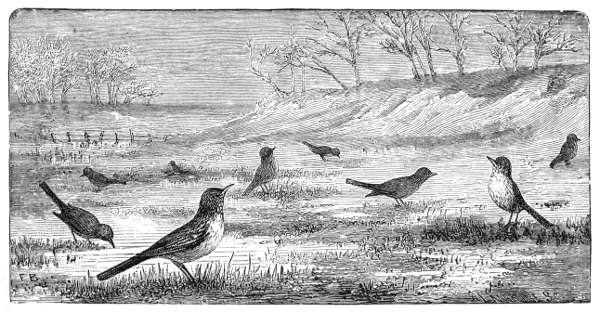 ROBINS IN THE MEADOW