NEW YORK:
HARPER & BROTHERS. 329 & 331 PEARL STREET.
1855.
Entered, according to Act of Congress, in the year 1855, by Harper & Brothers,
In the Clerk’s Office of the Southern District of New York.
PREFACE.
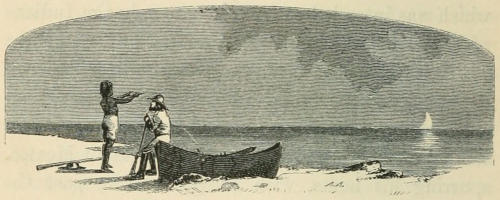
Scene.—A lonely shore.
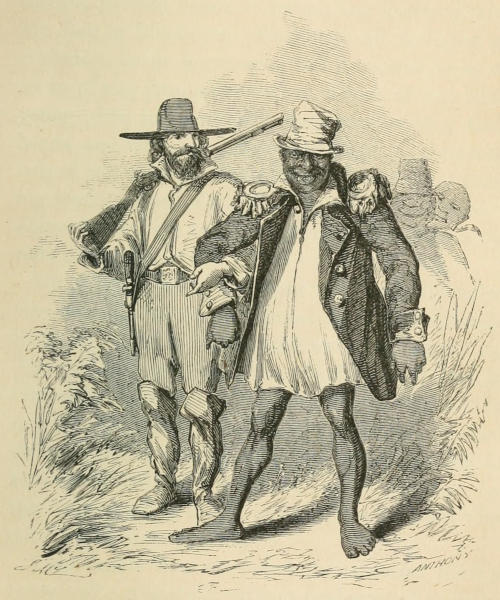
Enter Yankee and Mosquito Man.
Well, my dark friend, who are you?
“Waikna!” A man!
And what is your nation?
“Waikna!” A nation of men!
Pretty good for you, my dark friend! There
was once a great nation—a few old bricks are about
all that remains of it now—whose people were
proud to call themselves —— but then what do
you know about the Romans?
“Him good for drink—him grog?”
Bah! No!
“Den no good! bah, too!”
Exeunt ambo.
Now such a dialogue took place, or might have
taken place, on the Mosquito Shore. For all
artistic purposes it did take place; and, as my
book is chiefly devoted to the Mosquito man and
his country, it shall be called Waikna—a word
that, in the Mosquito tongue, means simply Man,
but which is proudly claimed as the generic
designation of the people of the entire coast.
CONTENTS.
PAGE
CHAPTER I.
Jamaica, and how the Author got there—A solemn Soliloquy—An Artist
Tempted—Painting a Portrait—The Schooner Prince Albert—Captain and
Crew—Antonio—Superstitions—Gathering of the Storm—A Scene of
Terror—The Shipwreck
“El Roncador”—The Escape—Coral Cays—Scene with the Dead—A Night
of Fever—Delirium—Island Scenes—Turtles—A cruel Practice—Sail ho!—An
Encounter—Revolvers versus Knives—Departure from “El Roncador”—Island
of Providence—A Scene of Revelry—Away for the Mainland
Rama Indians—Departure from Bluefields—Canoe Voyage—Strange Companionship—The
“Haulover”—Our first Encampment—Epicurean Episode—Night
under the Tropics—Life on the Lagoons—Pearl Cay Lagoon—Climbing
after Cocoa-Nuts—A Solitary Grave—Mangroves—Soldier
Crabs—Roseate Spoonbill—River Wawashaan—Deserted Plantation—Sambo
Settlement—“A King-Paper”—Extraordinary Reception—Captain
Drummer—King’s House—Vanilla Plant—Philanthropy—A Dance—“Spoiled
Head”—Fire-light Fishing—Night Scene
Visit to the Turtle Cays—Spearing Turtle—Jumping Turtle—Return to the
Lagoon—Off again—Native Indigo—Another Haulover—Tropical Torments—Braving
the Bar—Great River—Temporal Camp—Continuous
Rain—Doleful Dumps—Freaks of the Flood—Rain, Rain!—Craw-Fish—“El
Moro”—The Manzanilla—Guavas—The Release
On the River—Strong Currents—An Indian Village—A Woolwa Welcome—Ceremonious
Reception—Relations of the Indians—Their Habits—A
Tabooed Establishment—Projected Sport—Hunting the Manitus—Habits
of the Animal—The Attack—Great Excitement—Successful Capture—Division
of the Spoil—Instruments of the Chase—Another Epicurean Episode
Departure—The Plantain-Tree—Bisbire—Nocturnal Noises—“Stirring up
the Animals”—At Sea Again—Mollusca of the Caribbean—Walpasixa—The
Moonlit Ocean—Prinza-pulka River—Vines and Verdure—Savannahs—Village
of Quamwatla—Inhospitable Reception—A Retreat—Fatal Encounter—A
Trial of Cunning—Tropical Thunder-Storm—A Second Encounter—The
Fight, and the Triumph—Flight—Asylum in the Forest—The Explanation
Tapir Camp—A Picturesque Retreat—Wild Life—Palm Wine—Queen of the
Forest—Pine Ridges—Parrots and Paroquets—A Fright—“Only a Dante”—Trapping
the Tapir—Successful Result—Narrow Escape—“An Army
with Banners”—Honey-bees—Communion with Nature—Once more on
the Lagoons
Lagoons of the Mosquito Shore—Indians and Sambos—Life among the Lagoons—Aquatic
Birds—Silk-Cotton Tree—Water Plant—Night Traveling—Tongla
Lagoon—Fishing—A Disagreeable Discovery—The Chase—Prospect
of a Fight—Successful Device—Diamond cut Diamond—Safely off—Wava
Lagoon—Attack of Fever—Primitive Physic—Poisonous Reptiles—My
Poyer Boy Bitten—The Cure
Leave Fever Camp—Towkas Indians—Formal Reception—Singular Practices—Towka
Marriage—Extraordinary Ceremonies—Presents Propitiatory—Shouldering
the Responsibility—Marriage Festival—How to get
Drunk—The End of it—Wild Animals—Indian Rabbits—The Curassow—Chachalaca—Gibeonite—River
Turtle—Savory Cooking
Duckwarra Lagoon—Aboriginal Relics—Sandy Bay—Mosquito Fashions—Sambos
of Sandy Bay—General Peter Slam—An English Captain—Brutality—Interference—A
Drunken Debauch—Mishla Drink—Dances and
Songs—A Sukia Woman—Opportune Warning—Hurried Departure—Power
of the Sukias—Making Mishla—A Disgusting Operation
Cape Gracias—Its Inhabitants—Fine Savannah—Sambo Practices—Novel
Mode of Hunting—Island of San Pio—Mangrove Oysters—Trial of the Sukia—A
Mysterious Seeress—Superstitions of the Sambos—Wulasha and
Lewire—Character and Habits of the Mosquitos—Drunkenness—Decrease—Festival
of the Dead—New Plans—River Wanks or Segovia—Iguanas—Armadillos
River Bocay—New Scenery—End of the Savannahs—Indian Village—The
Messenger—A Night Adventure—Sanctuary of the Sukia—Hoxom-Bal,
the Mother of the Tigers—Mysteries—Ruins among the Mountains—Serious
Impressions—A Tale of Wanks River—Harry F. and the Padre of
Pantasma
Up the Cape River—Imposing Scenery—Storm among the Mountains—Influence
of the Moon’s Rays—River Tirolas—Mountain Streams—Picturesque
Embarcadero—A Sweet Encampment—An Accident—Laid up—Send
off the Poyer Boy for Help—Speedy Recovery—Monkeys—An Encounter
with the Pigs—To Eat or to be Eaten, a wide Difference—Return
of the Poyer—Abandonment of the Canoe—“El Moro” again—Ascent of
the Mountains—Another Temporal—Reflections on Fire
The Crest of the Mountains—A Desert Waste—Descent—Rio Guallambre—Gold
Washing—The Poyer Village—Habits of the Poyers—Plantations—Poisoning
Fish—Primitive Arts—Indian Naiads—Patriarchal Government—Departure—Rio
Amacwass—Rio Patuca—“Gateway of Hell”—Approach
to the Sea—Brus Lagoon
Arrival at Brus—A Festival—Hospitality—Loss of the Poyer Boy—Civilization
of the Caribs—Cocoa-Groves—Sanitary Precautions—Wild-Fig or
Banyan-Tree—Habits of the Caribs—Industry—The Mahogany-Cutters—Celebration
of their Return—A Carib Dandy—Polygamy—Singular Practices—A
Carib Crew—Departure—The Bay of Honduras—The Bottom of
the Sea—Island of Guanaja—Night—Sombre Soliloquies—Antonio’s Secret—The
Rousing of the Indians—Deep-laid Schemes of Revenge—The Voice
of the Tiger in the Mountains
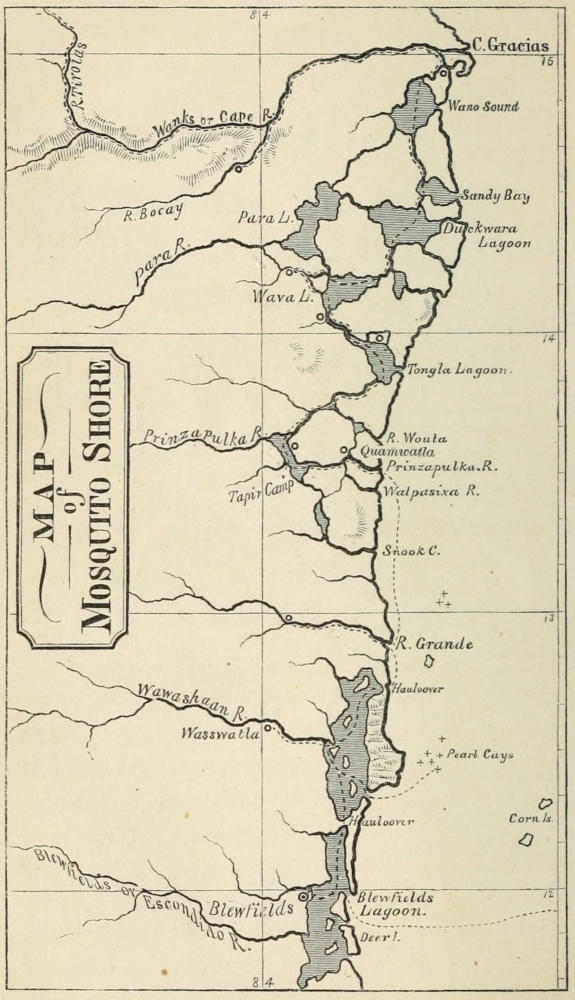
The route of the author is indicated in the Map by a dotted line.
THE MOSQUITO SHORE. — Chapter I.
A month in Jamaica is enough
for any sinner’s punishment,
let alone that of a tolerably
good Christian. At any rate,
a week had given me a surfeit of Kingston, with
its sinister, tropical Jews, and variegated inhabitants,
one-half black, one-third brown, and the
balance as fair as could be expected, considering
the abominable, unintelligible Congo-English which
they spoke. Besides, the cholera which seems to
be domesticated in Kingston, and to have become
one of its local institutions, had begun to
spread from the stews, and to invade the more
civilized parts of the town. All the inhabitants,
therefore, whom the emancipation had left rich
enough to do so, were flying to the mountains,
with the pestilence following, like a sleuth-hound,
at their heels. Kingston was palpably no place
for a stranger, and that stranger a poor-devil artist.
The cholera had cheated me of a customer. I
was moody, and therefore swung myself in a
hammock, lit a cigar, and held a grand inquisition
on myself, as the poets are wont to do on their
souls. It ran after this wise, with a very little noise
but much smoke:—
“Life is pleasant at twenty-six. Do you like
life?”
Rather.
“Then you can’t like the cholera?”
No!—with a hurried pull at the cigar.
“But you’ll have it here!”
Then I’ll be off!
“Where?”
Any where!
“Good, but the exchequer, my boy, how about
that? You can’t get away without money.”
There was a long pause, a great cloud of smoke,
and much swinging in the hammock, and a final
echo—
Money! Yes, I must have money!
So I got up, spasmodically opened my portmanteau,
dived deep amongst collars, pencils and foul
linen, took out my purse, turned its contents on the
table, and began to count.
Forty-three and a half, forty-four, forty-five, and
this handful of small silver and copper. Call it
fifty in all.
“Only fifty dollars!” ejaculated my mental interrogator.
Only fifty! responded I.
“’Twon’t do!”
I lit another cigar. It was clear enough, it
wouldn’t do; and I got into the hammock again.
Commend me to a hammock, (a pita hammock,
none of your canvas abominations,) and a cigar, as
valuable aids to meditation and self-communion of
all kinds. There was a long silence, but the inquisition
went on, until the cigar was finished.
Finally “I’ll do it!” I exclaimed, in the voice of a
man determined on some great deed, not agreeable
but necessary, and I tossed the cigar stump
out of the window. But what I determined to do,
may seem no great thing after all; it was only to
paint the portrait of my landlady.
“Yes, I’ll paint the old wench!”
Now, I am an artist, not an author, and have
got the cart before the horse, inasmuch as my
narrative does not preserve the “harmonies,” as
every well-considered composition should do. It
has just occurred to me that I should first have
told who I am, and how I came to be in Jamaica,
and especially in that filthy place, Kingston. It
isn’t a long story, and if it is not too late, I will
tell it now.
As all the world knows, there are people who sell
rancid whale oil, and deal in soap, and affect a
great contempt for artists. They look down grandly
on the quiet, pale men who paint their broad red
faces on canvas, and seem to think that the few
greasy dollars which they grudgingly pay for their
flaming immortality, should be received with meek
confusion and blushing thanks, as a rare exhibition
of condescension and patronage. I never liked such
patronage, and therefore would paint no red faces.
But there is a great difference between red, bulbous
faces, and rosy faces. There was that sweet girl at
the boarding-school in L—— Place, the Baltimore
girl, with the dark eyes and tresses of the South,
and the fair cheek and elastic step of the North!
Of course, I painted her portrait, a dozen times at
least, I should say. I could paint it now; and I
fear it is more than painted on my heart, or it
wouldn’t rise smiling here, to distract my thoughts,
make me sigh, and stop my story.
An artist who wouldn’t paint portraits and had
a soul above patronage—what was there for him to
do in New York? Two compositions a year in the
Art Union, got in through Mr. Sly, the manager,
and a friend of mine, were not an adequate support
for the most moderate man. I’ll paint grand historical
paintings, thought I one day, and straightway
purchased a large canvas. I had selected my
subject, Balboa, the discoverer of the Pacific, bearing
aloft the flag of Spain, rushing breast-deep in
its waves, and claiming its boundless shores and
numberless islands for the crown of Castile and
Leon. I had begun to sketch in the plumed Indians,
gazing in mute surprise upon this startling
scene, when it occurred to me—for I have patches
of common sense scattered amongst the flowery
fields of my fancy—to count over the amount of
my patrimonial portion. Grand historical paintings
require years of study and labor, and I found I had
but two hundred dollars, owed for a month’s lodging,
and had an unsettled tailor’s account. It was
clear that historical painting was a luxury, for the
present at least, beyond my reach. It was then
some evil spirit, (I strongly suspect it was the ——,)
taking the cue doubtless from my projected picture,
suggested:—
“Try landscape, my boy; you have a rare hand
for landscapes—good flaming landscapes, full of
yellow and vermillion, you know!”
Although there was no one in the room, I can
swear to a distinct slap on the back, after the emphatic
“you know” of the tempter. It was a true
diabolical suggestion, the yellow and vermillion,
but not so sulphurous as what followed:—
“Go to the tropics boy, the glorious tropics,
where the sun is supreme, and never shares his dominion
with blue-nosed, leaden-colored, rheumy-eyed
frost-gods; go there, and catch the matchless
tints of the skies, the living emerald of the forests,
and the light-giving azure of the waters; go where
the birds are rainbow-hued, and the very fish are
golden; where—”
But I had heard enough; I was blinded by the
dazzling panorama which Fancy swept past my
vision, and cried, with enthusiastic energy,
“Hold; I’ll go to the glorious tropics!”
And I went—more’s the pity—in a little dirty
schooner, full of pork and flour; and that is the
way I came to be in Jamaica, dear reader, if you
want to know. I had been there a month or more,
and had wandered all over the really magnificent
interior, and filled my portfolio with sketches. But
that did not satisfy me; there were other tropical
lands, where Nature had grander aspects, where
there were broad lakes and high and snow-crowned
volcanoes, which waved their plumes of smoke in
mid-heaven, defiantly, in the very face of the sun;
lands through whose ever-leaved forests Cortez,
Balboa, and Alvarado, and Cordova had led their
mailed followers, and in whose depths frowned the
strange gods of aboriginal superstition, beside the
deserted altars and unmarked graves of a departed
and mysterious people. Jamaica was beautiful certainly,
but I longed for what the transcendentalists
call the sublimely-beautiful, or, in plain English,
the combined sublime and beautiful—for, in short,
an equatorial Switzerland. And, although Jamaica
was fine in scenery, its dilapidated plantations, and
filthy, lazy negroes, already more than half relapsed
into native and congenial barbarism, were repugnant
to my American notions and tastes. They
grinned around me, those negroes, when I ate, and
scratched their heads over my paper when I drew.
They followed me every where, like black jackals,
and jabbered their incomprehensive lingo in my
ears until they deafened me. And then their odor
under tropical heats! Faugh! “’Twas rank, and
smelt to heaven!”
I had, therefore, come down from the interior to
set up my easel in Kingston, paint a few views, and
thereby raise the wind for a trip to the mainland.
Of course, I did not fly from painting red-faced
portraits in the United States, to paint ebony ones
in Jamaica. My scruples, however, did not apply
to customers. There was a “brown man,” which is
genteel Jamaican for mulatto, who was an Assembly-man,
or something of the kind, and wanted a
view of the edifice at Spanish-town, wherein he
legislated for the “emancipated island.” I had
agreed to paint it for the liberal compensation of
twenty pounds. But one hot, murky morning, my
brown lawgiver took the cholera, and before noon
was not only dead, but buried—and my picture
only half-finished! Mem. As people have a practice
of dying, always get your pay beforehand.
Voltaire, I believe, has said, that if a toad were
asked his ideal of beauty, he would, most likely,
describe himself, and dwell complacently on a cold,
clammy, yellow belly, a brown, warty, corrugated
back, and become ecstatic on the subject of goggle
eyes. And, I verily believe, that if my landlady
had been asked the same question, she would have
coquettishly patted up her woolly curls over each
oleaginous cheek, and glanced toward the mirror, by
way of reply. Black, glossy black, and fat, marvelously
fat, yet she was possessed, even she, of her
full share of feminine vanity. There was no mistaking,
from the first day of my arrival, that her
head was running on a portrait of herself. She was
fond of money and penurious, and careful, therefore,
not to venture upon a proposition until she
had got some kind of a clew as to what her immortality
would be likely to cost. I had, however,
diplomatically evaded all of her approaches, up to
the unfortunate day when my Assembly-man died.
She brought me the news herself, and saw that it
annoyed rather than shocked me, and that I stopped
painting with the air of a man abandoning a
bad job. She evidently thought the time favorable
for a coup de main; there was a gleam of cunning
in her little, round, half-buried eyes, and the very
ebony of her cheek lightened palpably, as she said:
“So your picture will be no good for nothing?”
No!
“You have not got the——?”
And she significantly rubbed the forefinger of
one hand in the palm of the other.
No!
There was a pause, and then she resumed:
“I want a picture!”
Eh?
“A picture, you know!”
And now she complacently stroked down her broad
face, and exhibited a wide, vermillion chasm, with
a formidable phalanx of ivories, by way of a suggestive
smile.
No, I never paint portraits!
“Not for ten pounds?”
No; nor for a hundred,—go!
And my landlady rolled herself out of the room
with a motion which, had she weighed less than
two hundred, might have passed for a toss.
It was on the evening of this day, and after this
conversation, one half of the Assembly-house at
Spanish-town staring redly from the canvas in the
corner, that I lay in my hammock and soliloquized
as aforesaid. It was thus and then, that I resolved
to paint my landlady.
And having now, by means of this long parenthesis,
restored the harmonies of my story, and got
my horse and cart in correct relative positions, I am
ready to go ahead.
I not only resolved to paint my landlady, but I
did it, right over the half-finished Assembly-house.
It was the first, and, by the blessing of Heaven, so
long as there are good potatoes to be dug at the
rate of six cents the bushel, it shall be my last portrait.
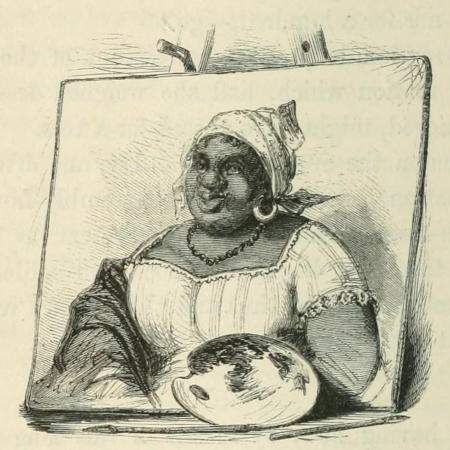
I can not help laughing, even now, at that
fat, glistening face, looking for all the world as if
it had been newly varnished, surmounted by a
gaudy red scarf, wound round the head in the form
of a peaked turban; and two fat arms, rolling
down like elephants’ trunks against a white robe
for a background, which concealed a bust that
passeth description. That portrait—“long may it
wave!” as the man said, at the Kossuth dinner,
when he toasted “The day we celebrate!”
MY LANDLADY.
My landlady was satisfied, and generous withal,
for she not only paid me the ten pounds, and gave
me my two weeks board and lodging in the bargain,
but introduced me to a colored gentleman, a friend
of hers, who sailed a little schooner twice a year to
the Mosquito Shore, on the coast of Central America,
where he traded off refuse rum and gaudy cottons
for turtle-shells and sarsaparilla. There was a
steamer from Kingston, once a month, to Carthagena,
Chagres, San Juan, Belize, and “along
shore;” but, for obvious reasons, I could not go
in a steamer. So I struck up a bargain with the
fragrant skipper, by the terms of which he bound
himself to land me, bag and baggage, at Bluefields,
the seat of Mosquito royalty, for the sum of three
pounds, “currency.”
Why Captain Ponto (for so I shall call my landlady’s
friend, the colored skipper) named his little
schooner the “Prince Albert,” I can not imagine,
unless he thought thereby to do honor to the Queen-Consort;
for the aforesaid schooner had evidently
got old, and been condemned, long before that lucky
Dutchman woke the echoes of Gotha with his baby
cries. The “Prince Albert” was of about seventy
tons burden, built something on the model of the
“Jung-frau,” the first vessel of the Netherlands
that rolled itself into New York bay, like some unwieldy
porpoise, after a rapid passage of about six
months from the Hague. The wise men of the
Historical Society have satisfactorily shown, after
long and diligent research, that the “Jung-frau”
measured sixty feet keel, sixty feet beam, and
sixty feet hold, and was modeled after one of
Rubens’ Venuses. The dimensions of the “Prince
Albert” were every way the same, only twenty feet
less. The sails were patched and the cordage
spliced, and she did not leak so badly as to require
more than six hours’ steady pumping out of the
twenty-four. The crew was composed of Captain
Ponto, Thomas, his mate, one seaman, and an Indian
boy from Yucatan, whose business it was to
cook and do the pumping. As may be supposed,
the Indian boy did not rust for want of occupation.
It was a clear morning, toward the close of December,
that Captain Ponto’s wife, a white woman,
with a hopeful family of six children, the three eldest
with shirts, and the three youngest without,
came down to the schooner to see us off. I watched
the parting over the after-bulwarks, and observed
the tears roll down Mrs. Ponto’s cheeks as she bade
her sable spouse good-by. I wondered if she really
could have any attachment for her husband, and if
custom and association had utterly worn away the
natural and instinctive repugnance which exists between
the superior and inferior races of mankind?
I thought of the condition of Jamaica itself, and
mentally inquired if it were not due to a grand,
practical misconception of the laws of Nature, and
the inevitable result of their reversal? It can not
be denied that where the superior and inferior races
are brought in contact, and amalgamate, there we
uniformly find a hybrid stock springing up, with
most, if not all of the vices, and few, if any of the
virtues of the originals. And it will hardly be questioned,
by those experimentally acquainted with the
subject, that the manifest lack of public morality and
private virtue, in the Spanish-American States, has
followed from the fatal facility with which the Spanish
colonists have intermixed with the negroes and
Indians. The rigid and inexorable exclusion, in respect
to the inferior races, of the dominant blood
of North America, flowing through different channels
perhaps, yet from the same great Teutonic
source, is one grand secret of its vitality, and the
best safeguard of its permanent ascendency.
Mrs. Ponto wept; and as we slowly worked our
way outside of Port Royal, I could see her waving
her apron, for she was innocent of a more classical
signal, in fond adieus. We finally got out from
under the lee of the land, and caught in our sails
the full trade-wind, blowing steadily in the desired
direction. I sat long on deck, watching the
receding island sinking slowly in the bright sea,
until Captain Ponto signified to me, in the patois
of Jamaica, which the deluded people flatter themselves
is English, that dinner was ready, and led
the way into what he called the cabin. This cabin
was a little den, seven feet by nine at the utmost,
low, dark and dirty, with no light or air except
what entered through the narrow hatchway, and,
consequently, hot as an oven. Two lockers, one on
each side, answered for seats by day, and, covered
with suspicious mattresses, for beds by night. The
cabin was sacred to Captain Ponto and myself, the
mate having been displaced to make room for the
gentleman who had paid three pounds for his passage!
I question if the “Prince Albert” had ever
before been honored with a passenger; certainly not
since she had come into the hands of Captain Ponto,
who therefore put his best foot forward, with a full
consciousness of the importance of the incident.
Ponto had been a slave once, and was consequently
imperious and tyrannical now, toward all people in
a subordinate relation to himself. Yet, as he had
evidently been owned by a man of consequence, he
had not entirely lost his early deference for the
white man, and sometimes forgot Ponto the captain
in Ponto the chattel. It was in the latter
character only, that he was perfectly natural;
and, although I derived no little amusement from
his attempts to enact a loftier part, I shall not
trouble the reader with an episode on Captain
Ponto. He was a very worthy darkey, with a
strong aversion to water, both exteriorly and internally.
The mate, and the man who constituted
the crew, were ordinary negroes of no possible account.
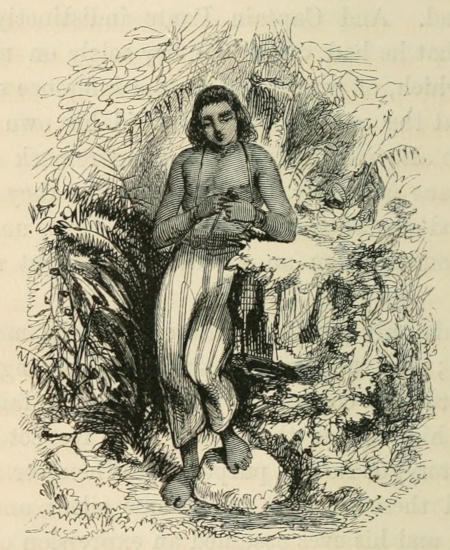
But Antonio, the Indian boy, who cooked and
pumped, and then pumped and cooked—I fear he
never slept, for when there was not a “sizzling” in
the little black caboose, there was sure to be a
screeching of the rickety pump—Antonio attracted
my interest from the first; and it was increased
when I found that he spoke a little English, was
perfect in Spanish, and withal could read in both
languages. There was something mysterious in
finding him among these uncouth negroes, with
his relatively fair skin, intelligent eyes, and long,
well-ordered, black hair. He was like a lithe
panther among lumbering bears; and he did
his work in a way which accorded with his Indian
character, without murmur, and with a kind
of silent doggedness, that implied but little respect
for his present masters. He seldom replied
to their orders in words, and then only in monosyllables.
I asked Captain Ponto about him, but
he knew nothing, except that he was from Yucatan,
and had presented himself on board only the day
previously, and offered to work his passage to the
main land. And Captain Ponto indistinctly intimated
that he had taken the boy solely on my account,
which, of course, led to the inference on my
part, that the captain ordinarily did his own cooking.
He also ventured a patronizing remark about
the Indians generally, to the effect that they made
very good servants, “if they were kept under;”
which, coming from an ex-slave, I thought rather
good.
ANTONIO.
All this only served to interest me the more in
Antonio; and, although I succeeded in engaging
him in ordinary conversation, yet I utterly failed in
drawing him out, as the saying is, in respect to his
past history, or future purposes. Whenever I approached
these subjects he became silent and impassible,
and his eyes assumed an expression of cold
inquiry, not unmingled with latent suspicion, which
half inclined me to believe that he was a fugitive
from justice. Yet he did not look the felon or
knave; and when the personal inquiries dropped,
his face resumed its usual pleasant although sad
expression, and I became ashamed that I had suspected
him. There was certainly something singular
about Antonio; but, as I could imagine no
very profound mystery attaching to a cook, on
board of the “Prince Albert,” after the first day, I
made no attempts to penetrate his secrets, but
sought rather to attach him to me, as a prospectively
useful companion in the country to which I
was bound. So I relieved him occasionally at the
pump, although he protested against it; and
finally, to the horror of Captain Ponto, and the
palpable high disdain of the mate, I became so intimate
with him as to show him my portfolio of
drawings. His admiration, I found to my surprise,
was always judiciously bestowed, and his appreciation
of outline and coloring showed that he had
the spirit of an artist. Several times, in glancing
over the drawings, he stopped short, looked up, his
face full of intelligence, as if about to speak, and I
paused to listen. Each time, however, the smile
vanished, the flexible muscles ceased their play and
became rigid, and a cold, filmy mist settled over the
clear eyes which had looked into mine. Whatever
was Antonio’s secret, great or small, it was evidently
one that he half-wished, half-feared to reveal.
I was puzzled to think that there could
exist any relation between it and my paintings;
but Antonio was only a cook, and so I dismissed all
reflection on the subject.
On our third day out, the weather, which up to
that time had been clear and beautiful, began to
change, and night settled black and threatening
around us. The wind had increased, but it was
loaded with sultry vapors—the hot breath of the
storm which was pressing on our track. Captain
Ponto was not a scientific sailor, and kept no other
than what is called “dead reckoning.” He had
made the voyage very often, and was confident of
his course. Upon that point, therefore, I gave
myself no uneasiness; not so much from faith in
Captain Ponto, as because there was nothing in the
world to be done, except to follow his opinion.
Nevertheless the captain was serious, and consulted
an antediluvian chart which he kept in his cabin.
It was a Rembrandtish picture, that negro tracing
his forefinger slowly over the chart, by the light of
a candle, which only half revealed the little cabin,
while it brought out his grizzly head and anxious
face in strong relief against the darkness. What
Captain Ponto learned from all this study is more
than I can tell; but when he came on deck, he
ordered a reef to be made in the sails, and a
variation of several points in our course, for the
wind not only freshened, but veered to the north-east.
The hot blasts or puffs of air became more
and more frequent, and occasional sheets of lightning
gleamed along the horizon. The sea, too,
was full of phosphorescent light; fiery monsters
seemed to leap around us and wreath and twine
their livid volumes in our wake. I could hear the
hiss of their forked tongues where the waters closed
under our stern. I stood, leaning over the bulwarks,
gazing on the gleaming waves, and thinking
of home—for the voyager on the great deep always
thinks of home, when darkness envelops him, and
the storm threatens—when Antonio silently approached,
so silently that I did not hear him,
and took his place at my side. I was somewhat
startled, therefore, when, changing my position a
little, I saw, by the dim, reflected light of the sea,
his eyes fixed earnestly on mine. “Ah, Antonio,” I
said, “is that you?” and I placed my hand familiarly
on his shoulder. He shrank beneath it, as if it
had been fire. “What’s the matter?” I exclaimed,
reproachfully; “have I hurt you?”
“Pardon me!” he ejaculated, rather than spoke,
in a voice deep and tremulous; “I know now that
it is not you who will die to-night!”
“What do you mean? You are not afraid, Antonio?
Who thinks of dying?” I replied, in a light
tone.
“No! it is not myself. I was afraid it might be
you; for, sir,” and he laid a hand cold and clammy
as that of a corpse on mine; “for, sir, there is
death on board this vessel!”
This was said in a voice so awed and earnest that
I was impressed deeply, in spite of myself, and for
some moments made no reply. “You talk wildly,
Antonio,” I finally said; “we are going on bravely,
and shall all be in Bluefields together in a day or
two.”
“All of us, never,” he replied, “never! The Lord,
who never lies, has told me so!” and, pressing near
me, he drew from his bosom something resembling
a small, round plate of crystal, except that it
seemed to be slightly luminous, and veined or
clouded with green. “See, see!” he exclaimed,
rapidly, and held the object close to my eyes. I
instinctively obeyed, and gazed intently upon it.
As I gazed, the clouds of green seemed to concentrate
and assume a regular form, as the moisture of
one’s breath passes away from a mirror, until I
distinctly saw, in the center, the miniature of a
human head, of composed and dignified aspect, but
the eyes were closed, and all the lineaments had the
rigidity of death.
“Do you see?”
“I do!”
“It is Kucimen, the Lord who never lies!” and
Antonio thrust his talisman in his bosom again,
and slowly moved away. There was no mistake in
what I had seen, and although I am not superstitious,
yet the feeling that some catastrophe was
impending gathered at my heart. It was in vain
that I tried to smile at the Indian trick; the earnest
voice of the Indian boy still sounded in my ears,
“All of us, never!” What reason should he have
for attempting to practice his Indian diablerie
on any one, least of all on me? I rejected the
thought, and endeavored to banish the subject from
my mind.
Meanwhile the wind had gathered strength, and
Captain Ponto had taken in sail, so that we had no
more standing than was necessary to keep the vessel
steady before the wind. The waves now began to
rise, the gloom deepened, the hot puffs of air
became more and more frequent, and the broad
lightning-sheets rose from the horizon to the very
zenith. The thunder, too, came rolling on, every
peal more distinctly, and occasional heavy drops of
rain fell with an ominous sound on the deck. The
storm was evidently close at hand; and I left the
side of the vessel, and approached the little cabin
to procure my poncho, for I preferred the open deck
and the storm to the suffocation below. The hatchway
was nearly closed, but there was a light within.
I stooped to remove the slide, and in doing so
obtained a full view of the interior. The spectacle
which presented itself was so extraordinary that I
stopped short, and looked on in mute surprise.
The candle was standing on the locker, and kneeling
beside it was the captain. He was stripped to
the waist, and held in one hand what appeared to
be the horn of some animal, in which he caught the
blood which dripped from a large gash in the fleshy
part of his left arm, just above the elbow, while he
muttered rapidly some rude and strangely-sounding
words, unlike any I had ever before heard. My
first impression was that Antonio had tried to fulfill
his own prediction, by attempting the life of the
captain; but I soon saw that he was performing
some religious rite, a sacrifice or propitiation, such
as the Obi men still teach in Jamaica and Santo
Domingo, and which are stealthily observed, even by
the negroes professing Christianity and having a
nominal connection with the church. I recognized
in the horn the mysterious gre-gre of the Gold Coast,
where the lowest form of fetish worship prevails,
and where human blood is regarded as the most
acceptable of sacrifices. Respecting too rigidly all
ceremonies and rites, which may contribute to the
peace of mind of others, to think of disturbing them,
I silently withdrew from the hatchway, and left the
captain to finish his debasing devotions. In a short
time he appeared on deck, and gave some orders in
a calm voice, as one reassured and confident.
I was occupied below for only a few minutes,
yet when I got on deck again the storm was upon
us. The waves were not high, but the water
seemed to be caught up by the wind, and to be
drifted along, like snow, in blinding, drenching
sheets. I was nearly driven off my feet by its
force, and would have been carried overboard had I
not become entangled in the rigging. The howling
of the wind and the hissing of the water would have
drowned the loudest voice, and I was so blinded by
the spray that I could not see. Yet I could feel
that we were driving before the hurricane with
fearful rapidity. The very deck seemed to bend, as
if ready to break, beneath our feet. I finally sufficiently
recovered myself to be able, in the pauses of
the wind, and when the lightning fell, to catch
glimpses around me. Our sails were torn in tatters,
the yards were gone, in fact every thing was swept
from the deck except three dark figures, like myself,
clinging convulsively to the ropes. On, on, half-buried
in the sea, we drifted with inconceivable
rapidity.
Little did we think that we were rushing on a
danger more terrible than the ocean. The storm had
buffeted us for more than an hour, and it seemed as
if it had exhausted its wrath, and had begun to
subside, when a sound, hoarse and steady, but
louder even than that of the wind, broke on our
ears. It was evident that we were approaching it,
for every instant it became more distinct and ominous.
I gazed ahead into the hopeless darkness,
when suddenly a broad sheet of lightning revealed
immediately before us, and not a cable’s length
distant, what, under the lurid gleam, appeared to
be a wall of white spray, dashing literally a hundred
feet in the air—a hell of waters, from which
there was no escape. “El Roncador!” shrieked the
captain, in a voice of utter despair, that even then
thrilled like a knife in my heart. The fearful
moment of death had come, and I had barely time
to draw a full breath of preparation for the struggle,
when we were literally whelmed in the raging
waters. I felt a shock, a sharp jerk, and the hiss
and gurgle of the sea, a sensation of immense
pressure, followed by a blow like that of a heavy
fall. Again I was lifted up, and again struck
down, but this time with less force. I had just
enough consciousness left to know that I was striking
on the sand, and I made an involuntary effort
to rise and escape from the waves. Before I could
gain my feet I was again struck down, again and
again, until, nearer dead than alive, I at last succeeded
in crawling to a spot where the water did
not reach me. I strove to rise now, but could not;
and, as that is the last thing I remember distinctly
of that terrible night, I suppose I must have fallen
into a swoon.
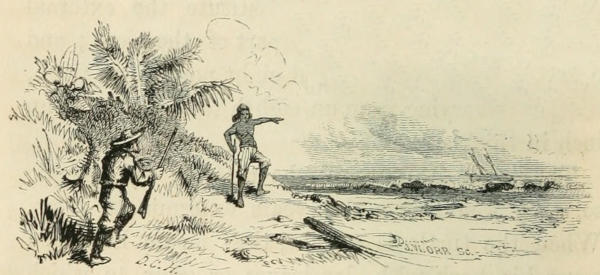
THE SHIPWRECK.
Chapter II.
How long I remained insensible I
know not, but when my consciousness
returned, which it did slowly,
like the lifting of a curtain, I felt
that I was severely hurt; and, before opening my
eyes, tried to drive away my terrible recollections,
as one rousing from a troubled dream tries to banish
its features from his mind. It was in vain;
and, with a sensation of despair, I opened my eyes!
The morning sun was shining with blinding brilliancy,
and I was obliged to close them again.
Soon, however, I was able to bear the blaze, and,
painfully lifting myself on my elbow, looked around
me. The sea was thundering with awful force, not
on the sandy shore where I was lying, but over a
reef two hundred yards distant, within which the
water was calm, or only disturbed by the combing
waves, as they broke over the outer barrier. Here
the first and only object which attracted my attention
was our schooner, lying on her beam ends, high
on the sands. The sea, the vessel, the blinding
sun and glowing sand, and a bursting pain in my
head, were too palpable evidences of my misfortune
to be mistaken. It was no dream, but stern and
severe reality, and for the moment I comprehended
the truth. But, when younger, I had read of shipwrecks,
and listened, with the interest of childhood,
and a feeling half of envy, to the tales of old sailors
who had been cast away on desert shores. And
now, the first shock over, it was almost with a
sensation of satisfaction, and something of exultation,
that I exclaimed to myself, “shipwrecked at
last!” Robinson Crusoe, and Reilly and his companions,
recurred to my mind, and my impulse was
to leap up and commence an emulative career.
But the attempt was a failure, and brought me
back to stern reality, in an instant. My limbs were
torn and scarified, and my face swollen and stiff.
The utmost I could do was to sit erect.
I now, for the first time, thought of my companions,
and despairingly turned my eyes to look for
them. Close by, and nearly behind me, sat Antonio,
resting his head on his hands. His clothes
were hanging around him in shreds, his hair was
matted with sand, and his face was black with
dried blood. He attempted to smile, but the grim
muscles could not obey, and he looked at me in silence.
I was the first to speak:
Are you much hurt, Antonio?
“The Lord of Mitnal never lies!” was his only
response; and he pointed to the talisman on his
swarthy breast, gleaming like polished silver in the
sun. I remembered the scene of the previous night,
and asked;—
Are they all dead?
He shook his head, in sign of ignorance.
Where are we, Antonio?
“This is El Roncador!”
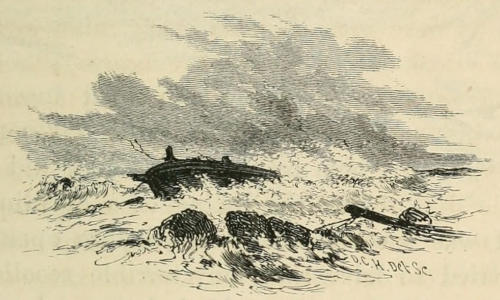
And so it proved. We were on one of the numerous
coral keys or cays which stud the sea of the
Antilles, and which are the terror of the mariners
who navigate it. They are usually mere banks of
sand, elevated a few feet above the water, occasionally
supporting a few bushes, or a scrubby, tempest-twisted
palm or two, and only frequented by the
sea-birds for rest and incubation, and by turtles for
laying their eggs. Around them there is always a
reef of coral, built up from the bottom of the sea by
those wonderful architects, the coral insects. This
reef surrounds the cay, at a greater or less distance,
like a ring, leaving between it and the island proper
a belt of water, of variable depth, and of the
loveliest blue. The reef, which is sometimes scarcely
visible above the sea, effectually breaks the force
of the waves; and if, as it sometimes happens, it
be interrupted so as to leave an opening for the admission
of vessels, the inner belt of water forms a
safe harbor. Except a few of the larger ones, none
of these cays are inhabited, nor are they ever frequented,
except by the turtle fishers.
It was to the peculiar conformation of these
islands that our safety was owing. Our little vessel
had been driven, or lifted by the waves, completely
over the outer reef. The shock had torn us from
our hold on the ropes, and we had drifted upon the
comparatively protected sands. The vessel too,
had been carried upon them, and the waves there
not being sufficiently strong to break her in pieces,
she was left high and dry when they subsided.
There was, nevertheless, a broad break in her keel,
caused probably by striking on the reef.
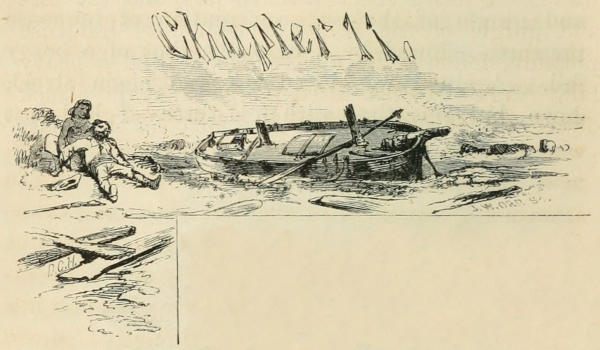
Two of the five human beings who had been on
board of her, the captain and his mate, were drowned.
We found their bodies;—but I am anticipating
my story. When we had recovered ourselves
sufficiently to walk, Antonio and myself took a survey
of our condition. “El Roncador,” the Snorer,
is a small cay, three quarters of a mile long, and at
its widest part not more than four hundred yards
broad,—a mere bank of white sand. At the eastern
end is an acre or more of scrubby bushes, and
near them three or four low and distorted palm-trees.
Fortunately for us, as will be seen in the
sequel, “El Roncador” is famous for the number
of its turtles, and is frequented, at the turtle season,
by turtle-fishers from Old Providence, and sometimes
from the main land. Among the palm-trees,
to which I have referred, these fishermen had
erected a rude hut of poles, boards, and palm-branches,
which was literally withed and anchored
to the trees, to keep it from being blown away by
the high winds. It was with a heart full of joy
that I saw even this rude evidence of human intelligence,
and, accompanied by Antonio, hastened to it
as rapidly as my bruised limbs would enable me.
We discovered no trace of recent occupation as we
approached, except a kind of furrow in the sand,
like that which some sea-monster, dragging itself
along, might occasion. It led directly to the hut,
and I followed it, with a feeling half of wonder,
half of apprehension. As we came near, however,
I saw, through the open front, a black human figure
crouching within, motionless as a piece of
bronze. Before it, stretched at length, was the
dead body of Captain Ponto. The man was Frank,
of whom I have spoken, as constituting the crew of
the Prince Albert. It was a fearful sight! The
body of the captain was swollen, the limbs were
stiff and spread apart, the mouth and eyes open,
and conveying an expression of terror and utter despair,
which makes me shudder, even now, when I
think of it. Upon his breast, fastened by a strong
cord, drawn close at the throat, was the mysterious
gre-gre horn, and the gash in his arm, from which
the poor wretch had drawn the blood for his unavailing
sacrifice, had opened wide its white edges,
as if in mute appeal against his fate.
The negro sailor had drawn the body of the
captain to the hut, and the trail in the sand was
that which it had made. I spoke to him, but he
neither replied nor looked up. His eyes were fixed,
as if by some fascination, on the corpse. Antonio
exhibited no emotion, but advancing close to the
body lifted the gre-gre horn, eyed it curiously for a
moment, then tossed it contemptuously aside, exclaiming:—
“It could not save him: it is not good!”
The words were scarcely uttered, when the
crouching negro leaped, like a wild beast, at the
Indian’s throat; but Antonio was agile, and evaded
his grasp. The next instant the poor wretch had
returned to his seat beside the dead. The negro
could not endure a sneer at the potency of the
gre-gre. Such is the hold of superstition on the
human mind!
I tried to induce the negro to remove the body,
and bury it in the sand; but he remained silent and
impassible as a stone. So I returned with Antonio
to the vessel, for the instincts of life had come
back. We found, although the little schooner had
been completely filled, that the water had escaped,
and left the cargo damaged, but entire. Some of
the provisions had been destroyed, and the remainder
was much injured. Nevertheless they
could be used, and for the time being, at least, we
were safe from starvation. My spirits rose with the
discovery, and I almost forgot my injuries in the
joy of the moment. But Antonio betrayed no
signs of interest. He lifted boxes and barrels, and
placed them on the sands, as deliberately as if unloading
the vessel at Kingston. I knew that it was
not probable the wrecked schooner would suffer
further damage from the sea, protected as it was
by the outer reef, yet I sought to make assurance
doubly sure, by removing what remained of the
provisions to the hut by the palm-trees. Antonio
suggested nothing, but implicitly followed my directions.
We had got out most of the stores, and carried
them above the reach of the waters on the sands,
when I went back to the hut, with the determination,
by at once assuming a tone of authority, to
have the negro remove and bury the body of
the captain. I was surprised to find the hut
empty, and a trail, like that which had attracted
my notice in the morning, leading off in the direction
of the bushes, at some distance from the hut.
I followed it; and, in the centre of the clump, discovered
the negro filling in the sand above the
corpse. He mumbled constantly strange guttural
words, and made many mysterious signs on the
sand, as he proceeded. When the hole was entirely
filled, he laid himself at length above it. I waited
some minutes, but as he remained motionless, returned
to the hut. We now commenced carrying
to it, such articles of use as could be easily removed.
But we had not accomplished much when Frank, the
negro, presented himself; and, approaching me, inquired
meekly what he should do. He was least
injured of the three, and proved most serviceable in
clearing the wreck of all of its useful and moveable
contents.
By night I had bandaged my own wounds and
those of my companions, and over a simple but
profuse meal, forgot the horrors of the shipwreck,
and gave myself up, with real zest, to the pleasures
of a cast-away! I cannot well describe the sensation
of mingled novelty and satisfaction, with which
I looked out from the open hut upon the turbulent
waters, whence we had so narrowly escaped. The
sea still heaved from the effects of the storm, but
the storm itself had passed, and the full tropical
moon looked down calmly upon our island, which
seemed silvery and fairy-like beneath its rays.
At first, all these things were quieting in their influences,
but as the night advanced I must have become
feverish, for notwithstanding the toils of the
day, and the exhaustion of the previous night, I
could not sleep. My thoughts were never so active.
All that I had ever seen, heard, or done, flashed
back upon my mind with the vividness of reality.
But, owing to some curious psychical condition,
my mind was only retrospectively active; I tried in
vain to bring it to a contemplation of the present
or the future. Incidents long forgotten jostled
through my brain; the grave mingling strangely
with the gay. Now I laughed outright over some
freak of childhood, which came back with primitive
freshness; and, next moment, wept again beside the
bed of death, or found myself singing some hitherto
unremembered nursery rhyme. I struggled against
these thronging memories, and tried to ask myself
if they might not be premonitions of delirium. I
felt my own pulse, it beat rapidly; my own forehead,
and it seemed to burn. In the vague hope of
averting whatever this strange mental activity
might portend, I rose and walked down to the edge
of the water. I remember distinctly that the shore
seemed black with turtles, and that I thought them
creations of a disordered fancy, and became almost
mad under the mere apprehension that the madness
was upon me.
I might, and undoubtedly would, have become
mad, had it not been for Antonio. He had missed
me from the hut; and, in alarm, had come to seek
me. I felt greatly relieved when he told me that
there were real turtles on the shore, and not monsters
of the imagination; and that it was now the
season for laying their eggs, and therefore it could
not be long before the fishers would come for their
annual supply of shells. So I suffered him to lead
me back to the hut. When I laid down he took
my head between his hands, and pressed it steadily,
but apparently with all his force. The effect was
soothing, for in less than half an hour my ideas had
recovered their equilibrium, and I fell into a slumber,
and slept soundly until noon of the following
day.
When I awoke, Antonio was sitting close by me,
and intently watching every movement. He smiled
when my eyes met his, and pointing to his forehead
said significantly—
“It is all right now!”
And it was all right, but I felt weak and feverish
still. A sound constitution, however, resisted all
attacks, and it was not many days before I was able
to move around our sandy prison, and join Antonio
and Frank in catching turtles; for, with more foresight
than I had supposed to belong to the Indian
and negro character, they were laying in a stock of
shells, against the time when we should find an opportunity
of escape. Upon the side of our island, to
which I have alluded as covered with bushes, the
water was comparatively shoal, and the bottom
overgrown with a species of sea-grass, which is a
principal article of turtle-food. The surface of the
water, also, was covered with a variety of small blubber
fish, which Antonio called by the Spanish name
of dedales, or thimbles—a name not inappropriate,
since they closely resembled a lady’s thimble both
in shape and size. These, at the spawning or egg-laying
period of the year, constitute another article
of turtle-food. During the night-time the turtles
crawled up on the shore, and the females dug holes
in the sand, each about two feet deep, in which
they deposited from sixty to eighty eggs. These
they contrived to cover so neatly, as to defy the
curiosity of one unacquainted with their habits.
Both Antonio and Frank, however, were familiar
with turtle-craft, and got as many eggs as we desired.
When roasted, they are really delicious.
The Indians and people of the coasts never destroy
them, being careful to promote the increase of this
valuable shell-fish. But on the main land, wild
animals, such for instance as the cougar, frequently
come down to the shore, and dig them from their
resting places. Occasionally they capture the turtles
themselves, and dragging them into the forest, kill
and devour them, in spite of their shelly armor.
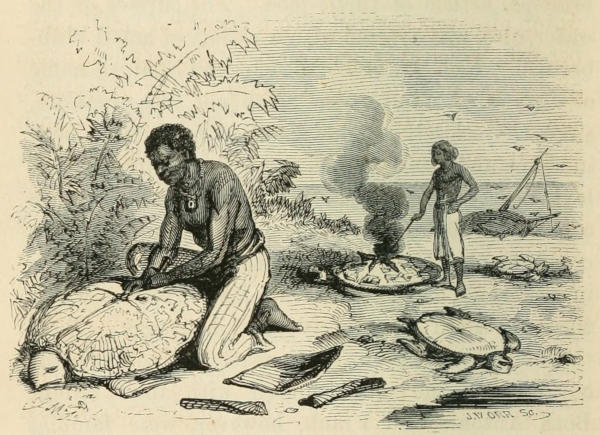
“SHELLING” TURTLES.
It was during the night, therefore, that Antonio
and Frank, who kept themselves concealed in the
bushes, rushed out upon the turtles, and with iron
hooks turned them on their backs, when they became
powerless and incapable of moving. The day
following, they dragged them to the most distant
part of the island, where they “shelled” them;—a
cruel process, which it made my flesh creep to
witness. Before describing it, however, I must explain
that, although the habits of all varieties of
the turtle are much the same, yet their uses are
very different. The large, green turtle is best
known; it frequently reaches our markets, and its
flesh is esteemed, by epicures, as a great delicacy.
The flesh of the smaller or hawk-bill variety is not
so good, but its shell is most valuable, being both
thicker and better-colored. What is called tortoise-shell
is not, as is generally supposed, the bony
covering or shield of the turtle, but only the scales
which cover it. These are thirteen in number,
eight of them flat, and five a little curved. Of the
flat ones four are large, being sometimes a foot
long and seven inches broad, semi-transparent,
elegantly variegated with white, red, yellow, and
dark brown clouds, which are fully brought out,
when the shell is prepared and polished. These
laminæ, as I have said, constitute the external
coating of the solid or bony part of the shell; and
a large turtle affords about eight pounds of them,
the plates varying from an eighth to a quarter of an
inch in thickness.
The fishers do not kill the turtles; did they do
so, they would in a few years exterminate them.
When the turtle is caught, they fasten him, and
cover his back with dry leaves or grass, to which
they set fire. The heat causes the plates to separate
at their joints. A large knife is then carefully
inserted horizontally beneath them, and the laminæ
lifted from the back, care being taken not to
injure the shell by too much heat, nor to force it
off, until the heat has fully prepared it for separation.
Many turtles die under this cruel operation,
but instances are numerous in which they have
been caught a second time, with the outer coating
reproduced; but, in these cases, instead of thirteen
pieces, it is a single piece. As I have already said,
I could never bring myself to witness this cruelty
more than once, and was glad that the process of
“scaling” was carried on out of sight of the hut.
Had the poor turtles the power of shrieking, they
would have made that barren island a very hell,
with their cries of torture.
A SAIL! A SAIL!
We had been nearly two weeks on the island,
when we were one morning surprised by a sail on
the edge of the horizon. We watched it eagerly,
and as it grew more and more distinct, our spirits
rose in proportion. Its approach was slow, but at
noon Frank declared that
it was a turtle schooner,
from the island of Catarina
or Providence, and that it was making for “El
Roncador.” And the event proved that he was
right; for, about the middle of the afternoon,
she had passed an opening through the reef, and
anchored in the still water inside. She had a crew
of five men, in whom it was difficult to say if
white, negro, or Indian blood predominated. They
spoke a kind of patois, in which Spanish was the
leading element. And although we were unqualifiedly
glad to see them, yet they were clearly not
pleased to see us. The patrón, or captain, no
sooner put his foot on shore, than affecting to regard
us as intruders, he demanded why we were
there? and if we did not know that this island
was the property of the people of Catarina? We
replied by pointing to our shattered schooner, when
the whole party started for it, and unceremoniously
began to strip it of whatever article of use or
value they could find, leaving us to the pleasant
reflections which such conduct was likely to suggest.
While this was going on, I returned to the hut,
and found that Antonio and Frank had already removed
the shells which they had procured, as also
some other valuables which we had recovered from
the wreck, and had buried them in the sand—a
prudent precaution, which no doubt saved us much
trouble. A little before sundown, our new friends,
having apparently exhausted the plunder, came
trooping back to the hut, and without ceremony ordered
us out. I thought, although the physical
force was against us, that a little determination
might make up for the odds, and firmly replied that
they might have a part of it, if they wished, but
that we were there, and intended to remain. The
patron hereupon fell into a great passion, and told
his men to bring up the machétes—ugly instruments,
half knife, half cleaver. “He would see,”
he said, in his mongrel tongue, “if this white villain
would refuse to obey him.” Two of the men
started to fulfill his order, while he stood scowling
in the doorway. When they had got off a little distance,
I unrolled a blanket in which I had wrapped
our pistols, and giving one to Frank, and another
to Antonio, I took my own revolver, and passed
outside of the hut. The patron fell back, in evident
alarm.
“Now, amigo,” said I, “if you want a fight,
you shall have it; but you shall die first!” And I
took deliberate aim at his breast, at a distance of
less than five yards. “Mother of Mercy!” he exclaimed,
and glanced round, as if for support, to
his followers. But they had taken to their legs,
without waiting for further proceedings. The
patron attempted to follow, but I caught him by
the arm, and pressed the cold muzzle of the pistol
to his head. He trembled like an aspen, and sunk
upon the ground, crying in most abject tones for
mercy. I released him, but he did not attempt to
stir. The circumstances were favorable for negotiation,
and in a few minutes it was arranged that we
should continue to occupy the hut, and that he
should remain with us, while his crew should stay
on board the vessel, when not engaged in catching
turtles. He did not like the exception in his favor;
but, fearing that he might pull up anchor and leave
us to our fate, I insisted that I could not forego the
pleasure of his company.
The reader may be sure that I had a vigilant eye
on our patron, and at night either Antonio or
Frank kept watch, that he should not give us the
slip. He made one or two attempts, but finding us
prepared, at the end of a couple of days, resigned
himself to his fate. Contenting ourselves with our
previous spoil, we allowed the new comers to pursue
the fishery alone. At the end of a week I
discovered, by various indications, that the season
was nearly over, and, accordingly, making a careless
display of my revolver, told the captain that I
thought it would be more agreeable for us to go on
board his schooner, than to remain on shore. I
could see that the proposition was not acceptable,
and therefore repeated it, in such a way that
there was no alternative but assent left. He was a
good deal surprised when he discovered the amount
of shells which we had obtained; and when I told
him that he should have half of it, for carrying us
to Providence, and the whole if he took us to Bluefields,
his good nature returned. He asked pardon
for his rudeness, and, slapping his breast, proclaimed
himself “un hombre bueno,” who would
take us to the world’s end, if I would only put up
my horrible pistol. That pistol, from the very first
day, had had a kind of deadly fascination for the
patron, who watched it, as if momentarily expecting
it to discharge itself at his head. And even now,
when he alluded to it, a perceptible shudder ran
through his frame.
Two days after I had taken up my quarters on
board of the little schooner, which, in age and accumulated
filth, might have been twin-brother of the
Prince Albert, we set sail from “El Roncador.”
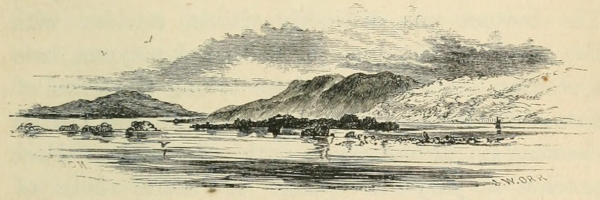
As it receded in the distance, it looked very beautiful—an
opal in the sea—and I could hardly realize
that it was nothing more than a reef-girt heap of
desert sands.
Although friendly relations had been restored
with the patron, for the crew seemed nearly passive,
I kept myself constantly on my guard against foul
play. Antonio was sleeplessly vigilant. But the
patron, so far from having evil designs, appeared
really to have taken a liking to me, and expatiated
upon the delights of Providence, where he represented
himself as being a great man, with much uncouth
eloquence. He promised that I should be
well received, and that he would himself get up a
dance—which he seemed to think the height of
civility—in my honor.
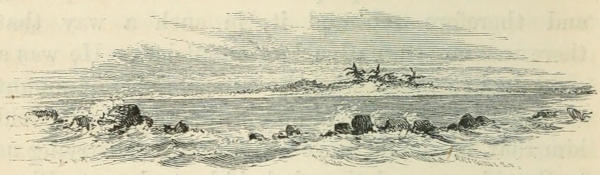
“EL RONCADOR.”
About noon, on our third day from “El Roncador,”
the patron pointed out to me two light blue
mounds, one sharp and conical, and the other round
and broad, upon the edge of the horizon. They
were the highlands of Providence. Before night,
we had doubled the rocky headland of Santa Catarina,
crowned with the ruins of some old Spanish
fortifications, and in half an hour were at anchor,
alongside a large New Granadian schooner, in the
small but snug harbor of the island.
This island is almost unknown to the world; it
has, indeed, very little to commend it to notice.
Although accounted a single island, it is, in fact,
two islands; one is six or eight miles long, and
four or five broad, and but moderately elevated;
while the second, which is a rocky headland, called
Catarina, is separated from the main body by a
narrow but deep channel. The whole belongs to
New Granada, and has about three hundred inhabitants,
extremely variegated in color, but with a
decided tendency to black. This island was a
famous resort of the pirates, during their predominance
in these parts, who expelled the Spaniards,
and built defences, by means of which they several
times repelled their assailants.
The productions consist chiefly of fruits and vegetables;
a little cotton is also raised, which, with the
turtle-shells collected by the inhabitants, constitutes
about the only export of the island. Vessels coming
northward sometimes stop there, for a cargo of
cocoa-nuts and yucas.
As can readily be imagined, the people are very
primitive in their habits, living chiefly in rude,
thatched huts, and leading an indolent, tropical
life, swinging in their hammocks and smoking by
day, and dancing, to the twanging of guitars, by
night. My patron, whom I had suspected of being
something of a braggart, was in reality a very considerable
personage in Providence, and I was received
with great favor by the people, to whom he
introduced me as his own “very special friend.” I
thought of our first interview on “El Roncador,”
but suppressed my inclination to laugh, as well as I
was able. True to his promise, the second night
after our arrival was dedicated to a dance. The
only preparation for it consisted in the production
of a number of large wax candles, resembling
torches in size, and the concoction of several big
vessels of drink, in which Jamaica rum, some fresh
juice of the sugar-cane, and a quantity of powdered
peppers were the chief ingredients. The music
consisted of a violin, two guitars and a queer Indian
instrument, resembling a bow, the string of which,
if the critic will pardon the bull, was a brass wire
drawn tight by means of a perforated gourd, and
beaten with a stick, held by the performer, between
his thumb and forefinger.
I cannot attempt to describe the dance, which,
not over delicate at the outset, became outrageous
as the calabashes of liquor began to circulate.
Both sexes drank and danced, until most could
neither drink nor dance; and then, it seemed to me,
they all got into a general quarrel, in which the
musicians broke their respective instruments over
each other’s heads, then cried, embraced, and were
friends again. I did not wait for the end of the debauch,
which soon ceased to be amusing; but, with
Antonio, stole away, and paddled off to the little
schooner, where the last sounds that rung in my ears
were the shouts and discordant songs of the revelers.
Providence, it can easily be understood, offered
few attractions to an artist minus the materials for
pursuing his vocation; and I was delighted when I
learned that the New Granadian schooner was on
the eve of her departure for San Juan de Nicaragua.
Her captain readily consented to land me at
Bluefields, and our patron magnificently waived all
claims to the tortoise-shells which we had obtained
at “El Roncador.” I had no difficulty in selling
them to the captain of “El General Bolivar” for the
unexpected sum of three hundred dollars. Fifty
dollars of these I gave to the negro Frank, who was
quite at home in Providence. I offered to divide
the rest with Antonio, but he refused to receive any
portion of it, and insisted on accompanying me
without recompense. “You are my brother,” said
he, “and I will not leave you.” And here I may
add that, in all my wanderings, he was my constant
companion and firm and faithful friend. His history,
a wild and wonderful tale, I shall some day
lay before the world: for Antonio was of regal
stock, the son and lieutenant of Chichen Pat, one
of the last and bravest of the chiefs of Yucatan,
who lost his life, under the very walls of Merida, in
the last unsuccessful rising of the aborigines; and I
blush to add that the fatal bullet, which slew the
hope of the Indians, was sped from the rifle of an
American mercenary!
Chapter III.
The approach to the coast, near
Bluefields, holds out no delusions.
The shore is flat, and in all respects tame and uninteresting.
A white line of sand, a green belt of
trees, with no relief except here and there a solitary
palm, and a few blue hills in the distance, are
the only objects which are offered to the expectant
eyes of the voyager. A nearer approach reveals a
large lagoon, protected by a narrow belt of sand,
covered, on the inner side, with a dense mass of
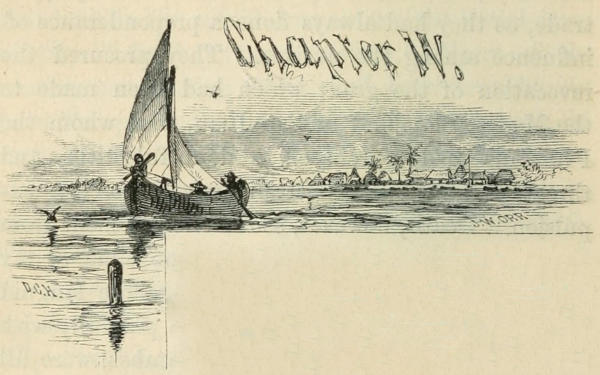
mangrove trees; and this is the harbor of Bluefields.
The entrance is narrow, but not difficult, at
the foot of a high, rocky bluff, which completely
commands the passage.
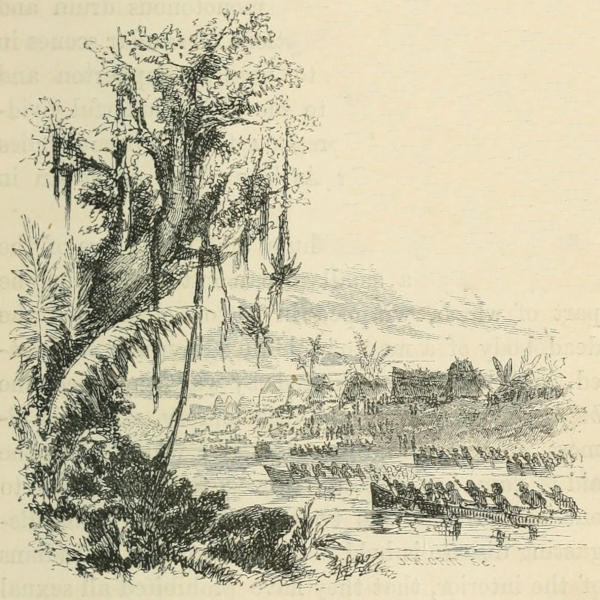
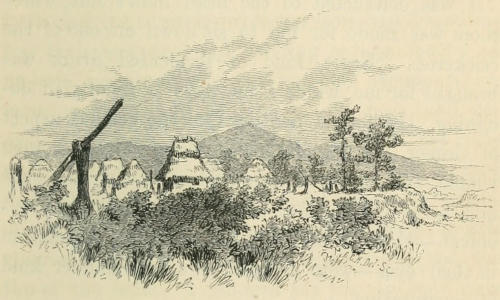
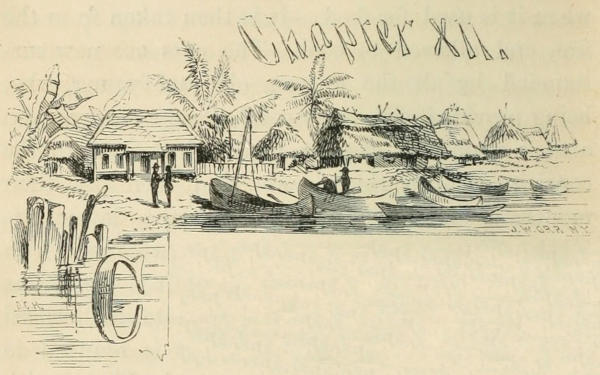
The town, or rather the collection of huts called
by that name, lies nearly nine miles from the entrance.
After much tacking, and backing, and
filling, to avoid the innumerable banks and shallows
in the lagoon, we finally arrived at the anchorage.
We had hardly got our anchor down, before
we were boarded by a very pompous black man,
dressed in a shirt of red check, pantaloons of white
cotton cloth, and a glazed straw hat, with feet innocent
of shoes, whose office nobody knew, further
than that he was called “Admiral Rodney,” and
was an important functionary in the “Mosquito
Kingdom.” He bustled about, in an extraordinary
way, but his final purpose seemed narrowed down
to getting a dram, and pocketing a couple of dollars,
slily slipped into his hand by the captain, just
before he got over the side. When he had left, we
were told that we could go on shore.
Bluefields is an imperial city, the residence of the
court of the Mosquito Kingdom, and therefore
merits a particular description. As I have said, it
is a collection of the rudest possible thatched huts.
Among them are two or three framed buildings,
one of which is the residence of a Mr. Bell, an
Englishman, with whom, as I afterwards learned,
resided that world-renowned monarch, “George
William Clarence, King of all the Mosquitos.”
The site of the huts is picturesque, being upon
comparatively high ground, at a point where a considerable
stream from the interior enters the lagoon.
There are two villages; the principal one, or Bluefields
proper, which is much the largest, containing
perhaps five hundred people; and “Carlsruhe,” a
kind of dependency, so named by a colony of Prussians
who had attempted to establish themselves here,
but whose colony, at the time of my visit, had utterly
failed. Out of more than a hundred of the poor
people, who had been induced to come here, but
three or four were left, existing in a state of great
debility and distress. Most of their companions
had died, but a few had escaped to the interior,
where they bear convincing witness to the wickedness
of attempting to found colonies, from northern
climates, on low, pestiferous shores, under the
tropics.
Among the huts were many palm and plantain
trees, with detached stalks of the papaya, laden
with its large golden fruit. The shore was lined
with canoes, pitpans and dories, hollowed from the
trunks of trees, all sharp, trim, and graceful in
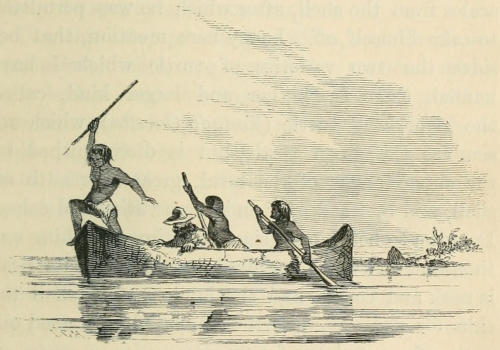
shape. The natives propel them, with great rapidity,
by single broad-bladed paddles, struck vertically
in the water, first on one side, and then on the
other.[1]
There was a large assemblage on the beach, when
we landed, but I was amazed to find that, with few
exceptions, they were all unmitigated negros, or
Sambos (i. e. mixed negro and Indian). I had
heard of the Mosquito shore as occupied by the
Mosquito Indians, but soon found that there were
few, if any, pure Indians on the entire coast. The
miserable people who go by that name are, in reality,
Sambos, having a considerable intermixture of
trader blood from Jamaica, with which island the
coast has its principal relations. The arrival of the
traders on the shore is the signal for unrestrained
debauchery, always preluded by the traders baptizing,
in a manner not remarkable for its delicacy or
gravity, all children born since their last visit, in
whom there is any decided indication of white blood.
The names given on these occasions are as fantastic
as the ceremony, and great liberties are taken with
the cognomens of all notabilities, living and dead,
from “Pompey” down to “Wellington.”
Our first concern in Bluefields was to get a roof
to shelter us, which we finally succeeded in doing,
through the intervention of the captain of the
“Bolivar.” That is to say, a dilapidated negro
from Jamaica, hearing that I had just left that delectable
island, claimed me as his countryman, and
gave me a little deserted thatched hut, the walls of
which were composed of a kind of wicker work of
upright canes, interwoven with palm leaves. This
structure had served him, in the days of his prosperity,
as a kitchen. It was not more than ten feet
square, but would admit a hammock, hung diagonally
from one corner to the other. To this abbreviated
establishment, I moved my few damaged effects,
and in the course of the day, completely domesticated
myself. Antonio exhibited the greatest
aptness and industry in making our quarters comfortable,
and evinced an elasticity and cheerfulness
of manner unknown before. In the evening, he responded
to the latent inquiry of my looks, by saying,
that his heart had become lighter since he had
reached the continent, and that his Lord gave promise
of better days.
“Look!” he exclaimed, as he held up his talisman
before my eyes. It emitted a pale light,
which seemed to come from it in pulsations, or
radiating circles. It may have been fancy, but if
so, I am not prepared to say that all which we deem
real is not a dream and a delusion!
My host was a man of more pretensions than
Captain Ponto, but otherwise very much of the
same order of African architecture. From his
cautious silence, on the subject of his arrival on the
coast, I inferred that he had been brought out as a
slave, some thirty-five or forty years ago, when several
planters from Jamaica attempted to establish themselves
here. However that may have been, he
now called himself a “merchant,” and appeared
proud of a little collection of “osnaburgs,” a few
red bandanna handkerchiefs, flanked by a dingy
cask of what the Yankees would call “the rale
critter,” which occupied one corner of his house or
rather hut. He brooded over these with unremitting
care, although I believe I was his only customer,
(to the extent of a few fish hooks), during my
stay in Bluefields. He called himself Hodgson,
(the name, as I afterwards learned, of one of the
old British superintendents,) and based his hopes
of family immortality upon a son, whom he respectfully
called Mister James Hodgson, and who was,
he said, principal counselor to the king. This information,
communicated to me within two hours
after my arrival, led me to believe myself in the
line of favorable presentation at court. But I
found out afterwards, that this promising scion of
the house of Hodgson was “under a cloud,” and had
lost the sunshine of imperial favor, in consequence
of having made some most indiscreet confessions,
when taken a prisoner, a few years before, by the
Nicaraguans. However, I was not destined to pine
away my days in devising plans to obtain an introduction
to his Mosquito Majesty. For, rising early
on the morning subsequent to my arrival, I started
out to see the sights of Bluefields. Following
a broad path, leading to a grove of cocoa-nut
trees, which shadowed over the river, tall and trim,
I met a white man, of thin and serious visage, who
eyed me curiously for a moment, bowed slightly,
and passed on in silence. The distant air of an
Englishman, on meeting an American, is generally
reciprocated by equally frigid formality. So I
stared coldly, bowed stiffly, and also passed on. I
smiled to think what a deal of affectation had been
wasted on both sides, for it would have been unnatural
if two white men were not glad to see each
others’ faces in a land of ebony like this. So I involuntarily
turned half round, just in time to witness
a similar evolution on the part of my thin friend. It
was evident that his thoughts were but reflections
of my own, and being the younger of the two, I retraced
my steps, and approached him with a laughing
“Good morning!” He responded to my salutation
with an equally pregnant “Good morning,” at
the same time raising his hand to his ear, in token
of being hard of hearing. Conversation opened,
and I at once found I was in the presence of a man
of superior education, large experience, and altogether
out of place in the Mosquito metropolis.
After a long walk, in which we passed a rough
board structure, surmounted by a stumpy pole,
supporting a small flag—a sort of hybrid between
the Union Jack and the “Stars and Stripes”—called
by Mr. Bell the “House of Justice,” I accepted
his invitation to accompany him home to
coffee.
His house was a plain building of rough boards,
with several small rooms, all opening into the principal
apartment, in which I was invited to sit down.
A sleepy-looking black girl, with an enormous shock
of frizzled hair, was sweeping the floor, in a languid,
mechanical way, calculated to superinduce yawning,
even after a brisk morning walk. The partitions
were hung with many prints, in which “Her Most
Gracious Majesty” appeared in all the multiform
glory of steel, lithograph, and chromotint. A gun
or two, a table in the corner, supporting a confused
collection of books and papers, with some ropes,
boots, and iron grapnels beneath, a few chairs, a
Yankee clock, and a table, completed the furniture
and decoration of the room. I am thus particular
in this inventory, for reasons which will afterward
appear.
At a word from Mr. Bell, the torpid black girl
disappeared for a few moments, and then came
back with some cups and a pot of coffee. I observed
that there were three cups, and that my host
filled them all, which I thought a little singular,
since there were but two of us. A faint, momentary
suspicion crossed my mind, that the female
polypus stood in some such relation to my host as
to warrant her in honoring us with her company.
But, instead of doing so, she unceremoniously
pushed open a door in the corner, and curtly ejaculated
to some unseen occupant, “Get up!” There
was a kind of querulous response, and directly a
thumping and muttering, as of some person who
regarded himself as unreasonably disturbed. Meanwhile
we had each finished our first cup of coffee,
and were proceeding with a second, when the door
in the corner opened, and a black boy, or what an
American would be apt to call, a “young darkey,”
apparently nineteen or twenty years old, shuffled up
to the table. He wore only a shirt, unbuttoned
at the throat, and cotton pantaloons, scarcely buttoned
at all. He nodded to my entertainer with a
drawling “Mornin’, sir!” and sat down to the third
cup of coffee. My host seemed to take no notice of
him, and we continued our conversation. Soon
after, the sloven youth got up, took his hat, and
slowly walked down the path to the river, where I
afterward saw him washing his face in the stream.
As I was about leaving, Mr. Bell kindly volunteered
his services to me, in any way they might be
made available. I thanked him, and suggested
that, having no object to accomplish except to
“scare up” adventures and seek out novel sights, I
should be obliged to him for an introduction to the
king, at some future day, after Antonio should have
succeeded in rejuvenating my suit of ceremony, now
rather rusty from saturation with salt water. He
smiled faintly, and said, as for that matter, there
need be no delay; and, stepping to the door,
shouted to the black youth by the river, and beckoned
to him to come up the bank. The youth put
on his hat hurriedly, and obeyed. “Perhaps you
are not aware that is the king?” observed my
host, with a contemptuous smile. I made no reply,
as the youth was at hand. He took off his hat
respectfully, but there was no introduction in the
case, beyond the quiet observation, “George, this
gentleman has come to see you; sit down!”
I soon saw who was the real “king” in Bluefields.
“George,” I think, had also a notion of his own on
the subject, but was kept in such strict subordination
that he never manifested it by words. I found
him shy, but not without the elements of an ordinary
English education, which he had received in
England. He is nothing more or less than a negro,
with hardly a perceptible trace of Indian blood, and
would pass at the South for “a likely young fellow,
worth twelve hundred dollars as a body-servant!”
The second day after my arrival was Sunday, and
in the forenoon, Mr. Bell read the service of the
English Church, in the “House of Justice.” There
were perhaps a dozen persons present, among them
the king, who was now dressed plainly and becomingly,
and who conducted himself with entire propriety.
I could not see that he was treated with
any special consideration; while Mr. Bell received
marked deference.
It is a curious fact that although the English
have had relations, more or less intimate, with this
shore, ever since the pirates made it their retreat,
during the glorious days of the buccaneers, they
have never introduced the Gospel. The religion of
the “kingdom” was declared by the late king, in
his will, to be “the Established Church of England,”
but the Established Church has never taken
steps to bring the natives within its aristocratic
fold. Several dissenting missionaries have made
attempts to settle on the coast, but as the British
officers and agents never favored them, they have
met with no success. Besides, the Sambos are
strongly attached to heathenish rites, half African
and half Indian, in which what they call “big
drunk” is not the least remarkable feature. Some
years ago a missionary, named Pilley, arrived at
Sandy Bay, for the purpose of reclaiming the “lost
sheep.” A house was found for him, and he commenced
preaching, and for a few Sundays enticed
some of the leading Sambos to hear him, by giving
them each a glass of grog. At length, one Sabbath
afternoon, a considerable number of the natives
attended to hear the stranger talk, and to receive
the usual spiritual consolation. But the demijohn
of the worthy minister had been exhausted. He
nevertheless sought to compensate for the deficiency
by a more vehement display of eloquence, and for a
time flattered himself that he was producing a lasting
impression. His discourse, however, was suddenly
interrupted by one of the chiefs, who rose and
indignantly exclaimed, “All preach—no grog—no
good!” and with a responsive “No good!” the
audience followed him, as he stalked away, leaving
the astonished preacher to finish his discourse to
two or three Englishmen present.
In Bluefields the natives are kept in more restraint
than elsewhere on the coast; but even here
it has been found impossible to suppress their traditional
practices, especially when connected with
their superstitions. My venerable friend Hodgson,
after “service,” informed me that a funeral was to
take place, at a small settlement, a few miles up
the river, and volunteered to escort me thither in
his pitpan, if Antonio would undertake to do the
paddling. The suggestion was very acceptable,
and after a very frugal dinner, on roast fish and
boiled plantains, we set out. But we were not
alone; we found dozens of pitpans starting for the
same destination, filled with men and women. It is
impossible to imagine a more picturesque spectacle
than these light and graceful boats, with occupants
dressed in the brightest colors, darting over the
placid waters of the river, now gay in the sunlight,
and anon sobered in the shadows of the trees
which studded the banks. There was a keen
strife among the rowers, who, amid shouts and
screeches, in which both men and women joined,
exerted themselves to the utmost. Even Antonio
smiled at the scene,
but it was half contemptuously,
for he
maintained, in respect
to these mongrels,
the reserve of
conscious superiority.
GOING TO THE FUNERAL.
Less than an hour brought us in view of a little
collection of huts, grouped on the shore, under the
shadow of a cluster of palm-trees, which, from a
distance, presented a picture of entrancing beauty.
A large group of natives had already collected on
the shore, and, as we came near, we heard the
monotonous beating of the native drum, or tum-tum,
relieved by an occasional low, deep blast on a
large hollow pipe, which sounded more like the distant
bellowing of an ox than any thing else I ever
heard. In the pauses, we distinguished suppressed
wails, which continued for a minute perhaps, and
were then followed by the monotonous drum and
droning pipe. The descriptions of similar scenes in
Central Africa, given to us by Clapperton and
Mungo Park, recurred to me with wonderful vividness,
and left the impression that the ceremonies
going on were rather African than American in
their origin.
On advancing to the huts, and the centre of the
group, I found a small pitpan cut in half, in one
part of which, wrapped in cotton cloth, was the
dead body of a man of middle age, much emaciated,
and horribly disfigured by what is called the
bulpis, a species of syphilitic leprosy, which is almost
universal on the coast, and which, with the
aid of rum, has already reduced the population to
one half what it was twenty years ago. This disgusting
disease is held in such terror by the Indians
of the interior, that they have prohibited all sexual
relations, between their people and the Sambos of
the coast, under the penalty of death.
A MOSQUITO BURIAL.
Around the pitpan were stationed a number of
women, with palm branches, to keep off the flies,
which swarmed around the already festering corpse.
Their frizzled hair started from their heads like the
snakes on the brow of the fabled Gorgon, and they
swayed their bodies to and fro, keeping a kind of
tread-mill step to the measure of the doleful tum-tum.
With the exception of the men who beat the
drum and blew the pipe, these women appeared to
be the only persons at all interested in the proceedings.
The rest were standing in groups, or
squatted at the roots of the palm-trees. I was beginning
to get tired of the performance, when, with
a suddenness which startled even the women around
the corpse, four men, entirely naked excepting a
cloth wrapped round their loins, and daubed over
with variously-colored clays, rushed from the interior
of one of the huts, and hastily fastening a
piece of rope to the half of the pitpan containing
the corpse, dashed away towards the woods, dragging
it after them, like a sledge. The women with
the Gorgon heads, and the men with the drum and
trumpet, followed them on the run, each keeping
time on his respective instrument. The spectators
all hurried after, in a confused mass, while a big
negro, catching up the remaining half of the pitpan,
placed it on his head, and trotted behind the
crowd.
The men bearing the corpse entered the woods,
and the mass of the spectators, jostling each other
in the narrow path, kept up the same rapid pace.
At the distance of perhaps two hundred yards,
there was an open place, covered with low, dank,
tangled underbush, still wet from the rain of the
preceding night, which, although unmarked by any
sign, I took to be the burial place. When I came
up, the half of the pitpan containing the body had
been put in a shallow trench. The other half was
then inverted over it. The Gorgon-headed women
threw in their palm-branches, and the painted
negroes rapidly filled in the earth. While this was
going on, some men were collecting sticks and
palm-branches, with which a little hut was hastily
built over the grave. In this was placed an earthen
vessel, filled with water. The turtle-spear of the
dead man was stuck deep in the ground at his head,
and a fantastic fellow, with an old musket, discharged
three or four rounds over the spot.
This done, the entire crowd started back in the
same manner it had come. No sooner, however,
did the painted men reach the village, than, seizing
some heavy machetes, they commenced cutting down
the palm-trees which stood around the hut that
had been occupied by the dead Sambo. It was
done silently, in the most hasty manner, and when
finished, they ran down to the river, and plunged
out of sight in the water—a kind of lustration or
purifying rite. They remained in the water a few
moments, then hurried back to the hut from which
they had issued, and disappeared.
This savage and apparently unmeaning ceremony
was explained to me by Hodgson, as follows:
Death is supposed by the Sambos to result from
the influences of a demon, called Wulasha, who,
ogre-like, feeds upon the bodies of the dead. To
rescue the corpse from this fate, it is necessary to
lull the demon to sleep, and then steal away the
body and bury it, after which it is safe. To this
end they bring in the aid of the drowsy drum and
droning pipe, and the women go through a slow
and soothing dance. Meanwhile, in the recesses of
some hut, where they cannot be seen by Wulasha,
a certain number of men carefully disguise themselves,
so that they may not afterwards be recognized
and tormented; and when the demon is supposed
to have been lulled to sleep, they seize the
moment to bury the body. I could not ascertain
any reason for cutting down the palm-trees, except
that it had always been practiced by their ancestors.
As the palm-tree is of slow growth, it has resulted,
from this custom, that they have nearly disappeared
from some parts of the coast. I could
not learn that it was the habit to plant a cocoa-nut
tree upon the birth of a child, as in some parts of
Africa, where the tree receives a common name with
the infant, and the annual rings on its trunk mark
his age.
If the water disappears from the earthen vessel
placed on the grave,—which, as the ware is porous,
it seldom fails to do in the course of a few days,—it
is taken as evidence that it has been consumed by
the dead man, and that he has escaped the maw of
Wulasha. This ascertained, preparations are at
once made for what is called a Seekroe, or Feast of
the Dead—an orgie which I afterwards witnessed
higher up the coast, and which will be described in
due course.
The negroes brought originally from Jamaica, as
also most of their descendants, hold these barbarous
practices in contempt, and bury their dead, as
they say, “English-gentleman fashion.” But while
these practices are discountenanced and prohibited
in Bluefields proper, they are, nevertheless, universal
elsewhere on the Mosquito Shore.
I cannot omit mentioning here, that I paid a
visit both to the establishment and the burial-place
of the ill-fated Prussian colony. Many of the
houses, now rotting down, had been brought out
from Europe, and all around them were wheels of
carts falling in pieces, harnesses dropping apart,
and plows and instruments of cultivation rusting
away, or slowly burying themselves in the earth.
They told a sad story of ignorance on the part of
the projectors of the establishment, and of the disappointments
and sufferings of their victims. The
folly of attempting to plant an agricultural colony,
from the north of Europe, on low, murky, tropical
shores, is inconceivable. Again and again the attempt
has been made, on this coast, and as often it
has terminated in disaster and death. It was tried
by the French at Tehuantepec and Cape Gracias;
by the English at Vera Paz and Black River; and
by the Belgians and Prussians at Santo Tomas and
Bluefields. In no instance did these establishments
survive a second year, nor in a single instance did a
tenth of the poor colonists escape the grave. The
Prussians at Bluefields suffered fearfully. At one
time, within four months after their arrival, out of
more than a hundred, there were not enough retaining
their health to bury the dead, much less to
attend to the sick. The natives, jealous of the
strangers, would neither assist nor come near them,
and absolutely refused to sell them the scanty food
requisite for their subsistence. This feeling was
rather encouraged than otherwise, by the traders on
the coast, who desired to retain the monopoly of
trade, as they had always done a preponderance of
influence among the natives. They procured the
revocation of the grant which had been made to
the Messrs. Shepherd of San Juan, from whom the
Prussians had purchased a doubtful title, and
threatened the stricken strangers with forcible expulsion.
Death, however, soon relieved them from
taking overt measures; and, at the time of my
visit, two or three haggard wretches, whose languid
blue eyes and flaxen hair contrasted painfully with
the blotched visages of the brutal Sambos, were all
that remained of the unfortunate Prussian colony.
The burying place was a small opening in the
bush, where rank vines sweltered over the sunken
graves, a spot reeking with miasmatic damps, from
which I retreated with a shudder. I could wish no
worse punishment to the originators of that fatal,
not to say, criminal enterprise, than that they
should stand there, as I stood, that Conscience
might hiss in their ears, “Behold thy work!”
Chapter IV.
I made many inquiries in Bluefields,
in order to decide on my future
movements, to all of which Mr.
Bell gave me most intelligent answers.
At first, I proposed to ascend the Bluefields
river, which takes its rise in the mountainous district
of Segovia in Nicaragua, and which is reported to be
navigable, for canoes, to within a short distance of
the great lakes of that State, from which it is only
separated by a narrow range of mountains. Upon
its banks dwell several tribes of pure Indians, the
Cookras, now but few in number, and the Ramas,
a large and docile tribe. Several of the latter visited
Bluefields while I was there, bringing down
dories and pitpans rudely blocked out, which are
afterwards finished by persons expert in that art.
They generally speak Spanish, but I could not learn
from them that their country was in any respect remarkable,
or that it held out any prospect of compensation
for a visit, unless it were an indefinite
amount of hunger and hard work. So, although I
had purchased a canoe, and made other preparations
for ascending the river, I determined to proceed
northward along the coast, and, embarking in
some turtling vessel from Cape Gracias, proceed to
San Juan, and penetrate into the interior by the
river of the same name.
This, I ascertained, was all the more easy to accomplish,
since the whole Mosquito shore is lined
with lagoons, only separated from the sea by narrow
strips of land, and so connected with each other as
to afford an interior navigation, for canoes, from
Bluefields to Gracias. So, procuring the additional
services of a young Poyas or Paya Indian, who had
been left from a trading schooner, I bade “His
Mosquito Majesty” and his governor good-by, took
an affectionate farewell of old Hodgson, and, with
Antonio, sailed away to the northern extremity of
the lagoon, having spent exactly a week in Bluefields.
It was a bright morning, and our little sail, filled
with the fresh sea-breeze, carried us gayly through
the water. Antonio carefully steered the boat, and
my Poyer boy sat, like a bronze figure-head, in the
bow, while I reclined in the centre, luxuriously
smoking a cigar. The white herons flapped lazily
around us, and flocks of screaming curlews whirled
rapidly over our heads. I could scarcely comprehend
the novel reality of my position. The Robinson
Crusoe-ish feeling of my youth came back in
all of its freshness; I had my own boat, and for
companions a descendant of an aboriginal prince,
the possessor of a mysterious talisman, devotedly
attached to me, half friend, half protector, and a
second strange Indian, from some unknown interior,
silent as the unwilling genii whom the powerful
spell of Solyman kept in obedience to the weird
necromancers of the East. It was a strange position
and fellowship for one who, scarcely three
months before, had carefully cultivated the friendly
interest of Mr. Sly, with sinister designs on the
plethoric treasury of the Art Union, in New York!
I gave myself up to the delicious novelty, and
that sense of absolute independence which only a
complete separation from the moving world can inspire,
and passed the entire day in a trance of
dreamy delight. I subsequently passed many similar
days, but this stands out in the long perspective,
as one of unalloyed happiness. “’Twas worth
ten years of common life,” and neither age nor suffering
can efface its bright impress from the crowded
tablet of my memory!
It was about four o’clock in the afternoon, when
we reached the northern extremity of the lagoon,
at a place called the Haulover, from the circumstance
that, to avoid going outside in the open sea,
it is customary for the natives to drag their canoes
across the narrow neck of sand which separates
Bluefields from the next northern or Pearl Kay
Lagoon. Occasionally, after long and heavy winds
from the eastward, the waters are forced into the
lagoons, so as to overflow the belt of land which
divides them, when the navigation is uninterrupted.
In order to be able to renew our voyage early
next morning, our few effects and stores were carried
across the portage, over which our united strength
was sufficient to drag the dory, without difficulty.
All this was done with prompt alacrity on the part
of Antonio and the Poyer boy, who would not allow
me to exert myself in the slightest. The transit
was effected in less than an hour, and then we proceeded
to make our camp for the night, on the
beach. Our little sail, supported over the canoe by
poles, answered the purpose of a tent. And as for
food, without going fifty yards from our fire, I shot
half a dozen curlews, which, when broiled, are certainly
a passable bird. Meanwhile, the Poyer boy,
carefully wading in the lagoon, with a light spear,
had struck several fish, of varieties known as snook
and grouper; and Antonio had collected a bag full
of oysters, of which there appeared to be vast
banks, covered only by a foot or two of water.
They were not pearl oysters, as might be inferred
from the name of the lagoon, but similar to those
found on our own shores, except smaller, and growing
in clusters of ten or a dozen each. Eaten with
that relishing sauce, known among travelers as
“hunger sauce,” I found them something more
than excellent,—they were delicious.
While I opened oysters, by way of helping myself
to my princely first course, the Indians busied
themselves with the fish and birds. I watched their
proceedings with no little interest, and as their
mode of baking fish has never been set forth in the
cookery books, I give it for the benefit of the gastronomic
world in general, which, I take it, is not
above learning a good thing, even from a Poyer
Indian boy. A hole having been dug in the sand,
it was filled with dry branches, which were set on
fire. In a few minutes the fire subsided in a bed of
glowing coals. The largest of the fish, a grouper,
weighing perhaps five pounds, had been cleaned
and stuffed with pieces of the smaller fish, a few
oysters, some sliced plantains, and some slips of the
bark of the pimento or pepper-tree. Duly sprinkled
with salt, it was carefully wrapped in the broad
green leaves of the plantain, and the coals raked
open, put in the centre of the glowing embers, with
which it was rapidly covered. Half an hour afterward,
by which time I began to believe it had been
reduced to ashes, the bed was raked open again and
the fish taken out. The outer leaves of the wrapper
were burned, but the inner folds were entire, and
when they were unrolled, like the cerements of a
mummy, they revealed the fish, “cooked to a
charm,” and preserving all the rich juices absorbed
in the flesh, which would have been carried off by
the heat, in the ordinary modes of cooking. I afterward
adopted the same process with nearly every
variety of large game, and found it, like patent
medicines, of “universal application.” Commend
me to a young waree “done brown” in like manner,
as a dish fit for a king. But of that anon.
By and by the night came on, but not as it comes
in our northern latitudes. Night, under the tropics,
falls like a curtain. The sun goes down with a
glow, intense, but brief. There are no soft and lingering
twilight adieus, and stars lighting up one by
one. They come, a laughing group, trooping over
the skies, like bright-eyed children relieved from
school. Reflected in the lagoon, they seemed to
chase each other in amorous play, printing sparkling
kisses on each other’s luminous lips. The low
shores, lined with the heavy-foliaged mangroves,
looked like a frame of massive, antique carving,
around the vast mirror of the lagoon, across whose
surface streamed a silvery shaft of light from the
evening star, palpitating like a young bride, low in
the horizon. Then there were whispered “voices
of the night,” the drowsy winds talking themselves
to sleep among the trees, and the little ripples of the
lagoon pattering with liquid feet along the sandy
shore. The distant monotonous beatings of the
sea, and an occasional sullen plunge of some marine
animal, which served to open momentarily the
eyelids drooping in slumbrous sympathy with the
scene—these were the elements which entranced
me during the long, delicious hours of my first
evening, alone with Nature, on the Mosquito
Shore!
My dreams that night so blended themselves
with the reality, that I could not now separate
them if I would, and to this day I hardly know if
I slept at all. So completely did my soul go out,
and melt, and harmonize itself with the scene, that
I began to comprehend the Oriental doctrine of
emanations and absorptions, which teaches that, as
the body of man springs from the earth, and after
a brief space, mingles again with it; so his soul,
part of the Great Spirit of the Universe, flutters
away like a dove from its nest, only to return, after
a weary flight, to fold its wings and once more melt
away in Nature’s immortal heart, an uncreated and
eternal essence.
Before the dawn of day, the ever-watchful Antonio
had prepared the indispensable cup of coffee,
which is the tropical specific against the malignant
night-damps; and the first rays of the sun shot
over the trees only to fall on our sail, bellying with
the fresh and invigorating sea-breeze. We laid our
course for the mouth of a river called Wawashaan
(hwas or wass, in the dialect of the interior, signifying
water), which enters the lagoon, about twenty
miles to the northward of the Haulover. Here we
were told there was a settlement, which I determined
to visit. As the day advanced, the breeze
subsided, and we made slow progress. So we paddled
to the shore of one of the numerous islands in
the lagoon, to avoid the hot sun and await the
freshening of the breeze in the afternoon. The
island on which we landed appeared to be higher
than any of the others, and was moreover rendered
doubly attractive by a number of tall cocoa-nut
palms, that clustered near the beach. We ran our
boat ashore in a little cove, where there were traces
of fires, and other indications that it was a favorite
stopping-place with the natives. A narrow trail
led inward to the palm-trees. Leaving the Poyer
boy with the canoe, Antonio and myself followed
the blind path, and soon came to an open space
covered with plantain-trees, now much choked with
bushes, but heavily laden with fruit. The palms,
too, were clustering with nuts, of which we could
not, of course, neglect to take in a supply. Near
the trees we found the foundations of a house, after
the European plan, and, not far from it, one or two
rough grave-stones, on which inscriptions had been
rudely traced; but they were now too much obliterated
to be read. I could only make out the figure
of a cross on one of them, and the name “San
Andres,” which is an island off the coast, where it is
probable the occupant of this lonely grave was born.
To obtain the cocoa-nuts, which otherwise could
only have been got at by cutting down and destroying
the trees, Antonio prepared to climb after
them. He had brought a kind of sack of coarse
netting, which he tied about his neck. He next
cut a long section of one of the numerous tough
vines which abound in the tropics, with which he
commenced braiding a large hoop around one of the
trees. After this was done, he slipped it over his
head and down to his waist, gave it a few trials of
strength, and then began his ascent, literally walking
up the tree. It was a curious feat, and worth a
description. Leaning back in this hoop, he planted
his feet firmly against the trunk, clinging to which,
first with one hand, and
then with the other, he
worked up the hoop, taking
a step with every upward
movement. Nothing
loth to exhibit his skill, in
a minute he was sixty feet
from the ground, leaning
back securely in his hoop,
and filling his sack with the
nuts. This done, he swung
his load over his shoulders,
grasped the tree in his
arms, let the hoop fall, and
slid rapidly to the ground.
The whole occupied less
time than I have consumed
in writing an account
of it.
CLIMBING AFTER COCOAS.
Loaded with nuts,
plantains, and a
species of anona
called soursop, we
returned to the
boat, where the water,
with which the
green cocoa-nuts are
filled, tempered with a little Jamaica rum, para
á matar los animalicos, “to kill the animalculæ,”
as the Spanish say, made a cooling and refreshing
beverage.
MANGROVE SWAMP.
In the afternoon we again embarked, and before
dark reached the mouth of the Wawashaan, which
looked like a narrow arm of the lagoon, but which,
we found, when we entered, had considerable current,
rendering necessary a brisk use of our paddles.
The banks near the lagoon,
were low, and the ground back
of them apparently swampy,
and densely covered with mangrove
trees. This tree is universal on the Mosquito
coast, lining the shores of the lagoons and rivers,
as high up as the salt water reaches. It is unlike
any other tree in the world. Peculiar to lands overflowed
by the tides, its trunk starts at a height of
from four to eight feet from the ground, supported
by a radiating series of smooth, reddish-brown roots,
for all the world like the prongs of an inverted candelabrum.
These roots interlock with each other in
such a manner that it is utterly impossible to penetrate
between them, except by laboriously cutting
one’s way. And even then an active man would
hardly be able to advance twenty feet in a day. The
trunk is generally tall and straight, the branches
numerous, but not long, and the leaves large and
thick; on the upper surface of a dark, glistening,
unfading green, while below, of the downy, whitish
tint of the poplar-leaf. Lining the shore in dense
masses, the play of light on the leaves, as they are
turned upward by the wind, has the glad, billowy
effect of a field of waving grain. The timber of the
mangrove is sodden and heavy, and of no great
utility; but its bark is astringent, and excellent for
tanning. Its manner of propagation is remarkable.
The seed consists of a long bean-like stem, about
the length and shape of a dipped candle, but thinner.
It hangs from the upper limbs in thousands,
and, when perfect, drops, point downward, erect in
the mud, where it speedily takes root, and shoots
up to tangle still more the already tangled mangrove-swamp.
Myriads of small oysters, called the
mangrove-oysters, cling to the roots, among which
active little crabs find shelter from the pursuit of
their hereditary enemies, the long-legged and
sharp-billed cranes, who have a prodigious hankering
after tender and infantile shell-fish.
The Mosquito settlement is some miles up the
river, and we were unable to reach it before dark; so,
on arriving at a spot where the ground became higher,
and an open space appeared on the bank, we came
to a halt for the night. We had this time no fish
for supper, but, instead, a couple of quams, a species
of small turkey, which is not a handsome bird,
but, nevertheless, delicate food. Many of these
flew down to the shore, as night came on, selecting
the tops of the highest, overhanging trees for their
roosting-places, and offering fine marks for my
faithful double-barreled gun.
The mosquitoes proving rather troublesome at
the edge of the water, I abandoned the canoe, and
spreading my blanket on the most elevated portion
of the bank, near the fire, was soon asleep. Before
midnight, however, I was roused by the sensation
of innumerable objects, with sharp claws and cold
bodies, crawling over me. I leaped up in alarm,
and hastily shook off the invaders. I heard a crackling,
rustling noise, as of rain on dry leaves, all
around me, and by the dim light I saw that the
ground was alive with crawling things, moving in
an unbroken column toward the river. I felt them
in the pockets of my coat, and hanging to my
skirts. My nocturnal interview with the turtles at
“El Roncador” recurred to me, and Coleridge’s
ghastly lines—
——“The very sea did rot—
Oh Christ, that this should be!—
And slimy things did crawl with legs
Upon the slimy sea!”
Half fearing that it might be my own disordered
fancy, I shouted to Antonio, who, quick as light, was
at my side. He stirred up the fire, and laughed
outright! We had been invaded by an army of
soldier-crabs, moving down from the high backgrounds.
Antonio had selected his bed for the
night nearest the river, and the fire, dividing the
host, had protected him, while it had turned a double
column upon me. I could not myself help laughing
at the incident, which certainly had the quality
of novelty. I watched the moving legion for an
hour, but there was no perceptible decrease in the
numbers. So I laid down again by the side of Antonio,
and slept quietly until morning, when there
were no more crabs to be seen, nor a trace of them,
except that the ground had been minutely punctured
all over, by their sharp, multitudinous claws.
It was rather late when we started up the river.
We had not proceeded far before we came to an
open space, where there were some rude huts, with
canoes drawn up on the bank, in front. A few
men, nearly naked, shouted at us as we passed, inquiring,
in broken English, what we had to sell,
evidently thinking that the white man could have
no purpose there unless to trade. We passed
other huts at intervals, which, however, had no
signs of cultivation around them, except a few
palm and plantain-trees, and an occasional small
patch of yucas. The mangroves had now disappeared,
and the banks began to look inviting, covered,
as they were, with large trees, including the
caoba, or mahogany, and the gigantic ceiba, all
loaded down with vines. Thousands of parrots
passed over, with their peculiar short, heavy flutter,
and loud, querulous note. In the early morning,
and toward night, they keep up the most vehement
chattering, all talking and none listening,
after the manner of a Woman’s Rights Convention.
There were also gaudy macaws, which floated past
like fragments of a rainbow. In common with the
parrots, they always go in pairs, and when one is
found alone, he is always silent and sad, and acts
as if he were a lone widower, and meditated suicide.
“THE SPOONBILL.”
On the occasional sandy reaches, we saw groups
of the Roseate Spoonbills, with their splendid plumage.
The whole body is rose-colored;
but the wings, toward the
shoulders, and the feathers around
the base of the neck, are of a
bright scarlet, deepening to blood-red.
But they form no exception
to the law of compensations—in
mechanics, called equilibrium, and
in mathematics equations, since,
while beautiful in plumage, they are sinfully ugly
in shape. And I could not help fancying, when I
saw them standing silent and melancholy on snags,
contemplating themselves in the water, that, as with
some other kinds of birds, their brilliant colors gave
them no joy, coupled with so serious a drawback in
form. I shot several, from which the Poyer boy
selected the most beautiful feathers, which he
afterward interwove with others from the macaw,
parrot, and egret, in a gorgeous head-dress, as a
present to me.
Toward noon we came to a cleared space, much
the largest I had seen on the coast; and, as we approached
nearer, I saw a house of European construction,
and a large field of sugar-cane. In striking
contrast with these evidences of industry and
civilization, a Sambo or Mosquito village, made up
of squalid huts, half buried in the forest, filled out
the foreground. I recognized it as the village of
Wasswatla (literally Watertown), the place of our
destination. It, nevertheless, looked so uninviting
and miserable, that had I not been attracted by
the Christian establishment in the distance, I
should have returned incontinently to the lagoon.
My unfavorable impressions were heightened on a
nearer approach. As we pushed up our canoe to
the shore, among a great variety of dories and
other boats, the population of the village, including
a large number of dogs of low degree, swarmed
down to survey us. The juveniles were utterly
naked, and most of the adults of both sexes had
nothing more than a strip of a species of cloth,
made of the inner bark of the ule or India-rubber
tree (resembling the tappa of the Society Islanders),
wrapped around their loins. There was scarcely
one who was not disfigured by the blotches of
the bulpis, and the hair of each stood out in frightful
frizzles, “like the quills on the fretful porcupine.”
Most of the men carried a short spear,
pointed with a common triangular file, carefully
sharpened by rubbing on the stones, which, as I
afterward learned, is used for striking turtle.
Forbidding as was the appearance of the assemblage,
none of its individuals evinced hostility, and
when I jumped ashore, and saluted them with
“Good morning,” they all responded, “Mornin’
sir!” brought out with an indescribable African
drawl. Two or three of the number volunteered to
help Antonio draw up our boat, while I gave various
orders, in default of knowing what else to do.
Luckily, it occurred to me to produce a document,
or pass, with which Mr. Bell had kindly furnished
me before leaving Bluefields, and which all seemed
to recognize, pointing to it respectfully, and ejaculating,
“King paper! King paper!” It was frequently
called afterward, “the paper that talks.”
This precious document, well engrossed on a sheet
of fools-cap, with a broad seal at the bottom, ran
as follows:—
“Mosquito Kingdom.
“George William Clarence, by the Grace of
God, King of the Mosquito Territory, to our trusty
and well-beloved officers and subjects, Greeting!
We, by these presents, do give pass and license to
Samuel A. Bard Esquire, to go freely through our
kingdom, and to dwell therein; and do furthermore
exhort and command our well-beloved officers and
subjects aforesaid, to give aid and hospitality to the
aforesaid Samuel A. Bard Esquire, whom we hold
of high esteem and consideration. Given at Bluefields,
this —— day of ——, in this the tenth year
of our reign.”
(Signed,)
The ejaculations of “King paper! King paper!”
were followed by loud shouts of “Capt’n! Capt’n!”
while two or three tall fellows ran off in the
direction of the huts. I was a little puzzled by the
movement, but not long left in doubt as to its object,
for, in a few moments, a figure approached,
creating hardly less sensation among the people,
than he would have done among the “boys” in the
Bowery. I at once recognized him as the “Capt’n,”
whose title had been so vigorously invoked.
He was, to start with, far from being a fine-looking
darkey; but all natural deficiencies were more than
made up by his dress. He had on a most venerable
cocked hat, in which was stuck a long, drooping,
red plume, that had lost half of its feathers, looking
like the plumes of some rake of a rooster, returning,
crestfallen and bedraggled, from an unsuccessful
attempt on some powerful neighbor’s harem.
His coat was that of a post-captain in the British
navy, and his pantaloons were of blue cloth, with a
rusty gold stripe running down each side. They were,
furthermore, much too short at both ends, leaving an
unseemly projection of ankle, as well as a broad strip
of dark skin between the waistband and the coat.
And when I say that the captain wore no shirt, was
rather fat, and his pantaloons deficient in buttons
wherewith to keep it appropriately closed in front,
the active fancy of the reader may be able to complete
the picture. He bore, moreover, a huge cavalry
sword, which looked all the more formidable
from being bent in several places and very rusty.
He came forward with deliberation and gravity, and
I advanced to meet him, “king paper” in hand.
CAPTAIN DRUMMER.
When I had got near him, he adjusted himself in
position, and compressed his lips, with an affectation
of severe dignity. Hardly able to restrain
laughing outright, I took off my hat, and saluted
him with a profound bow, and “Good morning,
Captain!” He pulled off his hat in return, and
undertook a bow, but the strain was too great on
the sole remaining button of his waistband; it gave
way, and, to borrow a modest nautical phrase, the
nether garment “came down on the run!” The
captain, however, no way disconcerted, gathered it
up with both hands, and held it in place, while I
read the “paper that talked.”
The upshot of the ceremony was, that I was welcomed
to Wasswatla, and taken to a large vacant
hut, which was called the “king’s house,” and dedicated
to the Genius of Hospitality. That is to say,
the stranger or trader may take up his abode there,
provided he can dislodge the pigs and chickens, who
have an obstinate notion of their own on the subject
of the proprietorship, and can never be induced
to surrender their prescriptive rights. The “king’s
house” was a simple shed, the ground within trodden
into mire by the pigs, and the thatched roof
above half blown away by the wind. But, even
thus uninviting, it was better than any of the other
and drier huts, for the fleas, at least, had been suffocated
in the mud. Before night, Antonio had
covered the floor, a foot deep, with cahoon leaves,
and, with the aid of the Poyer boy and one or two
natives, seduced thereunto by what they universally
call “grog,” had restored the roof, and built up a
barricade of poles against the pigs. These were
not numerous, but hungry and vicious; and, finding
the barricade too strong to be rooted down, they
tried the dodge of the Jews at Jericho, and of Captain
Crockett with the bear, and undertook to squeal
it down! They neither ate nor slept, those pigs, I
verily believe, during the period of my stay; but
kept up an incessant squeal, occasionally relieving
their tempers by a spiteful drive at the poles. Between
them and pestilent insects of various kinds,
my slumbers were none of the sweetest, and I registered
a solemn vow that this should be my last
trial of Mosquito hospitality.
In the afternoon I had a visit from the captain,
who told me that his name was “Lord Nelson Drummer,”
and that his father had been “Governor” in
the section around Pearl-Cay Lagoon. He had laid
aside his official suit, and with simple breeches of
white cotton cloth, and a straw hat, afforded a
favorable contrast to his appearance in the morning.
He spoke English—quite as well as the negroes
of Jamaica, and generally made himself understood.
From him I learned that the house,
which I had seen in the clearings, had been built,
many years before, by a French Creole from one of
the islands of the Antilles, who at one time had
there a large plantation of coffee, cotton, and sugar-cane,
from the last of which he distilled much rum.
Drummer was animated on the subject of the rum,
of which there had been, as he said, “much
plenty!” But the Frenchmen had died, and although
his family kept up the establishment for a
little while, they were obliged to abandon it in the
end. The negroes who had been brought out, soon
caught the infection of the coast, and, slavery having
been prohibited (by the British Superintendent
at Belize!), became idle, drunken, and worthless.
Some of them still lingered around Wasswatla,
gathering for sale to the occasional trader, a few
pounds of coffee from the trees on the plantation,
which, in spite of years of utter neglect, still bore
fruit. The abandoned cane-fields furnished a supply
of canes, at which all the inhabitants of Wasswatla,
old and young, were constantly gnawing.
In fact, this appeared to be their principal occupation.
I subsequently visited the abandoned estate.
It was overgrown with vines and bushes,
among which the orange, lime, and coffee-trees
struggled for existence. The house was tumbling
into ruin, and the boilers in which the sugar had
been made, were full of stagnating water. I returned
to the squalid village, having learned another
philosophy in the science of philanthropy;
and with a diminishing inclination to tolerate the
common cant about “universal brotherhood!”
The soil on the Wawashaan is rich and productive.
It seems well adapted to cotton and sugar.
The climate is hot and humid, and I saw many of
the natives much reduced, and suffering greatly
from fevers, which, if not violent, appear, nevertheless,
to be persistent, and exceedingly debilitating.
The natural products are numerous and valuable.
I observed many indian-rubber trees, and, for the
first time, the vanilla. It is produced on a vine,
which climbs to the tops of the loftiest trees. Its
leaves somewhat resemble those of the grape; the
flowers are red and yellow, and when they fall off
are succeeded by the pods, which grow in clusters,
like our ordinary beans. Green at first, they change
to yellow, and finally to a dark brown. To be preserved,
they are gathered when yellow, and put in
heaps, for a few days, to ferment. They are afterward
placed in the sun to dry, flattened by the
hand, and carefully rubbed with cocoa-nut oil, and
then packed in dry plantain-leaves, so as to confine
their powerful aromatic odor. The vanilla might
be made a considerable article of trade on the
coast; but, at present, only a few dozen packages
are exported.
Lord Nelson, as I invariably called the captain,
domesticated himself with me from the first day,
and ate and drank with me—“especially the latter.”
And I soon found out that there was a direct
and intimate relation, between his degree of thirst
and his protestations of attachment. He even
hinted his intention to get up a mushla feast for
me, but I would not agree to stay for a sufficient
length of time.
Finally, however, a grand fishing expedition to
the lagoon was determined on, and I was surprised
to see with how much alacrity the proposition was
taken up. The day previous to starting was devoted
to sharpening spears, cleaning the boats, and
making paddles, in all of which operations the
women worked indiscriminately with the men.
Plantains were gathered, and, as it seemed to me,
no end of sugar-canes from the deserted plantation.
In the evening, which happened to prove clear, the
big drum was got out, fires lighted, and there was a
dance, as Lord Nelson said, “Mosquito fashion.”
My part of the performance consisted in keeping up
the spirit of the drummers, by pouring spirits down,
which service was responded to by a vehemence of
pounding that would have done credit to a militia
training. I was surprised to find how much skill
the performers had attained; but afterward discovered
that the drum is the favorite instrument on
the coast, and is called in requisition on all occasions
of festivity or ceremony. The dance was uncouth,
without the merit of being grotesque; and
long before it was finished, the performers, of both
sexes, had thrown aside their tournous, and abandoned
every shadow of decency in their actions.
Lord Nelson began to grow torpid early in the
evening, and, before I left the scene, had been
carried off dead drunk. Next morning he looked
rather downcast, and complained that the rum
“had spoiled his head.”
It was quite late when our flotilla got under
way, with a large dory, carrying the big drum,
leading the van. There were some twenty-odd
boats, containing nearly the entire population of
the village. This number was increased from the
huts lower down, the occupants of which hailed us
with loud shouts, and hastened after us with their
canoes. We went down the river with the current
very rapidly, the men paddling in the maddest way,
and shouting to each other at the top of their
voices. Occasionally the boats got foul, when the
rivals used the flat of their paddles over each
other’s heads without scruple. I was considerably
in the rear, and, from the sound of the blows, imagined
that every skull had been crushed; but next
moment their owners were paddling and shouting
as if nothing had happened. From that day, I had
a morbid curiosity to get a Mosquito skull!
We all encamped at night, on the sandy beach
of a large island, in the centre of the lagoon. The
reader may be sure that I made my own camp at a
respectable distance from the rest of the party,
where I had a quiet supper, patronized, as usual,
by Captain Drummer. As soon as it became dark,
the preparations for fishing commenced. The
women were left on the beach, and three men apportioned
to each boat. One was detailed to paddle,
another to hold the torch, and the third, and
most skillful, acted as striker or spearsman. The
torches were made of splinters of the fat yellow
pine, which abounds in the interior. The spears, I
observed, were of two kinds; one firmly fixed by a
shank at the end of a long light pole, called sinnock,
which is not allowed to escape the hand of
the striker. The other, called waisko-dusa, is
much shorter. The staff is hollow, and the iron
spear-head, or harpoon, is fastened to a line which
passes through rings by the side of the shaft, and
is wound to a piece of light-wood, designed to act
as a float. When thrown, the head remains in the
fish, while the line unwinds, and the float rises to
the surface, to be seized again by the fisherman,
who then hauls in his fish at his leisure. When the
fish is large and active, the chase after the float
becomes animated, and takes the character of what
fishermen call “sport.”
As I have said, no sooner was it dark than the
boats pushed off, in different directions, on the lagoon.
My Poyer boy had borrowed a waisko-dusa,
and with him to strike, and Antonio to
paddle, I took a torch, and also glided out on the
water. My torch was tied to a pole, which I held
over the bow. Antonio paddled slowly, while the
Poyer boy, entirely naked (for the strikers often go
overboard after their own spears), stood in the bow,
with his spear poised in his right hand, eagerly inclining
forward, and motionless as a statue. He
was perfect in form, and his bronze limbs, just
tense enough to display without distorting the
muscles, were brought in clear outline against the
darkness by the light of the torch—revealing a figure
and pose that would shame the highest achievements
of the sculptor. It was so admirable that I
quite forgot the fisher in the artist, when, rapid as
light, the arm of the Poyer boy fell, and the spear
entered the water eight or nine feet ahead of the
boat. The motion was so sudden, that it nearly
startled me overboard. At first, I thought he had
missed his mark, but I soon saw the white float,
now dipping under the water, now jerked this way,
now that, evincing clearly that the spearsman had
been true in his aim. A few strokes of Antonio’s
paddle brought the float within reach of the striker,
who began, in sporting phrase, to “land” the fish.
It made a desperate struggle, and, for awhile, it
was what is called a “tight pull” between the
boy and the fish. Nevertheless, he was finally got
in, and proved to be what is called a June, or Jew-fish
(Coracinus), by the English, and Palpa by the
natives. In point of delicacy and richness of flavor,
this fish is unequaled by any other found in these
seas. The one which we obtained weighed not far
from eighty pounds. Some of them have been
known to weigh two or three hundred pounds. Our
prize made a great disturbance in our little canoe,
to which Antonio put a stop by disemboweling him
on the spot, after which we resumed our sport.
We were successful in obtaining a number of rock-fish,
and several sikoko, or sheep’s-heads. Ambitious
to try my skill, I took the Poyer boy’s place
for awhile. I was astonished to find how perfectly
clear the water proved to be, under the light of the
torch. The bottom, which, in the broad daylight,
had been utterly invisible, now revealed all of its
mysteries, its shells, and plants, and stones, with
wonderful distinctness. I observed also that the
fish seemed to be attracted by the light, and, instead
of darting away, rose toward the surface and
approached the boat. I allowed several opportunities
of throwing the spear to slip. Finally, a fine
sheep’s-head rose just in front of me; I aimed my
spear, and threw it with such an excess of force as
literally to drive the dory from beneath my feet,
precipitating myself in the water, and knocking
down and extinguishing the torch in my ungraceful
tumble. The spear was recovered, and I felt rather
disappointed to find that it was innocent of a fish.
Antonio suggested that he had broken loose, which
was kind of him, but it wouldn’t do. As we were
without light, and, moreover, had as many fish as
we could possibly dispose of, we paddled ashore.
Up to this time, I had been so much absorbed
with our own sport, that I had not noticed the other
fishers. It was a strange scene. Each torch glowed
at the apex of a trembling pyramid of red light,
which, as the boats could not be seen, seemed to be
inspired with life. Some moved on stately and slow,
while others, where the boats were rapidly whirled
in pursuit of the stricken fish, seemed to be chasing
each other in fiery glee. Every successful throw
was hailed with vehement shouts, heightened by
loud blows made by striking the flat of the paddle
on the surface of the water. All along the shore,
the women had lighted fires whereat to dry the fish,
which, in this climate, can not be kept long without
spoiling. The light from these fires caught on the
heavy foliage of the shore, and revealing the groups
of half-naked women and children, helped to make
up a scene which it is difficult to paint in words,
but which can never be forgotten by one who has
witnessed it.
It was past midnight before the boats all returned
to the shore; and then commenced the drying of
the fish. Over all the fires, just out of reach of the
flames, were raised frame-works of canes, like gridirons,
on which the fish, thinly sliced lengthwise,
and rubbed with salt, were laid. They were repeatedly
turned, so that, with the salt, smoke and heat,
they were so far cured in the morning, as to require
no further attention than a day or two of exposure
to the sun. Our Jew-fish was thus prepared, and
afterward stood us in good stead, much resembling
smoked salmon, but less salt. While Antonio superintended
this operation, I cooked the head and
shoulders of the big fish in the sand, after the manner
I have already described, and achieved a signal
success, inasmuch as the dish was well seasoned with
“hunger sauce.”
Chapter V.
Off the mouth of Pearl-Cay Lagoon
are numerous cays, which, in fact,
give their name to the lagoon. They
are celebrated for the number and
variety of turtles found on and
around them. I was so much delighted with our
torch-light fishing, that I became eager to witness
the sport of turtle-hunting, which is regarded by the
Mosquitos as their noblest art, and in which they
have acquired proverbial expertness. Drummer
required only a little persuasion and a taste of rum,
to undertake an expedition to the cays. As this
involved going out in the open sea, he selected four
of the largest pitpans, to each of which he assigned
the requisite number of able-bodied and expert men.
The women and remaining men were left to continue
their fishing in the lagoon. My canoe was much
too small to venture off, and accordingly was left in
charge of the Poyer boy, who, armed with my
double-barreled gun, felt himself a host. With
Antonio, I was given a place in the largest pitpan,
commanded by Harris, Captain Drummer’s “quarter-master,”
who was much the finest specimen of
physical beauty that I had seen among the Sambos.
I was quite concerned on finding how little provisions
were taken in the boats, since bad weather
often keeps the fishermen out for two or three
weeks. But Drummer insisted that we should find
plenty to eat, and we embarked. We caught the
land-breeze as soon as we got from under the lee of
the shore, and drove rapidly on our course. Although
the sea was comparatively smooth, yet the boats all
carried such an amount of sail as to keep me in a
state of constant nervousness. One would scarcely
believe that the Mosquito men venture out in their
pitpans, in the roughest weather with impunity,
riding the waves like sea-gulls. If upset, they right
their boats in a moment, and with their broad paddle-blades
clear them of water in an incredibly short
space of time.
We went, literally, with the wind; and in four
hours after leaving the shore, were among the cays.
These are very numerous, surrounded by reefs,
through which wind intricate channels, all well
known to the fishers. Some of the cays are mere
heaps of sand, and half-disintegrated coral-rock,
others are larger, and a few have bushes, and an
occasional palm-tree upon them, much resembling
“El Roncador.” It was on one of the latter, where
there were the ruins of a rude hut, and a place
scooped in the sand, containing brackish water,
that we landed, and made our encampment. No
sooner was this done than Harris started out with
his boat after turtle, leaving the rest to repair the
hut, and arrange matters for the night. Of course
I accompanied Harris.
The apparatus for striking the turtle is exceedingly
simple, corresponding exactly with the waisko-dusa,
which I have described, except that instead
of being barbed, the point is an ordinary triangular
file, ground exceedingly sharp. This, it has been
found, is the only thing which will pierce the thick
armor of the turtle; and, moreover, it makes so
small a hole, that it seldom kills the green turtle,
and very slightly injures the scales of the hawk-bill
variety, which furnishes the shell of commerce.
Harris stood in the bow of the pitpan, keeping a
sharp look out, holding his spear in his right
hand, with his left hand behind him, where it answered
the purpose of a telegraph to the two men
who paddled. They kept their eyes fixed on the
signal, and regulated their strokes, and the course
and speed of the boat, accordingly. Not a word
was said, as it is supposed that the turtle is sharp
of hearing. In this manner we paddled among
the cays for half an hour, when, on a slight motion
of Harris’ hand, the men altered their course a little,
and worked their paddles so slowly and quietly
as scarcely to cause a ripple. I peered ahead, but
saw only what I supposed was a rock, projecting
above the water. It was, nevertheless, a turtle,
floating lazily on the surface, as turtles are wont to
do. Notwithstanding the caution of our approach,
he either heard us, or caught sight of the boat, and
sank while we were yet fifty yards distant. There
was a quick motion of Harris’ manual telegraph,
and the men began to paddle with the utmost rapidity,
striking their paddles deep in the water. In
an instant the boat had darted over the spot where
the turtle had disappeared, and I caught a hurried
glimpse of him, making his way with a speed which
quite upset my notions of the ability of turtles in
that line, predicated upon their unwieldiness on
land. He literally seemed to slide through the
water.
And now commenced a novel and exciting chase.
Harris had his eyes on the turtle, and the men
theirs on Harris’ telegraphic hand. Now we darted
this way, then that; slow one moment, rapid the
next, and anon stock still. The water was not so
deep as to permit our scaly friend to get entirely
out of reach of Harris’ practiced eye, although to
me the bottom appeared to be a hopeless maze. As
the turtle must rise to the surface sooner or later
to breathe, the object of the pursuer is to keep near
enough to transfix him when he appears. Finally,
after half an hour of dodging about, the boat was
stopped with a jerk, and down darted the spear.
As the whole of the shaft did not go under, I saw it
had not failed of its object. A moment more, and
Harris had hold of the line. After a few struggles
and spasmodic attempts to get away, his spirit gave
in, and the tired turtle tamely allowed himself to
be conducted to the shore. A few sharp strokes
disengaged the file, and he was turned over on his
back on the sand, the very picture of utter helplessness,
to await our return. I have a fancy that the
expression of a turtle’s head, and half-closed eyes,
under such circumstances, is the superlative of
saintly resignation; to which a few depreciatory
movements of his flippers come in as a sanctimonious
accessory, like the upraised palms of a well-fed
parson.
STRIKING TURTLE.
This “specimen,” as the naturalists would say,
proved to be of the smaller, or hawk-bill variety,
the flesh of which is inferior to that of the green
turtle, although hawk-bills are most valuable on
account of their shells. So we paddled off again,
keeping close to the cays and reefs, where the water
is shallow. It was nearly dark before Harris got a
chance at another turtle, which he struck on the
bottom, at least eight feet below the surface.
This was of the green variety; he was lifted in the
boat, and his head unceremoniously chopped off,
lest he should take a spiteful nip at the hams of
the paddlers.
We wound our way back to the rendezvous, picking
up our hawk-bill, who was that night unmercifully
put through the cruel process, which I have
already had occasion to describe, for separating the
scales from the shell, after which he was permitted
to take himself off. I may here mention, that besides
the two varieties of turtle which I have
named, there is another and larger kind, called
the loggerhead turtle (Testudo Caretta), which resembles
the green turtle, but is distinguished by
the superior size of the head, greater breadth of
shell, and by its deeper and more variegated colors.
It grows to be of great size, sometimes reaching one
thousand or twelve hundred pounds; but its flesh
is rank and coarse, and the laminæ of its shell too
thin for use. It, nevertheless, supplies a good oil,
proper for a variety of purposes.
That evening, we had turtle steaks, and turtle eggs,
roasted turtle flippers, and callipash and callipee
(the two latter in the form of soup),—in fact, turtle
in every form known to the Mosquito men, who
well deserve the name of turtle-men. The turtle
conceals its eggs in the sand, but the natives are
ready to detect indications of a deposit, which they
verify by thrusting in the sand the iron ramrod of
a musket, an operation which they call “feeling
for eggs.”
About midnight, it came on to rain heavily, and
continued all the next day, so that nothing could
be done. The time was “put in” talking turtle, and
Harris got so warmed up as to promise to show me
what the Mosquito men regard as the ne plus ultra
of skill in turtle craft, namely, “jumping turtle.”
He did not explain to me what this meant, but
gave me a significant wag of the head, which is a
Mosquito synonym for nous verrons.
The third day proved propitious, and Harris was
successful in obtaining several fine turtles. About
noon he laid aside his spear, and took his position,
entirely naked, keeping up, nevertheless, his usual
look-out. We were not long in getting on the
track of a turtle. After a world of maneuvering,
apparently with the object of driving him into shallow
water, Harris made a sudden dive overboard.
The water boiled and bubbled for a few moments,
when he reappeared, holding a fine hawk-bill in
his outstretched hands. And that feat proved to
be what is called “jumping a turtle.” It often
happens that bungling fishermen get badly bitten
in these attempts, which are not without their dangers
from the sharp coral rocks and spiny sea-eggs.
During the afternoon of the fourth day, we returned
to the lagoon, taking with us eight green
turtles, and about ninety pounds of fine shell. We
found that most of the party which we had left had
gone back to the village, whither Drummer and his
“quarter-master” were urgent I should return with
them. But Wasswatla had no further attractions
for me, and I was firm in my purpose of proceeding
straightway up the coast.
With many last turns at the grog, I parted—not
without regret—with Drummer and Harris, giving
them each a gaudy silk handkerchief, in acknowledgment
of two fine turtles which they insisted on
my accepting. Harris also gave me his turtle-spear,
and was much exalted when I told him that
I should have it engraved with his name, and hung
up in my watla (house) at home.
Pearl-Cay Lagoon is upward of forty miles long,
by, perhaps, ten miles wide at its broadest part.
There are three or four settlements upon it, the
principal of which are called Kirka, and English
Bank. I did not visit any of these, but took my
course direct for the upper end of the lagoon, where,
as the chain of salt lakes is here interrupted for a
considerable distance, there is another haulover
from the lagoon to the sea. I saw several collections
of huts on the western shore, and on a small
island, where we stopped during the midday heats,
I gathered a few stalks of the jiquilite (Indigofera
disperma), or indigenous indigo-plant, which may
be ranked as one of the prospective sources of
wealth on the coast.
We arrived at the haulover in the midst of a
drenching thunder-storm, which lasted into the
night. It was impossible to light a fire, and so we
drew up the canoe on the beach, and, piling our
traps in the centre, I perched myself on the top,
where, with the sail thrown over my head, I enacted
the part of a tent-pole for the live-long night!
My Indian companions stripped themselves naked,
rubbed their bodies with palm oil, and took the
pelting with all the nonchalance of ducks. For
want of any thing better to do, I ate plantains and
dried fish, and, after the rain subsided, watched the
brilliant fire-flies, of which hundreds moved about
lazily under the lee of the bushes. The atmosphere,
after the storm had subsided, was murky and
sultry, making respiration difficult, and inducing a
sense of extreme lassitude and fatigue. Every
thing was damp and sticky, and so saturated with
water, that it was impossible for me to lie down. I
applied to my Jamaica for comfort, but, in spite of
it, relapsed into a fit of glums, or “blue-devils.”
To add to my discomfort, innumerable sand-flies
came out, and, soon after, a cloud of mosquitos,
while a forest-full of some kind of tree-toad struck
up a doleful piping, which proved too much for
even my tried equanimity. I got up, and strode
back and forth on the narrow sand-beach, in a vehement
and intemperate manner, wishing myself in
New York, any where, even in Jamaica! The remembrance
of my first night on the shores of the
lagoon only served to make me feel the more
wretched, and I longed to have “some gentleman
do me the favor to thread on the tail of me coat!”
Toward daylight, however, my companions had
contrived to make up a sickly fire, in the smoke of
which I sought refuge from the mosquitoes and
sand-flies, and became soothed and sooty at the
same time. Day came at last, but the sun was obscured,
and things were but slight improvement on
the night. I found that we were on a narrow strip
of sand, scarcely two hundred yards wide, covered
with scrubby bushes, interspersed with a few twisted
trees, looking like weather-beaten skeletons, beyond
which was the sea, dark and threatening,
under a gray, filmy sky. Antonio predicted a
storm, what he called a temporal, during which it
often rains steadily for a week. Under the circumstances,
it became a pregnant question what to do:
whether to return down the lagoon to some more
eligible spot for an encampment, or to push out
boldly on the ocean, and make an effort to gain the
mouth of a large river, some miles up the coast,
called Rio Grande or Great River.
I resolved upon the latter course, and we dragged
the canoe across the haulover. Although the
surf was not high, we had great difficulty in
launching our boat, which was effected by my companions,
who, stationed one on each side, seized a
favorable moment, as the waves fell, to drag it beyond
the line of breakers. While one kept it stationary
with his paddle, the other, watching his opportunity,
carried off the articles one by one, and
finally, stripping myself, I mounted on Antonio’s
shoulders, and was deposited like a sack in the
boat. We paddled out until we got a good offing,
then put up our sail, and laid our course north-north-west.
The coast was dim and indistinct, but
I had great faith in the Poyer boy, whose judgment
had thus far never failed. About four o’clock in
the afternoon, we came in sight of a knoll or high
bank, which, covered with large trees, rises on the
north side of the mouth of Great River, constituting
an excellent landmark. I was in no wise sorry
to find ourselves nearing it rapidly, for the wind began
to freshen, and I feared lest it might raise such
a surf on the bar of the river as to prevent us from
entering. In fact, the waves had begun to break at
the shallower places on the bar, while elsewhere
the north-east wind drove over the water in heavy
swells. The sail was hastily gathered in, and my
Indians, seizing their paddles, watched the seventh,
or crowning wave, and, by vigorous exertion, cheering
each other with shouts, kept the canoe at its
crest, and thus we were swept majestically over the
bar, into the comparatively quiet water beyond it.
Half an hour afterward, the great waves broke on
the very spot where we had crossed, in clouds of
spray, and with the noise of thunder!
The mouth of Great River is broad, but entirely
exposed to the north-east; and, although it is a
large stream, the water on its bar is not more than
five or six feet deep, shutting out all large vessels,
which otherwise might go up a long way into the
country. There are several islands near the mouth.
On the innermost one, which toward the sea is
bluff and high, we made our encampment. It appeared
to me as favorable a spot as we could find,
whereon to await the temporal which Antonio had
predicted, and the approach of which became apparent
to even the most unpracticed observer. Fortunately,
with Harris’ turtles, we felt easy on the
score of food. So we dragged the canoe high up on
the bank, and while I kindled a fire, my companions
busied themselves in constructing a shelter over the
boat. Stout forked stakes were planted at each
end of the canoe, to support a ridge-pole, with other
shorter ones supporting the outer poles. To these,
canes were lashed transversely, and over all was
woven a thatch of cahoon, or palmetto-leaves. Outside,
and on a line with the eaves, a little trench
was dug, to carry off the water, and preserve the
interior from being flooded by what might run
down the slope of the ground. So rapidly was all
this done, that before it was quite dark the hut was
so far advanced as to enable us to defy the rain,
which soon began to fall in torrents. The strong
sea wind drove off the mosquitos to the bush on the
mainland, so that I slept comfortably and well, in
spite of the thunder of the sea and the roaring of
the wind.
For eight days it rained almost uninterruptedly.
Sometimes, between nine and eleven o’clock, and
for perhaps an hour near sunset, there would be a
pause, and a lull in the wind, and a general lighting
up of the leaden sky, as if the sun were about to
break through. But the clouds would gather again
darker than ever, and the rain set in with a steady
pouring unknown in northern latitudes. For eight
mortal days we had no ray of sun, or moon, or star!
Every iron thing became thickly coated with rust;
our plantains began to spot, and our dried fish to
grow soft and mouldy, requiring to be hung over
the small fire which we contrived to keep alive, in
one corner of our extemporaneous hut.
TEMPORAL CAMP.
After the third day, the water in the river began
to rise, and during the night rose more than eight
feet. On the fifth day the current was full of large
trees, their leaves still green, which seemed to be
bound together with vines. In the afternoon down
came the entire thatched roof of a native hut, which
lodged against our island, bringing us a most acceptable
freight, in the shape of a plump two-months
old pig. His fellow-voyager—strange companionship!—was
a tame parrot, with clipped wings, who
looked melancholy enough when rescued, but who,
after getting dry in our hut, and soothing his appetite
on my plantains, first became mirthful, then
boisterous, and finally mischievous. He was immediately
installed as one of the party, and made
more noise in the world than all the rest. To me
he proved an unfailing source of amusement. He
was respectful toward Antonio, but vicious toward
the Poyer boy, and never happy except when
cautiously stealing to get a bite at his toes. When
successful in this he became wild with delight, and
as noisy and vehement as a lucky Frenchman. It
was one of his prime delights to gnaw off the corks
of my bottles; and he was possessed of a most insane
desire to get inside of my demijohn, mistaking
it, perhaps, for a wicker cage, from which he
imagined himself wrongfully excluded. Antonio
called him “El Moro,” the Moor, for what reason I
did not understand, and the name suiting me as
well as any other, I baptized him with water, “El
Moro,” and got an ugly pinch on the wrist for my
blasphemy.
Our young porker escaped drowning only to fall
into the hands of the Philistines; we had nothing
to feed him; he might get away; he was, moreover,
invitingly fat; so we incontinently cut his
throat, and ate him up!
During our imprisonment, my companions were
not idle. Upon the island were many mohoe-trees,
the bark of which is tough, and of a fine, soft,
white fibre. Of this they collected considerable
quantities, which the Poyer boy braided into a sort
of cap, designed as the foundation of the elegant
feather head-dress which he afterward gave me;
while Antonio, more utilitarian, wove a small net,
not unlike that which we use to catch crabs. He
at once put it into requisition to catch craw-fish,
which abounded among the rocks to the seaward of
the island. But before entering upon the subject
of craw-fish, I may say that the mohoe bark, from
its fine quality, and the abundance in which it may
be procured, might be made exceedingly useful for
the manufacture of paper—an article now becoming
scarce and dear.
The cray or craw-fish resemble the lobster, but
are smaller in size, and want the two great claws.
Their flesh has more flavor than that of either the
crab or lobster, and we found them an acceptable
addition to our commissariat. There were many
wood-pigeons and parrots on the island, but my gun
had got in such a state, from the damp, that I did
not attempt to use it.
Our protracted stay made a large draft on our
yucas and plantains, and it became important to us
to look out for fruit and vegetables. The current
in the river was too strong, and too much obstructed
with floating timber, to permit us to use our
boat. The water, even at the broadest part of the
stream, had risen upward of fifteen feet, equivalent
to a rise of twenty or twenty-five feet in the interior!
The banks were overflowed; the low islands
outside of us completely submerged and our own
space much circumscribed. A few plantain-trees,
which we had observed on the first evening, had
been broken down or swept away, and we were fain
to put ourselves on a short allowance of vegetables.
One morning, during a pause in the rain, I ventured
out; and, after a little search, found a tree,
resembling a pear-tree, and bearing a large quantity
of a small fruit, of the size and shape of a crab-apple,
and exactly like it in smell. I cried out delightedly
to Antonio, holding up a handful of the
supposed apples. To my surprise, he shouted,
“Throw them down! throw them down!” explaining
that they were the fruit of the mangeneel or
manzanilla, and rank poison. He hurried me away
from the tree, assuring me that even the dew or
rain-drops which fell from its leaves were poisonous,
and that its influence, like that of the fabled upas,
is so powerful as to swell the faces and limbs of
those who may be ignorant or indiscreet enough
to sleep beneath its shade! I found out subsequently,
that it is with the acrid milky juice of this
tree that the Indians poison their arrows. I ever
afterward gave it a wide berth. In shape and
smell it is so much like the crab-apple that I can
readily understand how it might prove dangerous to
strangers. Under the tropics, it is safe to let wild
fruits alone. Antonio, more successful than myself,
found a large quantity of guavas, which the natives
eat with great relish, but which to me have a disagreeable
aromatic, or rather, musky taste. So I
stuck to plantains, and left my companions and
“El Moro” to enjoy a monopoly of guavas.
Finally, the windows of heaven were closed, the
rain ceased, and the sun came out with a bright,
well-washed face. It was none too soon, for every
article which I possessed, clothing, books, food, all
had begun to spot and mould from the damp. I
had myself a sympathetic feeling, and dreamed at
night that I was covered with a green mildew;
dreams so vivid that I once got up and went out
naked in the rain, to wash it off!
After the leaves had ceased to drip, we stretched
lines between the trees, and hung out our scanty
wardrobe to dry. I rubbed and brushed at my
court suit of black, but in vain. What with salt
water at “El Roncador,” and mould here, it had
acquired a permanent rusty and leprous look, which
half inclined me to follow the Poyer boy’s suggestion,
and soak it in palm oil! Few and simple as
were our equipments, it took full two days to redeem
them from the effects of the damp. My gun more
resembled some of those quaint old fire-locks taken
from wrecks, and exhibited in museums, than any
thing useful to the present generation. In view of
all things, I was fain to ejaculate, Heaven save me
from another “temporal” on the Mosquito Shore!
Chapter VI.
It was three days after the rain had
ceased, before we could embark on
the river, and even then its current
was angry and turbid, and filled
with floating trees. We hugged the banks in our
ascent, darting from one side of the stream to the
other, to avail ourselves of the back-sets, or eddies,
sometimes losing, by an unsuccessful attempt, all we
had gained by half an hour of hard paddling. The
banks were much torn by the water; in some places
they had fallen in, carrying many trees into the
stream, where they remained anchored to the shore
by the numerous tough vines that twined around
them. Elsewhere the trees, half undermined, leaned
heavily over the current, in which the long vines
hung trailing in mournful masses, like the drooping
leaves of the funeral willow. The long grass on the
low islands had been beaten down, and was covered
with a slimy deposit, over which stalked hungry
water-birds, the snow-white ibis, and long-shanked
crane, in search of worms and insects, and entangled
fish.
We were occupied the whole day, in reaching the
first settlement on this river—a picturesque collection
of low huts, in a forest of palm, papaya, and
plantain-trees. Near it were some considerable
patches of maize, and long reaches of yucas, squash,
and melon-vines. There were, in short, more evidences
of industry and thrift than I had yet seen on
the entire coast.
As we approached the bank, in front of the huts,
I observed that all the inhabitants were pure Indians,
whom my Poyer boy hailed in his own tongue.
I afterward found out that they were Woolwas, and
spoke a dialect of the same language with the
Poyers, and Cookras, to the northward. As at
Wasswatla, nearly all the inhabitants crowded
down to the shore to meet me, affording, with their
slight and symmetrical bodies, and long, well-ordered,
glossy black hair, a striking contrast to the
large-bellied, and spotted mongrels on the Wawashaan.
I produced my “King-paper,” and advanced
toward a couple of elderly men bearing
white wooden wands, which I at once conjectured
were insignia of authority. But no sooner did
they get sight of my “King-paper,” than they
motioned me back with tokens of displeasure,
exclaiming, “Sax! sax!” which I had no difficulty
in comprehending meant “take it away!”
So I folded it up, put it in my pocket, and extended
my hand, which was taken by each, and
shaken in the most formal manner. When the men
with the wands had finished, all the others came
forward, and went through the same ceremony,
most of them ejaculating, interrogatively, Nakisma?
which appears to be an exact equivalent of the
English, “How are you?”
This done, the men with the wands beckoned to me
to follow them, which I did, to a large hut, neatly
wattled at the sides, and closed by a door of
canes. One of them pushed this open, and I entered
after him, followed only by those who had
wands, the rest clustering like bees around the
door, or peering through the openings in the wattled
walls. There were several rough blocks of wood
in the interior, upon which they seated themselves,
placing me between them. All this while there
was an unbroken silence, and I was quite in a fog
as to whether I was held as a guest or as a prisoner.
I looked into the faces of my friends in vain; they
were as impassible as stones. I, however, felt reassured
when I saw Antonio at the door, his face
wearing rather a pleased than alarmed expression.
We sat thus a very long time, as it appeared to
me, when there was a movement outside, the crowd
separated, and a man entered, bearing a large
earthen vessel filled with liquid, followed by two
girls, with baskets piled with cakes of corn meal,
fragments of some kind of broiled meat, and a
quantity of a paste of plantains, having the taste of
figs, and called bisbire. The eldest of the men of
wands filled a small calabash with the liquid,
touched it to his lips, and passed it to me. I did
the same, and handed it to my next neighbor; but
he motioned it back, exclaiming, “Dis! dis!”
drink, drink! I found it to be a species of palm-wine,
with which I afterward became better acquainted.
It proved pleasant enough to the taste,
and I drained the calabash. Another one of the
old men then took up some of the roast meat, tore
off and ate a little, and handed the rest to me.
Not slow in adaptation, I took all hints, and wound
up by making a hearty meal. The remnants
were then passed out to Antonio, who, however,
was permitted to wait on himself.
I made some observations to Antonio in Spanish,
which I perceived was understood by the principal
dignitary of the wands, who, after some moments,
informed me, in good Spanish, that the hut in
which we were, was the cabildo of the village, and
that it was wholly at my service, so long as I chose
to stay. He furthermore pointed out to me a rude
drum hanging in one corner, made by stretching
the raw skin of some animal over a section of a hollow
tree, upon which he instructed me to beat in case I
wanted any thing. This done, he rose, and, followed
by his companions, ceremoniously retired, leaving
me in quiet possession of the largest and best hut
in the village. I felt myself quite an important
personage, and ordered up my hammock, and the
various contents of my canoe, with a degree of satisfaction
which I had not experienced when waging a
war against the pigs, in the “King’s house” at
Wasswatla.
I subsequently ascertained that all of the ideas
of government which the Indians on this river possess,
were derived from the Spaniards, either descending
to them from former Spanish establishments
here, or obtained from contact with the
Spaniards far up in the interior. The principal
men were called “alcaldes,” and many Spanish
words were in common use. I discovered no trace
of negro blood among them, and found that they
entertained a feeling of dislike, amounting to hostility,
to the Mosquito men. So far as I could ascertain,
while they denied the authority of the Mosquito
king, they sent down annually a certain
quantity of sarsaparilla, maize, and other articles,
less as tribute than as the traditionary price of
being let alone by the Sambos. In former times, it
appeared, the latter lost no opportunity of kidnapping
their children and women, and selling them to
the Jamaica traders, as slaves. Indeed, they sometimes
undertook armed forays in the Indian territory,
for the purpose of taking prisoners, to be sold
to men who made this traffic a regular business.
This practice continued down to the abolition of
slavery in Jamaica—a measure of which the Mosquito
men greatly complain, notwithstanding that
they were not themselves exempt from being occasionally
kidnapped.
The difficulty of entering the Rio Grande, and
the absence of any considerable traffic with the
natives on its banks, are among the causes which
have contributed to keep them free from the degrading
influences that prevail on the Mosquito
Shore. They rely chiefly upon agriculture for their
support, and fish and hunt but little. They have
abundance of maize, yucas, cassava, squashes, plantains,
papayas, cocoa-nuts, and other fruits and
vegetables, including a few limes and oranges, as
also pigs and fowls, and higher up the river, in the
savannah country, a few horned cattle. I observed,
among the domestic fowls, the true Muscovy duck,
and the indigenous hen or chachalaca.
The people themselves, though not tall, are well-made,
and have a remarkably soft and inoffensive
expression. The women—and especially the girls—were
exceedingly shy, and always left the huts when
I entered. The men universally wore the ule tournou,
or breech-cloth, but the women had in its
place a piece of cotton cloth of their own manufacture,
striped with blue and yellow, which hung half-way
down the thighs, and was supported above the
hips by being tucked under in some simple, but, to
me, inexplicable manner.[2] The young girls were
full and symmetrical in form, with fine busts, and
large, lustrous, black eyes, which, however, always
had to me a startled, deer-like expression. I saw
no firearms among the men, although they seemed
to be acquainted with their use. They had, instead,
fine bows and arrows, the latter pointed with
iron, or a species of tough wood, hardened in the
fire. The boys universally had blow-pipes or reeds,
with which they were very expert, killing ducks,
curlews, and a land of red partridge, at the distance
of thirty and forty yards. The silence with which
the light arrow is sped, enables the practiced hunter
frequently to kill the greater part of a flock or
covey, before the rest take the alarm.
My life in the cabildo was unmarked by any adventure
worth notice. I received plantains, fowls,
whatever I desired, Aladdin-like, by tapping the
drum. This was always promptly responded to by a
couple of young Indians, who asked no questions, and
made no replies, but did precisely what they were
bid. Neither they nor the alcaldes would accept
any thing in return for what they furnished me, beyond
a few red cotton handkerchiefs, and some
small triangular files, of which old Hodgson had
wisely instructed me to take in a small supply. They
all seemed to be unacquainted with the use of
money, although not without some notion of the
value of gold and silver. I saw several of the women
with rude, light bangles of gold, which metal,
the alcaldes told me, was found in the sands of the
river, very far up, among the mountains.
Among the customs of these Indians, there is one
of a very curious nature, with which I was made
acquainted by accident. Nearly every day I strolled
off in the woods, with a vague hope of some time
or other encountering a waree, or wild hog (of
whose presence in the neighborhood, an occasional
foray on the maize fields of the Indians bore witness),
or perhaps a peccary, or some other large
animal. As the bush was thick, I seldom got far
from the beaten paths of the natives, and had to
content myself with now and then shooting a
curassow, in lieu of higher game. One day, I
ventured rather further up the river than usual,
and came suddenly upon an isolated hut. Being
thirsty, I approached with a view of obtaining some
water. I had got within perhaps twenty paces,
when two old women dashed out toward me, with
vehement cries, motioning me away with the wildest
gestures, and catching up handfuls of leaves
and throwing them toward me. I thought this
rather inhospitable, and at first was disposed not to
leave. But, finally, thinking there must be some
reason for all this, and seeing that the women appeared
rather distressed than angry, I retracted my
steps. I afterward found, upon inquiry, that the
hut was what is called tabooed by the South Sea
Islanders, and devoted to the women of the village,
during their confinement. As this period approaches,
they retire to this secluded place, where
they remain in the care of two old women for two
moons, passing through lustrations or purifications
unknown to the men. While the woman is so confined
to the hut, no one is allowed to approach it,
and all persons are especially cautious not to pass it
to the windward, for it is imagined that by so doing
the wind, which supplies the breath of the newly-born
child, would be taken away, and it would die.
This singular notion, I afterward discovered, is also
entertained by the Mosquito people, who no doubt
derived it from their Indian progenitors.
The course of life of the Indians appeared to be
exceedingly regular and monotonous. Both men
and women found abundant occupation during the
day; they went to bed early, and rose with the
dawn. Although most of them had hammocks,
they universally slept on what are called crickeries,
or platforms of canes, supported on forked posts,
and covered with variously-colored mats, woven of
the bark of palm branches. I observed no drunkenness
among them, and altogether they were quiet,
well-ordered, and industrious. In all their relations
with me, they were respectful and obliging, but exceedingly
reserved. I endeavored to break through
their taciturnity, but without success. Hence, after
a few days had passed, and the novelty had worn off,
I began to weary of inactivity. So I one day proposed
to the principal alcalde, that he should
undertake a hunt for the tilbia, mountain cow, or
tapir, and the peccary, or Mexican hog. He received
the proposition deferentially, but suggested
that the manitus, or sea-cow, was a more wonderful
animal than either of those I had named, and that
it would not be difficult to find one in the river. I
took up the hint eagerly, as I had already caught
one or two glimpses of the manitus, which had
greatly roused my curiosity. The drum was thereupon
beaten, and the alcaldes convened to consult
upon the matter. They all came with their wands,
and after due deliberation, fixed upon the next
night for the expedition. Boats were accordingly
got ready, and the hunters sharpened their lances
and harpoons. The latter resembled very much
the ordinary whaling harpoons, but were smaller in
size. The lances were narrow and sharp, and
attached to thin staffs, of a very tough and heavy
wood. Notwithstanding that Antonio smiled and
shook his head, I cleaned my gun elaborately, and
loaded it heavily with ball.
Before narrating our adventure in the pursuit of
the manitus, it will not be amiss to explain that
this animal is probably the most remarkable one
found under the tropics, being amphibious, and the
apparent connecting link between quadrupeds and
fishes. It may perhaps be better compared to the
seal, in its general characteristics, than to any other
sea-animal. It has the two fore feet, or rather
hands, but the hind feet are wanting, or only appear
as rudiments beneath the skin. Its head is thick
and heavy, and has something the appearance of
that of a hornless cow. It has a broad, flat tail, or
integument, spreading out horizontally, like a fan.
The skin is dark, corrugated, and so thick and hard
that a bullet can scarcely penetrate it. A few scattered
hairs appear on its body, which has a general
resemblance of that of the hippopotamus. There
are several varieties of the manitus, but it is an
animal which appears to be little known to naturalists.
Its habits are very imperfectly understood,
and the natives tell many extraordinary stories
about it, alleging, among other things, that it can
be tamed. It is herbivorous, feeding on the long
tender shoots of grass growing on the banks of the
rivers, and will rise nearly half of its length out of
water to reach its food. It is never found on the
land, where it would be utterly helpless, since it
can neither walk nor crawl.
It is commonly from ten to fifteen feet long, huge
and unwieldy, and weighing from twelve to fifteen
hundred pounds. It has breasts placed between
its paws, and suckles its young. The male and
female are usually found together. It is extremely
acute in its sense of hearing, and immerges itself
in the water at the slightest noise. Great tact and
caution are therefore necessary to kill it, and a
manitee hunt puts in requisition all the craft and
skill of the Indians.
HUNTING THE MANITUS.
The favorite hour for feeding, with the manitus,
is the early morning, during the dim, gray dawn.
In consequence I was called up to join the hunters
not long after midnight. Two large pitpans, each
holding four or five men, were put in requisition,
and we paddled rapidly up the river, for several
hours, to the top of a long reach, where there were
a number of low islands, covered with grass, and
where the banks were skirted by swampy savannahs.
Here many bushes were cut, and thrown
lightly over the boats, so as to make them resemble
floating trees. We waited patiently until the
proper hour arrived, when the boats were cast loose
from the shore, and we drifted down with the current.
One man was placed in the stern with a
paddle to steer, another with a harpoon and line
crouched in the bow, while the rest, keeping their
long keen lances clear of impediments, knelt on the
bottom. We glided down in perfect silence, one
boat close to each bank. I kept my eyes opened
to the widest, and in the dim light got quite excited
over a dozen logs or so, which I mistook for
manitee. But the hunters made no sign, and we
drifted on, until I got impatient, and began to
fear that our expedition might prove a failure.
But of a sudden, when I least expected it, the man
in the bow launched his harpoon. The movement
was followed by a heavy plunge, and in an instant
the boat swung round, head to the stream. Before
I could fairly comprehend what was going on, the
boughs were all thrown overboard, and the men
stood with their long lances poised, ready for instant
use. We had run out a large part of the
slack of the harpoon-line, which seemed to be fast
to some immovable object. The bowsman, however,
now began to gather it in, dragging up the
boat slowly against the current. Suddenly the
manitus, for it was one, left his hold on the bottom,
and started diagonally across the river, trailing us
rapidly after him. This movement gradually
brought him near the surface, as we could see by
the commotion of the water. Down darted one of
the lances, and under again went the manitus, now
taking his course with the current, down the
stream. The other boat, meantime, had come to
our assistance, hovering in front of us, in order to
fasten another harpoon the instant the victim
should approach near enough to the surface. An
opportunity soon offered, and he received the second
harpoon and another lance at the same instant. All
this time I had both barrels of my gun cocked,
feverishly awaiting my chance for a shot. Soon the
struggles of the animal became less violent, and he
several times came involuntarily to the surface. I
watched my chance, when his broad head rose in
sight, and discharged both barrels, at a distance of
thirty feet, startling the hunters quite as much as
they had disconcerted me. It was the Lord’s own
mercy that some of them did not get shot in the
general scramble!
The manitus, after receiving the second harpoon,
became nearly helpless, and the Indians, apparently
secure of their object, allowed the boats to drift
with him quietly down the river. Occasionally he
made an ineffectual attempt to dive to the bottom,
dashing the water into foam in his efforts, but long
before we reached the village he floated at the surface,
quite dead. The morning was bright and
clear when we paddled ashore, where we found
every inhabitant of the place clustering to meet us.
When they saw that we had been successful, they
set up loud shouts, and clapped their hands with
vigor, whence (as this was the only manifestation of
excitement which I had seen) I inferred that the
capture of a manitus was regarded as something of
a feat, even on the Mosquito Shore.
Ropes were speedily attached to the dead animal,
at which every body seemed anxious to get a chance
to pull, and it was dragged up the bank triumphantly,
amid vehement shouts. I had been somewhat
piqued at the contempt in which my gun had
been held, and had been not a little ambitious of
being able to say that I had killed a manitus, and
as, after my shot, the animal had almost entirely
ceased its struggles, I thought it possible I had
given it the final coup, and might conscientiously
get up a tolerable brag on my adventure, over
Mr. Sly’s punch, when I returned to New York.
It was with some anxiety, therefore, that I investigated
its ugly head, only to find that my balls had
hardly penetrated the skin, and that the hide of the
manitus is proof against any thing in the shape of
firearms, except, perhaps, a Minié rifle. And thus
I was cheated out of another chance for immortality!
Lest, however, my story that the hide of the
manitus is an inch thick, and tough as whale-bone,
should not be credited, I had a strip of it cut
off, which, when dried, became like horn, and a terror
to dogs, in all my subsequent rambles. I suspect
there are some impertinent curs here, in New York,
who entertain stinging recollections of that same
strip of manitus-hide! Dr. Pounder, my old school-master,
I am sure, would sacrifice his eyes, or perhaps,
what is of equal consequence, his spectacles,
to obtain it!
But while my balls were thus impotent, I found
that the lances of the Indians had literally gone
through and through the manitus. The harpoons
did not penetrate far, their purpose being simply to
fasten the animal. The lances were the fatal instruments,
and I afterwards saw a young Indian
drive his completely through the trunk of a full-grown
palm-tree. This variety of lance is called
silak, and is greatly prized.
MANITEE HARPOON AND LANCES.
There were great doings in the village over the
manitus. Beneath the skin there was a deep layer
of very sweet fat, below which appeared the flesh,
closely resembling beef, but coarser, and streaked
throughout with layers of fat. This, when broiled
before the fire, proved to be tender, well-flavored,
and altogether delicious food. The tail is esteemed
the most delicate part, and, as observed by Captain
Henderson, who had a trial of it on the same shore,
“is a dish of which Apicius might have been proud,
and which the discriminating palate of Heliogabalus
would have thought entitled to the most distinguished
reward!” The better and more substantial
part of the animal, namely, the flesh, was carefully
cut in strips, rubbed with salt, and, hung in the sun
to dry, made into what the Spaniards call tasajo.
The other portions were distributed among the various
huts, and the tail was presented to me. When
I came to leave, I found that the cured or tasajoed
flesh had also been preserved for my use. Broiled
on the coals, it proved quite equal to any thing I
ever tasted, and as sweet as dried venison. And
here I may mention that the flesh of the manitus,
like that of the turtle, is not only excellent food,
but its effects on the system are beneficial, particularly
in the cases of persons afflicted with scorbutic
or scrofulous complaints. It is said these find
speedy relief from its free use, and that, in the
course of a few weeks, the disease entirely disappears.
Chapter VII.
At the end of two weeks, I signified
to my friends that I should be compelled,
on the following day, to
leave them, and pursue my voyage
up the coast. I had supposed that
there existed an interior connection between Great
River and the lagoons which led to Cape Gracias,
but found that they commenced with a stream some
twenty miles to the northward, called “Snook
Creek,” and that it would be necessary to trust our
little boat again to the sea.
The announcement of my intended departure was
received without the slightest manifestation of feeling,
but, during the evening, the inhabitants vied
with each other in loading the canoe with fruits
and provisions. They were, in fact, so lavish of
their presents, that I was unable to accept them
all, and had to leave more than half of what they
brought me. I, nevertheless, made special room
for the tasajoed manitus, and took all the bisbire
which was brought. As I have already explained,
the bisbire is a paste made of ripe plantains, having
about the consistency, and very much the taste,
of dried figs. It is made into rolls, closely wrapped
in the leaves of the tree on which it grows, which
preserve it perfectly, and it thus becomes an article
of prime value to the voyager.[3]
I left the village with as much ceremony as I had
entered it. The Alcaldes bearing their wands,
escorted me down to the water, where I was obliged
to shake hands with all the people, each one exclaiming,
“Disabia!” equivalent to “Good-bye!”
They stood on the bank until we were entirely out
of sight. I left them with admiration for their
primitive habits, and genuine though formal hospitality.
Although, in their taciturnity, they were
not unlike our own Indians, yet, in all other respects,
they afforded a very striking contrast to
them. The North American savage disdains to
work; his ambition lies in war and the chase; but
the gentler dweller under the tropics is often industrious,
and resorts to hunting only as an accessory
to agriculture.
The ceremonies of my departure had occupied so
much time that, when we reached the mouth of the
river, it was too late to venture outside. So we
took up our quarters, for the night, in our old encampment,
on the island. The moon was out, and
the evening was exceedingly beautiful—so beautiful,
indeed, that I might have fallen into heroics,
had it not been for a most infernal concert kept up
by wild animals on the river’s banks. I at first supposed
that all the ferocious beasts of the forest had
congregated, preparatory to a general fight, and
comforted myself that we were separated from them
by the river. There were unearthly groans, and
angry snarls, and shrieks, so like those of human
beings in distress as to send a thrill through every
nerve. At times the noises seemed blended, and
became sullen and distant, and then so sharp and
near that I could hardly persuade myself they were
not produced on the island itself. I should have
passed the night in alarm, had not Antonio been
there to explain to me that most, if not all these
sounds came from what the Spaniards call the
“mono colorado,” or howling monkey. I afterward
saw a specimen—a large, ugly beast, of a
dirty, brick-red color, with a long beard, but otherwise
like an African baboon. Different from most
other monkeys, they remain in nearly the same
places, and have favorite trees, in which an entire
troop will take up its quarters at night, and open a
horrible serenade, that never fails to fill the mind
of the inexperienced traveler with the most dismal
fancies. Notwithstanding Antonio’s explanations,
they so disturbed my slumbers that I got up about
midnight, and, going down to the edge of the
water, fired both barrels of my gun in the direction
of the greatest noise. But I advise no one to try a
similar experiment. All the water-birds and wild
fowl roosting in the trees gave a sudden flutter, and
set up responsive croaks and screams, from which
the monkeys seemed to derive great encouragement,
and redoubled their howling. I was glad
when the unwonted commotion ceased, and the denizens
of the forest relapsed again into their chronic
serenade.
A large proportion of tropical animals are emphatically
“children of the night.” It is at night
that the tiger and maneless Mexican lion leave
their lairs, and range the dense forests in pursuit
of their prey, rousing the peccary and tapir from
their haunts, and sending them to seek refuge in
the thickets, where crashing of bushes and splashings
in hidden pools testify to the blind fear of the
pursued, and the fierce instincts of the pursuers.
A sudden plunge of the alligator from the banks,
will startle the wild birds on the overhanging trees,
and in an instant the forest resounds to the wild
cries of the tiger, the plaints of the frightened
monkeys, and the shrieks and croaks of the numerous
water-fowl; while the wakeful traveler starts
up and hastily grasps his faithful gun, surprised to
find the wilderness, which was so still and slumberous
under the noonday heats, now terrible with
savage and warring life.
Toward morning the commotion in the forest
subsided, and I was enabled to snatch a few hours
of slumber. I awoke to find the sun just streaking
the horizon, and the boat all ready for departure.
Antonio had cut two trunks of the buoyant mohoe
tree, which were lashed to the sides of our boat to
act as floats, and prevent us from being overturned
by any sudden flaw of the wind. We passed the
bar without much trouble, and made a good offing,
before laying our course for “Snook Creek.” The
wind was fresh, and the water bright and playful
under the blue and cloudless sky. I leaned over
the side of our frail boat—scarce a speck in the broad
breast of the ocean—and watched the numerous
marine animals and mollusca that floated past;
the nautilus, “small commodore,” with its tiny sail
and rosy prow, the pulsating rhizostoma, and the
bernice, with its silken hair—most fragile forms of
life, and yet unharmed dwellers in the mighty sea,
which mocks at the strength of iron, and undermines
continents in its wrath!
MOLLUSCA OF THE CARIBBEAN SEA.
During the afternoon we came close in shore,
keeping a sharp look-out for the mouth of “Snook
Creek.” There are, however, no landmarks on the
entire coast; throughout it wore the same flat, monotonous
appearance—a narrow strip of sand in front
of a low impenetrable forest, in which the fierce
north-easters had left no large trees standing.
Hence it is almost impossible for voyagers, not intimately
acquainted with the shore, to determine their
position. My Poyer boy had coasted here but once,
and I found, toward evening, that he was of opinion
that we had passed the mouth of the creek of which
we were in search. So we resolved to stand along
the shore for either Walpasixa or Prinza-pulka,
where part of the hull of an American ship, wrecked
sometime before, still remained as a guide to
voyagers.
As the sun went down, the wind fell, and the
moon came up, shedding its light upon the broad,
smooth swells of the sea, silver-burnished upon one
side, and on the other dark but clear, like the
shadows on polished steel. We lowered our useless
sail, and my companions took their paddles, keeping
time to a kind of chant, led off by Antonio, the
Poyer boy joining in the swelling chorus. The
melody was very simple, and, like that of all purely
Indian chants, sad and plaintive. I have often
thought, in listening to them, that they were the
wails of a people conscious of their decay, over a
continent slipping from their grasp, and a power
broken forever!
ON THE MOONLIT SEA!
I lay long, watching the shore as it glided past,
and listening to the tinkle of the water under our
prow, but finally fell into a deep and dreamless
slumber, rocked by the ocean in its gentlest mood.
When I awoke we had already passed the Prinza-pulka
bar, and were fastened to the branches of a
large tree, which had become entangled among the
mangroves, on the banks of the river. It was with
no small degree of satisfaction that I found we had
now an uninterrupted river and lagoon navigation
to Cape Gracias, and that we should not again be
obliged to venture, with our little boat, upon the
open sea.
The Prinza-pulka seemed rather an estuary than
a river, and was lined with an impenetrable forest
of mangroves. These were covered with flocks of
the white ibis, and, as we advanced up the stream,
we came upon others of a rose color, looking like
bouquets of flowers among the green leaves of the
trees.
At the distance of three miles, the river banks
grew higher, although densely covered with wild
plants and vines, which seemed to have subdued
the forest. The few trees that were left were clustered
all over with twining rope-plants, or lianes,
sometimes hanging down and swinging in mid-air,
and again stretched to the ground, like the cordage
of a ship, supporting in turn, hundreds of
creepers, with leaves of translucent green, and
loaded with clusters of bright flowers. An occasional
fan-palm thrust itself above the tangled
verdure, as if struggling for light and air; while the
broad leaves of the wild plantain emerged here and
there in groups, and the slender stalks of the
bamboo-cane, fringed with delicate leaves like those
of the willow, bent gracefully over the water. At
the foot of this emerald wall was a strip of slimy
earth, and I observed occasional holes, or tunnel-like
apertures, through which the alligator trailed
his hideous length, or the larger land-animals came
down to the water to drink. As we glided by one
of these openings, a tapir suddenly projected his
head and ugly proboscis, but, startled by our canoe,
as suddenly withdrew it, and disappeared in the
dark recesses of the impenetrable jungle, in which
it is beyond the power of man to penetrate, except
he laboriously carves his way, foot by foot, in the
matted mass.
About ten o’clock we reached the mouth of a
narrow creek, or stream, diverging from the river
under a complete canopy of verdure. Up this creek,
my Poyer assured me, the Prinza-pulka village was
situated. So we paddled in, and, after many windings,
finally came where the vegetation was less
rank, and the banks were higher and firmer. I
began to breathe freer, for the air within these
tropical fastnesses seemed to me loaded with miasmatic
damps, like the atmosphere of a vault. As
we proceeded, the country became more and more
open, and the water clearer, revealing a gravelly
bottom, until, at last, to my surprise, we came upon
broad savannahs, fringed, along the water, by
narrow belts of trees. Through these I caught
glimpses of gentle swells and undulations of land,
upon which, to my further amazement, I saw
clumps of pine-trees! I had supposed the pine to
be found only in high, temperate latitudes, and
could scarcely believe that it grew here, side by
side with the palm, almost on a level with the sea,
until I was assured by my Poyer that it abounded
in all the savannahs, and covered all the plateaus
and mountains of the interior.
A bend in the creek brought us suddenly in view
of a group of canoes, drawn up on the shore, in
front of a few scattered huts. One or two women,
engaged in some occupation at the edge of the
water, fled when they saw us, scrambling up the
bank in evident alarm. As we approached nearer,
I saw through the bushes a number of men hurrying
back and forth, and calling to each other in
excited voices. Before we had fairly reached the
landing-place, they had collected among the canoes,
whence they motioned us back with violent gestures.
Some were armed with spears, others had
bows and arrows, and two or three carried muskets,
which they pointed at us in a very careless and unpleasant
manner. I observed that they were Sambos,
like those at Wasswatla, equally frizzled about
the head, and spotted with the bulpis. Whenever
we attempted to approach, they shouted “Bus!
bus!” and raised their weapons. The Poyer boy
responded by calling “Wita,” i. e., chief, or head
man. Hereupon one of the number came forward a
little, and inquired “Inglis? Inglis?” pointing to
me. I held up my pass, and, remembering Wasswatla,
pointed to it, exclaiming, “King paper!
king paper!” This seemed to produce an impression,
and we made a movement to land, but up
came the guns again, their muzzles looking as large
as church doors. Things certainly appeared squally,
and I was a little puzzled what to do. Prudence
suggested that we should retreat, but then that
might be understood as an evidence of fear, which,
with savages, as with wild beasts, is a sure way of
inviting attack. I preferred, therefore, to await
quietly the result of a conference which seemed to
be going on, and in which I noticed I was frequently
pointed out, with very suggestive gestures. While
this was going on, Antonio carefully got out my
gun and revolver, handing me the latter in such a
manner as not to attract notice. He had evinced
a high consideration for it, ever since it had played
so large a part in my first interview with the patron
at “El Roncador.”
After much debate, two of the Sambos, including
the head man, pushed off to us in a canoe, under
the cover of the weapons of those on shore. They,
however, fell back in evident alarm when they
caught sight of my revolver. I therefore laid it
down, extended both open hands, and hailed them
with the Mosquito salutation, which applies equally
at all hours of the day and night, “Good morning!”
They replied, with the universal drawl, “Mornin’,
sir!” I put my “king paper” forward, very conspicuously,
and read it through to them, no doubt
to their edification. The head man said, “Good!
good!” when I had finished, but nevertheless
seemed suspicious of the contents of our boat, inquiring,
in a broken way, for “Osnabergs,” and
“pauda,” or powder. I explained to them, as well
as I could, that we were not traders, which piece of
information did not seem to please them. But
when they caught sight of my demijohn, they
evinced more amiability, which I hastened to
heighten by giving them a calabash of the contents.
They afterward signified their willingness to let
me go ashore, if I would first give them my gun
and revolver, which I sternly and peremptorily refused
to do. They finally paddled to the shore, motioning
for us to follow. Upon landing, I gave them
each a dram, which was swallowed in a breath,
with unequivocal signs of relish. The head men,
after another ineffectual attempt to induce me to
surrender my revolver, led the way up the bank,
Antonio and the Poyer boy remaining with the
canoe.
VILLAGE OF QUAMWATLA.
The village was very straggling and squalid, although
the position was one of great beauty. It
stood on the edge of an extensive savannah, covered
thickly with coarse grass, and dotted over
with little clusters of bushes, and clumps of dark
pines, more resembling a rich park, laid out with
consummate skill, than a scene on a wild and unknown
shore, under the tropics. As we advanced,
I observed that the huts were all comparatively
new, and that there were many burnt spots, marked
by charred posts and half-burned thatch-poles.
Among the rubbish, in one or two places, I noticed
fragments of earthenware of European manufacture,
and pieces of copper sheathing, evidently from
some vessel.
I was conducted to the head man’s hut, where
room was made for me to sit down on one of the
crickeries. Some kind of fermented drink was
brought for me, which I had great difficulty in declining.
In fact, I did not like the general aspect
of things. In the first place, there were no women
visible, and then the ugly customers with the guns
and spears, when not scrutinizing me or my revolver—which
seemed to have a strange fascination
in their eyes—were engaged in a very sinister kind
of consultation.
The head man seemed particularly anxious to
know my destination, and the purposes of my visit.
My suspicions had been roused, and I represented
myself as a little in advance of a large party from
the Cape, bound down the coast, and inquired, in
return, what land of accommodations could be provided
for my companions when they arrived. This
rather disconcerted him, and I thought the opportunity
favorable to fall back to the boat, now fully
convinced that some kind of treachery was meditated.
A movement was made to intercept me at the
door, but the presented muzzle of my revolver
opened the way in an instant, and I walked slowly
down to the landing, the armed men following, and
calling out angrily, “Mer’ka man! Mer’ka man!”
Antonio stood at the top of the bank, with my gun,
his face wearing an anxious expression. He whispered
to me hurriedly, in Spanish, that half a dozen
armed men had gone down the creek in a boat, and
that he had no doubt the intention was to attack
us.
In fact the cowardly wretches were now brandishing
their weapons, and uttering savage shouts. I
at once saw that there was but one avenue of escape
open, namely, to take to our boat, and get
away as fast as possible. I waited until my companions
had taken their places, and then walked
down the bank deliberately, and entered the canoe.
A few rapid strokes of the paddles carried us well
clear of the shore, before the Sambos reached the
top of the bank. I brought my gun to bear upon
them, determined to fire the instant they should
manifest any overt act of hostility. They seemed
to comprehend this, and contented themselves with
running after us, along the bank, shouting “Mer’ka
man!” and pointing their weapons at us, through
the openings in the bushes.
We were not long in getting beyond their reach,
but they nevertheless kept up loud, taunting shouts,
while we were within hearing. I counted this a
lucky escape from the village, but was not at my
ease about the party which had gone down the creek.
I felt sure that they were in ambush in some of the
dark recesses of the banks, and that we might
be attacked at any moment. Both Antonio and
myself, therefore, sat down in the bottom of the
canoe, closely watching the shores, while the Poyer
boy paddled noiselessly in the stern. It was now
near night, and the shadows gathered so darkly
over the narrow stream that we could see nothing
distinctly. On we went, stealthily and watchfully.
We had reached the darkest covert on the creek, a
short distance above its junction with the river,
when a large canoe shot from the bank across our
bows, with the evident purpose of intercepting us.
At the same instant a flight of arrows whizzed past
us, one or two striking in the canoe, while the
others spattered the water close by. I at once commenced
firing my revolver, while Antonio, seizing
the long manitee-spear, sprang to the bow. At the
same instant our canoe struck the opposing boat, as
the saying is, “head on,” crushing in its rotten
sides, and swamping it in a moment. Antonio gave
a wild shout of triumph, driving his spear at the
struggling wretches, some of whom endeavored to
save themselves by climbing into our canoe. I
heard the dull tchug of the lance as it struck the
body of one of the victims, and, with a sickening
sensation, cried to the Poyer, who had also seized a
lance to join in the slaughter, to resume his paddle.
He did so, and in a few seconds we were clear of the
scene of our encounter, and gliding away in the
darkness. I caught a glimpse of the struggling
figures clinging to their shattered boat, and uttering
the wildest cries of alarm and distress. The
quick ear of Antonio caught responsive shouts, and
it soon became evident that we had been followed
by boats from the village.
THE FIGHT NEAR QUAMWATLA.
Convinced that we would be pursued, and that if
overtaken we should be borne down by numbers, the
question of our safety became one of superior craft,
or superior speed. I was disposed to try the latter,
but yielded to Antonio, who, watching an opportunity,
ran our boat under an overhanging tree, where
the tangled bank cast an impenetrable shadow on
the water. Here we breathlessly awaited the course
of events. It was not long before we heard a slight
ripple, and through the uncertain light I saw three
canoes dart rapidly and silently past. The pursuers
evidently thought we had reached the river, where
the mangroves and impenetrable jungles on the
banks would effectually prevent concealment or
escape. Relieved from the sense of immediate
danger, it became a vital question what we should
next do to secure our ultimate safety. The moon
would soon be up, and our pursuers, not finding us
on the river, would at once divine our trick, and,
placing us between themselves and the town, render
escape impossible. To abandon our boat was to
court a miserable death in the woods. Antonio
suggested the only feasible alternative. There
were but three canoes, and when they reached the
river, he shrewdly reasoned, two would follow our
most probable track down the stream, while the
third would doubtless search for us above. Our
policy, then, was to follow in the wake of the latter,
until it should be as widely separated from aid as
possible, and then, by a sudden coup-de-main, either
disable or paralyze our opponents, and make the
best of our way into the interior, where we could
not fail to find creeks, and other places of refuge
from pursuit.
My companions stripped themselves, so as not to
be encumbered in the water, in case of accident, and
I followed their example, retaining only my dark
shirt, lest my white body should prove too conspicuous
a mark. I carefully loaded my pistols, put a
handful of buckshot in each barrel of my gun, and
we started down the creek. A few moments brought
us to the river, but we could neither see nor hear
the canoes of our enemies. We turned up the
stream, paddling rapidly, but silently, and keeping
close to the shore. Every few minutes Antonio
would stop to listen. Meantime, I hailed with joy
some heavy clouds in the East, which promised to
prolong the obscurity, by hiding the light of the
rising moon.
The excitement of the night of the terrible storm,
in which I was wrecked on “El Roncador,” was
trifling to what I experienced that evening, paddling
up the dark and sullen river. I exulted in every
boat’s length which we gained, as tending to make
the inevitable contest more equal, and welcomed
every ebon fold of cloud which gathered in the horizon.
I felt that a thunder-storm was brooding;
and the marshaling of the elements roused still
more the savage desperation which gradually absorbed
every other feeling and sentiment. At first,
every nerve in my system vibrated, and I trembled
in every limb; I felt like one in an ague fit; but
this soon passed away—every muscle became tense,
and I felt the strong pulsations in my temples, as
if molten iron was coursing through the veins. I
no longer sought to avoid a contest, but longed
for the hour to come when I could shed blood.
Every moment seemed an age, and I know not how
I subdued my impatience.
Meantime the threatened storm gathered, with a
rapidity peculiar to the tropics on the eve of a
fervid day, and the darkness became so dense that
we several times ran our boat against the bank,
from sheer inability to see. Suddenly the dark vail
of heaven was rift, and the lurid lightning fell with
a blinding flash, which seemed to sear our eyeballs.
An instant after rolled in the deep-voiced thunder,
booming awfully among the primeval forests. A
few rain-drops followed, which struck with steel-like
sharpness on the naked skin, and hot puffs of air
came soughing along the river. A moment after
the heavens again glowed with the lightnings, glaring
on the dark breast of the river, and revealing,
but a few yards in advance of us, the hostile canoe,
returning from what its occupants no doubt regarded
as a hopeless pursuit. Their loud shout of savage
defiance and joy was cut short by the heavy roll of
the thunder, and, an instant after, the bows of our
boats came together. They glanced apart, and I
was nearly thrown from my balance into the water,
for I had risen, the more surely to pour the contents
of my gun into the midst of our assailants. Another
shout followed the shock, and I heard the arrows,
shot at random in the darkness, hiss past our heads.
I reserved my fire until the lightning should fall
to guide my aim. I had not long to wait; a third
flash revealed the opposing boat; I saw that it was
filled with men, and that in their midst stood the
treacherous head man of the village. The flash of
my gun, and that of the lightning, so far as human
senses could discern, were simultaneous; yet instantaneous
as the whole transaction must have been, I
saw my victim fall, and heard his body plunge in
the water, before the report had been caught up by
the echo, or drowned by the thunder. I shall never
forget the shriek of terror and of rage that rung out
from that boat to swell the angry discord of the elements.
Even now, it often startles me from my
sleep. But then it inspired me with the wildest
joy; I shouted back triumphantly, and tossed my
arms exultingly in the face of the unblenching darkness.
A few more arrows, a couple of musket-shots,
fired at random toward us, and the combat was
over. We heard wails and groans, but they grew
fainter and more distant, showing that our enemies
were dropping down the river. Another flash of
lightning disclosed them drifting along the bank,
and beyond the reach of our weapons.
Our purpose was now accomplished; our foes
were behind us, and before us an unknown mesh of
lagoons and rivers. We had no alternative but to
advance, perhaps upon other and more formidable
dangers. However that might be, we did not stop
to consider, but all through the stormy night plied
our paddles with incessant energy. About midnight
we came to a small lagoon, on the banks of which
we observed some fires, but the sky was still overcast,
and we escaped notice. Toward morning the
moon came out, and we directed our boat close in
shore, so as to take refuge in some obscure creek
during the day. An opening finally presented itself,
and we paddled in. As we advanced it became
narrow, and was obstructed by drooping branches
and fallen trunks. Under some of them we forced
our boat with difficulty, and others we cut away
with our machetes. After infinite trouble and labor
we passed the mangrove-swamp, and came to high
grounds, on which were many coyol palm-trees, and
a few dark pines. Here, exhausted with our extraordinary
efforts, and no longer sustained by excitement,
we made a hasty encampment. To guard
against surprise Antonio undertook the first watch,
and, wrapping myself in my blanket, I fell into a
profound slumber.
And now, to remove any mystery which might
attach to the hostile conduct of the Sambos at
Quamwatla (for that was the name of the inhospitable
village), I may explain that, in September,
1849, the bark “Simeon Draper,” from New York,
bound for Chagres, with passengers for California,
was wrecked on the coast, near the mouth of the
Prinza-pulka River. The remains of her hull I
have alluded to, as now constituting one of the
principal landmarks on that monotonous shore.
Her passengers all escaped to the land, and succeeded
in recovering most of their effects. They
were soon discovered by the Sambos of Quamwatla,
who, affecting friendship, nevertheless committed
extensive depredations on the property of the passengers.
Strong representations were made to the
head man, but without effect; in fact, it soon became
evident that he was the principal instigator
of the robberies. The news of the wreck spread
along the coast, and a large number of Sambos
gathered at the village. As their numbers increased,
they grew bold and hostile, until the position
of the passengers became one of danger.
They finally received intimations that a concerted
attack would soon be made upon them, which they
anticipated by an assault upon the Sambo village.
The inhabitants, taken by surprise, fled after a few
discharges of the rifles and revolvers, and the village
was set on fire and burned to the ground. The
wrecked Americans were not afterward disturbed,
and their condition becoming known in San Juan,
a vessel was dispatched to their relief, and they
were taken off in safety.
It was not until I arrived at Cape Gracias that I
became acquainted with these facts, which accounted
for the appearance of things in Quamwatla, and
explained the hostility of the natives. Every Englishman
on the coast is a trader, and as I disowned
that character, and, moreover, carried a revolver,
they were not long in making up their minds that
I was an American.
Under all the circumstances of the case, our escape
was almost miraculous. I subsequently ascertained
that three of our assailants had been killed
outright in the two encounters, and that the treacherous
head man had died of his wounds.
It is with no feeling of exultation that I mention
this fact; for, so long as I live, I shall not cease to
lament the necessity, which circumstances imposed
upon me, of taking the life of a human being, however
debased or criminal. I know of no sacrifice
which I would not now make to restore those miserable
wretches to their deserted huts, and to the
rude affection of which even savages are capable.
The events of that terrible night have left a shadow
over my heart, which time rather serves to deepen
than to efface.
Chapter VIII.
Our reception at Quamwatla had certainly
not been of a kind to inspire
us with the most cheerful anticipations.
We knew that a vast net-work of lagoons,
rivers, and creeks extended to Cape Gracias, but of
the character and disposition of the people, scattered
along their tangled shores, we were utterly ignorant.
Turning back was not to be thought of; and
going ahead was a matter which required caution.
Should we be so unfortunate as to get involved in
another fight, we could hardly expect to get off so
easily as we had done in our last encounter.
Under all the circumstances, we concluded that,
inasmuch as our place of refuge seemed secure, and
withal was not deficient in resources, it would be
the wisest plan to remain where we were until the
pursuit, which we were sure would be made, should
have been abandoned; or, at least, until the waning
of the moon should afford us a dark night, wherein
we could pursue our voyage unobserved. With this
sage resolution, we set to work to establish a temporary
camp.
As I have said, the little creek, which we had followed,
led us to the base of a range of low hills, or
rather ridges or swells of land, where the ground
was not alluvial, but dry and gravelly. These
ridges could hardly be called savannahs, although
they were covered with a species of coarse grass,
relieved, here and there, by clumps of gum-arabic
bushes, groups of pine-trees, and an occasional
coyol, or spiny-palm. Between these comparatively
high grounds and the lagoon, intervened a dense,
impenetrable mangrove-swamp, pierced by a few
choked channels formed by the small streams coming
down from the hills.
I selected the shelter of a clump of fragrant
pines for our encampment, where the ground was
covered with a soft, brown carpet of fallen leaves.
A rope stretched between the trees supported our
little sail, which was spread out, tent-wise, by poles.
Under this my hammock was suspended, affording
a retreat, shady and cool by day, and secure from
damps and rains at night.
In a little grassy dell, close by, was a clear spring
of water. We lit no fires except at night, lest the
smoke might betray us; and only then in places
whence the light could not be reflected.
Accustomed as were my companions to wild and
savage life, they seemed to enjoy the danger and
the seclusion in which we found ourselves. It gave
them an opportunity to display their skill and resources,
and they really assumed toward me an air
of complacent patronage, something like that of a
city habitué toward his country cousin, when showing
to him the marvels of the metropolis.
One of Antonio’s earliest exploits, after our resolution
to stop had been taken, was to cut down a
number of the rough-looking palm-trees. In the
trunks of these, near their tops, where the leaves
sprang out, he carefully chiseled a hole, cutting
completely through the pulp of the tree, to the
outer, or woody shell. This hole was again covered
with the piece of rind, which had first been
removed, as with a lid. I watched the operation
curiously, but asked no questions. In the course of
the afternoon, however, he took off one of these
covers, and disclosed to me the cavity filled with a
frothy liquid, of the faintest straw tinge, looking
like delicate Sauterne wine. He presented me with
a piece of reed, and with a gratified air motioned
me to drink. My early experiments with straws, in
the cider-barrels of New England, recurred to me
at once, and I laughed to think that I had come to
repeat them under the tropics. I found the juice
sweet, and slightly pungent, but altogether rich,
delicious, and invigorating. As may be supposed,
I paid frequent visits to Antonio’s reservoirs.
This palm bears the name of coyol among the
Spaniards, and of cockatruce among the Mosquitos.
Its juice is called by the former Vino de Coyol,
and by the Indians generally Chicha (cheechee)—a
name, however, which is applied to a variety of
drinks. When the tree is cut down, the end is
plastered with mud, to prevent the juice, with
which the core is saturated, from exuding. A hole
is then cut near the top, as I have described, in
which the liquid is gradually distilled, filling the
reservoir in the course of ten or twelve hours. This
reservoir may be emptied daily, and yet be constantly
replenished, it is said, for upward of a
month. On the third day, if the tree be exposed to
the sun, the juice begins to ferment, and gradually
grows stronger, until, at the end of a couple of weeks, it
becomes intoxicating—thus affording to the Sambos
a ready means of getting up the “big drunk.” The
Spaniards affirm that the “vino de coyol” is a specific
for indigestion and pains in the stomach.
The nuts of this variety of palm grow in large
clusters. They are round, containing a very solid
kernel, so saturated with oil as to resemble refined
wax. It is in all respects superior to the ordinary
cocoa-nut oil, and might be obtained in any desirable
quantity, if means could be devised for separating
the kernel from the shell. This shell is thick,
hard, black, capable of receiving the minutest carving,
and most brilliant polish, and is often worked
into ornaments by the Indians.
In the moist depressions, or valleys, near our
encampment, we also found another variety of
palm, which often stands the traveler, under the
tropics, in good stead, as a substitute for other and
better vegetable food. I mean the Palmetto Royal,
or Mountain Cabbage (Areca
oleracea), which has
justly been called the
“Queen of the Forest.” It
grows to a great height,
frequently no thicker than
a man’s thigh, yet rising
upward of a hundred and
fifty feet in the air. No
other tree in the world
equals it in height or
beauty. The trunk swells
moderately a short distance
above the root, whence it
tapers gently to its emerald
crown, sustaining throughout
the most elegant proportions.
PALMETTO ROYAL.
The edible part, or “cabbage”
(as it is called, from
some fancied resemblance
in taste to that vegetable),
constitutes the upper part
of the trunk, whence the
foliage springs. It resembles
a tall Etruscan vase in shape, of the liveliest
green color, gently swelling from its pedestal, and
diminishing gradually to the top, where it expands
in plume-like branches. From the very centre of
this natural vase rises a tall, yellowish spatha, or
sheath, terminating in a sharp point. At the
bottom of this, and inclosed in the natural vase
which I have described, is found a tender white
core, or heart, varying in size with the dimensions
of the tree, but usually eight or ten inches in circumference.
This may be eaten raw, as a salad,
or, if preferred, fried or boiled. In taste it resembles
an artichoke, rather than a cabbage.
The Indians climb this palm, and, dexterously
inserting their knives, contrive to obtain the edible
part without destroying the tree itself. By means
of the same contrivance which he made use of in
obtaining the cocoa-nuts, on the island in Pearl
Cay Lagoon, Antonio kept us supplied with palm
cabbages, which were our chief reliance, in the vegetable
line. I found that they were most palatable
when properly seasoned, and baked in the ground,
with some strips of manitee fat, after the manner
which I have already described.
The fruits of this tree are small, oblong berries,
of a purplish blue, about the size of an olive, inclosing
a smooth, brittle nut, which, in turn, covers a
cartilaginous kernel.
The pine ridges were not deficient in animal life.
A few large cotton-trees grew on the edge of the
mangrove-swamp, which were the nightly resort of
parrots and paroquets, who came literally in clouds,
and then the callings, scoldings, frettings, and
screamings that took place would have drowned the
confusion of the most vicious rookery extant. In
the evening and morning it was really difficult for
us to make each other hear, although our camp was
distant more than two hundred yards from the
roosts. The parrots are often eaten by the
natives, in default of other food, but they are
tough, hard, dry, and tasteless. Not so, however,
with the quails, which were not only numerous,
but so tame, or rather so unsuspecting, that we
could catch as many as we wanted, in the simplest
kind of traps. We adopted this method of procuring
such game as the Poyer boy did not kill
with his bow, instead of using my gun, the report
of which might betray us.
Day by day we extended our excursions farther
from the camp, every step revealing to me, at least,
something novel and interesting. I think it was
the third day after our arrival, when we came upon a
patch of low ground, or jungle, densely wooded, and
distant perhaps half a mile from our encampment.
Attracted by some bright flowers, I penetrated a
few yards into the bushes, where, to my surprise, I
came upon what appeared to be a well-beaten path,
which I followed for some distance, wondering over
the various queer tracks which I observed printed,
here and there, on the moist ground. While thus
engaged, I was startled by the sound of some animal
approaching, with a dull and heavy, but rapid tread.
Looking up, I saw a lead-colored beast, about the
size of a large donkey, its head drooping between
its fore-legs, coming toward me at a swinging trot.
Thinking he was charging upon me direct, I leaped
into the bushes, with the intention of climbing up a
tree. But before I could effect my object, the
monster lumbered past, taking not the slightest
notice of my presence. I breathed freer, when I
saw his broad buttocks and little pig-like tail disappearing
down the path, and I made my way out of
the jungle, in a manner probably more expeditious
than either graceful or valorous. Antonio, who
was dodging after a fat curassow, had heard the
noise, and was witness of my retreat. He seemed
alarmed at first, but only smiled when I explained
what I had seen. In fact, he appeared to think it
rather a good joke, and hurried off to examine the
tracks. He came back in a few minutes, and reported
that my monster was only a dante, which I
took to be some kind of Indian lingo for at least a
hippopotamus, or rhinoceros.
“We shall have rare sport,” he continued, “in
catching this dante. It will be equal to hunting
the manitus.”
I found, upon inquiry, that the dante is called,
in the Mosquito dialect, tilba or tapia, which names
at once suggested tapir, an animal of which I had
read, but of which I had very vague notions.
The Poyer boy seemed delighted with the news
that there was a tapir about, and in less than five
minutes after, both he and Antonio were sharpening
their spears and lances, with palpable design on
my monster’s life. They told me that the tapir
generally keeps quiet during the day, wandering
out at night, usually in fixed haunts and by the
same paths, to take exercise and obtain his food.
I was not a little relieved when they added that he
never fights with man or beast, but owes his safety
to his speed, thick hide, and ability to take to the
water, where he is as much at home as on land,
swimming or sinking to the bottom at his pleasure.
He is, nevertheless, a headlong beast, and when
alarmed or pursued, stops at nothing—vines,
bushes, trees, rocks, are all the same to him!
He would do well for a crest, with the motto,
“Neck or Nothing!”
In shape, the dante or tapir (sometimes called
mountain cow) is something like a hog, but much
larger. He has a similar arched back; his head,
however, is thicker, and comes to a sharp ridge at
the top. The male has a snout or sort of proboscis
hanging over the opening of the mouth, something
like the trunk of an elephant, which he uses in like
manner. This is wanting in the female. Its ears
are rounded, bordered with white, and can be drawn
forward at pleasure; its legs are thick and stumpy;
its fore-feet or hoofs are divided into three parts or
toes, with a sort of false hoof behind; but the
hind feet have only three parts or divisions. Its
tail is short, and marked by a few stiff hairs; the
skin so hard and solid as generally to resist a musket-ball;
the hair thin and short, of a dusky
brown; and along the top of the neck runs a bristly
mane, which extends over the head and down the
snout. He has ten cutting-teeth, and an equal
number of grinders in each jaw; features which
separate him entirely from the ox-kind, and from
all other ruminating animals. He lives upon plants
and roots, and, as I have said, is perfectly harmless
in disposition. The female produces but one young
at a birth, of which she is very tender, leading it,
at an early age, to the water, and instructing it to
swim.
This description finished, the reader is ready to
accompany us in our nocturnal expedition against
the tapir. Before it became dark, Antonio, accompanied
by the boy, went to the thicket which I
have described, and felled several stout trees across
the path, in such a manner as to form a kind of
cul de sac. The design of this was to arrest the
animal on his return, and enable us to spear him
before he could break through or disengage himself.
We went to the spot early in the evening, and, as
the moon did not rise until late, Antonio caught
his hat half-full of fire-flies, which served to guide
us in the bush. He then pulled off their wings and
scattered them among the fallen trees, where they
gave light enough to enable us to distinguish objects
with considerable clearness. Notwithstanding
Antonio’s assurances that the tapir was a member
of the Peace Society, I could not divest myself of
the alarm which he had given me in the morning,
and I was not at all sorry to find that my companions
had selected a spot for their abattis, where an
overhanging tree enabled me to keep out of harm’s
way, yet near enough to take a sly drive with my
lance at the tapir, if he should happen to come that
way.
Antonio and the Poyer boy took their stations
among the fallen trees; I took mine, and we awaited
the dante’s pleasure. I strained my eyes in vain
endeavors to penetrate the gloom, and held my
breath full half the time to hear the expected tread.
But we peered, and listened, and waited in vain;
the fire-flies crawled away in every direction, and
yet the tapir obstinately kept away. Finally, the
moon came up; and by-and-by it rose above the
trees—and still no tapir!
My seat on the tree became uncomfortable, and
I instituted a comparison between tapir and
manitus-hunting, largely to the advantage of the
latter; and, finally, when Antonio whispered “He
is coming!” I felt a willful disposition to contradict
him. But my ear, meanwhile, caught the same
dull sound which had arrested my attention in the
morning; and, a few moments afterward, I could
make out the beast, in the dim light, driving on at
the same swinging trot. Right on he came, heedless
and headlong. Crash! crash! There was a
plunge and struggle, and a crushing and trampling
of branches, then a dull sound of the heavy beast
striking against the unyielding trunks of the fallen
trees. He was now fairly stopped, and with a
shout my companions drove down upon him with
their lances, which rung out a sharp metallic sound
when they struck his thick, hard hide. It was an
exciting moment, and my eagerness overcoming my
prudence, I slipped down the tree, and joined in the
attack. Blow upon blow of the lances, and I could
feel that mine struck deeply into the flesh, it seemed
to me into the very vitals of the animal. But the
strokes only appeared to give him new strength,
and gathering back, he drove again full upon the
opposing tree, bearing it down before him. I had
just leaped upon the trunk, the better to aim my
lance, and went down with it headlong, almost
under the feet of the struggling animal, one tramp
of whose feet would have crushed me like a worm.
I could have touched him with my arm, he was so
near! I heard the alarmed shriek of Antonio,
when he saw me fall; but, in an instant, he leaped
to my side, and, shortening his lance, drove it, with
desperate force, clean through the animal, bringing
him to his knees. This done, he grappled me
as he might an infant, and before I was aware of
it, had dragged me clear of the fallen timber.
The blow of Antonio proved fatal; the tapir fell
over on his side, and in a few moments was quite
dead.
THE DEATH OF THE TAPIR.
The Poyer boy was dispatched to the camp for
fire and pine splints, which, stuck in the ground
around the tapir, answered for torches. By their
light my companions proceeded to cut up the spoil,
a tedious operation, which occupied them until daylight.
I did not wait, but went back to my hammock,
leaving them to finish their work, undisturbed
by my questions.
When I awoke in the morning, I found Antonio
had the tapir’s head baking in the ground, from
whence rose a hot but fragrant steam. It proved to
be very good eating, as did also the feet and the
neck, but the flesh of the animal in general was
abominably coarse and insipid, although my companions
seemed to relish it greatly. I found it, like
that of the manitus, exceedingly laxative.
Some idea may be formed of the tapir’s tenacity
of life, when I say that I counted upward of thirty
lance-thrusts in the body of the one we killed, none
of which were less than six inches deep, and nearly
all penetrating into the cavity of the body! It
rarely happens, therefore, that the animal is killed
by the individual hunter. The hide is quite as
thick, and I think harder than that of the manitus,
which, when dried, it closely resembles.
I should weary the reader were I to enter into all
the details of our life at the “Tapir Camp,” as I
called it, in honor of the exploit I have just recounted.
During the eight days which we spent
there, I learned more of nature and her works than
I had known before. I spent hours in watching the
paths of the black ants, tracing them to their nests
in the trees, which were dark masses, as large as a
barrel, made up of fragments of leaves cemented
together. From these paths, which were from four
to six inches wide, all grass, leaves, sticks, and
other obstructions, had been removed, and along
them poured an unbroken column of ants, thousands
on thousands, those bound from the nest hurrying
down one side of the path, and those bound in, each
carrying aloft a piece of green leaf, perhaps half an
inch square—a mimic army with banners—hurrying
up the other. I amused myself, sometimes, by
putting obstructions across the path, and watching
the surging up of the interrupted columns. Then
could be seen fleet couriers hurrying off to the nest,
and directly the path would be crowded with a
heavy reënforcement, invariably headed by eight or
ten ants of larger size, who appeared to be the engineers
of the establishment. These would climb
over and all around the obstruction, apparently calculating
the chances of effecting its removal. If
not too heavy, they disposed their regiments, and
dragged it away by a grand simultaneous effort.
But if, on examination, they thought its removal
impossible, they hurried to lay out a road around it,
clearing away the grass, leaves, twigs, and pebbles
with consummate skill, each column working toward
the other. The best drilled troops could not go
more systematically and intelligently to work, nor
have executed their task with greater alacrity and
energy. No sooner was it done, than, putting
themselves at the head of their workies, the engineers
hastened back as they came, ready to obey
the next requisition upon their strength and skill.
Here I may mention that there is no end of ants
under the tropics. They swarm every where, of unnumbered
varieties—from little creatures, of microscopic
proportions, to those of the size of our wasp.
It is always necessary, when on land, to hang one’s
provisions by cords from the branches of trees, or
they would literally be eaten up in a single night.
There is one variety, called the hormegas, by the
Spaniards, which has an insatiate appetite for
leather, especially boots, and will eat them full of
holes in a few hours. All the varieties of acacias
teem with a small red, or “fire ant,” whose bite is
like the prick of a red-hot needle. The unfortunate
traveler who gets them in any considerable numbers
on his person, is driven to distraction for the time
being. It is difficult to imagine keener torment.
Thousands of small, light-colored bees gathered
round the fallen trunks of the coyol-palms, to collect
the honey-like liquid that exuded here and
there, as the juice began to ferment. I soon ascertained
that they were stingless, and amused myself
in watching their industrious zeal. I gradually
came to observe that when each had gathered his
supply, he rose, by a succession of circuits, high in
the air, and then darted off in a certain direction.
Carefully watching their course, I finally traced
them to a low, twisted tree, on the edge of the
swamp, in the hollow of which they had their depository.
Of course, I regarded this as a fortunate
discovery, and we were not slow to turn it to our
advantage. I had less scruples in cutting down the
tree, and turning the busy little dwellers out on the
world, since they had no winter to provide for, and
could easily take care of themselves. The supply
of honey proved to be very small, and seemed to
have been collected chiefly for the support of the
young bees. We obtained only four bottles full
from the tree. In taste it proved to be very unlike
our northern honey, having a sharp, pungent, half-fermented
flavor, causing, when eaten pure, a choking
contraction of the muscles of the throat. Antonio
mixed some of it with the “vino de coyol,”
which, after fermentation, produced a very delicious,
but strong, and most intoxicating kind of liqueur.
On the afternoon of the eighth day, the moon
having reached her last quarter, we packed our
little boat, and just as the night fell, worked our
way slowly through the little, obstructed canal to
the lagoon, which now expanded to the north. We
paddled boldly through the middle, the better to
avoid observation from the shore. The night was
dark, but wonderfully still, and I could hear distinctly
the sound of drums and revelry from the
villages on the eastern shore, although they must
have been fully three miles distant.
I left “Tapir Camp” with real regret. The days
had glided by tranquilly, and I had enjoyed a calm
content, to which I had before been a stranger.
For the first time, I was able to comprehend the
feeling, gathering strength with every day, which
induces men, sometimes the most brilliant and prosperous,
to banish themselves from the world, and
seek, in utter retirement, the peace which only flows
from a direct converse with nature, and an earnest
self-communion.
Chapter IX.
Along the coast, from the Prinza-pulka
river northward, as I have
said, stretches a net-work of rivers
and lagoons, for a distance of at least one hundred
and fifty miles, terminating near Cape Gracias.
These lagoons are broad and shallow, and bordered
by extensive marshes. Wherever the dry ground
does appear, strange to say, it is generally as a
sandy savannah, undulating, and supporting few
trees except the red, or long-leaved pine. These
savannahs are only adapted for grazing, since the
soil is too light and poor for cultivation, and fails to
support any of the staple products, or any of the
many esculent vegetables of the tropics, except the
cassava. And although the few scattered inhabitants
of the Mosquito Shore, above the Prinza-pulka,
live upon the borders of the lagoons, selecting
generally the savannahs for their villages, it
is because they are essentially fishers, and derive
their principal support from the sea. The islands
of the coast abound with turtle, and the rivers,
creeks, and lagoons teem with fish of nearly every
variety known under the tropics. The few vegetables
which they require are obtained from the
banks of the rivers in the back country, where the
streams flow through their proper valleys, and before
they are lost in the low grounds of the coast.
The plantations on these rivers belong to the Indians
proper, whose numbers increase toward the
interior, and who supply the Sambos, or coast-men,
not only with vegetables, but also with the various
kinds of boats which are used by them, receiving in
exchange a few cottons, axes, trinkets, and other
articles which are brought by the foreign traders.
The character and habits of these Indians are
widely different from those of the coast-men. The
latter are drunken, idle, and vicious, while the
former are mild, industrious, and temperate. The
differences which I have indicated between the Indian
settlement on the Rio Grande and the Sambo
village of Wasswatla, hold equally true throughout,
except that the farther the traveler proceeds northward
from Bluefields, the more debased and brutal
the Sambos become.
LIFE AMONG THE LAGOONS.
In attempting to thread my way through the
maze of waters before us, I kept the facts which I
have recounted constantly in view, and sought
rather to penetrate inland, than diverge toward the
coast. So, whenever two or more channels presented
themselves, I universally took the inside
one. This frequently led us into the rivers flowing
from the interior, but their current speedily enabled
us to correct these mistakes.
No incident relieved the monotony of our first
night, after leaving “Tapir Camp.” Toward morning
we paddled into the first opening in the mangroves
that held out promise of concealment. We
had the usual difficulties to encounter—fallen trees,
and overhanging limbs; but when the morning
broke we had worked our way to a spot where the
creek expanded into a kind of subordinate lagoon,
very shallow, and full of sandy islets, partly covered
with grass and water-plants. At one spot on the
shore the ground was elevated a few feet, supporting
a number of large and ancient trees, heavily
draped with vines, under which we encamped.
After a very frugal meal, my hammock was suspended
between the trees, and I went to sleep.
About noon I awoke, and spent the rest of the day
in watching the various forms of animal life which
found support in these secluded wilds. It seemed
to me as if all the aquatic birds of the world were
congregated there, in harmonious conclave. Long-shanked
herons, with their necks drawn in, and
their yellow bills resting on their breasts, stood
meditatively on a single leg; troops of the white and
scarlet ibis trotted actively along the open sands;
and round-tailed darters, with their snaky necks
and quick eyes, alighted in the trees around us—the
only birds of all that assemblage which seemed
to notice our intrusion! Then there were cranes,
and gaudy, awkward spoonbills (clownish millionaires!)
and occasionally a little squadron of blue-winged
teal paddled gracefully by.
Overhead, a few noisy macaws sheltered themselves
from the noonday heats. Among these, I
saw, for the first time, the green variety, a more
modest, and, to my taste, a far more beautiful bird,
than his gaudier cousin. The large trees to which
I have alluded, were of the variety known as the
ceiba, or silk-cotton tree. They were now in their
bloom, and crowned with a profusion of flowers of
rich and variegated colors, but chiefly a bright carnation.
It was a novel spectacle to see a gigantic
tree, five or six feet in diameter, and eighty or
ninety feet high, sending out long and massive
limbs, yet bearing flowers like a rose-bush—a sort
of man-milliner! Viewed from beneath, the flowers
were scarcely visible, but their fragrance was
overpowering, and the ground was carpeted with
their gay leaves and delicate petals. But seen
from a little distance, the ceiba-tree in bloom is one
of the most splendid productions of Nature—a gigantic
bouquet, which requires a whole forest to supply
the contrasting green! The flowers are rapidly
succeeded by a multitude of pods, which grow to
the size and shape of a goose-egg. When ripe, they
burst open, revealing the interior filled with a very
soft, light cotton or silky fibre, attached as floats to
diminutive seeds, which are thus wafted far and
wide by the winds. This process is repeated three
times a year. I am not aware that the cotton has
ever been manufactured, or applied to any more
useful purpose than that of stuffing pillows and
mattresses.
The trunk of the ceiba, however, is invaluable to
the natives. The wood is easily worked, and is,
moreover, light and buoyant, and not liable to split
by exposure to the sun. For these reasons, it is
principally used for dories, pitpans, and the different
varieties of boats required on the coast, although,
for the smaller canoes, the cedar and mahogany
are sometimes substituted. The mahogany
boats, however, are rather heavy, while the cedar is
liable to split in what is called “beaching.” I have
seen dories hollowed from a single trunk of the ceiba,
in which a tall man might comfortably lie at
length across the bottom, and which were capable
of carrying fifty persons.
But the ceibas of our encampment supported,
besides their own verdure, a mass of lianes or
climbers, of many varieties, as also, numerous parasitic
plants, and among them the wild-pine or rain-plant,
which served us a most useful purpose. Several
of these grew in the principal forks of the trees,
to the height of from four to six feet. Their leaves
are broad, and wrap round on themselves, like a
roll, forming reservoirs, in which the rain and dew
is collected and retained, safe from sun and wind.
Each leaf will hold about a quart of water, which
looks clear and tempting in its green, translucent
goblet. Had it not been for the rain-plant, we
would have suffered very often from thirst, among
those brackish lagoons, where fresh water is obtained
with difficulty.
With the night, we resumed our stealthy course
to the northward, guided by the familiar north star,
which here, however, circles so low in the horizon,
as hardly to be visible above the trees. The long
and narrow lagoon contracted more and more, until
it presented a single channel, perhaps a hundred
yards wide, closely lined with mangroves, which,
rising like a wall on both sides, prevented us from
making out the character of the back country. In
passing through some of the numerous bends, I
nevertheless caught star-light glimpses of distant
hills, and high grounds in the direction of the interior.
The channel soon began to trend to the
north-east, and there was a considerable current in
that direction. I was concerned lest, notwithstanding
all my caution, I had lost the clew to the lagoons,
and taken some one of the outlets into the
sea. We nevertheless kept on, steadily and rapidly,
discovering no signs of habitations on the banks,
until near morning, when my suspicions were confirmed
by a monotonous sound, which I had no difficulty
in recognizing as the beating of the sea. I
was therefore greatly relieved when the narrow
channel, which we were traversing, expanded suddenly
into a beautiful lagoon, which I subsequently
ascertained was called “Tongla Lagoon.” It is
triangular in shape, extending off to the north-west.
I was weary of dodging the Sambos, and determined,
as the wind was blowing fresh, to put up
our sail, and standing boldly through the lagoon,
take the risk of recognition and pursuit. There
never was a brighter day on earth, and our little
boat seemed emulous to outstrip the wind. Gathering
confidence from our speed, I got out my fishing
line, and, attaching a bit of cotton cloth to the
hook, trailed it after the boat. It had hardly
touched the water before it was caught by a kind
of rock-fish, called snapper by the English residents,
and cowatucker by the Mosquitos. It is only
from ten to twelve inches in length, but broad and
heavy. Antonio recognized it as one of the best of
the small fishes, and I continued the sport of catching
them, until it would have been wanton waste to
have taken more. I found them to be of two
varieties, the red and black, of which the latter
proved to be the most delicate. I also caught two
fish of a larger kind, called baracouta, each about
twenty inches in length, resembling our blue-fish.
It is equally ravenous, and has a like firm and palatable
flesh. I am not sure that it is not the true
blue-fish, although I afterward caught some in the
Bay of Honduras which were between three and
four feet in length.
In order to get the full benefit of the land-breeze,
we kept well over to the seaward or eastern side
of the lagoon. As the lagoon narrowed, our course
gradually brought us close in shore. I had observed
some palm-trees on the same side of the lagoon, but
the ground seemed so low, and tangled with verdure,
that I doubted if the trees indicated, as they
usually do, a village at their feet. I nevertheless
maintained a sharp look-out, and kept the boat as
near to the wind as possible, so as to slip by without
observation. It was not until we were abreast
of the palms, that I saw signs of human habitations.
But then I made out a large number of
canoes drawn up in a little bay, and, through a narrow
vista in the trees, saw distinctly a considerable
collection of huts. There were also several of the
inhabitants moving about among the canoes.
I observed also that our boat had attracted attention,
and that a number of men were hurrying down
to the shore. I was in hopes that they would be
content with regarding us from a distance, and was
not a little annoyed when I saw two large boats
push from the landing. We did not stop to speculate
upon their purposes, but shook out every thread
of our little sail, and each taking a paddle, we fell
to work with a determination of giving our pursuers
as pretty a chase as ever came off on the Mosquito
Shore. It was now three o’clock in the afternoon,
and I felt confident that we could not be overtaken,
if at all, before night, and then it would be comparatively
easy to elude them.
THE CHASE ON TONGLA LAGOON.
Our pursuers had no sails, but their boats were
larger, and numerously manned by men more used
to the paddle than either Antonio or myself. While
the wind lasted, we rather increased our distance,
but as the sun went down the breeze declined, and
our sail became useless. So we were obliged to
take it in, and trust to our paddles, alone. This
gave our pursuers new courage, and I could hear
their shouts echoed back from the shores. When
night fell they had shortened their distance to less
than half what it had been at the outset, and were
so near that we could almost make out their words;
for, during quiet nights, on these lagoons, voices
can be distinguished at the distance of a mile. The
lagoon narrowed more and more, and was evidently
getting to be as contracted as the channel by which
we had entered. This was against us; for, although
we had almost lost sight of our pursuers in
the gathering darkness, our safety depended entirely
upon our slipping, unobserved, into some narrow
creek. But we strained our eyes in vain, to discover
such a retreat. The mangroves presented one dark,
unbroken front.
The conviction was now forced upon me that, in
spite of all our efforts to avoid it, we were to be
involved in a second fight. I laid aside my paddle,
and got out my gun. And now I experienced again
the same ague-like sensations which I have described
as preceding our struggle on the Prinza-pulka.
It required the utmost effort to keep my
teeth from chattering audibly. I had a singular
and painful sensation of fullness about the heart.
So decided were all these phenomena, that, notwithstanding
our danger, I felt glad it was so dark
that my companions could not see my weakness.
But soon the veins in my temples began to swell
with blood, pulsating with tense sharpness, like the
vibration of a bow-string; and then the muscles
became rigid, and firm as iron. I was ready for
blood! Twice only have I experienced these terrible
sensations, and God grant that they may never
agonize my nerves again!
Our enemies were now so near that I was on the
point of venturing a random long shot at them,
when, with a suppressed exclamation of joy, Antonio
suddenly turned our canoe into a narrow creek,
where the mangroves separated, like walls, on either
side. Where we entered, it was scarcely twenty
feet wide, and soon contracted to ten or twelve.
We glided in rapidly for perhaps two hundred
yards, when Antonio stopped to listen. I heard
nothing, and gave the word to proceed. But the
crafty Indian said “No;” and, carefully leaning
over the edge of the boat, plunged his head in the
water. He held it there a few seconds, then started
up, exclaiming, “They are coming!” Again we
bent to the paddles, and drove the boat up the
narrow creek with incredible velocity.
I was so eager to get a shot at our pursuers that
I scarcely comprehended what he meant, when,
stopping suddenly, Antonio pressed his paddle in
my hands, and, exchanging a few hurried words
with the Poyer boy, each took a machete in his
mouth, and leaped overboard. I felt a sudden
suspicion that they had deserted me, and remained
for the time motionless. A moment after, they
called to me from the shore, “Paddle! paddle!”
and, at the same instant, I heard the blows of their
machetes ringing on the trunks of the mangroves.
I at once comprehended that they were felling trees
across the narrow creek, to obstruct the pursuit;
and I threw aside the paddle, and took my gun
again, determined to protect my devoted friends, at
any hazard. I never forgave myself for my momentary
but ungenerous distrust!
Our pursuers heard the sound of the blows, and,
no doubt comprehending what was going on, raised
loud shouts, and redoubled their speed. Kling!
kling! rang the machetes on the hard wood! Oh,
how I longed to hear the crash of the falling trees!
Soon one of them began to crackle—another blow,
and down it fell, the trunk splashing gloriously in
the water! Another crackle, a rapid rustling of
branches, and another splash in the water! It was
our turn to shout now!
I gave Antonio and the Poyer boy each a hearty embrace,
as, dripping with water, they clambered back
into our little boat. We now pushed a few yards up the
stream, stopped close to the slimy bank, and awaited
our pursuers. “Come on, now,” I shouted, “and
not one of you shall pass that rude barrier alive!”
The first boat ran boldly up to the fallen trees,
but the discharge of a single barrel of my gun sent
it back, precipitately, out of reach. We could
distinguish a hurried conversation between the
occupants of the first boat and of the second, when
the latter came up. It did not last long, and when
it stopped, Antonio, in a manner evincing more
alarm than he had ever before exhibited, caught
me by the arm, and explained hurriedly that the
second boat was going back, and that the narrow
creek, in which we were, no doubt communicated
with the principal channel by a second mouth.
While one boat was thus blockading us in front,
the second was hastening to assail us in the rear!
I comprehended the movement at once. Our deliberation
was short, for our lives might depend upon
an improvement of the minutes. Stealthily, scarce
daring to breathe, yet with the utmost rapidity
possible, we pushed up the creek. As Antonio had
conjectured, it soon began to curve back toward
the estuary. We had pursued our course perhaps
ten or fifteen minutes—they seemed hours!—when
we overheard the approach of the second boat.
We at once drew ours close to the bank, in the
gloomiest covert we could find. On came the boat,
the paddlers, secure of the success of their device,
straining themselves to the utmost. There was a
moment of keen suspense, and, to our inexpressible
relief, the boat passed by us. We now resumed
our paddles, and hastened on our course. But before
we entered the principal channel, my companions
clambered into the overhanging mangroves, and in
an incredibly short space of time had fallen other
trees across the creek, so as completely to shut in
the boat which had attempted to surprise us.
The device was successful; we soon emerged from
the creek, and the sea-breeze having now set in,
favorably to our course, we were able to put up our
sail, and defy pursuit. We saw nothing afterward
of our eager friends of Tongla Lagoon!
Some time past midnight we came to another and
larger lagoon, called “Wava Lagoon,” and, weary
and exhausted from nearly two days of wakefulness,
hard labor, and excitement, we ran our boat ashore
on a little island, which presented itself, and dragged
it up into the bushes. We kindled a fire, cooked
our fish, and then I lay down in the canoe, and
went to sleep. I had entire confidence that we
would not be pursued further, as we were now a
long way from the coast, and in the country of the
unmixed Indians, who, so far from recognizing the
assumptions of the Sambos, hold an attitude so decidedly
hostile toward them that the latter seldom
venture into their territory.
I awoke near noon, but unrefreshed, with a dull
pain in my head, a sensation of chilliness, great lassitude,
and an entire absence of appetite. Had
our encampment been more favorable, I should not
have attempted to move; but the island was small,
without water, and, moreover, too near the channel
leading to Tongla Lagoon to be a desirable resting-place.
So we embarked about midday, and stood
across the lagoon for its western shore, where the
ground appeared to rise rapidly, and high blue
mountains appeared in the distance. The sun
shone out clearly, and the day was sultry, but my
chilliness increased momentarily, and, in less than
an hour after leaving the island, I found myself
lying in the bottom of the canoe, wrapped in my
blanket, and for the first time in my life, suffering
from the ague. The attack lasted for full two
hours, and was followed by a bursting pain in my
head, and a high fever. I had also dull pains in
my back and limbs, which were more difficult to be
borne than others more acute.
At four o’clock in the afternoon, Antonio put
the boat in shore—for I was too ill to give directions—where
a bluff point ran out into the lagoon,
forming a small bay, with a smooth, sandy beach.
A little savannah, similar to that which I have described
at Tapir Camp, extended back from the
bluff, near the centre of which, at its highest point,
which commanded a beautiful view of the lagoon,
rose a single clump of pines. Here my companions
carried me in my hammock, and here they hastily
arranged our camp.
When the sun went down, my fever subsided,
but was followed by a profuse and most debilitating
sweat. Meantime Antonio had collected a few nuts
of a kind which, I afterward ascertained, is called
by the English of the West Indies physic-nut
(jatropha), which grows on a low bush, on all parts
of the coast. These he rapidly prepared, and administered
them to me. They operated powerfully, both
as an emetic and cathartic. When their effects had
ceased, I fell asleep, and slept until morning, when
I awoke weak, but free from pain, or any other symptom
of illness. I congratulated myself and Antonio,
but he dampened my spirits sensibly by explaining
that, however well I might feel for that
day, I would be pretty sure to have a recurrence of
fever on the next. And to mitigate the severity of
this, if not entirely to prevent it, he presented to me
a calabash of reddish-looking liquid, which he called
cinchona, and told me to drink deeply. Heavens! I
shall never forget the bitter draught, which he commended
to my unwilling lips every two hours during
that black day in my calendar! I know what it is
now, for my Mosquito experiences have entailed
upon me a sneaking fever and ague, which avails
itself of every pretext to remind me that we are inseparable.
Looking to my extensive consumption
of quinine, I have marveled, since my return, that
the price of the drug has not been doubled! Others
may look at the stock quotations, but my principal
interest in the commercial department of the morning
paper, is the “ruling rate” of quinine! Not
having, as yet, discovered any considerable advance,
I begin to doubt the dogma of the economists, that
“the price is regulated by the demand.”
Antonio was right. The next day came, and at
precisely twelve o’clock came also the chill, the
fever, the dull pains, and the perspiration, but all in
a more subdued form. I escaped the physic-nuts,
but the third day brought a new supply of the bitter
liquid, which Antonio told me was decocted
from bark taken from the roots of a species of
mangrove-tree. I have never seen it mentioned
that the cinchona is found in Central America, but,
nevertheless, it is there, or something so nearly like
it, in taste and effects, as to be undistinguishable.
Thin slips of the bark, put into a bottle of rum,
made a sort of cordial or bitters, of which I took
about a wine-glassful every morning and evening,
during the remainder of my stay on the coast, with
beneficial results.
I had three recurrences of the fever, but the sun
passed the meridian on the sixth day without bringing
with it an attack—thanks to the rude but effective
“healing art” of my Indian companions. Experience
had taught them about all, I think, that
has ever been learned in the way of treatment of
indigenous complaints. It is only exotic diseases, or
sweeping epidemics, that carry death and desolation
among the aborigines, whose ignorance of their nature
and remedies invests them with a terror which
enhances the mortality. Not only was the treatment
to which I was subjected thoroughly correct,
but the dieting was perfect. The only food that
was given to me consisted of the seeds of the okra
(which is indigenous on the coast), flavored by
being boiled with the legs and wings of quails, and
small bits of dried manitee flesh. I only outraged
the notions of my rude physicians in one respect,
viz., in insisting on being allowed to wash myself.
The Indians seem to think that the effect of water
on the body, or any part of it, during the period of
a fever, is little less than mortal—a singular notion,
which may have some foundation in experience, if
not in reason. The Spaniards, wisely or foolishly,
entertain the same prejudice; and, furthermore,
shut themselves up closely in dark rooms, when attacked
by fever. At such times they scarcely commend
themselves pleasantly to any of the senses.
From the open, airy elevation where our camp
was established, as I have already said, we had an
extensive and beautiful view of the lagoon. We
saw canoes, at various times, skirting the western
shore, and, from the smoke which rose at intervals,
we were satisfied that there were there several Indian
villages. As soon, therefore, as I thought myself recovered
from my fever, which was precisely at one
o’clock past meridian, on the sixth day (the fever
due at noon not having “come to time”), I was
ready to proceed to the Indian towns. But our departure
was delayed for two days more by an unfortunate
occurrence, which came near depriving
the Poyer boy of his life, and me of a valuable assistant;
for, while Antonio was supreme on land,
the Poyer boy was the leader on the water. I always
called him—Mosquito fashion—“admiral.”
It seems that, while engaged in gathering dry
wood, he took hold of a fallen branch, under which
was coiled a venomous snake, known as the tamagasa
(called by the English tommy-goff, and the
Mosquitos piuta-sura, or the poison snake). He
had scarcely put down his hand when it struck
him in the arm. He killed it, grasped it by the
tail, and hurried to our camp. I was much alarmed,
for his agitation was extreme, and his face and
whole body of an ashy color. Antonio was not at
hand, and I was at an utter loss what to do, beyond
tying a ligature tightly around the arm. The
Poyer, however, retained his presence of mind, and,
unrolling a mysterious little bundle, which contained
his scanty wardrobe, took out a nut of about
the size and much the appearance of a horse-chestnut,
which he hastily crushed, and, mixing it with
water, drank it down. By this time Antonio had
returned, and, learning the state of the case, seized
his machete, and hastened away to the low grounds
on the edge of the savannah, whence he came back,
in the course of half an hour, with a quantity of
some kind of root, of which I have forgotten the
Indian name. It had a strong smell of musk, impossible
to distinguish from that of the genuine
civet. This he crushed, and formed into a kind of
poultice, bound it on the wounded arm, and gave the
boy to drink a strong infusion of the same. This
done, he led him down to the beach, dug a hole in
the moist sand, in which he buried his arm to the
shoulder, pressing the sand closely around it. I
thought this an emphatic kind of treatment, which
might be good for Indians, but which would be
pretty sure to kill white men. The boy remained
with his arm buried during the entire night, but,
next morning, barring being a little pale and weak
from the effects of these powerful remedies, he was
as well as ever, and resumed his usual occupations.
A light blue scratch alone indicated the place
where he had been bitten.
The tamagasa (a specimen of which I subsequently
obtained, and which now occupies a distinguished
place among the reptiles in the Philadelphia
Academy), is about two feet long. It is of
the thickness of a man’s thumb, with a large, flat
head, and a lump in the neck something like that of
the cobra, and is marked with alternate black and
dusky white rings. It is reputed one of the most
venomous serpents under the tropics, ranking next
to the beautiful, but deadly corral.
Chapter X.
From our misfortunes, I named our
encampment, on Wava Lagoon,
“Fever Camp,” although so far
from contracting the fever there, I am sure it was
its open and elevated position which contributed to
my recovery. The fever was rather due to over-exertion,
and exposure at night; for the night-damps,
on all low coasts under the tropics, are unquestionably
deadly, and the traveler cannot be too careful
in avoiding them. Early in the afternoon of the
day of our departure from “Fever Camp,” we entered
a large stream, flowing into the lagoon from
the north-west, upon the banks of which, judging
from the direction of the smoke we had seen, the
Indian villages were situated. We were not mistaken.
Before night we came to a village larger
than that on the Rio Grande, but in other respects
much the same, except that it stood upon the edge
of an extensive savannah, instead of on the skirt of
an impenetrable forest. Around it were extensive
plantations of cassava, and other fruits and vegetables,
growing in the greatest luxuriance, and indicating
that the soil of the inland savannahs does not
share the aridity of those nearer the coast. This
was further evinced by the scarcity of pines,
which were only to be seen on the ridges or gentle
elevations with which the surface of the savannah
was diversified.
Our appearance here created the same excitement
which it had occasioned at the other places we
had visited, and our reception was much the same
with that which we had experienced on the Rio
Grande. Instead, however, of being met by men
with wands, we were welcomed by five old men, one
of whom vacated his own hut for our accommodation.
None here could speak either English or
Spanish intelligibly, but the affinity between their
language and that of my Poyer enabled him to
make known our wants, and obtain all useful information.
We were treated hospitably, but with the
utmost reserve, and during my whole stay, but a
single incident relieved the monotony of the village.
This was a marriage—and a very ceremonious affair
it was.
These Indians, I should explain, are called Towkas,
or Toacas, and have, I presume, all the general
characteristics and habits of the Cookras and Woolwas.
These do, in fact, constitute a single family,
although displaying dialectical differences in their
language.
TOWKAS INDIANS.
Among all these Indians, polygamy is an exception,
while among the Sambos it is the rule. The
instances are few in which a man has more than one
wife, and in these cases the eldest is not only the
head of the family, but exercises a strict supervision
over the others. The betrothals are made at a very
early age, by the parents, and the affianced children
are marked in a corresponding manner, so that one
acquainted with the practice can always point out
the various mates. These marks consist of little
bands of colored cotton, worn either on the arm,
above the elbow, or on the leg, below the knee,
which are varied in color and number, so that no
two combinations in the village shall be the same.
The combinations are made by the old men, who take
care that there shall be no confusion. The bands
are replaced from time to time, as they become
worn and faded. Both boys and girls also wear a
necklace of variously-colored shells or beads, to
which one is added yearly. When the necklace of
the boy counts ten beads or shells, he is called
muhasal, a word signifying three things, viz., ten,
all the fingers, and half-a-man. When they number
twenty, he is called ’all, a word which also signifies
three things, viz., twenty, both fingers and toes,
and a man. And he is then effectively regarded as
a man. Should his affianced, by that time, have
reached the age of fifteen, the marriage ceremony
takes place without delay.
As I have said, a sleek young Towka was called
upon to add the final bead to his string, and take
upon himself the obligations of manhood, during
my stay at the village. The event had been anticipated
by the preparation of a canoe full of
palm-wine, mixed with crushed plantains, and a
little honey, which had been fermenting, to the
utter disgust of my nostrils, from the date of my
arrival. The day was observed as a general holiday.
Early in the morning all the men of the village assembled,
and with their knives carefully removed
every blade of grass which had grown up inside of
a circle, perhaps a hundred feet in diameter, situated
in the very centre of the village, and indicated
by a succession of stones sunk in the ground. The
earth was then trampled smooth and hard, after
which they proceeded to erect a little hut in the
very centre of the circular area, above a large flat
stone which was permanently planted there. This
hut was made conical, and perfectly close, except
an opening at the top, and another at one side,
toward the east, which was temporarily closed with
a mat, woven of palm-bark. I looked in without
hinderance, and saw, piled up on the stone, a quantity
of the dry twigs of the copal-tree, covered with
the gum of the same. The canoe full of liquor was
dragged up to the edge of the circle, and literally
covered with small white calabashes, of the size of
an ordinary coffee-cup.
At noon, precisely, all the people of the village
hurried, without order, to the hut of the bridegroom’s
father. I joined in the crowd. We found
the “happy swain” arrayed in his best, sitting demurely
upon a bundle of articles, closely wrapped in
a mat. The old men, to whom I have referred,
formed in a line in front of him, and the eldest
made him a short address. When he had finished,
the next followed, until each had had his
say. The youth then got up quietly, shouldered
his bundle, and, preceded by the old men, and
followed by his father, marched off to the hut
of the prospective bride. He put down his load
before the closed door, and seated himself upon it
in silence. The father then rapped at the door,
which was partly opened by an old woman, who
asked him what he wanted, to which he made some
reply which did not appear to be satisfactory, when
the door was shut in his face, and he took his seat
beside his son. One of the old men then rapped,
with precisely the same result, then the next, and
so on. But the old women were obdurate. The
bridegroom’s father tried it again, but the she-dragons
would not open the door. The old men
then seemed to hold a council, at the end of which
a couple of drums (made, as I have already explained,
by stretching a raw skin over a section of a
hollow tree), and some rude flutes were sent for.
The latter were made of pieces of bamboo, and were
shaped somewhat like flageolets, each having a
mouth-piece, and four stops. The sound was dull
and monotonous, although not wholly unmusical.
Certain musicians now appeared, and at once
commenced playing on these instruments, breaking
out, at long intervals, in a kind of supplicatory
chant. After an hour or more of this soothing and
rather sleepy kind of music, the inexorable door
opened a little, and one of the female inmates
glanced out with much affected timidity. Hereupon
the musicians redoubled their efforts, and the
bridegroom hastened to unroll his bundle. It contained
a variety of articles supposed to be acceptable
to the parents of the girl. There was, among
other things, a machete, no inconsiderable present,
when it is understood that the cost of one is generally
a large dory, which it requires months of toil
to fashion from the rough trunk of the gigantic
ceiba. A string of gay glass beads was also produced
from the bundle. All these articles were
handed in to the women one by one, by the father
of the groom. With every present the door opened
wider and wider, until the mat was presented, when
it was turned back to its utmost, revealing the
bride arrayed in her “prettiest,” seated on a
crickery, at the remotest corner of the hut. The
dragons affected to be absorbed in examining the
presents, when the bridegroom, watching his opportunity,
dashed into the hut, to the apparent utter
horror and dismay of the women; and, grasping the
girl by the waist, shouldered her like a sack, and
started off at a trot for the mystic circle, in the centre
of the village. The women pursued, as if to overtake
him and rescue the girl, uttering cries for help,
while all the crowd huddled after. But the youth
was too fast for them; he reached the ring, and
lifting the vail of the hut, disappeared within it.
The women could not pass the circle, and all
stopped short at its edge, and set up a chorus of
despairing shrieks, while the men all gathered
within the charmed ring, where they squatted themselves,
row on row, facing outward. The old men
alone remained standing, and a bit of lighted pine
having meanwhile been brought, one of them approached
the hut, lifted the mat, and, handing in
the fire, made a brief speech to the inmates. A
few seconds after an aromatic smoke curled up from
the opening in the top of the little hut, from which
I infer that the copal had been set on fire. What
else happened, I am sure I do not know!
When they saw the smoke, the old women grew
silent and expectant; but, by-and-by, when it subsided,
they became suddenly gay, and “went in
strong” for the festivities, which, up to this time, I
must confess, I had thought rather slow. But here
I may explain, that although the bridegroom has
no choice in the selection of his wife, yet if he have
reason for doing so, he may, while the copal is
burning, take her in his arms, and cast her outside
of the circle, in the open day, before the entire people,
and thus rid himself of her forever. But in
this case, the matter is carefully investigated by the
old men, and woe betide the wretch who, by this
public act, has impeached a girl wrongfully! Woe
equally betide the girl who is proved to have been
“put away” for good reasons. If, however, the copal
burns out quietly, the groom is supposed to be satisfied,
and the marriage is complete.
The copal, in this instance, burned out in the
most satisfactory manner, and then the drums and
flutes struck up a most energetic air, the music of
which consisted of about eight notes, repeated with
different degrees of rapidity, by way of giving variety
to the melody. The men all kept their
places, while I was installed in a seat of honor beside
the old men. The women, who, as I have
said, could not come within the circle, now commenced
filling the calabashes from the canoe, and
passing them to the squatting men, commencing
with the ancients and the “distinguished guests”—for
Antonio and my Poyer were included in our party.
There was nothing said, but the women displayed
the greatest activity in filling the emptied calabashes.
I soon discovered that every body was deliberately
and in cold blood getting up of what
Captain Drummer called the “big drunk!” That
was part of the performance of the day, and the
Indians went at it in the most orderly and expeditious
manner. They wasted no time in coyish preliminaries—a
practice which might be followed in
more civilized countries, to the great economy, not
only of time, but of the vinous. It was not from
the love of the drink that the Towkas imbibed, I
can well believe, for their chicha was bad to look at,
and worse to taste.
With the fourth round of the calabashes, an occasional
shout betrayed the effects of the chicha
upon some of the weaker heads. These shouts became
more and more frequent, and were sometimes
uttered with a savage emphasis, which was rather
startling. The musicians, too, became more energetic,
and as the sun declined, the excitement rose,
until, unable to keep quiet any longer, all hands
got up, and joined in a slow, swinging step around
the circle, beating with their knuckles on the empty
calabashes, and joining at intervals in a kind of refrain,
at the end of which every man struck the
bottom of his calabash against that of his neighbor.
Then, as they came round by the canoe, each
one dipped his calabash full of the contents. The
liquid thus taken up was drunk at a single draught,
and then the dance went on, growing more rapid
with every dip of the calabash. It got to the stage
of a trot, and then a fast pace, and finally into
something little short of a gallop, but still in perfect
time. The rattling of the calabashes had now
grown so rapid, as almost to be continuous, and the
motion so involved and quick, that, as I watched it,
I felt that kind of giddiness which one often experiences
in watching the gliding of a swift current
of water. This movement could not be kept up
long, even with the aid of chicha, and whenever a
dancer became exhausted, he would wheel out of
line, and throw himself flat on his face on the
ground. Finally, every one gave in, except two
young fellows, who seemed determined to do, in
their way, what other fast young men, in other
countries, sometimes undertake to accomplish, viz.:
drink each other down, or “under the table.” They
danced and drunk, and were applauded by the women,
but were so closely matched that it was impossible
to tell which had the best chance of keeping
it up longest. In fact, each seemed to despair
of the other, and, as if by a common impulse, both
threw aside their calabashes, and resolved the contest
from a trial of endurance into one of strength,
leaping at each other’s throats, and fastening their
teeth like tigers in each other’s flesh.
There was instantly a great uproar, and those of
the men who had the ability to stand, clustered
around the combatants in a confused mass, shouting
at the stretch of their lungs, and evidently, as I
thought, regarding it as a “free fight.” But there
was little damage done, for the old men, though
emphatically “tight,” had discretion enough to send
the women for thongs, with which the pugnacious
youths were incontinently bound hand and foot, and
dragged close to the hut in the centre, and there
left to cool themselves off as they were best able, no
one taking the slightest notice of them. “Verily,”
I ejaculated to myself, “wisdom knoweth no
country.”
THE END OF IT!
The dance which I have described was resumed
from time to time, until it became quite dark, when
the women brought a large number of pine splinters,
of which the men each took one. These were lighted,
and then the dancers paced up to the little hut, and
each tore off one of the branches of which it was
built, finally disclosing the newly-married couple
sitting demurely side by side. As soon as the hut
was demolished, the groom quietly took his bride
on his back—literally “shouldering the responsibility!”—and
marched off to the hut which had previously
been built for his accommodation, escorted by
the procession of men with torches. This was the
final ceremony of the night, although some of the
more dissipated youths returned to the canoe, and
kept up a drumming, and piping, and dancing,
until morning. Next day every body brought presents
of some kind to the newly-married pair, so as
to give them a fair start in the world, and enable
them to commence life on equal terms with the best
in the village.
It would be difficult to find on earth any thing
more beautiful than the savannah which spread out,
almost as far as the eye could reach, behind the
Towkas village. Along the river’s bank rose a tangled
wall of verdure; giant ceibas, feathery palms,
and the snake-like trunks of the mata-palo, all
bound together, and draped over with cable-like
lianes, (the tie-tie of the English,) and the tenacious
tendrils of myriads of creeping and flowering
plants. Unlike the wearying, monotonous prairies
of the West, the savannah was relieved by clumps of
acacias—among them the delicate-leaved gum-arabic—palmettos,
and dark groups of pines, arranged
with such harmonious disorder, and admirable picturesque
effect, that I could scarcely believe the
hand of art had not lent its aid to heighten the efforts
of nature in her happiest mood.
Finding retreats in the dense coverts of the jungles
on the river’s bank, or among the clustering
groups of bushes and trees, the antelope and deer,
the Indian rabbit and gibeonite, wandered securely
over the savannah, nipping the young grass, or
chasing each other in mimic alarm. Here, too,
might be observed the crested curassow, with his
stately step, the plumptitudinous qualm, and the
crazy chachalca, (coquericot,) besides innumerable
quails—all fitting food for omnivorous man, but so
seldom disturbed as not to recognize him as their
most dangerous enemy. Then night and morning
the air was filled with deafening parrots, noisy macaws,
and quick-darting, chattering paroquets.
I rose early every day, and with my gun in my
hand, strayed far over the savannah, inhaling the
freshness of the morning air, and shooting such
game as looked fat, tender, and otherwise acceptable
to my now fastidious appetite. The curassow,
(called cossu by the Mosquitos,) is one of the finest
birds in the world. It is about the size of the turkey,
but has stronger and longer legs. The plumage
is dark brown or black, ash-colored about the neck,
and of a reddish brown on the breast. On its head
it has a crest of white feathers tipped with black,
which it raises and depresses at pleasure. The flesh
is whiter than that of a turkey, but rather dry, requiring
a different mode of cooking than is practiced
in the woods, to bring out its qualities in perfection.
It is easily tamed, as are also the qualm and chachalaca.
The latter, when old, is tough, but when
young, its flesh cannot be surpassed for delicacy
and flavor.
The animal called the Indian rabbit is very
numerous, and is a variety of what, in South America,
is called the agouti. It is about the size of a
rabbit: body plump; snout long, and rather sharp;
nose divided at the tip, and upper jaw longer than
the lower; hind legs longer than the anterior ones,
and furnished with but three toes; tail short, and
scarcely visible, while its body is covered with a
hard, shining, reddish-brown hair, freckled with
dark spots. It lives upon vegetables, holds its food
in eating, like a squirrel, and has a vicious propensity
for biting and gnawing whatever it comes near.
For this reason it is a nuisance in the neighborhood
of plantations, and, as it multiplies rapidly, it is
about the only animal which is hunted systematically
by the Indians. Its flesh is only passable.
The gibeonite (cavia-paca), sometimes called
pig-rabbit, closely resembles the guinea-pig, but is
something larger. The head is round; the muzzle
short and black; the upper jaw longer than the
lower; the lip divided, like that of a hare; the
nostrils large, and the whiskers long; eyes brown,
large, and prominent; ears short and naked; neck
thick; body very plump, larger behind than before,
and covered with coarse, short hair, of a
dusky brown color, deepest on the back; the
throat, breast, inside of the limbs, and belly dingy
white; and on each side of the body are five rows
of dark spots, placed close to each other. The legs
are short, the feet have five toes, with strong nails,
and the tail is a simple conic projection. Its flesh
is peculiarly juicy and rich, and, baked in the
ground, the animal makes a dish for an epicure. I
believe I did not let a day pass without having a
baked gibeonite.
Among the Indians of the village, the eggs and
flesh of the river turtle were favorite articles of
food; and in constantly using them, I thought they
evinced a proper appreciation of what is good.
There are two varieties of these turtles, one called
bocatoro (Mosquito chouswat), and the other hecatee.
The latter is seldom more than eighteen inches
long, but its shell is very deep. We cooked them
by simply separating the lower shell, taking out the
entrails, and stuffing the cavity with cassava,
pieces of plantain, manitee fat, and various condiments,
then wrapping it in plantain leaves, as I
have described, and turning it back down, baking
it in the ground. It always required a good bed of
coals to cook it properly, but when rightly done, the
result was a meal preëminently savory and palatable.
The Indian boys brought, literally, bushels of
the eggs of these turtles from the bars and sand-spits
of the river and lagoon. These are very delicate
when entirely fresh.
Chapter XI.
We were not many days in exhausting
the resources of the Towkas village,
in the way of adventures; and, one
sunny afternoon, packed our little
boat, and, bidding our entertainers good-by, paddled
down the river, on our voyage to Sandy Bay—next
to Bluefields, the principal Sambo establishment
on the coast. Our course lay, a second time,
through Wava Lagoon, which connects, by a narrow
and intricate channel or creek, with a larger
lagoon to the northward, called Duckwarra. The
night was quiet and beautiful—the crescent moon
filling the air with a subdued and dreamy light,
soothing and slumbrous, and so blending the real
with the ideal that I sometimes imagine it might
all have been a dream! My companions, if they
did not share the influences of the night, at least
respected my silence, and we glided on and on,
without a sound save the steady dip of the paddles,
and the gentle ripple of the water, which closed in
mimic whirlpools on our track.
When morning broke, we had already entered
Duckwarra Lagoon, the largest we had encountered
since leaving Pearl-Cay. It had the same appearance
with all the others, and, having nothing to detain
us, we steered directly across, only stopping
near noon on one of the numerous islets, to cook
our breakfast, and escape the midday heats. This
islet was, perhaps, two hundred yards across, and
elevated in the centre some fifteen or twenty feet
above the water. Near the apex were growing a
number of ancient palms, and, strolling up to them,
I found at their roots a small elevation, or tumulus,
perhaps fifteen feet in diameter at the base,
and five or six feet high. Its regularity arrested
my attention, and led me to believe that it was artificial.
I called to Antonio, who at once pronounced
it a burying-place of the “Antiguos.” I
proposed opening it, but my companions seemed
loth to disturb the resting-place of the dead. However,
finding that I had commenced the work without
them, they joined me, and with our machetes
and paddles, we rapidly removed the earth. Near
the original surface of the ground, we came to some
bones, but they were so much decayed that they
crumbled beneath the fingers. Uncovering them
further, we found at the head of the skeleton a
rude vase, which was got out without much damage.
Carefully removing the earth from the interior
I found that it contained a number of chalcedonic
pebbles, pierced as if for beads, a couple of arrow-heads
of similar material, and a small ornament of
thin, plate gold, rudely representing a human figure,
as shown in the accompanying engraving, which
is of the size of the original. At the feet of the
skeleton we also discovered another small
vase of coarse pottery, which, however, contained
no relics. Antonio seemed much
interested in the little golden image, but
finally, after minute examination, returned
it to me, saying, that although his own
people in Yucatan often buried beneath
tumuli, and had golden idols which they
placed with the dead, yet, in workmanship,
they were unlike the one we had discovered.
“Ah!” he continued, his eyes lighting
with unusual fire, “you should see the works of our
ancestors! They were gods, those ancient, holy
men! Their temples were built for them by Kabul,
the Lord of the Powerful Hand, who set the seal of
his bloody palm upon them all! You shall go with
me to the sacred lake of the Itzaes, where our
people are gathered to receive the directions of the
Lord of Teaching, whose name is Votan Balam, who
led our fathers thither, and who has promised to
rescue them from their afflictions!”
He stopped suddenly, as if alarmed at what he
had said, kissed his talisman, and relapsed again
into the quiet, mild-eyed Indian boy, submissively
awaiting my orders.
We left Duckwarra Lagoon by a creek connecting
it with Sandy Bay Lagoon, and on the second afternoon
from Wava River, arrived at the Sambo settlement,
which is on its southern shore, about eight
miles from the sea. It stands upon the edge of a
savannah, that rises to the southward and eastward,
forming, toward the sea, a series of bluffs,
the principal of which is called Bragman’s Bluff,
and is the most considerable landmark on the
coast.
The town has something the appearance of Bluefields,
and contains perhaps five hundred inhabitants,
who affect “English fashion” in dress and
modes of living. That is to say, many of them
wear English hats, even when destitute of every
other article of clothing, except the tournou, or
breech-cloth. These hats are of styles running
back for thirty years, and, moreover, crushed into a
variety of shapes which are infinitely ludicrous,
especially when the wearers affect gravity or dignity.
A naked man cannot make himself absolutely
ridiculous, for nature never exposes her creations
to humiliation; but the attempts at art, in
making up the man on the Mosquito Shore, I must
confess, were melancholy failures.
Before we got to the village, the beating of drums,
and the occasional firing off of muskets, announced
that some kind of a feast or celebration was going
on. As we approached nearer I saw the English
flag displayed upon a tall bamboo, planted in the
centre of a group of huts. I saw also a couple of
boats, of European construction, drawn up on the
beach, from which I inferred that there must be a
trading vessel on the coast, and that I was just in
time to witness one of the orgies which always follow
upon such an event. I had had some misgivings
as to the probable reception we should meet, in
case the news of our affair with the Quamwatlas
had reached here, and felt not a little reassured
when I saw indications of the presence of foreigners.
The people were all so absorbed with their festivities
that our approach was not noticed; but
when we got close to the shore, I fired off both barrels
of my gun by way of salute. An instant after,
a number of men came out from among the huts,
and hurried down to the beach. Meantime I had
got out my “King-paper,” and leaped ashore.
The crowd that huddled around me would have
put Falstaff’s tatterdemalion army to shame. The
most conspicuous character among them wore a
red check shirt, none of the cleanest, and a threadbare
undress coat of a British general, but had
neither shoes nor breeches. Nor was he equally
favored with Captain Drummer in respect of a hat.
Instead of a venerable chapeau, like that worn by
the captain with so much dignity, he had an
ancient bell-crowned “tile,” which had once been
white, but was now of equivocal color, and which,
apparently from having been repeatedly used as a
seat, was crushed up bellows’ fashion, and cocked
forward in a most absurd manner.
The wearer of this imposing garb had already
reached the stage of “big drunk,” and his English,
none of the best at any time, was now of a very uncertain
character. He staggered up, as if to embrace
me, slapping his breast with one hand, and
druling out “I General Slam—General Peter
Slam!” I avoided the intended honor by stepping
on one side, the consequence of which was, that if the
General had not been caught by Antonio, he certainly
would have plunged into the lagoon.
I made a marked display of my “King-paper,”
and commenced to read it to the General, but he
motioned me to put it up, saying, “All good! very
great good! I Peter Slam, General!” Meantime
the spectators were reinforced from the village, and
drums were sent for. They were of English make,
and of the biggest. General Slam then insisted on
escorting me up from the beach, “English gentleman
fashion!” and taking my arm in his unsteady
grasp, he headed the procession, with a desperate
attempt at steadiness, but nevertheless swaying
from side to side, after the immemorial practice of
drunken men.
The General was clearly the magnate of Sandy
Bay, (called by the Sambos Sanaby,) and when we
reached the centre of the village, where the feast
was going on, we were saluted by a “hurrah!”
given “English fashion.” Here I noticed a big canoe
full of mishla, around which the drinking and
dancing was uninterrupted. General Slam took me
at once to his own house or hut, where the traders
in whose honor the feast was got up, were quartered.
I found there the captain and clerk, and
two of the crew of the “London Belle,” a trading
vessel which had recently arrived at Cape Gracias,
from Jamaica. There was also an Englishman,
named H——, who lived at the Cape, and who
seemed to hold here a corresponding position with
Mr. Bell in Bluefields. They were all reclining on
crickeries, or in hammocks, and appeared to be on
terms of easy familiarity with a number of very sleek
young girls, in whose laps they were resting their
heads, and whose principal occupation, in the intervals
of not over delicate dalliance, was that of passing
round glasses of a kind of punch, compounded of
Jamaica rum, the juice of the sugar-cane, and a variety
of crushed fruits.
GENERAL PETER SLAM.
The whole party was what is technically called
“half-seas-over,” and welcomed me with that large
liberality which is inseparable from that condition.
The general was slapped on the back, and told to
“bring in more girls, you bloody rascal, no skulking
now!” Whereupon his hat was facetiously crushed
down over his eyes by each one of his guests in
succession, and he was kicked out of the door by
the English captain, a rough brute of a man, who
only meant to be playful.
I had barely time to observe that General Slam’s
house was not entirely without evidences of civilization.
Upon one side was a folding table, and ship’s
sideboard, or locker, both probably from some
wreck. In the latter were a quantity of tumblers,
decanters, plates, and other articles of Christian
use; and on the walls hung a few rude lithographs,
gaudily colored. Among them—strange juxtaposition!—was
a picture of Washington.
My survey was interrupted by a great tumult
near the hut, and a moment after, half a dozen
Sambos, reeking with their filthy mishla, staggered
in at the door, dragging after them a full-blooded
Indian, quite naked, and his body bleeding in several
places, from blows and scratches received at
the hands of his savage assailants. The Sambos
pushed him toward the English captain, ejaculating,
“Him! him!” while the Indian himself stood in
perfect silence, his thin lips compressed, and his
eyes fixed on the captain. The conduct of the
latter was in keeping with that of the drunken
wretches who had dragged the Indian to the hut,
and who, vociferating some unintelligible jargon,
were brandishing their clubs over his head, and
occasionally hitting viciously with them at his feet.
“That’s the bloody villain, is it!” said the
captain, leaping from his crickery, and striking the
Indian a terrible blow in the face, which felled him
to the ground. “I’ll learn him proper respect for
the King!” This act was followed by stamping
his foot heavily on the fallen and apparently insensible
Indian.
The entire proceeding was to me inexplicable;
but this last brutality roused my indignation. I
grasped the captain by the collar of his coat, and
hurled him across the hut. “Do you pretend to be
an Englishman,” I said, “and yet set such an
example to these savages? What has this Indian
done?” “I’ll let you know what he has done,”
he shrieked, rather than spoke, in a wild paroxysm
of rage; and, grasping a knife from the table, he
drove at me, with all his force. Maddened and
drunk as he was, I had only to step aside to avoid
the blow. Missing his mark, he stumbled over the
fallen Indian, and fell upon the knife, which pierced
through and through his left arm, just below the
shoulder. Quick as lightning the Indian leaped
forward, tore the knife from the wound, and in
another instant would have driven it to the captain’s
heart, had I not arrested his arm. He
glanced up in my face, dropped the knife, and
folding his arms, stood erect and silent.
The captain’s companions, with the exception of
Mr. H., were much inclined to be belligerent, but
the revolver in my belt inspired them with a wholesome
discretion.
Meantime, the captain’s wound had been bound
up, and the Indian had withdrawn. The Sambos
had retreated the instant I had interposed against
the violence of the trader.
The occasion of this brutal assault was simply
this. The Sambos, living on the coast, effectually
cut off the Indians from the sea, and, availing themselves
of their position, and the advantage of firearms,
make exactions of various kinds from them.
Thus, if the Indians go off to the cays for turtles,
they require from them a certain proportion of the
shells, which is called the “king’s portion.” But as
the Jamaica traders always keep the king and
chiefs in debt to them, the shells thus collected go
directly into their hands. In fact, it is only
through the means which they afford, and often by
their direct interference, that the nominal authority
of the so-called king is kept up. It was alleged
that the Indian whom the captain had abused, and
who was a very expert fisherman, had not made
a fair return; and his want of “proper respect for
the king,” it turned out, consisted in not having a
sufficient quantity of shells to satisfy the cupidity
of the trader!
After this occurrence at General Slam’s house, I
did not find it agreeable to stay there longer, and,
accordingly, strolled off in the village. The festival
had now become uproarious. Around the mishla
canoe was a motley assemblage of men, women, and
children; some with red caps and frocks, others
strutting about with half a shirt, and others entirely
naked. A number of men with pipes and drums
kept up an incessant noise, while others, with muskets,
which they filled with powder almost to the
muzzle, fired occasional volleys, when all joined in a
general hurrah, “English fashion.”
At a little distance was built up a rude fence of
palm-branches and pine-boughs, behind which there
was a crowd of men laughing and shouting in a
most convulsive manner. I walked forward, and
saw that only males were admitted behind the
screen of boughs. Here, in the midst of a large
circle of spectators, were two men, dressed in an
extraordinary manner, and performing the most absurd
antics. Around their necks each had a sort of
wooden collar, whence depended a fringe of palm-leaves,
hanging nearly to their feet. Their headdresses
terminated in a tall, thin strip of wood,
painted in imitation of the beak of a saw-fish, while
their faces were daubed with various colors, so as
completely to change the expression of the features.
In each hand they had a gourd containing pebbles,
with which they marked time in their dances.
These were entirely peculiar, and certainly very
comical. First they approached each other, and
bent down their tall head-pieces with the utmost
gravity, by way of salute; then sidled off like crabs,
singing a couplet which had both rhythm and
rhyme, but, so far as I could discover, no sense. As
interpreted to me, afterward, by Mr. H——, it
ran thus:—
“Shovel-nosed shark,
Grandmother, grandmother!
Shovel-nosed shark,
Grandmother!”
When the performers got tired, their places were
taken by others, who exhausted their ingenuity in
devising grotesque and ludicrous variations.
When evening came, fires of pine wood were
lighted in all directions, and the drinking and
dancing went on, growing noisier and more outrageous
as the night advanced. Many got dead drunk,
and were carried off by the women. Others quarreled,
but the women, with wise foresight, had carried
off and hidden all their weapons, and thus obliged
them to settle their disputes with their fists, “English
fashion.” To me, these boxing bouts were
exceedingly amusing. Instead of parrying each
others’ strokes, they literally exchanged them. First
one would deliver his blow, and then stand still and
take that of his opponent, blow for blow, until both
became satisfied. Then they would take a drink of
mishla together, “English fashion,” and become
friends again.
SUKIA OF SANDY BAY.
During the whole of the evening I found myself
closely watched by
a hideous old woman,
who moved
around among the
revelers like a
ghoul. Everybody
made way for her
when she approached,
and none ventured
to speak with
her. There was
something almost
fascinating in her
repulsiveness. Her
hair was long and
matted, and her
shriveled skin appeared
to adhere
like that of a mummy to her bones; for she was
emaciated to the last degree. The nails of her
fingers were long and black, and caused her hands
to look like the claws of some unclean bird. Her
eyes were bloodshot, but bright and intense, and
were constantly fixed upon me, like those of some
wild beast on its prey. Wherever I moved she followed,
even behind the screen concealing the
masked dancers, where no other woman was admitted.
I lingered among the revelers until their antics
ceased to be amusing, and became simply brutal.
Both sexes finally gave themselves up to the grossest
and most shameless debauchery, such as I have
never heard ascribed to the most bestial of savages.
Disgusted and sickened, I turned away, and went
down to the shore, preferring, after what had occurred
at Slam’s house, to sleep in my boat, to
trusting myself in the power of the wounded trader.
So we pushed off a few hundred feet from the shore,
and anchored for the night. I wrapped myself in
my blanket, and, notwithstanding the noisy revels
in the village, savage laughter and angry shouts,
the beating of drums and firing of guns, I was soon
asleep.
It was past midnight; the moon had gone down,
the fires of the village were burning low, and the
dancers, stupified and exhausted, only broke out in
occasional spasmodic shrieks, when I was awakened
by Antonio, who placed his finger on my lips in
token of silence. I nevertheless started up in something
of alarm, for the image of the skinny old hag,
who had tracked me with her snaky eyes all the
evening, had disturbed my dreams. To my surprise
I found the Indian, whom I had rescued from the
drunken violence of the trader, crouching in the
bottom of the boat. He had already explained to
Antonio, through the Poyer, that we were in great
danger; that the old woman who had haunted me
was a powerful Sukia, whose commands were always
implicitly obeyed by the superstitious Sambos. Instigated
by the discomfited trader, she had demanded
our death, and even now her followers were
planning the means to accomplish it. Our safety,
he urged, depended upon our immediate departure,
and then, as if relieved of a burden, he slipped
quietly overboard, and swam toward the shore.
I was nothing loth to leave Sandy Bay, and we
lost no time in getting up the large stone which
served us for an anchor, and taking our departure.
By morning we were clear of the lagoon, and in the
channel leading from it to Wano Sound, lying
about fifteen miles to the northward of Sandy Bay,
and half that distance from Cape Gracias. We
reached the sound about ten o’clock in the morning,
and stopped for breakfast on a narrow sand-spit,
where a few trees on the shore gave shade and fuel.
The day was excessively hot, and we waited for the
evening before pursuing our voyage. During the
afternoon, however, we were joined by Mr. H., who
had got wind of the designs of the trader, and attempted
to warn us, but found that we had gone.
Indignant at his treachery, he had abandoned the
brutal captain, and determined to return to the Cape.
He explained to me that our danger had been
greater than we had supposed. The old Sukia woman
possessed more power over the Sambos than
king or chief, and her commands were never disputed
or neglected. The grandfather of the present
king, he said, had been killed by her order, as had
also his great aunt; and although the immediate
perpetrators of the deed had been executed, yet the
king had not dared to bring the dreaded Sukia to
justice. She had, however, been obliged to leave
Cape Gracias, lest, during the visit of some English
vessel of war, she should be punished for complicity
in the murder of a couple of Englishmen, named
Collins and Pollard, who had been slaughtered
some years before, while turtling on the cays off the
coast. Another reason for her departure had been
the advent of a more powerful and less malignant
Sukia woman, who, he assured me, was gifted with
prophecy, and a knowledge of things past and to
come. He represented her as young, living in a
very mysterious manner, far up the Cape River,
among the mountains. None knew who she was,
nor whence she came, nor had he seen her more
than once, although he had consulted her by proxy
on several occasions. I was amused at the gravity
with which he recounted instances of her power
over disease and her knowledge of events, and
could not help thinking, that he had resided so
long on the coast as to get infected with the superstitions
of the people. There was, however, no
mistaking his earnestness, and I consequently abstained
from ridiculing his stories. “You shall see
and hear for yourself,” he added, “and then you
will be better able to judge if I am a child to be
deceived by the silly juggles of an Indian woman.
These people have inherited from their ancestors
many mysterious and wonderful powers; and even
the inferior order of Sukias can defy the poison of
snakes, and the effects of fire. Flames and the
bullets of guns are impotent against them.”
I found H. a man of no inconsiderable intelligence,
and he gave me much information about the
coast and its inhabitants, and, altogether, before
embarking we had become fast friends, and I had
accepted an invitation to make his house my home
during my stay at the Cape.
I have several times alluded to the filthy mishla
drink, which is the universal appliance of the Sambos
for getting up the “big drunk.” I never
witnessed the disgusting process of its preparation,
but it has been graphically described by Roberts,
who was a trader on the coast, and who, twenty
years before, had been a witness of the “rise and
progress” of a grand debauch at Sandy Bay.
“Preparations were going on for a grand feast
and mishla drink. For this purpose the whole
population was employed—most of them being engaged
in collecting pineapples, plantains, and cassava
for their favorite liquor. The expressed juice
of the pine-apple alone is a pleasant and agreeable
beverage. The mishla from the plantain and banana,
is also both pleasant and nutritive; that
from the cassava and maize is more intoxicating,
but its preparation is a process exceedingly disgusting.
The root of the cassava, after being peeled
and mashed, is boiled to the same consistence as
when it is used for food. It is then taken from the
fire, and allowed to cool. The pots are now surrounded
by all the women, old and young, who,
being provided with large calabashes, commence an
attack upon the cassava, which they chew to the
consistence of a thick paste, and then put their
mouthsful into the bowls, until the latter are
filled. These are then emptied into a canoe which
is drawn up for the purpose, until it is about one
third filled. Other cassava is then taken, bruised
in a kind of wooden mortar, until it is reduced to
the consistence of dough, when it is diluted with
cold water, to which is added a quantity of Indian
corn, partly boiled and masticated, and then all is
poured into the canoe, which is filled with water,
and the mixture afterward frequently stirred with
a paddle. In the course of a few hours it reaches a
high and abominable state of fermentation. The
liquor, it may be observed, is more or less esteemed,
according to the health, age, and constitution of
the masticators. And when the chiefs give a private
mishla drink, they confine the mastication to
their own wives and young girls.”
After fermentation, the mishla has a cream-like
appearance, and is to the highest degree intoxicating.
The drinking never ceases, so long as a drop
can be squeezed from the festering dregs that remain,
after the liquid is exhausted.
Chapter XII.
Cape Gracias à Dios, was so
called by Columbus, when, after a
weary voyage, he gave “Thanks to
God” for the happy discovery of
this, the extreme north-eastern angle of Central
America. Here the great Cape, or Wanks River,
finds its way into the sea, forming a large, but
shallow harbor. It was a favorite resort of the buccaneers,
in the olden time, when the Spanish Main
was associated with vague notions of exhaustless
wealth, tales of heavy galleons, laden with gold,
and the wild adventures of Drake, and Morgan, and
Llonois. Here, too, long ago, was wrecked a large
slaver, destined for Cuba, and crowded with negroes.
They escaped to the shore, mixed with the
natives, and, with subsequent additions to their
numbers from Jamaica, and from the interior, originated
the people known as the “Mosquito Indians.”
Supported by the pirates, and by the
governors of Jamaica, as a means of annoyance to
the Spaniards, they gradually extended southward
as far as Bluefields, and at one time carried on a
war against the Indians, whom they had displaced,
for the purpose of obtaining prisoners, to be sold in
the islands as slaves.
But with the suppression of this traffic, and in
consequence of the encroachments of the semi-civilized
Caribs on the north, their settlement at
the Cape has gradually declined, until now it does
not contain more than two hundred inhabitants.
The village is situated on the south-western side of
the bay or harbor, not far from its entrance, on the
edge of an extensive, sandy savannah.
Between the shore and the village is a belt of
thick bush, three or four hundred yards broad,
through which are numerous narrow paths, difficult
to pass, since the natives are too lazy to cut away
the undergrowth and branches which obstruct them.
The village itself is mean, dirty, and infested with
hungry pigs, and snarling, mangy dogs. The huts
are of the rudest description, and most of them unfitted
for shelter against the rain. The only houses
which had any pretensions to comfort, at the time of
my visit, were the “King’s house,” another belonging
to a German named Boucher, and that of my new
friend H. The latter was boarded and shingled, and
looked quite a palace after my experience of the preceding
two months, in Mosquito architecture. Mr.
H. made us very comfortable indeed. In addition
to the numerous native products of the country, he
had a liberal supply of foreign luxuries. As a
trader he had, for many years, carried on quite a
traffic with the Wanks River Indians, in deer skins,
sarsaparilla, and mahogany, and with the Sambos
themselves in turtle-shells. And whatever nominal
authority may have existed previously at the Cape,
it was obvious enough that he was now the de facto
governor.
Thoroughly domesticated in the country, he had
no ambitions beyond it, and had made several,
although not very successful, attempts to introduce
industry, and improve the condition of the natives.
At one time he had had a number of cattle on the
savannah—which, although its soil is too poor for
cultivation, nevertheless affords abundance of good
grass—but the Sambos killed so many for their
own use, that he sold the remainder to the trading
vessels. He had now undertaken their introduction
again, with better success, and had, moreover, some
mules and horses. The latter were sorry-looking
beasts; since, for want of proper care, the wood-ticks
had got in their ears, and caused them not
only to lop down, but also, in some instances, entirely
to drop off.
The Sambos have a singular custom, unfavorable,
certainly, to the raising of cattle, which Mr. H. had
not yet entirely succeeded in suppressing. Whenever
a native is proved guilty of adultery, the injured
party immediately goes out in the savannah
and shoots a beeve, without regard to its ownership.
The duty of paying for it then devolves upon the
adulterer, and constitutes the penalty for his offence!
Nearly all the Sambos at the Cape speak a little
English, and I never passed their huts without
being saluted “Mornin’, sir; give me grog!” In
fact their devotion to grog, and general improvident
habits, are fast thinning their numbers, and
will soon work their utter extermination. Although
there are several places near the settlement where
all needful supplies might be raised, yet they are
chiefly dependent on the Indians of the river for
their vegetables.
HUNTING DEER.
There is little game on the savannah, but on the
strip of land which separates the harbor from the
sea, and which is called the island of San Pio, deer
are found in abundance. This island is curiously
diversified with alternate patches of savannah, bush,
and marsh, and offers numerous coverts for wild
animals. The deer, however, are only hunted by
the few whites who live at the Cape, and they have
hit upon an easy and novel mode of procuring
their supply. The deer are not shy of cattle, and
will feed side by side with them in the savannahs.
So Mr. H. had trained a favorite cow to obey reins
of cord attached to her horns, as a horse does his
bit. Starting out, and keeping the cow constantly
between himself and the deer, he never has
the slightest difficulty in approaching so close
to them as to shoot them with a pistol. If there
are more than one, the rest do not start off at the
discharge, but only prick up their ears in amazement,
and thus afford an opportunity for another
shot, if desired. I witnessed this labor-saving mode
of hunting several times, and found that H. and his
cow never failed of their object.
While upon the subject of game, I may mention
that San Pio abounds with birds and water-fowl.
Among them are two varieties of snipe, beside
innumerable curlews, ducks, and teal. The blue
and green-winged teal were great favorites of mine,
being always in good condition. They were not
obtained, however, without the drawback of exposure
to the sand-flies, which infest the island in
uncountable millions. The European residents
always have a supply of turtles, which are purchased
at prices of from four to eight yards of
Osnaberg, equal to from one to two dollars, according
to their size. Two kinds of oysters are also
obtained here, one called the “bank oyster,” corresponding
with those which I obtained in Pearl Cay
Lagoon, and the little mangrove oysters. The
latter are about the size of half a dollar, and attach
themselves to the roots of the mangrove-trees. It
is a question whether a hungry man, having to
open them for himself, might not starve before
getting satisfied. A few hundreds, with a couple
of Indians to open them, make a good, but moderate,
lunch!
The bay and river swarm with fish, of the varieties
which I have enumerated as common on the
coast. During still weather they are caught with
seines, in large quantities. These seines belong to
the foreigners, but are drawn by the natives (when
they happen to be hungry!), who receive half of
the spoil.
Mr. H. was not a little piqued at my incredulity
in the Sukias, and, faithful to his promise, persuaded
one of them to give us an example of her
powers. The place was the enclosure in the rear
of his own house, and the time evening. The
Sukia made her appearance alone, carrying a long
thick wand of bamboo, and with no dress except
the ule tournou. She was only inferior to her sister
at Sandy Bay, in ugliness, and stalked into the
house like a spectre, without uttering a word. H.
cut off a piece of calico, and handed it to her as her
recompense. She received it in perfect silence,
walked into the yard, and folded it carefully on the
ground. Meanwhile a fire had been kindled of pine
splints and branches, which was now blazing high.
Without any hesitation the Sukia walked up to it,
and stepped in its very centre. The flames darted
their forked tongues as high as her waist; the coals
beneath and around her naked feet blackened, and
seemed to expire; while the tournou which she
wore about her loins, cracked and shriveled with
the heat. There she stood, immovable, and apparently
as insensible as a statue of iron, until the
blaze subsided, when she commenced to walk
around the smouldering embers, muttering rapidly
to herself, in an unintelligible manner. Suddenly
she stopped, and placing her foot on the bamboo
staff, broke it in the middle, shaking out, from the
section in her hand, a full-grown tamagasa snake,
which, on the instant coiled itself up, flattened its
head, and darted out its tongue, in an attitude of
defiance and attack. The Sukia extended her
hand, and it fastened on her wrist with the quickness
of light, where it hung, dangling and writhing its
body in knots and coils, while she resumed her mumbling
march around the embers. After a while, and
with the same abruptness which had marked all of
her previous movements, she shook off the serpent,
crushed its head in the ground with her heel, and
taking up the cloth which had been given to her,
stalked away, without having exchanged a word
with any one present.
Mr. H. gave me a triumphant look, and asked
what now I had to say. “Was there any deception
in what I had seen?” I only succeeded in convincing
him that I was a perversely obstinate man,
by suggesting that the Sukia was probably acquainted
with some antidote for the venom of the
serpent, and that her endurance of the fire was
nothing more remarkable than that of the jugglers,
“fire kings,” and other vagrants at home, who
make no pretence of supernatural powers.
“Well,” he continued, in a tone of irritated disappointment,
“can your jugglers and ‘fire kings’
tell the past, and predict the future? When you
have your inmost thoughts revealed to you, and
when the spirits of your dead friends recall to your
memory scenes and incidents known only to them,
yourself, and God—tell me,” and his voice grew
deep and earnest, “on what hypothesis do you account
for things like these? Yet I can testify to
their truth. You may laugh at what you call the
vulgar trickery of the old hag who has just left us,
but I can take you where even your scoffing tongue
will cleave to its roof with awe; where the inmost
secrets of your heart shall be unvailed, and where
you shall feel that you stand face to face with the
invisible dead!”
I have never felt it in my heart to ridicule opinions,
however absurd, if sincerely entertained; and
there was that in the awed manner of my host
which convinced me that he was in earnest in what
he said. So I dropped the conversation, on his assurance
that he would accompany me to visit the
strange woman to whom he assigned such mysterious
power.
Antonio had been an attentive witness of the
tricks of the Sukia, and expressed to me the greatest
contempt for her pretensions. Such exhibitions,
he said, were only fit for idle children, and were not
to be confounded with the awful powers of the
oracles, through whom the “Lord of Teaching and
the spirits of the Holy Men” held communion
with mortals. I spoke to him of the mysterious
woman, who was greater than all the Sukias, and
lived among the mountains. “She is of our people,”
he exclaimed, warmly, “and her name is
Hoxom-Bal, which means the Mother of the Tigers.
It was to seek her that I left the Holy City of the
Itzaes, with no guide but my Lord who never lies.
And now her soul shall enter into our brothers of
the mountains, and they shall be tigers on the
tracks of our oppressors!”
The form of the Indian boy had dilated as he
spoke; his smooth limbs were knotted by the swelling
muscles; his eyes burned, and his low voice became
firm, distinct, and ominous. But it was only
for an instant; and while I listened to hear the
great secret which swelled in his bosom, he stopped
short, and, turning suddenly, walked away. But I
could see that he pressed his talisman closer to his
breast.
The Sukias of the coast are usually women, although
their powers and authority are sometimes
assumed by men. Their preparation for the office
involves mortifications as rigorous as the Church
ever required of her most abject devotees. For
months do the candidates seclude themselves in the
forests, avoiding the face of their fellows, and there,
without arms or means of defense, contend with
hunger, the elements, and wild beasts. It is thus
that they seal their compact with the mysterious
powers which rule over earth and water, air and
fire; and they return to the villages of their people,
invested with all the terrors which superstition
has ever attached to those who seem to be exempt
from the operations of natural laws.
These Sukias are the “medicine-men” of the
coast, and affect to cure disease; but their directions
are usually more extravagant than beneficial.
They sometimes order the victim of fever to go to
an open sand-beach by the sea, and there, exposed
to the burning heat of the vertical sun, await his
cure. They have also a savage taste for blood, and
the cutting and scarification of the body are
among their favorite remedies.
The Mosquitos, I may observe here, have no idea
of a supreme beneficent Being; but stand in great
awe of an evil spirit which they call Wulasha, and
of a water-ghost, called Lewire. Wulasha is supposed
to share in all the rewards which the Sukias
obtain for their services. His half of the stipulated
price, however, is shrewdly exacted beforehand,
while the payment of the remainder depends very
much upon the Sukia’s success.
Among the customs universal on the coast, is infanticide,
in all cases where the child is born with
any physical defect. As a consequence, natural deformity
of person is unknown. Chastity, as I have
several times had occasion to intimate, is not considered
a virtue; and the number of a man’s wives is
only determined by circumstances, polygamy being
universal. Physically, the Mosquitos have a large
predominance of negro blood; and their habits and
superstitions are African rather than American.
They are largely affected with syphilitic affections,
resulting from their unrestrained licentious intercourse
with the pirates in remote, and with traders
(in character but one degree removed from the pirates)
in later times. These affections, under the
form of the bulpis, red, white, and scabbed, have
come to be a radical taint, running through the
entire population, and so impairing the general
constitution as to render it fatally susceptible to all
epidemic diseases. This is one of the powerful
causes which is contributing to the rapid decrease,
and which will soon result in the total extinction of
the Sambos.
Their arts are limited to the very narrow range
of their wants, and are exceedingly rude. The
greatest skill is displayed in their dories, canoes,
and pitpans, which are brought down by the Indians
of the interior, rudely blocked out, so as to
give the purchaser an opportunity of exercising his
taste in the finish. Essentially fishers, they are at
home in the water, and manage their boats with
great dexterity. Their language has some slight
affinity with the Carib, but has degenerated into a
sort of jargon, in which Indian, English, Spanish,
and Jamaica-African are strangely jumbled. They
count by twenties, i. e., collective fingers and toes,
and make fearful work of it when they “get up in
the figures.” Thus, to express thirty-seven, they say,
“Iwanaiska-kumi-pura-matawalsip-pura-matlalkabe-pura-kumi,”
which literally means, one-twenty-and-ten-and-six-and-one,
i. e., 20 × 1 + 10 + 6 + 1.
They reckon their days by sleeps, their months by
moons, and their years by the complement of thirteen
moons.
Altogether, the Mosquitos have little in their
character to commend. Their besetting vice is
drunkenness, which has obliterated all of their better
traits. Without religion, with no idea of government,
they are capricious, indolent, improvident,
treacherous, and given to thieving. All attempts
to advance their condition have been melancholy
failures, and it is probable they would have disappeared
from the earth without remark, had it not
suited the purposes of the English government to
put them forward as a mask to that encroaching
policy which is its always disclaimed, but inseparable
and notorious characteristic.
There is a suburb of the village at the Cape,
near the river, which is called Pullen-town. Here
I was witness of a curious ceremony, a Seekroe or
Festival of the Dead. This festival occurs on the
first anniversary of the death of any important
member of a family, and is only participated in by
the relatives and friends of the deceased. The
prime element, as in every feast, is the chicha, of
which all hands drink profusely. Both males and
females were dressed in a species of cloak, of ule
bark, fantastically painted with black and white,
while their faces were correspondingly streaked
with red and yellow (anotto). The music was made
by two big droning pipes, played to a low, monotonous
vocal accompaniment. The dance consisted in
slowly stalking in a circle, for a certain length of
time, when the immediate relatives of the dead
threw themselves flat on their faces on the ground,
calling loudly on the departed, and tearing up the
earth with their hands. Then, rising, they resumed
their march, only to repeat their prostrations
and cries. I could obtain no satisfactory explanation
of the practice. “So did our ancestors,” was
the only reason assigned for its continuance.
We had been at the Cape about a week, when
Mr. H. received information that the news of our
affair at Quamwatla had reached Sandy Bay, and
that the vindictive trader had dispatched a fast-sailing
dory by sea to Bluefields, to obtain orders
for our “arrest and punishment.” This news was
brought in the night, by the same Indian whom I
had protected from the trader’s brutality, and who
took this means of evincing his gratitude. I had
already frankly explained to Mr. H. the circumstances
of our fight, which, he conceded, fully justified
all we had done. Still, as the trader might
make it a pretext for much annoyance, he approved
the plan which I had already formed, for other reasons,
to explore the Wanks River, and accompany
my Poyer boy to the fastnesses of his tribe, in the
untracked wilderness lying between that river and
the Bay of Honduras. By taking this course, I
would be able again to reach the sea beyond the
Sambo jurisdiction, in the district occupied by the
Caribs, not far from the old Spanish port of Truxillo.
Furthermore, the tame scenery of the lagoons
had become unattractive, and I longed for mountains
and the noise of rushing waters. The famous
Sukia woman also lived on one of the lower
branches of the river, and in accordance with this
plan we could visit her without going greatly out
of our way.
In fulfillment of his promise, Mr. H. prepared to
accompany us as far as the retreat of the mysterious
seeress, and two days afterward, following the lead
of his pitpan, we embarked. The harbor connects
with the river by a creek at its northern extremity,
which is deep enough to admit the passage of
canoes. Emerging from this, we came into the
great Wanks River, a broad and noble stream, with
a very slight current at its low stages, but pouring
forth a heavy flood of waters during the rainy season.
It has ample capacity for navigation for
nearly a hundred miles of its length, but a bad and
variable bar at its mouth presents an insurmountable
barrier to the entrance of vessels. Very little
is known of this river, except that it rises within
thirty or forty miles of the Pacific, and that, for
the upper half of its course, it flows among high
mountains, and is obstructed by falls and shallows.
We made rapid progress during the day, the
river more resembling an estuary than a running
stream. The banks, for a hundred yards or more
back from the water, were thickly lined with bush;
but beyond this belt of jungle there was an uninterrupted
succession of sandy savannahs. There
were no signs of inhabitants, except a few huts, at
long intervals, at places where the soil happened to
be rich enough to admit of cultivation. We nevertheless
met a few Indians coming down with canoes,
to be sold at the Cape, who regarded us curiously,
and in silence.
Near evening, we encamped at a point where a
ridge of the savannah, penetrating the bush, came
down boldly to the river, forming an eddy, or cove,
which seemed specially intended for a halting-place.
Mr. H. had named the bluff “Iguana Point,” from
the great number of iguanas found there. They
abound on the higher parts of the entire coast, but
I had seen none so large as those found at this
place. It is difficult to imagine uglier reptiles—great,
overgrown, corrugated lizards as they are,
with their bloated throats, and snaky eyes! They
seemed to think us insolent intruders, and waddled
off with apparent sullen reluctance, when we
approached. But the law of compensations holds
good in respect to the iguanas, as in regard to
every thing else. If they are the ugliest reptiles in
the world, they are, at the same time, among the
best to eat. So our men slaughtered three or four
of the largest, selecting those which appeared to be
fullest of eggs. Up to this time I had not been
able to overcome my repugnance sufficiently to
taste them; but now, encouraged by H., I made
the attempt. The first few mouthfuls went much
against the grain; but I found the flesh really so
delicate, that before the meal was finished, I succeeded
in forgetting my prejudices. The eggs are
especially delicious, surpassing even those of the
turtle. It may be said, to the credit of the ugly
iguana, that in respect of his own food, he is as
delicate as the humming-bird, or the squirrel, living
chiefly upon flowers and blossoms of trees. He is
frequently to be seen on the branches of large
trees, overhanging the water, whence he looks down
with curious gravity upon the passing voyager.
His principal enemies are serpents, who, however,
frequently get worsted in their attacks, for the
iguana has sharp teeth, and powerful jaws. Of the
smaller varieties, there are some of the liveliest
green. Hundreds of these may be seen on the
snags and fallen trunks that line the shores of the
rivers. They will watch the canoe as it approaches,
then suddenly dart off to the shore, literally walking
the water, so rapidly that they almost appear like a
green arrow skipping past. They are called, in the
language of the natives, by the generic name, kakamuk.
In strolling a little distance from our camp,
before supper, I saw a waddling animal, which I
at first took for an iguana. A moment after, I perceived
my mistake. It appeared to be doing its
best to run away, but so clumsily that, instead of
shooting it, I hurried forward, and headed off its
course. In attempting to pass me, it came so near
that I stopped it with my foot. In an instant it
literally rolled itself up in a ball, looking for all the
world like a large sea-shell, or rather like one of
those curious, cheese-like, coralline productions,
known among sailors as sea-eggs. I then saw it
was an armadillo, that little mailed adventurer of
the forest, who, like the opossum, shams death
when “cornered,” or driven in “a tight place.” I
rolled him over, and grasping him by his stumpy
tail, carried him into camp. He proved to be of
the variety known as the “three-banded armadillo,”
cream-colored, and covered with hexagonal scales.
I afterward saw several other larger varieties, with
eight and nine bands. The flesh of the armadillo
is white, juicy, and tender, and is esteemed one of
the greatest of luxuries.
Chapter XIII. — A Tale of Wanks River.
At noon, on the second day of our departure
from Cape Gracias, we came
to a considerable stream, named
Bocay, which enters the river Wanks
from the south-west. It was on the banks of this
river, some ten or fifteen miles above its mouth,
that the famed Sukia woman resided. We directed
our boats up the stream, the water of which was
clear, and flowed with a rapid current. We were
not long in passing through the belt of savannah
which flanks the Cape River, on both sides, for fifty
miles above its mouth. Beyond this came dense
primitive forests of gigantic trees, among which the
mahogany was conspicuous. The banks, too, became
high and firm, occasionally presenting rocky
promontories, around which the water swept in dark
eddies. Altogether, it was evident that we had entered
the mountain region of the continent, and
were at the foot of one of the great dependent
ranges of the primitive chain of the Cordilleras.
In places, the river was compressed among
high hills, with scarped, rocky faces, where the
current was rapid and powerful, and only overcome
by vigorous efforts at the paddles. These
were succeeded by beautiful intervals of level
ground, inviting localities for the establishments of
man. We passed two or three sweet and sheltered
nooks, in which were small clearings, and the picturesque
huts of the Indians. Excepting an occasional
palm-tree, or isolated cluster of plantains,
clinging to the shore where their germs had been
lodged by the water, there was nothing tropical
in the aspect of nature, unless, perhaps, the greater
size of the forest-trees, and the variety of parasitic
plants which they supported.
Our progress against the current was comparatively
slow and laborious, and it was late in the
evening when the glittering of fires on the bank,
and the barking of dogs, announced to us the proximity
of the Indian village of Bocay, to which we
were bound. We reached it in due time, and were
received quite ceremoniously by the old men of the
place, who seemed to be perfectly aware of our coming.
This struck me at the time as due to the foresight
of Mr. H., but I afterward learned that he
had given the Indians no intimation of our proposed
visit.
A vacant hut was assigned to us, and we commenced
to arrange our hammocks and prepare our
supper. Our meal was scarcely finished, when there
was a sudden movement among the Indians, who
clustered like bees around our door, and a passage
for some one approaching was rapidly opened. A
moment afterward, an old woman came forward,
and, stopping in the low doorway, regarded us in
silence. In bearing and dress she differed much
from the rest of the people. Around her forehead
she wore a broad band of cotton, in which were
braided the most brilliant feathers of birds. This
band confined her hair, which hung down her back,
like a vail, nearly to the ground. From her waist
depended a kilt of tiger-skins, and she wore sandals
of the same on her feet. Around each wrist and
ankle she had broad feather bands, like that which
encircled her forehead.
Her eyes soon rested upon Antonio, who, on the
instant of her approach, had discontinued his work,
and advanced to the door. They exchanged a
glance as if of recognition, and spoke a few hurried
and, to us, unintelligible words, when the old woman
turned suddenly, and walked away. I looked
inquiringly at the youthful Indian, whose eyes
glowed again with that mysterious intelligence
which I had so often remarked.
He came hastily to my side, and whispered in
Spanish, “The Mother of the Tigers is waiting!”
Then, with nervous steps, he moved toward the
door. I beckoned to H., and followed. The Indians
opened to the right and left, and we passed
out, scarcely able to keep pace with the rapid
steps of the Indian boy. On he went, as if familiar
with the place, past the open huts, and into the
dark forest. I now saw that he followed a light,
not like that of a flame, but of a burning coal,
which looked close at one moment, and distant
the next. The path, though narrow, was smooth,
and ascended rapidly. For half an hour we kept
on at the same quick pace, when the trees began to
separate, and I could see that we were emerging
from the dark forest into a comparatively open
space, in which the graceful plumes of the palm-trees
appeared, traced lightly against the starry sky.
Here the guiding fire seemed to halt, and, coming
up, we found the same old woman who had visited
us in the village, and who now carried a burning
brand as a direction to our steps. She made a sign
of silence, and moved on slowly, and with apparent
caution. A few minutes’ walk brought us to what,
in the dim light, appeared to be a building of stone,
and soon after to another and larger one. I saw
that they were partly ruined, for the stars in the horizon
were visible through the open doorways. Our
guide passed these without stopping, and led us to
the threshold of a small cane-built hut, which stood
beyond the ruin. The door was open, and the light
from within shone out on the smoothly beaten
ground in front, in a broad unwavering column.
We entered; but for the moment I was almost
blinded by a blaze of light proceeding from torches
of pine-wood, planted in each corner. I was
startled also by an angry growl, and the sudden
apparition of some wild animal at our feet. I
shrank back with a feeling of alarm, which was not
diminished when, upon recovering my powers of
vision, I saw directly in front of us, as if guardian
of the dwelling, a large tiger, its fierce eyes fixed
upon us, and slowly sweeping the ground with its
long tail, as if preparing to spring at our throats.
It, however, stopped the way only for a moment.
A single word and gesture from the old woman
drove it into a corner of the hut, where it crouched
down in quiet. I glanced around, but excepting a
single rude Indian drum, placed in the centre of
the smooth, earthen floor, and a few blocks of stone
planted along the walls for seats, there were no
other articles, either of use or ornament, in the hut.
But at one extremity of the low apartment, seated
upon an outspread tiger-skin, was a woman, whose
figure and manner at once marked her out as the
extraordinary Sukia whom we had come so far to
visit. She was young, certainly not over twenty,
tall, and perfectly formed, and wore a tiger-skin in
the same manner as the old woman who had acted
as her messenger, but the band around her forehead,
and her armlets and anklets, were of gold.
She rose when we entered, and, with a faint smile
of recognition to H., spoke a few words of welcome.
I had expected to see a bold pretender to supernatural
powers, whose first efforts would be directed to
work upon the imaginations of her visitors, and was
surprised to find that the “Mother of the Tigers”
was after all only a shy and timid Indian girl. Her
looks, at first, were troubled, and she glanced into
our eyes inquiringly; but suddenly turning her gaze
toward the open door,
she uttered an exclamation
of mingled
surprise and joy, and
in an instant after
she stood by the side
of Antonio. They
gazed at each other
in silence, then exchanged
a rapid signal,
and a single
word, when she turned
away, and Antonio
retired into a
corner, where he remained
fixed as a
statue, regarding every
movement with
the closest attention.
“THE MOTHER OF THE TIGERS.”
No sooner had the Sukia resumed her seat, than
she clasped her forehead in her open palms, and
gazed intently upon the ground before her. Never
have I seen the face of a human being which wore a
more earnest expression. For five minutes, perhaps,
the silence was unbroken, when a sudden
sound, as of the snapping of the string of a violin,
directed our attention to the rude drum that stood
in the centre of the hut. This sound was followed
by a series of crackling noises, like the discharges of
electric sparks. They seemed to occur irregularly
at first, but as I listened, I discovered that they
had a harmonious relationship, as if in accompaniment
to some simple melody. The vibrations of the
drum were distinctly visible, and they seemed to
give it a circular motion over the ground, from left
to right. The sounds stopped as suddenly as they
had commenced, and the Sukia, lifting her head,
said solemnly, “The spirits of your fathers have
come to the mountain! I know them not; you
must speak to them.”
I hesitate to recount what I that night witnessed
in the rude hut of the Sukia, lest my testimony
should expose both my narrative and myself to ridicule,
and unjust imputations. Were it my purpose
to elaborate an impressive story, it would be easy
to call in the aid of an imposing machinery, and
invest the communications which were that night
made to us with a portentous significance. But
this would be as foreign to truth as repugnant to
my own feelings; for whatever tone of lightness
may run through this account of my adventures in
the wilderness, those who know me will bear witness
to my respect for those things which are in their
nature sacred, or connected with the more mysterious
elements of our existence. I can only say, that
except the somewhat melo-dramatic manner in
which we had been conducted up the mountain by
the messenger of the Sukia, and the incident of the
tamed tiger, nothing occurred during our visit
which appeared to have been designed for effect, or
which was visibly out of the ordinary course of
things. It is true, I was somewhat puzzled, I will
not say impressed, with the perfect understanding,
or relationship, which seemed to exist between the
Sukia and Antonio. This relationship, however,
was fully explained in the sequel. Among the
ruling and the priestly classes of the semi-civilized
nations of America, there has always existed a mysterious
bond, or secret organization, which all the
disasters to which they have been subjected, have
not destroyed. It is to its present existence that
we may attribute those simultaneous movements of
the aborigines of Mexico, Central America, and
Peru, which have, more than once, threatened the
complete subversion of the Spanish power.
THE SANCTUARY OF THE SUKIA.
It was past midnight when, with a new and
deeper insight into the mysteries of our present and
future existence, and a fuller and loftier appreciation
of the great realities which are to follow upon
the advent of every soul into the universe, and of
which earth is scarcely the initiation, that H. and
myself left the sanctuary of the Sukia. The moon
had risen, and now silvered every object with its
steady light, revealing to us that we stood upon a
narrow terrace of the mountain, facing the east, and
commanding a vast panorama of forest and savannah,
bounded only by the distant sea. Immediately
in front of the hut from which we had emerged,
stood one of the ruined structures to which I have
already alluded. By the clear light of the moon I
could perceive that it was built of large stones, laid
with the greatest regularity, and sculptured all over
with strange figures, having a close resemblance, if
not an absolute identity, with those which have become
familiarized to us by the pencil of Catherwood.
It appeared originally to have been of two stories,
but the upper walls had fallen, and the ground was
encumbered with the rubbish, over which vines were
trailing, as if to vail the crumbling ruins from the
gaze of men. As we moved away, and at a considerable
distance from the ruins, we observed a
large erect stone, rudely sculptured in the outline
of a human figure. Its face was turned to the
East, as if to catch the first rays of the morning,
and the light of the moon fell full upon it. To my
surprise, its features were the exact counterparts of
those which appeared on Antonio’s talisman. There
was no mistaking the rigid yet not ungentle expression
of the “Lord who never lies.”
Silently we followed the guide, who had conducted
us up the mountain, into the narrow path
which led to the village. She indicated to us the
direction we were to pursue with her hand, and left
us without a word. I was so absorbed in my own
reflections that it was not until we had reached our
temporary quarters that I missed Antonio. He had
remained behind. But when I awoke next morning
he had returned, and was busily preparing for
our departure. “It is well with our brothers of the
mountains!” was his prompt response to my look
of inquiry. From that day forward his absorbing
idea seemed to be to return as speedily as possible to
his people. It was long afterward that I discovered
the deep significance of the visit of the youthful
chieftain of the Itzaes to the Indian seeress of the
River Bocay. Since then the Spaniard, though
fenced round with bayonets, has often shuddered
when he has heard the cry of the tiger in the stillness
of the night, betraying the approach of those
injured men, whose relentless arms, nerved by the
recollections of three centuries of oppression, now
threaten the utter extermination of the race of the
conquerors!
Our passage down the Bocay was rapid compared
with the ascent, and at noon we had reached the
great river. My course now lay in one direction,
and that of Mr. H. in another, but we were loth to
separate, and he finally agreed to accompany us to
our first stopping-place, and, passing the night with
us there, return next day to the Cape. It was
scarcely four o’clock when we reached the designated
point, chiefly remarkable as marking the
termination of the savannahs. Beyond here the
banks of the river became elevated, rising in hills
and high mountains, densely covered with a gigantic
primeval forest. Our Indian companions speedily
supplied us with an abundance of fish, with
which the river seemed to swarm. And as for vegetables—wherever
the banks of the river are low there
is a profusion of bananas and plantains, growing
from bulbs, which have been brought down from the
interior, and deposited by the river in its overflows.
Mr. H. had once ascended the river to its source,
in the elevated mining district of New Segovia, the
extreme north-western department of Nicaragua.
The ascent had occupied him twenty days. In
many places, he said, the channel is completely interrupted
by falls and impassable rapids, around
which it was necessary to drag the canoes. In
other places the river is compressed between vertical
walls of rock, and the water runs with such
force that it required many attempts and the most
vigorous exertions to get the boats through.
He represented that New Segovia has a considerable
population of civilized Indians, whose principal
occupation is the washing of gold, which is
found in all of the upper waters. Their mode of
life he described as affording a curious illustration of
the influence of the Catholic priests, who are scattered
here and there, and who exercise almost unbounded
influence over the simple natives. The
nature of their relationship, as well as their own
manners, were so well illustrated by an incident
which befell him during his visit there, that I shall
attempt to relate it, as nearly as possible in his own
words. The reader must bear in mind that the recital
was made in a fragmentary manner, in the intervals
of vigorous puffing at a huge cigar, and that
I have taken the liberty of commencing at the beginning
of the story, and not at the end.
“On our nineteenth evening from the Cape,”
said H., “after a fatiguing day of alternate poling
and paddling, we reached Pantasma, the extreme
frontier Segovian settlement on the river. As we
drew up to the bank, thankful for the prospect of
shelter and rest which the village held out, we were
surprised to hear the music of drums and pipes,
and, for a moment, were under the pleasing impression
that the people had, in some way, got information
of our approach, and had taken this
mode of giving us a welcome. However, we soon
saw that the musicians were in attendance on a
white man, whose garb had a strange mixture of
civilized and savage fashions. He regarded us curiously
for a few moments, and then, giving the nearest
musicians each a vigorous kick, he ran down to
the water, and bestowed upon all of us an equally
hearty embrace! Propounding a dozen inquiries
in a breath, he announced himself an Englishman
‘in a d—l of a fix,’ whose immediate and overshadowing
ambition was, that all hands should go
straight to his hut and have something to drink!
Our first impression was decidedly that the man
was mad; but we were undeceived when we got to
his house, which we found profusely supplied with
food, and where we were not long in making ourselves
thoroughly at home. Perhaps what we drank
had something to do with it, but certainly we nearly
died with laughter in listening to our host’s recital
of his adventures in Central America, and
especially of the way in which he had got to Pantasma,
and came to have an escort of musicians.
“His name, he said, was Harry F——. He
was the son of a London merchant, who was well
to do in the world. As usual with sons of such
papas, he had gone to school when younger, and
entered his father’s establishment when old enough,
where, as the probable successor of the principal,
he was, in his own estimation at least, an important
personage, and, altogether, above work. He nevertheless
affected a great liking for the packing department,
for the reason that it connected with a
vault, in which he had established a smoking-room,
where he spent the day in devising plans of amusement
for the night, in company with chosen spirits
and choice Havanas.
“When he had reached his majority, his father
thought it prudent to detach him from his associations,
by giving him a little experience in the severities
of the world. Having several friends in Belize,
he fitted him out with an adventure, costing some
twenty-five hundred dollars, and consisting of
nearly every useless article that could be found,
which, by its glitter and gaud, it was supposed,
would attract the easily-dazzled eyes of the people
of the tropics. He duly arrived at Belize, full of
bright anticipations. One of his cherished schemes
was to sell his jewelry in the towns of the interior,
at four hundred per cent. profit, and after paying
expenses and losses, to return at once to London,
with five thousand dollars clear profit! So he went
to Guatemala, and spread out his tempting wares.
But he met with poor success, and at the end of
two years, having gone on from bad to worse, he at
last found himself in the Indian town where we
discovered him—a Catholic Mission, under a Reverend
Padre, who had been educated at Leon, and
had passed most of his simple life, being now over
threescore and ten, among the simple Indians,
whom he governed. When Harry first arrived, he
proceeded to the nearest hut, where the usual hospitality
of room to hang his hammock was accorded
him, while his valise was installed in a corner—said
valise containing the remnants of the venture from
London, now dwindled down to a very small
compass indeed. Of his success in trading, Harry
spoke very frankly: ‘The hardest lot of worthless
articles I ever saw; some that I could not even
give away; and those which I sold, I had to trust to
people so poor that they never paid me! So I let
one man pick out all he had a mind to, for one
thousand dollars in cash; and that paid my expenses
in Guatemala, until I got tired of the place, and
started off down here.’
“After swinging his hammock in his new quarters,
Harry made the tour of the village, and called
on the padre, who was delighted to see him, as
padres always are, took him to his church, which
was as large as a city parlor, and then gave him a
good dinner of fish and turtle. Harry had not had
so sumptuous a meal for many a day; and when
the good father brought forth a joint of bamboo,
which held nearly a gallon, and drew from it a
supply of tolerable rum, he felt that he had fallen
into the hands of a good Samaritan. So long as
this hospitality lasted, he sought no change. In
the fullness of his gratitude, he made visits to all
the huts in the village, and overwhelmed the
inmates with presents of articles which he had not
been able to give away in other places. In return,
they gave him part of a morning’s fishing, or part
of a turtle, and thus kept him in provisions. But
times changed after a few days; his friend the
padre ceased to bring forth the bamboo joint, and
at the same time commenced to exhort him to
repentance, and to the acceptance of the true
church. His host, too, declined to catch any more
fish than were consumed by his interesting wife and
three naked children.
“Harry smoked long and intensely over the subject.
He might make a ‘raise’ on a pair of pantaloons,
but then, ‘when that was gone?’ It was
the first time in his life that he had been obliged
seriously to reflect how he should be able to get his
next meal. He tried oranges, bananas, and pineapples,
but still he was hungry. As to fishing, he
had never caught a fish in his life, and a turtle
would be perfectly safe under his feet. His case
became desperate. Such cases require desperate
remedies, and Harry went to the padre, to consult
with him as to the best mode of reaching Leon, distant
some two hundred miles, beyond the mountains.
“It was a lucky moment for a visit to the reverend
father, since, in return for some hides, sarsaparilla,
and balsam, sent by him to his correspondent, the
padre at Choluteca, a large town on the Pacific, he
had received, among other luxuries, a reënforcement
of bamboo joints. These had already added to his
good humor, and given to his fat corporation and
ruddy face an unusual glow. He gave Harry a
warm greeting, and pointing to the broached joint,
told him to help himself, which he did without reserve.
Harry, in his best, though very bad Spanish,
stated his case, and the holy father listened
and replied. The next morning our hero awoke,
and was rather surprised to find himself yet at the
padre’s house, where he had slept in a hammock.
An empty bamboo joint was beside him, and he
had a glimmering idea of a compact with the
padre, through which he was to be extricated from
his present uncomfortable position, and reach Leon
in a most acceptable manner. But how this was to
be done had escaped him; he had only a faint recollection
that the padre had insisted upon initiating
him into some mystery or other, and that in the
fullness of heart he had assented, to the great joy of
the priest, who, on the spot had given him a hearty
embrace, and commenced learning him how to
make the sign of the cross. The worthy padre
awoke with rather different sensations, for he felt
exalted with the thought that he, a poor priest over
a miserable Indian community for forty years,
should finally be able to rescue the soul of a heretic
from the arch enemy. He was thankful that his
eloquence had enabled him to attach an immortal
being to the true church—a white one at that, who
was of more value than a whole community of savages.
It was a miracle, he was satisfied, of his
patron saint, Leocadia! So without loss of time
he proceeded with the work of redemption. Harry
proved an apt disciple; and after making up a lot
of cigars from the tobacco-pouch of the padre, the
latter proceeded to explain to him what he required
in the premises. Harry’s mouth opened, and his
cigar fell unheeded to the ground, when the padre
announced his intention to administer to him the
rite of baptism without delay.
“By the time he had finished his explanation,
Harry’s mind was made up; as there were no lookers
on whom he cared for, he would let the padre
have his way, or, as he afterward expressed it,
‘put him through.’
“For several days the padre and himself worked
hard. He went carefully over the various responses
and prayers, as they were dictated to him, made
the sign of the cross in due form and proper place,
and, by the assistance of the bamboo joint, was, on
the second day pronounced in a hopeful state, and
told that the afternoon following should witness the
final act of his salvation. The sun was declining,
when Harry, habited in his best, proceeded to the
padre’s house. He was rather surprised at meeting
so many people, for he had not been consulted in
any of the arrangements, and was not aware that
every native in the vicinity had been notified of the
ceremony in which he was to take so important a
part. All had come, men, women, and children,
dressed in very scanty, but very clean white cotton
garments. They opened a passage for him to enter
the padre’s house, whom he found arrayed in his
priestly vestments. He was informed that all were
about proceeding to his house to escort him to the
church, but that, being on the spot, the procession
would form at once. Harry submitted without
question to the padre’s directions, had a quiet interview
with the bamboo joint, and was ready.
The procession was headed by four alcaldes, of different
villages, each with his official baton, a tall,
gold-headed staff. Next came the music, consisting
of three performers on rude clarionets, made of long
joints of cane, and three performers on drums, each
made of a large calabash with a monkey-skin drawn
over it. Next came Harry and the worthy padre,
and then the people of the village, and the ‘invited
guests,’ six deep, and a hundred all told. When
our hero took his place in the procession, the padre
threw over his shoulders a poncho, six feet long,
gaudily decorated with the tails of macaws, bright
feathers from strange birds, and strings of small
river-shells, which rattled at every step; and thus
they started. First they went to Harry’s own hut,
and, as they doubled that, and took their route
toward the church, he could see the last of the procession
leaving the vicinity of the padre’s house.
After the manner of their processions on high religious
festivals, they came singing and dancing, and
altogether appearing very happy. Harry was glad
in his heart that no white man was looking on, and
had to laugh inwardly at the fuss that was made
over him. In due time they arrived at the church,
and the usual ceremonies of baptism were gone
through with, succeeded by a dance, on the grass,
to say nothing of a liberal dispensation from the
padre’s bamboo joints. The padre dismissed the
assembly very early, and retired, never having had
so glorious or so fatiguing a day within his memory,
and he was the oldest inhabitant!
“Harry wended his way to his hammock, made
a cigar, thought over the events of the day, and
wondered whether the church was now bound to
find him fish and the et ceteras; but, before any
conclusion could be come at in his mind, he fell
asleep. Awaking in the morning, he was accosted
at his door by several neighbors, who asked him to
accept the presents they had brought, which he did
of course, without knowing that it is always the
custom to send something to every villager whenever
he happens to have a christening, a marriage,
or a death in his family. This being a very great
occasion, every body had been liberal and generous
withal, and in a short space he found himself supplied
with provisions for a long time, more fish than
he could eat in months, turtles, chickens, pigs,
eggs, piles of fruit of all kinds, yams, wild animals,
in fact every thing that was edible. Sending a
large part of his presents as an offering to the
church, Harry returned to his hammock and cigar,
while his hostess commenced cooking with an agreeable
alacrity.
“Late in the afternoon he started for the padre’s
house, but had hardly emerged from his hut when
he was somewhat surprised to find himself joined
by the musicians of the village, the clarionet taking
precedence, and the drum filing in, both playing
the usual no-tune to the best of their ability. And
thus it happened for weeks afterward, for thus did
the padre seek to do honor to the new disciple of
the faith.
“It was on one of these formal promenades,”
continued H., “that we made our appearance at
Pantasma, to Harry’s exceeding astonishment, and
great joy. We ridiculed him for his emphatic dismissal
of his musical friends, but he was too much
delighted to be captious, and sent straightway for
the padre, who brought with him a bamboo-joint,
wherewith we made merry, even to the going down
of the sun. We all went to sleep while the worthy
priest was reading to us the certificate of Harry’s
baptism, which he had carefully engrossed on five
closely-written pages.”
And what, I inquired, became of the convert?
“Oh! he returned with us; and that old Port
which you tasted at the Cape is one of the many
evidences which I have received of his grateful
recollection, since he has returned to London to
the inheritance of his fathers.”
Chapter XIV.
For three days after our parting
with H., we kept on our course up
the Great Cape river. The current
increased as we advanced, and
large rocks of quartz and granite began to appear
in the channel. The valley of the river also contracted
to such a degree as to deserve no better
name than that of a gorge. Sometimes we found
ourselves, for miles together, shut in between high
mountains, whose rugged and verdureless tops rose
to mid-heaven, interposing impassable barriers to
the vapor-charged clouds which the north-east trade-winds
pile up against their eastern declivities, where
they are precipitated in almost unceasing rains.
Night and storm overtook us in one of these gigantic
mountain clefts. The thunder rolled along the
granite peaks, and the lightning burned adown
their riven sides, and were flashed back by the
dark waters of the angry river. The dweller in
northern latitudes can poorly comprehend any description
which may be given of a tropical storm.
To say that the thunder is incessant, does not adequately
convey to the mind the terror of these prolonged
peals which seem to originate in the horizon,
roll upward to the zenith, louder and louder, until,
silent for a moment, they burst upon the earth in
blinding flame, and a concentrated crash, which
makes the very mountains reel to their foundations.
Not from one direction alone, but from every quarter
of the compass, the elements seem to gather to
the fierce encounter, and the thunder booms, and
the lightning blazes from a hundred rifts in the
inky sky. So intense and searing is the electric
flame, that for hours after heavy storms I have had
spasmodic attacks of blindness, accompanied with
intense pain of the eyeballs. I found that my Indian
companions were equally affected, and that to
avoid evil consequences they always bound their
handkerchiefs, dipped in water, over their eyes,
while the storm continued. The Indians, I may
here mention, have many prejudices on the subject
of electricity, as well as in regard to the effect of the
rays of the moon. They will not sleep with their faces
exposed to its light, nor catch fish on the nights when
it is above the horizon. My companions, at such
times, always selected the densest shade for our encampment.
They affirmed that the effect of exposure
would be the distortion of the features, and the
immediate mortification of such wounds and bruises
as might be reached by the moonlight. I afterward
found that the mahogany-cutters on the
north coast never felled their trees at certain periods
of the moon, for the reason, as they asserted, that
the timber was then not only more liable to check
or split, but also more exposed to rot. They have
the same notion with the Indians as to the effect of
the moonlight on men and animals, and support it
by the fact that animals, left to themselves, always
seek shelter from the moon, when selecting
their nightly resting-places.
We had now ascended the river, five full days
from the Cape, having, according to my computation,
advanced one hundred and twenty miles. The
Poyer was perfectly acquainted with the stream,
which he had several times descended with the people
of his village, in their semi-annual visits to the
coast. In these visits, he told me, they took down
liquid amber, a few deer-skins, a little anotto, and
sarsaparilla, bringing back iron barbs for their arrows,
knives, machetes, and a few articles of ornament.
On the night of the fifth day, we encamped at
the mouth of the Tirolas, a considerable stream,
which enters the Wanks from the north, and up
which we, next morning, took our course. Our advance
was now slow and laborious, owing to the
rapidity of the current, and the numerous rocks
and fallen trees which obstructed the channel.
The river wound among hills, which increased in
altitude as we penetrated farther inland, until I
discovered that we were approaching the great
mountain range, which traverses the country from
south-west to north-east, constituting the “divide,”
or water-shed, as I afterward found, between the
valley of the Cape River and the streams which
flow northward into the Bay of Honduras. Hour
by hour we came nearer to this great barrier, which
presented to us a steep and apparently inaccessible
front. I was rather appalled when my Poyer told
me that the village of his people lay beyond this
range, over which we would be obliged to climb in
order to reach it. However, there was now no alternative
left but to go ahead, so I gave myself no
further concern, although I could not help wondering
how we were to clamber up the dizzy steeps
which appeared more and more abrupt as we approached
them.
It was on the second evening after leaving the
great river, that we reached the head of canoe navigation
on the Tirolas, at a point where two bright
streams, tumbling over their rocky beds, united in
a placid pool of clear water, at the very feet of the
mountains. It was a spot of surpassing beauty.
The pool was, perhaps, a hundred yards broad, and,
in places, twenty or thirty feet deep, yet so clear
that every pebble at the bottom, and every fish
which sported in its crystal depths, were distinctly
visible to the eye. Upon one side rose huge gray
rocks of granite, draped over with vines, and shadowed
by large and wide-spreading trees, whose
branches, crowded with the wax-like leaves and
flowers of innumerable air-plants, cast dark, broad
shadows on the water. Upon the other side was a
smooth, sandy beach, completely sheltered from the
sun by large trees, beneath which were drawn up a
number of canoes, carefully protected from the
weather by rude sheds of cahoon leaves. These
canoes belonged to the Poyer Indians, and are
used by them in their voyages to the Cape. A
little lower down the stream were clusters of palm-trees,
and large patches of bananas and plantains,
which seemed to have been carefully nurtured by
the Indians in their visits to this picturesque “embarcadero.”
EMBARCADERO ON THE TIROLAS.
The slant rays of the evening sun fell upon one
half of the pool, where the little ripples chased
each other sparkling to the shore, while upon the
other part, the rocks and forest cast their cool, dark
shadows. And as our canoe shot in upon its transparent
bosom, I could not help joining in my
Poyer boy’s shout of joy. Even “El Moro” fluttered
his bright wings, and screamed in sympathetic
glee. A few vigorous strokes of the paddles, and
our canoe drove up half its length on the sandy
shore, the sharp pebbles grating pleasantly beneath
its keel. For the present, at least, I had done with
lagoons and rivers, and a new excitement awaited
me among the giddy steeps and untracked solitudes
of the mountains. Farewell now to the cramped
canoe, and the eternal succession of low and tangled
banks; and ho, for the free limb and the expanding
chest of the son of the forest!
With glad alacrity, my companions and myself
set to work to form our encampment, on the clean
dry sand. Then came Antonio, laden with the
golden clusters of the plantain, while the spear of
the Poyer darted down in the clear waters of the
pool with unfailing skill. The rousing fire, the
murmur of the mountain-torrents, and the distant
cry of the fierce black tiger, the satisfied sense of
having safely accomplished an arduous undertaking,
high anticipations of new adventures, and the consciousness
of being the first white man who had
ever trusted himself in these unknown fastnesses—all
these, joined to the contagious joy of my faithful
companions, combined to give the keenest edge
and zest to that night’s enjoyment. In my darkest
hours, its recollection comes over my soul like a
beam of sunlight through the rifts of a clouded
sky—“a joy forever.” Blessed memory, which enables
us to live over again the delights of the past,
and gives an eternal solace to the cheerful mind!
That night I made a formal present of the canoe
and its appurtenances to my Poyer boy, and we selected
such articles as were indispensable to us,
leaving the rest to be sent for by the Indians when
we should reach the village. My purpose was to
commence our march at dawn on the following day.
But in the morning I arose with one of my feet so
swollen and painful that I could neither put on my
boot nor walk, except with great difficulty. The
cause was, outwardly, very trifling. During the
previous day the water in the Tirolas had been so
shallow that it frequently became necessary to get
out of the canoe and lighten it, in order to pass the
various rapids. I had therefore taken off my boots,
and gone into the water with my naked feet. I remember
stepping on a rolling stone, slipping off,
and bruising my ankle. The hurt was, however, so
slight, that I did not give it a second thought.
But, from this trifling cause, my foot and ankle
were now swollen to nearly double their natural
size, and the prosecution of my journey, for the time
being, was rendered impossible. Under the tropics,
serious consequences often follow from these slight
causes. I have known tetanus to result from a little
wound, of the size of a pea, made by extracting
the bag of a nigua or chigoe, which had burrowed
in the foot!
The skill of my companions was at once put in
requisition. They made a poultice of ripe plantains
baked in the ashes, and mixed with cocoa-nut
oil, which was applied hot to the affected parts. This
done, our canoe was hauled up, and an extempore
roof built over it, to protect me from the weather,
in case it should happen to change for the worse.
I passed a fretful night, the pain being very great,
and the swelling extending higher and higher, until
it had reached the knee. The applications had no
perceptible effect. Under these circumstances, I
determined to send my Poyer to his village for assistance.
He represented it as distant five days,
but that it could be reached, by forced marches, in
four. He objected to leave me, but on the second
day, my foot being no better, he obeyed my positive
orders, and started, taking with him only a little
dried meat, his spear, and his bow.
Antonio now redoubled his attentions, and I certainly
stood in need of them. The pain kept me
from slumber, and I became irritable and feverish.
But no mother could have been more constant,
more patient, or more wakeful to every want than
that faithful Indian boy. He exhausted his simple
remedies, and still the limb became worse, and the
unwilling conviction seemed to be forced on his
mind, that the case was beyond his reach. When,
in the intervals of the pain, he thought me slumbering,
I often saw him consult his talisman with undisguised
anxiety. He however, always seemed to
feel reassured by it, and to become more cheerful.
On the third day a suppuration appeared at
the ankle, and the pain and swelling diminished;
and on the succeeding morning I probed the wound,
and, to my surprise, removed a small splinter of
stone, which had been the cause of all my affliction.
From that moment my improvement was rapid, and
I was soon able to move about without difficulty.
I amused myself much with fishing in the pool,
in which there were large numbers of an active kind
of fish, varying from ten to sixteen inches in length,
of reddish color, and voracious appetites. Toward
evening, when the flies settled down near the surface,
they rose like the trout, and kept the pool
boiling with their swift leaping after their prey. I
improved my limited experience in fly-fishing at
home, to devise impromptu insects, and astonished
Antonio with that, to him, novel device in the piscatory
art. These fish, with an occasional wild turkey,
the latter generally tough and insipid, constituted
about our only food. Ducks, curlews, and
snipe, so common in the vicinity of the lagoons,
were here unknown, and we listened in vain for the
cry of the chachalaca. There were, however, numerous
birds of song, and of bright plumage, but not
fit for food. I saw some owls; and now and then
a large hawk would settle down sullenly on the trees
which overhung the pool. Gray-squirrels also occasionally
rustled the branches above our heads, but
the foliage was so dense that I was only successful
in obtaining a single specimen. Once a squadron
of monkeys came trooping through the tree-tops to
rob the plantain-grove, but a charge of buckshot,
which brought two of them to the ground, was effectual
in deterring them from a second visit. They
were of a small variety, body black, face white, and
“whiskered like a pard.” Antonio cooked one of
them in the sand, but he looked so much like a
singed baby which I once saw taken out of the ruins
of a fire in Ann-street, that I could not bring myself
to taste him. So my Indian had an undisputed
monopoly of the monkey.
But the most exciting incident, connected with
our stay on the banks of the Tirolas, was one which
I can never recall without going into a fit of laughter—although,
at the time, I did not regard it as remarkably
amusing. Among the wild animals most
common in Central America, is the peccary, sometimes
called “Mexican hog,” but best known by
the Spanish name of Savalino. There is another
animal, something similar to the peccary, supposed
to be the common hog run wild, called Javalino by
the Spaniards, and Waree by the Mosquitos. If not
indigenous, the latter certainly have multiplied to
an enormous extent, since they swarm all over the
more thickly-wooded portions of the country. They
closely resemble the wild-boar of Europe, and, although
less in size, seem to be equally ferocious.
They go in droves, and are not at all particular as
to their food, eating ravenously snakes and reptiles
of all kinds. They have also a rational relish for
fruits, and especially for plantains and bananas,
and would prove a real scourge to the plantations,
were they always able to break down the stalks supporting
the fruit. Unable to do this, they nevertheless
pay regular visits to the plantations, in the
hope of finding a tree blown down, and of feasting
on the fallen clusters.
With these intimations as to their character and
habits, the reader will be better qualified to appreciate
the incident alluded to. It was a pleasant
afternoon, and I had strolled off with my gun, in
the direction of the plantain-patch, stopping occasionally
to listen to the clear, flute-like notes of some
unseen bird, or to watch a brilliant lizard, as it flashed
across the gray stones. Thus sauntering carelessly
along, my attention was suddenly arrested by a peculiar
noise, as if of some animal, or rather of many
animals engaged in eating. I stopped, and peered
in every direction to discover the cause, when finally
my eyes rested upon what I at once took to be a
pig of most tempting proportions. He was moving
slowly, with his nose to the ground, as if in search
of food. Without withdrawing my gaze, I carefully
raised my gun, and fired. It was loaded with buckshot,
and although the animal fell, he rose again
immediately, and began to make off. Of course I
hurried after him, with the view of finishing my
work with my knife—but I had not taken ten steps,
when it appeared to me as if every stick, stone, and
bush had been converted into a pig! Hogs rose on
all sides, with bristling backs, and tusks of appalling
length. I comprehended my danger in an
instant, and had barely time to leap into the forks
of a low, scraggy tree, before they were at its foot.
I shall never forget the malicious look of their little
bead-like eyes, as they raved around my roosting-place,
and snapped ineffectually at my heels. Although
I felt pretty secure,
I discreetly clambered
higher, and, fixing
myself firmly in my seat,
revenged myself by firing
a charge of bird-shot in
the face of the savagest of
my assailants. This insult
only excited the brutes the more, and they ground
their teeth, and frothed around the tree in a perfect
paroxysm of porcine rage.
THE WAREE.
I next loaded both barrels of my gun with ball,
and deliberately shot two others through their
heads, killing them on the spot, vainly imagining
that thereby I should disperse the herd. But never
was man more mistaken. The survivors nosed
around their dead companions for a moment, and
then renewed their vicious contemplations of my
position. Some squatted themselves upon their
hams, as much as to say that they intended to
wait for me, and were nowise in a hurry! So I
loaded up again, and slaughtered two more of the
largest and most spiteful. But, even then, there
were no signs of retreat; on the contrary, it seemed
to me as if reënforcements sprang out of the ground,
and that my besiegers grew every moment more numerous!
How long this might have lasted, I am unprepared
to say, had not Antonio, alarmed at my
rapid firing, hastened to my rescue. No sooner did
my assailants catch sight of his swarthy figure than
they made after him with a vehement rush. He
avoided them by leaping upon a rock, and then commenced
a most extraordinary and murderous contest.
Never did a battalion of veteran soldiers charge
upon an enemy, with more steadiness than those
wild pigs upon the Indian. He was armed with
only a lance, but every blow brought down a porker.
Half alarmed lest they should finally overmatch
him, I cheered his exploits, and kept up a brisk
fire by way of a diversion in his favor. I am
ashamed to say how many of those pigs we killed;
it is, perhaps, enough to add, that it was long after
dark before the beasts made up their minds to leave
us uneaten. And it was with a decided sensation
of relief that we heard them moving off, until their
low grunt was lost in the distance.
At one time, the odds were certainly against us,
and it seemed not improbable that the artist and
his adventures might both come to a pitiful and far
from a poetical end. But fortune favored, and my
faithful gun now hangs over my table in boar-tusk
brackets, triumphal trophies from that bloody
field! Instead of being eaten, we ate, wherein
consists a difference; but I was ever after wary of
the waree!
True to his promise, on the evening of the tenth
day, my Poyer boy bounded into our encampment,
with a loud shout of joy. His friends were behind,
and he said would reach us in the following afternoon.
There were five of them, sober, silent men,
who made their encampment apart from us, and
whom I vainly endeavored to engage in conversation.
They displayed great aptness in packing our
various articles in net-work sacks, which they carried
on their backs, supported by bands passing
around their foreheads. They wore no clothes except
the tournou, unless sandals of tapir-hide, and
a narrow-brimmed hat, braided of palm-bark, fall
within that denomination. Besides his sack, each
man carried a peculiar kind of machete, short and
curved like a pruning-hook; only one or two had
bows.
It was with real regret that I left our encampment
beside the bright pool, and abandoned my old
and now familiar canoe, in the sides of which, like
a true Yankee, I had carved my name, and the
dates of my adventures. I turned to look back
more than once, as we filed away, beneath the
trees, in the trail leading to the mountains. The
Indians led the way, while Antonio and myself
brought up the rear. “El Moro,” perched upon the
tallest pack, shrieked and fluttered his wings, occasionally
scrambling down to take a mischievous bite
at the ear of his Indian carrier. Whenever he was
successful in accomplishing this feat, he became
superlatively happy and gleeful. In default of
other amusement, he sometimes suspended himself
from the netting by a single claw, like a dead bird,
with drooping wings and dangling head, and then
suddenly scrambled back again to his perch, with
triumphant screams. He was a rare rollicking bird,
that same Moro!
For the first day our course followed a line nearly
parallel with the base of the mountains, through a
thick and tangled forest. We crossed innumerable
small and rapid streams of the clearest water, sparkling
over beds of variously-colored quartz pebbles—for
we were now skirting one of the great ranges of
primitive rocks, which form the nucleus of the continent.
My long confinement in the canoe had contributed
to disqualify me for active exertions, and
long before night I became much fagged, and would
fain have gone into camp. But the Indians traveled
so tranquilly under their loads, that I was loth
to discover to them my lack of endurance, and so
kept on without complaint. In the afternoon our
path began to ascend, and we gradually emerged
from the thick and tangled woods into a comparatively
open forest, which, in turn, gave place to
groves of scattered pines and oaks, among which we
encamped for the night.
From our elevated position I could overlook the
wilderness which we had traversed during the day.
It was at that season of the year when the erythrina
puts on its scarlet robe of blossoms, and the ceiba
clothes itself in flames, in splendid relief to the prevailing
green. It seemed as if Nature held high
holiday among these primeval solitudes, and arrayed
herself only to wanton in the sense of her own
beauty. But while vegetation was thus lavishly
luxuriant in the valley, behind us the mountains
rose, stern, steep, and bare. Vainly the dark pines,
clinging to their sides, sought to vail their flinty
frown. Wherever a little shelf of the rocks supported
a scanty bed of soil, there the mountain
grasses, and the sensitive-plant with its amaranthine
flower, took root, like kindly thoughts in the
heart of the hard and worldly man. From the
gnarled oaks, and even from the unfading pines,
hung long festoons of gray moss, which swayed
sadly in the wind. And when the night came on,
and I lay down beside the fire, beneath their shade,
they seemed to murmur in a low and mournful
voice to the passing breeze, which, laden with the
perfume of the valley, rose with downy wings to
bear its tributary incense to the skies.
Morning broke, but dark and gloomily, and although
we resumed our march, directing our course
diagonally up the face of the mountain, we were
obliged to stop before noon, and seek shelter under
a mass of projecting rocks, from a cold, drizzly rain,
which now began to fall steadily, with every promise
of merging in a protracted temporal. The
clouds ran low, and drifted around and below us, in
heavy, cheerless volumes, shutting from view every
object except the pines and stunted oaks, in their
gray, monastic robes, now saturated and heavy from
the damp. Stowing our few valuables securely under
the rocks, we lighted a fire, now acceptable not
less for its heat than its companionship. Its cheerful
flame, and the sparkle of its embers, revived
my drooping spirits, and helped to reconcile me to
the imprisonment which the temporal would be
sure to entail. I can readily understand how fire
commended itself to the primitive man as an emblem
of purity and power, and became the symbol
of spirit and those invisible essences which pervade
the universe. God robed himself in flame on Sinai;
in tongues of flame the Spirit descended upon
the disciples at Jerusalem; an eternal fire burned
upon the altars of the virginal Vesta, and in the
Persian Pyrothea; to fire was committed the sacrifice
of propitiation, and by its ordeal was innocence
and purity made manifest. Among the American
Indians it was held in especial reverence. The
Delawares and the Iroquois had festivals in its
honor, and regarded it as the first parent of the Indian
nations. The Cherokees paid their devotions
to the “great, beneficent, supreme, holy Spirit of
Fire,” whose home was in the heavens, but who
dwelt also on earth, in the hearts of “the unpolluted
people.” And even the rude Indians who
huddled with me beneath the protecting rocks in
the heart of the wilderness, never commenced their
simple meals without first throwing a small portion
of their food in the fire, as an offering to the protecting
Spirit of Life, of which it is the genial
symbol.
The temporal lasted for three days, during which
time it rained almost incessantly, and it was withal
so cold, that a large and constant fire was necessary
to our comfort. At the end of that time the clouds
began to lift, and the sun broke through the rifts,
and speedily dispersed the watery legions. But the
rocks were slippery with the wet, and the earth,
wherever it was found among the rocks, was sodden
and unstable, rendering our advance alike disagreeable
and dangerous. We remained, therefore, until
the morning of the fourth day, when we resumed
our march.
Chapter XV.
For a day and a half we continued
to ascend, now skirting dizzy precipices,
and next stealing along
cautiously beneath beetling rocks,
which hung heavily on the brow of the mountain.
The features of the great valley which we had left
were no longer distinguishable. What we had regarded
as mountains there, now shrunk into simple
undulations, like folds in some silken robe, thrown
loosely on the ground. There was no longer a foothold
for the pines, and their places were supplied
by low bushes, thrusting their roots deep in the
clefts, and clinging like vines to the faces of the
rocks.
Finally, to my great joy, we reached the crest of
the mountain. Upon the north, however, it fell
away in a series of broad steps or terraces, lower
and lower, until, in the dim distance, it subsided in
the vast alluvial plains bordering on the Bay of
Honduras, the waters of which could be distinguished,
like a silver rim, on the edge of the horizon.
The air, on these high plateaus, was chill, and
only the hardy mountain-grasses and the various
forms of cactus found root in their thin and sterile
soil. The latter were numerous and singular.
Some appeared above the earth, simple, fluted
globes, radiating with spines, and having in their
centre a little tuft of crimson flowers. Others were
mere articulated prisms, tangled in clumps, and
also bristling with prickles. But the variety, known
in Mexico as the nopal, was most abundant, and
grew of tree-like proportions.
Few as were these forms of vegetable life, animals
and birds were fewer still. An occasional deer
contemplated us at a distance, and a little animal,
similar to the prairie-dog of the West, tumbled
hurriedly into his hole as we approached his solitary
covert. In places, the disintegrated quartz
rock appeared above the surface for wide distances,
reflecting back the rays of the sun, which seemed
to pour down with unwonted and blinding brilliancy,
from a cloudless sky. I could scarcely comprehend
the sudden change from the region of the
lagoons, where the overladen earth sweltered beneath
forests teeming with life, and the air was oppressed
with the cloying odors of myriads of flowers,
and this stern region, ribbed with rock, where Nature
herself seemed paralyzed, and silence held an
eternal reign.
It was a singular spectacle, that little troop of
ours, as it hurried rapidly across these mountain
wastes, or huddled closely together, when night
came on, around a scanty fire, made of wood which
the Poyer boy, with wise prevision, had deposited
there, on his return to the Tirolas. As we descended
from terrace to terrace, we came again into the region
of pines and oaks, which, in their turn, gave place
to forests of other varieties of trees, interrupted by
strips of open or savannah lands. We early struck
a little stream, which, I observed, we followed constantly.
It proved to be the branch of the great
river Patuca, upon which the Poyer village is situated,
and bore the musical name of Guallambre.
At night, when we encamped, the Poyer boy took a
calabash, and, motioning to me to follow, led the
way down the stream to a little sand-bar. Scooping
up some of the sand in his bowl, and then filling
it with water, he whirled it rapidly, so that a
feathery stream of mingled sand and water flew
constantly over its edge. He continued this operation
until the sand was nearly exhausted, and then
filled the bowl again. After repeating this process
several times, he grew more careful, balancing the
bowl skillfully, and stopping occasionally to pick
out the pebbles, which, owing to their weight, had
not been carried over by the water.
I understood at once that this was the primitive
mode of washing gold, and was, therefore, not
greatly surprised when, after the process was complete,
the Poyer showed me a little deposit of gold,
in grains, at the bottom of the calabash, equal to
about a fourth of an ounce in weight. He then
told me that all the streams, flowing down the
mountains toward the north, carried gold in their
sands, and that the latter were frequently washed
by his people, to obtain the means of purchasing
such articles of civilized manufacture as they might
need from the Spaniards of Olancho, and the traders
who visited the coast.[4]
On the eighth day from our encampment on the
Tirolas, after a laborious march among heavily-wooded
hills, following, for most of the distance,
the bed of the Guallambre, now swollen to a considerable
stream, we reached the Poyer village. I
say village, for such it was, in fact, although composed
of but a single house! This was a substantial
structure, forty paces in length, and ten broad,
supported on stout posts, and heavily thatched with
palm-leaves. The front and ends were open, but
along the back extended a series of little apartments,
separated from each other by partitions of
the outer shells of the cabbage-palm, which, when
split and pressed flat, make good substitutes for
boards. These were the dormitories, or private
apartments of the mated or married occupants, and
of the girls. The places for the boys were on elevated
platforms, beneath the roof. A row of stones,
set firmly in the ground, defined the outline of the
building. Within them the earth was elevated a
foot or more, to preserve it dry and unaffected by
the rains. The position was admirably chosen, on
a kind of step or shelf of a considerable hill, which
rose behind, clothed with dense verdure, while in
front it subsided rapidly to the stream, here tumbling
noisily among the rocks, and yonder circling,
bubble-sprinkled, in dark pools, beneath the trees.
The ground around was beaten smooth and hard,
and numbers of tamed curassows stalked to and fro,
gravely elevating and depressing their crests; while
within the building, and on its roof, numerous
parrots and macaws waddled after each other, or
exercised their voices in loud and discordant cries.
There were also a few pigs and ducks, all appearing
to be as much at home beneath the roof, as were
the naked Indian babies, with whom they mingled
on terms of perfect equality.
POYER VILLAGE ON THE GUALLAMBRE.
My boy had gone ahead, and had returned to
meet us in company with two old men, who were
the lawgivers of the establishment, and who reverentially
touched my knee with their foreheads, by
way of salutation. They said but a single word,
which I suppose was one of welcome, and then led
the way silently to the house. At one end a space
had been recently fenced off, containing two new
crickeries, within which my various articles were
deposited, and which were at once indicated to me
as my special apartment.
All the proceedings had been conducted so rapidly,
that I was fairly installed in my novel quarters
before I was aware of it. Our arrival had evidently
been anticipated, for almost immediately the women
brought us hot rolls of a species of bread made of
ground cassava, baked in the ashes, with the addition
of some stewed flesh of the waree, so tender
and savory that it would have commended itself to
a far more fastidious appetite than mine. I made
a prodigious meal, to the palpable satisfaction of
my faithful Poyer, who kept every calabash heaped
up with food.
As I have said, the Indians of Central America
differ widely from their fiercer brethren of our country,
not less in their modes of life than in all their
social and civil relations. This Poyer community
afforded an example of a purely patriarchal organization,
in which the authority of paternity and of
age was recognized in the fullest degree. Every
evening the old men, each taking a lighted brand,
gathered within a small circle of stones, at one
corner of the house, and there deliberated upon the
affairs of the community, and settled its proceedings
for the following day. In these conferences neither
the women nor young men were permitted to take
part. All the labor of the community was performed
in common, and all shared equally in the
results. In one or two of the recesses which I have
described, were some ancient and helpless crones,
who were treated with all the care and tenderness
of children. The whole establishment, according to
the best of my count, consisted of about one hundred
and forty persons, young and old, of whom
thirty-five were full-grown men.
In figure the Poyers or Payas are identical
with the Towkas and Woolwas, except more muscular—the
consequence, probably, of their cooler
climate and severer labor. The women were less
shy, perhaps from their more social mode of living.
In common with those of the coast, they go naked
to the waist, whence depends a skirt of striped
cotton cloth, reaching to the knees. Their hair is
invariably parted in front, and held in place by a
cotton band, bound tightly around the forehead.
They were always occupied. Some, squatting on
the ground, spun the native cotton, of which all
the Indians raise small quantities, while others
wove it into cloth. Both processes were rude but
ingenious. The spindle consists of a small ball of
heavy wood, through which passes a thin shaft, the
whole resembling an overgrown top, the lower end
resting in a calabash, to prevent it from toppling
over. Some of the cotton is attached to this spindle,
which is twirled between the thumb and forefinger.
While it is in motion the thread is carefully
drawn out from a pile of cotton in the lap of
the spinner. When it stops the thread is wound on
the spindle, and the same process repeated. The
process of weaving was certainly a simple one, but
after several unsatisfactory attempts to describe it,
I am obliged to confess my inability to do so, in an
intelligible manner.
But a principal occupation of the women was the
grinding of maize for tortillas, and of preparing the
cassava. For these purposes there were a number
of flat stones elevated on blocks, which were called
by the Mexican name of metlatl. These were somewhat
concave on the upper surface, in which fitted
a stone roller, worked by hand. With this the
maize was speedily ground to a fine consistence;
the paste was then made into small cakes, which
were baked rapidly on broad earthen platters, supported
over brisk fires. The cakes require to be
eaten when crisp and hot, in order to be relished;
for when cold they become heavy and tasteless.
Upon these stones they also crushed the stalks of
the indigenous sugar-cane to extract the juice,
which, mixed with powdered wild-cacao, is allowed
to ferment, constituting an agreeable and exhilarating
beverage, called ulung.
Every morning all the girls went down to the
stream to bathe, which they did without any overstrained
affectation of modesty; but the mothers
and old women always sought a spot secluded from
the general gaze. It was only when thus engaged
that the girls were at all playful. They dashed the
water in each others’ faces, and sought to drag each
other under the surface, in the deep pools, where
they swam about as mermaids are supposed to do,
and as if the water was their native element. At
all other times they were as distant and demure as
the daintiest damsels in all New England.
The Poyers are certainly a provident people.
Although there were no signs of plantations in the
vicinity of their establishments, yet, at various
points in the neighborhood, where there occurred
patches of rich interval land, were small fields of
sugar-cane, plantains, squashes, maize, yucas, and
cassava, all protected by fences, and attended with
the utmost care. From every beam of the house
depended bunches of plantains and bananas, huge
yams, and dried flesh of various kinds, but chiefly
that of the waree, while closely packed, on platforms
under the roof, were a few bales of sarsaparilla,
which I found they were accustomed to carry
down to the coast for purposes of barter.
The Poyers or Payas, as I have intimated, are
eminently agriculturists, and although they sometimes
follow the chase, it is not as a principal
means of support. Nor is it followed from any fantastic
notion of excitement or adventure, but in a
direct and downright manner, which is the very
reverse of what is called “sport.” I had an example
of this in their mode of fishing, which quite
astonished all my previous notions on that subject,
and which evinced to me furthermore, that fishes,
although cold-blooded, are not exempt from having
their heads turned, provided they are approached in
a proper manner.
My Poyer boy, who was unwearying in his devices
to entertain and interest me, one day conceived a
brilliant idea, which he hastened to communicate to
the old men, who held a sober monexico, or council
upon it, and resolved that there should be made a
grand demonstration upon the fish, for the double
purpose of amusing the stranger, and of replenishing
the supplies. The resolution, taken at night,
was carried into execution in the morning. While
a portion of the men proceeded down the stream to
construct a temporary wier of boughs, others collected
a large quantity of a species of vine called
bequipe, which is common in the woods, has a rank
growth, is full of juice, and emits a pungent odor.
These vines were cut in sections, crushed between
stones, and placed in large earthen pots, left to
steep, over a slow fire.
I watched all the operations with curious interest.
About the middle of the afternoon they were completed;
the pots containing the decoctions were
duly shouldered, and we all started up the stream.
At the distance of perhaps a quarter of a mile, we
met a number of men wading down the channel,
and beating the water with long poles, by way of
concentrating the fish in the direction of the wiers.
Here the pots were simultaneously emptied in the
stream, which the contents tinged of a brownish
hue. Up to this moment, the various preparations
had greatly puzzled me, but now I discovered that
the purpose of the decoction was to poison, or rather
to intoxicate the fish, which it did effectively; for,
as we proceeded down the stream, numbers rose
struggling to the surface, vainly endeavoring to stem
the current, which swept them toward the wiers.
At every step they became more numerous, until
the whole stream was thronged with them. Some
were quite stupefied, and drifted along helplessly,
while others made spasmodic efforts to resist the
potent influence of the bequipe. But, sooner or
later, they too drifted down, with a faint wagging
of their tails, which seemed to express that they
fairly “gave it up.”
The wier had been built at the foot of a considerable
pool, which was literally covered with the
stupefied fishes. There were many varieties of
them, and the Indians stationed at that point were
already engaged in picking out the largest and
best, tossing the others over the wier, to recover
their senses at their leisure, in the clear water below.
As soon as the fish were thrown ashore, they
were taken charge of by the women, who cleaned
them on the spot, and with wonderful dexterity.
They were afterward taken to the house, rubbed
with salt, and smoke-dried over fires, after the manner
which I have already described, as practiced by
the Sambos at Pearl Cay Lagoon.
It would naturally be supposed that a decoction
so powerful as to affect the water of a large stream,
would also damage the fish, and unfit them for
food. But such is not the case. The effect seems
to be precisely that of temporary intoxication, and
the fish, if left in the water, would soon recover
from its influence.
Time passed pleasantly among the hospitable
Poyers, and I was treated with such ceremonious
deference and respect, that I began to think that a
far worse fortune might befall me, than that of becoming
a member of this peaceful and prosperous
community, on the banks of the Guallambre. In
fact, I finally detected myself speculating upon the
possibility of promoting one of the dark Naiads,
whom I every morning watched sporting in the
river, to the occupancy of the vacant crickery in
my apartment. And then the fact that there were
two crickeries—was not that intended as a delicate
suggestion on the part of the Poyers, whose ideas
of hospitality might be less circumscribed than my
own? The thought that they might imagine me
dull of apprehension, and slow to improve upon a
hint, grew upon me with every new and nearer contemplation
of the Naiads, and I began seriously to
think of submitting a formal proposition on the
subject, to the monexico. But men’s fates often
hinge upon trifling circumstances, and had I not
detected a deepening shadow of anxiety on the face
of Antonio, I might have become a patriarch in
Poyerdom! Who knows?
Early after our arrival at the Foyer village, I was
surprised to observe Antonio in close consultation
with the old men, in the nightly monexico. They
seemed to be deeply interested in his communications,
and I imagined that they became daily more
thoughtful. But now, whatever purpose Antonio
might have had in view, it appeared to have been
accomplished.
So, one evening, I called him aside, and announced
that I was ready to depart. He grasped
my hand, pressed it to his heart, and said, in a tone
of emotion—“The voice of the tiger is loud in the
mountain, and the sons of the Holy Men are waiting
by the lake of the Itzaes!”
I comprehended the latent meaning of these
poetical words, for I had already seen enough of
Antonio to discover that his absence from Yucatan
was in some way connected with a concerted movement
of the aborigines, and that now some crisis
was approaching which drew him irresistibly toward
his native land. Resolved not to be instrumental
in delaying him for an hour unnecessarily,
and half repenting that I had detained him so
long—for his attachment and gratitude were too
real to permit him to abandon me in the wilderness—I
at once communicated my intention of
leaving to the old men. They took it under serious
deliberation, which resulted in their dispatching
some men before daybreak, on the following morning,
to prepare a canoe for our descent of the
Patuca. The canoes, I found, were not kept on the
Guallambre, for two reasons: first, that its course is
circuitous, and second, and principally, because it
runs through the settlements of the Spaniards of
Olancho, with whom the Indians avoid all relations
which are not absolutely necessary. Their boats
were therefore kept half a day’s journey distant, beyond
a chain of high hills, on a large tributary of
the Patuca, called Amacwass.
I verily believe I would have been a welcome
guest among my Poyer friends, so long as I might
have chosen to remain; yet they did not urge me to
stay, but hastened to help me off, as if my intimations
were to be regarded as commands.
During the day a large quantity of provisions
were dispatched to the boat, and at night the
monexico selected two men, and my old companion
the Poyer boy, to accompany us to the coast. We
took our departure early in the morning, while it was
yet dark, without creating the slightest disturbance
in the establishment. Only the old men, who had
come out to meet us two weeks before, now went
ahead with large brands of fire, to light the way;
but, when the day broke, they again touched their
foreheads to my knee, and returned, leaving us to
prosecute our journey alone.
We reached the Amacwass in the afternoon, and
found a boat, twice as large as the canoe in which
we had navigated the lagoons, all prepared for instant
departure. A space near the middle was covered
with a thatch of palm branches, to protect me
from the sun, and altogether it promised a degree
of comfort and convenience to which I had been a
stranger, in my previous voyagings.
We embarked at once, and dropped rapidly down
with the current, the Indians only using their paddles
to direct the boat, and keep it clear of the
rocks which obstructed the channel. The water
was wonderfully clear, every where revealing the
bottom with the greatest distinctness. The banks
were covered with a heavy forest, in which the eye
was often arrested by the stately forms of the mahogany-tree,
with its massive foliage, rising high
above the general level; or by the still taller and
more graceful plumes of the palmetto-royal. Vegetation
seemed to have a more vigorous, but less redundant
life, than on the Mosquito Shore; that is
to say, it assumed more compact and more decided
forms, occasioned, probably, by the comparative absence
of jungle, not less than by peculiarities of soil.
There was something exhilarating in our rapid
course; and the voice of the waters, here murmuring
over a pebbly bottom, and yonder breaking
hoarsely over the obstructing rocks, reminded me of
my distant New England home, and recalled the
happy hours which I had spent in the sole companionship
of its merry mountain streams. It was,
after all, by the standard of my youthful experiences,
that I measured my present enjoyments;
and it was rare indeed, even in my most cheerful
moods, that the comparison was favorable to the
latter. The senses blunted by years, and the memory
crowded with events, fails to appreciate so keenly
or record so deeply, the experiences of middle life,
and pure happiness, after all, dwells chiefly in the
remembrance of the distant past.
As soon as the shadows of evening began to settle
over the narrow valley of the Amacwass, we halted,
and made our camp, maintaining throughout the
night a great fire, not less for its cheerful influences
than for protection against the fierce black tigers, or
pumas, which abound on this flank of the mountains.
We heard their screams, now near, now
distant, to which the monkeys responded with
alarmed and anxious cries, so like those of human
beings in distress, as more than once to startle me
from my slumbers. These caricatures on humanity
seemed to be more numerous here than further
down the coast, and we often saw large troops of
them in the overhanging trees, where they gravely
contemplated us as we drifted by. Occasionally
one, more adventurous than the rest, would slide
down a dependent limb or vine, scold at us vehemently
for a moment, and then scramble back again
hurriedly, as if alarmed at his own audacity.
On the second day the current of the Amacwass
became more gentle, and just before night we shot
out of its waters into the large and comparatively
majestic Patuca. Our course down this stream was
not so rapid. In places the current was so slight
that it became necessary to use our paddles; while
elsewhere the greatest caution was requisite to guide
our boat safely over the numerous chiflones or rapids
by which it was interrupted. But these, though
difficult, and in some instances dangerous, sunk into
insignificance when compared with what is called
El Portal del Infierno, or the “Gateway of Hell.”
My Poyer boy had several times alluded to it, as
infinitely more to be dreaded than any of the passes
which we had yet encountered, and as one which
would be likely to excite my alarm.
We reached it on the day after we had entered
the Patuca. As we advanced, the hills began to
approach each other, and high rocks shut in the
river upon both sides. Huge detached masses also
rose in the middle of the stream, around which the
water whirled and eddied in deep, dark gulfs, sucking
down the frayed and shattered trunks of trees,
from which the branches had long before been torn
by rude contact with the rocks, only to reject them
again from their depths, far below. The velocity
of our boat increased, and I became apprehensive in
view of the rushing current and rocky shores; nor
was the feeling diminished, when the men commenced
to lash the various articles contained in the
boat by thongs to its sides, since that precaution
implied a possibility of our being overset. Antonio
urged me to strip, which I did, in preparation for the
worst contingency. Meanwhile the stream narrowed
more and more, and the rocks towered higher and
higher above our heads. The water no longer dashed
and chafed against the shores, but, dark and glassy,
shot through the narrow gorge with a low hissing
sound, more fearful than its previous turbulence. I
involuntarily held my breath, grasping firmly the
sides of the boat, and watching anxiously the dark
forms of the Indians, as, silently, and with impassible
features, they guided the frail slab upon which
our lives depended. On, on we swept, between
cliffs so lofty and beetling as to shut out the sun,
and involve us in twilight obscurity. I looked up,
and, at a dizzy height,
could only trace a narrow
strip of sky, like the
cleft in the roof of some
deep cavern. A shudder
ran through every limb,
and I could well understand
why this terrible
pass had been named
the “Mouth of Hell!”
He must have been a
bold man who ventured
first within its horrid
jaws!
I drew a long breath
of relief when the chasm
began to widen, and the
current to diminish in
violence. But it was
probably then that we
were in the greatest danger,
for the bed of the
stream was full of angular
rocks which had been
swept out from the cañon, to be heaped up here in
wild disorder. A misdirected stroke of a single
paddle would have thrown our frail boat upon
them, and dashed it into a thousand pieces.
“GATEWAY OF HELL.”
Before night, however, we had entirely passed
the rapids, and were drifting quietly over the
smooth, deep reaches of the river—the bubbles on
its surface, and the flecks of white foam clinging to
its banks, alone indicating the commotion which
raged above.
There are many legends connected with the
“Portal del Infierno.” Within it the Indians imagine
there dwells a powerful spirit, who is sometimes
seen darting through its gloomiest recess, in
the form of a large bird. That night, each of the
Poyers poured a portion of his allowance of chicha
in the stream, as a thank-offering to the spirit of
the river. This, and the offerings made to fire,
were the only religious rites which I witnessed
while in their country; but it is not thence to be
inferred that they are without religious forms, for
it is precisely these that they are most careful to
conceal from the observation of the stranger.
As we proceeded down the river, and entered the
alluvions of the coast, both the stream and its
banks underwent an entire change. The latter became
comparatively low, and frequently, for long
distances, were wholly covered with feathery palms,
unrelieved by any other varieties of trees. Snags
and stranded logs obstructed the channel, and sand-bars
appeared here and there, upon which the hideous
alligators stretched themselves in the sun, in
conscious security. Occasionally, we observed
swells or ridges of savannah land, like those on the
Mosquito Shore, supporting pines and acacias.
But the general character of the country was that
of a broad alluvion, in places so low as to be overflowed
during floods—rich in soil, and adapted to
the cultivation of all the tropical staples.
On the seventh day from the Poyer village, we
reached a point where the river divides, forming a
delta, the principal channel leading off to the sea
direct, and the other conducting to a large lagoon,
called Brus by the Spaniards, where the Caribs of
the coast have their establishments. We took the
latter, and the Indians plied their paddles with increased
energy, as if anxious to bring our tedious
voyage to a close.
Chapter XVI.
Although we had previously
moored our boat with the approach
of darkness, yet this night
the Indians kept on their course.
The river was now wide and still, and the banks
low and tropical. With the fading light of day,
the sea-breeze set in, fresh and pungent, from the
ocean. Fire-flies sparkled like stars along the
shore, and only the night-hawk, swooping down
after its prey, startled the ear of night with its
rushing pinions.
The night advanced, and the steady dip of the
paddles soothed me into a slumber, from which I
was only roused by the noise of drums and the
sound of revelry. I leaped up suddenly, with some
vague recollections of the orgies at Sandy Bay,
which, however, were soon dispelled, and I found
that we had already passed Brus Lagoon, and were
now close to its northern shore, where the Carib
town is situated. There were many lights and
fires, and shouts and laughter rang out from the
various groups which were gathered around them.
I perceived at once that some kind of a festival
was going on, and had some hesitation in venturing
on shore. But I was reassured by the conduct
of the Indians, who paddled the boat up to the
beach, with the utmost confidence. Before it
touched the sand, however, we were hailed by some
one on the shore, in a language which I did not understand.
A moment after, the hail was repeated
in another dialect, to which my Poyer boy replied,
with some kind of explanation. “Advance,
friend!” was the prompt response of the challenger,
who stepped into the water, and lent a
hand to drag up the canoe.
I scrambled forward, and leaped ashore, when I
was immediately addressed by the same voice which
had hailed us, with, “Very welcome to Brus!”
My first impression was, that I had fallen in with
Europeans, but I soon saw that my new friend was
a pure Indian. He was dressed in white pantaloons
and jacket, and wore a sash around his waist,
and, altogether, looked like a good fellow. He at
once invited me to his house, explaining, as we
went along, that the village was in the midst of a
festival, held annually, on the occasion of the return
of the mahogany-cutters from the various
works, both on this coast and in the vicinity of Belize.
The next day, he said, they expected a large
reënforcement of their numbers, and that then the
festivities would be at their height.
Meantime, we had reached the house of our new
friend, whose impromptu hospitality I made no
hesitation in accepting. It was empty; for all
hands were occupied with the festival. Our host
stirred up the embers of a fire, which were smouldering
beneath a little roof in front of the hut,
and hastened away to call his family.
While I awaited his return, I smiled to think
what a free and easy way I had contracted since
leaving Jamaica, of making myself at home under
all circumstances, and with all sorts of people. No
letters of introduction, given with hesitation, and
received with doubt. And then, the happy excitement
of an even chance whether one’s welcome may
come in the form of a bullet or a breakfast! These
things will do to tell my friend Sly, I soliloquized,
and fell into a revery, which was only broken by the
return of my host, accompanied by one of his wives—a
very pretty and well-dressed Carib woman, her
hair neatly braided on the top of her head, and stuck
full of flowers. Although it was now past midnight,
she insisted on preparing something for us to
eat, and then returned to participate in the dances
and rejoicings which were going on in the centre of
the village.
I would have accompanied my host there also,
had it not been for an incident which, for that night
at least, banished my idle curiosity. While occupied
in arranging my personal baggage in our new
quarters, I had observed my Poyer companion
standing apart, and regarding me with an earnest
and thoughtful expression. I was several times on
the point of speaking to him, and as often had my
attention diverted by other circumstances. Finally,
however, I turned to seek him, but he was gone. I
inquired of Antonio what had become of him, but
he could give me no information; and, a little concerned
himself, he started for the scene of the revelry,
under the impression that he might have been
attracted thither. He returned with a hasty step,
and reported that neither the Poyer or his companions
were to be found. We hurried to the shore,
where we had left the boat, but that also was gone.
The reader may, perhaps, smile when I say that I
strained my eyes to penetrate the darkness, if only
to catch one glimpse of my Poyer boy; and that I
wept when I turned back to the village. And
when, on the following day, as I unrolled my scanty
wardrobe, a section of bamboo-cane, heavy with
gold-dust, rolled upon the floor, I felt not only
that I had lost a friend, but that beneath the
swarthy breast of that untutored Indian boy there
beat a heart capable of the most delicate generosity.
Be sure, my faithful friend, far away in your
mountain home, that your present shall never be
dishonored! Washed from the virginal sands, and
wrought into the symbol of our holy faith, it rests
above a heart as constant as thine own; and, inscribed
with the single word “Fidelity,” it shall
descend to my children, as an evidence that Faith
and Friendship are heavenly flowers, perennial in
every clime!
The Caribs (who pronounce their own name Caribees),
those Dyacks of the Antilles, had always
been associated in my mind with every thing that
was savage in character and habits, and I was astonished
to find that they had really considerable
pretensions to civilization. It should be observed,
however, that they are here an intruded people, and
that, first and last, they have had a large association
with the whites. They now occupy the coast
from the neighborhood of the port of Truxillo to
Carataska Lagoon, whence they have gradually expelled
the Sambos or Mosquitos. Their original
seat was San Vincent, one of what are called the
Leeward Islands, whence they were deported in a
body, by the English, in 1798, and landed upon the
then unoccupied island of Roatan, in the Bay of
Honduras. Their position there was an unsatisfactory
one, and they eagerly accepted the invitation
of the Spanish authorities to remove to the mainland.
Positions were assigned them in the vicinity of
Truxillo, whence they have spread rapidly to the
eastward. All along the coast, generally near the
mouths of the various rivers with which it is
fringed, they have their establishments or towns.
These are never large, but always neat, and well
supplied with provisions, especially vegetables,
which are cultivated with great care, and of the
highest perfection. They grow rice, cassava, sugar-cane,
a little cotton, plantains, squashes, oranges,
mangoes, and every variety of indigenous fruits,
besides an abundance of hogs, ducks, turkeys, and
fowls, of all of which they export considerable
quantities to Truxillo, and even to Belize, a distance
of several hundred miles.
The physical differences which existed among
them at San Vincent are still marked. Most are
pure Indians, not large, but muscular, with a ruddy
skin, and long, straight hair. These were called
the Red or Yellow Caribs. Another portion are
very dark, with curly hair, and betraying unmistakably
a large infusion of negro blood, and are called
the Black Caribs. They are taller than the Red
Caribs, and well-proportioned. They contrast with
the latter, also, in respect of character, being more
vehement and mercurial. The pure Caribs are constant,
industrious, quiet, and orderly. They all
profess the Catholic religion, although observing
very few of its rites, except during their visits to
the Spanish towns, where all their children are scrupulously
taken to be baptized.
I was agreeably astonished when I awoke on the
morning after our arrival at Brus, to find a cup of
coffee, well served in a china cup, awaiting my attentions.
And when I got up, I was still further
surprised to observe a table spread with a snow-white
cloth, in the principal apartment of the
house, where my host welcomed me, with a genuine
“good morning.” I expressed my surprise at his
acquaintance with the English, which seemed to
flatter him, and he ran through the same salutation
in Spanish, Creole-French, Carib, and Mosquito.
Whereupon I told him he was a “perambulating
polyglot,” which he didn’t understand, although
he affected to laugh at the remark.
I had now an opportunity to make my observations
on the village of Brus and its people. The
town is situated on a narrow, sandy tongue of land,
lying between the sea and the lagoon. This strip
of land supports a magnificent forest of cocoa-palms,
relieved only by a few trees of gigantic size and
dense foliage, which, I suppose, must be akin to
the banyan-tree of India, inasmuch as they send
down numerous stems or trunks, which take root
in the ground, and support the widely-spreading
branches. The establishment of my host, including
his house and the huts of his various wives,
were all built beneath a single tree, which had
thirty-five distinct trunks, besides the central or parent
stem. A belt of miscellaneous trees is also
left seaward, to break the force of the north wind,
which would otherwise be sure to destroy the palms.
But the underbrush had all been carefully removed,
so that both the sea and the lagoon were visible
from all parts of the village. The design of their
removal was the excellent one of affording a free
circulation of air; a piece of sanitary wisdom
which was supported by the additional precaution
of building the huts open only to the sea-breeze,
and closed against the miasmatic winds which blow
occasionally from the land side.
Nothing could be more beautiful than the palm-grove,
with its graceful natural columns and evergreen
arches, beneath which rose the picturesque
huts of the village. These were all well-built,
walled, floored, and partitioned, with cabbage-palm
boards, and roofed with the branches of the same
tree. Episodically, I may repeat what has probably
often been observed before, that the palm, in its
varieties, is a marvel of economic usefulness to
dwellers under the tropics. Not only does it present
him with forms of enchanting beauty, but it affords
him food, drink, and shelter. One variety yields
him excellent substitutes for bread and yeast; another
sugar and wine; a third oil and vinegar; a
fourth milk and wax; a fifth resin and fruit; a
sixth medicines and utensils; a seventh weapons,
cordage, hats, and clothing; and an eighth habitations
and furniture!
The plantations of the village, except a few clusters
of banana-trees and sugar-canes, on the edge
of the lagoon, were situated on the islands of the
latter, or on its southern shore. Those on the
islands were most luxuriant, for the principal reason
that they are fully protected from the wild beasts,
which occasionally commit extensive depredations
on the maize, rice, and cassava fields. One of the
islands nearest the village, on which my hostesses
had their plantations, I visited frequently during my
stay. It was a delicious spot, covered with a most
luxuriant growth of fruits and vegetables. I could
well understand why it had been selected by the
English for their settlement, when they sought to
establish themselves on the coast, during the great
war with Spain. A partially-obliterated trench and
breast-work, a few iron guns half-buried in the soil,
at the most elevated portion of the island, and one
or two large iron cauldrons, probably designed to be
used in sugar-works, were now the only traces of
their ancient establishments.
The lagoon abounds in fish and water-fowl, and
there are some savannahs, at a considerable distance
up the Patuca, and on other streams flowing into
the lagoon, which are thronged with deer. But it
would seem that these are only occasionally hunted
by the Caribs, and then chiefly for their skins, of
which large numbers are exported.
As I have said, we arrived in Brus during the
annual carnival, which follows on the return of
those members of the community who have been
absent in the mahogany-works. It is in these
works that the able-bodied Caribs find their principal
employment. They hire for from ten to twelve
dollars per month, and rations, receiving one half of
their pay in goods, and the other half in money.
As a consequence, they have among them a great
variety of articles of European manufacture, selected
with a most fantastic taste. A Carib dandy delights
in a closely-fitting pantaloons, supported
by a scarlet sash, a jaunty hat, encircled by a broad
band of gold lace, a profuse neck-cloth, and a sword,
or purple umbrella. It is in some such garb that
he returns from the mahogany-works, to delight the
eyes and affect the sensibilities of the Carib girls;
nor does he fail to stuff his pockets with gay beads,
and ear-rings and bracelets of hoop-like dimensions,
richly gilt and glowing with colored glass, wherewith
to follow up any favorable impression which
may be produced by his own resplendent person.
He then affects to have forgotten his Carib tongue,
and finds himself constantly running into more familiar
English, after the immemorial practice of
great and finished travelers. He scorns the native
chicha for the first day, but overcomes his prejudice,
and gets glorious upon it the next. In fact, he
enacts an unconscious satire upon the follies of a
class, whose vanity would never enable them to discover
the remotest possible parallelism between
themselves and the Caribs of Honduras!
During the day several large boats arrived at
Brus from Limas and Roman, both of which are
mahogany stations. They all carried the Honduras
flag at the topmast, and bore down on the shore
with their utmost speed, only striking their sails
when on the edge of the breakers, when the occupants
would all leap overboard, and thus float their boats
to the shore. Here, under the shade of the trees,
all the inhabitants of the village were gathered.
They shouted and beat drums, and fired muskets,
by way of welcome to their friends, who responded
with the whole power of their lungs. Here, too,
expectant wives, affectionate sisters, and anxious
mothers, spread out tables, loaded with food, fruits,
bottles of rum, and jars of chicha, wherewith to regale
husband, brother, or son, on the instant of his
arrival. It was amusing to witness the rivalry of
the various wives of the same anxiously-expected
husband, in their efforts to outvie each other in the
arrangement of their respective tables, and the variety
of eatables and drinkables which they supported.
They were all particularly ambitious in their display
of glass-ware, and some of them had a profusion of
gay, and, in some instances, costly decanters and
tumblers. One yellow dame, with her shoulders
loaded with beads and but half-concealed by a
silken scarf of brightest crimson, was complacent
and happy in the exclusive possession of a plated
wine-server, which supported three delicately-cut
bottles of as many different colors, and filled with
an equal variety of liquors.
Every body drank with every body on the occasion
of every body’s arrival, a process which, it may be
suspected, might, by frequent repetition, come to
develop a large liberality of feeling. At noon, it
exhibited itself in a profuse and energetic shaking
of hands, and toward night in embraces more prolonged
and unctious than pleasant or endurable to
one receiving his initiation in the practice. So I
was fain to retire early from the shore, although
enjoying highly the excitement, in which I could not
fail to have that kind of sympathy which every
manifestation of genuine feeling is sure to inspire.
Even Antonio, whose impassible brow had latterly
become anxious and thoughtful, partook of the general
exhilaration, and wore a smiling face.
I was treated with great consideration by the
entire population, who all seemed alike consequential
and happy, when an opportunity was afforded
to them of shaking me by the hand, and inquiring,
“How do you do?”
As I have intimated, the Caribs, like the Mosquitos,
practice polygamy; but the wives have each
a distinct establishment, and require a fair and
equal participation in all of the favors of their husband.
If he make one a present, he is obliged to
honor all the others in like manner; and they are
all equally ready to make common cause against
him, in case of infidelity, or too wide an exhibition
of gallantry. The division of duties and responsibilities
is rather extraordinary. When a Carib
takes a wife, he is obliged to build her a house and
clear her a plantation. But, this done, she must
thenceforth take care of herself and her offspring;
and if she desire the assistance of her husband in
planting, she is obliged to pay him, at the rate of
two dollars per week, for his services. And although
the husband generally accompanies his
wives in their trading excursions to Truxillo and
elsewhere, he carries no loads, and takes no part in
the barter. As a consequence, nearly all the labor
of the villages is performed by the women; the
men thinking it rather beneath them, and far from
manly, to engage in other occupation than mahogany-cutting
and the building of boats, in which art
they are very expert, using the axe, saw, and adze
with great skill. Altogether, the Caribs are kind,
industrious, provident, honest, and faithful, and
must ultimately constitute one of the most important
aids to the development of the country. They
are brave, and some companies, which have been in
the service of the government, have distinguished
themselves in the field, not less for their subordination
than for their valor and powers of endurance.
They are usually temperate, and it is rare to see
one of them drunk, except during the continuance
of some festival, of which they have several in the
course of the year.
I remained but a few days at Brus, and availed
myself of the departure of a large creer, or Carib
boat, bound for Roatan, to take passage for that
island. I could not prevail upon my host to accept
any thing in return for his hospitality, except “El
Moro,” for whom one of his children had conceived
a strong liking, which the bird was far from reciprocating.
Mischievous Moro! The last I saw of
him was while waddling stealthily across the floor,
to get a bite at the toes of his admirer!
Our course from Brus lay, first, to the island of
Gunaja, distinguished historically as the one whence
Columbus first descried the mainland of America.
Our sole purpose there was to carry a demijohn of
brandy to a solitary Scotchman, living upon one
of the cays which surround it, to whom it had
been sent by some friend in Belize. It had been
intrusted to the Carib owner of the boat, who went
thus out of his way to fulfill his commission, without
recompense or the hope of reward. One would
suppose that a demijohn of brandy was a dangerous
article to intrust to the exclusive custody of
Indians; but those who know the Caribs best have
most faith in their integrity.
The Bay of Honduras is remarkable for its general
placidity, and the extreme purity of its waters.
It has a large number of coral cays and reefs on its
western border, which almost encircle the peninsula
of Yucatan, as with a belt. The fine islands
of Roatan and Guanaja are belted in like manner,
but there are several openings in the rocky barriers
which surround them, through which vessels may
enter the protected waters within.
APPROACH TO GUANAJA.
The wind was fresh and fair, the sky serene, and
the sea was bright and sparkling in the sunlight.
We swept on swiftly and gayly, the pine-clad
mountains of Guanaja rising slowly and smilingly
above the horizon. By-and-by the palm-trees on
the surrounding cays became visible, their plumes
appearing to spring from the clear waters, and to
rise and fall with the motion of our boat. As we
approached nearer to them, we could make out the
cays themselves, supporting masses of emerald verdure,
within a silvery ring of sand. Between them
and the island, with its wealth of forest, the sea
was of the loveliest blue, and placid as a “painted
ocean.” But, before we reached their fairy-like
shores, the wind died away, and our sail drooped
from the mast. We were partly under the lee of
the land, and the surface of the sea soon became
“——charmed in a calm so still
That not a ripple ruffled its smooth face.”
And as we drifted on, our boat yielding to the gentle
swells, I amused myself in looking over the
side, and contemplating the forms of marine life
which the transparent water revealed to our gaze.
The bottom was distinctly visible, studded with
the wonderful products of the coral polypus, here
spreading out like fans, there taking the forms of
flattened globes radiating with spines, and yonder
shooting up in branching, antler-like stems. Dark
patches of jelly-like sponge, the white shells of
myriads of conchs, and occasionally a large fish,
whose pulsating gills alone gave sign of life—all
these contributed to lend variety and interest to
those glimpses of the bottom of the sea. It was to
me a new revelation of Nature, and as I gazed, and
gazed, the musical song of the “dainty Ariel”
rang its bell-like cadences in my ears;
“Full fathoms five thy father lies;
Of his bones are corals made;
Those are pearls that were his eyes;
Nothing of him that doth fade,
But doth suffer a sea-change
Into something rich and strange!”
Our men stretched themselves in the bottom of
the boat, waiting, as they said, for the evening
breeze. But the evening breeze came not, and they
were finally obliged to paddle the boat to the nearest
cay—a coral gem indeed, with its clustering
palms, drooping gracefully over the sea, as if, Narcissus-like,
contemplating their own beauty in its
mirror-like surface.
The moon was in her first quarter, and as she
rose above the placid sea, revealing the island in its
isolation and beauty, jeweled round with cays, I
seated myself apart, on the sand of the shore, and
drank in the beauty of the scene. Gradually my
thoughts recurred to the past, and I could hardly
realize that but little more than five months had
elapsed since I had held an unwitting conference
with the demon, in my little studio in White-street.
And yet what an age of excitement and adventure
had been crowded in that brief space! I felt that
I had entered upon a new world of ideas and impressions,
and wondered to think that I had lived
so long immured in the dull, unsympathizing heart
of the crowded city. It was with a pang of regret
that I now found myself drifting upon civilization
again. A few days would bring me to Belize,
where I knew Antonio would leave me, to return to
the fastnesses of his people. Where then should I go?
These reflections saddened me, and the unwilling
conviction was forced upon my mind that I must
soon be roused from my long, delicious dream, perhaps
never again to court its enchantments with
success. I gazed upon the moonlit waters, and listened
to the gentle chime of the waves upon the
sand, and almost regretted that I had been admitted
within the grand arcanum of Nature, to adore
her unvailed beauties, since they were now to be
shut out from me forever, by the restraints, the unmeaning
forms, the follies and vices of artificial
life! A heavy weight of melancholy settled on my
heart, and I bowed my head on my knees, and—shall
I own it?—wept!
It was then that Antonio approached me, silently
as when he stole to my side on the fearful night
of our shipwreck, and quietly laid his hand on my
shoulder. I knew who it was, but I said nothing,
for I hesitated to betray my emotion.
He respected my silence, and waited until my
momentary weakness had passed away, when I
raised my head, and met his full and earnest gaze.
His face again glowed with that mysterious intelligence
which I had remarked on several previous occasions;
but now his lips were unsealed, and he
said:—
“This is a good place, my brother, to tell you
the secret of my heart; for on that dark island
slumber the bones of our fathers. It was there
that my powerful ancestor, Baalam Votan, led the
white-robed holy men, when they fled from the regions
of the rising sun. It was there that our people
raised a temple to the Imperial Tiger, whose
descendant I am—for am I not Baalam,[5] and is not
this the Heart of the People?”
This exclamation was made with energy, and, for
a moment, he was silent, and gazed earnestly upon
his cherished talisman.
When he resumed, it was in a less exalted strain.
He told me of the ancient greatness of his people,
when the race of Baalam Votan reigned over the
Peninsula of Yucatan, and sent the missionaries of
their religion to redeem the savage nations which
surrounded them, even to the country of the Huastecas,
on the river of Panuco. It was then, he
said, that the Lord of Life smiled on the earth;
then the ears of maize were many times larger than
now, the trees were loaded with unfailing supplies
of fruit, and bloomed with perennial flowers; the
cotton grew of many colors; and, although men
died, their spirits walked the earth, and held familiar
converse with the children of the Itzaes.
Never have I heard a voice more intense and fervid
than that of the Indian boy, as he described the
traditionary golden age of his people. I listened
with breathless interest, and thought it was thus
that the prophets of old must have spoken, when
the people deemed them inspired of heaven. But
when he came to recount the wrongs of his nation,
and the destruction of the kingdom of his fathers,
I could scarcely believe that the hoarse voice, and
words but half-articulated from excess of passion,
proceeded from the same lips. It was a fearful
sight to witness the convulsive energy of that Indian
boy, whose knotted muscles, and the veins
swelling almost to bursting on his forehead, half-induced
me to fear that he had been stricken with
madness.
But soon he became calm again, and told me
how the slumbering spirit of his people had become
roused, and how wide-spread and terrible was the
revenge which they were meditating upon their oppressors.
A few years before, his father had gathered
the descendants of the ancient Caziques amid
the ruins at Chichen-Itza, and there they had
sworn, by the Heart of Baalam Votan, to restore the
rule of the Holy Men, and expel the Spaniards from
the Peninsula. It was then, that the sacred relic
which he wore on his breast had been dug up from
the hiding-place where it had lain for centuries, to
lend the sanctity and power of the traditionary
Votan to his chosen successor. But the movement
had been premature; and although the excited, but
poorly-armed Indians performed prodigies of valor,
and carried their victories to the very walls of Merida,
yet there they received a sudden, and, as it
seemed, a final check, in the death of Chichen-Pat,
their cherished leader. He fell at the head of his
followers, who rescued only the talisman of Votan,
called the “Heart of the People,” and then fled in
dismay to their fastnesses in the wilderness. But
the spirit which had been evoked was not subdued.
Another convocation was held, and the only son of
their late leader was invested with the symbol of
authority. A scheme of insurrection was devised,
which was intended to include, not only the Indians
of Yucatan and of Central America, but even those
of Mexico and Peru, in one grand and terrible uprising
against the Spanish dominion.
To this end messengers were sent in every direction;
and the proud cavalier at Bogota or Mexico,
spurring his horse, with arrogant mien, past the
strange Indian, who shrank aside at his approach, or
stood with head uncovered in his presence, little
thought what torrents of hate were dammed up in
that swarthy breast, or what wide-laid schemes of
vengeance were revolving beneath that impassible
brow! The emissaries toiled through wildernesses
and deep marshes, over high mountains and
dangerous rivers, enduring hunger and fatigue, and
the extremes of heat and cold, to fulfill their respective
missions. Even the daughters of the Holy
Men, like the seeress of the river Bocay, ventured
afar from the homes of their people, and among distant
and alien tribes, became the propagandists of
the meditated Revenge!
The night had worn on, and the crescent moon
rested on the verge of the horizon. I had heard the
great secret of the Indian boy; his bitter recital of
past wrongs and failures, and his hopes of future
triumph. I now knew that the angel of blood was
indeed abroad, and that, in his own figurative language,
“The voice of the Tiger was loud in the
mountain!”
FAREWELL TO THE MOSQUITO SHORE!
I was silent and thoughtful when he had finished;
but when, after a long pause, he asked,
“Will my brother go with me to the lake of the
Itzaes?” I grasped his hand and swore, by a name
holier than that of Votan, to justify a friendship so
unwavering by a faith as boundless as his own.
And when I left the outposts of civilization, and
plunged into the untracked wilderness, with no
other friend or guide, never did a suspicion or a
doubt darken for an instant my confidence, or impair
my faith in the loyal heart of Antonio Chul—once
the mild-eyed Indian boy, but now the dreaded
chieftain and victorious leader of the unrelenting
Itzaes of Yucatan!
Time only can determine what will be the final result
of the contest which is now waging upon the soil
of that beautiful, but already half-desolated peninsula.
Almost every arrival brings us the news of increased
boldness, and new successes on the part of
the Indians; and, it now seems, as if the great
drama of the conquest were to be closed by the destruction
of the race of the conquerors! Terribly
the frown darkens on the front of Nemesis!
“The voice of the Tiger is loud in the mountain!”
FOOTNOTES
[1] The dory is usually hollowed from a solid piece of mahogany or
cedar, and is from twenty-five to fifty feet in length. This kind of
vessel is found so buoyant and safe, that persons, accustomed to the
management of it, often fearlessly venture out to sea, in weather
when it might be unsafe to trust to vessels of a larger kind.
The pitpan is another variety of canoe, excelling the dory in
point of speed. It is of the same material, differing only in being
flat-bottomed.
[2] The blue dye, used in coloring by these Indians, is made from
the jiquilite, which, as I have said, is indigenous on the coast. The
yellow from the anotta, called achiota, the same used to give the color
known as nankeen. The tree producing it is abundant throughout
all Central America.
[3] The plantain and the banana are varieties of the same plant.
They not only constitute marked features in the luxuriant foliage of
the tropics, but their fruit supplies the place of bread, and forms the
principal part of the food of the people. They thrive best in a rich,
moist soil, and are generally grown in regular walks, from shoots or
bulbs like those of the air-plant, which continually spring up at the
roots of the parent stem. They are very rapid in their growth, producing
fruit within a twelvemonth. Moreover, not being dependent
upon the seasons, a constant supply is kept up during the year; for,
while one stem drops beneath its load of ripe fruit, another throws
out its long flower-spike, and a third shows the half-formed cluster.
The fruit is very nutritive, and is eaten in a great variety of forms—raw,
boiled, roasted, and fried—and in nearly every stage of its growth,
as well when green as when yellow and mature. Humboldt tells
us, that it affords, in a given extent of ground, forty-four times more
nutritive matter than the potato, and one hundred and thirty-three
times more than wheat. As it requires little if any care in the cultivation,
and produces thus perennially and abundantly, it may be
called an “institution for the encouragement of laziness.” On the
banks of all the rivers on the Mosquito Shore, it is found growing
wild, from shoots brought down from the plantations of the Indians,
and which have taken root where they were lodged by the
current.
[4] The whole district of country lying on the north flank of the
mountains which bound the valley of the Rio Wanks, in the same
direction, enjoys a wide celebrity for its rich deposits of gold. There
is hardly a stream of which the sands do not yield a liberal proportion
of that precious metal. Yet, strange to say, the washing is
confined almost exclusively to the Indians, who seek to obtain no
more than is just sufficient to supply their limited wants. Among
the reduced, or, as they are called, christianized Indians, in the
valley of Olancho, the women only wash the gold for a few hours on
Sunday morning. With the supply thus obtained, they proceed to
the towns, attend mass, and make their petty purchases, devoting
the rest of the week to the fullest enjoyment of the dolce far niente.
[5]Baalam, in the language of Yucatan, signifies Tiger, and Votan
is understood to denote Heart. The Maya tradition is, that Baalam
Votan, the Tiger-Heart, led the fathers of the Mayas to Yucatan,
from a distant country. He is conspicuously figured in the ruined
temples around the Lake of Itza, as well as at Chichen and Palenque.
APPENDIX. — A. HISTORICAL SKETCH OF THE MOSQUITO SHORE. — B. VARIOUS NOTES ON THE TOPOGRAPHY, SOIL, CLIMATE, AND NATIVES OF THE MOSQUITO SHORE. — 1710. — 1757. — 1787. — 1818. — 1828. — 1836. — C. BRIEF VOCABULARY OF THE MOSQUITO LANGUAGE.
The general physical characteristics, and the climate and
productions of the Mosquito Shore, have probably been sufficiently
indicated in the foregoing rapid narrative. Nevertheless,
to supply any deficiencies which may exist in these
respects, as well as to illustrate the history of this coast, to
which recent political events have given some degree of interest,
I have here brought together a variety of facts derived
from original sources, or such as are not easily accessible to
the general reader.
The designation “Mosquito Shore” can only properly be
understood in a geographical sense, as applying to that portion
of the eastern coast of Central America lying between
Cape Gracias à Dios and Bluefields Lagoon, or between the
twelfth and fifteenth degrees of north latitude, a distance of
about two hundred miles. The attempts which have been
made to apply this name to a greater extent of shore, have
had their origin in strictly political considerations.
This coast was discovered by Columbus, in his fourth voyage,
in 1502. He sailed along its entire length, stopping at
various points, to investigate the country, and ascertain the
character of its inhabitants. He gave it the name Cariay,
and it was accurately characterized by one of his companions,
Porras, as “una tierra muy baja,” a very low land.
Columbus himself in his letter to the Spanish sovereigns,
describes the inhabitants as fishers, and “as great sorcerers,
very terrible.” His son, Fernando Columbus, is more explicit.
He says, they were “almost negroes in color, bestial,
going naked; in all respects very rude, eating human flesh,
and devouring their fish raw, as they happened to catch
them.” The language of the chroniclers warrant us in believing
that these descriptions applied only to the Indians of
the sea-coast, and that those of the interior, whose language
then was different, were a distinct people.
The great incentive to Spanish enterprise in America, and
which led to the rapid conquest and settlement of the continent,
was the acquisition of the precious metals. But little
of these was to be found on the Mosquito Shore, and, as a
consequence, the tide of Spanish adventure swept by, heedless
of the miserable savages who sought a precarious subsistence
among its lagoons and forests. It is true, a grant of
the entire coast, from Cape Gracias to the Gulf of Darien,
was made to Diego de Nicuessa, for purposes of colonization,
within ten years after its discovery, but the expedition which
he fitted out to carry it into effect, was wrecked at the mouth
of the Cape, or Wanks river, which, in consequence bore, for
many years, the name of Rio de los Perdidos.
From that time forward, the attention of Spain was too
much absorbed with the other parts of her immense empire
in America, to enable her to devote much care to this comparatively
unattractive shore. Her missionaries, inspired
with religious zeal, nevertheless penetrated among its people,
and feeble attempts were made to found establishments at
Cape Gracias, and probably at other points on the coast.
But the resources of the country were too few to sustain the
latter, and the Indians themselves too debased and savage to
comprehend the instructions of the former.
The coast, therefore, remained in its primitive condition,
until the advent of the buccaneers in the sea of the Antilles,
which was about the middle of the seventeenth century. Its
intricate bays and unknown rivers, furnished admirable
places of refuge and concealment, for the small and swift vessels
in which they roved the seas. They made permanent
stations at Cape Gracias and Bluefields, from which they
darted out like hawks on the galleons that sailed from Nombre
de Dios and Carthagena, laden with the riches of Peru.
Indeed Bluefields, the present seat of Mosquito royalty, derives
its name from Bleevelt, a noted Dutch pirate, who had
his rendezvous in the bay of the same name.
The establishment at Cape Gracias, however, seems to
have been not only the principal one on this coast, but in
the whole Caribbean Sea. It is mentioned in nearly every
chapter of the narratives, which the pirates have left us, of
their wild and bloody adventures. Here they met to divide
their spoil, and to decide upon new expeditions. The relations
which they maintained with the natives are well described
by old Jo. Esquemeling, a Dutch pirate, who wrote
about 1670:—
“We directed our course toward Gracias à Dios, for thither
resort many pirates who have friendly correspondence with the Indians
there. The custom is, that when any pirates arrive, every one
has the liberty to buy himself an Indian woman, at the price of a
knife, an old axe, wood-bill or hatchet. By this contract the woman
is obliged to stay with the pirate all the time he remains there. She
serves him, meanwhile, with victuals of all sorts that the country affords.
The pirate has also liberty to go and hunt and fish where he
pleases. Through this frequent converse with the pirates, the Indians
sometimes go to sea with them for whole years, so that many
of them can speak English.” (Buccaneers of America, London, 1704,
p. 165.)
He also adds that they were extremely indolent, “wandering
up and down, without knowing or caring so much as to
keep their bodies from the rain, except by a few palm-leaves,”
with “no other clothes than an apron tied around
their middle,” and armed with spears “pointed with the
teeth of crocodiles,” and living chiefly on bananas, wild fruits
and fish.
We have a later account of them by De Lussan, another
member of the fraternity of freebooters:
“The Cape has long been inhabited by mulasters [mulattos] and
negroes, both men and women, who have greatly multiplied since a
Spanish ship, bound from Guinea, freighted with their fathers, was
lost here. Those who escaped from the wreck were courteously received
by the Mousticks [Spanish Moscos, English Mosquitos] who live
hereabout. These Indians assigned their guests a place to grub up,
and intermixed with them.
“The ancient Mousticks live ten or a dozen leagues to the windward,
at a place called Sanibey [Sandy Bay]. They are very slothful,
and neither plant or sow but very little; their wives performing
all the labor. As for their clothing, it is neither larger or more
sumptuous than that of the mulasters of the Cape. There are but few
among them who have a fixed abode, most of them being vagabonds,
and wandering along the river side, with no other shelter than the
latarien-leaf [palm-leaf], which they manage so that when the wind
drives the rain on one side, they turn their leaf against it, behind
which they lie. When they are inclined to sleep, they dig a hole in
the sand, in which they put themselves.” (De Lussan’s Narrative,
London, 1704, p. 177.)
The negroes wrecked from the Spanish slave-ship were
augmented in number by the cimarones, or runaway slaves
of the Spanish settlements in the interior; and, intermingling
with the Indians, originated the mongrel race which now
predominates on the Mosquito Shore. Still later, when
the English planters from Jamaica attempted to establish
themselves on the coast, they brought their slaves with
them, who also contributed to increase the negro element.
What are called Mosquito Indians, therefore, are a mixed
race, combining the blood of negroes, Indians, pirates, and
Jamaica traders.
Many of the pirates were Englishmen, and all had relations
more or less intimate with the early governors of
Jamaica, who often shared their profits, in return for such
indulgences as they were able to afford. Indeed, it is alleged
that they were often partners in the enterprises of the
buccaneers. But when the protracted wars with Spain,
which favored this state of things, were brought to a close, it
became no longer prudent to connive at freebooting; and, as
a kind of intelligence had sprung up with the Mosquito
Shore, they conceived the idea of obtaining possession of it,
on behalf of the British crown. Various plans to this end,
drawn up by various individuals, were at this period presented
to the royal government, and by them, it would seem,
referred to the governors of Jamaica.
But the governors of that island had already taken the initiative.
As early as 1687 one of the Mosquito chiefs had
been taken to Jamaica, for the purpose of having him place
his country under the protection of England. Sir Hans Sloane
has left an account of how, having escaped from his keepers,
“he pulled off the European clothes his friends had put on,
and climbed to the top of a tree!”
It seems, nevertheless, that he received “a cocked hat, and
a ridiculous piece of writing,” which, according to Jeffreys,
was a commission as king, “given by his Grace, the Duke of
Albemarle, under the seal of the island!”
It was not, however, until 1740, that an attempt was
made to obtain a cession of the coast, from the extraordinary
monarch thus created by the Duke of Albemarle. In that
year Governor Trelawney wrote to the Duke of Newcastle,
suggesting the expediency of rousing the Mosquito Indians
against the Spaniards, with whom the English were at war,
and purposing an absolute occupation of their country. He
represented that there were about one hundred Englishmen
there, “mostly such as could live nowhere else,” who might
be brought together, reënforced, and, by the help of the
Mosquitos, finally induce the other Indians to revolt, “and
thus spread the insurrection from one part to another, till it
should become general over the Indies, and drive the Spaniards
entirely out.”
In pursuance of this scheme, Governor Trelawney commissioned
one Robert Hodgson, to proceed to the Mosquito
Shore, fully provided with every thing necessary to enable
him to tamper with the Indians. The manner in which he
executed his instructions is naïvely told by Hodgson himself,
in a letter addressed to the Governor. The following extracts
are from the original letter, now in the possession of
Colonel Peter Force, of Washington.
Sandy Bay, April 8th, 1740.
“May it please Your Excellency,—
“I arrived at St. Andrews on the 4th of March, and sailed for
Sandy Bay on the 8th, where I arrived on the 11th, but was prevented
by a Norther from going ashore till the 13th.
“King Edward being informed of my arrival, sent me word that
he would see me next day, which he did, attended by several of his
captains. I read to him Your Excellency’s letter, and my own commission,
and when I had explained them by an interpreter, I told
them my errand, and recommended to them to seek all opportunities
of cultivating friendship and union with the neighboring Indian nations,
and especially such as were under subjection to the Spaniards,
and of helping them to recover their freedom. They approved every
thing I said, and appointed the 16th to meet the Governor, John Briton,
and his captains at the same place, to hear what I had further
to say.
“On the 16th they all came, except Admiral Dilly and Colonel
Morgan, who were, like General Hobby and his captains, at too great
a distance to be sent for, but their presence not being material, I proceeded
to explain to them that, as they had long acknowledged
themselves subjects of Great Britain, the Governor of Jamaica had
sent me to take possession of their country in His Majesty’s name—then
asked if they had any thing to object. They answered, they had
nothing to say against it, but were very glad I had come for that purpose;
so I immediately set up the standard, and reducing what I had
said into articles, I asked them both jointly and separately, if they
approved, and would abide by them. They unanimously declared
they would. I had them then read over again, in solemn manner,
under the colors, and, at the end of every article fired a gun, and
concluded by cutting up a turf, and promising to defend their country,
and procure for them all assistance from England in my power.
“The formality with which all this was done seems to have had a
good effect upon them.
“The articles I enclose, and hope Your Excellency will excuse so
much ceremony; for, as I had no certain information whether the
country was ever taken possession of before, or ever claimed otherwise
than by sending them down commissions, I thought the more
voluntary and clear the cession was the better.... The king
is very young, I believe not twenty, and is not much observed; but
were he to be in England or Jamaica a while, ’tis thought he would
make a hopeful monarch enough.
“On the 18th the king, with his captains, came of their own accord
to consult about a proper plan to attack [the Spaniards], but
hearing that Captain Jumper was expected from the other side of the
Cape, and neither the Governor, Admiral Dilly, nor Colonel Morgan
being present, I thought it best to defer it till they were summoned.
The king brought his mother, and the captains their wives. I entertained
them as usual, but there always comes such a train that I
should have had three or four, instead of one puncheon of rum.” ...
Hodgson then goes on to describe the appearance of one
Andrew Stewart, a pirate, to whom the Indians had made a
promise of assistance, from which he endeavored to dissuade
them, in order to accompany him; but the Indians finally
agreed to attack the river Cocelijo to oblige Stewart, and
San Juan de Veragua to oblige Hodgson. He continues:—
... “They intoxicate themselves with a liquor made of
honey, pine-apple, and cassava, and, if they avoid quarrels, which
often happen, they are sure to have fine promiscuous doings among
the girls. The old women, I am told, have the liberty of chewing the
cassava, before it is put in, that they may have a chance in the general
rape as well as the young ones.
“I fell into one of their drunken-bouts by accident yesterday,
when I found Admiral Dilly and Colonel Morgan retailing my advice
to them to little effect, for most of them were too drunk to mind it,
and so hideously painted that I quickly left them to avoid being
daubed all over, which is the compliment they usually pay visitors
on such occasions.
... “Their resentment of adultery has lost its edge too much
among them, which I have no doubt they are obliged to us for, as
also for the breach of promise in their bargains.... They will
loll in their hammocks until they are almost starved, then start up,
and go a turtling in a pet; and if they have not immediate success,
and their happens to be many boats together, they form a design
upon some Spanish or Indian town....
“The country is fine, and produces good cotton, better than Jamaica....
Those Indians, on this side, do not appear so
averse to government as I supposed, and those on the other are
tractable enough.... I don’t take their number to be so
many as the author of the project makes them out.
(Signed) “Robert Hodgson.”
In a subsequent letter, from Chiriqui Lagoon, dated June
21, 1740, Hodgson gives a further account of his expedition,
and asks for some blank commissions for Mosquito
admirals and generals, and also implores the Governor to
send him out some men as a guard; for, he says, “my life
is in more danger from these Indians than from the Spaniards.”
Previously to this mission of Hodgson, viz., on the 28th of
October, the Spanish Embassador in London had made complaints
that the incursions of the Zambos and Indians of the
Mosquito Shore, on the adjacent Spanish settlements, were
“at the instigation and under the protection of the English
of Jamaica, who have a commerce with them, and give them
in exchange for the captive Indians whom they purchase for
slaves, firearms, powder, shot, and other goods, contrary to
the natural rights of these people.”
The “cession” of the Mosquito Shore, thus procured by
Hodgson, was followed up by occupation. Several Jamaica
planters established themselves there, and Hodgson shortly
afterward received the appointment of “Superintendent of
the Mosquito Shore.”
In 1744 an order was issued in Council, dispatching a certain
number of troops from Jamaica to the Mosquito Shore,
and in 1748 another order for sending a supply of ordnance
to the “new settlements” established there. In fact, everything
indicated the purpose of a permanent occupation of
the country. The Spaniards remonstrated, and in 1750-51
threatened a forcible expulsion of the English, whereupon
Trelawney instructed Hodgson to represent to them, that
“the object of keeping a superintendent among the Indians
was to restrain them in their hostilities against the Spaniards!”
For a time the Spaniards were deceived, and even
went so far as to confer on Hodgson the title of Colonel, for
the services which he professed to render to them. They,
however, finally discovered his duplicity, and made arrangements
to carry out their threat.
This not only alarmed the settlers, but also Governor
Knowles, who had succeeded Trelawney in Jamaica. He
opened a correspondence with the Captain-General of Guatemala
for the cessation of hostilities, till he could hear from
England, whither he wrote that the whole Mosquito affair was
“a job,” and that if Hodgson were not checked or recalled, “he
would involve the nation in difficulties,” and that the “Indians
were so perplexed that they did not know what part to
take.” A little later the Indians themselves took up arms
against the English, being discontented with the treatment
which they had received.
These things did not escape the notice of Spain, and had
their influence in bringing about the troubles which were
ended by the treaty of Paris, in 1763, by which Great Britain
agreed to demolish all the fortifications which she had erected,
not only on the Mosquito Shore, but in all “other places
in the territory of Spain, in that part of the world.” This
treaty, nevertheless, did not have the effect of entirely terminating
English intrigue and aggression on the Mosquito
Shore and elsewhere, and its provisions were consequently
revived, and made more explicit and stringent by the subsequent
treaty of 1783. This treaty provided that all the
“English settlements on the Spanish continent” should be
abandoned; but, on the pretext that “the Mosquito Shore
was not part of the Spanish continent, but of the American
continent,” the English managed to evade its provisions, and
to keep up their connection with that coast, as before. This
piece of duplicity led to severe reclamations on the part of
Spain, which were only settled by the supplementary treaty
of 1786, which stipulated that
“His Britannic Majesty’s subjects, and other colonists who have enjoyed
the protection of England, shall evacuate the country of the
Mosquitos, as well as the continent in general, and the islands adjacent
without exception,” etc. And that “If there should still remain
any persons so daring as to presume, by entering into the interior
country, to obstruct the evacuation agreed upon, His Britannic Majesty,
so far from affording them any succor or protection, will disavow
them in the most solemn manner,” etc., etc.
The English, nevertheless, under authority of another article
of this treaty, were allowed to cut logwood, within a
certain accurately-defined territory on the coast of Yucatan,
now known as “Belize,” or “British Honduras.” But they
were strictly forbidden to make permanent establishments,
erect fortifications, or organize any form of government; nor
was the permission thus accorded to be construed as in any
way derogating from the “sovereign territorial rights of the
King of Spain.” Yet from this simple permission to cut
wood, thus hedged round with solemn treaty stipulations,
Great Britain, by a series of encroachments and aggressions
has come to arrogate absolute sovereignty, not only over Belize
and a wide expanse of adjacent territory, but also over
the large islands of Roatan, Guanaja, etc., in the Bay of Honduras,
which have been organized as colonies of the British
crown!
From 1786 forward, Great Britain ceased to hold any
open relations with the Mosquito Indians, until the decline
of the power of Spain, and the loss of her American possessions.
In the interval, the governors of the provinces of Central
America had made various establishments on the Mosquito
Shore, at Cape Gracias, and at Bluefields, and had
erected a fort for the protection of the harbor of San Juan,
at the mouth of the river of the same name.
But when the country passed into the hands of the comparatively
feeble states of Central America, whom it was supposed
could offer no effectual resistance to aggression, the
English revived their schemes of aggrandisement on the Mosquito
Shore. And while these states were occupied with the
questions incident to their new political organization, agents
were dispatched to the coast, from Jamaica and Belize, to
tamper again with the Indians, and to induce them to reject
the authority of the republics which had succeeded to the
rights of Spain. In this they seem to have been, to a certain
degree, successful. Neither rum, nor commissions as kings,
admirals, generals, and governors, were wanting, to operate
upon the weakness of the savages. “A regalia,” says Macgregor,
“consisting of a silver-gilt crown, a sword, and sceptre
of moderate value,” were sent out to lend dignity and
grandeur to the restored dynasty of Mosquito! A savage
chief, or head-man, who suited the purposes of the Jamaican
Warwicks, was pitched upon, taken to Belize, and formally
“crowned.” But he turned out badly. In the language of
Macgregor, in his Report to the British Parliament, “he
combined the bad qualities of the European and Creole, with
the vicious propensities of the Sambo, and the capriciousness
of the Indian.” He was killed in a drunken brawl, in 1824,
and was succeeded by his half-brother, Robert. But it was
soon found that Robert was in the Spanish interest, and he
was accordingly set aside, by the British agents, who took
into favor a Sambo, named “George Frederick.” But he,
too, proved to be an indifferent tool, and either died, or was
dropped, for another Sambo, who was called by the high-sounding
name of “Robert Charles Frederick,” and who
promised to answer every purpose.
His “coronation” was effected at Belize, on the 23d of
April, 1825, upon which solemn occasion a number of so-called
chiefs were got together, under the seductive promise
of a “big drunk.” The ceremonies which took place have
been described by a British subject, who was an eye-witness
of the proceedings. His picture needs no heightening to
make it irresistibly ludicrous!
“On the previous evening cards of invitation were sent to the different
merchants, requesting their attendance at the court-house
early in the morning. At this place the king, dressed in a British
major’s uniform, made his appearance; and his chiefs similarly
clothed, but with sailors’ trowsers, were ranged around the room. A
more motley group can hardly be imagined. Here an epaulette
decorated a herculean shoulder, tempting its dignified owner to view
his less favored neighbor with triumphant glances. There a wanting
button displayed a greasy olive skin under the uniform of a captain
of infantry. At one side a cautious noble might be seen, carefully
braced up to the chin, like a modern dandy, defying the most penetrating
eye to prove him shirtless; while the mathematical movements
of a fourth, panting under such tight habiliments, expressed the fear
and trembling with which he awaited some awful accident.
“The order of procession being arranged, the cavalcade moved toward
the church; his Mosquito Majesty on horseback, supported on
the right and left by the two senior British officers of the settlement,
and his chiefs following on foot two by two. On its arrival his
Majesty was placed in a chair, near the altar, and the English coronation
service was read by the chaplain to the colony, who, on this
occasion, performed the part of the Archbishop of Canterbury.
When he arrived at this part, ‘And all the people said, let the King
live forever, long live the King, God save the King!’ the vessels of
the port, according to a previous signal, fired a salute, and the chiefs
rising, cried out, ‘Long live King Robert!’
“His Majesty seemed chiefly occupied in admiring his finery, and,
after his anointing, expressed his gratification by repeatedly thrusting
his hands through his thick, bushy hair, and applying his finger,
to his nose—in this expressive manner indicating his delight at this
part of the service.
“Before, however, his chiefs could swear allegiance to their monarch,
it was necessary that they should profess Christianity; and, accordingly,
with shame be it recorded, they were baptized ‘in the
name of the Father, Son, and Holy Ghost!’ They displayed total ignorance
of the meaning of this ceremony; and when asked to give
their names, took the titles of Lord Rodney, Lord Nelson, or some
other celebrated officer, and seemed grievously disappointed when
told that they could only be baptized by simple Christian names.
“After this solemn mockery was concluded, the whole assembly
adjourned to a large school-room to eat the coronation dinner, when
these poor creatures all got intoxicated with rum! A suitable conclusion
to a farce, as blasphemous and wicked as ever disgraced a
Christian country.” (Dunn’s Central America, pp. 26, 27.—1828.)
After having been thus invested with the Mosquito purple,
“King Robert Charles Frederick” was conducted back to the
Mosquito Shore, and turned loose to await the further development
of British designs. After the unctious ceremonies at
Belize, he seems to have taken the proceeding in earnest,
and to have deluded himself with the belief that he was really
a king! In this character, and moved thereto by the suggestions
of divers scheming traders, and the powerful incentives
of gay cottons and rum, he proceeded, of his sovereign
will and pleasure, to make grants to the aforesaid traders, of
large portions of his alleged dominions. These grants were
not only so extensive as to cover the entire shore, but conveyed
the absolute sovereignty over them to the various
grantees—Rennick, Shepherd, Haly, and others.
When these proceedings came to the ears of the Governor
of Jamaica, and the Superintendent of Belize, who had created
“His Mosquito Majesty” for their own use and purposes,
they created great alarm. Says Macgregor, “it appears that
these grants were made without the knowledge of the British
agent, who had usually been residing on the coast, to keep
up the connection with England.” He adds that “upon their
coming to the knowledge of the British government, they
were very properly disallowed.”
Not only were they disallowed, but a vessel of war was
sent to the coast to catch “Robert Charles Frederick,” and
take him to Belize, where he would be unable to do more
mischief. This was done, but “His Majesty” could not
endure the restraints of civilization—he pined away, and
died. But before this lamentable catastrophe took place, he
was induced to affix “his mark” to a document styled “a
Will,” in which it was provided that the affairs of his kingdom
should be administered by Colonel McDonald, the Superintendent
of Belize, as Regent, during the minority of his
heir; that McDonald should be guardian of his children;
and, with reference to the spiritual wants of his beloved subjects,
“the United Church of England and Ireland should be
the established religion of the Mosquito nation forever!”
Sainted Robert!
Upon the death of “Robert Charles Frederick,” his son,
“George William Clarence,” the present incumbent of the
Mosquito throne, was duly proclaimed “King” by the Regent
McDonald, and his colleagues. His first act, under their
direction, was the revocation of all the grants which his father
had made to the traders, on the ground that the royal
Robert Charles was drunk when he made them, and that
they had been given without a consideration. An agent was
then appointed to take charge of this tender scion of royalty,
at Bluefields, where the latter still remains, in complete
subjection to his masters, who direct all his acts, or rather
compel his endorsement of their own. From 1841 up to 1848
the proceedings of the English agents, in developing their
policy in respect to the Mosquito Shore, and in preparing the
way for its final aggregation to the British crown, rise beyond
the scope of sober history or serious recital, and could
only be properly illustrated by the appropriate pens of Charivari,
or of Punch.
All these proceedings were firmly and earnestly protested
against by the Central American States, who, however, received
no satisfactory replies to their remonstrances. They
were, furthermore, too much occupied with their own interior
dissensions to undertake any effectual resistance to the aggressions
of the English agents. In this emergency they addressed
an appeal to the civilized nations of Europe, and a particular
and fervent one to the United States, for its interference
in behalf of their clear territorial rights and sovereignty.
Before time was afforded for action on these appeals, the
termination of the war with Mexico, and the purchase of
California by the United States, precipitated the course of
English intrigue and encroachment on the Mosquito Shore.
The British government was not slow to perceive that the
acquisition of California would give to the long-cherished
project of establishing a ship-canal between the Atlantic and
Pacific Oceans, a new, practical, and immediate importance,
and rightly foresaw that it would soon come to attract a
large share of public attention in the United States. Orders
were at once issued for the seizure of the Port of San Juan
de Nicaragua, the only possible eastern terminus for a canal
by way of the river San Juan, and the Nicaraguan lakes.
This port had always been in the undisputed occupation both
of Spain and Nicaragua; not a single Mosquito Indian had
ever dwelt there, or within fifty miles of it, in any direction,
yet, under pretext that it constituted “part of the proper dominions
of his Mosquito Majesty, of whom Great Britain was
the lawful protector,” two British vessels-of-war entered the
harbor in the month of January, 1848, tore down the Nicaraguan
flag, raised that of “Mosquito,” turned out the Nicaraguan
officers, and filled their places with Englishmen. This
done, they sailed away; but no sooner did the intelligence
of the event reach the interior, than the Nicaraguan government
sent down a small force, expelled the intruders, and
resumed possession. The British forces, considerably augmented,
thereupon returned. The Nicaraguans, unable to
oppose them, retired up the river, and erected some rude
fortifications on its banks. They were followed by an English
detachment, and finally routed, with great loss. Hostilities
were further prosecuted, until the Nicaraguans, powerless
against the forces of Great Britain, consented to an armistice,
which provided that they should not disturb San
Juan, or attempt to reoccupy the port, pending the negotiations
which, it was foreseen, would follow upon the seizure.
All attempts to induce them to relinquish their claims of
sovereignty over the port, were, however, unsuccessful.
By this high-handed act, committed in time of profound
peace, Lord Palmerston, who had directed it, fondly hoped
to secure for Great Britain the control of the then-supposed
only feasible means of communication between the seas. He
had grasped, as he thought, the key of the Central American
Isthmus. English officers were at once installed in San
Juan, and a “Consul General” appointed to reside there,
with the most absolute dictatorial powers, supported by what
was called a “police force,” from Jamaica, and the almost
constant presence of a British vessel of war in the harbor.
This act was shortly followed by the attempted seizure of
the Island of Tigre, and the Gulf of Fonseca, the supposed
western terminus of the proposed canal, on the Pacific. This
attempt was thwarted by American diplomacy in that quarter.
The results of American interference are too recent and
well-known to need recapitulation. An American company
obtained the privileges of a transit through Nicaragua, and
it was not long before American steamers began to run to
San Juan. A large number of American citizens established
themselves at the port, where they soon succeeded in suffocating
British influence. They took the direction of affairs
in their own hands, adopted a constitution, and organized a
regular and stable government, pending the final settlement
of the various questions concerning Central America, then in
course of negotiation between the United States and Great
Britain. In this condition the place remained, well-ordered,
and affording the fullest protection to person and property,
until the month of June of last year, when, under a misrepresentation
of facts, and the grossest perversions of truth, inspired
by unscrupulous personal hostility, the United States
government was induced to issue such orders in respect to it,
to a naval officer of more zeal and ambition of notoriety
than either wisdom or discretion, as resulted in its bombardment
and total destruction. Since this act, which has met
the unanimous reprehension of the country, the town has
been partly rebuilt and re-occupied, and now maintains an
extraordinary and most anomalous condition, which can not
long endure without resulting in serious complications. The
United States insists, and justly, that it pertains to Nicaragua,
and that all authority which may be exercised there,
not derived from that State, is an usurpation; while, on the
other hand, without insisting on the sovereignty of Mosquito,
Great Britain denies it to Nicaragua, and prohibits her from
attempting to exercise jurisdiction over it. Meantime San
Juan and its people are left helplessly in a political Limbo,
suffering witnesses of their inability to serve two masters.
The obvious, and probably the only peaceable solution of this
complication, is the voluntary establishment of San Juan as
a free port by Nicaragua, under the joint protection of England
and the United States.
Since 1849, nearly the whole interest of the “Mosquito
question” has been centered in San Juan. It is true, Messrs.
Webster and Crampton agreed upon a projet, defining the
limits of Mosquito jurisdiction, and establishing a de facto
Sambo monarchy on the coast, recognized, if not guaranteed,
both by the United States and Great Britain. But the projet
found no favor in this country, and was, moreover, indignantly
rejected by Nicaragua. How far subsequent negotiations
have tended to bring affairs to a settlement, remains
to be disclosed.
It is nevertheless certain that, while Nicaragua has fretted,
the United States blustered, and Great Britain silently and
sullenly relaxed her gripe, as circumstances have rendered it
necessary, the “Kingdom of Mosquito” has undergone no
change, but has kept on the even tenor of its way—a happy
illustration of the conservative and peaceful tendencies of
well-established monarchical institutions! Under all the
complications of the modern time, the royal Clarence, the
hospitable Drummer, and the bibulous Slam, ignorant of the
exalted place which they occupy in the instructions, and dispatches,
and notes of conference, wherewith the Slams and
Drummers of other lands do gravely amuse themselves, still
cherish the well-being of their beloved and fellow-subjects,
who, in turn, hunt, and fish, and cultivate the “big drunk”
as of yore!
The subjoined extracts, from various published works and
memoirs of acknowledged authenticity, and from original
documents, exhibit the condition of the people of the Mosquito
Shore, their habits and modes of life, from the year
1700 up to the present time. It will be seen that few if
any changes have taken place for the better, in this long
period of a hundred and fifty years.
From Dampier’s “Voyage around the World,” London, 1717, p. 7-11.
“The Mosquito Indians are but a small nation or family,
and not a hundred men of them in number, inhabiting on
the main, on the north side, near Cape Gracias à Dios....
They are coveted by the privateers as hunters.... They
have no form of government among them, but take the Governor
of Jamaica to be one of the greatest princes in the
world.”
Extracts from “Some account of the Mosquito Territory, written in
1757, while that country was in the possession of the British, by Col.
Robert Hodgson, formerly His Majesty’s Commander-in-Chief, Superintendent,
and Agent on the Mosquito Shore.”
This Colonel Hodgson was son of the Captain Hodgson
who was sent to the Mosquito Coast, in 1740, by
Governor Trelawney. He states that the population of the
shore, at the time of his writing (1757), exclusive of aborigines
was: “Whites 154, Mestizoes and Mulattoes 170, Indian
and Negro slaves 800—total 1124.” He observes that
the “whites are without laws,” but, nevertheless, living with
great regularity; and that, if the number of white children
is small, “it may be imputed to most of the women having
lived with so much freedom formerly.” He then proceeds to
give a very clear and accurate account of the country, its
products, and people, as follows:—
“The face of the country is various. The sea-coast, from
Cape Cameron to Bluefields, is low and level, but the land
rises gradually up any of the large, fair rivers with which it
abounds, and whose regular flowery banks form beautiful
avenues, and about twenty miles up is high enough for any
purpose. But the lowland is full of swamps. Near the
coast are several large lagoons, whose length, for the most
part, is parallel thereto, and are so joined to each other by
narrow necks of water, that half this distance may be gone
inland, upon smooth water; in the flood times this may be
called a range of islands, lying close in with the main, but
the land is not much overflowed. To the westward and
southward of the above capes, the land is high, almost to the
sea-side, the hills rising gently like the swell of the sea. The
greater part of the higher land is covered with large woods;
but the lowland consists chiefly of large, level lawns, or savannahs,
as they are called, with scarce a tree, and some of them
very extensive. The whole country is remarkably well watered
by many fine rivers, which have a long course; by innumerable
smaller ones, and by creeks and lagoons; but all the
rivers have the inconvenience of shoal bars at their mouths.
The soil of the high woody land is the best, and is every
where excellent; being either a deep black mould, or rich
brick clay. What low woody ground is interspersed among
the lawns is not so good; but the inhabitants who hitherto
have chosen it for their plantations, have found that it will
produce what they want very well. The savannah lands are
the worst; the soil is light sand mixed with some rich mould,
but might be greatly improved and made very useful. At
present they are used for pasturage. The swamps or
marshes are very rich soil; and if the wood which grows on
them were cut down, they would either dry up, or, with a
little more pains, might be drained.”—P. 21.
“Indigo grows all about the country, of the same kind
with that of the province of Guatemala, which is esteemed
the best in the world.
“Cotton grows every where, in the worst land; the staple
is remarkably good. There are three species of that kind
which is manufactured, one of which is a light reddish
brown, and looks like silk.”—P. 23.
“Sugar, of which the little that is planted grows remarkably
well in this country, which is much better adapted for it
than any of the islands, on account of the great convenience
of streams of water for such works and for carriage; the
country not being subject to severe droughts, and free from
hurricanes.”—P. 29.
“The climate is very sensibly cooler than that of Jamaica,
and very healthy, on which account people from that island
sometimes come hither. Indeed, the disorders in both are
of the same nature; but here they are not near so frequent
or so violent as in that island. During the north winds the
season may, with propriety, be called winter.
“The wind most common is the sea-breeze, or trade-wind.
It blows fresh in June and July, but very moderate in April,
May, August, and September, particularly in April, and from
the middle of August to the latter part of September. But
from that time to the end of October, a westerly wind prevails
along the coast to the westward of Cape Gracias, and a
southerly one along the coast to the south of it; after which,
to the end of February, at the full and change of the moon,
strong north winds may be expected, veering round from east
to west, and continuing about a week, yet is scarce ever so
strong as to prevent vessels from beating to windward, and,
if they choose it, getting in to Bonacca.... The land
wind blows seven leagues off to sea, although sometimes
very weak.... The month of March is very uncertain.
The seasons are much the same as in other parts of
the continent. In the rainy season, scarce a day passes
without a heavy shower; the first commonly begins in June,
and lasts about six weeks, in which time the rivers rise considerably,
and are very rapid. The second begins about the
middle of October, and lasts about two months. When they
are over, the vegetation is surprisingly quick, and there is
the further advantage of frequent, intermediate, gentle
showers.... The harbors on this coast do not answer
the occasion there would be for them. On the bar of
Brewer’s Lagoon there is seven feet water; often more on
that of Black River. On those of Carataska and Warina
Sound, nine feet; Great River and Pearl Cay, eight
feet....
“The natives or Mosquito people are of two breeds, one
the original Indians, and the other a mixture of those and
negroes, called Sambos. The latter originated from the
cargoes of two Dutch ships filled with negroes, which were
cast away on the coast, where, after several battles, the negroes
had wives and ground given to them; since which they
have greatly multiplied, and there is now no distinction between
them in their rights and customs.”—P. 40.
“Though they are to all intents and purposes one people,
yet they are not so properly a single state as three united,
each of which is independent of the others.
“I. Those who inhabit the southern extremity till Bragman’s,
and are mostly the original Indians; their head-man
is called Governor.
“II. Those who extend to about Little Black River, and
are mostly Sambos; their chief is called King.
“III. Those westward, who are Indians and Sambos
mixed; their head-man is called General.
“The power of these three head-men is nearly equal, with
a small difference in favor of the king, who is a little supported
by the whites for the sake of his name. But none
of these chiefs have much more than a negative voice, and
never do any thing without consulting a council of old men.
“... The king has his commission or patent for
being called so from the Governor of Jamaica. And all the
other chief people have commissions (admirals and captains)
from His Majesty’s Superintendent; and, upon the strength
of these, always assume much more authority than they could
without. However, it is at best such that it may be more
properly said, that their directions are followed, than their
orders obeyed; for even the young men are above serving
the king, and will tell him that they are as free as he is, so
that if he had not a few slaves of other Indians, he would be
obliged to do all his own work.”—P. 49.
Hodgson next speaks of the ravages of small-pox and
drunkenness among them, and concludes:
“... Hence, the number of Mosquito people, in their
present way of life, probably never exceeded ten or eleven
thousand.... From the best computation, they are not
above seven thousand souls.”
George Chalmers, Secretary of Board of Trade. From MSS. Notes
for use of Board.
“The present number of the Mosquito Indians is unknown.
It happened among them, probably, as among the
North American Indians, that they declined in numbers and
degenerated in spirit in proportion nearly as the white people
settled among them. The Mosquitos, like the Caribs
of San Domingo, consist of three distinct races: the aborigines,
the descendants of certain African negroes who were
formerly wrecked on the coast, and a generation containing
the blood of both. If the Spaniards earnestly desired to
destroy them, they could not, I think, make a very vigorous
resistance. They are chiefly defended by the rivers,
morasses, and woods of the country, and, perhaps, still more
by the diseases incident to the climate.”
From Roberts’ Narrative of Voyages and Excursions on the East
Coast of Central America.
“In the Mosquito Shore, a plurality of mistresses is considered
no disgrace. It is no uncommon circumstance for a
British subject to have one or more of these native women
at different parts of the coast. They have acquired great
influence through them.
“I have never known a marriage celebrated among them;
these engagements are mere tacit agreements, sometimes
broken by mutual consent. The children here and at Bluefields
are in general baptized by the captains of trading vessels
from Jamaica, who, on their annual visit to the coast,
perform this ceremony, with any thing but reverence, on all
who have been born during their absence; and many of
them are indebted to these men for more than baptism. In
proof of this, I could enumerate more than a dozen acknowledged
children of two of these captains, who seem to
have adopted, without scruple, the Indian idea of polygamy
to its fullest extent. By this licentious and immoral conduct,
they have, however, so identified themselves with the
natives, as to obtain a sort of monopoly of the sale of goods.
They have also insinuated themselves into the good graces
of some of the leading men, so that their arrival is hailed
with joy by all classes, as the season of festivity, revelry,
christening, and licentiousness!”
From “Report of the Commissioners of Legal Inquiry in the case of
the Indians of Honduras,” ordered by the House of Commons “to be
printed,” July 10, 1828.
“The Mosquito Indians are a barbarous and cruel people,
in the lowest state of civilization, and under the most abject
subjection to their kings or chiefs. They are hostile to all the
other Indian nations, who are a mild, timid, and peaceful
race, and who appear to live under patriarchal governments....
Differences so striking between nations of the same
continent, and divided by no inaccessible barriers, have
given rise to a conjecture, confirmed by concurrent tradition,
that the Mosquitos had a distinct origin. This tradition
states, that a ship loaded with negro men from Africa was,
at a very remote period, wrecked on the Mosquito shore;
that these negroes seized upon the male inhabitants of the
sea-coasts, massacred them, and then, by intermixture with
the Indian women, altered the race and habits of the nation.
This tradition is confirmed by the physical appearance of the
Mosquitos, who indicate this mixture between the Indian
and negro.”
James Woods, for some time a resident on the Mosquito Shore.
In the year 1836, one James Woods, a native of Ipswich,
England, went out to Central America, under the auspices of
a “Colonization Company.” On his return, he published an
account of his adventures, to serve as a warning against
other companies. He resided awhile at Cape Gracias, in
charge of a store of provisions, rum, etc. He says:
“The rum was a dangerous thing in the store, for the Indians
will kill a man for a glass of rum; and there were
only five Europeans at the Cape. I had a demijohn of
brandy for the Indian king, but he was gone up the river.
He and his brother were taken from the Mosquito shore
when young, and carried to the island of Jamaica, where
they were taught to read and write the English language.
After staying there a number of years, they were brought
back to the shore. One was made king, the other a general,
and although brought up in a civilized state, yet they
returned to the wild and savage condition in which their
people live, getting drunk, and giving themselves up to the
most disgusting habits. No sooner had the king heard that
I had a demijohn of brandy for him, than he set out to return
home. He went to the house of a Frenchman, named
Bouchet, who came down to the beach and told me his
majesty wanted to see me. I went to the house, where the
king was lying on a bed, rather unwell. I made my compliments
to him, and asked him how he did. He told me
he was very poorly, and wanted a gallon of brandy, which I
accordingly got for him. He asked me to drink, and stay
and dine with him, which I did. He told me that he loved
me. I replied, ‘You love the brandy better;’ but I turned
it off with a laugh, or he would have been offended with me.
He staid for two or three days, and then left for Bluefields....
These Indians far exceed all the Indians I have ever
met with in lying, thieving, and every thing that is disgusting.
They are given up to idolatry, and lead an indolent
life.” After giving details of their ignorance and barbarism,
he adds: “They are also great drunkards, and are never
easy except when they are drunk.” And of the English
settlers and traders, he says: “They are almost as bad as
the natives, and live in almost as disgusting a manner.”
In language, the Mosquitos differ wholly from the neighboring
Indians, so that they are unable to communicate with
them, except through interpreters. This fact, not less than
their different character and habits of life, go to show that
they are of a radically different stock. From their long intercourse
with the English, they have adopted many English
words, which are nevertheless pronounced in a manner which
renders them nearly unintelligible. Their own language,
however, is not deficient in euphony, although defective in
grammatical powers. It has no article, definite or indefinite;
but the numeral adjective kumi (one), is used whenever
the idea of number is prominent. The adjectives follow the
noun, as do also the numerals. All nouns are understood to
be masculine, unless qualified by the word mairen (woman
or female). The pronouns are twelve in number, but have
neither gender nor number, both of which must be inferred
from the connections in which they are used. The verbs
have mood, tense, and person, but are wanting in number.
English.
Mosquito.
Man,
waikna.
Woman,
mairen.
Father,
aize.
Mother,
yapte.
Boy,
tukta.
Girl,
kiki.
Husband,
maia.
Wife,
maia-mairen.
Head,
lel.
Hand,
mita.
Mouth,
bila.
Foot,
mena.
Blood,
tala.
House,
watla.
Thing,
dera.
Dory,
duerka-taira.
Paddle,
kuahi.
Arrow,
trisba.
Harpoon,
waisku, silak.
Gun,
rokbus.
Sea,
kabo.
River,
awala.
Water,
li.
Food,
plun.
Cassava,
yaura.
Bread,
tane.
Maize,
aya.
Fish,
inska.
Iguana,
kakamuk.
Stone,
walpa.
Sky,
kasbrika.
Sun,
lapta.
Moon,
kati.
Star,
silma.
Wind,
pasa.
Thunder,
alwane.
Earthquake,
niknik.
Island,
daukwara.
Chief,
wita.
Paint,
orowa.
Curassow,
kusu.
Dog,
yul.
Monkey,
ruskika, waklin.
Ox,
bip, (beef?)
Deer,
sula.
Alligator,
tura.
Manitus,
palpa.
Forest,
untara.
Savannah,
twi.
Cotton,
wamuk.
Palm-tree,
hatak.
Mahogany,
yulu.
Cocoas,
duswa.
I,
yung.
Thou,
man.
He,
wetin.
This,
baha.
That,
naha.
Other,
wala.
To drink,
diaia.
To eat,
piaia.
To run,
plapia.
To paddle,
kaubia.
To laugh,
kikia.
To speak,
aisaia.
To hear,
walaia.
To sleep,
yapaia.
1,
kumi.
2,
wal.
3,
niupa.
4 (2 + 2,)
walwal.
5,
matasip.
6,
matlalkabe.
7 (6 + 1),
matlalkabe puri kumi.
8 (6 + 2),
matlalkabe puri wal.
9 (6 + 3),
matlalkabe puri niupa.
10 (5 × 2),
matawalsip.
11 (5 × 2 + 1),
matawalsip pura kumi.
20 (20 × 1),
iwanaiska kumi.
21 (20 × 1 + 1),
iwanaiska kumi pura kumi.
30 (20 × 1 + 10),
iwanaiska kumi pura matawalsip.
37 (20 × 1 + 10 + 6 + 1),
iwanaiska kumi pura matawalsip pura matlalkabe pura kumi.