Dr. Milman, in his great History of Christianity, observes that
no religious revolution has ever been successful which has commenced
with the Government. Such revolutions have ever begun in the middle or
lower orders of society. The same is true of other branches of the
intellectual life of man. Neither Governments nor academies and
schools can ever originate anything new in art, politics, language.
All growth springs from the unsophisticated masses; growth is organic,
from below. The blossom must fade, and the seed fall to the earth
before it can bring forth new life. Academical training concerns
itself with the models of the past; its useful work consists in
criticizing, purifying, directing the raw material into something
higher, better, more useful than it was in the rough, as the gardener
produces new and better varieties; but it can no more originate than
the gardener can create new plants; and in perfecting it often
emasculates.
The reason why the Elizabethan drama is so infinitely more impressive
than the technically more perfect drama of the Restoration is that it
is steeped in nature and reality, whereas the later stage represents
men and women under the fashionable conventions of polite society.
"The people" indeed includes high as well as low, but none but the
very strongest natures--a Shakespeare, a Beethoven, a Goethe--can
endure the stress of Court favour. Where the national nourishment from
below is deficient, an elegant artificial semblance may indeed be
forced; but it is felt to be wanting in root and to lack that
spontaneity and universality which are the very life's breath of all
true art and specially mark the art of the people.
In England culture has severed itself entirely from popular life. The
very word "popular," unlike the German volksthümlich, carries
the notion of vulgarity. Yet the lower classes among themselves are
never vulgar; they only become so when they copy the manners of those
above them, and their poetry is the very reverse of what we understand
by that word. The Volkslied exhales the very perfume of nature.
It may be uncouth, harsh, weather-beaten, but the perfume remains, and
it is never offensive like the modern music-hall song, which is the
Volkslied of a class that tries to ape its social superiors.
All, or nearly all, our foremost English poets of recent times have
been products of that system of public school and university education
which is justly the pride of modern English upper-class life.
Admirable in many ways as this system is, it is essentially one of
artificial forcing. The routine is rigidly prescribed by fashion, and
is so devised as entirely to exclude all intimate fellowship with the
common people. Nature and reality have no part in English scholastic
life; "good form" and "sound scholarship" count for more than the
heart of man. That such a system fosters character and produces
first-rate men of action and rulers is undeniable, but it is fatal to
poetry, and the poetry which we produce is what might be
expected--refined, highly polished, but artificial and wanting in
sincerity. It bears the same relation to true poetry that etiquette
and polished manners do to truth and nature. To realize the difference
between the poetry of the school and the poetry of nature compare the
faultless English and elegant sweetness of the Idylls of the King with
the vigorous and expressive, but often ungrammatical, prose of
Mallory, or compare Virgil with Homer, Horace with Sappho, a chorale
by Mendelssohn with a chorale by Bach. Or compare a modern refrain
dragged in for no other reason than because the poet has felt that the
form requires a refrain of some kind and has tried to find one that is
suitable--compare such a refrain by Morris or Rossetti with
In the spring time,
The only pretty ring time
When birds do sing,
Hey ding a ding ding.
sung in the very joy of its heart by a childlike and poetic soul. Both
are poetry: but one is poetry of the drawing-room, the other of the
fields and forests; one is pretence, the other reality; the latter is
hardly poetry at all, and cannot be criticized logically; it is rather
human feeling finding its natural expression in verse of greater or
less perfection according to the skill of the versifier, but always
truthful, never posing, using no sophistic formulas, meaning just what
it says.
These preliminary remarks were necessary because I am sure that it is
to the narrow notions of classical elegance prevailing in England, and
to the want of sympathy with nature and the children of nature, that
so many fail to understand Wagner. German art, at least all that was
produced before the Franco-German war, is redolent of nature. When
reading a volume of typically German songs such as des Knaben
Wunderhorn (whether they are technically genuine Volkslieder or
not, is of no consequence) one feels as if one were walking through
a German forest. Even in the art which is necessarily confined within
a room the artist's mind seems to be wandering outside, and the
portrait-painter will admit through some open window or crevice a
breeze from field and forest beyond. In the same spirit the musicians,
and particularly the most German of all, Bach, Haydn, Schubert,
Beethoven, delight in the rhythms of the popular dance. Of all modern
composers Wagner was the most volksthümlich; the roots of his
art are in the Volks-Sage, the Volkslied, and the dance, and the
masses have always been true to him. He makes it his boast that while
intellectuals were raging and warning men not to heed his siren-tones,
the public in Germany, France, Italy, England, wherever the
performance was tolerably adequate, paid no heed, but invariably met
him with the warmest enthusiasm.
Jakob Grimm, in his essay on the Meistergesang, illustrates the
deep and pensive innocence of the Volkslied by the story of the
infant Krishna, into whose mouth his mother looked and beheld within
him the measureless glories of heaven and earth while the child
continued its unconscious, careless play. "Such," he continues, "is
the completeness (Ganzheit) of Nature as compared with the halfness
(Halbheit) of human effort."
The condition for the growth of truly popular art is that society
shall present a coherent whole, the upper and lower classes united in
a bond of common sympathy with a feeling of brotherhood between them.
English society was not always so divided as we see it now. We possess
a wealth of popular song which has come down to us from mediaeval
times, a heritage nobler than that of any other nation; But can it be
said that our national life is in the smallest degree inspired by
these songs? They have indeed latterly become a fashion; we collect
them, arrange them with pianoforte accompaniments, listen to them at
concerts. It is a mere fashionable craze, like that for "the simple
life," and differs in no whit from that ridiculed by Wagner in the
Italian opera, and in Meyerbeer, as an attempt to extract the perfume
from the wild flower that we may have it conveniently to put upon our
pocket handkerchiefs and carry about with us, to enjoy the sweets of
nature and care nothing for the soul. To know the Volkslied we
must descend from our fine palaces, and know it in the place where it
grows, and become one with them who brought it forth. We must live
their life, must learn so see what they see, to love what they love,
if we would understand their language.
Precisely parallel is the art in which the English genius specially
delighted, architecture. Noble and simple, learned and lewd, severed
by the Conquest, were united in the church, and our cathedrals are in
the truest sense the creations of the people. Like the Volkslieder,
like the great epics and the Icelandic Sagas, these works are anonymous.
No one knows, and no one seems to have cared, who made them. They were
built for the glory of God, not for that of man.
In about the twelfth century in Germany the whole community was one
body, scarcely differentiated into classes as regards their
Intellectual life. There were masters and servants, noblemen and
plebeians, as now, but they followed the same ends, received the same
education, and shared the same amusements. The Volk was the
entire community, from the prince on the throne to the village child.
Literary education was confined to the clerical orders. The word
"ballad," which is, or was, the English equivalent of Volkslied,
signifies a dance, and at this early period the bond between dance and
song was still intact; the song was danced, and the dance sung to, as
it is to this day in the Shetland and Faroe islands, and in parts of
Norway and elsewhere. The ballad was a popular composition, in the sense
just described, but this does not mean that ballads grew up of
themselves, as wild flowers. Each owed its origin to some poet, who
composed music and words together. But the people who sang it cared
little for the personality of the poet; so long as his song was a good
one it was received and sung, but he was forgotten. Nor did they show
much respect for his text or tune; they trimmed both as they pleased, cut
away what they did not like, added and altered, changed names, turned
sense into nonsense, or less often nonsense into sense, moved by their
sweet will alone. It can be seen going on now in Germany among
students and foresters, and in all places where they sing. In a society
where men are free to follow their own natural bent, their minds
uncorrupted by books, the public taste is generally not only healthy, but
often very dainty and critical. They will find at least what they like
themselves, and have no need to consult any one else. Thus the
Volkslied was the creation as it was the property of the people in
just the same sense as were our mediaeval churches. The fact that the
authors are not recognizable is vital for this kind of art.
The recreations of the people at this time were "Sagen, Singen,
Tanzen," story-telling, singing, dancing, in which all joined,
high and low together; no others were known. At the close of the
twelfth century, a great change began to take place in German song,
partly through the influence of foreign troubadours, but far more
owing to changes in social conditions. The reviving interest in
letters is indicated by the founding of universities in Italy and
France, by the publication of cyclopedias and other educational
treatises. There arises a cultured class outside the Church. When the
nobleman received a scholastic education, and consequently could form
a literary circle of his own, he began to look down upon the ignorant
rustic and popular poetry was affected accordingly. The Courts
attracted a special class of professional singers, the Minnesingers,
and it was natural that the more talented among the people should be no
longer content to blossom unknown, but should seek engagement at the
Courts where they were honoured and paid. Thus the Volk was
drained of its talent; the poet becomes famous, art loses its native
innocence and becomes more like what we see it now, where the name
of the poet is of more consideration than the pleasure to be derived from
the poem.
The Court poets of the thirteenth century do not here concern us for
their own sake. Their song was short-lived and eventually withered
under the degenerate Meistersingers. But their work was not
lost.
With the decline of chivalry and the disappearance of Court life as a
thing apart the Volkslied began once more to flower. From the
fourteenth century to the sixteenth song was universal, and it is from
this time that the ballads of our collections are mostly gathered. But
now its character has changed; the short period of fashionable
prosperity has not failed to leave its mark. Words, music, and dance
are no longer bound together in such close alliance. The first to part
company from the rest to begin an independent existence is always the
text, which becomes literary poetry for silent perusal or recitation.
Song is then no longer poetry set to music, but rather music
accompanied by verse. Instead of the two being co-ordinate, music is
now first, and the words are only its vehicle. The change was very
gradual, but the Volkslied in its latest and most complete
development is practically an instrumental composition, retaining,
however, its bond with the past on the one hand through the words, on
the other through the canto fermo in the tenor, the familiar
ancient tune round which the counterpoint was woven in a kind of
canonical imitation, first (fifteenth century) in three parts then
(sixteenth) in four, but always with the canto fermo in
rhythmic contrast to the rest of the composition. It has been pointed
out by Liliencron[17] that what appears at first sight to be rhythmic
chaos in the polyphonic Volkslied is really a highly artistic
and effective device for bringing the canto fermo--the ancient
tune--into prominence; whilst the other voices are generally in
tempus imperfectum or square time, the tenor is in some other
contrasting rhythm. The standard of musical education must have been
exceedingly high at this period in Germany, since we hear of these
difficult compositions being sung, not only at concerts and festivals,
but in private circles as a common recreation. Indeed, as Sir H. Parry
has observed,[18] the practice of combining several tunes is by no
means so uncommon among people destitute of all musical training as
might be expected. At the present day in Germany, a girl of the lower
classes may often be heard singing at her work while her companion
adds an extempore part with considerable skill.
17. Deutsches Leben im Volkslied. Introd., p. xxix.
18. Art of Music, pp. 99 seq. For an account of the
musical culture in England in the sixteenth and seventeenth centuries
see the Introduction to Dr. Naylor's Shakespeare and Music, a
most interesting and useful little work.
The divorce between music and words became complete when songs were
arranged in transcriptions for various instruments. For now the
orchestra and the Kapellmeister have come into being and the
further development of music is instrumental. With the invention of
printing and the influence of the Italian Renaissance with its
humanistic and pseudo-classical ideals the dissolution is completed.
Poems are no longer sung but only read, while instrumental music
follows its own paths alone.
In the Middle Ages instrumental music can scarcely be said to have
existed as an art. Musical instruments--"giterne and ribible"--were
known and played upon. "Fiddlers, players, cobblers, and other
debauched persons" tramped the country and appeared at festivals in
company with jugglers and mountebanks. Towards the beginning of the
sixteenth century, private orchestras were maintained by the noble and
the wealthy. Still the instrumental band held at best but a secondary
place beside the vocal choir. "Harping," says the ancient bard, "ken I
none, for song is chefe of myn-strelsé." The music which it played
differed in no essential respect from that intended for singing;
indeed the part-song was often arranged without alteration for
instruments, and so instrumental technique grew out of vocal technique,
but--and this is important--retaining important rhythmic characteristics
from the dance. Exactly as all stone architecture--Gothic, Classic,
Saracenic--bears the features of its wooden parent, so does our modern
instrumental music reproduce the physiognomy of its origin, uniting the
flowing cantilene of the voice with the marked rhythm of the dance, and
we may notice in any modern instrumental composition how the two are
contrasted together, now the one feature predominating, now the other.
There remains yet another current in the stream of musical development
of at least equal importance with the growth of dance and song. I
cannot here enter fully into the history of ecclesiastical music. We
are only concerned with the influence exerted by Dutch and Italian
composers of the fifteenth and sixteenth centuries upon the
development of later German music.
While pope and prelate cared only for the outer logical shell of
Christian doctrine, which they could use as a weapon in their struggle
for power, art laid hold upon its vital essence. Those politicians who
are in the habit of sneering at Wagner's steadfast belief in the
saving power of art for human society would do well to cast a glance
at the course of each development of the Christian ideal, the
political and the artistic respectively. In the Middle Ages the one
showed itself in councils like those of Nicea and Ephesus, in
political popes like Gregory VII. and Innocent III., in Isidorian
decretals, excommunications, interdicts, tortures, indulgences; the
other in our mediaeval cathedrals, in the poetry of a Dante, the
paintings of a Giotto and a Raphael, the sculpture of a Michael
Angelo, the music of a Palestrina, and our politician might then ask
himself which he thought had been the more beneficial as a social
force. There still remain as our meagre heritage from these times of
"faith," on the one hand the orthodoxy of the Nicene Creed, on the
other certain festivals and celebrations in the cathedral of a small
Bavarian town, little known, scarcely noticed, but still in the full
glory of their pristine mediaeval beauty.
No one who has not attended the celebrations in the cathedral of
Regensburg can fully measure what has been lost for mankind through
the domination of human rationalism in the place of religious
devotion. Here alone in Europe all who will may yet hear the great
masters of the sixteenth century rightly performed with the ancient
ritual, and Gregorian chant that belongs to it, without pretence,
without pomp or pageant, with the single purpose of serving God
worthily in that true spirit of mediaeval sincerity and purity which
our historians are apt to pass over unnoticed in their rancorous
eagerness to proclaim the sins of the Church. The compositions of
Palestrina and his compeers represent music in its highest form as
pure song in its most perfect consummation, attaining as song an
elevation which has never even been distantly approached since. "The
centuries have no power over the Palestrina style," says its
historian; "it can neither fade nor die." Truly does Wagner say we
shall never believe the vocal school which followed it to have been
the legitimate daughter of that wondrous mother.
The predominant feature of this music is harmony, brought forth by the
union, not of sounds, but of melodies--different and contrasting
melodies united in harmony, that is the characteristic of the
polyphonic school, and the rhythm is marked, not by accents, but by
changes of the chords. It is a rhythm of quantity alone, not of accent
and quantity combined, as in the song and the dance and in modern
music. Thus, although dancing was by no means excluded from the church
in early times--its trace still remains in the name choir [Greek:
choros] for that part of the church where the dancing was
performed[19]--its most characteristic element, accent, came to be
banished from the music of the church as something foreign to the
character of religious worship. But the loss was amply repaid by the
wealth and richness which the harmonic structure was able to acquire,
and which was rendered intelligible by that fine and expressive method
of handling the separate voices which we know as counterpoint. This is
not without some interest for us, because, widely as Wagner's
harmonies differ from those of Palestrina, we shall find that they too
can often only be understood through the progression of the voices.
The same is true of Bach's harmonies. Harmony was generated by
polyphony, and not vice versa; that is, men first tried fitting
melodies together, not chords, and when they had learned to do this
skilfully, so that they sounded well together, harmony came into
being. It does not follow that the music was unrhythmic because it was
unaccented, and because in writing it was not divided into bars. No
music can be intelligible without rhythm. The rhythmic pulsations are
there; they are distinctly felt by the hearer in the performance, and
in modern editions the barring is always introduced; but it is less
crude, less obvious, through not being enforced by strong accents.
19. Ménil, Histoire de la Danse, where an interesting
account of church dancing in the Middle Ages will be found.
We have already seen how the Volkslied became fertilized by the
polyphony of church-music. At the same time the music of the mass
itself received an important impulse from the Volkslied. The
employment of well-known popular song-melodies as canti fermi
in sacred contrapuntal compositions had a very beneficial effect upon
those works, inasmuch as it introduced a bit of fresh popular life
into music just at the moment when it was in danger of degenerating
into pedantry and triviality.[20] Possibly the secularization of
church music went too far, and at the Council of Trent the proposal
was very seriously considered whether the music of the church should
not be restricted to the traditional Gregorian chant, which had never
been popular and never will be, because priests cannot ordinarily be
found to sing it properly. The point at issue in this celebrated
discussion really was whether in polyphonic song the words could be
made intelligible,[21] for if not the music would become a mere
decorative feature, and the mass itself unmeaning. Precisely as in the
Wagner controversy of three centuries later, the question was whether
art was a diversion only to be enjoyed for the sake of the pleasure
which it afforded, or whether it had a serious didactic purpose
founded on a reality. It is impossible not to be struck with the
similarity of the issues involved with those of the Wagner struggle.
In both the question was raised whether music could be justified in
detaching itself from its basis--in the one case religious, in the
other dramatic--and assert an absolute existence for itself. Still
closer is the resemblance when we consider the dramatic character of
the Roman ritual, with its sublime conceptions of Real Presence and
Transubstantiation. The ritual during Holy Week, for example, is the
story of the Passion, partly narrated, partly in a sort of idealized
representation. When the solemn moment of the Crucifixion is reached
on Good Friday, when the officiating priests advance in turn to
adoration while the Cross itself lifts its voice in "Reproaches" to
the multitude with Palestrina's music, who does not feel the dramatic
directness of the representation?
Popule meus, quid feci tibi? aut in quo contristavi
te? responde mihi.
Chor. [Greek: agios ho theos, agios hischuros, agios
'athanatos.]
Quia eduxi te de terra Aegypti: parasti crucem
Salvatori tuo.
Chor. Sanctus deus, sanctus fortis, sanctus et immortalis.
Miserere nobis.
--The chorus answering each "Reproach" alternately in the Greek of the
Eastern Church and the Latin of the Western Church. Such music as this
has quite a different character from that of our concert-rooms; it is
music which means something.
20. Ambros., Gesch., ii. p. 286.
21. Ambros., Gesch., iv, pp. 14 seq.
The problem was definitely settled for the church by the music of
Palestrina. But he did not change the course of history, and with his
death in the same year (1594) as that of his great contemporary
Orlando Lasso, his work came to an end. His influence had indeed been
profound, and he left as his disciples and successors men of gifts
scarcely inferior to his own; but the fashion had changed; Italian
humanism and the sway of the Press destroyed worship, destroyed
spontaneity, and by the year 1600 the pure vocal style and the
Volkslied had both passed away.
Our results so far can be very shortly summed up. Modern music has
three main elements, which were fed from three sources:
Rhythm -- Cantilene -- Polyphony.
| | |
The dance Volkslied Church music.
It has been my endeavour in the preceding to show how these three
intermingled with and reacted upon one another. The outcome of all
three has been modern German orchestral music; for the distinctive
music of modern Germany up to Beethoven is orchestral. In saying this,
I have not forgotten the great German song-composers, but even their
work is insignificant beside that of the instrumentalists, and has
been so affected both in design and in technique by instrumental music
as in a great degree to lose its vocal character. The choruses of
Handel and Bach are almost entirely instrumental in character.
The change which came over artistic expression from about 1600 on
implied a deeper and more vital change in the conception of art
itself. Till then men had believed the things they told in their art.
Byzantine saints, Cynewulf's Scriptural legends, German
Heldenerzählungen, Icelandic Sagas, down to the saints
and angels of the pre-Raphaelites, all represented realities to the
poet; he would have felt no interest in telling of things which he did
not believe to be true. But henceforward we have art for its own sake;
the truthfulness of the subject-matter is of no account; the sole
canon of art is beauty of form; its purpose not instruction but
pleasure.
I know no episode in the history of art that is more instructive than
the birth of the Italian opera. It was typically a product of the
Renaissance, but it came at the very end of that movement, when the
freshness of its early vigour was past, when learning had declined
into pedantry, and its graceful art was lost in barocco.
The period of Italian history known as the Renaissance is important
because it brought forth a greater number of geniuses of the highest
rank than ever existed together in any country before or since, except
perhaps in the great time of Athens. But in itself it was a falsehood.
It was an attempt to revive former Italian greatness,
forgetting that the greatness of Italy had been exclusively military
and political, whereas the modern movement was literary and artistic.
It committed the blunder of confusing together under the term
"classic" two very different forms of culture, the Greek and the
Roman, very much as we now group Hindus, Moslems, and Chinamen
together as "Orientals." All that was really great in art was Greek,
but they were content to receive it through the tradition of the most
inartistic nation that ever lived. Far indeed were the Renaissance
humanists from the noble simplicity of Hellenic art.
The Renaissance movement in Italy was not only, like the German
Reformation, anticlerical; it was atheist and immoral, at least in its
later degenerate period, and it is likely that the representatives of
the latest modernism who met and aired their views in the Florentine
salons at the end of the sixteenth century, were inspired as much by
hatred of religion, or by what is called love of freedom, as by
enthusiasm for art. Hitherto the Renaissance had taken little notice
of music. It was a barbarian art; how could Florentine exquisites,
disciples of Machiavelli, men of the vein of Lorenzo di Medici, Leo
X., and Baldassari Castiglione be expected to occupy themselves with
the art of men bearing such names as Okeghem or Obrecht? Popes and
Cardinals, however, had shown themselves much better connoisseurs of
art than the humanists, and had brought these barbarians to Italy, had
given them high appointments and become their pupils. The fact that
the antipathy of the humanists to music was extended to that of their
own great countrymen, to Palestrina, Vittoria, Suriano, cannot be
entirely accounted for by their dislike of everything clerical, still
less by want of taste. The cause lay far deeper. It was the transition
from the old order to the new, from mediaeval faith to modern
rationalism, from art to science.
Art and science both contemplate Nature, and seek to turn her gifts to
account to better and ennoble human life. Art accepts the beautiful
objects of Nature as they are, without questioning. The artist says:
"Let me lead you by the hand; I have seen something new and beautiful;
here it is; try to see it too, with my help, that we may both enjoy it
together." But he uses no compulsion; with those who turn a deaf ear
to him he is powerless. Science on the other hand tries to compel
belief by irresistible processes of logic; the scientist's axiom is
that if the premises be true the conclusion must follow, and he
pours scorn upon all who refuse assent to his interpretations,
denouncing them as ignorant, superstitious, if not wilfully blind and
perverse. Mystery, according to the ancients the beginning of
philosophy, has no place in science; what cannot be explained is
superstitious and must be rejected as false. The source of art, as of
religion, must be sought not in the ineffable, incomprehensible
phenomena of nature, but in the human mind, in reason, to which all
art must conform.
This was the spirit in which the founders of the nuove musiche
sought to carry out their reforms; their intolerance rivals that of
Lucretius or Haeckel. It is impossible to suppose that men of their
highly-cultured aesthetic sense were deaf to the purely musical beauty
of polyphony. They were trained in its school, and had employed it
themselves most skilfully in their madrigals. It was the mystery of
the mass and of its attendant music which they detested.
Another consideration must be added. Hand in hand with this
rationalizing tendency, indeed only another phase of the same
phenomenon, is the striving for self-assertion of the individual,
which is the mark of all progress towards higher civilization. The
contrapuntal mass or motet expressed the commonwealth of the Church,
where the individual disappears, absorbed in the community. The
nuove musiche sought to emancipate the individual, and allow
him to express his own independent existence. Thus the progress of the
modern musical drama presents an exact parallel to that of the Greek
drama, from before Thespis onwards, except that here the change from
lyric to dramatic representation was slower, because, there being no
preconceived plan or model for the reformers to work by, the
development was gradual and natural instead of violent.
The year 1600 marks with considerable accuracy the transition from the
old order to the new. The two greatest masters of the old school had
recently died, and with them their work expired. At the wedding of
Henri IV. of France with Maria de' Medici in Florence, in that year,
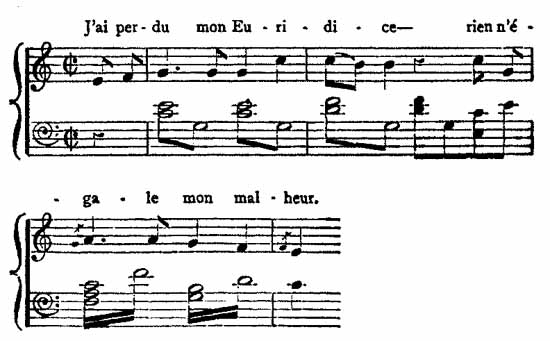
was performed the opera Euridice, the joint work of Caccini and
Peri, which is the starting-point of the new music.
The details of the invention of the nuove musiche, the ideas
which brought it forth, how these were nursed in the salons of
Florentine noblemen, especially in that of Bardi Conte Vernio, are all
well known. They did not proceed in the first instance from musicians,
but from scholars, who, having read in the course of their studies
about Grecian (or Roman--it was all the same to them) dramatic music,
determined to add to the other accomplishments of the new order that
of reviving the ancient drama with its music. They were vehement in
their denunciations of the barbarous institutions of counterpoint and
loudly called for a return to the only true principles of music as
taught by the ancients. With this end in view they drew into their
circle the most gifted musicians whom they could find, and expounded
to willing and zealous ears the principles of music as embodied in the
rules of Plato and Aristotle, omitting, however, to state where they
found them in the works of those philosophers. The first result was
the opera, or operas (for there seem to have been two, one by Caccini
and one by Peri, welded into one) Euridice performed at the
royal wedding. It was followed by other similar works and the series
has continued in unbroken course for three centuries, through
Monteverde, Carissimi, A. Scarlatti, down to our own time. The
physiognomy of the early operas of the classic revival is still
distinctly traceable in Rossini, Donizetti, and the early Verdi, after
whom its career was suddenly cut short almost in the height of its
fame by the publication of the first part of Wagner's Oper und
Drama in 1851.
From the very beginning the Italian opera was what it is now,
frivolous, insincere, imbecile. Its sole function was, and always has
been, to help idlers of the upper classes to while away their
evenings. The absurd notion of a Platonic music was rivalled by the
absurdity of the composition. The inane dialogue was made up of
interminable recitative, in the midst of which an occasional
chorus--introduced in conformity with supposed classical
practice--must have come as a most refreshing relief; for choruses
they could write. It was dramatic in so far that it was provided with
all the paraphernalia of the stage and that the singers walked about
as they sang. Possibly, too, the performers had some initiation into
modern methods of operatic acting, and would raise one arm at the word
cielo, two arms at certain other words, etc.; but it would be
hard to detect any living dramatic idea in those mythological heroes
and heroines, Dafnes, Amors, Tirsis, Ariannas dressed up as stage
shepherds and shepherdesses. The only raison d'être of the
music in the minds of the fashionable audience was--then as now--to
provide a stimulus for conversation and flirting, or a pleasant
diversion in the intervals of their business transactions.
But it is easy to ridicule the follies and failures of men who were
striving after an ideal. More profitable to us it will be to trace
what substantiality their dream of dramatic revival really possessed,
and if we strip it of the false garment of classicity in which it
masqueraded, and of its self-asserting intolerance, there is no
question that, whatever the results of the efforts of these reformers,
their intention was admirable. They themselves, the composers, were
deeply in earnest; their objects were not what they supposed, but they
were entirely worthy, and though we may wonder at their failure to
appreciate the entrancing beauty of polyphonic music, we must admit
even here that their objections were not without some force. To
realize this we must transfer ourselves in imagination to their
conditions and endeavour to consider the problems from their
standpoint, remembering how they were impelled by the irresistible law
of progress, the assertion of individualism, and by the desire for
dramatic treatment.
The main objection brought by the reformers against polyphony was that
the elaborate imitative treatment of the voices made the words
unintelligible. We may remember that exactly the same objection had
already been raised at the Council of Trent by clericals themselves.
Vocal music alone, the reformers contended, can be recognized as true
music, for music is essentially language and rhythm, and only in the
last place tone.[22] Consequently, right declamation is of its
essence. On this ground they objected to mixing together high notes
and low, fast movement and slow, to dividing a syllable between many
notes, to repetition of words and phrases. Especially significant is
the advice given by Vincentio Galilei to composers to study the
expression of gifted actors.[23]
22. Ambros., iv, p.165.
23. Ib.., p. 170.
It is impossible not to treat seriously a movement founded upon such
arguments as these. They are in the main incontrovertible. We seem to
be breathing the very atmosphere of Wagner, and it would be scarcely
too much to say that the humanist movement of the Bardi salon was in
its intention the forerunner of the German movement dreamed of
by Herder, Schiller, Jean Paul, and accomplished by Wagner, who at
last succeeded in finding what the others had sought, namely, the true
relations between words, music, and acting. Even the idea of
concealing the orchestra originated with them. Why, then, did it not
succeed? Why did the very name of Italian opera become a by-word for
all that is frivolous and inartistic in dramatic art? The answer must
be sought in the dictum of Dean Milman quoted at the beginning of this
chapter. Art is an organic growth, and cannot be created by authority.
A drama which has been manufactured by fitting together words, action,
and music in such manner as appears right to the composer, or
according to models, real or fanciful, however skilful be the
execution, is no drama; it lacks the breath of life; it is not a
living organism, but an artificial counterfeit.
In Wagner's theoretical writings there are few things of more
practical importance than the principle repeatedly insisted upon that
a work of art is not a production of a gifted artist which he exhibits
for his audience to criticize, and either to admire and enjoy or to
reject according to their capacities, but is a mutual interaction, a
conversation as it were between the artist and his public, to which
both contribute. Nor is art a diversion to be taken up as a
relaxation after the fatigue of serious work, but a labour requiring
the best efforts of the hearer's faculties. Every artist worthy of the
name has something new to say, something which has not been heard
before, but is characteristically his own, and cannot be understood
without an effort. Artist and hearer must co-operate together towards
a common end. Wagner's first purpose throughout his life was to
educate his public, or, to use his own phrase, prepare a soil in which
his art could flourish. Whenever an attempt is made to create an art
by authority, whether it be Court patronage, theoretical exposition,
or any other form of authority, this important principle is forgotten.
The would-be teachers of the people scatter the seed irrespectively of
the soil, and the attempt, however laudable, is ill-timed.
The subsequent history of the Italian opera has been told by Wagner
himself in the entertaining pages of the first part of his Oper und
Drama, which should be carefully read by all who wish to gain a
distinct understanding of his aims. A useful supplement to Wagner's
treatise will be found in a conversation which took place between him
and Rossini in 1860, a "scrupulously exact" account of which has been
published forty-six years after it took place from notes taken at the
time in a pamphlet by E. Michotte of Brussels.[24]
24. Paris, Librairie Fischbacher, 1906.
It would have been impossible for the opera to continue as it had
begun. People would not have gone to the theatre to hear dreary
recitatives, and from the very first we hear of concessions being made
to the singers--i.e. to the audience. By degrees there forms itself
that peculiar kind of vocal melody which we recognize to-day as
distinctively Italian. Not, be it noted, melody proper, which is the
very truest expression of the human soul; not the melody that was
known to the great Germans, but "naked, ear-tickling, absolute melodic
melody; melody which is nothing but melody; which glides into our
ears--we know not why; which we sing again--we know not why; which
to-day we exchange for that of yesterday, and forget to-morrow--still
we know not why; which is sad when we are gay, merry when we are
sorrowful, and which we yet hum--just because we know not why."
Let us not be misled by Wagner's bantering description into despising
Italian melody and supposing it to be a thing utterly worthless. True,
it has not the musical elevation of German melody. The little
Neapolitan urchin who basks all day in the sunshine, sings, steals,
and is ready to drive a knife into his companion, is not perhaps as
high a type of humanity as the English public-school boy. Nevertheless
he has a charm entirely his own, and his large round eyes will make
you forget his sins. Woe to art and to mankind when our hearts are
closed to such influences! Italian operatic melody is the expression
of Southern Italian individuality, and has in its very irresponsibility a
certain fascination different from that of the far nobler German music.
Wagner waged warfare, not against the Italian opera, not against
operatic composers, but against impostors and sophists, and while
trampling upon the serpent in his own path he was as little likely to
remain untouched by the good-natured lovableness of the Italian as
he was to slight the high intelligence, the artistic receptiveness and
thoroughness of the French. On reading his works it is hard to escape
the impression of a lurking fondness for Rossini on Wagner's part,
even while he is making game of the whole school. Above all, Italian
melody possesses one quality which is the highest of all in melody--it
is eminently singable. No German, unless perhaps Handel, ever
understood the human voice as did the Italians. Wagner's own
words leave no doubt as to what he thought. In one of his earliest
writings he utters a prayer that German composers may one day write
such melody and learn such treatment of the voice as are found in
Bellini's Norma. But, like Odysseus, he stopped his ears to the
siren-song (his own expression) while at the same time learning from
it and assimilating what was good therein. Wagner's vocal melody was
largely modelled on that of the Italians. Tristan itself was conceived
for Italian singers, and the part of Isolde was originally intended
for Mdlle. Tietjens. He even adopted Italian mannerisms, operatic
turns, trills, suspensions, cadences, and bravura tricks. We may
follow how these Italicisms appearing in all their banality in his
earlier works become more and more expressive as his style develops.
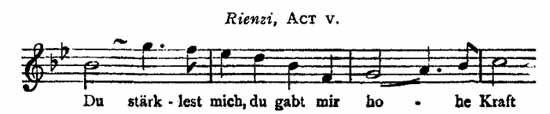
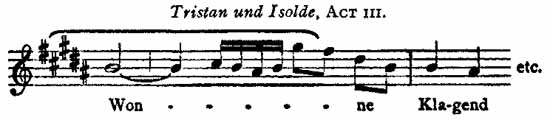
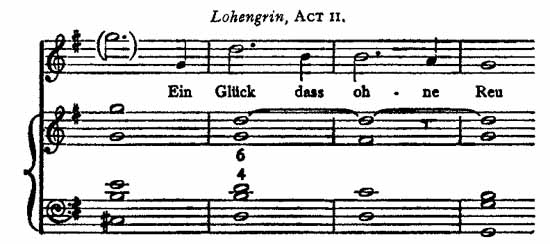
Cadences of the common Italian type with 6/4 chord or suspension swarm
in Tannhäuser and Lohengrin. In Tristan they never have the
stereotyped character which they have in his earlier works.
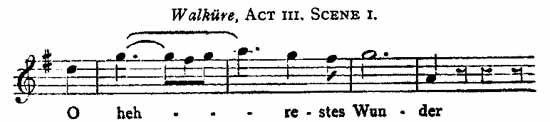
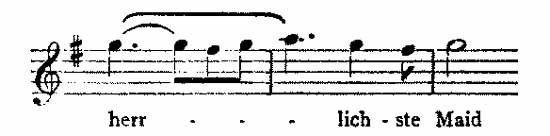
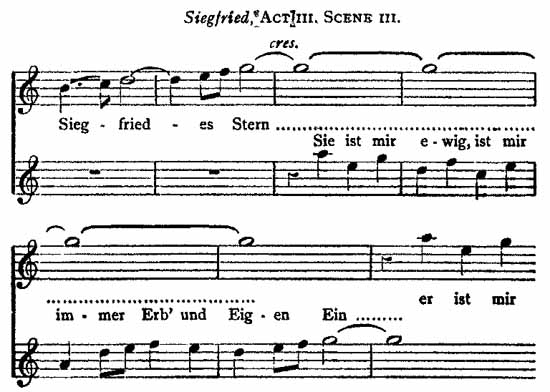
The finer characteristics of Italian melody, that easy tunefulness
which seems to have sprung naturally and without effort out of the
mechanism of the vocal organs, is above all noticeable in the music of
his noblest creation, Brünnhilde.
The flower-maidens' chorus in Parsifal might be called the
apotheosis of Italian song. What Wagner means by his scathing ridicule
of the Italian opera and Italian melody, is not that it is worthless,
but that it has no meaning. In short it is not the drama.
We recognized the radical fault of the Italian opera to be its
subordination of the drama to the music. In opposition to this it has
been asserted that the music aids the drama by carrying on the action.
Let us examine this by the light of one example, the well-known
seduction scene of Zerlina in Don Giovanni. The form of music
as such is determined by rhythmic repetitions of themes, varied or
not. The scene is full of dramatic charm and has great capabilities.
Don Giovanni begins insinuatingly: "Give me your hand, Zerlina; come
away with me to my castle." The timid peasant girl at first hesitates.
"No, no," she replies, "I dare not--yet how I should like to!--but
what would Masetto say?" All this is in the most winning and seductive
melody; it is exactly the tone in which a young nobleman and a rather
coquettish but entirely innocent young girl would express themselves.
The situation becomes warmer; Don Giovanni is more pressing--he puts
his arm round her--he is just about to kiss her, when suddenly the
scene begins over again from the beginning with "Give me your hand,"
etc., and the whole episode is rendered absurd! Up to this point we
have been so transported by the interest of the scene and the
appropriateness of the expression that we almost feel ourselves to be
taking part in it, but the repetition checks our feelings like a
douche, by the necessity felt by the composer of preserving the
musical form. Had the action and the music been carried right through
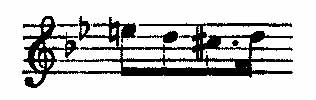
to the second part, Zerlina's inexpressibly tender
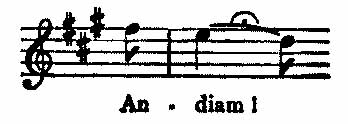
would have been most thrilling, and the way would have been naturally
prepared for the entry of Elvira just in time to save her.
Absolute or instrumental music requires the strict form which is
effected by means of balanced repetitions in order to supply that
intellectual element without which it cannot be understood, and which
in vocal music is afforded by the words. The drama needs no such
restrictions and cannot endure them. Human actions are not subject to
mechanical laws; they are intelligible in themselves, but cannot be
measured out. Human life is a continuous whole, one action leads
naturally on to another, without any break, and to attempt to range
the actions of men and women under schemes of arias, cavatinas, duets,
choruses, each existing for itself and sharply separated from all
others, can only render them unintelligible and ridiculous.