Some apology is perhaps needed from an author for writing three
books on the same subject. I can only plead in extenuation that
the subject of Wagner is inexhaustible; and I am defiant enough
to refuse to pledge myself not to repeat the offence in another
ten years or so. It is possible that readers who have done me the
honour to make themselves familiar with my Study of Wagner
(1899) may discover that in the present book I express myself
differently upon one or two points. My defence is that even a
musical critic may be allowed to learn something in the course of
fifteen years; and I can only hope that if here and there I have
changed sides since then, the side I am now on is that of the
angels.
In spite of the size of this volume, many readers will no doubt
feel that it either discusses inadequately several aspects of
Wagner's work and personality, or that it passes them over altogether.
Again I plead guilty; but to have followed Wagner up
in every one of his many-sided activities,—in all his political,
ethical, economic, ethnical, sociological and other speculations—would
have necessitated not one book but four. I have tried to
keep within the limits of my title—first of all to study Wagner
as a man, and then his theory and practice as a musician. His
operas are now so universally known that I could afford to
dispense with detailed accounts of them; in any case the reader
will find them fully described in a hundred books, and best of
all in Mr. Runciman's admirable Richard Wagner, Composer of
Operas—though I must dissent from Mr. Runciman's views on
Parsifal. Nor could I bring myself to attempt a biography of
Wagner. A new biography, incorporating all the material that
the last ten years have placed at our disposal, is urgently needed.
The work of Glasenapp is copious enough and fairly accurate,
but it is hopelessly uncritical of Wagner either as man or artist,—to
say nothing of its occasional lapses into the disingenuous.
But even if I had felt that I were qualified for a new biography
of Wagner I should have shrunk appalled from the magnitude
of the task. I have preferred to give the reader a chronological
digest of Wagner's life in the Synthetic Table at the conclusion
of the present volume, and for the rest to try to reconstruct
him as man and musician from his own letters, his autobiography,
the letters and reminiscences of others, his prose works, and his
music. As the book is going to press I learn that a new edition
of his correspondence, containing some two thousand hitherto
unpublished letters, is to appear under the editorship of that indefatigable
Wagner researcher Dr. Julius Kapp. But it ought to
be possible to reconstruct the man from the 2700 letters of his that
we already have, though the picture will no doubt need some
filling-in and perhaps some corrections in detail when Dr. Kapp's
edition is available. With the expiration of the Wagner copyrights,
and the passing of the control of his letters out of the
hands of Villa Wahnfried, we may hope for a higher standard
of literary rectitude in these matters than we have been accustomed
to in the past. The earlier, and even some of the later,
editions of the letters have been so manipulated as to be thoroughly
misleading. I have drawn attention to one or two of these manipulations
in the following pages.
I have made all translations from the prose works, the letters,
the autobiography, &c., direct from the originals. This has necessitated
referring to them throughout in the German editions;
but no one who has the current English versions will have any
difficulty in tracing any particular passage by means of dates and
indices. I cannot hope that with prose so involved as that of
Wagner's I have always been able to achieve perfect accuracy;
but I am consoled by the consciousness that native German
scholars to whom I have referred a few passages have been as
puzzled over them as myself.
I have used Wagner's prose works in the latest edition (the
fifth) of the Gesammelte Schriften und Dichtungen (always referred
to in the following pages as G.S.), the Wagner-Liszt correspondence
in the new and expanded and more conscientiously edited
third edition, and all the other letters in the latest editions available.
The operas are always referred to in the new Breitkopf
edition.
I have to express my thanks to several friends for help of one
kind and another,—to Mr. Bertram Dobell, the publisher of my
earlier Study of Wagner, for allowing me to make whatever use I
liked of that book for the present one; to Messrs. Breitkopf and
Härtel for placing at my disposal a set of proofs of the full scores
of Wagner's earliest unpublished operas, Die Hochzeit and Die
Feen, and proofs of a number of other unpublished compositions
of his; and, above all, for lending me the manuscript score of the
still unpublished opera Das Liebesverbot. I am indebted also to
Professor H. G. Fiedler, Mr. R. A. Streatfeild, and other friends
for assistance of various sorts.
Some of the matter of the book has already appeared in the
Fortnightly Review, the Contemporary Review, the Nation, the
New Music Review (New York), the International (New York),
the Musical Times, and the Harvard Musical Review. My thanks
are due to the editors of these journals for permission to reproduce
such portions of the articles as I desired to make use of here.
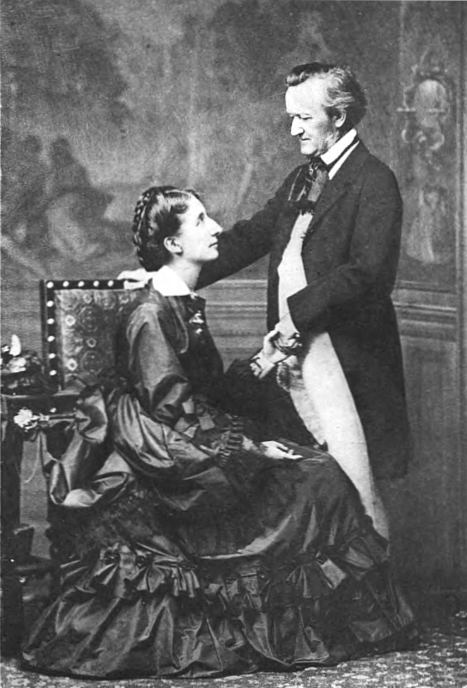
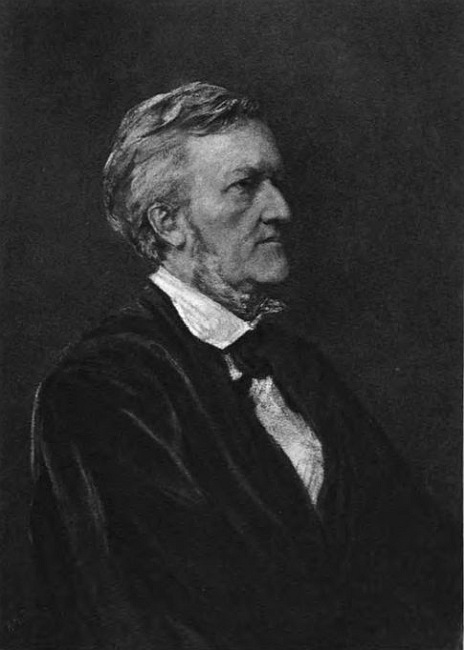
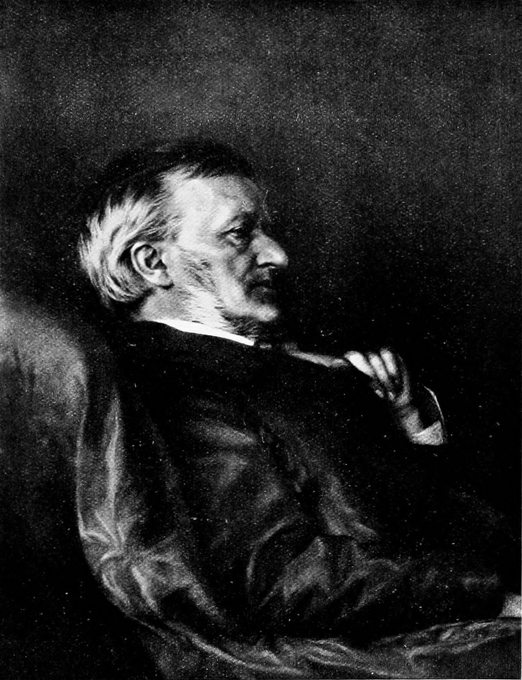
(From Chamberlain, "Richard Wagner," published by
F. Bruckmann, Munich.)
WAGNER
AS MAN AND ARTIST
INTRODUCTION
While there is at present no adequate Life of Wagner, there is
probably more biographical material available in connection with
him than with any other artist who has ever lived; and on the
basis of this material it seems justifiable now to attempt—what
was impossible until the publication of Mein Leben in 1911—a
complete and impartial psychological estimate of him. There
has probably never been a more complex artist, and certainly never
anything like so complex a musician. A soul and a character so
multiform as this are an unending joy to the student of human
nature. It has been Wagner's peculiar misfortune to have been
taken, willy-nilly, under the protection of a number of worthy
people who combine the maximum of good intentions with the
minimum of critical insight. They have painted for us a Wagner
so impeccable in all his dealings with men and women—especially
women—a Wagner so invariably wise of speech, a Wagner so
brutally sinned against and so pathetically incapable of sinning,
that one needs not to have read a line of his at first hand to know
that the portrait is a parody—that no such figure could ever have
existed outside a stained-glass window, or, if it had, could ever
have had the energy to impress itself upon the imagination of
mankind even for a day. The real Wagner may be hard enough
to disentangle from the complications and contradictions presented
by his life, his letters, his prose works, his music, his autobiography,
and the testimonies of his friends and enemies; but in the case of
no man is the attempt better worth making. For the enduring
interest of his character, with its perpetual challenge to constructive
psychology, is in the manysidedness of it. The well-meaning
thurifers who try to impose him upon us in a single formula as one
of the greatest and best of mankind,[1] do but raise him to their own
moral and reduce him to their own intellectual level, making their
god in their own image, as is the way of primitive religious folk.
The more interesting Wagner is the one who stands naked and
unashamed before us in the documents of himself and others—equally
capable of great virtues and of great vices, of heroic
self-sacrifice and the meanest egoism, packed with a vitality too
superabundant for the moral sense always to control it; now
concentrating magnificently, now wasting himself tragically, but
always believing in himself with the faith that moves mountains,
and finally achieving a roundness and completeness of life and a
mastery of mankind that make his record read more like romance
than reality.
It is in keeping with the whole character of the man that he
should have left us more copious documentary material concerning
himself than any other artist has ever done. Publicity was as
much a necessity to him as food and air. The most interesting
person in the universe to him was always himself; and he took
good care that the world should not suffer from any lack of knowledge
of a phenomenon which he rightly held to be unique. It
would be a sign of unwisdom to despise him for this. It has to
be recognised that whatever criticism the contemporary moralist
might have to pass upon this or that portion of Wagner's conduct
with the outer world, he was always the soul of purity and steadfastness
in the pursuit of his ideal. He believed he had come into
the world to do a great and indispensable work; and if he occasionally
sacrificed others to his ideal, it must be admitted that he never
hesitated to sacrifice himself. Regarded purely as an artist, no
man has ever kept his conscience more free from stain. And it
is precisely this ever-present burning sense of the inherent
greatness of his mission that accounts primarily for his constant
pouring-out of himself, not only in music—his musical output,
after all, was not a remarkably large one—but in twelve volumes
of literary works and in innumerable letters. I say "primarily,"
because a second set of impulses obviously comes into play here
and there. Wagner had the need that many men of immense
vitality have felt—Mr. Gladstone was a notable example in our
own day—of dominance for dominance' sake; there is something
aquiline in them that makes it impossible for them to breathe anywhere
but on the heights. Wagner felt the need of over-lordship
as irresistibly as his own Wotan did. Had he been a soldier
living in a time of warfare he would have become one of the world's
rulers, with Alexander, Julius Cæsar, and Napoleon. Had he
been a business man he would have controlled the commerce of
a continent through the strength and the thoroughness of his
organisations. Being an artist, a dealer in the things of the mind
alone, his ends could be achieved only by example and argument.
His voluminous letters and prose works are the outcome of the one
great need of his life—to win the world to see everything as he saw
it. The letters to Liszt, to Roeckel, to Uhlig, and others show
how powerful was this desire in him; the least expression of
disagreement, the least failure of comprehension, would call forth
a whole pamphlet of eager explanations. He yearned to hunt
out misunderstanding with regard to himself as Calvin yearned
to hunt out heresy. Always there was the inability to conceive
himself, Wilhelm Richard Wagner, except as the central sun of
his universe; ideas and persons had to revolve round him or find
orbits in another and smaller universe. Here again ethical commentary
by way of either praise or blame would be the merest
supererogation. One simply notes the phenomenon as one notes
the colour of his eyes or the shape of his head; it was one of the
things that made Wagner Wagner, as the lion's mane is one of the
things that make him a lion.
The need for mastery over everything and everybody that came
within his orbit extended from art to life. All accounts agree that
with people who loved and looked up to him he was the most charming
of men;[2] while not only the testimony of his associates but
his own words and conduct show with what difficulty he accommodated
himself to the natural desire of others to take life in their
own way. Read, for example, his naïf account of his anger with
Tausig and Cornelius for not coming to him when he wanted them:
"Cornelius and Tausig had again been to see me. Both had
first of all to bear the brunt of my real ill-temper for their behaviour
during the previous summer [1862]. Having had the idea of bringing
the Bülows and the Schnorrs to me at Biebrich, my cordial
interest in these two young friends of mine decided me to invite
them too. Cornelius accepted immediately, and so I was all the
more astonished when one day I received a letter from him from
Geneva, whither Tausig, who suddenly seemed to have money
at his disposal, had taken him on a summer excursion—no doubt
of a more important and more agreeable nature. Without the
slightest expression of regret at not being able to meet me this
summer, I was simply told that they had just gaily 'smoked a
splendid cigar to my health.' When I met them again in Vienna,
I could not refrain from pointing out to them the offensiveness
of their conduct; but they did not seem to understand that I
could have had any objection to their preferring the beautiful
tour in French Switzerland to visiting me at Biebrich. They
obviously thought me a tyrant."[3]
All through the correspondence and the autobiography we see
the same spirit of unconscious egoism. His conviction that he
was always in the right naturally led to a passionate desire that
those who differed from him should hear every word he had to
say on his own behalf. Hence the frequent and lengthy plaidoyers
in the letters; hence too the autobiography. His lust
for dominance looked even beyond the grave; thirty years after
his death the world should read a document which should be his
final, and, he hoped, successful effort at self-justification. We
cannot, I think, understand Wagner fully unless we recognise that,
however honest he was in intention, this consuming desire to prove
himself always in the right should make us chary of accepting
everything he says at its face value. No man is a perfectly unprejudiced
witness on his own behalf, in his own suit; and in
Wagner's case the very vehemence of his pleading lets us see how
earnestly he desired to impress his own reading of himself upon
the world, and is therefore a warning that he may often have seen
things as he desired them to be rather than as they were. It is
pretty clear that at an early age he realised that he was destined
to be a great man, and took care that the world should not suffer
from any lack of materials for the writing of his life.[4] The autobiography
is simply the last and longest speech of a thousand long
speeches for the defence. We need not consider at present the
particular opinions upon his friends and associates and enemies
that Wagner expresses there. The only question for the moment
is as to the general trustworthiness of the book. That he has
been exceedingly, even embarrassingly, candid on some points all
the world now knows. Whether he always saw things at the
correct angle is a different matter. It is obviously impossible to
check him throughout, even where one suspects him to be unconsciously
distorting the truth;[5] but there are several instances
in which he is obviously not telling quite the truth or all the truth,
and in more than one instance he can certainly be convicted of
manipulating the facts to suit his own purpose.
I shall try to show later that the account he gives of the episode
with Madame Laussot in 1850 does not square at every point with
his letters to Minna. He deliberately tries to mislead the reader
with regard to his relations with Frau Wesendonck; everyone
who has read Wagner's ardent letters to her must have gasped
with astonishment to find him in Mein Leben glossing over that
long and passionate love-dream, and actually speaking of "Minna's
coarse misunderstanding of my real relations—friendly relations—with
the young wife, who was continually concerned for my repose
and my well-being."[6] That is not an actual untruth, but it is
considerably less than the truth. In the preface to Mein Leben
Wagner tells us that the only justification of the volumes was
their "unadorned veracity." Perhaps he found "unadorned
veracity" at this point a trifle embarrassing; perhaps he forgot
his letters to Mathilde, or had never considered the possibility of
their being published. But the fact remains that his own letters
show the account he gives of his relations with Mathilde Wesendonck
to be quite unreliable. What warrant have we, then, for
believing him implicitly in other cases in which it may have been
to his interest to suppress or distort the truth?
Let us take one of the most striking cases of this suppression
and distortion. One of the friends of the middle period of Wagner's
life was a certain Baron Robert von Hornstein. In 1862 Wagner—who
was at that time in Paris—was, as frequently happened with
him, looking for someone who would undertake the burden of
keeping a home above his head. He tried two or three people,
but without success; then he thought of the young Baron von
Hornstein. This is the account he gives of the matter in Mein
Leben:
"Finally I bethought me of looking for a quiet abode in the
neighbourhood of Mainz, under the financial protection of Schott.
He had spoken to me of a pretty estate of the young Baron von
Hornstein in that region. I thought I was really conferring an
honour upon the latter when I wrote to him, at Munich, asking permission
to seek shelter for a time at his place in the Rhine district;
and I was greatly perplexed at receiving an answer that only
expressed terror at my request."[7]
On the face of it this seems candid and credible enough. Von
Hornstein's son, Ferdinand von Hornstein, has, however, thrown
another light on the affair. When Baron Ferdinand published
a memoir of his father in 1908, he omitted certain letters, he tells
us, "out of consideration for Wagner and his family." The
wounding allusions to Baron Robert in Mein Leben, and the evident
animus displayed against him there, unlocked, however, the son's
lips. He resents Wagner's description of his (Hornstein's) father—the
friend of Schopenhauer, Paul Heyse, Hermann Lingg and
others—as a "young booby,"[8] and proceeds to explain "why
Wagner has misrepresented my father's character."
On an earlier page (627) of Mein Leben Wagner tells us that
during their stay together at Zürich in the winter of 1855-6 Hornstein
declared himself to be so "nervous" that he could not bear
to touch the piano—that his mother had died insane, and that he
himself was greatly afraid of losing his reason. "Although,"
says Wagner, "this made him to some extent interesting, there
was blended so much weakness of character with all his intellectual
gifts that we soon came to the conclusion that he was pretty hopeless,
and were not inconsolable when he suddenly left Zürich."[9]
The impression conveyed—and obviously intended to be conveyed—is
that the young man's departure was a piece of half-mad caprice.
As it happens, however, Hornstein at his death had left among
his papers an account of the affair that puts a different complexion
on it. Wagner's own eccentricities had been making the relations
of the little circle none too pleasant.[10] And Hornstein, so far from
leaving Zürich in obedience to a sudden impulse, had actually
made arrangements at his lodgings under which he could leave
at any time when the "scenes" with Wagner became intolerable.
He often expressed to Karl Ritter and the latter's mother[11] his
regret that he was not in a position to "take his revenge" for the
invitations he received to Wagner's table. Their reply always
was: "Wagner does not at all expect this now. He knows your
circumstances, and is sure to follow you up later. He is waiting
for a more favourable moment." When he voiced his regret that
there should be anything but ordinary friendly feeling to account
for Wagner's attentions to him, his friends replied, "Oh, there is
no doubt Wagner likes you and prizes your talents greatly; but
these calculations (Hintergedanken) are too much second nature
with him for him to be able to make an exception." "This,"
says Hornstein, "was to become still clearer to me." He learned
that Wagner's guests were expected to bring bottles of wine with
them—a point on which Hornstein, as a young man of breeding,[12]
evidently felt some delicacy. On his birthday the great man
entertained Hornstein and Baumgartner at dinner. "During the
dessert, Wagner asked his sister-in-law—it came like a pistol shot—to
bring him the wine-list from a neighbouring restaurant. She
hesitatingly carried out this unexpected commission. The card
comes. Wagner runs down the list of the champagnes and their
prices, and orders a bottle of a medium quality to be brought.
Everyone felt uncomfortable. The bottle having been emptied,
Wagner turned to his two guests with a sneering smile, and said
loudly, 'Shall I now present another thaler to each of these two
gentlemen?' His wife and his sister-in-law fled in horror, like
the ladies in the Wartburg scene in Tannhäuser. Baumgartner
and I were stunned; we looked at one another, and each of us probably
had an impulse to throw a glass at the head of our dear
host." Instead of doing so, they burst into laughter, thanked him,
and took their leave. Baumgartner declared to Hornstein that
he would never accept another invitation from Wagner, "and I,
for my part," says Hornstein, "was firm in my resolve to leave
Zürich as soon as possible." Afterwards Wagner, as was no doubt
his wont, came and excused himself to Hornstein and Karl Ritter.[13]
He had not meant them, he said, but "the German Princes" who
performed his operas and raved about him, but gave him nothing:
"it does not occur to them to send me a hamper of wine"; and
so on. The young men, however, were not to be so easily appeased,
and Wagner "had to listen to many things that he would rather
not have heard." An outward reconciliation was effected, but the
sting remained; Hornstein delayed his departure for a few weeks,
and still visited Wagner's house, though less frequently than before.
"I had," he writes, "to tell this distressing story, as it gives the
key to my later conduct when, soon after my father's death,
Wagner tried to borrow so heavily from me. The correspondence
connected with this attempt led to a permanent separation from
Wagner."[14]
All this, it will be seen, puts the Zürich episode in a new light.
There is not the least reason for doubting Hornstein's veracity.
What he says is quite consistent with the accounts of Wagner's
behaviour that we get from other sources, private and public.
Moreover, Hornstein's reminiscences simply take the form of a
note left among his personal papers. He could not have anticipated
the misleading version that was to appear in Mein Leben
many years after his death,[15] and, as has been said, his own version
would probably have remained unpublished for ever, but for the
provocation given to his son by the autobiography.
Baron Ferdinand von Hornstein gives further evidence of the
pettiness of Wagner's rancour against this young man from whom,
notwithstanding his disparagement of him, he was willing to borrow
money. For now comes the full record of the incident to which
Wagner alludes so airily in the passage from Mein Leben quoted on
page 6. Here is the actual letter, dated, "19, Quai Voltaire,
Paris, 12th December 1861," in which Wagner, according to his
account, simply asked permission to stay for a time at Hornstein's
place in the Rhine district.
"DEAR HORNSTEIN,—I hear that you have become rich. In
what a wretched state I myself am you can easily guess from my
failures.[16] I am trying to retrieve myself by seclusion and a new
work. In order to make possible this way to my preservation—that
is to say, to lift me above the most distressing obligations,
cares, and needs that rob me of all freedom of mind—I require an
immediate loan of ten thousand francs. With this I can again put
my life in order, and again do productive work.
"It will be rather hard for you to provide me with this sum;
but it will be possible if you WISH it, and do not shrink from a
sacrifice. This, however, I desire, and I ask it of you against my
promise to endeavour to repay you in three years out of my receipts.
"Now let me see whether you are the right sort of man!
"If you prove to be such for me,—and why should not this be
expected of some one some day?—the assistance you give me
will bring you into very close touch with me, and next summer
you must be pleased to let me come to you for three months at one
of your estates, preferably in the Rhine district.
"I will say no more just now. Only as regards the proposed
loan I may say that it would be a great relief to me if you could
place even six thousand francs at my disposal immediately; I
hope then to be able to arrange to do without the other four thousand
francs until March. But nothing but the immediate provision
of the whole sum can give me the help which I so need in
my present state of mind.
"Let us see, then, and hope that the sun will for once shine
a little on me. What I need now is a success; otherwise—I can
probably do nothing more!—Yours,
RICHARD WAGNER."
"I must confess," says Hornstein, "that the largeness of the
amount and the tone of the letter made a refusal easier to me.
What made it easier still was my knowledge that I had to do with
a bottomless cask,—that while ten thousand francs were a great
deal for me, they were simply nothing to him. I knew that
Napoleon, Princess Metternich, Morny, and Erlanger had been
bled of large sums that were simply like drops of water falling on
a hot stone." Hornstein was particularly grieved at the remark
that the loan would draw him nearer to Wagner. "Was I not
near to him, then," he asks, "before I gave him money? Was
the intimate intercourse with him at the Lake of Geneva, on the
Seelisberg, in Zürich, intended only to prepare the way for the
borrowings he had in view when my father should die?"[17] So
he replied to Wagner in these terms:
"DEAR HERR WAGNER,—You seem to have a false idea of my
riches. I have a modest (hübsch) fortune on which I can live in
plain and decent style with my wife and child. You must therefore
turn to really rich people, of whom you have plenty among
your patrons and patronesses all over Europe. I regret that I
cannot be of service to you.
"As for your long visit to 'one of my estates,' at present I
cannot contrive a long visit; if it should become possible later I
will let you know.
"I have read in the papers with great regret that the production
of Tristan and Isolde will not take place this winter. I
hope that it is only a question of time, and that we shall yet hear
the work. Greetings to you and your wife.—From yours,
ROBERT VON HORNSTEIN."
To which Wagner replied thus:
"PARIS, 27th December, 1861.
"Dear Herr von Hornstein,—It would be wrong of me to
pass over without censure an answer such as you have given me.
Though it will probably not happen again that a man like me (ein
Mann meines Gleichen) will apply to you, yet a perception of the impropriety
of your letter ought of itself to be a good thing for you.
"You should not have presumed to advise me in any way,
even as to who is really rich; and you should have left it to myself
to decide why I do not apply to the patrons and patronesses to
whom you refer.
"If you are not prepared to have me at one of your estates,
you could have seized the signal opportunity I offered you of
making the necessary arrangements for receiving me in some place
of my choice. It is consequently offensive of you to say that you
will let me know when you will be prepared to have me.
"You should have omitted the wish you express with regard
to my Tristan; your answer could only pass muster on the assumption
that you are totally ignorant of my works.
"Let this end the matter. I reckon on your discretion, as
you can on mine.—Yours obediently,
I have given this episode in such detail because, as Ferdinand
von Hornstein caustically remarks, it enables us to test the value
of Wagner's claim for the "unadorned veracity" of his memoirs.
He is plainly guilty of serious sins both of omission and of commission
in his account of his dealings with Hornstein. What
guarantee have we that he was any more scrupulous in his record
of other matters in which his reputation or his amour propre were
concerned? Let us check him in one or two other cases.
How unreliable the autobiography is, with what caution we
have to accept Wagner's opinions of men in the absence of confirmatory
testimony, may be seen from a survey of his dealings
with Franz Lachner.[19]
The first reference to Lachner in Mein Leben is under the date
1842. Wagner had written two articles in Paris à propos of
Halévy's opera, La Reine de Chypre.[20] In the article published in
the Dresden Abendzeitung, he says, "I made particularly merry
over a mischance that had befallen Kapellmeister Lachner."
Küstner, the Munich director, had commissioned a libretto for
Lachner from St. Georges, of Paris (the librettist of La Reine de
Chypre). After the production of the latter opera, it turned out
that this book and that of the Lachner opera were virtually identical.
In reply to Küstner's angry protests, St. Georges "expressed
his astonishment that the former should have imagined that for
the paltry price offered in the German commission he would supply
a text intended only for the German stage. As I had already
formed my own opinion as to this French opera-text-business,
and nothing in the world would have induced me to set to music
even the most effective piece of Scribe or St. Georges, I was greatly
delighted at this occurrence, and in the best of spirits I let myself
go on the subject for the benefit of the readers of the Abendzeitung,
who, it is to be hoped, did not include my future 'friend' Lachner."[21]
Evidently he did not love Lachner.
The next reference to him in Mein Leben is in 1855. Wagner
had returned to Zürich after his London concerts. There he
learned that Dingelstedt, at that time Intendant of the Munich
Court Theatre, wished to give Tannhäuser there, "although,"
says Wagner, "thanks to Lachner's influence," the place was
not particularly well disposed towards him.[22]
The third reference to Lachner is in 1858, just before Wagner's
departure from the "Asyl"; there was a "national vocal festival"
at Zürich that seems to have irritated Wagner a good deal,
depressed as he was at that time by the Minna-Mathilde catastrophe.
Lachner was taking part in the festival. Wagner gave
him the cold shoulder, and refused to return his call.[23]
Now let us see, from documents of the time, how matters really
stood as regards Lachner. In 1854 Wagner was hoping to get
Tannhäuser produced at Munich, where, as we have seen, Dingelstedt
was Intendant and Lachner Kapellmeister. Lachner was
a conductor and composer of the old school. Wagner had a poor
opinion of him, and apparently thought him incompetent to do
justice to Tannhäuser. "I don't at all know," he writes to Liszt
on May 2, 1854,[24] "how to get Lachner out of the way. He is an
utter ass and knave." In the summer of 1852 there had been some
talk of giving Tannhäuser at Munich. Lachner thought it advisable
first to familiarise the public with the style of the work by
giving the overture at a concert on 1st November. The success
was doubtful. Wagner had previously sent Lachner a copy of
the explanatory programme of the overture that he had written
in the preceding March for the Zürich orchestra. Perhaps this
was thought too long for the Munich programme; in any case a
much shorter "explanation" was given, that aroused Wagner's
ire.[25] With his customary blind suspicion of people he did not like,
he assumed that the concert production of the overture was a
deliberate attempt to prejudice the public against the opera.
This suspicion, as Sebastian Röckl says,[26] finds no support in the
external facts. A fortnight after the Munich performance of the
overture, Tannhäuser was given at Wiesbaden with great success,
and soon became one of the favourite pieces in the repertory of
the theatre there. Dingelstedt at once sent his theatre inspector,
Wilhelm Schmitt, to Zürich to arrange with Wagner for a production
at Munich. Unexpected difficulties arose, however; an
outcry was raised against the proposed performance of a work by
"the Red Republican, Richard Wagner"; and there was opposition
on the part of the Bavarian Minister, von der Pforten. By
the spring of 1854 all obstacles had been removed, and, as we have
already seen, Dingelstedt now arranged with Wagner for the production,
although the composer thought Munich "not particularly
well-disposed towards him, thanks to Lachner's influence." Having
heard that the singer destined for the part of Tannhäuser was
incompetent, Wagner asked Dr. Härtinger, of the Munich Opera,
to undertake it. Härtinger came to Zürich in May to study the
rôle with the composer, and seems to have deepened Wagner's
mistrust of and contempt for Lachner. The performance did not
take place, as was intended, in the summer of 1854, but, as Röckl
says, the cause of the postponement was not Lachner but the
cholera.
Later on, Dingelstedt found himself unable to fulfil his promises
to Wagner with regard to the honorarium. "Thereupon," says
Röckl, "Lachner, fearing that he might be looked upon as answerable
for the production having fallen through a second time, wrote
to his friend Kapellmeister G. Schmidt, of Frankfort, asking him
to arrange with the composer for more favourable conditions."[27]
In the end this was done. "And now," says Röckl,[28] "Lachner,
although in his innermost conscience an opponent of the 'musician
of the future,' did all he could in order to produce the work as
excellently as was possible to him. Rehearsal after rehearsal was
held, though the musicians were always moaning over the extraordinary
efforts they were called upon to make"—as is shown by
reference to a Munich comic paper of the time. As the tenor was
unmistakably incompetent, a singer who was already familiar
with the work was engaged from another opera house. Tannhäuser
was given on 12th August 1855 with extraordinary success. Lachner
was called on the stage, whence he thanked the audience in
Wagner's name. He communicated the evening's result to the
composer, and received a letter, dated 17th August 1855, warmly
thanking him for the trouble he had taken over the work and the
sympathy he felt with it, and for the friendliness of his feelings
towards Wagner; and he was asked to thank the singers and
orchestra in the composer's name. "Finally accept the assurance
of my great gratification at having been brought by this
circumstance closer to yourself. I sincerely hope for a continuance
of this approach to an understanding that is necessary for the
artist and possible to him alone."[29]
The success of Tannhäuser emboldened Dingelstedt to venture
upon Lohengrin for the winter of 1856, but various events conspired
against the production. In February 1857 Dingelstedt
resigned the Intendantship. Lohengrin was put in rehearsal by
his successor, von Frays, in November 1857, and produced on
28th February 1858, under Lachner. It was well received on the
whole, but the opera found more antagonists than Tannhäuser
had done.
From 21st July to 2nd August there was held at Zürich the
vocal festival at which, as we have seen, Wagner refused to receive
Lachner. What Röckl rightly calls the ambiguous words of
Wagner in this connection in Mein Leben are explained by the
following letter from the composer to Lachner, that is published
for the first time in Röckl's book:
"VENICE, 26th September 1858.
"HIGHLY HONOURED SIR AND FRIEND
,—Now that, after a
long and painful interruption of the way of living I have been
accustomed to for many years, I have again won a little repose,
permit me to approach you with the remembrance of your so
friendly advances to me last summer, in order in some degree to
link myself again with the life on which you have imprinted a
significantly agreeable memory. If you found something strange
at our meeting, something on my part apparently not quite corresponding
to your friendly intentions, I now permit myself, by way
of exculpation, to say that at that time I was in a very agitated
and embarrassed frame of mind; few people know what difficult
resolutions were maturing in me at that time.[30] It may, however,
suffice for me to tell you that only now, after leaving my friendly
refuge by the Lake of Zürich, in order to compose my mind here,
in the greatest seclusion, for the resumption of my work, has the
pleasant and encouraging significance of your Zürich visit become
quite clear to me. By my sincere regret to know that you were
in some degree hurt through a mistake of my servant,[31] you probably,
nevertheless, understood even then how earnestly I realised
the value of your visit; your friendly assurance that you were
satisfied with my explanation of that misunderstanding was most
tranquillising for me. Let me now say that I estimate highly the
value of your advances, and with my whole heart I shall do my
best to deserve your friendship—if you will favour me with it—can
and most sincerely to reciprocate it. On the occasion of another
personal meeting, if you will be so good, I hope that you will learn,
with some satisfaction, in what sense I give you this assurance.
I chiefly remember with the greatest pleasure that you expressed
to me the wish that perhaps the first performance of my latest
work, Tristan and Isolde, might be entrusted to you. I have so
agreeable a recollection of this wish, that I can only regret not being
able to gratify it immediately. Unfortunately just at the time
when we met I was so grievously interrupted in this very work
that only now again, for the first time, can I cherish the hope of
getting into the proper mood for continuing and completing it.
Consequently this opus is not one as to the time of whose coming
to the light I can decide anything definite—which is in every respect
unpleasant for me.
"The friendly wish you showed to occupy yourself with me
once more soon, emboldens me, however, to approach you with
regard to the granting of a very big request on my part. My
Rienzi has again been given in Dresden with real success, and since
I now no longer have any special reason for keeping back this
effective work of my youth, I have been inviting the theatres
that are friendly to me to take up this opera as quickly as possible;
in so doing I am moved by the firm conviction that I am recommending
to them a very good and remunerative work. Almost
all whom I have approached have fallen in with my wishes. Would
you therefore think it too bold of me if I were to request you also
to get this score (which you have only to ask for, in my name, of
Chorus-master Wilhelm Fischer, of Dresden), without much hesitation
and delay, and to see what you can do with this tamed rebel
(mit dem gezähmten Unband) for my consolation and benefit, while
I am finishing Tristan?
"I beg you to take this in good part. But in any case I owe
you very great thanks, and if you are not angry with me on account
of this request, I shall take this as a particularly good sign.
"In any case I may probably hope to receive soon from you a
friendly reply; console me also with the assurance that you have forgiven
me, and accept in return the assurance of the sincerest devotion
and esteem of your most indebted
Lachner at once got the score of Rienzi from Fischer, and wrote
to Wagner (October 13) expressing his pleasure at the prospect
of an early production of the opera. "In spite, however, of his
sincere endeavours," says Röckl, "Rienzi was not put into rehearsal.
The reading committee felt the subject to be inadmissible
on religious grounds."
In July 1860, von Frays had the idea of giving the Flying
Dutchman, and wrote to Wagner on the matter. Wagner thought
that Lachner had been the moving spirit in this, and thanked him
warmly in a hitherto unpublished letter of 20th August 1860.[33]
But again Wagner's malignant demon intervened. Von Frays
had to resign the Intendantship on account of illness, and his
successor abandoned the Flying Dutchman project owing to the
expense of the new inscenation. It was taken up again in 1864,
and produced on the 4th December, Wagner conducting. Lachner
had taken most of the rehearsals, and, though not much in sympathy
with the work, he plainly did his best with it.[34]
The reader is now in a position to estimate the true value of
Wagner's disparaging references to Lachner in Mein Leben. He
seems to have started out with a prejudice against him that nothing
could alter. Lachner was admittedly by temperament and training,
and both as conductor and composer, in the opposite camp to
Wagner. This, however, only entitles him to the more commendation
for the pains he took to establish Wagner in Munich, and for
the care he expended upon the performances.[35] Wagner nurses
his imaginary grievance against the man, persists in believing that
he is prejudicing all Munich against him, insults him, and denies
him his door in Zürich; and then, when he has need of him,
writes to him in the friendliest and most flattering way. Finally,
when he pens his memoirs, he forgets all that Lachner had, on his
own admission, done for him, forgets his own letters of thanks,
and refers to him throughout in a tone of scarcely-veiled contempt
and dislike. What conclusion can we come to except that it would
be imprudent of us to accept, without corroborative evidence,
Wagner's disparaging record of anyone he detested? No doubt
he found Lachner in his way when, under cover of King Ludwig's
favour, he was trying to transform the musical life of Munich.
But even if Lachner did intrigue against him then, as the Wagnerians
always hold, he was simply acting in self-defence; and
in any case Wagner, when he came to write his autobiography,
should not have passed over Lachner's earlier services to him
without a word, and still less have given the unsuspecting reader
the impression that Lachner's opposition to him began several
years before it actually did. Once more we feel that had Wagner
only postponed the writing of Mein Leben for a few years, till he
had quite got over the bitterness of his Munich failure, the book
would have been both pleasanter in tone and more reliable in fact.
Let us now take another case—his treatment of Hanslick in
Mein Leben. At one time these deadly enemies had been friends.[36]
In the course of years Hanslick's antipathy to Wagner became
more and more pronounced, and by the spring of 1861, when
Wagner visited Vienna, the critic of the Neue Freie Presse was an
opponent to be feared. Wagner, as he more than once tells us,
never troubled to be particularly polite to critics; but in Vienna
he seems, by his own account, to have been gratuitously rude to
Hanslick. The critic was introduced to him on the stage at a
rehearsal of Lohengrin. "I greeted him curtly, and as if he were
a total stranger; whereupon Ander, the tenor, introduced him
to me a second time with the remark that Herr Hanslick was an
old acquaintance of mine. I replied shortly that I remembered
Herr Hanslick very well, and turned my attention to the stage
again."[37] The opera singers did their best to smooth matters over,
but Wagner was irreconcilable; and to his refusal to be friendly
with Hanslick he attributes his subsequent failure to make headway
in Vienna.
A little while after, they met again at a dinner party at Heinrich
Laube's, where Wagner refused to speak to Hanslick.[38] They met
a third time, at an evening party at Frau Dustmann's, who was to
sing Isolde in the projected performance of Tristan. Wagner being,
as he tells us, in a good temper, he treated the critic as "a superficial
acquaintance." Hanslick, however, drew him aside, "and
with tears and sobs assured me that he could no longer bear to be
misjudged by me; whatever extraordinary there might be in his
judgment of me was due not to any malicious intention, but solely
to his limitations; and that to widen the boundaries of his knowledge
he desired nothing more ardently than to learn from me.
These explanations were made with such an explosion of feeling
that I could do nothing but try to soothe his grief, and promise
him my unreserved sympathy with his work in future. Shortly
after my departure from Vienna I heard that Hanslick had praised
me and my amiability in unmeasured terms."[39]
Whether Wagner's account of the interview is strictly accurate
or not, we have no means of knowing; but the story, even as he
tells it, indicates that Hanslick was not at this time a hopelessly
prejudiced or evil-natured antagonist. In November 1862 they
met again at the house of Dr. Standhartner in Vienna. Wagner
read the Meistersinger poem to the company. "As Dr. Hanslick
was now supposed to be reconciled with me, they thought they
had done the right thing in inviting him also. We noticed that
as the reading went on the dangerous critic became paler and more
and more out of humour; and it was noticed that at the end he
could not be persuaded to stay, but took his leave at once with
an unmistakable air of irritation. My friends all agreed that
Hanslick regarded the whole poem as a pasquinade against himself,
and the invitation to listen to it as an outrage. And truly from
that evening the critic's attitude towards me underwent a striking
change; it ended in an intensified enmity, of the consequences
of which we were soon made aware."[40]
The innocence of it, the air of perfect candour, of conscious
rectitude, of surprise that men should be found so base as Hanslick
proved himself to be! Would it be believed from this ingenuous
record that Wagner had given Hanslick the most unmistakable
cause of offence? It may have occurred to more than one reader
to ask how Hanslick managed to recognise a caricature of himself
in Beckmesser. It is hardly likely that he could have done so
from the poem alone. We may be tolerably sure he had something
more to go upon.
We possess three prose sketches of the Meistersinger libretto.
The first was made in 1845, the second and third—there is hardly
any difference between the two—in the winter of 1861. The actual
libretto was written in Paris in November 1861 and January 1862.
In the second sketch the Marker is given the name of "Hanslich."[41]
In the third he becomes "Veit Hanslich." In these two later
sketches the Marker is drawn with a perceptibly harsher hand.
That the conferring of this name on the Marker was something
more than a passing joke is shown by its appearing in both sketches,
and not merely in the list of dramatis personæ, but written out in
full throughout. These two sketches were made, as we have
seen, after the first meeting of Wagner and Hanslick in Vienna in
1861. With an author so fond of reading his own works to his
friends as Wagner was, it is incredible that news of Hanslick being
satirised as the pedantic Marker in the forthcoming opera should
not have spread through musical Vienna, and have reached the
critic's ears. His feeling, therefore, at the party in November 1862,
that the shaft was aimed at himself may safely be put down not
so much to his own intuition as to a pre-suspicion of the truth.
He would be quite justified, then, in regarding the invitation to
be present at the reading as an insult. But even if we allow no
weight at all to this theory, in spite of its inherent probability,
what are we to think of Wagner's later conduct? He tells us more
than once of Hanslick's enmity towards him; he makes no mention
of himself having treated Hanslick, in the Meistersinger sketches,
in a way that the critic and his friends could only regard as insulting.
Hanslick was of course hopelessly wrong about Wagner the
musician; but after Wagner's brusque treatment of him whenever
he met him, and after the attempt to ridicule him in the Meistersinger,
who will say that Hanslick was under any obligation to be
fond of Wagner the man? Yet it is only Wagner's side of the
case, as usual, that is given us in Mein Leben.
The autobiography, then, has to be used with caution: not
that Wagner, I suppose, ever consciously perverted the truth,
but that it was impossible for him to believe he was ever in the
wrong in his judgments of other people, and that it would therefore
be necessary to let the reader have the whole of the story in
order that he might judge for himself. Nor can the careful student
of his letters resist the feeling that Wagner was often writing with
at least one eye on the possibility of the publication of his words
at some time or other. His intense egoism—I use the term here
in no condemnatory sense, but simply to denote the passion of
vigorous temperaments like his for mastery—his intense egoism
could probably not bear the thought that any estimate of his conduct
but his own should obtain currency. Time after time we feel
that his letters to and about Minna are speeches of the counsel for
the defence, addressed to a larger audience than their first recipient.
Here again it is only a thick-fingered psychological analysis that
would write him down as a deliberate trickster. Wagner was in
some respects a selfish man, as numberless testimonies agree; but
he was not a bad man in the sense that it ever gave him pleasure
to inflict suffering. His heart no doubt bled for Minna, but it is
probable that he pitied her out of the vast fund of æsthetic and
ethical feeling that was in him, as in all artists, without being a
motive part of his life. The commonest daily facts prove that a
musician need not have a beautiful soul of his own in order to write
beautiful music or to perform music beautifully. This implies
no conscious insincerity; it is simply the actor's faculty for dramatisation,
for momentary self-hypnosis. And many of them can
carry the exercise of this faculty beyond art into life itself. Wagner
was apparently one of these. When he pitied Minna, it was in
the abstract, detached way that we pity Desdemona or Cordelia
on the stage—without feeling in the least impelled to rise from our
seats and run any personal risk in order to save her. Nietzsche,
who, for all his tendency to over-write his subject, often saw to the
secret centre of Wagner's soul, was always laying it down that
the instinct of the actor was uppermost in everything Wagner did.
"Like Victor Hugo," he says, "he remained true to himself even
in his biography—he remained an actor."[42] An actor he certainly
is in many of his letters—an actor so consummate as to deceive
not only his audience but himself. And so, when we read the
plentiful and handsome certificates of good conduct that he gives
himself, in Mein Leben and the letters, with regard to Minna,[43] we
may be pretty sure that he believed every word he said, and really
regarded himself as a monumentally patient and saintly sufferer
of unmerited misfortunes. But the Hornstein and other affairs
have shown us that Wagner is not always a perfectly veracious
witness in his own behalf; and we may reasonably decline to give
him a verdict in this or that episode of the Minna matter on his
unsupported testimony.
What I have called his passion for self-justification is shown
in nothing more clearly than in the device of postponing his autobiography
for some thirty years after his death, when the persons
so liberally criticised in it would all be tolerably certain to be no
more. It is singular, indeed, how fortunate Wagner has been in
having the stage to himself throughout. This has materially
helped to create and sustain the Wagnerian legend. Most of the
people with whom he came into unfriendly or only partially friendly
relations in his youth or middle age died before it was realised
what a world-figure he was to become; consequently they have
left hardly any records of their impressions of him. Meyerbeer,
for example, died in 1864. We need not take up any brief for
Meyerbeer as a whole; but will anyone contend that if we could
get his account of his dealings with Wagner, the present story would
not have to be modified at many points? Wagner, it must be
confessed, was often lacking in delicacy of soul. Had Liszt and
Bülow, Wesendonck and Wille, Cornelius and Tausig been equally
indelicate, and written as frankly of Wagner the man as he has
written of them, would not many features of Wagner's portraits
of all of them need altering? And if Minna had had something
of her husband's literary faculty and passion for special pleading,
could she not have shown more alloy than he ever suspected in
the golden image he loved to make of himself? Everywhere,
in fact, in dealing with the memoirs and the letters, we have to
remember that we are face to face with an artist who is as persuasive
as he is powerful, with an overwhelming lust for mastery and
for unfettered self-realisation, and with a faith in himself that must
have made other people's occasional scepticism a pure mystery to
him. Wherever, then, his written words involve the interpretation
of his own or other men's acts and motives, they are to be
accepted with caution. For the rest, the psychologist can only
be thankful that Wagner poured himself out in such profusion.
Let us now try to trace from his own records his general development
as a man.
FOOTNOTES:
[1] "From her [Frau Wesendonck] it was I earliest learnt a truth which
added years have simply verified; that in Richard Wagner we have more
than a great,—a profoundly good man." Mr. Ashton Ellis's Introduction
to his version of the Wagner-Wesendonck Letters, p. xl.
[2] See, for example, the reminiscences of Judith Gautier, Wagner at
Home, English translation by Effie D. Massie.
[4] In 1835 he was travelling about in search of singers for the Magdeburg
Opera. A temporary financial stringency—neither the first nor the last in
his life!—forced him to remain a week at Frankfort. "To kill time," he
says, "I had recourse, among other things, to a large red pocket-book which
I carried about with me in my valise; I wrote down in this, with exact
details of dates, some notes for my future biography." (He was twenty-two
at the time, and almost unknown outside his own little provincial
circle.) "It is the same book that is before me at this moment to refresh
my memory, and which I have kept up without any breaks at various
periods of my life." Mein Leben, p. 133.
[5] It would be unwise, for example, to believe without further evidence
his story (Mein Leben, p. 743) that the Paris press during the Tannhäuser
events of 1861 "was entirely in Meyerbeer's hands"; that (p. 723) Meyerbeer
had some years before bribed Fétis père to write articles against Wagner;
or (p. 708) that Berlioz was influenced against Wagner by his wife, who had
received a present of a valuable bracelet from Meyerbeer. Everyone who
has mixed much with musicians knows how prone many of them are to
believe that their colleagues—and still more their critics—are always
"intriguing against them."
[8] Mein Leben, p. 602. On another page (626) he speaks of the "young
booby" as being "agreeable [anschmiegend] and intelligent," apparently
because he shared Wagner's views upon Schopenhauer.
[10] He admits, on the same page of Mein Leben (627), that he was very ill
at this time, and prone to outbursts of irritability, during which his friends
often had to suffer.
[11] Frau Ritter was at this time making an allowance to Wagner.
[12] He was twenty-two at the time. Wagner was forty-two.
[13] Hornstein had told the story to Karl, who was furious, and insisted
on sending Wagner at once a hamper of champagne.
[14] There is not a word in Mein Leben as to these borrowings.
[15] He died in 1890, twenty-one years before the publication of Mein
Leben.
[16] In connection with the Paris production of Tannhäuser, &c.
[17] This, it will be remembered, had been hinted by Karl Ritter.
[18] See Zwei unveröffentlichte Briefe Richard Wagners an Robert von
Hornstein, zur Erklärung der auf Robert von Hornstein bezüglichen Stellen
in Wagners "Mein Leben"; herausgegeben von Ferdinand Frh. von Hornstein.
Munich, 1911.
[19] Franz Lachner (1803-90) was successively conductor at Vienna,
Mannheim (1834), and Munich (1836). From 1852 to 1865 he was General
Musical Director at Munich.
[20] One of these appeared in the Dresden Abendzeitung of 26, 27, 28, and
29 January 1842, under the title of Bericht über eine neue Pariser Oper.
The other was written for Schlesinger's Gazette Musicale, appearing in the
February 27, March 13, April 24, and May 1, 1842, numbers of that journal.
A translation of this article is given by Mr. Ellis in volume viii. of his
English version of the Prose Works. Wagner tells us in Mein Leben (p. 248),
however, that the editor of the Gazette Musicale, Edouard Monnaie, had cut
out a number of passages praising Auber and belittling Rossini. The original
German text of the first half of the article has been preserved in the Wahnfried
archives. It was published for the first time by Julius Kapp in Der junge
Wagner, and is now to be had in volume xii. of the G.S. The first two
portions of the article are given in German on pp. 129 to 146. A comparison
of this with Mr. Ellis's version will show the passages that have been
omitted. The remainder of the article exists only in French, as it appeared
in the Gazette Musicale of 24th April and 21st May. It is given in
G.S., xii. 404-11.
[21] Mein Leben, pp. 248, 249. The word "friend" is put in inverted
commas by Wagner himself. The passage to which he refers will be found
in the Bericht über eine neue Pariser Oper, in G.S., i. 244. He there mentions
1500 francs as the sum paid by the Munich director for the libretto. In
the original article in the Abendzeitung, according to Mr. Ashton Ellis, the
amount was given as 3000 francs, and Lachner was referred to not as
Kapellmeister Lachner, but "der brave Lachner."
[24]Briefwechsel zwischen Wagner und Liszt, ii. 25.
[25] See his letter to Uhlig of November 27, 1852.
[26] See the first chapter of his Ludwig II und Richard Wagner: Erster
Teil, die Jahre 1864 und 1865. Munich, 1913.
[27] Yet Glasenapp (Das Leben Richard Wagners, ii. (2), 108) speaks of
Wagner having "forced his entry" into Munich with Tannhäuser "in spite
of the bitter opposition of Lachner." In dealing with Wagner's Munich
days, again, Glasenapp speaks of Lachner as being "from of old an embittered
opponent, whom the most obliging and amiable behaviour could
not reconcile" (iv. 43).
[35] It is even doubtful whether his conducting was as detrimental to
the operas as Wagner seems to have thought. The records show that both
Tannhäuser and Lohengrin were very well received under his baton. Liszt
heard a performance of Tannhäuser under Lachner at Munich in 1856, and
writes thus to Wagner under date 12th December of that year: "Lachner
had certainly rehearsed the score with the utmost precision and care, for
which we can only thank and praise him." He doubts whether Lachner
understood the drama as Wagner meant it to be understood; but granting
that, the trouble that Lachner had evidently taken to do justice to the
music is all the more creditable to him. That he was pretty free from prejudice
towards Wagner is shown by his recommending him for the Maximilian
Order in 1864, and again in 1873. The King granted Wagner the Order
the second time. See Röckl, pp. 57, 234.
[40] Mein Leben, p. 829. Writing against Hanslick in the Musikalisches
Wochenblatt of 1877, Wilhelm Tappert gave an account of these two episodes
as he had received it from Wagner himself. Wagner had presumably
copied from Mein Leben the two passages I have just cited, for they agree
almost word for word with the Wochenblatt article. See Glasenapp, Das
Leben Richard Wagners, iii. 352, 405, 483. Hanslick seems to have denied
the authenticity of Wagner's version of what happened at Standhartner's.
[41] The "h" is without significance. Wagner often spelt proper names
along the line of least resistance.
[42] Postscript to The Wagner Case (English translation), p. 37.
[43] See, for example, Mein Leben, pp. 158, 499, &c.; his letters to Minna
of April 17, 1850, January 25, 1859, May 18, 1859, &c. &c.; and his letter
of August 20, 1858, to his sister Clara.
CHAPTER I THE MAN — I — II — III — IV — V — VI — VII
From the autobiography and the letters to Apel we can get an
excellent idea of what he was in his boyhood. He came of a family
of rather more than average ability. As a child he was nervous,
excitable and imaginative, impatient of control either at home or
in school, but quick enough to assimilate life and knowledge in
his own way. It is clear, both from what he says in Mein Leben
and from scattered hints in that book and in his letters, that he
was occasionally a source of great anxiety to his relations. Already
he had a bias towards the theatre, which would be increased by
his frequent association with actors and singers.[44] For a time he
haunted the smaller gambling dens of Leipzig—even going so far on
one occasion as to stake his mother's pension—entered into the
usual students' follies and dissipations, and generally must have
seemed to the ordinary eye as complete a young wastrel as could
be imagined. He himself tells us: "I bore, as if in a state of complete
stupor, even the contempt of my sister Rosalie, who, like my
mother, hardly vouchsafed a glance at the incomprehensible young
profligate (Wüstling), whose pale and troubled face they only rarely
saw."[45] He picks up the rudiments of a general and of a musical
education. Then he knocks about from one small theatrical
troupe to another, his character inevitably coarsening and relaxing
in the process. He was at this time extraordinarily sensitive
to his environment; and as this was as a rule of an intellectually
superficial kind, he came to take the average actor's or singer's
superficial view of life and art. And as from his boyhood he was
hopelessly incapable of managing his financial affairs with any
prudence, and soon acquired that habit of borrowing from friends
and eluding tradespeople that clung to him for the greater part
of his life, the iron was not long in entering into his soul. So rich
a nature as his could of course afford to waste itself extravagantly,
and in the end no doubt his art was all the better for his having
eaten so freely of the tree of the knowledge of good and evil; but
to the relations and companions who cared for him in those early
years he must often have seemed to be wasting himself beyond
all power of recovery. His life until long past his fiftieth year
resembles a ship steering with incredible recklessness among every
sort of shoal and rock. More than once it looked as if the vessel
would founder; only a unique combination of courage and determination
and extraordinary good fortune managed to keep it
afloat and bring it finally into haven.
The best picture of him in his adolescent years is given in the
correspondence with Theodor Apel, the friend of 1832-1836. There
we have in epitome the whole Wagner of the later years, with his
imprudence in all the practical affairs of life, the irrepressible
vitality that enabled him to recover so quickly after each of the
many crises he went through,[46] his extravagance, his incurable
tendency to run up debts with tradesmen and to borrow money
from his friends, his Micawberish confidence in the speedy turning
of his luck. It is evident that at an early stage of their friendship
he had drawn upon the purse of Apel, who had the dangerous gift—for
a friend of Wagner's—of riches. But the young Micawber
has no doubts as to the future. In October 1834 he is quite convinced
that he is going to have a great success with Die Feen,
which will lead to a still greater success for Das Liebesverbot; he
will make a lot of money, and he and Apel will go and enjoy themselves
in Italy for a year or two. This desirable consummation
is to come about in the spring of 1836. In Italy he will write some
Italian operas, and then they will go to France, where he will write
a French opera; and so on.[47] We have some indication of the
depth of the draughts he was then taking of the physical joy of
life in a letter of 6th June 1835, in which he tells Apel to "enjoy
and be merry." "I have now resolved," he says, "to be a complete
Epicurean with regard to my art: nothing for posterity,
but everything for the present and the moment."[48]
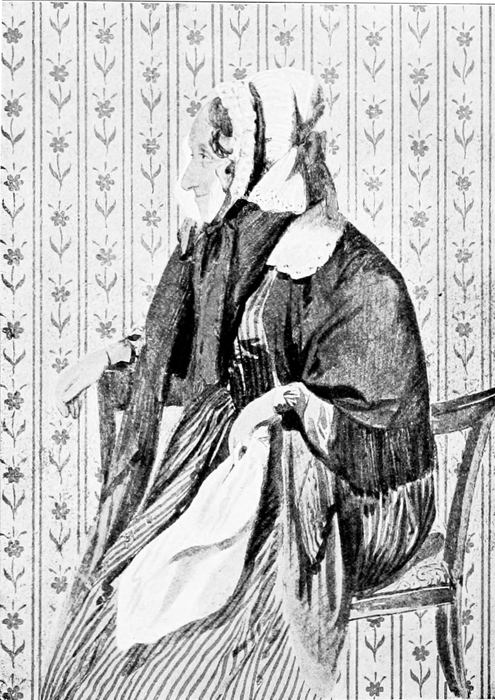
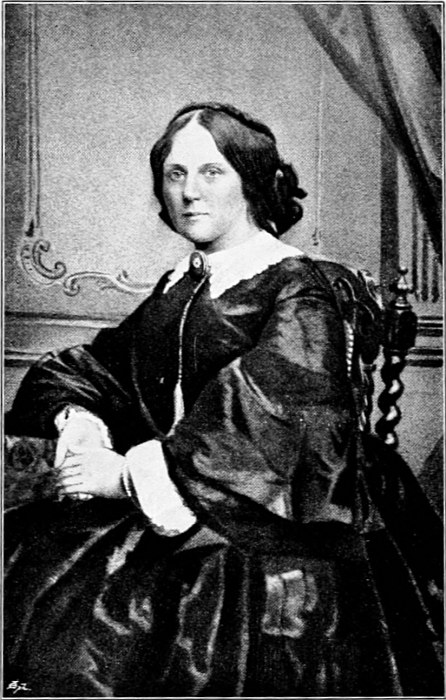
WAGNER'S MOTHER.
But soon there comes an emotional crisis of the kind that
occurred so frequently in Wagner's life. The tearful, almost
hysterical, letter to Apel of 21st August 1835 is a remarkable
document. Wagner seems to have got heavily into debt, to have
done all sorts of foolish things, and to have vexed and saddened
his friends and relations. Even Apel appears to have been for a
while estranged from him. Wagner beats his breast in agony.
He has been mad; the promised happiness of youth has fled from
him; but he will make a brighter future for himself. Note already,
in this letter, the passion for self-revelation and self-dramatisation
that is evident in so much of his later correspondence. He
was not a dramatist, said Nietzsche once: he merely loved the
word drama. He certainly loved the words repentance and
morality.
"I have sinned. Yet not so! Does a man sin when he is
mad? I have fallen out with my family, and must regard our
relations as at an end.... Till now I have managed my life very
badly. Dearest, I was not wicked, I was mad; that is the only
expression I can find for my conduct—it was a conventional
madness (ein konventioneller Wahnsinn). I see now only too well
that money is not a chimera, not a despicable, worthless thing of
no importance; I have formed the conviction that money is as
much alive as the society in which we are placed. I was mad, I
say, for I did not understand myself and my relation to the world.
I knew that I had no surely-founded foothold and support at all,
and yet I acted like one insane, went beyond my circumstances in
every respect, and with the ignorance and inexperience of a man
who has never any solid title to money; no one, not even a rich
man, throws away money as I did. The result was a whirlpool
of perplexity and misery, the entanglements of which I cannot
contemplate without dismay. I cannot reckon up the details;
it is unheard of and inexplicable into what an abyss I have fallen.
Your enormous and incessant efforts to rescue me from it only
made me more daring, and made me put my trust in a blind something
of which, indeed, I could give no clear account to myself,
but that blinded my eyes more and more completely. My life in
Leipzig, the pitiable position I had there, were intolerable burdens;
I was driven into so-called independent displays of strength; I
broke out into extravagances which, combined with the still lasting
consequences of my earlier follies, completely estranged my
family from me, and at last brought about a rupture with all my
surroundings." He is sure, however, that he has now learned
wisdom. Then comes a passage of a type that we often meet with
in his letters. "I cannot, however, go back to Magdeburg[49] until
I have got rid of the burden of a debt of 400 thalers. So I stand—I
am forsaken by, and separated from, everyone, everyone on whom
I might otherwise reckon, and accompanied only by the painful
anxiety of my mother. She can give me nothing. You are the
only one left to whom I can appeal"; and so on, and so on, in
the customary professional borrower's style.
A few months later there is a similar wail. He has recovered
his elasticity of spirit; he is working incredibly hard not only at
his conducting but at the composition of his new opera. "I am
now at the focal point of my talent; I do everything easily, and
am pleased with it," he writes to Apel on 27th December 1835. In
another three weeks the repentant sinner who had been so eloquent
about having learned wisdom is once more distracted at the thought
of his debts. "I must have money," he tells Apel, "if I am not
to go mad."[50]
We can visualise him in these early years as a creature of the
strangest contradictions—charming enough with those he liked,
supercilious and insulting to people he disliked, and always liable
to some fit of the nerves that would make him unaccountably
irritable, perverse, tactless, and ready to wound even friends;
generous with his help where his sympathies were engaged, and
with a fine code of honour for many of the relationships of life,
but a sad lack of delicacy and even of honour with regard to money
matters. The full extent of his borrowings and his debts, even at
this early period of his life, will never be known; but one feels a
sort of terror at the hints as to the total of them that are given here
and there in Mein Leben and his letters. It is easier to explain
than to justify his conduct in this regard. He was never too well
paid, and he had an ineradicable artistic inclination towards certain
of the good things of life that only money can buy. His incurable
optimism, too, was always painting the future the rosiest of rose-pinks.
One can understand his habit of borrowing, and even
sympathise with him to some extent; what one finds it harder to
explain or to condone is his evident callousness towards his creditors,
especially his tradesmen, some of whom had to wait ten years
or more for their money, and then only obtained it with much
difficulty.
A man who, for all his fine qualities, had two or three grave
defects of character of this kind, was likely to make as many
enemies as friends—perhaps more. The worshipping official type
of biographer paints for us a sort of ineffable angel of a Wagner,
always in the right, always misunderstood and traduced. The
untruthfulness of the portrait is evident to the most casual readers
of the letters and the autobiography. Wagner's now notorious
laxity of principle with respect to money matters must have been
common knowledge in the small provincial towns in which he lived,
and must have done a good deal to make him distrusted and disliked.
In addition, his frequent irascibility and rudeness must have
made many enemies for him. In Mein Leben—more candid and
more critical in this respect than his incense-bearers—he makes
several confessions on this score. His outbursts can no doubt
be mostly explained by the irritability of his temperament and its
swift transitions of mood, by his frequently bad health, or by the
action of wine. But it is one thing to make allowances for a man's
failings of temper or manners half a century or so after the event;
it is another to make allowances at the time. We smile now at
the stories that are told of Beethoven's grossness and ill-breeding;
but had we experienced the effect of these at first-hand we
should certainly have voted him an impossible person to live with.
Wagner was undoubtedly very trying to live with at times. In
Mein Leben he occasionally gives us a glimpse of himself in his least
likeable moods. In 1834 he visits Prague, where he meets again
some people whose acquaintance he had made on a previous visit
there—the daughters of the recently deceased Count Pachta. With
one or both of these girls the ever-amorous young man had apparently
been in love. "My behaviour," he says, "was wild and
arrogant; in this way the bitter feelings with which I had formerly
taken leave of this circle now found expression in a capricious
passion for revenge." He does nothing but indulge in the maddest
pranks. "They could not understand this astounding change
in me; there was no longer in me any of the old love of intimacy,
the mania for instructing, the zeal for converting,[51] that they had
previously found so annoying. But at the same time no one could
get a sensible word out of me, and the ladies, who were now disposed
to discuss many things seriously, got no answer from me but the
wildest buffoonery."[52]
Every now and then, in his account of the misunderstandings
with Minna, he confesses to the coarseness of his language when
he was angry, the "raging vehemence" of his insults, the "unrestrained
violence" of his speech and behaviour. Nietzsche has
given us a hint of what Wagner could be in a mood of this kind.[53]
In Dresden especially, in the years of his conductorship (1842-49),
he appears to have made many enemies, particularly among the
critics. These gentlemen were, of course, generally wrong as
against Wagner in matters of art. But though musical critics
are frequently stupid, they are not, as a rule, all stupid in the same
way. It is possible, as many of the modern Wagnerians have
shown, to be as stupid in approbation of Wagner as anyone could
be in disapprobation of him. So that when we find the critics—in
Dresden, for example—so uniformly opposed to Wagner, it is a
fair supposition that there was more behind their words than mere
disapproval of his art or his theories. They apparently pursued
him with unusual rancor. Even in the absence of evidence, we
should be entitled to assume that when a man becomes the object
of such general and unrelenting hostility in his own town, it implies
some defects in his own character as well as in those of his assailants.
Evidence is not lacking that this was so. Wagner, we all know,
loved most those who agreed with him, and had no use at all for
men of opposite ways of thinking.[54] His constant craving for love
in life had its counterpart in his desire to be approved and believed
in as an artist. In Mein Leben he is always praising someone or
other for his devotion to him, and speaking coolly or angrily of
others for their indifference to his concerns. Alwine Frommann
is "faithfully devoted" to him; he speaks of Bülow's "warm and
heart-felt devotion"; the Laussots, the Ritters, Uhlig, and others
are all lauded for their "devotion," their "fidelity." He speaks
well of Meyerbeer so long as he believes his interests are being
furthered by him, and turns on him and makes sundry unproved
and unprovable charges against him when he thinks his aid is
withdrawn. One does not censure him for this: rational criticism
aims less at giving or withholding marks for conduct than at understanding
the complexities of human nature. One merely notes
the idiosyncrasy, not unsympathetically, and tries to see how it
worked in the actualities of life. A nature of this kind was constitutionally
incapable of taking criticism philosophically; the
critic's sin would not be against the artist so much as against the
art. And granting that many of his critics were not very intelligent
men, it is clear that part at least of their enmity towards him was
the result of his own tactless attitude towards them. "Though I
was anxious to be obliging with everyone, yet I always felt an unconquerable
aversion to showing special consideration towards
any man because he was a critic. In the course of time I carried
this to the point of almost studied rudeness, as a consequence of
which I was my whole life long the victim of unheard-of persecution
from the press."[55] It seems probable that his studiously
unconciliatory manners brought him more ill-will than was ever
necessary.
That the mere lack of intelligence of some of these critics was
not the reason for his rudeness to them is shown by the warmth of
his welcome to critics no more intelligent who happened to be with
him instead of against him. A certain Gaillard, of Berlin, happened
to have written an "entirely favorable" criticism of the Flying
Dutchman. "Although," he naïvely says, "I had already of
necessity accustomed myself to be indifferent as to the attitude of
the critics, this particular article impressed me greatly, and I invited
the unknown writer to Dresden to hear the first performance
of Tannhäuser." The young man comes to Dresden, and Wagner
is distressed to find that he is threatened with consumption. "I
saw from his knowledge and capabilities that he would never attain
to any great influence; but his sincerity of soul and the receptivity
of his intelligence filled me with genuine regard for the poor man."
He dies in a few years, "having never swerved from his fidelity
to and thoughtfulness for me, even in the most trying circumstances."[56]
In other words, he was that very common product,
an enthusiastic admirer possessed of only limited intelligence; but
his "fidelity" was sufficient to make Wagner tolerate and even
like him. It looks as if the "systematic rudeness" was not for
"the critics," but only for the critics who disagreed with Wagner.
How badly he could behave when irritated by the press was
shown by his incessant insinuations against the honesty of the
London critics during and after his conducting of the Philharmonic
Concerts in 1855. There is no proof forthcoming of their being
bribed to oppose him. Mr. Ashton Ellis, who has gone thoroughly
into the newspaper history of that period, and who will not be
suspected of any desire to smooth matters over for Wagner's
antagonists, gives it as his opinion that "James Davison bears the
character of an unimpeachably honest 'gentleman.'" But Wagner
could never imagine any other motive for opposing him except
(1) that the opponent was paid to do so, or (2) that he was either a
Jew or under the orders of the Jews.[57]
In a letter to Otto Wesendonck
of 5th April he vents his rancour against Davison and
Chorley, and recklessly charges them with being corrupt: "they
are paid to keep me down, and thus they earn their daily bread."[58]
He throws out a hint to the same effect in Mein Leben.
Of his irritability and tactlessness we have several instances,
some of them given us by himself. Take, for example, Meissner's
account of the supper that Wagner gave to Laube[59] after the performance
at Dresden of the latter's play, the Karlsschüler. There
were a number of people present, and the usual compliments
passed. Meanwhile, however, "Wagner had been fidgeting about
on his chair for some time, and finally he threw out the question:
Whether, in order to put a Schiller into a play, one ought not to
have something of Schiller's genius oneself? The question was
first of all couched in general terms; some compromised, some
disagreed. Then Wagner proceeded to a more positive criticism
of the piece that had been produced: it was merely a well-constructed
comedy of intrigue in the style of Scribe, with several
very piquant scenes, and did not at all solve the problem of how
to write a drama the hero of which was the most ideal poet of
the German race. Not till the ice-bucket appeared with its champagne
did he cease; and everything was to be put right again
by a congratulatory toast. But nothing now could put matters
right; people emptied their glasses, and dispersed all out of tune.
I myself went off with Laube, and wandered about for some time
with the dejected man in the dark, quiet streets by the river."[60] Mr.
Ellis, in translating this passage, has to admit that "however
exaggerated, there is a grain of truth in the little tale,[61] for Pecht
also informs us: 'After the performance Wagner gave Laube a
feast, at which he congratulated the poet very intelligently and to
the point, but, to the minds of us enthusiasts, by far too insufficiently,
the consciousness of his own superiority seeming to dominate
it all.' Whichever account we accept," Mr. Ellis goes on to
say, "it was awkward for the guest of the evening, and scarcely
more palatable because, as Meissner himself adds, 'Perhaps
Wagner was right.' He had no intention of wounding his guest,[62]
but he does appear to have had the unfortunate habit of thinking
aloud; and his standards were so far above the heads of his company
that his thoughts were bound to bruise when suddenly let
fall on them." Plain people would probably sum it up in much
simpler terms—that Wagner had been unnecessarily tactless and
rude to a guest.
I have already cited Wagner's own confession of similar
tactlessness and ill-breeding towards Count Pachta's daughters in
Prague in 1834. He makes a similar confession with regard to his
conduct to a certain Professor Osenbrück, whom he met at a
party in Zürich about 1851. "I remember that I made a special
exhibition of the immoderate excitement that was characteristic
of me at that time, in a discussion with Professor Osenbrück. All
through supper I irritated him with my obstinate paradoxes till
he had such an absolute horror of me that for ever afterwards he
anxiously avoided meeting me."[63]
The Hornstein episode in Zürich gave us an example of the
bad manners into which his excited nerves sometimes betrayed
him. In Mein Leben he frequently confesses that his irritability
was very trying to his friends; and in 1858 he congratulated himself
on now being able to argue with them without getting excited
as of old.[64] Whether the improvement was permanent or not we
cannot say; but certainly his temper stood in need of a curb.
In March 1856, he says, "My illness and the strain of work [on
the Valkyrie] had reduced me to a state of unusual irritability.
I remember the extreme ill humour with which I greeted our friends
the Wesendoncks when they paid me a sort of congratulatory visit
on the evening of my completion of the full score. I expressed
myself with such extraordinary bitterness on this way of showing
sympathy with my work that the poor distressed visitors departed
at once in the utmost dismay; and it afterwards cost me many
difficult explanations to atone for the mortification I had caused
them."[65]
How tactless and lacking in ordinary courtesy he could be
even where his temper was not on edge, was shown by his conduct
to Gounod in Paris in the Tannhäuser time of 1861. "With
Gounod alone did I preserve friendly relations. I was told that
everywhere in society he championed my cause with enthusiasm; he
is said to have remarked: 'Que Dieu me donne une pareille chute!'
To requite him for this I gave him a full score of Tristan,—for his
conduct was all the more gratifying to me in that no consideration
of friendship had been able to induce me to hear his Faust."[66]
Sufficient has been said to show that he must have been an
exceedingly difficult person to get on with at times, and that of the
many enemies he made, some of them must have had quite good
reasons for disliking him.
As one studies him, indeed, the innocent, long-suffering angel
of the sentimental biographers disappears from our view, and is
replaced by a less perfect but more complex and more humanly
interesting figure. Again let me repeat that we are not taking
sides against him any more than for him, but simply showing him
as he was. That he had some serious intellectual and moral
defects, that he could at times be selfish and quarrelsome and
unjust, can be disputed by no one who reads him with an open mind.
The trouble was that with his immovable belief in himself it was
impossible for him ever to doubt that he was wholly in the right.
A tragedy of some sort is never far from the homes of men of this
type. Wagner's greatest tragedy was Minna; and it will be as
well to consider the history of his relationship with her in detail,
some recent documents having thrown new light upon the old
perplexing problem.
Minna has always been the subject of contumelious and sometimes
venomous remarks from the simpler-minded Wagnerians,
especially those who have apparently taken their cue from Villa
Wahnfried. Their quick and easy way with the problem has
been to assume, as usual, that Wagner was in all things the just
man made perfect; his marriage with a woman who was his intellectual
inferior was a mistake, but his conduct was always
that of an affectionate husband and an honourable gentleman,—his
patience and forbearance, indeed, with such a thorn in his side
being nothing less than angelic. The Wagnerians detest poor
Minna even more than they detest Meyerbeer or Nietzsche. The
climax of comic pettishness was reached a few years ago in
Mr. Ashton Ellis's remark that for the offence of flicking a pellet
of bread on to a manuscript that Wagner was reading to a young
friend she should have been put in a cab and taken to the
nearest station, railway or police.[67] Fortunately even the Wagnerians
are not always so comical as this; but by way of doing
justice to the memory of Wagner, they have showered their contempt
or their hatred in abundance upon poor Minna's head. How
grievously the recollection of the old unhappy days rankled in
Wagner's memory is shown by the meanness of some of his
revelations about her in Mein Leben. The fires of fate, when he
dictated these reminiscences, seemed to have scorched rather
than warmed him; he had learned many things from life,
but neither delicacy nor magnanimity. Nor, one regrets to say,
was Cosima, vastly as we must admire the power of her remarkable
personality, the woman to impose these virtues upon
him. One can recall nothing in literary history quite so unpleasant
in its moral shabbiness as this spectacle of the second
wife taking down from her husband's dictation the most
damaging details he can remember of the conduct of his first
wife,—both of them knowing that in the circumstances under which
these reminiscences would be published it was impossible for either
Minna or her friends to state her case for her as she herself must
have seen it. And all the world knows that this second wife,
when Wagner fell in love with her, was herself wedded to another
man, who divorced her on the 18th July 1869; that their son
Siegfried was born on 6th June 1869, and that she and Wagner
were married on 25th August 1870.[68] Plain people, used to putting
things in plain language, would say that this virtuous gentleman,
who was so severe a censor of Minna's matrimonial conduct, first
of all stole the affections of a friend's wife—or at any rate accepted
them when they were offered to him[69]—and afterwards lived in
adultery with her, to the anger of her father and many of Wagner's
best friends.[70] It strikes one, then, as rather a mean thing for a
couple of people with a far from immaculate record of their own
to be laying their heads together, day after day, to commit to
paper, for the benefit of the world half a century or so later, a
record of the failings of a poor creature who was no worse than
either of them,—and a record, of course, coloured throughout by
their own prejudices. The disproportion between what Richard
tells us about Cosima and Frau Wesendonck and what he tells
us about Minna, and the vast difference in candour in his treatment
of these episodes, is very remarkable in a book of which
the sole value is supposed to reside in its "unadorned veracity."
Of course in telling the story of how you took your second wife
from a friend, and deceived him day by day, the fact that the lady
herself happens to be your amanuensis rather militates against
"unadorned veracity"; but Wagner and Cosima might have
reflected on this simple fact, and stayed their eager hands a little
when dissecting the first wife. People so vitreously housed should
be the last to commence stone-throwing.
Minnaphobia seems to be traditional in the circles that have
chosen to regard Wagner as peculiarly their own. Apparently
no tittle-tattle about her is too absurd for them to believe. Let
us take, in illustration, the portentous case—that really deserves
to become historic—of Mr. Ashton Ellis and the little dog Fips.
Wagner and Minna were both animal lovers, and were virtually
never without a dog or a bird. These beloved animals, as Wagner
more than once tells us, counted for much in their childless home.
Fips had been a present from Frau Wesendonck. He died somewhat
suddenly and inexplicably in June 1861, during the sojourn
of Wagner and Minna in Paris. Apparently a legend has grown
up in certain quarters that as the dog was Frau Wesendonck's
present to Wagner, Minna poisoned it to gratify her hatred and
jealousy of that lady and of Wagner. Mr. Ellis, at any rate,
propounded this theory in his English edition of the letters to
Mathilde Wesendonck. Wagner's account of the death of the dog
may here be quoted in Mr. Ellis's own translation:
"At the last there even died the little dog that you once sent
me from your sick bed; mysteriously suddenly! It is presumed
he had been struck by a cart wheel in the street, injuring one of the
little pet's internal organs. After five hours passed without a
moan, quite gently and affectionately, but with progressive weakness,
he silently expired (June 23)."[71]
Mr. Ellis, in some "valedictory remarks" at the end of the
volume, asks why only fourteen of Frau Wesendonck's letters to
Wagner have been preserved, and of course finds the explanation
in the wickedness of Minna. "Looked at from whichever side
[sic], I am forced to the conclusion that Minna destroyed the whole
bundle just before laudanuming Mathilde's living present, Fips—a
doing to death so plainly hinted page 273."[72]
The reader is now invited to turn once more to the above citation
from Wagner's letter, and to discover, if he can, where this
"laudanuming" of Fips is "so plainly hinted." We know that
Minna used to take laudanum to alleviate her heart trouble, but
where in the letter is the barest suggestion on Wagner's part of
her having made away with Fips by means of that poison? It
is safe to say that this theory that Mr. Ellis believes to be "so
plainly hinted," would never have occurred to a single reader of
the letter if it had not been put into his head by Mr. Ellis.[73] Apart
from this, it is interesting to see that Mein Leben (which was
published seven years after the Wesendonck letters) gives no
support to this wild charge. But though there is not a hint in
Mein Leben of an insinuation against Minna in connection with
the dog's death, there is a curious discrepancy between the account
given there (English edition, p. 781; German edition, p. 765),
and that in Wagner's letter of July 12, 1861. In the latter, as
we have seen, he says that "it is presumed he had been struck
by a cart-wheel in the street." There is not the barest hint here
of the barest suspicion of poisoning. Mr. Ellis conjectures that
the vermütlich ("it is presumed") is really vermeintlich ("allegedly")
in the manuscript of the letter. It is a wild conjecture,
but let us accept it. It at least makes it clear that Minna had
"alleged" that the dog had been struck by a cart-wheel, and
that Wagner accepted the statement. But in the autobiography
we get this surprising sentence: "According to Minna's account,
we could only think that the dog had swallowed some virulent
poison spread in the street." On Wagner's own showing, this
had not been "Minna's account"; and for a true version of that
account one would rather trust a letter written within a few days
of the event than an autobiography written some seven or eight
years later. Does it not look as if the laudanuming legend had
grown up in the interval, among people who made detestation
and denigration of Minna a fundamental article of the Wagnerian
faith? But there is a further mystery to be solved. "Though
he" (Fips) "showed no marks of external injury," says the
autobiography, "he was breathing so convulsively that we concluded
his lungs must be seriously damaged." Why in the name
of common sense should he show any marks of outward injury,
or should anyone look for such marks, if it was suspected that the
dog had been poisoned? The curious thing is that if we omit the
sentence in the autobiography, quoted above, about the "virulent
poison," the account there agrees with that of the letter of July 12,
1861, in attributing the accident to some external injury received
in the street. It looks as if the "poison" theory had been spatchcocked
into the paragraph later on, without its being observed how
it clashed with the context. In any case it is satisfactory to see
that not only is there not a hint even in Wagner's later and fuller
account of any suspicion of Minna having caused the dog's death,
but it is clear that she was as grieved about it as he was. "In
his first frantic pangs after the accident,"[74] says Wagner, "he had
bitten Minna violently in the mouth, so that I had sent for a
doctor immediately, who, however, soon reassured us as to her
not having been bitten by a mad dog."[75] The dog could not have
bitten Minna in the mouth unless she had had her face very near
his, probably against it, caressing and comforting it; and one
leaves it to common sense to decide whether a woman who had
been brutal enough to poison a dog out of hatred of her husband
and another woman would have been foolish enough to put her
face near the teeth of the writhing animal. And, by the way,
would laudanum have brought on "frantic pangs"? Is it not
pretty clear that the laudanum has only been suggested because
it is known that Minna became addicted to that drug as her heart
disease developed?
It only needs to be added that although Fips had been given
to Richard and Minna by Frau Wesendonck, it had always been
Minna's dog rather than Wagner's. "A special bond of understanding,"
he says, "had been formed between them [Minna
and Mathilde] by the gift from the Wesendoncks of a very friendly
little dog to be the successor of my good Peps. He was such a
sweet and ingratiating animal that it very soon gained the tender
affection of my wife: I too was always much attached to him.
This time I left the choice of a name to my wife, and she invented—apparently
as a pendant to the name Peps—the name Fips, which
I was willing he should have. But he was always in reality my
wife's friend, for ... on the whole I never again established
with them [i.e. any later animals] the intimate relations I had
had with Peps [a previous dog] and Papo [a parrot]."[76]
On examination, then, of this theory that Frau Wesendonck
had given Wagner a dog, which dog Minna had poisoned in her
fury against the pair, it turns out (1) that the dog had always been
Minna's pet rather than Wagner's; (2) that while no reason is
given for her suddenly becoming inflamed with hatred against it,
Wagner himself makes it clear that she was distressed at its dying;
(3) that Wagner's account of the affair in his letters (written from
two to nineteen days after the event) agrees with that in Mein
Leben (not written till some years after), with the exception of that
one sentence, in the latter, as to Minna having said that the dog
had swallowed poison in the street; (4) that this sentence obviously
makes nonsense of the remainder of the account in Mein Leben;
(5) that the inference is (a) that the poisoning theory was an after-thought
on Wagner's or some one else's part; and (b) that the
"plain hinting" of Minna's guilt that Mr. Ellis sees in the letter
of July 12, 1861, but that no other living being can see there, was
not suggested to him at all by that letter, but that he is indebted
to some other source for it.[77]
The publication of Mein Leben, the Wesendonck letters, and the
letters to Minna have made it possible to see both Wagner and
Minna more in the round than we could do a few years ago. Not
that any number of documents would ever bring reason into the
writings of the more extreme Minnaphobes; their method in the
future, as in the past, will no doubt be to insist that the composer
was in every relation of his life as near impeccable as mortal man
could be, and that Minna was very bad or very mad or a blend of
both,—to belittle all the evidence that does not square with the
demigod theory of Wagner, to sneer at the character and the intellectual
attainments of everyone who seems to be a witness for
the other side, and to declare effusively that the kind of evidence
that does square with the demigod theory is "worth a hundred
times" the testimony that does not.[78] It may soothe these good
people—who always become infuriated at the mildest refusal to
see Wagner through their spectacles—if we assure them that to
believe that Minna was not so black as she is generally painted is
not at all to hold that Wagner was an unmitigated villain. As a
rule unmitigated villains exist only in fiction; the tragedies of
married life among real human beings generally come not from
deliberate and conscious turpitude on one side or the other, but
from the mere friction of two quite normal characters who happen
to be ill-adapted to each other in a few more or less trifling respects.
Wagner was certainly no villain of the melodramatic sort. He
could be kind enough to Minna at times; he certainly—when
away from her—felt the acutest pity for her as well as for himself;
and he could no more be consciously and intentionally cruel to her
than to any other suffering creature. Yet an unprejudiced reader
of the records can hardly doubt that he was often cruel unconsciously
and unintentionally. It was Minna's misfortune to be
the greatest obstacle to the realisation of himself along certain
lines. Everyone who has studied Wagner knows how impossible
it was for him to tolerate frustration anywhere. There probably
never was a man so honest with himself in most ways. His art
absorbed the whole of his nature. He knew what he wanted to do,
and what he needed in order to do it; and for him to need a thing
and to insist on having it were mental processes hardly separable
from each other. At certain periods of his life it became an imperative
necessity for him to win from other women the spiritual fervour,
the idealistic glow, that were denied him at home. He once
found what he wanted in Frau Wesendonck. To reach her he
swept aside with calm indifference both his own wife and Frau
Wesendonck's husband. With the blindness of perfect honesty,
he could not see how Minna could regard the Mathilde Wesendonck
affair from any other standpoint than his own. It seemed
unreasonable of Minna to make such a pother over the matter
after he had so carefully and fully explained to her that his relations
with Mathilde were purely ideal. Why could not his wife keep
home for him and be happy in administering to his physical comfort,
and leave his intellectual and emotional appetites free to
satisfy themselves where they would? As an abstract logical
proposition the theorem had a good deal in its favour. It broke
down through Minna declining to be thrilled by the beauty or the
abstract logic of it. She saw herself simply as the wife neglected
for another woman; it did not pacify her in the least to be told
that so far as Wagner was concerned this other woman was an
ideal rather than a reality,—that he sought her society less for
what she was in herself than for something in the finest soul of him
that came into being only when he talked to her. The average
wife is not consoled for her husband's obvious preference of another
woman by the assurance that his passion for the latter is free from
any physical implications.[79] That is simply equivalent to telling
the wife, in a roundabout way, that she has not intelligence enough
to be his spiritual companion. It may be quite true that she has
not; but the average wife is not likely to be pleased at being told so.
Minna was an average wife, and she no doubt strongly objected to
what could only appear to her as a criticism and a slight. Wagner
had to choose between her feelings and his own satisfaction. He
chose the latter, as he always did in these cases. His letters
to her place it beyond dispute that his heart bled for her in her
misery; but the demon within him forbade him to terminate the
acquaintanceship that was the cause of her misery. To have done
that would have hindered the one thing in the universe that seemed
to him to be worth any sacrifice to further,—the development of
his personality and his art to their very richest possibilities.
This, I venture to think, is a fair statement of the case as it
must have looked to any impartial friend of the pair in the later
'fifties and 'sixties who tried to do justice to the psychology of both
of them. I would suggest, though, that there were hitherto unsuspected
reasons for Minna's unrelenting bitterness towards her
husband throughout the Wesendonck affair. Unfortunately we
do not possess her letters to him; but from many of Wagner's
letters to her in the 'fifties and 'sixties we can see that she was
for ever expressing suspicions of him—suspicions which he combats
at great length and with all the epistolary skill he can command.
Was there anything at the root of this attitude of Minna's towards
him beyond a merely suspicious and jealous nature? Had she
anything concrete to go upon? I think we can show that she had.
The key to a good deal of the trouble, I imagine, is to be found in
the Madame Laussot affair. And in that affair I am afraid we
cannot acquit Wagner of a certain amount of disingenuousness
both towards Minna and towards us.
He was always much more fond of women than of men, having
seemingly found the former more sympathetic not only to his
art but to himself. His great desire, as a thousand passages in
his letters and his prose works show, was for love that knew no
bounds in the way of trust and self-surrender. In his immediate
circle he probably had more experiences of this kind among the
women than among the men; the women probably had a subconscious
quasi-maternal sympathy for the sufferings of the little
man, and would no doubt be more likely to overlook the angularities
of his everyday character—if indeed, which is doubtful, he showed
those angularities as openly to them as he did to his male friends.
The story of his life is studded with the names of devoted women,
from the Minna of the earliest days to the Cosima of the latest.
Madame Laussot never attained the sanctification of some of the
later women who played a part in Wagner's life, for the episode in
which she figures was brief, and the end of it was of a kind that
admits of no going back; but for a while she certainly loomed
larger in his thoughts than has hitherto been suspected.[80]
Jessie Laussot was a young Englishwoman who had married
a wine merchant,—Eugène Laussot—of Bordeaux, in which town
the pair lived with Jessie's mother, Mrs. Taylor, the widow of an
English lawyer. Jessie was introduced to Wagner in Dresden,
by Karl Ritter, in 1848. Wagner's first account of the meeting
is rather vague, but vague in that peculiar way that suggests to
the careful student of him that he is deliberately saying less than
he might. The young girl had shyly expressed her admiration
for him "in a way," he says, "I had never experienced before."
"It was with a strange, and, in its way, quite a new sensation," he
goes on to say, "that I parted from this young friend; for the first
time since my meeting with Alwine Frommann and Werder, in
the Flying Dutchman days, I experienced again that sympathetic
tone that came as it were out of an old familiar past, but never
reached me from my immediate surroundings."[81] Knowing his
susceptibility to feminine sympathy, we may probably assume
that Madame Laussot counted for slightly more to him just
then than he cared to put into words some twenty years
later.
In Zürich, whither he fled after the political troubles of 1849,
he received a letter from her in which she "assured him of her
continued sympathy in kind and affecting terms."[82] (She was a
friend, by the way, of Frau Julie Ritter, who gave Wagner as
liberal financial assistance as she could, both now and later.) Early
in 1850 he goes to Paris with the half hope of getting an opera produced
there. He is very depressed, and has a longing to escape
to the East where, he says, "I could live out my life in some sort
of humanly-worthy fashion, without any concern with this modern
world."[83] While in this mood he receives an invitation from
Madame Laussot to spend a little time in her house. He accepts,
and goes to Bordeaux on the 16th March, where he is received
"in a very friendly and flattering manner." He learns that the
Ritters have been corresponding about him with the Laussots,
and that there is a scheme on foot under which Mrs. Taylor, who
is well-to-do, is to join with Frau Ritter in settling three thousand
francs a year upon him.[84] In the explanations that ensue from his
side, he divines that Jessie is the only one who thoroughly understands
him. An entente is established between them.[85] "I soon
discovered," he says, "the gulf which separated myself, as well
as her, from her mother and her husband. While that handsome
young man was attending to his business for the greater part of
the day, and the mother's deafness generally excluded her from most
of our conversations, our animated exchange of ideas upon many
important matters soon led to great confidence between us."[86]
She was evidently intelligent and cultivated, a good musician and
an accomplished pianist. He read her his poem of Siegfrieds Tod
and his sketch of Wieland der Schmied, and they discussed these
and other topics connected with his art. "It was inevitable,"
he goes on to say with the crude frankness into which he sometimes
falls in Mein Leben,[87] "that we should soon feel the people around
us irksome to us in our conversations."
The visit lasts three weeks or so, at the end of which time
Minna, like a prudent and anxious wife, insists on his returning to
Paris in order to pursue his plans for a rehabilitation of the shattered
finance of the home.[88] He evidently does not like her letter.
At the same time he reads in the papers that his friends Röckel,
Bakunin and Heubner had been sentenced to death for their part in
the Dresden rising. Out of tune with the world, he determines, he
says, to break with every one and everything. He will give Minna
half of the income his friends intended to settle on him, and with the
other half go to Greece or Asia Minor, to forget and be forgotten. He
communicates this plan to Jessie, who, dissatisfied with her own life,
is disposed to seek a similar salvation for herself. "This resolve
expressed itself in hints and a brief word thrown out now and then.
Without clearly knowing what this would lead to, and without
having come to any arrangement, I left Bordeaux towards the end
of April, more agitated than calmed, full of regret and anxiety. I
went to Paris in a sort of stupor, quite uncertain what to do next."[89]
Wagner now begins to be a little disingenuous, and we catch
a glimpse or two of him as the "actor" that Nietzsche said he
was. The facts and the dates must be carefully borne in mind.
Wagner says[90] that he went to Bordeaux in the 16th March and that
he stayed there more than three weeks.[91] That would make the date
of his departure about the 7th April. In a letter of 17th April to
Minna he speaks of having been "a fortnight again" in Paris,—which
would make the date of his return about the 3rd. The precise
date is of no importance; it is sufficient that it was somewhere
between the 3rd and the 7th April.[92]
In this letter of the 17th April he refers to Minna's letter as
having caused "an irremediable" dissonance between them, and
he gives, at great length, the whole story of their married life, the
thesis, of course, being that he had always been the loving and she
the loveless and uncomprehending one. The plaidoyer is needlessly
elaborate, and raises the suspicion that it was ultimately intended
for more eyes than those of Minna; it reads like a plea to posterity
to see him as he saw himself. But it is plainly insincere in part.
"Your letters to Bordeaux," he says, "have startled me violently
out of a last beautiful illusion about ourselves. I believed I had
won you at last; I fancied I saw you softening before the might of
true love,—and then realised with terrible grief, more deeply than
ever, the inescapable certainty that we belonged to each other no
more. I could bear it no longer after that: I could not talk to
any one: I wanted to go away at once—to you: I left my friends
in haste and hurried to Paris, thence to go with all speed back to
Zürich. I have been here again a fortnight: my old nerve-trouble
got hold of me: like an incubus it lies on me: I must shake it
off,—I must, for my sake,—and yours." How little truth there
was in his remark that "I wished to go away at once—to you; I
left my friends in haste," &c., can be seen now from his own account
in Mein Leben. He plainly left Bordeaux with his head full of
the scheme for going to Greece or Asia Minor with Madame
Laussot. Of this scheme he of course does not breathe a word to
Minna; the consummate, self-deluding actor tries to persuade her
that it was to her his injured heart turned first.
Let us now take up the narrative again in Mein Leben. After
his return to Paris, he says, "I was at length obliged to reply to
my wife's urgent communication. I wrote her a copious letter,
recapitulating in a friendly but frank way the whole story of our
life together, and explaining that I had firmly resolved to release
her from any immediate participation in my lot, since I was quite
incapable of ordering this in a way that would meet with her approval.
She should always have half of whatever money I might have; she
must fall in with this, and accept it as fact that the occasion had now
arisen for parting from me again, as she had said she would do on
our first meeting in Switzerland. I brought myself to the point of
breaking with her completely."
He then writes to Jessie telling her what he had done, though,
in view of his lack of means, he is unable to give her any definite
information as to his plans for his "complete flight from the
world." He receives from her the positive assurance that she
had determined to take the same step as himself; she asks to be
taken under his protection when she has completely freed herself.
"Much alarmed," he tells her that it is one thing for a man in his
woeful difficulties to resolve on flight, and another thing for a young
woman in outwardly happy circumstances to do so, for reasons
which probably no one but he would understand. This does not
frighten her: she calmly tells him that her flight will be quietly
effected,—she will first of all pay a visit to her friends the Ritters
in Dresden. Wagner is so upset by all this that he has to seek
solitude at Montmorency, near Paris, in the middle of April.[93]
Now of all that I have italicised in the last paragraph but one,
there is not a word in his letter of the 17th April to Minna. The
only passage resembling it is the final sentence of the letter: "Can
I hope to attain that [i.e. to make her happy] by living with
you?—Impossible." It may be thought that, writing his reminiscences
of the affair twenty years or more after, his memory
had played him false, and that he imagined he had written to
Minna what he no doubt intended to say. But this explanation
is negated by his next letter to her, dated 4th May, in which he says,
"I cannot help writing to you once more before going far away
from you. It has remained unknown to me—as indeed I could
have wished—how you received the decisive step on my part which
I announced to you in my last letter. As you have long familiarised
yourself with the thought of living apart from me, and so regaining
your independence, I presume and hope that you were, if
perhaps surprised, at any rate not alarmed by my decision."
Clearly then he had announced, in the letter of 17th April, his
intention of leaving Minna. We may be sure that with his usual
tendency to copiousness he must have occupied considerable space
in doing so. What has become of this passage? Why is it not included
in the printed edition of the letters? If it has been intentionally
omitted why has not someone conceived it to be his
editorial duty to advise the reader of the fact?[94] In any case the
omission of the passage does not strengthen our already tottering
confidence in the integrity of such Wagnerian records as have come
from Wahnfried.[95]
There is certainly something inaccurate in the sequence of
events as given in Mein Leben.[96] We have seen that, apparently
on the 17th April, he wrote to Minna announcing his intention of
leaving her. A few sentences after the narration of this part of
the episode in Mein Leben, he says that he left Paris to seek repose
from his worries in Montmorency, "about the middle of April."
We are left to infer that in these few days the events happened that
are narrated in the sentences in Mein Leben describing his alarm
at Jessie's reply. He fixes this date, both for himself and for us,
by the fact that while resting at Montmorency he looks over the
score of Lohengrin and decides to send it to Liszt, with a request
that his friend shall produce it at Weimar. "Now that I had also
got rid of this score I felt as free as a bird, and a Diogenes-like
unconcern as to what might happen took possession of me. I
even invited Kietz to visit me in Montmorency and share the joys
of my retreat."
It is quite true that this happened "about the middle of April."
We have the actual letter to Liszt; it is dated the 21st April. But
this same letter makes it clear that the project of flight to the East
is still in his mind:
"Decisive events have just happened in my life: the last fetters
have fallen from me that bound me to a world in which I should
shortly have had to go under, not only spiritually but physically.
Through the endless constraint imposed upon me by those nearest
to me,[97] my health is gone, my nerves are shattered. Now I must
live almost entirely for my recovery. My livelihood is provided
for; you shall hear from me from time to time."[98]
Though there is here no specific mention of the East, there can
be little doubt that he is referring to his projected flight from
Europe. It is hard to explain otherwise the remark as to the last
fetters that bound him to the world having fallen from him, or his
promise that Liszt should hear from him from time to time; and
there would be no truth in his remark that his livelihood was provided
for in his new habitat, except in the sense that Madame
Laussot's purse was at his disposal.[99] Moreover he writes to Liszt
some two months and a half later, when the whole affair had blown
over, "When we meet again I shall have much to tell you: for the
present only this much, as regards my immediate past, that my
contemplated voyage to Greece has been knocked on the head.
There were too many impediments (Bedenken), all of which I could
not surmount. I should have preferred to have gone out of the
world altogether. Well, you shall hear later."[100]
It is evident, then, that Wagner, whether by accident or design,
has got the sequence wrong in Mein Leben. He makes it appear
as if he had worried during the first week or two of April over
Madame Laussot's plan for leaving Europe with him, that he had
sought retirement in Montmorency about the middle of April,
and that there the burden had quickly been shifted from his mind.
He says no more about Madame Laussot and her scheme, but tells
us that while in a "state of complacency" in Montmorency with
Kietz he is startled by the news that Minna had come to Paris to
look him up. Now the letter of 21st April to Liszt suggests a doubt
as to the absolute correctness of all this; and that doubt is turned
into certainty by Wagner's letter to Minna of the 4th May, in which
he definitely announces his intention of leaving her: "The news
I have to give you to-day gave me a special reason for writing to
you again, since I have a feeling that it may soften for you all the
possible bitterness of our separation. I am on the point of setting
off to Marseilles, whence I shall go at once in an English ship to
Malta, and thence to Greece and Asia Minor. I have always felt,
and most strongly of all of late, the need of getting out of this mere
life of books and ideas, that consumes me, and once more looking
round me in the world. For the present the modern world is closed
behind me, for I hate it and want nothing more to do either with
it or what is nowadays called 'art.' Germany can only become a
field of stimulus to me again when all its conditions shall be utterly
changed.... So of late my longing has been again directed to
distant travel, so as to get quite away for a time from our present-day
conditions, and restore myself bodily and mentally by a change
of sight and sound in other climes."
Not a word, it will be observed, of Madame Laussot's accompanying
him! He has simply felt, as any man might feel, the need
of a change of scene.
He continues thus: "In these last decisive days, then, I conceived
the plan of going to Greece and the East, and am lucky
enough to find the means for carrying out this scheme placed at
my disposal from London. For in London I have gained a new
protector,—one of the most eminent English lawyers, who knows
my works and will give me his support in return for the original
manuscript of everything I may write."
Even Mr. Ellis, writing before the publication of Mein Leben,
was constrained to conjecture, in a footnote to this letter, that
this "new protector" in London "strongly resembles a myth."
Let us eschew more forcible language, and be content to call it a
myth. Mein Leben puts it beyond dispute that the financier of
the expedition was Madame Laussot.[101]
Wagner's account of the affair so far is, I venture to say, coloured
by his desire, twenty years later, to minimise the seriousness of
the whole affair. But the story of his disingenuousness or his
inaccuracy is even yet not complete.
By his own account he now does a rather shabby thing. He
apparently dreads meeting Minna; so he "bilks" the lady. He
leaves Montmorency, goes to Paris, and instructs Kietz to tell
Minna that he knew nothing more of her husband than that he had
left the capital. The ruse succeeds. Wagner flies to Villeneuve,
on the Lake of Geneva, where he puts up at the Hôtel Byron.
There, in a little while, he is joined by Karl Ritter. He has not
been long settled down at Villeneuve, however, before the Laussot
affair begins to take on a very unpleasant tinge. Jessie had apparently
told her mother, the mother had told the husband, and the
husband had expressed the intention of putting a bullet through
Wagner at the first convenient opportunity. Wagner writes to
Laussot "trying to make him see matters in their true light," but
at the same time declaring, with characteristic impudence, that he
"could not understand how a man could bring himself to keep a
woman with him by force when she did not want to have anything
to do with him." He is on his way to Bordeaux, he says, where
he is at M. Laussot's service. He also writes to Jessie, advising
her to be "calm and self-possessed." In three days he is at
Bordeaux: he sends word to M. Laussot at nine o'clock in the
morning. No reply is vouchsafed; but late in the afternoon he
is summoned to the police station. He is requested to leave the
town, ostensibly because his passport is not in order, but in reality,
as the authorities admit, because they have had a communication
from the Laussots. He obtains a respite of a couple of days, which
he uses to indite a letter to Jessie, "in which I told her exactly
what had occurred, and said that my contempt for the conduct
of her husband, who had exposed his wife's honour by a denunciation
to the police, was so great that I would have nothing more
to do with her until she had released herself from this shameful
situation."[102]
The Laussots had left Bordeaux when he arrived; so he obtains
admission to the flat,[103] goes from room to room till he comes to
Jessie's boudoir, places his letter in her work-basket, and returns.
Still no reply is vouchsafed, and he makes his way back to Switzerland
in quite a cheery frame of mind, evidently sure of having
acted impeccably all through this affair.
In this, as in so many other episodes of Wagner's life, we have
unfortunately only his version of what happened. He calls just
the witnesses he wants, elicits just the evidence that suits him,
and then complacently gives the verdict in his own favour. To
the outsider it looks as if he had been extremely foolish with
Madame Laussot and extremely arrogant with her husband; and
we may reasonably suppose that if they could tell the story from
their side they could make the case rather worse for Wagner than
he has done for himself. The real facts will perhaps never be
known: I say "the real facts," for no one who has studied the
autobiography carefully, with a knowledge of such cases as those
of Hornstein, Lachner, Hanslick, the Wesendoncks, and others,
can believe that Wagner's account of the affair gives us the whole
truth and nothing but the truth. But letting that pass, we may
now observe how once more the story in Mein Leben fails to square
with the evidence obtainable elsewhere.
That Madame Laussot had become disillusioned concerning
him is plain from his own further account. One day Karl Ritter
receives a letter from her which he hesitates to show to Wagner.
The latter tears it out of his hand, and finds that "she had written
to say she felt obliged to let my friend know that she had become
sufficiently enlightened about me to make it necessary for her
to drop my acquaintance." Her mother and her husband had
taken steps to break off all correspondence between her and
Wagner; he gracefully refers to them now as "the two conspirators,"
and charges them with "calumniating" him. "Mrs.
Taylor had written to my wife complaining of 'my intention to
commit adultery,' expressing her sympathy with her, and offering
her support; poor Minna, who now suddenly thought she had
found a hitherto unsuspected reason for my resolve to live apart
from her, in turn complained to Mrs. Taylor." There has been,
in fact, "a curious misunderstanding" of a joking remark of his.
He is very indignant over it all, but chiefly at the way Minna had
been treated! While he was himself indifferent as to what the
others might think of him, he accepted Karl Ritter's offer to go
to Zürich and set Minna's mind at rest with a proper explanation.[104]
This looks plausible enough, but I am afraid there is a touch
of fiction in it. Let us look at a letter from Wagner to Minna of
nine years later:
"Neither can I blame you for giving me that dear Bordeaux
to smell at in return, especially as you have kept a secret from
me, the hearing of which really astounds me. So someone wrote
you at the time, that I went that second time to Bordeaux to
abduct a young wife from her husband?? Now let me assure you
on my honour and most sacred conscience that such a shameless
lie and calumny was never yet invented against any man. If
it would conduce to your honour and peace of mind, I should be
quite ready to give you the exact details of the whole of the episode,
and you would then find that I doubtless acted very stupidly at
that time, but certainly not evilly to any one."[105]
I do not see what meaning we can attach to this except that
for nine years Wagner had been unaware that Minna knew as
much as she actually did of the Bordeaux affair. The revelation
evidently comes as a complete surprise to him. We can take it
as certain that, as he says in Mein Leben, Mrs. Taylor had really
written to Minna, telling her what had happened. But the letter
of 1859 makes it appear as if Minna had kept the secret to herself
all these years. The only conclusion we can come to, then, is either
that Wagner was in error in saying he had deputed Karl Ritter
to explain matters to Minna, or that he had told Karl rather less
than the full truth. This may seem a bold conclusion to draw,
but I do not see what other is possible from the evidence. The
remark in the letter—"so someone wrote to you at the time," &c.—squares
with the account given in Mein Leben. But the rest
of the letter seems to indicate that till that moment he had no
idea of there having been such a letter. We seem forced to conclude
either that Wagner's memory was playing him false, or that
his desire to make the world see the facts as he would have preferred
them to have been had militated somewhat against strict
accuracy—as it did in the Hornstein and other cases.
And now we have, I think, the explanation, or partial explanation,
of a good deal of Minna's jealous suspicion in the 'fifties
and 'sixties, especially as regards Frau Wesendonck. Knowing
of Wagner's relations with Madame Laussot, knowing also that
he had kept these relations a secret from her both when he was
writing to her at the time and in the years that followed, knowing
at first-hand, too, as well as we know now through Mein Leben and
the letters, her husband's ineradicable tendency to prendre son
bien où il le trouvait, we can understand her frequent uneasiness
of mind. If we are to be fair to her we must get away from the
historical standpoint, from which all that is seen is the great musician
blundering through life and sacrificing everybody and everything
in order to consummate his art; we must look at it also
from the standpoint of Minna and the moment, putting the genius
out of the question and taking it purely as a case of any husband
and any wife. And when this is done, though we may still regret
the tragedy of their union and admit that Minna was not the best
wife possible for such a man as he—that she had, indeed, almost
as many faults as a wife as Wagner had as a husband—we shall
at all events refuse to join in the venomous outcry of the extreme
Wagner partisans against her.[106]
MINNA WAGNER.
VIII — IX — X — XI — XII — XIII — XIV — XV — XVI
That Minna was as much sinned against as sinning will hardly
be disputed by any unprejudiced reader of Mein Leben and
Wagner's correspondence. Let us throw as rapid a glance as
possible over the various stages of their union.
Wagner himself sings the praises of the earlier Minna frequently
enough. The picture we first get of her is that of a pretty
bourgeoise, of no great intellectual capacity, but modest, sensible
and sympathetic. On the other hand, several of Wagner's self-revelations
show him in his youth as the harum-scarum one
might expect a genius of his dynamic temperament to be—not
vicious, perhaps, in the style of more stupid men, but keen for
pleasure, and anxious to taste every vintage that life could offer
him. His early life probably differed from that of tens of thousands
of highly-strung young artists only in the degree of ardour
with which he pursued his will-o'-the-wisps, and his quite abnormal
imprudence in the affairs of daily life—financial affairs
in particular. Throughout his career the protection, the solace,
the domestic care of a woman were necessities to him. We may
believe him when he says that he was the most home-loving of
men; home and a devoted woman were haven and anchorage for
him.[107] His longing for this haven would always be increased by
the despair into which his vivacious nature, so keen for pleasure,
was for ever bringing him. His early twenties were undoubtedly
a very critical time for him mentally and morally. The debt-acquiring
habit was already firmly rooted in him, and we get hints
here and there of a certain hectic quality in his views of sex. In
the Autobiographical Sketch (1842) he tells us how, under the impulse
of these ideas, he dealt with Shakespeare's Measure for
Measure in the act of metamorphosing it into his own Das
Liebesverbot:
"Everything around me seemed to be in a state of ferment,
and it seemed to me the most natural thing to give myself up
to this fermentation. During a lovely summer's journey amongst
the Bohemian watering places I drafted the plan of a new opera,
Das Liebesverbot; I took the matter for it from Shakespeare's
Measure for Measure, only with this difference, that I deprived it
of its prevailing seriousness and cast it in the mould of Das junge
Europa: free and uncloaked [offene] sensualism [Sinnlichkeit] won
the victory, purely by its own strength, over Puritanical hypocrisy."[108]
In this mood even the froth of the lighter French and Italian
operas became a pleasure to him:
"The fantastic dissoluteness of German student-life, after
some violent excesses (nach heftiger Ausschweifung) had soon
become distasteful to me: Woman had begun to be a reality for
me.[109] The longing which could nowhere still itself in life found
ideal nurture in the reading of Heinse's Ardinghello, as also the
works of Heine and other members of the then 'Young-German'
school of literature. The effect of the impressions thus received
found utterance in my actual life in the only way in which Nature
can express herself under the pressure of the moral bigotry of our
social system."[110]
His own commentary on the libretto of Das Liebesverbot is that
it expressed a change in his moral nature of which he was fully
conscious at the time:
"If one compares this subject with that of Die Feen, it becomes
evident that there was a possibility of my developing along two
diametrically opposite lines: confronting the religious (heilige)
earnestness of my original sensibilities was a pert inclination to the
wild frothing of the senses (zu wildem sinnlichem Ungestüme), to
a defiant cheerfulness that seemed utterly at variance with the
earlier mood. This becomes quite obvious to myself when I
compare the musical working-out of these two operas.... The
music to Das Liebesverbot had played its part in shaping both the
matter and the manner; and this music was only the reflex of the
influence of modern French and (as concerns the melody) even
Italian opera upon my receptive faculties in their then state of
violent physical excitation."
His libretto and his music were the reflection of his life:
"My path led me first of all straight to frivolity in my artistic
views; this coincides with the epoch of my first practical experience
as theatrical musical director. The rehearsing and conducting
of the loose-jointed French operas that were then the mode,
the knowingness and smartness (Protzige) of their orchestral effects,
often filled me with childish delight when I could set the stuff
going right and left from my conductor's desk. In life, which from
this time consisted in the motley life of the theatre, I sought in
distraction the satisfaction of an impulse which showed itself in
more immediate things as sensualism (Genusssucht), and in music
as a flickering, tingling unrest."[111]
Mein Leben shows him as he must have been in the Magdeburg
days, ardent, passionate, variable, lacking in self-control, eager
for the joys of life, and in danger of being sucked down into the
maelstrom of the minor theatrical world. His own version of the
outcome of all this—in the Mittheilung an meine Freunde—runs
thus:
"The modern retribution for modern levity, however, soon
visited me. I was in love; married in impetuous haste; under
the unpleasant impressions of a moneyless home harassed myself
and others; and so fell into the misery whose nature it is to bring
thousands upon thousands to the ground."[112]
One may be allowed to surmise, however, that his marriage
was at the time a godsend to him: it probably steadied him at a
critical moment and saved him from greater spiritual damage.
His picture of Minna as she appeared to him at their first meeting
must be given in his own words:
"Her appearance and bearing formed the most striking contrast
to all the unpleasant impressions of the theatre which I had
received on this fateful morning. The young actress looked very
charming and fresh: I was struck by the remarkable seemliness
(Bemessenheit) and grave assurance of her movements and her
behaviour, which lent an agreeable and engaging dignity to the
affability of her expression."[113] Her "unaffected sobriety of character
and her dainty neatness" did something to reconcile him to
the vulgar and superficial theatrical world in which his lot had
been cast. She was exceedingly kind to the nervous and maladif
young conductor, yet all that she did for him was done "with a
friendly calm and composure that had something almost motherly
about it, without a suspicion of frivolity or heartlessness."[114]
After a few weeks or months of acquaintance, in which he had
showed a decided liking for her society, Minna begins to be more
distant with him—apparently because there is a more serious
lover in the field. "I now experienced for the first time," he says,
"the cares and pains of a lover's jealousy." For a time they are
estranged; but early in 1835 they return to their former friendly
footing. And now we get the first symptom of that egoism in his
attitude towards her that was afterwards to be so fruitful in misfortune.
Though he was not her accepted lover, he jealously
objected to her receiving the attentions of other men—of whom
there were plenty always dancing attendance on the pretty, engaging
girl. He protests with "bitterness and quarrelsome temper"
against her receiving other men's attentions, though he admits
that "thanks to her grave and decorous behaviour, her reputation
was unimpaired"; and while she remained as calm and sensible
as ever, he cubbishly vents his rage in pretended dissipation,
which had the effect of "filling her with the sincerest pity and
anxiety" for him.
He gives a New Year's party to the opera company, which is
evidently meant to be a lively affair, and asks Minna to it;
everyone doubts whether she will come. She accepts, however,
"with perfect ingenuousness." As the evening wears on and
the liquor circulates—punch succeeding champagne—"all the
shackles of petty conventionality were thrown off," and the
conduct of the theatrical ladies and gentlemen drifted into what
Wagner calls "universal amiability." One can imagine the
scene.[115] Throughout it all Minna acts with a simplicity, modesty
and dignity that win Wagner's praise.
So far she appears much the more decent and likeable human
being of the two. Wagner's further account of her increases our
respect for her:
"From that time onward my relations with Minna were of an
intimately friendly kind. I do not believe that she ever felt for
me an affection that came near passion—the genuine feeling of
love—or indeed that she was capable of such a thing; I can only
describe her feeling for me as one of heart-felt good-will, the most
fervent wish for my success and well-being, the kindest sympathy
and a genuine delight in my gifts, which often filled her with
astonishment. All this became at last part and parcel of her
ordinary existence (welches alles ihr endlich zu einer steten und
behäglichen Gewohnheit wurde)."[116]
The fact that, feeling no genuine passion for him, she should
have been so kind to him as she was, and should have been willing
to unite her life with his, simply increases our respect for her. To
her he was simply a young wastrel of talent, who needed the care
and protection of a sensible woman. She "mothered" him, as
other women were destined to do in the course of his wild and
wasteful life.
Then comes the—to Wagner—discreditable episode,[117] too long
for narration here, that makes them avowed lovers. Still there is
apparently nothing more on her side than kindliness and sympathy,
while Wagner is madly in love. He shrinks from marriage in view
of the difficulty and uncertainty of his position, while Minna too
"declared that she was more anxious to see these [their finances]
improved than for us to be married." But soon Minna leaves
him to join a theatrical company in Berlin. This precipitates
matters. "In passionate unrest I wrote to her urging her to
return, and, in order to move her not to separate her fate from
mine, spoke formally of an early marriage." He appears also to
have threatened, in the same letter, that if she did not return
he would "take to drink and go to the devil as rapidly as
possible."[118]
He persuades the Magdeburg theatre authorities to renew her
engagement, and sets off "in the depth of an awful winter's night"
to meet her on her return, greets her "joyously, with tears from his
heart," and leads her back "in triumph to her cosy Magdeburg
home, that had become so dear to me."[119]
It is evident, however, that in Mein Leben he is not telling
the reader the whole of the facts. Certain passages in the contemporary
letters to Apel make it clear that in at any rate the latter
part of the Magdeburg period he and Minna were husband and
wife in everything but legal form. On 27th October 1835 he
writes thus to Apel: "Don't get too many fancies in your head
with regard to Minna. I leave everything to fate. She loves me,[120]
and her love means a great deal to me now: she is now my central
point; she gives me consistency and warmth: I cannot give her
up. I only know that you, dear Theodor, do not yet know the
sweetness of such a relationship; it has nothing common, unworthy
or enervating in it; our epicureanism is pure and strong—not
a miserable illicit liaison;—we love each other, and
believe in each other, and the rest we leave to fate;—this you do not
know, and only with an actress can one live thus; this superiority
to the bourgeoise can only be found where the whole field is
fantastic caprice and poetic licence."[121]
Das Liebesverbot is given and fails; his career as musical
director in Magdeburg is terminated, and hungry creditors, seeing
the end of all his hopes and perhaps theirs, begin legal proceedings
against him. Every time he came home he found a
summons nailed to the door. "And now Minna, with her truly
comforting assurance and steadfastness in all circumstances, proved
the greatest possible support to me."[122] She gets an engagement
in Königsberg, whither he follows her. Then he begins to doubt
her. He is uneasy as to one Schwabe, who is "passionately
interested" in her. He afterwards learned that the pair had
already been friendly; though he adds that he could not regard
her relation with Schwabe as an infidelity to himself, since she
had rejected the former in his favour. But he was made uneasy
by the reflection that the episode had been concealed from him,
and by the suspicion that Minna's comfortable circumstances
were in part due to the friendship of this man. In fact, he,
Wagner, the butterfly amorist, was jealous like any common
person; and the desire grew upon him to hasten the marriage
with Minna in order that he might find peace and quiet—a refuge
from the storms of the miserable theatrical world in which his lot
had been cast.
In Königsberg he obtains an appointment as conductor: and
now we behold him drifting, like his own gods in the Ring, headlong
to destruction. His reason warns him of the folly of a union
with Minna, but his impulses drive him irresistibly into it:
"Minna made no objection, and all my past endeavours and
resolutions seemed to show that, for my part, I was anxious for
nothing so much as to enter into this haven of rest. Notwithstanding
this, strange enough things were going on at this time
in my inmost being. I had become sufficiently acquainted with
Minna's life and character to be able to see, as clearly as this
important step required, the great differences between our two
natures, if only besides this perception I had had the needed ripeness
of mind."[123] But blind lover as he had been, he goes into
marriage with his eyes open:
"The peculiar power she exercised over me had no source in
the ideal side of things, to which I had always been so susceptible;
on the contrary she attracted me by the soberness and solidity of
her character, which, in my wide wanderings in search of an
ideal goal, gave me the needed support and completion."[124]
Always me! me! me! He used Minna as he used everyone
else, as an instrument for his own happiness and comfort. And
as he was the more intellectual of the two, and saw clearly the fatal
differences of character between them,[125] one can only regard the unfortunate
consequences of his marriage as an avengement of his
own egoism and jealousy. On her part, though she "made no
objection" to the marriage, she was plainly not anxious for it;
she never seems to have concealed the fact that her feeling for him
was mainly one of sympathy. He learns that her friendship with
Schwabe had been more intimate than he had suspected:
"It ended in a very violent scene between us; it established
the type of all the later similar scenes. I had gone too far in my
outbursts, treating as if I had some real right over her, a woman
who was not tied to me by any sort of passionate love, but who
had yielded to my importunities only out of kindness, and who,
in the deepest sense, did not belong to me at all. To reduce me to
utter confusion, Minna had only to remind me that from a worldly
point of view she had refused really good offers, and had yielded
out of sympathy and devotion to the impetuosity of a penniless
and uncomfortable (übel versorgt) man, whose talent had not yet
been proved to the satisfaction of the world. I did myself most
harm by the raving violence of my speech, by which she was so
deeply wounded that as soon as I became conscious of my extravagance
I always had to appease her injured feelings by admitting
my injustice and begging her forgiveness. So this, like all
similar scenes in the future, ended, outwardly, in her favour. But
peace was undermined for ever, and by frequent repetition of these
affairs, Minna's character underwent a notable change. Just as
in later times she was perplexed by the (to her) more and more
incomprehensible nature of my conception of art and its relationships,
which gave her a passionate uncertainty as to her judgments
upon everything connected with it, so now she became increasingly
confused by my opinion—so different to hers—with regard to
delicacy in moral matters; this confusion—as in general there
was so much freedom in my opinions which she could not understand
or approve—gave to her easy-going temperament a passionateness
that was originally foreign to it."[126]
The "delicacy in moral matters" is good. Minna would
probably have said that she considered it neither moral nor
delicate to run away without paying your tradespeople and to
sponge, and make your wife sponge, upon your friends. She was
a bourgeoise, but at any rate she had the normal bourgeois
scrupulosity in matters like these, in which Wagner's moral sense
was anything but delicate. Posterity will refuse to credit him
with moral delicacy of any kind. His failings in this respect were
a source of sorrow to the friends who loved him most. Cornelius,
for example, who adored him, sums him up thus in his Diary under
date 3rd February 1863:
"Wagner! That is a leading chapter! Ah! I may not
speak at large upon that subject. I say in a word: His morality
is weak and without any true basis. His whole course of life,
along with his egoistic bent, has ensnared him in ethical labyrinths.
He makes use of people for himself alone, without having any real
feeling towards them, without even paying them the tribute of pure
piety. Within himself he has been too much bent on making his
mental greatness cover all his moral weaknesses; and I am afraid
that posterity will be more critical (die Nachwelt nimmt es genauer)."[127]
Yes, posterity sees the sharp division between the artistic
greatness and the moral littleness of the man even more clearly
than his contemporaries did; and it has learned to distrust the
plausibility of his accounts of himself and others, and to distrust
them most when they are most plausible. If only Minna could
have survived to read Mein Leben, and to have given her own
version of why the pair drifted so widely apart in the Dresden days—why
she, who had borne untold sufferings for him in Paris, should
in the course of four or five years have lost all respect for him and
all belief in him!
So the breach widened between them. "The really painful
feature of our later life together was the fact that owing to this
passionateness of hers I lost the last support that Minna's peculiar
nature had hitherto afforded me. At the time I was filled only
with a dim foreboding of the fateful consequences of my marrying
Minna. Her pleasant and soothing qualities still had such a
salutary effect on me, that with the levity natural to me, as well
as the obstinacy with which I met all attempts at dissuasion, I
silenced the inner voice that prophesied dark disaster."[128]
Who, after that, will lay the blame wholly on Minna? He
urges her into a marriage for which she has no great desire,
forces her to abandon the career that had maintained her in
decent comfort, hitches her to his fiery and erratic chariot and drags
her through misery and privation unspeakable, quarrels with her
from time to time and insults her with the "raving violence" of
his speech.[129]
In the end they marry. Wagner was twenty-three and a
half, Minna twenty-seven. At the altar, he says, he had the
clearest of visions of his life being dragged in different directions
by two cross-currents; but he accounts for the levity with which
he chased away these thoughts by the "really heart-felt affection"
he had for this "truly exceptional girl," who "gave herself so unhesitatingly
to a young man without any means of support."
Almost immediately after the marriage, whatever little idyll
there had been in it is shattered. In a few months new financial
troubles have accumulated. Minna cannot resign herself to them
so easily as he does. The less he is able to provide for the
necessities of the household, the more does she feel compelled to
take upon herself the duty of supplying them. This she does, to
his "unbearable shame," by "making the most of her personal
popularity." He was unable to bring her to see the matter from
his point of view; and as usual, all attempts at an understanding
were frustrated, as he admits, by the bitterness and violence of his
words and manner.[130] What he means by "making the most
of her personal popularity" it is not easy to say. On the surface
it suggests infidelity to Wagner; but a letter of his to Minna of
18th May 1859 makes this hypothesis more than doubtful. Ultimately
there appears on the scene one Dietrich, a rich merchant,
of whom Wagner is obviously jealous. On the 31st May 1837
Minna leaves her home while Wagner is at the theatre. She has
fled to Dresden, Dietrich accompanying her a small part of the
way. Wagner half-recognises that she has done no more than
flee from a desperate situation, and he reproaches himself for being
the cause of her despair. He finds her on the 3rd June under her
parents' roof in Dresden; there she confesses that she regarded
herself as badly treated by him, and thought him "blind and deaf"
to the misery of her position.
Matters grow brighter for a time, but Dietrich turns up once
more, and Minna again disappears with him. In time she writes
Wagner "a most affecting letter," in which she confesses her infidelity,
but pleads that she had been driven to it by despair. She
has been deceived in the character of her seducer; now, again in
despair, ill and wretched, she begs Wagner's forgiveness, and assures
him that she has only now become truly conscious of her love for
him. He writes back, taking on himself the chief blame, and
declares that there should never again be any mention between
them of what happened,—a pledge, he says, which he can pride
himself on having carried out to the letter.
He was unquestionably generous on this occasion;[131] no doubt
his conscience told him that he himself was largely answerable
for the distracted state of Minna's mind. Her flight was no
romantic love affair, but the mere willingness to accept any outstretched
hand that would help her to escape from her husband
and the disillusionment the marriage with him had brought her.
His own view of their early married life is further given in
two later letters to Minna. They are both instructive. We have to
bear in mind, in reading them, his inveterate tendency to dramatise
and idealise himself, and his actor's gift of plausible expression.
Making the necessary deductions on this account, the story in the
letters agrees with that told here. He brings passion to the marriage,
Minna brings merely sympathy,—which only makes her
sacrifice of herself the more remarkable. Both letters are much
too long for quotation here, and extracts can give only an imperfect
idea of them. They must be read in full. In the first letter,
written, as we have already seen, as a sort of farewell to her before
going to the East with Madame Laussot, he paints the picture of
their early married life as he saw it,—he all pure, unquestioning
love, she possessed merely with an ideal of duty. "It was duty
that bade you bear with me all the troubles we endured in Paris."
(It apparently did not strike him that it must have been a remarkable
sense of duty—hardly distinguishable in its effects from love—that
made his wife endure such torments for his sake.) The cue
of the more inflexible of the Wagner partisans has always been
that Minna was incapable of appreciating her husband's genius.
She may not have been able to follow the later flights of it; how
many even of his musical contemporaries could, for that matter?
But there is evidence enough that whatever doubts she may have
had about him as a man, she had a sincere admiration for his gifts
as a composer. After the Wesendonck catastrophe in 1858, when
Minna was living apart from her husband in Dresden, and had no
reason to be particularly well-disposed towards him, she wrote
to a friend: "Lohengrin was at last given on the 6th of this month,
at the Court Theatre in Dresden, for the first time. I am very fond
of this opera.... I have often to refresh and strengthen myself
with Richard's works, or else I could not write to him in a friendly
tone. He certainly has in me an ardent worshipper of his earlier
works. I have a feeling as if I had created them with him, for
during that time I looked after him and took all the household
cares on my own shoulders alone. How different it has been during
the last few years of our union!"[132] And in the grievous Paris
days we find her writing to Apel for help for her husband, and
declaring her willingness to bear her weary burdens cheerfully in
order that his genius might have a chance of coming into its own.
"What to do now is at the moment a chaos to me; but even if I
had the means of leaving Paris, I would never leave Richard in
this position, for I know he has not fallen into it through levity,
but the noblest and most natural aspiration of an artist has brought
him where unfortunately every man perhaps must come without
special help." And the poor woman, whose great desire in life
is to live with bourgeois honesty, is reduced to making a piteous
appeal to Apel to rescue her husband by a further loan of money.
The same cry is wrung from her in a letter of three weeks later.
"I am perhaps better fitted than Richard to plead with you to
make a sacrifice on his behalf, as I speak for another rather than
for myself. I can put myself in the same category as you, for I
too have brought him sacrifices; I have given up my own peaceful,
independent lot in order to bind myself to his, for it seems to
be appointed that only through the most violent storms and trials
will he reach his goal. Therefore I am fulfilling now a holy duty;
perhaps, indeed, I sacrifice myself in writing to you again [for
money, after Apel's declared unwillingness to give any more].
You say in your letter to Richard that it is impossible for you
to do more for him than you have done. That you have given
this much shows your good and noble will; and I must believe,
since you assure me it is so, that without overstepping your usual
expenses it is impossible for you to make a greater sacrifice for him.
Let me, however, without any desire to boast, tell you what I did
as a girl for my brother, who perhaps in certain relationships stood
less closely to me than Richard to you. He was to have studied
in Leipzig, but my parents could not support him; so I undertook
to do so, at a time when, owing to the wretched state of the
finances of the theatre, I had not even four groschen for my dinner.
I pawned my ear-rings and such things—which were often indispensable
to me at the theatre—sent the money to my brother
for his studies, and kept for myself only three pfennigs for a bit of
bread which I ate for my dinner while out walking, having pretended
to the hotel people that I was invited out to dinner somewhere.
Now should it be only the poor and needy to make
sacrifices of this kind?... In Richard there is a fine talent to
be rescued, that will be brought nigh to ruin, for already he has
nearly lost heart, and if that happens his higher destiny is
lost...."[133]
Surely here was a character of which one who was a poorer
composer but a better man might have made something finer
than Wagner did. In the light of these letters and the self-sacrifice
they reveal, read now the sublimely egoistic lines in which
Wagner speaks of these Parisian days in his letter to Minna of
April 17, 1850:
"Since our reunion after the first disturbance of our married
life [i.e. the Dietrich affair] it was really only duty that controlled
your conduct towards me,—it was duty that made you
bear with me all the miseries we suffered in Paris, and even in your
last letter but one you only speak of duty in connection with those
days,—not love. Had you had real love for me in your heart
then, you would not be giving yourself credit now for enduring
those miseries, but, in your firm belief in me and what I am, you
would have recognised in them a necessity in which one acquiesces
for the sake of something higher; when one thinks only of this
higher thing, and is happy in the consciousness of it, he forgets
lower sorrows."
This is the magnificent spirit that created Bayreuth; but it
is hardly the spirit for a happy married life, or the way in which
to talk about the hunger your wife has endured for you, the
trinkets she pawned for you, and the lodger's boots she has cleaned
for you.[134]
So the letter runs on. Wagner reviews their life in Dresden,—always,
as it seems to me, pleading his case for posterity as much
as stating it to Minna, who probably listened to it with a melancholy
curl of the lip: how often before had she not had to listen
to these panegyrics of himself!
Let us be fair to him also, however. The business of criticism—at
any rate a generation after the actors in the drama have
become dust—is to try to see the case for each of them through
his own eyes. Occasionally one's anger or contempt may be
stirred at some particularly unpleasant manifestation of character;
but on the whole, as Oscar Wilde says, "Nobody with the
true historical sense ever dreams of blaming Nero, or scolding
Tiberius or censuring Cæsar Borgia. These personages have
become like the puppets of a play.... They have passed into the
sphere of art and science, and neither art nor science knows anything
of moral approval or disapproval." It is quite true, as
Wagner goes on to say, that everything he did in Dresden was
the inevitable outcome of his artistic nature; without being
untrue to his faith as an artist he could not have acted otherwise.
With her inartistic clearness of vision, Minna saw all along
whither his idealism was leading them both,—to poverty and a
repetition of the distress of the Paris days. He admits that she
gave him "bodily tending," but complains that what "a man
of his inner excitability" needed most—"mental tending"—was
withheld from him. But before we blame Minna for not fully
understanding the Wagner of this period and seeing the future
ruler of musical Europe in him, let us ask how many even of his
musical associates were capable of that feat. After the Dresden
catastrophe everyone must have been of her opinion,—that he was
an excitable and ill-balanced man of genius, with a fatal gift for
making the worst of life, who had by his own folly sacrificed for
ever his chance of making an honourable livelihood. Nobody
could judge him fairly, because no such man as he—no man so
possessed with the idea that anything was permissible to the artist
that was necessary for his self-realisation—had ever come within
the ken of any of them. To the careful housewife, who had endured
so much for him only to see all the hardly-won comfort of
the last few years imperilled for ever, he could only appear an
impossible wastrel to whom life could never teach prudence. How
deep was her anger with him is shown by her long-continued refusal
to go to him after his flight. She wrote to him that "she would
not join him till he could support her abroad by his earnings."
Evidently she had not his gift for living complacently on charity
or debts. It is impossible not to be moved by this letter of
Wagner's, however conscious we may be that it is merely a dexterous
piece of special pleading. The situation between them
had evidently become hopeless, yet neither realised that it was so.
Minna's hope was that he would again become the Wagner of the
early Dresden days, working patiently to provide an honourable
livelihood for them both. He had done with all this; henceforth
nothing existed for him but his dreams. We can now see that as
an artist, he was, as usual, right; but what wife, seeing her husband
cease from musical composition for six years and apparently waste
his time in writing argumentative books that few people read
and fewer still understood, would have judged him and their position
otherwise than Minna did? It was his great grievance
against her at this time that she insisted on his doing all he could
to get a contract for a new opera for Paris[135]—a project that became
every day more distasteful to him. "You stand before me
implacable," he cries bitterly: "you seek honour where I almost
see disgrace, and feel shame at what is to me most welcome."
He apparently could not realise that to Minna the thought of
living on other women's bounty and perpetually staving off
hungry creditors was as horrible as the idea of sinking back into
the filth of the ordinary operatic world was to him.
The same note of eager self-justification is sounded again in the
interminable letter of 18th May 1859. There is the same inability
to see the problem from any angle but his own. He once
more admits that Minna has suffered greatly for him, especially
in those ghastly years in Paris. But she should regard her sufferings
as part of the game. He was a man of genius, who had to
follow his star or die. If her path was not a happy one, she should
regard it as "a necessity in which one acquiesces for the sake of
something higher."
Let us look a moment at this second letter, in which the clever
actor is even more apparent. Minna has taken offence at the
passage in Eine Mittheilung an meine Freunde relating to their
marriage; and he writes very sensibly and tactfully on this point,
doing all he can to soothe the poor woman, who was by this time
hopelessly ill both in body and in mind, and, as even her enemies
admit, not to be held answerable for the suspicions by which she
was obsessed. He discourses with his customary wordiness upon
the nature of love; like Wotan and some of his other characters,
he could never stop talking when once he had been wound up
on the subject of his wrongs. Like Wotan, Lohengrin and the rest
of them, he always has a grievance, and is always misunderstood;
hence the need for such lengthy explanations. But there is a
touch of meanness in his unnecessary reminder to Minna of her
flight from him in their early married days.[136] In Mein Leben he is
candid enough, as we have seen, to admit that he was chiefly to
blame for this lapse on her part.[137] His thesis now is that she did
not love him then, or she would not have run away; whereas
although he had behaved badly to her, it was all out of the
greatness of his love! The sophistry of it all is too unconscious,
too naïve, for us to do anything but smile at it; but
we may doubt whether Minna, with her keen eye for facts and her
impenetrability to words, admired the performance as much as
he did.
Then he puts into her mouth a long imaginary description of
her own conduct and psychology, and the sort of plea he was
always making for himself and desirous that she should make for
him. He reminds us irresistibly of his own Wotan:
"Wouldst thou, oh wife,
In the castle confine me,
As god this boon thou must grant me,—
Though in the fortress fettered,
Yet to my rule the whole world I must win.
Ranging and changing
All love who live;
This sport I cannot desist from."
So says the self-justifying god to his wife in the Rhinegold. And
again in the Valkyrie:
"Nought learnedst thou
When I would teach thee,
What ne'er thou canst comprehend
Till clear in daylight 'tis shown.
Only custom canst thou understand;
But what ne'er yet befell
Thereon fixed is my thought."
So would Wagner have poor Fricka-Minna regard him. He
obligingly writes out for her at length the confession he would like
to hear her recite:
"With Richard's individuality, that on the one hand qualified
him for the production of such important works and in the end for
such unusual successes, it was inevitable, on the other hand, that
heavy shadows should thereby fall on our life. I am not thinking
of the constant outward care and trouble, although they taxed
my vital powers most severely; it could not be otherwise than that
his original artistic nature, the peculiarly emotional and wildly
moving quality of his works, should keep him in the same state
of excitation as they created in others,—inevitably causing disturbances
of my own repose. An artist so significant as Richard,
one perpetually at work with such passionate artistic tools, retains
all his life a certain youthfulness, which must no doubt often cause
anxiety to the wife at his side; and whereas this wife remains
close to him in the accustomed narrow circle of the household as
an old possession, which one often does not notice any longer just
because one is so sure of it and so intimate with it from of old,
from without there may present themselves new figures, towards
the effect of which the anxious wife will probably have to show
forbearance."[138]
Wotan, in fact, was to do all the ranging and changing. For
Fricka the cue was to be forbearance. Incidentally I may observe
that this was also to be the cue for the masculine heads of the households,—those
of Bülow, Wesendonck, and Laussot for example,—in
which Wotan was to indulge freely in the sport he could not desist
from.
It was a simple and lucid philosophy of married life, granting
the premisses. Minna's misfortune was to dispute the premisses.
The egregious self-satisfaction of this letter, and its pose of the
wronged but forgiving husband, apparently provoked her not only
into reminding him of some of his own peccadilloes, but into letting
him see, for the first time, that she knew a little more of his escapades
than he had imagined; for it is in his next letter, dated
30th May, that we find him raising his eyebrows in astonishment
at the news that she had known all along of the Laussot episode
of nine years ago.[139] He, good man, was no doubt honestly surprised
at Minna's inability to see him just as he saw himself,
idealised by a vivid imagination. No man ever had a higher ideal
of duty—the duty of other people towards himself. Nothing is
more remarkable, among the many remarkable features of Mein
Leben, than the coolness of his references to the services that various
people had done him, or the total omission, in some cases, of
any such reference.[140] He took all sacrifices as a matter of course;
he would have liked a world full of trusting Elsas and faithful
Kurvenals. "You must let me have peace," he writes to Minna;[141]
"take me as I am, and let me do what I have joy and pleasure in:
don't worry me into anything I cannot and will not do: rest
assured, on the other hand, that I shall always be doing something
that somehow gives joy to others and contents my inner sense."
This is apparently a justification of his refusal to write an opera
for Paris, or to do anything else that went against his artistic conscience.
For his determination not to be shaken from his moral
and artistic centre in such matters as this no one will blame him;
the difficulty only began when he imported the doctrine of his
own infallibility into domestic matters. Even his own Elsa,
lymphatic person as she was, had in the end to admit that there
was a limit to her capacity for trusting her husband blindly.
Minna's capacity for that kind of blind devotion was less than
Elsa's; yet nothing short of blind devotion would satisfy him.
One hardly knows which is the more magnificent in some of his
letters—his disregard for himself where his work and his destiny
were concerned, or his disregard for the humble being whom fate
had flung upon his hearth. "See, poor wife," he writes from
Venice on 1st September 1858, "your destiny—which surely
ought to have been made easier and more uniform for you—was
knit up with the destiny of a man who, greatly though he longed
for quiet happiness, yet in every respect was appointed to so
extraordinary a development that at last he believes himself
bound to renounce even his wishes simply to fulfil his life-task.
All I now seek is inward self-collection, in order to be able to
complete my works: fame has no longer any effect on me: I
even despair of succeeding in producing my works [the Ring]:
nothing—nothing—but work, the act of creation itself, keeps
me alive. It is natural that so extraordinary a destiny should also
inspire extraordinary sympathy; there are many people who have
turned to me with deep and ardent feelings. If you must suffer
for it, those sufferings will some day be accounted to you also,
and your reward must be—my success, the success of my works."[142]
Who shall say that the artist's faith in himself was not a noble
and a holy thing? The misfortune was that this faith had too
often to be nourished in ways that the world cannot help calling
ignoble. He saw himself as we see him now, with the eyes of
the historical sense; but people who have no prospect of living in
history, and for whom the present is the only life they know, may
be excused for feeling that the ideals of other people are too dearly
bought at the cost of their own poverty and shame. When all is
said, it remains true that Minna would gladly have borne privation
for him, as she did in Paris, in order to further his genius, but
that she could not reconcile herself to her husband's easy-going attitude
with regard to other people's money and other people's wives.
It is one thing to love your neighbour as yourself; it is another
thing to love your neighbour's wife as your own—or even more.
The toughness of the problem that fate had given her to solve
is shown by Wagner's letters immediately after his flight from
Dresden. The seven years in that town must have been, until
near the end, the happiest of Minna's life. Here at last, it seemed,
was a haven: her husband was secure for life in a Court Kapellmeister's
post, and he had already made an enviable reputation
as composer and conductor. She was wiser than he in many of
the simpler things of life, and clearly foresaw the ruin to which
his political activities were leading him. The unrelenting harshness
of her attitude towards him during his flight, of which he
makes so much in his letters and Mein Leben, was no doubt the
result of sheer despair at the extent of his folly, and anger at the
grown-up child who could apparently never be brought to listen to
reason. A letter of Minna's, published for the first time by Julius
Kapp, throws an interesting light on their relations at this time.
"You will know what Wagner was when I married him,—a
forlorn, poor, unknown, unemployed musical director. As regards
his intellectual success, I am happy to think that all his works
were created only in my company: and that I understood him he
proved to me by the fact that to me alone he first read or played
all his poems, all his compositions, scene by scene as he sketched
them and discussed them with me. Only I could not follow his
political doings. With my simple understanding I saw that no
good would come to him out of them, and the more he departed
from the path of art, the deeper became the sorrowful feeling in
me that he was breaking away from me also."[143]
His own view of their Dresden life may profitably be placed
side by side with this of Minna's:
"After my appointment in Dresden your growing discord
with me came just at the time and in the degree as, forgetting my
personal advantage, I could no longer, in the interest of my art
and of my independence as man and artist, accommodate myself
to the deplorable managerial relations of that art-establishment,
and consequently revolted against them." Anyone who loved
him, he says, would have seen what was going on within his soul
and would have sympathised with him; but "when I came home
profoundly dispirited and agitated by some new annoyance, some
new mortification, some new disappointment, what did my wife
give me in lieu of consolation and uplifting sympathy? Reproaches,
fresh reproaches, nothing but reproaches! Fond of
home as I was, I remained in the house in spite of it all; but at
last no longer able to express myself, to communicate what was
in me and be strengthened, but to keep silence, let my grief eat
into me, in order—to be alone!"
His makes, no doubt, the finer literary record now; but who
would have said in 1848 that Minna was the more in the wrong?
How hopelessly immiscible were their ideals of living becomes
fully apparent a very little while after their reunion in Switzerland
in 1849. Incapable of his imaginative flights and his belief in the
future, she could see nothing but the misery and the humiliations
of the actual day. For him there was his star; with his eyes
on that he could forget his daily cares, or leave them to others;
some raven or other, he knew, would feed him. Nothing is more
remarkable in his letters of this period than the paradoxical sense
of relief he felt at being, so far as the everyday world was concerned,
a ruined man. "Never in all my life have I felt so happy and gay
as in the summer of 1849 in glorious Switzerland.... I know that
with the best I can do—and must do, since I can—I cannot earn
money, but only love, and that from those who understand me,
if they want to. So I am without a care for money either, since
I know that love is caring for me. So let good Ottilie [his sister]
and all the rest of you be easy in your mind about me and take
it that a great piece of luck—aye, the greatest that could befall a
man—has come to me."[144]
We can well believe him. On the whole his position was
probably not so distressing as it is generally held to have been.
He was not rich, of course; but he seemed to be assured of a
livelihood, he had ample leisure for thought and for quiet self-development[145]
without the necessity of wasting himself in inferior
work—which is always the greatest misery to artists who have to
reconcile the claims of art with those of life—and he was able to
get a good deal of enjoyment out of travel. On one point he was
quite firm; he had no intention of ever again competing in the
arena with other men for a living. It was the world's duty to
provide him with food and shelter in return for his work; how,
as he pathetically put it, could he give the world the best that was
in him if he had to waste his energies on futile things? Thousands
of other men, it is needless to say, have felt the same difficulty;
probably nine brain workers out of ten have to squander two-thirds
of their best mental powers on futilities in order to win a
little time in which to exercise the other third in the way they
like. One thinks of George Meredith, for example, feeling his bent
to be mainly towards poetry, but compelled to boil the pot with
novels, and to purchase the pot itself by "reading" for a publisher.
But Wagner, in this as in every other relation of his life,
was nothing if not thorough; it was the secret, indeed, of all his
successes and all his failures. Other men might truckle to expediency,
but not he. His experiences in various opera houses
had taught him how difficult it was for a man like himself to
reconcile his artistic ideals with the facts of the theatre. There
has probably never yet been a Kapellmeister with a soul who has
not felt precisely as Wagner did;[146] but he makes the best of a bad
bargain, is content with fifteen shillings if he cannot get a sovereign,
and uses all the tact he can command to smooth his relations
with his colleagues and to bend them to his will without their
suspecting their own compliance. Wagner had no tact where his
susceptibilities were hurt, and compromise was always hateful
to him. Like the singer who was out of tune with the orchestra
and expected it to tune to him when he gave it his A, Wagner
blandly took his own course in everything and called upon the
world to follow him. The call was often heroic and the response
magnificent, as in the case of Bayreuth. But occasionally the call
was unreasonable, and the singer and someone in the orchestra
inevitably came to blows.
We see, in a letter of Minna's of about 1851,[147] the clashing of his
ideas and Minna's on the subject of whether it is more honourable
to earn your living by work you do not like or to live—and
compel your wife to live—on charity. "The director [of the Zürich
theatre] had offered Wagner 200 francs a month if he would
accept the post of first Kapellmeister in the theatre; but he thinks
it beneath his dignity to earn money, and prefers to live on charity
or on borrowed money. You can understand, with one of my way
of thinking, with what disesteem—to say nothing of what has
already happened—I, as no doubt any other woman, must regard
this. What will become of me—of us—on such principles as
these? I often cry my eyes out, and am quite worn out with
the worry my husband causes me."[148]
It is customary to censure Minna solemnly for not having a
better insight into the genius of her husband, and for not having
been willing to sacrifice the last vestige of her happiness and self-respect
in order that he might be undisturbed in his inner world.
It must be remembered, however, that in time a great many of the
friends who had been most generous to him came round to something
like Minna's point of view. Everyone knows the letter of
25th June 1870 to Frau Wille, in which Wagner speaks of his happiness
in his retreat with Cosima who, he said, had showed that he
"could be helped," and "that the axiom of so many of my friends,
that I could not be helped, was false."[149] The last phrase hints
at earlier disagreements between him and his friends on the question
of finance. In Mein Leben he tells us how coldly some of them
received his entreaties for help in the desperate days before King
Ludwig came to his rescue. Perhaps they had not met with the
gratitude they would have liked. When Madame Kalergis, in
1860, gives him 10,000 francs to wipe off the debt he had incurred
in connection with his concerts in Paris, his only comment is, "I
felt as if something were merely being fulfilled that I had always
been entitled to expect."[150] It is hardly to be wondered at that
ideas on finance so expansive as these did not always appeal with
the same force to those who were expected to find the money as they
did to him. Even the Wesendoncks declined to help him in his
dire need in 1863.[151] Later on a request to Otto Wesendonck to
harbour him met with a point-blank refusal,[152] though Wesendonck
knew that Wagner was fleeing from his Vienna creditors, and that
he was in serious danger from the law. Hornstein, as we have seen,
refused to open his purse to him; other people repulsed him still
more roughly. At his wits' end to raise money, he thinks of
divorcing Minna in order to marry some rich woman. "As
everything seemed to me expedient and nothing inexpedient, I
actually wrote to my sister Luise Brockhaus, asking her if she could
not have a sensible talk with Minna, and persuade her to be satisfied
in future with her yearly allowance, without making any
claims on my person. In her reply she advised me, with deep
feeling, first of all to think of establishing my good name and of
obtaining undisputed credit by a new work, which would probably
help me without my taking any eccentric step; in any case I should
do well to apply for the vacant Kapellmeister's post in Darmstadt."[153]
Ultimately (23rd March 1864) he fled to Frau Wille at Mariafeld
(Zürich). Wille himself had, as Wagner admits, become cool
in his friendship. But at that time the master of the house was
away in Constantinople. When he returned he was "uneasy" at
the guest who had settled there in his absence. "He probably
feared that I might count on his help also," says Wagner. He
might well be alarmed, for Wagner, untaught by experience, was
as convinced as ever that it was the world's duty to provide for
him, and as resolved as ever not to take up any work of the ordinary
kind. Frau Wille has given us an interesting picture of him
brooding over his wrongs and crying in the face of heaven against
mankind:
"I had got together a number of books out of my husband's
library and placed them in Wagner's room—works on Napoleon,
on Frederick the Great, works of the German mystics, who were
of significance to Wagner, while he had turned his back on Feuerbach
and Strauss as dry men of learning. What I could I gave him
in happy impartiality for the best: but cheer him up I could not.
I still see him sitting in his chair at my window (it is still there),
and impatiently listening as I spoke to him one evening of the
splendour of the future that would yet certainly be his....
Wagner said: 'What is the use of talking about the future, when
my manuscripts are locked up in a drawer? Who can produce
the art-work that I, only I, helped by good dæmons, can bring
into being, that all the world may know so it is, so has the master
conceived and willed his work?' He walked agitatedly up and
down the room. Suddenly he stopped in front of me and said,
'I am differently organised; I have excitable nerves; I must have
beauty, brilliancy, light! The world ought to give me what I
need. I cannot live in a wretched organist's post like your
Meister Bach. Is it an unheard-of demand if I hold that the little
luxury I like is my due? I, who am procuring enjoyment to the
world and to thousands?"[154]
It was this unshakable belief in the rightness of whatever
ministered to his own comfort for the time being that accounts
in large measure for the hopelessness of the misunderstanding
between him and Minna on the question of Frau Wesendonck.
As this romantic episode had the deepest bearing on his life and
his art, and his attitude during it gives us the best possible illustration
of the dual nature of the man, it is worth while studying
it with some closeness.
As we have seen—as he himself indeed admits—he was always
extremely susceptible to the charm of women. In October
1852 he writes from Zürich to his niece Franziska: "I cannot
endure men, and would like to have nothing to do with them.
No one is worth a toss unless he can really be loved by a woman.
The stupid asses can't even love now: if they have any talent
they tipple, or as a rule are satisfied with cigar-smoking. Only
on the women do I count for anything now. If there were only
more of them!"[155] His ideal of women then and before and for
many a day after was the submissive, unquestioning Elsa. "Lohengrin,"
he says, "sought the woman who should believe in him;
who should not ask who he was and whence he came, but love him
as he was, and because he was just as he appeared to himself.[156] He
sought the woman to whom there was no necessity to explain or
justify himself, but who would love him unconditionally."[157] In
another place he gives us his notion of the ideal woman in still more
explicit terms, this time à propos of Senta. "Like Ahasuerus, he
[the Dutchman] longs for death to end his sufferings; but this
redemption, denied to the undying Jew, the Dutchman can win
through—a woman, who shall sacrifice herself for him for love.
The longing for death drives him on to seek this woman; but she
is no longer the home-tending Penelope, wooed by Odysseus of
old, but woman in general (das Weib überhaupt)—the as yet non-existent,
the longed-for, the dreamt-of, infinitely womanly woman,—in
a word, the Woman of the Future."[158] This was the kind of
devotion he expected from men and women. I have already
pointed out how, in Mein Leben, it is this or that person's "boundless
devotion" to him that stirs his admiration. It is thus he
writes of Cosima in a letter to Clara Wolfram of 1870; she had
shown him "an unexampled devotion and self-sacrifice."[159]
It was not very long after he had been disappointed in Jessie
Laussot, and at a time when Minna had ceased to minister to his
mental life, that he made the acquaintance of Mathilde Wesendonck.
They first met in February 1852. The young wife was fascinated
by the man of genius, and woman-wise pitied his evidently
forlorn state. He, for his part, found in her the mental and
moral sunlight his work needed at the time. Their affection
for each other deepened month by month. Writing to his sister
Clara on 20th August 1858, he speaks of having been "for
six years supported, comforted and strengthened to remain by
Minna's side, in spite of enormous differences between our characters
and natures, by the love of that young woman, who drew
close to me [mir sich näherte] at first and for a long time timidly,
hesitatingly, and shyly, then more and more decidedly and
surely."[160]
In the summer of 1854 he sketched the Valkyrie prelude,
placing on the manuscript the letters "G.......s...M.......,"
which Frau Wesendonck afterwards declared to represent "Gesegnet
sei Mathilde" (Blest be Mathilde!). Hornstein, who saw a good
deal of Wagner and his household in 1855, speaks of him as
having "long ceased to love his wife" and being "consumed
with passion for another."[161] By September 1856 Mathilde is
apparently sufficiently conscious of her love to be distressed at
the idea of Wagner settling in Weimar; so she persuades her
husband to lodge the composer in a house near them. He takes
up his residence in the "Asyl," adjoining the Wesendonck's
house, the "Green Hill," in April 1857.[162] Otto and Mathilde
themselves move into their now completed villa on 22nd August.
"Not one of Wagner's brief notes before that date suggests the
faintest shadow of a passion shewn," says Mr. Ellis. On 18th
September 1858, however,—i.e.after the catastrophe that made
it impossible for Wagner to accept Otto's hospitality any longer—he
writes to Mathilde that exactly a year ago he had finished
and brought to her the poem of Tristan. Then, he explicitly says,
she confessed her love to him.[163] Are we to suppose, then, that
their "passion" had grown up in three weeks—from 22nd August
to 18th September? Mr. Ellis pontifically declares that "we
may dismiss F. Praeger's observation 'during my stay I saw
Minna's jealousy of another' ... as on a par with his usual
unreliability." Why? Is not Hornstein's evidence conclusive
as to what was happening under everybody's eyes as early as
1855?[164] A letter of Wagner's own to his sister Clara, however,
(20th August 1858), puts it beyond question that there was
something going on in the Wesendonck household to which the
friends of the pair could hardly be blind. "His wife's frankness
could have no other effect than soon plunging Wesendonck in
increasing jealousy. Her greatness consisted in this, that she
constantly kept her husband informed of what was going on in
her heart, and gradually brought him to the fullest resignation
as regards herself. It can be imagined what sacrifices and combats
it took to bring this about: her success was only rendered
possible by the depth and grandeur of her attachment (in which
there was no trace of self-seeking), which gave her the power to
exhibit herself in such strength (in solcher Bedeutung) to her
husband that the latter must stand aside from her even if she
should threaten her own death, and prove his unshakeable love for
her by upholding her in her care for me. It became a matter
of preserving the mother of his children, and for their sakes—who,
indeed, formed an insuperable barrier between us twain—he
resigned himself to his rôle of renunciation. Thus, while he was
consumed with jealousy, she succeeded in again interesting him
in me to such an extent that he often came to my support; and
when at length it became a question of providing me with the
little house and garden I desired, it was she who, by dint of the most
unheard-of struggles, persuaded him to buy for me the lovely
piece of land adjoining his own estate. The most wonderful thing,
however, is that I actually never had a notion of these combats
that she endured for me: for her sake her husband had always
to appear friendly and easy towards me: not a frown was to
enlighten me, not a hair of my head was to be touched: serene
and cloudless were the heavens to be above me, smooth and soft
was my path to be. So unheard-of a success had this glorious
love of the pure and noble wife."[165]
It all rings very false. Wagner is simply writing what the
French contemptuously call "literature." He can see nobody
in the universe but himself. He pours out his spurious commendations
upon Wesendonck for his "renunciation,"—a word that
obsessed Wagner at that time: but it never occurred to him to
practise a little renunciation on his own side, and to refrain from
driving a wedge between the young husband and wife.[166] In any
case, one would have at least expected him to speak kindly of
the man who had made such unexampled sacrifices for him. This
is how he deals with Wesendonck in Mein Leben:
"I had often noticed that Wesendonck, in the honest openness
of his nature, was disturbed at my making myself so much at
home in his house: in many things, such as the heating, the lighting
and the hours for meals, consideration was shown me which
seemed to him to encroach on his rights as master of the house."
That is clear enough: what follows is less clear. "It needed a
few confidential talks on the matter to establish a half-silent,
half-expressed agreement, which in the course of time assumed
a doubtful significance in the eyes of others. Thus there arose
with regard to our now so close relations a certain circumspection
[Rücksicht] which occasionally afforded amusement to the two
initiated parties." This passage, with its apparently designed
obscurity, tells the practised student of Wagner nothing more
than that he is deliberately concealing more than he is revealing.
This suspicion is strengthened by the sentence that follows:
"Curiously enough, the epoch of this close association with my
neighbours coincided with the beginning of the working out of
my poem Tristan and Isolde."[167] The "curiously enough" is
a stroke of genius, the splendour of which will be appreciated by
everyone who has read his ardent correspondence with Mathilde,
and knows how inseparable she and the new opera were in his
mind. Only once again did he achieve such a masterpiece of trail-covering,—when
he spoke of Minna's "coarse misunderstanding
of my merely friendly relations" with Frau Wesendonck.[168] And
Mein Leben really would have served to cover up his tracks in more
than one critical place, had he not been imprudent enough to
leave so many letters behind him.
How he repaid Otto's kindness to him, once he was settled in
the "Asyl," may be guessed from other passages in Mein Leben.
At the beginning of 1858 he was very melancholy. He attributes
his condition to overwork on Tristan: but we may reasonably
assume that his passion for Mathilde had something to do with it.
"Even the immediate and apparently so agreeable proximity of
the Wesendonck family only increased my discomfort, for it became
really intolerable to me to give up whole evenings to conversations
and entertainments in which my good friend Otto Wesendonck
thought himself bound to take part at least as much as
myself and others. His anxiety lest, as he imagined, everything
in his house would soon go my way rather than his gave him
moreover that peculiar burdensomeness [Wucht] with which a man
who thinks himself slighted throws himself into every conversation
in his presence, something like an extinguisher on a candle."[169]
That at any rate is candid, and gives us a hint of the delicacy of
his behaviour to the husband who had shown him so many kindnesses,
and with whose wife he was openly in love. But what
a way to speak of the generous and unhappy man who had done
and suffered so much for him! Wagner could remember everything,
apparently, but the necessity for gratitude.
The crisis in his "merely friendly relations" with Mathilde
had come, as we have seen, three or four months earlier,—on that
day in September 1857 when he had brought her the last act of the
poem of Tristan, and she had placed her arms around him, and
"dedicated herself to death that she might give him life."[170]
Apparently there was trouble between Minna and Mathilde about
this time. Kapp quotes from a letter of Minna's in which she
says, "I had to say what was in my heart once more to young
Frau Wesendonck. She all at once became very haughty and
absurd, so that I refused her invitations, but she again asked my
pardon, and now I am again friendly for Richard's sake."[171] Evidently
the situation was an intolerable one for Minna,—her
husband openly calling Frau Wesendonck his "Muse," thinking
of nobody but her, and running across the garden every few hours
to sun himself in her presence. And it is equally evident that
Wagner himself was in despair. We have seen him confessing,
in Mein Leben, to being woefully out of tune in the winter of 1857-58,
though he does not tell the reader the real cause. There is
no reason to suppose that his relations with Mathilde had been
anything else but ideal. At this juncture, however, he seems to
have felt the impossibility of an indefinite continuance of these
"merely friendly relations." Early in January 1858 he wrote
a feverish, despairing letter to Liszt:
"You must come to me quickly. I am at the end of a conflict
in which everything that can be holy to a man is involved. I must
decide, and every choice that I see before me is so terrible that
when I decide I must have by my side the friend who alone has
given me heaven."[172] Liszt, however is not to come to Zürich
but to meet him in Paris. He follows this letter up by another
on the 13th,[173] in which he again speaks of his need of a temporary
absence from Zürich. "I have not lost my head, and my heart
is still sound. Nothing will help me but patience and endurance."[174]
That Liszt understood is evident from his reply of the 15th:
"Write me soon, saying what is in your mind and what you intend
to do. Does your wife remain in Zürich? Are you thinking of
returning later? Where is Madame W——?"[175]
Wagner goes to Paris, and at a distance from Mathilde becomes
resigned to the impossibility of possessing her. He sends
Liszt a fantasia on his favourite theme of resignation.[176] He reads
Calderon, finds supreme inward peace, and asks Liszt for some
more money.
The end, however, was nearer than he thought. He returned
to Zürich at the beginning of February, and apparently the unlucky
pair drifted helplessly into the coils of circumstance again.
The crash came in April, when Minna intercepted a letter from
her husband to Mathilde. The true story of the catastrophe
and the events that led up to it has hitherto been only imperfectly
known: we have had to construct them as best we could out of
the incomplete Wesendonck correspondence and Wagner's own
letters: and needless to say he is not to be accepted as the most
detached of witnesses when addressing the court in his own
defence. Further light has recently been thrown on the history
of this period by Kapp, who is able to quote from a number of
Minna's letters that had hitherto been unknown.
"Madame Wesendonck," Minna writes, "visited my husband
secretly, as he did her, and forbade my servant, when he
opened the door for her, to tell me that she was above. [Minna
occupied the ground floor of the house, Wagner the first floor.]
I let it all go on calmly. Men often have an affair; why should
not I tolerate it in the case of my husband? I did not know
jealousy. Only the meannesses, these humiliations, might have
been spared me, and my ludicrously vain husband must conceal
it from me."[177] In another letter of the 30th April 1858 she refers
to the gossip of the place that had come to her ears, which at first
she did not believe. But it struck her that Wagner "went over
too often when the good man [Wesendonck] was not at home,"
and she was annoyed at the daily exchange of correspondence
between the "Green Hill" and the "Asyl," and the secret visits.
"On the 6th they were both with us. On the 7th I noticed that
Richard was strangely restless:[178] at every ring he came out;
he had a big roll of papers in his hand [sketches for Act I. of
Tristan], which he wanted to send to Frau Wesendonck: but
he would not part with it when I wanted to look after it for him,
and he hid it awkwardly. All this astonished me a little. When
he could wait no longer, he called our servant. I was there by
chance when the latter passed, and I asked him for the roll of
music. I undid it, and took out the thick letter that was enclosed
in it, opened it, and read the most jealous love letter, from which
I will give you a couple of passages. After a wild night of love
that he had had, he writes to her: 'Thus it went on the whole
night through. In the morning I was rational again, and from
the depth of my heart could pray to my angel, and this prayer is
love! Love! Deepest soul's joy on this love, the source of my
redemption. Then came the day with its evil weather, the joy
of seeing you was denied me, my work would not go at all. Thus
my whole day was a struggle between melancholy and longing
for you,' &c. The letter ended in this way: 'Be good to me:
the weather seems mild: to-day I will come again to your garden
as soon as I see you. I hope to find you undisturbed for a
moment. Now my whole soul to the morning greeting. R. W.'
What do you say to that? At mid-day I told my husband that I
had opened and read his fine letter; he was rather alarmed, but
I said I would not suffer this deception towards the poor man:
I would go away, but he must call this woman his own for ever.
Richard wanted to justify himself with his wonderful gift of the
gab,[179] but I would not have it.... Richard tried to force me to
be silent, and to persuade me of the purity of his relations. How
ridiculous! I abide by my conviction."[180]
Now let us look at the letter in which Wagner gives his sister
Clara his version of the catastrophe. After narrating the sacrifices
Otto had made for him,[181] and declaring that although he and
Mathilde loved each other they had been forced to recognise the
necessity of resignation, he continues:
"My wife seemed, with shrewd feminine instinct, to understand
what was going on: certainly she often showed jealousy,
and was scoffing and disparaging: but she tolerated our intercourse,
which never violated morals, but simply aimed at the
possibility of knowledge of each other's presence. Therefore I
assumed that Minna would be sensible and understand that there
was really nothing for her to fear, since there could be no question
of a union between us, and that therefore the most advisable and
best thing for her to do was to be indulgent. I had to learn that
I had probably deceived myself in that respect: chatter reached
my ears, and she at last so far lost her senses as to intercept a letter
of mine and—open it. This letter, if she had been at all able to
understand it, would really have been able to give her all the
pacification she could have desired, for the theme of it too was
our resignation. However, she fastened simply on the intimate
expressions in it, and lost her head. She came to me in a fury,
and I was compelled to explain to her calmly and explicitly how
things stood, that she had brought misfortune on herself by
opening such a letter, and that if she did not know how to contain
herself we must part. On this point we were agreed, I tranquilly,
she passionately. Next day, however, I was sorry for her: I
went to her and said, 'Minna, you are very ill.'[182] We arranged
the plan of a cure (Kur) for her: she seemed to become composed
again. The day for her departure to the Kurort drew near.
At first she absolutely insisted on speaking to Frau Wesendonck.
I firmly forbade her to do so. Everything depended on my
gradually making Minna acquainted with the character of my relations
with Frau Wesendonck, and thus convincing her that there
was nothing at all to be feared for the continuance of our wedded
life, wherefore she had only to be wise, prudent and noble, abjure
all foolish ideas of vengeance, and avoid any sort of sensation.
In the end she promised me this. She could not keep quiet, however.
She went over [to the Green Hill] behind my back,
and—no doubt without realising it herself—wounded the gentle
lady most grossly. After she had told her: 'If I were an ordinary
woman I should go to your husband with this letter,' there was
nothing for Frau Wesendonck—who was conscious of never having
had a secret from her husband (which a woman like Minna cannot
understand!)—but to inform him at once of the scene and its cause.—Herewith,
then, had the delicacy and purity of our relations
been broken in upon in a coarse and vulgar way, and many things
must now alter. Not till some time after did I make it clear to
my friend [Mathilde] that it would never be possible to make a
nature like my wife's comprehend relations so lofty and unselfish
as ours: for I had to endure her grave and deep reproach that I
had omitted this, whereas her husband had always been her
confidant."
Minna goes away to her cure, and returns unappeased. There
are violent scenes between her and Wagner: the situation becomes
quite impossible for everybody, and there is nothing for it but for
the Wagners to quit the "Asyl." He can endure the bickering
no longer, he tells Clara, if he is to fulfil his life's task. "Whoever
has observed me closely must have been surprised from of
old at my patience, kindness, aye, weakness; and if I am now
condemned by superficial judges, I have become insensitive to that
kind of thing. But never had Minna such an occasion to show
herself worthy to be my wife as here, when it was a question of
preserving for me the highest and dearest: it lay within her hand
to prove if she really loved me. But she does not even understand
what such true love is, and her rage runs away with her." He
excuses her on the score of her ill-health, but is resolved not to
live with her again. "She really is unfortunate: she would have
been happier with a lesser man. And so take pity on her with me."[183]
Well might Minna be driven to distraction by his "vortreffliche
Suade." Who, with no knowledge of the facts beyond
what he could derive from this letter, would not think that Wagner
had been at once the most perfect and the most ill-used of men?
Here we have the actor—the self-deluding actor—marching and
counter-marching across the stage in his full panoply. He is, as
usual, dramatising himself: he is painting the picture of himself
that he desires his friends and posterity to see. He is at work on
Tristan. Frau Wesendonck is necessary to him if he is to maintain
the artistic mood that the poem and the music require.
Everything and everybody must therefore give way to his great
need. He is utterly and honestly unable to see the situation
through either Otto's eyes or Minna's. The former he dramatised
also; of the grief the good man must have felt at seeing his
wife's infatuation for a man who calmly took possession not only
of the wife but of the whole household, he had plainly no conception.
He allots Otto his part in the play: they are all playing
parts, and the title of the tragi-comedy is "The Three Renunciators."
Wagner and Mathilde may talk as they like about
their "renunciation" and "resignation": these words are only
literary symbols with them, a subtle self-flattery, an extra and
rather delicious flavouring in their cup. But the cup itself was
a sweet one. Poor Otto had his part thrust upon him willy-nilly:
he was dragged on the scene, against his will, to act in a play for
which he had no fancy, dressed up as Third Renunciator, and
primed to speak the lines the author of the piece put in his mouth.
But there was no delight in his cup: and probably he could not,
like Wagner, drug himself with words. As for Minna, she simply
was not in the play at all. Her business was merely to attend
to the costumes and sweep out the dressing-room of the principal
comedian, and generally to keep the stage clear for him and the
leading lady. So colossal was Wagner's egoism that he could not
realise the bare possibility of the affair taking on in other people's
eyes any aspect but that it had in his own. He evidently thought
in all sincerity that it was Otto's and Minna's duty to step aside in
favour of himself and Mathilde, and that Minna in particular
ought to prove that she really loved him by turning a blind eye
to everything that wounded her as woman and as wife. And in
the act of demanding these impossible renunciations from other
people in order that he might have his way, he appealed volubly
to God and man to witness the extent of his renunciation and to
have compassion on him! It is easy enough to follow your star
if other people will do the rough work of cutting out your path
for you: it is easy enough to live in a world of ideal emotional
freedom if the real people around you will be content to become
mere feeders for your own inward life. The only weak spot in
Wagner's position was his forgetfulness of the fact that Minna was
a human being like himself. How he and Mathilde appeared in
eyes that saw things as they were, without any haze of romance
about them, may be guessed from Minna's description of Mathilde
as "that cold woman spoilt by happiness," and Frau Herwegh's
incisive description of Wagner as "this pocket edition of a man,
this folio of vanity, heartlessness, and egoism."[184]
A comparison of Minna's letter with that of Wagner's concerning
the incident that led to the rupture with the Wesendoncks
will suggest how little he is ever to be relied upon for full and
strict accuracy when he is stating his own case. We may acquit
him, as a rule, of any wilful intention to deceive; but he is so
incapable of seeing the matter from any other angle than his own
that he unconsciously distorts or re-arranges the picture. Like the
artist he is, he sees only the inside of the Mathilde affair. Minna
sees only the outside of it: but precisely for that reason she is
more likely to have given us the outward facts as they were. These
facts could never be gathered from Wagner's letter alone. That
letter shows us an angelic, patient and greatly misunderstood
man, worshipping his "Muse" as one might worship a saint in a
shrine, and astonished and disgusted when coarser souls declined
to see either a saint in her or an angel in him. As usual, he does
not photograph the scene: he lets his imagination paint a fancy
picture of it. It is from Minna's prosaic photograph that we get
the facts and details,—the secret visits on both sides, the deceptions
and evasions, the trickery with the servants, and all the other petty
irritations. Once more, sympathetic as we may feel towards
him,—and we are bound to sympathise with this eager, hungry,
suffering soul, so wise in art, so foolish in life,—can we deny that
Minna merely acted as any other woman in the world would have
done in the same circumstances? To be kept by his side for her
value as a domestic animal,[185] yet be shut out from her husband's
inner life while another woman was admitted to it under her very
eyes, and to be living all the while in a home provided for them
by this very rival,—that was surely more than any woman with
a spirit above that of a poodle could be expected to suffer quietly.
Leaving the psychology of the case, let us take up again the
thread of the external facts. Minna's account of what happened
during and after her interview with Mathilde runs thus:
"Frau Wesendonck was very grateful and friendly to me,
accompanied me hand-in-hand to the steps, and everything was
settled in a friendly way. Afterwards, however, she thought
differently of it: she told her husband that I had insulted her
frightfully, but without telling him the real truth as to the relations.
She cried out to Richard how deeply and horribly I had
offended her,—in spite of the fact that I had been delicate
enough not to show her the fatal letter, which I had in my pocket.
But this is the way with common little natures. They can do
nothing but tittle-tattle and stir up mischief."[186]
Minna's heart trouble had been greatly aggravated by these
emotional storms. To do Wagner justice, he was always making
allowance in his correspondence for her conduct on the score of her
ill-health,[187] but, needless to say, it never occurred to him to help
to restore her health by refraining from his pursuit of his "Muse"
at the Green Hill, or by making any other "renunciation" of the
things he liked.[188] "My good husband," writes Minna to Frau
Herwegh on 14th June 1858 from Brestenberg, where she had been
undergoing a "cure," "could be good and assuage my pains[189]
if he would not let himself be dragged about by certain people:
his heart is good but very weak! So it comes about that he
often writes me really good, dear, comforting letters, but still
more often throws the wickedest and vulgarest things at me in
them, cracks other people up to the skies, and levels me to the
earth. This, my dear Emma, eats away my heart. I can seldom
weep over these vulgarities, and that is very bad for me: but the
heart in my body chokes as if it were being twisted about. On
Sunday, a week ago, I was at home, but only for twenty-three
hours, so that I had no time to visit you. I wish I had not gone:
the dear Richard vented his spleen on me till two in the morning"[190]—by
way, presumably, of exercising himself in "renunciation"
and "resignation."
She returns to the "Asyl," but every day the impossibility
of an understanding between them becomes more evident. Their
letters, read side by side, are pathetic. Wagner is convinced
that the purity of his relations with Frau Wesendonck ought to
absolve him in everyone's eyes, and reconcile Minna to a more
accommodating attitude towards him and his ways. (According
to his own account, he invariably reasons with her patiently and
from the serene height of his superior wisdom. This is not always
borne out by Minna's testimony.) Minna, on the other hand,
was resolved not to tolerate a situation that seemed to her to be
beyond all reason.
"It grieves me," she writes to a lady friend on 2nd August
1858,[191] "to hear you talk as if I alone were the cause of my separating
from my husband. You know only too well, if you question
yourself closely, how hard for me even a short separation has
always been, especially now when it is uncertain whether and when
I shall see him again. It is no small thing when a separation faces
one after twenty-two years of marriage. I at any rate cannot
take it lightly. If it rested with me, I assure you it would certainly
not happen. As regards forbearance for men I am likewise
enlightened, and have already overlooked a good many things,
like other women. I have besides gone on being blind a good six
years. It is simply impossible, for the sake of Richard's honour,
to remain here, since her husband,—I don't know how—has also
learned of the relation. When I returned I was violently assailed
and threatened by my husband, with the object of getting me to
associate again with that woman. I yielded, was willing to go
this great length: that is really all that it is possible for a wife in
my position to do: but the husband and in the end this woman
herself will not: she is—so my husband himself shouted at me—raging,
beside herself, at my being there, and out of jealousy will
not suffer me to remain: only Richard shall live here, which,
however, he cannot do. Richard has two natures; he is ensnared
on the other side, and clings to me from habit, that is all.
My resolve now is, since this woman will not endure it, to remain
with my husband; and he is weak enough to fall in with her
wishes that he should live by turns in Dresden, Berlin and Weimar,
until either Richard or God calls me away. My health does not
improve under these circumstances; all the waters in the world
are no use when the mind is assailed by upsets of this kind."[192]
So on the 17th August 1858 Wagner leaves the "Asyl" and
goes to Venice (viâ Geneva) with Karl Ritter, while Minna takes
refuge with her friends in Dresden. Wagner continues to write
to Mathilde, but his letters are returned to him unopened. Each
of the lovers, however, makes a confidante of Frau Wille, and each
of them keeps a diary. These diaries are exchanged in the
autumn. That of Wagner is in the form of letters to Mathilde.
These are full of the most ardent protestations of love. His
declaration in Mein Leben that his relations with Frau Wesendonck
were "merely friendly" reads rather curiously after such outbursts
as these:
"When I have thought of you, never have parents or children or
duties come into my mind; I only knew that you loved me, and
that everything noble in this world must be unhappy." (7th Sept.)
"That you loved me I know well: you are, as always, good,
profound and sensible.... Our love is superior to all impediments,
and every check to it makes us richer, brighter, nobler,
and ever more intent upon the substance and the essence of our
love, ever more indifferent towards the inessential." (13th Sept.)
"It always remained clear to me that your love was my
highest possession, and without it my existence must be a contradiction
of itself." (18th Sept.)
"The course of my life till the time when I found you, and you
at last became mine, lies plain before you." (12th Oct.)[193]
"Once more,—that you could plunge into every conceivable
sorrow of the world, to say to me 'I love you,'—that has redeemed
me, and was for me that holy hour of calm that has given my life
another meaning." (12th October.)
Nothing shows more instructively the fundamental dualism
of his nature than a comparison of these letters to Mathilde with
those he was writing at the same time to Minna. Every thought
of Mathilde is a dream, an intoxication; to Minna he is the
practical man, discussing the ordinary little things of life in the
most prosaic fashion. Their parting was not intended to be a
permanent one: each of them was to "go his own way for a while
in peace and reconciliation" in order to "win calmness and new
strength for life."[194] As is often the case when he is away from
her, he sees their relationship in something like its true aspect.
He admits that she "has a hard time" with him, on account of
his "indifference and recklessness towards the outer relations of
life." She is to enjoy herself in Dresden, and to try to win self-control
and strength to bear her trial. But an understanding
was plainly impossible between two people one of whom persisted
in regarding his extra-domestic love affairs as special dispensations
of Providence to assist him in his work as an artist, while
the other as persistently looked upon them as a selfish seeking
of his own gratification at her expense. Wagner sums it all up
very appositely in a letter of 25th August 1858: "Your letter
showed me that it will probably be always impossible for you to
see correctly and clearly. With you, a definite blame must always
be attached to a definite person: you do not comprehend the
nature of things and Fate, but simply think that if this person or
that thing had never been, everything would have happened
differently."[195] To his dual nature it did not seem in the least an
impossible thing for him to retain Mathilde as his "Muse" and
Minna as his housekeeper—a very competent housekeeper, as he
frequently lets us see—if only Minna would be sensible enough
to consent to this ménage à trois. On the 3rd September he tells
Mathilde that he hopes to get well for her sake. "To save you
for me means to save myself for my art. With it,—to live to be
your consolation, that is my mission, this accords with my nature,
my fate, my will,—my love. Thus am I yours: you too shall
get well through me. Here will Tristan be completed—a defiance
to all the raging of the world. And with this work, if I may, I
will return to see you, to comfort you, to make you happy. This
is my holiest, loveliest wish." But while he intends returning
to Mathilde he also counts on returning to Minna, to whom he
writes on the 14th September, advising her to select carefully her
future home; "thither I would come to you as often as I needed
a home: and for the rest, quite apart from my personal need of
habitation, it would be your peaceful retreat to which I also could
withdraw when all the storms of life were weathered, there at last
to find enduring repose beneath your care."
His whole spiritual life is centred in Mathilde: but his physical
man also needs caring for, and who is so well qualified for this as
Minna? A wandering life will not suit him in the long run, he
tells his wife; at bottom he loves a permanent abode. He means
to finish Tristan, and has hopes of being amnestied,[196] so that he can
return to Germany and settle down in some town of his choice.
"You can thus count with certainty on seeing me again next
Easter, and—God willing—we shall then have no difficulty in
finding the place where you can pitch the abiding tent for this
wandering life of mine."
"How happy could I be with either," was the sigh of the old
poet. "How happy could I be with both," says Wagner in
effect. Even more than in most artists the inner and the outer
life in him were separate and distinct. Into Mathilde's ear he
could pour his dreams and his longings, while Minna's ear would
be open to receive his less spiritual but equally sincere confidences
upon the more material things of life. He looks at the stars over
the Lido and thinks of Mathilde: "I have absolutely no hope,
no future," he writes to her. This is the genuine artist, amorous
of his own sorrows, lapping luxuriously the bitter-sweet water
of his dreams. For the real man we have to turn to his letter of
the preceding day (28th September) to Minna, from which it
appears that although he is absolutely without a future and
without hope, he is trying all he can "to use the great success of
Rienzi in Dresden" to "get profits out of the work elsewhere";
accordingly he has been inviting all the theatres with which he
has friendly relations to acquire the opera quickly. He describes
the material side of his life in Venice in detail. The world-weary
one seems to be enjoying his existence, working each day
until four in the afternoon, crossing the canal, walking up the St.
Mark Piazza, dining with Karl Ritter "well but dear (even without
wine I can never get off under four to five francs)"; then in a
gondola to the Public Garden, where he has a promenade; then a
glass of ice at the pavilion on the Molo, and so home to bed.
"So I have been living for four weeks now, and am not tired of
it yet, even without real absorbing work. The secret of the enduring
charm of it all is" so-and-so and so-and-so.
He keeps his dual psychological life going with perfect honesty
and absolute unconsciousness. How easy it was for him to
adopt a different attitude upon the same question, according to
which of his correspondents he was addressing, is shown by his
letters of 28th September 1858 to Minna and the 1st October to
Mathilde. In each of them he discusses the nature and attributes
of joy and grief. He had witnessed the killing of a hen at a
poulterer's stall a day or two before; the sufferings of the poor
creature had stirred his sympathetic soul to its depths, and set
him thinking of the general problem of suffering and pity. To
Minna he writes thus:
"You are wrong to make light of compassion. Perhaps it is
only because you have a false idea of it. All our relations with
others have only one ground,—sympathy or decided antipathy.
The essence of love consists in community of grief and of joy:
but community of joy is most illusory, for in this world there is little
ground for joy, and our sympathy only has real durability when it
is directed to another's grief."[197]
To Mathilde he sings a different song. For her he can feel
nothing but "community of joy, reverence, worship.... So do
not contemn my pity where you see me exercise it, for to yourself
I can now pour out nothing but community of joy. Oh,
this is the sublimest: it can appear only in conjunction with the
fullest sympathy. From the commoner nature to which I gave
pity I must quickly turn away as soon as it demands community
of joy of me. This was the cause of the last discord with my wife.
The unhappy woman had understood in her own way my resolve
not to enter your house again, and conceived it as a rupture with
you: and she imagined that on her return, comfort and intimacy
would necessarily be re-established between us. How fearfully
I had to undeceive her!"
Yet it is to this "commoner nature" that he desires to return
and settle down in some quiet corner of Germany for the rest of his
life. "Only keep up your courage, my dear good Minna," he
writes to her from Venice on 14th November 1858. "Overcome,
and believe firmly in the perfect sincerity with which I now
aspire to nothing—nothing on this earth—but to make up for what
has been inflicted on you, to support and guard you, preserve
you in loyalty and love, so that your suffering state may also
improve, that you may once more feel joy in your life, and we
may enjoy the evening of our days together as cheerfully and
uncloudedly as possible,"—with a break, presumably, to permit
of his dying in Mathilde's arms. And again in a second letter on
the evening of the same day: "Think of nothing but our reunion:
and to make that thoroughly good and enduring and beneficial
for both of us, simply attend to nothing now but your health.
For this you can do nothing, nothing in the world, but—cultivate
tranquillity of mind." To do this she is to forget the Wesendonck
episode; he insists on her never saying a word about it again to
anyone. At Zürich "we were far too buried and thrown too
much on our own resources; that was bound in time to be injurious
and to set us bickering. When once we are in a large town
again, where I can have performances to look after, and you can
tend me when I am exhausted, and rejoice with me over their
success,—it will be to you a dream that we were ever packed
into a little den like that.... Well, well! All that will
be altered, and a quite new life will begin, full of fame, honours
and recognition, as much as I shall desire; so get in good
trim to enjoy that harvest with me after a long and painful
seed-time."
Thirteen days previously he had written thus to Mathilde:
"Help me to tend the unfortunate woman.[198] Probably I can
do it only from a distance, for I myself must regard remoteness
from her as most apt for this purpose. When I am near her I
become incapable of it: only from a distance can I tranquillise
her, as then I can choose the time and the mood for my communications,
so as to be always mindful of my task towards her.[199]
But I cannot do even that unless—you help me. I must not know
that your heart is bleeding," &c., &c. "You know that I am yours,
and that only you dispose of my actions, deeds, thoughts and
resolutions." The night before he had stood on the balcony of
his house, and looking into the black waters of the canal below
him the thought of suicide had flashed upon him. But he withdrew
his hand from the rail as he thought of Mathilde: "Now
I know that it still is granted to me to die in your arms."
He talked to Minna, on his own showing, much as one talks to
a child, without meaning all one says, one's only object being to
comfort it in its grief. He meant to be kind, for Minna's sufferings
undoubtedly rent his heart. He could be sympathetic with
her at a distance. The difficulties always arose when they set up
house again together, for then the impossibility of his giving up
anything he really desired, even for an ailing wife's sake, became
manifest. He was, as usual, hypnotised by his own eloquence.
On paper he could easily settle every question that arose between
Minna and himself: it was merely in practical domestic matters
that he was a failure. It probably never occurred to him to ask
how he was going to square the problem of living for the remainder
of his days with Minna with the problem of dying in Mathilde's
arms, or indeed the general problem of maintaining his passionate
intercourse with his "Muse" and at the same time of resuming
relations with the commonplace wife he had quarrelled with so
desperately over this very "Muse."
With this dualism of soul and this blindness in the face of facts
it was inevitable that the catastrophe of 1858 should have befallen
him,—inevitable also that any renewal of his relations with
Mathilde should lead to another catastrophe of the same kind.
The renewal took place in April 1859, Wesendonck having once
more invited Wagner to visit him, apparently in order to give
a démenti to Zürich gossip. Later on Wagner seems to have
realised that Minna's stay in Dresden was doing her little good,
either bodily or mentally: so he resolved to set up house with her
once more in Paris.[200]
In Mein Leben he tells us that "under these circumstances
[i.e. the difficulties he was finding in the way of his giving some
concerts in Paris] I could only regard it as a most singular intervention
of fate that Minna should announce her readiness to join
me in Paris and that I was to expect her arrival shortly." But
it is clear from letters of his to Minna of 19th and 25th September
1859, and to Dr. Anton Pusinelli of 3rd October,[201] that it was his
own suggestion that she should come to Paris to take charge of his
new household. He needed her, and he argued eagerly against
the objections which Pusinelli had evidently put forward. He was
going to live very quietly: Minna would be in ideal surroundings
for her health of body and peace of mind; and all would again
be for the best in the best of all possible worlds. "So I beg you
not to advance any objections against her coming to Paris: have
faith in my reasons!... A decided medical treatment was
indispensable for my wife: finally, however, notwithstanding
all the art and care of the physician, moral influences are the
weightiest with patients of this kind; and in this respect—I know
it—the life and death of my wife depend solely upon myself. I
can destroy her or preserve her: consequently, since I know her
fate to be given into my hands, my future conduct towards her
is prescribed with the greatest certainty. Trust me!"
No doubt he meant it all,—on paper.
Minna joined him in Paris on the 17th November 1859. Their
relations were soon as embittered as usual. Wagner was playing
for high stakes, living feverishly and expensively, entertaining
largely, giving disastrous concerts, accumulating new and heavy
debts. The clear-sighted and careful Minna was appalled at the
prospect of the ruin that was threatening them once more: and
Wagner made the mistake of not confiding in her. She felt herself
shut out from his inner life. Apparently he was also giving
her fresh cause for jealousy, the lady this time, it is said, being
Liszt's eldest daughter Blandine, the wife of the Paris lawyer
Ollivier.[202]
After the disastrous Tannhäuser performances in March 1861,
Wagner fluctuated for a while between Paris, Karlsruhe and
Vienna, at length settling down on the 14th August in the last-named
city, where it was proposed to produce Tristan. Minna
had gone to Soden for a cure on the 10th July: from there she went
on to Dresden once more.[203] In Vienna Wagner had the loan of
Dr. Standhartner's house for some weeks during the physician's
absence. His wants were attended to by a "pretty niece" of
Standhartner's.[204] This pretty niece was one Seraphine Mauro.
According to Kapp,[205] "Wagner was not insensible to so much
beauty in his daily surroundings, and his 'dear little doll' [Puppe],
as he always called Seraphine, did not let him sigh in vain....
The suffering in this affair of Wagner's fell upon his friend Peter
Cornelius, who ... had lost his heart to the beautiful Seraphine
some time before."
Standhartner having returned to Vienna at the end of September,
Wagner had to leave his comfortable quarters, and as
there seemed no prospect of an early performance of Tristan,
and life at a hotel was expensive, he accepted an invitation from
the Wesendoncks to meet them in Venice. He remained there
only four days—"four miserable days" he calls them.[206] How
unbridgeable was the gulf made between him and Minna by the
memory of the Mathilde affair of three years before may be
estimated from his letters to his wife of 19th October and 13th
November 1861. The first is sensible and tender; he is full of
pity for the poor suffering woman, and will gladly do anything in
his power to alleviate her misery,—anything, that is, but give up
the Wesendonck acquaintance. He still has plans for a reunion,
and a quiet old age to be spent together. But as a preliminary
to any rapprochement he insists, as he had always done on her
consenting never again to mention the name of Mathilde, for
whom, he declares, his passion has from beginning to end been
absolutely pure. Of all the tragedies of Wagner's life this surely
is the greatest, that his one truly noble love, the one that was so
necessary to him as an artist, to which we owe Tristan and many
of the finest moods of the Meistersinger and Parsifal, should have
been the one to embitter his existence and his wife's beyond all
hope of remedy while his less worthy attachments were either
unknown to Minna or counted for little with her. With Wagner
obstinately resolved not to give up the Wesendonck acquaintance,
and Minna—blind to the ideal nature of the attachment, and
seeing it, in all probability, merely as another Laussot affair[207]—as
obstinately bent on making the cessation of this acquaintance
a condition of a full reconciliation with her husband, it was
impossible that the breach between the two tortured and self-torturing
souls should ever be healed. That Wagner dreaded
giving Minna any cause to be reminded of Mathilde's name is
evident from the sophisticated version he gives her of his Venice
excursion, in his letter of 13th November 1861: we can only
regard as a piece of well-meant fiction his story that Dr. Standhartner,
having been summoned in haste, as deputy physician in
ordinary, to attend the Empress of Austria in Venice, pressingly
insisted upon Wagner accompanying him for his health's sake.
"I returned early this morning. I hope it has done me good;
at least I had no talking to do for several days, but only to go
sight-seeing, which really benefited me." Not a word, it will be
observed, as to having gone to Venice at the request of the Wesendoncks,
or even as to their being in Venice at that time.
So matters drifted on in the old way until Wagner had settled
down in Biebrich (end of February 1862), after yet another visit
to Paris. He took with him the furniture that had been in their
Paris house. Minna came to help in the unpacking and arranging.
She remained with him a week. According to the account he
gives in Mein Leben "the old scenes were soon renewed," Minna
being angry at his having removed from the custom-house the
articles he required for his new home, without awaiting for her
arrival.[208] The real reason of their quarrel, however—concealed
from us, as usual, in Mein Leben—was once more Frau Wesendonck.
By a most unlucky coincidence a letter and a box arrived
from Mathilde on the second and third days of Minna's visit.
They were quite harmless,[209] but Minna would not listen to reason;
she was more than ever convinced that her husband was carrying
on another intrigue with Mathilde behind her back. It was enough,
as poor Wagner says, to drive him out of his senses—the same
scenes as four years before, the same invective, word for word.
Yet in spite of it all, once more the wretched pair began making
plans for a home in common, Minna's importunities among the
Dresden Government officials having made it possible for Wagner
to obtain an amnesty by a formal petition to the King.
Biebrich remained his home until the autumn. He was
working at the music of the Meistersinger, and perhaps, on the
whole, not unhappy. He made several new friends, among them
the actress Friederike Meyer—the sister of the Frau Dustmann
who was to have "created" the part of Isolde in the Vienna
production of Tristan—and a pretty and intelligent young girl,
Mathilde Maier, the daughter of a deceased lawyer. The fire of
his passion for Frau Wesendonck having already cooled, he fell in
love with the gentle Mathilde Maier. Kapp conjectures that
rumours of their "friendly relations" had come to Minna's ears,
and that the renewed bitterness of her letters at this time decided
Wagner to take the step that had long been urged upon him by
his friends, and obtain a divorce from Minna. He commissioned
his Dresden friend Dr. Pusinelli to sound Minna on the subject;
she declined to oblige him.[210] His desire to marry Mathilde Maier,
however, says Kapp, found a new and insurmountable obstacle.
She was threatened with hereditary deafness; this, she thought,
would unfit her to be the wife of a musician. "The full significance
of this tragic love in Wagner's life cannot be estimated yet,"
says Kapp, "since the autobiography preserves complete silence
on this matter, out of consideration for Cosima, and the large and
carefully guarded collection of intimate documents from Wagner's
hands that Mathilde left behind her will not be published during
Cosima's life-time."[211]
Meanwhile his relations with Friederike Meyer—a lively
actress-temperament—had become more and more friendly.
When he left Biebrich for Vienna in November 1862, he was
accompanied by Friederike, who had surrendered her engagement
at the Frankfort theatre for his sake.[212] He soon became involved,
as he tells us, in disagreements with his Isolde, Frau Dustmann,
Friederike's sister. "It was impossible," he says, "to make her
see how matters really stood; she regarded her sister as being involved
in a liaison, and cast out by her family,[213] so that Friederike's
settling in Vienna was compromising for her."
We get a little light on the pair in an entry in the diary of
Peter Cornelius under date 20th November 1862:
"We were at Wagner's. He gave a musical evening for his
Fräulein Friederike M.... Her chambermaid was there as
duenna. Friederike isn't so bad as they made out in Mainz; she
isn't amiss as far as appearances go. She is intelligent, without
making any attempt to thrust herself forward. She is not very
pretty, but her face is animated. Wagner behaved very properly
and decently in her presence. If he really must have a liaison of
this sort, it looks as if he would get on quite tolerably with this
one."[214]
The liaison seems to have been in one way at least a harmful
one for Wagner. Frau Dustmann was so angered at Friederike's
association with him and at her attempt to procure an engagement
at the Burg theatre that she cooled towards Tristan. This, says
Kapp, was the real cause of the failure to produce the opera in
Vienna, not, as has hitherto been supposed, the difficulty the
singers found with the work.
Friederike soon passed out of his life. With his liking for
women's society, however, it was impossible for him to live alone
for long. We may believe him when he tells Minna (December 27,
1862), "I am living an utterly wretched life, daily, hourly—and
am never, never happy."[215] He is busy with concerts and with
the Tristan rehearsals; but he is getting no sleep, has palpitations
of the heart, and is "completely knocked to pieces." After his
Russian concert tour he settles in Penzing, a suburb of Vienna
(May 12, 1863), in order to continue work at the Meistersinger.
He has apparently given up all idea of a reunion with Minna. He
tells us that about this time he suffered a great deal of trouble on
her account: "she reproached me bitterly for everything I did."[216]
He kept, he says, to his resolution of the previous year; he wrote
instead to Minna's daughter Nathalie, who was still living with
her, and still under the impression that she was Minna's sister.[217]
The idea occurred to him of getting Mathilde Maier to take charge
of his Penzing household. Apparently the proposal created some
commotion in the Maier circle. Mathilde, he had thought, "would
be sensible enough to take my meaning correctly, without being
shocked. No doubt I was right in that supposition; but I had not
taken sufficient account of her mother and her bourgeois surroundings
in general. She seemed to have been thrown into the
utmost excitement by my invitation; and her friend Luise Wagner,
with bourgeois sense and precision, gave me the good advice first
of all to obtain a divorce from my wife, and then everything else
would easily be arranged. Greatly shocked at this, I at once
withdrew my invitation as having been made without proper
consideration."[218] Perhaps he really was shocked, though we have
to remember that these memoirs were dictated to Cosima, and he
would probably be disposed to paint himself in the most favourable
colours. But the whole passage, ambiguous as it is, in a way that
the student of Mein Leben becomes accustomed to, points quite
clearly to the belief in the Maier circle that his relations with
Mathilde were very intimate.
Feminine society was an absolute necessity to him at all times,
and now, perhaps, more than ever, for his life was a round of
anxieties and his health was wretched. His lonely abode was
brightened for a time by "a maiden of seventeen years, of an
irreproachable family." According to his account,[219] she was
bored and wanted to get back to the town again. He got rid of
her with as much regard for her feelings as possible, and her place
was taken by an elder sister. "She is more experienced," he
tells Frau Wesendonck, "staid (gemessen), seems gentle, and is
not unagreeable." "Eccentric as the episode may seem in itself,"
says Mr. Ashton Ellis,[220] "it disposes of the ridiculous legend—founded
on a Viennese dressmaker's bills—that the writer used to
dress himself in female garments. Long ago I had been struck by
the 'we' in one of the crumbs of that correspondence flaunted by
addle-brained purveyors of gossip, and felt more inclined to credit
Hanslick's story of 'a pretty ballet-dancer'; but the amazing
innocence of the whole arrangement is proved alike by its narration
to Elisabeth and her unrebuking answer."
Whether the purveyors of gossip were addle-brained or not,
gossip there certainly was: and apparently there was some fire
to account for the smoke. That this second serving maiden,
says Kapp, "had a better understanding [than her sister] of
the position she was intended for, and gave Wagner thorough
satisfaction," is evident from the following love letter, addressed
to her after he had been away from Penzing some time on a
concert tour:
"Dear little Marie,—I shall be home again next Wednesday.
I shall be at the Northern station in Vienna at half-past
seven in the evening. Franz [his man servant] must be there
punctually with the carriage, and he must also have what is
necessary for the trunk. Now, my best sweetheart, have everything
in the house very nice, so that I can get a cosy rest, which I
very much need. Everything must be quite tidy, and—well
warmed. See that everything is very nice in the lovely study;
if it is hot, open it a little, so that the study may be warm; and
perfume it nicely: buy the best bottles of scent, so as to give it a nice
odour. Ach Gott! how delighted I am to be able to rest again
with you there. (I hope the rose-coloured pants are ready?) Aye,
aye! You must be very pretty and charming; I deserve to have
a thoroughly good time once more. At Christmas I will arrange
the Christmas tree: and then, my sweetheart, you will get all
sorts of presents. My arrival need not be made known to everybody;
but Franz must tell the barber and the hairdresser to come
at half-past nine on Thursday morning. So: Wednesday evening
at half-past seven in Vienna, and soon after in Penzing. I leave
it wholly to yourself as to whether you will meet me at the station.
Perhaps it will be nicer if you meet me first in the house, in the
warm rooms. I shall probably need only the coupée. Kind greetings
to Franz and Anna [Franz's wife]. Tell them to have everything
thoroughly nice. Many kisses to my sweetheart. Au revoir!"
[221]
This, it need hardly be said, is scarcely the sort of letter one
writes to a servant who is no more than a servant.
In July 1863 he gives two concerts in Pesth, where he seems to
have been smitten by the charms of a young Hungarian singer
who greatly pleased him by her renderings of some of Elsa's
music, and still more by her evident incandescence for himself.
There is no mention of this young lady in Mein Leben, but Wagner
tells Mathilde about her in the same letter (3rd August 1863) in
which he speaks of the engagement of Marie as successor to her
sister. "I was quite touched at meeting with something so pure
and unspoiled for my music; and the good child, on her side,
seemed so moved by myself and my music that for the first time
in her life she really felt. The expression of these feelings was
indescribably charming and touching, and many might have
thought that the maiden had conceived an ardent love for me:[222]
so now I have to 'write' to her as well." He evidently takes a
sort of impish pleasure in thus piquing the curiosity of his old love
and "Muse." He adds "See, I am telling you all the good I can;
but I really don't know of anything more, and I am not even sure
whether you will credit this last tale to me as something 'good.'"
All this while the understanding between himself and von
Bülow's wife had evidently been quietly ripening. Reading between
the lines of his earlier accounts of Cosima, it is easy to see
that there had been for some time a tentative if unavowed rapprochement
between them. In 1861, when taking leave of Cosima
at Reichenhall, she gave him, he says, "an almost timid look
of enquiry,"[223]—which strikes the old Wagnerian hand as one of
those phrases in which the composer conceals more than he discloses.
By the following summer, matters had evidently matured
a little. "The increasing and often excessive ill-humour of poor
Hans, who seemed to be always in torment, had sometimes drawn
a helpless sigh from me. On the other hand Cosima appeared
to have lost the timidity (Scheu) towards me that I had noticed
during my visit to Reichenhall in the previous year; she was
now more friendly. One day, after I had sung 'Wotan's Farewell'
to my friends in my own way, I noticed on Cosima's face
the same expression that, to my astonishment, I had seen there
when bidding her good-bye at Zürich; only now the ecstasy of
it was raised to a serene transfiguration. There was silence and
mystery over everything now; but the belief that she was mine
took hold of me with such certainty, that in moments of more than
normal excitement I behaved in the most extravagantly riotous
way."[224]
He visits the Bülows both before and after his Russian concerts
(March 1863), and again in November of the year, after the concerts
at Budapest, Prague and elsewhere. Bülow being busy on
the latter occasion with preparations for a concert of his own,
Wagner went for a drive with Cosima. "This time all our
jocularity gave way to silence; we gazed into each other's eyes
without speaking, and a passionate longing for an avowal of the
truth overpowered us and brought us to a confession—which
needed no words—of the infinite unhappiness that weighed upon us.
It gave us relief. Profoundly appeased, we won sufficient cheerfulness
to go to the concert without feeling oppressed.... After
the concert we had to go to a supper at my friend Weitzmann's,
the length of which reduced us, yearning as we were for the
profoundest soul's peace, to almost frantic despair. But at last
the day came to an end, and after a night spent under Bülow's
roof I resumed my journey. Our farewell so strongly reminded
me of that first wonderfully affecting parting from Cosima at
Zürich, that all the intervening years vanished from me like a wild
dream between two days of the highest life's significance. If on
that first occasion our presentiment of something not yet understood
constrained us to silence, it was no less impossible to give
voice to what we now recognised but did not utter."[225] Here again,
anyone familiar with Wagner's literary manner must feel instinctively
that there is a great deal more beneath these words than
appears on the surface of them. This is the last reference to Cosima
in Mein Leben: the further story of the pair has to be derived from
other sources.
The Zürich leave-taking to which he refers can only be that
of the 16th August 1858, the day before he was compelled to leave
the "Asyl" as a result of the Mathilde catastrophe. His account
of the farewell in Mein Leben, however, does not suggest any
special community of feeling between himself and Cosima; all
that he says is that "on the 16th August the Bülows left; Hans
was dissolved in tears, Cosima was gloomy and silent." If it were
not for the tragedy of it, the situation would be decidedly piquant:
Wagner, on the very eve of his severance from one man's wife,
finding some consolation in the look that another man's wife gives
him, and assuring us,—or was it simply Cosima, his unofficial wife
and amanuensis of the hour, that he was assuring?—that all the
passion he poured out so eloquently to Mathilde in the days that
followed the separation vanished from him, in 1863, "like a wild
dream" at another look from Cosima. One could understand
the elevated affection he felt for this remarkable woman ousting
the smokier memories of Friederike Meyer and Blandine Ollivier
and the maid-servant Marie, but hardly the luminous figure of
Mathilde Wesendonck. Could he really forget so easily, or did
he only imagine he forgot, or did he simply wish Cosima to believe
he had forgotten? But alas, he forgot Cosima too when she was
away from him. As we have seen, during his stay at Frau Wille's
at Mariafeld, after his flight from his Vienna creditors (March
1864) he had it in his mind to restore his broken finances by means
of a rich marriage.[226] Kapp conjectures that the lady he had in
view was Henriette von Bissing, the sister of Frau Wille. (She
had recently been left a widow, with a considerable fortune.) It
is certain that Frau von Bissing and he had been drawn very
close together at the end of 1863. When he went to Breslau in
November, he tells us, she put up at the same hotel, listened sympathetically
to his story of his woes and his financial difficulties,
and dissuaded him from his projected Russian tour, promising
to give him "the not inconsiderable sum necessary to maintain
me in independence for some time to come."[227] But she found
some difficulty in getting the needful funds from her family,
"from whom she was meeting with the most violent opposition,
apparently spiced with calumnies against myself." Plunged
more and more deeply into debt, he at last appeals point blank
to the lady for "a clear declaration not as to whether she could
help me at once, but whether she would, as I could no longer stave
off ruin." "She must," he says, "have been very deeply
wounded by something that had been told her of which I knew
nothing, for her to be able to bring herself to answer somewhat
to this effect—'You want to know finally whether I will or will
not? Well then, in God's name, No!'" He accounts for this
answer afterwards, as might be expected, by "the weakness of her
not very independent character," particulars of which he had had
from Frau Wille.[228]
Knowing him as well as we do, and knowing his trick of explaining
every unpleasantness in other people's conduct towards
him in a way that lays the blame with them rather than with
himself, we can hardly accept his own account of the affair as the
last possible word on the subject. It would be interesting to have
Frau von Bissing's version of it. But if he has given us the
events in their true sequence, Kapp's theory is untenable, for the
rupture with Frau von Bissing must have taken place before
the Mariafeld conversation on the subject of a divorce. It is not
impossible, however, that he is anticipating the story of the
severance from Frau von Bissing by a page or two.[229]
In May 1864 came his dramatic rescue by King Ludwig. His
financial troubles were, for a time, at an end. And now the
stage was clear for the last act of the drama in which he and
Cosima were the principal actors. As the autobiography ends
with the summons to Munich by King Ludwig, we are henceforth
without any guidance from Wagner himself. We can imagine,
however, that for a man of his temperament the necessity for
feminine companionship soon became urgent. Minna was now
out of the question; his other flames—Mathilde Wesendonck,
Friederike Meyer, Mathilde Maier, Henriette von Bissing—had
one by one died out. Only Cosima remained; and for the man
who, with the turn of his fiftieth year, began to love with his
reason more than with his senses, the masterful Cosima was obviously
the one woman in the world for him. She had apparently
never loved Bülow, nor he her; we are told that his marriage
with her was an act of chivalry on his part, due to the desire to
legitimise in the eyes of the world the illegitimate daughter of the
Liszt whom he so admired and loved. The truth seems to have
slowly dawned on Cosima that it was her mission in life to tend
the buffeted composer of genius. He must have admired her
both for her insight and her indomitable will; and no admirer
of Wagner would grudge him the splendid instrument for his
purposes that came to him in Cosima after so many years of
delusion and disappointment. But it is tolerably clear that the
pair, in the egoism of their devotion to each other, acted with a
total lack of regard either for Bülow's feelings or for his position
in the eyes of the world. In 1864, Bülow, at Wagner's request,
sent Cosima and his own child to keep the lonely musician company
in his Starnberg villa; and apparently at this time all barriers
between the two were broken down, though their love for each
other was still concealed from Bülow, who came to them in July
at Wagner's request. Wagner persuaded the King to appoint
Bülow his Court pianist—his avowed object being to rescue
Hans from his unpleasant artistic surroundings in Berlin, the
real object, as Kapp says, being "to keep the beloved woman
near him."
In October Wagner settled in the Munich house placed at his
disposal by the King, and the Bülows took up their residence in
the capital in the following month. Cosima constituted herself
Wagner's secretary and general woman of affairs, two rooms
being provided for her in his house, where she worked for several
hours each day. On the 10th April 1865, a daughter, Isolde,
was born to Cosima. Bülow believed the child to be his
own,[230] and Wagner became its godfather. In reality the child
was Wagner's own. (A second child, Eva, was born to them
18th February 1867 at Tribschen; Siegfried was born 6th
June 1869.)
On the 25th January 1866 Minna died in Dresden. As soon as
Cosima heard of it, Cornelius tells us, she telegraphed to Wagner,
who was in Geneva at the time, asking whether she should come
at once to him; he advised her to wait. But while Bülow was on
a concert tour in March she went to Geneva and stayed three
weeks with Wagner. His unpopularity in Munich had made it
imperative for the King, however unwillingly, to request him to
leave the city. He and Cosima now looked out for a Swiss refuge,
and at the end of March found the ideal retreat in Tribschen, near
Lucerne. There Cosima joined him, with her children, on the
12th May 1866. A letter from Wagner to her arrived in Munich
after she had left. "It was opened by Bülow, who thought it
might contain something that it would be necessary to telegraph
to his wife; it revealed to him the whole bitter truth."[231] His
position was an unenviable one, Munich gossip already making
very free with his name. He went to Tribschen, and learned
that Cosima was resolved not to return to him. He agreed to a
dissolution of the marriage, but stipulated that, out of regard for
himself, and to give pause to the malice of the world, Cosima
should not be united to Wagner for another two years, which time
she was to spend with her father in Rome. She refused him this
concession; and Bülow, after remaining in the house two months,
in the hope of giving a démenti to Munich tittle-tattle, retired to
Basle, leaving his family with Wagner.
In April 1867 King Ludwig appointed Bülow Court Kapellmeister.
At the same time the King asked Wagner to superintend
some projected performances of Lohengrin and Tannhäuser,
which necessitated his frequent visits to Munich. Apparently
to save appearances, Cosima took up her abode for a time with
Bülow at his house in the Arcostrasse, where two rooms were
always ready for Wagner's use. But gossip and calumny only
raged all the more fiercely, both in the town and in the press. It
was openly said of Bülow that he owed his appointment at the
Court "to his complaisance as a husband"; and at the end there
was nothing for it but for Wagner and Cosima to retire together to
Tribschen, and cut the last traces that bound them to Munich
and convention. Deeply wounded, Bülow found it impossible
to continue his work in the town: he resigned his appointment
in June 1869, sent his own two children to Cosima, and went out
alone into the world.[232]
The conduct of Wagner and Cosima led to a long estrangement
between them and Liszt, and a cooling of other friendships; the
King, too, pointedly showed his displeasure. Wagner, in his
Tribschen retreat, turned his back angrily upon everyone who
disapproved of him, and immersed himself in Siegfried and The
Twilight of the Gods. On the 6th June 1869 the birth of a son,
Siegfried, sent him into the seventh heaven of delight. Cosima's
marriage was dissolved, on Bülow's suit, on 18th July 1870; and
on the 25th of the following month she was married to Wagner.
It is a thousand pities that Wagner himself has left us no
account of the Bülow-Cosima affair. No one who has followed him
thus far with me can doubt that he would have made himself, as
usual, the suffering hero of the piece, that his intentions and his
acts would have been strictly honourable from first to last, and
that Bülow would somehow or other have been put in the wrong,
as all the other friends and enemies were who happened to cross
his path. The interesting thing would have been to see how he
managed this.
I have given the erotic history of Wagner in such detail not
only because of the enormous part the erotic played in his life and
in the shaping of his character, but because to know him thoroughly
from this side is to have the key to his whole nature. Nowhere
and at no time was a middle course possible for him. It was
all or nothing. To that extent he was consistent: yet viewed in
detail he was a bundle of inconsistencies,—at once a voluptuary
and an ascetic, a hero and a rogue, a saint and a sinner, always
longing for death, yet always fighting lustily for his life, despising
the public and pining for seclusion, yet unable to live anywhere
except in the very centre of the stage and the full glare of the
limelight. Frau Wesendonck once reproached him very gravely
and wisely with his inconsistency in this last regard: "The
wretchedness of your state of mind froze my blood. I felt I could
do nothing. I was to tell myself that all the gifts of nature, even
the most glorious, are wasted if they are not crowned by empty
external success; that they are futile in and for themselves, and
he who has them above others possesses only the right to be more
wretched than they! It made me almost bitter to think you
would have me believe that.... It is quite incomprehensible
to me how anyone can at once despise and seek mere success, i.e.
applause. It seems to me that only the sage, who asks nothing
of the world, may despise it; the man who uses it becomes its
accomplice by mere contact with it, and can no longer be its judge.
You are at once a knower (Wissender) and accomplice in the last
degree. You hurriedly grasp at every new deception, apparently
to wipe out from your breast the disappointment of previous deceptions;
and yet no one knows better than yourself that it never
can or will be. Friend, how is this to end? Are fifty years'
experience not enough, and should the moment not come at last
when you are wholly at one with yourself?"[233]
He knew no law of life except the full realisation, of himself
at the moment. He was by turns Christian and Freethinker
and Christian again, republican and royalist, lover of Germany
and despiser of Germany, anti-Semite (in theory), and pro-Semite
(in practice);[234] but in each of his many metamorphoses
he was sincerely convinced that he was not only right as against
all the world, but right as against the Wagner of earlier years.
Feuerbach, Schopenhauer, Hafiz, and heaven knows who besides,
were in turn the one great philosopher the world has known. In
later life he becomes a vegetarian: it therefore went without
saying that all mankind should forthwith abjure meat. He has
the sense to recognise that a flesh diet is imperative for most
people in a climate like that of Northern Europe. But a little
difficulty of this kind does not daunt him; all that European
humanity has to do, he tells us, is to migrate into other parts of
the world.[235] He gives us, in 1851 and 1856, two divergent interpretations
of the philosophies that underlie Tannhäuser and the
Ring. He of course explains it all by the fact that in his "intellectual
ideas" he was at first working in opposition to his "intuitive
ideal." The truth is that in 1851 he was still something
of an optimist, while in 1856 he had become a pessimist with
Schopenhauer.[236]
The many contradictions of his character have of course made
him the easy butt of the satirists.[237] In 1877 there were published
in the Vienna Neue Freie Presse[238] a series of letters of his to the
milliner Bertha, who made him his wonderful lace shirts and satin
trousers[239] and dressing-gowns, and decorated his Penzing rooms
(and later his house at Tribschen) with the soft luxurious stuffs
and colours he so loved. The witty editor of the Letters, Daniel
Spitzer, twitted him on the inconsistency between his acts and his
opinions, between his art and his life. Who would believe, he
asks, that the man who indulged in these effeminacies was the
same man who used to sneer in his books at the seductions of
Paris: who, in his Opera and Drama, reproached Rossini with
"living in the lap of luxury," called him the "luxurious son of
Italy," and even, in a moment of towering virtue, styled him an
"ausgestochene Courtisane"; or that the Wagner who, in the
deplorable squib he wrote upon the French nation after its downfall
in 1871, sneered at the French for their passion for bouquets,
was himself ordering bouquets and rose garlands of the most
extravagant kind from the Putzmacherin?
The man, in truth, who wrote with such a comic rage against
the rich and their luxury, was himself the most luxurious of mankind.
He may have admired the Spartan virtues of the poor,
but he had not the least wish to practise them himself. He could
not exist without a certain amount of pampering both of body and
of soul, even in the days when, unable to make both ends meet,
he was living on the charity of certain friends and borrowing at
every opportunity from others. "It is with genuine desperation
that I always pick up art again," he writes to Liszt on the 15th
January 1854; "if I am to do this, if I am once more to renounce
reality,—if I am to plunge again into the woes of artistic fancy
in order to find tranquillity in the world of imagination, my fancy
must at least be helped, my imaginative faculty supported. I
cannot live like a dog; I cannot sleep on straw and refresh myself
with bad liquor. My excitable, delicate, ardently craving and uncommonly
soft and tender sensibility must be coaxed in some
ways if my mind is to accomplish the horribly difficult task of
creating a non-existent world."[240] A few days after it is the same
story; he must have money by hook or by crook. Liszt will
understand him,—though it will be "impossible for a Philistine
to comprehend the exuberance[241] of my nature, which in these and
those moods of my life drove me to satisfy a colossal inner desire
by such external means as must seem to him questionable,[242] and
at all events unsympathetic. No one knows the needs of men like
us: I myself am often surprised at regarding so many 'useless'
things as indispensable."[243]
He grew more and more luxurious in middle age. The scale
of expenditure revealed in the Putzmacherin letters, and a stray
piece of information or two from other quarters, give us a hint
of his recklessness in the early 'sixties,—a recklessness that brought
him so near the verge of absolute ruin that it is terrible to think
what might have happened to him had not King Ludwig come
to his rescue. For the Christmas of 1863 he had, as is usual in
Germany, a Christmas tree loaded with gifts for his friends. For
a man without any income to speak of, very dubious prospects,
and a grievous load of debt, his presents were magnificent. "The
mad Wagner," says Cornelius in a letter to his sister Susanne
(Vienna, 11th January, 1864), "had a great Christmas tree, with
a royally rich table beneath it for me. Just imagine: a marvellous
heavy overcoat—an elegant grey dressing-gown—a red scarf,
a blue cigar-case and tinder-box—lovely silk handkerchiefs,
splendid gold shirt studs—the Struwelpeter—elegant pen-wipers
with gold mottoes—fine cravats, a meerschaum cigar-holder with
his initials—in short, all sorts of things that only an Oriental
imagination could think of. It made my heart heavy, and the
next day I gave away half of them, and only then was I happy,—to
Seraphine the gold studs, to Ernestine a lovely purse with a
silver thaler, to Gustav Schönaich a sash, to young Ruben the
cigar-holder, to Fritz Porges the pen-wiper, something to each of
my house people, a yellow handkerchief to Marie, a red one to Frau
Müller, ... to Herr Müller the tinder-box, to Karl Müller a new
waistcoat from myself, in place of which I kept the one from
Wagner."[244] All this was for Cornelius alone; no doubt his other
guests were treated in equally generous fashion. We happen to
have his own account of this affair; it is delightful. "Having
very little ready money, but solid hopes,[245] I could now greet my
few friends with tolerable good humour.... On Christmas Eve
I invited them all to my house, had the Christmas tree lighted up,
and gave each of them an appropriate trifle."[246]
With tastes and habits of this kind it is no wonder that he
accumulated enormous debts, and came to be regarded by all his
friends as perfectly hopeless on the financial side. King Ludwig
gave him, as we have seen, 15,000 gulden with which to return to
Vienna, to satisfy the more pressing of his creditors and to make
arrangements with the others. He took up his Munich residence
in the Briennerstrasse (No. 21), in October 1864, and sent for the
Putzmacherin Bertha to drape and decorate it for him according
to his liking, and to provide him with the satin dressing-gowns,
trousers, &c., &c., that he loved, paying her, of course, now and
then when funds were more than usually plentiful.[247] His manner
of living in Munich may be guessed from the fact that he was
threatened with a writ on the day of the projected first performance
of Tristan (15th May 1865);[248] while in October of the same
year he was compelled to borrow another 40,000 gulden of the
King.[249] He soon earned in Munich the reputation of a reckless
spendthrift, a reputation that has never left him. It is sometimes
said that the standard of domestic comfort was so low
among the good Müncheners of that epoch that a very modest
expenditure upon fineries may have seemed to them a Capuan
indulgence in luxury.[250] But the details of the fitting-up of one of
his rooms in the Briennerstrasse are proof enough that he was
giving full rein to his sybaritic tastes. "In the middle of the
first floor was a large room containing Wagner's grand piano. On
the right a door led into the so-called Grail or Satin Room, which
was about 3-1/2 m. high, 4-1/2 broad, and 5 deep [roughly 11-1/2 feet by
14-1/2 feet by 16-1/2 feet]. The walls were covered with fine yellow
satin, which was finished off above with yellow vallances of the
same material. The two blunt corners of the long wall that faced
Count von Schack's house were broken by iron galleries, making
artificial recesses. These, about 70 cm. deep (about 28 inches),
were covered with rose-coloured satin in folds. Each of the iron
galleries was covered with two wings of white silk tulle, trimmed
with lace. The white curtains and the draperies were also adorned
with delicate artificial roses. The room was lighted by a window
at the small side at the left of the entrance. The curtains of this
window were of rose-coloured satin, garnished with interlaced
red and white satin draperies.... The top of the window curtain,
the frame of the mirror [on one of the walls], and that of the
picture [on another wall], were draped with rose-coloured
satin, tied back with white satin bows. The ceiling was entirely
covered with richly festooned white satin, then divided diagonally
from one corner to the other with ruches of pearl grey satin of
about 14 cm. wide (about 6 inches). The ceiling was also bordered
on all four sides with similar pearl grey ruches; these were sown
with artificial roses. The middle of the ceiling was decorated with
a rosette of white satin, about 30 cm. (12 inches) in circumference
and 25 cm. (10 inches) deep, trimmed with narrow silk lace and
with roses like the others on the ceiling. The ground was covered
with a soft Smyrna carpet. In the middle of the room was a soft
and elastically upholstered couch, covered with a white flowered
moire."[251] Satin, I believe, was much more expensive in the
'sixties than it is now; but any lady reader will be able to make
an approximate estimate of the expense of fitting up such a room.
No one to-day, of course, will presume to pass moral censure upon
him for his love of luxury. Every sensible man surrounds himself
with all the luxury he can procure. The remarkable features in
Wagner's case are the uncontrollable nature of the desires that
urged him to their gratification at anyone's or everyone's expense,
and the dualism of soul that permitted him equally to evoke
primeval heroes and to expound the doctrine of renunciation
from the centre of a bower of satin.
Bülow once confessed to Weissheimer that he could not make
out how Wagner managed to get through so much money. The
secret apparently was that he had to indulge himself liberally in
luxuries in order to put into practice his doctrine of renunciation.
Here is an instance given us by Weissheimer himself from the
dark days of 1862. Through the non-performance of Tristan at
Vienna, Wagner had been disappointed of the expected honorarium,
which, as was usual with him, had been squandered in advance.
He had been in the habit of giving splendid dinners after the
concerts to his friends and the chief performers; and his hotel-keeper
had a two months' bill against him for food and lodging.
"One evening when Tausig and I were with him, he bemoaned
and lamented his wretched condition. We listened to him sympathetically,
and sat miserably on the sofa, while he paced up
and down in nervous haste. Suddenly he stopped and said,
'Here, I know what I need,' ran to the door, and rang vigorously.
Tausig whispered to me, 'What's he up to? He looks just like
Wotan after he has come to some great resolution.' The waiter
came in sight slowly and hesitatingly—these people soon see how
the wind is blowing—and was no less astonished than we when
Wagner said, 'Bring me at once two bottles of champagne on
ice!' 'Heavens above—in this state!' we said when the waiter
had gone out. But Wagner gave us a fervid dissertation on the
indispensability of champagne precisely when a situation was
desperate: only this could help us over the painfulness of it."[252]
Glasenapp tells how in the very last years of his life he could
not work unless surrounded by soft lines and colours and perfumes.
His almost morbid sensitivity multiplied enormously the ordinary
pleasant or unpleasant sensations of touch and of sight. When
in a difficulty with his composition he would stroke the folds of a
soft curtain or table-cover till the right mood came. Not only
the fabrics but the lines about him had to be melting, indefinite:
he could not endure even books in the room he was working in,
or bear to let his eyes follow the garden paths; "they suggested
the outer world too definitely and prevented concentration."
Among scents he particularly loved attar of roses, which he used
to get direct from Paris—sent to him, however, under the fictitious
name and address of "Mr. Bernard Schnappauf, Ochsengasse,
Bayreuth," his barber obtaining delivery of it for him.[253] Such
was the creator of the heroic, athletic boy Siegfried,—this poor
little sickly, supersensitive, self-indulgent being who could hardly
deny himself the smallest of his innocent little voluptuousnesses.
The antinomy would be unresolvable did we not know from a
hundred other cases that art is not life, and that the artist may
be very different from his art. The Grand Duke of Baden once
wounded Wagner deeply by declaring that he "could distinguish
between the work and the man."[254] We have often to make that
distinction with Wagner.
At once a Spartan and a voluptuary in body, ready to endure
many miseries rather than live any kind of life but the one he
desired to live, yet unable to deny himself all sorts of luxuries
even when he had not the money to pay for them, he was both a
Spartan and a voluptuary in the things of the mind. He cut
himself adrift uncompromisingly, even with rudeness, from people
he disliked, even though they for their part were not ill-disposed
towards him and might have been useful to him. But to his
friends he clung with the same hungry passion as to his silks and
satins and perfumes, and, it must be confessed, for the same
reasons,—because they warmed and refreshed and soothed him.
He loved his friends, but for his own sake, not for theirs. This
may seem a harsh judgment of him, but his letters and his record
admit of no other reading. With his lust for domination, he could
never endure independence in anyone round about him. This
was Nietzsche's great offence, that he dared to think his own way
through life, instead of falling into the ranks and becoming simply
the instrument of Wagner's will.[255] We have seen Wagner commending
this person and that for their "devotion," their "fidelity"
to himself, and becoming pettishly angry with Cornelius and
Tausig for not coming to him the moment he wanted them. In
his old age he was as insistent as ever that no one in his circle
should follow a desire of his own if it clashed with his. In the
later Wahnfried days he used to go through Bach's preludes and
fugues in the evenings, expatiating upon each of them to an
admiring company. One night he was deeply displeased at young
Kellermann for having absented himself from Wahnfried, having
preferred to go to some concert in the town; Wagner "got violently
excited over it, and regretted afterwards that he could
not 'give it to' anyone quietly and calmly, on which account he
would rather avoid doing so altogether. On this day it was a
long time before we could get to the 'Forty-eight.'"[256]
The unique correspondence with Liszt thrills us in its better
moments even to-day; yet it can hardly be doubted that he loved
Liszt selfishly, for the intellectual and emotional warmth his
colleague brought into his life. He needs Liszt, we can see, in
order that he may talk about and realise himself. After the Wesendonck
rupture, in 1858, he goes to Venice. In September Liszt
is in the Tyrol with the Princess von Wittgenstein and her daughter.
Wagner writes him on the 12th September, asking him, as he is
so near, to come to him at Venice, Liszt having been unable to
accept a previous invitation to visit him at Zürich, owing to his
having to attend the Jena University Jubilee celebrations. There
had been some misunderstanding over another proposed meeting-place,
and Liszt did not go to Venice. Thereupon Wagner becomes
very angry, as usual, and actually writes to this man, to whom he
owed such infinite benefactions, in the same half-grieved, half-accusing
tone that he adopted towards Tausig. "Your letter of
23rd ult. ... awoke in me the hope that I should soon be able
to see you and speak to you. But I doubt whether my letter to
you to that effect, addressed to you at the Hôtel de Bavière,
Munich, reached you in time, for I have neither seen you nor had
an answer from you. I now fear that my desire to tell you of many
things by word of mouth will not be realised; so I write, as I feel
I owe you an explanation with regard to certain points that have
not been clear to you. Altogether it cannot amount to much; in
conversation it might have been more.
"I will not enlarge upon the moral necessities for my departure
from Zürich; they must be known to you, and perhaps
I may assume that Cosima or Hans has told you enough about
them. To remain in Zürich under the previous conditions was not
to be thought of; I had to carry out without any further delay a
resolution made some months before. Each new day brought with
it new and intolerable torments; only my departure could end
them. From day to day I had to postpone this, however, for lack
of the necessary means; I had to provide my wife with money,
and make our definitive departure from Zürich possible by settling
accounts, &c., that otherwise I should not have had to settle until
the New Year. It was an unspeakable agony to go through day
after day hoping in vain for money to arrive, and to see the troubles
and torments that were the cause of my delay increasing. For
you to have come to me suddenly at this time would have been a
heavenly consolation for me and everyone involved in the conflict.
"You had to attend to University celebrations, &c., which,
pardon me for saying so, appeared incredibly trivial to me in the
mood I was in then. I did not press you any more, and was angry
with Bülow for pressing you; but I must confess that when at
last I received the news of your coming on the 20th, I had already
become indifferent (unempfindlich) about it."[257]
In short, he was in trouble, thought that Liszt would be able
to console him, and was angry with him for not coming to him at
the instant he needed him. Liszt, always long-suffering and
courteous, chides him gently in his reply of the 9th October.
"Another point in your letter, dearest Richard, has almost
hurt me, though I can quite understand that you, in the midst of
the griefs and agitations that embittered your last days in Zürich,
should think the official impediments in the way of my coming
to Zürich 'trivial,' and that you should not attach sufficient
importance to the Jena University Jubilee and to the many considerations
which I have to observe with regard to the Grand
Duke,—were it only in order that I may be useful to you now and
then in small matters. In a calmer mood, however, you will
easily understand that I cannot and ought not to leave Weimar at
every moment, and you will certainly feel that the delay of my
journey to Zürich was not motived by any sort of 'triviality.'
When I wrote that I should be with you on the 20th August I took
it for certain that even in case of your earlier departure from
Zürich you would appoint some other place. Lucerne or Geneva,
for our meeting. I came to the conclusion which, however, I
gladly put aside on your assurance, although, as I told you a little
while ago, for years I have had to endure many incredible and
deeply wounding things from the Countess d'Agoult.
"Enough of this, dearest Richard; we shall remain what we
are,—inseparable, true friends, and such another pair will not be
found soon."[258]
But Wagner was unappeasable. He does indeed write back to
Liszt in cordial terms—"Thanks, dear friend! After the profoundest
solace through the noblest, tenderest love that fell to
my lot [i.e. Mathilde Wesendonck], your beautiful friendship alone
can make any impression on me."[259] But that he still cherished
some rancour against Liszt is evident from the account he gives
of the episode in Mein Leben, written some years later. Liszt
had carefully explained that he could not come to Zürich just at
the time Wagner wanted him. That is not sufficient for Richard.
Liszt had no right to have other engagements or other wishes when
he had need of his society; when he was in tears, was it not the duty
of the heavens themselves to weep with him? "It seemed to me
that there must be one human being specially qualified to bring
light and solace, or at all events tolerable order, into the confusion
that enveloped us all. Liszt had promised us a visit; he
stood so fortunately outside these dreadful relations and conditions,
knew the world so well, and had in such a high degree what is
called 'aplomb' of personality, that I could not help feeling he
was just the man to approach these discords in a rational spirit.[260]
I was almost inclined to make my last resolutions depend on the
effect of his expected visit. In vain we urged him to hasten his
journey: he gave me a rendezvous for a month later at the Lake
of Geneva"![261] It is clear that he thought Liszt still in the wrong
in not setting everything aside in order to fly to him at once.
A year later he is sending Liszt congratulations on his birthday,
and talking very beautifully about friendship. It soon
becomes clear, however, that he is using the word in a sense of
his own. "Your friendship is an absolute necessity for me; I
hold on to it with my last vital strength. When shall I see you at
last? Have you any idea of the position I am in,—what miracles
of love and fidelity I need in order to win ever new courage and
patience? Ponder upon this yourself, so that I need not say it
to you! You must know me sufficiently now to be able to say it
to yourself, although we have not lived much together."[262]
To this Liszt evidently replied that he could not come to Paris
just then for any length of time, but that he would be glad to meet
Wagner in Strassburg for a couple of days. This proposal Wagner
curtly rejects. "What will be the use, to me, of these Strassburg
days? I have nothing hurried to say to you, nothing that makes
a discussion necessary. I want to enjoy you, to live with you for
a while, as we have hitherto lived so little with each other....
My poor deserted life makes me incapable of understanding an
existence that has the whole world in view at every step. You
must pardon me, but I decline the Strassburg meeting, greatly
as I value the sacrifice you thereby offer me; it is just this sacrifice
that seems to me too great at the price of a few hurried days
in a Strassburg hotel."[263]
That is to say, he loved Liszt, and valued his friendship above
everything else in the world; but he must have Liszt on his own
terms and at his own time or not at all. He claimed the right to
live his own life in his own way, while his friends were to stand by
with their sympathies, their purses, their wives and daughters
ready. Always hungering for the love and self-sacrifice of others,
he never sacrificed for their sakes a single desire of his heart.
And always there was the same honest, childlike inability to
comprehend how people could be so cruel as to refuse him whatever
he wanted. He was generous and honourable enough in his
own way; he supported Minna's parents, for instance, and would
never let Minna be without money if he could provide it. But his
good qualities were those of a benevolent despot. He could be
kind where kindness was compatible with power; but he could
never be just to a personality too independent to be drawn into
his orbit, nor could he ever understand other people's desire for
independence as against himself. With a nature so self-centred
as his, it was inevitable that at one time or other friend after
friend should find it necessary to part company from him. No
man ever had such friends; no man ever lost such friends; and
he lost them all by placing too great a strain on their friendship,
their finances, their rights or their independence. Cornelius
once cut him to the quick with the remark that "he let his old
friends drop,"—"whereas," says the faithful Glasenapp with unconscious
humour, "he himself had the sad consciousness that
they had given him up as soon as he had tried to lift them above
the narrow confines of their 'independence,' and demanded of
them more than they were capable of performing,—Herwegh,
for example, and Baumgartner, and Cornelius, and Weissheimer,
and Karl Ritter and others."[264] But these were not all,—there
were also Liszt, King Ludwig, Bülow, the Wesendoncks, Wille,
Madame Laussot, and many another besides from whom he was
estranged permanently or for a time. All his life through he insisted
on being the centre of his own universe. He saw and felt
himself with exaggerated sensibilities; whatever happened to
him was either a bliss or a woe above anything that could happen
to ordinary mortals. Like Strindberg he imagines at one time
that the whole world exists simply to hurt him; at another, it is
a portent of happiness for the whole world because he is happy.
He cannot go through so simple an experience as becoming a father
without feeling that an event of this kind happening to him is a
vastly different thing from the superficially similar events that
happen to ordinary people. He must call the child "Siegfried,"—the
name of the ideal hero of his life's work. He must write a
serenade for the wife who has conferred this dazzling wonder upon
an astonished cosmos. Even the serenade is not enough; it must
be accompanied by a poem in which the importance of the event
for him and for music shall be made clear to everyone.
[265] He
dropped into verse at the slightest provocation; never could he
repress his inborn impulse to pour himself out copiously upon any
and every subject under the sun. Our old English poets used
to write "Poems Upon Several Occasions." Wagner wrote poems
upon every occasion. He could not even build himself a house
without conferring a portentously symbolical title on it, and
engraving a couple of lines of pompous doggerel over the lintel.
That this interpretation of his conduct and his psychology is
not a strained one will be evident when the story of his dealings
with Peter Cornelius is put beside the Liszt episode I have lately
narrated. In the mad Paris and Vienna time of the early
'sixties he had become deeply attached to Cornelius; Liszt, the
generous, kind Liszt, had apparently passed out of his life. He
writes to Cornelius from Paris on 9th January 1862 in the strain
that is now so familiar to us: he is tired of his wanderings and
his buffetings; he must settle in some cosy nest if he is to go on
with his work. But he needs a sympathetic friend near him.
"Heavens! how glad I should be to have the poor 'Doll' (Puppe)[266]
with me as well! In these matters my moral sense is incurably
naïf. I would see nothing at all in it if the maiden were also to
come to me, and were to be to me just what, with her pretty little
nature, she can be. But how to find the 'terminus socialis' for
this? Ach Himmel! It amuses me and it grieves me!" However,
if Seraphine could not come, Cornelius was to come alone;
and they two were henceforth to be inseparable.[267]
When Wagner is settled at Starnberg under the protection of
King Ludwig, Cornelius is again to come to live with him and be
his love. They are to live in the same house,—Cornelius can bring
his piano, and there is a box of cigars awaiting him—yet each is
to maintain his own independence. "Exactly two years ago I
ardently expected you in Biebrich: for a long time I had no news
of you, and then I suddenly learned from a third person that you
had let Tausig take you off to Geneva. You have never fully known
how deeply this put me out of humour. Nothing of that sort must
happen this time; but we must be open with each other, like men."
He knew that Cornelius was working at his opera the Cid, and
doubted whether he could do this as well in Wagner's proximity
as apart from him.[268] Wagner will have it that Cornelius can work
at the Cid and he at his Meistersinger in their common home; he is
willing and anxious, indeed, to advise his friend about his opera.
"Either you accept my invitation immediately," he concludes,
"and settle yourself for your whole life in the same house with
me, or—you disdain me, and expressly abjure all desire to unite
yourself with me. In the latter case I abjure you also root and
branch (ganz und vollständig), and never admit you again in any
way into my life.... From this you can guess one thing,—how
sorely I need peace. And this makes it necessary for me to know
definitely where I stand: my present connection with you tortures
me horribly. It must either become complete, or be utterly
severed!"[269]
Cornelius hesitated, as well he might, to give himself up body
and soul to this devouring flame of a man; he knew Wagner,
and knew what sacrifices a friendship of his kind meant for the
friend. Wagner was very angry with him for not accepting the
invitation at once. He came to Vienna to liquidate his debts
with the 15,000 gulden placed at his disposal for that purpose by the
King, and generally to put his affairs in order. Asked by Seraphine
Mauro the object of his visit to the city, he curtly replied,
"To quarrel with my friends." Heinrich Porges and his brother
had called upon Wagner, but Cornelius did not go. "There were
such scenes," he writes to his brother Carl on 15th June, "and tears
of rage and despair over my conduct: no answer to his letter—my
Cid had 'miscarried,'—he could put everything in order,
go through it all cordially and calmly with me—at Starnberg,
&c., &c., pianoforte ready—a box full of cigars—Peter as man
and artist, &c., &c." He saw Standhartner, who advised him,
in case he did not mean to accept Wagner's invitation, not to go
near him just then, as it would probably lead to a complete
rupture. So Cornelius writes to Wagner between one and three
in the morning, telling him that he could not settle in Munich
now with anyone but his brother, but that when he has finished
the Cid he will be willing to live there in merry companionship
with Carl and Wagner. No answer was vouchsafed to this letter.
"Standhartner speaks to him again in my interest. Heinrich
Porges writes him—'Reconciliation with Peter: otherwise—Egoist!'
Thereupon he writes at once to Porges: 'do not visit
me to-day,' and to Standhartner: 'do not come till to-morrow,'
&c., &c., &c., and when they come next day he is gone! So that
one can truly say that he has treated his best friends in Vienna
like so many shoe-blacks.... He came in May 1861. This is
the upshot of these three years!"[270]
Cornelius writes at the same time to Reinhold Köhler on the
24th: "A row with Wagner.... I was simply to be a Kurvenal.
Wagner does not understand that though I have many qualifications
for that,—even to a dog-like fidelity,—I have unfortunately
just a little too much independence of character and talent to be
this cipher behind his unit." And on the same day to his sister
Susanne: "Unfortunately we have separated, perhaps for ever.
He wrote me: Come to Starnberg—come for ever—or I will have
absolutely nothing more to do with you.—I could not consent
to that,—for the Cid has haunted me all the time since February,
and is now coming to life,—and if I were with Wagner I should not
write a note.... I should be no more than a piece of spiritual
furniture for him, as it were, without influence on his deeper life.
I send you his letter. Tell me if any man ought to put such an
'Or' to a friend: either everything, skin and hair,—or nothing at
all. I have never forced myself on Wagner. I rejoiced sincerely
in his friendship, and was truly devoted to him in word and deed.
But to share his life,—that entices me not."[271]
Wagner apparently got over his petulance, and still had hopes
of inducing Cornelius to come to Munich, where he could have a
post either at the Conservatoire or under the King. "But if he
is really well disposed towards me," Cornelius writes to his brother
on 4th September 1864, "let him interest himself actively in the
Cid. Everything depends on that now. But salvation will not
come to me the way; Wagner never for a moment thinks seriously
of anyone but himself."[272]
That is the conclusion to which the study of Wagner's life and
letters so often lead us.
In Mein Leben he half-humorously admits another little failing
of his—a passion for reading his own works to his friends.[273] With
the production of each new work he feels that here is something
that the whole world of thinking men must be hungry to see and
hear; so he either has it printed at his own expense—little as he
can afford such a luxury—or he calls his friends and acquaintances
together and remorselessly reads it to them. In 1851 he read the
whole of Opera and Drama to his Zürich circle on twelve consecutive
evenings! We have seen him reading the Meistersinger poem
in Vienna.[274] As soon as he has finished the poem of the Ring
(1853) he cannot rest until he has "tried it on the dog"; so he
"decides," he tells us, to pay the Willes a visit and read it to the
company there. He arrives in the evening, begins at once on the
Rhinegold, continues with the Valkyrie till after midnight, polishes
off Siegfried the next morning, and finishes with the Götterdämmerung
at night. The ladies "ventured no comment"; he attributes
their silence to their having been very deeply moved.
But the effort had worked him up to such a pitch of excitement
that he could not sleep, and the next morning he left in a hurry,
to the mystification of the company. A few weeks afterwards
he reads the tetralogy on four successive evenings to a number
of people in the Hôtel Baur. He publishes the poem privately
in February 1853,—twenty-three years before the performance of
the whole work—so anxious is this artist who despises our modern
world, and shrinks from appealing to it, to keep in the very centre
of that world's eye.
This mania for reading to his friends increased as he grew older;
in the last years at Bayreuth he would read not only his own works,
but anything he was interested in at the moment. But at Wahnfried
he had a carefully selected audience of worshippers, who indulged
him to the full in his little vanities and weaknesses. The
Erinnerungen of Hans von Wolzogen and the sixth volume of
Glasenapp are full of his obiter dicta on these occasions. Like the
bulk of the philosophising in his prose works, they do not strike us
as showing any particular insight into the problems he is handling;
but he dearly loved the sound of his own voice. In 1879 he makes
everyone listen night after night to a reading of the thirty-years-old
Opera and Drama; while to his little daughters he reads, on
successive evenings, the Pilgrimage to Beethoven and The End of
a Musician in Paris.[275] Only the most devoted admirers could have
stood this kind of thing night after night; did any one of them
dare to rebel, he no doubt met with the same fate as the audacious
and irreverent Kellermann.[276]
His nature was all extremes; he either loved intensely or hated
furiously, was either delirious with happiness, or in the darkest
depths of woe. His chequered life, so full of dazzling fortunes
and incredible misfortunes, of dramatic changes from intoxicating
hope to blind despair, had bred in him the conviction that he was
born under a peculiarly powerful and maleficent star. "Each
man has his dæmon," he said to Edouard Schuré one day in 1865,
when he was still crushed by the news of the tragic death of his
great singer Schnorr von Carolsfeld, "and mine is a frightful
monster. When he is hovering about me a catastrophe is in the
air. The only time I have been on the sea I was very nearly shipwrecked;
and if I were to go to America, I am certain that the
Atlantic would greet me with a cyclone."[277] He himself was
either all cyclone or all zephyr: intermediate weathers were impossible
for him. In 1865 he spent the happiest days of his life
rehearsing Tristan in Munich. "He would listen with closed
eyes to the artists singing to Bülow's pianoforte accompaniment.
If a difficult passage went particularly well, he would spring up,
embrace or kiss the singer warmly, or out of pure joy stand on his
head on the sofa, creep under the piano, jump up on to it, run into
the garden and scramble joyously up a tree, or make caricatures,
or recite, with improvised disfigurements, a poem that had been
dedicated to him."[278]
Edouard Schuré also saw something of him in those Tristan
days. To him too Wagner exhibited both poles of his temperament.
"To look at him was to see turn by turn in the same
visage the front face of Faust and the profile of Mephistopheles....
His manner was no less surprising then his physiognomy. It
varied between absolute reserve, absolute coldness, and complete
familiarity and sans-gêne.... When he showed himself he broke
out as a whole, like a torrent bursting its dikes. One stood dazzled
before that exuberant and protean nature, ardent, personal,
excessive in everything, yet marvellously equilibrated by the
predominance of a devouring intellect. The frankness and extreme
audacity with which he showed his nature, the qualities
and defects of which were exhibited without concealment, acted
on some people like a charm, while others were repelled by it....
His gaiety flowed over in a joyous foam of facetious fancies and
extravagant pleasantries; but the least contradiction provoked
him to incredible anger. Then he would leap like a tiger, roar
like a stag. He paced the room like a caged lion, his voice became
hoarse and the words came out like screams; his speech slashed
about at random. He seemed at these times like some elemental
force unchained, like a volcano in eruption. Everything in him
was gigantic, excessive."[279]
Liszt describes him thus to the Princess Wittgenstein in 1853:
"Wagner has sometimes in his voice a sort of shriek of a young
eagle. When he saw me he wept, laughed and ranted for joy for
at least a quarter of an hour.... A great and overwhelming
nature, a sort of Vesuvius, which, when it is in eruption, scatters
sheaves of fire and at the same time bunches of rose and elder....
It is his habit to look down on people from the heights, even on
those who are eager to show themselves submissive to him. He
decidedly has the style and the ways of a ruler, and he has no consideration
for anyone, or at least only the most obvious. He makes
a complete exception, however, in my case."[280]
Turn where we will we find the same testimony. "He talked
incredibly much and rapidly," says Hanslick.... "He talked
continuously, and always of himself, of his works, his reforms,
his plans. If he happened to mention the name of another composer,
it was certain to be in a tone of disdain."[281] And again: "He
was egoism personified, restlessly energetic for himself, unsympathetic
towards and regardless of others."[282]
He apparently could not even accommodate himself to such
small courtesies of life as a sympathetic interest in other men's
music. We have seen how chilled Cornelius was by his attitude
towards the Cid. Weissheimer tells us that Bülow once played
a composition of his own to Wagner, and was much hurt by
the older man's reception of it. He said to Weissheimer afterwards:
"It is really astonishing how little interest he takes
in other people; I shall never play him anything of my own
again."[283]
Weissheimer tells us of an experience of his own of the same
kind. "Once when I began to play my opera to Bülow alone
at his wish (without Wagner), the servant came immediately to
say that we were to stop our music, as the Meister wanted to
sleep! It was then eleven in the morning! Bülow banged the
lid of the piano down, and sprang up in agitation with the words,
"It is a high honour for me to live with the great Master,—but
it is often beyond bearing."[284]
So he goes through life, luxuriant, petulant, egoistic, improvident,
extreme in everything, roaring, shrieking, weeping, laughing,
never doubting himself, never doubting that whoever opposed
him, or did not do all for him that he expected, was a monster
of iniquity—Wagner contra mundum, he always right, the world
always wrong. He ended his stormy course with hardly a single
friend of the old type; followers he had in the last days, parasites
he had in plenty; but no friends whose names rang through
Europe as the old names had done. One by one he had used them
all for his own purposes, one by one he had lost them by his unreasonableness
and his egoism. Even where they maintained the
semblance of friendship with him, as Liszt did, the old bloom had
vanished, the old fire had died out. Yet it is impossible not to
be thrilled by this life, by the superb vitality that radiates from
that little body at every stage of its career, by the dazzling light
that emanates from him and gives a noontide glory to the smallest
person who comes within its range. There was not one of his
friends who did not sorrowfully recognise, at some time or other,
how much there was of clay in this idol to which they all had made
sacrifice after sacrifice. Turn by turn they left him or were
driven away from him, hopelessly disillusioned. Yet none of them
could escape the magnetic attraction of the man, even after he
had wounded and disappointed them. Bülow, as we have seen,
worked nobly for him and for Bayreuth after the cruel Munich
experiences. Nietzsche, after pouring out his sparkling malice
upon the man and the musician who had once been for him a very
beacon light of civilisation and culture, sings his praises in the end
in a passage that is full of a strange lyrism and a strange pathos.
"As I am speaking here of the recreations of my life, I feel I must
express a word or two of gratitude for that which has refreshed me
by far the most heartily and most profoundly. This, without the
slightest doubt, was my relationship with Richard Wagner. All
my other relationships with men I treat quite lightly; but I
would not have the days I spent at Tribschen—those days of
confidence, of cheerfulness, of sublime flashes, and of profound
moments—blotted from my life at any price. I know not what
Wagner may have been for others; but no cloud ever darkened
our sky." And again: "I suppose I know better than anyone
the prodigious feats of which Wagner was capable, the fifty worlds
of strange ecstasies to which no one else had wings to soar; and
as I am alive to-day and strong enough to turn even the most
suspicious and most dangerous things to my own advantage, and
thus to grow stronger, I declare Wagner to have been the greatest
benefactor of my life. The bond which unites us is the fact that
we have suffered greater agony, even at each other's hands, than
most men are able to bear nowadays, and this will always keep our
names associated in the minds of men." "I have loved Wagner,"
he says in another place; and in another he speaks of "the hallowed
hour when Richard Wagner gave up the ghost in Venice."[285]
There is something titanic in the man who can inspire such
hatred and such love, and such love to overpower the hatred in
the end. Into whatever man's life he came, he rang through it
for ever after like a strain of great music. With his passionate
need for feeling himself always in the right it was hard for him to
bow that proud and obstinate head of his even when he must have
felt, in his inmost heart, that some at least of the blame of parting
lay with him. But when he did unbend, how graciously and
nobly human he could be! There is no finer letter in the whole
of his correspondence than the one he wrote to Liszt to beg his old
friend and benefactor to end their long estrangement by coming
to him at Bayreuth in the hour of his triumph, for the laying of
the foundation stone of the new theatre on his fifty-ninth birthday.
"MY GREAT AND DEAR FRIEND,—Cosima maintains that you
would not come even if I were to invite you. We should have to
endure that, as we have had to endure so many things! But I
cannot forbear to invite you. And what is it I cry to you when I
say 'Come'? You came into my life as the greatest man whom
I could ever address as an intimate friend; you went apart from
me for long, perhaps because I had become less close to you than
you were to me. In place of you there came to me your deepest
new-born being, and completed my longing to know you very
close to me. So you live in full beauty before me and in me, and
we are one beyond the grave itself. You were the first to ennoble
me by your love; to a second, higher life am I now wedded in
her, and can accomplish what I should never have been able to
accomplish alone. Thus you could become everything to me, while
I could remain so little to you: how immeasurably greater is my
gain!
"If now I say to you 'Come,' I thereby say to you 'Come to
yourself'! For it is yourself that you will find. Blessings and
love to you, whatever decision you may come to!—Your old friend,
The old egoistic note is there—it is he of course who has borne
most and suffered most and is prepared to be most forgiving—but
his heart must have been more than usually full when he
wrote this. It must have cost his proud soul many an inward
struggle to bring himself to take this first step towards a rapprochement.
But the stupendous power and the inexhaustible vitality of
the man are shown in nothing more clearly than in the sacrifices
every one made for him and the tyrannies they endured from
him. Even those who rebelled against him were none the less
conscious of a unique quality in him that made it inevitable that
he should rule and others obey. "He exercised," says his enemy
Hanslick, "an incomprehensible magic in order to make friends,
and to retain them; friends who sacrificed themselves for him, and,
three times offended, came three times back to him again. The
more ingratitude they received from Wagner, the more zealously
they thought it their duty to work for him. The hypnotic power
that he everywhere exerted, not merely by his music but by his
personality, overbearing all opposition and bending every one to
his will, is enough to stamp him as one of the most remarkable of
phenomena, a marvel of energy and endowment."[287]
A remark of Draeseke's to Weissheimer gives us another hint
of the same imperious fascination: "At present it is not exactly
agreeable to have relations with him. Later, however, in another
thirty or forty years, we [who knew him] shall be envied by
all the world, for a phenomenon like him is something so gigantic
that after his death it will become ever greater and greater, particularly
as then the great image of the man will no longer be disfigured
by any unpleasant traits [durch nichts Widerhaariges]."[288]
He was indeed, in the mixture of elements he contained, like
nothing else that has been seen on earth. His life itself is a
romance. In constant danger of shipwreck as he was, it seems to
us now as if some ironic but kindly Fate were deliberately putting
him to every kind of trial, but with the certain promise of haven
at the end. The most wonderful thing in all his career, to me, is
not his rescue by King Ludwig, not even the creation of Bayreuth,
but his ceasing work upon the second Act of Siegfried in 1857,
and not resuming it till 1869. Here was a gigantic drama upon
which he had been engaged since 1848; no theatre in Europe, he
knew, was fit to produce it,—for that he would have to realise his
dream of a theatre of his own. After incredible vicissitudes he
had completed two of the great sections of the work and half of
the third. The writing of the remainder, and the production of it,
one would have thought, would have been sufficient for the
further life energies of any man. To any one else, the thought
of dying with such a work unfinished would have been an intolerable,
maddening agony. It would have been to him, had
the possibility of such a happening ever seriously occurred to
him. But he knew it was impossible—impossible that he,
Richard Wagner, ill and poor and homeless and disappointed as
he was, should die before his time, before his whole work was done.
He gambled superbly with life, and he won. In those twelve
hazardous years he wrote two of the world's masterpieces in music.
He played for great stakes in city after city, losing ruinously
time after time, but in the end winning beyond his wildest dreams.
He saw Tristan and the Meistersingers produced; he dictated
his memoirs. And then he turns calmly again to the great work
that had been so long put aside, takes it up as if only a day,
instead of twelve years, had gone by since he locked it in his
drawer, thinks himself back in a moment into that world from
which he had been so long banished, and, still without haste, adds
stone upon stone till the whole mighty building is complete.
What a man! one says in amazement. What belief in himself,
in his strength, in his destiny, in his ability to wait! And then,
after that, the toil of the creation of Bayreuth, and the bringing
to birth of the masterpiece, twenty-eight years after the vision of
it had first dawned upon the eager young spirit that had just
completed Lohengrin! Was there ever anything like it outside a
fairy tale?
WAGNER IN THE TRISTAN PERIOD.
He lived, indeed, to see himself victor everywhere, in possession
of everything for which he had struggled his whole feverish life
through. He completed, and saw upon the stage, every one of
the great works he had planned. He found the one woman in
the world who was fitted to share his throne with him when alive
and to govern his kingdom after his death with something of
his own overbearing, inconsiderate strength. He achieved the
miracle of building in a tiny Bavarian town a theatre to which,
for more than a generation after his death, musicians still flock
from all the ends of the earth. After all its dangers and its buffetings,
the great ship at last sailed into haven with every timber
sound, and with what a store of incomparable merchandise within!
FOOTNOTES:
[44] See Mein Leben, pp. 19, 20. Later on he speaks of "the importance
the theatrical had assumed in his mind in comparison with the ordinary
bourgeois life" (Mein Leben, p. 25).
[46] "He had it temperament like a watch-spring, easily compressed, but
always flying back with redoubled energy," says Pecht, who knew him
during the time of his appalling misery in Paris. Glasenapp, Das Leben
Richard Wagners, i. 329.
[53] See the account of his quarrel with Wagner in Daniel Halévy's Life of
Friedrich Nietzsche (English translation), p. 167.
[54] This was true of him even as a boy of seventeen. He cared, he said, only
for a companion who would accompany him on his excursions, "and to
whom I could pour out my inmost being to my heart's content, without
my caring what the effect might be on him" (Mein Leben, p. 50).
[57] Mr. Ashton Ellis (Life of Wagner, v. 126 ff.) has pointed out how
many difficulties might have been avoided had Wagner taken the advice of
some of his friends and called upon Davison, the critic of the Times. Wagner
would have cleared Davison's mind of many misconceptions that had become
current as to the aims of "Wagnerism" and his own attitude towards
the older composers and Mendelssohn. Wagner's temper and his dislike of
critics made him refuse. He refers to them en masse, in a letter to Otto
Wesendonck, as "blackguards," and again (to Liszt) as "this blackguard
crew of journalists." Mr. Henry Davison, in his biography of his father,
the former musical critic of the Times, gives a reasonable enough explanation
of the antipathy of the London press to Wagner in 1855. Berlioz was giving
concerts in London at the same time. His music was as strange to English
ears as Wagner's; but he was much more gently handled by the press.
"The explanation," says Mr. Davison, "is not very difficult.... Berlioz
had not written books in advertisement of his theories and himself. He
had not attacked cherished composers—far otherwise. He had not studiously
held aloof from the critics; on the contrary, he had courted and conciliated
them. In fine, with all the peculiarities of an irritable, extraordinary, and
self-conscious mind, Berlioz was polished, courteous and fascinating. Wagner
was somewhat pedantic, harsh and uncouth" (Henry Davison, From
Mendelssohn to Wagner, p. 180).
[58] The charge was indignantly repudiated by Davison when it came to
his ears. See the quotation from the Musical World of May 12, 1855, in
Ellis, v. 128 n. Davison replied to a letter of Wagner's to a Berlin paper
(after the London concerts were over) in the Musical World of September
22, 1855. (See Mr. Henry Davison's From Mendelssohn to Wagner, p. 175.)
Wagner's readiness to bring these unfounded charges must make us regard
with suspicion his unproved allegations against Meyerbeer and others.
[61] It would be interesting to know how Mr. Ellis, who was not present at
the supper, is able to decide that the account of a man who was present is
"exaggerated," but still has "a grain of truth in it."
[68] It is less generally known that while Cosima was still the wife of
Bülow she bore Wagner two daughters—Isolde, born in Munich on April 10,
1865, and Eva, born at Tribschen on February 10, 1867.
[69] It was the third case of the kind, though the Madame Laussot and
Frau Wesendonck affairs apparently did not go so far.
[70] Wagner's candour about Minna contrasts strongly with the concealments
the worshipping Wagnerian biographers practise with regard to the
fact of his son Siegfried being born out of wedlock. At the end of the first
volume of the Glasenapp Life, for example, is a genealogical table of the
Wagner family from 1643. It ends thus:—
WILHELM RICHARD WAGNER (1813-83)
Married (first) 1836, Christine Wilhelmine Planer (1814-66), secondly
Cosima Wagner [sic], née Liszt (born 1837)
Helferich Siegfried Richard Wagner, born 6th June 1869.
It will be seen that the date of Wagner's marriage with Cosima, which
must have been perfectly well known to Glasenapp, is deliberately omitted;
nor is there any mention of the two daughters Cosima bore Wagner while
she was still von Bülow's wife, or indeed of the fact that she had previously
been married to von Bülow.
[71]Richard Wagner to Mathilde Wesendonck, p. 273.
[72]Ibid., p. 372. The italics are Mr. Ellis's own. He does not offer any
evidence in support of this charge. He merely remarks loftily that "it is
too long an argument to set forth here."
[73] Wagner writes thus to Otto Wesendonck on the 25th June 1861,
seventeen days before the letter to Mathilde: "In this anxious time
[the Paris Tannhäuser fiasco had occurred three months before, and his
prospects were unusually black], when any resolution is impossible for
me, and I am incapable of any mental effort, everything conspires to grieve
me. The dear little dog that you once gave me died the day before yesterday,
quite suddenly and in an almost inexplicable way. I had become so used
to the gentle animal, and the manner of its death, everything, distressed
me greatly." Briefe Richard Wagners an Otto Wesendonck, pp. 99, 100.
[74] "Nach dem Vorfalle," which may mean either "after the accident,"
or "after the occurrence."
[77] Mein Leben had not been given to the world at the time Mr. Ellis
wrote; but in the Richard Wagner und die Tierwelt of the well-known
Wahnfried partisan Hans von Wolzogen occurs this passage: "but the
little dog died suddenly in the confusion of Paris, perhaps poisoned."
(Quoted in Glasenapp, iii. 330.) These last words are probably due either
to a private reading of the then unpublished Mein Leben, or to conversations
in the Wagner circle. Again there is no evidence: we are simply left with
Wagner's own words in Mein Leben and the two Wesendonck letters.
[78] See, for instance, Mr. Ashton Ellis's Introduction to the English
edition of the letters to Mathilde Wesendonck.
[79] Especially when the wife does not believe the husband on this point.
As we shall shortly see, Minna had good reasons for doubting the purely
ideal attitude of Wagner towards other women.
[80] Chamberlain actually tells us (Richard Wagner, Eng. trans., p. 65) that
she was "personally unknown to Wagner." Glasenapp ignores the whole
episode.
[92] In the passage just quoted from Mein Leben he says he returned
"towards the end of April." This is demonstrably a slip of the pen for
either "the end of March" or "the beginning of April." The true dates
are clearly established by letters to Minna and to Liszt, and indeed by
Wagner's own remarks, on the next page of Mein Leben, that "towards the
middle of April" he left Paris for Montmorency.
[94] It may be argued that Wagner wrote two letters about this time, that
it was in the second of these that he told Minna of his impending separation
from her, and that this letter has been lost. This theory, however, is put
out of court by the passage last quoted from Mein Leben. The "long and
detailed letter" in which he retraced their married life is clearly that of
the 17th April. It is significant that the letter of 17th April, as printed,
terminates with the utmost abruptness and bears no signature. Has the
ending been lost or suppressed?
[95] The letters to Minna were given to the world in two volumes in 1908,
without any editor's name, and without a preface or a single explanatory
note. It appears, however, from the publisher's preliminary announcement,
that the editing was done by Baron Hans von Wolzogen.
[96] It is not improbable that he was deliberately trying to minimise the
importance of the matter.
[97] "Durch meine nächste Umgebung." In the English version of the
Wagner-Liszt letters this is rendered "by my immediate surroundings."
Apparently Minna is meant.
[98]Briefwechsel zwischen Wagner und Liszt, i. 48.
[99] It will be remembered that he proposed to divide between Minna and
himself the annuity of 3000 francs he was to receive from Frau Ritter and
Mrs. Taylor. We can hardly imagine Wagner maintaining life on £60
per annum, even in Greece or Asia Minor; and he could hardly expect
that Mrs. Taylor would continue the annuity after he had eloped with her
married daughter.
[100] Letter of July 2, 1850, Briefwechsel, i. 49.
[101] Her father, by the way, was an English lawyer. But as he had been
in the grave for some time he could hardly be said, with a strict regard for
truth, to be interested in Wagner's music, and to be advancing money on
phantom assignments of the copyright of unwritten works.
[102] The people in whose private affairs he was thus confidently meddling
were, on his own showing, "utter strangers," to him a few weeks before
this. It would be interesting to have Laussot's opinion of him!
[103] According to his own account, which makes some demands on our
credulity, he simply "rang the bell and the door sprang open: without
meeting anyone I entered the open first floor, passed from room to room," &c.
Julius Kapp cynically suggests that he must have been wearing the
Tarnhelm.
[105] Letter of May 30, 1859: Richard an Minna Wagner, ii. 95.
[106] The Laussot story as told in Mein Leben is another instance of the
damage Wagner has done his own case by voluntarily going into the witness
box to give evidence on his own behalf. The older biographers apparently
know nothing of the Laussot affair. There is not a word of it even in the
latest Glasenapp biography, though it is hard to believe that Glasenapp had
never heard of it. (His work as a whole, with its copiousness and its general
accuracy as to facts, suggests access to Mein Leben before publication of
the latter.) Reading his account of the Paris-Zürich excursion of 1850,
indeed, in the light of our present knowledge, it is hard to resist the conclusion
that he knows more than he is telling.
It is interesting to recall the fact that Ferdinand Praeger, whose Wagner
as I Knew Him is anathema to the Wagnerians—and to some extent rightly
so—has a story that is evidently a muddled version of the Laussot affair.
"At Bordeaux," says Praeger, "an episode occurred similar to one which
happened later at Zürich [Frau Wesendonck?], about which the press of the
day made a good deal of unnecessary commotion and ungenerous comment.
I mention the incident to show the man as he was. The opposition have
not spared his failings, and over the Zürich incident were hypercritically
censorious. The Bordeaux story I am alluding to is, that the wife of a
friend, Mrs. H——, having followed Wagner to the south, called on him at his
hotel, and throwing herself at his feet, passionately told of her affection.
Wagner's action in the matter was to telegraph to the husband to come and
take his wife home. On telling me the story, Wagner jocosely remarked that
poor Beethoven, so full of love, never had his affection returned, and lived
and died, so it is said, a hermit" (p. 196).
There is plainly an enormous admixture of fiction here; but equally
plainly the basis of the story is the Laussot episode. Had there really
been an affair of the kind narrated by Praeger, in which Wagner had shone
so brilliantly, we may be sure we should have been told all about it in Mein
Leben. It looks as if Wagner had been indiscreetly confidential to Praeger,
and had told the story with embellishments, or that Praeger had heard it
from another source—perhaps someone in Minna's entourage—and the story
had been decorated and transformed in its transit from one mouth to
another. The novellettish touch about telegraphing for the husband,
however, is more likely to have come from the Wagnerian side than from
that of the "opposition." Whatever may be the explanation, however, the
fact remains that Praeger, whom it has become the fashion to despise as a
mere Munchausen, did actually know of a "Bordeaux episode" of some
sort; and that though he had hold of the wrong end of the stick, that there
was a stick of some sort has now been proved by Wagner himself.
[107] From his childhood he was extremely susceptible to women. His
heart, he tells us, used to "beat wildly" at the touch of the contents of his
sisters' theatrical wardrobe (Mein Leben, p. 21).
[109] In the first edition (1852) there came after this a passage in which
Wagner more than hints at sexual escapades in his youth. He deleted
the passage from the second edition (1872), as also the following words
after "moral bigotry of our social system"; namely,—"as what people call
unfortunately to-be-tolerated vice." See Mr. Ellis's translation of the
Prose Works, i. 396.
[110]Eine Mittheilung an meine Freunde, in G.S., iv. 253.
[111]Eine Mittheilung an meine Freunde, in G.S., iv. 256.
[112]Eine Mittheilung an meine Freunde, in G.S., iv. 256.
[115] He had been so certain in advance of the liveliness of the party that
he had warned the landlord of possible damage to his furniture, for which
he would be compensated.
[118] This letter is not included in the published volume of Wagner's
correspondence with Minna, which commences with 1842. I quote it from
Julius Kapp's Richard Wagner und die Frauen: eine erotische Biographie
(1912), p. 34. Kapp has had access to a large number of still unpublished
Wagner letters.
[120] The bitterness of the later years seems to have affected Wagner's
memory of the earlier ones. In Mein Leben his thesis is that Minna was
kind enough to him, but without love, and perhaps without the capacity for
loving. That was not his opinion at the time, however. "Minna was
here," he writes to Apel on 6th June 1835 from Leipzig, "and stayed three
days for my sake, in the most dreadful weather, and without knowing a
single other person, and without going anywhere, simply to be with me....
It is remarkable what influence I have acquired over the girl. You should
read her letters; they burn with fire, and we both know that fire is not
native to her" (Richard Wagner an Theodor Apel, p. 48).
[123] Mein Leben, pp. 154, 155. At this point he digresses to give us the
story of Minna's early life. From the age of ten she had had to help to
maintain the family, her father having sustained misfortunes in business.
She was a most charming girl, "and at an early age attracted the attention
of men." At sixteen she was seduced; her child, Natalie, was always
supposed during her life-time to be her younger sister. Minna went on the
stage. She had no particular talent for acting, and saw in the theatre
only a means of livelihood. According to Wagner she was "devoid of
levity or coquetry," but used her powers of charm to make friends and
obtain security of tenure in the theatre.
[125] He had soon accustomed himself, he says, not to talk of his ideal
cravings before her. Uncertain of them himself as he was, he passed over
this side of his life with a laugh and a joke. With the better part of him
thus sealed up from her, it is no wonder they ultimately drifted apart.
[129] He pleads guilty more than once to an offensive manner of speech
when he was angry. We can dimly imagine what he was like in moments
such as these. Hornstein, Nietzsche, and others had experience of it.
Nietzsche's account of his scene with Wagner has become classical. See
Daniel Halévy's Life of Friedrich Nietzsche, Eng. trans., p. 167.
[131] It must be remembered, however, that we have only his account of all
this. It is just possible that the accounts of the other actors in the episode
might have given it a slightly different colour here and there.
[132] Printed for the first time in Julius Kapp's Richard Wagner und die
Frauen, p. 143.
[133] Minna's letters of 28th October and 17th November 1840, in Richard
Wagner an Theodor Apel, pp. 80-87.
[134] See Mein Leben, pp. 212, 213, 232. His feeling towards her seems to
have hardened during their later residence in Dresden. In the first sketch
of the Flying Dutchman he gave the name of Minna to the redeeming
heroine; and as late as 1845 he could speak warmly of her to Hanslick.
When the latter praised Minna's good looks, Wagner said, "Ah, you can
scarcely recognise her now. You should have seen her a few years ago.
The poor woman has gone through much trouble and privation with me.
In Paris we had a wretched time, and without Meyerbeer's help we might
have starved" (Hanslick, Aus meinem Leben, i. 65, 66).
[136] He had apparently forgotten his promise (Mein Leben, p. 177) never to
mention the affair to her again; and when he said in Mein Leben, "I can
pride myself on having kept this resolution to the letter," he had evidently
forgotten this epistle of May 18, 1859.
[139] See pp. 55, 56. He protests that she has been misinformed; the object of
his "second journey to Bordeaux" was not to "abduct a young wife from
her husband." So far as it goes, that statement is correct. The object of
his second journey, apparently, was merely to pacify Eugène Laussot. But
he does not seem to have told Minna as much of his relations with Jessie
Laussot as he has told the world in Mein Leben.
[140] No one would guess, for example, from Mein Leben how much money
had been put at his disposal and how much consideration had been shown
him by Napoleon III and others during the Paris Tannhäuser period.
[144] Letter to Hermann Brockhaus of February 2, 1851, in Familienbriefe,
p. 165.
[145] Minna objected energetically to the time he spent in writing prose
instead of music. Between August 1847, when he finished Lohengrin, and
the autumn of 1853 he seems to have written no music at all, though he
was occupied with the text of the Ring.
[146] See, for example, Weingartner's tragic-comic account of his experiences,
in his Akkorde.
[147] It is quoted in Kapp's Richard Wagner und die Frauen, p. 90, but
without date or name of addressee. It is simply given as "addressed to a
lady friend."
[148] Wagner, however, conducted some concerts at Zürich for a fee.
[151] "I left Baden to fill up my time with a little trip to Zürich, where I
again tried to get a few days' rest in the Wesendoncks' house. The idea
of helping me did not occur to my friends, though I told them frankly of the
position I was in." Mein Leben, p. 857.
[152] "Whereupon," he characteristically remarks, "I could not resist
sending him a reply pointing out the wrongness of this." Mein Leben, p. 865.
[155]Familienbriefe, pp. 189, 190. He recurs to the same idea in a letter to
his sister Cäcile Avernarius of 30th December 1852: Familienbriefe, p. 194.
See also the letter to Uhlig of December 1849, and other passages.
[156] "Und weil er so sei, wie er ihm erschiene." Mr. Ashton Ellis (Wagner's
Prose Works, i. 341) translates this, "and because he was whate'er she
deemed him," reading, perhaps rightly, "ihr" for "ihm."
[157]Eine Mittheilung an meine Freunde, in G.S., iv. 295.
[160]Familienbriefe, pp. 217, 218. See also Wagner's letter to Mathilde
in his diary of August 21, 1858: "What you have been and are to me
these six years now."
[161] Robert von Hornstein, Erinnerungen an Richard Wagner, in the Neue
Freie Presse for 23rd and 24th September 1904 (written in 1884; Hornstein
died in 1890). I have been unable to procure a copy of the article. My
quotation is from Mr. Ashton Ellis's preface to his translation of the Wesendonck
correspondence, p. lv. Hornstein adds, "he [Wagner] would turn
sulky, hasty, perverse, never coarse. With one little word he might have
thrust a poniard in the woman [Minna]; he never breathed it."
[162] Earlier in the month a child had been born to Mathilde. Hornstein
tells us that at the christening he stood by Wagner's side. "He was very
moody; all at once he muttered to himself, 'It is like attending one's own
execution.'" Ellis, p. lviii.
[163]Richard Wagner an Mathilde Wesendonck, pp. 44, 45.
[164] I do not know that Mr. Ashton Ellis is justified in assuming that "Wagner
at last made his bosom friend [Liszt] a confidant and counsellor," on the
basis of the letter to Liszt of [5?] November 1857 which he quotes: "Now
take my hand, and take my kiss; a kiss such as you gave me a year ago,
when you accompanied me home one night—you remember, after I had
told my doleful tale to both of you. However much it may lose its impression
on me,—what you were to me that night, the wondrous sympathy
that lay in what you told me as we walked,—this heavenliness in your nature
will follow with me, as my most splendid memory, to each future existence."
(Op. cit., lvii.) What Mr. Ellis translates as "told my doleful tale to you
both," is in the German "nachdem ich Euch bei Dir meine traurige Geschichte
von Bordeaux erzählt" ("after I had told you both my mournful Bordeaux
story"). Briefwechsel zwischen Wagner und Liszt, ii. 181. Wagner's confidence
and Liszt's sympathy were apparently as much in connection with
the Laussot affair as with the other. But the words "von Bordeaux"
were suppressed in the first edition of the letters.
[165] In Mein Leben Wagner tells the story of the purchase of the "Asyl"
somewhat differently. There is not a word there of Wesendonck having
been persuaded by his wife into buying the property for Wagner, or of the
trouble in the Wesendonck household over him. See Mein Leben, p. 645.
The passage I have just quoted from Wagner's letter to his sister Clara
has been suppressed in the German edition of the Familienbriefe (p. 218).
Mr. Ashton Ellis, in his English version (Family Letters of Richard Wagner,
p. 215), opines that Glasenapp, the German editor of the Familienbriefe,
omitted the passage in compliance "with Wahnfried wishes." It is one
more evidence of the utter untrustworthiness of the Wahnfried coterie.
The letter was originally published in the Deutsche Rundschau in 1902. A
complete English version of it will be found in the opening of Mr. Ellis'
translation of the Wagner-Wesendonck correspondence. The German of
the passage quoted above is given in Kapp's Richard Wagner und die Frauen,
pp. 116, 117.
[166] I am well aware that he filled his letters with moanings about his
"renunciation" and "resignation." But the words were little more than
resounding literary counters for him, helping him to some of the best of his
epistolary effects.
[168] Mein Leben, p. 667. In his Venice diary of September 18, 1858 (after
his flight from the Asyl) he reminds her how she has placed her arm round
him and declared that she loved him. See also under 12th October. On
1 January 1859 he speaks with ardent recollection of her caresses. On
1 November 1858 he tells her how sweet it would be "to die in her arms."
If we are to die in the arms of all the women with whom our relations have
been "merely friendly" we shall all of us need more lives than a cat.
[170]Richard Wagner an Mathilde Wesendonck, p. 45. In the same winter
he set to music the "Five Poems" of Mathilde.
[171] Kapp, Richard Wagner und die Frauen, p. 119.
[172]Briefwechsel zwischen Wagner und Liszt, ii. 184. This letter was omitted
from the first issue of the Wagner-Liszt correspondence, and consequently
will not be found in the English edition.
[173] Also published for the first time in the expanded edition (1910).
[175]Ibid., ii. 188. This passage was suppressed in the previous editions of
the Wagner-Liszt letters.
[176] Letter of 24 (?) January 1858, ii. 188 ff. That matters at Zürich had
been on the verge of a crisis we may guess from a sentence in a previous
letter (18-20 (?) January); in which Wagner speaks of it being necessary for
him to go away in order to "give some appeasement to the sufferings of
the good-natured man [Otto Wesendonck]," and that this being done he will
return in a few weeks. All this, again, and more, was suppressed in the
first issue of the correspondence. Truly the way of Wahnfried passeth
understanding.
[177] Kapp, Richard Wagner und die Frauen, p. 123.
[178] I have ventured, here and elsewhere, to improve upon Minna's rather
illiterate system of punctuation.
[180] Kapp, pp. 124, 125. Mr. Ellis wrongly conjectures the intercepted
note to be the one quoted as No. 36 in the German edition of the Wagner-Wesendonck
correspondence (No. 49 in the English edition).
[182] In Mr. Ellis's translation of the letter (preface to the English edition
of the Wagner-Wesendonck correspondence, p. ix.), this sentence is followed
by "get well first, and let us have another talk then." I cannot find this
sentence in the German edition of the Familienbriefe, p. 219.
[184] Kapp, op. cit., p. 102. The remainder of the letter shows that while
Frau Herwegh had a good opinion of Minna, she was not blindly prejudiced
in her favour; and she was quite conscious that intellectually Minna was
unfitted to keep pace with her husband's development. Her testimony
to the excellency of Minna's heart and the hardness of her lot with Wagner
is therefore all the more valuable. Wagner, it is hardly necessary to say,
did not like Frau Herwegh.
[185] With all his sense of the intellectual and other divergencies between
them, Wagner was not as a rule anxious to sever his life from Minna. He
admits more than once that she was an excellent housewife, and specially
expert in ministering to his comforts. After every dispute we find him
setting up house with her again.
[187] See, for example, his letter of 1st November 1858 to the Dresden
physician and friend Anton Pusinelli, to whose care he had entrusted Minna.
Bayreuther Blätter, 1902, p. 98. "By periodical separations I have attained
what I instinctively contemplate—namely, to place myself in a position to be
able always to exert only a pacifying, conciliating influence upon her spirit.
In view of the sad state of her health, this had been my only design during
the time we lately lived together; but with a character as irritable as mine
the agitation and excitement of the moment were too much for me now and
then, as in general I too needs must truly suffer greatly during these eternal,
useless and senseless vexations. Here, however, at a distance, I can choose
the hour and the mood when I am fully master of myself, and have to achieve
faithfully only my purpose, my duty." Letter of 18th November to Pusinelli;
ibid., p. 100.
[188] He reminds us of Mr. Shaw's Prossy in Candida, who was only a beer
teetotaler, not a champagne teetotaler.
[189] She has just given a distressing account of her sufferings from her
heart disease.
[198] He had just had the Dresden physician's distressing report on Minna's
health. In addition to her heart trouble and the nervous ravages made
by laudanum, she was now said to be developing dropsy of the chest.
[199] Compare his letter to Pusinelli of 18th November 1858, quoted on p. 97.
[200] Otto Wesendonck provided the funds, giving Wagner 24,000 francs for
the rights of the still unfinished Ring.
[201]Richard Wagner an Minna Wagner, ii. 139 ff.; Bayreuther Blätter,
1902, p. 101.
[202] According to Kapp (p. 159), Wagner's relations with her were the
subject of much comment in Paris at that time, and were the reason for the
Princess Wittgenstein—Liszt's companion—breaking off all intercourse
with him and refusing to visit him in Paris in 1860. "An anxious silence
upon this affair," Kapp remarks, "has been maintained in the Wagnerian
literature, which was the easier inasmuch as all the passages relating to
it in Wagner's letters have been suppressed before publication. Later
publications will bring to light much interesting material."
[203] Except for a few days, they never lived together again. They kept
up their correspondence, however.
[206] He seems to have taken it rather ill of his friends that they should
have been prosperous and happy while he was poor and disappointed and up
to his eyes in difficulties of all kinds. See his account of the visit in Mein
Leben, pp. 787, 788.
[207] Mathilde's character, like that of Wagner, has probably been slightly
idealised for us by time. She had probably been less agreeable to the
bourgeoise Minna than to her genius of a husband.
[209] Owing to his having ceased to correspond with the Wesendoncks, his
changes of address were unknown to them. The box contained a present
that Mathilde had sent him the preceding Christmas; after many journeyings
it had been returned to her through the post. Having learned his Biebrich
address, she sent it to him there. See his letter to Minna of 12th June 1862.
[210] Mein Leben, p. 806. See, however, his letter to Pusinelli of 1st July
1862, in Bayreuther Blätter, 1902, p. 103.
[211]Richard Wagner und die Frauen, p. 182. In a letter to his sister Clara
of 11th July 1862, Wagner denies that the idea of a divorce proceeded from
him, "obvious as it is, and excusable as it might be for me to indulge the
wish to utilise my remaining years for the benefit of my work, by the side
of someone sympathetic to me" (Familienbriefe, pp. 247, 248), which last
remark probably refers to Mathilde Maier. In this letter he makes it clear
that a reunion with Minna is out of the question. His idea was that she
should have a small establishment of her own in Dresden, where he can
visit her occasionally. In a letter to Minna of two days earlier he makes
out that being unusually distressed as to her health—which was steadily
worsening—he had sent Pusinelli to report upon her, but the physician had
broached the question of divorce of his own accord (Richard Wagner an
Minna Wagner, ii. 290). "Your believing that you were to understand
the opinion he gave you of his own account as if I too entertained the idea
of a divorce from you has greatly distressed me. Never has that entered
my head, and it never will." Whether or not it had entered his head at that
time, it certainly entered it later. In less than two years he had to fly from
his Vienna creditors to Mariafeld, near Zürich. He was at the very end of
his resources, and was apparently a ruined man had not King Ludwig come
to his rescue. Discussing his prospects with his hostess, Frau Wille, "we
touched, among other things, on the necessity of obtaining a divorce from
my wife, in order that I might contract a rich marriage. As everything
seemed to me expedient, and nothing inexpedient, I actually wrote to my
sister Luise Brockhaus, asking her whether she could not, in a sensible talk
with Minna, induce her to be satisfied with her settled yearly allowance,
and abandon her claim to my person" (Mein Leben, p. 866). This letter
is not to be found in the Familienbriefe. It would be interesting to know
whether it is one of the letters that Glasenapp speaks of as being "lost
beyond recall," or has simply been suppressed.
Minna was of course a hopeless wreck by this time. She died in Dresden
on the 25th January 1866. The last of Wagner's published letters to her is
dated 8th November 1863.
[212] Kapp, op. cit., p. 187. See Wagner's own account in Mein Leben, p. 828.
[213] Mein Leben, p. 828. Later on he said that his relations with Friederike
had involved her in serious trouble. Friederike had apparently already been
the mistress of von Guiata, the manager of the Frankfort theatre.
[214] Peter Cornelius, Ausgewählte Briefe, in Literarische Werke, i. 683.
[215] "Keep that in mind," he continues, "and your own griefs will seem
less to you. They simply add to mine." Richard Wagner an Minna
Wagner, ii. 310, 311.
[216] Mein Leben, p. 848. What was the subject of these reproaches it is
impossible to say, as Minna's letters to him have not been published.
[217] It is a little difficult to know what he means by a resolution made
"in the previous year." He corresponded with her a good deal in 1862,
and we have a few of his letters to her of 1863. In one of these, dated
8th November 1863, he tells her that there is a possibility of his conducting
a concert in Dresden on the 25th, and asks her if she can put him up. This
letter is not included in the German edition. It was published in Adolf
Kohut's Der Meister von Bayreuth (1905), and a translation of it will be
found in Mr. Ellis's English version of the letters to Minna, p. 787.
[229] In a letter to Peter Cornelius of the end of March 1864, addressed from
Frau Wille's house at Mariafeld, he says that that lady, Frau Wesendonck
and Frau von Bissing "love him equally: only Frau von Bissing was lately
so very jealous (I had a suspicion of it!), that her behaviour towards me is
only now, through that discovery, intelligible to me." Peter Cornelius,
Ausgewählte Briefe, in Literarische Werke, i. 762.
[230] See his letter of 14th April 1865 to Dr. Gille, in Hans von Bülow:
Briefe, iv. 24.
[231] Kapp, Richard Wagner und die Frauen, p. 222.
[232] He behaved afterwards with the greatest nobility to Wagner, raising
by his concerts £2000 for the Bayreuth venture, though his presence at the
Festival was of course impossible.
[233] Letter of 23rd September 1863: Richard Wagner an Mathilde Wesendonck,
p. 355.
[234] He never had any objection to accepting money from Jews, nor to
calling on their assistance in the production of his operas. The first performance
of Parsifal was conducted by Hermann Levi.
[235] "If the assumption be correct that a flesh diet is indispensable in
Northern climates, what is to prevent us from carrying out a rationally conducted
emigration into such countries of the globe as, by reason of their
luxuriant fertility, are capable of sustaining the present population of the
whole world,—as has been asserted of the South American peninsula itself?...
The unions we have in mind would have to devote their activities
and their care—perhaps not without success—to emigration; and according
to the latest experiences it seems not impossible that these northern
lands, in which a flesh food is said to be absolutely indispensable, will soon
be wholly abandoned to hunters of boars and big game...." Religion
und Kunst, in G.S., x. 243.
[236] See Eine Mittheilung an meine Freunde, in G.S., iv. 279, and the letter
to Roeckel of 23rd August 1856; also a general discussion of the subject in
Henri Lichtenberger's Wagner, Poète et Penseur, pp. 109-16.
[237] See, for example, the very prejudiced and rather foolish book of Emil
Ludwig, Wagner, oder die Entzauberten (1913).
[238] Afterwards in book form as the Briefe Richard Wagners an eine Putzmacherin.
Vienna, 1906.
[239] We must always remember that his extremely sensitive and irritable
skin made coarse fabrics intolerable to him.
[240]Briefwechsel zwischen Wagner und Liszt, ii. pp. 4, 5.
[241] "Das Überschwängliche meiner Natur." In the English version of
the Correspondence this is rendered "the transcendent part of my nature."
[242] "Bedenklich"—rendered in Hueffer's version "dangerous."
[243]Briefwechsel zwischen Wagner und Liszt, ii. 10.
[247] The Putzmacherin letters extend into the Lucerne period of 1886-7.
[248] Röckl, Ludwig II und Richard Wagner, Erster Theil, p. 151.
[249] The relations between Wagner and the King's ministers were already
embittered at this time, and the King granted the loan against their wish.
The Court Treasurer objecting to sending the money by a servant, Cosima
had to call for it personally. He gave her the whole of the sum in silver
coins, which she had to carry away in sacks, his object being to render the
transport of it as public as possible, and so arouse popular feeling against the
composer. The loan was repaid to the Munich Treasury by Wagner's heirs.
See Röckl, op. cit., p. 197.
[255] "Wagner has not the strength to make those around him free and
great," he writes in his diary. "Wagner is not loyal; he is, on the contrary,
suspicious and haughty." See Daniel Halévy, Life of Friedrich
Nietzsche (Eng. trans.), p. 130.
[257]Briefwechsel, ii. 216, 217. This and several other passages in the
letter were suppressed in the first edition of the correspondence. The
Countess d'Agoult—the mother of Liszt's daughter Cosima—was visiting
Wagner at the same time as Cosima and Hans. Apparently there had been
some gossip as to Wagner's behaviour with her; and in this letter he
indignantly protests against Liszt's "suspicions."
[258]Briefwechsel, ii. 222. The passage relating to the Countess d'Agoult
was at first suppressed.
[259]Briefwechsel, ii. 294. The first part of the sentence, as far as "fell to
my lot," was suppressed in the first edition of the letters, as well as the
succeeding sentences,—"The love of a tender woman has made me happy:
she can throw herself into a sea of sorrows and torments in order to say
to me 'I love you,'" &c. &c. This was the lady with whom his relations
were "merely friendly." The first edition of the Wagner-Liszt correspondence
was systematically manipulated so as to keep from the reader all
knowledge of the Wesendonck affair.
[260] The English version (p. 687) makes nonsense of this passage.
[268] The gentle and honourable Cornelius—whom it obviously pains to have
to say a word in disparagement of Wagner—knew that his only chance
of developing his artistic nature along its own lines was to avoid coming
too much under the influence of the much stronger personality of the older
man; he should, he says, "hatch only Wagnerian eggs."
[269] Letter of 31st May 1854, in Peter Cornelius' Ausgewählte Briefe, i. 767.
[272]Ausgewählte Briefe, i. 784. At a later time Cornelius did yield to
Wagner's solicitations and take up his abode for a time in Munich.
[273] All testimonies agree as to the extraordinary expressiveness and
dramatic vivacity of his reading—as indeed of his conversation also. See
Cornelius, Ausgewählte Briefe, i. 623, Weissheimer, Erlebnisse, pp. 89, 90, and
Liszt's letter to the Princess Wittgenstein, in Briefe, iv. 145. His tumultuous
conversation used to give King Ludwig a headache.
[274] He writes thus to Cornelius from Paris, at the end of January 1862:
"Listen! On Wednesday evening, the 5th February, I am to read the
Meistersinger at Schott's house, in Mainz. You have no idea what it is,
what it means for me, and what it will be to my friends! You must be
there that evening! Get Standhartner at once to give you, on my account,
the necessary money for the journey [from Vienna]. In Mainz I will reimburse
you this, and whatever may be necessary for the return journey."
See the letter in Cornelius' Ausgewählte Briefe, i. 643.
"Dear and noble Friend,—I am too deeply moved by your letter to
be able to thank you in words. But from the depths of my heart I hope
that every shadow of a circumstance that could hold me fettered may
disappear, and that soon we may see each other again. Then shall you
see in perfect clearness how inseparable is my soul from you both, and
how intimately I live again in that 'second' and higher life of yours in
which you are able to accomplish what you could never have accomplished
alone. Herein is heaven's pardon for me: God's blessing on you both,
and all my love."
These are the first letters that appear in the correspondence between
the two since 7th July 1861. Briefwechsel, ii. 307-8. The two letters are
given in a slightly different form in Liszt's Briefe, vi. 350.
CHAPTER II THE ARTIST IN THEORY — I — II — III — IV — V — VI — VII — VIII — IX — X — XI — XII — XIII — XIV — XV — XVI — XVII — XVIII
For a great revolutionary, Wagner was curiously long in coming
to consciousness of himself. The record of his youth and early
manhood is one of constant fluctuation between one ideal or
influence and another. The most remarkable feature of him in
these days, indeed, is his mental malleability. In his later years
he is the centre of a solar system of his own; everything else in
his orbit is a mere planet that must revolve around him or be cast
out. In his younger days, on the contrary, he is extraordinarily
sensitive to the changing currents of men and circumstances. One
of the earliest writers to influence him was E. T. A. Hoffmann,
under whose sway he fell apparently as early as 1827. It was
about the same time that he first heard, at a Gewandhaus concert,
some of Beethoven's music. During the early 'thirties he was
deeply absorbed in Beethoven, especially in the Ninth Symphony—a
work which, he tells us, was at that time regarded in Leipzig as
the raving of a semi-madman. Wagner's knowledge of it was at
first derived solely from copying the score; it was without having
heard a performance of the work that he made in 1830 the two-hands
pianoforte arrangement of it which he vainly tried to
induce Schott to publish. His own Overture in D minor (1831),
his King Enzio Overture and his Symphony in C major (1832)
were, as he admits, all inspired by Beethoven, the first of them
being more particularly influenced by the Coriolan Overture. He
heard the Ninth Symphony for the first time at a Gewandhaus
concert in the winter of 1831-2; the performance, under Pohlenz,
seems to have been a very unintelligent one, and it left Wagner in
considerable doubt as to the value of the work. "There arose
in me," he says, "the mortifying doubt whether I had really
understood this strange piece of music[289] or not. For a long time
I gave up racking my brains about it, and unaffectedly turned my
attention to a clearer and less disturbing sort of music."[290]
Weber's Freischütz had also powerfully affected the boy's
imagination; no doubt Weber struck him even then as a musician
peculiarly German. In his own Die Feen (1833), he tells us, he tried
to write "in German style."[291] Nevertheless, in spite of all these
influences, he turned for a while against German music, which he
criticises with some frankness in an article on Die deutsche Oper,[292]
published anonymously in the Zeitung für die elegante Welt in June
1834. The Germans have no German opera, he says, for the same
reason that they have no national drama. "We are too intellectual
and much too learned to be able to create warm human figures."
Mozart could do this in the Italian melodic style; but with their
contempt for that style the modern Germans have got further
from the path that Mozart opened out for dramatic music.
"Weber did not understand how to handle song; Spohr is
hardly any better"; yet it is through Song that a man expresses
himself musically. Here the Italians have the advantage over
the Germans. It is true that the Italians have abused the organ
of late—"yet I shall never forget the impression that a Bellini
opera lately made on me, after I had become heartily sick of
the eternally allegorising orchestral bustle, and a simple and
noble Song made its appearance again." Weber was too
purely lyrical, and Spohr is too elegiac, for the drama. Weber's
best work is consequently the romantic Der Freischütz; as for
Euryanthe, "what paltry refinements of declamation, what a
finiking use of this instrument or that for bringing out the expression
of some word or other!" His style is not broad enough;
it dissipates itself in mincing details. His ensembles are almost
without life. And as the audience do not understand a note of
it, they console themselves by calling it amazingly learned, and respecting
it accordingly. "O this fatal learnedness," he cries,
"this source of all the evils that afflict us Germans!" In Bach's
time music was regarded only from the learned side. The forms
were then limited, but the composers full of learning. Now the
forms are freer, but the composers have less learning, though they
make a pretence of it. The public also wants to appear learned,
affects to despise the simple, and is ashamed to admit that it enjoys
a lively French opera. We must not be hypocritical, but must
admit there is a good deal that is good in both French and Italian
opera; we must throw over a lot of our affected science, and become
natural men. No real German opera composer has appeared
for some time, because no one has known how to "gain the voice of
the people"—no one has grasped life in its real truth and warmth.
We must find a form suited to the needs of our own days. "We
must seize upon the epoch, and honestly try to perfect its new
forms; and he will be the master who writes neither Italian nor
French—nor even German."
The youthful essayist repeats a good deal of this, with additions,
in an article entitled Pasticcio, published in the Neue Zeitschrift
für Musik in November of the same year, under the
pseudonym of "Canto Spianato."[293] He is greatly concerned at
the deplorable fact that there are hardly a couple of dozen well-trained
singers in Germany. "Nowadays one hardly ever hears
a really beautiful and technically perfect trillo; very rarely flawless
mordents; very seldom a rounded coloratura, a genuine unaffected,
soul-moving portamento, a perfect equalisation of the
registers, and absolute maintenance of the intonation through all
the various nuances of crescendo and diminuendo. Most singers,
as soon as they attempt the noble art of portamento, get out of tune;
and the public, accustomed to imperfect execution, overlooks the
defects of the singer if only he is a capable actor and knows the
routine of the stage."
Nor do our German composers know how to write for the voice;
they are like bunglers who presume to orchestrate without having
studied the peculiarities of the clarinet, say, as distinct from those
of the pianoforte. "Most of our modern German vocal composers
appear to regard the voice as merely a part of the instrumental
mass, and misapprehend the true nature of Song. Our worthy
opera-composers," in fact, "must take lessons in the good Italian
cantabile style, taking care to steer clear of its modern excrescences,
and, with their superior artistic capacity, give us something
good in a good style. Then will vocal art bloom anew; then some
day will a man come who in this good style shall re-establish on
the stage the broken unity of Poetry and Song." He argues with
portentous seriousness for ornate as well as simple Song; and ends
with a claim that poetry is the only basis of opera,—poetry, of
which words and tones are merely the expression. "The majority
of our operas are merely a string of musical numbers without any
psychological connection; our singers have been degraded into
musical-boxes, set to a certain number of tunes, brought on to the
stage, and started by a wave of the conductor's baton." Once
more he lays it down that "he will be the master who writes
neither Italian nor French—nor even German," and concludes
thus: "But would you inspire, purify, and train yourselves by
models, would you create living shapes in music, then combine,
for example, Gluck's masterly declamation and dramatic power
with Mozart's varied art of melody, ensemble and orchestration,
and you will produce dramatic works that will satisfy the strictest
criticism."[294]
This enthusiasm for the Italian style was largely due to the
overwhelming impression made on Wagner by the great singer
and actress Wilhelmine Schröder-Devrient, whom he heard as
Romeo in Bellini's Montecchi e Capuleti in March 1834.[295] Her
performance, however, magical as it must have been, would not
have affected him so deeply had he not already been brought by
other influences to a turning in the road. What these influences
were he has himself told us in Mein Leben. Heinse's Ardinghello
and Laube's Young Europe had inflamed the imagination of most
of the young men of the day. Wagner was caught up by and
carried along in a current of generous enthusiasm for a supposedly
new spirit in art and literature; the older men were mercilessly
ridiculed as pedants, and a newer and more sprightly art was to
hustle the ponderous old one off the stage. Wagner's boyish life
had been, in spite of an occasional wildness, one of almost morbid
seriousness, culminating in what he calls "pathetic mysticism."
The truth seems to have been that he was moving about in intellectual
worlds too subtle for his spirit then to realise; he was mysteriously
drawn to the greatest things in Beethoven and Weber,
but when brought into actual contact with them he had to admit
that they spoke a language he could hardly understand. The
magnetic personality of Schröder-Devrient dissipated the clouds
that had formed around him. He could hardly have been so much
his own dupe as his confessions would lead us to believe. He
knew that the performance of Weber's Euryanthe he had recently
heard was as superlatively bad as the performance of Bellini's
opera was superlatively good; and he would have been a much
worse reasoner than we know him to have been, had he not been
able to see that from these facts no valid conclusion could be drawn
as to the worth of the two works. We may reasonably assume
that his volatile nature was ripe for another change of front—there
were plenty more of a similar kind even in his mature life—and
that these outer experiences only marked the moment of the
turning. He as good as admits this, indeed, in Mein Leben. He
was disposed, he says, to take as lightly as possible the problem[296]
that had arisen before him, and to show his determination to get
rid of all prejudice by writing the article on Euryanthe in which
he "simply jeered" at that work. "Just as I had passed in my
student-time through my 'Flegeljahr,' I now boldly entered upon
a similar development in my artistic taste."[297]
That the articles praising the Italians at the expense of the
Germans were the products of more than the mere impression of
Schröder-Devrient's singing and acting—that they came from the
depths of a real change in his intellectual and emotional nature—is
shown by the length of time he remained at the same standpoint.
The text of Das Liebesverbot was written in a mood of fiery
youthful protest against what he held to be the cramping puritanism
of the moralists. He deliberately transforms Shakespeare's
Measure for Measure. "Young Europe and Ardinghello,
helped by the strange antipathy I had conceived towards classical
operatic music, gave me the keynote for my conception, which
was especially directed against puritanical hypocrisy, and consequently
led to the bold glorification of unfettered sensualism
(freien Sinnlichkeit). I took care to understand the serious
Shakespearean subject only in this sense; I saw only the gloomy
strait-laced viceroy, himself burning with love for the beautiful
novice, who, while she implores him to pardon her brother condemned
to death for illicit love, kindles a ruinous fire in the rigid
Puritan's breast by the lovely warmth of her own human emotion.
The fact that these powerful motives are so richly developed by
Shakespeare only in order that in the end they may be all the
more seriously weighed in the scales of justice, did not concern me
in the least; all I had in mind was to expose the sinfulness of
hypocrisy and the unnaturalness of harsh moral judgments."[298]
He adds that he was probably influenced by Auber's Masaniello
and the Sicilian Vespers.
The composition of Das Liebesverbot carries us from 1834 to
the spring of 1836, and still the Southern fever has not abated.
In 1837 he carries the same enthusiasm about with him in Königsberg
and Riga; we can imagine that the more serious side of him
had some difficulty in developing in such an environment as a
fourth-rate operatic and theatrical troupe. While in Magdeburg
he writes a short article on "Dramatic Song," in which he returns
to the thesis of three years before, though with more wisdom.
"Why," he asks, "cannot we Germans see that we are not the
possessors of everything; why cannot we openly and freely admit
that the Italian is superior to the German in Song, and the Frenchman
superior to him in the light and animated treatment of
operatic music? Can he not oppose to these his deeper science,
his more thorough culture, and above all the happy faculty that
makes it possible for him easily to make the advantages of the
Italians and the French his own, whereas they will never be able
to acquire ours? The Italians are singers by nature. The less
richly-endowed German can hope to emulate the Italian only by
hard study." Wagner rightly points out that no artist can hope
to achieve full expression of himself without a technique that has
become second nature to him. It was the acquirement by
Mozart of this technique in his childhood that gave his mature
music its incomparable ease and finish, while there was always a
certain awkwardness about Weber, owing to his having begun late
and learned his technique during the years when he was actually
practising his art. Without perfect vocal technique, the highest
kind of dramatic expression is impossible. The great Schröder-Devrient,
the finest operatic artist in Germany, was at one time
within an ace of giving up her career as a singer, so great was
the strain on her voice through a faulty production; but she
studied hard on the right Italian lines, with the result that she
can now sing the most trying parts without the slightest fatigue.[299]
All this is sensible enough—so sensible, indeed, that Wagner could
repeat it thirty years later in his "Report upon a proposed
German School of Music for Munich." But that the nimble and
relatively superficial Italian music still exercised something of its
old fascination upon him is shown by another article of the same
year on Bellini. Here, while admitting that a good deal of Italian
music is poor stuff, and that the forms and tricks of the Bellinian
opera are things only too easy to imitate, he yet lauds Bellini's
melody at the expense of that of the Germans, and his simplicity
at the expense of their clumsy erudition. "The German connoisseur
of music," he says, "listens to one of Bellini's operas
with the spectacles off his tired-out eyes," giving himself wholly
up for once to "delight in lovely Song";[300] he evidently feels "a
deep and ardent longing for a full deep breath, to win ease of being
at one stroke, to get rid of all the stew of prejudice and pedantry
that has so long compelled him to be a German connoisseur of
music—to become instead a man at last, glad, free, and endowed
with every glorious organ for perceiving beauty of every kind,
no matter in what form it reveals itself." He has been enchanted
by "the limpid melody, the simple, noble, lovely Song of Bellini.
It is surely no sin to confess this and to believe in it; perhaps
even it would not be a sin if before we went to sleep we were to
pray Heaven that some day German composers might achieve
such melodies and such an art of handling song. Song, Song,
and yet again Song, ye Germans!"
We see again his temporary lack of sympathy with the richer
German style in a passage like the following, which reads like one
of the less intelligent criticisms of his own later music:
"When we consider the boundless disorder, the medley of
forms, periods and modulations of so many of the new German
opera composers, by which we are prevented from enjoying many
an isolated piece of beauty, we often might wish to see this ravelled
skein put in order by means of that stable Italian form.[301] As a
matter of fact, the instantaneous clear apprehension of a whole
dramatic passion is made much easier when, along with all its
connected feelings and emotions, it is cast into one lucid intelligent
melody at a single stroke, than when it is muddled up with a
hundred little commentaries, with this and that harmonic nuance,
this and that instrumental interpolation, till in the end it is
subtilised out of existence."[302]
It was his "zeal and fervour for modern Italian and French
opera," in fact, that procured for him the conductorship at Riga,
where the Director, Holtei, was all for the lighter and more
frivolous music.[303] At Riga Wagner met his old Leipzig mentor,
Heinrich Dorn, who was, he says, surprised to see his former
pupil, "the eccentric Beethoven worshipper, transformed into a
partisan of Bellini and Adam."[304] The reaction, however, was
coming fast. At Riga he seems to have passed through one of
those spiritual crises that are not uncommon with artists of his
many-sided temperament. The loneliness of Riga, he says,
gave him an anxious feeling of homelessness, which developed
into a passionate longing to escape from the turbid whirl of
theatrical life. "The levity with which in Magdeburg I had both
let my musical taste degenerate and had allowed myself to take
pleasure in the most frivolous theatrical society, gradually faded
away under the influence of this longing."[305] A bass aria which he
interpolated into Winter's Schweizerfamilie was "of a devotional
character," and "bore witness to the great transformation that
was taking place in my musical development."[306] In the winter
of 1838 he derived much benefit from the study of Méhul's Joseph
in Egypt for the theatre. "Its noble and simple style, along with
the moving effect of the music, contributed not a little to the
favourable turn in my taste, which had been sadly debauched by
my theatrical work."[307] At the same time he grew weary of the
Bohemianism that had attracted him so strongly at Magdeburg,
and consequently he got more and more out of touch with the
actors and the management.
His weariness of it all culminated in a secret resolve to be quit
of this kind of life as soon as possible. The deliverance was to be
effected by his new opera, Rienzi.[308] He deliberately planned the
opera on a scale so large that he would necessarily have to seek
a better stage than that of Riga for its production. Everything
conspired at the time to deepen his sense of the seriousness of
things, and to make him loathe himself for having so long worshipped
false gods both in art and in life. Matrimonial troubles
crowded thick and fast upon him, and he lost his favourite sister,
Rosalie, by death. In March 1839 he was dismissed from his post
at the Riga theatre. Penniless as he was, he welcomed the discharge
as the first step towards his redemption. To Paris he would
go, and in Paris make his fortune: of that he had no doubt.
The miseries of his two years and a half in Paris are known
to every reader of his life. Penury, deceptions, degradations,
however, could not break him either intellectually or morally. A
temperament so elastic as his could never be crushed, and least
of all when it was young. He himself has told us of the amazement
his associates expressed at the toughness and resilience of
his spirit. But the fire he passed through in those dreadful days
purified him as an artist. It was not alone the failure to get Rienzi
accepted at the Paris Opéra that caused him to turn away in disgust
from the hollow world of make-believe around him; visions
were coming to him of shining deeds to be done, of untried possibilities
in music. As usual with him, an external event brought
all his faculties and desires swiftly into the one focus. In the
winter of 1839 he heard a number of rehearsals and a performance
of the Ninth Symphony at the Conservatoire, under Habeneck.
The interpretation, he says, was so perfect that "in a stroke the
picture I had had of the wonderful work in the days of my youthful
enthusiasm, and that had been effaced by the murderous performance
of it given by the Leipzig Orchestra under the worthy
Pohlenz, now rose up again before me in such clearness that it
seemed as if I could grasp it with my hands. Where formerly I
had seen nothing but mystic constellations and soundless magical
shapes, there was now poured out, as from innumerable springs,
a stream of inexhaustible and heart-compelling melody. The
whole period of the degradation of my taste, which really began
with my confusion as to the expression in Beethoven's later works,
and had been so aggravated by my numbing association with the
dreadful theatre, now fell away from me as into an abyss of shame
and remorse. If this inner change had been preparing in me for
some years—more particularly as a consequence of my painful
experiences—it was the inexpressible effect of the Ninth Symphony,
performed in a way I had hitherto had no notion of, that gave real
life to my new-won old spirit; and so I compare this—for me—important
event with the similarly decisive impression made on me,
when I was a boy of sixteen, by the Fidelio of Schröder Devrient."[309]
The Autobiographical Sketch which he wrote for Laube's
Zeitung für die elegante Welt in 1842, after his settling in Dresden,
ends with these words: "As regards Paris itself I was now without
prospects there for some years: so I left it in the spring of 1842.
For the first time I saw the Rhine: with great tears in his eyes
the poor artist swore eternal fidelity to his German fatherland."
It was indeed the prodigal's return: the service that Paris did him
was to make him a better German and so a better artist. Seen
from a distance, Paris had once glittered before his dazzled eyes
as a symbol of liberalism and freedom. Seen at too close quarters,
Germany had laid itself bare to him in all its littlenesses, its stuffy
provinciality. Now he saw them both from another angle. Paris
was about him in all the cold brutality it can show to the stranger,
the helpless, the penniless: its heart seemed to the eager young
musician as hard as the stones of its streets. And he saw his native
country as all exiles see theirs, with its asperities toned down, its
little parochialisms hidden from view, and a certain kindly haze
of idealism over all. It is with German affairs that he occupies
himself as far as he can in the articles he writes at this time to keep
the domestic pot boiling. The essay On German Music (1840) is
very touching in its wistful little visions of tiny, cosy German towns,
each with its circle of humble musicians roughly but lovingly
wooing their art in their own simple, honest way. The lonely and
homesick German artist has his quiet revenge upon Paris in the
delightfully humorous and satirical article upon the ludicrous
French perversion of Der Freischütz at the Opéra.[310] Beethoven
is much in his mind: he begins the attempt to fathom the secret
of Beethoven's power, to grasp the profoundly logical workings
of his music, and to take his own bearings with regard to sundry
æsthetic questions, such as "painting" in music, the reading of
poetical ideas into purely instrumental works, the relations between
vocal and instrumental music, and so on. His views upon
Beethoven were far ahead of those of his contemporaries, to whom,
indeed, they must have been in large part unintelligible. He was
beginning to realise dimly that out of the Beethovenian melody
he could himself beget a new art-work. In A Pilgrimage to
Beethoven he puts his own views of opera into the mouth of his
predecessor. He has apparently already conceived the idea that
instrumental music had come to the end of its resources with
Beethoven, that music could in the future renew its vitality only
by being "fertilised by poetry," and that the ideal music drama
will be continuous in tissue. "Were I to make an opera after my
own heart," he makes Beethoven say, "people would run away
from it: for it would have no arias, duets, trios, or any of the
other stuff with which operas are patched up to-day: and what
I would put in the place of these no singer would sing and no
audience would listen to. They all know nothing but glittering
lies, brilliant nonsense and sugared tedium. Anyone who should
write a real music drama would be taken for a fool." And the
old composer proceeds to outline the theory of the relation between
words and music that is made so familiar to us in Wagner's
later writings. "The instruments represent the primal organs of
Creation and Nature: what they express can never be clearly
defined and settled, for they reproduce the primal feelings themselves
as they emerged from the chaos of the first creation, when
probably there was not one human being to take them up into his
heart. It is quite otherwise with the genius of the human voice:
this represents man's heart and its definite (abgeschlossen) individual
emotion. Its character is therefore restricted, but definite
and clear. Now bring these two elements together, unite them!
Set against the wild-wandering, illimitable primal feeling, represented
by the instruments, the clear definite emotion of the human
heart, represented by the voice. The incoming of this second
element will smooth and soothe the conflict of the primal feelings,
will turn their flood into a definite, united course: while the human
heart itself, taking up into itself those primal feelings, will be
infinitely strengthened and expanded, and capable of feeling clearly
its earlier indefinite presage of the Highest now transformed into
god-like consciousness."[311]
It has often been pointed out that the subjects of all Wagner's
dramas were conceived by him before his fortieth year. It is
equally true that virtually the whole of the æsthetic theories of his
later life were immanent in him from the days of his Parisian sojourn,
and needed only to be brought into clearer outline by the thought
and the practice of the 'forties and 'fifties. In the essay on Beethoven
(1870) he insists that it is the human character of the voice,
rather than the mere sentiment the voice is used to express, that
gives the choral ending of the Ninth Symphony its tremendous
significance. "Thus," he says, "with even what we have just
called the ordaining will that led him to this melody" (i.e. the
great melody of the final movement) "we see the master steadily
remaining in music,—the idea of the world:[312] for in truth it is not
the meaning of the Word that engages us at this entry of the human
voice, but the character of the voice itself. Nor is it the thought
expressed in Schiller's verses that henceforth occupies us, but the
intimate timbre of the choral song, in which we feel ourselves
invited to join, and so take part as a kind of congregation in an
ideal divine service, as was the case at the entry of the chorale in
the 'Passions' of Bach. It is quite evident, especially with regard
to the main melody, that Schiller's words have been tacked on
arbitrarily (nothdürftig) and with little skill: for this melody had
first of all unfolded itself in all its breadth before us as a thing in
itself, given to the instruments alone, and there had filled us with
a nameless feeling of joy in a paradise regained."[313]
The same idea is seen in embryo in A Pilgrimage to Beethoven.
"If men are to sing, they must have words. Yet who is capable
of expressing in words the poetry that should form the basis of
such a union of all the elements? The poem must of necessity be
something inferior (zurückstehen), for words are too weak an organ
for such a task.—You will soon meet with a new composition of
mine, which will remind you of what I have just been descanting
upon. It is a symphony with choruses. I ask you to observe how
difficult it was for me to get over the inadequacy of the poetical
art that I had called in to my aid. I have fully resolved to make
use of our Schiller's beautiful hymn 'To Joy'; it is in any case
a noble and uplifting poem, even if far from giving voice to what,
in sooth, in this connection, no verses in the world could say."[314]
Here we light upon one of the fundamental principles of the
Wagnerian æsthetic. Wagner did not set words to music: the
words were merely the projection of an already conceived musical
emotion into the sphere of speech.[315] There is in most musicians
a certain amount of correspondence and interplay between the
poetic and musical factors. With some composers the musical
thought, having begun and completed itself along its own lines
and according to its own laws, turns half appealingly, half condescendingly,
to words for a title or an elucidation, as was often
the case with Schumann. With others, as with Bach and Hugo
Wolf and Strauss, the word, written or implied, is the generator
of the musical idea. It would be the very midsummer madness
of æsthetics to attempt to decide which is the more purely
"musical" of these two types of mind. Neither of them is "the"
musical mind, any more than Shakespeare's or Milton's or Browning's
or Blake's or Pope's or Swinburne's is "the" poetical mind.
It is only the most superficial of psychologists and æstheticians
who can regard any human faculty as wholly cut off from the
rest. Our perceptions of sight, of taste, of touch, of hearing, are
inextricably inter-blended, as is shown by our constantly expressing
one set of sensations in terms of another, as when we speak of
the colour of music, the height, or depth, or thickness, or clarity,
or muddiness of musical tone. In every poet there is something
of the painter and the musician: in every musician, something of
the poet and painter: in every painter, something of the musician
and poet.[316] The character of the man's work will depend upon the
strength or weakness of the tinge that is given to his own special
art by the relative strength or weakness of the infusion of one or
more of the other arts. In composers like Bach, Wagner, Berlioz,
Schubert, Wolf, and Strauss the eye is constantly transmitting
very definite impression to the brain, with the result that their
music readily leans to realistic suggestion: on a composer like
Brahms the actualities of the visible, mobile world make comparatively
little impression.[317] No one of these types is per se any
better than the rest, or has any more right than his fellows to
arrogate to himself the title of "pure" musician. We must just
accept them all as branches of the one great tree.
It is no paradox to say that though Wagner was irresistibly
impelled to express himself in the form of opera he was by nature
an instrumental composer of the line of Bach and Beethoven.
It is the orchestra that always bears the main burden of expression
in his later works. His ideal was a stream of endless melody in
the orchestra, to the moods of which the words give a definiteness
unattainable by music alone. And so, just as he did not "set
words to music" in the ordinary way, so he did not set poetic
ideas to music in the ordinary way. No man was ever more
prompt to interpret great musical works in terms of poetry or life,
as anyone may see by reading his elucidations of the Beethoven
symphonies or the great C sharp minor quartet. But it is important
to remember, if we are not to misunderstand him utterly,
that he never supposed that the music was developed consciously
out of any such poetic scheme as our fantasy may read into it.
The music grew out of the spirit of music, and only rouses a poetic
vision in us because it is the generalised expression of many particular
visions of the kind. This conception of music was rooted in
him from his earliest days of maturity, as we may see from the
article A Happy Evening, which he wrote in Paris in 1841. The
narrator of the story is discussing with a friend—evidently
intended for Wagner himself—a concert at which they have
just heard performances of Mozart's Symphony in E flat and
Beethoven's in A. The question arises as to what it is that
Beethoven has expressed. The friend, who is designated R.,
objects energetically to an arbitrary romance being foisted upon
the symphony:
"It is unfortunate that so many people give themselves useless
trouble to confuse musical speech with poetical speech, and to
make one of them supplement or replace the other where, in their
limited view, this is incomplete. It remains true once for all that
music begins where speech leaves off. Nothing is more intolerable
than the preposterous pictures and stories that people imagine to be
at the basis of those instrumental works. What quality of mind
and feeling is displayed when the hearer of a Beethoven symphony
can only keep his interest in it alive by imagining that the musical
flood is the reproduction of the plot of some romance? These
people in consequence often grumble at the great master when
some unexpected stroke disturbs the even tenour of the little tale
they have foisted on the work: they reproach the composer with
unclearness and disconnectedness, and lament his lack of coherency.
Oh the ninnies!"
R. is afterwards careful to explain that he has no objection to
each hearer associating the music, as he hears it, with any moods
or episodes he likes out of his own experience. All he objects to is
the audience having the terms of the poetic association dictated
to them by the musical journalists. "I should like to tear the hair
from their silly heads when they stuff this stupid nonsense into
honest people, and so rob them of all the ingenuousness with which
they would have otherwise have given themselves up to hearing
Beethoven's symphony. Instead of abandoning themselves to
their natural feelings, the poor deluded people of full heart but
feeble head think themselves obliged to follow the course of some
village wedding, a thing of which they probably know nothing at
first hand, and in place of which they would certainly have been
much more likely to imagine something quite different, something
from the circle of their own experience.... I hold that no one
stereotyped interpretation is admissible. Definitely as the purely
musical edifice stands complete and rounded in the artistic proportions
of a Beethoven symphony, perfect and indivisible as it
appears to the higher sense, just so is it impossible to reduce the
effects of the work on the human heart to one authoritative symbol.
This is more or less the case with the creations of the other arts:
how diversely will one and the same picture, one and the same
drama, affect diverse individuals, and even the same individual at
different times! And yet how much more definitely and positively
the painter or the poet must draw his figures than the instrumental
composer, who is not bound, like them, to model his form by the
appearances of the everyday world, but who has at his disposal
an immeasurable realm in a super-terrestrial kingdom, and to
whose hand is given the most spiritual of substances—tone! But
it is degrading to this high office of the musician to force him to
make him fit his inspiration to the appearances of the everyday
world; and still more would the instrumental composer deny his
mission, or expose his own weakness, who should try to carry the
restricted proportions of merely worldly things into the realm of
his own art."[318]
"In instrumental music," he said in later life, "I am a Réactionnaire,
a conservative. I dislike everything that requires a
verbal explanation beyond the actual sounds."[319] In the light of
this declaration, and of the æsthetic doctrines he expounds in the
article On Franz Liszt's Symphonic Poems and elsewhere, it is
interesting to see him setting forth the same doctrine of music as
early as 1840. In A Happy Evening R. lays it down that he
rejects all tone-painting, except when it is used in jest or to reproduce
purely musical phenomena.[320] He further dissents from his
friend's theory that whereas Mozart's symphonies came from
nothing but a purely inward musical source, Beethoven may have
"first of all conceived and worked out the plan of a symphony
according to a certain philosophical idea, before he left it to his
imagination to invent the musical themes." The friend adduces
the Eroica Symphony in support of this contention. "You know
that it was at first intended that this symphony should bear the
title 'Bonaparte.' Can you deny, then, that Beethoven was
inspired to this gigantic work, and the plan of it decided, by an
idea outside the realm of music?"
R. sweeps his friend off his feet with the vehemence of his reply.
The Eroica Symphony, he contends, is not a translation into music
of the petty details of Napoleon's first Italian campaign. Nowhere
does the work suggest that the composer has had his eye
on any special episode in the general's career. No realistic explanation
of this kind can be made to square with the Funeral
March, the Scherzo with the hunting horns, or the Finale with its
soft, emotional Andante. "Where is the bridge of Lodi, where
the battle of Arcola, where the march to Leoben, where the
victory under the Pyramids, where the 18th Brumaire? Are
these not incidents which no composer of our day would have passed
by had he been writing a biographical symphony on Bonaparte?"
Then R. gives his own theory of the genesis of such a work as the
Eroica. What stimulates the musician to composition in the first
place is a purely musical mood: it may have come from either an
inner or an outer experience, but it is wholly musical in essence
and in its manner of expression. "But the grand passions and
enduring emotions that dominate the current of our feelings and
ideas for months or for half a year, it is these that urge the musician
to those ampler, more comprehensive concepts to which we owe,
among others, the origin of a Sinfonia eroica. These great moods,
as deep suffering of soul or mighty exaltation, may derive from
outer events, for we are human beings and our fate is ruled by
external circumstances: but when they impel the musician to production
these great moods have already turned to music within
him, so that in the moment of creative inspiration it is no longer
the outer events that guide and govern the composition, but the
musical emotion that this event has generated." We may imagine
that the republican Beethoven's emotional nature had been fired
by the career and character of Napoleon. "He was no general,—he
was a musician: and in his own domain he saw the spirit in
which he could accomplish the equivalent of what Bonaparte had
accomplished on the plains of Italy." The product of this passionate
yearning for self-realisation was the Eroica Symphony,
"and as he knew well to whom he owed the impulse to this gigantic
work, he inscribed the name of Bonaparte on the title-page. Yet
not a single feature of the development of the symphony can be
said to have an immediate outer connection with the fate of the
hero."[321]
Of even more importance than the article A Happy Evening
in the story of Wagner's development is the essay on The Overture
that appeared in the Gazette Musicale in January 1841,—that is
to say, a couple of months after the completion of Rienzi, and nearly
six months before the commencement of the Flying Dutchman.
Here he anticipates some of the æsthetic he was afterwards to
expound so eloquently and so convincingly in the great article on
Beethoven and elsewhere. He begins with a survey of the early
history of the Overture. There had always been, apparently, a
reluctance to plunging the spectator forthwith into the opera,
just as in earlier times a prologue had always preceded the play.
The prologue, however, had this at any rate to be said for it, that
it summarised the action of the coming play, and in this and other
ways prepared the spectator to listen more intelligently. The
early Overture, however, could not do this, for at that time the
psychological powers of music were not sufficiently developed to
permit of the summarising in a few minutes of the actions and the
motives of an opera. It became a conventional, not a characteristic
prelude. Later on a regular "Overture form" was elaborated,
but even this was psychologically impotent. What connection
has the overture to the Messiah, for example, with the oratorio
itself? Would it not serve equally well as prelude to a hundred
others of the old oratorios or operas? Practically the only method
of musical development these composers had at their service
was the fugal: it was impossible for them to work out an
extended musical piece by means of ever-widening circles of pure
feeling.
Next came a tripartite form of overture,—an opening and
closing movement in quicker time, with an intermediate section
in slower time and of softer character. This gave a certain amount
of opportunity for the presentation of one or two of the main
moods or episodes or characters of the opera: and in the "Symphony"
that introduces the Seraglio, Mozart has given us a little
masterpiece in this genre. But there was a certain helplessness
in the division of the "Symphony" into three sections, and in
the predetermined nature of their contents: and in course of
time there was evolved the operatic overture proper,—a continuous
musical piece, making a sort of dramatic play with the
main motives of the opera. This was the form with which Gluck
and Mozart worked such wonders. Gluck's masterpiece is the
overture to Iphigenia in Aulis: Mozart's, those to the Magic
Flute, Figaro, and Titus. According to Wagner, Mozart's merit
was that he did not attempt to express in his overture all the details
of the plot, but "fastened with his poet's eye on the leading
idea of the drama, divested it of all its inessentials and material
accidentiæ, and set it forth as a musically transfigured creation,
a passion personified in tones, and presented it to the main idea
as the justificatory counterpart of this,—a something through
which the idea, and even the dramatic action itself, became intelligible
to the spectator's feeling." At the same time the overture
became a self-contained tone-piece,—this being true even of an
overture like that to Don Giovanni, which runs without any formal
close into the first scene of the opera. This form of overture
became the property of Cherubini and Beethoven. The former
remained mostly faithful to the transmitted type, which Beethoven
also used in the E major overture to Fidelio. But Beethoven
in time broke through the cramping limitations of this form. His
"prodigious dramatic instinct," having never found the opera
into which it could pour the whole of itself, turned for an outlet
to instrumental music pure and simple,—to the field in which
he could "shape in his own way the drama of his desire out of pure
tone-images," a drama "set free from the petty trimmings of the
timorous playwright." The result of this effort was the great
Leonora overture, which, "far from giving us a musical introduction
to the drama, really sets that drama before us more completely
and more affectingly than the ensuing broken action does. This
work is no longer an overture, but itself the mightiest of
dramas."[322]
Weber too is commended for making his overtures dramatic
"without losing and wasting himself in a painful depiction of insignificant
accessories of the plot." Even when his rich fantasy led
him to incorporate more subsidiary musical motives than the form
transmitted to him could conveniently carry, he always managed
to preserve the dramatic unity of his conception. He invented
a new form, that of the "dramatic fantasia," of which the Oberon
overture is one of the finest examples. "Nevertheless," says
Wagner,—and here again we see his rooted antipathy to anything
in the nature of excessive detail-painting in music[323]—"it
is not to be denied that the independence of purely musical production
must suffer by subordination to a dramatic thought, if this
thought is not seized in one broad trait consistent with the spirit
of music,—for the composer who tries to depict the details of the
action itself cannot develop his dramatic theme without breaking
his musical work to fragments." The inevitable ending of this
style of overture is the pot-pourri,—a form of which Spontini's
overture to the Vestale may be said to have been the beginning.
The public liked this kind of thing because it dished up for them
again the most effective snatches of melody from the operas.
The summing up is that the ideal form and ideal achievement
are those of the Don Giovanni and Leonora overtures. In the
former no attempt is made to reproduce the course of the drama
itself step by step: the drama is freshly conceived as the contest
between two broad principles—the arrogance of Don Giovanni
and the anger of a higher power—and "the invention, as well as
the conduct," of these symbolic motives "belongs quite unmistakably
to no other province than that of music." Beethoven's
method in the Leonora overture, on the other hand, is "to concentrate
in all its noble unity the one sublime action which, in the
drama itself, is weakened and impeded by the necessity of padding
it out with trivial details,—to show this action in its ideal new
motion, nourished only by its inner impulses." This "ideal
action" is, of course, the loving self-sacrifice of Leonora. But by
reason of its very greatness and its intense dramatic quality,
the Leonora overture ceases to be an overture in the proper sense of
the word. It anticipates too fully the completed drama: if it is
not understood by the hearer, because of his lack of knowledge of
the opera, it conveys only a fragment of its real message to him:
if it is wholly understood, it weakens his subsequent enjoyment
of the drama itself.
Wagner therefore returns to the overture to Don Giovanni as the
ideal, because here "the leading thought of the drama is worked
out in a purely musical, not a dramatic, form." In this way the
musician "most surely attains the general artistic aim of the
overture, which is simply an ideal prologue, transporting us into
that higher sphere in which to prepare our mind for the drama."
The musical conception of the main idea of the drama can still
be distinctly worked out and brought to a definite close; in fact
"the overture should form a musical art-work complete in itself."
No better model could be had than Gluck's overture to Iphigenia
in Aulis. In a word, though the overture must not attempt to
reproduce stage by stage all the episodes of the story, it can suggest
in its own way the dramatic contest of two main principles by a
contest between two symbolic musical ideas: only the working-out
of these musical ideas must follow from the nature of the
themes themselves. But it must be always borne in mind—and
the frequency with which Wagner returns to this point shows the
importance he attached to it—that "the working-out must always
take its rise from the purely musical significance of the themes:
never should it take account of the course of events in the drama
itself, for this would at once destroy the sole effective character
of a piece of music."
As I have already pointed out, this and one or two of the other
articles of the Paris time are interesting because they show us the
mature æsthetics of the 'sixties and 'seventies trying to find expression
in the young Wagner of 1840. To most of the principles
here laid down he remained faithful, as we shall see, to the end of
his days. But it is interesting also to note that though theoretically
he always remained constant to the guiding principles he
here lays down for the overture, his practice by no means always
conformed to them. His ideal overture, as we have just seen,
was one of the type of that to Don Giovanni or that to Iphigenia
in Aulis—i.e. one that either made no use at all of thematic material
from the opera itself, or the minimum use of it, the dramatic conflict
of the stage action being fought out ideally, as it were, in the
overture, in the persons of two symbolic musical themes. "In
this conception of the overture," he says, "the highest task would
be to reproduce the characteristic idea of the drama by means
pure and simple (mit den eigentlichen Mitteln) of self-subsistent
(selbstständigen) music, and to conduct it to a conclusion which
should correspond, by anticipation, with the solution of the
problem in the scenic play."
It is difficult to square his practice in some of his own overtures
with the theoretical principles he here lays down. Not one of
his overtures corresponds with the form he so greatly admired in
the overtures to Don Giovanni and Iphigenia in Aulis,—a re-presentation
of the coming dramatic conflict in terms of a musical
piece that made no drafts at all, or practically none, upon the
thematic material of the opera itself. The brief Prelude to
Lohengrin comes under no suspicion of being a pot-pourri of motives
from the opera; but then it achieves its concision and its singular
air of detachment from anything in the nature of mere story-telling
in music by failing to do just what Mozart and Gluck are
commended for doing—summing up the ensuing dramatic conflict
by the opposition of two main musical moods and their final
resolution. The Lohengrin Prelude tells us nothing of any dramatic
contest,—not even that which rages in the heart of Elsa. It shows
us only Lohengrin, the representative of the Grail, coming to
earth and leaving it again. There is no hint of the reason for his
return to Monsalvat: there is no hint even that his stay on earth
has been in any degree troubled by enemies or evil. Beautiful as
it is, therefore, and eloquently as it sings of Lohengrin himself,
the Prelude is not in the full sense of the word a real prelude to the
drama. On the other hand, when Wagner does make his overture
a genuine introduction to, and instrumental summary of, the
opera, he inevitably approaches the pot-pourri. It is true that his
fine sense of form mostly saves him from attempting to reproduce
in the overture all the dramatic or thematic motives of the opera.
In the Flying Dutchman overture, for example, there is no reference
to Erik: so far as the overture itself is concerned, no such
person might have ever come into the lives of Senta and the
Dutchman. There is no mention of Daland, and no reference to
the spinning scene—the latter a musical motive that, it is safe to
say, none of the French or Italian writers of overtures, or perhaps
even Weber himself, would have had the heart to set aside. On
the whole the Flying Dutchman overture is concerned simply with
the Dutchman, his curse and his grief, with Senta, and with the
sea that forms the imaginative background to their drama:
[324] and
though of course the overture is entirely built up of thematic
material derived from the opera, this is all so freshly and imaginatively
treated, and made into so coherent and organic a piece of
instrumental music, that, though the overture is by no means of
the type of those to Don Giovanni and Iphigenia in Aulis, which
Wagner praised as models, nothing could be further removed from
the old-style pot-pourri. The overtures to Tannhäuser and the
Meistersinger, however, must frankly be called pot-pourris,—though
pot-pourris of genius. In the Tannhäuser overture we are given
not merely an instrumental symbol of the drama, but the drama
itself compressed into a sort of feuilleton. The ground covered is so
vast, and the expression so intense, that at the end of the overture
we are inclined to ask ourselves whether it has not, like the great
Leonora overture, made a good deal of the ensuing drama almost
superfluous, a mere padding out or watering down of the emotions
and the spiritual oppositions set before us with such drastic power
in the overture itself. One is inclined to say that an overture
lasting nearly a quarter of an hour is not so much the door to a
mansion as a cottage in itself. A work like the Tannhäuser
overture has its justification as a kind of symphonic poem for the
concert room; it has little justification as a prelude to a drama
in the theatre.
In any case a piece of prolonged story-telling of this kind is
not what Wagner had in his mind when he wrote the article on
The Overture: it is not too much to say, indeed, that it is the very
type of musical introduction he expressly wished to bar. It is true
that he advises the composer who wishes to make his overture
"reproduce the characteristic idea of the drama by means pure
and simple of self-subsistent music, and to conduct it to a conclusion
which shall correspond, by anticipation, with the solution
of the problem in the scenic play," to give the introductory instrumental
piece some thematic connection with the opera. But
not, be it observed, by utilising long stretches of this material,
as is done in the Tannhäuser overture. Wagner's advice to the
composer is "to introduce into the characteristic motives of his
overture certain melismic or rhythmic features that are of importance
in the dramatic action itself—not features, however,
strewn accidentally among the action, but such as play a decisively
weighty part in it, characteristics that determine, as it were,
the orientation of a human action on a specific terrain, and so give
an individual stamp to the overture. These features must of course
be purely musical in their nature, i.e. such motives from the world
of tone as have a relation to human life. I would cite as excellent
examples the trombone blasts of the Priests in the Magic Flute,
the trumpet signal in the Leonora, and the call of the magic horn
in Oberon. These musical motives from the opera, employed in
advance in the overture, serve, when introduced there at the decisive
moment, as veritable points of contact of the dramatic with
the musical motion, and effect a happy individualisation of the tone-piece,
which is intended to be a mood-defining introduction to a
particular dramatic subject."[325] The ideal overture that Wagner
had in his mind at this time was evidently something very different
from the one he subsequently wrote for Tannhäuser: but
the discrepancy between his theory and his practice is still more
strikingly shown by a sentence that appears in the French version
of the article but not in the German. In the French, the passage
quoted above, commencing with the words "these features must
of course be purely musical in their nature," was prefaced by the
following: "But one should never forget that they [i.e. "the
melismic or rhythmical features" from the opera that were to be
interwoven into the tissue of the overture] should be entirely
musical in their source, and not borrow their significance from
the words that accompany them in the opera. The composer
would in this case commit the error of sacrificing both himself and
the independence of his art to the intervention of an alien art.
These elements, I say, must be in their nature purely musical,
and I would cite as examples," &c.
It is at once evident that this bars out whole passages such as
the Pilgrims' Chorus, The Sirens' Chorus, and Tannhäuser's Hymn
to Venus, and, in the Meistersinger overture, such passages as
Sachs's final address, the phrases in which the populace jeer at
Beckmesser, &c. Strictly speaking, indeed, neither of these overtures
can be made to square with Wagner's theoretical principles.
The question of the overture was one of those on which he never
attained to complete consistency. In Tristan, as in Lohengrin,
he devotes himself simply to working out in a broad form one great
emotional motive of the drama. The overtures to Tannhäuser
and the Meistersinger, and, in a lesser degree, that to the Flying
Dutchman, are a mixture of the pot-pourri and the symphonic poem.
The Prelude to Parsifal is again a sort of pot-pourri, though here,
of course, there is no attempt at story-telling in detail, the Prelude
setting before us, as Wagner himself said, the three motives of
"Love, Faith and Hope," and showing, as it were, the emotional
outcome of them. To the Rhinegold there is no overture, or even
a Prelude in the formal sense of that word: the long-drawn chord
of E flat is merely the oral counterpart of the visible sensation
given the spectator by the Rhine. Similarly the preludial bars
to the Valkyrie only paint the storm in which Siegmund is flying
from his enemies.
Even the greatest men and the boldest revolutionaries are
fettered in their thinking by the age in which they live. Only in
this way can we account for Wagner's failure to see that the true
solution of the problem of the overture was to abolish the overture.
It had never any real æsthetic justification. As he himself
points out, it had its origin simply in the fact that at one stage of
the development of opera the composer saw the necessity of keeping
the audience occupied in some way for a few minutes before
it would be safe to raise the curtain on the play. It is one more
of the many illustrations that may be cited of what may be called
the dead hand in art,—the survival in a new art of some method
of procedure that had its origin under quite other conditions. Pottery,
for instance, continued for long to be decorated with lines
that were merely imitations in clay—unnecessary imitations—of
the designs and colours of the interlaced osiers out of which the
primitive vessel was made. The symphony developed out of the
custom of stringing certain dance movements into a suite: and
in spite of the clearly recognised fact that there is no logical justification
either in art or in life for casting the modern symphony
into this arbitrary four-movement form, composers still weakly
adhere to it. Wagner was fond of pointing out, again, how
Beethoven's congenital inability to break away from the sonata
form of his day led to a clash between this form and the purely
dramatic, onward-urging impulse of the great Leonora overture.
It is little wonder, therefore, that Wagner was so far the slave of
his epoch that it never occurred to him, and least of all in 1841, to
question the necessity of having any overture at all. The freer
thought of the present day has been able either to reduce the overture
to a few bars of prelude, simply attuning the mind of the
spectator to the coming scene, as in Debussy's Pelleas and
Melisande, or to dispense altogether with an instrumental introduction,
as in Salome and Elektra.
After the Paris articles of 1841 Wagner wrote little or nothing
upon the æsthetics of his art for some ten years. For a time,
indeed, he wrote practically no prose of any kind. He left Paris
for Dresden in April 1842. At the end of that year he wrote his
Autobiographical Sketch for Laube's Zeitung für die elegante Welt.
His pen was then silent until 1844, in which year we have the
Account of the bringing home of Weber's remains from London to
Dresden, and the Speech at Weber's Grave. To 1846 belongs the
programme he wrote for the performance of Beethoven's choral
symphony on Palm Sunday at Dresden.[326] No doubt his duties
at the Dresden Opera, which he seems to have fulfilled with great
thoroughness and conscientiousness, left him little time for anything
else but these and the composition of Tannhäuser and Lohengrin.
When he at length took up the pen again it was not to
expound a system of musical æsthetics but to preach a social
evangel, and to come to the first grips with the new dramatic
ideas that had been slowly maturing in him. In May 1848 he
submits to the Minister his Project for the Organisation of a German
National Theatre for the Kingdom of Saxony. In September he
sketches two operatic poems, Siegfried's Death and Friedrich Barbarossa,
the former of which he works out in detail by November.
Early in January the religious drama Jesus of Nazareth is sketched.
In the summer of 1848 he writes the essay on the Wibelungen.
During these years his discontent with the social and political
conditions of the times had been slowly rising. Though it would be
unfair to Wagner to attribute this discontent solely to the miserable
circumstances of his own life, it is certain that his poverty, his
debts and his disappointments had a good deal to do with making
him a rebel against the established order of things. Mr. H. S.
Chamberlain holds that Wagner was already a "revolutionist
against the artistic world of the present" in Paris in 1840. It is
quite possible, for Wagner was even poorer in Paris at that time
than he was a few years later in Dresden. Gustav Levy agrees
with Mr. Chamberlain, but even his own sympathetic summary
of the case unconsciously makes it clear that Wagner's personal
experiences and circumstances had something to do with making
a revolutionary of him. "Beginning of November (1847),
Wagner returns (from Berlin)[327] in a state of discouragement. The
incessant difficulties in the way of winning appreciation for his
works, and his consequently ever-increasing financial embarrassments,
as well as the persistent enmity of the press, the lack of
support he received from Meyerbeer, and the refusal of Lüttichau[328]
to take up his reform of the Opera, bring on an illness: he thinks
of suicide. Everything in him presses powerfully towards the
spiritual revolution, to the freeing of art from the fetters of un-German
feeling and conventional, deeply-rooted ignorance (Unverstand)."[329]
The years 1848 to 1852 were for Wagner a long spell of intellectual
and spiritual indigestion; his too receptive brain was
taking into itself more impressions of all kinds than it could
assimilate. Art and life, opera and politics, called clamorously
to him, and all at the same time, deafening and confusing him.
With Lohengrin his second great creative epoch, that had commenced
with the Flying Dutchman, had come to its perfect end.
New ideas of music and drama were ripening in him, but as yet he
had no clear conception of their drift. He had gradually become
profoundly disgusted with the theatre, yet saw no possible reformation
of it except by way of a reformation of man and
society as a whole. So he became a revolutionist,—not for
politics' sake but for art's sake. To cooler heads than his own
he seemed to be drifting towards destruction. Minna saw clearly
enough that his views on politics were too idealistic to have any
real bearing on the practicalities of the day; and other sympathisers
no doubt regretted that the artist in him should be in
danger of being ruined by the politician.[330]
At first he thought it possible to reform the theatre from the
inside: and apparently nothing could surpass the zeal he showed
in his work at the opera house, or the sincerity of his desire to raise
the music of the town to the highest possible efficiency. In
February 1846 he drafted a scheme for the improvement of the
orchestra, that runs to nearly sixty pages of close print in the
Gesammelte Schriften, and leaves not the smallest practical detail
untouched.[331] Two years later he worked out his admirable scheme
for the organisation of a German National Theatre for the Kingdom
of Saxony. Here again one is struck by the practical nature of
his genius.[332] But once more his appeal fell on deaf ears.
His failure to interest the theatre authorities in his schemes for
the regeneration of the drama and music drove him deeper into
politics. Only from a new humanity, a new relationship between
man and the State, could come a clean and healthy and art-loving
civilisation. In June 1848 he made his famous "Vaterlandsverein"
speech, that created so many new enemies for him at the
Court.[333] In February 1849 he wrote an article on "Man and Existing
Society"[334] for Roeckel's Volksblätter, and in April one on "The
Revolution" for the same journal.[335] Each of these is a passionate
cry of welcome to the new era that he thought was dawning.
"In the year 1848 began the war of man's fight against existing
society." For society as at present constituted "is an attack on
man: the ordering of existing society is inimical to the destiny,
the right of man.... Man's destiny is, through the ever higher
perfecting of his mental, moral, and bodily faculties, to attain an
ever higher, purer happiness. Man's right is, through the ever
higher perfecting of his mental, moral and bodily faculties, to
achieve the enjoyment of a constantly increasing, purer happiness."
But this can only be done by the union of all, not by the unit.
"Men therefore are not only entitled but bound to demand of
society that it shall lead them to ever higher, purer happiness
through the perfecting of their mental, moral and bodily faculties."
The second of the essays chants a dithyramb to the coming revolution.
Volcano rumblings are to be heard beneath the soil
of all Europe; soon the great upheaval will come. "The old
world is crumbling to ruin; a new world will be born from it."
The artist burns with sympathy for the poor, the suffering, the
oppressed, and looks forward to a new civilisation, in which man
will be free and have joy of his labour. It is impossible not to be
moved to this day by the eloquence and passionate sincerity of his
cry, and the purity of his hopes.
But the end was near,—a very different end from the one
anticipated by this ardent soul. All hope of success faded before
the Prussian rifles, and on the 9th May the disillusioned idealist
was in flight.
It was long, however, before the hopes and dreams of 1848
and 1849 finally forsook him. From his Swiss and Parisian exile
he sent forth two treatises—Art and Revolution (written in June
1849), and the Art-Work of the Future (written in October of the
same year),—in which he voices once more his aspirations for a
new humanity and a new art.
In an interesting introduction that he wrote to Art and Revolution
when reprinting the essay in his collective works in 1872,
Wagner speaks of the influence of Feuerbach upon him at this
time: in Feuerbach's conception of art he thought he recognised
his own artistic ideal. What that ideal was is painted for us in
full in the heated pages of Art and Revolution.
His central point is the one to which he remained true his whole
life long,—that art should be the pure expression of a free community's
joy in itself; it should be accessible to all, and placed
beyond the necessity of maintaining itself by commercial means.
He paints a fancy picture of "the free Greek,"—a being evolved
by Wagner out of his own inner consciousness,—and elaborates
the theory that the community as a whole creates great art.
"The tragedies of Æschylus and Sophocles were the work of
Athens." "The public art of the Greeks, which reached its highest
point in tragedy, was the expression of the deepest and noblest
consciousness of the people: with us the deepest and noblest of
man's consciousness is the direct antithesis of this,—the denial of
our public art." The Greek tragedy was witnessed by the whole
populace: in our superior theatres only the well-to-do can watch
the play. Among the Greeks the production of a tragedy was a
religious festival: in the modern State art is only an amusement
or a distraction for tired people in the evening. The Greek was
educated to make an artistic whole of his body and his spirit; we
are trained merely for industrial gain. "Whereas the Greek
artist found his reward in his own enjoyment of the work of art,
in its success, and in the public approval, the modern artist is
maintained—and paid. Thus we attain the clear definition of
the essential distinction between the two. Greek public art was
really Art; with us it is artistic handicraft." He admits that the
Greek freedom was the result of the State being founded on
slavery; but to-day all are slaves together. "Our god is gold,
our religion the pursuit of wealth." With the Greeks, art lived
in the public conscience: with us it lives only in the conscience
of private individuals. "Greek art was therefore conservative,
because it was a worthy and adequate expression of the public
conscience: with us, true art is revolutionary, because it exists
only in opposition to the community in general." "This is art,"
he cries, "as it now fills the whole civilised world. Its real essence
is industry; its ethical aim the gaining of gold; its æsthetic pretext
the entertainment of bored minds."
In Art and Revolution we get the first hint of that "united
art-work" that was to occupy his mind so much during the succeeding
years.[336] He holds that "with the Greeks the perfect work
of art, the drama, was the sum and substance of all that could be
expressed in the Greek nature; it was—in intimate connection
with its history—the nation itself that stood facing itself in the
art-work, that became conscious of itself, and, during a few hours,
rapturously devoured, as it were, its own essence." With the
later downfall of tragedy, "art became less and less the expression
of the public conscience: the drama split up into its component
parts,—rhetoric, sculpture, painting, opera, &c., forsook the ranks
in which they had formerly moved together, and now went each
its own way and pursued its own development, self-sufficing,
indeed, but lonely and egoistic." The great "unified art-work"
has been lost for us; only the dissevered arts exist now. In each
of them wonders have been wrought; "but the one true art has
never been born again, either in the Renaissance or since." And
only "the great revolution of mankind" can restore to us this
art-work. "If the Greek art-work comprehended the spirit of a
beautiful nation, the art-work of the future must comprehend the
spirit of a free humanity soaring above all barriers of race." The
new art demands a new mankind, and, as a preliminary, a return
to nature. Man has been destroyed by culture. The goal both
of art and of the social impulse must be "the strong and
beautiful man, to whom revolution shall give his strength, and art
his beauty."
He looks forward to the time when man shall be free from care
for the material things of life, with which the collective wisdom
of the community will supply him; and "then will man's enfranchised
energy manifest itself only in artistic impulse." Every
man will become an artist, and the expression of the artistic
emotion of the whole community will be the drama. But art
will not be practised for gain. The theatre too must be freed
from the greed of industrial speculation. The care of the theatre
will be the first concern of an emancipated and enlightened community;
it must be managed by "the whole body of the artists
themselves, who unite in the art-work and ensure the success of
their common efforts by proper co-operation." Admission to
the theatre must be free, the community recompensing the
dramatists and the performers.
The essay is written at a white heat throughout. His dreams
are unrealisable in any world that we can think of at present:
but he evidently believed in not only the possible but the speedy
realisation of them. In Dresden, in the days before the rising,
he expounded them enthusiastically to everyone he met. And he
clung to them long after his flight from Dresden. Though he
thought nothing was now to be achieved by working for reform,
and that only by revolution could a new heaven and a new earth
be brought into being,[337] in the possibility of this new heaven and
earth he continued to believe. To Sulzer, in Zürich, he "insisted
in attaching to the artistic destiny of mankind an importance
far above that of any concern of the State."[338] Even in 1851 he had
not given up hope that the social revolution that would bring with
it the artistic revolution was near at hand. "I assumed that
there would soon come a huge revulsion with regard to the
public and indeed our whole social life; for the new resulting
state of affairs and its real needs I believed that the right material
for a quite new and instantaneous relationship of art to the public
lay in the work I had sketched so boldly." He saw that the
political movement had been crippled, but hoped all the more
from the social movement, especially in France. He counted on
a great blow for freedom being struck in the French presidential
election of 1852. "The condition of the other European States,
in which every aspiration was suppressed with stupid brutality,
justified one in thinking that this state of affairs also could not last
very long anywhere, and everything seemed to be looking towards
the great decision that was to be taken in the following year."
Uhlig, as he says, argued against him: but nothing could shake
Wagner's faith. "Whenever we had to complain of any baseness,
I always pointed him to this hopeful and fateful year, my
opinion being that we should calmly wait for the expected
upheaval, so that when no one else should know what to do, we
could make a start. I cannot measure how deeply this hope had
taken root in me; I soon, however, was forced to recognise that
the confident pride of my assumptions and affirmations was largely
due to the greatly increased excitement of my nerves. The news
of the coup d'état of the 2nd December in Paris seemed to me
absolutely incredible: I was certain the world was coming to an
end. When the news was confirmed, and it became clear that
events no one had thought possible had happened and seemed
likely to endure, I turned away from the investigation of this enigmatic
world, as one turns from a mystery the fathoming of which
no longer seems to be worth while." So deep was his disappointment
at the triumph of reaction that for a little while his health
was affected.[339]
It was while he was still panting in the mists of idealism that
he wrote The Art-Work of the Future, in which the æsthetic ideas
that had been maturing in him during the latter part of the Dresden
period found their first full expression.
The basis of his theory is again the belief that we shall not have
a real art until we have a new and free humanity. "Man will
never be what he can and should be, until his life is a true mirror
of nature, a conscious following of the only real necessity, the
inner natural necessity, and not subjected to an outer, imaginary,
and so not a necessary but an arbitrary power." He is still vibrating
with anger against the politicians of the day, to whom he attributes
all the evils under the sun; and of course he idealises that
mysterious abstraction "the Folk," to whom he sings a rapturous
pæan.[340] It is the Folk alone that acts as Necessity dictates,—the
Folk being defined as "the sum of all those who feel a common
need"; while opposed to the Folk are all those "who feel no
want," whose motive force is an artificial and egoistic need, satisfaction
for which they seek in luxury,—"which can only be generated
and maintained in opposition to and at the cost of the sacrifices
of the needy." These were not the views he held upon luxury in
later years, when he, one of the most luxurious-souled of men,
had the opportunity to satisfy his cravings for silk dressing-gowns
and lace shirts and other vanities of this world. His fulminations
against luxury are simply the eternal cry of the Have-nots against
the Haves.
He is, as always, discontented with the life and the art of his
day, both of which seem to him fundamentally false and artificial.
"The spirit, in its artistic striving for reunion with nature in the
art-work, must either look forward with hope to the future, or
mournfully practise resignation." He recognises that we can find
redemption only in the art-work that is physically present to the
senses (nur im sinnlich gegenwärtigen Kunstwerke), "thus only in
a truly art-needing, i.e. art-conditioning Present that shall bring
forth art from its own natural truth and beauty": that is to say,
he has faith in the power of Necessity, for which this work of the
Future is reserved.... "The great united art-work, that must
embrace all the genres of art and in some degree undo [verbrauchen]
each of them in order to use it as a means to an end, to annul it in
order to attain the common aim of all, namely, the unconditioned,
immediate representation of perfected human nature,—this great
united art-work we cannot recognise as the arbitrary need of the
individual, but only as the inevitable [nothwendig denkbare] associated
work of the humanity of the future."[341]
He proceeds to elaborate his idea of this united art-work,
though the full exposition of it is only to be found in Opera and
Drama. With his Teutonic passion for categorisation, he divides
man up into neat mental parcels. The intellect has for its organ
speech; the organ of feeling is tone. Speech gives determination
to the otherwise indeterminate vocal tone: it is "the condensed
element of the voice, and the word is the consolidated measure of
tone." The whole man is the man of intellect (speech), heart
(tone) and body (gesture). Thus the three primeval intertwining
sisters of art are Dance, Tone, and Poetry: and true art is a union
of the three. Such an art expresses all the faculties of man, whereas
the separate arts,—the art-varieties, as he calls them,—only issue
from and express this or that faculty. Art must appeal to the eye.
"Unless it communicates itself to the eye, all art remains unsatisfying,
and thus itself unsatisfied, unfree. No matter how fully
it may express itself to the ear, or merely to the combining and
mediately compensating faculty of thought [das kombinierende,
mittelbar ersetzende Denkvermögen], until it communicates itself
intelligibly to the eye it remains only a thing that wills, and not
yet fully can. Art, however, must can—it is from können that art,
in our language, has acquired the appropriate name of Die Kunst."[342]
Each of the dissevered arts longs for reunion with the others,
"Dance longs to pass over into Tone, there to find herself again
and know herself; Tone in turn receives the marrowy frame of
its structure from the rhythm of Dance.... But Tone's most
living flesh is the human voice; the Word again is as it were the
bony, muscular rhythm of the human voice." Thus the emotion
that overflowed from Dance into Tone finds definition and certainty
in the Word, and so is able to reveal itself clearly. The
union of these three is "the united lyric art-work," of which the
perfected form is the drama. Both the music and the poetry of
to-day are impotent. He looks forward to "the overwhelming
blow of fate that shall make an end of all the unwieldy musical
trash, to make room for the art-work of the future." Nor can poetry
alone create the genuine art-work, for no genuine art-work is
possible without an appeal to the eye. Poetry should be written
to be acted, not read. "The whole impenetrable medley of stored-up
literature is in truth—in spite of its million phrases—nothing
but the toilsome stammering of speech-impotent thought that
longs to pass over into natural immediacy,—a stammering that has
been going on for centuries, in verse and prose, without achieving
the living Word." Shakespeare was to the art-work of the future
no more than Thespis was to the perfected Greek drama. "The
deed of the unique Shakespeare, which made a universal man, a
very god of him, is yet only the deed of the solitary Beethoven,
that revealed to him the language of the artistic manhood of
the future. Only where these two Prometheus,—Shakespeare and
Beethoven—shall reach out hands to one another; where the
marble creations of Phidias shall become living, moving flesh
and blood; where Nature, instead of being represented on a
narrow canvas on the chamber walls of the egoist, shall unfold
herself luxuriantly on the ample stage of the future, swept by the
warm breath of life,—only then, in the fellowship of his fellow
artists, will the poet find redemption."
It is evident throughout that his theory is the product of his
own æsthetic bias. He can express himself only in terms of
poetry and music on the stage; it is therefore illegitimate for any
other artist to adopt any other medium of expression. Poetry
without music, music without poetry, cannot satisfy him; therefore
no one else has any right to be satisfied with either of these
arts separately. The truth is that he was utterly insensitive to
the peculiar qualities in each of the separate arts that constitute
its special charm for those who practise it exclusively. When he
was in Milan in 1859 he suddenly realised, he tells us, that he was
"no good as a judge of pictures, because the subject, when once
it had made a clear and sympathetic appeal to me, at once and
completely decided me."[343] The confession is quite superfluous.
It is writ large over all his prose works that he had nothing of the
painter's delight in painting, or any real understanding of its
æsthetic effect. He seems to have been equally blind or deaf to
the peculiar appeal of the other arts. If it were not so, he would
hardly have laid it down, in all seriousness, that "literature poetry,"
as the "mere organ of the intellect," should be dissolved, self-abrogated,
into the "unified art-work of the future," or that
architecture decays when it passes from the service of the State
and religion into the service of the "egoistic individual," or that
sculpture too has become a merely "egoistic" art, only to be
"redeemed" by being taken up into the "united art-work,"[344]
or that painting too must seek a similar "redemption." His
notions that the landscape painter will find his impulses satisfied
in the painting of scenery or a background for the living man of
drama, and that the gestures of the mime will amply compensate
us for the cessation of sculpture, are indeed not to be taken seriously;
they are possible only to a man without the least understanding
of the plastic arts. It is of course quite untrue that in such a
union of the arts as he suggests "the highest faculty of each is
unfolded to the fullest." Even in the Wagnerian opera none of
the contributing arts receives anything like its full unfolding
except music. The truth is that Wagner had still not rid his
artistic ideas of their political encumbrances. He was poor,
and unable to realise himself in the world as it was then. He
naturally supposed there must be something fundamentally wrong
with a world of that kind, and he looked forward to a speedy dissolution
of it, and the rising of a new civilisation from its ashes.
He saw the rich buying pictures and sculptures and building
houses for themselves, and the ordinary people reading poetry or
prose, instead of them all flocking to the opera. People had a
reprehensible passion for being what he called "units," each of
them enjoying his own art in his own way. "True" art, therefore,
would be possible only in a society in which the unit had lost consciousness
of himself in the community. The communal art, the
art enjoyed by great masses of people in the same place and at
the same time, is the drama. The "units" who could not quite
stifle their liking for painting and sculpture must therefore be
satisfied with so much of these as could be given them in the
theatre. It was a very logical and symmetrical piece of pleading:
the only defect in it was that it left just one thing out of account—human
nature.
His political speculations have the triple disadvantage that
they are rarely true in themselves, they are too obviously the
product merely of the circumstances of Wagner's own time and
place, and they have no practical bearing upon art. The angry
idealist overshoots his mark when he tells us that our modern
States are the most unnatural associations of men, inasmuch as
they arose solely out of a "mere external caprice, i.e. dynastic
family interests," and that "they yoke together once for all a
certain number of men for an aim that either never corresponded
to a need they had in common, or, owing to the changes wrought
by time, is certainly no longer common to them now." Even if
it were true it would be without any practical significance either
for politics or art,—for politics, because there is no one art that can
be said to possess the imagination of a complex modern State, no
one "need" for the satisfaction of which it is possible to induce
all the citizens to labour: and for art, because art's business is to
display to us the endless beauty and interest of things, not to
argue us into the adoption of this or that view of this infinite, incomprehensible
world. Too much of Wagner's political theorising
is the mere outcome of affairs as they happened to be in Germany
at the latter end of the first half of the nineteenth century. He
idealised the "Folk" because that unfixable abstraction was the
natural antithesis of the rich governing class whom he held in
abhorrence. It is right that the artist should have his dreams of
life as well as of art, and if he chooses to find his ideal in an abstraction
no one can say him nay. But when he proceeds to endow
that abstraction with all the impossible virtues under the sun,
when he tells us that "the artist of the future" will be, not the
poet, the actor, the musician or the plastician, but the "Folk,"—"to
whom alone we owe all Art itself,"—we can only decline to
keep company with him until he shall be able to use words with
some meaning in them. There is, in fact, a sort of nonsense prose
as there is a nonsense verse. Wagner's dithyrambs upon the Folk—and
upon many another topic—are simply the prose counterpart
of Lear and Carroll.
Wagner was the most many-sided of musicians, as a glance at
the titles of his prose works will show. He benefited greatly by
his versatility: no one can doubt that his music is all the richer
for the stimuli his nature received from so many quarters. But if
he gained something by it, it is probable that the world lost as much.
There are few of us who would not give three-fourths of the prose
works for another opera from his pen; and he would have had
time to write half a dozen if he had abstained from all this prose.
But the prose was a necessity to him; it was a needed purgation
of the intellect, without which the emotion could not function fully
and freely. The most striking illustration of this is Opera and
Drama. Wagner had already poured out his ideas upon man and
art at great length in Art and Revolution and the Art-Work of the
Future. His mind was now brooding upon the great dramatic
subject that was to occupy the bulk of his thinking for the next
twenty years or more of his life. It was only for the realisation
of this dream that he now clung to existence. Yet the dæmon
within him drove him to postpone the composition of this poem
until he had produced yet another huge theoretical treatise. The
reasons for this were two-fold. In the first place he had a despairing
sense of the futility of bringing so new and vast a work into
being until he had educated the artistic public of that day to comprehend
his novel aims and style. In the second place, he felt
an imperative need of coming to an understanding with himself.
He probably saw the whole plan and technique of Siegfried's
Death[345] more or less vaguely—too vaguely for him to be willing to
trust himself all at once on that huge uncharted sea. It would
clarify his own ideas, as well as prepare the public, if he were to
draw out the ground plan, as it were, of the music drama of the
future. This he accordingly did in Opera and Drama. "My
literary works," he wrote to Roeckel, "were testimonies to my
want of freedom as an artist; it was dire compulsion alone that
wrung them from me."[346]
Opera and Drama was written in the winter of 1850-1. As it
is the most thorough and the most comprehensive statement that
Wagner has given us of his theory of drama and music, it will be
as well to summarise its arguments and conclusions for the reader.
I. Until the present time, men have indeed felt that the opera
was a monument of the corruption of artistic taste, but criticism
has not fully fathomed the matter: and it therefore becomes the
task of the creative artist to practise criticism, in order at once
to "annihilate error and uplift criticism." The writer of an article
on modern opera in Brockhaus' Lexicon[347] has pointed out the
defects of this form of art, showing its artificialities and conventions;
but when he comes to the practical problem, "How
is all this to be remedied?" he can only regret that Mendelssohn's
too early death should have "prevented the solution of the riddle."
But this is still proceeding on the wrong track. Had Mendelssohn
any musical gift which Mozart, for example, did not possess?
Could anything, from the standpoint of music, be more perfect
than each individual number of Don Giovanni? Plainly the critic
cannot wish for better music than this. It is evident, then, that
what he wants in opera is the power and force of drama. But he
is blind enough still to expect this from the musician; that is,
wanting a house built for him, he applies, not to the architect,
but to the upholsterer. And by the very failure of the critic's
effort to solve the problem in this way, there is driven home the
conclusion that this way the problem is really insoluble. Yet the
true solution, so far from being difficult of attainment, simply
stares one in the face; and the formula for it is that—
"The error in the art-genre of Opera consists in the fact that a Means
of Expression (Music) has been made the object, while the Object of Expression
(the Drama) has been made a means."
The truth of this formula can be attested by an appeal to the
history of the opera. It arose, not from the folk-plays of the
Middle Ages, in which there were the rudiments of a natural co-operation
of music and drama, but at the luxurious courts of Italy,
where the aristocrats engaged singers to entertain them with arias,
that is, with "folk-tunes stripped of their naïveté and natural
truth," embroidered on a story whose only raison d'être was the
occasional advent of these arias.[348] Music, in fact, was the all-in-all
of opera, as is clearly shown by the old-time domination of the
singer: while all the poet had to do was to stand as little as possible
in the way of the musician. The great merit of Metastasio,[349]
according to the standard of the practice of his own day, was that
he almost effaced his own art in favour of music—"never embarrassed
the musician in the least, never advanced any unusual
claim upon him from the dramatic standpoint." Nor has the
situation changed, in its main features, down even to the present
day. It still is held to be necessary for the poet to shape his
material according to the necessities of the musician from first
to last. The whole aim of the opera is simply music, the dramatic
story being only utilised to serve music as a means for its own
display. The anomaly has finally become so fundamental a part
of men's lives that they no longer realise that it is an anomaly:
and accordingly they still have hopes of erecting the genuine drama
on the basis of absolute music—that is, of achieving the impossible.
The object of Opera and Drama is to prove that great
artistic results can follow from the collaboration of music with
dramatic poetry, while from the unnatural position which music
bears towards opera in our present system nothing but sterility
can result.
Let us, then, in the first place, consider "Opera and the
Nature of Music."
Music has been betrayed into a position where she has lost
sight of her own limitations; although in herself she is simply an
"organ of expression," she has fallen into "the error of desiring
to define with perfect clearness the thing to be expressed." The
musical basis of the opera was the aria, that is, the folk-song deprived
of its own original words, and adapted at once to the vanity
of the singer and the luxurious tastes of the world of rank. Aria
and dance-tune, with an admixture of recitative, made up an opera,
into the musical domain of which the poet was only allowed to
enter in order to supply a little narrative cohesion. The significance
of the so-called reformation of Gluck has been greatly
exaggerated. All he did was to curtail the arrogant pretensions of
the singer, while leaving the texture and plan of opera untouched.
His was a revolt of the composer fighting merely for his own hand,
not for the ends of drama: and every means by which he increased
the power of music in opera was necessarily a further shackle on
the limbs of the poet. Méhul, Cherubini and Spontini in their turn
broadened the old musical forms of opera, and made the musical
expression more consonant with that of the words, but did nothing
for opera except from the standpoint of music. The poet may
now have had to provide a slightly better and firmer groundwork
for the musician, but it was to the musician, and to him alone,
that he still owed his existence in opera. People failed to see that
the source of regenerative power could be nowhere but in the
drama: and the trouble was that music tried by itself to perform
the functions of drama, to be a "content" instead of mere
"expression."
Mozart, again, was so entirely a musician that his work throws
the clearest light on the relations of musician and poet; and we
find him unable to write at his best where the poem was flat and
meaningless. He could not write music for Tito like that of Don
Giovanni, or for Cosi fan tutte like that of Figaro. He, the most
absolute of all musicians, would long ago have solved the operatic
problem had he met the proper poet. This poet he was never
fortunate enough to meet: all his "poets" did was to give him
a medley of arias, duets, and ensembles to set to music. But the
flood of beauty and expression which Mozart poured into opera
was too great for that narrow bed; the stream overflowed into
wider and freer channels, until it became a mighty sea in the
symphonies of Beethoven.
The aria was a degeneration of the folk-song, in which poetry
and music had been spontaneously one. The operatic aria was
the music of the folk-song, arbitrarily wrested from the words,
and made to serve the indolent pleasure of the man of luxury.
In course of time people forgot that a word-stave should by
rights go with the melody. It was Rossini who took this artificial
flower, drenched it with manufactured perfume, and gave it
the semblance of life. Rossini saw that the life-blood of ordinary
opera was melody—"naked, ear-tickling, absolute-melodic
melody." Spontini erred in imagining the "dramatic tendency"
to be the essence of opera: the real essence, as Rossini showed,
and as the future history of opera proves, was simply absolute
melody.
Earnest composers, however, while by no means denying the
claims of melody, held that Rossini's melody was cheap and
superficial, and endeavoured to derive theirs more directly from
the fountains of expression of the Folk. This was the course
taken by Weber, who gave opera-aria the deep and genuine
feeling of the folk-song; though the flower, thus torn from its
native meadow, could not thrive in the salons of modern luxury
and artificiality. And Weber, no less than Rossini, made his
melody the main factor of opera, though of course it was far
worthier and more honest than the melody of the Italian composer.
Weber directed and constrained the poet of Der Freischütz as
emphatically as Rossini did the poet of Tancredi. And Weber's
failure proves afresh the assertion that instead of the drama being
taken up into the being of music, music must be taken up into the
drama.
Weber's success in harking back to the Folk was envied by
the composers of other nationalities, and a number of operas were
produced which tried to proceed on similar lines—such as Masaniello
and William Tell. The Folk, in fact, was exploited, but its
real inspiration could not, from the very nature of the case, be
embodied in opera. In the epic and the drama the Folk celebrated
the deeds of the Hero, and in true drama the action and the character
are recognised as necessary; but under the influence of the
modern State, dramatic characters lose their personality and become
mere masks. This was particularly the case in opera, where
the folk-song has degenerated into the aria, and the Folk itself
has become the Mass, the Chorus. "Historic" opera became the
fashion, and even Religion was dragged upon the stage, as in the
operas of Meyerbeer. But the outlandishness thus imported into
opera led in its turn to worse degeneration: and the "historic"
mania became "hysteric" mania—in other words, Neo-romanticism.
Up to this time, every influence that had shaped the course of
opera had come from the domain of absolute music alone. After
Rossini, operatic melody was varied by the introduction of instrumental
melody. People had not perceived that instrumental
music was also unfruitful, by reason of its not expressing the
purely-human in the form of definite, individual feelings.
"That the expression of an absolutely definite and clearly-understandable
individual Content was in truth impossible in this language that was
capable only of generalised emotional expression, could not be demonstrated
until the coming of that instrumental composer in whom the longing to
express such a Content became the burning, consuming motive-force of
all artistic conception."
It was the function of Beethoven to show what music can do if
it confines itself to its true sphere, that of expression. In his later
works, Beethoven, having his mind filled with a definite content,
burst the bounds of many of the old absolute forms, and stammered
through tentative new ones. Future symphonists followed him
from this point, without seeing what it was in Beethoven that
made him act in this way; they consequently misapplied his
forms, copying the externals only. Hence the vogue of programme
music, of which the great representative is Berlioz. Then
there came an influx of the wealth of instrumental music (developed
independently of vocal music) into operatic melody.
This is modern characteristic, of which Meyerbeer, the cosmopolitan
Jew, is the great exploiter, and which differs from that of
Gluck and Mozart in that the poet is infinitely more degraded, and
absolute melody more exalted. This held good even in Paris,
where the poet had hitherto always had some rights; but now
Meyerbeer forced Scribe, his librettist, to run wherever he chose
to drive him. The secret of his music is "Effect without Cause."
Yet even Meyerbeer wrote fine music where he allowed the poet
to guide him—as in parts of the great love-scene in the fourth act
of Les Huguenots.
To sum up, then, Music has tried to be the drama, and the
attempt has ended in impotence. The only salvation for it lies
in sensible co-operation with the poet. This may be seen by a
glance at the nature of our present music. The most perfect
expression of the inner being of music is melody; it is to harmony
and rhythm what the external side of the organism is to the
internal. Now the Folk's melodies were a revelation of the nature
of things. Christianity, however, with its anxiety to lay bare the
soul, found itself face to face not with life but death; and the
Folk-song, the indivorcible union of poetry and music, almost died
out. In the ages of human mechanism the longing of things was
to produce the real man, which man "was really none other than
Melody, i.e. the moment of most definite, most convincing manifestation
of Music's actual, living organism." The struggle of
Beethoven's great works is the struggle of mechanism to become
a man, an organism, uttering itself in melody. Thus while other
composers merely took melody, ready-made, from the mouth of
the Folk, and applied it to their own purposes, Beethoven's melody
was the spontaneous effort of Music's inner organism to find expression.
But it is only in the verbal outburst of the Ninth
Symphony that Beethoven brings melody to true life; music was
sterile until fertilised by the poet. The error had always been
that operatic melody, coming as it did from the Folk-song, ran on
certain rhythmical and structural lines, beyond which the musician
could not stray; so that melody had no chance to be born spontaneously
out of poetry, for the poet had simply to adapt his
words to the one invariable musical scaffolding. "Every musical
organism is by its nature a womanly; it is merely a bearer, not a
begetter; the begetting force lies outside it, and without fecundation
by this force it cannot bear." In the Choral Symphony
Beethoven had to call in the poet to fertilise absolute music; and
the folly of the latter is seen in its attempts not only to bear but
also to beget. "Music is a woman," whose nature is to surrender
in love. Who now is to be the Man to whom this surrender is to
be made? Let us look at the Poet.
II. When Lessing tries to mark out the boundaries of poetry
and painting in the Laocöon, he has in his eye merely descriptive,
literary poetry, not "the dramatic art-work brought immediately
into view by physical performance." Now the literary poem is
an artificial art, appealing to the imagination instead of to the
senses. All the egoistically severed arts, indeed, appeal only to
the force of imagination. They "merely suggest; an actual presentation
would be possible to them only if they could address
themselves to the totality of man's artistic receptivity, communicate
with his entire perceptive organism, instead of merely
his faculty of imagination; for the real art-work only comes into
being when it passes from imagination into actuality, i.e. physical
presentation." There should be no arts, there should be one
veritable Art. It is an error to look upon Drama as merely a
branch of literature; although it is true that our drama is no more
true Drama than a single musical instrument is an orchestra.
The modern drama has a two-fold origin—in Romance, and
in the Greek drama; the flower of the former being Shakespeare—of
the latter, Racine. Our dramatic literature hovers undecidedly
between these two extremes. The romance was not the portrayal
of the complete man; this only became possible in drama, which
actualised life, presented it visibly to the senses. Shakespeare
"condensed the narrative romance into the drama"—made it,
that is, suitable for stage representation. The great characteristic
of his art was that human actions did not come before us merely
in descriptive poetry, but by the actors addressing themselves
directly to the actual eye, and the poet had to narrow down the
diversity of the old Folk-stage to suit the scenic and other demands
of the theatre. The action and the characters had to be made more
definite, more individual, more circumstantial, in order to give
the spectators the impression of an artistic whole. The appeal,
in short, was no longer to fancy but to sense, the only domain left
to fancy being the imagining the scene itself—for the stage-craft
of those days fell short of actually representing reality. This
mixture of fancy and sense-presentation in the drama was the
source of endless future confusion in dramatic art; the giving-up
to fancy of the representation of the scene left an open door in
drama through which romance and history might pass in and out
at pleasure.
In the French drama, outward unity of scene determined the
whole structure of the play, diminishing the part played by action,
and increasing the function of "mere delivery of speeches." For
the same reason, the French dramatists could not choose for
representation the romance, with its bewildering multiplicity of
incident; they had to fall back on the already condensed plots
which they found in Greek mythology. Instead of dealing with
his own people's life, then, as Shakespeare had tried to do, the
French tragedian merely imitated the finished Greek drama.
This unnatural, artificial world was reproduced in French opera,
and most saliently in the French opera of Gluck.
"Opera was thus the premature bloom on an unripe fruit grown from
an unnatural,[350] artificial soil. The outer form, with which the Italian and
French drama began, must be attained by the new drama by organic evolution
from within, on the path of the Shakespearean drama; then first will
ripen, also, the natural fruit of musical drama."
German dramatic art found itself between the Shakespearean
play on the one side and the scenic Southern opera on the other—between
the appeal to hearing, aided slightly by fancy in the representation
of the scene, and the appeal to the eye alone. There
were two final courses open: either, as Tieck suggested, to act
Shakespeare with no more scenery than was employed in Shakespeare's
own theatre, or to represent each change of scene in the
plays—that is, employ the gigantic apparatus of scenic opera.
The result to the modern poet was perplexity and disillusion. The
play was neither literature—as it was when men merely read it,
allowing their imagination to represent the scene—nor actual,
visualised drama. Hence the poet either wrote plays simply to
be read, not acted, or, if he wrote for the stage, he employed the
reflective type of drama, the modern origin of which may be
traced to the pseudo-antique drama, constructed according to
Aristotle's rules of unity. These results and tendencies are exhibited
in Goethe and Schiller. Goethe, after various experiments,
found his full expression in Faust, which makes no pretence of stage-representation,
and is therefore really neither romance nor drama.
Faust is "the point of separation between the mediæval romance
... and the real dramatic matter of the future." Schiller was
always perplexed by the contradiction between history and drama.
The whole dilemma is this. On the one side are romance and
history, with all their multiplicity of character and action: on
the other is the ideal dramatic form, presenting a simple, definite
action and real moving characters visibly to the eye; and a compromise
has to be effected between these two. The plain truth
is "that we have no drama, and can have no drama; that our
literary-drama is as far removed from the genuine drama as the
pianoforte from the symphonic song of human voices; that in the
modern drama we can arrive at the production of poetry only by
the most calculated devices of literary mechanism, just as on the
pianoforte we only arrive at the production of music by means
of the most complicated devices of technical mechanism—that is
to say, a soulless poetry, a toneless music." With this drama
true music can have nothing to do.
Man, conceiving the external world, is impelled to reproduce
his conceptions in art in a mode that shall be intelligible to others.
This has only once been done thoroughly—in the expression of the
Greek world-view in the Greek drama. The material of this
drama was the myth—the Folk's mode of condensation of the
phenomena of life—"the poem of a life-view in common." The
Christian myth was concerned with death where the Greek had
been concerned with life. It could therefore be painted or described,
but not represented in drama. The Germanic myth,
like the Greek, was in its essence a religious intuition, a life-view
in common; but Christianity laid hold of it and dispersed it into
fragments of fable and legend—the Romance of the Middle Ages.
What the artist had to do was to find Man under all this débris.
Now whereas the drama selects an action from a mass of actions,
and limits the surroundings to just so much as will illuminate
and justify this action, the romance has to enter circumstantially
and at great length into the surrounding circumstances, in order
to make the action and the character artistically convincing.
The drama goes from within outwards, the romance from without
inwards: the drama lays bare the organism of mankind, the
romance shows us merely the mechanism of history; the art-procedure
in drama is organic, in romance merely mechanical;
the drama gives us the man, the romance the citizen; the drama
exhibits the fullness of human nature, the romance the penury of
the State. In the evolution that has gone on since the Middle
Ages, Burgher-society has come uppermost; but it offers nothing
to romance but unloveliness. Everything in life is being disintegrated
past the capacity of art to reunite it; the poet's art has
turned to politics, and until we have no more politics the poet
cannot come to light again. As Napoleon said, the rôle of Fate
in the ancient world is filled in the modern by politics; and this
is what we shall have to comprehend before we can discover the
true content and form of drama.
Now the myth is true for all time, and its content forever inexhaustible.
Understanding it well, we see in it "an intelligible
picture of the whole history of mankind, from the beginnings of
society to the necessary downfall of the State." The political
State lives on the vices of society; salvation and art are only to
be found in the free, purely-human individual. The essence of
the State is caprice, of the free individual, necessity. It is then
essential for us to annul the State and create afresh the free individual.
The poet who tried to portray this individual found
that he was face to face with him only as he had been shaped by the
State; he could not then portray him, but only imagine him;
could only represent him to thought, not to feeling. Our drama,
in consequence, has been forced to make its appeal to the understanding
instead of the feeling. Out of the mass of man's modern
surroundings the poet has to reconstruct the individual, and
present him to feeling, to sense, instead of to understanding. But
this the poet cannot do; he can only address the understanding,
and that through the organ of understanding "abstract and
conditioned word-speech." "The course to be taken by the
drama of the future will be a return from understanding to feeling,
in so far as we advance from the mentally-conceived individuality
to an actual individuality." By the annihilation of the State,
society will realise its purely-human essence, and determine the
free individual. And it is only in the most perfect art-work, the
drama, that the poet's insight into life can find complete expression,
because this drama will address not the understanding, but
the feeling, through the senses. It will present the poet's view
of life physically to the eye; it will be a true emotionalisation of
the intellect. It must present things to us in such a manner that
we cannot help realising their necessity. This can only be done
by avoiding the by-paths of the intellect, and by appealing directly
to the feeling. The action, then, must be so chosen as to make
this appeal instinctively. Now an historic action, or one "which
can only be justified from the standpoint of the State," is only representable
to the understanding, not to the feeling; that is, by
its very multiplicity and lack of warmth it cannot be seized
definitely and quickly by the senses, but needs the combining
function of thought. The true dramatic "action" must be seen
at once to be the essential centre of the periphery of circumstance.
Man and nature, as cognised by the understanding, are split up
into fragments; it is the feeling that grasps the organic unity of
things, and it is from this point outwards that the true drama
must work. In other words, it must be generated from the myth.
Up to a certain point the intellect can work in the selection
of material, and express itself through its own organ, word-speech;
but for the full realisation of the action and the motives to the
feeling, the organ of feeling—tone-speech—has to be called in.
"Tone-speech is the beginning and end of word-speech, as the
feeling is beginning and end of the understanding, as myth is
beginning and end of history, as lyric is beginning and end of
poetry." The lyric "holds within itself all the germs of the
essential art of poetry, which in the end can only be the justification
of the lyric; and the work that accomplishes this justification
is nothing but the highest human art-work, the complete
drama."
The primal organ of utterance of the inner man is tone-speech,
the fundamental nature of which may be seen by removing the
consonants from our word-speech. The latter is the result of
the addition of prefixes and suffixes to the open sound, as distinguishing
and delimiting signs of objects. In this way speech-roots
were formed from the primal melody of tone-speech. In
alliteration, or Stabreim, speech, by combining these roots according
to similarity and kinship, "made equally plain to the feeling
both the impression of the object and its corresponding expression,
through an increased strengthening of that expression"; showed,
that is, the unity in multiplicity of the object. Stabreim's
similarity of syllabic sounds brings a collective image to the
feeling. The Stabreim and the word-verse were fundamentally
conditioned by that melody which is the expression of primal
human feeling, because the breathing-conditions of man's organism
determined the duration and segmentation of the utterance.
When poetry developed along the line of the understanding
instead of that of the feeling, word-speech became dissociated
from its sister, tone-speech; and having lost the instinctive sense
of this bond, it tried to find "another bond of union with the
melodic breathing-pauses." This was done in the end-rhyme,
which was the sign that the natural bond of tone-speech and word-speech
in the Stabreim had been forgotten. This line of degeneration
ended in "the dreary turmoil of prose"; and the
separation from the feeling was complete. We now go upon
convention instead of upon conviction. We cannot properly
express our emotions in our present language, for it allows us to
speak only to the understanding, not to the feeling; which is why
the feeling "has tried to escape from absolute intellectual-speech
into absolute tone-speech—our music of to-day."
The poet, then, cannot realise his aim in modern speech, because
he cannot speak directly to the feeling. Yet he must not simply
work out his drama on the lines of the understanding, and then try
to add expression to it by means of music. This was the error of
opera. The emotional expression itself must also be governed by
the poetical aim. "A tone-speech to be struck-into from the outset
is therefore the organ of expression by means of which the poet
must make himself intelligible by turning from the understanding
to the feeling, and for this purpose he has to take his stand upon a
soil on which he can have intercourse with feeling alone." We
must go back, in fact, to the primal melodic faculty, to which is
given the expression of the purely-human; the drama must utter
itself in a form that shall be the marriage of understanding and
feeling, of word-speech and tone-speech.
III. Until now the poet has tried in two ways to attune the
organ of the understanding—word-speech—to an emotional expression
which would find its way to the feeling; through rhyme
and through melody. It was a mistake to try to import the
rhythms of Greek verse into modern poetry, for these rhythms
were conditioned by the gestures of the dance, and the dislocation
of the speaking-accents was atoned for by melody. Our modern
languages not being adapted to this ruling into longs and shorts,
Greek prosody is impossible for us. Our iambic verse, for example,
hobbles along mechanically, "putting grievous constraint upon
the live accent of speech for the sake of this monotonous rhythm."
"Longs" become "shorts," and "shorts" become "longs,"
simply to get the requisite number of feet into the line. On the
other hand, where, as among the Romanic peoples, this kind of
rhythm is not in vogue, the end-rhyme has been imported into
poetry, and has become indispensable. The whole line is built
up with reference to this end-rhyme, as the up-stroke to the down-stroke.
The result is that the attention of the ear is only momentarily
won, and the poet does not reach the feeling, for all he does
is to make understanding speak to understanding.
We have seen that word-speech and melody have travelled
along divergent lines of development, and now neither can be
properly applied to the other. Even where, as in Gluck's music,
the composer tries to find a bond of union in the speaking-accent
of the word-speech, his selection of this mere rhetorical accent
leads to a disintegration of the rest of the line as poetry; it becomes
dissolved into prose, and the melody itself becomes merely musical
prose. The usual course is for the melody to do what it likes with
the verse; to dislocate its rhythm, ignore its accents, and drown
its end-rhyme, according to its own pleasure. The poet ought
really "so to employ the speaking accent as the only determinative
'moment' for his verse, that in its symmetrical return it should
clearly define a wholesome rhythm, as necessary to the verse itself
as to the melody." Instead of this, we find on the one hand that
many of Goethe's verses are declared too beautiful to be set to
music, while on the other hand Mendelssohn writes Songs without
Words.
We shall have to deal with speech as we dealt with action and
the content of the drama. Just as we took away from the action
all that was extraneous and accidental; just as we took away from
the content all that savoured of the State or of history, in order to
reach simply the purely-human; so we must "cut away from the
verbal expression all that springs from and answers to these
disfigurements of the purely-human and emotionally necessary,"
so that only the purely-human core shall remain. Thus we shall
arrive "at the natural basis of rhythm in the spoken verse, as
revealed in the liftings and lowerings of the accent," which in turn
can only find full expression when intensified into musical rhythm.
The strong and weak accents must correspond to the "good" and
"bad" halves of the musical bar. We must reach back through
the understanding and its organ to "the sensuous substance of our
roots of speech"; we must breathe the breath of life into the defunct
organism of speech. This breath is music. The roots of
words were brought into being by the Folk's primal emotional
stress; the essence of these roots is the open vowel sound, which
finds its fullest sensuous uplifting in music; while the function of
the consonants is to determine the general expression to a particular
one. The Stabreim indicates to the feeling the unity of sensation
underlying the roots—shows their emotional kinship. It
appeals, as it were, to the "eye" of hearing, while the vowel is
addressed to the "ear" of hearing. And as a man only reveals
himself fully to us by addressing both eye and ear at once, so "the
communicating-organ of the inner man only completely convinces
our hearing when it addresses itself with equal persuasiveness to
both 'eye and ear' of this hearing. But this is possible only in
word-tone-speech. Poet and musician have hitherto each addressed
no more than half the man: the poet turned towards this
hearing's eye alone, the musician only to its ear." The musician
will take the vowel-sounds of the poet, and display their fundamental
kinship by giving them their full emotional value by means
of musical tone. Here then the word-poet ends, and the tone-poet
begins. The melody of the musician is "the redemption of the
endlessly-conditioned poetic thought into a deep-felt consciousness
of the highest emotional freedom." This was the melody that rose
from Beethoven's Ninth Symphony to the light of day.
When Beethoven wrote the simple melody with which he
accompanies the "Freude, schöner Götterfunken," he was writing
as an absolute musician. This melody "did not arise out of the
poem of Schiller, but rather was invented outside the word-verse
and merely spread above it." But in the "Seid umschlungen,
Millionen," and the "Ahnest du den Schöpfer, Welt?" he obeys
the dictates of the poetic aim, and the broadening of the key-kinship
leads the feeling back to the purely-human.
The kinship of feeling which the poet can only approximately
express by Stabreim, the musician can bring to full expression by
key-modulation. Take, for example, the line "Liebe giebt Lust
zum Leben." The one emotion being expressed throughout, the
musician would keep in one key. When setting "Die Liebe bringt
Lust und Leid," however, the change of feeling at the end of the
line would be expressed by a modulation; while if this line were
followed by "Doch in ihr Weh auch webt sie Wonnen,"[351] at the
webt a modulation would be effected back into the original key.
It is from this poetico-musical "period" that the true art-work,
the perfected drama, must take its rise.
Melody is the horizontal surface of harmony; and in harmony
"the ear ... obtains an entire fulfilling—and thus a satisfying—of
its capacity for sensuous impression, and consequently can
devote itself with the necessary composure to the apt emotional
expression of the melody." But harmony in absolute music has
existed solely for and in itself: whereas the melody ought to be
conditioned by the speaking-verse, and the concurrent harmony
be used for making this obvious to the feeling.
In the drama of the future there must be no characters whose
only function is to swell the harmonic volume of sound; there
must only be such characters as are essential in themselves to the
plot. The chorus, then, "as hitherto employed in opera, ...
will have to disappear from our drama." Neither the chorus
nor the main characters "are to be used by the poet as a musical
symphonic tone-body for making the underlying harmonic conditions
of the melody perceptible." The musician, however,
possesses an organ which can make plain the harmony and characterise
the melody in a far superior way to that of the vocal mass.
This organ is the orchestra, which is an immense aid in the realisation
of the poetic aim. Until now the error has consisted in writing
absolute melody in opera—melody, that is, which was conditioned
by the orchestra itself, not by the word-verse, and which was
therefore only "vocal" melody in the sense that it was given to
the voice. It ought really to come from "an announcement of
the purely emotional content of the verse, through a dissolution
of the vowel into the musical tone"; the verse melody in this way
becoming the mediator and bond of union between word-speech
and tone-speech, the offspring of the marriage of poetry and music.
The great value of the orchestra is its power of uttering the
unspeakable, i.e. that which is unutterable through the organ of
the understanding. It may do this in three ways—by its organic
alliance with gesture, by bringing up the remembrance of an emotion,
when the singer is not giving voice to it, and by giving a
foreboding of moods as yet unspoken.
All the constituents of drama have now been enumerated.
It only remains to consider how they are to be knit together into a
single form corresponding to the single substance. Just as the
poet obtained his action by compressing all the motives into an
easily comprehended content, so, for the realisation of this action,
must he proceed with the composition on the same principles.
The expression, like the action, must be free from the accidental,
the contingent, the superfluous.
We approach the drama in a mood of expectancy, that is ministered
to by the orchestra in its quality of a producer of foreboding—although
this preliminary utterance of the orchestra must by
no means be interpreted to mean the ordinary "overture."
This expectancy is afterwards satisfied by the word-speech of the
performer, lifted into the higher emotional sphere of tone-speech.
The unity of content in the drama must be made evident in a unity
of artistic expression; that is, the expression "must convey to
the feeling the most comprehensive aim of the poetic understanding."
Wherever the word-speech approaches the language of
ordinary life—the organ of understanding—the orchestra must
keep the expression still on the higher plane, by means of its
faculty of conveying foreboding or remembrance. Yet it must
assume this function not through the mere caprice of the musician,
but in obedience only to the poet's aim. Unity of content and
unity of expression must go hand in hand. These melodic
moments of the orchestra will take their rise only from the
weightiest motives of the drama, which are the pillars of the edifice.
In this way a binding principle of musical form may be obtained
which springs directly from the poetic aim, and far surpasses the
arbitrary, merely musical form of the old opera, which was loose,
uncentralised, and inorganic.
Finally let us ask, "Has the poet to restrict himself in presence
of the musician, and the musician in presence of the poet?" The
answer is that they ought not to restrict each other, but raise each
other to higher potency, in order thus to generate the true drama.
If both the poet's aim and the musician's expression are visible,
the necessary inspiration of each by each has not been effected.
We must not be reminded of either aim or expression, "but the
content must instinctively take possession of us as a human
action fully justified to our feeling." In every moment of the
musician's expression the poetic aim must be contained; and
this poetic aim must always find complete realisation in the
musician's expression. Whereas Voltaire said, "When a thing is
too silly to be said, one sings it," we now may say "What is not
worth being sung is not worth the poet's pains to tell."
There is no need to assume that poet and musician must
necessarily be one person. Only in the present egoistic relations
of these two—who are types of the egoism of the modern State—does
it seem necessary for one man to become the unit of creation.
Three nations—the Italian, French and German—have contributed
to the evolution of opera; but the German language
alone "still coheres directly and unmistakably with its roots,"
and therefore is alone adapted for the new art-work. But the
practice of singing operas with German words merely translated
from the French or Italian, and therefore not coinciding in meaning
and accent with the music, has mis educated and demoralised
German singers. In the new drama, the melody will always be
conditioned by the word-verse, and singers must learn to render
it intelligently, bringing out not merely the melodic sequence
but the verbal sense of the melody. And gesture must be employed
with intelligent understanding, in order to make the orchestral
moments of foreboding and remembrance[352]
in their turn intelligible.
But the primary condition for this new drama is a new
public, that shall look at it seriously, as at an organism; a
public that wants an art-work, not a mere evening's distraction.
We are less fortunate than the older artists, whose audience,
whatever its social faults may have been, had at least delicacy
and high breeding; whereas we are ruled by the vulgar and ignorant
Philistine, the characteristic product of our commercial
civilisation. Yet even under the débris of modern life the artist
can see the primal source of things, can reach to the human being,
to whom the future belongs.
It will be seen from this summary that Wagner, though now
mainly occupied with purely æsthetic ideas, was still unable to
refrain from mixing these up with political and other considerations
that were quite alien to them. He still believes in the "Folk"
as "always ... the fructifying source of all art."[353] He is still
angry—almost comically angry at times—with the richer classes,
who, in the Wagnerian philosophy of that period, are always to
the Folk what the aristocratic villain of the melodrama is to the
poor but virtuous hero. He might have forgiven Meyerbeer for
writing bad music; but he could never forgive him for being a
banker. The State too is still the most persistent of bees in his
bonnet. He solemnly assures us that the reason for the decline
in dramatic character-drawing since Shakespeare is "the influence
of the State, with its perpetual tendency to make everything
uniform, and to suppress, with more and more deadly power,
the might of free personality."[354] This wicked "political State,"
indeed, "lives entirely on the vices of Society, the virtues of which
are the product of the human individuality exclusively.... The
State is the oppressor of Society, in proportion as the latter turns
its vicious side to the individual"; though it is a comfort to
know that "the downfall of the State" is "necessary."[355]
And he is as insensitive as ever to the appeal of the other arts.
All the arts except drama "merely indicate." The "only real
kind of art" is the drama, because there the thing portrayed is
not left to the imagination, but is presented bodily to the eye.
So blind is he to the characteristic essence and charm of painting
and sculpture—for painters and sculptors—that he can speak of
the new drama as not only "uniting within itself all the features
of plastic art," but even "carrying these to higher perfections
otherwise unattainable." A "literary poem" is merely a
"miserable shadow" of the real art-work.[356] In one of his letters
to Uhlig he goes even further than this, actually laying it down
that "plastic art must cease entirely in the future."[357] The poor
practitioners of these "egoistically severed arts" are majestically
swept aside: "only a true artist,—an artistic man, in fact, can
understand this matter; but no other, even though he has the best
will in the world to do so. Who, for instance, amongst our art-egoistic
handicraft-copying, can comprehend the natural attitude
of plastic art to the direct, purely-human art? I altogether set
aside what a statue sculptor or a historical painter would say to
this."[358]
In the Communication to my Friends, that followed Opera and
Drama at an interval of a few months, he once more insists on
the impossibility of the dissevered arts continuing to exist after
the way to the one true art has been pointed out. "Together
with the historico-political subject I also of necessity rejected that
dramatic art-reform in which alone it could have been embodied;
for I recognised that this form had only issued from that subject,
and by it alone could be justified, and that it was utterly incapable
of convincingly communicating to the feeling the purely human
subject that alone I had in my eye; and therefore, with the disappearance
of the historico-political subject there must necessarily
also vanish, in the future, the spoken play [die Schauspielform],
as inadequate for the novel subject, unwieldy and defective."[359]
Everywhere, as usual with him, he not only sees everything
from his own angle, but is quite incapable of understanding how
anyone else can have a different view-point. Just as he had
nothing of the painter's or sculptor's feeling for painting or
sculpture, so he had little of the poet's feeling for poetry. Apparently
all that he assimilated from poetry was the idea; the
characteristic charm of poetry,—the subtle interlacement or inter blending
of idea and expression—did not exist for him. To what
may be called the poetic atmosphere or aroma of words he was
quite insensitive. For the poet the bare idea is next to nothing:
the value of the idea, for him as for us, lies in the imaginative heat
it engenders, the imaginative odours it diffuses. It is doubtful,
indeed, whether there is anything either original or striking in nine
poetical ideas out of ten; the poet's traffic must of necessity be
for the most part with sentiments that, taken in themselves, have
been the merest commonplaces for thousands of years. What
difference is there, purely in idea, between "we are here to-day
and gone to-morrow" and Shakespeare's
"We are such stuff
As dreams are made on; and our little life
Is rounded with a sleep"?
Shakespeare's magic is in the phrasing,—not, be it remembered,
a merely extraneous, artificial grace added to the idea, a mere
clothing that can be put on or off it at will, but a subtle interaction
and mutual enkindlement of idea and expression. For the musician
that enkindlement comes from the adding of music to the
words: the music does for the idea what the style does for it in
the case of the poet,—raises it to a higher emotional power, gives
it colour, odour, incandescence, wings. Brynhilde comes to tell
Siegfried that he must die. The mere announcement of the fact
is next to nothing; the infinities and the solemn silences only
gather about it when the orchestra gives out the wonderful theme.
The pure poet, working in his own material alone, would give us
this sense of illimitable sadness by the infusion into the mere idea
of some remote, unanalysable wizardry of words and rhythms, as
in Clough's
"Ah, that I were far away from the crowd and the streets of the city,
Under the vine-trellis laid, O my beloved, with thee!"
or Arnold's
"Hear it from thy broad lucent Arno-vale
(For there thine earth-forgetting eyelids keep
The morningless and unawakening sleep
Under the flowery oleanders pale)."
Wagner was blind to this super-intellectual quality in words
because for him that quality was most naturally added to them
by music. Speech was with him always "the organ of the intellect";
our modern speech was "utterly feelingless": the
poet cannot communicate feeling because "articulate language"
is capable only of "description and indication."[360] He himself
was strictly speaking hardly a poet at all: he was simply a writer
of words for music,—words to which the music had to add the
emotional beauty that the genuine poet would have conveyed by
speech alone. We are therefore not in the least surprised to learn
that Wagner first of all wrote his "poems" in prose, which he then
turned into rhyme or rhythm at his leisure. We possess, in
Wieland the Smith,[361] an intended operatic libretto of his that never
got past the prose stage. Having decided not to set it to music
himself, he offered it to Liszt. "The poem," he writes to the
Princess Wittgenstein, "is fully worked out; nothing remains
to be done [sic] but the simple versification, which any tolerably
skilful verse-maker could do. Liszt will easily find one. In the
most important places I have written the verses myself."[362]
Hence all this elaborate analysis of vowels and consonant
sounds is quite beside the mark. He imagines "the feeling"
of a word to reside in the "root-syllable" of it,—"which was
invented or discovered by the primitive emotional need of
humanity" (die aus der Nothwendigkeit des ursprünglichsten Empfindungszwanges
des Menschen erfunden oder gefunden ward). And
the fountain of that emotional force in the root is the vowel
sound, which is "the inner feeling incarnate" (das verkörperte
innere Gefühl).[363] Portentous attributes are also given to the consonants,
and the initial consonant is pronounced to be of more
significance than the terminal. Most of this is merely fantastic.
Words, especially in the hands of a poet, are not simply clothed
vowel sounds; they are entities with a marvellous life of their own.
The appeal of Keats's
"The same that ofttimes hath
Charmed magic casements, opening on the foam
Of perilous seas in faery lands forlorn,"
has nothing whatever to do with vowels and consonants: we
no more think of these than we think of vibration numbers when
we listen to a succession of musical harmonies. The beauty of
the lines is in the totality and the rareness of the imaginative
picture they flash upon our vision; and to attempt to explain
the secret of this in terms of vowels and consonants is as futile
as to try to explain a flower by its physical particles.
One is sometimes amazed, in reading Opera and Drama, at the
persistence with which Wagner pursues the obvious, hunting it
down, as Oscar Wilde said of James Payn, with the enthusiasm
of a short-sighted detective. He is almost as elaborately absurd
over his vowels and consonants as M. Jourdain. The explanation
is to be sought partly in the tendency to long-windedness,
the passion for pursuing every idea to the death, that was always
characteristic of him,—it derived ultimately from the inexorably
logical nature of his mind,—and partly from the fact that he had
a very stupid public and a very stupid set of artists to educate.
Opera and Drama has been made both more lucid and somewhat
obvious for us to-day by Wagner's own operas. If there is less
need to-day to labour certain points as he does, it is because they
are now such universally accepted truths that it is hard for us to
imagine a time when people needed to have them driven into them
at the point of a pen. Here and there his letters give us an
inkling of the difficulties with which he had to contend. Few
people in the middle of the nineteenth century, apparently, had
any idea of real drama in opera.[364] Even the singers,—with the
exception of a born genius here and there like Schröder-Devrient,—had
little notion that their parts consisted of anything but so
many words to be sung as brilliantly as possible. In one of his
letters to Liszt, Wagner describes his horror at seeing, in the
Dresden opera house, the Tannhäuser, in the "Hall of Song"
scene, shouting his declaration of unholy love for Venus straight
into the face of the chaste Elisabeth!—and this in spite of the
composer having taken particular care to have all directions
copied in full in the separate vocal parts. "What result was
possible but that the public should be confused and not know
in the least what to make of it? Indeed, I discovered in Dresden
that the public became acquainted with the dramatic contents
of the opera only by reading the text-book; that is, they only
came to understand the performance by abstracting their minds
from the actual performance and filling-in from their own imagination."[365]
And as he hints, if these things could be done in a
first-class opera house like Dresden, what hair-raising horrors
must go on in the smaller theatres?
A good deal of Opera and Drama, then, took its rise in the immediate
circumstances of the German operatic life of the early
nineteenth century, and has no particular validity for the world
in general to-day.[366] Other portions of it relate only or mainly to
the Ring. For all his insistence on the necessity of alliterative
verse (Stabreim), he virtually discarded it when he had finished
with the Ring. The Meistersingers is written throughout in
rhymed verse. In Tristan he employs in turn alliteration, rhyme,
and unrhymed verse; Parsifal fluctuates between a sort of vers
libre that is often as near as possible to prose, and a rhymed stanza-form
for the more pronouncedly lyric portions. Opera and
Drama, in fact, was in large part the reduction to theory of the
principles of structures that were slowly taking shape within him
as he pondered on the Siegfried legend. As with all great artistic
creators, each subject was seen so vividly, took such complete
possession of him, that it unconsciously made for itself its own
inevitable form. He himself knew that it was in the Ring that
the theories of Opera and Drama had their origin. "Even now,"
he writes to Uhlig, "must I learn that I should not have discovered
the most important conditions for the conformation of the drama
of the future had I not, as artist, lighted quite unconsciously upon
them in my Siegfried."[367] And working backwards, as it were,
from the completed work as we have it now, it is easy enough to
see how the subject led him of itself to a new theory of opera. He
had a gigantic saga to condense into the dimensions of a normal
stage action; the most drastic economy of words was therefore
necessary. As the burden of the emotional expression was to be
undertaken by the music, the purely verbal portion would have
to be reduced to the barest essentials consistent with making the
conduct of the drama and the motives of the characters clear.
And as every word had to be vital to the drama, and the musical
phrase was to fit the verbal phrase as if the two had been predestined
for each other from the beginning of time, each line, short
as it might be, had to be packed with accents as salient as those of
the music itself. This condition seemed to be most perfectly
fulfilled in Stabreim, because there the vowel or consonant that
gave definition to the word was thrown into the highest possible
relief at the very moment of the incidence of the musical accent.
The following quotations from the Valkyrie will make this clear:
Wer bist du, sag', die so schön und ernst mir erscheint?
Who art thou, say, who dost stand so beauteous and stern?
It was therefore, as usual, the musician in him controlling the
poet, although he always strenuously denied this, and indeed his
complaint against the old-time opera was that the poet was held
in servitude to the musician. In each case the poet was the serf,
but the terms of slavery were different. In the older opera he had
to work within the limits of a set scheme that gave him little or no
scope for character-drawing or for the natural evolution of a great
dramatic action. In the Wagnerian opera the poet was indeed
allowed to make his portion of the work worthy and consistent,
but he was permitted no further scope than was consistent with
the necessities of the music. If it be true that Wagner restored
the poet to liberty by making the drama the end and the music
the means, it was only in the sense that he first of all made the
drama of the dimensions and the pattern that music required.
Beyond these dimensions, away from that pattern, it could not
be allowed to go.
That the musician in Wagner ruled the poet is plain enough
to us now, but it was always denied by Wagner himself. In the
Communication to my Friends, that elucidates so gratefully for us
so many dark passages in Opera and Drama, he is persistently blind
to the fact that is obvious enough to everyone else. As far as
Rienzi, he tells us, he had taken his operatic subjects from ready-made
stories, while with the Flying Dutchman he struck out a new
path, framing his own libretto out of the simple unpolished outlines
of a folk-saga. "Henceforward," he goes on to say, "with regard
to all my dramatic works I was in the first instance Poet, and only
in the complete working out of the poem did I become once more
Musician. Only," he rather naïvely continues, "I was a poet
who was conscious in advance of the power of musical expression for
the working out of his poems."[368] Quite so: when a subject took
possession of him he would see it all in terms of musical expression
and development; and unconsciously the poem would be so planned
as to provide the needful framework, and no more, for the musical
emotion. Later on, after arguing that music is the emotional
expression per se, but that it can only ally itself with words that
contain the possibility of emotion, he once more lets us see that it
was the musician in him that determined his choice of subject
and the manner of its treatment. "What I perceived, I now looked
at solely with the eyes of music [nur aus dem Geiste der Musik];
though not," he rightly points out, "that music whose formal
rules might still have embarrassed my expression, but the music
that was complete within me, and in which I could express myself
as in a mother tongue."[369] Granting that the musical world from
the centre of which he wished to pour himself out upon poetry
was not that of the stereotyped operatic composer, the fact remains
that it was from the centre of music itself that the outpouring was
to come. And we may further grant that "it was precisely by the
facility of musical expression" he had acquired that "he became
a poet." What had happened in the interval between Rienzi and
the Flying Dutchman, and still more in the interval between the
Flying Dutchman and the Ring, was that his musical sense had
so enormously expanded that it was now capable of weaving a
continuous emotional tissue of its own,—a tissue, however, that
required the framework of poetry to make it definite. He was
right; it was of the musician in him that the poet was born. And
it was the musician insisting on the dramatic "stuff" being reduced
to its pure essentials that led him to reject the wide-spreading
romance and history, and to seize upon the myth, in
which a human content was presented in the simplest possible
form.
The musician, then, being at the basis of all his æsthetics, all his
theories of opera and drama, the question arises, what sort of a
musician was he? He was the spiritual son of Beethoven; a
remoter ancestor was Bach. This is the cardinal fact in the
psychology of Wagner; and it will need to be examined in all its
bearings.
Wagner was one of those dynamically charged personalities
after whose passing the world can never be the same as it was
before he came—one of the tiny group of men to whom it is given
to bestride an old world and a new, but to sunder them by a gulf
that becomes ever more and more impassable; one of the very few
who are able so to fill the veins of a whole civilisation with a new
principle of vitality that the tingle of it is felt not only by the
rarer but by the commonest spirits—some new principle from which,
whether a man likes it or not, he will find it impossible to escape.
Wagner is probably the only figure in the whole history of music
of whom this can be said. Bach created no such upheaval. He
counts for next to nothing in the music of his own day and that of
the two generations that followed him. He did not make a new
world in music: rather had a new world to be made before men's
eyes were competent to take the measure of that towering stature,
or men's hearts quick enough with life to respond to the profound
humanism of that great soul. We were not fit for Bach until
Beethoven and Wagner—and Wagner, perhaps, even more than
Beethoven—made us so. Beethoven, again, had it not been for
Wagner, would probably not have meant as much to us as he does
now, or become the fertilising force he is in modern music; and
even that fertilisation is effected through Wagner's work rather
than along lines in continuation of Beethoven's own. If anyone
doubts this, let him ask himself what new spirit of enduring vitality
and power of propagation has come out of the classical symphony
pure and simple. Not Brahms, assuredly, great as he is: "arrested
development" is written large upon the forms and the ideas of all
the music that has come out of Brahms's symphonies as clearly
as upon those symphonies themselves. So far as modern instrumental
music has developed in humanity of utterance or in breadth
of structure, it is from assimilating from Beethoven, through
Wagner, just the urgent poetic spirit that Brahms passed by in
Beethoven,—the spirit of which Beethoven was himself only
dimly conscious, but which Wagner from the beginning saw to be
inherent in him, and which he distilled from the general tissue of
Beethoven's work and used in a new form for magical results of
his own. The only explosive force in music at all comparable
in general to Wagner was Monteverdi. But Monteverdi came a
couple of hundred years too soon. The world was not ready for
him—it is hardly a paradox to say that he was not ready for himself—and
his explosion mostly spent itself in a desert. Wagner
had first-rate luck in this as in everything else in his life that really
mattered to him as an artist; not only had he the right dynamic
spark within him, but he was born into an atmosphere made
electrically ready by the passionate soul's cry of Beethoven.
The explosion came—a cataclysmic upheaval, leading to a new
geological formation, as it were, in music, new geographical
delimitations, a new fauna and flora.
He had access to Beethoven's heart: and from the blood in
Beethoven's veins he won the strength both for his own new expression
and his new freedom of form. It is one of the things we
should be constantly thanking Providence for that the natural
man in him insisted on making its own world in its own way.
Busoni, in his suggestive Entwurf einer neuen Aesthetik der Tonkunst,
has remarked upon the curious formalism of most music,
even the greatest. Here is an art fortunate enough to be free
from all material factors: it is, as Busoni says, simply "sounding
air," and is therefore presumably capable of a freedom of handling
that should be the despair of workers in the other arts. Perfect
freedom has yet to come; looked at from the heights, even giants
like Bach and Beethoven and Mozart are seen to be loaded with
chains of their own and their fellows' forging, and to be performing
the same timid evolutions again and again in one small corner of a
field, while glorious leagues of unexplored country unroll themselves
all around them. Bach and Beethoven enriched music by a sort of
intensive culture of an inherited estate. Wagner was really the
first to leap the fences and break down the gates and send his
ploughshare deep into the bowels of a new earth. Almost from his
earliest years he had an instinctive sense of the great force of
emotional liberation that was struggling for an outlet in Beethoven's
music. He was probably the only man in Europe to be
aware of it and its tremendous significance for the future. There
were plenty of men who felt the greatness of Beethoven; but not
one of them, apparently, saw him as Wagner did. It is evident that
people like Mendelssohn and Robert and Clara Schumann, for
example, with whom he talked much in the 'forties, had no
inkling that out of the spume of this eager, restless mind the future
of music was to be born. To them his far-darting talk about
Beethoven was apparently no more than the interesting speculations
of a clever but slightly eccentric visionary. From the first
he fastened upon the seminal essence of Beethoven's later work—the
attempt of a great soul, hampered somewhat by a transmitted
form, to pour out an endless fund of quasi-dramatic
emotion in music. The problem that lay before Wagner was how
to release this fund of emotion, to give it wings that would carry
it over the whole field of human life, to give it a new and more
wonderful articulation. After years of struggling he found his
way to the light. It was one of the extremely lucky "throws"
of nature—a throw she will probably not achieve again for generations—that
within the musician who had this unique vision of a
music infinitely human and perfectly free there was a dramatist
capable of providing the definite framework upon which the indefinite
musical emotion could be woven into firm, coherent
shapes. His theory that purely instrumental music had shot its
last bolt with Beethoven, and that the choral ending to the Ninth
Symphony is the unconscious, instinctive cry of the musician
for the redemption of music by poetry, is the soundest of æsthetics
if we do not take it too literally. Music did need this fertilisation
by poetry if it was to win a new procreative power. Agreeable
music has been made, and will continue to be made, by the
passionless, disinterested weaving for its own sake of beautiful
strands of tone. But great music must go deeper than this, and
the deeper it goes the closer it comes to the heart; and our name
for the necessities of the heart is poetry.
Having thus summarised the attitude of Wagner to Beethoven
and to poetic music in general, let us proceed to fill in the details
of the theory, allowing Wagner, wherever possible, to speak for
himself.
He has set forth his views upon Beethoven with the greatest
positiveness in his letters to Uhlig, and much more lucidly there
than in Opera and Drama.[370] He saw in Beethoven's music the
struggle to express a definite poetic idea in an abstract form that
necessarily made the communication of the nature of the idea itself
impossible. He always protested against the current fashion of
performing Beethoven's symphonies as if they were nothing more
than agreeable or exciting musical patterns. They were tone
poems, and could mean nothing to the hearer unless the poetry
at the core of them was made clear. "The essence of the great
works of Beethoven," he writes to Uhlig, "is that they are only
in the last place Music, but contain in the first place a poetic
subject. Or shall we be told that this subject is only taken from
music itself? Would not this be like saying that the poet takes
his subject from speech, and the painter his from colour? The
musical conductor who sees in one of Beethoven's tone-works
nothing but the music, is exactly like a reciter who should hold
only by the language of a poem, or the explainer of a picture who
could not get beyond its colour. This, however, is the case with
our conductors, even in the best instances—for many do not even
so much as understand the music; they understand the key, the
themes, the working of the parts, the instrumentation, and so on,
and think that with these they understand the whole of the content
of the tone-work."[371] And again: "The characteristic of the great
compositions of Beethoven is that they are veritable poems, in
which it is sought to bring a real subject to representation. The
obstacle to their comprehension lies in the difficulty of finding
with certainty the subject that is represented. Beethoven was
completely possessed by a subject: his most significant tone
pictures are indebted almost solely to the individuality of the subject
that filled him; the consciousness of this made it seem to him
superfluous to indicate his subject otherwise than in the tone
picture itself. Just as our literary poets really address themselves
only to other literary poets, so Beethoven, in these works, involuntarily
addressed himself only to tone poets. The absolute musician,
that is to say the manipulator of absolute music, could not understand
Beethoven, because this absolute musician fastens only on
the 'How,' and not the 'What.' The layman, on the other hand,
could but be completely confused by these tone pictures, and at
best only receive pleasure from that which to the tone poet was
merely the material means of expression."[372]
Wagner recognised, however, the difficulty of grasping a poetic
subject that had not been revealed by the composer, and held that
it could only be divined by a poetic musician of the same kind.
"If no special poetic subject is expressed in the tone speech, it
may undoubtedly pass as easily understandable; for there can here
be no question of real understanding. If, however, the expression
of the tone speech is conditioned by a poetic subject, this speech
at once becomes the most incomprehensible of all, unless the
poetic subject be at the same time defined by some other means
of expression than those of absolute music.
"The poetic subject of a tone piece by Beethoven is thus only
to be divined by a tone poet; for, as I remarked before, Beethoven
involuntarily appealed only to such, to those who were of like
feelings, like culture, aye, well-nigh like capability with himself.
Only a man like this can make these compositions intelligible to
the laity, and above all by making the subject of the tone
poem clear both to the executants and to the audience, and
thus making good an involuntary error in the technique of
the tone poet, who omitted this indication. Any other sort of
performance of one of Beethoven's veritable tone poems, however
technically perfect it may be, must remain incomprehensible in
proportion as the understanding is not facilitated in the way I
have suggested."[373]
This indeed, he held, was Beethoven's error—an error forced
upon him by the conditions of his time—that he should endeavour
to make his music truly human without giving the hearer the clue
to the emotions upon which it was based. Beethoven's mistake,
he says, in one of the happiest and most famous of his analogies,
was the same as that of Columbus, who, though merely trying
to find the way to the India that was already known, actually
discovered thereby a new world.[374] His vain effort to "achieve
the artistically necessary in the artistically impossible" has,
however, revealed to the modern world the infinitely expressive
capacity of music. But though it is only by being fertilised by
poetry that music can attain to the full expression of the truly
human, Wagner, as was to be expected from one who allowed
so little liberty to the imagination in art, was against this fertilisation
taking the form of programme music. The poetic content
must be communicated immediately and visibly to the hearer
by presentation on the stage. In all this, of course, he was once
more merely expressing an individual bias, and one that is not in
the least binding upon musicians in general. When the musician,
he tells us, tries to paint by means of the orchestra alone, what he
produces is neither music nor a painting.[375] He failed to perceive
not only that instrumental music offers numberless instances of
quite successful tone painting, but that a good deal of the pictorialism
of his own music has to justify itself by means of the imagination
alone. Every time the Feuerzauber, for example, is played
in the concert room the imagination supplies, quite successfully,
the spectacle of the flames; and even in the theatre it is left to
the imagination to picture to itself the waves of the Rhine in the
opening scene of the Rhinegold, for while the wave music is going
on from the commencement the curtain does not rise until the 126th
bar. There is no need to elaborate the point. Hundreds of
composers, from Bach to the present day, have "painted" in
music time without number without the assistance of a stage
setting, the subject of the painting being quite sufficiently
indicated either by the words of the poem,—the spinning-wheel
in Schubert's Gretchen am Spinnrade, for example,—or by means
of an explanatory note or title, as with the modern symphonic
poem.
Without pursuing this side issue further now, let us follow up
the more essential lines of the Wagnerian theory. We have seen
him first of all frame his dramatic action in such a way that while
making itself fully intelligible to the spectator it supplies the music
with endless opportunities for the outpouring of feeling. Romance
and "historical" drama have both been rejected because of their
containing so much that, according to Wagner, appeals less to the
feeling than to the intellect. It was in the myth that he found
the condensation he desired. Upon the myth the composer was
to pour out the full flood of his emotion. The form and quality
of the musical utterance are to be determined by the poem.
Lyrism must no longer be imposed upon the drama from without,
as in the older opera, but must grow out of the drama as a necessary
consequence. It follows that neither the chorus nor any of the
characters is to be employed purely for the purposes of concerted
music. In the orchestra the musician has at his disposal an
instrument of unlimited expressiveness. The orchestra, as Wagner
says, has a capacity of its own for speech. In the Beethoven
symphony this capacity was developed to such a height as to urge
the orchestra to make the vain attempt to deliver a message which
from its very nature it was impossible for it to deliver clearly.
That message, however, can be précisé by the Word: and the true
function of the orchestra is to announce what cannot be conveyed
by speech.[376] Its specific meaning can be still further précisé by
means of gesture—not the ordinary gesture of the older opera,
which derived solely from the dance pantomime, but gesture that
is the visible counterpart of the auditory sensation communicated
by the orchestra. The range of this kind of gesture is as wide as
human emotion itself. Moreover, the orchestra can carry on the
action even after speech and gesture have ceased; it can use themes
in such a way as to create presentiment, and it can recall the past.
The orchestra in fact, is to the drama of the future what the chorus
was to the Greek drama,—a totalised individuality apart from,
yet intimately bound up with, the separate individualities on the
stage. The musical expression will vary in intensity according
to the intensity of the situations. The form of the music drama
will therefore be a unified one, but one containing the possibility
of an infinite variety of expressions; but it will not be permissible
to introduce any expression for the mere sake of musical effect;
everything must grow spontaneously out of the emotions and situations
presented by the poet. The drama can be thoroughly unified
by the employment of salient "leading motives";[377] whereas the
older opera had no unity at all, but was a mere conglomeration
of arias, duets, ensembles, and so on.[378]
It must be clear to almost every reader, after this exposition
of Wagner's own views upon music in general and dramatic music
in particular, that, paradoxical as it may seem, he was under a
life-long illusion as to the nature of his own genius and the origin
and significance of his reforms. So far from the poet in him
shaping and controlling the musician, it was the musician who
led the poet where he would have him go; so far from drama
being with him the end and the music the means, it was music
that was more than ever the end, to which the drama only served
as means; and so far from Wagner being first and last a dramatist,
the whole significance of his work lay precisely in the fact that he
was a great symphonist. This last conclusion too may seem a
paradox; but on a broad survey it will, I think, be seen to be true.
It was not for nothing that Wagner always claimed descent from
Beethoven rather than from even the greatest of opera writers, such
as Gluck and Mozart and Weber. His instinct was a sound one;
it was Beethoven's work that he was really carrying on. The whole
of his productivity is given us, in essence, in the later stages of the
Ring, in Tristan, and in the Meistersinger. It was to achieve such
an expression, such a tissue, as this that he had been labouring
and experimenting and thinking for nearly thirty years; and
what are these works, seen with the historical eye of the twentieth
century, but stupendous symphonies for orchestra and voices?
He himself always proudly pointed to Tristan as the supremely
successful realisation of all his theories as to the expressive capacity
and the formal possibilities of music. Very well; Tristan is of
all his works the most symphonic, the one that least needs the
apparatus of the stage, the one in which the actors could most
easily be dispensed with for long stretches of time with the
minimum of loss.
I have already pointed out that he was probably the only
musician in Europe in the 'thirties and 'forties with an intuition
of all that the achievements of the later Beethoven meant for
music.[379] All through Wagner's theoretical writings runs the same
simile of music as a vast sea, on which Beethoven alone had so
far been able to trust himself with any freedom. While the other
composers of his day—and indeed of a later day, as the case of
Brahms shows—had little idea beyond cruising in Beethoven's
track with more or less varied merchandise, Wagner even as a
boy saw the infinite wonders that were awaiting the first mariner
who should have the courage to leave the shelter of the great bay
and adventure out into the unknown main. He knew all that
Beethoven had added to German music, the new emotions he had
poured into it, the new logic of form with which he had endowed
it. He knew also that as much could still be superadded to
Beethoven as Beethoven had added to Mozart and Haydn; and
the story of his evolution, both as dramatist and musician, is the
story of this gradual extension of the borders of the Beethoven
territory.
He had in abundance what has hitherto been almost the exclusive
possession of the German school of music,—the sense of a
far-sweeping logic of form. He had the rigorous, clean-cutting
intellect that instinctively makes straight for what is the very
essence of form—the spontaneous shaping of an idea, by itself,
for itself, into the lines and colours most natural to it. "Swords
without blades" was his contemptuous description of the empty
rules of "form" that they sell in schools and text-books, much as
the chemist sells the dried leaves of flowers. The true artist, he
says, is always creating forms without knowing it.[380]His problem
was to find the new form that should be as valid for what he had
to say as Beethoven's form was for him. No such form was then
in existence. In this respect he was far less fortunate than any of
his great predecessors or successors; each of them had found
his work all the easier in that he began with an inherited form, of
opera or of instrumental music, which he simply exploited or
expanded according to his necessities. Wagner's glance round
upon the music of his day showed him that there was no form
that he could take up and patch or hammer into a serviceable
instrument. The symphony was not, nor is it yet, a truly logical
form. Its divisions, the number of its divisions, the order of its
divisions, are all in large part arbitrary and conventional. Within
each of the frames made by these divisions it had to submit itself
to a more or less formalistic method of procedure that was often
at variance with the very nature of the idea. Even Beethoven,
giant as he was, could not quite burst the bonds of custom and
prescription. Wagner's favourite illustration of the clash that
sometimes occurred between the traditional form and a new artistic
purpose was the repeat in the Leonora No. 3 Overture. The controlling
influence in the evolution of symphonic form had been the
dance; the business of music had primarily been to make what
variable play it could with certain given thematic figures. But
bit by bit there had stolen into instrumental music the desire for
more than this—the desire to follow out in tone not the changing
aspects of a theme alone but the vicissitudes of a dramatic idea;
and composers had long felt that the logic of the latter must be
something other than the logic of the former, though as yet they
did not quite know how to attain the structure they wanted.
The purely thematic working-out aimed mostly at alternation:
the dramatic working-out must depend mostly on psychological
development. "It is obvious," says Wagner, "that in the conflict
of a dramatic idea with [symphonic] form, there must at once arise
the necessity of either sacrificing the development (the idea) to the
alternation (the form), or the latter to the former.... I once
held up Gluck's Overture to Iphigenia in Aulis as a model, because
the master, with the surest feeling for the nature of the problem
we are now considering, had here so happily understood that he
must open his drama with an alternation of moods and their
antitheses, in keeping with the overture form, instead of with a
development impossible in that form. That the great masters
who came after him, however, felt themselves circumscribed by this,
we may clearly see in Beethoven's overtures; the composer knew
the infinitely richer delineations of which his music was capable;
he felt equal to carrying out the idea of development; and nowhere
do we realise this more distinctly than in the great Leonora
Overture. But anyone with eyes can see precisely in this overture
how prejudicial to Beethoven the retention of the transmitted
form was bound to be; for who that is capable of understanding
such a work will not agree with me that its weakness consists in
the repetition of the first part after the middle section, whereby
the idea of the work is marred almost to the point of making it
unintelligible; and that the more as in all the other parts, and
especially at the end, Beethoven is obviously governed simply
by the dramatic development? But whoever is intelligent and
unprejudiced enough to see this must also admit that this mishap
could only have been avoided by forswearing the repetition altogether—which,
however, would mean the abrogation of the overture
form, i.e. the original symphonic dance form with its mere play of
motives (nur motivirte), and the first step towards the shaping of
a new form."[381]
Beethoven, in fact, had brought a new spirit into the symphony
and the overture without being able to discover a new and inevitable
form in which this spirit could express itself. Wagner from
his earliest years must have felt that he too had a dim perception
of a new world of expression, if only he could discover the form for
it. That form clearly did not exist in the symphony even as
Beethoven had left it, for Wagner's vision was ready to take a
bolder poetic flight even than Beethoven's, and it would have been
as sadly hampered by the more freely symphonic but still largely
formal method of Beethoven as the latter had been by the traditions
of form he had taken over from his predecessors. It was
still more useless for Wagner to seek the new logic of form in the
other great art-genre of his day—the opera—for here illogic reigned
supreme. The opera not only did not achieve the unity it professed
to aim at; it did not even let either of its two great and ever
warring constituents tyrannise effectively over the other. Instead,
each merely lamed the other; the average opera was neither a
good play spoiled by music, nor good music spoiled by a play, but
merely a bad play and formless music adding each to the other's
foolishness. How hopelessly impotent the current opera was to
furnish a form that should be adequate for all that a modern
musician might have to say was shown by the practice of Beethoven:
the greatest musical brain of its epoch turned in anger and
disappointment and disgust from the opera after one experiment
with it, and concentrated more and more on the symphonic forms,
endeavouring to make these more expansive and more flexible.
A hundred composers and theorists had for a century past
realised the insufficiency of the opera. Gluck's manifestos are
known to every student. More than a generation after Gluck
the same problems were still being discussed in virtually the same
terms and with the same results. Theory was evidently a long way
ahead of practice; but even theory failed because it missed just
the one seminal thing that it was Wagner's function to bring to light.
The excellencies and the final limitations of the theory of the time
are best seen in a rather remarkable work—Ignaz Franz Mosel's
Versuch einer Aesthetik des dramatischen Tonsatzes ("Attempt at an
Æsthetic of the Musical Drama")—that, curiously enough, was
published in the year of Wagner's birth.[382] Much in this book
might have been written by Gluck; some of it might even
have been written by Wagner himself. Mosel expresses more
clearly perhaps than any previous writer that conception of the
unified art-work upon which Wagner so strongly insisted. For
Mosel the ideal opera is a combination, on practically equal terms,
of poetry, music, acting, singing and the art of the stage; the
plastic arts, however, play a smaller part in his theory than they
do in Wagner's. He regards the drama as the basis of opera.
He sees, as Wagner did, that the rules of procedure of pure music
are not applicable in their entirety to the dramatic stage. Like
Wagner, again, he holds that complicated subjects, founded
on intrigue or political action, are unsuitable for opera. Music
being a purely emotional art, addressing itself more to the heart
than the head, the best subject is that that gives full play to the
emotional power of tone. The best subjects are the mythological
ones. The poet must so shape his text that it is "thoroughly
musical, that is, not only containing nothing that is outside the
possibility of musical expression, but also nothing to which music
cannot give a heightened beauty and a strengthened effect." The
verse should be of such a kind that the composer's melody can
spring naturally out of it. As a rule one syllable should be set
to one note only. The melody must rise or fall precisely at the
point where a good declaimer of the verses who is not musical
would make them do so. Mosel sees that dramatic music frequently
demands a different method of structure from that of pure music;
as he puts it, the so-called musical period of two, four or eight-bar
melodies can often be departed from with advantage. The style
of the music as a whole must vary with the quality of the poetic
subject; and not only must the general nature of the theme be
reproduced in music, but also the physical, moral or conventional
character of each person; and this adaptability of style to subject
must be preserved in the orchestra as well as in the voice. The
overture, having for its subject the preparation of the hearer for
what is to come, must bear the same character as that which is
dominant in the opera itself. There must be as little distinction
as possible between recitative and aria. Form and expression
must always follow the feeling. And so on and so on.
This was the sole result of a hundred years of keen theory and
ardent practice. The form of opera remained virtually what it
always had been; the most that anyone could suggest was a
rationalising of the form here and there, the ridding it of some
excrescence or absurdity. And so, in all probability, it would have
remained for another hundred years, had not Wagner come with
the conception that the old form itself was not worth tinkering
with, but must be cast aside, and a new one made, not out of Mozart,
not out of Gluck, not, indeed, out of any opera whatever, but
out of the instrumental music of Beethoven. And this, I repeat,
was a marvellous perception for one man out of all Europe's music-making
millions to have.
His own accounts of the dawning of this idea upon him betray
a fundamental inconsistency. On the one hand he is always stoutly
asserting that he only found his way to the new music at the impulse
and under the guidance of the poet. On the other hand it is clearer
to us than it was to him that the poet in him was allowed to co-operate
with the musician only in much the same way that he
is allowed to co-operate in the symphonic poem. The musician,
that is to say, feels a vague desire to express certain emotions of
love, of pity, of terror, of aspiration; and he calls in the poet to
supply him with a framework that shall be able to give consistency
to his emotions and make the sequence of them intelligible to his
hearers. Wagner, in his analysis of his own psychological processes,
inverted the real relations of them, misled by the fact that as a
musician he developed much later than as a poet—the obvious reason
for this being that in poetry he had not, as in music, to make a new
instrument, a new vocabulary and a new technique for himself.
But even from his own account it is evident that the new ideal of
music drama arose in him through the convergence of two great
impressions—the acting and singing of Schröder-Devrient, and
the later symphonies and quartets of Beethoven. He was amazed
to find how much Schröder-Devrient could do in the way of
dramatic expression with the poor puppets and absurd situations
of the Italian opera stage. "I said to myself, what an incomparable
work must that be, that in all its parts should be worthy of
the histrionic talent of such an artist, and still more, of a body of
artists like her." Then, he says, he got the idea of what could be
done with the operatic genre "by turning the whole rich stream of
German music, that Beethoven had swelled to the full, into the
bed of the musical drama."[383]
And the essence of Beethoven's achievement, as he saw, was
that not only had all the earlier formalism become inevitable form,
but that form itself was dissolved in the idea; the Beethoven
symphony becomes in the end simply a continuous flood of meaningful
melody. "For it is surprising," he says, "that this method
of procedure, developed in the field of instrumental music, should
have been employed to some degree in mixed choral and orchestral
music, but as yet never properly in opera.... Yet the possibility
must exist of obtaining in the dramatic poem itself a poetic counterpart
to the symphonic form, which, while it completely fills
this copious form, should at the same time correspond to the
inmost laws of dramatic form."[384]
The real ancestry of Wagner the opera writer is then clear
enough; it is not an operatic but a symphonic ancestry. I therefore
cannot wholly agree with Dr. Guido Adler that "as an opera
composer Wagner stands in the frame of Renaissance art and
culture. His fundamental aims coincide more or less with those
of the founders of this culture epoch in general and of the representatives
of the High Renaissance in the musical drama in
particular.... The founders of the opera created the stilo rappresentativo,
in which the musical expression was to follow the representation
and the action as closely as possible.... The true theatre
style proceeds historically from Peri, Monteverde and Cavalli to
Wagner and Verdi. These are the representatives of emotionalism
in music, of that fundamental æsthetic principle that recognises
expression as the sole or main essence of music."[385] Resemblances
between Wagner and the Renaissance founders of the opera there
certainly are; but in comparison with the basic difference between
him and them the resemblances are superficial. That basic difference
is that while their reforms were born of the desire to model
music upon and control it by speech,[386] Wagner's reform was born
of the conception that the most copious and eloquent of musical
instruments is the orchestra, to the emotions of which the voices,
by means of words, can give direction and precision. Wagner's
true lineage is that of instrumental music, the symphony and the
symphonic poem. He is not the child either of the stage or of the
song; the instrumental musician in him simply enters into an
alliance with these for purposes of his own.
Of this he was more than half conscious himself; and it was
always clear to him that as he was in the great line of instrumental
succession, and that what he was doing was to extend still further
the expressive range of instrumental, endlessly melodic music,
it might be urged against him that the logical outcome of all his
theory and his practice was not the opera but the symphonic poem
or the programme symphony. But against that conclusion he
always strenuously protested in advance. Something he saw there
must be to make definite to the hearer the indefinite emotion of the
music alone. He knew that the classical symphony was a work
of composite origin, one movement of it—the Minuet or Scherzo,—still
maintaining almost unchanged its dance-like character,
while in the others the composer aimed more and more at emotional
expression. But the musician was hampered here by the fact
that the expression of emotion could not rise above a certain
intensity without bursting the symphonic mould, and indeed
prompting in the hearer a question as to the source of that emotion.
There was, as Wagner says, "a certain fear of overstepping the
bounds of musical expression, and especially of pitching the passionate,
tragic tendency too high, for that would arouse feelings
and expectations that would awake in the hearer the disquieting
question of 'Why,'—which the musician himself could not answer
satisfactorily."[387] But Wagner would not admit that this something
might be a mere programme. "Not a programme, which
rather provokes than silences the troublesome question of 'Why,'
can therefore express the meaning of the symphony, but only the
scenically-represented dramatic action itself."[388] With the liberation
of musical expression from the stereotyped images set before
it in the ordinary musical verse, and with the liberation of musical
technique effected by the breaking down of the old operatic conventions
of form, the power of music could be extended indefinitely.
The poet would discover that "melodic form is capable of endlessly
richer development than had previously been possible in the
symphony itself, and, with a presentiment of this development,
he will already project the poetical conception with perfect freedom.
Thus where even the symphonist timidly reached back to the
original dance-form—never daring, even for his expression, wholly
to pass the boundaries that kept him in communication with this
form—the poet will now cry to him: 'Throw yourself fearlessly
into the full stream of the sea of music: hand in hand with me
you can never lose touch with what is most comprehensible to
all mankind; for through me you always stand on the ground
of the dramatic action, and this action, in the moment of its representation
on the stage, is the most immediately intelligible of
all poems. Stretch your melody boldly out, that it may pour
through the whole work like an endless flood: in it say what I
leave unsaid, since only you can say it, and in silence I will utter
all, since it is I who lead you by the hand."[389]
Here he is expressing only a personal bias. His own imagination
was somewhat timid; it preferred the seen to the unseen, and he was
consequently quite unable to take up the point of view of people
to whom a thing mentally conceived is as impressive as, or even
more impressive than, the same thing set bodily before their eyes.
Had he had any inkling of this, he would not have brought so
many animals upon the scene. The most striking instance of his
inability to trust to the spectator's imagination is his vacillation
over the ending of Tannhäuser. In the first version of the final
scene, the last attempt of Venus to win back her old lover was
shown only as a struggle in the mind of the frenzied Tannhäuser,
with a red glow in the direction of the distant Hörselberg to make
the cause of the madness clear. The death of Elisabeth was merely
divined by the intuition of Wolfram, while the sound of far-off
bells and the faint light of torches on the Wartburg gave the
spectator the hint he needed for the full comprehension of the
scene. Wagner was uncomfortable until he had made everything
visible that had formerly been left to the imagination; Venus
had to appear in person to Tannhäuser, and the bier of Elisabeth
had to be carried across the stage. It would have been better,
in this and in many other cases, had he reposed more faith in the
imagination of his audience. But his theory and his practice
were often inconsistent in this as in so many other cases. We
have seen him objecting, à propos of Berlioz's Romeo and Juliet,
to music that required an explanation outside itself to make
it clear. But several of his own orchestral pieces are unintelligible
without a verbal explanation or its equivalent. Who could
make anything of the prelude to the third Act of Tannhäuser, for
example, in the absence of such an explanation? It cannot even
be said that the dramatic play of the motives is clear to anyone
who has listened carefully to the opera, for the theme of Tannhäuser's
pilgrimage, that is of such importance in the prelude,
does not occur till the third Act; during the prelude to that Act
the hearer who is listening to it for the first time is ignorant not
merely of its meaning but of its very existence. How, again, can
the audience be expected to know, the first time they hear it,
that the opening theme of the prelude to the third Act of the
Meistersinger symbolises Sachs's renunciation of Eva? The theme
has appeared in the second Act as an orchestral counterpoint during
one of the stanzas of the cobbling song. Even supposing the hearer
to have any notion on that occasion that the theme is more than
an ordinary counterpoint—that it has a psychological significance—how
is he to know what this significance is; and how is he to
read this meaning into it when he hears it at the commencement
of the third Act? It all has to be made clear to him by a prose
explanation, as Wagner himself recognised when he wrote his
explanatory programme note upon the prelude. In the light of
this and other instances that could be cited, how can Wagner
consistently deny to other composers the right to call in the aid
of verbal explanations for their symphonic poems or programme
symphonies?
There are as many contradictions between Wagner's theory
and practice, indeed, as between his life and his art. Without
attempting the impossible task of trying to reconcile them all,
let us cast a rapid glance over the main features of his practice,
which are far more important than his theory. From every side
we are driven to the conclusion that the dominating force in him
was the instrumental musician who was born to continue Beethoven's
work in another sphere. As his powers developed, his
music becomes more symphonic,[390] and he intuitively shapes his
poems so as to allow the freest possible play to the symphonic
succession and interweaving of themes. The characters serve
to make the course of the story clear, and to give precision to the
emotions that are being expressed by the orchestra. He saw in
Beethoven's later works a colossal effort to make music free.
Logic of some kind there must be in every piece of music. This
logic depends fundamentally upon showing the inter-relation of
each part of the music by the recurrence of significant themes;
and broadly speaking there are only two ways of achieving this—by
way of pattern or by way of poetry. At bottom all form, all
logic, in music, in fiction, in drama, in architecture, in sculpture,
is one in object and process; a coherent whole has to be made out of
parts, and the parts have to justify their existence by showing
themselves indispensable to the whole. Pattern form and poetic
form embrace between them every mode of structure of which music
is capable. Sometimes a piece of music leans markedly to the one
or the other; but in the vast majority of cases the actual form is
a union of the two, or a compromise between them. It was a
compromise of this kind that Wagner detected in some of the
greatest works of Beethoven; the form that had been evolved
mainly with reference to pattern was being applied, with only
partial success, to music the prime impulse of which was poetic—however
vague this poetry might be, however incapable of expression
in words. But while pattern form pure and simple tells its own
story and is its own justification, poetic form needs to be explained
and justified by the poetic idea that is at the root of it. Go
beyond Beethoven, says Wagner, in the expression of poetic emotion,
and your form will become so free that the hearer will no
longer be able to see it in terms of the old pattern logic, and the
music will seem to him formless and incoherent. You can only
win the full freedom you need for the expression of definite as
distinguished from indefinite emotion by telling the hearer the
nature and the source of this emotion. As Wagner put it, poetic
music in pattern form always prompts the question "Why?"
The symphonic-poem writer answers with his programme:
Wagner answered with the characters and the action of the programme
set visibly before us on a stage. There is no such fundamental
æsthetic difference between the two methods as Wagner
imagined; the differences are only in detail.[391]
The curious thing is that, for all his theories, Wagner himself
now and then wrote instrumental pieces that prompt a "Why?"
as emphatically as anything of Beethoven's. He despised what
he called the "quadrature musicians"—the composers who take
refuge in phrases cut to a regulation length and pattern and
worked-out in a stereotyped four-square form. Music meant little
or nothing to him unless it spoke directly of humanity and to
humanity. No theme must be invented for mere invention's sake,
or worked-out for the mere sake of working-out; it must spring
into being as the expression of an overwhelming human need or of
some blinding vision, and must answer in all its changes to the
changing life of the man or mood it painted. It was this inevitableness
of idea and of form that he admired in Beethoven and
missed in Brahms. His inability to compromise on the matter
made him contemptuously sweep out of existence most of the
music of his day. It was precisely in this broadening of the
Beethovenian spirit and design, and the making them capable
of expressing every emotion that mankind can feel, that he opened
out such enormous possibilities in music.
The ordinary "abstract" composer's mind must have been a
pure puzzle to a man like him, who could not understand how
modern music could have any raison d'être apart from something
definitely poetic or pictorial to be expressed. To invent a theme
for its own abstract sake, to pare and shape it till it was "workable,"
and then to weave it along with others of the same kind
into a pattern of which the main lines were predetermined for him
by tradition—this was something he could not imagine himself
doing, and that he scoffed at when he found the Conservatoire
musician engaged in it. "I simply cannot compose at all," he said
once, "when nothing occurs to me."[392] He must always have a
definite subject, which was to determine the nature, of the theme
and control the whole course of the development. Looking back
through the music of the generation that has followed him, we
can see how penetrating his vision was in all questions of expression
and form. Beethoven's innovations, he points out, were mostly
in the field of rhythmic distribution, not that of harmonic modulation.
Rhythmic changes of all kinds come naturally within
the scope of the ordinary symphonic movement, which is in essence
an ideal dance; but startling melodic or harmonic changes, or
attempted subtleties of form, generally prompt that awkward
question "Why?" and leave it unanswered. Take, for example,
the efforts that have been made in our own day to unify the four-movement
sonata form by the carrying over of themes from one
movement to another, as in César Franck's violin and pianoforte
sonata. Attach a poetic significance to a theme, and its recurrence
in another movement explains itself; but in a piece of ostensibly
abstract music the recurrence simply puzzles us. No satisfactory
answer can be given—except in terms of a programme—to the
question why a theme that has apparently served its purpose
should be resuscitated by the composer at a later stage, in preference
to the invention of a fresh theme. For every effect the composer
makes, the logician in us insists upon knowing the cause.
Hence the soundness of Wagner's advice to the modern composer—Do
not consciously aim at harmonic and instrumental effects,
but wait till there is a sufficient cause for them.[393] His own practice
was a model of restraint: not one modulation, not one subtilisation
of the harmony, not one addition to the orchestral weight
without a thoroughly good reason, rooted in the nature of the idea
itself. "In the instrumental prelude to the Rhinegold, for instance,"
he says, "it was impossible for me to quit the fundamental note,
for there was no reason whatever for changing it. A great part
of the not unanimated theme that follows between Alberich and the
Rhine Maidens permitted of modulation only to the most closely
related keys, since passion still expresses itself here in its most
primitive naïveté."[394] The rule he would enforce upon pupils is
this, "Never leave a key so long as what you have to say can still
be said in it." And only when the emotion becomes more complex
must the harmony be coloured more subtly to correspond.
This, he lays it down, constitutes the great difference between
the symphonic and the dramatic development of themes. In the
former the effect is meant to be kaleidoscopic; and a real master
can work wonders in the arabesque-like combination and transformation
of simple material. But do what he will he cannot
venture upon the variety of the dramatic composer, for if he goes
beyond a certain point of audacity or singularity he ceases to be
intelligible in terms of pure music. "Neither a mere play of
counterpoint, nor the most fanciful devices of figuration or
harmonic invention, either could or should transform a theme so
characteristically and give it so many and so varied expressions—and
yet keep it always recognisable—as true dramatic art can do
quite naturally." Proof of this can be had by pursuing the simple
theme of the Rhine Maidens—
"through all the changing passions of the four-part drama, down
to Hagen's watch song in the first Act of the Götterdämmerung,
where it appears in a form that, to me at any rate, is simply unthinkable
as the theme of a symphonic movement, albeit it still
has its raison d'être in the laws of harmony and thematism, though
only in their application to the drama. But to try to apply what
is thus made possible to the symphony itself must necessarily
lead to the complete ruin of the latter; for there it would be merely
a deliberate 'effect,' while in the other case it has a motive."[395] And
he ends with the theory that symphonic music and dramatic music
are two quite different modes of expression, and that only errors
of practice and of judgment can come from the attempt to blend
them. This dictum the musicians of a later day can accept only
with reservations. We admit that he did well to draw a line of
sharp distinction between the older symphonic moods and forms
and those of musical drama. But he overlooked the fact that the
basic distinction was not between symphony and drama, but
between purely abstract music of all kinds and purely poetic music
of all kinds. There are procedures open to the latter that are still
not open to the former—virtually as many procedures, indeed, as
are open to opera itself. For the principle of the symphonic poem
is at bottom the same as that of the musical drama—to follow
in music the vicissitudes of a poetic idea; and given a knowledge
on our part of this idea, whether it be communicated to us by a
stage action or by a prose or poetic explanation, the composer is
at liberty to indulge in as many audacities of melody, of harmony,
of modulation as may be justified by the nature of his subject.
Wagner, as I have tried to show, was prevented from applying
his own principles to purely instrumental poetic music by his
inability to follow the "moments" of an action that was merely
suggested to him, instead of being realised in a theatre. But there
is no reason why we should fail to draw the conclusion that is
obviously implicit in Wagner's own argument as to the relations
of music and poetic suggestion. The strange thing is that every
now and then he himself made an excursion into the fields he
attempted to close to others. His Faust Overture, for example,
is a pure symphonic poem, the full meaning of which only becomes
apparent to us when we know the poetic subject. The opening
tuba theme is of a type that a composer would hesitate to use
for the opening "subject" of a symphony; it receives both its
explanation and its justification solely from our knowledge that it
depicts the world-weary Faust. The case of the Siegfried Idyl is
still more instructive. That exquisite piece of music puzzles us
once or twice by the apparent abruptness of its transitions. We
might have guessed, from our knowledge of Wagner's precepts
and practice, that he is following a quasi-poetic scheme of his own,
and that the music does not always tell a coherent story to us
because he has seen fit to keep this scheme from us. We now know
for certain, on the testimony of Glasenapp, that this is so. Here
we have another instance of flat contradiction between Wagner's
theory and his practice. But had he reflected that a knowledge
of the poetic basis of the Siegfried Idyl is necessary to us if we are
to see the same coherence in the music that he saw, he would have
been bound to admit that the communication of the poetic basis
of any symphonic poem will justify the composer writing in a
style that would be unsuitable to abstract music—a style differing
very little in its fundamentals from that of the Wagnerian stage.
No middle course is possible: whatever justifies the Wagnerian
music drama justifies also Till Eulenspiegel and the L'Après-midi
d'un Faune—not for Wagner perhaps, but certainly for us.
His intransigent attitude towards programme music is all
the stranger in view of the fact that he persistently read concrete
meanings or events into the music that moved him. Everyone
knows his interpretation of certain of Beethoven's symphonies
and the C sharp minor quartet. He read quasi-pictures and even
words into certain of Bach's fugues; for the seventeenth fugue
and the twenty-fourth prelude he had half a mind to write
appropriate words. He ought to have seen that if instrumental
music could thus suggest concrete associations, similar associations
could also suggest music to correspond with them, and that the
logical and inevitable outcome of this alliance between music and
poetic suggestion is programme music. It is interesting to learn,
however, that in his last days he often talked of writing a symphony.
He had, he says, no lack of ideas; his difficulty was to stop
inventing. His symphony would have been in one movement only;
"the finales are the awkward things [Klippe]; I will steer clear of
them; I will keep to one-movement symphonies." Nor would he
base them on the old system of theme-contrast. Beethoven had
exhausted the possibilities of that form. His own style would be
that of an endless melodic web—the principle, indeed, that we
can see at work in all the operas of his maturity. "Only," he
added, "no drama"; evidently his prejudice against story music
apart from the stage persisted to the end. The projected symphonies
would apparently have been on the lines of the Siegfried
Idyl and the larger pianoforte works such as the Albumblatt for
Betty Schott (1875), the Albumblatt for the Princess Metternich
(1861), the Album Sonata for Frau Wesendonck (1853), and the
Ankunft bei den schwarzen Schwänen (1861). If so, we should
probably be compelled to pass the same criticism upon the
symphonies as we do upon these works—that in spite of their unquestionable
beauty we are sometimes at a loss to see the same
coherence in them that they must have had for him. In the
lengthy Album Sonata for Frau Wesendonck, for example, we feel
that he is all the while following the outlines of some unavowed poetic
theme, slackening and tightening the expression, lightening and
darkening it, hurrying and pausing, in conformity with the demands
of that. A musical picture of this kind, that disdains formal development
of the pattern order, and simply weaves its tissue out
of moods, is much more difficult on a large scale than on a small
one. The trouble begins when a transition has to be made from
one mood to another. In his last days Wagner was capable of
wonderful quasi-symphonic meditations on a given theme; nothing
could surpass for pure beauty or for continuity of invention
the long orchestral passage that accompanies Kundry's account of
Parsifal's mother (vocal score, p. 187 ff.). We feel that Wagner
could have indeed worked marvels in this way to the end: but,
as he himself once said in a letter to Frau Wesendonck, the art of
composition is really the art of transition; and one fears that his
symphonic transitions would have failed to make their reasons
clear to us. The astounding tissue of the Götterdämmerung teems
with transitions of the most abrupt kind; but they are all intelligible
because the physiognomies of the leit-motives are
familiar to us, and every allusion is instantaneously clear. Their
logic is only partly in themselves, and partly in the poetic ideas of
which they are the symbols. It seems probable that his symphonies
would have been Siegfried Idyls on a larger scale, possessing
every virtue but that of inevitable continuity.
RICHARD WAGNER, 1877.
FOOTNOTES:
[289] He seems to be referring more particularly to the fourth movement.
[295] Mr. Dannreuther, in his article on Wagner in Grove's Dictionary of
Music (v. 391), thinks that the young enthusiast for Beethoven perceived
the weakness of Bellini's music clearly enough, yet the impression Mme.
Devrient made upon him was powerful and artistic. The first statement
hardly squares with all the facts as we now know them.
[296]I.e. as to why the poorer opera had impressed him more than the
better one.
[299] See the article on Der dramatische Gesang, in G.S., xii. 15.
[300] The German "Gesang" is perhaps best translated here and elsewhere
by this general term.
[301]I.e. the conventional forms of Italian opera.
[302] See the article Bellini, ein Wort zu seiner Zeit, in G.S., xii. 19. It
must be remembered that this article, which was published anonymously,
was intended to stimulate the interest of the Riga public in Bellini's Norma,
which opera Wagner had selected for his benefit in December 1837. It
is possible, therefore, that the impecunious young musician may have
said a trifle more than he really thought. It is significant that Wagner
omitted all these articles—Die deutsche Oper, Pasticcio, Der dramatische
Gesang, and Bellini—from the collected edition of his works.
[308] He had put aside his comic opera Die glückliche Bärenfamilie, as the
performing of this "Musik à la Adam" would only have still further
tightened his connection with the frivolous theatrical world about him.
[322] He expresses the same idea nearly thirty years later in his essay on
Beethoven. "What is the dramatic action of the Leonora opera-text but
an almost disagreeable watering down of the drama we have lived through
in the overture,—as it were a tedious explanatory commentary by Gervinus
on a scene by Shakespeare?" Beethoven, in G.S., ix. 105.
[323] This was the explanation of his dislike for much of Berlioz's music.
See his remarks on Berlioz in the article On Liszt's Symphonic Poems (G.S.,
v. 193, 194), and a similar passage in the conversation quoted by Mr. Dannreuther
(Grove's Dictionary, v. 414): "The middle of Berlioz's touching scène
d'amour in his Romeo and Juliet is meant by him to reproduce in musical
phrases the lines about the lark and the nightingale in Shakespeare's balcony
scene, but it does nothing of the sort—it is not intelligible as music."
[324] The only other element introduced is the song of the Norwegian sailors
from the last Act, which, however good in itself, is perhaps a superfluity
in the overture,—a slight concession to that passion for reproducing the details
of the drama that Wagner reprobated in others. The true symbolic conflict
of the governing desires and principles of the opera can and should be all
suggested in the music of Senta and the Dutchman.
[329] Gustav Levy, Richard Wagners Lebensgang in tabellarischer Darstellung,
p. 32.
[330] Liszt writes thus in June or July 1849, i.e. a month or six weeks after
Wagner's flight from Dresden. "Forgive me if I suggest that you should
manage so that you are not of necessity brought into enmity with things
and men who bar your road to success and glory. A truce therefore to
political commonplaces, socialistic balderdash, and personal hatreds. On
the other hand, good courage, strong patience, and plenty of fire, which will
not be difficult for you with the volcanoes you have in your brain." Briefwechsel
zwischen Wagner und Liszt, i. 24.
[331]Die Königliche Kapelle betreffend, in G.S., xii. 149 ff. No notice was
taken of the Report by the authorities for a year; then they refused to act
upon it.
[332] The essay—Entwurf zur Organisation eines Deutschen National-Theaters
für das Konigreich Sachsen, in G.S., ii. 233 ff.—must be read in full. "My
plan," he says, "was not merely to rescue the theatre, but at the same time
to conduct it, under the shelter and inspection of the State, to a noble
significance and efficacy." His main thesis was that "the Theatre should
have no other purpose than the ennoblement of taste and manners." See
Wagner's own account of the affair in Mein Leben, pp. 444 ff.
[336] In the Entwurf zur Organisation eines Deutschen National-Theaters für
das Konigreich Sachsen (G.S., ii. 248) he speaks of "demanding the fullest
and most active interest of the whole nation in an artistic establishment
that, conjointly with all the other arts, has for its object the ennobling of
taste and manners." He does not develop the idea, however.
[337] See the important letter of September 1850, in the Uhlig correspondence.
[340] See the passionate and almost hysterical passage commencing "Not
ye wise ones, therefore, are the inventors, but the Folk, for Need drove
the Folk to invention." Das Kunstwerk der Zukunft, in G.S., iii. 53.
[342] Had he been a trifle less Teutonic, less given to the national failing of
imagining that a new truth has been established when all that has happened
is that a new word has been manufactured or a mystic meaning perceived in
an old one, he might have reflected that in other languages there is no
etymological connection between art and the capacity for "canning."
[344] He plainly knew nothing of the sculpture of the Middle Ages, and
regarded all modern sculpture as an imitation of the antique.
[345] This was the first form of the drama that ultimately became the Ring.
It virtually corresponded with the present Twilight of the Gods. He afterwards
saw the necessity of setting visibly before the audience a good deal
that was only implied or narrated in Siegfried's Death. Accordingly a
prefatory drama was written and called Young Siegfried. The same process
was twice repeated, the Valkyrie and Rhinegold being added in turn. Young
Siegfried was then entitled Siegfried, and Siegfried's Death became The
Twilight of the Gods.
[346] Letter of 12th September 1852, in Briefe an Röckel, p. 10.
[347] See Wagner's further account of this article in Mein Leben, p. 545.
[348] This and other statements as to the genesis of opera are not historically
correct.
[349] The most admired of libretto writers of the eighteenth century.
[350] The latest edition of the Gesammelte Schriften (which contains more than
one regrettable error), has "auf natürlichem, künstlichem Boden gewachsen,"
instead of unnatürlichem as in the earlier editions. See G.S., iv. 15.
[351] I borrow Mr. Edwin Evans's alliterative rendering of these three lines,—"Life's
delight is love"; "True love doth lighten loss"; "For 'tis from woe
she weaves her wonders." See his translation of Opera and Drama, ii. 520 ff.
[352]I.e., in modern phrase, the "leading-motives."
[357] "But if I wish to show that plastic art, being only an artificial art, one
abstracted from real art, must cease entirely in the future; if consequently
to this plastic art—painting and sculpture—that to-day claims to be the
principal art, I utterly deny a life in the future, you will admit that this
should not and could not be done with two strokes of the pen." (Letter of
12th January 1850; Briefe an Uhlig, &c., p. 26.)
[358] Letter 14 to Uhlig (undated), in Briefe, p. 46. Mr. Shedlock, in his
admirable English version of these letters, translates "art-egoistic" (künstlerisch-egoistischen)
in the second sentence as "artificial egoistic," having
apparently read "künstlerisch" as "künstlich."
[359]Eine Mittheilung an meine Freunde, in G.S., iv. 315. He is discussing
the reasons that led him to give up the idea of a play on the subject of
Friedrich Barbarossa.
[360] "In modern speech, poetical creation is impossible; that is to say, a
poetic purpose cannot be realised in it, but only suggested" (sondern eben
nur als solche ausgesprochen werden). Opera and Drama, in G.S., iv. 98.
There are many other passages of the same tenour.
[364] In the scene of the Contest of Song in the second Act of Tannhäuser,
he says, "my real object was, if possible, to compel the hearer, for the first
time in the history of opera, to take an interest in a poetic idea, and to follow
it up in all its necessary developments." Mein Leben, p. 364.
[365] Letter of 8th September 1850; Briefwechsel, i. 75.
[366] Much of his laborious insistence on the proper relation between word
and tone was due to the disregard of any coincidence between verbal and
musical accents in most of the German opera texts and translations of his
time, and to the bad enunciation of so many of the singers. He was still
complaining of this latter—"the chaotic vocal style of our singers"—in
1879. See Über das Opern-Dichten und Komponieren im Besonderen, in
G.S., x. 166.
[367] Letter 21 (beginning of February 1851), p. 80.
[368]Eine Mittheilung an meine Freunde, in G.S., iv. 316.
[370] It must always be remembered that the Beethoven of whom Wagner
speaks is the Beethoven of the later symphonies, sonatas, and quartets.
[371] Letter 57 (15th February 1852) in Briefe an Uhlig, p. 160. It was his
complaint against Mendelssohn's conducting of the Beethoven symphonies
that it brought out "merely their purely musical side," not their poetical
content. Not understanding the spirit of them, Mendelssohn kept to the
letter. His inability to understand the inner meaning of the music caused
him to fall into the grossest errors of tempo. He took the first movement
of the Ninth Symphony, for example, so fast that "the whole thing became
the direct opposite of what it really is" (Letter 56 to Uhlig, 15th February
1852, p. 162).
[372] Letter 56 to Uhlig, 15th February 1852, p. 157.
[373] Letter 55 to Uhlig (15th February, 1852), pp. 158, 159.
[374]Opera and Drama, in G.S., iii. 278. The whole of this section should
be read carefully.
[377] This term, it must be remembered, is not Wagner's own. It has come
into such general use, however, and is so thoroughly expressive, that it is
better to employ it than to adopt Wagner's rather circumlocuitous way of
expressing the same thing.
[378] The reader who is unable to follow Wagner's exposition in Opera and
Drama should turn to A Communication to my Friends, in which practically
the same ground is covered, but in a much more luminous style.
[379] E. T. A. Hoffmann before him had been very enthusiastic over Beethoven,
and no doubt Wagner had been stimulated by Hoffmann in this as
in so many other matters. See in particular Hoffmann's Fantasiestücke.
[380]On Franz Liszt's Symphonic Poems, in G.S., v. 187.
[381]On Franz Liszt's Symphonic Poems, in G.S., v. 109.
[382] It has recently been re-published with an introduction and notes by
Dr. Eugen Schmitz. (Verlag Dr. Heinrich Lewy, Munich.)
[385] Guido Adler, Richard Wagner: Vorlesungen gehalten an der Universität
zu Wien, pp. 3 ff.
[386] This is a broadly true statement of the historical facts, though it has
to be remembered that the theory that the first Florentine reformers aimed
at a recitative-like delivery of a dramatic idea is only one of the errors of
the popular historian. Their earliest attempts were more in the arioso
form. See Hugo Riemann's Handbuch der Musikgeschichte, ii. 2, chap.
xxiii.
[390] I do not mean, of course, that it has anything to do with the symphony
in the formal sense, but that the orchestra weaves a continuous tissue of its
own, instead of merely accompanying the voices as in the earlier operas.
CHAPTER III THE ARTIST IN PRACTICE — I—T HE E ARLY M ISCELLANEOUS W ORKS — II—T HE E ARLIEST O PERAS — III.—T HE O PERAS OF THE S ECOND P ERIOD — IV.—T HE M ATURE A RTIST — 1 — 2 — 3 — 4 — 5 — 6 — 7 — 8 — 9 — 10 — 11 — 12 — 13
According to Wagner's own account, he sketched tragedies in
his childhood, and worked out one that was a sort of blend of
Hamlet and King Lear; and, inspired by Beethoven's Egmont,
he soon desired to adorn this grand tragedy with music of his own.
A brief study of Logier's Method of Thorough-Bass did not provide
him with the needed technique, though, convinced that he was
born to be a musician, he wrote a sonata, a quartet and an aria
in secret. In his sixteenth year he placed himself under a teacher,
who, however, could do nothing with him in the excessively febrile
state in which he then was. His nervous excitement culminated
in a round of the usual student excesses; and having calmed
down again he set himself to study composition in earnest with
Weinlig, the cantor of the Thomas School. Six months' work
sufficed to satisfy Weinlig that his pupil was now competent to
stand on his own legs. It is at this time (1831) that he produces
the compositions that are the earliest we now possess of his.
At present he has apparently no inclination towards opera.
The raw works of his adolescence had all been instrumental;
among them was the Overture in B flat major (1830) that was performed
in the Leipzig Theatre, and in which the drum-beat every
four bars ended by moving the audience to uncontrollable merriment.
It is not till the summer of 1832 that he plans a first opera.
Die Hochzeit; he writes the text, but composes no more than a
fragment of the music. Meanwhile he produces, as the result of
Weinlig's schooling, a number of works more or less in the conventional
style. The pianoforte sonata in B flat major that was
published by Breitkopf & Härtel as the composer's Op. 1 is dedicated
to Weinlig, under whose eye the work was written. His
teacher had evidently seen the need for curbing the exuberance
of the boy's undisciplined mind. He made him write simply, in
the set forms, and with regard to the clarities of the pure vocal
style. For this first sonata, Wagner tells us, Weinlig induced him
to take an early sonata by Pleyel as a model; the whole work was
to be shaped on "strictly harmonic and thematic lines." Wagner
himself never thought much of it. But if it is no more than an
imitation of the current sonata style, it is an unmistakably capable
imitation. Weinlig was right; he had given his pupil independence.
In all these youthful works, indeed, we are struck by the
unquestioning self-confidence of the manner, and by the boyish
vigour that animates them. As a reward for his docility in the
matter of the sonata he was allowed by Weinlig to compose a
pianoforte fantasia in F sharp minor. He treated this, he says,
in a more informal style. It is really a quite powerful work for a
boy of eighteen. It defines a mood, and maintains it with singular
persistence; it expresses something truly felt; it comes from the
brooding absorption of spirit that was afterwards to produce the
Faust Overture. It is liberally sown with recitative passages that
suggest some knowledge of Bach (the Chromatic Fantasia or the
G minor Fantasia for the organ), or of Beethoven (pianoforte
sonata in A flat. Op. 110, &c.). The manner and feeling of the
adagio suggest the slow movement of Beethoven's fifth symphony,
the later ornamentation of the main melodic idea being quite in
the style of that movement. Altogether the Fantasia is by no
means a work to be despised; it is the one composition of Wagner's
of this period in which we catch a decided note of promise for the
future.
The Polonaise in D major for four hands (1831) is more in the
conventional manner, but quite interesting, and as original as we
can expect from the average young composer of eighteen. The
A major sonata (Op. 4, 1831) flows on in the glib, confident way
that is characteristic of all his early instrumental works, and has
many good points. The weakest movement is the third—a
rather amateurish fugue. There is some expression in the slow
movement, and a general freedom of style everywhere except in
the fugue. The idiom as a whole is that of the early Beethoven,
but occasionally the writing suggests a boy who knew something
of Weber and of the later Beethoven, though his invention and his
technique were as yet equal only to imitating the simpler models.
For its day the Symphony in C major (1832) is a very capable
piece of student work; the interest slackens very considerably
in the finale, but the other movements are handled with the customary
young-Wagnerian vigour and confidence. In spite of the
ease and the cleverness of it, however, we can rarely feel that it
is anything more than a piece of competent school work, though
there is undeniable thoughtfulness in the andante.
The work of the next five years varies in quality and purpose
in a most puzzling way. In 1832 he writes the King Enzio
Overture, under the influence, as he tells us in Mein Leben, of
Beethoven. It is plainly modelled on the dramatic overture of
the Egmont and Coriolan type—a type that Mendelssohn, in the
Ruy Blas and elsewhere, afterwards cultivated, without however
adding anything to it. The young Wagner has a thorough grasp
of the form. The Overture is concise and well balanced; all the
details are clearly seen in relation to the dominant idea. The
thematic invention is good, the themes being not only expressive
in themselves but capable of bearing the weight of a certain
amount of dramatic development. Yet after writing this fine
Overture, that really may point without presumption to Beethoven
as its parent, he was capable of producing in 1836 the shapeless
and frothy Polonia Overture, which is the oddest mixture of a
pseudo-Polish idiom and the cheap, assertive melody of Rienzi.
Here and there it gives us a foretaste of his later power of climax-building,
but on the whole it is a feeble and amorphous work.
The Rule, Britannia Overture (1836) is hardly any better; it is
a long-winded and pointless dissertation on our patriotic song,
the original tune being by far the best thing in it. The Columbus
Overture of the preceding year is rather better. Its style is a
curious blend of Beethoven, Rienzi, and the Italian opera; it is
oddly anticipatory of Liszt in its repetitions and its make-believe
development: but the work has a sort of strength. It is evidently
the outcome of a vision clearly seen, and translated into as good
music as Wagner's powers at that time permitted.
Meanwhile in 1832—the same year as the King Enzio Overture
and the C major symphony—he had written Seven Compositions
to Goethe's Faust—"The soldiers' song," the "Peasants under the
linden," "The song of the rat," "The song of the flea," Mephistopheles'
song ("Was machst du mir vor Liebchens Tür"),
Margaret's song ("Meine Ruh' ist hin"), and a "melodrama"
to accompany the recitation of Margaret's prayer to the Virgin.[396]
Almost all of these have individuality, the least notable being
Mephistopheles' song. The soldiers' song is breezy, with one or
two crudities in the vocal part-writing. The "Bauern unter
der Linde" is fresh and gay; the rat and flea songs are fairly
humorous; it is rather curious that Wagner's rat song should
begin with the full scale of D major in descending motion, while
that of Berlioz commences with the same scale in ascent. Margaret's
song is quite good, though it moves a little stiffly, and has
neither the ardour of Schubert's setting nor the perfect mating
of idea and expression that we find in that masterpiece. Wagner,
indeed, developed very slowly. For a long time his genius could
only move heavily: there was no swiftness in him, either of idea
or of form,—no consuming heat. The melodrama is expressive,
and the reiterated syncopations are effective. Wagner probably
chose the melodrama form, rather than a purely lyrical setting of
the words, because he felt that the former gave the dramatist
in him more scope.
In 1832-33 the dramatic impulse became very strong in him.
He had written the Hochzeit fragment and Die Feen by the end of
1833, and between 1834 and 1836 he finished the Liebesverbot.
Already he had a technique equal to the expression of all the
dramatic thinking of which he was capable at that time. How
dexterous his hand had become is shown incidentally in the aria
he added to Marschner's Vampyr in 1833,—a very vigorous and
finished piece of work. There is the same skill in the "Romance
of Max" that he added to the Singspiel Marie, Max and Michel
(1837). There is piquancy in the scoring of the latter, and the
vocal part has a rhythmic variety that we do not often find in
Tannhäuser and Lohengrin. Apparently the only non-dramatic
work he wrote at this time was the New Year Cantata, which is one
of the freshest and most pleasing works of his youth. It consists
of an overture and four other movements; the chorus takes part
in the second and fourth of these, but in the latter the vocal parts
are merely sketched in, and the words are lacking. In the slow
opening section of the overture he introduces in the violas and
'cellos, with excellent effect, the theme of the andante of his C
major symphony; it is apparently intended to symbolise the sadness
of the departing year. It is impossible not to be captivated
by the sincerity and the transparent simplicity of this little work.
During 1838 and 1839 his time was fully taken up with his
theatrical duties at Königsberg and Riga, the composition of
Rienzi, and the working out of other dramatic ideas; so that from
1837 to 1840 what may be called the occasional compositions are
few in number. With the exception of the aria for Marie, Max
and Michel, and the Faust compositions, his vocal works had so far
all been settings of words of his own. Between 1837 and 1844
the texts of almost all his songs and choral works were by other
people. At Riga, in 1837, he set a poem by Harald von Brackel
in praise of the Czar Nicholas, for soprano or tenor solo, chorus,
and orchestra. The piece is appropriately broad and massive,
and imposing enough in mere volume; but it is impossible to
believe that Wagner's heart was in a work of this kind.
Of much more interest is Der Tannenbaum, a setting of a poem
by Scheuerlein (end of 1838). The song is expressive, though the
effect lies more in the general colour, the harmony, and the
pictorial realisation of the scene—the brooding tree, the river,
and the boy are all differentiated—than in any particularly striking
quality in the melody. The vocal line has more flexibility
than is usual with the young Wagner. In July 1839 he entered
upon his Paris adventure. For a while he eagerly pursues his fortune
among the theatrical directors; then, as his hopes fail him
and need gnaws at his heart, he produces a number of vocal works
that he trusts may appeal to the French singers and the French
public. Some of these are pot-boilers pure and simple, the writing
of which must have been gall and bitterness to the young composer
who had begun to realise the wonderful music there was in him.
The lowest depth is touched in the vaudeville chorus, La Descente
de la Courtille (1840)—a frank prostitution of his genius to the most
superficial French taste of the time. Almost as bad is the song,
Les adieux de Marie Stuart. A bar or two here and there bears
the signature of the true Wagner—he cannot quite keep his real
self out of it; but on the whole the song is a desperate, pitiful
attempt to manufacture something in the conventional French
and Italian operatic idiom of the day. Wagner's tongue must have
been in his cheek when he penned such passages as these:
Je n'ai désiré d'être reine que pour régner sur les Français,
que pour régner sur les Français.
To the same period and the same catchpenny mood belongs the
Aria of Orovisto that he wrote in the hope that Lablache would sing
it in Bellini's Norma. It is an amusingly absurd but skilful imitation
of all the tricks-of-the-trade of the Italian opera of the
'thirties.
Other works of this time are more sincere, and most of them
have a decided charm. The Albumblatt in E major, written for
his friend Kietz, is a simple but engaging piece, with a touch or two
of melodic commonplace—the occasional insertion, for example,
of a triplet group in a duple-time phrase. The little work is
curiously like the Lohengrin of seven years later in general texture,
in melodic and harmonic build, and in the peculiar white light in
which it is bathed. The songs to French words, written at Paris
in 1839-40, vary greatly in quality. The Tout n'est qu'images
fugitives never descends to the depth of banality reached in the
Marie Stuart, but the effort to be ingratiatingly French is plainly
evident. The Dors, mon enfant, Mignonne, and Attente are all
charming; he thinks of the French style and the French public
no more than is necessary to lighten the heaviness of his native
German manner, and the results are sometimes surprising, particularly
in the matter of rhythm. For many years to come, as he
admits in a well-known letter to Uhlig, he was obsessed by a vocal
rhythm of this type:
—a type upon which hundreds of phrases in the Flying Dutchman,
Tannhäuser, and Lohengrin are constructed. The best of these
French songs have a rhythmic freedom and flexibility that he
rarely attained in his later operas. Look, for example, at the following
delightfully elastic vocal line from Attente:
Cicogne, aux vieilles tours fidèle, ô vole et monte à tire d'aile de l'église
à la citadelle, du haut clocher, du haut clocher au grand donjon.
It has always been evident that the rhythmic sameness of the
earlier operas was mainly due to the monotonously regular recurrence
of accents in the German verse he wrote at that time.
These French songs make it clear—as, by the way, does the aria
for Marie, Max and Michel—that when a more varied metrical
scheme was given him his music spontaneously varied with it.
One cannot help feeling that in some ways it is a pity he did not
meet with more success at Paris—that he was not allowed, in fact,
to write some large work with the deliberate intention of appealing
to the French taste by an exploitation of the styles and the
formulas the Parisian public loved most. Such a work would not
have represented the real Wagner, and in the end would probably
have been negligible; but it would have given a much needed
lightness and elasticity to his imagination, without harming him
in any way. He would have benefited by such an experience as
emphatically as Handel and Mozart benefited by their experiences
with Italian opera. As it was, a certain slowness and ponderousness
remain characteristic of Wagner to the end of his days. This
inability to concentrate rapidly is instructively shown in his French
setting of Heine's Les deux Grenadiers (1839-40). In general
expressiveness the song need not fear comparison with Schumann's:
perhaps Wagner's treatment of the "Marseillaise" at the end is even
better. But the work has nothing of Schumann's terseness, ease, and
lyric spontaneity; the whole thing moves a little stiff-jointedly.
The Paris period is a curious one in Wagner's artistic history.
He wrote some very good songs, and one or two deplorable things
like the Marie Stuart and La Descente de la Courtille; at the same
time he was finishing Rienzi and working at the Flying Dutchman,
and the Faust Overture assumed its first form. In April 1842
he settled at Dresden. Between then and 1848 he composed
Tannhäuser and Lohengrin, and conceived the first idea of the Ring
and other works. During this period he wrote no songs or
pianoforte pieces: the occasional compositions are all choral works,
which is sufficiently accounted for by the fact that Wagner had a
good male-voice choir at his disposal. The most considerable of
these works is The Love Feast of the Apostles (1843). Towards
the end it has a touch of the melodic commonplace that Wagner
found it so hard to avoid at this time; but the earlier choral portions
are impressive in their simplicity and sincerity, and the
whole thing is admirably stage-managed, so to speak. The
effect of the voices from on high, and of the first entry of the
orchestra at the descent of the Spirit, must have been very striking
in the Dresden church.
The other choral works of this period are on a smaller scale.
For the unveiling of a memorial to King Friedrich August I
Wagner wrote in 1843 a Weihegruss for male voices and brass
orchestra, to words by Otto Hohlfeld. The choral portion of
this work was published in 1906; the whole version is now
published in Breitkopf & Härtel's Gesamtausgabe, and shows how
indispensable is the orchestral part—the long-held vocal notes,
for example, being helped out by trumpet, trombone, and horn
fanfares, and the whole thing gaining enormously in richness by
the discreet occasional entries of the brass. The general style of
this work, as of the Greeting of Friedrich August the Beloved by
his Faithful Subjects (August 1844), is that of the Tannhäuser-Lohengrin
epoch; some passages in the Greeting, indeed, are extraordinarily
reminiscent of the "Hall of song" chorus. For the
re-interment of Weber's remains at Dresden, in December 1844,
Wagner wrote a four-part male chorus that again recalls the
operatic works of this time. It is the most expressive of Wagner's
works of this class, but on the whole a little disappointing; his
heart was so thoroughly with Weber that one would have thought
the occasion would have wrung some music of the first class out
of him.
Wagner worked out the drama of his first opera, Die Hochzeit
("The Wedding"), in 1833, but his sister Rosalie's antipathy to the
gory and gruesome subject turned him against the work after
he had written only some thirty or forty pages of the score—an
Introduction, chorus and septet. The style has little individuality,
though the chorus of female voices is not without charm.
The septet, however, is an excellent piece of work for a boy of
nineteen,—lucid, freely written, and with a certain amount of
dramatic differentiation in some of the vocal parts.
His first complete opera, Die Feen (The Fairies), was written
during his stay at Würzburg in 1833. The story, which may be
read in Mein Leben or any of the biographies of Wagner, has
long lost any interest it may once have possessed. In psychology
and in structure alike the drama is very primitive. The magic
element in it is fit only for the nursery, though it has to
be observed that here we have for the first time that notion of
"redemption" that plays so large a part in Wagner's thinking
to the very end of his life. The construction is formal and
cumbersome: the two chief lovers have as a foil two subordinate
lovers, while set off against these is a third pair, who provide a
sort of comic interest; the whole past, present and future are
explained in recitatives; everybody of any importance has his
aria or his share in a concerted piece, and each Act ends with an
imposing ensemble. The stage apparatus is romantic to the last
degree. The music, however, is decidedly interesting. The third
Act, in spite of a few strokes that get home, is much inferior to the
other two, for which the fact that it was written in a month may
be answerable. But the first two Acts and the overture are full
of striking things. There is no question as to the thorough
competence of Wagner's technique at this time: everything flows
with the utmost ease and clearness from his pen. The opera has
indeed a poise of manner and a unity of style that we do not find
in some of the more mature works of his first period. In the
Flying Dutchman, for example, there is a good deal of almost
hobbledehoy awkwardness,—a sort of cubbish clumsiness, though
any discerning observer could have seen even in those days that
this was a cub of a leonine breed, that would some day swallow
up most of the other animals in the menagerie. There is nothing
of this cubbishness, this stumbling over his own good intentions,
in The Fairies. Such as the ideas are,—and of course they never
rise to anything like the height of the best things in the Flying
Dutchman—they are expressed without effort, in an idiom and with
a technique precisely congruous with them. Aria, duet, ensemble,
dramatic contrast, dramatic transition,—the young composer is
equal to whatever problem may be set him. The musical style
as a whole reminds us of Weber and Marschner, but there is plenty
of unmistakable Wagner in it. We are constantly meeting with
progressions, turns of phrase, and devices that have been made
familiar to us by the later operas. How like a score of melodies
in Tannhäuser and Lohengrin is the following, for example—
When he wants to work up the excitement at the entry of Arindal
he does it precisely in the way he whips up our interest in the
coming of the hero in the second Act of Tristan and Isolde—by
a series of breathless reiterations of the same figure—
When he has joy to express, he does so by means of the same
ascending, bubbling phrases that he uses in the duet between
Tannhäuser and Elisabeth (vocal score, p. 157, &c.)
[397]—
LORA: Dahin, dahin flieht alles Leiden, und alle
ARINDAL: So viele Not im Heimatlande, &c.
MORALD: Dahin, dahin flieht alles Leiden,
And although the duet between Drolla and her lover Gernot is subcomic
in intention, their manner of rushing into each other's arms
is precisely that of Tristan and Isolde—
The style is frequently mature beyond the composer's actual
years,—the admirable finish to the scene between Arindal and the
others, for example (full score, p. 111), where the vocal themes are
taken up by the orchestra and played out in a beautifully managed
diminuendo; or the perfect little picture of the fairy garden at
the commencement of the first Act (I question whether so
imaginatively conceived and skilfully coloured a garden scene
is to be found anywhere in previous or contemporary opera);
or the expressive scoring of Ada's cavatina (full score, pp. 114 ff.);
or the septet at the end of the first Act; or the fine management
of the chorus of beaten warriors at the beginning of the second
Act, with the reiterated calls in the bass horn and trumpet; or
the fine Schwung of the trio between Lora, Arindal and Morald
(pp. 219 ff.); or the big aria of Ada in the second Act (pp. 251 ff.);
or the charming theme that is used when the children are introduced.
The born musical dramatist is seen in the variety of
expression he can command even at this age; and one is struck
by the first signs of the faculty that is so noticeable in the later
Wagner,—that of always having something in reserve when a
new and cumulative effect is needed. The larger the canvas to
be covered, as in the final ensembles, the more resource does he show
himself to possess. There is a good deal in The Fairies that is
quite boyish,—much that is conventional, many things to provoke
a smile. But it is equally certain that there was not another
young man in Europe capable of writing such a work at that time.
The overture, which was written a few days before the last touches
were put to the third Act, is excellently handled throughout;
the invention never flags, the technique never fails; it is his best
work of this order until we come to the overture to the Flying
Dutchman,—finer in idea, closer in texture, and surer in touch
than the King Enzio Overture of 1832, and far beyond the
Columbus, the Polonia, or the Rule Britannia. Altogether one
imagines that, in spite of the old-fashioned quality of the libretto
of The Fairies, one could listen to a stage performance of the
opera with at least as much interest as to Rienzi. It was given for
the first time in Munich under Hermann Levi in 1888, and between
then and 1895 it ran to over fifty performances.
As we have seen, Das Liebesverbot ("The Ban on Love") was a
product of the wild days of 1834-5, when he had momentarily
turned against sobriety both in life and in art. In framing his
libretto he passed over everything in Shakespeare's Measure for
Measure that had a touch of moral gravity in it: he transports
the action from Vienna to Sicily, brings the strait-laced viceroy
Friedrich into the same focus as the other amorists, and makes the
whole play an attack on "puritanical hypocrisy" and a laudation
of "unrestrained physicalism." In the music he does his best
to forget that "German style" in which, as he says, Die Feen
had been written, and copies to the best of his ability the more
sparkling style of the lighter Italian and French opera. The work
is in two Acts,—the only opera of Wagner's in this form—and in
its structure follows the ordinary pattern of the day. Occasionally
the spoken word takes the place of recitative.
In 1866 Wagner gave the score of the opera to King Ludwig,
prefacing it with a stanza in which he spoke of it as a sin of his
youth, for which he hoped to find pardon in his protector's grace.
Apparently he always adopted this depreciatory attitude towards
the work in later life. Glasenapp tells us that Wagner liked the
overture to Das Liebesverbot better than that to Die Feen, but
thought the rest of Das Liebesverbot "horrible," except the "Salve
regina cœli."[398] A perusal of the score, however, will convince
most people that he underrated the interest and the value of it.
It almost invariably fails when it aims at expressing serious
feeling; but the gay and humorous scenes are admirable, and the
youthful gusto of the whole thing is irresistible. The general
idiom may be a borrowed one, but for the most part Wagner uses
it very skilfully, making at least as good a show with it as the
ordinary French or Italian opera writer of the time. He has every
trick of the trade at his finger-tips, every recipe for froth and
foam and sparkle. He is as expert as any of them at lashing up
the interest by the device of repeating a piquant figure a score
of times: this, for example, from the overture—
It is given first of all mainly to the strings, with a little harmonic
thickening in bassoons and horns. Then, as the melody goes an
octave higher in the strings, it is doubled in the oboes and clarinets,
with added harmonic enrichment in the wood-wind and brass.
At the next repeat—an octave higher again—the melody is given
out by piccolo, flutes, oboes, clarinets and violins in octaves,
while trombones are added to the harmony. All the while the tone
is growing louder and louder, with a crescendo roll in the tympani.
One has to listen, whether one wants to or not; and it is impossible
to keep the blood from tingling under the whip. The whole
overture is very effective in this noisy, rather empty way; there
is much use of castagnets, tambourine, triangle and cymbals.
The general style of the writing may be gathered from a couple
of examples—
either of which will serve to show the gulf that separates Das
Liebesverbot from Die Feen.
The opening scene is very animated, the chorus of the people
being full of entrain; the whole manner is thoroughly Italian,
the orchestra chattering away more or less irrelevantly, and the
voices interjecting their remarks in a facile, half-melodic sort of
way. How careless Wagner was with regard to deeper musical
characterisation may be seen from the theme that accompanies
the entry of Claudio,—one of those typical Italian operatic themes
of which we can never be quite sure whether they are meant to be
tragic or comic, though here it is apparently meant to be serious—
Nor in any other work but this would Wagner have accompanied
with so irresponsible a theme the appeal of Claudio (sentenced to
death) to his friend Luzio to seek the aid of Isabella—
Bewege sie, dass sie verzeih', dann bau' ich ganz auf ihren Muth.
Bewege sie, dass sie verzeih',...
dann bau' ich ganz auf ihren Muth.
The chorus that follows is also quite in the Italian stage style,
the excitement being worked up according to the established
recipes; and of course the purely musical stream flows on without
the least regard to dramatic sense, Luzio saying every other
minute "I hasten, friend," but without the slightest intention
of hastening till the chorus is finished. But, as almost always
happens even when Wagner is trying to be least like himself, a
characteristic little touch cannot be prevented from stealing in:
after the voices have ceased, the long-drawn theme of Claudio
sings on in the 'cellos, set against the noisy chattering of the wood-wind
and brass. It makes a most effective ending to the scene.
In the third scene appears a theme
that was afterwards expanded and put to splendid use in Tannhäuser.
Here the nuns sing it behind the scenes to the words
"Salve regina cœli."
The florid duet between the two novices, Mariana and Isabella, is
thoroughly Italian. Again one sees, by comparison of this music
with any of that of Die Feen, how determined Wagner was to write
down to the comprehension of the Italian-opera public: he
evidently has his eye on the singers and the audience rather than
on the psychology of the characters or the atmosphere of the scene.
But in the admirable duologue that follows between Luzio and
Isabella, the touch is again that of the born musical dramatist.
It is all irresistibly animated; the music is psychologically
characteristic, the blend of passion and irresponsibility in Luzio
being particularly well suggested; and there are some striking
pieces of orchestral colour.
The court scene,—the mock trial in which Brighella, the
viceroy's servant, poses as the judge—is carried through excellently,
with an abundance of light Italian-opera humour; the roguishly
knowing theme to which Brighella sings his passion for the pretty
Dorella may be taken as typical—
Dieses kleine Schelmenauge macht mich wahrlich ganz verwirrt.
There are one or two happy instances of the tentative employment
of the leading-motive system. The theme representative of
Friedrich and his law against love (No. 18 below), for example,
is parodied in this way when Brighella begins to try Pontio—
and when Friedrich enters and asks Brighella what has been going
on, the latter replies apologetically and evasively to the accompaniment
of the previous theme of the mock court, the orchestra,
quite in the later Wagnerian manner, being more truthful than he—
BRIGHELLA: Verzeiht, ich wollt' Euch Müh ersparen, ich hielt Gericht, fand Widerstand &c.
Isabella's aria of intercession to Friedrich is rather poor, but the
subsequent excitement is cleverly worked up, and there is some
dramatic characterisation in the commanding phrases that are
given to the viceroy. The finale is excellent: it has amazing
fire, is full of quick resource, and, like the finales in Die Feen,
shows how much reserve Wagner had to draw upon when an extra
effort was required.
In the opening scene of the second Act,—the garden of the
prison in which Claudio is awaiting death—we have another employment
of the leit-motive, the oboe giving out softly the theme to
which Claudio had previously urged Luzio to implore the help of
Isabella, but now with appropriately altered harmonies—
The orchestral prelude to the scene is expressive, Wagner putting
off his Italian mask for the moment and speaking in his natural
voice: the sense of gloom and impending tragedy is very well
conveyed—
But the strains in which Claudio addresses Isabella are again
conventional: it was not easy at this time for Wagner to find
original accents for grief and passion. He is best all through in
scenes of humour, of comedy, of raillery. There is a charming,
sunny trio later between Luzio, Isabella and Dorella; the whole
of this scene, in fact, is one of the happiest in the opera. Friedrich's
soliloquy in his room has a good deal of strength in it, an impressive
effect being made by the frequent recurrence in the orchestra
of the motive that symbolises the sternness of the attitude he has
taken up towards the people's pleasures—
"Doch als mir Isabella die Erdenliebe erschloss,
Da schmolz das Eis in tausend Liebesthränen."
("But when Isabella revealed earthly love to me, the ice was melted
into a thousand tears of love"), the orchestra completes his thought
with a reminiscence of the theme of Isabella's enchantment of him
in the court (see No. 7, from the overture)—
O war Dein Herz denn stets verschlossen, drang Liebe nie in Deine Brust?
The finale to the second Act is as admirably animated as its
predecessor; Luzio's carnival song, the dance, and the chorus
have a truly southern warmth in them; and there is a lively quartet
between Isabella, Dorella, Luzio and Brighella.
Altogether Das Liebesverbot, like Die Feen, is a work upon
which Wagnerian criticism will always look with an affectionate
eye. If it contains much that Wagner did right to decline to take
seriously in later life, there is also much in it that is eloquent of the
coming dramatist in music,—a surprising quickness of apprehension,
a faculty for big picture-building, and above all an irresistible
ardour. Like all Wagner's music of this time, the score anticipates
many of the mannerisms of the later operas. It is unusually
generous with the typical Wagnerian "turn"; at one point what
must be a rather comic effect in performance is made by a series
of these turns being executed in octaves by piccolo, flutes, oboes,
clarinets, bassoons, violins and 'cellos—
The later Wagnerian method of accumulating excitement, which
we have seen anticipated in Die Feen, is employed also in Das
Liebesverbot, as in the following passage, which, like the one
previously quoted, gives us a decided foretaste of the meeting
of Tristan and Isolde—
And if for nothing else Das Liebesverbot would be interesting for its
use of the leit-motive. There was virtually none of it in Die Feen.
Rienzi will always be something of a puzzle to the student.
Wagner's own accounts of it in later years show that he too was
a little uncertain as to the reasons for its obvious defects. He
had tired of his life among little theatrical people in minor provincial
towns, so he deliberately planned Rienzi on an elephantine
scale in order that it might be impossible except in one of the larger
opera houses. He had "grand opera" in his mind throughout,
he tells us; he intended not merely to imitate the showiest works
of this genre but to surpass them in prodigality. Yet to suppose,
he adds, that this was all that was in his mind would be to do him
an injustice. He was "really inspired" by the subject, and
especially by the character of Rienzi. First and foremost he had
Rienzi in view, grand opera being only a secondary consideration;
yet grand opera was "only the spectacles through which he saw
the subject." He always saw it, he goes on to say, on its own
merits, and never aimed consciously at merely musical effects;
yet he could never see the material except in terms of the merely
musical effects,—the arias, choruses, finales, processions, and so
on,—of grand opera. "Thus on the one hand I was always
influenced by my subject in working out the details of the work,
while on the other hand I governed my subject entirely in accordance
with the 'grand opera' form that was in my mind." It
is pretty evident that he found it as difficult to come to any settled
conclusion with regard to Rienzi as we do. There is truth in the
view that many of the banalities of it are due to his having the
Paris opera and the Paris public in view. But we have only to
study the score in conjunction with those of Die Feen and Das
Liebesverbot to see that many of these same banalities are the
logical outcome of his cast of mind and his musical attainments
at that epoch, and would certainly have appeared in his music
even if the idea of Paris had never occurred to him.
To put it familiarly, the youthful Wagner had been obviously
shaping for some years for a bad attack of musical measles; he had
to get it out of his system, and Rienzi was the illness that enabled
him to do so. To me it is the least satisfactory of all his works—far
less enjoyable than Die Feen or Das Liebesverbot. One can
forgive the eager young-mannishness of these very youthful
works: but at twenty-six or twenty-seven one expects a composer
to show more indubitable signs of originality. The commonplace
of Rienzi is different from that of the preceding operas; it is almost
an offensive commonplace; the outlines of the objectionable
phrases have all been thickened and the body of them puffed out
till they positively irritate us by their grossness and fatuousness.
It is astounding how few phrases there are in all these six hundred
pages[399] that really seize upon us: we could easily count them all
on the fingers of one hand. On its harmonic side the opera gives
us a strange impression of pretentious poverty. All through
Rienzi Wagner's mind seems to be struggling to fight its way
through vapour and murk to the light. His dramatic intentions
are evident enough, but he can rarely realise them. It is in vain
that he exploits all the formulas for dramatic expression as they
were understood at that time—diminished sevenths for horror,
syncopations for agitation, and all the rest of it; in vain that he
languishes or threatens, warbles unctuously or declaims aggressively,
lets loose his noisy orchestra and piles up massive choral
effects; they all fail to move us because there is hardly ever any
bite in the phrases themselves. The obvious faults of the work
are due not so much to technical inexperience or limitations of vocabulary
as to a sheer failure of the imagination; with the possible
exception of Rienzi himself, not one of the characters has been
seen with vividness enough to wring a really characteristic musical
symbol out of the composer. No one lives except Rienzi; and he,
as far as his music is concerned, is little more than half alive.
Any critically-minded contemporary friend of Wagner's who
happened to know all his work up to that time might have been
pardoned for thinking, on the basis of Rienzi, that the composer
was deteriorating, that on the whole his imagination had hardly
grown at all during the past couple of years, and that none of the
earlier defects of style had been corrected, while half a dozen
new ones had been added—an intolerable prolixity, a tendency
to rely on elephantine effects to the neglect of finely wrought detail,
and to trust to stage mechanism to eke out the weaknesses of his
musical invention. The only improvement on the earlier Wagner
that the friend would have been able to observe in Rienzi would be
that in spite of all its absurdities and infelicities, its commonness
and elephantiasis, there is a new strength in the work. It is a
strength clumsily used; the youthful hobbledehoy's limbs have
hardened without his acquiring much more command over them
than he had before, the boyish voice has gained in volume without
much improvement in quality: but the general signs of muscular
growth are unmistakable. Crude as the overture is, no one can
deny its rampant, horse-power vigour. But the final convincing
proof that though Wagner's voice was abnormally energetic in
Rienzi his imagination was virtually at a standstill is the fact that
the opera has no colour, no atmosphere of its own. Every other
work of Wagner has. In Die Feen, as Mr. Runciman acutely
points out, there is a strange new feeling for light; in the Flying
Dutchman we are always conscious of the sea, in Tannhäuser of a
world of sensuous heat set over against a world of moral coolness
and rather anæmic aspiration, in Lohengrin of the gleaming river
and the tenuous air of Monsalvat. Rienzi conveys no pictorial
or atmospheric suggestions of any kind.
But the opera was only a reculer pour mieux sauter. He needed
a text that should be more purely musical in its essence than this;
and when he found it, in the Flying Dutchman—the idea of which
came to him shortly after he had commenced work on Rienzi—his
genius took its first decisive leap forward. For some years
he had been strangely undecided as to a suitable subject for an
opera. He had experimented, and was still to experiment, in
several fields. In 1836 he had turned König's novel Die hohe
Braut into a libretto, making quite a good romantic opera in four
acts out of it.[400] (It was afterwards set by Joseph Kittl, in 1853,
under the title of Bianca und Giuseppe, oder die Franzosen vor
Nizza.) In 1837 he made a comic opera out of a story in the
Arabian Nights, entitling it Die glückliche Bärenfamilie, oder
Männerlist grösser als Frauenlist ("The Happy Bear Family, or
Woman outwitted by Man"). This is a delightfully vivacious
little libretto, which might well be set by some modern composer.
Wagner wrote some fragments of the music for it, but quickly
became disgusted with the style, and turned his back on the piece.
In Paris in 1841 he made a preliminary prose sketch for a libretto
on a gloomy and rather striking subject of Hoffmann's, Die
Bergwerke zu Falun ("The Mines of Falun"), which one is sorry he
did not set to music, for it has colour and a certain individuality:
he would probably have made more of it than he did of Rienzi. But
perhaps he felt that the sombre vein he would have had to pursue
in Die Bergwerke zu Falun had been worked out to the full extent
of which he was capable in the Flying Dutchman. In the same
winter of 1842 he made a first sketch of Die Sarazenin ("The Saracen
Woman"), expanding it in Dresden two years later.[401]
It was after all a sound instinct, no doubt, that made him
concentrate on the Flying Dutchman and let the other schemes drop,
for the Flying Dutchman gave him just what Rienzi did not—a
concentrated dramatic theme, and one with a very individual
atmosphere. Had his dramatic and musical technique been more
advanced than they were at that time he would probably
have condensed the story still further. He saw clearly enough
that the whole essence of the legend—or at any rate the whole of
the musical essence of it—lay in the Dutchman and Senta, and that
all the rest was mere scaffolding or trimming. "I condensed the
material into a single Act, being chiefly moved to do this by the
subject itself, since in this way I could compress it into the simple
dramatic interaction of the principal characters, and ignore the
musical accessories that had now become repellent to me."[402]
But his musical faculties, which developed with a strange slowness,
were still lagging a good deal behind his dramatic perceptions;
and the result is that to us to-day there seem to be a good many
superfluous "musical accessories" in the Flying Dutchman, owing
to the fact that Wagner has not been able to give real musical life
to such characters as Daland and Erik. He himself has described
for us very lucidly in A Communication to My Friends the diverging
impulses in him that gave the Flying Dutchman its present only
partly satisfactory form. He was wholly possessed by his subject,
saw that it was necessary to allow it to dictate its own musical
form and method of treatment, and honestly thought that he had
let it do so; but the traditional operatic form was more potent
within him than he imagined at the time. As in Rienzi, aria,
duet, trio and the other established forms somehow "found their
way into" the opera without his consciously willing them.
Still the structure of the Flying Dutchman is a great advance
on that of Rienzi: what was really happening was that the musician
in Wagner was beginning to see that the whole drama must be
musical drama, the poet not being allowed to insert anything
that was inconsistent with the spirit of music. He himself persisted
in putting it the other way,—that the poet in him gradually took
over the guidance of the musician. But we can see now that he
misread his own evolution. The poet in him undoubtedly outgrew,
bit by bit, the musical forms that had become stereotyped in the
opera of the day; but the poet's growth only became possible
when the musician, beginning to feel his own strength, gave the
poet more and more imperative orders to shape his "stuff" in a
form that would afford the musician the freest course. Wagner
in later years insisted that after he had elaborated Senta's ballad
in the second Act, he found that he had unconsciously hit upon
the thematic kernel of the whole, and that this thematic idea then
spread itself naturally over the whole drama like a network. That
is not true if we take his words literally, for of course a good deal
of the thematic material of the Flying Dutchman has no affiliation
with Senta's ballad. But in the broad sense, and with regard
more to his intentions than his achievements, we can see that he
was right. The whole drama really emanates from Senta; the
Dutchman himself, as Mr. Runciman puts it, is merely Senta's
opportunity personified; the remaining characters are only there
to make the before and after of the central episode clear. With
more experience and a surer technique he could have cut away
more of the excrescences of the libretto and concentrated the
action still further, making it yet more purely musical, as he did
with Tristan. But for the day he did marvellously well. With
the Flying Dutchman was born the modern musical drama.
There is no mistaking the intensity and certainty of his vision
now. He no longer describes his characters from the outside:
they are within him, making their own language and using him
as their unconscious instrument. The portrait painter and the
pictorial artist in him are both coming to maturity. The Dutchman
and Senta are both drawn completely in the round; we feel,
for the first time with any of Wagner's characters, that we might
meet them any day and that they would be solid to the touch.
Even Daland and Erik, though not as real as the other two—for
Wagner had not yet the art of breathing life into every one of
his subordinate characters—have a certain substantiality. And
roaring and whistling and surging round them all is the sea,—not
so much the mere background of the drama as the element
that has given it birth. Stylistically and technically the new
work is leagues beyond Rienzi. There is still something of the old
melodic mannerism—which, indeed, he was not to lose for many
years yet—but in many of the melodies there is a new leap, a new
swing, a new articulation; harmonically the work is richer; it
often attains a rhythmic freedom beyond anything that Wagner had
been capable of before; he is learning to concentrate his expression,
and to beat out pregnant little figures that limn a character or
depict a natural force once for all; there is a new psychological
as well as a musical logic, binding the whole scheme together and
working up from the beginning to the end in one steady crescendo.
Wherever the score is tested, it shows something not to be met with
hitherto either in Wagner's previous work or in that of his contemporaries.
His imagination is at last unlocked.
After this he develops steadily and rapidly until a fresh check
is given him, it being borne in upon him that neither his imagination
nor his technique is equal to the creation of the new world that
he feels stirring vaguely within him. But for a time all goes well.
The Flying Dutchman had been finished in the winter of 1841.
Tannhäuser was fully ready by April 1845, and Lohengrin by March
1848—just after he had completed his thirty-fifth year. In these
seven years he exhausted all the possibilities of the style he had made
his own; after Lohengrin he instinctively feels that he is at the end
of the one path and the beginning of a new one, though where this is
to lead him he has as yet no inkling. Both the later operas represent
a gradual clarification and intensification of the style he had
tentatively used in the Flying Dutchman. The breach with the
older opera is even yet not complete; disguise the conventional
features of it as he will, they are still recognisable; aria and duet
and ensemble are still there, though they merge almost imperceptibly
into each other. But if Tannhäuser and Lohengrin are in
large part still the old opera, they are the old opera transfigured.
The musical web spreads itself more and more broadly over the
whole poetic material. Recitative virtually disappears; the text
still retains a number of non-emotional moments for which no really
lyrical equivalent can be found, but what would have been recitative
naked and unashamed in Rienzi is now almost fully-clothed
song—the address of the Landgrave to the Knights in the Hall of
Song scene is an excellent illustration. The choral writing attains
an unaccustomed breadth and sonority, and at the same time the
chorus becomes a more efficient psychological instrument. The
harmonic tissue becomes fuller. The melodic line becomes more
and more expressive and sensitive. The orchestration begins to
give a distinctive colour to both personages and scenes. A very
ardent and penetrating imagination, the imagination of the born
dramatist, seeing all his characters as creatures of flesh and blood,
is now playing upon the material offered to the musician by the
poet. Each scene suggests by its colouring its own indoor or outdoor
setting, the hour of the day, the time of the year; yet each
opera as a whole has a different light and is set in a different atmosphere
from the others. The Wagner of this period reaches the
supreme height of his powers in Lohengrin; and as one watches
that diaphanous and finely-spun melodic web unfold itself, one is
almost tempted for the moment to regret that the dæmon within
him drove him on so relentlessly to another style. No one, of course,
can be anything but thankful that Wagner evolved the splendid
symphonic-operatic style of the second half of his life—the most
serviceable operatic instrument that any musician has yet hit upon.
But the more purely lyrical style of Lohengrin is so exquisitely
satisfying in itself that one would have been grateful had he turned
back to it for a moment in later days, when his melodic invention
was in its fullest glory. The main burden of the expression, in the
later work, shifts more and more to the side of the orchestra. In
Lohengrin the voice is still the statue and the orchestra the pedestal.
The whole work is the product of that equipoise of all the
faculties that is often observable in composers at the end of their
second period, a serenity resting upon their music that it never
wins again in the more troubled after-years, when the soul is more
at war with itself, and the lips can hardly find language for the
pregnant images that crowd to them.
But vast as the imaginative growth had been from Rienzi to
Lohengrin, it seems almost like a mere marking time in comparison
with the subsequent development. Most instructive in this respect
are the alterations Wagner made in his earlier works in later
life. The Flying Dutchman ends with the destruction of the Dutchman's
ship as Senta leaps into the sea. The stage directions in the
first edition run thus: "In the glow of the setting sun the glorified
forms of the Dutchman and Senta are seen rising above the wreck,
clasped in each other's arms, soaring heavenward"; and the final
page of the opera in its original form consisted of the "Redemption"
motive followed by the motive of the Dutchman, the opera
ending with the latter. When Wagner revised the work some
years later, he was conscious of the abruptness and inconclusiveness
of this ending. His pictorial imagination saw the transfigured
forms of Senta and the Dutchman more vividly, and the more
luminous vision found expression in the great stroke of genius with
which the opera as we now have it ends. The thundering theme
of the Dutchman no longer has the last word; the fortissimo swell
of the full orchestra suddenly breaks, and in a slower tempo there
steals out in the soft, pure tones of the wood-wind and harps the
theme of "Redemption" in the form it first assumes in Senta's
ballad, but with an unexpected heavenward ascent in the violins
at the finish—
The effect is precisely as if the clouds had parted, and the figures
of the Dutchman and Senta were seen soaring aloft in their purified
and transfigured form.[403]
As the first version of the Faust Overture (1840) has not been
published, it is impossible to compare it with the version we now
have, which was made in 1855; but we may be certain that the
comparison would prove as interesting as that between the earlier
and the later versions of the Flying Dutchman finale. But the new
Venusberg music that he wrote for the Paris production of Tannhäuser
(1861) shows as emphatically as the altered Flying Dutchman
ending how immeasurably greater than all his development
from Die Feen to Lohengrin was the development from Lohengrin
to Tristan—for it was in the Tristan period that he made this wonderful
addition to Tannhäuser, the effect of which is to make the
remainder of the score seem almost cold in comparison, a pale moon
against a fiery sun. Had Wagner died after Lohengrin he would
still have been the greatest operatic composer of his time. But the
work of the later years is so stupendous in every respect, imaginative,
inventive, and technical, that even Lohengrin seems hardly
to be the product of the same mind.
The years 1848 and 1849 saw the climax of a great crisis both
in Wagner's life and his art; it had been developing for two or
three years before, and its reverberations did not wholly die away
for some years after. All his life and his work at this time were, as
I have already said, simply a violent purgation of the spirit—a
nightmare agony from which he woke with a cry of relief. He
shakes off the theatre, and faces the world on a new footing as a
man. And in silence, unknown to everybody and almost to himself,
he develops into a new musician. For the moment his mind
is a jumble of art, ethics, politics and sociology. But as usual his
artistic instincts guide him surely in the end. After many gropings
in this direction and that, he settles down to the Ring drama, which
he first of all plans, in 1848, in the form of a three-act opera with
the title of Siegfried's Death. He falters a little even then, being
obsessed by two other subjects, Jesus of Nazareth and Friedrich
Barbarossa; but finally he rejects them both, the greater adaptability
of the Siegfried drama for music being intuitively evident to
him. The next twenty-six years are to be taken up with the working
out of this gigantic theme, with Tristan and the Meistersinger
as a kind of diversion in the middle of it; then comes the quiet end
with Parsifal. I do not propose to discuss the philosophical—or
pseudo-philosophical—ideas of any of these works. It is only as
a musician that Wagner will live, and to a musician the particular
philosophy or philosophies that he preached in the Ring and Tristan
and Parsifal are matters of very small concern. Wagner himself
was always inclined to over-estimate the importance of his own
philosophising, and his vehement garrulity has betrayed both partisans
and opponents into taking him too seriously as a thinker.
Had he not left us his voluminous prose works and letters, indeed,
we should never have suspected the hundredth part of the portentous
meanings that he and his disciples read into his operatic
libretti. To those who still see profound metaphysical revelations
in the later works it may be well to point out that Wagner saw revelations
equally inspired and inspiring in the earlier ones, which no
one takes with excessive seriousness to-day on their dramatic side.
The philosophising all smacks too much, for our taste, of the sentimental
Germany of the mid-nineteenth century. For Wagner,
Senta is "the quintessence of Woman [das Weib überhaupt], yet the
still to-be-sought-for, the longed-for, the dreamed-of, the infinitely
womanly Woman—let me out with it in one word: the Woman of
the Future."[404] Tannhäuser was "the spirit of the whole Ghibelline
race for every age, comprehended in a single, definite, infinitely
moving form; but at the same time a human being right down to
our own day, right into the heart of an artist full of life's longing."[405]
"Lohengrin sought the woman who should have faith in him; who
should not ask who he was and whence he came, but should love him
as he was, and because he was what he appeared to himself to be.
He sought the woman to whom he should not have to explain or
justify himself, but who would love him unconditionally. Therefore
he had to conceal his higher nature, for only in the non-revealing
of this higher—or more correctly heightened—essence could he find
surety that he was not wondered at for this alone, or humbly worshipped
as something incomprehensible,—whereas his longing
was not for wonder or adoration, but for the only thing that could
redeem him from his loneliness and still his yearning—for Love,
for being loved, for being understood through Love.... The character
and the situation of this Lohengrin I now recognise with
the clearest conviction as the type of the only really tragic material,
of the tragic element of our modern life; of the same significance,
indeed, for the Present as was the Antigone, in another relation,
for the life of the Greek state.... Elsa is the unconscious, the
un-volitional, into which Lohengrin's conscious, volitional being
yearns to be redeemed; but that yearning is itself the unconscious,
un-volitional in Lohengrin, through which he feels himself
akin in being to Elsa. Through the capacity of this 'unconscious
consciousness' as I myself experienced it in common with Lohengrin,
the nature of Woman ... became more and more intimately
revealed to me ... that true Womanhood that should bring to
me and all the world redemption, after man's egoism, even in its
noblest form, had voluntarily broken itself before her. Elsa, the
Woman ... made me a full-fledged revolutionary. She was the
spirit of the folk, for redemption by whom I too, as artist-man,
was yearning."[406]
This seems all very remote from us now; one wonders how any
one, even Wagner himself, could ever have taken these operatic
puppets with such appalling seriousness. The Ring stands a little
nearer to us; but no longer can we follow Wagner in his philosophising
even there. For Wagner Siegfried was "the human being
in the most natural and gayest fulness of his physical manifestation....
It was Elsa who had taught me to discover this man:
to me he was the male-embodied [der männlich-verkörperte] spirit
of the eternal and only involuntarily creative force [Geist der ewig
und einzig zeugenden Unwillkür], of the doer of true deeds, of Man
in the fulness of his most native strength and his most undoubted
love-worthiness."[407] We can hardly regard Siegfried in that light
to-day. As we meet with him in the libretto he is, as Mr. Runciman
says, rather an objectionable young person; we cannot quite
reconcile ourselves to his ingratitude and his super-athletic fatuousness;
he reminds us too much of Anatole France's description of
the burly, bullet-headed general in Les Dieux ont Soif—the sparrow's
brain in the ox's skull. As we see him on the stage he is, under the
best conditions, slightly ridiculous, a sort of overgrown Boy Scout.
It is only in his music that he is so magnificently alive, so sure of
our sympathy. Sensible musicians, indeed, do not trouble very
much in these days about the metaphysics or the esoteric implications
of the Wagnerian dramas. Wotan must stand or fall by his
own dramatic grandeur and by the quality of the music that is
given to him to sing, not by the degree of success with which he
illustrates a particular theory of the Will. Tristan is none the
better for all its Schopenhauerisms, natural or acquired; we may
be thankful that it is none the worse for them.
Wagner's philosophical stock, indeed, was never a very large
one. The "problems" of his operas are generally problems of his
own personality and circumstances. His art, like his life, is all
unconscious egoism. His problems are always to be the world's
problems, his needs the world's needs. Women obsessed him in art
as in life: they kindled fiery passion in man, or they "redeemed"
him from passion, or they set a sorrow's crown of sorrows on his
head by failing to redeem him. Passion, redemption, renunciation—these
are the three dominant motives of Wagner's work; and
wherever we look in that work we find himself. Indulgence—revulsion;
hope—frustration; passion—renunciation; these are the
antitheses that are constantly confronting us. In the Flying
Dutchman, Vanderdecken-Wagner is redeemed by the woman who
loves and trusts him unto death. Tannhäuser-Wagner fluctuates
between the temptress and the saint. Lohengrin-Wagner seeks in
vain the woman who shall love him unquestioningly. Wieland
the Smith, the hero of a libretto he sketched in 1849, is again
Wagner, lamed by life, but healed at last by another "redeeming"
woman. Wotan-Wagner, finding the world going another
way than his, wills his own destruction and that of the world.
Tristan-Wagner finds love insatiable, and death the only end
of all our loving. Sachs-Wagner renounces love. Parsifal-Wagner
finds salvation in flight from sensual love. Always there is
this oscillation between desire and the slaying of desire, between
hope for the world and despair for the world. In 1848, in
an hour of physical and mental joy in life, he conceives a blithe
and exuberant Siegfried, the super-man of the future, striding
joyously and victoriously through life. But the revulsion comes
almost in a moment. He realises his solitariness as man and artist.
"I was irresistibly driven to write something that should communicate
this grievous consciousness of mine in an intelligible form
to the life of the present. Just as with my Siegfried the strength
of my yearning had borne me to the primal fount of the eternal
purely-human; so now, when I found this yearning could never be
stilled by modern life, and realised once again that redemption was
to be had only in flight from this life, in escaping from its claims
upon me by self-destruction, I came to the primal fount of every
modern rendering of this situation—to the Man Jesus of Nazareth."
Like Jesus, confronted with the materialism of the world, he longs
for death, and reads a similar longing into all humanity.
So the oscillation goes on to the very end of his days. There
is no need, no reason, to discuss the "philosophy" of such a
mind. He is no philosopher: he is simply a tortured human soul
and a magnificent musical instrument. All that concerns us to-day
is the quality of the music that was wrung from the instrument
under the torture.
The most astounding fact in all Wagner's career was probably
the writing of Siegfried's Death in 1848. That drama is practically
identical with the present Götterdämmerung; and we can only stand
amazed at the audacity of the conception, the imaginative power
the work displays, the artistic growth it reveals since Lohengrin
was written, and the total breach it indicates with the whole of the
operatic art of his time. But Siegfried's Death was impossible in
the idiom of Lohengrin; and Wagner must have known this intuitively.
This is no doubt the real reason for his writing no music
for six years, from the completion of Lohengrin in August 1847 to
the commencement of work on the Rhinegold at the end of 1853.
His artistic instincts always led him infallibly, no matter what
confusion might reign in the rest of his thinking. He conceives
the idea of the Meistersinger, for instance, in 1845, just after
finishing Tannhäuser. But a wise and kindly fate intervenes
and turns him aside from the project. He was not ripe for the
Meistersinger, either poetically or musically, as we can see not only
by a comparison of his later musical style with that of Tannhäuser,
but by comparing the sketch of the drama that he wrote in 1845
with the revised drafts of 1861. It was his original intention,
again, to introduce Parsifal into the third Act of Tristan; but his
purely artistic instincts were too sound to permit him to adhere
to that plan. How unripe he was in 1848 for a setting of Siegfried's
Death hardly needs demonstration now. The swift and infallibly
telling strokes with which he has drawn Hagen and Gutrune in
the Götterdämmerung, for example, were utterly beyond him then;
it took twenty years' evolution before he could attain to that luminousness
and penetration of vision, that rapidity and certainty of
touch. So much, again, of the tragic atmosphere in which the
Götterdämmerung is enveloped comes from the subtle harmonic
idiom that Wagner had evolved by that time, that it is hard to
imagine the extent of his probable failure had he persisted in setting
the text to music in 1848. The lyrical style of Lohengrin, the
leisurely spun tissue of that lovely work, were neither drastic
enough, close enough, nor elastic enough for Siegfried's Death.
And of this he must have had a dim consciousness.
So he puts the musical part of his task on one side for six years,
broods continually over the subject, finds it growing within him,
and at last shapes it into not one opera but four. When he begins
work upon the music of the Rhinegold he is a new being. His
imagination has developed to an extent that is without a parallel
in the case of any other musician. The characters and the milieu
of the Rhinegold are themselves evidence of the audacious sweep
of his vision: he undertakes to re-create in music gods and men
and giants, creatures of the waters and creatures of the bowels of
the earth; the music has to flood the scene now with water, now
with fire, with the murky vapours of the underworld and the
serene air of the heights over against Valhalla. Never before had
any composer dreamed of an opera so rich in all varieties of emotion,
of action, of atmosphere. The practice he had in the Rhinegold
developed his powers still further: in the Valkyrie the painting
grows surer and surer, the imagination sweeps on to conceptions
beyond anything that any musician before him would have thought
possible: in Siegfried there is an absolute exultation of style;
the music seems to dance and cry aloud out of pure joy in its own
strength and beauty. His melody has already become terser and
more suggestive in the Rhinegold, and has lost much of its earlier
rhythmic formality. His harmonic range, while narrow enough
compared with that of Tristan and the Götterdämmerung, has yet
developed greatly. He dares anything in pursuit of his ideal of
finding in his music the full and perfect counterpart of the characters
and the scenes; that endless E flat chord at the commencement
of the Rhinegold prelude is an innovation the audacity of which
we can hardly estimate to-day.
It has been objected that the melody of the Rhinegold is on
the miniature side, and that the score has little of the grand surge
and sweep of the later operas. It may be so, but the style of the
music seems admirably suited to the broad and simple outlines
of this drama and the relatively simple psychology of the beings
who take part in it,—beings who are now taking only the first step
along the path that is to lead them all into such tragic complications.
But in any case Wagner was obeying a sound instinct
when he abandoned the broader style of Lohengrin in favour of the
seemingly shorter-breathed style of the Rhinegold. It was the
consequence of his intuition that his new dramatic ideas demanded
a new musical form; we have to remember that everything he says
on this topic in Opera and Drama is the outcome of his reflection
upon Siegfried's Death and the best manner of its setting. The
older forms of opera being inapplicable here, he had to devise a
new method of unifying his vast design. He found the solution of
his problem in an application to opera of the symphonic web-weaving
of Beethoven; but for this he needed short and extremely
plastic motives. That as yet he cannot weave these motives,
and the episodical matter between them, into so continuous a
tissue as that of the later works is only natural; to expect him to
have done so would be as unreasonable as to expect the texture
of Beethoven's second symphony to be as closely woven as that of
his fifth. But Wagner knew he had a wonderful new instrument
in his grasp, and he did well to learn the full use of it by cautious
practice.
The leit-motive, of course, is not Wagner's invention. Other
operatic composers had tentatively handled the device before
him; and in his own day Schumann had seen the possibilities of
such a method being applied to the song. In his Frühlingsfahrt,
for example, the joyous major melody that accompanies the bright
youths on their first setting out in life changes to the clouded
minor as the poet tells of the ruin that came upon one of them;
and everyone knows the sadly expressive effect of the winding
up of the Woman's Life and Love cycle with a reminiscence of the
melody of the opening song. The device of reminiscence in poetic
or dramatic music is indeed so obviously a natural one that we can
only wonder that the pre-Wagnerian composers did not make
more use of it. But Wagner did more than employ it as a sort of
index or label; he turned it into the seminal principle of musical
form for perhaps three-fourths of the music of our time. He made
it not merely a dramatic but a symphonic-dramatic instrument.
He had experimented with the device from his youth, but until
now without perceiving its symphonic possibilities. We have
seen him carrying forward a significant theme from one scene
to another in Das Liebesverbot. In Rienzi there is very little real
use of the leit-motive. He will adopt a characteristic orchestral
figure for a person or a situation at the commencement of a scene
or "number," and play with it all through that particular set piece;
but it is very rarely that he will remind us of a previous situation
by importing the theme that symbolises it into a later situation.
He does this, for example, with the "Oath" motive, which first
accompanies Rienzi's story of his own vow to avenge his murdered
brother (vocal score, pp. 77, 78), and is afterwards employed to
accompany Colonna's threat of vengeance if Rienzi dooms him
and his fellow conspirators to death (p. 266), Rienzi's rejection of
Adriano's plea for mercy (p. 337), and finally Adriano's own
resolve to be avenged upon Rienzi (p. 416). In the Flying
Dutchman the tissue is largely unified by typical themes, which,
however, are as a rule merely repeated without substantial
modification, though now and then a motive is melodically
transformed to suggest a psychological variation, as when the
"Redemption" theme from Senta's ballad—
In Tannhäuser there is a good deal of recurrent material—the
Bacchanale and the Pilgrims' Chorus, for instance—but the leit-motive
can hardly be said to be used at all in the later sense.
Lohengrin is strewn with leit-motives that are marvels of characterisation;
but here too they recur in their original form time
after time. For the most part they merely label the character:
they do not change as he changes, nor do they spread themselves
over the score with the persistence of the motives of the later
works.
The leit-motive in the Ring is quite another matter. Most of
the motives in the earlier operas were vocal in origin, and their
relatively great length—which makes them as a rule unsuitable
for a flexible symphonic treatment—is the direct consequence of
the length of Wagner's poetic lines at that time. In Rienzi, for
example, the motive of Rienzi's prayer, the "Sancto spirito
cavaliere" motive, the "Freedom" motive, the motive of the
"Messengers of Peace," and others, are all of this type. In the
Flying Dutchman the motive of "Longing for death," the two
"Redemption" motives, the "Daland" motive, the "Festivity"
motive, the "Rejoicing" motive, the "Longing for redemption"
motive, and several others, are all vocal melodies in the first place;
of the same kind are the motives of "Repentance," of "Love's
magic," of "Love's renunciation" and others in Tannhäuser;
and in Lohengrin, the "Grail" motive, the "Farewell" motive,
the "Elsa's prayer" motive, the "Knight of the Grail" motive,
the "Warning" motive, the "Doubt" motive, and others. All
of these are fully developed, self-existent melodies, not germ-figures
destined for the weaving of a quasi-symphonic web. And
though some of the less important motives in the early operas
are short, they were not made so with any intention of using
them plastically. The first things that strike us in connection
with the motives of the Ring are their general shortness, their very
plastic nature, and the sense they convey of not having been conceived
primarily in a vocal form. It is true that some of them
are vocal in origin, but that fact does not stare us so aggressively
in the face as it does in the previous works; while the lines of
the Ring are themselves so short that even when a phrase is
modelled on one or two of them it never spreads itself out so
extensively as the typical phrases of the Flying Dutchman, Tannhäuser
and Lohengrin do. This at first sight seems to imply that
the poetic form of the Ring exercised a powerful influence on
the musical form. It is permissible for us to-day to invert that
proposition. Wagner, writing in 1851, maintained that he had
discarded the older form of verse, with its long lines and its terminal
rhymes, because of his conviction that this was too conventional
a garment to throw over the sturdy limbs of Siegfried, the untutored
child of nature, and that he was therefore led to adapt
the Stabreim of the Folk. Consistently with the theory I have
already advanced in these pages, I prefer to believe—guided, as
of course Wagner himself could not be guided at that time,
by the evidence of the function the music performs in his later
works—that the new orchestral musician that was coming to birth
within him felt the necessity of shorter and more plastic germ-themes,
and instinctively urged the poet to cast his material into a
form that would place no obstacle in the musician's way. But
explain it as we will, the fact remains that now he is coming to
maturity his leit-motives are on the whole both more concentrated
and more purely instrumental than they had been hitherto; as
I have said, even when they come to us in the first place from the
mouths of the characters, they assume quite naturally the quality
of instrumental themes in the subsequent course of the opera,
whereas a purely orchestral rendering of the themes of Tannhäuser
and Lohengrin can never disguise their vocal origin. It is comparatively
rarely that the Ring motives extend beyond two bars,
or at the most three. The "Servitude" motive is virtually only
one bar in length; so are the "Rhine Maidens' song," the
"Smithing" motive, and the "Reflection" motive; the "Waves"
motive, the "Ring" motive, the "Valhalla" motive, the "Might
of youth " motive, the "Twilight" motive, the "Norns" motive,
the "Dusk of the gods" motive, are all comprised within a couple
of bars; several others run to three bars, and only one or two
run to four.
In this respect, as in some others, the Meistersinger stands in a
class apart from the other works of Wagner's maturity. It is the
most purely vocal of all his later works, in the sense that while
the orchestral tissue is superbly full and unceasing in its flow,
the voice parts have an independence that is rare in the later
Wagner. The style is in a way almost a reversion to that of
Lohengrin, allowance being made, of course, for the more symphonic
nature of the orchestral portion, and the more continuous
nature of the whole. The Meistersinger is full of "set" pieces—arias,
duets, trios, a quintet, choruses, ensembles, and so on. The
necessity for all these lay in the nature of the subject; and
Wagner, at that time at the very height of his powers, has so
cunningly mortised all the components of the opera that not a join
is observable anywhere. A superficial glance at a table of the
Meistersinger motives would be enough to convince us, without
any knowledge of the opera, that a great many of the themes have
had a vocal origin, either solo or choral. Others owe their length
to the fact that Wagner is painting masses rather than individuals;
only a fairly extended theme could depict, for instance, the sturdy,
pompous old Meistersingers and their stately processions. Where
he is not following a vocal line or painting with broad sweeps of
the brush, and is free to invent motives for purely orchestral
use, he generally throws them into the same concise form as those
of the Ring—the "Wooing" motive, for example—
which, by reason of its brevity, is one of the most plastic motives
in the score. But as a whole the Meistersinger lives in a different
world from the Ring or Tristan. There is no great fateful principle
running through it, that can be symbolised in a short orchestral
figure and flashed across the picture at any desired moment,
after the manner of the "Curse" or the "Hagen" motive in the
Ring, or the "Death" motive in Tristan. The people in the
Meistersinger carry hardly any shadows about with them. Their
natures are mostly ingenuous, transparent, unsubtle: such as we
see them on the stage at any given moment, such are they to themselves
and others in every hour of their lives. It was natural
then that they should take upon themselves more of the burden
of the drama than the characters of the Ring as a whole,—for
these are only instruments in the hand of a fate that is best
symbolised by the ever-present orchestra—and that the instrumental
voices should co-operate joyously with them, rather than
dog them and lie in wait for them, as in the Ring, with symbols
of reminiscence and foreboding. That the whole essence of the
Meistersinger lies in its simple human characterisation and simple
story-telling is shown again by Wagner's reverting in the Prelude
to the pot-pourri feuilleton form of the Tannhäuser overture,—a
form he never used again after 1845, except here.
As he proceeds with the Ring his leit-motives in general become
more and more concentrated. Now and then he will employ
a fairly extended theme, but never without a good psychological
reason. One of the longest motives in the whole tetralogy is that
of the "Volsung race." Its length is justified by the duty it has
to perform: to concentrate the nobility and the suffering of that
race into a chord or two would be beyond the powers of any
musician; none but Wagner, indeed, could have expressed such an
infinity of elevated grief within the compass of seven or eight
bars. Some of the other motives are astounding in their brevity
and eloquence. Not till after his work on the Rhinegold had
unsealed his imagination and perfected his technique could he
have hoped to hit off the wild, half-animal energy of the Valkyries
in some four or five notes that are merely the expansion of a single
chord, or have dared to trust to what is virtually only a series of
syncopations to symbolise Alberich's work of destruction (the
Vernichtungsarbeit motive). Never before could he have written
anything so eloquent of death as the "Announcement of death"
motive in the Valkyrie. In Siegfried, though the number of new
motives is comparatively small, the same process of concentration
is observable. The god-like nature and the stately gait of
the Wanderer are suggested to us in three or four notes. And
in the Götterdämmerung the concentration is amazing. In that
stupendous work he is, in my opinion, at the very summit of his
powers. He never wastes a note now: every new stroke he deals
is incredibly swift, direct and telling. Absolutely sure of himself,
he dispenses with a prelude—for the few bars of orchestral writing
before the voices enter can hardly be called one—and trusts to the
colour of a mere couple of chords to tune the audience's imagination
to the atmosphere of the opening scene. One short characteristic
figure suffices for the motive of Hagen, and nowhere in the
whole of Wagner's or anyone else's work is a figure of two notes
used so multifariously and with such far-reaching suggestion. It
is evident that he now feels the harmonic instrument to be the most
serviceable and flexible of all; and hundreds of his most overpowering
effects in the Götterdämmerung are achieved by harmonic
invention or harmonic transformation. The grisliness of the
Hagen theme comes in large part—putting aside the question of
orchestral colour—from the sort of dour, irreconcilable element
it seems to introduce into certain chords,—though in reality the
harmony has nothing essentially far-fetched in it—as in that
tremendous passage near the end of the first Act of the
Götterdämmerung—
The new themes, too, rely for a great deal of their poignancy upon
some subtle and fleeting taste of sweetness or some swift suggestion
of darkness and mystery in the harmony, as in the exquisite motive
that is associated with the wedding of Gutrune—
while others make their effect by means of the utmost concentration
of melodic meaning, like the "Blood-brotherhood" motive,
or by an epigrammatic condensation of rhythm, like the "Oath of
fidelity" motive, which only Wagner could have invented, and
which no other composer but Beethoven would have dared to use
if it had been offered to him—
It is on harmonic alteration that he chiefly relies again, in the
latter stages of the Ring, to suggest the fateful gloom that is gradually
closing in upon the drama; much of the tense and tragic
atmosphere of the Götterdämmerung comes from this clouding of
the simpler texture of the motives of the earlier operas. One of
the most remarkable instances of this is his treatment of the "Servitude"
motive, that is generally associated with Alberich. In the
Rhinegold it appears in a variety of simple forms, such as this—
In the Götterdämmerung a sense of almost intolerable strain, of a
great tragedy sweeping to its inevitable end, is conveyed by
various subtilisations of the harmony, of which the following may
stand as a type—
Here everything is exquisitely calculated,—the harmonic alteration,
the orchestral colouring (the soft mysterious tones of trumpet
and trombones), the interrupted ending, and the long fateful silence
that follows.
When Alberich, in his colloquy with Hagen at the commencement
of the second Act of the Götterdämmerung, looks forward to
the approaching destruction of the gods, the "Valhalla" motive
becomes altered from the familiar—
Many other illustrations might be given of this harmonic intensification
of themes.
It has to be admitted, however, that Wagner's use of the leit-motive
presents some singularities, and is at times open to
criticism. He undoubtedly introduces the motives more frequently
than they are really needed; there is no necessity, for example,
for the "Siegfried's horn" motive to be sounded at almost every
appearance of Siegfried or every mention of his name. Debussy
has made merry over this superfluity of reference, comparing it
to a lunatic presenting his card to you in person. But we can
easily forgive Wagner this little excess of zeal. He was doing
something absolutely new for his time. He had a gigantic mass
of material to unify, and this incessant recurrence of significant
themes seemed to him the only way to do it. He could not foresee
how familiar the operas and their motives would be to the whole
musical world half a century later. In any case this peculiarity
of his style can be passed over with a mere mention. Of more
importance is his habit of making many of the motives so much
alike that a certain amount of confusion is set up even in the minds
of those who know the operas well. The "Servitude" motive,
for example, is so like the opening of the Rhine Maidens' song
that everyone goes astray over the two themes now and then in
the first stages of his acquaintance with the Ring. Still more
confusing is his habit of taking a motive that at first has only a
particular meaning, and making it express a general concept,
the result being that we frequently associate it with the wrong
character. His mind was curiously like Bach's in this respect,
that having fixed upon a figure that seemed to him an adequate
symbol for an action, a person, an animal, or a material object,
he would use it for all future phenomena of the same kind. But
Bach's procedure is rather more logical, for his typical themes
have as a rule a pictorial or semi-pictorial character, and so they
can be applied without incongruity to a number of pictures of the
same general order. A phrase that symbolises waves, for example,
in one work may be legitimately employed to symbolise waves
in another, for the theme itself is so constructed as to suggest the
motion of waves: at least that is the intention. But Wagner
necessarily has to find musical symbols for all kinds of things in
his operas for which it is quite impossible to discover an unmistakable,
self-explanatory musical equivalent. The symbol has
therefore to be an arbitrary one; it has no claim to pictorial
veracity, but we agree to accept it because it fulfils a useful
musical purpose. The "Fire" motive conveys a real suggestion
of fire; the Rhinegold prelude has certain qualities that make
us willing to associate it with a mighty rolling river. But the
"Ring" motive does not convey the slightest suggestion of a
ring, nor has the "Gold" motive any resemblance to gold.
Wagner runs, then, a risk of being misunderstood, or not understood
at all, when he takes an arbitrary symbol which we are willing
to concede him in one case, and applies it to another. It would tax
all the ingenuity of the thorough-going Wagnerian to justify, for
instance, in the scene of the Norns in the Götterdämmerung, the employment
of the "Sleep" motive that is inevitably associated in
our minds with Wotan's parting from Brynhilde at the end of the
Valkyrie. When Brynhilde is taking leave of Siegfried, in the
second scene of the Götterdämmerung, and giving him Grane as a
perpetual reminder of herself, the orchestra accompanies his words
with the "Love" motive from the duet between Siegmund and
Sieglinde in the first act of the Valkyrie. So profound has been
the impression we have received from it there that it is impossible
for us to associate it with any other pair of lovers; and we cannot
help wondering what Siegmund and Sieglinde have to do with Siegfried
and Brynhilde and Grane. When Hagen describes the coming
of Siegfried down the Rhine, it is quite right that the orchestra
should give out the typical Siegfried theme, but quite wrong, surely,
that this theme should be combined with that of the Rhine Maidens
from the Rhinegold. The intention presumably is that from the
Rhine Maidens we are to infer the Rhine;[408] but the musical intelligence
does not like having to diverge into deductive reasoning of
this kind. Anyone who has learnt to associate the theme with the
Rhine Maidens will naturally suppose either that they are to appear
in person or that some allusion is to be made to them, neither of
which things happens. The "Treaty" motive of the Rhinegold,
again, has become so firmly associated in our minds with the agreement
between Wotan and the giants that we involuntarily think of
them when we hear it again in the orchestra during the swearing of
Blood-brotherhood by Siegfried and Gunther (Götterdämmerung,
vocal score, p. 92).
One of the most curious uses of the leit-motive is to be found
in Siegfried (V. S. p. 35). Siegfried, pouring contempt on the idea
that Mime can be his father, is telling him how he once saw the
reflection of his own face in the brook:
Unlike unto thee
there did I seem:
as like as a toad
to a glittering fish.
There is excellent reason for accompanying the third line with
the "Smithing" motive that so often characterises Mime; but
what reason can there be for accompanying the fourth line with
the "Waves" motive from the prelude to the Rhinegold? As it
is not in the Rhine but in a brook that Siegmund has seen his
reflection, the motive here can only be taken as symbolising not the
waves of a particular and already familiar river—a procedure for
which there might be some excuse—but waves in general, which is
quite illegitimate. Wagner goes too far, as Bach used to go too far,
in importing into the line a pictorial allusion that is not already
there, and that we can only put there by an effort. For Bach also
was in the habit of making his music argue, as it were, from one
external fact to another. We can permit this within certain limits,
but both Bach and Wagner sometimes go beyond all limits. When
Bach has to set to music a stanza in which the faithful are spoken of
as Christ's sheep (Beglückte Herde, Jesu Schafe, in the cantata Du
Hirte Israel) he obviously aims at creating a pastoral atmosphere
by the use of the oboes; and our imagination here is quite willing
to accept the naïf translation of the religious idea into a pictorial
image. But when Bach, possessed by the image of Jesus calling
His disciples to be fishers of men (in the cantata Siehe, ich will viel
Fischer aussenden), makes use of a motive of a type that he always
employs to symbolise waves, we can only say, with all respect,
that we had rather he did not ask us to deduce the necessity of
waves from the fact that there are fish. So with this passage from
Siegfried: we should be quite satisfied with the mere comparison
between the toad and the fish; to lay it down with such portentous
gravity that where there are fish there must necessarily be water
is to reduce pictorialism to an absurdity.
There is no lack of examples of this process of illegitimate inference
and illegitimate association. After Mime has answered the
first of the Wanderer's three questions, the latter congratulates
him in this wise (Siegfried, vocal score, p. 74):
Right well the name
of the race dost thou know:
sly, thou rascal, thou seemest!
—to the same phrase that is often used in the Rhinegold to suggest
the trickiness of Loge in particular, but also, apparently, to suggest
deceit in general. It accompanies, for example, Fafner's remark
to Fasolt, à propos of the attempt of Wotan to evade the promised
payment for Valhalla—
My trusty brother,
seest thou, fool, his deceit?
(V. S. 89, 90); and again the words in which Wotan tries to calm
the apprehensions of Fricka—
Where simple strength serves,
of none ask I assistance:
but to force the hate
of foes to help me,
needs such craft and deceit
as Loge the artful employs.
(V. S. 82, 83). That is to say, a purely arbitrary musical figure is
to be taken as symbolising not merely the slyness of a particular
person, but slyness in the abstract—a length to which we must
decline to go with Wagner.
And as with his waves and his moral qualities, so with his
animals; they too are both particular and universal. When
Alberich, at the urging of Loge, turns himself into a serpent
(Rhinegold, p. 182), it is to the accompaniment of a motive that
is itself admirably pictorial. But in Siegfried, (p. 7, etc.), and the
Götterdämmerung (p. 34, etc.), the same motive is always used to
characterise Fafner, after he has turned himself into a dragon.
One need not enlarge upon the confusion this is bound to
create.
We are willing again, to accept the "Swan" motive in Lohengrin
as a purely conventional symbol; but the same motive strikes
rather oddly on our ears when it is used to particularise the swan
in Parsifal. If in Lohengrin it typifies that particular swan, it is
obviously not right to employ it for a totally different bird in another
opera; for there is nothing in the outline of the theme that
can be said to bear the remotest resemblance to a swan in the way
that an arpeggio theme may be said to resemble waves, or a crepitating
theme to suggest fire. Again, Wagner only confuses us
when he uses the motive that accompanies Kundry's ride in the
first scene of Parsifal to accompany Parsifal's description of the
horsemen he had once seen in the wood:
And once upon the fringe of the wood,
on glorious creatures mounted,
men all glittering went by me;
fain had I been like them:
with laughter they swept on their way.
And then I ran,
but never again I saw them;
through deserts wide I wandered,
o'er hill and dale;
oft fell the night,
then followed day: etc.
(vocal score, p. 54); afterwards to accompany Kundry's account
of the death of Herzeleide:
As I rode by I saw her dying,
and, Fool, she sent thee her greeting;
(V. S. p. 57); after that, again, to accompany Kundry as she hastens
to the spring in the wood to get water for the fainting Parsifal (V. S.
p. 58); after that to describe the rush of Klingsor's warriors to
the ramparts (V. S. p. 120); after that to accompany the thronging
of the Flower Maidens to the scene (V. S. p. 156); again to give point
to Parsifal's words:
And I, the fool, the coward,
to deeds of boyish wildness hither fled—
(V. S. p. 203); and to accompany—for what reason it is difficult
to say—Kundry's threat that she will call the spear against Parsifal
if he continues to repulse her (V. S. p. 222); and finally, as an accompaniment
to her last words to Parsifal:
For fleddest thou from here,
and foundest all the ways of the world,
the one that thou seek'st,
that path thy foot shall find never;
(V. S. p. 225). No ingenuity can justify the employment of the
same motive for so many different purposes. As a matter of fact,
after we have once become conscious of it as accompanying
Kundry's ride in the first scene of the opera, it is inevitable
that we should associate it with her at each subsequent recurrence
of it.
Another peculiarity of Wagner's use of the leit-motive may
be noted; once or twice he gives a meaning to a theme in the
later stages of the Ring that we cannot be sure of it possessing
at first. The most striking instance of this is the "Reflection"
motive. In Siegfried it is exclusively employed in connection
with Mime, and the manner of its employment leaves no room
for doubt that the commentators are right in giving it this title.
The prelude to Siegfried commences with it; it is used there to
suggest to us Mime pondering over the problem of the forging of
the sword. It frequently recurs with the same significance in the
scene that follows. It is used again all through the scene of
questions and answers between the Wanderer and Mime, to
suggest the dwarf putting his considering cap on after or during
each of the Wanderer's posers. Yet on its first appearance
in the Rhinegold (vocal score, p. 151) there is nothing whatever
to indicate that the theme is to be taken as symbolical
of reflection. It accompanies Mime's plaint to Wotan and
Loge—
What help for me?
I must obey
the commands of my brother,
who holds me bondsman to him.
By evil craft fashioned Alberich
from the ravished Rhinegold a yellow ring: etc.
(Vocal score, p. 151.) From the words one would be a priori inclined
to associate the music with Alberich rather than with Mime; and
as it is not employed again in the Rhinegold, the meaning we are
suddenly asked to attach to it at the opening of Siegfried seems a
little far-fetched.
Wagner was not long in realising that however thrilling the
timbre of the human voice may be, and useful as it is for making
clear the course of the action and the sentiments of the characters,
the orchestra is the most powerful and most resourceful of all the
instruments at the disposal of the operatic composer. More and
more the main current of his thinking goes into this. In the
Rhinegold the orchestral texture is by no means continuous;
frequently it merely punctuates or supports the vocal declamation
by means of a detached chord or two, much in the way that
it used to sustain the older recitative. As the Ring proceeds, pages
of this kind become rarer: the orchestra thrusts itself more and more
to the centre of the picture. It would be impossible to make the
tissue of the Rhinegold intelligible without the voices: but the
orchestral part of the Götterdämmerung would flow on with hardly a
break if the vocal part were omitted; so also would large sections
of Tristan and the Meistersinger. It was inevitable that under these
circumstances the vocal writing should occasionally become a little
perfunctory. It is frequently said that the balance between the
vocal and orchestral parts is most perfectly maintained in Tristan;
but the most cursory examination of the score shows that even
there Wagner could not always find, or would not take the trouble
to find, a vocal line of equal melodic interest with that of the
orchestra, in the opening scene, for instance, it is transparently
clear that the really expressive voice is the orchestra, and that the
vocal parts have been inserted, sometimes rather carelessly and
unskilfully, after the orchestral tissue has been completed. The
vocal writing in Tristan falls into four main categories. The first
is that to which I have already referred; wholly absorbed in the
orchestral working out of a theme, Wagner seems to pay the minimum
of attention to the vocal line, which sometimes has as little
real relevance to the music as a whole as if it had been added by
another person. As a specimen of this kind of writing we may
cite the music to the words of Brangaene at the commencement
of the opera—
Bluish strips
are stretching along the west;
swiftly the ship
sails to the shore:
if restful the sea by eve
we shall readily set foot on land.
(Vocal score, pp. 7, 8.)
To the second category belong passages in which the voice is
frankly in the forefront of the picture and the orchestra is merely
a background—as in the colloquy between Tristan and Brangaene
(vocal score, pp. 18 ff.), or in the music to Isolde's words shortly after
the beginning of the second Act—
BRANGAENE. I still hear the sound of horns.
ISOLDE.No sound of horns were so sweet; yon fountain's soft murmuring current moves so quietly hence; if horns yet brayed how could I hear that?
(Vocal score, pp. 90, 91.)
To the third category belong the passages in which the voice
simply sings the same melody as the orchestra, as on p. 177 of the
vocal score ("Thy kingdom thou art showing," etc.); and to the
fourth, those in which it sings a real counterpoint to the orchestra—not
a mere piece of padding like the passage I have cited from
pp. 7, 8 of the score, but a vocal line of genuine melodic interest—as
in a good deal of the scene of the third Act through which there
runs the melancholy cor anglais melody.
Tristan, in fact, in spite of the splendour of its orchestral
polyphony, by no means exhibits Wagner's symphonic powers
in their full evolution. The most wonderful of his works in this
respect is the Götterdämmerung, the stupendous strength of which
is beyond words and almost beyond belief. The world had not
seen a musical brain working at such tremendous and long-sustained
pressure since the days when the B minor Mass and the
"Matthew Passion" were written; and even those masterpieces have
not the continuity of texture of the Götterdämmerung, nor do they
show so giant a hand at its work of unification. Turn almost
where you will, the course of the drama is told with absolute clearness
in the orchestra itself. Yet in spite of his concentrating
so largely on the orchestra, the vocal parts have an extraordinary
aptness; it would be hard to find a passage in the score as perfunctory
as some that might be quoted from Tristan. The voice,
it is true, is often used simply as another counterpoint among those
of the orchestra; but as a counterpoint it generally has a dramatic
appositeness and a melodic beauty of its own.
In Parsifal this tendency to make the orchestra the principal
dramatic speaker goes so far that very frequently the vocal writing
is thoroughly bad. Some writers have attributed this to a decline
of mental power in Wagner's old age. I do not think that
this is the correct explanation. I can see no general decadence
of musical invention in the music of Parsifal: I am willing to
believe that the peculiar emotional and intellectual world of the
opera makes no appeal to many people; but the style as a whole
is as admirably suited to that world as the styles of Tristan and
the Meistersinger are to their respective subjects, and I for one
see no failure of inspiration except in some of the choral writing
in the first Act, where there is occasionally an undeniable touch of
commonplace. Part of the admitted colourlessness of some of the
vocal passages is to be accounted for, I think, by the utterly unmusical
quality of the words. The defect is not in Wagner the
musician but in Wagner the poet, who has forgotten for the moment
several of the principles he had laid down in his prose works
and put into successful practice in the six great operas of his
prime. The text of Parsifal contains a large amount of quite
unmusical matter, especially at the commencement. Many of the
lines have evidently not roused the slightest interest in the composer.
He knew that the orchestral part was alive, and always
developing the emotional possibilities of the situation; and when
he comes to an obviously impossible verbal patch,—necessary
for the telling of the story, but containing no stimulus for the
musician—he simply refuses to waste time or trouble upon it.
Take as an example one of the very worst passages for the voice
in the whole opera—the words of Parsifal just before the beginning
of the transformation music in the first Act—
Granting that the words are unfit for music, it is incredible that
Wagner could not have found a more interesting musical outline
for them than this, if it had occurred to him to try. But I take it
that he would not try, or saw no necessity for trying; his mind was
wholly bent on working out his orchestral picture, which, after
all, is the only thing that really matters here as in so many other
places. In other passages, such as the long recital of Kundry to
Parsifal commencing "I saw the babe upon its mother's breast"
(vocal score, p. 187), the orchestral part is a sort of small symphonic
movement in itself, in which the voice mostly sings the same
melody as the orchestra. Where it does not do this in the symphonic
passages the vocal writing again becomes a trifle careless,
as in the Good Friday music. The self-contained completeness
of the orchestral part here is conclusively shown by its perfect
adaptation to the concert room; and I take it that, feeling that
virtually all he had to say had been said by the orchestra, Wagner
worked out the mood of the scene with complete satisfaction to
himself in that medium, and then added the vocal part as best
he could—sometimes quite well, sometimes by no means well.
He had largely given up, indeed, thinking simultaneously in terms
of both voice and orchestra, as in the best parts of Tristan, the
Meistersinger and the Götterdämmerung. Those who will may
put this down to a decline of his musical powers. To me it seems
more probable that as a musician he came to rely more and more
on his most eloquent instrument, the orchestra. It may even be
that his carelessness with regard to the text of Parsifal, his inclusion
of a number of episodes that he must have known were essentially
foreign to his own ideal of music, can be accounted for by his
belief that he could rely on the expressiveness and the continuity
of the orchestral web to see him through all the inevitable difficulties.
As one looks at the score of Parsifal one can readily
understand his desire to try his hand at a symphony in the last
years of his life.
It is open to doubt, indeed, whether Wagner ever attained
the homogeneity of form that was his ideal. His most homogeneous
work is probably Lohengrin; after his developing imagination
and technique had made him dissatisfied with the style of
that opera, and pointed him on to more difficult achievements,
he does indeed paint pictures of magnificent scope and exquisite
fineness of detail, but he hardly attains the perfect balance of all
the factors and the perfect consistency of style that make Lohengrin
flow so smoothly. The reason, I think, is that while he was urged
on to this reform and that by the logical quality of his mind, he
was never quite logical enough—which is only another way of saying
that even the greatest minds cannot create a new form of their
own in art. All they can do is to add something to the structure
they have inherited from their predecessors, and pass the transformed
product on to their successors as something to be transformed
still further. An ideal like that of Wagner—to create an
art form that should be musical through and through, a continuous,
endlessly varied web of melody,—is realisable in instrumental
music pure and simple, but hardly in connection with the stage.
Concentrate the dramatic action as he would, so as to provide the
musician with a framework that should be musical in every fibre,
the poet was still compelled to retain a certain amount of non-musical
matter in order to tell his story clearly to the audience.
The concision of Tristan is wonderful; but even in the first Act
of Tristan there are verse-passages the pedestrian quality of which
the composer has not been able to disguise. The style of all his
later works fluctuates in character because he is divided between
a desire to keep the actors in the forefront and the necessity for
relegating them to the background in order to give the orchestra
an absolutely free course. We feel with Wagner, as we do with
certain others of the most fertile minds in art—with Goethe, with
Leonardo, with Hokusai—that one human life-time was too
pitifully short for the realisation of everything of which the great
brain was capable; that the body broke down while the mind was
still capable of adding to its store of knowledge and feeling. All
Wagner's greatest works, regarded from the standpoint of the
twentieth century, are hardly more than magnificent attempts
to find a compromise between drama and music. At times the
compromise worked admirably; at others there is perceptible
friction. His dilemma was the one that has confronted every
composer of opera since the day when opera was invented.
Poetry and music are not the loving sisters that the fancy of the
literary man would make them out to be; they are rival goddesses,
very jealous and intolerant of each other. The poet, in proportion
as his work is genuine, faultless poetry, has no need of the
musician. Music is cruel, ravenous, selfish, overbearing with
poetry; it deprives it, for its own ends, of almost everything that
makes it poetry, altering its verbal values, disregarding its rhymes,
substituting another rhythm for that of the poet. It has no need
of anything but the poetic idea, and to get at that kernel it
ruthlessly tears away all the delicacies of tissue that enclose it.
Wagner himself, however much he might theorise about poetry,
was never a poet; he was simply a versifier who wrote words
for music, sometimes admirably adapted for this purpose, sometimes
exceedingly ill adapted. In Tristan, which he himself regarded
as the one of all his poems that was best suited for music,
what he writes is generally not poetry at all. Who would give
that title to lines that scorn all grace of rhythm, all variety of
cadence, all the magic that comes of the perfect fusion of speech
and expression: lines like those of the final page, for example:
Heller schallend
mich umwallend,
sind es Wellen
sanfter Lüfte?
Sind es Wogen
wonniger Düfte?
Wie sie schwellen
mich umrauschen,
soll ich atmen,
soll ich lauschen?
Soll ich schlürfen,
untertauchen?
Süss in Düften
mich verhauchen?
In dem wogenden Schwall,
in dem tönenden Schall,
in des Welt-Atems
wehendem All,—
ertrinken,—
versinken,—
unbewusst,—
höchste Lust!
or those at the meeting of Tristan and Isolde in the second Act—
TRISTAN. Isolde! Geliebte!
ISOLDE. Tristan! Geliebter! Bist du mein?
TRISTAN. Hab' ich dich wieder?
ISOLDE. Darf ich dich fassen?
TRISTAN. Kann ich mir trauen?
ISOLDE. Endlich! Endlich!
TRISTAN. An meine Brust!
ISOLDE. Fühl' ich dich wirklich?
TRISTAN.Seh' ich dich selber?
ISOLDE. Dies deine Augen?
TRISTAN. Dies dein Mund?
ISOLDE. Hier deine Hand?
TRISTAN. Hier dein Herz?
ISOLDE. Bin ich's? Bist du's? Halt' ich dich fest?
TRISTAN. Bin ich's? Bist du's? Ist es kein Trug?
BOTH. Ist es kein Traum? O Wonne der Seele, o süsse, hehrste, kühnste, schönste, seligste Lust!
TRISTAN. Ohne Gleiche!
ISOLDE. Überreiche!
TRISTAN. Überselig!
ISOLDE. Ewig!
If this telegraphic style, as Emil Ludwig calls it, is poetry, then
we shall have to give that word a meaning it has never yet had.
But if the Tristan order of verse is not poetry, it is magnificently
adapted to the needs of the symphonic musician. It is
unobtrusive; it is pliant; it serves to préciser the musical emotion
without fettering the orchestral composer either melodically or
rhythmically. Compare now with the previous extracts one or
two from Parsifal—
Denn ihm, da wilder Feinde List und Macht
des reinen Glaubens Reich bedrohten,
ihm neigten sich in heilig ernster Nacht
dereinst des Heilands sel'ge Boten:
(To him, when 'gainst the savage foeman's might
this realm of faith he had defended,
oh wonder rare! in solemn, holy night
from heaven the Saviour's messengers descended)
Des eig'nen sündigen Blutes Gewell'
in wahnsinniger Flucht
muss mir zurück dann fliessen,
in die Welt der Sündensucht
mit wilder Scheu sich ergiessen:
von neuem sprengt es das Tor,
daraus es nun strömt hervor,
hier durch die Wunde, der seinen gleich,
geschlagen von desselben Speeres Streich,
der dort dem Erlöser die Wunde stach,
aus der mit blut'gen Tränen
der Göttliche weint' ob der Menschheit Schmach
in Mitleid's heiligem Sehnen,—
und aus der nun mir, an heiligster Stelle,
dem Pfleger göttlichster Güter,
des Erlösungsbalsams Hüter,
das heisse Sündenblut entquillt,
ewig erneut aus des Sehnens Quelle,
das, ach! keine Büssung je mir stillt!
(In maddest tumult, by sin defiled,
my blood back on itself
doth turn and rage within me;
to the world where sin is lord
in frenzied fear is it surging;
again it forces the door,
in torrents it poureth forth,
here through the spear-wound, alike to His,
and dealt me by the self-same deadly spear
that once the Redeemer pierced with pain,
and, tears of blood outpouring,
the Holy One wept for the shame of man,
in pity's god-like yearning,—
and from this my wound, the Grail's own chosen,
the holy relics' guardian,
of redemption's balm the warder,
the sinful fiery flood wells forth,
ever renewed from the fount of longing
that, ah! never penance more may still!)
So hofft sein sündenreu'ger Hüter,
da er nicht sterben kann,
wann je er ihn erschaut,
sein Ende zu erzwingen,
und mit dem Leben seine Qual zu enden.
(Thus hopes its sin-repentant guardian,
since he can perish not
while on it he doth gaze,
by force to draw death to him,
and with his life to end his cruel torment.)
How incredibly careless is the construction here—the long, involved
sentences, the parentheses, the separation of substantive
and verb by several lines! It is this absence of poetic concentration
that makes Parsifal a trifle langweilig at times; for no matter
how expressive Wagner may make the orchestral music, he cannot
quite reconcile us to the frequent flatness of the vocal writing and
the difficulty we often have in getting the sense, or even the grammatical
construction, of the words. That Wagner at the end of
his life could put together a text like Parsifal after having made
the poems of Tristan and the Ring is not in the least a proof of
mental collapse, but only of the almost insuperable difficulties in the
way of finding a perfect compromise between music and dramatic
poetry. He was fortunate enough, in the case of Tristan, to hit
upon a subject that was comparatively easy to concentrate. Two
duties, it must be remembered, an operatic poem has to perform:
it has to provide the composer with opportunities for emotional
expression, and it has to make a story clear to the spectator. The
ideal text would be that in which the action was implicit in the
emotion, that is to say, one in which there was no need for any
explanation, through the mouth of this or that actor, of events that
were happening off the stage or that had occurred before the drama
began. It is when the composer has to interrupt his purely emotional
outpouring in order to allow the poet to become explanatory
that he realises the difficulty of making his opera musical throughout.
Even in Tristan Wagner could not wholly dispense with a
certain amount of explanation, in the first act, of the events in
Ireland and Cornwall that have led up to the situation in which
Tristan and Isolde now find themselves. The music in consequence
halts decidedly at times; all the art of the composer
cannot disguise the fact that he is momentarily being held up by
the exigencies of the stage poet. In the Ring, as it was first drafted,
Wagner was faced with the same problem, but he solved it in
another way. Siegfried's Death was to be merely the climax of a
long sequence of tragic events. Without some knowledge of these
events, however, the spectator would be unable to understand the
final tragedy. So Wagner resorted to the device of making the
characters themselves recapitulate the earlier stages of the story,
in much the same way that Isolde, in the first act of Tristan, tells
Brangaene—for the benefit of the audience, of course—all about
the coming of Tristan to Ireland, his slaying of Morold, her nursing
of the wounded Cornish hero, his wooing her as bride for King Marke,
and so on. In the opening scene of Siegfried's Death the Norns
tell each other—again for the benefit of the audience—how Alberich
ravished the gold from the Rhine, made a ring from it, and enslaved
the Nibelung race; how the ring was stolen, and Alberich himself
became a thrall; how the giants built Valhalla for the gods, and,
denied their promised reward, got possession of the ring that the
gods had stolen from Alberich; how there was born a free hero,
destined to redeem the gods from their bondage; how Siegfried
slew the dragon and wakened Brynhilde from her sleep. Having
made all this clear in an introductory scene, Wagner raises the curtain
upon Siegfried and Brynhilde. Later, Hagen tells Gunther,—all
for the sake of the audience—how Wotan begot the Volsung
race; how the twin-born Volsung pair Siegmund and Sieglinde
had for son the mighty hero, Siegfried, who "closed the ravenous
maw" of the dragon with his "conquering sword." In the next
scene Siegfried explains to the audience—viâ Hagen and Gunther—how
he came into possession of the tarnhelm and the ring, whereupon
Hagen describes the virtues of the former. In the third
scene the Valkyries[409] fly to the solitary Brynhilde and learn of her
awakening by Siegfried, and of the intervention of Wotan in the
combat between Siegmund and Hunding. In the first scene of the
second Act Alberich tells Hagen how he won the gold and forged
the ring, and compelled Mime to make the tarnhelm for him; how
the ring was ravished from him by the gods and given to the giants;
how one of the latter guarded it in the form of a dragon; how Siegfried
slew the latter and Mime. In the second scene of the third Act
Siegfried tells the Gibichungs—the audience overhearing—how
Mime tended the dying Sieglinde in the wood, saved her child, and
brought him up to his own craft of smith; how he (Siegfried)
forged his father's sword anew and did the dragon to death; how
the bird warned him of Mime's plot against his life, told him of the
powers of the ring and tarnhelm, and sent him to rouse Brynhilde
from her sleep on the fire-girt rock.
Wagner must have felt the clumsiness of this method of constant
explanation, and anticipated that it would impede the free flow of
his music; while in any case the audience would probably still not
be quite clear as to certain points. So, as all the world knows, he
first of all prefixed to Siegfried's Death another drama—The
Young Siegfried—designed to put the bearing of all the stages of
the action beyond the possibility of misunderstanding. But again
the fear haunts him that there may still be some things insufficiently
accounted for; so even The Young Siegfried has to have a
certain number of pages of explanation. The fact of Siegfried
being there at all has to be explained by Mime, as well as the
further facts of the death of Siegmund in battle and the perishing
of Sieglinde in giving birth to Siegfried. In the next scene, almost
the whole story of what afterwards became the Rhinegold and the
Valkyrie is told afresh in the competition of questions and answers
between the Wanderer and Mime. In the first scene of the third
Act, we have the completion of the story of the Valkyrie given to
the audience in the dialogue between the Wanderer and Erda—how
the earth-goddess bore a daughter, Brynhilde, to Wotan, how she
flouted the god's will, and for punishment was doomed to sleep on
the fiery fell. Not content with all this, Wagner afterwards stages,
in a third opera, the Valkyrie, the whole of the action that has been
told and told again in Siegfried and the Götterdämmerung, from the
love of Siegmund and Sieglinde down to the punishment of Brynhilde.
Even here he has to find room for explanations; in the first
scene of the second Act Wotan tells the audience—viâ Brynhilde—the
whole story of the rape of the gold by Alberich and all the
events that followed from it. Finally Wagner comes to the conclusion
that the whole action, from its beginning in the depths of
the Rhine, had better be put visibly upon the stage; and so the
Rhinegold, the story of which has been already told more than
once, is prefixed to the Valkyrie. But in spite of his having shown
everything so completely that nothing remains to be explained by
word of mouth, he still retains all the explanations he had inserted
in the three other dramas of the tetralogy. No doubt he was aware
of their superfluity, but shrank, as he might well do, from the enormous
task of reconstructing the whole work yet again. He may
have argued, too, that as each of the operas would have to stand
by itself on the particular occasion of its performance, it would be
no disadvantage to have the events of the preceding evening fully
explained, even at the cost of some otherwise needless repetition.
I have not gone over this long familiar ground merely to tell
again a thrice-told tale, but to bring into higher relief the fundamental
difficulty of the musical dramatist who is working along the
Wagnerian lines—the difficulty of taking up the whole of the poet's
work into the being of music, when the poet, in order to leave no
room for misunderstanding on the part of the audience of the reason
for the visible actions and the audible sentiments of the actors, has
to pad out his poem with a certain amount of matter that is
explanatory of the past rather than emotional in the present. So
desperate a device as the visible representation in three or four
evenings of every stage of a dramatic action was obviously not to be
resorted to again. It was equally impossible to reduce the story of
Parsifal to the highly concentrated form into which he had managed
to cast Tristan. So he had to do what it had been his first impulse
to do in the Ring—elucidate the visible action of the moment by a
narrative of all that had happened before the action, or that particular
stage of the action, began, and trust to the orchestra to maintain
the musical interest by means of the interplay of leit-motives.
Hence the lumbering stage technique of the first Act of Parsifal,
and the raison d'être for the endless garrulity of Gurnemanz. That
venerable worthy is not a character; he is merely a walking and
talking guide book; he stands outside the real drama, somewhat
in the style of the compère in a revue; and the proof of his almost
complete nullity is that Wagner has been utterly unable to characterise
him musically. Every other character in his operas—even
the minor personages, such as Kurvenal and David and Gutrune—exists
for us as a definite personality, someone drawn in the round
in music as effectively as a painter or sculptor could have shown him
forth. But even Wagner has been unable to invent a single phrase
that shall be characteristic of Gurnemanz and Gurnemanz alone.
He is the one Wagnerian character who simply does not exist for
musicians. As far as his music is concerned he has neither mental
characteristics nor bodily form; we remember him solely for his
interminable talk.
If Wagner failed in his struggle with the musical-dramatic
form, it was the failure of a Titan in a struggle that only a Titan
would have ventured upon. Form and the perfection of form
are simple enough matters for the smaller musical intelligences,
for whom form means merely a symmetrical mould to be filled.
It is for the greater minds that the problem of form is always
a torture, for their ideas are perpetually outgrowing the mould.
In sheer fertility of idea Wagner was probably the greatest
musician the world has ever seen. It was of the very essence
of his work that there should be no repetition either of mood
or of procedure. Without, indeed, making the necessarily futile
attempt to decide which is per se the finer order of musical mind,
the dramatic or the symphonic, it may be confidently said that to
a dramatist—or at all events a dramatist like Wagner—there is
permitted no such easy returning upon his own tracks, no half-mechanical
manipulation of the same order of ideas time after time,
as is possible to the worker in the stereotyped instrumental forms.
Great as is the inventive power of a Bach, a Beethoven or a
Brahms, it cannot be denied that much of their work is simply a
varied exploitation of a relatively small number of formulas,—that
a very small amount of thematic invention can be made to go a
very long way under the guidance of an established pattern. Nor,
broadly speaking, is the same intensity of imagination, or the
same scope of imagination, required to invent a hundred ordinary
fugal or symphonic themes as to find a hundred themes that are
the veritable musical counterparts of as many human beings.
The family resemblance between "subjects" that is permitted
to a Bach or a Beethoven is not permitted to a Wagner: the
dramatist's work must be a perpetual re-creation—and a definite,
unmistakable re-creation—of the life around him in all its multiformity.
In this sense Wagner is without an equal among composers;
never has there been a brain so apt at limning character
and suggesting the milieu in music. We can speak of the
Wagnerian imagination as we can speak of the Shakespearean
imagination; Wagner's is the only imagination in music that can
be compared with Shakespeare's in dramatic fertility and comprehensiveness.
It pours itself over the whole surface of a work,
into every nook and cranny of it. It is a vast mind, infinite in
its sympathies, protean in its creative power. For sheer drastic
incisiveness of theme he has not his equal in all music; each
vision instinctively, without an effort, finds its own inevitable
utterance. In the works of his great period every motive has a
physiognomy as distinct from all others as the face of any human
being is distinct from all other faces. The motives are unforgettable
once we have heard them. They depict their subject once
for all: who to-day, enormously as the apparatus of musical
expression has developed since Wagner's time, would dare to try
to find better symbols than those he has invented for the tarnhelm,
the fire, the Rhine, the sword, the dragon, the potion that brings
oblivion to Siegfried; or for any of the men and women of the
operas—for Wotan, for Siegfried, for Mime, for the "reine Thor,"
for Herzeleide, for Hagen, for Gutrune, for Brynhilde, and for a
dozen others? To hear any of these themes to-day, after a generation
or more of daily familiarity with them, is like looking at
a medallion of a hundred years ago in which not a point of the
outline or a single plane of the relief has been blurred, nor a
single grain of its first sharp milling been lost. They are what
they are because they combine in the fullest measure and in impeccable
proportion the two great preservatives of all artistic
work,—a luminous personal vision and consummate style.
In the operas of his prime, every one of his characters is musically
alive, down to the smallest. Tristan is not more real to us
than Kurvenal, nor Walther more real than David, nor Brynhilde
than Gutrune. His fiery imagination saw over the whole field
of the drama with the same intensity. In this respect, as in so many
others, not one of his successors can compare with him. Strauss,
for instance, has always failed to give reality to any but the leading
characters of his operas. His Faninal in the Rosenkavalier is
decidedly not alive, nor is his Chrysothemis in Elektra. There is
not a single truly characteristic phrase by which the musician
can recall the former to his memory in the way that he can recall
David or Kurvenal or Mime; the only piece of music by which
he can recall Chrysothemis is an atrocious rag-time waltz that
he would prefer to forget. Strauss's minor characters are known
to us through the poem rather than the music; while Wagner's
minor characters are clear-cut personalities to thousands of opera-goers
who have never read the poem. And like the true dramatist,
Wagner has no moral prejudices; for the time being he puts himself
into the skin of each of his characters and looks at the world
solely through his eyes. Nowhere is the author to be detected
in the work, just as Shakespeare is nowhere to be detected in his;
each of the characters sees the world from his own standpoint, and
while he is talking we are for the moment bound to see the world
precisely as he sees it. In any one else's hands Alberich would
have been a mere conventional villain of melodrama. As Wagner
draws him he is as real as Iago,—an enemy of the light and all
that live in the light, but their enemy by reason of the very
nature of his being, following his own instincts with perfect naturalness
and perfect consistency. So it comes about that we invariably
believe in Alberich and the justice of his cause when he is speaking
for himself; nowhere is he a mere foil or relief to characters
with whom we may have more moral sympathy. No one can
fail to be moved, for instance, by his appeal to Hagen in the second
Act of the Götterdämmerung—the genuine heart-hunger of this,
repulsive gnome, lusting for power with all the passion and all
the sincerity of his narrow soul. How vast and terrible a force
of evil, again, is Hagen, but at the same time how natural, how
inevitable. Even Mime is always right from Mime's point of
view: the spectator can for the moment no more turn against
him than against Alberich.
It is one of the mysteries of human psychology, indeed, how the
mind that could be so incurably egoistic in the ordinary affairs
of life, so incapable of seeing people as they really were, and not
merely as they were in relation to the gratification or frustration
of his own desires, should be capable of such universal sympathy
in his artistic creation. The crowning wonder of Wagner's artistic
psychology is his treatment of Beckmesser. We have seen what a
deadly and unreasoning hatred he had for Hanslick, and that it
was Hanslick he had in view in the later poetical drafts of the
character. Yet in the opera, though Beckmesser is made appropriately
ridiculous, he is handled almost throughout without a
touch of the malice one might have expected when one knows
that the character is meant as a satire upon a detested enemy. I
say "almost throughout," for it has always seemed to me that
there is just a shade of unnecessary harshness in Sachs's words after
Beckmesser has left the house with the manuscript of Walther's
song in his pocket:
A heart more base I never have known,
Ere long he'll be paid for his spite:
Though men cast reason down from its throne
They cannot deny it quite:
Some day the net is spread before them:
In it they fall, and we triumph o'er them.
Beckmesser, for all his wiles, has not hitherto struck us as being
base (boshaft). We laugh at him, but we love him, as we love all
the fools and rogues of pure comedy. I fancy I can detect in this
passage the last angry flash of the eye and the snap of the jaw
as Wagner thought of Hanslick. But apart from this little lapse
it is wonderful with what detachment the composer has been
able to see his personal enemy. The artist in him was too strong,
too infallible, to permit of his fouling the ideal world of his art
with any breath from the bitter, muddy world of real life. Mr.
Bernard Shaw is of the opinion that Strauss, in Ein Heldenleben,
gives "an orchestral caricature of his enemies which comes much
closer home than Wagner's mediævally disguised Beckmesser."
I hardly think the musical world as a whole will agree with Mr.
Shaw. The "Adversaries" section of Ein Heldenleben always
strikes me as a mere outburst of rather stupid bad temper: the
humour is as ill-conditioned as the psychology is crude and the
expression commonplace. We have long since ceased to bestow
on it the compliment of even as much thin laughter as we gave it
when it was quite new. It is bad art for this reason if for no other,—that
the petty, snappy hero shown in this section is inconsistent
with the sort of super-man who figures in the rest of the
work; who can believe that the hero of the noble ending, set
high above earth and all its littlenesses, is the same individual
as the small bundle of wounded vanity and irritated nerves whose
reply to his critics takes the form of putting out his tongue and
"talking back" like a street urchin? Wagner's caricature is at
once deeper, truer, kindlier, more universal and more enduring.
He could be little enough in his life: in his art the gods took care
that he should never be anything but magnanimity itself.
And if there has never been a brain in music that saw so deeply
into the springs of character, there has never been a musical brain
with such a grasp of a drama as a whole. It was the mighty,
tireless synthetic engine that we meet with only some score of times,
perhaps, in the whole history of human thought,—in two or three
great military commanders, a few great architects, and half-a-dozen
philosophers. It is becoming more and more evident each
year that since his death there has been no single composer of anything
like his bigness, no single composer capable of work at once
so new and so coherently wrought. His was the last truly great
mind to find expression in music. That statement is not at all
inconsistent with the admission that modern composers have said
many hundreds of things that Wagner could never have thought
of: I simply mean that the brains of Strauss and Debussy or any
two others put together would not equal Wagner's in range, in
depth, in staying power. There has not been a musician since his
time who can "think in continents" as he did. The more we
study him, indeed, the more wonderful do this sweep of vision
and tenacity of hold become to us. There is nothing in all other
men's music comparable to Wagner's feat of keeping the vast
scheme of the Ring in his head for more than a quarter of a century,
and actually laying it aside completely for eleven years during that
time, without relaxing his grip for a moment upon the smallest
limb of the great drama. It is in virtue of this fiery and unceasing
play of the imagination and this stupendous synthetic power that
he takes his place among the half-dozen most comprehensive minds
that have ever worked in art.
In music there are only two brains—those of Bach and Beethoven—to
compare with his in breadth of span. Say what we will
about the repetitions and the longueurs of the Ring, there is nothing
in all music, and very little else in any other art, to compare with
that wonderful work for combined scope and concentration of
design. Wagner had in abundance the rarest of all artistic gifts,—the
faculty, as a great critic has put it, of seeing the last line in
the first, of never losing sight of the whole through all the tangle
of detail. One might almost say that no other modern brain
except Napoleon's and Herbert Spencer's has been able to keep
all the minutiæ of a gigantic problem so unfailingly within the one
sphere of vision. Wagner forgot nothing in his work: at any
stage of it he could summon up at a moment's notice not only
any figure he wanted, in all its natural warmth of life, but the
very atmosphere that surrounded it, the very mood it induced in
others. To me one of the most marvellous instances of this has
always been the passage in Waltraute's recital in the third scene
of the Götterdämmerung, in which, in the midst of that extraordinary
picture of the frustrated Wotan brooding among the joyless
gods in Valhalla, she speaks of the god remembering his
favourite and banished child:
Then soft grew his look:
He remembered, Brynhilde, thee!
It is a far cry at this stage from the parting of the god and his
daughter in the Valkyrie; but at the mere mention of it there wells
up in Wagner, after twelve years or more, all the emotion of the
wonderful union between them, and the gloomy, careworn music
melts for a bar or two into a tear-compelling tenderness. Another
magnificent illustration of this gift of his of looking before and after
may be had in the third Act of the Meistersinger, just after the
greeting of Sachs by the populace of Nuremberg. That reception
is surely the most overwhelming thing of its kind the earth has
ever seen or heard; it has always been a mystery to me how
any merely human singer can find a voice in which to respond to
it. But it is precisely here that we realise the subtlety of Wagner's
conception of Sachs, the profoundly imaginative way in which
he saw him, and his ever-present sense of the fundamentals of the
character through apparently the most distracting vicissitudes.
Any other operatic librettist and composer, after that million-throated
outburst, would have set a strutting Sachs on his feet,
smilingly and condescendingly accepting the homage of the
multitude. Wagner makes his Sachs realise nothing but his own
unworthiness and the sense of something hollow and fleeting in
all this vociferation; and there is hardly an effect in all music
to compare for subtlety, for poetry, for the profundity of its
humanity, with the instantaneous melting of the crimson and
purple strains of the folk into the quiet grey theme of Sachs'
sorrow in the strings. It was the only possible outlet from what
any other sincere composer would have instinctively felt to be an
emotional impasse; and it was only Wagner who could have found
the outlet. He is great in many ways, but in no way greater than
in this faculty of keeping the burning vision of the moment always
in touch with those that have passed and those that are to come;
in all contemporary music there is not to be found a brain with a
third of his power in this respect. In the latest operas of Strauss,
strewn with fine things as they are, there is no such unity of style,
no such ardour of conception, no such unrelaxing hold upon every
character in every phase of it; and of course no purely orchestral
work can compare with even a single opera of Wagner's for
combined sweep of design and closeness of texture.
The clarity and unity of Wagner's vision are evident again
in the pictorial element that plays so large a part in his works.
He was often pictorial without intending it, and was himself
probably unconscious of many of the effects of light, colour, and
atmosphere that delight us in his music. Mr. Runciman has
done well to insist upon the gift, exhibited as early as Die Feen,
for not only visualising a scene or a character for us but giving it
us in its natural tints. We have happily got past the day when
old-fashioned theorists used to lay it down that "pure" music
was "concerned with nothing but itself," and that whoever made
it concern itself with appearances of the visible world was at the
best no more than half a musician. As I have argued in an
earlier chapter of this book, we cannot parcel off the human consciousness
into psychology-tight bulkheads in this way. The
various faculties are always crossing over into each other's
territories for a moment, and coming back with spoils that they
refuse to surrender for the rest of their days. The theorists have
always been telling us that music cannot "paint." The composers,
knowing much more about the matter than the theorists,
have always gone on painting to their heart's content,—Bach,
for example, being incorrigibly realistic. The three minds with
the most pronounced bias towards tone-painting were probably
those of Bach, Schubert (in his songs), and Wagner. But between
the musician-painters there are as many differences of vision and
of manner as there are between "pure" musicians or "pure"
painters; and Wagner, in this regard as in every other, brought
certain new elements into music, and still stands in a class by
himself.
The curious thing about him is that while no other man's
music gives us such an impression of being bound up at almost
every point with the visible world in which we live and move,
actual realism of the ordinary kind is comparatively rare with
him, and it is certainly the least important factor in this impression.
Now and again, of course, he does "paint" the concrete in the
realistic way made familiar to us by the modern symphonic poem-writers.
But this way is not at all a new way. The music of
Schubert and that of Bach, as has been said, is full of realism of
this order,—Schubert's spinning-wheel and Bach's serpents, to
give merely two well-known instances. To this category belong
Wagner's Rhine, and his fire music, and the whinnying of the
Valkyries' horses. But there is really not much realism of that
sort in Wagner's music. He objected to it in Berlioz and others
unless there was a very good reason for it, and never employed
it himself except where it complied with the dual condition of being
thoroughly justified by the scene and unquestionably within the
scope of musical expression. Wagner does comparatively little
tone-painting of the purely realistic kind, but of course he does
it always with superb certainty, profiting by a hundred years of
evolution of technique since Bach, and by the gorgeous instrument
that the modern orchestra places at his disposal.
A subtler sort of pictorialism,—subtler because it is unpremeditated
and unconscious,—is that to which Mr. Runciman has
drawn attention. No one except Hugo Wolf has ever approached
Wagner in the capacity for bathing each scene, each character, in a
light and an atmosphere of its own. (Wolf's achievements in this
line were of course on a much smaller scale than Wagner's, but
some of them are hardly less wonderful if we take into consideration
the limitations of the black-and-white medium in which he worked.)
This is surely one of the most baffling mysteries in music,—how
the same few dozen tones and colours can be made to suggest
such differently coloured aspects of the visible world, a world, we
must remember, from which music is utterly cut off by the very
nature of its medium. But whatever the explanation, the fact
is indubitable; though it is a comparatively new thing in music,
and indeed would not be possible without our modern developments
of harmony, colour and technique. It is virtually unknown
in pre-Wagnerian music. I do not mean that no previous composer
ever gave a specially appropriate tint to a particular scene.
That was frequently done; but it was done more or less by a convention,
by the use of instruments having a particular association
in the minds of the audience, as when the oboe or the cor anglais
would be used for suggesting a pastoral scene, or the horns,—as
in the beautiful passage at the commencement of the Freischütz
overture—for suggesting a wood. The Wagnerian and Wolfian
method to which I am now referring is something quite different
from this. The term "method," indeed, is inappropriate, for it
is impossible to reduce it to any rules or to trace the secret of
its effect, as we can in the two other general instances I have
cited. It is possible to say that the cold, bare effect of Wolf's
Das verlassene Mägdlein comes from the peculiar harmonies he
uses, and the pitch at which they are used,—just as the pastoral
effect of the "Scène aux champs" in Berlioz's Symphonie fantastique
comes from the use of the cor anglais. But the difference
is this,—that you can standardise, as it were, the pastoral effects
of the oboe or the cor anglais, whereas you cannot standardise
the effects of Das verlassene Mägdlein. Even in the hands of a
fifth-rate composer the oboe may be made to suggest a shepherd:
but give Wolf's harmonies to a second-rate musician and tell
him to "paint" with them as Wolf has done, and he will soon
realise that the "painting" is really not separable from the music
as a whole, even though we may be able to say analytically that
it is due to one factor more than another. The truth is that the
scene has been perceived with such intensity of vision by the
composer that, unknown to him, and without any volition on his
part, the vision has made its own idiom for itself, incarnated itself
in lines and colours that are expressive of it and it alone.
It is this subtle faculty that is always unconsciously operative
in Wagner. It first comes to light in Die Feen. It gave parts
of the Flying Dutchman their strange salt tang. It makes the
peculiar white light of Lohengrin. And after that opera, when
Wagner had attained full command of his powers, it did astounding
things for him. There is a different light, a different air, in
each of the four dramas of the Ring; and this broad difference
between any two of the four is maintained in spite of there being
minor differences of colour between the various scenes of each
of them. How mysterious and infallible this faculty is in its
workings is best seen from the fact that when Wagner took up
the second half of Siegfried, in 1869, after having suspended work
upon it in 1857, he did what no other musician before him or since
could have done—spontaneously, unconsciously reverted to the
idiom of twelve years before. Between those two dates he had
travelled an incredibly long path as a musician; he had written
Tristan and the Meistersinger, two works with as many differences
of idiom between themselves as there are between either of them
and the Ring. Yet the wonderful brain could sweep itself clear of
all the new impressions that had fed it during those twelve years,
and, though the new acquisitions of technique of course remained,
he thinks himself back in a flash to the very centre of the souls
of the Ring characters and the very colour and temperature of
the scenes he had parted from so long ago.
This is the pictorial instinct of Wagner seen in its totality.
In its detail it is equally marvellous. Each scene is so bathed
in its own appropriate light and colour, and strewn with its own
peculiar shadows, that the music itself, apart from the scenic
setting, is eloquent of the place and the hour of the action. In
Wagner's music, as in Wolf's, one is conscious not only of the
locality and the person and the race: one can almost tell the
time of day. Music like that at the awakening of Brynhilde
would go with nothing but a mountain height in blinding sunlight.
Hunding is not physically darker to the eye than he is to
the ear in that marvellous tuba motive that accompanies his first
entry in the Valkyrie. The gait of Siegfried's music is as rapid as
Mime's; but the differing stature of the two men is unmistakable
from the music alone. One might multiply instances by the
hundred of effects of realistic differentiation obtained not merely
by orchestral colour, but by something subtly inter wrought into
the very texture of the music. (The Hunding theme, for example,
is "black" and sinister even on the pianoforte.) It is just this
faculty of seeing everything with the most precise of painter's
eyes, and then finding the infallibly right musical correlative
of it, that enables Wagner to achieve such variety among pictures
that are in essence the same. How many and how different woodlands
there are in his music, how many degrees of sunlight, how
many shades and qualities of darkness! The storm that maddens
Mime after the exit of Siegfried is a very different storm from the
one through which Siegmund rushes to the house of Hunding.
What other man could have written two Rhine-Maidens' trios like
those in the Rhinegold and the Götterdämmerung, each so liquid, so
mobile, so sweet with the primal innocence of the world, and
therefore so alike in many respects, yet so absolutely different?
So it comes about that without any tone-painting in the
ordinary acceptation of the word, Wagner succeeds in bringing
the visible universe before our eyes in a way and to an extent
that no other musician has done. Of tone-painting pure and
simple there is practically none in Tristan. Wagner is here concerned
solely with a man and woman; yet how actual he makes
every scene in which they move, and this without a single realistic
stroke. In the garden scene he uses none of the conventional
musical recipes—there is no obvious rustling of leaves, no sighing
of the breeze, no purling of the brooks,—yet how the magic of the
garden and of the hour steals through us and intoxicates us!
How hot and dry the air has become in the third Act,—as dry
to us as to the parched tongue of the wounded man alone on the
castle walls, with the mid-day sun turning the blue sea beyond
to a vibrating, blinding haze. And—to me the most wonderful
of all—how sinister is the atmosphere he creates through virtually
the whole of the Götterdämmerung; how, though indeed it is mostly
set in the daylight, one feels that here among these Gibichungs,
with gaunt, grim Hagen for weaver of the web of fate, the very
earth has lost the radiant smile it had in Siegfried's forest and on
Brynhilde's mountain top. The sun no longer warms, the Rhine
no longer laughs and glints and gladdens. And finally, how exquisitely
adapted is the melodic and harmonic idiom of Parsifal,—so
smoothly flowing, so full of melting and caressing tenderness,—to
that static world from which, with the purging from it of so
much human passion, so much even of the ordinary physical
energy of humanity too has gone. For this, as for everything else,
he found the right, the only musical equivalent, without seeking
for it. His visions painted themselves.
Even the best of Wagnerians to-day become a little impatient
at the occasional longueurs in his operas. Not merely does he plan
them on a scale that makes it almost impossible to give some of
them in their entirety under ordinary conditions, but he sometimes
lapses into a prolixity that is regrettable or maddening according
to the frame of mind we happen to be in at the moment. Most
of his prolixity is to be accounted for by that bad text-construction
to which I have drawn attention. Music, let it be said again
and again, is primarily an emotional art, and the less it has to do
with mere dramatic explanation the better. We can never tire
of Wotan pouring out his heart in loving farewell to his child;
but we can hear Wotan tell the long story of his financial and
matrimonial troubles once too often. We could listen as often
to Kundry's story of Herzeleide as to the slow movement of the
Ninth Symphony or the "Kleine Nacht-Musik" of Mozart; but
wild horses would not drag us to the theatre to listen to old
Gurnemanz's too-often-told tale of Amfortas and Klingsor, and how
the sacred spear was lost. Yet though the poet Wagner is generally
answerable for the occasional tedious quarters-of-an-hour in
the operas, the musician Wagner is not wholly free from blame.
He never managed to get quite rid of the slow-footedness that was
characteristic of his music from the first; to the very end he
sometimes takes rather longer to drive his points home than is
absolutely necessary; and in these more rapid and impatient days
that goes against him sorely. He is often reproached with
rhythmical monotony. There is some truth in the charge, which
as a whole he himself would probably not have taken the trouble
to repel. There is a passage in one of his letters in which he
recognises that his music is not so rhythmical as it might be, but he
holds that some lack of rhythmical variety is inseparable from an
ideal of dramatic music such as his. As I have attempted to
show, he relied much more on harmonic effect than on rhythm,
the latter being more peculiarly the instrument of the symphonic
composer, while harmonic change is more suited to depict the varying
aspects of a dramatic action. But against the comparative
regularity of his rhythms is to be set his sense of style. He had
an intuitive knowledge of how and when to break up a melodic
line that was in danger of becoming too uniform. One of the
simplest illustrations of this may be seen in the Parsifal Prelude
(vocal score, p. 5, lines 1 and 2); just at the moment when we are
beginning to suspect that the theme of "Faith" has been repeated
quite often enough and to dread the further repetition that has
already got under weigh, he alters the signature from 6/4 to 9/4, and
gives a new rhetorical turn to the familiar melody. In Wotan's
Abschied, again, we are unconscious of the uniformity of the rhythm
in phrase after phrase, so consummate is the art with which the
interest is always being transferred from one part of the combined
vocal and orchestral tissue to another, and so beautifully planned
is not only each section in itself but what may be called the
exposition and development and cadence of the whole scene.
Wagner could afford to dispense with the smaller rhythmical manœuvring
of individual musical phrases; he had the much greater
faculty of endowing long scenes and even whole operas with a
vast dramatic rhythm of their own. Hundreds of smaller composers
can give this page or that of their music a rhythmic
piquancy that Wagner could never have attained on the same
small scale; but not one of them could achieve such a rhythm
as that of the second Act of Tristan, with its slow, steady, imperceptible
transition from night and its rapture to daylight and its
cruel disillusioning glare.
Wagner's prolixity, again, is not the flabby dulness of a mind
that is merely maundering on and on from sheer incompetence
to get to grips with the essentials of an emotion, but the over-copiousness
of an inexhaustibly rich brain. And if this quality
of his has its occasional bad side, we do well to remember that
it is accountable also for some of his most gigantic achievements
in expression. Were it not for the endless inventive power and
the never-failing sense of beauty in it, a work like Tristan, that
never pauses till the last drop of bitter-sweet juice has been squeezed
out of the theme, would be hardly bearable. Like Bach, Wagner
could never conceive any emotion without intensifying it to the
utmost. The barest hint of joy in one of Bach's texts will set him
carolling like a lark; the barest hint of mortality will bedim his
music with all the tears of all the universe for its dead. Wagner
has the same insatiable hunger for expression. In Tristan in
particular every emotion is developed to its furthest limit of
poignancy. The passion of love becomes almost delirium; when
Tristan, in the third Act, sings of the thirst caused by his wound,
our very mouths, our very bones, seem dried as if by some
burning sirocco blowing from the desert; when the sick man
praises Kurvenal for his devotion it is a cosmic pæan to friendship
that he sings. In hundreds of other cases it is not by elaboration
of speech that he makes his overwhelming effect, but by a sort
of volcanic concentration. Mingled rage and grief and despair
have never found such colossal expression anywhere, in any art,
as in those few bars given to the frustrated and maddened Wotan
after Fricka has foiled his plan for the protection of Siegmund
in the fight (the Valkyrie, vocal score, pp. 118, 119). Pathos will
never find more touching accents than those of Brynhilde in her
last great scene with Wotan (Valkyrie, pp. 292, 293); few things
in all music convey such a sense of tears as the strange salt tones
of the oboe and cor anglais here. For concentrated fury there
is nothing to compare with the outburst of the bound and impotent
Alberich as he dismisses the Nibelungs who have witnessed
his shame (the Rhinegold, pp. 199-201); technically this is one
of the most effective crescendi in all Wagner's works. His imagination
always takes fire at a single touch, a single suggestion,
and there is no staying it until the fire has burnt itself completely
out. In the Siegfried Idyl he has only to think of the child whose
coming meant so much to him, and all the fountains of human
tenderness are unsealed; this is not an individual father musing
over his child's cradle, but all nature crooning a song of love for
its little ones. It is this intensification of every emotion he has
to express that makes each of his characters, like Shakespeare's,
seem the epitome of that particular phase of human nature.
Tristan and Isolde are the world's most passionate and most tragic
lovers: the opera is the very quintessence of the egoism of sexual
love. So with a score of other characters. The last word—for our
own day at any rate—in god-like majesty has been uttered in
Wotan; the last word of womanly gentleness and sweetness in
Eva and Gutrune; the last word of tragic womanhood in Sieglinde;
the last word of superb womanhood in Brynhilde; the last word
of mellow and kindly middle age in Hans Sachs; the last word of
scheming feebleness in Mime; the last word of elemental savagery
in the Valkyries; the last word of youthful irresponsibility in the
Meistersinger apprentices; the last word of human grimness in
Hagen; the last word of dog-like devotion in Kurvenal. The
character-drawing is endless in its variety and infallible in its touch.
Parsifal stands in a class apart from all the other works of
Wagner. Its characterisation is not individual but symbolic;
Amfortas and Parsifal and Kundry and Klingsor are not men and
women whom we might meet any day in the flesh, but simply types
of human aspiration or failure. We have outgrown the mental world
of the work; the religious symbolism of it, quâ religious symbolism,
leaves many of us unimpressed; yet the basic emotional stuff of it
all is enduring, and we must not allow ourselves to be set against
the opera because the forms in which Wagner has embodied a durable
philosophy are themselves of a time instead of all time. Evidently
the symphonist in him was at this stage overpowering the
dramatist. The symphonist can safely deal with types or abstractions;
the dramatist can only deal with individuals. Wagner has
made the blunder of trying to translate the most delicate, the most
esoteric perceptions into the language of the theatre, of setting symbols
upon the stage. The force of a poetic symbol lies wholly in
the imagination: as soon as a dramatist or a painter tries to set
it visibly before us, the free flight of the imagination is curbed by
the physical obviousness, the physical limitations, of the figure that
is put before the eye; the universal cannot be perceived for the particular.
Wagner's root idea in Parsifal was to show us, in Kundry,
a living symbol of the dual nature of woman, half-angel and half-beast,
in turns sensual and repentant, the destroyer and the saviour
of man. But it is precisely symbols of this kind, cutting down to
the obscurest depths of human psychology, that cannot retain their
vast suggestiveness after they have been narrowed down to the personality
of a single actor. We no longer see the eternal and infernal
womanly; it is only a German prima-donna, stout of build and
heavy of movement, that we see upon the stage. So with Parsifal
himself. Mr. Huneker has called him "that formidable imbecile."
So might we style St. Francis of Assisi, or the Buddha, or any
other of the simple wise ones of the world, if we persist in looking
at them through unsympathetic and unimaginative eyes. The
conception of Parsifal is fine enough in itself—an unstained soul
made divinely wise by its very simplicity, its love, its pity. But
a character of this kind should be left to the imagination, or to
music to suggest to the imagination: it is impossible to realise it
behind the footlights in the person of an actor. A Parsifal is a
figure for the quiet of one's chamber, not for a crowded theatre
lying the other side of the box office. Hundreds of people must
have felt, as I have done for twenty years, that a good deal of Parsifal
affects us more deeply at home than it ever does in the theatre,
the loss of the orchestral colour being more than made up for by
the gain in imaginative intensity. And the difficulty of making
such a character vital and credible upon the stage is increased when
he is made the centre of a quasi-religious ritual that has long ceased
to have a meaning for many people.
But in spite of it all, Parsifal is a masterpiece. The story of it
seems to arouse a violent antipathy in some people, who apparently
regard it as an immoral work. The pleasant little game of Parsifal-baiting
began with Nietzsche, who said that he despised everyone
who did not regard the opera as an outrage on morals.
Like most philosophers, Nietzsche had the charming failing of
imagining that the only right way for the world to go was his way.
He was singularly taken with that notion of his of the super-man—a
mythical and unidentifiable mammal about which we have never
been able to get any definite information, either from Nietzsche
or from any of his disciples. Now Nietzsche found this ideal of
his in Siegfried, and he loathed Parsifal because it preached the
negation of life, the denial of the Will to Power. Later writers, like
Mr. Runciman and Mr. Huneker, who are not, I think, Nietzscheans,
agree with him in seeing something peculiarly weak in the philosophy—to
call it by that name—of Parsifal. They see in the opera
not merely moral weakness but moral nastiness. I remember one
of the simpler adherents of this theory telling me, in awe-stricken
tones, that this "sexless" opera was the resort of a set of men who
were mixed up in a German scandal of a few years ago that sent its
unwholesome odour through the civilised world: and he obviously
thought that this discredited Wagner's Parsifal, whereas it struck
me as being very like asking us to give up having breakfast because
Dr. Crippen and Charles Peace liked bacon and eggs.
Nor can any moral flabbiness, I think, be discovered in Parsifal
except by people who make the mistake of thinking that the "philosophy"
of any musical work matters very much. Mr. Runciman
detests Parsifal and calls him a perfect idiot—that epithet being
Mr. Runciman's playful intensification of Wagner's "pure [i.e.
stainless] fool"—"fool" being unfortunately the only monosyllable
we have in English for the translation of "Thor." But even
supposing Parsifal were an idiot—which I dispute—would it greatly
matter? Mr. Runciman has launched his full battery against the
Siegfried of Wagner's poem—a swaggering, quarrelsome, ungrateful
young noodle; but, as Mr. Runciman's own eloquent description
of the opera shows, the Siegfried of Wagner's music is a vastly
more interesting and sympathetic person than the Siegfried of
Wagner's verse. Similarly, even if I could think, when reading
the libretto, that Parsifal is an idiot, I could never think so when
listening to the music. The truth is that a good many of Wagner's
characters and dramatic motives seem rather foolish to us nowadays.
For my part I do not know or care whether or how Parsifal
is to "redeem" the world. The word redemption has no meaning
for me in the sense in which Wagner and the theologians use it. I
can believe that redemption is a concrete reality in the pawnbroking
business; but if any one tells me that men's souls are to be
bought and sold, or lost and found again, without any volition of
their own, I can only say that all this conveys about as much to my
intelligence as talk about a quadrilateral triangle would do. But
to appreciate a work of art it is not in the least necessary to
subscribe to its author's philosophical or religious opinions; a
rationalist can be as deeply thrilled by the Matthew Passion as any
Christian can be. The "thesis" of a work of art is the one thing in
it that does not concern us as artists. Who is to decide between
rival philosophies or sociologies? Personally I believe that one
philosophy is just as good as another, and worse, as the Irishman
would say; but if an artist chooses to set forward a character as
the embodiment of some philosophy that possesses him at the
moment, I am willing to listen to him so long as he can talk interestingly
about it, without my wishing either to subscribe to the
philosophy or to dissent from it. Mr. Runciman thinks there is
something frightful in the thesis—let us call it that—of Parsifal.
I do not see anything frightful in it. I do not believe in it as the
only rule of life; but then I do not believe—in that sense—in
Senta's "redemption" of the Dutchman, or Elisabeth's "redemption"
of Tannhäuser, or that Lohengrin was right in withholding
his name from Elsa and then going off in a huff when she asked
for it. But all these fantastic motives, in which I have no
belief, no more affect my appreciation of the operas than my
disbelief in ghosts affects my appreciation of Hamlet. I do not
want any of my friends to be like Parsifal, Amfortas, or Klingsor—especially
Klingsor: but neither do I want any of them to
be like Lohengrin or Elsa or Senta or the Flying Dutchman. A
real world run on the lines of Parsifal would probably drive normal
men mad in a month: but then who could live in a world in which
Senta-sentimental maidens insisted on jumping into the sea to
"redeem" master mariners, taking no account of the able seamen
and the stokers and the stewards, who, from anything I can gather
to the contrary in the text of the Flying Dutchman, all go to Davy
Jones's locker in a state of pure damnation what time the captain
and the girl ascend to glory? No, we had better leave alone the
question of what the world would be like if we were to try to model
it on Parsifal. We know very well that nothing of the sort will
ever happen, just as we know that Little Red Riding Hood's wolf
will not gobble up little Phyllis on her way to the High School next
week, or the door of the safe fly open when the burglar says
"Sesame." These be but fairy tales. We can still sleep in our
beds o' nights: and we can still go to Parsifal without either having
our morals corrupted or feeling that we are encouraging race
suicide.
I listen to Parsifal, then—and I imagine most other people
do the same—as I would to any other outpouring of a great man's
spirit on a world of ideas that fascinated him for the moment,
and without any more impulse to translate it all into terms of
reality than when I am listening to the Flying Dutchman or Lohengrin.
The opera is in no sense the work of an exhausted old man.
It has been alleged that the plot is "the work of Wagner's tired-out
old age." But Parsifal was sketched as early as 1857, worked
out in detail in 1864 (when Wagner was only fifty-one), and
turned into verse in 1877. Further, the central ideas of the
drama are to be found both in the sketches of Jesus of Nazareth
(1848) and The Victors (1856); while in 1855 it was Wagner's
intention to bring Parsifal on the stage in the final scene of
Tristan, opposing him, as a symbol of renunciation, to Tristan as
a symbol of passion. At almost any time of Wagner's life, indeed,
he might have written a Parsifal. All his life through he fluctuated
between intense eroticism and an equally intense revulsion from
the erotic. One may say, in truth, that such a man had to write
a Parsifal before he died. "Il est à remarquer, mon fils," says
the excellent Abbé Coignard in Anatole France's La Rôtisserie de
la Reine Pédauque, "que les plus grands saints sont des pénitents,
et, comme le repentir se proportionne à la faute, c'est dans les
plus grands pêcheurs que se trouve l'étoffe des plus grands saints.
La matière première de la sainteté est la concupiscence, l'incontinence,
toutes les impuretés de la chair et de l'esprit. Il importe
seulement, après avoir amassé cette matière, de la travailler selon
l'art théologique et de la modeler, pour ainsi dire, en figure de
pénitence, ce qui est l'affaire de quelques années, de quelques jours
et parfois d'un seul instant, comme il se voit dans le cas de la
contrition parfaite."
In the great book of sex there are many chapters, and Parsifal
is simply the last of them for some people. For others it is a
chapter that they turn to again and again in moments of revulsion
from the illusions of passion. Wagner's insight was clear
enough: the Parsifals are no more denials of the Life-Force
than the Tristans are; they are simply another phase of the Life-Force.
When we disengage the central idea of Parsifal from its
rather unskilful operatic setting, the work is simply an artist's
dream of an ideally innocent world, purged of the lust, the hatred,
the cruelty that deface the world we live and groan in. This
is the world the music paints for us—
"Summers of the snakeless meadow, unlaborious earth and oarless sea";
and the cumbrous, old-fashioned stage framework upon which
the drama is constructed means no more to me than a clumsily-drafted
programme to a great symphonic poem,—it detracts no
more from my musical enjoyment than that would do. The
music itself, apart from a few commonplaces in the first Act, is
marvellous. It is indeed an old man's music, but only in the
sense that it opens windows for us upon regions of the soul to
which only the old and emotionally wise have access. Swinburne
somewhere speaks of Blake's face having the look of being lit up
from the inside. I see a similar luminous transfiguration in the
later portraits of Wagner[410]—they have the look of a man who has
penetrated to the great underlying simplicities of things; and I
find in the music of Parsifal the same subtle, searching simplicity,
the same almost unearthly illumination. Nowhere does the great
master seem to me more truly powerful than in these quiet strains,
whose suggestiveness, as is the case with the last Italian songs
of Hugo Wolf, is inexplicably out of proportion to the quiet
economy of their tissue. To the last the wonderful brain kept
growing. He makes a new musical idiom, a new texture, for
Parsifal as he had done for every other of his works; above all
a harmonic language of incomparable subtlety, a gliding, melting
chromaticism that searches us through and through. It is from
this novel chromaticism—a very different one from that of
Tristan—that the harmony of César Franck has come, and all the
modern harmony that builds upon Franck.
WAGNER: THE LAST PHOTOGRAPH.
14
Wagner saw his own work as a transmutation and amplification
of the speech of Beethoven—infinitely changeful, but
controlled in every bar by a never-sleeping sense of the organic
unity of the whole; but it is clear to us now that many features
in his work derive from Bach, or are a re-discovery of certain
principles of form that Bach affected. It is from Bach, rather
than from Beethoven, that such things as the Tristan Prelude
come, with their incessant evolution of new life out of a single
thematic germ, and their adoption of a conical form of slow
ascent to a climax and descent from it, in place of the square
symphonic form of return and re-start. In Bach, again, will be
found the basis both of Wagner's realism and of the Wagnerian
system of allusive "motives." The towering greatness of Wagner
is nowhere more strikingly shown than in the failure of all his
successors to handle his form—or, indeed, any other—with anything
like the same power, freedom and consistency; both the opera
and symphonic music are waiting for someone big enough to build
afresh upon the foundations Wagner has laid, and with the
materials he has left. At present the most that any of his
successors can do is to fit a few of the more manageable of the
stones together, with a deplorable quantity of waste and confusion
all around and in between. Salome and the Rosenkavalier may
be taken as instructive examples. There is not a living man
big enough to occupy more than a room or two at a time of the
vast house that Wagner reared about him. It is true that in
certain details—in the furnishing and decoration of one or two
of the rooms, let us say—modern music has gone beyond him.
Strauss's orchestration has an eloquence—not merely a colour,
but a soul and a voice—of which Wagner probably never suspected
the possibility. Strauss, Wolf, and others have shaken
off the rhythmic fetters that sometimes hampered the movement
both of Wagner's poetry and of his music. Wolf and Strauss
have shown us the possibilities of what may be called a prose
style in music—a more continuous and less formal style than
that of verse, with the rhythmic joints and pivots more skilfully
concealed. Superb examples of it are to be found in the later
scene between Octavian and the Princess in the first Act of the
Rosenkavalier, and in the great trio in the third Act. Wagner,
it is safe to say, would have flatly pronounced it impossible to
make rhythmic music of a piece of frank prose like the latter,
in which there is not a suspicion of a pretext for any of the staple
rhythmic formulas.
But though the Wagnerian apparatus has been improved
upon at these and other points—Strauss, for example, has subtilised
the employment of the leit-motive—no one has been great
enough to manipulate the apparatus as a whole with anything
like Wagner's power, scope and freedom, and opera is still waiting
for its new redeemer. Even an anti-Wagnerian work like Pelleas
and Melisande is, in a sense, a tribute to the Titan: the very
sharpness and thoroughness of its recoil from everything that
hints at Wagner is an admission of the impossibility of continuing
his work on its own lines. And after all, Pelleas and Melisande
is only a beautiful and wonderful tour de force—a sort of glorified
musical mule, without pride of ancestry or hope of posterity.
Its idiom is too small for the expression of great things; we
might as well try to build a city out of nothing but mother-of-pearl
and opals.
Like Bach and like Beethoven, Wagner closes a period, and
exhausts a form. And as with Bach and Beethoven to-day, it
is indirectly rather than directly that his best influence is being
exerted; there is no room for imitation of him, but his speech
and his vision are eternal stimuli to our imaginations. It is
inevitable that in some quarters a reaction should have set in
against his music and his influence. He has been too overpowering
a force. His music has been performed with such fatal frequency
that the merest amateur can hardly remain unconscious
of the weak points in it; and for a whole generation he made
all but the very strongest minds among composers a mere shadow
and echo of himself. Music, as was only to be expected, has now
gone beyond him in certain respects, and the erstwhile anarch
is now one of the greatest of the forces that conservatism claims
for its own. The French and some of the Russians have revolted
against what is less a Wagnerian than a German domination of all
European music. A number of our very newest young men are
delightfully contemptuous of him: every puny whipster now raises
his little hand to deal the reeling colossus another blow. But
the colossus will easily right himself. There are moments when
one is tempted to say that he and Bach and Beethoven have
expressed between them almost all that is essentially original and
great in the music of the last two centuries. When a composer
is so mighty of body as this, he can well afford to lose a drop or
two of blood on his pilgrimage through the ages.
"In music, as in nature," says Vincent d'Indy, "there are
mountains and valleys; there are artists of genius who raise
their art to such heights that the herd of second-rank creators,
unable to breathe in these altitudes, is forced to descend again
to more temperate levels (which, however, are often sown with
charming flowers), until the eruption of a new genius heaves up
a new mountain peak.
"Such were Bach, Haydn, Beethoven and César Franck
in the symphonic order; and in the dramatic order, Palestrina,
Monteverdi, Rameau, Gluck and Wagner. At the present moment
we are descending the slope created by the Wagnerian upheaval,
and we are hastening gently towards the hopeful presage of a
new summit. But all our drama—even that of the composers who
most energetically deny the imputation—comes from the spring
which rises at the feet of the titanic Wagner.
"Richard Wagner still casts his great shadow over all our
musico-dramatic production. But it is certain that the latent
work that is going on in the souls of creative artists is to favour
the ascent towards a distant height, of which we cannot yet foresee
either the glaciers or the precipices."
His work, in truth, will flower afresh some day in some great
composer who will sum up in himself, as Wagner did, all the
finest impulses of the music of his day,—who will have absorbed
the essential, durable part of the spirit of his predecessors, and
who will have at his command an idiom, a vocabulary and a
technique competent to express every variety of human emotion.
But we may hazard the conjecture that the new flowering will
be in instrumental music rather than in the opera. It seems to
be a law of musical evolution that at the end of a period of crisis
the seminal force that has exhausted itself in one genre passes over
to, and finds a new life in, a wholly different genre. Beethoven
left no real successors in the classical symphony,—for great as
Schumann and Brahms are, they are in this field no more than
epigones of Beethoven. It is in the Wagnerian opera that the
new expressive, half-poetic power of Beethoven's music finds its
further logical development. All the opera writers that have
followed in Wagner's tracks—Strauss included—are to Wagner
simply what Brahms was to Beethoven. As Beethoven fertilised
not the symphony but the music-drama, so Wagner has fertilised
not the music-drama but poetic instrumental music,—the innumerable
symphonic poems and programme symphonies of the last
fifty years. The idea of the new form may have been Liszt's as
much as Wagner's, or even more; but Liszt's music was not rich
enough to do the full work of fertilisation. Now, apparently,
we are nearing the end of a period of transition. Already there
are signs that the formal programme was little more than a crutch
for poetic music in the days of its hesitating growth. Composers
are beginning to master the art of suggesting the dramatic inner
conflicts of the soul without needing to rely on any outer apparatus
of suggestion. We are probably developing towards a form of
symphonic music that shall be to the art of its own day what the
Beethoven symphony of the middle period was to the art of his
time,—a musical drama-without-words, and perfectly lucid without
words. When the new instrumental music has assimilated
all the finest spirit and mastered the full harmonic and rhythmic
vocabulary and the best technique of the new day, some future
Wagner will perhaps turn the mighty stream into a fresh
dramatic channel, the nature of which it is almost impossible to
anticipate. So the great series of cross-cycles will no doubt go on
and on, into a day when dramatic music shall no more resemble
Wagner's than Wagner's music resembles that of Palestrina. In
that distant day he may be no more to mankind than Monteverdi
is to us; but music will still be something different from what
it would have been had he never been born; and of only some
half-dozen composers in the whole history of the art can that
be said.
FOOTNOTES:
[396] Three years before this Berlioz had written Eight Scenes from Goethe's
Faust—the germ of his Damnation of Faust.
[397] All references to the operas are to the new editions of Breitkopf and
Härtel.
[399] The opera should be studied in Breitkopf and Härtel's new edition.
Former editions have been printed from the curtailed score that was generally
used for performances. The Breitkopf edition reproduces the original
manuscript.
[400] In Mein Leben he speaks of it being in five acts, but in the form in
which we have it, it has only four.
[401] Accounts of most of these experiments will be found in Mein Leben
and elsewhere. The libretti and sketches are printed in the new eleventh
volume of the G.S.
[402] Mein Leben, p. 220. Wagner always intended that the Flying Dutchman
should be given in one Act. It was played in this way for the first
time at Bayreuth in 1901. The necessary skips in the ordinary three-act
score are indicated in Breitkopf's edition, pp. 76 and 180.
[403] The overture has been altered to correspond with the altered ending
of the opera. Our concert audiences need to remember that the electrifying
effect of this wood-wind entry in the overture is an after-thought on Wagner's
part. At some time or other he added to the score the following stage
directions at the point in the final scene where the passage just quoted
enters: "A dazzling glory illumines the group in the background; Senta
raises the Dutchman, presses him to her breast, and points him towards
heaven with hand and glance." This note is given in the Fürstner score,
but not in that of Breitkopf and Härtel.
[404]Eine Mittheilung an meine Freunde, in G.S., iv. 266.
[408] It is possible, of course, for any Wagnerian commentator to give
another reason for the introduction of the motive here; but the mere fact
that more than one explanation can be given is itself a proof that Wagner
has miscalculated.
[409] In the Götterdämmerung Wagner sends only one Valkyrie, Waltraute.
[410] The anti-Wagnerians take a malicious delight in pointing to the old-age
portrait of Wagner by Renoir (it is reproduced in Emil Ludwig's recent
diatribe Wagner, oder die Entzauberten). This shows us a rather flabby
and senile face, with a pronounced relaxation of the mouth. But Renoir
was an impressionist, and inclined to take the usual impressionist's liberty
with his subject. Moreover, the portrait is the product of no more than
half-an-hour's sitting, given much against Wagner's will one afternoon
after he had tired himself with talking to this new visitor, who saw him
on that occasion for the first and, I think, the last time in his life. To ask
us to believe that this slap-dash thing is the only veracious portrait of
Wagner is making too great a demand on our credulity.
APPENDIX A THE RACIAL ORIGIN OF WAGNER
Wagner's Autobiography has thrown a good deal of light on
certain obscure episodes in his career, but it has signally failed
to satisfy the world's curiosity on perhaps the most interesting
point of all—the question as to who was Wagner's father. Was
it the Leipzig police actuary, Karl Friedrich Wilhelm Wagner, or
the actor, painter, poet, singer, dramatist and what not, Ludwig
Heinrich Christian Geyer, who married Frau Wagner some nine
months after the decease of her first husband? Under normal
circumstances the question would have little or no interest except
for the sort of people who dearly love a scandal, even if it be a
century and a quarter old. What gives the question its piquancy
to-day is the fact that Geyer was a Jew—or at least has always
been held to have been one. Now Wagner hated Jews all his
life with an insensate hatred, and to have it proved that the composer
himself was a Jew on his father's side would give a malicious
pleasure to many people to whom Wagner's whole character is
a trifle repugnant. Moreover Wagner was always insisting on
the specially German quality of his life's work; and again it
would be amusing if it should turn out that the greatest "national"
art-work of modern Germany was the creation of a Jew. As
might be expected, those who have a bone to pick with Wagner
on any subject under the sun are delighted to point at this supposed
bar-sinister in his escutcheon. Wagner did not like
Brahms, and so he accused poor Johannes of being a Jew. It
was therefore natural that the out-and-out Brahms partisans
should hail with glee any opportunity of making a retort in kind
upon Wagner. This is attempted by Sir Charles Stanford in a
preface to a volume of Brahms's compositions recently issued
by Messrs. T. C. & E. C. Jack. He affirms afresh—what we all
knew quite well—that Brahms was of the purest Teutonic blood;
and, in his opinion, "the humour of the situation reaches its
climax when it is discovered that the very man who attacked
any music or musician of Jewish connection was himself tarred
with the brush with which he had been endeavouring to orientalise
his blue-eyed, fair-haired, and high-instepped German
contemporary." So confident, it will be seen, is this statement
of the Hebraic origin of Wagner that any plain man, unversed
in these matters, who happens to read Sir Charles Stanford's
preface, will naturally assume that Wagner's Hebraism is as
universally admitted as the death of Queen Anne. Yet Sir
Charles offers no evidence as to Wagner being a Jew; he simply
tells us that the fact has been "discovered."
LUDWIG GEYER.
Where and when, we may ask, was this "discovery" made?
We know that there has long been tittle-tattle current to the
effect that Wagner's real father was not the police official whose
name he bears, but the brilliant actor, musician, painter and
dramatist, who came to the rescue of Wagner's mother in the
early days of her widowhood, and married her some nine months
afterwards. For the last generation or two a certain number of
people have been going about the world shaking their heads
mysteriously and darkly hinting at what they could tell if their
lips were not sealed. The root of the legend is a notorious remark
of Nietzsche's. That philosopher had seen one of the
privately printed copies of the Autobiography about 1870, and
his query in the postscript to Der Fall Wagner, "was Wagner a
German at all?" and his point-blank statement that "his
father was an actor of the name of Geyer," were supposed to
have their justification in the Autobiography. It was confidently
asserted that when that appeared the truth would be
made known to all the world in Wagner's own confession. Well,
the Autobiography has appeared, and what Wagner says there
is that Friedrich Wagner was his father. There is not the
shadow of a hint in the book that Geyer was anything more than
a friend of the family. (Mr. James Huneker, who discusses the
subject in an essay in his book The Pathos of Distance (1913)
thinks he sees such a hint, and a pretty broad one, in one passage
that he quotes; but the wish, I imagine, is father to the thought:
few people would care to put the construction upon it that he
does.) Mr. Huneker as good as asserts that the commencement
of the Autobiography has been tampered with. The reputation
of Villa Wahnfried in editorial matters is certainly not of the
best; but after the express assurance that has been given the
world that the Autobiography has been printed just as Wagner
left it, something more than mere suspicion is required to bolster
up a charge of such atrocious bad faith. Mr. Huneker tells us
that "the late Felix Mottl [the conductor], in the presence of
several well-known musical critics of New York City, declared
in 1904 that he had read the above statement" (i.e. "I am the
son of Ludwig Geyer"). That is a little staggering: but again
one prefers to think that Mottl or someone else was mistaken,
rather than that Cosima and Siegfried Wagner have been guilty
of an incredible piece of literary dishonesty. As for Mr. Huneker's
further "fact"—that there are portraits of Wagner's mother
and of Geyer at Wahnfried, and none of Friedrich Wagner—that
is easily accounted for; no portrait of the latter has ever
been traced, with the exception of a small pastel, while Geyer
was an artist and fond of painting himself.
Sir Charles Stanford attempts to support his very dubious
thesis by some show of musical argument. He alleges that the
most marked characteristic in such little Jewish music as still
exists is the continual repetition of short phrases—a method, he
says, which Mendelssohn "uses to the verge of monotony" in
his later works, and which is visible again in Wagner's employment
of leading motives. Note, to begin with, the restriction of the
use of this method to Mendelssohn's later works. Being a Jew,
Mendelssohn surely would have betrayed this characteristic in the
work of his whole life, if it really be a characteristic rooted in the
Hebrew nature. It looks as though the ingenuous argument were
that there is no Jew like an old Jew. But it is of even less applicability
to Wagner than to Mendelssohn. It is true that in the
Ring Wagner worked to a great extent upon short leading
motives; but the employment of these was due to the special
problems of structure which he was then engaged in working out.
Sir Charles Stanford, with his extensive knowledge of Wagner's
music, must know that the short phrase is not a characteristic of
Wagner's style as a whole. The phrases in Rienzi, the Flying
Dutchman, Tannhäuser, Lohengrin, the youthful Symphony, the
Faust Overture, and half-a-dozen other works, are as long-breathed
as any of Brahms's. Moreover Sir Charles Stanford admits that
in at least half of his work Wagner was a typical Teuton. He
speaks of Brahms's melodies as being "long, developed, diatonic,
and replete with a quality which may, for lack of a better term,
be called 'swing.'" We get precisely the same qualities in the
Meistersinger. Sir Charles Stanford can hardly be serious when
he lays it down that Wagner was a typical Teuton when he wrote
the Meistersinger, and a typical Jew when he wrote the Ring.
But further, is the short thematic phrase a characteristic of the
Hebrew composer? Will Sir Charles be good enough to illustrate
this point for us from the work of Jewish composers like
Mabler and Max Bruch? If, indeed, we are to attribute Hebraic
ancestry to a composer on the strength merely or mainly of a
certain shortness of melodic breath, there are dozens of composers
who would have difficulty in repelling the imputation. Was there
ever a composer who habitually worked upon such short phrases
as Grieg, for example? Is there anything to equal for brevity
some of the themes with which Beethoven worked such wonders?
And what precisely is a short phrase? Will some one provide
us with a sort of inch-rule and table of measurements, by the
application of which we shall be able to say precisely where
musical Judaism ends and Gentilism begins?
These are surely very flimsy foundations on which to erect a
theory that Wagner was a Jew. It is, of course, not impossible:
nothing is impossible in this world. One of the rumours afloat
is that Wagner himself, in private, spoke of Geyer as being his
father. Again proof or disproof is impossible; though Mrs.
Burrell gives a facsimile of a letter from Wagner of the
23rd October 1872 (sending Feustel a certificate of baptism), in
which he goes out of his way to call himself "Polizei-Amts-Actuarius-Sohn"
(Police-actuary's son).
Another branch of the argument is that Wagner was typically
Jewish in appearance. I question whether that theory would ever
have gained currency except for the back-stairs gossip with regard
to his supposed paternity. It has long been a puzzle to the
present writer to discover what there is particularly Jewish in
Wagner's face. It is true that his nose was large and to some
extent aquiline; but it is certainly not the nose that we are
accustomed to regard as typically Jewish. The portraits of Geyer
that we possess do not show a physiognomy that anybody would
call peculiarly Hebraic. On the other hand, Wagner's mother
had a nose not only very prominent and curved like Wagner's,
but suggesting a Jewish origin far more than either his or Geyer's.
For the rest there is nothing whatever in Wagner's face that
could lead anyone to think he was a Jew. Let us take Sir
Charles Stanford's own test. He remarks that "no one who
had known Brahms, especially in his later years, when the Jewish
type, if it exists in the blood, is most accentuated, could fail to
see that in face, in complexion, in hair and in gait he was a pure
Teuton, without a trace of Eastern relationship or characteristics."
Let us admit, for the sake of argument, that it is in a
man's later years that Jewish characteristics in the blood show
themselves most markedly in the face. Now Wagner, so far
from looking more Jewish in his maturity and old age, looked
decidedly less Jewish. In some of the later full-faced portraits,
indeed, the face bears an extraordinary resemblance to that of
Mr. Asquith. Some people would call it a very English face.
And what of the other members of the Wagner family? We
have portraits of his uncle Adolf (1774-1835) and his brother
Albert (the latter was born fourteen years before Wagner, and
long before Geyer comes into the story). But these faces are
unmistakably of the same general cast as Wagner's: that of
Albert, indeed, is almost exactly the face of Wagner, but without
the genius. The bust of Adolf Wagner shows a nose, forehead,
and other features very like those of Richard. The chin is not
so pronounced, but the two faces are incontestably of the same
type. According to Frau Rose, the daughter of Carl Friedrich
Wagner's friend, Gustav Zocher, Wagner's father "was small
and slightly crooked, but had a fine face." "I have often
thought," says Mrs. Burrell, to whom Frau Rose made this communication,
"in looking at Wagner, that he had a narrow escape
of deformity; he was not in the least deformed, yet the immense
head was poised on the shoulders at the angle peculiar to hunchbacks."
The mother also was tiny and eccentric, with "an
electric disposition." No judge and jury would say on this
evidence that there was any reason whatever to doubt the German
paternity of Wagner and assume the Jewish.
There are one or two facts, however, that must be taken into
consideration on the other side. Why should Geyer, a struggling
artist, be so willing to assume the burden of the widow Wagner
and her seven young children? A man of the highest character
and the warmest heart he certainly was: are these sufficient
explanation of his chivalrous conduct? We have letters
of his to Frau Wagner during the weeks that immediately
followed the husband's death. The tone of them is warm, but
friendly and sympathetic rather than loving. He generally
addresses her simply as "Friend," or "Dear Friend." His
goodness of heart is shown by such remarks as that à propos of
the recovery of the little Albert from illness: "I have indeed
felt sincerely with you in your terrible experience, for if Albert
were my own son he could not be nearer to my heart." There is
not a line in the letters that shows any more affection for Richard
than for Albert; the latter, indeed, is mentioned the more frequently.
Yet some suspicion clusters round a fact that cannot
be discovered from the ordinary biographies of Wagner. The
date of the marriage of Johanna Wagner and Geyer is not generally
known; it cannot be found, for example, in Glasenapp's
big official life of Wagner; while in other biographies the date
is variously given as from one month to two or three years after
Carl Friedrich's death. The marriage is now known to have
taken place in August 1814—on the 14th according to Otto
Bournot, on the 28th according to Mrs. Burrell;[411] and a daughter,
Cäcilie, was born to them on the 26th February 1815,—i.e. six
months later. This fact must necessarily count somewhat in
our estimate of the nature of the earlier relations between Geyer
and Frau Wagner.
On the whole the weight of external evidence is against the
theory that Geyer was Wagner's father: the facial resemblances
between Richard, his brother Albert, his sister Ottilie (born
14th March 1811), and his uncle Adolf, and Frau Rose's testimony
as to the size and appearance of the police actuary, Carl Friedrich,
make it more than probable that the last was the composer's
father. But the explicit statements of Nietzsche and Mottl cannot
be disregarded. The question of their veracity, however, could
very easily be settled. There must be more than a dozen of
the early copies of Mein Leben in existence. Mrs. Burrell, who
seems to have spent a life-time and a fortune in accumulating
Wagner letters and documents,[412] actually managed to buy a copy
of this privately printed edition. One gathers that she knew
Wagner and Cosima, and had evidently small liking for the
latter. She appears to have been horrified by the picture Wagner
gives of himself and his friends, and at the many evasions, suppressions
and distortions of the truth in the work. "This unmentionable
book," she calls it in one place. She doubts whether Wagner
wrote it, and hints that it has really been pieced together—presumably
by Cosima: "To the well-informed and candid mind
the book cannot fail to give the impression of being written up
after conversations; the exact words are not remembered, and the
writer unconsciously imparts another stamp to the language;
it is not the German of a German," which is an obvious side-blow
at the Franco-Hungarian-Jewish Cosima. "The easily
proved inaccuracies are legion...." "The unmistakable
purpose of the book is to ruin the reputation of everyone connected
with Wagner.... I maintain that Wagner consented
under pressure to the book being put together, that he yielded
to the temptation of allowing everyone else's character to be
blackened in order to make his own great fault [apparently
his conduct towards von Bülow] pale before the iniquities,
real or invented, of others.... The poet who wrote the pure
and impassioned poems of which Senta and Elsa are the
heroines could never have conceived so flat and prosaic a plan
of revenge upon everyone that had ever annoyed or thwarted
him, yes, and worse still, upon many who had benefited and
befriended him." She concludes that "Richard Wagner is not
responsible for the book."
These remarks are interesting as showing the disgust felt by
one who knew something of Wagner at the many basenesses
perpetrated in Mein Leben—a disgust that thousands of readers
have felt since the publication of the book. There may be something
in Mrs. Burrell's theory as to how the work was put
together; but Wagner undoubtedly assumed full responsibility
for it, as is shown by the letter of his to the printer, Bonfantini,
Basel (1st July 1870), of which Mrs. Burrell gives a facsimile:
he is having fifteen copies printed "dans le seul but d'éviter la
perte possible du seul manuscrit, et de les remettre entre les
mains d'amis fidèles et [conscientieux?] qui les doivent garder
pour un avenir lointain" ("with the object simply of guarding
against the possible loss of the sole manuscript, and of placing
the copies in the hands of faithful and [conscientious?] friends,
who should keep them for a distant future"). But Mrs. Burrell
is generally right in her facts, and there may be something more
than mere conjecture in her hint that the book, so far as its
actual composition is concerned, is Cosima's work at least as
much as Wagner's. This would account, among other things,
for the tone of enmity or contempt towards almost everyone
who had come into his life before herself. But the point with
which we are most closely concerned here is not how Mein Leben
came to be written, but what it contains on the first page. The
copies that Nietzsche and Mottl saw belonged to the same imprint
as Mrs. Burrell's copy. This last must still be in existence somewhere.
If the possessor would allow an inspection of it, it could
be settled once for all whether the first page opens with the words
"I am the son of Ludwig Geyer," or "My father, Friedrich
Wagner...." If Mottl was speaking the truth, there is an end
of the matter—except that our last remaining shred of respect
for the editorial probity of Wahnfried will be gone. If Mottl was
deceiving himself and others, we can only fall back on a balance
of the evidence I have tried to marshal in the preceding pages.
A touch of unconscious humour has been given to the situation
by a recent book of Otto Bournot, Ludwig Heinrich Christian
[strange name this for a Jew!] Geyer, der Stiefvater Richard
Wagners. Bournot has delved with Teutonic thoroughness into
the records of the Geyer family, has traced it back to 1700, in
which year one Benjamin Geyer was a "town musician" in
Eisleben, and has established the piquant facts that all the
Geyers were of the evangelical faith, that most of them were
Protestant church organists, and that all of them married maidens
of unimpeachable German extraction. It makes one smile to
find how many of these alleged Jews had "Christian" as one
of their forenames, as Wagner's putative father had. Even,
therefore, if it should be proved at some time or other that Geyer
was Richard Wagner's real father, this can only bring with it
the admission that the amount of Jewish blood in the composer's
veins must have been negligibly small. At the worst he was
much more of a German than, say, a semi-Dutchman like
Beethoven; much more German than the present English royal
family is English; and Bournot is therefore justified in holding
that in the last resort the question of Wagner's paternity cannot
affect the "national" quality of the work of Bayreuth.
FOOTNOTES:
[411] Mrs. Burrell tells us that the Saxon law forbade a woman to marry
again until ten months after the death of her husband. This apparently
means "in the tenth month" for only nine full months had elapsed between
22nd November 1813 and the 28th August 1814.
[412] She compiled a biography of him covering the years 1813-1834, which
was published in sumptuous form in 1898, after her death. Only one
hundred copies were printed, or rather engraved. The book may be seen
in the British Museum.
APPENDIX B WAGNER AND SUPER-WAGNER — I — II — III — IV — V — VI — VII — VIII — IX — X
[This appendix is a slight expansion of an article that originally
appeared in the Musical Times for February 1913. One
or two points in it have already been dwelt upon in the foregoing
pages, but I have ventured to reprint the article here, even at
the cost of a little repetition, because in this form it presents
concisely and compactly the argument as to the possibility of a
further development from Wagner's own principles.]
It would be very interesting if some enterprising interviewer
in the shades could procure for us Wagner's opinion upon the
course of events in music in general and the opera in particular
during the thirty years that have elapsed since his death. He
would probably cling with his characteristic tenacity to the
views he held in his life-time; but if he were candid he would
have to admit that the old problems have latterly taken on a
new aspect. The theories he expounded so eagerly in his prose
works and illustrated so eloquently in his music-dramas have not
passed through the fire of thirty years' criticism without suffering
some loss of vitality. Supposing a brain as comprehensive, as
variously gifted, and as forceful as his were now to take up the
problem of opera, seeing it all afresh as Wagner did, and combining,
like him, all the potencies of the best instrumental and
operatic music of his day into one vast synthesis, what would
be the new form he would strike out—for that a new form is
now a necessity is evident on a priori and a posteriori grounds.
Music could no more stand still after Wagner than after Bach or
Beethoven; a new humanity must find a new expression for its
own reading of life. And a survey of the opera since Wagner's
death leaves no room for doubt that the emotions and aspirations
of the new humanity have not yet found the form most appropriate
to them. Wagner has no more succeeded in making his special
type of musical drama the norm for latter generations than Bach
succeeded in imposing the forms of his music upon the art of the
epochs that have followed him. In each case the spirit endures,
but not the form. Some elements of the Wagnerian form have
of course become, as far as we can judge, permanent factors in
opera in general,—the use of leading themes, for example, and the
system of entrusting a melodious, flowing, quasi-symphonic
development to the orchestra. But not even these elements are
recognised as indispensable constituents of opera everywhere:
Debussy, for instance, discards both of them in the greater part
of his Pelleas and Melisande. For the rest, the departures from
Wagner's precepts are noticeable enough, especially as regards
the poetic basis of opera. Putting aside the negligible work of
his second-rate imitators, it would be hard to point to a single
opera by a man of original genius that follows Wagner in his
reliance upon the primitive myth as the clearest and most fundamental
expression of the "purely human," or in his planning
of the subject so as to reduce to a minimum the less musical
matter in the text, and make the whole opera, as far as may be,
a pure expression of nothing but "soul-states."
Wagner's famous formula was that hitherto the means in
opera (the music) had been taken for the end, and the end (the
drama) for the means. His own avowed object was to restore
to the drama the right of pre-eminence in opera. His claim to
have done so is only valid if we define music and drama in the
rather limited senses he had in view when framing his theory.
His proposition is correct enough if we take it to mean that music
must not, as in the Italian opera, occupy the ear to the exclusion
of all worth in the story and all psychological interest in the
characters. In the sense that he made opera acceptable to men's
heads and hearts as well as their ears, Wagner certainly did make
the drama the end, and music the means. But viewed more
broadly, his work was really the greatest glorification of music
that the theatre had ever seen: for while he enormously increased
the expressive scope of the music, he cut out of drama more than
half the elements that give that word a meaning apart from
music. Drama, with him, meant in the last analysis little more
than the best possible text for theatre music. He would have
denied this interpretation of his theories and practice, but all
the same that is the upshot of them. "Word-speech," he argues,
is merely the organ of the intellect, and has therefore the right
of entry into music—the emotional art par excellence—only so
far as it is necessary to give coherence to the rich but indeterminate
flood of feeling that music pours out; and music can,
and ought, only to ally herself with words that have themselves
an emotional content. It was for this reason that he rejected
historical and political subjects, and found the ideal "stuff"
for opera in the "purely human" legends of the folk; and in
A Communication to my Friends he traces in close detail the
gradual growth of his perceptions in this respect. What was
hidden from him, what, indeed, he persistently denies, is now
evident to everyone else,—that the change in his theories and
practice was due to the musician in him slowly asserting himself
with greater and greater urgency, and finally demanding imperatively
a form of text that would allow his gift of musical
expression the utmost possible freedom. It must always be
borne in mind that Wagner's theory of a unification of all the
arts in the one art-work was the product of a brain that had comparatively
little sympathy with, or understanding of, any art
but music. This may seem a hard saying, but the proof of it is
to be found in many declarations in his prose works, his letters,
and Mein Leben. He could never see in painting, in the prose
drama, in poetry, and in sculpture, precisely what painters,
dramatists, poets, and sculptors saw there. He seriously thought
that "the spoken form of play" (die Schauspielform) must
"necessarily vanish in the future"; and that painters would
give up their "egoistic" decorating of little canvases and be
content to devote their powers to contributing, along with the
poet, the musician, and the rest of the theatrical forces, to the
"united art-work of the future." Clearly it was Wagner the
musician who dominated all the other Wagners, and determined
both the choice of subject for his operas and the manner of their
treatment. "What I saw," he says in A Communication to My
Friends, "I now looked at solely with the eyes of music." He
is careful to add, not of the formal, cramping style of music,
but of the kind that came straight from the heart and which he
could pour out like a speech in a mother-tongue. That is the
whole secret; the "music" he wishes to see made subordinate
to "drama" is merely the music that claims to pursue an egoistic
existence, bound by its own arbitrary laws alone; but though
his music must be natural and unfettered by conventional
formulas, and must aim at giving heightened emotional expression
to the feeling suggested by the verse and the action, it is still
the predominant partner in the union, and only so much of the
stuff of the verbal drama will be permitted in the art-work as
will give point to the vague musical emotion without hindering
its full expression. Like a true musician, he saw drama from a
purely musical angle.
But granting the premisses implicit in Wagner's theory,—that
music is an art of intensely emotional expression, that it
can only ally itself with poetry and drama on the condition that
these allow themselves to be bent to its will, and that the ideal
"stuff" for an opera is that which contains the minimum of
matter that music cannot take up into itself and endow with its
own loftier and warmer life,—it surely becomes evident that the
theory cannot be allowed to end there. In a long article on
programme music in my Musical Studies (1905), I have argued
that the strictly logical conclusion of Wagner's own theory is
not the music-drama but the symphonic poem. He himself
admitted that the more we can refine away from the music-drama
all the non-musical matter,—the matter that is required
merely to make the nature of the characters and the thread of
the story intelligible to an audience sitting on the other side of
the footlights—the nearer we shall approach the ideal. It was
for this reason that he was dissatisfied with his earlier works,
and so proud—justifiably proud—of Tristan, where, as he said,
he "immersed himself in the depths of soul-events pure and
simple, and from out this innermost centre of the world fearlessly
fashioned its outward form. A glance at the volumen of this
poem will show you at once that the copious detail which an
historical poet has to employ in order to make the outer connections
of his plot evident, to the detriment of a clear exposition
of its inner motives, I now trusted myself to apply to these latter
alone. Life and death, the whole significance and existence of
the external world, here turn on nothing but the inner movements
of the soul." There is a touch of exaggeration in the claim, but
in the main it holds good; Tristan comes nearer to being all
music and nothing else but music than any other work of Wagner.
I suggested that in the symphonic poem, rightly planned and
rightly worked out, we had the nearest possible approach to this
ideal, and I availed myself of a simile Browning uses in The Ring
and the Book—that of the jeweller who finds it advantageous to
mix a certain amount of alloy with the gold while he is working
at the ring, but afterwards burns it out with a spirt of acid,
leaving simply the circlet of pure gold. The practice of the composer
of the symphonic poem seems to me to be analogous to this:
he uses the poetic alloy in the conceptual stage of his work to
give coherence to the tissue of it, but leaves none of the alloy
visible in the completed work itself; to vary the simile, he uses
poetry as his scaffolding, but as his scaffolding only. The trouble
with opera—viewed from an ideal standpoint—is that it too often
shows the scaffolding projecting at a score of points through the
finished building. Even in Tristan—especially the earlier scenes—we
are too conscious at times of verbal matter that all the genius
of the musician has not been able to fuse into music. We accept
it, but we are not convinced of the absolute necessity of it.
Apart from theory, we have only to look at a few concrete
instances of both types of art to see that the ideal symphonic
poem is the unalloyed quintessence of opera, and that the average
opera is merely a symphonic poem puffed out to three Acts, and
made rather loose of tissue in the process. What could be easier
than to make a three-act opera of Ein Heldenleben,—and what
more futile? Apart from the Adversaries, there are only two
characters in Ein Heldenleben, and we cannot fill up a whole
theatrical evening with two characters alone. To have made an
opera of it Strauss would have had to get a librettist to surround
the only two persons who really matter with a number of minor
persons who do not matter in the least; and after spending
three or four hours in the theatre we should come away with
precisely the same fundamental impression as Ein Heldenleben
gives us in the concert-room in about forty minutes,—that a hero
has passed through sundry spiritual crises and developments, and
at last, after much battling and much error, attained to a super-earthly
resignation. This is the ring; everything else we should
see and hear in the theatre would only be so much alloy, pleasurable
or tiresome. Who does not feel, again, that all the essential
emotions of the story of Francesca da Rimini are given us in
Tchaikovski's tone-poem? Who wants to see the merely
historical and topographical details that would be inevitable in
an opera on the subject? Who wants to see the furniture of the
house of Malatesta, and the ladies and gentlemen moving about
among it? Who wants to see and hear Giovanni? He interests
us only as a fragment of the force of fate that drives Paolo and
Francesca to love and death; surely we are content to accept
his existence as assumed in the great central tragedy, without
having him put before us in the flesh to sing a lot of words that
do not matter? Who does not feel that Strauss has given us
the quintessence of Macbeth in his symphonic poem, and that no
opera on that subject could hope to express the spiritual tragedy
of Macbeth so swiftly and so drastically? Or, to look at the
matter from the other side, take the case of Strauss's Salome.
Does anything really count there but the train of moods in
Salome's soul, and is not all this expressed fully and incomparably
in the great final scene,—with perhaps a little assistance from the
music of the impassioned monologue of Salome to Jochanaan in
the earlier part? What is all the rest of the opera but a mere
recital or representation of a story the details of which everyone
in the theatre already knows quite well? How Herod was
married to Herodias, the mother of Salome, how Herod gave
a banquet and became enamoured of his step-daughter, how one
Jochanaan, a Jewish prophet, had been imprisoned by order of
Herod, how Salome conceived an unholy passion for Jochanaan,
how she danced for Herod and won as her reward the head of
Jochanaan on a charger—who needs to go to the theatre to be told
all this: who takes more than the most languid interest in the
telling of it? Music has next to no concern with most of it,
because it is of a quality that prevents music attaining to its
full emotional incandescence; and it is only when it is playing
with ease and ardour round a subject fit to call out the best there
is in it that music is really worth writing. If anyone doubts that
it is only the final scene and the monologue of Salome that count
for anything in the opera, let him ask himself how many people
would stay away from the theatre or the concert-room because
only these portions were being given, and how many people would
go to the theatre if it were known that these portions were to be
omitted. Or again, does the whole opera of Tannhäuser tell us
very much that is not already told us in the Overture? I am not
alleging, of course, that there is not a great deal of very interesting
music in the opera. The question is whether the essence of the
struggle in Tannhäuser's soul between spiritual and physical
love is not fully given us in the Overture, and whether, had this
alone been written, we should have felt any more need for an
opera upon the subject than we do for an opera on the subject
of Ein Heldenleben. What is the opera of Fidelio, Wagner himself
asked, but a mere lengthy watering down of the dramatic motives
that have been painted so finely for us in the great Leonora No. 3
Overture? May we not say as much of Tannhäuser? Is not
a great deal of this also a mere padding-out of the subject to
comply with the exigencies of a whole evening in the theatre?
It is true that Wagner tried to demonstrate that the symphonic
poem was a less perfect art-form than the music-drama,
inasmuch as it left it to the imagination to supply the characters,
the events, or the pictures upon which the music is founded,
whereas these really ought to be shown to the eye upon the stage.
But a two-fold answer can be given to Wagner. In the first place,
there are dozens of passages in his own works that depend for
their effect upon precisely that visualising power of the imagination
the legitimacy of which he denied in the case of the symphonic
poem. Is Siegfried's Rhine Journey, for example, intelligible on
any other supposition than that with each change of theme in
the music the hearer's imagination visualises a fresh episode in
the hero's course? How do we listen to the Meistersinger
Overture except just in the way we listen to a symphonic poem—the
imagination calling up before it the bodily presence of each
of the characters in turn? In the second place, the evidence is
overwhelming that Wagner's own imagination was much more
restricted in this respect than that of other people; and it was
precisely this inability to trust very much to the visualising
power of the imagination that made him fall into so many crude
errors of realism. All his life through he was unable to see that
the imagination has a much wider scope than the eye, because,
not being tied down to the mere spatial dimensions of an object,
it can add enormously to it out of its own store of memory and
vision. Vastness is a quality inseparable from any concept of a
god; but can the grandest creation of sculpture or the most
heroic of stage figures ever hope to give us such a sense of the
illimitable power and beauty of godhead as the imagination can
supply? Whose god comes nearest to filling the earth with
his presence—the invisible one of Milton or Spinoza, or the
visible Wotan of Wagner? Does not the least analytical spectator
of a Wagnerian opera often feel that it would have been better
if the composer had insisted less on material facts upon the stage
and left our imagination a freer wing? How much of the exquisite
poetry of the idea of the Waldweben—the natural, untainted
boy at home in nature's heart, dowered by his native
innocence with the gift of understanding the song of birds—is
spoiled for us by the grossly unideal presence of the average
actor, by the reduction of the wayward breath and infinite soul
of nature to a few yards of painted pasteboard, and by the
narrowing down of all our ideas of the lyric freedom of bird-life
to one poor piece of stuffed mechanism jerked at the end of a
wire, and a tremulous soprano somewhere up in the wings?
Who would exchange the imagination's vision of the glorious
Valkyrie-flight through the storm and the cloud-wrack for the
actual visible Grane, with his evident air of having been borrowed
from the mews round the corner? Who that is moved by the
Grail music in Parsifal has not felt his heart sink within him at
the sight of the slow mechanical evolutions of the Knights in the
Grail scene at Bayreuth? Who has not felt at the sight of the
"property" swan that the rarefied atmosphere of Monsalvat
has gone, and with it most of the remoteness, the shining whiteness,
of Lohengrin? Or, not to multiply instances of this kind
from the Wagnerian operas themselves, who can doubt the
general proposition that the more the subject approaches the
sublime the more it demands purely poetic or musical treatment,
and the more lamentably it suffers by being narrowed down to
a canvas or a stage? What painter could hope to suggest, even
in the largest picture, the vision of the vast evil form of Lucifer,
the mighty sweep of his fall, and the horror of the fiery underworld,
that Milton can give us in a line or two;[413] and who, in spite of
all the splendour of the music of the Ring, does not feel that the
actual spectacle of gods and heroes that has been put before our
eyes on the stage cannot compare in true sublimity with the
picture given us in the great opening lines of Morris's Sigurd the
Volsung:
"There was a dwelling of kings ere the world was waxen old;
Dukes were the door-wards there, and the roofs were thatched with gold;
Earls were the wrights that wrought it, and silver nailed its doors;
Earls' wives were the weaving-women, queens' daughters strewed its floors,
And the masters of its song-craft were the mightiest men that cast
The sails of the storm of battle adown the bickering blast.
There dwelt men merry-hearted, and in hope exceeding great
Met the good days and the evil as they went the way of fate:
There the gods were unforgotten, yea whiles they walked with men,
Though e'en in that world's beginning rose a murmur now and then
Of the midward time and the fading and the last of the latter days,
And the entering in of the terror, and the death of the People's Praise."
How the imagination fills out the ample spaces here left to it to
play among—how great and god-like and noble and beautiful a
world of men and women it is that the poet evokes for us!
The elimination from an opera-text of everything that is not
suited to musical expression is perhaps an unattainable ideal.
It is only the titanic musical genius of Wagner that makes us
more or less tolerant of what we may call the baser metal in the
structure of his music-dramas. Since his day the problem has
proved so baffling a one that composers have frankly given it up
in despair. Wagner was right: the simpler the story or legend
on which we found an opera,—the more it can be trusted to make
its own motives and development clear,—the less non-musical
matter shall we be burdened with, and the more chance we shall
have of being able to keep the musical tissue on a consistently
high level. The proof of this is to be found not only in Wagner's
own work but in that of his successors. It is hardly possible to
recall a modern opera in which, at some point or other, the composer
has not tried to delude us into the belief that the music
means something when it really means nothing. Take, for
example, the opening scene of Elektra. The scene is dramatically
necessary because it informs the spectator of the relations between
Elektra and her mother, and explains the miserable servitude of
the maiden in the house of her murdered father. But no man
that ever lived could set such words as these to good music; and
all that Strauss can do is to make a mere pretence of writing
music, let the orchestra play almost anything and the voices
shriek almost anything, and trust to the audience being carried
blindly along, partly by the excitement of the noise, partly by
the bustling stage-movement. Wagner's superior artistic sense
would have seen from the outset that this part of the libretto
was outside the sphere of music, and, being his own librettist,
he would, in obedience to the prompting of the musician in him,
have so re-shaped the opera that there would have been no need
to communicate that particular piece of information to us in
this particular form. The procedure of Strauss and Hofmannsthal
is hardly less absurd than that of the old composers who used to
set to music not only the actual words of the Bible but "Here
beginneth the ... chapter of the ... book of...."
How much of the merest putty, again, is left visible in the
libretti of Puccini, Charpentier, and others—passages that are
essential if the story is to be made clear to the spectator, but
absolutely defying musical treatment. There is scarcely a
single opera of which the music gives one the impression of pure
necessity from first to last; every now and then our teeth are
set on edge by some pieces of grit left by the bad cooks in an
otherwise good dish. The handling of passages of this kind has
become the most stereotyped of formulæ; the characters talk
rather than sing, while the orchestra keeps the ear interested by
playing pretty tunes on its own account, much as a nurse tells a
child fairy tales to keep it quiet during the misery of the bath.
Only the easy-going attitude towards all questions of form that
is bred in us by theatrical art could possibly blind us for a moment
to the helplessness and ineptitude of a method of this kind.
Debussy evades the difficulty in another way. He starts with
a text that is already a complete, self-sufficing work of art,
capable, without the assistance of music, of holding an audience
interested in it by virtue of its own dramatic life and its fine
literary quality. He is thus, to begin with, in a far stronger
position than that of nineteen opera composers out of twenty,
whose texts have no artistic quality of their own, and have to
receive the whole breath of their life from the music. Having
the good fortune to be working upon a libretto that is itself
moving and beautiful, Debussy can frequently afford to leave it
to speak for itself, his own contribution to it being sometimes
no more than a momentary heightening of the force of the words
by means of a poignant harmony or a suggestive touch of colour.
I hope I shall not be held to be insensitive to the peculiar charm
of Debussy's Pelleas and Melisande, or to the rare musical invention
of the more continuous portions of it, if I say that a
good deal of the opera could have been written by a much less
gifted man. Now that the novelty of it has passed off, it is seen
to be not at all a difficult matter to subtilise a stage effect by the
addition of a poignant chord here and there. Pelleas and Melisande
is an extremely beautiful work, but it will probably have no
posterity,—because, while the more musical portions of it depend
less for their effect on any essential novelty of form than upon
the very individual quality of Debussy's imagination, the style
of the other—the merely atmospheric—portions is so easy to
imitate that it is within the scope of dozens of composers with
only a quarter of Debussy's genius. Debussy, then, has not,
any more than his contemporaries, solved the problem of weaving
the combined vocal and orchestral tissue of the opera into a continuous
and homogeneous whole; for a great part of the time
he simply evades the problem. Pelleas and Melisande is a tour
de force that will probably never be repeated; it depended for
its success on the concurrence of a number of factors that are
hardly likely to be met with in combination again.
To recapitulate, then, for a moment: Wagner's theory of the
ideal music-drama is sound enough, but neither he nor any of
his successors has been able to realise the theory in practice. In
every combination of music with the other arts it must of necessity
play the leading rôle, because of the greater expansiveness
and superior warmth of its expression.[414] As Wagner saw, it will
tolerate no text but one that is thoroughly musical in essence—that
is to say, one that is so purely emotional throughout that
at no time can we feel that in order to associate with it music has
had to descend from its ideal sphere. It is in the process of
making the action clear to the spectator that opera generally
has to admit certain elements that drag music down from its
high estate. We have therefore at present two chief forms of
the association of poetry and music—the opera, in which actual
characters, using actual words, are shown to us in the actuality
of the stage, and the symphonic poem, in which we are given not
the characters but the emotions of the characters, and not the
scene but an imaginative suggestion of the scene, while the
general nature of the subject is communicated to us by means
of a printed explanation or a title. This necessity of putting
the hearer en rapport with the story by a device that stands outside
the music seems to many people an ineradicable flaw in the
symphonic poem; a work of art, they say, should be self-contained,
and opera, with all its admitted faults, has the virtue
of being its own explanation. I do not think, however, that this
matter is so simple as it looks.
Closer analysis will show first of all that many apparently
self-contained musical works are as greatly in need of verbal
expression as a symphonic poem, and secondly, that in the full
sense of the term hardly any opera or drama can be said to be
wholly self-explanatory, inasmuch as, at every hearing of it
except the first, we witness the unfolding of the earlier stages of
the action with a knowledge of the later stages, and are thus as
effectually adding something from an outside source to the visual
and auditory impressions of the moment as when we follow a
symphonic poem with the story in our minds that we have just
read in the programme book. What real difference, for example,
is there between the frame of mind in which we listen to the
Tannhäuser Overture and that in which we listen to Ein Heldenleben?
In each case we are conscious that the music is not self-existent
and self-explanatory, but depends for its full intelligibility
on our knowledge of the characters and incidents upon which it is
based. We get this knowledge in the case of Ein Heldenleben
from a book; in the case of the Tannhäuser Overture we get it
from our experience of the opera on the stage.[415] What essential
difference is there between the two cases? In each of them we
have to rely upon experience outside the work itself in order to
grasp the full meaning of it. The Tannhäuser Overture and other
works of that class are, in fact, artistic solecisms. No one, surely,
will contend that at the first performance of Tannhäuser the
Overture conveyed its poetic meaning to the audience any more
clearly than a performance of Ein Heldenleben would do without
a literary explanation of its contents. The Overture does not
explain the opera, but is explained by it, and it is consequently
absurd to play it first. It only happens to come first because
the old practice of having an orchestral introduction to an opera
was unthinkingly retained long after the character of the introduction
had so altered that there was no longer any sense in its
use. The purpose of the Overture originally was simply to play
the audience into their seats. We see it performing this function
in an overture like that to the Messiah: the music has nothing
to do with the oratorio, and any one of a hundred other orchestral
introductions would do just as well. But when opera composers
began to make the overture a summary of the opera itself, they
entered upon a course that ultimately made it an absurdity.
In so far as the overture sums up the opera, and therefore depends
for its intelligibility on a knowledge of the opera, it ought logically
to be played not at the commencement of the evening, but at the
end. Modern composers have instinctively recognised the truth
of all this, and the operatic overture is now virtually abolished;
there is none, for instance, to Salome, Elektra, or Pelleas and
Melisande.
All the overtures, then, that epitomise the opera with which
they are connected are in the same category as the symphonic
poem; for an understanding of the literary basis of them we
have to go to a source outside themselves. The theory that a
piece of music is bad music unless it is "self-sufficing" and
"self-explanatory" is a mere nightmare of the arm-chair
æsthetician. There are thousands of pages in Bach that only
yield up their full secret to us when we get some outside light
upon the sequence of poetic ideas in his mind at the time of
writing. This is the case with many of the chorale preludes,
for example. But Bach's music is often rich in a kind of allusive
symbolism greatly resembling Wagner's use of the leading motive,
though it is bolder than that, inasmuch as the musical symbol
has not been made familiar to us by a previous definite use of it
in the same work of art. In the Christmas Oratorio Bach sets
the words of a chorale addressed to the infant Jesus to the music
of another chorale that was already associated in the minds of
the congregation with the Passion—thus in a flash bringing
the death of the Saviour into the same mental picture as the
birth.[416] The chorale fantasia which the blind old man dictated
to his pupil Altnikol a few days before his death united the music
of the hymn "In our hour of direst need," with the words of
"I come before thy throne." And who can forget the effect,
comparable to some of the most thrilling of those that Wagner
makes with his leading motives, of the trumpet pealing out with
the melody of "Great God, what do I see and hear! The end
of things created" in the midst of the bass recitative describing
the terrors of the Day of Judgment (in the cantata Wachet, betet).
Bach anticipated, as he did most things in modern music, the
Wagnerian use of the leading motive, the function of which is to
suggest to the hearer's imagination another idea simultaneously
with the one the music is explicitly expressing. I think Bach
would have smiled at anyone who chose to object that his chorale
in the Christmas Oratorio was not self-sufficing, inasmuch as it
depended for its affecting double meaning upon knowledge that
the hearer had gathered elsewhere. He would probably have
been satisfied with the unshakable fact that the hearer had this
knowledge, and that it was therefore quite safe to rely on his
making use of it. Surely the composer of the symphonic poem
and allied forms is also justified in trusting occasionally to his
auditors' outside knowledge of the subject of his work. Is there
anything less legitimate in Strauss's trusting to our imagination
to summon up at performance the scenes and the figures of
Don Quixote, than there is in Wagner's trusting to it, during the
Tannhäuser or Meistersinger Overture, to summon up the scenes
and figures of the opera? I have already pointed out that in
his music-dramas Wagner is continually asking us, by means of
recurrent leading motives, to visualise more than is actually set
before us on the stage—thus flying in the face of his own theoretical
arguments. It only needs to be added that he also relied,
at times, as much as the writer of symphonic poems does, upon
the hearer's or spectator's knowing more about the course of the
drama than has been revealed to him in the drama itself. How
do we know, for example, that the "Sword" motive in the final
scene of the Rhinegold is a "Sword" motive at all? How do we
know the train of thought running through Wotan's mind at this
point as he looks into the future? Simply by antedating the
information we have gained from the later dramas of the Ring.
At the time the "Sword" motive is first heard there has never
been the slightest suggestion of the sword that is to help to lift
the curse from the gods; not only Siegfried but Siegfried's
parents are as yet unborn. Again, the phrase that Tannhäuser
sings to the words "Ha, jetzt erkenne ich sie wieder, die schöne
Welt der ich entrückt" in the first Act of the opera is explained
only by the association of it with Elisabeth and the Hall of Song
in the second Act. Anyone with a knowledge of the Wagnerian
operas can multiply these instances for himself.
Does not everything, in fact, point to the impossibility of our
listening to any performance of a drama or opera, except the
first one, with a mind that is absolutely a clean slate? Are we
not always drawing consciously or unconsciously upon our store
of acquired knowledge of the work, and blending this with the
visual or auditory impressions of the moment? Do we not all
know, long before it happens, that the screen will fall down at a
certain climactic point in the School for Scandal and show us
Lady Teazle hiding behind it? Is not our appreciation of all
the dialogue of this scene whetted by our knowledge—gained
from "outside" sources—of what is going to happen at the end
of it? The instructed spectator or reader invariably keeps
looking ahead, his interest or delight in what is occurring at the
moment being intensified by what may be called anticipatory
memory. It is only at the first time of reading Tom Jones that
we can be in the slightest doubt as to who is the hero's mother.
The ever-present clue to the solution of the mystery does not
spoil our pleasure, however, in the second and subsequent readings;
nay, it rather adds to it, for it makes us conscious of a
number of cunning strokes of construction that we had not
noticed at the first reading. At the second and every subsequent
performance of Mr. John Galsworthy's The Pigeon a thrill of
horror goes through us at the exit of Mrs. Megan in the second
Act, for we know—what we did not know at the first performance—that
she means to throw herself into the river; and for this
reason the second performance necessarily makes a profounder
effect on us than the first. I take it, then, that an exaggerated
importance can be attached to the principle of art being "self-sufficing"
and "self-explanatory" at the first time of hearing
or seeing; the subject is a far more complex one than the amateur
æstheticians have imagined. They had only to turn to the
Greek drama to see a form of art in which deliberate advantage
was taken by every author of the fact that the audience had an
"outside" knowledge of the characters and events of the play.
The Greek drama, broadly speaking, did not rely, as ours does,
on the effect of a slow unfolding of a complicated plot—the main
art of which consists in first of all giving the audience something
to hunt for and then finding it for them. The Greek drama was
based on a myth or a legend every detail of which was known
to every member of the audience. At a first performance, therefore,
the audience would be in precisely the same position as a
modern audience is when it reads in its programme-book the
analysis of a new symphonic poem that is about to be performed.
And this knowledge, so far from diminishing the audience's
enjoyment of the drama, actually intensified it, and permitted
to the author an amount of subtle psychological allusion that can
only be compared with the effects of the leading motive in modern
opera. When Clytemnestra, for instance, in Æschylus's drama,
greets Agamemnon with falsely-fawning words, the thrill that
ran through the Athenian audience came not from any feeling
of foreboding inspired by the visible situation or the actual words,
but from its outside knowledge that all this was feigning, and that
the hounds of death were already hot on the track of the unsuspecting
king. Wagner would have flashed the same light
upon Clytemnestra's words by means of an orchestral motive.
An Athenian, again, at the first performance of the Œdipus Rex,
must have known the whole of the story from the beginning.
There could be for him none of the cumulative surprise at the
slow unravelling of the web that we feel at a first reading of the
tragedy; rather did he accompany the first blind steps of Œdipus
with a pity born of the knowledge—the outside knowledge—of
the doom the gods had woven for him.
If, then, there is no æsthetic falsity involved in assuming
some previous knowledge of the action or the motive on the part
of the spectator, or in communicating this knowledge by other
means than a stage presentation, why should we not boldly
recognise that the time is ripe for a new form of art that shall
carry the potency of music a step further than it was carried
by Wagner? After all, it is the music that counts for ninety-five
per cent, of our enjoyment of a Wagner opera. The "philosophy"
of the Ring may be something to write or read about in the study,
but in the theatre it really goes for very little. It is interesting
to talk about the Schopenhauerian or Hindoo significance of the
discourse of the lovers, in the second Act of Tristan, upon Love
and Death, and Night and Day; but again—for how much does
this count in the theatre? Has there ever been a single spectator,
since Tristan was first given, who could make out from the
performance alone what philosophy it was the lovers were talking,
or whether they were talking philosophy at all? And how many
people who do know the text at this point—because they have
read it—feel in the theatre that very much of the essential
emotion of the work would be lost if the characters sang Chinese
words, or Choctaw words, or no words at all, so long as the music
was left to tell its own tale? I must guard against possible
misunderstanding here. I am not for a moment urging that
speech should henceforth be banished from opera as a mere
superfluity.[417] There are many subjects in which it will always
be a necessity; the world of the Meistersinger, for instance, could
have been made real to us in no other medium than that of music
with words. But I do contend that there are many poetic
subjects in which virtually the whole of the expression could be
entrusted with perfect safety to music alone,—not necessarily
in the form of a symphonic poem, but in a sort of drama without
actors—if the paradox may be permitted—or with speechless
actors. And could we not in this way approach a step nearer
to the ideal musical art-work, in which all the needful suggestiveness
of poetry was retained without any admixture of the cruder
non-musical elements that at present merely go to make plot
and persons intelligible to the auditor?
Maeterlinck and others have of late familiarised us with the
idea of a "static" as distinguished from the older "dynamic"
drama. It is highly probable that in the future men will go to
the theatre craving the satisfaction of rather different desires
from those they seek to satisfy there now. That "drama" is
capable of more than one meaning is proved by the existence of
dramatic forms so varied as those of the Greek drama, the Shakespearean
drama, the Maeterlinckian drama, the Atalanta in Calydon
of Swinburne, The Dynasts of Mr. Thomas Hardy, and the Getting
Married of Mr. Bernard Shaw. It is quite reasonable to suppose,
therefore, that a new generation may read another new meaning
into the word. Among the finer minds of the present day there
is a decided movement away from what seems to them the crudity
of the old-style "well-constructed" drama of action. Maeterlinck,
in one or two of his essays, has given eloquent expression
to the feelings that inspire this movement of revolt. Many of the
time-honoured dramatic "motives" are already sadly discredited.
The dagger and the poison-bowl no longer play the part in tragedy
that they used to play. Humanity has come to see that things
of this kind are the mere excrescences of a dramatic action,—the
mere crude outward and visible signs of desires and passions
working in secret in the souls of men,—and their gaze is being
turned more and more on the psychological springs of action
rather than on the visible actions themselves. Drama, in the
hands of thoughtful poetical writers, is becoming more and more
an affair of the inner rather than the outer man; and it is
probable that, as time goes on, still less reliance will be placed on
the crude stage effect of violent action. It need hardly be said
that as drama dispenses with piece after piece of action and explanation,
and comes deeper down to the essence of tragedy as a
war of impulses in a man's soul or of the fates about his path,
it approaches more nearly to the mood of music. We may look
in the future to a yet further purging of poetic drama of many
of the tedious conventional devices on which it is still dependent
so long as it has to play off a number of characters against each
other like chessmen on a few square yards of board in a theatre.
I think I can foresee the time when most of what now passes for
"plot interest"—the pretence on the author's part of hiding
something merely in order that it may in due time be triumphantly
found again—will be regarded as something almost childish in the
naïve quality of its appeal, and will be relegated to forms of art
as much below the general intellectual level of the literature of
the day as the detective story is below the intellectual level of
our own better novels and dramas. The more artistic the race
becomes, the less will it crave for mere facts and events in drama,
and the more for an imaginative reading of the soul on which the
facts and events have written their record. Again let me interpolate
a word of warning against a misunderstanding of my
thesis. I am not supposing that a time will ever come when
the drama as we have it now will have disappeared from the
stage. I fully recognise that there are certain dramatic concepts
that can never be adequately expressed except by means of
clashing and marching and counter-marching characters, and
action more or less violent or clockworklike. But I fancy that
in the not distant future the more poetic side of man will demand
a form of art in which very little happens or is told, but in which
the soul of the spectator is flooded by emotions of pity and sorrow
and love that are all the more penetrating because they do not
come to us through the relatively cold medium of words and the
childish, creaking clockwork of exits and entrances and surprises
and intrigue.
It is this attitude of the artistic mind of the future towards
drama that will, I think, find utterance in a form of quasi-dramatic
music in which we shall be rid of all or most of the mere scaffolding
of narration or action that serves at present simply to give
intellectual support to the music of opera. Even in Wagner are
we not painfully conscious at times of the fact that the music,
which matters a great deal, is being diluted and made turbid by
a quantity of baser matter the only function of which is to make
it clear to us why these particular people are there at that particular
moment, and what it is that they are doing? It cannot
be reiterated too often that it is only the music that can keep
alive any form of art into which music enters. The mere facts
in an art-work lose their force with repetition; it is only artistic
emotion that can be born anew again and again and yet again.
Who feels anything but a glow of rapturous anticipation when the
first notes of the Liebestod or of Wotan's Abschied are sounded?
He may have heard it all a hundred times before, and know
every note of it by heart; but it will all be as new and wonderful
and inevitable to him at the hundredth hearing as at the first.
But who does not involuntarily emit a groan from the very
depths of his being when Wagner's first care at the moment is
not to kindle us with great music but to tell us through Wotan's
lips at great length, and for the hundredth time, certain mere
facts that have long lost their absorbing interest for us. And
even in his most compact work, Tristan, is there not a great
deal that is, from the highest point of view, superfluous? We
can bear to hear the same glorious music time without number;
but we will not bear being told time without number who Tristan
and Isolde and Marke and Morold are, and how Tristan slew
Morold, and how Isolde nursed Tristan back to health, and all
the rest of it. I can imagine a Tristan in which things of this
kind would be assumed to be matters of common knowledge on
the part of the audience, as the characters and motives of
Tchaikovski's Romeo and Juliet or Francesca da Rimini are
assumed to be common knowledge, or those of Strauss's Macbeth
or Till Eulenspiegel, or those of Beethoven's Coriolan and Egmont
Overtures or the Leonora No. 3, or those of Dukas's L'Apprenti
Sorcier. Then the whole of the composer's time and the audience's
attention could be devoted to that full musical exposition of
nothing else but the protagonists' "soul-states" and "soul-events"
which Wagner avowed as the ideal of music-drama,
but which is virtually an impossible ideal so long as opera is
compelled to utilise so many actors on so much and no more
of a stage, and to occupy precisely so many hours of an evening.
As it happens, we already have in the Greek drama,—especially
that of the older type,—a form of poetic art strongly resembling
that which I am here suggesting might be now produced
in music. Not only did the old Greek dramatist, as we have
seen, largely rely on the audience's knowledge of the characters
and events of his play, and so save himself the necessity of much
action or much scene-shifting, but he cast the drama into a
concentrated form that enabled him to appeal rather to the
spectator's sense of poetry than to the mere delight in external
catastrophe and the unravelling of plot; while in the chorus he
had under his hand an instrument capable of extraordinary
emotional expression. The Greek drama, in fact, was singularly
akin to the music-drama of Wagner. As Wagner saw, the true
modern equivalent of the Greek chorus is the orchestra; it is at
once part of the action and aloof from it, an ideal spectator,
sympathising, commenting, correcting. The Greek drama resembles
ideal opera, again, in that the ultimate sentiment disengaged
from it is one not of facts shown, or of interest held by
the mere interplay of intrigue, but of a high poetic spirit, purifying
and transfiguring the common life of things.
Is not this form capable of further development? Is it not
possible to construct an art-form in which the mere facts that it
is necessary for us to know are either assumed as known or set
before us in the briefest possible way, so that music can take
upon itself the whole burden of expression, and the whole work
of art be nothing but an outpouring of lofty, quintessential
emotion? Can we not imagine something like the second Act
of Tristan with silent and only dimly visible actors, the music,
helped by their gestures, telling us all that is in their souls, while
they are too remote from us for the crude personality of the actors
and the theatrical artificiality of the stage-setting to jar upon us
as they do at present? Cannot some story be taken as so well
known to everyone that only the shadowiest hints of the course
of it need be given to the spectator, the real drama being in the
music? Or, to go a step further, cannot we dispense altogether
with the stage and the visible actor, such external coherence as
the music needs being afforded by impersonal voices floating
through a darkened auditorium?[418] The effect of disembodied
voices can be made extraordinarily moving; in all my experience
of concert-going I can remember no sensations comparable to
those I felt during the Grail scene from Parsifal at one of the
Three Choirs Festivals; the exquisite beauty of the boys' voices
floating down from one knew not where was something almost too
much for mortal senses to endure. Here, in the concealed, impersonal
choir, is an instrument, I think, the full emotional power
of which is not yet suspected by composers. It lends itself admirably
to just that desire for the exploration of the mysteries
around us that music is always endeavouring to satisfy. As the
cruder kind of action goes out of drama, the hovering Fates will
come in. Mr. Hardy, in The Dynasts, has given us a hint of what
may be done by a partial reversion to the Greek type of drama,
the purblind, struggling human protagonists being surrounded
by an invisible chorus of Fates that see to the hidden roots of
things. A poetic scheme of this kind could be made extremely
impressive by music,—say a series of orchestral pictures of human
desires and passions, having a simple intellectual co-ordination
of their own, with an invisible chorus commenting upon it all
now and then in the style of the Fates of Mr. Hardy or the chorus
of Æschylus. There are, I think, several possible new art-forms
open to us when we shall have learned to dispense, for certain
purposes, with the actor and his speech, to rely upon the audience's
previous knowledge of some story of universal interest and significance,
and to leave it to music alone to express the whole of
the dramatic or poetic implications of the story. But it is
perhaps vain to try to forecast these future developments by
means of reason. They will certainly come, but not by theorists
taking thought of them; they will have to be born, as the
Wagnerian drama was, out of the burning need of some great
soul.
FOOTNOTES:
[413] See Paradise Lost, Book I, lines 44 ff. Compare the passage in which
Lessing (Laokoön, Chap. XII) is discussing the felling of Mars by Minerva
by means of a huge stone. The overthrown god, according to Homer,
"covered seven acres." "It is impossible," says Lessing, "that the
painter could give this extraordinary size to the god; but if he does not
give it him, then Mars does not lie upon the ground like the Homeric Mars,
but like a common warrior."
[414] This is the explanation of the fact that good music often floats a poor
poem, while the best of poems has never been able to float poor music.
[415] We may, of course, get it from a programme note, but this in turn
must have been derived from some experience of the opera, either on the
stage or in the printed score.
[416] A correspondent of the Musical Times objected to this statement,
alleging that the so-called Passion chorale is really the tune of the Communion
chorale Herzlich tut mich verlangen, which is used for a variety
of other hymns, including the O Haupt voll Blut und Wunden. "The
result is," he said, "that to the German mind it conveys no particular
association, just because it is so frequently used and at the most varied
occasions." As a matter of fact, it is precisely to "the German mind"
that it does convey the Passion association I suggested, as is shown by the
remarks of such writers as Spitta (Life of Bach, Eng. trans., ii. 579), Schweitzer
(J. S. Bach, le musicien-poète, p. 281), Arnold Schering (Bachs Textbehandlung,
p. 19), and Wolfrum (Johann Sebastian Bach, ii. 14, 15).
[417] Nor, I should think I scarcely need add, do I imagine that opera will
die out in the near future, though some critics of the original article naïvely
attributed this view to me!
[418] Mr. Rutland Boughton has already made a very suggestive beginning
on this line.
SYNTHETIC TABLE OF WAGNER'S LIFE AND WORKS AND SYNCHRONOUS EVENTS
YEAR.
LIFE.
MUSICAL WORKS.
PROSE AND
POETICAL WORKS.
SYNCHRONOUS EVENTS.
1813
22nd May. Born at Leipzig. 22nd Nov. His father dies.
Verdi born. Rossini's Tancredi.
1814
14th Aug. His mother marries
Ludwig Geyer. August. The family removes to
Dresden.
1815
Weber called to
Dresden to found a
German Opera.
1818
Spohr's Faust.
1819
Schopenhauer's Die Welt als Wille und
Vorstellung.
1821
30th Sept. Death of Geyer.
Weber's Der Freischütz.
1822
César Franck born.
1823
Weber's Euryanthe. Schubert's Rosamunde.
1824
Beethoven's Ninth Symphony. Bruckner born.
1826
Weber's Oberon. Death of Weber.
1827
The family removes to Leipzig.
Death of Beethoven.
1828
"Leubald und Adelaide"
(unpublished).
Death of Schubert. Marschner's Der Vampyr.
1829
1st Sonata in D minor. Quartet in D major.
Auber's Masaniello. Rossini's William Tell.
1830
Arrangement of Beethoven's
9th Symphony for two hands. Overture in C major (6/8 time). Overture in B flat (performed at
Leipzig under H. Dorn
on Christmas Day).
Berlioz' Symphonie
Fantastique. Auber's Fra Diavolo. Bellini's Romeo and Juliet
1831
Feb. Studies music with Weinlig.
Pianoforte Sonata in
B flat major (Op. 1). Polonaise in D major for four
hands (Op. 2). (Both published
by Breitkopf & Härtel,
1832). Pianoforte Fantasia in
F sharp minor
(not published in Wagner's
life-time; first issued by
Kahnt, Leipzig, 1905). Overture to Raupach's König
Enzio (finished 3rd Feb. 1832.
Performed in Leipzig Theatre, as
prelude to the play,
16th March 1832.
Published by Breitkopf & Härtel,
1907). Concert Overture in D minor
(never published;
performed at a "Euterpe"
Concert, Leipzig,
Christmas 1831, and at a
Gewandhaus Concert,
23rd Feb. 1832). Concert Overture in C
with fugue (never published;
performed at a "Euterpe" concert,
Leipzig, winter 1831-2, and
at a Gewandhaus Concert,
30th April 1832).
Meyerbeer's Robert the Devil. Bellini's La Somnambula. Hérold's Zampa
1832
Symphony in C major
(performed at Prague
Conservatoire under
Dionys Weber, summer 1832,
also at Leipzig, Christmas 1832
and 10th Jan. 1833). Die Hochzeit begun. Text
completed, but music
never finished. Setting of "Glockentöne"
(poem by T. Apel). Seven compositions for
Goethe's Faust (Op. 5).
(Not published till 1914.)
Bellini's Norma Death of Goethe.
1833
Jan. At Würzburg. Returns to
Leipzig at Christmas. 6th Aug. Finishes Act I of Die Feen.1st Dec. Finishes Act II of Die Feen.
Sept. Allegro for Aubry's Aria
in Marschner's Der Vampyr;
text and music by Wagner
(not published till 1914).
Marschner's Hans Heiling. Brahms born.
1834
1st Jan. Finishes Act III
of Die Feen. 6th Jan. Finishes Overture to Die Feen. (Opera first
performed 29th June 1888
at Munich.) Jan. Returns to Leipzig. Writes
text of Das Liebesverbot.
2nd Symphony in E major
(unfinished).
Article on "The German Opera,"
published anonymously in the Zeitung für die elegante Welt
of 10th June 1834. Article "Pasticcio," published in
the Neue Zeitschrift für Musik,
6-10th Nov. 1834 (signed
"Canto Spianato").
Donizetti's Lucrezia Borgia. First number of the Neue Zeitschrift für
Musik published.
1835
Columbus Overture (performed
at Leipzig, 1835, in Riga,
19th March 1838, and at Paris,
4th Feb. 1841; published by
Breitkopf & Härtel in 1907). Jan. New Year Cantata, "Beim Antritt
des neuen Jahres"
(published 1914).
Halévy's La Juive. Donizetti's Lucia
di Lammermoor. Grimm's "German
Mythology" published.
1836
March. Finished music of Das Liebesverbot. August. Settles at Königsberg.
Das Liebesverbot
(The Novice of Palermo),
performed in Magdeburg,
under Wagner, 29th March. "Rule, Britannia" Overture
(published by Breitkopf & Härtel in 1907). "Polonia" Overture (begun
in 1832; published by
Breitkopf & Härtel in 1907).
Text of "Männerlist grösser
als Frauenlist" (music never
written). Article, "Aus Magdeburg"
(published anonymously
in the Neue Zeitschrift für Musik
for 19th April 1836).
Meyerbeer's Les Huguenots.
1837
May. Leaves Königsberg. August. Settles in Riga.
Romance in G major, "Sanfte
Wehmut will sich regen," (for
insertion in Blum's Singspiel
"Marie, Max und Michel").
"Die hohe Braut"(Opera text,
sketched in 1836 and sent
to Scribe in 1837. Offered to
Reissiger in 1842. Versified by
Wagner in 1847, and composed
by Johann Kittl under the
title of "Bianca und Giuseppa, oder
die Franzosen vor Nizza").
Lortzing's Zar und
Zimmermann.
Articles "Der dramatische
Gesang," and "Die Norma
von Bellini" (the latter lost).
Article, "Bellini, Ein Wort zu
seiner Zeit," published in the Rigaer Zuschauer,
7-19th Dec. 1837.
1838
July. Begins Rienzi. Conceives
idea of Flying Dutchman.
"Der Tannenbaum" (song).
"Die glückliche Bärenfamilie"
(comic opera in 2 Acts.
Text only).
Berlioz's Benvenuto Cellini.
1839
May. Completes first two Acts of Rienzi. July. Leaves Riga.
A Faust Overture (finished
Feb. 1840, rehearsed by Habeneck
at Paris, but not performed). Songs:--
"Dors, mon Enfant."
"Mignonne."
"Attente."
"Les deux Grenadiers."
1840
September. Finishes Rienzi. Sketches Flying Dutchman. Meets Liszt for first time. Oct. Writes Rienzi Overture. Nov. Finishes scoring of Rienzi.
Schumann's Myrthen,
Frauenliebe and Dichterliebe. Donizetti's Favorita.
Tchaikovski born.
1840-
42
Articles written in Paris:
"The Nature of German Music"
(Gazette Musicale, Nos. 44-6,
1840). "Pergolesi's Stabat Mater"
(G. M., No. 57. 1840). "The Virtuoso and The Artist"
(G. M., No. 58. 1840). "A Pilgrimage to Beethoven"
(G. M., Nos. 65, 66, 68, 69. 1840). "The Overture" (G. M., Nos. 3-5.
1841). "An End in Paris"
(G. M., Nos. 9, 11, 12. 1841).
"Report" for the Dresdener
Abendzeitung, (23rd Feb. 1841). "The Artist and Publicity"
(G. M., No. 26. 1841). "Parisian Amusements"
(Europa, April, 1841). "Report" for the Dresdener
Abendzeitung, 6th April, 1841. "Report" for the Dresdener
Abendzeitung, 5th May, 1841. "Parisian Fatalities for Germans"
(Europa, May 1841). "Der Freischütz" (G. M.,
Nos. 34-5. 1841).
"Le Freischütz" (Dresdener
Abendzeitung,
20th June 1841). "Report" for the Dresdener
Abendzeitung,
6th July 1841. "Report" for the Dresdener
Abendzeitung ("Impressions
of a Parisian Sunday,"
1st Aug. 1841). "Report" for the Dresdener
Abendzeitung,
8th Sept. 1841. "A Happy Evening" (G. M.,
Nos. 56-8. 1841). "Report" for the Dresdener
Abendzeitung,
5th Nov. 1841. "Report" for the Dresdener
Abendzeitung,
1st Dec. 1841. "Rossini's Stabat Mater"
(Neue Zeitschrift für Musik,
15th Dec. 1841). "Report" for the Dresdener
Abendzeitung (Halévy's
"La Reine de Chypre"),
23rd Dec. 1841. "Report" for the Dresdener
Abendzeitung
("On a New Paris Opera"),
31st Dec. 1841. "Halévy et La Reine de Chypre"
(G. M., Nos. 9, 11, 17, 18. 1842).
1841
Engaged on the Flying
Dutchman, music written
in July and Aug.
Feuerbach's Wesen
des Christenthums.
1842
April. At Dresden.
Plans Tannhäuser
("Der Venusberg").
20th Oct. First performance of Rienzi at Dresden,
under Reissiger.
Die Bergwerke zu Falun;
opera in three Acts. (Sketch only). Die Sarazenin; Opera in five Acts
(sketched in Paris in 1841; text
finished in Dresden in 1843;
music never written). Nov. "Autobiographical Sketch."
Death of Cherubini.
1843
Feb. Becomes a Court
Kapellmeister at Dresden. May completes Tannhäuser
poem. July. Begins composition of Tannhäuser.
2nd Jan. First performance of The Flying Dutchman at Dresden,
under Wagner. May and June. The Love Feast of
the Apostles. (Performed
6th July.) "Festgesang" for male chorus
(published 1914).
Schumann's Paradise
and the Peri. Robert Franz's first
set of songs. Grieg born.
1844
Oct. Finishes Acts I and II of Tannhäuser.
Aug. "Gruss seiner Treuen an
Friedrich den Geliebten"
for male chorus. Arrangement of the Triumphal
March from Spontini's
"La Vestale." Dec. Funeral music at Weber's
grave (published 1914).
Account of the bringing home of
Weber's remains from London to
Dresden.
Verdi's Ernani.
1845
13th April. Completes scoring
of Tannhäuser. July. Sketches poem of Lohengrin. July. Idea of Meistersinger and Parsifal conceived but put
aside. Nov. Poem of Lohengrin
completed.
19th Oct. First performance of Tannhäuser at Dresden
under Wagner.
1846
Palm Sunday (5th April).
Produces the Ninth Symphony at Dresden. Sept. 1846 to March 1847. Writes
3rd Act of Lohengrin.
Various articles on Beethoven's
9th Symphony, à propos of his
own performance of the work on
5th April. "Concerning the Royal Kapelle." "Artist and Critic, with respect to
a particular case" (in Dresdener
Anzeiger).
May to June. Writes 1st Act of Lohengrin. June to August. Writes 2nd Act
of Lohengrin and Prelude.
Arrangement of Gluck's Iphigenia in Aulis.
Death of
Mendelssohn.
1848
9th Jan. His mother dies. March. Finishes scoring of Lohengrin
Feb. Revolution in
Paris. March. Risings in
Vienna and Berlin.
14th June. Makes political
speech to the "Vaterlandsverein." Nov. Writes poem of Siegfried's
Death. Plans "Friedrich Barbarossa."
Arrangement of Palestrina's
"Stabat Mater."
(Summer.) "The Wibelungen:
World-history from the Saga"
(not published till 1850). (Autumn.) "The Nibelungen
Myth as sketch of a Drama." Speech at the 300th Anniversary
of the Foundation of the Royal
Musical Chapel in Dresden. (December.) "Jesus von
Nazareth." "What is the relation of
Republican efforts to the
Monarchy?"
Schumann's Faust. Schumann's Manfred.
1849
16th Feb. Liszt produces Tannhäuser in Weimar. May. Wagner flees from Dresden
to Weimar and thence to Zürich.
Later to Paris; then returns
"Theatrical Reform." "A Project for the Organisation
of a German National Theatre
for the Kingdom of Saxony"
(presented to the Ministry
16th May 1848). "Art and Revolution." (Jan.) "Edouard Devrient's
Geschichte der deutschen
Schauspielkunst." (April.) "Man and Existing
Society." (April.) "The Revolution."
May. Risings in
Dresden. Meyerbeer's Le Prophète. Death of Chopin.
1850
Jan. Goes to Paris, hoping to get
an opera produced. Returns to Switzerland.
26th Aug. First Lohengrin at
Weimar under Liszt.
"The Art-Work of the
Future" (written Nov. and
Dec. 1849). "Wieland the Smith" (sketched as
a drama end of 1849 or
beginning of 1850; worked
out more elaborately in 1850
in Paris). "Art and Climate." "Judaism and Music" (a
pseudonymous article in the Neue Zeitschrift für Musik;
expanded and re-published under
his own name in 1869).
Schumann's Genoveva.
1851
May-June. Writes poem of Young
Siegfried.
"Opera and Drama" (written in
winter 1850-51) "A Communication to my Friends." "On the Goethe Foundation." "A Letter to Franz Liszt." "A Theatre in Zürich." "Recollections of Spontini." "Explanatory Programme to
Beethoven's 'Eroica' Symphony."
Schopenhauer's Parerga und
Paralipomena. Verdi's Rigoletto. Death of Spontini.
1852
Meets the Wesendoncks. Writes poems of Valkyrie and Rheingold. Recasts Young Siegfried and Siegfried's Death, calling the
former Siegfried and the
latter Die Götterdämmerung. The text was privately printed as Der Ring des Nibelungen
in 1853.
"On Musical Criticism." Explanatory Programmes to the
"Coriolan" Overture; "Flying
Dutchman" Overture; and
"Tannhäuser" Overture. "On the performing of Tannhäuser."
1853
Oct. Working at music of the Rheingold.
Album Sonata in E flat major
(for Frau Wesendonck). "Züricher Vielliebchen" (Waltz
in E flat major).
"Remarks on performing the Flying Dutchman." Explanatory programme to the Lohengrin Prelude.
3rd Jan. Death of
Uhlig. Verdi's Il Trovatore. Verdi's Traviata.
1854
Jan. Finishes Rheingold music. May. Finishes the scoring. June to Dec. Writes music of the Valkyrie. Autumn. Conceives idea of Tristan. Reading Schopenhauer.
"Gluck's Overture to Iphigenia in
Aulis." "A Letter to the Editor of Neue
Zeitschrift für Musik."
Hanslick's Vom
Musikalisch-Schönen.
1855
In London and Zürich. Scoring
the Valkyrie.
"A Faust Overture" (second
version).
1856
April. Finishes scoring the Valkyrie.; Autumn. Working at music of Siegfried.
May. Die Sieger (sketch for a
Buddhistic drama).
Death of Schumann.
1857
March. Receives request for an
opera for Rio de Janeiro. April. Settles in the "Asyl" by
Wesendonck's house. July. Finishes 1st and part of 2nd
Act of Siegfried. August. Makes prose sketch of Tristan. 18th Sept. Finishes poem of Tristan. Idea of Parsifal revives. 31st Dec. Completes music of 1st
Act of Tristan, also Prelude.
"On Franz Liszt's Symphonic
Poems."
Elgar born.
1857-
58
Five Songs: 1. The Angel.
2. Be still.
3. In the Hothouse.
4. Grief.
5. Dreams.
1858
In Paris and Switzerland. April. Scores 1st Act of Tristan. Summer. Writes 2nd Act of Tristan.
Cornelius's Barber of
Bagdad. Puccini born.
1859
9th April to 16th July.
Writes 3rd Act of Tristan. 8th Aug. Scoring of Tristan
finished. 15th Sept. In Paris.
"Homage to Spohr and Fischer."
Gounod's Faust. Death of Spohr
1860
At Brussels and Paris. Makes Paris version of Tannhäuser. August. Amnestied, except in
Saxony.
"Letter to Hector Berlioz." "Zukunftsmusik."
Hugo Wolf born.
1861
13th, 18th, and 24th March, Tannhäuser given in Paris. May. Hears Lohengrin for the
first time, in Vienna. 10th July. Minna leaves him
finally, except for a
visit to him in Biebrich in 1862. Dec. 1861 to Jan. 1862. Writes Meistersinger poem.
Albumblatt in A flat major. "Ankunft bei den schwarze Schwänen."
(An Albumblatt for Countess
Pourtalès), based on Elisabeth's
aria in Act 2 of Tannhäuser. Albumblatt in C major (for
Princess Metternich).
"Account of the Production of
Tannhäuser in Paris." Article "On Rota's Gräfin
Egmont," written for the Vienna Oesterreichische
Zeitung, and signed
"P. C." (Peter Cornelius).
1862
Feb. At Biebrich. Commences composition of Meistersinger. March. Amnestied in Saxony. 2nd June. Meistersinger Overture
given in Leipzig. Nov. In Vienna.
Liszt's St. Elisabeth. Debussy born.
1863
At St. Petersburg, Moscow, &c.,
trying to raise money by
concerts. May. In Penzing (Vienna).
"The Vienna Court Opera
House." "Nibelungen" Poem published
with a preface.
1864
10th March. Ludwig II ascends
the Bavarian throne. 23rd March. Wagner flies from
his creditors to Mariafeld. 3rd May. Ludwig sends for him:
Wagner settles at Starnberg.
(In Munich Oct.)
Huldigungsmarsch.
Poem: "To the Kingly Friend." "State and Religion" (not printed
for public circulation till 1873).
Death of Meyerbeer. Richard Strauss born.
1865
10th April. Isolde,
daughter of Wagner and Cosima
von Bülow, born in Munich.
10th June, 1st performance of Tristan at Munich,
under Von Bülow.
"What is German?" (not
published as a whole till
1878).
July. Resumes composition of Siegfried. 27-30 Aug. Sketches Parsifal for
King Ludwig. Dec. Leaves Munich; settles for a
while in Switzerland.
"Report to His Majesty King
Ludwig II of Bavaria upon a German Music-School to
be founded in
Munich."
1866
25th Jan. Death of Minna. April. Settles at Tribschen
(Lucerne). May. Cosima von Bülow leaves
her husband and goes to live
with Wagner at Tribschen. June. Composition of 1st Act of Meistersinger finished. Oct. Hans Richter sent to
Wagner by Esser. 2nd Act of Meistersinger
completed.
1867
18th Feb. Eva, daughter of
Wagner and Cosima von Bülow,
born in Tribschen. 20th Oct. Finishes Meistersinger.
"Critiques"--
1. W. H. Riehl.
2. Ferdinand Hiller. "German Art and German Policy"
(reprinted in book
form in 1868).
Gounod's Romeo
and Juliet.
1868
Nov. Makes Nietzsche's
acquaintance.
21st June. 1st performance of Meistersinger at Munich,
under Von Bülow.
"Recollections of Ludwig
Schnorr von Carolsfeld." "Critiques":-- 3. Recollections of Rossini.
4. Edward Devrient.
5. Appendix to "Judaism in Music" (accompanying book-form edition).
Death of Rossini. Brahms's German
Requiem. Boïto's Mefistofele.
1869
Feb. Finishes 2nd Act of Siegfried. 6th June. Siegfried Wagner born. Sept. Finishes 3rd Act of Siegfried. Oct. Begins music of Götterdämmerung.
22nd Sept. First performance of Rheingold at Munich, under
Wüllner.
"On Conducting."
Death of Berlioz
1870
11th Jan. Finishes 1st Act of Götterdämmerung. 5th July. Finishes 2nd Act of Götterdämmerung. 18 July. Cosima divorced by Von
Bülow. 25 Aug. Wagner marries Cosima
Von Bülow
26 June. First performance of Valkyrie at Munich,
under Wüllner. Siegfried Idyll (given at
Tribschen, 25 Dec.).
3 poems: "Rheingold" (1868); "On the completion of
Siegfried" (1869); "25 Aug. 1870." "Beethoven."
"Open Letter to Dr. F. Stade." "Mein Leben" (privately printed).
1871
Feb. Finishes scoring of Siegfried. May. Begins publication of his
Collected Writings. June. Emil Heckel forms first
Wagner Society at Mannheim.
Kaisermarsch.
Poem: "To the German Army
before Paris." "A Capitulation" (not published
until 1873). "Recollections of Auber." "On the Destiny of Opera." "Letter to an Italian Friend on
the production of Lohengrin at Bologna." "On the production of the
Stage-Festival-Drama The Ring of the Nibelung." Preface to the Collected Edition
of his Prose and Poetical Works. "Report to the German
Wagnerverein."
Death of Auber. Verdi's Aida. Death of Tausig.
1872
Feb. Finishes 3rd Act of Götterdämmerung. April. Settles in Bayreuth. 22 May. Foundation stone of the
Bayreuth Theatre laid.
"Actors and Singers." "To the Burgomaster of
Bologna." "To Friedrich Nietzsche." "On the name Music Drama." "Letter to an Actor." "Epilogue to the Ring."
Nietzsche's Geburt
der Tragödie aus
dem Geiste der Musik.
1873
Completes re-publication of nine
volumes of works. 22 May. Begins building of
"Wahnfried." May. Begins scoring Götterdämmerung. 2 Aug. The Bayreuth theatre
finished in the rough.
"A Glance at the German
Operatic Stage of to-day." "The rendering of Beethoven's
9th Symphony." "Prologue to a reading of the Götterdämmerung before
a select audience at Berlin." "Bayreuth"--Final Report, &c. "The Festival Playhouse at
Bayreuth."
1874
May. Enters into residence at
"Wahnfried."
"On Spohr's Jessonda." "On an Operatic Performance in
Leipzig."
Death of
Peter Cornelius.
1875
Albumblatt in E flat major.
Bizet's Carmen. Goldmark's Queen of
Sheba.
1876
American Centennial March. Aug. 13-17. First performance of
the Ring at Bayreuth,
under Richter.
Brahms's
1st Symphony.
1877
Jan.-April. Writes poem of Parsifal.
"To the Committee of the
Wagnervereine."
Saint-Säens' Samson and Dalila.
Dec. Poem published. Autumn. Begins the music. 7-29 May. Conducts eight
concerts in Albert Hall,
London.
"Sketch for a School for Style."
Massenet's Le Roi de
Lahore.
1878
Jan. First number of "Bayreuther
Blätter" issued. 20 April. 1st Act of Parsifal
finished. Oct. 2nd Act of Parsifal
finished. Dec. Begins scoring of Parsifal. 28 April. Angelo Neumann gives
(in Leipzig) first performance
of Ring after Bayreuth.
"What is German?" "Modern." "Public and Popularity." "The Public in Time and Space." "Retrospect of the Stage
Festivals of 1876." "Introduction to the 'Bayreuther
Blätter.'"
1879
Jan.-April. Writes 3rd Act of Parsifal.
"Shall we Hope?" "Open Letter to Herr E. von
Weber." "On Poetry and Composition." "On Operatic Poetry and
Composition." "On the Application of Music to
the Drama." "The Work and Mission of my
Life." "Introductory Word" (to Hans
von Wolzogen's "Über Errettung
der deutschen Sprache.")
1880
In Italy.
"Religion and Art." "What boots this Knowledge?" "Introduction to the year
1880." ("Bayreuther Blätter") "Communication to the Patrons
of the Stage Drama."
1881
Jan. Angelo Neumann begins
(in Berlin) his European tour
with the Ring.
"Introduction to a work of
Count Gobineau." "Know Thyself." "Hero-dom and
Christendom.
1882
13 Jan. Finishes scoring of Parsifal. Sept. Goes to Venice. Dec. Conducts his youthful
symphony in C major in
Venice.
26 July. First performance of Parsifal at Bayreuth
under Levi.
"Parsifal at Bayreuth." "On the Production of a youthful
Symphony." "Letter to Hans von Wolzogen." "Open Letter to Friedrich
Schon."
1883
13 Feb. Dies at Venice. 18 Feb. Buried at Bayreuth.
"On the Human
Womanly" (posthumous
fragment). "Letter to Herr von Stein."
Saint-Saëns' Henry the Eighth. Dvorak's Stabat Mater.
Printed by Ballantyne, Hanson & Co.
at Paul's Work, Edinburgh
TRANSCRIBER'S NOTES:
The book cover was created by the Transcriber and has been put in
the public domain.
A number of words in this book have both hyphenated and
non-hyphenated variants. For the words with both variants present the
one more used has been kept.
Obvious punctuation and other printing errors have been
corrected.
The musical examples that are discussed in the book can be heard by
clicking on the [Listen] tab. This is only possible in the HTML version
of the book. The scores that appear in the original book have been
included as images.
In some cases the the scores that were used to generate the music
files differ slightly from the original scores. Those differences are
due to modifications that were made during the process of creating the
musical archives. These modifications were made to correct obvious
mistakes in the original scores, to indicate times and to make musical
notation more consistent with criteria currently used. These scores are
included in pdf format, and can be seen by clicking on the [PDF] tag in
the HTML version of the book.
The e-book also includes MusicXML files. These files allows to
create music in one program and share the results (back and forth) with
other music programs. By clicking the [MusicXML] tag (in the HTML version) it
is possible to find the code used to create the music files.