No artist has known a fiercer urge to create than
Richard Wagner. None has labored more mightily to indoctrinate
mankind with his convictions. None has been
more scathing in his contempt of reaction, of pretense, of
outdated mannerisms. He wanted his works to be sagas of
epic spiritual and moral power; and, whether or not he
achieved his aims, he wrote music that is voluptuous and
emotionally overwhelming.
In a way he glamorized human suffering or, at least,
that side of human suffering expressed through the symbol
of renunciation, which one encounters frequently in
2
his operas. His librettos are filled with super-noble purpose,
with superhuman aspiration. In Der Ring des
Nibelungen he created a world of divinities who are imperfect
and humans who unconsciously strive toward perfection.
It is not a new world, nor is it a brave one, except
through the promise of humanity’s elevation. With Tristan
und Isolde he rises to metaphysical heights in his argument.
The theme generally is again renunciation, the attaining
of perfection and solace through it. One comes
upon it again in Die Meistersinger, in The Flying Dutchman,
in Parsifal, and so on.
Yet for an artist whose works so idealized all that is
good and lofty and noble, Wagner did little in his own
life that could possibly approach those superior motives.
There is a distinction to be made, therefore, between
Wagner the man and Wagner the artist.
Richard Wagner was born in Leipzig, on May 22, 1813,
the son (allegedly) of Karl Friedrich and Johanna Wagner.
The theory has been advanced that the composer’s real
father was Ludwig Geyer, an intimate friend of the family,
who married Frau Wagner about a year after her first
husband’s death.
3
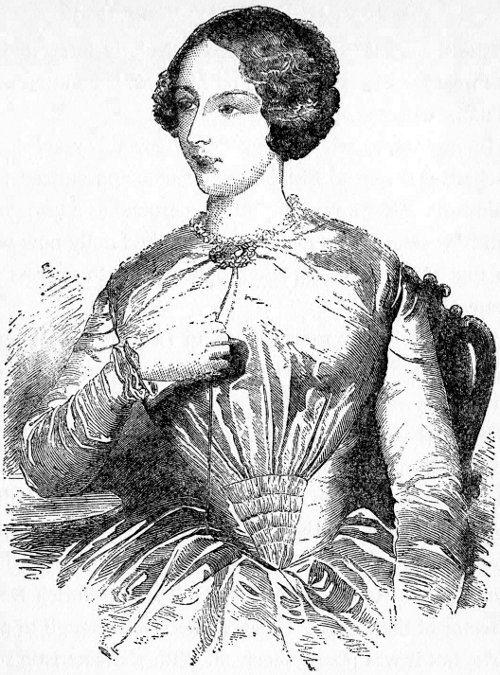
Madame Johanna Wagner, niece of the composer, who sang a leading role in the première performance of Tannhäuser.
4
Even as a young boy Richard was tremendously fond
of the theater. His mother, not particularly interested in
it, threatened to hurl a curse on his head if he attempted
to make a career of the stage.
In any case, when Geyer died several years later,
Richard was sent to Eisleben to become apprenticed to a
goldsmith. After a year of puttering around as a tyro goldsmith
he returned to Dresden where the family now was.
In that city he found many opportunities to express his
dramatic urge.
Soon the family moved back to Leipzig and Wagner
began to study with Theodor Weinlig, who was one of the
authorities on counterpoint.
His early essays in music (composition now being his
aim) were nothing to become excited about. But the musical
life of Dresden and his intercourse with leading
figures of the day worked their influence on him nevertheless.
He spent nights copying Beethoven’s Fifth and Ninth
Symphonies. He wrote an overture which Heinrich Dorn,
director of the Leipzig Theater, liked well enough to perform,
but it was poorly received. With characteristic suddenness
he entered Leipzig University as a studiosus
musicae, really a student with few privileges. But he
plunged with great gusto into all sorts of student activity,
5
which was, apparently, the real reason for his enrollment
at the school.
One of his sisters, Rosalie, and his brother both followed
the acting profession, and they gave him the benefit of
their counsel, though no one knows how much of it he
followed.
He wrote a symphony and then began work on an opera,
Die Hochzeit, which he never completed. That was in 1832.
In the same year he tried again, actually finishing a work
entitled Die Feen. It was rejected, but Wagner, after one
or two little pouts, regained his composure. He accepted
an engagement as conductor at Magdeburg and in the
course of his work he composed another opera, Das
Liebesverbot, which, however, was given one performance.
At Magdeburg he met Minna Planer, a member of the
operatic troupe, who later became his wife. When she left
for Königsberg he followed her and obtained a conductor’s
position at the theater in that city. Then came a succession
of changes. The restless Wagner scurried about with the
spontaneity of a gypsy. When things lagged in one place
he quickly moved to another. So that we find him going to
Riga, where he directed both opera and symphony, to
6
London, to Paris. In the last named he thought he might
finally awaken a musical public to his genius. But he suffered
untold agonies. Poverty possessed him. He and his
wife lived in constant economic turmoil. With all that he
managed to compose two more operas, Rienzi and The
Flying Dutchman. Both were produced at Dresden under
the sponsorship of Meyerbeer, then a dominant figure in
German music.
All this time, though, he wrote a host of compositions,
besides penning many articles on music for various publications,
and his fame spread. His rebellious temperament
got him into difficulty often enough, but he managed,
most of the time, to slip out of it. However, in Dresden,
where he officiated as a conductor of the Royal Opera, he
clashed with certain musical authorities who would not
brook his bold opposition to standard ideas. Yet still another
opera came to the light of performance when Tannhäuser
was given its first hearing, again at Dresden, on
October 19, 1845.
During the previous summer Wagner began work on
the libretto of Die Meistersinger while vacationing at
Marienbad. He soon abandoned it, taking on the libretto
for Lohengrin instead. The following year saw the completion
7
of the Lohengrin score. In 1848 he joined a revolutionary
movement that spread through Europe, launched
by the French Revolution. When the disturbance was
quelled some months later, he fled to Switzerland, but remained
there for a short time, heading soon for Paris.
His wife refused to join him there, remembering too
well the poverty of the previous stay in the French capital.
But he started on Siegfried’s Death, which was to grow
into the gigantic Ring. He flitted about again, leaving
Paris, returning a little later.
Wagner fell in love with Jessie Taylor Laussot, who
proved a benefactress in a financial way. In the meantime,
he decided to leave Minna forever. In Zurich, whither he
repaired, he labored unceasingly on the libretto for The
Young Siegfried. Then he created the subject of The
Valkyrie and finally that of The Rheingold.
It is amusing to note that he wrote his Ring librettos in
reverse order, that is, from what is now Götterdämmerung
back to Das Rheingold. Having hit upon a huge theme,
he found it increasingly necessary to broaden its scope,
thus accounting for the four operas. Parenthetically, however,
he wrote the music in the correct order.
8
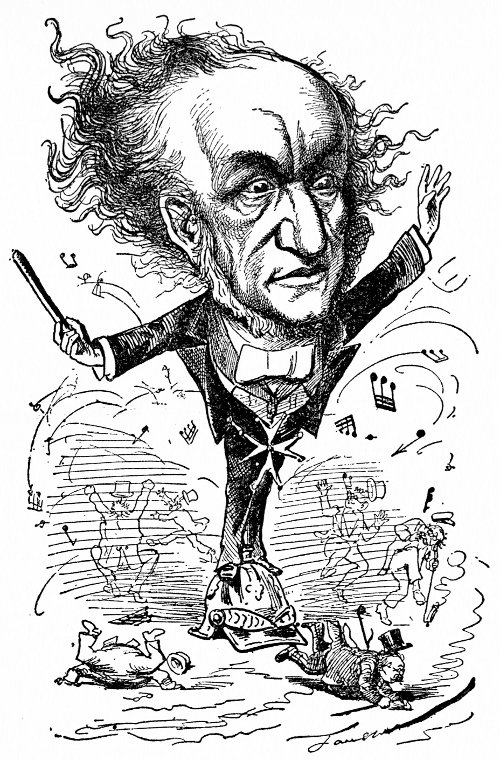
The reaction of some of Wagner’s musically untutored contemporaries is amusingly depicted in this caricature from Figaro (1876).
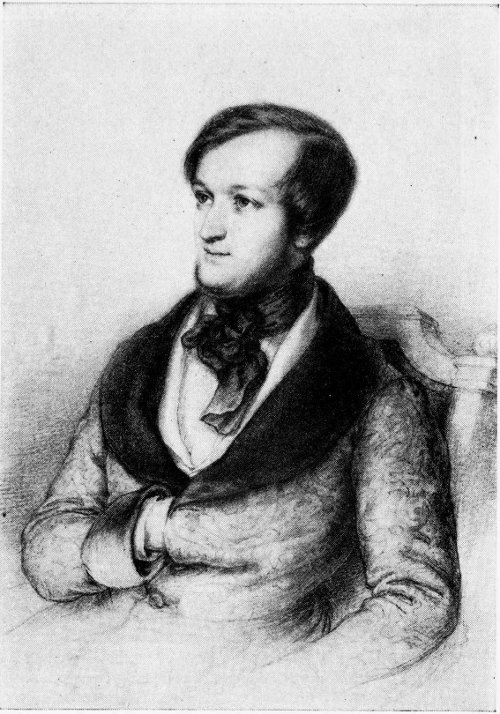
Wagner as a young man, about the time Meyerbeer sponsored the first production of Rienzi in Dresden.
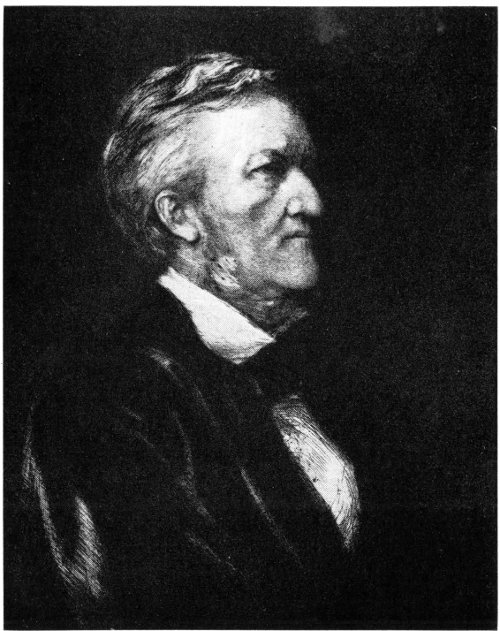
Richard Wagner at the peak of his powers when Der Ring des Nibelungen was nearing completion.
9
Now in Wagner’s life there appears a strange and beautiful
influence, Mathilde Wesendonck, wife of a very
wealthy silk merchant. It has been pointed out that under
the spell of this beguiling woman his composing flourished
as never before. At the home of the Wesendoncks he completed
the poem for Tristan und Isolde. It is not known
how friendly Richard and Mathilde were, but this is fact:
Wagner left his friends’ abode because he would not bring
grief upon Otto Wesendonck.
He went once more to Paris where some very ridiculous
things happened having to do with a suggested ballet for
the opera Tannhäuser. Wagner, adamant, would not
change the order of his work merely to please influential
gentlemen of the Jockey Club.
In 1864, when Wagner was fifty-one, he settled in Munich—he
had been forgiven for his revolutionary surge—and
in this musically flourishing city he came under the
high patronage of King Ludwig of Bavaria. Here he renewed
acquaintance with Liszt’s daughter Cosima, whom
he had met some years before. She was now married to
Hans von Bülow, a highly gifted conductor. The composer
and Cosima were thrown together a lot and their
mutual regard soon ripened into love. Poor little Minna,
10
who had been ill for a long period, died in 1866, a piece of
news which saddened Wagner greatly.
That same year, however, he and Cosima took a place at
Triebschen on Lake Lucerne in Switzerland. Bülow, at
first angered by his wife’s deed, soon came to realize the
inevitability of it. Besides, he adored Wagner and his
music. He acted sanely therefore, sacrificing his personal
feelings for the sake of Wagner’s art. Cosima and Richard
were married in 1870.
At Triebschen he completed Die Meistersinger, Siegfried,
and the first two acts of Götterdämmerung, besides
writing any number of treatises, articles, and the like.
Here, too, the idea of a great festival theater was born in
him, and the originality of the thing soon won many influential
supporters to the cause. By 1871 a site was found
for it at Bayreuth, Germany. The next year he put the
finishing touches to the Ring and the Bayreuth project
grew in proportion to his frantic efforts to raise money for
it. In all, it took some four years to erect this shrine to
Wagnerian music. And finally, the première of the Wagnerian
Cycle, running from August 13 to 16, was a tremendous
success, in spite of the heartaches, the headaches,
and the discouragement.
11
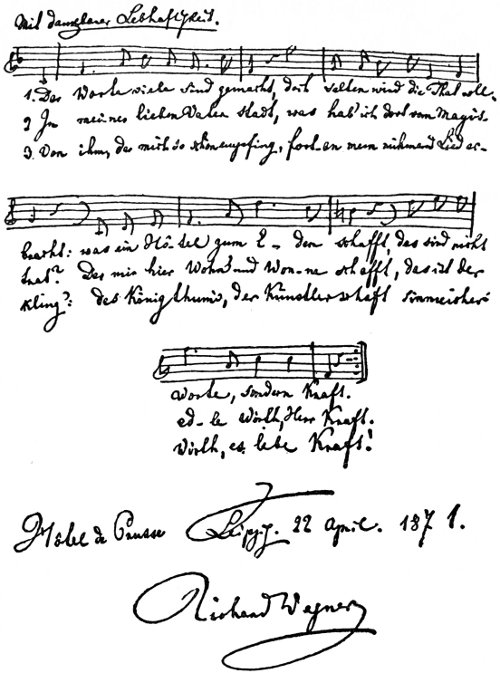
Manuscript of a humorous song dedicated by Wagner to Louis Kraft, proprietor of the hotel in Leipzig where Wagner stopped during his first trip to Bayreuth.
12
With all that he had already accomplished, Wagner
could have retired to the easy life he often so fervently
spoke about. But the urge to compose never left him.
He set to work on Parsifal, the poem he had completed
some months before. When the opera was all finished he
endeavored with his usual kinetic energy to raise money
for its production. It was given its first performance on
July 26, 1882. There were sixteen more performances.
Wagner, after all the excitement of Bayreuth, left for
a vacation in Venice. In spite of repeated heart attacks,
he considered seriously the writing of another symphony.
But he had done his work. There was to be no second
symphony. Wagner died of his heart illness on February
13, 1883. He was buried at Bayreuth.
Bulwer’s Rienzi revived an old desire of Wagner’s to
make an opera out of the story of the last of the Tribunes.
He was in Dresden during the summer of 1837 and there
he read Barmann’s translation of the Bulwer novel. However,
he did not begin actual work until the following
July. First, of course, came the text. Later that month
he started on the music. By May 1839, he had completed
13
two acts. The remainder of the score, with the exception
of the Overture, was written and orchestrated in Paris.
The Overture was finished on October 23, 1840.
On October 20, 1842, Rienzi was given its world première
at the Royal Saxon Court Theater, Dresden. Amusingly,
the performance began at 6 P.M., and it went on
and on until midnight. America was not to become acquainted
with the opera until March 4, 1878, when it was
given at the Academy of Music, New York.
The thematic material employed in the Overture stems
from music in the opera itself, such as the “long-sustained,
swelled and diminished A on the trumpet,” which is the
signal for the people’s uprising against the nobles; Rienzi’s
Prayer; a theme of the chorus, Gegrüsst sei hoher Tag; the
theme of the revolutionary forces, Santo spirito cavaliere;
the stretto of the second Finale, Rienzi, dir sei Preis; and
a subject similar to the phrase of the nobles set to the
words, Ha, dieser Gnade Schmach erdruckt das stolze
Herz!
The score of the Overture calls for one piccolo, two
flutes, two oboes, two clarinets, two bassoons, two valve-horns,
two plain horns, one serpent (nowadays replaced
by the double-bassoon), two valve trumpets, two plain
trumpets, three trombones, one ophicleide (replaced by
the bass-tuba), two snare-drums, bass drum, triangle,
cymbals, and strings.
14
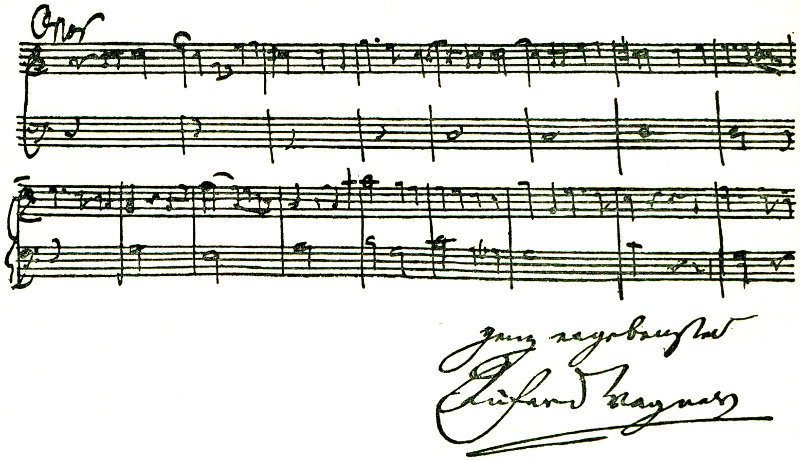
The People’s Chorus, commencing Act II of Rienzi.
15
This compact and brilliantly written Overture calls for
the following instrumentation: piccolo, two flutes, two
oboes, English horn, two clarinets, four horns, two bassoons,
two trumpets, three trombones, bass tuba, kettledrums,
harp, and strings.
John Runciman once remarked about this music, “It is
the atmosphere of the sea that counts; the roar of the
billows, the ‘hui!’ of the wind, the dashing and plunging....
The sea, indeed, is the background, foreground, the whole
environment of the drama.... The smell and atmosphere
of the sea is maintained with extraordinary vividness to
the last bar.”
In the construction of the Overture Wagner makes important
use of the theme of the Dutchman, which appears
in the opening measure by horns and bassoons, and of the
up-and-down theme of Senta, the Angel of Mercy, softly
and tenderly sung by English horn, horns and bassoons.
This is the theme which at the conclusion of the piece rises
16
to a triumphant sonority, indicative of redemption attained.
The first concert performance of this well-known Overture
took place at Leipzig, on February 12, 1846, under
the direction of Mendelssohn. The event was a benefit
for the Gewandhaus Orchestra Pension Fund.
Wagner himself furnished a “program” for the Overture
when the musicians performing it at a Zurich concert
requested an explanation of the music. The “program” in a
translation by William Ashton Ellis follows:
“To begin with, the orchestra leads before us the Pilgrim’s
Chorus alone; it draws near, then swells into a
mighty outpour, and passes finally away.—Evenfall; last
echo of the chant. As night breaks, magic sights and sounds
appear, a rosy mist floats up, exultant shouts assail our
ears, the whirlings of a fearsomely voluptuous dance are
seen. These are the Venusberg’s seductive spells, that show
themselves at dead of night to those whose breast is fired
by the daring of the senses. Attracted by the tempting
show, a shapely human form draws nigh; ’tis Tannhäuser,
Love’s minstrel.... Venus herself appears to him.... As the
Pilgrim’s Chant draws closer, yet closer, as the day drives
farther back the night, that whir and soughing of the air—which
had erewhile sounded like the eerie cries of the soul
condemned—now rises, too, to ever gladder waves; so that
when the sun ascends at last in splendor, and the Pilgrims’
Chant proclaims in ecstasy to all the world, to all that lives
and moves thereon, Salvation won, this wave itself swells
out the tidings of sublimest joy. ’Tis the carol of the Venusberg
itself, redeemed from the curse of impiousness, this
cry we hear amid the hymn of God. So wells and leaps
each pulse of Life in chorus of Redemption; and both dissevered
elements, both soul and senses, God and Nature,
unite in the astonishing kiss of hallowed Love.”
17
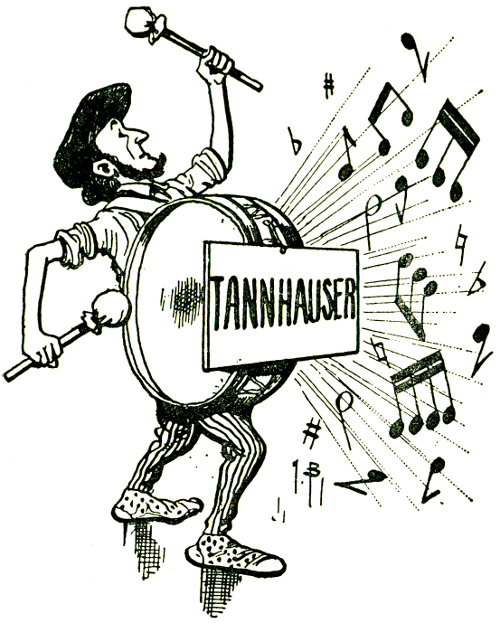
TANNHAUSER
“Wagner, inventor of the bass drum for musical bombardment, applies himself to his favorite exercise” reads the caption for this contemporary French caricature.
18
The Overture to Tannhäuser is scored for piccolo, two
flutes, two oboes, two clarinets, two bassoons, four horns,
three trumpets, three trombones, bass tuba, kettledrums,
cymbals, triangle, tambourine, and strings.
The opera was first produced at the Royal Opera House,
Dresden, on October 19, 1845. Some sixteen years later,
due to the interest and influence of Princess Metternich,
wife of the Austrian Ambassador to France, the work was
introduced to Paris. For that production Wagner extended
19
his first scene to include a Bacchanale, the reasons for this
being as amusing to us as they must have been tragic to
Wagner. The Princess revealed, in an article written for
the Pall Mall Magazine (London, 1894) some of the reasons
for the failure of the opera there, and it was a complete
failure. The Princess says:
“The day of the performance drew nigh and in most
circles little good will was confessed. It was stated generally
that a protest should be made against the abominable
futurist music, and it was rumored that stormy scenes
might be expected at the Opera. In the clubs men were
annoyed because Wagner would not have a regular ballet,
but only a few poses of the ballerinas in the Venusberg.
The club subscribers to the Opera expected a ballet at
nine-thirty sharp, no matter what the opera. This, at least,
was the custom of the time. No one who knew anything of
art could conceive where a ballet could be introduced into
the midst of ‘Tannhäuser.’ Wagner declared that he would
not accede to the silly wishes of the subscribers, because
he could not. And he was perfectly right, but his refusal
was to be paid for dearly.”
Wagner had entertained great hopes for this Parisian
production of Tannhäuser. To produce his work at the
20
justly famed Opera was reason enough, what with that
organization’s habit of letting expense go hang. He labored
industriously at making revisions, which included
a complete rewrite of the Bacchanalian scene as well as
of the music for Venus and Tannhäuser in Act 1.
When he had completed his revisions he played the
music for several friends. Charles Nuitter, one of these,
reported on that private hearing as follows:
“When we arrived the composer sat down to the piano.
He played with indescribable animation and fury. His
hands pounded the keys, and the same time he strove to
acquaint me with the action of the scene, crying out the
entrance of the various groups. ‘Arrival of the fauns and
satyrs; all are put to flight; the confusion mounts to its
climax,’ he flung at me, and his hands continued to bang
the keys, the musical delirium always augmenting. When
he was piling on a succession of quivering chords Wagner
suddenly cried, ‘Now a crash of thunder. We are all dead!’
At that moment a wagon of paving stones discharged
its load into the street, thus producing a prolonged and
terrible noise. Wagner turned round and regarded us
with stupefaction, his eyes staring wildly. It took us
some moments to recover from this stirring of our feelings.
21
Thus it was that I was initiated into the new music.”
The first Paris performance of Tannhäuser took place
on March 13, 1861. That was the first of three fiascos in
the French capital. The second occurred on March 18.
Napoleon III and the Empress both attended, but their
presence had no effect on the rest of the audience, whose
cat-calls, howls, and kindred strange noises were even
louder, if not funnier, than the first time.
The work was given for the third time on March 24.
This was not a regular subscription performance, and it
seemed to all and sundry that finally a Parisian audience
would be honest and unprejudiced in its attitude toward
the opera. However, the composer’s enemies had bought
out the house and the result was the same. Whereupon
Wagner withdrew his score. Tannhäuser was not given
again in Paris until thirty-four years later.
In the summer of 1845, while Wagner was at Marienbad,
he worked out the plan for Lohengrin. The libretto he
wrote during the following winter. Then came a topsy-turvy
scheme of creation. In composing the music he
began with the hero’s Narrative in the last act, “because
22
the monologue contained the most significant musical
germs in the whole score.” He finished the third act on
March 25, 1847, the first act on June 8 of that year, the
second act on August 2, and the Prelude on August 28.
The orchestration was done during the following winter
and spring. Franz Liszt conducted the première of the
opera at Weimar on August 28, 1850. The Prelude was
played for the first time in concert on January 17, 1853,
at the Leipzig Gewandhaus, Julius Rietz conducting.
Discussing the Prelude, William Foster Apthorp wrote:
“Like the hero’s career in the opera, it begins, as it were,
in the clouds, then gradually descends farther and farther
until it embraces all the lower tones of the orchestra, and
then returns to the clouds again. Its single theme is developed
in free polyphony by various successive groups of
instruments, each of which groups proceeds with free
counter-thematic work as the next group enters with the
theme. First we have the violins piano in their higher
registers; then come the flutes, oboes, and clarinets; then
the violas, ’cellos, horns, bassoons, and double-basses;
lastly the trumpets, trombones, and the tuba fortissimo;
then comes the decrescendo, ending pianissimo in the
high violins and flutes.”
23
The composer, who could descant with the best of them,
paraded his rhetorical gifts on the Prelude (the translation
is by William Ashton Ellis):
“Love seemed to have vanished from a world of hatred
and quarreling; as a lawgiver she was no longer to be
found among the communities of men. Emancipating itself
from barren care for gain and possession, the sole arbiter
of all worldly intercourse, the human heart’s unquenchable
love-longing, again at length craved to appease a want
which, the more warmly and intensely it made itself felt
under the pressure of reality, was the less easy to satisfy
on account of this very reality. It was beyond the confines
of the actual world that man’s ecstatic imaginative power
fixed the source as well as the output of this incomprehensible
impulse of love, and from the desire of a comforting
sensuous conception of this supersensuous idea
invested it with a wonderful form, which, under the name
of the ‘Holy Grail,’ though conceived as actually existing,
yet unapproachably far off, was believed in, longed for,
and sought for.
“The Holy Grail was the costly vessel out of which,
at the Last Supper, our Saviour drank with His disciples,
and in which His blood was received when out of love for
24
His brethren He suffered upon the cross, and which till
this day has been preserved with lively zeal as the source
of undying love; albeit, at one time this cup of salvation
was taken away from unworthy mankind, but at length
was brought back again from the heights of heaven by a
band of angels, and delivered into the keeping of fervently
loving, solitary men who, wondrously strengthened and
blessed by its presence, and purified in heart, were consecrated
as the earthly champions of eternal love.
“This miraculous delivery of the Holy Grail, escorted
by an angelic host, and the handing of it over into the
custody of highly favored men, was selected by the author
of ‘Lohengrin’ for the introduction of his drama, as the
subject to be musically portrayed; just as here, for the
sake of explanation, he may be allowed to bring it forward
as an object for the mental receptive power of his hearers.
“To the enraptured look of the highest celestial longing
for love, the clearest blue atmosphere of heaven at first
seems to condense itself into a wonderful, scarcely perceptible
but magically pleasing vision; with gradually increasing
precision the wonder-working angelic host is
delineated in infinitely delicate lines as, conveying the
holy vessel (the Grail) in its midst, it insensibly descends
25
from the blazing heights of heaven. As the vision grows
more and more distinct, as it hovers over the surface of
the earth, a narcotic fragrant odor issues from its midst;
entrancing vapors well up from it like golden clouds, and
overpower the sense of the astonished gazer, who, from
the lowest depths of his palpitating heart, feels himself
wonderfully urged to holy emotions.
“Now throbs the heart with the pain of ecstasy, now
with the heavenly joy which agitates the breast of the
beholder; with irresistible might all the repressed germs
of love rise up in it, stimulated to a wondrous growth by
the vivifying magic of the vision; however much it can
expand, it will break at last with vehement longing, impelled
to self-sacrifice and toward an ultimate dissolving
reveals again in the supremest bliss as, imparting comfort
the nearer it approaches, the divine vision reveals itself
to our entranced senses, and when at last the holy vessel
shows itself in the marvel of undraped reality, and clearly
revealed to him to whom it is vouchsafed to behold it, as
the Holy Grail, which from out of its divine contents
spreads broadcast the sunbeams of highest love, like the
lights of a heavenly fire that stirs all hearts with the heat
of the flame of its everlasting glow, the beholder’s brain
26
reels—he falls down in a state of adoring annihilation.
Yet upon him who is thus lost in love’s rapture the Grail
pours down its blessing, with which it designates him as
its chosen knight; the blazing flame subsides into an ever-decreasing
brightness, which now, like a gasp of breath
of the most unspeakable joy and emotion, spreads itself
over the surface of the earth and fills the breast of him
who adores with a blessedness of which he had no foreboding.
With chaste rejoicing, and smilingly looking down,
the angelic host mounts again to heaven’s heights; the
source of love, which had dried up the earth, has been
brought by them to the world again—the Grail they have
left in the custody of the pure-minded men, in whose hands
its contents overflow as a source of blessing—and the
angelic host vanishes in the glorious light of heaven’s blue
sky, as, before, it thence came down.”
A colossal work in four parts, the Ring’s central theme
is one of redemption. The Norse God Wotan, addicted
to the amassing of power, may not achieve it through deceit
or treachery. By trickery he obtains from the Nibelung
27
Alberich a ring possessing untold powers, made of the
gold of the Rhine. Alberich hisses a curse, in losing it,
which only a pure hero acting as a free agent may remove.
Wotan’s attempts to get the ring, his often devious
reasoning, and the panoplied purpose of the whole, make
of the tetralogy an epic study in the emotions, the humanities,
the loyalties, the shortcomings, in short, in the whole
moral and spiritual concept of the individual and society.
In the time intervening between Das Rheingold and
Die Walküre Wotan has worked out a plan to save the
gods from destruction. The ring must not fall into the
wrong hands, those of Alberich, for instance, for the wily
and greedy creature knows full well its powers. The thing
to do, then, is to regain possession of it without “craft or
violence.” He must employ some means above such devices.
Consequently his plan is to bring into being a hero
who shall not be his servitor, but rather the agency for
the accomplishment through a free, totally unguided will.
Thus we come to the saga of the Walsungs, human descendants
28
of Wotan, and one of them, Siegmund, is the
hero chosen.
The Valkyries are the nine daughters of Wotan by the
earth goddess of wisdom, Erda. And of these Brünnhilde
is Wotan’s favorite. She interferes with her father’s wishes
in order to aid Siegmund, however, and she is given the
penalty of mortality by her father. The duet in the last
act of the opera between Wotan and Brünnhilde is one of
the most moving sequences in all Wagner.
The Ride of the Valkyries is an excerpt from the music
which leads into Act III, made into a concert piece by
Wagner himself. A great rock dominates the scene in the
opera. It is the Valkyr Rock where now the maidens are
gathering. Fully equipped in shining mail, carrying spears
and shields, they ride swiftly through the storm. At the
curtain’s rise only four of the maidens are discernible on
the stage. The others may be heard announcing their
entrance with the exultant Valkyr call. The music surges
to great heights of sound, wild, untrammeled, passionate,
driven relentlessly by powerful rhythms.
29
In a letter dated June 25, 1870, Wagner wrote of his
wife Cosima, “She has defied every disapprobation and
taken upon herself every condemnation. She has borne
to me a wonderfully beautiful boy, whom I call boldly
Siegfried; he is now growing, together with my work [he
was working then on the opera Siegfried; hence the name];
he gives me a new long life, which at last has attained a
meaning. Thus we get along without the world, from
which we have wholly withdrawn.”
The composer wrote the music of the Idyl—originally
called the Triebschen Idyl—as a birthday gift for his wife.
On Christmas morning, 1870, Wagner and a group of musicians
assembled on the stairs of his home at Triebschen
and performed the lovely music, which, cramped though
the musicians were because of tight quarters, obtained a
fine rendering, according to ear-witnesses.
When the Idyl was first played in Berlin, in 1878, a
music critic gave it as gospel that the music was taken
from the second act of the opera Siegfried. The truth of
the matter is that the Idyl, while based on several themes
from the opera besides that of a folk song, is a complete
entity in itself, for the themes were developed in a manner
entirely different from their treatment in the opera. In
addition to which, it must be remembered that the folk
song, Schlaf’, mein Kind, schlaf’ein, does not appear in
the opera at all.
30
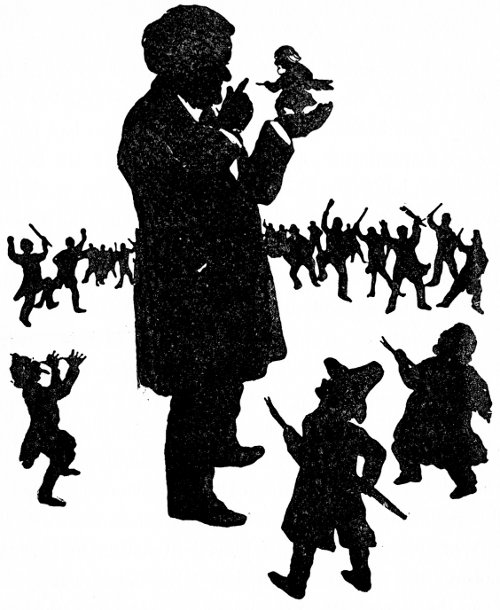
“Wagner and the Critics” is the title of this amusing contemporary caricature.
31
The music for this sequence is taken from the scene
before the dragon’s cave in the second act of Siegfried.
In arranging it for concert use, Wagner gave it the name
Waldweben (Forest Weavings or Forest Murmurs). The
young hero Siegfried is left to his own thoughts by the
dwarf Mime. The rustling of the leaves is first heard in
D minor, then in B major. Siegfried is daydreaming.
He ponders on the question of his origin. He knows that
he is not of Mime’s blood, and the clarinet, paralleling,
and explaining the idea, intones the theme of the Volsungs.
As his thoughts turn to his mother the Love-Life motive
emerges through the ’cellos and violas and double basses,
next in all the strings, and finally horns and bassoons take
it over. A solo violin plays a subject associated with Freia,
goddess of youth and love. The rustling of the leaves is
again heard and the theme of the Forest Bird comes in
32
by way of the oboe, flute, clarinet and other wood winds.
The music ends in a Vivace which incorporates the Fire,
the Siegfried, and the Slumber motives, besides the twittering
of the Forest Bird.
This music comes between the Prologue and the first
act. It is frequently referred to as a “scherzo.” Siegfried
has taken leave of his wife Brünnhilde and, exhorted by
her, sallies forth on new adventures. The music brings
up the hero’s past achievements, whose themes are presented
in new guises. They are cleverly interwoven, the
pattern being rich in colors and effects as well as in sonorities.
Through the orchestral web may be detected threads
akin to such thematic ideas as Siegfried’s horn call, the
Rhine motive, the motive of Renunciation, the motive of
the Rhine Daughters, the motive of the Rheingold and,
last, that of the Nibelungs’ Servitude. Climactic and exultant,
the music yet gives forth many implications of
impending tragedy.
33
Through the trickery of Hagen, villainous half-brother
of Gunther, Siegfried is slain. His body is lifted tenderly
by Gunther’s followers and carried back to the hall of
the Gibichungs. As that happens on the stage, the orchestra
sings out with a giant dirge, lamenting the fall of
the Volsungs while reviewing previous moments in the
history of the tragic race. There is the reference to the
love of Siegmund and Sieglinde from Die Walküre. Toward
its conclusion the horns and bass trumpet announce
sonorously the motive of Siegfried the hero. There is a
rhythmic variant of the horn call and with the dying
away of the music Brünnhilde is momentarily mentioned.
The end of the gigantic Ring, specifically Brünnhilde’s
scene of immolation, is frequently performed in concert
with a soprano soloist. The heroine’s great monologue,
delivered in the hall of the Gibichungs, writes finis to a
drama that takes four separate operas to tell. In her
grief over the death of her hero-husband she stills the
“loud, unworthy” lamentations of the others who are gathered
34
about the slain Siegfried. She commands them to
erect a funeral pyre and to place the hero’s body upon it.
His ring is taken from his finger and she puts it on her own.
After applying a torch to the pyre she leaps on her horse
Grane and rushes into the flames.
In 1854, when Wagner was in the midst of composing
the Ring, the idea for an opera on the Tristan theme
came to him. Not till three years later, however, did he
begin actual work on it, and the music-drama was finished
in August 1859. Complications of various kinds interfered
with the production of the opera, but it finally obtained
its première at the Royal Court Theater in Munich, on
June 10, 1865, under the direction of Hans von Bülow.
Wagner’s version of the tale combines features from
numerous legends. Very likely of Celtic origin, the story,
as the German composer utilized it, makes room for myriad
delvings into psychology and metaphysics, some of which
are not easy to follow. We must assume, as Ernest Newman
suggests, that the characters and their motivations were
perfectly clear to the composer, if they seem not to be
altogether to the listener. Here is the essence of the music-drama’s
35
plot, extracted from Wagner’s own description:
We are told of Tristan and Isolde in an ancient love
poem, which is “constantly fashioning itself anew, and
has been adopted by every European language of the
Middle Ages.” Tristan, a faithful vassal of King Marke,
woos Isolde for his king, yet not daring to reveal to her
his own love. “Isolde, powerless to do otherwise, follows
him as a bride to his lord.” In the meantime the Goddess
of Love, balked by all this, plans revenge. The Love
Potion, which had been intended for the king in order
to insure the marriage, is given to Tristan and Isolde to
drink, a circumstance which “... opens their eyes to the
truth and leads to the avowal that for the future they
belong only to each other.... The world, power, fame,
splendor, honor, knighthood, fidelity, friendship, all are
dissipated like an empty dream. One thing only remains:
longing, longing, insatiable longing, forever springing up
anew, pining and thirsting. Death, which means passing
away, perishing, never awakening, their only deliverance....
Shall we call it death? Or is it the hidden wonder-world
from out of which an ivy and vine, entwined with
each other, grew upon Tristan’s and Isolde’s grave, as
the legend tells us?”
36
The Prelude, A minor, 6-8, makes a very gradual and
long crescendo to a mighty fortissimo, followed by a
briefer decrescendo, which leads to a whispered pianissimo.
Free as to form and ever widening in scope of development,
it offers two chief themes: a phrase, uttered by
the ’cellos, is united to another, given to the oboes, to form
a subject called the “Love Potion” theme, or the theme
of “Longing.” Another theme, again announced by the
’cellos, “Tristan’s Love Glance,” is sensuous, even voluptuous
in character.
After the Prelude, the orchestra enters into the “Liebestod”
or “Love-Death,” that passionate flow of phrases,
taken mostly from the material in the second act Love-Duet.
Isolde (in the opera) sings her song of sublimated
desire. Franz Liszt is responsible for the application of
the term “Liebestod” to that part of the music which
originally had been named “Verklärung” by Wagner himself.
“The completion of Die Meistersinger, Triebschen,
Thursday, October 24, 1867, 8 o’clock in the evening,
R. W.” These words were inscribed on the last sheet of
37
the manuscript of Wagner’s only operatic comedy. This
was some twenty-two years after the very first drafts
were drawn at Marienbad. The doctor had ordered a
complete rest. But rest to Wagner meant ennui. Perhaps,
he thought, he might be able to rest while composing a
lighter work. The idea took hold. He gave it considerable
thought. He could just about see this airy piece’s “rapid
circulation through the European opera houses.” Indeed,
he judged that “something thoroughly light and popular”
might be just the thing to make his everlasting fame.
Hans Sachs, of course, is the hero of this masterpiece.
A historic character, Sachs was built by the composer into
something of an ideal of homespun charm and wit and
philosophy. But Wagner also evened a score with an old
enemy in his composition of this work. The music critic
Eduard Hanslick appears as the crotchety, pedantic and
unprincipled Beckmesser, thus earning for himself a
ridiculous immortality.
How Wagner could have written this opera with all
the troubles besetting him is hard to comprehend. Yet
no financial snarls, domestic tribulations, romantic attachments
or what-not could stay it even though it took
years to come forth.
38
As for the Prelude, Wagner himself has written an interesting
analysis, which is here appended:
“The opening theme for the ’cellos has already been
heard in the third strophe of Sachs’ cobbler-song in Act II.
There is expressed the bitter cry of the man who has determined
to renounce his personal happiness, yet who
shows the world a cheerful, resolute exterior. That smothered
cry was understood by Eva, and so deeply did it
pierce her heart that she fain would fly away, if only to
hear this cheerful-seeming song no longer. Now, in the
Introduction to Act III, this motive is played alone by
the ’cellos, and developed in the other strings till it dies
away in resignation; but forthwith, and as from out the
distance, the horns intone the solemn song wherewith
Hans Sachs greeted Luther and the Reformation, which
had won the poet such incomparable popularity. After
the first strophe the strings again take single phrases of
the cobbler’s song, very softly and much slower, as though
the man were turning his gaze from his handiwork heavenwards,
and lost in tender musings. Then, with increased
sonority, the horns pursue the master’s hymn, with which
Hans Sachs, at the end of the act, is greeted by the populace
of Nuremberg. Next reappears the strings’ first motive,
39
with grandiose expression of the anguish of a deeply-stirred
soul; calmed and allayed, it attains the utmost
serenity of a blest and peaceful resignation.”
The plot of Die Meistersinger deals with a song contest
which is to be held in Nuremberg on St. John’s Day. Naturally,
there is to be a handsome prize for the winner and in
this case it is the hand of Eva, daughter of the goldsmith
Veit Pogner. A young knight, Walther von Stolzing, has
seen Eva meanwhile, and he has fallen in love with her.
Because he is a likeable young man, he is given permission
to enter the contest. Another contestant is Beckmesser, the
town clerk, who attempts to bring Walther to ruin.
However, Walther and Eva have confessed their love
for each other to Hans Sachs, a cobbler, who happens
also to be in love with Eva. But he makes the supreme
sacrifice, rejoicing at the same time in the knowledge that
the maid will be deliriously happy with her young knight.
He helps their cause along, writing down the notes of a
song Walther has heard in a dream. At the contest Beckmesser
tries to sing that same song, offering it as his own,
but his raucous efforts make him the laughing stock of the
affair. Of course, Walther’s song is adjudged the best and
he wins his Eva.
40
Often heard in the concert hall are several other excerpts
from Die Meistersinger. These include the Procession
of the Guilds, the Dance of the Apprentices, the
Procession of the Masters, the Homage to Sachs, and the
Finale.
Most of the Ring, all of Tristan, and a considerable
portion of Die Meistersinger had been written by Wagner
before he started actual work on the “consecrational
festival stage play,” Parsifal, in 1865. He made a first outline
of the libretto in August of that year, some two
decades after he had become acquainted with the Parsifal
poem of Wolfram von Eschenbach, the Minnesinger. Not
till 1877, however, did the text attain its final shape, and
it was published in December. Sometime previously Wagner
had turned to the task of composing the music and
completed it in 1879. The orchestration was finished in
January 1882. The opera was given for the first time at
Bayreuth on July 26, 1882. The Prelude, written in December
1878, had been given its première performance at
Wagner’s house, Wahnfried, on Christmas Day, with the
composer conducting for the occasion, his wife Cosima’s
birthday.
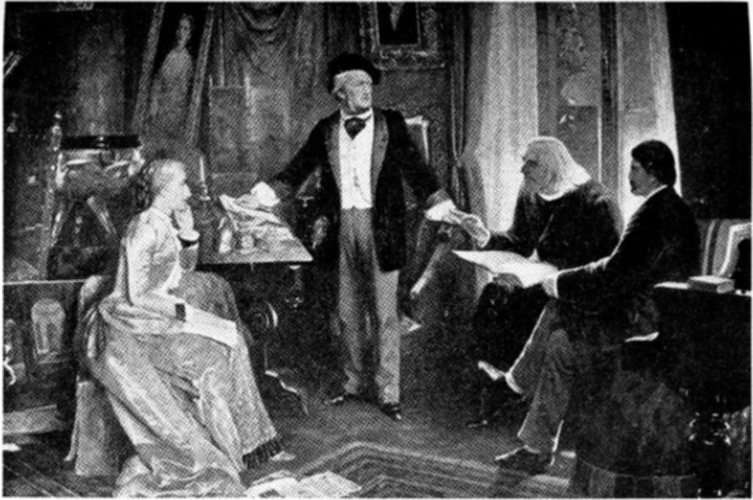
Wagner with Franz Liszt and Liszt’s daughter, Cosima, ex-wife of the conductor Hans von Bülow, whom Wagner married in 1870.
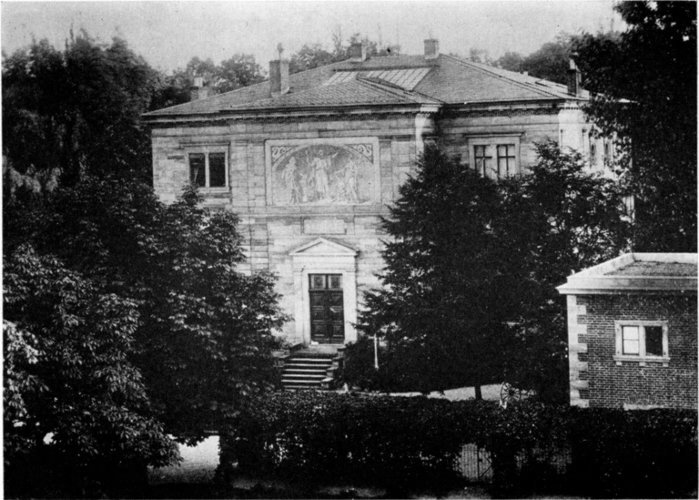
The Wagner villa, Wahnfried, at Bayreuth, scene of the Wagnerian Festivals.
Publisher’s Photo Service
41
The ethical essence of Parsifal has thus been expressed:
“Enlightenment coming through conscious pity brings
salvation.” Wagner, whose earlier music-dramas each revolved
about some idée fixe of philosophical or moral
implication, brought to Parsifal, besides, religious elements
derived from the twin sources of Christian doctrine and
Buddhism. Some years before he had done the sketch for
a play on the subject of Jesus of Nazareth, and, parenthetically,
it is quite likely that he had no intention to write
music for it. Nevertheless, here is shown the composer’s
religious urge, mingled with other aspects of his creative
bent. He says, “I was burning to write something that
should take the message of my tortured brain, and speak
in a fashion to be understood by present life. Just as with
my Siegfried, the force of my desire had borne me to the
fount of the Eternal Human: so now, when I found this
desire cut off by modern life from all appeasement, and
saw afresh that the sole redemption lay in flight from out
this life, casting off its claims on me by self-destruction,
42
did I come to the fount of every modern rendering of such
a situation—Jesus of Nazareth, the Man.”
During that period Wagner drafted another play, which
he titled Die Seger (The Victors), one of Buddhistic import,
whose story centers on the dictum that Prakriti, the
hero, may not become one with Amanda, the heroine,
unless he “shares the latter’s vow of chastity.” In these two
works may be found qualities and tones of thought also
incorporated in Parsifal.
The locale of Parsifal is Montsalvat in the Spanish Pyrenees.
The castle of the Holy Grail is tenanted by a company
of Knights, guardians of the Spear which pierced Jesus’
side as He hung on the Cross, and of the Cup He drank
from the Last Supper and which received His precious
blood from the Spear-wound. This brotherhood of Knights
of the Grail refuses membership to all, save the pure in
heart, and the Knights go about the world doing good
through the high powers given them by the Grail.
A certain other knight, Klingsor, sinful and scheming,
enraged against the Knights for having been denied admission
to the Brotherhood, has built a magic garden,
whose many charms have proved strong enough to tempt
several of the weaker-willed Knights. Amfortas, king of
43
the Grail, is one of these. He has fallen victim to the wiles
of Kundry, a creature of Klingsor. The latter has seized
the Spear from Amfortas and has humiliated him further
by wounding him with it. The wound may be cured only
by being touched with the point of the Spear held by a
Guileless Fool, a youth who can withstand all temptation.
This youth, of course, is Parsifal, a forest lad who enters
into the picture through having killed a swan sacred to
the Grail. Parsifal is made to go through the rituals prescribed
by the libretto; namely, he is present at the ceremony
of the Eucharist or the Lord’s Supper without
grasping anything of its meaning; he resists the lures
thriving in Klingsor’s garden; then he seizes the Spear,
flung at him by Klingsor and, as he makes the sign of the
cross, the garden is destroyed. He wanders about the
world and returns to Montsalvat. Kundry, now a repentant
woman dedicated to the Grail’s service, washes his feet
and dries them with her hair. Next he goes with Gurnemanz
to the temple where he restores Amfortas to
health, and, as the latter bends before him in homage,
Kundry dies. Having thus attained “enlightenment ...
through conscious pity,” Parsifal has become the saviour
of Montsalvat.
44
The Prelude is an abbreviated exposition of the purposes,
musical and dramatic, of the opera. It opens with
the phrase which dominates the religious scene of the first
act during the feast of the Lord’s Supper. The phrase,
sung first in unison by violins, ’cellos, English horn, clarinet
and bassoons, is marked sehr langsam (Lento assai), A-flat
major, 4-4. It is taken up by trumpet, oboes, and half
the first and second violins to the accompaniment of arpeggios
in the violas and the other violins, and chords for
flutes, clarinets, and English horn with the bassoons and
horns sustaining harmony notes. After a series of broken
chords, the trombones and trumpets announce a second
theme, the Grail motive, which is a phrase long known
as the Dresden Amen of the Saxon liturgy. There is a
change of tempo to 6-4 with the entrance of a third theme,
that of Faith. Its first figure is frequently repeated against
changing harmonies. A fourth theme appears, suggestive
of the suffering of Christ and Amfortas, which originates
in the Lord’s Supper motive; its first two measures are
also employed to characterize the Spear. In the words of
Maurice Kufferath, “Like the Prelude to ‘Lohengrin,’ the
introduction to ‘Parsifal’ is developed by successive degrees
until it reaches a maximum of expression, thereafter
45
to diminish imperceptibly to a pianissimo. Thus the
synthesis of the whole drama is clearly exposed. That
which remains is merely a peroration, a logical, necessary
conclusion brought about by the ideas associated with the
different themes.”
The music of the Transformation Scene in this act is
that which is played during the walk of the venerable
Gurnemanz and Parsifal through the wood to the Hall
of the Grail. The music is of a march-like quality for a
spell, subsequently gradually expanding in color and richness
to the climactic theme representative of the Penitence
of Amfortas, which is given out three times in succession.
The Grail Scene follows. There is the tolling of bells,
the Grail Knights march into the hall in stately fashion.
One hears the chanting of boys in the lofty dome. The
ritual is interrupted by the impassioned song of Amfortas,
who, suffering great torment, begs his father, Titurel, in
words of self-abasement, to celebrate the Communion in
his place. Titurel answers, however, “Serve thou, and so
thy guilt atone! Uncover the Grail!” Presently the ceremony
is ended, the knights have departed, and only Gurnemanz
and Parsifal remain. The former inquires of the
latter how much of the proceedings he has understood.
The youth’s only answer is to clutch at his heart and shake
his head. Gurnemanz, who by this time is convinced that
Parsifal is truly a fool, sends him away angrily and then
follows the Knights out the door. From somewhere above
an unseen singer delivers the motive of the Pure Fool. The
theme of the Grail is sung by still other voices. Bells peal
once again. The act ends.
46
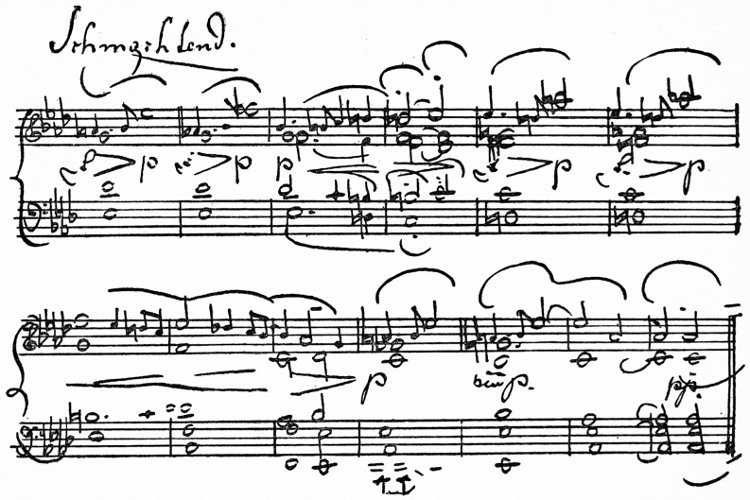
Rough draft of one of Wagner’s last compositions, dedicated to his wife, Cosima.
47
It is interesting to note that these excerpts from Parsifal
represent the only ones authorized by Wagner for concert
performance.
The Good Friday Spell is placed at the end of the first
scene in Act III of the opera. Gurnemanz is now an old
hermit who lives in a humble abode at the edge of a forest.
He comes out of the hut when he hears a groaning sound
in the distance. Presently Parsifal arrives. He is a knight
clad in black armor, carrying the sacred spear and a buckler.
He is weary. The old Gurnemanz plies him with questions,
but Parsifal will not answer until he is apprised of
the fact that it is Good Friday. Whereupon he drives the
48
spear into the ground, removes his helmet, and kneels in
prayer.
Subsequently Kundry fetches water and washes his feet
and anoints him with holy oil. And Gurnemanz, recognizing
in him the Guileless Fool now worthy of the title King
of the Grail, blesses him and greets him as the king. They
soon set out for Montsalvat.
The music of the Good Friday Spell comprises thematically
a hymn of thanksgiving, the music of Kundry’s Sigh,
of the Holy Supper, of the Spear, of the Grail, of the Complaint,
of the Flower Girls. All of these are finally fused
into a pastoral poem ending with the Good Friday melody,
which is suddenly interrupted by the doleful sound of
bells. During Gurnemanz’s blessing of Parsifal, horns,
trumpets and trombones play the Parsifal motive. This is
given out in an impressive manner, and it leads into the
Grail theme. There follows a series of chords which usher
in the motives of Baptism and Faith.
49
LP—Also available on Long Playing Microgroove Recordings as well as on the conventional Columbia Masterworks.
Under the Direction of Bruno Walter
- Barber—Symphony No. 1, Op. 9
- Beethoven—Concerto for Violin, Cello, Piano and Orchestra in C major (with J. Corigliano, L. Rose and W. Hendl)—LP
- Beethoven—Concerto No. 5 in E-flat major (“Emperor”) (with Rudolf Serkin, piano)—LP
- Beethoven—Concerto in D major for Violin and Orchestra (with Joseph Szigeti)—LP
- Beethoven—Symphony No. 1 in C major, Op. 21—LP
- Beethoven—Symphony No. 3 in E-flat major (“Eroica”)—LP
- Beethoven—Symphony No. 5 in C minor—LP
- Beethoven—Symphony No. 8 in F major—LP
- Beethoven—Symphony No. 9 in D minor (“Choral”) (with Elena Nikolaidi, contralto, and Raoul Jobin, tenor)—LP
- Brahms—Song of Destiny (with Westminster Choir)—LP
- Dvorak—Slavonic Dance No. 1
- Dvorak—Symphony No. 4 in G Major—LP
- Mahler—Symphony No. 4 in G major (with Desi Halban, soprano)—LP
- Mahler—Symphony No. 5 in C-sharp minor
- Mendelssohn—Concerto in E minor (with Nathan Milstein, violin)—LP
- Mendelssohn—Scherzo (from Midsummer Night’s Dream)
- Mozart—Cosi fan Tutti—Overture
- Mozart—Symphony No. 41 in C major (“Jupiter”), K. 551—LP
- Schubert—Symphony No. 7 in C major—LP
- Schumann, R.—Symphony No. 3 in E-flat major (“Rhenish”)—LP
- Smetana—The Moldau (“Vltava”)—LP
- Strauss, J.—Emperor Waltz
Under the Direction of Leopold Stokowski
- Copland—Billy the Kid (2 parts)
- Griffes—“The White Peacock,” Op. 7, No. 1—LP 7″
- Ippolitow—“In the Village” from Caucasian Sketches (W. Lincer and M. Nazzi, soloists)
- Khachaturian—“Masquerade Suite”—LP
- Messian—“L’Ascension”—LP
- Sibelius—“Maiden with the Roses”—LP
- Tschaikowsky—Francesca da Rimini, Op. 32—LP
- Tschaikowsky—Overture Fantasy—Romeo and Juliet—LP
- Vaughan-Williams—Greensleeves
- Vaughan-Williams—Symphony No. 6 in E minor—LP
- Wagner—Die Walküre—Wotan Farewell and Magic Fire Music (Act III—Scene 3)
- Wagner—Siegfried’s Rhine journey and Siegfried’s Funeral March—(“Die Götterdämmerung”)—LP
50
Under the Direction of Efrem Kurtz
- Chopin—Les Sylphides—LP
- Glinka—Mazurka—“Life of the Czar”—LP 7″
- Grieg—Concerto in A minor for Piano and Orchestra, Op. 16 (with Oscar Levant, piano)—LP
- Herold—Zampa—Overture
- Kabalevsky—“The Comedians,” Op. 26—LP
- Khachaturian—Gayne—Ballet Suite No. 1—LP
- Khachaturian—Gayne—Ballet Suite No. 2—LP
- Lecoq—Mme. Angot Suite—LP
- Prokofieff—March, Op. 99—LP
- Rimsky-Korsakov—The Flight of the Bumble Bee—LP 7″
- Shostakovich—Polka No. 3, “The Age of Gold”—LP 7″
- Shostakovich—Symphony No. 9—LP
- Shostakovich—Valse from “Les Monts D’Or”—LP
- Villa-Lobos—Uirapuru—LP
- Wieniawski—Concerto No. 2 in D minor for Violin and Orchestra, Op. 22 (with Isaac Stern, violin)—LP
Under the Direction of Charles Münch
- D’Indy—Symphony on a French Mountain Air for Orchestra and Piano—LP
- Milhaud—Suite Française—LP
- Mozart—Concerto No. 21 for Piano and Orchestra in C major—LP
- Saint-Saens—Symphony In C minor, No. 3 for Orchestra, Organ and Piano, Op. 78—LP
Under the Direction of Artur Rodzinski
- Bizet—Carmen—Entr’acte (Prelude to Act III)
- Bizet—Symphony in C major—LP
- Brahms—Symphony No. 1 in C minor—LP
- Brahms—Symphony No. 2 in D major—LP
- Copland—A Lincoln Portrait (with Kenneth Spencer, Narrator)—LP
- Enesco—Roumanian Rhapsody—A major, No. 1—LP
- Gershwin—An American in Paris—LP
- Gould—“Spirituals” for Orchestra—LP
- Ibert—“Escales” (Port of Call)—LP
- Liszt—Mephisto Waltz—LP
- Moussorgsky—Gopack—(The Fair at Sorotchinski)—LP
- Moussorgsky-Ravel—Pictures at an Exhibition—LP
- Prokofieff—Symphony No. 5—LP
- Rachmaninoff—Concerto No. 2 in C minor for Piano and Orchestra (with Gygory Sandor, piano)
- Rachmaninoff—Symphony No. 2 in E minor
- Saint-Saens—Concerto for Piano and Orchestra No. 4 in C minor (with Robert Casadesus)—LP
- Sibelius—Symphony No. 4 in A minor
- Tschaikowsky—Nutcracker Suite—LP
- Tschaikowsky—Suite “Mozartiana”—LP
- Tschaikowsky—Symphony No. 6 in B minor (“Pathétique”)—LP
- Wagner—Lohengrin—Bridal Chamber Scene (Act III—Scene 2)—(with Helen Traubel, soprano, and Kurt Baum, tenor)—LP
- Wagner—Lohengrin—Elsa’s Dream (Act I, Scene 2) (with Helen Traubel, soprano)
- Wagner—Siegfried Idyll—LP
- Wagner—Tristan und Isolde—Excerpts (with Helen Traubel, soprano)
- Wagner—Die Walküre—Act III (Complete) (with Helen Traubel, soprano and Herbert Janssen, baritone)—LP
- Wagner—Die Walküre—Duct (Act I, Scene 3) (with Helen Traubel, soprano and Emery Darcy, tenor)—LP
- Wolf-Ferrari—“Secret of Suzanne,” Overture
51
Under the Direction of Igor Stravinsky
- Stravinsky—Firebird Suite—LP
- Stravinsky—Fireworks (Feu d’Artifice)—LP
- Stravinsky—Four Norwegian Moods
- Stravinsky—Le Sacre du Printemps (The Consecration of the Spring)—LP
- Stravinsky—Scènes de Ballet—LP
- Stravinsky—Suite from “Petrouchka”—LP
- Stravinsky—Symphony in Three Movements—LP
Under the Direction of Sir Thomas Beecham
- Mendelssohn—Symphony No. 4, in A major (“Italian”)
- Sibelius—Melisande (from “Pelleas and Melisande”)
- Sibelius—Symphony No. 7 in C major—LP
- Tschaikowsky—Capriccio Italien
Under the Direction of John Barbirolli
- Bach-Barbirolli—Sheep May Safely Graze (from the “Birthday Cantata”)—LP
- Berlioz—Roman Carnival Overture
- Brahms—Symphony No. 2, in D major
- Brahms—Academic Festival Overture—LP
- Bruch—Concerto No. 1, in G minor (with Nathan Milstein, violin)—LP
- Debussy—First Rhapsody for Clarinet (with Benny Goodman, clarinet)
- Debussy—Petite Suite: Ballet
- Mozart—Concerto in B-flat major (with Robert Casadesus, piano)
- Mozart—Symphony No. 25 in G minor, K. 183
- Ravel—La Valse
- Rimsky-Korsakov—Capriccio Espagnol
- Sibelius—Symphony No. 1, in E minor
- Sibelius—Symphony No. 2, in D major
- Smetana—The Bartered Bride—Overture
- Tschaikowsky—Theme and Variations (from Suite No. 3 in G)—LP
Under the Direction of Andre Kostelanetz
- Gershwin—Concerto in F (with Oscar Levant)—LP
Under the Direction of Dimitri Mitropoulos
- Khachaturian—Concerto for Piano and Orchestra (with Oscar Levant, piano)—LP
Under the Direction of Arturo Toscanini
- Beethoven—Symphony No. 7 in A major
- Brahms—Variations on a Theme by Haydn
- Dukas—The Sorcerer’s Apprentice
- Gluck—Orfeo ed Euridice—Dance of the Spirits
- Haydn—Symphony No. 4 in D major (The Clock)
- Mendelssohn—Midsummer Night’s Dream—Scherzo
- Mozart—Symphony in D major (K. 385)
- Rossini—Barber of Seville—Overture
- Rossini—Semiramide—Overture
- Rossini—Italians in Algiers—Overture
- Verdi—Traviata—Preludes to Acts I and II
- Wagner—Excerpts—Lohengrin—Die Götterdämmerung—Siegfried Idyll
52
Under the Direction of John Barbirolli
- Debussy—Iberia (Images, Set 3, No. 2)
- Purcell—Suite for Strings with four Horns, two Flutes, English Horn
- Respighi—Fountains of Rome
- Respighi—Old Dances and Airs (Special recording for members of the Philharmonic-Symphony League of New York)
- Schubert—Symphony No. 4 in C minor (Tragic)
- Schumann—Concerto for Violin and Orchestra in D minor (with Yehudi Menuhin, violin)
- Tschaikowsky—Francesca da Rimini—Fantasia
Under the Direction of Willem Mengelberg
- J. C. Bach—Arr. Stein—Sinfonia in B-flat major
- J. S. Bach—Arr. Mahler—Air for G String (from Suite for Orchestra)
- Beethoven—Egmont Overture
- Handel—Alcina Suite
- Mendelssohn—War March of the Priests (from Athalia)
- Meyerbeer—Prophète—Coronation March
- Saint-Saens—Rouet d’Omphale (Omphale’s Spinning Wheel)
- Schelling—Victory Ball
- Wagner—Flying Dutchman—Overture
- Wagner—Siegfried—Forest Murmurs (Waldweben)