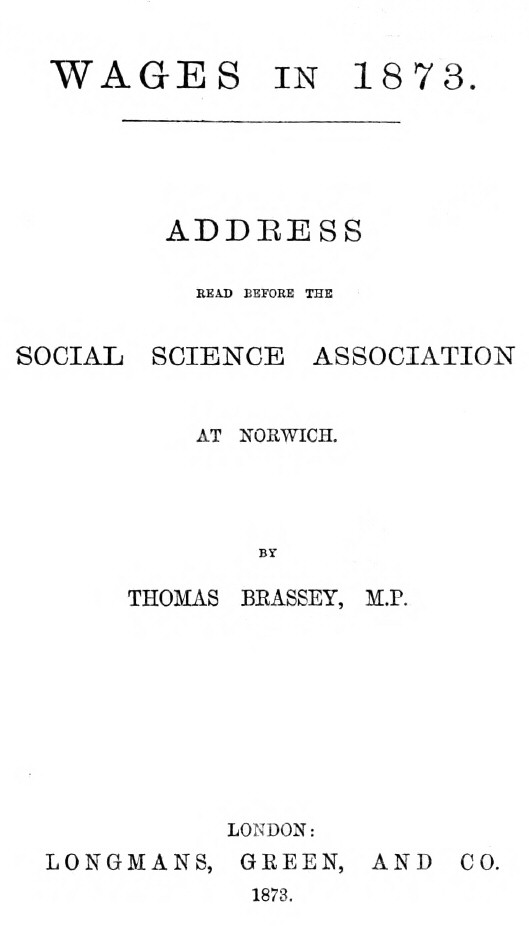
Wages in 1873
by Earl Thomas Brassey Brassey
★★★★★No ratings yet
Language: English
Sign in to rate this book.
Sign in to shelve this book.
About this eBook
- Author
- Brassey, Thomas Brassey, Earl, 1836-1918
- Title
- Wages in 1873: Address read before the Social Science Association at Norwich
- Credits
- Transcribed from the 1873 Longmans, Green, and Co. edition by David Price
- Language
- English
- LoC Class
- HD: Social sciences: Economic history and conditions, Production
- Subject
- Labor -- Great Britain -- History
- Category
- Text
- eBook-No.
- 64469
- Project Gutenberg
- https://www.gutenberg.org/ebooks/64469
- Release Date
- February 6, 2021
- Copyright
- Public domain in the USA.
Contents
- 1.WAGES IN 1873.
- 2.WAGES IN 1873. — Rise in Wages. — Not attributable to strikes. — The recent strike in South Wales. — Proposal of the International for an universal strike. — In extreme cases strike may produce results beneficial to workmen. Orderly conduct of men on strike in South Wales. — Advance in price of coal. — Mr. Lothian Bell. — Rise of wages in collieries. — Increased profits of colliery proprietors. — Rise of wages has followed advance in price of coal. — Causes which will lead to a reduction in price of coal. — Hours of labour. — The double-shift system. — Coal-cutting machines. — Waste of coal in domestic consumption. — Captain Galton’s fireplace. — Mr. Bessemer’s inventions. — Reduced consumption of coal in steamers. — Inventions of Mr. Siemens. — Substitution of peat for coal. — General prospects of the iron trade. — American competition. — A monopoly of the iron trade impossible. — Shipbuilding. — The engineering trade. — Rise of wages on Continent. — Low wages and cheap production not convertible terms. — Belgium. — Russia. — Switzerland. — France. — Increasing production with the same number of hands. — Employment of children in Belgium. — Employment of women in England. — Shorter hours of labour. — Decline of pauperism. — Emigration. — Wages in America. — Arbitration. — Legitimate province of the trades unions. — Foreign competition. — Communism in Germany. — Co-operation. — Demand and supply determine wages. — Forethought.
Community reviews
Sign in to write a review.
No reviews yet.