At last our vessel reached Toulon harbour, and after returning thanks
to the winds and stars for a prosperous voyage, we embraced on the
wharf and said farewell. In my case, because money was among the
fabulous stories of the World of the Moon whence I came and I had
practically lost all memory of it, the skipper paid himself for my
passage with the honour of having carried in his ship a man fallen from
the sky. Nothing then prevented me from proceeding to Toulouse to a
friend's house. I was burning to see him, for the joy I hoped to give
him with the recital of my adventures. I shall not be so troublesome as
to relate here all that happened on the way; I grew tired, I rested, I
was thirsty, I was hungry, I drank, and I ate among twenty or thirty
dogs which made up his pack.[49] Although I was in a very bad state,
thin and swarthy with sunburn, he did not fail to recognise me. In a
transport of joy he flung himself on my neck, kissed me more than a
hundred times, and trembling with pleasure led me into his house, where
as soon as his tears gave place to his voice he exclaimed:
"At least we live and shall live, in spite of all the accidents by
which Fortune has shaken our lives. But, Good Gods! it is not true then
that you were burned in Canada in the great firework display you had
invented? And yet two or three people worthy of credit among those who
brought me this sad news swore they had seen and touched the wooden
Bird in which you were carried off. They told me that unluckily you
had got into it at the moment it was fired and that the impetus of the
rockets burning all around carried you so high you were lost to sight.
And they vowed you were so completely consumed that when the machine
fell back only a few of your ashes were found."
"Those ashes", I replied, "sir, were those of the fire-works
themselves, for the fire did not hurt me in the least. The rockets were
fastened on outside and consequently their heat could not trouble me.
You know that as soon as the powder was exhausted, the swift ascent of
the rockets ceased to raise the machine, which then fell to the ground.
I saw it fall and when I expected nothing but to fall with it, I was
surprised to feel myself rising towards the Moon. But I must explain to
you the cause of an effect which you will take for a miracle.... The
day of this accident I had rubbed all my body with marrow on account of
certain bruises. But the Moon was then waning and at that period draws
up marrow; it absorbed so gluttonously the marrow rubbed on my flesh,
especially when my box rose above the middle region, where there were
no intervening clouds to weaken its influence, that my body followed
the attraction; and I protest it continued to suck me up so long that
at last I reached that world we call the Moon."
I then related at length all the details of my voyage and Monsieur de
Colignac was so ravished at hearing such extraordinary things that he
implored me to set them down in writing. I enjoy repose and therefore
resisted him for a long time, because of the visits such a publication
would probably have attracted; but at length, shamed by the reproaches
he continued to attack me with, I resolved at last to satisfy him. I
therefore took pen in hand and as soon as I finished a sheet he went to
Toulouse to vaunt it in the best company, for he was more anxious for
my reputation than his own; he was considered one of the greatest minds
of his century[50] and by making himself the indefatigable echo of my
praises he made me known to everyone. Already, without having seen me,
the engravers had cut my portrait and from every square the town echoed
with pedlars shouting at the top of their voices from hoarse throats:
"Portrait of the author of The Voyage to the Moon." Among those who
read my book were numerous ignoramuses who turned over its pages. To
counterfeit great wits they applauded like the others and clapped their
hands at every word, for fear of a mistake, exclaiming joyously "How
excellent he is!" at all the passages they did not understand. But
superstition disguised as conscience, whose teeth are very sharp under
a fool's shirt, so gnawed at their hearts that they preferred rather
to give up the reputation of philosophers (which suited them like
ill-fitting clothes) than to have to answer for it at the Judgment Day.
This was the other side of the question and each was then in a hurry
to recant. The work they had so highly prized was now simply a
pot-pourri of ridiculous stories, a mass of disconnected fragments, a
collection of fairy tales to lull children to sleep; and those ignorant
even of syntax condemned the author to carry a candle to Saint
Mathurin.[51] This contest of opinion between the men of wit and the
idiots increased its reputation. Very soon manuscript copies were being
sold secretly.[52] Everyone, in and out of society, from the gentleman
to the monk, bought the book and the women even took sides. Each family
was divided and the interested in this quarrel went so far that the
town was divided into two factions, the Lunar and the Anti-Lunar.
We were still engaged in the skirmishes of the battle when one morning
there came into Colignac's room nine or ten grey-beards in long robes,
who spoke to him as follows:
"Sir, you know that there is not one among us who is not your relative,
your kin or your friend, and consequently that anything shameful which
happens to you falls equally upon us. And yet we are credibly informed
that you shelter a sorcerer in your house."
"A sorcerer!" cried Colignac, "Good Gods! Tell me his name. I will
deliver him into your hands; but we must take care this is not a
calumny."
"How now, sir", interrupted one of the most venerable of them, "is
there any parlement so competent in the matter of sorcerers as ours?
But, my dear nephew, not to keep you any longer in suspense, the
sorcerer we accuse is the author of The Voyage to the Moon; he cannot
deny that he is the greatest magician in Europe after what he has
admitted himself. Why! he could only have gone to the Moon with the aid
of ... I dare not name the beast; and, tell me, what was his object in
going to the Moon?"
"Well asked", interrupted another, "he went to take part in a Witches'
Sabbath, which no doubt was held that day; and, indeed, you may see
he grew acquainted with the demon of Socrates. After this are you
surprised that, as he says himself, the Devil should have brought him
back to this world? But however that may be, so many Moons, so many
chimneys, so many travels through the air are worth nothing, nothing at
all I say; and between you and me"—at these words he placed his mouth
nearer my friend's ear—"I never saw a sorcerer but had dealings with
the Moon."
After these worthy sentiments they were silent and Colignac was so
astounded at their common extravagance that he could not say a word.
Seeing this, a venerable blockhead who had not spoken said:
"You see, cousin, we know where the shoe pinches. The magician is a
person you love, but have no fear, things will go easily with respect
to you. You have only to deliver him into our hands, and out of love
for you we pledge our honour to have him burned without scandal."
At these words Colignac could no longer restrain himself, although he
was thrusting his fists into his ribs; he burst out laughing, which
offended in no little degree the gentlemen, his relatives, to such an
extent that it was out of his power to reply to a single point of their
speech except by Ha! Ha! Ha! or Ho! Ho! Ho! so that our gentlemen,
mightily scandalized, went off so affronted that they were still
enraged when they reached Toulouse. When they had gone I drew Colignac
aside into his study and as soon as I had shut the door I said:
"Count, it seems to me these hairy ambassadors are a kind of shaggy
comets; I apprehend that the noise they broke out with is the thunder
of the storm set in motion before falling. Although their accusation
is ridiculous, and doubtless the result of their stupidity, I shall be
none the less dead when a dozen men of wit who have seen me grilled
observe that my judges are fools. All their arguments proving my
innocence will not resuscitate me and my ashes will remain as cold in
a grave as in a drain. For this reason, subject to your approval, I
should be very happy to yield to the temptation which suggests to me
that I leave nothing but my portrait in this province; for it would be
doubly annoying to die for something in which I have not the slightest
belief."
Colignac had scarcely the patience to wait for me to end before he
replied. First of all he bantered me; but when he saw I took the matter
seriously, he exclaimed with a troubled countenance:
"'Sdeath! They shall not touch the hem of your cloak until I, my
friends, my vassals and all who respect me have perished. My house
is so strong it cannot be carried without artillery; it is very
advantageously placed and well covered on the flanks. But I am mad to
guard against parchment thunders."
"Sometimes", I replied, "they are more dangerous than the thunders of
the middle region."
Thereafter, however, we spoke of nothing but our amusements. One day we
hunted, another day we took a walk, sometimes we received visitors and
sometimes we went to see others; in fine, we abandoned each amusement
before that amusement could bore us.
A neighbour of Colignac's, the Marquis de Cussan, a man who understood
the good things of life, was usually in our company and we went from
Colignac to Cussan and returned from Cussan to Colignac to render
the places we stayed at more agreeable by change. Those innocent
pleasures of which the body is capable are only a slight part of those
the mind takes in study and conversation, whereof we lacked none; and
our libraries, united like our minds, brought all the learned into
our society. We mingled reading with conversation, conversation with
good cheer, and that with fishing or hunting, when we went out; in
a word we enjoyed, so to speak, both ourselves and all that is most
agreeably produced by Nature for our use; we placed no limits to our
desires save those of reason. Meanwhile my reputation, the enemy of
my repose, circulated among the neighbouring villages and even the
towns of the province; everyone, attracted by these rumours, found
some pretext for visiting the Seigneur to see the sorcerer. When I
went out of the castle the children and women and even the men looked
upon me as upon the Devil, above all the parson of Colignac,[53] who
either from malice or ignorance was secretly the worst of my enemies.
This man was apparently simple and his gross, almost childish mind
was infinitely amusing in its naïvetés, but he was actually very
malicious. He was vindictive to the point of madness; a backbiter,
excelling even a Norman; and so able a trickster that trickery was
his ruling passion. After a long law-suit against his Seigneur, whom
he hated the more for having successfully resisted his attacks, he
grew afraid of his resentment and to avoid it desired to change his
benefice; but either he had changed his plan or he had simply deferred
it to avenge himself on Colignac in my person, while he remained on the
estate; for he tried to persuade us he had changed his mind although
his frequent expeditions to Toulouse made us suspect the contrary.
He circulated a thousand ridiculous tales of my sorceries, and the
voice of this malicious man joined with those of simple and ignorant
people caused my name to be held in execration; I was spoken of as no
other than a new Cornelius Agrippa, and we learned that there had even
been an information lodged against me at the suit of the Curé, who
had been tutor to his children. We were informed of this by several
persons friendly to Colignac and the Marquis; and although this
ignorant whimsey of a whole countryside was a matter of surprise and
merriment to us, I could not fail to be apprehensive in secret when I
considered more narrowly the unpleasant results which might follow upon
this error. Doubtless this apprehension was inspired in me by my good
genius, who enlightened my reason with all these perceptions to make me
see the precipice towards which I was falling; and, not content with
this tacit warning, showed itself still more decidedly in my favour.
One of the most disagreeable nights I had ever spent followed one of
the most agreeable days we had had at Colignac. I got up at dawn and
to throw off the apprehensions and clouds which still oppressed my
mind, I went into the garden where the green leaves, the flowers and
fruits, Art and Nature, enchanted the soul through the eyes. At the
same moment I perceived the Marquis walking alone in a large path which
cut the grass-plot in two. His step was slow and his face thoughtful.
I was very surprised to see him up so early, contrary to his custom,
and I increased my pace to ask him the reason. He replied that he had
been disturbed by some disagreeable dreams, which had forced him to
come out earlier than usual to get rid in the daylight of a trouble
the night had caused him. I confessed to him that a similar difficulty
had prevented me from sleeping, and I was about to relate it to him in
detail, but just as I opened my mouth we perceived Colignac walking
rapidly round the corner of the hedge at an angle to ours. He exclaimed
as he perceived us:
"You see a man who has just escaped the most horrible visions, the
sight of which might turn one's brain. I barely took the time to put on
my doublet when I went down to tell you about them, but neither of you
was in his room; and so I ran down to the garden, supposing you would
be there."
The poor gentleman was indeed almost out of breath, and as soon as he
had recovered it we begged him to get rid of a thing, which, however
light in one sense, does not fail to weigh heavily in another.
"That is my purpose", he replied, "but first of all let us sit down."
A jasmine-covered summer-house suitably offered us its freshness and
its seats; we retired to it and when everyone was comfortably seated
Colignac went on as follows:
"You must know that after fitful dozing, during which I felt myself
greatly troubled, I fell into another doze about dawn and dreamed that
my dear guest there was between the Marquis and myself, who held him
closely embraced, when a great black monster, composed of nothing but
heads, suddenly came to tear him from us. I even think the monster
was going to cast him into a fire kindled near-by; for it held him
suspended already over the flames. But a girl like that Muse we call
Euterpē threw herself before the knees of a woman whom she besought to
save him. This woman had the deportment and attributes used by our
painters to represent Nature. She had scarcely had time to hear the
request of her follower when she exclaimed in astonishment: 'Alas!
He is one of my friends!' Immediately she put to her mouth a kind
of trumpet and blew so hard through the tube under my dear guest's
feet that she made him fly up into the sky and so saved him from the
cruelties of the hundred-headed monster. I think I shouted after him
for a long time and besought him not to go away without me, but an
infinite number of little round angels calling themselves children of
the dawn bore me up to the same country towards which he seemed to
have flown, and showed me things I shall not repeat to you because I
consider them too ridiculous."
We begged him not to refrain from telling us.
"I imagined", he continued, "that I was in the Sun and that the Sun was
a world. I should not yet be disabused had it not been for the neighing
of my horse, which woke me and made me see I was in bed."
When the Marquis saw that Colignac had finished he said: "And what was
your dream, Monsieur Drycona?"[54]
"Although mine was uncommon", I replied, "I consider it a mere empty
tale. I am bilious and melancholy and so, ever since I have been in the
world, my dreams have always been of caverns and fire. In my youth it
seemed to me when I slept that I became very light and sped up to the
clouds to avoid the rage of a band of assassins pursuing me; but after
a very long and very vigorous effort and after flying over many walls
I always met one at the foot of which I never failed to be stopped,
worn out with the strain; or else I imagined I flew straight up and
when I had swum with my arms for a long time in the sky I always found
myself near land and, contrary to all reason, without my seeming to
become either weary or heavy, my enemies had only to stretch out their
hands to seize me by the foot and to draw me to them. Ever since I
can remember all the dreams I have had have been like these, except
last night, when, after flying as usual for a long time and often
escaping from my persecutors, I seemed at last to lose sight of them
and to continue my journey with a body delivered from all weight under
a clear, very bright sky until I reached a Palace composed of heat
and light. No doubt I should have noticed many other things, but my
excitement in flying had brought me so near the edge of the bed that
I fell down beside it, with my naked belly on the floor and my eyes
wide open. This, gentlemen, was the whole of my dream, which I consider
to be simply the effect of the two qualities which predominate in my
temperament; for although this dream differs a little from those which
usually happen to me, in that I flew up to the sky without falling
back, I attribute this alteration to the diffusion of my blood by the
joy of our pleasures yesterday, and since this was more extensive
than usual it penetrated the melancholy and by uplifting it took from
it that weight which before made me fall. But, after all, this is a
science in which little can be discovered."
"Faith!" said Cussan, "you are right; it is a pot-pourri of
everything we think of when we are awake, a monstrous chimera, an
assembly of confused mixtures, presented to us in disorder by our fancy
which in sleep is no longer guided by reason, and yet by twisting
them about we always think we shall squeeze out their true sense and
derive a knowledge of the future from dreams as from oracles; but, on
my faith, I see no resemblance between them, except that dreams like
oracles cannot be understood. However, you may judge the value of all
other dreams from mine, which is not in the least extraordinary. But,
without torturing my brain with explanations of these dark enigmas,
I will explain their mystic sense to you in two words: and they are,
that Colignac is a place where we have bad dreams and in my opinion we
should try to have better ones at Cussan."
"Let us go then", said the count, "since this mar-feast so wills it."
We agreed to go off that very day. I begged them to set out before me,
because I wished to take some books with me since we had agreed to stay
there a month. They assented and were in the saddle immediately after
breakfast. Meanwhile, I made up a bundle of books which I imagined were
not in the library at Cussan, placed them on a mule and set off about
three o'clock, mounted on a good trotting horse. I advanced slowly
in order to be near my little library and to enrich my soul at more
leisure with the gifts of sight.
Hearken now to a surprising adventure. I had proceeded more than four
leagues when I came to a piece of country I felt certain I had seen
somewhere else. I urged my memory so much to tell me how it was I knew
this landscape that the presence of the objects excited their images
and I remembered that this was precisely the place I had seen in a
dream the night before. This curious coincidence would have occupied
my attention for a longer time had I not been roused by a strange
apparition. A spectre—at least I took him for one—appeared before
me in the middle of the road and seized my horse by the bridle. This
phantom's height was enormous and from the little I could see of his
eyes their expression was depressed and coarse. I cannot say whether
he was ugly or handsome; a long gown made from the leaves of a book of
plain-song covered him down to his nails and his face was hidden by a
card on which was written the In principio.
The first words spoken by the phantom were as follows: "Satanus
Diabolas", cried he in terror, "I conjure you by the great living
God...."
At these words he hesitated. He continued to repeat his "great living
God" and with a troubled visage sought for his pastor to give him the
cue for the rest; but when he perceived that his pastor did not appear,
no matter in what direction he turned his eyes, he was seized with such
fearful trembling that half his teeth fell out with chattering and
two-thirds of the music which covered him fell off like curl-papers. He
then turned to me and said with a look neither rough nor gentle, from
which I perceived his mind was unable to resolve whether it would be
better to grow irritated or calmer:
"Ho!" said he, "Satanus Diabolas, By Sangué! I conjure you in the
name of God and of Master Saint John not to oppose me, for if you stir
hand or foot, Devil take me if I don't pull your guts out!"
I began to pull my horse's bridle away from him, but I was so
suffocated with laughter that I had no strength left. Add to this that
about fifty villagers emerged from behind a hedge grovelling on their
knees and making themselves hoarse by singing Kyrie Eleison. When
they came near, four of the strongest dipped their hands in a holy
water stoop brought on purpose by the servant of the vicarage and
seized me by the collar. I was scarcely arrested when Messire Jean[55]
appeared and devoutly taking out his stole bound me in it, whereupon a
mob of women and children sewed me into a great cloth in spite of my
resistance and I was soon so bound up that only my head was visible.
In this plight they carried me to Toulouse as if they had been taking
me to my grave. At one time one of them would exclaim that there would
have been a famine if I had not been captured, because when they met me
I was assuredly about to cast a spell upon the corn; at another time
I heard another complaining that the sheep-pox had begun in his fold
on a Sunday, when I had tapped him on the shoulder as he came out from
vespers. But above all I was tickled with a desire to laugh in spite
of my disaster by the terrified scream of a young peasant girl at her
betrothed, otherwise the Phantom, who had taken my horse (for you must
know the lout was already astride it) and was spurring it as boldly as
if it were his own.
"Wretch!" howled his beloved, "are you wall-eyed? Don't you see the
magician's horse is blacker than coal—it is the Devil in person to
carry you off to a Witches' Sabbath!"
Our peasant fell back in terror over the crupper and my horse took to
the fields. They debated as to whether they should seize the mule and
decided that they would. They undid the packet and the first volume
they opened chanced to be the Physics of Monsieur Descartes. When
they perceived all the circles by which this philosopher has traced
the movement of each planet, they all with one voice bawled out that
these were the magic circles I drew to call up Beelzebub. The man who
held the book dropped it in terror and unfortunately as it fell it
opened at the page on which the action of the magnet is explained; I
say unfortunately, because at the place I speak of there is a drawing
of this metallic stone where the little bodies which detach themselves
from its mass to seize the iron are represented as arms. Hardly had
one of these fellows perceived it when I heard him roar out that this
was the toad they found in the trough of his cousin Fiacre's stable
when his horses died. At this, those who had appeared the most excited
sheathed their hands in their bosoms or regloved them in their pockets.
Messire Jean, for his part, bawled at the top of his voice not to
touch anything, that all these books were a sorcerer's and the mule a
Satan. The terrified mob then allowed the mule to go off in peace. But
I noticed master Curé's servant, Mathurine, driving him towards the
parsonage stable to make sure the beast should not pollute the dead
men's grass in the graveyard.
It was quite seven o'clock at night when we reached a small town, where
to repose me they dragged me into a gaol; for the reader would not
believe me if I said they buried me in a hole. And yet that is so true
that in one pirouette I visited the whole of it. In fine, anyone who
saw me there would have taken me for a lighted candle under a chimney.
Before my gaoler threw me into this cavern I said:
"If you give me this stony garment as a suit it is too large, but if as
a grave it is too narrow. There the days can only be counted by nights
and of my five senses only two are left me, smell and touch; one to let
me smell the stinks of my prison and the other to make it palpable.
Truly, I confess to you, I should think I were damned if I did not
know that there are no innocent folk in hell."
At the word "innocent" the gaoler burst out laughing. "Faith!" said he,
"you are one of our people, I see. I have never had anyone under lock
and key who was not innocent."
After other compliments of this nature the fellow took the trouble
to search me, I know not for what purpose, but from the diligence he
displayed in it I conjecture it was for my own good. His researches
were fruitless, because I had slipped my gold into my boots during
the battle of Diabolas, but when after a very close examination he
remained with hands as empty as before, I was as near dying of fear as
he of despite.
"Ho! Body o' me!" cried he, foaming at the mouth, "I saw he was a
warlock at first glance, he is penniless as the devil. Away, comrade,
take good heed to your conscience."
He had scarcely finished these words when I heard the peal of a bunch
of keys from which he was selecting those of my cell. His back was
turned and so, for fear he should avenge himself on me for the failure
of his search, I nimbly drew three pistoles from their hiding-place,
and said to him:
"Master Gaoler, here is a pistole; I pray you bring me some food, for
I have had nothing to eat for eleven hours."
He received it most graciously and vowed that my misfortune touched his
heart. When I saw I had softened his bosom I went on:
"And here is another to compensate for the trouble I am ashamed of
giving you."
He opened his ears, his heart and his hand; and, counting him out
three instead of two, I added that by the third I begged him to send
one of his men to keep me company, because the unhappy are bound to
dread solitude. Ravished by my prodigality, he promised me everything,
embraced my knees, declaimed against the Law, said he perceived now I
had enemies, but that I should come out of it all with honour, that I
should keep up my courage and, in short, he pledged himself I should
be free before three days had passed. I thanked him most gravely for
his courtesy and, after he had nearly strangled me with a thousand
embraces, this dear friend locked and double-locked the door.
I remained alone and very melancholy, my body hunched up on a bundle
of crumbled straw, which was not yet so small but that more than fifty
rats were still gnawing it. The roof, the walls and the floor were
composed of six tombstones so that, having death above, beneath and
about me, I might be in no doubt of my interment. The cold slime of
slugs and the sticky venom of toads dripped on to my face; the lice had
teeth longer than their bodies. I saw myself tormented by the stone,
which though external was none the less painful. In fine, I think I
needed only a wife and a broken pot to play the part of Job.
Nevertheless I overcame there the duration of two very difficult hours
when the noise of twelve dozen keys added to that of the bolts on my
door drew me from the consideration of my miseries. Following upon this
clatter a stalwart knave appeared in the light of a lamp. He set down
an earthen pot between my legs.
"There, there!" said he, "comfort yourself, that's cabbage soup, and
when it is ... in sooth 'tis our good dame's own soup; and faith!
there's not a drop of fat lost, as they say."
So speaking he thrust his five fingers down to the bottom of the pot
to invite me to do likewise. I laboured after his example, for fear of
discontenting him, and with a joyful eye—
"Morguiene!" cried he, "you are a lad of mettle! They say you have
detractors, jerniguay! they are traitors; ay, testiguay! they are
traitors. Hey! Let them come and see. Well, well, so it is, dancers
always move."
This rusticity filled my throat twice or thrice with laughter, but I
was fortunate enough to choke it back. I saw that Fortune seemed to
offer me a chance of freedom through this clodhopper and therefore
it seemed to me very necessary to cultivate his favour; for, as to
escaping by other means—the architect who built my prison made several
entrances but forgot to make a way out. These divers considerations led
me to sound him as follows:
"My dear friend, you are poor, are you not?"
"Alas! sir", the clown replied, "if you came from the fortune-teller's
you could not hit the mark more surely."
"Here, then", I went on, "take this pistole."
I found his hand so trembled, when I put the pistole in it, that
he could scarce shut it. This beginning seemed to me of evil omen,
but I soon discovered from the fervour of his thanks that he was only
trembling with joy, and therefore I went on:
"If you were the man to share in the accomplishment of a vow I have
made, twenty pistoles (as well as your soul's salvation) would be
as much yours as your hat; for you must know that about a quarter of
an hour since, just before you arrived, an angel appeared to me and
promised to make known the justice of my cause, provided that I go
to-morrow to have Mass said for Our Lady of this town at the high
altar. I tried to excuse myself because I am too narrowly warded,
but the angel answered that there would come to me a man, sent by
the gaoler to keep me company, and I had only to bid this man in the
angel's name convey me to church and bring me back to prison; I am to
warn him to be secret and to obey without question on pain of dying
within the year; and if he doubts my word I am to tell him for a token
that he is a Member of the Scapulary." The reader must be informed that
I had noticed a scapulary through the opening of his shirt and this at
once suggested to me the whole fabric of the apparition.
"Ay, ay, master", said he, "I'll do what the angel bids us, but it must
be nine o'clock, because our gaffer will be at Toulouse then for the
betrothal of his son to the daughter of the hangman. Marry, the hangman
has a name as well as a louse; they say her father will give her crowns
enough for a king's ransom for her wedding. She's rich and beautiful,
but such bits never fall to a poor man. Alas, good master, you must
know...."
I failed not to cut him short at this point; for by this induction
I foresaw a long series of cock-and-bull stories. Well, when we had
worked out our plot, the knave took leave of me. Next morning he was
there to disinter me precisely at the hour promised. I left my clothes
in the prison and wrapped myself in rags; we had agreed upon this the
night before as a means of disguise. As soon as we were in the air I
did not forget to count him out his twenty pistoles. He looked at
them hard, with his eyes almost starting.
"They are gold and unclipped", said I, "on my word."
"Hey, sir", he replied, "'tisn't of that I'm thinking, but I'm thinking
big Macé's house is for sale, with the meadow and the vineyard. I can
get it for two hundred francs, but it will take a week to knock up
the bargain and I beseech you, good master, if it is your will and
pleasure, not to let your pistoles change into oak leaves until big
Macé holds them well and truly counted in his chest."
The knave's rusticity made me laugh. However, we continued on our way
to church and soon arrived there. Some time afterwards High Mass began,
but as soon as I saw my gaoler rise in his turn for the offertory,
I traversed the nave in three steps and in as many more nimbly lost
myself in an unfrequented alley. Out of the many thoughts which then
agitated my mind I chose that of reaching Toulouse, from which this
town was only half a league distant, with the purpose of taking post.
I soon reached the suburbs; but I was so ashamed to see that everyone
was looking at me that I was put out of countenance. Their astonishment
was caused by my appearance; for I was but a novice in beggary and my
rags were arranged so fantastically, my gait was so unsuitable to my
clothes, that I seemed rather a masquer than a beggar, and in addition
I passed people quickly, with my eyes on the ground, asking no alms.
Finally I realised that to be the object of so general a curiosity
exposed me to dangerous consequences and, overcoming my repugnance,
I held out my hand as soon as I perceived someone looking at me. I
even besought the charity of those who did not look at me; but observe
how often by adding too many precautions to a plan in which Fortune
will have her share we ruin it by irritating her vanity. I make this
reflection on my adventure here; for seeing a man dressed as a small
shopkeeper with his back turned to me, I said to him as I plucked his
sleeve:
"Sir, if compassion can touch...."
I had not begun the word which was to follow when the man turned his
head. Gods! How he changed! And O ye Gods, how I changed! The man was
my gaoler. We were both struck with amazement to see each other where
we were. I was the sole object of his eyes, he filled the whole of my
sight. Finally our own interests, although so different, drew us both
from the surprise into which we were plunged.
"Ah! Wretch that I am", cried the gaoler, "shall I be caught thus?"
This ambiguous word "caught" immediately suggested to me the following
stratagem:
"Help, gentlemen, help in the name of the Law!" cried I as loud as
I could screech. "This thief has stolen the Countess of Mousseaux's
jewels—I have been seeking him a year. Gentlemen", I continued warmly,
"a hundred pistoles to the man who arrests him!"
I had scarcely uttered these words ere a party of the mob fell upon
the poor amazed devil. The astonishment into which he was cast by my
impudence, joined with his supposition that I could only have escaped
from my cell by penetrating the unbroken wall like a hand of glory, so
staggered him that for a time he was beyond himself. At last he came to
himself and the first words he used to disabuse the crowd were to take
care not to mistake he was a man of honour. He was undoubtedly about
to reveal the mystery, but a dozen fruit-women, lackeys and chairmen,
desirous to serve me for my money, closed his mouth with their punches.
And as they supposed their reward would be measured out according to
the extent they outraged this poor dupe, each pressed in to earn it
with foot or hand.
"Hear the man of honour!" howled the mob, "yet he could not prevent
himself from saying he was caught, as soon as he saw the gentleman."
The cream of the comedy was that my gaoler was in his best clothes,
he was ashamed to admit he was the Hangman's assistant and was afraid
he would be worse beaten if he admitted it. For my part I took to my
heels during the hottest of the scuffle. I entrusted my safety to my
legs and they would soon have brought me off happily but, unluckily,
the looks which everybody once more turned on me, threw me afresh into
my former fears. If the sight of a hundred rags, which danced around
me like a maypole-dance of the rabble, caused some gaper to stare at
me, straightway I apprehended that he read upon my forehead that I was
a prisoner at large. If a saunterer put out his hand from beneath his
cloak, I imagined a catchpole stretching out his hand to arrest me. If
I noticed another striding along without lifting his eyes upon me I was
convinced he was pretending not to see me in order to grasp me from the
rear. If I saw a tradesman enter his shop I said: "He is taking down
his halberd." If I passed through a district more crowded than usual
I thought, "So many people have not met here without a purpose." If
another part was deserted, "They are watching for me here." Was there
some impediment to my flight, "They have barricaded the streets to
surround me." At last my fear debauched my reason and I imagined every
man was an archer, every word "arrest" and every noise the unendurable
creaking of the bolts in my late prison.
Hag-ridden by this panic terror I resolved to beg once more, in order
to pass through the remainder of the town to the posting station
without suspicion, but as I feared my voice might be recognized, I
added to the exercise of begging the device of counterfeiting dumbness.
I therefore went up to those who, as I perceived, were looking at me;
then I pointed a finger above my chin, then above my mouth and gaped
it wide with an inarticulate cry to make it understood by my grimace
that a poor mute was asking alms. Sometimes I was charitably given an
eleemosynary shrug; sometimes I felt some oddment thrust into my hand;
and sometimes I heard women say that it might well be that I had been
martyrized in this way in Turkey. In short I learned that begging is a
large book which teaches us the manners of people far more cheaply than
all those great voyages of Columbus and Magellan.
This device nevertheless failed to weary the obstinacy of my fate or
to win over its evil disposition; yet what other course could I adopt?
For, in crossing a town like Toulouse, where my engraving had made me
familiar even to the fish-wives, dressed as I was in rags as motley
as Harlequin's, was it not probable that I should be observed and
immediately recognized? And that the counter-spell to this danger was
to play the beggar, whose part is played by all manner of faces? And
even if this ruse were not devised with all the necessary caution, I
still think that amid so many unhappy circumstances I showed strong
judgment by not losing my head entirely.
I continued thus on my way when on a sudden I found myself obliged to
return on my steps; for my venerable gaoler, with some dozen archers
of his acquaintance, who had delivered him from the hands of the
rabble, were up in arms and patrolling the whole town in search of
me, and unhappily crossed my path. As soon as they saw me with their
lynx eyes with one accord they rushed upon me full speed and I fled
away at the top of mine. I was so sharply pursued that every moment my
liberty felt at my neck the breath of the tyrants who would oppress
it; but it seemed the air they puffed out as they ran behind me blew
me before them. At last Heaven or fear gave me a space of four or five
turnings in front of them. My pursuers lost track and scent of me and
I lost the sight and turmoil of this troublesome chase. Certainly
those who have not experienced similar agonies at first hand will
hardly understand with what joy I trembled when I found I had escaped.
But since my safety demanded all my attention, I resolved to employ
most carefully the time which would elapse before they caught up with
me. I daubed my face, rubbed my hair with dust, put off my doublet,
loosened my breeches, threw my hat in a ventilator; then I spread out
my handkerchief on the pavement with a little stone at each corner,
like those who are sick of the plague, lay beside it with my belly on
the ground and began to groan very grievously in a piteous tone. I
had scarcely done this when I heard the noise of this hoarse-throated
populace long before the sound of their feet; but I had enough
self-control to remain in the same position in the hope of not being
recognized; in this I was not deceived, for they all took me to be
plague-smitten and passed me very nimbly, holding their noses and most
of them throwing a farthing into my handkerchief.
The storm over, I went down an alley, put on my clothes again and
abandoned myself to Fortune once more, but I had run so hard she
was weary of following me. I suppose this was the case: the glorious
Goddess was not accustomed to walk so quickly, and as I went through
squares and crossroads, through and across streets, to conceal my way
the better, she let me fall blindly into the hands of the archers who
were pursuing me. At meeting me they uttered so furious a yell that I
was deafened. They seemed to think they had not enough arms to arrest
me, so they used their teeth and even then were not sure they had me;
one dragged me along by the hair, another by the collar, while the more
temperate went through my pockets. This search was more successful than
that in the prison; they found the rest of my gold.
While these charitable physicians were occupied in curing the dropsy
of my purse, a great clamour arose; the whole square echoed with the
words "Kill, kill!" and at the same time I saw the glitter of swords.
The gentlemen who were haling me along exclaimed that these were the
Grand Provost's archers who wanted to rob them of their prey. "But",
said they to me, dragging me harder than ever, "beware of falling into
their hands, you will be condemned in twenty-four hours and the King
himself cannot save you." At last, however, they grew apprehensive as
the scuffle involved them and they abandoned me so completely that I
was standing alone in the middle of the street while the aggressors
dispatched everyone they met.
I leave you to imagine whether I took to my heels, I who had reason
to fear both parties equally. In a little time I drew away from the
hubbub, but as I was asking the way to the posting station, a torrent
of people running from the brawl dashed into my street. I was unable
to resist the crowd, so I went with it, and growing angry at so much
running I reached at length a small very dark door into which I rushed
pell-mell with other fugitives. We bolted it behind us and when
everyone had recovered breath one of the group said:
"Comrades, if you will take my advice, we shall go through the two
gates and hold firm in the prison-yard."
These terrible words hit my ears with so astounding a pain that I
thought I should fall dead on the spot. Alas! I perceived immediately,
but too late, that instead of escaping to a refuge as I had thought, I
had merely cast myself into prison, so impossible is it for any man to
escape the influence of his star. I looked at this man more attentively
and I saw he was one of the archers who had so long pursued me. A
cold sweat rose to my forehead and I became pale and ready to swoon.
Those who saw me so ill were moved by compassion and called for water;
everyone drew near to help me, unhappily that accursed archer was one
of the first and he no sooner cast his eyes upon me than he recognised
me. He made a sign to his companions and at the same time greeted me
with a "I take you prisoner in the King's name." They had not far to go
to my cell.
I remained in the lower prison until evening, when each of the warders,
one after the other, by means of an exact and critical examination
of all the parts of my face drew my picture on the canvas of his
memory.[56]
As seven o'clock struck, the noise of a bunch of keys gave the signal
for bed. I was asked if I wished to be shown into the one-pistole room;
I replied with a nod. "The money then!" replied my guide. I knew I
was in a place where I should have to swallow many more insults. I
therefore prayed him, if his courtesy could not bring him to trust me
until the morning, to ask the gaoler from me to return the money which
had been taken from me.
"Ho! By my faith", responded the rascal, "our master has a stout heart,
he never returns anything. Do you think your lovely nose.... Hey, off
with you, into the black dungeons!"
With these words he showed me the way with a savage blow from his bunch
of keys, whose weight overthrew me and tumbled me from top to bottom of
a dark flight of stairs down to the foot of a door which stopped me; I
should not have known it was one without the sparks from the shock with
which I struck it, for I had lost my eyes, they remained at the top of
the stairs in the shape of a candle held twenty-four steps above me
by my hangman of a warder. This man came down gradually, opened some
thirty large locks, undid as many bolts, pushed the door a little and
with a blow of his knee hurled me into this hole, whose horrors I had
not time to see, he closed the door so quickly. I was standing in mud
up to the knees. If I tried to reach the side I sank up to the waist.
The awful croaking of frogs as they squatted in the mud made me long to
be deaf; I felt lizards wandering along my thighs and snakes twining
about my neck; I perceived one by the sombre glow of its glinting
eye-balls darting a three-pronged tongue from its venom-blackened
throat, while its brusque movement made it seem like a thunderbolt with
the look of the eyes for the flash.
I am completely unable to express the remainder; it surpasses all
belief and I dare not attempt to recollect it, so much do I fear that
my present certainty of having escaped this prison may turn out to be
a dream from which I shall awake. The hand on the dial of the great
tower pointed to ten before anyone knocked at my tomb, but about that
time when the anguish of a bitter grief began to grip my heart and to
disturb that equilibrium which makes life, I heard a voice bidding me
grasp a rod that was held out to me. After groping for some time in
obscurity to find it I touched the end, grasped it with emotion, and my
gaoler, pulling it towards him, fished me out of the bog. I suspected
my affairs had taken a turn for the better, because he offered me
profound civilities, only spoke to me with his head uncovered and told
me that five or six people of quality were waiting in the courtyard
to see me. This savage brute who had shut me in the dungeon I have
described had the impudence to accost me. Having kissed my hands, with
one knee on the ground, he plucked out with one paw a quantity of slugs
which had stuck in my hair and with the other he pulled off a great
heap of leeches which masked my face. After this exquisite courtesy he
said:
"You will at least remember, good master, the care and trouble taken of
you by fat Nicholas. Pardi, even if it had been for the King, it isn't
to be grudged you."
Enraged by the rogue's effrontery, I made a sign that I would remember.
By a thousand terrifying windings I reached the light at last and then
the courtyard, where as soon as I entered I was grasped by two men I
could not recognize, because they threw themselves on me at once and
each kept his face pressed against mine. For some time I did not know
who they were, but when their transports of friendship were a little
abated I recognised my dear Colignac and the brave Marquis. Colignac
had his arm in a sling and Cussan was the first to emerge from his
ecstasy.
"Alas!" said he, "we should never have suspected such a disaster, had
it not been for your horse and the mule which arrived last night at
the gates of my house; their breast-pieces, their saddle, girths and
their cruppers were all broken, which made us anticipate something of
your misfortune. We got to horse at once and had ridden but two or
three leagues towards Colignac, when the whole countryside, alarmed
by the accident, described to us what had happened. We galloped off
immediately to the town where you were imprisoned, but learning there
that you had escaped and hearing a rumour that you had gone in the
direction of Toulouse, we came on at full speed with the servants we
had with us. The first person whom we asked for news of you said you
had been recaptured. We turned our horses towards this prison, but
other people assured us you had vanished from the hands of the police.
And as we pushed on we heard the bourgeois relating to each other the
story that you had become invisible. At length by continually making
inquiries we learned that after you had been taken, lost and retaken
I know not how many times, you were being carried to prison in the
Large Tower. We intercepted your archers and with a good fortune more
apparent than real we met them, attacked them, fought them and put them
to flight, but we failed to learn even from the wounded we had captured
what had become of you, until this morning, when we were informed that
you had blindly come to prison of your own accord for safety. Colignac
is wounded in several places, but very slightly. For the rest, we have
arranged for you to be lodged in the best room here. Since you like
fresh air we have furnished a little room for you alone at the top of
the Large Tower, where the terrace will serve you as a balcony; your
eyes at least will be at liberty, in spite of the body which confines
them."
"Ah! My dear Drycona", cried the Count, taking his turn to speak, "we
were very unlucky not to have taken you with us when we left Colignac.
Through a blind depression whose cause I did not know, my heart
warned me of something terrible; but no matter, I have friends, you
are innocent and in any case I know how men die with glory. One thing
alone troubles me. That rascal whom I designed to feel the first blows
of my vengeance (you may easily divine I am speaking of my Curé) is
no longer in a condition to feel them; the wretch has given up the
ghost. This is how he died. He and his servant were running to drive
your horse into his stable when the animal, with a fidelity increased
perhaps by the secret enlightenment of instinct, began to plunge so
successfully that in three kicks with which that brute's head came
in contact he rendered his benefice vacant. No doubt you fail to
understand the reasons for the madman's hatred; I will tell you them.
Know then, to begin with, that this holy man, Norman by race and a
pettifogger by trade, cast his eyes upon the curacy of Colignac, and in
spite of all my efforts to retain the possessor in his just rights, the
scoundrel wheedled the judges so well that in spite of everything he
became our parson.
"At the end of a year he sued me also, because he claimed that I should
pay tithes. It was in vain to show him that from time immemorial my
land was exempt, he continued his suit and lost it, but in the course
of the proceedings he brought up so many other incidents that a swarm
of more than twenty law-suits grew out of the first and are now hung
up, thanks to your horse, whose hoof was harder than M. Jean's head.
That is all I can conjecture of our parson's giddiness. But observe
with what foresight he governed his madness. I have just been informed
that when he took into his head this unhappy design of getting you into
prison, he secretly exchanged the curacy of Colignac for another in his
own district, whither he meant to retire as soon as you were taken.
His servant even said that when he saw your horse near his stable he
murmured to himself that it would help to take him somewhere he was not
expected to be."
After this, Colignac warned me to be on my guard against the visits and
offers which a very powerful personage (whom he named) might make me,
and told me that it was through this person's influence Messire Jean
had won the case about his benefice, and that this person of quality
had acted on his behalf to repay the services rendered by the good
priest, when he was an usher, to his son at school.
"And so", Colignac went on, "since it is very difficult to go to law
without bitterness and without there remaining in the mind a certain
enmity which never wholly disappears, although we have been reconciled
he is always secretly looking for opportunities to thwart me. But, no
matter, I have more relatives in the law than he, and I have plenty of
friends, and at the worst we can secure the intervention of the King."
After Colignac had finished, they both attempted to console me, but it
was by means of so tender a grief that my own was increased. At this
moment the gaoler returned to tell us that the room was ready.
"Let us go and look at it", said Cussan. He started off and we followed
him. I found it well fitted up.
"There is nothing else I want", said I, "except books."
Colignac promised to send me next day all that I marked on a list.
When we had looked about and had recognised from the height of the
Tower, from the flat-bottomed moat which surrounded it and from the
whole arrangement of my room that it was an enterprise beyond human
power to rescue me, my two friends gazed upon each other, then turned
their eyes upon me and began to weep. But suddenly, as if our grief had
moved Heaven, a rapid joy took possession of my soul; joy brought hope,
hope brought secret insight which dazzled my reason as with a powerful
emotion against my will which seemed ridiculous even to me.
"Go", said I, "go and wait for me at Colignac, I shall be there in
three days; and send me all the mathematical instruments I usually
work with; moreover, you will find in a large box a number of crystal
glasses cut in different ways, do not forget them; but I had better
specify in writing the things I need."
They took the note I wrote for them without being able to discover my
intention. After which I sent them away. When they had gone I could do
nothing but reflect on how to carry out the things I had determined
upon and I was still reflecting in the morning, when I was presented in
their name with everything I had marked on the list. One of Colignac's
footmen told me that his master had not been seen since the day before
and that nobody knew what had become of him. This did not distress
me, for it occurred to me at once that he might have gone to Court
to solicit my release; and therefore without troubling myself I took
my work in hand. For eight days I hammered, I planed, I glued and at
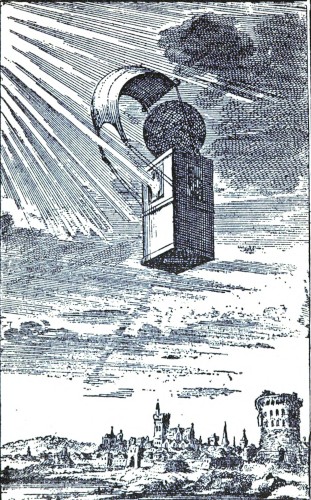
last constructed the machine I am about to describe to you. It was a
large very light box which shut very exactly. It was about six feet
high and about three wide in each direction. This box had holes in the
bottom, and over the roof, which was also pierced, I placed a crystal
vessel with similar holes made globe shape but very large, whose neck
terminated exactly at and fitted in the opening I had made in the
top. The vessel was expressly made with several angles, in the shape
of an icosahedron, so that as each facet was convex and concave my
globe produced the effect of a burning mirror. Neither the gaoler nor
the warders ever came into the room without finding me occupied with
this work; but they were not surprised, on account of all the pleasant
mechanical pieces they saw in the room, of which I called myself the
inventor. Among other things there were a wind-clock, an artificial
eye to see by night and a sphere where the stars follow the movement
they have in the sky. All this convinced them that the machine I was
working at was a similar curiosity and the money with which Colignac
had greased their palm made them go gently in many difficult occasions.
It was nine o'clock in the morning. My gaoler had gone down and the
sky was overcast when I exposed this machine on the summit of the
Tower, that is to say in the most open portion of my terrace; it
closed so exactly that not a single grain of air could slip in except
through the two openings. I had fitted inside a small, very light
plank which served me as a seat. All being arranged in this way I shut
myself up inside and remained there nearly an hour, waiting until it
pleased Fortune to command me. When the Sun emerged from the clouds
and began to shine on my machine the transparent icosahedron received
the treasures of the sun through its facets and transmitted the light
through the globe into my cell; and since this splendour was weakened,
because the rays could not reach me without being several times broken,
this strength of tempered light converted my shrine into a little sky
of purple enamelled with gold.
I was admiring in an ecstasy the beauty of so mingled a colouring when
suddenly I felt my entrails stirred in the same way a man feels them
stir when he is lifted up by a pulley. I was about to open the door to
find out the cause of this sensation, but, as I was stretching out my
hand, I looked through the hole in the floor of my box and saw my Tower
already far below me; and my little castle in the air thrusting upwards
against my feet showed me in a twinkling Toulouse disappearing into the
earth. This prodigy surprised me, not because of the suddenness of the
flight, but because of the terrible emotion of the human reason at the
success of a design which had appalled me even in the imagination. The
rest did not surprise me, because I had foreseen that the void which
would occur in the icosahedron through the sun's rays uniting by way of
the concave glasses would attract a furious abundance of air to fill
it, which would lift up my box, and in proportion as I rose up the
horrible wind which rushed through the hole could not reach the roof
except by passing furiously through the machine and thereby lifting it
up. Although my plan had been thought out with great care, I was
wrong in one particular, through my not having placed sufficient faith
in the power of my mirrors. I had placed around the box a little sail
easily moved by a string, which I held in my hand and which passed
through the glass globe; I had supposed that when I was in the air I
could make use of as much wind as was needed to carry me to Colignac;
but in a twinkling the sun, beating perpendicularly and obliquely upon
the burning mirrors of the icosahedron, bore me up so high that I
lost sight of Toulouse. This caused me drop the string and very soon
after I saw through one of the windows I had made in the four sides of
the machine my little sail torn off and flying away in the grip of a
whirlwind.
I remember that in less than an hour I found myself above the middle
region. I perceived this by noticing that it rained and hailed
beneath me. I shall be asked perhaps how it happened that there was
wind—without which my box could not rise—in a part of the sky which
is free from meteors; but if you will hearken to me, I will satisfy
this objection. I have told you that the sun beat vigorously upon my
concave mirrors, and uniting its rays in the middle of the globe drove
out with ardour through the upper vent the air inside; the globe became
a vacuum and, since Nature abhors a vacuum, she made it draw up air
through the lower opening to fill itself. If it lost a great deal it
gained as much; and in this way we should not be surprised that in a
space above the middle region of the winds I should continue to rise,
because the ether became wind through the furious speed with which it
rushed through to prevent a vacuum and consequently was bound to force
up my machine continually.
I was scarcely troubled with hunger at all, except when I traversed
this middle region; for certainly the coldness of the climate made
me see it at a distance. I say "at a distance," because I drank a
few drops from a bottle of essence I always carried with me and this
forbade it to approach. During the remainder of my journey I was not in
the least attacked by it; on the contrary, the nearer I came to this
flaming world the stronger I felt. I found my face was a little hot and
gayer than usual; my hands appeared of an agreeable vermilion colour
and an unsuspected gladness flowing with my blood took me completely
out of myself.
I remember that as I reflected on this adventure I reasoned once in
this way: "Hunger no doubt cannot attack me, because this pain is
simply Nature's instinct, warning animals to repair with food the
losses of their substance; and to-day the pure, continuous and close
irradiation of the sun causes me to take in more radical heat than I
lose and therefore Nature no longer gives me a desire which would be
useless." I objected to these reasons that, since the composition which
makes life consists not only in natural heat, but in radical moisture,
to which this fire must be attached as flame to the oil of a lamp,
the rays alone of that brasier of life could not make the soul unless
they met with some unctuous matter to fix them. But I vanquished this
difficulty immediately, after I had taken notice that in our bodies
the radical moisture and the natural heat are the same thing; for,
that which is called moisture either in animals or in the Sun—that
great soul of the world—is merely a flow of sparks more continuous
on account of their mobility; and that which is called heat is a
mist of atoms of fire, which appear less liberated because of their
interruption; but even if the radical moisture and the radical heat
were two distinct things, it is certain that the moisture would not be
necessary in order to live so near the Sun; for, since this moisture
serves the living only to grasp the heat, which would evaporate too
quickly and would not feed them soon enough, I could not lack it in a
region where more of these little bodies of flame which made life were
united to my being than were detached from it.
Another thing may cause astonishment, and that is why as I approached
this burning globe I was not consumed, since I had almost reached the
full activity of its sphere. This is the reason: properly speaking it
is not the fire itself which burns, but a grosser matter which the fire
thrusts hither and thither by the vehemence of its mobile nature; and
that powder of sparkles which I call fire, moving of itself, finds all
this action possible from the roundness of its atoms; for they caress,
heat or burn according to the shape of the bodies they draw with them.
Thus, straw does not send out so hot a flame as wood; wood burns with
less violence than iron, and the reason for this is that the fire of
iron, wood and straw, although it is the same fire, nevertheless acts
differently, according to the diversity of the bodies it moves; that is
why in straw the fire (that almost spiritual dust) is less corrosive,
because it is hindered by a soft body only; in wood, whose substance is
more compact, it enters more harshly; and in iron, whose mass is almost
entirely solid and bound together with angular parts, it penetrates
and consumes what is cast upon it in a flash. All these observations
are so familiar that no one will be surprised that I approached the
sun without being burned, because that which burns is not fire, but
the matter to which it is attached, and because the Sun's fire cannot
be mingled with any matter. Do we not experience ourselves that joy,
which is a fire, because it only moves an aery blood, whose very loose
particles slide gently against the membranes of our flesh, caresses
us and creates I know not what blind pleasure, and that this pleasure
or rather this first step of pain, not going so far as to menace the
animal with death, but making him feel his good constitution by a
natural instinct, causes a movement in our minds which we call joy?
Fever, which has entirely contrary effects, is a fire just as much as
joy, but it is a fire enveloped in a body whose grains are horny, such
as black bile or melancholy, and this fire darting its hooked points
everywhere, its mobile nature carries it, pierces, cuts, flays and
produces by this violent agitation what is called the burning of fever.
But this chain of proofs is quite useless; the commonest experiments
are sufficient to convince the most obstinate. I have no time to lose,
I must think of myself; like Phaethon, I am in the midst of a career,
where I cannot turn back, and in which if I make one false step all
Nature together cannot help me.
I perceived very distinctly, as I had formerly suspected in travelling
to the Moon, that it is indeed the Earth which turns about the Sun
from East to West, and not the Sun which turns about the Earth; for
I saw in succession France, the foot of the boot of Italy, then the
Mediterranean, then Greece, then the Bosphorus, the Euxine Sea, Persia,
the Indies, China and finally Japan pass across the hole of my box, and
some hours after my elevation the whole South Sea passed by and left in
its place the Continent of America. I clearly distinguished all these
revolutions and I even remember that a long time afterwards I again saw
Europe moving up once more on the scene, but I could not distinguish
the different States, because my elevation was now too high. On my way
I passed, sometimes on the left, sometimes on the right, several worlds
like ours and I felt myself deflected whenever I reached the spheres of
their activity. However, the rapid vigour of my upward flight overcame
these attractions.
I passed near the Moon, which at that time was between the Sun and
the Earth, and I left Venus on the right hand. As touching this star,
the old Astronomy has so preached that the planets are spheres which
turn around the Earth that modern Astronomy dare not doubt it. And
yet I noticed that as long as Venus appeared on this side of the
Sun, around which she turns, I saw her as a crescent; but as she
continued her orbit I noticed that in proportion as she passed behind
the Sun the horns drew together and her black belly became golden.
This alternation of light and darkness showed very plainly that the
planets, like the Moon and the Earth, are globes without light of their
own and are only capable of reflecting what they borrow. Moreover,
as I continued to rise, I made the same observation in the case of
Mercury. I also noticed that all these worlds have other little worlds
moving about them. Musing afterwards on the causes of the construction
of this great Universe I have supposed that at the disentangling of
chaos, after God had created matter, like bodies were joined to like
bodies, through that unknown principle of love, whereby we see that
everything seeks its like. Particles formed in a certain way joined
together and that made the air; others, whose shape perhaps gave them
a circular movement, gathered together and composed the globes we call
planets, which, accumulated in the round shape we see, because of
that inclination to spin on their poles to which their shape forces
them; and also they cause those lesser orbs, which are met with in the
sphere of their activity, to turn likewise, since these evaporate from
their mass and move in their flight on a similar course. That is why
Mercury, Venus, the Earth, Mars, Jupiter and Saturn have been forced
to spin and roll all together around the Sun. It is quite possible to
imagine that these globes may formerly have been Suns, since, in spite
of its present extinction, the Earth still retains sufficient heat
to cause the Moon to turn about through the circular movement of the
bodies which are detached from its mass, and Jupiter has enough to turn
four. But in the course of time, owing to the continual emission of
the little bodies which make heat and light, these Suns have lost so
much of their heat and light that they remain a cold, dark and almost
impotent residuum. We even discover that the spots in the Sun, which
were not perceived by the Ancients, increase from day to day. How do we
know that this is not a crust forming on its outer surface, that its
mass grows fainter as the light abandons it and that, when all these
mobile bodies abandon it, it will not become an opaque globe like the
Earth?[57] There are very distant centuries beyond which there appears
no vestige of the human race; perhaps the Earth was formerly a Sun
peopled with animals fitted for the climate, which had produced them,
and perhaps these animals were the demons whereof Antiquity relates
so many examples. Why not? Might it not be that these animals still
inhabited the Earth for a time after its extinction and that the change
in their globe did not destroy their whole race at once? In fact, their
life lasted until the time of Augustus, according to Plutarch. It even
appears that the sacred and prophetic Testament of our first Patriarchs
meant to lead us by the hand to this truth; for, before man is spoken
of, we read of the revolt of the Angels. This sequence of time observed
by the Scriptures is perhaps a half-proof that Angels inhabited the
Earth before us and that these proud beings, who had dwelt in our World
since it was a Sun, disdaining to continue there perhaps when it was
extinguished and knowing that God had placed His throne in the Sun,
dared to undertake to occupy it? But God, desirous of punishing their
insolence, drove them out of the Earth and to occupy their vacant place
created man less perfect but therefore less proud.
At the end of about four months' travelling, at least as nearly as
can be calculated, when there is no night to distinguish one day from
another, I reached one of those little Worlds which fly around the Sun,
called by Mathematicians "Spots". There my mirrors did not collect
so much heat on account of the intervening clouds; consequently the
air did not drive my cabin with so much vigour and there was only
sufficient wind to break my fall and set me down on the point of a very
high mountain, where I gently landed.
I leave you to imagine the joy I felt at seeing my feet on a solid
floor after having played the part of a bird so long. Words indeed are
too weak to express the happiness with which I trembled when at last
I perceived my head crowned with the light of the Heavens. Yet this
ecstasy did not so transport me but that I remembered as I left my box
to cover its top with my shirt before going away from it, because if
the air became serene, as was very probable, I apprehended the Sun
would relight my mirrors and I should lose my house.
By way of gorges, which traces of water showed had been hollowed out
by its action, I reached the plain, where I could scarcely walk on
account of the thickness of the soil with which the earth was fat;
nevertheless, after walking for some time I reached a quagmire, where I
met a little man entirely naked sitting on a stone to repose himself.
I do not remember if I spoke the first or if he questioned me; but it
is fresh in my memory, as if I had just heard him, that he discoursed
to me for three long hours in a language which I know I had never
heard before, which bore no relation to any in this world, yet which
I understood more quickly and more intelligibly than my nurse's. He
explained to me, when I inquired about so marvellous a thing, that in
the sciences there is one Truth, outside which one is always distant
from what is easy; that the more distant an idiom is from this truth
the further it is below one's conception and the less easy it is to
understand.
"In the same way", he continued, "this Truth is never met with in
music but that the uplifted soul immediately moves blindly towards it.
We do not see it, but we feel that Nature sees it; and without being
able to understand how it is we are absorbed, it does not fail to
delight us and yet we cannot tell where it is. It is just the same with
languages; whoever hits upon this Truth of letters, words and sequence
in expressing himself can never fall below his conception; his speech
is always equal to his thought; and it is because you do not possess
this perfect idiom that you hesitate, and do not know what order or
what words can express what you imagine."
I told him that the first man in our world had indubitably made use of
this mother-tongue, because every name he had imposed upon every thing
declared its essence. He interrupted me and continued:
"It is not merely needed to express all the mind conceives, but without
it one cannot be understood by all. Since this idiom is the instinct or
the voice of Nature, it ought to be intelligible to everything which
lives under Nature's jurisdiction; and so if you understand it you can
communicate and speak all your thoughts to beasts and the beasts all
their thoughts to you, because it is the very language of Nature by
which she makes herself understood by all animals. Therefore you should
not be surprised by the ease with which you understand the meaning of
a language that never before sounded in your hearing. When I speak,
your soul meets in every one of my words that Truth it gropes for; and
although your soul's reason does not understand it, the soul has in it
Nature which cannot fail to understand this language."
"Ah! without doubt", I cried, "it was by means of this energetic idiom
that our first Father of old talked with the animals and was understood
by them; domination over all kinds had been given him and they obeyed
him, because he made them obey in a language which was known to them;
and this mother-tongue, being now lost, they no longer come to us when
we call them as formerly, because they no longer understand us."
The little man did not appear as if he were going to reply to me but,
taking up the thread of his discourse, he was about to continue when I
interrupted him once more. I asked him in what world we were breathing,
if it were thickly inhabited and by what sort of government order was
maintained.
"I will reveal to you", he replied, "secrets which are not known in
your climate. Look carefully at the ground on which we walk; a little
while ago it was a confused and disordered mass, a chaos of intricate
matter, a black and slimy dross thrown off by the Sun. After it had
mingled, pressed and made compact these numerous clouds of atoms by the
vigour of the rays still cast forth; after, I say, a long and powerful
maturation had separated in this ball the most contrary bodies and
united the most similar, this mass was so provoked by heat and sweated
so much that it caused a deluge, which covered it more than forty days;
for that space of time was fully needed by so much water to flow into
the lowest and most sloping parts of our globe.
"From these united torrents of water was formed the sea, whose salt
still proves that it must be a mass of sweat, since all sweat is salt.
Following upon the retreat of the waters there remained on this earth
a fat and fertile mud, and when the Sun shone upon it it rose like a
blister, which cannot cast out its germ on account of the cold. It
then received another maturation and this maturation rectified and
perfected it by a more exact mixture and thereby the germ, which was
only able hitherto to vegetate, was rendered capable of sentience.
But the waters, which had settled so long on the mud, had chilled it
too much and the pimple did not burst; and so the Sun heated it up
once more. After the third digestion this womb was so heated that
the cold no longer made an obstacle to its delivery: it opened and
brought forth a man who has retained in his liver (which is the seat
of the vegetative soul and the place of first maturation) the power of
multiplying; in his heart (which is the seat of activity and the place
of the second maturation) vital power: and in the brain (which is the
seat of the intellect and the place of the third maturation) the power
of reasoning. Otherwise, why should we be longer in the belly of our
mothers than all other animals, if it were not that our embryo must
receive three distinct maturations to form the three distinct faculties
of our soul, and beasts only two, to form their two powers? I know
that the horse is only completed by ten, twelve or fourteen months
in the belly of a mare; but since its constitution is so contrary to
that which makes us men, since it is never born except in those months
(notice!) which are entirely hostile to our birth, when we remain in
the womb beyond the normal time, it is not surprising that Nature needs
a longer time for the delivery of a mare than of a woman.[58]
"Yes, but, someone will say, the horse remains longer in its mother's
belly than we do and consequently it receives either more perfect or
more numerous maturations!
"I reply that it does not follow; for without relying on the
observations on the energy of numbers made by so many learned men
proving that, since all matter is in movement, certain beings are
completed in a certain revolution of days and destroyed in another,
and without strengthening myself with the proofs, whereby they deduce
(after explaining the cause of all these movements) that the number
nine is the most perfect; I shall content myself by replying that the
germ of man is hotter and so the Sun fashions and completes more organs
in him in nine months than it sketches out in a year in that of a colt.
And it cannot be doubted that a horse is much colder than a man, since
this animal only dies of a swollen spleen or other diseases which
proceed from melancholy.
"Nevertheless, you will say, in our world we never see a man engendered
from mud and produced in this fashion.
"I am sure that your world is now too heated; for as soon as the Sun
attracts a germ from the Earth it does not meet that cold damp or, to
put it better, that certain period of a completed movement which forces
it to several maturations, and so it immediately forms a vegetable;
or if two maturations take place, the second has no time to complete
itself perfectly and so it only brings forth an insect: thus, I have
noticed that the monkey, which like us carries its young nearly nine
months, resembles us in so many ways that many naturalists do not
distinguish the species from us; and the reason is that their seed is
tempered much like ours and during this time has almost been able to
complete the three digestions.
"You will undoubtedly ask me from whom I derive the story I have just
told you: you will tell me that I cannot have learnt it from those
who were not there. It is true that I was the only person there and,
consequently, I cannot bear witness to it because it happened before I
was born. That is true; but learn that, in a region so near the Sun as
ours, souls are filled with fire and are clearer, more subtle and more
penetrating than those of other animals in more distant spheres. Now,
since even in your world there were prophets whose minds when heated by
a vigorous enthusiasm presaged the future, it is not impossible that
in this world, so much nearer the Sun and consequently so much more
luminous than yours, some odour of the past should reach a powerful
genius, that his mobile reason should move backwards as well as
forwards and that it should be able to reach a cause by effects, seeing
that it can reach effects by a cause."
In this way he finished what he was saying; but after a still more
private conversation in which he revealed to me very hidden secrets
(one part of which I shall keep silent, while the rest has escaped
my memory) he told me that not three weeks before a lump of earth
impregnated by the Sun had brought him forth.
"Look at that tumour."
He then pointed out to me something on the mud swollen like a molehill.
"It is", said he, "a boil or, to speak more correctly, a womb which for
the last nine months has held the embryo of one of my brothers. I am
waiting here for the purpose of acting as his midwife."
He would have gone on had he not perceived the earth palpitating around
this clay sod. This, together with the size of the pimple, caused him
to judge that the earth was in labour and that this motion was already
the effort of the pains of delivery. He left me at once to run to it;
and I went off to look for my cabin.
I climbed up the mountain, whence I had descended, and reached its
top with some exertion. You may conceive my distress when I found my
machine was not where I had left it. I was already sighing for its loss
when I saw it fluttering a long way off. I rushed after it at top speed
as fast as my legs permitted, and indeed it was an agreeable pastime to
contemplate this new method of hunting; for, sometimes when I almost
had my hand upon it there would be a slight increase of heat in the
glass ball, which drew up the air with more force, and, as this air
became swifter, lifted my box above me and made me jump after it like
a cat at the hook where it sees a hare hanging. If my shirt had not
remained on the roof, and thereby intercepted the force of the mirrors,
the box would have gone off on its travels alone.
But to what end do I refresh the memory of an adventure which I cannot
recollect now except with a pain such as I then felt? It suffices to
know that the box bounded, ran and flew, and that I leaped, walked
and strode, until at last I saw it fall at the foot of a very tall
mountain. It would very likely have led me further if the shadow of
this proud swelling of the earth, which darkened the sky far into the
plain, had not spread half a league of darkness around it; for when
my box reached these shadows, its glass no sooner felt the coolness
than it ceased to create a vacuum, with wind through the hole, and
consequently there was no impulse to sustain it; in so much that it
fell and would have been broken into a thousand pieces had not the pool
into which it fell happily yielded under its weight. I drew it from the
water, repaired what was disorganized, and then grasping it with all
my strength, carried it to the top of a hill which was close at hand.
There, I spread out my shirt around the globe, but I could not clothe
it, because the mirrors at once began their office and I perceived my
cabin already wriggling to fly. I had only time to step nimbly in and
to shut myself up as before.
The sphere of our World appeared to me no more than a planet about the
size the Moon appears to us; and, as I continued to rise, it lessened
first into a star, then into a spark and then into nothing; this
luminous point grew so fine, to equalize itself with that which ended
the last ray of my sight, that finally it merged into the colour of the
sky. Some may perhaps be astonished that I was not overtaken by sleep
during this long voyage; but, since sleep is only produced by the soft
exhalation of meats evaporating from the stomach to the brain or by a
need felt by Nature to knit up our soul in order to repair during rest
the spirits consumed by labour, I had no need to sleep, seeing that
I did not eat and that the Sun gave me much more radical heat than I
expended. However, I continued to rise and as I approached that burning
world I felt a certain joy flowing in my blood, which rectified it
and passed into the soul. From time to time I looked up to admire the
brightness of the tints which shone in my little crystal dome; and I
still remember that as I directed my eyes towards the glass ball I felt
with a start something heavy fly out from all the parts of my body. A
whirlwind of very thick and almost palpable smoke suffocated my glass
with darkness; I stood up to examine this darkness which blinded me
and I saw no vessel, no mirrors, no glass, no covering to my cabin. I
looked down to see what was making my masterpiece fall in ruins, but in
its place and in place of the four sides and the floor I found nothing
but the sky about me. What terrified me still more was to feel some
invisible obstacle repulsing my arms when I tried to extend them, as if
the air had been petrified. It came into my mind then that I had risen
so high I must have reached the part of the firmament which certain
philosophers and some astronomers have said is solid.
I began to feel I should remain enshrined there, but the horror which
overwhelmed me at the strangeness of this accident was increased by
those which followed; for, as my sight ranged here and there, it
fell on my breast and, instead of stopping at the outer surface of my
body, passed through it; then a moment afterwards I perceived that
I was looking backwards with hardly any interlapse. As if my body
had become nothing but an organ of sight I felt my flesh, purged of
its opacity, carry objects to my eyes, and my eyes to objects by its
means. At last, after striking a thousand times without seeing them,
the roof, the floor and the walls of my chair, I understood that my
cabin and I had become transparent, owing to some secret necessity of
light at its source. Although it was diaphanous I might still have
perceived it, since we clearly perceive glass, crystal and diamonds,
which are also diaphanous; but I imagine that in a region so near the
Sun that luminary purges bodies much more perfectly of their opacity by
arranging the imperceptible channels of matter straighter than in our
world, where its strength is almost exhausted by so long a journey and
is scarcely capable of transpiring its light into precious stones; yet
on account of the interior equality of their superficies it causes them
to cast back through their glasses (as if through little eyes) either
the green of emeralds, the scarlet of rubies or the violet of amethysts
as the different pores of the stone, whether straighter or more
sinuous, extinguish or rekindle this enfeebled light by the quantity
of the reflections. One difficulty may embarrass the reader, which
is how I could see myself and yet not see my box, since I had become
as diaphanous as it was. To this I reply that the Sun doubtless acts
differently upon living than upon inanimate bodies, since no portion of
my flesh, of my bones, or of my entrails lost its natural colour though
they were transparent; on the contrary, my lungs preserved their soft
delicacy in an incarnadine red; my heart, still vermilion, swung easily
between the systole and the diastole; my liver seemed to burn in a
fiery purple and heating the air I breathed continued the circulation
of my blood; in short, I saw, touched and smelt myself the same and yet
I was not the same.
While I considered this metamorphosis my journey grew continually
shorter, but at that time much more slow on account of the serenity
of the ether, which grew rarefied the nearer I approached the source
of the daylight; for, since at this stage matter is very subtle on
account of the great amount of void with which it is filled, and since
this matter is consequently very idle because of the void which is not
active, the air, as it passed through the hole of my box, could only
produce a little wind barely able to sustain me.
I never think of the malicious caprices of Fortune, who continued to
oppose the success of my enterprise with such obstinacy, but I wonder
how it was my brain was not turned. But hearken now a miracle, which
future ages will find it difficult to believe. Shut up in a transparent
box, of which I had lost sight, with my movement so slackened that I
did well not to fall back, in a state where all that the whole machine
of the world encloses was powerless to aid me, I was reduced to the
height of extreme misfortune; yet, just as when we are dying we are
inwardly moved to desire to embrace those who gave us our being, so
did I lift my eyes to the Sun, our common father. This ardour of my
will not only bore up my body, but hurled it toward the thing which
it desired to embrace. My body thrust on my box and in this fashion I
continued my journey. As soon as I perceived this I stiffened all the
faculties of my soul with more attention than ever to attach them in
the imagination to what attracted me, but the efforts of my will forced
me against the roof in spite of myself and the weight of my cabin on my
head so incommoded me that finally the burden forced me to grope for
its invisible door. Fortunately I found it, opened it and threw myself
outside; but that natural apprehension of falling, which all animals
have when they find themselves supported by nothing, made me stretch
out my arm suddenly to catch hold of it. I was only guided by Nature,
which cannot reason, and therefore Fortune, her enemy, maliciously
thrust my hand against the crystal roof. Alas! What a thunder-clap
it was in my ears when I heard the noise of the icosahedron breaking
into fragments! So great a disorder, so great a misfortune, so great
a terror are beyond all expression. The mirrors attracted no more
air, for there was no more vacuum; the air ceased to become a wind
by hastening to fill it; the wind ceased to urge my box upwards; in
short, soon after this breakage I saw it falling far across the vast
fields of the world and in that region it regained the opaque darkness
it had exhaled. Since the energetic strength of the light diminished
there, the box eagerly rejoined the dark density which was, as it were,
essential to it, just as we see souls long after their separation
return to seek their bodies, and, in trying to rejoin them, wander
about their sepulchres for a hundred years. I surmise that it lost its
transparency in this way, for I saw it afterwards in Poland in the same
state as it was when I first entered it. I have since learned that
it fell in the Kingdom of Borneo, under the equinoctial line; that a
Portuguese merchant bought it from the islander who found it and that,
passing from hand to hand, it came into the possession of the Polish
engineer who now flies in it.[59]
Thus suspended in the airy regions of the sky, filled with
consternation at the death I expected by my fall, I turned my sad eyes
to the Sun, as I have already told you. My sight carried my thought
with it and my looks fixedly attached to its globe marked out a way
whose traces were followed by my will to lift my body there. This
vigorous bound of my soul will not be incomprehensible to any one who
will consider the most simple effects of our will; it is well known,
for example, that when I wish to leap, my will, borne up by my fantasy,
raises the whole microcosm and tries to carry it to the point desired,
and if it does not always reach this, the reason is that the principles
of Nature, which are universal, prevail over individuals, and, since
the power of will is peculiar to sentient things and that of falling to
the centre is common to all matter, my leap is forced to end when its
mass, having conquered the insolence of the will which surprised it,
draws near the point to which it tends.
I shall say nothing more of what happened on the rest of my journey for
fear of taking as long to tell it as to make it; let it suffice that
at the end of twenty-two months I landed very happily upon the great
plains of the day. This land is like burning snow-flakes, so luminous
is it. Yet it is an incredible thing which I have never been able to
understand whether, after my box fell, I rose to or descended upon the
Sun. I only remember that when I arrived there I walked lightly upon
it; I only touched the ground by a point and I often rolled like a
ball without finding it any more uncomfortable to walk with my head
than with my feet. Although my legs were sometimes turned towards the
sky and my shoulders towards the ground, I felt as naturally placed in
this position as if my legs had been upon the ground and my shoulders
towards the sky. On whatever part of my body I placed myself, on the
belly, on the back, on an elbow, on an ear, I found myself upright. By
this I perceived that the Sun is a world which has no centre and that,
since I was far outside the active sphere of our world and all those I
had met with, it was consequently impossible that I should still weigh,
since weight is only the attraction of a centre within the sphere of
its activity.
The respect with which I printed my steps upon this luminous country
suspended for a time my burning ardour to continue my voyage. I felt
myself ashamed to walk upon the daylight; my astonished body was
desirous of support from my eyes and since this transparent land which
they penetrated could not support them, my instinct, having mastered my
thought in spite of me, drew me to the most hollow part of a depthless
light. Little by little, however, my reason undeceived my instinct; I
pressed assured and not trembling steps upon the plain and I counted
my strides so proudly that if men could have perceived me from their
world they would have taken me for the great God who walks upon the
clouds. After I had walked about fifteen days, as I believe, I reached
a district of the Sun less resplendent than that from which I came. I
felt deeply moved by joy and I imagined that this joy was assuredly the
result of a secret sympathy for its opacity retained by my being. The
knowledge I had of it did not make me desist from my enterprise; for I
was like those sleeping old men who, although they know that sleep is
bad for them and that they have ordered their servants to deprive them
of it, are nevertheless very annoyed at the time they are awakened.
So, as my body grew darker when I reached more shaded provinces, it
re-contracted the weaknesses brought by this infirmity of matter; I
grew weary and sleep grasped me.
Those pleasing languors which possess us at the approach of sleep
poured so much pleasure into my senses that, captured by pleasure, my
senses forced my soul to thank the tyrant who chains his slaves; for
sleep, that old tyrant of one half our days, who, on account of his
old age, cannot endure the light or look upon it without swooning,
had been forced to abandon me when I entered the brilliant climates
of the Sun and had come to wait for me upon the borders of the shaded
region of which I speak, where he caught me, arrested me his prisoner,
and shut up his declared enemies, my eyes, under the dark vault of
my eyelids; and, fearing lest my other senses should betray him as
they had betrayed me and trouble him in the peaceable possession of
his conquest, he tied down all of them to their beds. All this means
in two words that I lay down very weary upon the sand. It was a flat
plain, so bare that as far as I could see my sight did not even meet a
bush; and yet when I woke up I found myself under a tree, in comparison
with which the tallest cedars would seem like grass. Its trunk was of
massive gold, its branches of silver and its leaves of emeralds, which,
underneath the glittering green of their precious surface, reflected as
in a mirror the images of the fruit which hung round about. But judge
whether the fruit owed anything to the leaves: the burning scarlet
of a large carbuncle formed one half of each and the other half was
uncertain whether its material came from chrysolite or from a piece
of golden amber; the open flowers were roses of very large diamonds
and the buds were big, pear-shaped pearls. A nightingale, whose smooth
plumage rendered him excellently beautiful, was perched on the summit
and seemed with his melody desirous of forcing the eyes to confess
to the ears that he was not unworthy of the throne upon which he was
seated.
For a long time I remained amazed at the sight of so rich a spectacle
and I could not be satiated with looking at it; but as I was
occupying all my thoughts in contemplating among the other fruits an
extraordinarily beautiful pomegranate, whose pulp was a cluster of
several large rubies, I perceived the little crown which took the place
of its head was moving and stretching out until it formed a neck. Then
I saw something white seething above it which, by thickening, growing,
advancing and retiring the matter in different places, at last appeared
as the face of a small bust of flesh. This small bust ended in a
circle about the waist; that is to say, its lower parts still kept the
shape of an apple. Little by little it stretched out, its stem became
two legs, and each of its legs split into five toes. This humanised
pomegranate loosened itself from its stem and with a light bound
fell exactly at my feet. Certainly I must admit I was impressed with
veneration when I saw this little reasonable apple, this little piece
of a dwarf no larger than my thumb, but strong enough to create itself,
walking before me proudly.
"Human animal", he said in that mother-tongue, whereof I have formerly
spoken, "after I had observed you for a long time from the branch on
which I was hanging I thought I read in your face that you were not an
inhabitant of this world, and for that reason I have descended to be
enlightened by the truth."
When I had satisfied his curiosity about all the matters concerning
which he questioned me, I said to him:
"But tell me who you are; what I have just seen is so very astonishing
that I despair of ever knowing the cause unless you instruct me. What!
a huge tree all of pure gold, whose leaves are emeralds, the flowers
diamonds, the buds pearls, and, among all this, fruits which make
themselves into men in the twinkling of an eye? For my part I admit
that the comprehension of such a miracle passes my capacity."
I was awaiting his reply to this explanation, when he said:
"As I am the king of the nation which makes up this tree, you will not
take it ill if I call them to follow me."
When he had spoken thus I noticed that he collected himself in
meditation. I do not know if he wound up the interior springs of
his will and thus excited outside himself the movement, which was
the cause of what you are about to hear, but it is certain that
immediately afterwards all the fruits, all the flowers, all the leaves,
all the branches, in short, the whole tree, fell apart into little
seeing, feeling and walking men, who began to dance around me as if
to celebrate their birthday at the very moment of their birth. The
nightingale alone retained its shape and was not metamorphosed; it
came and perched on the shoulder of the little monarch, where it sang
an air so melancholy and so amorous that the whole assembly, including
the prince himself, were moved by the gentle languors of its dying
voice and shed a few tears. My curiosity to learn whence this bird came
caused me so extraordinary a longing to speak that I could not contain
it.
"Seigneur", said I, addressing myself to the king, "if I did not
fear to importune your majesty I should ask you why among so many
metamorphoses the nightingale alone has kept its being?"
The little prince listened to me with a benevolence which showed his
natural kindness; and, understanding my curiosity, he replied:
"The nightingale has not changed its form like us, because it could
not. It is a real bird and is no more than it appears to be. But let us
walk towards the opaque regions and on the way I will relate to you who
I am, together with the story of the nightingale."
I had scarcely showed the satisfaction I received from his offer, when
he bounded lightly on to one of my shoulders. He raised himself on his
little toes to bring his mouth level with my ear; and sometimes hanging
by my hair and sometimes sliding down it, he said:
"By my faith, you must excuse a person who is already out of breath.
I have crowded lungs in a little body and my voice is consequently
so weak that I am forced to strain to make myself heard. I hope the
nightingale will speak for himself. Let him sing if he wishes, and we
shall at least have the pleasure of hearing his story in music."
I replied that I was not yet sufficiently practised in the language of
birds; that, indeed, a certain philosopher whom I had met on my way
to the Sun had given me some general principles to understand that of
the beasts, but that they were not enough to understand all words in
general, nor enough for me to be moved by all the delicate points which
would be met with in an adventure such as this must be.
"Well", said he, "since you will have it so, your ears shall be
deprived not only of the nightingale's beautiful songs, but of almost
all its adventure, whereof I can only tell you that part which has
come to my knowledge; however, you must be content with this fragment,
because, even if I knew it all, the brevity of our journey to its
country, whither I am about to conduct you, would not permit me to take
my story further."
Having spoken thus, he jumped from my shoulder to the ground. He then
gave his hand to his little subjects and began to dance with them in
a kind of movement which I cannot describe, because nothing like it
has ever been seen. But hearken, nations of the Earth, to that which
I do not compel you to believe, because it passed for a miracle in a
world where your miracles are only natural effects! As soon as these
little men began to dance I seemed to feel their motion in myself and
my motion in them. I could not look upon this dance without being
distinctly moved from where I was, as if a whirlwind agitated all
the parts of my body with the same dance and the particular movement
of each one; and I felt the same joy expanding upon my face which a
similar movement had spread upon theirs. As the dance drew closer, the
dancers became confused with a much more rapid and more imperceptible
motion; it seemed that the object of the ballet was to represent an
enormous giant; for as they drew nearer each other and redoubled the
swiftness of their movement they became so closely mingled that I
perceived nothing but a great, open and almost transparent colossus;
and yet my eyes perceived them interlinked with each other. At this
moment I began to be unable to distinguish any more the diversity of
the movements of each, on account of their extreme rapidity and also
because this rapidity shrank as it approached the centre, and thus each
vortex at last occupied so little space that it escaped my sight. Yet
I think these parts drew still closer together; for this once unwieldy
human mass gradually reduced itself until it formed a young man of
moderate height, all of whose limbs were proportioned with a symmetry
to which perfection at its strongest idea could never have flown. He
was beautiful beyond everything to which all painters have raised their
fantasy; but what I thought very marvellous was that the connection of
all the parts which completed this perfect microcosm took place within
the twinkling of an eye. The most agile of our little dancers leaped up
with a flourish to the height and into the position needed to form a
head; others hotter and not so loose formed the heart; and others much
heavier only supplied the bones, the flesh and the plumpness.
When this large, beautiful young man was entirely finished, although
his rapid construction had scarcely allowed me any time to notice an
interval in its progress, I saw the king of the whole people enter by
the mouth, yet it seemed to me he was attracted into this body by the
breathing of the body itself. All this mass of little men had not yet
given any sign of life; but as soon as it had swallowed its little
king, it felt itself one. He remained some time looking at me and then,
as if he were grown familiar by looking, he approached me, caressed me,
and giving me his hand said:
"And now without damaging the delicacy of my lungs I can converse with
you about the things which you long to know; but it is reasonable to
reveal to you first of all the hidden secrets of our origin. Learn
then that we are animals inhabiting the luminous regions of the Sun;
the most general and the most useful of our occupations is to travel
through the vast countries of this great world. We note carefully the
habits of the nations, the peculiarity of climates and the nature of
all things that can merit our attention, from which we build up an
exact science of what exists. You must know that my vassals travelled
under my guidance and, in order to have leisure to observe things more
curiously, we did not keep the conformation particular to our body
(which your senses could not perceive), whose subtlety would have
caused us to move too quickly; but we made ourselves into birds. All
my subjects became eagles by my command; and for fear they should grow
weary I transformed myself into a nightingale to soothe their fatigue
by the charms of music. I followed the rapid flight of my people
without flying, for I was perched on the head of one of my vassals. We
were following our road when a nightingale, dwelling in a province of
the opaque country, through which we were then travelling, astonished
to see me in the power of an eagle (it could only take us for what
it saw us to be), began to commiserate my misfortune. I caused my
followers to halt and we descended on the tops of some trees where
sighed this charitable bird. I took so much pleasure in the sweetness
of its mournful songs that I would not undeceive it, in order that I
might enjoy them longer and more at my ease. On the spur of the moment
I invented a story, in which I related to it imaginary misfortunes
which had caused me to fall into the hands of the eagle; I mixed with
it such surprising adventures, wherein the passions were so skilfully
aroused and the music so well suited to the words, that the nightingale
was beside itself.
"One after the other we sang to each other in music the story of our
mutual loves. In my airs I sang that I was not only consoled for, but
that I even rejoiced in, my misfortune, since it had procured me the
glory of being lamented in such beautiful songs; and this inconsolable
little creature replied in its airs that it would gladly accept all my
esteem for it, if it knew that this could make it merit the honour of
dying in my place, but that, since Fortune had not reserved so much
glory for so unfortunate a creature, it would only accept of that
esteem sufficiently to prevent me from blushing for my friendship. In
my turn I replied again with all the transports, all the tenderness
and all the caresses of so touching a passion that twice or thrice I
perceived it ready to die of love on its branch. In truth, I mingled
such skill with the softness of my voice and I surprised its ear with
such masterly strokes and with paths so little frequented by those of
its kind, that I carried off its fair soul into all the passions by
which I desired to dominate it.
"We passed twenty-four hours in this exercise and I think we should
never have been tired of making love if our throats had not refused us
voices. This was the only obstacle which prevented us from proceeding,
but feeling that the labour was beginning to hurt my throat and that
I could not go further without falling into a swoon, I made it a sign
to come near me. The peril in which it thought I was in the midst
of so many eagles convinced it that I was calling it to my help. It
flew immediately to my aid and, wishing to give a glorious proof that
it dared to brave death even to his throne for a friend's sake, it
came and sat proudly on the great curved beak of the eagle on which
I was perched. So great a courage in so weak an animal moved me to
veneration; for, even if I had called to it as it supposed and
although there is a law among animals of the same kind to help another
in misfortune, yet the instinct of its timid nature ought to have made
it hesitate. But it did not hesitate. On the contrary, it started so
hastily that I do not know which flew the first, my signal or the
nightingale. Proud at seeing the tyrant's head under its feet, happy to
think that it was about to be sacrificed for love of me almost within
my wings and that perhaps some fortunate drops of its blood might be
sprinkled on my feathers, it looked gently towards me and, having as
it were said farewell by a look, which seemed to ask my permission to
die, it thrust its little beak so sharply into the eagle's eyes that
I saw they were crushed rather than struck. When my bird felt it was
blind it made itself new sight at once. I remonstrated gently with the
nightingale on its too precipitate action and, judging that it would
be dangerous to hide from it any longer our real existence, I revealed
myself to it and told it what we were; but the poor little creature,
convinced that these barbarians, whose prisoner I was, forced me to
feign this fable, would give no faith to anything I could say. When I
perceived that all the reasons by which I tried to convince it were
mere waste of breath, I whispered some orders to ten or twelve thousand
of my subjects and immediately the nightingale perceived at its feet
a river flowing under a boat and the boat floating upon the river. It
was just large enough to hold me twice over. At the first signal I made
to them my eagles flew off and I threw myself into the boat, whence I
cried to the nightingale to embark with me if it could not yet resolve
to abandon me so soon. As soon as it came in I commanded the river to
flow towards the region where my people were flying; but since the
fluidity of the water was less than that of the air and consequently
the rapidity of their flight greater than that of our sailing, we
remained a little behind.
"All the way I tried to undeceive my little guest; I pointed out to it
that it could hope for no fruit from its passion, since we were not
of the same species; that it ought to have perceived this when the
eagle whose eyes it had crushed had made new eyes in its presence,
and when at my command ten thousand of my vassals had metamorphosed
themselves into this river and the boat in which we were sailing. My
arguments were unsuccessful. The nightingale replied that as to the
eagle making itself eyes as I asserted, there had been no need, because
it was not blinded, since the beak had not pierced its eye-balls;
and as to the river and the boat, which I said had only been created
by a metamorphosis of my people, they had been in the wood since the
creation of the world, only no one had noticed them. Seeing it was so
ingenious in deceiving itself I agreed with it that my vassals and I
would metamorphose ourselves into whatever it liked before its eyes, on
condition that afterwards it would return to its own country. Sometimes
it asked that this should be a tree; sometimes it wished this to be a
flower, sometimes a fruit, sometimes a metal, sometimes a stone. At
last to satisfy all its desires at once, when we had reached my court
at the place where I had ordered it to await me, we metamorphosed
ourselves before the nightingale's eyes into that precious tree, whose
shape we have just abandoned, which you met with on your road.
"Now I see this little bird resolved to return into its own country,
my subjects and I will renew our shape and continue our journey. But
first of all it is reasonable to tell you who we are: animals, natives
of the Sun in its luminous part, for there is a very remarkable
difference between the nations produced by the luminous region and the
nations of the opaque region. In the world of the Earth you call us
Spirits and your presumptuous stupidity gave us this name because you
could not imagine any animals more perfect than man, and yet you saw
certain creatures perform acts above human power, and so you thought
these animals were Spirits. But you are mistaken, nevertheless; we are
animals like you. Although, as you have just seen, we give our matter
the shape and essential form of those things into which we desire to
metamorphose ourselves, whenever we please, that does not mean that we
are Spirits. But hearken, and I will discover to you why it is that
all these metamorphoses which seem to you so many miracles are purely
natural processes. You must know that since we were born inhabitants of
the bright part of this great world, where the principle of matter is
action, our imagination is necessarily much more active than that of
the inhabitants of the opaque regions and the substance of our bodies
is also much finer. Granted this, it inevitably follows that since our
imagination meets with no obstacle in the matter which composes us,
it arranges that matter as it desires and since it is mistress of our
whole mass it causes this mass to pass, by moving all its particles,
into the order necessary to create on a large scale the thing it has
formed in little. Thus each of us imagined the place and part of that
precious tree into which he desired to change, and by this effort of
imagination we excited our matter to the movements necessary to produce
them, and therefore we became metamorphosed into them. Thus, when my
eagle's eyes were crushed, to re-establish them he had only to imagine
himself a clear-sighted eagle, since all our transformations occur by
means of movement; for this reason, when we transmuted ourselves out
of leaves, flowers and fruits into men, you saw we still danced some
time after, because we had not yet recovered from the movement we had
to give our matter to make ourselves into men: like bells which vibrate
after they stop and continue in muffled tones the same sounds which the
clapper caused by striking them. For the same reason you saw us dance
before we made a large man because, in order to produce it, we had
to give ourselves all the general and particular movements necessary
to constitute it; so that this motion, bringing our bodies little by
little closer to each other and absorbing them one with another through
its movement, should create in each part the specific movement it ought
to have. You men cannot do the same things on account of the weight of
your mass and the coldness of your imaginations."
He continued his proof and supported it with examples so palpable
that finally I threw off a large number of badly proved opinions by
means of which our pig-headed men of learning prejudice weak people's
understanding. Then I began to comprehend that in very truth the
imagination of these Solar people, which on account of the climate must
be hotter, while for the same reason their bodies must be lighter and
their entities more mobile (since in that world, unlike ours, there is
no attraction from the centre to turn matter away from the movement
imprinted upon it by the imagination) I conceived, I say, that without
a miracle this imagination could produce all the miracles it had
recently done. A thousand examples of almost similar events, witnessed
by the nations of our globe, completed my conviction: Cippus, King
of Italy, having witnessed a bull-fight, so filled his imagination
with horns all that night that the next morning he found his forehead
horned; Gallus Vitius, bending up his soul and exciting it vigorously
to conceive the essence of madness, by an effort of imagination gave
his matter the same movements this matter should have to constitute
madness, and so became mad; King Codrus, the consumptive, fixing his
eyes and his thought on the freshness of a young face and upon that
flourishing happiness which the boy's youth overflowed with almost to
him, and giving his body the movement by which he imagined the young
man's health, became convalescent; and lastly several pregnant women
made monsters of the children already formed in their wombs, because
their imagination was not strong enough to give them themselves the
shape of the monsters they imagined, but was strong enough to arrange
the much hotter and more mobile matter of the fœtus in the order
necessary for the production of these monsters. I am even convinced
that, when that famous hypochondriac of antiquity imagined himself a
pitcher, if his matter had not been too compact and too heavy to follow
the emotion of his fantasy it would have formed a perfect pitcher out
of his body, and he would really have appeared a pitcher to everyone as
he appeared to himself.
So many other satisfactory examples convinced me to such an extent that
I did not doubt any of the marvels related to me by the Man-Spirit.
He asked me if I desired anything more of him; I thanked him with all
my heart. Afterwards he had still the kindness to advise me, since I
was an inhabitant of the earth, to follow the nightingale into the
opaque regions of the Sun, because they were more apt for the pleasures
desired by human nature. Scarcely had he finished speaking when he
opened his mouth very wide and I saw the king of these little animals
fly out of his throat in the shape of a nightingale. The large man fell
down at once and at the same time all his limbs flew away piecemeal in
the shape of eagles. This nightingale, creator of himself, perched on
the head of the most beautiful of them, whence he sang an admirable
air, by which I fancy he bade me farewell. The real nightingale flew
away also, but not in their direction nor so high as they. I did not
lose sight of it and we travelled on at about the same pace; for since
I had no idea of visiting one country rather than another I was very
glad to accompany it, especially since the opaque regions of the birds
were more suitable to my temperament and I hoped there to meet with
adventures more answerable to my humour.
With this hope I journeyed on for at least three weeks with every
sort of pleasure, if I had had only my ears to satisfy, since the
nightingale did not let me lack music; when it was weary it came and
rested upon my shoulder and when I stopped it waited for me. At last I
reached a district in the region of this little singer, which then did
not trouble to accompany me further. Having lost sight of it, I sought
for it and called it; but at last I grew so weary of vainly pursuing
it that I resolved to rest. For this purpose I lay down upon a lawn
of soft grass which carpeted the roots of a tall rock. This rock was
covered with several green leafy saplings, whose shadow charmed my
tired senses most delightfully and forced me to abandon them to sleep,
to repair in safety my strength in so calm and cool a place.
STORY OF THE BIRDS[60]
I began to grow sleepy in the shade, when I perceived a marvellous bird
gliding in the air above my head; it sustained itself with so light
and so imperceptible a movement that I wondered several times if it
were not a little universe balanced by its own centre. Nevertheless it
descended little by little and at last arrived so near me that my eyes
were happily filled with its image. Its tail appeared to be green, its
belly of enamelled azure, its wings carnation colour and its purple
head glittered, when moved, with a golden crown whose rays sprang from
its eyes. For a long time it flew in the air and I was so attentive to
everything it did that my soul, being as it were folded and shortened
down to the single operation of seeing, scarcely reached to that of
hearing for me to perceive that the bird talked by singing.
Released little by little from my ecstasy, I noticed distinctly
syllables, words and the speech it articulated. Here then, to the best
of my memory, are the terms in which he arranged the fabric of his song:
"You are a stranger", sang the bird very agreeably, "and you were born
in a world where I was born too. That secret inclination which draws us
to our compatriots is the instinct urging me to desire that you should
know my life.
"I see that your mind is trying to understand how it is possible that
I can express myself to you in coherent speech, seeing that although
birds imitate your words they do not understand them; but when you in
turn imitate the barking of a dog or the song of a nightingale you do
not understand what the dog or the nightingale means. From that you
may deduce that neither birds nor men are any the less reasonable on
this account.
"However, just as among you there have been found men so enlightened
that they understood and spoke our language, such as Apollonius
Tianeus, Anaximander, Æsop[61] and several others, whose names I will
not repeat, since you have never heard of them; so among us there are
individuals who understand and speak your language. Some, indeed, only
know the language of one nation; but just as there are some birds which
say nothing, others which twitter, others which talk, so there are
still more perfect birds able to use all sorts of idioms. For my part I
have the honour to belong to that small number.
"For the rest, you must know that in every world Nature has imprinted
in the birds the secret desire to fly here, and it may be that this
emotion of our will is the reason for our growing wings, as pregnant
women produce upon their children the shape of things they have
desired; or rather, like those who, passionately desiring to swim, have
been seen while they were asleep to plunge in the current of streams
and to cross, with more skill than an experienced swimmer, perils
which they would not even have dared to look upon when awake; or like
that son of King Crœsus who, by a vehement desire to speak to save his
father, suddenly learned a language; or briefly like that ancient,
pursued by his enemy and surprised without arms, who felt the horns of
a bull growing on his forehead through the desire inspired in him by a
fury similar to that of this animal.
"When birds reach the Sun they rejoin the republic of their race. I see
that you are impatient to learn who I am. Among you I am called the
phœnix; in each world there is only one at a time which lives there
during the space of a hundred years; for at the end of a century, when
upon some mountain of Arabia it has brought forth a large egg in the
midst of the embers of its pyre, whose composition it has culled from
the boughs of aloes, from cinnamon and incense, it takes wing and
directs its flight toward the Sun, as a country to which its heart has
long aspired. Before this it has made every effort to accomplish this
voyage, but the weight of its egg, whose shell is so thick it needs a
century to hatch, always delayed the attempt.
"I am sure it will be difficult for you to understand this miraculous
production, and therefore I will explain it to you. The phœnix is a
hermaphrodite but, among hermaphrodites there is still another very
extraordinary phœnix, for...."[62]
He remained a half-quarter of an hour without speaking and then added:
"I see that you suspect what I have just told you is false; but if I
do not speak the truth may I never reach your globe without an eagle
swooping down upon me."
For some time it still remained hovering in the sky and then flew away.
The surprise caused me by its recital gave me the curiosity to follow
it; and since it cleft the air of the heavens with a flight which was
not rapid I accompanied it easily enough with my eyes and gait.
At the end of about fifty leagues I reached a land so filled with birds
that their numbers almost equalled those of the leaves protecting
them. I was still more surprised that these birds, instead of taking
fright at meeting me flew all about me; one sang in my ear, another
spread out its tail on my head, and at last, after my attention had
been occupied a long time by their little gambols I suddenly felt my
arms held down by more than a million of all kinds, weighing so heavily
that I could not move them.
They held me in this way until four large eagles arrived, two of which
grasped me by the legs in their claws, the two others by the arms, and
carried me high up.
Among the crowd I noticed a magpie flying hither and thither, backwards
and forwards with great alacrity. I heard it tell me to make no
resistance, because its companions were already debating about plucking
out my eyes. This warning prevented any resistance I might have made,
and so the eagles carried me more than a thousand leagues thence to a
large wood, which (according to what I was told by my magpie), was the
town where their king lived.
The first thing they did was to imprison me in the hollow trunk of
a large oak, while a number of the strongest birds perched on the
branches, where they carried out the functions of a company of soldiers
under arms. At the end of about twenty-four hours others came on guard
to relieve them. While I was awaiting with a good deal of melancholy
the manner in which it would please Fortune to dispose of my disasters,
my charitable magpie informed me of what was happening. Among other
things I remember it warned me that the bird-populace had strongly
protested against keeping me so long before eating me, and they had
pointed out that I was growing so thin there would be nothing on me
but the bones to gnaw. The rumour very nearly caused a rebellion. My
magpie had ventured to point out that it was a barbarous proceeding to
put to death without trial an animal which to some extent approached
their reasoning; they were ready to tear it to pieces, alleging that
it would be very ridiculous to think that a completely naked animal,
whom Nature herself had taken no care to furnish at its birth with
the things necessary to preserve it, should be capable of reason like
themselves.
"It might be different", they added, "if he were an animal approaching
a little nearer to our shape, but he is the most dissimilar and the
most horrible, a bald beast, a plucked bird, a chimera built up of all
kinds of natures, terrifying to everyone: Man, I say, so foolish and so
vain that he convinces himself we were only created for him; Man who
with his marvellously clear-sighted soul cannot distinguish sugar from
arsenic and who will swallow the hemlock his wonderful judgment causes
him to take for parsley; Man who maintains that we only reason by means
of the senses and who has the weakest, slowest and falsest senses of
any creature; Man whom Nature made like a monster, in order to create
all things, but in whom she inspired the ambition of commanding all
animals and exterminating them."
This is what the wisest said; as to the rabble, they exclaimed that it
was horrible to believe a beast whose face was not made like theirs
could possess reason.[63]
"What!" they murmured to each other; "he has neither beak, claws nor
feathers, and yet his soul is spiritual? Gods! What impertinence!"
The pity felt for me by the most generous did not prevent my being
subjected to a criminal prosecution. They drew up all the documents on
the bark of a cypress tree, and then, after some days, I was carried
before the Tribunal of the Birds. The solicitors, counsel and judges at
the sitting were magpies, jays and starlings. Only those who understood
my language had been chosen.
Instead of interrogating me in the dock they set me astride a stump of
rotten wood; then the president of the bench, after clapping his beak
twice or thrice and ruffling up his feathers majestically, asked me
whence I was, of what nation and of what species? My charitable magpie
had given me certain instructions beforehand, which were very useful to
me, one of which was to be careful not to admit I was a man. I replied
that I came from the little world called the Earth, whereof the phœnix
and several others I saw in the assembly might have spoken to them,
that the climate in which I was born was situated in the temperate
zone of the northern hemisphere in that end of Europe called France.
As touching my species, I was not a man as they supposed but a monkey;
certain men had taken me from my cradle when I was very young and fed
me; their evil education had thus rendered my skin delicate; they had
caused me to forget my natural tongue and had instructed me in theirs;
to please these ferocious animals I had accustomed myself to walk only
upon two feet; in fine, since it is easier to fall than to rise in the
scale of animals, the opinions, the habits and the food of these dirty
beasts had acquired so much power over me that even my parents, who are
monkeys of honour, would hardly recognize me now. I added in support
of what I said that I was ready to be searched by experts and if they
should decide I was a man I submitted myself to be obliterated as a
monster.[64]
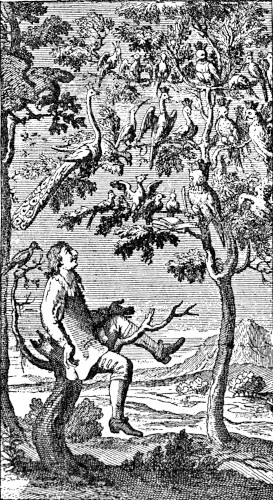
"Gentlemen", cried a swallow in the assembly as soon as I had ceased
speaking, "I hold him convicted. You have not forgotten he said the
country in which he was born was France; but you know that monkeys do
not breed in France; after that, judge if he is what he boasts to be."
I replied to my accuser that I had been taken from the bosom of my
parents and transported to France when I was so young that I had a
perfect right to call that my native country to which my earliest
memories were attached. Although this reason was specious, it was
insufficient. But the greater part of them, charmed to hear that I was
not a man, were very glad to believe it; for those who had never seen
one could not but persuade themselves that a man was something much
more horrible than I appeared to be, while the most sensible of them
added that a man was something so abominable it was useful to believe
he was only an imaginary being.[65]
The whole assembly clapped their wings with joy and I was immediately
handed over to the Syndics for examination, with orders to produce me
next day and to make a report to the committee at the opening of the
Chambers. They took charge of me then and carried me off to a retired
wood. While they kept me there they did nothing but gesticulate about
me with a hundred different kinds of somersaults and walk about in
processions with nutshells on their heads. Sometimes they clapped
their feet together, sometimes they dug little ditches and filled them
up again; and all this time I was surprised not to see anyone else.
The day and the night were passed in these trifles until the prescribed
hour arrived next day; I was carried back at once to appear before
my judges and, when the Syndics were bidden to speak the truth, they
replied that upon their consciences they felt themselves bound to
inform the court I was assuredly not a monkey as I boasted.
"For", they said, "we leaped, walked, pirouetted and invented a hundred
tricks in his presence, whereby we meant to urge him to do the same,
according to the habit of monkeys. Now, even when brought up by men, a
monkey is always a monkey, and if he had been one we maintain it would
not have been in his power to forbear imitating our monkey-tricks. That
is our report, gentlemen."
The judges drew together to hear each other's opinion; but it was
noticed that the sky was cloudy and seemed charged with rain; and this
made them postpone the sitting. I imagined that this had happened on
account of the appearance of bad weather, when the solicitor-general
came to tell me by order of the court that I should not receive
sentence that day; that they never end a criminal prosecution when the
sky is not clear, because they fear lest the bad temperature of the
air might influence the good constitution of the judges' minds; lest
that ill humour which comes over birds during rain should be discharged
upon the case; or lest the court should visit its depression upon the
prisoner. And so my sentence was put off until finer weather. I was
taken back to prison and I remember that my charitable magpie did not
abandon me on the way; it flew continually beside me and I think it
would not have left me if its companions had not approached us.
At last I arrived at my prison, where during my captivity I had nothing
to eat but the "king's bread"[66]; by this they meant fifty worms and
as many cheese-worms,[67] which they brought me to eat every seven
hours.
I thought I should be brought up again the next day and everyone
thought so too; but after five or six days one of my guards told me
the whole of the time had been taken up by the plea of a community of
goldfinches, who demanded justice against one of their companions. I
asked my guard of what crime this wretch was accused.
"Of the most enormous crime", replied the guard, "by which a bird can
be blackened. He is accused.... Can you believe it? He is accused....
But, good Gods! When I only think of it, the feathers stand up on my
head. He is accused of not having merited a friend for the last six
years; so they have condemned him to be a king, and king of a people of
another species. If his subjects had been of his kind, he might have
dipped into their pleasures, at least with his eyes and his desire;
but since the pleasures of one species have no relation at all to the
pleasures of another species, he will undergo all the fatigues and will
drink all the bitterness of royalty, without being able to taste any of
its compensations. He was sent off this morning surrounded by a number
of doctors, who have to watch that he does not poison himself on the
journey."
Although my guard was naturally a great talker, he dared not converse
with me alone any longer for fear he should be suspected of a compact
with me.
At the end of about a week I was again brought before my judges. I
was placed upon the fork of a small leafless tree. The learned birds,
solicitors, counsel and judges, were perched in rows according to their
rank on the summit of a large cedar. The others, who were only present
at the assembly from curiosity, were placed pell-mell so that all the
seats were filled, that is to say, so that the cedar branches were
covered with birds' feet.
The magpie, who, as I had noticed, had always been filled with
compassion for me, came and perched on my tree, where it feigned to
amuse itself by pecking the moss.
"It is impossible for you to know", it said, "how much your misfortune
moves me; for although I am not ignorant that a man among living
beings is a pest of which every civilized state ought to purge itself,
yet when I remember I was brought up by them from the cradle, that I
learned their language so perfectly I almost forgot my own, and that
I ate such excellent soft cheeses from their hands, I cannot think
of it without water coming into my eyes and mouth; I feel for you a
tenderness which prevents me from inclining towards the juster party."
It had finished speaking when we were interrupted by the arrival of
an eagle, which came and perched on the boughs of a tree near mine. I
should have risen to get on my knees before it, thinking it was the
king, if my magpie had not kept me in my former position with its foot.
"Do you suppose", it said, "that this large eagle is our sovereign?
That is a supposition of men who, because they allow themselves to
be commanded by the largest, strongest and most cruel of their
companions, and judge all things from themselves, foolishly imagine
that the eagle must command us. But our policy is very different. We
choose only the weakest, the gentlest and the most peaceful for our
kings; moreover, we change them every six months and we choose them
weak so that the humblest individual they have wronged may be avenged
upon them. We choose them gentle so that they may neither hate nor be
hated by anybody. And we desire them to be of a peaceful temper in
order to avoid war, the channel of all injustices.
"Every week a parliament is held, where anyone may complain of him.
If there are only three birds dissatisfied with his government he
is dethroned and they proceed to a new election. During the day the
parliament is held, our king is placed on the top of a tall yew on the
edge of a pond, with his feet and wings bound. All the birds one after
another pass in front of him, and if any one of them knows he deserves
the last punishment, it may cast him into the water; but it must at
once justify itself for what it has done, otherwise it is condemned to
a sad death."
I could not forbear interrupting him to ask what he meant by a sad
death; and this is what he replied:
"When a bird is judged culpable of a crime so enormous that death is
too small an expiation, they try to choose a death which contains the
pain of several; and they proceed as follows: those among us whose
voices are the most melancholy and the most funereal are attached to
the guilty person, who is carried to a sad cypress. There these sad
musicians gather around him and fill his soul through his ears with
such lugubrious and tragical songs that the bitterness of his grief
disorders the economy of his organs and so presses upon his heart that
he pines visibly and dies suffocated with sadness. However, such a
spectacle never happens; for since our kings are very gentle they never
provide anyone with the opportunity of desiring to risk so cruel a
death for the sake of vengeance. The reigning monarch at present is a
dove, whose temper is so peaceful that the other day when two sparrows
had to be reconciled there was all the difficulty in the world to make
him understand what enmity is."
My magpie could not continue so lengthy a discourse without being
noticed by several of those present; and since it was already suspected
of some understanding with me, the chiefs of the assembly sent an eagle
of the guard to arrest him. King Dove arrived at this moment; everyone
was silent and the first thing which broke this silence was the plea
of the chief censor of the birds against the magpie. The King, fully
informed of the scandal it had caused, asked its name and how it knew
me.
"Sire", it replied in astonishment, "I am called Margot; there are many
birds of quality here who will answer for me. One day in the world
of the Earth of which I am a native I learned from Coughing-Chirper
there (who, hearing me calling in my cage, came to visit me at the
window where I was hung) that my father was Short-Tail and my mother
Crack-Nuts. I should not have known it but for him; for I had been
taken from beneath my parent's wing when I was in the cradle, very
young. Some time after my mother died of grief and my father, now too
old to beget other children and in despair at finding himself without
an heir, went off to the Jays' war, where he was killed by a beak-wound
in the brain. Those who seized me were certain savage animals called
swine-herds, who took me to a castle to sell, and there I saw this man
whom you are now prosecuting. I do not know if he conceived good-will
for me, but he took the trouble to order the servants to cut up food
for me. Sometimes he had the kindness to bring me the food himself. If
in the winter I was perishing with cold he carried me near the fire
and lined my cage or bade the gardener warm me inside his shirt. The
servants dared not tease me in his presence and I remember one day he
saved me from the cat that had me in its claws, to which I had been
exposed by my lady's little lackey. But it will not be inopportune
to acquaint you with the cause of that barbarity. To please Verdelet
(that was the little lackey's name) I was repeating one day the foolish
things he had taught me. It unfortunately happened, although I always
repeated my quirks in the same order, that just as he came in to
deliver a false message I said: 'Silence, whoreson, you have lied.' The
accused man here, knowing the rogue's lying disposition, imagined that
I might have spoken prophetically and sent to the place to inquire if
Verdelet had been there. Verdelet was convicted of deceit, Verdelet was
whipped, and to avenge himself Verdelet would have had me eaten by the
cat had it not been for this man."
The King, bowing his head, showed that he was pleased with the pity it
had had for my misfortunes, but yet forbade it to speak to me again
in secret. He then asked counsel if he were ready with his plea, who
made a sign with his foot that he was about to speak; and here are the
points upon which he insisted against me.
Pleading made in the Parliament of Birds, the Chambers Assembled,
Against an Animal accused of being a Man.
Gentlemen,
The complainant against this criminal is Guillemette the Plump, a
partridge by birth, newly arrived from the world of the Earth with
its throat still open from a lead bullet shot at it by men, a suitor
against the human race, and, consequently, against an animal whom I
claim to be a member of that great body. It would not be difficult for
us to prevent the violence he might do by killing him. However, since
the safety or the loss of every living thing concerns the republic of
the living, it seems to me we should deserve to be born men, that is to
say degraded from the reason and the immortality we possess above them,
if we resembled them in any of their injustices. Let us then examine,
gentlemen, the difficulties of this case with all the keenness of which
our divine minds are capable.
The main point of the case consists in discovering whether this animal
is a man; and then, if we declare he is, whether he deserves death on
that account.
For my part, I make no difficulty in declaring he is: first, from a
feeling of horror which we all felt ourselves seized with at his sight
without being able to declare the reasons; secondly, because he laughs
like a madman; thirdly, because he weeps like a fool; fourthly, because
he blows his nose like a vagabond; fifthly, because he is plucked of
feathers like one that is mangy; sixthly, because he carries his tail
in front; seventhly, because he has always a quantity of little square
stones in his mouth and has not the wit to spit them out or to swallow
them; and eighthly, and lastly, because every morning he lifts up his
eyes, his nose and his large beak, sticks together his open hands with
their flat parts together pointing to the sky and makes of them one
attachment as if he were tired of having two free ones, breaks his
legs in the middle so that he falls on his shanks, and then hums magic
words, after which I have noticed his broken legs join up and he rises
as gay as he was before. You know, gentlemen, that of all animals man
alone has a soul sufficiently black to give himself up to magic and,
consequently, he must be a man. We must now examine whether he deserves
death for being a man.
I think, gentlemen, that it has never been doubted that all creatures
were produced by our common Mother to live together sociably. Then
if I prove that man seems only to have been born to disturb this,
shall I not prove that by going contrary to the end for which he was
created he deserves that Nature should repent of her work? The first
and fundamental law for the maintenance of a republic is equality;
but man could not endure this eternally; he rushes upon us to devour
us, he convinces himself that we were only made for his use. As an
argument of his pretended superiority he cites the barbarity with which
he massacres us and the little resistance he finds in overcoming our
weakness, and yet he will not admit as his masters the eagles, condors,
and griffins, by whom the strongest of them are overcome. But why
should this size and position of limbs mark a diversity of species,
since even among them dwarfs and giants are found?
Moreover this empire on which they flatter themselves is an imaginary
right. On the contrary they are so inclined to servitude that for
fear of failing to serve, they sell their liberty to each other. Thus
the young are slaves of the old, the poor of the rich, the peasants
of the gentlemen, princes of monarchs, and even monarchs of the laws
they have established. But with all this the poor serfs are so afraid
of lacking masters that, as if they feared that liberty should come
to them from some unexpected quarter, they make themselves Gods
everywhere, in the water, in air, in fire, under the earth. They would
rather make them of wood than lack them; and I even think they caress
themselves with false hopes of immortality not so much because they
are terrified by the horror of annihilation as because of the fear
they have of not being commanded after death. This is the wonderful
effect of that fantastic monarchy and natural empire of man over the
animals and ourselves; for his insolence reaches even to that point.
Nevertheless, as a consequence of this ridiculous chieftainship, he
pleasantly arrogates to himself the right of life and death over us;
he lies in ambush for us, he binds us, he throws us into prison, he
cuts our throats, he eats us; and the power to kill those of us who
remain free is made a privilege of the Nobility; he thinks the Sun was
lighted to enable him to make war upon us; he thinks Nature allows us
to make excursions through the sky simply for him to draw favourable or
unfavourable auspices from our flight, and that when God put entrails
into our bodies His only purpose was to make a book from which man
might learn the science of future things.
Is not this pride utterly insupportable? Could one who entertained such
a conception deserve a punishment less than that of being born a man?
Yet it is not on this account that I urge you to condemn this man;
since the poor beast has not the use of reason like ourselves, I excuse
his errors in so far as they are produced by lack of understanding;
but I ask justice on account of those which are daughters of his will.
As, for example, that he kills us without being attacked by us; that
he eats us when he might satisfy his hunger with more suitable food;
and, which I consider the most cowardly of all, that he debauches the
natural disposition of hawks, falcons and vultures, by teaching them to
massacre their kind, to feed upon their like or to deliver us into his
hands.
This consideration alone is so heinous that I ask the court to condemn
him to extermination by a sad death.[68]
The whole Bar shivered with horror at the idea of so great a torture;
and, with the purpose of moderating it, the King made a sign to my
counsel to reply. It was a starling, a great jurisconsult, who,
striking his foot thrice upon the branch which supported him, spoke to
the assembly as follows:
"It is true, gentlemen, that moved by pity I undertook the case of this
wretched beast; but, at the moment of pleading, remorse of conscience
has come to me and a kind of secret voice forbidding me to undertake
so detestable an action. Thus, gentlemen, I declare to you and to the
court that for the sake of my soul's salvation I will not contribute in
any fashion towards the duration of such a monster as man."
The whole populace clapped their beaks as a sign of rejoicing and to
congratulate the sincerity of so worthy a bird.
My magpie presented itself to plead in his place, but silence was
imposed upon it because, since it had been brought up by men and was
perhaps infected by their morals, there was some fear it would approach
my case with a prejudiced mind; for the Court of Birds will not hear an
advocate who is more interested on behalf of one client than another,
unless he can show that this preference comes from the party's right.
When my judges saw that nobody came forward to defend me they stretched
out their wings, shook them and flew immediately to consultation.
I learned afterwards that the greater part insisted strongly that I
should be exterminated by a sad death; but yet, when they perceived the
King inclined to milder measures, they revised their opinions; thus
my judges moderated themselves and instead of a sad death, which they
remitted, they thought meet to fit my punishment to one of my crimes.
To annihilate me by a punishment which would serve to undeceive me by
challenging the pretended empire of men over birds, they ordered that I
should be given up to the anger of the weakest among them; which meant
that they condemned me to be eaten by flies.
At that moment the assembly rose and I heard a murmur go round that the
circumstances of my suffering had not been gone into in detail, because
of an accident to a bird of the party, which had fallen in a swoon just
as it was about to speak to the King. They thought this had happened
from the horror caused it by looking too fixedly at a man; and so the
order was given for me to be taken away.
Sentence was pronounced upon me; and as soon as the osprey who filled
the office of clerk of the court had finished reading it to me, I
perceived the sky about me black with flies, humble-bees, midges,
gnats, and fleas, buzzing with impatience. I expected to be carried off
by my eagles as before, but in their place I saw a great black ostrich,
which set me shamefully astride its back; for with them this position
is the most ignominious in which a criminal can be placed, and whatever
offence a bird has committed it cannot be condemned to this.
The archers who took me to execution consisted of fifty condors and as
many griffins; before and behind them flew very slowly a procession of
ravens croaking something lugubriously and I thought I heard in the
distance responses from screech-owls.
When we left the place where judgment had been pronounced upon me, two
birds of paradise who had been ordered to be present at my death came
and perched on my shoulders. Although my soul was greatly troubled by
horror at the step I was about to take, I yet remember almost all the
reasonings by which they tried to console me.
"Death", said they, with their beaks in my ear, "is certainly not a
great evil, because our good mother Nature subjects all her children to
it; and it cannot be an affair of great consequence, because it happens
at any moment and from so small a cause; for if life were so excellent
it would not be in our power to withhold it from offspring; or if death
brought with it consequences so important as you persuade yourself, it
would not be in our power to give it: on the contrary, there is every
probability that since every animal begins in play, it ends similarly.
I speak to you in this way because, since your soul is not immortal
like ours, you may well suppose when you die that everything dies with
you. Do not be troubled then at undergoing what some of your companions
will undergo later. Their condition is more deplorable than yours; for
if death is an evil, it is only an evil to those who are condemned to
die; compared with you, who have only an hour between here and there,
they will be fifty or sixty years a-dying. Then, you know, he who is
not yet born is not unhappy. Well, you are about to resemble him who
is not yet born; a twinkling of an eye after life, you will be what
you were a twinkling of an eye before; and immediately after that
twinkling of an eye you will be dead as long as he who died a thousand
centuries ago. But in any case, granted that life is a good, the same
chance which in the infinity of time made you what you are may some day
cause you to exist again. May not that matter, which by constant mixing
finally reached that number, that disposition and that order necessary
to the construction of your being, once more by remixing reach the
state required to cause you to feel again? Yes, but, you will say,
I do not remember to have existed. Why! my dear brother, what do you
care so long as you are conscious of existing? And then may it not be
that to console you for the loss of your life you will imagine the same
reasons which I now put before you?
"These are considerations sufficiently strong to oblige you to drink
this bitter cup with patience; but I have others still more urgent,
which doubtless will bring you to desire it. My dear brother, you must
convince yourself that, since you and other brutes are material, and
since death instead of annihilating matter simply alters its economy
you must, I say, believe with certainty that when you cease to be what
you were you will begin to be something else. Suppose you become a clod
of earth or a stone, well, you will be something less wicked than man.
But I have a secret to discover to you, which I should not like any
of your companions to hear from my mouth; and that is, when you are
eaten, as you will be, by our little birds, you will pass into their
substance: yes, you will have the honour of contributing (even though
blindly) to the intellectual operations of flies, and though you do not
reason yourself, you will at least share in the glory of making them
reason."
At about this point of their exhortation we reached the place fixed
upon for my execution.
There were four trees very close to each other and about the same
distance apart, on each of which at the same height was perched a
large heron. I was taken down from the black ostrich and a number of
cormorants carried me to the place where the four herons were waiting
for me. These birds, firmly seated each on its tree opposite each
other, wound their prodigiously long necks about my legs and arms as
though they were ropes, and bound me so tightly that although each of
my limbs was only tied by the neck of one bird I had not the power to
move it at all.
They were to remain a long time in this position; for I heard orders
given to the cormorants who had lifted me to catch fish for the herons
and to slide their food into their beaks. They were still waiting for
the flies, because they cleft the air with a flight less rapid than
ours; nevertheless we were never out of hearing of them. The first
thing they undertook was to apportion my body, and this arrangement
was made so cunningly that they assigned my eyes to the bees, so
that I should have them stung out as they ate them; my ears to the
humble-bees, so that I should have them deafened and devoured at the
same time; and my shoulders to the fleas, in order that I should
have them pierced by itching bites; and so on for the rest. Scarcely
had I heard these orders arranged, when suddenly I saw the insects
approaching. It seemed as if all the atoms of which the air is composed
had been changed into flies; for only two or three weak rays of light
reached me, and these appeared to slip through to get at me, so closely
were these battalions drawn up and so near my flesh were they.
But just as each one of them was choosing the place it desired to bite
me, I saw them suddenly retreat; and among the confusion of a vast
number of shouts, which re-echoed to the clouds, I several times made
out the words: Pardon, pardon, pardon.
Two turtle-doves then came up to me. At their arrival all the dismal
apparatus of my death disappeared; I felt my herons loose the circles
of the long necks which bound me; and my body, stretched out like a
Saint Andrew's cross, slipped from the top of the four trees to the
foot of their roots. I expected from this fall to be shattered on
the ground against a rock; but at the height of my terror I was very
surprised to find myself seated on a white ostrich, which set off at a
gallop as soon as it felt me on its back.
I was taken by a road different from that by which I had come; for
I remember passing through a large wood of myrtles and another of
terebinth trees leading to a huge forest of olive trees, where King
Dove was awaiting me in the midst of all his court.
As soon as he saw me, he signed for me to be helped down. Immediately
two eagles of the guard extended their feet and carried me to the
Prince. I respectfully attempted to embrace and to kiss his Majesty's
little spurs, but he evaded me.
"I ask you", said he, "whether you know this bird."
At these words they showed me a parrot, which began to strut and flap
its wings, when it perceived I was looking at it.
"It seems to me", I exclaimed to the King, "that I have seen it
somewhere, but I am so confused by fear and joy that I cannot yet tell
precisely where it was."
At these words the parrot came to me, embraced my face with its two
wings and said:
"What! You do not recognise Cæsar, your cousin's parrot, on whose
account you have so often maintained that birds reason? Just now,
during your trial, it was I who tried to declare after the session what
obligations I have to you, but the pain of seeing you in so great a
peril made me fall into a swoon."
His speech completed the unsealing of my sight. Having recognised him I
embraced and kissed him; he embraced and kissed me.
"'Tis you, then, my poor Cæsar", said I, "whose cage I opened to
return you the liberty taken from you by the tyrannical custom of our
world?"
The King interrupted our caresses and spoke to me to this effect:
"Man, with us a good action is never lost; for this reason, although
as a man you deserve to die simply because you were born, the Senate
pardons you your life. This act of recognition may well accompany that
intelligence with which Nature enlightened your instinct, when she
made you suspect in us that faculty of reasoning you were incapable of
comprehending. Go then in peace and live happily."
He whispered some orders and my white ostrich, led by the two
turtle-doves, carried me away from the assembly. After galloping me
for about half a day, the ostrich left me near a forest, into which I
plunged as soon as it had gone. There I began to taste the pleasure
of liberty and of eating the honey which flowed down the bark of the
trees. If my body could have resisted the exertion I think I should
never have finished my walk, for the agreeable diversity of the place
made me continually discover something more beautiful; but when at
last I found myself worn out with fatigue I sank down upon the grass.
Stretched out thus under the shadow of the trees I felt invited to
sleep by the soft coolness and the silence of solitude, when an
indistinct noise of confused voices, which I seemed to hear fluttering
about me, woke me with a start.
The ground appeared very flat and did not bristle with any bush to
interrupt the sight, and mine therefore ranged far afield among the
forest trees; yet the murmur which reached my ear could only have come
from close beside me. Listening more intently, I distinctly heard a
sequence of Greek words, and among the conversation of a number of
people I heard one expressing himself as follows:
"Doctor, one of my relatives, the three-headed Elm, informs me by a
Finch, which he sends me, that he is sick of a hectic fever and of a
moss disease, which covers him from head to foot. I beseech you, by
your friendship for me, to prescribe something for him."
I remained a little time without hearing anything, but after a short
space it seemed to me I heard this reply:
"Even if the three-headed Elm were not your relative, and even if this
request were made me by the most outlandish of our species, instead of
by you, who are my friend, my profession would nevertheless oblige me
to help him. Tell the three-headed Elm that to cure his illness he must
suck up as much damp and as little dry as possible; for this purpose he
must send the small threads of his roots towards the wettest parts of
his soil, converse only of cheerful matters, and every day listen to
the music of a few excellent Nightingales. He will then let you know
how he feels after this regime; and then, according to the development
of his illness, when we have prepared his humours, some Stork among my
friends will give him a clyster, which will set him fairly on the road
to convalescence."
After these words I did not hear the least sound, but a quarter of an
hour later a voice, which I think I had not before noticed, reached my
ear; this is what it said:
"Are you asleep, forked tree?"
I heard another voice reply thus: "No, fresh bark, why?"
"Because", replied the voice which had first broken the silence, "I
feel disturbed in the manner we are accustomed to be when those animals
called Men approach us and I should like to ask if you feel the same
thing."
Some time passed before the other replied, as if he were concentrating
his most secret senses upon this investigation. Then he exclaimed: "By
heaven! you are right, and I swear my organs are so filled with the
presence of a man that I am very much deceived if there is not one very
close at hand."
Several voices then exclaimed together that assuredly they perceived a
man. However much I gazed about me on all sides I could not discover
whence this speech came. At last, when I had a little recovered from
the horror into which this event had cast me, I replied to that voice,
which I thought I had noticed asking if there were a man there, that
there was one.
"But I beg you", I went on immediately, "whoever you are speaking to
me, to tell me where you are."
A moment after I heard these words: "We are in your presence, your
eyes behold us and you do not see us! Behold the oaks upon which we
feel your sight is resting, it is we who speak to you, and if you are
surprised that we should speak a language used in the world whence
you come, know that our first fathers were born there; they dwelt
in Epirus in the forest of Dodona,[69] where their natural kindness
caused them to render oracles to those who consulted them in trouble.
For this purpose they learned the Greek language, at that time the
most universal, in order to be understood; and because we descend
from them, from father to son, the gift of prophecy has come down to
us. Well, you must know that a large eagle who was sheltered by our
fathers in Dodona could not go hunting because it had broken one of
its hands and therefore fed upon the acorns furnished it by their
branches, when, one day, tired of living in a world where it suffered,
it took flight towards the Sun and continued its voyage so happily that
at last it reached the luminous globe where we are now; but the heat
of the climate on its arrival made it vomit; it threw up a number of
undigested acorns; these acorns germinated and from them grew the oaks
which were our ancestors.
"In this way we changed our dwelling-place. But although you hear us
speak a human language, it does not mean that other trees express
themselves in the same way; only those oaks issued from the forest of
Dodona speak as you do. As to other plants, this is how they express
themselves: have you never noticed that fine gentle breeze which never
fails to breathe on the outskirts of woods? That is the breath of their
speech, and the little murmur or the delicate noise by which they break
the silence of their solitude is actually their language. But although
the sound of forests always seems the same, it is really so different
that every kind of plant has its own; the birch does not speak like the
maple, nor the beech like the cherry-tree. If the silly people of your
world heard me as I am now speaking, they would think there was a devil
imprisoned under my bark; for, far from believing that we can reason,
they do not even suppose that we have a sentient soul, although every
day they see that at the first blow given a tree by the wood-cutter
the wedge enters four times deeper into the flesh than at the second
blow; from which they ought to conjecture that the first blow assuredly
surprised the tree and struck it unexpectedly, then that, immediately
it was warned by the pain, it collected itself, united its forces to
resist and became as it were petrified to combat the hardness of its
enemy's weapon. But my intention is not to make the blind understand
light; to me an individual is the whole race and the whole race is but
an individual when that individual is not infected by the errors of the
race; be attentive therefore, since when I speak to you I imagine I am
speaking to the whole human race.
"In the first place you must know that almost all the concerts at
which the birds make music are composed in praise of trees; moreover,
to repay the care they take in celebrating our worthy actions, we are
careful to hide their loves; for you must not imagine when you find
so much difficulty in discovering one of their nests that this is
the result of the prudence with which they have hidden it; it is the
tree itself which folds its boughs all around the nest to protect its
guest's family from the cruelties of man. To prove that this is so,
observe the nests of those which are either born for the destruction of
the birds, their fellow-citizens, like sparrow-hawks, hobbies, merlins,
falcons, or of those which only speak to quarrel like jays and magpies,
or of those which delight to terrify us, like owls and night-jars; you
will notice that their nests are exposed to everybody's sight,[70]
because the tree holds its branches away from them in order that they
may be taken.
"But it is unnecessary to mention so many details to prove that trees
exercise all your functions both of the body and of the soul. Is there
any one among you who has not noticed in the spring, when the Sun has
delighted our bark with fertile sap, that we lengthen our boughs and
spread them out, covered with fruit, on the breast of the earth whereof
we are amorous? The earth, on its side, opens and is warmed with the
same ardour; and as if each of our boughs were a male organ she draws
near to join with them; and our boughs transported with pleasure
discharge into her lap the seed with which she burns to conceive. She
is nine months in forming this embryo before she brings it forth; but
the tree, her husband, fearing the winter cold may harm her pregnancy,
casts off his green robe to cover her, while to hide a little of his
own nudity he is content with an old cloak of dead leaves.
"Well, you men eternally see these things and never perceive them;
still more convincing things pass before your eyes and your stupidity
is not even disturbed."
My attention was closely directed to the speech I heard from this
arboreal voice and I was awaiting the remainder when it suddenly ceased
speaking in a tone similar to that of a person who is prevented from
speaking by short breath.
When I found it altogether obstinate in its silence I conjured it by
everything I thought might move it to deign to instruct a person who
had risked the perils of so great a voyage only for the purpose of
learning. At the same time I heard two or three voices making the same
supplication for love of me and then I distinguished one, saying to it
as if it had been annoyed:
"Well, since you complain so much of your lungs, take a rest, and I
will tell him the 'Story of the Lover-Trees'."
"Oh you, whoever you may be", cried I, throwing myself upon my knees,
"the wisest of all the oaks of Dodona, who deign to take the trouble
to instruct me, know that your lesson is not wasted upon one who is
ungrateful; if ever I return to my native globe I make a vow that I
will publish the marvels which you do me the honour to let me witness."
As I finished this protestation I heard the same voice continue thus:
"Little man, look twelve or fifteen paces to your right hand, you will
see two twin trees of moderate height intertwining their branches and
their roots and trying in a thousand ways to make themselves one."
I turned my eyes towards these love-plants and I noticed that the
leaves of both were lightly agitated by a half-voluntary emotion, while
their rustling created a murmur so delicate that it scarcely reached
the ear; and yet one would have said that by this means they were
trying to question and answer each other.
When the time necessary for me to notice this double plant had passed,
my good friend the oak took up the thread of his discourse thus:
"You cannot have lived so long without the famous friendship of Pylades
and Orestes coming to your knowledge?
"I would describe to you all the joys of a gentle passion and I would
relate to you all the miracles with which these lovers have astonished
their age, did I not fear that so much light would dazzle the eyes of
your reason, and therefore I will only paint these two young Suns in
their eclipse.
"It will suffice you then to know that one day in battle the brave
Orestes sought his dear Pylades, to taste the pleasure of conquering
or dying in his presence. When he perceived him in the midst of a
hundred arms of iron lifted above his head, alas! what did he become?
He rushed despairingly through a forest of pikes, he shouted, he
howled, he foamed; but how badly I express the horror of his movements
in his despair! He pulled out his hair, he gnawed his hands, he tore
his wounds; and at the end of this description I am obliged to say that
the means of expressing his grief died with him. When he thought to cut
a path with his sword to rescue Pylades, a mountain of men opposed his
passage. Yet he cut through them; and after trampling long over the
bloody trophies of his victory, little by little he approached Pylades;
but Pylades seemed to him so near death that he scarcely dared ward
off his enemies any more for fear of surviving the thing for which he
lived: to see his eyes filled already with the shadows of death one
would even have said he tried to poison the murderers of his friend
with his looks. At last Pylades fell lifeless; and the amorous Orestes,
feeling his own life ready to leave his lips, yet retained it until his
wandering sight sought and found Pylades among the dead, when, kissing
his mouth, he seemed as if he would throw his soul into his friend's
body.[71]
"The younger of these heroes died of grief on the body of his friend;
and you must know that from their rotting flesh (which doubtless
had fertilised the earth) there sprang up among the whitening bones
of their skeletons two young saplings, whose trunks and branches
mingled together and seemed to hasten their growth only to twine
more closely together. It was apparent they had changed their being
without forgetting what they had been; for their perfumed buds leaned
one upon the other and warmed each other with their breath as if
to make them open more quickly. But what shall I say of the loving
portioning maintained by their fraternity? Never was the juice in
which nourishment resides offered to their stock but that they shared
it with ceremony. Never was one of them ill-nourished but that the
other was sick with weariness; both drew from the breasts of their
nurse within as you suckle them from without. Finally these happy
lovers produced apples, and such miraculous apples that they performed
even more miracles than their Fathers. Those who ate the apples of one
tree immediately became passionately in love with anyone who had eaten
the fruit of the other. And this happened almost every day, because the
shoots of Pylades surrounded, or were surrounded by, those of Orestes,
and their almost twin fruits could not resolve to part from each other.
"Nature, however, had differentiated the energy of their double essence
so carefully that when the fruit of one of the trees was eaten by a
man and the fruit of the other tree by another man, this caused a
reciprocal friendship and when the same thing happened to two persons
of different sex it caused love, but a vigorous love which retained the
character of its cause; for although this fruit proportioned its effect
to the eater's capacity, softening its virtue in a woman, it still
preserved something masculine.
"It must also be noticed that he who ate more of the fruit was the more
beloved. This fruit failed not to be very sweet and very beautiful,
since nothing is so beautiful and so sweet as friendship; and these two
qualities of beauty and goodness which are never met with in one person
caused them to be in such repute. How many times have its miraculous
virtues multiplied the copies of Orestes and Pylades! Since that time
have been seen Hercules and Theseus, Achilles and Patroclus, Nisus and
Euryalus; in short, an innumerable number, who by more than human
friendships have consecrated their memory in the temple of eternity.
Cuttings were taken to Peloponnesus and the drill-ground, where the
Thebans trained their youth, was ornamented with them. These twin trees
were planted in lines and at that season of the year when the fruit
hangs upon the boughs, the young men, who went to the park every day,
were tempted by the beauty of the fruit and did not abstain from eating
it: usually their courage felt the effect at once. They were seen to
exchange souls pell-mell; each of them became the half of the other,
lived less in himself than in his friend, while the most cowardly would
attempt dangerous things for his friend's sake.
"This heavenly malady warmed their blood with so noble an ardour that
by the advice of the wisest men this band of lovers was enrolled for
war in the same company. Since that time, on account of the noble deeds
they performed, they have been called the Sacred Band.[72] Its exploits
went far beyond anything Thebes had imagined; for in battle each of
these brave men dared such incredible efforts to protect his lover or
to deserve his love that Antiquity saw nothing like it; and as long as
that company of lovers existed, the Thebans, who before that time were
considered the worst soldiers of all Greece, fought and always overcame
the most warlike peoples of the earth, from even the Lacedemonians
downwards.
"But among an infinite number of praiseworthy actions produced by these
apples they innocently caused some which were very shameful.
"Myrrha,[73] a young lady of quality, ate of them with Cinyrus, her
father; unhappily one ate of Pylades and the other of Orestes. Love
immediately swallowed up Nature and confused it to such an extent
that Cinyrus could swear 'I am my son-in-law' and Myrrha 'I am my
stepmother'. In short, I think it sufficient to tell you, in order that
you should understand the whole crime, that at the end of nine months
the father became the grandfather of those he begat and the daughter
brought forth her brothers.
"But chance was not content with this crime alone; it willed that a
bull, having entered the gardens of King Minos, unhappily found some
apples under a tree of Orestes and devoured them; I say unhappily,
because Queen Pasiphaë ate this fruit every day. They became madly in
love with each other. I shall not explain their enormous pleasure;
suffice it to say that Pasiphaë was plunged in a crime which hitherto
had no example.
"The famous sculptor Pygmalion precisely at that time was carving a
marble Venus in the palace. The Queen, who delighted in good workmen,
presented him with a couple of these apples; he ate the finest; and
because he chanced to lack water, which, as you know, is necessary to
the cutting of marble, he moistened his statue with the juice. The
marble penetrated at the same time by this juice, little by little
grew soft; and the energetic virtue of the apple carrying on its
labour according to the workman's plan followed within the image the
features it had met with on the surface, for it dilated, warmed and
coloured in natural proportions the parts it met with in its passage.
Finally the marble became living and touched by the apple's passion
embraced Pygmalion with all the strength of her heart; and Pygmalion,
transported by reciprocal love, received her for his wife.
"In the same Province the youthful Iphis had eaten of this fruit
with the beautiful Ianthë, her companion, in all the circumstances
necessary to cause a reciprocal friendship. Their eating was followed
by the customary effect; but because Iphis found the fruit to be of a
very agreeable taste she ate so many that her friendship, increasing
with the number of apples of which she was insatiable, usurped all
the functions of love and this love by increasing little by little
became more masculine and more vigorous; for her whole body, imbued
with this fruit, burned to form the movements which coincided with the
enthusiasms of its will and moved its matter so powerfully that it
fashioned itself much stronger organs, able to carry out its thought
and to content its love wholly to the most virile extent; that is to
say, Iphis became what is needed to espouse a woman.
"I should call this adventure a miracle if I had any other name to
describe the following event:
"A very accomplished young man called Narcissus had deserved by his
love the affection of a very beautiful girl, whom the poets have
celebrated under the name of Echo. But, as you know, even more than
those of our sex, women are never so beloved as they desire; and she,
having heard the virtues of these apples of Orestes greatly commended,
went about to collect them from several places; and because she was
fearful and her love apprehended the apples of one tree might have less
strength than those of the other, she willed him to taste of both;
but he had scarcely eaten them when Echo's image was effaced from his
memory, all his love turned towards the person who had digested the
fruit, he was the lover and the beloved; for the substance derived
from the apple of Pylades embraced within him that from the apple of
Orestes. This twin fruit, extending through the whole of his blood,
excited all the parts of his body to caress themselves. His heart, into
which flowed their double virtue, darted its flames within; all his
limbs animated by his passion desired to penetrate each other. Even
his image, which burned in the coldness of pools, attracted his body
to join with it; in short, poor Narcissus became madly in love with
himself. I shall not be so tedious as to relate to you his deplorable
catastrophe; past ages have already sufficiently spoken of it and I
have still two adventures to tell you, which will better fill up the
time.
"You must know that the beautiful Salmacis frequented the shepherd
Hermaphrodite, but with no familiarity beyond that authorised by the
vicinity of their homes, when Fortune, who delights to trouble the most
peaceful lives, permitted that Hermaphrodite should win the prize for
running and Salmacis that for beauty in a meeting for games, where the
prizes for beauty and running were two of these apples. They had been
plucked together, but from different boughs, because these amorous
fruits mingle with such cunning that one from Pylades is always met
with beside one from Orestes; and their appearing to be twins was the
cause that they were usually plucked in pairs. The beautiful Salmacis
ate her apple and the gentle Hermaphrodite placed his in his shepherd's
scrip. Salmacis, inspired by the enthusiasms of her apple, and of the
shepherd's apple, which began to grow warm in his scrip, felt attracted
towards him by the sympathetic ebb and flow of her apple with the other.
"The shepherd's parents, perceiving the nymph's desires, tried
to preserve and to increase them, because of the advantages they
perceived in this alliance; and therefore, having heard these twin
apples vaunted as a fruit whose juice inclines the mind to love, they
distilled some of them and found means to cause their son and his
mistress to drink the purest quintessence. They had sublimated its
energy to the highest degree it could attain and thereby lighted in
these lovers' hearts so vehement a desire of joining together that at
first sight Hermaphrodite was absorbed in Salmacis and Salmacis melted
away in the arms of Hermaphrodite. They passed into each other and
they composed from two persons of different sex a double 'something',
which was neither man nor woman. When Hermaphrodite desired to enjoy
Salmacis he found he was the nymph herself; and when Salmacis desired
to be embraced by Hermaphrodite she felt she was the shepherd. Yet this
double 'something' retained its unity; it begat and conceived without
being either man or woman. In short, Nature here produced a marvel,
which she has never since been able to prevent from being unique.
"Well, are not these astonishing stories? They are; for to see a
daughter lie with her father; a young princess satisfy the desires of
a bull; a man yearn to enjoy a stone; another marry with himself; to
see one celebrate as a girl a marriage she consummates as a boy, cease
to be a man without beginning to be a woman, become double outside the
mother's womb and twin of a person who is no relative; all these are
very distant from the ordinary paths of Nature. And yet what I am about
to tell you will surprise you even more.
"Among the sumptuous diversity of all sorts of fruits brought from
the most distant climates for the wedding banquet of Cambyses,
they presented him with a graft of Orestes, which he inserted in a
plane-tree; and among other delicacies, at dessert they put before him
apples of the same tree.
"The agreeable taste of the fruit led him to eat a great deal of it;
and after the three digestions, which converted the substance of this
fruit into a perfect germ, he formed from it in the queen's womb the
embryo of his son Artaxerxes; for all the details of his life caused
his doctors to conjecture that he must have been produced in this way.
"When this prince's youthful heart was of an age to merit Love's anger
it was noticed that he did not sigh for his own kind; he loved only
trees, orchards and woods; but above all those to which he appeared
tender, the plane-tree on which his father Cambyses had formerly
grafted the shoot of Orestes consumed him with love.
"His temperament followed so scrupulously the plane-tree's progress
that he seemed to grow with the branches of that tree; every day he
went to embrace it; in his sleep he dreamed of nothing else; and he
transacted all his business under the curve of its green tapestry. It
was perceived that the plane-tree, pierced by a reciprocal ardour, was
ravished by his caresses; for suddenly, without any apparent reason,
its leaves were seen to stir and as it were to thrill with joy, the
branches curved down upon his head as if to make him a crown and
descended so near his face that it was easy to perceive this was rather
to kiss him than from a natural tendency to grow downwards. It was even
noticed that the tree jealously ranged and pressed its leaves together
for fear lest the rays of daylight as they glided through should also
kiss him. The king for his part placed no limits to his love. He caused
his bed to be made at the foot of the plane-tree and the plane-tree,
not knowing how to repay such friendship, gave him the most precious
thing trees have—honey and dew—which it distilled every morning upon
him.
"Their caresses would have lasted longer if death, the enemy of all
beautiful things, had not ended them. Artaxerxes expired of love in
the embraces of his dear plane-tree; and all the Persians, afflicted
at the loss of so good a prince, decreed (in order to give him some
satisfaction after death) that his body should be burned with the
branches of this tree, without any other wood being used to consume him.
"When the pyre was lighted its flame was seen to knit with that of the
body's fat and their burning hair curled together and diminished in
pyramid shape until it was out of sight.
"This pure and subtle fire did not divide; but when it reached the Sun,
to which as you know all igneous matter tends, it formed the germ of
the apple-tree of Orestes, which you see there on your right hand.
"Now the seed of this fruit is lost in your world and this misfortune
happened as follows:
"Fathers and mothers, who, as you know, in directing their families,
are governed only by interest, were angry that their children as soon
as they had tasted these apples bestowed on their friend everything
they possessed; and so the parents burned as many of these plants as
they could discover. The extinction of the race is the reason why a
true friend is no longer found.
"As these trees were consumed by fire the rains which fell on them
calcined the ashes, so that the congealed juice petrified in the same
way that the humour of burnt fern is metamorphosed into glass; and thus
in all the countries of the Earth the ashes of these twin trees formed
two metallic stones called to-day the iron and the loadstone, which,
because of the sympathy of the fruits of Pylades and Orestes, whose
virtue they have always preserved, aspire every day to embrace; and
notice that if the piece of loadstone is larger it attracts the iron,
but if the piece of iron exceeds the other in quantity it attracts the
loadstone, as happened of old in the miraculous effect of the apples of
Pylades and Orestes; for whoever had eaten more of one of them was the
more beloved by him who had eaten of the other.
"Well, iron feeds upon the loadstone and the loadstone feeds upon iron
so visibly that the one grows rusty and the other loses its strength
unless they are brought together to repair what is lost of their
substance.
"Have you never observed a piece of loadstone placed on iron filings?
In a flash you see the loadstone covered with these metallic atoms;
and they grip with such amorous ardour so suddenly and so impatiently
that after they have embraced everywhere you would say there is not
a grain of loadstone which does not desire to kiss a grain of iron,
and not a grain of iron which does not wish to unite with a grain of
loadstone; for the iron and the loadstone, when separated, continually
send out from their bulk the most active small bodies in search of
what they love, but when they have found it and have nothing more to
desire, each terminates its travels; the loadstone spends its repose
in the possession of the iron, as the iron collects all its being to
enjoy the loadstone. It is therefore from the sap of these two trees
that the moisture flowed from which these two metals were born. Before
that they were unknown; and if you wish to know from what matter they
manufactured weapons of war—Samson armed himself with the jaw-bone of
an ass against the Philistines; Jupiter, King of Crete, with artificial
fire by means of which he imitated thunder and overcame his enemies;
and Hercules conquered tyrants and tamed monsters with a club. But
these two metals have another much more specific relation to our two
trees. You must know that although this lifeless couple of lovers turn
towards the pole, they never do so except in each other's company; and
I will discover to you the reason of this after I have discoursed to
you a little about the poles.
"The poles are the mouths of the sky by which it takes in the light,
heat and influences it has diffused upon the Earth; otherwise, if all
the treasures of the Sun did not return to their source it would long
ago be extinct (since its light is only a dust of burning atoms shed
from its globe) and would shine no more or else this abundance of small
igneous bodies heaped continually upon the Earth would already have
consumed it. Therefore, as I have said, the sky must have vent-holes
by which the repletions of the Earth are cast out and others by which
the sky can repair its losses, so that the eternal circulation of these
little bodies of life may successively penetrate all the globes of this
great universe. Now the vent-holes of Heaven are the poles by means of
which it feeds upon the souls of everything that dies in its worlds and
all the planets are the mouths and pores by whose means its spirits
are exhaled afresh. And to show you that this is not so novel a fancy,
observe that when your ancient poets, to whom philosophy had discovered
the most hidden secrets of Nature, were speaking of a hero and desired
to say that his soul was gone to dwell with the Gods, they expressed
themselves thus: 'He has risen to the pole; he is seated above the
pole; he has passed the pole:' because they knew that the poles were
the only entrances by which the sky receives all that has left it.
If the authority of these great men does not fully satisfy you, the
experience of those moderns who have travelled towards the north will
perhaps content you. They have found that the nearer they approach the
Bear during the six months of night, when it was thought this country
was entirely black, the horizon was illuminated by a great light, which
could only come from the pole, because the nearer they approached it,
and consequently the farther they drew from the Sun, the larger the
light became. It is therefore very probable that this light proceeds
from rays of daylight and from a great heap of souls which, as you
know, are made of luminous atoms alone, returning to the sky by their
accustomed portals.
"After that it is not difficult to understand why iron rubbed with
loadstone or loadstone rubbed with iron turns towards the pole; for
since they are extracted from the bodies of Pylades and Orestes and
have always preserved the propensities of the two trees, as the two
trees preserved those of the two lovers, they must aspire to rejoin
their soul, and so they strain towards the pole, whither they feel it
has risen, with this proviso, that the iron does not turn unless it
is rubbed by the loadstone nor the loadstone if it is not rubbed by
the iron, because iron will not abandon a world without its friend,
loadstone, nor loadstone without its friend, iron; and they cannot
resolve to make this voyage without each other."
I think the voice was going to begin another discourse; but it was
prevented by the noise of a loud alarm; the whole forest in disturbance
echoed with the words: Beware the plague! and Pass it on!
I begged the tree, which had talked to me so long, to inform me what
was the reason of this great disorder.
"My friend", it said, "in this district we have not yet received
precise details of the misfortune; I can only tell you in three
words that the plague by which we are menaced is what men call a
conflagration; and we may well name it a plague, for among us no
disease is so contagious. The remedy we shall apply to it is to hold
our breath and then to blow all together on the place whence the
conflagration is moving, in order to repulse this dangerous air. I
think this burning fever has been brought to us by a Fire-Beast, which
for some days has been wandering about these woods; for since these
beasts never go without fire and cannot do without it, this one no
doubt has set fire to one of our trees.
"We have sent for the Ice-Animal to come to our aid; but it has not yet
arrived. But now farewell, I have no time to talk to you, I must think
of the common safety; and you yourself should take to flight, otherwise
you run the risk of being involved in our ruin."
I followed its advice, but without hurrying very much, because I knew
my legs. However I was so ignorant of the plan of that country that
at the end of ten hours' walking I found myself behind the forest I
thought I was avoiding; and to increase my apprehension, a hundred
terrible thunder-claps shook my brain, while the pale dismal light of a
thousand flashes of lightning quenched my eye-balls.
From moment to moment they increased with such fury one would have said
the foundations of the world were about to collapse; yet, in spite of
it all, the sky never appeared clearer. I was unable to find reasons
for this and my desire of knowing the cause of so extraordinary an
event urged me to walk towards the place whence the noise seemed to
come.
I walked for about four hundred stadia, at the end of which I
perceived in the middle of a very large field what looked like two
balls which, after moving round each other for a very long time with
a humming noise, came together and then recoiled; and I observed that
the moment of the shock was that when these great noises were heard.
Drawing nearer I perceived that what at a distance had seemed to me to
be two balls were two animals; one of them, although round at the base,
formed a triangle from the middle, and its very high head with red hair
streaming upwards narrowed off in a pyramid shape, while its body was
filled with holes like a sieve and one could see through these hollow
places, which served it as pores, little flames issuing forth which
seemed to cover it with fiery plumage.
Walking round I met a most venerable old man looking at this wonderful
combat with as much curiosity as I. He signed to me to approach; I
obeyed and we sat down beside each other.
I was about to ask him what motive had brought him into this country,
but he closed my mouth with these words:
"Well, you shall know the motive which brought me into this country."
And immediately he related to me at length all the details of his
journey. I leave you to imagine whether or no I was astounded. But my
amazement was increased, for just as I was burning to ask him what
demon revealed my thoughts to him, he exclaimed:
"No, no, 'twas not a demon revealed your thoughts to me."
This new trick of divination caused me to observe him with more
attention than before and I noticed he was imitating my carriage, my
gestures, my appearance, placed all his limbs and disposed all the
features of his face on the pattern of mine; in short, my shadow in
relief would not have represented me better.
"I see", he went on, "you are anxious to know why I imitate you, and I
am glad to tell you. Know then that in order to understand what goes on
inside you, I arrange all the parts of my body in an order similar to
yours; for, by arranging all parts of me like you, I excite in myself
by this disposal of my matter the same thought that is produced in you
by this same disposal of your matter.
"You will conceive this effect to be possible if you have ever before
observed that twins resembling each other have generally similar minds,
passions and wills; to such an extent that two doubles were met with in
Paris who had always undergone the same illnesses and the same health,
had married without knowing the other's intention at the same hour
of the same day, wrote each other letters, whose sense, wording and
construction were the same and who composed the same sort of verses
on the same subject, with the same conceits, the same turn and the
same order. But you must see that if the composition of the organs of
their bodies were similar in all circumstances they could only act in
a similar manner, just as two equal instruments equally struck must
give forth an equal harmony; and so when I model my body on yours and
become, as it were, your twin, the same movement of matter must cause
us both the same movement of the mind."
After this he again settled himself to imitate me and went on thus:
"You are now very anxious to know the origin of the battle of these
two monsters, whereof I will inform you. Learn then that the trees of
the forest behind us were not able to repulse the violent efforts of
the Fire-Beast with their breath and therefore sought the aid of the
Ice-Animal."
"I have only heard these animals spoken of", I said, "by an oak in this
country, but this was in great haste, for it was only thinking of its
safety; and so I beg you will inform me."
He spoke in this way: "In this globe where we are the woods would be
very scattered, on account of the desolation caused them by the large
number of Fire-Beasts, but for the Ice-Animals which every day at the
request of their friends the forests come to heal these sick trees; I
say heal, because as soon as their icy mouth breathes upon the coals of
this plague they are extinguished.
"In the world of the Earth, whence you come and whence I come, the
Fire-Beast is called a Salamander and the Ice-Animal is known by the
name of Remora.[74] Well, you must know that the Remora dwells towards
the extremity of the pole in the deepest part of the frozen sea, and it
is the cold which evaporates from these fishes through their scales,
which in those districts freezes the sea-water, although it is salt.
"The greater part of the pilots who have sailed to discover Greenland
have noticed at one season of the year that the ice which stopped them
at other seasons was no longer to be met with; but although this sea
was free of ice at the time when winter is at its harshest they have
not failed to attribute the cause to the melting of the ice by some
secret warmth; but it is much more likely that the Remoræ, which feed
on nothing but ice, had absorbed them at that time. You must know then
that some months after they are filled this terrible digestion makes
their bellies so cold that the mere breath they exhale freezes the
whole Polar Sea again. When they come out on land (for they live in
both elements) they feed on nothing but hemlock, aconite, opium, and
mandragora.
"In our world people wonder whence come those chilly north winds, which
always bring the frosts with them; but if our compatriots knew, as we
do, that the Remoræ inhabit that climate, they would understand, as
we do, that these winds come from the breath wherewith these fishes
attempt to repulse the heat of the Sun as it approaches them.
"That Stygian water used to poison the great Alexander, whose cold
petrified his entrails, was the piss of one of these animals. In short,
the Remora contains so eminently all the principles of cold that when
it passes under a ship, the ship is gripped by cold and remains so
benumbed it cannot move from where it is. That is the reason why half
of those who have sailed northward to discover the pole never returned,
because it would be a miracle if the Remoræ, whose number is so great
in that sea, did not stop their vessels. So much for the Ice-Animals.
"As to the Fire-Beasts, they dwell in the earth under mountains lighted
by bitumen, such as Ætna, Vesuvius and the Red Cape. The pimples you
see on this one's throat, which proceed from the inflammation of its
liver, are...."[75]
After that we remained without speaking to watch this extraordinary
duel.
The Salamander attacked with great ardour, but the Remora withstood him
impenetrably. Each blow they exchanged caused a clap of thunder, as it
happens in the worlds round about where the meeting of a warm with a
cold cloud excites the same noise.
At every glance of anger cast by the Salamander upon its enemy there
came from its eyes a red light, which seemed to burn the air as it flew
along; the beast sweated boiling oil and pissed acid.
The Remora, on its side, fat, square, and heavy, showed a body all
scaly with icicles. Its large eyes looked like two crystal plates,
whose glances carried with them so benumbing a light that I felt winter
shiver upon every limb of my body it looked at. If I put my hand before
me, it was numbed; the very air about the beast, attacked by its
rigour, grew thick with snow, the earth hardened under its feet; and I
could trace the footprints of the beast by the chilblains which greeted
me when I walked above them.
At the beginning of the fight the Salamander had made the Remora sweat
by the vigorous attack of its first ardour; but at length this sweat
growing cold enamelled the whole plain with so slippery a frost that
the Salamander could not join battle with the Remora without falling.
The philosopher and I could easily see it was tired from falling and
rising up again so often; for the thunder-claps created by the shock
as it struck its enemy, which were before so terrible, were now only
the dull sound of those small rumbles which mark the end of a storm;
and this dull sound, diminishing little by little, degenerated into a
hissing like that of a red-hot iron plunged into cold water.
When the Remora perceived the combat was drawing to an end by the
weakening of the shock which now scarcely shook it, it rose up on one
angle of its cube and let itself fall with the whole of its weight
on the Salamander's belly so successfully that the poor Salamander's
heart, in which all the remainder of its heat was concentrated, made so
horrible a noise in bursting that I know nothing in Nature to compare
with it.
Thus died the Fire-Beast beneath the passive resistance of the
Ice-Animal.[76]
Some time after the Remora had retired we approached the field of
battle and the old man, having covered his hands with the earth on
which it had walked as a preservative against burns, picked up the
Salamander's corpse.
"With this animal's body", said he, "I shall need no fire in my
kitchen; for as long as it is hung on the jack it will roast and boil
everything I put on the hearth. As for the eyes, I shall keep them
carefully; if they were cleansed from the shadows of death you would
take them for two little suns. In our world the ancients knew how to
make use of them; they called them Perpetual Lamps and they were only
hung in the pompous sepulchres of illustrious persons. In excavating
certain of these famous tombs our moderns have met with some of them,
but broke them in their ignorant curiosity by thinking to discover
behind the broken membranes the fire they had seen shining through."
The old man continued to walk and I followed him, listening to the
marvels he told me. Now, as touching the combat, I must not forget the
conversation we had concerning the Ice-Animal:
"I do not think", said he, "that you have ever seen a Remora[77]; for
these fishes never rise to the surface of the water and hardly ever
leave the Northern Ocean. But doubtless you have seen certain animals
which to some extent might be said to be of their species. I told you
a little while ago that the sea about the pole is filled with Remoræ,
who cast their fry on the mud like other fishes. You must know that
this seed, the extract of their whole mass, contains all its cold so
eminently that if a ship sails over it, the vessel contracts one or
several worms which become birds, whose cold blood causes them to be
placed in the order of fishes, although they have wings; and therefore
the Holy Father, who knows their origin, does not forbid them to be
eaten in Lent. They are what you call barnacle-geese."[78]
I continued walking with no other purpose than that of following him,
so delighted at having found a man that I dared not take my eyes from
him, I was so afraid of losing him.
"Young mortal", said he, "(for I see you have not yet, like me,
paid that tribute we all owe to Nature), as soon as I saw you I
recognised in your face something which makes one anxious to pursue
the acquaintance. If I am not mistaken, from the circumstances of your
body's conformation you must be French, and a native of Paris. That
town is the place where I ended my misfortunes after having carried
them through all Europe.
"I am called Campanella and I am a Calabrian by birth. Since I came
to the Sun I have spent my time in visiting the countries of this
great globe to discover their wonders. It is divided into kingdoms,
republics, states and principalities, like the Earth. Thus the
quadrupeds, the birds, the plants, the stones, all have their own
states; and although some of them do not allow animals of a different
species to enter, particularly men, whom, above all, the birds hate
with a deadly hatred, I can travel everywhere without running any
risk, because a philosopher's soul is composed of particles much finer
than the instruments they would use to torment him. Happily I was in
the province of the trees when the Salamander's disturbances began;
those great thunder-claps, you must have heard as well as I, guided me
to their battlefield, where you arrived a moment afterwards. For the
rest, I am returning to the province of philosophers...."
"What", said I, "are there philosophers in the Sun, too?"
"There are, indeed", replied the good man, "yes, they are the principal
inhabitants of the Sun and the very same who so fill the mouth of fame
in your world. You may soon converse with them, if you have the courage
to follow me; for I hope to set foot in their town before three days
have passed. I do not suppose you can conceive in what manner these
great geniuses were transported here?"
"No, indeed", I exclaimed, "have so many other people had their eyes
closed hitherto not to have found the way? Or after death do we
fall into the hands of an Examiner of Spirits who, according to our
capacity, grants or refuses us rights of citizenship in the Sun?"
"Nothing of the kind", replied the old man, "souls come to join this
mass of light by a principle of similarity; for this world is formed of
nothing but the spirits of all who die in the surrounding orbs, such as
Mercury, Venus, the Earth, Mars, Jupiter and Saturn.
"Thus, as soon as a plant, a beast, a man, expire, their souls rise
to its sphere, just as you see a candle flame fly there in a point,
in spite of the soot which holds its feet. Now, when all these souls
are united to the source of the day and purged of the gross matter
which impeded them, they exercise functions far more noble than those
of growing, feeling and reasoning; they are used to form the blood and
vital spirits of the Sun, that vast and perfect animal. And therefore
you should not doubt that the Sun works intellectually much more
perfectly than you, since it is by means of the heat of a million of
these rectified souls (whereof its own is an elixir, since it knows
the secret of life), that it infuses into the matter of your world the
power of procreation, renders bodies capable of consciousness and, in
short, is visible and makes all things visible.
"I have now to explain to you why the souls of philosophers are not
essentially joined to the mass of the Sun like those of other men.
"There are three orders of spirits in all the planets, that is in the
little worlds which move around this one.
"The grossest merely serve to repair the Sun's mass. The subtle
insinuate themselves in the place of its rays; but those of
philosophers, having acquired nothing impure during their exile, arrive
complete to inhabit the sphere of day. Now, they do not become like
others an integral part of its mass, because the matter which composes
them at the point of their begetting is so exactly mingled that
nothing can separate it; like the matter which forms gold, diamonds
and the stars, whose parts are so closely mingled and intertwined, the
strongest dissolvent could not loosen their embrace.
"Now the souls of philosophers are in respect to other souls what gold,
diamonds and the stars are in respect to other bodies, and Epicurus in
the Sun is the same Epicurus who formerly lived on the Earth."
The pleasure I received in listening to this man shortened the road
for me and I often led the conversation expressly towards learned and
curious matters, upon which I solicited his thought for my better
instruction. And truly I have never seen kindness so great as his; for
although through the agility of his substance he could have reached the
kingdom of philosophers by himself in a very few days, he preferred to
delay with me rather than to abandon me in those vast solitudes.
However, he was in a hurry; for I remember I asked him why he was
returning before he had visited all the regions of that great world
and he replied that he was obliged to interrupt his voyage, because of
his impatience to see one of his friends, who had recently arrived.
From subsequent parts of his talk I perceived that this friend was that
famous philosopher of our time, Monsieur Descartes, and that he was
only hastening to join him.
When I asked him in what esteem he held his Physics, he replied that
we should only read it with that respect we listen to the pronouncement
of Oracles.
"The science of natural things", he added, "like other sciences, is
forced to preoccupy our judgment with axioms it does not prove; but the
principles of his are simple and so natural that, once granted, there
are no others which more necessarily satisfy all appearances."
At this point I could not prevent myself from interrupting:
"But", said I, "it seems to me that this philosopher has always denied
a void; and yet, although he was an Epicurean, in order to have the
honour of giving a principle to the principles of Epicurus, that is to
atoms, he established for the beginning of things a chaos of wholly
solid matter, which God divided into an innumerable number of little
squares, to each of which He imparted different movements. Now, he
maintains that these cubes by rubbing against each other have become
ground down into particles of all kinds of shapes; but how can he
conceive that these square pieces could have begun to move separately
without admitting that a void was formed between their angles? Must
there not necessarily have been a void in those spaces which the angles
of these squares were compelled to leave in order to move? And then,
since these squares only occupied a certain space before moving, could
they be changed into a circle without occupying in their circumference
as much space? Geometry teaches us that this cannot be, that therefore
half of this space must have remained void, since there were not enough
atoms to fill it."
My philosopher replied that Monsieur Descartes would explain it himself
and that since he was born as obliging as philosophical he would
certainly be delighted to find in this world a mortal man to enlighten
him on a hundred doubts, which the surprise of death had forced him to
leave on the Earth from which he had departed[79]; that for his part he
did not think there was so much difficulty in replying to it according
to those principles which I had only examined as far as the weakness of
my mind permitted me, "Because", said he, "the works of this great man
are so full and so subtle that to understand them demands an attention
which calls for the soul of a true and consummate philosopher; for
which reason there is not a philosopher in the Sun but has veneration
for him, to such an extent that no one would contest his occupying the
first rank, did not his modesty cause him to shun it.
"To lighten the fatigue which the length of the way might bring you,
we will discuss this matter according to his principles, which are
assuredly so clear and seem to satisfy everything so well through the
admirable light of this great genius, that it seems as if he took part
in the lovely and magnificent structure of this universe.
"You remember he says our understanding is finite; and since matter is
divisible to infinity it is past doubt that this is one of the things
our understanding can neither comprehend nor imagine and is indeed too
far above it for it to explain.
"But, although this cannot be perceived by the senses, we do not fail
to conceive that this happens, through the knowledge we have of matter;
and we should not, he says, hesitate to order our judgment on things
whereof we conceive. Indeed can we imagine the way in which the soul
acts upon the body? Yet that truth cannot be denied nor doubted; while
it is a much greater absurdity to attribute to void an extension which
is a property belonging to the body of space, seeing that here the
idea of nothing is confounded with that of being and qualities are
attributed to that which can produce nothing and cannot be the author
of anything. But, poor mortal, I feel that these speculations tire you,
because, as that excellent man says, 'You have never taken the trouble
to purify your mind from the mass of your body, and because you have
rendered it so lazy that it will no longer perform any of its functions
without the help of the senses.'"
I was about to reply when he touched my arm to point out to me a valley
of marvellous beauty.
"Do you perceive", said he, "that incline by which we are about to
descend? It is as if the crests of the surrounding hills were expressly
crowned with trees to invite passers-by to rest in the coolness of
their shade.
"At the foot of one of those hills the Lake of Sleep has its source; it
is made of the fluid of five springs alone. If it did not mingle with
the three rivers and thicken their waters with its weight no animal in
our world could sleep."
I cannot express the impatience I felt to question him about these
three rivers, which I had never heard of before. But I was contented by
his promising me that I should see everything.
We soon reached the valley and almost at the same time the carpet which
borders this great lake.
"Truly", said Campanella, "you are fortunate to behold all the marvels
of this world before you die; it is well for the inhabitants of your
globe to have produced a man who can inform them of the Sun's marvels
since without you they were in danger of living in gross ignorance and
of enjoying a hundred agreeable things without knowing whence they
come; for it is not to be imagined what liberalities the Sun pours upon
all your little globes; this valley alone scatters an infinite number
of gifts through all the universe, without which you could not live
nor even see the light of day. It seems to me that to have seen this
country is sufficient to make you admit that the Sun is your Father
and the Author of all things.[80] The five rivulets which debouch here
flow only fifteen or sixteen hours; and yet when they arrive they
seem so tired they can scarcely move; but they show their weariness
in very different ways. Sight narrows as it approaches the Pool of
Sleep; Hearing as it debouches grows confused, wanders and is lost in
the mud; Smell creates a murmur like that of a man snoring; Taste,
deadened from the way, becomes wholly insipid, and Touch, formerly so
powerful that it harboured all its companions, is reduced to hiding
its dwelling-place. The Nymph of Peace, who lives in the midst of the
Lake, receives her guests with open arms, lays them in her bed, and
indulges them with such delicacy that she herself takes the trouble
to cradle them to put them to sleep. Some time after they have been
mingled in this vast round pond they are seen to divide again at the
other end into five rivulets, which, as they leave, take up again the
names they abandoned on entering. But the most impatient of the party
(who worry their companions to set out again) are Hearing and Touch; as
for the three others they wait for these two to arouse them, and Taste
especially always lags behind the others.[81]
"The black concave of a grotto arches over the Lake of Sleep.
Quantities of tortoises walk slowly on the bank; a thousand poppy
flowers reflected in the water give it the power of putting to sleep;
for fifty leagues round even the marmots come to drink of it and the
whisper of the stream is so delightful that it seems to rustle over the
pebbles in measure and to compose a sleepy music."
The wise Campanella no doubt saw that I should be affected by it to
some extent and therefore advised me to increase my pace. I should have
obeyed him, but the charms of this water had so enveloped my reason
that I retained scarce enough to understand these last words:
"Sleep, then, sleep, and I will leave you; the dreams one has here are
so perfect that some day you will be glad to remember what you are
about to dream. I will amuse myself by visiting the rarities of the
place and then I will rejoin you."
I do not think he spoke any more, or else the fumes of sleep had
already placed me in a state where I was incapable of hearkening to him.
I was in the midst of the wisest and best conceived dream imaginable,
when my philosopher awakened me. I will relate it to you later on,
when it will not interrupt the thread of my discourse, for it is very
important for you to know it, so that you may understand with what
liberty the mind of an inhabitant of the Sun acts, while his senses are
imprisoned by sleep.[82] For my part I think that this Lake exhales an
air which has the property of purifying completely the mind from the
embarrassment of the senses; for nothing is presented to your thought
by it which does not seem to perfect and instruct you; for which reason
I have the greatest respect in the world for those philosophers called
Dreamers, whom our ignorant people mock at.
I opened my eyes with a start. It seems to me I heard him say:
"Mortal, you have slept enough; rise up, if you wish to see a rarity
which would never even be imagined in your world. For an hour since
I left you, in order not to disturb your repose, I have been walking
alongside the five streams, which flow out of the Pool of Sleep. You
may imagine how attentively I have observed them all; they bear the
names of the five Senses and flow very close together. Sight seems a
forked tube filled with powdered diamonds and little mirrors, which
steal and restore the images of everything that comes near, and in
its course it circles the Kingdom of the lynxes; Hearing is similarly
double, it turns in as many windings as a maze and in the most hollow
concaves of its bed can be heard an echo of every noise which sounds
about it; I am very much deceived if I did not see foxes cleaning their
ears beside it; Smell appears like the two preceding streams divided
into two little hidden channels under a single arch; from everything it
meets it extracts something invisible from which it composes a thousand
kinds of smell, which occupy the place of water in it; on the banks of
this stream may be seen many dogs purifying their noses; Taste flows in
spurts, which usually only occur three or four times a day, and even
then a large coral sluice-gate must be lifted up and underneath that
a number of other very small ones, which are made of ivory; its fluid
resembles saliva. But as to the fifth, the stream of Touch, it is so
vast and so deep that it surrounds all its sisters, even lying full
length in their bed, and its thick moisture is scattered far around on
lawns completely green with sensitive plants.
"Now you must know that I was admiring, frozen with admiration, the
mysterious turnings of all these streams when, as I walked on, I
reached the place where they flow into the three rivers. But follow me,
you will understand the arrangement of all these things far better by
seeing them."
So potent a promise woke me completely; I held out my arm to him and we
walked by the same way he had taken along the embankment which retained
the five streams, each in its channel.
At the end of about a stadium something as shining as a lake reached
our eyes. The wise Campanella had no sooner perceived it than he said
to me:
"At last, my son, we are approaching. I see the three rivers
distinctly."
At this news I felt myself transported with such an ardour that I felt
as if I had become an eagle. I flew rather than walked, and rushed all
about, with so eager a curiosity, that in less than an hour my guide
and I had observed all that you are about to hear.
Three large rivers water the brilliant plains of this kindling world:
the first and the widest is called Memory; the second, narrower but
deeper, Imagination; the third, smaller than the others, is called
Judgment.
On the banks of Memory there is heard night and day the importunate
calling of Jays, Parrots, Magpies, Starlings, Linnets, Finches, and
birds of all kinds, which twitter what they have learned. At night
they say nothing, because they are then occupied in drinking the thick
vapour exhaled from these aquatic places. But their feeble stomachs
digest it so ill that in the morning when they think they have
converted it into their own substance it is seen to flow from their
bills as pure as if it were in the river. The water of this river seems
viscous and flows noisily; the echoes formed in its caverns repeat its
speech more than a thousand times; it engenders certain monsters, whose
faces are like the face of Woman. Others yet more furious are seen
with square horny heads very similar to those of our Pedants. These do
nothing but exclaim, and yet say nothing but what they have heard other
people say.
The river of Imagination flows more gently; its light brilliant fluid
sparkles on all sides; when one looks at this water composed of a
torrent of damp sparks they seem to observe no certain order as they
fly along. When I had observed it more attentively I took notice that
the humour that flowed in its bed was pure potable gold and its foam
oil of talc. The fishes it breeds are Remoræ, Sirens, and Salamanders;
instead of gravel there are to be found those pebbles of which Pliny
speaks, which make one heavy when touched on one side and light when
applied on the other side. I noticed others again, of which Gyges
had a ring, which renders invisible; but above all a large number
of philosopher's stones glittered in its sands. On its banks were
numerous fruit-trees, principally those found by Mohammed in Paradise;
the branches swarmed with phœnixes, and I noticed seedlings of that
fruit-tree whence Discord plucked the apple she cast at the feet of the
three Goddesses; they had grafted on it shoots from the garden of the
Hesperides. Each of these two wide rivers separated into an infinity
of interlacing arms; and I observed that when a large stream of
Memory approached a smaller one of Imagination the former immediately
exterminated the latter; but on the contrary, if the stream of
Imagination were larger, it dried up that of Memory. Now, since these
three streams always flow side by side, either in their main channel or
in their branches, wherever Memory is strong, Imagination diminishes,
and the one increases as the other sinks.
Near at hand the river of Judgment flows incredibly slowly; its
channel is deep, its fluid seems cold, and when scattered on anything
dries instead of moistens. In the mud of its bed grow plants of
Hellebore,[83] whose roots spreading out in long filaments purify the
water of its mouth. It nourishes serpents, and a million elephants
repose on the soft grass which carpets its banks; like its two cousins
it splits into an infinity of little branches; it increases as it flows
and although it always gains ground turns and returns upon itself
eternally.
The whole Sun is watered with the moisture of these three rivers; it
serves to dilute the burning atoms of those who die in this great
world; but this deserves to be treated more at length.
The life of animals in the Sun is very long; they only die by a natural
death, which never occurs until the end of seven or eight thousand
years, when from the continuous excesses of mind to which their fiery
temperament inclines them, the order of their matter grows confused;
for as soon as Nature feels in a body that more time is needed to
repair the ruins of its being than to compose a new one, she tends to
dissolve it; so that from day to day the animal is seen, not to rot,
but to fall into particles like red ashes.
Death only happens in this way. When he has expired, or rather, is
extinguished, the small igneous bodies which composed his substance
enter the gross matter of this lighted world until chance has watered
them with the fluid of these three rivers; for then, becoming mobile
through their fluidity, with the purpose of exercising quickly
the faculties which this water has impressed upon their obscure
comprehension, they attach themselves in long threads, and, by a
flood of luminous points sharpen into rays and are scattered upon
the surrounding spheres, where they are no sooner enveloped than
they arrange the matter as far as they can in the shape proper to
exercise all the functions, whose instinct they acquired in the
water of the three rivers, the five fountains and the Pool; and so
they allow themselves to be attracted to plants to vegetate; plants
allow themselves to be cropped by animals to feel, and animals allow
themselves to be eaten by men in order that by passing into their
substance they may repair those three faculties of Memory, Imagination
and Judgment, whose power they presaged in the rivers of the Sun.
Now, according to whether the atoms have been more or less soaked in
the moisture of these three rivers, they bring the animals more or less
Memory, Imagination or Judgment; and according to whether, while they
were in the three rivers, they absorbed more or less of the liquid of
the five fountains and of the little Lake, they elaborate in them more
or less perfect senses and produce more or less sleepy souls.
This is approximately what we observed, as touching the nature of these
three rivers. Their little veins are to be met with scattered here
and there; but the principal arms all debouch in the province of the
philosophers; and so we returned to the highway without going farther
from the stream than was necessary to get on to the road. We could see
the whole time the three large rivers flowing beside us; but we watched
from above the five streams winding below us through the meadows.
This road, although solitary, is very agreeable; one breathes a free
subtle air there, which feeds the soul and causes it to reign over the
passions.
At the end of five or six days' journey, while we were delighting
our eyes in considering the different rich aspects of the landscape,
a languishing voice like a sick person moaning reached our ears. We
approached the place from which we imagined it might come and on the
bank of the river Imagination we found an old man, who had fallen
backwards and was uttering loud cries. Tears of compassion came into
my eyes and the pity I felt for this wretch's misfortune compelled me
to ask the reason.
"This man", replied Campanella, turning towards me, "is a philosopher
in the death agony; for we die more than once, and since we are
merely parts of this Universe we change our shape in order to take
up our lives again elsewhere; and this is not an evil, but a method
of perfecting one's being and of acquiring an infinite amount of
knowledge. His malady is that which causes the death of nearly all
great men."
His discourse made me observe the sick man more attentively and at the
first glance I perceived that his head was as large as a butt and open
in various places.
"Come", said Campanella, drawing me by the arm, "all the help we should
think we were giving this dying man would be useless and would merely
serve to disturb him. Let us go on, since his disease is incurable. The
swelling of his head comes from his having over-exercised his mind; for
although the elements with which he has filled the three organs or the
three ventricles of his brain are very small images, they are corporeal
and consequently occupy a large space when they are very numerous. Now
you must know that this philosopher so swelled up his brain by piling
into it image upon image that, unable to contain them any longer, it
burst. This manner of dying is that of great geniuses, and is called
Bursting with Wit."
We walked on as we talked and the first things which presented
themselves to us furnished us with subjects of conversation. I should
have liked to leave the opaque regions of the Sun and to return to
those which are luminous; for the reader knows that all its countries
are not diaphanous: some are obscure as in our world and but for the
light of a Sun, which is seen there, would be enveloped in darkness.
Now, in proportion as one enters these opaque regions one gradually
becomes opaque and on approaching the transparent regions one sheds
that dark obscurity under the vigorous irradiation of the climate.
I remember that, apropos this desire which consumed me, I asked
Campanella whether the province of the philosophers were brilliant or
shadowy.
"It is more shadowy than brilliant", he replied, "for since we still
sympathize greatly with the Earth, our native land, which is opaque by
nature, we have not been able to settle in the brightest regions of
this globe. Nevertheless, when we so desire we can render ourselves
diaphanous by a vigorous effort of will; and the greater part of the
philosophers do not even speak with the tongue but, when they desire
to communicate their thought, they purge themselves by a sally of
their fantasy of a dark vapour under which their conceptions are
generally hidden; and as soon as they have caused this darkness of the
spleen, which darkened them, to return to its seat, their body becomes
diaphanous and there can be perceived through their brain what they
remember, what they imagine, what they judge; and in their liver and
their heart what they desire and what they resolve; for although these
little portraits are more imperceptible than anything we can imagine,
yet in this world our eyes are sharp enough to distinguish easily the
smallest ideas.
"Thus, when one of us desires to show his friend the affection he bears
to him, his heart is seen to throw its rays as far as his memory upon
the image of the person he loves; and when on the contrary he desires
to show his aversion, his heart is seen to project swirls of burning
sparks against the image of the person he hates and to retire as far as
possible from it: similarly, when he speaks to himself the elements,
that is to say, the character of everything he is meditating upon, are
clearly seen either impressed or in relief, presenting before the eyes
of the onlooker not an articulated speech, but a pictured story of all
his thoughts."
My guide would have continued, but he was interrupted by an accident
hitherto unheard of: and this was that we suddenly perceived the earth
grow dark beneath our feet and the burning rays of the sky grow faint
above our heads, as if a canopy four leagues square had been spread
betwixt us and the Sun.
It would be difficult to tell you what we imagined at this occurrence;
we were assailed by all manner of terrors, even by that of the end
of the world, and none of these terrors seemed to us beyond all
likelihood; for, to see night in the Sun or the air darkened with
clouds, is a miracle which never happens there. But this was not all;
immediately afterwards a sharp squealing noise, like the sound of a
pulley turning rapidly, struck our ears and at the same time we saw a
cage fall at our feet. Scarcely had it touched the sand when it opened
and was delivered of a man and a woman; they dragged out an anchor,
which they hooked in the roots of a rock; after which we saw them
coming towards us. The woman led the man and dragged him along with
menaces. When she was near us she said in a slightly excited voice:
"Gentlemen, is not this the province of philosophers?"
I answered that it was not, but that we hoped to arrive there in
twenty-four hours, that the old man, who suffered me to remain in his
company, was one of the principal officers of that monarchy.
"Since you are a philosopher", replied this woman, addressing
Campanella, "I must unburden my heart here before going any further.[84]
"To tell you in a few words the matter which brings me here, you must
know that I come to complain of a murder committed upon the person of
my youngest child; this barbarian I am holding has killed it twice,
although he was its father."
We were mightily embarrassed by this discourse and so I desired to know
what she meant by a child that was killed twice.
"Know, then", replied the woman, "that in our country among other
statutes of Love there is a law to regulate how often a husband shall
pay his debt to his wife; therefore every evening each doctor goes
through all the houses of the district and, having examined the husband
and the wife, he allots them so many embraces for that night, according
to their good or bad health. My husband here was allotted seven;
however, piqued at some rather disdainful words I said to him as we
were undressing, he did not approach me all the time we were in bed.
But God, who avenges the cause of the afflicted, permitted this wretch
(tickled by the thought of the kisses he had withheld from me) to waste
a man in a dream. I told you that his father killed him twice, because
by preventing him from existing he caused him not to exist, which
was his first murder; and he caused him never to have existed, which
was the second; while an ordinary murderer knows that the person he
deprives of the daylight ceases to exist, but he cannot cause him not
to have existed at all. Our magistrates would have made short work of
him; but he cunningly excused himself by saying he would have performed
his conjugal duty if he had not feared that by embracing me in the
height of the anger I had put him into he would beget a frantic man.
"The senate, embarrassed by this justification, ordered us to go to the
philosophers and to plead our cause before them. As soon as we received
the order to go we entered a cage hung on the neck of the great bird
you see there, from which we lower ourselves to the ground and hoist
ourselves into the air by means of a pulley attached to it. In our
province there are persons expressly employed in taming them when young
and in training them for the tasks which render them useful to us.
They are principally urged to yield themselves to discipline contrary
to their ferocious natures, by their hunger, which is almost always
unsatisfied; and so we abandon to them the bodies of all beasts which
die. For the rest, when we desire to sleep (for, on account of the too
continuous excesses of love which weaken us, we need repose) we send up
from the country at regular intervals twenty or thirty of these birds,
each attached to a cord and, as they fly up, their vast wings spread in
the sky a shadow wider than the horizon."
I was very attentive to her discourse and observed in an ecstasy the
enormous height of this giant bird; but as soon as Campanella had
looked at it a little he exclaimed:
"Ha! Truly, it is one of those feathered monsters called condors which
are seen in the island of Mandragora in our world and throughout the
torrid zone; they cover an acre of ground with their wings; but since
these animals become larger in proportion as the Sun, which saw their
birth, is more heated, it cannot be but that they are of a fearful size
in the world of the Sun.
"However", he added, turning towards the woman, "you must necessarily
continue your voyage since you have to be judged by Socrates, to whom
the supervision of morals has been allotted. But I beg you to tell us
of what country you are, because I have only been three or four years
in this world and do not yet know the map."
"We are", she replied, "from the Kingdom of Lovers; this great state
is bounded on one side by the republic of Peace and on the other by
that of the Just. In the country whence I come the boys at the age of
sixteen enter the novitiate of Love: this is a most sumptuous palace
which covers nearly a quarter of the city. As for the girls, they enter
it at thirteen. There they spend a year of probation, during which the
boys are only occupied in deserving the affection of the girls and the
girls in making themselves worthy of the friendship of the boys. At
the end of twelve months the Faculty of Medicine visits this Seminary
of Lovers in a body; they examine them all one after another, down to
the most secret parts of their persons, and cause them to couple before
their eyes; and then in proportion as the male is found by experiment
to be vigorous and suitable, he is given as his wives ten, twenty,
thirty or forty girls from among those who affect him, provided the
affection be reciprocal.[85] The husband, however, may only lie with
two at once and he is not allowed to embrace any of them while she
is pregnant. Those women who are found to be sterile are employed
as menials and impotent men are made slaves and can mingle carnally
with the sterile women.[86] For the rest, when a family has more
children than it can feed the republic looks after them; but this is a
misfortune which never happens, because as soon as a woman is delivered
in the city, the treasury furnishes an annual sum for the education
of the child according to its rank, and the treasurers of the state
themselves carry the money to the father's house on a given day. But
if you wish to know more, come into our basket, it is large enough for
four. Since we are going the same road we will deceive the length of
the way by talk."
Campanella was of the opinion that we should accept the offer. I, too,
was very glad to avoid the fatigue; but when I came to help them weigh
the anchor I was very surprised to find that instead of a large cable
to hold it, it was hung on a thread of silk as fine as a hair. I asked
Campanella how it could be that a heavy mass, such as this anchor
was, did not break so frail a thing with its weight; and the good man
replied that this cord did not break, because it had been spun equally
throughout and therefore had no reason to break at one point more than
at another. We crowded into the basket and then pulleyed[87] ourselves
up to the bird's throat, where we seemed like a bell hung round his
neck. When we found ourselves touching the pulley we fastened the
cable to which our cage was hung round one of the lightest feathers of
its down, which nevertheless was as thick as a thumb; and as soon as
the woman had signed to the bird to start we felt ourselves cleaving
the sky with violent rapidity. The condor diminished or increased its
flight, rose or sank, at the will of its mistress, whose voice served
it as a bridle. We had not flown two hundred leagues, when on our
left hand we saw upon the ground a shadow similar to that produced
underneath us by our living parasol. We asked the strange woman what
she thought it was.
"It is another malefactor on his way to be judged in the province
whither we are going; his bird is no doubt stronger than ours or else
we have wasted a good deal of time, since he left after me."
I asked her of what crime this wretch was accused.
"He is not merely accused", she replied, "he is condemned to die,
because he is already convicted of not fearing death."
"What", said Campanella, "do the laws of your country order that death
should be feared?"
"Yes", replied the woman, "they enjoin it upon all except those who
have been received into the College of Wise Men; for our magistrates
have proved from disastrous experience that he who does not fear to
lose his life is capable of taking the life of anyone also."
After some more conversation resulting from this, Campanella desired to
know at more length the manners of her country. He asked her what were
the laws and customs of the Kingdom of Lovers, but she excused herself
from speaking of them, because she had not been born there and only
half knew it; for which reason she was afraid of saying either too much
or too little.
"I come indeed from that province", continued the woman, "but I and
all my ancestors were inhabitants of the Kingdom of Truth; my mother
was delivered of me there and had no other child. She brought me up
in that country until I was thirteen, when the king, by the doctor's
advice, ordered her to take me to the Kingdom of Lovers whence I come,
so that by being bred up in the place of Love, a softer and more joyous
education than that of our country would render me more fertile than
she. My mother took me there and placed me in the House of Pleasure.
"I had great difficulty in growing used to their customs. At first they
appeared to me very uncivilised; for, as you know, the opinions we have
sucked in with our milk always appear to us the most reasonable and I
had only just arrived from my native land, the Kingdom of Truth.
"I did indeed perceive that this Nation of Lovers lived with much more
gentleness and indulgence than ours; for although everyone averred that
the sight of me wounded him dangerously, that my looks were mortal,
and that my eyes sent out a flame which consumed all hearts, yet the
kindness of everybody and principally of the young men was so great
that they caressed me, kissed me, and embraced me, instead of avenging
upon me the ill I had done them. I even grew angry with myself for the
disorders of which I was the cause; and, moved by compassion, I one
day revealed to them the resolution I had taken of running away. 'But,
alas! how will you escape', they all cried, throwing themselves on my
neck and kissing my hands, 'your house is besieged by water on all
sides and the danger appears so great that without a miracle you and we
shall inevitably be drowned'."
"What", I interrupted, "is the country of Lovers liable to
inundations?"[88]
"It must be so", she replied, "for one of my lovers (and this man would
not have deceived me, since he loved me) wrote to me that his regret at
my departure had caused him to shed an ocean of tears. I saw another
who assured me that for three days his eye-balls had distilled a river
of tears; and as I was cursing (out of love for them) the fatal hour
when they saw me, one of those who was numbered among my slaves sent to
tell me that the night before his over-flowing eyes had made a flood. I
was about to take myself off from the world, so that I might no longer
be the cause of so many misfortunes, but the messenger added that his
master had bidden him assure me there was nothing to fear, because the
furnace of his bosom had dried up the flood. You may easily conjecture
that the Kingdom of Lovers must be very aquatic, since with them it
is but half-weeping, unless streams, fountains and torrents flow from
beneath their eyelids.
"I was greatly troubled to know by what machine I could escape all the
waters flowing in upon me. But one of my lovers, who was known as the
Jealous, advised me to tear out my heart and then to embark in it; he
added that I should not fear it would fail to hold me, because it held
so many others, nor that it would sink, because it was too light, and
that all I had to fear would be burning, because the matter of such a
vessel was very liable to fire; and that I should set out upon the sea
of his tears, that the bandage of his love would serve me as a sail and
that the favourable wind of his sighs would carry me safe to port in
spite of the tempest of his rivals.
"For a long time I meditated how I could put this enterprise into
execution. The natural timidity of my sex prevented me from daring
it; but at last the opinion I had that no man would be so foolish as
to advise it if the thing were impossible, still less a lover to his
mistress, gave me courage.
"I grasped a knife, I pierced my breast; already my two hands were
groping in the wound and with an intrepid gaze I sought my heart to
tear it out, when a man who loved me arrived. He wrested the steel away
from me against my will and then asked me the motive of an action,
which he called despairing. I related what had happened; but I was very
surprised when a quarter of an hour later I learned that he had handed
the Jealous over to justice. But the magistrates, who feared perhaps
to attach too much importance to the example or the novelty of the
incident, sent the case to the parliament of the Kingdom of the Just.
There he was condemned to banishment for life and to end his days as a
slave in the territories of the Republic of Truth, with a prohibition
to all his descendants down to the fourth generation to set foot in the
Province of Lovers; moreover, he was enjoined never to use hyperboles
on pain of death.
"From that time on I conceived a great affection for the young man who
had preserved me; and either on account of this service or because
of the passion he had shown me I did not refuse him when, on the
completion of his novitiate and mine, he asked me to be one of his
wives.
"We have always lived comfortably together and we should still have
done so had he not, as I have informed you, killed one of my children
twice, for which I am about to implore vengeance in the Kingdom of
Philosophers."
Campanella and I were vastly astonished at this man's complete silence;
and I was about to try to console him, judging that so profound a
silence was the daughter of a most profound grief, when his wife
prevented me.
"'Tis not excess of grief closes his mouth, but our laws, which forbid
every criminal awaiting his trial to speak except before his judges."
During this conversation the bird continued to advance, when I was
astonished to hear Campanella exclaim, with a face filled with joy and
delight:
"Welcome, dearest of all my friends; come, gentlemen, come", continued
this good man, "let us meet Monsieur Descartes; let us descend, there
he is not three leagues from here."
For my part I was greatly surprised by this sally, for I could not
understand how he could know of the arrival of a person of whom we had
received no news.
"Assuredly", said I, "you have just seen him in a dream."
"If you call a dream", said he, "that which your soul can see as
certainly as your eyes the day when it shines, I confess it."
"But", I cried, "is it not a dream to think that Monsieur Descartes,
whom you have not seen since you left the world of the Earth, is three
leagues from here, because you have imagined it?"
As I spoke the last syllable we saw Descartes arrive. Campanella at
once ran to embrace him. They talked together at length, but I could
not attend to their mutual expressions of regard, so much did I burn to
learn from Campanella the secret of his divination. That philosopher,
reading my passion upon my face, related the incident to his friend and
begged him to agree to his informing me. M. Descartes replied with a
smile and my learned preceptor discoursed to this effect:
"There are exhaled from all bodies elements, that is to say, corporeal
images which fly in the air. Now, in spite of their movement, these
images always preserve the shape, the colour and all the other
proportions of the object whereof they speak; but since they are very
subtle and very fine they pass through our organs without causing any
sensation there; they go straight to the soul, where they make an
impression, because its substance is so delicate, and thus they cause
it to see very distant things, which the senses cannot perceive; and
this is an ordinary occurrence here, where the mind is not involved in
a body formed of gross matter, as in your world. We will tell you how
this happens, when we have had leisure fully to satisfy the desire we
both have to converse together; for, assuredly, you fully deserve that
we should show you the greatest favour."[89]
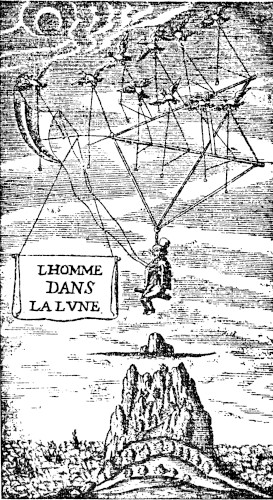
Gonsales' Voyage to the Moon
APPENDICES
| 1. Extracts From Godwin, D'urfey and Swift |
| 2. Bibliography |
| 3. Genealogy |
| 4. Coat of Arms |
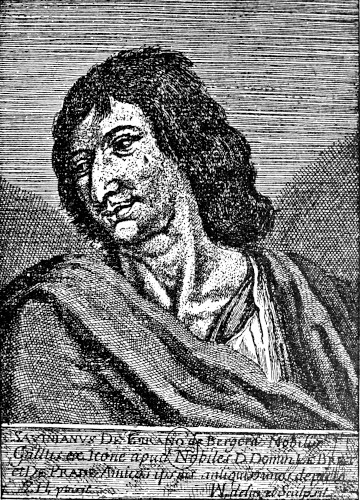

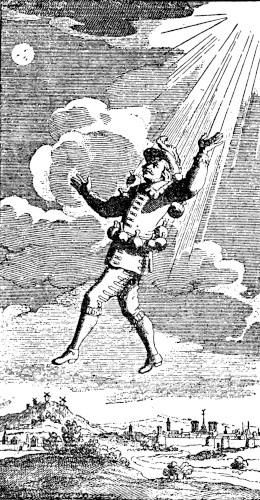
 ; and I
hope, with the bustle of preparation and the departure of our Monarch
and his subjects, to find an opportunity to set you free."
; and I
hope, with the bustle of preparation and the departure of our Monarch
and his subjects, to find an opportunity to set you free." turns a mill,
moves the works of a clock, and the little rivulet
turns a mill,
moves the works of a clock, and the little rivulet  does
nothing but run and sometimes overflow, you will not say the river has
intelligence, because you know it has met with things so placed as to
cause all these masterpieces. If a mill had not been placed in its
path, it would not have ground the corn; if it had not met the clock it
would not have marked the hours; and if the rivulet I spoke of had met
the same things it would have performed the same miracles. It is the
same with fire, which moves by itself; for when it found organs proper
for the agitation necessary to reason, it reasoned; when it found those
proper to feel only, it felt; when it found those proper to vegetation,
it vegetated. And to prove this, tear out the eyes of a man who is
enabled to see by this fire or this soul, and he will cease to see,
just as our river will not mark the hours if the clock is destroyed.
does
nothing but run and sometimes overflow, you will not say the river has
intelligence, because you know it has met with things so placed as to
cause all these masterpieces. If a mill had not been placed in its
path, it would not have ground the corn; if it had not met the clock it
would not have marked the hours; and if the rivulet I spoke of had met
the same things it would have performed the same miracles. It is the
same with fire, which moves by itself; for when it found organs proper
for the agitation necessary to reason, it reasoned; when it found those
proper to feel only, it felt; when it found those proper to vegetation,
it vegetated. And to prove this, tear out the eyes of a man who is
enabled to see by this fire or this soul, and he will cease to see,
just as our river will not mark the hours if the clock is destroyed. , one of the Queen's waiting-women. She had inquired
after me and said she still persisted in keeping her word, which is to
say that she would gladly follow me if I would take her with me to the
other World.
, one of the Queen's waiting-women. She had inquired
after me and said she still persisted in keeping her word, which is to
say that she would gladly follow me if I would take her with me to the
other World. ,
whose name was expressed among the people by a blow on the right knee,
had been convicted of envy and ingratitude: yesterday he had died and
the Parliament had condemned him more than twenty years ago to die a
natural death in his bed and to be buried after his death. I began to
laugh at this reply and he asked me: "Why?"
,
whose name was expressed among the people by a blow on the right knee,
had been convicted of envy and ingratitude: yesterday he had died and
the Parliament had condemned him more than twenty years ago to die a
natural death in his bed and to be buried after his death. I began to
laugh at this reply and he asked me: "Why?"