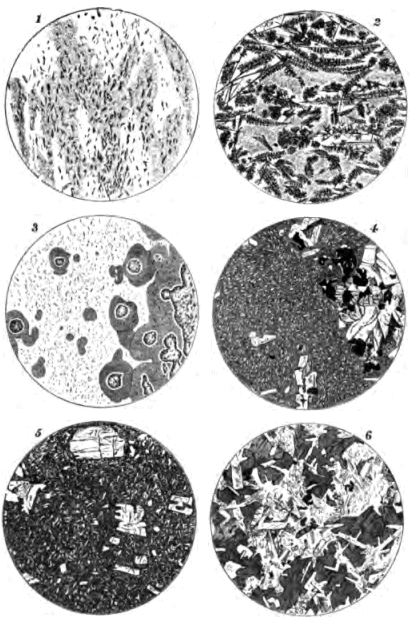
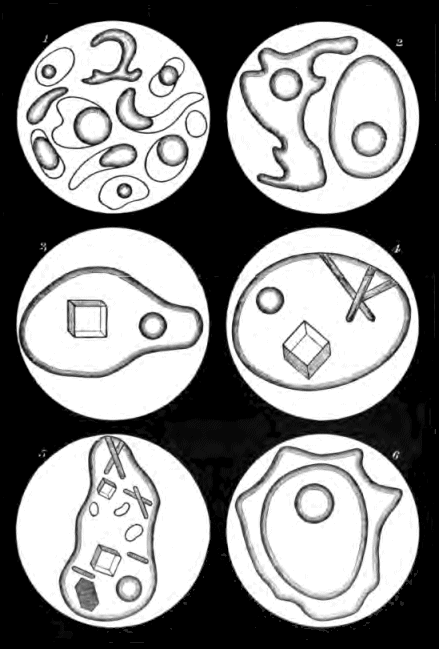
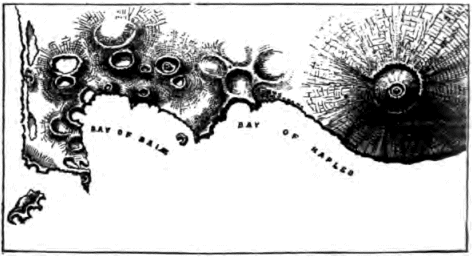
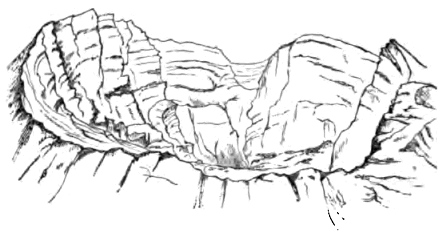
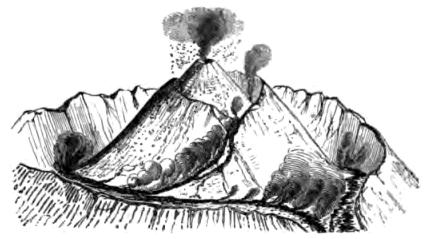
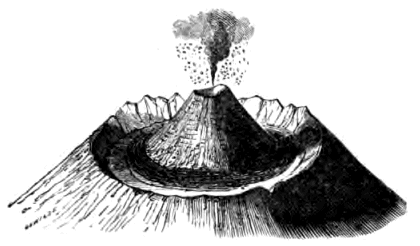
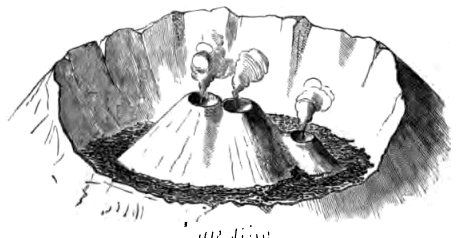
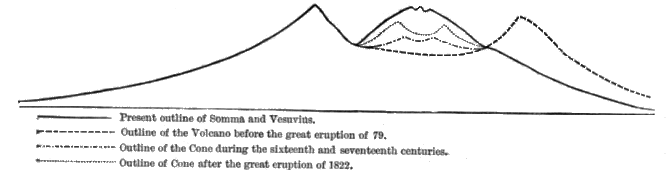
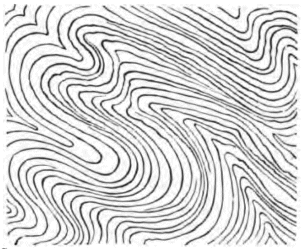
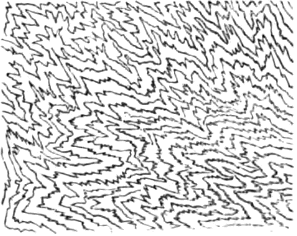
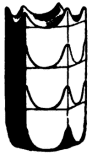
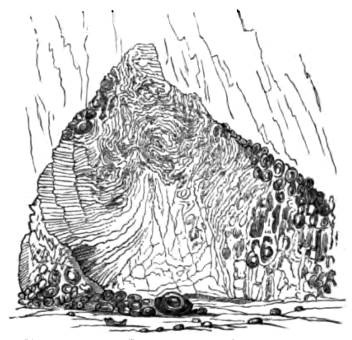
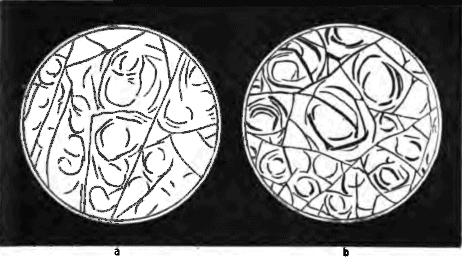
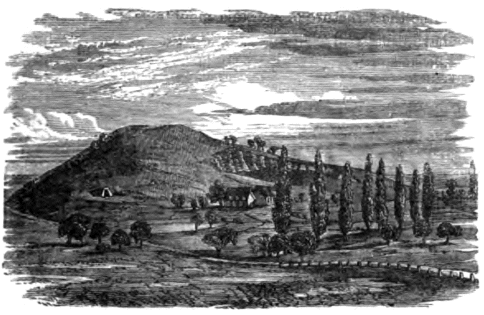
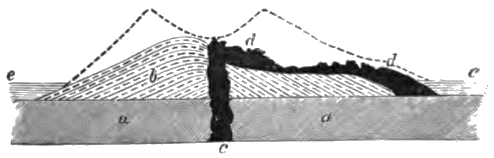
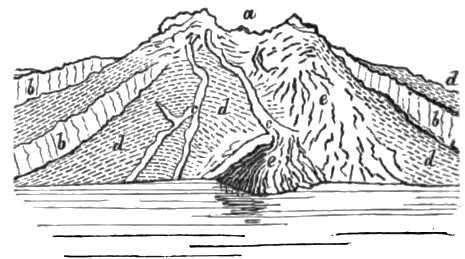
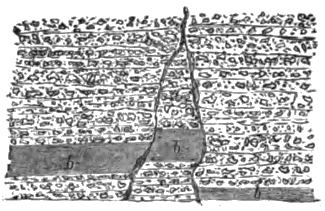
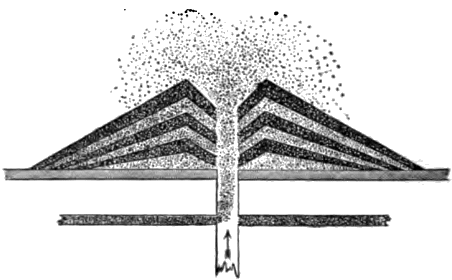
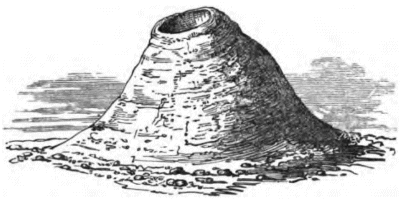
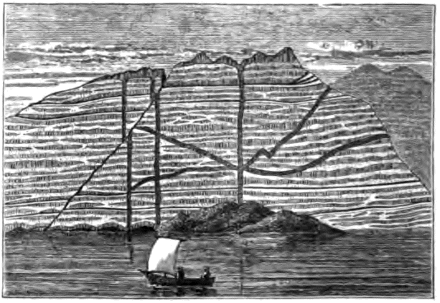
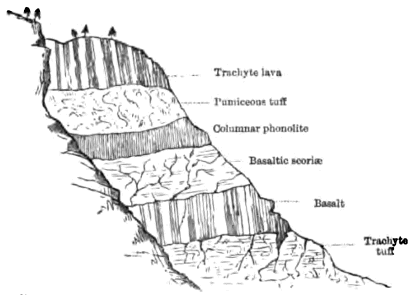
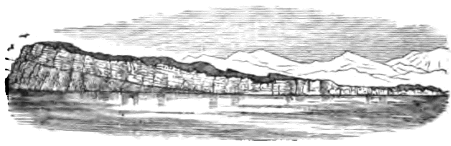
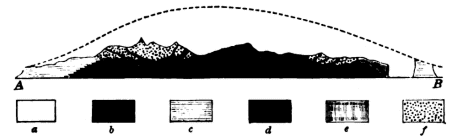
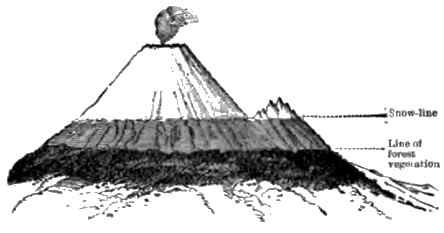
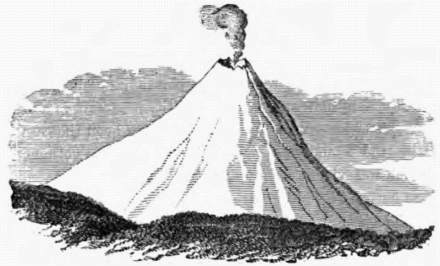
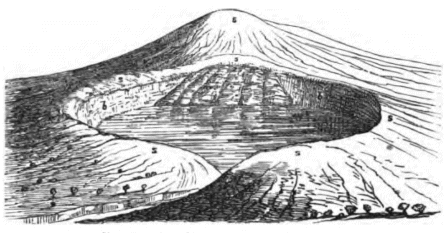
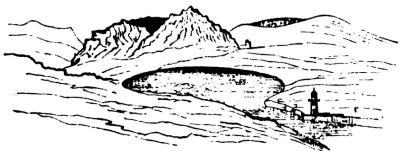
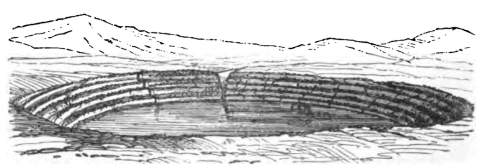
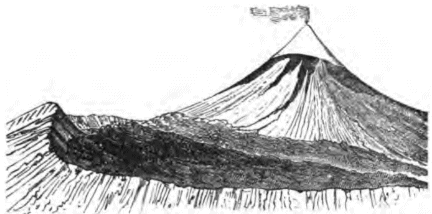
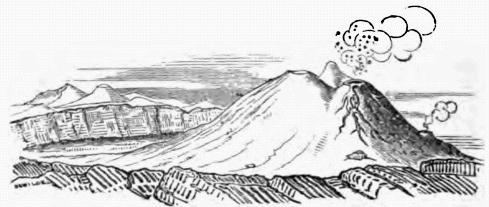
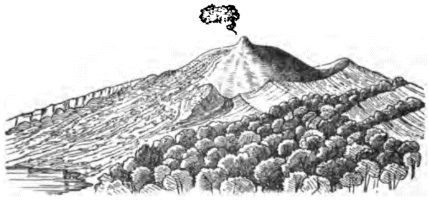
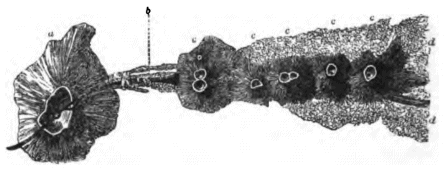
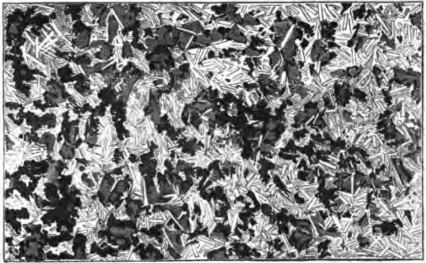
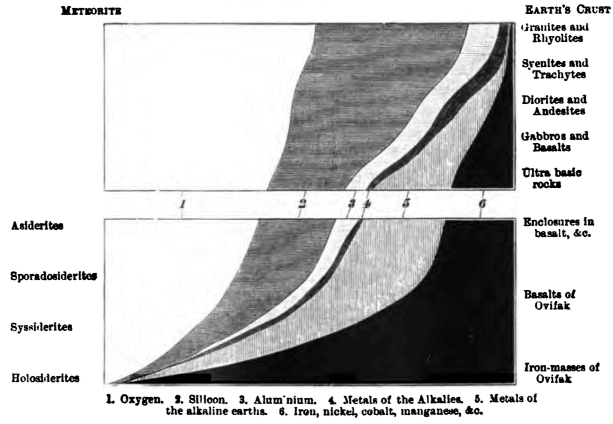
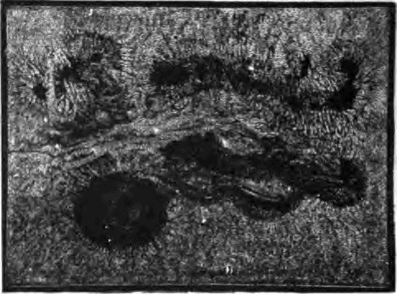
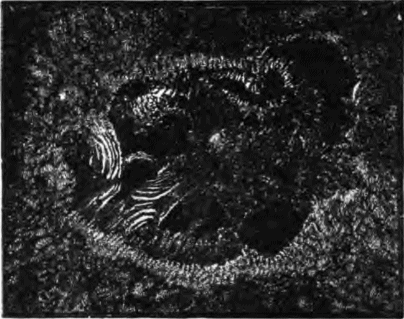
Sections of Igneous Rocks, illustrating the passage from the
glassy to the crystalline structure.
1. Vitreous Rock. 2. Semi-Vitreous Rock. 3. Vitreous Rock with
Sphærulites. 4. Rock with Crypto-crystalline Base. 5. Rock with
Micro-crystalline Base. 6. Rock of Granite Structure built up
entirely of Crystals.
(The rights of translation and of reproduction are reserved.)
PREFACE.
In preparing this work, I have aimed at carrying out
a design suggested to me by the late Mr. Poulett
Scrope, the accomplishment of which has been unfortunately
delayed, longer than I could have wished,
by many pressing duties.
Mr. Scrope's well-known works, 'Volcanoes' and
'The Geology and Extinct Volcanoes of Central France'—which
passed through several editions in this country,
and have been translated into the principal
European languages—embody the results of much
careful observation and acute reasoning upon the
questions which the author made the study of his life.
In the first of these works the phenomena of volcanic
activity are described, and its causes discussed; in the
second it is shown that much insight concerning these
problems may be obtained by a study of the ruined and
denuded relics of the volcanoes of former geological
periods. The appearance of these works, in the years
1825 and 1827 respectively, did much to prepare the
minds of the earlier cultivators of science for the
reception of those doctrines of geological uniformity
and continuity, which were shortly afterwards so ably
advocated by Lyell in his 'Principles of Geology.'
Since the date of the appearance of the last editions
of Scrope's works, inquiry and speculation concerning
the nature and origin of volcanoes have been alike
active, and many of the problems which were discussed
by him, now present themselves under aspects entirely
new and different from those in which he was accustomed
to regard them. No one was ever more ready
to welcome original views or to submit to having long-cherished
principles exposed to the ordeal of free
criticism than was Scrope; and few men retained to
so advanced an age the power of subjecting novel
theories to the test of a rigorous comparison with
ascertained facts.
But this eminent geologist was not content with
the devotion of his own time and energies to the
advancement of his favourite science, for as increasing
age and growing infirmities rendered travel and
personal research impossible, he found a new source of
pleasure in seeking out the younger workers in those
fields of inquiry which he had so long and successfully
cultivated, and in furthering their efforts by his judicious
advice and kindly aid. Among the chosen disciples of
this distinguished man, who will ever be regarded as
one of the chief pioneers of geological thought, I had
the good fortune to be numbered, and when he committed
to me the task of preparing a popular exposition
of the present condition of our knowledge on
volcanoes, I felt that I had been greatly honoured.
In order to keep the work within the prescribed
limits, and to avoid unnecessary repetitions, I have
confined myself to the examination of such selected
examples of volcanoes as could be shown to be really
typical of all the various classes which exist upon the
globe; and I have endeavoured from the study of these
to deduce those general laws which appear to govern
volcanic action. But it has, at the same time, been
my aim to approach the question from a somewhat
new standpoint, and to give an account of those investigations
which have in recent times thrown so
much fresh light upon the whole problem. In this
way I have been led to dwell at some length upon
subjects which might not at first sight appear to be
germane to the question under discussion;—such as
the characters of lavas revealed to us by microscopic
examination; the nature and movements of the liquids
enclosed in the crystals of igneous rocks; the relations
of minerals occurring in some volcanic products to
those found in meteorites; the nature and origin of
the remarkable iron-masses found at Ovifak in Greenland;
and the indications which have been discovered
of analogies between the composition and dynamics of
our earth and those of other members of the family of
worlds to which it belongs. While not evading the
discussion of theoretical questions, I have endeavoured
to keep such discussions in strict subordination to that
presentation of the results attained by observation and
experiment, which constitutes the principal object of
the work.
The woodcuts which illustrate the volume are in
some cases prepared from photographs, and I am indebted
to Mr. Cooper for the skill with which he has
carried out my wishes concerning their reproduction.
Others among the engravings are copies of sketches
which I made in Italy, Hungary, Bohemia, and other
volcanic districts. The whole of the wood-blocks employed
by Mr. Poulett Scrope in his work on Volcanoes
were placed at my disposal before his death, and such
of them as were useful for my purpose I have freely
employed. To Captain S. P. Oliver, R.A., I am obliged
for a beautiful drawing made in the Island of Bourbon,
and to Mr. Norman Lockyer and his publishers, Messrs.
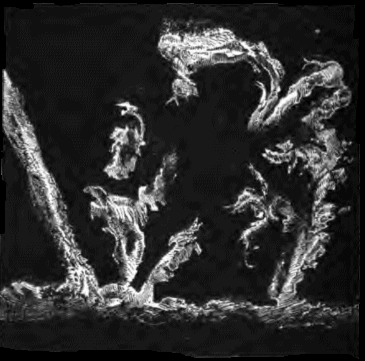
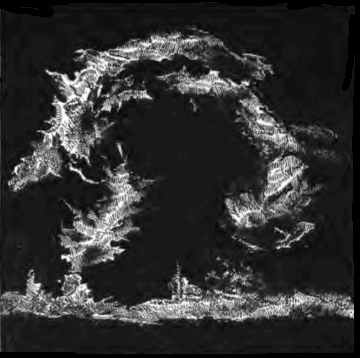
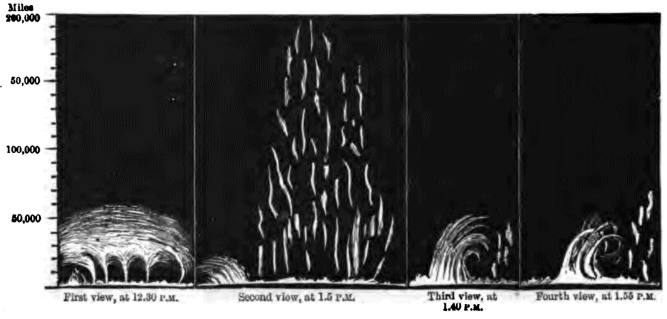
Macmillan & Co., for the use of several wood-blocks
illustrating sun-spots and solar prominences.
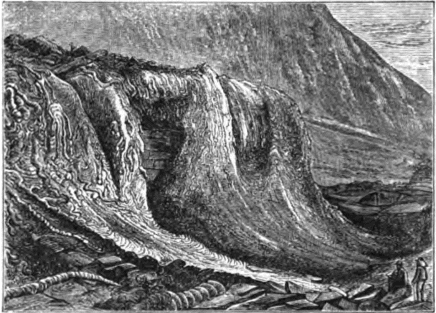
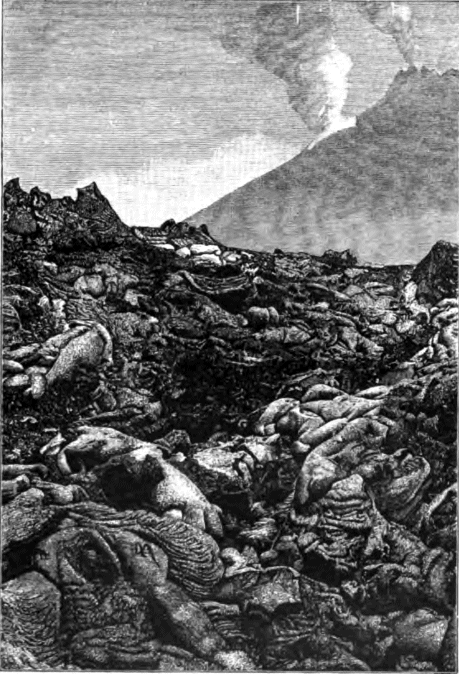
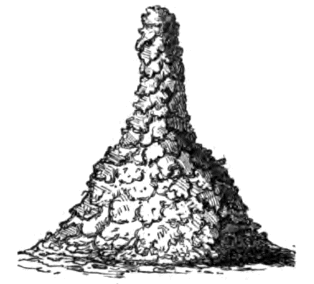
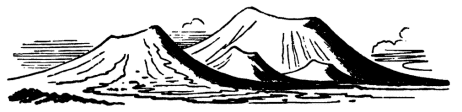
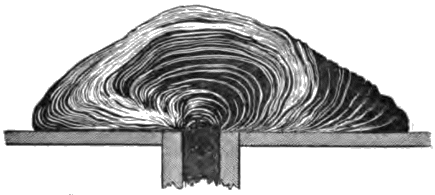
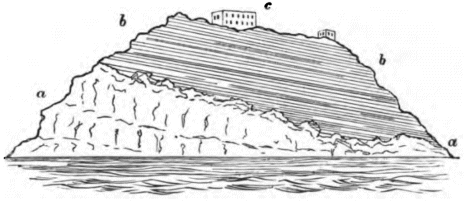
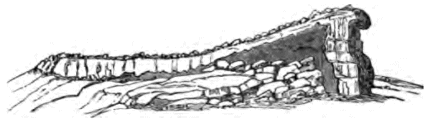
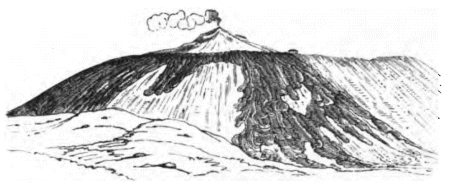
Interior of a rhyolitic lava-stream in the Island of Lipari,
showing the complicated crumplings and puckerings,
produced by the slow movements of the mass
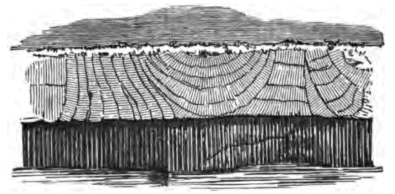
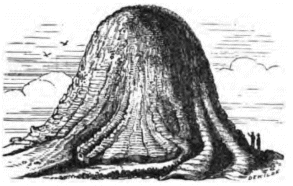
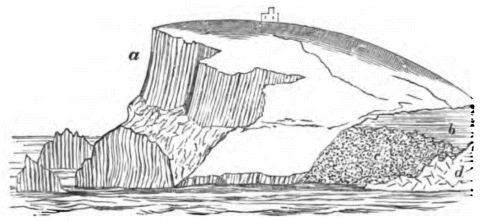
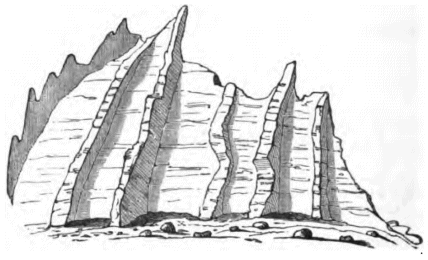
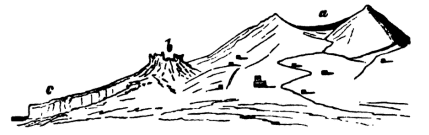
Vein of green pitchstone at Chiaja di Luna, in the Island
of Ponza, breaking up into regular columns and into
spherical masses with a concentric series of joints.
(After Scrope)
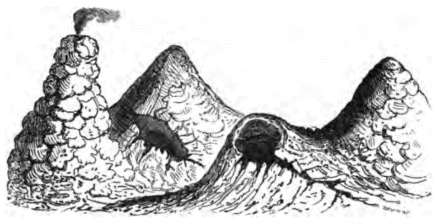
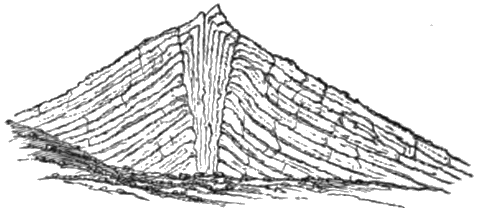
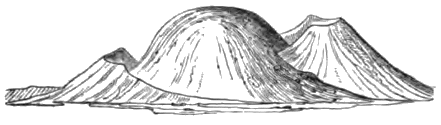
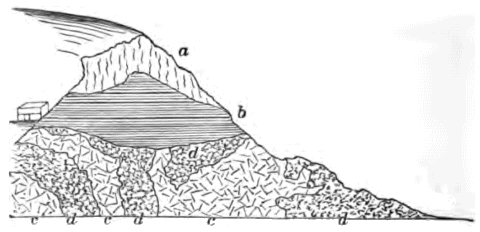
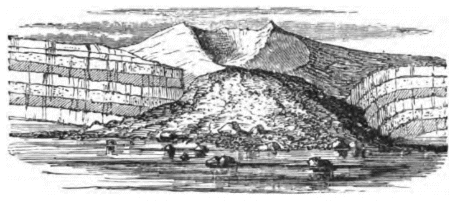
Natural section of a tuff-cone, forming the Cape of Misenum,
and exhibiting the peculiar internal arrangement,
characteristic of volcanoes composed of fragmentary
materials. (After Scrope)
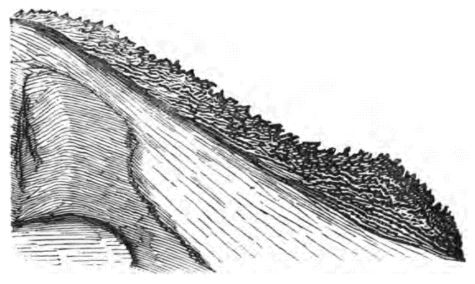
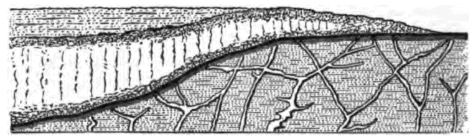
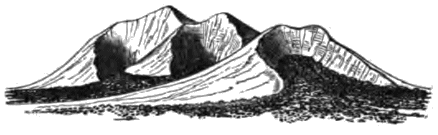
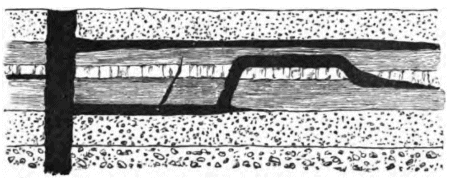
Section of a small scoria-cone formed within the crater of
Vesuvius in the year 1835, illustrating the filling up of
the central vent of the cone by subsequent ejections.
(After Abich)
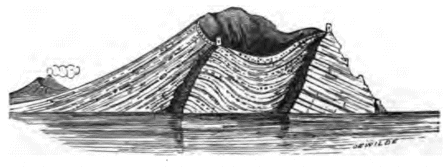
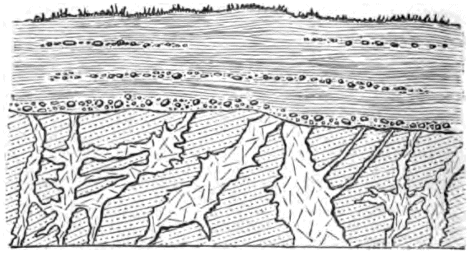
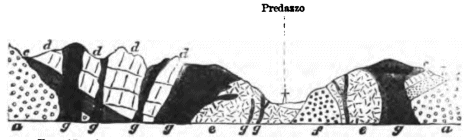
Sea-cliff at Il Capo, the north-east point of Salina,
showing stratified agglomerates traversed by numerous
dykes, the whole being unconformably overlaid by
stratified, aqueous deposits
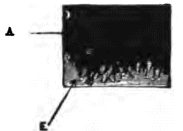
The edge of a sun-spot, showing a portion of the prominent
masses of incandescent gas (A) which detached itself
at B and floated into the midst of the cavity.
(After Norman Lockyer)
'What is a volcano?' This is a familiar question,
often addressed to us in our youth, which 'Catechisms
of Universal Knowledge,' and similar school manuals,
have taught us to reply to in some such terms as
the following: 'A volcano is a burning mountain, from
the summit of which issue smoke and flames.' Such
a statement as this, it is probable, does not unfairly
represent the ideas which are, even at the present day,
popularly entertained upon the subject.
But in this, as in so many other cases, our first
step towards the acquirement of scientific or exact
knowledge, must be the unlearning of what we have
before been led to regard as true. The description
which we have quoted is not merely incomplete and
inadequate as a whole, but each individual proposition
of which it is made up is grossly inaccurate, and, what
is worse, perversely misleading. In the first place, the
action which takes place at volcanoes is not 'burning,'
or combustion, and bears, indeed, no relation whatever
to that well-known process. Nor are volcanoes necessarily
'mountains' at all; essentially, they are just
the reverse—namely, holes in the earth's crust, or outer
portion, by means of which a communication is kept
up between the surface and the interior of our globe.
When mountains do exist at centres of volcanic activity,
they are simply the heaps of materials thrown
out of these holes, and must therefore be regarded not
as the causes but as the consequences of the volcanic
action. Neither does this action always take place at
the 'summits' of volcanic mountains, when such exist,
for eruptions occur quite as frequently on their sides
or at their base. That, too, which popular fancy regards
as 'smoke' is really condensing steam or watery vapour,
and the supposed raging 'flames' are nothing more
than the glowing light of a mass of molten material
reflected from these vapour clouds.
It is not difficult to understand how these false
notions on the subject of volcanic action have come to
be so generally prevalent. In the earlier stages of its
development, the human mind is much more congenially
employed in drinking in that which is marvellous
than in searching for that which is true. It must
be admitted, too, that the grand and striking phenomena
displayed by volcanoes are especially calculated
to inspire terror and to excite superstition, and such
feelings most operate in preventing those close and
accurate observations which alone can form the basis
of scientific reasoning.
IDEAS OF THE ANCIENTS.
The ancients were acquainted only with the four or
five active volcanoes in the Mediterranean area; the
term 'volcano' being the name of one of these (Vulcano,
or Volcano, in the Lipari Islands), which has
come to be applied to all similar phenomena. It is
only in comparatively modern times that it has become
a known £act that many hundreds of volcanoes exist
upon the globe, and are scattered over almost every
part of its surface. Classical mythology appropriated
Vulcano as the forge of Hephæstus, and his Roman
representative Vulcan, while Etna was regarded as
formed by the mountains under which a vengeful
deity had buried the rebellious Typhon; it may be
imagined, therefore, that any endeavour to more
closely investigate the phenomena displayed at these
localities would be regarded, not simply as an act of
temerity, but as one of actual impiety. In mediæval
times similar feelings would operate with not less
force in the same direction, for the popular belief
identified the subterranean fires with a place of everlasting
torment; Vulcano was regarded as the place of
punishment of the Arian Emperor Theodosius, while
Etna was assigned to poor Anne Boleyn, the perverter
of faith in the person of its stoutest defender. That
such feelings of superstitious terror in connection with
volcanoes are, even at the present day, far from being
extinct, will be attested by every traveller who, in
carrying on investigations about volcanic centres, has
had to avail himself of the assistance of guides and
attendants from among the common people.
Among the great writers of antiquity we find
several who had so far emancipated their minds from
the popular superstitions as to be able to enunciate
just and rational views upon the subject of volcanoes.
Until quite recent times, however, their teaching was
quite forgotten or neglected, and the modern science
of Vulcanology may be said to have entirely grown up
within the last one hundred years.
The great pioneer in this important branch of research
was the illustrious Italian naturalist Spallanzani,
who, in the year 1788, visited the several volcanoes of
his native land, and published an account of the numerous
valuable and original observations which he had
made upon them. About the same time the French
geologist Dolomieu showed how much light might be
thrown on the nature of volcanic action by a study of
the various materials which are ejected from volcanic
vents; while our own countryman. Sir William Hamilton,
was engaged in a systematic study of the changes
in form of volcanic mountains, and of the causes
which determine their growth. At a somewhat later
date the three German naturalists. Von Buch, Humboldt,
and Abich, greatly extended our knowledge of
volcanoes by their travels in different portions of the
globe.
CHARACTER OF MODERN RESEARCHES.
The first attempt, however, to frame a satisfactory
theory of volcanic action, and to show the part which
volcanoes have played in the past history of our globe,
together with their place in its present economy, was
made in 1825, by Poulett Scrope, whose great work,
'Considerations on Volcanoes,' may be regarded as the
earliest systematic treatise on Vulcanology. Since the
publication of this work, many new lines of inquiry
have been opened up in connection with the subject,
and fresh methods of research have been devised and
applied to it. More exact observations of travellers
over wider areas have greatly multiplied the facts
upon which we may reason and speculate, and many
erroneous hypotheses which had grown up in connection
with the subject have been removed by patient
and critical inquiry.
We propose in the following pages to give an outline
of the present state of knowledge upon the subject,
and to indicate the bearings of those conclusions which
have already been arrived at, upon the great questions
of the history of our globe and the relations which
it bears to the other portions of the universe. In
attempting this task we cannot do better than take
up the several lines of inquiry in the order in which
they have been seized upon and worked out by the
original investigators; for never, perhaps, is the development
of thought in the individual mind so natural
in its methods, and so permanent in its effects, as when
it obeys those laws which determined its growth in the
collective mind of the race. In our minds, as in our
bodies, development in the individual is an epitome,
or microcosmic reproduction, of evolution in the
species.
CHAPTER II. THE NATURE OF VOLCANIC ACTION.
The dose investigation of what goes on within a
volcanic vent may appear at first sight to be a task
beset with so many difficulties and dangers that we
may be tempted to abandon it as altogether hopeless.
At the first recorded eruption of Vesuvius the elder
Pliny lost his life in an attempt to approach the
mountain and examine the action which was taking
place there; and during the last great outburst of the
same volcano a band of Neapolitan students, whose
curiosity was greater than their prudence, shared the
same fate.
But in both these cases the inquirers paid the
penalty of having adopted a wrong method. If we
wish to examine the mode of working of a complicated
steam-engine, it will be of little avail for us to
watch the machinery when the full blast of steam is
turned on, and the rapid movements of levers, pinions,
and slides baffle all attempts to follow them, and render
hopeless every effort to trace their connection with
one another. But if some friendly hand turn off the
greater part of the steam-supply, then, as the rods
move slowly backwards and forwards, as the wheels
make their measured revolutions, and the valves axe
seen gradually opening and shutting, we may have an
opportunity of determining the relations of the several
parts of the machine to one another, and of arriving
at just conclusions concerning the plan on which it is
constructed. Nor can we doubt that the parts of the
machine bear the same relation to one another, and
that their movements take place in precisely the same
order, when the supply of steam is large as when it is
small.
Now, as we shall show in the sequel, a volcano is a
kind of great natural steam-engine, and our best method
of investigating its action is to watch it when a part of
the steam-supply is cut off. It is true that we cannot
at will control the source of supply of steam to a
volcano, as we can in a steam-engine, but as some
volcanoes have usually only a small steam-supply, and
nearly all volcanoes vary greatly in the intensity of
their action at different periods, we can, by a careful
selection of the object or the time of our study, gain
all those advantages which would be obtained by regulating
its action for ourselves.
Spallanzani appears to have been the first to perceive
the important fact, that the nature of volcanic
action remains the same, however its intensity may
vary. Taking advantage of the circumstance that
there exists in the Mediterranean Sea a
volcano—Stromboli—which for at least 2,000 years has been in
a constant and regular, but not in a violent or dangerous,
state of activity, he visited the spot, and made
the series of careful observations which laid the foundation
of our knowledge of the 'physiology of volcanoes.'
Since the time of Spallanzani, many other
investigators have visited the crater of Stromboli, and
they have been able to confirm and extend the observations
of the great Italian naturalist, as to the
character of the action which is constantly taking place
within it. We cannot better illustrate the nature of
volcanic action than by describing what has been witnessed
by numerous observers within the crater of
Stromboli, where it is possible to watch the series of
operations going on by the hour together, and to do so
without having our judgment warped either by an
excited imagination or the sense of danger.
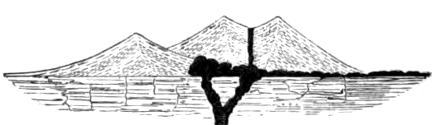
APPEARANCE OF STROMBOLI FROM A DISTANCE.
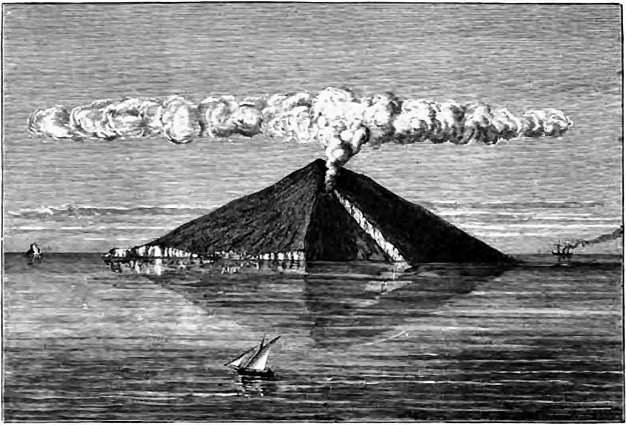
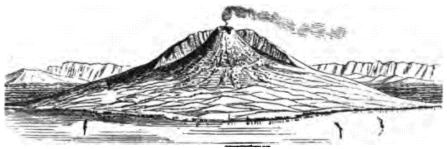
In the sketch, fig. 1, which was made on April
20, 1874, I have shown the appearance which this
interesting volcano usually presents, when viewed from
a distance. The island is of rudely circular outline,
and conical form, and rises to the height of 3,090 feet
above the level of the Mediterranean. From a point
on the side of the mountain, masses of vapour are
seen to issue, and these unite to form a cloud over the
mountain, the outline of this vapour-cloud varying
continually according to the hygrometric state of the
atmosphere, and the direction and force of the wind.
At the time when this sketch was made, the vapour-cloud
was spread in a great horizontal stratum overshadowing
the whole island, but it was clearly seen to
be made up of a number of globular masses, each of
which, as we shall hereafter see, is the product of a
distinct outburst of the volcanic forces.
Viewed at night-time, Stromboli presents a far
more striking and singular spectacle. The mountain,
with its vapour canopy, is visible over an area
having a radius of more than 100 miles. When
watched from the deck of a vessel anywhere within
this area, a glow of red light is seen to make its appearance
from time to time above the summit of the
mountain; this glow of light may be observed to
increase gradually in intensity, and then as gradually
to die away. After a short interval the same appearances
are repeated, and this goes on till the increasing
light of the dawn causes the phenomenon to be no
longer visible. The resemblance presented by Stromboli
to a 'flashing light' on a most gigantic scale is
very striking, and the mountain has long been known
as 'the lighthouse of the Mediterranean.'
It must be pointed out, however, that in two very
important particulars the appearances presented by
Stromboli differ markedly from those rhythmical gleams
exhibited by the 'flashing-lights' of our coasts. In
the first place, the intervals between successive flashes
are very unequal, varying from less than one minute
to twenty minutes, or even more; and in the second
place, the duration and intensity of the red glow above
the mountain are subject to like variation, being sometimes
a momentary scarcely visible gleam, and at others
a vivid burst of light which illuminates the sky to a
considerable distance round.
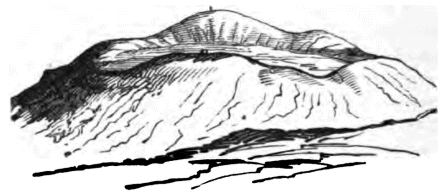
Fig. 1.—Stromboli, viewed from the North-west, April 1874.
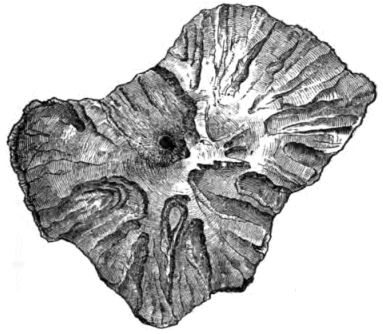
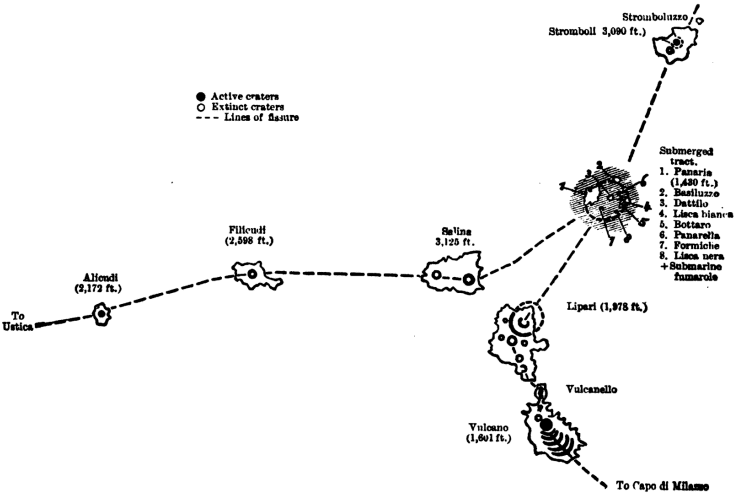
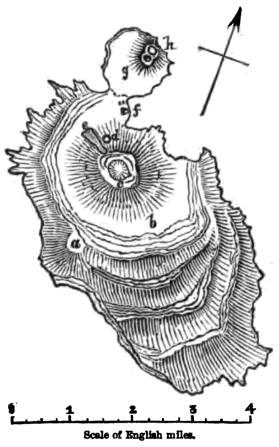
Fig. 2.—Map of tub Island of Stromboli.
(Scale about two inches to a mile.)
GENERAL FEATURES OF THE MOUNTAIN.
Let us now draw near and examine this wonderful
phenomenon of a mountain which seemingly ever
burns with fire, and yet is not consumed. The general
form of the Island of Stromboli will be gathered from
an inspection of the plan, fig. 2, which is copied from
a map published by the Italian Government. When
we land upon the island, we find that it is entirely
built up of such materials as we know to be ejected
from volcanoes; indeed, it resembles on a gigantic
scale the surroundings of an iron furnace, with its
heaps of cinders and masses of slag. The irregularity
in the form of the island is at once seen to be due to
the action of the wind, the rain, and the waves of the
surrounding sea, which have removed the loose, cindery
materials at some points, and left the hard, slaggy
masses standing up prominently at others.
This great heap of cindery and slaggy materials
rises, as we have said, to a height of more than 3,000
feet above the sea-level, but even this measurement
does not give a just idea of its vast bulk. Soundings
in the sea surrounding the island show that the
bottom gradually shelves around the shores to the
depth of nearly 600 fathoms, so that Stromboli is a
great conical mass of cinders and slaggy materials,
having a height of over 6,000 feet, and a base whose
diameter exceeds four miles.
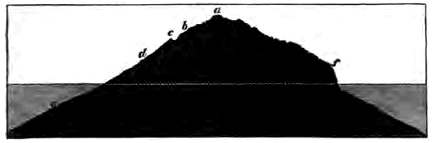
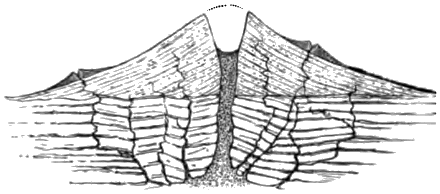
The general form and proportions of this mass will
be better understood by an examination of the section,
fig. 3, which is also constructed from the materials
furnished by the map of the island issued by the
Italian Government. The same section, and the map,
fig. 2, will serve to make clear the position and relations
of the point on the mountain at which the
volcanic activity takes place. At a spot on the north-west
slope of the mountain, about 1,000 feet below its
summit, and 2,000 feet above the level of the sea,
there exists a circular depression, the present active
'crater' of the volcano; and leading down from this
to the sea there is a flat slope making an angle of
about 35° with the horizon, and known as the 'Sciarra.'
The Sciarra is bounded by steep cliffs, as shown
in the sketch fig. 1, and the plan fig. 2.
Fig. 3.—Section through the Island of Stromboli from
n.w. to s.e.
a. Highest summit of the mountain, c. Cratère del Fossa, b. Point overlooking
the crater, d. Steep slope known as the Sciarra del Fuoco. e.
Continuation of the same slope beneath the level of the sea. f. Steep cliffs of the
Punta dell' Omo.
FORM AND FUNCTION OF THE CRATER.
If we climb up to this scene of volcanic activity,
we shall be able to watch narrowly the operations
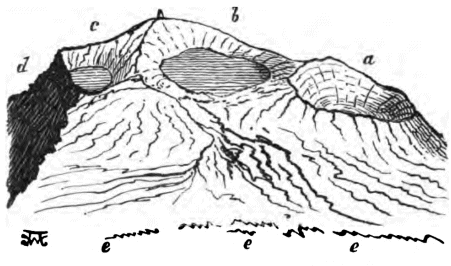
which are going on there. On the morning of the
24th of April, 1874, I paid a visit to this interesting
spot in order to get a near view of what was taking
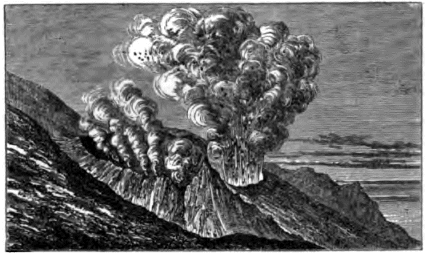
place. On reaching a point upon the side of the
Sciarra, from which the crater was in full view before
me, I witnessed, and made a sketch of, an outburst
which then took place, and this sketch has been reproduced
in fig. 4. Before the outburst, numerous
light curling wreaths of vapour were seen ascending
from fissures on the sides and bottom of the crater.
Suddenly, and without the slightest warning, a sound
was heard like that produced when a locomotive blows
off its steam at a railway-station; a great volume of
watery vapour was at the same time thrown violently
into the atmosphere, and with it there were hurled
upwards a number of dark fragments, which rose to
the height of 400 or 500 feet above the crater, describing
curves in their course, and then falling
back upon the mountain. Most of these fragments
tumbled into the crater with a loud, rattling noise, but
some of them fell outside the crater, and a few rolled
down the steep slope of the Sciarra into the sea.
Some of these falling fragments were found to be
still hot and glowing, and in a semi-molten condition,
so that they readily received the impression of a coin
thrust into them.
Fig. 4.—The Crates of Stromboli as viewed from the side of the
Sciarra during an eruption on the morning of April 24, 1874.
APERTURES AT THE BOTTOM OF THE CRATER.
But on the upper side of the crater, at the point
marked 6, on the section fig. 3, there exists a spot from
which we can look down upon the bottom of the crater,
and view the operations taking place there. This is
the place where Spallanzani and other later investigators
have carried on their observations, and, when the wind
is blowing from the spectator towards the crater, he
may sit for hours watching the wonderful scene displayed
before him. The black slaggy bottom of the
crater is seen to be traversed by many fissures or
cracks, from most of which curling jets of vapour issue
quietly, and gradually mingle with and disappear in
the atmosphere. But besides these smaller cracks at
the bottom of the crater, several larger openings are
seen, which vary in number and position at different
periods; sometimes only one of these apertures is
visible, at others as many as six or seven, and the
phenomena presented at these larger apertures are
especially worthy of careful investigation.
These larger apertures, if we study the nature of
the action taking place at them, may be divided into
three classes. From those of the first class, steam is
emitted with loud, snorting puffs, like those produced by
a locomotive-engine, but far less regular and rhythmical
in their succession. In the second class of apertures
masses of molten material are seen welling out, and, if
the position of the aperture be favourable, flowing outside
the crater; from this liquid molten mass steam
is seen to escape, sometimes in considerable quantities.
The openings of the third class present still more
interesting appearances. Within the walls of the
aperture a viscid or semi-liquid substance is seen slowly
heaving up and down. As we watch the seething mass
the agitation within it is observed to increase gradually,
and at last a gigantic bubble is formed which violently
bursts, when a great rush of steam takes place, carrying
fragments of the scum-like surface of the liquid
high into the atmosphere.
If we visit the crater by night, the appearances
presented are found to be still more striking and
suggestive. The smaller cracks and larger openings
glow with a ruddy light. The liquid matter is seen to
be red- or even white-hot, while the scum or crust which
forms upon it is of a dull red colour. Every time a
bubble bursts and the crust is broken up by the escape
of steam, a fresh, glowing surface of the incandescent
material is exposed. If at these moments we look up
at the vapour-cloud covering the mountain, we shall at
once understand the cause of the singular appearances
presented by Stromboli when viewed from a distance
at night, for the great masses of vapour are seen to be
lit up with a vivid, ruddy glow, like that produced when
an engine-driver opens the door of the furnace and
illuminates the stream of vapour issuing from the
funnel of his locomotive.
Let us now endeavour to analyse the phenomena so
admirably displayed before us in the crater of Stromboli.
The three essential conditions on which the production
of these phenomena seems to depend are the following:
first, the existence of certain apertures or cracks communicating
between the interior and the surface of the
earth; secondly, the presence of matter in a highly
heated condition beneath the surface; and thirdly, the
existence of great quantities of water imprisoned in the
subterranean regions—which water, escaping as steam,
gives rise to all those active phenomena we have been
describing.
CAUSE OF THE GLOWING LIGHT.
We have said, at the outset, that there exists no
analogy whatever between the action which takes place
in volcanoes and the operation of burning or combustion.
Occasionally, it is true, certain inflammable substances
are formed by the action going on within the volcano,
and these inflammable substances, taking fire, produce
real flames. Such flames are, however, in almost all
cases only feebly luminous, and do not give rise to any
conspicuous appearances. What is usually taken for
flame during volcanic eruptions is simply, as we have
already pointed out, the glowing red-hot surface of a
mass of molten rock, reflected from a vapour-cloud
hanging over it. The red glow observed over a volcano
in eruption is indeed precisely similar in its nature and
origin to that which is seen above London during a
night of heavy fog, and which is produced by the reflection
of the gas-lights of the city from the innumerable
particles of water-vapour diffused through the
atmosphere. Fires, of course, occur when the molten
and incandescent materials poured out from a volcano
come in contact with inflammable substances, such as
forests and houses, but in these cases the combustion
is quite a secondary phenomenon.
There is another popular delusion concerning volcanic
action, which it may be necessary to refer to and
to combat. From the well-known fact that sulphur or
brimstone is found abundantly in volcanic regions, the
popular belief has arisen that this highly inflammable
substance has something to do with the production of
the eruptions of volcanoes. In school-books which were,
until comparatively recent years, in constant use in this
country, the statement may be found that by burying
certain quantities of sulphur, iron-pyrites, and charcoal
in a hole in the ground, we may form a miniature
volcano, and produce all the essential phenomena of a
volcanic eruption. No greater mistake could possibly
be made. The chemical reactions which take place
when sulphur and other substances are made to act
upon each other differ entirely from the phenomena
of volcanic action. The sulphur which is found in
volcanic regions is the result and not the cause of
volcanic action. Among the most common substances
emitted from volcanic vents along with the steam are
the two gases, sulphurous acid and sulphuretted hydrogen.
When these two gases come into contact
with one another, chemical action takes place, and the
elements contained in them—oxygen, hydrogen, and
sulphur—are free to group themselves together in an
entirely new fashion; the consequence of this is that
water and sulphuric acid (oil of vitriol) are formed, and
a certain quantity of sulphur is set free. The water
escapes into the atmosphere, the sulphuric acid combines
with lime, iron, or other substances contained in
the surrounding rocks, and the sulphur builds up crystals
in any cavities which may happen to exist in these
rocks.
VOLCANIC ACTION RESEMBLES BOILING.
If, however, careful and exact observations, like
those carried on at Stromboli, compel us to reject the
popular notions concerning the supposed resemblance
between volcanic action and the combustion of sulphur
or other substances, they nevertheless suggest analogies
with certain other simple and well-known operations.
And in pursuing these analogies, we are led to
the recognition of some admirable illustrations both
of the attendant phenomena and of the true cause of
volcanic outbursts.
No one can look down on the mass of seething
material in violent agitation within the fissures at the
bottom of the crater of Stromboli, without being forcibly
reminded of the appearances presented by liquids in
a state of boiling or ebullition. The glowing material
seems to be agitated by two kinds of movements, the
one whirling or rotatory, the other vertical or up-and-down
in its direction. The fluid mass in this way
appears to be gradually impelled upwards, till it approaches
the lips of the aperture, when vast bubbles
are formed upon its surface, and to the sudden bursting
of these the phenomena of the eruption are due.
Now if we take a tall narrow vessel and fill it with
porridge or some similar substance of imperfect fluidity,
we shall be able, by placing it over a fire, to imitate
very closely indeed the appearances presented in the
crater of Stromboli. As the temperature of the mass
rises, steam is generated within it, and in the efforts of
this steam to escape, the substance is set in violent
movement. These movements of the mass are partly
rotatory and partly vertical in their direction; as fresh
steam is generated in the mass its surface is gradually
raised, while an escape of the steam is immediately
followed by a fall of the surface. Thus an up-and-down
movement of the liquid is maintained, but as the
generation of steam goes on faster than it can escape
through the viscid mass, there is a constant tendency
in the latter to rise towards the mouth of the vessel.
At last, as we know, if heat continues to be applied to
the vessel, the fluid contents will be forced up to its
edge and a catastrophe will occur; the steam being
suddenly and violently liberated from the bubbles
formed on the surface of the mass, and a considerable
quantity of the material forcibly expelled from the
vessel. The suddenness and violence of this catastrophe
is easily accounted for, if we bear in mind that
the escaping steam acts after the manner of a compressed
spring which is suddenly released. Steam is
first formed at the bottom of the vessel which is in
contact with the fire; but here it is under the pressure
of the whole mass of the liquid, and moreover, the
viscidity of the substance tends to retard the union of
the steam bubbles and their rise to the surface of the
mass. But when the pressure is relieved by the bursting
of bubbles at the surface, the whole of the generated
steam tends to escape suddenly.
ESCAPE OF STEAM-BUBBLES FROM LAVA.
Now within the crater of Stromboli we have precisely
the necessary conditions for the display of the
same series of operations. In the apertures at the
bottom there exists a quantity of imperfectly fluid
materials at a higher temperature, containing water
entangled in its mass. As this water passes into the
state of steam it tends to escape, and in so doing puts
the whole mass into violent movement. When the steam
rises to the surface, bubbles are formed, and the formation
of these bubbles is promoted by the circumstance
that the liquid mass, where exposed to the atmosphere,
becomes chilled, and thereby rendered less perfectly
fluid. By the bursting of these bubbles the pressure
is partially relieved, and a violent escape of the pent-up
steam takes place through the whole mass. Equilibrium
being thus restored, there follows a longer or
shorter interval of quiescence, during which steam is
being generated and collected within the mass, and
the series of operations which we have described then
recommences.
There is one other consideration which must be
borne in mind in connection with this subject. It is
well known that if water be subjected to sufficiently
great pressure it may be raised to a very high temperature
and still retain its liquid condition. When this
pressure is removed, however, the whole mass passes
at once into the condition of steam or water-gas; and
the gas thus formed at high temperatures has a proportionably
high tension. In a Papin's digester water
confined in a strong vessel is raised to temperatures
far above its ordinary boiling-point, and from any
opening in such a vessel the steam escapes with prodigious
violence. Now, at considerable depths beneath
the earth's surface, and under the pressure of many
hundreds or thousands of feet of solid rock, water still
retaining its liquid condition may become intensely
heated. When the pressure is relieved by the formation
of a crack or fissure in the superincumbent mass
of rock, the escape of the superheated steam will be
of very violent character, and may be attended with
the most striking and destructive results. In the
existence of high temperatures beneath the earth's
surface, and the presence in the same regions of
imprisoned water capable of passing into the highly
elastic gas which we call steam, we have a cause fully
competent to produce all the phenomena which we
have described as occurring at Stromboli.
It may at first sight appear that the grand and
terrible displays of violence witnessed during a great
volcanic eruption differ fundamentally in their character
and their origin from those feeble outbursts
which we are able to examine closely and analyse
rigorously at Stromboli. But that such is not the case
a few simple considerations will soon convince us.
STROMBOLI COMPARED WITH VESUVIUS.
Although Stromboli usually displays the subdued
and moderate activity which we have been describing,
yet the intensity of the action going on within it is
subject to considerable variation. Occasionally the
violence of the outbursts is greatly increased—the
roaring of the steam-jets may be heard for many miles
around, considerable streams of incandescent liquefied
rock flow down the Sciarra into the sea, and the explosions
in the crater are far more frequent and energetic,
cinders and fragments of rock being scattered
all over the island and the surrounding seas.
On the other hand, volcanoes like Vesuvius, which
are sometimes the scene of eruptions on the very
grandest scale, at others subside into a temporary state
of moderate activity quite similar in character to that
which is the normal condition of Stromboli. Thus,
shortly before the great eruption of Vesuvius in April
1872, a small cone was formed near the edge of the
crater, and during some months observers could watch,
in ease and safety, a series of small explosions taking
place, quite similar in their character and attendant
phenomena to those which we have described as occurring
at Stromboli. French geologists are in the
habit of defining the condition of activity in a volcano
by speaking of the more quiet and, regular state as the
'Strombolian stage,' and the more violent and paroxysmal
as the 'Vesuvian stage'; but the two conditions
are, as we have seen, presented by the same volcano at
different periods, and pass into one another by the
most insensible gradations.
We must now proceed to compare the grand and
terrible appearances presented during a great eruption
with those more feeble displays which we have been
describing, to show that in all their essential features
these different kinds of outbursts are identical with
one another, and must be referred to the action of
similar causes.
The volcanic eruption which has been most carefully
studied in recent times is that which we have
already referred to as occurring at Vesuvius, in the
month of April 1872. With the exception, perhaps,
of that which took place in October 1822, this eruption
was the grandest which has broken out at Vesuvius
during the present century. Owing to the circumstance
of its proximity to the great city of Naples,
Vesuvius has always been the most carefully watched
of all volcanoes, and in recent years the erection of an
observatory, provided with instruments for recording
the smallest subterranean tremors affecting the mountain,
has facilitated the carrying on of those continuous
and minute observations which are so necessary for
exact scientific inquiry.
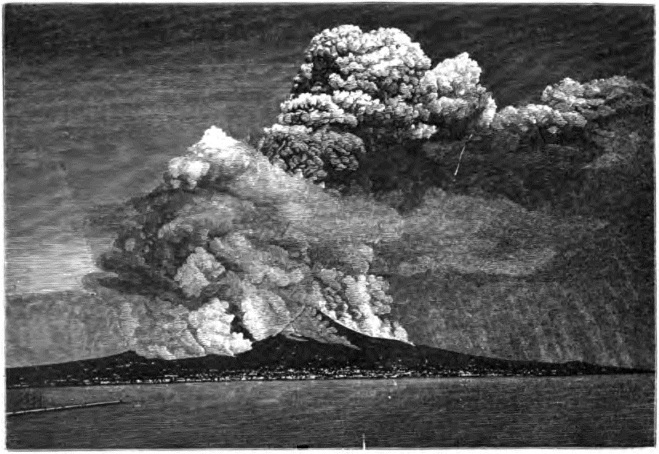
Fig 5. Vesuvius in Eruption, as seen from Naples, April 26, 1872.
(From a photograph)
VESUVIUS ERUPTION OF 1872.
On the occasion of this outburst, the aid of instantaneous
photography was first made available for
obtaining a permanent record of the appearances displayed
at volcanic eruptions. In fig. 5 we have one of
these photographs, which was taken at 5 o'clock P.M.
on April 26, 1872, transferred to a wood-block and
engraved. In examining it we feel sure that we
are not being misled by any exaggeration or error on
the part of the artist. Vesuvius rises to the height
of nearly 4,000 feet above the level of the sea, and an
inspection of the photograph proves that the vapours
and rock-fragments were thrown to the enormous
height of 20,000 feet, or nearly four miles, into the
atmosphere.
The main features of this terrifying outburst were
as follows. For more than a twelvemonth before, the
activity of the forces at work within the mountain
appeared to be gradually increasing, and the great
eruption commenced on April 24, attained its climax
on the 26th, and began to die out on the following
day. During the eruption the bottom of the crater
was entirely broken up, and the sides of the mountain
were rent by fissures in all directions. So numerous
were these fissures and cracks that liquid matter
appeared to be oozing from every part of its surface,
and, as Professor Palmieri, who witnessed the outburst
from the observatory, expressed it, 'Vesuvius sweated
fire.' One of the fissures was of enormous size, extending
from the summit to far beyond the base of the
cone; the scar left by this gigantic rent being plainly
visible at the present day.
From the great opening or crater at the summit,
and from some of the fissures on the sides of the
mountain, enormous volumes of steam rushed out with
a prodigious roaring sound, the noise being so terrific
that the inhabitants of Naples, five miles off, fled from
their houses and spent the night in the open streets.
Although this roaring sound appeared at a distance to
be continuous, yet those upon the mountain could perceive
that it was produced by detonations or explosions
rapidly following one another. Each of these explosions
was accompanied by the formation of a great
globe of white vapour, which, rising into the atmosphere,
swelled the bulk of the vast cloud overhanging
the mountain. An inspection of the photographs (see
fig. 5) shows that the great vapour-cloud over Vesuvius
was made up of the globular masses ejected at successive
explosions. Each of these explosive upward rushes
of steam carried along with it a considerable quantity
of solid fragments, and these fell in great numbers all
over the surface of the mountain, breaking the windows
of the observatory, and making it dangerous to be out
of doors.
We have said that lava, or molten rock, appeared
to be issuing from the very numerous cracks formed
all over the flanks of the mountain. But at three
points this molten rock issued in such quantities as to
form great, fiery floods, which rushed down the sides
of the mountain, and flowed to a considerable distance
beyond its base. The largest of these lava-floods overwhelmed
and destroyed the two villages of Massa di
Somma and San Sebastiano, besides many country
houses in the neighbourhood.
STEAM EMITTED FROM LAVA-CURRENT.
A very marked and interesting feature exhibited
by these three lava-floods was the quantity of watery
vapour which they gave off during their flow. All
along their course, enormous volumes of steam were
evolved from them, as will be seen by an inspection of
the photograph. Indeed, such was the abundance and
tension of the steam thus escaping from the surfaces
of the lava-currents that it forced the congealing rock
up into great bubbles and blisters, and gave rise to the
formation of innumerable miniature volcanoes, varying
in size from a beehive to a cottage, some of which
remained in a state of independent activity for a
considerable time.
So far, what we have described as taking place at
Vesuvius, in April 1872, has been only the repetition
on a £Eur grander scale of the three kinds of action
which we have shown to be constantly taking place at
Stromboli; namely, the formation of cracks or fissures
in the earth's surface, the escape of steam with explosive
violence from these openings, often propelling
rock-fragments into the atmosphere, and the outwelling,
under the influence of this compressed steam, of
masses of molten materials.
There were some other appearances presented at
the great outburst at Vesuvius, which do not seem at
first sight to find any analogies in the manifestations
of the more feeble action continually going on at
Stromboli.
Before and during the great outbreak of April 1872,
Vesuvius itself and the whole country round were
visited with earthquake-shocks, or tremblings of the
ground. The sensitive instruments in the Vesuvian
Observatory showed the mountain daring the eruption
to be in a constant state of tremor. These earthquakes
are not, as is commonly supposed, actual upheavings
of the earth's surface, but are vibrations propagated
through the solid materials of which the earth is built
up. We cannot stamp our feet upon the ground
without giving rise to such vibrations, though our
senses may not be sufficiently acute to perceive them.
The explosive escape of steam from a crack is a cause
sufficiently powerful to produce a shock which is propagated
and may be felt for a considerable distance
round. Even on Stromboli an observer at the edge of
the crater may notice that each explosive outburst of
steam is accompanied by a perceptible tremor of the
ground, and in the case of Vesuvius the violent shocks
produced by the escape of far larger volumes of steam
give rise to proportionately stronger vibrations. The
nature and origin of those far more terrible and destructive
shocks which sometimes accompany, and
more frequently precede, great volcanic eruptions, we
shall consider in the sequel.
CAUSE OF LIGHTNING DURING ERUPTIONS.
Another striking phenomenon which was exhibited
in the great eruption of Vesuvius in 1872 was the
vivid display of lightning accompanied by thunder.
The uprushing current of steam and rock-fragments
forms a vertical column, but as the steam condenses it
spreads out into a great horizontal cloud which is seen
to be made up of the great globes of vapour emitted at
successive explosions. When there is little or no wind
the vertical column with a horizontal cloud above it
bears a striking resemblance to the stone-pine trees
which form so conspicuous a feature in every Neapolitan
landscape. Around this column of vapour the most
vivid lightning constantly plays and adds not a little
to the grand and awful character of the spectacle of a
volcanic eruption, especially when it is viewed by night.
In the eruption of 1872 a strong wind blowing
from the north-west destroyed the usual regular appearance
of this 'pine-tree appendage' to the mountain,
which is so well known to, and dreaded by the inhabitants
of Naples; the cloud, as will be seen from
the photograph (fig. 5, facing p. 24), was blown on one
side, and most of the falling fragments took the same
direction.
It is well known that when high-pressure steam
IS allowed to escape through an orifice, electricity is
abundantly generated by the friction, and Sir William
Armstrong's hydro-electric machine is constructed on
this principle. Every volcano in violent eruption is a
very efficient hydro-electric machine, and the uprushing
column is in a condition of intense electrical
excitation. This result is probably aided by the friction
of the solid particles as they are propelled upwards and
fall back into the crater. The restoration of the condition
of electrical stability between this column and
the surrounding atmosphere is attended with the production
of frequent lightning-flashes and thunder-claps,
the found of the latter being usually, however, drowned
in the still louder roar of the uprushing steam-column.
The discharge of Buch large quantities of steam into
the atmosphere soon causes the latter to be saturated
with watery vapour, and there follows an excessive rainfall;
long-continued rain and floods were an accompaniment
of the great Vesuvian outbreak of 1872, as they
have been of almost all great volcanic eruptions. The
Italians, indeed, dread the floods which follow an eruption
more than the fiery streams of lava which accompany
it—for they have found the mud-streams (lave
di fango), formed by rain-water sweeping along the loose
volcanic materials, to be more widely destructive in their
effects than the currents of molten rock (lave di fuoco).
Besides the phenomena which we have now described
as accompanying a great volcanic outburst,
many others have undoubtedly been recorded by apparently
trustworthy authorities. But, in dealing with
the descriptions of these grand and terrible events, we
must always be on our guard against accepting as
literal facts, the statements made by witnesses, often
writing at some distance from the scene of action, and
almost always under the influence of violent excitement
and terror. The desire to administer to the universal
love of the marvellous, and the tendency to exaggeration,
will usually account for many of the wonderful
statements contained in such records; and, even where
the witness is accurately relating events which he thinks
passed before his eyes, we must remember that it is
probable he may have had neither the opportunity nor
the capacity for exact observation.
The more carefully we sift the accounts which have
been preserved of great volcanic outbursts, the more
are we struck by the fact that the appearances described
can be resolved into a few simple operations, the true
character of which has been distorted or disguised by
the want of accurate observation on the part of the
witnesses.
SIMILARITY OF FEEBLE AND VIOLENT ERUPTIONS.
We are thus led to the conclusion that the grand
and terrible appearances displayed at Vesuvius and
other volcanoes in a state of violent eruption do not
differ in any essential respect from the phenomena
which we have witnessed accompanying the miniature
outbursts of Stromboli. And we are convinced, by
the same considerations, that the forces which give
rise to the feeble displays in the latter case would produce,
if acting with greater intensity and violence, all
the magnificent spectacles presented in the former.
In Vesuvius and Stromboli alike, the active cause
of all the phenomena exhibited is found to be the
escape of steam from the midst of masses of incandescent
liquefied rock. The violence, and therefore the
grandeur and destructive effects of an eruption, depend
upon the abundance and tension of this escaping steam.
There is one respect in which volcanic phenomena
are especially calculated to excite the fear and wonder
of beholders—namely, in the sudden and apparently
spontaneous character of their manifestations. Eclipses
were regarded as equally portentous with volcanic eruptions
till astronomers learned not only to explain the
causes which gave rise to them, but even to predict to
the second the times of their occurrence. If we were
able in like manner to warn the inhabitants of volcanic
regions of the approach of a grand eruption, the fear
and superstition with which these events are now regarded
would doubtless be in great part dispelled.
The power of prediction is alike the crucial test and
the crowning triumph of a scientific theory.
But, although natural philosophers are able to assign
the causes to which the grand operations of volcanoes
are due, and also to explain all the varied appearances
which accompany them, they have not as yet so far
mastered the laws which govern volcanic action as to
be able to predict the periods of their manifestation.
That these operations, like all others going on upon
the globe, are governed by great natural laws we cannot
for a moment doubt. And that, in all probability,
more careful and exact observation and reasoning will
at some future time lead us to the recognition of
these laws, every student of nature is sanguine. But
at the present time, it must be confessed, we are very
far indeed from being able to afford that crowning
proof of the truth of our theories of volcanic action
which is implied in the power of predicting the period
and degree of intensity of their manifestations.
ERUPTIONS AND THE INTERVALS BETWEEN THEM.
There are, however, some observations which lead
us to hope that the time may not be far distant when
we shall have so £Eur obtained a knowledge of the conditions
on which volcanic action depends as to be able
to form some judgment as to its manifestations in the
future at any particular locality. But we must recollect
that these conditions axe very numerous and complicated,
and that some of them may lie almost entirely
outside our sphere of observation; hence hasty attempts
in this direction, such as have recently been made, are
to be deprecated by every true lover of science.
Concerning the eruptions that have taken place at
those volcanic centres which have been known from a
remote antiquity, we have records from which we can
determine the intervals separating these outbursts and
their relative violence. A critical examination of these
records leads to the following conclusions:—
(1.) A long period of quiescence is generally followed
by an eruption which is either of long duration
or of great violence.
(2.) A long-continued, or very violent eruption is
usually followed by a prolonged period of repose.
(3.) Feeble and short eruptions usually succeed
one another at brief intervals.
(4.) As a general rule, the violence of a great eruption
is inversely proportional to its duration.
It will be seen that these general conclusions are
in perfect harmony with the theory that volcanic outbursts
are due to the accumulation of steam at volcanic
centres, and that the tension of this imprisoned
gas eventually overcomes the repressing forces which
tend to prevent its manifestation. Before astronomers
had learnt to determine all the conditions on which
the production of eclipses depends, they had found
that these phenomena succeed one another at regular
intervals. The discovery of such astronomical cycles
was a great advance in our knowledge of the heavenly
bodies, and in the same way the determination of
these general relations between the intensity and
duration of volcanic outbursts and the intervals of
time which separate them may be regarded as the first
step towards the discovery of the laws which govern
volcanic activity.
In the actual determination of the conditions
upon which the occurrence of volcanic eruptions
depends, it must be confessed, however, that very little
has as yet been done. This is in part due to the fact
that some at least of these conditions lie beyond the
limits of direct observation. But it must also be admitted,
on the other hand, that little has been as yet
accomplished towards the careful and systematic observation
of those phenomena which may, and probably
do, exert an influence in bringing about volcanic outbursts.
INFLUENCE OF ATMOSPHERIC CONDITIONS.
In the Lipari Islands there has prevailed a belief,
from the very earliest period of history, that the feeble
eruptions of Stromboli are in some way dependent
upon the condition of the atmosphere. These islands
were known to the ancients as the Æolian Isles, from
the fact that they were once ruled over by a king of
the name of Æolus. It seems not improbable that
Æolus was gifted with natural powers of observation and
reasoning far in advance of those of his contemporaries.
A careful study of the vapour-cloud which covers Stromboli
would certainly afford him information concerning
the hygrometric condition of the atmosphere; the form
and position assumed by this vapour-cloud would be a
no less perfect index of the direction and force of the
wind; and, if the popular belief be well founded, the
frequence and violence of the explosions taking place
from the crater would indicate the barometric pressure.
From these data an acute observer would be able
to issue 'storm-warnings' and weather-prognostics of
considerable value. In the vulgar mind, the idea of the
prediction of natural events is closely bound up with
that of their production; and the shrewd weather-prophet
of Lipari was after his death raised to the
rank of a god, and invested with the sovereignty of the
winds.
Whether the popular idea that the outbursts of
Stromboli are regulated by atmospheric conditions
has any foundation is still open to grave doubt. It
seems to be certain, however, that during autumn and
winter the more violent paroxysms of the volcano
occur, and that in summer the action which takes
place is far more regular and equable. It would be of
the greatest benefit to science if an observatory were
erected beside the crater of Stromboli, where a careful
record might be kept of all atmospheric changes,
and of the synchronous manifestations of the volcanic
forces.
A little consideration will show that it is a by no
means unreasonable supposition that variations in atmospheric
pressure may exercise a very important influence
in bringing about volcanic outbursts. Changes
in the barometer to the extent of two inches within a
very short period are not uncommon occurrences. A
very simple calculation will show that the fall of the
mercury in the barometer to the extent of two inches
indicates the removal of a weight of two millions of
tons from each square mile of the earth's surface where
this change takes place. Now, if we suppose, as we
have good ground for doing, that under volcanic areas
vast quantities of superheated water are only prevented
from flashing into steam by the superincumbent pressure,
a relief of this pressure to the extent of two
millions of tons on every square mile could scarcely
fail to produce very marked effects. The way in which
explosions in fiery coal-mines generally follow closely
upon sudden falls in the atmospheric pressure is now
well known; and coal-mine explosions and volcanic
outbursts have this in common, that both result from
the sudden and violent liberation of subterranean
gases. There are not a few apparently well-authenticated
accounts of volcanic and earthquake phenomena
following closely on peculiar atmospheric conditions,
and the whole question of the relation of the volcanic
forces to atmospheric pressure, as Spallanzani himself
so long ago pointed out, is deserving of a most careful
and rigorous investigation.
SUPPOSED TIDAL EFFECTS.
There is one other consideration which has frequently
been urged as worthy of especial attention, in
dealing with the question of the exciting causes of
volcanic outbursts. If volcanoes were, as was at one
time almost universally supposed, in direct communication
with a great central mass of liquefied materials,
or even if any large reservoirs of such liquids existed
beneath volcanic districts, as others have imagined,
then the different mobility of the solid and liquid portions
of the earth's mass would give rise to tidal effects
similar to those occurring in the surface waters of the
globe. Under such circumstances, volcanic outbursts,
like the tides, would be determined by the relative
positions of the sun and moon to our globe. It is certain,
however, that no very direct relation has yet been
established between the lunar periods and those of
volcanic outbursts, though recent close observations
upon the crater of Vesuvius, by Professor Palmieri, do
seem to lend support to the view that such relations
may exist.
At the present time, therefore, it must be admitted
that vulcanologists have only just commenced those
series of exact and continuous observations which are
necessary to determine the conditions that regulate the
appearance of volcanic phenomena. The study of the
laws of volcanic action is yet in its infancy. But the
establishment of observatories on Vesuvius and Etna
18 fall of promise for the future, and when we consider
the advances which have been made, during the
last one hundred years, in our knowledge of the true
nature of volcanic action, we need not despair that the
extension of the same methods of inquiry will lead to
equally important results concerning the conditions
which determine and the laws which govern it.
In the meanwhile, it is no small gain to have established
the fact that volcanic phenomena, divested of
all those wonderful attributes with which superstition
and the love of the marvellous have surrounded them,
are operations of nature obeying definite laws, which
laws we may hope by careful observation and accurate
reasoning to determine; and that the varied appearances,
presented alike in the grandest and feeblest
outbursts, can all be referred to one simple cause—namely,
the escape, from the midst of masses of molten
materials, of imprisoned steam or water-gas.
CHAPTER III. THE PRODUCTS OF VOLCANIC ACTION.
While Spallanzani was engaged in investigating the
nature of the action going on at Stromboli and other
Italian volcanoes, his contemporary Dolomieu was laying
the foundation of another important branch of vulcanology
by studying the characters of the different materials
of which volcanoes are built up. Since the publication
of Dolomieu's admirable works on the rocks of
the Lipari and Ponza Islands, science has advanced with
prodigious strides. The chemist has taught us how
to split up a rock into its constituent elements and
to determine the proportions of these to one another
with mathematical precision; the mineralogist has
done much in the investigation of the characters and
mode of origin of the crystalline minerals which occur
in these rocks; and the microscopist has shown how the
minute internal structure of these rocks may be made
clearly manifest. We shall proceed to give a sketch of
the present state of knowledge obtained by these different
kinds of investigations, concerning the materials
which are ejected from volcanic vents.
The most abundant of the substances which are
ejected from volcanoes is steam or water-gas, which, as
we have seen, issues in prodigious quantities during
every eruption. But with the steam a great number of
other volatile materials frequently make their appearance.
The chief among these are the add gases known
as hydrochloric acid, sulphurous acid, sulphuretted
hydrogen, carbonic add, and boracic acid; and with
these acid gases there issue hydrogen, nitrogen, ammonia,
the volatile metals arsenic, antimony, and mercury,
and some other substances. In considering the
nature of the products which issue from volcanic fissures,
it must be remembered that many substances which
under ordinary circumstances do not exhibit marked
volatility are nevertheless easily carried away in fine
particles when a current of steam is passed over them.
As we shall have to point out in the sequel, different
volatile substances have a tendency to make their appearance
at volcanic vents according as the intensity
of the action going on within it varies.
The volatile substances issuing from volcanic fissures
at high temperatures react upon one another,
and many new compounds are thus formed. We have
already seen how, by the action of sulphurous acid and
sulphuretted hydrogen on each other, the sulphur so
common in volcanic districts has been separated and
deposited. The hydrochloric acid acts very energetically
on the rocks around the vents, uniting with the
iron in them to form the yellow ferric-chloride. The
rocks all round a volcanic vent are not unfrequently
found coated with this yellow substance, which is almost
always mistaken by casual observers for sulphur. In
many volcanoes the constant passage through the rocks
of the various acid gases has caused nearly the whole of
the iron, lime, and alkaline materials of the rocks to be
converted into soluble compounds known as sulphates,
chlorides, carbonates, and borates; and, on the removal
of these by the rain, there remains a white, powdery
substance, resembling chalk in outward appearance, but
composed of almost pure silica. There are certain
cases in which travellers have visited volcanic islands
where chemical action of this kind has gone on to such
an extent, that they have been led to describe the
islands as composed entirely of chalk.
GASES EMITTED FROM VOLCANOES.
Some of the substances issuing from volcanic vents,
such as hydrogen and sulphuretted hydrogen, are inflammable,
and when they issue at a high temperature,
these gases burst into flame the moment that they
come into contact with the air. Hence, when volcanic
fissures axe watched at night, faint lambent flames are
frequently seen playing over them, and sometimes these
flames are brilliantly coloured, through the presence of
small quantities of certain metallic oxides. Such volcanic
flames, however, are scarcely ever strongly luminous
and, as we have already seen, the red, glowing light
which is observed over volcanic mountains in eruption
is due to quite another cause. The study by the aid of
the spectroscope of the flames which issue from volcanic
vents promises to throw much new light on the rarer
materials ejected by volcanoes. Spectroscopic observations
of this kind have already been commenced by
Janssen, at Stromboli and Santorin.
Some of the volatile substances issuing from volcanic
vents, are at once deposited when they come in contact
with the cool atmosphere, others form new compounds
with one another and the constituents of the atmosphere,
while others again attack the materials of the
surrounding rocks and form fresh chemical compounds
with some of their ingredients. Thus, there are continually
accumulating on the sides and lips of volcanic
fissures deposits of sulphates, chlorides, and borates of
the alkalies and alkaline earths, with sal-ammoniac, sulphur,
and the oxides and sulphides of certain metals.
The lips of the fissures from which steam and acid
gases issue in volcanoes are constantly seen to be coated
with yellow and reddish-brown incrustations, consisting
of mixtures, in varying proportions, of these different
materials, and these sometimes assume the form of
stalactites and pendent masses.
DEPOSITS AROUND VOLCANIC VENTS.
Some of these products of volcanic action are of
considerable commercial value. At Vulcano regular
chemical works have been established in the crater of
the volcano, by an enterprising Scotch firm, a great
number of workmen being engaged in collecting the
materials which are deposited around the fissures, and
are renewed by the volcanic action almost as soon as
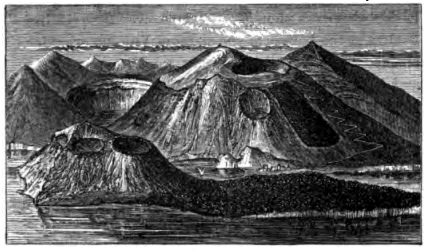
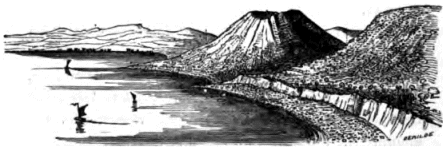
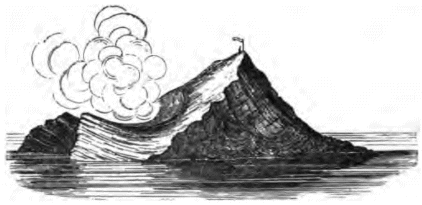
they are removed. In fig. 6, I have given a sketch of
this singular spot, taken from the high ground of the
neighbouring Island of Lipari. From the village at
the foot of the volcano, where the workmen live, a zig-zag
road has been constructed leading up the side, and
down into the crater of the volcano. On this road,
workmen and mules, laden with the various volcanic
materials, may be seen constantly passing up and down.
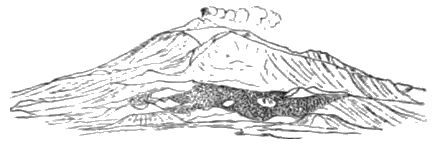
Fig. 6.—View of Vulcano, with Vulcanello in the foreground
taken from the south end of the Island of Lipari.
Vulcano appears to have been frequently in a state of
violent eruption during the past 2,000 years—the last
great outburst having taken place in 1786. In 1873 the
activity in the crater of Vulcano suddenly became more
pronounced in character, and the workmen hastened
to escape from the dangerous spot, but, before they
could do so, several of them were severely injured by
the explosions. After this outburst, which did not prove
to be of very violent character, the quantity of gases
issuing from the fissures in the crater was for a time
much greater than before, and the productiveness of
these great natural chemical works was proportionately
increased: but eventually the action died out almost
entirely. The chief products of Vulcano which are of
commercial value, are sal-ammoniac, sulphur, and boracic
acid. At one time it was even contemplated that great
leaden chambers should be erected over the principal
fissures at the bottom of the crater of Vulcano, in which
chambers the volatile materials might be condensed
and collected. The change in the condition of the
volcano has unfortunately prevented the carrying out
of this bold project.
Besides the volatile substances which issue from
volcanic vents, mingling with the atmosphere or condensing
upon their sides, there are also many solid
materials ejected, and these may accumulate around
the orifices, till they build up mountains of vast dimensions,
like Etna, Teneriffe, and Chimborazo. Some of
these solid materials are evidently fragments of the
rock-masses, through which the volcanic fissure has
been rent; these fragments have been carried upwards
by the force of the steam-blast and scattered over
the sides of the volcano. But the principal portion of
the solid materials ejected from volcanic orifices consists
of matter which has been extruded from sources
far beneath the surface, in a highly-heated and fluid or
semi-fluid condition.
EJECTED ROCK-FRAGMENTS.
The fragments torn from the sides of volcanic
fissures consist of the rocks through which the eruptive
forces may happen to have opened their way; pieces
of sandstone, limestone, slate, granite, &c., are thus
frequently found in considerable numbers among
materials which build up volcanic mountains. Thus,
some of the volcanic cones in the Eifel are very largely
made up of fragments of slate, which have been torn
from the sides of the vents by the uprushing currents
of steam. At Vesuvius masses of limestone are frequently
ejected, and may be picked up all over the
slopes of the mountains. These limestone-fragments
frequently contain fossils, and Professor Guiscardi, of
Naples, has been able to collect several hundred species
of shells, transported thus by volcanic action from the
rock-masses which form the foundation of the volcano
of Vesuvius. The action of water at a high temperature,
and under such enormous pressure as must
exist beneath volcanic mountains, has often produced
changes in the rocks of which fragments are ejected
from volcanic vents. The so-called 'lava' ornaments,
which are so extensively sold at Naples, are not made
from the materials to which geologists apply that
name, but from the fragments of altered limestone
that have been torn from the rocks beneath the
mountain, and scattered by the eruptive forces all over
its sides. The chemical action of the superheated
and highly-compressed steam on the rocks beneath
volcanoes frequently results in the formation of beautifully
crystallised minerals. Such crystallised minerals
abound in the rock-fragments scattered over the sides
of Vesuvius and other volcanoes, both active and extinct.
They have been formed in the great chemical
laboratories which exist beneath the volcano, and have
been brought to the surface by the action of the steam-jets
issuing from its fissures.
Of still greater interest are those materials which
issue from volcanic orifices in an incandescent, and
often in a molten, condition, and which are evidently
derived from sources far below the earth's surface. It
is to these materials that the name of 'lavas' is
properly applied.
Lavas present a general resemblance to the slags
and clinkers which are formed in our furnaces and
brick-kilns, and consist, like them, of various stony
substances which have been more or less perfectly
fused. When we come to study the chemical composition
and the microscopical structure of lavas, however,
we shall find that there are many respects in which
they differ entirely from these artificial products.
Let us first consider the facts which are taught us
concerning the nature and origin of lavas, by a chemical
analysis of them.
CHEMICAL COMPOSITION OF LAVAS.
Of the sixty-five or seventy chemical elements, only a
very small number occur at all commonly in lavas. Eight
elements, indeed, make up the great mass of all lavas—these
are oxygen, silicon, aluminium, magnesium,
calcium, iron, sodium, and potassium. But even these
eight elements are present in very unequal proportions.
Oxygen makes up nearly one-half the weight of
all lavas. Almost all the other elements found in lavas
exist in combination with oxygen, so that lavas consist
entirely of what chemists call 'oxides.' This is a most
remarkable circumstance, which, as we shall presently
see, is of great significance. The metalloid silicon
makes up about one-fourth of the weight of most lavas,
and the metal aluminium about one-tenth. The other
five elements vary greatly in their relative proportions
in different lavas.
In all lavas the substance which forms the greatest
part of the mass is the compound of oxygen and silicon,
known as silica or silicic acid. In its pure form, this
substance is familiar to us as quartz, or rock-crystal
and flint. Silica is present in all lavas in proportions
which vary from one-half to four-fifths of the whole
mass. Now, this substance, silica, has the property of
forming more complex compounds by uniting with the
other oxides present in lavas—namely, the oxides of
aluminium, magnesium, calcium, iron, potassium, and
sodium. Silica is called by chemists an acid, the other
oxides in lavas are termed bases, and the compounds
of silica with the bases are known as silicates. Hence
we see that lavas are composed of a number of different
silicates—the silicates of aluminium, magnesium, calcium,
iron, potassium, and sodium.
The above statements will perhaps be made clearer
by the accompanying table from which it will be seen
that lavas are compounds in varying proportions of six
kinds of salts—namely, the silicates of alumina, magnesia,
lime, iron, potash, and soda.
Composition of Lavas.
Elements
Binary Compounds
Salts
Oxygen
Acid
Bases
Silicon
Silica—
┐
Aluminum
┠—Alumina
" " Alumina
Magnesium
┠—Magnesia
" " Magnesia
Calcium
┠—Lime
" " Lime
Iron
┠—Iron
" " Iron
Potassium
┠—Potash
" " Potash
Sodium
┠—Soda
" " Soda
Now, in some lavas the acid constituent, or silica, is
present in much larger proportions than in others.
Those lavas with a large proportion of silica are called
'acid lavas,' those with a lower percentage of silica,
and therefore a higher proportion of the bases, are
known as the 'basic lavas.' It is convenient to employ
the term 'intermediate lavas' for those in which the
proportion of silica is lower than in the acid lavas, and
the proportion of the bases is lower than in the basic
lavas.
The acid lavas contain from 66 to 80 per cent, of
silica; they are poor in lime, magnesia, and oxide of
iron, but rich in potash and soda. The basic lavas
contain from 45 to 55 per cent, of silica; they are rich
in magnesia, lime, and oxide of iron, but poor in soda
and potash. In the intermediate lavas the proportion
of silica varies from 55 to 66 per cent.
As the basic-lavas contain a larger proportion of
oxide of iron and other heavy oxides than the acid-lavas,
the former have usually a higher specific
gravity than the latter; it is, indeed, possible in most
cases to distinguish between these different varieties
by simply weighing them in water and in air.
DIFFERENT KINDS OF LAVA.
The basic lavas are usually of much darker colour
than the add lavas—the terms acid lavas, intermediate
lavas, and basic lavas correspond indeed pretty closely
with the names trachytes, greystones and basalt, which
were given to the varieties of lavas by the older writers
on volcanoes, at a time when their chemical constitution
had not been accurately studied. Fresh lavas of acid
composition are usually nearly white in colour, intermediate
lavas are of various tints of grey, and basic
lavas nearly black. It must be remembered, however,
that colour is one of the least persistent, and therefore
one of the least valuable, characters by means of which
rocks can be discriminated, and also that by exposure
to the influence of the atmospheric moisture the iron
present in all lavas is affected, and the lavas belonging
to all classes, when weathered, assume reddish and
reddish-brown tints.
Geologists have devised a great number of names
for the various kinds of lava which have been found
occurring round volcanic vents in different parts of the
world, and the study of these varieties is full of interest.
For our present purpose, however, it will be sufficient
to state that they nearly all fall into five great groups,
known as the Rhyolites, the Trachytes, the Andesites,
the Phonolites, and the Basalts. The Rhyolites are
acid lavas, the Basalts are basic lavas, and the Trachytes,
Andesites, and Phonolites, different kinds of
intermediate lavas, distinguished by the particular
minerals which they contain.
Before we part from this subject of the classification
of lavas according to their chemical composition, it will
be well to point out that there exists a small group of
lavas which stand quite by themselves, and cannot be
referred to either of the classes we have indicated.
They contain a smaller proportion of silica, and a much
larger proportion of magnesia and oxide of iron than
the other lavas, and may be made to constitute a small
sub-group, to which we may apply the term of 'ultra-basic
lavas.' Although much less widely distributed
than the other varieties, they are, in some respects,
as we shall presently have to point out, of far greater
interest to the geologist than all the other kinds of
lavas.
MINUTE STRUCTURE OF LAVAS.
We will now proceed to consider the facts which
are brought to light concerning the nature of lavas,
when they are studied by the aid of the microscope.
Although most lavas appear at first sight to be opaque
substances, yet it is easy to prepare slices of them
which are sufficiently thin to transmit light. In such
thin transparent slices we are able to make out, by the
aid of the microscope, certain very interesting details
of structure, which afford new and important evidence
bearing on the mode of origin of these rocks.
Host lavas are capable of being melted by the heat
of our furnaces; but the different kinds of lava vary
greatly in the degree of their fusibility. The basic
lavas, or those with the smallest proportion of silica,
are usually much more easily fusible than those which
contain a high percentage of silica, the add lavas.
Now, it is a very noteworthy circumstance, that when
a lava is artificially fused it assumes on cooling very
different physical characters to those which were presented
by the original rock.
If we examine the freshly-broken surface of a piece
of lava, we shall, in most cases, find that it contains a
great number of those regular-shaped bodies which we
call crystals; in some cases these crystals are so small
as to be scarcely visible to the naked eye, in others
they may be an inch or more in length. Most lavas
are thus seen to be largely made up of crystals of
different minerals. The minerals which are usually
contained in lavas are quartz, the various kinds of
felspar, augite, hornblende, the different kinds of mica,
olivine, and magnetite.
But when a piece of lava is melted in a furnace, all
these crystalline minerals disappear, and the resulting
product is the homogeneous substance which we call
glass. If, as many suppose, lavas acquire the fluidity
which they possess when issuing from volcanic vents
as the result of simple fusion it is strange that artificially
fused lavas do not agree more closely in character
with the natural products.
A careful examination of different kinds of lavas,
however, will show that they vary very greatly in
character among themselves. Some lavas are as perfectly
glassy in structure as those which have been
artificially fused, while others contain great numbers
of crystals, which may sometimes be of very large size.
If we prepare thin transparent slices of these different
kinds of lavas, and examine them by the aid
of the microscope, we shall find that lavas are made
up of two kinds of materials, a base or groundmass of
a glassy character, and distinct crystals of different
minerals, which are irregularly distributed through this
glassy base, like the raisins, currants, and pieces of
candied peel in a cake. In some cases the glassy base
makes up the whole mass of the rock; in others,
smaller or larger numbers of crystals are seen to be
scattered through a glassy base; while in others again
the crystals are so numerous that the presence of an
intervening glassy base or groundmass can only be
detected by the aid of the microscope.
STUDY OF LAVAS WITH THE MICROSCOPE.
If thin slices of the glassy materials of lavas be
examined with high magnifying powers, new and interesting
facts are revealed. Through the midst of the
clear glassy substance cloudy patches are seen to be
diffused; and, if we examine them with a still higher
power, these cloudy patches resolve themselves into
innumerable particles, some transparent and others
opaque, having very definite outlines. At the same
time fresh cloudy patches are brought into view, which
can only be resolved by yet higher powers of the
microscope. In examining these natural glasses by
the aid of the microscope, we are forcibly reminded of
what occurs when the 'Milky Way' and some other
parts of the heavens are studied with a telescope. As
the power of the instrument is increased the nebulous
patches are resolved into distinct stars, but fresh nebulous
masses come into view, which are in turn resolved
into stars, when higher powers of the instrument are
employed.
In the Frontispiece, No. 1 illustrates the appearance
presented by these volcanic glasses when examined
with a high power of a microscope. Through a glassy
base is seen a number of diffused nebulous patches,
which are in places resolved into definite particles.
These minute particles of definite form, which the
microscope has revealed in the midst of the glassy
portions of lava, have received the name of microliths,
or crystallites. The study of the characters and mode
of arrangement of these microliths or crystallites has
in recent years thrown much new light on the interesting
problems presented by lavas.
In some glassy lavas the microliths or crystallites,
instead of being indiscriminately diffused through the
mass of the base or groundmass, are found to be collected
together into groups of very definite form. In
No. 2 of the Frontispiece we have a section of a glassy
rock in which the crystallites have united together, so
as to build up groups presenting the most striking
resemblance to fronds of ferns. Around these groups
spaces of dear glass have been left by the gathering
up of the crystallites, which in other parts of the mass
are seen to be equally diffused through it. In this
formation of groups of microliths we cannot but recognise
the action of those crystalline forces, which on
frosty mornings cover our windows with a mimic vegetation
composed of icy particles.
In other cases, again, the crystallites scattered
through the glassy portions of lavas unite in radial
groups about certain centres, and thus build up globular
masses to which the name of 'sphærulites' has been
given. No. 3 in the Frontispiece illustrates the formation
of these sphærulites.
Now, a careful study of the microliths or crystallites
has proved that they are the minute elements of
which those wonderfully beautiful objects which we
call crystals are built up. In some cases we can see
that the crystallites are becoming united together in
positions determined by mathematical laws, and the
group is gradually assuming the outward form and internal
structure of a crystal. In other cases crystals
may be found which are undergoing a disintegrating
action, and are then seen to be made up of minute
elements similar to the crystallites or microliths of
glassy rocks.
CRYSTALLITES AND CRYSTALS.
The conclusion is confirmed by the fact that if we
take an artificially fused lava and allow it to cool slowly,
it will be found that the glassy mass into which it has
resolved itself contains numerous crystallites. If the
cooling process be still further prolonged, these crystallites
will be found to have united themselves into
definite groups, and sometimes distinct crystals are
formed in the mass; under these circumstances the
rock frequently loses its glassy appearance and assumes
a stony character.
In connection with this subject, it may be mentioned
that some years ago a very ingenious invention
was submitted to trial in the Works of the Messrs.
Chance, of Birmingham. It had been suggested that
if certain lavas of easy fusibility were melted and
poured into moulds, we might thus obtain elaborately
ornamented stone-work, composed of the hardest
material, without the labour of the mason. The molten
rock when quickly cooled was found to assume the
form of a black glass, but when very slowly cooled
passed into a stony material. Unfortunately, it was
found that this material did not withstand the weather
like ordinary building stones, and, in consequence, the
manufacture had to be abandoned.
Now, the study of the products of volcanoes has led
geologists to recognise the true relations between
glassy and crystalline rocks.
In the amorphous mixture of various silicates which
compose a glass, chemical affinity causes the separation
of certain portions of definite composition, and these
form the microliths or elements of which different
crystalline minerals are built up. Under the influence
of the crystalline forces, there is a great shaking or
agitation in the mass, and the microliths of similar kind
come together and become united, like the fragments
in Ezekiel's valley of dry bones.
Although we cannot see this process taking place
under our eyes, in a mass of lava, yet we may study
specimens in which the action has been arrested in
its different stages. In order to understand the
development of an acorn into an oak-tree, it is not
necessary to watch the whole series of changes in a
particular case. A visit to an oak-thicket, in which
illustrations of every stage of the transformation may
be found, will afford us equally certain information on
the subject.
In the same way by the examination of such a
series of rock-sections as that represented in the Frontispiece,
we may understand how, in the midst of a
mass of mixed silicates constituting a natural glass,
the separation of microliths takes place; these unite
into groups which are the skeletons of crystals, and
finally, by the filling up of the empty spaces in these
skeletons, complete crystals are built up. The series
of operations may, however, be interrupted at any
stage, and this stage we may have the chance of
studying.
GLASSY AND CRYSTALLINE LAVAS.
We are able, as we shall show in a future chapter,
to examine many rock-masses that have evidently
formed the reservoirs from which volcanoes have been
supplied, and others that fill up the ducts which constituted
the means of communication between these
subterranean reservoirs, and the surface of the earth.
Now in these subterranean regions the lavas have been
placed under conditions especially favourable for the
action of the crystalline forces—they must have cooled
with extreme slowness, and they must have been under
an enormous pressure, produced in part by the weight
of the superincumbent rocks, and in part by the expansive
force of the imprisoned steam. We are not,
therefore, surprised to find that in these subterranean
regions, the lavas, while retaining the same chemical
composition, have assumed a much more perfectly
crystalline condition. In some cases, indeed, the whole
rock has become a mass of crystals without any base
or groundmass at all.
An examination of the Frontispiece will illustrate
this perfect gradation from the glassy to the crystalline
condition of lavas. No. 1 represents a glass through
which microliths or crystallites of different dimensions
and character are diffused. In Nos. 2 and 3, these crystallites
have united to form regular groups. In No. 4,
which may be taken as typical of the features presented
by most lavas, we have a glassy groundmass containing
microliths (a 'crypto-crystalline base'), through which
distinct crystals are distributed. Nos. 5 and 6 illustrate
the characters presented by lavas which have consolidated
at considerable depths beneath the surface; in
the former we have a mans of small crystals (a 'micro-crystalline
base') with larger crystals scattered through
it; while the latter is entirely made up of large
crystals without any trace of a base or groundmass.
Now, as all lavas are found sometimes assuming the
glassy condition at the surface, so when seen in the
masses which have consolidated with extreme slowness,
and under great pressure, in subterranean regions, the
same materials are found in the condition of a rock
which is built up entirely of crystals. Chemists have
found that artificial mixtures of silicates in which soda
and potash are present in considerable quantities, have
a great tendency to assume the glassy condition on cooling
from a state of fusion, and glass manufacturers are
always careful to use considerable proportions of the
alkalis as ingredients, in making glass. It is found, in
like manner, that those lavas which contain the largest
portion of the silicates of soda and potash (the 'acid
lavas') most frequently assume the condition of a
natural glass.
Geologists have given distinct names to the glassy
and the perfectly crystalline conditions of the different
kinds of lavas, the glassy varieties being found in
masses which have cooled rapidly near the surface, and
the crystalline varieties in masses which have cooled
slowly at great depths. The names of these two conditions
of the five great classes into which we have
divided lavas are as follows:—
HIGHLY CRYSTALLINE IGNEOUS ROCKS.
Crystalline Forms.
Lavas.
Glassy Forms.
Granite
Rhyolite
Obsidian.
Syenite
Trachyte
Diorite
Andesite
Miascite
Phonolite
Gabbro
Basalt
Tachylyte.
As vitreous rocks have little in their general appearance
to distinguish them from one another, the glassy
forms of the first four classes of lava have not hitherto
received distinct names, but have been confounded
together under the name of obsidian. If we determine
the specific gravities of rocks having the same
composition but different structures, we shall find that
they become heavier in proportion as the crystalline
structure is developed in them. Thus gabbro is
heavier, but tachylyte is lighter than basalt, bulk for
bulk, though all have the same chemical composition.
Nor are the crystals contained in lavas less worthy
of careful study, by the aid of the microscope, than
the more or less glassy groundmass in which they are
embedded. Mr. Sorby has shown that the crystals
found in lavas, exhibit many interesting points of
difference from those which separate out in the midst
of a mass of the same rock, when it has been artificially
melted and slowly cooled. There are other facts which
also point to the conclusion that, while the glassy
groundmass of lavas may have been formed by cooling
from a state of fusion, the larger and well-formed
crystals in these lavas must have been formed under
other and very different conditions.
The larger crystals in lavas exhibit evidence of
having been slowly built up in the midst of a glassy
mass, containing crystallites and small crystals. We
can frequently detect evidence of the interruptions
which have occurred in the growth of these crystals in
the concentric zones of different colour or texture
which they exhibit; and portions of the glassy base or
groundmass are often found to have been caught up
and enclosed in these crystals during their growth.
But when we find, as in the porphyritic pitchstones,
a glassy base containing only minute crystallites,
through which large and perfectly formed crystals are
distributed, we can scarcely doubt that the minute
crystallites and the larger crystals have separated from
the base under very different conditions. This is indicated
by the bet that we detect in these cases no connecting
links between the embryo microliths and the
perfect crystals; and a confirmation of the conclusion
is seen in the circumstance that many of the crystals
are found to have suffered injury as if from transport,
their edges and angles being rounded and abraded, and
portions being occasionally broken off from them.
Hence we are led to conclude that the larger crystals
in lavas were probably separated from the amorphous
mass in the subterranean reservoirs beneath the volcano,
and were carried up to the surface in the midst of the
liquefied glassy material which forms the groundmass
of lavas. When we come to examine these crystals
more closely, we find that certain very curious phenomena
are exhibited by them which lend powerful
support to this conclusion.
Fig. 7.—Minute Cavities, containing Liquids, in the
Crystals of Rocks.
LIQUID CAVITIES IN CRYSTALS.
It is found convenient by geologists to designate
those rocks which have consolidated in deep-seated
portions of the earth's crust as Platonic Rocks, confining
the name of Volcanic rocks to those consolidating
At the surface; but Plutonic and Volcanic Rocks shade
into one another by the most insensible gradations.
When the crystals embedded in granitic rocks, and
in some lavas, are examined with the higher powers of
the microscope, they are frequently seen to contain great
numbers of excessively minute cavities. Each of these
cavities resembles a small spirit-level, having a quantity
of liquid and a bubble of gas within it. In fig. 7 we
have given a series of drawings of these cavities in
crystals as seen under a high power of the microscope.
In No. 1 a group of such cavities is represented, one of
which is full of liquid, while two others are quite empty;
the remaining cavities all contain a liquid with a
moving bubble of gas. In No. 2 two larger cavities are
shown, containing a liquid and a bubble of gas; and it
will be seen from these how varied in form these
cavities sometimes are. In Nos. 3, 4 and 6 the liquid
in the cavities contains, besides the bubbles, several,
minute crystals; and in No. 6 we have a cavity containing
two liquids and a bubble.
In the largest of such cavities the bubble is seen to
change its place so as always to lie at the upper side of
the cavity, when the position of the latter is altered, just
as in a spirit-level. But in the smallest cavities the
bubbles appear to be endowed with a power of spontaneous
movement; like imprisoned creatures trying to
escape, these bubbles are seen continually oscillating
from side to side and from end to end of the cavities
which enclose them. In fig. 8 a minute cavity containing
a liquid and bubble is shown, the path pursued
by the latter in its wonderful gyrations being indicated
by the dark line. These cavities are exceedingly minute,
and so numerous that in some crystals there
must be millions of them present; indeed, in certain
cases, as we increase the magnifying power of our microscopes,
new and smaller cavities continually become
visible. It has been estimated that in some instances
the number of these minute liquid-cavities in the crystals
of rocks amounts to from one thousand millions
to ten thousand millions in a cubic inch of space.
Fig. 8—Minute Liquid-cavity in a Crystal, with a moving
Bubble. (The path of the bubble is indicated by the dark line.)
NATURE OF LIQUIDS IN CAVITIES.
What is the nature of the liquids which are thus
imprisoned in these cavities contained in the crystals of
lavas and granites? Careful experiments have given
a conclusive answer to this question. In many cases
the liquid is water, usually containing considerable
quantities of saline matter dissolved in it. Sometimes
the saline matters are present in such abundance
that they cannot all pass into solution, but
crystallise out, as in fig. 7—Nos. 3, 4, 5—where cubic
crystals of the chlorides of sodium and potassium are
seen floating in the liquid; in other cases the liquid is
a hydrocarbon like the mineral oil which is present in
great abundance in deep-seated rocks in many parts of
the globe. But in some other cases the liquid contained
in the cavities of crystals is found to be one
which could scarcely be anticipated to occur under
such circumstances—the gas known as carbonic add,
which under extreme pressure can be reduced to a
liquid condition. In cavities containing liquefied carbonic
acid, if the rock be warmed up to 86° or 90° Fahrenheit
the bubble suddenly vanishes, sometimes with
an appearance like ebullition or boiling, as represented
in fig. 9. Now the temperature which we have indicated
is the 'critical point' of carbonic acid, and
above that temperature it cannot exist in a liquid condition,
however great may be the pressure to which it
is subjected. The liquid has been converted into a
gas which completely fills the cavity. The carbonic
acid in the cavities of crystals has frequently been
isolated and its nature placed beyond doubt by spectroscopic
and ordinary chemical tests.
The presence of these liquids in the cavities of
crystals clearly proves that the latter must have been
formed under enormous pressure—a pressure sufficiently
great to reduce, not only steam, but also volatile hydrocarbons
and even gaseous carbonic acid, to the bulk of
a liquid.
Fig. 9.—Cavity in Crystal containing Carbonic-Acid Gas at a
temperature of 86° F., and passing from the liquid to the
gaseous condition.
Such conditions of enormous pressure we may infer
to exist in the deep-seated reservoirs beneath volcanoes,
where, besides the weight of the superincumbent rock-masses,
we have the compressing force of great quantities
of elastic vapour held in confinement. The crystals of
which granitic rocks are entirely built up exhibit clear
evidence of having been all formed under these conditions
of enormous pressure. The glassy base or
groundmass of lavas, on the other hand, presents all
the characters of materials that have cooled from a
state of fusion. Most lavas consist in part of crystals,
exhibiting fluid-cavities like those present in granite,
and in part of a base, which has evidently been formed
by the cooling of a fused mass. We are therefore
justified in concluding that the crystals have been
formed in subterranean recesses, and that the groundmass
or base has consolidated at the surface. The
bearing of these conclusions upon some of the great
problems presented by volcanoes we shall have occasion
to point out in the sequel.
CAUSE OF MOVEMENT OF BUBBLES.
One of the most interesting inquiries suggested by
the study of the liquid-cavities in volcanic rocks is
that of the cause of the apparently spontaneous movement
of the bubbles which we have described as taking
place in some of the smaller of them. The ingenious
experiments of Mr. Noel Hartley have suggested to
Professor Stokes an explanation which is probably the
true one. It appears that these minute globes of
vapour are in such a state of unstable equilibrium as
to be affected by the smallest changes of temperature,
and that the variations in the heat of the atmosphere,
due to currents of air and the movement of warm
or cold bodies through it, are sufficient to cause the
oscillation of these sensitively poised bubbles.
The short account which we have been able to give
in the foregoing pages of the researches that have been
carried on concerning the nature of the materials ejected
from volcanoes will serve to show that these investigations
have already made known many facts of great
interest, and that the farther pursuit of them is full of
the highest promise. To the scientific worker no subject
is too vast for his research, no object so minute as
to be unworthy of his most patient study. In some of
our future inquiries concerning the nature of volcanic
action, we shall be led to an investigation of the phenomena
displayed in the sun, moon, comets and other
great bodies of the universe; but another road to truths
of the same grandeur and importance is found, as we
have seen, in an examination of the mode of development
of crystallites, and a study of the materials
contained in the microscopic cavities of the minutest
crystals.
CHAPTER IV. THE DISTRIBUTION OF THE MATERIALS EJECTED FROM VOLCANIC VENTS.
The escape of great quantities of steam and other gases
from the midst of a mass of fluid or semi-fluid lava
gives rise to the formation of vast quantities of froth
or foam upon its surface. This froth or foam, which
is formed upon the surface of lava by the escape of
gaseous matters from within it, is made up of portions
of the lava distended into vesicles, in the same way
that bubbles are formed on the surface of water. It
bears precisely the same relation to the liquid mass of
lava that the white crest of foam upon an advancing
wave does to the sea-water, from the bubbles of which
it is formed.
This froth upon the surface of lavas varies greatly
in character according to the nature of the material
from which it is formed. In the majority of cases the
lavas consist, as we have seen, of a mass of crystals
floating in a liquid magma, and the distension of such
a mass by the escape of steam from its midst gives rise
to the formation of the rough cindery-looking material
to which the name of 'scoria' is applied. But when
the lava contains no ready-formed crystals, but consists
entirely of a glassy substance in a more or less perfect
state of fusion, the liberation of steam gives rise to the
formation of the beautiful material known as 'pumice.'
Pumice consists of a mass of minute glass bubbles;
these bubbles have not usually, however, retained their
globular form, but have been elongated in one direction
through the movement of the mass while it was still in
a plastic state.
The steam frequently escapes from lava with such
violence that the froth or scum on its surface is broken
up and scattered in all directions, as the foam crests of
waves are dispersed by the wind during a storm. In
this way fragments of scoria or pumice are often thrown
to the height of many hundreds or thousands of feet
into the atmosphere, as we have seen is the case at
Stromboli and Vesuvius. Indeed, during violent eruptions,
a continuous upward discharge of these fragments
is maintained, the ragged cindery masses hurtling one
another in the atmosphere, as they are shot perpendicularly
upwards to an enormous height and fall back
into the vent; or they may rise obliquely and describe
curves so as to descend outside the orifice from which
they were ejected.
FINENESS OF VOLCANIC DUST.
During their upward discharge and downward fall,
the cindery fragments are by attrition continually
reduced to smaller dimensions. The noise made by
these fragments, as they strike against one another in
the air during their rise and fall, is one of the most
noteworthy accompaniments of volcanic eruptions. It
has been noticed that in many cases there is a constant
diminution in the size of the fragments ejected during
a volcanic outburst, this being doubtless due to the
friction of the masses as they are ejected and re-ejected
from the vent. Thus it is related by Mr. Poulett
Scrope, who watched the Vesuvian eruption of 1822,
which lasted for nearly a month, that during the earlier
stages of the outburst fragments of enormous size were
thrown out of the crater, but by constant re-ejection
these were gradually reduced in size, till at last only
the most impalpable dust issued from the vent. This
dust filled the atmosphere, producing in the city of
Naples 'a darkness that might be felt,' and so excessively
finely divided was it, that it penetrated into all
drawers, boxes, and the most closely fastened receptacles,
filling them completely. Mr. Whymper relates that,
while standing on the summit of Chimborazo, he witnessed
an eruption of Cotopaxi, which is distant more
than fifty miles from the former mountain. The fine
volcanic dust fell in great quantities around him, and
he estimated that no less than two millions of tons
must have been ejected during this slight outburst.
Professor Bonney has examined this volcanic dust from
Cotopaxi, and calculates that it would take from 4,000
to 25,000 particles to make up a grain in weight.
Various names have been given by geologists to
the fragments ejected from volcanic vents, which, as we
have seen, differ greatly in their dimensions and other
characters. Sometimes masses of more or less fluid
lava are flung bodily to a great height in the atmosphere.
During their rise and fall these masses are
caused to rotate, and in consequence assume a globular
or spheroidal form. The water imprisoned in these
masses, during their passage through the atmosphere,
tends to expand into steam, and they become more or
less completely distended with bubbles. Such masses,
which sometimes assume very regular and striking
forms, are known as 'volcanic bombs.' Many volcanic
bombs have a solid nucleus of refractory materials. The
large, rough, angular, cindery-looking fragments are
termed 'scoriæ.' When reduced to the dimensions of
a marble or pea they are usually called by the Italian
name of 'lapilli.' The still finer materials are known
as volcanic sand and dust.
There are, however, two names which are frequently
applied to these fragmentary materials ejected from
volcanoes, which are perhaps liable to give rise to misconception.
These are the terms 'cinders' and 'ashes.'
It must be remembered that the scoriæ or cindery-looking
masses are not, like the cinders of our fires, the
product of the partial combustion of a material containing
inflammable gases, but are, like the clinkers of
furnaces and brick-kilns, portions of partially vitrified
and fused rock distended by gases. So, too, volcanic
ashes only resemble the ashes of our grates in being
very finely divided; they are not, like the latter,
the incombustible residue of a mass which has been
burnt.
VOLCANIC BOMBS AND PELE'S HAIR.
The glassy lavas, when distended by escaping gases,
give rise to the formation of pumice, the white colour
of which, as in the case of the foam of a wave, is due
to the reflection of a portion of the light in its frequent
passage from one medium to another—in this case from
air to glass, and from glass to air. The volcanic bombs
formed from glassy lavas are often of especially beautiful
and regular forms. Sometimes the passage of steam
through a mass of molten glass produces large quantities
of a material resembling spun glass. Small particles or
shots of the glass are carried into the air and leave
behind them thin, glassy filaments like a tail. At the
volcano of Kilauea in Hawaii this filamentous volcanic
glass is abundantly produced, and is known as
'Pele's Hair'—Pele being the name of the goddess of
the mountain. Birds' nests are sometimes found composed
of this beautiful material. In recent years an
artificial substance similar to this Pele's hair has been
extensively manufactured by passing jets of steam
through the molten slag of iron-furnaces; it resembles
cotton-wool, but is made up of fine threads of glass,
and is employed for the packing of boilers and other
purposes.
The very finely-divided volcanic dust is often borne
to enormous distances from the volcano out of which
it has been ejected. The force of the steam-current
carrying the fragments into the atmosphere is often so
great that they rise to the height of several miles above
the mountain. Here they may actually pass into the
upper currents of the atmosphere and be borne away to
the distance of many hundreds or thousands of miles.
Hence it is not an unusual circumstance for vessels at
sea to encounter at great distances from land falling
showers of this finely divided, volcanic dust. We sometimes
meet with this far-travelled, volcanic dust under
very unexpected circumstances. Thus, in the spring
of 1875 I had occasion to visit Prof. Vom Rath of Bonn,
who showed me a quantity of fine volcanic dust which
had during the past winter fallen in considerable quantities
in certain parts of Norway. This dust, upon
microscopic examination, proved to be so similar to what
was known to be frequently ejected from the Icelandic
volcanoes that a strong presumption was raised that
volcanic outbursts had been going on in that island.
On returning to England I found that the first steamer
of the season had just reached Leith from Iceland,
bringing the intelligence that very violent eruptions
had taken place during the preceding months.
DISPERSION OF PUMICE AND VOLCANIC DUST.
This finely-divided volcanic dust is thus carried by
the winds and spread over every part of the ocean.
Everyone is familiar with the fact that pumice floats
upon water; this it does, not because it is a material
specifically lighter than water, but because cavities
filled with air make up a great part of its bulk. If
we pulverise pumice, we find the powder sinks readily
in water, but the rock in its natural condition floats
for the same reason that an iron ship does—because of
the air-chambers which it encloses. When this pumice
is ejected from a volcano and falls into a river or the
ocean, it floats for a long time, till decomposition
causes the breaking down of the thin glassy partitions
between the air chambers, and causes the admission of
water into the latter, by which means the whole mass
gets water-logged. Near the Liparis and other volcanic
islands the sea is sometimes covered with fragments
of pumice to such an extent that it is difficult
for a boat to make progress through it, and the same
substance is frequently found floating in the open ocean
and is cast up on every shore.
During the year 1878 masses of floating pumice
were reported as existing in the vicinity of the Solomon
Isles, and covering the surface of the sea to such extent
that it took ships three days to force their way through
them. Sometimes these masses of pumice accumulate
in such quantities along coasts that it is difficult
to determine the position of the shore within a mile or
two, as we may land and walk about on the great floating
raft of pumice. Now, recent deep-sea soundings,
carried on in the 'Challenger' and other vessels, have
shown that the bottom of the deepest portion of the
ocean, far away from the land, is covered with these
volcanic materials which have been carried through the
air or floated on the surface of the ocean. To these
deeper parts of the ocean no sediments carried down by
the rivers are borne, and the remains of calcareous
organisms are, in these abysses, soon dissolved; under
such conditions, therefore, almost the only material
accumulating on the sea bottom is the ubiquitous wind-
and wave-borne volcanic products. These particles of
volcanic dust and fragments of pumice by their disintegration
give rise to a clayey material, and the
oxidation of the magnetite, which all lavas contain,
communicates to the mass a reddish tint. This appears
to be the true origin of those masses of 'red-clay'
which, according to recent researches, are found to
cover all the deeper parts of the ocean, but which
probably attain to no great thickness.
But while some portion of the materials ejected
from volcanoes may thus be carried by winds and waves,
so as to be dispersed over every part of the land and
the ocean-bed, another, and in most cases by far the
largest, portion of these ejections falls around the volcanic
vent itself. It is by the constant accumulation
of these ejected materials that such great mountain
masses as Etna, Teneriffe, Fusiyama, and Chimborazo
have been gradually built up around centres of volcanic
action.
There are cases in which the formation of volcanic
mountains on a small scale has actually been observed
by trustworthy witnesses. There are other cases in
which volcanic mountains of larger size can be shown
to have increased in height and bulk by the fall upon
their sides and summits of fragmentary materials ejected
from the volcanic vent. In all cases the examination
of these mountain-masses leads to the conclusion that
they are entirely built up of just such materials as we
constantly see thrown out of volcanoes during eruption.
FORMATION OF VOLCANIC MOUNTAINS.
Thus we are led to the conclusion that all volcanic
mountains are nothing but heaps of materials ejected
from fissures in the earth's crust, the smaller ones
having been formed during a single volcanic outburst,
the larger ones being the result of repeated eruptions
from the same orifice which may, in some cases, have
continued in action for tens or hundreds of thousands
of years.
No observer has done such useful work in connection
with the study of the mode of formation of volcanic
mountains as our countryman, Sir William Hamilton,
who was ambassador at Naples from 1764 to 1800, and
made the best possible use of his opportunities for
examining the numerous volcanoes in Southern Italy.
A little to the west of the town of Puzzuoli on the
Bay of Naples there stands a conical hill rising to the
height of 440 feet above the level of the Mediterranean,
and covering an area more than half a mile in diameter.
Now we have the most conclusive evidence that in
ancient times no such hill existed on this site, which
was partly occupied by the Lucrine Lake, and the fact
is recognised in the name which the hill bears, that of
Monte Nuovo, or the 'New Mountain.' See fig. 10.
Sir William Hamilton rendered admirable service
to science by collecting all the contemporary records
relating to this interesting case, and he was able to
prove, by the testimony of several intelligent and trustworthy
witnesses, that during the week following the
29th of September, 1538, this hill had gradually been
formed of materials ejected from a volcanic vent which
had opened upon this site.
Fig. 10. Monte Nuovo (440 ft. high) on the shores of the Bay of
Naples.
HISTORY OF THE FORMATION OF MONTE NUOVO.
The records collected by Hamilton with others which
have been discovered since his death prove most conclusively
the following facts. During more than two years,
the country round was affected by earthquakes, which
gradually increased in intensity and attained their
climax in the month of September 1538; on the 27th
and 28th of that month these earthquake shocks are said
to have been felt almost continuously day and night.
About 8 o'clock on the morning of the 29th, a depression
of the ground was noticed on the site of the future
hill, and from this depression, water, which was at first
cold and afterwards tepid, began to issue. Four hours
afterwards the ground was seen to swell up and open,
forming a gaping fissure, within which incandescent
matter was visible. From this fissure numerous masses
of stone, some of them 'as large as an ox,' with vast
quantities of pumice and mud, were thrown: up to a
great height, and these falling upon the sides of the
vent formed a great mound. This violent ejection of
materials continued for two days and nights, and on
the third day a very considerable hill was seen to have
been built up by the falling fragments, and this hill
was climbed by some of the eye-witnesses of the eruption.
The next day the ejections were resumed, and
many persons who had ventured on the hill were injured,
and several killed by the falling stones. The
later ejections were however of less violence than the
earlier ones, and seem to have died out on the seventh
or eighth day after the beginning of the outburst.
The great mass of this considerable hill would appear,
according to the accounts which have been preserved,
to have been built up by the materials which were
ejected during two days and nights.
Monte Nuovo is a hill of truncated conical form,
which rises to the height of 440 feet above the waters
of the Mediterranean, and is now covered with thickets
of stone-pine. The hill is entirely made up of volcanic
scoriæ, lapilli, and dust, and the sloping sides have
evidently been produced by these fragmentary materials
sliding over one another till they attained the angle of
rest; just as happens with the earth and stones tipped
from railway-waggons during the construction of an
embankment. In the centre of this conical hill is a
vast circular depression, with steeply sloping sides,
which is of such depth that its bottom is but little
above the sea-level. This cup-shaped depression is
the 'crater' of the volcano, and it has evidently been
formed by the explosive action which has thrown out
the materials immediately above the vent, and caused
them to be accumulated around it.
Fig. 11.—Map of the district around Naples, showing Monte
Nuovo and the surrounding volcanoes of older date.
The district lying to the west of Naples, in which
the Monte Nuovo is situated, contains a great number
of hills, all of which present a most striking similarity
to that volcano. All these hills are truncated cones,
with larger or smaller circular depressions at their summits,
and they axe entirely composed of volcanic scoriæ,
lapilli, and dust. Some of these hills are of considerably
larger dimensions than the Monte Nuovo, while others
are of smaller size, as shown in the annexed map,
fig. 11. No stranger visiting the district, without
previous information upon the subject, would ever
suspect the fact that, while all the other hills of the
district have existed from time immemorial, and are
constantly mentioned in the works of Greek and Roman
writers, this particular hill of Monte Nuovo came
into existence less than 350 years ago.
OLDER VOLCANOES OF THE CAMPI PHLEGRÆI.
The evidently fused condition of the materials of
which these hills are built up is a dear sign of the
volcanic action which has taken place in it; and this
feet was so fully recognised by the ancients that they
called the district the Campi Phlegræi, or 'the Burning
Fields,' and regarded one of the circular depressions
in it as the entrance to Hades.
It is impossible for anyone to examine this district
without being convinced that all the numerous cones
and craters which cover it have been formed by the
same agency as that by which Monte Nuovo was produced.
We have shown that there is the most satisfactory
historical evidence as to what that agency was.
Now volcanic cones with craters in their centres
occur in great numbers in many parts of the earth's
surface. In some districts, like the Auvergne, the
Catacecaumene in Asia Minor, and certain parts of
New Zealand, these volcanic cones occur by hundreds
and thousands. In some instances, these volcanic cones
have been formed in historic times, but in the great
majority of cases we can only infer their mode of origin
from their similarity to others of which the formation
has been witnessed.
Most of the smaller volcanic hills, with their
craters, have been thrown up during a single eruption
from a volcanic fissure; but, as Hamilton conclusively
proved, the grandest volcanic mountains must have
been produced by frequent repetitions of similar operations
upon the same site. For not only are these
great volcanic piles found to be entirely composed of
materials which have evidently been ejected from
volcanic vents, but, when carefully watched, such
mountains are found undergoing continual changes in
form, by the addition of materials thrown out from the
vent, and falling upon their sides.
This fact will be well illustrated by a comparison
of the series of drawings of the summit of Vesuvius
which were made by Sir William Hamilton in 1767,
and which we have copied in fig. 12. During the earlier
months of that year the summit of the mountain was
seen to be of truncated form, a great crater having
been originated by the violent outbursts of the preceding
year. This condition of the mountain-top is
represented in the first figure of the series. The
drawing made by Hamilton, on July 8, shows that not
only was the outer rim of the great crater being
modified in form by the fall of materials upon it, but
that in the centre of the crater a small cone was being
gradually built up by the quiet ejections which were
taking place.
Fig. 12.—Outlines of the Summit of Vesuvius during the
Eruption of 1767. Click on image to view original negative image.
CHANGES IN FORM OF VESUVIUS.
If we compare the drawings made at
successive dates, we shall find that the constant showers
of falling materials were not only raising the edge of the
great crater but were at the same time increasing the
size of the small cone inside the crater. By the end of
October the small cone had grown to such an extent
that its sides were confluent with those of the principal
cone, which had thus entirely lost its truncated form
and been raised to a much greater height. The comparison
of these drawings will be facilitated by the
dotted lines, which represent the outline of the top of
the mountain at the preceding observation; so that the
space between the dotted and the continuous line in
each drawing shows the extent to which the bulk of
the cone had increased in the interval between two
observations.
But, although the general tendency of the action
going on at volcanic mountains is to increase their
height and bulk by the materials falling upon their
summits and aides, it must be remembered that this
action does not take place by any means continuously
and regularly. Not only are there periods of rest in
the activity of the volcano, during which the rain
and winds may accomplish a great deal in the way of
crumbling down the loose materials of which volcanic
mountains are largely built up, but sudden and violent
eruptions may in a very short time undo the slow work
of years by blowing away the whole summit of the
mountain at once. Thus, before the great eruption of
1822, the cone of Vesuvius, by the almost constant
ejection of ashes during several years, had been raised
to the height of more than 4,000 feet above the level of
the sea; but by the terrible outburst which then took
place the cone was reduced in height by 400 feet, and
a vast crater, which had a diameter of nearly a mile,
and a depth of nearly 1,000 feet (see fig. 13), was
formed at the top of the mountain. The enormous
quantity of material thus removed was either distributed
over the flanks of the mountain, or, when reduced to a
finely comminuted condition, was carried by the wind
to the distance of many miles, darkening the air, and
coating the surface of the ground with a thick covering
of dust.
Fig. 13.—Crater of Vesuvius formed during the eruption in
1822. (It was nearly 1 mile in diameter and 1,000 ft. deep.)
EARLY HISTORY OF VESUVIUS.
The volcano of Vesuvius, although of somewhat
insignificant dimensions when compared with the
grander volcanic mountains of the globe, possesses
great interest for the student of Vulcanology, inasmuch
as being situated in the midst of a thickly
populated district and in close proximity to the city
of Naples, it has attracted much attention during past
times, and there is no other volcano concerning which
we have so complete a series of historical records.
The present cone of Vesuvius, which rises within the
great encircling crater-ring of Somma, has a height of
about 1,000 feet. But there is undoubted evidence
that this cone, to the top of which a railway has recently
been constructed for the convenience of tourists,
has been entirely built up during the last 1,800 years,
and, what is more, that during this period it has been
many times almost wholly destroyed and reconstructed.
Nothing is more certain than the bet that the
Vesuvius upon which the ancient Romans and the
Greek settlers of Southern Italy looked, was a mountain
differing entirely in its form and appearance from
that with which we are familiar. The Vesuvius known
to the ancients was a great truncated cone, having a
diameter at its base of eight or nine miles, and a
height of about 4,000 feet. The summit of this mountain
was formed by a circular depressed plain, nearly
three miles in diameter, within which the gladiator
Spartacus, with his followers, were besieged by a Roman
army. There is no evidence that at this time the volcanic
character of the mountain was generally recognised,
and its slopes are described by the ancient
geographers as being clothed with fertile fields and
vineyards, while the hollow at the top was a waste
overgrown with wild vines.
Fig. 14.—Crater of Vesuvius in 1756.
(From a drawing made on the spot)
But in the year 79 a terrible and unexpected eruption
occurred, by which a vast, crateral hollow was
formed in the midst of Vesuvius, and all the southern
side of the great rim surrounding this crater was
broken down. Under the materials ejected during this
eruption, the cities of Pompeii, Herculaneum, and
Stabiæ were overwhelmed and buried.
Numerous descriptions and drawings enable us to
understand how in the midst of the vast crater formed
in the year 79 the modern cone has gradually been
built up. Fresh eruptions are continually increasing
the bulk, or raising the height of the Vesuvian cone.
The accompanying drawings made by Sir William
Hamilton enable us to understand the nature of
the changes which have been continually taking place
at the summit of Vesuvius. The drawing fig. 14
shows the appearance presented by the crater in the
year 1756.
Fig. 15.—The Summit of Vesuvius in 1767.
(From an original drawing.
VESUVIUS IN MODERN TIMES.
At this time we see that inside the crater a series
of cones had been built up one within the other from
which lava issued, filling the bottom of the crater and
finding its way through a breach in its walls, down the
side of the cone. It is evident that the ejected materials
falling on the sides of the innermost cone would
tend to enlarge the latter till its sides became confluent
with the cone surrounding it, and if this action went
on long enough, the crater would be entirely filled up
and a perfect cone with only a small aperture at the
top would be produced. But from time to time, grand
and paroxysmal outbursts have occurred at Vesuvius,
which have truncated the cone, and sometimes formed
great, cup-shaped cavities, reaching almost to its base,
like that shown in fig. 13.
In 1767 the crater of Vesuvius, as shown in fig. 15,
contained a single small cone in a state of constant
spasmodic outburst, like that of Stromboli.
Fig. 16.—Summit of Vesuvius in 1848.
In 1843, we find that the crater of Vesuvius contained
three such small cones arranged in a line along
its bottom as depicted in fig. 16.
These drawings of the summit of Vesuvius give a
fair notion of the changes which have been continually
going on there during the whole of the historical period.
Ever and anon a grand outburst, like that of 1822, has
produced a vast and deep crater such as is represented
in fig. 13, and then a long continuance of quiet and
regular ejections has built up within the crater small
cones like those shown in
figs. 14, 15 and 16, till at
last the great crater has been
completely filled up, and the
cone reconstructed.
Fig. 17.—Outlines of Vesuvius,
showing its Form at different periods of its history.
CHANGES IN OUTLINE OF VESUVIUS.
In the series of outlines
in fig. 17, we have endeavoured to illustrate the succession
of changes which
has taken place in Vesuvius during historical times.
In the year 79 one side
of the crater-wall of the
vast mountain-mass was
blown away. Subsequent
ejections built up the present
cone of Vesuvius within the
great encircling crater-wall
of Somma, and the form of
this cone and the crater at
its summit have been undergoing
continual changes
during the successive eruptions of eighteen centuries.
What its future history
may be we can only conjecture
from analogy. It may
be that a long continuance
of eruptions of moderate energy may gradually raise the
central cone till its sides are confluent with those of
the original mountain; or it may be that some violent
paroxysm will entirely destroy the modern cone, reducing
the mountain to the condition in which it was
after the great outburst of 79. On the other hand,
if the volcanic forces under Vesuvius are gradually
becoming extinct (but of this we have certainly no
evidence at present), the mountain may gradually sink
into a state of quiescence, retaining its existing form.
The series of changes in the shape of Vesuvius,
which are proved by documentary evidence to have
been going on during the last 2,000 years, probably
find their parallel in all active volcanoes. In all of
these, as we shall hereafter show, the activity of the
vents undergoes great vicissitudes. Periods of continuous
moderate activity alternate with short and
violent paroxysmal outbursts and intervals of complete
rest, which may in some cases last for hundreds or
even thousands of years. During the periods of continuous
moderate activity, the crater of the volcano is
slowly filled up by the growth of smaller cones within
it; and the height of the mountain is raised. By the
terrible paroxysmal outbursts the mountain is often
completely gutted and its summit blown away; but
the materials thus removed from the top and centre of
the mass are for the most part spread over its aides,
so that its bulk and the area of its base are thereby
increased. During the intervals of rest, the sides of
the mountain which are so largely composed of loose
and pulverulent materials are washed downwards by
rains and driven about by winds. Thus all volcanoes
in a state of activity are continually growing in size
every ejection, except in the case of those where the
materials are in the finest state of subdivision, adding
to their bulk; the area of their bases being increased
during paroxysmal outbursts, and their height during
long-continued moderate eruptions.
DEVIATIONS FROM CONICAL FORM.
We have pointed out that the conical form of volcanic
mountains is due to the slipping of the falling
materials over one another till they attain the angle
at which they can rest. There are, however, some
deviations from this regular conical form of volcanoes
which it may be well to refer to.
The quantity of rain which falls during volcanic
eruptions is often enormous, owing to the condensation
of the great volumes of steam emitted from the vent.
Consequently the falling lapilli and dust often descend
upon the mountain, not in a dry state but in the condition
of a muddy paste. Many volcanic mountains
have evidently been built up by the flow of successive
masses of such muddy paste over their surfaces. Some
volcanic materials when mixed with water have the
property of rapidly 'setting' like concrete. The
ancient Romans and modern Italians, well acquainted
with this property of certain kinds of volcanic dust and
lapilli, have in all ages employed this 'puzzolana,' as it
is called, as mortar for building. The volcanic muds
have often set in their natural positions, so as to form
a rock, which, though light and porous, is of tolerably
firm consistency. To this kind of rock, of which
Naples and many other cities are built, the name of
'tuff' or 'tufa' is applied. A similar material is known
in Northern Germany as 'trass.'
The cause of the 'setting' of puzzolana and tufa
is that rain-water containing a small proportion of carbonic
acid acts on the lime in the volcanic fragments,
and these become cemented together by the carbonate
of lime and the free silica, which are thus produced in
the mass.
When a strong wind is blowing during a volcanic
outburst, the materials may be driven to one side of
the vent, and accumulate there more rapidly than on
the other. Thus lop-sided cones are formed, such as
may frequently be observed in some volcanic districts.
In areas where constant currents of air, like the trade-winds,
prevail, all the scoria-cones of the district may
thus be found to be unequally developed on opposite
sides, being lowest on those from which the prevalent
winds blow, and highest on the sides towards which
these winds blow.
ANGLE OF SLOPE IN VOLCANIC CONES.
The examination of any careful drawing, or better
still of the photograph, of a volcanic cone, will prove
that the profile of such cones is not formed by straight
lines, but by curves often of a delicate and beautiful
character. The delineations of the sacred volcano of
Fusiyama, which are so constantly found in the productions
of Japanese artists, must have familiarised
everyone with the elegant curved lines exhibited by
the profiles of volcanoes. The upper slope of the
mountain is comparatively steep, often exhibiting
angles of 30° to 35°, but this steepness of slope gradually
diminishes, till it eventually merges in the
surrounding plains. The cause of this elegant form
assumed by most volcanic mountains is probably two-fold.
In the first place we have to remember that the
materials falling upon the flanks of the mountain
differ in size and shape, and some will rest on a steeper
slope than others. Thus, while some of the materials
remain on the upper part of the mountains, others are
rolling outwards and downwards. Hence we find that
those cones which are composed of uniform materials
have straight sides. But in some cases, we shall see
hereafter, there has certainly been a central subsidence
of the mountain mass, and it is this subsidence which
has probably given rise to the curvature of its flanks.
We have hitherto considered only the methods by
which the froth or foam, which accumulates on the
surface of fluid lava, is dispersed. But in many cases
not only is this scum of the lava ejected from the
volcanic vent by the escaping steam, but the fluid lava
itself is extruded forcibly, and often in enormous
quantities.
The lava in a volcanic vent is always in a highly
heated, usually incandescent, condition. Seen by night,
its freshly exposed surface is glowing red, sometimes
apparently white-hot. But by exposure to the atmosphere
the surface is rapidly chilled, appearing dull red
by night, and black by day. Many persons are surprised
to find that a flowing stream of lava presents the appearance
of a great mass of rough cinders, rolling along
with a rattling sound, owing to the striking of the clinker-like
fragments against each other. When viewed
by night, the gleaming, red light between these rough,
cindery masses betrays the presence of incandescent
materials below the chilled surface of the lava-stream.
No fact in connection with lavas is more striking
than the varying degrees of liquidity presented by
them in different cases. While some lava-streams
seem to resemble rivers, the material flowing rapidly
along, filling every channel in its course, and deluging
the whole country around, others would be more fitly
compared to glaciers, creeping along at so slow a rate
that the fact of their movement can only be demonstrated
by the most careful observation. Even when
falling over a precipice such lavas, owing to their imperfect
liquidity, form heavy, pendent masses like a
'guttering' candle, as is shown by fig. 18, which is
taken from a drawing kindly furnished to me by Capt.
S. P. Oliver, R.A. The causes of these differences in
the rate of motion of lava-streams we must proceed to
consider.
Fig. 18.—Cascade of Lava tumbling over a cliff in the Island
of Bourbon.
TEMPERATURE OF LAVA-STREAMS.
There can be no doubt that the temperature of
lavas varies greatly in different cases. This is shown
by the fact that while some lavas are in a state of complete
fusion, similar to that of the slags of furnaces,
and like the latter, such lavas on cooling form a glassy
mass, others consist of a liquid magma in which a larger
or smaller number of crystals are found floating. In
these latter cases the temperature of the magma must
be below the fusing-point of the minerals which exist
in a crystalline condition in its midst. It has indeed
been suggested that the whole of the crystals in lavas
are formed during the cooling down of a completely
fused mass; but no one can imagine that the enclosed
crystals of quartz, felspar, leucite, olivine, &c., have
been so formed, such crystals being sometimes more
than an inch in diameter. The microscopic examination
of lavas usually enables us to discriminate between
those complete crystals which have been formed at great
depths and carried up to the surface, and the minute
crystalline particles and microliths which have been
developed in the glassy mass during cooling. Crystals
of the former class, indeed, exhibit abundant evidence,
in their liquid cavities and other peculiarities, that they
have not been formed by simple cooling from a state
of fusion, but under the combined action of heat,
the presence of water and various gases, and intense
pressure.
As we have already seen, the different lavas vary
greatly in their degrees of fusibility. The basic lavas,
containing a low percentage of silica, are much more
fusible than the acid lavas, which contain a high percentage
of silica. When the basic lavas are reduced to
a complete state of fusion their liquidity is sometimes
very perfect, as is the case at Kilauea in Hawaii, where
the lava is thrown up into jets and fountains, falling in
minute drops, and being drawn out into fine glassy
threads. On the other hand, the less fusible acid lavas
appear to be usually only reduced to the viscous or
pasty condition, which artificial glasses assume long
before their complete fusion. Of this fact I have found
many proofs in the Lipari Islands, where such glassy,
acid lavas abound. In fig. 6 (page 43) a lava-stream
is represented on the side of the cone of Vulcano.
IMPERFECTLY FLUID LAVAS.
This lava is an obsidian—that is to say, it is of
the add type and completely glassy—but its liquidity
must have been very imperfect, seeing that the stream
has come to a standstill before reaching the bottom of
a steep slope of about 35°. In fig. 19 there is given a
side view of the same stream of obsidian, from which
it will be seen that it has flowed slowly down a steep
slope and heaped itself up at the bottom, as its fluidity
was not complete enough to enable it to move on a
slighter incline. An examination of the interior of
such imperfectly fluid lavas affords fresh proofs of the
slow and tortuous movements of the mass. Everywhere
we find that the bands of crystallites and sphærulites
are, by the movement of the mass, folded and crumpled
and puckered in the most remarkable manner, as is
illustrated in figs. 20 and 21. Similar appearances
occur again and again among the vitreous and semi-vitreous
acid lavas of Hungary.
Fig. 19.—Lava-stream (obsidian) in the Island of Vulcano
showing the imperfect liquidity of the mass.
Fig. 20.—Interior of a Rhyolitic Lava-stream in the Island of
Lipari, showing broad sigmoidal folds produced by the slow
movements of the mass.
Fig. 21.—Interior of a Rhyolitic Lava-stream in the Island of
Lipari, showing the complicated crumplings and puckerings
produced by the slow movements of the mass.
RATE OF MOVEMENT OF VESUVIAN LAVAS.
But, although the temperature of lava-streams and
the fusibility of their materials may in some cases
account for their condition of either perfect liquidity
or viscidity, it is clear that in other instances there
must be some other cause for this difference. Thus it
has been found that at Vesuvius the lavas erupted in
modern times have all a striking similarity to one
another in chemical composition, in the minerals which
they contain, and in their structure. They are all basic
lavas, which when examined by the microscope are
seen to consist of a more or less glassy magma, in the
midst of which numerous crystals of augite, leucite,
olivine, magnetite, and other minerals are scattered.
Yet nothing can be more strikingly different than
the behaviour of the lavas poured out from Vesuvius at
various periods. In some cases the lava appears to be
in such a perfectly liquid condition that, issuing from
the crater, it has been described as rushing down the
slope of the cone like a stream of water, and such exceedingly
liquid lavas have in some cases flowed to the
distance of several miles from the base of the mountain
in a very short time. But other Vesuvian lavas
have been in such a viscid condition that their rate of
movement has been so extremely slow as to be almost
imperceptible. Such lava-streams have continued in
movement during many years, but the progress has
been so slow (often only a few inches in a day) that
it could only be proved by means of careful measurements.
If we examine some of these Vesuvian lavas which
have exhibited such striking differences in their rate of
flow, we shall find that they present equally marked
differences in the character of their surfaces. The lava-current
of 1858 was a remarkable example of a slow-flowing
stream, and its surface, as will be seen in fig. 22,
which is taken from a photograph, has a very marked
and peculiar character. A tenacious crust seems to have
formed on the surface, and by the further motion of
the mass this crust or scum has been wrinkled and
folded in a very remarkable manner. Sometimes this
folded and twisted crust presents a striking resemblance
to coils of rope. Precisely similar appearances may be
observed on the surface of many artificial slags when
they flow from furnaces, and are seen to be due to the
same cause, namely, the wrinkling up of the chilled
surface-crust by the movement of the liquid mass below.
Lavas which present this appearance are frequently called
'ropy lavas'; an admirable example of them is afforded
in the lava-cascade of the Island of Bourbon represented
in fig. 18 (page 93).
But lavas in which the rate of flow has been very
rapid, exhibit quite a different kind of surface to
that of the ropy lavas. The Vesuvian lava-stream
of 1872 was remarkable for the rapidity of its flow,
and its surface presents a remarkable contrast to that
of the slow-moving lava of 1858. The surface of the
lava-current of 1872 is covered with rough cindery
masses, often of enormous dimensions, and it is exceedingly
difficult to traverse it, as the ragged projecting
fragments tear the boots and lacerate the skin. The
appearance presented by this lava-stream is illustrated
by fig. 23, which is also taken from a photograph.
Fig. 22.—Vesuvian Lava-stream of 1858,
exhibiting the peculiar 'Ropy' Surfaces of Slowly
Moving Currents.
(From a Photograph.)
Fig. 23.—Vesuvian Lava-stream of 1872,
exhibiting the Rough Cindery Surfaces characteristic of
Rapidly Flowing Currents.
(From a Photograph.)
VESUVIAN LAVA-STREAM OF 1872.
Now it is found that those lava-streams which move
slowly and present ropy surfaces give off but little
steam during their flow, while those lava-streams which
flow more rapidly and present a rough and cindery
appearance give off vast quantities of steam. The
extraordinary amount of vapour given off from the lava-streams
which flowed from Vesuvius in 1872 is illustrated
in the photograph copied in fig. 5 (facing page 24),
in which the three lava-currents are each seen to be
surmounted by enormous vapour-clouds rising to the
height of several thousands of feet above them, and
mingling with the column that issued from the central
vent. By the escape of this enormous quantity of steam
the surface of the lava was thrown into rugged cindery
projections, and in some places little cones were formed
upon it, which threw out small scoriæ and dust. The
quantity of vapour was, in fact, so great, that little
parasitical volcanoes were formed on the surface of the
lava-stream. Some of these miniature volcanoes were
of such small dimensions that they were carried away
on boards to be employed as illustrations in the lecture-rooms
of the University of Naples.
The arrangement of the materials forced out from
fissures on the surfaces of lava-streams by the disengaged
vapours and gases depends on the degree of
fluidity of the lava, and the force of the escaping steam-jets.
In very viscous lavas the materials may issue
quietly, forming great concentric masses like coils of
rope; such were described by Mr. Heaphy as occurring
in New Zealand (see fig. 24).
Fig. 24.—Concentric Folds on mass of cooled Lava.
In other cases the lava, if somewhat more liquid, may
in issuing quietly without great outbursts of steam,
accumulate in great bottle-shaped masses, which have
been compared to 'petrified fountains.' Cases of this
kind have been described by Professor Dana as occurring
on the slopes of Hawaii (see fig. 25).
Fig. 25.—Mass of cooled Lava formed over a spiracle on the
slopes of Hawaii.
MINIATURE CONES ON LAVA-STREAMS.
When the steam escapes with explosive violence
from a spiracle ('bocca') on the surface of a lava-stream,
minute cinder cones, like those described as being
formed in 1872, are the result. Fig. 26 represents a
group of miniature cones thrown up on the Vesuvian
lava-stream of 1855: it is taken from a drawing by
Schmidt.
Fig. 26.—Group of small Cones thrown up on the Vesuvian
Lava-current of 1856.
Some of these appear like burst blisters or bubbles,
while others are built up of scoriaceous masses which
have been ejected from the aperture and have become
united while in a semi-fluid condition. Other examples
of these spiracles or bocche on the surfaces of lava-currents
may be seen in the figs. 22 and 23, which are
copied from photographs.
The facts we have described all point to the conclusion
that the presence of large quantities of water
imprisoned in a mass of lava contributes greatly to its
mobility. And this conclusion is supported by so many
other considerations that it is now very generally accepted
by geologists. The condition of this imprisoned
water in lavas is one which demands further investigation
at the hands of physicists. It has been suggested,
with some show of reason, that the water may
exist in the midst of the red-hot lava as minute particles
in the curious 'spheroidal condition' of Boutigny,
and that these flash into steam as the lava flows along.
Lava, when extruded from a volcanic crater in a
more or less completely fluid state, flows down the side
of the cone, and then finds its way along any channel
or valley that may lie in its course, obeying in its
movements all the laws of fluid bodies. The lava-currents
thus formed are sometimes of enormous
dimensions, and may flood the whole country for many
miles around the vent.
Lava-streams have been described, which have
flowed for a distance of from fifty to a hundred miles
from their source, and which have had a breadth varying
from ten to twenty miles. Some lava-streams
have a thickness of 500 feet, or even more. These
measures will give some idea of the enormous quantities
of material brought from the earth's interior by
volcanic action and distributed over its surface. The
mass of lava which flowed out during an eruption off
Reykjanes in Iceland, in the year 1783, has been calculated
to be equal in bulk to Mont Blanc.
There are many parts of the earth's surface, such
as the Western Isles of Scotland and the North-east of
Ireland, the Deccan of India, and large tracts in the
Rocky Mountains, where successive lava-sheets have
been piled upon one another to the height of several
thousands of feet, and cover areas of many hundreds or
even thousands of square miles.
FEATURES OF LAVA-STREAMS.
The more fusible basic lavas are as a general rule
more liquid in character than any others, and it is these
very liquid lavas that are usually found forming plateaux
built up of successive lava-streams. The less liquid
lavas, like those of Hungary and Bohemia, are not
usually found flowing to such distances from the vent,
but form dome-shaped mountain-masses.
Lava-streams usually exhibit in their upper and
under surfaces a scoriaceous texture due to the escape
of steam from the upper surface, portions of the cindery
masses so formed falling off from the end of the stream,
and being rolled over by the stream so as to form its
base. The thickness of this scoriaceous upper and
lower part of a lava-stream varies according to the
quantity of steam imprisoned in it; but all thick lava-streams
have a compact central portion which is composed
of hard, solid rock. Very good examples of
the internal structure of lava-streams may sometimes
be examined in the sea-cliffs of volcanic islands. In
fig. 27 we have given a copy of a drawing made while
sailing round the shores of Vulcano. The scoriaceous
portions of lava-streams are sometimes employed, as at
Volvic in the Auvergne, as a building material, or as at
Neidermendig in the Eifel and in Hungary for mill-stones;
the compact portions are employed for building
and paving, and for road metal. The rock of some of
the modern lava-streams of Vesuvius is largely quarried
for paving the streets of Naples.
This solid portion of the lava-streams in slowly
cooling down from its highly-heated condition undergoes
contraction, and in consequence is rent asunder
by a number of cracks. Sometimes these cracks
assume a wonderfully regular arrangement, and the
rock may be broken up into very symmetrical masses.
Fig. 27.—Natural section of a Lava-stream in the Island of
Vulcano, showing the compact central portion and the
scoriaceous upper and under surfaces.
COLUMNAR STRUCTURE OF LAVAS.
If we imagine a great sheet of heated material,
like a lava-stream, slowly cooling down, it is evident that
the contraction which must take place in it will tend
to produce fissures breaking up the mass into prisms.
A little consideration will convince us what the form of
these prisms must be. There are only three regular
figures into which a surface can be divided, namely,
equilateral triangles, squares, and regular hexagons;
the first being produced by the intersection of sets of
six lines radiating at angles of 60° from certain centres;
the second by the intersection of sets of four lines
radiating from centres at angles of 90°; and the third
from sets of three lines radiating from centres at an
angle of 120°. It is evident that a less amount of
contractile force will be required to produce the sets
of three cracks rather than those of four or six cracks;
or, in other words, the contractile force in a mass will
be competent to produce the cracks which give rise to
hexagons rather than those which form squares or triangles.
This is no doubt the reason why the prisms
formed by the cooling of lava, as well as those produced
during the drying of starch or clay, are hexagonal in
form.
The hexagonal prisms or columns formed by contraction
during the consolidation of lavas vary greatly
in size, according to the rate of cooling, the nature of
the materials, and the conditions affecting the mass.
Sometimes such columns may be found having a
diameter of eight or ten feet and a length of five hundred
feet, as in the Shiant Isles lying to the north of
the Island of Skye; in other cases, as in certain volcanic
glasses, minute columns, an inch or two in length and
scarcely thicker than a needle, are formed; and examples
of almost every intermediate grade between these
two extremes may sometimes be found. The largest
columns are those which are formed in very slowly
cooling masses.
The columnar structure is exhibited by all kinds of
lava, and indeed in other rock-masses which have been
heated by contact with igneous masses and gradually
cooled. The rocks which display the structure in
greatest perfection, however, are the basalts.
Mr. Scrope first called attention to the fact that the
upper and lower portions of lava-streams sometimes
cool in very different ways, and hence produce columns
of dissimilar character. The lower portion of the mass
parts with its heat very slowly, by conduction to the
underlying rocks, while the upper portions radiate heat
more irregularly into the surrounding atmosphere.
Hence we often find the lower portions of thick lava-streams
to be formed of stout, vertical columns of great
regularity; while the upper part is made up of smaller
and less regular columns, as shown in fig. 28.
Fig. 28.—Section of a Lava-stream exposed on the side of the
river Ardèche, in the south-west of France.
The remarkable grotto known as Fingal's Cave in
the Island of Staffa has been formed in the midst of a
lava-stream such as we have been describing; the
thick vertical columns, which rise from beneath the
level of the sea, are divided by joints and have been
broken away by the action of the sea; in this way a
great cavern has been produced, the sides of which are
formed by vertical columns, while the roof is made up
of smaller and interlacing ones. The whole structure
bears some resemblance to a Gothic cathedral; the sea
finding access to its floor of broken columns, and permitting
the entrance of a boat during fine weather.
Similar, though perhaps less striking, structures are
found in many other parts of the globe wherever basaltic
and other lava-streams exhibit the remarkable columnar
structure as the result of their slow cooling. Portions of
basaltic columns are often employed for posts by the
road-sides, as in Central Germany and Bohemia, or for
paving stones, as in Pompeii and at the Monte Albano
near Rome.
Fig. 29.—Portion of a Basaltic
Column from the Giant's Causeway,
exhibiting both the ball-and-socket
and the tenon-and-mortise structures.
OTHER JOINT-STRUCTURES IN LAVAS.
Occasionally basaltic lava-streams exhibit other curious
structures in addition to the columnar. Thus
some basaltic columns are
found divided into regular
joints by equidistant, curved
surfaces, the joints thus
fitting into one another by
a kind of ball-and-socket
arrangement. Sometimes
we find processes projecting
from the angles of the
curved joint-surfaces, which
cause the blocks to fit together
as with a tenon and mortise. This kind of
structure is admirably displayed at the Giant's Causeway,
Co. Antrim, in the North of Ireland. A portion
of a basaltic column from this locality is represented
in fig. 29.
Fig. 30.—Vein of green Pitchstone, at Chiaja di Luna in the
Island of Ponza, breaking up into regular columns, and into
spherical masses with a concentric series of joints.
While the ordinary columnar structures are very
common in basalts, the ball-and-socket and tenon-and-mortise
structures are exceedingly rare. The question
of the mode of origin of these remarkable structures
has given rise to much discussion, and the
opinions of geologists and physicists are by no means
unanimous upon the subject.
Sometimes we find masses of lava traversed by curved
joints, and occasionally we find curious combinations
of curved and plane joints, giving rise to appearances
scarcely less remarkable than those presented by the
columns of the Giant's Causeway. Some of the more
striking examples of this kind have been described and
explained by Professor Bonney.
Fig. 31.—Illustration of the 'Perlitic structure' in glassy Rocks.
a. Perlltic structure, as seen in a lava from Hungary.
b. The same structure, artificially produced in Canada Balsam during cooling.
PERLITIC-STRUCTURE IN LAVAS.
In the Ponza Islands there occurs a remarkable
example of a columnar pitchstone, which is also traversed
by a member of curved concentric joints, causing the
rock to break up into pieces like the coats of an onion.
This remarkable rock-mass is represented in fig. 30.
A very similar structure is often seen in certain
glassy lavas, when they are examined in thin sections
under the microscope. Such glassy lavas exhibit the
peculiar lustre of mother-of-pearly doubtless in consequence
of the interference of light along the cracks.
Lavas exhibiting this character are known to geologists
as 'perlites.' The perlitic structure has been produced
artificially by Mr. Grenville Cole in Canada Balsam, and
by MM. Fonqué and Michel Lévy, in chemically
deposited silica. See fig. 31.
A thick lava-stream must take an enormous period
to cool down—probably many hundreds or even thousands
of years. It is possible to walk over lava-streams
in which at a few inches below the surface the rock is
still red-hot, so that a piece of stick is lighted if
thrust into a crack. Lava is a very bad conductor of
heat, and loose scoriæ and dust are still worse conductors.
During the eruption of Vesuvius in 1872,
masses of snow which were covered with a thick layer
of scoriæ, and afterwards by a stream of lava, were found
three years afterwards consolidated into ice, but not
melted. The city of Catania is constantly supplied
with ice from masses of snow which have been buried
under the ejections of Etna.
During the cooling down of lavas, the escape of
steam and various gases gives rise to the deposition of
many beautiful crystalline substances in the cavities
and on the surfaces of the lava. Deposits of sulphur,
specular-iron, tridymite, and many other substances
are often thus produced, and the colour and appearance
of the rock-masses are sometimes completely disguised
by these surface incrustations, or by the decomposition
of the materials of the lava by the action of the add
gases, and vapours upon it.
SINKING OF SURFACES OF LAVA-STREAMS.
Very frequently the surface of a lava-stream becomes
solid, while the deeper portions retain their fluid condition;
under such circumstances the central portions
may flow away, leaving a great hollow chamber or cavern.
In consequence of this action, we not unfrequently find
the upper surface of a lava-current exhibiting a depression,
due to the falling in of the solidified upper
portions when the liquid lava has flowed away and left
it unsupported, as in fig. 32.
Fig. 32.—Transverse section of a Lava stream.
(The dotted line indicates the original surface.)
CHAPTER V THE INTERNAL STRUCTURE OF VOLCANIC MOUNTAINS.
Near the high-road which passes between the towns
of Eger and Franzenbad in Bohemia, there rises a small
hill known as the Kammerbühl (see fig. 33), which has
attracted to itself an amount of interest and attention
quite out of proportion to its magnitude or importance.
During the latter part of the last century and the
earlier years of the present one, the fiercest controversies
were waged between the partisans of rival
schools of cosmogony over this insignificant hill; some
maintaining that it originated in the combustion of
a bed of coal, others that its materials were entirely
formed by some kind of 'aqueous precipitation,' and
others again that the hill was the relic of a small
volcanic cone.
Among those who took a very active part in this
controversy was the poet Goethe, who stoutly maintained
the volcanic origin of the Kammerbühl, styling
it 'a pocket edition of a volcano.' To Goethe belongs
the merit of having suggested a Very simple method
by which the controversies concerning this hill might
be set at rest: he proposed that a series of excavations
should be undertaken around the hill, and a tunnel
driven right under its centre.
Fig. 33.—The Kammerbühl of Kammerberg, Bohemia.
(As seen from the south-west)
THE KAMMERBÜHL.
The poet's friend, Count
Caspar von Sternberg, determined to put this project
into execution. This series of excavations, which was
completed in 1837, has for ever set at rest all doubts
as to the volcanic origin of the Kammerbühl. A plug
of basalt was found filling the centre of the mass, and
connected with a small lava-stream flowing down the
side of the hill; while the bulk of the hill was shown
to be composed of volcanic scoriæ and lapilli. The
section fig. 34 will illustrate the structure of the hill
as revealed by these interesting excavations.
Fig. 34.—Section of the Kammerbühl, in Bohemia. a a. Metamorphic rocks. b. Basaltic scoriæ. c. Solid plug of basalt rising
through the centre of the volcanic pile, d d. Lava-stream composed of the
same rock. e e. Alluvial matter surrounding the old volcano.
(The dotted lines indicate the probable former outline of the volcano.)
VOLCANOES DISSECTED BY DENUDATION.
It can of course very seldom happen that actual
mining operations, like those undertaken in the case of
the Kammerbühl, will be resorted to in order to determine
the structure of volcanic mountains. Geologists
have usually to avail themselves of less direct, but by
no means less certain, methods than that of making
artificial excavations in order to investigate the earth's
crust. Fortunately it happens that what we cannot
accomplish ourselves, nature does for us. The action
which we call 'denudation' serves as a scalpel to dissect
volcanic mountains for us, and to expose their inner
recesses to our view. Many portions of the earth's
surface are complete museums crowded with volcanic
'subjects,' exhibiting every stage of the process of
dissection. In some, rains and winds have stripped off
the loose covering of cinders and dust, and exposed the
harder and more solid parts—the skeleton of the mountain.
In others, the work of destruction has proceeded
still further, and slowly wearing rivers or the waves of
the sea may have cut perfect, vertical sections of the
mountain-mass. Sometimes the removal of the materials
of the volcanic mountain has gone on to such an
extent that its base and ground-plan are fully exposed.
It only requires the necessary skill in piecing together
our observations on these dissected volcanoes, in order
to arrive at just views concerning the 'comparative
anatomy' of volcanoes. As the knowledge of the
structure of animals remained in the most rudimentary
condition until the practice of dissection was commenced,
so our knowledge of volcanoes was likewise
exceedingly imperfect till geologists availed themselves
of the opportunities afforded to them of studying naturally
dissected volcanic mountains.
In some cases we may find that the sea has encroached
on the base of a volcanic hill, till one half of
it has been washed away, and the structure of the mass
to its very centre is exposed to our view. Thus in
fig. 6 (page 43), it will be seen that there lies in front
of Vulcano a peninsula called Vulcanello, consisting of
three volcanic cones, united at their base, with the lava-streams
which have flowed from them. One half of
the cone on the left-hand side of the picture has been
completely washed away by the sea, and a perfect section
of the internal structure of the cone is exposed.
The appearances presented in this section are shown in
the sketch, fig. 35. Some portions of the face of this
section are concealed by the heaps of fragments which
have fallen from it, but enough is visible to convince
us that three kinds of structures go to make up the
cone. In the first place, we have the loose scoriæ and
lapilli, which in falling through the air have arranged
themselves in tolerably regular layers upon the sides
of the cone.
Fig. 35.—Natural section or a Volcanic Cone in the Island of
Vulcano. a. Crater. b b. Lava-streams. c. Dykes which have clearly formed the ducts,
through which the lava has risen to the crater. d d. Stratified volcanic scoriæ.
e. Talus of fallen materials.
In the second place, we have lava-streams
which have been ejected from the crater or from fissures
on the flanks of the cone, and flowed down its sides.
And thirdly, we find masses of lava filling up cracks in
the cone; these latter are called 'dykes.' Of these
three kinds of structures most volcanic mountains are
built up, but in different cases the part played by these
several elements may be very unequal. Sometimes
volcanoes consist entirely of fragmentary materials,
at others they are made up of lavas only, while in the
majority of cases they have been formed by alternations
of fragmentary and fluid ejections, the whole
being bound together by dykes, which are masses of
lava injected into the cracks formed from time to time
in the sides of the growing cone.
If we direct our attention in the first place to the
fragmentary ejections, we shall find that they affect a
very marked and peculiar arrangement, which is best
exhibited in those volcanic cones composed entirely of
such materials.
INTERNAL STRUCTURE OF VOLCANIC CONES.
Everyone who examines volcanoes for the first time
will probably be struck by the regular stratification of
materials of which they are composed. Thus the tuffs
covering the city of Pompeii are found to consist of
numerous thin layers of lapilli and volcanic dust,
perfectly distinct from one another, and assuming even
the arrangement which we usually regard as characteristic
of materials that have been deposited from a
state of suspension in water. The fragmentary materials
in falling through the air are sorted, the finer
particles being carried farther from the vent than the
larger and heavier ones. The force of different volcanic
outbursts also varies greatly, and sometimes materials
of different character are thrown out during successive
ejections. These facts will be illustrated by fig. 36,
which is a drawing of a section exposed in a quarry
opened in the side of the Kammerbühl. In this section
we see that the falling scoriæ have been arranged in
rudely parallel beds, but the regular deposition of these
has been interrupted by the ejection of masses of burnt
slate torn from the side of the vent, probably during
some more than usually violent paroxysm of the volcano.
In those volcanoes which are built up of tuffs and
materials which have fallen in the condition of a muddy
paste, the perfect stratification of the mass is often very
striking indeed, and large cones are found built up of
thin uniformly-spread layers of more or less finely-divided
materials, disposed in parallel succession. Such
finely-stratified tuff-cones abound in the district of the
Campi Phlegræi.
Fig. 36.—Section in the side of the Kammerbühl, Bohemia. a a. stratified basaltic scoriæ. b b. Bands made up of fragments of burnt slate.
c. Stratified basaltic scoriæ. d d. Pseudo-dykes occupying lines of fault.
ARRANGEMENT OF FRAGMENTAL MATERIALS.
If, in consequence of any subterranean movements,
fissures are produced in the sides of the cones formed
of fragmentary materials, these often become gradually
filled with loose fragments from the sides of the fissure,
and in this manner 'pseudo-dykes' are formed. An
example of such pseudo-dykes is represented in fig. 36,
where the beds composing the volcanic cone of the
Kammerbühl are seen to have been broken across or
faulted, and the fissures produced in the mass have
been gradually filled with loose fragments.
It is not difficult to imitate, on a small scale, the
conditions which exist at those volcanic vents from
which only fragmentary materials are ejected. If we
take a board having a hole in its centre, into which a
pipe is inserted conveying a strong air-blast, we shall,
by introducing some light material like bran or sawdust
into this pipe cause an ejection of fragments,
which will, when the board is placed horizontally,
fall around the orifice of the pipe and accumulate there
in a conical heap (fig. 37). It will be found necessary,
as was shown by Mr. Woodward, who performed the
experiment before the Physical Society, to adopt some
contrivance, such as a screw, for forcing the material
into the air-pipe. If we alternately introduce materials
of different colours, like mahogany- and deal-sawdust
into the pipe, these materials will be arranged in layers
which can be easily recognised, and the mode of accumulation
of the mass will be evident. By means of a
sheet of tin or cardboard we may divide this miniature
volcanic cone vertically into two portions, and if we
sweep one of these away the internal structure of the
other half will be clearly displayed before our eyes.
In this way we shall find that the conical heap of
sawdust with the hole in its centre has a very peculiar
and definite arrangement of its materials. It is made up
of a number of layers each of which slopes in opposite
directions, towards the centre of ejection and away
from that centre. These layers are thickest along the
line of the circle where the change in slope takes place,
and they thin away in the direction of the two opposite
slopes.
Fig. 37.—Experimental illustration of the mode of Formation
of Volcanic Cones composed of fragmental materials.
CAUSE OF THIS ARRANGEMENT.
The cause of this peculiar arrangement of the
materials is evident. The sawdust thrown up by the
air blast descends in a shower and tends to accumulate
in a circular heap around the orifice, the area of this
circular heap being determined by the force of the
blast. Within this circular area, however, the quantity
of falling fragments is not everywhere the same; along
a circle surrounding the vent at a certain distance, the
maximum number of falling fragments will be found to
descend, and here the thickest deposit will take place.
As this goes on, a circular ridge will be formed, with
slopes towards and away from the centre of injection.
As the ridge increases in height, the materials will tend
to roll down either one slope or the other, and gradually
a structure of the form shown in the figure will be piled
up. The materials sliding down the outer slope will
tend to increase the area of the base of the cone, while
those which find their way down the inner slope will
fall into the vent to be again ejected.
Fig. 38.—Natural section of a Tuff-cone forming the Cape of
Misenum, and exhibiting the peculiar internal Arrangement
characteristic of volcanoes composed of fragmentary
materials.
Volcanic cones composed of scoriæ, dust, &c. are
found to have exactly the same internal structure as is
exhibited by the miniature cone of sawdust. The more
or less regular layers of which they are made up dip in
opposite directions, away from and towards the vent,
and thin out in the direction of their dip (see fig. 38).
In small cones the crater or central cavity is of considerable
size in proportion to the whole mass, but as
the cone grows upwards and outwards, the dimensions
of the crater remain the same, while the area of the
base and the height of the cone are continually increasing.
This is the normal structure of volcanic cones
formed of fragmentary materials, though, as we shall
hereafter show, many irregularities are often produced
by local and temporary causes.
Fig. 39.—Section of a small Scoria-cone formed within the
crater of Vesuvius in the year 1885, illustrating the
filling-up of the central tent of the cone by subsequent
ejections.
In some cases the central vent of a volcanic scoria-cone
may be filled up by subsequent ejections. A
beautiful example of this kind was observed by Abich,
in the case of a small cone formed within the crater of
Vesuvius in 1835, and is represented in fig. 39.
Fig. 40.—Volcanic Cones composed of Scoriæ, and breached on
one side by the outflow of lava-currents.
BREACHED CONES.
Many cones formed in the first instance of scoriæ,
tuff, and pumice may give rise to streams of lava, before
the vent which they surround sinks into a state
of quiescence. In these cases, the liquid lava in the
vent gives off such quantities of steam that masses of
froth or scoriæ are formed, which are ejected and
accumulate around the orifice. When the force of the
explosive action is exhausted, the lava rises bodily in
the crater, which it more or less completely fills. But,
eventually, the weaker side of the crater-wall yields
beneath the pressure of the liquid mass, and this part
of the crater and cone is swept away before the advancing
lava-stream. Examples of such 'breached
cones' abound in Auvergne and many other volcanic
districts (see fig. 40). A beautiful example of a cone
formed of pumice, which has been breached by the
outflow of a lava-stream of obsidian, occurs in the
Lipari Islands, at the Rocche Rosse. It is this locality
which supplies the whole world with pumice (see
fig. 41).
Fig. 41.—Campo Bianco, in the Island of Lipari.
A Pumice-cone breached by the Outflow of an Obsidian Lava-current.
It is often surprising to find how volcanic cones composed
of loose materials, such as tuffs, scoriæ, or pumice,
retain their distinctive forms, and even the sharpness
of their outlines, during enormous periods of time.
Thus, in the scoria-cones which abound in the Auvergne,
and were, in all probability, formed before the historical
period, the sharp edges of the craters appear to have
suffered scarcely any erosion, and the cones are as perfect
in their outlines as though formed but yesterday.
It is probable that the facility with which these cindery
heaps are penetrated by the rain which falls upon them
is the cause why they are not more frequently washed
away.
Fig. 42.—Volcanic Cones in Auvergne which have suffered to
some extent from atmospheric denudation.
Sometimes, however, scoria-cones are found reduced
by atmospheric waste to mere heaps of cinders, in
which the position of the crater is indicated only by a
slight depression, as in fig. 42.
CONES COMPOSED OF LAVA.
When but little explosive action takes place at the
volcanic vent, and only fluid lava is ejected, mountains
are formed differing very greatly in character from the
cones composed of fragmentary materials.
If the lavas be of very perfect liquidity, like those
erupted in the Sandwich Islands, they flow outwards
around the vent to enormous distances. By the accumulation
of materials during successive outbursts, a
conical mass is built up which has but a slight elevation
in proportion to the area of its base. Thus in Hawaii
we find great volcanic cones, composed of very fluid
lavas, which have a height of nearly 14,000 feet with a
diameter of base of seventy miles. In these Hawaiian
mountains the slope of the sides rarely exceeds 6° to 8°.
But if, on the other hand, the lavas be of much
more viscid consistency, the character of the volcanic
cones which are produced by their extrusion will be
very different. The outwelling material will tend to
accumulate and heap itself up around the vent. By
successive ejections the first-formed shell is forced upwards
and outwards, and a steep-sided protuberant mass
is formed, exhibiting in its interior a marked concentric
arrangement. Dr. Ed. Reyer, of Grätz, has devised a
very ingenious method for reproducing on a miniature
scale the characteristic features of these eruptions of
viscid lavas. He takes a quantity of plaster of Paris
reduced to a pasty consistence, which he forces through
a hole in a board. The plaster accumulates in a great
rounded boss about the orifice through which it has
been forced. If the plaster have some colouring matter
introduced into it, the mass, on being cut across, will
exhibit in the disposition of its colour-bands the kind
of action which has gone on during its extrusion, fig. 43.
Fig. 43.—Experimental illustration of the Mode of Formation
of volcanic cones composed of viscid lavas.
Fig. 44.—The Grand Puy of Sarcoui, composed of trachyte, rising
between two breached scoria-cones (Auvergne).
There are many volcanic cones which exhibit clear
evidence of having thus been formed by the extrusion
of a viscid mass of lava through a volcanic fissure.
Among such we may mention the domitic Puys of
Auvergne, fig. 44, many andesitic volcanoes in Hungary,
the phonolite hills of Bohemia, and the so-called
'mamelons' of the Island of Bourbon. See figs. 45 and
46. When the interior of these masses is exposed by
natural or artificial sections, they are all found to
exhibit the onion-like structure which occurs in the
plaster models.
INTERNAL STRUCTURE OF LAVA-CONES.
Fig. 45.—Volcanic Cone (Mamelon) composed of very viscid lava.
(Island of Bourbon.)
Fig. 46.—Another Mamelon in the Island of Bourbon, with a
crater at its summit.
But while some volcanoes are composed entirely of
the fragmentary ejections and others are wholly formed
by successive outflows of lava, the majority of volcanoes,
especially those of larger dimensions, are built
up of alternations of these different kinds of materials.
Fig. 47.—Cliff-section in the Island of Madeira, showing how
a composite volcano is built up of lava-streams, beds of
scoriæ, and dykes.
NATURAL SECTIONS OF CONES.
The structure of these composite cones may be
understood by an inspection of the accompanying fig. 47,
which shows the appearances presented in a cliff
on the coast of the Island of Madeira. We see that the
mass is made up of numerous layers of volcanic scoriæ,
alternating with sheets of lava. The latter, which are
represented in transverse section in the drawing, are
seen to thin out on either side, and to vary greatly in
breadth. Besides the alternating masses of scoriæ and
the lava-sheets, there are seen in the section, bands of
a bright-red colour, which are represented in the drawing
by black lines. These are layers of soil, or volcanic
dust, which, by the passage of a lava-stream over
their surface, have been burnt so as to acquire a brick-red
colour. These bands of red material, to which the
name of 'laterite' has been frequently applied, very
commonly occur in sections of composite volcanic cones.
Crossing the whole of the horizontally-disposed masses
in the section, we find a number of 'dykes,' which are
evidently great cracks filled with lava from below.
Some of these run vertically through the cliffs, others
obliquely. In some cases the lava, rising to fill a dyke,
has flowed as a lava-stream at the surface. Last of all,
we must call attention to the fact that the section exhibits
evidence of great movements having taken place
subsequently to the accumulation of the whole of the
materials. A great crack has been produced, on one
side of which the whole mass has subsided bodily,
giving rise to the phenomenon which geologists call
a 'fault.'
In the section, fig. 27, p. 104, copied from a drawing
of a sea-cliff in the Island of Vulcano, a transverse
section of a lava-stream is represented on a somewhat
larger scale. The upper and under surface of the lava-stream
is seen to have a scoriaceous structure, but the
thick central mass is compact, and divided by regular
joint-planes. This section also illustrates the fact that,
before the lava-stream flowed down the sides of the
mountain, a valley had been cut by meteoric agencies
on the flanks of the volcano, the dykes which traverse
the lower beds of tuff being abruptly truncated.
In mountain ravines, upon the slopes of ancient
volcanoes, and in the cliffs of volcanic islands, we are
often able to study the way in which these great mountain
masses are built up of alternating lava-currents,
beds of volcanic agglomerate, scoriæ, tuff and dust, and
intersecting dykes. In fig. 48, the features above
described are illustrated by a section in the sides of
the great volcano of Mont Dore.
Fig. 48.—Section seen at the cascade. Bains du Mont Dore.
Fig. 49.—Section in the Island of Ventotienne, showing a great
stream of andesitic lava overlying stratified tuffs.
SECTIONS IN THE PONZA ISLANDS.
In figs. 49, 50, 51, and 52, we have given
drawings of portions of the sea-cliffs in several of
the Ponza Islands, a small volcanic group off the
Italian coast.
Fig. 50.—Cliff on the south side of the Island of San
Stephano. a. Trachyte lava-stream, with a scoriaceous upper surface overlaid by stratified
tuffs, b.
Fig. 51.—The headland of Monte della Guardia, in the Island
of Ponza. a. Columnar trachyte. b. Stratified tuffs. c. Pumiceous agglomerates.
d. Dyke of rhyolite.
Fig. 52.—Western side of the same headland, as seen from the
north side of Luna Bay. a. Trachyte lava. b. Stratified tuffs. c. Dykes of rhyolite, with their edges passing
into pitchstone. d. Pumiceous agglomerate.
Fig. 53.—Sea-cliff at Il Capo, the north-east point of Salina
showing stratified agglomerates traversed by numerous
dykes, the whole being unconformably overlaid by stratified
aqueous deposits.
Fig, 53 represents a cliff-section in the island of
Salina, one of the Liparis, exhibiting evidence that a
series of volcanic agglomerates traversed by dykes of
Andesite have been denuded and covered by a recent
stratified deposit.
PART PLAYED BY DYKES IN CONE-BUILDING.
In the formation of these great composite cones, a
minor but by no means insignificant part is played by
the dykes, or lava-filled fissures, which are seen
traversing the mass in all directions. That dyke-fissures
often reach the surface of a volcanic cone, and
that the material which injects them then issues as a
lava-stream, is illustrated by fig. 54. The formation
of these cracks in a volcanic cone, and their injection
by liquid lava, must of course distend the mountainous
mass and increase its volume. If we visit the great
crater-walls of Somma in Vesuvius, and of the Val del
Bove in Etna, we shall find that the dykes are so
numerous that they make up a considerable portion of
the mass. When the loose scoriæ and tuffs are removed
by denudation, these hard dykes often stand
up prominently like great walls, as represented in
fig. 55. Even in such cases as these, however, it is
doubtful whether the bulk of all the dykes put together
exceeds one-tenth of that of the lavas and fragmentary
materials.
Fig. 54.—Section observed in the Val del Bove, Etna, showing
a basaltic dyke, from the upper part of which a lava-current has flowed.
Fig. 55.—Basaltic Dykes projecting from masses of stratified
scoriæ in the sides of the Val del Bove, Etna.
Hence we are led by an examination of the internal
structure of volcanic mountains to conclude that scoriæ-
and tuff-cones, and cones formed of very liquid lavas,
increase by an exogenous mode of growth, all new
materials being added to them from without; in the
cones formed of very viscid lavas, on the other hand,
the growth is endogenous, taking place by successive
accretions within it. The composite cones owe their
origin to both the exogenous and the endogenous
modes of growth, but in a much greater degree to the
former than the latter. The layers of scoriæ, tuff, and
dust, and the successive lava-streams are added to the
mass from without, and the lava forming the dykes
from within it.
THEORY OF ELEVATION CRATERS.
There are doubtless cases in which, when a tuff-cone
is formed, a mass of very viscid lavas is extruded into
its interior, and the mass is distended like a gigantic
bubble. But inasmuch as the very viscid lavas do not
appear to give rise to scoriæ to anything like the same
extent as the more liquid kinds, such 'cupolas,' as
they have been called by some German geologists, are
probably not very numerous, and may be regarded as
constituting the exception rather than the rule. The
idea which was formerly entertained by some geologists
that all great volcanic mountains were formed of masses
originally deposited in a horizontal position, and subsequently
blown up into a conical form, has been effectually
disposed of by the observations of Lyell and Scrope.
The condition of the great fluid masses which
underlie volcanic vents is another point on which
much light has been thrown by the study of naturally-dissected
volcanoes. In some cases, as was shown by
Hochstetter during his admirable researches among
the New Zealand volcanoes, the rising lavas form a
great chamber for themselves in the midst of a volcanic
cinder-cone, taking the place of loose materials
which are re-ejected from the vent, or have been
re-fused and absorbed into the mass of lava itself.
From this central reservoir of lava, eruptions are kept
up for some time, but when the volcano sinks into a
state of quiescence the lava slowly consolidates. In
such slowly solidified masses of lava, very beautiful
groups of radiating columns are often exhibited
Northern Germany abounds with examples of such
basaltic masses, which have once formed the centres of
great cinder-cones; but in consequence of the removal
of the loose materials and the surrounding strata by
denudation, these central reservoirs of the volcanoes
have been left standing above the surface, and exhibit
the peculiar arrangements of the columns formed in
them during the process of cooling.
INTRUSIVE LAVA-SHEETS.
But in the majority of the more solidly-built composite
volcanoes no such liquid reservoir can be formed
within the volcanic cone itself. Under these circumstances,
the lavas, especially those of more liquid
character, tend to force passages for themselves among
the rocks through which they are extruded. Wherever
a weak point exists, there such lavas will find their
way, and as the planes of stratification in sedimentary
rocks constitute such weak places, we constantly find
sheets of lava thus inserted between beds of aqueous
origin. The areas over which these intrusive sheets
of rock sometimes extend may be very great, but the
more fusible, basic lavas (basalt, &c.) usually form
much more widely-spreading sheets than the less
fusible, acid lavas. In some cases these great intrusive
sheets are found extending to a distance of twenty or
thirty miles from the centre at which they were
ejected, and they often follow the bedding of the strata
with which they are intercalated in so regular a manner,
that it is difficult for an observer to believe at first
sight that they can have been formed in the way
which we have described. A closer examination will
generally reveal the fact that while these intrusive
lava-sheets retain their parallelism with the strata
among which they have been intruded, over considerable
areas, yet they sometimes break across, or send
offshoots into them, as shown in fig. 56. In all cases,
too, the rocks lying above and below such sheets will
be found to be more or less baked and altered, and
this affords a very convincing evidence of the intrusion
of the igneous mass between the strata so
altered.
Fig. 56.—Sheets of Igneous Rock (Basalt) intruded between
beds of sandstone, clay, and limestone. (Island of Skye.)
That in the case of most great volcanic mountains,
or systems of mountains, vast reservoirs of liquid lava
must exist in the earth's crust far below the surface,
there can be little room for doubt. Whether such
fluid masses are in direct or indirect communication
with a great central reservoir, even supposing such to
exist, is a totally different question. In many cases
the outburst of volcanoes in more or less close proximity
has been observed to take place simultaneously, while
in others the commencement of the eruption of one
volcano has coincided with the lapse into quiescence
of another in its vicinity. On the other hand, the remarkable
case of the volcanoes of Hawaii seems to indicate
that two vents in close proximity may be supplied
from perfectly distinct reservoirs of lava. The active
craters of Mauna Loa and Kilauea are situated at the
heights of 14,000 and 4,000 feet respectively above the
sea level; yet the former is sometimes in a state of
violent activity, with which the latter shows no signs
of sympathy whatever. We shall, in a future chapter,
adduce evidence that the liquid lavas in underground
reservoirs may undergo various stages of change in the
enormous periods of time during which habitual volcanic
vents are supplied from them.
We have already shown that the character assumed
by a mass of fused material in cooling varies greatly
according as the cooling takes place rapidly at the
surface or slowly under enormous pressure. In the
former case a glassy base is formed containing a greater
or smaller number of crystallites or embryo crystals, in
the latter the whole rock is converted into a mass of
fully-developed crystals.
CONSOLIDATION OF LAVAS AT GREAT DEPTHS.
The lavas which are poured out at the surface consist,
as we have seen, of a glassy magma in which a
greater or smaller number of crystals are found which
have been borne up from below. The great dykes and
intrusive sheets consist for the most part of a mass of
small or imperfectly developed crystals in which a
number of large and perfectly formed crystals are embedded.
Such rocks are said to have a 'porphyritic'
structure. The rocks formed by the consolidation of
the liquid masses in the underground reservoirs are
found to be perfectly crystallised, the crystals impressing
one another on every side and making up the whole
mass to the exclusion of any paste or magma between
them. The crystals in those rocks which have consolidated
at these vast depths exhibit evidence, in their
enclosed watery solutions and liquefied carbonic acid,
of the enormous pressures under which they must have
been consolidated. The lavas, the more or less porphyritic
rocks of the dykes and sheets, and the perfectly
crystalline (granitic) rocks of the underground reservoirs
pass into one another, however, by the most insensible
gradations.
We sometimes find examples of volcanoes which, by
the action of denuding forces, have had their very
foundations exposed to our view. Such examples occur
in the Western Isles of Scotland, in the Euganean Hills
near Padua in Northern Italy, and in many other parts
of the earth's surface. In these cases we are able to
trace the ground-plan of the volcanic pile, and to study
the materials which have consolidated deep beneath
the surface in the very heart of the mountain.
In studying these 'basal wrecks' of old volcanoes
it is always necessary to bear in mind that the appearance
and general characters of a volcanic rock may be
completely disguised by chemical changes going on
within it. It is through want of attention to this fact
that so many mistakes were made by the Wernerian
school of geologists who declared that they could find
no analogy between the basaltic rocks of the globe and
the products of active volcanoes, and were hence led to
refer the origin of the former to some kind of 'aqueous
precipitation.'
Many of the hard and crystalline marbles which are
employed as ornamental stones were originally loose
masses of shells and corals, as we easily perceive when
we examine the polished faces. But these incoherent
heaps of organic débris have been converted into a compact
and solid rock in consequence of the mass being
penetrated by water containing carbonate of lime in solution.
Crystals of this substance were deposited in every
cavity and interstice of the mass, and thus the accumulation
of separate organisms was gradually transformed
to a material of great solidity and hardness.
FORMATION OF AMYGDALOIDS.
In precisely the same way loose heaps of scoriæ,
lapilli, or pumice may, by the passage through them of
water containing various substances in solution, have
their vesicles filled with crystals, and thus be converted
into the hardest and most solid of rock-masses. Similarly
the scoriaceous portions of lava-streams have their
vesicles filled with crystalline substances deposited from
a state of solution, and are thus converted into a solid
mass which may at first sight appear to offer but little
resemblance to the vesicular materials of recent lava-streams.
To these vesicular rocks which have their
cavities filled with crystalline substances geologists
apply the name of amygdaloids (L. amygdalus, an
almond). The cavities in lava-rocks are usually more
or less elongated, owing to the movement of the mass
while in a still plastic state, and the crystalline materials
filling these cavities take the almond-like shape;
hence the name.
When the amygdaloids and altered fragmentary
ejections of volcanoes are studied microscopically, their
true character is at once made manifest. The exposure
of faces of these altered volcanic rocks to the
weathering influences of the atmosphere, in many
cases also causes their true nature to be revealed,
the crystalline materials filling the interstices and
vesicles of the mass are dissolved away by the rain-water
containing carbonic acid, and the rock regains its
original cavernous structure and appearance. But this
repeated passage of water through volcanic rock-masses
may result in the removal of so large a portion of their
materials that the remainder crumbles down into the
condition of a clay or mud.
In the basal wrecks of volcanoes, of which we have
spoken, we usually find only small and fragmentary
remains of the great accumulations of loose and scoriaceous
materials which originally constituted the bulk
of the mountain mass. In the centre of the ground-plan
of such a denuded volcano we find great masses
of highly crystalline or granitic rock, which evidently
occupy vast fissures broken through the sedimentary
or other rocks upon which the volcanic pile has been
reared. These highly crystalline rocks exhibit, as we
have shown, clear evidence of having been consolidated
from a state of fusion with extreme slowness and under
enormous pressure, but their ultimate chemical composition
is identical with that of the lavas which have
been ejected from the volcano.
When, as frequently happens, the volcano, after
pouring out one kind of lava for a certain period, has
changed the nature of its ejections, and given rise to
materials of different composition, we find clear evidence
of the fact in studying the basal wreck or
ground-plan of the volcano. A great intrusive crystalline
mass, of the same chemical composition as the
first-extruded lava, is found to be rent asunder and
penetrated by a similarly crystalline mass having the
composition of the lavas of the second period. Thus,
in the volcanoes of the Western Isles of Scotland, which
are reduced by the action of denudation to this condition
of basal wrecks, we find that rhyolites, trachytes,
and andesites were ejected during the earlier periods
of their history, and basalts during the later periods.
Fig. 57.—Plan of the Dissected Volcano of Mull,
in the Inner Hebrides.
Fig. 58.—Section of the Volcano along the line A B.
a Rocks on which the Volcano has been built up. b Great intrusive masses of acid and intermediate rocks. c Lara currents of basalt which have flowed from d. d Intrusive masses of gabbros & dolerite. e Lava currents which have flowed from b. f Volcanic tuffs and agglomerates.
ANCIENT VOLCANO OF MULL.
We perceive on studying the ground-plan of these volcanoes
that great masses of granite, syenite, and diorite—the
crystalline representatives of the first-extruded
lavas—are penetrated by intrusions of gabbro—the
granitic form of the later-ejected lavas. These features
are admirably illustrated by the ruined volcano now
constituting the Island of Mull, one of the Inner
Hebrides, a plan of which is given in fig. 57, and a section
in fig. 58. This volcano probably had a diameter
at its base of nearly thirty miles, and a height of from
10,000 to 12,000 feet, but is now reduced to a group of
hills few of which exceed 3,000 feet in height.
From these great intrusive masses of highly crystalline
rocks there proceed in every direction great spurs
or dykes, which are evidently the radiating fissures
formed during the outwelling of igneous materials
from below, injected by these fluid substances. The
rock forming these dykes is often less perfectly crystalline
than that which constitutes the centre of the mass,
and we may indeed detect among the materials of these
dykes examples of every variety of structure, from the
perfectly crystalline granite to the more or less glassy
substance of lavas. Besides the vertical or oblique
dykes we also find horizontal sheets, which, passing
from these central masses, have penetrated between
the surrounding strata, often, as we have seen, to
enormous distances.
For the sake of simplicity, we have spoken of these
ground-plans, or basal wrecks of volcanoes, as constituting
a flat plain; as a matter of fact, however, the
unequal hardness of the materials composing volcanic
mountains causes them to assume, under the influence
of denuding agencies, a very rugged and uneven surface.
The hard crystalline materials filling the central
vent stand up as great mountain groups; each large
dyke, by the removal of the surrounding softer materials,
is left as a huge wall-like mass, while the remnants
of lava-streams are seen constituting a number
of isolated plateaux.
The great Island of Skye is the basal wreck of
another volcano which was also in eruption during
Tertiary times; probably, many millions of years ago.
This immense volcano had originally a diameter at its
base of about thirty miles, and a height of 12,000 to
15,000 feet, and must have been comparable to Etna
or Teneriffe in its dimensions. At the present time,
there is nothing left of this vast pile but the highly
crystalline granites and gabbros filling up the great
fissures through which the eruption of igneous materials
took place. These, worn by denudation into
rounded dome-like masses and wild rugged peaks, constitute
the Red Mountains and Coolin Hills of Skye,
which rise to the height of more than 3,000 feet above
the sea-level. From these great, central masses of
crystalline rocks, innumerable radiating dykes may be
found rising through the surrounding rock-masses,
with isolated patches of the scoriæ and lapilli ejected
from the volcano, which have here and there escaped
removal by denudation. Along what were the outskirts
of this great mountain-mass are found flat-topped hills,
built up of lava-streams, only small portions of which
have escaped removal by denudation.
RESERVOIRS BENEATH VOLCANOES.
But this wearing away of the structure of a volcanic
cone by the denuding forces may proceed even one
stage farther, and we may then have revealed for our
inspection and study the mass of originally fluid
materials, from which one or more volcanoes have been
fed, cooled and consolidated in their original reservoir.
There are many examples of masses of granitic or
highly crystalline rocks, having precisely the same
composition as the different varieties of lavas, which
are found lying in the midst of the sedimentary rocks,
and sending off into these rocks veins and dykes of the
same composition with themselves. No one who has
carefully studied the appearances presented by volcanic
mountains in different stages of dissection, by the
action of denuding forces, can avoid recognising these
great granitic masses as the cooled reservoirs from
which volcanoes have in all probability been supplied
during earlier periods of the earth's history.
The eruption of these great masses of incandescent
rock, impregnated with water and acid gases, through
strata of limestone, sandstone, clay, coal, &c., may be
expected to produce striking and wonderful chemical
changes in the latter. Nor are we disappointed in
these anticipations. Whenever we examine the sedimentary
materials around volcanic vents, we find that,
in contact with the once-fused materials, they everywhere
exhibit remarkable evidences of the chemical action to
which they have been subjected. The limestones are
converted into statuary marble, the sandstones pass
into quartzite, the days assume the hardness and lustre
of porcelain, while the coals have lost their volatile
ingredients and assumed a form like coke or graphite.
And these changes are found to extend in many cases
to the distance of many hundreds of yards from the
planes of junction between the igneous and the sedimentary
materials.
Among the most interesting effects resulting from
the extrusion of masses of incandescent rock, charged
with water and various gases, through beds of limestone,
clay, sandstone, &c., we may mention the production
of those beautiful crystalline minerals which
adorn our museums and are so highly prized as gems.
By far the larger part of these beautiful minerals have
been formed, directly or indirectly, by volcanic agencies.
These gems and beautiful minerals are, for the most
part, substances of every-day occurrence, which entirely
owe their beauty to the crystalline forms they have
assumed. The diamond is crystallised carbon, the ruby
and sapphire are crystallised alumina, the amethyst and
a host of other gems are crystallised silica; and in almost
all cases the materials of gems are common and
widely diffused, it is only in their finely crystalline
condition that they are rare and therefore valuable.
FORMATION OF VOLCANIC MINERALS.
Crystals are formed during the slow deposition of a
substance, either by the evaporation of a liquid in which
it is dissolved, by its volatilisation, or its cooling from
a state of fusion. In many cases it can be shown that
the formation of large and regular crystals is aided if
the work goes on with extreme slowness and under
great pressure. By sealing up various substances in
tubes containing water which can be kept at a high
temperature, minute crystals of many well-known minerals
have been artificially formed by chemists. Part of
the water converted into steam has formed a powerful
spring, which, reacting upon the remainder of the
liquid in the tube, has subjected it to enormous pressure,
and under these conditions of extreme pressure and
temperature, chemical actions take place of which we
have no experience under ordinary circumstances.
The experiments of Mr. Hannay seem to prove that
when carbon is separated from certain organic substances
at a high temperature and under great pressure,
it may crystallise in the form of the diamond. And
the recent discovery of diamonds in the midst of
materials filling old volcanic vents in South Africa
seems to show that this was in many cases the mode
in which the gem was originated. Even under the
conditions which prevail at the earth's surface, however,
minute and unnoticed chemical actions taking place
during long periods of time, produce most remarkable
results. This has been well illustrated by M. Daubrée,
who has shown that in the midst of masses of concrete
which the Romans built up around the hot springs of
Plombières and other localities, many crystalline
minerals have been formed, in the course of 2,000
years, by the action of the waters upon the ingredients
of the concrete.
But most of the crystals of minerals which have
been thus artificially formed are of minute, indeed often
of microscopic, dimensions. In the underground reservoirs
beneath volcanoes, however, we have all the
necessary conditions for the formation of crystals of
minerals on a far grander scale. High temperatures,
pressures far greater than any we can command at
the earth's surface, the action of superheated steam
and many acid gases on the various constituents of both
igneous and sedimentary rocks, and, above all, time of
almost unlimited duration; these constitute such a set
of conditions as may fairly be expected to result in the
formation of crystals, similar to those artificially produced
but of far greater size and beauty.
If we visit those parts of the earth's surface where
great masses of fused volcanic rock have slowly cooled
down in contact with sedimentary materials, we shall
not be disappointed in our expectations. Diamonds,
rubies, sapphires, emeralds, topazes, garnets, and a
host of equally beautiful, if less highly prized, crystalline
substances, are found in such situations, lying in the
subterranean chemical laboratories in which they have
been formed, but now, by the action of denuding forces,
revealed to our view.
In some cases it is not necessary to penetrate to
these subterranean laboratories in order to find these
beautiful gems and other crystallised minerals; for the
steam jets which issue from volcanic fissures carry
up fragments of rock torn from the side of the vent,
and in the cavities and fissures of such ejected masses
beautiful crystallised products are often found. Such
rock-fragments containing minerals finely crystallised are
found abundantly on the flanks of Vesuvius and other
active volcanoes, and among the materials of the
Laacher See and other extinct volcanoes.
FORMATION OF MINERAL-VEINS.
But it is not only the finely crystallised minerals
and gems which we owe to volcanic action. The various
metallic minerals have nearly all been brought from
deep-seated portions of the earth's crust and deposited
upon the sides of rock-fissures by the agency of the
same volcanic forces. It is these forces which have, in
the first instance, opened the cracks through the solid
rock masses; and, in the second place, have brought
the metallic sulphides, oxides, and salts—either in
fusion, in solution, or in a vaporised condition—from
the deep-seated masses within the earth, causing them
to crystallise upon the sides of the fissures, and thus
form those metallic lodes and veins which are within
reach of our mining operations.
There is still one other important class of minerals
which owe the existence, though indirectly, to volcanic
agencies. The cavities of igneous rocks, especially
the vesicles formed by the escape of steam, constitute,
when filled with water, laboratories in which
complicated chemical reactions take place. The materials
of the lava are gradually dissolved and re-crystallised
in new combinations. By this means the most
beautiful examples of such minerals as the agates, the
onyxes, the rock-crystals, the Iceland-spars, and the
numerous beautiful crystals classed together as 'Zeolites'
have been formed. No one can visit a large
collection of crystalline minerals without being struck
with the large number of beautiful substances which
have thus been formed as secondary products from
volcanic materials.
CHAPTER VI. THE VARIOUS STRUCTURES BUILT UP AROUND VOLCANIC VENTS
From what has been said in the preceding chapters it
will be seen that while some of the materials ejected
from volcanic vents are, by the movements of the air
and ocean, distributed over every part of the face of
the globe, another, and by far the larger, part of the
matter so ejected, accumulates in the immediate vicinity
of the vent itself. By this accumulation of erupted
materials, various structures are built up around the
orifices from which the ejections take place, and the
size and character of these structures vary greatly in
different cases, according to the quantity and nature of
the ejected materials, and the intensity of the eruptive
forces by which they were thrown from the orifice. We
shall proceed in the present chapter to notice the chief
varieties in the forms and characters of the heaps of
materials accumulated round volcanic vents.
These heaps of materials vary in size from masses
no bigger than a mole-heap up to mountains like Etna,
Teneriffe, and Chimborazo. The size of volcanic mountains
is principally determined by the conditions of the
eruptive action at the vent around which they are
formed. If this action exhausts itself in a single effort,
very considerable volcanic cones, like the Monte Nuovo
with many similar hills in its vicinity, and the Puys of
Auvergne, may be formed; but if repeated eruptions
take place at longer or shorter intervals from the same
vent, there appears to be scarcely any limit to the size
of the structures which may, under such conditions, be
formed. It is by this repeated action from the same
volcanic vent going on for thousands or even millions
of years, that the grandest volcanic mountains of the
globe have been built up. Such volcanoes have sometimes
a diameter at their base of from 30 to 100 miles,
and an elevation of from 10,000 to 25,000 feet.
The form of volcanic mountains is determined in
part by the nature of the materials ejected, and in part
by the character of the eruptive action.
From what has been said in the preceding chapter,
it will be gathered that the volcanoes built up by ejections
of fragmentary materials differ in many striking
particulars from those formed by the outwelling of lavas
from volcanic vents. In a less degree, the volcanoes
composed of the same kind of volcanic materials also
vary among themselves.
CHARACTERS OF SCORIA-CONES.
When masses of scoriæ in a semi-fluid condition are
thrown to only a little distance above the volcanic vent,
so that they have not time to assume a perfectly solid
condition before they fall round the vent, the rugged
masses of lava unite to form heaps of most irregular
shape. In such cases, the falling fragments being in a
semi-plastic state, stick to the masses below, and do not
tend to roll down the sides of the heap. Irregular heaps
of such volcanic scoriæ abound on the surfaces of lava-streams,
being piled up around each 'bocca' or vent
which the steam-jets escaping from the lava-currents
form at their surfaces. Such irregular accumulations
of scoriæ were observed on the lavas of Vesuvius during
the eruptions of 1822, 1855, and 1872, and have also
been described in the case of many other volcanoes. In
fig. 26 (p. 101) we have given representations of a group
of such irregular scoria-cones which was observed by
Schmidt on the Vesuvian lava of 1855. It will be seen
from this drawing that there is scarcely any limit to the
steepness of the sides of such scoria-heaps, in which
the materials are in an imperfectly solidified condition
when they reach the ground.
But in the majority of cases, the scoriæ ejected from
volcanic vents are thrown to a great height, and are in
a more or less perfectly solidified condition when they
fell to the ground again. In such cases the fragments
obey the ordinary mechanical laws of falling bodies,
rolling and sliding over one another, till they acquire
a slope which varies according to the size and
form of the fragments. In this way the great conical
mounds are formed which are known as 'cinder-cones,'
or more properly as 'scoria-cones.' Scoria-cones
usually vary in the slope of their sides from 35° to
40° and may differ in size from mere monticules to
hills a thousand feet or more in height. Scoria-cones
of this character abound in many volcanic districts, as the
Auvergne, where they may be numbered by thousands.
The materials forming such scoria-cones vary in size
from that of a nut to masses as large as a man's head,
and fragments of even larger dimensions are by no
means uncommon.
When the lava in a volcanic vent is perfectly glassy,
instead of being partially crystalline in structure, we
find not scoriæ but pumice ejected. In such cases, as
in the Lipari Islands for example, we see cones entirely
built up of pumice. Such pumice-cones resemble in
the angle of their slope (see fig. 41, facing p. 124),
the ordinary scoria-cones, but are of a brilliant white
colour, appearing as if covered with snow.
PRESERVATION OF SCORIA-CONES.
Ordinary scoriæ are usually of a black colour when
first ejected, but after a short time the black oxide of
iron (magnetite) which they contain, attracts the oxygen
of the air and moisture, and assumes the reddish-brown
colour of iron-rust. Under such circumstances the
heaps of black material gradually acquire the red-brown
colour which is characteristic of so many of the
scoria-cones around Etna, and in the Auvergne and the
Eifel. The moisture of the air, and the rain falling
upon these loose cindery heaps, cause them to decompose
upon their surfaces; the action is facilitated by
the growth of the lower forms of vegetation, such as
mosses and lichens, and thus at last a soil is produced
on the surfaces of these conical piles of loose materials
which may support an abundant vegetation. Cinder- or
scoria-cones are not uncommonly found retaining in
a most perfect manner their regular, conical form, the
lips of their craters being sharp and unbroken as if
the cone were formed but yesterday, while their slopes
may nevertheless be covered with a rich soil supporting
abundant grass and forest-trees. It may at first
sight seem difficult to understand how a loose mass of
scoriæ could have so long withstood the action of the
rain and floods, retaining so perfectly its even slopes
and sharp ridges. A little consideration will, however,
convince us that it is the very loose and pervious nature
of the materials of which scoria-cones are composed,
which tends to their perfect preservation. The rain at
once sinks into their mass, before it has time to form
rivulets and streams which would wear away their surfaces
and destroy the regularity of their outlines.
Scoria- and pumice-cones are frequently found to
be acted upon by acid vapours to such an extent that
the whole of the materials is reduced to a white pulverulent
mass. In these cases the oxides of iron and
the alkalis have united with the sulphuric or hydrochloric
or carbonic acids, the compounds being carried
away in solution by the rain-water falling on the mass;
the materials left are silica, the hydrated silicate of
alumina, and hydrated sulphate of lime (gypsum), all of
which are of a white colour.
Cinder- or scoria-cones, and pumice-cones, are often
found raised by the action of winds to a greater elevation
on one side than the other, in the manner already
described. One side of the cone is often seen to be
more or less completely swept away by an outwelling
stream of lava, and thus breached cones are formed
(see fig. 40, p. 123). Not unfrequently we find a number
of cones which are united more or less completely
at their bases, as in Vulcanello (fig. 6, p. 43), the
several vents being so near together that their ejections
have mingled with one another. Cones composed
entirely of fragmentary materials often show an approach
to the beautifully curved slopes which we have
described as being so characteristic of volcanoes, as
may be seen in fig. 41, facing p. 124. In the case of
scoria- and pumice-cones this curvature is probably due
to the rolling downnwards and outwards of the larger
fragments.
We have already pointed out that with the scoriæ
there are often ejected fragments torn from the sides
of the volcanic vents. Sometimes such fragments are
so numerous as to make up a considerable portion of
the mass of the volcanic cones. Thus in the Eifel we
find hills, of by no means insignificant size, completely
built up of small scoriæ and broken fragments of slate
torn from the rocks through which the volcanic fissures
have been opened. Occasionally we see that few or
no scoriæ have been ejected, and the volcanic vents are
surrounded simply by heaps of burnt slate.
The smaller fragmentary materials ejected from
volcanic vents—such as lapilli and dust—rest in heaps,
having a different angle of slope from those formed by
scoriæ. In many cases, as we have seen, such finely-divided
materials descend in the condition of mud,
which flows evenly over the surface of the growing
cone and consolidates in beds of very regularly stratified
'tufa' or 'tuff.'
CHARACTERS OF TUFF-CONES.
The 'tuff-cones' thus formed differ in many important
respects from the scoria-cones already described.
The slope of their sides varies from 15° to 30°, and
is almost always considerably less than in scoria- and
pumice-cones. The tuff-cones undergo much more
rapid degradation from rain and moisture than do the
scoria-cones; for, though the materials of the former
'set,' as we have seen, into a substance of considerable
hardness, yet this substance, being much less pervious
to water than the loose scoria heaps, permits of the
formation of surface-streams which furrow and wear
away the sides of the cones. Sometimes the sides of
the crater are found to be almost wholly removed by
atmospheric denudation, and only a shallow depression
is found occupying the site of the crater; such a case
is represented in fig. 59. We not unfrequently find
the whole slopes of such cones to be traversed by a
series of radiating grooves passing from the summit to
the base of the mountains, these channels being formed
by water, which has collected into streams, flowing
down the slopes of the mountains. The volcanic cone,
under these circumstances, frequently presents the
appearance of a partially opened umbrella. Owing to
the impervious character of the materials composing
tuff-cones, their craters are frequently found to be
occupied by lakes.
Fig. 59.—Summit of the volcano of Monte Sant' Angelo in Lipari
exhibiting a crater with walls worn down by denudatioh.
Tufas have usually a white or yellowish-brown
colour, and these are the colours exhibited by the
cones composed of this material before they become
covered by vegetation. Tufas scoriæ, and lavas usually
crumble down to form a very rich soil, and many of the
choicest wines are produced from grapes grown on the
fertile slopes of volcanic mountains. When, however,
as not unfrequently happens, the materials are finely
divided and incoherent, they are so easily driven about
by the winds that cultivation of any kind is rendered
almost impossible. In the Islands of Stromboli and
Vulcano the gardens have to be surrounded by high
fences to prevent them from being overwhelmed by the
ever-shifting masses of volcanic sand.
CHARACTERS OF LAVA-CONES.
There are some cones which are composed in part
of scoriæ and in part of tufa. Hence we are sometimes
at a loss whether to group them with the one
class of cones or the other. But in the majority of
cases, scoria- and tuff-cones present the sufficiently
well-marked and distinctive characters which we have
described.
Lava-cones differ quite as greatly in their forms as
do the cones composed of fragmentary materials, the
variations being principally determined by the degree
of liquidity of the lavas.
We sometimes find that outwelling masses of lava,
when issuing in small quantities from a vent, accumulate
in cauliflower-shaped masses, or sometimes in the
form of a column, or bottle. Professor J. D. Dana
describes many such fantastically-formed masses of
lava as being found in Hawaii, one of which is represented
in fig. 25 (p. 100).
When the lava issues from the vent in great quantities
it tends to flow on all sides of it, and to build
up a great conical heap above the orifice. If the lava
be very liquid it flows to great distances, resting at a
very slight slope. Thus we find that the volcanoes of
Hawaii have been built up of successive ejections of
very liquid lava, which have formed cones having a
slope of only 6° to 8°, but of such enormous dimensions
that the diameter of their bases is seventy miles and
their height 14,000 feet.
Fig. 60.—Outlines of Lava-cones.
1. Mauna Loa, in Hawaii. Composed of very fluid lava.
3. The Schlossberg of Teplitz, Bohemia. Composed of very imperfectly fluid or
viscid lava.
Click on image to see original negative view.
If, on the other hand, the lava be viscid, or very
imperfectly liquid in character, it tends to accumulate
immediately around the vent; fresh ejections force
the first extruded matter outwards, in the manner
so well illustrated by Dr. Reyer's experiments, and at
last a more or less steep-sided bulbous mass is formed
over the vent. Such bulbous masses, composed of imperfectly
fluid lavas, occur in many volcanic districts,
and constitute hills of considerable size. From the
tendency of matters thus extruded to choke up the
vents, however, these volcanoes composed of viscid
lavas cannot be expected to attain the vast dimensions
reached by some of those composed of very liquid
lavas. The difference in the forms of lava-cones composed
of very fluid or of somewhat viscid materials is
illustrated in fig. 58. When the interior of such steep-sided
volcanic mountains composed of viscid materials
is exposed by the action of denuding forces, the peculiar
internal structure we have described is displayed by
them. In the Chodi-Berg of Hungary, a great bulbous
mass of andesitic rock, this endogenous structure is
admirably displayed. It is also well seen in the excavation
of the hill of the Grand Sarcoui, a similar
mass, composed of altered trachyte, which has been
erupted in the midst of a scoria-cone in the Auvergne.
See fig. 44 (p. 126).
CHARACTERS OF COMPOSITE CONES.
Most of the great volcanic mountains of the globe
belong to the class of 'composite cones,' and are built
up by alternate ejections of fluid lava and fragmentary
materials. The slope of the sides in such composite
cones is subject to a wide range of variation, being
determined in part by the degree of liquidity of the
lavas, in part by the nature of the fragmentary materials
ejected, and in part by the proportions which the
fragmentary and lava-ejections bear to one another.
But there is another set of causes which tends to
modify the form and character of these composite,
volcanic cones. As we have already pointed out, the
sides of such cones are liable to be rent asunder from
time to time, and the fissures so produced are injected
with masses of liquid lava from below. These fissures,
rent in the sides of volcanic cones, often reach the
surface and eruptive action takes place, giving rise to
the formation of a cone, or series of cones, upon the
line of the fissure (fig. 61). Such small cones thrown
up on the flanks of a great volcanic mountain are
known as 'parasitic cones'; though subordinate to the
great mountain mass, they may be in themselves of
considerable dimensions. Among the hundreds of
parasitic cones which stud the flanks of Etna, there
are some which are nearly 800 feet in height.
Fig. 61.—Diagram illustrating the formation of Parasitic Cones
along lines of fissure formed on the flanks of a great
volcanic mountain.
Fig. 62.—Outline of Etna, as seen from Catania.
FORMATION OF PARASITIC CONES.
The building up of parasitic cones upon the flanks
of a volcanic mountain tends, of course, to destroy its
regular conical form. This may be well seen in Etna,
which, by the accumulation of materials upon its flanks,
has become a remarkably 'round-shouldered' mountain.
(See figs. 62 and 63.) At the same time it must
be remembered that materials erupted from the central
vent tend to fill up the hollows between these parasitic
cones, and thus to restore to the mountain its regularly
conical form.
Fig. 63.—Outline of Etna, as seen from the Val del Bronte.
Fig. 64.—Plan of the Volcano forming the Island of Ischia.
Click on image to view larger sized illustration.
a, a, a. The semi-circular crater-ring of Epomeo.
b, c, d. Lava-currents which have flowed from the principal crater.
e, f, g, h. Plateaux formed by ancient lava-currents.
k.
Montagnone.
Parasitic cones and craters on the slopes of the mountain.
l.
Monte Rotaro.
m.
Monte Tabor.
n.
Castiglione.
o.
Lago di Bagno.
p.
The Cremate.
r. Lava-stream of the Arso, which flowed from the Cremate in 1301.
x, x, x. Raised beaches on the shores of the island, showing that it has
recently undergone elevation.
The Island of Ischia is a good example of a great
volcanic cone the flanks of which are covered with numerous
small parasitic cones. While the great central
volcano has evidently been long extinct, and one side of
its crater-wall is completely broken down, some of the
small parasitic cones around its base have been formed
within the historical period—one of them as recently
as the year 1302. Fig. 64 is a plan of the Island of
Ischia, showing the numerous parasitic cones scattered
over the slopes of the principal cone.
Fig, 65.—A primary Parasitic Cone with a secondary one at its
base—Ischia. a. Monte Rotaro. b. Monte Tabor. c. Lava-stream flowing from the latter.
In one case we find that a parasitic cone, the Monte
Rotaro, has itself a similar smaller cone, which is parasitic
to it, at its foot; this secondary parasitic cone
gives off a small lava-stream of trachyte, which has
flowed down to the sea. (See fig. 65.)
Fig. 66.—Scoria-cone near Auckland, New Zealand, with a
lava-current flowing from it.
The strata beneath the volcanic cone are exposed in the sea-cliff, and exhibit proofs
of depression having taken place.
Fig. 67.—Section of rocks below the ancient triassic volcano
of Predazzo in the Tyrol.
The position of the strata a b c, etc., indicates a central subsidence.
SUBSIDENCE BENEATH VOLCANIC VENTS.
Most great volcanic mountains exhibit a tendency
towards a subsidence of their central portions, which
may take place either during or subsequently to their
period of activity. When we examine the strata upon
which a volcano has been built up, but which are now
exposed to our study by denuding forces, we usually
find that they incline towards the centre of the eruptive
activity. (See figs. 66 and 67.) Two causes may
contribute to bring about this result. In the first
instance, we must remark that the piling up of materials
around the volcanic vent causes the subjacent
strata to be subjected to a degree of pressure far is
excess of that which acts upon the surrounding rocks.
And secondly, it must be borne in mind that the continual
removal of material from below the mountain
must tend to the production of hollows, into which
the overlying strata will sink. The effect of this central
subsidence is to give to the flanks of volcanic
cones those beautifully curved outlines which constitute
so striking a feature in Vesuvius (see fig. 17, p. 87),
Fusiyama (see fig. 77, No. 1, facing p. 178), and many
other volcanic mountains.
There seems, at first sight, to be scarcely any limit
to the dimensions which these great composite volcanic
cones may attain: the lateral eruptions tending to
enlarge the area of the base of the mountain, and,
by the injection of the fissures, to knit together and
strengthen its structure, while the central eruptions
continually increase the elevation of the mass. Great,
however, as is the force which is concerned in the production
of our terrestrial volcanoes, it has its limits;
and, at last, the piling up of materials will have gone
on to such an extent, that the active forces beneath
the volcano are no longer competent either to raise
materials to the elevated summit of the mountain or
to tear asunder its strengthened and fortified flanks.
Under these circumstances, the volcanic forces, if they
have not already exhausted themselves, will be compelled
to find weak places in the district surrounding
the volcano, at which fissures may be produced and the
phenomena of eruption displayed.
SHIFTING OF VOLCANIC FOCI.
Some volcanic cones exhibit evidence that during
the series of eruptions by which they have gradually
been built up, the centre of volcanic action has shifted
to another point within the mountain. Thus Lyell has
shown, in the case of Etna, that during the earlier
periods in the history of the mountain the piling up
of materials went on around a centre which is now
situated at a distance of nearly four miles from the
present focus of eruptive activity. Some of our old
British volcanoes, of which the denuded wrecks exist
in the Western Isles of Scotland, show similar evidence
of a shifting of the axis of eruption.
One of the most conspicuous features of a volcanic
cone is the great depression or crater found at its
summit. In describing the internal structure of volcanic
cones, we have seen how these craters are produced
and acquire their inverted conical form, by the
slipping and rolling back of materials towards the
centre of eruptive action.
Almost all volcanic cones exhibit craters, but in
those which are formed entirely by the outwelling of
viscid lavas the central depression is often slight and
inconspicuous, and occasionally altogether wanting. It
frequently happens, however, that eruptive action has
ceased at the centre of a volcano, and its summit-crater
may by denudation be entirely destroyed, while
new and active craters are formed upon its flanks.
Stromboli furnishes us with an admirable example of
this kind (see fig. 1, facing p. 10). Other volcanoes
may exhibit several craters, one at the summit of the
mountain and others upon its flanks. Of this we find
a good example in Vulcano (fig. 6, p. 43).
Fig. 68.—Cotopaxi (19,600 feet), as seen from a distance of
ninety miles.
When a volcano has been built up by regular and
continuous eruptions from the same volcanic vent, the
size of the crater remains the same, while the volcano
continually grows in height and in the diameter of its
base. The size of the crater will be determined by the
eruptive force at the volcanic centre, the size of the
mountain by the duration of the volcanic activity and
the quantity of material ejected. In the earliest stage
of its history, such a volcano will resemble Monte
Nuovo, which has a crater reaching down almost to the
base of the mountain; in the later stages of its history,
such a volcano will resemble Cotopaxi (fig. 68) and
Citlaltepetl (fig. 69), in which the crater, though of far
greater absolute dimensions than that of Monte Nuovo,
bears but a small proportion to the vast cone at the
summit of which it is situated.
Fig. 69.—Citlaltepetl, or the Pic d'Orizaba, in Mexico (17,370
feet), as seem from the forest of Xalapa.
ORIGIN OF VOLCANIC CRATERS.
In the great majority of volcanoes, however, eruptive
action does not go on by any means regularly and
continuously, but terrible paroxysmal outbursts occur,
which suddenly enlarge the dimensions of the crater to
an enormous extent.
In the year 1772, there occurred a volcanic eruption
in the Island of Java, which is perhaps the most violent
and terrible that has happened within the historical
period. A lofty volcanic cone, called Papandayang,
9,000 feet high, burst into eruption, and, in a single
night, 30,000,000,000 cubic feet of materials were
thrown into the atmosphere, falling upon the country
around the mountain where no less than forty villages
were buried. After the eruption, the volcano was found
to have been reduced in height from 9,000 to 5,000
feet, and to present a vast crater in its midst, which
had been formed by the ejection of the enormous mass
of materials.
Many similar cases might be cited of the removal
of a great part of a mountain-mass by a sudden,
paroxysmal outburst. In some cases, indeed, the whole
mass of a mountain has been blown away during a
terrific eruption, and the site of the mountain is now
occupied by a lake. This is said to have been the case
with the Island of Timor, where an active volcano,
which was visible from a distance of 300 miles at sea,
has entirely disappeared.
The removal of the central portion of great volcanic
mountains by explosive action, gives rise to the
formation of those vast, circular, crater-rings of which
such remarkable examples occur in many volcanic districts.
These crater-rings present a wall with an outer
slope agreeing with that of the volcanic cone of which
they originally formed a part, but with steep inner
cliffs, which exhibit good sections of the beds of tuff,
ash, and lava with the intersecting dykes of which
the original volcano was built up. Near Naples, one
of these crater-rings, with sloping outer sides and
steep inner ones, is employed to form the royal game-preserve
of Astroni, the only entrance to the crater
being closed by gates.
FORMATION OF CRATER-LAKES.
As these crater-rings are usually composed of materials
more or less impervious to water, they often become
the site of lakes. The beautiful circular lake of Laach,
in the Rhine Provinces, with the numerous similar
examples of Central Italy—Albano, Nemi, Bracciano,
and Bolsena—the lakes of the Campi Phlegræi (Agnano,
Avernus, &c.), and some similar lakes in the Auvergne,
may be adduced as examples of crater-rings which have
become the site of lakes.
Fig. 70.—Lac Paven, in the Auvergne. a. Scoriæ. b. Basalt.
One of the most beautiful of the crater-lakes in the
Auvergne is Lac Paven (fig. 70), which lies at the foot of
a scoria-cone, Mont Chalme, and is itself surrounded by
masses of ejected materials. The crater-lake of Bagno,
in Ischia (fig. 71), has had a channel cut between it
and the sea, so that it serves as a natural harbour.
The lake of Gustavila, in Mexico (fig. 72), is an example
of a crater-lake on a much larger scale.
In many of these crater-rings the diameter of the
circular space enclosed by them is often very great
indeed as compared with the height of the walls.
Fig. 71.—The crater-lake called Lago del Bagno, in Ischia,
converted into a harbour.
Fig. 72.—Lake of Gustavila, in Mexico.
(The terraces round the lake have been artificially formed.)
DIMENSIONS OF CRATER-LAKES.
Two of the largest crater-rings in the world are
found in Central Italy, and are both occupied by lakes,
the circular forms of which must strike every observer.
The Lago di Bracciano, which lies to the north-west of
Rome, is a circular lake six and a half miles in diameter,
surrounded by hills which at their highest point rise to
the height of 1,486 feet above the sea, while the surface
of the waters of the lake is 640 feet above the sea-level.
The Lago di Bolsena is somewhat less perfectly
circular in outline than the Lago di Bracciano; it has a
length from north to south of ten-and-a-quarter miles
and a breadth from east to west of nine miles; the surface
of the waters of this lake is 962 feet above that of
the waters of the Mediterranean. The lake of Bolsena,
like that of Bracciano, is surrounded by hills composed
of volcanic materials; the highest points of this ring
of hills rise to elevations of 684, 780, and 985 feet
respectively above the waters of the lake.
In these great circular lakes of Bolsena and Bracciano,
as well as in the smaller ones of Albano, Nemi,
and the lakes of Frascati in the same district, the vast
circular spaces enclosed by them, the gradual outer
slope of the ring, and the inner precipices which bound
the lake, all afford evidence of the explosive action to
which they owe their origin.
But while the vast crater-rings we have mentioned
are frequently found to be occupied by lakes, there are
many other similar crater-rings which remain dry, either
from the materials of which they are composed being
of more pervious character, or from rivers having cut a
channel through the walls of the crater, in this way
draining off its waters.
Thus in the Campi Phlegræi, while we have the
craters of Agnano and Avernus forming complete circular
lakes, Astroni has only a few insignificant lakelets
on its floor, and the Pianura, the Piano di Quarto,
which have each a diameter of three or four miles, with
many others, remain perfectly dry. In the vicinity of
the great crater-lakes of Central Italy we find the crater-ring
of the Vallariccia, which has evidently once been
a lake but is now drained, its floor being covered with
villages and vineyards.
CRATER-RINGS SURROUNDING CONES.
A comparison of these vast crater-rings leads us to the
conclusion that in the majority of cases, if not in every
instance, they are composed almost entirely of volcanic tuff
and dust. In the case of the more solidly-built composite
volcanic cones, the volcanic forces, as we have seen,
produce fissures in the mass, and along these fissures
parasitic cones are thrown up, the tension of the mass
of imprisoned vapours below the mountain being thus
from time to time relieved. But in the case of a volcanic
cone composed of loose fragmentary materials, such
temporary relief is impossible. The cracks, as soon as
they originate, will be filled up and choked by the falling
in of materials from above and at their sides. In
this way the eruptive action will be continually repressed,
till at last the imprisoned vapours acquire such
a high state of tension that the outburst, when it occurs,
is of the most terrible character, and the whole central
mass of the volcano is blown into the air. It may often
seem surprising that the ejection of such vast masses of
material from the centre of a volcanic cone does not
effect more in the way of raising the height of the
crater-walls. But it must be remembered that, in the
case of craters of such vast area, the majority of the
ejected materials must fall back again within its circumference.
By repeated ejections these materials will
at last be reduced to such an extreme state of comminution
that they can be borne away by the winds, and
spread over the country to the distance of hundreds
or thousands of miles. After great volcanic outbursts
enormous areas are thus found covered with fine volcanic
dust to the depth of many inches or feet.
Fig. 73.—Peak of Teneriffe in the Canary Islands (12,182 ft.),
surrounded by great crater-rings.
Sometimes, as in the case of the Lago di Bracciano,
the eruptive forces appear to have entirely exhausted
themselves in the prodigious outburst by which the
great crater was produced. But in other cases, as in
that of the Lago di Bolsena, the eruptive action was
resumed at a later date, and small tuff-cones were
thrown up upon the floor of the crater; these now
rise as islands above the surface of the lake. In other
cases, again, the eruptive action was resumed after the
formation of the great crater-ring, with such effect that
bulky volcanic cones were built up in the midst of the
crater-ring which surrounds them like a vast wall;
examples of this are exhibited in the extinct volcanoes
of Rocca Monfina and Monte Albano. Some of the
grandest volcanoes of the globe, such as Teneriffe (fig. 73),
the volcanoes of Mauritius and Bourbon (figs. 74
and 75), and many others that might be cited, are thus
found to be surrounded by vast crater-rings. Vesuvius
itself is surrounded by the crater-ring of Somma (fig. 76).
Fig. 74.—The volcano of Bourbon, rising in the midst of a
crater-ring four miles in diameter.
Fig. 75.—The volcano of Bourbon, as seen from another point of
view, with three concentric crater-rings encircling its base.
BASALTIC CONES IN TRACHYTIC CRATER-RINGS.
This formation of cone within crater, often many
times repeated, is very characteristic of volcanoes. The
craters mark sudden and violent paroxysmal outbursts,
the cones are the result of more moderate but long-continued
ejection. Sometimes, as at Vesuvius in 1767
(fig. 15, p. 85), we find a nest of craters and cones which
very strikingly exemplifies this kind of action.
Fig. 76.—Vesuvius, as seen from Sorrento, half encircled by
the crater-ring of Somma.
We shall point out, hereafter, that at most volcanic
centres the ejection of trachytic lavas precedes that of
the basaltic lavas. Now it is these trachytic lavas which
principally give rise to the formation of the light lapilli
of which tuff-cones are formed. Hence it is that we
so frequently find, as in the case of Vesuvius, Rocca-Monfina,
and many other volcanoes, that a great crater-ring,
largely composed of tuffs, encloses a cone built
up of more basic lavas.
In fig. 77 we have shown by a series of outline
sections the various forms assumed by volcanoes in
consequence of the different kinds of eruptive action
going on in them:—
1. Is an outline of Fusiyama, an almost perfect
cone, with a small crater at its summit. The sides of
this volcano admirably illustrate the beautiful double
curves characteristic of volcanic cones.
2. Hverfjall in Iceland, a volcanic cone with a large
crater, reaching almost to its base.
3. The crater-lake of Bracciano, in which the area
of the crater is out of all proportion to the height of
the crater-walls.
4. Rocca-Monfina, in Southern Italy, a tuff-cone of
large dimensions, in the midst of which an andesitic
lava-cone has been built up.
5. Teneriffe, in the Canary Islands, in which a perfect
volcanic cone has been built up in the centre of an
encircling crater-ring.
6. Vulcano, in the Lipari Islands, in which, by the
shifting of the centre of volcanic activity along a line
of fissure, a series of overlapping volcanic cones has
been produced.
Fig. 77.—Outlines of various Volcanoes, illustrating the
different relations of the craters to cones.
Click on image to see original negative view.
SUBMARINE VOLCANOES.
While speaking of the varieties of form assumed by
volcanic cones and craters, we must not forget to notice
the effects which are produced by denuding forces upon
them. In the case of submarine volcanoes, like the
celebrated island called by the English Graham Isle, by
the French Isle Julie, and by the Germans the Insel
Ferdinandez (fig. 78), which was thrown up off the
coast of Sicily in 1831, it was evident that volcanic
outbursts taking place at some depth below the level
of the sea gradually piled up a cone of scoriæ with a
crater in its midst. By constant accessions to its
mass, this scoria-cone was eventually raised above
the sea-level, but the action of the waves upon the
loose materials soon destroyed the crater-walls and
eventually reduced the island to a shoal. It is evident
that in all cases in which eruptions take place beneath
the sea-level, and the loose materials are exposed during
their accumulation to the beating of the sea-waves, the
form of the volcanic cone so produced will be greatly
modified by the interaction of the two sets of opposed
causes, the eruptive forces from below and the distributive
action of the sea-waves.
Fig. 78.—Island thrown up in the Mediterranean Sea in July
and August 1881.
(The view was taken in the month of September, after the sides of the
crater had been washed away by the waves.)
Craters when once formed are often rent across,
along the line of the fissure above which they are
thrown up. Thus the crater of Vesuvius was in 1872
rent completely asunder on one side, so that it was
possible to climb through the fissure thus produced and
reach the bottom of the crater. Streams flowing down
the sides of the crater, and escaping through such a rent,
may in the end greatly modify the form and disguise
the characters of a volcanic crater. Of this kind of
action we have a striking example in the Val del Bove
of Etna.
Volcanoes, as we shall point out in the sequel, are
after their extinction frequently submerged beneath the
waters of the ocean. The sea entering the craters,
eats back their cliff-like sides and enlarges their areas.
Such denuded waters are called 'calderas,' the channels
into them 'barrancos.'
Sometimes the action of the waves upon a partially
submerged volcano has led to the cutting back of its
slopes into steep cliffs, at the same time that the crater-ring
is enlarged. In such cases we have left a more
or less complete rocky ring, composed of alternating
lavas and fragmentary materials. Of such a ruined
crater-ring, the Island of St. Paul in the South Atlantic
affords an admirable example.
When the action of denudation has gone still further,
all the lavas and tuffs composing the cone may be
completely removed and nothing left but masses of the
hard and highly-crystalline rocks which have cooled
down slowly in the heart of the volcano. An example
of this kind is afforded to us by St. Kilda, the remotest
member of the British Archipelago.
But although the majority of volcanic craters are
clearly formed by explosive action, there are some
craters, like those of Kilauea in Hawaii, which probably
owe their origin to quite a different set of causes. In
this case the explosive action at the vent is but slight,
and the crater, which is of very irregular form, appears
to have originated in a fissure, which has been slowly
enlarged by the liquid lavas encroaching upon and
eating away its sides. Such craters as these, however,
appear to be comparatively rare.
Besides the great volcanic mountains composed of
lava, scoriæ, tuff and ash, there are other structures
which are formed around volcanic vents even when
these do not eject molten rock-masses. The water
which issues in these cases either as steam or in a
more or less highly heated condition frequently carries
materials in suspension or solution, and these sometimes
accumulate in considerable quantities around the
vent.
FORMATION OF MUD-VOLCANOES.
When fissures are formed in the midst of loose
argillaceous materials, such as are frequently produced
by the decomposition of volcanic rocks, the waters
which issue through them are sometimes so charged
with muddy matter that this accumulates to form cones
having all the general characters of volcanic mountains,
and which occasionally rise to the height of 250 feet.
The gases and vapours which issue from these 'mud-volcanoes'
are those which are known to be emitted from
volcanic vents at which the action going on is not very
intense. Daubeny and others have suggested that
these mud-volcanoes may be the result of actions which
have little or no analogy with those which take place
at ordinary volcanic vents, and that the combustion of
subterranean beds of sulphur and similar causes would
be quite competent to their production. But inasmuch
as these mud-volcanoes are almost always situated
in regions in which the more powerful volcanic action
has only recently died away, and the gases and vapours
emitted by them are very similar in character to those
which issue from volcanoes, there does not appear to
be any good reason for doubting that they should be
classed as truly volcanic phenomena.
Mud-volcanoes are found in Northern Italy near Modena,
in Sicily near Girgenti, on the shores of the Sea of
Azof and the Caspian, in Central America, and in other
parts of the globe. The gas frequently escapes from
them with such violence that mud is thrown into the
air to the height of several hundreds of feet. Sometimes
this gas is inflammable, consisting of sulphuretted
hydrogen, hydrogen, or some hydrocarbons, and these
gases occasionally take fire, so that true flames issue
from these mud-volcanoes. In other cases the mud-volcanoes
appear to be formed by either hot or cold
springs containing large quantities of suspended materials,
and the liquid mud issues from the vent without
any violent eruptive action.
Fig. 79.—Sinter-cones surrounding the orifices of Geysers.
1. Basin of the Great Geyser, Iceland. 2. Hot spring cone. 3. Old Faithful.
4. The Great Geyser. 5. Liberty Cap. (2, 3, 4 and 5 are in the
Yellowstone Park district of the Rocky Mountains.)
Click on image to see original negative view.
FORMATION OF SINTER-CONES.
The soluble materials which waters issuing from
volcanic vents deposit on their sides are chiefly silica
and carbonate of lime.
Hot springs, whether intermittent or constant,
often contain large quantities of silica in solution.
The solution of this silica is effected, at the moment of
its separation from combination with the alkali or
alkaline earths, during the decomposition of volcanic
rocks, and is favoured by the presence of alkaline carbonates
in the water, and the high temperature and
the pressure under which it exists in the subterranean
regions. When the water reaches the surface and,
being relieved from pressure, begins to cool down the
silica is deposited. By this deposited silica the basins
around the geysers of Iceland are formed. Sometimes
conical structures are built up around the vents of hot
springs by the deposition of silica from their waters.
Examples of this kind abound in the National Park of
Colorado, where they have received fanciful names, such
as the Beehive, Liberty Gap, &c. This deposited silica
is known to geologists as sinter. The forms of some
of the structures which surround the orifices of geysers
is shown in fig. 79. The 'Liberty Cap' is an extinct
geyser-cone fifty feet high and twenty feet in diameter.
Hot and cold springs rising in volcanic regions are
often highly charged with carbonic acid, and in passing
through calcareous rocks dissolve large quantities of
carbonate of lime. Upon exposure to the atmosphere,
the free carbonic acid escapes and the carbonate of lime
is deposited in the form known as 'travertine.' Such
springs occur in great numbers in many volcanic regions.
In the Auvergne great rock-masses occur
formed of carbonate of lime deposited from a state of
solution and taking the form of natural aqueducts and
bridges. In Carlsbad the numerous hot springs have
deposited masses of pisolitic rock (Strudelstein) which
have filled up the whole bottom of the valley, and upon
these deposits the town itself is mainly built. In Central
Italy the deposits of travertine formed by calcareous
springs are of enormous extent and thickness:
St. Peter's and all the principal buildings of Rome
being constructed of this travertine or 'Tibur-stone.'
FORMATION OF SINTER-TERRACES.
When springs charged with silica or carbonate of
lime rise upon the slope of a hill composed of loose
volcanic materials, they give rise to the remarkable
structures known as sinter- and travertine-terraces (see
fig. 80). The water flowing downwards from the vent
forms a hard deposit upon the lower slope of the hill,
while the continual deposition of solid materials within
the vent tends to choke it up. As a new vent
cannot be forced by the waters through the hard rock
formed below, it is originated a little higher up. Thus
the site of the spring is gradually shifted farther and
farther back into the hill. As deposition takes place
along the surfaces over which this water flows, terraces
are built up enclosing basins. Of structures of
this kind we have remarkable examples in the sinter-terraces
of Rotomahana in New Zealand and the travertine-terraces
of the Gardiner's River in the Yellowstone
Park district of the Rocky Mountains.
Fig. 80.—Diagram illustrating the mode of formation of
Travertine and Sinter Terraces on the sides of a hill of tuff.
Click on image to see original negative view.
CHAPTER VII. THE SUCCESSION OF OPERATIONS TAKING PLACE AT VOLCANIC CENTRES.
That a volcanic vent, when once established, may
display intense activity during enormous periods of
time, there cannot be the smallest reason for doubting;
for the accumulation of materials around some existing
volcanic centres must certainly have been going on
during many thousands, perhaps millions, of years.
To us, whose periods of observation are so circumscribed,
it may therefore at first sight appear a hopeless
task to trace the 'life-history of a volcano,' to discover
the stages of its development, and to indicate the
various episodes which have occurred during the long
periods it has been in existence. But when it is remembered
that we have the opportunity of studying
and comparing hundreds of such volcanoes, exhibiting
every varying phase of their development, we shall
see that such an attempt is by no means so unpromising
as it at first sight appears to be. In the
present chapter, we shall give an account of the results
which have already been obtained by inquiries directed
to this object.
CYCLES OF VOLCANIC PHENOMENA.
There is not the smallest room for doubt that
during the past history of our globe, exhibitions of
subterranean energy have occurred at many different
parts of its surface. There is further evidence that
at the several sites where these displays of the volcanic
forces have taken place, the succession of the
outbursts has run through a regular cycle, gradually
increasing in intensity to a maximum, and then as
gradually dying away.
A little consideration will show that the first portion
of this cycle of events is the one which it is most difficult
to examine and study. The products of the earlier
and feeble displays of volcanic activity, at any particular
centre, are liable to be destroyed, or masked, during
the ejection of overwhelming masses of materials in
the later stages of its more matured energy. That the
feeble displays of volcanic force now exhibited in some
localities will gradually increase in intensity in the
future, and eventually reach the grandest stage of development,
there can be no reason for doubting. But,
unfortunately, we are quite unable to discriminate
these feeble manifestations, which are the embryonic
stages in the development of grand exhibitions of the
volcanic forces, from slight outbursts which die away
and make no farther sign.
From what has been proved concerning the true
nature of volcanic action, however, it is certain that
the first step towards the exhibition of such action, at
any particular locality, must be the production of an
aperture in the earth's crust. Only by means of such
an aperture can the vapours, gases, and rocky materials
reach the surface, and give rise to the phenomena
there displayed. There is reason to believe that all
such apertures are really of the nature of fissures, or
cracks, which have been opened through the superjacent
strata by the efforts of the repressed subterranean forces.
Some recent writers have, it is true, endeavoured
to draw a distinction between what they call 'fissure-eruptions,'
and eruptions taking place from volcanic
cones. But all volcanic outbursts are truly
'fissure-eruptions'—the subterranean materials finding their
way to the surface through great cracks, which, in a
more or less vertical position, traverse the overlying
rock-masses. It is true that in many cases portions of
these cracks soon get choked up, while other portions
become widened, and the volcanic energy is concentrated
at such spots. Thus the materials ejected from
these fissures are usually emitted in greatest quantities
at one or more points along the fissure, and a single
great volcanic vent, or a row of smaller vents, is established
upon the line at which the fissure reaches the
surface.
We have seen that the amount of explosive action
taking place at different volcanic vents varies according
to the proportion of imprisoned water contained in the
lava. In the cases where there is much explosive
action, vast accumulations of scoriæ, lapilli, and dust
take place, and cones of great size are built up; but
in those cases where the explosive action is small the
lavas flow quietly from the vent, and only small scoriæ-cones
are thrown up, these being probably soon swept
away by the lava-currents themselves or by denuding
agencies. But both kinds of eruption have equal
claims to be called 'fissure-eruptions.'
FORMATION OF VOLCANIC FISSURES.
In the expansive force of great masses of imprisoned
vapour, we have a competent cause for the
production of the fissures through which volcanic outbursts
take place. Such fissures are found traversing
the rocks lying above volcanic foci, and often extending
to distances of many miles, or even hundreds of miles,
from the centres of activity. Some of these cracks
are found to be injected with fused materials from
below, others have been more or less completely filled
with various minerals that have been volatilized, or
carried by superheated waters from the deeper regions
of the earth's crust. That many of the cracks thus
produced in the superjacent rocks, by the heaving
forces of imprisoned vapour seeking to escape, never
reached the surface, we have sufficient proof in many
mining regions.
If we now transfer our attention from the deeper
portions of the earth's crust to the surface, we can
well understand how the attempts of the imprisoned
vapours to force a passage for themselves through the
solid rock-masses would lead to shocks and jars among
the latter. Each of these shocks or jars would give
rise, in the surrounding portions of the earth's crust,
to those vibrations which we know as earthquakes.
The close connection between most earthquakes and
volcanic phenomena is a fact that does not admit of
the smallest doubt; and though it would be rash to
define all earthquakes as 'uncompleted efforts to establish
a volcano,' yet, in the efforts of the repressed
subterranean forces to find a vent by the production
of fissures in the overlying rock-masses, we have a
cause competent to the production of those shocks
which are transmitted to such enormous distances as
waves of elastic compression.
We have seen that the production of the fissure
upon which the small volcano of Monte Nuovo was
thrown up was preceded by a succession of earthquakes,
which for a period of over two years terrified
the inhabitants of the district, and might have warned
them of the coming event. In the same manner,
doubtless, the period before the appearance of volcanic
phenomena in a new area would be marked by powerful
subterranean disturbances within it, due to the
efforts of the imprisoned vapours to force for themselves
a channel to the surface.
NATURE OF FIRST EJECTIONS FROM FISSURES.
In the case of Monte Nuovo, we have seen that the
fissure, when produced, emitted water—at first in a
cold, then in a boiling condition—and, eventually, steam
and scoriæ. It is probable that through the first
cracks which reached the surface, during the heaving
of the subterranean forces, water, charged with carbonic
acid, flowed abundantly, and that these cold
springs, charged with carbonic acid and carbonate of
lime, would be succeeded by others which were hot
and contained silica in solution. In Hungary, the
Western Isles of Scotland, and many other volcanic
districts, we find abundant evidence that, before the
eruption of lavas in the area, great masses of travertine
and siliceous sinter were formed by the action of cold
and hot springs.
As the volcanic action became more intense by the
more perfect opening of the fissures, the evolution of
carbonic add gas would be succeeded by the appearance
of sulphurous acid, sulphuretted hydrogen, boracic
acid, and hydrochloric acid, which recent studies have
shown to be successively emitted from volcanic vents
as the temperature within them rises. At last lava or
molten rock becomes visible within the fissures, and
the ejection of the frothy masses—scoriæ, pumice,
lapilli and dust—commences, and this is sometimes
succeeded by the outflow of currents of lava.
That volcanoes originate upon lines of fissure in
the earth's crust we have the most convincing proofs.
Not only have such fissures been seen in actual course of
formation at Vesuvius, Etna, and other active volcanoes,
but a study of the volcanoes dissected by denudation
affords the most convincing evidence of the same fact.
The remarkable linear arrangement seen in groups of
volcanoes, which is conspicuous to the most superficial
observer, confirms this conclusion.
Fig. 81.—Map of the volcanic group of the Lipari Islands,
illustrating the position of the lines of fissure on
which the volcanoes have been built up.
SHIFTING OF VENTS ALONG FISSURES.
We have described the action going on at Stromboli
as typical of that which occurs at all volcanic vents.
Stromboli is, however, one among a group of islands all
of which are entirely of volcanic origin. The volcanoes
of this group of islands, the Æolian or Lipari Islands,
are arranged along a series of lines which doubtless
mark fissures in the earth's crust. These fissures, as
will be seen by the accompanying map (fig. 81), radiate
from a centre at which we have proofs of the former
existence of a volcano of enormous dimensions. It
is a very interesting fact, which the studies of Prof.
Suess have established, that the earthquakes which
have so often desolated Calabria appear to have originated
immediately beneath this great centre of volcanic
activity.
Fig. 82.—The Puy de Pariou in the Auvergne, illustrating the
shifting of the centre of eruption along a line of fissures.
When two volcanic cones are thrown up on the same
line of fissure, their full development is interfered with,
and irregularities in their form and characters are the
consequence. In the plan (fig. 82) and the section
(fig. 83) an example is given of the results of such a
shifting of the centre of eruption along a line of fissure.
By the second outburst, one-half of the first-formed
cone has been removed, and the second-formed overlaps
the first.
Fig. 83.—Ideal section of the Puy de Pariou.
Sometimes a number of scoria- or tuff-cones are
thrown up in such close proximity to one another along
a line of fissure, that they merge into a long irregular
heap on the summit of which a number of distinct
craters can be traced. An example of this kind was
furnished by the line of scoria-cones formed above the
fissure which opened on the flanks of Etna in 1865
(see fig. 84).
Fig. 84.—Fissure formed on the flanks of Etna during the
eruption of 1865. a. Monte Frumento, an old parasitic cone. b. Line of fissure.
c, c, c. New scoria-cones thrown up on line of fissure.
d. Lava from same.
Fig. 85.—Plan of the Island of Vulcano, based on the map of
the Italian Government.
SHIFTING OF ERUPTIONS ALONG FISSURES.
Even in the case of great composite cones, however,
we sometimes find proofs of the centre of eruption
having shifted its place along the line of fissure. No
better example of this kind could possibly be adduced
than that of the Island of Vulcano, with the peninsula
of Vulcanello, which is joined to it by a narrow isthmus
(see the map, fig. 81, p 192). In fig. 85 we have
given an enlarged plan of this island which will make
its peculiar structure more intelligible (see also the
section given in fig. 77, No. 6, facing p. 178).
The south-eastern part of the island consists of four
crater-rings, one half of each of Which has been successively
destroyed, through the shifting of the centre
of eruption towards the north-west, along the great
line of fissure shown in the general map (fig. 81).
The last formed of these four crater-rings is the one
which is now most complete, and culminates in Monte
Saraceno (1581 ft.), a in the plan, the highest point in
the island. The older crater-rings have been in part
removed by the inroads of the waters of the Mediterranean
on the shores of the island. In the centre of
the great crater, b, which we have just described, rises
the present active cone of Vulcano, 1,266 feet high, and
having a crater, c, about 600 yards in diameter and
more than 500 feet in depth. From this cone, a great
stream of obsidian, e, flowed in the year 1775, and a
small crater, d, the Fossa Anticha, has been opened in
the side of the cone. The continuation of the same
line of fissure is indicated by a ruined tuff-cone, f,
known as the Faraglione, and the three scoria-cones of
Vulcanello, g, h, which have been thrown up so close
to one another as to have their lower portions merged
in one common mass, as shown in fig. 86.
SYSTEMS OF VOLCANIC FISSURES.
Even in volcanoes of the largest dimensions we
sometimes find proofs of the centre of eruption having
shifted along the line of fissure. Lyell showed that
such a change in the position of the central axis of the
volcano had taken place in Etna, and the same phenomenon
is exhibited in the clearest manner' by some of
the ancient volcanoes of the Inner Hebrides, which
have been dissected by the denuding forces.
Fig. 86.—Vulcanello, with its three craters. a. The most recently-formed and perfect crater, b and c. Older craters, the walls
of which have been partly removed by denudation, e. Lava-currents proceeding
from b. The section exposed in the cliff at d is represented in fig. 35, p. 116.
In the case of the Lipari Islands, the fissures along
which the volcanic mountains have been thrown up
radiate from a common centre, and a similar arrangement
can be traced in many volcanic regions, especially
those in which a great central volcano has existed. In
other cases, however, as in the Campi Phlegræi, the
volcanic vents appear to be formed along lines which
assume a parallel arrangement, and this doubtless
marks the relative position of the original fissures
produced in the earth's crust when these volcanoes were
formed. In some other cases we find evidences of the
existence of a principal fissure from the sides of which
smaller cracks originated. These three kinds of arrangements
of volcano-producing fissures are equally
well illustrated when we study those denuded districts,
in which, as we have seen, the ground-plans of volcanic
structures are revealed to our view.
There is now good ground for believing that in
volcanic vents, at which long-continued eruptive action
takes place, the lavas of different chemical composition
make their appearance in something like a definite
order. It had been remarked by Scrope and other
geologists at the beginning of the present century, that
in many volcanic areas the acid or trachytic lavas
were erupted before the basic or basaltic.
Von Richthofen, by his studies in Hungary and
the volcanic districts of the Rocky Mountains, has been
able to enunciate a law governing the natural order of
succession of volcanic products; and although some exception
to this law may be mentioned, it is found to
hold good for many other districts than those in which
it was first determined.
In a great number of cases it has been found that
the first erupted rocks in a volcanic district are those
of intermediate composition which are known as andesites.
These andesites, which are especially characterised
by the nature of their felspar, sometimes contain
free quartz and are then known as quartz-andesites
or dacites, from their abundance in Transylvania, the
old Roman province of Dacia.
ORDER OF ERUPTION OF VOLCANIC PRODUCTS.
Von Richthofen suggests that another class of volcanic
rocks, to which he gives the name of 'propylites,'
were in every case erupted before the andesites, and
in support of his views adduces the fact that in many
instances propylites are found underlying andesites. But
the propylites are, in chemical composition, identical
with the andesites, and like them present some varieties
in which quartz occurs, and others in which that mineral
is absent. In their microscopic characters the propylites
differ from the andesites and dacites only in the
fact that the former are more perfectly crystalline in
structure, being indeed in many cases quite undistinguishable
from the diorites or the plutonic representatives
of the andesites. The propylites also contain
liquid cavities, which the andesites and dacites as a
rule do not, and the former class of rocks, as Prof. Szabo
well points out, are usually much altered by the passage
of sulphurous and other vapours, in consequence of
which they frequently contain valuable metallic ores.
The extrusion of these andesitic lavas is sometimes
accompanied, and sometimes preceded or followed, by
eruptions of trachytic lavas—that is, of lavas of intermediate
composition which have a different kind of
felspar from that prevailing in the andesites.
In the final stages of the eruptive action in most
volcanic districts the lavas poured forth belong to the
classes of the rhyolitic or acid, and the basaltic or
basic lavas.
These facts are admirably illustrated in the case of
the volcanic district of the Lipari Islands, to which we
have had such frequent occasion to refer. The great
central volcano of this district, which now in a ruined
condition constitutes a number of small islets (see the
map, fig. 81, p. 192), is composed of andesitic lavas.
The other great volcanoes thrown up along the three
radiating lines of fissure are composed of andesitic and
trachytic rocks. But all the more recent ejections of
the volcanoes of the district have consisted either of
rhyolites, as in Lipari and Vulcano, or of basalts, as in
Stromboli and Vulcanello.
Von Richthofen and the geologists who most strongly
maintain the generalisations which he has made concerning
the order of appearance of volcanic products, go
much farther than we have ventured to do, and insist
that in all volcanic districts a constant and unvarying
succession of different kinds of lavas can be made out.
It appears to us, however, that the exceptions to the
law, as thus precisely stated, are so numerous as to
entirely destroy its value.
The generalisation that in most volcanic districts the
first ejected lavas belong to the intermediate group of
the andesites and trachytes, and that subsequently the
acid rhyolites and the basic basalts made their appearance,
is one that appears to admit of no doubt, and is
found to hold good in nearly all the volcanic regions
of the globe which have been attentively studied.
The Tertiary volcanic rocks of our own country, those
of North Germany, Hungary, the Euganean Hills, the
Lipari Islands, and many other districts in the Old
World, together with the widespread volcanic rocks of
the Rocky Mountains in the New World, all seem to
conform to this general rule.
THEORY OF VOLCANIC MAGMAS.
In connection with this subject, it may be well to
refer to the ideas on the composition of volcanic rocks
which were enunciated by Bunsen, and the theoretic
views based on them by Durocher. Bunsen justly
pointed out that all volcanic rocks might be regarded
as mixtures in varying proportions of two typical kinds
of materials, which he named the 'normal trachytic'
and the 'normal pyroxenic' elements respectively.
The first of these corresponds very closely in composition
with the acid volcanic rocks or rhyolites, and the
second with the basic volcanic rocks or basalts. Durocher
pointed out that if quantities of these different
materials existed in admixture, the higher specific
gravity of the basic element would cause it gradually to
sink to the bottom, while the acid element would rise
to the top. Carrying out this idea still further, he propounded
the theory that beneath the earth's solid crust
there exist two magmas, the upper consisting of light
acid materials, the lower of heavy basic ones; and he
supposed that by the varying intensity of the volcanic
forces we may have sometimes one or the other magma
erupted and sometimes varying mixtures of the two.
The study of volcanic rocks in recent years has not
lent much support to the theoretic views of Durocher
concerning the existence of two universal magmas beneath
the earth's crust; and there are not a few facts
which seem quite irreconcilable with such a theory.
Thus we find evidence that in the adjacent volcanic districts
of Hungary and Bohemia, volcanic action was going
on during the whole of the latter part of the Tertiary
period. But the products of the contemporaneous volcanic
outbursts in adjacent areas were as different in
character as can well be imagined. The volcanic rocks
all over Hungary present a strong family likeness; the
first erupted were trachytes, then followed andesites and
dacites in great abundance, and lastly rhyolites and
basalts containing felspar. But in Bohemia, the lavas
poured out from the volcanoes during the same period
were firstly phonolites and then basalts containing nepheline
and leucite. It is scarcely possible to imagine
that such very different classes of lavas could have been
poured out from vents which were in communication
with the same reservoirs of igneous rock, and we are
driven to conclude that the Hungarian and Bohemian
volcanoes were supplied from different sources.
SEPARATION OF LAVAS IN RESERVOIRS.
But the undoubted fact that in so many volcanic
regions the eruption of andesitic and trachytic rocks,
which are of intermediate composition, is followed by
the appearance of the differentiated products, rhyolite
and basalt, which are of acid and basic composition respectively,
lends not a little support to the view that under
each volcanic district a reservoir of more or less completely
molten rock exists, and that in these reservoirs
various changes take place during the long periods of
igneous activity. During the earlier period of eruption
the heavier and lighter elements of the contents of these
subterranean reservoirs appear to be mingled together;
but in the later stages of the volcanic history of the
district, the lighter or acid elements rise to the top, and
the heavier or basic sink to the bottom, and we have
separate eruptions of rhyolite and basalt. We even
find some traces of this action being carried still
further. Among the basalts ejected from the volcanoes
of Northern Germany, Bohemia, Styria, Auvergne, and
many other regions, we not unfrequently find rounded
masses consisting of olivine, enstatite, augite, and other
heavier constituents of the rock. These often form the
centre of volcanic bombs, and are not improbably portions
of a dense mass which may have sunk to the
bottom of the reservoirs of basaltic materials.
In consequence of the circumstance that the eruption
of lavas of intermediate composition usually
precedes that of other varieties, we usually find the
central and older portions of great volcanoes to be
formed of andesites, trachytes, or phonolites, while the
outer and newer portions of the mass are made up of acid
or basic lavas. This is strikingly exemplified in the
great volcanoes of the Auvergne and the Western Isles
of Scotland, in all of which we find that great mountain
masses have, in the first instance, been built up by extrusions
of lava of the intermediate types, and that through
this central core fissures have been opened conveying
basic lavas to the surface. From these fissures great
numbers of basaltic lava-streams have issued, greatly
increasing the height and bulk of the volcanic cones
and deluging the country all around.
The lavas of intermediate composition—the andesites,
trachytes, and phonolites—possess, as we have already
seen, but very imperfect liquidity as they flow from the
volcanic vents. Hence we find them either accumulating
in great dome-shaped masses above the vent or
forming lava-streams which are of great bulk and thickness,
but do not flow far from the orifices whence they
issue. The more fusible basaltic lavas, on the other
hand, spread out evenly on issuing from a vent, and
sometimes flow to the distance of many miles from it.
This difference in the behaviour of the intermediate
and basic lavas is admirably illustrated in the volcanic
districts of the Auvergne and the Western Isles of
Scotland.
In other cases, like Vesuvius, we find that great
volcanic cones of trachytic tuff have been built up, and
that these masses of fragmentary trachytic materials
have been surrounded and enclosed by the ejection, at
a later date, of great outbursts of basaltic lavas. In
still other cases, of which Rocca Monfina in Southern
Italy constitutes an excellent example, we find that a
great crater-ring of trachytic tuffs has been formed in
the first instance, and in the midst of this a cone,
composed of more basic materials, has been thrown up.
EXCEPTIONS TO THE GENERAL LAW.
In all these volcanoes we see the tendency towards
the eruption of intermediate lavas in the first instance,
and of basaltic and acid lavas at a later date. Valuable,
however, as are the early generalisations of Scrope,
and the more precise law enunciated by Von Richthofen
concerning the 'natural order of succession of volcanic
products,' we must not forget that there are to be
found a considerable number of exceptions to them.
There are some volcanic centres from which only one
kind of lava has been emitted, and this may be either
acid, basic, or intermediate in composition; and on
the other hand, there are districts in which various
kinds of lava have been ejected from the same vents
within a short period of time, in such a way as to defy
every attempt to make out anything like a law as to
the order of their appearance. Nevertheless the rules
which we have indicated appear to hold good in so
great a number of cases that they are well worthy of
being remembered, and may serve as a basis on which
we may reason concerning the nature of the action
going on beneath volcanic vents.
From the study of the external appearances of volcanic
mountains, combined with investigations of those
which have been dissected by denudation, we are able
to picture to our minds the series of actions by which
the great volcanic mountains of the globe have been
slowly and gradually built up.
In the first instance the eruptions appear to have
taken place at several points along a line of fissure, but
gradually all of these would become choked up except
one which became the centre of habitual eruption.
From this opening, ejections, firstly of lavas of intermediate
composition, and afterwards of basic materials,
would take place, until a volcano of considerable dimensions
was built up around it. But at last a point would
be reached in the piling up of this cone, when the volcanic
forces below would be inadequate to the work
of raising the liquid lava through the whole length of
the continually upward-growing tube of the volcano.
Under these circumstances the expansive force of the
imprisoned steam would find it easier to rend asunder
the sides of the volcanic cone than to force the liquid
material to the summit of the mountain. If these
fissures reached the surface explosive action would take
place, in consequence of the escape of steam from the
glowing mass, and scoria-, tuff-, and lava-cones would
be formed above the fissure. In this way, as we have
already pointed out, the numerous 'parasitic cones'
which usually abound on the flanks of the greater
volcanic mountains have been formed. The extrusion of
these masses of scoriæ and lava on the flanks of the
mountain tends, not only to increase the bulk of the
mass, but to strengthen and fortify the sides. For by
the powerful expansive force at work below, every weak
place in the cone is discovered and a fissure produced
there; but by the extrusion of material at this fissure,
and still more by the consolidation of the lava in the
fissure, the weak place is converted into one of
exceptional strength.
INTRUSIVE MASSES BENEATH VOLCANOES.
As the sides of the cone are thus continually repaired
and strengthened they are rendered more capable
of withstanding the heaving forces acting from below,
and these forces can then only find vent for themselves
by again raising the liquefied lava to the central orifice
of the mountain. Many volcanoes, like Etna, exhibit
this alternation of eruptive action from the crater at
the summit of the mountain, and from fissures opened
upon its flanks, the former tending to raise the height
of the volcanic pile, the latter to increase its bulk.
But at last a stage will be reached when the volcanic
forces are no longer able either to raise the lava
up the long column of the central vent on the one
hand, or to rend asunder the strongly-built and well-compacted
flanks of the mountain on the other. It is
probably under these conditions, for the most part,
that the lavas find their way between the masses of
surrounding strata and force them asunder in the way
that we have already described.
In the case of the more fluid basaltic lavas, as was
pointed out so long ago by Macculloch, the liquefied
materials may find their way between the strata to
enormous distances from the volcanic centre. Such
extended flat sheets of igneous rock retain their
parallelism with the strata among which they are intruded
over large areas, and did not probably produce any
marked phenomena at the surface.
But in the case of less fluid lavas, such as those of
intermediate or acid composition, for example, the
effect would be far otherwise. Such lavas, not flowing
readily from the centre of eruption, would tend to
form great bulky lenticular masses between the strata
which they forced asunder, and, in so doing, could not
fail to upheave and fissure the great mountain-mass
above. Vast lenticular masses of trachytic rock, thus
evidently forced between strata, have been described
by Mr. G. K. Gilbert, as occurring in the Henry
Mountains of Southern Utah, and by him have been
denominated 'laccolites,' or stone-cisterns. Whether
the great basaltic sheets, like those described by
Macculloch, and those more bulky lenticular reservoirs
of rock of which Mr. Gilbert has given us such an
admirable account, were in all cases connected with
the surface, may well be a matter for doubt. It is
quite possible that, in some cases, liquefied masses of
rocky materials in seeking to force their way to the
surface only succeeded in thus finding a way for themselves
between the strata, and their energy was expended
before the surface was reached and explosive
action took place. But it is an undoubted fact that
beneath many of the old volcanoes, of which the internal
structure is now revealed to us by the action of
denuding forces, great intrusive sheets and laccolites
abound; and we cannot doubt that beneath volcanoes
now in a state of eruption, or in those which have but
recently become extinct, similar structures must be in
course of formation.
EFFECTS OF INTRUSION BENEATH CONES.
That great upheaving forces have operated on
volcanoes, subsequently to the accumulation of their
materials, we have sufficient evidence in the Val del
Bove of Etna, the Caldera of Palma, the Corral of
Madeira, &c. In all of these cases we find a radial
fissure ('barranco') leading into a great crateral
hollow; and these radial fissures are of such width and
depth that their origin can only be referred to a disruptive
force like that which would be exercised by
the intrusion of masses of more or less imperfectly
fluid material between the subjacent strata. These
facts, of course, lend no countenance to the views
formerly held by many geologists, both in Germany and
France, that the materials of which volcanoes are built
up were deposited in an approximately horizontal position,
and were subsequently blown up like a gigantic
bubble. In Etna, Palma, and Madeira we find abundant
proofs that the mass existed as a great volcanic
cone before the production of the fissures (barrancos),
which we have referred to the force exercised during
the intrusion of great igneous masses beneath them.
But besides the horizontally-disposed intrusive
sheets and laccolites, great, radiating, vertical fissures
are produced by the heaving forces acting beneath
those volcanic centres which have been closed up
and 'cicatrised' by the exudation from them of subterranean
materials. These vertical intrusions, which
we call dykes, like the horizontal ones, differ in character,
according to the nature of the materials of
which they are composed. Dykes of acid and intermediate
lava are usually of considerable width, and
do not extend to great distances from the centres of
eruption. Dykes composed of the more-liquid, basic
lavas, on the other hand, may extend to the distance
of hundreds of miles from the central vent. The way
in which comparatively narrow, basaltic dykes are found
running in approximately straight lines for such
enormous distances is a very striking fact, and bears
the strongest evidence to the heaving and expanding
forces at work at volcanic centres, during and subsequently
to the extrusion of the igneous products at
the surface.
These basaltic dykes occur in such prodigious
numbers around some volcanic vents, that the whole
of the stratified rocks in the immediate vicinity are
broken up by a complete network of them, crossing
and interlacing in the most complicated fashion.
Farther away from the vents, similar dykes are found
in smaller numbers, evidently radiating from the same
centre, and sometimes extending to a distance of
more than a hundred miles from it. Nowhere can we
find more beautiful illustrations of such dykes than
in the Western Isles of Scotland. When composed of
materials which do not so easily undergo decomposition
as the surrounding rocks, they stand up like
vast walls; but when, on the other hand, they are
more readily acted on by atmospheric moisture than are
the rocks which enclose them, they give rise to deep
trenches with vertical sides, which render the country
almost impassable.
STRUCTURE OF INTRUSIVE MASSES.
The lava consolidating in these horizontal intrusions
(sheets and laccolites), and the vertical intrusions
(dykes), is usually more crystalline in structure than
the similar materials poured out at the surface. In
the same dyke or sheet, when it is of great width,
we often find every variation—from a glassy material
formed by the rapid cooling of the mass where it is in
contact with other rocks, to the perfectly crystalline
or granitic varieties which form the centre of the intrusion.
It is in these dykes and other intrusions
that we find the most convincing evidence of the truth
of the conclusions, which we have enunciated in a
former chapter, concerning the dependence of the
structure of an igneous rock upon the conditions
under which it has consolidated. One material is
found, under varying conditions, assuming the characters
of obsidian, rhyolite, quartz-felsite, or granite;
another, under the same set of conditions, taking the
form of tachylyte, basalt, dolerite, and gabbro.
That these great intrusive masses, sheets and dykes,
in their passage between the sedimentary rocks sometimes
find places where the overlying strata are of
such thinness or incoherence that the liquefied rocks are
able to force a way for themselves to the surface, we
have the clearest proof. In some dykes we find the
rock in their upper portions losing its compact character
and becoming open and scoriaceous, showing that
the pressure had been so far diminished as to allow of
the imprisoned water flashing into steam.
All round great volcanoes which have become extinct
we frequently find series of small volcanic cones,
which have evidently been thrown up along the lines
where the great lava-filled fissures, which we have been
describing, have reached the surface and given rise to
explosive action there. The linear arrangement of
these small cones, which are thrown up in the plains
surrounding vast volcanic mountains that have become
extinct, is very striking. The numerous 'puys' of the
Auvergne and adjoining volcanic regions of Central
France are for the most part small scoria- and lava-cones
which were thrown up along great lines of fissure
radiating from the immense, central, volcanic mountains
of the district, after they had become extinct. These
scoria-cones and the small lava-streams which flow from
them, as was so well shown by Mr. Scrope, mark the
latest efforts of the volcanic forces beneath the district
before they finally sank into complete extinction. In
the Western Isles of Scotland, as I have elsewhere
shown, we can study the formation of these later-formed
cones in the plains around extinct volcanic mountains,
with the additional advantage of having revealed to
us, by the action of the denuding forces, their connection
with the great radiating fissures.
It has been shown that the several stages in the
decline of each volcanic outburst is marked by the
appearance at the vent of certain acid gases. In the
same way, after the ejection of solid materials from a
volcanic vent has come to an end, certain gaseous
substances continue to be evolved; and as the temperature
at the vents declines, the nature of the volatile substances
emitted from them undergoes a regular series
of changes.
ORDER OF EMISSION OF VOLCANIC GASES.
M. Fouqué, by a careful series of analyses of the
gases which he collected at different gaseous vents, or
fumaroles as they are called, in the crater of Vulcano,
has been able to define the general relations which
appear to exist between the temperature at a volcanic
orifice and the volatile substances which issue from it.
He found that in fumaroles, in which the temperature
exceeded 360° centigrade, and in which in consequence
strips of zinc were fused by the stream of issuing gas,
the analysis of the products showed sulphurous acid
and hydrochloric add to be present in large quantities,
and sulphuretted hydrogen and carbonic acid in much
smaller proportions. Around these excessively heated
fumaroles, the lips of which often appear at night to
be red-hot, considerable deposits of sulphide of arsenic,
chloride of iron, chloride of ammonium, boracic acid,
and sulphur were taking place.
It was found, however, that as the temperature of
the vent declined, the emission of the sulphurous acid
and hydrochloric acid diminished, and the quantity of
sulphuretted hydrogen and carbonic acid mingled with
them was proportionately increased.
In the same way it appears to be a universal rule
that when a volcanic vent sinks into a condition of
temporary quiescence or complete extinction the powerfully
acid gases, hydrochloric acid and sulphurous acid,
make their appearance in the first instance, and at a
later stage these are gradually replaced by sulphuretted
hydrogen and carbonic acid.
Of these facts we find a very beautiful illustration
in the Campi Phlegræi near Naples. With the exception
of Monte Nuovo, the volcano which has most
recently been in a state of activity in that district is
the Solfatara. From certain apertures in the floor of
the crater of the Solfatara there issue continually watery
vapours, sulphurous acid, sulphuretted hydrogen, hydrochloric
acid, and chloride of ammonium. The action of
these substances upon one another, and upon the volcanic
rocks through which they pass, gives rise to the
formation of certain chemical products which, from a
very early period, have been collected on account of
their commercial value. The action of these add gases
upon the surrounding rocks is very marked; efflorescent
deposits of various sulphates and chlorides take
place in all the crevices and vesicles of the rock; sulphur
and sulphide of arsenic are also formed in considerable
quantities; and the trachytic tuffs, deprived of
their iron-oxide, alkaline earths and alkalies, which
are converted into soluble sulphates and chlorides, are
reduced to a white, powdery, siliceous mass. Many volcanoes,
which have sunk into a state of quiescence or
extinction like the Solfatara of Naples, exhibit the same
tendency to give off great quantities of the powerfully-acid
gases which act upon the surrounding rocks, and
deprive them of their colour and consistency. Such
volcanoes are said by geologists to have sunk into the
'solfatara stage.'
SOLFATARA-STAGE OF VOLCANOES.
At the Lake of Agnano and some other points in the
Campi Phlegræi, however, we find fissures from which
the less-powerfully acid gases, sulphuretted hydrogen
and carbonic acid, issue. These gases as they, are
poured forth from the vents are found to be little, if at
all, above the temperature of the atmosphere. Sulphuretted
hydrogen is an inflammable gas, and in the so-called
salses and mud-volcanoes, at which it is ejected
in considerable quantities, it not unfrequently takes fire
and bums with a conspicuous flame. Carbonic acid on
account of its great density tends to accumulate in
volcanic fissures and craters rather than to mingle with
the surrounding atmosphere. At the so-called Grotto
del Cane, beside the Lago Agnano, it is the custom to
show the presence of this heavy and suffocating gas by
thrusting a dog into it, the poor animal being revived,
before life is quite extinct, by pouring cold water over
it. At the Büdos Hegy or 'stinking hill' of Transylvania,
carbonic acid and sulphuretted hydrogen are
emitted in considerable quantities, and it is possible
to take a bath of the heavy gas, the head being kept
carefully above the constant level of the exhalations.
Although the stories of the ancient Avernian lake,
across which no bird could fly without suffocation, and
of the Guevo Upas, or Poison Valley of Java, which it
has been said no living being can cross, may not
improbably be exaggerations of the actual facts, yet there
is a basis of truth in them in the existence of old volcanic
fissures and craters which evolve the poisonous
sulphuretted hydrogen and carbonic acid gases.
Besides the gases which we have already named,
and which are the most common at and characteristic
of volcanic vents, there are some others which are not
unfrequently emitted. First among these we must
mention boracic acid, which, though not a remarkably
volatile substance, is easily carried along in a fine state
of division in a current of steam. At Monte Cerboli
and Monte Rotondo in Tuscany, great quantities of
steam jets accompanied by sulphuretted hydrogen and
boracic acid issue from the rocks, and these jets being
directed into artificial basins of water, the boracic acid
is condensed and is recovered by evaporation. We
have already noticed that boracic add is evolved with
the gases at Vulcano and other craters; and the part
which this substance plays in volcanic districts is shown
by the fact that many of the rocks, filling old subterranean
volcanic reservoirs, are found to be greatly
altered and to have new minerals developed in their
midst through the action upon them of boracic acid.
Ammonia and various compounds of carbon, nitrogen,
and hydrogen are among the gases evolved from
volcanic vents. In some cases these gases may be produced
by the destructive distillation of organic materials
in the sedimentary rocks through which volcanic
outbursts take place. But it is far from impossible
that under the conditions of temperature and pressure
which exist at the volcanic foci, direct chemical union
may take place between substances, which at the surface
appear to be perfectly inert in each other's presence.
When the temperature at volcanic fissures is no
longer sufficiently high to cause water to issue in the
condition of vapour or steam, as is the case at the
'stufas' which we have described, it comes forth in
the liquid state. Water so issuing from old volcanic
fissures may vary in its temperature, from the boiling
point downwards.
GEYSERS AND HOT-SPRINGS.
When the water issues at a temperature little removed
from the boiling point, it is apt to give rise
to intermittent springs or geysers, the eruptions of
which exhibit a remarkable analogy with those of
ordinary volcanoes. Geysers may indeed be described
as volcanoes in which heated water, instead of molten
rock, is forced out from the vent by the escaping steam.
They occur in great abundance in districts in which the
subterranean action is becoming dormant or extinct,
such as Iceland, the North Island of New Zealand,
and the district of the National Park in the Rocky
Mountains.
Many attempts have been made to explain the
exact mechanism by which the intermittent action of
geysers is produced, but it is not at all probable that
any one such explanation will cover all the varied phenomena
exhibited by them. Like volcanic outbursts,
geyser eruptions doubtless originate in the escape of
bubbles of steam through a liquid mass, and this liberation
of steam follows any relief of pressure. In districts
where vast masses of lava are slowly cooling down from
a state of incandescence, and surface waters are finding
their way downwards while subterranean waters are
finding their way upwards, there can be no lack of the
necessary conditions for such outbursts. Sometimes
the eruptions of geysers take place at short and regular
intervals, at other times they occur at wide and irregular
intervals of time. In some cases the outbursts take
place spontaneously, and at others the action can be
hastened by choking up the vent with stones or earth.
Other hot springs, like the Strudel of Carlsbad, rise
above the surface in a constant jet, while most of them
issue quietly and flow like ordinary springs.
Although the violent and paroxysmal outbursts of
volcanic mountains arrest the attention, and powerfully
impress us with a sense of the volcanic activity
going on beneath the earth's surface, yet it may well
be doubted whether the quantity of heat, which the
earth gets rid of by their means, at all approaches in
amount that which is quietly dissipated by means of
the numerous 'stufas,' gaseous exhalations, and thermal
springs which occur in such abundance all over its
surface. For while the former are intermittent in their
action, and powerful outbursts are interrupted by long
periods of rest, the action of the latter, though feeble,
is usually continuous.
EFFECTS OF HOT-SPRINGS.
Most people may regard the hot spring of Bath as
a very slight manifestation of volcanic activity. This
spring issues at a constant temperature of 49° C, or
120° Fahr. As, however, no less than 180,000 gallons
of water issue daily from this source, we may well understand
how great is the amount of heat of which the
earth's crust is relieved by its agency. It may indeed
be doubted whether its action in this way is not
at least equal to that of a considerable volcano which,
though so much more violent, is intermittent in its
action.
Nor are thermal springs by any means ineffective
agents in bringing materials from the interior of the
earth's crust and depositing it at the surface. The
Bath spring contains various saline substances, principally
sulphates and chlorides, in solution in its
waters. These are quietly carried by rivers to the sea,
and are lost to our view. The spring has certainly
maintained its present condition since the time of the
Romans, and I find that if the solid materials brought
from the interior of the earth during the last 2,000
years had been collected, they would form a solid cone
equal in height to Monte Nuovo. Yet we usually regard
the Campi Phlegræi as a powerfully-active volcanic
district, and the subterranean action in our own country
as quite unworthy of notice.
When we remember the fact that on the continent
of Europe the hot and saline springs may be numbered
by thousands, and that they especially abound in districts
like Hungary, the Auvergne, the Rhine provinces, and
Central Italy, where volcanic action has recently become
extinct, we shall be able to form some slight idea of the
work performed by these agents, not only in relieving the
earth's crust of its superfluous heat, but in transporting
materials in a state of solution from the interior of that
crust and depositing them at the surface. The vast
deposits of siliceous sinter and of travertine also bear
witness to the effects produced by hot and mineral
springs.
Nor is the work of these springs confined to the
surface. Mr. John Arthur Phillips has shown that
metallic gold and the sulphide of quicksilver (cinnabar)
have been deposited with the silica and other
minerals formed on the sides of a fissure from which
hot springs issue at the surface. There cannot be any
doubt that the metallic veins or lodes, which are the
repositories of most of the metals employed in the arts,
have been formed in cracks connected with great volcanic
foci, the transfer of the various sulphides, oxides,
and salts which fill the vein having been effected either
by solution, sublimation, or the action of powerful currents
of steam.
As the igneous activity of the district declines, the
temperature of the issuing gases and waters diminishes
with it, until at last the volcanic forces appear to wholly
abandon that region and to be transferred to another.
Yet even after all or nearly all indications of the
volcanic agencies cease to make themselves visible at
the surface, occasional tremblings of the earth's crust
show that perfect equilibrium has not been restored
below, but that movements are taking place which
result in shocks that are transmitted through the
overlying and surrounding rock-masses as earthquake
vibrations.
NATURE OF VOLCANIC CYCLES.
Such is the cycle of changes which appears to take
place at each district of the earth's surface, as it
successively becomes the scene of volcanic activity.
The invasion of any particular area of the earth's
surface by the volcanic forces appears to be heralded
by subterranean shocks causing earthquake vibrations.
Presently the origination of fissures is indicated by the
rise of saline and thermal springs, and the issuing of
carbonic acid and other gases at the surface. As the
subterranean activity becomes more pronounced, the
temperature of the springs and emitted gases is found
to increase, and at last a visible rent is formed at the
surface, exposing the incandescent materials below.
From this open fissure which has thus been formed,
the gas and vapours imprisoned in the incandescent
rock-materials escape with such violence as to disperse
the latter in scoriæ and dust, or to cause them to well out
in great streams as lava-flows. Usually the action becomes
concentrated at one or several points at which
the ejected materials accumulate to form volcanic
cones.
Sometimes the volcanic activity dies away entirely
after these cones are thrown up along the line of fissure,
but at others some such centre becomes for a longer or
shorter time the habitual vent for the volcanic forces
in the district, and by repeated ejections of lavas and
fragmentary materials at longer or shorter intervals
the cone increases both in height and bulk.
When the height of the cone has grown to a certain
extent, it becomes more easy for the volcanic energies
below to rend the sides of the cone than to raise the
molten materials to its summit. In this way lateral
or parasitic cones are thrown up on the flanks of the
volcanic mountain, the mass being alternately elevated
and strengthened by the ejections from the summit
and sides respectively.
When the volcanic energies no longer suffice to
raise the fluid materials to the summit, nor to rend the
sides of the volcano, fissures with small cones may be
formed in the plains around the great central volcano.
At last, however, this energy diminishes so far that
rock materials can no longer be forced to the surface,
the fissures become sealed up by consolidating lava, and
the volcanic cones fall into a condition of extinction
and decay.
The existence of heated materials at no great depth
from the surface is indicated by the outburst of gases and
vapours, the formation of geysers, mud-volcanoes, and
ordinary thermal springs. But as the underlying rocks
cool down, the issuing jets of gas and vapour lose their
high temperature and diminish in quantity, the geysers
and mud-volcanoes become extinct, and the thermal
springs lose their peculiar character or disappear, and
thus all manifestations of the igneous energies in the
district gradually die away.
DURATION OF VOLCANIC CYCLES.
Such a cycle of changes probably requires many
hundreds of thousands, or even many millions, of years
for its accomplishment; but by the study of volcanoes
in every stage of their growth and decline we are
able to reconstruct even the minutest details of their
history.
CHAPTER VIII. THE DISTRIBUTION OF VOLCANOES UPON THE SURFACE OF THE GLOBE.
It is not by any means an easy task to frame an
estimate of the number of volcanoes in the world.
Volcanoes, as we have seen, vary greatly in their
dimensions—from vast mountain masses, rising to a
height of nearly 25,000 feet above the sea-level, to
mere molehills; the smaller ones being in many cases
subsidiary to larger, and constituting either parasitic
cones on their flanks, or 'puys' around their bases.
Volcanoes likewise exhibit every possible stage of development
and decay: while some are in a state of
chronic active eruption, others are reduced to the condition
of solfataras, and others again have fallen into
a more or less complete state of ruin through the
action of denuding forces.
Even if we confine our attention to the larger
volcanoes, which merit the name of 'mountains,' and
such of these as we have reason to believe to be in a
still active condition, our difficulties will be diminished,
but not by any means removed. Volcanoes, as we have
seen, may sink into a dormant condition that may
endure for hundreds or even thousands of years, and
then burst forth into a state of renewed activity; and
it is quite impossible, in many cases, to distinguish
between the conditions of dormancy and extinction.
Concerning certain small areas in Southern Europe,
Western Asia, and Northern Africa, historical records,
more or less reliable, extend back over periods of
several thousands of years; but with regard to the
greater part of the rest of the world we have no information
beyond a few hundred years, and there are
considerable areas which have been known only for far
shorter periods, while some are as yet quite unexplored.
In districts almost wholly uninhabited, or roamed over
by nomadic tribes, legend and tradition constitute our
only guides—and very unsafe ones they are—in the
attempt to determine what volcanoes have recently
been in a condition of activity.
NUMBER OF ACTIVE VOLCANOES.
We shall, however, probably be within the limits
of truth in stating that the number of great habitual
volcanic vents upon the globe, which we have reason
to believe are still in an active condition, is somewhere
between 300 and 350. Most of these active volcanic
vents are marked by more or less considerable mountains,
composed of the materials ejected from them.
If we include the mountains which exhibit the external
conical form, the crateral hollows, and other
features of volcanoes, but concerning the activity of
which we have no record or tradition, the number will
fall little, if anything, short of 1,000. The mountains
composed of volcanic materials, but which have lost
through denudation the external form of volcanoes, are
still more numerous. The smaller temporary openings
which are usually subordinate to the habitual vents,
that have been active during the periods covered by
history and tradition, must be numbered by thousands
and tens of thousands. The still feebler manifestations
of the volcanic forces—such as are exhibited in
'stufas,' or steam-jets, geysers, or intermittent hot
springs, thermal and mineral waters, fumaroles, emitting
various gases, salses or spouting saline and muddy
springs, and mud volcanoes—may be reckoned by
millions. It is not improbable that these less powerful
manifestations of the volcanic forces, to a great extent
make up in number what they want in individual
energy; and the relief which they afford to the imprisoned
activities within the earth's crust may be
scarcely less than that which results from the occasional
outbursts at the 300 or 350 great habitual
volcanic vents.
In taking a general survey of the volcanic phenomena
of the globe, no fact comes out more strikingly
than that of the very unequal distribution, in different
districts, both of the great habitual volcanic vents, and
of the minor exhibitions of subterranean energy.
VOLCANOES OF THE CONTINENTS.
Thus, on the whole of the continent of Europe,
there is but one habitual volcanic vent—that of
Vesuvius—and this is situated upon the shores of the
Mediterranean. In the islands of the Mediterranean,
however, there are no less than six volcanoes; namely,
Stromboli and Vulcano, in the Lipari Islands; Etna, in
Sicily; Graham's Isle, a submarine volcano, off the
Sicilian coast; and Santorin and Nisyros, in the Ægean Sea.
The African continent is at present known to contain
about ten active volcanoes—four on the west
coast, and six on the east coast; about ten other
active volcanoes occur on islands close to the African
coasts. In Asia, twenty-four active volcanoes are
known, but no less than twelve of these are situated
in the peninsula of Kamtschatka. No volcanoes are
known to exist in the Australian continent.
The American continent contains a greater number
of volcanoes than the divisions of the Old World.
There are twenty in North America, twenty-five in
Central America, and thirty-seven in South America.
Thus, taken altogether, there are about one hundred
and seventeen volcanoes situated on the great continental
lands of the globe, while nearly twice as many
occur upon the islands scattered over the various
oceans.
Upon examining further into the distribution of
the continental volcanoes, another very interesting
fact presents itself. The volcanoes are in almost
every case situated either close to the coasts of the
continent, or at no great distance from them. There
are, indeed, only two exceptions to this rule. In the
great and almost wholly unexplored table-land lying
between Siberia and Tibet four volcanoes are said to
exist, and in the Chinese province of Mantchouria
several others. More reliable information is, however,
needed concerning these volcanoes, situated, unlike all
others, at a great distance from the sea.
It is a remarkable circumstance that all the oceanic
islands which are not coral-reefs are composed of
volcanic rocks; and many of these oceanic islands, as
well as others lying near the shores of the continents,
contain active volcanoes.
Through the midst of the Atlantic Ocean runs a
ridge, which, by the soundings of the various exploring
vessels sent out in recent years, has been
shown to divide the ocean longitudinally into two
basins. Upon this great ridge, and the spurs proceeding
from it, rise numerous mountainous masses,
which constitute the well-known Atlantic islands and
groups of islands. All of these are of volcanic origin,
and among them are numerous active volcanoes. The
Island of Jan Mayen contains an active volcano, while
Iceland contains thirteen, and not improbably more;
the Azores have six active volcanoes, the Canaries
three; while about eight volcanoes lie off the west
coast of Africa. In the West Indies there are six
active volcanoes; and three submarine volcanoes have
been recorded within the limits of the Atlantic Ocean.
Altogether, no less than forty active volcanoes are
situated upon the great submarine ridges which traverse
the Atlantic longitudinally.
VOLCANOES ON THE OCEANIC ISLANDS.
But along the same line the number of extinct
volcanoes is far greater, and there are not wanting
proofs that the volcanoes which are still active are
approaching the condition of extinction. At a somewhat
earlier period of the earth's history the whole
line of the present Atlantic Ocean was in all probability
traversed by a chain of volcanoes on the very
grandest scale; but submergence has taken place, and
only a few portions of this great mountain range now
rise above the sea-level, forming the isolated islands
and island-groups of the Atlantic. Here and there
among these a still active volcano exists.
But if the great medial chain of the Atlantic presents
us with an example of a chain of volcanic mountains
verging on extinction, we have in the line of
islands separating the Pacific and Indian Oceans an
example of a similar range of volcanic vents which are
in a condition of the greatest activity. In the peninsula
of Kamtschatka there are twelve active volcanoes,
in the Aleutian Islands thirty-one, and in the peninsula
of Alaska three. The chain of the Kuriles contains at
least ten active volcanoes; the Japanese Islands and
the islands lying to the south of Japan twenty-five.
The great group of islands lying to the south-east of
the Asiatic continent is at the present time the grandest
focus of volcanic activity upon the globe. No less
than fifty active volcanoes occur here. Farther south,
the same chain is probably continued by the four
active volcanoes of New Guinea, one or more
submarine volcanoes, and several vents in New Britain,
the Solomon Isles, and the New Hebrides, the three
active volcanoes of New Zealand, and possibly by
Mount Erebus and Mount Terror in the Antarctic
region. Altogether, no less than 150 active volcanoes
exist in the chain of islands which stretch from
Behring's Straits down to the Antarctic circle; and if
we include the volcanoes on Indian and Pacific islands
which appear to be situated on lines branching from
this particular band, we shall not be wrong in the
assertion that this great system of volcanic mountains
includes at least one half of the habitually active vents
of the globe.
A third series of volcanoes starts from near the
last in the neighbourhood of Behring's Straits, and
stretches along the whole western coast of the American
continent. In this great range there are about
eighty active volcanoes.
LINEAR ARRANGEMENT OF VOLCANOES.
In considering the facts connected with the distribution
of volcanoes upon the globe, the one which, by its
striking character, seems to demand our attention in
the first instance is that of the remarkable linear
arrangement of volcanic vents. We have already seen
that small scoria-cones are often thrown up on the
flanks, or at the base, of a great volcanic mountain,
along lines which are manifestly lines of fissure. In
the eruption of Etna, in 1865, and again in that of
1874, Professor Silvestri, of Catania, witnessed the
actual opening of great fissures on the north-east and
north sides of the mountain: and along the bottom of
these cracks the glowing lava was clearly visible
(fig. 84, page 194). In the course of a few days, there were
thrown up a number of small scoria-cones along these
lines of fissure—those formed on the fissure of 1865
being seven in number, and those on the fissure of 1874
being no less than thirty-six in number. Precisely
familiar phenomena were witnessed upon the slopes of
Vesuvius, in 1760, when a fissure opened on the south
side of the mountain, and fifteen scoria-cones, which
are still visible, were thrown up along it.
We have already considered the evidence pointing
to the conclusion that systems of volcanoes, like that
of the Lipari Islands, are similarly ranged along lines of
fissures, and there is equally good ground for believing
that the great linear bands of volcanoes, which, as we
have seen, stretch for thousands of miles, have had
their positions determined by great lines of fissure in
the earth's crust. While, however, the smaller fissures,
upon which rows of scoria-cones are thrown up, seem
to have been in many cases opened by a single effort
of the volcanic forces, the enormous fissures, which
traverse so large a portion of the surface of the globe,
are doubtless the result of numerous manifestations of
energy extending over vast periods of time.
The greatest of these bands along which the volcanic
forces are so powerfully exhibited at the present day, is
the one which stretches from near the Arctic circle
at Behring's Straits to the Antarctic circle at South
Victoria. The line followed by this volcanic band, which,
as we have seen, includes more than one half of the
active volcanoes of the globe, is a very sinuous one,
and it gives off numerous offshoots upon either side of
it. The great focus of this intense volcanic action may
be regarded as lying in the district between the islands
of Borneo and New Guinea. From this centre there
radiate a number of great lines, along which the
volcanic forces are exhibited in the most powerful
manner. The first of these extends northwards through
the Philippine Isles, Japan, the Kurile Islands, and
Kamtschatka, giving off a branch to the east, which
passes through the Aleutian Islands and the peninsula
of Alaska. This band, along which the volcanic forces
are very powerfully active, is continued towards the
south-east in the New Britain, the Solomon Islands,
Santa Cruz, the New Hebrides, New Zealand, and South
Victoria. East and west from the great central focus
there proceed two principal branches. The former of
these extends through the Navigator Islands and
Friendly Islands as far as Elizabeth Islands. The latter
passes through Java, and then turns north-westward
through Sumatra, the Nicobar Islands, the Andaman
Islands up to the coast of Burmah.
The great band which we have been describing
exhibits the most striking examples of volcanic activity
to be found upon the globe. Besides the 150 or more
volcanoes which are known to have been in a state of
activity during the historical period, there are several
hundred very perfect volcanic cones, many of which
appear to have but recently become extinct, if indeed,
they are not simply in a dormant condition. For long
distances these chains of volcanic cones are almost continuous,
and the only very considerable breaks in the
series are those between New Zealand and the New
Hebrides on the one hand, and between the former
islands and South Victoria on the other.
GREAT VOLCANIC BANDS OF THE GLOBE.
Much less continuous, but nevertheless very important,
is the great band of volcanoes which extends
along the western side of the great American continent,
and contains, with its branches, nearly a hundred active
volcanoes. On the north this great band is almost
united with the one we have already described by
the chain of the Aleutian and Alaska volcanoes. In
British Columbia about the parallel of 60° N. there
exist a number of volcanic mountains, one of which,
Mount St. Elias, is believed to be 18,000 feet in height,
and several of these have certainly been seen in a state
of eruption. Farther south in the part of the United
States, territories drained by the Columbia River, a number
of grand volcanic mountains exist, some of which
are probably still active, for geysers and other manifestations
of volcanic activity abound. From the southern
extremity of the peninsula of California an almost
continuous chain of volcanoes stretches through Mexico
and Guatemala, and from this part of the volcanic
band a branch is given off which passes through the
West Indies, and forms a connection with the great
volcanic band of the Atlantic Ocean. In South America
the line is continued by the active volcanoes of Ecuador,
Bolivia and Chili, but at many intermediate points in
the chain of the Andes extinct volcanoes occur, which to
a great extent fill up the gaps in the series. A small
offshoot to the westward passes through the Galapagos
Islands. The great band of volcanoes which stretches
through the American continent is second only in importance,
and in the activity of its vents, to the band
which divides the Pacific from the Indian Ocean.
The third volcanic band of the globe is that which
traverses the Atlantic Ocean from north to south.
This series of volcanic mountains is much more broken
and interrupted than the other two, and a greater
proportion of its vents are extinct. This chain, as we
shall show in a future chapter, attained its condition of
maximum activity during the distant period of the
Miocene, and now appears to be passing into a state of
gradual extinction. Beginning in the north with the
volcanic rocks of Greenland and Bear Island, we pass
southwards, by way of Jan Mayen, Iceland, and the
Faroe Islands, to the Hebrides and the north of Ireland.
Thence by way of the Azores, the Canaries and the
Cape de Verde Islands, with some active vents, we
pass to the ruined volcanoes of St. Paul, Fernando de
Noronha, Ascension, St. Helena, Trinidad and Tristan
d'Acunha. From this great Atlantic band two branches
proceed to the eastward, one through Central Europe,
where all the vents are now extinct, and the other
through the Mediterranean to Asia Minor, the great
majority of the volcanoes along the latter line being
now extinct, though a few are still active. The vol
canoes on the eastern coast of Africa may be regarded
as situated on another branch from this Atlantic volcanic
band. The number of active volcanoes on this
Atlantic band and its branches, exclusive of those in
the West Indies, does not exceed fifty.
LENGTH OF THE VOLCANIC BANDS.
From what has been said, it will be seen that, not
only do the volcanoes of the globe usually assume a
linear arrangement, but nearly the whole of them can
be shown to be thrown up along three well-marked
bands and the branches proceeding from them. The
first and most important of these bands is nearly 10,000
miles in length, and with its branches contains more
than 150 active volcanoes; the second is 8,000 miles
in length, and includes about 100 active volcanoes;
the third is much more broken and interrupted, extends
to a length of nearly 1,000 miles, and contains about
50 active vents. The volcanoes of the eastern coast of
Africa, with Mauritius, Bourbon, Rodriguez, and the
vents along the line of the Red Sea, may be regarded
as forming a fourth and subordinate band.
Thus we see that the surface of the globe is covered
by a network of volcanic bands, all of which traverse it
in sinuous lines with a general north-and-south direction,
giving off branches which often run for hundreds
of miles, and sometimes appear to form a connection
between the great bands.
These four bands of volcanic vents, running in a
general north-and-south direction, separate four
unequal areas within which the exhibitions of volcanic
activity are feeble or quite unknown. The two grandest
of the bands of volcanic activity, with their branches,
form an almost complete series encircling the largest
of the oceans.
To this rule of the linear arrangement of the volcanic
vents of the globe and their accumulation along
certain well-marked bands, there are two very striking
exceptions, which we must now proceed to notice.
In the very centre of the continent formed by
Europe and Asia, the largest unbroken land-mass of
the globe, there rises from the great central plateau
the remarkable volcanoes of the Thian Shan Range.
The existence of these volcanoes, of which only obscure
traditional accounts had reached Europe before the
year 1858, appears to be completely established by the
researches of the Russian traveller Semenof. Three
volcanic vents appear to exist in this region: the active
volcanoes of Boschan and Turfan or Hot-schen, and the
solfatara of Urumtsi. At a point situated about half-way
between these three volcanoes and the sea, another
active vent, that of Ujung-Holdongi, is said to exist.
Other volcanic phenomena have been stated to occur in
the great plateau of Central Asia, but the existence of
some at least of these appears to rest on very doubtful
evidence. The only accounts which we have of the
eruptions of these Thian Shan volcanoes are contained
in Chinese histories and treatises on geography; and a
great service would be rendered to science could they
be visited by some competent explorer.
EXCEPTIONALLY-SITUATED VOLCANOES.
The second exceptionally-situated volcanic group is
that of the Sandwich Islands. While the Thian Shan
volcanoes rise in the centre of the largest unbroken
land-mass, and stand on the edge of the loftiest and
greatest plateau in the world, the volcanoes of the
Sandwich Islands rise almost in the centre of the largest ocean
and from almost the greatest depths in that ocean.
All round the Sandwich Islands the sea has a depth of
from 2,000 to 3,000 fathoms, and the island-group culminates
in several volcanic cones which rise to the
height of nearly 14,000 feet above the sea-level. The
volcanoes of the Sandwich Islands are unsurpassed in
height and bulk by those of any other part of the
globe.
With the exception of the two isolated groups of
the Thian Shan and the Sandwich Islands, nearly all
the active volcanoes of the globe are situated near the
limits which separate the great land- and water-masses
of the globe—that is to say, they occur either on the
parts of continents not far removed from their coast-lines,
or on islands in the ocean not very distant from
the shores.
The fact of the general proximity of volcanoes to
the sea, is one which has frequently been pointed out
by geographers, and may now be regarded as being
thoroughly established. Even the apparently anomalous
case of the Thian Shan volcanoes is susceptible of
explanation if we remember the fact, now well ascertained
by geological researches, that as late certainly as
Pliocene times, a great inland sea spread over the
districts where the Caspian, the Sea of Aral, and many
other isolated lakes are now found. Upon the southern
shore of this sea rose the volcanoes of the Thian Shan,
some of which have not yet fallen into a state of
complete extinction.
But although the facts concerning the general
proximity of volcanoes to the ocean may be admitted
to be thoroughly established, yet inferences are sometimes
hastily drawn from these facts which the latter,
if fairly considered, will not be found to warrant. It
is frequently assumed that we may refer all the remarkable
phenomena of volcanic action to the penetration
of sea-water to a mass of incandescent lava in the
earth's crust, and to the chemical or mechanical action
which would result from this meeting of sea-water and
molten rock. And this conclusion is supposed to find
support in the circumstance that many of the gases
and volatile substances emitted from volcanic vents are
such as would be produced by the decomposition of the
various salts contained in sea-water.
This argument in favour of the production of volcanic
outbursts by the irruption of sea-water into subterranean
reservoirs, involves, as Mr. Scrope long ago
pointed out, a curious example of reasoning in a circle.
It is assumed, on the one hand, that the heaving
subterranean movements, which give rise to the fissures by
which steam and other gases escape to the surface,
are the result of the passage of water to heated masses
in the earth's crust. But, on the other hand, it is supposed
that it is the production of these fissures which
leads to the influx of water to the heated materials. If
it is the passage of water through these fissures which
produces the eruptions, it may be fairly asked, what is
it that gives rise to the fissures? And if, on the other
hand, there exist subterranean forces competent to produce
the fissures, may they not also give rise to the eruptions
through the openings which they have originated?
Nor does the chemical argument appear to rest upon
any surer ground. It is true that many of the volatile
substances emitted from volcanic vents are such as
might be produced by the decomposition of sea-water,
but, upon the other hand, there are not a few substances
which cannot possibly be regarded as so produced, and,
all the materials may equally well be supposed to have
been originally imprisoned in the masses of subterranean lava.
CAUSE OF PROXIMITY OF VOLCANOES TO SEA.
The problem before us is this. Granting that it is
proved that active volcanoes are always in close proximity
to the ocean, are we to explain the fact by supposing
that the agency of sea-water is necessary to
volcanic outbursts, or by regarding the position of the
coast-lines as to some extent determined by the distribution
of volcanic action upon the surface of the
globe? The first supposition is the one which perhaps
most readily suggests itself, but the latter, as we shall
hereafter show, is one in favour of which not a few
weighty arguments may be advanced.
Another problem which suggests itself in connection
with the distribution of volcanoes is the following. Are
the great depressed tracts which form the bottom of
the oceans, like the elevated tracts which constitute
the continents, equally free from exhibitions of volcanic
energy?
When we remember the fact that the area of the
ocean beds is two and three-quarter times as great as
that of the continents, it will be seen how important
this question of the existence of volcanoes at the bottom
of the ocean really is.
The fact that recent deep-sea soundings have shown
the deepest parts of the ocean to be everywhere covered
with volcanic débris is by no means conclusive upon this
question; for, as we have seen, the ejections of sub-aerial
volcanoes are by the wind and waves distributed
over every part of the earth's surface.
SUBMARINE ERUPTIONS.
Submarine volcanic outbursts have occurred in
many parts of the globe, but it may well be doubted
whether any such outburst has ever commenced at the
bottom of a deep ocean, and has succeeded in building
up a volcanic cone reaching to the surface. Most, if
not all, of the recorded submarine outbursts have
occurred in the midst of volcanic districts, and the
volcanic cones have been built up in water of no
great depth. Indeed, when it is remembered that
the pressure of each 1,000 fathoms of water is equivalent
to a weight of more than one ton on every square
inch of the ocean-bottom, it is difficult to imagine the
ordinary explosive action of volcanic vents taking place
at abysmal depths. If, however, fissures were opened
in the beds of the ocean, quiet outwellings of lava
might possibly occur.
The solution of this problem of the probable
existence of volcanic outbursts on the floor of the
ocean can only be hoped for from the researches of
the geologist. The small specimens of the ocean-beds
brought up by deep-sea sounding-lines, taken at wide
distances apart, and including but a few inches from
the surface, can certainly afford but little information
upon the question. But the geologist has the opportunity
of studying the sea-bottoms of various
geological periods which have been upheaved and are
now exposed to his view. It was at one time supposed
by geologists that in the so-called 'trap-rocks' we
have great lava-sheets which must have been piled
upon one another, without explosive action. But the
more accurate researches of recent years have shown
that between the layers of 'trap-rock,' in every part of
the globe, traces of terrestrial surfaces and freshwater
deposits are found; and the supposed proofs of the
absence of explosive action break down no less signally
upon re-examination; for the loose, scoriaceous materials
would either be removed by denudation, or converted
into hard and solid rocks by the infilling of their
vesicles and air-cavities with crystalline minerals. It
is not possible, among the representatives of former
geological periods, to point to any rocks that can be
fairly regarded as having issued from great submarine
fissures, and it is therefore fair to conclude that no
such great outbursts of the volcanic forces take plane
at the present day on the deep ocean-floors.
In connection with the question of the relation
between the position of the volcanic bands of the
globe and the areas covered by the ocean, we may
mention a fact which deep-sea soundings appear to
indicate, namely, that the deepest holes in the ocean-floor
are situated in volcanic areas. Near Japan, the
soundings of the U.S. ship 'Tuscarora' showed that at
two points the depth exceeded 4,000 fathoms; and
the deepest sounding obtained by H.M.S. 'Challenger,'
amounting to 4,575 fathoms, was taken in the voyage
from New Gruinea to Japan, in the neighbourhood of
the Ladrone Islands. Depths nearly as great were
found in the soundings carried on in the neighbourhood
of the volcanic group of the West Indian Islands.
It must be remembered, however, that at present our
knowledge of the depths of the abysmal portions of
the ocean is very limited. A few lines of soundings,
often taken at great distances apart, are all we have to
guide us to any conclusions concerning the floors of
the great oceans, and between these lines are enormous
areas which still remain altogether unexplored. It
may be wise, therefore, to suspend our judgment upon
such questions till more numerous facts have been
obtained.
RELATIONS TO MOUNTAIN-CHAINS.
Another fact concerning the distribution of volcanoes
which is worthy of remark is their relation to
the great mountain-ranges of the globe.
Many of the grandest mountain-chains have bands
of volcanoes lying parallel to them. This is stinkingly
exhibited by the great mountain-masses which lie
on the western side of the American continent. The
Rocky Mountains and the Andes consist of folded and
crumpled masses of altered strata which, by the action
of denuding forces, have been carved into series of
ridges and summits. At many points, however, along
the sides of these great chains, we find that fissures
have been opened and lines of volcanoes formed, from
which enormous quantities of lava have flowed and
covered great tracts of country. At some parts of the
chain, however, the volcanoes are of such height and
dimensions as to overlook and dwarf the mountain-ranges
by the side of which they lie. Some of the
volcanoes lying parallel to the great American axis
appear to be quite extinct, while others are in full
activity.
In the Eastern continent we find still more striking
examples of the parallelism between great mountain-chains
and the lands along which volcanic activity is
exhibited. Stretching in a more or less continuous
chain from east to west, through Europe and Asia, we
find the mountain-masses known in different parts of
their course as the Pyrenees, the Alps, the Balkan,
the Caucasus, which form the axis of the Eastern
continent. These chains consist of numerous parallel
ridges, and give off branches on either side of them.
They are continued to the eastward by the Hindoo
Koosh and the Himalaya, with the four parallel ranges
that cross the great Central-Asian plateau. Now, on
either side of this grand axial system of mountains, we
find a great parallel band of volcanoes. The northern
volcanic band is constituted by the eruptive rocks of the
Auvergne, the Eifel, the Siebengebirge, Central Germany,
Bohemia, Hungary, and Transylvania, few, if any,
of the vents along this northern band being still active.
The remarkable volcanoes of the Thian Shan range
and of Mantchouria may not improbably be regarded
as a continuation of the same great series.
The southern band of volcanoes, lying parallel to
the great mountain axis of the Old World, also consists
for the most part of extinct volcanoes, but includes
not a few vents which are still active. In this band
we include the extinct volcanoes of Spain and Sardinia,
the numerous extinct and active vents of the Italian
peninsula and islands, and those of the Ægean Sea and
Asia Minor. We may, perhaps, consider the scattered
volcanoes of Arabia and the northern part of the Indian
Ocean as a continuation of the same series. Both of
these bands may be regarded as offshoots from the
great mid-Atlantic volcanic chain, and the condition of
the vents, both in the principal band and its offshoots,
is such as to indicate that they form parts of a system
which is gradually sinking into a state of complete
extinction.
There are some other volcanic bands which exhibit
a similar parallelism with mountain chains; but, on the
other hand, there are some volcanoes between which
and the nearest mountain axes no such connection can
be traced.
RELATION TO AREAS OF UPHEAVAL.
There is yet one other fact concerning the mode of
distribution of volcanoes upon the surface of the globe,
to which we must allude. It was first established by
Mr. Darwin as one of the conclusions derived from the
valuable series of observations made by him during the
voyage of H.M.S. 'Beagle,' and relates to the position
of active volcanoes with respect to the portions of the
earth's crust which are undergoing upheaval or subsidence.
From the relative position of the different kinds of
coral-reefs, and the fact that reef-forming corals cannot
live at a depth of more than twenty fathoms beneath
the sea-level, or above tide-mark, we are led to the conclusion
that certain areas of the earth's surface are undergoing
slow elevation, while other parts are as gradually
subsiding. This conclusion is confirmed by the
occurrence of raised beaches, which are sometimes found
at heights of hundreds, or even thousands, of feet above
the sea-level, and of submerged forests, which are not
unfrequently found beneath the waters of the ocean.
By a study of the evidences presented by coral-reefs,
raised beaches, submerged forests, and other
phenomena of a similar kind, it can be shown that certain
wide areas of the land and of the ocean-floor are at
the present time in a state of subsidence, while other
equally large areas are being upheaved. And the observations
of the geologist prove that similar upward
and downward movements of portions of the earth's
crust have been going on through all geological times.
Now, as Mr. Darwin has so well shown in his work
on 'Coral-Reefs,' if we trace upon a map the areas of
the earth's surface which are undergoing upheaval and
subsidence respectively, we shall find that nearly all
the active volcanoes of the globe are situated upon
rising areas, and that volcanic phenomena are conspicuously
absent from those parts of the earth's crust
which can be proved at the present day to be undergoing depression.
CHAPTER IX. VOLCANIC ACTION AT DIFFERENT PERIODS OF THE EARTH'S HISTORY.
It is only in comparatively recent times that the important
doctrine of geological continuity has come to
be generally accepted, as furnishing us with a complete
and satisfactory explanation of the mode of origin of
the features of our globe. The great forces, which are
ever at work producing modifications in those features,
operate so silently and slowly, though withal so surely,
that without the closest and most attentive observation
their effects may be easily overlooked; while, on the
other hand, there are so many phenomena upon our globe
which seem at first sight to bear testimony to the action
of sudden and catastrophic forces, very different to any
which appear to be at present at work, that the tendency
to account for all past changes by these violent actions
is a very strong one. In spite of this tendency, however,
the real potency of the forces now at work upon
the earth's crust has gradually made its way to recognition,
and the capability of these forces, when their
effects are accumulated through sufficiently long periods
of time, to bring about the grandest changes, is now
almost universally admitted. The modern science of
geology is based upon the principle that the history of
the formation and development of the earth's surface-features,
and of the organisms upon it, has been continuous
during enormous periods of time, and that in
the study of the operations taking place upon the earth
at the present day, we may find the true key to the
changes which have occurred during former periods.
In no branch of geological science has the doctrine
of continuity had to encounter so much opposition and
misconception as in that which relates to the volcanic
phenomena of the globe. For a long time students of
rocks utterly failed to recognise any relation between
the materials which have been ejected from active
volcanic vents and those which have been formed by
similar agencies at earlier periods of the earth's history.
And what was far worse, the subject became removed
from the sphere of practical scientific inquiry to that of
theological controversy, those who maintained the volcanic
origin of some of the older rocks being branded
as the worst of heretics.
CONTROVERSY CONCERNING ORIGIN OF BASALT.
With the theological aspects of the great controversy
concerning the origin of basalt and similar rocks—a
controversy which was carried on with such violence
and acrimony during the latter half of the eighteenth
century—we have here nothing to do. But it may not
be uninstructive to notice the causes of the strange
misconceptions which for so long a period stood in the
way of the acceptance of rational views upon the subject.
At this period but little had been done in studying
the chemical characters of aqueous and igneous rock-masses
respectively; and while, on the one hand, the
close similarity in chemical composition between the
ancient basalts and many modern lavas was not recognised,
the marked distinction between the composition
of such materials and most aqueous sediments
remained, on the other hand, equally unknown. Nor
had anything been yet accomplished in the direction
of the study of rock-masses by the aid of the microscope.
Hence there could be no appeal to those
numerous structural peculiarities that at once enable
us to distinguish the most crystalline aqueous rocks
from the materials of igneous origin.
On the other hand, there undoubtedly exist rocks
of a black colour and crystalline structure, sometimes
presenting a striking similarity in general appearance
to the basalts, which contain fossils and are undoubtedly
of aqueous origin. Thus on the shore near
Portrush, in the North of Ireland, and in the skerries
which lie off that coast, there occur great rock-masses,
some of which undoubtedly agree with basalt in all
their characters, while others are dark-coloured and
crystalline, and are frequently crowded with Ammonites
and other fossils. We now know that the explanation
of these facts is as follows. Near where the town of
Portrush is now situated, a volcanic vent was opened
in Miocene times through rocks of Lias shale. From
this igneous centre, sheets and dykes of basaltic lava
were given off, and in consequence of their contact with
these masses of lava, the Lias shales were baked and
altered, and assumed a crystalline character, though
the traces of the fossils contained in them were not
altogether obliterated. In the last century the methods
which had been devised for the discrimination of rocks
were so imperfect that no distinction was recognised
between the true basalt and the altered shale, and specimens
of the latter containing Ammonites found their
way to almost every museum in Europe, and were used
as illustrations of the 'origin of basalt by aqueous
precipitation.'
Another source of the widely-spread error which
prevailed concerning the origin of basalt, was the failure
to recognise the nature of the alterations which take
place in the character of rock-masses in consequence of
the passage through them, during enormous periods of
time, of water containing carbonic acid and other active
chemical agents. The casual observer does not recognise
the resemblance which exists between certain
ornamental marbles and the loose accumulations of
shells and corals which form many sea-beaches; but
close examination shows that the former consist of
the same materials as the latter, bound together by a
crystalline infilling of carbonate of lime, which has
been deposited in all the cavities and interstices of the
mass. In the same way, as we have already seen, the
vesicles and interstices of heaps of scoriæ may, by the
percolation of water through the mass, become so filled
with various crystalline substances, that its original
characters are entirely masked.
But the progress of chemical and microscopic research
has effectually removed these sources of error.
Many rocks of aqueous origin, formerly confounded
with the basalts, have now been relegated to their
proper places among the different classes of rocks;
while, on the other hand, it has been shown that the
chemical and physical differences between the ancient
basalts and the modern basic lavas are slight and accidental,
and their resemblances are of the closest and
most fundamental character.
VOLCANIC ORIGIN OF 'TRAP ROCKS.'
The notion of the aqueous origin of basalt, which
was so long maintained by the school of Werner, has
now been entirely abandoned, and the so-called
'trap-rocks' are at the present day recognised as being as
truly volcanic in their origin as the lavas of Etna and
Vesuvius.
There is, however, a vestige of this doctrine of
Werner, which still maintains its ground with obstinate
persistence. Many geologists in Germany who admit
that volcanic phenomena, similar to those which are
going on at the present day, must have occurred during
the Tertiary and the later Secondary periods, nevertheless
insist that among the earlier records of the world's
history we find no evidence whatever of such volcanic
action having taken place. By the geologists who hold
these views it is asserted that while the granites and
other plutonic rocks were formed during the earlier
periods of the world's history, true volcanic products are
only known in connection with the sediment of the
later geological periods.
Some geologists have gone farther even than this,
and asserted that each of the great geological periods
is characterised by the nature of the igneous ejections
which have taken place in it. They declare that granite
was formed only during the earliest geological periods,
and that at later dates the gabbros, diabases, porphyries,
dolerites and basalts, successively made their appearance,
and finally that the modern lavas were poured
out.
A little consideration will suffice to convince us
that these conclusions are not based upon any good
evidence. The plutonic rocks, as we have already seen,
exhibit sufficient proofs in their highly crystalline
character, and in their cavities containing water, liquefied
carbonic acid, and other volatile substances, that they
must have been formed by the very slow consolidation
of igneous materials under enormous pressure. Such
pressures, it is evident, could only exist at great depths
beneath the earth's surface. Mr. Sorby and others have
endeavoured to calculate what was the actual thickness
of rock under which certain granites must have been
formed, by measuring the amount of contraction in
the liquids which have been imprisoned in the crystals
of these rocks. The conclusions arrived at are of a
sufficiently startling character. It is inferred that the
granites which have been thus examined must have
consolidated at depths varying from 30,000 to 80,000
feet beneath the earth's surface. It is true that in
arriving at these results certain assumptions have to
be made, and to these exception may be taken, but the
general conclusion that granitic rocks could only have
been formed under such high pressures as exist at
great depths beneath the surface, appears to be one
which is not open to reasonable doubt.
If, then, granites and similar rocks were formed at
the depth of some miles, it is evident that they can
only have made their appearance at the surface by the
removal of the vast thickness of overlying rocks; and
the sole agency which we know of that is capable of
effecting the removal of such enormous quantities of
rock-materials, is denudation. But the agents of denudation—rain
and frost, rivers and glaciers, and sea-waves—though
producing grand results, yet work exceeding
slowly; and almost inconceivably long periods of time
must have elapsed before masses of rock several miles
in thickness could have been removed, and the subjacent
granites and other highly crystalline rocks have
been exposed at the surface.
ANCIENT AND MODERN VOLCANIC ROCKS.
It is an admitted fact that among the older geological
formations, we much more frequently find intrusions of
granitic rocks than in the case of younger ones. It is
equally true that among the sediments formed during
the most recent geological periods, no true granitic rocks
have been detected. But if, as we insist is the case,
granitic rocks can only be formed at a great depth from
the surface, the £acts we have described are only just
what we might expect to present themselves under the
circumstances. The older a mass of granitic rock, the
greater chance there is that the denuding forces operating
upon the overlying masses, will have had an opportunity
of so far removing the latter as to expose the
underlying crystalline rocks at the surface. And, on
the other hand, the younger crystalline rocks are still,
for the most part, buried under such enormous thicknesses
of superincumbent materials that it is hopeless
for us to search for them. Nevertheless, it does occasionally
happen that, where the work of denudation
has been exceptionally rapid in its action, such crystalline
rocks formed during a comparatively recent geological
period, are exposed at the surface. This is the
case in the Western Isles of Scotland and in the
Pyrenees, where masses of granite and other highly
crystalline rocks are found which were evidently formed
during the Tertiary period.
The granites which were formed in Tertiary times
present no essential points of difference from those
which had their origin during the earlier periods of the
earth's history. The former, like the latter, consist of
a mass of crystals with no imperfectly crystalline base
or groundmass between them; and these crystals include
numerous cavities containing liquids.
Between the granites and the quartz-felsites every
possible gradation may be found, so that it is impossible
to say where the one group ends and the other begins;
indeed, many of the rocks called 'granite-porphyries'
have about equal claims to be placed in either class.
Nor is the distinction between the quartz-felsites and
rhyolites any more strongly marked than that between
the former class of rocks and the granites; some of
the more crystalline rhyolites of Hungary being quite
undistinguishable, in their chemical composition, their
mineralogical constitution, and their microscopic characters,
from the quartz-felsites. The more crystalline
rhyolites are in turn found passing by insensible gradations
into the glassy varieties and finally into obsidian.
RELATIONS BETWEEN GRANITE AND PUMICE.
A piece of granite and a piece of pumice may at
first sight appear to present so many points of difference,
that it would seem quite futile to attempt to discover
any connection between them. Yet, if we analyse the
two substances, we may find that in ultimate chemical
composition they are absolutely identical. There is
nothing irrational, therefore, in the conclusion that the
same materials under different conditions may assume
either the characters of granite on the one hand, or
of pumice on the other; the former being consolidated
under circumstances in which the chemical and crystalline
forces have had the freest play and have used
up the whole of the materials to form crystallised
minerals, while the latter has cooled down and solidified
rapidly at the surface, in such a way that only incipient
crystallisation has occurred, and the glassy
mass has been reduced to a frothy condition by the
escape of steam-bubbles from its midst This conclusion
receives the strongest support from the fact
that examples of every stage of the change, between
the glassy condition of pumice and the crystalline condition
of granite, may be detected among the materials
of which the globe is built up.
There is still another class of facts which may be
adduced in support of the same conclusion. Many
lavas, as we have seen, contain crystals of much larger
dimensions than those constituting the mass of the
rock, which is then said to be 'porphyritic' in structure.
The porphyritically embedded crystals, when
carefully examined, are often seen to be broken and
injured, and to exhibit rounded edges, with other indications
of having undergone transport. When examined
microscopically, too, they often present the
cavities containing liquids which distinguish the crystals
of plutonic rocks. All the facts connected with
these porphyritic lavas point to the conclusion that
while the crystals in their groundmass have separated
from the liquefied materials near the surface, the large
embedded crystal, have been floated up from great
depths within the earth's crust, where they had been
originally formed.
GRANITIC REPRESENTATIVES OF OTHER LAVAS.
The careful consideration of all the facts of the case
leads to the conclusion that where pumice, obsidian,
and rhyolite are now being ejected at the surface, the
materials which form these substances are, at various
depths in the earth's interior, slowly consolidating in the
form of quartz-felsite, granite-porphyry and granite. It
may be that we can nowhere point to the example of a
mass of rock which can be traced from subterranean
regions to the surface, and is, under such conditions,
actually seen to pass from the dense and crystalline
condition of granite to the vesicular and glassy form of
pumice; but great granitic masses often exhibit a more
coarsely crystalline condition in their interior, and the
offshoots and dykes which they give off not infrequently
assume the form of quartz-felsite; while, on
the other hand, the more slowly consolidated rocks
found in the interior of some rhyolite masses are not
distinguishable in any way from some of the true
quartz-felsites.
That which is true of the lavas of acid composition
is equally true of the lavas of intermediate and basic
character. The andesites, the trachytes, the phonolites,
and the basalts have all their exact representatives
among the plutonic rocks, and these have a perfectly
crystalline or granitic structure. The plutonic and the
volcanic representatives of each of these groups are
identical in their chemical composition, and numerous
intermediate gradations can be found between the
most completely granitic and the most perfectly
vitreous or glassy types. In illustration of this fact,
we may again refer to the series of microscopic sections
of rocks given in the frontispiece.
Another objection to the conclusion that the volcanic
products of earlier periods of the earth's history were
identical in character with those which are being ejected
at the present day is based on the fact of the supposed
non-existence of the scoriaceous and glassy materials
which abound in the neighbourhood of the active volcanic
vents. Where, it is asked, do we find among the
older rocks of the globe the heaps of lapilli, dust, and
scoriæ, with the glassy and pumiceous rocks that now
occur so abundantly in all volcanic districts?
In reply to this objection, we may point out that
these accumulations of loose materials are of such a
nature as to be capable of easy removal by denuding
agents, and that as they are formed upon the land they
will, if not already washed away by the action of rain,
floods, rivers, &c., run great risk of having their materials
distributed, when the land sinks beneath the
waters of the ocean and the surface is covered by new
deposits. With respect to the glassy rocks it must be
remembered that the action of water, containing carbonic
acid and other substances, in percolating through
such masses has a tendency to set up crystalline action,
and these glassy rocks easily undergo 'devitrification';
it would therefore be illogical for us to expect glassy
rock-masses to retain their vitreous character through
long geological periods, during which they have been
subjected to the action of water and acid gases.
But careful observation has shown that the scoriaceous
and vitreous rocks are by no means absent
among the igneous materials ejected during earlier
periods of the earth's history. Their comparative
infrequency is easily accounted for when we remember,
in the first place, the ease with which such materials
would be removed by denuding forces, and in the
second place, the tendency of the action of percolating
water to destroy their characteristic features, by filling
up their vesicles with crystalline products and by
effecting devitrification in their mass.
SIMILARITY OF ANCIENT AND RECENT LAVAS.
If we go back to the very oldest known rock-masses
of the globe, those which are found underlying the
fossiliferous Cambrian strata, we find abundant evidence
that volcanic action took place during the period in
which these materials were being accumulated. Thus,
in the Wrekin, as Mr. Allport has so well shown, we find
clear proofs that before the long-distant period of the
Cambrian, there existed volcanoes which ejected scoriæ,
lapilli, and volcanic dust, and also gave rise to streams
of lava exhibiting the characteristic structures found
in glassy rocks. In these rocks, which have undergone
a curious alteration or devitrification, we still find all
those peculiar structures—the sphærulitic, the perlitic,
and the banded—so common in the rhyolites of Hungary,
with which rocks the Wrekin lavas, in their
chemical composition, precisely agree. Prof. Bonney,
too, has shown that the rocks of Charnwood Forest,
which are also probably of pre-Cambrian age, contain
great quantities of altered volcanic agglomerates, tuffs,
and ashes. I have found the sphærulitic, perlitic, and
banded structures exhibited by British lavas of the
Cambrian, Silurian, Devonian and Carboniferous periods,
as well as in those of Tertiary age; and in
connection with these different lavas we find vast
accumulations, sometimes thousands of feet in thickness,
of volcanic agglomerates and tuffs which have undergone
great alteration.
All these facts point to one conclusion—namely,
that during all past geological periods, materials similar
to those which are now being extruded from volcanic
vents were poured out on the earth's surface by analogous
agencies. If we could trace the lava-streams of
the present day down to the great subterranean reservoirs
from which their materials have been derived,
we should doubtless find that at gradually increasing
depths, where the pressure would be greater and the
escape of heat from the mass slower, the rocky materials
would by degrees assume more and more crystalline
characters. We should thus find obsidian or rhyolite
insensibly passing into quartz-felsite and finally
into granite; trachyte passing into orthoclase-porphyry
and syenite; and basalt passing into dolerite, augite-porphyry,
and gabbro.
On the other hand, if we could replace the great
masses of stratified rocks which must once have overlain
the granites, syenites, diorites, and gabbros, we should
find that, as we approached the original surface, these
igneous materials would gradually lose their crystalline
characters, and when they were poured out at the surface
would take the forms of rhyolite, trachyte, andesite,
and basalt—all of which might occasionally assume the
glassy forms known as obsidian or tachylyte.
ALTERED FORMS OF ANCIENT LAVAS.
But while we insist on the essential points of similarity
between the lavas poured out upon the surface of
the earth during earlier geological periods and those
which are being extruded at the present day, we must
not forget that by the action of percolating water and
acid gases, the mineral constitution, the structure, and
sometimes even the chemical composition of these
ancient lavas may undergo a vast amount of change.
In not a few cases these changes in the characters of a
lava may be carried so far that the altered rock bears
but little resemblance to the lava from which it was
formed, and it may be found desirable to give it a new
name. Among the rocks of aqueous origin we find
similar differences in the materials deposited at different
geological periods. Clay, shale and clay-slate have the
same composition, and the two latter are evidently only
altered forms of the first mentioned, yet so great is the
difference in their characters that it is not only allowable,
but desirable, to give them distinctive names.
In the same way, among the deposits of the earlier
geological periods we find rocks which were doubtless
originally basalts, but in which great alterations have
been produced by the percolation of water through the
mass. The original rock has consisted of crystals of
felspar, augite, olivine, and magnetite distributed
through a glassy base. But the chemical action of
water and carbonic acid may have affected all the
ingredients of the rock. The outward form of the felspar
crystals may be retained while their substance
is changed to kaolinite, various zeolites, and other minerals;
the olivine maybe altered to serpentine and other
analogous minerals; the magnetite changed to hydrous
peroxide of iron; the augite may be changed to uralite
or hornblende; and the surrounding glassy mass more
or less devitrified and decomposed. The hard, dense,
and black rock known as basalt has under these circumstances
become a much softer, earthy-looking mass
of a reddish-brown tint, and its difference from basalt
is so marked that geologists have agreed to call it by
another name, that of 'melaphyre.' Even in their ultimate
chemical compositions the 'melaphyres' differ
to some extent from the basalts, for some of the
materials of the latter may have been removed in
solution, and water, oxygen, and carbonic acid have
been introduced to combine with the remaining ingredients.
But if we carefully study, by the aid of the microscope,
a large series of basalts and melaphyres, we shall
find that many rocks of the former class show the first
incipient traces of those changes which would reduce
them to the latter class. Indeed, it is quite easy to
form a perfect series from quite unaltered basalts to
the most completely changed melaphyres. Hence we
are justified in concluding that all the melaphyres were
originally basalts, just as we infer that all oaks were
once acorns.
Now changes, similar to those which we have seen
to take place in the case of basaltic lavas, are exhibited
by the lavas of every other class, which have been exposed
to the influence of the same agencies,—namely,
the passage of water and acid gases. But inasmuch as
the minerals composing the basic lavas are for the most
part much more easily affected by such agencies than
are the minerals of acid lavas, the ancient basic rocks are
usually found in a much more highly altered condition
than are the acid rocks of equivalent age.
NAMES GIVEN TO ALTERED LAVAS.
We thus see that each of the classes of modern
lavas has its representative in earlier geological periods,
in the form of rocks which have evidently been derived
from these lavas, through alterations effected by the
agency of water and acid-gases that have permeated
their mass. Thus, while the basalts are represented
among the ancient geological formation by the melaphyres,
the andesites are represented by the porphyrites,
and the trachytes and rhyolites by different
varieties of felstones. And, as we can form perfect
series illustrating the gradual change from basalt to
melaphyre, so we can arrange other series demonstrating
the passage of andesites into porphyrites, and of
trachytes and rhyolites into felsites.
It must be remembered, however, that these changes
do not take place in anything like determinate periods
of time. Occasionally we may find lavas of ancient
date which have undergone surprisingly little alteration,
and in other cases there occur lavas belonging to a
comparatively recent period which exhibit very marked
signs of change.
The alteration of the lavas and other igneous rocks
does not, however, stop with the production of the
melaphyres, porphyrites, and felstones. By the further
action of the water and carbonic acid of the atmosphere,
the basic lavas are reduced to the soft earthy mass
known as 'wacke,' and the intermediate and acid lavas
to the similar material known as 'claystone.' As the
passage of water and carbonic acid gas through these
rock-masses goes on, they are eventually resolved into
two portions, one of which is insoluble in water and
the other is soluble. The insoluble portion consists
principally of quartz, the crystals of which are almost
unattacked by water and carbonic acid, and the hydrated
silicate of alumina. All the sands and clays, which
together make up more than nine-tenths of the stratified
rocks of the globe, are doubtless derived, either
directly or indirectly, from these insoluble materials
separated during the decomposition of volcanic and
plutonic rocks. The soluble materials, which consist
of the carbonates, sulphates and chlorides of lime,
magnesia, soda, potash, and iron, give rise to the formation
of the limestones, gypsum, rock-salt, ironstones, and
other stratified masses of the earth's crust. We thus
see how the igneous materials of the globe, by their
decomposition, famish the materials for the stratified
rock-masses. The relations of the different plutonic
and volcanic rocks to one another and to the materials
which are derived from them are illustrated in the
following table.
RELATIONS OF ALTERED TO UNALTERED LAVAS.
Plutonic Rocks
Unaltered lavas
Altered lavas
Decomposed Rocks
Granite
{
Quartz-felsite ('quartz-porphyry')
}
Rhyolite and Obsidian
Felstone
Claystones
Syenite
{
Orthoclase-porphyry
}
Trachyte
Diorite
{
Hornblende-porphyry
}
Andesite
Porphyrite
Miascite
{
Liebnerite porphyry
}
Phonolite
?
—
Gabbro
{
Augite-porphyry and Dolerite
}
Basalt
Melaphyre
Wacke
Some petrographers, indeed, have maintained the
principle that rocks belonging to widely separated geological
periods, even when they exhibit no essential
points of difference, should nevertheless be called by
distinct names. But such a system of classification is
calculated rather to hinder than to advance the cause
of science. If the palæontologist were to adopt the same
principle and give distinct names to the same fossil,
when it was found to occur in two different geological
formations, we can easily understand what confusion
would be occasioned, and how the comparison of the
fauna and flora of the different formations would be
thereby rendered impossible. But the naturalist, in his
diagnosis of a species, wisely confines himself to the
structure and affinities of the organism before him; and
in the same way the petrographer, in giving a name to
a rock, ought to be guided only by his studies of its
chemical composition, its mineralogical constitution,
and its structure, putting altogether out of view its
geographical distribution and geological age. Only by
strict attention to this principle can we hope to arrive
at such comparisons of the rocks of different areas and
different periods, as may serve as the basis for safe
inductions.
Before leaving this question of the relation which
exists between the igneous rocks of different ages, it
may be well to notice several facts that have been
relied upon, as proving that the several geological
periods are distinguished by characteristic igneous
products.
It has frequently been asserted that the acid igneous
rocks are present in much greater quantities in connection
with the older geological formations than axe the
basic; while, on the other hand, the basic igneous
rocks are said to have been extruded in greater abundance
in the more recent geological periods. But in considering
this question it must not be forgotten that,
as a general rule, the basic rocks undergo decomposition
and disintegration far more rapidly than do the
acid rocks. In consequence of this circumstance the
chance of our finding their recognisable representatives
among the older formations, is much less in the case
of the former class of rocks than in the latter. As a
matter of fact, however, we do find great masses of
gabbro, diabase, and melaphyre associated even with
the oldest geological formations, while trachytes and
rhyolites abound in many volcanic districts where active
vents exist at the present day. Upon a general
review of the subject, it may well be doubted whether
the supposed preponderance of acid igneous materials
in the earlier periods of the earth's history, and of
basic igneous materials during the later periods, rests
on any substantial basis of observation.
AUGITIC AND HORNBLENDIC ROCKS.
Another difference which has frequently been relied
upon, as distinguishing the older igneous rocks from
those of more recent date, is the supposed fact that the
former are characterised by the presence of hornblende,
the latter by the presence of augite. It may be admitted
that this distinction is a real one, but its
significance and value are greatly diminished when we
remember the relations which exist between the two
minerals in question. Hornblende and augite are
interesting examples of a dimorphous substance; in
chemical composition they are identical, or rather they
are liable to variation between the same limits, but in
their crystalline forms and optical characters they differ
from one another. It has been proved that hornblende is
the stable, and augite the unstable condition of the substance
in question. If hornblende be fused and allowed
to cool, it crystallises in the form of augite. On the
other hand, augite-crystals in rocks of ancient date are
found undergoing gradual change and passing into
hornblende. The mineral uralite has the outward form
of augite, but the cleavage and optical properties of
hornblende; and there are not wanting many facts
pointing to the conclusion that rocks which now contain
hornblende were originally augitic masses, in which
the unstable mineral in their midst has been gradually
converted into the stable one.
There are, however, two minerals which up to the
present time have been found in association only with
the older and newer rock-masses respectively. These
are muscovite, or the white form of mica, which occurs
in so many granites, but has not yet been discovered
in any modern representative of that rock; and leucite,
which is not yet known in rocks of older date than the
Tertiary.
When we remember that muscovite would appear
to be a product of deep-seated igneous action, and is
only found in rock-masses that have been formed under
such conditions, we shall be the less surprised at its
non-occurrence in rocks of recent date, especially if we
bear in mind the fact that very few of the younger
granitic rocks have as yet been exposed at the surface
by denudation.
With respect to leucite, on the other hand, it must
be remembered that it is a very unstable mineral which
appears to be easily changed into felspar. It is by no
means improbable, therefore, that some ancient igneous
rocks which now contain felspar were originally leucitic
rocks.
To the view that the action of volcanic forces upon
the globe during past geological times was similar in
kind to that which we now observe going on around us,
still another objection has been raised. It has been
asserted that some of the deposits of igneous rock
associated with the older geological formations are of
such a nature that they could not possibly have been
accumulated around volcanic vents of the kind which
we see in operation around us.
VOLCANIC ORIGIN OF ANCIENT IGNEOUS ROCKS.
Mr. Mallet has declared that the igneous products
of the Palæozoic period differ fundamentally in character
from those materials formed by volcanic action
during the later Secondary and the Tertiary periods.
Upon what observations these generalisations are based
he has given us no information, and the enormous
mass of facts which have been collected in recent years
concerning the structure of the lavas and fragmental
volcanic deposits of the pre-Cambrian, Cambrian, Silurian,
Devonian and Carboniferous periods, all point
to a directly opposite conclusion. The more carefully
we carry on our investigations concerning these ancient
lavas, by the aid of chemical analysis and microscopic
study, the more are we convinced of the essential
identity of the ancient and modern volcanic rocks,
both in their composition and their minute structure.
Of great masses of dust produced by crushing, such as
Mr. Mallet has supposed to have been formed during
the earlier geological periods, there is not the smallest
evidence; but we everywhere find proofs, when the
rocks are minutely examined, of the vesicular structure
so characteristic of materials produced by explosive
volcanic action.
It has frequently been asserted that in the great
districts covered by basaltic lavas which we find in the
Rocky Mountains of North America, in the Deccan of
India, in Abyssinia, and even in the Western Isles of
Scotland, we have proofs of the occurrence, during
earlier geological periods, of volcanic action very
different in character from that which at present takes place
on our globe. It has been asserted that the phenomena
observed in these districts can only be accounted for
by supposing that great fissures have opened in their
midst, from which lavas have issued in enormous floods
unaccompanied by the ordinary explosive phenomena
of volcanoes.
It must be remembered, however, that none of the
districts in question have been subjected to careful
and systematic examination with a view to the discovery
of the vents from which these masses of lava have
issued, with the exception of that which occurs in our
own islands. In this case, in which superficial observers
have spoken of the district as being covered with horizontal
lava-sheets piled upon one another to the
depth of 3,000 feet, careful study of the rock-masses
has shown that the accumulations of basalt really consist
of a great number of lava-currents which have
issued at successive epochs covering enormous periods
of time. During the intervals between the emission
of these successive lava-currents the surfaces of the
older ones have been decomposed, and formed soils
upon which forests have grown up; they have been
eroded by streams, the valleys so formed being filled
with gravels; and lakes have been originated on their
surfaces in which various accumulations have taken
place.
TRULY-VOLCANIC ORIGIN OF LAVA PLATEAUX.
It has been demonstrated, moreover, that the
basal-wrecks of no less than five volcanic mountains,
each of which must have rivalled Etna in its proportions,
existed within this area, and the connection of
the lava-currents, which have deluged the surrounding
tracts, with these great volcanoes has been clearly proved.
It is probable that when more careful and systematic
researches are carried on in the other districts, in which
widely-spread sheets of basaltic rocks exist, similar
volcanic vents will be discovered. It must also be
remembered that if such a country as Iceland were
subjected to long-continued denudation, the mountain
peaks and cones of loose materials would be worn away,
the whole island being thus reduced to a series of
plateaux composed of lava-sheets, the connection of
which with the crystalline materials filling the great
volcanic vents, a superficial observer might altogether
fail to recognise.
But even where we cannot trace the former existence
of great volcanic mountains, like those which once rose
in the Hebrides, it would nevertheless be very rash to
conclude that the vast plateaux of lava-rock must have
been formed as gigantic floods unaccompanied by ordinary
volcanic action. Mr. Darwin has pointed out that
in crossing districts covered by lava, he was frequently
only able to determine the limits of the different currents
of which it was made up, by an examination of
the age of the trees and the nature of the vegetation
which had sprung up on them. And everyone who
has travelled much in volcanic districts can confirm
this observation; what appears at first sight to be a
great continuous sheet of lava proves upon more careful
observation to be composed of a great number of
distinctly different lava-currents, which have succeeded
one another at longer or shorter intervals.
We must remember, too, how various in kind are
the volcanic manifestations which present themselves
under different circumstances. Sometimes the amount
of explosive action at a volcanic vent is very great, and
only fragmental ejections take place, composed of the
frothy scum of the lava produced by the escape of gases
and vapours from its midst. But in other cases the
amount of explosive action may be small, and great
volumes of igneous materials may issue as lava-streams.
In such cases, only small scoriæ-cones would be formed
around the vents, and one half of such cones is commonly
swept away by the efflux of the lava-currents,
while the remainder may be easily removed by denuding
action or be buried under the lava-currents issuing
from other vents in the neighbourhood. Thus it
may easily come to pass that what a superficial observer
takes for an enormous mass of basaltic lava poured out
from a great fissure at a single effort, may prove upon
careful observation to be made up of innumerable lava-currents,
each of which is of moderate dimensions; and
it may further be found that these lava-currents, instead
of being the product of a single paroxysmal effort
from one great fissure, have been accumulated by numerous
small outbursts taking place at wide intervals,
from a great number of minor orifices.
SHIFTING OF VOLCANIC ACTION IN DIFFERENT AREAS.
Having then considered the arguments which have
been adduced in support of the view that the volcanic
phenomena of former geological periods differ from
those which are still occurring upon the globe, we may
proceed to state the general conclusions which have been
drawn from the study of the volcanic rocks of the different
geological periods.
From a survey of the volcanic rocks of different ages,
we are led to the interesting and important conclusion
that the scene of volcanic action has been continually
shifting to fresh areas at different periods of the
earth's history. We find repeated proofs that the
volcanic energy has made its appearance at a certain
part of the earth's crust, has gradually increased in
intensity to a maximum, and then as slowly declined.
But as these manifestations have died away at one part
of the earth's surface, they have gradually made their
appearance at another. In every district which has
been examined, we find abundant proofs that volcanic
energy has been developed at certain periods, has disappeared
during longer or shorter periods, and then
reappeared in the same area. And on the other hand,
we find that there is no past geological period in which
we have not abundant evidence that volcanic outbursts
took place at some portion of the earth's surface.
To take the case of our own islands for example.
We know that during the pre-Cambrian periods volcanic
outbursts occurred, traces of which are found both in
North and South Wales, in the Wrekin Chain in Shropshire,
in Charnwood Forest, and in parts of Scotland
and Ireland.
In Cambro-Silurian times we have abundant proofs,
both in North Wales and the Lake district, that volcanic
action on the very grandest scale was taking place
during the Arenig and the older portion of the Llandeilo
periods, and again during the deposition of the Bala
or Caradoc beds. The lavas, tuffs, and volcanic agglomerates
ejected during these two periods have built up
masses of rock many thousands of feet in thickness.
Snowdon and Cader Idris among the Welsh mountains,
and some of the higher summits of the Lake district,
have been carved by denudation from the vast piles of
volcanic materials ejected during these periods.
In Devonian or Old-Red-Sandstone times, volcanic
activity was renewed with fresh violence upon that
part of the earth's surface now occupied by the British
Islands. Along the line which now forms the Grampians
there rose a series of volcanoes of the very
grandest dimensions. Ben Nevis, and many others
among the higher Scotch mountains, have been carved
by denudation from the hard masses of granite, quartz-felsite,
and other plutonic rocks which formed the central
cores of these ancient volcanic piles. The remains
of the great lava-sheets, and of the masses of volcanic
agglomerate ejected from these grand Devonian volcanoes,
make up hill-ranges of no mean altitude, like
the Sidlaws, the Ochils, and the Pentlands.
ANCIENT BRITISH VOLCANOES.
The volcanic action of the Devonian period was prolonged
into Carboniferous times, but was then evidently
diminishing gradually in violence. Instead of great
central volcanoes, such as existed in the earlier period,
we find innumerable small vents which threw out tuffs,
agglomerates and lavas, and were scattered over the
districts lying around the bases of the now extinct
Devonian volcanoes. In the central valley of Scotland
and in many parts of England, we find abundant proofs
of the existence of these small and scattered volcanic
vents during Carboniferous times. The well-known hill
of Arthur's Seat, which overlooks the city of Edinburgh,
and many castle-crowned crags of the Forth and Clyde
valleys, are the worn and denuded relics of these small
volcanoes. There are some indications which point to
the conclusion that the volcanic action of the Newer
Palæozoic epoch had not entirely died out in Permian
times, but the evidence upon this point is not altogether
clear and satisfactory.
During nearly the whole of the Secondary or Mesozoic
periods the volcanic forces remained dormant in
the area of the British Isles. Some small volcanic outbursts,
however, appear to have occurred in Triassic
times in Devonshire. But in other areas, such as the
Tyrol, South-eastern Europe and Western America, the
Triassic, Jurassic, and Cretaceous periods were marked
by grand manifestations of volcanic activity.
The volcanic forces which had during the long
Mesozoic periods deserted our part of the earth's surface,
appear to have returned to it in full rigour in the
Tertiary epoch. In the Newer-Palæozoic periods the
direction of the great volcanic band which traversed
our islands appears to have been from north-east to
south-west; but in Tertiary times a new set of fissures
were opened running from north to south. There is
evidence that during the Eocene or Nummulitic period,
the first indications of the subterranean forces having
gathered strength below the district were afforded by
the issue of calcareous and siliceous springs, and soon
fissures were opened which emitted scoriæ, tuffs, and
lavas. The intensity of the volcanic action gradually
increased till it attained its maximum in the Miocene
period, when a great chain of volcanic mountains
stretched north and south along the line of the Inner
Hebrides, the north-east of Ireland, and the sea which
separates Great Britain from Ireland. The basal-wrecks
of a number of these volcanoes can be traced
in the islands of Skye, Mull, Rum, and parts of the
adjoining mainland. We have already seen that along
this great band of volcanic action, which traverses the
Atlantic Ocean from north to south, a number of active
vents still exist, though their energy is now far less
intense than was the case in former times. The only
vestiges of the action of these now declining volcanic
forces, at present found in our islands, are the hot
springs of Bath and a few other warm and mineral
springs; but in connection with this subject it must be
remembered that our country occasionally participates
in great earthquake-vibrations, like that which destroyed
Lisbon in the year 1759.
ANCIENT VOLCANOES IN OTHER DISTRICTS.
If we were to study any other part of the earth's
surface, we should arrive at precisely the same conclusion
as those to which we have been conducted by
our examination of the British Islands—namely, that
during past geological times the subterranean forces
had made themselves felt in the area, had gradually
attained a maximum, and then as gradually declined,
passing through all those varied cycles which we have
described in a former chapter. And we should also
find that these periods of volcanic activity alternated
with other periods of complete quiescence which were
of longer or shorter duration. But on comparing two
different districts, we should discover that what was a
period of volcanic activity in the one was a period of
repose in the other, and vice versâ.
From these facts geologists have been led to the
conclusion which we have already enunciated—namely,
that the subterranean forces are in a state of continual
flux over the surface of the globe. At one point of the
earth's crust these forces gradually gather such energy
as to rend asunder the superincumbent rock-masses
and make themselves manifest at the surface in the
series of phenomena characteristic of volcanic action.
But after a longer or shorter interval of time—an interval
which must probably be measured by millions of
years—the volcanic forces die out in that area to make
their appearance in another.
Hence, although we may not be able to prove the
fact by any mathematical demonstration, a strong presumption
is raised in favour of the view that the
subterranean energy in the earth's crust is a constant
quantity, and that the only variations which take place
are in the locality of its manifestation.
Upon this question whether the amount of this subterranean
energy within the earth's crust is at the present
time increasing, stationary, or declining, we are
not altogether destitute of evidence. There are some
considerations connected with certain astronomical
hypotheses, to which we shall hereafter have to refer,
that might lead us to entertain the view that the subterranean
activity was once far greater than it is at
present, and that during the long periods of the earth's
past history it has been slowly and gradually declining.
And those who examine the vast masses of igneous
materials which have been poured out from volcanic
vents during the earlier periods of the earth's history
may be inclined, at first sight, to point to them as
affording conclusive proof of this gradual decline.
SUPPOSED DECLINE OF VOLCANIC ACTION.
But a more careful study of the rocks in question
will probably cause a geologist to pause before jumping
to such a conclusion. If we look at the vast masses of
volcanic materials erupted in Miocene times in our own
island and in Ireland, for example, we might be led
to imagine that we have the indications of a veritable
'Reign of Fire,' and that the evidence points to a
condition of things very different indeed from that
which prevails at the present day. But in arriving at
such a conclusion we should be neglecting a most important
consideration, the disregard of which has been
the fertile parent of many geological errors. Many
independent lines of evidence all point to the inference
that these volcanic ejections are not the result of one
violent effort, but are the product of numerous small
outbreaks which have been scattered over enormous
periods of time.
When we examine with due care the lavas, tuffs,
and other volcanic ejections which constitute such
mountain-masses as those of the Hebrides, of the Auvergne,
and of Hungary, we find clear proofs that the
ancient Miocene volcanoes of these districts were clothed
with luxuriant forests, through which wild animals
roamed in the greatest abundance. The intervals between
the ejections of successive lava-streams were
often so great, that soils were formed on the mountain-slope,
and streams cut deep ravines and valleys in
them.
The island of Java is situated near the very heart
of what is at the present day the most active volcanic
centre on the face of the globe, yet vegetable and
animal life flourish luxuriantly there, and the island
is one of the richest and most fertile spots upon the
face of the globe. Not all the terrors of occasional
volcanic outbreaks will ever drive the Neapolitan vine-dressers
from the fertile slopes of Vesuvius, for its
periods of repose are long, and its eruptions are of
short duration.
These considerations lead the geologist to conclude
that the evidence afforded by the ancient volcanic rocks
is clear and positive in support of the view that the
manifestations of the subterranean forces in the past
agree precisely in their nature and in their products
with those taking place around us at the present time.
On the question of great secular changes having
occurred in the amount of volcanic energy in past
geological periods, the evidence must be pronounced
negative, or at the best doubtful.
But even if the geologist confesses himself unable
to establish the fact of any decline in the subterranean
energies during the vast periods of which he takes
cognisance, it must be remembered that such decline
may really be going on; for vast as was the duration of
the geological epochs, they probably constitute but a
fraction of those far grander periods which are required
by the speculations of the physical astronomer.
CHAPTER X. THE PART PLAYED BY VOLCANOES IN THE ECONOMY OF NATURE.
The first impression which is produced upon the mind,
when the phenomena of volcanic action are studied, is
that here we have exhibitions of destructive violence
the effects of which must be entirely mischievous and
disastrous to the living beings occupying the earth's
surface. A little consideration will convince us, however,
that the grand and terrible character of the displays
of volcanic energy have given rise to exaggerated
notions concerning their destructive effects. The fact
that districts situated over the most powerful volcanic
foci, like Java and Japan, are luxuriant in their productions,
and thickly inhabited, may well lead us to
pause ere we condemn volcanic action as productive only
of mischief to the living beings on the earth's surface.
The actual slopes of Vesuvius and Etna, and many other
active volcanoes, are abundantly clothed with vineyards
and forests and are thickly studded with populous
villages.
As a matter of fact, the actual amount of damage
to life and property which is effected by volcanic eruptions
is small. Usually, the inhabitants of the district
have sufficient warning to enable them to escape with
their lives and to carry away their most valuable possessions.
And though fertile tracts are covered by
loose dust and ashes, or by lava- and mud-currents,
yet the sterility thus produced is generally of short
duration, for by their decomposition volcanic materials
give rise to the formation of the richest and most
productive soils.
Earthquakes, as we have already seen, are far more
destructive in their effects than are volcanoes. Houses
and villages, nay even entire cities, are, by vibrations
of portions of the earth's crust, reduced to heaps of
ruins, and famines and pestilences too frequently follow,
as the consequence of the disorganisation of our social
systems by these terrible catastrophes.
It may well be doubted, however, whether the
annual average of destruction to life and property
caused by all kinds of subterranean action, exceeds that
produced either by floods or by hurricanes. Yet we
know that the circulation of water and air over our
globe are beneficial and necessary operations, and that
the mischief occasionally wrought by the moving bodies
of water and air is quite insignificant compared with
the good which they effect.
In the same way, we shall be able to show that the
subterranean energies are necessary to the continued
existence of our globe as a place fitted for the habitation
of living beings, and that the mischievous and
destructive effects of these energies bear but a small
and insignificant proportion to the beneficial results
with which they must be credited.
LEVELLING ACTION OF DENUDING FORCES.
We have had frequent occasion in the preceding
pages to refer to the work—slow but sure, silent
but effective—wrought by the action of the denuding
forces ever operating upon the surface of our globe. The
waters condensing from the atmosphere and falling upon
the land in the form of rain, snow, or hail, are charged
with small quantities of dissolved gases, and these
waters penetrating among the rock-masses of which the
earth's crust is composed, give rise to various chemical
actions of which we have already noticed such remarkable
illustrations in studying the ancient volcanic products
of our globe. By this action the hardest and
most solid rock-masses are reduced to a state of complete
disintegration, certain of their ingredients undergoing
decomposition, and the cementing materials which
hold their particles together being removed in a state of
solution. In the higher regions of the atmosphere this
work of rock-disintegration proceeds with the greatest
rapidity; for there the chemical action is reinforced by
the powerful mechanical action of freezing water. On
high mountain-peaks the work of breaking up rock-masses
goes on at the most rapid rate, and every craggy
pinnacle is swathed by the heaps of fragments which
have fallen from it. The Alpine traveller justly dreads
the continual fusillade of falling rock-fragments which
is kept up by the ever-active power of the frost in these
higher regions of the atmosphere; and fears lest the
vibrations of his footsteps should loosen, from their
position of precarious rest, the rapidly accumulating
piles of detritus. No mountain-peak attains to any
very great elevation above the earth's surface, for the
higher we rise in the atmosphere the greater is the
range of temperature and the more destructive are the
effects of the atmospheric water. The moon, which is
a much smaller planet than our earth, has mountains
of far greater elevation; but the moon possesses neither
an atmosphere nor moisture on its surface, to produce
those levelling effects which we see everywhere going
on around us upon the earth.
The disintegrated materials, produced by chemical
and mechanical actions of the atmospheric waters upon
rock-masses, are by floods, rivers, and glaciers, gradually
transported from higher to lower levels; and sooner or
later every fragment, when it has once been separated
from a mountain-top, must reach the ocean, where these
materials are accumulated and arranged to form new
rocks.
Over every part of the earth's surface these three
grand operations of the disintegration of old rock-masses,
the transport of the materials so produced to
lower levels, and the accumulation of these materials to
form new rocks, is continually going on. It is by the
varied action of these denuding agents upon rocks of
unequal hardness, occupying different positions in
relation to one another, that all the external features of
hills, and plains, and mountains owe their origin.
It is a fact, which is capable of mathematical demonstration,
that by the action of these denuding
forces the surface of all the lands of the globe is being
gradually but surely lowered; and this takes place at
such a rate that in a few millions of years the whole
of the existing continents must be washed away and
their materials distributed over the beds of the oceans.
NECESSITY FOR COMPENSATING AGENCIES.
It is evident that there exists some agency by which
this levelling action of the denuding forces of the globe
is compensated; and a little consideration will show that
such compensating agency is found in the subterranean
forces ever at work within the earth's crust. The
effects of these subterranean forces which most powerfully
arrest our attention are volcanic outbursts and
earthquake shocks, but a careful study of the subject
proves that these are by no means the most important
of the results of the action of such forces. Exact observation
has proved that almost every part of the
earth's surface is either rising or falling, and the striking
and destructive phenomena of volcanoes and earthquakes
probably bear only the same relation to those
grand and useful actions of the subterranean forces,
which floods do to the system of circulating waters, and
hurricanes to the system of moving air-currents.
If we ride in a well-appointed carriage with good
springs, upon a railway which is in excellent order, the
movement is almost imperceptible to us; and the rate
of speed may be increased indefinitely, without making
itself apparent to our senses. The smallest impediment
to the evenness of the movement—such as that produced
by a small object placed upon the rails—at once
makes itself felt by a violent jar and vibration. How
perfectly insensible we may be of the grandest and
most rapid movements is taught us by the facts demonstrated
by the astronomer. By the earth's daily rotation,
we are borne along at a rate which in some places
amounts to over 1,000 miles an hour; and by its annual
revolution we are every hour transported through
a distance of 70,000 miles; yet concerning the fact
and direction of these movements we are wholly unconscious.
In the case both of the railway train and of our
planet, we can only establish the reality of the movement,
and its direction and rate, by means of observations
upon external objects, which appear to us to have
a movement in the opposite direction. In the same
way we can only establish the fact of the movement of
portions of the earth's crust by noticing the changing
positions of parts of the earth's surface in relation to
the constant level of the ocean. When this is done we
find abundant proof that while some parts of the
earth's crust are rising, others are as undoubtedly
undergoing depression.
POTENCY OF THE SUBTERRANEAN FORCES.
We shall be able to form some idea of the vastness
of the effects produced by the subterranean forces, by
a very simple consideration. It is certain that during
the enormous periods of time of which the records
have been discovered by the geologist, there have always
been continents and oceans upon the earth's
surface, just as at present, and it is almost equally
certain that the proportions of the earth's surface
occupied by land and water respectively, have not varied
very widely from those which now prevail. But, at the
same time, it is an equally well-established bet that
the denuding forces ever at work upon the earth's
surface would have been competent to the removal of
existing continents many times over, in the vast
periods covered by geological records. Hence we are
driven to conclude that the subterranean movements
have in past times entirely compensated for the waste
produced by the denuding forces ever at work upon our
globe. But this is not all. The subterranean forces
not only produce upheaval; in a great many cases the
evidences of subsidence are as clear and conclusive as
are those of upheaval in others. Hence we are driven
to conclude that the forces producing upheaval of portions
of the earth's crust are sufficient, not only to
balance those producing subsidence, but also to compensate
for the destructive action of denuding agents
upon the land-masses of the globe.
It is only by a careful and attentive study and
calculation of the effects produced by the denuding
agents at work all around us, aided by an examination
of the enormous thicknesses of strata formed by the
action of such causes during past geological times, that
we are able to form any idea of the reality and vastness
of the agents of change which are ever operating to
modify the earth's external features. When we have
clearly realised the grand effects produced on the surface
of the globe by these external forces, through the
action of its investing atmosphere and circulating
waters, then, and only then, shall we be in a position
to estimate the far greater effects resulting from the
internal forces, of which the most striking, but not the
most important, results are seen in the production of
volcanic eruptions and earthquake-shocks.
Another series of facts which serve to convince the
geologist of the reality and potency of the forces ever
at work within the earth's crust, and the way in which
these have operated during past geological periods, is
found in the disturbed condition of many of the
stratified rock-masses of which it is composed. Such
stratified rock-masses, it is clear, must have been
originally deposited in a position of approximate
horizontality; but they are now often found in inclined
and even vertical positions; they are seen to be bent,
crumpled, puckered, and folded in the most remarkable
manner, and have not unfrequently been broken across
by dislocations—'faults'—which have sometimes displaced
masses, originally in contact, to the extent of
thousands of feet. The slate-rocks of the globe, moreover,
bear witness to the fact that strata have been
subjected to the action of lateral compression of enormous
violence and vast duration; while in the metamorphic
rocks we see the effects of still more extreme
mechanical strains, which have been in part transformed
into chemical action. No one who has not
studied the crushed, crumpled, fractured, and altered
condition of many of the sedimentary rocks of the
globe, can form the faintest idea of the enormous
effects of the internal forces which have been in operation
within the earth's crust during earlier geological
periods. And it is only by such studies as these that
we at last learn to regard the earthquake and volcanic
phenomena of our globe, not as the grandest and most
important effects of these forces, but as their secondary
and accidental accompaniments. 'Volcanoes,' it
has been said, 'are the safety-valves of the globe;'
and when we come to realise the real extent and nature
of the internal forces ceaselessly working in the
earth's crust we shall scarcely be disposed to regard
the simile as an overstrained one.
RELATION TO CONTINENTAL MOVEMENTS.
The first geologist who attempted to show the exact
relations existing between those subterranean forces
which cause the movements of continental masses of
land, and those more startling displays of energy which
are witnessed in volcanic outbursts, was the late Mr.
Poulett Scrope. At a somewhat later date Mr. Darwin,
in his remarkable paper 'On the Connexion of certain
Volcanic Phenomena in South America, and on the
Formation of Mountain-chains and Volcanoes as the
effect of Continental Elevations,' threw much new and
important light upon the question.
While, on the one hand, we are led by recent geological
investigations to reject the notions which were
formerly accepted, by which mountain-ranges were supposed
to be suddenly and violently upheaved by volcanic
forces, we are, on the other hand, driven to conclude
that without the action of these subterranean forces,
the irregularities which are exhibited on the earth's
surface could not have had any existence.
It is true that the actual forms of the mountain-ranges
are due directly to the action of denuding forces,
which have sculptured out from the rude rocky masses
all the varied outlines of peaks and crags, of ravines and
valleys. But it is none the less true that the determining
causes which have directed and controlled all this
earth-sculpture, are found in the relative positions of
hard and soft masses of rock; but these rock-masses
have acquired their hardness and consistency, and have
assumed their present positions, in obedience to the
action of subterranean forces. Hence we see that though
the formation of mountain-ranges is proximately due to
the denuding forces, which have sculptured the earth's
surface, the primary cause for the existence of such
mountain-chains must be sought for in the fact that
subterranean forces have been at work, folding, crumpling,
and hardening the soft sediments, and placing
them in such positions that, by the action of denudation,
the more indurated portions are left standing as
mountain-masses above the general surface.
The old notion that mountain-chains are due to a
vertical upthrust from below, finds but little support
when we come to study with due care the positions
of the rock-masses composing the earth's crust. On
the contrary, we find that mountain-ranges are usually
carved out of the crushed and crumpled edges of strata
which have along certain lines been influenced by
great mechanical strains, and subjected to more or less
induration and chemical alteration. When we compare
these folded and contorted portions of the strata
with those parts of the same beds which are not so
affected, we find the effects produced in the former are
not such as would result from an upthrust from below,
but from movements by which a tangential strain
would be brought about. If we imagine certain lines
of weakness to exist in the solid crust of the earth,
then any movements in the portions of the crust between
these lines of weakness would cause crushing
and crumpling of the strata along the latter.
FORMATION OF MOUNTAIN-CHAINS.
Recent investigations of Dana and other authors
have thrown much new light upon the question of the
mode of formation of mountain-chains, and the relation
between the movements by which they are produced
and the sudden and violent manifestations of force
witnessed in volcanic outbursts. We cannot, perhaps,
better illustrate this subject than by giving a sketch of
the series of operations to which the great Alpine chains
owe their origin.
There are good grounds for believing that the great
mountain-axis of Southern Europe, with its continuation
in Asia, had no existence during the earlier geological
periods. Indeed, it has been proved that all the higher
among the existing mountain-chains of the globe have
been almost entirely formed in Tertiary times. The
reason of this remarkable fact is not far to seek. So
rapid is the work of denudation in the higher regions
of the atmosphere, that the elevated crags and pinnacles
are being broken up by the action of moisture
and frost at an exceedingly rapid rate. This fact is
attested by the existence of those enormous masses of
angular rock-fragments which are found lodged on
every vantage-ground among the mountain-summits,
as well as by the continually descending materials
which are borne by glaciers and mountain-torrents to
the valleys below. Where such a rate of disintegration
as this is maintained, no elevated mountain-crests could
exist through long geological periods. It is true we
find in all parts of the globe relics of many mountain-chains
which were formed before the Tertiary period;
but these have by long-continued denudation been worn
down to 'mere stumps.' Of such worn-down and degraded
mountain-ranges we have examples in the Scandinavian
chains, and some of the low mountain-regions
of Central Europe and North America.
Let us now proceed to illustrate this subject by
briefly sketching the history of that series of operations
by which the great mountain-chains of the
Alpine system have been formed.
The first stage of that grand series of operations
appears from recent geological researches to have consisted
in the opening of a number of fissures running
along a line near to that at which, in a long subsequent
period, the elevation of the mountain-masses
took place. This betrayal of the existence of a line of
weakness in this part of the earth's crust occurred in
the Permian period, and from that time onward a series
of wonderful movements and changes have been going
forward, which have resulted in the production of the
Alpine chains as we now see them.
VOLCANIC FISSURES OF PERMIAN PERIOD.
From the great fissures opened in Permian times
along this line of weakness, great quantities of lava,
scoriæ, and tuff were poured out, and these accumulated
to form great volcanic mountains, which we can
now only study at a few isolated spots, as in the Tyrol,
Carinthia, and about Lake Lugano. Everywhere else,
these Permian volcanic rocks appear to be deeply buried
under the later-formed sediments, from which the
Alpine chains have been carved. Few and imperfect,
however, as are the exposures of these ancient rhyolite
and quartz-andesite lavas and agglomerates formed at
the close of the Palæozoic epoch, their greatly denuded
relics form masses which are in places more than 9,000
feet in thickness. From this fact we are able to form
some slight idea of the scale upon which the volcanic
outbursts in question must have taken place during
Permian times.
The second stage in the series of operations by
which the Alpine chains have been formed, consisted
in a general sinking of the surface along that line of
weakness in the earth's crust, the existence of which
had been betrayed by the formation of fissures and
the eruption of volcanic rocks. We have already had
occasion to remark how frequently such subsidences
follow upon the extrusion of volcanic masses at any
part of the earth's surface; and we have referred these
downward movements in part to the removal of support
from below the portion of the crust affected, and in part
to the weight of the materials piled upon its surface by
the volcanic forces.
The volcanic energy which had been manifested
with such violence during the Permian period, does not
appear to have died out altogether during the succeeding
Triassic period. A number of smaller volcanic vents
were opened from time to time, and from these, lavas,
tuffs, and agglomerates, chiefly of basic composition,
were poured out. The relics of these old Triassic volcanoes
are found at many points along the Alpine
chain, but it is evident that the igneous forces were
gradually becoming exhausted during this period, and
before the close of it they had fallen into a state of
complete extinction.
But the great subsidence which had commenced in the
Triassic period, along what was to become the future
line of the Alpine chain, was continued almost without
interruption during the Rhætic, the Jurassic, the Tithonian,
the Neocomian, the Cretaceous and the Nummulitic
periods. With respect to the strata formed
during all these periods, it is found that their thiknesses,
which away from the Alpine axis may be
measured by hundreds of feet, is along that axis increased
to thousands of feet. The united thickness
of sediments accumulated along this great line of subsidence
between the Permian and Nummulitic periods
probably exceeds 60,000 feet, or ten miles. The subsidence
appears to have been very slow and gradual,
but almost uninterrupted, and the deposition of sediments
seems to have kept pace with the sinking of the
sea-bottom, a fact which is proved by the circumstance
that nearly the whole of these sediments were such
as must have been accumulated in comparatively
shallow water.
FORMATION OF ALPINE GEOSYNCLINAL.
By the means we have described there was thus
formed a 'geosynclinal,' as geologists have called it,
that is, a trough-like hollow filled with masses of
abnormally thickened sediments, which had been piled
one upon another during the long periods of time in
which almost uninterrupted subsidence was going on
along the Alpine line of weakness in the earth's crust.
In this way was brought together that enormous accumulation
of materials from which the hard masses of
the Alpine chains were subsequently elaborated, and
out of which the mountain-peaks were eventually
carved by denudation.
The third stage in this grand work of mountain-making
commenced in the Oligocene period. It consisted
of a series of movements affecting the parts of
the earth's crust on either side of the line of weakness
which had first exhibited itself in Permian times. By
these movements a series of tangential strains were
produced, which resulted in the violent crushing, folding,
and crumpling of the sedimentary materials composing
the geosynclinal.
One effect of this action was the violent flexure and
frequent fracture of these stratified masses, which are
now found in the Alpine regions assuming the most
abnormal and unexpected positions and relations to one
another. Sometimes the strata are found tortured and
twisted into the most complicated folds and puckerings;
at others they are seen to be completely inverted, so
that the older beds are found lying upon the newer;
and in others, again, great masses of strata have been
traversed by numerous fractures or faults, the rocks on
either side of which are displaced to the extent of thousands
of feet.
Another effect of the great lateral thrusts by which
the thick sedimentary masses of the geosynclinal were
being so violently disturbed, was the production of a
great amount of induration and chemical change in
these rocks. Masses of soft clay, of the age of that upon
which London is built, were by violent pressure reduced
to the condition of roofing-slate, similar to that of North
Wales. One of the most important discoveries of modern
times is that which has resulted in the recognition of
the fact of the mutual convertibility of different kinds
of energy. We now know that mechanical force may
be transformed into heat-force or chemical force; and
of such transformations we find abundant illustrations
in the crushed and crumpled rock-masses of the Alpine
chains.
Under the influence of these several kinds of force,
not only was extreme consolidation and induration
produced among the rock-masses, but chemical affinity
and crystalline action had the fullest play among the
materials of which they were composed. In many
cases we find the originally soft muds, sands, and shell-banks
converted into the most highly crystalline rocks,
which retain their primary chemical composition, but
have entirely lost all their other original features.
FORMATION OF ALPINE GEANTICLINAL.
To the mass of folded, crumpled, and altered strata,
formed from a geosynclinal by lateral pressure, geologists
have given the name of a 'geanticlinal.' The
formation of the Alpine geanticlinal was due to movements
which commenced in the Oligocene period, attained
their maximum in the Miocene, and appear to
have declined and almost altogether died out in the
Pliocene period.
The movements which resulted in the crushing and
crumpling of the thickened mass of sediments along the
Alpine line of weakness, also gave rise to the formation
of a series of fissures from which volcanic action took
place. These fissures were not, however, formed along
the original line of weakness, for this had been
strengthened and repaired by the deposition of ten-miles'
thickness of sediments upon it, but along new
fissures opened in directions parallel to the original
lines of weakness, and in areas where a much less
considerable amount of deposition had taken place
since Permian times.
We have abundant evidence that, just at the period
when those great movements were commencing which
resulted in the formation of the great Alpine and
Himalayan geanticlinal, earth-fissures were being
opened upon either side of the latter from which
volcanic outbursts took place. At the period when the
most violent mountain-forming movements occurred,
these fissures were in their most active condition, and
at this time two great volcanic belts stretched east
and west, on either side of, and parallel to, the great
Alpine chain. The Northern volcanic band was formed
by the numerous vents, now all extinct, in Auvergne,
Central Germany, Bohemia, and Hungary, and was
probably continued in the volcanoes of the Thian Shan
and Mantchouria. The Southern volcanic band was
formed by the numerous vents of the Iberian and
Italian peninsulas, and the islands of the Mediterranean,
and were continued to the eastward by those
of Asia Minor, Arabia, and the North Indian Ocean.
As the earth-movements which produced the geanticlinal
died away, the volcanic energy along these
parallel volcanic bands died away at the same time.
In studying the geology of Central and Southern
Europe, no fact comes out more strikingly than that
of the synchronism between the earth-movements by
which the geanticlinal of the Alps was formed, and the
volcanic manifestations which were exhibited along
lines of fissure parallel to that geanticlinal. The
earth-movements and the volcanic outbursts both commenced
in the Oligocene period, gradually attained
their maximum in the Miocene, and as slowly declined
in the Pliocene.
SCULPTURING OF ALPS BY DENUDATION.
The fourth stage in the great work of mountain-building
in the case of the Alps consisted in the operation
of the denuding forces, the disintegrating action
of rain and frost, the transporting action of rivers and
glaciers, by which the Alpine peaks were gradually
sculptured out of the indurated and altered masses constituting
the geanticlinal. The action of this fourth
stage went on to a great extent side by side with that
of the third stage. So soon as the earth-movements
had brought the submerged sedimentary masses of the
geosynclinal under the action of the surface tides and
currents of the ocean, marine denudation would commence;
and, as the work of elevation went on, the
rock-masses would gradually be brought within the
reach of those more silently-working but far more
effective agents which are ever operating in the higher
regions of the atmosphere. It is impossible to say
what would have been the height of the Alpine chain
if the work of denudation had not to a great extent
kept pace with that of elevation. Only the harder and
more crystalline masses have for the most part escaped
destruction, and stand up in high craggy summits;
while flanking hills, like the well-known Rigi, are Been
to be composed of conglomerates thousands of feet in
thickness, composed of their disintegrated materials.
It is a remarkable fact, as showing how enormous was
the work of elevation daring the formation of the geanticlinal,
that some of the youngest and least consolidated
rocks of the Nummulitic period are still
found at a height of 11,000 feet in the Alps, and of
16,000 feet in the Himalaya.
From what has been said, it will be seen that
mountain-chains may be regarded as cicatrised wounds
in the earth's solid crust. A line of weakness first
betrays itself at a certain part of the earth's surface by
fissures, from which volcanic outbursts take place; and
thus the position of the future mountain-chain is determined.
Next, subsidence during many millions of
years permits of the accumulation of the raw materials
out of which the mountain-range is to be formed; subsequent
earth-movements cause these raw materials to
be elaborated into the hardest and most crystalline
rock-masses, and place them in elevated and favourable
positions; and lastly, denudation sculptures from these
hardened rock-masses all the varied mountain forms.
Thus the work of mountain-making is not, as was
formerly supposed by geologists, the result of a simple
upheaving force, but is the outcome of a long and complicated
series of operations.
ORIGIN OF OTHER MOUNTAIN-CHAINS.
The careful study of other mountain-chains, especially
those of the American continent, has shown that
the series of actions which we have described as occurring
in the Alps, took place in the same order in
the formation of all mountain-masses. It is doubtful
whether the line of weakness is always betrayed in
the first instance by the formation along its course of
volcanic fissures. But in all cases we have evidence of
the production of a geosynclinal, which is afterwards,
by lateral pressure, converted into a geanticlinal, and
from this the mountain-chains have been carved by
denudation. Professor Dana has shown that the geosynclinal
of the Appalachian chain was made up of
sediments attaining a thickness of 40,000 feet, or eight
miles; while Mr. Clarence King has shown that a part
of the geosynclinal of the Rocky Mountains was built
up of no less than 60,000 feet, or twelve miles of
strata.
It has thus been established that a very remarkable
relation exists between the forces by which continental
masses of land are raised and depressed, and mountain-ranges
have been developed along lines of weakness
separating such moving continental masses, and those
more sudden and striking manifestations of energy
which give rise to volcanic phenomena. It is in this
relation between the widespread subterranean energies
and the local development of the same forces at volcanic
vents, that we must in all probability seek for
the explanation of those interesting peculiarities of
the distribution of volcanoes upon the face of the globe
which we have described in a former chapter. The
parallelism of volcanic bands to great mountain-chains
is thus easily accounted for; and in the same way we
may probably explain the position of most volcanoes
with regard to coast-lines. We have already pointed
out the objections to the commonly-received view that
volcanoes depend for their supplies of water on the
proximity of the ocean. This proximity of the ocean
to volcanic vents we are thus inclined to regard, not
as the cause, but as the effect of the subterranean
action. The positions of both volcanoes and coast-lines
are determined by the limits of those great areas of the
earth's crust which are subjected to slow vertical movements,
often in opposite directions.
Terrible and striking, then, as are the phenomena
connected with volcanic action, such sudden and violent
manifestations of the subterranean energy must
not be regarded as the only, or indeed the chief, effects
which they produce. The internal forces continually
at work within the earth's crust perform a series of
most important functions in connection with the economy
of the globe, and were the action of these forces
to die out, our planet would soon cease to be fit for the
habitation of living beings.
There is no fact which the geological student is
more constantly called upon to bear in mind than that
of the potency of seemingly insignificant causes which
continue in constant operation through long periods
of time. Indeed these small and almost unnoticed
agencies at work upon the earth's crust are often found,
in the long ran, to produce far grander effects than
those of which the action is much more striking and
obvious. It is to the silent and imperceptible action
of atmospheric moisture and frost that the disintegration
of the solid rock-masses must be mainly ascribed;
and the noisy cataract and ocean-billow produce effects
which are quite insignificant compared with those
which must be ascribed to the slight and almost unnoticed
forces. Great masses of limestone are built up
of the remains of microscopic organisms, while the
larger and higher life-forms contribute but little to the
great work of rock-building.
EFFECTS OF SLOW CONTINENTAL MOVEMENTS.
In the same way it is to the almost unnoticed
action of the subterranean forces in raising some vast
areas of the earth's crust, in depressing others, and in
bringing about the development of mountain-chains
between them, that we must ascribe a far more important
part in the economy of our globe than to the
more conspicuous but less constant action of volcanoes.
A few simple considerations will serve to convince
us, not only of the beneficial effects of the action of
the subterranean energies within the earth's crust, but
of the absolute necessity of the continued operation of
those energies to the perpetuation of that set of conditions
by which our planet is fitted to be the habitation
of living beings.
We have already referred to the prodigious effects
which are constantly being produced around us by the
action of the external forces at work upon the globe.
The source of these external forces is found in the
movements and changes which are ever going on
within the aqueous and atmospheric media in which
the globe is enveloped. The circulation of the air,
influencing the circulation of the waters in the shape
of clouds, rain, snow, rivers, glaciers, and oceans, causes
the breaking up of even the hardest rock-masses, and
the continual removal of their disintegrated fragments
from higher to lower levels. This work goes on with
more or less regularity over every part of the land
raised above the level of the ocean, but the rate of
destruction in the higher regions of the atmosphere is
far more rapid than at lower levels. Hence the circulating
air and water of the globe are found to be
continually acting as levellers of the land-masses of the
earth.
It is by no means a difficult task to calculate the
approximate rate at which the various continents and
islands are being levelled down, and such calculations
prove that in a very few millions of years the existing
forces operating upon the earth's surface would reduce
the whole of the land-masses to the level of the ocean.
But a little consideration will convince us that the
circulation of the air and waters of the globe are themselves
dependent upon the existence of those irregularities
of the land-surfaces which they are constantly
tending to destroy. Without elevated mountain ridges
the regular condensation of moisture, and its collection
and distribution in streams and rivers over every part
of the land surfaces, could not take place. Under these
circumstances the unchecked evaporation of the oceanic
waters would probably go on, till the proportion of water-vapour
increased to such an extent in the atmosphere
as effectually to destroy those nicely-balanced conditions
upon which the continued existence of both vegetable
and animal life depend.
But the repeated upward and downward movements
which have been shown to be going on in the
great land-masses of the globe, giving rise in turns to
those lateral thrusts and tangential strains to which
mountain-chains owe their formation, afford a perfect
compensation to the action of the external forces ever
operating upon the earth's surface.
If, however, the uncompensated effect of the external
forces acting on the earth's crust is calculated
to bring about the destruction of those conditions upon
which the existence of life depends, the uncompensated
effect of the internal forces acting on the earth's crust
are fraught with at least equal dangers to those necessary
conditions.
CONTRAST BETWEEN THE EARTH AND MOON.
In our nearest neighbour among the planets—the
moon—the telescope has revealed to us the existence
of a globe, in which the internal forces have not been
checked and controlled by the operation of any external
agencies—for the moon appears to be destitute of both
atmosphere and water.
Under these circumstances we find its surface, as we
might expect, to be composed of rocks which appear
to be entirely of igneous origin; the mountain-masses,
unworn by rain or frost, river or glacier, being of most
prodigious dimensions as compared with those of our
own globe, while no features at all resembling valleys,
or plains, or alluvial flats are anywhere to be discerned
upon the lunar surface.
But by the admirable balancing of the external and
internal forces on our own globe, the conditions necessary
to animal and vegetable existence are almost constantly
maintained, and those interruptions of such
conditions, produced by hurricanes and floods, by volcanic
outbursts and earthquakes, may safely be regarded as
the insignificant accidents of what is, on the whole, a
very perfectly working piece of machinery.
The ancients loved to liken the earth to a living
being—the macrocosm of which man was the puny
representative or microcosm; and when we study the
well-adapted interplay of the forces at work upon the
earth's crust, both from within and without, the analogy
seems a scarcely strained one. In the macrocosm and
the microcosm alike, slight interferences with the regular
functions occasionally take place, and both of them
exhibit the traces of a past evolution and the germs of
an eventual decay.
CHAPTER XI. WHAT VOLCANOES TEACH US CONCERNING THE NATURE OF THE EARTH'S INTERIOR.
In entering upon any speculations or enquiries concerning
the nature of the interior of our globe, it is necessary
before all things that we should clearly realise in
our minds how small and almost infinitesimal is that
part of the earth's mass which can be subjected to
direct examination. The distance from the surface to
the centre of our globe is nearly 4,000 miles, but the
deepest mines do not penetrate to much more than half
a mile from the surface, and the deepest borings fall far
short of a mile in depth. Sometimes, it is true, the
geologist finds means for drawing inferences as to the
nature of the rocks at depths of ten or fifteen miles
below the surface; but the last-named depth must be
regarded as the utmost limit of that portion of our
globe which can be made the object of direct observation
and study. This thin exterior film of the earth's
mass, which the geologist is able to investigate, we call
the 'crust of the globe'; but it must be remembered
that in using this term, it is not intended to imply that
the outer part of our globe differs in any essential respect
from the interior. The term 'crust of the globe' is
employed by geologists as a convenient way of referring
to that portion of the earth which is accessible to their
observation.
But if we are unable to make direct investigations
concerning the nature of the internal portions of the
globe, there are nevertheless a number of facts from
which we may draw important inferences upon the
subject. These facts and the inferences based upon
them we shall now proceed to consider.
First in importance among these we may mention
the results which have been obtained by weighing our
globe. Various methods have been devised for accomplishing
this important object, and the conclusions
arrived at by different methods agree so closely with
one another, that there is no room for doubt as to the
substantial accuracy of those results. It may be taken
as proved beyond the possibility of controversy that
our globe is equal in weight to five and a half globes
of the same size composed of water, or, in other words,
that the average density of the materials composing the
globe is five and a half times as great as that of water.
Now the density of the materials which compose the
crust of the globe is very much less than this, varying
from about two-and-one-third to three times that of
water. Hence we are compelled to conclude that the
interior portions of the globe are of far greater density
than the exterior portions; that, as a matter of fact,
the mass of the globe is composed of materials having
twice the density of the rocks exposed at the surface.
DENSITY OF EARTH'S INTERIOR.
It has been sometimes argued that as all materials
under intense pressure appear to yield to an appreciable
extent, and to allow their particles to be packed into a
smaller compass, we may find in this fact an explanation
of the great density of the internal parts of the globe.
It has in fact been suggested that under the enormous
pressure which must be exerted by masses of rock
several thousand feet in thickness, the materials of
which our earth is composed may be compelled to pack
themselves into less than one-half the compass which
they occupy at the surface. But the ascription of such
almost unlimited compressibility to solid substances
can be supported neither by experiment nor analogy.
Various considerations point to the probability that
solid bodies yield to pressure up to a certain limit and
no farther, and that when this limit is reached an increase
in pressure is no longer attended with a reduction
in bulk.
If then we are compelled to reject the idea of the
unlimited compressibility of solid substances, we must
conclude that the interior portions of our globe are
composed of materials of a different kind from those
which occur in its crust. And this conclusion, as we
shall presently see, is borne out by a number of
independent facts.
The study of the materials ejected from volcanic
vents proves that even at very moderate depths there
exist substances differing greatly in density, as well
as in chemical composition. The lightest lavas have a
specific gravity of 2·3, the heaviest of over 3. And that
materials of even greater density are sometimes brought
by volcanic action from the earth's interior, we have
now the clearest proofs.
RELATION BETWEEN EARTH AND OTHER PLANETS.
But in considering a question of this kind, it will
be well to remember that analogy may furnish us with
hints upon the subject which may prove to be by no
means unimportant. There is no question upon which
modern science has wrought out a more complete revolution
in our ideas, than that of the relation of our
earth to the other bodies of the universe. We know,
as the result of recent research, that our globe is one of
a great family of bodies, moving through space in
similar paths and in obedience to the same laws. A
hundred years ago the primary and secondary planets
of the solar system could be almost numbered upon
the fingers; now we recognise the fact that they
exist in countless millions, presenting every variety
of bulk from masses 1,400 times as large as our
earth down to the merest planetary dust. Between the
orbits of Mars and Jupiter, more than 200 small planets
have been recognised as occurring, and every year
additions are made to the number of these asteroids.
Comets have now been identified with streams of such
planetary bodies, of minute size, moving in regular
orbits through our system. The magnificent showers
of 'shooting-stars' have been proved to be caused by
the passage of the earth through such bands of travelling
bodies, and 'the zodiacal light' finds its most
probable explanation in the supposition that the sun
is surrounded by a great mass of such minute planets.
Every increase in the power of the telescope reveals to
us the existence of new secondary planets or moons, revolving
about the primaries; and the wonderful system
of the Saturnian rings is now explained by the proved
existence of great streams of such secondary planets
circling around it. The solar system was formerly conceived
of as a vast solitude through which a few gigantic
bodies moved at awful distances from one another. Now
we know that the supposed empty void is traversed by
countless myriads of bodies of the most varied dimensions,
all moving in certain definite paths, in obedience
to the same laws, ever acting and reacting upon each
other, and occasionally coming into collision.
There are not wanting further facts to prove that
the other planets are like our own in many of their
phenomena and surroundings. In some of them atmospheric
phenomena have been detected, such as the formation
of clouds and the deposition of snow, so that the
external forces at work on our globe act upon them
also. And that internal forces, like those we have been
considering in the case of our earth, are at work in our
neighbours, is proved by the great solar storms and the
condition of the moon's surface.
But the results of spectrum-analysis in recent years
have furnished new facts in proof of the close relationship
of our earth to the numerous similar bodies by
which it is surrounded. So far as observation has yet
gone we have reason for believing that not only the
members of the solar system, but the more distant bodies
of the universe, are all composed of the same elementary
substances as those which enter into the composition
of our globe.
The most satisfactory information concerning the
composition and nature of other planetary bodies is
derived from the study of those small planets which
occasionally come into collision with our globe, and
which have their own proper motion in space thereby
arrested. These meteorites, as such falling planetary
bodies are called, have justly attracted great attention,
and their fragments are treasured as the most valuable
objects in our museums.
COMPOSITION OF METEORITES.
The first fact concerning these meteorites, which it
is necessary to notice, is that they are composed of the
same chemical elements as occur in the earth's crust.
No element has yet been found in any meteorite which
was not previously known as existing in the earth, and
of the sixty-five or seventy known terrestrial elements
no less than twenty-two have already been detected in
meteorites.
There are, however, a dozen elements which occur
in overwhelming proportions in the earth's crust. We
shall probably not be going too far in saying that these
twelve elements—namely, oxygen, silicon, aluminium,
calcium, magnesium, sodium, potassium, iron, carbon,
hydrogen, sulphur, and chlorine—make up amongst
them not less than 999 out of 1,000 parts of the earth's
crust, and that all the other fifty or sixty elements are
80 comparatively rare that they do not constitute when
taken altogether more than one part in 1,000 of the
rocks of the globe. Now all of these twelve common
terrestrial elements occur in meteorites, and the fact
that the rarer terrestrial elements have not as yet been
found in them will not surprise anyone, who remembers
how small is the bulk of all the specimens of these
meteorites existing in our museums.
We have hitherto insisted on the points of resemblance
in the chemical composition of meteorites and
that of the rocks of the globe, but we shall now have
to indicate some very important points in which they
differ.
While in the rocks composing the earth's crust
oxygen forms one-half of their mass, and silicon another
quarter, we find that in the meteorites these elements,
though present, play a much less important part. The
most abundant element in the meteorites is iron; and
nickel, chromium, cobalt, manganese, sulphur, and
phosphorus, are much more abundant in these extra-terrestrial
bodies than they are in the earth's crust.
We have already referred to the remarkable fact
that in our earth's crust nearly all the other elementary
substances are found combined in the first instance with
oxygen, and that most rocks consist of the oxide of
silicon combined with the oxides of various metals.
But this is by no means the case with the meteorites.
In them we find metals like iron, nickel, cobalt, &c., in
their uncombined condition, and forming alloys with
one another. The same and other metals also occur
in combination with carbon, phosphorus, chlorine, and
sulphur, and some of the substances thus formed are
quite unknown among terrestrial rocks. Compounds of
the oxide of silicon with the oxides of the metals such
as form the mass of the crust of the globe do occur in
meteorites, but they play a much less important part
than in the case of the terrestrial rocks.
Among the substances found in meteorites are
several which do not exist among the terrestrial rocks—some,
indeed, which it seems impossible to conceive of
as being formed and preserved under terrestrial conditions.
Among these we may mention the phosphide
of iron and nickel (Schreibersite), the sulphide of
chromium and iron (Daubréelite), the protosulphide of
iron (Troilite), the sulphide of calcium (Oldhamite),
the protochloride of iron (Lawrencite), and a peculiar
form of crystallised silica, called by Professor Maskelyne
'Asmanite.'
DIFFERENT KINDS OF METEORITES.
There are other phenomena exhibited by meteorites
which indicate that they must have been formed under
conditions very different to those which prevail upon
the earth's surface. Thus we find that fused iron and
molten slag-like materials have remained entangled with
each other, and have not separated as they would do
if a great body like the earth were near to exercise the
varying force of gravity upon the two classes of substances.
Again, meteorites are found to have absorbed
many times their bulk of hydrogen gas, and to exhibit
peculiarities in their microscopic structure which can
probably be only accounted for when we remember
that they were formed in the interplanetary spaces, far
away from any great attracting body.
But in recent years a number of very important
facts have been discovered which may well lead us to
devote a closer attention to the composition and structure
of meteorites. It has been shown, on the one
hand, that some meteorites contain substances precisely
similar to those which are sometimes brought from the
earth's interior during volcanic outbursts; and, on the
other hand, there have been detected, among some of
the ejections of volcanoes, bodies which so closely
resemble meteorites that they were long mistaken for
them. Both kinds of observation seem to point to the
conclusion that the earth's interior is composed of
similar materials to those which we find in the small
planets called meteorites.
M. Daubrée has proposed a very convenient classification
for meteorites, dividing them into the following
four groups:—
I. Holosiderites; consisting almost entirely of
metallic iron, or of iron alloyed with nickel, stony
matter being absent; but sulphides, phosphides, and
carbides of several metals are often diffused through
the mass. The polished surfaces of these meteoric
irons, when etched with acid, often exhibit a remarkable
crystalline structure.
II. Syssiderites; in which a network of metallic
iron encloses a number of granular masses of stony
materials.
III. Sporadosiderites; which consist of a mass of
stony materials, through which particles of metallic
iron are disseminated.
IV. Asiderites; containing no metallic iron, but
consisting entirely of stony materials.
There are, besides the meteorites belonging to these
principal groups, a few of peculiar and exceptional
composition, which we need not notice further for our
present purpose.
From the above classification it will be seen that
most meteorites consist of a mixture in varying proportions
of metallic and stony materials. Sometimes the
metallic constituents are present in greater proportions
than the stony, at other times the stony materials predominate,
while occasionally one or other of these
elements may be wholly wanting.
The stony portions of meteorites, upon careful
examination, prove to be built up of certain minerals,
agreeing in their chemical composition and their crystalline
forms with those which occur in the rocks of
the earth's crust. Among the ordinary terrestrial
minerals occurring in the stony portions of meteorites,
we may especially mention olivine, enstatite, augite,
anorthite, chromite, magnetite, and pyrrhotite.
METEORITES AND ULTRA-BASIC ROCKS.
The minerals which occur in meteorites are in
every case such as are found in the more basic volcanic
rocks—quartz, and the acid felspars, with the other
minerals which occur in acid rocks, being entirely
absent in the 'extra-terrestrial' rocks.
Now, besides the three great classes of lavas which
we have described as being ejected from volcanic vents,
there are some rarer materials occasionally brought
from the earth's interior by the same agency, that
present a most wonderful resemblance to the stony
portions of meteorites. These materials we may call
'ultra-basic rocks.' Their specific gravity is very high,
usually exceeding 3, and they contain a very low percentage
of silica; on the other hand, the proportion
of iron and magnesia is often much greater than in
ordinary terrestrial rocks. But the most remarkable
fact about these ultra-basic rocks is, that they are
almost entirely composed of the minerals which occur
in meteorites; namely, olivine, enstatite, augite,
anorthite, magnetite, and chromite.
The ultra-basic rocks often occur under very peculiar
conditions. Sometimes they are found forming ordinary
volcanic protrusions through the sedimentary rocks.
The rocks named pikrites, lherzolites, dunites, &c.,
are examples of such igneous protrusions composed of
these ultra-basic materials, and probably all the true
serpentines are rocks of the same class which have
absorbed water and undergone great alteration. The
ultra-basic rocks sometimes contain platinum and other
metals in the free or uncombined state. But not
unfrequently we find among the ordinary ejections of
volcanoes, nodules and fragments of such ultra-basic
materials, which have clearly been carried up with the
other lavas from great depths in the earth's crust.
Thus in Auvergne, the Eifel, Bohemia, Styria, and
many other volcanic districts, the basaltic lavas and
tuffs are found to contain nodules composed of the
minerals which are so highly characteristic of meteorites.
Such nodules, too, often form the centres of
the volcanic bombs which are thrown out of craters
during eruptions.
We thus see that materials identical in composition
and character with the stony portions of meteorites,
exist within the earth's interior, and are thrown out on
its surface by volcanic action. A still more interesting
discovery has been made in recent years; namely, that
materials similar to the metallic portion of meteorites,
and consisting of nickeliferous iron, also occur in deep-seated
portions of the earth's crust, and are brought to
the surface during periods of igneous activity.
In the year 1870, Professor Nordenskiöld made a
most important discovery at Ovifak, on the south side
of the Island of Disko, off the Greenland coast. On
the shore of the island a number of blocks of iron were
seen, and the chemical examination of these proved
that, like ordinary metallic meteorites, they consisted
of iron alloyed with nickel and cobalt.
IRON-MASSES OF OVIFAK.
Now, when the facts concerning the masses of native
iron of Ovifak were made known, the first and most
natural explanation which presented itself to every
mind was, that these were a number of meteorites
which at some past period had fallen upon the earth's
surface.
Metallic iron.
Opaque crystals of magnetite (black oxide of iron).
Transparent crystals of felspar, augite, and olivine.
Fig. 87.—Section of basalt from Ovifak, Greenland, with
particles of metallic iron diffused through its mass.
But a further examination of the locality revealed
a number of facts which, as Professor Steenstrup
pointed out, it is very difficult to reconcile with the
theory that the Ovifak masses of iron are of meteoric
origin. The district of Western Greenland, where
these masses were discovered, has been the scene of
volcanic outbursts on the grandest scale during the
Miocene period. In close proximity to the great iron
masses, there are seen a number of basaltic dykes;
and, when these dykes are carefully examined, the
basaltic rock of which they are composed is seen to be
full of particles of metallic iron. In fig. 87, we have
a drawing made from a section of the Ovifak basalts
magnified four or five diameters. The rock-mass is
seen to be composed of black, opaque magnetite, and
transparent crystals of augite, labradorite, olivine, &c.;
while, through the whole, particles of metallic iron are
found entangled among the different crystals in the
most remarkable manner.
It has been suggested that this singular rock might
have been formed by a meteorite falling, in Miocene
times, into a lava-stream in a state of incandescence.
But the relation of the metallic particles to the stony
materials is such as to lend no support whatever to
this rather strained hypothesis.
A careful study of all the facts of the case by
Lawrence Smith, Daubrée, and others well acquainted
with the phenomena exhibited by meteorites, has led to
the conclusion that the large iron-masses of Ovifak, as
well as the particles of metallic iron diffused through
the surrounding basalts, are all of terrestrial origin, and
have been brought by volcanic action from the earth's
interior. It is probable that, just as we find in many
basaltic lavas nodules of ultra-basic materials similar to
the stony parts of meteorites, so in these basalts of
Ovifak we have masses of iron alloyed with nickel,
similar to the metallic portions of meteorites. Both
the stony and metallic enclosures in the basalt are in
all probability derived from deeper portions of the
earth's crust. By the weathering away of the basalt
of Ovifak, the larger masses of metallic iron have been
left exposed upon the shore where they were found.
There are a number of other facts which seem to
support this startling conclusion. Thus it has been
shown by Professor Andrews that certain basalts in our
own islands contain particles of metallic iron of microscopic
dimensions, and it is not improbable that some
of the masses of nickeliferous iron found in various
parts of the earth's surface, which have hitherto been
regarded as meteorites, are, like those of Ovifak, of
terrestrial origin.
MATERIALS FILLING METALLIC-VEINS.
Another piece of evidence pointing in the same
direction, is derived from those great fissures communicating
with the interior of our globe which become filled
with metallic minerals, and are known to us as mineral-veins.
In these mineral-veins the native metals, their
alloys, and combinations of these with sulphur, chlorine,
phosphorus, &c., are frequently present. But oxides of
the metals, except as products of subsequent alteration,
occur far less frequently than in the earth's crust generally.
Hence we are led to conclude that the substances
which in the outer part of the earth's crust always exist
in combination with oxygen, are at greater depths in a
free and uncombined condition.
Nor is it a circumstance altogether unworthy of
attention that the researches of Mr. Norman Lockyer
and other astronomers, based on the known facts of the
relative densities of the several members of the solar
system, and the ascertained relations of the different
solar envelopes, have led to conclusions closely in accord
with those arrived at by geologists. These researches
appear to warrant the hypothesis that the interior of
our globe consists of metallic substances uncombined
with oxygen, and that among these metallic substances
iron plays an important part. Our globe, as we know,
is a great magnet, and the remarkable phenomena of
terrestrial magnetism may also not improbably find
their explanation in the fact that metallic iron forms
80 large a portion of the earth's interior.
The interesting facts which we have been considering
may be made clearer by the accompanying diagram
(fig. 88). The materials ejected from volcanic vents
(lavas) are in almost all cases compounds of silicon and
the various metals with oxygen. In the lighter or acid
lavas oxygen constitutes one-half of their weight, and
the proportion of metals of the iron-group is very small.
As we pass to the heavier intermediate and basic lavas,
we find the proportion of oxygen diminishing, and the
metals of the alkaline earths (magnesium and calcium)
with the metals of the iron-group increasing, in quantity.
In the small and interesting group of the ultra-basic
lavas the proportion of oxygen is comparatively
small, and the proportion of magnesium and iron very
high. So much for the terrestrial rocks.
Fig. 88.—Diagram illustrating the relation between the
Terrestrial and the Extra-Terrestrial Rock.
TERRESTRIAL AND EXTRA-TERRESTRIAL ROCKS.
Now let us turn our attention to the extra-terrestrial
rocks or those found in meteorites. The Asiderites are
quite identical in composition with the ultra-basic lavas
of our globe, but in the Sporadosiderites and the Syssiderites
we find the proportion of oxygen rapidly diminishing,
and that of metallic iron increasing. Finally,
in the Holosiderites the oxygen entirely disappears,
and the whole mass becomes metallic.
From the Holosiderites at one end of the chain to
the add lavas at the other, we find there is a complete
and continuous series; the rocks of terrestrial origin
overlapping, in their least oxydized representatives, the
most highly oxydized representatives of the extra-terrestrial
rocks. But the discovery at Ovifak of the iron-masses,
and the basalts with iron disseminated, has
afforded another very important link, placing the terrestrial
and extra-terrestrial rocks in closer relations
with one another.
All these facts appear to point to the conclusion
that the earth's interior consists of metallic substances
either quite uncombined or simply alloyed with one
another, and among these iron is very conspicuous by
its abundance. The outer crust, which is probably of
no great thickness, contains an enormous proportion of
oxygen and silicon combined with the materials which
constitute the interior portions of our globe. It may
be, as has been suggested by astronomers, that our
earth consisted at one time of a solid metallic mass
surrounded by a vaporous envelope of metalloids, and
that the whole of the latter, with the exception of the
constituents of the atmosphere and ocean, have gradually
entered into combination with the metals of the
nucleus to form the existing crust of the globe. But
of this period the geologist can take no cognisance.
The records which he studies evidently commenced at
a long subsequent period, when the conditions prevailing
at the earth's surface differed but little, if at all,
from those which exist at the present day. Equally little
has the geologist to do with speculations concerning
a far distant future when, as some philosophers have
suggested, the work of combination of the waters and
atmosphere of the earth's surface with the metallic
substances of its interior shall be completed, and our
globe, entirely deprived of its fluid envelopes, reduced to
the condition in which we find our satellite, the moon.
PHYSICAL CONDITION OF EARTH'S INTERIOR.
There is another class of enquiries concerning the
earth's interior to which the attention of both geologists
and astronomers has long been directed—that, namely,
which deals with the problem of the physical condition
of the interior of our globe.
The fact that masses of molten materials are seen
at many points of the earth's surface to issue from
figures in the crust of our globe, seems at first sight
to find a simple explanation if we suppose our planet to
consist of a fluid central mass surrounded by a solid
crust. Hence we find that among those who first thought
upon this subject, this hypothesis of a liquid centre
and a solid crust was almost universally accepted. This
hypothesis was supposed to find further support in
the fact that, as we penetrate into the earth's crust by
mines or boring operations, the temperature is found
to continually increase. It was imagined, too, that
this condition of our planet would best agree with the
requirements of the nebular hypothesis of Laplace,
which explains the formations and movements of the
bodies of the solar system by the cooling down of
a nebulous mass.
But a more careful and critical examination of the
question has led many geologists and astronomers to
reject the hypothesis that the earth consists of a great
fluid mass surrounded by a comparatively thin shell
of solid materials.
Volcanic outbursts and earthquake tremors, though
so terrible and destructive to man and his works, are
but slight and inconsiderable disturbances in a globe of
such vast dimensions as that on which we live. The
condition of the crust of the globe is, in spite of volcanic
and earthquake manifestations, one of general stability;
and this general stability has certainly been maintained
during the vast periods covered by the geological
record. Such a state of things seems quite irreconcilable
with the supposition that, at no great depth
from the surface, the whole mass of the globe is in a
liquid condition. If, on the other hand, it be supposed
that the solid crust of the globe is several hundreds of
miles in thickness, it is difficult to understand how the
local centres of volcanic activity could be supplied
from such deep-seated sources.
There are other facts which seem equally irreconcilable
with the hypothesis of a fluid centre and a thin
solid crust in our globe. If all igneous products were
derived from one central reservoir, we might fairly
expect to find a much greater uniformity of character
among those products than really exists. But in some
cases, materials of totally different composition are
ejected at the same time from closely adjoining volcanic
districts. Thus in Hungary and Bohemia, as we
have seen, lavas of totally different character were being
extruded during the Miocene period. In the island of
Hawaii, as Professor Dana has pointed out, igneous
ejections have taken place at a crater 14,000 feet above
the sea-level, while a closely adjoining open vent at a
level 10,000 feet lower exhibited no kind of sympathy
with the disturbance. Whatever may be the cause of
volcanic action, it seems clear that it does not originate
in a universal mass of liquefied material situated at no
great depth from the earth's surface.
The conclusions arrived at by astronomers and
physicists is one quite in accord with those which
geologists have reached by totally different methods.
It is now very generally admitted that if the earth
were not a rigid mass, its behaviour under the attract
live influences of the surrounding members of the solar
system would be very different to what is found to be
the case.
ARGUMENTS AGAINST LIQUID INTERIOR.
That the earth is in a solid condition to a great
depth from the surface, and possibly quite to the centre,
is a conclusion concerning which there can be little
doubt; and in the next chapter we shall endeavour to
show that such a condition of thirds is by no means
incompatible with those manifestations of internal
energy, the phenomena of which we are considering in
this work. The question, therefore, of the complete
solidity of our globe, or of its consisting of a solid and
a liquid portion, is one of speculative interest only, and
is in no way involved in our investigations concerning
the nature and origin of volcanic activity. We
may conclude this chapter by enumerating the several
hypotheses which have at different times been maintained
concerning the nature of the interior of our globe.
First. It has been suggested that the earth consists
of a fluid or semi-fluid nucleus surrounded and
enclosed in a solid shell. Some have maintained this
shell to be of such insignificant thickness, as compared
with the bulk of the interior liquid mass, that portions
of the latter are able to reach the earth's surface through
movements and fractures of the outer shell, and that in
this manner volcanic manifestations originate. Others,
impressed with the general stability and rigidity of the
globe as a whole, have maintained that the outer solid
shell must have a very considerable thickness, amounting
probably to not less than several hundreds of miles.
But through a shell of such thickness it is difficult to
conceive of the liquid masses of the interior finding
their way to the surface, and those who have held this
view are driven to suggest some other means by which
local developments of volcanic action might be brought
about.
Secondly. Some physicists have asserted that a globe
of liquid matter radiating its heat into space, would tend
to solidify both at the surface and the centre, at the same
time. The consequence of this action would be the
production of a sphere with a solid external shell and
a solid central nucleus, but with an interposed layer in
a fluid or semi-fluid condition. It has been pointed
out that if we suppose the solidification to have gone
so far, as to have caused the partial union of the interior
nucleus and the external shell, we may conceive
a condition of things in which the stability and
rigidity is sufficient to satisfy both geologists and
astronomers, but that in still unsolidified pockets or
reservoirs, filled with liquefied rock, between the nucleus
and the shell, we should have a competent cause
for the production of the volcanic phenomena of the
globe. In this hypothesis, however, it is assumed
that the cooling at the centre and the surface of the
globe would go on at such rates that the reservoirs of
liquid material would be left at a moderate depth from
the surface, so that easy communication could be
opened between them and volcanic vents.
REVIEW OF THE SEVERAL HYPOTHESES.
Thirdly. It has been maintained that the earth
may have become perfectly solid from the centre to
the surface. Those who hold this view endeavour to
account for the phenomena of volcanoes in one of two
ways. It may be, they say, that the deep-seated rock-masses,
though actually solid, are in a state of potential
liquidity; that though reduced to a solid state by
the intense pressure of the superincumbent masses, yet
such is the condition of unstable equilibrium in the
whole mass, that the comparatively slight movements
and changes taking place at the earth's surface suffice
to bring about the liquefaction of portions of its crust
and consequent manifestations of volcanic energy. But
It may be, as other supporters of the doctrine of the
earth's complete solidity have maintained, that the
phenomena of volcanoes have no direct connection with
a supposed incandescent condition of our planet at all,
and that there are chemical and mechanical forces at
work within our globe which are quite competent to
produce at the surface all those remarkable phenomena
which we identify with volcanic action.
From this summary of the speculative views which
have been entertained upon the subject of the physical
condition of the earth's interior, it will be clear that at
present we have not sufficient evidence for arriving at
anything like a definite solution of the problem. The
conditions of temperature and pressure which exist in
the interior of a globe of such vast dimensions as our
earth, are so far removed from those which we can
imitate in our experimental enquiries, and it is so
unsafe to push the application of laws arrived at by the
latter to the extreme limits required by the former,
that we shall do well to pause before attempting to
dogmatise on such a difficult question.
In the next chapter we shall endeavour to grapple
with a somewhat more hopeful task, to point out how
far observation and experiment have enabled us to
offer a reasonable explanation of the wonderful series
of phenomena which are displayed during outbursts of
volcanic activity.
CHAPTER XII. THE ATTEMPTS WHICH HAVE BEEN MADE TO EXPLAIN THE CAUSES OF VOLCANIC ACTION.
Every completed scientific investigation must consist
of four series of operations. In the first of these an
attempt is made to collect the whole of the facts
bearing on the question, by means of observation and
experiment; the latter being only observation under
conditions determined by ourselves. In the second
stage of the enquiry, the attention is directed to classifying
and grouping the isolated facts, so as to determine
their bearings upon one another, and the general
conclusions to which they appear to point. In the
third stage, it is sought to frame an hypothesis which
shall embrace all the observed facts, and shall be in
harmony with the general conclusions derived from
them. In the fourth stage, this hypothesis is put to
the most rigid test; comparing the results which must
follow, if it be true, with the phenomena actually observed,
and rejecting or amending our hypothesis accordingly.
Every great scientific theory has thus been
established by these four processes—observation,
generalisation, hypothesis, and verification.
The enquiry concerning the nature and causes of
volcanic action is far from being a completed one. It
is true that many hypotheses upon the subject have
been framed, but in too many instances these have not
been based on accurate observations and careful generalisations,
and can be regarded as little better than
mere guesses. Indeed, the state of the enquiry at the
present time would seem to be as follows. Although
much remains to be done in the direction both of
observation and experiment, the main facts of the case
have been established upon irrefragable evidence. The
classification and comparison of these facts have led to
the recognition of certain laws, which seem to embrace
all the known facts. To account for these facts and
their demonstrated relations to one another, certain
tentative hypotheses have been suggested; but in no
case can it be truly said that these latter have so far
stood the test of exact enquiry as to deserve to rank
as demonstrated truths. A complete and consistent
theory of volcanic action still remains to be discovered.
VALUE AND LIMITS OF HYPOTHESES.
In accordance with the plan which we have sketched
out for ourselves at the commencement of this work,
we shall aim at following what has been the order of
investigation and discovery in our study of volcanic
action; and in this concluding chapter we shall indicate
the different hypotheses by which it has been
proposed to account for the varied phenomena, which
we have discussed in the preceding pages, and their
remarkable relations to one another. We shall endeavour,
in passing, to indicate how far these several
hypotheses appear to be probable, as satisfying a larger
or smaller number of those conditions of the problem
which have been established by observation, experiment,
and careful reasoning; but we shall at the same
time carefully avoid such advocacy of any particular
views as would tend to a prejudgment of the question.
Hypothesis is, as we have seen, one of the legitimate
and necessary operations in scientific investigation. It
only becomes a dangerous and treacherous weapon
when it is made to precede rather than to follow observation
and experiment, or when being regarded with
paternal indulgence, an attempt is made to shield
it from the relentless logic of facts. Good and bad
hypotheses must be allowed to 'grow together till the
harvest;' such as are unable to accommodate themselves
to the surrounding conditions imposed by
newly-discovered facts and freshly-established laws will
assuredly perish; and in this 'struggle for existence'
the true hypothesis will in the end survive, while the
false ones perish.
It may well happen, however, that among the
hypotheses which have up to the present time been
framed, none will be found to entirely satisfy all the
conditions of the problem. New discoveries in physics
and chemistry have suggested fresh explanations of
volcanic phenomena in the past, and may continue to
do so in the future; and the true theory of volcanic
action, when it is at last discovered, may combine
many of the principles which now seem to be peculiar
to different hypotheses.
Let us, in the first place, enquire what are the facts
which must be accounted for in any theory of volcanic
action. We have already been led to the conclusion
that the phenomena exhibited by volcanoes were entirely
produced by the escape of imprisoned water and
other gases from masses of incandescent and fluid rock.
Our subsequent examination of the problem confirmed
the conclusion that in all cases of volcanic outburst we
have molten rock-materials from which water and other
gases issue with greater or less violence. The two
great facts to be accounted for, then, in any attempted
explanation of volcanic phenomena, are the existence
of this high temperature at certain points within the
earth's crust, and the presence of great quantities of
water and gas, imprisoned in the rocks. We shall
perhaps simplify the enquiry if we examine these two
questions separately, and, in the first place, review those
hypotheses which have been suggested to account for
high temperatures in the subterranean regions, and, in
the second place, examine those which seek to explain
the presence of large quantities of imprisoned water
and gases.
INCREASE OF TEMPERATURE WITH DEPTH.
That a high temperature exists in the earth's crust
at some depth from the surface is a £act which does not
admit of any doubt. Every shaft sunk for mining
operations, and every deep boring made for the purpose
of obtaining water, proves that a more or less regular
increase of temperature takes place as we penetrate
downwards. The average rate of this increase of temperature
has been estimated to be about 1° Fahrenheit
for every 50 or 60 feet of depth.
Now if it be assumed that this regular increase of
temperature continues to great depths, a simple calculation
proves that at a depth of 9,000 feet a temperature
of 212° Fahrenheit will be found—one sufficient to boil
water at the earth's surface—while at a depth of 28
miles the temperature will be high enough to melt
cast-iron, and at 34 miles to fuse platinum.
So marked is this steady increase of temperature as
we go downwards, that it has been seriously proposed
to make very deep borings in order to obtain supplies
of warm water for heating our towns. Arago and Walferdin
suggested this method for warming the Jardin
des Plantes at Paris; and now that such important
improvements have been devised in carrying borings to
enormous depths, the time may not be far distant when
we shall draw extensively upon these supplies of subterranean
heat. At the present time the city of Buda-Pesth
is extensively supplied with hot-water from an
underground source. Should our coal-supply ever fail
it may be well to remember that we have these inexhaustible
supplies of heat everywhere beneath our
feet.
But although we may conclude that at the moderate
depths we have indicated such high temperatures exist,
it would not be safe to infer, as some have done, that
at a distance of only 40 or 50 miles from the surface
the materials composing our globe are in a state of
actual fusion. Both theory and experiment indicate
that under increased pressure the fusing point of solid
bodies is raised; and just as in a Papin's digester we
may have water retained by high pressure in a liquid
condition at a temperature far above 212° F., so in the
interior of the earth, masses of rock may exist in a
solid state, at a temperature far above that at which
they would fuse at the earth's surface. We may speak
of such rock-masses, retained in a solid condition by
intense pressure, at a temperature far above their fusing
point at the earth's surface, as being in a 'potentially
liquid condition.' Upon any relief of pressure such
masses would at once assume the liquid state, just
as the superheated water in a Papin's digester immediately
flashes into steam upon the fracture of the
strong vessel by which it is confined. We have already
seen how the action at volcanic vents often appears to
indicate just such a manifestation of elastic forces, as
would be exhibited by the relief of superheated masses
from a state of confinement by pressure.
In reasoning upon questions of this kind, however,
we must always be upon our guard against giving undue
extension to principles and laws which seem to be
clearly established by experiment at the earth's surface.
It is well to remember how exceedingly limited is our
command of extreme pressures and high temperatures,
when compared with those which may exist within a
body of the dimensions of our globe.
EFFECT OF PRESSURE ON FUSION-POINT.
If we were to imagine a set of intelligent creatures,
who were able to command only a range of temperatures
from 50° to 200° F., engaged upon an investigation of
the properties of water, we shall easily understand how
unsafe it may be to extend generalisations far beyond
the limits covered by actual experiment. Such beings,
from their observation of the regular changes of volume
of water at all the temperatures they could command,
might infer that at still higher and lower temperatures
the same rates of expansion and contraction would be
maintained. Yet, as we well know, such an inference
would be quite wide of the truth; for a little above
200° F. water suddenly expands to 1,700 times its
volume, and not far below 50° F. the contraction is
suddenly changed for expansion.
It has been argued by the late Mr. David Forbes
and others that, inasmuch as experiment has shown
that—though the fusing points of solids are raised by
pressure, yet that this rise of the fusing points goes
on in a diminishing ratio as compared with the
pressures applied—a limit will probably be reached at
which the most intense pressure will not be sufficient
to retain substances at a high temperature in their
solid state. The fact that gases cannot be retained in
a liquid condition by the most intense pressure at a
temperature above their critical point, may seem by
analogy to favour the same conclusion. Hence, David
Forbes, Dana, and other authors, have argued in favour
of the existence of a great liquid nucleus in our globe
covered by a comparatively thin, solid crust. And if
we accept the supposed proofs of a constant increase of
temperature from the surface to the centre of the globe,
such a conclusion appears to be at least as well founded
as that which regards the central masses of the earth
as maintained in a solid condition by intense pressure.
A little consideration will, however, convince us
that the facts which have been relied upon as proving
the intensely heated condition of the central masses of
our globe, are by no means so conclusive as has been
supposed.
The earth's form, which mathematicians have shown
to be exactly that which would be acquired by a globe
composed of yielding materials rotating on its axis at
the rate which our planet does, has often been adduced
as proving that the latter was not always in a rigid and
unyielding condition. In the same way, all the remarkable
facts and relations of the bodies of the solar
system, which have been shown by astronomers to lend
such support to the nebular hypothesis, have been
thought, at the same time, to favour the view that our
earth is still in a condition of uncompleted solidification.
But it is quite admissible to accept the nebular
hypothesis and the view that our globe attained its
present form while still in a state of fluidity, and at the
same time to maintain that our earth has long since
reached its condition of complete solidification. And
there are not a few facts which appear to lend support
to such a conclusion.
SUPPOSED PROOFS OF LIQUID NUCLEUS.
If the rapid rate of increase in temperature which
has been demonstrated to occur at so many parts of
the earth's surface be maintained to the centre, then, as
argued by David Forbes and Dana, it is difficult to
conceive of our earth as being in any other condition
than that of a liquid mass covered by a comparatively
thin crust. The objection to this view, both upon geological
and astronomical grounds, we have pointed out
in the previous chapter.
Before accepting as a demonstrated conclusion this
notion of a constant increase of temperature from the
surface to the centre of our globe, it may be well to
re-examine the facts which are relied upon as proving it.
That there is a general increase of temperature so
far as we are able to go downwards in the earth's crust,
there can, as we have seen, be no doubt whatever. Yet
it may be well to bear in mind how very limited is the
range of our observation on the subject. The deepest
mines extend to little more than half-a-mile from the
surface, and the deepest borings to little more than
three-quarters of a mile, while the distance from the
earth's surface to its centre is nearly 4,000 miles.
We may well pause before we extend conclusions, derived
from such very limited observations, to such
enormous depths.
But when we examine critically these observations
themselves, we shall find equal grounds for caution in
generalising from them. There is the greatest and
most startling divergence in the results of the observations
which have been made at different points at the
earth's surface. Even when every allowance is made
for errors of observation, these discrepancies still remain.
In some places the increase of temperature as we go
downwards is so rapid that it amounts to 1° Fahrenheit
for every 20 feet in depth, while in other cases, in order
to obtain the same increase in temperature of 1° Fahrenheit,
we have to descend as much as 100 feet.
Now if, as is so often assumed, this increase of
temperature as we go downwards be due to our approach
to incandescent masses forming the interior portions of
the globe, it is difficult to understand why greater
uniformity is not exhibited in the rate of increase in
different areas. No difference in the conducting powers
of the various rock-materials is sufficient to account for
the fact that in some places the rate of increase in
temperature in going downwards is no less than five
times as great as it is in others.
VARIATIONS IN UNDERGROUND TEMPERATURES.
Again, there are some remarkable facts concerning
the variation in the rate of increase in temperature
with depth which seem equally irreconcilable with the
theory that the heat in question is directly derived from
a great, central, incandescent mass. M. Walferdin, by a
series of careful observations in two shafts at Creuzot,
proved that down to the depth of 1,800 feet the increase
of temperature amounted to 1° Fahrenheit for every 55
feet of descent, but below the depth named, the rate of
increase was as much as 1° Fahrenheit for every 44 feet.
On the other hand, in the great boring of Grenelle at
Paris, the increase in temperature down to the depth of
740 feet amounted to 1° Fahrenheit for every 50 feet of
descent, but from 740 feet down to 1,600 feet, the rate
of increase diminished to 1° for 75 feet of descent.
The same remarkable fact was strikingly shown in the
case of the deepest boring in the world—that of Sperenberg,
near Berlin, which attained the great depth of
4,052 feet. In this case, the rate of increase in temperature
for the first 1,900 feet, was 1° Fahrenheit
for every 55 feet of descent, and for the next 2,000, it
diminished to 1° Fahrenheit for every 62 feet of descent.
In the deep well of Buda-Pesth there was actually found
a decline in temperature below the depth of 3,000
feet.
Perhaps the most interesting fact in connection
with this question which has been discovered of late
years, is that in districts which have recently been the
seat of volcanic agencies, the rate of increase in temperature,
as we go downwards in the earth's crust, is
abnormally high. Thus at Monte Massi in Tuscany,
the temperature was found to increase at the rate
of 1° Fahrenheit for every 24 feet of descent. In
Hungary several deep wells and borings have been
made, which prove that a very rapid increase of temperature
occurs. The deep boring at Buda-Pesth penetrates
to a depth of 3,160 feet, and a temperature of
178° Fahrenheit has been observed near the bottom.
The rate of increase of temperature in this boring was
about 1° for every 23 feet of descent. In the mines
opened in the great Comstock lode, in the western
territories of the United States, an abnormally high
temperature has been met with amounting in some
cases to 157° Fahrenheit. Although this is the richest
mineral-vein in the world, having yielded since 1859,
when it was first discovered, 60,000,000l. worth of gold
and silver, this rapid increase in temperature in going
downwards threatens in the end to entirely baffle the
enterprise of the miner. The rate of increase in temperature
in the case of the Comstock mines has been
estimated at 1° Fahrenheit for every 46 feet of descent,
between 1,000 and 2,000 feet from the surface, but as
much as 1° Fahrenheit for every 25 feet, at depths
below 2,000 feet.
The facts which we have stated, with others of a
similar kind, have led geologists to look with grave feelings
of doubt upon the old hypothesis which regarded
the increase of temperature found in making excavations
into the earth's crust as a proof that we are approaching
a great incandescent nucleus. They have thus been
led to enquire whether there are any conceivable sources
of high temperatures at moderate depths—temperatures
which would be quite competent to produce locally all
the phenomena of volcanic action.
There are not wanting other facts which seem to
point to the same conclusion: namely, that volcanic
action is not due to the existence of a universal reservoir
of incandescent material occupying the central
portion of our globe, but to the local development
of high temperatures at moderate depths from the
surface.
DEPTHS AT WHICH EARTHQUAKES ORIGINATE.
The close connection between the phenomena of volcanoes
and earthquakes cannot be doubted. It is true
that some of those vibrations or tremors of the earth's
crust, to which we apply the name of earthquakes, occur
in areas which are not now the seat of volcanic action;
and it is equally true that the stratified rock-masses of
our globe, far away from any volcanic centres, exhibit
proofs of violent movement and fracture, in the production
of which, concussions giving rise to earthquake
vibrations, could scarcely fail to have occurred. But it
is none the less certain that earthquakes as a rule take
place in those areas which are the seats of volcanic action,
and that great earthquake-shocks precede and accompany
volcanic outbursts. Sometimes, too, it has been
noticed that the manifestation of activity at a volcanic
centre is marked by the sudden decline of the earthquake-tremors
of the district around, as though a
safety-valve had been opened at that part of the earth's
surface.
Mr. Mallet has shown that by the careful study of
the effects produced at the surface by earthquake-vibrations,
we may determine with considerable accuracy the
point at which the shock or concussion occurred which
gave rise to the vibration. Now it is a most remarkable
fact that such calculations have led to the conclusion
that, so far as is at present known, earthquake shocks
never originate at greater depths than thirty miles from
the surface, and that in some cases the focus from which
the waves of elastic compression producing an earthquake
proceed is only at the depth of seven or eight
miles. As we have already seen, there can be no doubt
that in the great majority of instances the forces
originating earthquake-vibrations and volcanic outbursts
are the same, and independent lines of reasoning have
conducted us to the conclusion that these forces operate
at very moderate distances from the earth's surface.
Under these circumstances, geologists have been led
to enquire whether there are any means by which we
can conceive of such an amount of heat, as would be
competent to produce volcanic outbursts, being locally
developed at certain points within the earth's crust.
Recent discoveries in physical science which have shown
the close relation to one another of different kinds of
force, and their mutual convertibility, have at least
suggested the possibility of the existence of causes by
which such high temperatures within certain portions
of the earth's crust may be originated.
DAVY'S CHEMICAL THEORY.
When, at the commencement of the present century,
Sir Humphry Davy discovered the remarkable metals
of the alkalies and alkaline earths, and at the same time
demonstrated the striking phenomena which are exhibited
if these metals be permitted to unite with
oxygen, he at once perceived that if such metals existed
in an uncombined condition within the earth's crust,
the access of water and air to the mass might give rise
to the development of such an amount of heat, as would
be competent to produce volcanic phenomena at the
surface. It is true that at a later date Davy recognised
the chemical theory of volcanoes as being beset with
considerable difficulties, and was disposed to abandon
it altogether. It was argued, with considerable show
of reason, that if the heat at volcanic centres were
produced by the access of water to metallic substances,
great quantities of hydrogen would necessarily be
evolved, and this gas ought to be found in prodigious
quantities among the emanations of volcanoes. The
fact that such enormous quantities of hydrogen gas are
not emitted from volcanic vents has been held by many
authors to be fatal to the chemical theory of volcanoes.
But the later researches of Graham and others have
made known facts which go far towards supplying an
answer to the objections raised against the chemical
theory of volcanoes. Various solids and liquids have
been shown to possess the power of absorbing many
times their volume of certain gases. Among the gases
thus absorbed in large quantities by solids and liquids,
hydrogen is very conspicuous. In some cases gases are
absorbed by metals or other solids in a state of fusion,
and yielded up again by them as they cool.
It is a very remarkable circumstance that some
meteorites are found to have absorbed large quantities
of hydrogen gas, and this is given off when they are
heated in vacuo. Thus it has been demonstrated that
certain meteorites have contained as much as forty
seven times their own volume of hydrogen gas.
We have already pointed out that there are reasons
for believing the internal portions of our globe to be
composed of materials similar to those found in meteorites.
If such be the case, the access of water to these
metallic substances may result in the formation of
oxides, attended with a great local development of heat,
the hydrogen which is liberated being at once absorbed
by the surrounding metallic substances. That this
oxidation of the metallic substances in the interior
of our globe by the access of water and air from the
surface is continually going on, can scarcely be doubted.
We may even look forward to a far-distant period when
the whole of the liquid and gaseous envelopes of the
globe shall have been absorbed into its substance, and
our earth thereby reduced to the condition in which
we now find the moon to be.
There is a second method by which high temperatures
might be locally developed within the earth's
crust, which has been suggested by Vose, Mallet, and
other authors.
We have good grounds for believing that the temperature
of our globe is continually diminishing by its
radiation of heat into space. This cooling of our globe
is attended by contraction, which results in movements
of portions of its crust. It may at first sight appear
that such movements would be so small and insignificant
as to be quite unworthy of notice. But if we
take into account the vast size of our earth it will be
seen that the movements of such enormous masses
may be attended with the most wonderful results.
It has been shown that if a part of the earth's crust
fifty miles in thickness were to have its temperature
raised 200° Fahrenheit, its surface would be raised to
the extent of 1,000 or 1,500 feet Le Conte has
pointed out that if we conceive the conduction of heat
to take place at slightly different rates along different
radii of our globe, we should at once be able to account
for the existing inequalities of the earth's surface, and
for all those continental movements which can be shown
to have taken place in past geological periods.
DYNAMICAL THEORIES.
But if we admit, as we have good grounds for doing,
that the loss of heat from the external portions of our
globe goes on more rapidly than in the case of the
central masses, we have thereby introduced another
powerful agent for the production of high temperatures
within the earth's crust. The external shell of the
globe will tend to contract upon the central mass, and
in so doing a series of tangential strains will result
which will be capable of folding and crumpling the
rocks along any lines of weakness. That such crushing
and crumpling has during all geological periods
taken place along lines of weakness in the earth's crust,
is proved, as we have seen, by the phenomena presented
by mountain-ranges. Now these crushings,
crumplings, and other violent movements of great
rock-masses must result in the development of a vast
amount of heat, just as the forcing down of a break
upon a moving wheel produces heat. This conclusion
is strikingly confirmed by the well-known geological
fact that nearly all rocks which have undergone great
movement and contortion are found to present evidence
of having been subjected to such chemical and crystalline
actions, as would result from the development of a
high temperature within their mass.
RECAPITULATION OF SEVERAL THEORIES.
Let us sum up briefly the various methods which
have been suggested to account for the high temperatures
within certain parts of the earth's crust by which
volcanic phenomena are produced.
Our globe may be conceived of as an incandescent
liquid mass surrounded by a cooler, solid shell. If we
regard this liquid interior mass as supplying directly
the various volcanic vents of the earth, it must be conceded
that the outer shell is of comparatively slight
thickness. But astronomers are almost universally
agreed that such a thin outer shell and inner liquid
mass are quite incompatible with that rigidity which
our planet exhibits under the attractions of its neighbours.
Geologists are almost equally unanimous in
regarding this hypothesis of a liquid nucleus and thin,
solid shell as contradicted by the stability of the conditions
which have been maintained during such long
past periods, and which exist at the present day. The
extent and character of volcanic action do not indicate
a condition of general instability in our earth, but one
of stability subject to small and local interferences
The grandest volcanic disturbances appear small and
insignificant, if we take into account the vast dimensions
of the globe upon which they are displayed.
If, on the other hand, we consider the outer solid
shell to be of great thickness, we are met by the difficulty
of accounting for the upheaval of liquid matter
through such vast thicknesses of a solid shell. The
differences in character of lavas extruded from closely
adjoining volcanic districts seem equally difficult of
explanation on any theory of a central, fluid nucleus
and a solid, outer shell. Nor is the distribution of heat
within the earth's crust so uniform as might be anticipated,
if the source of that heat be a great central
mass of highly heated materials.
Under these circumstances, geologists and physicists
have enquired whether any other conditions can be
imagined as existing in the earth's interior, which
would better account for the observed phenomena than
does the hypothesis of a liquid nucleus and a solid
outer shell. Two such alternative hypotheses have
been suggested.
Mr. Hopkins, adopting the theory that the earth
has solidified both at the centre and its outer surface,
endeavoured to explain the occurrence of volcanoes and
earthquakes by supposing that cavities of liquid material
have been left between the solid nucleus and the
solid shell, and these cavities full of liquid material
constitute the sources from which the existing volcanoes
of the globe draw their supplies. But this hypothesis
is found to be beset with many difficulties when we
attempt to apply it to the explanation of the phenomena
of volcanic action. It entirely fails, among other
things, to account for the remarkable fact that during
past geological periods the scene of volcanic action has
been continually shifting over the surface of the earth,
so that there is probably no considerable area of our
globe which has not at one time or other been invaded
by the volcanic forces.
By some other theorists, who have felt the full force
of this last objection, an attempt has been made to
explain the phenomena of volcanoes by supposing that
the globe is solid from its surface to its centre, but
that the internal portions of the globe are at such a
high temperature that they are only retained in a solid
condition by the enormous pressure to which they are
subjected. The central masses of the globe are thus
regarded as being in an actually solid, but in a potentially
liquid condition, and any local relief of pressure
is at once followed by the conversion of solid to
liquefied materials, in the district where the relief
takes place, resulting in the manifestation of volcanic
phenomena at the spot. It may be granted that this
hypothesis better accords with the known facts of Vulcanology
than any of those which we have previously
described, but it is impossible to shut our eyes to the
fact that not a few serious difficulties still remain.
Thus it is based upon the assumption that the law of
the elevation of the point of fusion by pressure is true
at temperatures and pressures almost infinitely above
those at which we are able to conduct observations;
but neither experiment nor analogy warrant this conclusion,
for the former shows that the elevation of the
point of fusion by pressure goes on in a continually
diminishing ratio, and the latter famishes us with the
example of volatile liquids which, above their critical
points, obstinately remain in a gaseous condition under
the highest pressures. Nor is it easy upon this hypothesis
to account for the very irregular distribution of
temperatures within the earth's crust, as demonstrated
by observations in mines, wells, and borings. The hypothesis
further requires the assumption that, at such
very moderate depths as are required for the reservoirs
of volcanoes, the effects of pressure and temperature on
the condition of rock-materials are so nicely balanced
that the smallest changes at the surface lead to a
disturbance of the equilibrium.
DIFFICULTIES NOT YET EXPLAINED.
It is the weight of these several objections that has
led geologists in recent years to regard with greater
favour those hypotheses which seek to account for the
production of high temperatures within parts of the
earth's crust, without having recourse to a supposed
incandescent nucleus. If it can be shown that there
are any chemical or mechanical forces at work within
the crust of the globe which are capable of producing
local elevations of temperature, then we may conceive
of a condition of things existing in the earth's interior
which is free from the objections raised by the astronomer
on the score of the earth's proved rigidity, and
by the geologist on the ground of its general stability,
and which at the same time seems to harmonise better
with the observed facts of the distribution of temperature
within the earth's crust. How far the existence
of such chemical and mechanical agencies capable of
producing high temperatures within the crust of the
globe have been substantiated, we have already endeavoured
to point out.
It must be admitted, then, that the questions of
the nature of the earth's interior and the cause of the
high temperatures which produce volcanic phenomena,
are still open ones. We have not yet got beyond the
stage of endeavouring to account for the facts observed
by means of tentative hypotheses. Some of these, as
we have seen, agree with the facts, so far as they are
at present known, much better than others; but the
decision between them or the rejection of the whole of
them in favour of some new hypothesis, must depend
on the results of future observation and enquiry.
It may be well, before leaving this subject, to remark
that they are all equally reconcilable with the
nebular theory of Kant and Laplace. Granting that
the matter composing our globe has passed successively
through the gaseous and liquid conditions, it is open
to us to imagine the earth as now composed of a liquid
nucleus with either a thick or a thin solid shell; of a
solid nucleus and a solid shell with more or less liquid
matter between them; or, lastly, to conceive of it as
having become perfectly solid from the centre to the
surface.
CAUSE OF THE PRESENCE OF WATER IN LAVAS.
But it is not upon the existence of a high temperature
within certain parts of the earth's crust that the
production of volcanic activity alone depends. The presence
of water and other liquid and gaseous substances
in a state of the most intimate admixture with the
fused rock-masses, is, as we have seen, the main cause
of the violent displays of energy exhibited at volcanic
centres. And We shall now proceed to notice the hypotheses
which have been suggested to account for the
presence of these liquid and gaseous bodies in the midst
of the masses of incandescent materials poured out from
volcanic vents.
There is an explanation of this presence of water
and various gases in the masses of molten rock-materials
within the earth's crust which at once suggests itself,
and which was formerly very generally accepted. Volcanoes,
as we have seen, are usually situated near coast-lines,
and if we imagine fissures to be produced by
which sea-water finds access to masses of incandescent
rock-materials, then we can regard volcanic outbursts
as resulting from this meeting of water with rock-masses
in a highly healed condition. This supposition
has been thought to receive much support from the
fact that many of the gases evolved from volcanic vents
are such as would be produced by the decomposition of
substances present in sea-water.
But it frequently happens that an explanation which
at first sight appears to be very simple and obvious,
turns out on more critical examination to be quite the
reverse, and this is the case with the supposed origination
of volcanic outbursts by the access of sea-water to
incandescent rock-material by means of earth-fissures.
It is difficult to understand how, by such means, that
wonderfully intimate union between the liquefied rock
and the water, evolved in such quantities during volcanic
outbursts, could be brought about; and moreover,
we can scarcely regard the production of fissures in the
earth's crust as being at the same time both the cause
and the effect of this influx of water to the deep-seated
rock-masses at a high temperature.
ABSORPTION OF GASES BY LIQUIDS AND SOLIDS.
During recent years the attention of both geologists
and physicists has been directed to a remarkable property
exhibited by many liquids and solids, as supplying
a possible explanation of the phenomena of volcanic
action. The property to which we refer is that whereby
some liquid and solid substances are able to absorb
many times their volume of certain gases—which gases
under different conditions may be given off again from
the liquids or solids. This power of absorption is a
very remarkable one; it is not attended with chemical
combination, but the amount of condensation which
gases must undergo within the solid or liquid substances
is sometimes enormous. Water may be made
to absorb more than 1,000 times its volume of ammonia,
and more than 500 times its volume of hydrochloric
acid. Alcohol may absorb more than 300 times its
volume of sulphurous acid. Charcoal may absorb 100
times its volume of ammonia, 85 times its volume of
hydrochloric acid, 65 times its volume of sulphuretted
hydrogen, 55 times its volume of sulphurous acid, and
35 times its volume of carbonic acid. Platinum-black
absorbs many times its volume of oxygen and other
gases.
This power of absorption of gases varies in different
solids and liquids according to the conditions to which
they are subjected. Dr. Henry showed it to be a general
law in liquids that, as the pressure is augmented, the
weight of the gas absorbed is proportionately increased.
Sometimes this absorption of gases takes place only
at high temperatures. Thus silver in a state of fusion
is able to absorb 22 times its volume of oxygen gas.
When the metal is allowed to cool this gas is given
off, and if the cooling takes place suddenly a crust is
formed on the surface, and the phenomenon known as
the 'spitting of silver' is exhibited. Sometimes during
this operation miniature cones and lava-streams are
formed on the surface of the cooling mass, which present
a striking resemblance to those formed on a grand
scale upon the surface of the globe. Similar phenomena
are exhibited by several other metals and by the
oxide of lead.
The researches of Troost and others have shown
that molten iron and steel possess the property of
absorbing considerable quantities of oxygen, hydrogen,
carbonic acid, and carbonic oxide, and that these gases
are given off in the operation known as 'seething,' when
either the pressure or the temperature is diminished.
Hochstetter has shown that in the process of extracting
sulphur from the residues obtained during the
manufacture of soda, some very interesting phenomena
are manifested. The molten sulphur is exposed to a
temperature of 262° Fahrenheit, and a pressure of two
or three atmospheres, in the presence of steam; under
these circumstances it is found that the sulphur absorbs a
considerable quantity of water, which is given off again
with great violence from the mass as it undergoes
solidification. The hardened crust which forms on the
surface of the molten sulphur is agitated and fissured,
miniature cones and lava-streams being formed upon
it, which have a striking resemblance to the grander
phenomena of the same kind exhibited upon the crust
of the globe.
The observations which we have described prove conclusively
that many liquids and solids in a molten condition
have the power of absorbing many times their
volume of certain gases, and that this action is aided
by heat and pressure.
That the molten materials which issue from volcanic
vents have absorbed enormous quantities of steam and
other gases, we have the most undisputable evidence.
The volume of such gases given off during volcanic
outbursts, and while the lava-streams are flowing and
consolidating, is enormous, and can only be accounted
for by supposing that the masses of fluid rock have
absorbed many times their volume of the gases. But
we have another not less convincing proof of the same
fact in the circumstance that volcanic materials which
have consolidated under great pressure—such as
granites, gabbros, porphyries, &c.—exhibit in their
crystals innumerable cavities containing similar gases
in a liquefied state.
It is to the violent escape of these gases from the
molten rock-masses, as the pressure upon them is relieved,
that nearly all the active phenomena of volcanoes
must be referred; and it was the recognition of this bet
by Spallanzani, while he was watching the phenomena
displayed in the crater of Stromboli, which laid the
foundations of the science of Vulcanology.
SOURCE OF THE ABSORBED GASES.
But here another question presents itself to the
investigator of the phenomena of volcanoes: it is this.
At what period did the molten rock-masses issuing from
vents absorb those gaseous materials which are given
off so violently from their midst during eruptions?
Two different answers to this question have been suggested.
It may be that the original materials of which
our globe was composed consisted of metallic substances
in a state of fusion which had absorbed many gases,
and that, in the fluid masses below the solid crust, vast
quantities of vapour and gas are stored up, which are
being gradually added to the atmosphere during volcanic
outbursts. The fact that meteorites, which, as
we have seen, in all probability closely resemble the
materials forming the earth's interior, sometimes yield
many times their volume of hydrogen and other gases,
may be thought to lend some support to this idea. If
it be the correct one, we must regard our globe as
gradually parting with its pent-up stores of energy, in
those absorbed gases and vapours held in bondage by
the solid and fluid materials of its interior.
But there is another hypothesis which is, to say
the least, equally probable. Water containing various
gases in solution is continually finding its way downwards
by infiltration into the earth's crust. Much of
this water, after passing through pervious beds, reaches
some impervious stratum and is returned to the surface
in the form of springs. But that some of this percolating
water penetrates to enormous depths is shown by
the fact that the deepest mines and borings encounter
vast underground supplies of water. When we remember
that nearly three-fourths of the earth's surface
is covered by the waters of the ocean, and that the
average depth of these oceanic waters is more than
10,000 feet, we may easily understand how great a
portion of the earth's crust must be penetrated by
infiltrating waters which can find no outlet in springs.
The penetration of the waters of the ocean into the
earth's crust will be aided, too, by the enormous pressure
amounting to not less than several tons to the
square-inch upon the greater part of the ocean-floor.
It might be thought that this downward penetration
of water would be counteracted by the upward current
of steam that would be produced as these subterranean
waters reach the hotter portions of the earth's crust.
But the experiments of Daubrée have conclusively shown
that the penetration of water through rocks takes place
in opposition to the powerful pressure of steam in the
contrary direction. Hence, we may assume that certain
quantities of water, containing various gases and
solids in solution, are continually finding their way by
capillary infiltration from the surface to the deeply
seated portions of the earth's crust, there to undergo
absorption by the incandescent rock-masses and to produce
oxidation of some of their materials.
POSITION OF THE ISOGEOTHERMS.
The deep-sea soundings of the 'Challenger' have
shown that the floor of the ocean is constantly maintained
at a temperature but little above that of the
freezing point of water. This low temperature is probably
produced by the absorption of heat from the
earth's crust by the waters of the ocean, which distribute
it by means of convection currents on the grandest
scale. Hence, the isogeotherms, or lines indicating the
depths at which the same mean temperature is found
within the earth's crust, are probably depressed beneath
the great ocean-floors, and rise towards the land-masses.
It is to this circumstance, combined with that of the
enormous pressure of water on the ocean-beds, that we
must probably ascribe the general absence of volcanoes
in the deep seas and their distribution near coast-lines.
We have thus briefly reviewed the chief hypotheses
which have been suggested in order to account for the
two great factors in all volcanic phenomena—namely,
the presence of highly heated rock-masses within the
earth's crust, and the existence of various vapours and
gases in a state of most intimate mechanical, but not
chemical, union with these incandescent materials. It
must be admitted that we do not at present appear to
have the means for framing a complete and consistent
theory of volcanic action, but we may hopefully look
forward to the time when further observation and experiment
shall have removed many of the existing
difficulties which beset the question, and when by the
light of such future researches untenable hypotheses
shall be eliminated and the just ones improved and
established.
But if we are constrained to admit that a study of
the observed phenomena and established laws of volcanic
action have not as yet enabled us to frame any complete
and satisfactory theory on the subject, we cannot lose
sight of the fact that all modern speculation upon this
question appears to be tending in one definite direction.
It is every day becoming more and more clear that our
earth is bound by ties of the closest resemblance to the
other members of that family of worlds to which it
belongs, and that the materials entering into their constitution,
and the forces operating in all are the same.
We have had occasion in a previous chapter to point
out that there are the strongest grounds for believing
the interior of our globe to consist of similar materials
to those found in the small planetary bodies known as
meteorites. That the comets are merely aggregations
of such meteorites, and that the planets differ from
them only in their greater dimensions, may be regarded
as among the demonstrated conclusions of the astronomer.
The materials found most abundantly in meteorites
and in the interior of our globe are precisely
the same as those which are proved to exist in an
incandescent state in our sun. Hence we are led to
conclude that the whole of the bodies of the solar system
are composed of the same chemical elements.
ERUPTIVE ACTION IN THE SUN.
That the forces operating in each of these distant
bodies present striking points of analogy is equally
clear. The sun is of far greater dimensions than our
earth, and is still in great part, if not entirely, in a
gaseous condition. The great movements in the outer
envelopes of the sun exhibited in the 'sun-spots' and
'solar prominences,' recall to the mind the phenomena
of volcanic activity upon our globe. But the vast
energy still existing in the intensely heated mass of
the sun, and the wonderful mobility of its gaseous
materials, give rise to appearances beside which all
terrestrial outbursts seem to sink into utter insignificance.
Vast cavities of such dimensions that many
globes of the size of our earth might be swallowed up
in them are formed in the solar envelopes in the
course of a few days or hours. Within these cavities
or sun-spots incandescent vapours are observed, rushing
upwards and downwards with almost inconceivable
velocity.
The drawings made by Secchi, and reproduced in
figs. 89 and 90, will give some idea of the appearances
presented by these great holes in the solar envelopes.
Fig. 89.—A group of Sun-spots. (After Secchi.)
In fig. 89 a group of sun-spots is represented and,
in their circular outlines and tendency to a linear arrangement,
they can scarcely fail to remind anyone
familiar with volcanic phenomena of terrestrial craters,
though their dimensions are so much greater.
In fig. 90 the sun-spot represented shows the presence
of large floating masses of incandescent materials
rushing upwards and downwards within the yawning
gulf.
PHENOMENA OF SUN-SPOTS.
Fig. 90.—A Sun-spot, showing the great masses of incandescent
vapour rising or falling within it. (After Secchi.)
Fig. 91.—The edge of a Sun-spot,
showing a portion of the prominent masses of incandescent
gas (A), which detached itself at E and floated into
the midst of the cavity.
From fig. 91, taken from
a drawing by Mr. Norman
Lockyer, we may understand the movements of
these great protuberances of
incandescent gas which are
seen on the sides of the
sun-spots.
The so-called solar prominences present even more
striking resemblances to the volcanic outbursts of our
globe.
Two drawings made by Mr. Norman Lockyer will
serve to give some idea of the vast dimensions of these
solar prominences, and of the rapid changes which take
place in their form.
Fig. 92.—Drawing of a Solar prominence, made by Mr. Norman
Lockyer on March 14, 1869, at 11 H. 5 M. A.M.
The masses of incandescent gas were estimated as
being no less than 27,000 feet in height, yet in ten
minutes they had totally changed their form and appearance,
as shown in fig. 93.
Even still more striking are the changes recorded
by Professor Young, of New-Haven, in a solar prominence,
which he observed on September 7, 1871.
Fig. 93.—The same object, as seen at 11 H. 15 M. on the same day.
SOLAR PROMINENCES.
That astronomer described a mass of incandescent
gas rising from the surface of the sun to the height
of 54,000 miles. In less than twenty-five minutes he
saw the whole mass torn to shreds and blown upwards,
some of the fragments being in ten minutes hurled to
the height of 200,000 miles above the sun's surface.
The masses of incandescent gas thus hurled upwards
were of enormous dimensions, the smallest being estimated
as having a greater area than the whole of the
British Islands, and the force with which they were
urged upwards was so great that they acquired a velocity
of 166 miles per second. The accompanying woodcut
shows the successive appearances presented by this
grand eruptive outburst on the surface of the sun.
Fig. 94.—Drawings of a Solar prominence at four
different periods on Sept. 7, 1871. (After Young.)
EXTINCT VOLCANOES OF THE MOON.
The moon, which is of far smaller size than our
earth, exhibits on its surface sufficiently striking
evidences of the action of volcanic forces. Indeed the
dimensions of the craters and fissures which cover the
whole visible lunar surface are such that we cannot but
infer volcanic activity to have been far more violent
on the moon than it is at the present day upon the
earth. This greater violence of the volcanic forces on
the moon is perhaps accounted for by the fact that the
force of gravity on the surface of the moon is only
one-sixth of that at the surface of the earth; and
thus the eruptive energy will have a much less smaller
resistance to overcome in bursting asunder the solid
crust and accumulated heaps of ejected materials on its
surface. But the volcanic action on the moon appears
now to have wholly ceased, and the absence of both
water and atmosphere in our satellite suggests that this
extinction of volcanic energy may have been caused by
the complete absorption of its gaseous envelope. The
appearance presented by a portion of the moon's surface
is shown in fig. 95.
The sun and the moon appear to exhibit two
widely separated extremes in the condition assumed
during the cooling down from a state of incandescence
of great globes of vaporised materials. The several
planets, our own among the number, probably exhibit
various intermediate stages of consolidation.
Fig. 95.—A group of Lunar craters (Maurolycus, Barocius, etc.),
the largest being more than 60 miles in diameter.
ERUPTIVE ACTION IN THE SUN, EARTH AND MOON.
Our earth is, as we have seen, closely allied to the
other bodies of the solar system in its movements, its
relations, and its composition; and a true theory of
terrestrial vulcanicity, when it is discovered, may be
expected not only to afford an explanation of the phenomena
displayed on our own globe, but to account for
those displays of internal energy which have been
manifested in other members of the same great family
of worlds.
INDEX.
[ A ][ B ][ C ][ D ][ E ][ F ][ G ][ H ]
[ I ][ J ][ K ][ L ][ M ][ N ][ O ][ P ]
[ R ][ S ][ T ][ U ][ V ][ W ][ Y ][ Z ]
[The subjects illustrated in the engravings are indicated by italics,
the names of authors are in Capitals.]
ABICH, cited, 122
— researches of, 4
Absorption of gases by liquids and solids, 354, 355
Acid lavas, 48
Æolian Islands. SeeLipari Islands
Æolus, origin of myth, 35
Africa, volcanoes of, 227
— South, diamonds of, 147
Agates, formation of, 150 Allport, Mr., cited, 259
Alps, formation of, 292
Altered lavas, names given to, 261
America, volcanoes of, 227
Amygdaloids, formation of, 140, 141
Andesites, 50, 59
Andesite-volcanoes, 126 Andrews, Professor, cited, 321
Anne Boleyn and Etna, 3 Armstrong, Sir W., hydro-electric machine, 29
Arthur's Seat, 275
Artificial stone, 55
Asia, volcanoes of, 227
Asiderites, 316
Asmanite, 314
Astroni, crater-ring of, 170
Atlantic, volcanoes in, 223
Auvergne, breached cones of, 123, fig. 40
— denuded cones in, 124, fig. 42
— incrusting springs of, 184
— puys of, 152, 212
— volcanic cones in, 79
BALL-AND-SOCKET structure in basaltic columns, 107
Barrancos, formation of, 209
Basalt, controversy concerning origin of, 249
Basalts, 49, 50, 59
Basaltic columns of Bohemia, 107
— — of Central Germany, 107
— — of Monte Albano, 107
— — from the Giant's Causeway, 107, fig. 29
Basic lavas, 48
Bath, hot spring of, 219
Ben Nevis, 274
Bohemia, volcanoes of, 126
— lavas of, 103
Boiling. SeeEbullition Bonney, Professor, cited, 69, 109, 259
Boracic acid at volcanic vents, 216 Bourbon, volcano of, 176, figs. 74, 75 Bracciano, crater-lake of, 178, fig. 77 Breached cones, 123, fig. 40
Babbles of steam, escape from lava, 21 Bubbles, spontaneous movement of, in liquid cavities, 62, fig. 8
— — cause of, 65 Buch, Von, researches of, 4
Buda-Pesth, deep well of, 335, 341
Büdos Hegy, Transylvania, 215 Bunsen, cited, 201
Burning, does not take place at volcanoes, 2
CADER IDRIS, 274
'Calderas,' formation of, 180
Caldera of Palma, 209
Cambro-Silurian volcanoes of British Islands, 274 Campi-Phlegræi, map of, fig. 11
— — volcanoes of, 79
— — tuff-cones of, 118
— — fissures in, 197
Carbonic acid in cavities of crystals, 63
Carboniferous volcanoes of British Islands, 275
Carlsbad, Strudel of, 218
— Strudelstein of, 184
Caspian Sea, mud-volcanoes of, 182
Catacecaumene, volcano cones in, 79
Cause of proximity of volcanoes to sea, 239
Central Asia, volcanoes of, 236
— America, mud-volcanoes, 182
— Pacific, volcanoes of, 236
'Challenger,' H.M.S., voyage of, 73
— — soundings of, 359 Chance, Messrs., of Birmingham, 55
Charnwood Forest, ancient volcanic rocks of, 259
Chemical deposits at Vulcano, 44
— — on surfaces of lavas, 110
— elements present in lavas, 46
— theory of volcanoes, 344, 346
Chiaja di Luna, 108
Chimborazo, size of, 44
— 151
Chodi-Berg, Hungary, 161 Citlaltepetl, view of, 169, fig. 69
Coast-lines, proximity of volcanoes to, 228 Cole, Mr. Grenville, 110
Colours of lavas, 49
Columns in lava, 105
— — dimensions of, 105
— radiating in intrusive masses, 136
Columnar structure in lavas, 104
— — origin of, 105 Columnar lava-stream on the Ardèche, 107, fig. 28
Combustion, does not take place at volcanoes, 2
Composite cones, 128, 161
Comstock mines, temperature of, 342 Concentric jointing in lava, 108, fig. 30 Cones composed of viscid lava, 129, fig. 43
— miniature on lava-streams, 100, 101, figs. 25, 26
— natural sections of, 129
— shifting of axis in, 167
Coolin Hills, Skye, 144
Cotopaxi, volcanic dust of, 69
— view of, 168, fig. 68
Craters, formation of, 82
— origin of, 167
— position of, 167
— fissuring of sides, 180
Crater of Stromboli, aperture at bottom of, 15
Crater-lakes, formation of, 171
— of Agnano, 171
— of Albano, 171
— of Avernus, 171
— of Bagno, 171, fig. 71
— of Bolsena, 171
— of Bracciano, 171
— of Frascati, 173, 175
— of Gustavila, 171, fig. 72
— of Laach, 171
— of Nemi, 171
Crater-rings, formation of, 170 Crater-ring of Somma, 177, fig. 76
Crater-ring of Pianura, 174
— — of Piano di Quarto, 174
— — of Vallariccia, 174
Creuzot, shafts at, 340
'Critical point' of liquids, 63
Crust of globe, definition of, 308
Crystals in lavas, 51
— — formed of crystallites, 54-57
— — formed in subterranean reservoirs, 60
— — interruption in growth of, 60
— pressure under which formed, 65
— deposited on surface of lava, 110
— porphyritic, origin of, 256
Crystalline minerals formed beneath volcanoes, 146, 147
— — ejected from volcanoes, 147
Crystallised minerals of volcanoes, 46 Crystallites, aggregates of, 54, Frontispiece
Crystallites in lavas, 53, Frontispiece
Crypto-crystalline base, 57
'Cupolas,' 135
Corral of Madeira, 209
DACITES, 198 Dana, Professor, J. D., cited, 100, 159, 291, 301, 327, 338, 339 Darwin, Mr., cited, 245, 246, 271, 289 Daubeny, cited, 182 Daubrée, M., cited, 147, 315, 320, 358
Daubréelite, 314 Davy, Sir Humphry, chemical theory of volcanoes, 344, 345
Deccan of India, 103
Density of the earth, 306 Denuded cones and craters, 158, fig. 59
Denudation, effects of, on volcanoes, 114
Deposits about volcanic fissures, 42
Detonations at Vesuvius, 26
Devonian volcanoes of British Islands, 274
Diorite, 59 Dolomieu, cited, 4, 39 Durocher, cited, 201
Dykes, formation of, 116, 117, 209, 210
— structure of rock in, 211
— pseudo-, 119
Dynamical theory of volcanoes, 347, 348
EARTH'S interior, nature of, 309
— — physical condition of, 325
— — hypothesis concerning, 328-330
— relation to other planets, 310, 311
Earthquakes, depth of origin of, 343, 344
— connection with volcanoes, 343
— accompanying Vesuvian eruption of 1872, 27 Ebullition, compared to volcanic eruptions, 19, 20
Eifel, volcanic cones of, 45
Ejected blocks, 45
— materials, height to which thrown, 72
— — stratification of, 117-119
Elements, pyroxenic and trachytic, theory of, 201
Elevation-craters, theory of, 135, 200
Erroneous opinions, sources of, in regard to volcanoes, 2
Eruptions, feeble and violent compared, 31
— prediction of, not possible, 32
— intervals between, 33
— of varying intensity, 33
— and barometric pressure, 36
— effects of repetition of from same fissure, 80
Eruptive action in sun and moon, 360-369
Etna, ideas of ancients concerning, 3
— and Anne Boleyn, 3
— observatory on, 37
— size of, 44
—, 151
— eruptions at summit and on flanks, 207 Etna, dyke and lava-stream in, 133, fig. 54 Etna, views of, 162, 163, figs. 62, 63
Euganean Hills, 139
— — volcanoes of, 201
Europe, volcanoes of, 227
Extra-terrestrial rocks, 316 Extra-terrestrial rocks, relation to ultra-basic rocks, 322, fig. 88
FELSTONES, 263
Ferric-chloride, mistaken for sulphur, 41 Fissure on flanks of Etna, 194, fig. 84
Fissure-eruptions, 188
Fissures, volcanic cones on, 194
— systems of, 198
Fingal's Cave, 106
Flames, phenomena mistaken for, 2
— at volcanoes, feebly luminous, 17
— false appearance of, in volcanoes, 17
Flames at volcanic vents, 41
Flashing lighthouse, compared to Stromboli, 10
Floods, accompanying volcanic outbursts, 30 Forbes, Mr. David, cited, 337, 339
Fossils, from beneath Vesuvius, 45
— supposed in basalt, 250 Fouqué, M., cited, 110, 213
Fumaroles, gases emitted from, 213
Fusiyama, form of, 90, 166 Fusiyama, 178, fig. 77
GABBRO, 59
Gardiner's river, travertine terraces of, 185
Gases emitted from volcanoes, 40
— — volcanic vents, 212-216
Geanticlinals, formation of, 297
Gems, formation of, 147
— mode of occurrence, 148
Geological continuity, doctrine of, 247
Geosynclinals, formation of, 294
Geysers, formation of, 217
— intermittent action of, 218
— of Colorado, 184, 217
— of Iceland, 184, 217
Giant's Causeway, 108 Gilbert, Mr. G. K., cited, 208
Girgenti, mud-volcanoes of, 182
Glass, formed by fusion of lavas, 52
Glasses, composed of certain silicates, 58
Glassy base, 57 Goethe, cited, 112 Graham Isle, 178, 179, fig. 78 Graham, cited, 345
Grand Sarcoui, Auvergne, 161
Granite, 59
Granite of Secondary and Tertiary ages, 254
Granitic rocks, position beneath volcanoes, 145
Great earth movements, nature of, 286
Great volcanic bands of the globe, 232-234
Grenelle, boring of, 341
Greystones, 49
Groundmass of lavas, 52
Grotto del Cane, 215
Guevo Upas, Java, 215 Guiscardi, Professor, referred to, 45 Gustavila, crater-lake of, 172, fig. 72
HAMILTON, Sir W., researches of, 4, 75, 84
— — observations on Vesuvius, 80 Hannay, Mr., referred to, 147 Hartley, Mr. Noel, referred to, 65
Hawaii, volcanoes of, 100, 125
— — lava-masses of, 159
— — volcanic eruptions at different levels, 327
Hebrides, volcanoes of, 271 Henry, Dr., cited, 355
Henry Mountains, Southern Utah, 208
Hephæstus, forge of, 3 Hochstetter, cited, 135, 356
Holosiderites, 315 Hopkins, Mr., cited, 349
Hot springs, numbers of, 219
Humboldt, researches of, 4
Hungary, lavas of, 96, 103
— volcanoes of, 126, 201
— deep wells of, 341 Hverfjall, Iceland, 178, fig. 77
Hydro-electric machine of Sir W. Armstrong, 29
Hypothesis, value of, 331-333
ICE under lava of Vesuvius in 1872, and of Etna, 110
Iceland, volcanic dust of, carried to Norway, 72
Indian Ocean, volcanoes in, 229 Insel Ferdinandez, 178, 179, fig. 78
Intermediate lavas, 48
Intervals between Eruptions, 33
Ireland, north-east of, 103 Iron in Ovifak-basalts, 319, fig. 87
Iron, seething of, 356
— of Ovifak, terrestrial origin of, 320
Ischia, eruption in 1301, 164
— crater-lake of Bagno in, 172, fig. 71
— plan of, 163, fig. 64
— parasitic cones in, 164, fig. 65
Island of Bourbon, 93 Isle Julie, 178, 179, fig. 78
Isogeotherms, 359
JANSSEN, referred to, 42
Joint-structures in lava, 104-110
LAACHER SEE, minerals ejected at, 149 Lac Paven, Auvergne, 171, fig. 70
'Laccolites,' formation of, 208
Lago di Bolsena, 173, 175
Lago di Bracciano, dimensions of, 172, 173
Lake Avernus, 215
Lapilli, 70 Laplace, nebular hypothesis of, 325, 352
Lavas, action of acid gases on, 41
— resemblance to slags, 46
— chemical elements in, 46
— oxygen in, 47
— silicon in, 47
— proportion of silica and other oxides in, 47
— silicates in, 47
— acid, intermediate, basic, 48
— specific gravities of, 49
— colours of, 49
— microscopic study of, 50
— fusibility of, 51
— minerals in, 51
— artificially fused, 51
— crystals in, 51, 93
— ground mass of, 52
— crystalline forms of, 59
— of Bohemia, 103
— of Hungary, 96, 103
— of Kilauea, 95
— of Lipari, 96
— of Niedermendig, 103
— of Vesuvius, 104
— of Volvic, 95
— of Volcano, 95
— presence of water In, 102
— chemical deposits on, 110
— different fluidity of, 204
— augite and hornblende in, 267 Lava, cascade of, 93, fig. 18
Lava-cones, composed of liquid lava, 125
— — of viscid lava, 126, 127
— characters of, of liquid lava, 159
— — of viscid lava, 160 Lava-cones, outlines of, 160, fig. 60
Lava, in deep-seated reservoirs, 138
— consolidation of, at great depths, 139
Lava-fountains, 94 Lava-sheets, intrusive, 136, 137, fig. 56
'Lava' ornaments of Naples, 45
'Lava,' slow-cooling of, 110
— a bad conductor of heat, 110
— ice under, 110
Lava-streams, nature of movements, 92
— difference in liquidity of, 92
— miniature cones on, 100, 101
— vast dimensions of, 102
— structure of, 103
— position of columns in, 106
— sinking of surface of, 111
'Lave di fango,' 30
'Lave di fuoco,' 30
Lawrencite, 314
Laws of volcanic action, 38 Le Conte, cited, 347
Leucite, absence from ancient lavas, 268
Lightning, accompanying volcanic outbursts, 28
Linear arrangement of volcanic vents, 191
— — of volcanoes, 231 Lipari Islands, 3, 39
— — fissures in, 197
— — pumice-cones in, 154
— — order of appearance of lavas in, 200
— — breached pumice-cones in, 124, fig. 41
— — map of, 192, fig. 81
— — lavas of, 96, figs. 20, 21
Liquids in cavities of crystals, 63 Liquid cavities in lavas, 60, fig. 7
— — spontaneous movement of bubbles in, 62, fig. 8
— — spontaneous movement of bubbles in, cause of, 65 Lockyer, Mr. Norman, cited, 322, 363, 364 Lunar craters, 368, fig. 95 Lyell, Sir Charles, cited, 135, 167, 197
MACCULLOCH, cited, 207, 208 Madeira, cliff-section in, 128, fig. 47
Magmas, theory of, 201
— objections to, 202, 203 Mallet, Mr., cited, 269, 343, 346 Mamelons of Bourbon, 126, 127, figs. 45, 46 Maskelyne, Professor, cited, 314
Massa di Somma, destruction of, 26
Mauna Loa, 138
Metamorphism around volcanic vents, 145
Meteorites, nature of, 312
— composition of, 313
— minerals of, 314
— classification of, 315
Melaphyres, 262
Miascite, 59 Michel Lévy, M., 110
Micro-crystalline base, 58
Microliths. SeeCrystallites
Microscopic study of lavas, 50
Minerals in lavas, 51
— of Vesuvius, 46
Mineral-veins, formation of, 149
— connection with volcanoes, 220
— nature of materials in, 321 Misenum, Cape of, section of tuff-cone of, 121, fig. 38
Modena, mud-volcanoes of, 182 Mont Dore, section at, 130, fig. 48
Monte Cerboli, Tuscany, 216
Monte Massi, Tuscany, well at, 341
Monte Nuovo, history of formation of, 76
— — description of, 77, 78, fig. 10
— — 152
— — crater of, 168
— — production of fissure at, 190
Monte Rotondo, Tuscany, 216
Moon, effect of internal forces on, 305
Mountains, all volcanoes not, 2
Mountain-chains, formation of, 291
— — all of recent date, 292
Mud-streams at volcanoes, 30
Mud-volcanoes, formation of, 181, 182 Mull, dissected volcano of, 142-4, figs. 57, 58
Muscovite, absence of, from modern lavas, 268
NEBULAR hypothesis of Laplace, 325, 352
— — of Kant, 352
New Zealand, geysers of, 217
— — volcanoes of, 135
— — volcanic cones in, 79
Niedermendig, lava of, 103 Nordenskiöld, Professor, cited, 318
OBSERVATORY on Vesuvius, 24, 37
— on Etna, 37
Obsidian, 59
Oceans, depth of, in volcanic areas, 242
Oceanic islands, volcanoes in, 228 Oliver, Capt. S. P., 92
Oldhamite, 314 Outlines of Vesuvius, 87, fig. 17
Ovifak, iron-masses of, 319
Oxidation of materials of globe, 324
Oxygen, proportion in lavas, 47
PACIFIC, volcanoes in, 229 Palmieri, Professor, cited, 25, 37
Papandayang, eruption of, 169
Papin's digester, nature of action in, 22 Parasitic cones, formation of, 161, 162, fig. 61
Pele's Hair, 71
Perlitic structure, 109 Phillips, Mr. J. A., cited, 220
Phonolites, 50, 59
Phonolite-volcanoes, 126 Photograph of Vesuvius eruption, 24, fig. 5
'Pine-tree, appendage of Vesuvius, 29
Pitchstones, porphyritic, 60
Plateaux formed of lava-sheets, 270
Pliny, Elder, death of, 7
Plombières, hot springs of, 147
Plutonic rocks, 61
Pompeii, nature of materials covering, 117
Ponza Islands, 39 Ponza, sections in, 131, 132, figs. 51, 52
Porphyrites, 263
Porphyritic pitchstones, 60
Potentially liquid rock, 250
Pre-Cambrian volcanoes of British Islands, 274
Presence of water in lavas, 353
Pressure under which crystals were formed, 65 Predazzo, ancient volcano of, 165, fig. 67
Propylites, 199
Pseudo-dykes, 119
Pumice, how formed, 68
— cause of white colour of, 71
— floating on ocean, 73
— on ocean-beds, 73
Pumice-cones, 154 Puy de Pariou, Auvergne, 193, 194, figs. 82, 83
Puzzolana, 89
RAIN, accompanying volcanic outbursts, 30
Rate of movement of lava-streams, 97 Rath, Professor Vom, 72
Red clay of ocean-beds, 74
Red Mountains, Skye, 144
Reservoirs beneath volcanoes, 145 Reyer, Dr. Ed., experiments of, 125, 160
Reykjanes, eruption of, in 1783, 102
Rhyolites, 50, 59 Richthofen, Von, cited, 196, 199, 200, 205 Rocca-Monfina, 178, fig. 77
— —, 204
Rock-masses, movements of, 288
Rocky Mountains, 103
— — volcanoes of, 201
Rotomahana, sinter-terraces of, 185 Ropy-lavas, 98, fig. 24
SALINA, section in, 132, fig. 53
Sandwich Islands, lavas of, 125
San Sebastiano, destruction of, 26 San Stephano, section in, 131, fig. 50
Santorin, 42 Sarcoui, Grand Puy of, 126, fig. 44
Sciarra del fuoco, 13
Scoria, how formed, 68, 70
Scoria-cones, altered by acid gas, 155
— breached, 156
— characters of, 153
— preservation of, 155
— red colour of, 154 Scoria-cone in Vesuvius, 122, fig. 39 Scoria-cone near Auckland, N. Z., 165, fig. 66 Schmidt, referred to, 153
Schreibersite, 314 Scrope, Mr. Poulett, cited, 5, 69, 106, 135, 198, 205, 212, 238, 289
Sea of Azof, mud-volcanoes of, 182 Secchi, Father, cited, 362
Shiant Isles, 105
Silica, presence in lavas, 47
Silicates in lavas, 47
Silicon, proportion in lavas, 47
Siliceous sinter, deposits of, 220
Silver, spitting of, 355 Silvestri, Professor, cited, 230
Similarity of lavas of different ages, 260 Sinter-cones, forms of, 183, fig. 79
Skye, dissected volcano of, 144
Slags, compared with lavas, 46 Smith, Lawrence, cited, 320
Smoke, appearance of, due to steam, 2
Snowdon, 274 Solar prominences, 364-366, figs. 92, 93, 94
Solfatara of Naples, 214
Solfatara-stage of volcanoes, 215
Somma, 133
— crater-ring of, 83 Sorby, Mr. H. C., referred to, 59, 252 Spallanzani, early researches of, 4
— observations on Stromboli, 8
— cited, 39, 367
Specific gravities of lavas, 49
— — of glassy and crystalline rocks, 59
Spectroscope in vulcanology, 41
Spectrum-analysis, results of, 311
Specular-iron, deposited on lava-streams, 110
Sperenberg, boring of, 341 Sphærulites, 54, Frontispiece
Sporadosiderites, 316
Stability of crust of globe, 326
Staffa, Isle of, 106 Steenstrup, cited, 319
Steam-engine compared to volcano, 8
Steam, emitted by lava of Vesuvius, 27 Sternberg, referred to, 113
St. Kilda, 181 Stokes, Professor, 65
St. Paul, Island of, 180
Stromboli, 42, 158
— apertures at bottom of crater, 15
— appearances in crater of, 16
— — at night, 10
— compared with Vesuvius, 23
— crater of, 13
— dependence of eruptions on atmospheric conditions, 34
— eruption of, 14, fig. 4
— general features of, 11
— map of, 11, fig. 2
— observations by Spallanzani, 8
— resemblance to flashing light, 10
— section of, 13, fig. 8
— soundings around, 12
— vapour-cloud above, 9
— violent eruptions of, 23
Strombolian stage, 23
Stufas, nature of, 217
Submarine volcanoes, 179
Subterranean forces, beneficial effects of, 303
Subsidence in centre of volcanoes, 165
Sulphur, absorption of water by molten, 356
— deposited on lava-streams, 110
— how formed at volcanoes, 18
— not the cause of volcanic outbursts, 18 Surfaces of lava-streams, 97-99, figs. 22, 23 Sun-spots, 361-363, figs. 89, 90, 91
Syenite, 59
Syssiderites, 316 Szabo, Professor, cited, 199
TACHYLYTE, 59
Tertiary volcanoes of British Islands, 276 Terraces, sinter- and travertine-formation of, 185, fig. 80
Temperature, increase in deeper parts of earth's crust, 335
— rate of increase in different areas, 340
Teneriffe, 44, 151 Teneriffe, 178, fig. 77
— peak of, 175, fig. 73
Tenon-and-mortise structure in basaltic columns, 107
Theodosius and Vulcano, 3
Thunder, accompanying volcanic outbursts, 28
Trachytes, 49, 50, 69
Trap-rocks, origin of, 241
Trass, 90
Travertine or Tibur-stone, 184
— deposits of, 220
Triassic volcanoes of British Islands, 275
Tridymite deposited on lava-streams, 110
Troilite, 314 Troost, cited, 355
Tufa, or tuff, 90
Tuff-cones, character of, 157
— denudation of, 157, 158
Typhon, fable of, 3
VAL DEL BOVE, Etna, 133, 180, 209
— — dykes in, 134, fig. 55
Vapour-cloud over Vesuvius, 26, 29
— — Stromboli, 9
Ventotienne, Island of, section at, 130, fig. 49
Vesuvius, 37
— changes in form of, 81
— compared with Stromboli, 23
— crater of in 1756, 84, fig. 14
— — of in 1767, 85, fig. 16
— — of in 1822, 82, fig. 13
— — of in 1843, 86, fig. 16
— detonations at, 26
— early history of, 83
— eruption of year 79, 84
— — of 1822, 69
— — of April 1872, 24
— — of October 1822, 24
— ejected blocks of, 45
— first eruption of, 7
— form of, 166
— fossils of, 45
— growth of cone of, 80
— history of, 204
— last eruption of, 7
— lava-stream of 1855, 101
— lava-streams of 1858, 1872, 97
— lavas of, 104
— minerals of, 46
— — ejected at, 149
— observatory on, 24, 37
— outlines of, 87
— pine-tree appendage of, 29
— scoria-cones in lava, 122
— — on lava of 1855, 153
— steam emitted by lava of, 27
— vapour-cloud over, 26, 29
Vesuvian stage, 23
— eruption, photograph of, 24, fig. 5
Viscid lavas of Lipari Islands, 94-96
Vitreous lavas, devitrification of, 259
Volcanic action, laws of, 32
— bombs, 70, 71
— cycles, nature of, 221, 222
— — duration of, 223
— cones, internal structure of, 115-122
— — experimental illustration of formation of, 120, fig. 37
— — limits to height of, 166
— — form of, 152
— — dimensions of, 152
— — irregular development of, 90
— — slopes of sides of, 91
— — composed of ejected rock-fragments, 156
— — curved slopes of, 156
— débris on sea-bottom, 240
— dust, fineness of, 69
— districts, areas of upheaval, 245
— ejections, alteration of, 258
— eruptions, compared to ebullition, 19, 20
— forces, compensate for denudation, 283
— — intensity at former periods, 278
— — necessity for action of, 285
— — shifting of from one area to another, 277
— mountains, origin of conical forms, 89
— — mode of growth, 89
— phenomena of the past similar to those at present, 273
— products, order of appearance of, 198, 199
Volcanic rocks, 61
— — similarity of ancient and modern, 253 Volcano, origin of name, 3
— craters of, 167
— Island of. SeeVulcano.
— compared to steam-engine, 8
Volcanoes, blocks, ejected from, 45
— built up of ejected fragments, 74
— destruction caused by, 281
— dissected by denudation, 115, 139
— erroneous ideas concerning, 1
— ejection of different materials from, 205
— known to ancients, 3
— life-history of, 186
— number of, 224, 225
— of Africa, 227
— of America, 236
— of Asia, 236
— of Bohemia, 126
— of Central Asia, 236
— of Central Pacific, 236
— of Europe, 227
— of Hungary, 126
— position in relation to mountain chains, 243
— popular ideas concerning, 1
— reservoirs beneath, 145
Volvic lava of, 103 Vose, cited, 346
Vulcan, forge of, 3
Vulcano, island of, 3, 158
Vulcano and Theodosius, 3 Vulcano, 178, fig. 77
— and Vulcanello, view of, 43, fig. 6
— chemical deposits at, 44
— eruption in 1786, 43
— — in 1873, 43
— — lava-stream in, 95, fig. 19
— —, 103, fig. 27
— plan of, 195, fig. 85
— section of volcanic cone in, 116, fig. 35
— section in, 129
— shifting of centre of eruption in, 196 Vulcanello, craters of, 197, fig. 86
Vulcanology, origin of the science, 4
— earliest treatise on, 5
WALFERDIN, M., cited, 340
Water in lavas, 353
— penetration through rocks, 358
— presence of in lavas, 102
— and saline solutions in cavities of crystals, 63 Werner, cited, 201
Western Isles of Scotland, 103, 139, 142
— — volcanoes of, 212 Whymper, Mr., 69 Woodward, Mr., experiments of, 119
Wrekin, ancient volcanic rocks of, 259
PRINTED BY
SPOTTISWOODE AND CO. LTD., NEW-STREET SQUARE
LONDON
THE
INTERNATIONAL SCIENTIFIC SERIES.
Each Book Complete in One Volume. Crown 8vo. cloth, 5s.
unless otherwise described.
I. FORMS of WATER: in Clouds and Rivers, Ice and Glaciers. By
J. Tyndall, LL.D., F.R.S. With 26 Illustrations.
Twelfth Edition.
II. PHYSICS and POLITICS; or, Thoughts on the Application of
the Principles of 'Natural Selection' and 'Inheritance' to
Political Society. By Walter Bagehot. Tenth Edition.
III. FOODS. By Edward Smith, M.D., L.L.B., F.R.S. With 156
Illustrations. Tenth Edition.
IV. MIND and BODY: the Theories of their Relation. By
Alexander Bain, LL.D. With Four Illustrations. Ninth
Edition.
V. The STUDY of SOCIOLOGY. By Herbert Spencer.
Eighteenth Edition.
VI. The CONSERVATION of ENERGY. By Balfour Stewart, M.A.,
LL.D., F.R.S. With 14 Illustrations. Eighth Edition.
VII. ANIMAL LOCOMOTION; or, Walking, Swimming, and Flying.
By J. B. Pettigrew, M.D., F.R.S., &c. With 130
Illustrations. Fourth Edition.
VIII. RESPONSIBILITY in MENTAL DISEASE. By Henry
Maudsley, M.D. Fifth Edition.
IX. The NEW CHEMISTRY. By Professor J. P. Cooke, of the
Harvard University. With 31 Illustrations. Eleventh Edition.
X. The SCIENCE of LAW. By Professor Sheldon Amos. Eighth
Edition.
XI. ANIMAL MECHANISM: a Treatise on Terrestrial and Aërial
Locomotion. By Professor R. J. Marey. With 117
Illustrations. Fourth Edition.
XII. The DOCTRINE of DESCENT and DARWINISM. By Professor Oscar
Schmidt (Strasburg University). With 26 Illustrations.
Eighth Edition.
XIII. The HISTORY of the CONFLICT between RELIGION and SCIENCE. By
J. W. Draper, M.D., LL.D. Twenty-second Edition.
XIV. FUNGI: their Nature, Influences, Uses, &c. By M. C.
Cooke, M.A., LL.D. Edited by the Rev. M. J.
Berkeley, M.A., F.R.S. With Illustrations. Fifth Edition.
XV. The CHEMISTRY of LIGHT and PHOTOGRAPHY. By Dr. Hermann
Vogel. With 100 Illustrations. Sixth Edition.
XVI. The LIFE and GROWTH of LANGUAGE. By William Dwight
Whitney. Sixth Edition.
XVII. MONEY and the MECHANISM of EXCHANGE. By W. Stanley
Jevons, M.A., F.R.S. Eleventh Edition.
XVIII. The NATURE of LIGHT, with a General Account of PHYSICAL
OPTICS. By Dr. Eugene Lommel. With 188 Illustrations
and a Table of Spectra In Chromo-lithography. Sixth Edition.
XIX. ANIMAL PARASITES and MESSMATES. By Monsieur Van
Beneden. With 88 Illustrations. Fourth Edition.
London: KEGAN PAUL, TRENCH, TRÜBNER, & CO., Ltd.
The International Scientific Series—continued.
XX. FERMENTATION. By Professor Schützenberger. With 98
Illustrations. Fourth Edition.
XXI. The FIVE SENSES of MAN. By Professor Bernstein. With
91 Illustrations. Seventh Edition.
XXII. The THEORY of SOUND in its RELATION to MUSIC. By Professor
Pietro Blaserna. With numerous Illustrations. Sixth
Edition.
XXIII. STUDIES in SPECTRUM ANALYSIS. By J. Norman Lockyer,
F.R.S. With Six Photographic Illustrations of Spectra, and
numerous Engravings on Wood. Fifth Edition. 6s, 6d.
XXIV. A HISTORY of the GROWTH of the STEAM ENGINE. By Professor
R. H. Thurston. With numerous Illustrations. Fifth
Edition.
XXV. EDUCATION as a SCIENCE. By Alexander Bain, LL.D.
Ninth Edition.
XXVI. The HUMAN SPECIES. By Professor A. de Quatrefages,
Membre de l'Institut. Fifth Edition.
XXVII. MODERN CHROMATICS. With Application to Art and Industry.
By Ogden N. Rood. Third Edition. With 130 original
Illustrations.
XXVIII. The CRAYFISH: an Introduction to the Study of Zoology.
By T. H. Huxley, F.R.S. Sixth Edition. With 83
Illustrations.
XXIX. The BRAIN as an ORGAN of MIND. By H. Charlton
Bastian, M.D. Fourth Edition. With 184 Illustrations.
XXX. The ATOMIC THEORY. By Professor A. Wurtz. Translated
by E. Cleminshaw, F.R.S. Seventh Edition.
XXXI. The NATURAL CONDITIONS of EXISTENCE as they affect Animal
Life. By Karl Semper. Fifth Edition. With 3 Maps and
106 Woodcuts.
XXXII. GENERAL PHYSIOLOGY of MUSCLES and NERVES. By Prof. J.
Rosenthal. Fourth Edition. With 75 Illustrations.
XXXIII. SIGHT: an Exposition of the Principles of Monocular and
Binocular Vision. By Joseph Le Conte, LL.D. Third
Edition. With 132 Illustrations.
XXXIV. ILLUSIONS: a Psychological Study. By James Sully.
Fourth Edition.
XXXV. VOLCANOES: what they are and what they teach. By John W.
Judd, F.R.S. Fifth Edition. With 96 Illustrations.
XXXVI. SUICIDE: an Essay on Comparative Moral Statistics. By
Professor H. Morselli. Third Edition.
XXXVII. The BRAIN and its FUNCTIONS. By J. Luys, Physician
to the Hospice de la Salpêtrière. With numerous Illustrations.
Third Edition.
XXXVIII. MYTH and SCIENCE: an Essay. By Tito Vignoli.
Fourth Edition.
XXXIX. The SUN. By C. A. Young, Ph.D., LL.D. Fifth
Edition. With numerous Illustrations.
XL. ANTS, BEES, and WASPS. A Record of Observations on the Habits
of the Social Hymenoptera. By Sir John Lubbock,
Bart., M.P. Fourteenth Edition. With 5 Chromo-lithographic
Plates.
XLI. ANIMAL INTELLIGENCE. By George J. Romanes. LL.D.,
F.R.S. Sixth Edition.
XLII. The CONCEPTS and THEORIES of MODERN PHYSICS. By J. B.
Stallo. Third Edition.
London: KEGAN PAUL, TRENCH, TRÜBNER, & CO., Ltd.
The International Scientific Series—continued.
XLIII. DISEASES of MEMORY. An Essay in the Positive Psychology. By
Th. Ribot. Fourth Edition.
XLIV. MAN BEFORE METALS. By N. Joly, Correspondent de
l'Institut de France. Fifth Edition. With 148 Illustrations.
XLV. The SCIENCE of POLITICS. By Prof. Sheldon Amos. Third
Edition.
XLVI. ELEMENTARY METEOROLOGY. By Robert H. Scott. With 11
Plates and 40 Figures in Text. Seventh Edition.
XLVII. The ORGANS of SPEECH. By Georg Hermann von Meyer.
With 47 Illustrations.
XLVIII. FALLACIES: a View of Logic from the Practical Side. By
Alfred Sidgwick. Second Edition.
XLIX. The ORIGIN of CULTIVATED PLANTS. By Alphonse De
Candolle. Second Edition.
L. JELLY FISH, STAR FISH, and SEA URCHINS. Being a Research on
Primitive Nervous Systems. By G. J. Romanes, LL.D.,
F.R.S. Second Edition.
LI. The COMMON SENSE of the EXACT SCIENCES. By the late
William Kingdon Clifford. Third Edition. With 100
Figures.
LII. PHYSICAL EXPRESSION: its Modes and Principles. By Francis
Warner, M.D., F.R.C.P. Second Edition. With 50
Illustrations.
LIII. ANTHROPOID APES. By Robert Hartmann. With 63
Illustrations. Second Edition.
LIV. The MAMMALIA in their RELATION to PRIMEVAL TIMES. By Oscar
Schmidt. Second Edition. With 51 Woodcuts.
LV. COMPARATIVE LITERATURE. By H. Macaulay Posnett, LL.D.
LVI. EARTHQUAKES and other EARTH MOVEMENTS. By Prof. John
Milne. With 88 Figures. Fourth Edition, revised.
LVII. MICROBES, FERMENTS, and MOULDS. By E. L. Trouessart.
With 107 Illustrations. Third Edition.
LVIII. GEOGRAPHICAL and GEOLOGICAL DISTRIBUTION of ANIMALS By
Prof. A. Heilprin. Second Edition.
LIX. WEATHER: a Popular Exposition of the Nature of Weather Changes
from Day to Day. By the Hon. Ralph Abercromby. With
96 Figures. Fourth Edition.
LX. ANIMAL MAGNETISM. By Alfred Binet and Charles
Fére. Fourth Edition.
LXI. MANUAL of BRITISH DISCOMYCETES, with descriptions of all
the Species of Fungi hitherto found in Britain included in
the Family, and Illustrations of the Genera. By William
Phillips, F.L.S. Second Edition.
LXII. INTERNATIONAL LAW. With Materials for a Code of International
Law. By Professor Leone Levi.
LXIII. The GEOLOGICAL HISTORY of PLANTS. By Sir J. William
Dawson. With 80 Illustrations.
LXIV. The ORIGIN of FLORAL STRUCTURES THROUGH INSECT and other
AGENCIES. By Prof. G. Henslow. Second Edition.
LXV. On the SENSES, INSTINCTS, and INTELLIGENCE of ANIMALS, with
special reference to INSECTS. By Sir John Lubbock,
Bart., M.P. With 118 Illustrations. Third Edition.
London: KEGAN PAUL, TRENCH, TRÜBNER, & CO., Ltd.
The International Scientific Series—continued.
LXVI. The PRIMITIVE FAMILY in its ORIGIN and DEVELOPMENT. By C.
N. Starcke. Second Edition.
LXVII. PHYSIOLOGY of BODILY EXERCISE. By Fernand Lagrange,
M.D. Second Edition.
LXVIII. The COLOURS of ANIMALS: their Meaning and Use, especially
considered in the case of Insects. By E. B. Poulton,
F.R.S. With Chromolithographic Frontispiece and upwards of 60
Figures in Text. Second Edition.
LXIX. INTRODUCTION to FRESH-WATER ALGÆ. With an Enumeration of all
the British Species. By M. C. Cooke, LL.D. With 13
Plates Illustrating all the Genera.
LXX. SOCIALISM: NEW and OLD. By William Graham, M.A.,
Professor of Political Economy and Jurisprudence, Queen's
College, Belfast. Second Edition.
LXXI. COLOUR-BLINDNESS and COLOUR-PERCEPTION. By F. W.
Edridge-Green, M.D. With 3 Coloured Plates.
LXXII. MAN and the GLACIAL PERIOD. By G. F. Wright, D.D.
With 111 Illustrations and Maps. Second Edition.
LXXIII. HANDBOOK of GREEK and LATIN PALÆOGRAPHY. By Sir E.
Maunde Thompson, K.C.B. With Tables of Alphabets and
Facsimiles. Second Edition.
LXXIV. A HISTORY of CRUSTACEA: Recent Malacostraca. By Thomas
R. R. Stebbing, M.A. With 19 Plates and 32 Figures in
Text.
LXXV. The DISPERSAL of SHELLS: an Inquiry into the means of
Dispersal possessed by Fresh Water and Land Mollusca. By
H. Wallis Kew, F.Z.S. With Preface by A. R.
Wallace, F.B.S., and Illustrations.
LXXVI. RACE and LANGUAGE. By André Lefèvre, Professor in
the Anthropological School, Paris.
LXXVII. The ORIGIN of PLANT STRUCTURES by SELF-ADAPTATION TO THE
ENVIRONMENT. By Rev. G. Henslow. M.A., F.L.S.,
F.G.S., &c., author of 'The Origin of Floral Structures,' &c.
LXXVIII. ICE-WORK PRESENT and PAST. By Rev. T. G. Bonney,
D.Sc., LL.D., F.R.S., &c., Professor of Geology at University
College, London; Fellow of St. John's College, Cambridge.
LXXIX. A CONTRIBUTION to our KNOWLEDGE of SEEDLINGS. By Rt. Hon.
Sir John Lubbock, Bart., M.P., F.R.S.
LXXX. The ART of MUSIC. By Sir C. Hubert H. Parry, Mus.
Doc.
LXXXI. The POLAR AURORA. By Alfred Angot. Illustrated.
LXXXII. WHAT is ELECTRICITY? By J. Trowbridge. Illustrated.
LXXXIII. MEMORY. By F. W. Edridge-Green, M.D. With
Frontispiece.
LXXXIV. The ELEMENTS of HYPNOTISM. By B. Harry Vincent.
With Diagrams. Second Edition.
LXXXV. SEISMOLOGY. By John Milne, F.R.S., F.G.S., &c.,
Author of 'Earthquakes.' With 63 Figures.
LXXXVI. On BUDS and STIPULES. By the Right Hon. Sir John
Lubbock, Bart, M.P., F.R.S., D.C.L., LL.D. With 4
Coloured Plates and 340 Figures in the Text.
LXXXVII. EVOLUTION by ATROPHY, in Biology and Sociology. By
Jean Demoor, Jean Massart, and Emile
Vandervelde. Translated by Mrs. Chalmers
Mitchell. With 84 Figures.
London: KEGAN PAUL, TRENCH, TRÜBNER, & CO., Ltd.
Transcriber Note
Minor typos corrected. Listing of "The International Scientific Series"
was split between the front and end of book but are here moved to the end.
The list was also reformatted. Figures 12, 60, 77, 79, and 80 were originaly
printed as negative images. Here the positive is shown with a link to
the original views. The captions for the map key in Figure 58 were
reformatted into a table. Figure 41 was relocated as it followed
Figure 42 in the printed version.