Before going to France I was told
that the French were very stingy with
their war. I was told that the only
fighting I would be permitted to see would
be on moving-picture screens. I was assured
that war correspondents were about as welcome
as the small-pox. But I found that I
had been misinformed. So far as I am concerned
they have been as generous with their
war as a Kentucky colonel is with mint-juleps.
They have, in fact, been so willing to let me
get close up to where things were happening
that, on one or two occasions, it looked as
though I would never see the Statue of Liberty
again. I do not wish to give the impression,
however, that these facilities for
flirting with sudden death are handed out
promiscuously to all who apply for them. To
obtain me permission to see the French fighting machine
2in action required the united
influence of three Cabinet Ministers, a British
peer, two ambassadors, a score of newspapers—and
the patience of Job.
Unless you have attempted to pierce it, it
is impossible to comprehend the marvellous
veil of secrecy which the Allied Governments
have cast over their military operations. I
wonder if you, who will read this, realize that,
though the German trenches can be reached
by motor-car in ninety minutes from the Rue
de la Paix, it is as impossible for an unauthorized
person to get within sound, much less
within sight, of them as it would be for a
tourist to stroll into Buckingham Palace and
have a friendly chat with King George. The
good old days in Belgium, when the correspondents
went flitting light-heartedly about
the zone of operations on bicycles and in taxicabs
and motor-cars, have passed, never to
return. Imagine a battle in which more men
were engaged and the results of which were
more momentous than Waterloo, Gettysburg,
and Sedan combined—a battle in which Europe
lost more men than the North lost in the whole
of the Civil War—being fought at, let us say,
3New Haven, Conn., in December, and the
people of New York and Boston not knowing
the details of that battle, the names of the
regiments engaged, the losses, or, indeed, the
actual result, until the following March. It
is, in fact, not the slightest exaggeration to
say that the people of Europe knew more about
the wars that were fought on the South African
veldt and on the Manchurian steppes than they
do about this, the greatest of all wars, which is
being fought literally at their front doors. So
that when a correspondent does succeed in
penetrating the veil of mystery, when he obtains
permission to see with his own eyes
something of what is happening on that five-hundred-mile-long
slaughter-house and cesspool
combined which is called “the front,” he
has every excuse for self-congratulation.
When the Ministry of War had reluctantly
issued me the little yellow card, with my
photograph pasted on it, which, so far as this
war is concerned, is the equivalent of Aladdin’s
lamp and the magic carpet put together, and I
had become for the time being the guest of the
nation, my path was everywhere made smooth
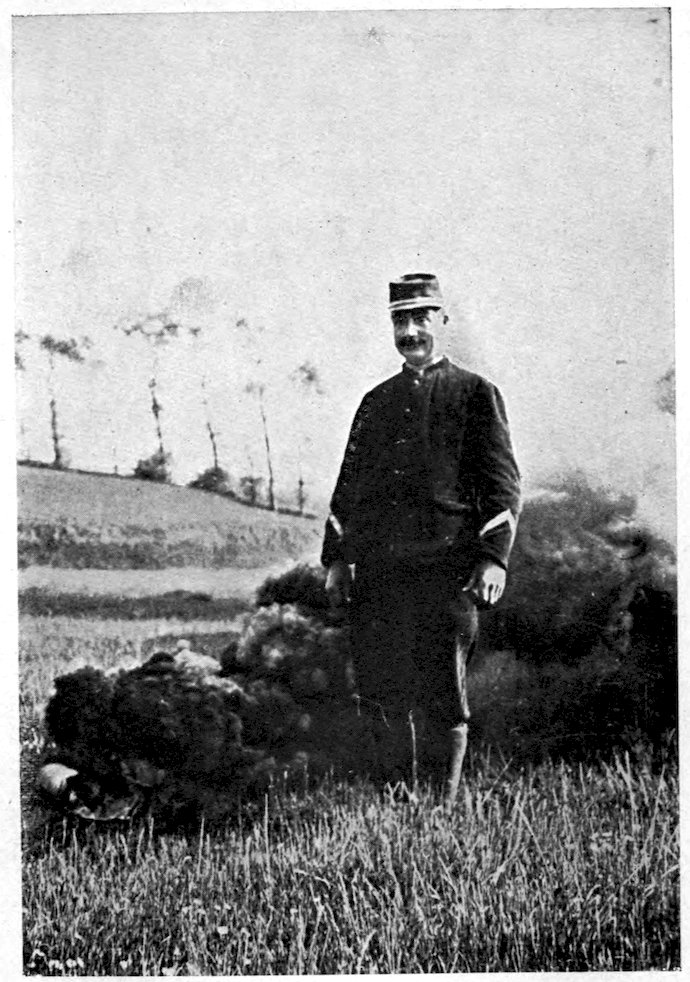
before me. I was ciceroned by a staff-officer
4in a beautiful sky-blue uniform, and other
officers were waiting to explain things to me
in the various divisions through which we
passed. We travelled by motor-car, with a
pilot-car ahead and a baggage-car behind, and
we went so fast that it took two people to tell
about it, one to shout, “Here they come!” and
another, “There they go!”
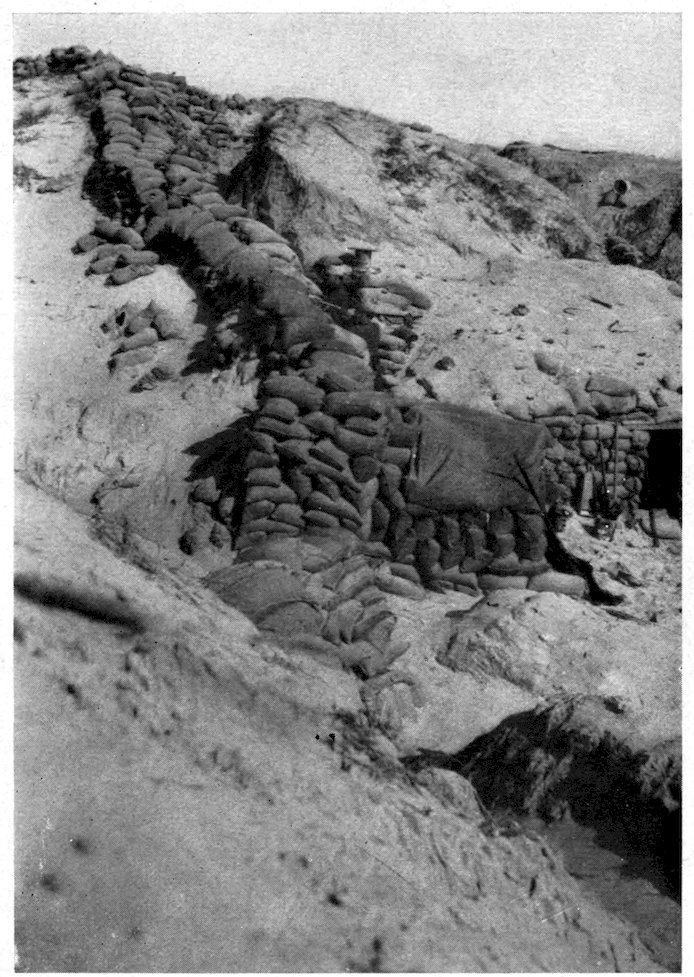
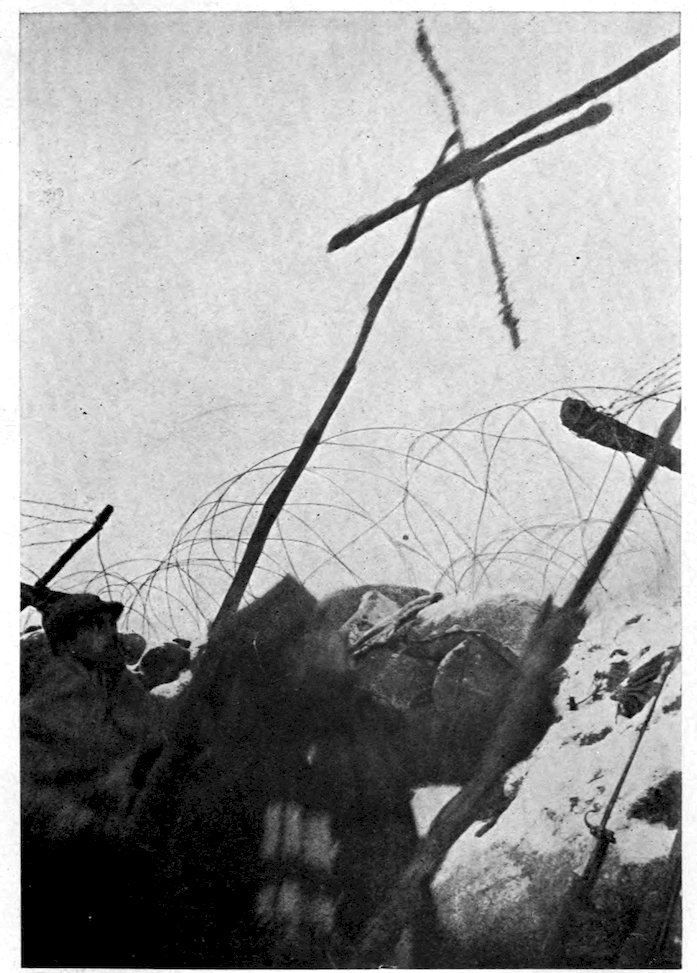
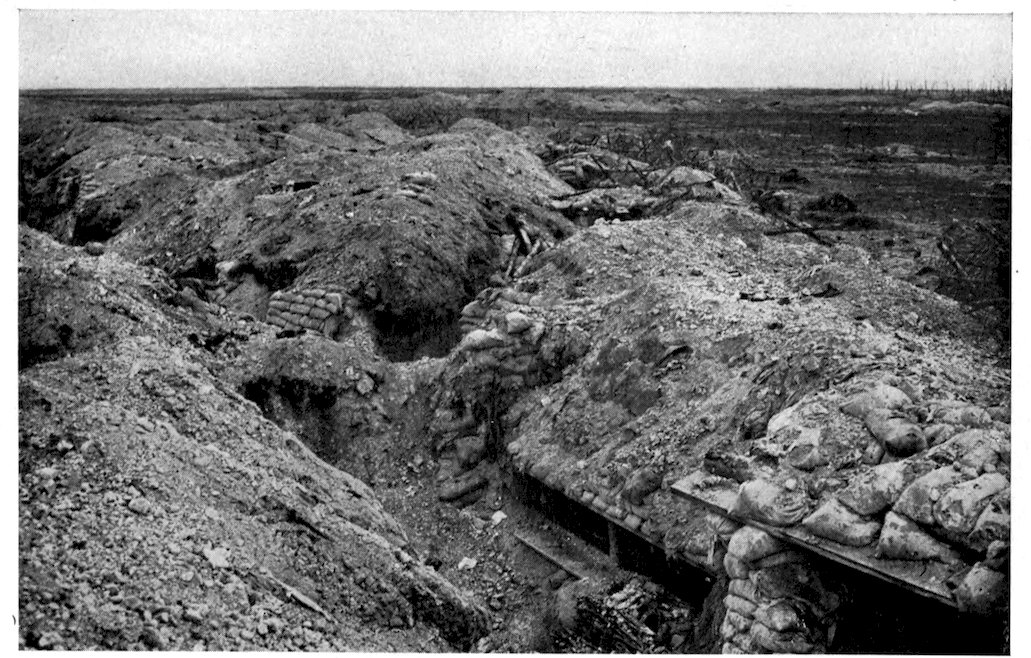
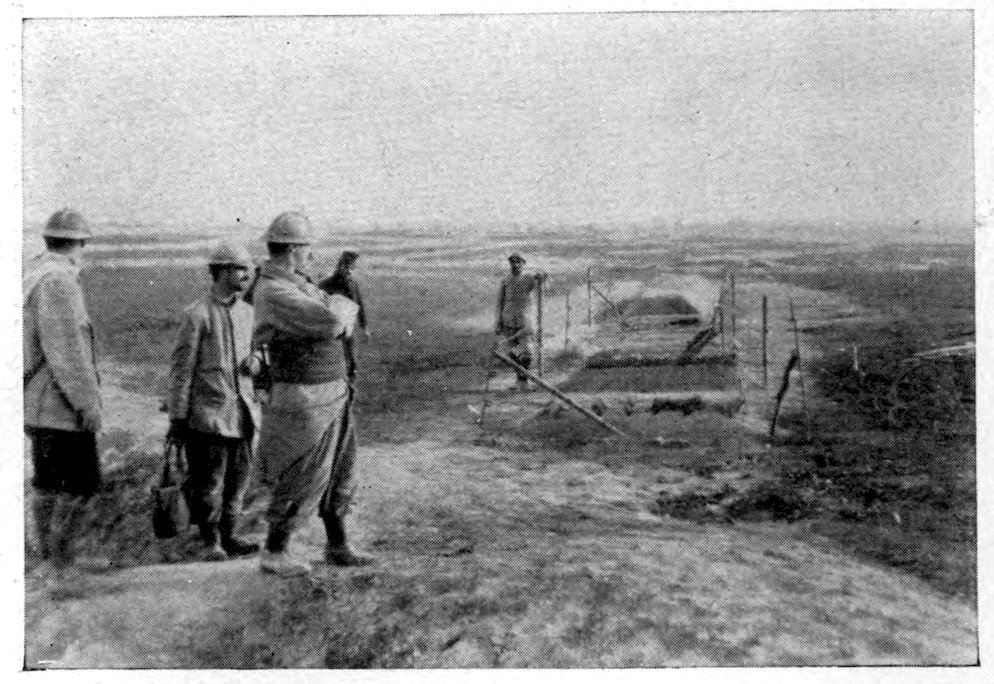
French trenches in the sand-dunes of the Belgian littoral.
Here begins that four-hundred-mile-long line of trenches which stretches across Europe like a monstrous and deadly snake.
Leaving Paris, white and beautiful in the
spring sunshine, behind us, we tore down the
historic highway which still bears the title of
the Route de Flandre, down which countless
thousands of other men had hastened, in bygone
centuries, to the fighting in the north. The
houses of the city thinned and disappeared, and
we came to open fields across which writhed,
like monstrous yellow serpents, the zigzag lines
of trenches. The whole countryside from the
Aisne straightaway to the walls of Paris is one
vast network of trenches and barbed-wire entanglements,
and, even in the improbable
event of the enemy breaking through the present
line, he would be little better off than he
was before. The fields between the trenches
were being ploughed by women, driving sleek
white oxen, but the furrows were scarcely
5ever straight, for every few yards they would
turn aside to avoid a turf-covered mound surmounted
by a rude cross and a scarlet kepi.
For half a hundred miles this portion of France
is one vast cemetery, for it was here that von
Kluck made his desperate attempt to break
through to Paris, and it was here that Joffre,
in the greatest battle of all time, drove the
German legions back across the Marne and
ended their dream of entering the French
capital. We whirled through villages whose
main streets are lined with the broken, blackened
shells of what had once been shops and
dwellings. At once I felt at home, for with
this sort of thing I had grown only too familiar
in Belgium during the earlier days of the war.
But here the Germans were either careless or
in a hurry, for they had left many buildings
standing. In Belgium they made a more
finished job of it. Nothing better illustrates
the implicit confidence which the French
people have in their army, and in its ultimate
success, than the fact that in all these towns
through which we passed the people were
hard at work rebuilding their shattered homes,
though the strokes of their hammers were
echoed by the sullen boom of German cannon.
To me there was something approaching the
sublime in these impoverished peasants turning
with stout hearts and smiling faces to the
rebuilding of their homes and the retilling
of their fields. To these patient, toil-worn
men and women I lift my hat in respect and
admiration. They, no less than their sons
and husbands and brothers in the trenches,
are fighting the battles of France.
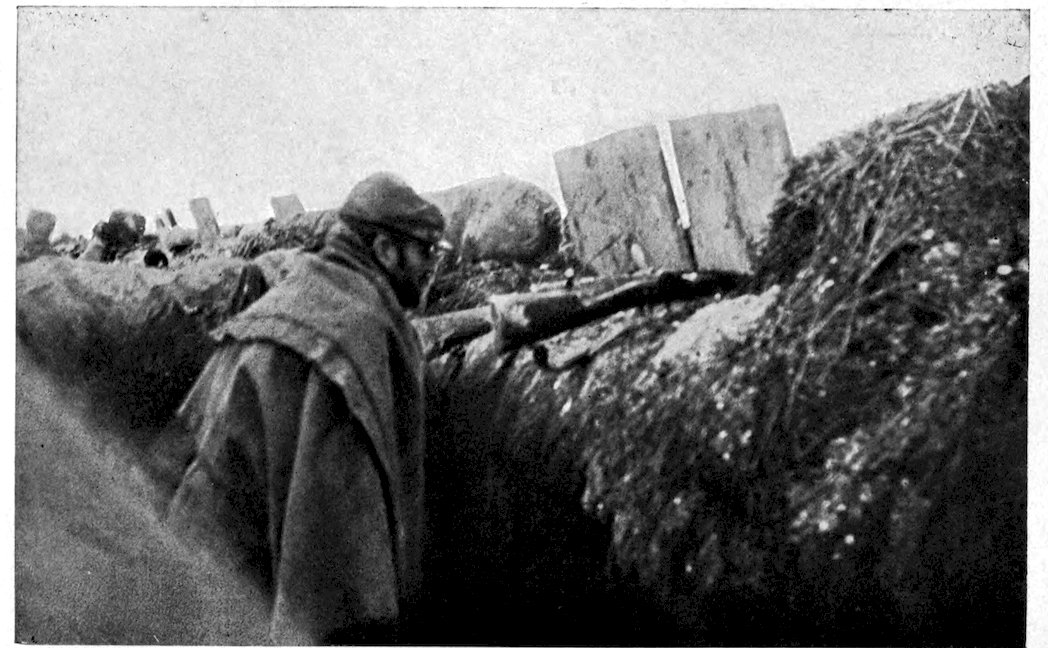
From a photograph copyright by M. Rol.
The watch on the Aisne.
“On that four-hundred-mile-long slaughter-house which is called ‘the front.’”
6As we approached the front the traditional
brick-red trousers and kepis still worn by the
second-line men gave way to the new uniform
of silvery-blue—the color of early morning.
There were soldiers everywhere. Every town
and hamlet through which we passed was alive
with them. The highways were choked with
troops of all arms; cuirassiers, with their
mediæval steel helmets and breastplates linen-covered;
dragoons, riding under thickets of
gleaming lances; zouaves in short blue jackets
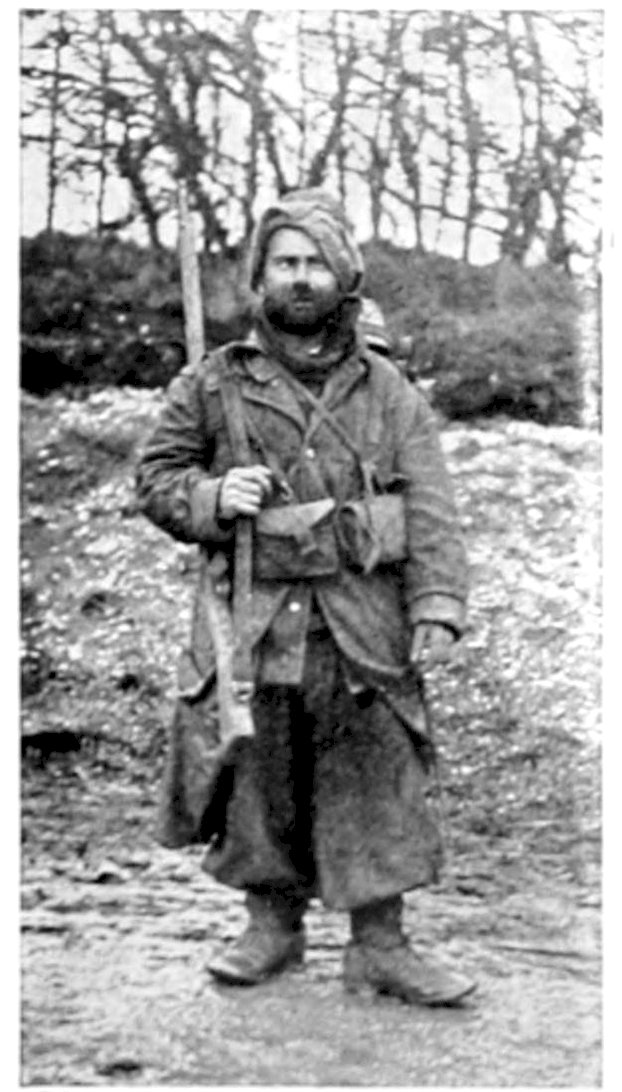
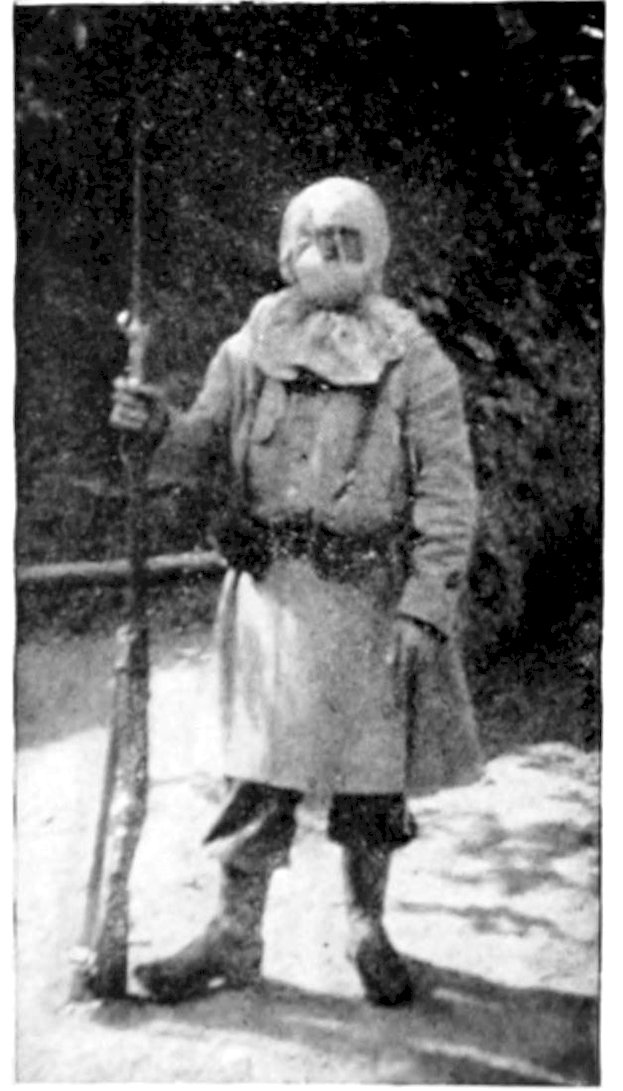
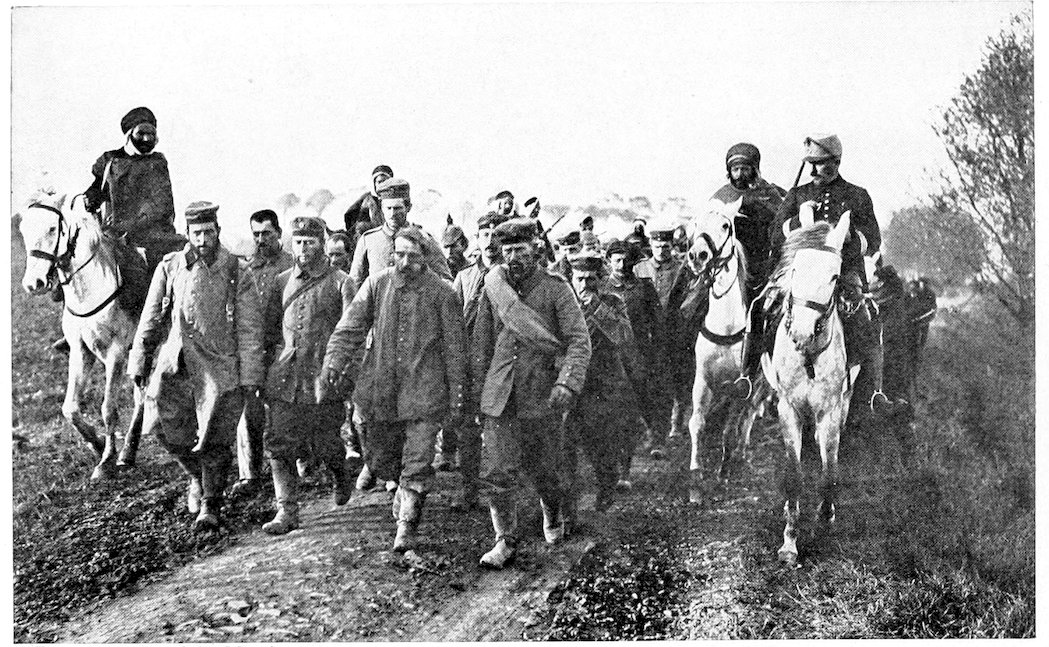
and baggy red breeches; spahis in turbans
and Senegalese in tarbooshes and Moroccans
in burnooses; chasseurs d’Afrique in
sky-blue and scarlet; infantry of the line in
all the shades of blue that can be produced
7by dyes and by the weather; mile-long strings
of motor transports; field-batteries; pontoon
trains; balloon corps; ambulances with
staring scarlet crosses painted on their canvas
covers—all the nuts and bolts and springs
and screws which go to compose what has
become, after months of testing and improvements,
as efficient a killing machine as the
world has ever seen. And it is, I am convinced,
eventually going to do the business. It struck
me as having all, or nearly all, of the merits
of the German organization with the human
element added.
When only a short distance in the rear of the
firing-line we left the car and proceeded on foot
down a winding country road which debouched
quite suddenly into a great, saucer-shaped
valley. Its gentle slopes were checkered with
the brown squares of fresh-ploughed fields and
the green ones of sprouting grain. From beyond
a near-by ridge came the mutter of
artillery, and every now and then there appeared
against the turquoise sky what looked
like a patch of cotton-wool but was in reality
bursting shrapnel. The far end of the valley
was filled with what appeared at first glance
8to be a low-hanging cloud of gray-blue mist,
but which, as we drew nearer, resolved itself
into dense masses of troops drawn up in review
formation—infantry at the right, cavalry at
the left, and guns in the centre. I had heard
much of the invisible qualities of the new field
uniform of the French Army, but I had heretofore
believed it to be greatly inferior to the
German greenish gray. But I have changed
my mind. At three hundred yards twenty
thousand men could scarcely be distinguished
from the landscape. The only colorful note
was struck by the dragoons, who still retain
their suicidal uniform of scarlet breeches, blue
tunic, and the helmet with its horse-tail plume,
though a concession has been made to practicality
by covering the latter with tan linen.
The majority of the French woollen mills being
in the region held by the Germans, it has been
possible to provide only a portion of the army
with the new uniform. As a result of this
shortage of cloth, thousands of soldiers have
had recourse to the loose corduroy trousers
common among the peasantry, while for the
territorials almost any sort of a jacket will
pass muster provided it is of a neutral color
9and has the regimental numerals on the collar.
Those soldiers who can afford to provide
their own uniforms almost invariably have
them made of khaki, cut after the more practical
British pattern, with cap-covers of the
same material. Owing to this latitude in the
matter of clothing, the French army during
the first year of the war presented an extraordinarily
variegated and nondescript appearance,
though this lack of uniformity is gradually
being remedied.
At three o’clock a rolling cloud of dust suddenly
appeared on the road from Compiègne,
and out of it tore a long line of military cars,
travelling at express-train speed. All save one
were in war coats of elephant gray. The exception
was a low-slung racer painted a canary-yellow.
Tearing at top speed up the valley,
it came to a sudden stop before the centre of
the mile-long line of soldiery. A mile of
fighting men stiffened to attention; a mile
of rifle barrels formed a hedge of burnished
steel; the drums gave the long roll and the
thirteen ruffles; the colors swept the ground;
the massed bands burst into the splendid
strains of the Marseillaise, and a little man,
10gray-mustached, gray-bearded, inclined to
stoutness, but with the unmistakable carriage
of a soldier, descended from the yellow car
and, followed by a staff in uniforms of light
blue, of dark blue, of tan, of green, of scarlet,
walked briskly down the motionless lines. I
was having the unique privilege of seeing a
President of France reviewing a French army
almost within sight of the invader and actually
within sound of his guns. It was under
almost parallel circumstances that, upward of
half a century ago, on the banks of the Rappahannock,
another President of another mighty
republic reviewed another army, which was
likewise fighting the battles of civilization.
Raymond Poincaré is by no means an easy
man to describe. He is the only French
President within my memory who looks the
part of ruler. In his person are centred, as it
were, the aspirations of France, for he is a
native of Lorraine. He was a captain of Alpine
Chasseurs in his younger days and shows
the result of his military training in his erect
and vigorous bearing. Were you to see him
apart from his official surroundings you might
well take him, with his air of energy and
11authority, for a great employer or a captain
of industry. Take twenty years from the age
of Andrew Carnegie, trim his beard to a point,
throw his shoulders back and his chest out, and
you will have as good an idea as I can give you
of the war-time President of France.
At the President’s right walked a thickset,
black mustached man whose rather shabby
blue serge suit and broad-brimmed black slouch
hat were in strange contrast to the brilliant
uniforms about him. Yet this man in the
wrinkled clothes, with the unmilitary bearing,
exercised more power than the President and
all the officers who followed him; a word
from him could make or break generals, could
move armies; he was Millerand, War Minister
of France.
After passing down the lines and making a
minute inspection of the soldiers and their
equipment, the President took his stand in
front of the grouped standards, and the officers
and men who were to be decorated for
gallantry ranged themselves before him, some
with bandaged heads, some with their arms
in slings, one hobbling painfully along on
crutches. Stepping forward, as the Minister
12of War read off their names from a list, the
President pinned to the tunic of each man the
coveted bit of ribbon and enamel and kissed
him on either cheek, while the troops presented
arms and the massed bands played the anthem.
On general principles I should think
that the President would rebel at having to
kiss so many men, even though they are heroes
and have been freshly shaved for the occasion.
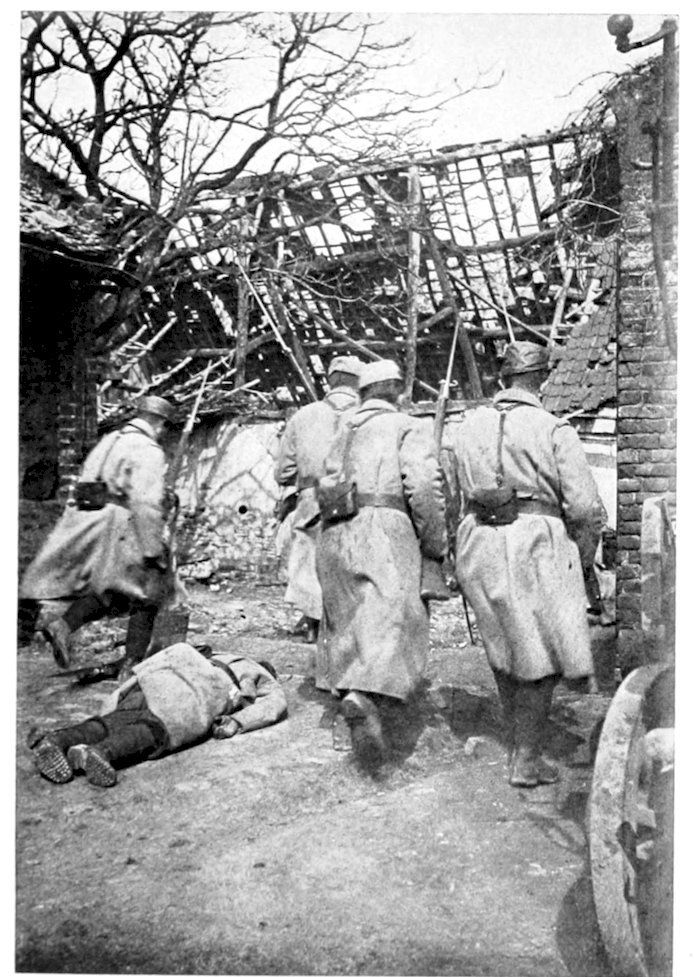
From a photograph by Meurasse.
The taking of Neuville St. Vaast.
French infantry engaged in house-to-house fighting.
I might mention in passing that the decoration
most highly prized by the French soldier
is not, as is popularly supposed, the Legion
of Honor, which, like the Iron Cross, has
greatly depreciated because of its wholesale
distribution (it is the policy of the German
military authorities, I believe, to give the
Iron Cross to one in every twenty men), but
the Médaille Militaire, which, like the Victoria
Cross and the Prussian decoration, Pour le
Mérite, is awarded only for deeds of the most
conspicuous bravery. The Médaille Militaire,
moreover, can be won only by privates and
non-commissioned officers or by generals,
though the Croix de Guerre, the little bronze
cross which signifies that the wearer has been
mentioned in despatches, is awarded to all
ranks and occasionally to women, among the
décorées being Madame Alexis Carrel, the wife
of the famous surgeon.
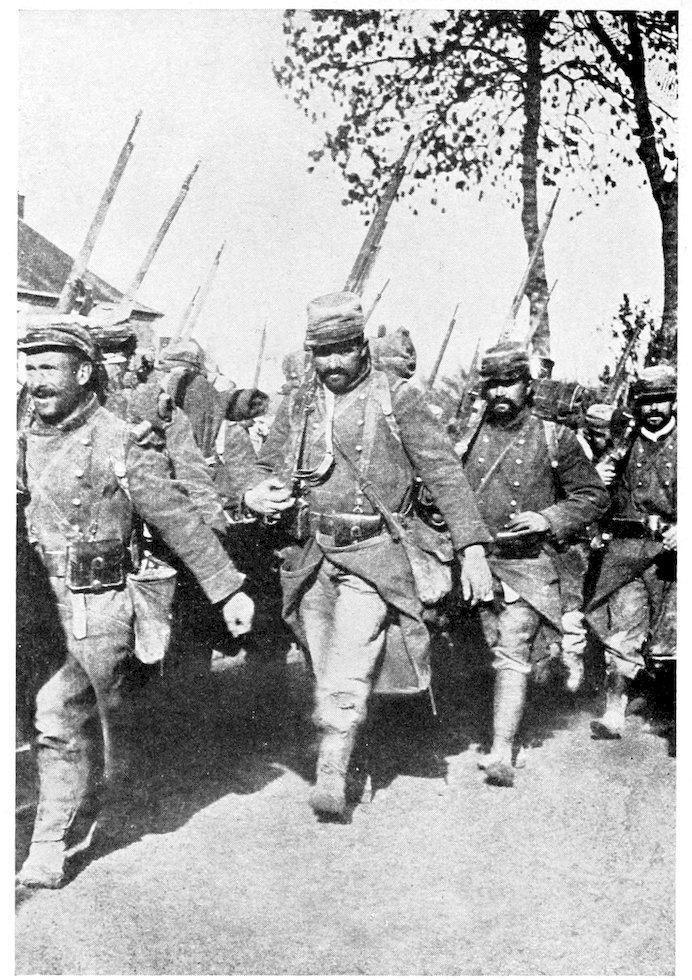
From a photograph copyright by M. Rol.
French infantry going into action.
“These were the famous poilus, the bearded ones, ... a moving cloud of grayish blue under shifting, shimmering, slanting lines of steel.”
13The picturesque business of recognizing the
brave being concluded, the review of the troops
began. Topping a rise, they swept down upon
us in line of column—a moving cloud of grayish
blue under shifting, shimmering, slanting
lines of steel. Company after company, regiment
after regiment, brigade after brigade,
swept past, businesslike as a locomotive, implacable
as a trip-hammer, irresistible as a
steam-roller, moving with mechanical precision
to the exultant strains of the march of the
Sambre et Meuse. These were the famous
poilus, the bearded ones, the men with hair on
their chests. Their uniforms were not immaculate.
They were faded by wind and rain and
sometimes stained with blood. On their boots
was the mud of the battle-fields along the
Aisne. Fresh from the trenches though they
were, they were as pink-cheeked as athletes,
and they marched with the buoyancy of men
in high spirits and in perfect health. Here
before me was a section of that wall of steel
which stands unbroken between Western Europe
14and the Teutonic hordes. Hard on the
heels of the infantry came the guns—the famous
“75’s”—a score of batteries, well horsed
and well equipped, at a spanking trot. A
little space to let the foot and guns get out
of the way, and then we heard the wild, shrill
clangor of the cavalry trumpets pealing the
charge. Over the rise they came, helmeted
giants on gigantic horses. The earth shook
beneath their gallop. The scarlet breeches of
the riders gleamed fiery in the sunlight; the
horsehair plumes of the helmets floated out
behind; the upraised sword-blades formed a
forest of glistening steel. As they went
thundering past us in a whirlwind of dust and
color they rose in their stirrups, and high above
the clank of steel and the trample of hoofs
came the deep-mouthed Gallic battle-cry: “Vive
la France! Vive la France!”.
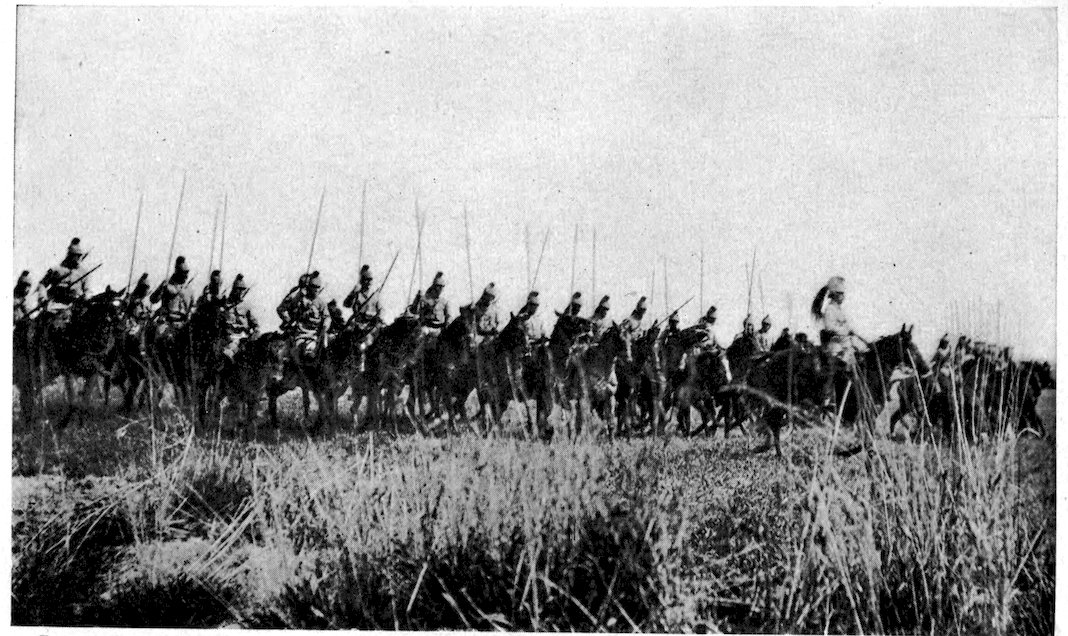
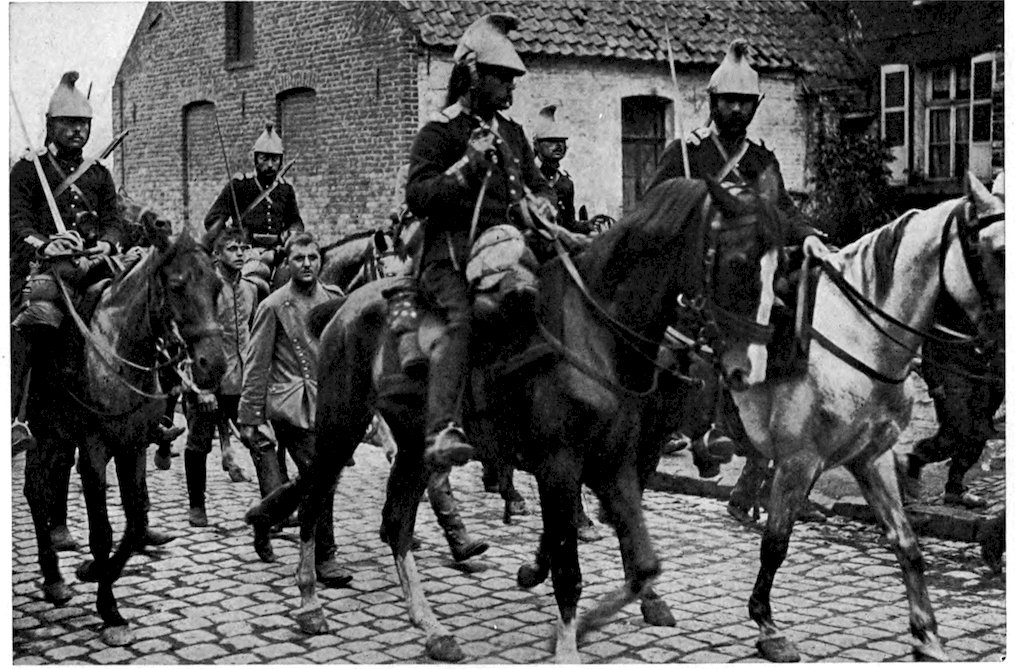
From a photograph by Captain John W. Barker, U. S. A.
Dragoons going into action.
“We heard the wild, shrill clangor of the cavalry trumpets pealing the charge.... Over the rise they came, helmeted giants on gigantic horses.”
To have had a battery of French artillery
go into action and pour a torrent of steel-cased
death upon the enemy’s trenches for one’s
special benefit is, so far as I am aware, a courtesy
which the General Staff has seen fit to
extend to no other correspondent. That the
guns were of the new 105-millimetre model,
which are claimed to be as much superior to
the “75’s” as the latter are to all other field
artillery, made the exhibition all the more
interesting. The road which we had to take
in order to reach this particular battery leads
for several miles across an open plateau within
full view of the German positions. As we
approached this danger zone the staff-officer
who accompanied me spoke to our driver,
who opened up the throttle, and we took that
stretch of exposed highway as a frightened cat
takes the top of a backyard fence. “Merely a
matter of precaution,” explained my companion.
“Sometimes when the Germans see
a car travelling along this road they send a few
shells across in the hope of getting a general.
There’s no use in taking unnecessary chances.”
Though I didn’t say so, it struck me that I was
in considerably more danger from the driving
than I was from a German shell.
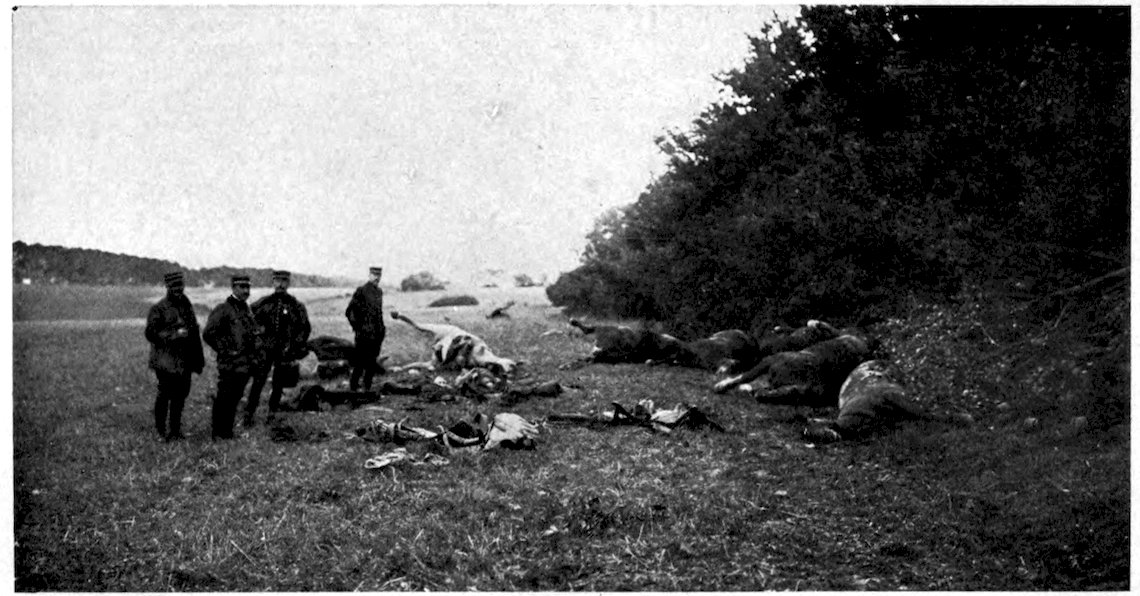
From a photograph copyright by M. Rol.
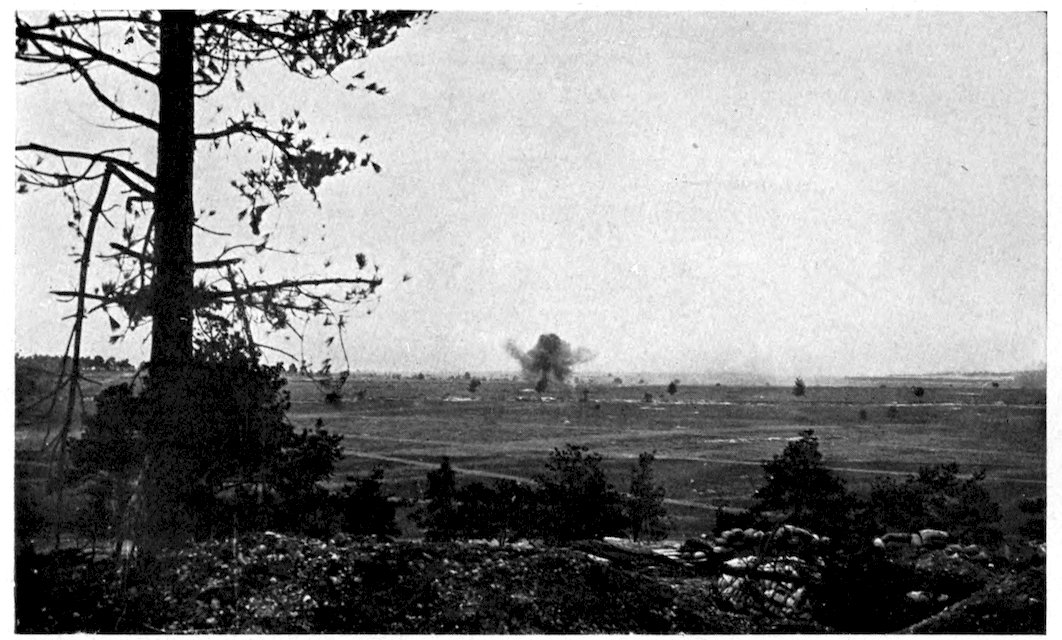
The effect of shrapnel from a French “seventy-five” on a German battery.
15Leaving the car in the shelter of the ridge
on which the battery was posted, we ascended
the steep hillside on foot. I noticed that the
slope we were traversing was pitted with
miniature craters, any one of which was large
enough to hold a barrel. “It might be as
16well to hurry across here,” the artillery officer
who was acting as our guide casually remarked.
“Last evening the Germans dropped eight
hundred shells on this field that we are crossing,
and one never knows, of course, when they
will do it again.”
Part way up the slope we entered what appeared
to be a considerable grove of young
trees. Upon closer inspection, however, I
discovered that it was not a natural grove but
an artificial one, hundreds of saplings having
been brought from elsewhere and set upright
in the ground. Soon I saw the reason, for in
a little cleared space in the heart of this imitation
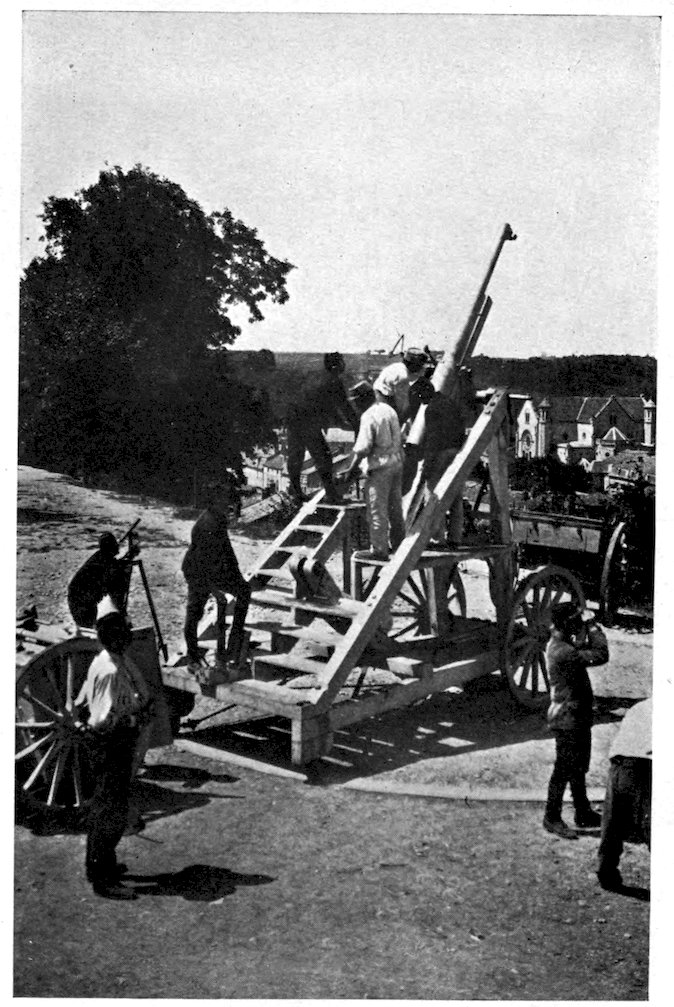
wood, mounted on what looked not unlike
gigantic step-ladders, were two field-guns with
their muzzles pointing skyward. “These guns
are for use against aircraft,” explained the
officer in charge. “The German airmen are
constantly trying to locate our batteries, and
in order to discourage their inquisitiveness
we’ve put these guns in position.” The guns
were of the regulation soixante-quinze pattern,
but so elevated that the wheels were at the
height of a man’s head from the ground, the
barrels thus being inclined at such an acute
17angle that, by means of a sort of turntable on
which the platforms were mounted, the gunners
were able to sweep the sky. “This,” said the
artillery officer, calling my attention to a
curious-looking instrument, “is the telemeter.
By means of it we are able to obtain the exact
altitude of the aircraft at which we are firing,
and thus know at what elevation to set our
guns. It is as simple as it is ingenious. There
are two apertures, one for each eye. In one
the aircraft is seen right side up; in the other
it is inverted. By turning this thumbscrew
the images are brought together. When one
is superimposed exactly over the other the
altitude is shown in metres on this dial below.
Then we open on the airman with shrapnel.”
Since these guns were placed in position the
German air-scouts have found it extremely
hazardous to play peek-a-boo from the clouds.
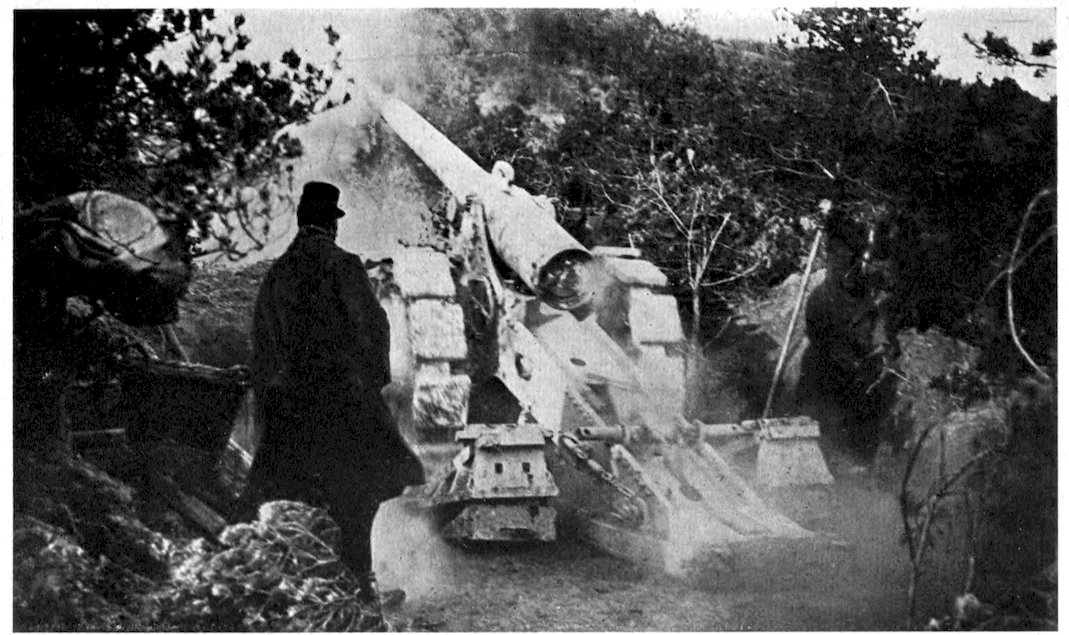
From a photograph copyright by M. Rol.
French 155-millimetre gun shelling the German trenches on the Aisne.
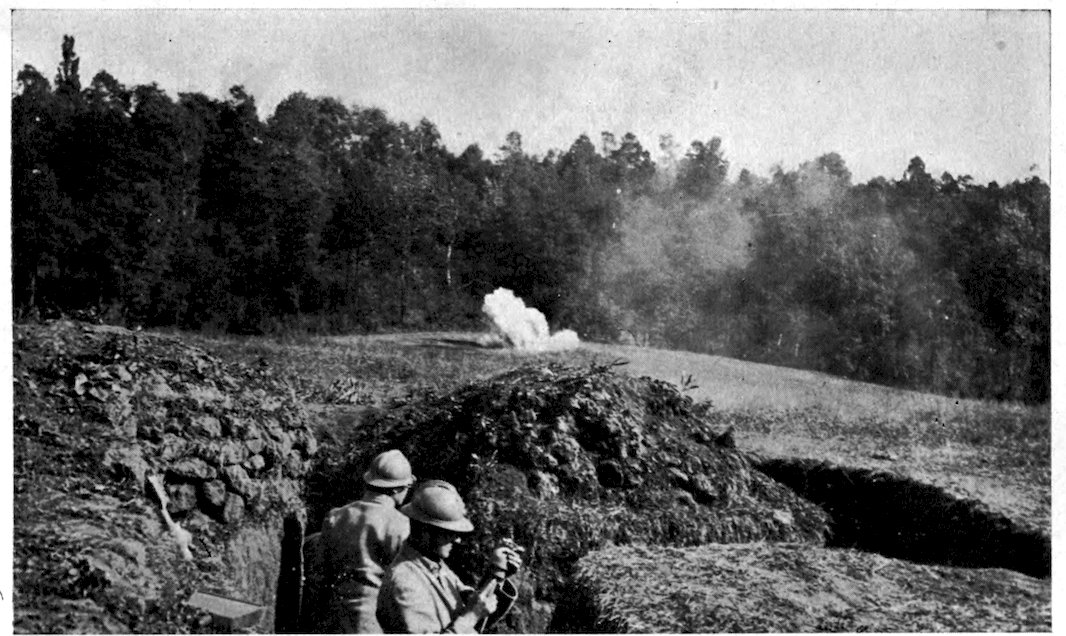
“The guns were so ingeniously masked that fifty feet away one could detect nothing about that apparently innocent clump of tangled vegetation to suggest that it concealed an amazing quantity of potential death.”
A few minutes’ walk along the ridge brought
us to the battery of 105’s, which was the real
object of our visit. The guns were not posted
on the summit of the ridge, as a layman might
suppose, but a quarter of a mile behind it,
so that the ridge itself, a dense forest, and the
river Aisne intervened between the battery
and the German position. The guns were
sunk in pits so ingeniously masked with shrubs
and branches that the keenest-eyed airman,
flying low overhead, would have seen nothing
to arouse his suspicions. Fifty feet away one
could detect nothing about that apparently
innocent clump of tangled vegetation to suggest
that it concealed an amazing quantity
of potential death. This battery had been
here through the winter, and the gunners had
utilized the time, which hung heavy on their
hands, in making themselves comfortable and
in beautifying their surroundings. With the
taste and ingenuity so characteristic of the
French, they had transformed their battery
into a sylvan grotto. The earthen walls of
the gun-pits were kept in place by deftly
woven wattles, and the paths leading to them
had borders of white sand, on which were
patriotic mottoes in colored pebbles. Scattered
about were ingeniously constructed rustic
seats and tables. Within ten feet of one
of the great gray guns a bed of hyacinths
made the air heavy with their fragrance. The
next gun-pit was banked about with yellow
crocus. Hanging from the arbor which shielded
18another of the steel monsters were baskets
made of moss and bark, in which were growing
violets. At a rustic table, under a sort of
pergola, a soldier was painting a picture in
water-colors. It was a good picture. I saw
it afterward on exhibition in the Salon des
Humoristes in Paris. A few yards back of
each gun-emplacement were cave-like shelters,
dug in the hillside, in which the men sleep,
and in which they take refuge during the
periodic shell-storms which visit them. Those
into which I went were warm and dry and not
at all uncomfortable. Over the entrance to
one of these troglodyte dwellings was a sign
announcing that it was the Villa des Roses.
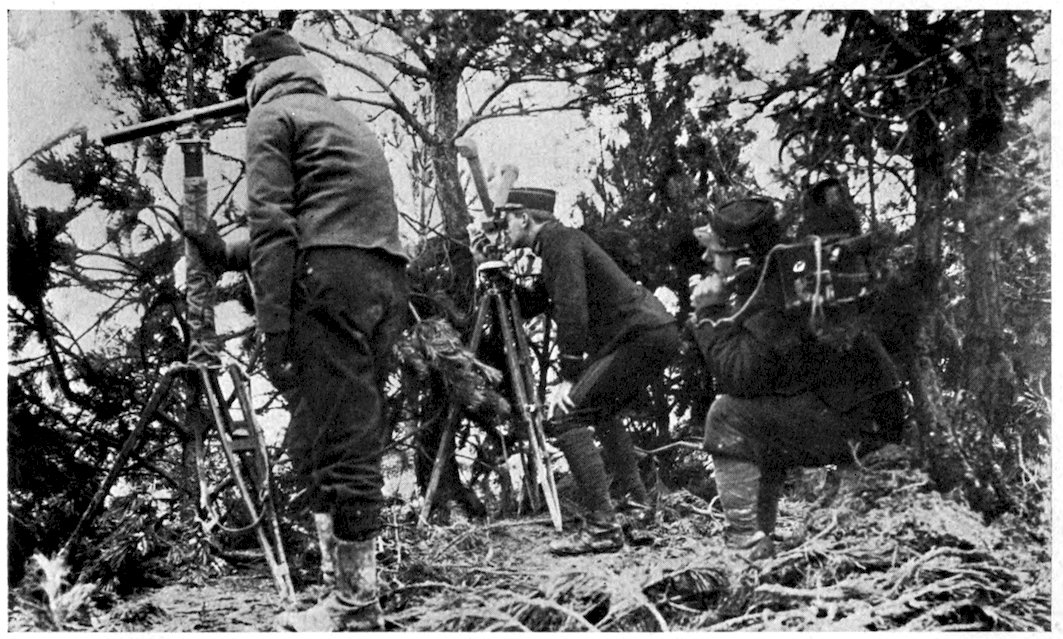
From a photograph copyright by M. Rol.
French artillery officers, in an observatory on the Aisne, watching the effect of shell-fire on the German trenches.
“From these secret observatoires the French observers keep an unceasing watch on the movements of the enemy and, by means of telephones, direct and control the fire of their own batteries with incredible accuracy.”
19“Do the Germans know the position of these
guns?” I asked the battery commander.
“Not exactly, though they have, of course,
a pretty general idea.”
“Then you are not troubled by German
shells,” I remarked.
“Indeed we are,” was the answer. “Though
they have not been able to locate us exactly,
they know that we are somewhere at the back
of this ridge, so every now and then they attempt
to clear us out by means of progressive
20fire. That is, they start in at the summit,
and by gradually increasing the elevation of
their guns, systematically sweep the entire reverse
slope of the ridge, so that some of their
shells are almost certain to drop in on us. Do
you appreciate, however, that, though we have
now been in this same position for nearly six
months, though not a day goes by that we are
not under fire, and though a number of my
men have been killed and wounded, we have
never seen the target at which we are firing
and we have never seen a German soldier?”
A ten-minute walk across the open tableland
which lay in front of the battery, and
which forms the summit of the ridge, then
through a dense bit of forest, and we found
ourselves at the entrance to one of those secret
observatoires from which the French observers
keep an unceasing watch on the movements of
the enemy, and by means of telephones, control
the fire of their own batteries with incredible
accuracy. This particular observatoire
occupied the mouth of a cave on the precipitous
hillside above the Aisne, being rendered
invisible by a cleverly arranged screen of
bushes. Pinned to the earthen walls were
21contour maps and fire-control charts; powerful
telescopes mounted on tripods brought the
German trenches across the river so close to us
that, had a German soldier been incautious
enough to show himself, we could almost have
seen the spike upon his helmet; and a military
telephonist with receivers clamped to his ears
sat at a switchboard and pushed buttons or
pulled out pegs just as the telephone girls do
in New York hotels. The chief difference was
that this operator, instead of ordering a bellhop
to take ice-water and writing-paper to
Room 511, would tell the commander of a
battery, four or five or six miles away, to send
over to a German trench, which he would
designate by number, a few rounds of shrapnel
or high explosive.
An officer in a smart uniform of dark blue
with the scarlet facings of the artillery beckoned
to me to come forward, and indicated a small
opening in the screen of branches.
“Look through there,” he said, “but please
be extremely careful not to show yourself or
to shake the branches. That hillside opposite
us is dotted with the enemy’s observatoires,
just as this hillside is dotted with ours, and
22they are constantly sweeping this ridge with
powerful glasses in the hope of spotting us
and shelling us out. Thus far they’ve not
been able to locate us. We’ve had better luck,
however. We’ve located two of their fire-control
stations, and put them out of business.”
As I was by no means anxious to have a
storm of shrapnel bursting about my head,
I was careful not to do anything which might
attract the attention of a German with a
telescope glued to his eye. Peering cautiously
through the opening in the screen of bushes,
I found myself looking down upon the winding
course of the Aisne; to the southwest I could
catch a glimpse of the pottery roofs of Soissons,
while from the farther bank of the river
rose the gentle slopes which formed the opposite
side of the river valley. These slopes
were everywhere slashed and scarred by zigzag
lines of yellow which I knew to be the
German trenches. But, though I knew that
those trenches sheltered an invading army,
not a sign of life was to be seen. Barring a
few cows grazing contentedly in a pasture, the
landscape was absolutely deserted. There
was something strangely oppressive and uncanny
23about this great stretch of fertile countryside,
dotted here and there with white-walled
cottages and clumps of farm buildings,
but with not a single human being to be seen.
On the other side of the opposite ridge I knew
that the German batteries were posted, just as
the French guns were stationed out of sight
at the back of the ridge on which I stood. This
artillery warfare is, after all, only a gigantic
edition of the old-fashioned game of hide-and-seek.
The chief difference being that when
you catch sight of your opponent, instead of
saying politely, “I see you!” you try to kill
him with a three-inch shell.
A soldier set a tripod in position and on it
carefully adjusted a powerful telescope. The
colonel motioned me to look through it, and
suddenly the things that had looked like
sinuous yellow lines became recognizable as
marvellously constructed earthworks.
“Now,” said the colonel, “focus your glass
on that trench just above the ruined farmhouse
and I will show you what our gunners
can do.” After consulting a chart with
innumerable radiating blue and scarlet lines
which was pinned to a drafting-table, and
24making some hasty calculations with a pencil,
he gave a few curt orders to a junior officer
who sat at a telephone switchboard with receivers
clamped to his ears. The young officer
spoke some cabalistic figures into the transmitter
and concluded with the order: “Tir
rapide.”
“Now, Monsieur Powell,” called the colonel,
“watch the trenches.” A moment later, from
somewhere behind the ridge at the back of us,
came in rapid succession six splitting crashes—bang!
bang! bang! bang! bang! bang! A fraction
of a second later I saw six puffs of black
smoke suddenly appear against one of the yellow
lines on the distant hillside; six fountains
of earth shot high into the air.
“Right into the trenches!” exclaimed the
colonel, who was kneeling beside me with his
glasses glued to his eyes. “Watch once more.”
Again six splitting crashes, six distant puffs of
smoke, and, floating back to us a moment later,
six muffled detonations.
“The battery that has just fired is four miles
from those trenches,” remarked the colonel
casually. “Not so bad, eh?”
“It’s marvellous,” I answered, but all the
25time I was wondering how many lives had
been snuffed out for my benefit that morning
on the distant hillside, how many men with
whom I have no quarrel had been maimed for
life, how many women had been left husbandless,
how many children fatherless.
“I do not wish to hasten your departure,
Monsieur Powell,” apologized the colonel,
“but if you wish to get back to your car without
annoyance, I think that you had better
be starting. We’ve stirred up the Boches, and
at any moment now their guns may begin to
answer.”
He knew what he was talking about, did that
colonel. In fact, we had delayed our departure
too long, for just as we reached the edge
of the wood, and started across the open
plateau which crowns the summit, something
hurtled through the air above the tree-tops
with a sound between a moan and a snarl and
exploded with a crash like a thousand cannon
crackers set off together a few yards in front
of us. Before the echoes of the first had time
to die away came another and yet another.
They burst to the right of us, to the left of us,
seemingly all around us. We certainly had
26stirred up the Germans. For a few minutes
we were in a very warm corner, and I am no
stranger to shell-fire, either. At first we decided
to make a dash for it across the plateau,
but a shell which burst in the undergrowth
not thirty feet ahead induced us to change our
minds, and we precipitately retreated to the
nearest bomb-proof. The next half-hour we
spent snugly and securely several feet below
the surface of the earth, while shrapnel whined
overhead like bloodhounds seeking their prey.
Have you ever heard shrapnel by any chance?
No? Well, it sounds as much as anything
else like a winter gale howling through the
branches of a pine-tree. It is a moan, a groan,
a shriek, and a wail rolled into one, and when
the explosion comes it sounds as though some
one had touched off a stick of dynamite under
a grand piano. And it is not particularly
cheering to know that the ones you hear do
not harm you, and that it is the ones you do
not have time to hear that send you to the
cemetery. The French artillery officers tell
me that the German ammunition has noticeably
deteriorated of late. Well, perhaps. Still,
I hadn’t noticed it. It was thirty minutes
27before the storm of shrapnel slackened and it
was safe to start for the car. We had a mile
of open field to cross with shells still occasionally
falling. I felt like a man wearing a silk
hat who has just passed a gang of boys engaged
in making snowballs. In a lifetime largely
made up of interesting experiences, that exhibition
of French gunnery will always stand
out as one of the most interesting things I
have ever seen. But all the way back to headquarters
I kept wondering about those men in
the trenches where the shells had fallen, and
about the women and children who are waiting
and watching and praying for them over there
across the Rhine.
I had expressed a wish to visit Soissons,
and, upon communicating with division headquarters,
permission was granted and the
necessary orders issued. Before we started,
however, I was told quite frankly that the
military authorities accepted no responsibility
for the consequences of the proposed excursion,
for, though the town was in the possession
of the French, it was under almost
constant bombardment by the Germans. In
order to get the setting of the picture clearly
28in your mind, you must picture two parallel
ranges of hills, separated by a wonderfully
fertile valley, perhaps three miles in width,
down which meanders, with many twists and
hairpin turns, the silver ribbon which is the
Aisne. On its north bank, at a gentle bend in
the river, stands the quaint old town of Soissons,
so hoary with antiquity that its earlier
history is lost in the mists of tradition. Of
its normal population of fifteen thousand,
when I was there only a few score remained,
and those only because they had no other
place to go.
A sandstone ridge which rises abruptly
from the south bank of the river directly opposite
Soissons was held by the French, and
from its shelter their batteries spat unceasing
defiance at the Germans, under General von
Heeringen, whose trenches lined the heights
on the other side of the river and immediately
back of the town. From dawn to dark and
often throughout the night, the screaming
messengers of death crisscrossed above the
red-tiled roofs of Soissons and served to make
things interesting for the handful of inhabitants
who remained. Every now and then the
29German gunners, apparently for no reason
save pure deviltry, would drop a few shells
into the middle of the town. They argued, no
doubt, that it would keep the townsfolk from
becoming ennuied and give them something to
occupy their minds.
The ridge on the French side of the river is
literally honeycombed with quarries, tunnels,
and caverns, many of these subterranean chambers
being as large and as curiously formed
as the grottoes in the Mammoth Cave. Being
weather-proof as well as shell-proof, the French
had turned them to excellent account, utilizing
them for barracks, ammunition stores, fire-control
stations, hospitals, and even stables.
In fact, I can recall few stranger sights than
that of a long line of helmeted horsemen, comprising
a whole squadron of dragoons, disappearing
into the mouth of one of these caverns
like a gigantic snake crawling into its lair.
Leaving the car three miles from the outskirts
of Soissons, we made our way through
dense undergrowth up a hillside until we came
quite unexpectedly upon the yawning mouth
of a tunnel, which, I surmised, passed completely
under the backbone of the ridge.
30Groping our way for perhaps an eighth of a
mile through inky blackness, we suddenly
emerged, amid a blinding glare of sunlight,
into just such another observing station as we
had visited that morning farther up the Aisne.
This observatoire, being in the mouth of the
tunnel, could not be seen from above, while a
screen of branches and foliage concealed it
from the German observers across the river.
The officer in command at this point was anxious
to give us a demonstration of the accuracy
with which his gunners could land on the
German solar plexus, but when he learned that
we were going into the town he changed his
mind.
“They’ve been quiet all day,” he explained,
“and if you are going across the river it’s just
as well not to stir them up. You’ll probably
get a little excitement in any event, for the
Boches usually shell the town for an hour or so
at sunset before knocking off for supper. We
call it ‘The Evening Prayer.’”
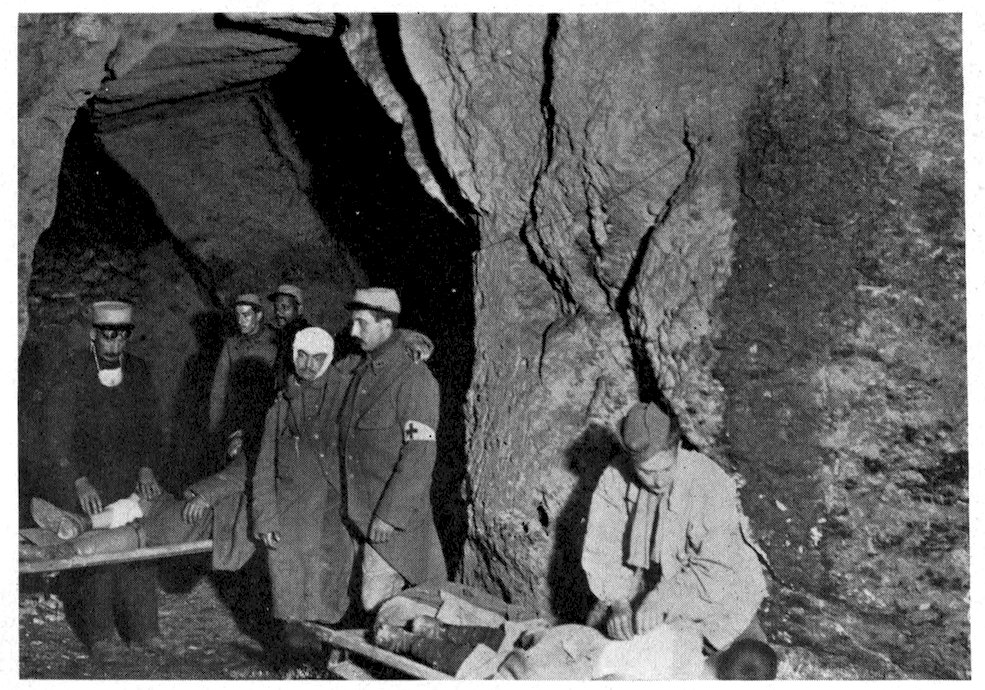
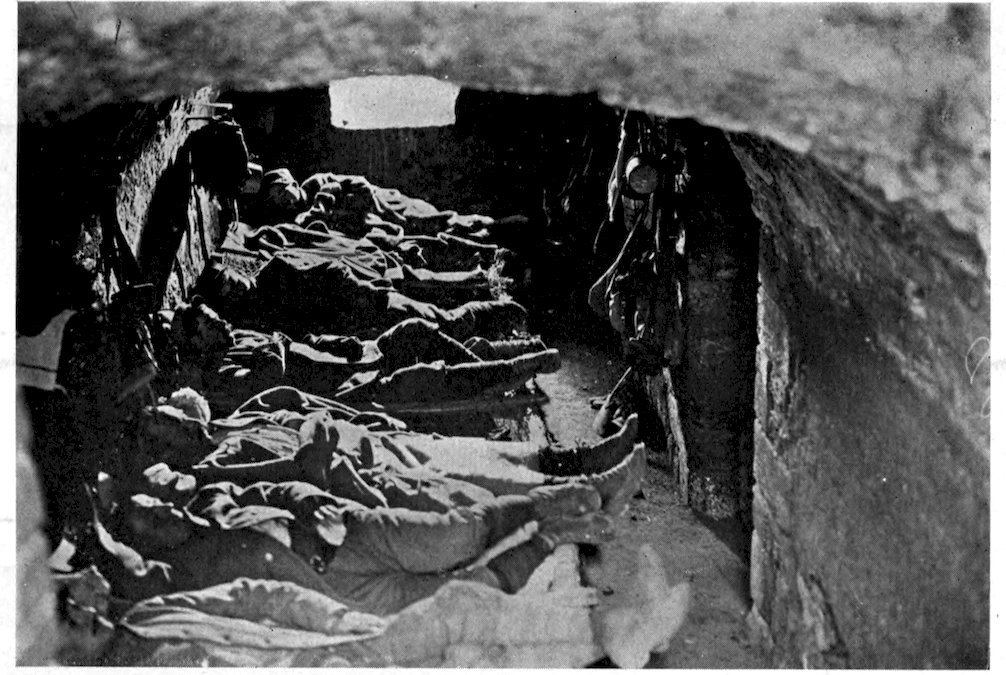
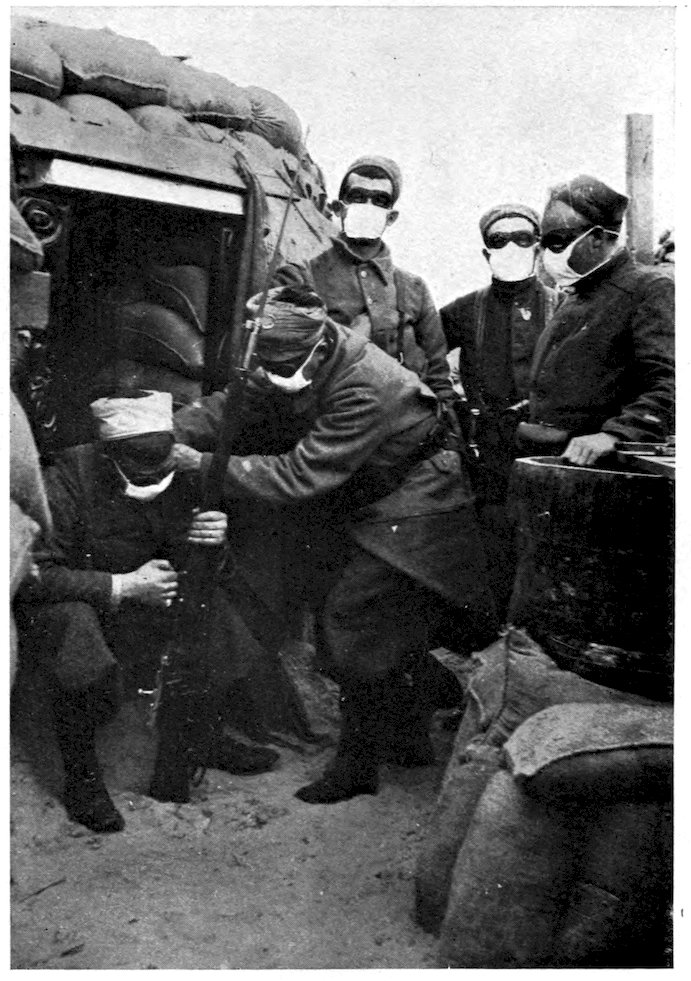
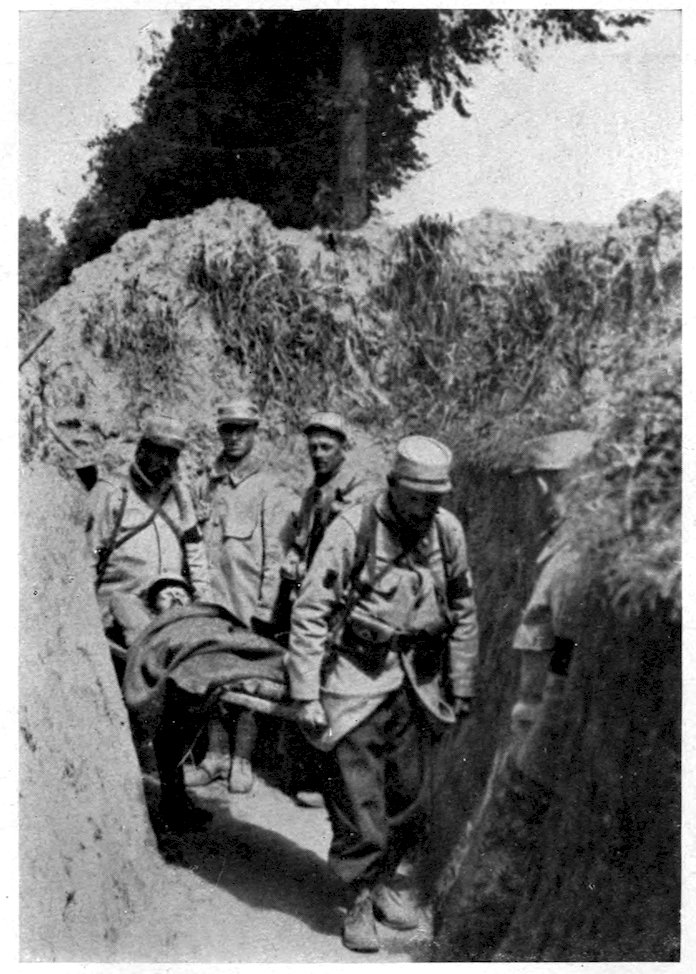
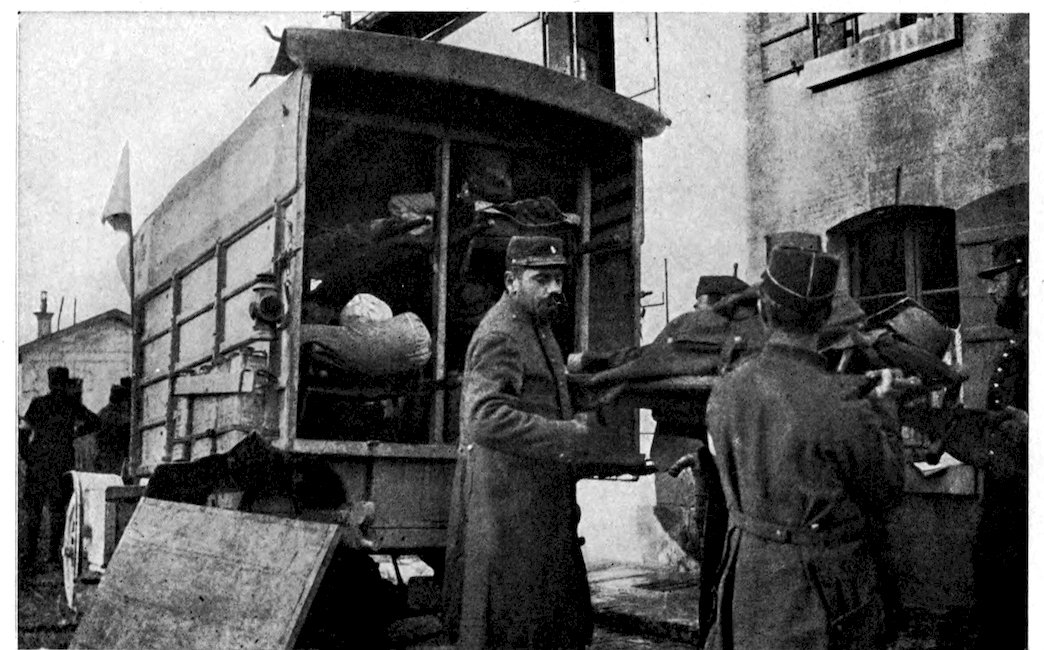
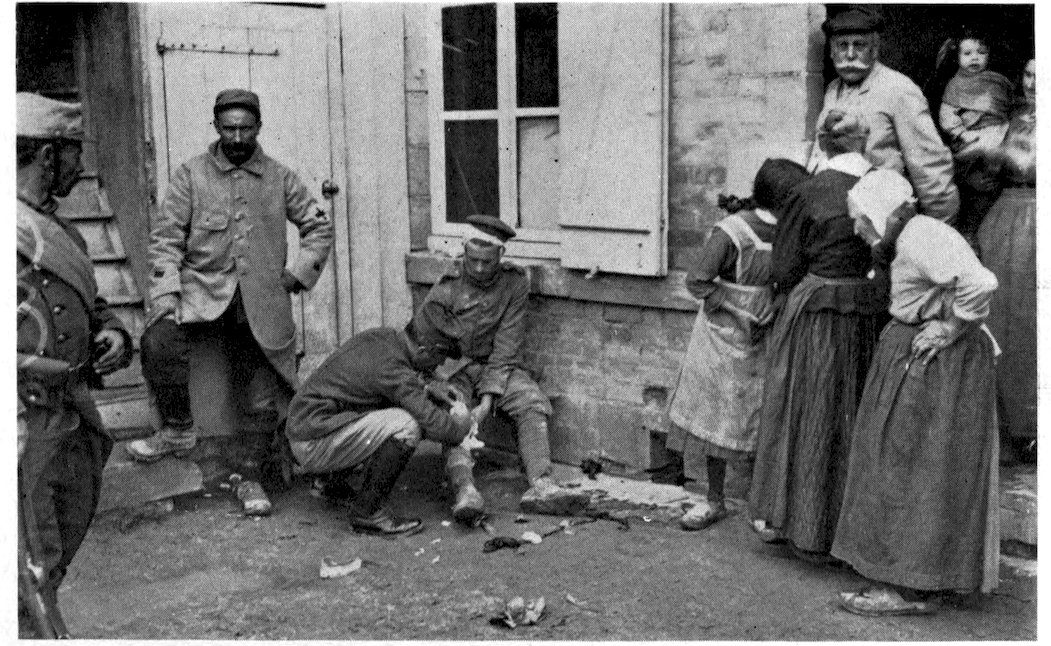
In an underground first-aid station.
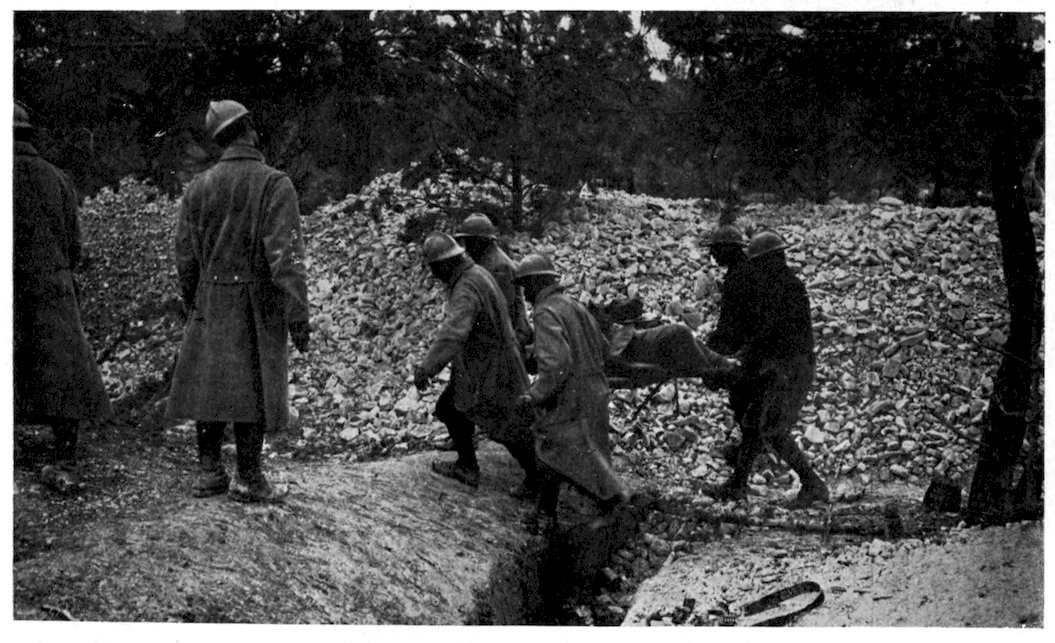
The caves and grottoes in the cliffs along the Aisne are utilized for first-aid dressing-stations.
Slipping through an opening in the screen
of foliage which masked the observatoire, we
found ourselves at the beginning of a boyau, or
communication trench, which led diagonally
31down the face of the hillside to the river.
Down this we went, sometimes on hands and
knees and always stooping, for as long as we
were on the side of the hill we were within sight
of the German positions, and to have shown
our heads above the trench would have attracted
the bullets of the German sharpshooters.
And a second is long enough for a bullet
to do its business. Emerging from the boyau
at the foot of the hill, we crossed the river by
an ancient stone bridge and for a mile or more
followed a cobble-paved highroad which ran
between rows of workmen’s cottages which
had been wrecked by shell-fire. Some had
shattered roofs and the plastered walls of
others were pockmarked with bullets, for here
the fighting had been desperate and bloody.
But over the garden walls strayed blossom-laden
branches of cherry, peach, and apple
trees. The air was heavy with their fragrance.
Black-and-white cattle grazed contentedly
knee-deep in lush green grass. Pigeons cooed
and chattered on the housetops. By an open
window an old woman with a large white cat
in her lap sat knitting. As she knitted she
looked out across the blossoming hillsides to
the sky-line where the invaders lay intrenched
and waiting. I wondered what she was thinking
about. She must have remembered quite
distinctly when the Germans came to Soissons
for the first time, five and forty years before,
and how they shot the townsmen in the public
square. A few years ago the people of Soissons
unveiled a monument to those murdered
citizens. When this war is over they will have
more names to add to those already carved on
its base.
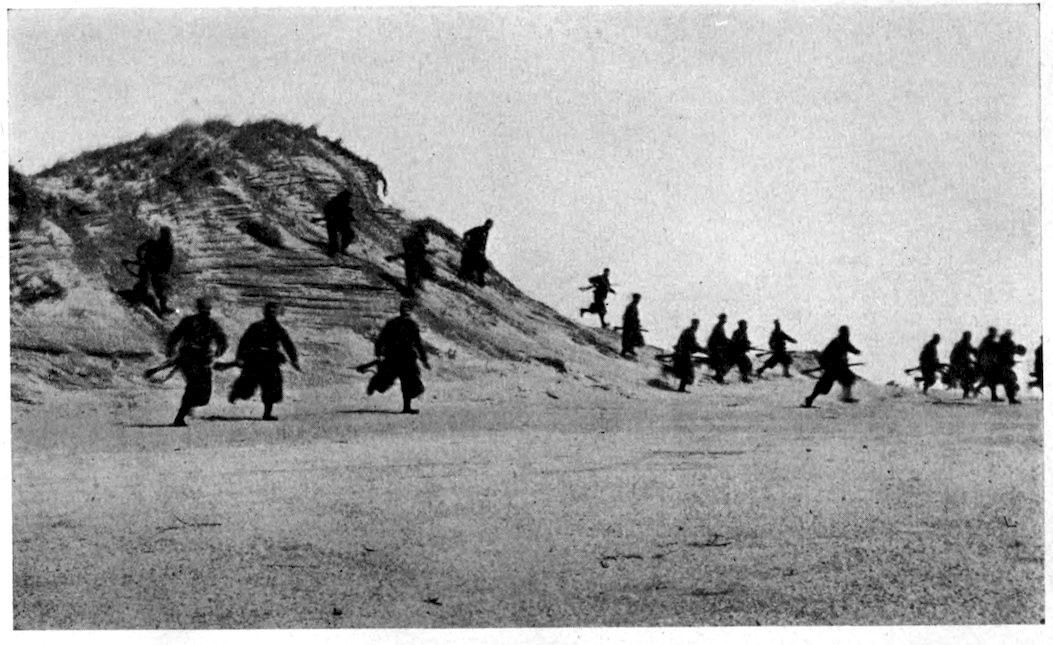
Zouaves carrying a German position in the Belgian sand-dunes by storm.
32It is not a cheerful business strolling through
a shell-shattered and deserted town. You
feel depressed and speak in hushed tones, as
though you were in a house that had been
visited by death as, indeed, you are. In the
Place de la République we found a score or so
of infantrymen on duty, these being the only
soldiers that we saw in the town. Along the
main thoroughfares nearly every shop was
closed and its windows shuttered. Some tobacconists
and two or three cafés remained bravely
open, but little business was being done. I do
not think that I am exaggerating when I say
that every fourth or fifth house we passed
showed evidences of the German bombardment.
33One shell, I remember, had exploded
in the show-window of a furniture store and
had demolished a gilt-and-red-plush parlor
suite. The only thing unharmed was a sign
which read “Cheap and a bargain.”
In the very heart of Soissons stands the huge
bulk of the magnificent twelfth-century cathedral,
its massive tower rising skyward like a
finger pointing toward heaven. There are
few nobler piles in France. Repeated rappings
at a door in the churchyard wall brought the
curé, a white-haired, kindly faced giant of a
man. Under his guidance we entered the
cathedral, or rather what remains of it, for its
famous Gothic windows are now but heaps of
shattered glass, the splendid nave is open to
the sky, half the roof has been torn away, the
pulpit with its exquisite carvings has been
splintered by a shell, and the massive columns
have been chipped and scarred. Carvings
which were the pride of master craftsmen long
centuries dead have been damaged past repair.
In the floor of the nave yawns a hole large
enough to hold a horse. Around the statues
which flank the altar, and which are too large
to move, have been raised barricades of sand-bags.
34And this, mind you, in the house of Him
who was the Apostle of Peace!
While the curé was pointing out to us the
ruined beauties of his celebrated windows,
something passed overhead with a wail like a
lost soul. A moment later came an explosion
which made the walls of the cathedral tremble.
“Ah,” remarked the curé unconcernedly,
“they’ve begun again. I thought it must be
nearly time. They bombard the cathedral
every evening between five and seven.”
As he finished speaking, another shell came
whining over the housetops and burst with a
prodigious racket in the street outside.
“How far away was that one?” I asked one
of the officers.
“Only about a hundred metres,” was the
careless reply.
As unmoved as though at a church supper,
the curé placidly continued his recital of the
cathedral’s departed glories, reeling off the
names of the saints and martyrs who lie buried
beneath the floor of its nave, his recital being
punctuated at thirty-second intervals by explosions,
each a little louder than the one preceding.
Finally a shell came so low that I
35thought that it was going through the roof.
It came so near, in fact, that I suggested that
it was getting on toward dinner time and that
we really ought to be on our way. But the
curé was not to be hurried. He had had no
visitors for nearly a year and he was determined
to make the most of us. He insisted on
showing us that cathedral from sacristy to
belfry, and if he thought that we were missing
anything he carefully explained it all over
again.
“Why do you stay on here, father?” I asked
him. “A shell is likely to drop in on you at
any moment.”
“That is as God wills, monsieur,” was the
quiet answer. “A captain does not leave his
ship in a storm. I have my people to look
after, for they are as helpless as children and
look to me for advice. And the wounded also.
We have turned the sacristy, as you saw, into
a dressing-station. Yes, there is much to do.
If a shell comes it will find me at my post of
duty doing what I may to serve God and
France.”
So we went away and left him standing
there alone in the doorway of his shattered
36cathedral, a picturesque and gallant figure,
with his white hair coming down upon his
shoulders and his tall figure wrapped in the
black soutane. To such men as these the people
of France owe a debt that they can never
repay. Though they wear cassocks instead of
cuirasses, though they carry Bibles instead of
bayonets, they are none the less real soldiers—soldiers
37of the Lord.
38
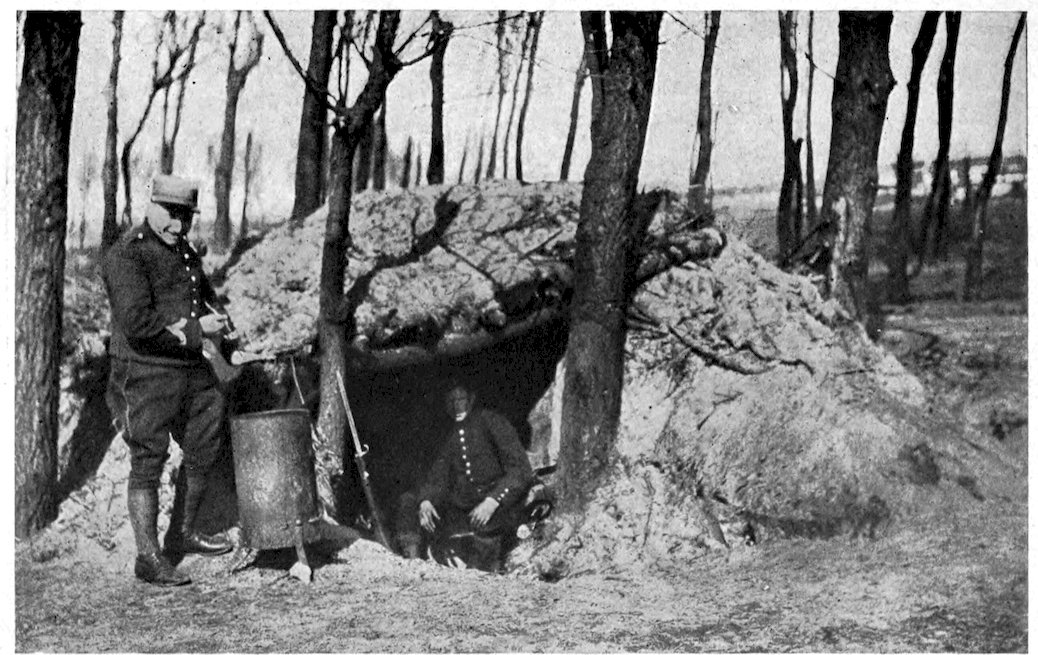
From a photograph by Meurisse.
In the Argonne.
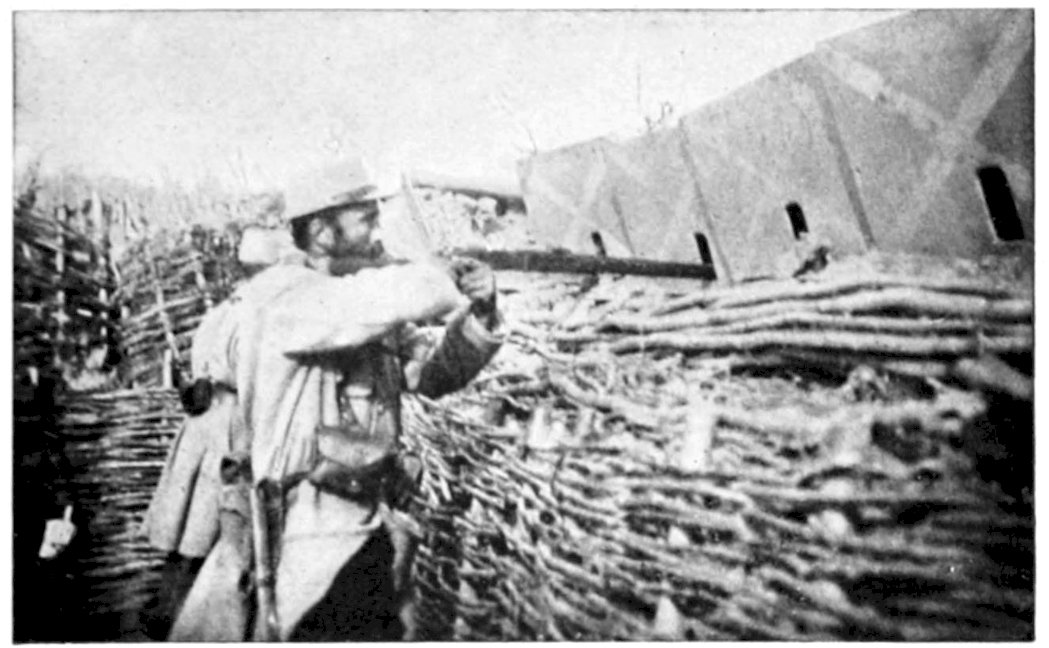
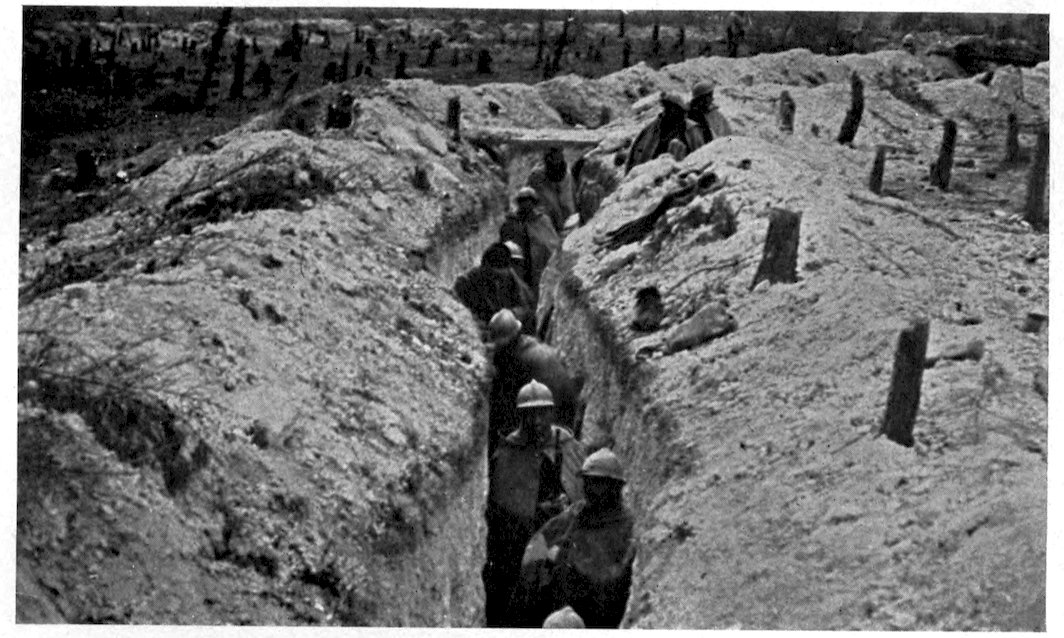
“Cave-like shelters in which the men take refuge during the periodic shell-storms that visit them.”
It must be borne in mind that the task of
the artillery is far easier in hilly or mountainous
country, such as is found along the Aisne
and in the Vosges and Alsace, where the movements
of the enemy can be observed with
comparative facility and where both observers
and gunners can usually find a certain degree
of shelter, than in Artois and Flanders,
where the country is as flat as the top of a
table, with nothing even remotely resembling
a hill on which the observers can be stationed
or behind which can be concealed the guns.
In the flat country the guns, which in all cases
are carefully masked with branches from detection
by hostile aircraft, take position at
distances varying from two thousand to five
thousand yards from the enemy’s trenches.
Immediately in the rear of each gun is a subterranean
shelter, in which the gunners can
take refuge in case a German battery locates
them and attempts to shell them out. An
artillery subaltern, known in the British service
as the “forward observing officer,” goes
up to the infantry trenches and chooses a
position, sometimes in a tree, sometimes in a
shattered church-tower, sometimes in a sort
of dug-out, from which he can obtain an unobstructed
view of his battery’s zone of fire.
He is to his battery very much what a coach is
to a football team, giving his men directions
by telephone instead of through a megaphone,
but, unlike the coach, he is stationed not on
the side-line but on the firing-line. Laid on
the surface of the ground, connecting him
with the battery, is the field-telephone. As
wires are easily cut by bursting shells, they are
now being laid in a sort of ladder formation
so that a dozen wires may be cut without
interrupting communication. When the noise
is so deafening that the voice of the observing
officer cannot be heard on the field-telephone
communication is carried on in the Morse code
by means of a giant buzzer. Amid all the
uproar of battle the observing officer has to
keep careful track, through his glasses, of
every shell his battery fires, and to inform his
battery commander by telephone of the effect
of his fire. He can make no mistakes, for on
those portions of the battle-line where the
trenches are frequently less than a hundred
yards apart the slightest miscalculation in
giving the range might land the shells among
his own men. The critical moment for the
observing officer is, however, when the enemy
makes a sudden rush and swarms of helmeted,
gray-clad figures, climbing out of their trenches,
come rolling forward in a steel-tipped wave,
tripping in the barbed wire and falling in ones
and twos and dozens. Instantly the French
trenches crackle and roar into the full blast
of magazine fire. The rattle of the machine-guns
sounds like a boy drawing a stick along
the palings of a picket fence. The air quivers
to the incessant crash of bursting shrapnel.
“Infantry attack!” calls the observation officer
into the telephone receiver which is
clamped to his head. “Commence firing!”
and his battery, two or three miles in the rear,
begins pouring shrapnel on the advancing
Germans. But still the gray figures come on,
hoarsely cheering. “Drop twenty-five!” he
orders. “Careful with your fuse-setting ...
very close to our trenches.” The French
shrapnel sprays the ground immediately in
front of the French trenches as a street cleaner
sprays the pavement with a hose. The gray
line checks, falters, sways uncertainly before
the blast of steel. Men begin to fall by dozens
and scores, others turn and run for their
lives. With a shrill cheer the French infantry
spring from their trenches in a counter-attack.
“Raise twenty-five! ... raise fifty!” telephones
the observing officer as the blue figures
of his countrymen sweep forward in the
charge. And so it goes, the guns backing up
the French attacks and breaking the German
ones, shelling a house or a haystack for
snipers, putting a machine-gun out of business,
dropping death into the enemy’s trenches
or sending its steel calling-cards across to a
German battery whose position has been
discovered and reported by wireless by a
scouting French aeroplane. And all the time
the youngster out in front, flattened to the
ground, with glasses at his eyes and a telephone
at his lips, acts the part of prompter and
tells the guns when to speak their parts.
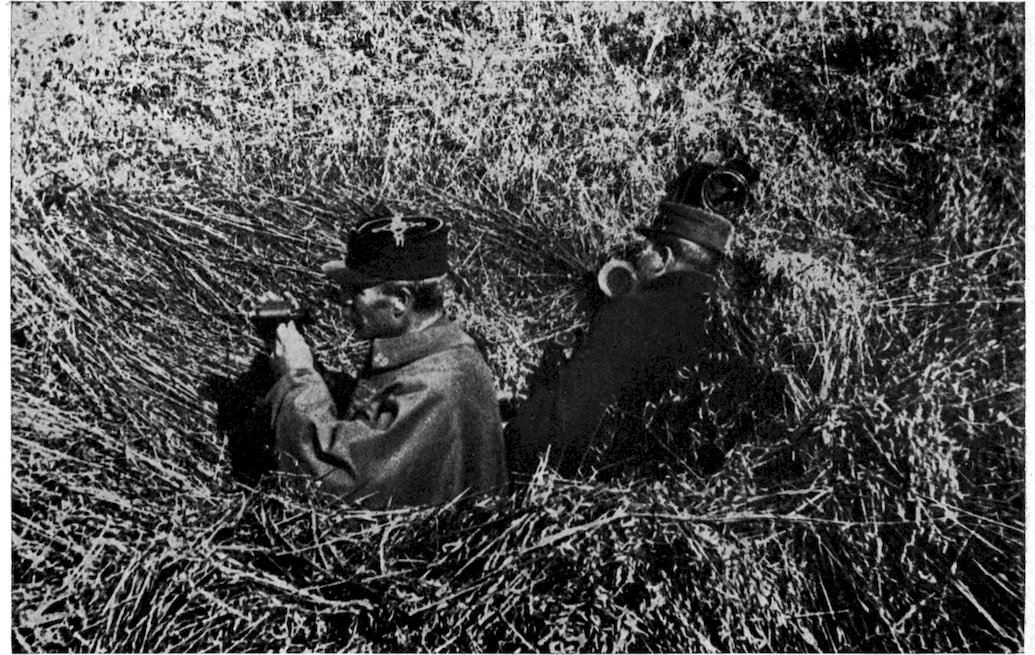
From a photograph copyright by M. Rol.
An observing officer directing the fire of a French battery three miles behind him.
“Flattened to the ground, with glasses at his eyes and a telephone at his lips, he acts the part of prompter and tells the guns when to speak their parts.”
39In reading accounts of artillery fire it should
40be remembered that there are two types of
shell in common use to-day—shrapnel and
high explosive—and that they are used for
entirely different purposes and produce entirely
different results. Shrapnel, which is
intended only for use against infantry in the
open, or when lightly intrenched, is a shell
with a very thin steel body and a small bursting
charge, generally of low-power explosive,
in the base. By means of a time-fuse the
projectile is made to burst at any given moment
after leaving the gun, the explosion of the
weak charge breaking the thin steel case and
liberating the bullets, which fly forward with
the velocity of the shrapnel, scattering much
as do the pellets from a shot-gun. At a range
of 3500 yards the bullets of a British 18-pound
shrapnel, 375 in number, cover a space of 250
yards long and 30 yards wide—an area of more
than one and a half acres. Though terribly effective
against infantry attacks or unprotected
batteries, shrapnel are wholly useless against
fortified positions, strongly built houses, or
41deep and well-planned intrenchments. The
difference between shrapnel and high explosive
is the difference between a shot-gun
and an elephant rifle. The high-explosive
shell, which is considerably stronger than the
shrapnel, contains no bullets but a charge of
high explosive—in the French service melinite,
in the British usually lyddite (which is picric
acid melted with a little vaseline), and in the
German army trinitrotoluene. The effect of
the high explosive is far more concentrated
than that of shrapnel, covering only one-fifteenth
of the area affected by the latter.
Though shrapnel has practically no effect on
barbed-wire entanglements or on concrete,
and very little on earthworks, high-explosive
shells of the same caliber destroy everything
in the vicinity, concrete, wire entanglements,
steel shields, guns, and even the trenches themselves
disappearing like a dynamited stump
before the terrific blast. The men holding the
trenches are driven into their dug-outs, and
may be reached even there by high-explosive
shells fired from high-angle howitzers.
The commanding importance of the high-explosive
shell in this war is due to the peculiar
42nature of the conflict. Instead of fighting in
the open field, the struggle has developed into
what is, to all intents and purposes, a fortress
warfare on the most gigantic scale. In this
warfare all strategic manœuvres are absent,
because manœuvres are impossible on ground
where every square yard is marked and swept
by artillery fire. The opposing armies are
not simply intrenched. They have protected
themselves with masses of concrete and steel
armor, so that the so-called trenches are in
reality concrete forts, shielded and casemated
with armor-plate, flanked with rapid-firers
and mortars, linked to one another by marvellously
concealed communicating trenches
which are protected in turn by the fire of
heavy batteries, guarded by the most ingenious
entanglements, pitfalls, and other obstructions
that the mind of man has been able to devise,
and defended by machine-guns, in the enormous
proportion of one to every fifty men,
mounted behind steel plates and capable of
firing six hundred shots a minute. In these
subterranean works dwell the infantry, abundantly
provided with hand-grenades and appliances
for throwing bombs and flaming oil,
43their rifles trained, day and night, on the space
over which an enemy must advance. That
is the sort of wall which one side or the other
will have to break through in order to win in
this war. The only way to take such a position
is by frontal attack, and the only way to make
a frontal attack possible is by paving the way
with such a torrent of high explosive that both
entanglements and earthworks are literally
torn to pieces and the infantry defending them
demoralized or annihilated. No one before the
war could have imagined the vast quantity
of shells required for such an operation. In
order to prepare the way for an infantry attack
on a German position near Arras, the
French fired two hundred thousand rounds
of high explosive in a single day—and the
scouts came back to report that not a barbed-wire
entanglement, a trench, or a living human
being remained. During the same battle the
British, owing to a shortage of high-explosive
ammunition, were able to precede their attack
by only forty minutes of shell-fire. This was
wholly insufficient to clear away the entanglements
and other obstructions, and, as a result,
the men were literally mowed down by the
44German machine-guns. Even when the storming-parties
succeed in reaching the first line of
the enemy’s trenches and bayonet or drive out
the defenders, the opposing artillery, with a
literal wall of fire, effectively prevents any reinforcements
from advancing to their support.
Shattered and exhausted though they are,
the attackers must instantly set to work to
fortify and consolidate the captured trenches,
being subjected, meanwhile, to a much more
accurate bombardment, as the enemy knows,
of course, the exact range of his former positions
and is able to drop his shells into them with
unerring accuracy. It is obvious that such
offensive movements cannot be multiplied or
prolonged indefinitely, both on account of the
severe mental and physical strain on the men
and the appalling losses which they involve.
Neither can such offensives be improvised. A
commanding officer cannot smash home a
frontal attack on an enemy’s position at any
moment that he deems auspicious any more
than a surgeon can perform a major operation
without first preparing his patient physically.
Before launching an attack the ground must be
minutely studied; the position to be attacked
45must be reconnoitred and photographed by
aviators; advanced trenches must be dug;
reserve troops must be moved forward and
batteries brought into position without arousing
the suspicions of the enemy; and, most
important of all, enormous quantities of projectiles
and other material must be gathered
in one place designated by the officer in charge
of the operations. The greatest problem presented
by an offensive movement is that of
delivering to the artillery the vast supplies of
shells necessary to pave the way for a successful
attack. To give some idea of what this
means, I might mention that the Germans, during
the crossing of the San, fired seven hundred
thousand shells in four hours.
There are no words between the covers of the
dictionary which can convey any adequate idea
of what one of these great artillery actions is
like. One has to see—and hear—it. Buildings
of brick and stone collapse as though they were
built of cards. Whole towns are razed to the
ground as a city of tents would be levelled by
a cyclone. Trees are snapped off like carrots.
Gaping holes as large as cottage cellars suddenly
appear in the fields and in the stone-paved
46roads. Geysers of smoke and earth
shoot high into the air. The fields are strewn
with the shocking remains of what had once
been men: bodies without heads or arms
or legs; legs and arms and heads without
bodies. Dead horses, broken wagons, bent and
shattered equipment are everywhere. The
noise is beyond all description—yes, beyond
all conception. It is like a close-by clap of
thunder which, instead of lasting for a fraction
of a second, lasts for hours. There is no
break, no pause in the hell of sound, not even
a momentary diminution. The ground heaves
and shudders beneath your feet. You find
it difficult to breathe. Your head throbs
until you think that it is about to burst. Your
eyeballs ache and burn. Giant fingers seem
to be steadily pressing your ear-drums inward.
The very atmosphere palpitates to the tremendous
detonations. The howl of the shell-storm
passing overhead gives you the feeling
that the skies are falling. Compared with it,
the roar of the cannon at Gettysburg must
have sounded like the popping of fire-crackers.
Inconceivably awe-inspiring and terrifying
as is a modern artillery action, one eventually
47becomes accustomed to it, but I have yet to
meet the person who would say with perfect
truthfulness that he was indifferent to the fire
of the great German siege-cannon. I have
three times been under the fire of the German
siege-guns—during the bombardments of Antwerp,
of Soissons, and of Dunkirk—and I
hope with all my heart that I shall never have
the experience again. Let me put it to you,
my friends. How would you feel if you were
sleeping quite peacefully in—let us say—the
Waldorf-Astoria, and along about six o’clock
in the morning something dropped from the
clouds, and in the pavement of Fifth Avenue
blew a hole large enough to bury a horse in?
And what would be your sensations if, still
bewildered by the suddenness of your awakening,
you ran to the window to see what had
happened, and something that sounded like
an express-train came hurtling through the
air from somewhere over in New Jersey, and
with the crash of an exploding powder-mill
transformed Altman’s store into a heap of
pulverized stone and concrete? Well, that is
precisely what happened to me one beautiful
spring morning in Dunkirk.
48To be quite frank, I didn’t like Dunkirk from
the first. Its empty streets, the shuttered windows
of its shops, and the inky blackness into
which the city was plunged at night from fear
of aeroplanes, combined to give me a feeling
of uneasiness and depression. The place was
about as cheerful as a country cemetery on a
rainy evening. From the time I set foot in it
I had the feeling that something was going to
happen. I found that a room had been reserved
for me on the upper floor of the local
hostelry, known as the Hôtel des Arcades—presumably
because there are none. I did not
particularly relish the idea of sleeping on the
upper floor, with nothing save the roof to ward
off a bomb from a marauding aeroplane, for,
ever since I was under the fire of Zeppelins in
Antwerp, I have made it a point to put as
many floors as possible between me and the sky.
It must have been about six o’clock in the
morning when I was awakened by a splitting
crash which made my bedroom windows rattle.
A moment later came another and then another,
each louder and therefore nearer than the
one preceding. All down the corridor doors began
to open, and I heard voices excitedly inquiring
49what was happening. I didn’t have to
inquire. I knew from previous experience. A
German Taube was raining death upon the city.
Throwing open my shutters, I could see the
machine quite plainly, its armor-plated body
gleaming in the morning sun like polished
silver as it swept in ever-widening circles across
the sky. Somewhere to the east a pompom
began its infernal triphammer-like clatter. An
armored car, evidently British from the “R.
N.” painted on its turret, tore into the square
in front of the hotel, the lean barrel of its
quick-firing gun sweeping the sky, and began
to send shell after shell at the aerial intruder.
From down near the water-front came the
raucous wail of a steam-siren warning the
people to get under cover. A church-bell began
to clang hastily, insistently, imperatively.
It seemed to say: “To your cellars! To your
cellars! Hurry!... Hurry!... Hurry!”
From the belfry of the church of St. Eloi a
flag with blue and white stripes was run up
as a warning to the townspeople that death
was abroad. Suddenly, above the tumult of
the bells and horns and hurrying footsteps,
came a new and inconceivably terrifying
50sound: a low, deep-toned roar rapidly rising
into a thunderous crescendo like an express-train
approaching from far down the subway.
As it passed above our heads it sounded as
though a giant in the sky were tearing mighty
strips of linen. Then an explosion which was
brother to an earthquake. The housetops
seemed to rock and sway. The hotel shook to
its foundations. The pictures on the wall
threatened to come down. The glass in the
windows rattled until I thought that it would
break. From beyond the housetops in the
direction of the receiving hospital and the
railway-station a mushroom-shaped cloud of
green-brown smoke shot suddenly high into
the air. Out in the corridor a woman screamed
hysterically: “My God! My God! They’ve
begun again with the big cannon!” I heard
the clatter of footsteps on the stairs as the
guests rushed for the cellar. I began to dress.
No fireman responding to a third alarm ever
dressed quicker. Just as I was struggling with
my boots there came another whistling roar
and another terrific detonation. High in the
air above the quivering city still circled the
German aeroplane, informing by wireless the
51German gunners, more than a score of miles
away across the Belgian border, where their
shells were hitting. Think of it! Think of
bombarding a city at a range of twenty-three
miles and every shot a hit! That is the marvel
of this modern warfare. Imagine the Grand
Central Station in New York, the Presbyterian
Hospital, the Metropolitan Life Building,
and the City Hall being blown to smithereens
by shells fired from Rahway, N. J. And
it was not a 42-centimetre siege-gun either,
but a 15-inch naval gun which the Germans
had brought from Kiel and mounted behind
their lines in Flanders. Though French and
British aviators made repeated flights over
the German lines for the purpose of locating
the gun and putting it out of business, their
efforts met with no success, as the ingenious
Teutons, it seems, had dug a sort of tunnel
into which the gun was run back after each
shot and there it stayed, in perfect security,
until it was fired again. Is it any wonder that
the Germans are so desperately anxious to
reach Calais, with the fort-crowned cliffs of
Dover rising across the channel less than
twenty miles away?
52Descending to the cellars of the hotel, I
found that there was standing-room only.
Guests, porters, cooks, waiters, chambermaids,
English Red Cross nurses, and a French colonel
wearing the Legion of Honor were shivering
in the dampness amid the cobwebs and the
wine-bottles. Every time a shell exploded
the wine-bottles in their bins shook and
quivered as though they, too, were alive and
frightened. I lay no claim to bravery, but in
other bombarded cities I have seen what happens
to the people in the cellar when a shell
strikes that particular building, and I had no
desire to end my career like a rat in a trap.
Should you ever, by any chance, find yourself
in a city which is being bombarded, take my
advice, I beg of you, and go out into the middle
of the nearest open square and stay there
until the bombardment is over. I believe that
far more people are killed during bombardment
by falling masonry and timbers than by
the shells themselves. As I went upstairs I
heard a Frenchwoman angrily demanding of the
chambermaid why she had not brought her
hot water. “But, madame,” pleaded the terrified
girl, “the city is being bombarded.”
53“Is that any reason why I should not wash?”
cried the irate lady. “Bring my hot water
instantly.”
At eight o’clock the general commanding
the garrison hurried in. He had invited me
to lunch with him. “I am desolated that I
cannot have the pleasure of your company at
déjeuner, Monsieur Powell,” said he, “but it
is not wise for you to remain in the city. I am
responsible to the Government for your safety,
and it would make things easier for me if you
would go. I have taken the liberty of sending
for your car.” You can call it cowardice or
timidity or anything you please, but I am not
at all ashamed to admit that I was never so
glad to have an invitation cancelled. I have
had a somewhat extensive acquaintance with
bombardments, and I have always found that
those who speak lightly of them are those who
have never seen one.
In order to get out of range of the German
shells my driver, acting under the orders of
the commandant, turned the bonnet of the
car toward Bergues, five miles to the southward.
But we found that Bergues had not
been overlooked by the German gunners,
54having, indeed, suffered more severely than
Dunkirk. When we arrived the bombardment
was just over and the dust was still
rising from the shattered houses. Twelve
38-centimetre shells had landed in the very
heart of the little town, sending a score or
more of its inhabitants, men, women, and
children, to the hospital and a like number to
the cemetery.
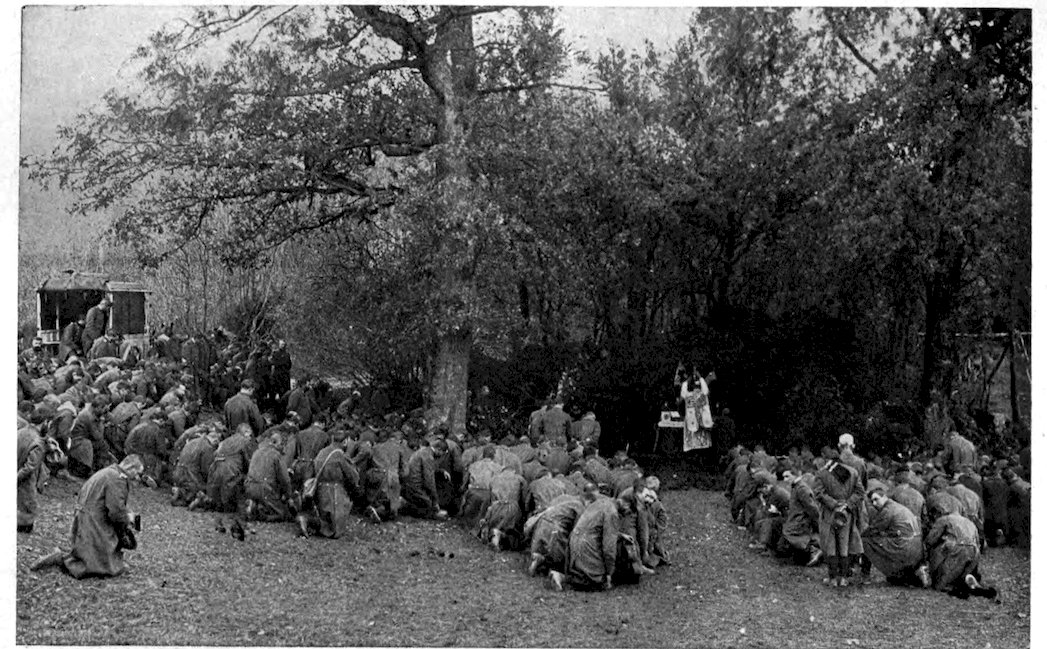
From a photograph by Meurisse.
The mass before the battle.
There are said to be upward of twenty thousand priests fighting in the armies of France.
A few hours before Bergues had been as
quaint and peaceful and contented a town of
five thousand people as you could have found
in France. Because of its quaint and simple
charm touring motorists used to go out of
their way to see it. It is fortified in theory
but not in fact, for its moss-grown ramparts,
which date from the Crusades, have about as
much military significance as the Battery in
New York. But the guide-books describe it
as a fortified town, and that was all the excuse
the Germans needed to turn loose upon it
sudden death. To-day that little town is an
empty, broken shell, its streets piled high with
the brick and plaster of its ruined homes.
One has to see the ruin produced by a 38-centimetre
shell to believe it. If one hits a building
that building simply ceases to exist. It
crumbles, disintegrates, disappears. I do not
mean to say that its roof is ripped off or that
one of its walls is blown away. I mean to say
that the whole building crashes to the ground
as though flattened by the hand of God. The
Germans sent only twelve of their shells into
Bergues, but the central part of the town looked
like Market Street in San Francisco after the
earthquake. One of the shells struck a hospital
and exploded in a ward filled with wounded
soldiers. They are not wounded any longer.
Another shell completely demolished a three-story
brick house. In the cellar of that house
a man, his wife, and their three children had
taken refuge. There was no need to dig graves
for them in the local cemetery. Throughout
the bombardment a Taube hung over the
doomed town to observe the effect of the shots,
and to direct by wireless the distant gunners.
I wonder what the German observer, peering
down through his glasses upon the wrecked
hospital and the shell-torn houses and the
mangled bodies of the women and children,
thought about it all. It would be interesting
to know, wouldn’t it?
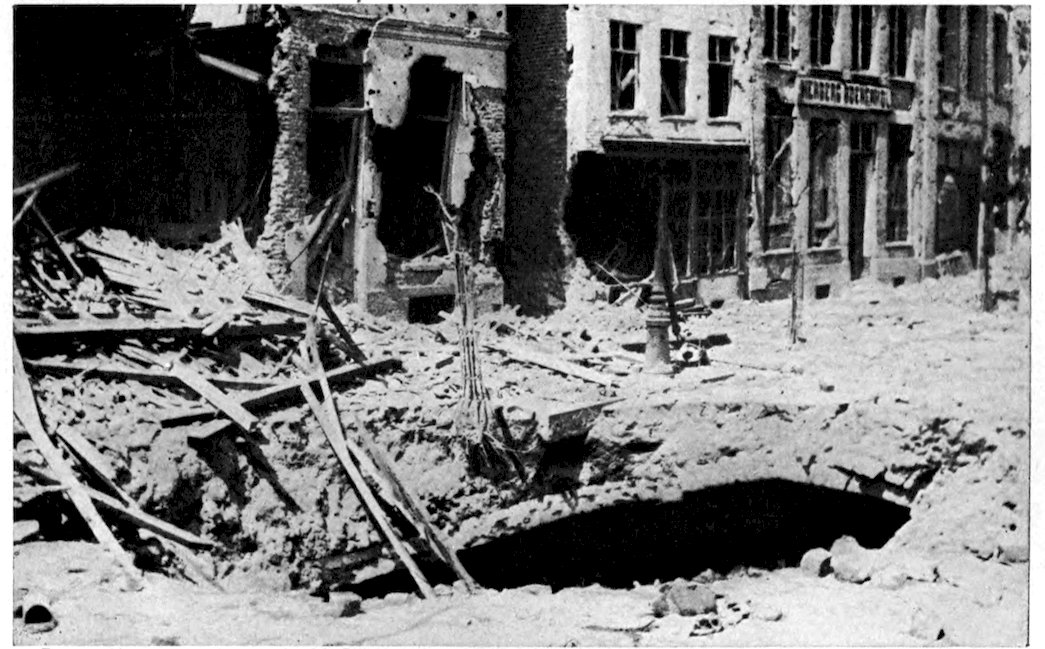
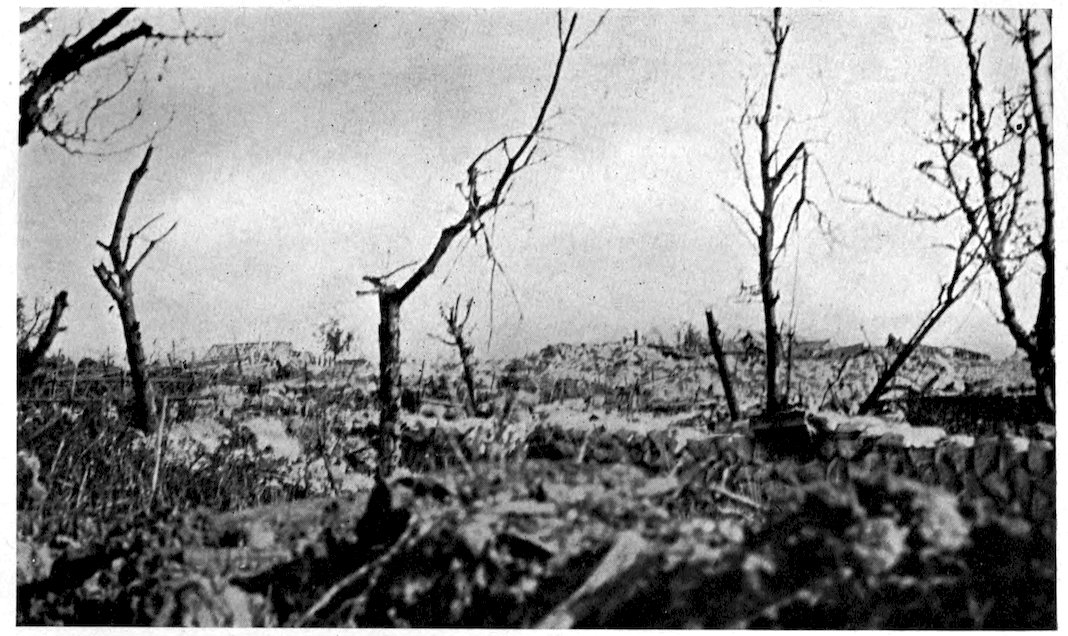
From a photograph copyright by M. Rol.
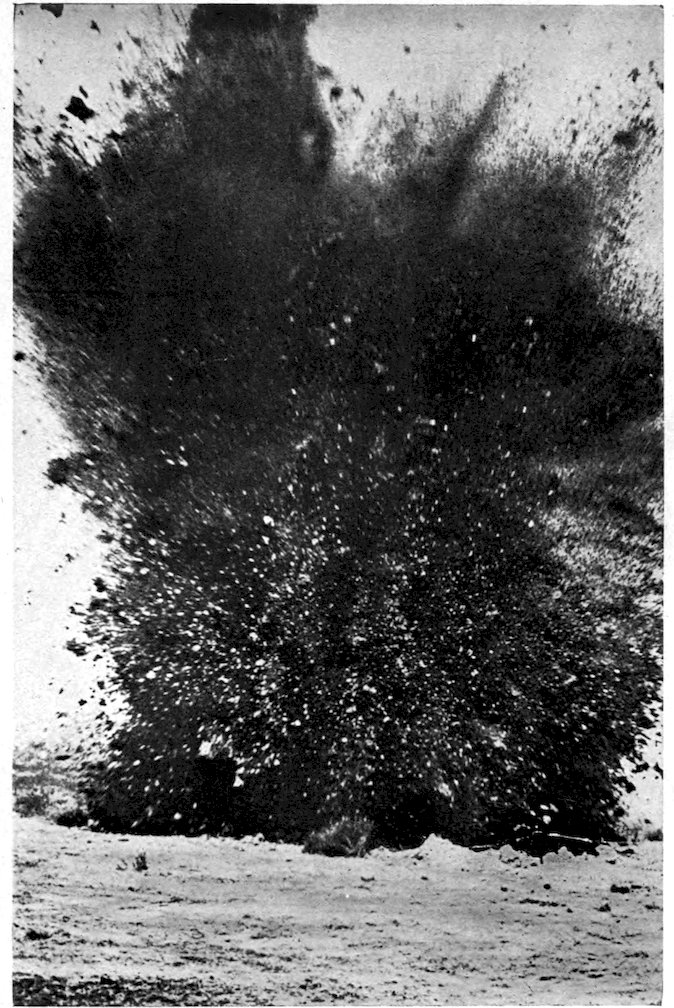
What a 38-centimetre shell, fired from a gun twenty-three miles away, did in Dunkirk.
55“When one of these shells hits a building, that building simply ceases to exist.”
II ON THE BRITISH BATTLE-LINE
56
Along a road in the outskirts of that
French town which is the British
headquarters a youth was running.
He was of considerably less than medium
height, and fair-haired and very slender. One
would have described him as a nice-looking
boy. He wore a jersey and white running-shorts
which left his knees bare, and he was
bareheaded. Shoulders back and chest well
out, he jogged along at the steady dog-trot
adopted by athletes and prize-fighters who are
in training. Now, in ordinary times there is
not anything particularly remarkable in seeing
a scantily clad youth dog-trotting along a
country road. You assume that he is training
for a cross-country event, or for a seat in a
’varsity shell, or for the feather-weight championship,
and you let it go at that. But these
57are not ordinary times in France, and ordinary
young men in running-shorts are not permitted
to trot along the roads as they list in
the immediate vicinity of British Headquarters.
Even if you travel, as I did, in a large gray car,
with an officer of the French General Staff
for companion, you are halted every few
minutes by a sentry who turns the business
end of a rifle in your direction and demands
to see your papers. But no one challenged
the young man in the running-shorts or asked
to see his papers. Instead, whenever a soldier
caught sight of him that soldier clicked his
heels together and stood rigidly at attention.
After you had observed the curious effect
which the appearance of this young man produced
on the military of all ranks it suddenly
struck you that his face was strangely familiar.
Then you all at once remembered that you
had seen it hundreds of times in the magazines
and the illustrated papers. Under it was the
caption, “His Royal Highness the Prince of
Wales.” That young man will some day, if
he lives, sit in an ancient chair in Westminster
Abbey, and the Archbishop of Canterbury
will place a crown upon his head, and his picture
58will appear on coins and postage-stamps
in use over half the globe.
Now, the future King of England—Edward
VIII they will doubtless call him—is
not getting up at daybreak and reeling off
half a dozen miles or so because he particularly
enjoys it. He is doing it with an end in view.
He is doing it for precisely the same reason that
the prize-fighter does it—he is training for a
battle. To me there was something wonderfully
suggestive and characteristic in the sight
of that young man plugging doggedly along
the country road. He seemed to epitomize
the spirit which I found to exist along the
whole length of the British battle-line. Every
British soldier in France has come to appreciate
that he is engaged in a struggle without parallel
in history—a struggle in which he is confronted
by formidable, ferocious, resourceful,
and utterly unscrupulous opponents, and from
which he is by no means certain to emerge a
victor—and he is, therefore, methodically and
systematically preparing to win that struggle
just as a pugilist prepares himself for a battle
in a prize-ring.
The British soldier has at last come to a
59realization of the terrible gravity of the situation
which faces him. You don’t hear him
singing “Tipperary” any more or boasting
about what he is going to do when he gets to
Berlin. He has come to have a most profound
respect for the fighting qualities of the men
in the spiked helmets. He knows that he, an
amateur boxer as it were, is up against the
world’s heavyweight professional champion,
and he perfectly appreciates that he has, to
use his own expression, “a hell of a job” in
front of him. He has already found out, to
his cost and to his very great disgust, that his
opponent has no intention of being hampered
by the rules laid down by the late Marquis
of Queensberry, having missed no opportunity
to gouge or kick or hit below the belt. But the
British soldier has now become familiar with
his opponent’s tactics, and one of these days,
when he gets quite ready, he is going to give
that opponent the surprise of his life by landing
on him with both feet, spikes on his shoes,
and brass knuckles on his fingers. Meanwhile,
like the young Prince in the running-shorts,
he has buckled down with grim determination
to the task of getting himself into condition.
60I suppose that if I were really politic and
far-sighted I would cuddle up to the War
Office and make myself solid with the General
Staff by confidently asserting that the British
Army is the most efficient killing machine in
existence, and that its complete and early
triumph is as certain as that the sparks fly
upward; neither of which assertions would be
true. It should be kept in mind, however,
that the British did not begin the building of
their war-machine until after the outbreak of
hostilities, while the German organization is
the result of upward of half a century of unceasing
thought, experiment, and endeavor.
But what the British have accomplished since
the war began is one of the marvels of military
history. Lord Kitchener came to a War Office
which had long been in the hands of lawyers
and politicians. Not only was he expected
to remodel an institution which had become
a national joke, but at the same time to raise
a huge volunteer army. In order to raise this
army he had to have recourse to American
business methods. He employed a clever
advertising specialist to cover the walls and
newspapers of the United Kingdom with all
61manner of striking advertisements, some pleading,
some bullying, some caustic in tone, by
which he has proved that, given patriotic impulse,
advertising for people to go to war is
just like advertising for people to buy automobiles
or shaving-soap or smoking-tobacco.
It was not soothing to British pride—but it
got the men. Late in the spring of 1915, after
half a year or more of training, during which
they were worked as a negro teamster works
a mule, those men were marched aboard transports
and sent across the Channel. So admirably
executed were the plans of the War
Office and so complete the precautions taken
by the Admiralty, that this great force was
landed on the Continent without the loss of a
single life from German mines or submarines.
That, in itself, is one of the greatest accomplishments
of the war. England now (December,
1915) has in France an army of approximately
a million men. But it is a new army.
The bulk of it is without experience and without
experienced regiments to stiffen it and give
it confidence, for the army of British regulars
which landed in France at the outbreak of the
war has ceased to exist. The old regimental
62names remain, but the officers and men who
composed those regiments are, to-day, in the
hospitals or the cemeteries. The losses suffered
by the British Army in Flanders are appalling.
The West Kent Regiment, for example, has
been three times wiped out and three times
reconstituted. Of the Black Watch, the Rifle
Brigade, the Infantry of the Household, scarcely
a vestige of the original establishments remains.
Hardly less terrible are the losses which have
been suffered by the Canadian Contingent.
The Princess Patricia’s Canadian Light Infantry
landed in France 1400 strong. To-day
only 140 remain. The present colonel was a
private in the ranks when the regiment sailed
63from Quebec.
64
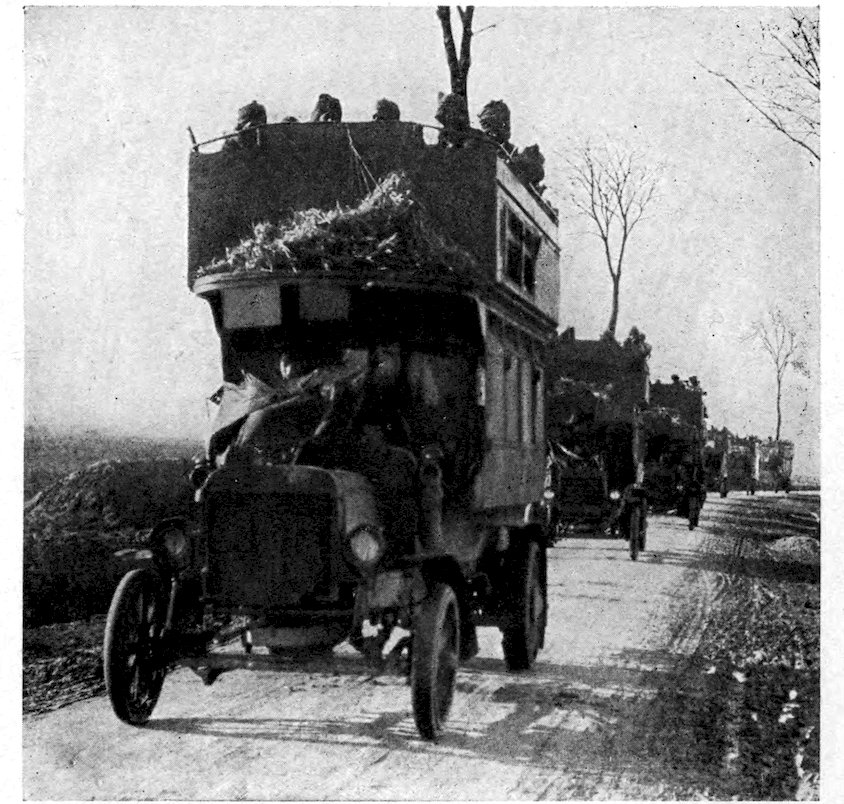
From a photograph by Meurisse.
London buses at the front.
“Far as the eye can see stretch long lines of London motor-buses in war coats of elephant gray, crowded with sun-tanned men in khaki hurrying toward the trenches.”
The machine that the British have knocked
together, though still a trifle wabbly and somewhat
creaky in its joints, is, I am convinced,
eventually going to do the business. But you
cannot appreciate what it is like or what it is
accomplishing by reading about it; you have
to see it for yourself as I did. That corner of
France lying between the fifty miles of British
front and the sea is, to-day, I suppose, the
busiest region in the world. It reminded me
of the Canal Zone during the rush period of
the Canal’s construction. It is as busy as the
lot where the Greatest Show on Earth is getting
ready for the afternoon performance. Down
the roads, far as the eye can see, stretch long
lines of London motor-buses, sombre war coats
of elephant gray replacing the staring
advertisements of teas, tobaccos, whiskeys,
and theatrical attractions, crowded no longer
with pale-faced clerks hurrying toward the
city, but with sun-tanned men in khaki hurrying
toward the trenches. Interminable processions
of motor-lorries go lumbering past,
piled high with the supplies required to feed
and clothe the army, practically all of which
are moved from the coast to the front by road,
the railways being reserved for the transport
of men and ammunition; and the ambulances,
hundreds and hundreds of them, hurrying their
blood-soaked cargoes to the hospitals so that
they may go back to the front for more. So
crowded are the highways behind the British
front that at the cross-roads in the country
and at the street crossings in the towns are
posted military policemen with little scarlet
flags who control the traffic just as do the
policemen on Fifth Avenue and Broadway.
The roads are never permitted to fall into disrepair,
for on their condition depends the rapidity
with which the army can be supplied with
food and ammunition. Hence road gangs and
steam-rollers and sprinkling-carts are at work
constantly. When the war is over, France
will have better roads and more of them than
she ever had before. There are speed-limit
signs everywhere—heretofore practically unknown
in France, where any one who was careless
enough to get run over was liable to arrest
for obstructing the traffic. At frequent intervals
along the roads are blacksmith shops
and motor-car repair stations, to say nothing
of the repair cars, veritable garages on wheels,
which, when news of an accident or breakdown
is received, go tearing toward the scene of
trouble as a fire-engine responds to an alarm
of fire. At night all cars must run without
lights, as a result of which many camions and
motor-buses have met with disaster by running
off the roads in the darkness and tipping
over in the deep ditches. To provide for this
particular form of mishap the Army Service
Corps has designed a most ingenious contrivance
which yanks the huge machines out
of the ditch and sets them on the road again
as easily as though they were stubborn mules.
Upon the door of every house we passed,
whether château or cottage, was marked the
number of men who could be billeted upon it.
There are signs indicating where water can be
obtained and fodder and pasturage and petrol.
In every town and village are to be found
military interpreters, known by a distinctive
cap and brassard, who are always ready to
straighten out a misunderstanding between a
Highlander from the north of the Tweed and
a tirailleur from Tunisia, who will assist a
Ghurka from the Indian hill country in bargaining
for poultry with a Flemish-speaking
peasant, or instruct a lost Senegalese how to
get back to his command. An officers’ training-school
has been established at St.-Omer, which
is the British Headquarters, where those men
in the ranks who possess the necessary education
are fitted to receive commissions. After
this war is over the British Army will no longer
be officered by the British aristocracy. The
wholesale promotions of enlisted men made
necessary by the appalling losses among the
officers will result in completely changing the
complexion of the British military establishment.
Provided he has the necessary educational
qualifications, the son of a day-laborer
will hereafter stand as much chance as the
son of a duke. Did you know, by the way,
that the present Chief of the Imperial General
Staff began life as a footman and entered the
army as a private in the ranks?
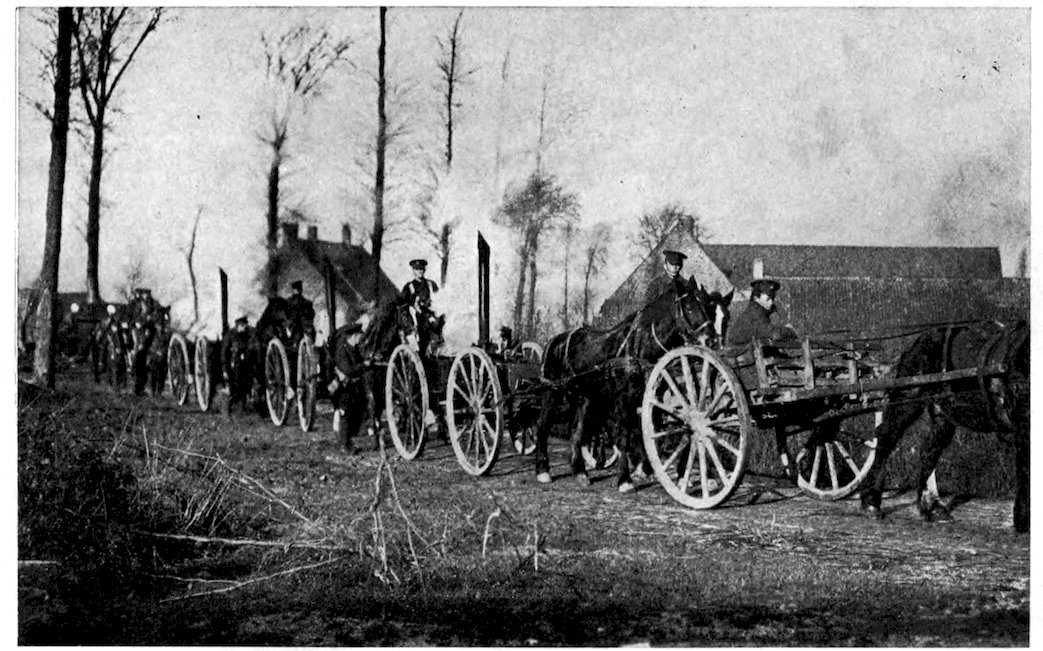
From a photograph by Meurisse.
British field-kitchens on the march in Flanders.
“Napoleon said: ‘An army marches on its belly,’ and the Army Service Corps is seeing to it that the belly of the British soldier is never empty.”
65The wonderful thoroughness of the British
66is exemplified by the bulletins which are issued
every morning by the Intelligence Department
for the information of the brigade and regimental
commanders. They resemble ordinary
hand-bills and contain a summary of all the
information which the Intelligence Department
has been able to collect during the preceding
twenty-four hours as to what is going
on behind the German lines—movements of
troops, construction of new trenches, changes
in the location of batteries, shortage of ammunition,
condition of the roads; everything, in
short, which might be of any conceivable value
to the British to know. For example, the
report might contain a sentence something like
this: “At five o’clock to-morrow morning
67the Prussian Guard, which has been holding
position No. —, to the south of Ypres, will be
relieved by the 47th Bavarian Landsturm”—which,
by the way, would probably result in
the British attacking the position mentioned.
The information contained in these bulletins
comes from many sources—from spies in the
pay of the Intelligence Department, from
aviators who make reconnoissance flights over
the German lines, and particularly from the
inhabitants of the invaded regions, who, by
various ingenious expedients, succeed in communicating
to the Allies much important information—often
at the cost of their lives.
The great base camps which the British
have established at Calais and Havre and
Boulogne and Rouen are marvels of organization,
efficiency, and cleanliness. Cities whose
macadamized streets are lined with portable
houses of wood or metal which have been
brought to the Continent in sections, and which
have sewers and telephone systems and electric
lights, and accommodations for a hundred thousand
men apiece, have sprung up on the sand-dunes
of the French coast as though by the
wave of a magician’s wand. Here, where the
68fresh, healing wind blows in from the sea, have
been established hospitals, each with a thousand
beds. Huge warehouses have been built of
concrete to hold the vast quantity of stores
which are being rushed across the Channel
by an endless procession of transports and
cargo steamers. So efficient is the British
field-post system, which is operated by the
Army Post-Office Division of the Royal Engineers,
that within forty-eight hours after a
wife or mother or sweetheart drops a letter
into a post-box in England that letter has been
delivered in the trenches to the man to whom
it was addressed.
In order to prevent military information
leaking out through the letters which are
written by the soldiers to the folks at home,
one in every five is opened by the regimental
censor, it being obviously out of the question
to peruse them all. If, however, the writer is
able to get hold of one of the precious green
envelopes, whose color is a guarantee of private
and family matters only, he is reasonably
certain that his letter will not be read by
other eyes than those for which it is intended.
Nor does the field-post confine itself to the
69transmission of letters, but transmits delicacies
and comforts of every sort to the boys in the
trenches, and the boys in the trenches use the
same medium to send shell fragments, German
helmets, and other souvenirs to their friends
at home. I know a lady who sent her son in
Flanders a box of fresh asparagus from their
Devonshire garden on a Friday, and he had it
for his Sunday dinner. And this reminds me
of an interesting little incident which is worth
the telling and might as well be told here as
elsewhere. A well-known American business
man, the president of one of New York’s street-railway
systems, has a son who is a second
lieutenant in the Royal Artillery. The father
was called back to America at a time when
his son’s battery was stationed in a particularly
hot corner to the south of Ypres. The
father was desperately anxious to see his
son before he sailed, but he knew that the
chances of his being permitted to do so were
almost infinitesimal. Nevertheless, he wrote
a note to Lord Kitchener explaining the circumstances
and adding that he realized that
it was probably quite impossible to grant such
a request. He left the note himself at York
70House. Before he had been back in his hotel
an hour he was called to the telephone. “This
is the secretary of Lord Kitchener speaking,”
said a voice. “He desires me to say that
you shall certainly see your son before returning
to America, and that you are to hold yourself
in readiness to go to the Continent at a
moment’s notice.” A few days later he received
another message from the War Office:
“Take to-morrow morning’s boat from Folkestone
to Boulogne. Your son will be waiting
for you on the quay.” The long arm of the
great War Minister had reached out across the
English Channel and had picked that obscure
second lieutenant out from that little Flemish
village, and had brought him by motor-car to
the coast, with a twenty-four hours’ leave of
absence in his pocket, that he might say good-by
to his father.
The maxim that “an army marches on its
belly” is as true to-day as when Napoleon
uttered it, and the Army Service Corps is
seeing to it that the belly of the British soldier
is never empty. Of all the fighting men in
the field, the British soldier is far and away
the best fed. He is, indeed, almost overfed,
71particularly as regards jams, marmalades, puddings,
and other articles containing large quantities
of sugar, which, so the army surgeons
assert, is the greatest restorer of the muscular
tissues. Though the sale of spirits is strictly
prohibited in the military zone, a ration of
rum is served out at daybreak each morning
to the men in the trenches.
To Miss Jane Addams has been attributed
the following assertion: “We heard in all countries
similar statements in regard to the necessity
for the use of stimulants before men would
engage in bayonet charges, that they have a
regular formula in Germany, that they give
them rum in England and absinthe in France;
that they all have to give them the ‘dope’ before
the bayonet charge is possible.” Now,
Miss Addams has never, so far as I am aware,
been in the trenches. Of the conditions which
exist there she knows only by hearsay. Miss
Addams says that rum is given to the British
soldier. That is perfectly true. In pursuance
of orders issued by the Army Medical Corps,
every man who has spent the night in the
trenches is given a ration (about a gill) of rum
at daybreak, not to render him reckless, as Miss
72Addams would have us believe, but to counteract
the effects of the mud and water in which
he has been standing for many hours. But
when Miss Addams asserts that the French
soldiers are given absinthe she makes an assertion
that is without foundation of fact. Not
only have I never seen a glass of absinthe
served in France since the law was passed
which made its sale illegal, but I have never
seen spirits of any kind in use in the zone of
operations. More than once, coming back,
chilled and weary, from the trenches, I have
attempted to obtain either whiskey or brandy
only to be told that its sale is rigidly prohibited
in the zone of the armies. The regular ration
of the French soldier includes now, just as
in time of peace, a pint of vin ordinaire—the
cheap wine of the country—this being, I might
add, considerably less than the man would
drink with his meals were he in civil life. As
regards the conditions which exist in the German
armies I cannot speak with the same assurance,
because I have not been with them
since the autumn of 1914. During the march
across Belgium there was, I am perfectly willing
to admit, considerable drunkenness among
73the German soldiers, but this was due to the
men looting the wine-cellars in the towns
through which they passed and not, as Miss
Addams would have us believe, to their officers
having systematically “doped” them. I have
heard it stated, on various occasions, that German
troops are given a mixture of rum and
ether before going into action. Whether this
is true I cannot say. Personally, I doubt it.
If a man’s life ever depends upon a clear brain
and a cool head it is when he is going into battle.
Everything considered, therefore, I am
convinced that intemperance virtually does not
exist among the armies in the field. I feel that
Miss Addams has done a grave injustice to
brave and sober men and that she owes them
an apology.
The British troops are not permitted to drink
unboiled or unfiltered water, each regiment having
two steel water-carts fitted with Birkenfeldt
filters from which the men fill their water-bottles.
As a result of this precaution, dysentery
and diarrhœa, the curse of armies in previous
wars, have practically disappeared, while,
thanks to compulsory inoculation, typhoid is
unknown. Perhaps the most important of all
74the sanitary devices which have been brought
into existence by this war, and without which
it would not be possible for the men to remain
in the trenches at all, is the great force-pump
that is operated at night and which throws lime
and carbolic acid on the unburied dead. It is,
indeed, impossible to overpraise the work being
done by the Royal Army Medical Corps, which
has, among its many other activities, so improved
and speeded up the system of getting
the wounded from the firing-line to the hospitals
that, as one Tommy remarked, “You ’ears a
’ell of a noise, and then the nurse says: ‘Sit
hup and tike this broth.’”
Though in this war the work of the cavalry
is almost negligible; though cartridges and
marmalade are hurried to the front on motor-trucks
and the wounded are hurried from the
front back to the hospital in motor-ambulances;
though despatch riders bestride panting motor-cycles
instead of panting steeds; though scouting
is done by airmen instead of horsemen,
the day of the horse in warfare has by no
means passed. Without the horse, indeed,
the guns could not go into action, for no form
of tractor has yet been devised for hauling
75batteries over broken country. In fact, all of
the belligerent nations are experiencing great
difficulty in providing a sufficient supply of
horses, for the average life of a war-horse is
very short—ten days, assert some authorities;
sixteen, say others. For the first time in the
history of warfare, therefore, the horse is
treated as a creature which must be cared for
when sick or wounded as well as when in health,
and this not merely from motives of sentiment
or humanity but as a detail of military efficiency.
“For want of a nail,” runs the old ditty,
“the shoe was lost; for want of a shoe the
horse was lost; for want of a horse the rider
was lost; for want of a rider the battle was
lost”—and the Royal Army Veterinary Corps
is seeing to it that no battles are lost for lack
of either horses or horseshoes. The Army Veterinary
Corps now has on the British sector
700 officers and 8,000 men, whose business it is
to conserve the lives of the horses. The last
report that I have seen places the total number
of horses treated in the various hospital units
(each of which accommodates 1,000 animals) as
approximately 81,000, of which some 47,000
had been returned to the Remount Department
76as again fit for active service; 30,000
were still under treatment; the balance having
died, been destroyed, or sold.
The horses in use by the British Army in
France are the very pick of England, the
Colonies, and foreign countries; thoroughbred
and three-quarter bred hunters from the
hunting counties and from Ireland; hackneys,
draft, and farm animals; Walers from
Australia; wire-jumpers from New Zealand;
hardy stock from Alberta and Saskatchewan;
sturdy ponies from the hill country of India;
thousands upon thousands of animals from the
American Southwest, and from the Argentine;
to say nothing of the great sixteen-hand mules
from Missouri and Spain.
Animals suffering from wounds or sickness
are shipped back to the hospital bases on the
coast in herds, each being provided with a separate
covered stall, or, in case of pneumonia,
with a box-stall. The spotless buildings, with
their exercise tracks and acres of green paddocks,
suggest a race-course rather than a hospital
for horses injured in war. Each hospital
has its operating-sheds, its X-ray department,
its wards for special ailments, its laboratories
77for preventive research work, a pharmacy, a
museum which affords opportunity for the
study of the effects of sabre, shell, and bullet
wounds, and a staff of three hundred trained
veterinarians. Schools have also been established
in connection with the hospitals in
which the grooms and attendants are taught
the elements of anatomy, dentistry, farriery,
stabling, feeding, sanitation, and, most important
of all, the care of hoofs. All the methods
and equipment employed are the best that
science can suggest and money can obtain,
everything having passed the inspection of the
Duke of Portland and the Earl of Lonsdale,
the two greatest horse-breeders in England.
Attached to each division of troops in the field
is a mobile veterinary section, consisting of an
officer and twenty-two men, who are equipped
to render first-aid service to wounded horses
and whose duty it is to decide which animals
shall be sent to the hospitals for treatment,
which are fit to return to the front for further
service, and which cases are hopeless and must
be destroyed. The enormous economic value
of this system is conclusively proved by the
fact that it has reduced sickness among horses
78in the British Army 50 per cent, and mortality
47 per cent.
The question that has been asked me more
frequently than any other is why the British,
with upward of a million men in the field, are
holding only about fifty miles of battle-front,
as compared with seventeen miles held by the
Belgians and nearly four hundred by the French.
There are several reasons for this. It should
be remembered, in the first place, that the
British Army is composed of green troops,
while the French ranks, thanks to the universal
service law, are filled with men all of whom
have spent at least three years with the colors.
In the second place, the British sector is by far
the most difficult portion of the western battle-front
to hold, not only because of the configuration
of the country, which offers little natural
protection, but because it lies squarely athwart
the road to the Channel ports—and it is to
the Channel ports that the Germans are going
if men and shells can get them there. The
fighting along the British sector is, moreover,
of a more desperate and relentless nature than
elsewhere on the Allied line, because the
Germans nourish a deeper hatred for the
79English than for all their other enemies put
together.
It was against the British, remember, that
the Germans first used their poison-gas. The
first engagement of importance in which gas
played a part was the Second Battle of Ypres,
lasting from April 22 until May 13, which
will probably take rank in history as one
of the greatest battles of all time. In it the
Germans, owing to the surprise and confusion
created by their introduction of poison-gas,
came within a hair’s breadth of breaking
through the Allied line, and would certainly
have done so had it not been for the gallantry
and self-sacrifice of the Canadian Division,
which, at the cost of appalling losses, won imperishable
fame. The German bombardment
of Ypres began on April 20 and in forty-eight
hours, so terrible was the rain of heavy projectiles
which poured down upon it, the quaint
old city, with its exquisite Cloth Hall, was but
a heap of blackened, smoking ruins. That
portion of the Allied line to the north of the
city was held, along a front of some four miles,
by a French division composed of Colonials,
Algerians, and Senegalese, stiffened by several
80line regiments. Late in the afternoon of the
22d, peering above their trenches, they saw,
rolling toward them across the Flemish plain,
an impalpable cloud of yellowish-green, which,
fanned by a brisk wind, moved forward at the
speed of a trotting-horse. It came on with
the remorselessness of Fate. It blotted out
what was happening behind it as the smoke
screen from a destroyer masks the manœuvres
of a Dreadnaught. The spring vegetation
shrivelled up before it as papers shrivel when
thrown into a fire. It blasted everything it
touched as with a hand of death. No one
knew what it was or whence it came. Nearer
it surged and nearer. It was within a hundred
metres of the French position ... fifty ...
thirty ... ten ... and
then the silent horror
was upon them. Men began to cough
and hack and strangle. Their eyes smarted
and burned with the pungent, acrid fumes.
Soldiers staggered and fell before it in twos
and fours and dozens as miners succumb to
fire-damp. Men, strained and twisted into
grotesque, horrid attitudes, were sobbing their
lives out on the floors of the trenches. The
fire of rifles and machine-guns weakened, died
81down, ceased. The whole line swayed, wavered,
trembled on the verge of panic. Just then a
giant Algerian shouted: “The Boches have
turned loose evil spirits upon us! We can fight
men, but we cannot fight afrits! Run, brothers!
Run for your lives!” That was all that was
needed to precipitate the disaster. The superstitious
Africans, men from the West Coast
where voodooism still holds sway, men of the
desert steeped in the traditions and mysteries
of Islam, broke and ran. The French white
troops, carried off their feet by the sudden rush,
were swept along in the mad debacle. And
as they ran the yellow cloud pursued them remorselessly,
like a great hand reaching out for
their throats.
An eye-witness of the rout that followed told
me that he never expects to see its like this side
of the gates of hell. The fields were dotted
with blue-clad figures wearing kepis, and
brown-clad ones wearing turbans and tarbooshes,
who stumbled and fell and rose again
and staggered along a few paces and fell to
rise no more. The highways leading from the
trenches were choked with maddened, fear-crazed
white and black and brown men who
82had thrown away their rifles, their cartridge-pouches,
their knapsacks, in some cases even
their coats and shirts. Some were calling on
Christ and some on Allah and some on their
strange pagan gods. Their eyes were starting
from their sockets, on their foreheads stood
glistening beads of sweat, they slavered at the
mouth like dogs, their cheeks and breasts were
flecked with foam. “We’re not afraid of the
Boches!” screamed a giant sergeant of zouaves,
on whose breast were the ribbons of a dozen
wars. “We can fight them until hell turns cold.
But this we cannot fight. Le Bon Dieu does
not expect us to stay and die like rats in a
sewer.” Guns and gun-caissons passed at a
gallop, Turcos and tirailleurs clinging to them,
the fear-crazed gunners flogging their reeking
horses frantically. The ditches bordering the
roads were filled with overturned wagons and
abandoned equipment. Giant negroes, naked
to the waist, tore by shrieking that the spirits
had been loosed upon them and slashing with
their bayonets at all who got in their path.
Mounted officers, frantic with anger and mortification,
using their swords and pistols indiscriminately,
vainly tried to check the human
83stream. And through the four-mile breach
which the poison-gas had made the Germans
were pouring in their thousands. The roar of
their artillery sounded like unceasing thunder.
The scarlet rays of the setting sun lighted up
such a scene as Flanders had never before
beheld in all its bloody history. Then darkness
came and the sky was streaked across
with the fiery trails of rockets and the sudden
splotches of bursting shrapnel. The tumult
was beyond all imagination—the crackle of
musketry, the rattle of machine-guns, the
crash of high explosive, the thunder of falling
walls, the clank of harness and the rumble of
wheels, the screams of the wounded and the
groans of the dying, the harsh commands of
the officers, the murmur of many voices, and
the shuffle, shuffle, shuffle of countless hurrying
feet.
84
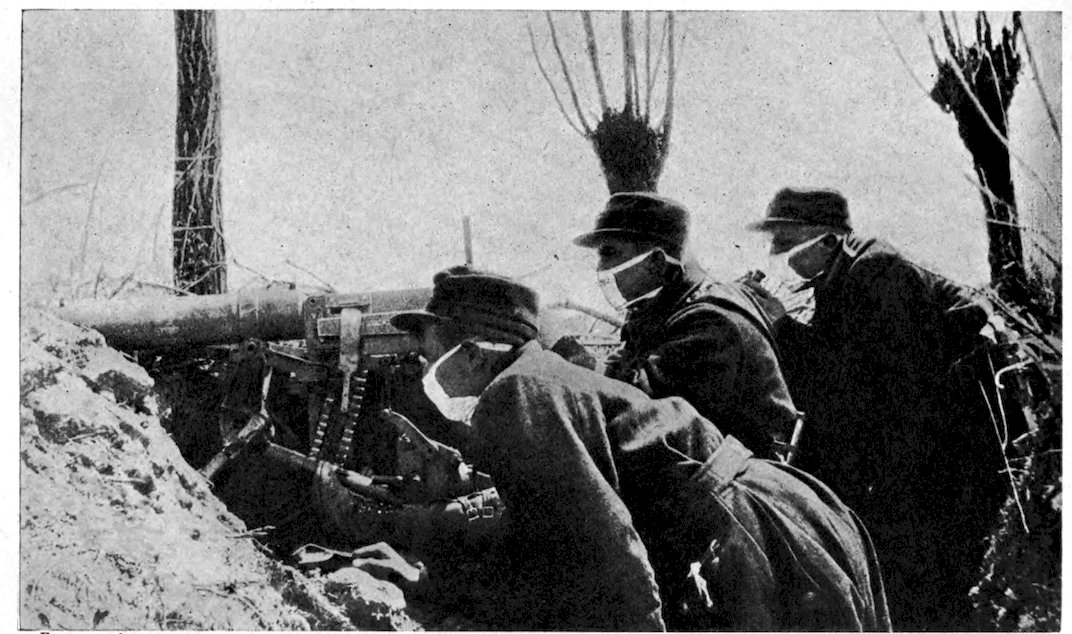
From a photograph copyright by M. Rol.
Machine-gun squad wearing masks as a protection against the asphyxiating gas with which the Germans precede their attacks.
And through the breach still poured the
helmeted legions like water bursting through
a broken dam. Into that breach were thrown
the Canadians. The story of how, overwhelmed
by superior numbers of both men and
guns, choked by poison-fumes, reeling from
exhaustion, sometimes without food, for it was
impossible to get it to them, under such a rain
of shells as the world had never before seen,
the brawny men from the oversea Dominion
fought on for a solid week, and thereby saved
the army from annihilation, needs no re-telling
here. Brigade after brigade of fresh troops,
division after division, was hurled against them
but still they battled on. So closely were
they pressed at times that they fought in little
groups; men from Ontario and Quebec
shoulder to shoulder with blood-stained heroes
from Alberta and Saskatchewan. At last,
when it seemed as though human endurance
could stand the strain no longer, up went the
cry, “Here come the guns!” and the Canadian
batteries, splashed with sweat and mud,
tore into action on the run. “Action front!”
screamed the officers, and the guns whirled
like polo ponies so that their muzzles faced
the oncoming wave of gray. “With shrapnel!...
Load!” The lean and polished projectiles
slipped in and the breech-blocks snapped
home. “Fire at will!” and the blast of steel
tore bloody avenues in the German ranks.
But fresh battalions filled the gaps—the German
reserves seemed inexhaustible—and they
still came on. At one period of the battle the
Germans were so close to the guns that the
order was given, “Set your fuses at zero!”
which means that a shell bursts almost the
moment it leaves the muzzle of the gun. It
was not until early on Friday morning that
reinforcements reached the shattered Canadians
and enabled them to hold their ground.
Later the Northumbrian Division—Territorials
arrived only three days before from the
English training-camps—were sent to aid them
and proved themselves as good soldiers as the
veterans beside whom they fought. For days
the fate of the army hung in the balance, for
there seemed no end to the German reserves,
who were wiped out by whole divisions only
to be replaced by more, but against the stone
wall of the Canadian resistance the men in the
spiked helmets threw themselves in vain. On
May 13, 1915, after three weeks of continuous
fighting, may be said to have ended the Second
Battle of Ypres, not in a terrific and decisive
climax, but slowly, sullenly, like two prize-fighters
who have fought to the very limit of
their strength.
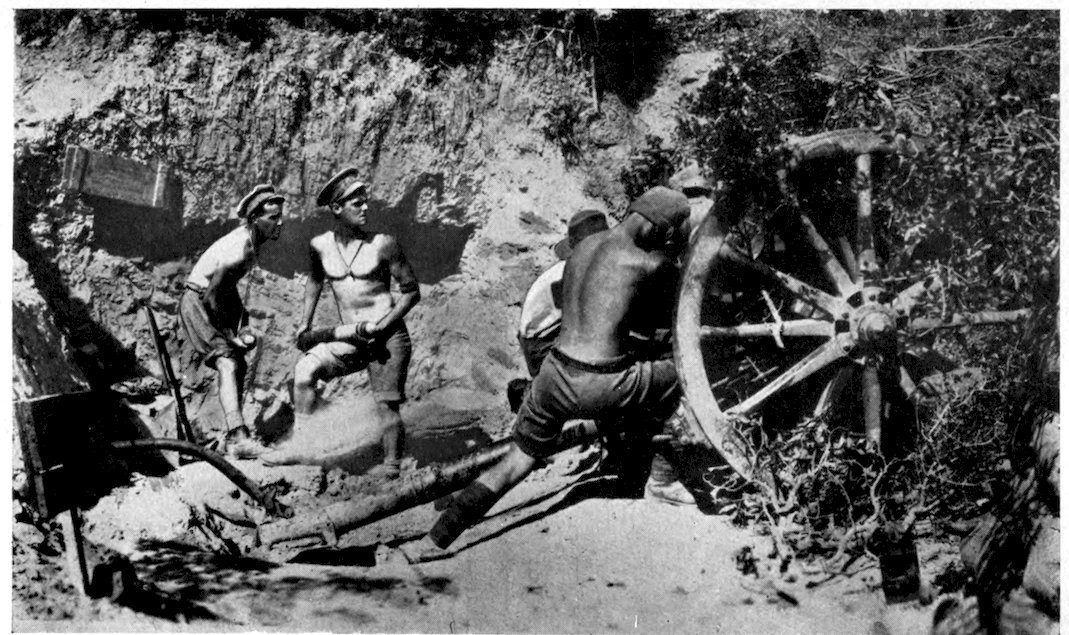
From a photograph copyright by “The Daily Mirror.”
85A British battery in action.
86
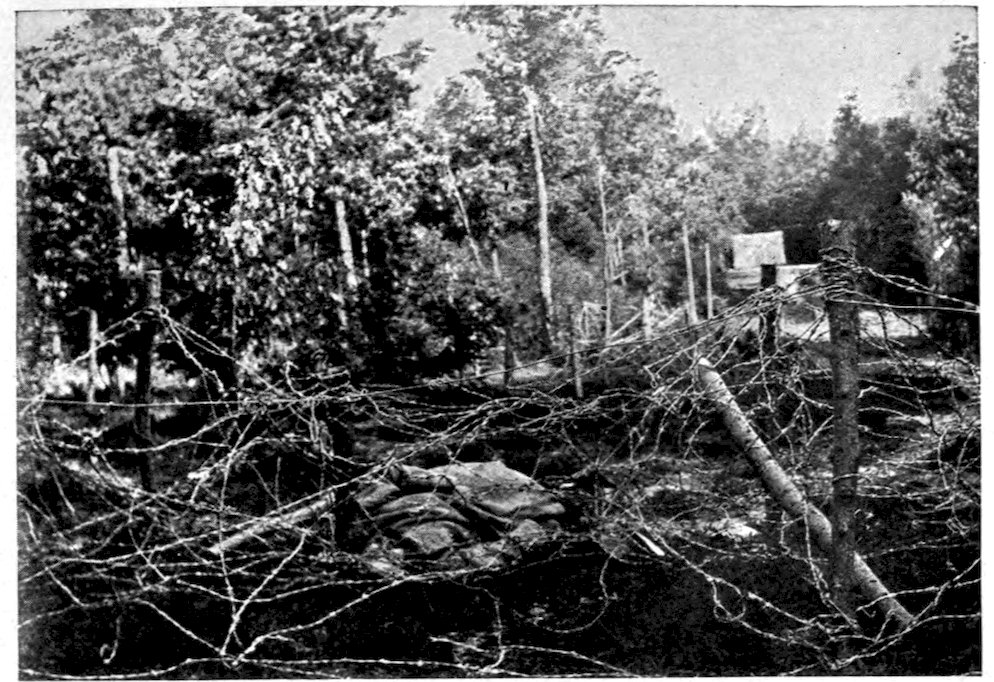
“Bodies, long months dead, rotting amid the wire entanglements.”
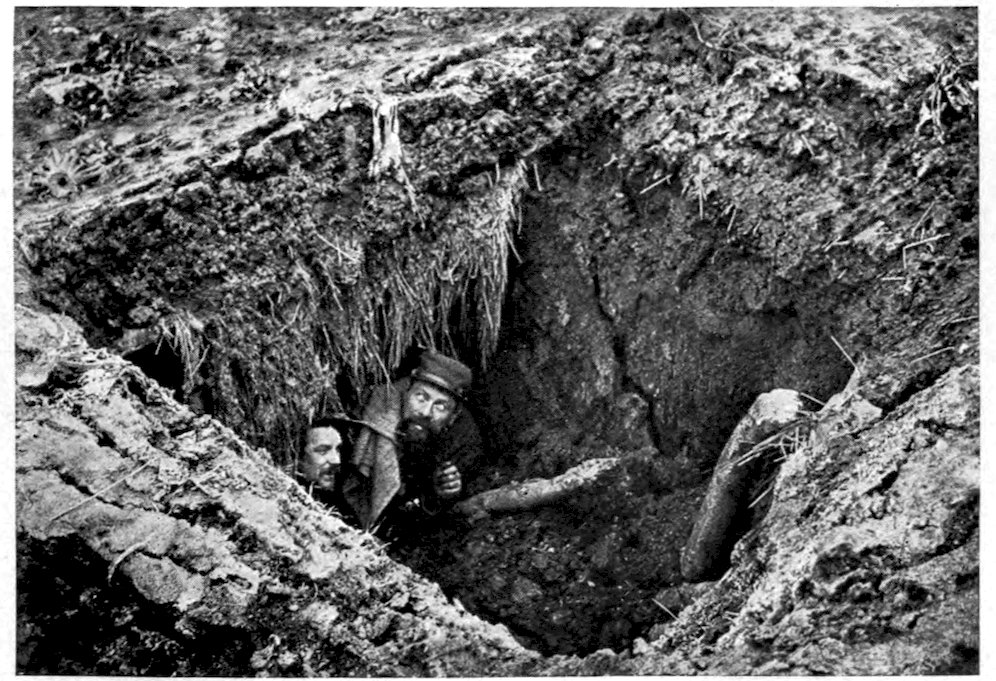
From photographs by Meurisse.
“Imagine what it must be like to sleep in a hole in the earth, into which you have to crawl on all fours, like an animal into its lair.”
According to the present British system, the
soldiers spend three weeks at the front and one
week in the rear—if possible, out of sound of
the guns. The entire three weeks at the front
is, to all intents and purposes, spent in the
trenches, though every third day the men are
given a breathing spell. Three weeks in the
trenches! I wonder if you of the sheltered
life have any but the haziest notion of what
that means. I wonder if you, Mr. Lawyer;
you, Mr. Doctor; you, Mr. Business Man, can
conceive of spending your summer vacation in
a ditch 4 feet wide and 8 feet deep, sometimes
with mud and water to your knees, sometimes
faint from heat and lack of air, in your nostrils
the stench of bodies long months dead, rotting
amid the wire entanglements a few yards in
front of you, and over your head steel death
whining angrily, ceaselessly. I wonder if you
can imagine what it must be like to sleep—when
the roar of the guns dies down sufficiently
to make sleep possible—on foul straw in a hole
hollowed in the earth, into which you have to
crawl on all fours, like an animal into its lair.
I wonder if you can picture yourself as wearing
a uniform so stiff with sweat and dirt that it
would stand alone, and underclothes so rotten
with filth that they would fall apart were you
to take them off, your body so crawling with
vermin and so long unwashed that you are an
offense to all whom you approach—yet with
no chance to bathe or to change your clothes
or sometimes even to wash your hands and
face for weeks on end. I wonder how your
nerves would stand the strain if you knew that
at any moment a favorable wind might bring
a gas cloud rolling down upon you to kill you
by slow strangulation, or that a shell might
drop into the trench in which you were standing
in water to your knees and leave you floating
about in a bloody mess which turned that
water red, or that a Taube might let loose
upon you a shower of steel arrows which would
pass through you as a needle passes through a
piece of cloth, or that a mine might be exploded
beneath your feet and distribute you over the
landscape in fragments too small to be worth
burying, or, worse still, to leave you alive amid
a litter of heads and arms and legs which a
moment before had belonged to your comrades,
the horror of it all turning you into a maniac
who alternately shrieks and gibbers and rocks
with insane mirth at the horror of it all. I am
perfectly aware that this makes anything but
pleasant reading, my friends, but if men of
gentle birth, men with university educations,
men who are accustomed to the same refinements
and luxuries that you are, can endure
these things, why, it seems to me that you
ought to be able to endure reading about them.
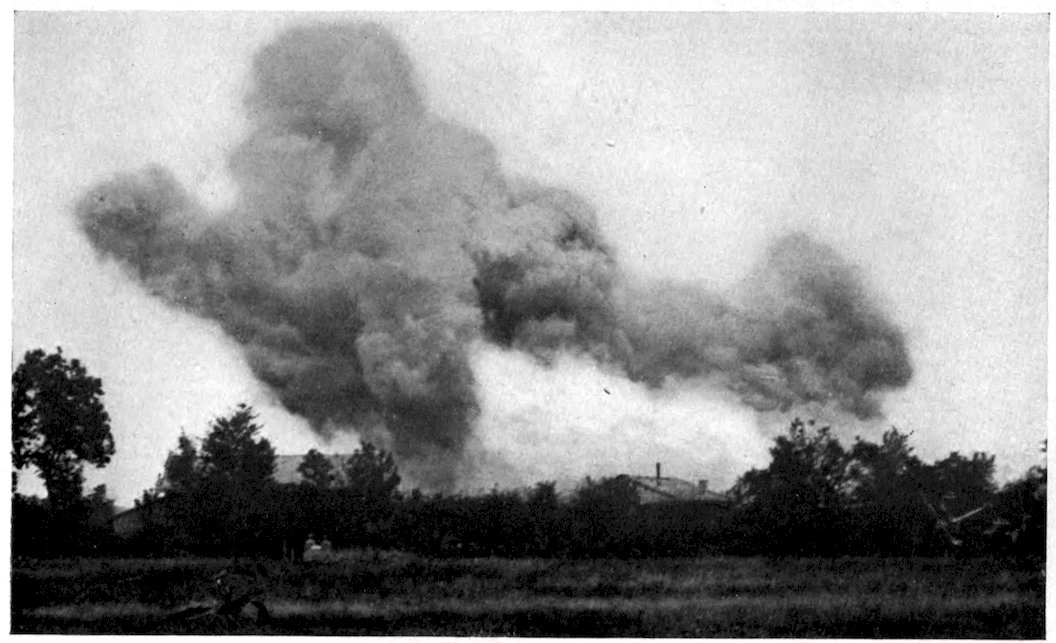
French high-explosive shells bursting on the German trenches.
87The effect of some of the newer types of
88high-explosive shells is almost beyond belief.
For sheer horror and destruction those from
the Austrian-made Skoda howitzer, known as
“Pilseners,” make the famous 42-centimetre
shells seem almost kind. The Skoda shells
weigh 2,800 lbs., and their usual curve is 4½
miles high. In soft ground they penetrate 20
feet before exploding. The explosion, which
occurs two seconds after impact, kills every
living thing within 150 yards, while scores of
men who escape the flying metal are killed,
lacerated, or blinded by the mere pressure of
the gas. This gas pressure is so terrific that it
breaks in the roofs and partitions of bomb-proof
shelters. Of men close by not a fragment remains.
The gas gets into the body cavities and
expands, literally tearing them to pieces. Occasionally
the clothes are stripped off leaving
89only the boots. Rifle-barrels near by are
melted as though struck by lightning. These
mammoth shells travel comparatively slowly,
however, usually giving enough warning of
their approach so that the men have time to
dodge them. Their progress is so slow, indeed,
that sometimes they can be seen. Far more
terrifying is the smaller shell which, because of
its shrill, plaintive whine, has been nicknamed
“Weary Willie,” or those from the new “noiseless”
field-gun recently introduced by the Germans,
which gives no intimation of its approach
until it explodes with a shattering crash above
the trenches. Is it any wonder that hundreds
of officers and men are going insane from the
strain that they are under, and that hundreds
more are in the hospitals suffering from neuritis
and nervous breakdown? Is it any wonder
that, when their term in the trenches is over,
they have to be taken out of sight and sound
of battle and their shattered nerves restored
by means of a carefully planned routine of
sports and games, as though they were children
in a kindergarten?
The breweries, mills, and factories immediately
behind the British lines have, wherever
90practicable, been converted into bath-houses
to which the men are marched as soon as they
leave the trenches. The soldiers strip and,
retaining nothing but their boots, which they
deposit beside the bathtub, they go in, soap
in one hand and scrubbing-brush in the other,
the hot bath being followed by a cold shower.
The underclothes which they have taken off
are promptly burned and fresh sets given to
them, as are also clean uniforms, the discarded
ones, after passing through a fumigating machine,
being washed, pressed, and repaired
by the numerous Frenchwomen who are employed
for the purpose, so as to be ready for
their owners the next time they return from
the trenches. At one of these improvised
bath-houses thirteen hundred men pass through
each day.
“What do the French think of the English?”
To every one I put that question. Summing
up all opinions, I should say that the French
thoroughly appreciate the value of Britain’s
sea power and what it has meant to them for
her to have control of the seas, but they regard
her lack of military preparedness and the deficiency
91of technic among the British officers
as inexcusable; they consider the deep-seated
opposition to conscription in England as incomprehensible;
they view the bickerings between
British capital and labor as little short
of criminal; they regard the British officers
who needlessly expose themselves as being not
heroic but insane. The attitude of the British
press was, in the earlier days of the war at least,
calculated to put a slight strain on the entente
cordiale. Anxious, naturally enough, to throw
into high relief the exploits of the British troops
in France, the British newspapers vastly exaggerated
the importance of the British expedition,
thus throwing the whole picture of the war out
of perspective. The behavior of the British officers,
moreover, though punctiliously correct,
was not such as to mend matters, for they
assumed an attitude of haughty condescension
which, as I happen to know, was extremely
galling to their French colleagues, most of
whom had forgotten more about the science of
war than the patronizing youngsters who officered
the new armies had ever known. “To
listen to you English and to read your newspapers,”
I heard a Frenchman say to an Englishman
92in the Traveller’s Club in Paris not
long ago, “one would think that there was no
one in France except the British Army and a
few Germans.”
I have never heard any one in France suggest
that the British officer is lacking in bravery,
but I have often heard it intimated that he is
lacking in brains. The view is held that he
regards the war as a sporting affair, much as
he would regard polo or big-game hunting,
rather than as a deadly serious business. When
the British officers in Flanders brought over
several packs of hounds and thus attempted to
combine war and hunting, it created a more
unfavorable impression among the French than
if the British had lost a battle. “The British
Army,” a distinguished Italian general remarked
to me shortly before Italy joined the
Allies, “is composed of magnificent material;
it is well fed and admirably equipped—but
the men look on war as sport and go into battle
as they would into a game of football.” To
the Frenchman, whose soil is under the heel
of the invader, whose women have been violated
by a ruthless and brutal soldiery, whose
historic monuments have been destroyed, and
93whose towns have been sacked and burned,
this attitude of mind is absolutely incomprehensible,
and in his heart he resents it. The
above, mind you, is written in no spirit of
criticism; I am merely attempting to show
you the Englishman through French eyes.
I have heard it said, in criticism, that the
new British Army is composed of youngsters.
So it is, but for the life of me I fail to see why
this should be any objection. The ranks of
both armies during our Civil War were filled
with boys still in their teens. It was one of
Wellington’s generals, if I remember rightly,
who used to say that, for really desperate work,
he would always take lads in preference to
seasoned veterans because the latter were apt
to be “too cunning.” “These children,” exclaimed
Marshal Ney, reviewing the beardless
conscripts of 1813, “are wonderful! I can
do anything with them; they will go anywhere!”
But the thing that really counts, when all is
said and done, is the spirit of the men. The
British soldier of this new army has none of
the rollicking, devil-may-care recklessness of
the traditional Tommy Atkins. He has not
94joined the army from any spirit of adventure or
because he wanted to see the world. He is not
an adventurer; he is a crusader. With him it
is a deadly serious business. He has not enlisted
because he wanted to, or because he had
to, but because he felt he ought to. In ninety-nine
cases out of a hundred he has left a family,
a comfortable home, and a good job behind
him. And, unlike the stay-at-homes in England,
he doesn’t make the mistake of underrating
his enemy. He knows that the headlines
which appear regularly in the English
papers exultantly announcing “another British
advance” are generally buncombe. He knows
that it isn’t a question of advancing but of
hanging on. He knows that he will have to
fight with every ounce of fight there is in him
if he is to remain where he is now. He knows
that before the Germans can be driven out of
France and Belgium, much less across the
Rhine, all England will be wearing crape. He
knows that there is no truth in the reports that
the enemy is weakening. He knows it because
hasn’t he vainly thrown himself in successive
waves against that unyielding wall of steel?
He knows that it is going to be a long war—probably
95a very long war indeed. Every
British officer or soldier with whom I have
talked has said that he expects that the spring
of 1916 will find them in virtually the same
positions that they have occupied for the past
year. They will gain ground in some places,
of course, and lose ground in others, but the
winter, so the men in the trenches believe,
will see no radical alteration in the present
western battle-line. All this, of course, will
not make pleasant reading in England, where
the Government and certain sections of the
Press have given the people the impression that
Germany is already beaten to her knees and
that it is all over bar the shouting. Out along
the battle-front, however, in the trenches, and
around the camp-fires, you do not hear the
men discussing “the terms of peace we will
grant Germany,” or “What shall we do with
the Kaiser?” They are not talking much, they
are not singing much, they are not boasting
at all, but they have settled down to the herculean
task that lies before them with a grim
determination, a bulldog tenacity of purpose,
which is eventually, I believe, going to prove
the deciding factor in the war. Nothing better
96illustrates this spirit than the inscription which
I saw on a cross over a newly made grave in
Flanders:
TELL ENGLAND, YE THAT PASS THIS MONUMENT,
THAT WE WHO REST HERE DIED CONTENT.
III CAMPAIGNING IN THE VOSGES
97
The sergeant in charge of the machine-gun,
taking advantage of a lull in the
rifle-fire which had crackled and roared
along the trenches since dawn, was sprawled
on his back in the gun-pit, reading a magazine.
What attracted my attention was its being an
American magazine.
“Where did you learn to read English?” I
asked him curiously.
“In America,” said he.
“What part?” said I.
“Schenectady,” he answered. “Was with
the General Electric until the war began.”
“I’m from up-State myself,” I remarked.
“My people live in Syracuse.”
“The hell you say!” he exclaimed, scrambling
to his feet and grasping my hand cordially. “I
took you for an Englishman. From Syracuse,
eh? Why, that makes us sort of neighbors,
98doesn’t it? We ought to have a drink on it.
I suppose the Boches have plenty of beer over
there,” waving his hand in the direction of the
German trenches, of which I could catch a
glimpse through a loophole, “but we haven’t
anything here but water. I’ve got an idea,
though! Back in the States, when they have
those Old Home Week reunions, they always
fire off an anvil or the town cannon. So what’s
the matter with celebrating this reunion by
letting the Boches have a few rounds from the
machine-gun?”
Seating himself astride the bicycle saddle on
the trail of the machine-gun, he swung the lean
barrel of the wicked little weapon until it
rested on the German trenches a hundred
yards away. Then he slipped the end of a
cartridge-carrier into the breech.
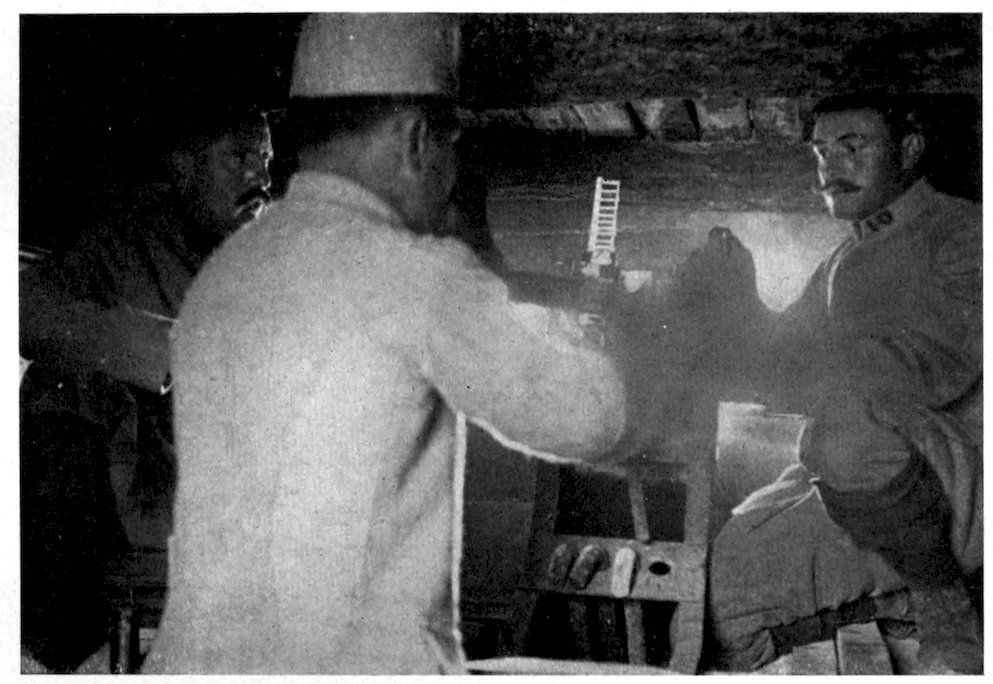
In a bomb-proof gun-pit.
“Rrr-r-r-r-r-r-r-r-r-r-rrrip went the mitrailleuse, with the noise of a million mowing-machines. The racket in the log-roofed gun-pit was deafening.”
“Three rousing cheers for the U. S. A.!”
he shouted, and pressed a button. Rrr-r-r-r-r-r-r-r-r-r-r-r-r-r-r-r-r-r-r-r-r-rrrip
went the mitrailleuse,
with the noise of a million mowing-machines.
Flame spurted from its muzzle as
water spurts from the nozzle of a fire-hose.
The racket in the log-roofed gun-pit was ear-shattering.
The blast of bullets spattered the
German trenches, they pinged metallically
against the steel plates set in the embrasures,
they kicked up countless spurts of yellow
earth. The sergeant stood up, grinning, and
with a grimy handkerchief wiped from his face
the powder stains and perspiration.
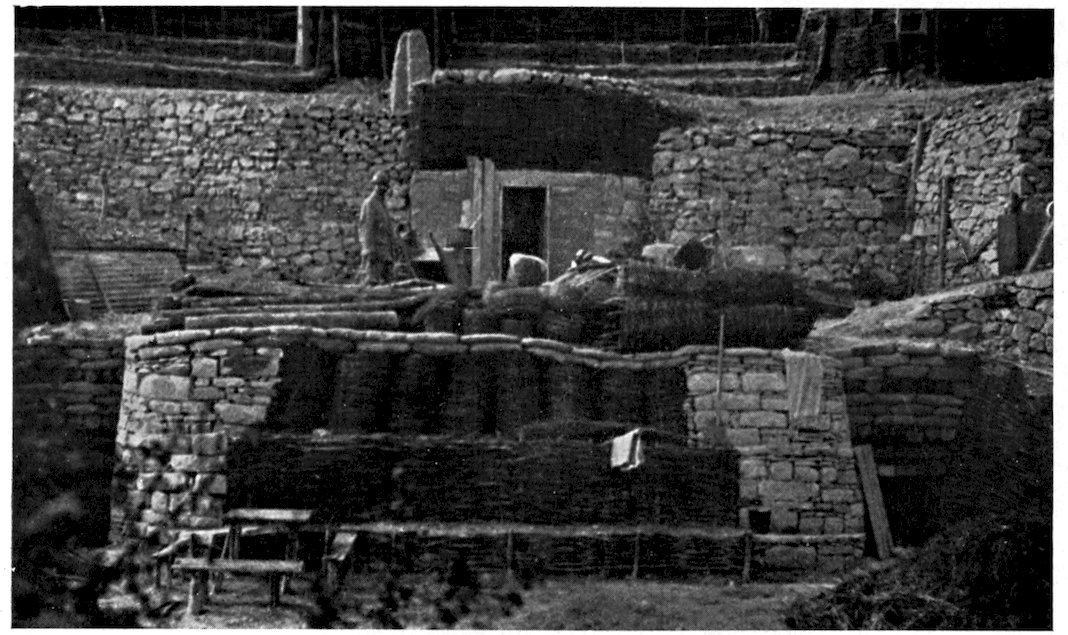
French trenches on the Somme.
“This is the sort of wall which one side or the other will have to break through in order to win this war.”
99“If you should happen to be in Schenectady
you might drop in at the General Electric plant
and tell the boys—” he began, but the sentence
was never finished, for just then a shell whined
low above our heads and burst somewhere behind
the trenches with the roar of an exploding
powder-mill. We had disturbed the Germans’
afternoon siesta, and their batteries were showing
their resentment.
“I think that perhaps I’d better be moving
along,” said I hastily. “It’s getting on toward
dinner time.”
“Well, s’long,” said he regretfully. “And
say,” he called after me, “when you get back
to little old New York would you mind dropping
into the Knickerbocker and having a drink
for me? And be sure and give my regards to
Broadway.”
“I certainly will,” said I.
And that is how a Franco-American whose
100name I do not know, sergeant in a French line
regiment whose number I may not mention,
and I held an Old Home Week celebration of
our own in the French trenches in Alsace.
For all I know there may have been some other
residents of central New York over in the
German trenches. If so, they made no attempt
to join our little reunion. Had they
done so they would have received a very warm
reception.
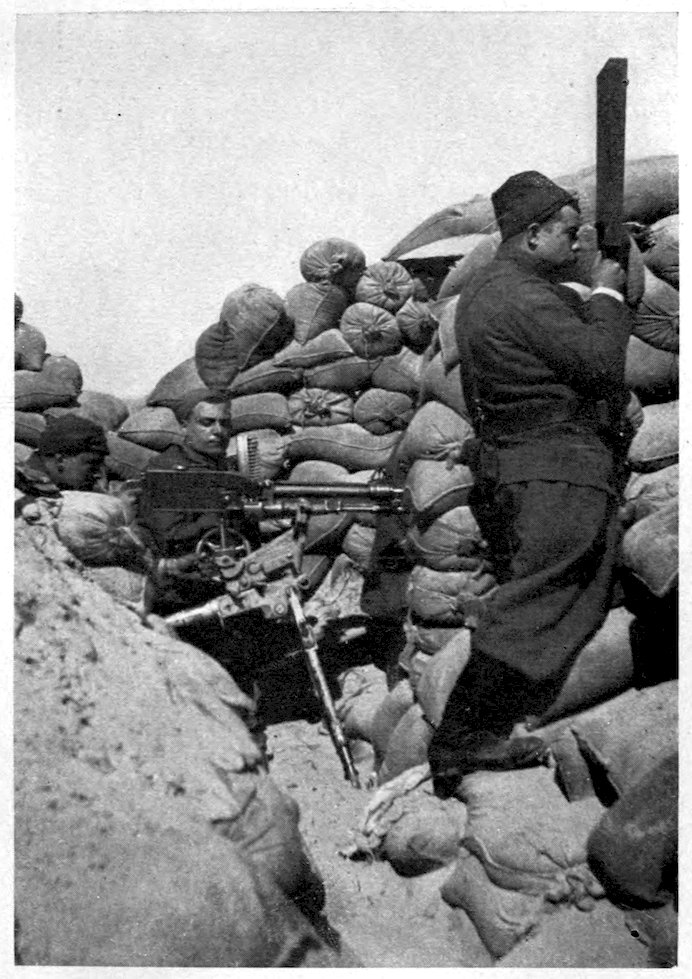
In the French trenches on the Yser.
To put one’s head a fraction of an inch above the parapet is to become a corpse, so a watch is kept on the enemy through periscopes.
There were several reasons why I welcomed
the opportunity offered me by the French General
Staff to see the fighting in Alsace. In the
first place a veil of secrecy had been thrown
over the operations in that region, and the
mysterious is always alluring. Secondly, most
of the fighting that I have seen has been either
in flat or only moderately hilly countries, and
I was curious to see how warfare is conducted
in a region as mountainous and as heavily forested
as the Adirondacks or Oregon. Again,
the Alsace sector is at the extreme southern
end of that great battle-line, more than four
hundred miles long, which stretches its unlovely
length across Europe from the North Sea to
the Alps, like some monstrous and deadly snake.
And lastly, I wanted to see the retaking of
that narrow strip of territory lying between
the summit of the Vosges and the Rhine
which for more than forty years has been
mourned by France as one of her “lost provinces.”
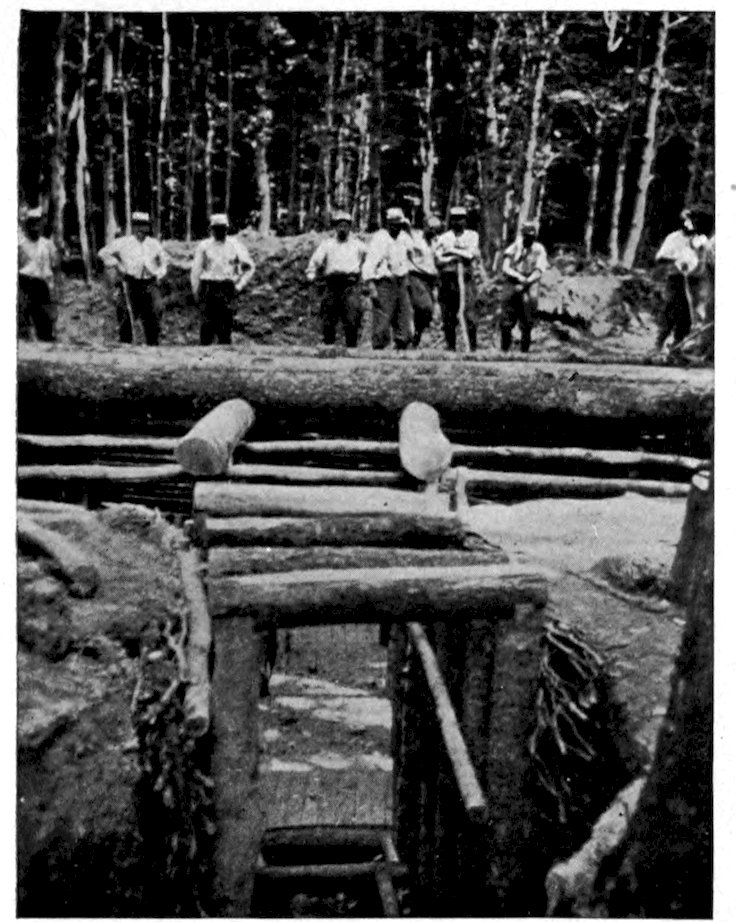
From a photograph by E. A. Powell.
In the Vosges the French have built veritable underground cities.
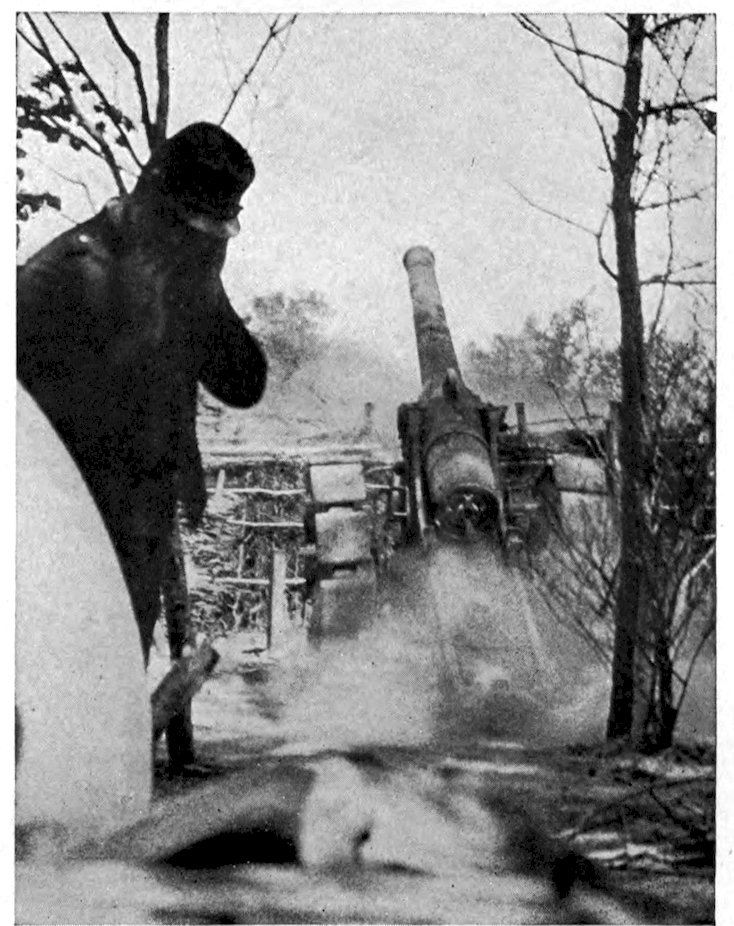
From a photograph by Meurisse.
A 155-millimetre gun firing at a German position eight miles away.
Campaigning in the Vosges.
101This land of Alsace is, in many respects,
the most beautiful that I have ever seen.
Strung along the horizon, like sentinels wrapped
in mantles of green, the peaks of the Vosges
loom against the sky. On the slopes of the
ridges, massed in their black battalions, stand
forests of spruce and pine. Through peaceful
valleys silver streams meander leisurely, and in
the meadows which border them cattle stand
knee-deep amid the lush green grass. The villages,
their tortuous, cobble-paved streets lined
on either side by dim arcades, and the old,
old houses, with their turrets and balconies and
steep-pitched pottery roofs, give you the feeling
that they are not real, but that they are
scenery on a stage, and this illusion is heightened
by the men in their jaunty bérets and
wooden sabots, and the women, whose huge
black silk head-dresses accentuate the freshness
102of their complexions. It is at once a region
of ruggedness and majesty and grandeur, of
quaintness and simplicity and charm. As I
motored through it, it was hard to make myself
believe that death was abroad in so fair
a land, and that over there, on the other side
of those near-by hills, men were engaged in
the business of wholesale slaughter. I was
brought to an abrupt realization of it, however,
as we were passing through the old gray town
of Gérardmer. I heard a sudden outcry, and
the streets, which a moment before had been
a-bustle with the usual market-day crowd,
were all at once deserted. The people dived
into their houses as a woodchuck dives into
its hole. The sentries on duty in front of the
État-Major were staring upward. High in the
sky, approaching with the speed of an express-train,
was what looked like a great white seagull,
but which, from the silver sheen of its
armor-plated body, I knew to be a German
Taube. “We’re in for another bombardment,”
remarked an officer. “The German airmen
have been visiting us every day of late.” As
the aircraft swooped lower and nearer, a field-gun
concealed on the wooded hillside above the
103town spoke sharply, and a moment later there
appeared just below the Taube a sudden splotch
of white, like one of those powder-puffs that
women carry. From the opposite side of the
town another antiaircraft gun began to bark
defiance, until soon the aerial intruder was
ringed about by wisps of fleecy smoke. At one
time I counted as many as forty of them, looking
like white tufts on a coverlet of turquoise
blue. Things were getting too hot for the
German, and with a beautiful sweep he swung
about, and went sailing down the wind, content
to wait until a more favorable opportunity
should offer.
The inhabitants of these Alsatian towns
have become so accustomed to visits from German
airmen that they pay scarcely more attention
to them than they do to thunderstorms,
going indoors to avoid the bombs
just as they go indoors to avoid the rain.
I remarked, indeed, as I motored through the
country, that nearly every town through which
we passed showed evidences, either by shattered
roofs or shrapnel-spattered walls, of
aeroplane bombardment. Thus is the war
brought home to those who, dwelling many
104miles from the line of battle, might naturally
suppose themselves safe from harm. In those
towns which are within range of the German
guns the inhabitants are in double danger,
yet the shops and schools are open, and the
townspeople go about their business apparently
wholly unmindful of the possibility that
a shell may drop in on them at any moment.
In St. Dié we stopped for lunch at the Hôtel
Terminus, which is just opposite the railway-station.
St. Dié is within easy range of the
German guns—or was when I was there—and
when the Germans had nothing better to do
they shelled it, centring their fire, as is their
custom, upon the railway-station, so as to interfere
as much as possible with traffic and the
movement of troops. The station and the adjacent
buildings looked like cardboard boxes
in which with a lead-pencil somebody had
jabbed many ragged holes. The hotel, despite
its upper floor having been wrecked by shell-fire
only a few days previously, was open and
doing business. Ranged upon the mantel of
the dining-room was a row of German 77-millimetre
shells, polished until you could see your
face in them. “Where did you get those?”
105I asked the woman who kept the hotel. “Those
are some German shells that fell in the garden
during the last bombardment, and didn’t
explode,” she answered carelessly. “I had
them unloaded—the man who did it made
an awful fuss about it, too—and I use them
for hot-water bottles. Sometimes it gets pretty
cold here at night, and it’s very comforting
to have a nice hot shell in your bed.”
From St. Dié to Le Rudlin, where the road
ends, is in the neighborhood of thirty miles,
and we did it in not much over thirty minutes.
We went so fast that the telegraph-poles looked
like the palings in a picket fence, and we took
the corners on two wheels—doubtless to save
rubber. Of one thing I am quite certain: if I
am killed in this war, it is not going to be by
a shell or a bullet; it is going to be in a military
motor-car. No cars save military ones
are permitted on the roads in the zone of
operations, and for the military cars no speed
limits exist. As a result, the drivers tear
through the country as though they were in
the Vanderbilt Cup Race. Sometimes, of
course, a wheel comes off, or they meet another
vehicle when going round a corner at full
106speed—and the next morning there is a military
funeral. To be the driver of a military
car in the zone of operations is the joy-rider’s
dream come true. The soldier who drove my
car steered with one hand because he had to
use the other to illustrate the stories of his exploits
in the trenches. Despite the fact that
we were on a mountain road, one side of which
dropped away into nothingness, when he related
the story of how he captured six Germans
single-handed he took both hands off the wheel
to tell about it. It would have made Barney
Oldfield’s hair permanently pompadour.
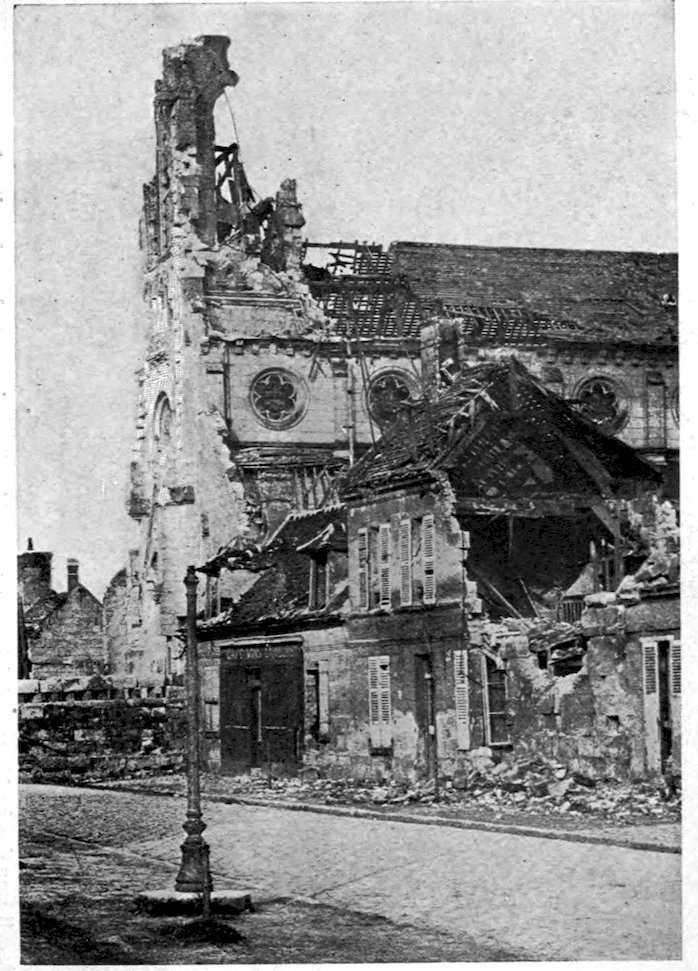
From a photograph by Meurisse.
What the Germans did to the church at Ribécourt.
At Le Rudlin, where there is an outpost of
Alpine chasseurs, we left the car, and mounted
mules for the ascent of the Hautes Chaumes, or
High Moors, which crown the summit of the
Vosges. Along this ridge ran the imaginary
line which Bismarck made the boundary between
Germany and France. Each mule was
led by a soldier, whose short blue tunic, scarlet
breeches, blue puttees, rakish blue béret, and
rifle slung hunter-fashion across his back, made
him look uncommonly like a Spanish brigand,
while another soldier hung to the mule’s tail to
keep him on the path, which is as narrow and
slippery as the path of virtue. Have you ever
ridden the trail which leads from the rim of the
Grand Canyon down to the Colorado? Yes?
Well, the trail which we took up to the Hautes
Chaumes was in places like that, only more so.
Yet over that and similar trails has passed an
army of invasion, carrying with it, either on
the backs of mules or on the backs of men, its
guns, food, and ammunition, and sending back
in like fashion its wounded. Reaching the
summit, the trail debouched from the dense
pine forest onto an open, wind-swept moor.
Dotting the backbone of the ridge, far as the
eye could see, ran a line of low stone boundary
posts. On one side of each post was carved
the letter F. On the other, the eastern face,
was the letter D. Is it necessary to say that
F stood for France and D for Deutschland?
Squatting beside one of the posts was a French
soldier busily engaged with hammer and chisel
in cutting away the D. “It will not be needed
again,” he explained, grinning.
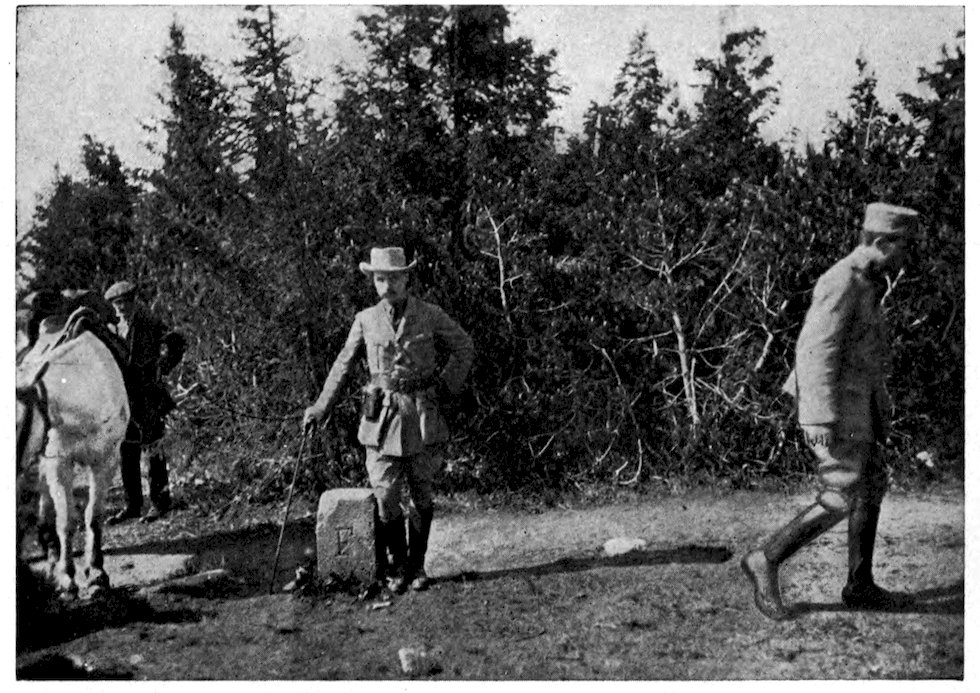
On the summit of the Vosges.
Mr. Powell standing beside one of the stone posts which formerly marked the frontier of Germany and France.
107Leaving the mules in the shelter of the wood,
we proceeded across the open tableland which
crowns the summit of the ridge on foot, for,
being now within both sight and range of the
108German batteries, there seemed no object in
attracting more attention to ourselves than was
absolutely necessary. Half a mile or so beyond
the boundary posts the plateau suddenly fell
away in a sheer precipice, a thin screen of bushes
bordering its brink. The topographical officer
who had assumed the direction of the expedition
at Le Rudlin motioned me to come forward.
“Have a look,” said he, “but be careful
not to show yourself or to shake the bushes,
or the Boches may send us a shell.” Cautiously
I peered through an opening in the
branches. The mountain slope below me, almost
at the foot of the cliff on which I stood,
was scarred across by two great undulating
yellow ridges. In places they were as much as a
thousand yards apart, in others barely ten. I
did not need to be told what they were. I
knew. The ridge higher up the slope marked
the line of the French trenches; the lower that
of the German. From them came an incessant
crackle and splutter which sounded like a forest
fire. Sometimes it would die down until only
an occasional shot would punctuate the mountain
silence, and then, apparently without
cause, it would rise into a clatter which sounded
109like an army of carpenters shingling a roof. In
the forests on either side of us batteries were
at work steadily, methodically, and, though we
could not see the guns, the frequent fountains
of earth thrown up along both lines of trenches
by bursting shells showed how heavy was the
bombardment that was in progress, and how
accurate was both the French and German fire.
We were watching what the official communiqué
described the next day as the fighting on the
Fecht very much as one would watch a football
game from the upper row of seats in the Harvard
stadium. Above the forest at our right
swayed a French observation balloon, tugging
impatiently at its rope, while the observer,
glasses glued to his eyes, telephoned to the
commander of the battery in the wood below
him where his shells were hitting. Suddenly,
from the French position just below me, there
rose, high above the duotone of rifle and artillery
fire, the shrill clatter of a quick-firer. Rat-tat-tat-tat-tat-tat
it went, for all the world like
one of those machines which they use for riveting
steel girders. And, when you come to think
about it, that is what it was doing: riveting
the bonds which bind Alsace to France.
110I have heard it said that the French army
has been opposed, and in many instances betrayed,
by the people whom they thought they
were liberating from the German yoke, and that
consequently the feeling of the French soldiers
for the Alsatians is very bitter. This assertion
is not true. I talked with a great many people
during my stay in Alsace—with the maires of
towns, with shopkeepers, with peasant farmers,
and with village priests—and I found that they
welcomed the French as wholeheartedly as a
citizen who hears a burglar in his house welcomes
a policeman. I saw old men and women
who had dwelt in Alsace before the Germans
came, and who had given up all hope of seeing
the beloved tricolor flying again above Alsatian
soil, standing at the doors of their cottages,
with tears coursing down their cheeks, while the
endless columns of soldiery in the familiar uniform
tramped by. In the schoolhouses of Alsace
I saw French soldiers patiently teaching
children of French blood, who have been born
under German rule and educated under German
schoolmasters, the meaning of “Liberté,
Égalité, Fraternité,” and that p-a-t-r-i-e spells
France.
111The change from Teutonic to Gallic rule is,
however, by no means welcomed by all Alsatians.
The Alsatians of to-day, remember,
are not the Alsatians of 1870. It has been the
consistent policy of the German Government
to encourage and, where necessary, to assist
German farmers to settle in Alsace, and as the
years passed and the old hatred died down,
these newcomers intermarried with the old
French stock, so that to-day there are thousands
of the younger generation in whose veins
flow both French and German blood, and who
scarcely know themselves to whom their allegiance
belongs. As a result of this peculiar
condition, both the French and German military
authorities have to be constantly on their
guard against treachery, for a woman bearing
a French name may well be of German birth,
while a man who speaks nothing but German
may, nevertheless, be of pure French extraction.
Hence spies, both French and German,
abound. If the French Intelligence Department
is well served, so is that of Germany.
Peasants working in the fields, petty tradesmen
in the towns, women of social position,
and other women whose virtue is as easy as
112an old shoe, Germans dressed as priests, as
hospital attendants, as Red Cross nurses,
sometimes in French uniforms and travelling
in motor-cars with all the necessary papers—all
help to keep the German military authorities
informed of what is going on behind the
French lines. Sometimes they signal by means
of lamps, or by raising and lowering the shade
of a lighted room of some lonely farmhouse;
sometimes by means of cunningly concealed
telephone wires; occasionally by the fashion
in which the family washing is arranged upon
a line within range of German telescopes, innocent-looking
red-flannel petticoats, blue-linen
blouses, and white undergarments being used
instead of signal-flags to spell out messages in
code. A plough with a white or gray horse
has more than once indicated the position of
a French battery to the German airmen. The
movements of a flock of sheep, driven by a spy
disguised as a peasant, has sometimes given
similar information. On one occasion three
German officers in a motor-car managed to get
right through the British lines in Flanders.
Two of them were disguised as French officers,
who were supposed to be bringing back the
113third as a prisoner, he being, of course, in
German uniform. So clever and daring was
their scheme that they succeeded in getting
close to British headquarters before they were
detected and captured. They are no cowards
who do this sort of work. They know perfectly
well what it means if they are caught: sunrise,
a wall, and a firing-party.
114
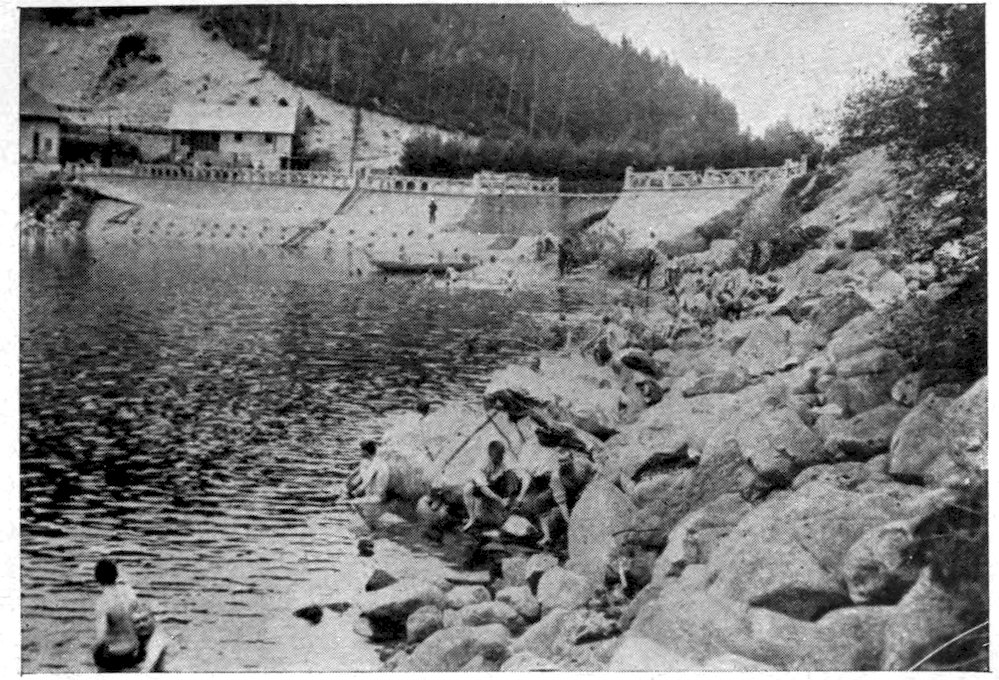
The German shells drop into the lake and stun hundreds of fish, whereupon the soldiers paddle out and gather them in.
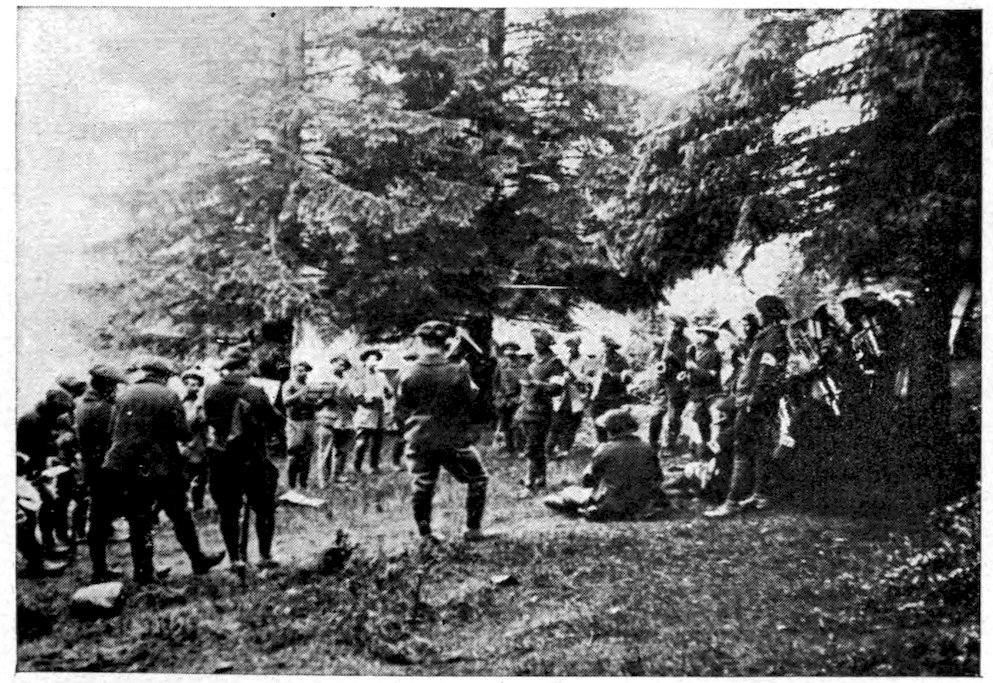
The first shot is the signal for the band to take position on the shore of the lake and play the Marseillaise.
From the Hautes Chaumes we descended by
a very steep and perilous path to the Lac Noir,
where a battalion of Alpine chasseurs had built
a cantonment at which we spent the night.
The Lac Noir, or Black Lake, occupies the
crater of an extinct volcano, whose rocky sides
are so smooth and steep that it looks like a
gigantic washtub, in which a weary Hercules
might wash the clothing of the world. There
were in the neighborhood of a thousand chasseurs
in camp on the shores of the Lac Noir
when I was there, the chef de brigade having
been, until the beginning of the war, military
adviser to the President of China. The amazing
democracy of the French army was illustrated
by the fact that his second in command,
Lieutenant-Colonel Messimy, was, until the
change of cabinet which took place after the
battle of the Marne, minister of war. The
cantonment—“Black Lake City” Colonel
Messimy jokingly called it—looked far more
like a summer camp in the Adirondacks than
a soldiers’ camp in Alsace. All the buildings
were of logs, their roofs being covered with
masses of green boughs to conceal them from
inquisitive aeroplanes, and at the back of each
hut, hollowed from the mountainside, was an
underground shelter in which the men could
take refuge in case of bombardment. Gravelled
paths, sometimes bordered with flowers, wound
amid the pine-trees; the officers’ quarters
had broad verandas, with ingeniously made
rustic furniture upon them; the mess-tables
were set under leafy arbors; there was a swimming-raft
and a diving-board, and a sort of
rustic pavilion known as the “Casino,” where
the men passed their spare hours in playing
cards or danced to the music of a really excellent
band. Over the doorway was a sign which
read: “The music of the tambourine has been
replaced by the music of the cannon.” Though
the Lac Noir was, when I was there, within the
French lines, it was within range of the German
batteries, which shelled it almost daily. The
slopes of the crater on which the cantonment
was built are so steep, however, that the
shells would miss the barracks altogether,
dropping harmlessly in the middle of the little
lake. The ensuing explosion would stun hundreds
of fish, which would float upon the surface
of the water, whereupon the soldiers would
paddle out in a rickety flatboat and gather
them in. In fact, a German bombardment
came to mean that the chasseurs would have
fish for dinner. This daily bombardment,
which usually began just before sunset, the
French called the “Evening Prayer.” The
first shot was the signal for the band to take
position on that shore of the lake which could
not be reached by the German shells, and play
the Marseillaise, a bit of irony which afforded
huge amusement to the French and excessive
irritation to the Germans.
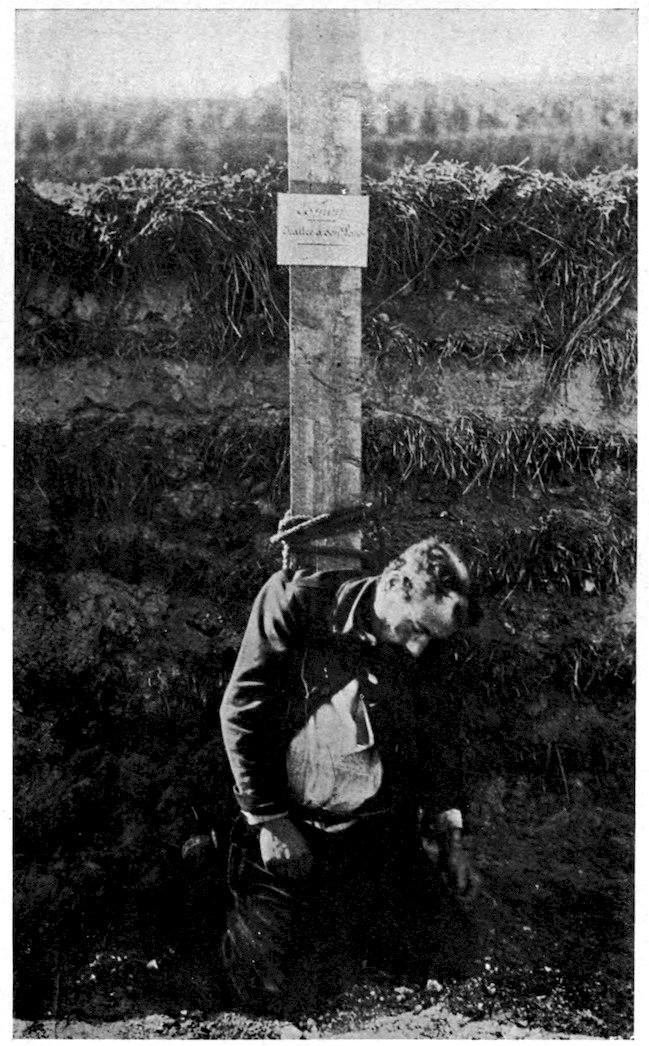
115When the history of the campaign in the
Vosges comes to be written, a great many
pages will have to be devoted to recounting
the exploits of the chasseurs alpins. The
“Blue Devils,” as the Germans have dubbed
them, are the Highlanders of the French army,
being recruited from the French slopes of the
116Alps and the Pyrenees. Tough as rawhide,
keen as razors, hard as nails, they are the ideal
troops for mountain warfare. They wear a
distinctive dark-blue uniform, and the béret, or
cap, of the French Alps, a flat-topped, jaunty
head-dress which is brother to the tam-o’-shanter.
The frontier of Alsace, from a point
opposite Strasbourg to a point opposite Mülhausen,
follows the summit of the Vosges,
and over this range, which in places is upward
of four thousand feet in height, have poured
the French armies of invasion. In the van of
those armies have marched the chasseurs alpins,
dragging their guns by hand up the almost
sheer precipices, and dragging the gun-mules
after them; advancing through forests so dense
that they had to chop paths for the line regiments
which followed them; carrying by storm
the apparently impregnable positions held by
the Germans; sleeping often without blankets
and with the mercury hovering near zero
on the heights which they had captured; taking
their batteries into positions where it was believed
no batteries could go; raining shells
from those batteries upon the wooded slopes
ahead, and, under cover of that fire, advancing,
117always advancing. Think of what it
meant to get a great army over such a mountain
range in the face of desperate opposition;
think of the labor involved in transporting the
enormous supplies of food, clothing, and ammunition
required by that army; think of
the sufferings of the wounded who had to be
taken back across those mountains, many of
them in the depths of winter, sometimes in
litters, sometimes lashed to the backs of mules.
The mule, whether from the Alps, the Pyrenees,
or from Missouri, is playing a brave
part in this mountain warfare, and whenever
I saw one I felt like the motorist who, after his
automobile had been hauled out of an apparently
bottomless Southern bog by a negro
who happened to be passing with a mule team,
said to his son: “My boy, from now on always
raise your hat to a mule.”
Just as the crimson disk of the sun peered
cautiously over the crater’s rim, we bade
good-by to our friends the chasseurs alpins,
and turned the noses of our mules up the
mountains. As we reached the summit of
the range, the little French captain who was
acting as our guide halted us with a gesture.
118“Look over there,” he said, pointing to where,
far beyond the trench-scarred hillsides, a
great, broad valley was swimming in the morning
mists. There were green squares which I
knew for meadow-lands, and yellow squares
which were fields of ripening grain; here and
there were clusters of white-walled, red-roofed
houses, with ancient church-spires rising above
them; and winding down the middle of the
plain was a broad gray ribbon which turned to
silver when the sun struck upon it.
“Look,” said the little captain again, and
there was a break in his voice. “That is what
we are fighting for. That is Alsace.”
Then I knew that I was looking upon what
is, to every man of Gallic birth, the Promised
Land; I knew that the great, dim bulk which
loomed against the distant sky-line was the
Black Forest; I knew that somewhere up that
mysterious, alluring valley, Strasbourg sat on
her hilltop, like an Andromeda waiting to be
freed; and that the broad, silent-flowing river
which I saw below me was none other than the
Rhine.
And as I looked I recalled another scene, on
another continent and beside another river,
119two years before. I was standing with a
colored cavalry sergeant of the border patrol
on the banks of the Rio Grande, and we were
looking southward to where the mountains of
Chihuahua rose, purple, mysterious, forbidding,
grim, against the evening sky. On the Mexican
side of the river a battle was in progress.
“I suppose,” I remarked to my companion,
“that you’ll be mighty glad when orders come
to cross the border and clean things up over
there in Mexico.”
“Mistah,” he answered earnestly, “we ain’t
nevah gwine tuh cross dat bodah, but one of
these yere days wese a gwine tuh pick dat
bodah up an’ carry it right down to Panama.”
And that is what the French are doing in
Alsace. They have not crossed the border, but
they have picked the border up, and are carrying
it right down to the banks of the Rhine.