FIELD GLASSES AND TELESCOPES.
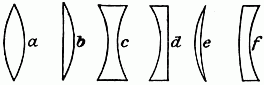
Fig. 20.
When light falls on a transparent body, part is
reflected and part is refracted. The angle which the
ray makes with the normal, or perpendicular, to the
surface at the point of contact is known as the angle
of incidence, and the angles which the reflected and
refracted rays make with the same normal are known
respectively as the angle of reflection and refraction.
The reflected ray makes the same angle with the normal
as the incident ray, while the refracted ray, when
passing from a rarer to a
denser medium, is bent
toward the normal, and
vice versa; the denser the
medium into which the
ray passes the greater is
the deviation. This law allows us at once to understand
the action of a lens, which may be defined as a transparent
medium that from the curvature of its surface
causes the rays of light traversing it to either converge
or diverge. The ordinary lenses have either
spherical surfaces or a combination of spherical and
plane surfaces. This combination will give rise to six
classes (fig. 20): (a) Double convex; (b) plano convex;
(c) double concave; (d) plano concave; (e) converging,
and (f) diverging meniscus. Those lenses
which are thicker at the center than at the edges are
converging or concentrating lenses, and those which
are thicker at the edges than the center are diverging.
The focus of a lens is the point where the refracted
rays or their prolongation meet; if the rays themselves
intersect after refraction the focus is real, and if their
prolongations meet the focus is virtual. The line
passing through the centers of curvature of the two
surfaces of a lens is called the principal axis and contains
a point known as the optical center, which has the
property by virtue of which, if a ray passes through
it, the ray will not be deviated. The optical center
can always be found by drawing two radii parallel to
each other, one from each center of the curvature of
the surface until the radii intersect their respective
surfaces, then draw a line joining these two points.
The intersection of this last line with the principal
axis will give the optical center.
Let AB be the section of a double convex lens and
C and D (fig. 21) be the centers of curvature of the
two surfaces. Draw the lines CD′ and DE from C and
D parallel to each other, then join D′ and E by a
straight line. The point O will be the optical center
of the lens. Let us take a point R, on the principal
axis as a source of light; the ray RD passes through
the optical center and is not deviated. The ray RK
on striking will be refracted in the direction KG
toward the perpendicular to the surface KD in accordance
with the law of refraction, as glass is denser than
air. On emerging at G it is refracted away from the
perpendicular to the surface CG, since it passes from a
denser to a rarer medium, and will intersect the ray
RD at the point R′. In a like way the ray RK′ will
be found to intersect the ray RD at the same point,
R′, which is the focus for all rays coming from R. The
point R′ is said to be the image of the object R, and
when the two points are considered together they are
called conjugate foci. If the incident beam is composed
of parallel homogeneous light, the rays will all
be brought to a focus at a point on the principal axis,
called the principal focus of the lens, and the distance
of this point from the optical center is the principal
focal length, which is always a fixed quantity for any
given lens.
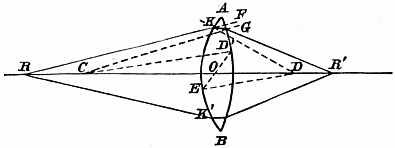
Fig. 21.
There is a fixed relation between the principal focal
length of a double convex lens and the position of the
image of the object which may be expressed as follows:
1/i = 1/f - 1/o, in which i and o are the distances of
the image and object, respectively, from the optical
center and f the focal length, from which we see that for
all positions of the object from an infinite distance
away from the lens to double the principal focal distance,
the image will be on the other side, between a distance
equal to the principal focal length and double this
length. These are the limits of the image and object in
the ordinary cases. If we place this expression in the
following form: i = of/(o - f), and suppose the object to
remain the same distance from various lenses, it will
be seen that the image will be closer to the lens which
has the shorter focal length. The principal focal distance,
or, briefly, the focal length of the lens, depends
on the curvature of the surfaces, and the greater the
curvature the shorter the focal length.
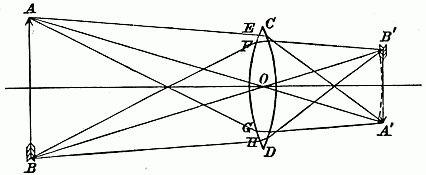
Fig. 22.
Let us now see how an image is formed by a convex
lens, and suppose that CD is the section of a double
convex lens (fig. 22), O the optical center, and AB an
object at a greater distance from the optical center
than double the focal length. Rays will pass out in
all directions from the object and some will fall on the
lens. A ray from A will pass through the optical center
and will not be deviated; others will be incident
at various points, for example, E and G, and if we
apply the law of refraction we will find that AE and
AG will intersect each other and AO at the point A′,
provided we do not consider the figure of the lens,
forming one point of the image A′ B′; similarly for
rays from other points of the object, as, for example, B,
we can construct the focus B′, and thus obtain the
image A′ B′, which is inverted and smaller than the
object AB. The relative size of the image and object
will be directly as the conjugate foci, and these can be
found at once from the equation of the lens.
If, however, we consider the form of the lens, we
will find that all the rays emerging from one point on
the object are not brought to the same focus, because
the rays incident on the edges of the lens are refracted
to a greater extent than those falling on the center,
and will be brought to a focus at a shorter distance from
the lens than those passing through the central part.
This confusion or wandering of the foci from one point
is called spherical aberration, or aberration of form, and
is due solely to the geometrical form of the lens.
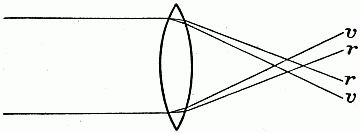
Fig. 23.
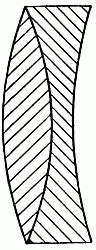
Fig. 24.
In what has been said about the visual image we
have supposed that the light was monochromatic, or
homogeneous. Let us see what will happen if the
light is polychromatic, say, for example, sunlight, and
let a beam of sunlight be intercepted on a screen after
passing through a double convex lens. It will be
observed, as in figure 23, that the violet rays are
brought to a focus nearest the lens, and the red farthest
away, and circles of light will be seen on the screen;
this wandering of the colored rays from a common
focus is called chromatic aberration and depends on
the dispersive properties of the material of which the
lens is made. Here is a defect that can not be corrected
by a stop, but as the refractive
and dispersive properties of a substance
do not vary together, it is possible to
combine two substances, one with high
refractive and low dispersive properties
and the other with the reverse properties.
If proper curves are given to them
they will correct each other, thereby
producing coincidence of the visible and
chromatic foci. Such a combination
gives an achromatic lens, which is usually
composed of a double convex of
crown glass cemented to a diverging meniscus of flint
glass, as shown in section in figure 24. This combination
is not absolutely achromatic, but sufficiently
so for all general purposes.
The telescope is an optical instrument based on an
object glass or reflector to form a real image of a real
and distant object, and of an ocular to magnify and
view the image. Telescopes are classified as refracting
or reflecting according as the object glass is a lens or a
reflector. The object glass must be essentially convex
if the telescope is a refractor, and if a reflector,
the object mirror must be concave; the ocular may be
either concave or convex.
There are four types of refractive telescopes used for
military purposes, viz:
- The astronomical.
- The terrestrial.
- The galilean.
- The prismatic.
Figure 26 is a section of an astronomical telescope.
The object glass (D) is a combination consisting of a
double convex and a double concave lens cemented
together with Canada balsam. The double concave
lens is added to correct for chromatic aberration. The
ocular (E) is a convex-concave lens.
Rays of light from some distant object are converged
by the objective (D) and form an inverted image (ab)
at the focal plane (F). The eye lens (E) receives the
divergent pencils from a and b and bend them so that
they enter the eye as if coming apparently from the
direction of a′ b′ where the apparent image is seen.
From the eyepiece (E) the rays emerge in a cone of
pencils of light smaller than the pupil of the eye, which
enables a telescope of this type to have a large field of
view. The image, however, is inverted and the astronomical
telescope in its original form is therefore not
suitable for military purposes. In a modified form
it is much used, as will be shown in a later paragraph.
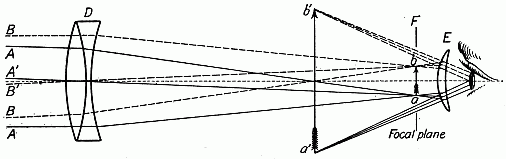
Figure 26
Figure 27 is a section of a terrestrial telescope much
used for military purposes. Glasses of this type are
quite generally known as "spyglasses."
As in the case of the astronomical telescope, the
first inverted image ba is formed at the focal plane (F),
and the first eyeglass converges these pencils to L.
Instead of placing the eye at L, as in the astronomical
telescope, the pencils are allowed to cross and fall on
a second eyeglass, by which the rays of each pencil are
converged to a point in the second erect image a′ b′,
which image is viewed by means of the third and last
eyeglass.
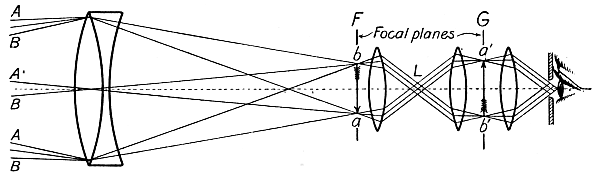
Figure 27
Terrestrial telescopes have a comparatively small
field of view. The barrels of this telescope are necessarily
long on account of the additional lenses.
Figure 28 is a section of a Galilean telescope which
differs from the astronomical telescope in having a
double concave instead of a double convex, eyepiece
or ocular.
In this telescope the rays from an object are converged
by the object glass (O) and would normally
focus at the focal plane (C) and there form the inverted
image ba were it not that the double concave eyeglass
or ocular (D) is so located in the barrel of the telescope
as to intercept the pencils before they are
focused. This double concave eyeglass diverges these
pencils and forms a magnified erect image a′ b′
apparently at E. Due to the diverging action of this
concave eye lens, the cone of pencils entering the eye
is larger than the pupil of the eye, and therefore but a
small part of the field gathered by the object glass is
utilized by the eye, which causes telescopes of this
type to have a comparatively small field of view.
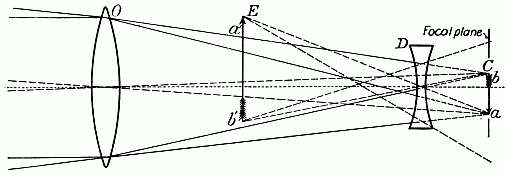
Figure 28
In 1850 a French engineer, Porro, discovered a
combination of prisms which, when inserted between
the objective and the eyepiece of an astronomical telescope,
showed the image erect or in its natural position,
while the same telescope without the prisms
showed the image inverted. Practical use of this discovery
was not made for many years after. These
prisms served a twofold purpose, viz, showing the
image of the object looked at in its natural position
instead of reversed, and second, the shortening of the
telescope by twice turning the ray of light upon itself.
Each tube of the prism field glass contains two of these
double-reflecting prisms. The ray of light passing
through the object glass enters the first prism in such
a manner as to be twice totally reflected, each time at
an angle of 90°, thus emerging parallel to the entering
ray, but in the opposite direction. It is thus caught
by the second prism and is similarly reflected and sent
on its original direction without change except in one
very important point, viz, the image of the object
observed, which, without the intervention of the
prism, would be upside down, is now erect, and will be
magnified by the simple astronomical eyepiece just as
the stars and planets are magnified in large telescopes.
The field of view of the Porro prism glass is considerably
larger than that of the ordinary field glass. It
decreases about 12½ per cent with each magnifying
power, a number 6-power glass giving a linear view of
118 feet in a thousand, while in a number 10 glass the
field is but 70 linear feet. This is explained as follows:
The rays of light emerging from the ocular of the
Galilean telescope are divergent and cover an area
much greater than the size of the pupil of the eye. As
all rays falling outside the pupil of the eye are lost, but
a small field of view can be seen, as in looking through
an ordinary cone from the larger end. The prism
glasses are constructed on the opposite principle.
The rays of light gathered by the objective emerge
from the eyepiece in a converging pencil of light small
enough to enter the pupil of the eye, thus giving a
larger field of view; theoretically, nine times the area
given by the old-style instrument of the same power.
With these advantages, however, the Porro prism
glass has not been found in all respects satisfactory
for field service. With a clear atmosphere and the
object which is being
viewed well
illuminated, it is
distinctly superior
to the Galilean
field-type glass in
respect to light,
power, and definition.
The prisms
having once been deranged, however slightly, satisfactory
use of the glass can not be had until the prisms
have been readjusted, and until very recently it was
impracticable to have this done elsewhere than at the
place of manufacture of the glass.
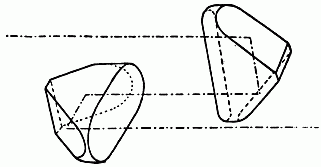
Fig. 29.—Porro prism.
The field glass or binocular is a combination of two
similar telescopes and possesses mechanical adjustments
capable of focusing the two telescopes simultaneously
or separately, depending upon the type
considered.
Field glasses are divided into two general classes,
viz, the Galilean glasses and the Porro prism glasses.
Telescopes and field glasses have four properties,
viz, power, light, field, and definition. These properties
are expressed in terms of the corresponding
qualities of the unaided eye.
Eyes are of very different capabilities. Some
people have "short" sight while others have "far"
sight. There are normal, excellent, and weak eyes.
In the following discussion the capabilities of the
normal eye are assumed.
For each individual there is a certain distance at
which objects may be most distinctly seen. This
is called the "visual distance." With shortsighted
eyes this distance is from 3 to 6 inches; with normal
eyes, from 8 to 14 inches, and with farsighted eyes,
from 16 to 28 inches.
The capabilities of the normal unassisted eye may
therefore be expressed as follows: Power, 1; light, 1;
field, 45°; definition, 40′′ to 3′.
Power.—At the "visual distance," all objects seen
by the unaided normal eye appear in their natural
size. At less than the "visual distance" they appear
indistinct, blurred, and imperfectly defined; at greater
than the "visual distance" objects are clear and well
defined, but diminish in size, the more so as they are
farther removed.
The ability of a lens to magnify the apparent
diameter of an object is termed its power.
The power of a lens is defined as the ratio of the
diameter of the object as seen through the lens to
the diameter as viewed by the unaided eye.
The power is also defined as the ratio of the focal
distance of the object glass to that of the eyepiece.
The power of a field glass can be roughly determined
by focusing the instrument on a wall or a range rod,
by looking at the object through the instrument with
one eye and at the same object directly with the
unaided eye. A comparison of the diameter of the
two images gives the ratio.
The power of a telescope or a field glass can more
accurately be measured by means of a dynameter,
which is a microscope which can be fitted over the
eyepiece end of the instrument, and which magnifies
the image. The end of the dynameter next to the
eyepiece of the instrument is ruled with a series of lines
one-hundredth of an inch apart. On focusing the
dynameter, the image of the emerging pencil appears
as a sharply defined ring of light with the magnified
scale of the dynameter across it.
The number of subdivisions covered by the diameter
of the ring of light is noted. The diameter of the
object glass is similarly measured by means of a pair
of dividers and read to the hundredth part of an inch.
The ratio of the diameter of the object glass to that
of the image as seen in the dynameter gives the power
of the instrument. This method is not applicable in
the case of the Galilean telescope or the field glass
consisting of two Galilean telescopes, due to the fact
that the rays from the eyepiece of the Galilean telescope
are divergent.
Field glasses in which the image appears magnified
from one to six diameters are known as "low-power"
glasses. Field glasses which produce an image
magnified over six diameters are termed "high power."
For the mounted man a glass of but 4, or at most 6,
powers, can be used with advantage; on foot, with free
hand, instruments of not to exceed 10 powers can be
used. If more than 10 powers are desired, a holder
becomes necessary, and if the holder is intended to be
portable a greater power than 50 is not practicable,
as the movement of the air or the slightest touch of
the hand sets up vibrations that render clear vision
impossible.
Field glasses with low magnifying power, which are
usually preferred by ordinary observers, have their
chief value in the comparatively extensive field of view;
they should be used to observe extensive movements,
where large tracts of country must be taken in one
field of view or in sweeping the landscape to find the
tents of the enemy, their wagons, etc., or other objects,
to be afterwards more closely examined with the telescope.
They may be used on shipboard or in boats, where
the rolling motion interferes with the use of the telescope;
also on horseback or in hasty examination
made on foot or in trees, and generally for all observations
not critical or those to be made under circumstances
where the telescope can not be conveniently
handled. The field glass ought to be held by both
hands when in use, and to steady it the arms should be
kept close to the body.
For reading signals at short ranges, say, up to 5
miles, these glasses are better than the telescope.
Flag signals have frequently been read with glasses of
this description at a distance of 10 miles.
Light.—The illumination of an object when observed
with the unaided eye is impressed upon the
retina with a brightness in strict proportion to that
of the object itself. If an object be viewed under
equal illuminating conditions alternately with the
naked eye and with a glass, the brightness of the
image seen with the naked eye may be represented
by 1, while that of the image in the glass will generally
differ, being greater or less.
The light of the telescope or field glass is expressed
by the number which shows how many times brighter
the object appears through the instrument than to the
naked eye. Light is a function of the dimensions
of the object glass and of the power of the instrument,
and is sometimes determined by dividing the square
of the objective aperture (expressed in millimeters)
by the square of the power.
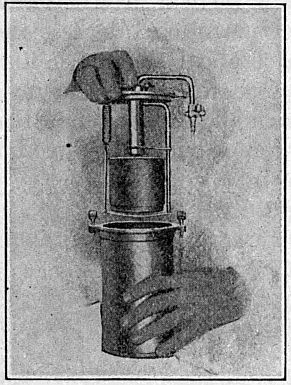
The light of a telescope or field glass can also be
determined by means of the absorption apparatus
shown in figure 30 (a) (b) (c).
This absorption apparatus operates on the principle
of viewing an object through a perfectly black liquid,
which absorbs all colors equally, and of increasing the
thickness of the liquid layer until the object becomes
invisible. The thickness of the layer of liquid will
then be a measure of the relative brightness or intensity
of the illumination.
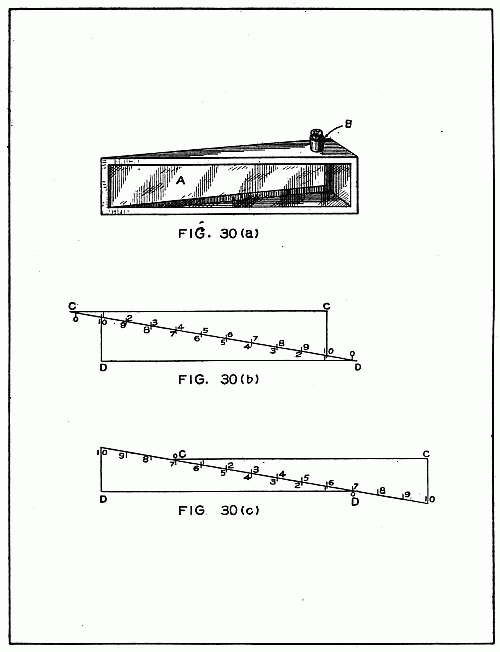
The apparatus consists of two wedge-shaped vessels,
made of brass, with glass windows in the sides. One
of these vessels is shown in perspective in figure 30a.
The sides A and the one opposite are of glass. B is
tubulure for filling the apparatus, and is stopped with
a cap. The operation of the apparatus is shown diagrammatically
in figures 30b and 30c. The edges of
the two wedges which come together are divided into
scales of equal parts of convenient magnitude. Each
scale begins with zero; not at the extreme point of the
wedge outside, but at a point, which, allowing for the
thickness of the glass sides, is opposite the point of the
wedge of liquid inside. It will be observed in figures
30b and 30c that the sum of any two adjacent numbers,
on the respective scales, over the whole overlapping
portion of the wedges, is the same. Thus in
figure 30b it is 11, and in figure 30c it is 7. These
figures measure the relative thickness of the liquid
layers in the two respective settings of the apparatus.
Suppose the image is just obliterated, when looking
with the unaided eye, at the setting shown in figure
30b, and when using the glass at the setting shown
in figure 30c. This would mean that the illuminating
power of the glass is seven-elevenths. In using the
apparatus, a focusing cloth, used by all photographers,
is useful in excluding stray light.
Field.—Maintaining the head and eyes as motionless
as possible, the field of vision of the unaided eye
or the range within which objects can be perceived
by the unaided eye varies according to direction.
De Schweinitz gives the following limits: Outward,
90°; outward and upward, 70°; upward, 50°; upward
and inward, 55°; inward, 60°; inward and downward,
55°; downward, 72°; downward and outward, 85°.
It may be safely said that the field or "visual angle"
of the unaided eye for distinct vision is at least 45° in
all directions.
The "visual angle" or "field" of a field glass is
always smaller, no field glass having yet been designed
which could equal the field of the unaided eye.
The field of a telescope or field glass can best be
determined by the use of a transit or other instrument
used in measuring horizontal angles. The glass
is placed upon the telescope of the transit in such a
way that the axes of collimation of the transit and
the telescope or field glass are parallel. The extreme
limits of the field of view are marked and the horizontal
angle between the markers noted on the limb of
the transit.
Definition.—One of the chief qualities of the eye is
its power of defining outlines and details distinctly.
Relative characteristics in this respect may be determined
in various ways. Thus the distance at which
printed matter can be read, or the details of a distant
object distinguished, will give a fair measure of the
defining power of the eye; but a better method is to
express the definition of sight by angular measurement—that
is, by the determination of the smallest
visual angle giving clear results. Experience teaches
that this angle of the normal eye (with good light and
favorable color conditions) is about 40′′, and it is
therefore possible to determine the smallest object
which can just be seen, well defined, at an arbitrary distance.
For instance, at a distance of 15 feet an object
can be seen which is one-twentieth of an inch high or
broad; at 30 feet distance, consequently, the object
must be twice the size (one-tenth of an inch) to be
seen, and so on relatively, within limits, as distance increases.
But as the distance becomes greater sharpness
of vision is impaired materially by the interposing
atmosphere, while it is also affected by color contrasts
and conditions of illumination. It therefore follows
that at considerable distances objects which subtend a
visual angle of 40′′ are no longer clearly defined but
become so only as the angle approaches 60′′, 120′′,
180′′, or more.
The most important and essential quality of a telescope
or field glass is definition, i. e., the sharpness,
clearness, and the purity of the images seen through
it. To obtain good definition it is necessary that
spherical and chromatic aberration be overcome, that
the polish of the lenses be as perfect as possible, that
the cement possess no inequalities, and that the lenses
be well focused, that there be no dampness in the interior
of the tubes, and, generally, that the instrument
be without optical defect.
Faults in this direction are discovered at once by
examination of definition, whereas in determining the
other constants they are less noticeable. In comparing
the definition of any two instruments it is ordinarily
necessary only to scan distant objects and observe to
what extent details may be distinguished.
The following test may also be used: Focus on
printed matter at a distance just beyond that at which
perfect clearness is given and gradually approach until
the letters are distinctly defined. The instrument
with which the print can be read at the greatest distance
has the best definition.
To express definition as an absolute measure, use
instead of printed matter, a white sheet of paper upon
which a series of heavy lines are drawn at intervals
equivalent to their thickness. Focus upon this and
gradually approach from a point where the impression
of a uniform gray field ceases and the black lines and
white intervals begin to appear distinct and defined.
Let the distance thus found be 20 yards and the
thickness of the lines and intervals between them one-tenth
inch. The circumference of a circle with a radius
of 20 yards or 7,200 tenths inches is 14,400 by
3.1416 or 45,240 tenth inches; but a circumference
equals 360° or (360 by 60 by 60) 1,296,000′′.
If, therefore, 45,240 tenths inches correspond to
1,296,000′′, then 1 tenth inch equals 1,296,000 divided
by 45,240, or 28.6′′. The definition is therefore 28.6′′,
or practically half a minute.
The capabilities of glasses, including telescopes, in
a general way, lie between the following limits:
(1) Power between 2 and 1,000.
(2) Light may be 0.01 to 200 times that of the
unaided eye.
(3) Field measures in most favorable case, 10°; in
the most unfavorable, .01°.
(4) Definition varies between 40′′ and 0.1′′.
Thus, as a maximum, an object may be seen by
means of a telescope, magnified 1,000 times, 200
times brighter and 400 times sharper than with the
naked eye.
If these advantages could be fully utilized for military
purposes the use of glasses would be extraordinary,
a power of 1,000 practically effecting the same
purpose as the approach of the observed object to
one-thousandth of the distance. A hostile command
10 miles distant could be seen theoretically as well as
if they were only 53 feet away, and the slightest
movement of each single man would become visible.
Of course no such wonderful effect is physically practicable,
and the limiting conditions increase greatly in
proportion as either one or the other of the qualities,
power, field, etc., is especially sought.
While astronomers require only that the telescope
be made as capable and perfect as possible in an optical
point of view, making all other conditions subordinate
to this one, the military, to whom the glass is simply
an accessory, make other conditions of the first importance.
The glass must have suitable form, small volume,
little weight, and that it may be used without
support, mounted or dismounted, and the image must
appear as looked at by the naked eye—that is, not
inverted.
The capability of the instrument, however, is thereby
much limited; great powers give plain images only
with relatively long tubes; glasses must be held the
steadier the more they magnify; and with increasing
power all vibrations become more troublesome and
render minute observations very difficult or impossible.
The additional lenses in terrestrial telescopes somewhat
decrease power and affect also light and definition.
It is clear therefore that expectations of achieving
great power should not be entertained, the function
of field glasses being to bring out and define objects
which to the naked eye appear indistinct and doubtful.
The distinctness with which anything can be seen
through the telescope depends, primarily, upon the
number of straight lines of light which are collected
by it from every point of the object.
Telescopes, the object glasses being equal in size,
diminish light as a general rule in proportion as their
magnifying power is great. The most powerful
glasses are therefore to be used for minute observations
on the clearest days or when there is a strong
light upon the observed object. When the light is
fading or there is a little light upon the observed
object the clearer view will be had with glasses of
large field and low magnifying power.
The Signal Corps issues four standard field glasses,
viz, Type A, Type B, Type C, Type D.
Field glasses issued by the Signal Corps are not supplied
for the personal use of an officer and will not be
used in lieu of the officer's personal field glass prescribed
by paragraph 97, General Orders, 169, War
Department, 1907 (Par. 1, G. O. 16, War Dept., 1910).
Under paragraph 1582, Army Regulations, as
amended by paragraph I, General Orders, No. 207,
War Department, October 16, 1909, the Signal Corps
will sell field glasses to officers of the army for their
personal use.
Application for the purchase of field glasses should
be addressed to the Chief Signal Officer of the Army,
Washington, D. C., inclosing post-office money order
or check on the Treasurer or Assistant Treasurer of
the United States for the amount, payable to the Disbursing
Officer, Signal Corps, and Signal Corps Form
No. 240 accomplished in duplicate.
The Government does not pay transportation
charges for the shipment of articles sold to officers.
Field glasses are sent from the Signal Corps General
Supply Depot, Fort Wood, New York Harbor, by
express, charges collect, unless purchase request is
accompanied by funds so that field glasses may be
sent by registered mail. Forwarding by registered
mail is somewhat cheaper than by express, and the
amount of postage required is 40 cents for Type D
glass, 46 cents for Types A and B, and 74 cents for
Type C. Express charges depend upon the distance
from New York.
The Signal Corps has purchased many samples of
field glasses from various manufacturers with a view
of testing their suitability for the military service.
These samples may be examined by officers of the
army at the signal office in Washington. Among
these samples there are many excellent glasses especially
suitable for the military service, but the higher
grades are too expensive for general issue to line
organizations in large quantities. Officers desiring
an especially fine field glass should inspect the samples
referred to; these, however, are not for sale by
the Government, but information will be supplied
concerning dealers and cost.
No advice or fixed rule can be stated as to what constitutes
the most suitable characteristics of a field
glass. No single field glass can furnish maximum
results under all conditions on account of varying
conditions of the atmosphere.
A high-power glass is unsuitable for use at night,
hazy atmosphere, or for use of a mounted man where
the glass can not be rested against a firm support. A
low-power glass with large object lens to permit as
much light as possible is a necessary condition for use
at night. The double power glass which is issued as a
part of the visual signaling outfits was designed for
the military service as a compromise for conflicting
conditions.
A brief description of the field glasses issued by the
Signal Corps, together with the cost of the same, is
given below.
Type A:
This glass is the current result of the efforts of the
Signal Corps to provide a field glass that will meet
the greatest variety of conditions, and insure efficient
service to the greatest number of military observers.
It is really two glasses in one—a day glass of medium
power, and a night glass of low power.
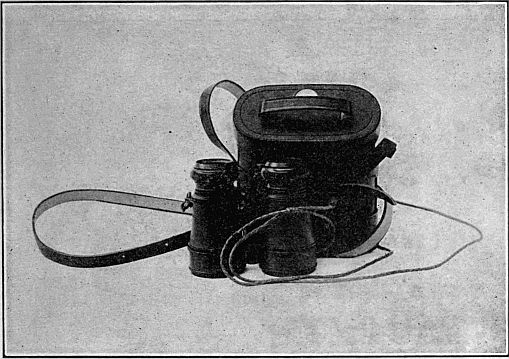
Fig. 31.—Type A. Showing the field glass and case with sling cord, shoulder
straps, belt loops, and compass
It is to be clearly understood that while this glass
is considered superior for moderate ranges, it does not
replace, under special conditions, for long ranges,
either the porro prism glass or the telescope.
When held as shown in figure 32 with the tubes
drawn out about 1 inch to secure proper focus, the
glass has a power of about 5.6 diameters, and a field
of about 5.4 degrees.
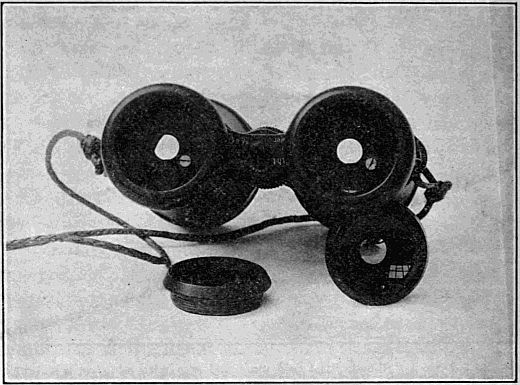
Fig. 32—Signal Corps field glass, Type A.
If the glass is turned into the position shown in figure
33, the small plus lenses, just in front of the eye
pieces, drop automatically into position and reduce
the power to 3.8 diameters, and increase the field to
8.3 degrees. This position requires a different adjustment,
the tubes being drawn out about one-third of
an inch to get the proper focus. It will be observed
in the illustrations that the rear bar of the frame is
not only lettered to indicate which power is being
used, but the bar itself is shaped with a hump on one
side, and hollowed on the other. When the hump is
up, the low power is in use. This is to facilitate
adjustment in the dark.
The action of the small automatic lenses is free and
positive. Neither the eyepieces nor the sections containing
the small lenses should be unscrewed, except in case
of necessity, and then not by unskilled hands.
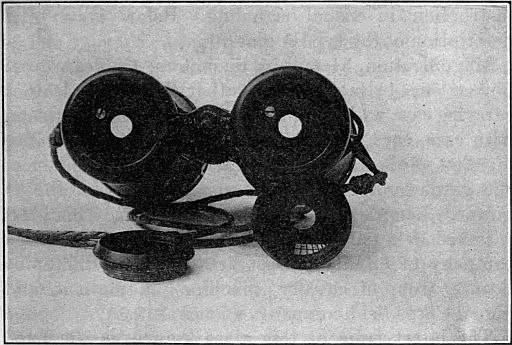
Fig. 33.—Signal Corps field glass, Type A.
The frame, of aluminum and brass, is composite,
to give lightness and strength; and while it is constructed
to withstand the rough handling of field service,
no field glass is proof against careless or wanton
treatment. The tubes are covered with tan leather,
and a round sling cord, braided from four strands of
pliable tan leather, is fastened by snaps to eyes in the
frame.
The case is of tan calfskin, provided with shoulder
strap, and has an efficient small compass set into the
cover. Two loops are sewed to the back of the case
so that it may be worn on a belt.
The glass, complete with case, cord, and straps,
weighs 21.5 ounces.
Two of these glasses are issued to each company of
infantry and coast artillery, Philippine Scouts, and
Signal Corps, and to each troop of cavalry for use in
instruction in visual signaling. Below is a brief
description of the type A glass.
Magnification, 3½ and 5½ diameters; Galilean type;
object lens, 1½ inches; tan leather finish; tan leather
carrying case with compass; weight of glass, complete,
with case, cord, and strap, 25 ounces. At a distance
of 1,000 yards the field of view includes a diameter of
123 yards for the 3½ power, and 73 yards for the 5½
power. Length of glass closed, 4 inches. This glass
is issued as a part of the visual signaling kit to each
company of infantry, coast artillery, and Philippine
Scouts, troop of cavalry, machine-gun platoon, and
Signal Corps field company. Price, $12.15.
The latest issue of this glass known as the Type
A, model 1910, includes provision for interpupillary
adjustment, the two barrels being hinged to accommodate
the glass to the distance between the pupils of
the eye. The price of the model 1910 glass is $14.75.
Type B:
This field glass is similar in appearance and construction
to the Type A glass, and is issued to the
field artillery organizations upon requisition. The
following is a brief description:
Magnification, 4½ and 6½ diameters; Galilean type;
object lens, 1¾ inches; interpupillary adjustment; tan
leather finish; tan leather carrying case with compass;
weight of glass, complete, with case, cord, and straps,
26 ounces; length of glass closed, 4½ inches. At a
distance of 1,000 yards the field of view includes a
diameter of 90 yards for the 4½ power, and 60 yards
for the 6½ power. This glass is issued as a part of the
fire-control equipment to field artillery. Price, $17.50.
Type C:
The type C is a high power glass of the porro prism
type and is issued only to certain organizations of the
field artillery, Signal Corps, and to all machine-gun
platoons.
Description.—Magnification, 10 diameters; prismatic
type; object lens, 1¾ inches; interpupillary
adjustment; tan leather finish; sunshade; tan leather
carrying case; weight of glass, complete, with case,
cord, and straps, 46 ounces; length of glass closed,
7¾ inches. At a distance of 1,000 yards the field of
view includes a diameter of 80 yards. This glass is
issued to reconnaissance officers of field artillery.
Price, $39.90.
Type D: Purchase has been made for delivery in
the near future of a supply of a new type of high
power prismatic field glass for sale and issue. This
new type of glass, to be known as type D, is considerably
smaller than the type C glass, as is shown by
figure 34. The glass in a tan-colored carrying case
weighs 15 ounces, the field glass without the case
weighing but 9 ounces. The magnification is 8
powers and the field of view (with both eyes) 5° 40′.
The estimated cost will be $27.
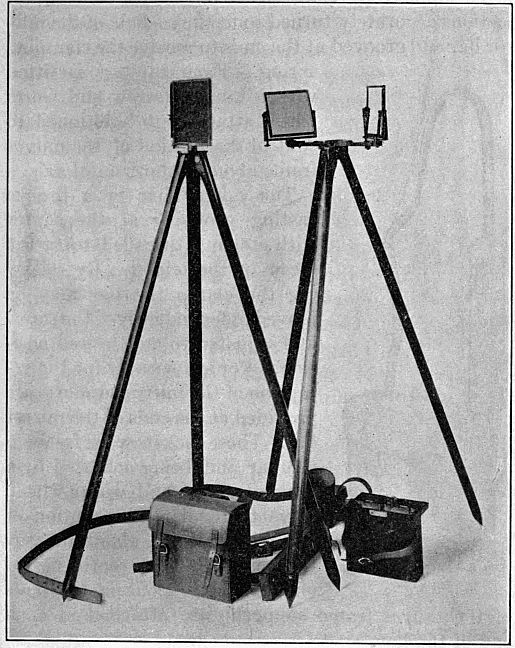
Type A: This glass complete consists of a 2-inch
prism terrestrial telescope, powers 18 and 24, with
alt-azimuth, folding tripod, and carrying case.
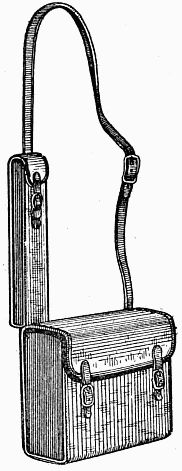
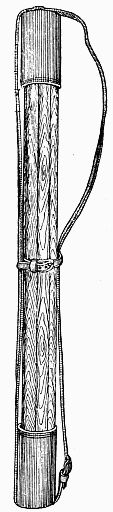
Type B: This telescope is a 19-27 power, 2-draw
terrestrial telescope, in leather carrying case with
sling. The leather carrying case also includes a holder
which can be screwed into a tree, post, or other stationary
wooden object.
[Revised February 10, 1910.]
1. Preliminary.—This specification covers the design
and construction of field glasses, types A and B,
each having two powers as hereinafter specified.
2. Sample.—The bidder shall furnish with his proposal
a sample of the glass which he will supply, and
award will be made after comparison of the samples
with models on file in the office of the Chief Signal
Officer. The maker will be allowed to examine the
model glasses in detail in the office of the Chief Signal
Officer of the Army, Washington, D. C.
3. Inspection and test.—When the order under this
specification is complete, the contractor will notify
the Chief Signal Officer of the Army, who will cause
an inspection to be made. It shall be the duty of the
contractor to remedy any defects pointed out by the
inspector, and the contractor will be held accountable
for any imperfections which the inspector may have
overlooked.
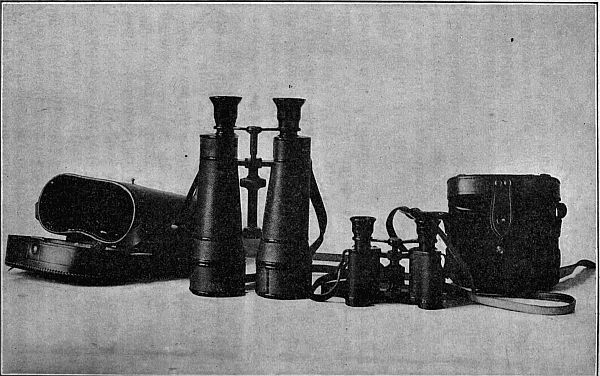
Fig. 34.—Field glasses, Types C and D.
The Chief Signal Officer of the Army reserves the
right to inspect any or all processes of manufacture,
and unsatisfactory material will be marked for rejection
by the inspector before, during, or after assembly,
as occasion may arise.
Each glass will be tested for power, field, definition,
and light. Any glass which is not the equal of the
sample and model in all respects will be rejected.
The properties above enumerated will be tested as
follows:
(a) Power: In testing for power the glass will be
placed upon a firm support about the height of the
eye and directed upon a range rod, accurately divided
into divisions of 1 foot, with alternate divisions
colored red and white, respectively. The rod should
be placed approximately 100 feet from the glass in a
good light and with strongly contrasted background.
The rod is observed through the glass with one eye
and at the same time with the other eye unaided. An
accurate comparison of the two images by means of
the rod scale determines the magnifying power of the
glass.
(b) Field: The field will be determined by the use
of a transit or any other instrument adapted to the
measurement of horizontal angles. The glass will be
placed upon the telescope of the transit in such a way
that the axes of collimation of the telescope and
field glass barrels are parallel. The extreme limits of
the field of view of the glass are marked in a convenient
way and the horizontal angle of view accurately
measured with the transit.
(c) Definition: In determining the definition of the
glass expressed in units (seconds) a target will be provided
with a number of lines one-tenth inch thick
with one-tenth inch spaces between them drawn on
a piece of heavy white paper.
At a certain distance this target will appear uniformly
gray when viewed through the glass.
The inspector will gradually approach the target,
focusing the glass until he reaches the most distant
point from the target where the uniform field ceases
and the black and white intervals appear distinct and
defined.
Assume the distance thus found to be 20 yards and
the thickness of the lines and intervals between them
one-tenth inch. The circumference of a circle with a
radius of 20 yards or 7,200 tenths inches is 14,400 by
3.1416, or 45,240 tenths inches; but a circumference
equals 360°, or (360 by 60 by 60) 1,296,000 seconds.
If, therefore, 45,240 tenths inches correspond to
1,296,000 seconds, then one-tenth inch equals 1,296,000
divided by 45,240, or 28.6 seconds. The definition is
therefore 28.6 seconds, or practically half a minute.
The definition should be as follows:
| For 6.5 power glass | 30 seconds. |
| For 5.5 power glass | 35 seconds. |
| For 4.5 power glass | 40 seconds. |
| For 3.5 power glass | 55 seconds. |
(d) Light: The light of a field glass is expressed by
a number which is the ratio of the amount of light
which reaches the eye through the glass to the amount
which enters the eye unaided. This comparison will
be reached by means of the absorption apparatus
furnished by the Signal Corps. This apparatus consists
of two wedge-shaped vessels made of brass with
glass windows in the sides, and are filled with a perfectly
black liquid. The sky line is first viewed
through the apparatus with the naked eye and the
instrument adjusted to limit of visibility. The reading
of the scale is then noted. The sky line is again
observed, using the glass, but in other respects as
before, and a second scale reading obtained. The ratio
of these readings measure the illuminating power of the
glass which must conform to the standard sample.
4. Service field glass, type A.—(a) This glass shall
conform in general to the model, now on file in the
office of the Chief Signal Officer at Washington. The
arrangement for changing automatically from the low
power to the high power, and vice versa, by the interposition
of the plus lens at the proper distance in front
of the eyepiece, must be strictly adhered to.
(b) The low power shall be approximately 3½ diameters
and the high power shall be approximately 5½
diameters. The figure of merit given by multiplying
the numbers of diameters power by the number of
degrees of field will be considered in the examination
of samples, along with the other properties of light,
sharpness of definition, and general excellence.
(c) The tubes, frame, and metal fittings shall be of
aluminum or an aluminum alloy, with the exception
that such metal parts as in the opinion of the maker
require greater strength may be made of brass.
Tubes shall be held firmly in the frame, single draw,
the draw action to be through a bearing surface of at
least five-eighths of an inch of best black felt, perfectly
fitted so as to preserve perfect alignment.
The exterior metal parts, except where leather
covered, must be given the best and most durable,
lusterless black finish. The tubes and shades will be
neatly covered with best quality tanned calfskin, the
leather to be sewed on, and the seams to lie flat next
to the focusing standard.
The interior of all parts to be painted a perfectly
dead black.
The sunshades, when drawn out, shall project at
least five-eighths of an inch and not over 1 inch
beyond the edge of the cell.
The focusing screw and standard should follow
closely that of the sample, except that the milled
focusing disk should have a face as nearly one-half
inch wide as possible and the milling should be
sharper.
In addition to the diaphragm upon which the automatic
lens is mounted, there shall be two diaphragms
in each tube, so situated and so proportioned as to cut
off all stray light and all internal reflections.
The crossbar supporting the draw tubes should be
shaped and engraved exactly as found in the model.
(d) The lenses must be entirely free from mechanical
defects, such as specks, air bubbles, etc.; must be
free from interior strain, and must be ground from the
best obtainable glass for the purpose, selected for
general transparency, as colorless as possible, perfectly
ground and polished, and accurately centered.
The object lenses shall be composite, achromatic,
and well corrected for spherical aberration, with a
clear aperture of at least 1½ inches, and not exceeding
15/8 inches. Bidders will state the number and shape
of the pieces used to make up this lens.
The compound lenses may be either cemented
together with Canada balsam, or left uncemented, as
the maker may deem best for durability and optical
performance, but if left uncemented the components
shall have a permanent mark to indicate their proper
positions in the cell.
The eyepieces shall consist of a single double concave
lens having a clear aperture of not less than three-eighths
of an inch and not more than one-half of an
inch.
(e) The sling cord attached to eyes in the frame by
means of brass snaps with black burned finish shall
be round and braided from four strands of pliable tan
leather, and shall have a diameter of at least one-eighth
of an inch and not over one-sixth of an inch.
(f) The case and strap must be exactly like sample,
and of No. 1 stock. Care must be taken to put in only
compasses that are in perfect condition. The strap
buckle must be of brass. The glass, when closed,
must not exceed 4 inches in length, and the glass, case,
cord, and strap, complete, must not exceed 25 ounces
in weight.
(g) The frame shall be constructed with jointed
bars for interpupillary adjustment.
5. Service field glass, type B.—(a) The requirements
of part 4, service field glass, type A, of this specification,
shall be followed in the design and construction
of the type B glass in so far as applicable.
(b) Power: The lower power shall be approximately
4½ and the high 6½ diameters.
(c) Object lenses: These shall have a clear aperture
of at least 1¾ inches diameter.
(d) Case: Case and carrying strap shall be furnished
as required in part 4 of this specification.
(e) This glass shall be constructed with jointed bars
for interpupillary adjustment.
(f) The sunshade, when drawn out, shall project
not less than three-eighths of an inch and not more
than 1 inch beyond the edge of the cell.
6. Marking.—Glasses furnished under this specification
shall be marked on one barrel with the words
"Signal Corps, U. S. Army," and on the other barrel
"Serial No. ——." Serial numbers will be furnished
with the order. If not furnished the contractor at
the time the order is placed, the Disbursing Officer
of the Signal Corps should be called upon for same,
and the numbers and other marking placed on the
glasses prior to the delivery of the order.
James Allen,
Brigadier-General,
Chief Signal Officer of the Army.
Signal Office,
Electric and Telegraph Division.
Transcriber's Notes:
Page 23, "porportions" changed to "proportions" (in proper proportions)
Page 106, "engineeer" changed to "engineer" (a French engineer)
Page 126, opening bracket added to subtitle ([Revised February 10, 1910.])