Illusions played many roles in the science and art of deception during the
World War, but they served most prominently in the later stages of the war
upon the sea. Inasmuch as the story of the science of camouflage is not
generally available, it appears worth while to present it briefly. Besides
being of interest, it will reveal to the reader the part that the science
of light, color, lighting, and vision played in deception. Furthermore,
the reader will sense the numberless illusions which are woven into
camouflage as developed in nature, and in human activities. The word
camouflage by origin does not include all kinds of deception; however,
by extension it may and will here signify almost the entire art and
science of deception as found in nature and as practiced in the World War.
Terrestrial Camouflage.—Camouflage is an art which is the natural
outgrowth of our instinct for concealment and deception when pitting our
wits against those of a crafty prey or enemy. It is an art older than the
human race, for its beginnings may be traced back to the obscurity of the
early ages of the evolution of animal life. The name was coined by the
French to apply to a definite art which developed during the Great War to
a high state, as many other arts developed by drawing deeply upon the
resources of scientific knowledge. With the introduction of this specific
word to cover a vast field of activity in scientifically concealing and
deceiving, many are led to believe that this is a new art, but such is not
the case. However, like many other arts, such as that of flying, the
exigencies of modern warfare have provided an impetus which has resulted
in a highly developed art.
Scientists have recognized for many years, and perhaps more or less
vaguely for centuries, that Nature exhibits wonderful examples of
concealment and deception. The survival of the fittest, as Darwin
expressed his doctrine, included those individuals of a species who were
best fitted by their markings and perhaps by peculiar habits to survive in
the environment in which they lived. Naturally, markings, habits, and
environment became more and more adapted to each other until the species
became in equilibrium with Nature sufficiently to insure its perpetuity.
If we look about us upon animal life we see on every hand examples of
concealing coloration and attitudes designed to deceive the prey or enemy.
The rabbit is mottled because Nature’s infinite variety of highlights,
shadows, and hues demand variety in the markings of an animal if the
latter is to be securely hidden. Solid color does not exist in Nature’s
landscapes in large areas. The rabbit is lighter underneath to compensate
for the lower intensity of illumination received on these portions. As
winter approaches, animals in rigorous climates need warmer coats, and the
hairs grow longer. In many cases the color of the hairs changes to gray or
white, providing a better coating for the winter environment.
Animals are known to mimic inanimate objects for the sake of safety. For
example, the bittern will stand rigid with its bill pointed skyward for
many minutes if it suspects an enemy. Non-poisonous snakes resemble
poisonous ones in general characteristics and get along in the world on
the reputation of their harmful relatives. The drone-bee has no sting, but
to the casual observer it is a bee and bees generally sting. Some animals
have very contrasting patterns which are conspicuous in shape, yet these
very features disguise the fact that they are animals. Close observation
of fishes in their natural environment provides striking examples of
concealing coloration. Vast works have been written on this subject by
scientists, so it will only be touched upon here.
There are many examples of “mobile” camouflage to be found in Nature.
Seasonal changes have been cited in a foregoing paragraph. The chameleon
changes its color from moment to moment. The flounder changes its color
and pattern to suit its environment. It will even strive to imitate a
black and white checkerboard.
In looking at a bird, animal, insect, or other living thing it is
necessary to place it in its natural environment at least in the
imagination, before analyzing its coloration. For example, a male mallard
duck hanging in the market is a very gaudy object, but place it in the
pond among the weeds, the green leaves, the highlights, and the shadows,
and it is surprisingly inconspicuous. The zebra in the zoo appears to be
marked for the purpose of heralding its presence anywhere in the range of
vision, but in its reedy, bushy, grassy environment it is sufficiently
inconspicuous for the species to survive in Nature’s continuous warfare.
Thus studies of Nature reveal the importance of general hue, the necessity
for broken color or pattern, the fact that black spots simulate shadows or
voids, the compensation for lower illumination by counter-shading, and
many other facts. The artist has aided in the development of camouflage,
but the definite and working basis of all branches of camouflage are the
laws and facts of light, color, and vision as the scientist knows them.
Just as lower animal life has unconsciously survived or evolved by being
fitted to do so, mankind has consciously, or at least instinctively,
applied camouflage of various kinds to fool his prey or his enemy. Many of
us in hunting ducks have concealed the bow of our sneak-boat with mud and
weeds, or in the season of floating ice, with a white cloth. In our quest
of water fowl we use decoys and grass suits. The Esquimau stalks his game
behind a piece of ice. In fact, on every hand we find evidences of this
natural instinct. The Indian painted his face and body in a variety of
colors and patterns. Did he do this merely to be hideous? It seems very
possible that the same instinct which made him the supreme master of
wood-craft caused him to reap some of the advantages of concealment due to
the painting of his face and body.
In past wars there is plenty of evidence that concealment and deception
were practiced to the full extent justifiable by the advantages or
necessity. In the World War the advent of the airplane placed the third
dimension in reconnaissance and called for the application of science in
the greatly extended necessity for concealment and deception. With the
advent of the airplane, aerial photography became a more important factor
than visual observation in much of the reconnaissance. This necessitated
that camouflage in order to be successful had to meet the requirements of
the photographic eye, as well as that of the human eye. In other words,
the special characteristics of the colors used had to be similar to those
of Nature’s colors. For example, chlorophyl, the green coloring matter of
vegetation, is a peculiar green as compared with green pigments. When
examined with a spectroscope it is seen to reflect a band of deep red
light not reflected by ordinary pigments. In considering this aspect it is
well to bear in mind that the eye is a synthetic apparatus; that is does
not analyze color in a spectral sense. An artist who views color
subjectively and is rarely familiar with the spectral basis may match a
green leaf perfectly with a mixture of pigments. A photographic plate, a
visual filter, or a spectroscope will reveal a difference which the
unaided eye does not.
Some time before the Great War began, it occurred to the writer that
colored filters could be utilized in aiding vision by increasing the
contrast of the object to be viewed against its surroundings.[9] Studies
were made of various filters, made with the object of the experiment in
mind, in viewing the uniforms of various armies. Further developments were
made by applying the same principles to colored lights and painted
pictures. Many of these have been described elsewhere. With the
development of the science of camouflage, filters came into use for the
detection of camouflage. As a result of the demand for avoiding detection
by photographic plates and by various colored filters, some paints
provided for the camoufleur were developed according to the spectral
requirements. Many other applications of science were developed so that
camouflage can now be called an art based upon sound scientific
principles.
Natural lighting is so variable that it is often impossible to provide
camouflage which will remain satisfactory from day to day; therefore, a
broad knowledge of Nature’s lighting is necessary in order to provide the
best compromise. There are two sources of light in the daytime, namely,
the sun and the sky. The relative amounts of light contributed by these
two sources is continually changing. The sky on cloudless days contributes
from one-tenth to one-third of the total light received by a horizontal
surface at noon. Light from the sky and light reflected from the
surroundings illuminate the shadows. These shadows are different in color
than highlights, although these finer distinctions may be ignored in most
camouflage because color becomes less conspicuous as the distance of
observation increases. In general, the distribution of brightness or light
and shade is the most important aspect to be considered.
The camoufleur worries over shadows more than any other aspect generally.
On overcast days camouflage is generally much more successful than on
sunny days. Obviously, counter-shading is resorted to in order to
eliminate shadows, and where this is unsuccessful confusion is resorted to
by making more shadows. The shape and orientation of a building is very
important to those charged with the problem of rendering it inconspicuous
to the enemy, but little attention has been paid to these aspects. For
example, a hangar painted a very satisfactory dull green will be
distinguishable by its shape as indicated by its shadow and shaded sides.
In this zone a hangar, for example, would be more readily concealed if its
length lay north and south. Its sides could be brought with a gradual
curve to the ground and its rear, which is during most of the day in
shadow, could be effectively treated to conceal the shadow. A little
thought will convince the reader of the importance of shape and
orientation.
Broken color or pattern is another fundamental of camouflage which, of
course, must be adapted to its environment. For our trucks, cannon, and
many other implements of war, dark green, yellow, dark blue, light gray,
and other colors have been used in a jumble of large patterns. A final
refinement is that of the blending of these colors at a distance, where
the eye no longer resolves the individual patches, to a color which
simulates the general hue of the surroundings. For example, red and green
patches at a distance blend to yellow; yellow and blue patches blend to a
neutral gray if suitably balanced, but if not, to a yellow-gray or a
blue-gray; red, green, and blue if properly balanced will blend to a gray;
black, white and green patches will blend to a green shade, and so on.
These facts are simple to those who are familiar with the science of
light and color, but the artist, whose knowledge is based upon the mixture
of pigments, sometimes errs in considering this aspect of color-blending
by distance. For example, it is not uncommon for him to state that at a
distance yellow and blue patches blend to make green, but the addition of
lights or of juxtaposed colors is quite different in result from the
addition of pigments by intimately mixing them.
In constructing such a pattern of various colors it is also desirable to
have the final mean brightness approximate that of the general
surroundings. This problem can be solved by means of the photometer and a
formula provided, which states, for example, that a certain percentage of
the total area be painted in gray, another percentage in green, and so on.
The photometer has played an important rôle in establishing the scientific
basis of camouflage. The size of the pattern must be governed by the
distance at which it is to be viewed, for obviously if too small the
effect is that of solid color, and if too large it will render the object
conspicuous, which is a disadvantage ranking next to recognizable.
Where the artist is concerned with a background which does not include the
sky, that is, where he deals only with illuminated objects on the earth,
his trained eye is valuable provided the colors used meet the demands made
by photographic plates and visual color-filters. In other words, the sky
as a background gives trouble to all who are unfamiliar with scientific
measurements. The brightnesses of sky and clouds are outside the scale of
brightnesses ordinarily encountered in a landscape. Many interesting
instances of the artist’s mistakes in dealing with these backgrounds could
be presented; however, the artist’s trained eye has been a great aid in
constructing patterns and various other types of camouflage. One of the
most conspicuous aspects of the earth’s surface is its texture. From great
heights it appears flat, that is, rolling land is ironed out and the
general contour of the ground is flattened. However, the element of
texture always remains. This is the chief reason for the extensive use of
netting on which dyed raffia, foliage, pieces of colored cloth, etc., are
tied. Such network has concealed many guns, headquarters, ammunition
dumps, communication trenches, roadways, etc. When this has been well done
the concealment is perfect.
One of the greatest annoyances to the camoufleur is the lack of dullness
or “flatness” of the paints, fabrics, and some of the other media used.
When viewed at some angles the glint of highlights due to specular
reflection renders the work very conspicuous. For this reason natural
foliage or such material as dyed raffia has been very successful.
Systems of network and vertical screens have been extensively employed on
roadways near the front, not for the purpose of concealing from the enemy
the fact that the roadways exist, but to make it necessary to shell the
entire roadway continually if it is hoped to prevent its use.
Although the camoufleur is provided with a vast amount of material for his
work, many of his requirements are met by the material at hand.
Obviously, the most convenient method of providing concealment for a
given environment is to use the materials of the environment. Hence,
rubbish from ruined buildings or villages supplies camouflage for guns,
huts, etc., in that environment. In woods the material to simulate the
woods is at hand. Many of these aspects are so obvious to the reader that
space will not be given to their consideration. The color of the soil is
important, for if it is conspicuous the camoufleur must provide screens of
natural turf.
In this great game of hocus-pocus many deceptions are resorted to.
Replicas of large guns and trenches are made; dummy soldiers are used to
foil the sniper and to make him reveal his location, and papier-maché
horses, trees, and other objects conceal snipers and observers and afford
listening posts. Gunners have been dressed in summer in green flowing
robes. In winter white robes have been utilized. How far away from modern
warriors are all the usual glitter and glamour of military impedimenta in
the past parades of peace time! The armies now dig in for concealment. The
artillery is no longer invisible behind yonder hill, for the eyes of the
aerial observer of the camera reveal its position unless camouflaged for
the third dimension.
In the foregoing only the highlights of a vast art have been viewed, but
the art is still vaster, for it extends into other fields. Sound must
sometimes be camouflaged and this can only be done by using the same
medium—sound. In these days of scientific warfare it is to be expected
that the positions of enemy guns would be detected by other means than
employed in the past. A notable method is the use of velocity of sound.
Records are made at various stations of the firing of a gun and the
explosion of the shell. By trigonometric laws the position of the gun is
ascertained. It is said that the Germans fired a number of guns
simultaneously with the “75-mile” gun in order to camouflage its location.
The airplane and submarine would gladly employ sound camouflage in order
to foil the sound detector if practicable solutions were proposed.
The foregoing is a brief statement of some of the fundamental principles
of land camouflage. Let us now briefly consider the eyes of the enemy. Of
course, much concealment and deception is devised to foil the observer who
is on the ground and fairly close. The procedure is obvious to the average
imagination; however, the reader may not be acquainted with the aerial
eyes from which concealment is very important. As one ascends in an
airplane to view a landscape he is impressed with the inadequacy of the
eyes to observe the vast number of details and of the mind to retain them.
Field glasses cannot be used as satisfactorily in an airplane as on solid
ground, owing to vibration and other movements. The difference is not as
great in the huge flying boats as it is in the ordinary airplane. The
camera can record many details with higher accuracy than the eye. At an
altitude of one mile the lens can be used at full aperture and thus very
short exposures are possible. This tends to avoid the difficulty due to
vibration. When the plates are developed for detail and enlargements are
made, many minute details are distinguishable. Furthermore, owing to the
fact that the spectral sensibilities of photographic emulsions differ from
that of the eye, contrasts are brought out which the eye would not see.
This applies also to camouflage which is devised merely to suit the eye.
Individual footprints have been distinguished on prints made from
negatives exposed at an altitude of 6000 feet. By means of photography,
daily records can be made if desired and these can be compared. A slight
change is readily noted by such comparison by skilled interpreters of
aerial photographs. The disappearance of a tree from a clump of trees may
arouse suspicion. Sometimes a wilted tree has been noted on a photograph
which naturally attracts attention to this position. It has been said that
the belligerents resorted to transplanting trees a short distance at a
time from day to day in order to provide clearance for newly placed guns.
By paths converging toward a certain point, it may be concluded from the
photographs that an ammunition dump or headquarters is located there even
though the position itself was well camouflaged. Continuous photographic
records may reveal disturbances of turf and lead to a more careful
inspection of the region for sapping operations, etc. By these few details
it is obvious that the airplane is responsible for much of the development
of camouflage on land, owing to the necessity which it created for a much
more extensive concealment. The entire story of land camouflage would
overflow the confines of a volume, but it is hoped that the foregoing will
aid the reader in visualizing the magnitude of the art and the scientific
basis upon which terrestial camouflage is founded.
Marine Camouflage.—At the time of the Spanish-American war, our
battleships were painted white, apparently with little thought of
attaining low visibility. Later the so-called “battleship gray” was
adopted, but it has been apparent to close observers that this gray is in
general too dark. Apparently it is a mixture of black and white. The ships
of the British navy were at one time painted black, but preceding the
Great War their coats were of a warm dark gray. Germany adopted dark gray
before the close of the last century and Austria adopted the German gray
at the outbreak of the war. The French and Italian fleets were also
painted a warm gray. This development toward gray was the result of an aim
toward attaining low visibility. Other changes were necessitated by
submarine warfare which will be discussed later.
In the early days of unrestricted submarine warfare many schemes for
modifying the appearance of vessels were submitted. Many of these were
merely wild fancies with no established reasoning behind them. Here again
science came to the rescue and through research and consultation, finally
straightened out matters. The question of low visibility for vessels could
be thoroughly studied on a laboratory scale, because the seascape and
natural lighting conditions could be reproduced very closely. Even the
general weather conditions could be simulated, although, of course, the
experiments could be prosecuted outdoors with small models, as indeed
they were. Mr.
L. A. Jones[10] carried out an investigation on the shore
of Lake Ontario, and laboratory experiments were conducted by others with
the result that much light was shed on the questions of marine camouflage.
This work confirmed the conclusion of the author and others that our
battleship gray was too dark. Of course, the color best adapted is that
which is the best compromise for the extreme variety in lighting and
weather conditions. These vary in different parts of the world, so
naturally those in the war zone were of primary importance. All camouflage
generally must aim to be a compromise best suited for average or
dominating conditions. For example, in foggy weather a certain paint may
render a ship of low visibility, but on a sunny day the ship might be
plainly visible. However, if ships are rendered of low visibility for even
a portion of the time it is obvious that an advantage has been gained.
Cloudiness increases generally from the equator northward, as indicated by
meteorological annals.
In order to study low visibility a scale of visibility must be
established, and it is essential to begin with the fundamentals of vision.
We distinguish objects by contrasts in brightness and in color and we
recognize objects by these contrasts which mold their forms. In researches
in vision it is customary to devise methods by which these contrasts can
be varied. This is done by increasing or decreasing a veil of luminosity
over the object and its surroundings and by other means. Much work has
been done in past years in studying the minimum perceptible contrast, and
it has been found to vary with hue, with the magnitude of brightness, and
with the size of the image, that is, with the distance of an object of
given size. In such problems as this one much scientific work can be drawn
upon. A simple, though rough, scale of visibility may be made by using a
series of photographic screens of different densities. A photographic
screen is slightly diffusing, still the object can be viewed through it
very well. Such methods have been employed by various investigators in the
study of visibility.
Owing to the curvature of the earth, the distance at which a vessel can be
seen on a clear day is limited by the height of the observer and of the
ship’s superstructure. For an observer in a certain position the
visibility range varies as the square root of the distance of the object
from him. Such data are easily available, so they will not be given here.
So far we have considered the ship itself when, as a matter of fact, on
clear days the smoke cloud emitted by the ship is usually visible long
before a ship’s superstructure appears on the horizon. This led to the
prevention of smoke by better combustion, by using smokeless fuels, etc.
The irregular skyline of a ship is perhaps one of the most influential
factors which tend to increase its visibility. Many suggestions pertaining
to the modification of the superstructure have been made, but these are
generally impracticable. False work suffers in heavy seas and high winds.
After adopting a suitable gray as, a “low-visibility” paint for ships,
perhaps the next refinement was counter shading; that is, shadows were
painted a lighter color, or even white. The superstructure was painted in
some cases a light blue, with the hope that it would fade into the distant
horizon. However, the effectiveness of the submarine demanded new
expedients because within its range of effectiveness no ingenuity could
render its intended prey invisible. The effective gun-fire from submarines
is several miles and torpedoes can be effective at these distances.
However, the submarine prefers to discharge the torpedo at ranges within a
mile. It is obvious that, in average weather, low visibility ceases to be
very effective against the submarine. The movement of a target is of much
less importance in the case of gun-fire than in the case of the torpedo
with its relatively low velocity. The submarine gunner must have the
range, speed, and course of the target in order to fire a torpedo with any
hope of a hit. Therefore, any uncertainties that could be introduced
pertaining to these factors would be to the advantage of the submarine’s
prey. For example, low visibility gave way to confusibility in the
discussions of defence against the submarine and the slogan, “A miss is as
good as a mile” was adopted. The foregoing factors cannot be determined
ordinarily with high accuracy, so that it appeared possible to add
somewhat to the difficulties of the submarine commander.
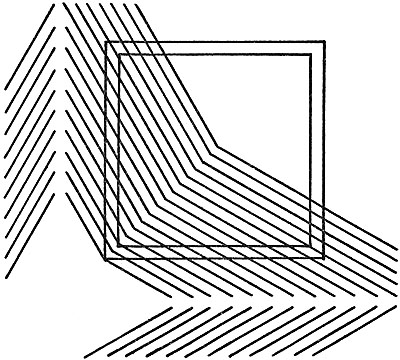
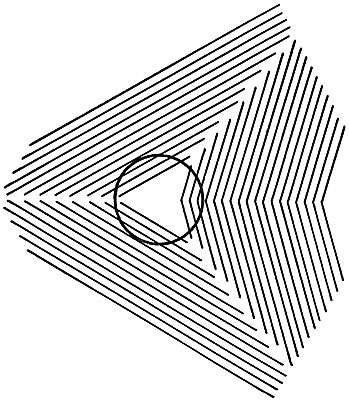
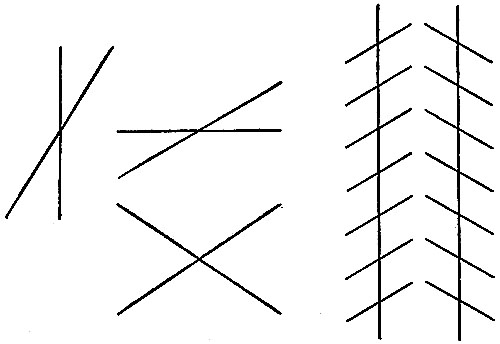
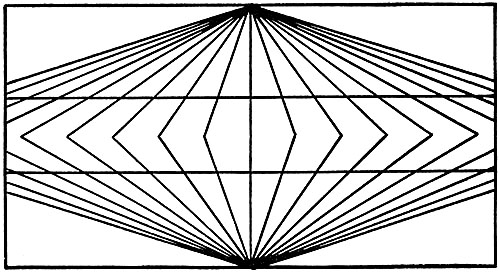
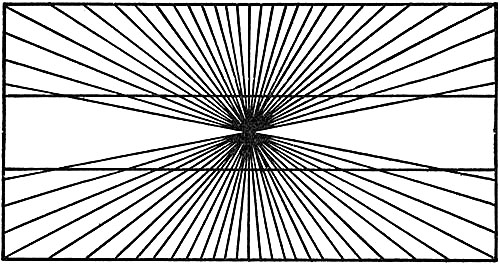
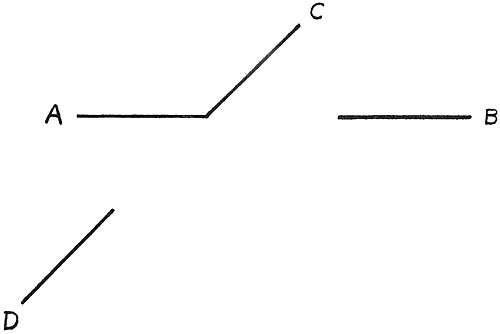
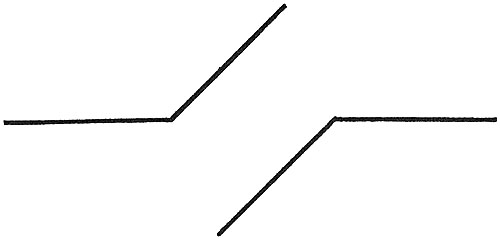
Many optical illusions have been devised and studied by scientists. In
fact, some of these tricks are well known to the general reader. Straight
lines may appear broken, convergent, or divergent by providing certain
patterns or lines intermingled with them. Many of these were applied to
models in laboratory experiments and it has been shown that confusion
results as to the course of the vessel. The application of these on
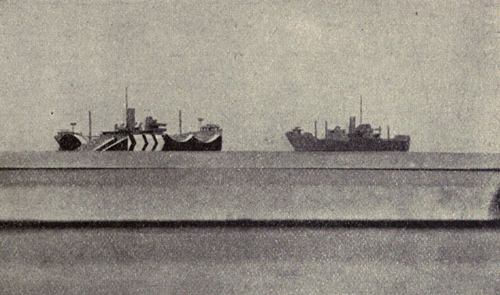
vessels has resulted in the grotesque patterns to be seen on ships during
the latter stage of the war. It is well known that these illusions are
most effective when the greatest contrasts are used, hence black and white
patterns are common. Color has not been utilized as definitely as pattern
in confusibility, although there is a secondary aim of obtaining low
visibility at a great distance by properly balancing the black, white, and
other colors so that a blue-gray results at distances too great for the
individual patterns to be resolved by the eye. Color could be used for the
purpose of increasing the conclusion by apparently altering the
perspective. For example, blue and red patterns on the same surface do not
usually appear at the same distance, the red appearing closer than the
blue.
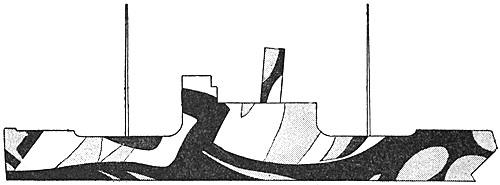
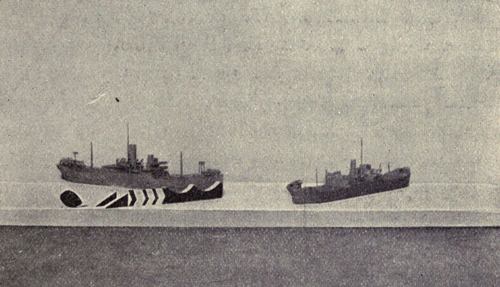
Fig. 92.—A primary stage in the evolution of the use of geometrical-optical illusions on ships.
Such apparently grotesque patterns aimed to distort the lines of the ship
and to warp the perspective by which the course is estimated. This was
the final type of marine camouflage at the close of the war. Besides
relying upon these illusions, ships zigzagged on being attacked and aimed
in other ways to confuse the enemy. No general attempt was made to
disguise the bow, because the bow-wave was generally visible. However,
attempts have been made to increase it apparently and even to provide one
at the stern. In fact, ingenuity was heavily drawn upon and many
expedients were tried.
After low-visibility was abandoned in favor of the optical illusion for
frustrating the torpedo-attack by the submarine, there was a period during
which merely a mottled pattern was used for vessels. Gradually this
evolved toward such patterns as shown in Fig. 92. In this illustration it
is seen that the optical-illusion idea has taken definite form. During the
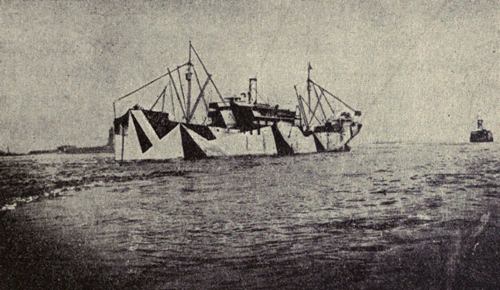
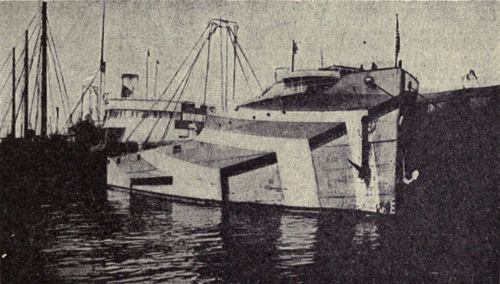
period of uncertainty as to the course the pattern should take, a
regularity of pattern was tried, such as illustrated in Figs. 93 and 94.
Finally, when it dawned more or less simultaneously upon various
scientific men, who were studying the problems of protecting vessels upon
the seas, that the geometrical-optical illusion in its well-known forms
was directly adaptable, renewed impetus was given to investigation. The
scientific literature yielded many facts but the problems were also
studied directly by means of models. The latter study is illustrated by
Figs. 95 and 96, the originals having been furnished by Mr. E. L.
Warner,[11] who among others prosecuted a study of the application of
illusions to vessels. The final results were gratifying, as shown to some
extent in Figs. 97 and 98, also kindly furnished by Mr. Warner. It is
seen that these patterns are really deceiving as to the course of the
vessel.
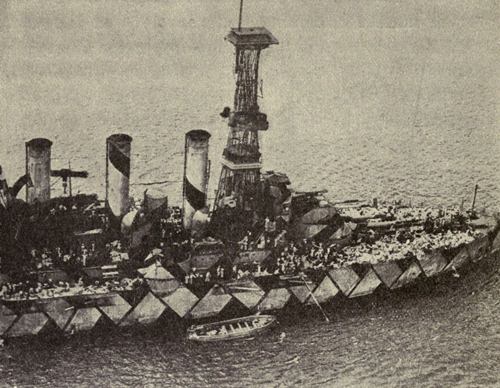
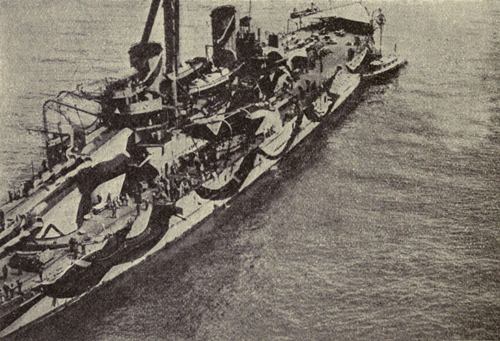
Figs. 93 and 94.—Attempts at distortion of outline which preceded the adoption of geometrical-optical illusions for ships.
Figs. 95 and 96.—Illustrating the use of models by the Navy Department in developing the geometrical-illusion for ships.
The convoy system is well known to the reader. This saved many vessels
from destruction. Vessels of the same speed were grouped together and
steamed in flocks across the Atlantic. Anyone who has had the extreme
pleasure of looking down from an airplane upon these convoys led by
destroyers and attended by chasers is strongly impressed with the old
adage, “In unity there is strength.”
Before the war began, a Brazilian battleship launched in this country was
provided with a system of blue lights for use when near the enemy at
night. Blue was adopted doubtless for its low range compared with light of
other colors. We know that the setting sun is red because the atmospheric
dust, smoke, and moisture have scattered and absorbed the blue and green
rays more than the red and yellow rays. In other words the penetrating
power of the red and yellow is greater than that of the blue rays. This
country made use of this expedient to some extent. Of course, all other
lights were extinguished and portholes were closed in ocean travel during
the submarine menace.
Figs. 97 and 98.—Examples of the geometrical-optical illusion as finally applied.
Naturally smoke-screens were adopted as a defensive measure on sea as well
as on land. Destroyers belch dense smoke from their stacks in order to
screen battleships. Many types of smoke-boxes have been devised or
suggested. The smoke from these is produced chemically and the apparatus
must be simple and safe. If a merchantman were attacked by a submarine
immediately smoke-boxes would be dumped overboard or some which were
installed on deck would be put into operation and the ship would be
steered in a zigzag course. These expedients were likely to render
shell-fire and observations inaccurate. This mode of defense is obviously
best suited to unarmed vessels. In the use of smoke-boxes the direction
and velocity of the wind must be considered. The writer is unacquainted
with any attempts made to camouflage submarines under water, but that this
can be done is evident from aerial observations. When looking over the
water from a point not far above it, as on a pier, we are unable to see
into the water except at points near us where our direction of vision is
not very oblique to the surface of the water. The brightness of the
surface of water is due to mirrored sky and clouds ordinarily. For a
perfectly smooth surface of water, the reflection factor is 2 per cent for
perpendicular incidence. This increases only slightly as the obliquity
increases to an angle of about 60 degrees. From this point the
reflection-factor of the surface rapidly increases, becoming 100 per cent
at 90 degrees incidence. This accounts for the ease with which we can see
into the water from a position directly overhead and hence the airplane
has been an effective hunter of submerged submarines. The depth at which
an object can be seen in water depends, of course, upon its clarity. It
may be surprising to many to learn that the brightness of water, such as
rivers, bays, and oceans, as viewed perpendicularly to its surface, is
largely due to light diffused within it. This point became strikingly
evident during the progress of work in aerial photometry.
A submerged submarine may be invisible for two reasons: (1) It may be deep
enough to be effectively veiled by the luminosity of the mass of water
above it (including the surface brightness) or, (2) It may be of the
proper brightness and color to simulate the brightness and color of the
water. It is obvious that if it were white it would have to attain
concealment by submerging deeply. If it were a fairly dark greenish-blue
it would be invisible at very small depths. In fact, it would be of very
low visibility just below the surface of the water. By the use of the
writer’s data on hues and reflection-factors of earth and water areas it
would be easy to camouflage submarines effectively from enemies overhead.
The visibility of submarines is well exemplified by viewing large fish
such as sharks from airships at low altitudes. They appear as miniature
submarines dark gray or almost black amid greenish-blue surroundings.
Incidentally, the color of water varies considerably from the dirty
yellowish-green of shallow inland waters containing much suspended matter
to the greenish-blue of deep clear ocean waters. The latter as viewed
vertically are about one-half the brightness of the former under the same
conditions and are decidedly bluer.
The Visibility of Airplanes.—In the Great War the airplane made its
début in warfare and in a short time made a wonderful record, yet when
hostilities ceased aerial camouflage had not been put on a scientific
basis. No nation had developed this general aspect of camouflage
systematically or to an extent comparable with the developments on land
and sea. One of the chief difficulties was that scientific data which were
applicable were lacking. During the author’s activities as Chairman of the
Committee on Camouflage of the National Research Council he completed an
extensive investigation[12] of the fundamentals upon which the attainment
of low visibility for airplanes must be based. Solutions of the problems
encountered in rendering airplanes of low visibility resulted and various
recommendations were made, but the experiences and data will be drawn upon
here only in a general way. In this general review details would consume
too much space, for the intention has been to present a broad view of the
subject of camouflage.
The visibility of airplanes presents some of the most interesting problems
to be found in the development of the scientific basis for camouflage. The
general problem may be subdivided according to the type of airplane, its
field of operation, and its activity. For example, patrol craft which fly
low over our own lines would primarily be camouflaged for low visibility
as viewed by enemies above. (See Fig. 99.) High-flying craft would be
rendered of low visibility as viewed primarily by the enemy below.
Airplanes for night use present other problems and the visibility of
seaplanes is a distinct problem, owing to the fact that the important
background is the water, because seaplanes are not ordinarily high-flying
craft. In all these considerations it will be noted that the activity of
the airplanes is of primary importance, because it determines the lines
of procedure in rendering the craft of low visibility. This aspect is too
complicated to discuss thoroughly in a brief résumé.
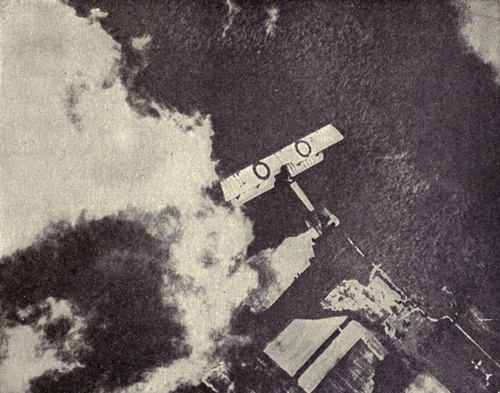
Fig. 99.—Representative earth backgrounds for an airplane (uncamouflaged) as viewed from above.
The same fundamentals of light, color, and vision apply in this field as
in other fields of camouflage, but different data are required. When
viewing aircraft from above, the earth is the background of most
importance. Cumulus clouds on sunny days are generally at altitudes of
4000 to 7000 feet. Clouds are not always present and besides they are of
such a different order of brightness from that of the earth that they
cannot be considered in camouflage designed for low visibility from
above. In other words, the compromise in this case is to accept the earth
as a background and to work on this basis. We are confronted with seasonal
changes of landscape, but inasmuch as the summer landscape was of greatest
importance generally, it was the dominating factor in considering low
visibility from above.
On looking down upon the earth one is impressed with the definite types of
areas such as cultivated fields, woods, barren ground and water. Different
landscapes contain these areas in various proportions, which fact must be
considered. Many thousand determinations of reflection-factor and of
approximate hue were made for these types of areas, and upon the mean
values camouflage for low visibility as viewed from above was developed. A
few values are given in the accompanying table, but a more comprehensive
presentation will be found elsewhere.[12]
Mean Reflection-Factors
(From thousands of measurements made by viewing vertically downward during
summer and fall from various altitudes.)
| | | Per Cent |
| Woods | | 4.3 |
| Barren ground | | 13.0 |
| Fields (grazing land and growing crops) | | 6.8 |
| Inland water (rivers and bays) | | 6.8 |
| Deep ocean water | | 3.5 |
| Dense clouds | | 78.0 |
Wooded areas are the darkest general areas in a landscape and possess a
very low reflection-factor. From above one sees the deep shadows
interspersed among the highlights. These shadows and the trapping of
light are largely responsible for the low brightness or apparent
reflection-factor. This is best illustrated by means of black velvet. If a
piece of cardboard is dyed with the same black dye as that used to dye the
velvet, it will diffusely reflect 2 or 3 per cent of the incident light,
but the black velvet will reflect no more than 0.5 per cent. The velvet
fibers provide many light traps and cast many shadows which reduce the
relative brightness or reflection-factor far below that of the flat
cardboard. Cultivated fields on which there are growing crops are nearly
twice as bright as wooded areas, depending, of course, upon the denseness
of the vegetation. Barren sunbaked lands are generally the brightest large
areas in a landscape, the brightness depending upon the character of the
soil. Wet soil is darker than dry soil, owing to the fact that the pores
are filled with water, thus reducing the reflection-factor of the small
particles of soil. A dry white blotting paper which reflects 75 per cent
of the incident light will reflect only about 55 per cent when wet.
Inland waters which contain much suspended matter are about as bright as
grazing land and cultivated fields. Shallow water partakes somewhat of the
color and brightness of the bed, and deep ocean water is somewhat darker
than wooded areas. Quiet stagnant pools or small lakes are sometimes
exceedingly dark; in fact, they appear like pools of ink, owing to the
fact that their brightness as viewed vertically is almost entirely due to
surface reflection. If it is due entirely to reflection at the surface,
the brightness will be about 2 per cent of the brightness of the zenith
sky. That is, when viewing such a body of water vertically one sees an
image of the zenith sky reduced in brightness to about 2 per cent.
The earth patterns were extensively studied with the result that definite
conclusions were formulated pertaining to the best patterns to be used.
Although it is out of the question to present a detailed discussion of
this important phase in this résumé, attention will be called to the
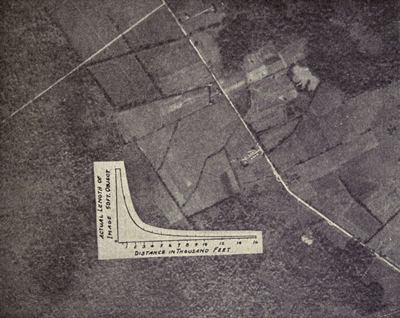
manner in which the earth patterns diminish with increasing altitude. The
insert in Fig. 100 shows the actual size of an image of a 50-foot airplane
from 0 to 16,000 feet below the observer as compared with corresponding
images (to the same scale) of objects and areas on the earth’s surface
10,000 feet below the observer.
For simplicity assume a camera lens to have a focal length equal to 10
inches, then the length x of the image of an object 100 feet long will
be related to the altitude h in this manner:
| x |
= |
100 |
or xh = 1000 |
| 10 |
h |
By substituting the values of altitude h in the equation the values of
the length x of the image are found. The following values illustrate the
change in size of the image with altitude:
| Altitude h in feet | |
Size of image x in inches |
| 1,000 | |
1.00 |
| 2,000 | |
0.50 |
| 3,000 | |
0.33 |
| 4,000 | |
0.25 |
| 10,000 | |
0.10 |
| 20,000 | |
0.05 |
It is seen that the image diminishes less rapidly in size as the altitude
increases. For example, going from 1000 feet to 2000 feet the image is
reduced to one-half. The same reduction takes place in ascending from
10,000 to 20,000 feet. By taking a series of photographs and knowing the
reduction-factor of the lens it is a simple matter to study pattern. An
airplane of known dimensions can be placed in the imagination at any
altitude on a photograph taken at a known altitude and the futility of
certain patterns and the advantages of others are at once evident.
Fig. 100.—Illustrating the study of pattern for airplanes. The photograph was taken from an altitude of 10,000 feet.
The insert shows the relative lengths (vertical scale) of an airplane of 50-foot
spread at various distances below the observer.
It is impracticable to present colored illustrations in this résumé and
values expressed in numbers are meaningless to most persons, so a few
general remarks will be made in closing the discussion of low visibility
as viewed from above in spring, summer and fall. A black craft is of much
lower visibility than a white one. White should not be used. The paints
should be very dark shades. The hues are approximately the same for the
earth areas as seen at the earth’s surface. Inland waters are a dirty
blue-green or bluish-green, and deep ocean water is a greenish-blue when
viewed vertically, or nearly so. Mean hues of these were determined
approximately.
Before considering other aspects of camouflage it is well to consider such
features as haze, clouds and sky. There appear to be two kinds of haze
which the writer will arbitrarily call earth and high haze, respectively.
The former consists chiefly of dust and smoke and usually extends to an
altitude of about one mile, although it occasionally extends much higher.
Its upper limit is very distinct, as seen by the “false” horizon. This
horizon is used more by the pilot when flying at certain altitudes than
the true horizon. At the top of this haze cumulus clouds are commonly seen
to be poking out like nearly submerged icebergs. The upper haze appears
somewhat whiter in color and appears to extend sometimes to altitudes of
several or even many miles. The fact that the “earth” haze may be seen to
end usually at about 5000 to 6000 feet and the upper haze to persist even
beyond 20,000 feet has led the author to apply different names for
convenience. The upper limit of the “earth” haze is determined by the
height of diurnal atmospheric convection. Haze aids in lowering the
visibility of airplanes by providing a luminous veil, but it also operates
at some altitudes to increase the brightness of the sky, which is the
background in this case.
The sky generally decreases considerably in brightness as the observer
ascends. The brightness of the sky is due to scattered light, that is, to
light being reflected by particles of dust, smoke, thinly diffused clouds,
etc. By making a series of measurements of the brightness of the zenith
sky for various altitudes, the altitude where the earth haze ends is
usually plainly distinguishable. Many observations of this character were
accumulated. In some extreme cases the sky was found to be only one-tenth
as bright when observed at high altitudes of 15,000 to 20,000 feet as seen
from the earth’s surface. This accounts partly for the decrease in the
visibility of an airplane as it ascends. At 20,000 feet the sky was found
to contribute as little as 4 per cent of the total light on a horizontal
plane and the extreme harshness of the lighting is very noticeable when
the upper sky is cloudless and clear.
Doubtless, it has been commonly noted that airplanes are generally very
dark objects as viewed from below against the sky. Even when painted white
they are usually much darker than the sky. As they ascend the sky above
them becomes darker, although to the observer on the ground the sky
remains constant in brightness. However, in ascending, the airplane is
leaving below it more and more luminous haze which acts as a veil in
aiding to screen it until, when it reaches a high altitude, the
combination of dark sky behind it and luminous haze between it and the
observer on the ground, it becomes of much lower visibility. Another
factor which contributes somewhat is its diminishing size as viewed from a
fixed position at the earth. The minimum perceptible contrast becomes
larger as the size of the contrasting patch diminishes.
Inasmuch as there is not enough light reflected upward from the earth to
illuminate the lower side of an opaque surface sufficiently to make it as
bright as the sky ordinarily, excepting at very high altitudes for very
clear skies, it is necessary, in order to attain low visibility for
airplanes as viewed from below, to supply some additional illumination to
the lower surfaces. Computations have shown that artificial lighting is
impracticable, but measurements on undoped airplane fabrics indicate that
on sunny days a sufficient brightness can be obtained from direct sunlight
diffused by the fabric to increase the brightness to the order of
magnitude of the brightness of the sky. On overcast days an airplane will
nearly always appear very much darker than the sky. That is, the
brightness of the lower sides can in no other manner be made equal to that
of the sky. However, low visibility can be obtained on sunny days which is
an advantage over high visibility at all times, as is the case with
airplanes now in use. Many observations and computations of these and
other factors have been made, so that it is possible to predict results.
Transparent media have obvious advantages, but no satisfactory ones are
available at present.
Having considered low visibility of aircraft as viewed from above and from
below, respectively, it is of interest to discuss briefly the possibility
of attaining both of these simultaneously with a given airplane. Frankly,
it is not practicable to do this. An airplane to be of low visibility
against the earth background must be painted or dyed very dark shades of
appropriate color and pattern. This renders it almost opaque and it will
be a very dark object when viewed against the sky. If the lower surfaces
of the airplane are painted as white as possible the airplane still
remains a dark object against the blue sky and a very dark object against
an overcast sky, except at high altitudes. In the latter cases the
contrast is not as great as already explained. A practicable method of
decreasing the visibility of airplanes at present as viewed from below is
to increase the brightness by the diffuse transmission of direct sun-light
on clear days. On overcast days clouds and haze must be depended upon to
screen the craft.
In considering these aspects it is well to recall that the two sources of
light are the sun and the sky. Assuming the sun to contribute 80 per cent
of the total light which reaches the upper side of an opaque horizontal
diffusing surface at midday at the earth and assuming the sky to be
cloudless and uniform in brightness, then the brightness of the horizontal
upper surface will equal 5 RB, where R is the reflection-factor of the
surface and B is the brightness (different in the two cases) of the sky.
On a uniformly overcast day the brightness of the surface would be equal
to RB. Now assuming Re to be the mean reflection-factor of the
earth, then the lower side of a horizontal opaque surface suspended in the
air would receive light in proportion to ReB. If this lower surface
were a perfect mirror or a perfectly reflecting and diffusing surface its
brightness would equal 5 ReB on the sunny day and ReB on the
overcast day where B is the value (different in the two cases) of the
brightness of the uniform sky. The surface can never be a perfect
reflector, so on an overcast day its brightness will be a fraction
(RRe) of the brightness B of the uniform sky. Inasmuch as Re
is a very small value it is seen that low visibility of airplanes as
viewed from below generally cannot be attained on an overcast day. It can
be approached on a sunny day and even realized by adopting the expedient
already mentioned. Further computations are to be found elsewhere.[12]
Seasonable changes present no difficulties, for from a practical
standpoint only summer and winter need be generally considered. If the
earth is covered with snow an airplane covered completely with white or
gray paint would be fairly satisfactory as viewed from above, and if a
certain shade of a blue tint be applied to the lower surfaces, low
visibility as viewed from below would result. The white paint would
possess a reflection-factor about equal to that of snow, thus providing
low visibility from above. Inasmuch as the reflection-factor of snow is
very high, the white lower sides of an airplane would receive a great deal
more light in winter than they would in summer. Obviously, a blue tint is
necessary for low visibility against the sky, but color has not been
primarily considered in the preceding paragraphs because the chief
difficulty in achieving low visibility from below lies in obtaining
brightness of the proper order of magnitude. In winter the barren ground
would be approximately of the same color and reflection-factor as in
summer, so it would not be difficult to take this into consideration.
Seaplanes whose backgrounds generally consist of water would be painted of
the color and brightness of water with perhaps a slight mottling. The
color would generally be a very dark shade, approximating blue-green in
hue.
Aircraft for night use would be treated in the same manner as aircraft for
day use, if the moonlight is to be considered a dominant factor. This is
one of the cases where the judgment must be based on actual experience. It
appears that the great enemy of night raiders is the searchlight. If this
is true the obvious expedient is to paint the craft a dull jet black.
Experiments indicate that it is more difficult to pick up a black craft
than a gray or white one and also it is more difficult to hold it in the
beam of the searchlight. This can be readily proved by the use of black,
gray, and white cards in the beam of an automobile head-light. The white
card can be seen in the outskirts of the beam where the gray or black
cannot be seen, and the gray can be picked up where the black one is
invisible. The science of vision accounts for this as it does for many
other questions which arise in the consideration of camouflage or low
visibility.
Some attempts have been made to apply the principle of confusibility to
airplanes as finally developed for vessels to circumvent the submarine,
but the folly of this appears to be evident. Air battles are conducted at
terrific speeds and with skillful maneuvering. Triggers are pulled without
computations and the whole activity is almost lightning-like. To expect to
confuse an opponent as to the course and position of the airplane is
folly.
The camouflage of observation balloons has not been developed, though
experiments were being considered in this direction as the war closed.
Inasmuch as they are low-altitude crafts it appears that they would be
best camouflaged for the earth as a background. Their enemies pounce down
upon them from the sky so that low visibility from above seems to be the
better choice.
In the foregoing it has been aimed to give the reader the general
underlying principles of camouflage and low visibility, but at best this
is only a résumé. In the following references will be found more extensive
discussions of various phases of the subject.
REFERENCES
1. A Study of Zöllner’s Figures and Other Related Figures, J. Jastrow,
Amer. Jour. of Psych. 1891, 4, p. 381.
2. A Study of Geometrical Illusions, C. H. Judd, Psych. Rev. 1899, 6, p. 241.
3. Visual Illusions of Depth, H. A. Carr, Psych. Rev. 1909, 16, p. 219.
4. Irradiation of Light, F. P. Boswell, Psych. Bul. 1905, 2, p. 200.
5. Retiring and Advancing Colors, M. Luckiesh, Amer. Jour. Psych. 1918, 29, p. 182.
6. The Language of Color, 1918, M. Luckiesh.
7. Apparent Form of the Dome of the Sky, Ann. d. Physik, 1918, 55, p. 387;
Sci. Abs. 1918, No. 1147.
8. Course on Optics, 1738, Robert Smith.
9. Color and Its Applications, 1915 and 1921; Light and Shade and Their Applications, 1916, M. Luckiesh.
10. Report of The Submarine Defense Association, L. T. Bates and L. A. Jones.
11. Marine Camouflage Design, E. L. Warner, Trans. I. E. S. 1919, 14, p. 215.
12. The Visibility of Airplanes, M. Luckiesh, Jour. Frank. Inst. March and
April, 1919; also Aerial Photometry, Astrophys. Jour. 1919, 49, p. 108.
13. Jour. Amer. Opt. Soc., E. Karrer, 1921.
The foregoing are only a few references indicated in the text. Hundreds of
references are available and obviously it is impracticable to include such
a list. The most fruitful sources of references are the general works on
psychology. E. B. Titchener’s Experimental Psychology (vol. 1) contains an
excellent list. A chapter on Space in William James’ Principles of
Psychology (vol. II) will be found of interest to those who wish to delve
deeper into visual perception. Other general references are Elements of
Physiological Psychology by Ladd and Woodworth; the works of Helmholtz; a
contribution by Hering in Hermann’s Handb. d. Phys. Bk. III, part 1;
Physiological Psychology by Wundt; E. B. Delabarre, Amer. Jour. Psych.
1898, 9, p. 573; W. Wundt, Täuschungen, p. 157 and Philos. Stud. 1898, 14,
p. 1; T. Lipps, Raumaesthetik and Zeit. f. Psych. 1896, 12, 39.

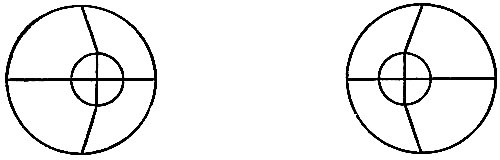
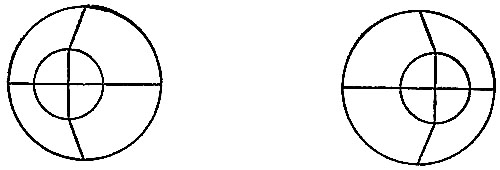
 the
difference is seen to be large. The question arises, Is the difference due
fundamentally to the locations of the two parts in the visual field? It
scarcely seems credible that visual perception innately appraises the
upper part larger than the lower, or the lower smaller than the upper part
when these small characters are seen in their accustomed position. It
appears to be possible that here we have examples of the effect of
learning or experience and that our adaptive visual sense has become
accustomed to overlook the actual difference. That is, for some reason
through being confronted with this difference so many times, the intellect
has become adapted to it and, therefore, has grown to ignore it.
Regardless of the explanation, the illusion exists and this is the point
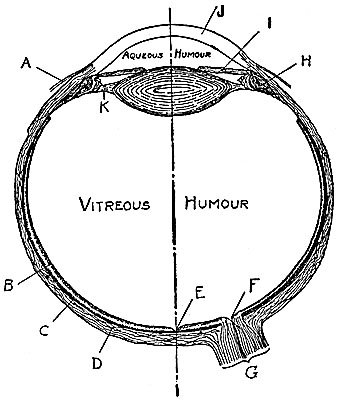
of chief interest. For the same reason the curvature of the retina does
not appear to account for illusion through distortion of the image,
because the training due to experience has caused greater difficulties
than this to disappear. We must not overlook the tremendous “corrective”
influence of experience upon which visual perception for the adult is
founded. If we have learned to “correct” in some cases, why not in all
cases which we have encountered quite generally?
the
difference is seen to be large. The question arises, Is the difference due
fundamentally to the locations of the two parts in the visual field? It
scarcely seems credible that visual perception innately appraises the
upper part larger than the lower, or the lower smaller than the upper part
when these small characters are seen in their accustomed position. It
appears to be possible that here we have examples of the effect of
learning or experience and that our adaptive visual sense has become
accustomed to overlook the actual difference. That is, for some reason
through being confronted with this difference so many times, the intellect
has become adapted to it and, therefore, has grown to ignore it.
Regardless of the explanation, the illusion exists and this is the point
of chief interest. For the same reason the curvature of the retina does
not appear to account for illusion through distortion of the image,
because the training due to experience has caused greater difficulties
than this to disappear. We must not overlook the tremendous “corrective”
influence of experience upon which visual perception for the adult is
founded. If we have learned to “correct” in some cases, why not in all
cases which we have encountered quite generally?