The weather soon cleared up, and I continued my journey to the Geyser
and to Mount Hecla on the 24th June. On the first day, when we rode
to Thingvalla, we passed no new scenery, but saw instead an extremely
beautiful atmospheric phenomenon.
As we approached the lake, some thin mist-clouds lowered over it and
over the earth, so that it seemed as if it would rain. One portion of
the firmament glowed with the brightest blue; while the other part was
obscured by thick clouds, through which the sun was just breaking.
Some of its rays reached the clouds of mist, and illuminated them in a
wonderfully beautiful manner. The most delicate shades of colour
seemed breathed, as it were, over them like a dissolving rainbow, whose
glowing colours were intermingled and yet singly perceptible. This
play of colours continued for half an hour, then faded gradually till it
vanished entirely, and the ordinary atmosphere took its place. It was
one of the most beautiful appearances I had ever witnessed.
June 25th.
The roads separate about a mile behind the little town of Thingvalla;
the one to the left goes to Reikholt, the right-hand one leads to the
Geyser. We rode for some time along the shores of the lake, and found
at the end of the valley an awful chasm in the rock, similar to the one of
Almanagiau, which we had passed on such a wretched road.
The contiguous valley bore a great resemblance to that of Thingvalla;
but the third one was again fearful. Lava covered it, and was quite
overgrown with that whitish moss, which has a beautiful appearance when it
only covers a portion of the lava, and when black masses rise above it, but
which here presented a most monotonous aspect.
We also passed two grottoes which opened at our feet. At the
entrance of one stood a pillar of rock supporting an immense slab of lava,
which formed an awe-inspiring portal. I had unfortunately not known
of the existence of these caves, and was consequently unprepared to visit
them. Torches, at least, would have been requisite. But I
subsequently heard that they were not at all deep, and contained nothing of
interest.
In the course of the day we passed through valleys such as I had seen
nowhere else in Iceland. Beautiful meadow-lawns, perfectly level,
covered the country for miles. These rich valleys were, of course,
tolerably well populated; we frequently passed three or four contiguous
cottages, and saw horses, cows, and sheep grazing on these fields in
considerable numbers.
The mountains which bounded these valleys on the left seemed to me very
remarkable; they were partly brown, black, or dark blue, like the others;
but the bulk of which they were composed I considered to be fine loam-soil
layers, if I may trust my imperfect mineralogical knowledge. Some of
these mountains were topped by large isolated lava rocks, real giants; and
it seemed inexplicable to me how they could stand on the soft soil
beneath.
In one of these valleys we passed a considerable lake, on and around
which rose circling clouds of steam proceeding from hot springs, but of no
great size. But after we had already travelled about twenty-five
miles, we came to the most remarkable object I had ever met with; this was
a river with a most peculiar bed.
This river-bed is broad and somewhat steep; it consists of lava strata,
and is divided lengthwise in the middle by a cleft eighteen to twenty feet
deep, and fifteen to eighteen feet broad, towards which the bubbling and
surging waters rush, so that the sound is heard at some distance. A
little wooden bridge, which stands in the middle of the stream, and over
which the high waves constantly play, leads over the chasm. Any one
not aware of the fact can hardly explain this appearance to himself, nor
understand the noise and surging of the stream. The little bridge in
the centre would be taken for the ruins of a fallen bridge, and the chasm
is not seen from the shore, because the foaming waves overtop it. An
indescribable fear would seize upon the traveller when he beheld the
venturous guide ride into the stream, and was obliged to follow without
pity or mercy.
The priest of Thingvalla had prepared me for the scene, and had advised
me to walk over the bridge; but as the water at this season stood so
high that the waves from both sides dashed two feet above the bridge, I
could not descend from my horse, and was obliged to ride across.
The whole passage through the stream is so peculiar, that it must be
seen, and can scarcely be described. The water gushes and plays on
all sides with fearful force; it rushes into the chasm with impetuous
violence, forms waterfalls on both sides, and breaks itself on the
projecting rocks. Not far from the bridge the cleft terminates; and
the whole breadth of the waters falls over rocks thirty to forty feet
high. The nearer we approached the centre, the deeper, more violent,
and impetuous grew the stream, and the more deafening was the noise.
The horses became restless and shy; and when we came to the bridge, they
began to tremble, they reared, they turned to all sides but the right one,
and refused to obey the bridle. With infinite trouble we at last
succeeded in bringing them across this dangerous place.
The valley which is traversed by this peculiar river is narrow, and
quite enclosed by lava mountains and hills; the inanimate, silent nature
around is perfectly adapted to imprint this scene for ever on the
traveller’s memory.
This remarkable stream had been the last difficulty; and now we
proceeded quietly and safely through the beautiful valleys till we
approached the Geyser, which a projecting hillock enviously concealed from
my anxiously curious gaze. At last this hillock was passed; and I saw
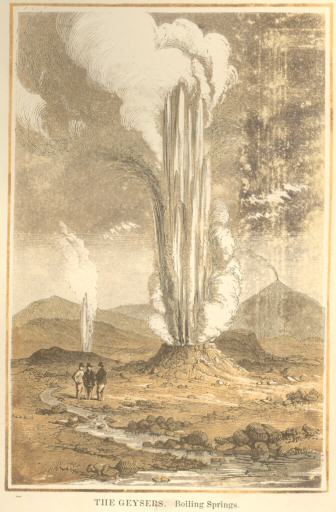
the Geyser with its surrounding scenery, with its immense steam pillars,
and the clouds and cloudlets rising from it. The hill was about two
miles distant from the Geyser and the other hot springs. There they
were, boiling and bubbling all around, and through the midst lay the road
to the basin. Eighty paces from it we halted.
And now I stood before the chief object of my journey; I saw it, it was
so near me, and yet I did not venture to approach it. But a peasant
who had followed us from one of the neighbouring cottages, and had probably
guessed my anxiety and my fear, took me by the hand and constituted himself
my cicerone. He had unfortunately, it being Sunday, paid too great a
devotion to the brandy-bottle, so that he staggered rather than walked, and
I hesitated to trust myself to the guidance of this man, not knowing
whether he had reason enough left to distinguish how far we might with
safety venture. My guide, who had accompanied me from Reikjavik,
assured me indeed that I might trust him in spite of his intoxication, and
that he would himself go with us to translate the peasant’s Icelandic
jargon into Danish; but nevertheless I followed with great trepidation.
He led me to the margin of the basin of the great Geyser, which lies on
the top of a gentle elevation of about ten feet, and contains the outer and
the inner basins. The diameter of the outer basin may be about thirty
feet; that of the inner one six to seven feet. Both were filled to
the brim, the water was pure as crystal, but boiled and bubbled only
slightly. We soon left this spot; for when the basins are quite
filled with water it is very dangerous to approach them, as they may empty
themselves any moment by an eruption. We therefore went to inspect
the other springs.
My unsteady guide pointed those out which we might unhesitatingly
approach, and warned me from the others. Then we returned to the
great Geyser, where he gave me some precautionary rules, in case of an
intervening eruption, and then left me to prepare some accommodation for my
stay. I will briefly enumerate the rules he gave me.
“The pillar of water always rises perpendicularly, and the
overflowing water has its chief outlets on one and the same side. The
water does indeed escape on the other side, but only in inconsiderable
quantities, and in shapeless little ducts, which one may easily
evade. On this side one may therefore approach within forty paces
even during the most violent eruptions. The eruption announces itself
by a dull roaring; and as soon as this is heard, the traveller must hastily
retire to the above-named distance, as the eruption always follows very
quickly after the noise. The water, however, does not rise high every
time, often only very inconsiderably, so that, to see a very fine
explosion, it is often necessary to stay some days here.”
The French scholar, M. P. Geimard, has provided for the accommodation of
travellers with a truly noble disinterestedness. He traversed the
whole of Iceland some years ago and left two large tents behind him; one
here, and the other in Thingvalla. The one here is particularly
appropriate, as travellers are frequently obliged, as stated above, to wait
several days for a fine eruption. Every traveller certainly owes M.
Geimard the warmest thanks for this convenience. A peasant, the same
who guides travellers to the springs, has the charge of it, and is bound to
pitch it for any one for a fee of one or two florins.
When my tent was ready it was nearly eleven o’clock. My
companions retired, and I remained alone.
It is usual to watch through the night in order not to miss an
eruption. Now, although an alternate watching is no very arduous
matter for several travellers, it became a very hard task for me alone, and
an Icelandic peasant cannot be trusted; an eruption of Mount Hecla would
scarcely arouse him.
I sat sometimes before and sometimes in my tent, and listened with
anxious expectation for the coming events; at last, after
midnight—the witching hour—I heard some hollow sounds, as if a
cannon were being fired at a great distance, and its echoing sounds were
borne by the breeze. I rushed from my tent and expected subterranean
noises, violent cracking and trembling of the earth, according to the
descriptions I had read. I could scarcely repress a slight sensation
of fear. To be alone at midnight in such a scene is certainly no
joke.
Many of my friends may remember my telling them, before my departure,
that I expected I should need the most courage on my Icelandic journey
during the nights at the Geyser.
These hollow sounds were repeated, at very short intervals, thirteen
times; and each time the basin overflowed and ejected a considerable
quantity of water. The sounds did not seem to proceed from
subterranean ragings, but from the violent agitation of the waters.
In a minute and a half all was over; the water no longer overflowed, the
caldron and basin remained filled, and I returned to my tent disappointed
in every way. This phenomenon was repeated every two hours and a
half, or, at the latest, every three hours and a half. I saw and
heard nothing else all night, the next day, or the second night. I
waited in vain for an eruption.
When I had accustomed myself to these temporary effusions of my
neighbour, I either indulged in a gentle slumber in the intermediate time,
or I visited the other springs and explored. I wished to discover the
boiling vapour and the coloured springs which many travellers assert they
have seen here.
All the hot-springs are united with a circumference of 800 to 900 paces:
several of them are very remarkable, but the majority insignificant.
They are situated in the angle of an immense valley at the foot of a
hill, behind which extends a chain of mountains. The valley is
entirely covered with grass, and the vegetation only decreases a little in
the immediate vicinity of the springs. Cottages are built every where
in the neighbourhood; the nearest to the springs are only about 700 to 800
paces distant.
I counted twelve large basins with boiling and gushing springs; of
smaller ones there were many more.
Among the gushing springs the Strokker is the most remarkable. It
boils and bubbles with most extraordinary violence at a depth of about
twenty feet, shoots up suddenly, and projects its waters into the
air. Its eruptions sometimes last half an hour, and the column
occasionally ascends to a height of forty feet. I witnessed several
of its eruptions; but unfortunately not one of the largest. The
highest I saw could not have been above thirty feet, and did not last more
than a quarter of an hour. The Strokker is the only spring, except
the Geyser, which has to be approached with great caution. The
eruptions sometimes succeed each other quickly, and sometimes cease for a
few hours, and are not preceded by any sign. Another spring spouts
constantly, but never higher than three to four feet. A third one
lies about four or five feet deep, in a rather broad basin, and produces
only a few little bubbles. But this calmness is deceptive: it seldom
lasts more than half a minute, rarely two or three minutes; then the spring
begins to bubble, to boil, and to wave and spout to a height of two or
three feet; without, however, reaching the level of the basin. In
some springs I heard boiling and foaming like a gentle bellowing; but saw
no water, sometimes not even steam, rising.
Two of the most remarkable springs which can perhaps be found in the
world are situated immediately above the Geyser, in two openings, which are
separated by a wall of rock scarcely a foot wide. This partition does
not rise above the surface of the soil, but descends into the earth; the
water boils slowly, and has an equable, moderate discharge. The
beauty of these springs consists in their remarkable transparency.
All the varied forms and caves, the projecting peaks, and edges of rock,
are visible far down, until the eye is lost in the depths of
darkness. But the greatest beauty of the spring is the splendid
colouring proceeding from the rock; it is of the tenderest, most
transparent, pale blue and green, and resembles the reflection of a Bengal
flame. But what is most strange is, that this play of colour proceeds
from the rock, and only extends eight to ten inches from it, while the
other water is colourless as common water, only more transparent, and
purer.
I could not believe it at first, and thought it must be occasioned by
the sun; I therefore visited the springs at different times, sometimes when
the sun shone brightly, sometimes when it was obscured by clouds, once even
after its setting; but the colouring always remained the same.
One may fearlessly approach the brink of these springs. The
platform which projects directly from them, and under which one can see in
all directions, is indeed only a thin ledge of rock, but strong enough to
prevent any accident. The beauty consists, as I have said, in the
magical illumination, and in the transparency, by which all the caves and
grottoes to the greatest depths become visible to the eye.
Involuntarily I thought of Schiller’s Diver. [40]
I seemed to see the goblet hang on the peaks and jags of the rock; I could
fancy I saw the monsters rise from the bottom. It must be a peculiar
pleasure to read this splendid poem in such an appropriate spot.
I found scarcely any basins of Brodem or coloured waters. The only
one of the kind which I saw was a small basin, in which a brownish-red
substance, rather denser than water, was boiling. Another smaller
spring, with dirty brown water, I should have quite overlooked, if I had
not so industriously searched for these curiosities.
At last, after long waiting, on the second day of my stay, on the 27th
June, at half-past eight in the morning, I was destined to see an eruption
of the Geyser in its greatest perfection. The peasant, who came daily
in the morning and in the evening to inquire whether I had already seen an
eruption, was with me when the hollow sounds which precede it were again
heard. We hastened out, and I again despaired of seeing any thing;
the water only overflowed as usual, and the sound was already
ceasing. But all at once, when the last sounds had scarcely died
away, the explosion began. Words fail me when I try to describe it:
such a magnificent and overpowering sight can only be seen once in a
lifetime.
All my expectations and suppositions were far surpassed. The water
spouted upwards with indescribable force and bulk; one pillar rose higher
than the other; each seemed to emulate the other. When I had in some
measure recovered from the surprise, and regained composure, I looked at
the tent. How little, how dwarfish it seemed as compared to the
height of these pillars of water! And yet it was about twenty feet
high. It did, indeed, lie ten feet lower than the basin of the
Geyser; but if tent had been raised above tent, these ten feet could only
be deducted once, and I calculated, though my calculation may not be
correct, that one would need to pile up five or six tents to have the
height of one of the pillars. Without exaggeration, I think the
largest spout rose above one hundred feet high, and was three to four feet
in diameter.
Fortunately I had looked at my watch at the beginning of the hollow
sounds, the forerunners of the eruption, for during its continuance I
should probably have forgotten to do so. The whole lasted four
minutes, of which the greater half must have been taken up by the eruption
itself.
When this wonderful scene was over, the peasant accompanied me to the
basin. We could now approach it and the boiler without danger, and
examine both at leisure. There was now nothing to fear; the water had
entirely disappeared from the outer basin. We entered it and
approached the inner basin, in which the water had sunk seven or eight
feet, where it boiled and bubbled fiercely.
With a hammer I broke some crust out of the outer as well as out of the
inner basin; the former was white, the latter brown. I also tasted
the water; it had not an unpleasant taste, and can only contain an
inconsiderable proportion of sulphur, as the steam does not even smell of
it.
I went to the basin of the Geyser every half hour to observe how much
time was required to fill it again. After an hour I could still
descend into the outer basin; but half an hour later the inner basin was
already full, and commenced to overflow. As long as the water only
filled the inner basin it boiled violently; but the higher it rose in the
outer one, the less it boiled, and nearly ceased when the basin was filled:
it only threw little bubbles here and there.
After a lapse of two hours—it was just noon—the basin was
filled nearly to the brim; and while I stood beside it the water began
again to bubble violently, and to emit the hollow sounds. I had
scarcely time to retreat, for the pillars of water rose immediately.
This time they spouted during the noise, and were more bulky than those of
the first explosion, which might proceed from their not rising so high, and
therefore remaining more compact. Their height may have been from
forty to fifty feet. The basins this time remained nearly as full
after the eruption as before.
I had now seen two eruptions of the Geyser, and felt amply compensated
for my persevering patience and watchfulness. But I was destined to
be more fortunate, and to experience its explosions in all their
variety. The spring spouted again at seven o’clock in the
evening, ascended higher than at noon, and brought up some stones, which
looked like black spots and points in the white frothy water-column.
And during the third night it presented itself under another phase: the
water rose in dreadful, quickly-succeeding waves, without throwing rays;
the basin overflowed violently, and generated such a mass of steam as is
rarely seen. The wind accidentally blew it to the spot where I stood,
and it enveloped me so closely that I could scarcely see a few feet
off. But I perceived neither smell nor oppression, merely a slight
degree of warmth.
June 28th.
As I had now seen the Geyser play so often and so beautifully, I ordered
my horses for nine o’clock this morning, to continue my
journey. I made the more haste to leave, as a Dutch prince was
expected, who had lately arrived at Reikjavik, with a large retinue, in a
splendid man-of-war.
I had the luck to see another eruption before my departure at half-past
eight o’clock; and this one was nearly as beautiful as the
first. This time also the outer basin was entirely emptied, and the
inner one to a depth of six or seven feet. I could therefore again
descend into the basin, and bid farewell to the Geyser at the very brink of
the crater, which, of course, I did.
I had now been three nights and two days in the immediate vicinity of
the Geyser, and had witnessed five eruptions, of which two were of the most
considerable that had ever been known. But I can assure my readers
that I did not find every thing as I had anticipated it according to the
descriptions and accounts I had read. I never heard a greater noise
than I have mentioned, and never felt any trembling of the earth, although
I paid the greatest attention to every little circumstance, and held my
head to the ground during an eruption.
It is singular how many people repeat every thing they hear from
others—how some, with an over-excited imagination, seem to see, hear,
and feel things which do not exist; and how others, again, tell the most
unblushing falsehoods. I met an example of this in Reikjavik, in the
house of the apothecary Möller, in the person of an officer of a
French frigate, who asserted that he had “ridden to the very edge of
the crater of Mount Vesuvius.” He probably did not anticipate
meeting any one in Reikjavik who had also been to the crater of
Vesuvius. Nothing irritates me so much as such falsehoods and
boastings; and I could not therefore resist asking him how he had managed
that feat. I told him that I had been there, and feared danger as
little as he could do; but that I had been compelled to descend from my
donkey near the top of the mountain, and let my feet carry me the remainder
of the journey. He seemed rather embarrassed, and pretended he had
meant to say nearly to the crater; but I feel convinced he will tell
this story so often that he will at last believe it himself.
I hope I do not weary my readers by dwelling so long on the subject of
the Geyser. I will now vary the subject by relating a few
circumstances that came under my notice, which, though trifling in
themselves, were yet very significant. The most unimportant facts of
an almost unknown country are often interesting, and are often most
conclusive evidences of the general character of the nation.
I have already spoken of my intoxicated guide. It is yet
inexplicable to me how he could have conducted me so safely in such a
semi-conscious state; and had he not been the only one, I should certainly
not have trusted myself to his guidance.
Of the want of cleanliness of the Icelanders, no one who has not
witnessed it can have any idea; and if I attempted to describe some of
their nauseous habits, I might fill volumes. They seem to have no
feeling of propriety, and I must, in this respect, rank them as far
inferior to the Bedouins and Arabs—even to the Greenlanders. I
can, therefore, not conceive how this nation could once have been
distinguished for wealth, bravery, and civilisation.
On this day I proceeded on my journey about twenty-eight miles farther
to Skalholt.
For the first five miles we retraced our former road; then we turned to
the left and traversed the beautiful long valley in which the Geyser is
situated. For many miles we could see its clouds of steam rising to
the sky. The roads were tolerable only when they passed along the
sides of hills and mountains; in the plains they were generally marshy and
full of water. We sometimes lost all traces of a road, and only
pushed on towards the quarter in which the place of our destination was
situated; and feared withal to sink at every pace into the soft and
unresisting soil.
I found the indolence of the Icelandic peasants quite
unpardonable. All the valleys through which we passed were large
morasses richly overgrown with grass. If the single parishes would
unite to dig trenches and drain the soil, they would have the finest
meadows. This is proved near the many precipices where the water has
an outlet; in these spots the grass grows most luxuriantly, and daisies and
herbs flourish there, and even wild clover. A few cottages are
generally congregated on these oases.
Before arriving at the village of Thorfastädir, we already
perceived Hecla surrounded by the beautiful jokuls.
I arrived at Thorfastädir while a funeral was going on. As I
entered the church the mourners were busily seeking courage and consolation
in the brandy-bottle. The law commands, indeed, that this be not done
in the church; but if every one obeyed the law, what need would there be of
judges? The Icelanders must think so, else they would discontinue the
unseemly practice.
When the priest came, a psalm or a prayer—I could not tell which
it was, being Icelandic—was so earnestly shouted by peasants under
the leadership of the priest and elders, that the good people waxed quite
warm and out of breath. Then the priest placed himself before the
coffin, which, for want of room, had been laid on the backs of the seats,
and with a very loud voice read a prayer which lasted more than half an
hour. With this the ceremony within the church was concluded, and the
coffin was carried round the church to the grave, followed by the priest
and the rest of the company. This grave was deeper than any I had
ever seen. When the coffin had been lowered, the priest threw three
handfuls of earth upon it, but none of the mourners followed his
example. Among the earth which had been dug out of the grave I
noticed four skulls, several human bones, and a board of a former
coffin. These were all thrown in again upon the coffin, and the grave
filled in presence of the priest and the people. One man trod the
soil firm, then a little mound was made and covered with grass-plots which
were lying ready. The whole business was completed with miraculous
speed.
The little town of Skalholt, my station this night, was once as
celebrated in religious matters as Thingvalla had been politically
famous. Here, soon after the introduction of Christianity, the first
bishopric was founded in 1098, and the church is said to have been one of
the largest and richest. Now Skalholt is a miserable place, and
consists of three or four cottages, and a wretched wooden church, which may
perhaps contain a hundred persons; it has not even its own priest, but
belongs to Thorfastädir.
My first business on arriving was to inspect the yet remaining relics of
past ages. First I was shewn an oil-picture which hangs in the
church, and is said to represent the first bishop of Skalholt, Thorlakur,
who was worshipped almost as a saint for his strict and pious life.
After this, preparations were made to clear away the steps of the altar
and several boards of the flooring. I stood expectantly looking on,
thinking that I should now have to descend into a vault to inspect the
embalmed body of the bishop. I must confess this prospect was not the
most agreeable, when I thought of the approaching night which I should have
to spend in this church, perhaps immediately over the grave of the old
skeleton. I had besides already had too much to do with the dead for
one day, and could not rid myself of the unpleasant grave-odour which I had
imbibed in Thorfastädir, and which seemed to cling to my dress and my
nose. [41] I was therefore not a little pleased when,
instead of the dreaded vault and mummy, I was only shewn a marble slab, on
which were inscribed the usual notifications of the birth, death, &c.
of this great bishop. Besides this, I saw an old embroidered stole
and a simple golden chalice, both of which are said to be relics of the age
of Thorlakar.
Then we ascended into the so-called store-room, which is only separated
from the lower portion of the church by a few boards, and which extends to
the altar. Here are kept the bells and the organ, if the church
possesses one, the provisions, and a variety of tools. They opened an
immense chest for me there, which seemed to contain only large pieces of
tallow made in the form of cheeses; but under this tallow I found the
library, where I discovered an interesting treasure. This was,
besides several very old books in the Icelandic tongue, three thick folio
volumes, which I could read very easily; they were German, and contained
Luther’s doctrines, letters, epistles, &c.
I had now seen all there was to be seen, and began to satisfy my
physical wants by calling for some hot water to make coffee, &c.
As usual, all the inhabitants of the place ranged themselves in and before
the church, probably to increase their knowledge of the human race by
studying my peculiarities. I soon, however, closed the door, and
prepared a splendid couch for myself. At my first entrance into the
church, I had noticed a long box, quite filled with sheep’s
wool. I threw my rugs over this, and slept as comfortably as in the
softest bed. In the morning I carefully teased the wool up again, and
no one could then have imagined where I had passed the night.
Nothing amused me more, when I had lodgings of this description, than
the curiosity of the people, who would rush in every morning, as soon as I
opened the door. The first thing they said to each other was always,
“Krar hefur hun sovid” (Where can she have slept?). The
good people could not conceive how it was possible to spend a night
alone in a church surrounded by a churchyard; they perhaps
considered me an evil spirit or a witch, and would too gladly have
ascertained how such a creature slept. When I saw their disappointed
faces, I had to turn away not to laugh at them.
June 29th.
Early the next morning I continued my journey. Not far from
Skalholt we came to the river Thiorsa, which is deep and rapid. We
crossed in a boat; but the horses had to swim after us. It is often
very troublesome to make the horses enter these streams; they see at once
that they will have to swim. The guide and boatmen cannot leave the
shore till the horses have been forced into the stream; and even then they
have to throw stones, to threaten them with the whip, and to frighten them
by shouts and cries, to prevent them from returning.
When we had made nearly twelve miles on marshy roads, we came to the
beautiful waterfall of the Huitha. This fall is not so remarkable for
its height, which is scarcely more than fifteen to twenty feet, as for its
breadth, and for its quantity of water. Some beautiful rocks are so
placed at the ledge of the fall, that they divide it into three parts; but
it unites again immediately beneath them. The bed of the river, as
well as its shores, is of lava.
The colour of the water is also a remarkable feature in this river; it
inclines so much to milky white, that, when the sun shines on it, it
requires no very strong imaginative power to take the whole for milk.
Nearly a mile above the fall we had to cross the Huitha, one of the
largest rivers in Iceland. Thence the road lies through meadows,
which are less marshy than the former ones, till it comes to a broad stream
of lava, which announces the vicinity of the fearful volcano of Hecla.
I had hitherto not passed over such an expanse of country in Iceland as
that from the Geyser to this place without coming upon streams of
lava. And this lava-stream seemed to have felt some pity for the
beautiful meadows, for it frequently separated into two branches, and thus
enclosed the verdant plain. But it could not withstand the violence
of the succeeding masses; it had been carried on, and had spread death and
destruction everywhere. The road to it, through plains covered with
dark sand, and over steep hills intervening, was very fatiguing and
laborious.
We proceeded to the little village of Struvellir, where we stopped to
give our horses a few hours’ rest. Here we found a large
assembly of men and animals. [42] It happened to be Sunday, and a warm sunny
day, and so a very full service was held in the pretty little church.
When it was over, I witnessed an amusing rural scene. The people
poured out of the church,—I counted ninety-six, which is an
extraordinarily numerous assemblage for Iceland,—formed into little
groups, chatting and joking, not forgetting, however, to moisten their
throats with brandy, of which they had taken care to bring an ample
supply. Then they bridled their horses and prepared for departure;
now the kisses poured in from all sides, and there was no end of
leave-taking, for the poor people do not know whether they shall ever meet
again, and when.
In all Iceland welcome and farewell is expressed by a loud kiss,—a
practice not very delightful for a non-Icelander, when one considers their
ugly, dirty faces, the snuffy noses of the old people, and the filthy
little children. But the Icelanders do not mind this. They all
kissed the priest, and the priest kissed them; and then they kissed each
other, till the kissing seemed to have no end. Rank is not considered
in this ceremony; and I was not a little surprised to see how my guide, a
common farm-labourer, kissed the six daughters of a judge, or the wife and
children of a priest, or a judge and the priest themselves, and how they
returned the compliment without reserve. Every country has its
peculiar customs!
The religious ceremonies generally begin about noon, and last two or
three hours. There being no public inn in which to assemble, and no
stable in which the horses can be fastened, all flock to the open space in
front of the church, which thus becomes a very animated spot. All
have to remain in the open air.
When the service was over, I visited the priest, Herr Horfuson; he was
kind enough to conduct me to the Sälsun, nine miles distant,
principally to engage a guide to Hecla for me.
I was doubly rejoiced to have this good man at my side, as we had to
cross a dangerous stream, which was very rapid, and so deep that the water
rose to the horses’ breasts. Although we raised our feet as
high as possible, we were yet thoroughly wet. This wading across
rivers is one of the most unpleasant modes of travelling. The horse
swims more than it walks, and this creates a most disagreeable sensation;
one does not know whither to direct one’s eyes; to look into the
stream would excite giddiness, and the sight of the shore is not much
better, for that seems to move and to recede, because the horse, by the
current, is forced a little way down the river. To my great comfort
the priest rode by my side to hold me, in case I should not be able to keep
my seat. I passed fortunately through this probation; and when we
reached the other shore, Herr Horfuson pointed out to me how far the
current had carried us down the river.
The valley in which Sälsun and the Hecla are situated is one of
those which are found only in Iceland. It contains the greatest
contrasts. Here are charming fields covered with a rich green carpet
of softest grass, and there again hills of black, shining lava; even the
fertile plains are traversed by streams of lava and spots of sand.
Mount Hecla notoriously has the blackest lava and the blackest sand; and it
may be imagined how the country looks in its immediate neighbourhood.
One hill only to the left of Hecla is reddish brown, and covered with sand
and stones of a similar colour. The centre is much depressed, and
seems to form a large crater. Mount Hecla is directly united with the
lava-mountains piled round it, and seems from the plain only as a higher
point. It is surrounded by several glaciers, whose dazzling fields of
snow descend far down, and whose brilliant plains have probably never been
trod by human feet; several of its sides were also covered with snow.
To the left of the valley near Sälsun, and at the foot of a lava-hill,
lies a lovely lake, on whose shores a numerous flock of sheep were
grazing. Near it rises another beautiful hill, so solitary and
isolated, that it looks as if it had been cast out by its neighbours and
banished hither. Indeed, the whole landscape here is so peculiarly
Icelandic, so strange and remarkable, that it will ever remain impressed on
my memory.
Sälsun lies at the foot of Mount Hecla, but is not seen before one
reaches it.
Arrived at Sälsun, our first care was to seek a guide, and to
bargain for every thing requisite for the ascension of the mountain.
The guide was to procure a horse for me, and to take me and my former guide
to the summit of Hecla. He demanded five thaler and two marks (about
fifteen shillings), a most exorbitant sum, on which he could live for a
month. But what could we do? He knew very well that there was
no other guide to be had, and so I was forced to acquiesce. When all
was arranged, my kind companion left me, wishing me success on my arduous
expedition.
I now looked out for a place in which I could spend the night, and a
filthy hole fell to my lot. A bench, rather shorter that my body, was
put into it, to serve as my bed; beside it hung a decayed fish, which had
infected the whole room with its smell. I could scarcely breathe; and
as there was no other outlet, I was obliged to open the door, and thus
receive the visits of the numerous and amiable inhabitants. What a
strengthening and invigorating preparation for the morrow’s
expedition!
At the foot of Mount Hecla, and especially in this village, every thing
seems to be undermined. Nowhere, not even on Mount Vesuvius, had I
heard such hollow, droning sounds as here,—the echoes of the heavy
footsteps of the peasants. These sounds made a very awful impression
on me as I lay all night alone in that dark hole.
My Hecla guide, as I shall call him to distinguish him from my other
guide, advised me to start at two o’clock in the morning, to which I
assented, well knowing, however, that we should not have mounted our horses
before five o’clock.
As I had anticipated, so it happened. At half-past five we were
quite prepared and ready for departure. Besides bread and cheese, a
bottle of water for myself, and one of brandy for my guides, we were also
provided with long sticks, tipped with iron points to sound the depth of
the snow, and to lean upon.
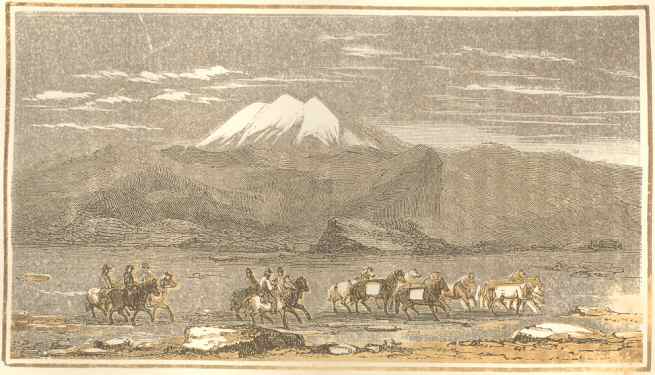
We were favoured by a fine warm sunny morning, and galloped briskly over
the fields and the adjoining plains of sand. My guide considered the
fine weather a very lucky omen, and told me that M. Geimard, the
before-mentioned French scholar, had been compelled to wait three days for
fine weather. Nine years had elapsed, and no one had ascended the
mountain since then. A prince of Denmark, who travelled through
Iceland some years before, had been there, but had returned without
effecting his purpose.
Our road at first led us through beautiful fields, and then over plains
of black sand enclosed on all sides by streams, hillocks, and mountains of
piled-up lava. Closer and closer these fearful masses approach, and
scarcely permit a passage through a narrow cleft; we had to climb over
blocks and hills of lava, where it is difficult to find a firm
resting-place for the foot. The lava rolled beside and behind us, and
we had to proceed carefully not to fall or be hit by the rolling
lava. But most dangerous were the chasms filled with snow over which
we had to pass; the snow had been softened by the warmth of the season, so
that we sank into it nearly every step, or, what was worse, slipped back
more than we had advanced. I scarcely think there can be another
mountain whose ascent offers so many difficulties.
After a labour of about three hours and a half we neared the summit of
the mountain, where we were obliged to leave our horses. I should,
indeed, have preferred to do so long before, as I was apprehensive of the
poor animals falling as they climbed over these precipices—one might
almost call them rolling mountains—but my guide would not permit
it. Sometimes we came to spots where they were useful, and then he
maintained that I must ride as far as possible to reserve my strength for
the remaining difficulties. And he was right; I scarcely believe I
should have been able to go through it on foot, for when I thought we were
near the top, hills of lava again rose between us, and we seemed farther
from our journey’s end than before.
My guide told me that he had never taken any one so far on horseback,
and I can believe it. Walking was bad enough—riding was
fearful.
At every fresh declivity new scenes of deserted, melancholy districts
were revealed to us; every thing was cold and dead, every where there was
black burnt lava. It was a painful feeling to see so much, and behold
nothing but a stony desert, an immeasurable chaos.
There were still two declivities before us,—the last, but the
worst. We had to climb steep masses of lava, sharp and pointed, which
covered the whole side of the mountain. I do not know how often I
fell and cut my hands on the jagged points of the lava. It was a
fearful journey!
The dazzling whiteness of the snow contrasted with the bright black lava
beside it had an almost blinding effect. When crossing fields of snow
I did not look at the lava; for having tried to do so once or twice, I
could not see my way afterwards, and had nearly grown snow-blind.
After two hours’ more labour we reached the summit of the
mountain. I stood now on Mount Hecla, and eagerly sought the crater
on the snowless top, but did not find it. I was the more surprised,
as I had read detailed accounts of it in several descriptions of
travel.
I traversed the whole summit of the mountain and climbed to the
adjoining jokul, but did not perceive an opening, a fissure, a depressed
space, nor any sign of a crater. Lower down in the sides of the
mountain, but not in the real cone, I saw some clefts and fissures from
which the streams of lava probably poured. The height of the mountain
is said to be 4300 feet.
During the last hour of our ascent the sun had grown dim. Clouds
of mist blown from the neighbouring glaciers enshrouded the hill-tops, and
soon enveloped us so closely that we could scarcely see ten paces before
us. At last they dissolved, fortunately not in rain but in snow,
which profusely covered the black uneven lava. The snow remained on
the ground, and the thermometer stood at one degree of cold.
In a little while the clear blue sky once more was visible, and the sun
again shone over us. I remained on the top till the clouds had
separated beneath us, and afforded me a better distant view over the
country.
My pen is unfortunately too feeble to bring vividly before my readers
the picture such as I beheld it here, and to describe to them the
desolation, the extent and height of these lava-masses. I seemed to
stand in a crater, and the whole country appeared only a burnt-out
fire. Here lava was piled up in steep inaccessible mountains; there
stony rivers, whose length and breadth seemed immeasurable, filled the
once-verdant fields. Every thing was jumbled together, and yet the
course of the last eruption could be distinctly traced.
I stood there, in the centre of horrible precipices, caves, streams,
valleys, and mountains, and scarcely comprehended how it was possible to
penetrate so far, and was overcome with terror at the thought which
involuntarily obtruded itself—the possibility of never finding my way
again out of these terrible labyrinths.
Here, from the top of Mount Hecla, I could see far into the uninhabited
country, the picture of a petrified creation, dead and motionless, and yet
magnificent,—a picture which once seen can never again fade from the
memory, and which alone amply compensates for all the previous troubles and
dangers. A whole world of glaciers, lava-mountains, snow and
ice-fields, rivers and lakes, into which no human foot has ever ventured to
penetrate. How nature must have laboured and raged till these forms
were created! And is it over now? Has the destroying element
exhausted itself; or does it only rest, like the hundred-headed Hydra, to
break forth with renewed strength, and desolate those regions which, pushed
to the verge of the sea-shore, encircle the sterile interior as a modest
wreath? I thank God that he has permitted me to behold this chaos in
his creation; but I thank him more heartily that he has placed me to dwell
in regions where the sun does more than merely give light; where it
inspires and fertilises animals and plants, and fills the human heart with
joy and thankfulness towards its Creator. [43]
The Westmann Isles, which are said to be visible from the top of Hecla,
I could not see; they were probably covered by clouds.
During the ascent of the Hecla I had frequently touched
lava,—sometimes involuntarily, when I fell; sometimes voluntarily, to
find a hot or at least a warm place. I was unfortunate enough only to
find cold ones. The falling snow was therefore most welcome, and I
looked anxiously around to see a place where the subterranean heat would
melt it. I should then have hastened thither and found what I
sought. But unfortunately the snow remained unmelted every
where. I could neither see any clouds of smoke, although I gazed
steadily at the mountain for hours, and could from my post survey it far
down the sides.
As we descended we found the snow melting at a depth of 500 to 600 feet;
lower down, the whole mountain smoked, which I thought was the consequence
of the returning warmth of the sun, for my thermometer now stood at nine
degrees of heat. I have noticed the same circumstance often on
unvolcanic mountains. The spots from which the smoke rose were also
cold.
The smooth jet-black, bright, and dense lava is only found on the
mountain itself and in its immediate vicinity. But all lava is not
the same: there is jagged, glassy, and porous lava; the former is black,
and so is the sand which covers one side of Hecla. The farther the
lava and sand are from the mountain, the more they lose this blackness, and
their colour plays into iron-colour and even into light-grey; but the
lighter-coloured lava generally retains the brightness and smoothness of
the black lava.
After a troublesome descent, having spent twelve hours on this
excursion, we arrived safely at Sälsun; and I was on the point of
returning to my lodging, somewhat annoyed at the prospect of spending
another night in such a hole, when my guide surprised me agreeably by the
proposition to return to Struvellir at once. The horses, he said,
were sufficiently rested, and I could get a good room there in the
priest’s house. I soon packed, and in a short time we were
again on horseback. The second time I came to the deep Rangaa, I rode
across fearlessly, and needed no protection at any side. Such is man:
danger only alarms him the first time; when he has safely surmounted it
once, he scarcely thinks of it the second time, and wonders how he can have
felt any fear.
I saw five little trees standing in a field near the stream. The
stems of these, which, considering the scarcity of trees in Iceland, may be
called remarkable phenomena, were crooked and knotty, but yet six or seven
feet high, and about four or five inches in diameter.
As my guide had foretold, I found a very comfortable room and a good bed
in the priest’s house. Herr Horfuson is one of the best men I
have ever met with. He eagerly sought opportunities for giving me
pleasure, and to him I owe several fine minerals and an Icelandic book of
the year 1601. May God reward his kindness and benevolence!
July 1st.
We retraced our steps as far as the river Huitha, over which we rowed,
and then turned in another direction. Our journey led us through
beautiful valleys, many of them producing abundance of grass; but
unfortunately so much moss grew among it, that these large plains were not
available for pastures, and only afforded comfort to travellers by their
aspect of cheerfulness. They were quite dry.
The valley in which Hjalmholm, our resting-place for this night, was
situated, is traversed by a stream of lava, which had, however, been modest
enough not to fill up the whole valley, but to leave a space for the pretty
stream Elvas, and for some fields and hillocks, on which many cottages
stood. It was one of the most populous valleys I had seen in
Iceland.
Hjalmholm is situated on a hill. In it lives the Sysselmann of the
Rangaar district, in a large and beautiful house such as I saw no where in
Iceland except in Reikjavik. He had gone to the capital of the island
as member of the Allthing; but his daughters received me very hospitably
and kindly.
We talked and chatted much; I tried to display my knowledge of the
Danish language before them, and must often have made use of curious
phrases, for the girls could not contain their laughter. But that did
not abash me; I laughed with them, applied to my dictionary, which I
carried with me, and chatted on. They seemed to gather no very high
idea of the beauty of my countrywomen from my personal appearance; for
which I humbly crave the forgiveness of my countrywomen, assuring them that
no one regrets the fact more than I do. But dame Nature always treats
people of my years very harshly, and sets a bad example to youth of the
respect due to age. Instead of honouring us and giving us the
preference, she patronises the young folks, and every maiden of sixteen can
turn up her nose at us venerable matrons. Besides my natural
disqualifications, the sharp air and the violent storms to which I had been
subjected had disfigured my face very much. They had affected me more
than the burning heat of the East. I was very brown, my lips were
cracked, and my nose, alas, even began to rebel against its ugly
colour. It seemed anxious to possess a new, dazzling white, tender
skin, and was casting off the old one in little bits.
The only circumstance which reinstated me in the good opinion of the
young girls was, that having brushed my hair unusually far out of my face,
a white space became visible. The girls all cried out simultaneously,
quite surprised and delighted: “Hun er quit” (she is
white). I could not refrain from laughing, and bared my arm to prove
to them that I did not belong to the Arab race.
A great surprise was destined me in this house; for, as I was ransacking
the Sysselmann’s book-case, I found Rotteck’s Universal
History, a German Lexicon, and several poems and writings of German
poets.
July 2d.
The way from Kalmannstunga to Thingvalla leads over nothing but lava,
and the one to-day went entirely through marshes. As soon as we had
crossed one, another was before us. Lava seemed to form the soil
here, for little portions of this mineral rose like islands out of the
marshes.
The country already grew more open, and we gradually lost sight of the
glaciers. The high mountains on the left seemed like hills in the
distance, and the nearer ones were really hills. After riding about
nine miles we crossed the large stream of Elvas in a boat, and then had to
tread carefully across a very long, narrow bank, over a meadow which was
quite under water. If a traveller had met us on this bank, I do not
know what we should have done; to turn round would have been as dangerous
as to sink into the morass. Fortunately one never meets any
travellers in Iceland.
Beyond the dyke the road runs for some miles along the mountains and
hills, which all consist of lava, and are of a very dark, nearly black
colour. The stones on these hills were very loose; in the plain below
many colossal pieces were lying, which must have fallen down; and many
others threatened to fall every moment. We passed the dangerous spot
safely, without having had to witness such a scene.
I often heard a hollow sound among these hills; I at first took it for
distant thunder, and examined the horizon to discover the approaching
storm. But when I saw neither clouds nor lightning, I perceived that
I must seek the origin of the sounds nearer, and that they proceeded from
the falling portions of rock.
The higher mountains to the left fade gradually more and more from view;
but the river Elvas spreads in such a manner, and divides into so many
branches, that one might mistake it for a lake with many islands. It
flows into the neighbouring sea, whose expanse becomes visible after
surmounting a few more small hills.
The vale of Reikum, which we now entered, is, like that of Reikholt,
rich in hot springs, which are congregated partly in the plain, partly on
or behind the hills, in a circumference of between two and three miles.
When we had reached the village of Reikum I sent my effects at once to
the little church, took a guide, and proceeded to the boiling
springs. I found very many, but only two remarkable ones; these,
however, belong to the most noteworthy of their kind. The one is
called the little Geyser, the other the Bogensprung.
The little Geyser has an inner basin of about three feet diameter.
The water boils violently at a depth of from two to three feet, and remains
within its bounds till it begins to spout, when it projects a beautiful
voluminous steam of from 20 to 30 feet high.
At half-past eight in the evening I had the good fortune to see one of
these eruptions, and needed not, as I had done at the great Geyser, to
bivouac near it for days and nights. The eruption lasted some time,
and was tolerably equable; only sometimes the column of water sank a
little, to rise to its former height with renewed force. After forty
minutes it fell quite down into the basin again. The stones we threw
in, it rejected at once, or in a few seconds, shivered into pieces, to a
height of about 12 to 15 feet. Its bulk must have been 1 to 1½
feet in diameter. My guide assured me that this spring generally
plays only twice, rarely thrice, in twenty-four hours, and not, as I have
seen it stated, every six minutes. I remained near it till midnight,
but saw no other eruption.
This spring very much resembles the Strukker near the great Geyser, the
only difference being that the water sinks much lower in the latter.
The second of the two remarkable springs, the arched spring, is situated
near the little Geyser, on the declivity of a hill. I had never seen
such a curious formation for the bed of a spring as this is. It has
no basin, but lies half open at your feet, in a little grotto, which is
separated into various cavities and holes, and which is half-surrounded by
a wall of rock bending over it slightly at a height of about 2 feet, and
then rises 10 to 12 feet higher. This spring never is at rest more
than a minute; then it begins to rise and boil quickly, and emits a
voluminous column, which, striking against the projecting rock, is
flattened by it, and rises thence like an arched fan. The height of
this peculiarly-spread jet of water may be about 12 feet, the arch it
describes 15 to 20 feet, and its breadth 3 to 8 feet. The time of
eruption is often longer than that of repose. After an eruption the
water always sinks a few feet into the cave, and for 15 or 20 seconds
admits of a glance into this wonderful grotto. But it rises again
immediately, fills the grotto and the basin, which is only a continuation
of the grotto, and springs again.
I watched this miraculous play of nature for more than an hour, and
could not tear myself from it. This spring, which is certainly the
only one of its kind, gratified me much more than the little Geyser.
There is another spring called the roaring Geyser; but it is nothing
more than a misshapen hole, in which one hears the water boil, but cannot
see it. The noise is, also, not at all considerable.
July 3d.
Near Reikum we crossed a brook into which all the hot springs flow, and
which has a pretty fall. We then ascended the adjoining mountain, and
rode full two hours on the high plain. The plain itself was
monotonous, as it was only covered with lava-stones and moss, but the
prospect into the valley was varied and beautiful. Vale and sea were
spread before me, and I saw the Westmann Islands, with their beautiful
hills, which the envious clouds had concealed from me on the Hecla, lying
in the distance. Below me stood some houses in the port-town,
Eierbach, and near them the waters of the Elvas flow into the sea.
At the end of this mountain-level a valley was situated, which was also
filled with lava, but with that jagged black lava which presents such a
beautiful appearance. Immense streams crossed it from all sides, so
that it almost resembled a black lake separated from the sea by a chain of
equally black mountains.
We descended into this sombre vale through piles of lava and fields of
snow, and went on through valleys and chasms, over fields of lava, plains
of meadow-land, past dark mountains and hills, till we reached the chief
station of my Icelandic journey, the town of Reikjavik.
The whole country between Reikum and Reikjavik, a distance of 45 to 50
miles, is, for the most part, uninhabited. Here and there, in the
fields of lava, stand little pyramids of the same substance, which serve as
landmarks; and there are two houses built for such persons as are obliged
to travel during the winter. But we found much traffic on the road,
and often overtook caravans of 15 to 20 horses. Being the beginning
of August, it was the time of trade and traffic in Iceland. Then the
country people travel to Reikjavik from considerable distances, to change
their produce and manufactures, partly for money, partly for necessaries
and luxuries. At this period the merchants and factors have not hands
enough to barter the goods or close the accounts which the peasants wish to
settle for the whole year.
At this season an unusual commotion reigns in Reikjavik. Numerous
groups of men and horses fill the streets; goods are loaded and unloaded;
friends who have not met for a year or more welcome each other, others take
leave. On one spot curious tents [44] are erected, before which
children play; on another drunken men stagger along, or gallop on
horseback, so that one is terrified, and fears every moment to see them
fall.
This unusual traffic unfortunately only lasts six or eight days.
The peasant hastens home to his hay-harvest; the merchant must quickly
regulate the produce and manufactures he has purchased, and load his ships
with them, so that they may sail and reach their destination before the
storms of the autumnal equinox.
|
|
Miles.
|
|
From Reikjavik to Thingvalla is
|
45
|
|
From Thingvalla to the Geyser
|
36
|
|
From the Geyser to Skalholt
|
28
|
|
From Skalholt to Sälsun
|
36
|
|
From Sälsun to Struvellir
|
9
|
|
From Struvellir to Hjalmholm
|
28
|
|
From Hjalmholm to Reikum
|
32
|
|
From Reikum to Reikjavik
|
45
|
|
|
259
|


