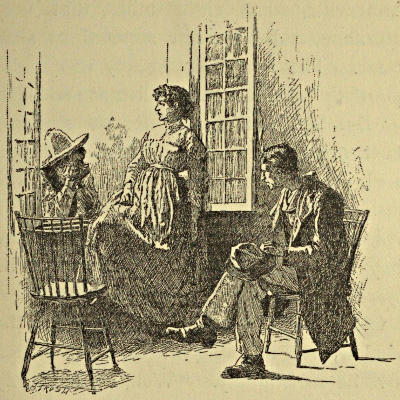
“It’s a girl,” said Roden, laying a wager
with himself. “No; it’s a boy.
Hanged if it isn’t a girl!” He took his
short brier-wood pipe from his mouth,
knocked out its contents against the side
of the wagon, and pocketed it.
The time of the year was January, the
scene a country road in Virginia, and it
was drizzling, a thick Scotch drizzle, abetted
by a lusty east wind. Even the branches
of the straggling locust-trees that lined
the red road seemed clogged with it. It
hung in folds upon the sides of the mountains,
and was blown in masses between the
clefts of the rolling meadows.
Roden was not only a new arrival in
Virginia, but in America, and the impression
made upon him had not, to speak
very moderately, been favorable. Coming
from Washington, some one in the train
had asked him if it did not remind him
of England. He had answered with some
curtness that it did not, demanding at the
same time why he should be particularly
reminded of England by the state of the
weather in Virginia. His interlocutor had
replied with the never-failing urbanity of
the Virginian farmer, that “anybody could
tell he was an Englisher by th’ way he
talked, and them loose pants.”
At the moment he first saw the figure
alluded to, the owner of the British accent
and the “loose pants” was shivering
in spite of the top-coat turned up about
his ears and the soft hat pulled down to
meet it.
It was indeed a girl; she wore a soft
hat, the counterpart of his own, fashioned
of the same stuff as her dark-gray jacket
and the kirtle which reached just below her
knees. On her legs were shooting-gaiters
of russet leather, decidedly influenced as to
color by the tyrannic soil, and on her feet
stout cowhide boots. She carried a gun
on her shoulder, and a game-bag hung
at her side. She further appeared to be
bounded on the east, west, north, and south
by dogs. An old mastiff lounged sulkily
at her heels. Far in front, a collie gave
chase to a stately buzzard, which sailed
away undisturbed by its pursuer’s shrill
barking, while an asthmatic pug sought a
Juggernautal fate between the ponderous
wagon-wheels, and a little black-and-tan terrier,
sniffing hither and thither among the
mist-drenched weeds, reminded Roden of
the accounts of certain mammoth ants as
related by the credulous Herodotus.
The girl, who had been walking with
head bent, looked up as the creaking of
the wagon-wheels arrested her attention.
“I beg your pardon,” said Roden, “but
can you tell me if I am on the right road
to Caryston Hall? I think that’s the
name.”
She looked at him seriously for a moment,
and then said, “Yes, you are. I
s’pose you’re th’ new Englishman. Are
you?”
“I suppose so,” said Roden. “My name
is Roden. I have bought a farm somewhere
in this neighborhood, and it is called
Caryston Hall.”
“That’s it,” she said; “you’re right. My
father’s th’ overseer there. Why don’t you
get down and walk? You look so cold.
I’ll show you.”
“Thank you,” said Roden; “I think I
will;” and he jumped down beside her.
Judging by her attire, he had at first
thought her a sporting country-woman of
his own, like himself an exile in a far country;
but after she had spoken he found that
the soft, slow intonation was strange to his
ear. “The overseer business explains it,”
he thought. “She is a native, and this language
is Virginian.” In the mean time
the girl was also making mental observations.
He was the third English gentleman
she had seen, though of immigrant
Britishers she had known full threescore
and ten. She was thinking that he had
spoken to her with an unusual civility, and
wondering how long it would continue.
Civility this young Virginian had not
found to be a characteristic of the British
settler in her native State.
“I’m very lucky to have met you,” said
Roden, as they walked on, having dismissed
the services of the ancient wagoner,
whom the girl addressed as “Unc’ Dick.”
“I would like to ask you some questions
about the place, and it’s awfully kind of you
to go back with me.”
She said, indifferently, and without lifting
her eyes this time, “Oh, I was goin’
back anyway! ’Tisn’t any bother.”
Her long strides matched Roden’s exactly,
and the rapid motion through the stiffly
yielding medium under foot began to warm
his veins. They saw the serpentine flourish
of Unc’ Dick’s voluminous whip-lash
outlined against the pale sky as the wagon
descended a hill just in front of them.
Two more buzzards appeared, slanting in
still absorption towards the west. Instantly
the collie was after them.
“Why didn’t you telegraph?” said the
girl, suddenly.
“I did,” said Roden, with some grimness.
“I telegraphed twice. I also had the pleasure
of rereading both telegrams when I arrived
at the station about an hour ago.”
“Seems to me,” she said, turning to look
over her shoulder at the mastiff, pug, and
terrier, that were having a tow-row over an
old shoe (which same seem to be sown in
lieu of corn in the thorns by the Virginian
way-side)—“Seems to me that letters reach
us twice as quick as telegrams, anyhow.
You must have thought it funny we didn’t
send for you?”
“I don’t know that I found it very amusing,”
said Roden, truthfully, adding, in a
tone of helpless aggravation, “All my luggage
was left behind in Washington.”
At this direct appeal the overseer’s
daughter at first looked as sorrowful as
even Roden could have desired, bursting
the next moment into peals and roulades
of laughter. Roden, after the first sharp
inclination to feel angry, joined in her
mirth.
“Pore feller!” she said at last, taking off
her rain-soaked hat, on which she appeared
to dry her brimming eyes—“Pore feller!
it all seems awful to you out here, don’t it?”
“It does,” said Roden in his heart, but
out loud he replied with mendacious civility
that it did not. He was, moreover, occupied
in a close scrutiny of her uncovered
locks. They were of a pale golden color,
lying close to her forehead in thick, round
rings, after the manner of a child’s, and
clustering heavily, with the dampness. As
he stood beside her he saw also that she
was very tall, taller than most tall women,
and that her fair throat, rising boy-like from
a dark-red kerchief, had unusual suggestions
of muscle beneath its smooth surface.
Presently they walked on. The top of a
tolerably high hill was soon reached, surmounted,
as Roden at first thought, by an
almost impenetrable thicket. As they approached
nearer, however, he perceived an
aperture in the mass of foliage, and a long
wooden gate, hanging by one hinge in an
aimless, desultory manner, and ornamented
also as to its dingy gray with copious
splashes of red mud. On either post were
rusty iron vases, wherefrom there sprouted
two stunted specimens of the aloe tribe.
One of these vases, having been broken
some years before, hung over to one side
with a suggestion of inanimate sentimentality
highly ludicrous. Some kind Samaritan
had thrust a stick in between its disabled
joints, thus preventing it from utter
downfall.
The view beyond the gate was unique,
and to Roden rather pleasant after his
morning’s experience. The lawn proper
was shaped like a lady’s slipper, and outlined
by a gravel carriage-drive. It seemed
as though some Titaness might have
set a careless foot among the surrounding
shrubbery, crushing out of existence all
save a bordering fringe of evergreen and
acacias. The long, low house of red brick—with
wings out-spread after a protective,
hen-like fashion in the direction of the
many out-houses—was to be seen through
the bare branches of two splendid tulip-trees.
A little Alderney heifer was grazing
near the portico, and some dorkings
stood resignedly on long yellow legs under
the shelter of the large box-bushes.
As they worked along the sinuous carriage-way
Roden looked with a feeling of
ownership at the glimpses of distant hill
and forest, as visible through the crowding
tree-stems. Here he was to make his
home for at least the next two years, and
he was glad not to find it so bad as he
had expected.
As she opened the hall door the girl
said to him, “Father won’t be here until
six o’clock. I’ll have you some dinner ef
you want it. But you’d better go to your
room first, hadn’t you, you’re so wet?—I’ll
send you some things the larst Englishman
left behind him. There’s a barth
ready, and plenty of towels. I’m used to
fixin’ for you English, you see. Well, good-by
till you’re dressed; then I’ll show you
over the house.”
“I CAN’T COME TO DINNER.”
She sent a little “nigger,” who conducted
him with wordless dignity to the apartment
allotted him, and who some five minutes
later returned again with the “last
Englishman’s things.” That personage
must have been of very slight proportions
and medium height, whereas Roden stood
six foot one in his stockings, and was of
excellent figure. He struggled for some
time with the meagre garments, and then
decided that he could not put in an appearance
until his own garments should be dry.
At this moment some one knocked at the
door with the announcement—“Dinner
rade-y.”
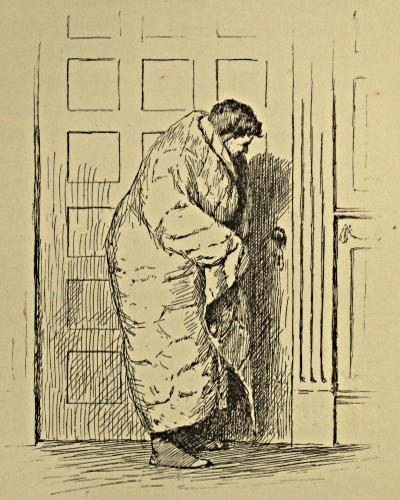
“I can’t come to dinner,” said Roden at
the key-hole. “The clothes won’t fit me.
Say I am very sorry.”
The departing footsteps echoed down
the narrow corridor that led to the room
which had been given him, and Roden, who
had taken the silk coverlet from the bed
and rolled himself in it, stretched out before
the fire of pine cones in the big fireplace.
The room was large and square,
and had hangings of faded green silk embroidered
with tarnished gold. A ponderous
mahogany wardrobe, looking like nothing
so much as a grim wooden mausoleum,
occupied nearly all of one wall. Facing
this on the opposite side of the room was
a low chest of drawers, also of mahogany,
with brass lion-head handles. A square
mirror in a wrought-brass frame hung over
it. The bedstead was low and wide, with
foot-board and head-board of a like height.
Voluminous curtains of faded green fell
from a mahogany frame fastened to the
ceiling, and were tucked back behind brass
knobs on either side of the bed. There
was a huge pale-green paper screen crowded
into one corner of the room, and behind
this Roden discovered a bath-tub and a
washhand-stand. One picture hung over
the mantle-shelf, a reproduction of the Madonna
of the Chair, done evidently with a
very hard and very pointed lead-pencil, and
faintly tinted with pink chalk as to lips and
cheeks.
Roden lay in the soft embrace of his one
Indian-like garment and stared up at this
work of art. He became fascinated in wondering
how many days it must have taken
its indefatigable perpetrator to make the
million of little scratches that composed it.
He wondered if it were the production of
generations past or present. Could Virginia
herself have been guilty of it? He
thought not. At all events he hoped not.
Her voice seemed to put her beyond the
pale of such possibilities. He recalled it
to his memory’s ear now, with a distinct
sensation of pleasure. There had been in
it a certain rich sonorousness. It was
grave, serious, soft as the rush of the rain
through the short grass without. A beautiful
voice attracts men always, even as the
timbre of a fine instrument invariably attracts
a musician. It is, so to speak, the
overture to the whole character. No; the
pink-cheeked Virgin, with the slate-colored
infant tilted against her wooden and unresponsive
bosom, could never have been the
work of the maiden in the Rosalind costume.
Never, never! Why, now that he
thought of it, should the cheeks of the pictured
Madonna so blush? unless, perhaps,
at the culpable drawing of her sacred proportions.
Why should she have been drawn
at all? There was absolutely no reason
that he could discover. The pine cones
crackled and blazed up with a savory smell.
The fragrant warmth stole pleasantly over
the young fellow’s relaxed limbs. The pink-and-gray
Madonna faded slowly and surely
away in a golden haze. There was a pleasant
humming as of a summer field within
his ears. Why did he seem to be pulling
up a scarlet window-blind, which obstinately
refused to remain in position, in order to
let three large black sheep gambol at their
pleasure about that imposing mahogany
catafalque? And why did the loss of a
brass key at least three feet long, and which
seemed to belong to his hat-box, occasion
him such acute mortification when called
upon by a very old woman in blue kid low-shoes
to explain its whereabouts? And
why did—and why didn’t—and what on
earth made them all? Roden had not
slept so soundly since leaving British soil.
He was awakened by a vigorous rapping
at the door. He sat up and rolled himself
more tightly in the big green silk quilt.
“Who is it?” he said.
“’Tis yo’ clo’es,” replied a solemn voice.
“An’ please, sur, ter dress ez quick ez you
kin, ’case supper soon be rade-y.”
Roden admitted his once more dry outfit
through a small aperture in the door,
after having inquired as to the time, and
finding that he had slept two hours.
“Miss Faginia she say ez how she ben
think you’d rayther eat yo’ supper jiss so,
’thout sp’ilin’ it with er sorter dinner,”
chanted the monotonous voice without.
Roden admitted that “Miss Faginia”
had been quite right in her conjecture.
In half an hour he went out into the big
hall, which, divided by three arches, ran
through the centre of the house. Over the
first was a fine moose-head. There were
skins of many beasts here and there on the
slippery oak floor, and straight-backed
chairs set against the panelled wall, which
some barbarian had painted white. A
much-carved oak table on one side supported
a large silver flagon and two old-fashioned
tankards. On the other was an
old-fashioned hat-rack, filled mostly with
feminine head-gear of various makes and
sizes. A pair of branchy antlers supported
riding-canes of all descriptions.
Guided by the sounds of a piano softly
played, Roden opened a door on his left,
and found himself in a large firelit room,
whose walls were absolutely covered with
pictures large and small, all in old Italian
frames, all more or less stiff and ill painted,
all hung, regardless of size or shape, as
close to one another as they could possibly
be placed. The effect of the thus concentrated
colors was, in spite of the defects of
the pictures themselves, quaint and jewel-like.
Over the mantle of carved oak
reached upward to the ceiling an enormous
square mirror in the style of the First Empire.
On one side of the room was hung
its mate, also in lonely grandeur, and facing
the portrait of a very rosy dame in a
still rosier tulle dress, the whole suggesting
in color the presence of the all-pervading
Virginian soil.
Just under this second mirror was a
piano, and at this piano was standing the
overseer’s daughter, striking idle chords
with her left hand.
She had taken off her Rosalind costume,
and appeared in a blue homespun
dress, neat and scant of make, and with
her two big braids hanging over her shoulders.
“Oh, it’s you!” she said, addressing
Roden. “I was just trying th’ piano to
see ’f any ’v the keys’d stuck since the last
Englishman left; but th’ haven’t. D’you
like music?” she went on, in her vibrant
voice, which seemed in some strange manner
to harmonize with the firelight and the
now steady hum of the rain without. “I’ll
tell you, before you say anything, I can
play very well.”
Roden found her open conceit a very
novel and amusing sensation, but when she
had struck a few chords firmly, her long
fingers sinking in among the keys as might
the fingers of a miser among the gold coin
that he loved, he thought no more of anything
save the melody that filled the room.
“Gad!” said he, when she had ceased,
“I should say you could play, rather!
Where on earth—who taught you?”
“No one,” she said, absently, striking
noiseless chords with her left hand, and
not looking at him. “I’ve heard people,
and I do’t by ear. And the men that’ve
had th’ Hall’ve been awful kind ’bout lettin’
me play—an’ that’s all,” comprehensively—adding,
with sudden irrelevance,
“Were your clothes quite dry?”
“Quite,” he assured her; “but they are
beastly dirty to come to supper in.”
“I dried them myself,” she continued,
taking no notice of his last assertion.
“Such work as I had, too! I really think
if Milly hadn’t helped me, you’d ’a’ been in—in—in
your green silk quilt now.”
She leaned forward for some moments,
laughing, with her head against the music-rack,
so that the piano reverberated shrilly
with the clear sound. Roden laughed with
her.
“Who told you—the little nigger?” he
asked. “And who is Milly?”
She got suddenly to her feet, as suddenly
becoming grave, and closed the piano.
“Milly’s one o’ th’ darkies,” she said.
“Come and get your supper.”
He followed her across the wide hall
into the dining-room, and found that supper
at Caryston Hall was a very pretty
meal. It was served on finest but much-darned
damask, by the light of six tall candles
in silver candlesticks, each ornamented
by a little petticoat of scarlet silk, which
gave them the appearance of diminutive
coryphées pirouetting on one slender wax
leg. A bowl of violets and primroses occupied
the centre of the table, flanked on
either side by crystal dishes, filled, the one
with the pale amber of honey, the other
with the deep crimson of cranberries.
The overseer’s daughter poured out tea
behind a great silver urn, while on her
right hand a monstrous cut-glass flagon
foamed with richest milk. “Positively
artistic,” thought Roden, feeling a certain
respect in his British breast for this little
maiden of Virginia who could evolve out
of her own country-bred brain effects so
charming. “It’s a beastly pity!” he told
himself, though in what the pity consisted
he could not quite have told any one else,
unless perhaps that a being so gifted with
a talent for instrumental music, and the
setting forth of appetizing supper-tables,
should be hemmed in from further progress
by the scarlet soil of her native State,
and should murder his sovereign’s language
with ruthless regularity by beheading
some words and cutting the remainder
in two.
He also pondered somewhat as to the
way in which Virginian overseers and their
children expected to be treated by resident
foreigners. He noticed that the girl ate
nothing herself, sitting with her hand in her
lap after she had poured out his cup of tea,
and pulling idly at the frayed edge of the
table-cloth, with eyes downcast. He wished
very much that he knew how to address
her, and was casting about in his mind as
to how he might find out her surname without
being rude, when she answered him directly.
“My name is Virginia”—she said “Faginia”—but
it came softly to the ear—“Virginia
Herrick.”
“They ought to have called you ‘Julia,’
Miss Herrick,” said the young Englishman,
gravely regarding her grave face.
“Why?” she said, with her swift change
from listless to alert—“why ought they?
It’s a hijeous name, I think.”
“It isn’t very pretty—not near so pretty
as ‘Faginia,’” said Roden, gallantly; “but
there was a fellow once called Herrick who
was always writing songs to ‘Julia.’”
“Oh,” said the girl, with a sudden dawning
in her sombre eyes, “that’s the man
wrote ‘To Daffodils’ and ‘Primroses’ and
things, ain’t it?”
“That’s the man,” he said.
“Well,” she replied, slowly, “I don’t see
why I ought to be called Julia. Her last
name wa’n’t Herrick, ’cause he wouldn’t ’a’
written those kynder things to his sister,
and a man wouldn’t ’a’ taken th’ trouble to
write songs to’s wife.”
“Why?” said Roden, fixing on her his
eyes, at whose blueness she began to wonder
in a vague way. Thus looking out from
the young man’s sunburnt, weather-marked
face they reminded her of some vivid,
sky-colored flower springing into sudden
azure among brown summer grasses.
“Why?” he repeated. “Are all Virginian
husbands so ungallant to their wives?”
“So what?” she said, contracting her level
brows.
“So rude, so careless of their wives.”
“Oh, I reckon so,” she made answer. “I
don’t know much ’bout men ’n’ their wives.
My father’s died when I was born, an’ somehow
I don’t take much to women, nor they
tuh me. But I know ’nuff,” she supplemented,
“to know a man ain’t goin’ to make
a fuss over ’s wife.”
“If you ever marry,” said Roden, “do
you think you will put up with that sort of
thing?”
“Sho!” she exclaimed, rising and pushing
back her chair, which made a sharp sound
on the polished oak of the floor. “I’ll never
marry in this world.”
“Well, you certainly won’t in the next,”
said Roden, smiling broadly; “that is, if
you’re orthodox.”
“What o’dox?” she said, pausing to question
him, with one hand on the table.
“Orthodox—if you believe all that the
Bible tells you.”
“Well, I don’t,” she said, quickly; “not
by a long sight. I don’t believe all those
things got into one place like that ark without
killin’ each other clean out. An’ I don’t
believe those b’ars eat them children for
laughin’ at that ole feller’s bal’ head (I’ve
laughed at many of ’em myself, an’ no b’ars
’ain’t ever eat me; an’ if ’twas right then,
’twould be right now). No, I cert’n’y ain’t
or-or-orth’dox,” said Miss Virginia Herrick,
beginning to clear away the supper-dishes.
“You’re not commonplace, at all events,”
Roden told himself, as, after having obtained
her permission to smoke, he lighted a cigarette.
It was now past eight o’clock, and
still no signs of the recreant overseer. Roden
occupied himself with putting many
questions of a more business-like character
to Miss Herrick, as she moved about the
room restoring things to their proper places.
He found that the little petticoats which ornamented
the candles were some more of
the things left by “the last Englishman;”
and that the primroses and violets grew in
what was called the “greenhouse,” a narrow
glass-fronted corridor reaching along
the front of the east wing of the house, and
opening out of the dining-room.
He said he would like to go in to look at
it, and she at once conducted him there,
carrying no candle, since a full-moon looked
in at them through the lattice of the winter
trees. A thick soft air, spongy with dampness,
closed about them. The flowers rose
dark and redolent on all sides. Roden could
make out the large, bunchily growing leaves
of a magnolia-tree outside, seen in rich relief
against the dim sky.
Roden, who had an artistic soul, found
much pleasure in watching her. He was
beginning to think that in her own unique
way she was beautiful, and she was certainly
shaped like a young caryatid.
After she had answered various queries
about house and out-house, niggers and
stables, they returned to the dining-room,
and lifting one of the tall candlesticks from
a side-table, she opened one of the many
doors.
“I’m going to father’s room,” she announced;
“’f you like you can come too.
Most of ’em” (alluding probably to the preceding
Englishmen)—“most of ’em liked
to smoke there. I’ve got my spinnin’ an’
some things to do. Ef you want to stay
here, there’s books.” She made a comprehensive
sweep with her candleless hand in
the direction of a low bookcase which ran
around three sides of the room.
“I think I’ll come with you, if you really
don’t mind,” said Roden.
“Lor’, no!” she hastened to assure him.
“But ’f you don’t like dogs an’ ’coons an’
things, you’d better not.”
“Oh, I don’t mind ’coons and—and
things,” said Roden, somewhat vaguely.
“I’ll come, thank you.”
They went down a long hall, descended
a little stair-way whereon the moonlight fell
bluely through a square window high above,
down more steps, along another passage
with sharp turns, and in at an already open
door. An old negress, vividly turbaned,
was heaping wood upon an already immense
fire.
“Lor’, mammy!” called Miss Herrick,
“for mercy’s sakes stop! ’F you put any
more wood on that fire you’ll have to get
up on th’ roof an’ shove ’t down th’ chimney.”
The “’coons and things” were already
crowding about them.
Roden recognized several of his canine
friends of the morning, and there were,
moreover, two splendid old hounds, which
at sight of their evidently beloved “Faginia”
set up a most booming yowl of welcome.
There were also the ’coon; a curious
flat-stomached little beast, that flew
about after a startling fashion from chair
to chair, and which Miss Herrick introduced
as a “chipmunk;” a corn-crake; a
young screech-owl; and three large Persian
cats.
All these pets, he discovered later, had
been presented from time to time by the
“last Englishman,” or “the Englishman
before the last,” or “the Englishman before
the one with the glass eye,” or the fat
wife, or the ugly sister, or what not.
“If I can only add a gorilla or a condor
to this unique collection,” reflected Roden,
“my position is assured. I will probably
be forever the ‘last Englishman,’ and I will
always be mentioned as ‘the Englishman
who gave me the gorilla.’”
He then sat down in a corner as far removed
as was consistent with politeness
from the other inhabitants of the apartment,
and occupied himself with watching
“Faginia,” her “mammy,” and the “things.”
“Aunt Tishy,” said Miss Herrick, indicating
him with a movement of her bright
head, as he sat withdrawn into his coign of
vantage, like a hermit-crab within its shell,
“that’s the new Englishman, Mr. Roden.”
“How yo’ do, sur? Hope yo’ coporosity
segastuate fus rate, sur,” quoth the dusky
dame, with an elephantine dab, supposed in
the innocence of her Virginian heart to
correspond to the courtesy of civilization.
“My what?” said Roden.
“She means she hopes you are well,”
explained Virginia, about whose neck the
raccoon was coiling himself with serpentine
affection.
“Oh yes, thanks, very well. Are you?”
said Roden.
“Gord! yes, sur; Tishy she al’uz well—ain’
she, honey?” This last appeal to Virginia.
“Oh yes,” said that young woman “’cep’
when you get th’ misery, or th’ year-ache in
th’ middle o’ th’ coldest nights, an’ have me
huntin’ all over creation for somethin’ to
put in your year. Oh yes!”
“G’way, chile!” exclaimed the thus maligned
personage, with an air of indignant
sufferance. “If I didn’ know yer wuz jess
projeckin’, I sutny would feel bade.”
“Oh no, you wouldn’t,” said her mistress,
easily. “This one,” again indicating Roden,
“’s goin’ in fur horse-racin’. Some of his
horses’s comin’ day after to-morrer. That’s
better’n Herefordshire cattle, ain’t it?”
“Co’se you think so,” said Aunt Tishy,
with something between a sniff and a
grunt, as she settled herself in the chimney-corner
with a basket of darning, and
fell to work, stretching the stockings to be
mended over a little gourd.
“Why, Aunt Tishy?” said Roden, beginning
to feel as though he were a character
in a book, and might spoil the plot by saying
the wrong thing.
The old negress looked up at him over
her big gold-rimmed spectacles, with her
great underlip pushed out, showing its pale
yellowish lining.
“Lor’! sur,” she said, “Miss Faginny’s
plum crazy ’bout horses. Ev’ybody on de
place’ll tell you dat. I alwuz hol’s as how
somebody done cunjur her mar ’fo’ she was
bown. Dat’s why she so run made ’bout
horses. Somebody sutny is cunjur Miss
Faginny. I’ll say dat with my last bref!”
“Oh, shut up, mammy!” here interpolated
Virginia.
“I sutny will,” reiterated the old black.
“Cert’n’y will what?” said Miss Herrick;
“shut up? I’m sure I hope so, and I know
Mr. Roden does.”
She rose and put down the raccoon, who
immediately clambered up to the carven
top of an old oak press close by, and hung
there, smiling genially.
Virginia busied herself in getting out her
spinning-wheel and winding the distaff
with blue wool. As she sat down to her
spinning, with her closely plaited fair hair
falling into her lap, a novel thought suggested
itself to Roden, namely, that this blond
maiden might be a Desdemona dressed up
as Marguerite, with the Moor concealed as
her nurse.
He watched with a strange sensation of
unreality the whirring wooden wheel, the
soft falling of the blue thread upon the
floor, the dusky smoke-stained rafters of
the room, wherefrom hung strings of onions
and red peppers in gay festoons; the old
negress, wrinkled as to her black face with
busy absorption; the moving of the different
creatures in the sombre depths of
shadow. Now it was the glint of the corn-crake’s
flame-like crest as he thrust an inquisitive
head from his position on a shelf
over the mantle. Now the white gleam of
the raccoon’s sharp teeth as he grinned
with an amiable persistency upon the room
and its inmates. Now the old hounds
grumbled uneasily in their sleep, or the
Persian cats leaned against his legs with
luxurious, undulating appeals to be caressed.
“Why don’ yo’ sing, honey?” said Aunt
Tishy; “yo’ know yo’ kyarn’ harf wuk ef
yo’ don’ sing.”
“Yes, do sing, Miss Virginia,” said Roden.
“A nig—I mean a darky song,” he
added, quickly.
“What shall I sing, mammy?” questioned
she.
“Dat ’pen’s on whut kinder song de gen’leman
wants.”
“Well, what kind do you want?” she
asked him.
“Something characteristic,” he replied.
Thus adjured, she sang to him, in a very
rich contralto voice, the following ditty:
“Ole ark she reel, ole ark she rock,
Settin’ up on de mountain-top.
Ole ark a-movin’, movin’ chillun—
Ole ark a-movin, I thank Gord!
“Ole hyah, whut make yo’ eye so pop?
I thank Gord fuh tuh see how tuh hop!
Ole ark a-movin’, movin’, chillun—
Ole ark a-movin’, I thank Gord!
“Ole hyah, whut make yo’ legs so thin?
I thank Gord fuh tuh split ’gin de win’!
Ole ark a-movin’, movin’, chillun—
Ole ark a-movin’, I thank Gord!
“Ole hyah, whut make yo’ hade so bal’?
I thank Gord ben butt ’gin de wall!
Ole ark a-movin’, movin’, chillun—
Ole ark a-movin’, I thank Gord!”
Before Roden could say anything, she
rose and put aside her spinning-wheel,
holding out to him her long shapely hand,
which was covered with tan as with a
brown glove to within about an inch of her
homespun sleeve. “Good-night,” she said;
“I’m sleepy. Father won’t be here now
till tuh-morrer. I s’pec’ he slept at Cyarver’s.
Everything’s ready—your barth an’
everything.”
Thus dismissed, Roden took himself off
to bed. As he dropped to sleep to the
tune of “Ole ark a-movin’,” he was conscious
of uncomfortable memories concerning
haunted rooms in old Virginian mansions.
Not that he believed in ghosts—Heaven
forbid!—but some one might—some
little nigger, you know—might play
one a trick.
He was roused suddenly and unpleasantly
by three solemn raps on the door at his
bed’s head.
“Well—what is it?” he said, in an unnecessarily
loud tone.
“’Tis me—Aun’ Tishy,” replied an unmistakable
voice. “Please come to de do’,
sur, jess a minute.”
He answered this appeal, opening the
door cautiously an inch or two, whereupon
she thrust into his hands a little white
bundle.
“Dis heah’s fo’ yo’ to war tuh-night.
Marse Gawge he don’ war no night-shuts,
and dey am none o’ th’ other Englishers
lef’ none; so I jess stole you one o’ Miss
Faginny’s. Don’ say nothin’ ’bout it,
please, sur, ’case ef dar is one thing Miss
Faginny’s ’tic’lar ’bout, ’tis her clo’es.”
Roden took the long white garment gingerly,
as men lift a young baby, bade Aunt
Tishy good-night, and closed the door.
He then went to the fire and began to examine
what that colossal personage had
inferred to be “Miss Faginny’s night-shut.”
It was a capacious arrangement of very
thin linen, and superfine little frills of a
like material—hardly the garment in which
an overseer’s daughter would have wooed
repose. The young man looked at it carefully
and gravely from all points of view,
then went and hung it over the mirror, and
returning to bed, regarded it with the mute
attention which he had before bestowed on
the drab-colored Madonna. It was a dainty
thing, probably a relic of some previous
Englishman’s wife or daughter, and the
rosy light from the handful of fresh cones
which he had thrown on the fire stole in
and out of its sheer folds caressingly.
He left it hanging there, and the last
thing he remembered that night was its
gleam, as of a pretty ghost in the firelit
dusk of the big room.