CHAPTER XV.
“No answer comes through the ceaseless whirl
Of the hurrying ages tossed,
And the New World’s first little English girl
Is still a little girl lost.”
It was nearly the middle hour, when the
darkness is thickest, that a low voice said, at
the entrance of the wigwam, “Will Owaissa
come? Be quick, and move like a young fawn,
without noise!”
It was a very low call for Iosco to hear, but
it reached him. In a moment he stood before
the wigwam by Nantiquas, who only said, “We
shall carry Owaissa, and Iosco must go with
her. Will he go?”
The reply was prompt:—
“He will go anywhere that Owaissa will be
safe; but where will that be?”
“Ask nothing now. Can you carry her?”
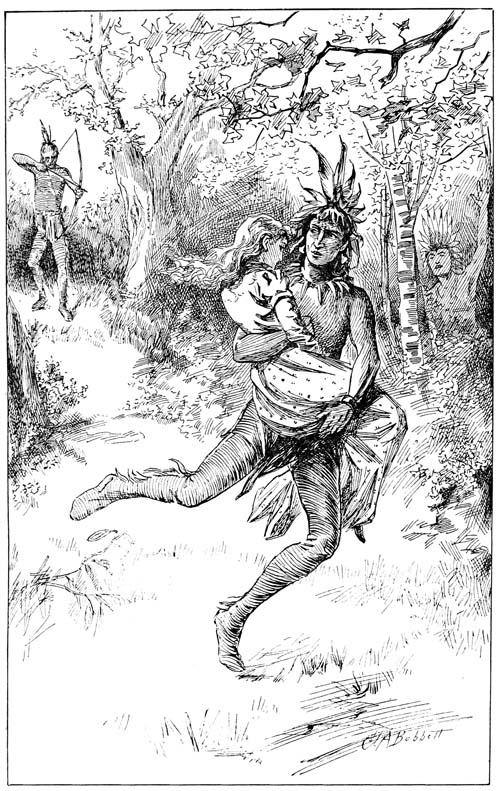
Iosco lifted Owaissa tenderly, as if she had
been a baby, and the three passed into the darkness
and silence of the forest night.
Nantiquas led them first behind the wigwam,
where there were bushes and undergrowth to
hide them. Then he turned into a trail unknown
to Iosco. On, on, they went. Not a
word was said. Owaissa felt that Iosco was
carrying her, and she cared for nothing else.
Iosco knew that he had his darling close to his
heart, and that she had refused life at the price
of being the wife of the bravest prince of the
mightiest tribe.
Suddenly Nantiquas stopped, and said:—
“Ramapo stands yonder by the fallen willow;
he loves Owaissa, and will let her pass. Iosco
shall say he carries Owaissa to the great Werowance
Eyonols on the Chanock flu. Say that
she goes to hide at Ritanoe, in the mines of
Mattasin. We meet beyond.”
Iosco went on as Nantiquas said, and met
Ramapo, who let him pass. But no sooner had
he done it than his loyal heart repented, and he
called to Iosco to return. But Iosco only ran
on the more quickly. He was wondering what
he should do to protect Owaissa, when he heard
Nantiquas say, “Turn under the lindens to the
right, quickly!” And he turned just in time
to escape an arrow that Ramapo had sent after
him.
Nantiquas led on in a different direction.
The trail was very narrow and rough. Yet
Iosco wished they might go on all night, that
he might hold his prize so close.
After walking for several hours, Nantiquas
stopped suddenly, and turned, saying, “The
river lies just beyond. By it there is a camp,
which fears not being seen, for the fire burns.
The clever Powhatan has not had time to have
his fire burning as bright as a harvest sun,
since we started. If they are his men we shall
be taken. First, Nantiquas would speak to
Owaissa. He did journey to the pale-faces’
camp, and lie watching and listening, but no
word that Owaissa spoke came to his ears. He
did see one like a spirit, so white was his face.
He lays his hands together, and puts his knees
on the ground, looks up and speaks, and while
he does, Nantiquas seizes and carries him off in
the woods. He has not the strength of a kid,
but his eyes are like those of a young deer, so
brown and soft. Nantiquas says to the pale-face,
‘Virginia.’ He nods his head and laughs,
as if he knows what that is. Then Nantiquas
says, ‘White,’ and he puts his hands to his face
and laughs more. Nantiquas says, ‘Dare,’ and
he puts one hand on the other, and looks up as
if he would say he feared the Indian not. He
would understand no more. So Nantiquas
leaves him to go back to his camp. While Nantiquas
listened to the white camp men, he heard
many speak to one, the chief. But they do not
say ‘White,’ they say ‘New-port.’ One other
is ‘Smi-th,’ and many more such. But none
with the words of Owaissa.”
Owaissa stood by Nantiquas while he spoke.
She laid her hand on his arm as she said,
“Then they have forgotten me, my own people.
But you, Nantiquas, you have been so kind, so
very good to me. I shall always love you as I
would have loved my brother. I will pray for
you always.”
“Is it the prayer that makes Owaissa so
brave?” he asked very gently.
“Yes, Nantiquas,” she replied. “It is the
Great Spirit who makes us able to meet death.
Some day you will know all about him. I am
sure you will.”
Nantiquas took Virginia’s little hand and
pressed it one moment. Then they stepped
forward cautiously toward the river and the
light. So softly did they move, they would
surely not have been heard or discovered but
for Virginia, who, as she came nearer the fire,
gave a great cry, and sprang forward. Two
figures were lying by the fire on the ground,
and one was a white man.
It was an English voice that replied to Virginia’s
cry, “Who comes this way?”
Virginia had sprung from her two companions,
and was standing in the firelight before they
could stop her. She spoke in her own tongue.
They could not tell what she said, but they saw
the two figures, who seemed to be alone by the
camp fire, draw close to her.
“Ranteo!” exclaimed Iosco. “It is old Ranteo!”
and he went forward.
When the old Indian saw Iosco, he caught his
hand, crying, “The people of Manteo do groan
for Iosco. They offer sacrifices every day for
his return. But he comes not. Old Ranteo
comes far to find him and fetch him back. The
brave Christian Werowance, Iosco!”
It was Owaissa who answered, turning from
the stranger with whom she had been earnestly
talking, “Do they really want Iosco back at
Croatoan? I knew they would, some day. I
am so glad, dear Iosco.”
Nantiquas and the stranger to whom Virginia
had been speaking looked at each other in surprise
for a moment, then they began talking by
signs. Nantiquas turned to the others, and
laughed as he said, “The poor pale-face could
not get to his camp. He was but an arrow’s
fling from it.”
Ranteo laughed too, as he answered, “The
poor nemarough wandered like a lost deer back
and forth, and was full of fear. He would speak
with me, but he could not, and for the great
Werowance Manteo’s love, who did good to all
such, Ranteo gave the stranger half his fire and
half his food, and would bring him to Iosco.”
Nantiquas interrupted, “The Owaissa is not
safe on Powhatan’s land. The boys and men
wait yonder. You must go on. You must go
to Croatoan. Is it not so, Iosco?”
“But how about the Werowance at Ritanoe?
Must we not go there, Nantiquas?” Virginia
asked.
Nantiquas laughed. “Owaissa would not have
come by this trail had she been journeying to
Ritanoe. Powhatan’s braves have that trail to-night.
Owaissa was on her way to her own
people, to the camp of the pale-faces, but it is
safer for her on the way to Croatoan. There
she can join her people without danger from
Powhatan.”
A slight noise in the darkness startled them.
Iosco drew a deerskin over the fire and stepped
on it till the light was gone. Nantiquas led the
way, and they followed; they had gone only a
short distance when they came to the men and
boys, all that was left of the Roanoke colony,
seven souls. Two small skiffs were waiting, a
moment more and all was ready.
Owaissa clasped Nantiquas’s hand. “You have
been very good, dear Nantiquas. You will come
to us some day, won’t you?” Her voice faltered,
and she sobbed as she had not done in all
the scenes of pain or danger. “He has been so
good; he has saved us all,” she said, turning to
the Englishman, who, raising his hand, gave his
blessing to the young Indian prince.
One more grasp of Owaissa’s hand, then the
skiffs were moving down the Youghianund flu,
leaving Nantiquas alone on the shore. The first
rays of the sun glistened on the waving hair in
the boat, and on a little silky curl in the Indian’s
brown hand, as he caressed it tenderly. The
mists cleared away, and a faint gleam of color
tinged the sky like the reflection of a rainbow.
He saw it, and muttered to himself, as the skiffs
passed out of sight, “Nantiquas will never tell
your secret to the whites, Iosco, lest they carry
her off from you.” And then looking towards
the bright bow of color, he added, “True, there
are many flowers do die on earth.”
Powhatan had condemned all the whites to die
because he was afraid they might tell the secrets
of his people to the white tribe who had
now settled near his own lands. If they knew
all, they would be dangerous enemies. So Nantiquas
had sent word to Iosco not to let any of
the whites attempt to go to Jamestown, for
there were spies watching for them all the way,
with orders to capture them. A reward was
offered for every white scalp from Croatoan
or Ritanoe, or wherever the seven whites had
escaped to.
The old places were slowly coming nearer
and nearer, and the great throb of happiness
that leaps into one’s heart as he is coming home,
filled Virginia’s heart with thankfulness and
love.
“O Iosco, I am so glad I did not go right to
my own people; I would never have seen Croatoan
again. I am sure there is not another
place in the whole world so beautiful. I love it,
every spot of its ground. Are you glad we are
all to be together again for a while?”
“Iosco is glad, oh, yes, very glad. Did Owaissa’s
father come in the big canoes? What tidings
brings the white man of her people?” he
asked very earnestly.
Virginia was standing in the end of the skiff,
that she might catch the first glimpse of the
dear familiar place. She put her hand on Iosco’s
shoulder to steady herself, and looking sadly
down into his dark eyes, she said, “O Iosco,
do you know I have almost forgotten my people’s
language: many things the white man says
to me I cannot understand. But this I do know;
he says my grandfather and my father came
with the big canoes to find us, long, long ago,
and they found only the empty place at Roanoke
and the word ‘Croatoan;’ but when they
would find Croatoan, the storm caught up their
canoes and carried them away. Even now this
Chief Newport is speaking for us, and will be
glad when he knows what you have done, and
will give you many things.”
“Will the pale-face take Owaissa to her people
soon?” Iosco asked.
“Whenever you send some one with us. We
could not go alone; but do not let us hurry.
Let us see you back at the old place, and this
white face can teach your people and all of us
about the Great Spirit, the dear Jesus. Mistress
Wilkins said this land needed such as he is
to hallow it—a priest.” Virginia said the last
word reverently.
“The pale-face is good. The light of the
Great Spirit is in his eyes. He shall stay as long
as he will, and teach the people as Manteo
would have wished; and surely Owaissa will
never hurry from the people who love her,”
Iosco replied.
“Do you know, Iosco,” she said with a wistful
look, “do you know I almost dread going to
my people now. If I have forgotten even their
language, which I once knew so well, how much
less shall I know their ways and lives, which I
have never learned; they will not understand
me and my ways, they will laugh at me. Your
people are really my people, for I know and
love them.”
As Iosco sprang from the little boat, upon his
own land, he thought he had never felt so happy
before; and when he turned and helped the
Englishman on the shore, giving him a welcome
after the manner of his people, Virginia wondered
if the coming back had brought such joy
into his face; she had not seen the pain that the
leaving of it must have caused.
The priest bared his head, and raising his
hand blessed the land and the people; then the
little company moved up the hill. There were
the great fields of tobacco with their long leaves
shining in the sunlight; and there were the
fields of corn where the women must have lately
been working, but now there was not a sign of
woman or child. Virginia was anxious to see
the people; and she hurried on before the others,
and ran swiftly over the grass, which was dotted
with daisies. She soon reached the council
house, which was like a great arbor, and hearing
voices she stopped and looked in.
It was, indeed, a weird, almost unearthly sight
that met her gaze. In the centre a great fire
burned; around it on the ground a circle was
formed of grains of corn; outside of this a
larger circle formed of meal. Six men, painted
red and black, with white circles painted about
their eyes, followed; another, painted like themselves,
only a little more gaudily, wore on his
head a sort of crescent made of weasel-skins
stuffed with dried moss, the tails tied together
at the top with a knot of bright feathers, while
the skins fell about his face and neck; a great
green snake was coiled around his throat, the
tail flapping about on his back. The creature,
who was in fact the chief medicine-man,
was a frightful object, as he danced before the
fire uttering unearthly yells. The people had
assembled in the arbor, bringing with them
offerings of every imaginable description for
sacrifice.
The purpose of this worship was to entreat
the Great Spirit to send Iosco back: they did
not know how to offer the Christian sacrifice,
yet they felt that their prayers must be accompanied
by some proof of their earnestness; so
they used the old form of heathen worship, the
only thing they had known till Manteo went to
England and came back a Christian; but even
then there had been no one to teach them its
blessed worship. From Manteo and Mrs. Dare
they had only gained a glimmering of its first
principles, which they, poor heathen people as
they were, had eagerly grasped. The people
inside were so intent on their worship that they
did not notice Virginia, as she stood in the vine-covered
doorway, or the others who soon joined
her.
To Martin Atherton, the English priest, as
he gazed in at the wild, weird scene, it seemed
like the very entrance of hell, and that hideous
figure, the chief medicine-man, looked not unlike
the evil one himself, as he danced and
yelled, followed closely by the others. Then
all the people sent forth a groan, and the chief
medicine-man threw many of the offerings the
people had brought into the fire, which caused
a great crackling and spluttering. The groans
of the people rose dolefully, and the wild yell
of the medicine-man completed the frightful
scene.
When Iosco passed from the little group outside,
and stood in the firelight before his people,
they thought he had come out of the fire, and
waited one moment to see if he would vanish
into it again. As he did not, they pressed their
hands to their hearts and yelled for joy, till the
very rocks seemed to tremble.
At a sign from Iosco his people were silent.
He spoke to them of his father, and of his
Christian faith; of the whites, and how Powhatan
had killed most of them; of the canoes now
in the river; of how he had heard they had
wanted him, and he had come. Now did they
wish him to remain? With a great cry they
called him their chief, while the medicine-men
strewed corn before him, as a sign that all
should be his, and poor old Adwa, the squaw
who had nursed him, ran to the fire, and would
have thrown herself in as a thank-offering had
not Iosco caught her and pointed to Virginia,
who still stood in the doorway. She ran to her,
and held the head of soft wavy hair to her
breast as tenderly as any mother would have
done.
Martin Atherton looked on in amazement,
at the squaws gathered about Virginia, and
showed how tenderly they loved her. He could
see that she loved them, and for each she seemed
to have a few kind words. The children seemed
to rain down, more than a dozen having gathered
around her in a minute. As he watched
her caress them lovingly, and saw her pick up
one brown little boy, who was scarcely more
than a papoose, and hold him close to her heart,
he wondered if she could ever be happy in a
conventional English life, and what the drawing-room
would say and think of this forest
maiden.