DURING the first half of the journey
Vinzi had not spoken. The thought
that he was to spend a long time in
the midst of strangers far from his home lay
heavily upon him. He hardly realized what
went on about him. In Berisal his companion
took him to the inn belonging to his father’s
friend. When the latter had questioned the
boy sufficiently about the trip, he found it wise
for Vinzi to have supper and immediately go
to bed, as he was sure to be tired from the long
waken till his fellow-traveller firmly shook him the
next morning. As the sun was already high, it was
necessary to hurry; but that did not trouble
Vinzi, for he was used to that at home. On the
days when they had gone to the pasture Stefeli
was nearly always dressed when he got up, and
he had had to be quick to get ready in time. Oh,
if only Stefeli were there now to call him, and
if only his mother would come in to say a few
friendly words! Vinzi had to fight hard to keep
back the tears. He was dressed in a short time
and sat down to his cup of coffee in the room
where his companion awaited him. The two
companions went silently up the mountain. Poor
Vinzi felt stranger and stranger as he neared
his destination.
“Look, boy,” said the young workman, who
had been whistling all the time, “do you see that
stone house?”
Vinzi saw it and in his terror he could not utter
a syllable. He thought that the gloomy gray
house on the stony slope was his cousin’s place.
“Yes, I see it,” he finally said in a very
low voice.
“We’ll stop there to get something to eat,”
said the young man. “After that comes the
last stretch we have to climb. From then on it
goes down hill and you’ll soon be there. I have to
go all the way down to the next valley, so we won’t
have much time to rest.”
Vinzi was perfectly indifferent. He felt little
enough inclination to eat and was constantly
picturing to himself his arrival at the house of
his unknown cousins. Maybe it looked as gloomy
as the gray house of stone. His inner agitation
constantly increased while they had a short lunch
and afterwards when they silently took to the
road again. They stood on the summit now and
the path began to slope down hill.
“What is that?” asked Vinzi glancing
timidly at a large building which lay at the left of
the road. Despite the fact that it seemed to
shelter many people, everything about it lay
in soundless peace and not a human being could
be seen.
“That’s nothing bad, you don’t need to be
frightened,” said the young fellow. “On the
contrary, it is a nice place. Good monks live
there, who take in people that travel by in winter,
half frozen. They have a warm fire for you and
a drop of something warm to strengthen you.”
“What is that over there?” asked Vinzi
again after a little while, when an old solitary
tower showed itself to the right of the road.
“Do you think you have to live there? Don’t
make such eyes!” said the young man. “I
shouldn’t like to live there myself. It is as quiet
here as if it were at the end of the world. But
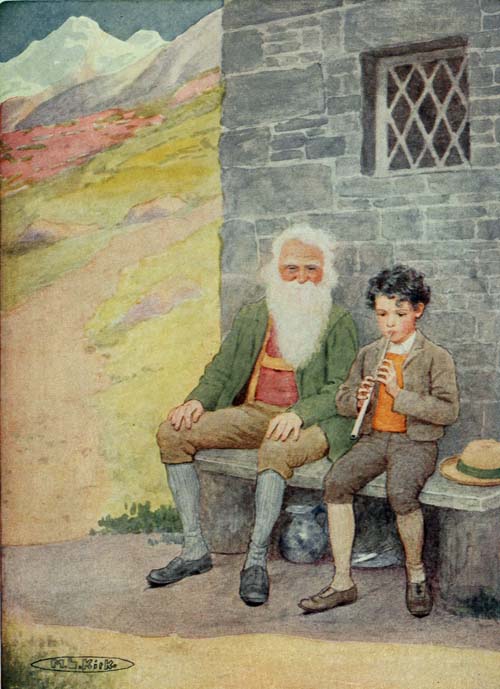
they do grow old here. Ten years ago I saw
a man sitting there with his hair and beard as
white as the snow on that peak. A year ago I
saw him, too, and sure enough, there he is again.
Quick now, boy, you don’t have far to go.”
But the end was not reached before half an
hour’s vigorous tramp was behind them. Pointing
down hill the workman said, “Look at that
white building down there! That’s a little chapel.
A few houses are about it and they call the hamlet
‘Bychapel.’ The village is a bit further down,
but your uncle lives near the chapel. I’ll show
you the house and then I’ll leave you. You
can’t possibly miss your way.”
Vinzi stared breathlessly ahead of him, and
without once looking back, rushed forward.
They had reached the chapel, which was a little
way from the road on a hillock. The young
man stopped.
“Well, here we are!” he said. “Pass the
chapel to your right and go to the very last house
which has a barn beside it. Lorenz Lesa lives
there. Good-bye now and good luck!”
“Good-bye, thank you!” said Vinzi, as he
sadly shook hands.
The young man turned about and went
whistling on his way and Vinzi looked after
him. The last person who was connected with
his home had vanished and nothing but the unknown
lay before him. But alas! it had to be.
He did as he was told and found the house on the
grassy slope.
A small, stone building behind it was evidently
the stable. At the other side was a brown
construction covered with stones and shingles,
evidently the barn, where the supply of hay was
kept. As the small door of the barn was wide
open and everything about the house was still
and the house door shut, Vinzi went towards it.
He knew well enough that one couldn’t get into
the door from the ground except by clambering
up the boards, for the hut was raised off the
ground by four posts to keep the hay dry and
airy. Vinzi climbed in through the extremely
low door, where a grown up person was obliged to
stoop. A tall, strongly-built man was straightening
up the hay.
“Good evening!” Vinzi called out. “Does
this barn belong to Lorenz Lesa?”
“It does, what do you want with him?” the
man called back.
“He is our cousin. I belong to Vinzenz Lesa
in Leuk and father sends you his good greetings.
He said you knew about my coming
here,” Vinzi went on confidentially, for he hoped
that this man who had already won his trust
might be his uncle.
Sticking his fork into the hay, the man came
nearer in order to hear better.
He looked the boy straight in the eye, offered
him his hand, and said pleasantly, “Oh, I see!
Are you really Vinzi? I am glad you have come
to your relatives. Did you come up here
all alone?”
Vinzi’s heart had opened at the glance of the
friendly eyes and the kindly sound of his voice.
He bravely raised his eyes from the floor at which
he had been staring till now, and told about his
travels. He was so glad, he said, to have found
his uncle so soon, for he had been quite frightened
at the thought of coming among strangers.
“There is nothing to be afraid of,” said the
uncle good-humoredly. “My boys are not exactly
tame, but you can manage with them. You
must be hungry and thirsty now,” he went on,
“and we had better go over to your aunt, who’ll
look after you.”
Vinzi was on the ground with a jump and his
uncle followed. Just at that moment a woman
of rather generous proportions opened the door
and calmly looked about her.
“I have to let the smoke out a bit,” she remarked
to her husband. Then observing the boy
at her husband’s side, she calmly looked him over.
“I am bringing you our nephew from Leuk,”
said the man, “but he is still a bit afraid of us.
Please look out that he doesn’t feel worse.” At
this last remark the man slightly chuckled.
“I frighten no children,” answered the
woman deliberately, giving Vinzi her hand.
“Welcome to our house, nephew.” Then she
began to inspect him so thoroughly from top to
toe that her husband finally said, “I should think
it better if you examined the rest of him inside.
Can’t you see that the boy still has the pack on his
back? I am sure he wouldn’t take it amiss to
have something to eat after the long tramp he
has had.”
“He can have something right away,” said
the woman. “Supper is nearly ready, but the
smoke drove me from the stove. I’ll put the
food on the table and we can begin to eat. We
don’t need to wait for the boys; they are sure to
turn up sooner or later.”
Turning towards the house, she freed Vinzi
of his pack. Not very long afterwards he sat
comfortably at the table with his aunt and uncle
and as soon as all fear of the strange relatives
had left him he was suddenly conscious of the
most tremendous appetite. Despite the long trip
he had barely eaten. The cousin seemed somehow
to have guessed this, for long before the
boy’s plate was empty he heaped it full again
with steaming potatoes and lovely yellow cheese.
This combination tasted so delicious together that
Vinzi thought he had never eaten anything better
in his life.
Once in a while his aunt would say, “Give him
more milk. You mustn’t forget how parched he
must be from the wind and dust of his long trip.”
Vinzi needed no urging to drink one cup of
fresh milk after another. All of a sudden shrill
voices and calls could be heard outside, followed
by the loud flicking of whips and happy cries.
Vinzi looked out of the window, amazed, but
saw nothing.
“There are the boys! They have come home
with the cows. I must quickly run out to help
them, for they can’t attend to the cattle alone.
I suppose you’ve never done so either? Would
you like to come out and see our cows and
the stable?”
“Oh, leave him alone now!” said the aunt.
“Why should he rush about after all the walking
he’s done? He can start the day with the boys
tomorrow, if he wants to.”
“I only asked, because boys usually like to be
where something lively is going on,” replied
Lorenz Lesa, “but he shall be free to say what
he prefers.”
“I’d like to stay here,” replied Vinzi.
“All right, then,” said the uncle, as he went
outside.
The aunt showed herself pleased that Vinzi
was willing to remain quiet and did not immediately
want to run away. First of all he was
to have another cup of milk to lay the last bit of
dust from the journey. Then folding her arms
and settling comfortably into her chair she said:
“Now tell me about your people at home and the
kind of life you lead there. I like to hear about
such things.”
Vinzi was pleased at this opportunity to talk
about his home. He had been wondering all
the time what his mother was doing just then,
whether Stefeli was alone on the pasture, and
how everything was getting along without him.
He told his aunt about their household, especially
how his mother and Stefeli usually spent the day.
A loud tramping neared the door now and the
next instant it was flung open. A boy of Vinzi’s
age came running in, followed by a little chap
and one much larger, who apparently resented
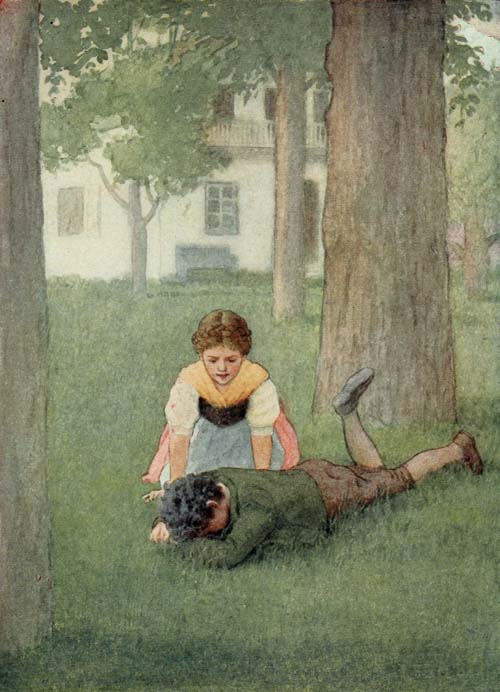
being the last. Quickly giving a high jump, he
tried to leap over the little one’s head by propping
himself on his shoulders. But quick as a
wink the sly little one ducked down and the big
boy fell headlong with a thump.
“You must not enter in such an unmannerly
fashion, Faz,” said the mother calmly.
“Good evening, cousin,” said the eldest, holding
his hand out to Vinzi.
“Good evening, cousin,” cried the second boy,
too, and “Good evening cousin,” also called the
youngest, pushing his way very near to Vinzi.
Vinzi heartily shook the proffered hands and
answered their salutations. Meanwhile the father
had come in.
“You must know each other’s names, boys,”
he said, stepping towards the group. “Your
cousin’s is Vinzi, which is short for Vinzenz. My
three are called Joseph, Bonifaz and Maurus.
But these are their calendar names, and we call
them Jos, Faz and Russli. I think you had
better sit down now, for the potatoes have cooled
off enough to eat.”
“Oh, I am glad,” said the mother with satisfaction,
“then they won’t burn their throats
today. Usually they do when they are in such
a hurry.”
All three settled down to the important business
of eating. They said nothing, but their
glances resting on Vinzi showed that he occupied
their thoughts completely.
Now that the tumult had subsided and one
could speak and hear without exertion, the
mother said, “As our relatives did not let us know
beforehand that Vinzi was coming, we did not get
ready for him. But I have an idea. If he is to
sleep in the house we shall have to clear out the
store-room where wheat, corn and all kinds of
things are kept. The mice up there squeak and
scratch so much that they might frighten him.
Wouldn’t it be much better if we fixed him a bed
in the hay-rick? He would really be much more
comfortable there.”
“He’ll have to say himself where he’d rather
sleep,” put in the uncle. “If he prefers the store-room,
we’ll all of us go up and clear everything
away. Vinzi, where would you rather sleep?”
“I’d love to sleep in the hay-rick,” replied
Vinzi.
“I thought so,” said his aunt, quite relieved
that the matter was so quickly settled. “And you
must have a little table, a bench and a chest of
drawers to make you comfortable,” she added.
“As soon as you are all done with supper you can
take some things over for him.”
She went out first in search of what was
needed, and soon after the three boys had finished
their meal and hastened after her. When Vinzi
rose in order to make himself useful, too, the
uncle assured him that the heavy pack he had
carried on his back was enough work for that day.
Hanging it on his arm, the man beckoned to
Vinzi to follow him. They had scarcely reached
the hay-rick, when the three boys came running
along. Jos carried a little cupboard, Faz had a
small table with a large blanket on top, and Russli
brought a little bench. The mother with the
pillow and sheets followed behind. With an
agility clearly showing how used she was to climbing
into the barn, the aunt had gone in. One
thing after another was lifted up by Lorenz Lesa,
and she pulled them in through the door.
When the last one was inside, the uncle said,
“We’ll say good-night to you now. On the inside
of the door is a wooden bolt that you can
fasten. Once inside, you are the sole master of
your castle and no person can come whom you
wish to keep out.”
Now the aunt came down again.
“Everything is ready for you,” she said. “And
look, nephew, over there is the stream, where you
can wash yourself. No one will disturb you there.
I laid a towel for you on the bench. Good-night.”
The cousins all wished him good-night, too,
but Jos turned round once more.
“Are you coming up to the pasture with us
tomorrow morning, Vinzi? Do you expect to stay
with us all day while we mind the cows?”
“Yes, certainly,” replied Vinzi. “I’ll help
you all I can, but you must tell me which I have
to mind most. Please call me in the morning, so
that I shan’t be late.”
“Yes, yes, I’ll call to you loudly through the
round air-hole,” Jos promised. “You’ll be able
to hear me well enough.” With that he ran away.
Vinzi was left alone. Climbing up through
the door, he inspected his barn. In a corner on
a high, soft pile of hay his bed was spread. Beside
it the hay had been pushed away to give room for
the table and the bench, and at the wall stood his
little cupboard. It all looked like a cosy and inviting
little room. But he was not able to sleep
because the unusual happenings of the day had
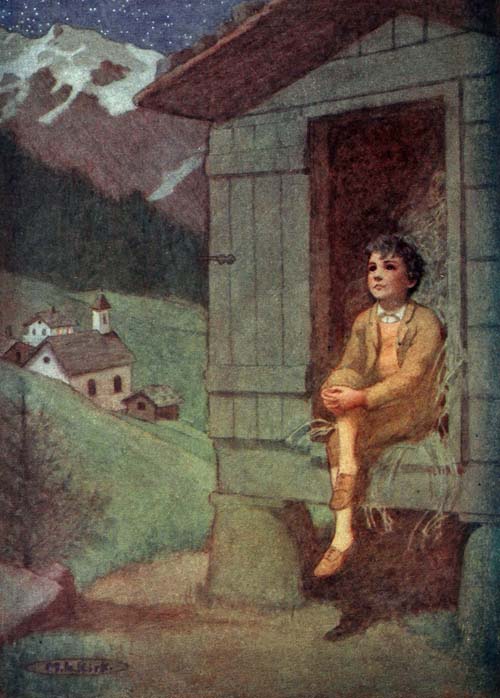
excited him so much. Sitting down on the board
which formed his threshold, he looked outside.
The stars were glowing above him in the heavens
and just then the moon rose from behind the
mountains. It was beginning to light up the
dark trees and meadows and the little church
looked very white, and the high snow-peak rising
above the rocky ranges became more and more
brilliant every minute. Vinzi opened his eyes
very wide, for in his great terror of what lay
before him he had seen practically nothing after
the gloomy house on the mountain desert.
He had made up his mind that only frightful
things would happen to him. How different
was the scene now before him from what he
had anticipated!
There was no stony desert here. On the contrary,
the moonlight gleamed peacefully down
to the green slope and sparkled on the tops of the
larch trees over the way. In the peaceful silence
he could hear the continuous soft gurgling of the
near-by stream. Vinzi listened to the sound
while the tones grew fuller and louder till lovely
melodies could be distinguished. He must have
been sitting there for a considerable time when
a strong gust of wind suddenly pushed the door to
against his knee and woke him from his dreaming.
He had never in his life seen the stars above him
sparkle as they did that night. His mother’s
words that the good God in Heaven was above
him everywhere and could hear and watch him
now suddenly occurred to him. Many times he
had heard her say these words, but at that moment
his heart fully realized them. It gave him
a sense that Heaven was very near him and filled
his soul with gratitude to God who had let him
find happiness where he had anticipated evil.
How groundless had been his fear of his uncle and
aunt! They had received and treated him so
kindly that he already felt at home. In his joy
he would have loved to fill the night with a loud
song of praise, but it was too late for that. Not
a single light could be seen about him; everyone
in all the cottages, far and near, was apparently
fast asleep.
After shutting and bolting the door, he sought
his fragrant bed, which was soft and splendid,
for no hay could prick him through the heavy
sheets. Opposite his bed an especially bright star
kept gleaming in through the round hole in the
wall. He tried to shut his eyes, but it shone so
brightly that he could not help gazing at it.
Even when his lids seemed to be closing he opened
them again to see it. Yes, the star was still shining.
What was more, Vinzi could distinguish
some faint, beautiful music, which finally put him
to sleep. The star was singing to Vinzi so that
he could hear it even in his dreams.
Next morning Vinzi was awakened by a
dreadful noise, caused by his name being screamed
by many voices at once. Stefeli had never called
as loudly as that to waken him, thought Vinzi,
still half asleep. But all of a sudden he realized
where he was and whose loud voices had apparently
been shouting for a long time in vain.
Rapidly putting on the most necessary clothing,
he opened his door wide and leaped down among
his noisy cousins.
“Hurry up, come along!” they called all at
once and Jos added, “Take your jacket along.
As soon as we’ve had breakfast, we are off.”
As Vinzi was not even washed yet, he begged
them not to wait for him as he would rather follow
them later.
The two older ones quickly ran off, but Russli
going with Vinzi to the stream, said confidentially,
“You don’t need to wash yourself. You
don’t look dirty: come with us, Vinzi, you are
clean enough.”
“No, no, Russli,” Vinzi answered. “One
must wash every morning and besides it makes
one feel better. Oh, what nice, clear water.” So
saying Vinzi kneeled down and taking up handfuls
he poured the fresh water over his face
again and again, and also drank one handful
after another.
This made a deep impression on Russli, for
Vinzi looked refreshed and radiant. Meditating
deeply the little boy said, “I’ll come and wash
myself here with you and I’ll drink afterwards
like you, too. I’ll do it every day from now on.”
Having finished his toilet, Vinzi fetched his
jacket and went over to the house with Russli.
Both uncle and aunt, who were still at breakfast,
greeted Vinzi kindly. The aunt set a large
cup of coffee before him and entreated the boy
to help himself to lots of bread, as the strong
mountain air would soon give him a fresh appetite.
“We ought to have let you sleep longer after
your trip,” said the uncle, “but the boys were just
wild for you to go with them. They are so
pleased to have a cousin who belongs to
them now.”
“Just take your time,” urged the aunt when
she saw that Vinzi was hurrying in order to finish
his breakfast. “Your uncle will go out with you
when you are done, and he has not finished either.”
When the uncle rose soon after, Vinzi followed
him.
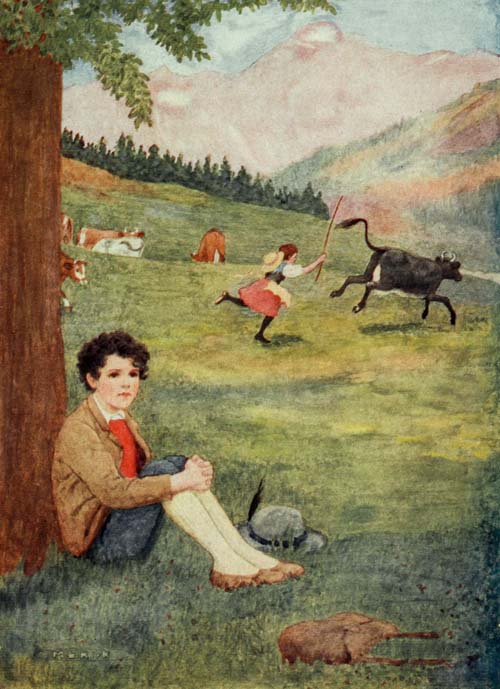
Jos and Faz had been flicking their whips for
quite a while to show that they were ready. The
father unfastened one cow after another from her
stall and the whole procession began to move.
Quite a stretch of road beyond the chapel had to
be passed before the pasture-ground for the day
could be reached. Russli had immediately come
to Vinzi’s side and was firmly grasping his hand.
He tried to hold Vinzi back as much as possible,
while Faz and Jos were busy driving the cows
along. This was difficult, because the luscious
grass along the sides constantly tempted them to
stray from the road.
“Leave me alone, Russli,” Vinzi said hurrying
forward. “You see I must help your brothers
to keep the cows in order.”
During a struggle Faz had with a cow who
was trying to clean off a tender bush by the roadside
he heard these words.
“Keep Russli out of mischief for us,” he
called back to Vinzi. “You can’t possibly help
us better than that. The little chap always
tickles the cows with his rod and that makes them
run from side to side. If they do that we can
barely manage them. Russli is a mischievous
little fellow, you’d better hold him tight.”
Faz at last got control of his obstinate cow
and, driving her along, followed the others.
“Vinzi,” asked Russli, overjoyed at being
able to have his new cousin’s company, “have you
a knife?”
“Yes, of course, everybody needs one,” Vinzi
replied.
“Come on and I’ll show you a fine bush,”
said Russli, “where the branches are thick below
and very thin above; you know they are very
strong, too. Won’t you cut me a few good willow
sticks. Mine is broken and I can’t do it myself
because I am not allowed to have a knife.”
“Why do you want the stick?” asked Vinzi.
“I hope you don’t want it for beating the cows.
You heard what Faz just told me about you.”
“Oh, I don’t beat them, but I like to tickle
them a bit,” explained Russli. “That makes
them jump and they get lively.”
“No, no, Russli, they don’t think it fun,”
said Vinzi. “They jump from fright, because
such thin whips hurt them very much. I won’t
make you any sticks for that. But show me the
bush, and if the wood is good I’ll cut you something
else.”
Of course Russli was terribly curious to know
what Vinzi meant to make him. But Vinzi
declared he would not tell till he had seen the
bush and asked Jos a question. Expectantly
Russli ran ahead. Soon they turned off from
the road to a grove, where they found a large bush
whose branches stood up perfectly straight.
“Here,” said Russli, pulling Vinzi along.
Vinzi, gazing with satisfaction at the firm
branches, began to cut those which pleased
him most.
“Come now,” he said after having gathered a
considerable bunch, “we must go to your
brothers. Do you know where they are? I can’t
see them any more. I’ll cut it for you when I
get there.”
Russli hastened on followed by Vinzi.
“Oh, how lovely it is here,” Vinzi exclaimed
and stood still. “But where is the pasture?”
“Here,” said Russli.
Vinzi looked about him. Here and there
isolated high, dark larches let in the deep-blue sky
through their delicate branches. On the lovely
green slope little patches of fiery red alpine-roses
glowed between moss-covered stones. The full
mountain stream was rushing down hill throwing
up snow-white foam whenever rocks tried to bar
its course. Vinzi could see the cows quietly grazing
a short distance away. He stood without
moving. Never in his life had he seen such a
pasture. The slanting sun fell through the trees
on the glowing flowers and sparkled on the waving
grass. The soft mountain air, gently fanning
the trees, played with the shadows and soughed
through their branches with a delicate song.
The soughing seemed first to grow, then to
die away in the far distance. Vinzi had not moved
from the spot, gazing and listening intently.
“When will you cut me what you promised?”
asked Russli quite angrily, for his patience had
given out with waiting.
“All right, I’ll come,” said Vinzi, as if
awakening from a dream. “I’ll come. But it
is wonderful here! Hold these sticks a minute,
Russli. I’ll come right back and make you what
I said I would.”
Vinzi ran over to the grazing place and looked
about for his cousins. Across the road was a
very large pasture without trees and with many
cattle. Vinzi could see a small group of goat-herds
bending over a smoking spot on the ground.
They were apparently trying to make a fire, but
as it would not burn, were shouting all at once
and causing much confusion. Vinzi saw Jos and
Faz among them. First he called to Jos a considerable
time in vain, but when Jos finally heard
him, he came over.
“Come to us, Vinzi!” he called out, running.
“We are making a fire, or I should rather call
it smoke. One of the boys found a hole, and we
think some kind of animal, maybe a marmot, is
inside. It’ll come out if the smoke gets into the
hole. Then we can catch it. Come, we’ll have
such fun.”
“No, I’d rather not,” said Vinzi, for he had
not the slightest desire to see a little frightened
beast jump out of the hole, and much less to see
all the boys chase it and frighten it more. “I
promised Russli to come back. But I must ask
you something. Do you think your father would
mind if I cut Russli a pipe?”
“Why should he mind? What do you mean?
I couldn’t even guess why not?” Jos exclaimed.
“I am sure he couldn’t possibly object, and we
are only too glad if you keep Russli busy. He
makes the cows simply wild and that keeps us
chasing them. The minute they see him even
they begin to run.”
“Shouldn’t I help you mind the cows?”
asked Vinzi, slightly concerned. “Can I really
sit down quietly and cut out pipes?”
“You can’t help us any better way than that,”
said Jos. “Please believe me. Look how peacefully
they are grazing. If Russli were teasing
them, they would long ago have begun to
run around.”
Vinzi was delighted at being told his share of
the day’s work and he went back to Russli.
“Now, Russli,” said Vinzi on reaching the
little boy, “watch what I shall make.”
As he settled down on a moss covered rock,
the reddish-purple violets beside him exhaled
such a sweet perfume that he had to draw in a
few deep breaths. Then carefully choosing one
of the branches he cut it off where it began to
grow more slender and started carving the
thicker piece.
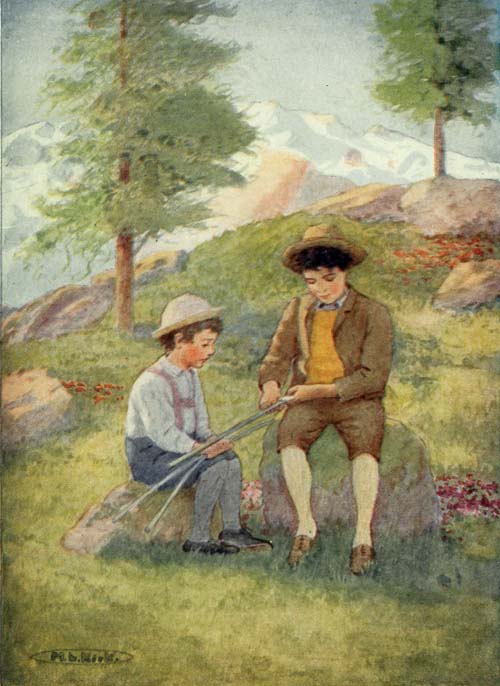
“WHAT WILL IT BE WHEN IT’S FINISHED?” ASKED RUSSLI
“What will it be when it’s finished?” asked
Russli, who had settled on the stone by Vinzi’s
side and was eagerly following the work.
“It’ll be a pipe to play music on,” was the
answer.
Russli moved nearer to the carver in delighted
surprise, for he was afraid he would lose
something of the creation of this wonderful thing.
Russli knew the little hollow pipes that usually
broke right away, but he had never seen such a
thick, long wooden pipe as his cousin was making.
Vinzi had learned and invented many things since
he had cut his first pipes that could only give
forth one tone. He cut several holes now in
order to have several tones played on it. But it
took considerable time to bore the small round
holes, because Vinzi was very particular. Several
hours passed. Once in a while Vinzi stopped to
listen to the wind singing in the branches, and to
the merry wavelets of the mountain stream that
gave forth sometimes a song of joy and sometimes
a low plaintive note. Sometimes he stooped
down to inhale the delicious perfume of the
violets beside him. But at last he snapped shut
his knife.
“There, Russli! Take your pipe, it is
finished!”
With glistening eyes the little boy set his pipe
to his lips and produced the most penetrating
sound. Russli was quite scared at the loud noise
he had made, for he had blown into the pipe with
all his might.
“You had better blow it,” he said, giving the
instrument to Vinzi.
At that instant they heard a shrill whistle
followed by a second. It was clearly a summons.
“It is time to eat,” said Russli. “They
always whistle that way when we are to gather
together for lunch. Come on.”
Russli was already bounding away.
“Look at my pipe! Look, I have a pipe!”
he called loudly to his brothers, who were already
eating. As soon as Russli saw this, he looked
about till he found the lunch-bag, which lay like
a lost object on the ground. Quickly pulling out
his share he gave Vinzi the food meant for him.
“Take it!” he said, “this is yours. The others
have already taken theirs.”
Vinzi did this and settled himself beside
Russli. But he could not help thinking what
Stefeli would say to them if she saw how they
only looked after themselves, as if they had
had a fight.
Jos had finished in the meantime and called
from his seat to Russli, “Give me the pipe, I
want to try it.”
“Come and get it,” said Russli in a curt way.
Vinzi had already risen to bring it to Jos,
when the latter quickly jumped up, asserting that
if he wanted it, it was for him to fetch it. Faz
had joined them, too, now.
“Show it to me,” he cried, but Jos, who was
already holding it to his lips, pushed Faz away.
Now the music began. All Jos knew was that
the fingers had to be placed on the different holes
to produce various sounds. He succeeded in that
but they had a terribly harsh, disconnected tone.
“Give it to me, you don’t know how,” cried
Faz, grabbing the pipe.
But under his fingers the pipe shrilled and
yelled more hideously still.
“It looks so fine,” said Jos regretfully, “and
we could never have made so nice a one, but it
does not sound nice.”
Vinzi had finished his lunch by that time and
took the pipe from Faz.
“I want to try it, too,” he said. With this
he began to play a little song, one tone clearly
and beautifully following the other. Dumb with
amazement the three stood before him and
listened spellbound.
“You certainly know how to play, Vinzi;
won’t you teach me, too?” asked Jos eagerly as
soon as Vinzi had paused.
“Me, too,” cried Faz.
“And me, too,” repeated Russli.
“Give me the pipe,” begged Jos impatiently.
“No, give it to me,” cried Faz, but Russli
had already snatched it up and run away with his
property for fear that he would be robbed of it
by superior strength.
“Leave it to him,” said Vinzi, “I’ll make you
each one out of the sticks I have. I can easily
get all I want.”
This quieted the brothers, and as they wanted
more music they called Russli. Jos especially
had been delighted with it. But no calling could
bring Russli back. Finally, Vinzi had to hasten
after him to explain that he was not to lose his
precious gift. The boys sat about in a close
group now, for every one of them wanted to be
as near to Vinzi as possible to see how it was done.
He was made to play on and on, every conceivable
tune he had ever known. When finally his
memory gave out, he made up pieces out of songs
of birds and the sounds of bells he had heard.
The group of listeners had constantly grown,
for the boys from the other pastures waiting in
vain for Faz and Jos, had gone to seek them.
They got together every afternoon, usually to
perpetrate some mischief, and Jos and Faz being
mostly the leaders, they needed them. But the
music pleased all the boys so much that they remained.
The afternoon slipped away unnoticed.
One of the boys suddenly cried, “I hear the
horn, it must be six o’clock.”
Immediately they dispersed, but before going
they called back to Vinzi, “Bring it with you tomorrow!
Bring it tomorrow!”
It was high time for Faz and Jos to collect
their cows to drive them home.
“Please, Vinzi, keep the little chap away
from us going home. We’ll get along much
faster then. That’s the best way for you to
help us.”
Vinzi was only too glad to take charge of
Russli. If his cousins found him most useful
that way, he had a good conscience doing it,
though it certainly was no hard work. Russli
was also satisfied. Taking Vinzi’s hand he
strolled harmlessly by his side as if he had never
played the slightest trick in his life. But he
demanded to be entertained. Every time Vinzi
stopped talking to listen to a bird’s song or the
gurgling of the stream, the little chap reminded
him of his presence. When they approached the
house they saw the father standing under the
door to greet them.
“Well, how did you get along the first day,
nephew?” he asked. “How did you like it on
our pasture?”
“A pipe, look at my pipe! Here, father, take
it!—it sounds fine,” Russli interrupted loudly,
holding the pipe as closely as he could to his
father’s eyes.
“Look, there they come with the cows,” said
the father. “Go in and show it to your mother.
I’ll soon come, too.”
“I loved it on the pasture,” Vinzi was now
able to answer. “It is splendid there under the
trees. The day passed so quickly!”
“Yes, and Vinzi helped us so much,” added
Jos, who had joined them. “We got up there
about ten times quicker than usual and all day
the cows were quietly grazing, something they
have not done for ages. I wish Vinzi would stay
with us always.”
“I am glad to hear that,” said the father.
“That’s a good beginning and I hope you will
keep on that way.”
He went with the boys to the stable, and
Vinzi followed, thinking that his uncle might
need his help there.
“What can I do?” he called to his uncle
through the open stable door.
The latter was busy milking. “We’ll be
done before very long,” answered he, “but you
can look about in the barn and stable, if you
care to.”
Vinzi went out. The sunset glow was gilding
the rocky mountains opposite, the dark spruces
had bright, golden tops, and now the bell of the
little chapel began to fill the air with its lovely,
peaceful music. Vinzi, carried completely away
by all the beauty, stood and listened, rooted to
the spot. He stood thus until the glow had
faded and the chapel bell had stopped.
“Hello!” cried a voice behind him, while a
brisk blow fell on his back. Then he was pulled
by force to the pump, where the very necessary
daily ablutions had to be made before supper.
“Are you awake again?” asked Faz, who had
pulled Vinzi along in the firm belief that he had
fallen asleep in the middle of the road.
“Yes, and your fists would certainly have
awakened him before he got to the water,” said
Jos, who had stepped up.
“Yes, indeed,” replied Vinzi, “but I would
rather he pulled me along than that he told your
father that I fell asleep in the middle of the road.
I wasn’t asleep, you know.”
“He isn’t a tell-tale, but he certainly can give
a good blow,” Jos comforted Vinzi.
Faz proceeded to the house, followed by the
others. The mother was waiting at the table,
patiently enduring the dreadful sounds Russli
made with his pipe.
“You pipe like a cat that is half strangled,”
Faz cried upon entering.
“You must not make fun of him right away,”
said the mother. “He does not play so badly
for a little boy. He was just telling me something
nice about you, Faz. He said that you did
not beat him all day, and that he never cried
at all.”
“He only gets hit if he deserves it,” said Faz.
“He behaved well today because Vinzi was
amusing him. I hope Vinzi stays with us always.
Everything went as smoothly as possible today.”
The other three entered now and Russli immediately
flew to his father with the cry, “Now
the pipe!”
“No, no, Russli, first we eat and then comes
the pipe,” said the father sitting down. “You
see when I was their age I also liked to cut pipes
and blow on them. I’ll have to look it over a bit,
and then try if I still know how.”
Russli was satisfied when he saw the deliciously
smelling hot corn-cake his mother had put
on the table. He immediately attacked his
heaped-up plate.
After supper, when everybody leaned back
happily in their chairs and the mother had
cleared the table, the father said, “Now let me
see the pipe; I want to hear what it sounds like.”
Russli, being rather sleepy after his hearty
meal, found it hard to rouse himself. But he
heard his father’s words and was dreadfully
afraid that Faz might bring his pipe to the father
first, maybe even keep it afterwards. This
brought him to his feet.
When he approached with it, the father exclaimed
with surprise, examining the long pipe
on all sides, “What a well-made pipe! This is
no ordinary pipe at all, but a regular shepherd’s
pipe with all the regular holes. I wonder if I
can still play.”
Setting it to his lips, he brought forth sounds
that somewhat resembled melody.
“Oh, father can do it better the first time,
than we did after trying lots of times,” said Jos
astonished. “Only Vinzi can do it better still.”
“We must hear him now,” said the father,
handing the pipe to the boy. “Won’t you please
play for us?”
Vinzi remembered one piece better than any
and he had already played it for the boys at least
ten times that day. It was the little tune Alida
had taught him.
He started to play.
When he came to the end there was no sound
for a moment, because the lovely melody had
moved everyone deeply.
“Yes, of course he plays differently from
me,” said the uncle. “I’d like to know who
taught you.”
“Isn’t it fine to have something beautiful like
that in one’s own house, without having to seek it
elsewhere?” said the aunt, quite overcome. “It’s
worth more than many great festivities. If our
musician only could play us a beautiful hymn,
we could all join in and sing.”
“I’d love to,” said Vinzi, “I know lots,
because mother always sings one at home with
us every evening. What shall I play?”
“You probably know the same ones I do.
Can you play, ‘I Sing to You with Heart and
Mouth’?” asked the aunt.
Vinzi knew the hymn very well. After seeking
a little for the notes he began to play firmly.
The aunt sang heartily, the uncle raised a
splendid bass and suddenly Jos joined in with a
rich, fine voice. Faz growled low sometimes
after his father, then he took up his mother’s high
notes. Russli squeaked all sorts of tones too, but
the other voices were so strong that it did not
disturb the singing. The aunt was so happy
over the music that she clamored for another
song as soon as the first was done. Then another,
and still another.
The uncle said happily, “That was a fine
entertainment, and we must do it again tomorrow.
We can’t do any better than praise
God with music.”
When Vinzi came to his hay-rick his heart was
so full of thanksgiving that he was obliged to sit
down a while on his high threshold. Looking up
to the sky he saw thousands of stars looking
happily down upon him. Oh, how wonderfully
beautiful it was here. The father had said that
it was a splendid thing to praise God with music.
Tomorrow they would be allowed to do it again
and probably every day after that, thought Vinzi
to himself. The pipe had pleased the uncle, too,
and he seemed to enjoy hearing it. The happiness
in Vinzi’s heart rose higher and higher at
this thought. He felt as if he had to sing out
loudly once more. In fact it seemed as if all he
had to do was to join in the great song of praise
which came to him from all sides, from the shining
stars, the gleaming chapel, the merrily rushing
stream, and the golden moon over the high
mountains. He quietly sang to the glorious,
magic music about him.
The wind stirred gently and wafted the perfume
from the pungent hay to Vinzi’s senses.
Suddenly he remembered where he was. As it
had grown very cool, he quickly closed the door
and sought his inviting bed.
From that day on Lorenz Leza’s family had
music every night. They sang eagerly as if it
was the chief work of the day. But the work of
the day was behind them, and they could give
themselves freely to the joys of their happy evenings.
What pleased Vinzi most was that his
uncle and aunt always counted on having music
every night. At supper time the aunt always
said, “I look forward already to Vinzi’s playing.”
And when the meal was over the uncle would
say, “I suppose we still have time for a song
or two.”
Whenever his uncle Lorenz started to sing,
more songs he had known in his youth rose in
his memory. Even if Vinzi did not know them,
all the uncle had to do was to sing them to the
boy a few times and the latter would repeat them
perfectly. The rest could follow his piping and
in that way learn all the songs. The uncle got a
tremendous satisfaction from it all. When such
a musical evening had passed the uncle shook
Vinzi’s hand three or four times. “You can
make one young again with your music,” he
would say. “You are piping the joy of youth
back into my heart, boy.”