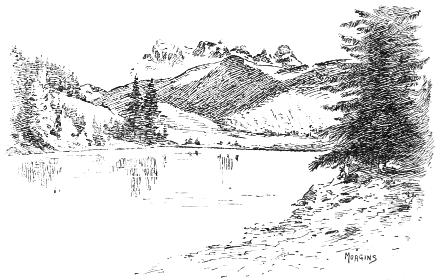
“The Englishman has marked out a few corners of
the Alps as being exclusively British. There are, however,
neutral zones where Britons and Continentals
meet, but the Englishman keeps in the main to certain
well-known routes. You will find him at Zermatt, at
Grindelwald, at Binn, and at Arolla. At Champex he
will be outnumbered, and at Morgins he was, until
quite recently, entirely unknown. It was the discovery
of Morgins as a winter sports centre that brought the
tardy Englishman to this retiring valley.
“Years ago I had looked across the waters of
Léman to the range of fronting hills, and idly wondered
whether some hidden and silent valley lurked among
their recesses. Leslie Stephen’s “Bye Day in the
Alps”, which I discovered in an old Cornhill—it was
not reprinted in the “Playground of Europe”—gave
form and personality to an outstanding sentinel of these
Savoy hills, but it was some time before I explored for
myself these outlying heights that guard the central
citadels of the Alps. Since then I have often revisited
the long defile that leads to Morgins.
“You reach Morgins by a curious little mountain
railway that connects Monthey and Champéry. At
Troistorrents you leave the train and prepare for a
sleigh drive up the valley which branches off to the
right. Troistorrents is a characteristic Alpine village.
It lies in the heart of the Val d’Illiez, one of the loveliest
of Alpine glens, which is still quite unspoiled. The
big hotels of Champéry are hidden from view and there
is nothing to disturb the quiet music of the three
streams that meet below the parish church, and give
to Troistorrents its name. Of course the chief glory
of this valley is the incomparable Dent du Midi. This
mountain, or rather this grouping of separate and
successive rock towers, has a curious fascination; it
is so distinctive. There are domes not unlike Mont
Blanc, pyramids that resemble the Matterhorn, peaks
very like the Weisshorn; but in the whole Alpine range
you will find no match to the Dent du Midi. Its outline
is unique. Its history is interesting, and considering
its moderate height it has attracted a very large
share of Alpine literature. Like so many mountains,
it was first climbed by the parish priest of a neighbouring
valley.[19] Its conquest occurred in 1784. Sixty years
later five men of the Valais climbed the beautiful
eastern peak that rises like a lion above the towers
of Bex. The last turret, the Eperon, only yielded its
secret as late as 1892.
“Those who have read Javelle’s delightful Alpine
memoirs will remember the fascination which this peak
influenced on the great climber. ‘I am completely
captivated,’ he writes, ‘by the Dents du Midi … is
there anything astonishing in it? For two years it has
been before my eyes every moment of the day.[20] The
eastward aspect of my window provided that the first
image on which my waking eyes should rest was its
graceful and slender profile. At table a malicious fate
had chosen my place so well that between my two
opposite companions the seven peaks of the arête were
visible to me in a frame. What I specially love is the
eastern peak. She may not be the highest, but is she
not the proudest, the slenderest, the most beautiful?
Is it not the peak which gives the mountain all its
character, and, in spite of the few metres by which
her western sister overtops her, is it not she who first
strikes the beholder and who dwells in the memory?’”
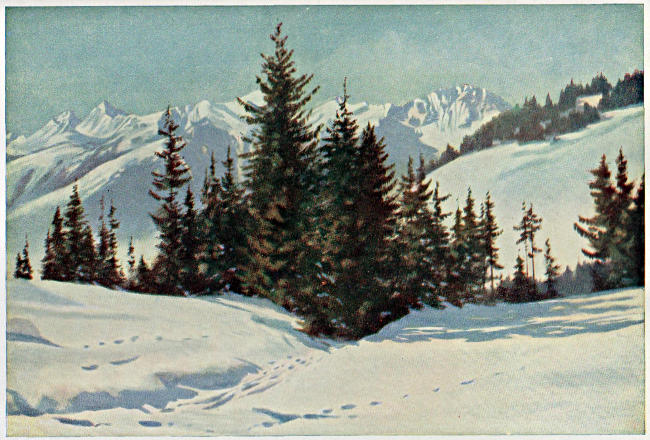
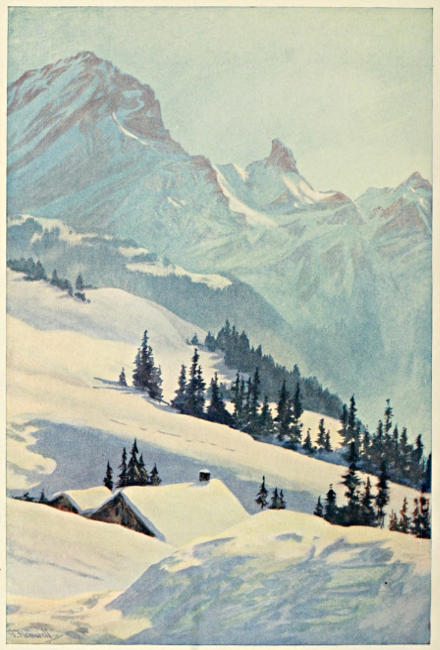
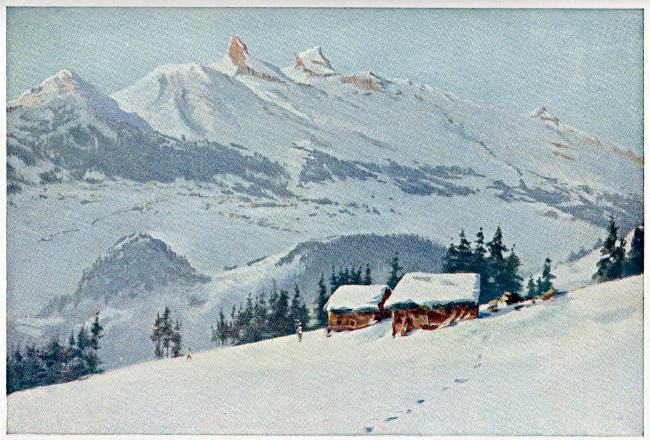
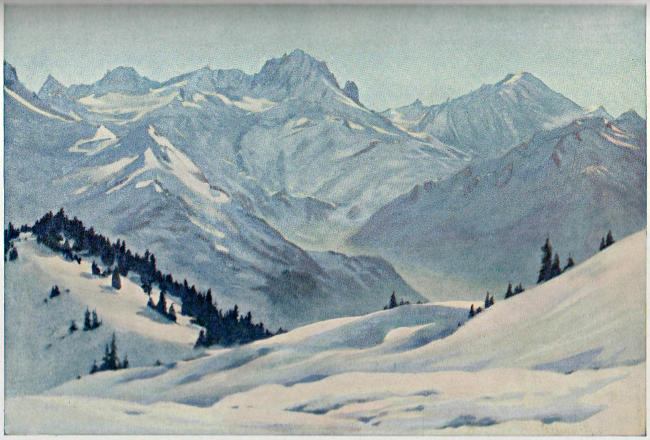
VILLARS: THE MOUNTAINS OF SAVOY
“Let us first dispose of the rough guidebook facts.
Let me tell you that Morgins is 4800 feet above the
sea level; that it enjoys more than its fair share of
snow; that it is one of the great ski-ing centres of
the Alps; and that the sun can find its way to the
rink during the best part of the day, while it discreetly
keeps off the northern ski-ing slopes save for
a short interval too brief to damage the snow.
“Each winter sport centre has its own peculiar
atmosphere. Life at Morgins is comparatively peaceful.
We danced, of course; we played the usual
absurd games—trundling the potato and so forth—but
we were unmolested by a potato-trundling committee
with a special and peculiar badge. We were not
troubled by those who come to the winter Alps in
order that they may bask in the sun. The men of
Morgins were built of sterner stuff. Morgins will go
down to history as the home of a great renaissance.
The English School of Skaters, driven out of their
old shrines, have founded a new Temple at Morgins.
I do not know much about skating myself, though I
believe I am the worst skater that ever passed the
third-class test, but I am told by those who do that
English skating reflects our national characteristics
with most uncanny acuteness. I gather that the
main difference between the two schools is ethical.
The foreigner, when he wishes to make a ‘3’ turn,
waves his arms, kicks his leg into the air, sways
his body, and in general advertises his skill with no
little success. The ladies stand round and applaud,
while the English skater curls a contemptuous upper
lip. Not for him the vulgar réclame. Body stiff, unemployed
leg gummed firmly into his trousers, arms
rigid … a twinkle of the shoulder blade … a slight
movement of the little finger … and the hardest of
‘B’ turns is a thing of the discreetly successful past
… no ladies stop and applaud … only the initiated
can detect the amazing skill involved in this modest
performance. The aim of the Continental school is
to emphasize apparent difficulty. The ideal of the
English school is to conceal difficulty. They skate
for the joy of the thing, careless of applause. The
strong silent reserve of the Briton that scorns vulgar
advertisement finds perfect expression in the sedate,
dignified curves of the English school … I hope I
have made myself clear.
“But this is not an article on the rise and fall
and subsequent renaissance of the chaste and refined
school of skating. I must content myself with stating
that Morgins is the winter home of the great
apostle of the counter-reformation. Mr. Humphry
Cobb pilots his novices into the true faith. Mr. Cobb
and Rudolph Bauman between them could make ice
at the Equator, and the rink at Morgins is all that
devotion and genius can achieve. Ice making, as
Bauman understands the craft, is one of the fine arts.
“But it is as a ski-ing centre that Morgins is famous.
The classic expedition is, of course, the Porte du Soleil.
A mighty host left for this pass the morning after my
arrival. In the night it had rained at other centres
which shall be nameless, but at Morgins, which is a
well-behaved spot, it had snowed, and the old crust
was covered with a beautiful dusting of fresh snow
some two or three inches deep. It was a glorious
day. The clouds, that so often drift up after rain,
rested on the summits of the hills, and showed through
casual openings the blue sky of an Alpine winter.
We wandered slowly up a narrow valley, along a
stream gagged with the covering of snowdrifts, between
pines that had not yet shaken off the new load of
snow. We soon branched off to the left, and marched
up open slopes to a little châlet, where we had lunch.
Here he who had carried the beer had an opportunity
of testing the ratio of potential thirst as anticipated
in the valley, when the rücksacks were being packed,
with the actual thirst as exhibited on the mountain-side,
when rücksacks were unloaded. After the customary
pipe, and the still more customary remarks,
such as ‘Who would believe that one could sit in the
sun with one’s coat off in mid winter;’ or ‘Fancy
the poor fellows grinding away in their city offices;’
or again, ‘Just think of the …’; after, in short, we
had smoked all the tobacco that there was, drunk all
the beer that there was, made all the quips that there
were, ruptured all the infinitives that were still united,
and exhausted every cliché dear to those who describe
the Alps in winter—after all this (the proper ritual of
a ski-ing lunch) we turned upwards once more and
marched gaily forward to meet the pass. A long
upward stretch brought us to the foot of the last
slope, a few more tacks and the Dent du Midi shot
out beyond the portals of the sun. At any time this
view must be singularly beautiful; as we saw it the
vision from the pass had a peculiar loveliness. Fleecy
clouds driven up by the breeze, ‘shepherded by the
slow, unwilling wind’, rested on the highest snows
without materially restricting the view. The battlements
of the Dent du Midi were free from haze, and
the upper reaches of the Val d’Illiez, sadly brown,
formed a satisfying contrast to the snowy slopes round
Morgins. Poor Champéry! Scores of disconsolate
exiles, thirsting for the real winter, deserted Champéry
for Morgins during the course of the winter.
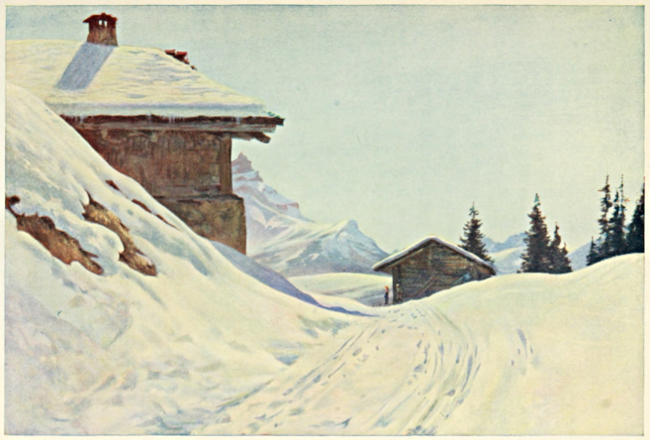
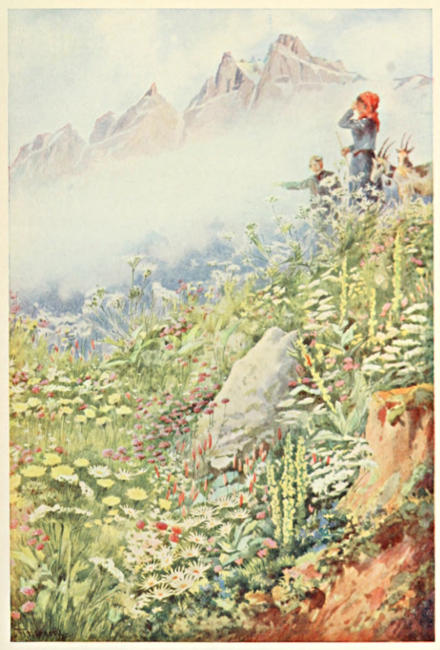
VILLARS: A PEEP OF THE DENT DE MORCLES
“Of the descent it is hard to speak with decent
restraint. There are some two thousand feet leading
direct from the pass to the glen. As we found them
the snow was in perfect condition. One put one’s
ski together and let gravity do the rest. You start
off with a thousand feet of easy, gradual slopes, which
you can take nearly straight. There is not a single
difficulty to give one pause; it is all plain sailing,
or rather plain ski-ing. Then comes a slight ascent,
promptly followed by one of the best bits of running
in the district. If you can take this stretch of some
thousand feet without using your sticks or pulling up
you are something of a runner. You begin with a
gentle swoop down into a hollow, you swing round
by a telemark or stemming turn, and then you have
a wide choice of some good snow for the next lap.
Follows a somewhat steep slope, which will give you
a chance of putting in four sharp curves; swing round
to the right, and then take the last stretch of a hundred
feet straight, and wind up with a Christiania
before the stream. The rest of the run home is not
so good, but it affords some very excellent short bits
and some pretty work through the woods.
“An alternative to this expedition is to cross the
Porte du Soleil to Champéry. You start with a stiffish
traverse, and then spin down some divine slopes to
the Col de Coux, winding up with a run down an
easy pass to Champéry. In a good season, when
there is plenty of snow at Champéry, this run is well
worth making. After an excellent light repast at
Champéry you return by road to Troistorrents, quite
enjoyable ski-ing of its kind, and then home either
on foot or by sleigh. Or you might sleep at Champéry
and return the next day over the same pass.
“The second expedition was almost as good as the
Porte du Soleil. In fact I am inclined to give it the
place of honour. Much the same party started off
quite gaily for the Bellevue. We climbed steepish
sunny slopes above the hotel for a couple of hours
to a typical little châlet, where we had lunch. One
of the party was something of an epicure, and he had
provided himself with a spirit lamp, and so we had
the benefit of hot tea—a great luxury. After lunch
two of us climbed still higher, to the actual summit.
It was well worth the slight additional toil. The
view was lovelier than I had anticipated. The Bellevue
is well placed, as it commands the great giants
of the Pennine Alps. In the west Mont Blanc towered
into a stainless sky. The Dent du Midi showed up
well above Champéry, and beyond on the left the
Combin showed terrace upon terrace of dazzling
snows. I fancy we also saw the Weisshorn and Dent
Blanche, but I am not certain on these points. Certainly
the chiefs of the Oberland greeted us from beyond
the Diablerets, and my companion hailed with
joy the cone of the Wetterhorn, which he had climbed
in earlier days. At our feet lay the long arm of
Geneva, and we made out with interest Chillon’s snow-white
battlements. The winter resorts above Montreux
looked woefully brown and bare of snow, and
we turned with satisfaction to contrast them with
the white slopes of Morgins. We were more than
ever convinced that Morgins enjoys even more snow
than a place of its very respectable altitude deserves.
The view from the Bellevue has the charm of the
prospects from those lesser summits of the Alps that
are not too near the greater peaks to be overshadowed,
nor too remote to lose the essential majesty of the
greater giants. The blending of lake and forest, quiet
snow-clad hills, and forest-bound cliffs has a charm
lacking in the innermost recesses of the chain. The
descent to the châlet was very fine. The first hundred
feet required some care, but this was followed
by a long slope just steep enough to take at full
speed without any fear of a fall. A gentle swing
and a beautiful piece of snow brought us back to
the rest of the party. We then spent a merry half-hour
or so practising swings, and once more turned
to the pass between the Bellevue and the Corbeau.
This brought us on to the northern slopes, and a
perfect dive over steep, but not too steep, gradients
led to an opening in the wood, and by the time we
had run through the forest we felt that we had acquitted
ourselves tolerably well, and enjoyed some
capital sport. But there was much good snow still
to furrow. Some long, open slopes of good snow
gave plenty of opportunity to put into practice the
swings and turns we had been performing so gaily
after lunch. These ended, the snow became worse,
and the last short stretch into the valley was not a
joy; we had descended some distance below Morgins,
and had pierced the belt below which rain had
descended instead of welcome snow. This short bit
was of very brief duration, and only served to accentuate
the glorious running above. At Vonne we had
a cup of tea and some delightful honey, and so home
across the short road pass.
“These are the only two expeditions which I can
vouch for from personal knowledge. But unless the
map lies, and unless other runners at Morgins also
speak the thing which is not, there must be a number
of other expeditions up to this standard. There
are fine slopes between Vonne and Chatel, and a
jolly expedition can be made to La Chapelle. The
Val de Morgins and its bounding hills still offer
plenty of prizes to the diligent explorer after new
routes, and the pass at the head of the valley should
certainly be crossed. For the mountaineer there are
fine high-level routes to Salvan, Sixt, and Chamonix,
and I fancy that the Dent du Midi would yield to
a determined attack, but I should advise the ski-runner
to tackle it from the south side, and not from
Champéry. It is best attacked in winter from the
Salanfe side, though this hardly comes into the category
of Morgins excursions. The rocks of the Dent
Jaune have a southern aspect, and should go quite
well in winter.
“But Morgins has other things to offer the visitor
besides the best ski-ing in this part of the Alps. (My
own private conviction is that the ski-ing at Morgins
will take a lot of beating, go where you will.) There
is an excellent skating and curling rink, beautifully
placed, within full reach of the sun’s attack. Mr. E.
F. Benson thought very highly of the situation and
upkeep of the rink. Then there is some very good
tobogganing, and I believe an ice-run is to be built
another winter. There are some glorious rambling
walks. You can slip over to France in half an hour
and take tea at Vonne; and in the evening there are
all the amusements associated with life in winter-sports
hotels. There is bridge for the sedate, and
bumps for the elderly, and dances for children and
Nature’s children, of whom there were not a few to
be found within a mile of Morgins. And there is—but
why add to this catalogue of good things? Those
who have gone to Morgins once will return there,
and those who have not will soon seek out this valley
in the Savoy hills, and find a certain reward.
“ARNOLD LUNN.”