LONDON: PRINTED BY
SPOTTISWOODE AND CO., NEW-STREET SQUARE
AND PARLIAMENT STREET
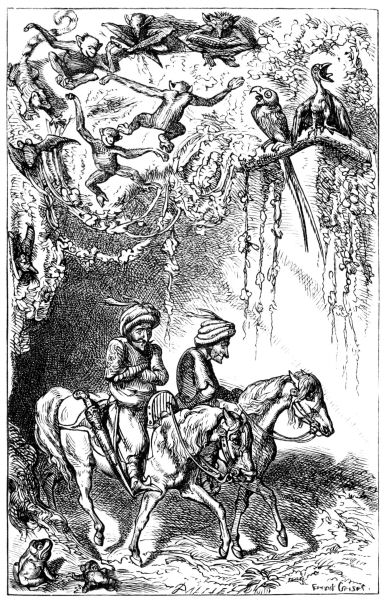
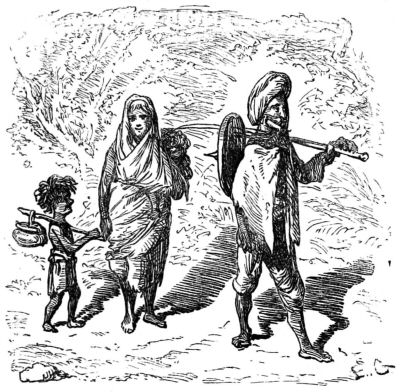
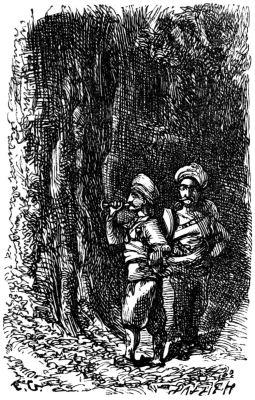
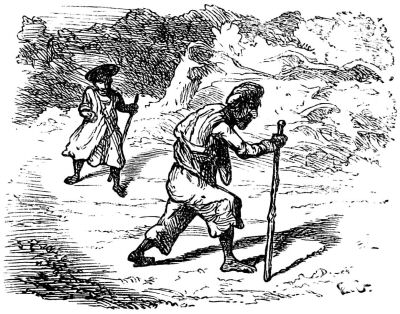
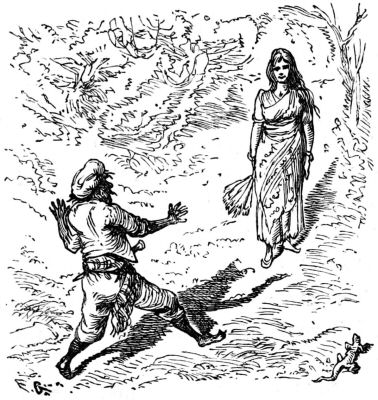
During the three hours of return hardly a word passed between the pair.
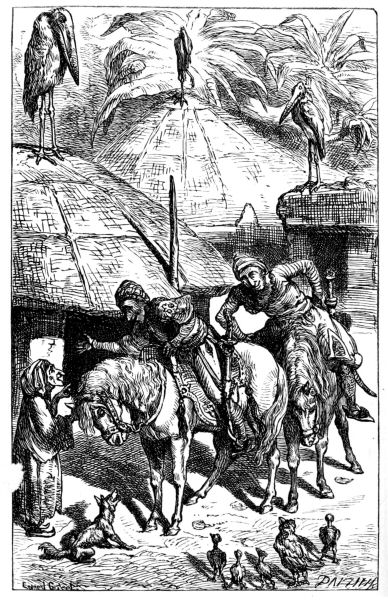
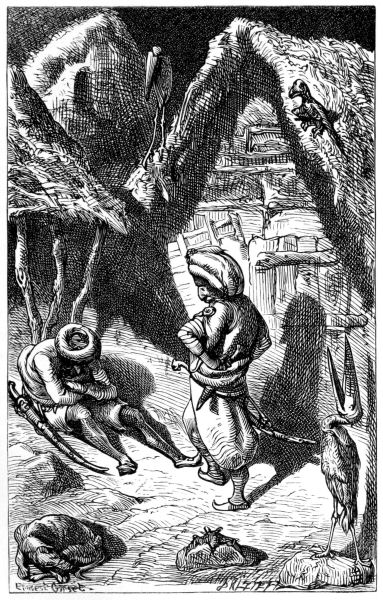
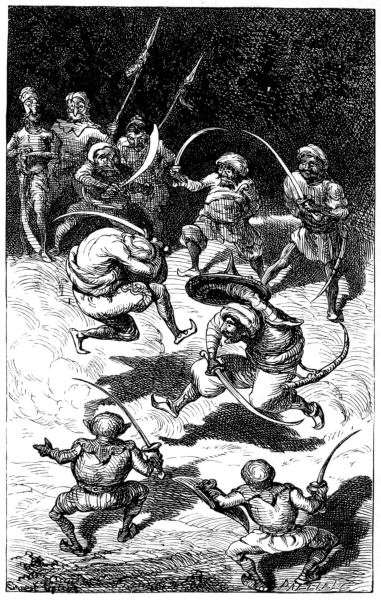
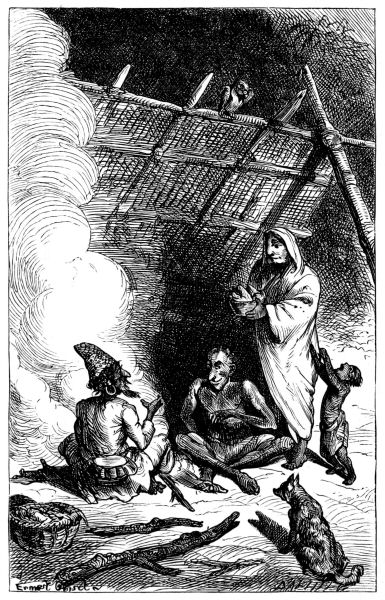
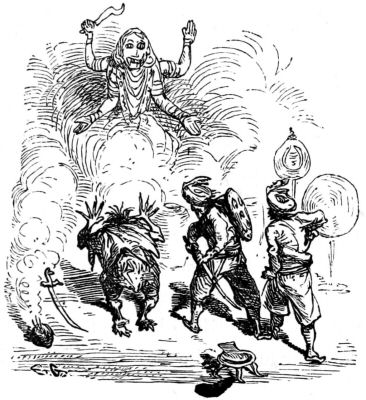
Frontispiece.
ADAPTED BY
RICHARD F. BURTON, F.R.G.S. &c.
‘Les fables, loin de grandir les hommes, la Nature et Dieu, rapetissent tout.’
Lamartine (Milton).
‘One who had eyes saw it; the blind will not understand it.
A poet, who is a boy, he has perceived it; he who understands it will
be his sire’s sire.’—Rig-Veda (I. 164, 16).
WITH THIRTY-THREE ILLUSTRATIONS BY ERNEST GRISET.
LONDON:
LONGMANS, GREEN, AND CO.
1870.
TO MY UNCLE, ROBERT BAGSHAW, OF DOVERCOURT,
THESE TALES,
THAT WILL REMIND HIM OF A LAND WHICH
HE KNOWS SO WELL,
ARE AFFECTIONATELY INSCRIBED.
PREFACE.
‘The
genius of Eastern nations,’ says an established
and respectable authority, ‘was, from the earliest
times, much turned towards invention and the love
of fiction. The Indians, the Persians, and the
Arabians, were all famous for their fables. Amongst
the ancient Greeks we hear of the Ionian and
Milesian tales, but they have now perished, and, from
every account that we hear of them, appear to have
been loose and indelicate.’ Similarly, the classical
dictionaries define ‘Milesiæ fabulæ’ to be ‘licentious
themes,’ ‘stories of an amatory or mirthful nature,’
or ‘ludicrous and indecent plays.’ M. Deriége seems
indeed to confound them with the ‘Mœurs du
Temps’ illustrated with artistic gouaches, when he
says, ‘une de ces fables milésiennes, rehaussées de
peintures, que la corruption romaine recherchait
alors avec une folle ardeur.’
My friend, Mr. Richard Charnock, F.A.S.L., more
correctly defines Milesian fables to have been originally
‘certain tales or novels, composed by Aristides
of Miletus;’ gay in matter and graceful in manner.
‘They were translated into Latin by the historian
Sisenna, the friend of Atticus, and they had a great
success at Rome. Plutarch, in his life of Crassus,
tells us that after the defeat of Carhes (Carrhæ?)
some Milesiacs were found in the baggage of the
Roman prisoners. The Greek text and the Latin
translation have long been lost. The only surviving
fable is the tale of Cupid and Psyche,[1] which Apuleius
calls “Milesius sermo,” and it makes us deeply
regret the disappearance of the others.’ Besides this
there are the remains of Apollodorus and Conon, and
a few traces to be found in Pausanias, Athenæus, and
the scholiasts.
I do not, therefore, agree with Blair, with the dictionaries,
or with M. Deriége. Miletus, the great
maritime city of Asiatic Ionia, was of old the
meeting place of the East and the West. Here the
Phœnician trader from the Baltic would meet the
Hindu wandering to Intra, from Extra, Gangem;
and the Hyperborean would step on shore side by
side with the Nubian and the Æthiop. Here was
produced and published for the use of the then civilised
world, the genuine Oriental apologue, myth
and tale combined, which, by amusing narrative and
romantic adventure, insinuates a lesson in morals or
in humanity, of which we often in our days must
fail to perceive the drift. The book of Apuleius, before
quoted, is subject to as many discoveries of recondite
meaning as Rabelais. As regards the licentiousness
of the Milesian fables, this sign of semi-civilisation
is still inherent in most Eastern books of the
description which we call ‘light literature,’ and the
ancestral tale-teller never collects a larger purse of
coppers than when he relates the worst of his ‘aurei.’
But this looseness, resulting from the separation of
the sexes, is accidental, not necessary. The following
collection will show that it can be dispensed with,
and that there is such a thing as comparative purity
in Hindu literature. The author, indeed, almost
always takes the trouble to marry his hero and his
heroine, and if he cannot find a priest, he generally
adopts an exceedingly left-hand and Caledonian but
legal rite called ‘gandharbavivaha.’[2]
The work of Apuleius, as ample internal evidence
shows, is borrowed from the East. The groundwork
of the tale is the metamorphosis of Lucius of Corinth
into an ass, and the strange accidents which precede
his recovering the human form.
Another old Hindu story-book relates, in the
popular fairy-book style, the wondrous adventures of
the hero and demigod, the great Gandharba-Sena.
That son of Indra, who was also the father of Vikramajit,
the subject of this and another collection,
offended the ruler of the firmament by his fondness
for a certain nymph, and was doomed to wander over
earth under the form of a donkey. Through the
interposition of the gods, however, he was permitted
to become a man during the hours of darkness,
thus comparing with the English legend—
Amundeville is lord by day,
But the monk is lord by night.
Whilst labouring under this curse, Gandharba-Sena
persuaded the King of Dhara to give him
a daughter in marriage, but it unfortunately so
happened that at the wedding hour he was unable
to show himself in any but asinine shape. After
bathing, however, he proceeded to the assembly, and,
hearing songs and music, he resolved to give them a
specimen of his voice.
The guests were filled with sorrow that so beautiful
a virgin should be married to a donkey. They
were afraid to express their feelings to the king, but
they could not refrain from smiling, covering their
mouths with their garments. At length some one
interrupted the general silence and said:
‘O king, is this the son of Indra? You have
found a fine bridegroom; you are indeed happy;
don’t delay the marriage; delay is improper in doing
good; we never saw so glorious a wedding! It is
true that we once heard of a camel being married to
a jenny-ass; when the ass, looking up to the camel,
said, “Bless me, what a bridegroom!” and the camel,
hearing the voice of the ass, exclaimed, “Bless me,
what a musical voice!” In that wedding, however,
the bride and the bridegroom were equal; but in
this marriage, that such a bride should have such a
bridegroom is truly wonderful.’
Other Brahmans then present said:
‘O king, at the marriage hour, in sign of joy the
sacred shell is blown, but thou hast no need of that’
(alluding to the donkey’s braying).
The women all cried out:
‘O my mother![3] what is this? at the time of
marriage to have an ass! What a miserable thing!
What! will he give that angelic girl in wedlock to a
donkey?’
At length Gandharba-Sena, addressing the king
in Sanskrit, urged him to perform his promise. He
reminded his future father-in-law that there is no
act more meritorious than speaking truth; that the
mortal frame is a mere dress, and that wise men
never estimate the value of a person by his clothes.
He added that he was in that shape from the curse
of his sire, and that during the night he had the
body of a man. Of his being the son of Indra there
could be no doubt.
Hearing the donkey thus speak Sanskrit, for it was
never known that an ass could discourse in that
classical tongue, the minds of the people were
changed, and they confessed that, although he had an
asinine form, he was unquestionably the son of Indra.
The king, therefore, gave him his daughter in marriage.[4]
The metamorphosis brings with it many
misfortunes and strange occurrences, and it lasts till
Fate in the author’s hand restores the hero to his
former shape and honours.
Gandharba-Sena is a quasi-historical personage,
who lived in the century preceding the Christian era.
The story had, therefore, ample time to reach the
ears of the learned African Apuleius, who was born
A.D. 130.
The Baital-Pachisi, or Twenty-five (tales of a)
Baital[5]—a Vampire or evil spirit which animates dead
bodies—is an old and thoroughly Hindu repertory.
It is the rude beginning of that fictitious history
which ripened to the Arabian Nights’ Entertainments,
and which, fostered by the genius of Boccaccio, produced
the romance of the chivalrous days, and its
last development, the novel—that prose-epic of modern
Europe.
Composed in Sanskrit, ‘the language of the gods,’
alias the Latin of India, it has been translated into
all the Prakrit or vernacular and modern dialects of
the great peninsula. The reason why it has not
found favour with the Moslems is doubtless the highly
polytheistic spirit which pervades it; moreover, the
Faithful had already a specimen of that style of
composition. This was the Hitopadesa, or Advice of
a Friend, which, as a line in its introduction informs
us, was borrowed from an older book, the Panchatantra,
or Five Chapters. It is a collection of apologues
recited by a learned Brahman, Vishnu Sharma
by name, for the edification of his pupils, the sons
of an Indian Raja. They have been adapted to or
translated into a number of languages, notably into
Pehlvi and Persian, Syriac and Turkish, Greek and
Latin, Hebrew and Arabic. And as the Fables of
Pilpay,[6] they are generally known, by name at least,
to European littérateurs. Voltaire remarks,[7] ‘Quand
on fait réflexion que presque toute la terre a été
infatuée de pareils contes, et qu’ils ont fait l’éducation
du genre humain, on trouve les fables de Pilpay,
Lokman, d’Ésope bien raisonnables.’
These tales, detached, but strung together by
artificial means—pearls with a thread drawn through
them—are manifest precursors of the Decamerone,
or Ten Days. A modern Italian critic describes the
now classical fiction as a collection of one hundred
of those novels which Boccaccio is believed to have
read out at the court of Queen Joanna of Naples,
and which later in life were by him assorted
together by a most simple and ingenious contrivance.
But the great Florentine invented neither
his stories nor his ‘plot,’ if we may so call it.
He wrote in the middle of the fourteenth century
(1344-8) when the West had borrowed many things
from the East, rhymes[8] and romance, lutes and drums,
alchemy and knight-errantry. Many of the ‘Novelle’
are, as Orientalists well know, to this day sung and
recited almost textually by the wandering tale-tellers,
bards, and rhapsodists of Persia and Central Asia.
The great kshatriya (soldier) king Vikramaditya,[9]
or Vikramarka, meaning the ‘Sun of Heroism,’
plays in India the part of King Arthur, and of Harun
El Rashid further West. He is a semi-historical
personage. The son of Gandharba-Sena the donkey
and the daughter of the King of Dhara, he was promised
by his father the strength of a thousand male
elephants. When his sire died, his grandfather, the
deity Indra, resolved that the babe should not be
born, upon which his mother stabbed herself. But
the tragic event duly happening during the ninth
month, Vikram came into the world by himself, and
was carried to Indra, who pitied and adopted him,
and gave him a good education.
The circumstances of his accession to the throne,
as will presently appear, are differently told. Once,
however, made King of Malaya, the modern Malwa,
a province of Western Upper India, he so distinguished
himself that the Hindu fabulists, with their
usual brave kind of speaking, have made him ‘bring
the whole earth under the shadow of one umbrella.’
The last ruler of the race of Mayúra, which reigned
318 years, was Rája-pál. He reigned 25 years, but
giving himself up to effeminacy, his country was
invaded by Shakáditya, a king from the highlands of
Kumaon. Vikramaditya, in the fourteenth year of
his reign, pretended to espouse the cause of Rája-pál,
attacked and destroyed Shakáditya, and ascended the
throne of Delhi. His capital was Avanti, or Ujjayani,
the modern Ujjain. It was 13 kos (26 miles) long
by 18 miles wide, an area of 468 square miles, but a
trifle in Indian history. He obtained the title of
Shakári, ‘foe of the Shakas,’ the Sacæ or Scythians,
by his victories over that redoubtable race.
In the Kali Yug, or Iron Age, he stands highest
amongst the Hindu kings as the patron of learning.
Nine persons under his patronage, popularly known
as the ‘Nine Gems of Science,’ hold in India the
honourable position of the Seven Wise Men of Greece.
These learned persons wrote works in the eighteen
original dialects from which, say the Hindus, all
the languages of the earth have been derived.[10]
Dhanwantari enlightened the world upon the subjects
of medicine and incantations. Kshapanaka
treated the primary elements. Amara-Singha compiled
a Sanskrit dictionary and a philosophical
treatise. Shankubetálabhatta composed comments
and Ghatakarpara, a poetical work of no great merit.
The books of Mihira are not mentioned. Varáha
produced two works on astrology and one on arithmetic.
And Bararúchí introduced certain improvements
in grammar, commented upon the incantations,
and wrote a poem in praise of King Mádhava.
But the most celebrated of all the patronised ones
was Kalidása. His two dramas, Sakuntala,[11] and
Vikram and Urvasi,[12] have descended to our day;
besides which he produced a poem on the seasons,
a work on astronomy, a poetical history of the gods,
and many other books.[13]
Vikramaditya established the Sambat era, dating
from A.C. 56. After a long, happy, and glorious
reign, he lost his life in a war with Shalivahana,
King of Pratisthana. That monarch also left behind
him an era called the ‘Shaka,’ beginning with A.D. 78.
It is employed, even now, by the Hindus in recording
their births, marriages, and similar occasions.
King Vikramaditya was succeeded by his infant
son Vikrama-Sena, and father and son reigned over
a period of 93 years. At last the latter was supplanted
by a devotee named Samudra-pála, who
entered into his body by miraculous means. The
usurper reigned 24 years and 2 months, and the
throne of Delhi continued in the hands of his
sixteen successors, who reigned 641 years and three
months. Vikrama-pála, the last, was slain in battle
by Tilaka-chandra, King of Vaharannah.[14]
It is not pretended that the words of these Hindu
tales are preserved to the letter. The question about
the metamorphosis of cats into tigers, for instance,
proceeded from a Gem of Learning in a university
much nearer home than Gaur. Similarly the learned
and still living Mgr. Gaume (Traité du Saint-Esprit,
p. 81) joins Camerarius in the belief that serpents bite
women rather than men. And he quotes (p. 192)
Cornelius à Lapide, who informs us that the leopard
is the produce of a lioness with a hyæna or a pard.
The merit of the old stories lies in their suggestiveness
and their general applicability. I have
ventured to remedy the conciseness of their language,
and to clothe the skeleton with flesh and blood.
The
sage Bhavabhuti—Eastern teller of these tales—after
making his initiatory and propitiatory congé
to Ganesha, Lord of Incepts, informs the reader that
this book is a string of fine pearls to be hung round
the neck of human intelligence; a fragrant flower to
be borne on the turban of mental wisdom; a jewel of
pure gold, which becomes the brow of all supreme
minds; and a handful of powdered rubies, whose
tonic effects will appear palpably upon the mental
digestion of every patient. Finally, that by aid of
the lessons inculcated in the following pages, man
will pass happily through this world into the state
of absorption, where fables will be no longer required.
He then teaches us how Vikramaditya the Brave
became King of Ujjayani.
Some nineteen centuries ago, the renowned city of
Ujjayani witnessed the birth of a prince to whom
was given the gigantic name Vikramaditya. Even
the Sanskrit-speaking people, who are not usually
pressed for time, shortened it to ‘Vikram,’ and a
little further West it would infallibly have been
docked down to ‘Vik.’
Vikram was the second son of an old king Gandharba-Sena,
concerning whom little favourable has
reached posterity, except that he became an ass,
married four queens, and had by them six sons, each
of whom was more learned and powerful than the
other. It so happened that in course of time the
father died. Thereupon his eldest heir, who was
known as Shank, succeeded to the carpet of Rajaship,
and was instantly murdered by Vikram, his ‘scorpion,’
the hero of the following pages.[15]
By this act of vigour and manly decision, which
all younger-brother princes should devoutly imitate,
Vikram having obtained the title of Bir, or the Brave,
made himself Raja. He began to rule well, and
the gods so favoured him that day by day his dominions
increased. At length he became lord of all
India, and having firmly established his government,
he instituted an era—an uncommon feat for a mere
monarch, especially when hereditary.
The steps,[16] says the historian, which he took to
arrive at that pinnacle of grandeur, were these:
The old King calling his two grandsons Bhartari-hari
and Vikramaditya, gave them good counsel
respecting their future learning. They were told to
master everything, a certain way not to succeed in
anything. They were diligently to learn grammar,
the scriptures, and all the religious sciences. They
were to become familiar with military tactics, international
law, and music, the riding of horses and elephants—especially
the latter—the driving of chariots,
and the use of the broadsword, the bow, and the
mogdars or Indian clubs. They were ordered to be
skilful in all kinds of games, in leaping and running,
in besieging forts, in forming and breaking bodies of
troops; they were to endeavour to excel in every
princely quality, to be cunning in ascertaining the
power of an enemy, how to make war, to perform
journeys, to sit in the presence of the nobles, to separate
the different sides of a question, to form alliances,
to distinguish between the innocent and the guilty,
to assign proper punishments to the wicked, to exercise
authority with perfect justice, and to be liberal.
The boys were then sent to school, and were placed
under the care of excellent teachers, where they
became truly famous. Whilst under pupilage, the
eldest was allowed all the power necessary to obtain
a knowledge of royal affairs, and he was not invested
with the regal office till in these preparatory steps
he had given full satisfaction to his subjects, who
expressed high approval of his conduct.
The two brothers often conversed on the duties of
kings, when the great Vikramaditya gave the great
Bhartari-hari the following valuable advice:[17]
‘As Indra, during the four rainy months, fills the
earth with water, so a king should replenish his
treasury with money. As Surya the sun, in warming
the earth eight months, does not scorch it, so a king,
in drawing revenues from his people, ought not to
oppress them. As Vayu, the wind, surrounds and
fills everything, so the king by his officers and spies
should become acquainted with the affairs and circumstances
of his whole people. As Yama judges
men without partiality or prejudice, and punishes
the guilty, so should a king chastise, without favour,
all offenders. As Varuna, the regent of water, binds
with his pasha or divine noose his enemies, so let
a king bind every malefactor safely in prison. As
Chandra,[18] the moon, by his cheering light gives
pleasure to all, thus should a king, by gifts and generosity,
make his people happy. And as Prithwi,
the earth, sustains all alike, so should a king feel
an equal affection and forbearance towards every
one.’
Become a monarch, Vikram meditated deeply upon
what is said of monarchs:—‘A king is fire and air;
he is both sun and moon; he is the god of criminal
justice; he is the genius of wealth; he is the regent
of water; he is the lord of the firmament; he is a
powerful divinity who appears in human shape.’
He reflected with some satisfaction that the scriptures
had made him absolute, had left the lives and
properties of all his subjects to his arbitrary will,
had pronounced him to be an incarnate deity, and
had threatened to punish with death even ideas derogatory
to his honour.
He punctually observed all the ordinances laid
down by the author of the Niti, or institutes of
government. His night and day were divided into
sixteen pahars or portions, each one hour and a half,
and they were disposed of as follows:
Before dawn Vikram was awakened by a servant
appointed to this special duty. He swallowed—a
thing allowed only to a khshatriya or warrior—a
Mithridatic every morning on the saliva,[19] and he
made the cooks taste every dish before he ate of it.
As soon as he had risen, the pages in waiting
repeated his splendid qualities, and as he left his
sleeping-room in full dress, several Brahmans rehearsed
the praises of the gods. Presently he bathed,
worshipped his guardian deity, again heard hymns,
drank a little water, and saw alms distributed to the
poor. He ended this watch by auditing his accounts.
Next, entering his court, he placed himself amidst
the assembly. He was always armed when he received
strangers, and he caused even women to be
searched for concealed weapons. He was surrounded
by so many spies and so artful, that, of a thousand,
no two ever told the same tale. At the levée, on his
right sat his relations, the Brahmans, and men of
distinguished birth. The other castes were on the
left, and close to him stood the ministers and those
whom he delighted to consult. Afar in front gathered
the bards chanting the praises of the gods and of the
king; also the charioteers, elephanteers, horsemen,
and soldiers of valour. Amongst the learned men
in those assemblies there were ever some who were
well instructed in all the scriptures, and others who
had studied in one particular school of philosophy,
and were acquainted only with the works on divine
wisdom, or with those on justice, civil and criminal,
on the arts, mineralogy or the practice of physic;
also persons cunning in all kinds of customs; riding
masters, dancing-masters, teachers of good behaviour,
examiners, tasters, mimics, mountebanks, and others,
who all attended the court and awaited the king’s
commands. He here pronounced judgment in suits
of appeal. His poets wrote about him:
The lord of lone splendour an instant suspends
His course at mid-noon, ere he westward descends;
And brief are the moments our young monarch knows,
Devoted to pleasure or paid to repose!
Before the second sandhya,[20] or noon, about the
beginning of the third watch, he recited the names
of the gods, bathed, and broke his fast in his private
room; then rising from food, he was amused by
singers and dancing girls. The labours of the day
now became lighter. After eating he retired, repeating
the name of his guardian deity, visited the
temples, saluted the gods, conversed with the priests,
and proceeded to receive and to distribute presents.
Fifthly, he discussed political questions with his
ministers and councillors.
On the announcement of the herald that it was
the sixth watch—about 2 or 3 P.M.—Vikram allowed
himself to follow his own inclinations, to regulate
his family, and to transact business of a private and
personal nature.
After gaining strength by rest, he proceeded to
review his troops, examining the men, saluting the
officers, and holding military councils. At sunset
he bathed a third time and performed the five sacraments
of listening to a prelection of the Veda;
making oblations to the manes; sacrificing to Fire
in honour of the deities; giving rice to dumb
creatures; and receiving guests with due ceremonies.
He spent the evening amidst a select company of
wise, learned, and pious men, conversing on different
subjects, and reviewing the business of the
day.
The night was distributed with equal care.
During the first portion Vikram received the reports
which his spies and envoys, dressed in every disguise,
brought to him about his enemies. Against the
latter he ceased not to use the five arts, namely—dividing
the kingdom, bribes, mischief-making, negotiations,
and brute-force—especially preferring the
two first and the last. His forethought and prudence
taught him to regard all his nearest neighbours and
their allies as hostile. The powers beyond those
natural enemies he considered friendly because they
were the foes of his foes. And all the remoter
nations he looked upon as neutrals, in a transitional
or provisional state as it were, till they became
either his neighbours’ neighbours, or his own neighbours,
that is to say, his friends or his foes.
This important duty finished he supped, and at
the end of the third watch he retired to sleep, which
was not allowed to last beyond three hours. In the
sixth watch he arose and purified himself. The
seventh was devoted to holding private consultations
with his ministers, and to furnishing the officers of
government with requisite instructions. The eighth
or last watch was spent with the Purohita or priest,
and with Brahmans, hailing the dawn with its appropriate
rites; he then bathed, made the customary
offerings, and prayed in some unfrequented place
near pure water.
And throughout these occupations he bore in mind
the duty of kings, namely—to pursue every object till
it be accomplished; to succour all dependants, and
hospitably to receive guests, however numerous. He
was generous to his subjects respecting taxes, and
kind of speech; yet he was inexorable as death in
the punishment of offences. He rarely hunted, and he
visited his pleasure gardens only on stated days. He
acted in his own dominions with justice; he chastised
foreign foes with rigour; he behaved generously to
Brahmans, and he avoided favouritism amongst his
friends. In war he never slew a suppliant, a spectator,
a person asleep or undressed, or anyone that showed
fear. Whatever country he conquered, offerings were
presented to its gods, and effects and money were
given to the reverends. But what benefited him most
was his attention to the creature comforts of the Nine
Gems of Science: those eminent men ate and drank
themselves into fits of enthusiasm, and ended by
immortalising their patron’s name.
Become Vikram the Great he established his court
at a delightful and beautiful location rich in the best
of water. The country was difficult of access, and
artificially made incapable of supporting a host of
invaders, but four great roads met near the city.
The capital was surrounded with durable ramparts,
having gates of defence, and near it was a mountain
fortress, under the especial charge of a great captain.
The metropolis was well garrisoned and provisioned,
and it surrounded the royal palace, a noble building
without as well as within. Grandeur seemed embodied
there, and Prosperity had made it her own.
The nearer ground, viewed from the terraces and
pleasure pavilions, was a lovely mingling of rock and
mountain, plain and valley, field and fallow, crystal
lake and glittering stream. The banks of the winding
Lavana were fringed with meads whose herbage,
pearly with morning dew, afforded choicest grazing
for the sacred cow, and were dotted with perfumed
clumps of Bo-trees, tamarinds, and holy figs: in one
place Vikram planted 100,000 in a single orchard and
gave them to his spiritual advisers. The river valley
separated the stream from a belt of forest growth
which extended to a hill range, dark with impervious
jungle, and cleared here and there for the cultivator’s
village. Behind it, rose another subrange, wooded
with a lower bush and already blue with air, whilst in
the background towered range upon range, here rising
abruptly into points and peaks, there ramp-shaped or
wall-formed, with sheer descents, and all of light
azure hue adorned with glories of silver and gold.
After reigning for some years, Vikram the Brave
found himself, at the age of thirty, a staid and sober
middle-aged man. He had several sons—daughters
are naught in India—by his several wives, and he
had some paternal affection for nearly all—except, of
course, for his eldest son, a youth who seemed to
conduct himself as though he had a claim to the
succession. In fact, the king seemed to have taken
up his abode for life at Ujjayani, when suddenly he
bethought himself, ‘I must visit those countries of
whose names I am ever hearing.’ The fact is, he had
determined to spy out in disguise the lands of all his
foes, and to find the best means of bringing against
them his formidable army.
* * * * *
We now learn how Bhartari Raja becomes Regent
of Ujjayani.
Having thus resolved, Vikram the Brave gave the
government into the charge of a younger brother,
Bhartari Raja, and in the garb of a religious mendicant,
accompanied by Dharma Dhwaj, his second son,
a youth bordering on the age of puberty, he began to
travel from city to city, and from forest to forest.
The Regent was of a settled melancholic turn of
mind, having lost in early youth a very peculiar
wife. One day, whilst out hunting, he happened
to pass a funeral pyre, upon which a Brahman’s
widow had just become Sati (a holy woman) with the
greatest fortitude. On his return home he related
the adventure to Sita Rani, his spouse, and she at
once made reply that virtuous women die with their
husbands, killed by the fire of grief, not by the flames
of the pile. To prove her truth the prince, after an
affectionate farewell, rode forth to the chase, and
presently sent back the suite with his robes torn and
stained, to report his accidental death. Sita perished
upon the spot, and the widower remained inconsolable—for
a time.
He led the dullest of lives, and took to himself
sundry spouses, all equally distinguished for birth,
beauty, and modesty. Like his brother, he performed
all the proper devoirs of a Raja, rising before the day
to finish his ablutions, to worship the gods, and to do
due obeisance to the Brahmans. He then ascended
the throne, to judge his people according to the
Shastra, carefully keeping in subjection lust, anger,
avarice, folly, drunkenness, and pride; preserving
himself from being seduced by the love of gaming and
of the chase; restraining his desire for dancing, singing,
and playing on musical instruments, and refraining
from sleep during daytime, from wine, from
molesting men of worth, from dice, from putting
human beings to death by artful means, from useless
travelling, and from holding any one guilty without
the commission of a crime. His levées were in a hall
decently splendid, and he was distinguished only by
an umbrella of peacock’s feathers; he received all
complainants, petitioners, and presenters of offences
with kind looks and soft words. He united to himself
the seven or eight wise councillors, and the sober and
virtuous secretary that formed the high cabinet of his
royal brother, and they met in some secret lonely spot,
as a mountain, a terrace, a bower or a forest, whence
women, parrots, and other talkative birds were carefully
excluded.
And at the end of this useful and somewhat laborious
day, he retired to his private apartments, and,
after listening to spiritual songs and to soft music, he
fell asleep. Sometimes he would summon his brother’s
‘Nine Gems of Science,’ and give ear to their learned
discourses. But it was observed that the viceroy reserved
this exercise for nights when he was troubled
with insomnia—the words of wisdom being to him an
infallible remedy for that disorder.
Thus passed onwards his youth, doing nothing that
it could desire, forbidden all pleasures because they
were unprincely, and working in the palace harder
than in the pauper’s hut. Having, however, fortunately
for himself, few predilections and no imagination,
he began to pride himself upon being a
philosopher. Much business from an early age had
dulled his wits, which were never of the most brilliant;
and in the steadily increasing torpidity of his
spirit, he traced the germs of that quietude which
forms the highest happiness of man in this storm of
matter called the world. He therefore allowed himself
but one friend of his soul. He retained, I have
said, his brother’s seven or eight ministers; he was
constant in attendance upon the Brahman priests
who officiated at the palace, and who kept the impious
from touching sacred property; and he was
courteous to the commander-in-chief who directed
his warriors, to the officers of justice who inflicted
punishment upon offenders, and to the lords of
towns, varying in number from one to a thousand.
But he placed an intimate of his own in the high
position of confidential councillor, the ambassador to
regulate war and peace.
Mahi-pala was a person of noble birth, endowed
with shining abilities, popular, dexterous in business,
acquainted with foreign parts, famed for eloquence
and intrepidity, and as Menu the Lawgiver advises,
remarkably handsome.
Bhartari Raja, as I have said, became a quietist
and a philosopher. But Kama,[21] the bright god who
exerts his sway over the three worlds, heaven and earth
and grewsome Hades,[22] had marked out the prince
once more as the victim of his blossom-tipped shafts
and his flowery bow. How, indeed, could he hope
to escape the doom which has fallen equally upon
Bramha the Creator, Vishnu the Preserver, and dreadful
Shiva the Three-eyed Destroyer?[23]
By reason of her exceeding beauty, her face was
a full moon shining in the clearest sky; her hair was
the purple cloud of autumn when, gravid with rain,
it hangs low over earth; and her complexion mocked
the pale waxen hue of the large-flowered jasmine.
Her eyes were those of the timid antelope; her lips
were red as those of the pomegranate’s bud, and when
they opened, from them distilled a fountain of ambrosia.
Her neck was like a pigeon’s; her hand the
pink lining of the conch-shell; her waist a leopard’s;
her feet the softest lotuses. In a word, a model of
grace and loveliness was Dangalah Rani, Raja Bhartari’s
last and youngest wife.
The warrior laid down his arms before her; the
politician spoke out every secret in her presence. The
religious prince would have slaughtered a cow—that
sole unforgivable sin—to save one of her eyelashes:
the absolute king would not drink a cup of water
without her permission; the staid philosopher, the
sober quietist, to win from her the shadow of a
smile, would have danced before her like a singing-girl.
So desperately enamoured became Bhartari
Raja.
It is written, however, that love, alas! breeds not
love; and so it happened to the Regent. The warmth
of his affection, instead of animating his wife, annoyed
her; his protestations wearied her; his vows gave
her the headache; and his caresses were a colic that
made her blood run cold. Of course, the prince
perceived nothing, being lost in wonder and admiration
of the beauty’s coyness and coquetry. And as
women must give away their hearts, whether asked
or not, so the lovely Dangalah Rani lost no time
in lavishing all the passion of her idle soul upon
Mahi-pala, the handsome ambassador of peace and
war. By this means the three were happy and were
contented; their felicity, however, being built on a
rotten foundation, could not long endure. It soon
ended in the following extraordinary way.
In the city of Ujjayani,[24] within sight of the palace,
dwelt a Brahman and his wife, who, being old and
poor, and having nothing else to do, had applied
themselves to the practice of austere devotion.[25]
They fasted and refrained from drink, they stood on
their heads, and they held their arms for weeks in
the air; they prayed till their knees were like pads;
they disciplined themselves with scourges of wire;
and they walked about unclad in the cold season, and
in summer they sat within a circle of flaming wood,
till they became the envy and admiration of all the
plebeian gods that inhabit the lower heavens. In
fine, as a reward for their exceeding piety, the venerable
pair received at the hands of a celestial messenger
an apple of the tree Kalpavriksha—a fruit which
has the virtue of conferring eternal life upon him that
tastes it.
Scarcely had the god disappeared, when the Brahman,
opening his toothless mouth, prepared to eat
the fruit of immortality. Then his wife addressed
him in these words, shedding copious tears the
while:
‘To die, O man, is a passing pain; to be poor is an
interminable anguish. Surely our present lot is the
penalty of some great crime committed by us in a
past state of being.[26] Callest thou this state life?
Better we die at once, and so escape the woes of the
world!’
Hearing these words, the Brahman sat undecided,
with open jaws and eyes fixed upon the apple.
Presently he found tongue: ‘I have accepted the
fruit, and have brought it here; but having heard thy
speech, my intellect hath wasted away; now I will do
whatever thou pointest out.’
The wife resumed her discourse, which had been
interrupted by a more than usually copious flow of
tears. ‘Moreover, O husband, we are old, and what
are the enjoyments of the stricken in years? Truly
quoth the poet—
Die loved in youth, not hated in age.
If that fruit could have restored thy dimmed eyes,
and deaf ears, and blunted taste, and warmth of love,
I had not spoken to thee thus.’
After which the Brahman threw away the apple, to
the great joy of his wife, who felt a natural indignation
at the prospect of seeing her goodman become
immortal, whilst she still remained subject to the laws
of death; but she concealed this motive in the depths
of her thought, enlarging, as women are apt to do,
upon everything but the truth. And she spoke with
such success, that the priest was about to toss in his
rage the heavenly fruit into the fire, reproaching the
gods as if by sending it they had done him an injury.
Then the wife snatched it out of his hand, and telling
him that it was too precious to be wasted, bade him
arise and gird his loins and wend him to the Regent’s
palace, and offer him the fruit—as King Vikram was
absent—with a right reverend brahmanical benediction.
She concluded with impressing upon her unworldly
husband the necessity of requiring a large
sum of money as a return for his inestimable gift.
‘By this means,’ she said, ‘thou mayst promote thy
present and future welfare.’[27]
Then the Brahman went forth, and standing in the
presence of the Raja, told him all things touching the
fruit, concluding with, ‘O, mighty prince! vouchsafe
to accept this tribute, and bestow wealth upon me.
I shall be happy in your living long!’
Bhartari Raja led the supplicant into an inner
strong-room, where stood heaps of the finest gold-dust,
and bade him carry away all that he could;
this the priest did, not forgetting to fill even his
eloquent and toothless mouth with the precious
metal. Having dismissed the devotee groaning
under the burden, the Regent entered the apartments
of his wives, and, having summoned the beautiful
Queen Dangalah Rani, gave her the fruit, and said,
‘Eat this, light of my eyes! This fruit—joy of my
heart!—will make thee everlastingly young and
beautiful.’
The pretty queen, placing both hands upon her
husband’s bosom, kissed his eyes and lips, and
sweetly smiling on his face—for great is the guile of
women—whispered, ‘Eat it thyself, dear one, or at
least share it with me; for what is life and what is
youth without the presence of those we love?’ But
the Raja, whose heart was melted by these unusual
words, put her away tenderly, and, having explained
that the fruit would serve for only one person,
departed.
Whereupon the pretty queen, sweetly smiling as
before, slipped the precious present into her pocket.
When the Regent was transacting business in the
hall of audience she sent for the ambassador who
regulated war and peace, and presented him with the
apple in a manner at least as tender as that with
which it had been offered to her.
Then the ambassador, after slipping the fruit into
his pocket also, retired from the presence of the
pretty queen, and meeting Lakha, one of the maids
of honour, explained to her its wonderful power, and
gave it to her as a token of his love. But the maid
of honour, being an ambitious girl, determined that
the fruit was a fit present to set before the Regent in
the absence of the King. Bhartari Raja accepted it,
bestowed on her great wealth, and dismissed her with
many thanks.
He then took up the apple and looked at it with
eyes brimful of tears, for he knew the whole extent
of his misfortune. His heart ached, he felt a loathing
for the world, and he said with sighs and
groans:[28]
‘Of what value are these delusions of wealth and
affection, whose sweetness endures for a moment
and becomes eternal bitterness? Love is like the
drunkard’s cup: delicious is the first drink, palling
are the draughts that succeed it, and most distasteful
are the dregs. What is life but a restless vision
of imaginary pleasures and of real pains, from which
the only waking is the terrible day of death? The
affection of this world is of no use, since, in consequence
of it, we fall at last into hell. For which
reason it is best to practise the austerities of religion,
that the Deity may bestow upon us hereafter that
happiness which he refuses to us here!’
Thus did Bhartari Raja determine to abandon the
world. But before setting out for the forest, he
could not refrain from seeing the queen once more,
so hot was the flame which Kama had kindled in his
heart. He therefore went to the apartments of his
women, and having caused Dangalah Rani to be
summoned, he asked her what had become of the
fruit which he had given to her. She answered that,
according to his command, she had eaten it. Upon
which the Regent showed her the apple, and she
beholding it stood aghast, unable to make any reply.
The Raja gave careful orders for her beheading;
he then went out, and having had the fruit washed,
ate it. He quitted the throne to be a jogi, or religious
mendicant, and without communicating with
any one departed into the jungle. There he became
such a devotee that death had no power over him,
and he is wandering still. But some say that he
was duly absorbed into the essence of the Deity.
* * * * *
We are next told how the valiant Vikram returned
to his own country.
Thus Vikram’s throne remained empty. When
the news reached King Indra, Regent of the Lower
Firmament and Protector of Earthly Monarchs, he
sent Prithwi Pala, a fierce giant,[29] to defend the city
of Ujjayani till such time as its lawful master might
reappear, and the guardian used to keep watch and
ward night and day over his trust.
In less than a year the valorous Raja Vikram
became thoroughly tired of wandering about the
woods half dressed: now suffering from famine, then
exposed to the attacks of wild beasts, and at all
times very ill at ease. He reflected also that he was
not doing his duty to his wives and children; that
the heir-apparent would probably make the worst
use of the parental absence; and finally, that his
subjects, deprived of his fatherly care, had been left
in the hands of a man who, for aught he could say,
was not worthy of the high trust. He had also spied
out all the weak points of friend and foe. Whilst
these and other equally weighty considerations were
hanging about the Raja’s mind, he heard a rumour
of the state of things spread abroad; that Bhartari,
the regent, having abdicated his throne, had gone
away into the forest. Then quoth Vikram to his
son, ‘We have ended our wayfarings, now let us turn
our steps homewards!’
The gong was striking the mysterious hour of
midnight as the king and the young prince approached
the principal gate. And they were pushing
through it when a monstrous figure rose up
before them, and called out with a fearful voice,
‘Who are ye, and where are ye going? Stand and
deliver your names!’
‘I am Raja Vikram,’ rejoined the king, half
choked with rage, ‘and I am come to mine own city.
Who art thou that darest to stop or stay me?’
‘That question is easily answered,’ cried Prithwi
Pala the giant, in his roaring voice; ‘the gods have
sent me to protect Ujjayani. If thou be really Raja
Vikram, prove thyself a man: first fight with me,
and then return to thine own.’
The warrior king cried ‘Sadhu!’ wanting nothing
better. He girt his girdle tight round his loins,
summoned his opponent into the empty space beyond
the gate, told him to stand on guard, and presently
began to devise some means of closing with or running
in upon him. The giant’s fists were large as
water melons, and his knotted arms whistled through
the air like falling trees, threatening fatal blows.
Besides which the Raja’s head scarcely reached the
giant’s stomach, and the latter, each time he struck
out, whooped so abominably loud, that no human
nerves could remain unshaken.
At last Vikram’s good luck prevailed. The giant’s
left foot slipped, and the hero, seizing his antagonist’s
other leg, began to trip him up. At the same
moment the young prince, hastening to his parent’s
assistance, jumped viciously upon the enemy’s naked
toes. By their united exertions they brought him
to the ground, when the son sat down upon his
stomach, making himself as weighty as he well
could, whilst the father, climbing up to the monster’s
throat, placed himself astride upon it, and pressing
both thumbs upon his eyes, threatened to blind him
if he would not yield.
Then the giant, modifying the bellow of his voice,
cried out—
‘O Raja, thou hast overthrown me, and I grant
thee thy life.’
‘Surely thou art mad, monster,’ replied the king,
in jeering tone, half laughing, half angry. ‘To
whom grantest thou life? If I desire it I can kill
thee; how, then, dost thou talk about granting me
my life?’
‘Vikram of Ujjayani,’ said the giant, ‘be not too
proud! I will save thee from a nearly impending
death. Only hearken to the tale which I have to
tell thee, and use thy judgment, and act upon it.
So shalt thou rule the world free from care, and live
without danger, and die happily.’
‘Proceed,’ quoth the Raja, after a moment’s
thought, dismounting from the giant’s throat, and
beginning to listen with all his ears.
The giant raised himself from the ground, and
when in a sitting posture, began in solemn tones to
speak as follows:
‘In short, the history of the matter is, that three
men were born in this same city of Ujjayani, in the
same lunar mansion, in the same division of the
great circle described upon the ecliptic, and in the
same period of time. You, the first, were born in
the house of a king. The second was an oilman’s
son, who was slain by the third, a jogi, or anchorite,
who kills all he can, wafting the sweet scent of
human sacrifice to the nostrils of Durga, goddess
of destruction. Moreover, the holy man, after compassing
the death of the oilman’s son, has suspended
him head downwards from a mimosa tree in a cemetery.
He is now anxiously plotting thy destruction.
He hath murdered his own child——’
‘And how came an anchorite to have a child?’
asked Raja Vikram, incredulously.
‘That is what I am about to tell thee,’ replied the
giant. ‘In the good days of thy generous father,
Gandharba-Sena, as the court was taking its pleasure
in the forest, they saw a devotee, or rather a devotee’s
head, protruding from a hole in the ground. The
white ants had surrounded his body with a case of
earth, and had made their home upon his skin. All
kinds of insects and small animals crawled up and
down the face, yet not a muscle moved. Wasps
had hung their nests to its temples, and scorpions
wandered in and out of the matted and clotted hair;
yet the hermit felt them not. He spoke to no one;
he received no gifts; and had it not been for the
opening of his nostrils, as he continually inhaled the
pungent smoke of a thorn fire, man would have
deemed him dead. Such were his religious austerities.
‘Thy father marvelled much at the sight, and
rode home in profound thought. That evening, as
he sat in the hall of audience, he could speak of
nothing but the devotee; and his curiosity soon rose
to such a pitch, that he proclaimed about the city a
reward of one hundred gold pieces to any one that
could bring to court this anchorite of his own free
will.
‘Shortly afterwards, Vasantasena, a singing and
dancing girl more celebrated for wit and beauty
than for sagesse or discretion, appeared before thy
sire, and offered for the petty inducement of a gold
bangle to bring the anchorite into the palace, carrying
a baby on his shoulder.
‘The king hearing her speak was astonished,
gave her a betel leaf in token that he held her to
her promise, and permitted her to depart, which she
did with a laugh of triumph.
‘Vasantasena went directly to the jungle, where
she found the pious man faint with thirst, shrivelled
with hunger, and half dead with heat and cold. She
cautiously put out the fire. Then, having prepared
a confection, she approached from behind and rubbed
upon his lips a little of the sweetmeat, which he
licked up with great relish. Thereupon she made
more and gave it to him. After two days of this
generous diet he gained some strength, and on the
third, as he felt a finger upon his mouth, he opened
his eyes and said, “Why hast thou come here?”
‘The girl, who had her story in readiness, replied:
“I am the daughter of a deity, and have practised
religious observances in the heavenly regions. I
have now come into this forest!” And the devotee,
who began to think how much more pleasant is such
society than solitude, asked her where her hut was,
and requested to be led there.
‘Then Vasantasena, having unearthed the holy
man and compelled him to purify himself, led him to
the abode which she had caused to be built for
herself in the wood. She explained its luxuries by
the nature of her vow, which bound her to indulge
in costly apparel, in food with six flavours, and in
every kind of indulgence.[30] In course of time the
hermit learned to follow her example; he gave up
inhaling smoke, and he began to eat and drink as a
daily occupation.
‘At length Kama began to trouble him. Briefly
the saint and saintess were made man and wife, by
the simple form of matrimony called the Gandharbavivaha,[31]
and about ten months afterwards a son was
born to them. Thus the anchorite came to have a
child.
‘Remained Vasantasena’s last feat. Some months
passed: then she said to the devotee her husband,
“Oh saint! let us now, having finished our devotions,
perform a pilgrimage to some sacred place, that all
the sins of our bodies may be washed away, after
which we will die and depart into everlasting happiness.”
Cajoled by these speeches, the hermit mounted
his child upon his shoulder and followed her where
she went—directly into Raja Gandharba-Sena’s
palace.
‘When the king and the ministers and the officers
and the courtiers saw Vasantasena, and her spouse
carrying the baby, they recognised her from afar.
The Raja exclaimed, “Lo! this is the very singing
girl who went forth to bring back the devotee.”
And all replied: “O great monarch! thou speakest
truly; this is the very same woman. And be pleased
to observe that whatever things she, having asked
leave to undertake, went forth to do, all these she
hath done!” Then gathering around her they asked
her all manner of questions, as if the whole matter
had been the lightest and the most laughable thing
in the world.
‘But the anchorite, having heard the speeches
of the king and his courtiers, thought to himself,
“They have done this for the purpose of taking
away the fruits of my penance.” Cursing them all
with terrible curses, and taking up his child, he left
the hall. Thence he went to the forest, slaughtered
the innocent, and began to practise austerities with
a view to revenge that hour, and, having slain his
child, he will attempt thy life. His prayers have
been heard. In the first place they deprived thee of
thy father. Secondly, they cast enmity between
thee and thy brother, thus dooming him to an
untimely end. Thirdly, they are now working thy
ruin. The anchorite’s design is to offer up a king
and a king’s son to his patroness Durga, and by
virtue of such devotional act he will obtain the sovereignty
of the whole world!
‘But I have promised, O Vikram, to save thee, if
such be the will of Fortune, from impending destruction.
Therefore hearken well unto my words. Distrust
them that dwell amongst the dead, and remember
that it is lawful and right to strike off his head
that would slay thee. So shalt thou rule the universal
earth, and leave behind thee an immortal name!’
Suddenly Prithwi Pala, the giant, ceased speaking,
and disappeared. Vikram and his son then
passed through the city gates, feeling their limbs to
be certain that no bones were broken, and thinking
over the scene that had occurred.
* * * * *
We now are informed how the valiant King Vikram
met with the Vampire.
It was the spring season when the Raja returned,
and the Holi festival[32] caused dancing and singing in
every house. Ujjayani was extraordinarily happy
and joyful at the return of her ruler, who joined in
her gladness with all his kingly heart. The faces
and dresses of the public were red and yellow with
gulal and abir,—perfumed powders,[33]—which were
sprinkled upon one another in token of merriment.
Musicians deafened the citizens’ ears, dancing girls
performed till ready to faint with fatigue, the manufacturers
of comfits made their fortunes, and the
Nine Gems of Science celebrated the auspicious day
with the most long-winded odes. The royal hero,
decked in regal attire, and attended by many thousands
of state palanquins glittering with their various
ornaments, and escorted by a suite of a hundred
kingly personages, with their martial array of the
four hosts, of cavalry, elephants, chariots, and infantry,
and accompanied by Amazon girls, lovely as the
suite of the gods, himself a personification of majesty,
bearing the white parasol of dominion, with a golden
staff and tassels, began once more to reign.
After the first pleasures of return, the king applied
himself unremittingly to good government and to
eradicating the abuses which had crept into the
administration during the period of his wanderings.
Mindful of the wise saying, ‘if the Raja did not
punish the guilty, the stronger would roast the
weaker like a fish on the spit,’ he began the work of
reform with an iron hand. He confiscated the property
of a councillor who had the reputation of
taking bribes; he branded the forehead of a sudra
or servile man whose breath smelt of ardent spirits,
and a goldsmith having been detected in fraud he
ordered him to be cut to shreds with razors as the
law in its mercy directs. In the case of a notorious
evil speaker he opened the back of his head and
had his tongue drawn through the wound. A few
murderers he burned alive on iron beds, praying the
while that Vishnu might have mercy upon their
souls. His spies were ordered, as the shastra called
‘The Prince’ advises, to mix with robbers and thieves
with a view of leading them into situations where
they might most easily be entrapped, and once or
twice when the fellows were too wary, he seized them
and their relations and impaled them all, thereby
conclusively proving, without any mistake, that he
was king of earth.
With the sex feminine he was equally severe. A
woman convicted of having poisoned an elderly husband
in order to marry a younger man was thrown
to the dogs, which speedily devoured her. He
punished simple infidelity by cutting off the offender’s
nose—an admirable practice, which is not only a
severe penalty to the culprit, but also a standing
warning to others, and an efficient preventative to
any recurrence of the fault. Faithlessness combined
with bad example or brazenfacedness was further
treated by being led in solemn procession through the
bazar mounted on a diminutive and crop-eared donkey,
with the face turned towards the crupper. After
a few such examples the women of Ujjayani became
almost modest; it is the fault of man when they are
not tolerably well behaved in one point at least.
Every day as Vikram sat upon the judgment-seat,
trying causes and punishing offences, he narrowly
observed the speech, the gestures, and the countenances
of the various criminals and litigants and
their witnesses. Ever suspecting women, as I have
said, and holding them to be the root of all evil, he
never failed when some sin or crime more horrible
than usual came before him, to ask the accused, ‘Who
is she?’ and the suddenness of the question often
elicited the truth by accident. For there can be
nothing thoroughly and entirely bad unless a woman
is at the bottom of it; and knowing this, Raja
Vikram made certain notable hits under the most
improbable circumstances, which had almost given
him a reputation for omniscience. But this is easily
explained: a man intent upon squaring the circle
will see squares in circles wherever he looks, and
sometimes he will find them.
In disputed cases of money claims, the king adhered
strictly to established practice, and consulted
persons learned in the law. He seldom decided a
cause on his own judgment, and he showed great
temper and patience in bearing with rough language
from irritated plaintiffs and defendants, from the
infirm, and from old men beyond eighty. That
humble petitioners might not be baulked in having
access to the ‘fountain of justice,’ he caused an iron
box to be suspended by a chain from the windows of
his sleeping apartment. Every morning he ordered
the box to be opened before him, and listened to
all the placets at full length. Even in this simple
process he displayed abundant cautiousness. For,
having forgotten what little of the humanities he
had mastered in his youth, he would hand the paper
to a secretary whose business it was to read it out
before him; after which operation the man of letters
was sent into an inner room, and the petition was
placed in the hands of a second scribe. Once it so
happened by the bungling of the deceitful kayasths
(clerks) that an important difference was found to
occur in the same sheet. So upon strict inquiry one
secretary lost his ears and the other his right hand.
After this petitions were rarely if ever falsified.
The Raja Vikram also lost no time in attacking
the cities and towns and villages of his enemies, but
the people rose to a man against him, and hewing
his army to pieces with their weapons, vanquished
him. This took place so often that he despaired of
bringing all the earth under the shadow of his umbrella.
At length on one occasion when near a village he
listened to a conversation of the inhabitants. A
woman having baked some cakes was giving them to
her child, who leaving the edges would eat only the
middle. On his asking for another cake, she cried,
‘This boy’s way is like Vikram’s in his attempt to
conquer the world!’ On his enquiring ‘Mother,
why, what am I doing; and what has Vikram done?’
‘Thou, my boy,’ she replied, ‘throwing away the
outside of the cake eatest the middle only. Vikram
also in his ambition, without subduing the frontiers
before attacking the towns, invades the heart of the
country and lays it waste. On that account, both
the townspeople and others rising, close upon him
from the frontiers to the centre, and destroy his army.
That is his folly.’
Vikram took notice of the woman’s words. He
strengthened his army and resumed his attack on the
provinces and cities, beginning with the frontiers,
reducing the outer towns and stationing troops in the
intervals. Thus he proceeded regularly with his invasions.
After a respite, adopting the same system
and marshalling huge armies, he reduced in regular
course each kingdom and province till he became
monarch of the whole world.
It so happened that one day as Vikram the Brave
sat upon the judgment seat, a young merchant, by
name Mal Deo, who had lately arrived at Ujjayani
with loaded camels and elephants, and with the reputation
of immense wealth, entered the palace court.
Having been received with extreme condescension,
he gave into the king’s hand a fruit which he had
brought in his own, and then spreading a prayer
carpet on the floor he sat down. Presently, after a
quarter of an hour, he arose and went away. When
he had gone the king reflected in his mind: ‘Under
this disguise, perhaps, is the very man of whom the
giant spoke.’ Suspecting this, he did not eat the
fruit, but calling the master of the household he gave
the present to him, ordering him to keep it in a very
careful manner. The young merchant, however,
continued every day to court the honour of an interview,
each time presenting a similar gift.
By chance one morning Raja Vikram went, attended
by his ministers, to see his stables. At this
time the young merchant also arrived there, and in
the usual manner placed a fruit in the royal hand.
As the king was thoughtfully tossing it in the air, it
accidentally fell from his fingers to the ground. Then
the monkey, who was tethered amongst the horses to
draw calamities from their heads,[34] snatched it up and
tore it to pieces. Whereupon a ruby of such size and
water came forth that the king and his ministers,
beholding its brilliancy, gave vent to expressions of
wonder.
Quoth Vikram to the young merchant severely—for
his suspicious were now thoroughly roused—‘Why
hast thou given to us all this wealth?’
‘O great king,’ replied Mal Deo, demurely, ‘it is
written in the scriptures (shastra) “Of Ceremony”
that “we must not go empty-handed into the presence
of the following persons, namely, Rajas, spiritual
teachers, judges, young maidens, and old women
whose daughters we would marry.” But why, O
Vikram, dost thou speak of one ruby only, since in
each of the fruits which I have laid at thy feet there
is a similar jewel?’
Having heard this speech, the king said to the
master of his household, ‘Bring all the fruits which
I have entrusted to thee.’ The treasurer, on receiving
the royal command, immediately brought them,
and having split them, there was found in each one a
ruby, one and all equally perfect in size and water.
Raja Vikram beholding such treasures was excessively
pleased. Having sent for a lapidary, he ordered
him to examine the rubies, saying, ‘We cannot take
anything with us out of this world. Virtue is a noble
quality to possess here below—so tell justly what is
the value of each of these gems.’[35]
To so moral a speech the lapidary replied, ‘Maharaja![36]
thou hast said truly; whoever possesses
virtue, possesses everything; virtue indeed accompanies
us always, and is of advantage in both worlds.
Hear, O great king! each gem is perfect in colour,
quality and beauty. If I were to say that the value
of each was ten million millions of suvarnas (gold
pieces), even then thou couldst not understand its
real worth. In fact, each ruby would buy one of the
seven regions into which the earth is divided.’
The king on hearing this was delighted, although
his suspicions were not satisfied; and, having bestowed
a robe of honour upon the lapidary, dismissed
him. Thereon, taking the young merchant’s hand,
he led him into the palace, seated him upon his own
carpet in presence of the court, and began to say,
‘My entire kingdom is not worth one of these rubies:
tell me how it is that thou who buyest and sellest
hast given me such and so many pearls?’
Mal Deo replied: ‘O great king, the speaking of
matters like the following in public is not right; these
things—prayers, spells, drugs, good qualities, household
affairs, the eating of forbidden food, and the
evil we may have heard of our neighbour—should
not be discussed in full assembly. Privately I will
disclose to thee my wishes. This is the way of the
world; when an affair comes to six ears, it does not
remain secret; if a matter is confided to four ears it
may escape further hearing; and if to two ears even
Bramha the Creator does not know it; how then can
any rumour of it come to man?’
Having heard this speech, Raja Vikram took Mal
Deo aside, and began to ask him, saying, ‘O generous
man! you have given me so many rubies, and
even for a single day you have not eaten food with
me; I am exceedingly ashamed, tell me what you
desire.’
‘Raja,’ said the young merchant, ‘I am not Mal
Deo, but Shanta-Shil,[37] a devotee. I am about to
perform spells, incantations and magical rites on the
banks of the river Godavari, in a large smashana, a
cemetery where bodies are burned. By this means
the Eight Powers of Nature will all become mine.
This thing I ask of you as alms, that you and the
young prince Dharma Dhwaj will pass one night
with me, doing my bidding. By you remaining near
me my incantations will be successful.’
The valiant Vikram nearly started from his seat at
the word cemetery, but, like a ruler of men, he restrained
his face from expressing his feelings, and he
presently replied, ‘Good, we will come, tell us on what
day!’
‘You are to come to me,’ said the devotee, ‘armed,
but without followers, on the Monday evening the
14th of the dark half of the month Bhadra.’[38] The
Raja said: ‘Do you go your ways, we will certainly
come.’ In this manner, having received a promise
from the king, and having taken leave, the devotee
returned to his house: thence he repaired to the
temple, and having made preparations, and taken all
the necessary things, he went back into the cemetery
and sat down to his ceremonies.
The valiant Vikram, on the other hand, retired
into an inner apartment, to consult his own judgment
about an adventure with which, for fear of ridicule,
he was unwilling to acquaint even the most trustworthy
of his ministers.
In due time came the evening moon’s day, the 14th
of the dark half of the month Bhadra. As the short
twilight fell gloomily on earth, the warrior king, accompanied
by his son, with turband-ends tied under
their chins, and with trusty blades tucked under their
arms ready for foes, human, bestial, or devilish,
slipped out unseen through the palace wicket, and
took the road leading to the cemetery on the river
bank.
Dark and drear was the night. Urged by the
furious blast of the lingering winter-rains, masses of
bistre-coloured cloud, like the forms of unwieldy
beasts, rolled heavily over the firmament plain.
Whenever the crescent of the young moon, rising
from an horizon sable as the sad Tamala’s hue,[39]
glanced upon the wayfarers, it was no brighter than
the fine tip of an elephant’s tusk protruding from the
muddy wave. A heavy storm was impending; big
drops fell in showers from the forest trees as they
groaned under the blast, and beneath the gloomy
avenue the clayey ground gleamed ghastly white.
As the Raja and his son advanced, a faint ray of
light, like the line of pure gold streaking the dark
surface of the touchstone, caught their eyes, and
directed their footsteps towards the cemetery.
When Vikram came upon the open space on the
river bank where corpses were burned, he hesitated
for a moment to tread its impure ground. But seeing
his son undismayed, he advanced boldly, trampling
upon remnants of bones, and only covering his mouth
with his turband-end.
Presently, at the further extremity of the smashana
or burning ground, appeared a group. By the lurid
flames that flared and flickered round the half-extinguished
funeral pyres, with remnants of their dreadful
loads, Raja Vikram and Dharma Dhwaj could note
the several features of the ill-omened spot. There
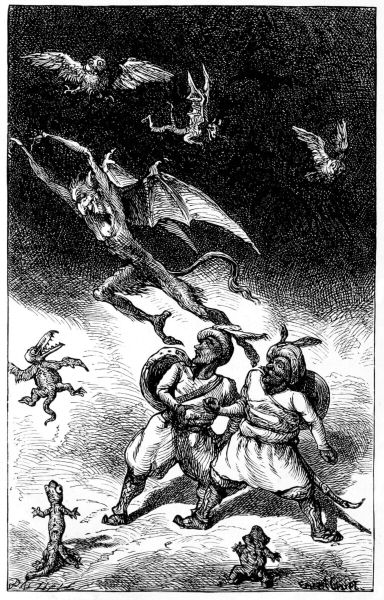
was an outer circle of hideous bestial forms; tigers
were roaring, and elephants were trumpeting; wolves,
whose foul hairy coats blazed with sparks of bluish
phosphoric light, were devouring the remnants of
human bodies; foxes, jackals, and hyenas were disputing
over their prey; whilst bears were chewing
the livers of children. The space within was peopled
by a multitude of fiends. There were the subtle
bodies of men that had escaped their grosser frames
prowling about the charnel ground, where their corpses
had been reduced to ashes, or hovering in the air,
waiting till the new bodies which they were to animate
were made ready for their reception. The
spirits of those that had been foully slain wandered
about with gashed limbs; and skeletons, whose
mouldy bones were held together by bits of blackened
sinew, followed them as the murderer does his victim.
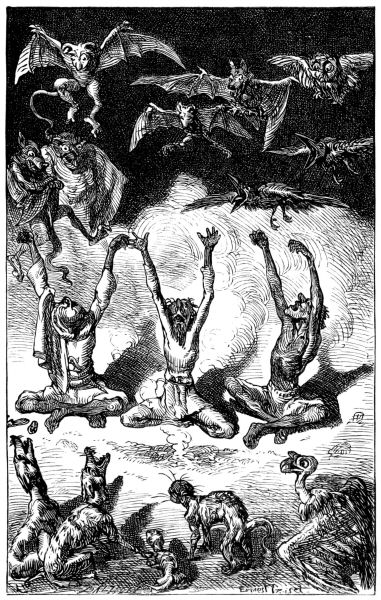
Malignant witches with shrivelled skins, horrid eyes
and distorted forms, crawled and crouched over the
earth; whilst spectres and goblins now stood motionless,
and tall as lofty palm trees; then, as if in fits,
leaped, danced, and tumbled before their evocator.
The air was filled with shrill and strident cries, with
the fitful moaning of the storm-wind, with the hooting
of the owl, with the jackal’s long wild cry,
and with the hoarse gurgling of the swollen river,
from whose banks the earth-slip thundered in its
fall.
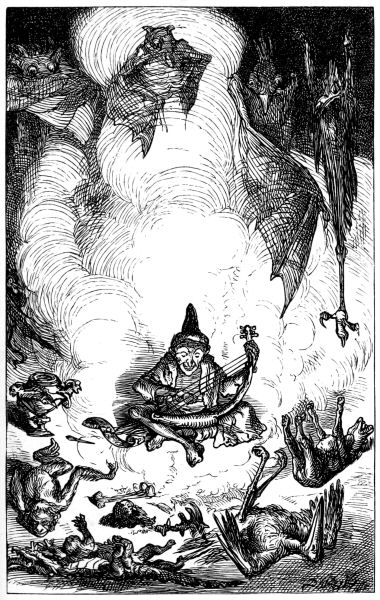
In the midst of all, close to the fire which lit up
his evil countenance, sat Shanta-Shil, the jogi, with
the banner that denoted his calling and his magic
staff planted in the ground behind him. He was
clad in the ochre-coloured loin-wrap of his class;
from his head streamed long tangled locks of hair
like horsehair; his black body was striped with lines
of chalk, and a girdle of thigh bones encircled his
waist. His face was smeared with ashes from a
funeral pyre, and his eyes, fixed as those of a statue,
gleamed from this mask with an infernal light of hate.
His cheeks were shaven, and he had not forgotten to
draw the horizontal sectarian mark. But this was of
blood; and Vikram, as he drew near, saw that he was
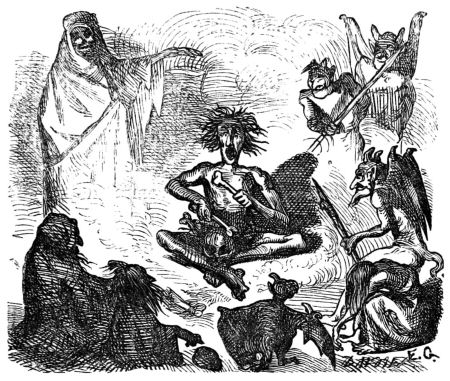
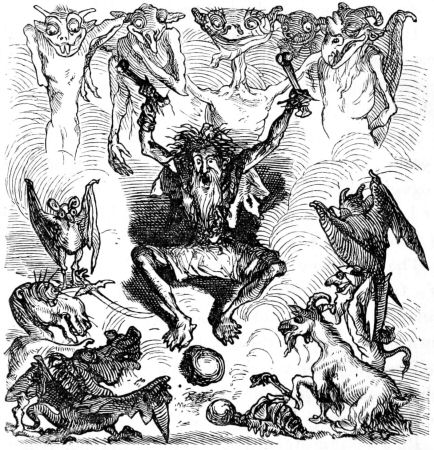
playing upon a human skull with two shank bones,
making music for the horrid revelry.
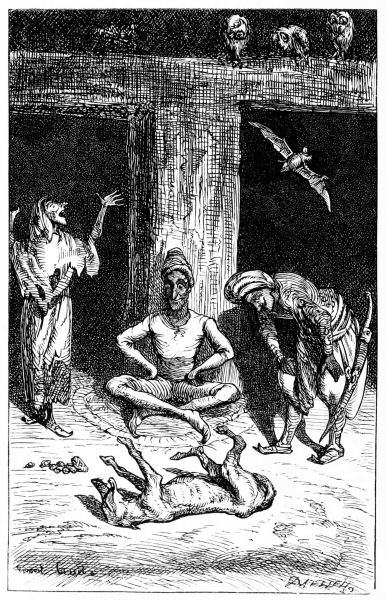
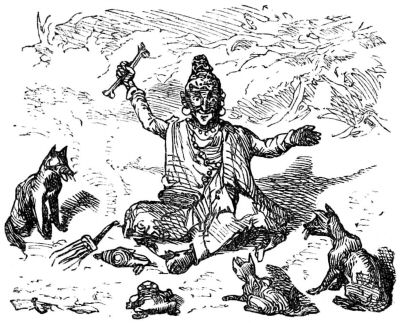
He was playing upon a human skull with two shank bones.
Now Raja Vikram, as has been shown by his
encounter with Indra’s watchman, was a bold prince,
and he was cautious as he was brave. The sight of a
human being in the midst of these terrors raised his
mettle; he determined to prove himself a hero, and
feeling that the critical moment was now come, he
hoped to rid himself and his house for ever of the
family curse that hovered over them.
For a moment he thought of the giant’s words,
‘And remember that it is lawful and right to strike
off his head that would slay thee.’ A stroke with his
good sword might at once and effectually put an end
to the danger. But then he remembered that he had
passed his royal word to do the devotee’s bidding that
night. Besides, he felt assured that the hour for
action had not yet sounded.
These reflections having passed through his mind
with the rapid course of a star that has lost its
honours,[40] Vikram courteously saluted Shanta-Shil.
The jogi briefly replied, ‘Come sit down, both of ye.’
The father and son took their places, by no means
surprised or frightened by the devil dances before
and around them. Presently the valiant Raja reminded
the devotee that he was come to perform his
promise, and lastly asked, ‘What commands are there
for us?’
The jogi replied, ‘O king, since you have come,
just perform one piece of business. About two kos[41]
hence, in a southerly direction, there is another
place where dead bodies are burned; and in that
place is a mimosa tree, on which a body is hanging.
Bring it to me immediately.’
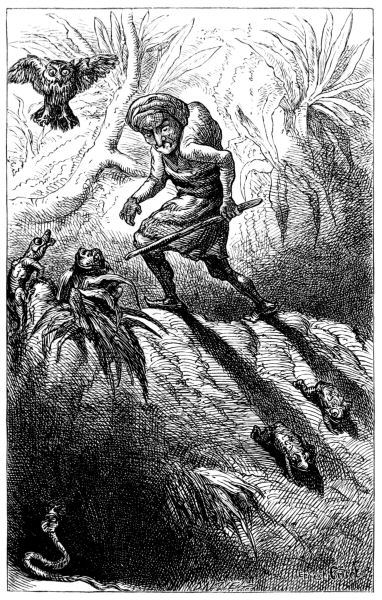
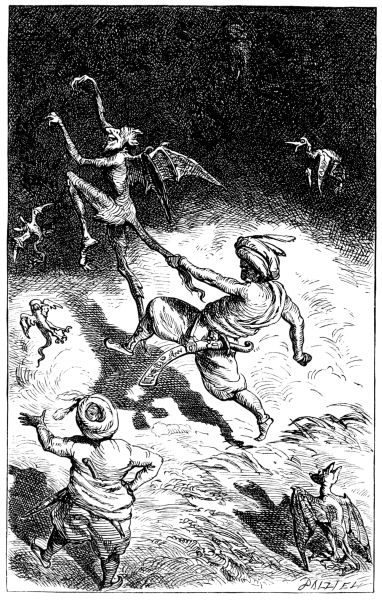
Raja Vikram took his son’s hand, unwilling to
leave him in such company; and, catching up a firebrand,
went rapidly away in the proper direction.
He was now certain that Shanta-Shil was the anchorite
who, enraged by his father, had resolved his
destruction; and his uppermost thought was a firm
resolve ‘to breakfast upon his enemy, ere his enemy
could dine upon him.’ He muttered this old saying
as he went, whilst the tom-tom-ing of the anchorite
upon the skull resounded in his ears, and the devil-crowd,
which had held its peace during his meeting
with Shanta-Shil, broke out again in an infernal
din of whoops and screams, yells and laughter.
The darkness of the night was frightful, the gloom
deepened till it was hardly possible to walk. The
clouds opened their fountains, raining so that you
would say they could never rain again. Lightning
blazed forth with more than the light of day, and
the roar of the thunder caused the earth to shake.
Baleful gleams tipped the black cones of the trees
and fitfully scampered like fireflies over the waste.
Unclean goblins dogged the travellers and threw
themselves upon the ground in their path and obstructed
them in a thousand different ways. Huge
snakes, whose mouths distilled blood and black
venom, kept clinging around their legs in the
roughest part of the road, till they were persuaded
to loose their hold either by the sword or by reciting
a spell. In fact there were so many horrors and
such a tumult and noise that even a brave man
would have faltered, yet the king kept on his way.
At length having passed over, somehow or other, a
very difficult road, the Raja arrived at the smashana,
or burning place pointed out by the jogi. Suddenly
he sighted the tree where from root to top every
branch and leaf was in a blaze of crimson flame.
And when he, still dauntless, advanced towards it, a
clamour continued to be raised, and voices kept
crying, ‘Kill them! kill them! seize them! seize
them! take care that they do not get away! let them
scorch themselves to cinders! let them suffer the
pains of Patala.’[42]
Far from being terrified by this state of things
the valiant Raja increased in boldness, seeing a
prospect of an end to his adventure. Approaching
the tree he felt that the fire did not burn him, and
so he sat there for a while to observe the body,
which hung, head downwards, from a branch a
little above him.
Its eyes, which were wide open, were of a greenish-brown,
and never twinkled; its hair also was brown,[43]
and brown was its face—three several shades which,
notwithstanding, approached one another in an unpleasant
way, as in an over-dried cocoa-nut. Its
body was thin and ribbed like a skeleton or a bamboo
framework, and as it held on to a bough, like a
flying fox,[44] by the toe-tips, its drawn muscles stood
out as if they were ropes of coir. Blood it appeared
to have none, or there would have been a decided
determination of that curious juice to the head; and
as the Raja handled its skin, it felt icy cold and
clammy as might a snake. The only sign of life
was the whisking of a ragged little tail much resembling
a goat’s.
Judging from these signs the brave king at once
determined the creature to be a Baital—a Vampire.
For a short time he was puzzled to reconcile the
appearance with the words of the giant, who informed
him that the anchorite had hung the oilman’s
son to a tree. But soon he explained to himself the
difficulty, remembering the exceeding cunning of
jogis and other reverend men, and determining that
his enemy, the better to deceive him, had doubtless
altered the shape and form of the young oilman’s
body.
With this idea, Vikram was pleased, saying, ‘My
trouble has been productive of fruit.’ Remained
the task of carrying the Vampire to Shanta-Shil
the devotee. Having taken his sword, the Raja
fearlessly climbed the tree, and ordering his son to
stand away from below, clutched the Vampire’s hair
with one hand, and with the other struck such a
blow of the sword, that the bough was cut and the
thing fell heavily upon the ground. Immediately
on falling it gnashed its teeth and began to utter a
loud wailing cry like the screams of an infant in
pain. Vikram having heard the sound of its lamentations,
was pleased, and began to say to himself,
‘This devil must be alive.’ Then nimbly sliding
down the trunk, he made a captive of the body, and
asked ‘Who art thou?’
He once more seized the Baital’s hair.
Scarcely, however, had the words passed the royal
lips, when the Vampire slipped through the fingers
like a worm, and uttering a loud shout of laughter,
rose in the air with its legs uppermost, and as before
suspended itself by its toes to another bough. And
there it swung to and fro, moved by the violence of
its cachinnation.
‘Decidedly this is the young oilman!’ exclaimed
the Raja, after he had stood for a minute or two
with mouth open, gazing upwards and wondering
what he should do next. Presently he directed
Dharma Dhwaj not to lose an instant in laying
hands upon the thing when it next might touch the
ground, and then he again swarmed up the tree.
Having reached his former position, he once more
seized the Baital’s hair, and with all the force of his
arms—for he was beginning to feel really angry—he
tore it from its hold and dashed it to the ground,
saying, ‘O wretch, tell me who thou art?’
Then, as before, the Raja slid deftly down the
trunk, and hurried to the aid of his son, who, in
obedience to orders, had fixed his grasp upon the
Vampire’s neck. Then too, as before, the Vampire,
laughing aloud, slipped through their fingers and
returned to its dangling-place.
To fail twice was too much for Raja Vikram’s
temper, which was right kingly and somewhat hot.
This time he bade his son strike the Baital’s head
with his sword. Then, more like a wounded bear of
Himalaya than a prince who had established an era,
he hurried up the tree, and directed a furious blow
with his sabre at the Vampire’s lean and calfless legs.
The violence of the stroke made its toes loose their
hold of the bough, and when it touched the ground,
Dharma Dhwaj’s blade fell heavily upon its matted
brown hair. But the blows appeared to have lighted
on iron-wood—to judge at least from the behaviour
of the Baital, who no sooner heard the question, ‘O
wretch, who art thou?’ than it returned in loud
glee and merriment to its old position.
Five mortal times did Raja Vikram repeat this
profitless labour. But so far from losing heart, he
quite entered into the spirit of the adventure. Indeed
he would have continued climbing up that tree
and taking that corpse under his arm—he found his
sword useless—and bringing it down, and asking it
who it was, and seeing it slip through his fingers,
six times sixty times, or till the end of the fourth
and present age,[45] had such extreme resolution been
required.
However, it was not necessary. On the seventh
time of falling, the Baital, instead of eluding its capturer’s
grasp, allowed itself to be seized, merely
remarking that ‘even the gods cannot resist a
thoroughly obstinate man.’[46] And seeing that the
stranger, for the better protection of his prize, had
stripped off his waistcloth and was making it into a
bag, the Vampire thought proper to seek the most
favourable conditions for himself, and asked his
conqueror who he was, and what he was about to
do?
‘Vile wretch,’ replied the breathless hero, ‘know
me to be Vikram the Great, Raja of Ujjayani, and I
bear thee to a man who is amusing himself by
drumming to devils on a skull.’
‘Remember the old saying, mighty Vikram!’ said
the Baital, with a sneer, ‘that many a tongue has
cut many a throat. I have yielded to thy resolution
and I am about to accompany thee, bound to thy
back like a beggar’s wallet. But hearken to my
words, ere we set out upon the way. I am of a
loquacious disposition, and it is well nigh an hour’s
walk between this tree and the place where thy friend
sits, favouring his friends with the peculiar music
which they love. Therefore, I shall try to distract
my thoughts, which otherwise might not be of the
most pleasing nature, by means of sprightly tales and
profitable reflections. Sages and men of sense spend
their days in the delights of light and heavy literature,
whereas dolts and fools waste time in sleep
and idleness. And I purpose to ask thee a number
of questions, concerning which we will, if it seems fit
to thee, make this covenant:
‘Whenever thou answerest me, either compelled
by Fate or entrapped by my cunning into so doing,
or thereby gratifying thy vanity and conceit, I leave
thee and return to my favourite place and position in
the siras-tree, but when thou shalt remain silent,
confused, and at a loss to reply, either through
humility or thereby confessing thine ignorance, and
impotence, and want of comprehension, then will I
allow thee, of mine own free will, to place me before
thine employer. Perhaps I should not say so; it
may sound like bribing thee, but—take my counsel,
and mortify thy pride, and assumption, and arrogance,
and haughtiness, as soon as possible. So
shalt thou derive from me a benefit which none but
myself can bestow.’
Raja Vikram hearing these rough words, so strange
to his royal ear, winced; then he rejoiced that his
heir-apparent was not near; then he looked round
at his son Dharma Dhwaj, to see if he was impertinent
enough to be amused by the Baital. But the
first glance showed him the young prince busily
employed in pinching and screwing the monster’s
legs, so as to make it fit better into the cloth. Vikram
then seized the ends of the waistcloth, twisted
them into a convenient form for handling, stooped,
raised the bundle with a jerk, tossed it over his
shoulder, and bidding his son not to lag behind, set
off at a round pace towards the western end of the
cemetery.
The shower had ceased, and, as they gained ground,
the weather greatly improved.
The Vampire asked a few indifferent questions
about the wind and the rain and the mud. When
he received no answer, he began to feel uncomfortable,
and he broke out with these words: ‘O King
Vikram, listen to the true story which I am about to
tell thee.’
THE VAMPIRE’S FIRST STORY. IN WHICH A MAN DECEIVES A WOMAN.
In
Benares once reigned a mighty prince, by name
Pratapamukut, to whose eighth son Vajramukut
happened the strangest adventure.
One morning, the young man, accompanied by the
son of his father’s pradhan or prime minister, rode
out hunting, and went far into the jungle. At last
the twain unexpectedly came upon a beautiful ‘tank’[47]
of a prodigious size. It was surrounded by short
thick walls of fine baked brick; and flights and
ramps of cut-stone steps, half the length of each face,
and adorned with turrets, pendants, and finials, led
down to the water. The substantial plaster work
and the masonry had fallen into disrepair, and from
the crevices sprang huge trees, under whose thick
shade the breeze blew freshly, and on whose balmy
branches the birds sang sweetly; the grey squirrels[48]
chirruped joyously as they coursed one another up
the gnarled trunks, and from the pendent llianas the
long-tailed monkeys were swinging sportively. The
bountiful hand of Sravana[49] had spread the earthen
rampart with a carpet of the softest grass and many-hued
wild flowers, in which were buzzing swarms of
bees and myriads of bright-winged insects; and
flocks of water-fowl, wild geese, Brahmini ducks,
bitterns, herons, and cranes, male and female, were
feeding on the narrow strip of brilliant green that
belted the long deep pool, amongst the broad-leaved
lotuses with the lovely blossoms, splashing through
the pellucid waves, and basking happily in the genial
sun.
The prince and his friend wondered when they saw
the beautiful tank in the midst of a wild forest, and
made many vain conjectures about it. They dismounted,
tethered their horses, and threw their
weapons upon the ground; then, having washed
their hands and faces, they entered a shrine dedicated
to Mahadeva, and there began to worship the
presiding deity.
Whilst they were making their offerings, a bevy of
maidens, accompanied by a crowd of female slaves,
descended the opposite flight of steps. They stood
there for a time, talking and laughing and looking
about them to see if any alligators infested the
waters. When convinced that the tank was safe,
they disrobed themselves in order to bathe. It was
truly a splendid spectacle——
‘Concerning which the less said the better,’ interrupted
Raja Vikram in an offended tone.[50]
——but it did not last long. The Raja’s daughter—for
the principal maiden was a princess—soon left
her companions, who were scooping up water with
their palms and dashing it over one another’s heads,
and proceeded to perform the rites of purification,
meditation, and worship. Then she began strolling
with a friend under the shade of a small mango grove.
The prince also left his companion sitting in prayer,
and walked forth into the forest. Suddenly the eyes
of the Raja’s son and the Raja’s daughter met. She
started back with a little scream. He was fascinated
by her beauty, and began to say to himself, ‘O thou
vile Kama,[51] why worriest thou me?’
Hearing this, the maiden smiled encouragement,
but the poor youth, between palpitation of the heart
and hesitation about what to say, was so confused
that his tongue clave to his teeth. She raised her eyebrows
a little. There is nothing which women despise
in a man more than modesty,[52] for mo-des-ty——
A violent shaking of the bag which hung behind
Vikram’s royal back broke off the end of this offensive
sentence. And the warrior king did not cease that
discipline till the Baital promised him to preserve
more decorum in his observations.
Still the prince stood before her with downcast
eyes and suffused cheeks: even the spur of contempt
failed to arouse his energies. Then the maiden
called to her friend, who was picking jasmine flowers
so as not to witness the scene, and angrily asked why
that strange man was allowed to stand and stare at
her? The friend, in hot wrath, threatened to call
the slave, and to throw Vajramukut into the pond
unless he instantly went away with his impudence.
But as the prince was rooted to the spot, and really
had not heard a word of what had been said to him,
the two women were obliged to make the first move.
As they almost reached the tank, the beautiful
maiden turned her head to see what the poor modest
youth was doing.
Vajramukut was formed in every way to catch a
woman’s eye. The Raja’s daughter therefore half
forgave him his offence of mod——. Again she
sweetly smiled, disclosing two rows of little opals.
Then descending to the water’s edge, she stooped
down and plucked a lotus. This she worshipped;
next she placed it in her hair, then she put it to her
ear, then she bit it with her teeth, then she trod upon
it with her foot, then she raised it up again, and
lastly she stuck it in her bosom. After which she
mounted her conveyance and went home to her
friends; whilst the prince, having become thoroughly
desponding and drowned in grief at separation from
her, returned to the minister’s son.
‘Females!’ ejaculated the minister’s son, speaking
to himself in a careless tone, when, his prayer
finished, he left the temple, and sat down upon the
tank steps to enjoy the breeze. He presently drew a
roll of paper from under his waist-belt, and in a short
time was engrossed with his study. The women
seeing this conduct, exerted themselves in every possible
way of wile to attract his attention and to distract
his soul. They succeeded only so far as to make him
roll his head with a smile, and to remember that such
is always the custom of man’s bane; after which he
turned over a fresh page of manuscript. And although
he presently began to wonder what had become of
the prince his master, he did not look up even once
from his study.
He was a philosopher, that young man. But
after all, Raja Vikram, what is mortal philosophy?
Nothing but another name for indifference! Who
was ever philosophical about a thing truly loved or
really hated?—no one! Philosophy, says Shankharacharya,
is either the gift of nature or the reward of
study. But I, the Baital, the devil, ask you, what is
a born philosopher, save a man of cold desires? And
what is a bred philosopher but a man who has survived
his desires? A young philosopher?—a cold-blooded
youth! An elderly philosopher?—a leucophlegmatic
old man! Much nonsense, of a verity, ye
hear in praise of nothing from your Rajaship’s Nine
Gems of Science, and from sundry other such wise
fools.
Then the prince began to relate the state of his
case, saying, ‘O friend, I have seen a damsel, but
whether she be a musician from Indra’s heaven, a
maiden of the sea, a daughter of the serpent kings,
or the child of an earthly Raja, I cannot say.’
‘Describe her,’ said the statesman in embryo.
‘Her face,’ quoth the prince, ‘was that of the full
moon, her hair like a swarm of bees hanging from
the blossoms of the acacia, the corners of her eyes
touched her ears, her lips were sweet with lunar
ambrosia, her waist was that of a lion, and her walk
the walk of a king-goose.[53] As a garment, she was
white; as a season, the spring; as a flower, the jasmine;
as a speaker, the kokila bird; as a perfume,
musk; as a beauty, Kama-deva; and as a being, Love.
And if she does not come into my possession I will
not live; this I have certainly determined upon.’
The young minister, who had heard his prince say
the same thing more than once before, did not attach
great importance to these awful words. He merely
remarked that, unless they mounted at once, night
would surprise them in the forest. Then the two
young men returned to their horses, untethered them,
drew on their bridles, saddled them, and catching up
their weapons, rode slowly towards the Raja’s palace.
During the three hours of return hardly a word passed
between the pair. Vajramukut not only avoided
speaking; he never once replied till addressed thrice
in the loudest voice.
The young minister put no more questions, ‘for,’
quoth he to himself, ‘when the prince wants my
counsel, he will apply for it.’ In this point he had
borrowed wisdom from his father, who held in peculiar
horror the giving of unasked-for advice. So, when
he saw that conversation was irksome to his master,
he held his peace and meditated upon what he called
his ‘day-thought.’ It was his practice to choose
every morning some tough food for reflection, and to
chew the cud of it in his mind at times when, without
such employment, his wits would have gone wool-gathering.
You may imagine, Raja Vikram, that
with a few years of this head-work, the minister’s
son became a very crafty young person.
After the second day the Prince Vajramukut, being
restless from grief at separation, fretted himself into
a fever. Having given up writing, reading, drinking,
sleeping, the affairs entrusted to him by his father,
and everything else, he sat down, as he said, to die.
He used constantly to paint the portrait of the beautiful
lotus gatherer, and to lie gazing upon it with
tearful eyes; then he would start up and tear it to
pieces and beat his forehead, and begin another
picture of a yet more beautiful face.
At last, as the pradhan’s son had foreseen, he was
summoned by the young Raja, whom he found upon
his bed, looking yellow and complaining bitterly of
headache. Frequent discussions upon the subject
of the tender passion had passed between the two
youths, and one of them had ever spoken of it so very
disrespectfully that the other felt ashamed to introduce
it. But when his friend, with a view to provoke
communicativeness, advised a course of boiled and
bitter herbs and great attention to diet, quoting the
hemistich attributed to the learned physician Charndatta—
A fever starve, but feed a cold,
the unhappy Vajramukut’s fortitude abandoned him;
he burst into tears, and exclaimed, ‘Whosoever enters
upon the path of love cannot survive it; and if
(by chance) he should live, what is life to him but a
prolongation of his misery?’
‘Yea,’ replied the minister’s son, ‘the sage hath
said—
The road of love is that which hath no beginning nor end;
Take thou heed of thyself, man! ere thou place foot upon it.
And the wise, knowing that there are three things
whose effect upon himself no man can foretell—namely,
desire of woman, the dice-box, and the
drinking of ardent spirits—find total abstinence from
them the best of rules. Yet, after all, if there is no
cow, we must milk the bull.’
The advice was, of course, excellent, but the
hapless lover could not help thinking that on this
occasion it came a little too late. However, after a
pause he returned to the subject and said, ‘I have
ventured to tread that dangerous way, be its end
pain or pleasure, happiness or destruction.’ He
then hung down his head and sighed from the
bottom of his heart.
‘She is the person who appeared to us at the
tank?’ asked the pradhan’s son, moved to compassion
by the state of his master.
The prince assented.
‘O great king,’ resumed the minister’s son, ‘at
the time of going away had she said anything to
you? or had you said anything to her?’
‘Nothing!’ replied the other laconically, when he
found his friend beginning to take an interest in the
affair.
‘Then,’ said the minister’s son, ‘it will be exceedingly
difficult to get possession of her.’
‘Then,’ repeated the Raja’s son, ‘I am doomed to
death; to an early and melancholy death!’
‘Humph!’ ejaculated the young statesman rather
impatiently, ‘did she make any sign, or give any
hint? Let me know all that happened: half confidences
are worse than none.’
Upon which the prince related everything that
took place by the side of the tank, bewailing the
false shame which had made him dumb, and concluding
with her pantomime.
The pradhan’s son took thought for a while. He
thereupon seized the opportunity of representing to
his master all the evil effects of bashfulness when
women are concerned, and advised him, as he would
be a happy lover, to brazen his countenance for the
next interview.
Which the young Raja faithfully promised to do.
‘And, now,’ said the other, ‘be comforted, O my
master! I know her name and her dwelling-place.
When she suddenly plucked the lotus flower and
worshipped it, she thanked the gods for having
blessed her with a sight of your beauty.’
Vajramukut smiled, the first time for the last
month.
‘When she applied it to her ear, it was as if she
would have explained to thee, “I am a daughter of
the Carnatic;”[54] and when she bit it with her teeth,
she meant to say that “My father is Raja Dantawat,”[55]
who, by the bye, has been, is, and ever will
be, a mortal foe to thy father.’
Vajramukut shuddered.
‘When she put it under her foot it meant, “My
name is Padmavati.”’[56]
Vajramukut uttered a cry of joy.
‘And when she placed it in her bosom, “You are
truly dwelling in my heart” was meant to be understood.’
At these words the young Raja started up full of
new life, and after praising with enthusiasm the
wondrous sagacity of his dear friend, begged him by
some contrivance to obtain the permission of his
parents, and to conduct him to her city. The
minister’s son easily got leave for Vajramukut to
travel, under pretext that his body required change
of water, and his mind change of scene. They both
dressed and armed themselves for the journey, and
having taken some jewels, mounted their horses and
followed the road in that direction in which the
princess had gone.
Arrived after some days at the capital of the
Carnatic, the minister’s son having disguised his
master and himself in the garb of travelling traders,
alighted and pitched his little tent upon a clear bit
of ground in one of the suburbs. He then proceeded
to inquire for a wise woman, wanting, he said, to
have his fortune told. When the prince asked him
what this meant, he replied that elderly dames who
professionally predict the future are never above
ministering to the present, and therefore that, in
such circumstances, they are the properest persons
to be consulted.
‘Is this a treatise upon the subject of immorality,
devil?’ demanded the King Vikram ferociously. The
Baital declared that it was not, but that he must tell
his story.
Went up to her with polite salutations.
The person addressed pointed to an old woman
who, seated before the door of her hut, was spinning
at her wheel. Then the young men went up to her
with polite salutations and said, ‘Mother, we are
travelling traders, and our stock is coming after us;
we have come on in advance for the purpose of finding
a place to live in. If you will give us a house,
we will remain there and pay you highly.’
The old woman, who was a physiognomist as well
as a fortune-teller, looked at the faces of the young
men and liked them, because their brows were
wide and their mouths denoted generosity. Having
listened to their words, she took pity upon them
and said kindly, ‘This hovel is yours, my masters,
remain here as long as you please.’ Then she led
them into an inner room, again welcomed them,
lamented the poorness of her abode, and begged
them to lie down and rest themselves.
After some interval of time the old woman came
to them once more, and sitting down began to
gossip. The minister’s son upon this asked her,
‘How is it with thy family, thy relatives, and connections;
and what are thy means of subsistence?’
She replied, ‘My son is a favourite servant in the
household of our great king Dantawat, and your
slave is the wet-nurse of the Princess Padmavati, his
eldest child. From the coming on of old age,’ she
added, ‘I dwell in this house, but the king provides
for my eating and drinking. I go once a day to see
the girl, who is a miracle of beauty and goodness,
wit and accomplishments, and returning thence, I
bear my own griefs at home.’[57]
In a few days the young Vajramukut had, by his
liberality, soft speech, and good looks, made such
progress in nurse Lakshmi’s affections that, by the
advice of his companion, he ventured to broach the
subject ever nearest his heart. He begged his hostess,
when she went on the morrow to visit the charming
Padmavati, that she would be kind enough to slip a
bit of paper into the princess’s hand.
‘Son,’ she replied, delighted with the proposal—and
what old woman would not be?—‘there is no
need for putting off so urgent an affair till the morrow.
Get your paper ready, and I will immediately
give it.’
Trembling with pleasure, the prince ran to find
his friend, who was seated in the garden reading, as
usual, and told him what the old nurse had engaged
to do. He then began to debate about how he
should write his letter, to cull sentences and to weigh
phrases; whether ‘light of my eyes’ was not too
trite, and ‘blood of my liver’ rather too forcible.
At this the minister’s son smiled, and bade the prince
not trouble his head with composition. He then
drew his inkstand from his waist-shawl, nibbed a
reed pen, and choosing a piece of pink and flowered
paper, he wrote upon it a few lines. He then folded
it, gummed it, sketched a lotus flower upon the outside,
and handing it to the young prince, told him to
give it to their hostess, and that all would be well.
The old woman took her staff in her hand and
hobbled straight to the palace. Arrived there, she
found the Raja’s daughter sitting alone in her apartment.
The maiden, seeing her nurse, immediately
arose, and making a respectful bow, led her to a seat
and began the most affectionate inquiries. After
giving her blessing and sitting for some time and
chatting about indifferent matters, the nurse said,
‘O daughter! in infancy I reared and nourished
thee, now the Bhagwan (Deity) has rewarded me by
giving thee stature, beauty, health, and goodness.
My heart only longs to see the happiness of thy
womanhood,[58] after which I shall depart in peace. I
implore thee read this paper, given to me by the
handsomest and the properest young man that my
eyes have ever seen.’
The princess, glancing at the lotus on the outside
of the note, slowly unfolded it and perused its contents,
which were as follows:
1.
She was to me the pearl that clings
To sands all hid from mortal sight,
Yet fit for diadems of kings,
The pure and lovely light.
2.
She was to me the gleam of sun
That breaks the gloom of wintry day;
One moment shone my soul upon,
Then passed—how soon!—away.
3.
She was to me the dreams of bliss
That float the dying eyes before,
For one short hour shed happiness,
And fly to bless no more.
4.
O light, again upon me shine;
O pearl, again delight my eyes;
O dreams of bliss, again be mine!—
No! earth may not be Paradise.
I must not forget to remark, parenthetically, that
the minister’s son, in order to make these lines generally
useful, had provided them with a last stanza in
triplicate. ‘For lovers,’ he said sagely, ‘are either
in the optative mood, the desperative, or the exultative.’
This time he had used the optative. For the
desperative he would substitute:
4.
The joys of life lie dead, lie dead,
The light of day is quenched in gloom;
The spark of hope my heart hath fled—
What now withholds me from the tomb?
And this was the termination exultative, as he called
it:
4.
O joy! the pearl is mine again,
Once more the day is bright and clear,
And now ’tis real, then ’twas vain,
My dream of bliss—O heaven is here!
The Princess Padmavati having perused this doggrel
with a contemptuous look, tore off the first word
of the last line, and said to the nurse, angrily, ‘Get
thee gone, O mother of Yama,[59] O unfortunate creature,
and take back this answer’—giving her the
scrap of paper—‘to the fool who writes such bad
verses. I wonder where he studied the humanities.
Begone, and never do such an action again!’
The old nurse, distressed at being so treated, rose
up and returned home. Vajramukut was too agitated
to await her arrival, so he went to meet her on the
way. Imagine his disappointment when she gave
him the fatal word and repeated to him exactly what
happened, not forgetting to describe a single look!
He felt tempted to plunge his sword into his bosom;
but Fortune interfered, and sent him to consult his
confidant.
‘Be not so hasty and desperate, my prince,’ said
the pradhan’s son, seeing his wild grief; ‘you have
not understood her meaning. Later in life you will
be aware of the fact that, in nine cases out of ten, a
woman’s “no” is a distinct “yes.” This morning’s
work has been good; the maiden asked where you
learned the humanities, which being interpreted signifies
“Who are you?”’
On the next day the prince disclosed his rank to
old Lakshmi, who naturally declared that she had
always known it. The trust they reposed in her
made her ready to address Padmavati once more on
the forbidden subject. So she again went to the
palace, and having lovingly greeted her nursling,
said to her, ‘The Raja’s son, whose heart thou didst
fascinate on the brim of the tank, on the fifth day of
the moon, in the light half of the month Yeth, has
come to my house, and sends this message to thee:
“Perform what you promised; we have now come;”
and I also tell thee that this prince is worthy of
thee: just as thou art beautiful, so is he endowed
with all good qualities of mind and body.’
When Padmavati heard this speech she showed
great anger, and, rubbing sandal on her beautiful
hands, she slapped the old woman’s cheeks, and
cried, ‘Wretch, Daina (witch)! get out of my
house; did I not forbid thee to talk such folly in
my presence?’
The lover and the nurse were equally distressed at
having taken the advice of the young minister, till
he explained what the crafty damsel meant. ‘When
she smeared the sandal on her ten fingers,’ he explained,
‘and struck the old woman on the face, she
signified that when the remaining ten moonlight
nights shall have passed away she will meet you in
the dark.’ At the same time he warned his master
that to all appearances the lady Padmavati was far
too clever to make a comfortable wife. The minister’s
son especially hated talented, intellectual, and strong-minded
women: he had been heard to describe the
torments of Naglok[60] as the compulsory companionship
of a polemical divine and a learned authoress,
well stricken in years and of forbidding aspect, as
such persons mostly are. Amongst womankind he
admired—theoretically, as became a philosopher—the
small, plump, laughing, chattering, unintellectual,
and material-minded. And therefore—excuse the
digression, Raja Vikram—he married an old maid,
tall, thin, yellow, strictly proper, cold-mannered, a
conversationist, and who prided herself upon spirituality.
But more wonderful still, after he did marry
her, he actually loved her—what an incomprehensible
being is man in these matters!
To return, however. The pradhan’s son, who
detected certain symptoms of strong-mindedness in
the Princess Padmavati, advised his lord to be wise
whilst wisdom availed him. This sage counsel was,
as might be guessed, most ungraciously rejected by
him for whose benefit it was intended. Then the
sensible young statesman rated himself soundly for
having broken his father’s rule touching advice, and
atoned for it by blindly forwarding the views of his
master.
After the ten nights of moonlight had passed, the
old nurse was again sent to the palace with the usual
message. This time Padmavati put saffron on three
of her fingers, and again left their marks on the
nurse’s cheek. The minister’s son explained that
this was to crave delay for three days, and that on
the fourth the lover would have access to her.
When the time had passed the old woman again
went and inquired after her health and well-being.
The princess was as usual very wroth, and having
personally taken her nurse to the western gate, she
called her ‘Mother of the elephant’s trunk,’[61] and
drove her out with threats of the bastinado if she
ever came back. This was reported to the young
statesman, who, after a few minutes’ consideration,
said, ‘The explanation of this matter is, that she has
invited you to-morrow, at night-time, to meet her at
this very gate.’
When brown shadows fell upon the face of earth,
and here and there a star spangled the pale heavens,
the minister’s son called Vajramukut, who had
been engaged in adorning himself at least half
that day. He had carefully shaved his cheeks and
chin; his mustachio was trimmed and curled; he
had arched his eyebrows by plucking out with
tweezers the fine hairs around them; he had trained
his curly musk-coloured love-locks to hang gracefully
down his face; he had drawn broad lines of antimony
along his eyelids, a most brilliant sectarian mark
was affixed to his forehead, the colour of his lips had
been heightened by chewing betel-nut——
‘One would imagine that you are talking of a silly
girl, not of a prince, fiend!’ interrupted Vikram,
who did not wish his son to hear what he called
these fopperies and frivolities.
——and whitened his neck by having it shaved
(continued the Baital, speaking quickly, as if determined
not to be interrupted), and reddened the
tips of his ears by squeezing them, and made his teeth
shine by rubbing copper powder into the roots, and set
off the delicacy of his fingers by staining the tips with
henna. He had not been less careful of his dress:
he wore a well-arranged turban, which had taken
him at least two hours to bind, and a rich suit of
brown stuff chosen for the adventure he was about
to attempt, and he hung about his person a number
of various weapons, so as to appear a hero—which
young damsels admire.
Vajramukut asked his friend how he looked, and
smiled happily when the other replied ‘Admirable!’
His happiness was so great that he feared it might
not last, and he asked the minister’s son how best to
conduct himself?
‘As a conqueror, my prince!’ answered that astute
young man, ‘if it so be that you would be one.
When you wish to win a woman, always impose upon
her. Tell her that you are her master, and she will
forthwith believe herself to be your servant. Inform
her that she loves you, and forthwith she will adore
you. Show her that you care nothing for her, and
she will think of nothing but you. Prove to her by
your demeanour that you consider her a slave, and
she will become your pariah. But above all things—excuse
me if I repeat myself too often—beware of
the fatal virtue which men call modesty and women
sheepishness. Recollect the trouble it has given us,
and the danger which we have incurred; all this
might have been managed at a tank within fifteen
miles of your royal father’s palace. And allow me to
say that you may still thank your stars; in love a lost
opportunity is seldom if ever recovered. The time
to woo a woman is the moment you meet her, before
she has had time to think; allow her the use of
reflection and she may escape the net. And after
avoiding the rock of Modesty, fall not, I conjure you,
into the gulf of Security. I fear the lady Padmavati,
she is too clever and too prudent. When damsels of
her age draw the sword of Love, they throw away
the scabbard of Precaution. But you yawn—I weary
you—it is time for us to move.’
Two watches of the night had passed, and there
was profound stillness on earth. The young men
then walked quietly through the shadows, till they
reached the western gate of the palace, and found
the wicket ajar. The minister’s son peeped in and
saw the porter dozing, stately as a Brahman deep in
the Vedas, and behind him stood a veiled woman
seemingly waiting for somebody. He then returned
on tiptoe to the place where he had left his master,
and with a parting caution against modesty and
security, bade him fearlessly glide through the
wicket. Then having stayed a short time at the
gate listening with anxious ear, he went back to the
old woman’s house.
Vajramukut penetrating to the staircase, felt his
hand grasped by the veiled figure, who motioning
him to tread lightly, led him quickly forwards. They
passed under several arches, through dim passages
and dark doorways, till at last running up a flight
of stone steps they reached the apartments of the
princess.
Vajramukut was nearly fainting as the flood of
splendour broke upon him. Recovering himself he
gazed around the rooms, and presently a tumult of
delight invaded his soul, and his body bristled with
joy.[62] The scene was that of fairyland. Golden censers
exhaled the most costly perfumes, and gemmed
vases bore the most beautiful flowers; silver lamps
containing fragrant oil illuminated doors whose panels
were wonderfully decorated, and walls adorned
with pictures in which such figures were formed that
on seeing them the beholder was enchanted. On
one side of the room stood a bed of flowers and a
couch covered with brocade of gold, and strewed with
freshly-culled jasmine flowers. On the other side,
arranged in proper order, were attar-holders, betel-boxes,
rose-water bottles, trays, and silver cases with
four partitions for essences compounded of rose-leaves,
sugar, and spices, prepared sandal wood, saffron, and
pods of musk. Scattered about a stuccoed floor white
as crystal, were coloured caddies of exquisite confections,
and in others sweetmeats of various kinds.[63]
Female attendants clothed in dresses of various
colours were standing each according to her rank,
with hands respectfully joined. Some were reading
plays and beautiful poems, others danced and others
performed with glittering fingers and flashing arms
on various instruments—the ivory lute, the ebony
pipe, and the silver kettledrum. In short, all the
means and appliances of pleasure and enjoyment were
there; and any description of the appearance of the
apartments, which were the wonder of the age, is
impossible.
Then another veiled figure, the beautiful Princess
Padmavati, came up and disclosed herself, and dazzled
the eyes of her delighted Vajramukut. She led
him into an alcove, made him sit down, rubbed sandal
powder upon his body, hung a garland of jasmine
flowers round his neck, sprinkled rose-water over his
dress, and began to wave over his head a fan of peacock
feathers with a golden handle.
Said the prince, who despite all efforts could not
entirely shake off his unhappy habit of being modest,
‘Those very delicate hands of yours are not fit to ply
the pankha.[64] Why do you take so much trouble?
I am cool and refreshed by the sight of you. Do
give the fan to me and sit down.’
‘Nay, great king!’ replied Padmavati, with the
most fascinating of smiles, ‘you have taken so much
trouble for my sake in coming here, it is right that I
perform service for you.’
Upon which her favourite slave, taking the pankha
from the hand of the princess, exclaimed, ‘This is
my duty. I will perform the service; do you two
enjoy yourselves!’
The lovers then began to chew betel, which, by
the bye, they disposed of in little agate boxes which
they drew from their pockets, and they were soon
engaged in the tenderest conversation.
Here the Baital paused for a while, probably to
take breath. Then he resumed his tale as follows:
In the meantime, it became dawn; the princess
concealed him; and when night returned they again
engaged in the same innocent pleasures. Thus day
after day sped rapidly by. Imagine, if you can, the
youth’s felicity; he was of an ardent temperament,
deeply enamoured, barely a score of years old, and he
had been strictly brought up by serious parents. He
therefore resigned himself entirely to the siren for
whom he willingly forgot the world, and he wondered
at his good fortune, which had thrown in his way a
conquest richer than all the mines of Meru.[65] He
could not sufficiently admire his Padmavati’s grace,
beauty, bright wit, and numberless accomplishments.
Every morning, for vanity’s sake, he learned from
her a little useless knowledge in verse as well as
prose, for instance, the saying of the poet—
Enjoy the present hour, ‘tis thine; be this, O man, thy law;
Who e’er resaw the yester? Who the morrow e’er foresaw?
And this highly philosophical axiom—
Eat, drink, and love—the rest’s not worth a fillip.
‘By means of which he hoped, Raja Vikram!’
said the demon, not heeding his royal carrier’s ‘ughs’
and ‘poohs,’ ‘to become in course of time almost as
clever as his mistress.’
Padmavati, being, as you have seen, a maiden of
superior mind, was naturally more smitten by her
lover’s dulness than by any other of his qualities;
she adored it, it was such a contrast to herself.[66] At
first she did what many clever women do—she invested
him with the brightness of her own imagination.
Still water, she pondered, runs deep; certainly under
this disguise must lurk a brilliant fancy, a penetrating
but a mature and ready judgment—are they not
written by nature’s hand on that broad high brow?
With such lovely mustachios can he be aught but
generous, noble-minded, magnanimous? Can such
eyes belong to any but a hero? And she fed the
delusion. She would smile upon him with intense
fondness, when, after wasting hours over a few lines
of poetry, he would misplace all the adjectives and
barbarously entreat the metre. She laughed with
gratification, when, excited by the bright sayings that
fell from her lips, the youth put forth some platitude,
dim as the lamp in the expiring fire-fly. When he
slipped in grammar she saw malice under it, when
he retailed a borrowed jest she called it a good one,
and when he used—as princes sometimes will—bad
language, she discovered in it a charming simplicity.
At first she suspected that the stratagems which
had won her heart were the results of a deep-laid
plot proceeding from her lover. But clever women
are apt to be rarely sharp-sighted in every matter
which concerns themselves. She frequently determined
that a third was in the secret. She therefore
made no allusion to it. Before long the enamoured
Vajramukut had told her everything, beginning with
the diatribe against love pronounced by the minister’s
son, and ending with the solemn warning that she,
the pretty princess, would some day or other play her
husband a foul trick.
‘If I do not revenge myself upon him,’ thought
the beautiful Padmavati, smiling like an angel as she
listened to the youth’s confidence, ‘may I become a
gardener’s ass in the next birth!’
Having thus registered a vow, she broke silence, and
praised to the skies the young pradhan’s wisdom and
sagacity; professed herself ready from gratitude to
become his slave, and only hoped that one day or
other she might meet that true friend by whose skill
her soul had been gratified in its dearest desire.
‘Only,’ she concluded, ‘I am convinced that now my
Vajramukut knows every corner of his little Padmavati’s
heart, he will never expect her to do anything
but love, admire, adore and kiss him!’ Then suiting
the action to the word, she convinced him that the
young minister had for once been too crabbed and
cynic in his philosophy.
But after the lapse of a month Vajramukut, who
had eaten and drunk and slept a great deal too much,
and who had not once hunted, became bilious in body
and in mind melancholic. His face turned yellow,
and so did the whites of his eyes; he yawned, as
liver patients generally do, complained occasionally
of sick headaches, and lost his appetite; he became
restless and anxious, and once when alone at night
he thus thought aloud: ‘I have given up country,
throne, home, and everything else, but the friend by
means of whom this happiness was obtained I have
not seen for the long length of thirty days. What
will he say to himself, and how can I know what has
happened to him?’
In this state of things he was sitting, and in the
meantime the beautiful princess arrived. She saw
through the matter, and lost not a moment in entering
upon it. She began by expressing her astonishment
at her lover’s fickleness and fondness for change,
and when he was ready to wax wroth, and quoted the
words of the sage, ‘A barren wife may be superseded
by another in the eighth year; she whose children
all die, in the tenth; she who brings forth only
daughters, in the eleventh; she who scolds, without
delay,’ thinking that she alluded to his love, she
smoothed his temper by explaining that she referred
to his forgetting his friend. ‘How is it possible, O
my soul,’ she asked with the softest of voices, ‘that
thou canst enjoy happiness here whilst thy heart is
wandering there? Why didst thou conceal this from
me, O astute one? Was it for fear of distressing
me? Think better of thy wife than to suppose that
she would ever separate thee from one to whom we
both owe so much!’
After this Padmavati advised, nay ordered, her
lover to go forth that night, and not to return till
his mind was quite at ease, and she begged him to
take a few sweetmeats and other trifles as a little
token of her admiration and regard for the clever
young man of whom she had heard so much.
Vajramukut embraced her with a transport of
gratitude, which so inflamed her anger that, fearing
lest the cloak of concealment might fall from her
countenance, she went away hurriedly to find the
greatest delicacies which her comfit boxes contained.
Presently she returned, carrying a bag of sweetmeats
of every kind for her lover, and as he rose up to
depart, she put into his hand a little parcel of sugar-plums
especially intended for the friend; they were
made up with her own delicate fingers, and they
would please, she flattered herself, even his discriminating
palate.
The young prince, after enduring a number of
farewell embraces and hopings for a speedy return,
and last words ever beginning again, passed safely
through the palace gate, and with a relieved aspect
walked briskly to the house of the old nurse. Although
it was midnight his friend was still sitting
on his mat.
The two young men fell upon one another’s bosoms
and embraced affectionately. Then they began to
talk of matters nearest their hearts. The Raja’s
son wondered at seeing the jaded and haggard looks
of his companion, who did not disguise that they
were caused by his anxiety as to what might have
happened to his friend at the hand of so talented
and so superior a princess. Upon which Vajramukut,
who now thought Padmavati an angel, and his late
abode a heaven, remarked with formality—and two
blunders to one quotation—that abilities properly
directed win for a man the happiness of both worlds.
The pradhan’s son rolled his head.
‘Again on your hobby-horse, nagging at talent
whenever you find it in others!’ cried the young
prince with a pun, which would have delighted Padmavati.
‘Surely you are jealous of her!’ he resumed,
anything but pleased with the dead silence that had
received his joke; ‘jealous of her cleverness, and of
her love for me. She is the very best creature in
the world. Even you, woman-hater as you are,
would own it if you only knew all the kind messages
she sent, and the little pleasant surprise she has
prepared for you. There! take and eat; they are
made by her own dear hands!’ cried the young
Raja, producing the sweetmeats. ‘As she herself
taught me to say—
Thank God I am a man,
Not a philosopher!’
‘The kind messages she sent me! The pleasant
surprise she has prepared for me!’ repeated the
minister’s son in a hard, dry tone. ‘My lord will be
pleased to tell me how she heard of my name?’
‘I was sitting one night,’ replied the prince, ‘in
anxious thought about you, when at that moment
the princess coming in and seeing my condition,
asked, “Why are you thus sad? Explain the cause
to me.” I then gave her an account of your cleverness,
and when she had heard it she gave me permission
to go and see you, and sent these sweetmeats
for you: eat them and I shall be pleased.’
‘Great king!’ rejoined the young statesman, ‘one,
thing vouchsafe to hear from me. You have not
done well in that you have told my name. You
should never let a woman think that your left hand
knows the secret which she confided to your right,
much less that you have shared it to a third person.
Secondly, you did evil in allowing her to see the
affection with which you honour your unworthy servant—a
woman ever hates her lover’s or husband’s
friend.’
‘What could I do?’ rejoined the young Raja, in
a querulous tone of voice. ‘When I love a woman I
like to tell her everything—to have no secrets from
her—to consider her another self——’
‘Which habit,’ interrupted the pradhan’s son,
‘you will lose when you are a little older, when you
recognise the fact that love is nothing but a bout, a
game of skill between two individuals of opposite
sexes: the one seeking to gain as much, and the
other striving to lose as little, as possible; and that
the sharper of the twain thus met on the chess-board
must, in the long run, win. And reticence is but a
habit. Practise it for a year, and you will find it
harder to betray than to conceal your thoughts. It
hath its joys also. Is there no pleasure, think you,
when suppressing an outbreak of tender but fatal
confidence, in saying to yourself, “O, if she only
knew this?” “O, if she did but suspect that?”
Returning, however, to the sugar-plums, my life to
a pariah’s that they are poisoned!’
Having said this, he threw one of the sweetmeats to the dog.
‘Impossible!’ exclaimed the prince, horror-struck
at the thought; ‘what you say, surely no one ever
could do. If a mortal fears not his fellow-mortal, at
least he dreads the Deity.’
‘I never yet knew,’ rejoined the other, ‘what a
woman in love does fear. However, prince, the
trial is easy. Come here, Muti!’ cried he to the old
woman’s dog, ‘and off with thee to that three-headed
kinsman of thine, that attends upon his amiable-looking
master.’[67]
Having said this, he threw one of the sweetmeats
to the dog; the animal ate it, and presently writhing
and falling down, died.
‘The wretch! O the wretch!’ cried Vajramukut,
transported with wonder and anger. ‘And I loved
her! But now it is all over, I dare not associate
with such a calamity!’
‘What has happened, my lord, has happened!’
quoth the minister’s son calmly. ‘I was prepared
for something of this kind from so talented a princess.
None commit such mistakes, such blunders,
such follies as your clever women; they cannot even
turn out a crime decently executed. O give me dulness
with one idea, one aim, one desire. O thrice
blest dulness that combines with happiness, power.’
This time Vajramukut did not defend talent.
‘And your slave did his best to warn you against
perfidy. But now my heart is at rest. I have tried
her strength. She has attempted and failed; the
defeat will prevent her attempting again—just yet.
But let me ask you to put to yourself one question.
Can you be happy without her?’
‘Brother!’ replied the prince, after a pause, ‘I
cannot;’ and he blushed as he made the avowal.
‘Well,’ replied the other, ‘better confess than conceal
that fact; we must now meet her on the battlefield,
and beat her at her own weapons—cunning. I
do not willingly begin treachery with women, because,
in the first place, I don’t like it; and secondly, I
know that they will certainly commence practising
it upon me, after which I hold myself justified in
deceiving them. And probably this will be a good
wife; remember that she intended to poison me, not
you. During the last month my fear has been lest
my prince had run into the tiger’s brake. Tell me,
my lord, when does the princess expect you to return
to her?’
‘She bade me,’ said the young Raja, ‘not return
till my mind was quite at ease upon the subject of
my talented friend.’
‘This means that she expects you back to-morrow
night, as you cannot enter the palace before. And
now I will retire to my cot, as it is there that I am
wont to ponder over my plans. Before dawn my
thought shall mature one which must place the
beautiful Padmavati in your power.’
‘A word before parting,’ exclaimed the prince:
‘you know my father has already chosen a spouse for
me; what will he say if I bring home a second?’
‘In my humble opinion,’ said the minister’s son,
rising to retire, ‘woman is a monogamous, man a
polygamous creature, a fact scarcely established in
physiological theory, but very observable in everyday
practice. For what said the poet?—
Divorce, friend! Re-wed thee! The spring draweth near,[68]
And a wife’s but an almanac—good for the year.
If your royal father say anything to you, refer him
to what he himself does.’
Reassured by these words, Vajramukut bade his
friend a cordial good-night and sought his cot, where
he slept soundly, despite the emotions of the last few
hours. The next day passed somewhat slowly. In
the evening, when accompanying his master to the
palace, the minister’s son gave him the following
directions.
‘Our object, dear my lord, is how to obtain possession
of the princess. Take, then, this trident, and
hide it carefully, when you see her show the greatest
love and affection. Conceal what has happened, and
when she, wondering at your calmness, asks about
me, tell her that last night I was weary and out of
health, that illness prevented my eating her sweetmeats,
but that I shall eat them for supper to-night.
When she goes to sleep, then, taking off her jewels
and striking her left leg with the trident, instantly
come away to me. But should she lie awake, rub
upon your thumb a little of this—do not fear, it is
only a powder of grubs fed on verdigris—and apply
it to her nostrils. It would make an elephant senseless,
so be careful how you approach it to your own
face.’
Vajramukut embraced his friend, and passed safely
through the palace gate. He found Padmavati awaiting
him; she fell upon his bosom and looked into his
eyes, and deceived herself, as clever women will do.
Overpowered by her joy and satisfaction, she now felt
certain that her lover was hers eternally, and that
her treachery had not been discovered; so the beautiful
princess fell into a deep sleep.
Then Vajramukut lost no time in doing as the
minister’s son had advised, and slipped out of the
room, carrying off Padmavati’s jewels and ornaments.
His counsellor having inspected them, took up a sack
and made signs to his master to follow him. Leaving
the horses and baggage at the nurse’s house, they
walked to a burning-place outside the city. The
minister’s son there buried his dress, together with
that of the prince, and drew from the sack the costume
of a religious ascetic: he assumed this himself,
and gave to his companion that of a disciple. Then
quoth the guru (spiritual preceptor) to his chela
(pupil), ‘Go, youth, to the bazaar, and sell these
jewels, remembering to let half the jewellers in the
place see the things, and if any one lay hold of thee,
bring him to me.’
Upon which, as day had dawned, Vajramukut
carried the princess’s ornaments to the market, and
entering the nearest goldsmith’s shop, offered to sell
them, and asked what they were worth. As your majesty
well knows, gardeners, tailors, and goldsmiths are
proverbially dishonest, and this man was no exception
to the rule. He looked at the pupil’s face and wondered,
because he had brought articles whose value he
did not appear to know. A thought struck him that
he might make a bargain which would fill his coffers,
so he offered about a thousandth part of the price.
This the pupil rejected, because he wished the affair
to go further. Then the goldsmith, seeing him about
to depart, sprang up and stood in the doorway,
threatening to call the officers of justice if the young
man refused to give up the valuables which he said
had lately been stolen from his shop. As the pupil only
laughed at this, the goldsmith thought seriously of
executing his threat, hesitating only because he knew
that the officers of justice would gain more than he
could by that proceeding. As he was still in doubt a
shadow darkened his shop, and in entered the chief
jeweller of the city. The moment the ornaments
were shown to him he recognised them, and said,
‘These jewels belong to Raja Dantawat’s daughter;
I know them well, as I set them only a few months
ago!’ Then he turned to the disciple, who still held
the valuables in his hand, and cried, ‘Tell me truly
whence you received them.’
While they were thus talking, a crowd of ten or
twenty persons had collected, and at length the report
reached the superintendent of the archers. He
sent a soldier to bring before him the pupil, the
goldsmith, and the chief jeweller, together with the
ornaments. And when all were in the hall of justice,
he looked at the jewels and said to the young man,
‘Tell me truly, whence have you obtained these?’
‘My spiritual preceptor,’ said Vajramukut, pretending
great fear, ‘who is now worshipping in the
cemetery outside the town, gave me these white
stones, with an order to sell them. How know I
whence he obtained them? Dismiss me, my lord,
for I am an innocent man.’
‘Let the ascetic be sent for,’ commanded the kotwal.[69]
Then, having taken both of them, along with
the jewels, into the presence of King Dantawat, he
related the whole circumstances.
‘Master!’ said the king on hearing the statement,
‘whence have you obtained these jewels?’
The spiritual preceptor, before deigning an answer,
pulled from under his arm the hide of a black antelope,
which he spread out and smoothed deliberately
before using it as an asan.[70] He then began to finger
a rosary of beads each as large as an egg, and after
spending nearly an hour in mutterings and in rollings
of the head, he looked fixedly at the Raja, and
replied:
‘By Shiva! great king, they are mine own! On
the fourteenth of the dark half of the moon at night,
I had gone into a place where dead bodies are burned,
for the purpose of accomplishing a witch’s incantation.
After long and toilsome labour she appeared,
but her demeanour was so unruly that I was forced to
chastise her. I struck her with this, my trident, on
the left leg, if memory serves me. As she continued
to be refractory, in order to punish her I took off all
her jewels and clothes, and told her to go where she
pleased. Even this had little effect upon her—never
have I looked upon so perverse a witch. In this way
the jewels came into my possession.’
Raja Dantawat was stunned by these words. He
begged the ascetic not to leave the palace for a
while, and forthwith walked into the private apartments
of the women. Happening first to meet the
queen dowager, he said to her, ‘Go, without losing a
minute, O my mother, and look at Padmavati’s left
leg, and see if there is a mark or not, and what sort
of a mark!’ Presently she returned, and coming to
the king said, ‘Son, I find thy daughter lying upon
her bed, and complaining that she has met with an
accident; and, indeed, Padmavati must be in great
pain. I found that some sharp instrument with
three points had wounded her. The girl says that a
nail hurt her, but I never yet heard of a nail making
three holes. However, we must all hasten, or there
will be erysipelas, tumefaction, gangrene, mortification,
amputation, and perhaps death in the house,’
concluded the old queen, hurrying away in the
pleasing anticipation of these ghastly consequences.
For a moment King Dantawat’s heart was ready
to break. But he was accustomed to master his
feelings; he speedily applied the reins of reflection
to the wild steed of passion. He thought to himself,
‘the affairs of one’s household, the intentions
of one’s heart, and whatever one’s losses may be,
should not be disclosed to any one. Since Padmavati
is a witch, she is no longer my daughter. I
will verily go forth and consult the spiritual preceptor.’
With these words the king went outside, where
the guru was still sitting upon his black hide,
making marks with his trident on the floor. Having
requested that the pupil might be sent away, and
having cleared the room, he said to the jogi, ‘O
holy man! what punishment for the heinous crime of
witchcraft is awarded to a woman in the Dharma-Shastra?’[71]
‘Great king!’ replied the devotee, ‘in the Dharma-Shastra
it is thus written: “If a Brahman, a
cow, a woman, a child, or any other person whatsoever,
who may be dependent on us, should be guilty
of a perfidious act, their punishment is that they be
banished the country.” However much they may
deserve death, we must not spill their blood, as
Lakshmi[72] flies in horror from the deed.’
Hearing these words the Raja dismissed the guru
with many thanks and large presents. He waited
till nightfall and then ordered a band of trusty men
to seize Padmavati without alarming the household,
and to carry her into a distant jungle full of fiends,
tigers, and bears, and there to abandon her.
Mounting their horses, followed the party.
In the meantime, the ascetic and his pupil, hurrying
to the cemetery, resumed their proper dresses;
they then went to the old nurse’s house, rewarded
her hospitality till she wept bitterly, girt on their
weapons, and mounting their horses, followed the
party which issued from the gate of King Dantawat’s
palace. And it may easily be believed that
they found little difficulty in persuading the poor
girl to exchange her chance in the wild jungle
for the prospect of becoming Vajramukut’s wife—lawfully
wedded—at Benares. She did not even ask
if she was to have a rival in the house,—a question
which women, you know, never neglect to put under
usual circumstances. After some days the two pilgrims
of one love arrived at the house of their
fathers, and to all, both great and small, excess in
joy came.
‘Now, Raja Vikram!’ said the Baital, ‘you have
not spoken much; doubtless you are engrossed by
the interest of a story wherein a man beats a woman
at her own weapon—deceit. But I warn you that
you will assuredly fall into Narak (the infernal
regions) if you do not make up your mind upon and
explain this matter. Who was the most to blame
amongst these four? the lover,[73] the lover’s friend,
the girl, or the father?’
‘For my part I think Padmavati was the worst,
she being at the bottom of all their troubles,’ cried
Dharma Dhwaj. The king said something about
young people and the two senses of seeing and hearing,
but his son’s sentiment was so sympathetic that
he at once pardoned the interruption. At length,
determined to do justice despite himself, Vikram
said, ‘Raja Dantawat is the person most at fault.’
‘In what way was he at fault?’ asked the Baital
curiously.
King Vikram gave him this reply: ‘The Prince
Vajramukut being tempted of the love-god was insane,
and therefore not responsible for his actions.
The minister’s son performed his master’s business
obediently, without considering causes or asking
questions—a very excellent quality in a dependant
who is merely required to do as he is bid. With
respect to the young woman, I have only to say that
she was a young woman, and thereby of necessity a
possible murderess. But the Raja, a prince, a man
of a certain age and experience, a father of eight!
He ought never to have been deceived by so shallow
a trick, nor should he, without reflection, have
banished his daughter from the country.’
‘Gramercy to you!’ cried the Vampire, bursting
into a discordant shout of laughter, ‘I now return
to my tree. By my tail! I never yet heard a Raja
so readily condemn a Raja.’
With these words he slipped out of the cloth,
leaving it to hang empty over the great king’s
shoulder.
Vikram stood for a moment, fixed to the spot with
blank dismay. Presently, recovering himself, he
retraced his steps, followed by his son, ascended the
siras-tree, tore down the Baital, packed him up as
before, and again set out upon his way.
Soon afterwards a voice sounded behind the warrior
king’s back, and began to tell another true
story.
THE VAMPIRE’S SECOND STORY. OF THE RELATIVE VILLANY OF MEN AND WOMEN.
In
the great city of Bhogavati dwelt, once upon a
time, a young prince, concerning whom I may say
that he strikingly resembled this amiable son of your
majesty.
Raja Vikram was silent, nor did he acknowledge
the Baital’s indirect compliment. He hated flattery,
but he liked, when flattered, to be flattered in his
own person; a feature in their royal patron’s character
which the Nine Gems of Science had turned
to their own account.
Now the young prince Raja Ram (continued the
tale teller) had an old father, concerning whom I
may say that he was exceedingly unlike your Rajaship,
both as a man and as a parent. He was fond of
hunting, dicing, sleeping by day, drinking at night,
and eating perpetual tonics, while he delighted in the
idleness of watching nautch girls, and the vanity of
falling in love. But he was adored by his children
because he took the trouble to win their hearts. He
did not lay it down as a law of heaven that his offspring
would assuredly go to Patala if they neglected
the duty of bestowing upon him without cause all
their affections, as your moral, virtuous, and highly
respectable fathers are only too apt—. Aïe! aïe!
These sounds issued from the Vampire’s lips as the
warrior king, speechless with wrath, passed his hand
behind his back, and viciously twisted up a pinch of
the speaker’s skin. This caused the Vampire to cry
aloud, more however, it would appear, in derision
than in real suffering, for he presently proceeded with
the same subject.
Fathers, great king, may be divided into three
kinds; and be it said aside, that mothers are the
same. Firstly, we have the parent of many ideas,
amusing, pleasant, of course poor, and the idol of
his children. Secondly, there is the parent with one
idea and a half. This sort of man would, in your
place, say to himself, ‘That demon-fellow speaks a
manner of truth. I am not above learning from him,
despite his position in life. I will carry out his
theory, just to see how far it goes;’ and so saying,
he wends his way home, and treats his young ones
with prodigious kindness for a time, but it is not
lasting. Thirdly, there is the real one-idea’d type
of parent—yourself, O warrior king Vikram, an admirable
example. You learn in youth what you are
taught: for instance, the blessed precept that the
green stick is of the trees of Paradise; and in age
you practise what you have learned. You cannot
teach yourselves anything before your beards sprout,
and when they grow stiff you cannot be taught by
others. If any one attempt to change your opinions
you cry,
What is new is not true,
What is true is not new,
and you rudely pull his hand from the subject. Yet
have you your uses like other things of earth. In
life you are good working camels for the mill-track,
and when you die your ashes are not worse compost
than those of the wise.
Your Rajaship will observe (continued the Vampire,
as Vikram began to show symptoms of ungovernable
anger) that I have been concise in treating
this digression. Had I not been so, it would
have led me far indeed from my tale. Now to
return.
When the old king became air mixed with air,
the young king, though he found hardly ten pieces
of silver in the paternal treasury and legacies for
thousands of golden ounces, yet mourned his loss
with the deepest grief. He easily explained to himself
the reckless emptiness of the royal coffers as a
proof of his dear kind parent’s goodness, because he
loved him.
But the old man had left behind him, as he could
not carry it off with him, a treasure more valuable
than gold and silver: one Churaman, a parrot, who
knew the world, and who besides discoursed in the
most correct Sanskrit. By sage counsel and wise
guidance this admirable bird soon repaired his young
master’s shattered fortunes.
One day the prince said, ‘Parrot, thou knowest
everything: tell me where there is a mate fit for
me. The shastras inform us, respecting the choice
of a wife, “She who is not descended from his paternal
or maternal ancestors within the sixth degree is
eligible by a high caste man for nuptials. In taking
a wife let him studiously avoid the following families,
be they ever so great, or ever so rich in kine, goats,
sheep, gold, or grain: the family which has omitted
prescribed acts of devotion; that which has produced
no male children; that in which the Veda
(scripture) has not been read; that which has thick
hair on the body; and that in which members have
been subject to hereditary disease. Let a person
choose for his wife a girl whose person has no defect;
who has an agreeable name; who walks gracefully,
like a young elephant; whose hair and teeth are
moderate in quantity and in size; and whose body
is of exquisite softness.”’
‘Great king,’ responded the parrot Churaman,
‘there is in the country of Magadh a Raja, Magadheshwar
by name, and he has a daughter called
Chandravati. You will marry her; she is very
learned, and, what is better far, very fair. She is of
yellow colour, with a nose like the flower of the
sesamum; her legs are taper, like the plantain-tree;
her eyes are large, like the principal leaf of the
lotus; her eyebrows stretch towards her ears; her lips
are red, like the young leaves of the mango-tree; her
face is like the full moon; her voice is like the sound
of the cuckoo; her arms reach to her knees; her
throat is like the pigeon’s; her flanks are thin, like
those of the lion; her hair hangs in curls only down
to her waist; her teeth are like the seeds of the
pomegranate; and her gait is that of the drunken
elephant or the goose.’
On hearing the parrot’s speech, the king sent for
an astrologer, and asked him, ‘Whom shall I marry?’
The wise man, having consulted his art, replied,
‘Chandravati is the name of the maiden, and
your marriage with her will certainly take place.’
Thereupon the young Raja, though he had never
seen his future queen, became incontinently enamoured
of her. He summoned a Brahman, and sent
him to King Magadheshwar, saying, ‘If you arrange
satisfactorily this affair of our marriage we will reward
you amply’—a promise which lent wings to the
priest.
Now it so happened that this talented and beautiful
princess had a jay,[74] whose name was Madan-manjari
or Love-garland. She also possessed encyclopædic
knowledge after her degree, and, like the
parrot, she spoke excellent Sanskrit.
Be it briefly said, O warrior king—for you think
that I am talking fables—that in the days of old,
men had the art of making birds discourse in
human language. The invention is attributed to
a great philosopher, who split their tongues, and
after many generations produced a selected race
born with those members split. He altered the shapes
of their skulls by fixing ligatures behind the occiput,
which caused the sinciput to protrude, their eyes to
become prominent, and their brains to master the
art of expressing thoughts in words.
But this wonderful discovery, like those of great
philosophers generally, had in it a terrible practical
flaw. The birds beginning to speak, spoke wisely
and so well, they told the truth so persistently, they
rebuked their brethren of the featherless skins so
openly, they flattered them so little and they counselled
them so much, that mankind presently grew
tired of hearing them discourse. Thus the art gradually
fell into desuetude, and now it is numbered
with the things that were.
One day the charming Princess Chandravati was
sitting in confidential conversation with her jay.
The dialogue was not remarkable, for maidens in all
ages seldom consult their confidantes or speculate
upon the secrets of futurity, or ask to have dreams
interpreted, except upon one subject. At last the
princess said, for perhaps the hundredth time that
month, ‘Where, O jay, is there a husband worthy of
me?’
‘Princess,’ replied Madan-manjari, ‘I am happy
at length to be able as willing to satisfy your just
curiosity. For just it is, though the delicacy of our
sex——’
‘Now, no preaching!’ said the maiden; ‘or thou
shalt have salt instead of sugar for supper.’
Jays, your Rajaship, are fond of sugar. So the
confidante retained a quantity of good advice which
she was about to produce, and replied,
‘I now see clearly the ways of Fortune. Raja
Ram, king of Bhogavati, is to be thy husband. He
shall be happy in thee and thou in him, for he is
young and handsome, rich and generous, good-tempered,
not too clever, and without a chance of
being an invalid.’
Thereupon the princess, although she had never
seen her future husband, at once began to love him.
In fact, though neither had set eyes upon the other,
both were mutually in love.
‘How can that be, sire?’ asked the young Dharma
Dhwaj of his father. ‘I always thought that——’
The great Vikram interrupted his son, and bade
him not to ask silly questions. Thus he expected to
neutralise the evil effects of the Baital’s doctrine
touching the amiability of parents unlike himself.
Now, as both these young people (resumed the
Baital) were of princely family and well to do in the
world, the course of their love was unusually smooth.
When the Brahman sent by Raja Ram had reached
Magadh, and had delivered his king’s homage to the
Raja Magadheshwar, the latter received him with,
distinction, and agreed to his proposal. The beautiful
princess’s father sent for a Brahman of his own,
and charging him with nuptial gifts and the customary
presents, sent him back to Bhogavati in company
with the other envoy, and gave him this order,
‘Greet Raja Ram, on my behalf, and after placing
the tilak or mark upon his forehead, return here with
all speed. When you come back I will get all things
ready for the marriage.’
Raja Ram, on receiving the deputation, was greatly
pleased, and after generously rewarding the Brahmans
and making all the necessary preparations, he set out
in state for the land of Magadha, to claim his betrothed.
In due season the ceremony took place with feasting
and bands of music, fireworks and illuminations,
rehearsals of scripture, songs, entertainments, processions,
and abundant noise. And hardly had the
turmeric disappeared from the beautiful hands and
feet of the bride, when the bridegroom took an affectionate
leave of his new parents—he had not lived
long in the house—and receiving the dowry and the
bridal gifts, set out for his own country.
Chandravati was dejected by leaving her mother,
and therefore she was allowed to carry with her the
jay, Madan-manjari. She soon told her husband
the wonderful way in which she had first heard his
name, and he related to her the advantage which he
had derived from confabulation with Churaman, his
parrot.
‘Then why do we not put these precious creatures
into one cage, after marrying them according to the
rites of the angelic marriage (Gandharva-lagana)?’
said the charming queen. Like most brides, she was
highly pleased to find an opportunity of making a
match.
‘Ay! why not, love? Surely they cannot live
happy in what the world calls single blessedness,’
replied the young king. As bridegrooms sometimes
are for a short time, he was very warm upon the
subject of matrimony.
Thereupon, without consulting the parties chiefly
concerned in their scheme, the master and mistress,
after being comfortably settled at the end of their
journey, caused a large cage to be brought, and put
into it both their favourites.
Upon which Churaman the parrot leaned his head
on one side and directed a peculiar look at the jay.
But Madan-manjari raised her beak high in the air,
puffed through it once or twice, and turned away her
face in extreme disdain.
‘Perhaps,’ quote the parrot, at length breaking
silence, ‘you will tell me that you have no desire to
be married?’
‘Probably,’ replied the jay.
‘And why?’ asked the male bird.
‘Because I don’t choose,’ replied the female.
‘Truly a feminine form of resolution this,’ ejaculated
the parrot. ‘I will borrow my master’s words
and call it a woman’s reason, that is to say, no reason
at all. Have you any objection to be more explicit?’
‘None whatever,’ retorted the jay, provoked by the
rude innuendo into telling more plainly than politely
exactly what she thought; ‘none whatever, sir parrot.
You he-things are all of you sinful, treacherous,
deceitful, selfish, devoid of conscience, and accustomed
to sacrifice us, the weaker sex, to your smallest
desire or convenience.’
‘Of a truth, fair lady,’ quoth the young Raja Ram
to his bride, ‘this pet of thine is sufficiently impudent.’
‘Let her words be as wind in thine ear, master,’
interrupted the parrot. ‘And pray, Mistress Jay,
what are you she-things but treacherous, false,
ignorant, and avaricious beings, whose only wish in
this world is to prevent life being as pleasant as it
might be?’
‘Verily, my love,’ said the beautiful Chandravati
to her bridegroom, ‘this thy bird has a habit of expressing
his opinions in a very free and easy way.’
‘I can prove what I assert,’ whispered the jay in
the ear of the princess.
‘We can confound their feminine minds by an
anecdote,’ whispered the parrot in the ear of the
prince.
Briefly, King Vikram, it was settled between the
twain that each should establish the truth of what
it had advanced by an illustration in the form of a
story.
Chandravati claimed, and soon obtained, precedence
for the jay. Then the wonderful bird, Madan-manjari,
began to speak as follows:—
I have often told thee, O queen, that before coming
to thy feet, my mistress was Ratnawati, the
daughter of a rich trader, the dearest, the sweetest
the——
Here the jay burst into tears, and the mistress
was sympathetically affected. Presently the speaker
resumed—
However, I anticipate. In the city of Hapur there
was a wealthy merchant, who was without offspring;
on this account he was continually fasting and going
on pilgrimage, and when at home he was ever engaged
in reading the Puranas and in giving alms to
the Brahmans.
At length, by favour of the Deity, a son was born
to this merchant, who celebrated his birth with great
pomp and rejoicing, and gave large gifts to Brahmans
and to bards, and distributed largely to the
hungry, the thirsty, and the poor. When the boy
was five years old he had him taught to read, and
when older he was sent to a guru, who had formerly
himself been a student, and who was celebrated as
teacher and lecturer.
In the course of time the merchant’s son grew up.
Praise be to Bramha! what a wonderful youth it
was, with a face like a monkey’s, legs like a stork’s,
and a back like a camel’s. You know the old proverb:—
Expect thirty-two villanies from the limping and eighty from the one-eyed man,
But when the hunchback comes, say ‘Lord defend us!’
Instead of going to study, he went to gamble with
other ne’er-do-weels, to whom he talked loosely, and
whom he taught to be bad-hearted as himself. He
made love to every woman, and despite his ugliness,
he was not unsuccessful. For they are equally fortunate
who are very handsome or very ugly, in so far
as they are both, remarkable and remarked. But the
latter bear away the palm. Beautiful men begin
well with women, who do all they can to attract
them, love them as the apples of their eyes, discover
them to be fools, hold them to be their equals, deceive
them, and speedily despise them. It is otherwise
with the ugly man, who, in consequence of his
homeliness, must work his wits and take pains with
himself, and become as pleasing as he is capable of
being, till women forget his ape’s face, bird’s legs,
and bunchy back.
The hunchback, moreover, became a Tantri, so as
to complete his villanies. He was duly initiated by
an apostate Brahman, made a declaration that he renounced
all the ceremonies of his old religion, and
was delivered from their yoke, and proceeded to perform
in token of joy an abominable rite. In company
with eight men and eight women—a Brahman
female, a dancing girl, a weaver’s daughter, a woman
of ill fame, a washerwoman, a barber’s wife, a milkmaid,
and the daughter of a landowner—choosing
the darkest time of night and the most secret part
of the house, he drank with them, was sprinkled
and anointed, and went through many ignoble ceremonies,
such as sitting nude upon a dead body. The
teacher informed him that he was not to indulge
shame, or aversion to anything, nor to prefer one
thing to another, nor to regard caste, ceremonial
cleanness or uncleanness, but freely to enjoy all the
pleasures of sense—that is, of course, wine and us,
since we are the representatives of the wife of Cupid,
and wine prevents the senses from going astray.
And whereas holy men, holding that the subjugation
or annihilation of the passions is essential to final
beatitude, accomplish this object by bodily austerities,
and by avoiding temptation, he proceeded to
blunt the edge of the passions with excessive indulgence.
And he jeered at the pious, reminding them
that their ascetics are safe only in forests, and while
keeping a perpetual fast; but that he could subdue
his passions in the very presence of what they most
desired.
Presently this excellent youth’s father died, leaving
him immense wealth. He blunted his passions
so piously and so vigorously, that in very few years
his fortune was dissipated. Then he turned towards
his neighbour’s goods and prospered for a time, till
being discovered robbing, he narrowly escaped the
stake. At length he exclaimed, ‘Let the gods
perish! the rascals send me nothing but ill luck!’
and so saying he arose and fled from his own
country.
Chance led that villain hunchback to the city of
Chandrapur, where, hearing the name of my master
Hemgupt, he recollected that one of his father’s
wealthiest correspondents was so called. Thereupon,
with his usual audacity, he presented himself at the
house, walked in, and although he was clothed in
tatters, introduced himself, told his father’s name
and circumstances, and wept bitterly.
The good man was much astonished, and not less
grieved, to see the son of his old friend in such
woful plight. He rose up, however, embraced the
youth, and asked the reason of his coming.
‘I freighted a vessel,’ said the false hunchback,
‘for the purpose of trading to a certain land.
Having gone there, I disposed of my merchandise,
and, taking another cargo, I was on my voyage home.
Suddenly a great storm arose, and the vessel was
wrecked, and I escaped on a plank, and after a time
arrived here. But I am ashamed, since I have lost
all my wealth, and I cannot show my face in this
plight in my own city. My excellent father would
have consoled me with his pity. But now that I
have carried him and my mother to Ganges,[75] every
one will turn against me; they will rejoice in my
misfortunes, they will accuse me of folly and recklessness—alas!
alas! I am truly miserable.’
My dear master was deceived by the cunning of
the wretch. He offered him hospitality, which was
readily enough accepted, and he entertained him for
some time as a guest. Then, having reason to be
satisfied with his conduct, Hemgupt admitted him
to his secrets, and finally made him a partner in his
business. Briefly, the villain played his cards so
well, that at last the merchant said to himself,
‘I have had for years an anxiety and a calamity
in my house. My neighbours whisper things to my
disadvantage, and those who are bolder speak out
with astonishment amongst themselves, saying, “At
seven or eight people marry their daughters, and
this indeed is the appointment of the law: that
period is long since gone; she is now thirteen or
fourteen years old, and she is very tall and lusty,
resembling a married woman of thirty. How can
her father eat his rice with comfort and sleep with
satisfaction, whilst such a disreputable thing exists in
his house? At present he is exposed to shame, and
his deceased friends are suffering through his retaining
a girl from marriage beyond the period which
nature has prescribed.” And now, while I am
sitting quietly at home, the Bhagwan (Deity) removes
all my uneasiness: by his favour such an
opportunity occurs. It is not right to delay. It is
best that I should give my daughter in marriage
to him. Whatever can be done to-day is best; who
knows what may happen to-morrow?’
Thus thinking, the old man went to his wife and
said to her, ‘Birth, marriage, and death are all
under the direction of the gods; can anyone say
when they will be ours? We want for our daughter
a young man who is of good birth, rich and handsome,
clever and honourable. But we do not find
him. If the bridegroom be faulty, thou sayest, all
will go wrong. I cannot put a string round the
neck of our daughter and throw her into the ditch.
If, however, thou think well of the merchant’s son
now my partner, we will celebrate Ratnawati’s marriage
with him.’
The wife, who had been won over by the hunchback’s
hypocrisy, was also pleased, and replied, ‘My
lord! when the Deity so plainly indicates his wish,
we should do it; since, though we have sat quietly
at home, the desire of our hearts is accomplished.
It is best that no delay be made; and, having
quickly summoned the family priest, and having
fixed upon a propitious planetary conjunction, that
the marriage be celebrated.’
Then they called their daughter—ah, me! what a
beautiful being she was, and worthy the love of a
Gandharva (demigod). Her long hair, purple with
the light of youth, was glossy as the bramra’s[76]
wing; her brow was pure and clear as the agate;
the ocean-coral looked pale beside her lips, and her
teeth were as two chaplets of pearls. Everything in
her was formed to be loved. Who could look into
her eyes without wishing to do it again? Who
could hear her voice without hoping that such music
would sound once more? And she was good as
she was fair. Her father adored her; her mother,
though a middle-aged woman, was not envious or
jealous of her; her relatives doted on her, and her
friends could find no fault with her. I should never
end were I to tell her precious qualities. Alas, alas!
my poor Ratnawati!
So saying, the jay wept abundant tears; then she
resumed:
When her parents informed my mistress of their
resolution, she replied, ‘Sadhu—it is well!’ She
was not like most young women, who hate nothing
so much as a man whom their seniors order them to
love. She bowed her head and promised obedience,
although, as she afterwards told her mother, she
could hardly look at her intended, on account of his
prodigious ugliness. But presently the hunchback’s
wit surmounted her disgust. She was grateful to
him for his attention to her father and mother; she
esteemed him for his moral and religious conduct;
she pitied him for his misfortunes, and she finished
with forgetting his face, legs, and back in her admiration
of what she supposed to be his mind.
She had vowed before marriage faithfully to perform
all the duties of a wife, however distasteful to
her they might be; but after the nuptials, which
were not long deferred, she was not surprised to find
that she loved her husband. Not only did she omit
to think of his features and figure; I verily believe
that she loved him the more for his repulsiveness.
Ugly, very ugly men prevail over women for two
reasons. Firstly, we begin with repugnance, which
in the course of nature turns to affection; and we
all like the most that which, when unaccustomed to
it, we most disliked. Hence the poet says, with as
much truth as is in the male:
Never despair, O man! when woman’s spite
Detests thy name and sickens at thy sight:
Sometimes her heart shall learn to love thee more
For the wild hatred which it felt before, &c.
Secondly, the very ugly man appears, deceitfully
enough, to think little of his appearance, and he will
give himself the trouble to pursue a heart because
he knows that the heart will not follow after him.
Moreover, we women (said the jay) are by nature
pitiful, and this our enemies term a ‘strange perversity.’
A widow is generally disconsolate if she
loses a little, wizen-faced, shrunken-shanked, ugly,
spiteful, distempered thing that scolded her and
quarrelled with her, and beat her and made her
hours bitter; whereas she will follow her husband
to Ganges with exemplary fortitude if he was brave,
handsome, generous——
‘Either hold your tongue or go on with your story,’
cried the warrior king, in whose mind these remarks
awakened disagreeable family reflections.
‘Hi! hi! hi!’ laughed the demon; ‘I will obey
your majesty, and make Madan-manjari, the misanthropical
jay, proceed.’
Yes, she loved the hunchback; and how wonderful
is our love! quoth the jay. A light from heaven
which rains happiness on this dull, dark earth! A
spell falling upon the spirit, which reminds us of a
higher existence! A memory of bliss! A present
delight! An earnest of future felicity! It makes
hideousness beautiful and stupidity clever, old age
young and wickedness good, moroseness amiable, and
low-mindedness magnanimous, perversity pretty and
vulgarity piquant. Truly it is sovereign alchemy and
excellent flux for blending contradictions is our love,
exclaimed the jay.
And so saying, she cast a triumphant look at the
parrot, who only remarked that he could have desired
a little more originality in her remarks.
For some months (resumed Madan-manjari), the
bride and the bridegroom lived happily together in
Hemgupt’s house. But it is said:
Never yet did the tiger become a lamb;
and
the hunchback felt that the edge of his passions
again wanted blunting. He reflected, ‘Wisdom is exemption
from attachment, and affection for children,
wife, and home.’ Then he thus addressed my poor
young mistress:
‘I have been now in thy country some years, and
I have heard no tidings of my own family, hence my
mind is sad. I have told thee everything about
myself; thou must now ask thy mother leave for me
to go to my own city, and, if thou wishest, thou
mayest go with me.’
Ratnawati lost no time in saying to her mother,
‘My husband wishes to visit his own country; will
you so arrange that he may not be pained about this
matter?’
The mother went to her husband, and said, ‘Your
son-in-law desires leave to go to his own country.’
Hemgupt replied, ‘Very well; we will grant him
leave. One has no power over another man’s son.
We will do what he wishes.’
The parents then called their daughter, and asked
her to tell them her real desire—whether she would
go to her father-in-law’s house, or would remain in
her mother’s home. She was abashed at this question,
and could not answer; but she went back to her
husband, and said, ‘As my father and mother have
declared that you should do as you like, do not leave
me behind.’
Presently the merchant summoned his son-in-law,
and having bestowed great wealth upon him, allowed
him to depart. He also bade his daughter farewell,
after giving her a palanquin and a female slave. And
the parents took leave of them with wailing and
bitter tears; their hearts were like to break. And
so was mine.
He dismissed the palanquin-bearers.
For some days the hunchback travelled quietly
along with his wife, in deep thought. He could not
take her to his city, where she would find out his evil
life, and the fraud which he had passed upon her father.
Besides which, although he wanted her money, he by
no means wanted her company for life. After turning
on many projects in his evil-begotten mind, he hit
upon the following:
He dismissed the palanquin-bearers when halting
at a little shed in the thick jungle through which
they were travelling, and said to his wife, ‘This is a
place of danger; give me thy jewels, and I will hide
them in my waist-shawl. When thou reachest the
city thou canst wear them again.’ She then gave up
to him all her ornaments, which were of great value.
Thereupon he inveigled the slave girl into the depths
of the forest, where he murdered her, and left her
body to be devoured by wild beasts. Lastly, returning
to my poor mistress, he induced her to leave the hut
with him, and pushed her by force into a dry well,
after which exploit he set out alone with his ill-gotten
wealth, walking towards his own city.
In the meantime, a wayfaring man, who was passing
through that jungle, hearing the sound of weeping,
stood still, and began to say to himself, ‘How came
to my ears the voice of a mortal’s grief in this wild
wood?’ He then followed the direction of the noise,
which led him to a pit, and peeping over the side, he
saw a woman crying at the bottom. The traveller
at once loosened his girdle cloth, knotted it to his
turban, and letting down the line pulled out the poor
bride. He asked her who she was, and how she came
to fall into that well. She replied, ‘I am the daughter
of Hemgupt, the wealthiest merchant in the city of
Chandrapur; and I was journeying with my husband
to his own country, when robbers set upon us and
surrounded us. They slew my slave girl, they threw
me into a well, and having bound my husband they
took him away, together with my jewels. I have no
tidings of him, nor he of me.’ And so saying, she
burst into tears and lamentations.
He set out alone with his ill-gotten wealth.
The wayfaring man believed her tale, and conducted
her to her home, where she gave the same account
of the accident which had befallen her, ending with,
‘Beyond this, I know not if they have killed my
husband, or have let him go.’ The father thus soothed
her grief: ‘Daughter! have no anxiety; thy husband
is alive, and by the will of the Deity he will come
to thee in a few days. Thieves take men’s money,
not their lives.’ Then the parents presented her with
ornaments more precious than those which she had
lost; and summoning their relations and friends,
they comforted her to the best of their power. And
so did I.
The wicked hunchback had, meanwhile, returned
to his own city, where he was excellently well received,
because he brought much wealth with him. His
old associates flocked around him rejoicing; and he
fell into the same courses which had beggared him
before. Gambling and debauchery soon blunted his
passions, and emptied his purse. Again his boon
companions, finding him without a broken cowrie,
drove him from their doors; he stole, and was flogged
for theft; and lastly, half famished, he fled the city.
Then he said to himself, ‘I must go to my father-in-law,
and make the excuse that a grandson has been
born to him, and that I have come to offer him
congratulations on the event.’
Imagine, however, his fears and astonishment
when, as he entered the house, his wife stood before
him. At first he thought it was a ghost, and turned
to run away, but she went out to him and said,
‘Husband, be not troubled! I have told my father
that thieves came upon us, and killed the slave girl
and robbed me and threw me into a well, and bound
thee and carried thee off. Tell the same story, and
put away all anxious feelings. Come up and change
thy tattered garments—alas! some misfortune hath
befallen thee. But console thyself; all is now well,
since thou art returned to me, and fear not, for the
house is thine, and I am thy slave.’
The wretch, with all his hardness of heart, could
scarcely refrain from tears. He followed his wife to
her room, where she washed his feet, caused him to
bathe, dressed him in new clothes, and placed food
before him. When her parents returned, she presented
him to their embrace, saying in a glad way,
‘Rejoice with me, O my father and mother! the robbers
have at length allowed him to come back to us.’
Of course the parents were deceived; they are mostly
a purblind race; and Hemgupt, showing great favour
to his worthless son-in-law, exclaimed, ‘Remain with
us, my son, and be happy!’
For two or three months the hunchback lived
quietly with his wife, treating her kindly and even
affectionately. But this did not last long. He made
acquaintance with a band of thieves, and arranged
his plans with them.
After a time, his wife one night came to sleep by
his side, having put on all her jewels. At midnight,
when he saw that she was fast asleep, he struck her
with a knife so that she died. Then he admitted
his accomplices, who savagely murdered Hemgupt
and his wife; and with their assistance he carried
off any valuable article upon which he could lay his
hands. The ferocious wretch! As he passed my
cage he looked at it, and thought whether he had
time to wring my neck. The barking of a dog saved
my life; but my mistress, my poor Ratnawati—ah,
me! ah, me!—
‘Queen,’ said the jay, in deepest grief, ‘all this
have I seen with mine own eyes, and have heard
with mine own ears. It affected me in early life,
and gave me a dislike for the society of the other
sex. With due respect to you, I have resolved to
remain an old maid. Let your majesty reflect,
what crime had my poor mistress committed? A
male is of the same disposition as a highway robber;
and she who forms friendship with such a
one, cradles upon her bosom a black and venomous
snake.’
‘Sir Parrot,’ said the jay, turning to her wooer, ‘I
have spoken. I have nothing more to say but that
you he-things are all a treacherous, selfish, wicked
race, created for the express purpose of working our
worldly woe, and——’
‘When a female, O my king, asserts that she has
nothing more to say, but,’ broke in Churaman, the
parrot, with a loud dogmatical voice, ‘I know that
what she has said merely whets her tongue for what
she is about to say. This person has surely spoken
long enough and drearily enough.’
‘Tell me then, O parrot,’ said the king, ‘what
faults there may be in the other sex.’
‘I will relate,’ quoth Churaman, ‘an occurrence
which in my early youth determined me to live and
to die an old bachelor.’
When quite a young bird, and before my schooling
began, I was caught in the land of Malaya, and
was sold to a very rich merchant called Sagardati, a
widower with one daughter, the lady Jayashri. As
her father spent all his days and half his nights in
his counting-house, conning his ledgers and scolding
his writers, that young woman had more liberty
than is generally allowed to those of her age, and a
mighty bad use she made of it.
O king! men commit two capital mistakes in
rearing the ‘domestic calamity,’ and these are
over-vigilance and under-vigilance. Some parents
never lose sight of their daughters, suspect them of
all evil intentions, and are silly enough to show their
suspicions, which is an incentive to evil doing. For
the weak-minded things do naturally say, ‘I will be
wicked at once. What do I now but suffer all the
pains and penalties of badness, without enjoying its
pleasures?’ And so they are guilty of many evil
actions; for, however vigilant fathers and mothers
may be, the daughter can always blind their eyes.
On the other hand, many parents take no trouble
whatever with their charges: they allow them to sit
in idleness, the origin of badness; they permit them
to communicate with the wicked, and they give them
liberty which breeds opportunity. Thus they also,
falling into the snares of the unrighteous, who are
ever a more painstaking race than the righteous, are
guilty of many evil actions.
What, then, must wise parents do? The wise will
study the characters of their children, and modify
their treatment accordingly. If a daughter be naturally
good, she will be treated with a prudent confidence.
If she be vicious, an apparent trust will be
reposed in her; but her father and mother will
secretly ever be upon their guard. The one-idea’d——
‘All this parrot-prate, I suppose, is only intended
to vex me,’ cried the warrior king, who always considered
himself, and very naturally, a person of such
consequence as ever to be uppermost in the thoughts
and minds of others. ‘If thou must tell a tale, then
tell one, Vampire! or else be silent, as I am sick to
the death of thy psychics.’
‘It is well, O warrior king,’ resumed the Baital.
After that Churaman the parrot had given the young
Raja Ram a golden mine full of good advice about
the management of daughters, he proceeded to describe
Jayashri.
She was tall, stout, and well made, of lymphatic
temperament, and yet strong passions. Her fine
large eyes had heavy and rather full eyelids, which
are to be avoided. Her hands were symmetrical
without being small, and the palms were ever warm
and damp. Though her lips were good, her mouth
was somewhat underhung; and her voice was so
deep, that at times it sounded like that of a man.
Her hair was smooth as the kokila’s plume, and her
complexion was that of the young jasmine; and
these were the points at which most persons looked.
Altogether, she was neither handsome nor ugly,
which is an excellent thing in woman. Sita the
goddess[77] was lovely to excess; therefore she was
carried away by a demon. Raja Bali was exceedingly
generous, and he emptied his treasury. In
this way, exaggeration, even of good, is exceedingly
bad.
Yet must I confess, continued the parrot, that, as
a rule, the beautiful woman is more virtuous than
the ugly. The former is often tempted, but her
vanity and conceit enable her to resist, by the self-promise
that she shall be tempted again and again.
On the other hand, the ugly woman must tempt
instead of being tempted, and she must yield, because
her vanity and conceit are gratified by yielding,
not by resisting.
‘Ho, there!’ broke in the jay, contemptuously.
‘What woman cannot win the hearts of the silly
things called men? Is it not said that a pig-faced
female who dwells in Landanpur has a lover?’
I was about to remark, my king! said the parrot,
somewhat nettled, if the aged virgin had not interrupted
me, that as ugly women are more vicious
than handsome women, so they are more successful.
‘We love the pretty, we adore the plain,’ is a true
saying amongst the worldly wise. And why do we
adore the plain? Because they seem to think less
of themselves than of us—a vital condition of adoration.
Jayashri made some conquests by the portion of
good looks which she possessed, more by her impudence,
and most by her father’s reputation for
riches. She was truly shameless, and never allowed
herself less than half a dozen admirers at the time.
Her chief amusement was to appoint interviews with
them successively, at intervals so short that she was
obliged to hurry away one in order to make room
for another. And when a lover happened to be
jealous, or ventured in any way to criticise her
arrangements, she replied at once by showing him
the door. Answer unanswerable!
When Jayashri had reached the ripe age of thirteen,
the son of a merchant, who was her father’s
gossip and neighbour, returned home after a long
sojourn in far lands, whither he had travelled in the
search of wealth. The poor wretch, whose name, by
the bye, was Shridat (Gift of Fortune), had loved her
in her childhood; and he came back, as men are apt
to do after absence from familiar scenes, painfully
full of affection for house and home and all belonging
to it. From his cross stingy old uncle to
the snarling superannuated beast of a watchdog,
he viewed all with eyes of love and melting heart.
He could not see that his idol was greatly changed,
and nowise for the better; that her nose was broader
and more club-like, her eyelids fatter and thicker,
her under lip more prominent, her voice harsher,
and her manner coarser. He did not notice that
she was an adept in judging of men’s dress, and
that she looked with admiration upon all swordsmen,
especially upon those who fought on horses
and elephants. The charm of memory, the curious
faculty of making past time present, caused all he
viewed to be enchanting to him.
Having obtained her father’s permission, Shridat
applied for betrothal to Jayashri, who, with peculiar
boldness, had resolved that no suitor should come
to her through her parent. And she, after leading
him on by all the coquetries of which she was a
mistress, refused to marry him, saying that she
liked him as a friend, but would hate him as a
husband.
You see, my King! there are three several states
of feeling with which women regard their masters,
and these are love, hate, and indifference. Of all,
love is the weakest and the most transient, because
the essentially unstable creatures naturally fall out
of it as readily as they fall into it. Hate being a
sister excitement will easily become, if man has wit
enough to effect the change, love; and hate-love
may perhaps last a little longer than love-love.
Also, man has the occupation, the excitement, and
the pleasure of bringing about the change. As regards
the neutral state, that poet was not happy in
his ideas who sang,
Whene’er indifference appears, or scorn,
Then, man, despair! then, hapless lover, mourn!
For a man versed in the Lila Shastra[78] can soon
turn a woman’s indifference into hate, which I have
shown is as easily permuted to love. In which predicament
it is the old thing over again, and it ends
in the pure Asat[79] or nonentity.
‘Which of these two birds, the jay or the parrot,
had dipped deeper into human nature, mighty King
Vikram?’ asked the demon in a wheedling tone of
voice.
The trap was this time set too openly, even for
the royal personage to fall into it. He hurried on,
calling to his son, and not answering a word. The
Vampire therefore resumed the thread of his story
at the place where he had broken it off.
Shridat was in despair when he heard the resolve
of his idol. He thought of drowning himself, of
throwing himself down from the summit of Mount
Girnar,[80] of becoming a religious beggar; in short,
of a multitude of follies. But he refrained from all
such heroic remedies for despair, having rightly
judged, when he became somewhat calmer, that they
would not be likely to further his suit. He discovered
that patience is a virtue, and he resolved
impatiently enough to practise it. And by perseverance
he succeeded. The worse for him! How vain
are men to wish! How wise is the Deity, who is
deaf to their wishes!
Jayashri, for potent reasons best known to herself,
was married to Shridat six months after his return
home. He was in raptures. He called himself the
happiest man in existence. He thanked and sacrificed
to the Bhagwan for listening to his prayers.
He recalled to mind with thrilling heart the long
years which he had spent in hopeless exile from all
that was dear to him; his sadness and anxiety, his
hopes and joys, his toils and troubles, his loyal love
and his vows to Heaven for the happiness of his
idol, and for the furtherance of his fondest desires.
For truly he loved her, continued the parrot, and
there is something holy in such love. It becomes
not only a faith, but the best of faiths—an abnegation
of self which emancipates the spirit from its
straightest and earthliest bondage, the ‘I;’ the first
step in the regions of heaven; a homage rendered
through the creature to the Creator; a devotion
solid, practical, ardent, not as worship mostly is, a
cold and lifeless abstraction; a merging of human
nature into one far nobler and higher, the spiritual
existence of the supernal world. For perfect love is
perfect happiness, and the only perfection of man;
and what is a demon but a being without love?
And what makes man’s love truly divine, is the
fact that it is bestowed upon such a thing as
woman.
‘And now, Raja Vikram,’ said the Vampire, speaking
in his proper person, ‘I have given you Madan-manjari
the jay’s and Churaman the parrot’s definitions
of the tender passion, or rather their
descriptions of its effects. Kindly observe that I
am far from accepting either one or the other. Love
is, according to me, somewhat akin to mania, a
temporary condition of selfishness, a transient confusion
of identity. It enables man to predicate of
others who are his other selves, that which he is
ashamed to say about his real self. I will suppose
the beloved object to be ugly, stupid, vicious, perverse,
selfish, low-minded, or the reverse; man finds
it charming by the same rule that makes his faults
and foibles dearer to him than all the virtues and
good qualities of his neighbours. Ye call love a spell,
an alchemy, a deity. Why? Because it deifies self
by gratifying all man’s pride, man’s vanity, and
man’s conceit, under the mask of complete unegotism.
Who is not in heaven when he is talking of
himself? and, prithee, of what else consists all the
talk of lovers?’
It is astonishing that the warrior king allowed
this speech to last as long as it did. He hated
nothing so fiercely, now that he was in middle age,
as any long mention of the ‘handsome god.’[81] Having
vainly endeavoured to stop by angry mutterings the
course of the Baital’s eloquence, he stepped out so
vigorously and so rudely shook that inveterate talker,
that the latter once or twice nearly bit off the tip of
his tongue. Then the Vampire became silent, and
Vikram relapsed into a walk which allowed the tale
to be resumed.
Jayashri immediately conceived a strong dislike
for her husband, and simultaneously a fierce affection
for a reprobate who before had been indifferent
to her. The more lovingly Shridat behaved to her,
the more vexed and annoyed she was. When her
friends talked to her, she turned up her nose, raising
her eyebrows (in token of displeasure), and remained
silent. When her husband spoke words of
affection to her, she found them disagreeable, and
turning away her face, reclined on the bed. Then
he brought dresses and ornaments of various kinds
and presented them to her, saying, ‘Wear these.’
Whereupon she would become more angry, knit her
brows, turn her face away, and in an audible whisper
call him ‘fool.’ All day she stayed out of the house,
saying to her companions, ‘Sisters, my youth is
passing away, and I have not, up to the present
time, tasted any of this world’s pleasures.’ Then
she would ascend to the balcony, peep through the
lattice, and seeing the reprobate going along, she
would cry to her friend, ‘Bring that person to me.’
All night she tossed and turned from side to side,
reflecting in her heart, ‘I am puzzled in my mind
what I shall say, and whither I shall go. I have
forgotten sleep, hunger, and thirst; neither heat nor
cold is refreshing to me.’
At last, unable any longer to support the separation
from her reprobate paramour, whom she adored,
she resolved to fly with him. On one occasion,
when she thought that her husband was fast asleep,
she rose up quietly, and leaving him, made her way
fearlessly in the dark night to her lover’s abode. A
footpad, who saw her on the way, thought to himself,
‘Where can this woman, clothed in jewels, be going
alone at midnight?’ And thus he followed her unseen,
and watched her.
When Jayashri reached the intended place, she
went into the house, and found her lover lying at
the door. He was dead, having been stabbed by the
footpad; but she, thinking that he had, according
to custom, drunk intoxicating hemp, sat upon the
floor, and raising his head, placed it tenderly in her
lap. Then, burning with the fire of separation from
him, she began to kiss his cheeks, and to fondle
and caress him with the utmost freedom and affection.
By chance a Pisach (evil spirit) was seated in a
large fig-tree[82] opposite the house, and it occurred
to him, when beholding this scene, that he might
amuse himself in a characteristic way. He therefore
hopped down from his branch, vivified the body,
and began to return the woman’s caresses. But as
Jayashri bent down to kiss his lips, he caught the
end of her nose in his teeth, and bit it clean off.
He then issued from the corpse, and returned to the
branch where he had been sitting.
Jayashri was in despair. She did not, however,
lose her presence of mind, but sat down and proceeded
to take thought; and when she had matured
her plan she arose, dripping with blood, and walked
straight home to her husband’s house. On entering
his room she clapped her hand to her nose, and
began to gnash her teeth, and to shriek so violently,
that all the members of the family were alarmed.
The neighbours also collected in numbers at the
door, and, as it was bolted inside, they broke it open
and rushed in, carrying lights. There they saw the
wife sitting upon the ground with her face mutilated,
and the husband standing over her, apparently trying
to appease her.
‘O ignorant, criminal, shameless, pitiless wretch!’
cried the people, especially the women; ‘why hast
thou cut off her nose, she not having offended in any
way?’
Poor Shridat, seeing at once the trick which had
been played upon him, thought to himself: ‘One
should put no confidence in a changeful mind, a
black serpent, or an armed enemy, and one should
dread a woman’s doings. What cannot a poet describe?
What is there that a saint (jogi) does not
know? What nonsense will not a drunken man
talk? What limit is there to a woman’s guile?
True it is that the gods know nothing of the defects
of a horse, of the thundering of clouds, of a woman’s
deeds, or of a man’s future fortunes. How then
can we know?’ He could do nothing but weep, and
swear by the herb basil, by his cattle, by his grain,
by a piece of gold, and by all that is holy, that he
had not committed the crime.
In the meanwhile, the old merchant, Jayashri’s
father, ran off, and laid a complaint before the
kotwal, and the footmen of the police magistrate
were immediately sent to apprehend the husband,
and to carry him bound before the judge. The
latter, after due examination, laid the affair before
the king. An example happening to be necessary
at the time, the king resolved to punish the offence
with severity, and he summoned the husband and
wife to the court.
When the merchant’s daughter was asked to give
an account of what had happened, she pointed out
the state of her nose, and said, ‘Maharaj! why
enquire of me concerning what is so manifest?’ The
king then turned to the husband, and bade him state
his defence. He said, ‘I know nothing of it,’ and
in the face of the strongest evidence he persisted in
denying his guilt.
Thereupon the king, who had vainly threatened to
cut off Shridat’s right hand, infuriated by his refusing
to confess and to beg for mercy, exclaimed,
‘How must I punish such a wretch as thou art?’
The unfortunate man answered, ‘Whatever your
majesty may consider just, that be pleased to do.’
Thereupon the king cried, ‘Away with him, and
impale him;’ and the people, hearing the command,
prepared to obey it.
Before Shridat had left the court, the footpad,
who had been looking on, and who saw that an
innocent man was about to be unjustly punished,
raised a cry for justice, and, pushing through the
crowd, resolved to make himself heard. He thus
addressed the throne: ‘Great king, the cherishing
of the good, and the punishment of the bad, is the
invariable duty of kings.’ The ruler having caused
him to approach, asked him who he was, and he
replied boldly, ‘Maharaj! I am a thief, and this
man is innocent, and his blood is about to be shed
unjustly. Your majesty has not done what is right
in this affair.’ Thereupon the king charged him to
tell the truth according to his religion; and the
thief related explicitly the whole circumstances,
omitting, of course, the murder.
‘Go ye,’ said the king to his messengers, ‘and
look in the mouth of the woman’s lover who has
fallen dead. If the nose be there found, then has
this thief-witness told the truth, and the husband is
a guiltless man.’
The nose was presently produced in court, and
Shridat escaped the stake. The king caused the
wicked Jayashri’s face to be smeared with oily soot,
and her head and eyebrows to be shaved; thus
blackened and disfigured, she was mounted upon a
little ragged-limbed ass, and was led around the
market and the streets, after which she was banished
for ever from the city. The husband and the thief
were then dismissed with betel and other gifts,
together with much sage advice, which neither of
them wanted.
‘My king,’ resumed the misogyne parrot, ‘of such
excellencies as these are women composed. It is
said that “wet cloth will extinguish fire and bad
food will destroy strength; a degenerate son ruins a
family, and when a friend is in wrath he takes away
life. But a woman is an inflicter of grief in love and
in hate; whatever she does turns out to be for our
ill. Truly the Deity has created woman a strange
being in this world.” And again, “The beauty of
the nightingale is its song, science is the beauty of
an ugly man, forgiveness is the beauty of a devotee,
and the beauty of a woman is virtue—but where
shall we find it?” And again, “Among the sages,
Narudu; among the beasts, the jackal; among the
birds, the crow; among men, the barber; and in this
world woman—is the most crafty.”
‘What I have told thee, my king, I have seen with
mine own eyes, and I have heard with mine own
ears. At the time I was young, but the event so
affected me that I have ever since held female kind
to be a walking pest, a two-legged plague, whose
mission on earth, like flies and other vermin, is only
to prevent our being too happy. O, why do not
children and young parrots sprout in crops from the
ground—from budding trees or vine-stocks?’
‘I was thinking, sire,’ said the young Dharma
Dhwaj to the warrior king his father, ‘what women
would say of us if they could compose Sanskrit
verses!’
‘Then keep your thoughts to yourself,’ replied the
Raja, nettled at his son daring to say a word in
favour of the sex. ‘You always take the part of
wickedness and depravity——’
‘Permit me, your majesty,’ interrupted the Baital,
‘to conclude my tale.’
When Madan-manjari, the jay, and Churaman, the
parrot, had given these illustrations of their belief,
they began to wrangle, and words ran high. The
former insisted that females are the salt of the
earth, speaking, I presume, figuratively. The latter
went so far as to assert that the opposite sex have
no souls, and that their brains are in a rudimental
and inchoate state of development. Thereupon he
was tartly taken to task by his master’s bride, the
beautiful Chandravati, who told him that those only
have a bad opinion of women who have associated
with none but the vicious and the low, and that he
should be ashamed to abuse feminine parrots, because
his mother had been one.
This was truly logical.
On the other hand, the jay was sternly reproved
for her mutinous and treasonable assertions by the
husband of her mistress, Raja Ram, who, although
still a bridegroom, had not forgotten the gallant rule
of his syntax—
The masculine is more worthy than the feminine;
till Madan-manjari burst into tears and declared that
her life was not worth having. And Raja Ram looked
at her as if he could have wrung her neck.
In short, Raja Vikram, all the four lost their tempers,
and with them what little wits they had. Two
of them were but birds, and the others seem not to
have been much better, being young, ignorant, inexperienced,
and lately married. How then could they
decide so difficult a question as that of the relative
wickedness and villany of men and women? Had
your majesty been there, the knot of uncertainty
would soon have been undone by the trenchant edge
of your wit and wisdom, your knowledge and experience.
You have, of course, long since made up
your mind upon the subject?
Dharma Dhwaj would have prevented his father’s
reply. But the youth had been twice reprehended
in the course of this tale, and he thought it wisest to
let things take their own way.
‘Women,’ quoth the Raja, oracularly, ‘are worse
than we are; a man, however depraved he may be,
ever retains some notion of right and wrong, but a
woman does not. She has no such regard whatever.’
‘The beautiful Bangalah Rani for instance?’ said
the Baital, with a demonic sneer.
At the mention of a word, the uttering of which
was punishable by extirpation of the tongue, Raja
Vikram’s brain whirled with rage. He staggered in
the violence of his passion, and putting forth both
hands to break his fall, he dropped the bundle from
his back. Then the Baital, disentangling himself
and laughing lustily, ran off towards the tree as fast
as his thin brown legs could carry him. But his
activity availed him little.
The king, puffing with fury, followed him at the top of his speed, and caught him by his tail.
The king, puffing with fury, followed him at the
top of his speed, and caught him by his tail before
he reached the siras-tree, hurled him backwards with
force, put foot upon his chest, and after shaking out
the cloth, rolled him up in it with extreme violence,
bumped his back half a dozen times against the stony
ground, and finally, with a jerk, threw him on his
shoulder, as he had done before.
The young prince, afraid to accompany his father
whilst he was pursuing the fiend, followed slowly in
the rear, and did not join him for some minutes.
But when matters were in their normal state, the
Vampire, who had endured with exemplary patience
the penalty of his impudence, began in honeyed accents,
‘Listen, O warrior king, whilst thy servant recounts
unto thee another true tale.’
THE VAMPIRE’S THIRD STORY. OF A HIGH-MINDED FAMILY.
In
the venerable city of Bardwan, O warrior king!
(quoth the Vampire) during the reign of the mighty
Rupsen, nourished one Rajeshwar, a Rajput warrior
of distinguished fame. By his valour and conduct he
had risen from the lowest ranks of the army to command
it as its captain. And arrived at that dignity,
he did not put a stop to all improvements, like other
chiefs, who rejoice to rest and return thanks. On
the contrary, he became such a reformer that, to some
extent, he remodelled the art of war.
Instead of attending to rules and regulations,
drawn up in their studies by pandits and Brahmans,
he consulted chiefly his own experience and judgment.
He threw aside the systematic plans of campaigns
laid down in the Shastras or books of the
ancients, and he acted upon the spur of the moment.
He displayed a skill in the choice of ground, in the
use of light troops, and in securing his own supplies
whilst he cut off those of the enemy, which Kartikaya
himself, God of War, might have envied. Finding
that the bows of his troops were clumsy and slow to
use, he had them all changed before compelled so to
do by defeat; he also gave his attention to the sword
handles, which cramped the men’s grasp, but which
having been used for eighteen hundred years, were
considered perfect weapons. And having organised a
special corps of warriors using fire arrows, he soon
brought it to such perfection that, by using it against
the elephants of his enemies, he gained many a campaign.
One instance of his superior judgment I am about
to quote to thee, O Vikram, after which I return to my
tale; for thou art truly a warrior king, very likely to
imitate the innovations of the great general Rajeshwar.
(A grunt from the monarch was the result of the
Vampire’s sneer.)
He found his master’s armies recruited from
Northern Hindostan, and officered by Kshatriya warriors,
who grew great only because they grew old and—fat.
Thus the energy and talent of the younger
men were wasted in troubles and disorders; whilst
the seniors were often so ancient that they could not
mount their chargers unaided, nor, when they were
mounted, could they see anything a dozen yards before
them. But they had served in a certain obsolete campaign,
and until Rajeshwar gave them pensions and
dismissals, they claimed a right to take first part in all
campaigns present and future. The commander-in-chief
refused to use any captain who could not stand
steady on his legs, or endure the sun for a whole
day. When a soldier distinguished himself in action,
he raised him to the powers and privileges of the
warrior caste. And whereas it had been the habit to
lavish circles and bars of silver and other metals
upon all those who had joined in the war, whether
they had sat behind a heap of sand or had been foremost
to attack the foe, he broke through the pernicious
custom, and he rendered the honour valuable by conferring
it only upon the deserving. I need hardly
say that, in an inordinately short space of time, his
army beat every king and general that opposed it.
One day the great commander-in-chief was seated
in a certain room near the threshold of his gate,
when the voices of a number of people outside were
heard. Rajeshwar asked, ‘Who is at the door, and
what is the meaning of the noise I hear?’ The porter
replied, ‘It is a fine thing your honour has asked.
Many persons come sitting at the door of the rich
for the purpose of obtaining a livelihood and wealth.
When they meet together they talk of various things:
it is these very people who are now making this
noise.’
Rajeshwar, on hearing this, remained silent.
In the meantime a traveller, a Rajput, Birbal by
name, hoping to obtain employment, came from the
southern quarter to the palace of the chief. The
porter having listened to his story, made the circumstance
known to his master, saying, ‘O chief! an
armed man has arrived here, hoping to obtain employment,
and is standing at the door. If I receive
a command he shall be brought into your honour’s
presence.’
In the meantime a traveller, a Rajput, by name Birbal.
‘Bring him in,’ cried the commander-in-chief.
The porter brought him in, and Rajeshwar inquired,
‘O Rajput, who and what art thou?’
Birbal submitted that he was a person of distinguished
fame for the use of weapons, and that his
name for fidelity and valour had gone forth to the
utmost ends of Bharat-Kandha.[83]
The chief was well accustomed to this style of self-introduction,
and its only effect upon his mind was
a wish to shame the man by showing him that he
had not the least knowledge of weapons. He therefore
bade him bare his blade and perform some feat.
Birbal at once drew his good sword. Guessing
the thoughts which were hovering about the chief’s
mind, he put forth his left hand, extending the forefinger
upwards, waved his blade like the arm of a
demon round his head, and, with a dexterous stroke,
so shaved off a bit of nail that it fell to the ground,
and not a drop of blood appeared upon the fingertip.
‘Live for ever!’ exclaimed Rajeshwar in admiration.
He then addressed to the recruit a few questions
concerning the art of war, or rather concerning
his peculiar views of it. To all of which Birbal
answered with a spirit and a judgment which convinced
the hearer that he was no common sworder.
Whereupon Rajeshwar bore off the new man at arms
to the palace of the king Rupsen, and recommended
that he should be engaged without delay.
The king, being a man of few words and many
ideas, after hearing his commander-in-chief, asked,
‘O Rajput, what shalt I give thee for thy daily expenditure?’
‘Give me a thousand ounces of gold daily,’ said
Birbal, ‘and then I shall have wherewithal to live
on.’
‘Hast thou an army with thee?’ exclaimed the
king in the greatest astonishment.
‘I have not,’ responded the Rajput somewhat stiffly.
‘I have first, a wife; second, a son; third, a daughter;
fourth, myself; there is no fifth person with
me.’
All the people of the court on hearing this turned
aside their heads to laugh, and even the women, who
were peeping at the scene, covered their mouths with
their veils. The Rajput was then dismissed the presence.
It is, however, noticeable amongst you humans,
that the world often takes you at your own valuation.
Set a high price upon yourselves, and each man
shall say to his neighbour, ‘In this man there must
be something.’ Tell every one that you are brave,
clever, generous, or even handsome, and after a time
they will begin to believe you. And when thus you
have attained success, it will be harder to unconvince
them than it was to convince them. Thus——
‘Listen not to him, sirrah,’ cried Raja Vikram to
Dharma Dhwaj, the young prince, who had fallen a
little way behind, and was giving ear attentively to
the Vampire’s ethics. ‘Listen to him not. And tell
me, villain, with these ignoble principles of thine,
what will become of modesty, humility, self-sacrifice,
and a host of other Guna or good qualities which—which
are good qualities?’
‘I know not,’ rejoined the Baital, ‘neither do I
care. But my habitually inspiriting a succession of
human bodies has taught me one fact. The wise
man knows himself, and is, therefore, neither unduly
humble or elated, because he had no more to do with
making himself than with the cut of his cloak, or
with the fitness of his loin-cloth. But the fool either
loses his head by comparing himself with still greater
fools, or is prostrated when he finds himself inferior
to other and lesser fools. This shyness he calls modesty,
humility, and so forth. Now, whenever entering
a corpse, whether it be of man, woman, or child,
I feel peculiarly modest; I know that my tenement
lately belonged to some conceited ass. And——’
‘Wouldst thou have me bump thy back against
the ground?’ asked Rajah Vikram angrily.
(The Baital muttered some reply scarcely intelligible
about his having this time stumbled upon a
metaphysical thread of ideas, and then continued his
story.)
Now Rupsen, the king, began by inquiring of
himself why the Rajput had rated his services so
highly. Then he reflected that if this recruit had
asked so much money, it must have been for some
reason which would afterwards become apparent.
Next, he hoped that if he gave him so much, his
generosity might some day turn out to his own advantage.
Finally, with this idea in his mind, he
summoned Birbal and the steward of his household,
and said to the latter, ‘Give this Rajput a thousand
ounces of gold daily from our treasury.’
It is related that Birbal made the best possible use
of his wealth. He used every morning to divide it
into two portions, one of which was distributed to
Brahmans and Parohitas.[84] Of the remaining moiety,
having made two parts, he gave one as alms to pilgrims,
to Bairagis or Vishnu’s mendicants, and to
Sanyasis or worshippers of Shiva, whose bodies,
smeared with ashes, were hardly covered with a
narrow cotton cloth and a rope about their loins, and
whose heads of artificial hair, clotted like a rope, besieged
his gate. With the remaining fourth, having
caused food to be prepared, he regaled the poor,
while he himself and his family ate what was left.
Every evening, arming himself with sword and
buckler, he took up his position as guard at the
royal bedside, and walked round it all night sword
in hand. If the king chanced to wake and asked
who was present, Birbal immediately gave reply that
‘Birbal is here; whatever command you give, that
he will obey.’ And oftentimes Rupsen gave him
unusual commands, for it is said, ‘To try thy servant,
bid him do things in season and out of season: if
he obey thee willingly, know him to be useful; if
he reply, dismiss him at once. Thus is a servant
tried, even as a wife by the poverty of her husband,
and brethren and friends by asking their aid.’
In such manner, through desire of money, Birbal
remained on guard all night; and whether eating,
drinking, sleeping, sitting, going or wandering about,
during the twenty-four hours, he held his master in
watchful remembrance. This, indeed, is the custom;
if a man sell another the latter is sold, but a servant
by doing service sells himself, and when a man has
become dependent, how can he be happy? Certain
it is that, however intelligent, clever, or learned a
man may be, yet, while he is in his master’s presence,
he remains silent as a dumb man, and struck with
dread. Only while he is away from his lord can he
be at ease. Hence, learned men say that to do service
aright is harder than any religious study.
On one occasion it is related that there happened
to be heard at night time the wailing of a woman in
a neighbouring cemetery. The king on hearing it
called out, ‘Who is in waiting?’
‘I am here,’ replied Birbal; ‘what command is
there?’
‘Go,’ spoke the king, ‘to the place whence proceeds
this sound of woman’s wail, and having inquired
the cause of her grief, return quickly.’
On receiving this order the Rajput went to obey
it; and the king, unseen by him, and attired in a
black dress, followed for the purpose of observing his
courage.
Presently Birbal arrived at the cemetery. And
what sees he there? A beautiful woman of a light
yellow colour, loaded with jewels from head to foot,
holding a horn in her right and a necklace in her left
hand. Sometimes she danced, sometimes she jumped,
and sometimes she ran about. There was not a tear
in her eye, but, beating her head and making lamentable
cries, she kept dashing herself on the ground.
Seeing her condition, and not recognising the goddess
born of sea foam, and whom all the host of
heaven loved,[85] Birbal inquired, ‘Why art thou thus
beating thyself and crying out? Who art thou?
And what grief is upon thee?’
‘I am the Royal-Luck,’ she replied.
‘For what reason,’ asked Birbal, ‘art thou weeping?’
The goddess then began to relate her position to
the Rajput. She said, with tears, ‘In the king’s
palace Shudra (or low caste acts) are done, and hence
misfortune will certainly fall upon it, and I shall
forsake it. After a month has passed the king,
having endured excessive affliction, will die. In
grief for this I weep. I have brought much happiness
to the king’s house, and hence I am full of
regret that this my prediction cannot in any way
prove untrue.’
‘Is there,’ asked Birbal, ‘any remedy for this
trouble, so that the king may be preserved and live a
hundred years?’
‘Yes,’ said the goddess, ‘there is. About eight
miles to the east thou wilt find a temple dedicated to
my terrible sister Devi. Offer to her thy son’s head,
cut off with thine own hand, and the reign of thy
king shall endure for an age.’ So saying Raj-Lakshmi
disappeared.
Birbal answered not a word, but with hurried steps
he turned towards his home. The king, still in black
so as not to be seen, followed him closely, and observed
and listened to everything he did.
The Rajput went straight to his wife, awakened
her, and related to her everything that had happened.
The wise have said, ‘she alone deserves the name
of wife who always receives her husband with affectionate
and submissive words.’ When she heard the
circumstances, she at once aroused her son, and her
daughter also awoke. Then Birbal told them all
that they must follow him to the temple of Devi in
the wood.
On the way the Rajput said to his wife, ‘If thou
wilt give up thy son willingly, I will sacrifice him
for our master’s sake to Devi the Destroyer.’
She replied, ‘Father and mother, son and daughter,
brother and relative, have I now none. You are
everything to me. It is written in the scripture that
a wife is not made pure by gifts to priests, nor by
performing religious rites; her virtue consists in
waiting upon her husband, in obeying him and in
loving him—yea! though he be lame, maimed in
the hands, dumb, deaf, blind, one-eyed, leprous, or
humpbacked. It is a true saying that “a son under
one’s authority, a body free from sickness, a desire
to acquire knowledge, an intelligent friend, and an
obedient wife; whoever holds these five will find
them bestowers of happiness and dispellers of affliction.
An unwilling servant, a parsimonious king, an
insincere friend, and a wife not under control; such
things are disturbers of ease and givers of trouble.”’
Then the good wife turned to her son and said,
‘Child, by the gift of thy head, the king’s life may
be spared, and the kingdom remain unshaken.’
‘Mother,’ replied that excellent youth, ‘in my
opinion we should hasten this matter. Firstly, I
must obey your command; secondly, I must promote
the interests of my master; thirdly, if this body be
of any use to a goddess, nothing better can be done
with it in this world.’
(‘Excuse me, Raja Vikram,’ said the Baital, interrupting
himself, ‘if I repeat these fair discourses at
full length; it is interesting to hear a young person,
whose throat is about to be cut, talk so like a doctor
of laws.’)
Then the youth thus addressed his sire: ‘Father,
whoever can be of use to his master, the life of that
man in this world has been lived to good purpose,
and by reason of his usefulness he will be rewarded
in other worlds.’
His sister, however, exclaimed, ‘If a mother should
give poison to her daughter, and a father sell his son,
and a king seize the entire property of his subjects,
where then could one look for protection?’ But
they heeded her not, and continued talking as they
journeyed towards the temple of Devi—the king all
the while secretly following them.
Presently they reached the temple, a single room,
surrounded by a spacious paved area; in front was
an immense building capable of seating hundreds of
people. Before the image there were pools of blood,
where victims had lately been slaughtered. In the
sanctum was Devi, a large black figure with ten arms.
With a spear in one of her right hands she pierced
the giant Mahisha; and with one of her left hands
she held the tail of a serpent, and the hair of the
giant, whose breast the serpent was biting. Her
other arms were all raised above her head, and were
filled with different instruments of war; against her
right leg leaned a lion.
Then Birbal joined his hands in prayer, and with
Hindu mildness thus addressed the awful goddess:
‘O mother, let the king’s life be prolonged for a
thousand years by the sacrifice of my son. O Devi,
mother! destroy, destroy his enemies! Kill! kill!
Reduce them to ashes! Drive them away! Devour
them! devour them! Cut them in two! Drink!
drink their blood! Destroy them root and branch!
With thy thunderbolt, spear, scymitar, discus, or
rope, annihilate them! Spheng! Spheng!’
The Rajput, having caused his son to kneel before
the goddess, struck him so violent a blow that his
head rolled upon the ground. He then threw the
sword down, when his daughter, frantic with grief,
snatched it up and struck her neck with such force
that her head, separated from her body, fell. In her
turn the mother, unable to survive the loss of her
children, seized the weapon and succeeded in decapitating
herself. Birbal, beholding all this slaughter,
thus reflected: ‘My children are dead; why,
now, should I remain in servitude, and upon whom
shall I bestow the gold I receive from the king?’
He then gave himself so deep a wound in the neck,
that his head also separated from his body.
Rupsen, the king, seeing these four heads on the
ground, said in his heart, ‘For my sake has the
family of Birbal been destroyed. Kingly power, for
the purpose of upholding which the destruction of a
whole household is necessary, is a mere curse, and to
carry on government in this manner is not just.’ He
then took up the sword and was about to slay himself,
when the Destroying Goddess, probably satisfied
with bloodshed, stayed his hand, bidding him at the
same time ask any boon he pleased.
The generous monarch begged, thereupon, that his
faithful servant might be restored to life, together
with all his high-minded family; and the goddess
Devi in the twinkling of an eye fetched from Patala,
the regions below the earth, a vase full of Amrita,
the water of immortality, sprinkled it upon the dead,
and raised them all as before. After which the
whole party walked leisurely home, and in due time
the king divided his throne with his friend Birbal.
Having stopped for a moment, the Baital proceeded
to remark, in a sententious tone, ‘Happy the servant
who grudges not his own life to save that of his
master! And happy, thrice happy the master who can
annihilate all greedy longing for existence and worldly
prosperity. Raja, I have to ask thee one searching
question—Of these five, who was the greatest fool?’
‘Demon!’ exclaimed the great Vikram, all whose
cherished feelings about fidelity and family affection,
obedience and high-mindedness, were outraged by
this Vampire view of the question; ‘if thou meanest
by the greatest fool the noblest mind, I reply without
hesitating Rupsen, the king.’
‘Why, prithee?’ asked the Baital.
‘Because, dull demon,’ said the king, ‘Birbal was
bound to offer up his life for a master who treated
him so generously; the son could not disobey his
father, and the women naturally and instinctively
killed themselves, because the example was set to
them. But Rupsen the king gave up his throne for
the sake of his retainer, and valued not a straw his
life and his high inducements to live. For this
reason I think him the most meritorious.’
‘Surely, mighty Vikram,’ laughed the Vampire,
‘you will be tired of ever clambering up yon tall
tree, even had you the legs and arms of Hanuman[86]
himself.’
And so saying he disappeared from the cloth, although
it had been placed upon the ground.
But the poor Baital had little reason to congratulate
himself on the success of his escape. In a short
time he was again bundled into the cloth with the
usual want of ceremony, and he revenged himself by
telling another true story.
THE VAMPIRE’S FOURTH STORY. OF A WOMAN WHO TOLD THE TRUTH.
‘Listen,
great king!’ again began the Baital.
An unimportant Baniya[87] (trader), Hiranyadatt, had
a daughter, whose name was Madansena Sundari,
the beautiful army of Cupid. Her face was like the
moon; her hair like the clouds; her eyes like those
of a musk-rat; her eyebrows like a bent bow; her
nose like a parrot’s bill; her neck like that of a dove;
her teeth like pomegranate grains; the red colour of
her lips like that of a gourd; her waist lithe and
bending like the pard’s; her hands and feet like
softest blossoms; her complexion like the jasmine—in
fact, day by day the splendour of her youth increased.
When she had arrived at maturity, her father and
mother began often to revolve in their minds the
subject of her marriage. And the people of all that
country side ruled by Birbar king of Madanpur
bruited it abroad that in the house of Hiranyadatt
had been born a daughter by whose beauty gods,
men, and munis (sages) were fascinated.
Thereupon many, causing their portraits to be
painted, sent them by messengers to Hiranyadatt
the Baniya, who showed them all to his daughter.
But she was capricious, as beauties sometimes are,
and when her father said, ‘Make choice of a husband
thyself,’ she told him that none pleased her, and
moreover she begged of him to find her a husband
who possessed good looks, good qualities, and good
sense.
At length, when some days had passed, four suitors
came from four different countries. The father told
them that he must have from each some indication
that he possessed the required qualities; that he was
pleased with their looks, but that they must satisfy
him about their knowledge.
‘I have,’ the first said, ‘a perfect acquaintance with
the Shastras (or Scriptures); in science there is none
to rival me. As for my handsome mien, it may
plainly be seen by you.’
The second exclaimed, ‘My attainments are unique
in the knowledge of archery. I am acquainted with
the art of discharging arrows and killing anything
which though not seen is heard, and my fine proportions
are plainly visible to you.’
The third continued, ‘I understand the language
of land and water animals, of birds and of beasts, and
I have no equal in strength. Of my comeliness you
yourself may judge.’
‘I have the knowledge,’ quoth the fourth, ‘how to
make a certain cloth which can be sold for five
rubies: having sold it I give the proceeds of one
ruby to a Brahman, of the second I make an offering
to a deity, a third I wear on my own person, a
fourth I keep for my wife; and, having sold the fifth,
I spend it in giving feasts. This is my knowledge,
and none other is acquainted with it. My good
looks are apparent.’
The father hearing these speeches began to reflect,
‘It is said that excess in anything is not good.
Sita[88] was very lovely, but the demon Ravana carried
her away; and Bali king of Mahabahpur gave much
alms, but at length he became poor.[89] My daughter
is too fair to remain a maiden; to which of these
shall I give her?’
So saying, Hiranyadatt went to his daughter, explained
the qualities of the four suitors, and asked,
‘To which shall I give thee?’ On hearing these
words she was abashed; and, hanging down her head,
knew not what to reply.
Then the Baniya, having reflected, said to himself,
‘He who is acquainted with the Shastras is a Brahman,
he who could shoot an arrow at the sound was
a Kshatriya or warrior, and he who made the cloth
was a Shudra or servile. But the youth who understands
the language of birds is of our own caste. To
him, therefore, will I marry her.’ And accordingly
he proceeded with the betrothal of his daughter.
Meanwhile Madansena went one day, during the
spring season, into the garden for a stroll. It happened,
just before she came out, that Somdatt, the
son of the merchant Dharmdatt, had gone for pleasure
into the forest, and was returning through the same
garden to his home.
He was fascinated at the sight of the maiden, and
said to his friend, ‘Brother, if I can obtain her my
life will be prosperous, and if I do not obtain her my
living in the world will be in vain.’
Having thus spoken, and becoming restless from
the fear of separation, he involuntarily drew near to
her, and seizing her hand, said—
‘If thou wilt not form an affection for me, I will
throw away my life on thy account.’
‘Be pleased not to do this,’ she replied; ‘it will
be sinful, and it will involve me in the guilt and
punishment of shedding blood; hence I shall be
miserable in this world and in that to be.’
‘Thy blandishments,’ he replied, ‘have pierced
my heart, and the consuming thought of parting
from thee has burnt up my body, and memory and
understanding have been destroyed by this pain;
and from excess of love I have no sense of right or
wrong. But if thou wilt make me a promise, I will
live again.’
She replied, ‘Truly the Kali Yug (iron age)
has commenced, since which time falsehood has increased
in the world and truth has diminished;
people talk smoothly with their tongues, but nourish
deceit in their hearts; religion is destroyed, crime
has increased, and the earth has begun to give
little fruit. Kings levy fines, Brahmans have waxed
covetous, the son obeys not his sire’s commands,
brother distrusts brother; friendship has departed
from amongst friends; sincerity has left masters;
servants have given up service; man has abandoned
manliness; and woman has abandoned modesty.
Five days hence, my marriage is to be; but if thou
slay not thyself, I will visit thee first, and after that
I will remain with my husband.’
Having given this promise, and having sworn by
the Ganges, she returned home. The merchant’s
son also went his way.
Presently the marriage ceremonies came on, and
Hiranyadatt the Baniya expended a lakh of rupees
in feasts and presents to the bridegroom. The
bodies of the twain were anointed with turmeric,
the bride was made to hold in her hand the iron box
for eye paint, and the youth a pair of betel scissors.
During the night before the wedding there was loud
and shrill music, the heads and limbs of the young
couple were rubbed with an ointment of oil, and
the bridegroom‘s head was duly shaved. The wedding
procession was very grand. The streets were a
blaze of flambeaux and torches carried in the hand,
fireworks by the ton were discharged as the people
passed; elephants, camels, and horses richly caparisoned,
were placed in convenient situations; and
before the procession had reached the house of the
bride half a dozen wicked boys and bad young men
were killed or wounded.[90] After the marriage formulas
were repeated the Baniya gave a feast or
supper, and the food was so excellent that all sat
down quietly, no one uttered a complaint, or brought
dishonour on the bride’s family, or cut with scissors
the garments of his neighbour.
The ceremony thus happily concluded, the husband
brought Madansena home to his own house.
After some days the wife of her husband’s youngest
brother and also the wife of his eldest brother led
her at night by force to her bridegroom, and seated
her on a bed ornamented with flowers.
As her husband proceeded to take her hand, she
jerked it away, and at once openly told him all that
she had promised to Somdatt on condition of his not
killing himself.
‘All things,’ rejoined the bridegroom, hearing her
words, ‘have their sense ascertained by speech; in
speech they have their basis, and from speech they
proceed; consequently a falsifier of speech falsifies
everything. If truly you are desirous of going to
him, go!’
Receiving her husband’s permission, she arose and
went off to the young merchant’s house in full dress.
Upon the road a thief saw her, and in high good
humour came up and asked—
‘Whither goest thou at midnight in such darkness,
having put on all these fine clothes and ornaments?’
She replied that she was going to the house of her
beloved.
‘And who here,’ said the thief, ‘is thy protector?’
‘Kama Deva,’ she replied, ‘the beautiful youth
who by his fiery arrows wounds with love the
hearts of the inhabitants of the three worlds, Ratipati,
the husband of Rati,[91] accompanied by the
kokila bird,[92] the humming bee and gentle breezes.’
She then told to the thief the whole story, adding—
‘Destroy not my jewels: I give thee a promise
before I go that on my return thou shalt have all
these ornaments.’
Hearing this the thief thought to himself that it
would be useless now to destroy her jewels, when
she had promised to give them to him presently of
her own good will. He therefore let her go, and sat
down and thus soliloquised:
‘To me it is astonishing that he who sustained
me in my mother’s womb should take no care of me
now that I have been born and am able to enjoy
the good things of this world. I know not whether
he is asleep or dead. And I would rather swallow
poison than ask man for money or favour. For
these six things tend to lower a man:—friendship
with the perfidious; causeless laughter; altercation
with women; serving an unworthy master; riding an
ass, and speaking any language but Sanskrit. And
these five things the deity writes on our fate at the
hour of birth:—first, age; secondly, action; thirdly,
wealth; fourthly, science; fifthly, fame. I have
now done a good deed, and as long as a man’s
virtue is in the ascendant, all people becoming his
servants obey him. But when virtuous deeds diminish,
even his friends become inimical to him.’
Meanwhile Madansena had reached the place
where Somdatt the young trader had fallen asleep.
She awoke him suddenly, and he springing up in
alarm quickly asked her, ‘Art thou the daughter of
a deity? or of a saint? or of a serpent? Tell me
truly, who art thou? And whence hast thou come?’
She replied, ‘I am human—Madansena, the
daughter of the Baniya Hiranyadatt. Dost thou
not remember taking my hand in that grove, and
declaring that thou wouldst slay thyself if I did not
swear to visit thee first and after that remain with
my husband?’
‘Hast thou,’ he inquired, ‘told all this to thy
husband or not?’
She replied, ‘I have told him everything; and he,
thoroughly understanding the whole affair, gave me
permission.’
‘This matter,’ exclaimed Somdatt in a melancholy
voice, ‘is like pearls without a suitable dress,
or food without clarified butter,[93] or singing without
melody; they are all alike unnatural. In the same
way, unclean clothes will mar beauty, bad food will
undermine strength, a wicked wife will worry her
husband to death, a disreputable son will ruin his
family, an enraged demon will kill, and a woman,
whether she love or hate, will be a source of pain.
For there are few things which a woman will not do.
She never brings to her tongue what is in her heart,
she never speaks out what is on her tongue, and she
never tells what she is doing. Truly the Deity has
created woman a strange creature in this world.’
He concluded with these words: ‘Return thou
home; with another man’s wife I have no concern.’
Madansena rose and departed. On her way she
met the thief, who, hearing her tale, gave her great
praise, and let her go unplundered.[94]
The Baital disappeared through the darkness.
She then went to her husband, and related the
whole matter to him. But he had ceased to love
her, and he said, ‘Neither a king nor a minister,
nor a wife, nor a person’s hair nor his nails, look well
out of their places. And the beauty of the kokila is
its note, of an ugly man knowledge, of a devotee
forgiveness, and of a woman her chastity.’
The Vampire having narrated thus far, suddenly
asked the king, ‘Of these three, whose virtue was
the greatest?’
Vikram, who had been greatly edified by the tale,
forgot himself, and ejaculated, ‘The Thief’s.’
‘And pray why?’ asked the Baital.
‘Because,’ the hero explained, ‘when her husband
saw that she loved another man, however purely, he
ceased to feel affection for her. Somdatt let her
go unharmed, for fear of being punished by the
king. But there was no reason why the thief should
fear the law and dismiss her; therefore he was the
best.’
‘Hi! hi! hi!’ laughed the demon, spitefully.
‘Here, then, ends my story.’
Upon which, escaping as before from the cloth in
which he was slung behind the Raja’s back, the
Baital disappeared through the darkness of the
night, leaving father and son looking at each other
in dismay.
‘Son Dharma Dhwaj,’ quoth the great Vikram,
‘the next time when that villain Vampire asks me a
question, I allow thee to take the liberty of pinching
my arm even before I have had time to answer his
questions. In this way we shall never, of a truth,
end our task.’
‘Your words be upon my head, sire,’ replied the
young prince. But he expected no good from his
father’s new plan, as, arrived under the siras-tree,
he heard the Baital laughing with all his might.
‘Surely he is laughing at our beards, sire,’ said
the beardless prince, who hated to be laughed at like
a young person.
‘Let them laugh that win,’ fiercely cried Raja
Vikram, who hated to be laughed at like an elderly
person.
* * * * *
The Vampire lost no time in opening a fresh
story.
THE VAMPIRE’S FIFTH STORY. OF THE THIEF WHO LAUGHED AND WEPT.
Your
majesty (quoth the demon, with unusual politeness),
there is a country called Malaya, on the
western coast of the land of Bharat—you see that I
am particular in specifying the place—and in it was
a city known as Chandrodaya, whose king was named
Randhir.
This Raja, like most others of his semi-deified
order, had been in youth what is called a Sarva-rasi;[95]
that is, he ate and drank and listened to music, and
looked at dancers and made love much more than he
studied, reflected, prayed, or conversed with the wise.
After the age of thirty he began to reform, and he
brought such zeal to the good cause, that in an incredibly
short space of time he came to be accounted
and quoted as the paragon of correct Rajas. This
was very praiseworthy. Many of Bramha’s vicegerents
on earth, be it observed, have loved food and
drink, and music and dancing, and the worship of
Kama, to the end of their days.
Amongst his officers was Gunshankar, a magistrate
of police, who, curious to say, was as honest as he
was just. He administered equity with as much care
before as after dinner; he took no bribes even in the
matter of advancing his family; he was rather merciful
than otherwise to the poor, and he never punished
the rich ostentatiously, in order to display his and
his law’s disrespect for persons. Besides which, when
sitting on the carpet of justice, he did not, as some
Kotwals do, use rough or angry language to those
who cannot reply; nor did he take offence when none
was intended.
All the people of the city Chandrodaya, in the province
of Malaya, on the western coast of Bharatland,
loved and esteemed this excellent magistrate; which
did not, however, prevent thefts being committed so
frequently, and so regularly, that no one felt his property
secure. At last the merchants who had suffered
most from these depredations went in a body before
Gunshankar, and said to him:
‘O flower of the law! robbers have exercised great
tyranny upon us, so great indeed that we can no
longer stay in this city.’
Then the magistrate replied, ‘What has happened,
has happened. But in future you shall be free from
annoyance. I will make due preparation for these
thieves.’
Thus saying Gunshankar called together his various
delegates, and directed them to increase the number
of their people. He pointed out to them how
they should keep watch by night; besides which he
ordered them to open registers of all arrivals and
departures, to make themselves acquainted by means
of spies with the movements of every suspected person
in the city, and to raise a body of paggis (trackers),
who could follow the footprints of thieves even when
they wore thieving shoes,[96] till they came up with and
arrested them. And lastly, he gave the patrols full
power, whenever they might catch a robber in the
act, to slay him without asking questions.
People in numbers began to mount guard throughout
the city every night, but, notwithstanding this,
robberies continued to be committed. After a time
all the merchants having again met together went
before the magistrate, and said, ‘O incarnation of
justice! you have changed your officers, you have
hired watchmen, and you have established patrols:
nevertheless the thieves have not diminished, and
plundering is ever taking place.’
Thereupon Gunshankar carried them to the palace,
and made them lay their petition at the feet of king
Randhir. That Raja, having consoled them, sent
them home, saying, ‘Be ye of good cheer. I will
to-night adopt a new plan, which, with the blessing
of the Bhagwan, shall free ye from further
anxiety.’
Observe, O Vikram, that Randhir was one of those
concerning whom the poet sang—
The unwise run from one end to the other.
Not content with becoming highly respectable, correct,
and even unimpeachable in point of character,
he reformed even his reformation, and he did much
more than he was required to do.
When Canopus began to sparkle gaily in the
southern skies, the king arose and prepared for a
night’s work. He disguised his face by smearing it
with a certain paint, by twirling his moustachios up
to his eyes, by parting his beard upon his chin, and
conducting the two ends towards his ears, and by
tightly tying a hair from a horse’s tail over his nose,
so as quite to change its shape. He then wrapped
himself in a coarse outer garment, girt his loins,
buckled on his sword, drew his shield upon his arm,
and without saying a word to those within the
palace, he went out into the streets alone, and on
foot.
It was dark, and Raja Randhir walked through
the silent city for nearly an hour without meeting
anyone. As, however, he passed through a back
street in the merchants’ quarter, he saw what appeared
to be a homeless dog, lying at the foot of a
house-wall. He approached it, and up leaped a
human figure, whilst a loud voice cried, ‘Who art
thou?’
Randhir replied, ‘I am a thief; who art thou?’
As, however, he passed through a back street...
‘And I also am a thief,’ rejoined the other, much
pleased at hearing this; ‘come, then, and let us
make together. But what art thou, a high-toper or
a lully-prigger?’[97]
‘A little more ceremony betwen coves in the
lorst,’[98] whispered the king, speaking as a flash man,
‘were not out of place. But, look sharp, mind old
Oliver,[99] or the lamb-skin man[100] will have the pull of
us, and as sure as eggs is eggs we shall be scragged
as soon as lagged.’[101]
‘Well, keep your red rag[102] quiet,’ grumbled the
other, ‘and let us be working.’
Then the pair, king and thief, began work in right
earnest. The gang seemed to swarm in the street.
They were drinking spirits, slaying victims, rubbing
their bodies with oil, daubing their eyes with lamp-black,
and repeating incantations to enable them
to see in the darkness; others were practising
the lessons of the god with the golden spear,[103] and
carrying out the four modes of breaching a house:
1. Picking out burnt bricks. 2. Cutting through unbaked
ones when old, when softened by recent damp,
by exposure to the sun, or by saline exudations.
3. Throwing water on a mud wall; and 4. Boring
through one of wood. The sons of Skanda were
making breaches in the shape of lotus blossoms, the
sun, the new moon, the lake, and the water jar, and
they seemed to be anointed with magic unguents,
so that no eye could behold, no weapon harm them.
At length having filled his bag with costly plunder,
the thief said to the king, ‘Now, my rummy cove,
we’ll be off to the flash ken, where the lads and the
morts are waiting to wet their whistles.’
Randhir, who as a king was perfectly familiar with
‘thieves’ Latin,’ took heart, and resolved to hunt out
the secrets of the den. On the way, his companion,
perfectly satisfied with the importance which the
new cove had attached to a rat-hole,[104] and convinced
that he was a true robber, taught him the whistle,
the word, and the sign peculiar to the gang, and
promised him that he should smack the lit[105] that
night before ‘turning in.’
So saying the thief rapped twice at the city gate,
which was at once opened to him, and preceding his
accomplice led the way to a rock about two kos (four
miles) distant from the walls. Before entering the
dark forest at the foot of the eminence, the robber
stood still for a moment and whistled twice through
his fingers with a shrill scream that rang through
the silent glades. After a few minutes the signal
was answered by the hooting of an owl, which the
robber acknowledged by shrieking like a jackal.
Thereupon half a dozen armed men arose from their
crouching places in the grass, and one advanced towards
the new comers to receive the sign. It was
given, and they both passed on, whilst the guard
sank, as it were, into the bowels of the earth. All
these things Randhir carefully remarked: besides
which he neglected not to take note of all the distinguishable
objects that lay on the road, and, when
he entered the wood, he scratched with his dagger
all the tree trunks within reach.
After a few minutes the signal was answered.
After a sharp walk the pair reached a high perpendicular
sheet of rock, rising abruptly from a clear
space in the jungle, and profusely printed over with
vermilion hands. The thief, having walked up to it,
and made his obeisance, stooped to the ground, and
removed a bunch of grass. The two then raised by
their united efforts a heavy trap-door, through which
poured a stream of light, whilst a confused hubbub
of voices was heard below.
‘This is the ken,’ said the robber, preparing to
descend a thin ladder of bamboo, ‘follow me!’ And
he disappeared with his bag of valuables.
The king did as he was bid, and the pair entered
together a large hall, or rather a cave, which presented
a singular spectacle. It was lighted up by
links fixed to the sombre walls, which threw a smoky
glare over the place, and the contrast after the deep
darkness reminded Randhir of his mother’s descriptions
of Patal-puri, the infernal city. Carpets of
every kind, from the choicest tapestry to the coarsest
rug, were spread upon the ground, and were strewed
with bags, wallets, weapons, heaps of booty, drinking
cups, and all the materials of debauchery.
The two then raised, by their united efforts, a heavy trap-door.
Passing through this cave the thief led Randhir
into another, which was full of thieves, preparing for
the pleasures of the night. Some were changing
garments, ragged and dirtied by creeping through
gaps in the houses; others were washing the blood
from their hands and feet; these combed out their
long dishevelled, dusty hair; those anointed their
skins with perfumed cocoa-nut oil. There were all
manner of murderers present, a villanous collection
of Kartikeya’s, and Bhawani’s[106] crew. There were
stabbers with their poniards hung to lanyards lashed
round their naked waists, Dhaturiya-poisoners[107] distinguished
by the little bag slung under the left arm,
and Phansigars[108] wearing their fatal kerchiefs round
their necks. And Randhir had reason to thank the
good deed in the last life that had sent him there
in such strict disguise, for amongst the robbers he
found, as might be expected, a number of his own
people, spies and watchmen, guards and patrols.
The thief, whose importance of manner now
shewed him to be the chief of the gang, was greeted
with applause as he entered the robing room, and he
bade all make salaam to the new companion. A
number of questions concerning the success of the
night’s work was quickly put and answered: then
the company, having got ready for the revel, flocked
into the first cave. There they sat down each in his
own place, and began to eat and drink and make
merry.
After some hours the flaring torches began to burn
out, and drowsiness to overpower the strongest heads.
Most of the robbers rolled themselves up in the rugs,
and covering their heads, went to sleep. A few still
sat with their backs to the wall, nodding drowsily or
leaning on one side, and too stupefied with opium
and hemp to make any exertion.
At that moment a servant woman, whom the king
saw for the first time, came into the cave, and looking
at him exclaimed, ‘O Raja! how came you with
these wicked men? Do you run away as fast as you
can, or they will surely kill you when they awake.’
‘I do not know the way; in which direction am I
to go?’ asked Randhir.
The woman then showed him the road. He
threaded the confused mass of snorers, treading with
the foot of a tiger-cat, found the ladder, raised the
trap-door by exerting all his strength, and breathed
once more the open air of heaven. And before
plunging into the depths of the wood, he again
marked the place where the entrance lay, and carefully
replaced the bunch of grass.
Hardly had Raja Randhir returned to the palace,
and removed the traces of his night’s occupation, when
he received a second deputation of the merchants,
complaining bitterly and with the longest faces about
their fresh misfortunes.
‘O pearl of equity!’ said the men of money, ‘but
yesterday you consoled us with the promise of some
contrivance by the blessing of which our houses and
coffers would be safe from theft; whereas our goods
have never yet suffered so severely as during the last
twelve hours.’
Treading with the foot of a tiger-cat.
Again Randhir dismissed them, swearing that this
time he would either die or destroy the wretches who
had been guilty of such violence.
Then having mentally prepared his measures, the
Raja warned a company of archers to hold themselves
in readiness for secret service, and as each one of his
own people returned from the robbers’ cave, he had
him privily arrested and put to death—because the
deceased, it is said, do not, like Baitals, tell tales.
About nightfall, when he thought that the thieves,
having finished their work of plunder, would meet
together as usual for wassail and debauchery, he
armed himself, marched out his men, and led them
to the rock in the jungle.
But the robbers, aroused by the disappearance of
the new companion, had made enquiries and had
gained intelligence of the impending danger. They
feared to flee during the day time, lest being tracked
they should be discovered and destroyed in detail.
When night came they hesitated to disperse, from the
certainty that they would be captured in the morning.
Then their captain, who throughout had been
of one opinion, proposed to them that they should
resist, and promised them success if they would hear
his words. The gang respected him, for he was
known to be brave: they all listened to his advice,
and they promised to be obedient.
As young night began to cast transparent shade
upon the jungle ground, the chief of the thieves
mustered his men, inspected their bows and arrows,
gave them encouraging words, and led them forth
from the cave. Having placed them in ambush he
climbed the rock to espy the movements of the
enemy, whilst others applied their noses and ears to
the level ground. Presently the moon shone full
upon Randhir and his band of archers, who were
advancing quickly and carelessly, for they expected
to catch the robbers in their cave. The captain
allowed them to march nearly through the line of
ambush. Then he gave the signal, and at that
moment the thieves, rising suddenly from the bush,
fell upon the royal troops and drove them back in
confusion.
The king was cunning at fence, and so was the thief.
The king also fled, when the chief of the robbers
shouted out, ‘Hola! thou a Rajput and running
away from combat?’ Randhir hearing this halted,
and the two, confronting each other, bared their
blades and began to do battle with prodigious fury.
The king was cunning of fence, and so was the
thief. They opened the duel, as skilful swordsmen
should, by bending almost double, skipping in a
circle, each keeping his eye well fixed upon the
other, with frowning brows and contemptuous lips;
at the same time executing divers gambados and
measured leaps, springing forward like frogs and
backward like monkeys, and beating time with their
sabres upon their shields, which rattled like drums.
Then Randhir suddenly facing his antagonist, cut
at his legs with a loud cry, but the thief sprang in
the air, and the blade whistled harmlessly under
him. Next moment the robber chief’s sword, thrice
whirled round his head, descended like lightning in
a slanting direction towards the king’s left shoulder:
the latter, however, received it upon his target and
escaped all hurt, though he staggered with the violence
of the blow.
And thus they continued attacking each other,
parrying and replying, till their breath failed them
and their hands and wrists were numbed and
cramped with fatigue. They were so well matched
in courage, strength, and address, that neither obtained
the least advantage, till the robber’s right
foot catching a stone slid from under him, and thus
he fell to the ground at the mercy of his enemy.
The thieves fled, and the Raja, throwing himself on
his prize, tied his hands behind him, and brought
him back to the city at the point of his good sword.
The next morning Randhir visited his prisoner,
whom he caused to be bathed, and washed, and
covered with fine clothes. He then had him mounted
on a camel and sent him on a circuit of the city,
accompanied by a crier proclaiming aloud:
‘Who hears! who hears! who hears! the king
commands! This is the thief who has robbed and
plundered the city of Chandrodaya. Let all men
therefore assemble themselves together this evening
in the open space outside the gate leading towards
the sea. And let them behold the penalty of evil
deeds, and learn to be wise.’
Randhir had condemned the thief to be crucified,[109]
nailed and tied with his hands and feet stretched out
at full length, in an erect posture until death; everything
he wished to eat was ordered to him in order
to prolong life and misery. And when death should
draw near, melted gold was to be poured down his
throat till it should burst from his neck and other
parts of his body.
In the evening the thief was led out for execution,
and by chance the procession passed close to the
house of a wealthy landowner. He had a favourite
daughter named Shobhani, who was in the flower of
her youth and very lovely; every day she improved,
and every moment added to her grace and beauty.
The girl had been carefully kept out of sight of
mankind, never being allowed outside the high walls
of the garden, because her nurse, a wise woman,
much trusted in the neighbourhood, had at the hour
of death given a solemn warning to her parents.
The prediction was that the maiden should be the
admiration of the city, and should die a Sati-widow[110]
before becoming a wife. From that hour Shobhani
was kept as a pearl in its casket by her father, who
had vowed never to survive her, and had even fixed
upon the place and style of his suicide.
But the shaft of Fate[111] strikes down the vulture
sailing above the clouds, and follows the worm into
the bowels of the earth, and pierces the fish at the
bottom of the ocean—how then can mortal man
expect to escape it? As the robber chief, mounted
upon the camel, was passing to the cross under the
old householder’s windows, a fire breaking out in the
women’s apartments, drove the inmates into the
rooms looking upon the street.
The hum of many voices arose from the solid
pavement of heads: ‘This is the thief who has been
robbing the whole city; let him tremble now, for
Randhir will surely crucify him!’
In beauty and bravery of bearing, as in strength
and courage, no man in Chandrodaya surpassed the
robber, who, being magnificently dressed, looked,
despite his disgraceful cavalcade, like the son of a
king. He sat with an unmoved countenance, hardly
hearing in his pride the scoffs of the mob; calm and
steady when the whole city was frenzied with anxiety
because of him. But as he heard the word ‘tremble’
his lips quivered, his eyes flashed fire, and deep
lines gathered between his eyebrows.
Shobhani started with a scream from the casement
behind which she had hid herself, gazing with
an intense womanly curiosity into the thoroughfare.
The robber’s face was upon a level with, and not
half a dozen feet from, her pale cheeks. She marked
his handsome features, and his look of wrath made
her quiver as if it had been a flash of lightning.
Then she broke away from the fascination of his
youth and beauty, and ran breathless to her father,
saying:
‘Go this moment and get that thief released!’
The old housekeeper replied: ‘That thief has been
pilfering and plundering the whole city, and by his
means the king’s archers were defeated; why, then,
at my request, should our most gracious Raja Randhir
release him?’
Shobhani, almost beside herself, exclaimed: ‘If
by giving up your whole property you can induce
the Raja to release him, then instantly so do; if he
does not come to me, I must give up my life!’
The maiden then covered her head with her veil,
and sat down in the deepest despair, whilst her
father, hearing her words, burst into a cry of grief,
and hastened to present himself before the Raja. He
cried out:
‘O great king, be pleased to receive four lakhs of
rupees, and to release this thief.’
But the king replied: ‘He has been robbing the
whole city, and by reason of him my guards have
been destroyed. I cannot by any means release
him.’
Then the old householder finding, as he had expected,
the Raja inexorable, and not to be moved,
either by tears or bribes, or by the cruel fate of the
girl, returned home with fire in his heart, and addressed
her:
‘Daughter, I have said and done all that is possible;
but it avails me nought with the king. Now,
then, we die.’
In the mean time, the guards having led the thief
all round the city, took him outside the gates, and
made him stand near the cross. Then the messengers
of death arrived from the palace, and the executioners
began to nail his limbs. He bore the agony
with the fortitude of the brave; but when he heard
what had been done by the old householder’s
daughter, he raised his voice and wept bitterly, as
though his heart had been bursting, and almost with
the same breath he laughed heartily as at a feast.
All were startled by his merriment; coming as it
did at a time when the iron was piercing his flesh,
no man could see any reason for it.
When he died, Shobhani, who was married to him
in the spirit, recited to herself these sayings:
‘There are thirty-five millions of hairs on the
human body. The woman who ascends the pile with
her husband will remain so many years in heaven.
As the snake-catcher draws the serpent from his
hole, so she, rescuing her husband from hell, rejoices
with him; aye, though he may have sunk to a region
of torment, be restrained in dreadful bonds, have
reached the place of anguish, be exhausted of strength,
and afflicted and tortured for his crimes. No other
effectual duty is known for virtuous women at any
time after the death of their lords, except casting
themselves into the same fire. As long as a woman,
in her successive transmigrations, shall decline burning
herself, like a faithful wife, in the same fire with
her deceased lord, so long shall she not be exempted
from springing again to life in the body of some
female animal.’
Therefore the beautiful Shobhani, virgin and wife,
resolved to burn herself, and make the next life of
the thief certain. She showed her courage by thrusting
her finger into a torch flame till it became a
cinder, and she solemnly bathed in the nearest
stream.
A hole was dug in the ground, and upon a bed of
green tree-trunks were heaped hemp, pitch, faggots,
and clarified butter, to form the funeral pyre. The
dead body, anointed, bathed, and dressed in new
clothes, was then laid upon the heap, which was some
two feet high. Shobhani prayed that as long as fourteen
Indras reign, or as many years as there are hairs
in her head, she might abide in heaven with her husband,
and be waited upon by the heavenly dancers.
She then presented her ornaments and little gifts of
corn to her friends, tied some cotton round both
wrists, put two new combs in her hair, painted her
forehead, and tied up in the end of her body-cloth
clean parched rice[112] and cowrie-shells. These she gave
to the bystanders, as she walked seven times round
the funeral pyre, upon which lay the body. She then
ascended the heap of wood, sat down upon it, and
taking the thief’s head in her lap, without cords or
levers or upper layer of faggots, she ordered the pile
to be lighted. The crowd standing around set fire to
it in several places, drummed their drums, blew their
conchs, and raised a loud cry of ‘Hari bol! Hari bol!’[113]
Straw was thrown on, and pitch and clarified butter
were freely poured out. But Shobhani’s was a Saha-maran,
a blessed easy death: no part of her body was
seen to move after the pyre was lighted—in fact, she
seemed to die before the flame touched her.
By the blessing of his daughter’s decease, the old
householder beheaded himself.[114] He caused an instrument
to be made in the shape of a half-moon, with
an edge like a razor, and fitting the back of his neck.
At both ends of it, as at the beam of a balance, chains
were fastened. He sat down with eyes closed; he
was rubbed with the purifying clay of the holy river,
Vaitarani;[115] and he repeated the proper incantations.
Then placing his feet upon the extremities of the
chains, he suddenly jerked up his neck, and his
severed head rolled from his body upon the ground.
What a happy death was this!
The Baital was silent, as if meditating on the fortunate
transmigration which the old householder had
thus secured.
‘But what could the thief have been laughing at,
sire?’ asked the young prince Dharma Dhwaj of his
father.
‘At the prodigious folly of the girl, my son,’ replied
the warrior king, thoughtlessly.
‘I am indebted once more to your majesty,’ burst
out the Baital, ‘for releasing me from this unpleasant
position, but the Raja’s penetration is again at fault.
Not to leave your royal son and heir labouring
under a false impression, before going I will explain
why the brave thief burst into tears, and why he
laughed at such a moment.
‘He wept when he reflected that he could not requite
her kindness in being willing to give up everything
she had in the world to save his life; and this
thought deeply grieved him.
‘Then it struck him as being passing strange that
she had begun to love him when the last sand of his
life was well nigh run out; that wondrous are the
ways of the revolving heavens which bestow wealth
upon the niggard that cannot use it, wisdom upon the
bad man who will misuse it, a beautiful wife upon the
fool who cannot protect her, and fertilising showers
upon the stony hills. And thinking over these things,
the gallant and beautiful thief laughed aloud.
‘Before returning to my siras-tree,’ continued the
Vampire, ‘as I am about to do in virtue of your
majesty’s unintelligent reply, I may remark that men
may laugh and cry, or may cry and laugh, about
everything in this world, from their neighbours’
deaths, which, as a general rule, in no wise concerns
them, to their own latter ends, which do concern
them exceedingly. For my part, I am in the habit
of laughing at everything, because it animates the
brain, stimulates the lungs, beautifies the countenance,
and—for the moment, ‘good-bye, Raja Vikram!’
Presently the demon was trussed up as usual.
The warrior king, being forewarned this time,
shifted the bundle containing the Baital from his
back to under his arm, where he pressed it with all
his might.
This proceeding, however, did not prevent the
Vampire from slipping back to his tree, and leaving
an empty cloth with the Raja.
Presently the demon was trussed up as usual; a
voice sounded behind Vikram, and the loquacious
thing again began to talk.
THE VAMPIRE’S SIXTH STORY. IN WHICH THREE MEN DISPUTE ABOUT A WOMAN.
On
the lovely banks of Jumna’s stream there was a
city known as Dharmasthal—the Place of Duty; and
therein dwelt a certain Brahman called Keshav. He
was a very pious man, in the constant habit of performing
penance and worship upon the river Sidi. He
modelled his own clay images instead of buying them
from others; he painted holy stones red at the top,
and made to them offerings of flowers, fruit, water,
sweetmeats, and fried peas. He had become a learned
man somewhat late in life, having, until twenty years
old, neglected his reading, and addicted himself to
worshipping the beautiful youth Kama-deva[116] and
Rati his wife, accompanied by the cuckoo, the
humming-bee, and sweet breezes.
One day his parents having rebuked him sharply
for his ungovernable conduct, Keshav wandered to a
neighbouring hamlet, and hid himself in the tall fig-tree
which shadowed a celebrated image of Panchánan.[117]
Presently an evil thought arose in his head:
he defiled the god, and threw him into the nearest
tank.
The next morning, when the person arrived whose
livelihood depended on the image, he discovered that
his god was gone. He returned into the village distracted,
and all was soon in an uproar about the lost
deity.
In the midst of this confusion the parents of Keshav
arrived, seeking for their son; and a man in the
crowd declared that he had seen a young man sitting
in Panchánan’s tree, but what had become of the god
he knew not.
The runaway at length appeared, and the suspicions
of the villagers fell upon him as the stealer of Panchánan.
He confessed the fact, pointed out the place
where he had thrown the stone, and added that he
had polluted the god. All hands and eyes were
raised in amazement at this atrocious crime, and
every one present declared that Panchánan would
certainly punish the daring insult by immediate death.
Keshav was dreadfully frightened; he began to obey
his parents from that very hour, and applied to his
studies so sedulously that he soon became the most
learned man of his country.
Now Keshav the Brahman had a daughter whose
name was the Madhumalati or Sweet Jasmine. She
was very beautiful. Whence did the gods procure
the materials to form so exquisite a face? They took
a portion of the most excellent part of the moon to
form that beautiful face! Does any one seek a proof
of this? Let him look at the empty places left in
the moon. Her eyes resembled the full-blown blue
nymphæa; her arms the charming stalk of the lotus;
her flowing tresses the thick darkness of night.
When this lovely person arrived at a marriageable
age, her mother, father, and brother, all three became
very anxious about her. For the wise have
said, ‘A daughter nubile but without husband is
ever a calamity hanging over a house.’ And, ‘Kings,
women, and climbing plants love those who are near
them.’ Also, ‘Who is there that has not suffered
from the sex? for a woman cannot be kept in due
subjection, either by gifts or kindness, or correct
conduct, or the greatest services, or the laws of
morality, or by the terror of punishment, for she
cannot discriminate between good and evil.’
It so happened that one day Keshav the Brahman
went to the marriage of a certain customer of his,[118]
and his son repaired to the house of a spiritual
preceptor in order to read. During their absence, a
young man came to the house, when the Sweet
Jasmine’s mother, inferring his good qualities from
his good looks, said to him, ‘I will give to thee my
daughter in marriage.’ The father also had promised
his daughter to a Brahman youth whom he had met
at the house of his employer; and the brother likewise
had betrothed his sister to a fellow student at
the place where he had gone to read.
After some days father and son came home, accompanied
by these two suitors, and in the house
a third was already seated. The name of the first
was Tribikram, of the second Baman, and of the
third Madhusadan. The three were equal in mind
and body, in knowledge, and in age.
Then the father, looking upon them, said to himself,
‘Ho! there is one bride and three bridegrooms;
to whom shall I give, and to whom shall I not give?
We three have pledged our word to these three.
A strange circumstance has occurred; what must
we do?’
He then proposed to them a trial of wisdom, and
made them agree that he who should quote the most
excellent saying of the wise should become his
daughter’s husband.
Quoth Tribikram: ‘Courage is tried in war; integrity
in the payment of debt and interest; friendship
in distress; and the faithfulness of a wife in
the day of poverty.’
Baman proceeded: ‘That woman is destitute of
virtue who in her father’s house is not in subjection,
who wanders to feasts and amusements, who throws
off her veil in the presence of men, who remains as
a guest in the houses of strangers, who is much
devoted to sleep, who drinks inebriating beverages,
and who delights in distance from her husband.’
‘Let none,’ pursued Madhusadan, ‘confide in the
sea, nor in whatever has claws or horns, or who
carries deadly weapons; neither in a woman, nor in
a king.’
Whilst the Brahman was doubting which to prefer,
and rather inclining to the latter sentiment, a
serpent bit the beautiful girl, and in a few hours she
died.
Stunned by this awful sudden death, the father
and the three suitors sat for a time motionless.
They then arose, used great exertions, and brought
all kinds of sorcerers, wise men and women who
charm away poisons by incantations. These having
seen the girl said, ‘She cannot return to life.’ The
first declared, ‘A person always dies who has been
bitten by a snake on the fifth, sixth, eighth, ninth,
and fourteenth days of the lunar month.’ The
second asserted, ‘One who has been bitten on a
Saturday or a Tuesday does not survive.’ The third
opined, ‘Poison infused during certain six lunar
mansions cannot be got under.’ Quoth the fourth,
‘One who has been bitten in any organ of sense, the
lower lip, the cheek, the neck, or the stomach, cannot
escape death.’ The fifth said, ‘In this case even
Brahma, the Creator, could not restore life—of what
account, then, are we? Do you perform the funeral
rites; we will depart.’
Thus saying, the sorcerers went their way. The
mourning father took up his daughter’s corpse and
caused it to be burnt, in the place where dead bodies
are usually burnt, and returned to his house.
After that the three young men said to one
another, ‘We must now seek happiness elsewhere.
And what better can we do than obey the words of
Indra, the God of Air, who spake thus?—
‘“For a man who does not travel about there is
no felicity, and a good man who stays at home is a
bad man. Indra is the friend of him who travels.
Travel!
‘“A traveller’s legs are like blossoming branches,
and he himself grows and gathers the fruit. All
his wrongs vanish, destroyed by his exertion on the
roadside. Travel!
‘“The fortune of a man who sits, sits also; it
rises when he rises; it sleeps when he sleeps; it
moves well when he moves. Travel!
‘“A man who sleeps is like the Iron Age. A
man who awakes is like the Bronze Age. A man
who rises up is like the Silver Age. A man who
travels is like the Golden Age. Travel!
‘“A traveller finds honey; a traveller finds sweet
figs. Look at the happiness of the sun, who travelling
never tires. Travel!”’
Before parting they divided the relics of the beloved
one, and then they went their way.
Tribikram, having separated and tied up the burnt
bones, became one of the Vaisheshikas, in those
days a powerful sect. He solemnly forswore the
eight great crimes, namely: feeding at night; slaying
any animal; eating the fruit of trees that give
milk, or pumpkins or young bamboos; tasting honey
or flesh; plundering the wealth of others; taking
by force a married woman; eating flowers, butter,
or cheese; and worshipping the gods of other religions.
He learned that the highest act of virtue
is to abstain from doing injury to sentient creatures;
that crime does not justify the destruction of life;
and that kings, as the administrators of criminal
justice, are the greatest of sinners. He professed
the five vows of total abstinence from falsehood,
eating flesh or fish, theft, drinking spirits, and
marriage. He bound himself to possess nothing
beyond a white loin-cloth, a towel to wipe the mouth,
a beggar’s dish, and a brush of woollen threads to
sweep the ground for fear of treading on insects.
And he was ordered to fear secular affairs; the
miseries of a future state; the receiving from others
more than the food of a day at once; all accidents;
provisions, if connected with the destruction of
animal life; death and disgrace; also to please all,
and to obtain compassion from all.
He attempted to banish his love. He said to
himself, ‘Surely it was owing only to my pride and
selfishness that I ever looked upon a woman as
capable of affording happiness; and I thought,
“Ah! ah! thine eyes roll about like the tail of the
water-wagtail, thy lips resemble the ripe fruit, thy
bosom is like the lotus buds, thy form is resplendent
as gold melted in a crucible, the moon wanes through
desire to imitate the shadow of thy face, thou resemblest
the pleasure-house of Cupid; the happiness
of all time is concentrated in thee; a touch from
thee would surely give life to a dead image; at thy
approach a living admirer would be changed by joy
into a lifeless stone; obtaining thee I can face all
the horrors of war; and were I pierced by showers
of arrows, one glance of thee would heal all my
wounds.”
‘My mind is now averted from the world. Seeing
her I say, “Is this the form by which men are
bewitched? This is a basket covered with skin; it
contains bones, flesh, blood, and impurities. The
stupid creature who is captivated by this—is there
a cannibal feeding in Currim a greater cannibal
than he? These persons call a thing made up of
impure matter a face, and drink its charms as a
drunkard swallows the inebriating liquor from his
cup. The blind, infatuated beings! Why should
I be pleased or displeased with this body, composed
of flesh and blood? It is my duty to seek Him
who is the Lord of this body, and to disregard
everything which gives rise either to pleasure or to
pain.’
Baman, the second suitor, tied up a bundle and followed.
Baman, the second suitor, tied up a bundle of his
beloved one’s ashes, and followed—somewhat prematurely—the
precepts of the great lawgiver Manu.
‘When the father of a family perceives his muscles
becoming flaccid, and his hair grey, and sees the
child of his child, let him then take refuge in a
forest. Let him take up his consecrated fire and all
his domestic implements for making oblations to it,
and, departing from the town to the lonely wood, let
him dwell in it with complete power over his organs
of sense and of action. With many sorts of pure
food, such as holy sages used to eat, with green
herbs, roots, and fruit, let him perform the five great
sacraments, introducing them with due ceremonies.
Let him wear a black antelope-hide, or a vesture of
bark; let him bathe evening and morning; let him
suffer the hair of his head, his beard and his nails to
grow continually. Let him slide backwards and
forwards on the ground; or let him stand a whole
day on tiptoe; or let him continue in motion, rising
and sitting alternately; but at sunrise, at noon, and
at sunset, let him go to the waters and bathe. In
the hot season let him sit exposed to five fires, four
blazing around him, with the sun above; in the
rains, let him stand uncovered, without even a mantle,
where the clouds pour the heaviest showers; in
the cold season let him wear damp clothes, and let
him increase by degrees the austerity of his devotions.
Then, having reposited his holy fires, as the law
directs, in his mind, let him live without external
fire, without a mansion, wholly silent, feeding on
roots and fruit.’
Meanwhile Madhusadan, the third, became a Jogi.
Meanwhile Madhusadan the third, having taken a
wallet and neckband, became a Jogi, and began to
wander far and wide, living on nothing but chaff,
and practising his devotions. In order to see Bramha
he attended to the following duties: 1. Hearing; 2.
Meditation; 3. Fixing the Mind; 4. Absorbing the
Mind. He combated the three evils, restlessness,
injuriousness, voluptuousness, by settling the Deity
in his spirit, by subjecting his senses, and by destroying
desire. Thus he would do away with the
illusion (Maya) which conceals all true knowledge.
He repeated the name of the Deity till it appeared
to him in the form of a Dry Light or glory. Though
connected with the affairs of life, that is, with affairs
belonging to a body containing blood, bones, and
impurities; to organs which are blind, palsied, and
full of weakness and error; to a mind filled with
thirst, hunger, sorrow, infatuation; to confirmed
habits, and to the fruits of former births: still he
strove not to view these things as realities. He
made a companion of a dog, honouring it with his
own food, so as the better to think on spirit. He
practised all the five operations connected with the
vital air, or air collected in the body. He attended
much to Pranayama, or the gradual suppression of
breathing, and he secured fixedness of mind as follows.
By placing his sight and thoughts on the tip of his
nose he perceived smell; on the tip of his tongue he
realised taste, on the root of his tongue he knew sound,
and so forth. He practised the eighty-four Asana or
postures, raising his hand to the wonders of the
heavens, till he felt no longer the inconveniences of
heat or cold, hunger or thirst. He particularly preferred
the Padma or lotus-posture which consists of
bringing the feet to the sides, holding the right in
the left hand and the left in the right. In the work
of suppressing his breath he permitted its respiration
to reach at furthest twelve fingers’ breadth, and
gradually diminished the distance from his nostrils
till he could confine it to the length of twelve fingers
from his nose, and even after restraining it for some
time he would draw it from no greater distance than
from his heart. As respects time, he began by retaining
inspiration for twenty-six seconds, and he enlarged
this period gradually till he became perfect. He sat
cross-legged, closing with his fingers all the avenues
of inspiration, and he practised Prityahara, or the
power of restraining the members of the body and
mind, with meditation and concentration, to which
there are four enemies, viz. a sleepy heart, human
passions, a confused mind, and attachment to anything
but the one Bramha. He also cultivated Yama,
that is, inoffensiveness, truth, honesty, the forsaking
of all evil in the world, and the refusal of gifts except
for sacrifice, and Nihama, i.e. purity relative to the
use of water after defilement, pleasure in everything
whether in prosperity or adversity, renouncing food
when hungry, and keeping down the body. Thus
delivered from these four enemies of the flesh, he
resembled the unruffled flame of the lamp, and by
Bramhagnana, or meditating on the Deity, placing
his mind on the sun, moon, fire, or any other luminous
body, or within his heart, or at the bottom of
his throat, or in the centre of his skull, he was
enabled to ascend from gross images of omnipotence
to the works and the divine wisdom of the glorious
original.
One day Madhusadan, the Jogi, went to a certain
house for food, and the householder having seen him
began to say, ‘Be so good as to take your food here
this day!’ The visitor sat down, and when the
victuals were ready, the host caused his feet and
hands to be washed, and leading him to the Chauka,
or square place upon which meals are served, seated
him and sat by him. And he quoted the scripture:
‘No guest must be dismissed in the evening by a
housekeeper: he is sent by the returning sun, and
whether he come in fit season or unseasonably, he
must not sojourn in the house without entertainment:
let me not eat any delicate food, without asking my
guest to partake of it: the satisfaction of a guest
will assuredly bring the housekeeper wealth, reputation,
long life, and a place in heaven.’
The householder’s wife came to serve up the food, rice and split peas.
The householder’s wife then came to serve up the
food, rice and split peas, oil, and spices, all cooked in
a new earthen pot with pure firewood. Part of the
meal was served and the rest remained to be served,
when the woman’s little child began to cry aloud
and to catch hold of its mother’s dress. She endeavoured
to release herself, but the boy would not let
go, and the more she coaxed the more he cried, and
was obstinate. On this the mother became angry,
took up the boy and threw him upon the fire, which
instantly burnt him to ashes.
Madhusadan, the Jogi, seeing this, rose up without
eating. The master of the house said to him, ‘Why
eatest thou not?’ He replied, ‘I am “Atithi,” that
is to say, to be entertained at your house, but how
can one eat under the roof of a person who has
committed such a Rakshasa-like (devilish) deed? Is
it not said, “He who does not govern his passions,
lives in vain?” “A foolish king, a person puffed
up with riches, and a weak child, desire that which
cannot be procured.” Also, “A king destroys his
enemies, even when flying; and the touch of an
elephant, as well as the breath of a serpent, are fatal;
but the wicked destroy even while laughing.”’
Hearing this, the householder smiled; presently
he arose and went to another part of the tenement,
and brought back with him a book, treating on Sanjivnividya,
or the science of restoring the dead to life.
This he had taken from its hidden place, two beams
almost touching one another with the ends in the
opposite wall. The precious volume was in single
leaves, some six inches broad by treble that length,
and the paper was stained with yellow orpiment and
the juice of tamarind seeds to keep away insects.
The householder opened the cloth containing the
book, untied the flat boards at the top and bottom,
and took out from it a charm. Having repeated this
Mantra, with many ceremonies he at once restored
the child to life, saying, ‘Of all precious things,
knowledge is the most valuable; other riches may be
stolen, or diminished by expenditure, but knowledge is
immortal, and the greater the expenditure the greater
the increase; it can be shared with none, and it defies
the power of the thief.’
The Jogi, seeing this marvel, took thought in his
heart, ‘If I could obtain that book, I would restore
my beloved to life, and give up this course of uncomfortable
postures and difficulty of breathing.’ With
this resolution he sat down to his food, and remained
in the house.
At length night came, and after a time, all having
eaten supper, and gone to their sleeping-places, lay
down. The Jogi also went to rest in one part of the
house, but did not allow sleep to close his eyes.
When he thought that a fourth part of the hours of
darkness had sped, and that all were deep in slumber,
then he got up very quietly, and going into the room
of the master of the house, he took down the book
from the beam-ends and went his ways.
Madhusadan proceeded to make his incantations, despite terrible sights in the air.
Madhusadan, the Jogi, went straight to the place
where the beautiful Sweet Jasmine had been burned.
There he found his two rivals sitting talking together
and comparing experiences. They recognised him at
once, and cried aloud to him, ‘Brother! thou also
hast been wandering over the world; tell us this—hast
thou learned anything which can profit us?’ He
replied, ‘I have learned the science of restoring the
dead to life;’ upon which they both exclaimed, ‘If
thou hast really learned such knowledge, restore our
beloved to life.’
Madhusadan proceeded to make his incantations,
despite terrible sights in the air, the cries of jackals,
owls, crows, cats, asses, vultures, dogs, and lizards,
and the wrath of innumerable invisible beings, such
as messengers of Yama (Pluto), ghosts, devils, demons,
imps, fiends, devas, succubi, and others. All
the three lovers drawing blood from their own bodies
offered it to the goddess Chandi, repeating the following
incantation, ‘Hail! supreme delusion! Hail!
goddess of the universe! Hail! thou who fulfillest
the desires of all. May I presume to offer thee the
blood of my body; and wilt thou deign to accept it,
and be propitious towards me!’
They then made a burnt-offering of their flesh, and
each one prayed, ‘Grant me, O goddess! to see the
maiden alive again, in proportion to the fervency with
which I present thee with mine own flesh, invoking
thee to be propitious to me. Salutation to thee
again and again, under the mysterious syllables ang!
ang!’
Then they made a heap of the bones and the ashes,
which had been carefully kept by Tribikram and
Baman. As the Jogi Madhusadan proceeded with
his incantation, a white vapour arose from the ground,
and, gradually condensing, assumed a perispiritual
form—the fluid envelope of the soul. The three
spectators felt their blood freeze as the bones and the
ashes were gradually absorbed into the before shadowy
shape, and they were restored to themselves only
when the maiden Madhuvati begged to be taken home
to her mother.
Then Kama, God of Love, blinded them, and they
began fiercely to quarrel about who should have the
beautiful maid. Each wanted to be her sole master.
Tribikram declared the bones to be the great fact of
the incantation; Baman swore by the ashes; and
Madhusadan laughed them both to scorn. No one
could decide the dispute; the wisest doctors were all
nonplussed; and as for the Raja—well! we do not
go for wit or wisdom to kings. I wonder if the great
Raja Vikram could decide which person the woman
belonged to?
‘To Baman, the man who kept her ashes, fellow!’
exclaimed the hero, not a little offended by the free
remarks of the fiend.
Vikram placed his bundle upon the ground, and seated himself cross‑legged before it.
‘Yet,’ rejoined the Baital impudently, ‘if Tribikram
had not preserved her bones how could she have
been restored to life? And if Madhusadan had not
learned the science of restoring the dead to life how
could she have been revivified? At least, so it
seems to me. But perhaps your royal wisdom may
explain.’
‘Devil!’ said the king angrily, ‘Tribikram, who
preserved her bones, by that act placed himself in
the position of her son; therefore he could not marry
her. Madhusadan, who, restoring her to life, gave
her life, was evidently a father to her; he could not,
then, become her husband. Therefore she was the
wife of Baman, who had collected her ashes.’
‘I am happy to see, O king,’ exclaimed the Vampire,
‘that, in spite of my presentiments, we are not
to part company just yet. These little trips I hold
to be, like lovers’ quarrels, the prelude to closer
union. With your leave we will still practise a little
suspension.’
And so saying, the Baital again ascended the tree,
and was suspended there.
‘Would it not be better,’ thought the monarch,
after recapturing and shouldering the fugitive, ‘for
me to sit down this time and listen to the fellow’s
story? Perhaps the double exercise of walking and
thinking confuses me.’
With this idea Vikram placed his bundle upon the
ground, well tied up with turban and waistband; then
he seated himself cross-legged before it, and bade his
son do the same.
The Vampire strongly objected to this measure, as
it was contrary, he asserted, to the covenant between
him and the Raja. Vikram replied by citing the very
words of the agreement, proving that there was no
allusion to walking or sitting.
Then the Baital became sulky, and swore that he
would not utter another word. But he, too, was
bound by the chain of destiny. Presently he opened
his lips, with the normal prelude that he was about
to tell a true tale.
THE VAMPIRE’S SEVENTH STORY. SHOWING THE EXCEEDING FOLLY OF MANY WISE FOOLS.
The
Baital resumed.
Of all the learned Brahmans in the learnedest
university of Gaur (Bengal) none was so celebrated
as Vishnu Swami. He could write verse as well as
prose in dead languages, not very correctly, but still,
better than all his fellows—which constituted him a
distinguished writer. He had history, theosophy,
and the four Vedas or Scriptures at his fingers’ ends,
he was skilled in the argute science of Nyasa or Disputation,
his mind was a mine of Pauranic or cosmogonico-traditional
lore, handed down from the ancient
fathers to the modern fathers: and he had written
bulky commentaries, exhausting all that tongue of
man has to say, upon the obscure text of some old
philosopher whose works upon ethics, poetry, and
rhetoric were supposed by the sages of Gaur to contain
the germs of everything knowable. His fame
went over all the country; yea, from country to
country. He was a sea of excellent qualities, the
father and mother of Brahmans, cows, and women,
and the horror of loose persons, cut-throats, courtiers,
and courtesans. As a benefactor he was equal to
Karna, most liberal of heroes. In regard to truth
he was equal to the veracious king Yudhishtira.
True, he was sometimes at a loss to spell a common
word in his mother tongue, and whilst he knew to a
fingerbreadth how many palms and paces the sun,
the moon, and all the stars are distant from the earth,
he would have been puzzled to tell you where the
region called Yavana[119] lies. Whilst he could enumerate,
in strict chronological succession, every
important event that happened five or six million
years before he was born, he was profoundly ignorant
of those that occurred in his own day. And once he
asked a friend seriously, if a cat let loose in the
jungle would not in time become a tiger.
Yet did all the members of alma mater Kasi,
Pandits[120] as well as students, look with awe upon
Vishnu Swami’s livid cheeks, and lack-lustre eyes,
grimed hands and soiled cottons.
Now it so happened that this wise and pious
Brahmanic peer had four sons, whom he brought up
in the strictest and most serious way. They were
taught to repeat their prayers long before they
understood a word of them, and when they reached
the age of four[121] they had read a variety of hymns
and spiritual songs. Then they were set to learn
by heart precepts that inculcate sacred duties, and
arguments relating to theology, abstract and concrete.
Their father, who was also their tutor, sedulously
cultivated, as all the best works upon education
advise, their implicit obedience, humble respect,
warm attachment, and the virtues and sentiments
generally. He praised them secretly and reprehended
them openly, to exercise their humility. He derided
their looks, and dressed them coarsely, to preserve
them from vanity and conceit. Whenever they
anticipated a ‘treat,’ he punctually disappointed
them, to teach them self-denial. Often when he
had promised them a present, he would revoke, not
break his word, in order that discipline might have
a name and habitat in his household. And knowing
by experience how much stronger than love is fear,
he frequently threatened, browbeat, and overawed
them with the rod and the tongue, with the terrors of
this world, and with the horrors of the next, that
they might be kept in the right way by dread of
falling into the bottomless pits that bound it on both
sides.
At the age of six they were transferred to the
Chatushpati,[122] or school. Every morning the teacher
and his pupils assembled in the hut where the different
classes were called up by turns. They laboured
till noon, and were allowed only two hours, a moiety
of the usual time, for bathing, eating, sleep, and
worship, which took up half the period. At 3 P.M.
they resumed their labours, repeating to the tutor
what they had learned by heart, and listening to
the meaning of it: this lasted till twilight. They
then worshipped, ate and drank for an hour: after
which came a return of study, repeating the day’s
lessons, till 10 P.M.
In their rare days of ease—for the learned priest,
mindful of the words of the wise, did not wish to
dull them by everlasting work—they were enjoined
to disport themselves with the gravity and the
decorum that befit young Samditats, not to engage
in night frolics, not to use free jests or light expressions,
not to draw pictures on the walls, not to eat
honey, flesh, and sweet substances turned acid, not
to talk to little girls at the well-side, on no account
to wear sandals, carry an umbrella, or handle a die
even for love, and by no means to steal their neighbours’
mangos.
As they advanced in years their attention during
work time was unremittingly directed to the Vedas.
Worldly studies were almost excluded, or to speak
more correctly, whenever worldly studies were brought
upon the carpet, they were so evil entreated, that
they well nigh lost all form and feature. History
became ‘The Annals of India on Brahminical Principles,’
opposed to the Buddhistical; geography
‘The Lands of the Vedas,’ none other being deemed
worthy of notice; and law, ‘The Institutes of Manu,’
then almost obsolete, despite their exceeding sanctity.
But Jatu-harini[123] had evidently changed these children
before they were born; and Shani[124] must have
been in the ninth mansion when they came to light.
Each youth as he attained the mature age of
twelve was formally entered at the University of
Kasi, where, without loss of time, the first became a
gambler, the second a confirmed libertine, the third
a thief, and the fourth a high Buddhist, or in other
words an utter atheist.
Here King Vikram frowned at his son, a hint that
he had better not behave himself as the children of
highly moral and religious parents usually do. The
young prince understood him, and briefly remarking
that such things were common in distinguished
Brahman families, asked the Baital what he meant
by the word ‘Atheist?’
Of a truth (answered the Vampire) it is most difficult
to explain. The sages assign to it three or four
several meanings: first, one who denies that the
gods exist; secondly, one who owns that the gods
exist but denies that they busy themselves with
human affairs; and thirdly, one who believes in the
gods and in their providence, but also believes that
they are easily to be set aside. Similarly some
atheists derive all things from dead and unintelligent
matter; others from matter living and energetic but
without sense or will; others from matter with forms
and qualities generable and conceptible; and others
from a plastic and methodical nature. Thus the
Vishnu Swamis of the world have invested the subject
with some confusion. The simple, that is to
say, the mass of mortality, have confounded that
confusion by reproachfully applying the word atheist
to those whose opinions differ materially from their
own.
But I being at present, perhaps happily for myself,
a Vampire, and having, just now, none of these
human or inhuman ideas, meant simply to say that
the pious priest’s fourth son being great at second
and small in the matter of first causes, adopted to
their fullest extent the doctrines of the philosophical
Bauddhas.[125] Nothing according to him exists but
the five elements, earth, water, fire, air (or wind),
and vacuum, and from the last proceeded the penultimate,
and so forth. With the sage Patanjali, he
held the universe to have the power of perpetual
progression.[126] He called that Matra (matter),
which is an eternal and infinite principle, beginningless
and endless. Organisation, intelligence, and
design, he opined are inherent in matter as growth
is in a tree. He did not believe in soul or spirit,
because it could not be detected in the body, and because
it was a departure from physiological analogy.
The idea ‘I am,’ according to him, was not the identification
of spirit with matter, but a product of the
mutation of matter in this cloud-like, error-formed
world. He believed in Substance (Sat) and scoffed at
Unsubstance (Asat). He asserted the subtlety and
globularity of atoms which are uncreate. He made
mind and intellect a mere secretion of the brain, or
rather words expressing not a thing, but a state of
things. Reason was to him developed instinct, and
life an element of the atmosphere affecting certain
organisms. He held good and evil to be merely
geographical and chronological expressions, and he
opined that what is called Evil is mostly an active and
transitive form of Good. Law was his great Creator
of all things, but he refused a creator of law, because
such a creator would require another creator, and so
on in a quasi-interminable series up to absurdity.
This reduced his law to a manner of haphazard. To
those who, arguing against it, asked him their favourite
question, How often might a man after he had
jumbled a set of letters in a bag fling them out upon
the ground before they would fall into an exact
poem? he replied that the calculation was beyond
his arithmetic, but that the man had only to jumble
and fling long enough inevitably to arrive at that
end. He rejected the necessity as well as the existence
of revelation, and he did not credit the miracles
of Krishna, because, according to him, nature never
suspends her laws, and, moreover, he had never
seen aught supernatural. He ridiculed the idea of
Mahapralaya, or the great destruction, for as the
world had no beginning, so it will have no end. He
objected to absorption, facetiously observing with the
sage Jamadagni, that it was pleasant to eat sweetmeats,
but that for his part he did not wish to become
the sweetmeat itself. He would not believe that
Vishnu had formed the universe out of the wax in his
ears. He positively asserted that trees are not bodies
in which the consequences of merit and demerit are
received. Nor would he conclude that to men were
attached rewards and punishments from all eternity.
He made light of the Sanskara, or sacrament. He
admitted Satwa, Raja, and Tama,[127] but only as properties
of matter. He acknowledged gross matter
(Sthula-sharir), and atomic matter (Shukshma-sharir),
but not Linga-sharir, or the archetype of bodies. To
doubt all things was the foundation of his theory, and
to scoff at all who would not doubt was the cornerstone
of his practice. In debate he preferred logical
and mathematical grounds, requiring a categorical
‘because’ in answer to his ‘why?’ He was full of
morality and natural religion, which some say is no
religion at all. He gained the name of atheist by
declaring with Gotama that there are innumerable
worlds, that the earth has nothing beneath it but the
circumambient air, and that the core of the globe is
incandescent. And he was called a practical atheist—a
worse form, apparently—for supporting the following
dogma: ‘that though creation may attest that
a creator has been, it supplies no evidence to prove
that a creator still exists.’ On which occasion,
Shiromani, a nonplussed theologian, asked him, ‘By
whom and for what purpose wast thou sent on earth?’
The youth scoffed at the word ‘sent,’ and replied,
‘Not being thy Supreme Intelligence, or Infinite
Nihility, I am unable to explain the phenomenon.’
Upon which he quoted—
How sunk in darkness Gaur must be
Whose guide is blind Shiromani!
At length it so happened that the four young men,
having frequently been surprised in flagrant delict,
were summoned to the dread presence of the university
Gurus,[128] who addressed them as follows:—
‘There are four different characters in the world:
he who perfectly obeys the commands; he who
practises the commands, but follows evil; he who
does neither good nor evil; and he who does nothing
but evil. The third character, it is observed, is also
an offender, for he neglects that which he ought to
observe. But ye all belong to the fourth category.’
Then turning to the elder they said:
‘In works written upon the subject of government
it is advised, “Cut off the gambler’s nose and ears,
hold up his name to public contempt, and drive him
out of the country, that he may thus become an example
to others. For they who play must more often
lose than win; and losing, they must either pay or
not pay. In the latter case they forfeit caste, in the
former they utterly reduce themselves. And though
a gambler’s wife and children are in the house, do not
consider them to be so, since it is not known when
they will be lost.[129] Thus he is left in a state of perfect
not-twoness (solitude), and he will be reborn in hell.”
O young man! thou hast set a bad example to others,
therefore shalt thou immediately exchange this university
for a country life.’
Then they spoke to the second offender thus:—
‘The wise shun woman, who can fascinate a man
in the twinkling of an eye; but the foolish, conceiving
an affection for her, forfeit in the pursuit of
pleasure their truthfulness, reputation, and good disposition,
their way of life and mode of thought, their
vows and their religion. And to such the advice of
their spiritual teachers comes amiss, whilst they
make others as bad as themselves. For it is said,
“He who has lost all sense of shame, fears not to
disgrace another;” and there is the proverb, “A
wild cat that devours its own young is not likely to
let a rat escape;” therefore must thou too, O young
man! quit this seat of learning with all possible expedition.’
The young man proceeded to justify himself by
quotations from the Lila-shastra, his text-book, by
citing such lines as—
Fortune favours folly and force,
and by advising the elderly professors to improve
their skill in the peace and war of love. But they
drove him out with execrations.
As sagely and as solemnly did the Pandits and the
Gurus reprove the thief and the atheist, but they
did not dispense the words of wisdom in equal proportions.
They warned the former that petty larceny
is punishable with fine, theft on a larger scale with
mutilation of the hand, and robbery, when detected
in the act, with loss of life;[130] that for cutting purses,
or for snatching them out of a man’s waistcloth,[131] the
first penalty is chopping off the fingers, the second
is the loss of the hand, and the third is death. Then
they called him a dishonour to the college, and they
said, ‘Thou art as a woman, the greatest of plunderers;
other robbers purloin property which is
worthless, thou stealest the best; they plunder in
the night, thou in the day,’ and so forth. They told
him that he was a fellow who had read his Chauriya
Vidya to more purpose than his ritual.[132] And they
drove him from the door as he in his shamelessness
began to quote texts about the four approved ways
of housebreaking, namely, picking out burnt bricks,
cutting through unbaked bricks, throwing water on
a mud wall, and boring one of wood with a centre-bit.
But they spent six mortal hours in convicting the
atheist, whose abominations they refuted by every
possible argumentation: by inference, by comparison,
and by sounds, by Sruti and Smriti, i.e. revelational
and traditional, rational and evidential, physical
and metaphysical, analytical and synthetical, philosophical
and philological, historical, and so forth.
But they found all their endeavours vain. ‘For,’ it
is said, ‘a man who has lost all shame, who can talk
without sense, and who tries to cheat his opponent,
will never get tired, and will never be put down.’ He
declared that a non-ad was far more probable than a
monad (the active principle), or the duad (the passive
principle or matter). He compared their faith with
a bubble in the water, of which we can never predicate
that it does exist or it does not. It is, he said,
unreal, as when the thirsty mistakes the meadow
mist for a pool of water. He proved the eternity of
sound.[133] He impudently recounted and justified all
the villanies of the Vamachari or left-handed sects.
He told them that they had taken up an ass’s load
of religion, and had better apply to honest industry.
He fell foul of the gods; accused Yama of kicking
his own mother, Indra of tempting the wife of his
spiritual guide, and Shiva of associating with low
women. Thus, he said, no one can respect them.
Do not we say when it thunders awfully, ‘the rascally
gods are dying!’ And when it is too wet, ‘these
villain gods are sending too much rain?’ Briefly, the
young Brahman replied to and harangued them all
so impertinently, if not pertinently, that they, waxing
angry, fell upon him with their staves, and drove
him out of assembly.
Then the four thriftless youths returned home to
their father, who in his just indignation had urged
their disgrace upon the Pandits and Gurus, otherwise
these dignitaries would never have resorted to
such extreme measures with so distinguished a
house. He took the opportunity of turning them
out upon the world, until such time as they might
be able to show substantial signs of reform. ‘For,’
he said, ‘those who have read science in their boyhood,
and who in youth, agitated by evil passions,
have remained in the insolence of ignorance, feel
regret in their old age, and are consumed by the fire
of avarice.’ In order to supply them with a motive
for the task proposed, he stopped their monthly
allowance. But he added, if they would repair to
the neighbouring university of Jayasthal, and there
show themselves something better than a disgrace
to their family, he would direct their maternal uncle
to supply them with all the necessaries of food and
raiment.
In vain the youths attempted, with sighs and tears
and threats of suicide, to soften the paternal heart.
He was inexorable, for two reasons. In the first
place, after wondering away the wonder with which
he regarded his own failure, he felt that a stigma
now attached to the name of the pious and learned
Vishnu Swami, whose lectures upon ‘Management
during Teens,’ and whose ‘Brahman Young Man’s
Own Book,’ had become standard works. Secondly,
from a sense of duty, he determined to omit nothing
that might tend to reclaim the reprobates. As regards
the monthly allowance being stopped, the reverend
man had become every year a little fonder of his
purse; he had hoped that his sons would have
qualified themselves to take pupils, and thus achieve
for themselves, as he phrased it, ‘a genteel independence;’
whilst they openly derided the career, calling
it ‘an admirable provision for the more indigent
members of the middle classes.’ For which
reason he referred them to their maternal uncle, a
man of known and remarkable penuriousness.
They tried to live without a monthly allowance, and notably they failed.
The four ne’er-do-weels, foreseeing what awaited
them at Jayasthal, deferred it as a last resource;
determining first to see a little life, and to push their
way in the world, before condemning themselves to
the tribulations of reform.
They tried to live without a monthly allowance,
and notably they failed; it was squeezing, as men say,
oil from sand. The gambler, having no capital, and,
worse still, no credit, lost two or three suvernas[134] at
play, and could not pay them; in consequence of
which he was soundly beaten with iron-shod staves,
and was nearly compelled by the keeper of the hell
to sell himself into slavery. Thus he became disgusted;
and telling his brethren that they would
find him at Jayasthal, he departed, with the intention
of studying wisdom.
A month afterwards came the libertine’s turn to
be disappointed. He could no longer afford fine new
clothes; even a well-washed coat was beyond his
means. He had reckoned upon his handsome face,
and he had matured a plan for laying various elderly
conquests under contribution. Judge, therefore, his
disgust when all the women—high and low, rich and
poor, old and young, ugly and beautiful—seeing the
end of his waistcloth thrown empty over his shoulder,
passed him in the streets without even deigning a look.
The very shopkeepers’ wives, who once had adored
his mustachio and had never ceased talking of his
‘elegant’ gait, despised him; and the wealthy old
person who formerly supplied his small feet with the
choicest slippers, left him to starve. Upon which he
also, in a state of repentance, followed his brother to
acquire knowledge.
‘Am I not,’ quoth the thief to himself, ‘a cat in
climbing, a deer in running, a snake in twisting, a
hawk in pouncing, a dog in scenting?—keen as a hare,
tenacious as a wolf, strong as a lion?—a lamp in the
night, a horse on a plain, a mule on a stony path, a
boat in the water, a rock on land?’[135] The reply to
his own questions was of course affirmative. But
despite all these fine qualities, and notwithstanding
his scrupulous strictness in invocating the housebreaking
tool and in devoting a due portion of his
gains to the gods of plunder,[136] he was caught in a
store-room by the proprietor, who inexorably handed
him over to justice. As he belonged to the priestly
caste,[137] the fine imposed upon him was heavy. He
could not pay it, and therefore he was thrown into a
dungeon, where he remained for some time. But at
last he escaped from jail, when he made his parting
bow to Kartikeya,[138] stole a blanket from one of the
guards, and set out for Jayasthal, cursing his old
profession.
The atheist also found himself in a position that
deprived him of all his pleasures. He delighted in
after-dinner controversies, and in bringing the light
troops of his wit to bear upon the unwieldy masses of
lore and logic opposed to him by polemical Brahmans
who, out of respect for his father, did not lay an
action against him for overpowering them in theological
disputation.[139] In the strange city to which he
had removed no one knew the son of Vishnu Swami,
and no one cared to invite him to the house. Once
he attempted his usual trick upon a knot of sages who,
sitting round a tank, were recreating themselves with
quoting mystical Sanskrit shlokas[140] of abominable
long-windedness. The result was his being obliged
to ply his heels vigorously in flight from the justly
incensed literati, to whom he had said ‘tush’ and
‘pish,’ at least a dozen times in as many minutes.
He therefore also followed the example of his brethren,
and started for Jayasthal with all possible expedition.
Arrived at the house of their maternal uncle, the
young men, as by one assent, began to attempt the
unloosening of his purse-strings. Signally failing in
this and in other notable schemes, they determined to
lay in that stock of facts and useful knowledge which
might reconcile them with their father, and restore
them to that happy life at Gaur which they then
despised, and which now brought tears into their
eyes.
Then they debated with one another what they
should study.
* * * * *
That branch of the preternatural, popularly called
‘white magic,’ found with them favour.
* * * * *
They chose a Guru or teacher strictly according to
the orders of their faith, a wise man of honourable
family and affable demeanour, who was not a glutton
nor leprous, nor blind of one eye, nor blind of both
eyes, nor very short, nor suffering from whitlows,[141]
asthma, or other disease, nor noisy and talkative, nor
with any defect about the fingers and toes, nor subject
to his wife.
* * * * *
A grand discovery had been lately made by a
certain physiologico-philosophico-psychologico-materialist,
a Jayasthalian. In investigating the vestiges
of creation, the cause of causes, the effect of effects,
and the original origin of that Matra (matter) which
some regard as an entity, others as a nonentity, others
self-existent, others merely specious and therefore
unexistent, he became convinced that the fundamental
form of organic being is a globule having another
globule within itself. After inhabiting a garret and
diving into the depths of his self-consciousness for a
few score of years, he was able to produce such complex
globule in triturated and roasted flint by means
of—I will not say what. Happily for creation in
general, the discovery died a natural death some
centuries ago. An edifying spectacle, indeed, for the
world to see; a cross old man sitting amongst his
gallipots and crucibles, creating animalculæ, providing
the corpses of birds, beasts, and fishes with what is
vulgarly called life, and supplying to epigenesis all
the latest improvements!
In those days the invention, being a novelty, engrossed
the thoughts of the universal learned, who
were in a fever of excitement about it. Some believed
in it so implicitly that they saw in every experiment
a hundred things which they did not see. Others
were so sceptical and contradictory that they would
not perceive what they did see. Those blended with
each fact their own deductions, whilst these span
round every reality the web of their own prejudices.
Curious to say, the Jayasthalians, amongst whom the
luminous science arose, hailed it with delight, whilst
the Gaurians derided its claim to be considered an
important addition to human knowledge.
Let me try to remember a few of their words.
An edifying spectacle, indeed, for the world to see: a cross old man
sitting amongst his gallipots and crucibles.
‘Unfortunate human nature,’ wrote the wise of
Gaur against the wise of Jayasthal, ‘wanted no
crowning indignity but this! You had already proved
that the body is made of the basest element—earth.
You had argued away the immovability, the ubiquity,
the permanency, the eternity, and the divinity of the
soul, for is not your favourite axiom, “It is the
nature of limbs which thinketh in man?” The immortal
mind is, according to you, an ignoble viscus;
the god-like gift of reason is the instinct of a dog
somewhat highly developed. Still you left us something
to hope. Still you allowed us one boast. Still
life was a thread connecting us with the Giver of
Life. But now, with an impious hand, in blasphemous
rage ye have rent asunder that last frail tie.’
And so forth.
‘Welcome! thrice welcome! this latest and most
admirable development of human wisdom,’ wrote
the sage Jayasthalians against the sage Gaurians,
‘which has assigned to man his proper state and
status and station in the magnificent scale of being.
We have not created the facts which we have investigated,
and which we now proudly publish. We have
proved materialism to be nature’s own system. But
our philosophy of matter cannot overturn any truth,
because, if erroneous, it will necessarily sink into
oblivion; if real, it will tend only to instruct and to
enlighten the world. Wise are ye in your generation,
O ye sages of Gaur, yet withal wondrous illogical.’
And much of this kind.
Concerning all which, mighty king! I, as a Vampire,
have only to remark that those two learned
bodies, like your Rajaship’s Nine Gems of Science,
were in the habit of talking most about what they
least understood.
The four young men applied the whole force of
their talents to mastering the difficulties of the
life-giving process; and, in due time, their industry
obtained its reward.
* * * * *
Then they determined to return home. As with
beating hearts they approached the old city, their
birthplace, and gazed with moistened eyes upon its
tall spires and grim pagodas, its verdant meads and
venerable groves, they saw a Kanjar,[142] who, having
tied up in a bundle the skin and bones of a tiger
which he had found dead, was about to go on his way.
Then said the thief to the gambler, ‘Take we these
remains with us, and by means of them prove the
truth of our science before the people of Gaur, to
the offence of their noses.’[143] Being now possessed of
knowledge, they resolved to apply it to its proper
purpose, namely, power over the property of others.
Accordingly, the wencher, the gambler, and the
atheist kept the Kanjar in conversation whilst the
thief vivified a shank bone; and the bone thereupon
stood upright, and hopped about in so grotesque and
wonderful a way that the man, being frightened, fled
as if I had been close behind him.
The bone thereupon stood upright, and hopped about.
Vishnu Swami had lately written a very learned
commentary on the mystical words of Lokakshi:
‘The Scriptures are at variance—the tradition is
at variance. He who gives a meaning of his own,
quoting the Vedas, is no philosopher.
‘True philosophy, through ignorance, is concealed
as in the fissures of a rock.
‘But the way of the Great One—that is to be
followed.’
And the success of his book had quite effaced from
the Brahman mind the holy man’s failure in bringing
up his children. He followed up this by adding to
his essay on education a twentieth tome, containing
recipes for the ‘Reformation of Prodigals.’
The learned and reverend father received his sons
with open arms. He had heard from his brother-in-law
that the youths were qualified to support themselves,
and when informed that they wished to make
a public experiment of their science, he exerted
himself, despite his disbelief in it, to forward their
views.
The Pandits and Gurus were long before they
would consent to attend what they considered dealings
with Yama (the Devil). In consequence, however,
of Vishnu Swami’s name and importunity, at
length, on a certain day, all the pious, learned, and
reverend tutors, teachers, professors, prolocutors,
pastors, spiritual fathers, poets, philosophers, mathematicians,
schoolmasters, pedagogues, bear-leaders,
institutors, gerund-grinders, preceptors, dominies,
brushers, coryphæi, dry-nurses, coaches, mentors,
monitors, lecturers, prelectors, fellows, and heads of
houses at the university of Gaur, met together in a
large garden, where they usually diverted themselves
out of hours with ball-tossing, pigeon-tumbling, and
kite-flying.
Presently the four young men, carrying their
bundle of bones and the other requisites, stepped
forward, walking slowly with eyes downcast, like
shrinking cattle: for it is said, the Brahman must
not run, even when it rains.
After pronouncing an impromptu speech, composed
for them by their father, and so stuffed with erudition
that even the writer hardly understood it, they announced
their wish to prove, by ocular demonstration,
the truth of a science upon which their short-sighted
rivals of Jayasthal had cast cold water, but
which, they remarked in the eloquent peroration of
their discourse, the sages of Gaur had welcomed
with that wise and catholic spirit of enquiry which
had ever characterised their distinguished body.
Huge words, involved sentences, and the high-flown
compliment, exceedingly undeserved, obscured,
I suppose, the bright wits of the intellectual convocation,
which really began to think that their liberality
of opinion deserved all praise.
None objected to what was being prepared, except
one of the heads of houses; his appeal was generally
scouted, because his Sanskrit style was vulgarly intelligible,
and he had the bad name of being a
practical man. The metaphysician Rashik Lall
sneered to Vaiswata the poet, who passed on the look
to the theo-philosopher Vardhaman. Haridatt the
antiquarian whispered the metaphysician Vasudeva,
who burst into a loud laugh; whilst Narayan, Jagasharma,
and Devaswami, all very learned in the
Vedas, opened their eyes and stared at him with
well-simulated astonishment. So he, being offended,
said nothing more, but arose and walked home.
A great crowd gathered round the four young
men and their father, as opening the bundle that
contained the tiger’s remains, they prepared for their
task.
One of the operators spread the bones upon the
ground and fixed each one into its proper socket, not
forgetting even the teeth and tusks.
The second connected, by means of a marvellous
unguent, the skeleton with the muscles and heart of
an elephant, which he had procured for the purpose.
The third drew from his pouch the brain and eyes
of a large tom-cat, which he carefully fitted into the
animal’s skull, and then covered the body with the
hide of a young rhinoceros.
They prepared for their task.
Then the fourth—the atheist—who had been directing
the operation, produced a globule having
another globule within itself. And as the crowd
pressed on them, craning their necks, breathless with
anxiety, he placed the Principle of Organic Life in
the tiger’s body with such effect that the monster
immediately heaved its chest, breathed, agitated its
limbs, opened its eyes, jumped to its feet, shook
itself, glared around, and begun to gnash its teeth
and lick its chops, lashing the while its ribs with its
tail.
With a roar like thunder.
The sages sprang back, and the beast sprang forward.
With a roar like thunder during Elephanta-time,[144]
it flew at the nearest of the spectators, flung
Vishnu Swami to the ground and clawed his four
sons. Then, not even stopping to drink their blood,
it hurried after the flying herd of wise men. Jostling
and tumbling, stumbling and catching at one
another’s long robes, they rushed in hottest haste
towards the garden gate. But the beast having the
muscles of an elephant as well as the bones of a
tiger, made a few bounds of eighty or ninety feet
each, easily distanced them, and took away all chance
of escape. To be brief: as the monster was frightfully
hungry after its long fast, and as the imprudent
young men had furnished it with admirable implements
of destruction, it did not cease its work till
one hundred and twenty-one learned and highly
distinguished Pandits and Gurus lay upon the ground
chawed, clawed, sucked-dry, and in most cases stone-dead.
Amongst them, I need hardly say, were the
sage Vishnu Swami and his four sons.
Having told this story the Vampire hung silent for
a time. Presently he resumed—
‘Now, heed my words, Raja Vikram! I am about
to ask thee, Which of all those learned men was the
most finished fool? The answer is easily found, yet
it must be distasteful to thee. Therefore mortify
thy vanity, as soon as possible, or I shall be talking,
and thou wilt be walking through this livelong night,
to scanty purpose. Remember! science without understanding
is of little use; indeed, understanding
is superior to science, and those devoid of understanding
perish as did the persons who revivified
the tiger. Before this, I warned thee to beware of
thyself, and of thine own conceit. Here, then, is
an opportunity for self-discipline—which of all those
learned men was the greatest fool?’
The warrior king mistook the kind of mortification
imposed upon him, and pondered over the uncomfortable
nature of the reply—in the presence of
his son.
Again the Baital taunted him.
‘The greatest fool of all,’ at last said Vikram, in
slow and by no means willing accents, ‘was the
father. Is it not said, “There is no fool like an old
fool?”’
‘Gramercy!’ cried the Vampire, bursting out into
a discordant laugh, ‘I now return to my tree. By
this head! I never before heard a father so readily
condemn a father.’ With these words he disappeared,
slipping out of the bundle.
The Raja scolded his son a little for want of
obedience, and said that he had always thought more
highly of his acuteness—never could have believed
that he would have been taken in by so shallow a
trick. Dharma Dhwaj answered not a word to this,
but promised to be wiser another time.
Then they returned to the tree, and did what they
had so often done before.
And, as before, the Baital held his tongue for a
time. Presently he began as follows.
THE VAMPIRE’S EIGHTH STORY. OF THE USE AND MISUSE OF MAGIC PILLS.
The
lady Chandraprabha, daughter of the Raja
Subichar, was a particularly beautiful girl, and marriageable
withal. One day as Vasanta, the Spring,
began to assert its reign over the world, animate
and inanimate, she went accompanied by her young
friends and companions to stroll about her father’s
pleasure-garden.
The fair troop wandered through sombre groves,
where the dark tamala-tree entwined its branches
with the pale green foliage of the nim, and the
pippal’s domes of quivering leaves contrasted with
the columnar aisles of the banyan fig. They admired
the old monarchs of the forest, bearded to the
waist with hangings of moss, the flowing creepers
delicately climbing from the lower branches to the
topmost shoots, and the cordage of llianas stretching
from trunk to trunk like bridges for the monkeys to
pass over. Then they issued into a clear space
dotted with asokas bearing rich crimson flowers,
cliterias of azure blue, madhavis exhibiting petals
virgin white as the snows on Himalaya, and jasmines
raining showers of perfumed blossoms upon the
grateful earth. They could not sufficiently praise
the tall and graceful stem of the arrowy areca, contrasting
with the solid pyramid of the cypress, and
the more masculine stature of the palm. Now they
lingered in the trellised walks closely covered over
with vines and creepers; then they stopped to gather
the golden bloom weighing down the mango boughs,
and to smell the highly-scented flowers that hung
from the green fretwork of the chambela.
It was spring, I have said. The air was still
except when broken by the hum of the large black
bramra bee, as he plied his task amidst the red and
orange flowers of the dak, and by the gushings of
many waters that made music as they coursed down
their stuccoed channels between borders of many
coloured poppies and beds of various flowers. From
time to time the dulcet note of the kokila bird, and
the hoarse plaint of the turtle-dove deep hid in her
leafy bower, attracted every ear and thrilled every
heart. The south wind—‘breeze of the south,[145] the
friend of love and spring’—blew with a voluptuous
warmth, for rain clouds canopied the earth, and the
breath of the narcissus, the rose, and the citron,
teemed with a languid fragrance.
The charms of the season affected all the damsels.
They amused themselves in their privacy with pelting
blossoms at one another, running races down the
smooth broad alleys, mounting the silken swings
that hung between the orange trees, embracing one
another, and at times trying to push the butt of the
party into the fish-pond. Perhaps the liveliest of all
was the lady Chandraprabha, who on account of her
rank could pelt and push all the others, without fear
of being pelted and pushed in return.
It so happened, before the attendants had had time
to secure privacy for the princess and her women,
that Manaswi, a very handsome youth, a Brahman’s
son, had wandered without malicious intention into
the garden. Fatigued with walking, and finding a
cool shady place beneath a tree, he had lain down
there, and had gone to sleep, and had not been
observed by any of the king’s people. He was still
sleeping when the princess and her companions were
playing together.
Presently Chandraprabha, weary of sport, left her
friends, and singing a lively air, tripped up the
stairs leading to the summer-house. Aroused by
the sound of her advancing footsteps, Manaswi sat
up; and the princess, seeing a strange man, started.
But their eyes had met, and both were subdued by
love—love vulgarly called ‘love at first sight.’
‘Nonsense!’ exclaimed the warrior king, testily,
‘I can never believe in that freak of Kama Deva.’
He spoke feelingly, for the thing had happened to
himself more than once, and on no occasion had it
turned out well.
‘But there is such a thing, O Raja, as love at first
sight,’ objected the Baital, speaking dogmatically.
‘Then perhaps thou canst account for it, dead
one,’ growled the monarch, surlily.
But their eyes had met.
‘I have no reason to do so, O Vikram,’ retorted
the Vampire, ‘when you men have already done it.
Listen, then, to the words of the wise. In the olden
time, one of your great philosophers invented a fluid
pervading all matter, strongly self-repulsive like the
steam of a brass pot, and widely spreading like the
breath of scandal. The repulsiveness, however, according
to that wise man, is greatly modified by its
second property, namely, an energetic attraction or
adhesion to all material bodies. Thus every substance
contains a part, more or less, of this fluid,
pervading it throughout, and strongly bound to each
component atom. He called it “Ambericity,” for
the best of reasons, as it has no connection with
amber, and he described it as an imponderable,
which, meaning that it could not be weighed, gives
a very accurate and satisfactory idea of its nature.
‘Now, said that philosopher, whenever two bodies
containing that unweighable substance in unequal
proportions happen to meet, a current of imponderable
passes from one to the other, producing a kind
of attraction, and tending to adhere. The operation
takes place instantaneously when the force is strong
and much condensed. Thus the vulgar, who call
things after their effects and not from their causes,
term the action of this imponderable love at first
sight; the wise define it to be a phenomenon of
ambericity. As regards my own opinion about the
matter, I have long ago told it to you, O Vikram!
Silliness—’
‘Either hold your tongue, fellow, or go on with
your story,’ cried the Raja, wearied out by so many
words that had no manner of sense.
Well! the effect of the first glance was that
Manaswi, the Brahman’s son, fell back in a swoon
and remained senseless upon the ground where he
had been sitting; and the Raja’s daughter began to
tremble upon her feet, and presently dropped unconscious
upon the floor of the summer-house. Shortly
after this she was found by her companions and
attendants, who, quickly taking her up in their
arms and supporting her into a litter, conveyed
her home.
Manaswi, the Brahman’s son, was so completely
overcome, that he lay there dead to everything.
Just then the learned, deeply read, and purblind
Pandits Muldev and Shashi by name, strayed into
the garden, and stumbled upon the body.
‘Friend,’ said Muldev, ‘how came this youth thus
to fall senseless on the ground?’
‘Man,’ replied Shashi, ‘doubtless some damsel
has shot forth the arrows of her glances from the
bow of her eyebrows, and thence he has become
insensible!’
‘We must lift him up then,’ said Muldev the
benevolent.
‘What need is there to raise him?’ asked Shashi
the misanthrope by way of reply.
Muldev, however, would not listen to these words.
He ran to the pond hard by, soaked the end of his
waistcloth in water, sprinkled it over the young
Brahman, raised him from the ground, and placed
him sitting against the wall. And perceiving, when
he came to himself, that his sickness was rather of
the soul than the body, the old men asked him how
he came to be in that plight.
‘We should tell our griefs,’ answered Manaswi,
‘only to those who will relieve us! What is the use
of communicating them to those who, when they
have heard, cannot help us? What is to be gained
by the empty pity or by the useless condolence of
men in general?’
The Pandits, however, by friendly looks and words,
presently persuaded him to break silence, when he
said, ‘A certain princess entered this summer-house,
and from the sight of her I have fallen into this
state. If I can obtain her, I shall live; if not, I
must die.’
‘Come with me, young man!’ said Muldev the
benevolent; ‘I will use every endeavour to obtain
her, and if I do not succeed I will make thee wealthy
and independent of the world.’
Manaswi rejoined: ‘The Deity in his beneficence
has created many jewels in this world, but the pearl,
woman, is chiefest of all; and for her sake only does
man desire wealth. What are riches to one who
has abandoned his wife? What are they who do
not possess beautiful wives? they are but beings
inferior to the beasts! wealth is the fruit of virtue;
ease, of wealth; a wife, of ease. And where no
wife is, how can there be happiness?’ And the
enamoured youth rambled on in this way, curious to
us, Raja Vikram, but perhaps natural enough in a
Brahman’s son suffering under that endemic malady—determination
to marry.
‘Whatever thou mayest desire,’ said Muldev,
‘shall by the blessing of heaven be given to thee.’
Manaswi implored him, saying most pathetically,
‘O Pandit, bestow then that damsel upon me!’
Muldev promised to do so, and having comforted
the youth, led him to his own house. Then he welcomed
him politely, seated him upon the carpet, and
left him for a few minutes, promising him to return.
When he reappeared, he held in his hand two little
balls or pills, and showing them to Manaswi, he
explained their virtues as follows:
‘There is in our house an hereditary secret, by
means of which I try to promote the weal of
humanity. But in all cases my success depends
mainly upon the purity and the heartwholeness of
those that seek my aid. If thou place this in thy
mouth, thou shalt be changed into a damsel twelve
years old, and when thou withdrawest it again, thou
shalt again recover thine original form. Beware,
however, that thou use the power for none but a
good purpose; otherwise some great calamity will
befall thee. Therefore, take counsel of thyself before
undertaking this trial!’
What lover, O warrior king Vikram, would have
hesitated, under such circumstances, to assure the
Pandit that he was the most innocent, earnest, and
well-intentioned being in the Three Worlds?
The Brahman’s son, at least, lost no time in so
doing. Hence the simple-minded philosopher put
one of the pills into the young man’s mouth, warning
him on no account to swallow it, and took the other
into his own mouth. Upon which Manaswi became
a sprightly young maid, and Muldev was changed to
a reverend and decrepid senior, not less than eighty
years old.
Thus transformed the twain walked up to the
palace of the Raja Subichar, and stood for a while
to admire the gate. Then passing through seven
courts, beautiful as the Paradise of Indra, they entered,
unannounced, as became the priestly dignity, a hall
where, surrounded by his courtiers, sat the ruler. The
latter seeing the holy Brahman under his roof, rose
up, made the customary humble salutation, and
taking their right hands, led what appeared to be the
father and daughter to appropriate seats. Upon which
Muldev, having recited a verse, bestowed upon the
Raja a blessing whose beauty has been diffused over
all creation.
‘May that Deity[146] who as a mannikin deceived the
great king Bali; who as a hero, with a monkey-host,
bridged the Salt Sea; who as a shepherd lifted up
the mountain Gobarddhan in the palm of his hand,
and by it saved the cowherds and cowherdesses from
the thunders of heaven—may that Deity be thy
protector!’
Having heard and marvelled at this display of
eloquence, the Raja inquired, ‘Whence hath your
holiness come?’
‘My country,’ replied Muldev, ‘is on the northern
side of the great mother Ganges, and there too my
dwelling is. I travelled to a distant land, and having
found in this maiden a worthy wife for my son,
I straightway returned homewards. Meanwhile a
famine had laid waste our village, and my wife and
my son have fled, I know not where. Encumbered
with this damsel, how can I wander about seeking
them? Hearing the name of a pious and generous
ruler, I said to myself, “I will leave her under his
charge until my return.” Be pleased to take great
care of her.’
For a minute the Raja sat thoughtful and silent.
He was highly pleased with the Brahman’s perfect
compliment. But he could not hide from himself
that he was placed between two difficulties: one, the
charge of a beautiful young girl, with pouting lips,
soft speech, and roguish eyes; the other, a priestly
curse upon himself and his kingdom. He thought,
however, refusal the more dangerous: so he raised
his face and exclaimed, ‘O produce of Brahma’s
head,[147] I will do what your highness has desired of
me.’
Upon which the Brahman, after delivering a benediction
of adieu almost as beautiful and spirit-stirring
as that with which he had presented himself, took
the betel[148] and went his ways.
Then the Raja sent for his daughter Chandraprabha
and said to her, ‘This is the affianced bride of a
young Brahman, and she has been trusted to my
protection for a time by her father-in-law. Take
her therefore into the inner rooms, treat her with
the utmost regard, and never allow her to be separated
from thee, day or night, asleep or awake, eating
or drinking, at home or abroad.’
Chandraprabha took the hand of Sita—as Manaswi
had pleased to call himself—and led the way to her
own apartment. Once the seat of joy and pleasure,
the rooms now wore a desolate and melancholy look.
The windows were darkened, the attendants moved
noiselessly over the carpets, as if their footsteps would
cause headache, and there was a faint scent of some
drug much used in cases of deliquium. The apartments
were handsome, but the only ornament in the
room where they sat was a large bunch of withered
flowers in an arched recess, and these, though possibly
interesting to some one, were not likely to find
favour as a decoration in the eyes of everybody.
The Raja’s daughter paid the greatest attention
and talked with unusual vivacity to the Brahman’s
daughter-in-law, either because she had roguish eyes,
or from some presentiment of what was to occur,
whichever you please, Raja Vikram, and it is no
matter which. Still, Sita could not help perceiving
that there was a shade of sorrow upon the forehead
of her fair new friend, and so when they retired to
rest she asked the cause of it.
Then Chandraprabha related to her the sad tale:
‘One day in the spring season, as I was strolling in
the garden along with my companions, I beheld a very
handsome Brahman, and our eyes having met, he
became unconscious, and I also was insensible. My
companions seeing my condition, brought me home,
and therefore I know neither his name nor his abode.
His beautiful form is impressed upon my memory. I
have now no desire to eat or to drink, and from this
distress my colour has become pale and my body is
thus emaciated.’ And the beautiful princess sighed
a sigh that was musical and melancholy, and concluded
by predicting for herself—as persons similarly
placed often do—a sudden and untimely end
about the beginning of the next month.
‘What wilt thou give me,’ asked the Brahman’s
daughter-in-law demurely, ‘if I show thee thy beloved
at this very moment?’
The Raja’s daughter answered, ‘I will ever be the
lowest of thy slaves, standing before thee with joined
hands.’
Upon which Sita removed the pill from her mouth,
and instantly having become Manaswi, put it carefully
away in a little bag hung round his neck. At
this sight Chandraprabha felt abashed, and hung
down her head in beautiful confusion. To describe—
‘I will have no descriptions, Vampire!’ cried the
great Vikram, jerking the bag up and down as if
he were sweating gold in it. ‘The fewer of thy
descriptions the better for us all.’
Briefly (resumed the demon), Manaswi reflected
upon the eight forms of marriage—viz. Bramhalagan,
when a girl is given to a Brahman, or man of
superior caste, without reward; Daiva, when she is
presented as a gift or fee to the officiating priest at
the close of a sacrifice; Arsha, when two cows are
received by the girl’s father in exchange for the
bride;[149] Prajapatya, when the girl is given at the
request of a Brahman, and the father says to his
daughter and her betrothed, ‘Go, fulfil the duties of
religion;’ Asura, when money is received by the
father in exchange for the bride; Rakshasa, when
she is captured in war, or when her bridegroom
overcomes his rival; Paisacha, when the girl is taken
away from her father’s house by craft; and eighthly,
Gandharva-lagan, or the marriage that takes place
by mutual consent.[150]
Manaswi preferred the latter, especially as by her
rank and age the princess was entitled to call upon
her father for the Lakshmi Swayambara wedding, in
which she would have chosen her own husband.
And thus it is that Rama, Arjuna, Krishna, Nala,
and others, were proposed to by the princesses whom
they married.
For five months after these nuptials, Manaswi
never stirred out of the palace, but remained there
by day a woman, and a man by night. The consequence
was that he—I call him ‘he,’ for whether
Manaswi or Sita, his mind ever remained masculine—presently
found himself in a fair way to become a
father.
Now, one would imagine that a change of sex
every twenty-four hours would be variety enough
to satisfy even a man. Manaswi, however, was not
contented. He began to pine for more liberty, and
to find fault with his wife for not taking him out
into the world. And you might have supposed that
a young person who, from love at first sight, had
fallen senseless upon the steps of a summer-house,
and who had devoted herself to a sudden and untimely
end because she was separated from her lover,
would have repressed her yawns and little irritable
words even for a year after having converted him
into a husband. But, no! Chandraprabha soon felt
as tired of seeing Manaswi and nothing but Manaswi,
as Manaswi was weary of seeing Chandraprabha and
nothing but Chandraprabha. Often she had been on
the point of proposing visits and out-of-door excursions.
But when at last the idea was first suggested
by her husband, she at once became an injured woman.
She hinted how foolish it was for married
people to imprison themselves and quarrel all day.
When Manaswi remonstrated, saying that he wanted
nothing better than to appear before the world with
her as his wife, but that he really did not know what
her father might do to him, she threw out a cutting
sarcasm upon his effeminate appearance during the
hours of light. She then told him of an unfortunate
young woman in an old nursery tale who had unconsciously
married a fiend that became a fine handsome
man at night when no eye could see him, and utter
ugliness by day when good looks show to advantage.
And lastly, when inveighing against the changeableness,
fickleness, and infidelity of mankind, she quoted
the words of the poet—
Out upon change! it tires the heart
And weighs the noble spirit down;
A vain, vain world indeed thou art
That can such vile condition own;
The veil hath fallen from my eyes,
I cannot love where I despise....
You can easily, O King Vikram, continue for yourself
and conclude this lecture, which I leave unfinished
on account of its length.
Chandraprabha and Sita, who called each other
the Zodiacal Twins and Laughter Light,[151] and All-consenters,
easily persuaded the old Raja that their
health would be further improved by air, exercise,
and distractions. Subichar, being delighted with
the change that had taken place in a daughter
whom he loved, and whom he had feared to lose,
told them to do as they pleased. They began a new
life, in which short trips and visits, baths and dances,
music parties, drives in bullock chariots, and water
excursions, succeeded one another.
It so happened that one day the Raja went with
his whole family to a wedding feast in the house of
his grand treasurer, where the latter’s son saw
Manaswi in the beautiful shape of Sita. This was
a third case of love at first sight, for the young man
immediately said to a particular friend, ‘If I obtain
that girl, I shall live; if not, I shall abandon life.’
In the meantime the king, having enjoyed the
feast, came back to his palace with his whole
family. The condition of the treasurer’s son, however,
became very distressing; and through separation
from his beloved, he gave up eating and drinking.
The particular friend had kept the secret for
some days, though burning to tell it. At length he
found an excuse for himself in the sad state of his
friend, and he immediately went and divulged all that
he knew to the treasurer. After this he felt relieved.
The minister repaired to the court, and laid his
case before the king, saying, ‘Great Raja! through
the love of that Brahman’s daughter-in-law, my son’s
state is very bad; he has given up eating and drinking;
in fact he is consumed by the fire of separation.
If now your majesty could show compassion, and bestow
the girl upon him, his life would be saved. If
not——’
‘Fool!’ cried the Raja, who, hearing these words,
had waxed very wroth; ‘it is not right for kings to
do injustice. Listen! when a person puts any one
in charge of a protector, how can the latter give
away his trust without consulting the person that
trusted him? And yet this is what you wish me to
do.’
The treasurer knew that the Raja could not govern
his realm without him, and he was well acquainted
with his master’s character. He said to himself,
‘This will not last long;’ but he remained dumb,
simulating hopelessness, and hanging down his head,
whilst Subichar alternately scolded and coaxed, abused
and flattered him, in order to open his lips. Then,
with tears in his eyes, he muttered a request to take
leave; and as he passed through the palace gates,
he said aloud, with a resolute air, ‘It will cost me
but ten days of fasting!’
The treasurer, having returned home, collected all
his attendants, and went straightway to his son’s room.
Seeing the youth still stretched upon his sleeping-mat,
and very yellow for the want of food, he took
his hand, and said in a whisper, meant to be audible,
‘Alas! poor son, I can do nothing but perish with
thee.’
The servants, hearing this threat, slipped one by
one out of the room, and each went to tell his friend
that the Grand Treasurer had resolved to live no
longer. After which, they went back to the house
to see if their master intended to keep his word, and
curious to know, if he did intend to die, how, where,
and when it was to be. And they were not disappointed:
I do not mean that they wished their lord
to die, as he was a good master to them, but still
there was an excitement in the thing——
(Raja Vikram could not refrain from showing his
anger at the insult thus cast by the Baital upon
human nature; the wretch, however, pretending not
to notice it, went on without interrupting himself.)
——which somehow or other pleased them.
When the treasurer had spent three days without
touching bread or water, all the cabinet council met
and determined to retire from business unless the
Raja yielded to their solicitations. The treasurer
was their working man. ‘Besides which,’ said the
cabinet council, ‘if a certain person gets into the
habit of refusing us, what is to be the end of it, and
what is the use of being cabinet councillors any
longer?’
Early on the next morning, the ministers went in
a body before the Raja, and humbly represented that
‘the treasurer’s son is at the point of death, the
effect of a full heart and an empty stomach. Should
he die, the father, who has not eaten or drunk during
the last three days’ (the Raja trembled to hear
the intelligence, though he knew it), ‘his father, we
say, cannot be saved. If the father dies the affairs
of the kingdom come to ruin,—is he not the grand
treasurer? It is already said that half the accounts
have been gnawed by white ants, and that some pernicious
substance in the ink has eaten jagged holes
through the paper, so that the other half of the
accounts is illegible. It were best, sire, that you
agree to what we represent.’
The white ants and corrosive ink were too strong
for the Raja’s determination. Still, wishing to save
appearances, he replied, with much firmness, that he
knew the value of the treasurer and his son, that
he would do much to save them, but that he had
passed his royal word, and had undertaken a trust.
That he would rather die a dozen deaths than break
his promise, or not discharge his duty faithfully.
That man’s condition in this world is to depart from
it, none remaining in it; that one comes and that
one goes, none knowing when or where; but that
eternity is eternity for happiness or misery. And
much of the same nature, not very novel, and not
perhaps quite to the purpose, but edifying to those
who knew what lay behind the speaker’s words.
The ministers did not know their lord’s character
so well as the grand treasurer, and they were more
impressed by his firm demeanour and the number of
his words than he wished them to be. After allowing
his speech to settle in their minds, he did away
with a great part of its effect by declaring that such
were the sentiments and the principles—when a man
talks of his principles, O Vikram! ask thyself the
reason why—instilled into his youthful mind by the
most honourable of fathers and the most virtuous
of mothers. At the same time that he was by no
means obstinate or proof against conviction. In
token whereof he graciously permitted the councillors
to convince him that it was his royal duty to
break his word and betray his trust, and to give
away another man’s wife.
Pray do not lose your temper, O warrior king!
Subichar, although a Raja, was a weak man; and
you know, or you ought to know, that the wicked
may be wise in their generation, but the weak never
can.
Well, the ministers hearing their lord’s last words,
took courage, and proceeded to work upon his mind
by the figure of speech popularly called ‘rigmarole.’
They said: ‘Great king! that old Brahman has been
gone many days, and has not returned; he is probably
dead and burnt. It is therefore right that by
giving to the grand treasurer’s son his daughter-in-law,
who is only affianced, not fairly married, you
should establish your government firmly. And even
if he should return, bestow villages and wealth upon
him; and if he be not then content, provide another
and a more beautiful wife for his son, and dismiss
him. A person should be sacrificed for the sake of
a family, a family for a city, a city for a country, and
a country for a king!’
Subichar, having heard them, dismissed them with
the remark that as so much was to be said on both
sides, he must employ the night in thinking over
the matter, and that he would on the next day
favour them with his decision. The cabinet councillors
knew by this that he meant that he would
go and consult his wives. They retired contented,
convinced that every voice would be in favour of a
wedding, and that the young girl, with so good an
offer, would not sacrifice the present to the future.
That evening the treasurer and his son supped together.
The first words uttered by Raja Subichar, when
he entered his daughter’s apartment, was an order
addressed to Sita: ‘Go thou at once to the house of
my treasurer’s son.’
Now, as Chandraprabha and Manaswi were generally
scolding each other, Chandraprabha and Sita
were hardly on speaking terms. When they heard
the Raja’s order for their separation they were—
—‘Delighted?’ cried Dharma Dhwaj, who for
some reason took the greatest interest in the narrative.
‘Overwhelmed with grief, thou most guileless Yuva
Raja (young prince)!’ ejaculated the Vampire.
Raja Vikram reproved his son for talking about
things of which he knew nothing, and the Baital resumed.
They turned pale and wept, and they wrung their
hands, and they begged and argued and refused obedience.
In fact they did everything to make the
king revoke his order.
‘The virtue of a woman,’ quoth Sita, ‘is destroyed
through too much beauty; the religion of a
Brahman is impaired by serving kings; a cow is
spoiled by distant pasturage, wealth is lost by committing
injustice, and prosperity departs from the
house where promises are not kept.’
The Raja highly applauded the sentiment, but was
firm as a rock upon the subject of Sita marrying the
treasurer’s son.
Chandraprabha observed that her royal father,
usually so conscientious, must now be acting from
interested motives, and that when selfishness sways
a man, right becomes left and left becomes right, as
in the reflection of a mirror.
Subichar approved of the comparison; he was not
quite so resolved, but he showed no symptoms of
changing his mind.
Then the Brahman’s daughter-in-law, with the
view of gaining time—a famous stratagem amongst
feminines—said to the Raja: ‘Great king, if you are
determined upon giving me to the grand treasurer’s
son, exact from him the promise that he will do what
I bid him. Only on this condition will I ever enter
his house!’
‘Speak, then,’ asked the king; ‘what will he have
to do?’
She replied, ‘I am of the Brahman or priestly
caste, he is the son of a Kshatriya or warrior: the
law directs that before we twain can wed, he should
perform Yatra (pilgrimage) to all the holy places.’
‘Thou has spoken Veda-truth, girl,’ answered the
Raja, not sorry to have found so good a pretext for
temporising, and at the same time to preserve his
character for firmness, resolution, determination.
That night Manaswi and Chandraprabha, instead
of scolding each other, congratulated themselves upon
having escaped an imminent danger—which they did
not escape.
In the morning, Subichar sent for his ministers,
including his grand treasurer and his love-sick son,
and told them how well and wisely the Brahman’s
daughter-in-law had spoken upon the subject of the
marriage. All of them approved of the condition;
but the young man ventured to suggest, that while
he was a-pilgrimaging the maiden should reside
under his father’s roof. As he and his father showed
a disposition to continue their fasts in case of the
small favour not being granted, the Raja, though
very loath to separate his beloved daughter and her
dear friend, was driven to do it. And Sita was carried
off, weeping bitterly, to the treasurer’s palace.
That dignitary solemnly committed her to the charge
of his third and youngest wife, the lady Subhagya-Sundari,
who was about her own age, and said, ‘You
must both live together, without any kind of wrangling
or contention, and do not go into other people’s
houses.’ And the grand treasurer’s son went off to
perform his pilgrimages.
It is no less sad than true, Raja Vikram, that in
less than six days the disconsolate Sita waxed weary
of being Sita, took the ball out of her mouth, and
became Manaswi. Alas for the infidelity of mankind!
But it is gratifying to reflect that he met
with the punishment with which the Pandit Muldev
had threatened him. One night the magic pill
slipped down his throat. When morning dawned,
being unable to change himself into Sita, Manaswi
was obliged to escape through a window from the
lady Subhagya-Sundari’s room. He sprained his
ankle with the leap, and he lay for a time upon the
ground—where I leave him whilst convenient to me.
When Muldev quitted the presence of Subichar, he
resumed his old shape, and returning to his brother
Pandit Shashi, told him what he had done. Whereupon
Shashi, the misanthrope, looked black, and
used hard words and told his friend that good
nature and soft-heartedness had caused him to commit
a very bad action—a grievous sin. Incensed at
this charge, the philanthropic Mulder became angry,
and said, ‘I have warned the youth about his purity;
what harm can come of it?’
‘Thou hast,’ retorted Shashi, with irritating
coolness, ‘placed a sharp weapon in a fool’s
hand.’
‘I have not,’ cried Muldev, indignantly.
‘Therefore,’ drawled the malevolent, ‘you are
answerable for all the mischief he does with it, and
mischief assuredly he will do.’
‘He will not, by Brahma!’ exclaimed Muldev.
‘He will, by Vishnu!’ said Shashi, with an amiability
produced by having completely upset his
friend’s temper; ‘and if within the coming six
months he does not disgrace himself, thou shalt have
the whole of my book-case; but if he does, the philanthropic
Muldev will use all his skill and ingenuity
in procuring the daughter of Raja Subichar as
a wife for his faithful friend Shashi.’
Having made this covenant, they both agreed not
to speak of the matter till the autumn.
The appointed time drawing near, the Pandits
began to make enquiries about the effect of the
magic pills. Presently they found out that Sita,
alias Manaswi, had one night mysteriously disappeared
from the grand treasurer’s house, and had
not been heard of since that time. This, together
with certain other things that transpired presently,
convinced Muldev, who had cooled down in six
months, that his friend had won the wager. He
prepared to make honourable payment by handing a
pill to old Shashi, who at once became a stout,
handsome young Brahman, some twenty years old.
Next putting a pill into his own mouth, he resumed
the shape and form under which he had first appeared
before Raja Subichar; and, leaning upon his
staff, he led the way to the palace.
The king, in great confusion, at once recognised
the old priest, and guessed the errand upon which
he and the youth were come. However, he saluted
them, and offered them seats, and receiving their
blessings, he began to make enquiries about their
health and welfare. At last he mustered courage
to ask the old Brahman where he had been living
for so long a time.
‘Great king,’ replied the priest, ‘I went to seek
after my son, and having found him, I bring him to
your majesty. Give him his wife, and I will take
them both home with me.’
Raja Subichar prevaricated not a little; but presently
being hard pushed, he related everything that
had happened.
‘What is this that you have done?’ cried Muldev,
simulating excessive anger and astonishment. ‘Why
have you given my son’s wife in marriage to another
man? You have done what you wished, and now,
therefore, receive my Shrap (curse)!’
The poor Raja, in great trepidation, said, ‘O
Divinity! be not thus angry! I will do whatever
you bid me.’
Said Muldev, ‘If through dread of my excommunication
you will freely give whatever I demand
of you, then marry your daughter, Chandraprabha,
to this my son. On this condition I forgive you.
To me, now a necklace of pearls and a venomous
krishna (cobra capella); the most powerful enemy
and the kindest friend; the most precious gem and
a clod of earth; the softest bed and the hardest
stone; a blade of grass and the loveliest woman—are
precisely the same. All I desire is that in some
holy place, repeating the name of God, I may soon
end my days.’
Subichar, terrified by this additional show of sanctity,
at once summoned an astrologer, and fixed
upon the auspicious moment and lunar influence.
He did not consult the princess, and had he done
so she would not have resisted his wishes. Chandraprabha
had heard of Sita’s escape from the treasurer’s
house, and she had on the subject her own
suspicions. Besides which she looked forward to a
certain event, and she was by no means sure that
her royal father approved of the Gandharba form
of marriage—at least for his daughter. Thus the
Brahman’s son receiving in due time the princess and
her dowry, took leave of the king and returned to
his own village.
Hardly, however, had Chandraprabha been married
to Shashi the Pandit, when Manaswi went to
him, and began to wrangle, and said, ‘Give me my
wife!’ He had recovered from the effects of his
fall, and having lost her he therefore loved her—very
dearly.
But Shashi proved by reference to the astrologers,
priests, and ten persons as witnesses, that he had
duly wedded her, and brought her to his home;
‘therefore,’ said he, ‘she is my spouse.’
Manaswi swore by all holy things that he had been
legally married to her, and that he was the father of
her child that was about to be. ‘How then,’ continued
he, ‘can she be thy spouse?’ He would have
summoned Muldev as a witness, but that worthy,
after remonstrating with him, disappeared. He
called upon Chandraprabha to confirm his statement,
but she put on an innocent face, and indignantly
denied ever having seen the man.
Still, continued the Baital, many people believed
Manaswi’s story, as it was marvellous and incredible.
Even to the present day, there are many who
decidedly think him legally married to the daughter
of Raja Subichar.
‘Then they are pestilent fellows!’ cried the warrior
king, Vikram, who hated nothing more than
clandestine and runaway matches. ‘No one knew
that the villain, Manaswi, was the father of her
child; whereas, the Pandit Shashi married her lawfully,
before witnesses, and with all the ceremonies.[152]
She therefore remains his wife, and the child will
perform the funeral obsequies for him, and offer
water to the manes of his pitris (ancestors). At
least, so say law and justice.’
‘Which justice is often unjust enough!’ cried
the Vampire; ‘and ply thy legs, mighty Raja; let
me see if thou canst reach the siras-tree before I do.’
* * * * *
‘The next story, O Raja Vikram, is remarkably
interesting.’
THE VAMPIRE’S NINTH STORY. SHOWING THAT A MAN’S WIFE BELONGS NOT TO HIS BODY BUT TO HIS HEAD.
Far
and wide through the lovely land overrun by the
Arya from the Western Highlands spread the fame
of Unmadini, the beautiful daughter of Haridas the
Brahman. In the numberless odes, sonnets, and
acrostics addressed to her by a hundred Pandits and
poets her charms were sung with prodigious triteness.
Her presence was compared to light shining in a
dark house; her face to the full moon; her complexion
to the yellow champaka flower; her curls to female
snakes; her eyes to those of the deer; her eyebrows
to bent bows; her teeth to strings of little opals; her
feet to rubies and red gems,[153] and her gait to that of
the wild goose. And none forgot to say that her
voice affected the author like the song of the kokila
bird, sounding from the shadowy brake, when the
breeze blows coolly, or that the fairy beings of Indra’s
heaven would have shrunk away abashed at her
loveliness.
But, Raja Vikram! all the poets failed to win the
fair Unmadini’s love. To praise the beauty of a
beauty is not to praise her. Extol her wit and
talents, which has the zest of novelty, then you may
succeed. For the same reason, read inversely, the
plainer and cleverer is the bosom you would fire, the
more personal you must be upon the subject of its
grace and loveliness. Flattery, you know, is ever the
match which kindles the flame of love. True it is
that some by roughness of demeanour and bluntness
in speech, contrasting with those whom they call the
‘herd,’ have the art to succeed in the service of the
bodyless god.[154] But even they must——
The young prince Dharma Dhwaj could not help
laughing at the thought of how this must sound in
his father’s ear. And the Raja hearing the ill-timed
merriment, sternly ordered the Baital to cease his
immoralities and to continue his story.
Thus the lovely Unmadini, conceiving an extreme
contempt for poets and literati, one day told her
father, who greatly loved her, that her husband must
be a fine young man who never wrote verses. Withal
she insisted strongly on mental qualities and science,
being a person of moderate mind and an adorer of
talent—when not perverted to poetry.
As you may imagine, Raja Vikram, all the beauty’s
bosom friends, seeing her refuse so many good offers,
confidently predicted that she would pass through the
jungle and content herself with a bad stick, or that
she would lead ring-tailed apes in Patala.
At length when some time had elapsed, four suitors
appeared from four different countries, all of them
claiming equal excellence in youth and beauty,
strength and understanding. And after paying their
respects to Haridas, and telling him their wishes, they
were directed to come early on the next morning and
to enter upon the first ordeal—an intellectual conversation.
This they did.
‘Foolish the man,’ quoth the young Mahasani,
‘that seeks permanence in this world—frail as the
stem of the plantain-tree, transient as the ocean
foam.
‘All that is high shall presently fall; all that is low
must finally perish.
‘Unwillingly do the manes of the dead taste the
tears shed by their kinsmen: then wail not, but perform
the funeral obsequies with diligence.’
‘What ill-omened fellow is this?’ quoth the fair
Unmadini, who was sitting behind her curtain;
‘besides, he has dared to quote poetry!’ There was
little chance of success for that suitor.
‘She is called a good woman, and a woman of pure
descent,’ quoth the second suitor, ‘who serves him to
whom her father and mother have given her; and it
is written in the scriptures that a woman who in the
lifetime of her husband becoming a devotee, engages
in fasting, and in austere devotion, shortens his days,
and hereafter falls into the fire. For it is said—
‘A woman’s bliss is found, not in the smile
Of father, mother, friend, nor in herself;
Her husband is her only portion here,
Her heaven hereafter.’
The word ‘serve’ which might mean ‘obey,’ was
peculiarly disagreeable to the fair one’s ears, and she
did not admire the check so soon placed upon her
devotion, or the decided language and manner of the
youth. She therefore mentally resolved never again
to see that person, whom she determined to be stupid
as an elephant.
‘A mother,’ said Gunakar, the third candidate,
‘protects her son in babyhood, and a father when
his offspring is growing up. But the man of warrior
descent defends his brethren at all times. Such is
the custom of the world, and such is my state. I
dwell on the heads of the strong!’
Therefore those assembled together looked with
great respect upon the man of valour.
Devasharma, the fourth suitor, contented himself
with listening to the others, who fancied that he was
overawed by their cleverness. And when it came to
his turn he simply remarked, ‘Silence is better than
speech.’ Being further pressed, he said, ‘A wise man
will not proclaim his age, nor a deception practised
upon himself, nor his riches, nor the loss of riches,
nor family faults, nor incantations, nor conjugal love,
nor medicinal prescriptions, nor religious duties, nor
gifts, nor reproach, nor the infidelity of his wife.’
Thus ended the first trial. The master of the
house dismissed the two former speakers, with many
polite expressions and some trifling presents. Then
having given betel to them, scented their garments
with attar, and sprinkled rose water over their heads,
he accompanied them to the door, showing much
regret. The two latter speakers he begged to come
on the next day.
Gunakar and Devasharma did not fail. When they
entered the assembly-room and took the seats pointed
out to them, the father said, ‘Be ye pleased to explain
and make manifest the effects of your mental qualities.
So shall I judge of them.’
‘I have made,’ said Gunakar, ‘a four-wheeled
carriage, in which the power resides to carry you in
a moment wherever you may purpose to go.’
‘I have such power over the angel of death,’ said
Devasharma, ‘that I can at all times raise a corpse,
and enable my friends to do the same.’
Now tell me by thy brains, O warrior King Vikram,
which of these two youths was the fitter husband for
the maid?
Either the Raja could not answer the question, or
perhaps he would not, being determined to break the
spell which had already kept him walking to and fro
for so many hours. Then the Baital, who had paused
to let his royal carrier commit himself, seeing that
the attempt had failed, proceeded without making
any further comment.
The beautiful Unmadini was brought out, but she
hung down her head and made no reply. Yet she
took care to move both her eyes in the direction of
Devasharma. Whereupon Haridas, quoting the proverb
that ‘pearls string with pearls,’ formally betrothed
to him his daughter.
The soldier suitor twisted the ends of his mustachios
into his eyes, which were red with wrath, and
fumbled with his fingers about the hilt of his sword.
But he was a man of noble birth, and presently his
anger passed away.
Mahasani the poet, however, being a shameless
person—and when can we be safe from such?—forced
himself into the assembly and began to rage
and to storm, and to quote proverbs in a loud tone of
voice. He remarked that in this world women are a
mine of grief, a poisonous root, the abode of solicitude,
the destroyers of resolution, the occasioners of
fascination, and the plunderers of all virtuous qualities.
From the daughter he passed to the father,
and after saying hard things of him as a ‘Maha-Brahman,’[155]
who took cows and gold and worshipped
a monkey, he fell with a sweeping censure upon all
priests and sons of priests, more especially Devasharma.
As the bystanders remonstrated with him,
he became more violent, and when Haridas, who was
a weak man, appeared terrified by his voice, look, and
gesture, he swore a solemn oath that despite all the
betrothals in the world, unless Unmadini became his
wife he would commit suicide, and as a demon haunt
the house and injure the inmates.
Gunakar the soldier exhorted this shameless poet
to slay himself at once, and to go where he pleased.
But as Haridas reproved the warrior for inhumanity,
Mahasani nerved by spite, love, rage, and perversity
to an heroic death, drew a noose from his bosom,
rushed out of the house, and suspended himself to the
nearest tree.
And, true enough, as the midnight gong struck, he
appeared in the form of a gigantic and malignant
Rakshasa (fiend), dreadfully frightened the household
of Haridas, and carried off the lovely Unmadini,
leaving word that she was to be found on the topmost
peak of Himalaya.
The unhappy father hastened to the house where
Devasharma lived. There, weeping bitterly and
wringing his hands in despair, he told the terrible
tale, and besought his intended son-in-law to be up
and doing.
The young Brahman at once sought his late rival,
and asked his aid. This the soldier granted at once,
although he had been nettled at being conquered in
love by a priestling.
The carriage was at once made ready, and the
suitors set out, bidding the father be of good cheer,
and that before sunset he should embrace his daughter.
They then entered the vehicle; Gunakar with
cabalistic words caused it to rise high in the air, and
Devasharma put to flight the demon by reciting the
sacred verse,[156] ‘Let us meditate on the supreme
splendour (or adorable light) of that Divine Ruler
(the sun) who may illuminate our understandings.
Venerable men, guided by the intelligence, salute the
divine sun (Sarvitri) with oblations and praise. Om!’
Then they returned with the girl to the house, and
Haridas blessed them, praising the sun aloud in the
joy of his heart. Lest other accidents might happen,
he chose an auspicious planetary conjunction,
and at a fortunate moment rubbed turmeric upon his
daughter’s hands.
The wedding was splendid, and broke the hearts of
twenty-four rivals. In due time Devasharma asked
leave from his father-in-law to revisit his home, and
carry with him his bride. This request being granted,
he set out accompanied by Gunakar the soldier, who
swore not to leave the couple before seeing them safe
under their own roof-tree.
It so happened that their road lay over the summits
of the wild Vindhya hills, where dangers of all kinds
are as thick as shells upon the shore of the deep.
Here were rocks and jagged precipices making the
traveller’s brain whirl when he looked into them.
There impetuous torrents roared and flashed down
their beds of black stone, threatening destruction to
those who would cross them. Now the path was lost
in the matted thorny underwood and the pitchy
shades of the jungle, deep and dark as the valley
of death. Then the thunder-cloud licked the earth
with its fiery tongue, and its voice shook the crags
and filled their hollow caves. At times, the sun was
so hot, that the wild birds fell dead from the air.
And at every moment the wayfarers heard the trumpeting
of giant elephants, the fierce howling of the
tiger, the grisly laugh of the foul hyæna, and the
whimpering of the wild dogs as they coursed by on
the tracks of their prey.
Yet, sustained by the five-armed god,[157] the little
party passed safely through all these dangers. They
had almost emerged from the damp glooms of the
forest into the open plains which skirt the southern
base of the hills, when one night the fair Unmadini
saw a terrible vision.
She beheld herself wading through a sluggish pool
of muddy water, which rippled, curdling as she
stepped into it, and which, as she advanced, darkened
with the slime raised by her feet. She was
bearing in her arms the semblance of a sick child,
which struggled convulsively and filled the air with
dismal wails. These cries seemed to be answered by
a multitude of other children, some bloated like
toads, others mere skeletons lying upon the bank, or
floating upon the thick brown waters of the pond.
And all seemed to address their cries to her, as if
she were the cause of their weeping; nor could all
her efforts quiet or console them for a moment.
When the bride awoke, she related all the particulars
of her ill-omened vision to her husband; and
the latter, after a short pause, informed her and his
friend that a terrible calamity was about to befall
them. He then drew from his travelling wallet a
skein of thread. This he divided into three parts,
one for each, and told his companions that in case of
grievous bodily injury, the bit of thread wound round
the wounded part would instantly make it whole.
After which he taught them the Mantra,[158] or mystical
word by which the lives of men are restored to their
bodies, even when they have taken their allotted
places amongst the stars, and which for evident
reasons I do not want to repeat. It concluded, however,
with the three Vyahritis, or sacred syllables—Bhuh,
Bhuvah, Svar!
Raja Vikram was perhaps a little disappointed by
this declaration. He made no remark, however, and
the Baital thus pursued:
As they emerged upon the plain, they were attacked by the Kiratas.
As Devasharma foretold, an accident of a terrible
nature did occur. On the evening of that day, as
they emerged upon the plain, they were attacked by
the Kiratas, or savage tribes of the mountain.[159] A
small, black, wiry figure, armed with a bow and
little cane arrows, stood in their way, signifying by
gestures that they must halt and lay down their
arms. As they continued to advance, he began to
speak with a shrill chattering, like the note of an
affrighted bird, his restless red eyes glared with rage,
and he waved his weapon furiously round his head.
Then from the rocks and thickets on both sides of
the path poured a shower of shafts upon the three
strangers.
The unequal combat did not last long. Gunakar,
the soldier, wielded his strong right arm with fatal
effect and struck down some threescore of the foes.
But new swarms came on like angry hornets buzzing
round the destroyer of their nests. And when
he fell, Devasharma, who had left him for a moment
to hide his beautiful wife in the hollow of a tree, returned,
and stood fighting over the body of his friend
till he also, overpowered by numbers, was thrown to
the ground. Then the wild men, drawing their
knives, cut off the heads of their helpless enemies,
stripped their bodies of all their ornaments, and departed,
leaving the woman unharmed for good luck.
When Unmadini, who had been more dead than
alive during the affray, found silence succeed to the
horrid din of shrieks and shouts, she ventured to
creep out of her refuge in the hollow tree. And what
does she behold? her husband and his friend are
lying upon the ground, with their heads at a short
distance from their bodies. She sat down and wept
bitterly.
Presently, remembering the lesson which she had
learned that very morning, she drew forth from her
bosom the bit of thread and proceeded to use it.
She approached the heads to the bodies, and tied
some of the magic string round each neck. But the
shades of evening were fast deepening, and in her
agitation, confusion and terror, she made a curious
mistake by applying the heads to the wrong trunks.
After which, she again sat down, and having recited
her prayers, she pronounced, as her husband had
taught her, the life-giving incantation.
Then a horrid thought flashed across her mind; she perceived her fatal mistake.
In a moment the dead men were made alive.
They opened their eyes, shook themselves, sat up
and handled their limbs as if to feel that all was
right. But something or other appeared to them
all wrong. They placed their palms upon their foreheads,
and looked downwards, and started to their
feet and began to stare at their hands and legs.
Upon which they scrutinised the very scanty articles
of dress which the wild men had left upon them,
and lastly one began to eye the other with curious
puzzled looks.
The wife, attributing their gestures to the confusion
which one might expect to find in the brains
of men who have just undergone so great a trial as
amputation of the head must be, stood before them
for a moment or two. She then with a cry of gladness
flew to the bosom of the individual who was, as
she supposed, her husband. He repulsed her, telling
her that she was mistaken. Then, blushing deeply
in spite of her other emotions, she threw both her
beautiful arms round the neck of the person who
must be, she naturally concluded, the right man.
To her utter confusion, he also shrank back from her
embrace.
Then a horrid thought flashed across her mind:
she perceived her fatal mistake, and her heart almost
ceased to beat.
‘This is thy wife!’ cried the Brahman’s head that
had been fastened to the soldier’s body.
‘No she is thy wife!’ replied the soldier’s head
which had been placed upon the Brahman’s body.
‘Then she is my wife!’ rejoined the first compound
creature.
‘By no means! she is my wife,’ cried the second.
‘What then am I?’ asked Devasharma-Gunakar.
‘What do you think I am?’ answered Gunakar-Devasharma,
with another question.
‘Unmadini shall be mine,’ quoth the head.
‘You lie, she shall be mine,’ shouted the body.
‘Holy Yama,[160] hear the villain,’ exclaimed both of
them at the same moment.
* * * * *
In short, having thus begun, they continued to
quarrel violently, each one declaring that the beautiful
Unmadini belonged to him and to him only.
How to settle their dispute Brahma the Lord of
creatures only knows. I do not, except by cutting
off their heads once more, and by putting them in
their proper places. And I am quite sure, O Raja
Vikram! that thy wits are quite unfit to answer the
question, To which of these two is the beautiful Unmadini
wife? It is even said—amongst us Baitals—that
when this pair of half-husbands appeared in the
presence of the Just King, a terrible confusion arose,
each head declaiming all the sins and peccadilloes
which its body had committed, and that Yama the
holy ruler himself bit his forefinger with vexation.[161]
Here the young prince Dharma Dhwaj burst out
laughing at the ridiculous idea of the wrong heads.
And the warrior king, who like single-minded fathers
in general was ever in the idea that his son had a
velleity for deriding and otherwise vexing him, began
a severe course of reproof. He reminded the prince
of the common saying that merriment without cause
degrades a man in the opinion of his fellows, and
indulged him with a quotation extensively used by
grave fathers, namely that the loud laugh bespeaks
a vacant mind. After which he proceeded with much
pompousness to pronounce the following opinion:
‘It is said in the Shastras——’
‘Your majesty need hardly display so much erudition!
Doubtless it comes from the lips of Jayudeva
or some other one of your Nine Gems of Science,
who know much more about their songs and their
stanzas than they do about their scriptures,’ insolently
interrupted the Baital, who never lost an opportunity
of carping at those reverend men.
‘It is said in the Shastras,’ continued Raja Vikram
sternly, after hesitating whether he should or should
not administer a corporeal correction to the Vampire,
‘that Mother Ganga[162] is the queen amongst rivers,
and the mountain Sumeru[163] is the monarch among
mountains, and the tree Kalpavriksha[164] is the king of
all trees, and the head of man is the best and most
excellent of limbs. And thus, according to this
reason, the wife belonged to him whose noblest position
claimed her.’
‘The next thing your majesty will do, I suppose,’
continued the Baital, with a sneer, ‘is to support the
opinions of the Digambara, who maintains that the
soul is exceedingly rarefied, confined to one place,
and of equal dimensions with the body, or the fancies
of that worthy philosopher Jaimani, who conceiving
soul and mind and matter to be things purely synonymous,
asserts outwardly and writes in his books that
the brain is the organ of the mind which is acted
upon by the immortal soul, but who inwardly and
verily believes that the brain is the mind, and consequently
that the brain is the soul or spirit or whatever
you please to call it; in fact that soul is a
natural faculty of the body. A pretty doctrine, indeed,
for a Brahman to hold. You might as well
agree with me at once that the soul of man resides,
when at home, either in a vein in the breast, or in
the pit of his stomach, or that half of it is in a man’s
brain and the other or reasoning half is in his heart,
an organ of his body.’
‘What has all this string of words to do with the
matter, Vampire?’ asked Raja Vikram, angrily.
‘Only,’ said the demon laughing, ‘that in my
opinion, as opposed to the Shastras and to Raja
Vikram, that the beautiful Unmadini belonged, not
to the head part but to the body part. Because the
latter has an immortal soul in the pit of its stomach,
whereas the former is a box of bone, more or less
thick, and contains brains which are of much the
same consistence as those of a calf.’
‘Villain!’ exclaimed the Raja, ‘does not the soul
or conscious life enter the body through the sagittal
suture and lodge in the brain, thence to contemplate,
through the same opening, the divine perfections?’
‘I must, however, bid you farewell for the moment,
O warrior king, Sakadhipati-Vikramaditya![165] I feel
a sudden and ardent desire to change this cramped
position for one more natural to me.’
The warrior monarch had so far committed himself
that he could not prevent the Vampire from flitting.
But he lost no more time in following him than a
grain of mustard, in its fall, stays on a cow’s horn.
And when he had thrown him over his shoulder, the
king desired him of his own accord to begin a new
tale.
‘O my left eyelid flutters,’ exclaimed the Baital in
despair, ‘my heart throbs, my sight is dim: surely
now beginneth the end. It is as Vidhata hath
written on my forehead—how can it be otherwise?[166]
Still listen, O mighty Raja, whilst I recount to you a
true story, and Saraswati[167] sit on my tongue.’
THE VAMPIRE’S TENTH STORY. [168] OF THE MARVELLOUS DELICACY OF THREE QUEENS.
The
Baital said, O king, in the Gaur country, Varddhman
by name, there is a city, and one called
Gunshekhar was the Raja of that land. His minister
was one Abhaichand, a Jain, by whose teachings the
king also came into the Jain faith.
The worship of Shiva and of Vishnu, gifts of cows,
gifts of lands, gifts of rice balls, gaming and spirit
drinking, all these he prohibited. In the city no
man could get leave to do them, and as for bones,
into the Ganges no man was allowed to throw them,
and in these matters the minister, having taken
orders from the king, caused a proclamation to be
made about the city saying, ‘Whoever these acts
shall do, the Raja having confiscated, will punish him
and banish him from the city.’
Now one day the Diwan[169] began to say to the
Raja, ‘O great king, to the decisions of the Faith be
pleased to give ear. Whosoever takes the life of
another, his life also in the future birth is taken:
this very sin causes him to be born again and again
upon earth and to die. And thus he ever continues
to be born and to die. Hence for one who has found
entrance into this world to cultivate religion is right
and proper. Be pleased to behold! By love, by
wrath, by pain, by desire, and by fascination overpowered,
the gods Bramha, Vishnu, and Mahadeva
(Shiva) in various ways upon the earth are ever
becoming incarnate. Far better than they is the
Cow, who is free from passion, enmity, drunkenness,
anger, covetousness, and inordinate affection, who
supports mankind, and whose progeny in many ways
give ease and solace to the creatures of the world.
These deities and sages (munis) believe in the
Cow.[170]
‘For such reason to believe in the gods is not
good. Upon this earth be pleased to believe in the
Cow. It is our duty to protect the life of everyone,
beginning from the elephant, through ants, beasts,
and birds, up to man. In the world righteousness
equal to that there is none. Those who, eating the
flesh of other creatures, increase their own flesh, shall
in the fulness of time assuredly obtain the fruition of
Narak;[171] hence for a man it is proper to attend to
the conservation of life. They who understand not
the pain of other creatures, and who continue to slay
and to devour them, last but few days in the land,
and return to mundane existence, maimed, limping,
one-eyed, blind, dwarfed, hunchbacked, and imperfect
in such wise. Just as they consume the bodies of
beasts and birds, even so they end by spoiling their
own bodies. From drinking spirits also the great
sin arises, hence the consuming of spirits and flesh
is not advisable.’
The minister having in this manner explained to
the king the sentiments of his own mind, so brought
him over to the Jain faith, that whatever he said, so
the king did. Thus in Brahmans, in Jogis, in Janganis,
in Sevras, in Sannyasis,[172] and in religious
mendicants, no man believed, and according to this
creed the rule was carried on.
Now one day, being in the power of Death, Raja
Gunshekhar died. Then his son Dharmadhwaj sat
upon the carpet (throne), and began to rule. Presently
he caused the minister Abhaichand to be
seized, had his head shaved all but seven locks of
hair, ordered his face to be blackened, and mounting
him on an ass, with drums beaten, had him led all
about the city, and drove him from the kingdom.
From that time he carried on his rule free from all
anxiety.
It so happened that in the season of spring, the
king Dharmadhwaj, taking his queens with him,
went for a stroll in the garden, where there was a
large tank with lotuses blooming within it. The
Raja, admiring its beauty, took off his clothes and
went down to bathe.
After plucking a flower and coming to the bank,
he was going to give it into the hands of one of his
queens, when it slipped from his fingers, fell upon
her foot, and broke it with the blow. Then the Raja
being alarmed, at once came out of the tank, and
began to apply remedies to her.
Hereupon night came on, and the moon shone
brightly: the falling of its rays on the body of the
second queen formed blisters. And suddenly from a
distance the sound of a wooden pestle came out of a
householder’s dwelling, when the third queen fainted
away with a severe pain in the head.
Having spoken thus much the Baital said, ‘O my
king! of these three which is the most delicate?’
The Raja answered, ‘She indeed is the most delicate
who fainted in consequence of the headache.’ The
Baital hearing this speech, went and hung himself
from the very same tree, and the Raja having gone
there and taken him down and fastened him in the
bundle and placed him on his shoulder, carried him
away.
THE VAMPIRE’S ELEVENTH STORY. WHICH PUZZLES RAJA VIKRAM.
There
is a queer time coming, O Raja Vikram!—a
queer time coming (said the Vampire), a queer
time coming. Elderly people like you talk abundantly
about the good old days that were, and
about the degeneracy of the days that are. I wonder
what you would say if you could but look forward a
few hundred years.
Brahmans shall disgrace themselves by becoming
soldiers, and being killed, and Serviles (Shudras)
shall dishonour themselves by wearing the thread of
the twice-born, and by refusing to be slaves; in fact,
society shall be all ‘mouth’ and mixed castes.[173] The
courts of justice shall be disused; the great works of
peace shall no longer be undertaken; wars shall last
six weeks, and their causes shall be clean forgotten;
the useful arts and great sciences shall die starved;
there shall be no Gems of Science; there shall be a
hospital for destitute kings, those, at least, who do
not lose their heads, and no Vikrama——
A severe shaking stayed for a moment the Vampire’s
tongue.
He presently resumed. Briefly, building tanks;
feeding Brahmans; lying when one ought to lie;
suicide; the burning of widows, and the burying of
live children, shall become utterly unfashionable.
The consequence of this singular degeneracy, O
mighty Vikram, will be that strangers shall dwell
beneath the roof tree in Bharat Khanda (India), and
impure barbarians shall call the land their own.
They come from a wonderful country, and I am most
surprised that they bear it. The sky which ought to
be gold and blue is there grey, a kind of dark white;
the sun looks deadly pale, and the moon as if he were
dead.[174] The sea, when not dirty green, glistens
with yellowish foam, and as you approach the shore,
tall ghastly cliffs, like the skeletons of giants, stand
up to receive or ready to repel. During the
greater part of the sun’s Dakhshanayan (southern
declination) the country is covered with a sort of cold
white stuff which dazzles the eyes; and at such times
the air is obscured with what appears to be a shower
of white feathers or flocks of cotton. At other seasons
there is a pale glare produced by the mist clouds
which spread themselves over the lower firmament.
Even the faces of the people are white; the men are
white when not painted blue, the women are whiter,
and the children are whitest: these indeed often have
white hair.
‘Truly,’ exclaimed Dharma Dhwaj, ‘says the
proverb, “Whoso seeth the world telleth many a
lie.”’
At present (resumed the Vampire, not heeding the
interruption), they run about naked in the woods,
being merely Hindu outcastes. Presently they will
change—the wonderful white Pariahs! They will
eat all food indifferently, domestic fowls, onions,
hogs fed in the street, donkeys, horses, hares, and
(most horrible!) the flesh of the sacred cow. They
will imbibe what resembles meat of colocynth, mixed
with water, producing a curious frothy liquid, and a
fiery stuff which burns the mouth, for their milk will
be mostly chalk and pulp of brains; they will ignore
the sweet juices of fruits and sugar-cane, and as for
the pure element they will drink it, but only as
medicine. They will shave their beards instead of
their heads, and stand upright when they should sit
down, and squat upon a wooden frame instead of a
carpet, and appear in red and black like the children
of Yama.[175] They will never offer sacrifices to the
manes of ancestors, leaving them after their death to
fry in the hottest of places. Yet will they perpetually
quarrel and fight about their faith; for their
tempers are fierce, and they would burst if they
could not harm one another. Even now the children,
who amuse themselves with making puddings on the
shore, that is to say, heaping up the sand, always
end their little games with ‘punching,’ which means
shutting the hand and striking, one another’s heads,
and it is soon found that the children are the fathers
of the men.
These wonderful white outcastes will often be
ruled by female chiefs, and it is likely that the
habit of prostrating themselves before a woman who
has not the power of cutting off a single head, may
account for their unusual degeneracy and uncleanness.
They will consider no occupation so noble as
running after a jackal; they will dance for themselves,
holding on to strange women, and they will
take a pride in playing upon instruments, like young
music girls.
The women of course, relying upon the aid of the
female chieftains, will soon emancipate themselves
from the rules of modesty. They will eat with their
husbands and with other men, and yawn and sit
carelessly before them showing the backs of their
heads. They will impudently quote the words, ‘By
confinement at home, even under affectionate and
observant guardians, women are not secure, but
those are really safe who are guarded by their own
inclinations;’ as the poet sang—
Woman obeys one only word, her heart.
They
will not allow their husbands to have more
than one wife, and even the single wife will not be his
slave when he needs her services, busying herself in
the collection of wealth, in ceremonial purification,
and feminine duty; in the preparation of daily food
and in the superintendence of household utensils.
What said Rama of Sita his wife? ‘If I chanced to
be angry, she bore my impatience like the patient
earth without a murmur; in the hour of necessity
she cherished me as a mother does her child; in the
moments of repose she was a lover to me; in times
of gladness she was to me as a friend.’ And it is
said, ‘a religious wife assists her husband in his
worship with a spirit as devout as his own. She
gives her whole mind to make him happy; she is as
faithful to him as a shadow to the body, and she
esteems him, whether poor or rich, good or bad,
handsome or deformed. In his absence or his sickness
she renounces every gratification; at his death
she dies with him, and he enjoys heaven as the fruit
of her virtuous deeds. Whereas if she be guilty of
many wicked actions and he should die first, he
must suffer much for the demerits of his wife.’
But these women will talk aloud, and scold as the
braying ass, and make the house a scene of variance,
like the snake with the ichneumon, the owl with the
crow, for they have no fear of losing their noses or
parting with their ears. They will (O my mother!)
converse with strange men and take their hands;
they will receive presents from them, and, worst of
all, they will show their white faces openly without
the least sense of shame; they will ride publicly in
chariots and mount horses, whose points they pride
themselves upon knowing, and eat and drink in
crowded places—their husbands looking on the while,
and perhaps even leading them through the streets.
And she will be deemed the pinnacle of the pagoda
of perfection, that most excels in wit and shamelessness,
and who can turn to water the livers of most
men. They will dance and sing instead of minding
their children, and when these grow up they will
send them out of the house to shift for themselves,
and care little if they never see them again.[176] But
the greatest sin of all will be this: when widowed
they will ever be on the look-out for a second
husband, and instances will be known of women
fearlessly marrying three, four, and five times.[177] You
would think that all this license satisfies them. But
no! The more they have the more their weak minds
covet. The men have admitted them to an equality,
they will aim at an absolute superiority, and claim
respect and homage; they will eternally raise tempests
about their rights, and if any one should venture
to chastise them as they deserve, they would
call him a coward and run off to the judge.
The men will, I say, be as wonderful about their
women as about all other matters. The sage of
Bharat Khanda guards the frail sex strictly, knowing
its frailty, and avoids teaching it to read and write,
which it will assuredly use for a bad purpose. For
women are ever subject to the god[178] with the sugar-cane
bow and string of bees, and arrows tipped with
heating blossoms, and to him they will ever surrender
man, dhan, tan—mind, wealth, and body.
When, by exceeding cunning, all human precautions
have been made vain, the wise man bows to Fate,
and he forgets, or he tries to forget, the past.
Whereas this race of white Pariahs will purposely
lead their women into every kind of temptation,
and, when an accident occurs, they will rage at and
accuse them, killing ten thousand with a word, and
cause an uproar, and talk scandal and be scandalised,
and go before the magistrate, and make all the evil
as public as possible. One would think they had in
every way done their duty to their women!
And when all this change shall have come over
them, they will feel restless and take flight, and fall
like locusts upon the Aryavartta (land of India).
Starving in their own country, they will find enough
to eat here, and to carry away also. They will
be mischievous as the saw with which ornament
makers trim their shells, and cut ascending as well as
descending. To cultivate their friendship will be like
making a gap in the water, and their partisans will
ever fare worse than their foes. They will be selfish as
crows, which, though they eat every kind of flesh, will
not permit other birds to devour that of the crow.
In the beginning they will hire a shop near the
mouth of mother Ganges, and they will sell lead
and bullion, fine and coarse woollen cloths, and all
the materials for intoxication. Then they will begin
to send for soldiers beyond the sea, and to enlist
warriors in Zambudwipa (India). They will from
shopkeepers become soldiers: they will beat and be
beaten; they will win and lose; but the power of
their star and the enchantments of their Queen
Kompani, a daina or witch who can draw the blood
out of a man and slay him with a look, will turn
everything to their good. Presently the noise of
their armies shall be as the roaring of the sea; the
dazzling of their arms shall blind the eyes like lightning;
their battle-fields shall be as the dissolution
of the world; and the slaughter-ground shall resemble
a garden of plantain trees after a storm. At
length they shall spread like the march of a host of
ants over the land. They will swear, ‘Dehar Ganga!’[179]
that they hate nothing so much as being compelled
to destroy an army, to take and loot a city, or to
add a rich slip of territory to their rule. And yet
they will go on killing and capturing and adding
region to region, till the Abode of Snow (Himalaya)
confines them to the north, the Sindhu-naddi (Indus)
to the west, and elsewhere the sea. Even in this,
too, they will demean themselves as lords and masters,
scarcely allowing poor Samudradevta[180] to rule his
own waves.
Raja Vikram was in a silent mood, otherwise he
would not have allowed such ill-omened discourse to
pass uninterrupted. Then the Baital, who in vain had
often paused to give the royal carrier a chance of
asking him a curious question, continued his recital
in a dissonant and dissatisfied tone of voice.
By my feet and your head,[181] O warrior king! it will
fare badly in those days for the Rajas of Hindusthan,
when the red-coated men of Shaka[182] shall come
amongst them. Listen to my words.
In the Vindhya Mountain there will be a city
named Dharmapur, whose king will be called Mahabul.
He will be a mighty warrior, well skilled in the
dhanur-veda (art of war),[183] and will always lead his
own armies to the field. He will duly regard all the
omens, such as a storm at the beginning of the march,
an earthquake, the implements of war dropping from
the hands of the soldiery, screaming vultures passing
over or walking near the army, the clouds and the sun’s
rays waxing red, thunder in a clear sky, the moon
appearing small as a star, the dropping of blood from
the clouds, the falling of lightning bolts, darkness
filling the four quarters of the heavens, a corpse or a
pan of water being carried to the right of the army,
the sight of a female beggar with dishevelled hair,
dressed in red, and preceding the vanguard, the starting
of the flesh over the left ribs of the commander-in-chief,
and the weeping or turning back of the
horses when urged forward.
He will encourage his men to single combats, and
will carefully train them to gymnastics. Many of the
wrestlers and boxers will be so strong that they will
often beat all the extremities of the antagonist into
his body, or break his back, or rend him into two
pieces. He will promise heaven to those who shall
die in the front of battle, and he will have them
taught certain dreadful expressions of abuse to be
interchanged with the enemy when commencing the
contest. Honours will be conferred on those who
never turn their backs in an engagement, who manifest
a contempt of death, who despise fatigue, as well
as the most formidable enemies, who shall be found
invincible in every combat, and who display a courage
which increases before danger, like the glory of the
sun advancing to his meridian splendour.
But King Mahabul will be attacked by the white
Pariahs, who, as usual, will employ against him gold,
fire, and steel. With gold they will win over his best
men, and persuade them openly to desert when the
army is drawn out for battle. They will use the terrible
‘fire weapon,’[184] large and small tubes, which
discharge flame and smoke, and bullets as big as
those hurled by the bow of Bharata.[185] And instead
of using swords and shields, they will fix daggers to
the end of their tubes, and thrust with them like
lances.
Mahabul, distinguished by valour and military skill,
will march out of his city to meet the white foe. In
front will be the ensigns, bells, cows’-tails, and flags,
the latter painted with the bird Garura,[186] the bull of
Shiva, the Bauhinia tree, the monkey-god Hanuman,
the lion and the tiger, the fish, an alms-dish, and
seven palm trees. Then will come the footmen armed
with fire-tubes, swords and shields, spears and daggers,
clubs, and bludgeons. They will be followed by fighting
men on horses and oxen, on camels and elephants.
The musicians, the water-carriers, and lastly the
stores on carriages, will bring up the rear.
The white outcastes will come forward in a long
thin red thread, and vomiting fire like the Jwalamukhi.[187]
King Mahabul will receive them with his
troops formed in a circle; another division will be in
the shape of a half-moon; a third like a cloud, whilst
others shall represent a lion, a tiger, a carriage, a
lily, a giant, and a bull. But as the elephants will
all turn round when they feel the fire, and trample
upon their own men, and as the cavalry defiling in
front of the host will openly gallop away; Mahabul,
being thus without resource, will enter his palanquin,
and accompanied by his queen and their only daughter,
will escape at night-time into the forest.
The unfortunate three will be deserted by their
small party, and live for a time on jungle food, fruits,
and roots; they will even be compelled to eat game.
After some days they will come in sight of a village,
which Mahabul will enter to obtain victuals. There
the wild Bhils, famous for long ears, will come up,
and surrounding the party, will bid the Raja throw
down his arms. Thereupon Mahabul, skilful in aiming,
twanging and wielding the bow on all sides, so
as to keep off the bolts of the enemy, will discharge
his bolts so rapidly, that one will drive forward
another, and none of the barbarians will be able to
approach. But he will have failed to bring his quiver
containing an inexhaustible store of arms, some of
which, pointed with diamonds, shall have the faculty
of returning again to their case after they have done
their duty. The conflict will continue three hours, and
many of the Bhils will be slain: at length a shaft
will cleave the king’s skull, he will fall dead, and
one of the wild men will come up and cut off his
head.
When the queen and the princess shall have seen
that Mahabul fell dead, they will return to the forest
weeping and beating their bosoms. They will thus
escape the Bhils, and after journeying on for four
miles, at length they will sit down wearied, and revolve
many thoughts in their minds.
They are very lovely (continued the Vampire), as
I see them with the eye of clear-seeing. What
beautiful hair! it hangs down like the tail of the
cow of Tartary, or like the thatch of a house; it is
shining as oil, dark as the clouds, black as blackness
itself. What charming faces! likest to water-lilies,
with eyes as the stones in unripe mangos, noses resembling
the beaks of parrots, teeth like pearls set
in corals, ears like those of the red-throated vulture,
and mouths like the water of life. What excellent
forms! breasts like boxes containing essences, the
unopened fruit of plantains or a couple of crabs;
loins the width of a span, like the middle of the viol;
legs like the trunk of an elephant, and feet like the
yellow lotus.
And a fearful place is that jungle, a dense dark
mass of thorny shrubs, and ropy creepers, and tall
canes, and tangled brake, and gigantic gnarled trees,
which groan wildly in the night wind’s embrace.
But a wilder horror urges the unhappy women on;
they fear the polluting touch of the Bhils; once
more they rise and plunge deeper into its gloomy
depths.
The day dawns. The white Pariahs have done
their usual work. They have cut off the hands of
some, the feet and heads of others, whilst many they
have crushed into shapeless masses, or scattered in
pieces upon the ground. The field is strewed with
corpses, the river runs red, so that the dogs and
jackals swim in blood; the birds of prey sitting on
the branches, drink man’s life from the stream, and
enjoy the sickening smell of burnt flesh.
Such will be the scenes acted in the fair land of
Bharat.
Perchance, two white outcastes, father and son,
who with a party of men are scouring the forest and
slaying everything, fall upon the path which the
women have taken shortly before. Their attention
is attracted by footprints leading towards a place
full of tigers, leopards, bears, wolves, and wild dogs.
And they are utterly confounded when, after inspection,
they discover the sex of the wanderers.
‘How is it,’ shall say the father, ‘that the footprints
of mortals are seen in this part of the forest?’
The son shall reply, ‘Sir, these are the marks of
women’s feet: a man’s foot would not be so small.’
‘It is passing strange,’ shall rejoin the elder white
Pariah, ‘but thou speakest truth. Certainly such a
soft and delicate foot cannot belong to any one but
a woman.’
‘They have only just left the track,’ shall continue
the son, ‘and look! this is the step of a married
woman. See how she treads on the inside of her
sole, because of the bending of her ankles.’ And
the younger white outcaste shall point to the queen’s
footprints.
‘Come, let us search the forest for them,’ shall cry
the father, ‘what an opportunity of finding wives
fortune has thrown in our hands. But no! thou
art in error,’ he shall continue, after examining the
track pointed out by his son, ‘in supposing this to
be the sign of a matron. Look at the other, it is
much longer; the toes have scarcely touched the
ground, whereas the marks of the heels are deep.
Of a truth this must be the married woman.’ And
the elder white outcaste shall point to the footprints
of the princess.
‘Then,’ shall reply the son, who admires the
shorter foot, ‘let us first seek them, and when we
find them, give to me her who has the short feet, and
take the other to wife thyself.’
Having made this agreement they shall proceed
on their way, and presently they shall find the women
lying on the earth, half dead with fatigue and fear.
Their legs and feet are scratched and torn by brambles,
their ornaments have fallen off, and their
garments are in strips. The two white outcastes
find little difficulty, the first surprise over, in persuading
the unhappy women to follow them home,
and with great delight, conformably to their arrangement,
each takes up his prize on his horse and rides
back to the tents. The son takes the queen, and
the father the princess.
In due time two marriages come to pass; the
father, according to agreement, espouses the long
foot, and the son takes to wife the short foot. And
after the usual interval, the elder white outcaste, who
had married the daughter, rejoices at the birth of a
boy, and the younger white outcaste, who had married
the mother, is gladdened by the sight of a girl.
Now then, by my feet and your head, O warrior
king Vikram, answer me one question. What relationship
will there be between the children of the two
white Pariahs?
Vikram’s brow waxed black as a charcoal-burner’s,
when he again heard the most irreverent oath ever
proposed to mortal king. The question presently
attracted his attention, and he turned over the
Baital’s words in his head, confusing the ties of
filiality, brotherhood, and relationship, and connection
in general.
‘Hem!’ said the warrior king, at last perplexed,
and remembering, in his perplexity, that he had
better hold his tongue—‘ahem!’
‘I think your majesty spoke?’ asked the Vampire,
in an inquisitive and insinuating tone of voice.
‘Hem!’ ejaculated the monarch.
The Baital held his peace for a few minutes,
coughing once or twice impatiently. He suspected
that the extraordinary nature of this last tale, combined
with the use of the future tense, had given
rise to a taciturnity so unexpected in the warrior
king. He therefore asked if Vikram the Brave would
not like to hear another little anecdote.
This time the king did not even say ‘hem!’
Having walked at an unusually rapid pace, he distinguished
at a distance the fire kindled by the
devotee, and he hurried towards it with an effort
which left him no breath wherewith to speak, even
had he been so inclined.
‘Since your majesty is so completely dumbfoundered
by it, perhaps this acute young prince
may be able to answer my question?’ insinuated the
Baital, after a few minutes of anxious suspense.
But Dharma Dhwaj answered not a syllable.
CONCLUSION. — FOOTNOTES
At
Raja Vikram’s silence the Baital was greatly
surprised, and he praised the royal courage and
resolution to the skies. Still he did not give up the
contest at once.
‘Allow me, great king,’ pursued the Demon, in a
dry tone of voice, ‘to wish you joy. After so many
failures you have at length succeeded in repressing
your loquacity. I will not stop to inquire whether it
was humility and self-restraint which prevented your
answering my last question, or whether it was mere
ignorance and inability. Of course I suspect the
latter, but to say the truth your condescension in at
last taking a Vampire’s advice, flatters me so much,
that I will not look too narrowly into cause or
motive.’
Raja Vikram winced, but maintained a stubborn
silence, squeezing his lips lest they should open involuntarily.
‘Now, however, your majesty has mortified, we
will suppose, a somewhat exacting vanity, I also will
in my turn forego the pleasure which I had anticipated
in seeing you a corpse and in entering your
royal body for a short time, just to know how queer
it must feel to be a king. And what is more, I will
now perform my original promise, and you shall derive
from me a benefit which none but myself can
bestow. First, however, allow me to ask you, will you
let me have a little more air?’
Dharma Dhwaj pulled his father’s sleeve, but this
time Raja Vikram required no reminder: wild horses
or the executioner’s saw, beginning at the shoulder,
would not have drawn a word from him. Observing
his obstinate silence, the Baital, with an ominous
smile, continued:
‘Now give ear, O warrior king, to what I am about
to tell thee, and bear in mind the giant’s saying, “A
man is justified in killing one who has a design to
kill him.” The young merchant Mal Deo, who placed
such magnificent presents at your royal feet, and
Shanta-Shil the devotee-saint, who works his spells,
incantations, and magical rites in a cemetery on the
banks of the Godavari river, are, as thou knowest,
one person—the terrible Jogi, whose wrath your
father aroused in his folly, and whose revenge your
blood alone can satisfy. With regard to myself, the
oilman’s son, the same Jogi, fearing least I might
interfere with his projects of universal dominion,
slew me by the power of his penance, and has kept
me suspended, a trap for you, head downwards from
the siras-tree.
‘That Jogi it was, you now know, who sent you to
fetch me back to him on your back. And when you
cast me at his feet he will return thanks to you and
praise your valour, perseverance and resolution to the
skies. I warn you to beware. He will lead you to
the shrine of Durga, and when he has finished his
adoration he will say to you, “O great king, salute my
deity with the eight-limbed reverence.”’
Here the Vampire whispered for a time and in a
low tone, lest some listening goblin might carry his
words if spoken out loud to the ears of the devotee
Shanta-Shil.
At the end of the monologue a rustling sound was
heard. It proceeded from the Baital, who was disengaging
himself from the dead body in the bundle,
and the burden became sensibly lighter upon the
monarch’s back.
The departing Baital, however, did not forget to
bid farewell to the warrior king and his son. He
complimented the former for the last time, in his
own way, upon the royal humility and the prodigious
self-mortification which he had displayed—qualities,
he remarked, which never failed to ensure the proprietor’s
success in all the worlds.
Raja Vikram stepped out joyfully, and soon reached
the burning-ground. There he found the Jogi, dressed
in his usual habit, a deerskin thrown over his back,
and twisted reeds instead of a garment hanging round
his loins. The hair had fallen from his limbs and his
skin was bleached ghastly white by exposure to the
elements. A fire seemed to proceed from his mouth,
and the matted locks dropping from his head to the
ground were changed by the rays of the sun, to the
colour of gold or saffron. He had the beard of a goat
and the ornaments of a king; his shoulders were
high and his arms long, reaching to his knees: his
nails grew to such a length as to curl round the ends
of his fingers, and his feet resembled those of a tiger.
He was drumming upon a skull, and incessantly exclaiming,
‘Ho, Kali! ho, Durga! ho, Devi!’
There he found the Jogi.
As before, strange beings were holding their carnival
in the Jogi’s presence. Monstrous Asuras,
giant goblins, stood grimly gazing upon the scene
with fixed eyes and motionless features. Rakshasas
and messengers of Yama, fierce and hideous, assumed
at pleasure the shapes of foul and ferocious beasts.
Nagas and Bhutas, partly human and partly bestial,
disported themselves in throngs about the upper air,
and were dimly seen in the faint light of the dawn.
Mighty Daityas, Bramha-daityas, and Pretas, the
size of a man’s thumb, or dried up like leaves, and
Pisachas of terrible power guarded the place. There
were enormous goats, vivified by the spirits of those
who had slain Brahmans; things with the bodies of
men and the faces of horses, camels, and monkeys;
hideous worms containing the souls of those priests
who had drunk spirituous liquors; men with one leg
and one ear, and mischievous blood-sucking demons,
who in life had stolen church property. There were
vultures, wretches that had violated the beds of their
spiritual fathers, restless ghosts that had loved low-caste
women, shades for whom funeral rites had not
been performed, and who could not cross the dread
Vaitarani stream,[188] and vital souls fresh from the
horrors of Tamisra, or utter darkness, and the Usipatra
Vana, or the sword-leaved forest. Pale spirits,
Alayas, Gumas, Baitals, and Yakshas,[189] beings of a
base and vulgar order, glided over the ground,
amongst corpses and skeletons animated by female
fiends, Dakinis, Yoginis, Hakinis, and Shankinis,
which were dancing in frightful revelry. The air
was filled with supernatural sights and sounds, cries
of owls and jackals, cats and crows, dogs, asses, and
vultures, high above which rose the clashing of the
bones with which the Jogi sat drumming upon the
skull before him, and tending a huge cauldron of oil
whose smoke was of blue fire. But as he raised his
long lank arm, silver-white with ashes, the demons
fled, and a momentary silence succeeded to their uproar.
The tigers ceased to roar and the elephants to
scream; the bears raised their snouts from their foul
banquets, and the wolves dropped from their jaws the
remnants of human flesh. And when they disappeared,
the hooting of the owl, and ghastly ‘ha! ha!’ of
the curlew, and the howling of the jackal died away
in the far distance, leaving a silence still more oppressive.
As Raja Vikram entered the burning-ground, the
hollow sound of solitude alone met his ear. Sadly
wailed the wet autumnal blast. The tall gaunt trees
groaned aloud, and bowed and trembled like slaves
bending before their masters. Huge purple clouds
and patches and lines of glaring white mist coursed
furiously across the black expanse of firmament, discharging
threads and chains and lozenges and balls
of white and blue, purple and pink lightning, followed
by the deafening crash and roll of thunder, the dreadful
roaring of the mighty wind, and the torrents of
plashing rain. At times was heard in the distance
the dull gurgling of the swollen river, interrupted by
explosions, as slips of earth-bank fell headlong into
the stream. But once more the Jogi raised his arm
and all was still: nature lay breathless, as if awaiting
the effect of his tremendous spells.
The warrior king drew near the terrible man, unstrung
his bundle from his back, untwisted the portion
which he held, threw open the cloth, and exposed
to Shanta Shil’s glittering eyes the corpse, which had
now recovered its proper form—that of a young child.
Seeing it, the devotee was highly pleased, and thanked
Vikram the Brave, extolling his courage and daring
above any monarch that had yet lived. After which
he repeated certain charms facing towards the south,
awakened the dead body, and placed it in a sitting
position. He then in its presence sacrificed to his
goddess, the White One,[190] all that he had ready by
his side—betel leaf and flowers, sandal wood and
unbroken rice, fruits, perfumes, and the flesh of man
untouched by steel. Lastly, he half filled his skull
with burning embers, blew upon them till they shot
forth tongues of crimson light, serving as a lamp,
and motioning the Raja and his son to follow him,
led the way to a little fane of the Destroying Deity,
erected in a dark clump of wood, outside and close
to the burning-ground.
They passed through the quadrangular outer court
of the temple whose piazza was hung with deep shade.[191]
In silence they circumambulated the small central
shrine, and whenever Shanta Shil directed, Raja
Vikram entered the Sabha, or vestibule, and struck
three times upon the gong, which gave forth a loud
and warning sound.
They then passed over the threshold, and looked
into the gloomy inner depths. There stood Smashana-Kali,[192]
the goddess, in her most horrid form.
She was a naked and very black woman, with half-severed
head, partly cut and partly painted, resting
on her shoulder; and her tongue lolled out from her
wide yawning mouth;[193] her eyes were red like those
of a drunkard; and her eyebrows were of the same
colour: her thick coarse hair hung like a mantle to
her heels. She was robed in an elephant’s hide, dried
and withered, confined at the waist with a belt composed
of the hands of the giants whom she had slain
in war: two dead bodies formed her earrings, and her
necklace was of bleached skulls. Her four arms supported
a scimitar, a noose, a trident, and a ponderous
mace. She stood with one leg on the breast of
her husband, Shiva, and she rested the other on his
thigh. Before the idol lay the utensils of worship,
namely, dishes for the offerings, lamps, jugs, incense,
copper cups, conchs and gongs; and all of them smelt
of blood.
As Raja Vikram and his son stood gazing upon the
hideous spectacle, the devotee stooped down to place
his skull-lamp upon the ground, and drew from out
his ochre-coloured cloth a sharp sword which he hid
behind his back.
‘Prosperity to thine and thy son’s for ever and
ever, O mighty Vikram!’ exclaimed Shanta Shil,
after he had muttered a prayer before the image.
‘Verily thou hast right royally redeemed thy pledge,
and by the virtue of thy presence all my wishes shall
presently be accomplished. Behold! the Sun is
about to drive his car over the eastern hills, and our
task now ends. Do thou reverence before this my
deity, worshipping the earth through thy nose, and so
prostrating thyself that thy eight limbs may touch
the ground.[194] Thus shall thy glory and splendour be
great; the Eight Powers[195] and the Nine Treasures
shall be thine, and prosperity shall ever remain under
thy roof-tree.’
Raja Vikram, hearing these words, recalled suddenly
to mind all that the Vampire had whispered to
him. He brought his joined hands open up to his
forehead, caused his two thumbs to touch his brow
several times, and replied with the greatest humility,
‘O pious person! I am a king ignorant of the way
to do such obeisance. Thou art a spiritual preceptor:
be pleased to teach me and I will do even as thou desirest.’
Then the Jogi, being a cunning man, fell into his
own net. As he bent him down to salute the goddess,
Vikram drawing his sword struck him upon the neck
so violent a blow, that his head rolled from his body
upon the ground. At the same moment Dharma
Dhwaj, seizing his father’s arm, pulled him out of
the way in time to escape being crushed by the image,
which fell with the sound of thunder upon the floor
of the temple.
A small thin voice in the upper air was heard to
cry, ‘A man is justified in killing one who has the
desire to kill him.’ Then glad shouts of triumph
and victory were heard in all directions. They proceeded
from the celestial choristers, the heavenly
dancers, the mistresses of the gods, and the nymphs
of Indra’s Paradise, who left their beds of gold and
precious stones, their seats glorious as the meridian
sun, their canals of crystal water, their perfumed
groves, and their gardens where the wind ever blows
in softest breezes, to applaud the valour and good
fortune of the warrior king.
As he bent him down to salute the goddess.
At last the brilliant god, Indra himself, with the
thousand eyes, rising from the shade of the Parigat
tree, the fragrance of whose flowers fills the heavens,
appeared in his car drawn by yellow steeds and cleaving
the thick vapours which surround the earth—whilst
his attendants sounded the heavenly drums
and rained a shower of blossoms and perfumes—bade
the king Vikramajit the Brave ask a boon.
The Raja joined his hands and respectfully replied,
‘O mighty ruler of the lower firmament, let this
my history become famous throughout the world!’
‘It is well,’ rejoined the god. ‘As long as the sun
and moon endure, and the sky looks down upon the
ground, so long shall this thy adventure be remembered
over all the earth. Meanwhile rule thou mankind.’
Thus saying Indra retired to the delicious Amrawati.[196]
Vikram took up the corpses and threw them
into the cauldron which Shanta Shil had been tending.
At once two heroes started into life, and
Vikram said to them, ‘When I call you, come!’
With these mysterious words the king, followed
by his son, returned to the palace unmolested. As
the Vampire had predicted, everything was prosperous
to him, and he presently obtained the remarkable
titles, Sakaro, or foe of the Sakas, and Sakadhipati-Vikramaditya.
And when, after a long and happy life spent in
bringing the world under the shadow of one umbrella,
and in ruling it free from care, the warrior king
Vikram entered the gloomy realms of Yama, from
whom for mortals there is no escape, he left behind
him a name that endured amongst men like the
odour of the flower whose memory remains long after
its form has mingled with the dust.[197]
LONDON: PRINTED BY
SPOTTISWOODE AND CO., NEW-STREET SQUARE
AND PARLIAMENT STREET
[1]Metamorphoseon, seu de Asino Aureo, libri XI. The well known
and beautiful episode is in the fourth, the fifth, and the sixth books.
[2] This ceremony will be explained in a future page.
[3] A common exclamation of sorrow, surprise, fear, and other emotions.
It is especially used by women.
[4] Quoted from View of the Hindoos, by William Ward, of Serampore
(vol. i. p. 25).
[5] In Sanskrit, Vétála-pancha-Vinshatí. ‘Baital’ is the modern form
of ‘Vétála.’
[10] Mr. Ward of Serampore is unable to quote the names of more than
nine out of the eighteen, namely: Sanskrit, Prakrit, Naga, Paisacha,
Gandharba, Rakshasa, Ardhamágadi, Apa, and Guhyaka—most of
them being the languages of different orders of fabulous beings. He
tells us, however, that an account of these dialects may be found in the
work called Pingala.
[11] Translated by Sir Wm. Jones, 1789; and by Professor Williams,
1856.
[13] The time was propitious to savans. Whilst Vikramaditya lived,
Mágha, another king, caused to be written a poem called after his name.
For each verse he is said to have paid to learned men a gold piece,
which amounted to a total of 5,280l.—a large sum in those days, which
preceded those of Paradise Lost. About the same period, Karnáta, a third
king, was famed for patronising the learned men who rose to honour at
Vikram’s court. Dhavaka, a poet of nearly the same period, received
from King Shriharsha the magnificent present of 10,000l. for a poem
called the Ratna-Malá.
[14] Lieut. Wilford supports the theory that there were eight Vikramadityas,
the last of whom established the era. For further particulars,
the curious reader will consult Lassen’s Anthologia, and Professor H. H.
Wilson’s Essay on Vikram, (New) As. Res. ix. 117.
[15] History tells us another tale. The god Indra and the King of
Dhara gave the kingdom to Bhartari-hari, another son of Gandharba-Sena,
by a handmaiden. For some time, the brothers lived together;
but presently they quarrelled. Vikram being dismissed from court,
wandered from place to place in abject poverty, and at one time hired
himself as a servant to a merchant living in Guzerat. At length, Bhartari-hari,
disgusted with the world on account of the infidelity of his
wife, to whom he was ardently attached, became a religious devotee,
and left the kingdom to its fate. In the course of his travels, Vikram
came to Ujjayani, and finding it without a head, assumed the sovereignty.
He reigned with great splendour, conquering by his arms Utkala, Vanga,
Kuch-behar, Guzerat, Somnat, Delhi, and other places; until, in his
turn, he was conquered and slain by Shalivaban.
[16] The words are found, says Mr. Ward, in the Hindu History compiled
by Mrityungaya.
[17] These duties of kings are thus laid down in the Rajtarangini. It
is evident, as Professor H. H. Wilson says, that the royal status
was by no means a sinecure. But the rules are evidently the closet
work of some pedantic, dogmatic Brahman, teaching kingcraft to kings.
He directs his instructions, not to subordinate judges, but to the Raja
as the chief magistrate, and through him to all appointed for the administration
of his justice.
[24] Or Avanti, also called Padmavati. It is the first meridian of the
Hindus, who found their longitude by observation of lunar eclipses,
calculated for it and Lanka, or Ceylon. The clepsydra was used for
taking time.
[25] In the original only the husband ‘practised austere devotion.’ For
the benefit of those amongst whom the ‘pious wife’ is an institution, I
have extended the privilege.
[26] A Moslem would say, ‘This is our fate.’ A Hindu refers at once
to metempsychosis, as naturally as a modern Swedenborgian to
spiritism.
[27] In Europe, money buys this world, and delivers you from the
pains of purgatory; amongst the Hindus, it furthermore opens the
gate of heaven.
[28] This part of the introduction will remind the reader of the two
royal brothers and their false wives in the introduction to the Arabian
Nights. The fate of Bhartari Raja, however, is historical.
[29] In the original, ‘Div’—a supernatural being, god, or demon. This
part of the plot is variously told. According to some, Raja Vikram was
surprised, when entering the city, to see a grand procession at the house
of a potter, and a boy being carried off on an elephant, to the violent
grief of his parents. The king inquired the reason of their sorrow, and
was told that the wicked Div that guarded the city was in the habit of
eating a citizen per diem. Whereupon the valorous Raja caused the
boy to dismount; took his place; entered the palace; and, when presented
as food for the demon, displayed his pugilistic powers in a way
to excite the monster’s admiration.
[30] In India, there is still a monastic order the pleasant duty of whose
members is to enjoy themselves as much as possible. It has been much
the same in Europe. ‘Représentez-vous le couvent de l’Escurial ou du
Mont Cassin, où les cénobites ont toutes sortes de commodités, nécessaires,
utiles, délectables, superflues, surabondantes, puisqu’ils ont les
cent cinquante mille, les quatre cent mille, les cinq cent mille écus de
rente; et jugez si monsieur l’abbé a de quoi laisser dormir la méridienne
à ceux qui voudront.’—Saint Augustin, de l’Ouvrage des Moines,
by Le Camus, Bishop of Belley, quoted by Voltaire, Dict. phil., sub v.
‘Apocalypse.’
[31] This form of matrimony was recognised by the ancient Hindus, and
is frequent in books. It is a kind of Scotch wedding—ultra-Caledonian—taking
place by mutual consent, without any form or ceremony. The
Gandharbas are heavenly minstrels of Indra’s court, who are supposed
to be witnesses.
[33] The powders are of wheaten flour, mixed with wild-ginger root,
sappan-wood, and other ingredients. Sometimes the stuff is thrown in
syringes.
[34] The Persian proverb is—‘Bala e tavilah bar sar i maimun:’ ‘The
woes of the stable be on the monkey’s head!’ In some Moslem
countries a hog acts prophylactic. Hence probably Mungo Park’s
troublesome pig at Ludamar.
[35] So the moribund father of the ‘babes in the wood’ lectures his
wicked brother, their guardian:
‘To God and you I recommend
My children deare this day:
But little while, be sure, we have
Within this world to stay.’
But to appeal to the moral sense of a goldsmith!
[36] Maha (great) raja (king): common address even to those who are
not royal.
[43] Hindus admire only glossy black hair; the ‘bonny brown hair’
loved by our ballads is assigned by them to low-caste men, witches, and
fiends.
[44] A large kind of bat; a popular and silly Anglo-Indian name. It
almost justified the irate Scotchman in calling ‘prodigious lecars’ those
who told him in India that foxes flew and trees were tapped for toddy.
[45] The Hindus, like the European classics and other ancient peoples,
reckon four ages:—The Satya Yug, or Golden Age, numbered 1,728,000
years; the second, or Treta Yug, comprised 1,296,000; the Dwapar
Yug had 864,000; and the present, the Kali Yug, has shrunk to
832,000 years.
[46] Especially alluding to prayer. On this point, Southey justly remarks
(Preface to Curse of Kehama): ‘In the religion of the Hindoos
there is one remarkable peculiarity. Prayers, penances, and sacrifices
are supposed to possess an inherent and actual value, in one degree depending
upon the disposition or motive of the person who performs
them. They are drafts upon heaven for which the gods cannot refuse
payment. The worst men, bent upon the worst designs, have in this
manner obtained power which has made them formidable to the supreme
deities themselves.’ Moreover, the Hindoo gods hear the prayers of
those who desire the evil of others. Hence when a rich man becomes
poor, his friends say, ‘See how sharp are men’s teeth!’ and, ‘He is
ruined because others could not bear to see his happiness!’
[47] A pond, natural or artificial; in the latter case often covering an
extent of ten to twelve acres.
[48] The Hindustani ‘gilahri,’ or little grey squirrel, whose twittering
cry is often mistaken for a bird’s.
[49] The autumn or rather the rainy season personified—a hackneyed
Hindu prosopopœia.
[50] Light conversation upon the subject of women is a personal offence
to serious-minded Hindus.
[61] A form of abuse given to Durga, who was the mother of Ganesha
(Janus); the latter had an elephant’s head.
[62] Unexpected pleasure, according to the Hindus, gives a bristly
elevation to the down of the body.
[63] The Hindus banish ‘flasks,’ et hoc genus omne, from these scenes,
and perhaps they are right.
[64] The Pankha, or large common fan, is a leaf of the Corypha umbraculifera,
with the petiole cut to the length of about five feet, pared
round the edges and painted to look pretty. It is waved by the servant
standing behind a chair.
[65] The fabulous mass of precious stones forming the sacred mountain
of Hindu mythology.
[66] ‘I love my love with an “S,” because he is stupid and not psychological.’
[67] Hindu mythology has also its Cerberus, Trisisa, the ‘three-headed’
hound that attends dreadful Yama (Pluto).
[73] In the original the lover is not blamed; this would be the Hindu
view of the matter; we might be tempted to think of the old injunction
not to seethe a kid in the mother’s milk.
[74] In the original a ‘maina’—the Gracula religiosa.
[84] The ancient name of a priest by profession, meaning ‘præpositus’
or præses. He was the friend and counsellor of a chief, the minister of
a king, and his companion in peace and war. (M. Müller’s Ancient
Sanskrit Literature, p. 485.)
[85] Lakshmi, the Goddess of Prosperity. Raj-Lakshmi would mean
the King’s Fortune, which we should call tutelary genius. Lakshichara
is our ‘luckless,’ forming, as Mr. Ward says, an extraordinary
coincidence of sound and meaning in languages so different. But the
derivations are very distinct.
[88] The daughter of Raja Janaka, married to Ramachandra. The latter
placed his wife under the charge of his brother Lakshmana, and went
into the forest to worship, when the demon Ravana disguised himself
as a beggar, and carried off the prize.
[89] This great king was tricked by the god Vishnu out of the sway of
heaven and earth, but from his exceeding piety he was appointed to
reign in Patala, or Hades.
[90] The procession is fair game, and is often attacked in the dark with
sticks and stones, causing serious disputes. At the supper the guests
confer the obligation by their presence, and are exceedingly exacting.
[91] Rati is the wife of Kama, the God of Desire; and we explain the
word by ‘Spring personified.’
[92] The Indian Cuckoo (Cuculus Indicus). It is supposed to lay its
eggs in the nest of the crow.
[93] This is the well-known Ghi or Ghee, the one sauce of India, which
is as badly off in that matter as England.
[94] The European reader will observe that it is her purity which carries
the heroine through all these perils. Moreover, that her virtue is its
own reward, as it loses to her the world.
[95] Literally, ‘one of all tastes’—a wild or gay man, we should say.
[96] These shoes are generally made of rags and bits of leather; they
have often toes behind the foot, with other similar contrivances, yet
they scarcely ever deceive an experienced man.
[97] The high-toper is a swell thief, the other is a low dog.
[103] This is the god Kartikeya, a mixture of Mars and Mercury, who
revealed to a certain Yugacharya the scriptures known as ‘Chauriya-Vidya’—Anglice,
‘Thieves’ Manual.’ The classical robbers of the
Hindu drama always perform according to its precepts. There is
another work respected by thieves, and called the ‘Chora-Pancha-shika,’
because consisting of fifty lines.
[106] Bhawani is one of the many forms of the destroying goddess, the
wife of Shiva.
[107] Wretches who kill with the narcotic seed of the stramonium.
[108] Better known as ‘Thugs,’ which in India means simply ‘rascals.’
[109] Crucifixion, until late years, was common amongst the Buddhists of
the Burmese empire. According to an eye-witness, Mr. F. Carey, the
punishment was inflicted in two ways. Sometimes criminals were crucified
by their hands and feet being nailed to a scaffold; others were
merely tied up, and fed. In these cases the legs and feet of the patient
begin to swell and mortify at the expiration of three or four days; men
are said to have lived in this state for a fortnight, and at last they expired
from fatigue and mortification. The sufferings from cramp also
must be very severe. In India generally impalement was more common
than crucifixion.
[110] Our Suttee. There is an admirable Hindu proverb, which says,
‘No one knows the ways of woman; she kills her husband and becomes
a Sati.’
[111] Fate and Destiny are rather Moslem than Hindu fancies.
[112] Properly speaking, the husbandman should plough with not less
than four bullocks; but few can afford this. If he plough with a cow
or a bullock, and not with a bull, the rice produced by his ground is
unclean, and may not be used in any religious ceremony.
[113] A shout of triumph, like our ‘Huzza’ or ‘Hurrah!’ of late degraded
into ‘Hooray.’ ‘Hari bol’ is of course religious, meaning ‘Call upon
Hari!’ i.e. Krishna, i.e. Vishnu.
[114] This form of suicide is one of those recognised in India. So in
Europe we read of fanatics who, with a suicidal ingenuity, have succeeded
in crucifying themselves.
[115] The river of Jaganath in Orissa; it shares the honours of sanctity
with some twenty-nine others, and in the lower regions it represents the
classical Styx.
[116] Cupid. His wife Rati is the spring personified. The Hindu
poets always unite love and spring, and perhaps physiologically they
are correct.
[117] An incarnation of the third person of the Hindu Triad, or Triumvirate,
Shiva the God of Destruction, the Indian Bacchus. The image
has five faces, and each face has three eyes. In Bengal it is found in
many villages, and the women warn their children not to touch it
on pain of being killed.
[118] A village Brahman on stated occasions receives fees from all the
villagers.
[120] Savans, professors. So in the old saying, ‘Hanta, Pandit Sansara.’—Alas!
the world is learned! This a little antedates the well-known
schoolmaster.
[121] Children are commonly sent to school at the age of five. Girls are
not taught to read, under the common idea that they will become widows
if they do.
[122] Meaning the place of reading the four Shastras.
[123] A certain goddess who plays tricks with mankind. If a son when
grown up act differently from what his parents did, people say that he
has been changed in the womb.
[124] Shani is the planet Saturn, which has an exceedingly baleful influence
in India as elsewhere.
[125] The Eleatic or Materialistic school of Hindu philosophy, which
agrees to explode an intelligent separate First Cause.
[126] The writings of this school give an excellent view of the ‘progressive
system,’ which has popularly been asserted to be a modern idea. But
Hindu philosophy seems to have exhausted every fancy that can spring
from the brain of man.
[127] Tama is the natural state of matter, Raja is passion acting upon
nature, and Satwa is excellence. These are the three gunas or qualities
of matter.
[129] Under certain limitations, gambling is allowed by Hindu law, and
the winner has power over the person and property of the loser. No
‘debts of honour’ in Hindostan!
[130] Quotations from standard works on Hindu criminal law, which in
some points at least is almost as absurd as our civilised codes.
[131] Hindus carry their money tied up in a kind of sheet, which is
wound round the waist and thrown over the shoulder.
[132] A thieves’ manual in the Sanskrit tongue; it aspires to the dignity
of a ‘Scripture.’
[133] All sounds, say the Hindus, are of similar origin, and they do not
die; if they did, they could not be remembered.
[135] These are the qualifications specified by Hindu classical authorities
as necessary to make a distinguished thief.
[136] Every Hindu is in a manner born to a certain line of life, virtuous
or vicious, honest or dishonest; and his Dharma, or religious duty,
consists in conforming to the practice and the worship of his profession.
The ‘Thug,’ for instance, worships Bhawani, who enables him to
murder successfully; and his remorse would arise from neglecting to
murder.
[137] Hindu law sensibly punishes, in theory at least, for the same offence
the priest more severely than the layman—a hint for him to practise
what he preaches.
[139] A penal offence in India. How is it that we English have omitted
to codify it? The laws of Manu also punish severely all disdainful
expressions, such as ‘tush’ or ‘pish,’ addressed during argument to a
priest.
[140] Stanzas, generally speaking on serious subjects.
[141] Whitlows on the nails show that the sufferer, in the last life, stole
gold from a Brahman.
[142] A low caste Hindu, who catches and exhibits snakes and performs
other such mean offices.
[144] When the moon is in a certain lunar mansion, at the conclusion of
the wet season.
[145] In Hindostan, it is the prevailing wind of the hot weather.
[146] Vishnu, as a dwarf, sank down into and secured in the lower regions
the Raja Bali, who by his piety and prayerfulness was subverting the
reign of the lesser gods; as Ramachandra he built a bridge between
Lanka (Ceylon) and the main land; and as Krishna he defended, by
holding up a hill as an umbrella for them, his friends the shepherds
and shepherdesses from the thunders of Indra, whose worship they had
neglected.
[147] The priestly caste sprang, as has been said, from the noblest part of
the Demiurgus; the three others from lower members.
[148] A chew of betel leaf and spices is offered by the master of the house
when dismissing a visitor.
[149] Respectable Hindus say that receiving a fee for a daughter is like
selling flesh.
[150] A modern custom amongst the low caste is for the bride and bridegroom,
in the presence of friends, to place a flower garland on each
others necks, and thus declare themselves man and wife. The old
classical Gandharva-lagan has been before explained.
[151] Meaning that the sight of each other will cause a smile, and that
what one purposes the other will consent to.
[153] Because stained with the powder of Mhendi, or the Lawsonia inermis
shrub.
[154] Kansa’s son; so called because the god Shiva, when struck by his
shafts, destroyed him with a fiery glance.
[155] ‘Great Brahman;’ used contemptuously to priests who officiate for
servile men. Brahmans lose their honour by the following things: By
becoming servants to the king; by pursuing any secular business; by
acting priests to Shudras (serviles); by officiating as priests for a whole
village; and by neglecting any part of the three daily services. Many
violate these rules; yet to kill a Brahman is still one of the five great
Hindu sins. In the present age of the world, the Brahman may not
accept a gift of cows or of gold; of course he despises the law. As
regards monkey worship, a certain Rajah of Nadiya is said to have
expended 10,000l. in marrying two monkeys with all the parade and
splendour of the Hindu rite.
[161] Yama judges the dead, whose souls go to him in four hours and
forty minutes; therefore a corpse cannot be burned till after that time.
His residence is Yamalaya, and it is on the south side of the earth;
down South, as we say. (I Sam. xxv. 1, and xxx. 15.) The Hebrews,
like the Hindus, held the northern parts of the world to be higher than
the southern. Hindus often joke a man who is seen walking in that
direction, and ask him where he is going.
[162] The ‘Ganges,’ in heaven called Mandakini. I have no idea why we
still adhere to our venerable corruption of the word.
[163] The fabulous mountain supposed by Hindu geographers to occupy
the centre of the universe.
[164] The all-bestowing tree in Indra’s Paradise, which grants everything
asked of it. It is the Tuba of El Islam, and is not unknown to the
Apocryphal New Testament.
[165] ‘Vikramaditya, Lord of the Saka.’ This is prévoyance on the part
of the Vampire; the king had not acquired the title.
[166] On the sixth day after the child’s birth, the god Vidhata writes all
its fate upon its forehead. The Moslems have a similar idea, and
probably it passed to the Hindus.
[167] Goddess of eloquence. ‘The waters of the Saraswati’ is the
classical Hindu phrase for the mirage.
[168] This story is perhaps the least interesting in the collection. I have
translated it literally, in order to give an idea of the original. The
reader will remark in it the source of our own nursery tale about the
princess who was so high born and delicately bred, that she could discover
the three peas laid beneath a straw mattress and four feather
beds. The Hindus, however, believe that Sybaritism can be carried so
far; I remember my Pandit asserting the truth of the story.
[169] A minister. The word, as is the case with many in this collection,
is quite modern Moslem, and anachronistic.
[170] The cow is called the mother of the gods, and is declared by Bramha,
the first person of the triad, Vishnu and Shiva being the second and the
third, to be a proper object of worship. ‘If a European speak to the
Hindu about eating the flesh of cows,’ says an old missionary, ‘they
immediately raise their hands to their ears; yet milkmen, carmen, and
farmers beat the cow as unmercifully as a carrier of coals beats his ass
in England.’
The Jains or Jainas (from ji, to conquer; as subduing the passions)
are one of the atheistical sects with whom the Brahmans have of old
carried on the fiercest religious controversies, ending in many a sanguinary
fight. Their tenets are consequently exaggerated and ridiculed, as
in the text. They believe that there is no such God as the common
notions on the subject point out, and they hold that the highest act of
virtue is to abstain from injuring sentient creatures. Man does not
possess an immortal spirit: death is the same to Bramha and to a fly.
Therefore there is no heaven or hell separate from present pleasure or
pain. Hindu Epicureans:—‘Epicuri de grege porci.’
[171] Narak is one of the multitudinous places of Hindu punishment,
said to adjoin the residence of Ajarna. The less cultivated Jains believe
in a region of torment. The illuminati, however, have a sovereign
contempt for the Creator, for a future state, and for all religious ceremonies.
As Hindus, however, they believe in future births of mankind,
somewhat influenced by present actions. The ‘next birth’ in the mouth
of a Hindu, we are told, is the same as ‘to-morrow’ in the mouth of a
Christian. The metempsychosis is on an extensive scale: according to
some, a person who loses human birth must pass through eight millions
of successive incarnations—fish, insects, worms, birds, and beasts—before
he can reappear as a man.
[172] Jogi, or Yogi, properly applies to followers of the Yoga or Patanjala
school, who by ascetic practices acquire power over the elements.
Vulgarly, it is a general term for mountebank vagrants, worshippers of
Shiva. The Janganis adore the same deity, and carry about a Linga.
The Sevras are Jain beggars, who regard their chiefs as superior to the
gods of other sects. The Sannyasis are mendicant followers of Shiva;
they never touch metals or fire, and, in religious parlance, they take up
the staff. They are opposed to the Viragis, worshippers of Vishnu,
who contend as strongly against the worshippers of gods who receive
bloody offerings, as a Christian could do against idolatry.
[173] The Brahman, or priest, is supposed to proceed from the mouth of
Bramha, the creating person of the Triad; the Khshatriyas (soldiers)
from his arms; the Vaishyas (enterers into business) from his thighs;
and the Shudras, ‘who take refuge in the Brahmans,’ from his feet.
Only high caste men should assume the thread at the age of puberty.
[174] Soma, the moon, I have said, is masculine in India.
[176] Nothing astonishes Hindus so much as the apparent want of affection
between the European parent and child.
[177] A third marriage is held improper and baneful to a Hindu woman.
Hence, before the nuptials they betroth the man to a tree, upon which
the evil expends itself, and the tree dies.
[183] Literally the science (veda) of the bow (dhanush). This weapon,
as everything amongst the Hindus, had a divine origin; it was of three
kinds—the common bow, the pellet or stone bow, and the crossbow or
catapult.
[184] It is a disputed point whether the ancient Hindus did or did not
know the use of gunpowder.
[185] It is said to have discharged balls, each 6,400 pounds in weight.
[186] A kind of Mercury, a god with the head and wings of a bird, who
is the Vahan or vehicle of the second person of the Triad, Vishnu.
[187] The celebrated burning springs of Baku, near the Caspian, are so
called. There are many other ‘fire mouths.’
[189] From Yaksha, to eat; as Rakshasas are from Raksha to preserve.
See Hardy’s Manual of Buddhism, p. 57.
[190] Shiva is always painted white, no one knows why. His wife Gauri
has also a European complexion. Hence it is generally said that the
sect popularly called ‘Thugs,’ who were worshippers of these murderous
gods, spared Englishmen, the latter being supposed to have some rapport
with their deities.
[191] The Hindu shrine is mostly a small building, with two inner compartments,
the vestibule and the Garbagriha, or adytum, in which stands
the image.
[192] Meaning Kali of the cemetery (Smashana); another form of
Durga.
[193] Not being able to find victims, this pleasant deity, to satisfy her thirst
for the curious juice, cut her own throat that the blood might spout up
into her mouth. She once found herself dancing on her husband, and
was so shocked that in surprise she put out her tongue to a great length,
and remained motionless. She is often represented in this form.
[194] This ashtanga, the most ceremonious of the five forms of Hindu
salutation, consists of prostrating and of making the eight parts of the
body—namely, the temples, nose and chin, knees and hands—touch the
ground.
[195] ‘Sidhis,’ the personified Powers of Nature. At least, so we explain
them; but people do not worship abstract powers.
[196] The residence of Indra, king of heaven, built by Wishwa-Karma,
the architect of the gods.
[197] In other words, to the present day, whenever a Hindu novelist,
romancer, or tale writer seeks a peg upon which to suspend the texture
of his story, he invariably pitches upon the glorious, pious, and immortal
memory of that Eastern King Arthur, Vikramaditya, shortly called
Vikram.
Transcriber's note
Obvious printer errors have been silently corrected.
Original spelling, hyphenation and punctuation have been kept, but variant spellings were made
consistent when a predominant usage was found.
Footnotes have been renumbered and moved to the end of the book.
Blank pages have been skipped.
Illustrations have been slightly moved so that they do not break up paragraphs while remaining
close to the text they illustrate.
Illustration captions have been harmonized and made consistent so that the same expressions
appear both in them and in the List of Illustrations.
Both “Bramha” and “Brahma” have been kept as distinct even though they probably denote the same deity.