The Footnotes have been changed to a numeric order and placed at the
end of paragraphs they relate to.
The book cover is labelled - “Labrador and its people, Grenfell”,
whereas the book is officially entitled, “Vikings of to-day, or life
and medical work among the fishermen of Labrador.”
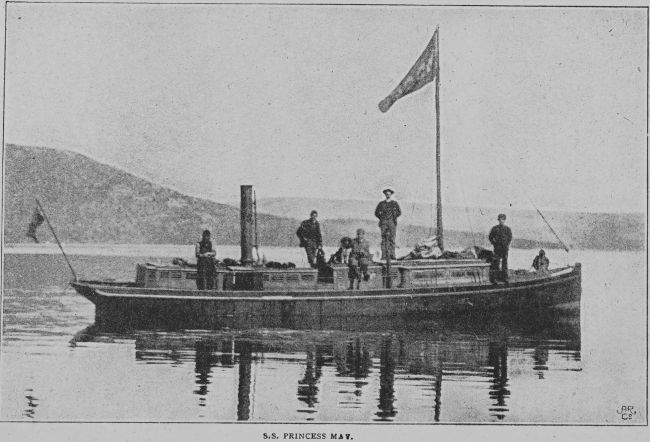
S.S. PRINCESS MAY.
VIKINGS OF TO-DAY
Or Life and Medical Work
among the
Fishermen of Labrador
BY
WILFRED T. GRENFELL, M.R.C.S.E., L.R.C.P.
Holder of the Board of Trade Certificate of Competency as Master Mariner
ILLUSTRATED FROM
ORIGINAL PHOTOGRAPHS
FLEMING H. REVELL COMPANY
New YorkChicagoToronto
Publishers of Evangelical Literature
Dedicated
BY KIND PERMISSION TO
HER ROYAL HIGHNESS THE DUCHESS OF YORK,
whose practical and gracious interest in the welfare of
these far-off “Toilers of the Deep” has served in
no small way to assist this enterprise, and to
fire with loyal affections the hearts of
England’s sons across the sea.
PREFACE
By FREDERICK TREVES, F.R.C.S.,
Surgeon to the London Hospital. Examiner in Surgery at the University
of Cambridge. Chairman of the Hospital Committee of the Mission
to Deep Sea Fishermen.
At the present time—near to the close of the nineteenth century—we
are being constantly reminded, with somewhat unpleasant
persistence, that the human race is degenerating and that the
changes of decay are most marked among the most civilised
people. It is among the young men especially that these
unwelcome signs of the times are assumed to be the more noticeable.
It is claimed that the splendid physique and the heroic courage of
the British race are both deteriorating, and that those who seek
for the time of noble deeds and sturdy hearts must turn back to
the days of Elizabeth—to the stirring times of Drake and Raleigh.
There is said to be no longer a field for that pluck and daring,
or for that determination and persistency, which at one period made
the name of the British famous throughout the world.
It would be idle, in this place, to inquire into the substance of
these moanings and regrets, and it would be reasonable perhaps
to allow that there may be some real or apparent element of truth
in these lamentations over the man of the present.
Be this as it may, it will be agreeable to those who are most
concerned in these forebodings to turn to the record contained in
this volume, while those who view with some disgust the fashionable
youth of the day, with his many effeminacies and affectations,
will find in the pages which follow some wholesome relief to their
distaste.
Dr. Grenfell’s narrative will take the reader away from the
heated, unnatural and debilitating atmosphere of the modern city,
from the enervated crowd, from the pampered, self-indulgent
colonies of men and women who make up fashionable society, and
will carry him to a lonely land where all conventionalities vanish,
and where man is brought into contact with the simplest elements
of life and with the rudimentary problems of how to avoid starvation
and ward off death from cold.
The present volume deals with a land of desolation, with a
country hard, relentless, unsympathetic and cruel, where, among
fogs and icebergs, a handful of determined men are trying to hold
their own against hostile surroundings and to earn a living in
defiance of dreary odds.
When the Mission to Deep Sea Fishermen resolved to send an
expedition to Labrador, it was evident that the man to go with
it was Grenfell. He was well known both at Oxford and in London
as a hardy athlete; he was a skilled and able surgeon; he was
profoundly interested in Mission work; and the sea had for him
that magical attraction which a few centuries ago emptied nearly
every little cove and fishing hamlet in Cornwall and Devon of its
heartiest men, and carried them over the high seas to the ends of
the earth.
Grenfell went, and the good work of the Mission was established
on the Labrador. It was no little matter to bring into the hard
and desperate life of the Labrador fishermen a touch of kindly and
practical sympathy from the old country. It was no little matter
to travel for many hundreds of miles along a grim, inhospitable
coast, where buoys and beacons are unknown and where there
is scarcely a bay or island which has not been the scene of some
lonely disaster.
It will be seen from this book that the race of Vikings is not
yet extinct, on the one hand, and that on the other the spirit of
enterprise and daring is not yet lost to the English people, and
that the modern rover of the sea differs from his predecessor in
little save the motive of his expedition.
Those who know how to value the comforts of an English
home, and who can appreciate the quiet content and the beauty of
an English village, will be induced by this book to feel no little
sympathy for those whose lives are cast among the dreary islands
and deserted bays of Labrador.
FREDERICK TREVES.
AUTHOR’S PREFACE
This book is intended to give a general account of
the country and people of Labrador, and to summarize
the efforts made by the council of the
Mission to Deep Sea Fishermen, during the past
three years, to brighten the lives of the many
brave toilers of the sea on that desolate coast.
I have avoided the use of scientific terms, and
have ventured to quote from some of the few books
on the subject without the permission of the authors.
Amongst these are Dr. Nansen’s Eskimo Life, Mr.
Packard’s The Labrador Coast, Dr. Harvey’s Newfoundland,
the Oldest British Colony, Crantz’s Explorations
in Greenland, Hinde’s Explorations in
Labrador, Cartwright’s Journals, Rev. J. Moreton’s
Life and Work in Newfoundland.
The universal kindness and hospitality extended
to the Mission Staff in Labrador, Newfoundland and
Canada, and the almost unlimited scope for work,
have made these three years, three of the most
enjoyable in our lives.
To his Excellency the Governor of Newfoundland
Sir Terence O’Brien, K.C.M.G., Chairman of the St.
Johns Committee, among many others, our warmest
thanks are due.
The illustrations in this volume are from photographs
taken on “Barnet Plates” kindly presented
to the Society by Messrs. Elliot & Fry.
It is said that a recent trial, over
a dispute about the fishery of a small natural harbour in Labrador,
called Tub Harbour, had reached its third day, when his lordship,
leaning over the desk, whispered to counsel, “Where is Labrador”? Not
to be caught, however, the counsel whispered back, “In Tub Harbour, my
lord.” Geography, it seems, is a sadly neglected science.
Such being the case, I have ventured to describe
the general features of the country in the terse,
accurate, graphic, and authoritative words of the
Encyclopædia Britannica.
“Labrador, properly so called,” says the Encyclopædia,
“is the peninsular portion of North America,
bounded by the Gulf of St. Lawrence, the North Atlantic,
Hudson Straits, Hudson Bay, and vaguely
defined towards the S.W. by Rupert’s River, Mistassini
River, and Bersiamits River. Its greatest length
is 1,100 miles, its greatest breadth 700 miles. The
area is approximately 420,000 square miles, that is,
as large as the British Isles, France, and Austria.
The coast from Blanc Sablon, a spot 85 miles up
the Straits of Belle Isle, to Cape Chidley at the entrance
to Hudson Bay straits, and all the off-lying
islands, with the country inland about 70 miles, are
under the government of Newfoundland. The rest
is part of the province of Quebec, under Canadian
rule.”
Sterile and forbidding it lies among fogs and icebergs,
famous only besides for dogs and cod. “God
made this country last,” says an old navigator. “He
had no other view in end than to throw together
here the refuse of His materials as of no use to
mankind.”
“As a permanent abode of civilized man,” says the
Encyclopædia Britannica, “Labrador is, on the whole,
one of the most uninviting spots on the face of the
earth. A vast tableland occupies much of the interior.
This plateau, says Professor Hind, is pre-eminently
sterile, and where the country is not
burned, caribou moss covers the rocks, with stunted
spruce, birch, and aspens in the hollows and deep
ravines. The whole is strewed with an infinite number
of boulders often three and four deep. Language
fails to paint the awful desolation of the tableland
of the Labrador peninsula. The Atlantic coast is
the edge of a vast solitude of rocky hills, split and
blasted by frosts, and beaten by waves. Headlands,
grim and naked, tower over the waters—often fantastic
and picturesque in shape—while miles and
miles of rocky precipices or tame monotonous slopes
alternate with stony valleys, winding away among
the blue hills of the interior.”
The cliffs rise from the ocean to a height of
from 500 to 1,000 feet. The watershed of the interior
plateau is on an average 150 miles from the
coast, and rises considerably over 5,000 feet. Near
Cape Chidley the hills are close to the sea, rising to
the height of 6,000 feet, and the view from the sea
is magnificent. A powerful current coming from
Hudson Bay, combined with the great rise and fall
of tide, renders navigation here very dangerous. A
high, bare peak of syenite, inland from Cape Harrison,
and known as Mount Misery, is visible seventy-five
miles.
We are accustomed to think of Columbus as discovering
America, but it seems certain that about
the year 1000, while Northman and Saxon were
struggling for pre-eminence in this England of ours,
bold Vikings from Iceland visited Labrador. In the
Sagas of Erik the Red and of Thorfinn Karlsefne, we
read of a strange land they visited and called Vinland[1] or
Wineland, which most probably was Labrador.
[1] See Hon. L. G. Power’s paper on “Vinland,” read before the Nova
Scotia Historical Society in 1887.
Now, it is needless to say grapes do not
abound in Labrador, and we southerners should not
describe it now as the “Land of Wine.” But we
must remember that Erik came from Iceland, and
was also possibly addicted to the proverbial fault of
travellers. Moreover, when Erik returned from one
of his voyages he called the land he had visited
“Greenland,” not with reference to its nature, because
Biarni, a contemporary voyager, describes it
as a land of “mountains and high ice hills,” but “he
called it Greenland because, quoth he, people will be
attracted thither if the land has a good name.” An
amusing incident, which I quote from Mr. Power’s
paper, arose out of this. When Thorfinn Karlsefne
and Snorri were making an endeavour to colonize
the “Vinland” they most inappropriately ran short
of provisions. Now it so happened they had with
them Thorhall, the hunter. “He was a large man
and strong, black and like a giant, silent and foul-mouthed
in his speech, and always egged on Erik
to the worst; he was a bad Christian; he was well
acquainted with uninhabited parts. Thorhall now
suddenly disappeared. They had previously made
prayers to God for food, but it did not come so quick
as they thought their necessities required. They
searched after Thorhall three days, and found him
on the top of a rock; there he lay, and looked up
in the sky and gaped with both nose and mouth, and
murmured something. They asked him why he had
gone there. He said it was no business of theirs.
They bade him come home with them, and he did
so. Soon after, came there a whale, and they went
thither and cut it up, and no one knew what sort
of whale it was; and when the cook dressed it, they
ate it, and all became ill in consequence. Then said
Thorhall: “The red bearded was more helpful than
your Christ; this have I got now for my verses
that I sung to Thor, my protector. Seldom has he
deserted me. But when they came to know this
they cast the whole whale into the sea, and resigned
their case to God. Then the weather improved, and
it was possible to row out fishing, and they were
not then in want of food, for wild beasts were caught
on the land, and fish in the sea, and eggs collected
on the island.” Now, when Thorhall bore water to
the ship, and drank, then sang he this song:—
“People told me when I came
Hither, all would be so fine;
The good Wineland, known to fame,
Rich in fruits and choicest wine;
Now the water pail they send
To the fountain I must bend,
Nor from out this land divine
Have I quaffed one drop of wine.”
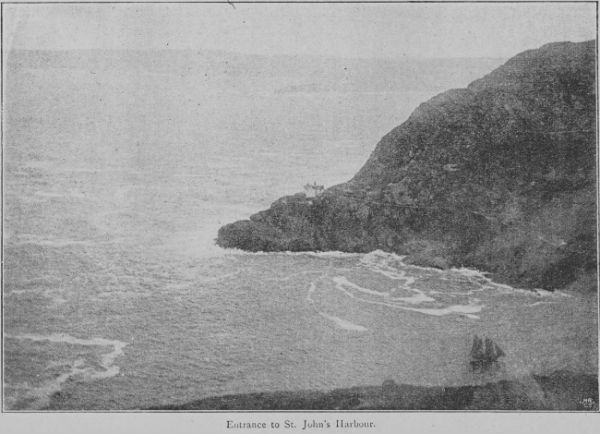
Entrance to St. Johns Harbour.
And when they were ready, and hoisted sail, then
chanted Thorhall—
“Let our trusty band
Haste to Fatherland;
Let our vessel brave
Plough the angry wave;
While those few who love
Wineland, here may rove,
Or, with idle toil
Fetid whales may boil,
Here on Furderstrand
Far from Fatherland.”
So that Vinland, in the year 1000, to which this
voyage had been made because “the people of Brattahliel
began to talk much about it,” saying, “a
voyage thither ought to be particularly profitable
by reason of the fertility of the soil,” appears to
have turned out no better than we found Labrador
in 1891. The famous log-books of George Cartwright,[2]
written about 1790, give a more reliable
account of the country, and he appears at first to
have found it profitable to make voyages thither.
The animals, and not the vegetables, engaged his
attention, and he would have made a remunerative
business of it had not first pirates and then privateers
despoiled him of his ships, and outfits, and
wares.
In Labrador now, work as he may, one man
cannot keep the wolf from the door—the Eskimo
and natives of the coast, the mountaineer and
hunter Indians of the interior, and the white settlers,
are alike often face to face with starvation. The
two former are rapidly dying out, while among the
latter it is only where a settler has grown-up sons
to work with him, and a good supply of stock in
boats, nets, traps and guns to help him, that he
can make anything approaching to what we in
England should consider a respectable living. Even
with these helps, and with steady, hard work, and
with sound health, he seldom can hope to lay up
store against times of misfortune. True in England
the poor often see hard times, and have to
face occasionally poverty and hunger. Moreover,
as Richard Whitbourne, that plucky British sea-dog,
says,[3] “It hath beene in some winters so hard
frozen, aboue London bridge near the court, that
the tenderest faire ladies and gentlewomen that are
in any part of the world, who have beheld it, and
great numbers of people, have there sported on the
ice many dayes, and have felt it colder there, than
men doe here, that live in Newfoundland.” Yet we
must take into consideration that here absolute want
is the exception, there the rule.
Labrador rocks are of the oldest
formation (Laurentian gneiss), and destitute of remains of animal
or plant life; so that they, too, maintain the general harmony of
desolation. On the south shore, lower Silurian sandstones, red syenite,
and one splendid mass of basalt, known as the “Devil’s Table,” crop
out.
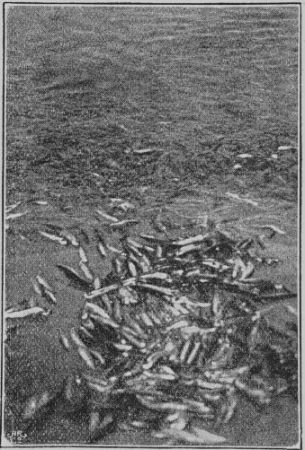
A shoal of caplin jumping out on to the beach.
The action of ice and fire are shown
in marvellous manners on this weird coast. Not only
is every rock, mountain, and pinnacle crowned with
countless boulders, which seem but to need a shake
to set myriads tumbling down every incline, but the
whole coast is carved and chiselled in a wondrous
manner by a glacial period that lasted much longer
than in Europe; while the fierce frost of winter has
blasted mighty rocks, and left, wherever a resting-place
could be found, huge fragments, jagged and
rough, “hurled aloft, as they appear, by the hands
of Titans.”[4]
That long before the ice period volcanic fires
helped to mould the hills, is well shown by the out-crop
here and again of trap rocks. Especially near
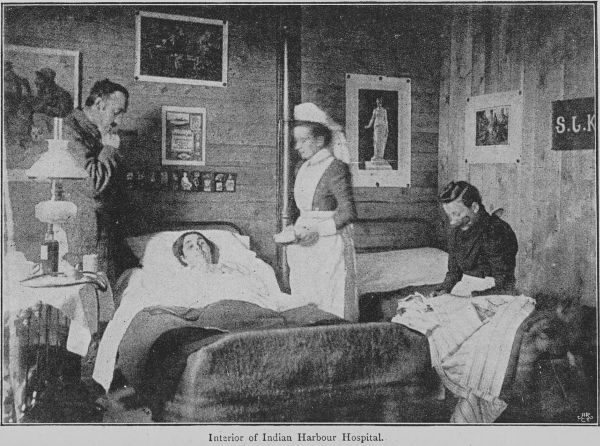
the hospital at Indian Harbour is this the case,
where the light and polished quartzite rocks are
capped with black trap rocks which have overflowed
them. These rocks are marked with deep half-moon
shaped cuts, running east and west—done by ice—and
“showing that Hamilton Inlet, which at the
mouth is forty miles wide, was once filled with an
enormous glacier.”[5]
Near Hopedale a beautiful blue and bronze iridescent
felspar is found. It is called labradorite,[6]
and when polished glistens in the sunlight like a
peacock’s feather. It is used for brooches, and occasionally
for ornamenting buildings. We dropped
anchor one night near an island almost entirely
composed of this.
Copper pyrites, mica, asbestos, with salts of some
of the rarer metals, such as yttrium and rubidium,
have been found on the coast. One mining company
works for labradorite during the summer.
In the inlets and along the rivers some trees and
arctic plants are found. These are more especially
spruces, larches, mosses, and lichens. Birches, aspen,
silver fir, willow, cherry, and mountain ash, however,
exist in favourable spots. I have seen good
60 ft. spars from the end of Sandwich Bay. The
trees get more and more dwarfed as one goes north,
and beyond the 59th parallel the merest scrub exists.
The botanical aspect, however, which chiefly interests
the settlers, is the number of edible berries, which
form a valuable addition to their articles of diet.
These are bakeapples or cloudberries, cranberries,
whortleberries, bilberries, tea-berries, gooseberries,
raspberries, and currants. They are preserved in
water, or in molasses when it is obtainable, against
the winter.
Very few vegetables can be grown, though with
care, up the inlets a few potatoes, cabbages, and
turnip tops have been raised. The Moravian missionaries
have to cover their vegetables up at night
to keep them warm. This lack of vegetables is
tritely expressed in the diary of a gentleman wintering
on the north coast; the entry describing his diet
runs as follows—
—— ditto. —— ditto. —— ditto. —— ditto. —— found a blade of grass. Eat the whole of it.
Cartwright (1786) adds a list of his own of indigenous
vegetable delicacies—
1. Young osier leaves.
2. Red dock leaves.
3. Scurvy grass.
4. Alexander, or wild celery.
5. Indian salad.
6. Alpine plant.
7. Fathen.
There is a charming catholicity about this old sea-dog
and trapper.
The tips of the young spruce branches are used
for making a non-intoxicating beer, being boiled
with molasses. When other tea gives out, the leaves
of uva ursi are used. These are known as Labrador
tea.[7]
The Saga of Lief Erikson thus describes a conversation
between the Viking and his old henchman
Tyrker, who, for two or three days, had wandered
from the party: “Why wert thou so late, my fosterer,
and separated from the party?” “I have not
been much further off, but still I have something
new to tell of: I found grapes and vines.” “But is
that true, my fosterer?” quoth Lief. “Surely is it
true,” replied he; “for I was bred up where there
is no want of either vines or grapes.” They said
that next day they filled their long boat with grapes.
But we must, I fear, consider this a “traveller’s
licence,” as we must also when old Richard Whitbourne
describes the wild berries of Newfoundland.
“There the summer naturally produceth out of the
fruitful woombe of the earthe, without the labour of
man’s hand, great plenty of greene pease and fitches
faire, round, full and wholesome ... great store
of hay also.... Then have you here strauberries
red and white, and as faire rasberries and
gooseberries as there be in England; as also multitudes
of bilberries, which are called by some whortes,
and many other delicate berries, which I cannot
name, in great abundance.
Peares, Sowre cherries, Filberds,
of which divers times eating their fill, I never heard
of any man whose health was thereby any way impaired.”
The rivers contain salmon for about one month
in the summer. These seem, however, to be very
susceptible to cold, and are seldom taken north of
Hopedale. In seasons when the drift ice remains
long on the coast the number of salmon caught is
always largely diminished. They seldom take a fly.
On the other hand the trout are very voracious,
very large and numerous, and will rise at any bait.[8]
They remain all the year, and are easily caught in
winter by cutting a hole in the ice and letting down
a hook with a bit of raw meat. The women largely
replenish their larder in this way. Cod are far and
away the most important of all Labrador products
at present—they are called “fish,” and even in legal
terms are the only denizens of the sea recognised as
“fish.” In summer they come into shallow water,
first in pursuit of a small fish known as “caplin,”
and then remain probably to spawn before seeking the
deeper water in winter. It is unlikely that in their
migrations they cross any large portion of the Atlantic.
[8] There is a large salmon-trout fishery at Ungava.
The caplin come to the shallow water in countless
myriads to spawn. They are somewhat like a
sardine, only a little larger. At times they blacken
the water, and so crowd one another as they swim
along the very edge of the water in calm weather
that every ripple of the sea leaves numbers struggling
on the strand, till at times the whole beach is
hidden by dead and dying fish. Further north these
caplin visit the shore later in the year. They are
followed always by immense numbers of cod. I
have seen cod also so thick that even in deep water
there seemed no room for them, their backs being
constantly out of water. This is called the “caplin
school,” and on the catch of cod during their visit
the success of a whole fishery will depend.
While the “caplin school” lasts the most intense
excitement exists. The men will work day and
night, with scarcely an hour in twenty-four for
sleep, even eating their meals in their boats. The
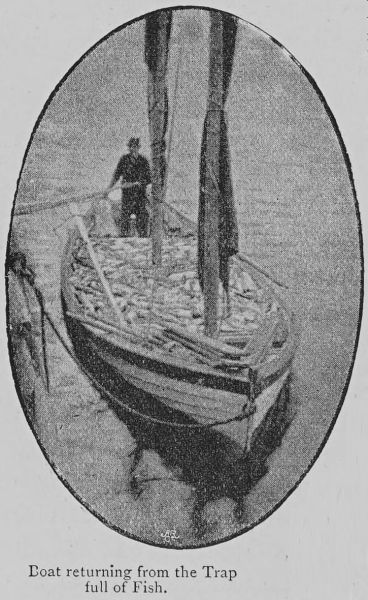
cod at this time will not take bait, and are caught
in traps in the way described in a subsequent
chapter, or are hauled in a huge seine, by which a
“school” is surrounded. Alas, sometimes so many
icebergs are driven inshore, that the precious time
slips by without any opportunity of fishing, though
all the men, with boats and gear, are waiting on
shore in the greatest anxiety to be “up and at the
fish.” The caplin are sometimes smoked and kept
for food, but usually are dried on the rocks for dog
food in winter. Messrs. Munn, of Harbour Grace,
have tinned them like sardines, and they are then
excellent eating. The sea also affords “hair” seals;
these are caught in nets in the fall of the year, or
are shot swimming in the bays in summer time.
Whales are common on the coast, but the people
now have no means of taking them. I saw two
small right-whales which had been washed up on
the beach, and also one very large sperm whale.
Fourteen hundred gallons of oil was taken from his
head. So long ago as the 15th century, before the
discovery of America, Basque whalers are said to
have fished these waters. In the far north, at Ungava,
the Hudson’s Bay people make a regular
attempt to intercept the large schools of porpoises.
At times they will get as many as 150, some individuals
weighing a ton each. They are used for
their skin and fat, and their flesh for dog food.
This is put raw into old flour barrels, and then
buried in the ground, usually in June, and in
October it will be dug up again. Decomposition
will have made the flesh swell up, and the barrels
will have burst. As, however, the whole is now
frozen, the wood can be removed, and the barrel-shaped
masses of frozen and unsavoury flesh are
stored away for the dogs’ repasts.
CHAPTER III
OF THE BIRDS AND LARGER FISHES
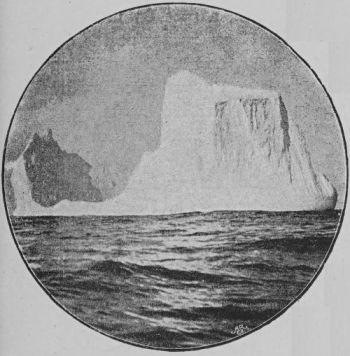
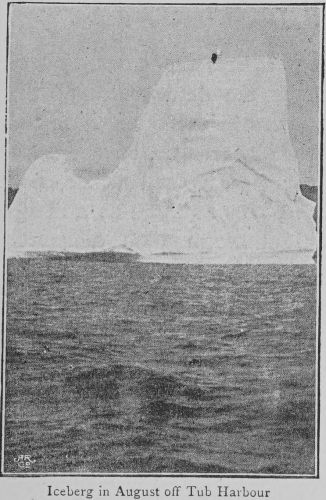
Iceberg in August off Tub Harbour.
Herrings were once in great numbers on
the coast, and were so much larger and fatter than our English herring,
that at times knaves have found it worth while to imitate the “Labrador
Herring” brand. Of late years they have failed almost entirely to
visit the coast, and fishery stations have had to be abandoned where
once the sea was “dry with fat herring.” As many as 4,000 barrels have
been surrounded with the seine at one shoot of the net. The only other
common fish is the sculpin, pig-fish, or grubby. He is a voracious scavenger, and, in foul
companionship with his friend the flounder, may be seen sweltering on
the rotting heaps of offal which surround every Labrador fish-stage. He
appears to have no feelings, but one all-absorbing idea—“to swallow”
with his stupendous mouth. I have caught on the sharp-pronged jigger,
when fishing for “tom-cod” for breakfast, the same sculpin three times
in succession, until for self-protection it was necessary to club him
with a rowing pin.
The sleeper shark also infests the coast, and in
hundreds gather to devour the dead bodies of the
baby seals left by the sealers in the spring. It has
a callous nature, and Scoresby tells us, on one occasion
while one was feeding on a dead whale, and
scooping out at each bite pieces as large as a man’s
head, a sailor pierced it through with a scythe
knife. It took little notice, however, and went on
feeding in exactly the same spot. Mackerel appear
in the straits of Belle Isle only.
Two series of submarine banks lie off the Labrador
shores, over which it is shallow enough to fish with
small boats and hand lines. These have been estimated
to cover an area of over 7,000 square miles.
Over these the northern current spreads countless
animalculæ, in the form of a vast ocean of living
slime. This food attracts the bait fishes especially,
and they, in turn, attract the cod. No doubt also,
this is the attraction to the numerous whales, whose
loud “blowing,” as they laze along in the sunshine
or hunt fish for their livelihood, alone breaks at
times the death-like silence in the lonely bays and
inlets. A large sperm whale, 70 feet long, was
towed into Battle Harbour our first year. This
variety has large teeth, which are used by ivory
cutters. A Captain Clarke, writing in 1766, narrates
how a sperm whale charged one of his boats; it
struck the bow with such violence that it threw his
son, who was harpooning, some feet into the air. The
whale turned and caught him in her devouring jaws
as he came down. He was heard to scream, and
part of his body was seen hanging out of its mouth,
when it “sounded.” A small but beautiful whale,
“as white as a sheet,” is common on the coast. I
have seen it caught in cod-traps. Its skin makes
excellent leather. The hump-back whale, and more
rarely the right-whale are also to be seen. The
ferocious “thresher” whale also visits us. It has
terrible teeth, and one variety has also a huge back-fin,
six feet high, with which the fishermen say they
have seen it beating its prey to death.[9] Captain
Scammon tells us of an attack by three threshers
on a huge cow-whale and her baby in a bay. “Like
wolves they flew at her throat, dragging her under
water, the others charging at her and leaping right
over her. At last they killed the baby, and when
it sank kept diving down and coming up with large
pieces of its flesh. Meanwhile, the poor mother
made her escape, leaving a long track of blood
behind her.” I have fired from my boat at the
grampus, but without success. Mr. Mackenzie, of
the Hudson Bay Company, however, told me he was
once standing up in his small boat, waiting for a
seal, when he saw a grampus rising to the surface
alongside. As its head emerged from the water, he
fired straight at the blow-hole, with the result that
the single explosive ball penetrated the animal’s
brain, and he rolled over dead without a struggle.
Not an unfortunate issue as far as the small boat
was concerned.
Pliny speaks of a whale 960 feet long! Another
traveller’s license I fear. A hundred feet is, as far
as I know, an outside limit. The whale-bone hangs
from the roof of the mouth, is short in front and
behind, and is at best some six feet long. It is
scythe-shaped, and edged with long coarse fibres,
which sweep over the huge soft tongue, filtering off
the slime on which these whales live. Three hundred
and fifty pieces are found on each side.
The narwhale, with his long tusk, eight feet long,
with which he pokes up the sea grass on which he
feeds, was once common on this coast. Some say
he uses the tusk to bore holes through the ice, and
so get air to breathe. The tusk is really an incisor
tooth, or two incisor teeth enormously prolonged,
and twisted round one another. Where no wood is
found the Eskimo hang their tents on these ivory
rafters.
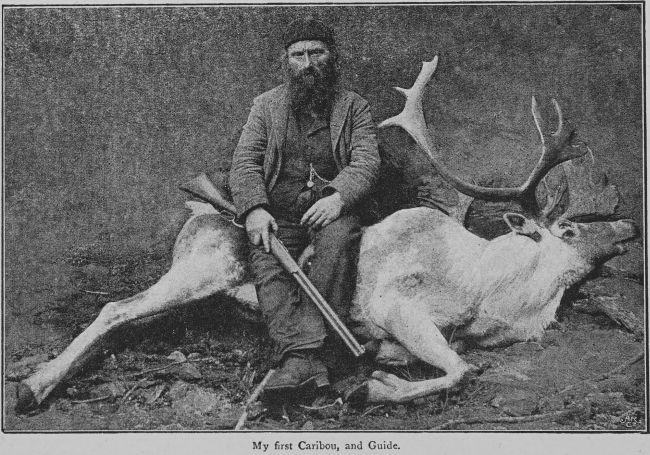
My first Caribou, and Guide.
The sword-fish is a doubtful visitor, though he
is taken off Greenland and on the American coast.
Many are the authentic accounts of ships he has
attacked and even sunk.[10] He will weigh as much
as 600 lbs., and Professor Owen says, “he strikes
with the accumulated force of fifteen double-handed
hammers, and its velocity is equal to that of
swivel shot.” In 1864 one, for which a sailor was
angling, stove a hole through the bottom of the
ship Dreadnought, and so “the insurance company
had to pay £600 because an ill-tempered fish objected
to be hooked, and took revenge by running
full tilt against copper sheathing and wood planking.”
Also in 1864 Captain Atwood took from the
stomach of a large shark a full-sized sword-fish,
but the shark’s skin was pierced with a dozen
holes, showing how much the dainty morsel had
objected to being swallowed. Hanging with the
armour of Christopher Columbus at Siena, in Spain,
is a sword of this fish, said to be “taken from a
warrior they slew on nearing America.”
The fowl of the air are a most important factor
in Labrador life. Among many land birds that do
occur, far the most important are the willow grouse
and the spruce partridge. The former are large
birds, tawny red in summer, and white as driven
snow in winter.[11] At that season many depend on
these birds to keep them from starvation, and even
when a settler’s ammunition has all run out, he can
sometimes noose them with string on the end of a
long stick as they roost in the trees, so tame are
they. Like Alexander Selkirk’s animals—
[11] The willow grouse very rarely take to the trees, the spruce
partridge almost always.
“They are so unacquainted with man Their tameness is shocking to me.”
A covey in a tree can be killed right out, if shot
from the bottom upwards, so that the falling bird
does not disturb the rest. A common entry of Cartwright’s[12]
is, “Saw a covey of six grouse. Knocked
off all their heads with my rifle.”[13]
[13] To economize powder, the settlers frequently shoot
these birds with bows and arrows. The arrows are club-headed.
The willow grouse in heavy weather bury themselves
in the snow, only the cock bird, who acts as
sentry, keeping his head above ground to watch for
an enemy. Besides these “spruce” grouse, thrushes,
American robins, warblers, redpoles, snow buntings,
sparrows, larks, woodpeckers, crows, hawks, and
owls occur. The snowy owl is an exquisite white
in winter, brown in summer, and a large bird. The
jay, also, is very common, filling the woods with its
cries. Now and again the beautiful gyrfalcon is
seen, whilst the osprey, or sea eagle, also breeds on
the coast. All these birds are American varieties,
and differ slightly from our British species.
There is a great wealth of sea-birds, and until the
last two years the arctic curlew ranked first among
these. I fear in Labrador we class all our animals
in a descending order, with the flesh-pot as the
basis. These curlew came north, in flocks which
nearly darkened the air, in September, feeding on
the numerous berries, and returned south in October.
The last three years they have almost disappeared.
The settlers say that, owing to their depredations on
the American cornfields, poisoned wheat was laid
out for them, and this led to their wholesale destruction.
Their annual visit can be ill spared indeed.
Perhaps one should mention next the Canada
goose. Great numbers of these breed near the great
lakes or ponds. They are largely graminivorous,
and therefore do not combine the flavours of fish and
flesh, which we find so unpleasant in the gulls and
divers. It is usual, however, to catch these when
young, and confine them in bounds, for in this way
not only is the flesh rendered much sweeter to the
palate, but since they grow very tame, they are used
as decoys for other geese. One man last year anchored
out by one leg his tame decoy goose, and so
shot no less than thirty other geese. But, in his
anxiety for more, unwittingly left his pet too long
in the water, with the result that it died of cold;
and so the goose with the golden—or in this case
“feathered”—eggs was lost. It shows these birds
do feel the cold. It is not waste to shoot a hundred
geese the same day, for it is only necessary to hang
them up in rows outside the house on nails, and they
will remain frozen and fresh all winter.
Both eider ducks and the king eiders abound on
the coast. In huge flocks early in November they
come to the south’ard, generally with a north-east
wind, and then in quick succession flock after flock,
taking almost all exactly the same line. Near
Battle hospital is a barren, rocky point known as
“Gunning” Point. Here, under the above circumstances,
you can always find some half-dozen
“Livyeres,” with long guns and dogs, waiting for the
flocks. It is difficult to say whether the dogs or the
guns are most remarkable. I measured one gun, six
feet two inches long, and when it was discharged it
was always an open question which end of it would
do most damage, for the adventurous hunter always
loaded it “ten fingers” deep. When a flock pass,
all the guns are discharged simultaneously, and the
ducks, which at times respond in showers, are nominally
divided equally.
But now comes the excitement. As a rule a huge
Atlantic surf, with these north-east winds, breaks
over the point, and the splendid pluck and endurance
of the dogs is taxed to the uttermost. Dashing into
the waves, I have seen them repeatedly hurled back,
bruised and winded, high on to the ledges of rock,
only to be dragged off by the return wave and once
more pounded on to the rocks. To avoid this, the
brave beasts hold on with the energy of despair, and
many times have I noted their bleeding paws, and
nails torn off in the unequal struggle. Yet they
would at once return to the charge, and, waiting
their chance, leap right over the breaking crest, and
so get clear of the surf. Once they have seized a
duck they never let it go, and I have often felt sorely
tempted even to jump in and give the brave creatures
a hand, when it seemed impossible for them to keep
up the struggle any longer. Yet, after being lost to
view, engulfed by a huge breaker, one would see
soon a duck appear, and after it a dog’s head, still
true to its hazardous duty. Sometimes, however,
they are really lost.
Petrels, loons, divers, gulls, guillemots, widgeon,
teal, scoters, puffins, shanks, sandpipers and other
waders abound. These are shot in the fall, and
salted down for future consumption. Their eggs are
also collected for eating; and though we found even
the eggs of the domestic hen, when allowed to feed
on fish remains, too highly flavoured to be appetizing,
yet I have seen healthy babies flourishing on gulls’
eggs. Whitbourne, writing in 1612, speaks of the
utility of the penguin—the great auk was common
then. He says, “These penguins are bigge as geese,
and flye not, for they haue but a short wing, and
they multiply so infinitely upon a certain flat Iland,
that men drive them from thence upon a boord into
their boats by hundreds at a time; as if God had
made the innocency of so poore a creature to become
such an admirable instrument for the sustentation of
man.” Then, as now, he says the “fishermen doe
bait their hookes with the flesh,” and also that they
were so fat that the men drew threads through under
the skin and used them as candles.
CHAPTER IV
OF THE FUR-BEARING ANIMALS
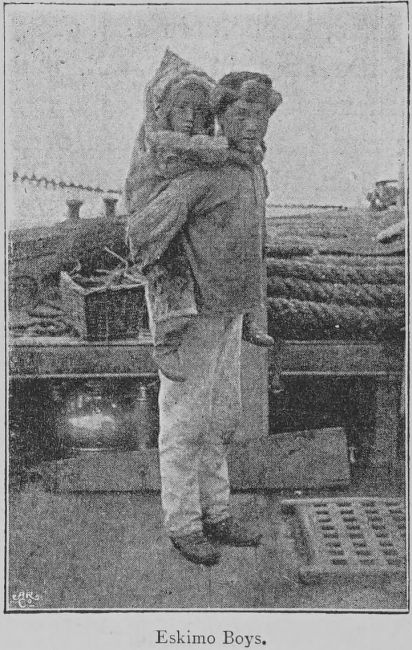
Eskimo Boys.
For food purposes among land animals the
caribou, which closely resembles the reindeer, ranks first. These roam
over the interior in great quantities, feeding on the very plentiful
Iceland moss. In winter they scrape away the snow with their large
cow-like hoofs to get at it. In Newfoundland they are very plentiful in
the interior, and Mr. W. Tyrrell of Winnipeg told me, that on the west
side of Hudson Bay he found thousands, so tame they would eat out of
his hands. They migrate north in summer, and south in winter, due, says
Rae, to their “sense of
polarity,” but I should presume in search of food. They are difficult
to find in the woods, for the colour of their skins varies with the
seasons, and always closely resembles their surroundings. Unfortunately
they are too far inland for the majority of settlers to reach.
The stags have magnificent antlers, which are
especially fine about October, the rutting season.
With these they fight fiercely, going down on their
knees, and striking with the powerful brow-antlers.
I have seen several pairs of “locked horns” that
have been picked up, the poor creatures having got
these fixed and died side by side of starvation.
A hunter this fall, having skinned a young stag
he had killed, put the skin over him so that the
horns, which were attached, came on his head. He
then walked out towards a herd of does, over which
a fine stag was keeping zealous watch as they
grazed on the open marsh. They allowed him to
come within range, and then the stag, mistaking
him for a rival, actually charged down upon him.
Polar bears are not uncommon, and five were
killed this season near Cape Chidley. Captain
Blandford, of the S.S.Neptune, told me that, having
sent some men ashore for water in a strange harbour
near Cape Chidley, they returned in great
haste, calling for their guns, and shouting, “Bears!”
They were soon perceived from the ship to be firing,
shot after shot being heard in rapid succession, and
great expectations were raised of bear steak for
dinner. At last the hunters returned with downcast
countenances. The bears proved to be only inflated
heads, which some Eskimo were using as buoys for
their lines.
In one boat going out to their fish trap were seven
men, six rowing, and the skipper standing on the
stern seat, steering with an oar.
Suddenly a large white bear was sighted swimming
close to the boat. There was no gun on board,
and yet the men were loath to lose so rich a prize.
Chase was therefore given, and the skipper kept
hurling at the bear the large two-pronged lead
“jigger,” with a stout line attached. Each time he
threw it the bear warded it off, striking it a smart
blow with his fore-paw. At last one jigger came fast,
and then another, till the bear, who seemed only
bent on escape, and was now wearied with repeated
diving, was hauled near the boat, and first clubbed
with an oar, and then despatched with an axe.
Black bears are very common. They are, as a
rule, herbivorous, eating the wild berries, and insectivorous;
but one night a settler I was staying with
showed me the skin of a large bear he had just
trapped. He was living at the mouth of a trout
and salmon river, the entrance to which he barred
with nets. Two bears happening to observe some
fish struggling in the net on the surface of the
water near the land were, I suppose, tempted to
feloniously sample the unexpected windfall, and
having once erred, continued their wild career. For
the settler told me they learnt regularly to come
down and haul his nets, dragging them to the land,
and not only eating out the fish, but severely
damaging the nets. But punishment had been meted
out to one in the form of a charge of buckshot, to
the other by a steel trap.
Cartwright thus illustrates the power of this bear:
“We discovered this morning the damage done by
a polar bear to a cask of oil. It was of strong oak
staves, well secured by thick, broad hoops of birch.
Yet with one blow of his tremendous paw he had
snapped off the four chime hoops and broken the
staves short off.”
The most valuable fur animals are the fox, otter,
beaver, mink, marten, and lynx. Musk-rats, squirrel,
and hares are also plentiful. The porcupine is not
uncommon. One specimen I shot was larger than a
sucking pig. The long black hair, which almost
obscures the short quills, made it resemble a bear as
it sat asleep on a bough at the top of a fir tree. A
bullet through the head brought it down at once,
but even when mortally wounded they will cling to
the boughs, and you may have to fell the tree. I
saw a dog one day worrying one. The porcupine,
with its head well down, waited for the dog to come
near, and then switched round his tail end, on which
are most spikes, with lightning speed, hoping to
leave some in his enemy’s nose. The quills are all
barbed, so that they “work in.” In this way they
will kill dogs, wolves, and foxes. A fox was found
dead near Hopedale, its skin ruined by festering
sores, which, on examination, showed the ends of the
black and white quills. It is very amusing to see
how easily it wards off an enemy by always turning
its back to him! When the dog was tired out, the
porcupine went up the nearest tree, had a good meal,
and went to sleep on a bough.
Black or “silver” fox skins are very valuable.
For one good black skin I have known £170 given
by a Russian nobleman. The average retail value of
silver fox skins is nearly £50. Now the cunning of
foxes is proverbial, but Cartwright tells us a story
of vulpine ingenuity in a marten. One day he was
going to travel a long distance, and desired to leave
a deposit of food for his return journey. He feared
to bury it, because foxes would be sure to find it, so
climbing a tree he hung it by a string from one of
the branches. Shortly after a marten came along,
and espied the dainty morsel high over his head.
Whether he had watched old Cartwright climbing,
or whether it was an inspiration, the tale does not
say, but in any case it climbed the tree also, gnawed
through the string, and then, with an appetite
whetted by the exercise, had a square meal at its
leisure.
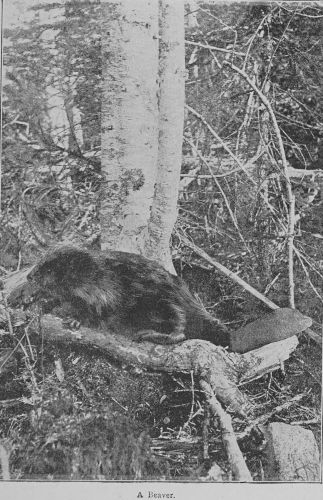
A Beaver.
Walking one day through thick wood we came
across a regular “pathway,” the trees having been
felled to make travelling easy. A glance at the
stumps showed that it was a road cut by beavers,
to enable them to drag their boughs of birch along
more easily. The pathway led to a large house on
the edge of a lake, and, fortunately for us, the beaver
was at home. There were other houses on an island
in the lake, and below them all a large, strong dam,
some thirty yards long, built the shape of a half-moon,
and below this two more complete dams across
the river that flowed out. The dams were made of
large tree-trunks, with quantities of lesser boughs,
and were many feet thick, and very difficult to break
down. The houses were built half on land, half in
the water. The sitting-room is upstairs on the bank,
and so is the “crew’s” bedroom, and the front door
made at least three feet below the surface to prevent
being “frozen out” in winter, or, worse still, “frozen
in.”
The whole house was neatly rounded off, and so
plastered with mud as to be warm and weather-proof.
This is done by means of their trowel-like
tails, which are also of great use in swimming.
The house was so strong that even with an axe we
could not get in without very considerable delay.
In the deep pond they had dammed up, we found a
quantity of birch poles pegged out. The bark of
these forms their winter food, and is called “browse.”
The beaver cuts off enough for dinner, and takes
it into his house. Sitting up, he takes the stem
in his fore paws, and rolls it round and round
against his chisel-shaped incisor teeth, swallowing
the long ribands of bark thus stripped off. While
entering the house the stick often sets off a trap
set for them. The trappers say they do this purposely.
When surprised they retreat to holes in the
bank, of which the entrances are hidden under water.
These are called “hovels.”
Beavers always work up wind when felling trees,
and cut them on the water side, so that they fall
into the pond if possible, and the wind helps to blow
them home. This beaver we caught proved to be a
hermit—at least he was living alone. He may have
been a widower of unusual constancy. They do not
destroy fish, their food in summer being preferably
the stem of the water-lilies. Otters occasionally
kill and eat beavers. When they call the beaver
has to try and be “not at home.” Of the other
animals I have not space to say much. The blue-grey
hare is a large animal, and like all the others
turns white in winter—so wonderfully does God remember
all His creatures.
The pretty little squirrel is very tame. Like a
good sensible fellow he makes round holes in the
ground, and hides enough berries for his “winter
diet.”
The climate of Labrador is rigorous in the extreme,
in spite of the fact that in summer, especially
in the inlets, the thermometer sometimes registers
75° and even 80° F. Icefields from Baffin’s Bay and
Davis Strait block the coast from October to June,
the sea freezing entirely over all along the shore.
Over this all the winter travelling is done, but sometimes
the commotion below so moves the ice up and
down that a team of dogs with their sledge will only
move backwards when a swell arises. The average
temperature all the year round is at Hopedale 27° F.,
at Nain 22·5° F., that is a mean average temperature
of 5° and 9·5° respectively of frost. During the
months the sea is open, countless islands of ice are
driven all along the coast, while snowslips often
make the land dangerous. A settler, his two sons,
and son-in-law were ascending the slope of an island
near Sandwich Bay to witness the first break-up of
the ice in spring, when an avalanche of snow buried
all but one son, who was a few yards behind the
rest. Rushing to where he saw his father last, and
tearing away the hard-frozen snow with hand and
foot, he came eventually on his father’s head, four
feet below the surface. Though his father heard the
son searching, he could neither stir nor shout to
guide him, from the weight of snow over him. This
man told me the sad story. The other two lads
were lost.
Storms of exceptional violence and of sudden onset
occasionally visit the coast. The wind seems to blow
from all quarters at once, hurling clouds of sea-water
as dust, often mixed with icy spicules, far over the
land. A few years ago a vessel in Black Tickle,
lying at anchor near Gready, was carried up and left
on the rocks twenty feet above high-water line; at
the same time £4,000 of damage was done, in that one
harbour alone, by all the stages with the summer’s
voyage of fish and all the boats being suddenly
washed away. It was then October, and snow was
on the ground. All the survivors left as soon as
possible. On returning next year an old man of
this vessel was found dead beneath the snow, his
hands crossed, his eyes bandaged. Evidently he had
laid himself out for burial. On October 9, 1867, in
one of these sudden gales, forty vessels were hurled
on the rocks. Forty poor souls lost their lives, and
fifteen hundred people were cast ashore.
Again on October 26, 1885, in a similar hurricane
80 vessels were lost, 70 lives, and 2,000 men, women,
and children left on the coast. The Newfoundland
Government had to send up special steamers to
bring these people home.
Easterly gales especially, as the water is deep,
heave in a most wonderful ground-swell. Close to
the land, I have in our little steamer been so low
down in these great watery valleys, that, standing
on deck, we could not see even the tops of the hills
over the crest of the next wave. Admiral Bayfield
says, “It bursts with fury right over islands thirty
feet in height, sending sheets of foam and spray,
sparkling in the sunbeams fifty feet up the sides of
precipices.”
One feature, however, of rare beauty is peculiar
to these Arctic regions. I mean the Aurora Borealis.
At times one radiant crown circles the zenith;
at others, vast columns of light advancing across
the heavens keep changing shape like battalions of
men attacking, the varying uniforms of these flying
squadrons resplendent with every shade of violet,
red and gold; at others deadly pale phantoms creep
ghost-like upwards from the northern horizon, till
the whole space overhead is filled with quivering
rays. Icebergs, till now invisible, reveal their baneful
presence; but almost before the sailor has time
to note their bearings, these transient glories are
suddenly extinguished, and the sea and sky are once
more plunged into darkness, all the more death-like
for the contrast, so that men call it, “The dead at
play.” The weird mirage also serves to add mystery
to these regions. Often have we seen huge icebergs
as if capsized, and hovering in the waves of ether
over the stern realities below, as though kissing
them and rejoicing in their power for evil.
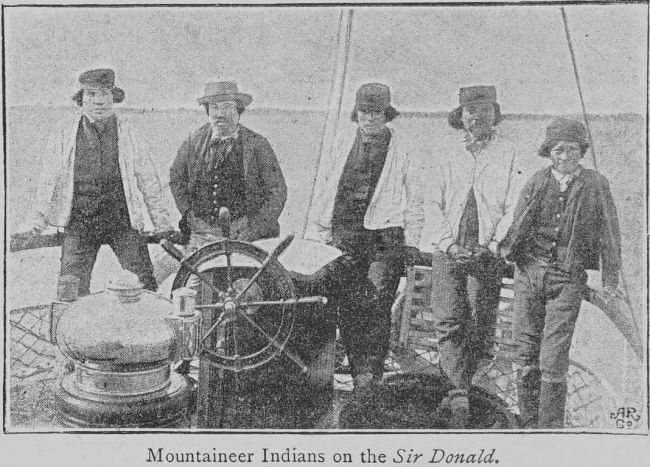
Mountaineer Indians on the Sir Donald.
CHAPTER V
WE GO TO LABRADOR AND START WORK
ON June 15, 1892, the good ship Albert, 97 tons
register, and 151 displacement, was towed out
of Great Yarmouth Harbour, and amidst many farewells
from wharves, quays and piers, spread her
canvas for her first transatlantic voyage. Trimmer
ship never left port bound on such a journey. Stout
timbers, teakwood decks, iron hatches, new running
gear—nothing had been forgotten—and in light airs
of summer or whole gales in winter, I want no
snugger vessel. The four voyages made by her at
present, under the care of Captain Trezise and his
crew of eight men, certainly deserve notice here.
1892. Bound out. From Fastnet Rock to St.
Johns, Nineteen days.
Bound home. From St. Johns to Start Lighthouse.
Twelve days.
1893. Bound out. From Fastnet Rock to St.
Johns. Seventeen days.
Bound home. From St. Johns to Great Yarmouth.
Twelve and a half days.
Our best twenty-four hours’ work was 240 miles,
registered on two harpoon logs. The fact that we
registered under 100 tons, allowed us to carry
an uncertificated mate—Skipper Joe White, so
well known in the North Sea. It also made my
certificate as a competent master of some practical
use. After visiting the mission vessel Edward Birkbeck,
at work among Manx and Irish fishermen off
the south-west coast of Ireland, we followed the
course taken by Cabot in his caravel, the Matthew,
nearly 400 years ago, and made a landfall directly
opposite St. Johns Harbour. Here a scene of the
wildest confusion greeted us. The prosperous city we
expected to see had been almost blotted out by fire;
and still amidst the ruins of churches, public buildings
and private dwellings, smoke and flames arose in
all parts of the city exultant and unsubdued, looking
at night-time like glutted vultures over their helpless
prey. Warehouses, wharves, and even vessels
at anchor, had shared the same fate, so that landing
at all was a difficult matter at first. In the streets,
here and there, were disconsolate groups of men, excavating
from tons of fallen masonry, safes which
had proved none too safe, and which, lying burnt,
battered, and discarded at intervals, served to enhance
the sense of general desolation.
From the harbour the first appearance suggested
the ruins of Pompeii, for the wooden houses of 12,000
people had gone up in smoke, leaving only rows of
blackened and scorched pillars rising from the
charred debris. On closer inspection, however, the
illusion was dispelled, for the pillars proved to be
tottering brick chimneys, with two or three half-destroyed
fire-grates above one another, the whole
being topped by most prosaic cracked chimney-pots.
Queer things had happened in the general panic.
Patients who had lain in bed for years “arose and
walked.” Barrels of dry goods were rolled pell-mell
into the harbour, whence they were subsequently
fished out. Merchants gave general leave to bystanders
to save what they liked from their shops.
Church pews were packed with heterogeneous goods
and chattels, which only served to add to the conflagration
when the sanctuary itself fell a victim
to the all-devouring flames. Title deeds, recent
enactments of parliament, ledgers, valuable manuscripts,
were destroyed in scores; while, as the fire
occurred just before tea-time, thousands found themselves
houseless, hungry, dusty and “smoke-dried”
by morning. To meet these sudden needs every
available building was thrown open for shelter,
while weak tea and light refreshments were served
out, in every variety of pot, kettle, and cauldron
available, by cabinet ministers from the steps of the
Government buildings. The respected premier was
to have been seen at an early hour of the morning
with a background of blazing houses, in a most
precarious position astride an angular roof, putting
out burning embers as they fell. Nor did the
flames cry “Quarter” to the episcopal apron, even
his lordship escaping coatless. It was said that
a jeweller, who had at the last moment sent his
assistant to put valuables in the safe, found on
opening it afterward a dust brush and an old matchbox
only. One man was noticed skurrying up the
hill with a feather mattress on his back, all unconscious
it was brightly burning; while one, like
another Nero over another Rome, was seen playing
a piano in the open street, that had been hastily
deposited there by its flying owner. The musical
tastes of the community were impressively brought
out by the fact that some dozen “borrowed” pianos
were rescued from houses in neighbouring villages,
when authority was once more able to cope with
disorder.
Forest fires continued to rage in every direction
for days and weeks after, till the greater part of the
peninsula of Avalon was treeless, many country
homesteads sharing the same fate as the city. In
some planter cottages I visited, I found men who
had been fighting for their lives, homes, and possessions
for days with these forest fires. In some cases
the women, children, and goods had been carried
out and deposited for safety for two or three days
on the edges of the great “ponds,” as the huge
lakes all over the country are called.
Most wise enactments on the part of the authorities
prevented what might have led to serious riots.
All public-houses and liquor shops were promptly
closed, and several attempts at incendiarism were
nipped in the bud. Yet, amidst all their own
troubles, the Newfoundlanders found time to show
us the greatest of kindnesses. So much so that it
would be invidious here to particularize one more
than another. While in St. Johns we visited every
ship in harbour, giving away “readin’,” and finding
out all we could about the fishermen and fisheries.
The Hospital Mission ship, with her cargo of warm
clothing, some of which was at once in demand,
her medicines, and her stores of healthy literature,
spoke practically of warm hearts in the old country,
still dear to all her distant children, and served to
prove to this, her oldest colony, that England is still
a mother in more than name. Hundreds of all
classes and denominations poured down to see the
Albert when once her mission was understood, for
it took time to realize that the lovely ship, with
such admirable equipment, was really free for the
poor and sick of bleak Labrador. A pilot having
been provided for us in the person of Captain
Nicholas Fitzgerald, the Albert sailed for Labrador.
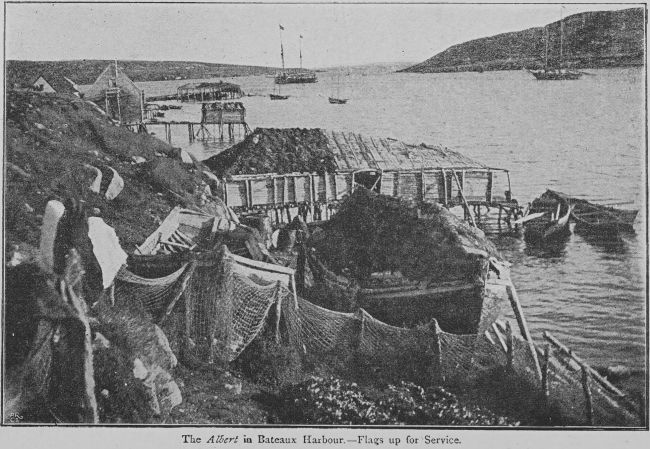
The Albert in Bateaux Harbour.—Flags up for Service.
Dense fog prevailed for four days, so that the end
even of our own bowsprit was scarcely visible, the
Albert standing accordingly well out to sea, “Brother
Foghorn” having it all his own way. On the fourth
day we caught a glimpse of Cape Bauld, the north-east
corner of Newfoundland, and then the impenetrable
veil dropped again. Our only occupation
had been our deep sea thermometer, which registered
generally from 28-30° Fahren. in two to three
hundred fathoms. On Sunday we once more sighted
land. The foe had gone, and was replaced by a
bright clear day—not a cloud in the sky, not a
ripple on the dark blue water. Innumerable rocky
islands and lofty headlands were visible away on
the port bow—some showing a bright yellow from
the mosses and lichens on them. Around us we
could count thirty magnificent icebergs—chips from
the eternal Arctic ice. A school of whales were
sporting under our lee, every now and again throwing
jets of glistening water high into the air. The
scene to our eager eyes was one indeed of surpassing
interest and beauty.
Our pilot’s experience was at once on trial, for
only a very imperfect survey exists of the coast.
And not one single landmark, lightship, buoy, or
distinguishing mark exists to aid the mariner anywhere
along this dreary coast, a lack not remedied
by the luxuriance of fogs and icebergs. It stood
the test well. He pronounced the spot “Roundhill
Island.”
After passing through a precipitous rocky entrance,
half closed by a stranded mountain of ice, on
which the long swell of the Atlantic was thundering,
we dropped anchor off a long narrow creek,
round which our glasses revealed rude fishing stages
and mud huts. The name of the harbour was
Domino.
Five minutes was long enough to bring several
small boats alongside, with eager inquiries as to who
this strange vessel might be! Where was it bound?
what was its errand? while a few more minutes
saw us being swiftly rowed ashore to come and see
G—— who had been “bad all summer.”
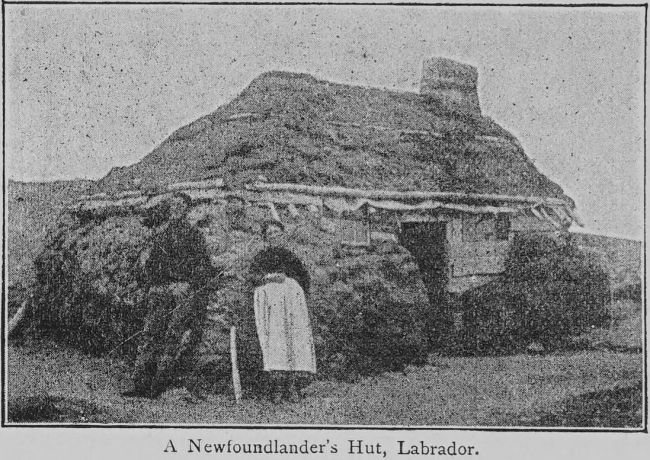
Soon I was sitting in a tiny, dark mud hut, with
neither glass in the hole that served for light and air,
nor a chimney to carry up the smoke from the fire
on the floor, through the large hole in the roof
intended for its escape. A groaning man sat doubled
up on a rude bench in a dark corner of the room,
while his wife endeavoured to restrain the super-abundant
energy of a crowd of children. “Been ill
long?” I asked, after the usual greetings had been
exchanged. “About three weeks. Wish I could
get home. There’s no chance for a sick man up
here.” Evidently he did not yet grasp the idea of
our hospital ship. “Well, we’ll see what can be
done,” and the case was inquired into, and found to
my joy to be one for which relief could, by care,
be obtained. After some further talk, in which one
or two fishermen joined, who had entered during
the examination, we had a few words of prayer for
God’s blessing on the means used, and left for the
ship, leaving behind us, for the Albert’s first evening
in Labrador, at least one poor heart grateful—and
thoughtful. A hearty service aboard and many
minor cases of sickness closed the day. Daylight
again saw boats alongside the Albert, and we were
called to visit a poor Eskimo dying from consumption.
He had been brought from an island four days before,
and was lying in a lonely hut, hoping some day that
he would be well enough to get aboard the mail
steamer for advice.
The poor house was indeed ill-calculated for a
dying man—ill-ventilated, ill-lighted, and dirty—with
little clothing, and still less food, semi-starvation
was rapidly hastening on the end. Oh, for a
clean bed, a nurse, a hospital, to put such cases in,
was the whole talk over tea that evening. All was
done that could be. Food, medicine, and some warm
clothing were taken him; but ere the Albert came
south again, death had claimed the poor fellow for
its victim, and closed the sad scene of human suffering;
and the valley of shadows had been crossed
without the knowledge of a Saviour, who takes
away all its sting. At whose door will this fault
be laid? Not more than once a year does the sound
of the glad tidings of God’s grace reach Spotted
Island, the home still of some fifty persons.
To avoid repetition, I must now content myself
by giving a general description of the people of
this coast and their methods of earning a living.
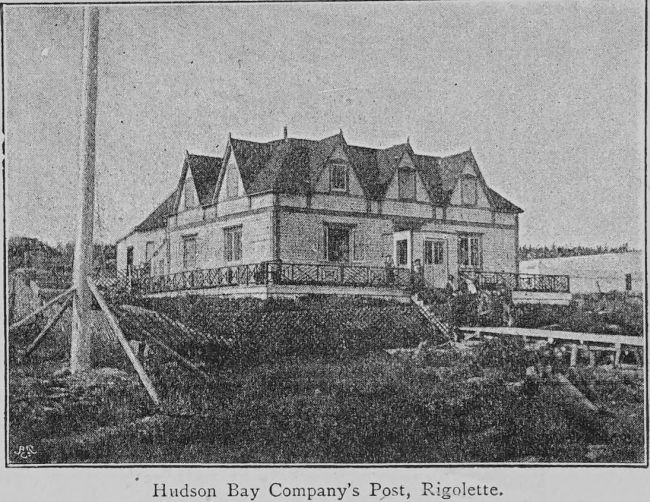
Hudson Bay Company’s Post, Rigolette.
CHAPTER VI
DO PEOPLE LIVE IN LABRADOR?
Do people live in Labrador? There is a resident
white population of some 5,000 at least, scattered
along the south and east coasts. They call
themselves “Livyeres.” North of these are Eskimos,
and in the interior Indians, known locally as “Mountaineers,”
but actually they are different branches
of the old Algonquin race. The last returns were as
follows:—
White population of St. Lawrence coast
4,411
White population of Atlantic coast
2,416
Eskimo on the coast
1,700
Indians of the interior
4,000
——————
Total
12,527
——————
These Indians, who once held North America from
the “Rockies” to the sea, have steadily decreased
in numbers. As they live by hunting only, the extensive
forest fires, and depletion of fur-bearing
animals, have driven them further and further west.
Whole encampments have been reported “found dead
from starvation.” Only occasionally do they visit
the coast, bringing furs with them to trade with
the Hudson Bay Company. They never take to sea
fishing.
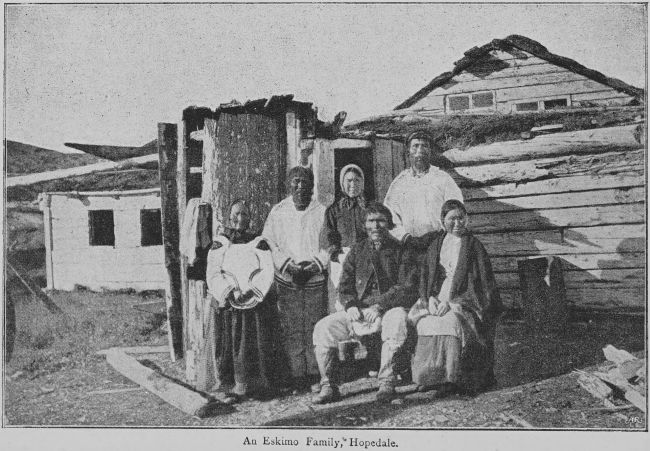
The Eskimo, of Mongolian origin, at one time
were as far south as Newfoundland. In 1780 a
tribe 500 strong still dwelt along the Straits of
Belle Isle. Now almost all are north of Hamilton
inlet; of these I shall speak later.
Whence do the whites come? Some are said to
be descendants of those who fled the old country in
press-gang days. In 1780 we hear of a crew of convicts
sent out there. Some are descendants of sailors
wrecked on the coast, or of Newfoundland and other
fishermen who have been left there. More come
from those who have gone out in the service of the
Hudson Bay Company, while some few have emigrated
directly there. The largest settlement consists
of about 100 persons, and with the people of neighbouring
coves numbers about 350. It is here where
the mission has built the first hospital ever known
in Labrador. In May or June every year the
coast is visited by from 20 to 25,000 fishermen,
women and children. These arrive as soon as the
ice is blown off the coast by westerly winds. Most
are from Newfoundland, some from Canada, with
occasional Americans buying fish. They come in
every variety of vessel—small and large, good, bad
and indifferent—mostly of the schooner type. They
number about 1,000. Besides the crew, which varies
from five to ten men, with one or two women, most
Newfoundland vessels bring a number of people
called “freighters.” These are landed at various
harbours, where they have left mud huts and boats
the previous year, and where they will fish all summer.
The fish is “made” or cured in Labrador, and
sent in large vessels to the Mediterranean, Brazilian,
or English markets. Meanwhile, the schooner has
gone further north in search of a “fare” of fish. If
successful, the fish will be salted, and brought home
“wet,” so that these vessels are called “green-fish
catchers.” As they come south they call for their
“freighters,” with their goods and chattels, who pay
25 cents per head per cwt. of fish caught in return
for their passage. The overcrowding on some of
these vessels returning is very great, and is made
worse by the fact that every year more vessels go
than return. Besides the cargo of fish, casks of oil,
nets, boats, and general goods, perhaps thirty, forty,
or fifty men and women will be crowded into these
small vessels, at times with only room to lie down
in the hold between the deck and the cargo. On
one small schooner of nineteen tons we counted fifty
people, thirty-four men and sixteen women. The
women, many of whom have children with them, are
often very bad sailors. As a rule, they are not
allowed on deck except in port, and this voyage is a
nightmare all summer to numbers. They are pillars
of pluck, many of these women. They can handle
an oar and sail a small boat with the best, and
among them are “Grace Darlings” only wanting an
opportunity. They work chiefly at cleaning fish and
keeping the huts for the men, though some, I think
very wrongly, form part of the crews of the green
fish catchers. The Canadian schooners are larger—carry
about eighteen men and no women. The
people consider Labrador very healthy, which I attribute
to their comparative immunity there from
epidemic diseases. The damp mud huts, often filled
with snow till the very day they go in, the entire
absence of any sanitary provisions, combined always
with either cold draughts or too little ventilation,
have, without any doubt, an ill effect on the people,
but more especially on the women, who occupy them.
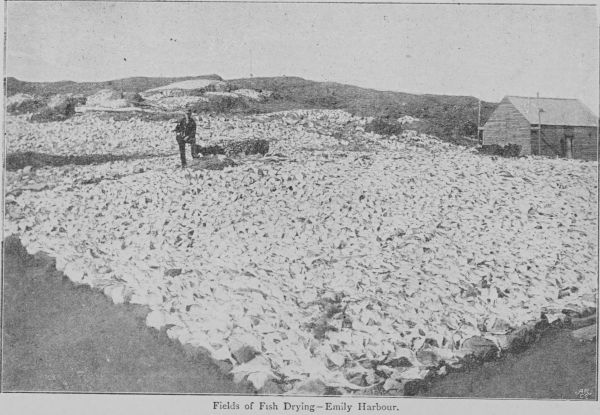
Fields of Fish Drying—Emily Harbour.
The fishermen are tall men, and broad to match,
born to the sea, and are accustomed, from their
training at the seal fishery on the ice, to be quick
and active. No lighthouse, no buoy, no landmark
aid navigation on the Labrador coast. The charts
are old, bad, incorrect, incomplete and unreliable,
while north of Hamilton inlet, where nearly all the
schooners go for green fish, there is practically no
chart at all, most of the surveying having been done
by the keels and bilges of devoted fishing schooners.
Streams of icebergs, floating all the summer to the
southward before the polar current, render it always
unwise to stay at sea at night. With sudden calms
and baffling winds from high perpendicular cliffs,
making a harbour without a tug is always hard
enough; but here, in addition, the constant and dense
fogs make it often impossible, without any kind of
guide, even to find a harbour at all; for in places
shoals and ledges run out twenty miles to seaward.
Yet for all this shameful neglect on the part of the
Newfoundland Government, the weak defence is
constantly made, “Not many lives are lost.” That I
know to be due solely to the consummate seamanship
and daring perseverance of the fishermen. Among
many good vessels, many are bad, and, worse still,
are provided with but bad tackle and holding-gear.
The latter is an absolute essential, with the liability
that exists to sudden hurricanes, and I believe more
vessels are lost in Labrador from this one cause
than all others put together. Moreover many, as I
have already pointed out, are greatly overcrowded.
More than once we saw vessels drifting to destruction,
and once, when holding on ourselves for all we
were worth, we had the pleasure of saving a comrade
by running him a coir hawser, and so holding
him on the verge of the rocks after his own tackle
had given out and the crew had received brief notice
to quit through the boiling surf.
It must be remembered that Newfoundland, our
oldest colony, exists solely by its fishery; that
one-third of its entire revenue is now derived from this
very Labrador fishery, that is some one-and-a-half
million dollars, and that in no other way could this
harvest be reaped. Moreover almost every man in
Labrador may be called a fisherman, and yet nothing
is done for all their returns. Here is another method
of interpreting the value of the industry. It is said
seventeen tons of fish contain the nutritive value
of 50 head of cattle, or 300 sheep. Now the average
yield for fifty years from the French and English
Fisheries is 2,300,000 cwt., that is 338,235 cattle, or
2,029,410 sheep.
The summer Labrador settlements are on islands
or outside headlands, and here both Newfoundlanders
and “Livyeres” dwell, the latter retiring up the
bays and inlets, to be nearer wood and game, when
the former return to Newfoundland. There are
about a dozen well recognised central stations in
Labrador, where agents representing the various
merchants’ firms are stationed to collect the fish
from the fishermen dealing with their firm, and to
ship it thence to market. These men have far better
houses than the rest, generally also a store from
which the general wants of their men are supplied.
As a rule, advances are made of all needful appliances
and food to some better known fishermen.
These men are known as “Planters,” and employ
under them so many men and women on “share”
or wages. Occasionally, also, the agent has some
men of his own, working for settled wages, who
may be made to fish for cod, to pack salmon, to load
vessels, or do any work they are told. When seven
men fish one trap or seine net, the total catch is
divided into fourteen shares—seven for the planter
and seven for the men. That is one share each; a
few dollars on the hundred quintals being allowed
the skipper of the “crew.” Or when a man fishes
his own net with four men, I saw the value divided
into twelve shares—four for the master, four for the
trap, and one each for the men, so that each man
gets every twelfth fish. When hand-lining begins,
and two men have charge of each boat, every other
fish belongs to the men, the owner taking two out
of four. A girl’s wages are £6 to £7 currency
for the season, and her keep. Each planter has his
own hut, but his men often live together. The huts
are of logs with the chinks filled with moss and
covered with sods. Entrance is by a low doorway,
and there is a small window placed low down to
prevent escape of heat. Warmth and ventilation
cannot co-exist in so small a space. A man a little
over a fathom long once visited Sir Donald Smith,
when an agent on that coast. To accommodate his
legs at night a hole had to be cut in the wall, and
a box lined with dogskin fixed up outside. I saw
one day a fisherman moving house. The house was
first wedged up on piles, then a rope was put round
it, and, with the help of a few neighbours, it was
dragged higher up the hill. Another house I saw
had been dragged over the harbour on the ice “to
be nearer the fishing ground.” An American stove,
or more often an open fireplace (the smoke going out
of a huge chimney like in an Irishman’s cabin), serves
for warmth and cooking. The stove, anyhow, is a
movable chattel, and accompanies its master to his
winter hut in the fall. Clothes are so expensive and
so scanty that every man is his own wardrobe, and
he who puts his clothes in a drawer must himself
go naked. Thus a block of furniture is obviated.
Bunks are put up for the men or a partition boarded
off, while the girls sleep in a “lean-to,” called a
“bunk-house,” or have a part partitioned off, or hang
an old curtain in front of their bunk in the smaller
huts.
Some Newfoundland planters and agents provide
boarded huts for their “crowd,” but in all the arrangements
are much the same. The Livyeres’ families
have all their separate huts. Each “crew” has a
fish stage, alongside which the fish are brought in
the boats. These stages are built out on piles driven
into the mud. Long poles, known as “rounders,” are
laid side by side across the tops of these, and form
a kind of flooring. The whole is then roofed in
with poles and sods, in order that fish-curing may
proceed at night by costers’ lamps, or in bad
weather. Up the middle of the stage runs a table
for splitting the fish on. The green fish are hove
up on to the stage with pitchforks, seized by a woman
who cuts off the head—“the header,” and passed
on to one who opens the throat—“the throater.”
She passes it to a man—“the splitter.” He, with
great dexterity, cuts out the backbone and flings
the flesh into a tub of water for the “washer.” I
have timed a man split thirteen fish in one minute.
It takes the tyro nearer thirteen minutes to split one
well. The offal is thrown through a hole in the
floor into the sea below, where every variety of
scavenger fish congregates. In Norway, and by
Messrs. Munn of Newfoundland, the skins and bones
are made into a splendid glue, while the rest of the
offal is preserved for fish manure. The washed fish
is next laid in pile and salted. The “salter” is
also a skilled mechanic. It is easy to undersalt and
easy to “saltburn,” or oversalt, whereby much
valuable salt is wasted. This salt comes all the
way from Cadiz by the same vessels that take the
fish away. Next the fish is spread in the sun. A
fine day is waited for, and all hands turn to. Many
a slip exists between the cup and the lip, however.
If the fish has lain too long, it will be sodden, and
go grey or dun. If the sun is too hot, it will be sun-burnt.
If rain comes, and it is wet and dry again,
too often it will be injured. It must be turned and
returned. At last it is gathered up into circular
“piles,” back up, and tail to the centre. These
piles are covered over with birch rinds, and a few
stones placed on the top to keep the whole together
till it is time to ship them away. They are weighed
into the ship, two quintals at a time, a “culler”
looking over them as they pass in and classifying
them; and according to this classification they are
paid for. The receipt handed to the fishermen runs
thus:—
Received from..............
Large}
Medium} Merchantable fish
Small}
Madeira merchantable fish
West India merchantable fish
Talqual merchantable fish
Inferior merchantable fish
Damp merchantable fish
Dun merchantable fish
Slimy merchantable fish
Labrador merchantable fish
And also ...... casks of ...... gallons of oil.
There is always a great race to get first to
market, for the first cargo always fetches a higher
price. One fish planter ships his own fish to England,
and thus is able to get at times a better price
than that offered in St. Johns. On the other hand,
he runs the risks of the freight, insurance, etc.
No railway, public building, roads, drains, or such
like things exist in Labrador, and every man is a
fisherman first, a handy man after—boat or house-builder,
blacksmith, cooper, curer, as the case may
be. Only three harbours do I know where liquor
is sold: in one of these two poor fellows were
drowned through its influence last year. No jail or
police exist on the coast. A small revenue schooner,
with a justice of the peace on board, is responsible
for maintaining the law and preventing smuggling.
The people are, as a rule, law-abiding; but crimes,
especially among the half-breeds and Eskimo, go
unpunished. In one settlement a lay reader and
school teacher are established; in another an aspirant
to the Methodist ministry, while settlements up
two long inlets enjoy similar privileges. These men
are all doing excellent work, as is a Presbyterian
student from Dalhousie University in the Straits of
Belle Isle.
Most school work can be done in winter, for in
summer only those too young to work can be
spared; and if they are old enough to journey alone
to and from the school, they are old enough to do
something at the fishery. Only a small percentage
of Livyeres can read or write. Every summer it is
usual for a Roman Catholic priest, a Methodist
minister, and an Anglican clergyman to visit as
many stations as they can on the first 400 miles of
coast. They are passed along in boats from place
to place by the too willing people, who, irrespective
of creed, extend their kindly hospitality to all alike.
In places wood buildings have been put up voluntarily
by the men in their spare time, for Sunday services,
conducted usually by one of themselves. Our own
gatherings, at times too large for the Albert’s hold
or these little buildings, were held in fish stores
ashore, cleared for the purpose, or in the open
air, one of the countless boulders serving for a
natural rostrum. I have seen the same place serve
in the morning for Church of England, in the afternoon
for Wesleyan, in the evening for Salvation
Army, and pretty much the same congregation attending
each. I have known a Methodist meeting
house on Sunday reconsecrated for Mass on Monday.
This absence of conventionality, this socialism on a
basis of kindly generosity, is most congenial to one
from the old world.
Fresh meat and vegetables are alike hard to procure.
No cow or horse exists. The domestic animal
world is represented only by the inevitable dog; the
vegetable by the stringy cabbage or struggling turnip,
whose leaves alone attain to economic value.
To prevent scurvy in winter, when fresh fish is not
attainable, salt meat must be avoided, even if they
can afford to buy it. The following recipe is invented
with that end: “Dry the cod in the sun till
it is so hard none can go bad. In winter powder
this, rub it up with fresh seal oil, and add cranberries
if you have any.” This dainty is known as
“Pipsey.” These people neither need nor expect
luxuries; sugar and milk are very rarely used—tinned
milk being too expensive, molasses being
cheaper than sugar, and also margarine than butter.
White rabbits, white grouse and sea-birds help to
eke out the winter’s diet.
But to be accurate, in two harbours I saw a pig,
brought by the Newfoundlanders. When they arrived
the dogs were banished to a desert island near.
In one harbor we listened to much wailing. Two
pigs had been isolated on an island near, the fishermen
enjoying daily the bliss of anticipation. But
alas! here the dogs proved equal to the occasion.
An on-shore wind had brought them the joyful news,
and that very morning the pigs disappeared, only
a few blood-stained bristles remaining to tell the
story of the crime. In one harbour a planter had
brought a sheep, but its isolation had so developed
its affection for its owner that it followed him everywhere,
and he could not make up his mind to kill
it. Goats fare a little better: they have horns.
Yet in one place three nights in succession a goat
had been missed. A team of runaway dogs was
roaming near, but only approached the houses under
cover of night. All these animals are, however, the
perquisites of affluence, and belong almost entirely
to the planters from Newfoundland. Some few
bring fowls, which eke out a perilous existence on
suffrance of the dogs. At the Hudson Bay Company’s
station of Rigolette, Mr. Wilson, the chief factor, told
me that two of his dogs got into his well-enclosed
yard, and in four minutes killed eight hens and tore
four goats to pieces. Among all these people no
resident doctor exists, nor is skilled aid of any kind
to be obtained in case of need; for the few minutes
in the summer that the mail steamer stays in any
harbour, and the irregular times of her calls, gives
the doctor on board no opportunity to render effective
aid. When sickness falls on the people no one knows
what it is, or how to treat it. Not knowing they
are ill, men work on till a trifling ailment becomes
a matter of life and death. A slight accident with
no “first aid” at hand, permanently cripples a limb
or destroys a valuable function, such as sight.
Bleeding unchecked from a simple wound deprives
a dependent family of the father and breadwinner.
Many are the piteous stories I have learnt of such
cases since first, in 1892, the Gospel Hospital-ship
Albert was sent out by warm hearts in Old England
to their brothers and sisters in this “region beyond.”
After all this description of Labrador, do you ask,
as I do, why do people stay here, when the fair farm
lands of Canada are offered free to all? There is
a story that a solitary old woman in the wilds of
North America was one day visited by a gentleman
from that “hub of the universe,” Boston city. She
asked him, “Where do you live?” “Oh, hundreds
of miles away—in Boston.” “How do you manage
to live so far away?” was the reply. To begin
with, every one has a lingering belief in his “ain
countree.” The wild life to which these people are
born has a certain charm to others besides themselves.
Sailors they are born and bred. What else
can they do? Some have been taken by the Canadian
Government to the southern side of the Gulf of St.
Lawrence—the Arcady of Longfellow—and yet have
found eventually their way back. The fact remains—here
is an increasing English-speaking colony.
CHAPTER VII
JUST HOW THE FISH ARE CAUGHT
Boat returning from the Trap
full of Fish.
Cod (Gadus) = goad or rod fish—called
in Norway stick or stock fish, or in Spanish “baccalhao,” in Italian
“mazza,” a club or rod—all of which synonyms imply that a rod or stick
is used in preserving the fish. In Norway two are tied tail to tail,
and then slung over a stick, being then exposed to sun and air so
many days—prescribed by law. The Eskimo largely hang them from a rod
by the gills after splitting and salting them, but Newfoundlanders
spread them out on poles, called “flakes,” or on the natural rocks,
called “bournes.” But “you must first catch your hare, then cook
him,” and seasons suitable being very brief in these Arctic climates, the most rapid
methods must be adopted; and in cod-catching Newfoundland has eclipsed
all her rivals.
In spring, nets only are used, for the fish are in
shoals, feeding on the myriads of caplin, a fish the
size of a sardine, which are inshore then to spawn.
The most successful net is the cod-trap. Practically
it is a submerged parlour of net without a roof, but
with a large door, into which the cod are invited to
walk by a long net leading to the nearest headland
of rock, and ending at the centre of the door. It is
all kept in position by heavy anchors. The distance
from the rock is from a hundred to a hundred and
fifty yards. Cod are gregarious fish, and, like sheep,
follow a leader. When, therefore, one comes up
against the net as he swims near the rocks, he turns
out into deeper water to circumvent it, and so leads
his confiding following directly into the net. Here,
being a platonic fish, he remains, indolently browsing
on the infusoria and ocean slime which collect about
the twiny walls of his prison. Suddenly a boat appears
overhead, and a long telescope, with a plain
glass bottom—the fish glass—is pushed down into the
room, through which the trap-master is peering to see
how many finny prisoners there are. Now the door
is pulled up, and now the floor is rising—rising—rising,
being passed along under the boat, until all the
frightened captives are huddled together in one seething
mass near the surface. Now a dipper is put in,
and the jumping, struggling fish are heaved into the
boat. Soon the boat is full to the gunwale, and still
there are more prisoners. Large bags of net are
produced and filled with the rest of the fish. These,
after being buoyed, are thrown overboard to wait till
they are “wanted.”
I have seen fifty to sixty hundredweight of fish
taken in the same trap time after time. Sometimes
more are caught than the curers can keep pace with.
Then the fortunate trap-master allows his neighbours
to “haul the trap,” receiving in return a small proportion
of cured fish. Now certain positions are
thought better than others for setting these traps,
with the result that there is every spring a race from
Newfoundland to get them, like our members of parliament
race for seats. The law does not allow traps
to be set till a certain day, and the leading net must
be put out to secure the berth—a top hat on a bench
is not sufficient—and unless within four days the
whole trap is set, the claim becomes void. Thus,
while the ice was still on the shores of Labrador, a
steamer was sent ahead with numbers of men, each
armed with “a trap leader,” to get ahead of the sailing
schooners which were working their perilous way
along inside the floe ice. In one case, after the best
berths had thus been taken, the nets to complete the
traps did not turn up till after the prescribed four
days. Meanwhile another crew had pulled up their
nets and pounced on the coveted prizes. Again,
some men were landed with “leaders” on one station
late at night. “No sail in sight. We’ll secure our
berths to-morrow morning.” During the night, however,
a southerly wind brought in two schooners, and
during the hours of darkness these secured the prize
while the others slept.
Snug Harbour.
The “cod-seine” ranks second in importance
among nets in Labrador. It is of prodigious size,
up to 60 feet deep, requiring seven men to work
it, and is used either to bar an inlet, or to shoot
round a shoal of cod in deep water. The seine
master stands, fish-glass in hand, high on the bow
of the seine skiff, as his stalwart crew, with eight
huge pine oars, drive the boat along, perhaps hour
after hour. The vast net is piled up on the stern,
while one man stands on the thwarts, steering with
his oar like an Italian gondolier. Suddenly “Easy
all!” is cried; “Hold her up!” and the seine master
peers down into the water with his glass. A school
of fish is on the bottom. Swiftly the net anchor is
dropped, and the net is paid out astern as the willing
backs bend to the oars and force the skiff round
and home to the starting place, marked by a gaily-painted
buoy. Thus the whole school are enclosed.
Now the weighted foot rope is “gathered” together,
the net has become one vast bag, and the prisoners
are dealt with as before, i.e. dipped out and bagged
off.
The gill net is rarely used in Labrador now. In
Norway it is still a favourite method. Twenty to
twenty-four nets, eighty feet long and about fifty feet
deep, are “shot” in water of from twenty to sixty
fathoms, or even in ninety fathoms, as many as
three to four thousand cod being meshed at one
time. Under certain circumstances nets are no use,
e.g., on the great banks, or late in the season in
Labrador. Lines must then be used, and it is advisable
to use bait on the hook. To us accustomed to
row out and catch a few codling with a mussel, the
subject of “baits” has apparently little interest.
But out here it has become a subject of international
importance. The fact is, mussels are too soft, coming
off the hook too readily, and also cod are a fastidious
fish, and will only condescend to swallow that
“poisson” which is in season. True, it is not essential
to bait the hooks at all. Instead you may take
two large hooks, fix them back to back with a piece
of lead, which will act at once as bait and sinker.
Lower this to the bottom, and then keep jerking it
up and down. Often you will strike fish as fast as
you can work, using one line in each hand. This
method, called “jigging,” eventually injures the
fishery, probably because numbers of fish escape
after being wounded, and others follow them, possibly
to devour them, more than five being injured for one
caught. The fishermen say the injured warn their
friends, but a fish’s appreciation of pain is somewhat
doubtful.
Sailors have told me of sharks which, after being
caught and having had their livers cut out, will continue
to pursue and swallow the same piece of pork
as long as sufficient vitality remains in them to keep
pace with the vessel; nay, even that, after being cut
in half, the “bow end” will still wriggle after the
bait, when the ship is becalmed in the doldrums.
But Jack is prejudiced against sharks.
Bait is necessary, however, in deep water, a fact
that led the Newfoundland Government to pass the
famous “Bait Act,” rendering it illegal to supply the
French with bait in the hope of destroying their
banking industry. Alas! laws are easier to make
than enforce, and the worst sufferers were those who
formerly made out of this supply an honest livelihood.
Octopus and Squid is facile princeps among baits
for cod. Yet the cod must be circumspect in indulging
this weakness, and confine his attention to those
of tender years, for these cephalopods attain to enormous
size at times in these waters. Thus the Rev.
Dr. Harvey (F.R.S., Canada), of St. Johns, narrates
how, while recently two Newfoundlanders were out
fishing in their little rowing boat, two enormous arms
rose out of the water, seized the boat, and endeavoured
to drag it below the surface. Fortunately
a chopper lay at hand in the boat, and the great
beast, after losing two of his arms, sank amidst
volumes of black ink. The parts of arms cut off
were nineteen feet long, and are now preserved in
St. Johns Museum. Shortly after another was
secured by Dr. Harvey, which had been found floating,
dead. Its grasp embraced forty feet. Again,
in 1772 Cartwright caught one seven feet long without
head or tentacles. The beaks of these fish resemble
a parrot’s, and in large specimens are far
more solid than human teeth.
Catching octopus is exciting work. A number of
row-boats are anchored close together outside some
point of land, and the fishermen are lazily jigging
up and down a little bright red leaden weight, bristling
with wire spikes. Suddenly a stir—all are
working with might and main. A company of
squids are passing and flying on the jiggers like
vampires; the red weights are being grabbed voraciously.
Beware as you get him on board. Suddenly
he relaxes his grasp, and shoots out a jet of ink,
which smarts considerably in one’s eyes, and leaves
weird patterns on white linen. They swim backwards
and at great pace after their prey. Salted
down, these squid fetch fifteen to fifty cents per
hundred. “Bankers” pay ten to twenty cents per
hundred.
Caplin I have mentioned. They are taken in fine
meshed seine nets or in cast nets thrown from the
shoulder like the “retiarius” of old threw his.
Herrings form a very excellent bait. They are
caught in gill nets anchored out in likely spots, and
these are emptied every day. Our English drift
nets are rendered impossible by the icebergs and
sudden storms, with no harbour lights in case of
emergency at night, and herring see the net in daytime.
Herrings have been kept frozen, and then
found to serve as excellent bait. A new way to
freeze these is to half fill a barrel with broken ice,
salt and herrings, and then roll it well over and
over. Thus a constant supply of bait at known
places might be maintained in fixed ice houses; a
much needed arrangement, for much time and money
is lost by the uncertain supply of bait. Launce or
sand eels have often to be used, but can only be
taken on sandy bottoms, perhaps miles from a fishing
station. Then several crews club together, and
lend men in turns to row the bait skiff as many as
twenty-four miles, sharing up the bait when it
arrives. Occasionally they pay shares for a small
launch to keep up a regular supply. White fish, a
small fish taken in surface seines, are occasionally
used, and also sometimes whelks.
Cartwright Staff.
CHAPTER VIII
THE TRUCK SYSTEM
Cod alone is fish in Labrador diction. Cod is the
coin of the realm. Money is scarcely known, and
no other medium of exchange is used by the people,
whose raison d’être almost is cod. All live on goods
advanced on credit, to be paid for by their catch of
cod. This truck system, is the next of kin to the
old feudal system, and has long been extinct in
most civilized countries. It seems the early treatment
of Newfoundland by England is partly responsible
for the rise of this baneful system, which
it is now difficult to remove. The struggling fisherman
knows it is a state of bondage, but cannot get
out of it; the merchant knows its disadvantages outweigh
its profits; while the colony must recognise
that it is alone the cause of so many of its younger
and more energetic men leaving the country as soon
as they can see their way to do so—for no race
loves its country with more patriotic affection than
do Newfoundlanders.
Up to the end of the eighteenth century no one was
allowed to remain in Newfoundland after the fishing
season, each captain of a fishing vessel being held responsible,
under heavy penalty, to bring back all his
crew to England; while if any one did desert and
remain behind to be near the fishing grounds, and
to reap the harvest of the sea for his own benefit,
his stage, and even house and goods, might be appropriated
by the first fishing captain out next year.
This made it only possible for fishermen to go out
when some merchant capitalist would finance the
voyage, who, in return, repaid himself out of the
fish caught.
Now many vessels were sent out, and though the
catch of fish by any individual vessel was uncertain—for
fish set into one place one year and another
the next—the whole catch would generally
repay the merchant amply. But as in some cases
all vessels of one merchant might do badly, a large
price was charged on goods advanced as a further
security for the merchant, that in any case he
might be quite sure to recoup himself for his outlay.
And lastly, though there might be no immediate
return in fish or cash, yet the fishermen at
once began to accumulate a large nominal debt;
and though possibly, and even probably, they would
never be able to liquidate this, yet the fact of their
being indebted to any particular merchant insured
their fishing for him year after year. Thus, perhaps,
the best issue for the merchant at settling
time seemed in every case to be a debt by each
man, but not large enough to make the fisherman
despair and so fish badly. Thus the successful
fisherman had to pay for his unsuccessful brother’s
deficits. The fishermen soon found this out, and
were not only soured against their suppliers, but lost
the incentive to make any effort to discharge their
whole debts. The merchant now found it difficult
to make ends meet through bad debts, and was led
to buy in the fish himself, insisting on the fishermen
not paying in cash, but fish. Each year the
commercial body fixed its own price for fish, punished
those of their men who sold the fish for cash
if they could do so, and themselves resold the fish
in foreign markets, gaining a second profit when
possible. Thus large nominal debts arose, which in
hundreds of cases the men could never hope to
liquidate. The spirit of pauperism was directly
fostered, the men becoming absolutely dependent on
the charity of their merchants, and in many cases
from year to year never knowing how much they
really owed.
This system persists to-day, as an evil heirloom,
dragging down both merchant and fisherman. To-morrow’s
labour is ever mortgaged ahead for food
to-day. At last a time comes when no longer any
hope of return from certain men can be expected.
The advances are suddenly cut off, and these men,
deprived of their usual source of supply, fall back on
government relief, till to-day over one-third and
nearly half of the whole revenue of the country is
spent in pauper relief. The recipients are frequently
able-bodied men, and yet they have no shame in accepting
it, looking on the government as an independent
source of wealth, and calling their annual
six to twenty-four dollars “a government appointment.”
Thus the system has played into the hands of
idleness and dishonesty also; for though all a
man’s catch is nominally his merchant’s, he is
tempted to keep some part back and sell it elsewhere,
that he may have some ready money to
spend when he returns. Thus one man who has
already more fish than would pay his own debt,
will accept fish from another heavily in debt, and
turn it in to his merchant as his own, handing
over afterwards the money or goods he obtained in
return to his friend, and perhaps deducting a shilling
a quintal for the risk involved. A far more
common way is to take and sell your fish right
away to another firm. All are generally glad to get
fish anyhow; for not only is it a loss to send away
a ship without a full freight, but also there is a
great race to get vessels away first each year, as
the first in the market will realize a higher price
for their cargo throughout. To prevent this the
various firms agreed at one time not to buy fish
from another merchant’s planters. But this fell
through, and now only a careful watch is kept on
how much fish each man has as the season progresses,
and the amount compared with what he delivers
to his merchant. Any man caught alienating
much fish would not receive any advance in future,
though most firms are anxious to get all the men
they can.
The advances are made in May or early June.
When the fish has been put on board the vessels for
market in October, notes of credit are sent to the
merchants thus:—
Received from......., .... qlts. ... qrs. ... lbs. of Labrador fish.
To Messrs. ........., qlts. ... qrs. ... lbs. of Merchantable fish.
Per Agent.......
Then, as soon as the total catch can be roughly
estimated, the Chamber of Commerce meet in St.
Johns and decide what price they will give for fish.
The credit notes are at once cashable at that price,
cargoes being all insured. Each firm then credits
its planters and men with their catch at that price,
and a balance is struck between the total and the
amount of each one’s advance in May. If a surplus
remains, it goes to provide the fisherman with his
winter’s diet. Now a good catch for a fisherman is
100 quintals of dry fish, or 300 quintals of green. On
an average 100 fish go to the quintal, that is, each
man must catch 30,000 fish. Each quintal is worth
in St. Johns from 2-1/2 to 3 dollars, so that 275 dollars
is a good season, less 30 dollars for salt 245 dollars,
or about £50. It must be remembered many will
only average 20 quintals some years, or 50 dollars,
not £50. The average catch per head for “bank”
fishermen last year was 47-1/2 quintals. How often a
man will be dependent, therefore, on charity for a
supply of food for himself and his family during the
winter becomes apparent.
Often the winter’s diet that can be laid in is
all too small for the needs of the family; and before
the breaking up of the ice once more allows
cod-fishing to commence, and the planters to return
from Newfoundland, the poor Livyeres are reduced
to living on “the landwash.” “A short feast and
a long famine” is a coast epigram.
Clothing is perhaps most difficult to find money
for, and is apt to become so scanty that the settler,
for lack of proper protection from the weather,
cannot prosecute his fishing or hunting, especially
where the temperature falls to 50°, or even more,
below zero. I met one poor fellow who years before
had missed his way home at night and had had to
sleep out in the open. He had lost both feet from
frost-bite. One can realize the need for woollen
clothing. When near Winnipeg, in North Manitoba,
I saw a young Englishman, who had been caught
out in a blizzard, and had lost both hands and both
feet at the wrists and ankles from frost-bite. But
a still more vicious circle is established when, to
procure food for this winter, a settler has to part
with his means of “killing a voyage” next summer.
The following is a case in point as related to
me on the spot:—
Some three years ago, at Big Bight, a Mr.
Olliver, with his wife and five children, had fallen
into great poverty. At last in spring, when all
his food was exhausted, he set out, taking his
last possessions, an old Jack plane and a trout
net, with him. Having no dogs, he had to travel
afoot over the ice and snow. At last he came to
the house of the best-off settler about, Mr. Tosten
Anderson, a Norwegian, and a splendid fellow. When
asked for food, Mr. Anderson, showing all the flour
he had, said, “To part with any more than I have
done, means we must all starve together.” This was
thirty to forty miles from his own home. He then
went on twelve miles to a Mr. James Thomas,
whose reply was just the same. Two days later he
reached Richard Blomfield’s house on his way back.
Here he met the same reply again. No more was
heard till three days later, when Blomfield was summoned
to the Ollivers’ house. On the middle of the
floor, his coat off and his gun by his side, lay Mr.
Olliver, shot through the head. In a heap in one
corner lay the three youngest children, scarcely dead
from blows from an axe lying near them. Apparently
determined to spare those who might provide
for themselves, he had sent out first his wife and
eldest daughter to search for food, and his eldest boy
to search for birds. Mr. Blomfield told me he supposed
that the cries of the hungry children proved
too much for the poor father. Truly Virginius of
old acted in much the same way.
This, of course, is an extreme case, and in order
to arrive at a fair conclusion, we took, as far as
possible, a census of the Livyeres—noting the numbers
and ages of children—the proportion that could
read and write, and the number each had of gallons
of molasses, barrels of flour or pork, pounds of tea,
and tobacco, which, alas, nearly all use, however poor
and unable to afford luxuries. That a very large
proportion had a quite insufficient quantity of food
became beyond question. It must be remembered
it is not a question of how much they can buy, but
how much a supplier is willing to give to people
already heavily indebted to him, only a few being
independent enough to pay down for what they
take. Government aid, sea birds, seals, trout, willow
grouse, and rabbits, i.e. arctic hares, are the supplemental
sources available. The Newfoundlanders are
too often only little better off than Labradormen,
and I have many piteous accounts of parents themselves
suffering chronic starvation in order to supply
their little ones with the necessities of life. Soon,
it is sincerely to be hoped, the interior of Newfoundland
will be opened up. All look to the new railway
to turn the attention of many to the cultivation
of the land, which will at least help to render existence
more easy. It is reasonable to hope also
that the new sealing laws, the new fishery restrictions,
and Mr. Adolph Neilsen’s magnificent work
at the fish hatchery and lobster incubation, are the
presages of happier times. But the people can never
be free, industrious, and contented, until the truck
system is dead and buried.[14]
[14] December, 1894. And now the long impending crash has come—both
the banks of Newfoundland have failed, and ten out of twelve merchants’
firms have had to suspend payment, while the masses of the population are
face to face with absolute starvation. The Truck System has entailed ruin
on all concerned in it, and has brought the country to the verge of bankruptcy.
There are not few, however, who see in these terrible events the
promise of better things. A better system of trade must arise, a better
relation between labour and capital, a better era for this oldest of England’s
colonies. “Whom the Lord loveth He chasteneth.” God grant it may be
so in this case.
A visit from Eskimo.
CHAPTER IX
RESULTS OF THE FIRST VISIT
November, 1892, saw the Albert once more in
St. Johns Harbour, after having spent seventy-eight
days on the coast. She had visited many harbours,
treated 900 patients, distributed much clothing
and literature, and collected much valuable information;
while Mr. Adolph Neilsen, superintendent of
Newfoundland fisheries, who had joined the Albert
during the greater part of her cruise, had been carrying
on scientific observations calculated to directly
benefit the fishing industry. Daily services had been
held, at which thousands in all had been present, and
not a few had confessed openly aboard their intention,
by God’s help, to live new lives.
On arriving in a new harbour, our large blue flag,
now known along the whole coast as the herald of
good things, had always proved a sufficient call to
prayers. We found no need for adventitious attractions;
where opportunities are so few, we found men
and women only too glad to come and join in simple
praise to God for mercies past, and prayer for the
unknown future before them. Here the uncertainty
of things seen, renders things unseen more real, while
the impotence of man being so evident, makes the
power of his Maker more intensely felt, and the
anxiety to be ever ready to meet Him more deeply
earnest. Even the sceptic has acknowledged it
means something, this “coming to Christ” of the
fisherman. His faith, unburdened by “higher criticisms,”
or convenient interpretations, sees in his
Master’s words a call to follow Him, on earth as well
as in heaven. Often I have watched men tremble
and hesitate, time after time, when God’s Spirit seems
striving with them, before the final step is taken.
For they count well the cost beforehand, and realize
fully the weakness of their own natures. But once
“over the line” means following Christ to them—means
coming out, being separate, marked men.
The world sets for them no higher standard than
they set for themselves, and their self-sacrificing
fidelity to their ideal has stirred the heart of more
than one Christian worker. There is little half-and-half
following, little “coasting” for fear of “launching
out,” such as saps to-day the joy and rejoicing
of thousands of professed Christians. A fisherman
knows if he has “tacked ship,” and is on the Lord’s
side, or on the other side. Often they say, “I should
like to be”; almost never, “I hope I am.”
For visiting places inaccessible to the ship, from
the fact that they lay among dangerous rocks, or
up narrow creeks, or because they only offered shelter
to small boats, we had taken with us a twenty-five
foot whale-boat, the Alfred, which we rigged with
two lug-sails and a jib. In this we made many
journeys. Once we capsized her; once lost our way
in the fog, and had a nasty half-hour, with wind
rising, and fearing we were making out to sea as we
ran before it, till the thunder of the surf warned us
of the land, and the bottom of towering cliffs, white
with Atlantic breakers, broke suddenly into view.
We had to abandon the boat that night, and walk
home over the hills; but we managed to fetch her
home, close-reefed under shelter of the back of the
islands, next day. It so happened that where we
landed two or three couples wanted marrying. No
chance had offered for several years, so one couple
determined at once to return to the ship with us for
that ceremony, as we had at the time a visiting
minister on board. It was late at night before we
got there, but we decided (1) any hour was better
than none, and (2) that in a lonely harbour, on a
solitary ship (and as they already had three children),
“pronouncing the banns might be dispensed
with.” So we adjourned to the cabin, and proceeded
to business at once. The skipper was best man and
I was witness, while the steward and crew, who had
previously decorated the cabin with bunting, together
with one or two Livyeres from the creek, were congregation.
After all was over, hard biscuits and
tea were served, in lieu of a wedding breakfast,
while the occasion was honoured from a few old
fowling-pieces and by a couple of dynamite distress
rockets on the Albert’s deck. Altogether, we visited
in the Alfred and the Albert some thirty-five harbours,
exertions which so told on the Alfred’s constitution
that now she is taking her last rest at
Great Yarmouth.
Our dingey also upset in Domino Run, when endeavouring
to get ashore; an accident which proved
nearly fatal to the ship’s carpenter, for he happened
to come up under the sail, and was unable to
swim. Happily it only ended in an undignified
rescue. A more serious accident happened to the
Albert’s winch, for in Winsor Harbour, while letting
go the anchor, a catch got wrong and stripped
off all the teeth of the cog-wheels. After this we
were unable to get our anchor in, except with the
help of a great many men, for it was impossible to
replace the cog-wheel on the Labrador. It was quite
a sight on leaving harbours to see often fifty men,
who had come off voluntarily, “walking in” the
anchor by means of a system of pulleys, each as he
came to the stern of the ship trotting back to catch
hold of the rope again near the bow, a continuous
chain of men being thus maintained, and all singing,
as they pulled, one of the old shanty songs to assist
them to pull together. The names of the harbours
we entered were, if old Eskimo names, long and unpronounceable,
such as Nukasasuktok; if French,
often almost unrecognisable, thus Cape d’Espoir has
become Cape Despair; if English, often descriptive
of some incident, such as Run-by-Guess, Seldom-Come-By,
Ice Tickle, Cutthroat Island, Split-Knife
Harbour, Bakeapple Bight, Tumbledown Dick Island,
and so on.
Moravian Station, Hopedale.
When visiting up the bays our chief enemies
were always the mosquitos. These are a very
real scourge, for, like the black fly and sand fly,
which also exist in myriads, they bite very severely,
and we found them at times so thick that it was
difficult to breathe without inhaling them. Even
the “Livyeres” seldom, if ever, get accustomed to
them, while it is at times impossible to send Newfoundland
crews up inlets for firewood.
Our medical cases had included many and various
ailments, especially of the eye, the lungs, and the
skin. Many teeth, of course, had called for attention;
and the forceps had on more occasions than
one been the way to a man’s heart. If you do not
believe this, try a week’s toothache at sea without
remedies.
Among many interesting cases was that of one
poor fellow, who fourteen days previously had accidentally
shot off both his arms below the elbows.
Since that time he had lain on his back, with nothing
but an oily rag over the wounds. As we went into
his hut he held up the raw stumps piteously, from
which, in each case, some inches of bare bone
protruded. What could be done was done to relieve
his agony, but the poor fellow died of exhaustion
after an operation on the stumps. The night we
were leaving that harbour it was dark and blowing
as I clambered out over the rocks, to signal for the
ship’s boat about 10 p.m. There I found waiting
for me the poor man’s wife, who, in a flood of tears,
gratefully wrung my hands, till I too felt a choking
sensation about the throat. There was something
so real in her sorrow, now left still more lonely on
that lonely coast.
One day a silver-haired old fisherman came aboard
for advice. “All my three sons died this summer
from diphtheria, sir,” he told me. “I buried them
all the same week. My eldest was nineteen, and he
lasted out the fever; but he couldn’t swallow, and I
did not know how to feed him.” “What did you
do?” “Well, I tied a split herring round his throat—some
say that is good—but he starved to death
before my eyes. It is hard for us now to get along,
with no one to help me tend the nets. You see I’m
not so young now as I was.”
One poor woman, with a tumour of the leg, one
day sent for “the mission doctor.” She couldn’t
walk for it, she said, and life had become a burden.
We told her, “An operation will make you quite
well, and we can put you to sleep while it is done.”
She would not take chloroform, however, and so we
thought all was over. Next morning another message
summoned me to the cottage, where I found
five strong men waiting. “These men have promised
to hold me, doctor, while you take that away.
But I may bawl, mayn’t I?” In quarter of an hour
all was completed, and my plucky patient was laughing
loudest at the queer scene; for bawl she had,
indeed, “to keep me from thinking of it,” she said.
But the men held on well, and in ten days she was
all healed, and was up and walking.
Among our most interesting visits had been that
to Hopedale, the most southern station of the Moravian
missionaries; but I must leave to a later chapter
a description of the Eskimo, of whom we saw a
good deal. There were three Moravians and their
wives here, the oldest having lived in Labrador
twenty-seven years. Once a year they communicate
with England by the good ship Harmony,
which, with its predecessors, has been visiting the
coast for one hundred and twenty years. These men
are true followers of the Saviour in the self-sacrificing
spirit, which draws them to live their lives
out on so barren and deserted a coast. At seven
years old their children leave them for ever, to be
educated in Germany, and then find an occupation
in life. In one harbour, Zoar, was a lonely missionary
and his wife, who had just sent home their
eighth and last child, a little girl of seven years.
“Can you not bring me a baby from England? we
are so lonely now,” said the good man’s wife to me.
Even to get a wife they must write home, and one is
chosen by lot for them. After our visit, they wrote
as follows:—
Hopedale, Labrador,
September 7th.
To the Council of the Mission to Deep Sea Fishermen.
Gentlemen,—On behalf of the Moravian Mission
here I would ask you to accept our warmest thanks
for sending your ship, the Albert, to visit us and our
people, cut off as we are for so many months in the
year from the rest of the world. We feel by its
visit that we are within your thoughts. For the
comfort we have found in having our hands spiritually
strengthened by the presence of other Christian
men; for what benefit we have received from medical
attendance in our Mission house and in our congregation;
for the kind gift of books for our library,
and for the blessing we had in joining these meetings
kept, and for the pleasure we have had in meeting
all those we met from the Albert, we beg you to
accept our most hearty thanks. May our Lord and
Saviour bless your work everywhere, as He has done
it here among the fishermen and at our Station.
With kind and brotherly love, we remain your
brethren in Christ,
P. M. Hansen,
Moravian Missionary.
In Hopedale Harbour we stayed many days, for
hundreds of vessels kept calling in on their way
south; for winter was then approaching, and already
cod-trap boats going to their nets had had to
cut through two inches of new ice.
On our arrival in St. Johns it was thought advisable
to report the results and deductions from this
experimental voyage. Accordingly his Excellency
the Governor, Sir Terence O’Brien, invited the leading
citizens acquainted with the fishery to meet at
Government House. The report showed that (1)
much needless suffering, limbs and special functions,
besides life itself, were to be saved by the possibility
of obtaining skilled assistance in the first instance;
the famous sealing master, Captain Sam Blandford,
who was present, stating that while he had charge
of the mail steamer plying on the coast, seventeen
unfortunate people had died aboard without possibility
of proper treatment. (2) That even that year
twenty-nine persons had died at one harbour in
Labrador of diphtheria without being able to get a
doctor’s help—nay, more, no one would take their
fish or visit them to trade a winter’s supply. (3)
That the doctor on the small mail steamer was so
short a time in each harbour, and the time of his
arrival so uncertain, that the people had little confidence
in the few moments possible to devote to each
case, even if they were fortunate enough to see the
doctor at all, while it was impossible to undertake
any serious case with success. (4) That poverty
and starvation directly result from sickness or
accident to the breadwinner being left untreated.
After the report the following proposition was moved
by the Hon. A. Harvey, and supported by Sir Wm.
Whiteway, premier, and Sir Robert Thorborne, ex-premier,
which was carried unanimously:—
“Resolved—That this meeting, representing the
principal merchants and traders carrying on
the fisheries, especially on the coast of Labrador,
and others interested in the welfare of
this colony, desires to tender its warmest
thanks to the directors of the Deep Sea Mission
for their philanthropic generosity in sending
their Hospital ship Albert to visit the fishing
settlements on the Labrador coast....
“Much of our fishing industry is carried
on in regions beyond the ordinary reach of
medical aid or of charity, and it is with the
deepest sense of gratitude that this meeting
learns of the amount of medical and surgical
work done, besides all the other relief and help
so liberally distributed. This meeting also
desires to express the hope that the directors
of the Mission may see their way to continuing
the work thus begun, and should they do
so they may be assured of the earnest co-operation
of all classes of this community.”
His Excellency the Governor then nominated a
committee to help to perpetuate and extend the operations
of the Mission in Labrador. One merchant
present, Mr. W. Baine Grieve, presented to the
Mission a house at Battle Harbour for the first
hospital.
The Albert soon after left for England. She reached
Yarmouth on December 1st, where she received a
hearty reception from the many friends of the work.
In the report of the Chamber of Commerce of
Newfoundland the following reference to the work
was included:—
“A new feature worthy of mention in this report,
affecting as it does, more or less, the comfort of
20,000 or 30,000 of our people, was the appearance
on the Labrador coast of the Mission to Deep Sea
Fishermen ship Albert, outfitted by a philanthropic
society in England, non-sectarian in its lines, and
intended to afford skilled medical aid to, and provide
to some extent for the mental and material wants
of our fishermen. This essay has been an unqualified
success, and has evoked from the recipients of its
bounty expressions of deep gratitude, while at the
same time it has engendered in the breasts of all
who are interested in the welfare and prosperity of
the Colony feelings that must strengthen the bonds
which bind this comparatively neglected dependency
to the Mother Country. The vivid portraiture, by
the doctor in charge, of his own personal experiences
on the coast is likely to result in well-organized co-operation
by the Colony next season upon the lines
on which the Mission ship is being worked.”
And in February, 1893, the following resolution
was received from the St. Johns Committee:—
“That this representative Committee will undertake
to provide two suitable buildings which
may be used as hospitals by the Mission to
Deep Sea Fishermen, should the Council of the
Mission signify their intention to continue
their operations on the coast of Labrador, and
the Committee will heartily co-operate in any
other way that the Council of the Society
may suggest.
“That a copy of the foregoing resolution be
forwarded to Dr. Grenfell for the information
of the Society.
“(Signed) {T. O’Brien, Governor, Chairman.
{M. Monroe, Secretary.”
The council of the Mission replied that they were
prepared to fit out a second expedition, and to undertake
the working of the two hospitals.
During the rest of February, March, and April
the captain of the Albert and myself held meetings
in various towns, in the endeavour to raise money
to carry on the work. Meanwhile we sent out
directions for the fitting up of the house given by
Mr. Baine Grieve at Battle Harbour, and also plans
for a wooden hospital, to be built in sections in St.
Johns, for transference to Indian Harbour, at the
entrance to Eskimo Bay, one hundred and eighty
miles further north.
In April an earnest appeal was made for money
to obtain a steam launch, to assist the Albert, by
visiting otherwise inaccessible places, and by towing
her in and out of narrow harbours. At the same
time preparations were being pushed ahead at Yarmouth.
The Albert was once more recalled from
her work in the North Sea. She was victualled for
six months, refitted as far as necessary, and stored
with the clothing, woollens, and literature which had
been in the process of collection all winter. A crew
was shipped, and by the 1st of May she was all
ready to sail. Our whaler had been knocked to
pieces last year, and we had to get a new boat to
replace it, or trust still to the money coming in for
a steam launch.
Arrangements had been made for the Albert to visit
one or two English seaports on her journey out, in
order to solicit further help, amongst others Exeter,
Swansea, and Bristol, whence she was to sail direct
to St. Johns. Still the money had not come in.
While, however, we were at Bristol, our boat still
unbought, the joyful news reached us, “Money necessary
for a launch has now come in.” The Albert
touched last of all at Swansea, where a suitable
rowing boat, the Mary Grenfell, was presented to
her. In Chester we found the most suitable launch
for the money we had—an oak-built, copper-fastened
boat, with simple 9-inch engine, six years of age,
though only little work had been done in her. She
was forty-five feet long. Her great defect was her
width, which was only eight feet, so that, being
carvel-built, she would roll most dreadfully. However,
while the Albert sailed across to Queenstown
we fitted out the launch at a total cost of £325, and
arranged to ship it direct by Allan line steamer
Corean to St. Johns. On June 1st I joined the Albert
at Queenstown, and next morning we set sail for
Newfoundland.
The hospital committee had meanwhile appointed
A. O. Bobardt, M.B., M.R.C.S., of Melbourne, Australia,
and King’s Hospital, and Eliot Curwen, M.B., B.A.,
of Cambridge and the London Hospital, as medical
missionaries for the two hospitals. These sailed
with us in the Albert. They had also appointed
Miss Cecilia Williams and Miss Ada Carwardine to
act as matrons and nurses under the doctors, and
had arranged for them to sail by the same steamer
as the launch. We had three dirty days on the way
out, and once were at close quarters with a large
iceberg, but the Albert again quitted herself well,
and on our arrival in St. Johns we again experienced
the greatest of kindness. Our committee had
collected some fifteen hundred dollars. A meeting
was at once called, and a small executive of two
members were appointed for each hospital, the Hon.
M. Monroe acting for Battle Harbour and Mr. W. C.
Job for Indian Harbour.
On the arrival of the launch she was at once put
into order for starting, while the nurses joined the
Albert, as the best way to reach their respective
stations. Meanwhile the Indian Harbour hospital
was sent on by steamer to Labrador. But a pleasing
function yet remained to be done—the christening
of the new launch. A telegram had reached
us that the Princess May, who had long been
interested in the Mission to Deep Sea Fishermen,
had consented to allow it to be named after her.
Accordingly on May 6th, amidst much rejoicing
and display of bunting, Her Excellency Lady
O’Brien christened our launch the Princess May.
The Princess May in Hamilton Inlet.
CHAPTER X
OUR SECOND SEASON
On Friday, July 7th, with a steward, an engineer,
and Dr. Bobardt as my companion, the Princess
May left St. Johns for Labrador, the Albert having
left the previous day. It was not without some feelings
of misdoubt that we first encountered the swell of
the Atlantic, knowing we should not make harbour
till night; and as we had two large bays to cross,
none of us being familiar with the coast, we had
hoped for a clear day to enable us to keep the land
in sight; but here again we were disappointed, for the
rebound from the cliffs forced us to stand out half
a mile to sea, and a dense fog shut everything from
view. Not having yet given the launch a trial ourselves,
and she being six years of age, we were not
surprised after the first five miles, when the engineer
sang out, “Sprung a leak, sir; shall we put
back?” An examination revealed the fact that we
could stop the leak with a wood plug; and so to
disappoint some few “croakers,” who had “told us
so,” we settled to stand on. Our compass having
only a card disc, and not being filled with spirit to
steady it, proved very unsteady, our narrow width,
of only eight feet, making us roll very rapidly. We
adopted the method of endeavouring to steer midway
between the extreme points the needle swung
to, and then to keep one point inside our course so
that we should not run out to sea. Very shortly
this resulted in bringing us up straight before a
perpendicular cliff. Evidently our compass was incorrect.
An examination revealed that its box had
been screwed on to the cabin with large iron screws,
the proper binnacle having been broken on the voyage
out, and being still at the optician’s in St.
Johns. These we soon extracted, and making a
fresh start to the nor’ard sighted Bacalhao Island,
about forty miles from St. Johns, at mid-day.
Not having sighted any more land by 5 p.m., we
began to think it was time to turn inshore, and after
some time found ourselves suddenly amidst numbers
of ragged rocks and small islands. Our chart book
described on the north side of Trinity Bay some
“Ragged Islands”; and we guessed we had struck
among these, so once more we stood out into the
fog. Shortly a weird noise attracted our attention.
We stopped and listened. Yes, it was a fog-horn.
This confirmed our recent diagnosis of “Ragged
Islands,” and once more we knew where we were.
Night saw us safely berthed in Catalina Harbour,
where we managed to coal ship before going to rest.
With no small feelings of satisfaction we went below
that night. True the locker was hard to lie on,
but the anxiety and subsequent success of that first
day was a sure soporific, combined with the fact that
the previous night had been none too restful, for we
had then no confidence in the powers of the Princess
May. Here we found our compass was still incorrect,
so we unshipped it altogether and carried it
forward, to be further from the magnetic influence
of certain iron handles. Right gaily we left harbour
next morning, but outside found a new experience.
The wind had veered round and was
blowing on shore, with a chilling drizzly rain to
enhance the effect of the nasty lop of the sea. Our
loose deck gear began to go overboard, and among
it our boat-hook took leave of us. Being heavy at
one end it disappeared from sight at once. It was
gaily painted black and white, and we were sorry
to lose it, being our only one. As I looked back it
suddenly rose again, lifting its painted handle high
out of water, as if to ask for help. We couldn’t
well desert it after that, and so went round to pick
it up. Our log has no record of the number of
circles we completed; but if the reader has ever
pursued a stick with one heavy end in a choppy sea,
he will find it usually disappears just as the vessel
has completed the tedious manœuvres necessary to
come up to it. The next question was, should we
venture further? The mail steamer was just coming
out behind us, and it wouldn’t look well to give up.
We would try for Cape Bonavista. By ten o’clock
the Cape was safely rounded, and the wind increasing
we determined to lay into the Bay, which
is twenty-eight miles across. We should not have
reached Greenspond, north of the bay, that night, had
we steamed the course we intended; but after some
hours steaming and seeing no land, we spied a fishing
boat, and went alongside for information as to
our locality. We found we were already across the
bay to our great surprise and joy. It appeared that
Dr. Bobardt, who had steered all day, had headed
two points to the westward of his course.
Interior of Male Ward, Indian Harbour.
We were loath to steam on Sunday, but our next
run round Cape Freels was a most difficult one, from
the numberless off-lying rocks and shoals. So when
three a.m. showed a clear horizon and a calm sea,
we started off. Alas, fog fell on us shortly, and left
us threading our way through the labyrinth. Now
and again we could see bottom, and at times some
rock near the surface, over which at intervals the
swell would break with a noise like thunder. The
Princess May did well this day—covering eighty
miles—and the mail steamer, which had only just
reached and was anchored for the night in Toulinguet
Harbour, was surprised to see us come in and
tie up alongside. The fourth day saw us on the
French shore, as we rounded Cape John at mid-day.
Here, however, we met a strong head wind,
against which we had no alternative but to steam.
Now, to provide some kind of cabin, a little house
had been built into the fore-part of the launch, with
a square glass front, being inside just about the size
and shape of the ordinary ’bus. As we steamed
into the head sea, it was just up to this part of the
cabin, which projected a couple of feet above deck,
that the launch dived, with the result that a sort of
water spout was thrown up and then dropped on
deck. Yet, as everything was closed up, no water
got below, and we managed to make a harbour to
the north side of the headland. The water, however,
got everywhere but below, and we were glad
of a change after dropping anchor.
At almost all the places we called at along the
French shore, we found the people very poor and
but little educated. Unfortunately in Newfoundland
the Sectarian School system prevails, with
a most disastrous result among these poor and
scattered communities. In all we found some who
were anxious to avail themselves of the visit of
a doctor. In many no qualified medical man ever
goes; and on the part known to us, that is the
east coast, there are none at all resident. In the
lonely harbour we were now in, called Pacquet,
a man soon emerged from the woods and came off
to us in a boat. He was ill-clad and looked equally
ill-fed, and his boy, who was with him, was suffering
from a pustular disease of the skin, for which
we prescribed. Though it was warm where we
were anchored the inlet was still partially choked
by two large icebergs, and our friend told us that
want of a net, and indeed any proper fishing gear,
as yet prevented their getting any fish. The mosquitos
were here very numerous and very busy. It
was impossible almost to go ashore even for fresh
water from the river at the head of the inlet, and
indeed when the dingey came back, a cloud of these
bloodthirsty pests followed her to the launch, and
invited themselves to spend the night in our already
sufficiently crowded cabin. Professor Hind narrates
an Indian tradition that mosquitos were created for
the benefit of a saint, who, for disobedience, had been
banished from heaven to a desert part of the earth.
In her solitude she prayed for even flies as companions,
whereupon mosquitos and black flies were
created. This gave her plenty of employment till it
was time for her to return, but the flies remained
in order to teach men the folly of trying to divert
their attention from the consequences of their sins
by seeking amusement. Captain Whitbourne says
they are of great use to make the idle work.
We were early astir next morning, and took a
course for the St. Barbe Islands. But a breeze rising
towards the land, we made a detour in order to cross
White Bay, which is eighteen miles at its narrowest
point, and so lay across till we were seven or eight
miles only from land. Then we again headed north,
and by nine o’clock, with a good breeze behind us,
crossed Hare Bay and ran into St. Anthony Harbour.
During the day a curious mirage had for
some time kept us under the impression that we were
hedged in by floe ice. We could see the vertical
edge, the gleaming white top, and what appeared to
be even cracks, fissures, and hummocks. It turned
out to be only an optical illusion, and we found that
it kept retreating before us all the afternoon like a
will-of-the-wisp. At St. Anthony we were among
friends of last year, so were soon ashore, and the
day closed with a hearty service in the kitchen of
the largest house.
The breeze increasing, delayed us a day in this
port, but before daylight on the 13th we left for
an attempt to cross the Straits of Belle Isle. As
we rounded Cape Bauld a most magnificent crimson
light lit up the whole horizon. Against it stood
out many stately icebergs, rising weird and ghostly
from the deep purple of the sea. One of immense
height looked just like some gigantic cathedral, its
gabled roof in the red glow shining like burnished
gold, while ever and anon the stillness preceding
dawn was broken by the deep boom of the Atlantic
swell reverberating from some hollow chasm at its
base, suggesting a mighty organ played in its vast
recesses. No sooner had we passed it in silence
than the engineer touched me on the arm and pointed
back at its lordly summit. “Look, sir! isn’t that
some one on the berg?” And there, sure enough,
plain and sharp against the sky, on the crest, stood
the figure of a man. But our glasses soon dispelled
the illusion. It was but a pinnacle with a thin base,
which, when thus seen edgeways, so closely resembled
a human figure.
From here we headed for the Sacred Islands, and
a breeze making up the straits, we ran in behind
Cape Onion to see what sort of a day it was going
to be, before we ventured to cross the straits. I
was surprised, on landing, at the quantity and
variety of wild flowers here. There were represented
among many others, saxifrages, umbellifers, composites,
ranunculi, primulas, and gentians. The
insectivorous “Drosera” is common on the heights,
and the beautiful “Linnæus borealis” nestles in
among the scrub.
The country, viewed from the head, is very peculiar,
being, as far as the eye could range, one
immense flat plain, with quite as much water as dry
land, from the innumerable winding ponds or lakes
of fresh water.
By mid-day we ventured to make a start, and
headed direct for Cape Charles, close inside the
island of Belle Isle. As we brought the hills and
steep cliffs of Labrador into view, we found there
was still much snow in the gulfs and crevices;
while it was necessary carefully to thread our way
among the numbers of icebergs, which up to this
very week had been blocking the straits. By sundown
we sighted the flag-staff on Battle Island, and
at 7.30 were once more alongside the Albert. A
crowded gathering below decks closed the day, all
being full of joy and hope at the prospect of another
season’s work.
Next day the house given by Mr. Baine Grieve
was inspected, and we found that Mr. Hall, the
agent for the fishery, had already placed it almost
in a condition for occupation. The Albert’s crew also
had been at work—carpentering, painting, and
landing heavy goods, such as bedsteads, bedding,
food, drugs, and furniture.
Meanwhile, the hospital for Indian Harbour, at the
mouth of Hamilton inlet, had been sent north, ready
cut in sections in the coastal steamer, Winsor Lake.
Two carpenters had also been sent north to work at
its erection. Next day, therefore, our party divided
again, the Albert going north to help with the
second hospital, having on board Dr. Curwen and
Sister Williams, while I, in the Princess May, went
south along the straits of Belle Isle, Dr. Bobart
and Sister Carwardine remaining at Battle. This
arrangement was rendered possible by the agent
extending his generous hospitality to the nurse and
doctor indefinitely.
Our first run took us to Red Bay, where we at
once were among friends of last year. Alas, poverty
and want had laid their hands heavily on this
place, and some families had been nearly naked
and next door to starving all winter. Not only
had 1892 been a poor fishery, but now the best
chance for 1893, viz. the caplin school of cod, had
come and gone, while densely packed ice, held in
by persistent easterly winds, had prevented the men
getting their nets out.
CHAPTER XI
A Newfoundlander’s Hut, Labrador.
OUR VOYAGE CONTINUED
On our arrival in a harbour our method was, as
last year, to hoist our blue flag to announce our
arrival, to then visit any seriously sick I could hear
of, after which we had evening service in a shed,
stage, or house, and then, last of all, any could come
for advice or assistance. To every family or vessel
a good bundle of reading was given if they wished
it, all the literature being selected at home as healthy
and suitable for fishermen. If any wanted God’s
Word, that, too, was to be had for asking for it;
while a register was kept of all the poor, describing
as accurately as we could the nature of the needs
and deserts of each case, in order that when, at the
end of the year, we divided up the warm clothing
we had brought out, it should fall into the hands of
the most deserving. In this way also we became
possessed of a valuable record for future reference.
Thus in one house when visiting a case, I found my
patient to be the mother of a large family. The poor
thing, who, with self-sacrificing courage, had refused
to believe herself ill till she could get about no
more, was lying on one single wood form in a bare
and dirty room, her head close to an old cracked
stove, behind which a crowd of shivering urchins
were huddled together. The sickness was acute
bronchitis and pleurisy, made worse by little clothing
and less food. A haggard man meanwhile
was pacing up and down, nursing a screaming and
hungry baby. I pulled the children out from behind
the stove for inspection; but their rags so failed to
cover them, that each hastened back at once after
the ordeal to the seclusion and warmth behind the
old stove. The complete attire of one bony little mite
was an old trouser leg, into which he was packed
like a sack. All were alike barefooted.
Staying here over Sunday, I was the guest of a Labrador
fisherman, rather better off than the majority,
an erect, grey-haired man of about forty-five, standing
some six feet two inches. His cottage, built with
his own hands, was a pattern of neatness and cleanliness,
but the bad seasons were compelling even
him to desert the harbour, and try squatting farther
along the coast. He was still the fortunate possessor,
however, of a cod-trap (value about £80), by
means of which he still hoped to end the year out
of debt. He was the class leader for the neighbourhood,
and had many years been standing on the
Lord’s side, and, indeed, after the Wesleyan Missionary
for the Straits, he was the backbone of the
religious life of the place. Such an one, where
every detail of one’s life is known, must indeed be
an “Epistle read of all men,” of which fact he was
well aware, as also, that his neighbours, while unable
or undesirous to read God’s word for themselves,
measured the claims of God on their own life very
largely by his actions. This we found to obtain
more or less along the whole coast, especially among
these scattered communities, where little or no provision
is made for their spiritual needs. When
therefore Sunday morning broke, and a large iceberg
was noticed drifting towards his cod-trap, threatening
to deprive him of his means of earning his daily
bread, he at first decided to go and spend the day
working to save his net. But soon he came back,
saying, “I’ve decided not to go, doctor; there are
those in this harbour that only want a pretext for
working on the Lord’s Day, and I’ll not be the one
to give it them.” As we climbed the hill to the
little wooden chapel I noticed him standing and
greeting the people as they came along, according
to his custom, as if forgetful of the fact that the
mass of ice was at that moment probably robbing
him of his all. We had three such services that
day; the Wesleyan missionary, the Rev. John Sidey,
was present, and more than one of our hearts were
full at the evidence of the reality of God’s Spirit
among this out-of-the-way, isolated people. Long
before sunrise on Monday, indeed immediately after
midnight, my good host was away in his boat after
the wreck of his cod-trap, and by breakfast had
returned, his face radiant with the same happy smile
he always has, saying, “I knew it would be all right,
doctor. The worst of the ice passed outside it; a
few hours’ work, and we shall get it all right again.”
Interior of Indian Harbour Hospital.
In the Straits of Belle Isle we visited all the
stations to Old Ford Island, about 100 miles from
the entrance. At L’Anse au Loup, Blanc Sablon
(the boundary between Canada and Newfoundland),
and at Bonne Esperance, we found large stations
for fishing, with numbers of men hard at work at
the caplin school. We had quite a number of
surgical and medical cases, including two of true
(sailor’s) scurvy from want of proper food. At one
place we were called to operate on the back of a
French settler, at another on the arm of a poor
Newfoundland schooner-man. In this last case I
had the assistance of a Roman Catholic priest who
was journeying along the coast.
While visiting in Forteau Bay we passed close to
the wreck of H.M.S. Lily. We found here that a
Beaver line steamer, the S.S.Lake Nepigon, had
recently run ashore. While journeying down the
straits she had struck on a whale-back iceberg,
and was sinking head foremost, like the Victoria,
when her captain succeeded in grounding her on
one of the few bits of sand for miles. Her screw
and rudder were practically out of water when she
took the bottom, with her bows in 27 feet. The
doctor aboard had spent three days on shore near,
and had operated on one cancer of the lip and on an
old compound dislocation of the wrist in a young
girl. These came to us to have the stitches removed.
While returning from visiting a patient at Greenly
Island in thick fog, we were unfortunate enough to
run the Princess May ashore. It was as dark as
pitch at the time, and we had burnt all our flares
out while threading our way through a quantity of
schooners at anchor. Two men on the bows of the
boat, after a long pause to search for some guidance,
had just given the word “all right ahead,”
when we ran up on a flat-topped rock, and found
that high, almost perpendicular, cliffs were only a
few yards ahead. Throwing out our dingey, and
removing all superfluous weight from the bows, we
succeeded shortly in getting off; and guided by the
stentorian shouts of some men from a schooner,
alternating with their fog-horn, we found our way
alongside and made fast to her. As we were too
many even to lie down on the launch I went aboard
the schooner, the hospitable skipper of which insisted
on my turning into his bunk. He was only
just back, apparently, with a load of fish from his
traps, and hearing the echo of our voices from the
cliffs had guessed something was wrong. He added,
“there is fish to be had now, and so I don’t turn
in at all myself”; and sure enough, after a shake
down and some supper he and his crew disappeared
into the foggy darkness for a fresh load from the
trap, while sleep reigned supreme on board. He
turned out to be a green-fish catcher, who was
“making” his fish on his vessel.
Further along the straits, at Bonne Esperance, we
met with a more serious mishap, for while returning
from a visit up Salmon River our propeller refused
to rotate, and we had to depend on our sail. The
kindness of the first engineer of a sealing steamer
(Mr. William Crossman) anchored in the harbour
set us all right again, however, for he made us a
complete set of new steel screws for our piston-top—our
own had given out, and we neither had means
of making new ones, or replacing them, in Labrador.
After one or two other similar mishaps, but having
treated some one hundred and fifty patients, and
having received much kindness and a warm welcome
wherever we had been, we reached Battle
Hospital again on the 29th of July. We brought a
dying fisherman the last 80 miles with us, which
necessitated his sleeping three nights in my cabin.
He was still in the prime of life, but pneumonia
developed into gangrene of the lungs, and he subsequently
died in Battle Harbour Hospital.
The Sunday passed pleasantly and rapidly among
the people here. After evening service, held by the
schoolmaster in the little church, we had a good
“fishermen’s meeting.” Dr. Bobardt was away all
day visiting sick people on a neighbouring island,
and holding service among them. No patients were
yet allowed in hospital, though it now only remained
to cover the floors and get the stores in. Sister
Carwardine had therefore arranged for the nursing
of one poor woman, on whom an operation had been
necessary, in a room of a cottage near at hand.
As the mail steamer was shortly expected, and
would certainly bring patients for the hospital, the
following day was spent by all hands in rendering
the hospital inhabitable; and by evening our first
patient was comfortably located in a room on the
ground floor, while the sister spent her first night
in hospital in an arm-chair.
Next day, before leaving for the north, Dr. Bobardt
again being away visiting, I was called on to bury
a poor fellow, father of a family of five, who had
died from consumption in a neighbouring cove. The
burial-ground is a small plot at the bottom of a deep
ravine on the seaboard side of the island. On each
side rose barren rocky crags, behind was the bleak
island top, while in front lay the great Atlantic,
bearing on its heaving bosom, as far as the eye
could see, countless mighty icebergs. As the sad
procession wound along the defile, carrying in its
rude wood covering what was so recently a living,
hopeful human being; as they laid it in its last long
resting-place amidst these cold and desolate surroundings,
the craving for something beyond the
grave burnt fiercely in every heart; while the joy
of knowing of a Heavenly Father, who has given
us victory even over the grave, was realized as a
priceless possession which the world cannot give—no,
nor sell either.
Our next object was to visit the coast up to Indian
Harbour, calling for coal and a few supplies left for
us half-way up by the Albert, at a place called
Bateau. In making a narrow inlet called Francis
Harbour, we found much difficulty in getting in; for
after long searching for the entrance, it proved to
be blocked with ice, and a circuitous method inside
an island was unknown to us. However, once inside
the warmth of our welcome made up for the suspense
outside, and after service in the neat and
commodious parlour of the agent’s (Mr. Penny)
house, we had a levée of sick visitors till midnight.
We next entered a deep narrow cleft in a high
mountain, running parallel with the sea, nowhere
wider than a stone’s throw. It is very deep, and
high hills of bright red rocks rise abruptly on both
hands. On the outer side are perched houses and
fishing stages. This is known as Venison Tickle.
The agent (Mr. Hawker) received us most warmly,
and being himself doctor, parson, planter, and all
combined, took me round at once to the various sick
and injured. One poor old fisherman, suffering from
apoplectic paralysis, we sent to hospital at Battle,
though we learnt from a schooner that already it
was nearly full.
Landing on a low island as we passed north, we
found the eider-duck nesting in considerable numbers,
while in the little pools among the rocks were young
ducks and young gulls in numbers. Of the latter
we caught several for our stew-pot. We steamed
thence fifteen miles to Boulter’s Rock Harbour by a
long narrow channel inside two enormous islands,
the passage being known as Squasho Run. Fog
succeeded fog all along this part of the coast, and it
was only by the help of volunteer local pilots we
succeeded in finding many of the harbours.
One dark night, unable to find our way further,
we dropped our anchor inside some outlying islands
called Seal Islands. It seemed to us that we had
hardly got straight and settled down for the night’s
rest before we heard a boat bumping against our
side. In such a lonely place, and in a thick drizzly
fog at night, a superstitious person might well have
started. Soon we heard the soft tread of a mocassin
over the half-inch boarding which, covered with
painted canvas, served us as a roof; then a bustling
at the hatchway door, and soon the broad face of a
half-breed Eskimo peered into the cabin. It appeared
he had a very sick daughter at his hut on the island,
near which no doctor ever went. He had heard of
the Princess May being about; and seeing our cabin
lights shining as he chanced to pass in his boat
homewards, he had come in search of assistance.
Soon, swathed in oilskins, I was sitting in the stern
of his boat, while he swiftly rowed away into the
darkness. Landing, and following closely behind him
over broken rock for some quarter mile, brought me
to his cottage, which, in true Labrador fashion, was
well filled with inhabitants. Among them I found
two seriously ill, one a young man of eighteen, the
other a young married woman of about thirty. On
this poor woman it was necessary to operate on our
way south in order to save life even for the time;
but as we had no hospital open in winter, she had
to be left in that crowded hut to the tender mercies
of the most unskilled of nurses, and though any
communication with the island has been impossible
since, I fear she will not have survived the winter.[15]
[15] 1895. She has perfectly recovered, in the most
marvellous manner.—W. T. G.
I was one day asked, a little further north, to visit
a woman reported to have been ill in bed for three
months, and who was living up a bay fully ten
miles from any fishing station. At length, dropping
our anchor off the spot indicated, which was the
mouth of a large salmon river, we blew our whistle
repeatedly to try and attract her husband’s attention.
After some time a small boat put out with
one man sculling in the stern. He seemed to approach
warily, and the man piloting me took in the
situation in a moment. As soon as the small boat
was alongside, he greeted the oarsman with “It’s all
up; come aboard and surrender quietly, or you will
be shot down.” The condemning reply came back,
“Indeed, sir, the river isn’t barred. It couldn’t be
barred. No nets would hold across it. It never has
been barred. I wouldn’t bar the river. You can
come and see for yourself.” We got into his boat,
and he started with us to the shore, when I asked
him if the launch was safe at her anchorage, as
darkness was coming on. The prompt reply was
that she would be aground on rocks at low water,
and that we had better steam across the inlet and
anchor the other side, where it was soft and good
holding ground, at which our engineer at once proceeded
to get steam again. On landing, I asked for
the sick woman, and was shown into the most miserable
dark hovel I ever saw. By a wretched tin chimneyless
lamp I examined my patient. She was lying
clad in one old petticoat on a few sacks spread over
a kind of built-up bunk. Her bodily ailments were
fortunately not great, but as she told me, and I
believe truthfully, having no clothes to get up in,
she was obliged to stay where she was. Turning
to go out, I stumbled over our boatman, who at once
commenced most profuse apologies. It appears he
was just off to destroy his “bar,” when my pilot
had told him I was not an excise officer, and the
Princess May was not a gunboat. So he went off to
tell the engineer the anchorage was good enough,
I fear that is not the only barred salmon river in
Labrador.
Further north we steamed up Sandwich Bay, and
visited, among other places, Cartwright, now a
Hudson Bay post, but founded about 1790 by an
English trader of that name. Here again we had a
serious case to deal with. A girl of fourteen had
been ill with internal abscess for between two and
three years. She was sent to hospital after a trifling
operation, and remained there a month. When
I returned south I found her well and happy, and
she told me she was only sorry she could not live in
hospital.
I was interested in examining at Cartwright a
marble tomb, raised, as the inscription proclaimed,
“to commemorate the piety and zeal of the founder
of this colony.” Some humble lichens had, in the
course of time, grown in between the slabs, and
with irresistible power had forced them open, revealing
to the prying eye within not the crumbling
dust of the departed trader, but a mighty demijohn
of rum, no doubt made mellow by long years of
waiting. Alas! that there are those to-day whose
memory would be most aptly treasured by such an
epigram, whom in life, for their riches’ sake, a
blinded world “delights to honour.”
We were now only two hands on the launch, the
engineer and myself, for our steward had returned
to Battle Hospital. We were therefore anxious to
push ahead, and on August 10th we were glad to
run into Indian Harbour, and again “bring to”
alongside the Albert. We found to our sorrow that
bad weather had prevented the landing of our hospital
till a month after we had expected; and, though
all available hands had been at work, it was found
impossible to occupy it this season. We therefore
decided, as soon as the shell was finished and all
done that could be without cutting the chimneys, to
board up the windows, store the property in it, and
leave it for the winter under care of the nearest
“Livyere.” Meanwhile Dr. Curwen and Nurse
Williams would remain on the Albert, and use it as
their hospital. This place is the centre of a very
large number of stations, and they had already found
ample scope for work. Just before we left in the
Princess May, both doctor and sister were summoned
over the island to treat a woman on whom a fish
stage had fallen, while they already had in the ship’s
hospital a young girl dying of consumption. The
condition in which some of our patients were when
first admitted was horrible; the condition of the
women from the green-fish catchers especially;
for with scarcely any privacy, and scarcely any
opportunities for washing, it was not to be wondered
at that vermin often abounded. The experience
of both our nurses tallied in this respect, and
a good wash, clean clothes, and a few days’ nursing
always appeared to work marvels, even in apparently
hopeless cases. When it became evident that
this poor girl must die, she expressed her determination
to go home by the first opportunity, that, if
possible, she might reach her family in Newfoundland
before the end came.
It was ten o’clock at night, and a blustering
evening in Cape Webeck Harbour, when we next
met the mail steamer going south. With much
difficulty we got our poor patient into the boat,
wrapped over and over in clean blankets; two of us
in the stern sheets holding the large bundle in our
arms, while Captain Trezise and his men rowed us
down the harbour. Getting her up the steamer’s
side was, however, a still less easy task, but was
at last accomplished, and she was soon ensconced
in a bunk in the saloon. Fortunately we had
decided that Nurse Williams should now return to
Battle Harbour to help Nurse Carwardine, for the
hospital there was now overflowing into huts around,
and our in-patients could be kept down to one or
two. The nurse therefore was able to tend to her
wants during the journey down. Eventually she
reached St. Johns, where the Rev. Dr. Harvey most
kindly met her, got her to the train and off to her
home; so that her last wish was gratified, and she
passed away peacefully among her loved ones.
At Cape Harrison we had a really hot Sunday,
the flat cabin reflecting the sun so fiercely from the
water that our very paint began to blister. Such a
chance was not to be lost, and the fisherfolk gathered
from far and near. One company, who journeyed
from their schooner in King’s Arm, must have travelled
some ten miles to us, rowing first to Sloop
Harbour, then walking over the high cape, and then
rowing again to Webeck Island; while even as we
went to and fro from the meetings, which, owing to
the numbers, we were obliged to hold on the shore,
we heard sounds of hymns and praying from some
of the mud huts we passed. It was a day indeed
to be remembered. Our longest single expedition
during this time had been to the Hudson Bay post
of Rigoulette, up Hamilton inlet, some fifty miles
from the entrance. Here we had several patients;
and especially one little lad with a diseased bone in
the leg—part of this it was necessary to remove.
At the operation we were ably helped by the wife of
the agent (Mr. Wilson), who proved herself a most
able nurse and assistant. The difference of temperature
up this long inlet is very marked, and we found
the children of the house actually picnicing outside
the hut in a canvas tent.
CHAPTER XII
The S.S.Princess May in Merchantman Harbour.
CONCLUSION OF SECOND VOYAGE
Our next meeting with the Albert was arranged
for Hopedale, the first station of the Moravian
brethren. In the meanwhile we visited such harbours
as Ironbound Island, Ragged Islands, Roger’s Harbour,
Long Island, Ailik, Turnavik, and Winsor Harbour.
Again we had one or two serious cases: one poor
fellow with cancer of the gullet; one from whom it
was necessary to amputate two fingers, and from
another one finger. While at Winsor Harbour, we
decided to visit an off-lying island, called “Double
Island,” from which the Hopedale Eskimo had their
summer fishery. Unfortunately it is not even indicated
on the charts, and missing our way to it we
got entangled among a series of reefs. At sundown
a strong northerly wind arose, making the water
boil in foaming breakers over the shallow patches.
This however in reality assisted us, for we were
thus able to avoid the hidden dangers, as any
shallow likely to pick up the Princess May was now
a white seething mass; indeed, I have found places
where we saw the water break as deep as five to
fifteen fathoms. We had decided at last to “heave
to” under the lee of an island, keeping steam all
night for fear of a shift of wind, when through our
glasses we descried against the horizon a ragged
tent. Steering for this we soon descried figures of
some of the little people skurrying to and fro after
their fish as fast as they could go, for the sky
looked threatening, and they did not wish the fish
to get wet again. Our steam whistle at once caught
their attention, and soon two of their little boats
came shooting out through the surf.
With their help we were safely moored fore and
aft in a little narrow creek, and a few minutes
later saw us ashore. Amongst them we noticed
many friends of last year, especially a dear old man,
a sort of Christian father among them, named
Daniel. A profuse hand-shaking and welcoming ensued,
and then they intimated they wished me to
come up to one of their tents. My Eskimo was
exhausted, however, with Auchenai—How do you
do? (or, literally, Be ye strong?), and Aila, yes, and
a few other every-day expressions. When, therefore,
I was set down on a low box in the tent,
with a space in front of me for the patients to
squat, and the rest of the ground available densely
packed with Esquimaux, I was confronted with the
difficulties of a veterinary surgeon. Among other
things a toe, frost-bitten last winter, had to be removed;
apparently not such a painful operation as
one might have supposed at first, and one in which
the patient appeared to take a personal interest, from
the proud fact that she occupied on that account
the position of most importance.
At Hopedale I left the Albert again, and, joined
by one of the Moravian Brethren—a Dane (Rev. P.
Hansen), proceeded at once further north. Together
we visited as far as Okkak, though the entire absence
of charts, and the innumerable islands and
labyrinths, made us more than once end up in a
blind tickle. At Zoar we deposited our deck cargo
of coal, piling up wood on our cabin top instead,
and lashing a ladder against our foremast, from the
top of which in the clear water it was possible to
see rocks in time to avoid them. We passed on our
way immense flocks of water-fowl. While in places
the rocks shine with the beautiful blue or yellow
sheen of the Labrador felspar, the trees get perceptibly
fewer and smaller as Okkak is approached, the
shrubs more stunted, and the berries more scarce,
until north of Hebron no trees at all are found.
With much perseverance and labour the brethren
at each station raise a few potatoes, cabbages and
flowers, but when trees are cut down for wood they
do not replace themselves in a man’s lifetime. It
is impossible in these pages to recount all the incidents
of this part of the trip. At each station I
had numerous patients—Eskimo and white. In the
former cases my dear friend and whilom companion,
the Rev. P. Hansen, interpreted. At each station
also we gathered daily for prayer and exhortation,
and for me the time passed all too quickly. Now,
however, the approach of winter was making itself
felt. Schooners were flying south before every
favourable breeze, and in so small a boat as the
Princess May no unnecessary delay was advisable.
On the 8th of September we again reached Hopedale,
and were surprised to find the Albert still
there.
A terrible tragedy had occurred in a neighbouring
inlet. It appeared some men fishing, from
an island called East Turnavik, had gone up
to boil their tea-kettle at a solitary house on a
promontory of Kipekok Bay. On entering they at
first found no one at home, but during the process
of tea-making came across two women lying on the
floor of the passage covered over with a counterpane.
At first they thought they were merely enjoying
an afternoon sleep, but soon found both were
dead; hereupon they at once beat a hasty retreat
to their own island, and next day came back with
half-a-dozen more men and the planter. A search
revealed two more dead women in an inner room,
while no trace of the two men who lived there
could be found.
Next day, however, these returned with wood from
the bay, saying they had been away making coffins
for the last four days. The circumstances were so
suspicious, and one of the men bore such an exceedingly
bad character on the coast—having been
suspected of deeds as dark before—that the two
neighbouring planters advised an inquiry, and sent
up their steam launch to Hopedale for Dr. Curwen
to come and make an examination. From the evidence
taken from the men, and the general appearances
of the case, he was convinced they had died
of poisoning. Eventually the head of the police
was sent down from St. Johns, and, confessing to
another crime, the worst of the two men was taken
away and placed in Harbour Grace Jail for the
winter.
Whilst endeavouring one night to navigate a
narrow passage known as “the Rattle,” the Princess
May had been suddenly caught by the current,
and at full speed taken a rocky bottom. The
tide was falling at the time, and all hopes of
getting off before morning had to be abandoned.
Our ladder and some large blocks of wood lashed
together were therefore placed under her port bilge,
and she was listed over on to them by all the moveable
weights we had. After a very uneasy night,
which fortunately held calm, we got safely off. It
was necessary now to inspect the launch’s bottom.
We therefore grounded her in Hopedale Harbour,
and at low tide examined her outer casing. She
proved to be nastily dinted in one or two places:
a bit of her keel was gone, and a few inches of
copper torn off here and there, but her hull was
still as sound as a drum. Not so her shaft. We
found that it had worn very considerably inside
the propeller, and the outer end had so dropped
that another two inches and the screw would be
unable to rotate. For this we had no remedy, and
had nothing for it but to “Go ahead.” Sunday,
the 10th of September, we spent in Hopedale, the
harbour of which was now crowded with no less
than 100 schooners; and though the Brethren put at
our disposal their large chapel, capable of holding
some 400 people, Captain Trezise found it necessary
in the evening to hold an overflow service on the
Albert.
An Eskimo Family, Hopedale.
It was with no ordinary feelings of sorrow that
we heard at Emily Harbour that the Albert had
been ashore. To think of her splendid frame and
delicate lines the sport of these cruel jagged rocks
was heartrending. The beautiful little ship which
had smiled at so many storms, and carried those entrusted
to her so many thousands of miles so faithfully
and safely. It appears she was trying to
make West Turnavik Harbour at night, and the
pilot who came off from shore mistook the blind
entrance for the real one. Both anchors were at
the time ready for letting go, and the moment the
mistake was noticed were run out. But as the
vessel swung to, her stern came down on the rocks,
and for nearly three hours bumped heavily. By
the help of Captain Bartlett and some sixty men
she was eventually warped safely off; but it was
found necessary, in the dry dock at St. Johns, to
replace 35 feet of her keel.
Rough weather characterized our journey south,
and, indeed, often rendered it very difficult getting
round the great capes at all. We revisited, where
possible, all the places we visited going north, and
also others we had been obliged to pass by. Thus
we saw again many of our former patients, distributed
to many the clothing we were able to allot
them, and also had the joy of seeing once again,
before winter set in, some of those who were commencing
in earnest to live consecrated lives. When
the weather kept us longer than we intended in a
harbour, we brought into use our magic lantern, for
which we had some beautiful slides of the life of
Christ, Bible lands, and some simple stories. This
never failed to bring a crowd together, even if sleeping
the night in the building became necessary for
those who came from too far to return; and, indeed,
we eventually often preceded our services with the
views through the magic lantern.
On Thursday, October 19th, we once more steamed
into Battle Harbour, where we found the Albert had
preceded us by a couple of days. Dr. Bobardt and
the sisters were still busy and in good health. Hospital
had been full all the time, and thirty-nine in-patients
had been treated. Only one other death had
occurred in hospital—a young girl from a schooner,
who had died of cellulitis from neglected sores, which
had assumed the characteristics of erysipelas. We
were delighted to hear that the fishery here had been
good. Mr. Hall, the agent, had again been first away
with a steamer loaded for market. After all the
time and attention he had so generously bestowed
on our work, by lending the launch when it could be
spared, by loan of men for the hospital, by entertaining
nurses, doctors, and others, we could but rejoice
that his fishery had been a really successful
one. Our only regret now was that no hospital
could be kept open during this winter.
Bad weather prevailed during our journey to St.
Johns. The Albert, in a gale, lost her boom, and
blew away some canvas, while the delays to the
Princess May on that coast, where no telegraphic
communication exists, gave rise to the impression
that she was lost with all hands, an impression
heightened by the fact that the mail steamer, which
had encountered the same gale in the Straits of Belle
Isle, had noticed in the sea a small boat’s flag and
flagpole resembling ours. Unfortunately, therefore,
it appeared in the English dailies that we were missing.
Except losing a good spirit compass and loose
deck paraphernalia, we had suffered no inconveniences.
Indeed, being forced to shelter in so many
of the small harbours along the French shore, gave
us a valuable insight into the lives of the out-harbour
people of Newfoundland, and also the opportunities
of helping many who need it quite as much as do
some on the Labrador.
At Toulinguet, on November 3rd, we met our old
friend Captain Taylor, of the mail steamer Virginia
Lake, who showed us a written commission to search
all the islands for us between certain latitudes.
Thence we wired our whereabouts to St. Johns, but
we heard subsequently that that kindly office had
been performed for us the day previously by the
captain of a schooner, who had passed us on his way
south. The sealing steamer Neptune gave us a line
across Trinity and Conception Bays, and so, on the
7th, we ended our cruise for 1893 in St. Johns
Harbour.
We found St. Johns in the excitement of a general
election, and it seemed as if there was little likelihood
of our getting an audience to listen to a report
of the season’s work. However, Sir William Whiteway
kindly placed at our disposal the “Star-of-the-Sea”
Hall, and His Excellency Sir Terence O’Brien
consented to preside at an evening meeting. By the
help of some good friends in St. Johns, some of our
most successful photographic plates were turned into
lantern slides; and not only was the large hall filled
with friends and sympathisers, but one hundred and
fifty dollars were realized for the funds.
The Albert sailed for home, having on board Dr.
Curwen and the two nurses, on Tuesday, December
28th, and after a wonderful passage, entered
Great Yarmouth Harbour on the thirteenth day,
having accomplished the long run at an average
pace of nine English miles or 7·5 knots per hour.
A Team of Dogs in Harness.
CHAPTER XIII
ON DOGS AND DIFFICULTIES
The Esquimaux dog, unlike his Newfoundland
congener, is by no means a fiction, being an
ubiquitous feature of Esquimaux life. Indeed, being
musical like his master, his propensity for nocturnal
chorus keeps him constantly in evidence; and, though
he is never heard to bark, he manages often to leave
a deep impression on an incautious stranger.
On his dog’s pluck and endurance the master’s
safety often depends, and to his marvellous instinct
for finding human habitations many a man, hopelessly
lost in a snowstorm on the icefield, owes his
existence. Yet the Eskimo, finding it ample trouble
to satisfy his own needs, never adds to his trouble
by feeding his dogs in summer time, with the result
that the exigencies of existence have considerably
sharpened their faculties.
To look at, they closely resemble the grey wolf of
the prairie, and wolves mingling with the team would
scarcely be recognised by an untrained eye. Usually
the dogs wander in summer around the land-wash,
in troops of say fifty, eating the offal below the fish
stages; or when caplin schools are close inshore,
they wade into the water and swallow the fish alive.
Always lean and lank at this time of the year, they
never neglect to lay up against an evil day, a fact
that becomes most ludicrously apparent on these occasions,
for they “swells wisibly.”
Perhaps the most interesting sight is to see them
catching flounders. The fish lie buried in the sand
in shallow water, and as the dog’s paw comes down
on one it struggles to get away. He then literally
“puts his foot down,” and after it his head, which
disappears under water only to reappear with a
struggling victim. This is carried kicking to the
land, to be devoured at leisure.
The door of the chapel at the Moravian station of
Hopedale was one day accidentally left ajar. Such
a golden opportunity for a meal was not to be wasted,
and a company of dogs soon found its way in. Some
tempting hymn-books and litanies were shortly
brought to light, redolent with blubber from the
thumbs of the worshippers. Needless to say they
were sacrificed at the only shrine dogs recognise.
On another occasion a similar oversight let them
into the tenderly-nurtured kitchen garden of the
Brethren. The dogs rased the cabbages to the ground,
and even carried away with them the few highly-prized
wurzels.
Modesty is a virtue of which the Eskimo dog
is seldom guilty. I was visiting one day a bedridden
patient. As the outer door opened, a fragrant
scent as of a dinner preparing was wafted outward.
Suddenly an avalanche swept me off my legs, and a
pack of dogs, whisking the stew-pot off the fire, began
to fight savagely over its contents, the more so as
each, having burnt its nose in the boiling liquid,
attributed his affliction to his neighbour. Meanwhile
the house filling with steam and Eskimo imprecations,
the latter rendered forcible by long harpoon
handles, made me almost sorry I had called.
An Eskimo’s financial condition may be gauged by
the number of his dogs, and no one with less than
six would rank as “carriage folk.” Eight to thirteen
normally form a team, each being harnessed, by a
single walrus hide trace of a different length, to the
komatik. The leader will be some twenty-six yards
away, which enables the team to clamber over or
round hummocky ice. The driver on these occasions
jumps off to help the sleigh over, while, to prevent
breaking, the komatik is made of numbers of short
wide cross boards lashed by strong tendons across
two longitudinal pieces, no nails being used. The
runners are shod with ribs of whale, with iron, or
with mud. A slot is made in the snow and filled
with soft mud, which at once freezes. This is next
frozen on to the wood, and then planed or chopped
smooth with an adze. As there are no reins, the
leading dog is trained to obey the voice. At the
shout “Auk” he goes to the right, and at “Ra” to
the left, and so on, the others all following him. If
those behind are not pulling well, the leader will
drop back among them and bite at them. They
always pull in the same place in a team. Thus three
dogs, the whole team of a poor man, were lent to
pull with six others. They were first placed in front,
but would not pull, being frightened at so many dogs
behind them. When, however, the leader was left in
front and the other two put last of all, the whole
team ran capitally. Mr. Young tells us he once put
a young dog in front of his old leader, a magnificent
old fellow on whom he always could rely in danger.
Before he had, however, mounted the komatik, he
found the pup scampering away loose—the leader
had bitten through the traces. He refastened it three
times, always with the same result. At last he gave
his old leader a good whipping. The old dog’s spirit
was completely broken by this treatment, and it so
felt its double disgrace, it was never, to the day of
its death, the same brave, trusty dog.
The dogs greatly enjoy their work, and when
harnessed in get tremendously excited, at times even
turning on their own drivers. To correct them a
short whip, with an enormously long lash, all of
walrus hide, is so dexterously used that an expert
driver can flick a piece out of any particular dog’s
ear.
Occasionally, a refractory dog is pulled in by its
trace for punishment. They know the meaning of
this, and anticipate the beating by a lively howling;
so that merely to shorten a trace, may exert a good
moral effect on a team.
The “trail” is usually over the frozen sea, the land
being too uneven. Good dogs will cover from 70
to 100 miles in a day. When starting in the morning
the snow is covered with little icicles, formed by the
mid-day sun melting the frozen surface. As this
is apt to make the feet of the dogs bleed, they are
shod with a bag of seal-skin, tied round the ankle.
Three small holes are cut for the claws. A pup
shod for the first time, holds up his paws in the air
alternately; but once he learns to appreciate the fact
that shoes save his feet from being cut, though he
will always eat any ordinary piece of skin, such as
on a kayak or a skin boot, he rarely eats his own
shoes. They do, however, bite at, and eat the harness,
especially of the dog in front of them. Mr. Young[16]
tells of a big dog which, though apparently always
hard at work, never seemed to get tired like the rest.
It always seemed to strain at its trace, and kept
looking round, apparently for the driver’s approval.
His suspicions, however, were aroused, and one day,
cutting loose the trace, he fastened it by a single
thread to the komatik. Sure enough, the dog
strained and worked as hard as ever, but it never
broke the single thread.
[16]Stories from Indian Wigwams, R.T.S., by Rev. Egerton Young.
When the ice is good, dogs will maintain eight
miles an hour, at other times they can only advance
at a walk; while, yet again, when the ice is surging
up and down over the sea, and wind and snow
are against them, the weight of the sleigh will even
drag them backwards. These dogs are exceedingly
heavy, and their dragging power is enormous. It
takes a full-grown man to hold one in leash. A
team of fifteen dogs took six people on the sleigh
“like a house on fire.” They are very quick to
recognise the danger of being cut off from the land,
especially when water comes over the ice, and they
will then throw their whole strength into the work.
Many times when a driver, overtaken by night, perhaps
having missed the trail from heavy snow, and
quite exhausted gives up the unequal struggle, the
unerring instinct of the dogs finds full play, and
they rarely fail to reach shelter of some kind. At
night the traces are unhitched and stamped down
into the snow, for lack of anything to tie them to.
This keeps them from straying. Their dole of food
is then given them, probably rotten caplin and seal
blubber; after which they sleep out on the snow,
even when the temperature is 50° below zero. Yet
if other dogs are near, and they can get at them,
most of the night will be spent fighting. It is often
the capacity for carrying food for the dogs that
limits the journey. To prevent this, the Moravians
make depôts of dog food along the coast during
summer.
One day an old Eskimo arrived at Nachvak from
Cape Chidley, a distance of about 100 miles. When
asked where his dog food was, he answered, “Me
go home to-morrow, then feed them,” showing the
power of endurance of these dogs. On one occasion
during a long journey a traveller (P. Mackenzie)
shot some caribou deer, and taking all the meat he
wanted, pursued his journey. While building his
snow hut for the night, a fresh herd of deer passed
within scent of the dogs. All, with the exception
of their leader, a small bitch, managed to free their
traces and gave chase. By chance they came on
the dead quarry, and, falling to, at once gorged
themselves on it. As they, returned to the camp,
one large powerful dog was observed carrying a
whole haunch in his mouth, and was seen to go
and lay it down in reach of the still captive little
leader.
These dogs can be dangerous at times. Once the
team of a settler living in Seal Islands ran away.
They came back savage as wolves, and it transpired
that they had killed and eaten a little girl, of seven
years old, while away. Of course their owner was
forced to shoot them. This tendency to wander was
recently put to good use. A solitary settler and his
wife were suddenly struck down with influenza. The
man developed lung symptoms, and the woman also
became too ill to feed either herself or him. She
could hardly crawl as far as the cupboard for food;
and they both stood in great danger of being starved,
though food was in the house. In this extremity
the woman, who could write, scribbled on a piece
of paper, “Come over quickly,” and tied it round
one of the dog’s necks. The dog carried it to the
nearest neighbour, a distance of ten miles over the
ice, and eventually returned with help. Possibly as
the old couple could no longer get about to give the
dogs food, that might account for its setting off for
another house.
In the water the Eskimo dog is quite at home. I
have known them swim home from a desert island
a good mile from land, and have watched them
playfully chasing one another’s tails as they swam
about in that cold water.
Fighting, however, is their chief diversion. Each
team always has its king, who maintains his position
solely by his might. I have watched from a boat
a pack banished to an island in summer to keep them
out of mischief. As we rowed round, a fine young
dog, with the only female close alongside, moved by
curiosity followed us out to the end of every little
promontory, but the rest all maintained a respectful
distance behind. Next week, when we passed again,
we found he had been deposed, and then woe betide
him for some time. The entire pack seem to combine
to pay off their pent-up grudges against him,
and at times he is so harried he takes to the water.
I have watched a late leader standing up to his
shoulders in water eyeing his tormentors to see if
he could escape unobserved; but every attempt he
made to come ashore a combined rush was made,
and he was forced to retire again.
Eskimo Family.
At night on travel a snow hut is built. Half an
hour is long enough for this. The snow is cut in
blocks—nowadays usually with an old cavalry
sabre—from the inside of the circle chosen for the
house. Thus the hut goes down and up at the same
time. A hole is left at the top for the air, while a
block is cut to fit into the door from the outside, after
all are in. If a tent is carried, it is of the usual
reindeer skins, sewn together with tendons. The
sleeping bag is made of seal-skin with the hair outside,
and lined with reindeer skin with the hair inside.
Almost any cold can be borne in it; and if your
family are travelling with you, and share your bag,
they are then said to be positively warm. The
skin boots always worn are so exquisitely sewn, that,
like the kayaks, they are quite watertight.
However, there is no water in Labrador in winter,
for even the perspiration from the men’s bodies, if
they do violent work, freezes inside the clothing; and,
as in cases of Arctic explorers, it may become necessary
to take off one’s clothes at night to hammer out
the ice from the inside.
To do this sewing it is necessary to chew the
edges of the skins soft. One woman said to me,
“Me no good now,” showing me that her teeth
were all too far worn down to be of any use in
boot-making. The Eskimo’s teeth meet one another,
and do not overhang like Europeans’. Soft
bread gets so hard frozen that biscuits have to be
carried, which, with lumps of meat, are stowed away
under their clothes next the skin, in order to keep
it soft. Spirits even will freeze in the bottle; but
neither whites nor Eskimo carry alcohol, or dare
resort to it in cold weather, if they had it. These
people form an excellent apology for total abstinence,
as do the Laps, who drink only coffee. In England
and the United States cold weather is used as
an apology for whisky. Drink soon destroys the
Eskimo. Yet they, like white men, willingly become
its slaves. They have even buried in their oil casks,
water, molasses, and old mouldy biscuits, in order to
get fermented liquor, when once habituated to it.
The Moravians have, however, kept the traffic in
check, partly by not teaching the Eskimo English,
and partly by Christian teaching. One dear old
fellow—named Zacharias—had in his early days
been expelled by the Eskimo from Okkak for drunkenness
and being a nuisance to the community.
Becoming a Christian under the preaching at Hopedale,
he was now seeking to get back to Okkak to
show them what the grace of God can do in the
dark heart of a drunken Eskimo. Very practical
are some of these Eskimo Christians. One Nathaniel
last winter, while going to his sealing ground, was
carried off to sea by the ice drifting off. When
eventually he managed to escape, he told the missionaries:
“I felt like Peter. I could not pray,
though I thought I must die. I had not lived a good
life.” On another occasion a woman actually went
and gave back all the property she had won from
another by gambling, when told it was displeasing
to God.
The following translation of letters from some
much respected leaders among them, gives an insight
into their feelings and ideas. One wrote to us
as follows: “In spirit I am among you, my fellow-servants.
Only a little I want to say to you. Because
the Lord, He helps us, you as well as us—we
in Labrador. In one faith and love in that which
Jesus has wrought for us, that we can walk through
Him that strengthens us. Once more we have reason
to be thankful, because the physician came; we are
often reminded that our souls also must have medicine,
i.e. the Word of God. I salute you all. The
Lord may help every one of us. You as well as
me. Zacharias. The one that is in Hopedale.”
Another wrote, “My wife and I and all the Eskimo
wish very sincerely to thank all the good believers
on the other side of the sea, who in their love have
thought of us, and sent a doctor to help and assist us
in our illness. We do not understand the language of
those you have sent here, yet we rejoice that they are
preaching the Word of God faithfully to the many
fishermen who work along the Labrador. My prayer
and wish are that the Lord will protect them on
their journey, and bless you and them in the work.
My wife and I greet all those who love the Lord Jesus
Christ.”
“Daniel and Josephina.”
When the missionaries desire to punish an Eskimo,
it is generally done by (1) refusing to allow him
personally in the store; (2) ejecting him from the
choir or band; (3) cutting him off from communion.
An Eskimo, never having severer punishment, feels
each of these very acutely.
Cartwright punished them much more summarily.
In his dry way, he remarks: “July 1. Having
reproved an Eskimo in a very angry tone for stealing
a skein of thread, I gave him a few strokes
with a stick. He instantly made resistance; when
catching him in my arms, I gave him a cross buttock
(a method of throwing unknown to them), and
pitched him with great force head first out of my
tent. The rest applauded my action as just, and
had a high opinion of my lenity.”
Conveying Bible ideas to the Eskimo has not
been easy. It must be remembered they have never
seen sheep or lambs, horse or mule, fruit tree or
corn, sowing or harvest. Nor have they much idea
of kindness to animals at all. Every animal but a
dog is to be killed, and even their dogs are to be
kept at a considerable distance. But they are themselves
very grateful for kindness, as the above
extracts show.
CHAPTER XIV
ON SEALS AND SEALERS
The S.S.Sir Donald.
The hair seal, locally “swile,” affords to the Newfoundland
fisherman almost the only means of work in winter which will help him
to eke out the meagre living provided by his Labrador voyages. True,
there is a home frozen-herring trade, but it is limited to the west
coast; and also the new railway employs a certain number of men as long
as the inclemencies of winter allow work to proceed. But it is to the
spring sealing, or “going to the ice,” as they call it, that most look
for the extra few dollars to help fill the children’s mouths. Not long
ago every one could go
to the ice, for then only sailing-boats went, and the wealth reaped
from the voyages passed mostly into the fishermen’s pockets. Now all is
revolutionized, and the sealing is in the hands of half-a-dozen firms,
that send out big steamers, carrying crews numbering as many as three
hundred men. Moreover, the value of seal-oil has greatly decreased, and
the expenses of the steamers eat up much of the profit. There are not a
few whom one hears growling, “Steam has ruined Newfoundland.”
The hair seal, “Phoca Greenlandica,” must not be
confounded with the fur seal of the Pacific, for
though the former is found in the Pacific, the latter
is never found in the North Atlantic. The fur seal
is as a rule larger, has much longer hands and feet
in proportion to his body, and also a much longer
neck. He is apparently a much more powerful
swimmer. There are, however, several kinds of
hair seal. The largest is the hood seal. A truly
magnificent animal, and one that shows much
courage in defending himself against his enemies.
Sitting up on his tail and hind legs, he defends
himself with teeth and flippers, protecting his head
from injury by blowing out a bladder-shaped and
shot-proof excrescence on it. The usual method to
kill a seal is to hit it upon the nose with a club,
called a seal-bat, but when once fairly roused the
bull hood seal is invulnerable there. An old sealer
described to me a battle between one of these fellows
and a polar bear, in which he told us the seal only
yielded to be eaten after a prolonged and bloody
struggle. It takes two men at least to kill one, for
one man has to divert the animal’s attention by
striking its tail, while the other endeavours to hit
it under the jaw as it turns round.
The most important hair seal, however, is the
harp. It is the variety which resort to the ice to
breed in such countless thousands, and which the
sealing vessels go out in pursuit of. The process
of breeding is most interesting. The following account
was given me by Captain Blandford, of Newfoundland,
perhaps the most successful of all the
bold sealing captains:—
“Soon after we got jammed in the ice there appeared
from the water four or five old seals, which
scrambled up on to its surface. Within five minutes
there were 500 seals on it, and in half an hour
200,000 as nearly as we could guess. Scarcely had
they come to rest on the ice when they commenced
throwing their young, and at once, after whelping,
those close to us, being somewhat frightened by the
ship, jumped back into the sea, leaving the little
seals whimpering exactly like babies.”
The young are born about the 1st of March, and
are very small, fat, and snowy white, remaining so
up till the 20th to 25th, i.e. about three weeks, between
which date and the 1st of April they are big
enough to take to the water. During this period they
are known as “whitecoats.” They grow so rapidly
that you can almost see them growing, though on
the above occasion those close to the ship did not
grow nearly as rapidly as those farther away, for the
dams were shy about coming to give them suck.
The “whitecoats” are not large enough to kill until
they are fourteen days’ old, so that on this occasion
the crew had to wait. Now, however, by law no
sailing vessel may leave for the ice until the 8th of
March, and no steamer till the 12th, under a penalty
of $2,000, which gives the seals a chance to get
sizeable; nor is a vessel now allowed to make a
second voyage the same year, if she has once come
back loaded. This prevents the extermination of the
mother seals. Great excitement always exists when
the sealers are about to start; sometimes it is necessary
to cut their way out of the harbour, in which
they have been imprisoned during the winter months,
with dynamite, saws, and crowbars, the way being
cleared beforehand, that not an hour may be lost
after the clocks announce midnight of the 11th.
This year, 1894, while blasting a way out of the ice
in Greenspond Harbour, the S.S.Walrus was severely
damaged by the explosion of the dynamite, which
shattered her bows, and killed some of her men.
The ice was ten feet thick.
The vessels may start from any part of the island,
north or south, but no one place is always best, the
position of the seals varying every season. There is
much competition to get a place among the crews,
and the men are carefully selected for their pluck,
energy, experience, and physical capacities. These
are queer-looking craft to the unaccustomed eye
these steam sealers of about 300 to 400 tons burden,
with their outside thick sheathing of hard wood,
called “ice chocks,” and their huge double stems,
filled between with from nine to twelve feet of
solid oak, built for charging through floe ice. For
when shut in the steamer will back far enough to
gain good impetus, and then dash full at the weakest
part of the floe. Usually the sloping forepost
allows the vessel to rise up on to the ice, the
great weight then breaking down into clear water.
Anything loose on deck is of course upset, as are
any of the crew who happen not to be holding
some support. All are rigged with three masts,
and can sail as well as steam; and the screw
being fixed in a slot can easily be pulled up out of
the water at these times. Each masthead is fitted
with a barrel or crow’s nest, from which a careful
look-out for seals is constantly maintained. When
once discovered, the next thing is to keep them to
yourself, and, if possible, mislead any other vessels
near, who might be apt to join in and so lessen
your prize. A captain, well known for his success,
was lately dogged in this way by a fresh hand. To
mislead his rival the captain steamed into one of the
large bays, where, it so happened, he got frozen in
while the raw hand, turning out, caught a full
voyage.
Once alongside the floe, the men jump off on to the
ice, and at once the work begins. Sometimes they
work in pairs, one man shooting the seals, and his
chum, who is called “the dog,” following up, cutting
off the tail from the dead seal to “mark it,” and then
gathering them in heaps, and putting up a pole with
a flag or a piece of liver as a claim. These are
then said to be “panned.” This is technically called
“swatching.” When shooting, 1,400 seals in a day
is good work for a crew, though they have killed
3,000; but when it is only necessary to “club” them
with the seal-bat, 25,000 have been killed in a day,
and 47,000 in two days. Sculping (scalping?) is
the next process—that is taking off the skin and
fat. This scarcely takes a minute. The seal is
thrown on its back, ripped up from chin to tail,
and the fat and skin, known as the “pelt,” are torn
off. The body is no use, and is left on the ice,
except that occasionally the hearts are cut out and
strung on the hunter’s belts, as a reserve of food
in case of necessity.
The mother seals show great sagacity in finding
the particular hole, through which she comes and
goes for food, among so many thousand others, and
at once she finds her own little white pup. They
will evince much self-sacrifice in trying to rescue
their offspring from danger, at times carrying them
in their fore flippers to escape being nipped by ice,
or drawing them into the water to teach them to
swim. Alas, after a sealer’s visit she will only find
a quivering red corpse when she returns. Let us
hope she does not recognise it.
When another crew is also at work on the same
patch of seals the greatest expedition is naturally
used, and under these circumstances the seals will
often only be “batted” and stunned, not stabbed
to the heart as well, before being skinned. It is
this that has given rise to the charges of cruelty,
for the naked body has been seen to move around
after the operation. Otherwise there is no more
cruelty in killing seals than in killing cattle or
poultry, and any man who is humane in one will
naturally be humane in the other; nor do I think
you will find anywhere a more humane set of
men than you will among Newfoundland fishermen.
Captain X. was once just forcing his way through
ice towards a pack of seals when he sighted a rival
vessel coming up under his lee. Backing out, he
at once altered his course away from the seals to
mislead the other, but was too late to prevent them
sighting his seals. The second vessel, being much
faster, now ran in between my friend and the ice,
and passing him on the starboard side gave the
order “hard a starboard” to force him out from his
own cutting. Incensed at this, Captain X. from the
barrel shouted “hard a port,” and went straight for
his rival’s stem. Fortunately an intervening pan of
ice prevented a fatal accident, but he ran his bowsprit
well over the other’s counter. All hands from
the foremost vessel were overboard and hard at work
killing and panning seals before Captain X. could
land his men; so he shouted, as his final order,
“Hand aboard the dead seals; never mind killing
live ones,” and then, calmly descending, went and
had refreshments with the other captain in the other
vessel’s cabin, while the crews were left to fight it
out as best they could. They are a brave, generous,
and skilful set of men, these sealing captains, and
reck little of danger or hardship.
Work proceeds during the night by torchlight, and
the scattered fires, with their ruddy glow on the
heaps of dead seals and uncouth-looking figures at
work, must present indeed a weird sight. Now the
pelts have to be brought back to the ship; and in
this work the physical capacities of each hunter
are tried to the utmost. Six pelts is a full “tow”
for one man. Often when the ice is hummocky, or
perhaps broken up into pieces, called “slob” ice,
and it is necessary to jump from pan to pan, or
again when the distance from the ship is long, and
the approach of night or the fog render travelling
almost impossible, are these men tempted to abandon
the hardly-won pelts, and get home themselves to
the ship and safety.
Sometimes one hunter will be long adrift from
the steamer, and all the rest being back, and all
the seals in that patch boarded, the captain is
anxious to get off—how anxious, if the patch was
a small one and other seals are near, perhaps only
a sealing captain knows,—for all ships must be
home by April 21st, full or empty. Yet though so
much depends on it a stray hunter has never yet
been abandoned. It costs a large sum to send these
vessels to the ice, and a “clean ship” means a
big loss to the merchant, and no money for the
men.
Eskimo on an Island near Okkak.
Sharks, even in these latitudes, are not slow to
gather at the smell of slaughter, and can be caught
with boathooks between the pans. It is not a rare
thing for men to slip off the pans into the water,
and it requires no little skill to get out again without
help; for the water, naturally, is very cold,
and one is apt again and again to slip off back
into the water while trying to climb on to the ice.
Acts of great heroism are performed sometimes in
rescuing a man thus endangered; in one case, the
pans being very small, it was not possible to stand
on one in order to pull the man out. The rescuer,
therefore, quickly throwing off his outer garments,
came jumping from piece to piece, making
a grab at the struggling man as he passed, trying
to push him on far enough for him to catch hold.
The second run he succeeded, but, of course, himself
ran great peril in the attempt. The vessels
eventually, loaded to the gunwales if they have
been fortunate, return to St. Johns, every hole and
corner being used for stowing the pelts, so that at
times the crew will have to sleep wherever they
can find a dry spot, even on deck or in the boats.
Once in harbour, the fat is separated and put into
enormous vats, the oil being squeezed out from the
blubber by their own weight, and being eventually
drawn off, clarified, and sold. Now, however, the
blubber is usually “rendered” by means of a steam
mincer. The skins are salted without being stretched,
and are then exported “green,” for making into
leather for boot tops, gloves, etc. When the white
coat is a year old, he is dark in colour on the
back, lighter on the belly, and is known as a
“bedlamer harp.” When he is three years old, a
large black saddle-shaped mark begins to appear over
his back, and he is called a full “bedlamer.” When
he is four years old, the saddle is fully and clearly
marked, and the seal is then known as the “old
harp.”
Seals, as is well known to those who visit Zoological
Gardens, are very easily tamed, and display
almost the sagacity of dogs. Tales are told of seals
which have become so thoroughly tame that they
will come and lie before the fire, making friends with
the dog and cat; while one, when it had been found
too expensive to keep, and had been taken out to
sea and dropped overboard, followed the boat ashore
again and again, even getting in at the window
when the door had been shut against it. The seal
is used by the Eskimo for nearly everything. The
stretched coat of the bowel serves instead of glass.
Their boats are entirely of skin. Their clothing
almost all skin. Their winter food almost all seal meat
and blubber. Dog food, dog harness, dog whips,
etc., are all of seal, or of walrus hide. Moreover, to
the settlers, their skins for boots and their fat for
oil are invaluable.
In Labrador the “old harps” are caught either
in the fall or spring, when the sea is first freezing
over or the ice first breaking up, and always along
shore, in one of the following ways. Strong twine
nets, with very large meshes, are anchored out on the
bottom in about twenty to thirty fathoms of water,
off prominent headlands, or in the mouths of bays
and inlets known to be frequented by seals. These
are buoyed on the surface, and in these the seals
mesh and drown themselves. This industry is attended
with much danger and hardship, for it involves
rowing out in all weathers in small boats to
clear the nets. Sometimes the buoys are under the
ice, and the process known as “creeping” has to be
undertaken to find the nets at all, for it will not do
to lose these most valuable possessions.
If the nets are not recovered by New Year’s Day,
they are lost; yet occasionally they may be recovered
immediately the ice goes in April, when,
the men tell me, both nets and seals in them are
good; but if much time elapses after the floe drifts
off, both rot rapidly and are destroyed by animalculæ.
Often hours must be spent “creeping,” and then,
perhaps, only some one else’s nets are taken, while all
the while each must be carefully watching the other
to see he is not getting frostbitten. The nose, ears,
or chin will become frozen unknown to the owner
and another will cry out “your ears are dead,” the
parts having turned snowy white. Then begins the
painful and tedious process of rubbing the part with
snow—woe betide the sufferer who goes in a heated
room, or uses hot water; for a certainty he will lose
his ears or his nose—then the creeping must be
again proceeded with; or when the nets are partly
hauled bad weather will overtake them, perhaps a
sudden squall from the high land sweeps down on the
little open boat, and the tragedy of “the three fishers”
is apt to be enacted over again. In one case, a man
described to me how, when out with his brother
and another man, while in the act of hauling into
the boat a square flipper seal of larger size than
usual, the little craft capsized, and his brother, getting
cramp from cold, slipped off the bottom of the
boat to which all three were clinging. Fortunately,
the other two managed, it being a calm day, to hold
on till a rescue was effected. It is cold work at
best, and, as one stalwart fellow said, “jest a bit
hard, that when a man comes home real hungry it
should take him half an hour to get the ice off his
face before he can find his mouth.” “Yes,” chimed
in another, “I lost two toes and this ear,” showing
that he had been cropped as if at the pillory.
I have myself seen the frozen breath hanging from
men’s beards and moustaches till, from nose to
chest, it was one huge white mass.
The easier way of catching the “old harps” is
with a submerged room of net, resembling the cod-trap,
with the difference that the wall which is on
the side the seals enter from is lowered to the bottom.
A watch is kept from the shore, and as soon as the
seals enter the room a rope attached to this wall is
wound up on a capstan on the land, and the seals
are thus imprisoned. They are now given time to
entangle themselves in the net, and so get drowned,
or the boat rows off and the hunter shoots the seal
before taking it out of the water; for the seals
would bite badly if given the chance. The net is
thirty to forty fathoms deep, and is set in about
six to ten fathoms of water.
The last variety of hair seal is known as the
“bay seal.” It frequents the shores, bays, and
mouths of fresh-water rivers, up which it breeds,
all the summer, and is caught either in mesh nets, or
shot from a boat as it puts up its head to breathe.
This feat is rendered more easy by the natural
curiosity of the seal. As soon as it spies the boat
it raises its head and shoulders out of water to get
a good view of the stranger. If you now remain
quite still, and especially if you can imitate the
“Hough, hough” of the animal, it will dive down
and in a minute come up nearer the boat. I have
been almost ashamed to shoot as it opened its large,
human eyes, so full of inquisitiveness. “Bang!”
If you are a good shot, your seal will be dead, a bullet
through his brain, and you must at once row
and pick him up while his few kicks keep him
afloat. I remember seeing one sink after being shot,
as we rowed off to the Princess May from the shore
one day. We stopped over the spot, and peering
down into the crystal water, could see him ten
fathoms down. Suddenly, one last kick—only it
seemed a slight movement—and the carcase rose to
the surface for the last time. Up, up! We watched
it gyrating round and round, and as it reached the
surface, grabbed hold of one flipper and slung it
into the boat. We had one or two good meals off
that fellow, for we hung him up from our forestay,
and the frosty air kept him sweet and fresh as long
as we needed him. Had he not arisen we should
have got him up by means of our “jiggers,” i.e., our
heavy leaded hooks.
The Eskimo harpoon their seals from the kayak,
occasionally shooting it first; but shooting accurately
from a kayak is no easy matter. The harpoon is
made of light wood, about three feet in length. On
the end of this is fixed a whole walrus tusk, to carry
the loose barbed iron top, and also to weight it and
carry it truly home. As soon as the seal is struck
it dives, taking the harpoon with it, but as the harpoon
is attached by about twenty fathoms of walrus
hide to an inflated air-tight seal-skin, the hunter
spies it, as soon as it comes up, even if it ever
succeeds in carrying the buoy down. A few strokes
of the paddle brings the kayak once more alongside,
and the seal is soon put hors de combat with a lance,
lashed on the back of the little boat, and the hunter
starts for home, or it is towed home alongside the
kayak. When one year old the bay seal is called a
“jar seal,” and its skin is poor; in the second year
it is a “doter,” and becoming speckled, in the third
year, it is a “ranger,” and is then very beautiful,
being checkered silver and black all over.
Eskimo in Reindeer Tent, Okkak.
CHAPTER XV
ON THE ESQUIMAUX OR ESKIMO
It was a still moonlight night, and the Albert lay at
anchor in one of those numberless creeks in which
the venturous fishermen hide away their schooners,
while in their small boats they are snatching from
the very edges of the reefs their precious fares of
fish.
We were below decks, dressing the wounds of a
fisherman in the Albert’s little cabin, the only sounds
being the moan of my patient or the lapping of the
water against the ship’s side, when the silence was
suddenly broken by the sound as of many voices
singing. The air was very familiar:—
“There’s a land that is fairer than day,
And by faith we can see it afar,
For our Father dwells over the way
To prepare us a dwelling-place there.”
Mounting the gangway, I found the deck crowded
by a number of the quaintest little figures. They
were dressed in skins, with snow-white jumpers
topped by long pointed cowls standing high up over
their heads. Some sat cross-legged on the bulwarks
or hatches, while others, in their seal-skin boots, were
gliding noiselessly about in the moonlight, till imagination
conjured up “the merry elves” of childhood.
The early Norsemen called them skrellings or weaklings.
They call themselves Innuits, “the people,”
because they say God went on creating till they appeared,
then He was satisfied, and created no more.
Eskimo = raw meat eater, and is a term of opprobrium
conferred on them by the Indians.
Soon all were down in our main hold, chattering,
laughing, and pleased as children, at the Albert’s fittings
and at our attempts to understand their remarks.
The one that acted as leader spoke a little broken
English, and from him we learned that they had come
from a group of islands lying outside us with some
boat-loads of dry fish for a planter; that they had been
puzzled by our strange rig, and so had come aboard
to see us.
When their leader had explained to them that we
were a “Gospel ship,” and had things to heal the sick,
their merry, round, flat faces grew sunnier than ever.
All heads were uncovered at once, displaying mops
of long straight black hair, cut fringe-like level with
the eyebrows. Then they all broke out singing again,
squatting all round the hold on their haunches or on
the floor, while, to our surprise, one seated himself at
the harmonium and played it excellently, others performing
on two concertinas and two cornets. They
sang in parts in their own language, but hymn tunes
well known to us, so our crew all joined in, and kept
it up till the watch called “All hands off board.”
Since then we have seen and learnt much of this
simple people; “Uskies” the fishermen call them,
and we all like them greatly.
Not many heathen Eskimo remain in Labrador,
yet between Ungava and Cape Chidley some are still
to be found. They recognise a god (Tongarsuk), a
good spirit, and also lesser spirits (Tongaks), whom
he sends to tell the priests (angekoks) how to heal
diseases, and how to tell the weather. The Devil is
a vague kind of female spirit, apparently unnamed.
These angekoks are really delphic oracles, who make
supposititious journeys to the bowels of the earth to
consult Tongarsuk. The journey must be in winter,
in the dark at night time, and the angekok remains
alone in his hut with his head tied between his legs,
and his arms behind his back, while his soul is off
to heaven or hell. To become an angekok poglit,
i.e. fat priest or chief priest, his wandering spirit
must be dragged by one toe to the sea by a white bear,
and there swallowed by a sea lion and the same white
bear. Then it must be spued up and return to his
body, which is shut up in a dark house. A drum and
other noises are kept up during the ceremony.[17]
They have a vague tradition of a flood, saying
that the world upset once, and all but one man were
drowned. They prove this by the fact of shells being
found high above the sea, and even the remains of a
whale on a high mountain. They believe in a future
life and a happier one than this, where there is perpetual
summer, and they locate it at the bottom of
the sea, whence they get their richest possessions,
or in the bowels of the earth. Reindeer are there
quite common, and their beloved seals are ever ready,
swimming in a large boiling kettle.[17]
Nansen tells us they thought that all inanimate
objects had spirits, and that this is the reason that
they buried with the warrior his boat and weapons,
and often figures like dolls, possibly to represent
his wives. I found several of these old graves, and
two I examined. One, evidently very ancient, was
perched on a high central promontory, overlooking
the entrances to two bays; perhaps in order that
as the harp seals or wild birds passed, the warrior
might, even in death, look down upon those who of
yore so oft paid tribute to his skill. The body in
every grave is simply laid on the surface on its
back, in its clothes—in one grave a female skeleton
lay alongside a male one. Over it is built a rude
structure roofed with large flat stones, so that the
view should be unobstructed. In a small cache
alongside the above grave were two wooden figures
of females, an ivory harpoon head and the remains
of the shaft, the skin-cleaning instruments, and the
remains of a stone lamp.
In another, further south, I found an iron sword
about three feet long, used for cutting snow blocks
for snow houses, a dagger with a curved blade,
a clasp knife, an old pot of iron, a nail or needle
case, a lead buckle silvered over, a whetstone, and
a few other simple household implements, while in
each case the remains of the kayak or canoe, the
paddle and the harpoon were lying near.
The skipper of a Newfoundland vessel told me
how one of his men took some frankincense from
one of these graves. That night the crew were
startled by one of the hands shouting out, “There
is a man in the cabin!” though it was all dark
at the time. A lamp was lit, and the same man
shouted, “There he goes, up the hatchway!” The
others chaffed him and blew out the light. Very
soon shouts were again heard, “There he is, an Eskimo,
searching in Tom’s bunk.” After that the
lamp was kept lighted, and next day the grave was
restored.
The early Moravian missionaries found it very
difficult to convey to the Eskimo the Bible teachings
of our Saviour’s love and of God as our
Father. They had no word for love; neither sheep
nor lambs, seed-time nor harvest, silver nor gold
were familiar to them, and all the oriental similes
of the sacred book were unintelligible. Yet the
missionaries’ Christ-like lives during 130 years have
accomplished what their words could not express.
In A.D. 1000 the Eskimo extended as far south as
Newfoundland. In 1790 a tribe five hundred strong
dwelt in the Straits of Belle Isle. Now only a few
dwell south of Hopedale, three hundred miles north
of the same straits, and only some two to three
thousand north of that place. Contact with white
men has killed them off, at times by small-pox or
diphtheria, but usually by tubercular consumption.
The two racial tides now meet at Hopedale, and
here the Eskimo appear least healthy.
The nomad life in skin tents has been abandoned
for wooden and mud huts. The seal-skin clothes
have largely given way to inferior cotton and European
goods. The “blubber” food is largely replaced
by “flour and molasses.” The art of kayaking is
nearly lost, and the Eskimo have become less and
less reliant on their own powers of procuring a
livelihood, while guns and powder have largely diminished
the supply of game. This has well been
exemplified around the mission station of Zoar. The
Eskimo here had contracted a habit of taking out
their supplies from the Moravians, but secretly
traded their fish and fur with the nearest Hudson
Bay station at Davis Inlet. Thus they ran up large
debts, which eventually the Brethren refused to increase.
Soon after, while two missionaries were in
the store, some bullets were fired right through the
wooden walls. Fortunately no one was hurt. But
bad feelings had been roused, and at last it was
found necessary to close these stores altogether,
with the result that the Eskimo have been obliged
to leave, and stay where they could buy provisions
at hand; and now the Eskimo are all gone, and
the whole station is closed for good. But this is
only what civilization has done for aboriginal races
all the world over.
Thank God that in this case the Gospel both preceded
and accompanied commerce. To this alone
I attribute the fact that after over 130 years any
of the Eskimo do now remain. The Gospel has
been received. Many have passed from darkness
to light, and so are in a position to correspond to
or resist the new environment of white men’s customs
and white men’s whisky. True the Eskimo in
Labrador are being slowly driven to a last stand.
Thank God that stand is at Ramah, Hebron, Okkak,
Hopedale and Nain, around the devoted Christian
missionaries of the Moravian brethren, who for
Christ’s sake spend their lives among the hardships
of this bleak and barren coast; and while
Beothicks and Red Indians have fallen victims to
the God of mammon, remnants of this gentle and
harmless race still persist. Take away these Moravians
from Labrador, and the days of the Eskimo
would soon be numbered.
Taken from an Eskimo Grave at Long Island.
In the eleventh century Thorfinn Karlsefne describes
the Skraellings as “black and ill-favoured,
with coarse hair on their heads, and large eyes, with
broad cheeks.” Cartwright, writing in 1790, says
they were quarrelsome among one another, and
occasionally thievish. Cranz, in 1760, says they
were degraded, immoral, and brutish in their heathen
state. Nansen thinks they led an ideal socialistic
life, but founded, I think, rather on a basis of inevitable
union against starvation in bad times than on
a basis of Divine and brotherly love. They appear
ever to have been simple and confiding. Karlsefne
says they came to visit his men in Vinland and
began to barter.
“These people would rather have red cloth than
anything else; for this they gave skins and real
furs. For an entire fur-skin the Skraellings took a
piece of red cloth a span long, and bound it round
their heads. Thus went on traffic for a time, then
the cloth began to fall short among Karlsefne and
his people, and they cut it asunder into small
pieces, which were not wider than the breadth of a
finger, and still the Skraellings gave just as much
as before, and more.”
According to our code they are very immoral, yet
seeing the conduct of white men to one another and
to themselves they always say of a good man, “He
is like an Innuit” (Eskimo). They themselves have
no words for cursing, and Nansen says also no
words of opprobrium, such as liar, scoundrel, or
rowdy. Recently one in the far north of Labrador,
who already had seven wives, stole his son-in-law’s
wife also—that is his own daughter. The younger
man bided his time, and then shot the older one off
his guard. Some twenty years ago a number came
south to the most northern Moravian station. One
had cut on his gun-stock many notches. On being
asked what these meant, he explained they indicated
so many men craftily shot. On being told it
was wrong, he promised not to do it again. Polygamy
is now done away with, and it is only in
their fishing-tents that different families sleep together.
In some tents I visited the only separations
were marks made on the ground.
Yet they have learnt to repent of wrong-doing,
and all their outbreaks have ended in asking for
forgiveness. They confess even murder to the missionaries.
I have met four who have done so.
In all spiritual matters they implicitly accept the
Brethren’s teaching; nor do they ever question the
authority of the Bible; e.g., one man had a very
refractory boy, who was always annoying his
teacher, and wilfully disturbing the whole school.
His father refused to punish him, for he said he
thought that must be wrong for a Christian. Nor
would he alter his decision till Solomon’s maxim
on that point was shown him in black and white.
He then at once adopted Solomon’s view of the
matter, and “appealed to his son’s feelings” with
a piece of walrus hide.
Other enemies, besides civilization, have helped to
deplete the Eskimo race. The early Vikings harried
them on their visits to the coast. Thorfinn Karlsefne
mentions finding five Skraellings sleeping under a
boat. He adds, his men killed them; and similar
incidents occurred to others of these rovers. The
Indians of the interior have always been hostile to
them, and in their battles with these the Eskimo
have generally come off second best.
We were shown the spot where tradition has it
the Eskimo and Montaignais Indians fought their
last fight for mastery. A story to which the finding
of many stone arrow heads and knives lends some
colour. Off the mouth of a long river lies a large
island, with a smooth central plain, rising at each
end to high broken rocks. On the outer end clustered
the humble huts of the Eskimos, with their fishing
gear lying around. One night, under cover of darkness,
the Mountaineers crept stealthily down the
river in their large, double-ended, birch war-canoes,
and effected a landing, dragging the canoes up after
them, and then hiding themselves among the rocks.
Next day, however, the wary little Eskimo discovered
their arrival, and pluckily determined to attack them
at once. It is easy to picture the wild scene that
followed. No doubt the little warriors fought desperately;
but, against their taller and more powerful
adversaries, were at a great disadvantage in a hand
to hand conflict. Many having fallen in the open,
the remnant sought cover among the rocks at the
outer end of the island, only to be dislodged and
driven back towards the sea. Here, no doubt, the
squaws—who still dress like men and partake in all
the expeditions—helped them to make one last stand
for home and children. Then came the skurry to
the beach. Behind are the ruthless, bloodthirsty
“braves,” in front the mighty ocean. Picture the
tiny skin-boats, manned by the few survivors, darting
out through Atlantic surf, with probably wife
and child hurriedly lashed on the back, as they do
sometimes at the present day. Think of the tragedies
enacted, as perhaps some obstacle prevented the
kayaks getting away—some refractory child, some
accident to the frail craft at the last moment. With
fiendish yells the Indians are hurrying over the
beach towards them, more horrible from their weird
war-paint. History only says the settlement was
exterminated.
Starvation also has lessened their numbers. Near
Sir Leopold McClintock’s winter quarters—where the
darkness lasted for three months—were camped some
Eskimo. These people had neither fires nor lights.
Living in snow huts, into which they crawled on
their bellies through long snow tunnels, they lay
huddled on one another for the sake of the warmth.
Their clothes were of duck-skins and other feathers
inside, and seal-skin outside. No wood existed anywhere
near. Their food consisted of raw seal meat,
buried deep outside. Whenever hungry, they would
crawl out, eat about four pounds of raw meat, and
crawl back and sleep again as long as possible—almost
hibernating like the black bear. What would
happen when the polar bear got at their meat supplies,
as he was only too likely to do?
Only this year (1894) the crew of the whaler Balaena
brought to Dundee the horrible details of what might
well be expected. The Balaena’s crew discovered on
the shore, in a place far removed from all animal life,
the dead bodies of three Eskimos, and a number of
bleached human bones. These three—two men and one
woman—were evidently the last survivors of a larger
party. Near to the bodies three human heads were
noticed—in each case the throat had been cut and
savagely hacked with a knife, while the brains had
been extracted through a hole in the skull. A
smashed rifle and a bow and arrows were lying near,
and all the evidences of a severe struggle between
the last two male survivors. A blood-stained knife
was taken from the woman’s hand. It is probable
the party had been waiting here (Elwin Bay) for
the arrival of the whalers in 1893. Alas! ice had
prevented their coming, and at last, among the
patiently-expectant little people, an awful tragedy
had been enacted.
Less dramatic incidents also occur in Eskimo life.
Thus, in one case recently, an old tyrant had appropriated
the fine new kayak of a poorer man; and soon
after this poor fellow was drowned while shooting
deer out of his old canoe, of which the skin covering
was rotten. His son, a young fellow under twenty,
remained quiet a long time. One day, however, he
was taken out hunting by the old man. Whilst
crossing a wide river on the ice, the son dropped
behind a step and blew the other’s brains out.
On one or two occasions they have combined to
attack the Moravian Brethren. Thus in Hebron, on
one occasion, they shut the missionaries up in their
house, not allowing them even to go and get water,
demanding that all the goods in the store should be
handed over to them. No resistance was made, except
that the store was kept locked. At the end
of three days, which the Brethren had spent in
prayer, conviction seized the Eskimo, and they came
and said they were very sorry.
No stretch of imagination could call them an
emotional people; some are almost fatalists, and all
are easily satisfied and careless of the morrow. One
day an Eskimo guide accompanied me out fishing. It
so happened that rain fell in great quantities, and as
he had left his skin “kossack,” or jumper, at home, he
might reasonably have been expected to seek shelter
under one of the many rocks while I fished. Not so.
He remained seated all the time out in the rain as if
he were a mushroom. Late at night, after he had
gone home, he came off again in his “kayak” to the
ship to see me. “My boy dead,” he said. “Why
did you not tell me he was ill? You knew we had
medicine.” “No good; must die,” he replied.
I went next morning to see the funeral. The
Moravians have taught them to bury beneath the
surface. A hole had been dug in the sandy ground;
the body was put in, and the grave filled up with
sand. An hour later not a sign remained to mark
the spot. It would never suggest itself to them to
visit it.
In 1790, Cartwright, falling in love with an Eskimo
girl, asked her hand from her husband Eketcheak,
who had another wife himself. The reply was, “She
is no good to work. Have this one and her two
children.” Cartwright declined, saying he preferred
the younger. “Take them all then,” said the generous
husband. Cartwright explained he did not wish
to trespass too much on his kindness. “Oh, you
can give them back at the end of the year if you
don’t want to keep them.”
While we were in Okkak, an elderly squaw came
to be treated for shaking of the knees. It appeared
that she had never before seen a steamboat, and had
received a severe fright at the arrival of the Princess
May; for she thought it was a man-of-war come to
punish her son Rudolph, who some time previously
had shot his wife, being tired of her. Since that incident
Rudolph had become a Christian, but, as his
crime was still unpunished, by Moravian rule he
could not be admitted to their communion.
Remorse seemed to have seized him, and his one
desire now was that his crime might be expiated
by receiving its punishment at the hand of man.
Naturally his mother was anxious.
This lack of emotion seems to prevent a due appreciation
of the principle of self-sacrifice. Thus,
one day, while a heavy storm was raging, some
of those ashore noticed a party in great distress,
endeavouring to reach the mainland in one of their
smaller boats. A heavy surf was rolling in, and
it would no doubt have been risky to go out. So
the idea of a rescue seems never to have suggested
itself. The people were drowned, and in telling the
story themselves afterwards, they said, shrugging
their shoulders, “Kujana,” meaning, “It must be,”
or “I don’t care for it”—a solution which to them
is perfectly satisfactory.
Yet they do at times brave deeds. Once last winter
Michael and Simeon (they never have two
names) in crossing from an island in their kayaks,
were overtaken by a kind of blizzard. Simeon became
unconscious and capsized. Michael, though
himself almost in extremis, and having only his
tiny kayak to fight the storm in, managed to get
his friend out of the boat—into which they are
usually laced—to put him on the back of his own
canoe, and to carry him safely to land. Needless to
say no Albert medal rewarded his brave deed. Unfortunately,
the art of using the kayak is rapidly
becoming lost, largely because the foolish Eskimo
part with the seal-skins, necessary to cover their
boats, in exchange for cheap and useless European
goods. At one time, with their skin kossack or coat,
laced over the opening, and fast round their wrists
and face, they could upset with impunity, for with
a couple of deft strokes with their paddles they were
soon right way up again. Indeed, in heavy seas
they would purposely upset, and so get the force
of the broken water on the bottom or side of their
boat, righting themselves immediately the danger
had passed. In sport one kayak would “leap-frog”
over another; or turning over on one side the
“kayak man” would right himself on the other in
their merry dexterity. Alas! that so marvellous
an adaptation to the necessities of their lives should
ever be relegated to a forgotten past. Broken
water does them no more harm than it would to a
swimming seagull, so exquisite is their buoyancy.
Generosity and vanity form a queer combination
in many of them. On one occasion, a family, which
had long been struggling for the mere necessaries
of daily life, were fortunate enough to catch in their
large stone trap a black fox. With tears of joy
the father took the skin to the store. God had
heard his prayers. He was credited with £9 worth
of goods. When he got home, however, the well-filled
cupboard so filled his heart with vanity that
he issued an invitation to all his acquaintances “to
come and eat and stay with him.” In two days
the supplies ran out, and already again the wolf of
hunger besieged his doors.
In another case a Newfoundland planter had left
an Eskimo in charge of his stores during the winter,
giving him for himself a more than generous winter’s
diet. Soon his friends, with their chronic state of
hunger, came to pay him a visit. Without a thought
as to consequences, the visit was prolonged indefinitely,
and soon the whole of them were without
provisions. The usual course to adopt next is to
drive on and visit the nearest settlement, till all
alike are “commercial travellers” in the same line
of business. No wonder there is an Eskimo saying,
“Do not live near the komatik (or sleigh) track.”
Loyalty is said to be a marked feature in the
Eskimo. They fully believed at Hopedale that Her
Majesty the Queen sits on a rock on the look-out—as
they do—in her anxiety for the arrival of the
mission ship Harmony. We were charged with many
personal messages by them to the Queen, expressing
their deep sense of gratitude for sending the Albert
out to them.
When they heard the English were at war in
Egypt, they organized an impromptu regiment, with
a captain in a discarded policeman’s coat and one
odd epaulet, with which they proposed to the missionaries
they should proceed to the seat of war.
Indeed, they took no denial, and continued to drill
till the opening of the sea turned their attention
once more to cod-fishing.
I must now close my few remarks about this
interesting people. Some of their habits, which to
us are more repellant, I have purposely passed over—such
as their predilection for their meat to be
“mikkiak,” or partly rotten, and their uncleanliness.
What we saw of the Eskimo we liked: their gratitude
for kindnesses done; their fortitude under the
knife, or in pain; their merriment and good-nature
often under circumstances most depressing. When
talking to a dying Eskimo of forty-five, who for a
fortnight had lain in terrible agony with his hands
blown off, I asked the poor fellow if the pain was
unbearable. He answered simply, “It is nothing
to what my Saviour bore in the Garden for me.”
His last words were singing Zinzendorf’s beautiful
hymn:—
“Jesus, day by day,
Guide us on our way.”
It continues:—
“Should the path us grieve,
Thee we’ll never leave;
Lord, in days of greatest sadness,
Let us bear our cross with gladness;
Trials mark the road
Leading home to God.
All our steps attend,
Guide us to the end;
Should the way be rough and dreary,
With Thy strength support the weary;
When our race is o’er,
Open, Lord, Thy door.”
CHAPTER XVI
THE DEEDS OF HEROES
Some 18,000 people cluster around the shores of
Trinity Bay, their scattered villages and fishing
hamlets nestling on its creeks and coves. It was in
February. The Ice King had laid his iron hand
even on the giant ocean, and the floe ice of the
frozen sea stretched far beyond the eye’s horizon.
Yet these boldest among England’s sea-loving sons
were adding to their scanty stock of this world’s
goods by venturing far out among the treacherous
ice in pursuit of seals.
The morning of the 27th broke bright and beautiful,
enhanced by a clear space of deep blue water
between the shore and the inner edge of the ice.
The eager hunters were early astir, and snatching
a hasty breakfast, were soon off in their little boats,
being but lightly clad, to give their limbs freer
play in the various vicissitudes of their calling.
From Trinity, Green Bay, Ireland’s Eye, boat
glided out after boat, as the crack of the guns of
those first afloat told of a prospect of success, until
over 220 men were out. “’Tis a strange and awful
thing to think, how often mortality stands on the
brink of its grave without any misgiving.”
Suddenly a dark cloud appeared in the north-east,
with incredible rapidity masses piled themselves
together, and then in a moment, from the heart of
the black battalions, the tempest leaped in fury,
struck the now darkened waters, and converted the
bay into a seething, hissing cauldron. The temperature
fell forty degrees, and the fierce cold, with the
piercing wind, seemed to freeze the very blood in
the veins. Gust followed gust, each more furious
than the last, driving the angry sea in foam-capped
mountains on to the doomed fleet of boats. Now
began a desperate struggle for life, enough to appal
the stoutest hearts. Two alternatives only were
possible—first to face the teeth of the gale and row
for their homes on the north shore; or, secondly, run
before it, and endeavour to clamber over the ice to
the southern side of the bay. Six boats tried the
former. The spray, freezing as it fell, drenched the
men to their skin, covering both boats and men with
casings of solid ice. Slowly and painfully, in terrible
danger each moment of being swamped, they
lessened the distance between themselves and the
shore. Suddenly a cry of despair arose from one of
the boats—the oars had snapped, and the boat was
drifting to certain destruction. Without a thought
of the peril of the delay, and from the increased
burden they would have to carry, the nearest boat
at once went to their aid, and in that terrible sea
took the perishing men on board. One of the poor
fellows, however, was soon dead from cold and
exhaustion. Ice began to form in thick masses on
the bow and sides of the deeply-laden boat, and as
each wave struck her she rose more and more
heavily, until all saw the immediate need of lightening
the boat. With sad, mute faces the men looked
at each other. The dead man lay at the bottom of
the boat, his white face and unclosed eyes turned
towards the sky. “Come, boys,” said the oldest man,
“it can’t be helped; Isaac must go overboard or we
shall all be drowned.” Rapidly they raised the body,
now draped in its icy shroud. “In the name of God
we commit this body to the deep in sure, and certain
hope of resurrection. Amen.” A dull plash and the
reverent funeral service was over. The boat seemed
now to float more buoyantly; but after another
hour’s struggle for life, the brother of him whose
remains had already been given to the sea, breathed
his last. No doubt the horror of the scene had
hastened his end. The sad ceremonial had to be
repeated at once, for the ice was fast gaining and
sinking the boat.
Benumbed and exhausted in this death battle, all
hope was nearly over when from the foremost boat
a cry was raised which put fresh courage in their
hearts—Land, ho! It was the well known “Horse
Chop” rocks. Another desperate effort, and at last
their keels touched the strand. But, alas! for the
poor fellows even then. Some, unable even to leave
the boats till helped by their companions, staggered
feebly ashore, and tried to crawl up the steep gulch
from their landing place; but strength failed them,
and four more died after landing. It was a sad
ending to so brave a fight.
Deeds worthy of the highest praise were enacted in
that gulch that day, the stronger helping the weaker,
and endeavouring to restore and encourage those
who were abandoning themselves to death. One
tells how “I saw Robert Bannister manage to crawl
partly up the cliff on his hands and knees. At last
he just stopped, said, ‘God bless us,’ and died where
he was. His son was lying dead near him.” The
nearest house was two miles away, but three men
had now spied them. Hastily making a fire of brushwood,
they helped the still living up the cliff, and
putting some of their own garments on them, nursed
some back to life—but here two more poor fellows
perished, while their rescuers carried or helped
them over that long two miles. Not one but
suffered terribly from frost-bite, especially one poor
fellow who had given his mittens to a lad without
any.
There were still twenty-four boats missing. What
of them? Ice-covered, frost-bitten, and exhausted,
some had reached harbours in the great bay, situated
not so directly in the teeth of the storm; but of
those who made for Bonaventure, Deer Harbour,
Thoroughfare, and Ireland’s Eye, only one had died
in the boat. But now deeds of even greater heroism
were called for and performed. The men from
Ireland’s Eye found that far out in the storm were
men from English Harbour and Salmon Cove, who
could not possibly reach home, and who might be
sheltering on some off-lying uninhabited island, certain
to perish during the night unless help were forthcoming.
Food was partaken of, a brief rest snatched,
God’s protecting care besought, and once more these
heroes of the sea went out silently into that raging
storm, from which they had but just escaped with
their lives. “Inasmuch as ye did unto the least of
these, My brethren, ye did it unto Me.” Two boats
were manned, and after fruitless search one returned
safely, but empty handed, to the shelter of the harbour.
The other, through the darkness of the falling
night, saw at length a small light on a desolate spot
near Thoroughfare. Fierce joy burnt in those noble
hearts, as they strained every sinew to drive their
stubborn craft through the now almost forgotten
dangers. Alas, a sorrowful sight awaited them.
There in their boat on the beach, amidst the roar of
the storm, and the thunder of the surf, lay two poor
fellows silent in death—swathed in their winding
sheet of ice, and fast frozen to their boat. By the
fire were three fishermen, half dead themselves, trying
to rekindle the spark of life in two of their fast
dying comrades. All were taken back by the rescue
party, and the living nursed back to life at the nearest
cottage. It was enough to move the most cynical
to tears—wives and mothers wildly wringing their
hands in agony of heart; and those strong men,
with nerves of iron, wept like children.
The storm raged all Saturday night, and from many
a little home the men were still missing. During
the long hours hope and despair alternated in many
anxious hearts, for all knew they had drifted across
the bay, and none knew what their fate might be.
At noon on Sunday a woman, at Heart’s Content,
on the southern side, happened to notice, far out in
the bay, a small boat drifting helplessly about. But
for this all must have perished. Rescue parties were
at once formed, and soon five boats, with seventeen
men, some in the last stage of exhaustion from the
exposure of that awful night, were brought ashore.
These men had spent the night on the ice; they had
broken up and burnt two boats, which, with the fat
of two seals they had killed, had kept off the worst
of the cold, while some of the fresh meat, roasted in
the flames, had helped to assuage the pangs of hunger
and maintain the bodily heat. All these were more
or less severely frost-bitten, but, with the loss of
fingers, toes, or heels, all recovered. Later in the
day the rest of the boats were seen, and twenty-seven
more men rescued. One of these men, Patrick
Hanlan, thus described his experiences:—
“The spray was continually going over us, and
freezing, and we soon saw it was impossible to reach
land on the north side of the bay without running
the risk of freezing to death. After a time we gave
her a little sheet, and ran her for a pan of ice. Got
out on the pan and made a fire to get something to
eat and drink. Just as we were doing this, a sea
broke over the pan, and washed everything off except
ourselves. We had to jump in our boat and run her
before the gale until about four in the afternoon.
Just before dusk we caught up four other boats with
twelve men in them. We all hauled up our boats
on a large pan of ice, turned up the largest boats to
make a shelter from the wind, and made a fire. I
had two seals in my boat, and we pelted (i.e. skinned)
them to burn the fat, breaking up one of the smaller
boats, also, to use as fuel. We were on the ice drifting
up the bay all night. It was bitterly cold, in
spite of the big fire, and we had to keep dancing and
jumping to keep up our spirits, and to keep from
freezing. At dawn we were about five miles from
Heart’s Delight. We hauled our boats over some
ice, and then rowed for land, which we reached at
nine o’clock. The people treated us with wonderful
kindness, doing all in their power to relieve us.
Under Providence they saved our lives, and we shall
never forget their kindness.”[18]
[18] For the above account of this Trinity Bay disaster I
am indebted to the Rev. Dr. Moses Harvey, LL.D., F.R.C.S., one of
the truest friends the fishermen ever had.—W. T. G.
Enough has been said to show the stuff these men
are made of, and there is not space here to multiply
stories that point to the same traits of character, and
that show the same self-sacrificing courage. Yet
with such the history of these perilous fisheries
abounds. With which statement of fact, gentle
reader, I shall say adieu, thanking God if in any
way I may still be of service to these toilers of the
sea.
CHAPTER XVII
WE APPEAL FOR CANADIAN SYMPATHY
A Missionary in Winter Dress.
In November, 1893, Dr. Bobardt and
myself visited Canada, with the hope of getting help for our work,
seeing that some Canadians would at least benefit by it. In Halifax,
Montreal, Ottawa, and Toronto we found friendly audiences. St. Paul’s
Church (Episcopal), the Brunswick Street Methodist Church, and the
Garison Chapel, all of Halifax, each paid for the support of one cot
for a year, promising to endeavour to do so annually; while a small
committee was organized in each place to keep alive an interest in
the work, and to help by sending clothes and reading to St. Johns,
Newfoundland, for us to carry to Labrador. Governor Daly, General Montgomery Moore,
and Bishop Courtney, of Nova Scotia, were good enough to assist us in
Halifax; while everywhere the members of that admirable institution,
“The Brotherhood of St. Andrew,” extended their generous friendship to
us. In Montreal, Sir Donald Smith, Governor of the Hudson Bay Company,
who himself had spent thirteen years in charge of one of the Company’s
stations, presented a steamer to the Montreal Committee, to enable the
work to be more efficiently carried out. Dr. Roddick, of Montreal, also
presented the Mission with a sailing boat for Battle Harbour, called
the Urelia McKinnon. His Excellency the Governor-General,
Lord Aberdeen, was good enough to preside at the meeting at Ottawa,
and express his sympathy with the work. Indeed, for real interest and
sympathy in every philanthropic work, and it is grand to know in every
distinctively missionary work also, Canada is fortunate in possessing
in both Lord and Lady Aberdeen examples of a kind alas far too rare in
these so-called Christian days. A meeting was also held in Winnipeg,
whither we went on a holiday trip, and here the Lieut.-Governor, Sir
John Schultze, presided, and, with Lady Schultze, expressed great
interest in the work. Samuel Blake, Esq., Q.C., so well known in Canada
for his broad-minded Christian sympathies, was our chairman at Toronto.
Our days at Toronto possessed for me an interest never experienced
before. We fell on a great Missionary Convention, and from Mr.
Warzawiak, of New York,
Dr. MacKay, of Formosa, Dr. Gordon, of Boston, Dr. Pierson, of
Philadelphia, and many other remarkable men, we heard of such
difficulties overcome, obstacles removed, and successes attained by the
Gospel in other fields in the missionary world, that it made one desire
to be at work in China, Africa, and North America all at once.
Reaching England in March, while preparations
were being made for 1894, I was enabled to visit
the North Sea fleets. The English fishermen expressed
a most lively interest in their brethren over
the sea, and the warm-hearted admiral of the Red
Cross fleet sent me a large flag, that they might be
“represented in Labrador.”
Dr. Curwen having gone to China for the London
Missionary Society, and Dr. Bobardt desiring to remain
at home a year, our staff, consisting of Dr.
Willway, Dr. Bennett, and the two sisters, sailed
direct for Labrador in the Albert, while a volunteer
Christian worker, who came and acted as chief engineer
(Mr. W. B. Wakefield), and myself, left for
Montreal, fitting out and despatching the S.S.Princess
May, as we passed through St. Johns, Newfoundland.
The Albert had a long passage out, and meeting
the outside of the floe ice, had a tough three days
working her way through; now charging into large
pans, now laying against masses piled up higher
than her masts. Captain Trezise reported her as
at one time in great danger of being overwhelmed
by masses falling on to her decks. She, however,
got through safely, and her magnificent sea qualities
and rapid movements were more than ever before
apparent to those in charge of her.
Eskimo Brass Band at Moravian Mission Station of Hopedale.
Having landed Dr. Bennett and Sister Carwardine
at Battle Hospital, she proceeded to Indian Harbour,
where the hospital was rapidly placed in
working order. Here the little wood building almost
came to an inglorious and premature end
by fire the first week of its existence; and we were
indebted to the strenuous efforts of a number of
fishermen for saving it from destruction, and to
Commodore Curzon-Howe, of H.M.S. Cleopatra, for
landing a body of blue jackets to repair the
damage, enabling the work to proceed. The Albert
then returned and lay in Battle Harbour, to await
the arrival of our steamer, the Sir Donald. Meanwhile,
we had visited many stations from Montreal
along the Labrador coast on the north side
the Gulf of St. Lawrence. Everywhere we had
had plenty of work to do: seeing sick people,
operating where necessary, holding services, and
distributing literature. We everywhere found people
deeply grateful for our visit, and glad to gather
to hear the Gospel. Many spoke eagerly of the
hopes raised that a third hospital would be erected
in the Labrador or lower province of Quebec,
to which the sick could be carried, and were
anxious to forward a petition to Ottawa to that
effect. We were everywhere entreated not to allow
this to be our last visit. At La Romaine, a station
of the Hudson Bay Company, we had a
severe operation on a young Montaignais Indian
hunter—otherwise doomed to die—and when we left
three days later he was lying in his tent, on a
clean bed of spruce boughs, on the high-road to
recovery. At the last places we visited, we took
patients aboard for Battle Hospital—one poor lad
with a horrible affection of the hip, a girl with a
useless wrist and arm, a child with hip-joint disease,
and a sick woman for operation. All of these eventually
returned home benefited or cured.
Just before reaching Battle Harbour, with all our
flags flying, our brass polished, and our spirits wild
with expectancy of seeing our colleagues again, we
suddenly struck a submerged rock, and for a few
minutes lay in danger of rolling over and sinking
in deep water. All hands behaved exceedingly
well. Our boats were lowered, signals put up for
two schooners which happened to be passing, to
“stand by,” while kedge anchors were run out, in
the endeavour to save the ship by warping her off the
rocks. After a time, assisted by a heavy tide and the
big ground swell, she came off and swung to her anchors
in the deep water. Alas, for us, she had almost
better have remained a complete wreck, for her keel
and stem were broken, her rudder twisted, her propeller
gone, her engines broken, and her side bulged
in. Fortunately, we were able to travel over land to
Battle Harbour; and Mr. Baine Grieve’s agent sent
thence his bait launch and towed the Sir Donald
into harbour. Here we found the Albert, very
anxious about our long delayed arrival, but now
overjoyed to see us in any plight. As nothing could
be done to repair the steamer in Labrador, Captain
Trezise undertook the exceedingly risky attempt to
tow the Sir Donald to St. Johns, and this, after
many exciting incidents and many close shaves of
losing her, he successfully accomplished. There she
now lies, undergoing repairs for another year’s
work.
Meanwhile, I left with the Urelia McKinnon for
Indian Harbour Hospital, and thence visited the
Hudson Bay station at Rigolette, and many other
places between Indian Harbour and Battle.
Dr. Bennett was anxious to leave early for England,
as he was appointed by the London Missionary
Society to Tien-Tsin Missionary Hospital in China;
and so, till winter drove the Newfoundland people off
the coast, Battle Hospital came under my charge.
On November 1st the sisters and myself left for
Newfoundland, Dr. Willway remaining to hold the
fort alone till we could return in 1895. His arrangements
were to visit, if possible, as far as Blanc
Sablon, and then returning to his hospital to meet
our good friend Mr. Wilson, of Rigolette, at Cartwright,
to travel with him north to Hopedale and
Davis Inlet, and then to await at Battle Hospital
our return.
Thus, God willing, much good will be done, many
sick and suffering ones relieved, many cheered and
assisted in their struggle for existence, and, above
all, the Gospel proclaimed in many homes where,
but for the “Labrador Mission,” its sound would
never reach during the long and weary winter
months.[19]
[19] Dr. Willway left for the North on January 9th, the sea being then
firmly frozen over.
APPENDICES
APPENDIX A
SOME MEDICAL STATISTICS.
There were treated from the Albert in 1892 nine
hundred patients, of which one-third might be
called serious cases. An epidemic of influenza visited
the coast, and this led to many cases of lung affections.
Affections of the eyes were also common, while minor
surgical cases were in great abundance. Seven
operations were performed under anæsthetics.
In 1893 there were treated:—
In Labrador, the Straits of Belle Isle, and on the
French shore of Newfoundland there were treated by—
In-Patients.
Out-Patients.
Dr. Bobardt at Battle Hospital
33
647
Dr. Curwen on the Hospital ship Albert
3
1,052
Dr. Grenfell on the steam launch Princess May
1
794
That is a total of
37
2,493
These cases, for the council’s better information and
that of the public, I analysed as follows. [Our case
books are preserved in London for reference.]
Medical Cases.
Diseases of—
Digestive system
633
Respiratory and circulatory system
194
Nervous system
60
Excretory system
40
Women
64
Diseases of special organs—
Eye (including 34 cases of night blindness)
211
Ear
40
Nose and throat
93
Skin
105
Minor cases—Headaches, colds, strains
167
Cases of rheumatism
64
Surgical Cases.
Affections of the upper limbs
306
Affections of the lower limbs
94
General surgical cases—Glands, bones, special
agues, rickets, tumour, fistula, etc.
188
Sundry minor cases
210
——
Total
2,493
Operations performed under chloroform
17
Major operations without chloroform
11
Minor surgical operations, including teeth
269
There were in Battle Harbour Hospital the following
named cots or beds: viz., Exeter, Brighton, Redhill,
Hutchinson, Macpherson; also the John Fountain
Elvin and John Charles Harris memorial cots.
In the male ward were first the “Brighton cot.”
This was occupied by a poor Newfoundland fisherman
whom I brought 80 miles in the Princess
May. He had consumption, and died after about
two months in hospital. His body alone reached
his relatives in Newfoundland.
The second bed was the “Harris Cot.” There
were three patients in this bed this season. The
first was suffering with pleurisy; the second had
to have his middle finger amputated, after a deep
abscess of the hand; the third also had a severely
poisoned hand.
The third, the “Redhill Cot,” was occupied by a
fisherman with paralysis of the right arm and leg,
and then by a poor fellow with consumption.
The fourth, the “Hutchinson Cot,” was occupied
by, first, a man with a severely crushed hand; then
by a poor fellow from far north, sent back by the
Albert (he was suffering from ulcer of the stomach);
and, thirdly, by a French Canadian who was brought
in a sealing steamer from Canadian Labrador, with
a deep abscess of the back.
The fifth, the “Exeter Cot,” was occupied, first, by
a fisherman with rheumatic fever and heart disease;
second, by a man with excessive deep inflammation
of the arm and forearm; third, by a man with
abscess in the palm of his hand; fourth, by a young
American with an affection resulting from consumption
in the system; fifth, by a very similar case
with a Newfoundlander.
The sixth, the “Macpherson Cot,” was in the
female ward. First of all it was occupied by a
young girl who had to undergo a serious operation;
then by a woman who had come fifty miles down
the Straits of Belle Isle with an internal disease;
then by a poor girl brought south in the mail
steamer from the cabin of one of the small fishing
vessels. She died in hospital. The poor thing was
engaged to be married this summer. Had she been
able to come earlier for proper assistance there can
be no doubt her life would have been saved. The
fourth patient in this bed was a girl of eighteen.
She had been suffering with an internal abscess for
nearly three years when I saw her first in Sandwich
Bay in the Princess May. After the operation we
sent her by the mail to Battle Hospital. Here she
remained some weeks, and on returning south in the
Princess May, and again visiting Sandwich Bay, I
found the girl returned, a new creature altogether.
“I should like to have stayed always,” she told me.
W. T. G.
The following are a few figures from my report
rendered to the St. Johns Auxiliary Branch of the
M.D.S.F.:—
In 1894, owing to the loss of the S.S.Sir Donald,
and the fact of the Princess May being unable to
reach the coast, the work of the mission was much
curtailed. Yet out of 1,306 patients treated a much
larger proportion were serious cases, and more
patients availed themselves of the hospitals. This
number will no doubt increase.
There were treated this year by—
In-Patients.
Out-Patients.
Dr. Bennett at Battle Hospital
27
444
Dr. Willway at Indian Harbour
20
580
Dr. Grenfell on the Sir Donald and Urelia McKinnon
4
231
Total
51
1,255
These were—
Medical Cases.
Diseases of—
Digestive system
226
Respiratory system
130
Nervous system
55
Excretory system
45
Women
33
Minor cases—
Colds, headaches
73
Surgical Cases.
Diseases of—
Affections of the upper limbs
73
Affections of the lower limbs
64
General surgical affections, including
glands, bones, fistula, etc.
140
Minor surgery cases
114
Diseases of special organs—
Eye
90
Ear
27
Nose and throat
48
Skin
74
Affection
64
Operations performed under anæsthetics
25
Minor operations, including teeth
119
In-patients
51
————
Grand total
1,306
APPENDIX B
SPIRITUAL AGENCIES IN LABRADOR,
Since July, 1892, at which time we arrived
on the coast.
There is a Wesleyan missionary fifty miles west
of Battle, at Red Bay. To visit all round his
circuit and return must involve 250 to 300 miles’
travelling. It must be remembered all this visiting
is done in a small open boat in summer, at great risk
in so dangerous a place as the Straits of Belle Isle;
and in winter over the ice with a komatik and team
of dogs. The Rev. J. Sidey was there three years,
and is now replaced by Rev. J. Antle.[20]
[20] These Wesleyan missionaries are supported by the Methodist Church
of Canada.
At Battle Harbour, as is well known to our readers,
there is a wooden church, but it has been in charge
of a young teacher and lay reader since we have
been on the coast.
At Cartwright, thirty miles up Sandwich Bay, is
another wooden church and schoolroom combined.
Here also is a lay reader and schoolmaster. This
would be about 150 miles up the coast from Battle
Harbour. The sphere of work does not, I think,
extend at all outside Sandwich Bay.
Fifty miles above Indian Harbour, up Hamilton
Inlet, is a young Wesleyan minister. He has a small
school and chapel on the south side of the inlet. We
had the pleasure of taking him in the Princess May
to his new sphere of work. His name is the Rev. G.
Hollett, and his sphere of work is Hamilton Inlet, I
think as far in as the North West river, that is eighty
miles further, or 130 from Indian Harbour.
From Indian Harbour to Hopedale the settlers
number from 260 to 300, and are very poor and
very scattered. The distance by sea is 150 miles,
and again consists of a series of long bays and
off-lying islands. There is no missionary or schoolmaster
anywhere along this part of the coast,
though once in the winter one of the Moravians
travels over the ice as far south as Cape Harrison
with his komatik and dogs, often at great peril to his
life. Northward of Cape Harrison are only a few
scattered European settlers, mixed among not less
than 2,000 Eskimos. These are mostly members of
the Moravian Church. The Moravian stations are
from 50 to 100 miles apart.
To meet the spiritual needs of all these people,
scattered as they are, and of the 25,000 who visit
the coast in summer—some 10,000 living on their
vessels all the year—we only heard of one clergyman
of the Church of England and one Wesleyan minister,
with one Roman Catholic priest, visiting during
part of the summer. This year, 1893, we did not
hear of any peripatetic Wesleyan minister, and the
only clergyman was rather in pursuit of health; but
we met in the Straits of Belle Isle Bishop MacDonnel
and the Rev. Father Lynch, of the Roman Catholic
Church. I must mention also that the Bible Society
send a colporteur every year to sell Bibles and testaments
on the coast, though we did not fall in with
him this year, nor do I know how much of the coast
he travels over. Last year a tiny schooner, manned
by three Salvation Army captains, also visited the
coast, partly fishing and partly preaching the gospel.
Among the fishermen themselves we met many earnest
and pious Christians, and as on the North Sea,
so on this bleak coast we have felt God’s presence
quite as real and as near in the meetings on board or
in the huts as we have in great buildings and comfortable
pews in the old country.
Among past workers in Labrador I hear of the
Rev. J. G. Curling, Rev. Mr. Hutchinson, and Rev.
Mr. Quintain. The last two spent many years in
Labrador, while the Rev. J. Bull spent three years
at Battle Harbour. The Right Rev. Llewellyn Jones,
Bishop of Newfoundland and Bermuda, has also visited
the coast, as did Bishop Field, his predecessor. The
Rev. Father Lemoine, labouring among the Montaignais
Indians of the interior, also sometimes comes
out on the coast during the summer.[21]
[21] Bishop Jones sent three visiting clergymen to Labrador
this summer 1894.
APPENDIX C
A FEW TESTIMONIES TO THE WORK FROM
THOSE WHO KNOW LABRADOR
From theRev. F. S. Hollett, Missionary of the
Canadian Methodist Church at Rigolette:—
Hamilton Inlet,
Labrador.
Dear Dr. Grenfell,—
... Any way that we can help you, we
will be glad to do it. As you know I can sympathise
with you in the difficulties you meet with.
D.V., we hope to have a visit from you next year.
May God bless you in your noble work, and you
will always remember,
I am Your sincere brother in Christ, Frank S. Hollett.
FromDr. Robert Murray, Editor of the “Presbyterian
Witness”:—
Halifax, December, 1894.
Dear Dr. Grenfell,—
... From our Presbyterian teacher from
Canadian Labrador we had most favourable reports
of your work. I examined him personally on his
return, as to what he had seen and heard.
While he had not seen the hospitals and the doctors,
he had heard most appreciative reports from
fishermen ...
Yours very truly, Robert Murray.
October 27, 1892. A representative meeting of the
colony of Newfoundland was held at Government
House, St. Johns. There were present, amongst
others, His Excellency the Governor, Sir Frederick
Carter (Judge of Supreme Court), Sir William
Whiteway (Premier), Major-General Dowell, R.A.,
Sir Robert Thorburn (late Premier), Hon. E. D.
Shea, Hon. Robert Bond (Colonial Secretary), Hon.
A. Goodridge (late Premier), Hon. A. W. Harvey,
Hon. M. Munroe, and Messrs. W. Grieve, P. Tessier,
E. Duder, W. Job, E. Outerbridge, representing the
merchant firms, Captains the Hon. S. Blandford,
W. Bartlett, N. Fitzgerald, J. Watson, representing
the Labrador planters, and Messrs. Ch. Emerson, J.
Withers,—Cohen, etc. After a discussion, in which
several present took part, it was proposed by Hon.
W. A. Harvey, seconded by Sir Wm. Whiteway,
and when put by His Excellency the Governor
unanimously resolved:—
Resolved.—“That this meeting, representing the
principal merchants and traders carrying on the
fisheries, especially on the coast of Labrador, and
others interested in the welfare of this colony,
desires to tender its warmest thanks to the directors
of the Deep Sea Mission for their philanthropic
generosity in sending their hospital ship Albert to
visit the fishing settlements on the Labrador coast.
“Much of our fishing industry is carried on in
regions beyond the ordinary reach of medical aid
or of charity, and it is with the deepest sense of
gratitude that this meeting learns of the amount
of medical and surgical work done, besides all the
other relief and help so liberally distributed. This
meeting also desires to express the hope that the
directors of the Mission may see their way to continue
the work thus begun, and should they do so
they may be assured of the earnest support and co-operation
of all classes of this community.”
Subsequent to this great meeting the following
resolution was passed and forwarded to the Mission:—
“That this representative committee will undertake
to provide two suitable buildings, which may
be used as hospitals by the Mission to Deep Sea
Fishermen, should the Council of the Mission signify
their intention to continue their operations on the
coast of Labrador, and the Committee will heartily
co-operate in any other way that the Council of
the Society may suggest.
“That a copy of the foregoing resolution be forwarded
for the information of the society.
Often in Labrador have I been urged on to further
work by noting how much a Mission visit is appreciated,
and how the people do enjoy a meeting; and
it seems a thousand pities that they cannot be
brought under regular spiritual influences.
The small portable organ I had was most useful,
and wherever I went it was my Fidus Achates,
tending to infuse more life into my meetings. I
found the people joined heartily in the hymns.
Most of this visiting was done by boat, and it was
in this work that one recognised fully the benefits
of being able to handle an oar, and pull oneself
wherever one wished to go.
In the hospital I had thirty-three in-patients, and
in the nursing of these I must pay tribute to Nurse
Carwardine, who, by her unremitting zeal and attention,
made many of these poor fishermen know
for the first time what it was to be in a comfortable
warm bed, and be skilfully attended to.
The comparison between them in hospital and in
their own homes or smacks is too extreme to be
drawn, and they were very grateful for what had
been done for them.
One case for example:—A gunshot wound of the
hand came to hospital, and, though his hand was
severely lacerated, he was able to return to his
home with a useful limb, after being five weeks in.
If this case had been left to itself, the young man
must have either lost his arm, or had a stiff and
useless hand; and the latter is in the way of a
fisherman, who necessarily uses his hands so much
in handling nets, lines, ropes, oars, etc.
Many at Battle and the surrounding coves are
now thanking God for His goodness in inspiring
friends in England and elsewhere to send clothing
for them this fall; the look of delight when they
received their bundles was a treat to witness. On
Tuesday, October 31st, we left Battle Harbour,
amidst the salutes from many “Brown Sallys”
(guns). We carried with us the pleasantest recollections,
and the hope that the work would grow
and increase, bringing health, happiness, and much
comfort to these Labradorites.
Sincerely yours, Albert Bobardt.
From Rev. Jno. Sidey, now three years Wesleyan
Missionary at Red Bay.
November, 1892.
At the present time I believe there are but two
ministers of the Gospel between Hopedale, the
Moravian settlement, and Blanc Sablon, in the
Straits of Belle Isle, a distance of over four hundred
miles. Around the coast line numerous settlements
are scattered along the route, and here in
the best harbours are congregated during the summer
season thousands of fishermen from Newfoundland,
Canada, and the United States. They may, perhaps,
the greater part of them, be attendants at the various
churches when at home; but out here, removed from
all religious influences, what wonder that they become
dissipated and lost in the spiritual darkness
that abounds on the coast. The Mission ship has
visited these harbours, held services, and, if one may
take as a criterion the work done here, and the interest
aroused, a very favourable aspect is presented
as to the spiritual portion of the work.
But another and equally important phase of the
work of the Mission on these shores calls for the
earnest sympathy and encouragement of all who
have interest in this noble enterprise—The Medical
Work. A doctor is provided by the Government
for this shore, during the summer months, but as
he is stationed on board the mail-boat, which only
calls just to land the mails and freight at comparatively
a few of the above-mentioned ports, his
services are practically nil to the greater portion
of the community. Yet the record of sick and disabled
fishermen is very large. Many have, year
by year, to be sent home in the mail-boats at the
expense of the Government, losing also a summer’s
fishery, which in many cases might be avoided by
a few days’ careful attention on board such a ship
as the Albert. In such cases it is not only the men
themselves that suffer, but their families are often
starving throughout the long cold winters that
follow. It may be a bold suggestion, but perhaps
worthy of a little consideration (in view of the
many harbours and extent of the coast), that were
the Society to substitute a small steam vessel for
the Albert, much more effective work could be accomplished,
as then during the course of the summer,
at least, three trips instead of one might be made
along the whole shore; disabled fishermen could be
accommodated on board for a trip and carried back
again without impeding the work of the Mission; a
representation might also be made to the Newfoundland
Government—who, according to repute, are at
great expense to keep up the useless custom of
sending a doctor in the mail-boat, and carrying
home sick men—to do away with their arrangement,
and grant a subsidy towards the maintenance
of a steam vessel, which could do the same work
far more effectually and, I doubt not, at less expense
to them.
One word more in favour of the support of the
Mission on this coast. The system of trade, which
is largely a credit and barter system, deprives the
men of the use of cash, even what they have really
earned; and until settling-up day in the fall, few
feel themselves at liberty to draw upon their little
portion for the necessary comforts of their toil;
hence the distribution of the woollens, cuffs, etc.,
comes as a great boon to many a poor fisherman
whose hands are cut by the lines, or whose clothing,
scant at all times, has become deplorable by the
wear and tear of a seafaring life. The writer has
seen much of this, and well knows how such gifts
would be valued.
I trust that, as one who has lived and worked
upon the coast, and who knows by actual experience
something of the need of the Labrador shore, that
I have said enough to evoke the sympathy of all
who are willing to give one thought to the toilers
of the deep, to bestow upon your noble Society the
means for extending their work in this direction.
We are far away, but it should be remembered
that a large quantity of fish is exported to England
from Newfoundland; besides, we claim kindred, we
are, for the most part, of the old British stock, and,
above all, we are children of the same Heavenly
Father who cares for all alike.
May the Almighty bless the work already done,
and touch the hearts of His children, so that the
means may not be wanting when men are ready
to sacrifice their all to undertake this noble task.
Yours faithfully, Jno. C. Sidey.
Far away in that ice-bound, snow-clad country,
there are men and women struggling with poverty,
hunger, and disease. Could our kind friends at
home, while sitting around their warm firesides
with their dear children, supplied with every want
and comfort, take a peep into the many miserable
hovels, where men, women, and children are
ill-fed, poorly-clad (in some cases nearly naked),
suffering from sickness; and with no prospect of
roughing the winter out, as all traders are gone,
their only resource is to apply to the nearest fishing
station, perhaps many miles away, for charity,
which, I am thankful to say, is very rarely refused
to them—could our kind friends but get a peep at
them, I feel sure that they would be only too glad
to do a little to relieve their wants. There are
many residents scattered far and wide, some in
fairly good circumstances, and there is, without
doubt, an immense field of labour, both spiritually
and medically, and I trust that many friends may
be found to assist in this branch....
Hoping that I have been successful in showing
you that there is, indeed, a cry from Labrador:
“Come over and help us.”
Joseph F. Trezise (late Master of Albert).
December 8, 1892.
Dear Dr. Grenfell,—
The laudable work in which you are engaged has
my warmest sympathy, and I trust that your endeavour
in so good a cause will meet with the
success it deserves.
I visited the Labrador coast many years ago, as
far north as Cape Harrison, and I then saw the
many hardships endured by the hardy fishermen
and their families. Yours is a most deserving
charity.
Trusting that you will have a large audience
when you lecture in the city,
Believe me, Yours very truly, Robert Paton McLea, Montreal, Canada.
ToF. H. Wood, Esq., Secretary Deep Sea Mission. Dear Sir,—
I am commissioned by the Committee of our
Society for the Furtherance of the Gospel to convey
to your Mission our thanks, and those of our
missionaries at Hopedale, for the visit of the Albert.
They write very gratefully of the medical aid, and
especially of the spiritual fellowship and impulse
afforded them, and they expressed the hope that the
visit may be repeated. They say there is no lack
of work, and the Divine blessing will crown such
faithful endeavours to minister to the scattered
schoonermen and others along the coast....
We beg our Society for the Furtherance of the Gospel
to express hearty thanks in our name, and that
of the Eskimos....
Yours faithfully, B. La Trobe, Secretary.
From Rev. Moses Harvey, LL.D., F.R.S., St. Johns,
July, 1893.
The great need of hospital work on Labrador is
seen when it is considered how many cases occur
of blindness, deformities, or loss of certain faculties,
affecting the bread-winners of families, most of
which might have been prevented if treated in time,
and thus much personal suffering spared, and also
a great loss to the community. During the season
the medical men were able to render such aid that
several who had been compelled to give up work
found themselves capable of resuming their duties.
When sick persons are thus saved from losing their
season’s work, or saved the time and expense involved
in returning to Newfoundland for advice, in
cases of minor importance; or when, as happened
in several instances during the season, the lives or
limbs were saved, or, in some hopeless cases, life
was prolonged so as to allow them to reach home
and end their days in the bosom of their families,
the value of this hospital work becomes more apparent.
To the sick of Labrador these hospitals will be
an inestimable boon. Only those who have known
what it is to toss on a bed of pain, perhaps unable
even at night to find rest, their tongue parched with
thirst, and fever raging in their system, can properly
appreciate the meaning of the skilful help of
the physician, the delicate attention of the trained
nurse, the hushed house, the subdued voices and
the gentle light of the half-darkened room. When
this is contrasted with the sad sight so often witnessed
on Labrador, of delicate women, and even
children, undergoing sufferings, which are hard to
bear even amid the comforts and gentle attentions
of home, on the dreary coast of Labrador, far from
every helping hand, or in the dark hold of some
small fishing vessel, where the atmosphere is poisonous,
and the noises to the sick distressing and
almost maddening, it is then we realize the value
of the noble humane work in the hospitals erected
on storm-beaten Labrador for the relief of suffering
humanity. Who would not aid in such a good
work!
Distribution of Clothing.
The Albert brought from England a very large
stock of clothing, both new and cast-off, the gift of
kind charitable friends. This was distributed with
the greatest care and discrimination, every precaution
being used to guard against imposition.
The cases of utter or partial destitution of clothing
among families who reside permanently on the Labrador
coast, were numerous, and much timely aid
was given, especially to women and children. Food
was also given in cases of extreme destitution.
Many families were thus helped to provide for the
long, cold winter of this region. There is no doubt
that every spring some families are driven to subsist
on mussels and seaweed they can gather along
the land-wash. With ice on the coast no help can
reach them.
Distribution of Books, Periodicals, and Tracts.
A very large supply of wholesome literature was
carried on board the Mission ship, and, wherever
she went, was freely distributed among the fishermen.
Wherever it was found in any family that
any one could read, a gift was made either of illustrated
or plain literature, or both.
Religious Services.
Wherever the Albert or Princess May called, when
opportunity offered, especially on Sundays, religious
services were held, which all were invited to attend.
Hymns were sung, prayers offered, and simple addresses
given on Scriptural subjects. These services
were much appreciated among these lonely
sea-toilers; and thus something was done to make
known that Gospel which has brought such blessings
to mankind, but without any reference to
creed or sect being made.
The steam launch, Princess May, proved to be of
great service in the Mission work. Dr. Grenfell
was enabled to go up uncharted bays in her, so as
to visit a large number of the small settlements
which would otherwise not have been within reach.
He was thus able to make a thorough examination
into the condition of the residents, and to collect
accurate statistical information regarding them to an
extent never before attempted. In all, he visited
eighty-seven different settlements on the Labrador
coast, as far north as Okkak. Dr. Curwen, in the
Albert, visited thirty-five more settlements; and Dr.
Bobardt visited all the places in the vicinity of
Battle Harbour.
APPENDIX D
POVERTY OF THE PEOPLE
To gauge as accurately as possible the condition
of the people, we prepared as full a census of
them—of their belongings, their families, and their
accomplishments—as we could. In this, during three
years, I have had the assistance of four medical men
besides myself, of the resident missionaries on the
coast, and of the Moravian brethren further north.
We find the people, as a rule, very poor, often
reduced to the verge of starvation. The causes we
believe to be (1) depletion of fisheries and fur-bearing
animals, and bad seasons. (2) Inability to replenish
traps, guns, nets, boats, etc., when worn out.
(3) Inability to secure proper clothing and supplies
of food when once they become overwhelmed in debt.
These causes have led to (4) loss of energy, apathy,
and even despair.
There are some families still comfortably off, but
these are impoverished by their own generosity,
which impels them continually to assist their poorer
brethren. Where they are still well off, it is generally
because they have a number of grown-up unmarried
sons, or are in some harbour well separated
from other settlers. This last fact is more patent as
one travels north. The census papers are in my
possession now. I will quote here some bad cases.
Two families here quite destitute. R—— R——
and L—— R——. There was neither tea, molasses,
nor flour in either house, and their clothing was
literally dropping to pieces, while one boy was barefoot
and the others had boots tied on to their
feet by string to keep the pieces together. If ever
hunger wrote its name clearly on people’s faces it
was written on these people’s, the children being
pale and bloodless, the woman haggard and careworn.
The mother told me, in most pathetic way,
“Even the berries will be covered deep in snow soon,
and then we have only starvation to look to.” They
had no flour to face the winter, and apparently no
means of obtaining any. Neither family had seal
nets, salmon nets, or cod nets, or could pay for twine
to braid any, and both men showed me their powder-horns
and shot-bags empty, or nearly so. I found on
returning to the launch, the captain had given his
bag of biscuits away to these people.
W. T. G.
A—— P——. Seven children, very poor and ill-clad;
very poor supply of food, miserable hut, no
nets. The lay reader[22] found three inches of snow
blow in and remain on the floor of the only room one
night in winter he slept here. He found one counterpane
and a pair of man’s trousers almost all the
clothing the children had, including the eldest, a girl
of fourteen. These had to stay indoors, of course,
all winter.
S—— B——. Seven children. Very poor, very
naked, short of food, no apparatus to kill fish except
a few hooks. Miserable one-roomed hut.
W. T. G.
E—— O——. Wife and two undergrown boys;
father has consumption. All very badly clothed; not
a single flannel garment among them. No blankets;
bedclothes in rags. One trout net; caught only
enough fish for their consumption. Nine quintals
last year, with which cleared part of his debt, and
got one barrel of flour and two pounds of tea for his
“winter diet.” Shot some birds and one seal. Now
there is nothing but three pounds of broken biscuits
in the house.
Eliot Curwen.
APPENDIX E
THE FISHING SCHOONERS
I have spoken of these in a general way. Here
are a few specimens of notes from our diaries as
to numbers of crews and “freighters” carried.
B——. 34 tons. Crew, 7 men and 2 women.
Passengers, 19 men and 16 women.
A total of 44 souls. All passengers in one hold—no
partitions. 23 days out from home.
F——. 19 tons. Crew, 6 men and 1 woman.
Passengers, 28 men and 15 women.
A total of 50 souls. No name or register on her.
I——. 50 tons. Crew, 8 men and 2 women.
Passengers, 75 men and 15 women.
A total of 100 souls. Measured cubic space of one
man, his wife, boy, girl, and two men, 8 ft. by 6 ft.
by 3 ft.
X——. Brigantine, 116 tons. 66 men, 24 women.
Y——. Small schooner-rigged vessel, 5 tons.
4 men, 1 woman, etc.
The larger merchants all send their crews down
in steamers. This has the double advantage of
securing better accommodation, and immensely
shortening the passage. We are all strongly of
the opinion that nothing can be said in defence of
allowing girls to form part of the regular crews of
the green-fish catchers, or of any fishing vessel.
It appears to be necessary that women should go
down as passengers; and with proper provisions
there is no reason why they should not do so.
Here is the result of an accident to such a vessel
this year. Unfortunately I did not ascertain her
tonnage.
On Thursday, the 14th inst., we left Spaniard’s
Bay, bound to Horse Harbour, Labrador, on a fishing
voyage, having on board a number of sixty-two
souls, comprising men, women, and children. All
went well, until about eight miles north-east of
Partridge Point (White Bay). On the 17th inst., at
4 p.m., Sunday, while in a dense fog, the vessel
struck a large pan of ice, which crushed her bows
in, causing her to fill and sink in about eight or
ten minutes. Five or six men succeeded in getting
on the pan of ice with a line, and secured it as
best they could to the pan. Unfortunately it could
not be secured on board, owing to the dreadful
panic which was taking place; so she fell off a
considerable distance from the pan, preventing any
one from getting on the ice. A few boats were
then thrown over, but before any one could be
taken on board the boats, the vessel sank, leaving
men, women and children floating among the
wreckage in the water. Some of the few boats
filled, and were upset, leaving only two to pick up
the men, women and children, who were then struggling
for their lives in the water. After a very
hard fight we managed to save fifty (including who
were in the boats), leaving twelve poor souls to
meet a watery grave, namely, eight men, two boys,
and two young women. Some of the women and
children were almost totally naked, having jumped
out of bed, and had not time to even catch their
clothes. These would have undoubtedly died before
many hours were over, as they were both wet and
naked, had not the schooner Irene, Captain Bursey,
of Catalina, arrived at this opportune moment, and
quickly got us on board, and brought us into
Coachman’s Cove.
I am, respectfully yours, Henry Gosse, Late Master of Schooner Rose.
Spaniard’s Bay, June 28th, 1894.
Butler & Tanner, The Selwood Printing Works, Frome, and London.